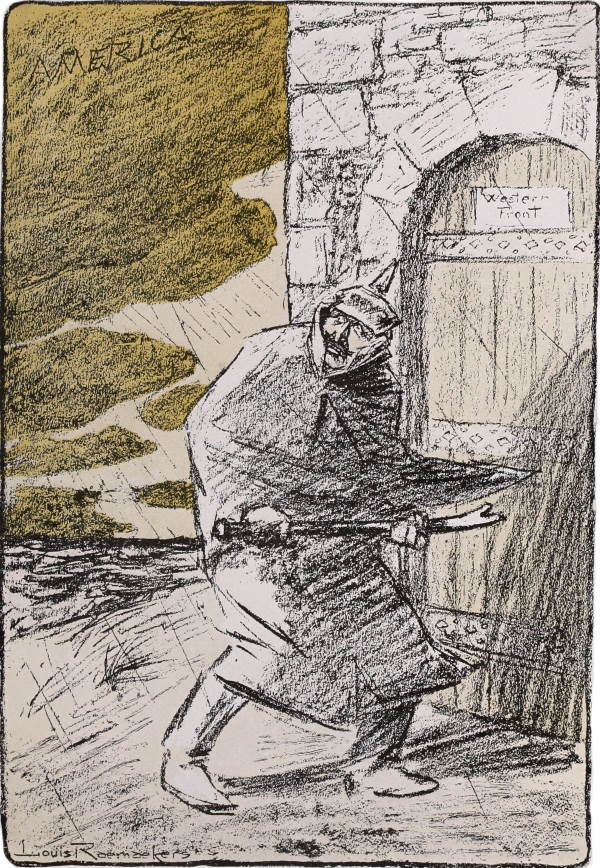
“WE have no selfish ends to serve. We desire no conquest, no
dominion. We seek no indemnities for ourselves, no material
compensation for the sacrifices we shall freely make. We are
but one of the champions of the rights of mankind. We shall be satisfied
when those rights have been as secure as the faith and the freedom
of the nation can make them.”
From President Wilson’s Message to Congress, April 2, 1917.
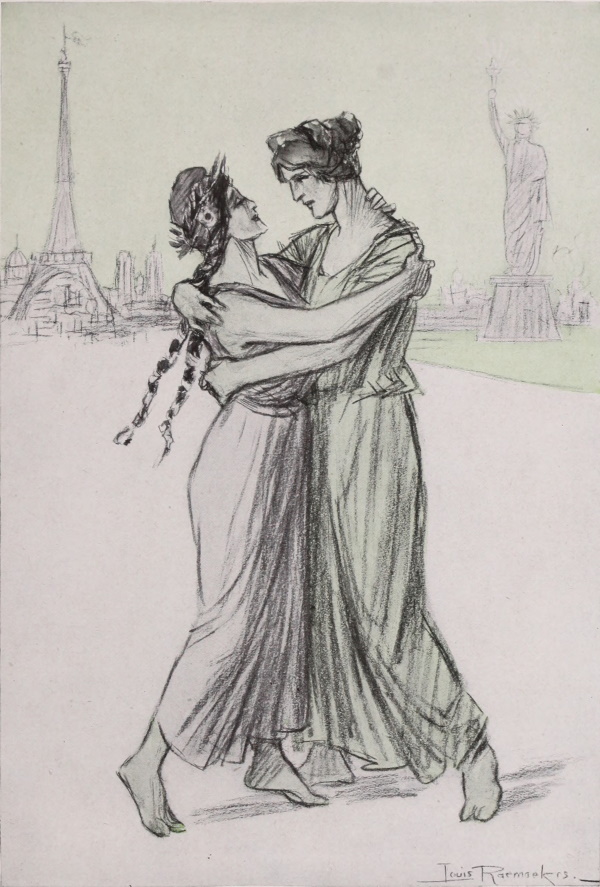
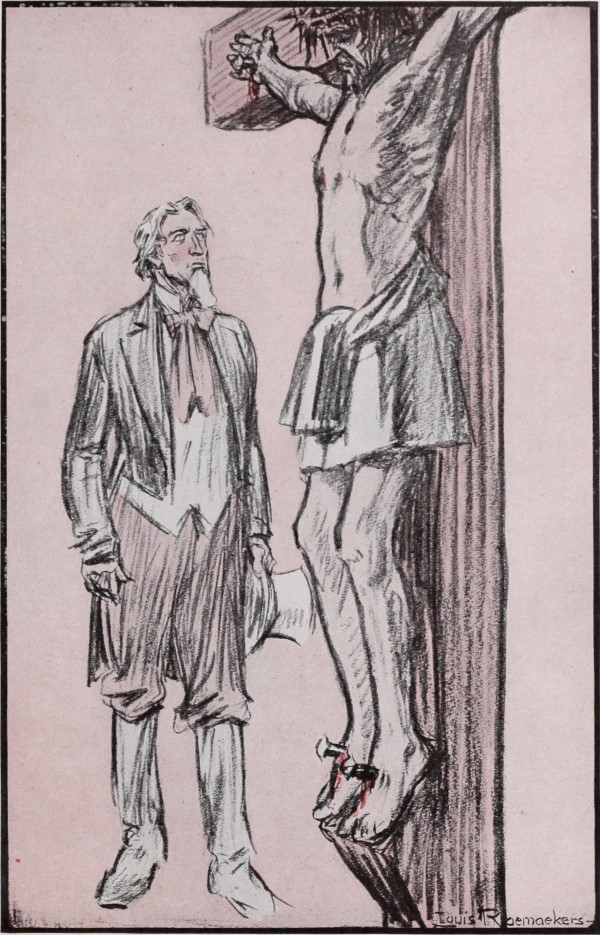
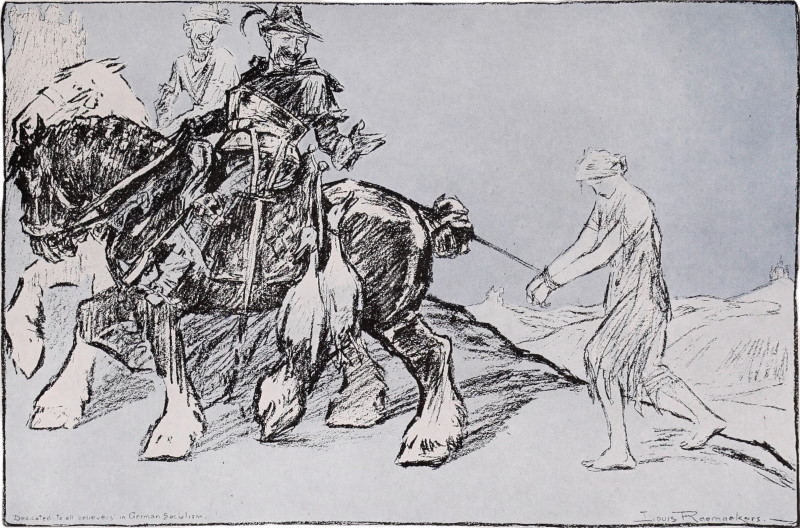
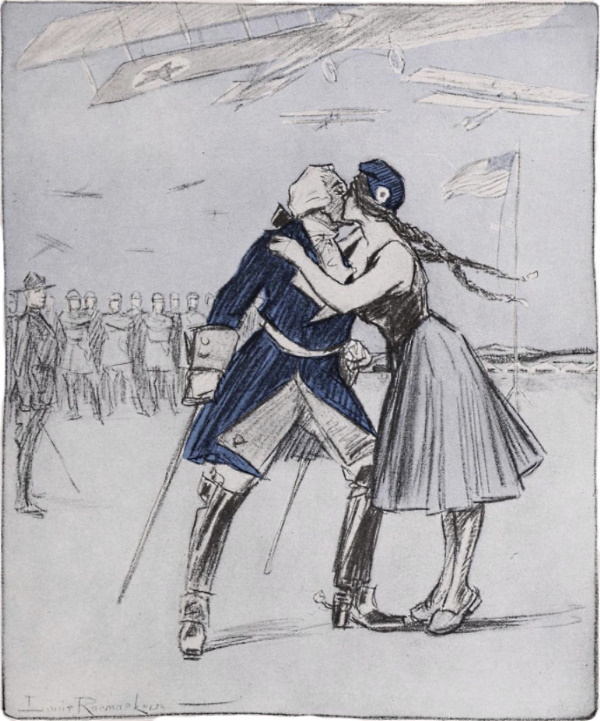
“ When I was a Child, It was You who Saved Me ”
WHETHER it is that an invigorating climate has given our
Anglo-Saxon blood a piquant Gallic flavor or because Europe
sent us for ancestors only those light-hearted and adventurous
souls with a spirit akin to that we admire in the French people,
true it is that Americans have always had an especial liking for France
and the French. They were our first allies as they are the latest. From
Lafayette and Rochambeau to Joffre and Viviani, a host of Frenchmen
have won the affectionate regard of Americans and are numbered with
our national heroes.
But our relation to the French has a deeper foundation than admiration
for a courageous and accomplished race which for centuries has made
generous contribution to the sum of the world’s knowledge and achievement.
The French were early settlers on this continent; LaSalle and
Champlain were the forerunners of a host of French explorers and settlers
whose descendants are today taking active and honorable part in the
life of community and nation.
Before the war one of the foremost French statesmen said to me, with
a certain note of sadness, that in the course of two thousand years of advancing
civilization his countrymen had lost something of their initiative:
that he believed it would not now, for instance, be possible to build up in
France vast industrial organizations like those which are so effectual in
establishing the commercial prestige of the United States.
If that were true before the war, it can scarcely be credited now. France
has never failed to provide effective military organization for the protection
of western civilization against the repeated attacks of her enemies
from the east. She defeated the forces of Mohammedanism and saved
Christianity. Time and again through the Middle Ages she beat back the
invading Huns and kept them from overrunning Europe. The victory at
the Marne which definitely stopped their latest irruption is only the latest
and greatest of many such victories by which France has laid mankind
under lasting obligation. And the industrial organization which supplies
the armies of France with the products of farm and factory, and even produces
a surplus for her allies, including the United States, is additional
proof that the genius of the French race is neither decadent nor limited,
but as broad as all human activity and as ardent today as when Joan of
Arc inspired kings and peasants alike with her mystic fervor.
With their French allies Americans can work in most cordial understanding
and sympathy. That subtle spirit of unselfish dedication to country
which has won for the French the admiration of the world consecrates the
alliance of the peoples who are giving their sons in common sacrifice to
save liberty to the world. Out of the heat and turmoil of war bonds are
being forged between the Allied nations which time and circumstance can
never sever. On that alliance the hope of civilization depends; from it
may come, in God’s good time, some great forward step in the march of
progress which began at a manger in Bethlehem.
MYRON T. HERRICK.
Cleveland, Ohio,
March, 1918.
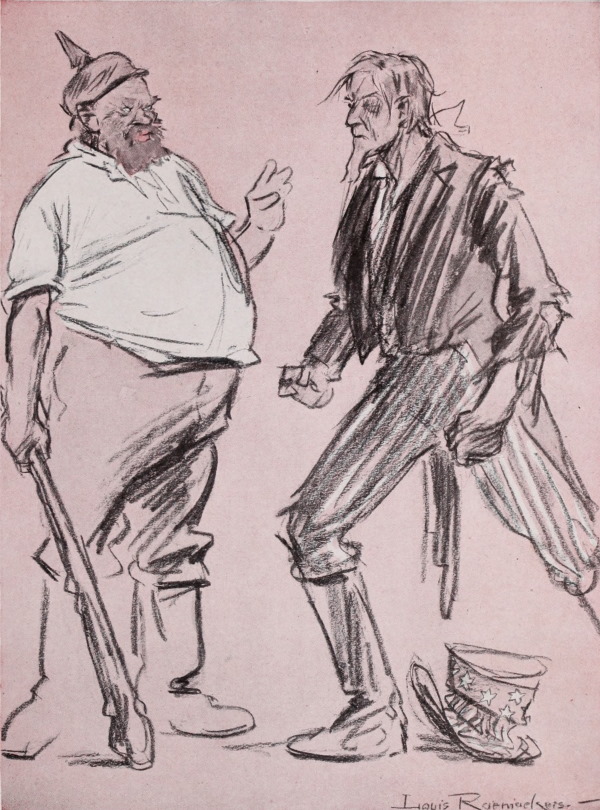
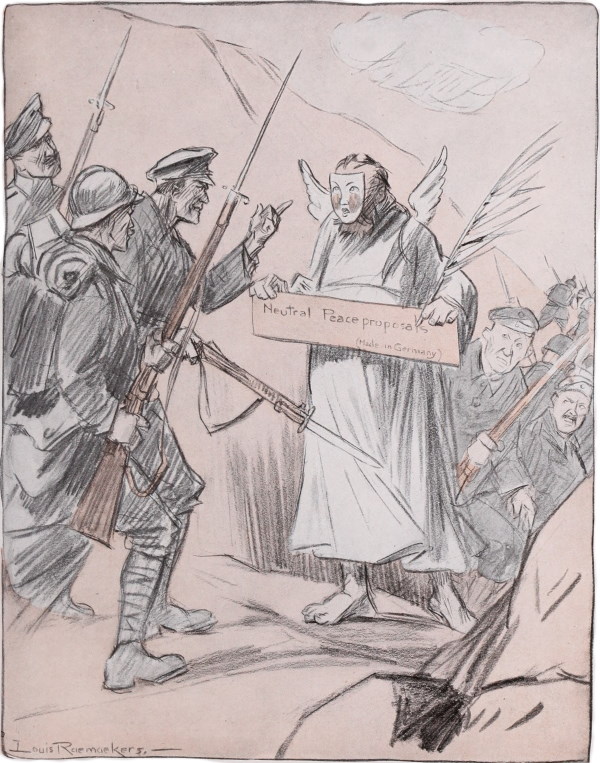
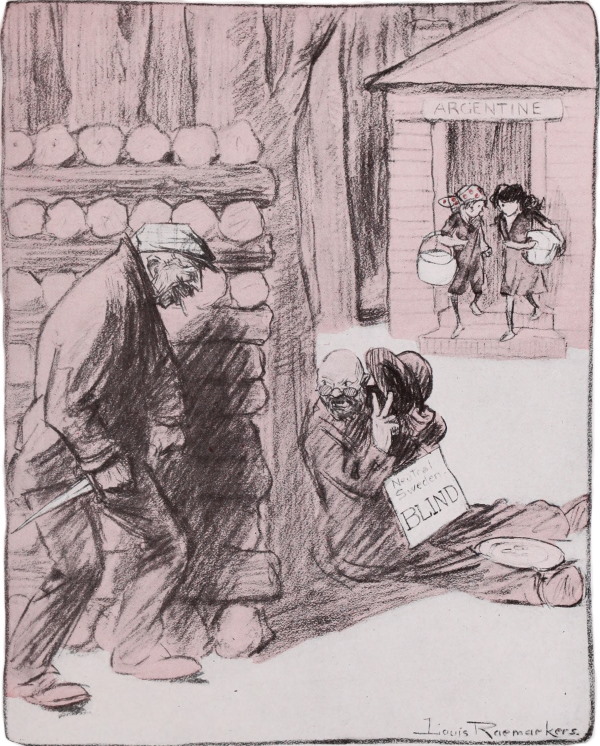
The Hun: “Keep Neutral”
EVERY great event is an occasion for the moral education of the
world. Froude, in his essay “On the Science of History,” says
that the value of history is that it sounds across the centuries the
eternal note of right and wrong. Along with the unbelievable calamities
that have come in the train of the war that in August, 1914, was shamelessly,
dishonorably and with malice aforethought precipitated by the
Kaiser and his fellow highwaymen, there stands out one colossal good:
it has made the world increasingly ethical. The flaunting by the German
military party of all that we associate with fair play, chivalry, democracy,
humanity, even Christianity itself, has aroused the Allied peoples to the
fact that the foundation principles of happiness are at stake.
’Tis for the holiness of life
The Spirit calls us to the Cross.
The brutality of the Teutons—Austrians and Germans alike—their willingness,
in order to win, to throw away everything we think admirable in
conduct, created a reaction in America by arousing us from our laissez-faire
attitude to the conviction that there can be no neutrality between
right and wrong. The opportunity should not be lost to enforce this lesson
upon the young, who should be taught to hate the devilish spirit by
which the Teutons are obsessed. In due time, when their defeat is accomplished,
a reaction will set in among themselves. The cost is appalling,
but I believe that nations, like men, can
“rise on stepping-stones
Of their dead selves to higher things.”
Meantime, with what pride we realize that—as eventually even German
historians will admit—our own part in the war is on a higher plane of disinterestedness
than we have ever reached before, a level of altruism that
has rarely, if ever, been attained by any other nation!
ROBERT UNDERWOOD JOHNSON.
February 22, 1918.
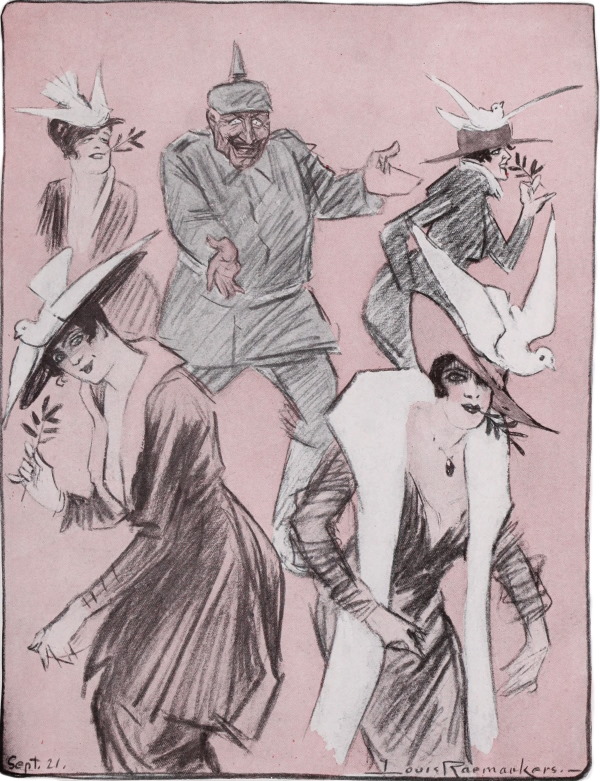
Peace Plots Revealed in America and France
MR. RATHOM, Editor of the “Providence Journal,” whose exposure
of von Bernstorff’s plots seemed to show a gift of necromancy,
states that his information came to him through men and
women (often Bohemians and Slavs) “who not only took grave risks in
the work—for they were braving German vengeance—but gave up their
time and in many cases their own funds, without a dollar of compensation
from the ‘Journal’ or anyone else, in order to give us the facts which
would prove to the American people the manner in which they were being
tricked and fooled.”
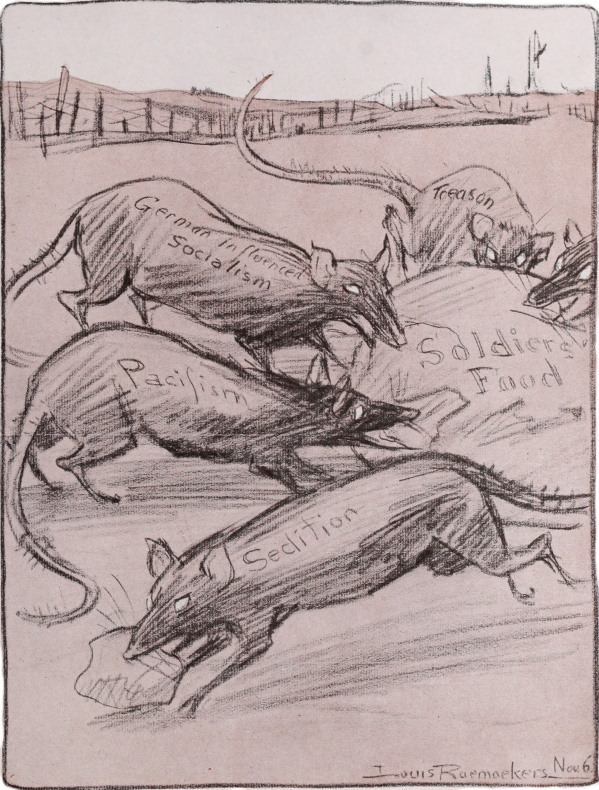
If this cartoon of Mr. Raemaekers shall serve to make the native American
take seriously a situation which is serious in the extreme, it will not
have been made in vain. Whenever an American hears or overhears any
one in any station of life uttering treasonous language, he should report
the matter and give the name of the culprit immediately to the Secret
Service,—not content himself with repeating the words at the club as a
good story.
JOHN JAY CHAPMAN.
Belgium, 1918
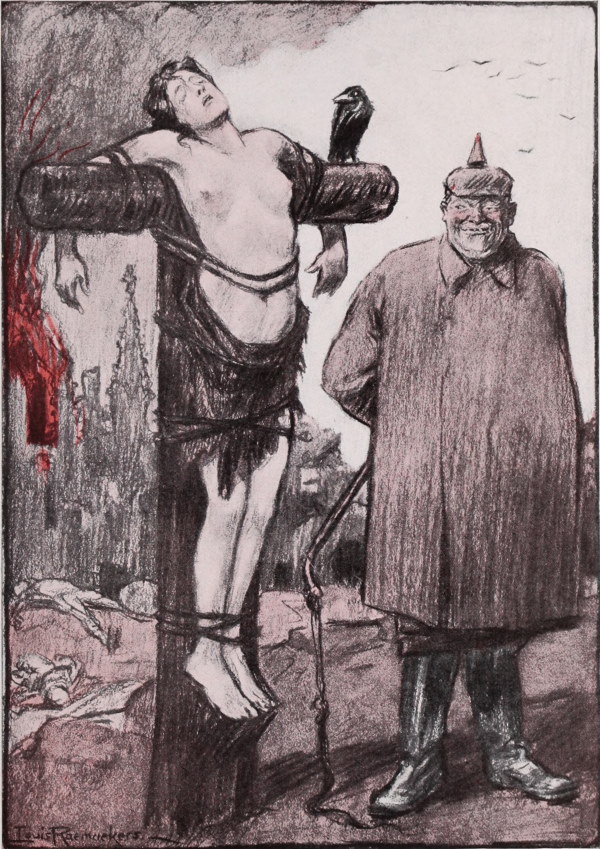
YOU, who on the tree of shame show forth again the Sacrifice of
Calvary: you for whom scourge and thongs and the mockery of
dull beasts are the circumstance of martyrdom: you who freely
offered yourself that man might be saved, “yet so as by fire”:—Belgium!
in the depth of your agony and the long torment of a red martyrdom, remember
that the Cross of your own Passion endures only until the Resurrection
that comes after the third day.
God, in mercy Incarnate, as Man suffered the shameful death of the
Cross that the world might be saved from the penalty of its sins. The
Tree of Scorn is raised up on Calvary, becoming the instrument of shame
and of death, yet “the leaves of that Tree shall be for the healing of the
Nations.”
Nails and spear, scourge and thongs, crumble and fall away; the obscene
mockers “that watched Him there,” and watch you, O Belgium,
go hence to that place prepared for them by Eternal Justice, but with the
sun of Easter morning, behold a great wonder! The Cross, that was a
dead engine of death, is transformed by Divine miracle. It lives, it
throws out branches and leaves; it is now the Tree of Mercy, “and the
leaves of that Tree shall be for the healing of the Nations.”
RALPH ADAMS CRAM.
“ We will not Wear Convicts’ Stripes, Wear Them Yourselves ”
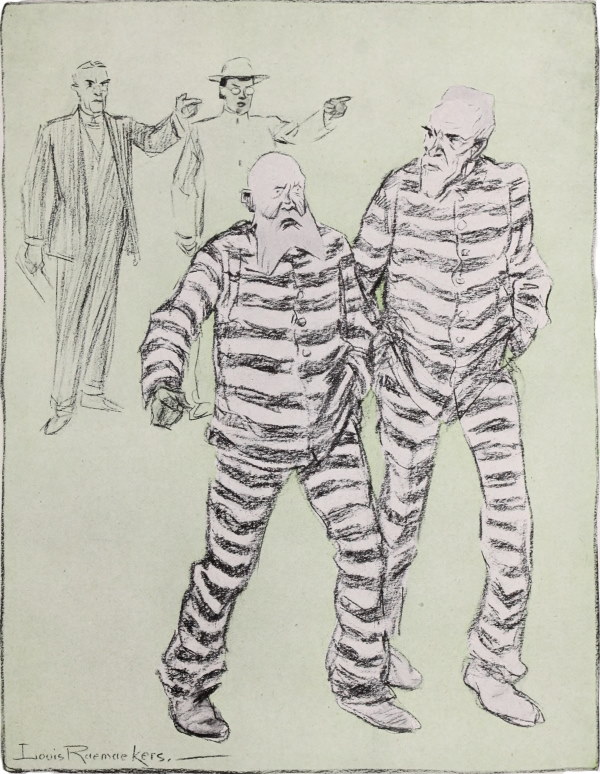
[Mr. Raemaekers refers in this cartoon to the insulting proposal of the German Government,
just before the entrance of the United States into the war, that American ships
at the rate of one a week would be permitted to pass the submarine “blockade” if they
were painted in stripes in a specified manner.]
WHEN Attila laid Rheims in ashes, cut the throats of his hostages,
tortured his prisoners, and thus earned fame as the
Scourge of God, he found priests and professors to justify his
acts and to predict the speedy Hunnification of the world. Attila is to-day
popular in Prussia—mothers have their babes called Etzel and when
William II sends forth his armies he bids them be worthy of their illustrious
namesake.
Attila was the first of the great Junkers. His army was largely German
and he held court in the centre of Thuringia. He is the hero of
Germanic song and legend; and his spirit animates the Hymn of Hate,
the murder of Edith Cavell, the sinking of the Lusitania and above all the
hired criminals who have been operating in America in the disguise of
patriotic citizens.
POULTNEY BIGELOW.
Malden-on-Hudson.
Washington’s Birthday, 1918.
The Final Argument
IN the now happily distant days of August, 1914, the people of the
United States found themselves facing an opaque wall of neutrality.
But we are an emotional people; and the rape of Belgium had hit us
emotionally. Though we were asked not to applaud the pictures of
Allied soldiers that flashed across the screen in every motion-picture theatre
of the country, we did clap our hands; and, what is more, we valiantly
hissed the Kaiser when he strutted before our view. Let the American
people ever rejoice that in those first tragic days they had eyes of
the heart. Oh, those months of shame for us who felt that the cause
of England and France and Belgium was the cause of the United States
of America! They have passed now, thank God; and the man of vision
who first brought home to us what Belgium’s sorrow meant, was Louis
Raemaekers. Each line he drew was a full platoon of soldiers advancing
toward Berlin. His vivid, ironic pencil was a gun thrust at Prussian
autocracy. His art opened the door in that opaque wall I have spoken
of; and it was a garden that we looked upon—though a garden filled only
with red flowers: the poppies of everlasting sleep; crimson blooms that
spoke of the blood so nobly shed in the name of national honor; fiery blossoms
that burst upon our gaze through the smoke of German guns;
dark passion-flowers that breathed pain, but never despair. The sad
garden of Belgium—this it was that one man of genius revealed to us,
in all its pity and sorrow. And America looked, and wept, and sent messengers
into that place of desolation. For never for an instant had we
been neutral, never had we really dreamed of standing by and letting
this agony go on. Had we done so, the years to be would have held only
grief for us. We could not have lifted up our heads in the world of
nations if we had not seized our splendid opportunity.
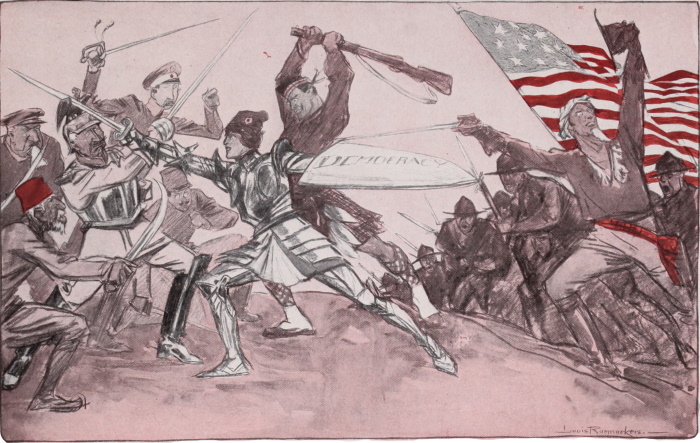
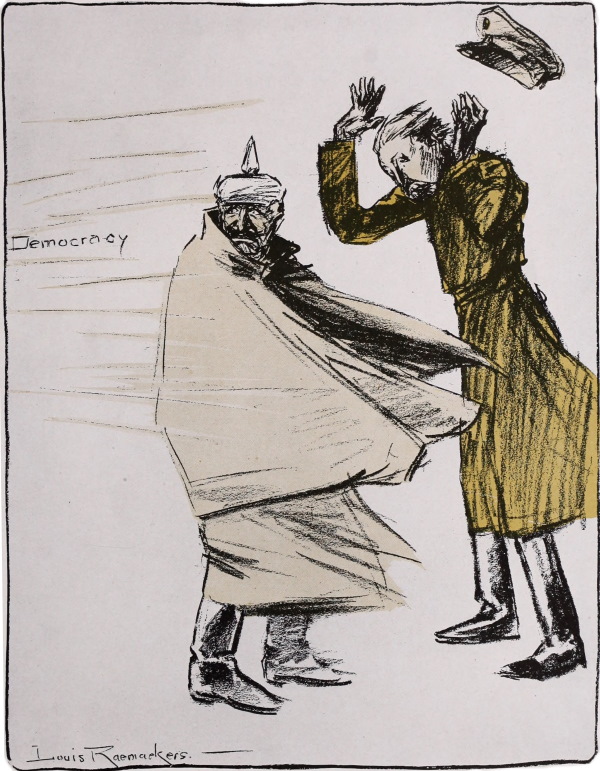
Who has ever doubted the integrity of the American people? As one
man we rose when war was at last declared, and as one man we will fight,
in the name of Democracy, in the name of Humanity, until the Prussian
yoke is lifted from the Belgium we love and reverence. A task lies
before us of unbelievable magnitude. But we shall not falter, we shall not
fail; for if we fail, life itself must crumble in ashes on the hearthstone
of the world. With a triumphant Kaiser, existence would be unbearable.
The pacifists lay all the emphasis on mere living. They forget that most
of us do not wish to live on a Prussian-ruled earth. Surely it is not much
to die for a principle that is higher than the stars.
Louis Raemaekers, you have opened a door on life. You have brought
news to thousands who had not heard and seen. And great is your reward.
CHARLES HANSON TOWNE.
The End of the Hindenburg Line
THE Hindenburg line is a menace to every courthouse in America.
In my recent journeys through the West I have never seen a
courthouse tower printed against the sky without relating it to the
great world conflict. We are fighting for all that is embodied and expressed
and safeguarded in these citadels of democracy. A little while
ago I looked with reverence at a log hut preserved at Decatur, Illinois,
the first courthouse of the county. In that little room Abraham Lincoln
appeared as attorney for pioneer citizens who understood perfectly the
promise of American democracy. The laws invoked to preserve their
rights were a crystallization of the thought and the hope of liberty-loving
peoples, and no settler in wilderness or prairie, no matter how humble,
but felt himself a partner in the benefits of American institutions and the
great tradition of English law. Every American courthouse is founded
upon Magna Charta. If we are indebted for anything in our democracy
to the Teutonic-Turkish combination I am unaware of it. Dull of wit indeed,
the Hohenzollern BEAST, to think his mailed fist could ever splinter
the door of one of these American courthouses! The price our forefathers
paid for their liberty was too great for any yielding to a devil
gone mad and attempting to bestride the world. During the Civil War
Lincoln once remarked to Seward, speaking of Weems’ “Life of Washington”
which he had read before the fireplace in his father’s cabin in
Spencer County, Indiana, “It occurred to me that it must have been
something pretty fine those men were fighting for.” It was; and it is for
that same fine thing that America has again drawn the sword.
MEREDITH NICHOLSON.
“ Something’s Wrong. She Doesn’t Seem to Inspire Confidence ”
IT is Germany’s “Kultur,” her spiritual code, that is responsible for
America’s entrance into the war; her gruesome sacrifice to Moloch
of all which distinguishes humanity from the brute and the savage.
It is her philosophy which has made us her horrified but resolute foe.
The fruits of her spirit stand forth alike in her speech and acts. “Kultur
is a spiritual organization of the world, which does not exclude bloody
savagery. It raises the daemoniac to sublimity. It is above morality, reason,
science,” so wrote a Teutonic expounder in the first year of the war.
“We have become a nation of wrath; we think only of the war. We execute
God Almighty’s will, and the edicts of His justice we will fulfil, imbued
with holy rage, in vengeance upon the ungodly. God calls us to
murderous battles, even if worlds should thereby fall to ruins,” so wrote
one of Germany’s poets. “Whoever cannot prevail upon himself to approve
from the bottom of his heart the sinking of the Lusitania, whoever
cannot conquer his sense of the gigantic cruelty to unnumbered perfectly
innocent victims—and give himself up to honest delight at this victorious
exploit of German defensive power—him we judge to be no true
German,” so wrote one of her pastors. And for hideous, ruthless deeds
which violate every sanctity and deify falsehood we need but cite her
slaughter of children and the aged, her poisoning of wells, her shooting
of nurses, her sinking of hospital ships, her brutal deportations and all
the revolting sinuosities of her spy system.
It is this catalogue of crimes committed in the name of moral superiority
that has incensed the American people. It is to combat “Kultur”
which Germany extols as the quintessence of civilization, this gospel
which constitutes military might the only inviolable law, that we have
pledged our precious sons, our abundant resources, our supreme, indefatigable
energies. If Prussian arrogance be not rebuked, Christian civilization
fails. Hence the growing and embattled sentiment that a world
in ruins yet free for man would be preferable to the sway of Satanic
Teuton efficiency.
ROBERT GRANT.
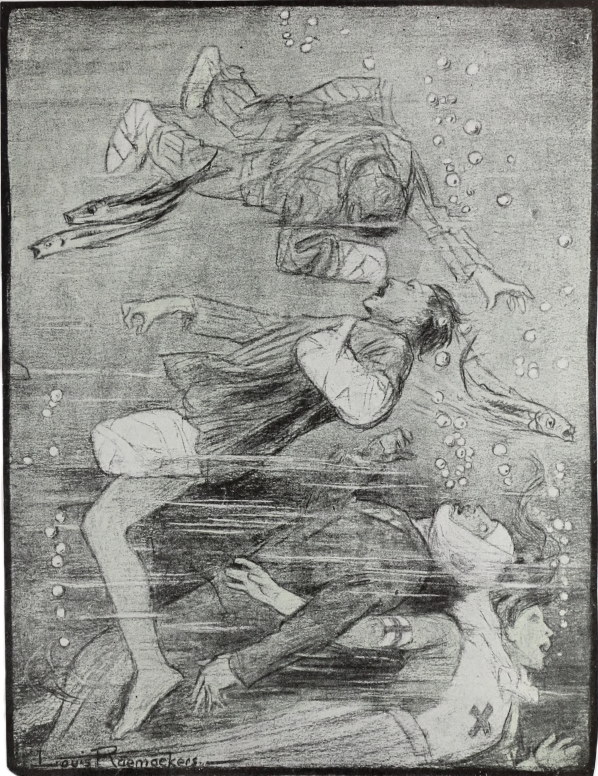
Angels of the War Zone
I HAVE sometimes wondered if it is really possible to hate a country
for which one has such unbounded contempt and disgust as one has
for Germany. It is quite possible to fear without hate; one would
not hate a rattlesnake or a shark, even at close quarters. On the
other hand it is conceivable that you might hate a fearsome but still noble
beast like the lion, if you were camping on the desert and he sat persistently
in front of your tent, alternately licking his chops and shaking your
soul with his loud anticipatory roars.
Usually we do fear what we hate. But the Germans have overshot the
mark. They have been so dully and unchangeably brutal, that many of
us have come to feel for them the same mental condition of loathing we
should feel for an obscene, flat-headed giant running amok, while doing
our best to hit him in a vulnerable spot. Even if they reached these
shores and went automatically about disciplining the natives I feel sure
we should continue to despise them and to find them ridiculous.
It is possible that if they had won the war in three months we should
feel differently. Then we might have hated them for devastating France,
but she it would have been who received our contempt. Her course in
history would have been run; she would have been as degenerate as the
Germans so fondly hoped. We might have hated Germany for subjugating
so vast and potential a country as Russia, but we should have
respected her might, the magnificence of her great army. We should have
hated her roundly, and the hate would have done us all good, for it would
have been a great emotion provoked by a great cause.
But Germany as a fighting machine is a failure. She has been defeated
where she has been compelled to depend upon force of arms alone. Her
only striking successes have been won by hitting below the belt, cowardly
underhand methods, sneaking propaganda, millions expended upon buying
human tools, and furnishing them with other millions necessary to
work wholesale destruction, and sacrifice the helpless proletariat.
In the Death House at Sing Sing the robust murderers have no sympathy
for the poisoner, refuse to admit him to that last tragic companionship.
So it is with Germany. She is the poisoner, the Medici, among nations.
From strangling her enemy with gas to bombing unfortified towns,
torpedoing passenger ships and firing on the life boats, or sinking hospital
ships, often carrying her own wounded to ease and plenty, she has
merely shown herself the super-snake, supercharged with venom, not the
lion, who proudly stands in the open spaces and challenges his enemy to
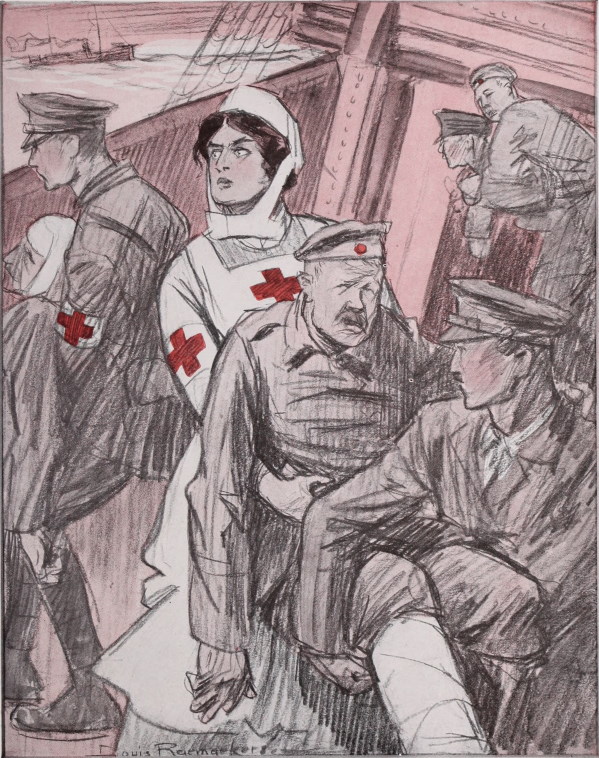
battle. The bewildered expression on the faces of these German clods in
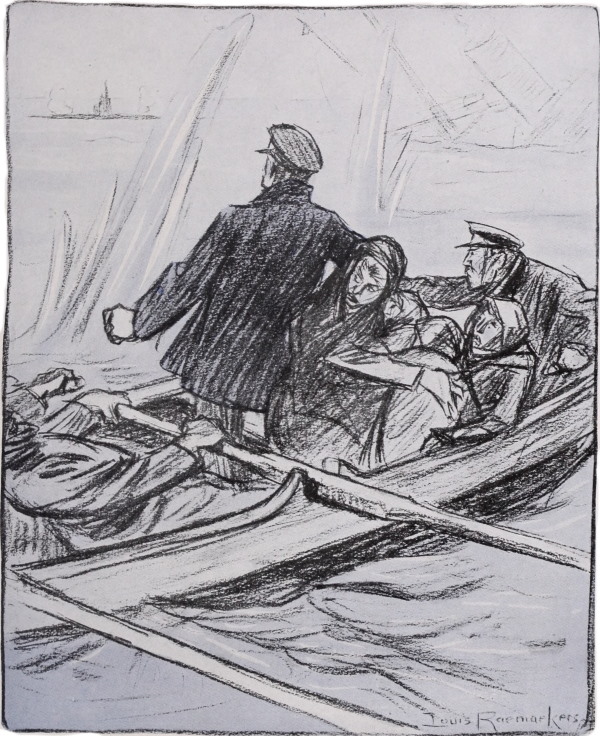
the act of being rescued by British women nurses, while a home torpedo
burrows in the vitals of the ship, is a fair portent of the minds of the
German people after the war when they learn that they have been fooled,
and martyred, and crushed, not by the enemy but by their own unregenerate
rulers in Berlin. If they annihilate that caste and set up a Republic
they may win back the respect of the world. Otherwise not. We
sometimes forgive those we hate, but only a miracle forces a man to respect
where he has both instinctively and thinkingly despised.
GERTRUDE ATHERTON.
As Thou Sowest, so Shalt Thou Reap
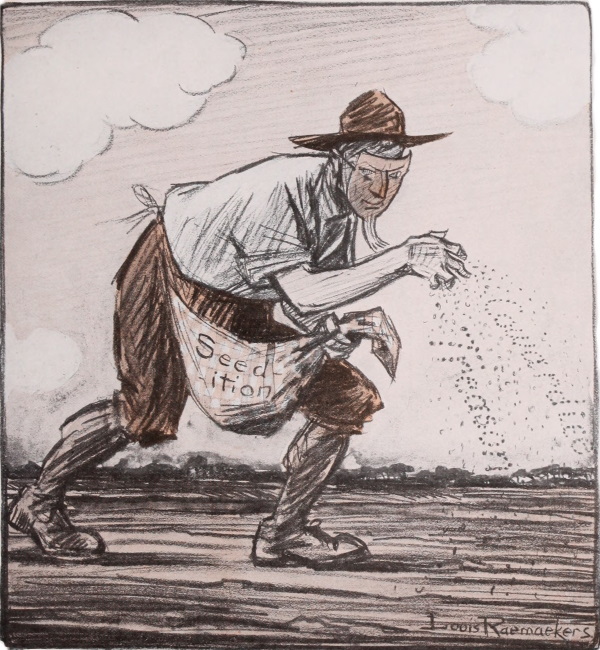
CREEPING behind a mask—stooping, cringing and cowardly—the
planter of sedition sows his seed in the dark. The masks behind
which he hides are numerous and of great variety. No sooner
is his identity disclosed than he assumes another disguise. Behind “Freedom
of Speech,” “Liberty of the Press,” “Conscientious Objector,” and
“Pacifism” he hides. He makes his masks similitudes of virtue. Whispered
rumors, distortion of truth, appeals to fear, and appeals to prejudice
are mixed with even the grosser seeds he sows. When other disguises
are torn away he may fashion a mask of spurious patriotism. Most dangerous
of all traitors is he who keeps just within the law of trespass while
scattering afar his seed of sedition throughout the Land of Liberty.
A. S. BURLESON,
Postmaster-General of the United States.
“ Don’t Stop, Old Chap, Keep It Up! ”
“CHEER up, Willie, the worst is yet to come. Don’t view me with
alarm and suspicion. Don’t avert your eyes from my smile. It
may be sardonic, but I cannot control my facial expression. I
must look as I think. I am not like you, Wilhelm, looking God
and thinking devil. Oh, but you are a cute one, friend of mine! I love
you for a thousand things you have done, but don’t fool yourself, friend
of my heart,—I beg pardon, I forgot, I have no heart. In that and some
other aspects, Willie, we are as alike as two peas in a pod. Willie, we are
so close in our method of working that I am going to give you permission
to call me ‘Du’ hereafter.
“How in the world could or can you, for all these years, make the German
people believe that the firm name of their Empire is ‘Me and God.’
You and I know that God withdrew His Name, His Goodness, His
Honor and His Capital from the firm when you signed up as Emperor.
God is a one-price God. God never adulterates His goods; God never
advertises one quality and sells another. Since you have been Kaiser,
Wilhelm, a multitude of firm names could be exhibited on the sign board;
none of them, I imagine would rate high with Bradstreet, but they would
be truthful. ‘Me and Ambition,’ ‘Me and Power,’ ‘Me and Ruin’ are a
few I would suggest. Of course, your people would have shunned you
just as a mother shuns a house with a Board of Health sign on it, had you
given the real name of the firm. You are the most worried looking potentate
I have ever met, Wilhelm. Yes, Wilhelm, there will be Hell
to pay when your people awake to the fact that you have no partnership
with God, but are simply a vassal of mine. I’d be scared out of my
wits if I were in your place. While you are thinking of the horrible mess
you have made of your manifold opportunities be good enough to note a
deadly parallel. Once I was a prince, a prince in a vast and beautiful
Empire where all was tranquillity, peace, holiness and bliss. I was called
Lucifer, Son of the Morning—I had an all-absorbing ambition to rule
or ruin. I revolted and seduced some restless spirits to ally themselves
with me, fellows like your von Tirpitz. I rebelled against the King and
Kingdom of Heaven. The King of Heaven still reigns and the Kingdom
of Heaven still retains all its tranquillity and beauty. After the row
was over I found myself in Chaos. From there I was rushed to Pandemonium,
and it is needless to tell you that I am now in Hell—and it
lives up to its name. Note the deadly parallel, Wilhelm, and while you
are getting it into your noddle, I will whistle the music of our national
Hymn of Hate so you can memorize it. Try it on your piano. The words
are—
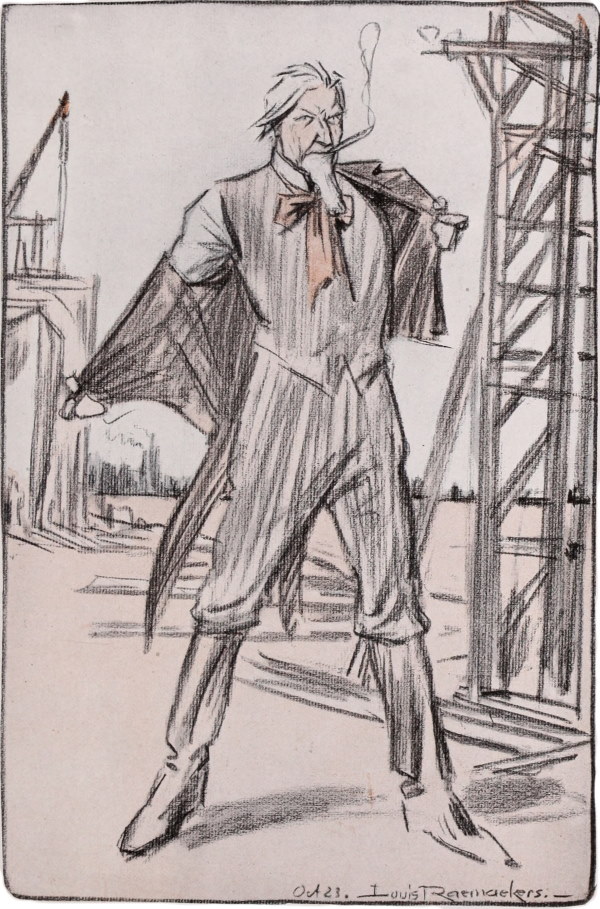
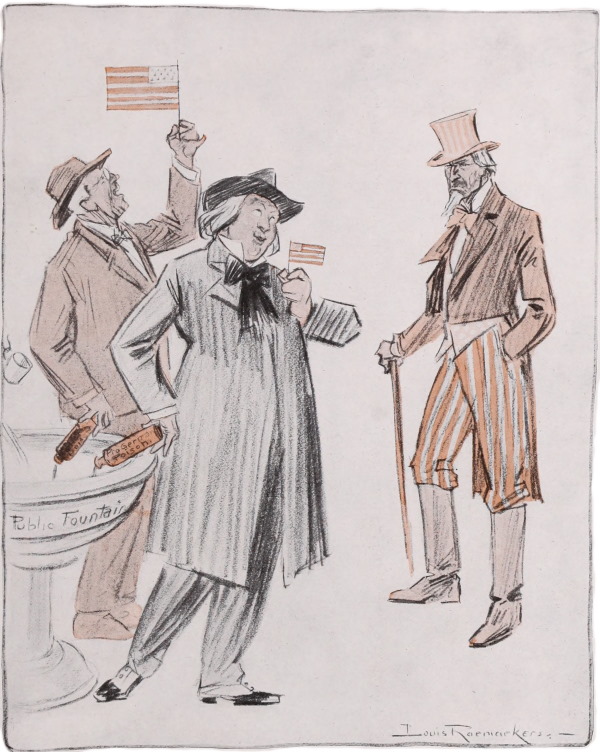
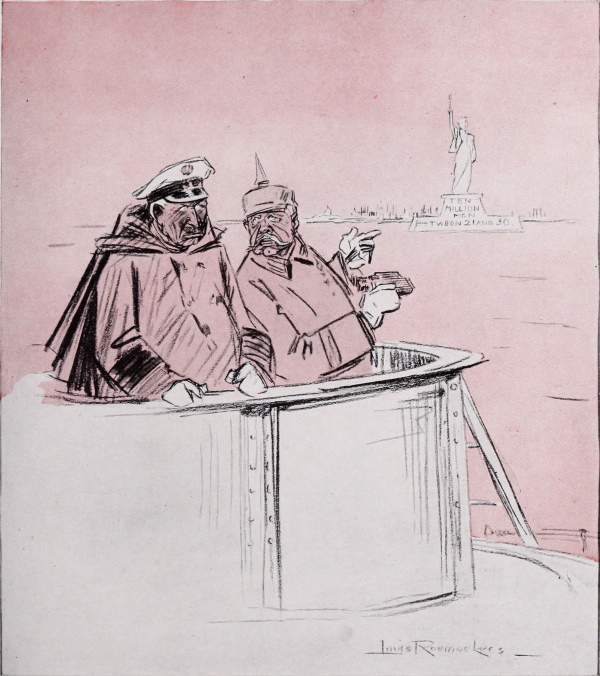
“ So We Are Only a Dollar-making People, are We? ”
IT has for many years been a favorite gibe of thousands of foreigners,
living for the most part upon inherited wealth, and taking the
customary snobbish attitude of the consumer toward the producer,
that Americans are “only a dollar-making people,” as Mr. Raemaekers
has it in his forceful cartoon. Barring the word “only” perhaps the indictment
is true—I hope it is. One of the fondest of my many fond
wishes for my fellow-Americans is that they may all become successful
dollar-makers, since he who makes his own dollars is able always to maintain
his independence, to look his creditors large and small squarely in
the eye, and live by grace of his own powers, and not by favor of potentate
or patron.
There is nothing disgraceful about a dollar, and it may be said on its
behalf that it differs from the Sovereign Incarnate of the Germans in
that it is redeemable always at par, being worth the full one-hundred
cents that it calls for; in that it rings true; in that whether it be of gold,
of silver, or of paper, that which it promises it fulfills, and has never yet
been known to dishonor itself. It may occasionally be seen in bad company,
but it never falls below the level of its evil associations, and is genuine
to the core. Loose thinkers sometimes speak of the “tainted dollar,”
but there is no such thing. If any taint lingers near it is not in the
dollar itself, but in the holder. So excellent, indeed, and so immune to
the effects of evil association is the character of the dollar, intrinsically,
that any one of Uncle Sam’s many billions could pass from the pocket of
a Burglar into that of a Bishop, and be worthy of its latter estate.
I have yet to meet an American who confounds this true and honest
servant of his well-being with his God, but, alas, I have met countless
Germans who call it our American King, and themselves bow ignobly
down to a Lord and Master whose assumption of a divine relationship
has made of his life a prolonged blasphemy; a King whose deeds of savagery
are a complete negation of his hypocritical pretensions to the possession
of lofty ideals; whose ring is the ring of a brazen counterfeit,
and whose word has been so dishonored by himself that it has become the
synonym for worthlessness throughout the world.
If Kings or Masters of any sort must be endured who would not rather
abase himself before the American Dollar, true and honest to the core,
than debase himself by bending the knee to a Kaiser who by his infamies
has made an Attila appear to be an Angel of Peace, a Bill Sykes
a Gentleman, and the word of an Ananias a Bond of Faith?
JOHN KENDRICK BANGS.
“ No, Thanks, I Know These Princes of Yours Too Well. ”
ON November 5, 1916, Poland was “restored” by Germany and Austria-Hungary
to her old place as an independent member of the
family of nations. High hopes were aroused in the hearts of
the Poles. They had suffered for over a hundred years, and in
this war of liberation, which was to form the Society of Nations, the Austro-German
proclamation was the first recognition of their aspirations.
The Entente Powers had committed the serious blunder of refusing to
encourage the Poles for fear of offending Czarist Russia. But very
soon the Poles realized that the Central Empires were playing them false.
The “independence” was for to-morrow and not for to-day, and even for
to-morrow it was contingent upon “being good.”
At the beginning of 1917, which was the year of national rebirth,
hatred of Russia and resentment against the policy of expediency of
France and Great Britain, as well as the necessity to accept the de facto
Austro-German occupation, influenced most of the Poles to trust—in defiance
of history and experience,—the good faith of Germany and Austria-Hungary.
At the beginning of 1918, they had learned the lesson Raemaekers’
pencil eloquently depicts—not to put their trust in German
princes. At Brest-Litovsk, “independent” Poland was refused a place in
the peace negotiations. Answering President Wilson and Premier Lloyd
George, Chancellor von Hertling impudently asserted that the future
status of Poland concerned only her conquerors.
The cartoon, drawn to illustrate the scepticism of the Poles, should
drive home a truth to the Americans. We must realize that camouflage
is not confined to military operations. Its use to deceive armies is not so
dangerous as its use to deceive the nations behind armies. From bitter
experience the Poles are learning that behind the prince put forward as
ruler is hidden German militarism and German imperialism.
This form of political camouflage is as dangerous for the United States
as for Poland. Peace proposals may come to us—they will come to us—in
plausible and appealing form. They will have the appearance of fairness
and justice. What is behind them? What inspires them?
Our mission in this war is sanctified by its goal. To attain that goal
we have consented to make sacrifices unprecedented in the history of our
nation. From a purely military standpoint, no camouflage can possibly obscure
the path to the goal, and the method of reaching the goal. The
German armies, as yet unconquered, stand in front of us, defending the
loot of German imperialism, won by German militarism. We must dispossess
these armies of their loot, and punish them for having looted. But—alas!—diplomacy
is at work in 1918 to attempt to save by wile what
cannot indefinitely continue to be held by force. Every means of diplomatic
camouflage will be used by our enemies. Our inspiration, our determination
to pursue the struggle to the bitter end, will be kept alive only
if we see, through various forms of camouflage, the spiked helmet hidden
behind them. To make peace with Germany wearing the spiked helmet
would mean to consecrate the success of her imperialistic policy.
HERBERT ADAMS GIBBONS.
Speeding Up
Uncle Sam: “I think I had better speed up and
build a ship or two!”
April
8.
Keel laid.
4th
day.
Double bottom completed.
6th
”
Frames and bulkheads erected and portion of shell plating finished.
7th
”
Stern-frame in place.
14th
”
Boilers put on board.
21st
”
Stern-post bored and stern-tube put in place.
22d
”
Masts stepped and engine installation begun.
24th
”
Funnel put in place.
26th
”
Machinery all in and engines completely installed.
Finishing touches.
May
5
(27th day). Launched.
The building of the “Tuckahoe,” April-May, 1918, at Camden.
Toward the Valley of Decision
THEY shall go down to the Valley of Decision, multitudes of young
Americans from East and West, from North and South, some slow
to have gone into the war but none ever to go out until a Decision
shall have been reached.
Into the Valley of Decision,—for a Decision final and irrepealable we
are battling. Not a Decision as to the victor in the war, but a Decision
that shall give us victory over war, its defenders and glorifiers! For
the German Empire which wars made this war shall unmake.
We go down to the Valley of Death for a Decision whether the world
shall be ruled by Germany or by civilization, be subject to Prussianism
or master of its own fate and freedom.
And America knows the cost, which it refuses to count,—knows its
sons must be slain if liberty and justice are to live.
To the God of Justice, America lifts its heart in prayer, beseeching not
security for its beloved sons but vowing that the sun shall perish out of
the heavens ere we and our Allies surrender our liberty, the freedom of
the least of men, to the barbarism of force and the forces of barbarism.
Out of the Valley of the Shadow of Death shall emerge the Decision,—Never
again. The war against war has brought freedom to nations,
and secured peace to them that seek public right as the law of mankind.
STEPHEN S. WISE, Ph.D., LL.D., Rabbi of the Free
Synagogue, New York.
Wake Up, America!
This was done to Canadians by the Huns
AMERICA wakes! The White Christ has called her;
She has seen the devils abroad in His world;
Evil vaunting himself has appalled her;
To the War-wind of Heaven her flag is unfurled!
America wakes—with his murder and lust
Let the Hun take the path he has carved into hell.
No longer blaspheming the Cross with his trust.
America wakes, the sick world shall be well.
America wakes—God’s last peace-lover,
God’s fighter to death, when her peace is assailed.
Shout, sing, fling out the flags, War is over;
When America battles, right has prevailed!
MARY E. WILKINS FREEMAN.
There are Plenty of Lamp-posts!
THERE are creatures that to be hated need but to be seen.
The sight of the serpent awakens all the dead, old body-memories
of ancient ages, when that reptile was man’s ever-present,
mortal enemy.
The domestic horse, made unafraid by a thousand generations, when
he smells his ancient enemy, the bear, will rear and plunge to break and
run for his life.
The face features a man’s character, his eyes window his soul. There
are faces that instantly beckon all our better nature and bind us in loving
thrall. There are other faces that repel us as the snake repels. There
are human tongues voiced with the serpent’s hiss. There are persons
about whom hangs an odor of the reptile that wakens all the dead old
memories of primal hate.
The poet is born the poet. Genius is an inheritance. Human character
is a summation of ancestral traits. So the traitor-spy is an atavic embodiment
of all that is reptilian in a line of ancestry back to the serpent
of Eden.
Though after-acquaintance may camouflage him to our eyes, still the first
sight, the first impression of the traitor-character has in it the temper of
aversion. One who has in him the heart and taste for atrocious conduct,
one who has in him the grass-lurking viper’s soul, wears a warning in his
face for the safety of others.
The true caricaturist—and Raemaekers is one—sees and accentuates
what God has placed in the face of the scoundrel, the traitor, the spy, for
our protection.
Great occasions are great opportunities for great genius. War exacts
the supreme from all men and all women. Only the superlative poet can
give the inevitable expression to master deeds on the stage of war, and
only the supreme artist can picture them with the due and true inevitable
expression, which is more aptly and more truly given in caricature
than in any other form, because in caricature that and only that which
is supremely characteristic is portrayed. Of all the artists of this world
war, none has, better than Raemaekers, given in clean and lucid unit
view, the true character of what he has pictured.
HUDSON MAXIM.
“ We Don’t Seem to Inspire Enough Confidence ”
THE one memorable contribution to art produced by the great war
is to be found in the cartoons of Louis Raemaekers. It is not necessary
here to analyze the qualities of his fine and powerful drawings
as art. They must be apparent to everyone who looks at
them with considerate eyes. But Raemaekers’ cartoons also have a high
literary and historic quality. I do not mean by this that they tell or suggest
stories, which are used generally as an attraction for very commonplace
pictures, but that they have that quality of enduring literature
which awakens the deepest feelings and points to the loftiest ideals which
are as enduring as the history of the race in its striving to reach the
heights of achievement. Hogarth was one of the few men in the history
of art who possessed these qualities, but great as Hogarth was, Raemaekers
has always been upon a higher level. Raemaekers has the poetic imagination
and we can feel in his work the
“prophetic soul
Of the wide world dreaming on things to come.”
In his cartoons we find the appeal to all that is best in human nature, to
the finest impulses of man, to his deepest passions and his noblest emotions.
All Raemaekers’ work is marvellously effective, but I take one single
example, not perhaps the most important—his treatment of the rulers of
Germany and Austria—in order to show his genius. By the power of
his cartoons Raemaekers has fixed in the public mind a truer and deeper
conception of the two emperors and the German crown prince than endless
pages of print could possibly produce. The brutality, the over-weening
arrogance, the hideous religious cant of the Emperor of Germany,
with the touch of lunacy upon him, will live forever in Raemaekers’ portraits.
The feeble senility of the late Emperor of Austria—joined as he
frequently is with the Sultan and the King of Bulgaria, kindred spirits—a
senility marked by the drivelling insensibility of extreme old age—those
unlovely attributes are all there. As for the Crown Prince, he is
known through these cartoons to millions who have never seen him and
never will see him and will have only this image of him graven in their
minds. As depicted by Raemaekers, he has a figure and face of low dissipation
in which degeneracy and ferocity contend for mastery. And
yet all these figures harmonize with the rest of the cartoons in teaching
the one overpowering lesson as to the meaning of German victory. The
barbarism, the belief in might as against right, the faith in brute force,
the absence of human feeling,—these cry out to us through the pencil of
the great artist that a world in which Germany should be dominant would
be a world of slaves in which no free man could wish to live.
HENRY CABOT LODGE.
German Submarines Fire on Open Boats
LORD GOD made the earth and its wonders,
The sea and the land.
The rain of delight and the thunders
Fall alike from His hand,
To gladden His children,—and warn them
Who will not understand.
And the Lord God cried in His anger:
“Who has poisoned My sea?
Who has made it a desert of danger
For My ships sailing free?
I am God! and ye who have done it
Shall account unto Me.
“I have planted the wasteland of water
For My folk to find food;
And ye sow it with whirlwind and slaughter,
Ye Devil’s dark brood.
So now shall ye reap in full measure
The harvest of blood.”
ALICE BROWN
Hill, N. H.
July 18, 1918.
Not This Time!
Raemaekers the Prophet
“FOR twenty years I have clearly foreseen Germany’s present attack
on the world. For twenty years I have been drawing and publishing
the same type of cartoons which have attracted so much
notice since the war. Seven years before the war I was already being
called ‘ein feind Deutschland’ by the German press. I cannot possibly express
to you the unhappiness which I felt at being absolutely certain of
the impending doom, and at the same time being incapable of making
people foresee and believe it. My friends used to call me ‘the man who
can see ghosts even in sunshine.’ Yet it was I, not they, who really knew
the beasts as all the world knows them today; I was born in the little town
of Lemberg near Roermond, at a distance of only a few miles from the
German frontier, and have known the beasts all my life, not only in my
own country, but also in theirs, which I have visited many times. I
might almost say that I have visited it every year of my life. In Holland
we have a saying that ‘even the best German has stolen a horse.’ I
do not believe that there is any German who is not a pan-German. All
of them suffer from this national and nation-wide megalomania.”
—From a conversation with Raemaekers reported in Eric
Fisher Wood’s “Note-Book of an Intelligence Officer.”
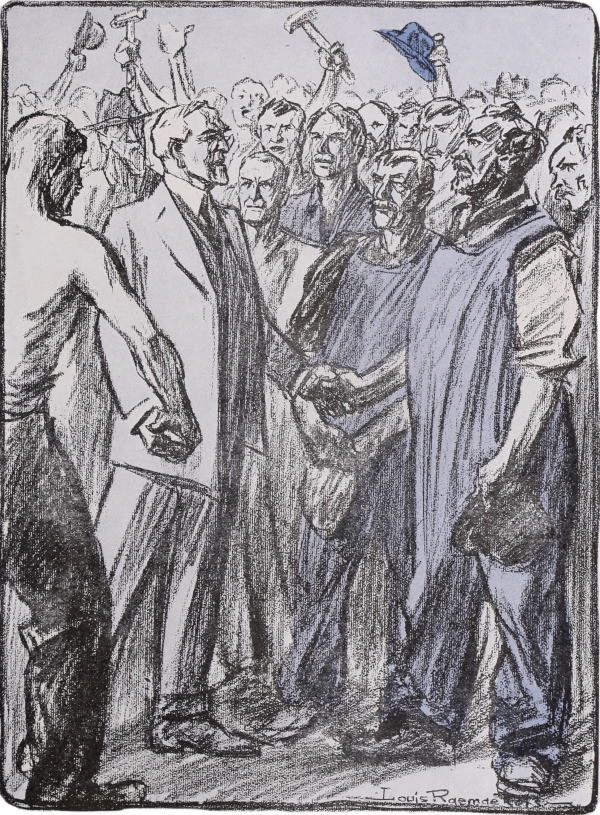
The President to the Workers:
“If you are with me, I am with you.”
“IF we are true friends of freedom—our own or anybody else’s—we will
see that the power of this country, the productivity of this country,
is raised to its absolute maximum and that absolutely nobody is allowed
to stand in the way of it. When I say that nobody is allowed to
stand in the way, I don’t mean that they shall be prevented by the power
of the Government, but by the power of the American spirit. If we are
to do this great thing and show America to be what we believe her to be,
the greatest hope and energy of the world—then we must stand together
night and day until the job is finished.”
From President Wilson’s speech before the American Federation
of Labor, November 12, 1917.
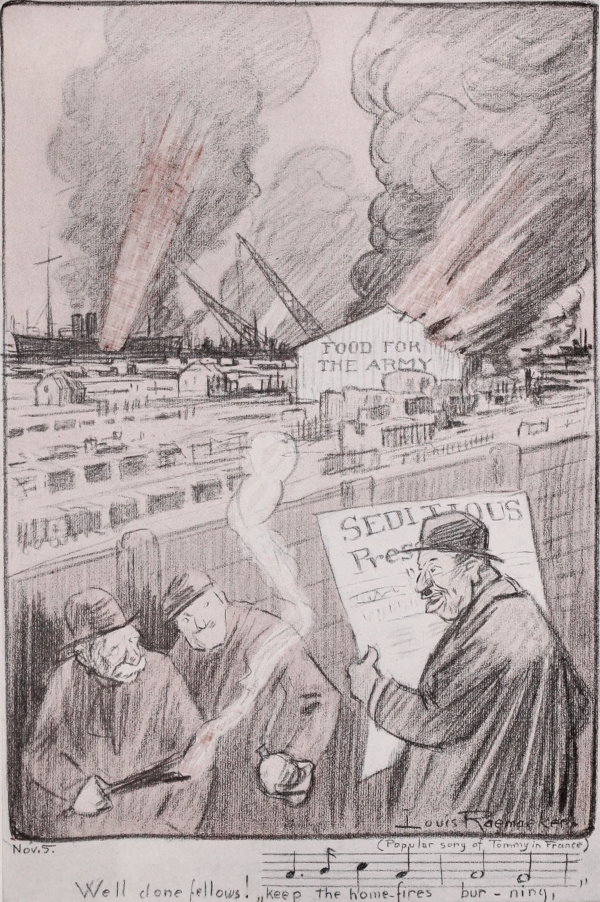
“ Well Done, Fellows! Keep the Home Fires Burning! ”
THIS cartoon brings home to us the imperative necessity of putting
our own house in order and keeping it in order. If the world is
to be made safe for democracy, our own conspicuous example of
democracy must be made safe for those who dwell under its protection.
If we cannot conquer and control the enemy within our gates, we will be
but impotent instruments of conquest over him abroad. Both at home
and abroad we must rid ourselves of all hampering and distracting illusions
and stare the facts in the face. The facts are that we are at war,—the
grim and grimy business of killing or being killed.
The issues involved in this war have been appealed to the sword, and
he who lives by the sword must die by the sword. The time for doubt,
debate, discussion or diplomacy is past. The only thing left to do is to
fight,—fight for all that is in us,—fight as long as we can and as hard
as we can, and until there is no fight left in our enemies. Then and not
until then is it worth while to consider other aims,—so-called war aims.
The only real war aim now is victory. We must not let anything distract
us from that essential aim.
LINDLEY M. GARRISON.
(Popular song of Tommy in France)
Well done fellows! “keep the home-fires bur-ning,”
A Bit of the Hindenburg Line
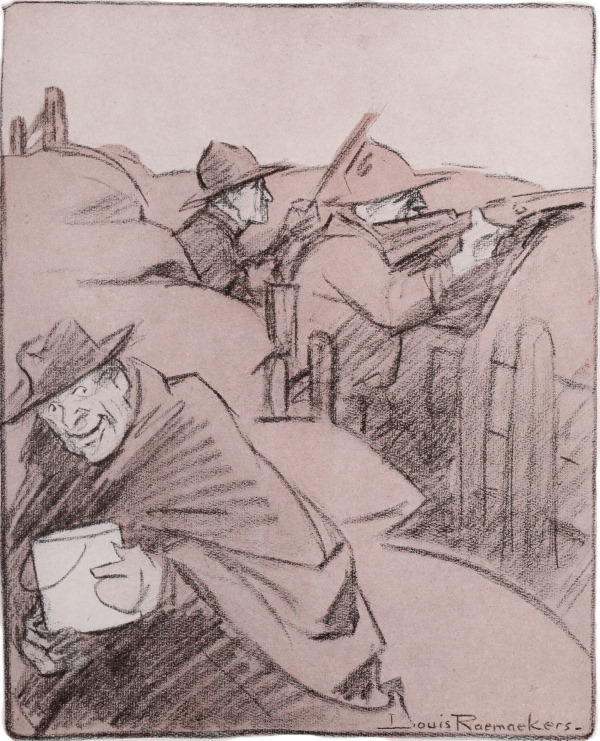
THESE fellows are hot on
the trail. Let us follow
suit.
Wherever you find a Hun you
find an enemy. Get him!
DAVID BISPHAM.
The Rats in Our Home Trenches
REALLY, the great question of the war is: What kind of people
are the Germans?
Can they be reformed, or are they incurable?
All Germans are not alike. There are those who distinguish
between North and South Germans, and tell us that the Saxons, in particular,
have in them the making of excellent people. Doubtless all Prussians
are not alike; doubtless all Bavarians are not of the type of the
“Black Bavarians” whose exploits in the war have had unfavorable mention.
But what has come to be the image that “German” calls up in the
mind? It is an image of ruthlessness, of frightfulness, of poison gas and
traceless sinkings; of murder, pillage, spies and lies; of a black and formidable
ambition for mastery on any terms and at any cost; of treachery;
of a tireless industry that gets up early to fetch away by work or wile
whatever in the world is worth taking from any one who has it! The
current image of the German is an image of an enemy—a savage enemy.
Since 1914 German descent has been terribly prejudiced. As to every
man of German blood the observer asks himself: What manner of man
is this?
The Hohenzollerns did not invent the Germans. They found, acquired,
trained and used them. For centuries—a thousand years at least—the
Germans have had a known and demonstrated rating for brutality and
brutishness. They have been cruel in war and destructive and greedy in
pillage beyond most other nations that were their neighbors. When one
hears it said that the trouble with Germany is Germans, there comes to
mind abundant basis for that suggestion.
Yet the Germans are far too many and too useful to exterminate, and
even if that were possible, no nation but Germany could seriously entertain
the idea of exterminating a whole people.
So what do we come to?
To this: that Germany’s fate rests in the hands of the Germans. Their
qualities will determine their destiny. Along with their abilities go enormous
disabilities. They must do according to what is in them. They
must obey the demon that drives them until, out of the extreme of suffering,
they gain the courage to expel it. They must destroy, and so invite
destruction, until their racial propensity has wrought its own correction.
They must keep on accumulating enemies, exasperating neutrals, alienating
allies, until blind and wicked policies have perfected their work.
What the German has most to fear is what is inside of him. By current
estimate the worst that can happen to Germans has happened already,
in that they are Germans. The world is not going to adjust itself to their
misfortune in this particular. It is they who will have to adjust themselves
to the world. They will not be able to make the world an overgrown
Germany in which the other peoples will have to live under German
direction. No. They will have to live in a world largely populated
and managed, as now, by folks who are not Germans and don’t want to
be, and whose primary concern for as long as is necessary will be to keep
Germans in their place.
E. S. MARTIN.
Seeing Stars
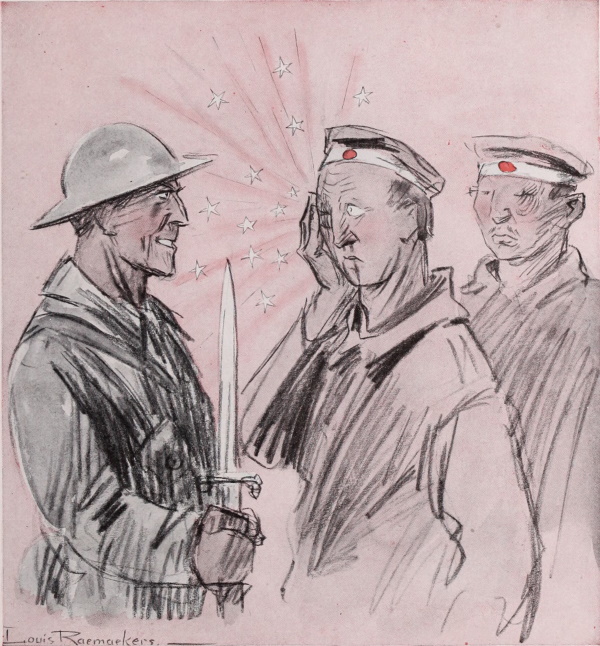
Canadian: “And you’ll soon see the Stars and Stripes.”
German: “Saw some already, sir.”
THIS is the voice that he hears from Germany:
“We Germans are God’s chosen people, His special favorites,
and God is German Himself. God rules over us in the person of
our Kaiser, whom He has appointed for that purpose. We are better
than all other peoples of the earth; we are wiser and purer and nobler
and more industrious and more learned and stronger and cleverer and
kinder and braver and more spiritual and more warlike than all others.
“We are so much greater than they that whatever we do to advance
our own interests, at the cost of theirs, is right and praiseworthy. If we
kill a great many of them, those who survive will in the end be improved,
because they will work for us and learn something by observing us. Any
deceit is proper and morally correct if it benefits us; and when we practise
a policy of terror upon those who oppose us it is really philanthropy
and shows how gentle we are, because the survivors learn through our
cruelty that it is useless to oppose us, therefore they the sooner submit
their wills to ours. We can not do wrong, no matter what we do, so
long as all that we do is for our own benefit. By our bright swords
we will take possession of the earth which ought to belong to us, because
we are Germans. We believe in the heaviest possible breeding of
babies, that they may grow up and be trained to carry liquid fire and
poison against any opposition to us. All the same, we are the only real
peace-lovers in this malign and prejudiced world, which, except for us
and the Austrians and the Bulgarians and the Turks, is composed exclusively
of stupid ruffians who were so jealous and envious of us that
they forced this war upon us, hoping to make some money out of us
by annihilating us. We love peace, and are fighting for our mere existence—that
is, the right to adjust our frontiers so that they will include
the countries which we have conquered by the sword. We must never
AGAIN be threatened by those rascals of Belgians!”
BOOTH TARKINGTON.
The Two Giants
Germany: “I destroy!”
America: “I create!”
UNCLE SAM has given the Germans three surprises.
It was believed in Germany:—
1st—That America would not break diplomatic relations;
2nd—That America would never fight;
3rd—That America could not fight.
Forced to it, in self-defense, we are now giving all our energies to war,
led by a President, whose vision meets the extent of the calamity brought
on the world by the selfish ambitions of material Germany.
American built ships will end the menace of the slinking U-boat.
And after the war the flags of the American Merchant Marine once
more will float on every sea.
JAMES W. GERARD.
New York, July 12, 1918.
“ Will They Last, Father? ”
THE four greatest events in history; the advent of Christ, the discovery
of America, the Reformation, and the French Revolution,
are all we can compare with the days in which we are living—and
dying.
In a cyclone of desolations surpassing the terrors of the insane, the
world, so far from recoiling, rolls forward into vast and irrevocable
changes that seemed but yesterday the remotest goals of laborious evolution;
rolling up the precipitous steep of custom in all the fury with
which we should look to see it roll down. And the unique wonder of
this fifth and last of these supreme events is that only it has sprung primarily
from an evil design and can attain its true end only by that design’s
everlasting overthrow.
So speaks the matchless hand of Raemaekers. The vastest murderer
the race has ever borne and, at his heels, his most remorseless waster
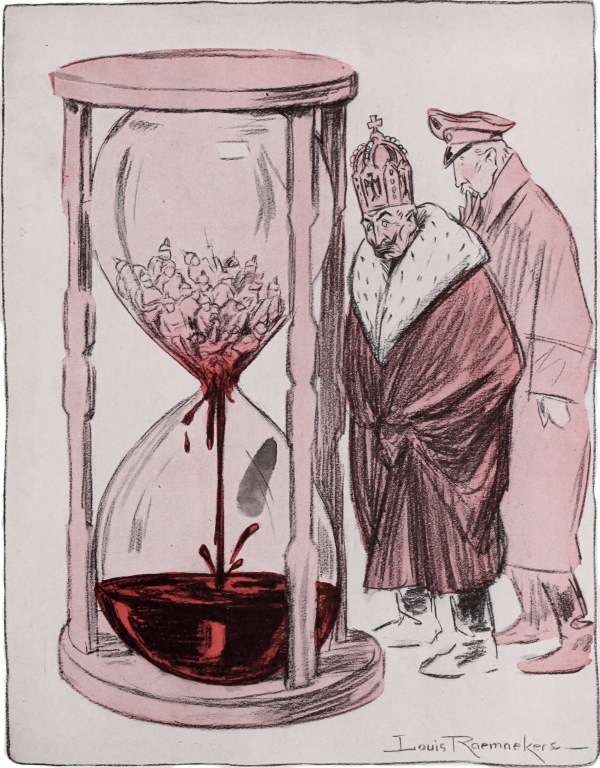
of blood together watch the glass of time, abhorring every upward plunge
of a maddened world and daily hounded by one implacable question, one
four-headed dog of hell: Will their treasury, will their sinking of ships,
will their delusion of their own people, last?
No. One or another will presently fail, and when one fails all fail
and the world, refined by fire, will be, shall be, saved.
GEORGE W. CABLE.
“ The Ugly Talons of the Sinister Power ”
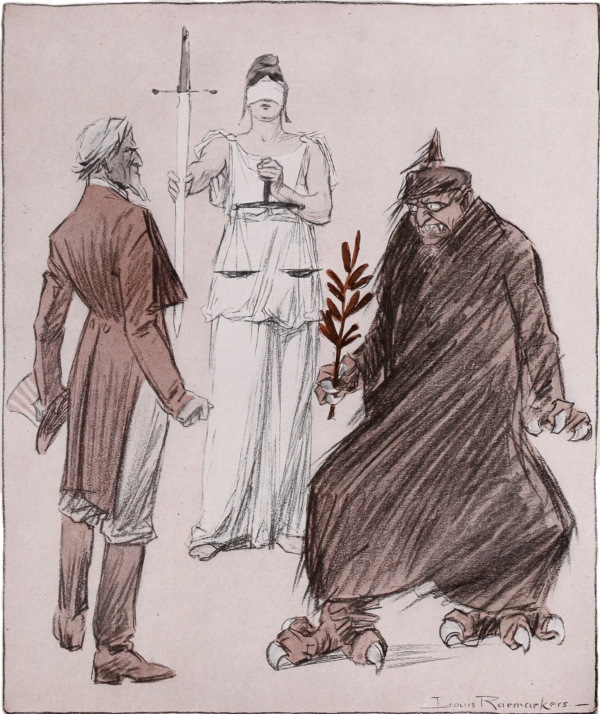
THE attitude of scorn, of contempt and of defiance with which Raemaekers
in his cartoon, “America’s Choice,” represents Uncle Sam
as he confronts the treacherous Kaiser, bearing the olive branch
in his talons, well expresses the attitude of the United States towards
Germany at the time we entered the war, and this attitude will
probably continue for a generation or two after the war ends.
“The Intolerable Thing,” which President Wilson so aptly named the
irresponsible German Government, can never disguise itself so that we will
not detect the terrible menacing claws with which Raemaekers portrays the
Kaiser. It will continue to be an Intolerable Thing until the horrors of
this war are forgotten.
The German philosophers brazenly justify their nation’s course in this
aggressive war with all its attendant horrors, by an appeal to the Darwinian
doctrines of the struggle for existence, and the consequent survival
of the fittest, which play such a prominent part in biological evolution.
Germany must be taught the lesson that while man is the product of
evolution like all other creatures, yet in his case new factors come into
play—he is a part of the animal kingdom, but is a new kind of animal,
and new factors, not operative in the orders below him, have played leading
rôles in his development. These factors are his reason, which gives
him a sense of the true and the false, and his conscience, which gives him
a sense of right and wrong. These faculties subordinate the rule of
might to the rule of right, and they have resulted in the establishment of
conduct for individuals, for communities, and for organized governments
that do not exist in the lower animal orders, and only in a limited sense in
the lower human orders.
Amid a national rejoicing, a waving of flags and ringing of bells, such
as are evoked by a great national festival, the Germans celebrated the
Lusitania murders—the entire nation suddenly slumping into a barbarism
worse than that of their ancestral Huns. The Hun was again triumphant,
gloating over his unspeakable crimes, his plunders and piracies,
his orgies of crime and lust—a spectacle to make the Genius of Humanity
veil her face and weep tears of blood.
It is a comfort to know that the Allies have killed or rendered harmless
several million of these modern barbarians, and that many of their carcases
have gone to enrich the soil of France and Belgium. In this way
a dead Hun may help to undo some of the evil which a living Hun has
wrought. If two or three of their bodies could be planted in every shell
hole which their guns have made in France and Belgium, though the
inoffensive soil might sicken, yet in the course of years the poison of the
Hun would disappear, rendered innocuous by the beneficient alchemy of
Nature.
JOHN BURROUGHS.
Tryon, N. C. February 12, 1918.
Restitution and Reparation
IT is with good reason the Prussian covers the thick bone of his head
with a helmet, for into it ideas of right and justice can only be battered
with a club. The tough, club-resisting helmet is the arch-symbol
of Prussianism. From its earliest days Prussia has taught its neighbors
the Prussian theory of right and justice by means of a club. When
the Prussian wishes to educate his neighbors to an appreciation of Prussian
ethics he puts on his helmet, picks up a club and slugs the neighbor
on the head.
The Prussian theory of right and justice is this: “What is mine is
mine. What is yours is also mine if I want it.”
This idea is deep buried beneath the thick bone of the Prussian head.
He holds it with stolid stupidity and deep, prehistoric crudity, like a pig
or an idiot. He cannot understand that there are any rights higher than
Prussian greed. “If I want it, it is mine because I want it.” It is the
logic of the primitive human animal, the cave-man.
Cornered and accused of his thefts he clings to his loot like the pig that
has stolen a carrot. When asked to disgorge he is shocked by the suggestion.
“But they are mine! I wanted them, so they are mine!” he
says. Right and Justice answer, “They are not yours; you stole them.”
“Maybe so!” says the Prussian. “But just the same they are mine—I
stole them a long time ago.”
The logic of the Prussian fills ten thousand volumes. It is written in
hundred-line paragraphs and six-inch words. It can be condensed into two
short words—piggish greed: piggish because it knows neither right or justice,
greed because it is greed.
ELLIS PARKER BUTLER.
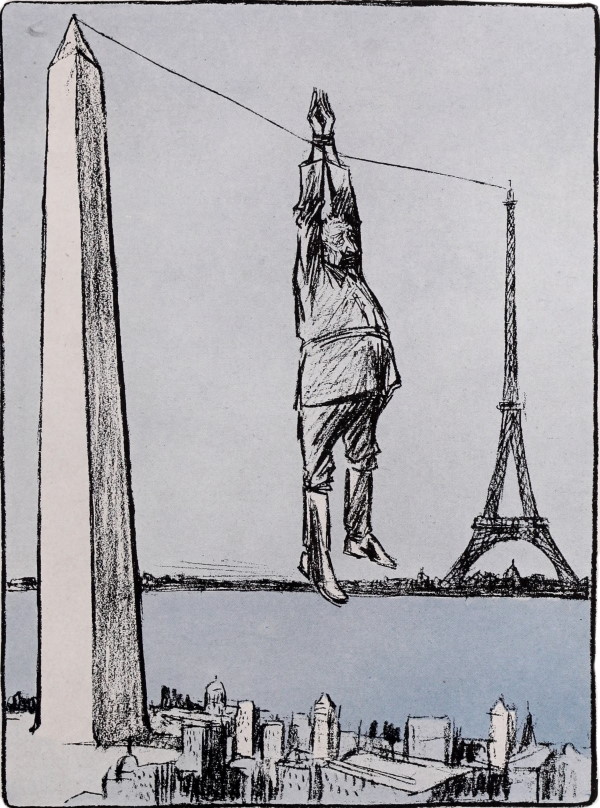
The Only Possible Position for Traitors
WHILE the submarine controversy was at its height, a Hun
high in authority in his nefarious land said that it was impossible
for the United States to enter the war, because there
were a half million German reservists in our country. “That is true,”
replied the American to whom this contemptuous remark was addressed;
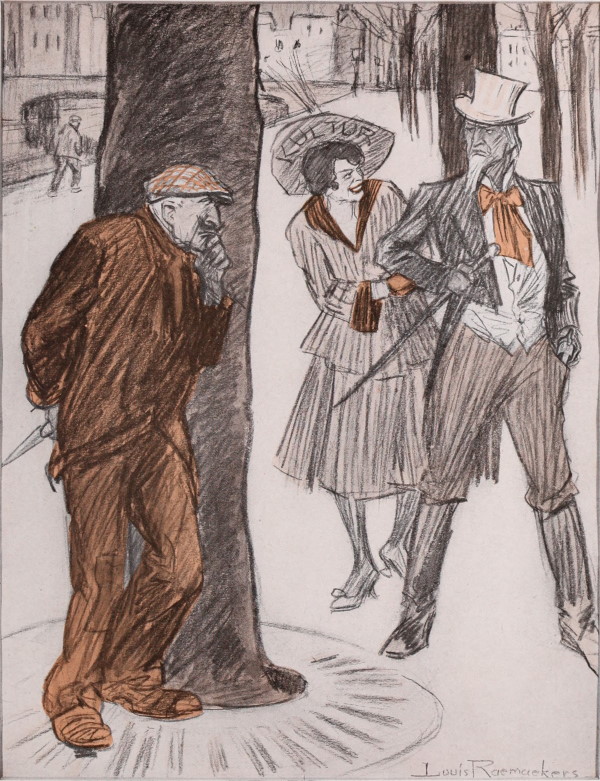
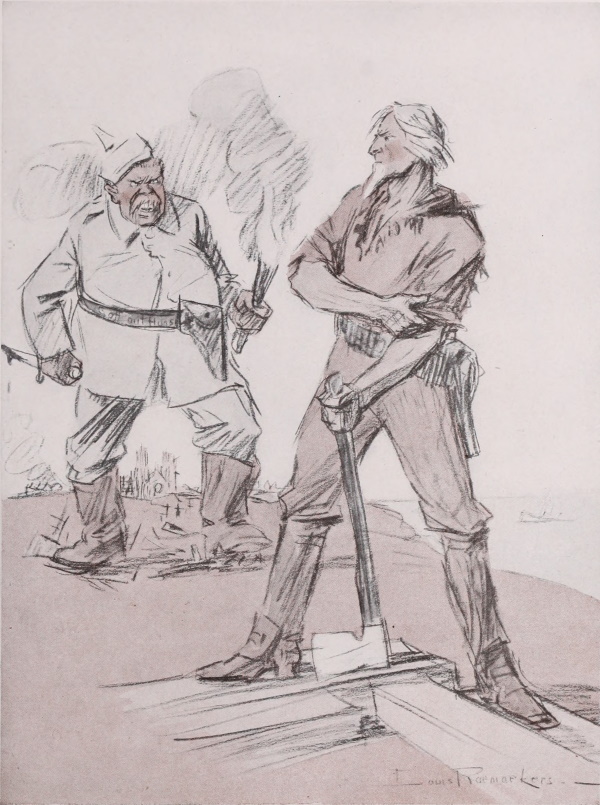
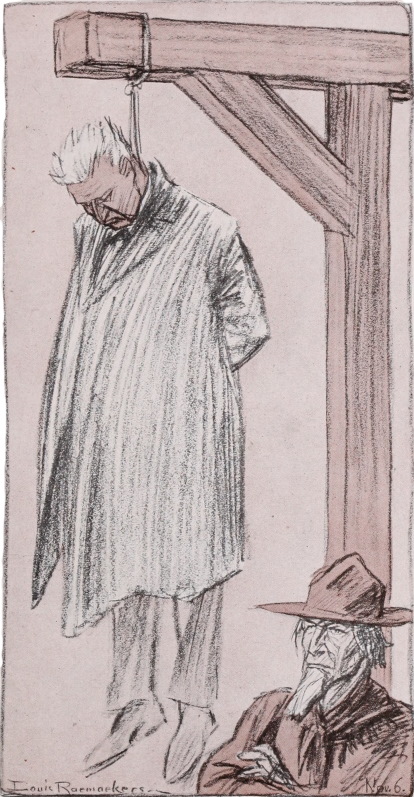
“but there are also a half million lamp-posts.”
Since the German reservists have failed to fulfil the expectations of the
Fatherland, the lamp-posts of the United States are as yet unadorned with
their lifeless bodies. But history has shown that while Americans are an
easy-going race, when once their anger is aroused there is no withholding
it; therefore let the traitors in our midst take warning from the cartoon
upon the opposite page.
One may pardon a murderer who kills in a moment of passion, one
may even revere a military spy who penetrates an enemy’s lines to gather
information needful for victory; but for the skulking traitor who whispers
sedition within the land which harbors him and seeks to hamper the
efforts of its government by a stealthy means, no punishment seems too
severe, since of all crimes his is the most despicable.
It is not to the half million German reservists alone that Mr. Raemaekers’
warning is addressed; for, inconceivable though it be, there are
native-born traitors aplenty to shame the land which gave them birth.
For these, the only position which will seem possible to Uncle Sam, when
once his anger, ever slow to rise, bursts forth in righteous indignation,
will be the one which Mr. Raemaekers has depicted. Let these traitors
remember that there is an abundance of lamp-posts in the land as well as
a goodly supply of hempen rope.
H. C. CHATFIELD-TAYLOR.
“ Do You Mean to Make a Real War? ”
“GERMANY has once more said that force, and force alone, shall
decide whether justice and peace shall reign in the affairs of
men, whether right as America conceives it or dominion as she
conceives it shall determine the destinies of mankind. There is, therefore,
but one response possible for us: Force, force to the utmost, force
without stint or limit, the righteous and triumphant force which shall
make right the law of the world and cast every selfish dominion down
in the dust.”
—From President Wilson’s Message on the First Anniversary of the Declaration of War, April 6, 1918.
Justice!
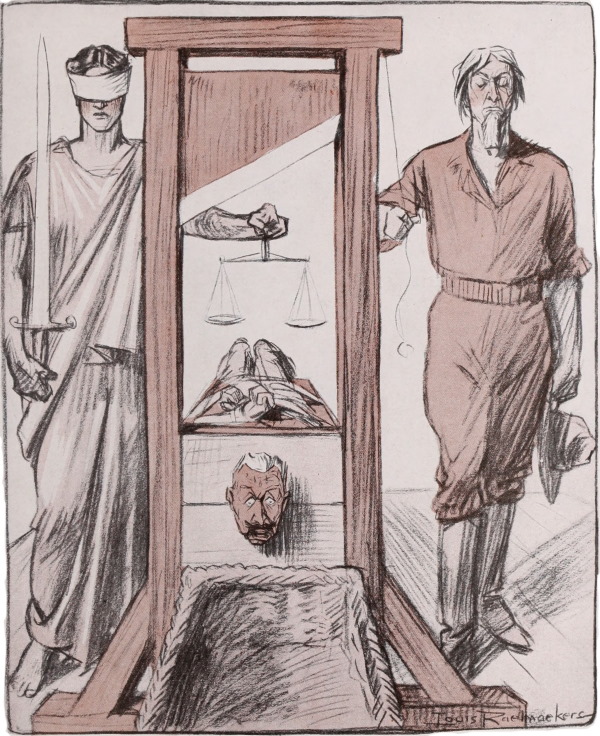
THE woman figure called Justice in Raemaekers’ cartoon has a
Greek name. She is Themis, consort of Zeus, Themis, who sits
by his side on the judgment seat. The scales are the scales of
Ægina, in her day a great money centre, whose talent was the standard
of value then, as the American dollar is to-day. Ægina was the mother
of Æacus, one of the three great judges of the lower world, and be it remembered,
it was Æacus that administered justice. Ægina is called by
one of the greatest Greek poets the place where Themis is worshipped
more than anywhere else on earth, and he tells us further that there was
much weighing in Ægina, the Merchant State. Heavy weights there
were in either scale. Much care was needful in the weighing, no little
balancing doubtless. So there were many in our Ægina who felt the
draw of kindred, of friendship, of fellowship. But this is the Day, the
Day of Decision, the Day of Lord Æacus. After the knife edge of the
balance comes the knife edge of the guillotine.
BASIL LANNEAU GILDERSLEEVE.
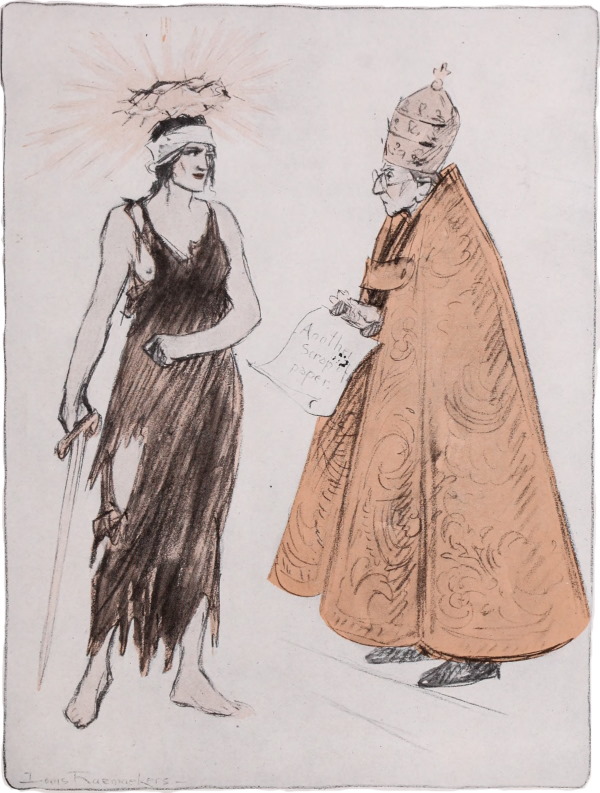
Another Peace Proposal
THE artist has depicted a spectacled Old Gentleman wearing a triple
crown and a pontifical mantle, who is offering a proposal of peace
to a heroic young woman, torn, bleeding, thorn-crowned, but
dauntless, who spurns it with scorn. The spectacled Old Gentleman is
the Pope; the heroic young woman is, I take it, outraged Justice.
Since Justice is our cause, we must try to be just. The Pope is not
lying on a bed of roses. He is in a position of the utmost difficulty.
He has faithful adherents on both sides, he dislikes war, and finds his
perplexities, great enough in time of peace, now magnified an hundred-fold.
He is not a hero; he is old, he is a lover of ease, and would dearly
like to wear a King’s crown and hear multitudes in St. Peter’s cry out
“Papa-Rè, Papa-Rè.” Let us be just. The first Pope (according to Roman
Catholic reckoning), received the grace of a great opportunity to be
true to his Master, but he denied Him thrice. Why should we be surprised
to find Benedict XV denying his Master? Fate has held out her
hand to him, as she held it out to St. Peter, and offered him his opportunity
to be greatly true. In the old happy days when all the world cried
“hosanna” to Justice, the Pope also had professed himself a disciple of
Justice. But now Justice has been taken by bloody-minded men to be
crucified, and the Pope has stayed afar off. Many witnesses have remarked,
“This man also was a professed disciple of Justice.” And now
the Pope denies it vehemently. He has put forward a series of humiliating
proposals that Justice—heroic, bleeding Justice—should hold out her
hand to the murderers of Belgium and confer, as if there had been equal
error on both sides, upon the crafty schemes of peace by which Germany
hopes to dominate the world.
Poor Old Gentleman! Timidity, love of ease, fear of Austria, and
fantastic ambition, have induced him to deny his Master. The cock will
crow, and he will weep bitterly. Poor, pitiable Old Gentleman.
HENRY DWIGHT SEDGWICK.
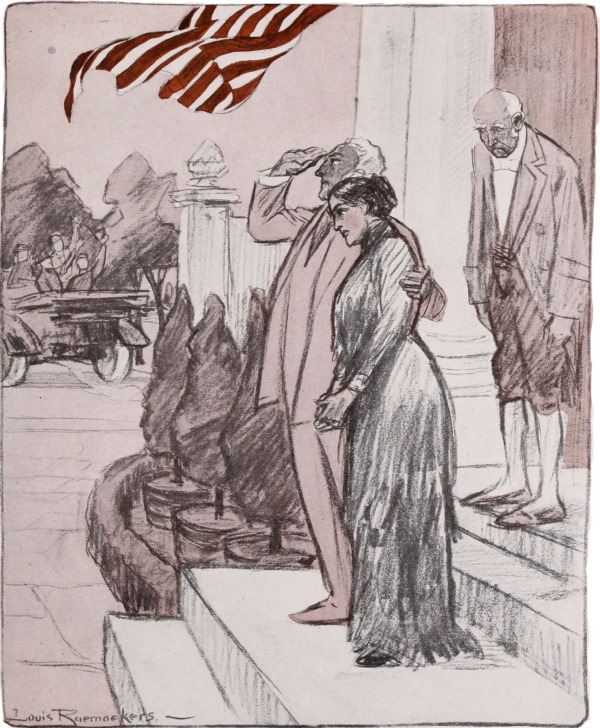
The Fine American Spirit
WHO are these, watching from ancestral doors
The instant passing of our youth to France?
Henceforth, a chapter of the world’s romance
Their eyes have seen; it fills their native shores
With an undying moment; now it pours
On silent breasts, o’erawed, the voice, the glance,
The last, fond gleam of each loved countenance,
And the heart trembles, while the spirit soars.
The generations draw immortal breath
That breathe a nation’s soul. From sire to son
The glory of the fathers entereth
The children’s hearts, and maketh all as one:
Bright, at time’s touch, breaks out the holy flame,
And to all lands doth freedom’s blood proclaim.
G. E. WOODBERRY.
Poisoning the Well of Public Opinion
ALIENS in this country must assist in maintaining the liberty they
enjoy, or we shall know the reason why.
“Ninety-five per cent. of the people of the United States would
die as willingly for their beliefs as the men of 1776. It is for the other
5 per cent. to show not the slightest manifestation of disloyalty.
“Our message to them will be delivered through the criminal courts all
over the land. And may God have mercy on them, for they need expect
none from an outraged people and an avenging government.”
—Speech of Attorney-General Gregory in New York, November,
1917.
The Enemy Within
NOT even the prodigious Cruelty of the Germans in this Atrocious
War has shocked the moral sense of mankind as much as has
their Deceit. We are horror-stricken by the reports of their
premeditated cruelties which link the Germans with the beasts—the wolf,
and tiger, and boa constrictor, and vulture. The beast does these things
because he has never risen to a higher plane than that of the beast.
But Deceit is the attribute of Man; of one who dwells above the standards
of the brute creation, who has had the moral sense developed in
him, who has known the compulsions of conscience, who has acknowledged
the obligations of duty, and has recognized himself as being a striver
after the Ultimate Good. Through some flaw in the German’s nature all
these qualities in him changed, turned bad, and he hailed Evil as his
guide and inspiration. Whatever of good there was in him he uses to promote
his wicked designs. Had he not been human he could never have
understood how to make his perverted nature work successfully to deceive
his fellow-men. The snake and panther do not deceive us, we know their
ways and guard against them. But the moral pervert can deceive, because
he hides his purpose and his method behind the mask of a counterfeited
virtue.
Lying is the commonest form of Deceit. The German Emperor practised
it for twenty-five years, when he proclaimed to the world his ardent
desire for peace; and it was natural for him to lie when, on making war,
he declared that the sword was forced into his hands. Then the German
nation, fed so long on falsehood, accepted this. Another common form
of German Deceit has been to accuse their enemies of the very enormities
which they themselves invented and carried out. Diplomatic chicane is
a commonplace tool which the Germans employed, only clumsily. But we
cannot measure the full extent of German Deceit unless we follow it in
its varied propaganda among foreign peoples, in its spies, its instigators to
violence, its corrupters of the press. It poisons food and wells; it sets
fires to burn crops or forests; it hires ruffians to burn factories or blow
them up, to hide bombs in ships; it incites sabotage and strikes.
So universally do Germans take to Deceit, that it has evidently become
their national trait. The soul of Germany is a lost soul, which worships
Satan as its master and welcomes Evil as its Good.
WILLIAM ROSCOE THAYER.
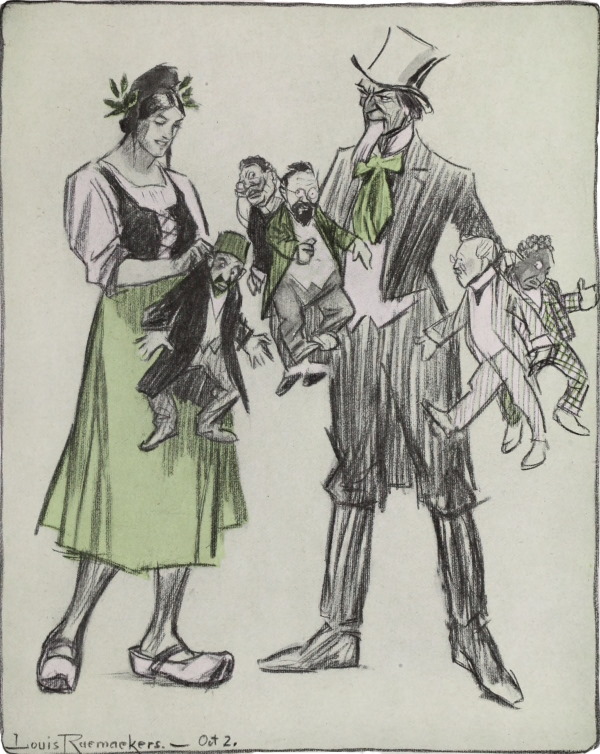
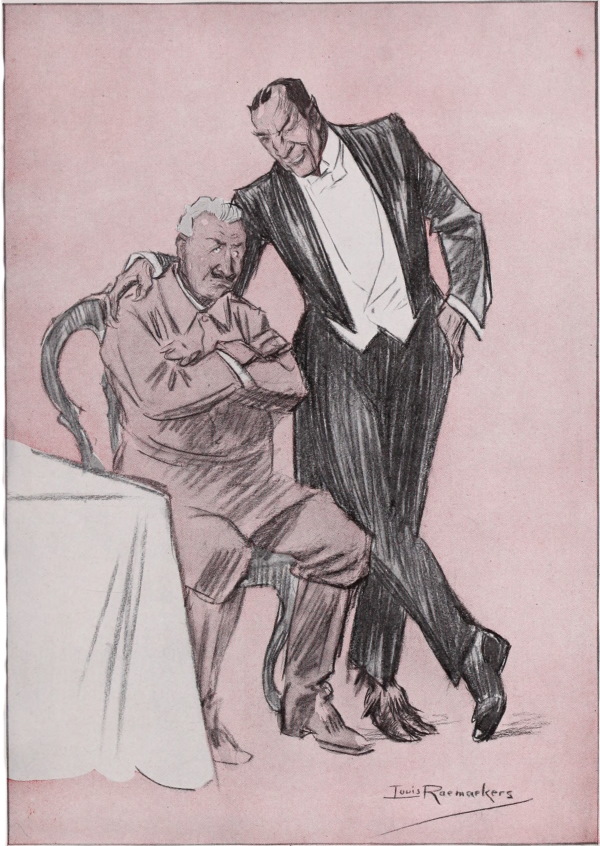
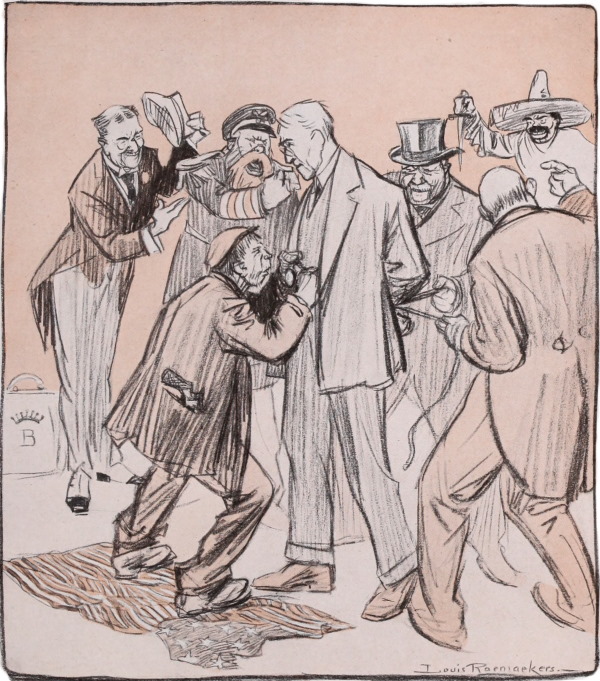
Count von Bernstorff: “Noblesse Oblige”
BEHOLD this group of sinister and menacing forms surrounding
the nation as typified in the person of its President. For four
years past they have been coming, one by one, out of the darkness.
We can now only too well recognize them and the dangers with
which they threaten us. In front, there is arrogant, boastful, jealous and
unscrupulous Hate, with its policy of “might before right,” and its doctrine
of “frightfulness,” conscienceless and cruel, in its murder of the
innocent, its arson, its robbery, its slavery of the weak, and its outrages
of womanhood. Crouching, while it tramples on our flag, is Treachery,
ready to use pistol and dagger, to burn bridges, to place bombs, to blow
up ships, to hide and sneak and cringe, if only it can deliver its blow more
surely and safely. And back of both, is hypocritical and lying Diplomacy,
with its protestations of innocence and friendliness,—studiedly polite in
manner, but really black at heart.
Behind, all engaged in tying the nation’s hands, lest it might strike
promptly and forcefully, is Pacifism, cowardly and self-seeking, more anxious
to avoid temporary suffering than to preserve the honor and safety
of the nation; and Divided Allegiance, traitorous to both causes which
it vainly endeavors to harmonize; and Intrigue, working in secrecy to
part friends, and stir up strife between those whose interests are common,
or even identical.
But out of the darkness comes also the call to the nation: “America!
awake. Open your blinded eyes. Banish partisanship. Abjure political
jealousies. Leave it to the men who know. Make your hearts stout.
Grasp the sword firmly. Listen to no compromises, until the nation is
proved worthy of its birthright, civilization is rescued, and the world
made safe for Democracy.”
GEORGE TRUMBULL LADD.
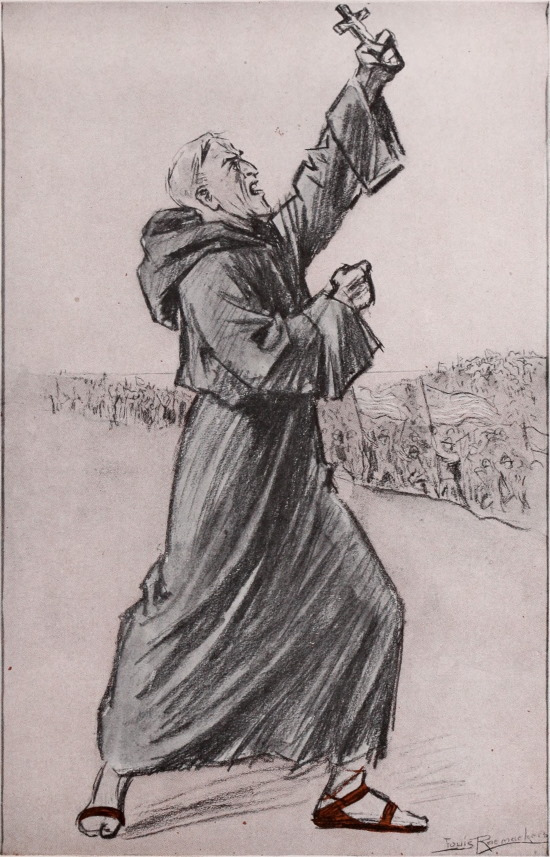
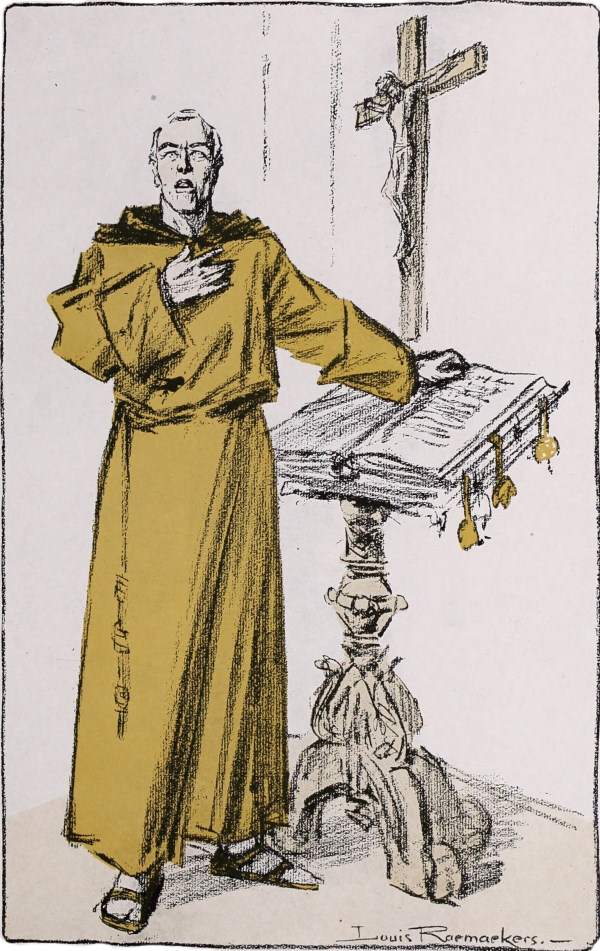
Peter the Hermit
“Dieu le Veult!”
THE Prussian outdoes the world in his single-minded devotion to
physical things. He believes and frankly declares that mercy and
honor weaken human power, that if you consider them you must
eventually fall before the strong who disregard them. Germany’s attempt
to prove the soundness of the Prussian thesis has gradually loosened
the moral consciousness of the world. It has gathered to defend
the things of the spirit in what is as truly a crusade as that which Peter
the Hermit led, a crusade to preserve the sanctity of contract, the few
laws between nations that men have worked out, the right of the weak
to their chance. Germany, disbelieving in the strength that love of mercy
and of honor give men, cannot counter-attack in kind. Every day develops
more clearly that the weak place in the Prussian armor is its indifference
to moral considerations.
IDA M. TARBELL.
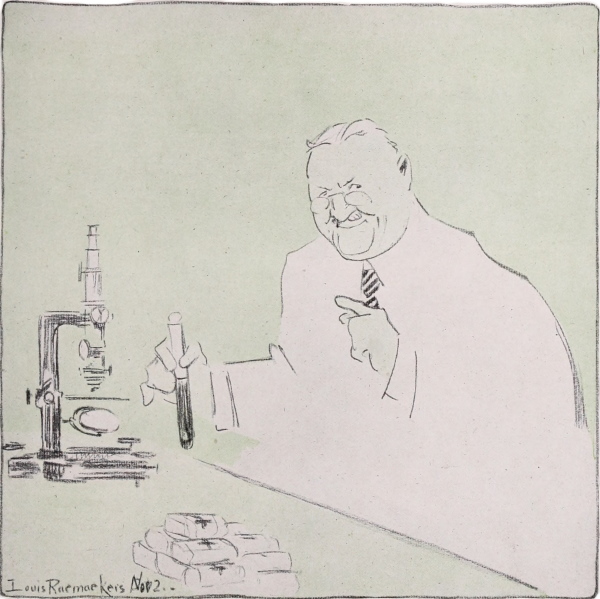
The Germ-Man
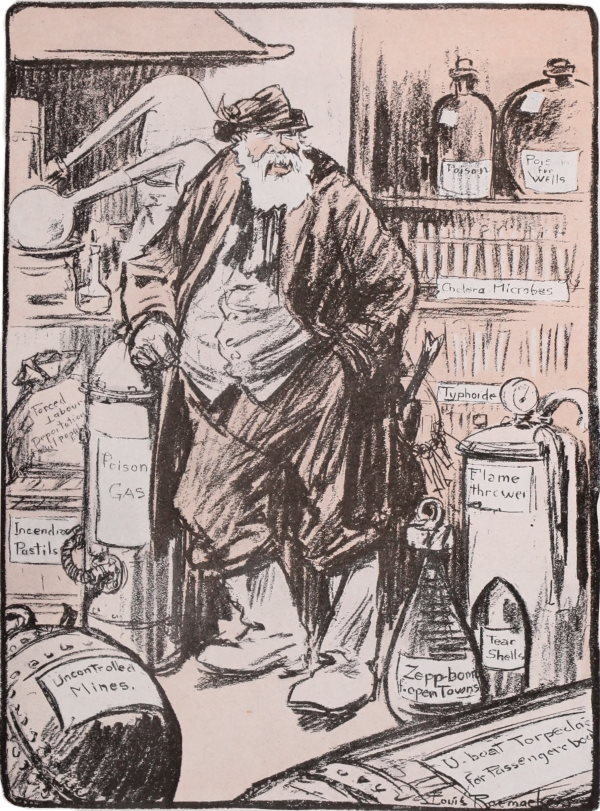
THE stout gentleman on the opposite page wears a pleased look, as
if he were enjoying his occupation. That is natural, for he is a
scientist engaged in a very pretty process—the propagation of
lockjaw, typhus and other malignant germ cultures with which he expects
to speed up the annihilation of his enemies. How does he propose
to accomplish this? I will tell you: he is going to introduce those
young and vigorous colonies of germs into those little packages marked
with a cross which you see lying on the table before him. Those are
Red Cross bandages, and they will presently be binding the wounds of our
soldiers, and the lockjaw and typhus hordes in them will awake, and rally
in a silent loathsome attack that will lay torture and death upon thousands
which the noisy, mis-aimed guns have failed to destroy. The
germ-man is assured that his atomic missiles will not be mis-aimed. His
government has efficiently arranged for those packages to go to the hospitals
of Roumania and Belgium and France. That is why he smiles—that
is why he has that roguish look.
In the germ-man’s smile is incarnated “Deutschland über Alles” and
its correlative, “The end justifies the means.” We in America have produced
exponents—criminal exponents—of a similar psychology, and we
have generally (when we could catch them) hung or electrocuted or imprisoned
for life these moral perverts, in order to make the world a safer
and cleaner place to live in. Only a little while ago the State of New
York electrocuted a man who, having set up his individual “Ueber Alles
and General Justification” court, had proceeded cheerfully to introduce
malignant germs and other deadly things into the foods and medicines of
his wife’s parents, who stood between himself and fortune. Here we have
an exact parallel. Those defenceless old people were doing him no wrong.
They in fact admired and trusted him, just as Rumania and Belgium and
America only a little while ago admired and trusted Germany. They
stood in his way, however, and from the “Ueber Alles” standpoint any
means for their removal was warranted.
Secret assassination is an ancient art. It has been practised in every
age and in every nation and its votaries have been hunted down and exterminated
by decent people. To-day, for the first time in the history of
the world, we have the spectacle of stealthy death for the defenceless
adopted as a government policy. For the decency and safety of mankind
the allied nations have highly resolved that the government which
promotes such a policy must “perish from the earth.”
ALBERT BIGELOW PAINE.
“ A Tid-Bit for ‘The Sick Man’ ”
THE nearness to America of the European theatre of war so greatly
fills our minds with the contest there raging that we give but little
thought to the progress of events in the far countries tributary
to the Tigris River. For a time, the heroic resistance of General
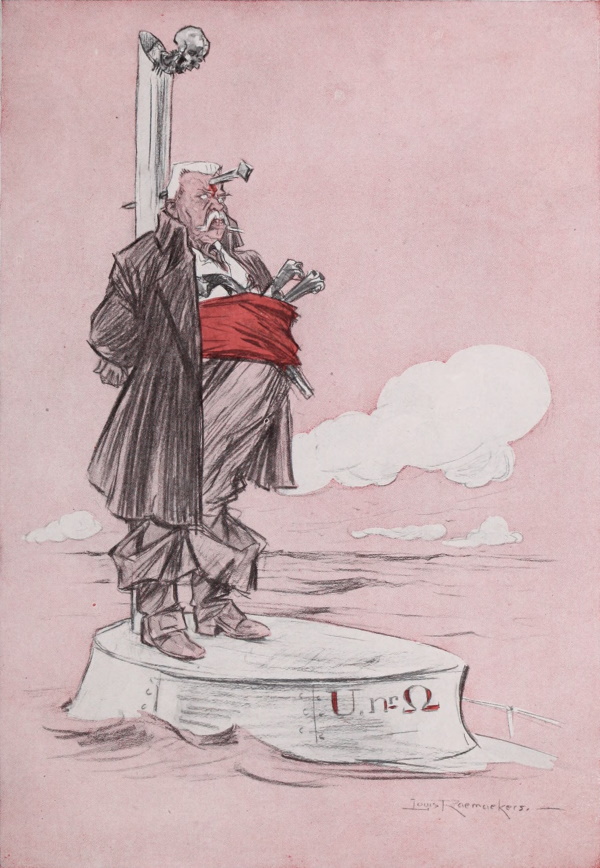
Townsend to the Turkish forces which surrounded him aided by the
natural obstacles of river and climate, claimed a share of our interest,
and later, the splendid and successful work achieved by the new British
army under General Maude, awakened renewed interest in a campaign
designed to split Islam into two parts: one, acknowledging the domination
of the Turk and his German masters; the other, a new Caliphat of
Bagdad, Arabian, rather than Turkish, looking to the ideals of justice
and freedom, rather than to the rule of the sword; finding its inspiration
in the tradition of the enlightened and humane Haroun-al-Raschid, rather
than the warring, bloody conquerors and Muhammed and Sulìman. Still
later, the northward progress of British arms extended over the greater
part of Palestine, and the capture of Jerusalem brought the sacred places
of Israel and of Christianity within the control of Christendom after five
centuries of Turkish occupation.
These campaigns are only second in importance to the progress of the
German invasion of France; for if the British successes in Arabia and
Palestine shall be maintained, and the Islamites of Egypt, Arabia and
Mesopotamia shall look in the future to the Caliph of Bagdad, not to the
Sultan of Turkey, as their spiritual head, the great German scheme of
aggression in the Near East will have been defeated.
The subtle Teuton suggestion to the Turk of a Pan-Turanian league,
was but a scheme for the promotion of a closer Turkish organization under
German control, as Raemaekers’ cartoon, “A Tid-Bit for the Sick
Man,” so cleverly intimates. The Turks should have said to themselves,
“Beware of the Greeks—the Prussians—and the gifts they bring.” A
German gift is like the shirt of Nessus,—it will consume utterly those
who accept it.
Not alone on the shores of the Mediterranean, but on the Persian Gulf,
on the Baltic, on the English Channel, in the Caribbean, on the Pacific,—there
is no limit to the schemes of expansion of German control to
which that nation in its mad lust of power has given itself. Never since
the dawn of recorded history has an issue been made so plain. Aut
Cæsar aut nullus. The world must choose between Germany, the highly
developed, hyperorganized, scientific state, proceeding on the openly
avowed theory that might alone makes right, and that no principle of
ethics, morality or religion must be allowed to affect or deter a course
which scientific militarism determines to be best calculated to attain a pre-determined
end, and the other nations, who believe in God and in His
justice, who conceive that it doth not profit a nation to gain the whole
world at the cost of its soul.
Once this issue is manifest to the world, the result cannot be in doubt.
GEORGE W. WICKERSHAM.
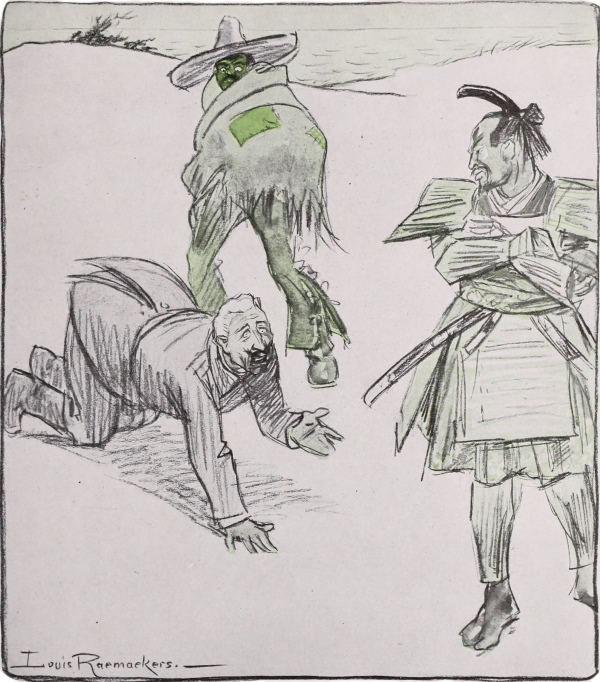
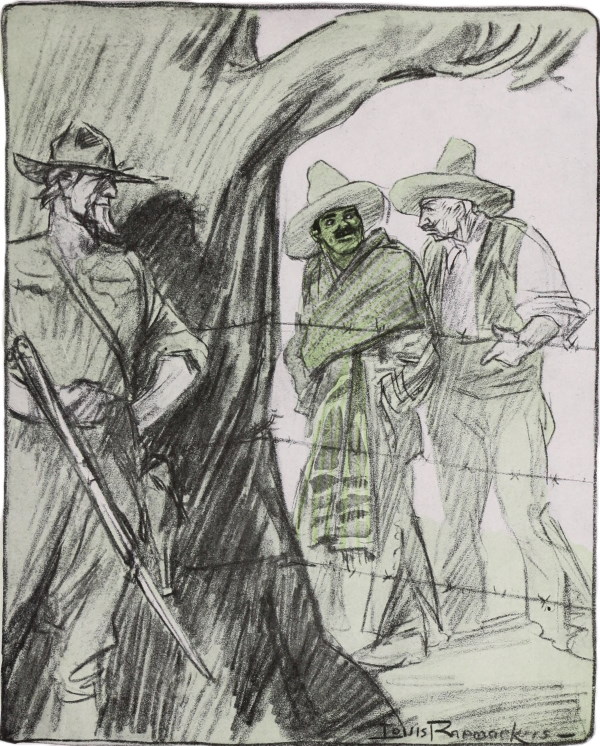
Plain Language from Truthful James
The Mexican-Japanese Plot
“For ways that are dark
And tricks that are vain—”
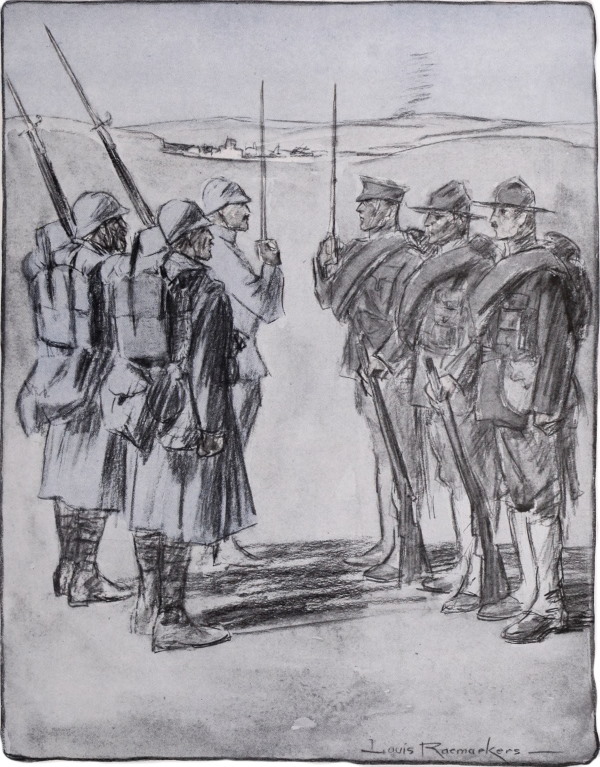
Helping Hindenburg Home
“WE regret being unable on this occasion to follow the counsels
of our masters, the French, but the American flag has been
forced to retire. This is unendurable, and none of our soldiers
would understand their not being asked to do whatever is necessary
to reëstablish a situation which is humiliating to us and unacceptable to
our country’s honor. We are going to counter-attack.”
This was a message sent by an American general in command of American
forces south of the Marne on Monday afternoon after the Germans
had succeeded in forcing the Americans back towards Conde-en-Brie.
The French commander had informed the American general that the
early German success could not have any great effect on the fate of the
battle; that it was understood perfectly that after hard fighting the Americans
had slowly retired, and that it was not expected that they immediately
launch a counter-attack. He added that a counter-attack could be
postponed without risk, and it might be better to give the American troops
an hour’s rest.
Immediately after the American general sent the above message, which
is quoted by the correspondent of the “Matin,” the Americans launched
their counter-attack and the lost ground was soon recovered, with an
additional half mile taken from the Germans for good measure.
The New York Times, July 18, 1918.
A Bad Prophet
The All-Highest: “Only a sham war with Uncle
Sam? Oh, Hollweg, you are a bad prophet!”
ONE of the delusions the German Government and its General
Staff have been laboring under for many years is that the United
States could not create an army that was worth consideration
as a foe. That Government and its General Staff are tasting the quality
of our troops in the field, and the flavor is bitter on their tongues. One
hundred and twenty-six years ago there was fought a battle in France
(at Valmy, within the zone of war today) on the date that France first
called herself a republic. Kellermann won that battle against the Prussians
and Austrians with levies of new troops from the lower and middle classes
of France, who “found that they could face cannon balls, pull triggers,
and cross bayonets without having been drilled into military machines, and
without being officered by scions of noble houses.” They had, it seems,
the same spirit we like to think animates our army, which the Germans
abroad and some critics at home denied our men: “they awoke to the consciousness
of instinctive soldiership.”
The Army and Navy Journal.
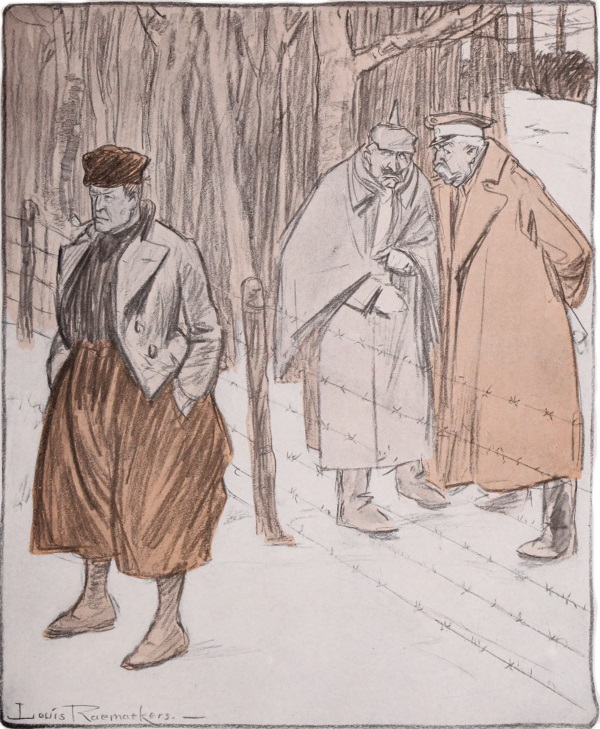
At the Holland Frontier
WHETHER the war be
long or short, the
quickest road to peace
is the road straight ahead of us,
with no division among the American
people.
WILLIAM JENNINGS BRYAN.
A Rehearsal
“When I say, Down with Wilson! you all cheer!”
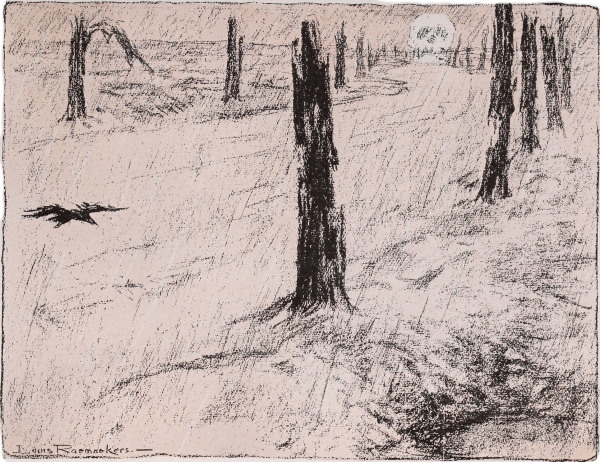
The Path of Kultur
HERE ran a road for lovers once,
With maples in the moon;
And under a bridge a water went
Weaving a dreamy rune.
And high upon the sycamores,
The nightingales all night
Besieged the dark with melody,
Disturbed the boughs with flight.
And here in coverts of tall grass
Looked up a friendly spring,
Glad to behold a face bent down,
Or feel a fleeting wing.
But now the lovers come no more;
The road is rutted and marred
By wheels and shrieking shells: the trees
Are shattered, chopt and charred.
New graves are billowing now: the field
Like windy water heaves:
The nightingales are gone: the spring
Is choked with bloody leaves.
And here at noon a vulture swoops
On obscene errands bound:
And here at night remembering ghosts
Go by without a sound.
EDWIN MARKHAM.
To the Victor!
France crowns with laurel the dead American
aviator.
THO’ the American mother mourns across the seas for her hero
son, who has touched the skies in France, the foster mother lays
her laurel of glory on the bier of Youth, whose brave spirit in
passing welds an eternal bond of sympathy and union to the end.
GERALDINE FARRAR.
June 23, 1918.
The Eyes of the Army
THE great poet of Victoria’s reign, in his wondrous vision of the
future,
Saw the heavens fill with commerce, argosies of magic sails,
Pilots of the purple twilight, dropping down with costly bales;
Heard the heavens fill with shouting, and there rained a ghastly dew
From the nation’s airy navies grappling in the central blue;
Far along the world-wide whisper of the south-wind rushing warm,
With the standards of the peoples plunging through the thunder-storm;
Till the war drum throbbed no longer, and the battle-flags were furled
In the Parliament of Man, the Federation of the World.
Dealing not with the shadowy future but with the actual present the
great Artist of the Great War sees aerial navigation, not in terms of
commerce nor of battle engines, but as the “Eyes of the Army”; the
sense without which the terrestrial movements of war, both by land and
sea, tend to become mere blind and purposeless blundering. With one
graceful figure in a finely balanced design the artist tells the story.
Future generations will be grateful to the Prussians for one thing—and
one thing only. From war—that “noble art of murdering,” as Thackeray
called it, they have stripped the last vestiges of romantic glamor.
They have not hesitated to press the premises of militarism to their logical
conclusion,—with results that have staggered humanity.
In one field only has it been possible for something of the old knightly
chivalry to linger. Romance, driven from earth, has taken wings; and
the world, sated with horrors of trench and shambles, thrills with eager
wonder at the new science of the sky; at the individual skill and daring
of its pilots and their wonderful service to their fighting brethren on
earth.
But even as we read of these things come tales of Zeppelin raids over
defenseless cities and the deliberate dropping of bombs upon hospitals.
Civilized warfare! it is a contradiction in terms. It may be necessary,—it
has proved to be necessary, for civilized men to fight the barbarians
in order to uphold and preserve the great principle of individual liberty;
but war must come to an end among civilized peoples; and to that end
there must be a closer and closer union of such as care for law and order,
believe that the weak have rights which must be protected, and are willing
to base their governments on the firm and enduring foundations of
Liberty, Equality and Fraternity.
THOMAS MOTT OSBORNE.
July 19, 1918.
“ Is It Nothing to You, All Ye Who Pass By? ”
ALL we need to remember hour by hour is that we are living through
the greatest crisis in the history of the world; that the greatest
number of people are concerned in it ever concerned in one thing
before; and that the most important epoch concerning humanity since
the birth of Christ is now at hand; that humanity is about to fall to a
lower plane of living or rise to a higher one than it has ever reached; that
we can only do our little share toward that rising by stiffening ourselves
to a long endurance. We have proven our mere ability to give valuable
service. What we must prove now is our patience and steadfastness, without
which brilliancy is worthless. We must strike a pace which we can
hold, both mentally and physically and plod on together. We must and
we will be ready, for our own sake, for our country’s sake and for the
sake of what the world was created for.
RACHEL CROTHERS.
The Rainbow Division Leaves for France
AS the rainbow is heaven’s token of faith, so have we faith in these
modern knights journeying to beloved France to give battle to invading
barbarians.
Ponder a moment over these men of the Rainbow Division, lads
with minds clean as their hearts are true, and compare them with the blood-craving
hordes reared in a school having no other aim than to kill their
fellow beings. One is Man in the superlative, and for the other there is
no name sufficiently abhorrent.
When an American soldier enters Hun territory we know how scrupulously
the laws of humanity will be respected: he will at least be knightly
and merciful.
And the four years’ record of German savagery is so well known that
it must forever befoul the pages of history.
Lack of opportunity in the library has prevented a thorough exploration
of the unspeakable atrocities of the early Huns who under Attila
ravaged a great part of Europe. But sufficiently have I read to be convinced
that the Huns and Vandals and Goths of early history, compared
with the Hohenzollern-inspired fiends, were scarcely more than bungling
altruists. We know it to be fact that German soldiers murdered priests
and raped nuns in Belgium, violated practically every young woman in
the Aisne and Champagne, razed defenseless towns and hamlets in these
French Departments, murdered old people and children and mutilated
youths everywhere, delighted in destroying hospital ships and treated Red
Cross signs as targets for their guns, inoculated French prisoners as a
means of furthering the Berlin plan to diminish the French race, and
in cold blood murdered scores of women and children on the Lusitania.
These are awful indictments, with not one excusable on the ground of
military need or expediency. Given trial at the bar of civilization their
perpetrators must forever be judged as outside the pale of humanity and
hereafter can have no standing in lands where the principles of Christianity
and humanity have a meaning. With my own eyes I have seen
scores of proofs of German “frightfulness”; with me it is not hearsay.
And remember that it was none other than Goethe who wrote that “the
Prussian was born a brute, and civilization will make him ferocious.”
Positive is it that the United States and her Allies will crush the conscienceless
militarism of Germany, and ever of good omen is the Rainbow,
telling of improving skies and perfect conditions for the morrow.
FREDERIC COURTLAND PENFIELD, American Ambassador
to Austria-Hungary, 1913-1917.
Russia Reborn
IN a hundred years no people has been so tortured and abused by rulers
of its own blood and faith as the Russians. The free peoples
have nothing in their experience by which they can imagine the greed
and cruelty of which the subjects of the Romanoffs have been the victims.
No adequate picture of the diabolical old régime can be painted till
scholars have had time to explore its archives and expose the dark forces
that operated it.
Let no one look for Freed Russia to be shining and beautiful. From
the gloomy caverns in which they have mouldered the Russian people
stagger out upon the sunlit heights of freedom weak, bent, half blind.
Few of the older will ever conquer the dense ignorance in which they
were kept by autocracy. Few of the characters twisted and deformed by
oppression will ever become quite straight. In the behavior of this people
there will be exhibited folly, fanaticism and brutality that will make
the peoples born free uneasy as to the new sister.
Whatever happens, doubt not that the Russians are gifted and great-hearted.
Their excesses have proclaimed how much they were held back
and brutalized by the Tsars. It will take long for them to rid themselves
of the traces of their servitude and misery. Even the children born in
the new era will catch from their parents some of the evil heritage. Only
the grandchildren of the common people of today will come into the full
birthright of the free and prove the worth that is in the Russian race.
EDWARD ALSWORTH ROSS.
Higher Than a Sour Apple Tree
OTHER wars end with those who made them. It is the will of the
German Emperor that his war should pass on like a blight from
generation to generation upon those whose fathers dared to
stand against the ravager. To this end he has not only slaughtered and
enslaved the defenders; he has sought to destroy the very fruitfulness of
the land whereby their descendants must live.
To me the deliberate, coldly reckoned murder of the invaded countries’
trees and vines so that the children of the slain and enslaved and their
children’s children may draw no sustenance from the kindly earth—that
seems the most perverse, the most detestable, the most typical of all the
crimes of Kaiserism.
The sterilization of Mother Earth! It took the mind of a Wilhelm
to conceive it. And for that offence against generations unborn he shall
hang, higher than was ever ruler before him, gibbeted in the righteous
hatred of an outraged posterity.
SAMUEL HOPKINS ADAMS.
“ What a Mean Trick to Turn on That Strong Light! ”
“PEACE must be framed on so equitable a basis that the nations
would not wish to disturb it. It must be guaranteed by destruction
of Prussian military power, so that the confidence of the German
people shall be put in the equity of their cause and not in the might
of their armies.... Europe is again drenched with the blood of its bravest
and its best, but do not forget the great succession of hallowed causes.
They are the stations of the cross on the road to the emancipation of
mankind. I again appeal to the people of this country and beyond that
they should continue to fight for the great goal of international rights
and international justice, so that never again shall brute force sit on the
throne of justice nor barbaric strength wield the sceptre over liberty.”
From the Rt. Hon. David Lloyd-George’s Glasgow speech
on war aims, June 29, 1917.
Christmas, 1917
ON the day of the Nativity, the Infant Brother of Humanity was
born and was laid in a manger, there being no room for his
human mother at the inn. But wherever he lay—there,
through the mystery of his kinship, was the shining Gateway of Heaven.
That translucent Light, from the moment of its appearance, intensified,
as by opposite polarity, the baleful lights from all unholy fires in human
breasts. Herod was first aroused to the Slaughter of the Innocents, and
he has had his successors in every age during the growth of Christendom.
As the Light of the World has expanded these nineteen centuries, shining
in the hearts of men, ever awakening new ideas of Truth, Justice, and
Mercy, against every fresh gleam, promising wider horizons of human
Love and Sympathy, have been arrayed the brutish hosts, with Hatred
and Murder in their hardened hearts. For the present generation has
been reserved the vision of the very Armageddon of this Conflict, in
which the world is divided against itself. The Powers precipitating it inaugurated
it and have in its whole course attended it with every conceivable
form of atrocity and outrage against noncombatants—innocent men,
women, and children. But that Heavenly Light which shone in the stable
at Bethlehem can never be put out!
HENRY MILLS ALDEN.
Helping Uncle Sam to Get Up Speed
“THE military masters of Germany denied us the right to be neutral.
They filled our unsuspecting communities with vicious spies and
conspirators and sought to corrupt the opinion of our people in
their own behalf. When they found that they could not do that, then
agents diligently spread sedition among us and sought to draw our own
citizens from their allegiance....
“They have learned discretion. They keep within the law. It is opinion
they utter now, not sedition. They proclaim the liberal purposes of
their masters; declare this a foreign war which can touch America with
no danger to either her lands or her institutions ... and seek to undermine
the Government with false professions of loyalty to its principles.
“But they will make no headway. The false betray themselves always
in every accent.... The facts are patent to all the world, and nowhere
are they more plainly seen than in the United States, where we are accustomed
to deal with facts and not with sophistries; and the great fact that
stands out above all the rest is that this is a people’s war, a war for freedom
and justice and self-government among all the nations of the world.”
From President Wilson’s Flag Day Address, June 14, 1917.
The Wind of Democracy
“WITHOUT doubt, the majority of the German nation is still
monarchist. The different peoples of Germany still hold to
their princes, more or less, according to the individual character
of the sovereigns. But that confidence in the supreme chief of the
Empire is still entirely intact is an affirmation which, after three years
of war, cannot be maintained.... Confidence in the direction of the Empire
has begun to disappear among the German people.... They begin
to ask themselves how it happens that nearly all the world is in arms
against us, and who is responsible for it.”
Reply of Prince von Hohenlohe to the clerical deputy, Spahn,
in the Reichstag.
“ This One for the Babies ”
GERMANY, in her war against Civilization, has disregarded not
only International Law and the ordinary laws of humanity, but
has ruthlessly set aside the four great laws of the social order
which all civilized nations recognize as having a divine sanction. “Thou
shalt not bear false witness.” She has broken her treaties and lied openly,
frequently, brazenly. “Thou shalt not commit adultery.” She has permitted,
if she has not given official sanction to rape committed upon a scale
never before known in the history of the civilized world. “Thou shalt
not steal.” She robbed her neighbor’s hills of their coal and iron, her
neighbor’s fields of their standing crops, her neighbor’s banks of their
money, her neighbor’s houses of their pictures, statuary and books, and
what she could not carry away she has in mere wantonness destroyed.
“Thou shalt not kill.” She has murdered thousands of defenceless men,
women, children, and little babes, and has done this not in a sudden and
feverish rage, but as part of a deliberately conceived and carefully executed
policy. One must multiply Raemaekers’ picture by the thousand in
order to get its full significance.
LYMAN ABBOTT.
A Scene on the Somme
“INFINITELY interesting is our contact with the American troops.
They have occupied the sector immediately beside ours. We have
seen them at work, and could form an idea, and it should be told
and retold that they are marvelous. The Americans are soldiers by nature,
and their officers have the desire to learn with an enthusiasm and
an idealistic ardor very remarkable. There is the same spirit among the
privates. They ask questions with a touching good-will, setting aside all
conceit or prejudice. Naturally they have the faults of all new troops.
They show themselves too much and expose themselves imprudently, letting
themselves be carried away by their ardor, not knowing when to spare
themselves or to seek shelter or when to risk everything for an end.
This experience will be quickly learned.
“As for bravery, activity, and discipline, they are marvelous. They
absolutely astonished us on a morning of attack. The cannonading, suddenly
becoming furious, had just thrown me out of my bunk. No doubt
about it, it was a Verdun attack. Taking time to seize my revolver, put
on my helmet, and gather up several documents, I descended to the streets.
When I arrived there they were already filing by with rapid, easy, decided
steps, marching in perfect order in silence with admirable resolution,
and above all with striking discipline, to their fighting positions.
It was fine. You can have no idea how cheering it was to my Poilus.”
—From a letter of a French officer published in the Paris
“Temps.”
Hollweg as Robespierre
The Kaiser: “He has managed to fool the German
Socialists. Why should he not fool the Russian
Socialists?”
FEW things have been more disheartening in the course of the War
than the way in which the Teutonic foes of liberty have used so
many friends of liberty in Russia as unwitting instruments to undermine
and destroy the resistance of the Russian people to the German
armies.
Vast territories, amounting to nearly half a million square miles in
area, have thus been abandoned to German domination, practically without
a struggle; and over fifty million people in the abandoned regions
have seen their prospects of freedom vanish.
The German armies thus released from the eastern front and poured
into northern France, have enormously increased the difficulties of the
Armies of Liberty, battling in France and Belgium to save the world for
Democracy.
J. G. PHELPS STOKES.
President Wilson’s Declaration
RAEMAEKERS is, here, having the President say:
“When Germany is defeated, and peace can be discussed, we shall pay the
full price of peace,—namely, justice for all the nations.”
We know what justice will be for the nations spoiled. But what will
be justice for the spoiler? We know what this latter would be to an individual;
and a nation is only a greater individual, capable of greater mischief,
subject to greater punishment.
An individual, who, with progressive malice, had broken all the laws of
his country, society and God, from simple lying, through perjury, robbery,
piracy, up to wholesale murder, would be destroyed—for the good
of his fellowmen and as a warning to others. If he should escape the
noose the quieter but no less inevitable force of public morality would
destroy him. Neither man nor nation has ever long lived by force, flaunting
his crimes in the face of the world, committing, threatening yet others.
Nor will Germany. She is now, I believe, in the way of destruction,
either by the public executioner, or, more likely, by the slower, but not
less certain, process of isolation and decay.
She has unmasked herself and we now see the hideous, distorted face
of her. How can so monstrous a Thing have friends after this? Who
will trade with her? Who will ever again accept a promise of hers?
Who but must be ashamed of her name and her language? Anathema
she will be to all peoples—the outcast of nations—living for and upon herself,
where her life-doctrine of force must inevitably turn to her own
destruction. This has been the fate of every world-conqueror and his
nation. And, surely, none of them all has so richly deserved it as this
intolerable Germany. Ask History! And, yet, to the individual, there
is always left repentance and restoration—even though he, himself, must
be destroyed.
So, if this besotted Germany had but the courage and virtue to lay
down her arms and retire behind her own borders, she could have the
peace she pretends to wish for in twenty-four hours—for so little and simple
and right a thing as that!
I think, indeed, that the nations she has so wantonly spoiled would
permit her to go without further punishment at their hands, leaving that
to the very God she has so vilely exploited as her partner in her monstrous
crimes. I think they would accept back the goods which she has
stolen, damaged as they are, beyond redemption, glad to be rid of her and
her debasing contact. But she is mad. Germany is quite mad. She
would laugh, like a blood-smeared, amuck-running lunatic at any such
proposition. Whom the gods wish to destroy they first make mad. The
madness is accomplished. I believe that it will be for the peace of the
world that the rest shall be.
JOHN LUTHER LONG.
“ Don’t Stand in Our Way to Victory ”
ALL wars bring their full measure of miseries and misfortunes,
and this world war, initiated by Germany for the purpose of
imposing a military domination upon Europe and America, and
conducted with methods which combine the barbaric standards of
the Huns and Mongols with the skilled mechanism of the twentieth century,
has brought upon the world miseries that can hardly be estimated
or described. There are some offsets, however, even in a contest like the
present, which is a fight for the preservation of civilization against the
onslaughts of scientific barbarism. No nation can take up arms for the
defense of its rights and liberties and for the fulfilment of its obligations
without bringing into the souls of the people some development of national
and patriotic spirit.
The soldiers in the trenches and the citizens working at home are
fighting and working for a common cause.
They come in this manner to have realization of what they owe to
each other, to their country and to their consciences.
We may feel assured that through the sacrifices that are being made
today in our country, of lives, of labor and of wealth, there will be developed
from a people which had in its prosperity been growing rich
and lazy-minded and forgetful of national morality, the soul of America.
Louis Raemaekers has done more than any one man to bring into expression
the spirit of fierce indignation and horror that has come not only
upon the people of Belgium and of northeastern France, who have been
directly exposed to the brutal despotism of the Prussians, but upon all of
those who are fighting to rescue the people of these imprisoned devastated
provinces, and upon the whole civilized world.
Raemaekers has been able with the powerful genius of his pencil to give
expression in cartoons that belong to the history of art and of the world,
to this protest of civilization.
He is a poet as well as an artist.
His weird and sombre conceptions gave evidence of a powerful imagination.
His work has been compared to that of Gilray, but the caricatures
which in 1805 amused English men and frightened English children
were merely clever pieces of drawing.
The wonderful designs of Raemaekers set forth the devilishness of the
policies and the actions of the Prussians as incisively and as conclusively
as if he had been sitting as judge in the court of final appeal.
These grim pictures constitute indictments of great criminals. It is
impossible to tell how far they may as yet have penetrated Germany,
but sooner or later these irrefutable judgments of criminal acts will be
brought home to the consciousness not only of Prussia, and of the leaders
who are directly responsible for the murders and the other horrors, but
of the whole people of Germany who, poisoned by the fumes of prussic
acid from Berlin, have been willing to give their strength and their force
to the attempt to impose Prussian tyranny upon the peoples of the world.
GEO. HAVEN PUTNAM.
February 1, 1918.
“ German Soldiers Cut the Throat of an American Sentry ”
A LAYMAN’S PRAYER FOR AMERICAN SOLDIERS
OUR Father which art in Heaven, bless and inspire our armies in
the field, our ships upon the sea. Watch over the sons of America
fighting for Liberty. Strengthen and hearten them in the
hour of pain and peril. Grant them victory, we beseech Thee, and lead
them safely home. Make us who love them do our part loyally. Keep
us united in our will to bring upon earth a reign of right and freedom.
Amen.
CLEVELAND MOFFETT.
Bang!
“Dog-gone it, Hindenburg, don’t make your
strategic moves when I am standing directly behind
you!”
ON one occasion, when Hindenburg reported having “carried out
his retreat according to plan,” the Kaiser, encamped at the rear,
received a very discomfiting bump. Evidently, the “plan” was no
less an inspiration of the moment than many others the Germans have announced,
in order to put a good face upon their reverses.
“ I Must Break in Here Before That Comes Down ”
THE small speck that at first seemed a dull mist hanging over the
Western Hemisphere caused little else than sarcastic flings at
our own Republic, and had it been possible to awaken pity in the
breast of the Arch Demon, striving to spread his wings over the whole
world, some sympathy might have fallen to us, for the weak mind we
showed in presuming we could do anything to check the Imperial army in
its brutal course. But happily great oaks from little acorns grow, from
stationary mists dark clouds may rise, from low uncertain rumblings the
ear-splitting thunder clap may spring, and make man and beast seek cover.
So, by the Grace of God, things have developed, and the mist that was a
banquet joke, is transformed, and spread into a veritable storm, and its
direction is across the wide ocean; it is an on-rusher that awakens a
craven fear; and it well may. It is no autumn cloud, whose fleecy skirts
the sun has painted with gold; but something equalling the harbinger of
death, that the soothsayers saw driving over Rome when Cæsar’s end was
nigh; on which could be seen “Fierce fiery warriors in ranks, and squadrons
and in right form of war”; and from which blood is drizzling, not
only to fall over France, or Flanders, but perhaps to darken the sky, and
crimson the soil, even at that nest of iniquity, Potsdam.
PALMER COX.
Bring Her In!
YEA, bring her in—the scarlet sign of shame!
Of shuddering horror to all times and lands!
Bring her, though late, to justice. Those, her hands,
With children’s blood thick-crusted, are the same
That stealing through night’s peaceful curtains came
To throttle blameless Belgium; from the brands
Of sacked and burning churches those dark bands
Befoul her garments, noisome as her name.
“Guilty of more than murder!” Not alone
Of broken hearts, drained eyes and myriad graves
Shall men make up the sum of her dread score,
But of faiths blasted, world hopes overthrown.
Then judgment write in tears of her bowed slaves,
“Earth sickens of her—Let her be no more!”
CHARLES EDWARD RUSSELL.
Germany’s “Peace” with Russia
COUNT HERTLING asks resentfully: “Who dares to suggest
that I am not on the side of justice?” Count Hertling is undoubtedly
sincere. Until this war began the world had almost
forgotten the record for duplicity and inhumanity of the military
tyrants of Prussia,—the treachery and barbarity of the race of which
he and they are the offspring. They are running true to type, but for the
time we had forgotten what the type was; yet it was known well enough
to Julius Cæsar and to the others who ruled the Roman world. For him
the Germans were “that treacherous race which is bred up from the cradle
to war and rapine,” who “practise the base deception which first asks
for peace and then openly begins war,” who are “outside the pale of negotiations”—yet
Cæsar had not heard of the treaty of Brest-Litovsk!
History is repeating itself after two thousand years, yet two thousand
years ago it was then only repeating itself. The Prussian has always
been the same. His instincts are today as they were when he roamed
the swamp lands, naked and with a stone club in his fist, pig-eyed and
bull-necked, like the mastodon of his native forests. Raemaekers has
done well to symbolize him in his treatment of helpless Russia, as a
hairy prehistoric beast crushing out the life of a bleeding nation beneath
his ponderous feet. Count Hertling says he is on the side of justice. He
is—of German justice, the justice of which the butchered civilians and
outraged girls of Belgium, the crucified Canadians, the murdered Edith
Cavell, and the martyred babies and their mothers of the Lusitania, are
examples. It is the justice of the mammoth and the cave-man, the sabre-toothed
tiger and the woolly rhinoceros,—all of whom would agree that
Count Hertling in his dealings with Russia was actuated by the only recognized
Prussian ideal—the right of the strongest brute to ravish and destroy.
ARTHUR TRAIN.
The Better Fighter
CANADA’S PART IN THE WAR
“BOUND by no constitution, bound by no law, equity or obligation,
Canada has decided as a nation to make war. We have levied an
army; we have sent the greatest army to England that has ever
crossed the Atlantic, to take part in the battles of England. We have
placed ourselves in opposition to great world powers. We are now training
and equipping an army greater than the combined forces of Wellington
and Napoleon at the battle of Waterloo.”
Speech of Sir Clifford Sifton at Montreal.
The Dungeon of Autocracy
THERE is a part of Germany that longs for freedom; but that is
not the Prussian part. The soul of Germany is not entirely killed
by her mortal sins of money and land-lust; and Raemaekers here
paints the remorseful soul, crowned with the blurred cross. Germany
turns her back to the sky; she prefers to look at the dark ground of
her dungeon rather than to face that light. She is chained by her own
will, and yet her inmost soul revolts.
Let us not imagine that there are two Germanys. Before the war
the Social Democrat was the official hater of the despotism of the Hohenzollerns.
The war came, he ceased to be a Social Democrat when he became
a Prussian. Before the war, the Centrum defended the rights of
conscience against the Hegelian dogma of the absolute supremacy of the
State. The Kaiser rushed from Norway, war was declared, and the recalcitrant
Centrum,—the creature of the indomitable Windhorst, whom
even Bismarck could not terrify,—becomes subservient! The Emperor
does not say, “The State is I.” He says,—“Germany over all, and the
German God must rule.”
Germany has chained herself. For more than ten years, I have lived
geographically in Germany,—for Denmark, though one of the freest nations
of the world, is a few miles from Berlin,—and I have seen the Old
Germany growing into the New, materialized Germany. Bismarck helped
this process with blood and iron. The New Germany has a soul, but she
has chained it to avarice and pride and power.
MAURICE FRANCIS EGAN,
American Minister to Denmark.
May 28, 1918.
“ Hurrah for Peace, Lads! ”
EARLY in the war the great writers and poets of the Allied nations
joined in combating, with all the inspiration of the cause of liberty,
the campaigns launched in varied guise by seditionists here
and abroad. In this effort literature has made a worthy contribution to
the battle for civilization. It remained, however, for the art and genius
of Raemaekers to rout the propagandists of the enemy by delineating the
great basic truths of war as waged by the Huns. It has been his work,
more than that of any other person, to delineate the righteousness of the
Allied cause.
His portraiture is a protest, an indictment, and an inspiration. He destroys
the foe’s misrepresentation and exposes his mendacity while constructively
informing the mind and awakening the imagination. He enables
us to grasp all the details of sorrow, of devotion, together with all
the splendor of modern battle behind his story. He horrifies us with the
brutality of uncivilized warfare, and at the same time arouses within us
the determination to right the wrongs of an outraged world. His very
shock is a stimulus, for in telling us of the horror of war, Raemaekers
makes us understand that to stop it forever by victory is the only thing
worthy of thinking and feeling human beings. By speaking the universal
language which art alone possesses, he has made the war clear to those
who cannot read. Because of this genius for arousing our emotions, he
is the premier recruiting agent of the armies of civilization for and behind
the battle-line. He is truly a mainspring of our armed forces.
S. STANWOOD MENKEN,
President of the National Security League.
January, 1918.
Ecce Homo!
AN’ Thou art God, and be not one
With the god of the hun—Behold Thy Son!
Only belov’d begotten Son
And see with Thine eyes what the hun hath done.
See how His tender temples bleed!
How they have mocked Him in their scorn—
Thrust in his hands a withered reed
To hail Him King—Thine only born—
And crowned His shrinking brow with thorn!
Where must He pass—Lord Christ—Thy Son?
Calvary looms in the West again:—
We thought the sad world lost and won
When He died on the Cross for the sins of men.
Must He die again? And where? And when?
Where, in their hell, the heathen rage,
The hun’s imperial priest appears
Smeared with the blood of youth and age
Dragging his god that nods and leers
Dripping with murdered children’s tears.
God of the bright, swift sword, how long?
Moloch rides with the swinish hun:—
The boche is boasting with shout and song
That Thou and his bestial god are one,—
Thou and Moloch and Christ, Thy Son!
ROBERT W. CHAMBERS.
New York, April 30, 1918.
“ We Must so Destroy France That She can Never Again Resist Us ”
HEINE, when he warned the world that the real God of Germany
was Thor and that when the Christian veneer wore off the old
pagan god would with his hammer break in pieces the Gothic Cathedrals,
especially warned France, whom above all the Beast hated. The
warning has been justified by history. Before the war I have heard Germans
speak gloatingly of what they did to France in 1870, and of what
they meant to do next time. The phrase “bleed France white” had become
a commonplace of German speech.
This hatred is rather mysterious. England fought France many times
during five hundred years, but whenever peace was declared Paris would
be full of Englishmen to celebrate, to shake hands and be friends. There
never was this ferocious hate, and France has always been generous and
chivalrous and human. Germany hates Great Britain and America with
her head, but she hates France with her soul.
It must be that the modern Hun feels that there is something in his
hated enemy which he does not possess and never can possess. And because
the rest of the world loves France, he hates her all the more, with
a cold and cruel and scientific hatred, as our artist depicts it in his terrible
cartoon.
Perhaps some light is thrown on the problem by a typical piece of Gallic
wit. A French writer commenting on the wanton destruction of the Cathedral
of Rheims declared it to be the greatest single calamity to art
that was conceivable, and then added that there could be another greater
calamity—to allow the Germans to restore it! It adds fuel to the flame
to know that the only great period of German literature—the period of
Heine himself—was when it was under the complete influence and inspiration
of France.
In a true sense the whole civilized world is fighting for France, to decide
whether it is to lose all that France stands for, or whether the future
is to be dominated by the ugly bestial force, without conscience and
without heart, which Germany represents. The world knows that if it
is a case of alternatives, civilization can do without Germany, but would
be eternally poor without la belle France.
HUGH BLACK.
The Japanese Mouse
“Can the Japanese mouse free the Russian bear
from the German netting?”
“JAPAN must act on the broad principle that she is the guardian of
peace in the Far East, and I am sure that to fulfil her duty she will
utilize every resource at her disposal. Her part, instead of attempting
the impossible, will be to stand on safe and reasonable ground.
Through her control of the Southern Manchuria Railroad she is in a position
to cut off communication between Harbin and Vladivostok now afforded
by the trans-Siberian line. Harbin is the military, economic, and
political base of Russia in the Far East. That means that the Russian
possessions in East Siberia would be protected by Japan from German
domination or aggression. Let me say, however, that any suggestion
that Japan intends to seize these Russian possessions is monstrous. Japan
would offer protection and assistance, but that is all.”
—Dr. T. Iyenaga, in the New York “Tribune.”
“Ueber Alles” and Underneath
Expostulation and Reply
“WE cannot take the word of the present rulers of Germany as a
guarantee of anything that is to endure, unless explicitly supported
by such conclusive evidence of the will and purpose
of the German people themselves as the other peoples of the world would
be justified in accepting.”
—From President Wilson’s Reply to the Pope, August 27,
1917.
The Second Election
Bernstorff: “We have defeated Wilson!” Wilson: “Wait a moment!”
The Mad Shepherd
THE GERMAN SUBSTITUTE FOR THE TWENTY-THIRD PSALM
THE Kaiser’s our shepherd, we shall not rest.
He maketh us to desecrate green pastures; he forceth us to kill
in still waters.
He claimeth our soul, he leadeth us in the paths of frightfulness for his
name’s sake.
Yea, though he plunge us into the valley of death, we must call him
not evil, for he is our master, his rod and his staff they drive us.
Surely horror and evil shall follow us all the days of our life till we
flee from his rule forever.
ALICE HEGAN RICE.
March 16, 1918.
“ Sink Without a Trace ”
TO his dark minions undersea
Flashed the Imperial decree:
Sink Everything!
Spare naught! Sink everything that floats:
Merchantmen, liners, fishing boats;
Sink ships on Mercy’s errand sped,
Dye Christ’s red cross a deeper red:
Sink Everything!
Sink honor, faith, forbearance, ruth;
Sink virtue, chivalry, and truth,
Sink Everything!
Sink everything that men hold dear,
That devils hate, that cowards fear,
All that lifts Man above the ape,
That marks him cast in God’s own shape:
Sink Everything!
OLIVER HERFORD.
Changing the Guard
WITH the entrance of the United States into the Great War,
we Americans laid aside forever our spiritual isolation. We
accepted our share of responsibility for the assaulted civilization
of the world, and our share of danger at the hands of
its great assailant. A free people, we willingly chose the path of uttermost
pain, and we chose it for the sake of our nation’s honor, our nation’s
ultimate safety, and the salvation of our nation’s soul.
When Germany denied us the waterways of the world, she struck hard
at our commerce, at our just rights, and at our decent pride. What were
the Hohenzollerns to us that we should have taken our orders from the
Kaiser, tied up our ships in harbor at his behest, and, cowering by our own
firesides, have waited for his permission to carry our flag across the sea?
Was it for this that our forefathers had bought our freedom with their
lives? Had we revolted when we were colonists, weak, poor, and without
resources, from the tyranny of Great Britain (a stupid but never a brutal
tyranny), only to bow the strength of our manhood before Germany’s
shameful threats? Had we preached the sacredness of human rights for
over a hundred years, only to acquiesce in Germany’s campaign of murder;
and, by consenting to her crimes, become a partner of her guilt?
We had suffered cruel injury at her hands. Were we also to lose our
souls through ignoble submission to wrong-doing?
Our answer was given when President Wilson asked Congress to declare
a state of war. We had then, and we have now, no choice but to
fight for our liberty, or to lose it. Our ships had been sunk, our seamen
drowned. Treacherous officials had plotted to embroil us with friendly
nations. Treacherous hands had fired our factories and murdered our
citizens. The careless lie or the insolent taunt which were Germany’s alternate
answers to our remonstrances, and which she seemed to think
would keep us quiet until she had leisure to turn her arms upon us, are
silenced now. We are upholding the safety and decency of the world,
which has been as deeply degraded by vandalism as when Attila swept his
hordes across the ravaged face of Europe. Our young soldiers are changing
guard with the war-worn veterans of France and Great Britain.
Valiant and gay, they face the oppressor. “He that loveth his life
shall lose it”; and these men stand ready to lay down their lives for all
they hold sacred and dear. Faithful to their country, faithful to their
allies, faithful to the freedom in which they were reared, they strike their
blow in the great name of America, and for the peace of God.
AGNES REPPLIER.
The Penitent Artist
“I will never make drawings against the Yellow
Peril again!”
THE Kaiser has a good many things in his past to live down, but he
certainly never foresaw that some day his inept activities as an
artist would stand across his path. Raemaekers, who was not
likely to forget anything that Wilhelm had done in this particular line,
shows him on his knees to Japan (and incidentally to Mexico), as the infamous
Zimmermann note to the German minister at Mexico City revealed
him, full of remorse for those drawings he once made against the
Yellow Peril. And what is Japan’s reply? The expression which Raemaekers
has caught certainly agrees very well with the following statement
of Count Terauchi, Japanese Prime Minister: “Nothing is more
repugnant to our sense of honor and to the lasting welfare of this country
than to betray our friends and allies in time of trial and to become
a party to a combination directed against the United States, to whom we
are bound not only by the sentiments of true friendship but also by material
interests of vast and far-reaching importance.”
Peace Angels of Doubtful Purity
William: “Go, my doves; your charms may
prove more fatal than my armies.”
The Black Flag
Germany Sinks British Hospital Ships
THE British Admiralty issued a statement on April 23 [1917], announcing
the sinking of the two hospital steamships Donegal and
Lanfranc without warning by submarines; nineteen British and
fifteen wounded German officers were drowned. In their statement the
British authorities denied the German charge that hospital ships were
employed to transport troops and military supplies.... Germany was notified
that, if her course was persisted in, reprisals would follow, yet the
British hospital ship Asturias was torpedoed without warning on the night
of March 20. The ship was steaming with all navigation lights burning
and the proper Red Cross signs brilliantly illuminated.... On the night
of March 30-31 the hospital ship Gloucester Castle met with a similar
fate. On this occasion the Berlin official wireless message again published
a notification that she was torpedoed by a U-boat, thus removing
any possible doubt in the matter.
—The New York Times Current History.
The Annexation of America
“I think, All Highest, we had better not insist
upon the annexation of America.”
IN the inscription “Ten Million Men Between 21 and 30” on the Statue
of Liberty, Raemaekers has as usual gone to the heart of things. Ten
million trained citizen soldiers!!! What an insurance of peace and
security against attack or insult. Universal Citizen Military Education
and Training.
From the beginning the first article in our International Creed has been
the Monroe Doctrine—America for Americans. If the result of the
present war shall be to add two additional items to that creed, namely,
Universal Military Education and Training, and the United States, the
First Air Power in the world, it will be worth all that it costs, and this
great nation can go on in peace and security to work out the mighty destiny
awaiting it.
Raemaekers’ placing “All Highest” and his aide upon the conning tower
of a submarine, suggests another most vital matter at this present time.
The submarine has held the world’s spotlight for the last two years.
Its deadly efficiency is universally conceded. That deadly efficiency is the
direct result of Admiral von Tirpitz’s unyielding insistence on a centralized,
independent, untrammeled Department for the submarine.
We must adopt the same methods if we expect to attain equally deadly
efficiency in the air.
But the possibilities of the aeroplane are greater than those of the submarine.
The aeroplane is capable of offensive in the air against aeroplanes
or dirigibles, on the surface of the sea against ships, and under the
sea against submarines. The offensive capabilities of the submarine can
and soon will be restricted to under-surface activities.
Again, the submarine is limited to the oceans. The aeroplane is limited
by nothing. It can go wherever there is air, and that means everywhere.
In other words, the aeroplane is the master of the submarine.
If we today had a thousand swift, heavily armed seaplanes continuously
patrolling the water within a radius of three hundred miles of Sandy Hook
(from Portland, Maine, to Norfolk, Virginia), we should have our five
Atlantic sea gateways well guarded, and could feel secure against any
further serious damage from these pests.
Thus equipped, submarine raids upon our coast would be an impossibility;
and even the imagination of a Raemaekers would not dare to conceive
of a hostile submarine within sight of the Statue of Liberty.
PEARY.
“ Welcome, Mate; You’re Just in Time! ”
“I AM in the happy position of being, I think, the first British Minister
of the Crown who, speaking on behalf of the people of this
country, can salute the American Nation as comrades in arms. I
am glad; I am proud. I am glad not merely because of the stupendous
resources which this great nation will bring to the succor of the alliance,
but I rejoice as a democrat that the advent of the United States into this
war gives the final stamp and seal to the character of the conflict as a
struggle against military autocracy throughout the world.”
—From the Speech of the Rt. Hon. David Lloyd-George at
the American Club in London, April 12, 1917.
The Editor:
“Use always the American flag and commit as
much high treason as you like.”
“WOE to the German-American, so-called, who, in this sacred war
for a cause as high as any for which ever people took up
arms, does not feel a solemn urge, does not show an eager
determination to be in the very fore-front of the struggle; does not prove
a patriotic jealousy, in thought, in action and in speech to rival and to
outdo his native-born fellow citizen in devotion and in willing sacrifice for
the country of his choice and adoption and sworn allegiance, and of their
common affection and pride. As Washington led Americans of British
blood to fight against Great Britain, as Lincoln called upon Americans of
the North to fight their very brothers of the South, so Americans of German
descent are now summoned to join in our country’s righteous struggle
against a people of their own blood, which, under the evil spell of a
dreadful obsession, and, Heaven knows! through no fault of ours, has
made itself the enemy of peace and right and freedom throughout the
world.”
—From Otto H. Kahn’s “Right Above Race.”
German Intrigues in Mexico
MANY things in the present war have aroused and enraged the people
of the United States against Germany. The defilement of
Belgium, the ravage of Serbia, the assassination of Armenia,
all crimes against human nature in which we Americans share. Besides
that, some revelations apply especially to us,—grievances, injuries
and outrages, things that seem so far removed from the secret
thoughts of decent and self-respecting nations that we hesitated to believe
them. We must believe them now for we know at last that Germany
has for not less than twenty years been working against the influence and
good name of the United States. It was not for nothing that one of our
best-known public men, when he visited Germany as far back as 1911,
said that it was a country where he felt that “every man, woman and
child looked upon him with hatred,” because he was conspicuous in this
country which had become rich and powerful and prosperous by the road
of democracy instead of by the German path of militarism.
Every day reveals some new evidence that the German mole was working
in South America, in Central America, in almost every American
state and city, to prepare the minds of those who were to take part in
the infamous conspiracy. Before the war broke out in Europe, Germans
were trying to organize an active cohort within our boundary.
The effort to arouse Mexico against us while we were still neutral, is no
worse than other German diplomacy such as the “spurlos versenkt” radiograms
of the scoundrel Luxburg, directed against the Argentine; but the
appeal to Mexico to “reconquer” Texas and the Southwest was worse
than a crime, it was a blunder, especially resented by the people of that
part of the country. Nothing but an absolute breach with Germany has
made possible the revelation of the cynical violation of diplomatic privileges
by German and Austrian officials in this country from titled Ambassadors
down through consuls-general and consuls-particular and military
aides and secretaries and clerks and hangers-on and spies and jackals,
all uniting to stab the land which gave them hospitality. Whatever
else may happen, a hundred years will not efface from the minds of the
people of the United States the belief that “Germany cannot be a Gentleman.”
ALBERT BUSHNELL HART.
German “Militarist” Socialism
DOES not the cartoonist Raemaekers fail in this cartoon? The
artist Raemaekers is inspired—here as always. But does the
cartoonist succeed this time in burning the right idea, his idea,
into the reader’s brain?
Here is the real Kaiser and here are real German workingmen. It is
they who are carrying the burden of Kaiserism. All this is convincing.
But do not other workingmen in other countries carry burdens?
The failure is only at first glance. Raemaekers is not concerned to reproduce
the conventional cartoon of workingmen carrying a burden of
other classes on their shoulders. The point lies not in the burden, but in
the nature of the burden, the contrast, so perfectly portrayed, between the
character of the Kaiser and the characters of his proud and willing slaves.
The Kaiser, crafty and contemptuous, but neither so ignorant nor so stupid
as to be wholly unconscious of the foolish and contemptible position he occupies!
The workingmen evidently once strong, intelligent and enthusiastic,
though now blinded and crippled, are utterly unconscious of what
they are doing. Carrying the heavy burden of Kaiserism seems no more
to them than their day’s work.
You see Raemaekers knows both Kaiser and workingmen, and so will
have nothing to do with the conventional portraits of either. The Kaiser
is neither a beast nor a fool—however foolish his position may be. The
workingmen are neither labor heroes ready to revolt, nor conscious and
beaten serfs.
So much for the picture—at second glance. It leads to an endless chain
of reflections. But the first and most obvious is on the sort of burden
these men are carrying. Here is an accepted ruler who is allowed to
monopolize the force of the nation, as the cartoon clearly indicates. This
of itself gives him an absolute and unlimited power over his workers.
The only possible alternative use of that force is to make slaves of the
workers of other nations. The German workingmen, it is suggested,
lend themselves blindly to this work of enslavement also—naturally, for
it is no different for their Kaiser to rule by force and lies over non-Germans
than to rule by force and lies over Germans. The face of the
Kaiser shows a subconscious realization of these lies. The workers show
utter unconsciousness. The rule of autocracy over themselves and the
extension of that autocracy over others by means of their blood is to them
as much a part of nature as the motions of sun and moon or the rise and
fall of the tides!
Indeed, the workingmen are clearly proud of their burden and his successes
and undoubtedly feel that any people is blest to be brought under
his benign rule. And here is the moral of the tale. It is the Kaiser’s
successes that have so utterly blinded his serfs. Then there is one remedy
and only one. We need hardly say what that remedy is.
WILLIAM ENGLISH WALLING.
The Old Hammer and the New
President Wilson elected for a second term.
The Spirit of Washington
President Wilson’s answer to Hertling.
“WOODROW WILSON is in no sense a herald. The revolution
of betrayed idealism has been in progress for more than a
century, and in the last decade particularly there has been
steady assault upon evil and outworn institutions. These passionate gropings
of the spirit in the direction of ideals professed and not practised
have merely lacked great leadership and authoritative expression. This
is what Woodrow Wilson gives. He comes as a leader, as a nucleating
force, as a clear, rallying cry to the almost mystic passions that are peculiarly
the dominant note of the day. He fits the need of the bloodless
revolution as skin fits the hand, bringing purpose and courage to the
struggle for nobler fulfilment of the hopes and aspirations that thrilled
those who first sought refuge in the New World from the oppressions
of the Old—the struggle for real democracy.”
—From George Creel’s “Wilson and the Issues.”
The Massacre of the Innocents
[The following lines are dated July, 1916. “As it stands,” writes Mr. Howells, “the
poem ignores the glorious retrieval of our former sufferance. It might better now be
called A Shame Lived Down.”—Ed.]
The American People
What was it kept you so long, brave German submersible?
We have been very anxious lest matters had not gone well
With you and the precious cargo of your country’s drugs and dyes.
But here you are at last, and the sight is good for our eyes,
Glad to welcome you up and out of the caves of the sea,
And ready for sale or barter, whatever your will may be.
The Captain of the Submersible
Oh, do not be impatient, good friends of this neutral land,
That we have been so tardy in reaching your eager strand.
We were stopped by a curious chance just off the Irish coast,
Where the mightiest wreck ever was lay crowded with a host
Of the dead that went down with her; and some prayed us to bring them here
That they might be at home with their brothers and sisters dear.
We Germans have tender hearts, and it grieved us sore to say
We were not a passenger ship, and to most we must answer nay,
But if from among their hundreds they could somehow a half-score choose
We thought we could manage to bring them, and we would not refuse.
They chose, and the women and children that are greeting you here are those
Ghosts of the women and children that the rest of the hundred chose.
The American People
What guff are you giving us, Captain? We are able to tell, we hope,
A dozen ghosts, when we see them, apart from a periscope.
Come, come, get down to business! For time is money, you know.
And you must make up in both to us for having been so slow.
Better tell this story of yours to the submarines, for we
Know there was no such wreck, and none of your spookery.
The Ghosts of theLusitaniaWomen and Children
Oh, kind kin of our murderers, take us back when you sail away;
Our own kin have forgotten us. O, Captain, do not stay!
But hasten, Captain, hasten! The wreck that lies under the sea
Shall be ever the home for us this land can never be.
WILLIAM DEAN HOWELLS.
July, 1916.
In the Ring to Stay
IT is Ambassador Gerard’s opinion that when the German government
issued its final insult to the United States, all the Kaiser’s advisers
were convinced that no provocation would make the American people
fight. President Wilson, they argued, had just been re-elected on a
peace platform. They counted, it was evident, upon the influence of the
millions of German-Americans to frustrate hostilities, and Herr Zimmermann
of the Foreign Office openly threatened the revolt of 500,000
German reservists in America if the United States dared “to do anything
against Germany.” The Western States were reported to be indifferent to
the technicalities of the submarine dispute. The East was described as interested
in the submarine sinkings only because they interfered with the
traffic in munitions and the profits therefrom. The whole country was
supposedly averse to war, unwilling to enter into European entanglements,
and devoted solely to peaceful industry and money-grubbing.
Yet within a year afterwards, America had accepted conscription and
raised an armed force of two million men. It had contributed billions of
dollars to the war through government loans that were more popularly
subscribed than even the German or the English loans. Government control
had been accepted without question in every sort of private activity.
Food regulations, fuel regulations, the regulation of industry, shipping,
labor and transportation, voluntary censorship of the press, military censorship
of the cables and the telegraph and the mails, prohibition of distilling,
the enforcement of price-fixing, the curtailment of profits and the
levying of confiscatory taxes had all been submitted to without a murmur.
It had come to be a byword in Washington that “the people could not be
asked to do enough”; that the fund of patriotism was so great it was difficult
to find channels for it; that no war in the history of the nation had
ever been supported so unanimously.
What explanation is there for the miracle of that change? Washington
believes that it is chiefly due to one man. It believes that President
Wilson, by his patient efforts to maintain peace, convinced the whole nation
of the impossibility of avoiding war before he gave voice to that conviction.
It realizes that, even then, a great mass of the people were loyal
but unenthusiastic, until he outlined the country’s war aims in his famous
messages, and at once lifted the conflict to a higher level of purpose and
gathered to his fervent support every sentiment and hope of democracy in
the land.
Washington is now convinced that the war can have but one issue.
There is no question of the outcome. The leaders of the nation are aware
that the United States is “in the ring to stay.” As the Secretary of War
has said: “The American people were slow to rouse to this war. They
will be as slow to cool. They wished peace. They still wish it. But
they have learned that there is but one way to obtain peace, and they propose
to obtain it that way. They know what they are fighting for, and
they will fight till they achieve it.”
HARVEY O’HIGGINS.
“ We Attacked the ‘Fortress of London’ ”
Not a Bad Start!
CAN a Republic fight a successful war? Can a people with a century
and a quarter of free thought, free speech and free press
change suddenly from words to deeds? Can custom and tradition
yield gracefully to necessity? Is the heart and brain of the
Republic so impressed with the magnitude and importance of this war as
to induce it to forget the things which are past and to press forward to
the things which are needful?
The Imperial German Staff thought not. It imagined that a people,
whose daily sport was carping criticism of their public officials, whose
army was hardly as large as a policeman’s squad, whose sentiments were
all for peace and arbitration, whose ordnance was archaic and whose only
gas-bombs were perfervid oratory could never right-about-face and set
themselves to engage in the horrific warfare desolating the fields of Europe.
The mistake in this German opinion sprang from a misconception of
what liberty really means and of the things for which freedom really
stands. Its assumption was that there could be no courage with kindliness
nor strength with flexibility. To the slow-going mind of the methodical
German his mistaken view is beginning to appear. His first jolt came
when the traditions of a century and a quarter with reference to military
service were, without riot, tumult or disorder, set aside and 10,000,000
young men of America, without murmur, submitted themselves to conscription.
He was further prodded when he learned that, as each successive
liberty loan was presented to the people of America it was
promptly taken, and what is more important, taken by larger and larger
numbers of citizens.
No wonder Uncle Sam and the world think it no bad start that we have
made. Like all reforms, it has been accompanied by lapses, by weaknesses,
by mistakes of judgment, but through it all there has run the golden thread
of a cohesive, coherent and indomitable American public opinion that this
country, having set itself to the task of assisting the Allies in forever freeing
the world from the menace of German military power, will never turn
back in the breaking of a single furrow until the blood-guiltiness of the
German race shall be put underneath the sod and the world shall be planted
with the asphodels of a permanent peace.
Uncle Sam still smiles confidently, knowing full well that every day is
rectifying mistakes and that every day is adding to the bull-dog tenacity
of a people, who are willing to defend to the uttermost the principles for
which they stand against invasion from without and sedition from within.
THOS. R. MARSHALL,
Vice-President of the United States.
An Echo of the Luxberg Case
The Junkers: “These Lansing disclosures are bad. We don’t know
how to counteract them because we don’t know how much more evidence
he has got.”
German Chivalry to Wounded Officers
THEY do these things differently in France. While in France in
May and June, I saw many squads of German prisoners working
at the railroad stations, on the roads and in the factories. Of the
several thousands I saw, not one looked underfed, ill clothed or abused.
While their barracks did not have steam heat, electricity and all the comforts
of home, the board and lodging they received compared favorably
with that of the average French soldiers, and the franc a day thrown in
as wages could all go for extras if desired. I was told that they all preferred
to be prisoners in France rather than to return to the “freedom” of
Germany while the war lasts.
Once I obtained permission to question a gang of Prussians working
in France on an American road under a British guard. This is what
they said to me: “We believe America intends to conquer France. Certainly
you will never leave this country after having spent so much money
on docks and wharves and warehouses and railroads.”
Evidently the common German mind cannot conceive of a people going
to another’s territory and spending money there unless with some sinister,
ulterior, selfish, political motive behind it.
As Irving Cobb says, we must extract the mania from Germania.
HAMILTON HOLT.
Socialism in Germany
IT is one of the tragedies of history that the great Social Democracy
of Germany, in which liberal thinkers of all lands reposed so much
faith, proved, when the testing time came, to be utterly devoid of intellectual
and moral integrity, a base betrayer of international Socialist
ideals and a subservient tool of Prussian autocracy.
The great majority of the German Socialists, led by such men as
Scheidemann, Sudekum, David and Legien, upheld the Imperial German
Government and thus became the accomplices of the assassins of Potsdam.
These so-called “Socialists” even stooped so low as to attempt to bribe
the Socialists of other countries in the interests of the Kaiser and his
cowardly crew. In Italy and in Russia in particular, and in other countries
less effectively, they used their Socialist connections to assist the
military schemes of Germany, notwithstanding the fact that these were
designed to destroy every essential Socialist principle.
Herr David, perhaps the ablest of the leaders of the Majority Socialists,
declared in the Reichstag that “The German armies must continue to
fight vigorously whilst the German Socialists encourage and stimulate pacifism
among Germany’s enemies.” The whole policy of the Majority Socialists
has been based upon that sinister principle.
The small and uninfluential but heroic minority, led by Karl Liebknecht,
Rosa Luxemburg and George Ledebour alone have exemplified
the ideals of Socialism. They deserve our lasting honor as fully as the
others deserve our lasting contempt.
Socialism is not dead in Germany: only the great political party of
Socialism is shattered. In the hearts of the brave men and women of
the Minority Socialists the sacred flame still burns. In that lies the only
hope for German Socialism.
History will record this bitter judgment of the German Social Democracy:
It was an active partner in the crimes of the Hohenzollern
dynasty against civilization; it infamously betrayed the Russian Revolution
and prostituted itself to the most malefic despotism of a thousand
years.
JOHN SPARGO.
The Spirit of German Science
THE moral revulsion of the world against the Germans is justified
by their use of science.
It is not a question of the excellence, amount, or character of
science—all subjects of legitimate debate—but of the use the Germans
make of science. While science has been used in war at all times
and has been a formidable arm in the hands of those who have known how
to use it, still the limits of its use have been fixed with more or less rigor.
Even before the conventions of The Hague were formulated, there was
the general recognition of the natural distinction between civilized and
barbarous warfare. The savage’s poisoned arrow has been the symbol
of what, though scientific, was barbarous. The murder of the wounded
soldier or of the disarmed prisoner has always been condemned as the
crime of the apache, not the method of the gentleman. Pity for the innocent—women,
children, even the animals—and merciful treatment of the
helpless—the drowning, the famished—seem to mark man, even in the profession
of intentional killing of his fellow-man, as moved by a certain sentiment,
a certain sense of human superiority to the brute which takes blood
simply from the love of it.
Even against the legitimate foe there are certain means of offense so
base—the use of poison in wells, the diffusion of microbes of disease—or
so treacherous—the dynamite-loaded cigar—that the chivalrous man
redresses himself at the thought of them with a shudder of mingled moral
contempt and physical nausea.
This has been the use made of science by the Germans. They have
abolished the distinction between the knight and the brute, between the
man and the snake, between pure science and foul practice. This damns
the German race.
Our grandchildren will say to their grandchildren: “You murdered
people in open boats, you bombarded audiences kneeling in churches, you
torpedoed hospital ships in plain ocean, you sent young girls into immoral
slavery, you tortured prisoners, you poisoned the wells used by civilian
populations, you did a hundred treacherous things that our fathers and
mothers shuddered to recall. You Germans did it.”
To future generations this will damn the German race. No theory of
the super-man, of the chosen state, of the alliance with God will ever gloss
it over.
Their science may have honored the Germans, but the Germans have
dishonored science.
German science has always had the credit of making happy application
and practical use of abstract laws and formulas, chemical, physical, biological.
In applying science in war, however, it has disallowed the moral
laws which underlie all sound science and healthy life. Here German
“applied science” will remain, let us hope, for all time unrivalled.
J. MARK BALDWIN.
Humanity and Her German Lovers
IT is not possible to judge Louis Raemaekers as an artist. He is a
voice, a sword, a flame. His cartoons are the tears of women, the
battle-shout of indomitable defenders, the indignation of humanity,
the sob of civilization. They will go down into history. They are history.
To take them, to turn page after page, is to know the European
War, to see it face to face, as a child sees, and not through a glass
darkly.
It is one of the great works of the world which he has done. Perhaps
genius was only dormant, waiting for the cry of general catastrophe to
bring it forth into vivid, terrific life. And yet—for who shall say that all
things in heaven and earth are understood?—it may be that those same
voices that called through the orchard of Domremy called to the cartoonist
in the office of the Amsterdam “Telegraaf,” that into his simple
soul, recommended to God by its love of flowers, there fell a tear from
on high.
George Creel in “The Century Magazine,” June, 1917.
The Strikers
Striker to Agitator: “You speak very well, but
when I see these fellows I’m ashamed I ever listened
to you.”
RAEMAEKERS’ cartoons will prove an immortal comment on the
great world war. He makes the world see that war does not
create atrocities but that war itself is the supremest of all atrocities.
When the names of battles have been forgotten the name of Raemaekers
will be spoken with gratitude and reverence by coming generations.
CARRIE CHAPMAN CATT.
1776-1917
MEN, nations, and movements are symbolized by their moments of
crisis. The long, tedious, humdrum years of life never get into
picture, never fire human imagination; even though those years
are the necessary foundations upon which great events rise. So America
for nearly a century and a half has been symbolized—at least in European
eyes—by that great moment when she rose in the world and asserted her
independent status “among the nations of the earth.” The men of ’76
have stood for American valor, American military skill, American statesmanship.
Now has come a time when “a decent respect for the nations of
mankind requires” that Americans shall again stand for their portrait in
history. This time we are standing among the civilized nations not for
independence, but for interdependence! Where once we stood for a nation
consecrated to freedom, now we stand for a community of nations
consecrated to justice. Perhaps when the new portraits are painted in
this great hour of crisis all the nations of the world will appear in history
with new faces. The soldier of the revolution of ’76; the red-capped liberty
girl of France, the conventional John Bull, the German war lord—all
will “suffer a sea-change into something rich and strange.” And the old
portraits that glimpsed the old truth about the old world shall in the new
world have but an archaic interest!
WILLIAM ALLEN WHITE.
“ Now, Hindenburg, Bring on the Rest of My People ”
ALL of us who love the Old Germany we knew, who have dear
friends there, and who have rejoiced in the happiness honest industrialism
and widespread commerce were bringing to a great
people before this terrible slaughter began feel a deep pang of sorrow as
we look upon Raemaekers’ terrible picture of what the war has brought to
Germania.
The dreadful pity of it is that Germania should have brought this upon
herself by appealing to the Sword when the Temple of Peace stood open
and all her present enemies were pleading that there should be no shedding
of blood.
DAVID JAYNE HILL.
The Master of the Hounds
“Remember, Michaelis, every dog has his day!”
Processional
NOT for a flaunted flag, O God,
Not for affronted power,
Not for a scurrile hope of gain,
Not for the pride of an hour,
Not for vengeance, hot in the heart,
Now have we swung to war!
Not for a weak mistrust lest peace
Is a shame strong men abhor.
Not for glory—for oh, to kill
Should be a sacred wrath:
Not for these! but to war on war
And sweep it from earth’s path!
Patient has been our creed, till now,
Patient, too, our hope,
Patient for long our loathful deed,
For the just in doubt must grope.
But with a foe at last arrayed
Against the whole world’s right,
You, O soul of the universe,
Your very self must fight.
You yourself; so but one prayer
Need we to lift—but one,
That by our battle shall all war
Be utterly undone.
CALE YOUNG RICE.
Transcriber’s Notes:
Variations in spelling and hyphenation are retained.
An exception is ‘Raemaekers’ for ‘Raemakers’ on page 174.