Scene I.—Congress assembled; John Hancock in the chair as president;
his keynote speech.
John Hancock.[2] Gentlemen of the Continental Congress:—I thank you for
the signal honor you have conferred on me in making me your presiding
officer. I am glad to see so many Colonies represented in this Congress.
Let us show the nations of the old world what the people of the new
world will do when left to themselves, to their own unbiased good sense,
and to their own true interests. On us depend the destinies of our
country—the fate of three millions of people, and of the countless
millions of our posterity. Matchless is our opportunity—matchless also
is our responsibility! May the God of nations guide us in our
deliberations and in our actions.
Everything that is right or natural pleads for separation. The blood of
the slain, the weeping voice of Nature cries, "'Tis time to part." Even
the distance at which the Almighty hath placed England and America, is a
strong and natural proof that the authority of the one over the other
was never the design of Heaven. The time, likewise, at which the
continent was discovered, adds weight to the argument, and the manner
in which it was peopled, increases the force of it. The Reformation was
preceded by the discovery of America, as if the Almighty graciously
meant to open a sanctuary to the persecuted in future years, when home
should afford neither friendship nor safety.
The authority of Great Britain over this continent is a form of
government which sooner or later must have an end: and a serious mind
can draw no true pleasure by looking forward, under the painful and
positive conviction that what he calls "the present constitution" is
merely temporary. As parents, we can have no joy, knowing that this
government is not sufficiently lasting to insure anything which we may
bequeath to posterity; and by a plain method of argument, as we are
running the next generation into debt, we ought to do the work of it,
otherwise we use them meanly and pitifully. In order to discover the
line of our duty rightly, we should take our children by the hand, and
fix our station a few years farther into life; that eminence will
present a prospect which a few present fears and prejudices conceal from
our sight.
Though I would carefully avoid giving unnecessary offense, yet I am
inclined to believe that all those who espouse the doctrine of
reconciliation may be included within the following descriptions:
Interested men, who are not to be trusted; weak men, who cannot see;
prejudiced men, who will not see; and a certain set of moderate men, who
think better of the European world than it deserves: and this last
class, by an ill-judged deliberation, will be the cause of more
calamities to this continent than all the other three.
It is the good fortune of many to live distant from the scene of sorrow;
the evil is not sufficiently brought to their doors to make them feel
the precariousness with which all American property is possessed. But
let our imaginations transport us a few moments to Boston; that seat of
wretchedness will teach us wisdom, and instruct us forever to renounce a
power in whom we can have no trust. The inhabitants of that unfortunate
city, who but a few months ago were in ease and affluence, have no other
alternative than to stay and starve, or turn out to beg. Endangered by
the fire of their friends if they continue within the city, and
plundered by the soldiery if they leave it. In their present situation
they are prisoners without hope of redemption, and in a general attack
for their relief they would be exposed to the fury of both armies.
Men of passive tempers look somewhat lightly over the offenses of
Britain, and, still hoping for the best, are apt to call out, "Come,
come, we shall be friends again for all this." But examine the passions
and feelings of mankind, bring the doctrine of reconciliation to the
touchstone of nature, and then tell me whether you can hereafter love,
honor, and faithfully serve the power that hath carried fire and sword
into your land? If you cannot do all these, then are you deceiving
yourselves, and by your delay bringing ruin upon your posterity. Your
future connection with Britain, whom you can neither love nor honor,
will be forced and unnatural, and being formed only on the plan of
present convenience, will in a little time fall into a relapse more
wretched than the first. But if you say you can still pass the
violations over, then I ask, hath your house been burnt? Hath your
property been destroyed before your face? Are your wife and children
destitute of a bed to lie on, or bread to live on? Have you lost a
parent or a child by their hands, and yourself the ruined and wretched
survivor? If you have not, then are you not a judge of those who have.
But if you have, and can still shake hands with the murderers, then are
you unworthy the name of husband, father, friend or lover, and, whatever
may be your rank or title in life, you have the heart of a coward and
the spirit of a sycophant.
Gentlemen of the First American Congress, in the name of Equality,
Fraternity and Liberty, I welcome you to this council. What is your
pleasure, gentlemen?
Richard Henry Lee. Mr. President:—I wish to move the adoption of the
following resolution: "Resolved, that these united colonies are, and of
right ought to be free and independent states; that they are absolved
from all allegiance to the British crown, and that all political
connection between them and the state of Great Britain is, and ought to
be, totally dissolved."
John Adams. Mr. President:—I second the motion.
John Hancock. Gentlemen of the Continental Congress, you have heard the
motion of Mr. Richard Henry Lee, of Virginia, for immediate and absolute
independence. Are there any remarks?
Richard Henry Lee. Mr. President and Gentlemen of the Continental
Congress:—Why do we delay? Why still deliberate? Let this happy day
give birth to an American republic. Let her arise, not to devastate and
to conquer, but to reëstablish the reign of peace and law. The eyes of
Europe are fixed upon us. She demands of us a living example of freedom
that may exhibit a contrast in the felicity of the citizen to the ever
increasing tyranny which devastates her polluted shores. She invites us
to prepare an asylum where the unhappy may find solace and the
persecuted repose. She entreats us to cultivate a propitious soil where
that generous plant of liberty, which first sprang and grew in England,
but is now withered by the blasts of tyranny may revive and flourish,
sheltering under its salubrious shade all the unfortunate of the human
race. If we are not this day wanting in our duty to our country, the
names of the American legislators of 1776 will be placed by posterity at
the side of Theseus, of Lycurgus, of Romulus, of Numa, of the three
Williams of Nassau and of all those whose memory has been and forever
will be, dear to virtuous men and good citizens.[3]
(At the close of Mr. Lee's brief speech there is a clamor for
recognition. John Adams is recognized.)
John Adams. Mr. President:—I move that a committee of five be selected
by ballot to draft a Declaration representing the views of these united
colonies.
Benjamin Franklin. Mr. President:—I second the motion.
John Hancock. Gentlemen of the Continental Congress:—The motion has
been made and seconded that a committee of five be selected by ballot to
draft a proper Declaration representing the views of these united
colonies. You have heard the motion, are there any remarks? (Calls for
the question.)
As many as favor this motion make it known by saying "aye" (ayes
respond); contrary, "no" (noes respond). The ayes seem to have it,
the ayes have it, and the motion is carried.
Gentlemen of the Continental Congress, I shall appoint Benjamin Rush of
Pennsylvania, Samuel Chase of Maryland, and Edward Rutledge of South
Carolina as tellers for this election and they will wait upon you for
your ballots for the committee. Please write the names of the five men
whom you wish to serve on this committee, on your ballot and deposit the
same in the hat when passed.
(Ballots are gathered by the tellers who report the result to the
president of the Congress.)
Gentlemen of the Continental Congress:—By your ballots you have
selected the following persons as the committee of five to draft the
Declaration as already ordered—Thomas Jefferson of Virginia, John Adams
of Massachusetts, Benjamin Franklin of Pennsylvania, Roger Sherman of
Connecticut, and Robert R. Livingston of New York. Gentlemen, what is
your further pleasure?
Samuel Adams. Mr. President:—I move that the Congress do now take a
recess until to-morrow morning at 10 o'clock to give the committee just
appointed time in which to prepare the Declaration ordered.
Joseph Hewes. Mr. President:—I second the motion which Mr. Adams has
offered.
John Hancock. Gentlemen of the Congress:—It has been moved and seconded
that this Congress take a recess until to-morrow morning at 10 o'clock
in order to give the committee just appointed time in which to prepare a
proper Declaration. You have heard the motion, are there any remarks?
(Calls for question.)
As many as favor the motion make it known by saying "aye" (ayes
respond); contrary, "no" (noes respond). The ayes seem to have it,
the ayes have it, and this Congress will take a recess until to-morrow
morning at 10 o'clock.
CURTAIN
Scene I.—Meeting of the Committee of Five. Livingston absent.
Benjamin Franklin. Gentlemen of the Committee, I move that Thomas
Jefferson and John Adams be appointed as a sub-committee of this
Committee of Five to draft the Declaration ordered by the Continental
Congress.
Roger Sherman. I second the motion.
Benjamin Franklin. Gentlemen, you have heard the motion. As many as
favor the same make it known by saying "aye."
(Mr. Jefferson and Mr. Adams are silent while Mr. Sherman and Mr.
Franklin vote aye.)
The ayes seem to have it, the ayes have it, and Mr. Jefferson and Mr.
Adams are elected.
John Adams. Gentlemen, it seems to me you have taken snap judgment on
Mr. Jefferson and myself.
Thomas Jefferson. Yes, gentlemen, you have.
Benjamin Franklin. The committee has so ordered and as Congress itself
gave Mr. Jefferson the highest number of votes and Mr. Adams the next
highest number in the selection of this committee, I am sure that
Congress will be highly pleased at our having selected you for this
great work. We also feel that we should congratulate ourselves upon the
choice we have made.
John Adams. Thank you, gentlemen, for the compliment.
Thomas Jefferson. I join Mr. Adams in thanking you, gentlemen, for the
confidence you have in us.
Roger Sherman. Gentlemen of the committee, I move that we take a recess
until to-night so as to give the sub-committee time to prepare the
Declaration.
Mr. Adams. I second the motion.
Mr. Franklin. As many as favor the motion make it known by saying "aye"
(ayes respond). The ayes seem to have it, the ayes have it, and the
committee will take a recess until eight o'clock to-night.
(Mr. Franklin and Mr. Sherman leave Mr. Adams and Mr. Jefferson to
themselves to deliberate over the Declaration.)
Mr. Jefferson. Mr. Adams, I suggest that you make the draft of this
Declaration.
Mr. Adams. I will not!
Mr. Jefferson. [4]You should do it.
Mr. Adams. Oh, no!
Mr. Jefferson. Why will you not? You ought to do it.
Mr. Adams. I will not!
Mr. Jefferson. Why?
Mr. Adams. Reasons enough.
Mr. Jefferson. What can be your reasons?
Mr. Adams. Reason first, you are a Virginian and a Virginian ought to
appear at the head of this business. Reason second, I am obnoxious,
suspected, and unpopular. You are very much otherwise. Reason third, you
can write ten times better than I can.
Mr. Jefferson. Well, if you are decided, I will do the best I can.
Mr. Adams. Very well, when you have drawn it up we will have a meeting.
(Exeunt Mr. Adams and Mr. Jefferson.)
Scene II.—Washington's Address to his Army. Washington and his army[5]
in camp on Long Island.
The time is now near at hand, which must probably determine whether
Americans are to be freemen or slaves, whether their houses and farms
are to be pillaged and destroyed, and themselves to be consigned to a
state of wretchedness from which no human efforts will deliver them. The
fate of unborn millions will now depend, under God, on the courage and
the conduct of this army. Our cruel and unrelenting enemy leaves us only
the choice of a brave resistance or the most abject submission. We have,
therefore, to resolve to conquer or to die.
Our own, our country's honor, calls upon us for a vigorous and manly
exertion. If we now shamefully fail, we shall become infamous to the
whole world. The eyes of all our countrymen are now upon us, and we
shall have their blessings and praises if happily we are the instruments
of saving them from the tyranny meditated against them. Let us,
therefore, animate and encourage each other, and show the whole world
that a freeman contending for liberty on his own ground is superior to
any slavish mercenary on earth.
Liberty, property, life, and honor are all at stake. Upon your courage
and conduct rest the hopes of our bleeding and insulted country. Our
wives, children, and parents expect safety from us only; and they have
every reason to believe that Heaven will crown with success so just a
cause.
The enemy will endeavor to intimidate by show and appearance; but
remember that they have been repulsed on various occasions by a few
brave Americans. Their cause is bad—their men are conscious of it. If
they are opposed with firmness and coolness on their first onset, with
our advantage of works and knowledge of the ground, the victory is most
assuredly ours.
Scene III.—Tableau—"The Spirit of '76."
As soon as the sound of battle has died away following the
departure of Washington and his army, put on the tableau of "The
Spirit of '76." The fifer, the drummer, and the little boy should
be good musicians playing patriotic music of the Revolution. Their
wounded and ragged comrades are seen in the background.
Scene IV.—Mr. Jefferson seated at his desk and putting on the
finishing touches to his original draft of the Declaration of
Independence. Enter Mr. Adams.
Mr. Adams. Good evening, Mr. Jefferson.
Mr. Jefferson. Good evening, Mr. Adams.
Mr. Adams. Well, have you the Declaration finished?
Mr. Jefferson. Mr. Adams, I have done the best I could but I am not very
well satisfied with what I have written. I wish you would look it over
and make such corrections and criticisms as your judgment deems proper.
Mr. Adams (studying the Declaration). Mr. Jefferson, I am delighted
with your production. Your statements relative to the inalienable rights
of men are unanswerable and to secure these rights, governments must
be instituted among men, deriving their just powers from the
consent of the governed. This paragraph concerning negro slavery
meets with my approval but I fear it will not meet with the approval of
some of the Southern delegates. I congratulate you, Mr. Jefferson, on
what you have done. This document will make you immortal.
Mr. Jefferson. Thank you, Mr. Adams, I fear you are too extravagant in
your praise of my work.
(Enter Mr. Franklin and Mr. Sherman.)
Mr. Franklin. Well, gentlemen, have you completed the draft for the
Declaration?
Mr. Adams. Mr. Jefferson has finished it. It is all his work. I have
reviewed the paper very hurriedly but in my opinion it is one of the
greatest documents ever written by man. Look it over, gentlemen, and let
us hear your opinion of it.
Mr. Franklin (studying the Declaration). Mr. Jefferson, I congratulate
you, sir. Your declaration on the inalienable rights of men is well
stated. I agree with you that governments derive their just powers
from the consent of the governed. I like that paragraph on slavery
but I believe that some of the Southern delegates will oppose it. This
is a paper of which you should be proud, Mr. Jefferson. I congratulate
you, sir. Here, Mr. Sherman, let us have your views on this Declaration.
Mr. Sherman (studying the Declaration). You have covered all our
grievances in the twenty-seven distinct charges you have made against
the present king of Great Britain. We can well afford to submit these
facts to a candid world. That paragraph on slavery, Mr. Jefferson, meets
with my approval heartily, but I fear some of the Southern delegates
will oppose it strongly. We can certainly appeal to the Supreme Judge of
the world for the rectitude of our intentions. I believe with you that
divine Providence will support us in making this Declaration good.
Therefore, I am willing to stand with you in pledging our lives, our
fortunes, and our sacred honor to this end. I do not see how I could
make any suggestions that would improve it. Mr. Jefferson, I
congratulate you on the great work you have done in this paper for our
country and for humanity.
Mr. Jefferson. Gentlemen, I thank you all most heartily and sincerely
for the compliments you have paid me on this paper, but I am no orator
myself, especially for such an occasion as this; therefore, I should
like to have Mr. Adams report this Declaration to the Continental
Congress, move its adoption for me, and lead in the debates in favor of
it.
Mr. Franklin. Gentlemen:—I move that Mr. Adams be requested to report
this Declaration to the Congress as desired by Mr. Jefferson.
Mr. Sherman. I second the motion.
Mr. Franklin. Gentlemen, you have heard the motion. As many as favor the
same make it known by saying "aye." (Response of ayes; Mr. Adams is
silent.) The ayes seem to have it, the ayes have it, and the motion is
carried for Mr. Adams to so report this Declaration. The committee is
adjourned.
CURTAIN
Scene I.—The Continental Congress again in session.
Mr. Hancock. (Looking at his watch, as he calls the Congress to
order.) Gentlemen of the Continental Congress:—The time has come to
which we adjourned yesterday in order to give the Committee of Five,
appointed to draft the Declaration, due time to prepare the same. Are
the gentlemen of the Committee present and ready to report?
Mr. Adams. Mr. President and Gentlemen of the Continental Congress:—At
the request of Mr. Jefferson and the other members of the Committee, I
beg leave to submit the following Declaration for your consideration
after it has been read by the secretary of this Congress. Permit me to
say here, however, that the credit for the authorship of this paper
belongs entirely to Mr. Jefferson. It is his work, which the other
members of the Committee are unanimous in approving.
(Charles Thomson, secretary of the Congress, reads the Declaration
of Independence. This part should be assigned to one who has a good
clear voice and is a good public reader. If it is thought best not
to read all of the Declaration, its most striking paragraphs should
be read. Do not forget to have the famous paragraph on slavery
read. If it were omitted the great speech of George Walton would be
out of place.)
John Adams.[6] Mr. President and Gentlemen of the Continental
Congress:—Sink or swim, live or die, survive or perish, I give my hand
and my heart to this vote in favor of this Declaration of Independence.
It is true, indeed, that in the beginning we aimed not at independence.
But there's a divinity which shapes our ends. The injustice of England
has driven us to arms; and, blinded to her own interest for our good,
she has obstinately persisted, till independence is now within our
grasp. We have but to reach forth to it, and it is ours. Why, then,
should we defer the Declaration?
Is any man so weak as now to hope for a reconciliation with England,
which shall leave either safety to the country and its liberties, or
safety to his own life and his own honor? Are not you,[7] sir, who sit
in that chair, is not he,[8] our venerable colleague near you, are you
not both already the proscribed and predestined objects of punishment
and of vengeance? Cut off from all hope of royal clemency, what are you,
what can you be, while the power of England remains, but outlaws? If we
postpone independence do we mean to carry on, or to give up the war? Do
we mean to submit to the measures of Parliament, Boston Port Bill and
all? Do we mean to submit, and consent that we ourselves shall be ground
to powder, and our country and its rights trodden down in the dust? I
know we do not mean to submit. We never shall submit. Do we intend to
violate that most solemn obligation ever entered into by men, that
plighting, before God, of our sacred honor to Washington, when, putting
him forth to incur the dangers of war, as well as the political hazards
of the times, we promised to adhere to him, in every extremity, with our
fortunes and our lives? I know there is not a man here who would not
rather see a general conflagration sweep over the land, or an earthquake
sink it, than one jot or tittle of that plighted faith fall to the
ground. For myself, having twelve months ago, in this place, moved you,
that George Washington be appointed commander of the forces raised, or
to be raised, for defense of American liberty, may my right hand forget
her cunning, and my tongue cleave to the roof of my mouth, if I hesitate
or waver in the support I give him.
(At the close of Mr. Adams' speech there is loud clamor for
recognition. The president recognizes Edward Rutledge of South
Carolina, who speaks against the Declaration.)
Edward Rutledge. [9]Mr. President and Gentlemen of the Continental
Congress:—Let us pause! This step, once taken, cannot be retraced. This
resolution, once passed, will cut off all hope of reconciliation. If
success attend the arms of England, we shall then be no longer colonies,
with charters, and with privileges. These will all be forfeited by this
act; and we shall be in the condition of other conquered people—at the
mercy of the conquerors. For ourselves, we may be ready to run the
hazard; but are we ready to carry the country to that length? Is success
so probable as to justify it? Where is the military, where the naval
power, by which we are to resist the whole strength of the arm of
England? For she will exert that strength to the utmost. Can we rely on
the constancy and perseverance of the people?—or will they not act as
the people of other countries have acted, and, wearied with a long war,
submit in the end, to a worse oppression? While we stand on our old
ground, and insist on redress of grievances, we know we are right, and
are not answerable for consequences. Nothing, then, can be imputable to
us.
(At the close of Mr. Rutledge's speech there is a clamor for
recognition. The president recognizes Roger Sherman of
Connecticut.)
Roger Sherman. [10]Mr. President and Gentlemen of the Continental
Congress:—The war must go on. We must fight it through. And if the war
must go on, why put off longer the Declaration of Independence? That
measure will strengthen us. It will give us character abroad. The
nations will then treat with us, which they never can do while we
acknowledge ourselves subjects, in arms against our sovereign. Nay, I
maintain that England herself will sooner treat for peace with us on
the footing of independence, than consent, by repealing her acts, to
acknowledge that her whole conduct toward us has been a course of
injustice and oppression. Her pride will be less wounded by submitting
to the course of things which now predestinates our independence, than
by yielding the points in controversy to her rebellious subjects. The
former she will regard as the result of fortune; the latter she would
feel as her own deep disgrace. Why, then, why, then, sir, do we not as
soon as possible change this from a civil to a national war? And since
we must fight it through, why not put ourselves in a state to enjoy all
the benefits of victory, if we gain the victory?
If we fail, it can be no worse for us. But we shall not fail. The cause
will raise up armies; the cause will create navies. The people, the
people, if we are true to them will carry us, and will carry themselves,
gloriously through this struggle. I care not how fickle other people
have been found. I know the people of these colonies, and I know that
resistance to British aggression is deep and settled in their hearts,
and cannot be eradicated. Every colony, indeed, has expressed its
willingness to follow, if we but take the lead. Sir, the Declaration
will inspire the people with increased courage. Instead of a long and
bloody war for the restoration of privileges, for redress of grievances,
for chartered immunities, held under a British king, set before them the
glorious object of entire independence, and it will breathe into them
anew the breath of life. Read this Declaration at the head of the army;
every sword will be drawn from its scabbard, and the solemn vow uttered
to maintain it, or to perish on the bed of honor. Publish it from the
pulpit, religion will approve it, and the love of religious liberty will
cling around it, resolved to stand with it, or fall with it. Send it to
the public halls; proclaim it there; let them hear it who heard the
first roar of the enemy's cannon; let them see it who saw their brothers
and their sons fall on the field of Bunker Hill and in the streets of
Lexington and Concord, and the very walls will cry out in its support.
(At the close of Mr. Sherman's speech there is a loud clamor for
recognition. The president recognizes John Dickinson of
Pennsylvania.)
John Dickinson. [11]Mr. President and Gentlemen of the Continental
Congress:—If we now change our object, carry our pretensions farther,
and set up for absolute independence, we shall lose the sympathy of
mankind. We shall no longer be defending what we possess, but struggling
for something which we never did possess, and which we have solemnly and
uniformly disclaimed all intention of pursuing, from the very outset of
the troubles. Abandoning thus our old ground of resistance only to
arbitrary acts of oppression, the nations will believe the whole to have
been mere pretense, and they will look on us, not as injured, but as
ambitious subjects. I shudder before this responsibility. It will be
upon us, it will be upon us, if, relinquishing the ground we have stood
upon so long, and stood so safely, we now proclaim independence, and
carry on the war for that object, while these cities burn, these
pleasant fields whiten and bleach with the bones of their owners, and
these streams run blood. It will be upon us, it will be upon us, if
failing to maintain this unseasonable and ill-judged Declaration, a
sterner despotism, maintained by military power, shall be established
over our posterity, when we ourselves, given up by an exhausted, a
harassed, a misled people, shall have expiated our rashness and atoned
for our presumption on the scaffold.
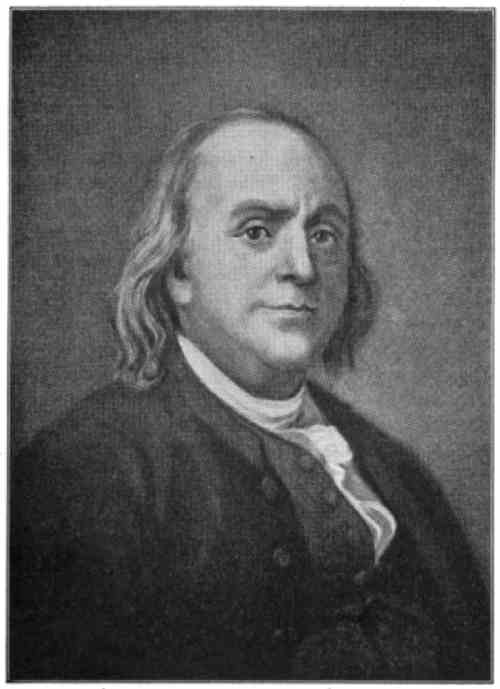 BENJAMIN FRANKLIN
(At the close of Mr. Dickinson's speech there is a loud clamor for
recognition. The president recognizes Benjamin Franklin of
Pennsylvania.)
Benjamin Franklin. [12]Mr. President and Gentlemen of the Continental
Congress:—I know the uncertainty of human affairs, but I see, I see
clearly, through this day's business. You and I, indeed, may rue it. We
may not live to the time when this Declaration shall be made good. We
may die; die colonists; die slaves; die, it may be ignominiously and on
the scaffold. Be it so. Be it so. If it be the pleasure of Heaven that
my country shall require the poor offering of my life, the victim shall
be ready, at the appointed hour of sacrifice, come when that hour may.
But while I do live, let me have a country, or at least the hope of a
country, and that a free country.
But whatever may be our fate, be assured, be assured that this
Declaration will stand. It may cost treasure, and it may cost blood; but
it will stand, and it will richly compensate for both. Through the thick
gloom of the present, I see the brightness of the future as the sun in
heaven. We shall make this a glorious, an immortal day. When we are in
our graves, our children will honor it. They will celebrate it with
thanksgiving, with festivity, with bonfires, and illuminations. On its
annual return they will shed tears, copious, gushing tears, not of
subjection and slavery, not of agony and distress, but of exultation, of
gratitude, and of joy. Sir, before God, I believe the hour has come. My
whole heart is in it. All that I have, and all that I am, and all that I
hope in this life, I am now ready here to stake upon it; and I leave off
as Mr. Adams of Massachusetts began, that, sink or swim, live or die,
survive or perish, I am for the Declaration. It is my living sentiment,
and by the blessing of God it shall be my dying sentiment, independence
now, and INDEPENDENCE FOREVER!
(There is a loud clamor for recognition, and the president
recognizes George Walton of Georgia.)
George Walton. [13]Mr. President and Gentlemen of the Continental
Congress:—I am for this Declaration if the paragraph on slavery is
struck out. But I will oppose it to the end if that paragraph is
permitted to remain a part of it. There is not one good reason for
introducing the slavery question at this time. The relations between
individual master and slave have no place here in the greater and graver
matter of differences between the British Government and the American
Colonies. But since the issue is thrust upon us, I propose to meet it
squarely and fearlessly.
Mr. President and gentlemen, you cannot make equal what God Almighty has
made unequal. Can the Ethiopian change his skin or the leopard his
spots? The Bible commands in the most emphatic language that servants
obey in all things their masters. Liberty loving Greece had her slaves.
Shall liberty loving America have less? Strike out that obnoxious
paragraph and every delegate from the Southern colonies will fall in
line for the Declaration of Independence, but if you make that paragraph
a part of the Declaration many delegates from the South will withdraw
from this convention, and then you will fight your own battles.
This paragraph on slavery is founded upon ideas fundamentally wrong.
These ideas rest upon the assumption of the equality of the races. This
is an error. It is a sandy foundation and a government founded upon it
will fall when the storms come and the winds blow.
Let us found our new government upon the great truth that the negro is
not the equal of the white man, that slavery—subordination to the
superior race—is his natural and normal condition. This truth has been
slow in the process of its development, like all other great truths in
the various departments of science.
Many governments have been founded upon the principle of the
subordination and serfdom of certain classes of the same race; such
were and are in violation of the laws of nature. With us, all the
white race, however high or low, rich or poor, are equal in the eye of
the law. Not so with the negro; subordination is his place. He, by
nature or by the curse of Canaan, is fitted for that condition which he
now occupies in our system. The architect, in the construction of a
building, lays the foundation with proper material—the granite; then
comes the brick or the marble. The substratum of our society is made of
the material fitted by nature for it, and by experience we know that it
is best not only for the superior race, but for the inferior race, that
it should be so. It is, indeed, in conformity with the laws of the
Creator. It is not for us to inquire into the wisdom of His plans, or to
question them. For His own good purposes He has made one race to differ
from another, as He has made "one star to differ from another star in
glory."
Therefore, I declare again that you cannot make equal what God Almighty
has made unequal. He has made the negro and the white man unequal. You
cannot make them equal. And I move that the paragraph on slavery be
struck out. I have measured my words, gentlemen. The responsibility is
yours.
(At the close of Mr. Walton's speech there is a loud clamor for
recognition, and the chair recognizes Samuel Adams.)
Samuel Adams. Mr. President and Gentlemen:—While I have no personal
objections against this paragraph on slavery—for personally I favor
it—yet from the standpoint of the general welfare of the colonies, I
deem it unwise at this time to take any action either for or against the
question of slavery. Therefore I second the motion of Mr. Walton to
strike out the paragraph on slavery.
Mr. Hancock. Gentlemen of the Continental Congress:—It has been duly
moved and seconded that the paragraph in this Declaration on slavery be
struck out. You have heard the motion, are there any remarks?
William Hooper. Mr. President, before voting on this motion, I wish to
have the paragraph on slavery read again.
(This request is seconded by many of the delegates.)
Mr. Hancock. The secretary will read the paragraph on slavery again.
(The secretary reads the paragraph on slavery as follows:)
He has waged cruel war against human nature itself, violating its most
sacred rights of life and liberty in the persons of a distant people who
never offended him, captivating and carrying them into slavery in
another hemisphere, or to incur miserable death in their transportation
thither. This piratical warfare, the opprobrium of infidel powers, is
the warfare of the Christian king of Great Britain. Determined to keep
open a market where men should be bought and sold, he has prostituted
his negative for suppressing every legislative attempt to prohibit or to
restrain this execrable commerce. And that this assemblage of horrors
might want no fact of distinguished dye, he is now exciting those very
people to rise in arms among us and to purchase that liberty of which he
has deprived them by murdering the people upon whom he obtruded them:
thus paying off, former crimes committed against the liberties of one
people, with crimes which he urges them to commit against the lives of
another.
(After the reading of this paragraph the delegates call for a vote
on Mr. Walton's motion.)
Mr. Hancock. Gentlemen of the Congress, a vote is called for on Mr.
Walton's motion to strike out the paragraph on slavery. As many as are
in favor of this motion make it known by saying "aye" (a strong aye
vote); as many as are opposed to the motion make it known by responding
"no" (a light vote of noes). The ayes seem to have it, the ayes have
it, and the paragraph on slavery is struck out. Gentlemen, what is your
further pleasure?
(A loud clamor for recognition, the chair recognizing Joseph Hewes
of North Carolina.)
Joseph Hewes. [14]Mr. President and Gentlemen of the Continental
Congress:—No man thinks more highly than I do of the patriotism, as
well as the abilities, of the very worthy gentlemen who have opposed
this Declaration in these debates. But different men often see the same
subject in different lights; and, therefore, I hope it will not be
thought disrespectful to those gentlemen, if, entertaining, as I do,
opinions of a character very opposite to theirs, I shall speak forth my
sentiments freely and without reserve. This is no time for ceremony. The
question before the house is one of awful moment to this country. For my
own part, I consider it as nothing less than a question of freedom or
slavery; and in proportion to the magnitude of the subject ought to be
the freedom of debate. It is only in this way that we can hope to arrive
at truth, and fulfill the great responsibility which we hold to God and
our country. Should I keep back my opinions at such a time, through fear
of giving offense, I should consider myself as guilty of treason toward
my country, and of an act of disloyalty toward the Majesty of Heaven,
which I revere above all earthly kings.
Mr. President, it is natural for man to indulge in the illusions of
hope. We are apt to shut our eyes against a painful truth, and listen to
the song of that siren, till she transforms us into beasts. Is this the
part of wise men, engaged in a great and arduous struggle for liberty?
Are we disposed to be of the number of those, who, having eyes, see
not, and having ears, hear not, the things which so nearly concern their
temporal salvation? For my part, whatever anguish of spirit it may cost,
I am willing to know the truth; to know the worst, and to provide for
it.
I have but one lamp by which my feet are guided; and that is the lamp of
experience. I know of no way of judging of the future but by the past.
And judging by the past, I wish to know what there has been in the
conduct of the British ministry for the last ten years, to justify those
hopes with which gentlemen have been pleased to solace themselves and
the house? Is it that insidious smile with which our petition has been
lately received? Trust it not, sir; it will prove a snare to your feet.
Suffer not yourselves to be betrayed with a kiss. Ask yourselves how
this gracious reception of our petition comports with those warlike
preparations which cover our waters and darken our land. Are fleets and
armies necessary to a work of love and reconciliation? Have we shown
ourselves so unwilling to be reconciled, that force must be called in to
win back our love? Let us not deceive ourselves, sir. These are the
implements of war and subjugation; the last arguments to which kings
resort. I ask gentlemen, sir, what means this martial array, if its
purpose be not to force us to submission? Can gentlemen assign any other
possible motive for it? Has Great Britain any enemy, in this quarter of
the world, that calls for all this accumulation of navies and armies?
No, sir, she has none. They are meant for us; they can be meant for no
other. They are sent over to bind and rivet upon us those chains, which
the British ministry have been so long forging. And what have we to
oppose to them? Shall we try argument? Sir, we have been trying that for
the last ten years. Have we anything new to offer upon the subject?
Nothing! We have held the subject up in every light of which it is
capable; but it has been all in vain. Shall we resort to entreaty and
humble supplication? What terms shall we find, which have not been
already exhausted? Let us not. I beseech you, sir, deceive ourselves
longer.
(A loud clamor for recognition. The chair recognizes Robert Morris
of Pennsylvania.)
Robert Morris. [15]Mr. President and Gentlemen of the Continental
Congress:—I am opposed to war first, last, and all the time. It is a
relic of barbarism. I believe in the gospel of peace on earth, good will
toward men. It would be better to settle our differences with England
even by flipping a coin than by fighting and killing one another. Let us
hearken unto the voice of God as it comes ringing down the centuries
from Mount Sinai, "Thou shalt not kill." Shall this new government start
out as the Cain among the nations of earth with the blood of our
brethren upon our hands? God forbid that we make ourselves so foolish
and so reckless as this! The history of trial by battle is the history
of folly and wickedness. As we revert to those early periods in the
history of the human race in which it prevailed, our minds are shocked
at the barbarism which we behold; we are horror stricken at the awful
subjection of justice to brute force.
Who told you, fond man! to regard that as glory when performed by a
nation, which is condemned as a crime and a barbarism, when committed by
an individual? In what vain conceit of wisdom and virtue do you find
this degrading morality? Where is it declared that God, who is no
respecter of persons, is a respecter of multitudes? Whence do you draw
these partial laws of a powerful and impartial God? Man is immortal; but
states are mortal. Man has a higher destiny than states. Shall states be
less amenable to the great moral laws of God than man? Each individual
is an atom of the mass. Must not the mass be like individuals of which
it is composed? Shall the mass do what the individual may not do? No! A
thousand times NO! The same laws which govern individuals govern
masses, as the same laws in nature prevail over large and small things,
controlling the fall of an apple and the orbits of the planets.
And who is this god of battles that some of you men believe in with so
much faith? It is Mars—man-slaying, blood-polluted, city-smiting, Mars!
Him we cannot adore. It is not he who causes the sun to shine on the
just and the unjust. It is not he who tempers the wind to the shorn
lamb. It is not he who distills the oil of gladness in every upright
heart. It is not he who fills the fountain of mercy and goodness. He is
not the God of love and justice. The god of battles is not the God of
Christians; to him can ascend no prayer of Christian thanksgiving; for
him no words of worship in Christian temples, no swelling anthem to peal
the note of praise.
Let us cease, then, to look for a lamp to our feet in the feeble tapers
that glimmer in the sepulchers of the past. Rather let us hail those
ever-burning lights above in whose beams is the brightness of the
noon-day. As the cedars of Lebanon are higher than the grass of the
valley, as the heavens are higher than the earth, as man is higher than
the beasts of the field, as the angels are higher than man, as he that
ruleth his spirit is higher than he that taketh a city; so are the
virtues and glories and victories of peace higher than the virtues and
victories of war.
To this great work of world-wide peace let me summon you. Believe that
you can do it, and you can do it. Blessed are the peace-makers for they
are the children of God.
(Loud clamor for recognition, the chair recognizing Patrick Henry
of Virginia.)
Patrick Henry. [16]Mr. President and Gentlemen of the Continental
Congress:—We have done everything that could be done, to avert the
storm which is now coming on. We have petitioned; we have remonstrated;
we have supplicated; we have prostrated ourselves before the throne,
and have implored its interposition to arrest the tyrannical hands of
the ministry and Parliament. Our petitions have been slighted; our
remonstrances have produced additional violence and insult; our
supplications have been disregarded; and we have been spurned, with
contempt, from the foot of the throne! In vain, after these things, may
we indulge the fond hope of peace and reconciliation. There is no longer
any room for hope. If we wish to be free—if we mean to preserve
inviolate those inestimable privileges for which we have been so long
contending—if we mean not basely to abandon the noble struggle in which
we have been so long engaged, and which we have pledged ourselves never
to abandon, until the glorious object of our contest shall be
obtained—we must fight! I repeat it, sir, we must fight! An appeal to
arms and to the God of Hosts is all that is left us.
They tell us, sir, that we are weak; unable to cope with so formidable
an adversary. But when shall we be stronger? Will it be the next week,
or the next year? Will it be when we are totally disarmed, and when a
British guard shall be stationed in every house? Shall we gather
strength by irresolution and inaction? Shall we acquire the means of
effectual resistance, by lying supinely on our backs and hugging the
delusive phantom of hope, until our enemies shall have bound us hand and
foot? Sir, we are not weak, if we make proper use of those means which
the God of nature hath placed in our power. Three millions of people,
armed in the holy cause of liberty, and in such a country as that which
we possess, are invincible by any force which our enemy can send against
us. Besides, sir, we shall not fight our battles alone. There is a just
God who presides over the destinies of nations, and who will raise up
friends to fight our battles for us. The battle, sir, is not to the
strong alone; it is to the vigilant, the active, the brave. Besides,
sir, we have no election. If we were base enough to desire it, it is now
too late to retire from the contest. There is no retreat, but in
submission and slavery! Our chains are forged. Their clanking may be
heard on the plains of Boston. The war is inevitable—and let it come! I
repeat it, sir, let it come.
It is in vain, sir, to extenuate the matter. Gentlemen may cry, Peace,
peace—but there is no peace. The war is actually begun! The next gale,
that sweeps from the north, will bring to our ears the clash of
resounding arms! Our brethren are already in the field! Why stand we
here idle? What is it that gentlemen wish? What would they have? Is life
so dear, or peace so sweet, as to be purchased at the price of chains
and slavery? Forbid it, Almighty God! I know not what course others may
take; but as for me, give me liberty or give me death!
(At the close of Mr. Henry's speech there are loud calls for a
vote upon the question. President Hancock orders the secretary to
call the roll of colonies in geographic order beginning with New
Hampshire.)
Secretary Thomson. New Hampshire!
Josiah Bartlett. Mr. President and Gentlemen:—New Hampshire is
represented in the Congress by three delegates. Her people have appealed
to us and have instructed us to work for and vote for Independence. I
believe everybody knows more than any body. I consider it a signal
honor, sir, and it is the happiest hour of my life, to lead in this roll
call in favor of this Declaration. New Hampshire votes aye.
(Shouts of "Three cheers for New Hampshire.")
Secretary Thomson. Massachusetts!
Samuel Adams. Mr. President:—The king of England has set a price upon
your head and mine. If this Declaration is not made good by the people
of these colonies you and I will be shot, hanged by the neck till dead,
or burned at the stake as traitors. If we fail, my only regret will be
that I have but one life to give for my country. But with faith in the
people and in God to carry our cause through to a glorious victory, the
delegates from Massachusetts stand as one man for Independence.
Massachusetts, therefore, votes aye.
(Shouts of "Three cheers for Massachusetts, and long live Samuel
Adams and John Hancock. Down with the tyrant king of England!")
Secretary Thomson. Rhode Island!
Stephen Hopkins. Mr. President:—Rhode Island is a small colony. She is
represented in this Congress by only two delegates. But all that we are
and all we hope to be we are ready here and now to give for
Independence. Rhode Island votes aye.
(Shouts of "Three cheers for brave Rhode Island, Stephen Hopkins,
and William Ellery.")
Secretary Thomson. Connecticut!
Roger Sherman. Mr. President and Gentlemen:—I have already addressed
you at some length in favor of this Declaration. It becomes my happy
duty now to cast the unanimous vote of the four delegates from
Connecticut for independence. Connecticut votes aye.
(Shouts of "Long live Roger Sherman! Three cheers for
Connecticut.")
Secretary Thomson. New York!
William Floyd. Mr. President and Gentlemen:—The instructions against
independence for the delegates from New York have never been recalled.
We, therefore, request the privilege to refrain from voting on this
question. We regret the situation, gentlemen!
President Hancock. New York is excused from voting on this question.
Secretary Thomson. New Jersey!
Richard Stockton. Mr. President and Gentlemen:—I am happy to say that
New Jersey has given her five delegates in this Congress instructions to
vote for independence. New Jersey, therefore, votes aye.
(Shouts of "Three cheers for New Jersey.")
Secretary Thomson. Pennsylvania!
Benjamin Franklin. Mr. President and Gentlemen:—From the beginning of
this Congress the delegates from Pennsylvania have labored under
instructions against independence. But during the past three months the
friends of independence in this commonwealth have worked in season and
out of season to have these instructions canceled and permission given
us to vote for independence. At a mass meeting in Philadelphia on June
18, presided over by that distinguished and influential radical, Colonel
Daniel Roberdeau, and attended by over 7,000 citizens from all sections
of the state, a public sentiment was created and started that resulted
in the overthrow of the old government of the aristocrats of the old
Assembly and then established a new government of the people under the
authority of the Conference of Committees which has given the delegates
from Pennsylvania instructions to vote for independence. Two of our
delegates, John Dickinson and Robert Morris, have retired from this
Congress considering such instructions a recall of their membership in
this body. Two other delegates from Pennsylvania, Charles Humphreys and
William Williams, question the authority of the Conference of Committees
and hold that the instructions of the old defunct Assembly are still
binding upon them. They vote against independence. But James Wilson who
has been opposed to Independence bows to the will of the people and
joins John Morton and myself in voting for Independence. Under the rule
of this Congress made in its beginning session that a majority of the
delegates from each colony, present and voting determines its vote upon
such a question as this, Pennsylvania casts two votes against
independence and three votes for independence and therefore votes aye.
(Shouts of "Three cheers for Pennsylvania! Long live Benjamin
Franklin, John Morton, and James Wilson!")
(Immediately following the applause for Franklin, Caesar Rodney, a
delegate from Delaware, makes his appearance just in time to vote.
He has come eighty miles on horseback and has not had time to
change his boots and spurs and still carries a riding whip. He is
given a great ovation.)
Secretary Thomson. Delaware!
Thomas McKean. Mr. President and Gentlemen:—Until this moment the vote
for Delaware has been in doubt. George Read, my colleague, will vote
against independence. But thank God the timely arrival of Caesar Rodney
who joins me in voting for independence, places Delaware on the right
side of this question. To make sure of this I sent an express rider at
my own expense to Dover, Delaware, for Mr. Rodney. He has come eighty
miles on horseback at post-haste. He has not had time to change his
riding attire, but he is here in time to join me in voting for
independence. Posterity will erect a monument in his honor[17] as they
will to that other famous revolutionary rider—Paul Revere. Mr.
President, under the rule as stated by Mr. Franklin governing the votes
of colonies in this Congress, Delaware votes aye.
(Shouts of "Hurrah for Delaware! Long live Thomas McKean and
Caesar Rodney!")
Secretary Thomson. Maryland!
Samuel Chase. Mr. President and Gentlemen:—Maryland has passed through
a similar struggle to that in Pennsylvania as described by Mr. Franklin.
An appeal has been made to every county committee and one after another
they have directed their representatives in the state convention to vote
for new instructions to the delegates in this Congress. At last the old
instructions against independence have been canceled and new
instructions given us in an unanimous resolve to vote for independence.
See the glorious effect of county instructions! Our people have fire if
not smothered. And, therefore, Maryland votes aye.
(Shouts of "Three cheers for Maryland and Samuel Chase!")
Secretary Thomson. Virginia!
Benjamin Harrison. Mr. President and Gentlemen:—Virginia is here with a
solid delegation for independence. Our battle cry has been so well
stated by Mr. Henry that we need but to repeat it now—Liberty or Death!
Virginia votes aye.
(Shouts of "Three cheers for Virginia! Long live Richard Henry
Lee, Benjamin Harrison, Thomas Jefferson and Patrick Henry!")
Secretary Thomson. North Carolina!
Joseph Hewes. Mr. President and Gentlemen:—We have had a hard struggle
in North Carolina between aristocracy on one hand and democracy on the
other. But at last the people have won and North Carolina votes aye.
(Shouts of "Three cheers for North Carolina!")
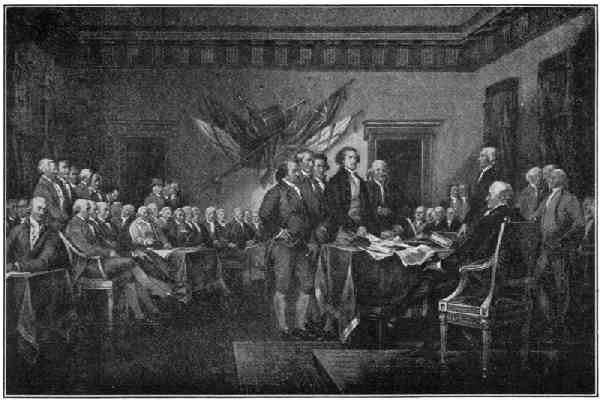 From the painting by Trumbull
THE CONTINENTAL CONGRESS
From the painting by Trumbull
THE CONTINENTAL CONGRESS
Secretary Thomson. South Carolina!
Edward Rutledge. Mr. President and Gentlemen:—When Richard Henry Lee's
resolution declaring for independence was first introduced I was opposed
to its adoption at that time. I feared that the people of my colony
were not then ready for it. I thought also that for the general welfare
of all the colonies it was then too early to declare for independence.
The contest in South Carolina for independence has been as bitter among
her own people as it has been in any of the other colonies. But opinions
alter and conditions change with the passing of time. Therefore, South
Carolina now has a solid delegation here ready to walk through the fiery
furnace of war, though it be seventy times heated, to make this
Declaration good. South Carolina votes aye.
(Shouts of "Three cheers for South Carolina and Edward
Rutledge!")
Secretary Thomson. Georgia!
Lyman Hall. Mr. President and Gentlemen:—Georgia is here with three
delegates who stand as one man for independence. Though last on the roll
of states on this question she will be among the first in her efforts
for American independence. Georgia votes aye.
(Shouts of "Three cheers for Georgia!")
President Hancock. Gentlemen of the Continental Congress:—Twelve of the
thirteen colonies having voted for the Declaration of Independence, and
with no colony going on record against it, I consider our action
unanimous for I am confident that the New York Assembly[18] will give
her delegation instructions to sign this document in the near future.
John Adams. Mr. President, I move that this Congress do now adjourn.
Benjamin Franklin. Mr. President, I second the motion.
President Hancock. Gentlemen of the Continental Congress, it has been
moved by Mr. Adams of Massachusetts and seconded by Mr. Franklin of
Pennsylvania that we do now adjourn. As many as favor this motion make
known by saying aye.
(Unanimous response of ayes.)
The motion to adjourn has been carried unanimously and this Congress is
therefore adjourned.
Scene II.—The Spirit of 76.
Here repeat the Tableau of the Spirit of Seventy-six.
Scene I.—Washington's Resignation. (A special session of the
Continental Congress to receive the Resignation of Washington.)
President Hancock. Gentlemen of the Continental Congress:—Eight years
ago we made General George Washington Commander-in-Chief of the armies
raised and to be raised for American Independence. Through seven long
years of war, against overwhelming odds, in which brave men did brave
deeds, the rich man gave his wealth and the poor man gave his life,
baptizing their country's soil with their own blood from Bunker Hill to
Yorktown, the brave soldiers under General Washington fought on until an
army of veteran soldiers surrendered to a band of insurgent husbandmen.
The American nation has been born. Its independence has been recognized
by Great Britain and the civilized world. Peace has come! And General
Washington desires to surrender his commission to the Congress that
elected him to this position. He is in waiting to do this. I therefore
appoint John Adams of Massachusetts, Benjamin Franklin of Pennsylvania,
Roger Sherman of Connecticut, Samuel Chase of Maryland, Patrick Henry of
Virginia, Edward Rutledge of South Carolina, and Lyman Hall of Georgia,
as an honorary committee to escort General Washington before this
Congress, to receive his resignation.
(General Washington is escorted before Congress and makes the
following address:)
Mr. President:—The great events on which my resignation depended,
having at length taken place, I have now the honor of offering my
sincere congratulations to Congress, and of presenting myself before
them to surrender into their hands the trust committed to me, and to
claim the indulgence of retiring from the service of my country.
Happy in the confirmation of our independence and sovereignty, and
pleased with the opportunity afforded the United States of becoming a
respectable nation, I resign, with satisfaction, the appointment I
accepted with diffidence; a diffidence in my abilities to accomplish so
arduous a task, which, however, was superseded by a confidence in the
rectitude of our cause, the support of the Supreme Power of the Union,
and the patronage of Heaven.
The successful termination of the war has verified the most sanguine
expectations; and my gratitude for the interposition of Providence, and
the assistance I have received from my countrymen, increases with every
review of the momentous contest.
While I repeat my obligations to the army in general, I should do
injustice to my own feelings, not to acknowledge, in this place, the
peculiar services and distinguished merits of the persons who have been
attached to my person during the war. It was impossible the choice of
confidential officers to compose my family could have been more
fortunate. Permit me sir, to recommend in particular those who have
continued in the service to the present moment as worthy of the
favorable notice and patronage of Congress.
I consider it as an indispensable duty to close this last solemn act of
my official life, by commending the interests of our dearest country to
the protection of Almighty God, and those who have the superintendence
of them to his holy keeping.
Having now finished the work assigned me, I retire from the great
theater of action; and, bidding an affectionate farewell to this august
body, under whose orders I have long acted, I here offer my commission,
and take my leave of all the employments of public life.
(The Continental Congress, standing and shouting in concert, "Long
live General George Washington! First in war! First in peace! And
First in the hearts of his countrymen!")
CURTAIN
 AMERICA FIRST