Strangely caught up out of the rut and routine of
Paris war-work, not even choosing my direction (the
Fates did that), contributing, however, the eternal readiness
of my soul, which the poet says is all, I was conveyed,
as on a magic carpet, to the blue valleys and the
rust and gold and jasper hills of Alsace, where the color
is laid on thick, thick. There I was one, during many
historic days, of the delightful group of blue-clad,
scarred, decorated officers forming the French Military
Mission, which since the autumn of 1914 had administered
the little reconquered triangle of Alsace and
planted in it the seed for the re-Gallicizing of Alsace-Lorraine.
It was a bit of French history in the making,
which detached itself quite peculiarly free from the mass
of war happenings, somewhat as a medallion from that
against which it is placed.
My little book shows how humanly and simply the
men of the French Military Mission, accustomed to
supreme events, together with a woman from over the
seas, lived through those thirteen historic days preceding
the armistice. It will perhaps be worth the reader’s
while—I mean the nice, bright, perceptive reader’s
while—for mostly the throbbing, high-colored beauty of
Alsace is veiled by dusty, argumentative, statistical
pamphlets, so many of which are printed, so few of
which are read. I once saw a great building full of such,
and dozens of them were presented me for my sins,
though I had never thought to read another book on
Alsace, much less to write one. I see once again how
foolish is the man or woman who says to the fountain,
“I will never more drink of thy water.”
In this record there are no polemics and no statistics.
I have added nothing to each day’s happenings, which
run along as life is apt to run along, even in supreme
moments, and, Heaven help me, I have concealed nothing.
It is because of all this that perhaps those who,
like myself, have wept much and laughed much in their
lives, will not ungladly accompany me to a corner on the
sorrowful and glorious chart of the autumn of 1918.
Edith O’Shaughnessy.
Paris, 33 rue de l’Université, February, 1919.
ALSACE IN RUST AND GOLD — I THE JOURNEY THERE
And this is what a woman was thinking, as she
walked the platform of the Gare de l’Est at seven
o’clock on a foggy October morning of 1918, waiting to
take the train to the front.
“Why, when trials and tribulations await us in every
land, when every dearest affection is accompanied by its
related grief and every achievement by the phantom of
its early hope—why this illimitable ardor of the soul,
pressing us forward into new combinations?” ...
A few days before I had learned that Masevaux, the
capital of that small triangle of Alsace, reconquered
since the August of 1914, would be my journey’s term.
Looking in the guide-book, I found Masevaux at the
very end—on page four hundred and ninety, to be precise,
and the book has but four hundred and ninety-nine
pages in all—and it had seemed far, far, and the
world an immensity, with few corners for the heart. I
have realized since that it was only the chill of the unknown
into which I was to venture, drawn inevitably as
steel to the magnet or the needle to the north, by that
very ardor of the soul....
I had not slept at all the night before—I never do
when I am to take an early train to pass out into new
ways—and the somewhat dispiriting influences of “that
little hour before dawn” were still with me as I stepped
into my compartment and took my seat, while a captain
of dragoons lifted my small leather valise and my not
large Japanese straw basket to the rack. Settling myself,
a bit chilly, into the depths of my fur coat, slipped
on over my uniform, I looked out upon the throng of
officers and soldiers, as many Americans as French,
perhaps even more.
Standing near my window was a blue-clad colonel,
with many decorations and a black band on his arm.
He was carrying a small bouquet of what seemed like
wild-flowers, and he embraced in farewell a woman
in deepest black who would bear no more children....
Then a very young, crape-clad mother, carrying
several pasteboard boxes, with three small children
clinging to her skirts, hurried down the platform to get
into a third-class compartment.
But with it all I was conscious that the blue and khaki
war was receding, its strange deeds, which had seemed
cut in such high relief, were even then blurred against
the red background, the background itself fading.
“Eyes look your last, arms take your last embrace”
of the world horror, the world beauty, where sorrow
has so often been above sorrow and where many “chariots
have been burned to smoke.” ...
In the compartment are five French officers with dark
rings under their eyes. I don’t know whether it is
wounds or the effects of the perm.[1] Anyway, they
almost immediately take attitudes inviting slumber. A
young woman all in purple, whether third or fourth
mourning I know not (it’s well done, though it couldn’t
pass unnoticed), sits by one of the windows and waggles
a short-vamped, very-high-heeled, bronze-shoed foot and
rattles a gold vanity-box. From the neighboring compartment
came classic expressions: “Can you beat it?”
and “Search me.” My heart salutes the Stars and
Stripes. The whistle blows, and the train starts for the
very end of the guide-book.
8.30.—Read the masterly editorial of Jacques Bainville
in L’Action Française, “Où est le piège?” (“Where
is the snare?”) while going through the ugliest suburbs
in the world, inclosing the most beautiful city in the
world. And more beautiful than ever is Paris in uniform.
Her delicate gray streets are mosaicked in horizon-blue,
burnished with khaki, aglitter with decorations.
(Oh, those men of the alert, expectant step, or
those other broken ones dragging themselves along on
canes and crutches!) Who has not seen Paris in uniform
knows not her beauty, bright and terrible as an
army in array; enchantment for the eye, bitter-sweet
wine for the soul. And again, who has not seen her
violet-nighted, black-girdled by the river, wearing for
gems a rare emerald or ruby or sapphire light, and
silent in her dark, enfolding beauty, knows her not.
So lovers will remember her, and those whose sons are
gone.
9.30.—Looking out of the window on fields and
forests and groves. White-stemmed, yellow-leaved
birches burn like torches in a pale, thin mist. The
plowed fields are black with crows; it would seem to
be a good year for them. We are due at Belfort at
3.35, but a large-paunched, very loquacious man blocking
the corridor—his voice has not ceased since we
started—tells a fellow-passenger that, with the delays
caused by the shifting of troops and material, we’ll be
lucky if we get there by seven.
10.30.—Rampillon with its beautiful old church, having
two rows of Gothic windows and several medieval
towers, seen from a foreground of smooth tilled fields.
Over the green and yellow and brown world stretches
a silver heaven, tarnished with yellowish-gray clouds.
Longueville.—Interminable trains of French and
American troops cross one another. The French train
has various barometrical indications of war-weather
in chalk. Guillaume, O là là, là là; and the favorite
and unrepeatable word —— mingles with Le plaisir
d’aller à Paris, O les belles filles, Adieu à jamais, Boches.
The cars containing American troops are inarticulate.
They haven’t been at it long enough to express
themselves.
The handsome young officer next me opens conversation
by asking me for my L’Action Française. Having
previously torn out the article of Jacques Bainville,
and wiped the windows with the rest, I pass it over to
him with a smile. It wasn’t tempting.
A group of Americans are standing in the corridor.
I hear, “I’d like to burn the Rhine.” And the answer:
“I don’t care what you burn, but I don’t ever want
to see the Statue of Liberty from this side again. Me
for home. There’s more in it in one week in the clinic
in little old Chicago than here in a month, in spite of
the hunks of material. Leaving some to die or bandaging
men in a hurry that you’ll never see again, and
dead tired all the time. No, siree! No war thrills for
me.” And then, all being devotees of Esculapius, they
fall to talking about diseases, civil as well as military.
The loquacious party (he hasn’t stopped even to
take breath) says to his companion that he’s going to
surprise his wife, who thinks he’s in Paris. Whatever
else she’s enjoying, she must be enjoying the silence,
and I do hope he’ll make a lot of noise when he opens
the door.
The young French officer next me with the Légion
d’Honneur, Croix de Guerre, four palms and two stars,
tells me he is with the Americans at Langres, which is
camouflé these war-days as A.P.O. 714, the ancient
hill-town of the Haute-Marne being the setting for the
celebrated “University” of the A.E.F.
11 o’clock, Romilly.—Near here, in the old Abbey of
Scellières, was buried Voltaire, l’enfant gâté du monde
qu’il gâta (“spoiled child of the world that he spoiled”),
having been refused ecclesiastical burial in Paris. And
from here he journeyed in his dust to the Panthéon.
At St.-Mesmin the sun came out, and the dull,
plowed fields were suddenly spread with great covers,
as of old-gold velvet, tucked in about the slender feet
of pine forests.
Now all this pleasant soil of France has many histories,
and St.-Mesmin is where the priest Maximin
(you see whence the name) was sent by the Bishop of
Troyes to implore the mercy of Attila in favor of the
great city. For answer the terrible king of the Huns
put him to death. Against the sky is the tower of a
twelfth-century church. A collection of objects in a
field that I thought were plows turned out to be
cannon.
Troyes.—Not a glimpse of the cathedral. Immeasurably
long troop-train fills the station on one side of
us. On the other a gorgeous (it’s the only word for it)
American Red Cross train. Pressed against the windows,
lying or sitting, were pale men of my race. I
waved and smiled, and languid hands went up in
answer. The box cars on the other side were filled
with blue-clad men. Over the doors were green
boughs, on the sides chalked portraits of the Kaiser,
Dur à croquer, Mort à Guillaume, etc. And everywhere
the once so familiar On les aura is converted into Nous
les avons.[2] Through the slits in the top of the cars
were faces of poilus looking out, just as one sees cattle
looking out; then a long line of other box cars with
American, khaki-capped heads also looking out of the
slits in the top, while the side doors too were crowded
with sitting, standing, leaning doughboys. Again I
waved from my window, and every cap was lifted.
There was a young man standing at the door of some
sort of a refrigerator car, and he wore a wonderful goat-skin
coat. Being so near my window I spoke to him,
and said:
“It’s a fine coat you are wearing.”
“I’ll tell you in the spring,” was the prompt answer.
“They’ve just given them out to us. You try living next
to the cold storage.” He then proceeded to blow into
some mottled fingers, after which he pulled a long tuft
of hair from his coat. “I’m molting,” he added, as
he held it up, “and winter’s coming.”
And he didn’t know whence he had come nor whither
he was going. Then either his train moved or mine did—I
couldn’t tell which—and I saw him no more.
Vandœuvres-sur-Barse.—Wood, wood, piled high on
every kind of wheeled thing. Forests from which it
had been cut showing sharp and thin, fringing the gold-brown
fields under the luminous noonday heaven. And
here for a moment the green was so delicate and the yellow
so tender, that I had a fleeting illusion of spring as
I looked out.
Then I fell to talking with some young officers of the
131st Artillery from Texas, but nothing that I remember.
They had made no impression on France, neither did
France seem to have made any impression on them.
Bar-sur-Aube.—Old houses, old walls, blue hills, a
white road leading over one of them. Strange church
tower, with a round, many-windowed top, and in each
window hangs an old bell. A great trainload of American
infantry “going up,” the station, too, flooded with
khaki, and another train passed crowded with poilus
evidently en permission, making rather fundamental
toilets.
And around about Bar, as we slipped out, was a silver-vaulted
world of terra-cotta and purple hills, green and
brown fields, silver hayricks, silver sheep grazing near,
and warm, brindled cattle, many green-painted bee-hives,
and fruit trees trained against pink walls. Gentle
slopes, later to become the Alps, appeared, and beech
forests, like very worn India shawls, clung to them, and
a row of nearby poplars had each its nimbus of yellow
light.
About this time, having had a hasty cup of tea at
six, I began to be so hungry that the luster went from the
landscape and my eyes received nothing more. I didn’t
care whether the talkative man gave his wife a surprise
or not, and the two Americans of the Texan Artillery
section had long since also ceased to interest me, when I
heard a “nosy” voice saying:
“Gosh! I tell you, boys, there’s big money to be made
over here after the war. All you have to do is to hang
out the sign, ‘American Dentist,’ and your waiting-room’ll
burst.” I sat down and nearly slept by the side
of the six-foot dozing handsome officer, with the beautiful
blue uniform, and yellow pipings on his trousers
and cap, and five service and three wound stripes, and
the number 414 on his collar, besides a lot of decorations
on his breast.
1.30, Chaumont.—Sitting in the dining-car, finishing
an excellent lunch. Of course, in common with the
rest of the world, I’ve heard a good deal about Chaumont,
but I can say that on the word of honor of an
honest woman the only thing I saw in khaki in that
famous station of the A.E.F. Headquarters was an
emaciated Y.M.C.A. man about five feet four inches
high, with an umbrella and a straw basket.
Of course, I’m familiar with the phrases, “Chaumont
has put its foot down,” “Chaumont won’t have it,”
“Everything will be decided at Chaumont”; and once,
entering a Paris restaurant, I heard the words, “It’s
all Chaumont’s fault.”
Then the fog closed in, a thick, impenetrable fog, and
that’s all I know or ever will know of Chaumont, as I’m
going back to Paris via Nancy. So be it.
On a nearby new railroad embankment, the figure of
a poilu—the classic figure—the coat pinned back from
his knees, bayoneted rifle over his shoulder, loomed up
immeasurably large in the fog, while he watched the
labors of a lusty, husky set of German prisoners, the
familiar “P.G.”[3] stamped on their backs. A little
farther along was another laughing, rosy-faced group
of four of the same, watched over by one of their own
under-officers. I could only see his field-gray back
stamped with his P.G., but as his men were so unrestrainedly
hilarious, there is no reason to suppose that
he was frowning.
4 o’clock, Culmont-Chalindrey.—Already three hours
late. Fog-enveloped train of box cars filled with slightly
wounded doughboys peering through the narrow slit
at the top, bandaged eyes, noses, the same kind of
groups looking out of the door. Suddenly everything
seems dreary. I am tired, and wonder why, oh! why I
came, and if the war is going to last forever and forever,
and it is the hour of the day when those who have not
slept the night before know profound discouragement and
the noonday devil has ceased to walk, flicking his whip.
Vitrey.—Station full of Americans and wood—wood—wood,
as if every tree in France had been cut. “Wood
by the pound is how you buy it over here, all the same,”
disdainfully remarked the Minnesotan artilleryman
serving in the Texan regiment, as we stood looking out
of the window.
And if the journey down seems long, remember that
life, too, is made up of wearisome and long things—that
it is indeed but a pilgrimage, and mostly through
a land more desert than this of Burgundy.
And in the end this book may justify itself, though
of that I know as little as you.
At Vitrey there is a detachment of mustard-tinted,
khaki-clad, red-checchiaed Moroccan tirailleurs, exceedingly
exotic-appearing, sitting on their accoutrement or
leaning against the bare scaffolding of a new addition
to the station. There came into my mind what an
unwed friend told me of a conversation with a dying
tirailleur, to whom she was giving a tisane in a long,
dim, hospital room at two o’clock in the morning. He
looked at her and said suddenly in his strange French:
“Woman, I know thy look; thou and many like thee
have not been embraced in love. In my village thou
wouldst be a grandmother” (I had never thought of
her as old, but the tirailleur knew that, as the men
of his race rated women, she was old—old, and no one
would have followed her to the well.) He continued:
“If no man is to enfold thee, why not be as those of the
great white coifs, who have given themselves to Allah?
They have not thy look.” Then he went into delirium
and cried out in his own tongue and picked at his sheet,
and when she came that way again he was dead.
6 P.M., Vesoul Station.—Writing by the light that
comes in from the gas-jet. Dim American forms silhouetted
in the great station. Partake of the loneliness
that possesses the soul of American youth in France
on a foggy autumn night. One of them said to me to-day,
with a curious, dulled look in his eye, a brooding,
neurasthenic eye, “I’m the kind that gets killed the last
day of the war.”
Then a presence apparent only by the light of his
cigarette, a being with an accent not immediately placeable,
half cockney, half Middle-West, calls out, “Say,
does anybody know when we pull into Belfort?”
It had, all the same, something of confidence-inspiring,
so I briskly chirped up:
“Oh, in an hour or two or three.”
“Well, I took the eight-o’clock train from Paris last
night.”
Chorus: “You mean this morning?”
“I mean last night, and going ever since.”
“What have you been doing in between times?”
“Going, going,” he answered, casually, “and as you
see, going still!”
“How did you manage to get on this train?”
“I don’t know. There I was and here I am, and God
knows where my kit is. I’m a flier, and I’ve got to have
my things,” he ended, rather irritably, and then there
was another conversation about “burning the Rhine.”
After interminable hours—two of them—we came to
Lure, and everybody seemed to be getting out, even the
woman in purple, and there was a fumbling with pocket-lamps
and the voice of my country crying, “Where’s
that d—— door, anyway?”
The young man who started last night came into my
compartment as the train jerked out of the station, and
he was a Canadian aviator en route for the big camp of
the Royal Independent Air Corps at Chatenoir. Before
the war he had been a chartered accountant. “But,”
he said, “once in the air, never again can I sit at a desk,
crushed in by four walls.” And he told stories of hair-breadth
escapes of himself and his comrades, and of
combats in the air—once he had had his knee broken—and
then he suddenly cried out in a sharp voice: “God!
I’m tired! Somebody let me know if we ever get there,”
and flung himself in a corner, and went to sleep, I hope.
A young American officer standing smoking in the
corridor, with whom I had sat at lunch, turned on his
pocket-lamp for an instant during the ensuing silence,
and said, “Do you mind if I come in?” Then, in the
pitch darkness, lighting one cigarette from the other,
and very lonely, I think, he almost immediately began
to talk about himself, and his story might be called the
story of the young man who was and wasn’t married.
Stripped of non-essentials, it was this: He had become
engaged at a “co-ed.” school, as he called it, some
years before, and when he was drafted, in the possible
event of his being ordered abroad, the twain decided
to get married instead of waiting a few more years.
One Sunday morning in November they hunted up a
clergyman and the knot was tied. They then had lunch
at the station and she took her train and he went back
to his camp. She was an army nurse and he was in the
Engineers.
Now, as inclination alone could have caused them to
unite (there wasn’t the ghost of another reason apparent;
they hadn’t even mentioned the matter to their families),
the sequel of the story becomes somewhat interesting;
in fact, quite incomprehensible, let us say, to the Latin;
even I myself was a bit muddled as to the whereforeness
of it all.
Well, to continue. The next time they meet is when
Fate, not quite unmindful of them, sends him as instructor
to a camp in the Middle West on the outskirts
of the very town where her people live, and she goes to
spend a three days’ leave with them.
The not-too-eager and certainly not-over-inventive
bridegroom (whatever combinations may have been
in his mind, neither he nor history records) gets a few
hours’ leave and goes to spend Sunday at the home of
his bride.
I begin to breathe. But not at all. Her people,
innocent as the new moon of the marriage, ask a few
neighbors in for lunch—to make it pleasant for them.
The bride was to return that very same afternoon to her
hospital. They did walk to the station (under the same
umbrella, I hope) and there they said good-by.
“It was what you might call a quiet wedding,” I
hazarded at this stage, and it was too dark to see if he
caught the point. Please bear in mind that this was a
marriage of inclination; no other explanation, I repeat,
being possible. And the luncheon took place the end
of January.
The next time the situation seems about to clear up
is in the golden month of August, she having been
transferred to the military hospital near the camp to
which he, in the meantime, had been transferred as
instructor. It seemed providential and again I breathe,
thinking, “Love will find a way.” Not at all. The bride
rings him up the Sabbath morning after his arrival
(Sunday is evidently a bad day for that young man)
and tells him her orders take her to Camp Sill that night.
The next day he gets orders to report for overseas duty,
and here we sit in the dark, on the outskirts of Belfort!
He breaks the silence later, with a certain eagerness in
his voice (not, however, for his distant bride, who, I
also gather, still bears her maiden name): “I do hope if
we beat them I get a chance to go into Germany with
the troops. I’ve wandered all my life [he’s between
twenty-five and thirty] and sometimes I wonder how
I’ll take to living in one place and bringing up a family.”
In the dark I wondered, too.
Later, much later.—To-morrow, All Saints’ Day, there
will be some crowding of the heavens, and the day
after, the Feast of the Dead, all France will be a-hurrying
to her graves.
II ALL SAINTS’ DAY, NOVEMBER, 1918
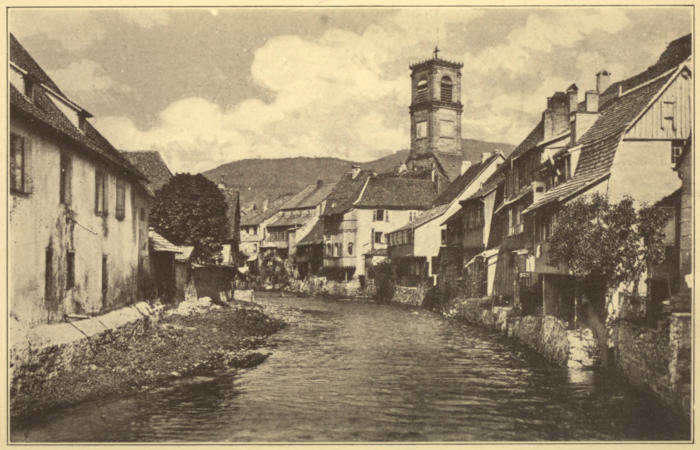
Evening.—Masevaux, a town of old fountains and
old inns with charming old signs hanging out, the
pebbly Doller running through it under ancient, balconied
houses, and over all hanging faint odors of its
century-old tanneries. A long day, but not too long.
Punctually at eight-thirty I had descended the flashy
stairway of the “Tonneau d’Or” at Belfort to find the
officer sent to meet me finishing his coffee and reading
the morning papers, always comforting these days.
In a thin fog, we start out of town, passing under the
antique high wall of the castle against the rock of which
“The Lion” has been carved. Now all has been done
that it is humanly possible to do with granite and a
lion, but of that more another time—perhaps. I can’t
stop now except to say that the hand that fashioned it
fashioned also the Statue of Liberty in New York
harbor.
We meet, just out of Belfort, a funeral procession—three
coffins, two draped with the Tricolor, one with
the Stars and Stripes. Making the sign of the cross, I
commended three souls to Heaven. I always remember,
accompanying a beloved one of my blood to his narrow
dwelling, how sweet, how very sweet, it was to see the
gesture of that sign, and the lifted hats of those we met,
saluting him on his last journey. Though I do not care
inordinately how or when or where I lose my flesh, that
much I would like done to me—in passing.
Nestled in the corner of a broad, sloping field was a
cemetery, a new cemetery, with French and American
flags flying from its crowded graves, and many men were
busy digging, and we heard the crunch of shovels in
cold, gravelly earth as we passed, and yet I thought how
well, how very well, the soldier sleeps!...
We were on the flat road that leads to Cernay, where
the Germans have lain intrenched since the beginning
of the war.
Shifting masses of horizon-blue, velvety in the thin
mist, appear, disappear down white roads, between fields
of barbed wire and against horizons of rusty beeches.
In the villages black-robed women and children and old
men are coming out of rose-colored churches or standing
by elaborate, very decorative rose-colored fountains.
There is the distant sound of cannon. It is again the
front.
At Masevaux, I find myself drawing up under some
yellowing lindens in front of the building of the Military
Mission—once the German Kommandantur, in turn
once the nave of the old church of the Abbey of Masevaux.
I walk over a rich carpet of rustling leaves to
the door, and am shown up the broad, stone stairway
of an immaculately kept building.
Commandant Poulet having been called that morning
to St.-Amarin, I am taken into a charming corner room
hung with a wall-paper that might have been designed
by Hansi, where a young, light-haired man with dark
rings under his eyes, who knows both battles and desks,
was sitting at a big table.
We looked at each other, I must confess, with some
curiosity, though of the politest. I, to see what the
Military Mission might be going to offer, but prepared
to be very easily and very much pleased, he, doubtless,
to see what had been “wished on” them for the next
week. It might so easily have been awful, instead of
a niceish lady who has both wept and laughed, and known
many lands and many men. He asks me what I would
like to do that morning. Not having the ghost of an
idea what there is to do, I answer, “Everything is interesting,”
and give a somewhat free Gallicization of
“beauty lieth in the eye of the beholder.” This was received
approvingly, even hopefully, and he tells me that
in the afternoon I am to attend a ceremony in the
military cemetery at Moosch, in another valley.
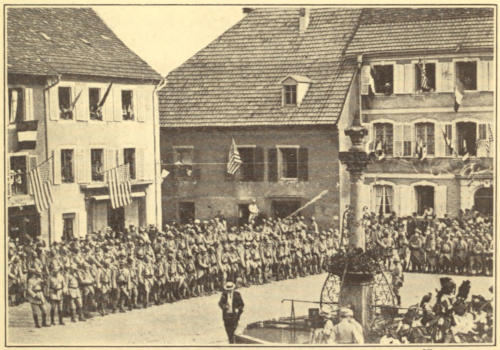
THE FOURTH OF JULY, 1918, IN ALSACE
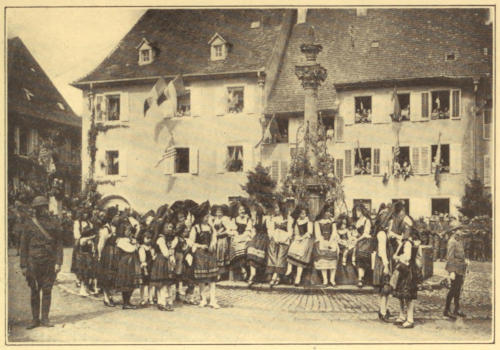
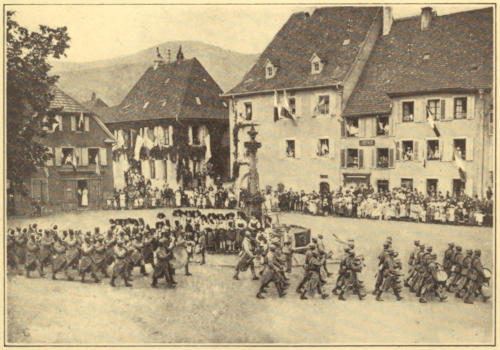
PLACE DU MARCHÉ, MASEVAUX, JULY 14, 1918
About this time I begin to remember that it is “La
Toussaint,” and I say that if possible I should like to
go to church. This, too, is encouragingly easy and I am
turned over to an officer whose wife and two children
have been in Brussels for four years, he himself a deserter
from the German army.
When we reached the church, built of grès rose,
evidently and happily, from its abundance, the building
stone of this colorful corner of the world, and which can
take on the loveliest of patines in even a generation or
two, I find it overflowing with the faithful, many blue
men standing on its pink steps. The curé, followed, I
hope, by his flock, was off on a longish sermon, and for
a good half-hour I was washed and blown about on a
sea of mixed metaphor, though it did not seem too long,
for mind and imagination were flinging themselves about
reconquered lands and border peoples, and I only really
“came to,” so to speak, when a great and splendid
organ sounded and a deep, harmonious choir of men’s
voices joined it. Then I knew I was indeed on the
frontier, where music lingers, and amorously it would
seem, near the last of the mad, Romantic peoples.
When we passed out there was the noise of guns and
everybody was looking up at little white balls of shrapnel
unrolling themselves about some black specks in the blue,
blue sky. It was the familiar firing on German airplanes.
Then I was led to this charming old house, which is
one of six placed at right angles, on two sides of the
Place du Chapitre. It proved to be part of the old
convent, done over by Kléber when he cultivated the
arts of peace rather than those of war. It belongs to
four agreeable sisters, the Demoiselles Braun, whose
brother, also a deserter from the German ranks, was
killed in Champagne. They were rehanging the portraits
of their ancestors.[4] Whereby hangs the tale of
two American nurses who, quartered there some weeks
before, had left the water running in the tub one night,
after which the drawing-room ceiling fell in and the paper
peeled in hall and vestibule. Hence the rehanging of the
ancestors, at their own, I mean the sisters’, expense.
They take me up a beautiful, but very worn, stairway,
with a time-polished oaken balustrade, and I find myself in
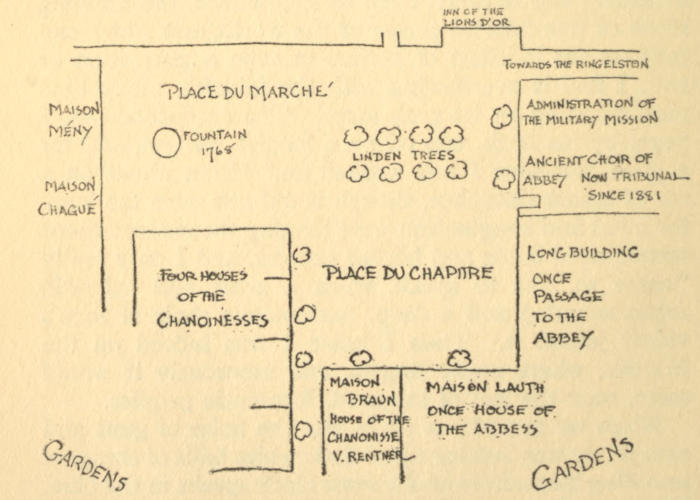
a paneled room, looking out on the square shaped like this:
Many motors are drawn up in front of the Mission
under the yellowing lindens. The old red inn of “Les
Lions d’Or” is directly opposite, and on the left of the
square at right angles with me are the four other houses
once dwelt in by the chanoinesses when it was decided
that each should have her own establishment. The
square is roughly, anciently paved, with grass growing
in between the cobblestones, and Mademoiselle Braun,
who showed me to my room, told me the steps of the
old stairway were so uneven because after the Revolution
(during which the Chapter had been dispersed)
the house was long used as a school and they had been
worn by generations of young feet running up and down.
At 12.15—I am conveyed to la popote[5] for luncheon.
More officers inspect me—I them also—and then we
proceed to the consuming of an excellent meal, to the
very exhilarating accompaniment of the news of the
capitulation of Turkey, and a light, easy touching on
other prospective and pleasant changes.
Now as, owing to circumstances too long to enter
into, I hadn’t eaten since noon the day before, passing
by Chaumont, I did full justice to a rabbit white as
snow, garnished with noodles of the same hue, flooded
by a delicious golden sauce. I only fleetingly remembered
that I ordinarily avoid the little beast as food; for dessert
we had a great cake filled with chocolate and
whipped cream, such a one as I had not seen for many a
month and year. A bottle of champagne was opened in
joy at the Turkish news. And we drank to everything
and to everybody—even to the health of the “Sick
Man of Europe,” not, however, sicker than several
others at that moment, as some one cheerfully added.
It was all very pleasant, and I felt that everything was
for the best in the best of war worlds.
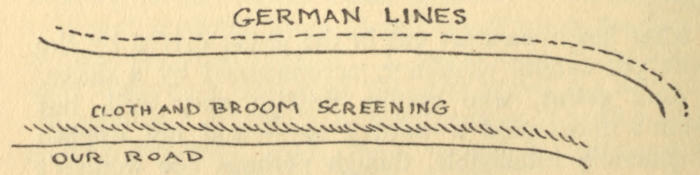
At 2.30 I start out with Captain Tirman over a
smooth road, camouflé, kilometer after kilometer, with
screens of wire netting interwoven with broom and
pine branches, for the road runs along the side of hills
which slope down to the valley where the Germans
lie intrenched. Everywhere are shell-holes, new and
old. We stopped on a high place and, getting out,
peered through a hole in the screen. Spread out before
my eyes was the rich plain of Alsace, one of the world’s
gardens. Something crystal and shimmering half veiled
its loveliness, but its beauty and richness I knew for
the beauty and the richness of a thousand years of blood,
and many men had found it fair and panted for its
beauty and died for it.
In the distance, very white and shining, were the
chimneys of Mulhouse, and a pale-blue line against the
horizon was the Black Forest. All the time there was
the sound of cannon, ours and theirs, reverberating
through the hills. I was greatly moved, and started
to go higher up in the field, but Captain Tirman stopped
me, saying: “It will be better for you to get away
with your souvenirs than to take them unrecorded with
you to the grave. The Boches shell anything they see;
and we haven’t got our masks, either, in case they send
a gas-bomb.”
The roadsides were planted with cherry trees, scarlet-leaved,
the kirschbaum of Alsace. The hills had
great patches of velvety, rust-colored beeches; dark
pines traced black patterns through them, yellow larches
shone here and there like torches; a soft sun was dispersing
the last of the delicate, noonday mists.
Then we slipped into the valley of the Thur, where
lies the ancient town of Thann. From afar I saw the
lacy, gray belfry of its cathedral, pressed against other
heights of velvet rust and burnished gold. Nearby,
the hill of the Engelburg, with its broken, overturned
tower like a great ring, a souvenir of Turenne’s campaign
during the Thirty Years’ War, was soft and lovely, too.
The long street was sun-bathed, and filled with the
black-bowed peasants of story-books, and the blue soldiery
of the great war. I wanted to stop by a pink
fountain, near the richly carved portal of the cathedral,
but we feared to be late for the ceremony at Moosch
and hurried on.
At a place called Bitschwiller, however, we were
obliged to wait while an almost endless procession of
black-clad old men, women, and children, and blue-clad
soldiers wound across the road, from its pink
church to the distant green and yellow cemetery.
Furthermore, the Fifteenth New York Infantry—black,
black, black—is quartered at Bitschwiller, and
the most exotic sight I have ever seen were those khaki-clad
negroes in that valley, already very high-colored.
Suddenly against the steep hill, like a picture slightly
tilted back, we came in sight of the square cemetery of
Moosch.
Above and below it was framed by a line of helmeted
men in khaki, and as we neared I saw they were our
black troops; the horizon-blue of a French infantry
regiment made the frame at the two sides. High, high
up were a group of white- and black-gowned priests,
and red- and white-gowned acolytes swinging their
censers. At the top of the steep stairway, running down
the middle of the black-crossed cemetery, was a sacerdotal
figure, with outstretched arms, exhorting, and
around about the whole were groups of women and
children. We left the motor and walked over to the
cemetery, where I found myself standing near the
resting-place of Norman Hall, the first American to
die in Alsace. From the tall, black cross floats the
Stars and Stripes, and some one had planted chrysanthemums
thick on his grave. Peace to him. He lies
not far from General Serret, who fell, too, on the nearby
sacrificial Hartmannswillerkopf, where commingled lie
fifty thousand who at the word of command had put
out each other’s light.
After the sermon the negro band of the Fifteenth
played some grave and measured music, the French infantry
band then something a little too gay. As one of
the officers said afterward, “Cela a presque frisé la polka.”
Then the “Marseillaise” sounded and “The Star-spangled
Banner.” I felt my veil wet against my eyes
and my lips atremble as I thought, a second time that
day, how well, how very well, the soldier sleeps.
Above the cemetery in a higher contour of eternal hill
was a great patch of yellow and black and rust-colored
forest against a clear blue-white sky, in which tiny
black specks were moving eastward.
We waited to watch the negro troops defile. They
appeared very smartly dressed till the eye got to their
feet, and such a collection of ripped, torn, cut, down-at-the-heel
footgear was never seen! They seem to be
a flat-footed race, too. I spoke to a couple of darkies
very much en repos, who were leaning against a fence,
near the motor, as I got in.
One answered, with a broad grin, “You an American
from America?”
“Yes.”
“Well, have you heard dis here war’s about over?”
The coalest-black one then contributes this to the conversation:
“When peace is signed dis here nigger starts to walk
home.”
“What about the ocean?”
“I’ll take a swim, lady; the water can’t be no colder
and no damper dan dis here ‘Alice’ land.”
The mulatto by his side said, “I subscribes,” and
became a pale gray at the bare idea of getting colder or
damper.
Then we see Commandant Poulet, tall, blue-clad, with
high decorations a-shine, coming toward us, and he and
many officers are presented to me, after which I change
into his motor, and we start out over a magnificent
military road built since the war. It was begun and
completed almost miraculously, it would seem, in little
more than a year, and over it, safely hidden from German
guns, come and go the great military supplies of the
Alsatian front—troops, artillery, munitions, food, ambulances.
As we mount, mysterious, dissolving twilight views
present themselves near red cherry trees, burn against
distant blue hills, yellow larches illuminate other “hilltops
hearsed with pines,” and the beech woods are a
deep, deep purple. Then we plunge into the dimness of
the great cedar forests of the Route Joffre, talking, but
not too much, in the large, enfolding twilight, of the
war, and of Alsace of to-day. Commandant Poulet
has been in charge of the Military Mission since Christmas
Day of 1914, and I thought, rolling over the broad
road, contemporaneous with his administration, how out
of thousands, nay millions of men, his part during these
war years had been to construct and not destroy. He
told me that almost his first official act was to be present
at the burial of Norman Hall on December 26, 1915.
As we issue from the dark forest we find ourselves
on a crest overlooking many other twilit hills. There
is a pale, pale yellow still burning in the west, and the
most timid of evening stars shines above it. Then we
dip into the deep blue valley where Masevaux lies.
Peasants are hurrying to their villages, and there is
a continuous, but dull, sound of cannon. In the chill
of the fallen night we arrive at the Place du Chapitre,
the town dark, dark as we enter it, and no light in any
house. Having seen my pleasant room only in daytime,
I proceeded in hunting for the light to try to turn on
a barometer, then by another door feeling my way
along, I fumbled about an arrangement of mandolin
and pipe, then, as a last resort, I sought light from a
stuffed owl. After which I went into the corridor and,
re-entering the room, found the electric button just
where it ought to be—by the door.
A saving hour of solitude before I am fetched for
dinner, which was very pleasant, but I can’t tell about
it now, for sleep, dear sleep, is touching me, and it is
two days and a night since it has been near.
III FÊTE DES MORTS, NOVEMBER, 1918
Church again, seemingly in company with the
entire population, civil and military, after which
I flanéd in the old streets of Masevaux, word having
been brought that no motor was available for our
projected trip to Dannemarie. Indeed, I had early
noticed from my window much mounting in hot haste,
accompanied by the lively sound of two kinds of firing.
Some coup de main, I suppose.
I strolled about under an uncertain sun, occasionally
sensible of that delicate, not unpleasant smell of bark
and leather hanging on a windless air. About me was
that world of blue-clad soldiers, black-robed women,
and many children were playing in the pink and gray
streets; a group of little girls were skipping rope to the
words ein, zwei, drei, quatre, cinq, six!
The post-office of modern Teutonic origin still wears,
high up and indifferently, the Double Eagle, though
the more accessible Kaiserliches Post-Amt has been removed.
A little farther down the street is the old inn
of the “Golden Eagle” whose historic sign dates from
Napoleonic days, and which, as was pointed out to me,
turns its golden back disdainfully to the black, double
face of the once proud eagle of the post-office.
And this inn of the “Golden Eagle” hangs its charming
sign out on a corner of the square called “La Halle aux
Blés” (the Grain Market), surrounded by sloping-roofed,
roomy houses. In the center is a rose-colored
fountain, with three diminishing rose-shaped basins
around a carved central column.
And the cobblestoned square with its good fountain
and its comfortable houses—there’s even a stable and
a garage on one side—has something cozy about it,
its atmosphere that of a place long used by human
beings for the homelike customs of “the simple life,”
which last bears no resemblance to that occasionally
practised at great expense and inconvenience by those
who “need a change” and can afford one.
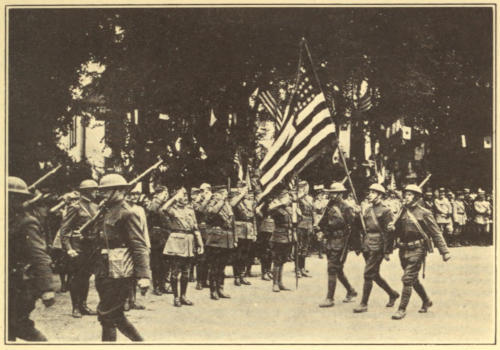
American troops passed through the Halle aux Blés
on the 30th of May of this year, again on the 4th of July,
and on the 14th, too, always drawing themselves up
at last in the Place du Marché, one end of which is my
Place du Chapitre. There, under the lindens, General
Hahn and General Boissoudy watched them deploy,
while gaily attired Alsatian girls grouped about the
fountain acclaimed them, and from every window hung
the Stars and Stripes.
Then I found myself wandering out on the road to
Belfort, past the high, grassy eminence known as the
“Ringelstein,” once crowned by the proud castle of
Duke Mason, founder of Masevaux. Traces of ancient
walls embowered in ivy are still to be seen, and at its
base are many old outbuildings of the seventeenth and
eighteenth centuries, once dependencies of the Abbey
and the Chapter, and when you are not expecting it
you find old inscriptions and bits of carving plastered
into them. On one high-roofed outhouse was a large
crown and three fleurs-de-lis. Blasted through one end
of the great rock of the Ringelstein rims the railway.
And there is a near view of the red and green and yellow
roofs of the houses of the chanoinesses confounding themselves
with the autumn foliage of the trees which embower
them.
I begin to know a little of the early history of Masevaux,
enveloped in legends and many contrary tales—Masevaux,
ruled now by abbots, now by feudal lords,
belonging sometimes to the House of Austria, sometimes
to the House of France.
And the first legend is that of its foundation. How
the lord of the country, by name Mason, a nephew of
Saint-Odile, was feasting in his castle of this same
Ringelstein, and the wines of Burgundy and Alsace and
of the Rhine were flowing, and a troubadour was reciting
a tale of war and love, when suddenly Duke Mason
cries out:
“Soul of my soul, misfortune is happening to my son!
Night is falling. Where is he?” And he goes to the
window and looks out. Some one answers:
“Fear not, illustrious father of so dear a child. He
has doubtless tarried with the holy fathers of Moutiers.”
But the night gets blacker, the lords and ladies drop
their golden hanaps and the troubadour is still.
Then Mason, in the grip of deeper presentiment,
cries out, “Who loves me to the succor of my son!”
And they seek with torches for the child. Alas! the
white body of Mason’s son, born of a dead, beloved wife,
is found floating upon the little stream, and Mason,
pressing what was once his child to his heart, cries out:
“Nothing can ever give me joy again. I will build a
monastery wherein to pass my days until God calls me
from this heavy world.” And that is the origin of
Masevaux—Masmunster. The legend has it, too, that
on moonless nights the child returns, weeping, because
he did not live long enough to read all the beautiful
stories inscribed by the gods, the prophets and the
wise, concerning the sons of men. And as I looked up
at the great grass- and vine-covered rock whereon the
castle of Mason once rose, the Doller flowing at its base,
the cannon of the great war sounded. Down the white
road was disappearing a battalion of blue-clad men,
going toward the black and rust and yellow of the hills—a
red cherry tree between me and them. Then I turned
back into the town and hied me to the popote, where
some half-dozen extremely agreeable men were awaiting
me, as well as a sustaining repast.
The American communiqué was immediately and very
appreciatively read out. Our victorious advance was
continuing along the Meuse (known as the “Muse” by
the doughboy), the First American Army attacking on
the west bank in liaison with the Fourth French Army
on the left. Then we looked over the Turkish armistice
terms, quite satisfyingly comprehensive from the opening
of the Dardanelles to promises on the part of the
Turks not to speak to any of their former friends.
And we talked of how from the terrace of Versailles,
where the German Empire was proclaimed, the statesmen
of the world will watch the twilight descending
upon Walhalla and its gods; and here in Alsace the crash
of falling temples can be heard.
After lunch I went with Lieutenant Lavallée to see a
bit of Alsace from within, for he was to invite various
mayors of villages to go to Paris for the “Fêtes Alsaciennes,”
to be held the middle of November, and also to
select a discreet number of veterans of 1870 and school-children
of 1918 to accompany them.
We went first to Gewenheim, a somewhat war-battered
village and, as we entered it, Lavallée pointed out the
iron plate on the sign-post, indicating the name of the
village and the department. Like many others of the
Haut Rhin (Upper Rhine), after 1870 it had been quite
simply turned and marked in German. This proved
most convenient and economical, for all the French
Military Mission had to do when they came to Alsace
in 1914 was to turn them back as they had been before
1870!
The mayor’s house, one of the usual dwellings with a
small door for humans and a big door for harvests, had
been much damaged. Passing in through a sagging entrance,
we found the mayor, the classic, horny-fisted,
wrinkle-faced mayor of a village, with cobwebs and
straw and other substances adhering to his coat, but
possessed of a certain air of dignity and authority notwithstanding.
There was a moment’s silence after the
lieutenant gave him the invitation, pride visibly wrestling
with parsimony, accompanied by the working up
and down of a very prominent Adam’s apple. He accepted
finally with a sort of “I am a man” expression,
but there was a quite apparent melting of his being when
he found that it was the State that would defray expenses.
Then the wife of his bosom, who had helped him make
and save his money, came in and showed us some of
their “best” shell-holes, and a statue of the Virgin of
Lourdes under a large glass bell which had not a scratch,
even, though everything around had been shattered.
There was also a lithograph of Henner’s red-headed
“Alsatian Girl,” who hangs in every home and every
railway station, and is used for loans and appeals and
calendars and advertisements of complexion washes and
hair-dyes; and she was once a charming creature, before
familiarity bred contempt.
The worthy couple then fell to a discussion in Alsatian
German as to which of the veterans would be possible
candidates for the trip to Paris. There seemed to be
something the matter with every one mentioned. Rudler,
Franzi, was nice and it was a pity that his rheumatism
prevented his getting about, as he had lost his
dung-heap, though not his house, in a recent bombardment
and needed distraction. It wasn’t quite clear to
me how you could lose a possession of that kind, but I
wasn’t at the front to ask questions, so I let it pass.
Handrupp, Hansi’s, eyes were giving him trouble. If
he went, a boy would have to go to lead him about,
and, even so, would he be welcome in Paris if it were
known that his daughter, old enough to know better, had
run away with a German?
First names, it will be noticed, came last, and last
names first, a relic of German order. Another incautious
but evidently esteemed veteran, by name Bauer,
Seppi, had fallen from a hayrick last summer and would
never walk again. It was like looking at the back of
the web of Fate, and I found myself wondering with
somewhat of exasperation, “for this had a hero’s death
at Gravelotte or Villersexel or Saint-Privat been denied
him, where angels would have awaited his strong, young
body to take it to the heaven of those who die for
country?” Suddenly the dulce et decora of so dying was
quite clear to me, and Bauer, Seppi, who fell from the
hayrick last summer, and all his still extant contemporaries,
had the tragic part—as would these men of the
great war some forty or fifty years hence, who were now
going about with an astonished yet proud consciousness
that, ex millibus, they had been chosen and been spared.
But as Lavallée very justly remarked, “What would
happen to the world if everybody died young?” I suppose
he is right, and I bethought myself that there are
those who must await threescore and ten before the
reasons for their having been born are apparent; the
“Tiger,” for instance, and Moses, and many others.
We then visited the curé, living at the very end of the
village toward the lines. He was called from the church
where he was hearing confessions, and Lavallée proceeded
to ask him which of the schoolboys he recommended;
wideawake ones, without, of course, being obstreperous,
were wanted. Something, disappearing almost as swiftly
as it came, passed over the curé’s face. It was a look of
sudden, nearly overwhelming desire to go himself, and
the immediate realization of the impossibility of that
or anything else that meant change.
On the round center-table was a book, Deo Ignoto,
and L’Echo de Paris. A little harmonium with manuscript-music
on its rack was near the bed; on the walls
were shiny lithographs of three popes, and an illuminated
Lord’s Prayer in German. As the upper rooms of
the house were “unhealthy,” on account of the raids
and bombardments, the curé lived and breathed and
had his being downstairs in this one room, with a rather
boisterous yellow dog that kept sniffing at my gaiters.
He was a large man, with a naturally masterful eye,
who would have been at home in many places, occupied
with many things, but he had lived, and would die,
Curé of Gewenheim. And he at least owed the Germans
a temporary widening of his activities, for Gewenheim
is but three kilometers from the firing-line.
Then we crossed the muddy street to the schoolhouse
to confer with the nuns concerning little girls, and were
greeted by a dark-eyed, sparkling-faced Sister, very
gifted by nature, who would have graced any drawing-room.
There was something of elegance even in the way
she had the washing of the stairs cease to allow us to
pass up, and in the way she removed piles of coarse
linen from the chairs in the room to which she conducted
us. Then another Sister, not so bright, though she
evidently ranked the gifted one, came in, and together
they pondered the names of possible little girls. I had
a feeling of being behind the scenes, and recognized how
orderly and reasonable is the working of a so-often
fortuitously appearing Fate, as they decided who should,
or should not, take the journey to Paris. I thought,
too, that it would have been well-nigh intolerable to me,
had I been a little girl in Gewenheim, not to be among
those chosen to go. But there was no longing on either
of their faces. Especially the charming one radiated
happiness and content. And how true that nothing
can enter the heart that is not already there! I wondered
if I, to whom so much of life is known—its glories and
its miseries—possessed what that graceful woman had
found in the dullest routine of duty imaginable. She
knew whither she was bound, also whence she had come.
In comparison, shaking, shifting, uneasy, appeared the
compass of my life....
A bottle of quite sour white wine was produced and they
watched Lavallée and myself drink; no escape possible.
They are of the Sisters of the Divine Providence with
their mother-house at Ribeauville, who have taught in
the schools of Alsace for generations.
After leaving them, we visited the inn, entering into
the Gastzimmer through a tiny antechamber of a
shop, where thread and candles and oil for lamps, socks,
and a few other strict essentials were sold. The black-toothed,
thin-haired landlady, Tritter by name, might
have been of any age, but a handsome boy of fifteen
or thereabouts, with a bad cough, calling her “Mother,”
gave a possible limit. A good-looking, high-complexioned
girl appeared breathless from a bethumbed back door,
arranging two little curls under her ears. After the
greetings, Lieutenant Lavallée said:
“Have you had any news of your daughter Odile?”
“Not since last winter from Colmar,” both mother
and sister answer; “the parcels we sent her, they cost each
fifteen francs, have not been received. She was hungry
when she wrote.”
Then was poured out a confused story concerning the
capture of a squad of Germans with their gun, in the
autumn of 1914. A few days after the event the sisters
had been standing in the street in front of their door,
when a German officer came up and said to Odile, the
younger:
“You are wanted for a moment.” She followed him
to another officer on horseback, waiting in a field. They
had not seen her since. Then it appeared that it was the
baker’s wife who through jealousy had denounced the
pretty Odile (the rôle of the baker himself was not indicated),
but such an expression of hatred for the baker’s
wife, rather than for the Germans, came over the mother’s
visage that I was reminded of faces in pre-Raphaelite
pictures—I mean those on the goat side in Judgment Day
scenes. It was evidently one of those obscure yet ruthless
village tragedies set in the frame of equally ruthless war.
When we came out we copied an old inscription over
the house door of a man, Louis Vogler by name, who, returning
from a campaign, had been decorated with the
Legion of Honor in 1816, and had recorded the fact for
all time over his door, his decoration even being carved
in with the rest.
Evidently a man who, having done a deed, was not
content that it should be writ only in water (or blood),
but had it put squarely and clearly over the door of the
house to which he returned; and was he not justified?
For here it is being recorded some hundred years after,
instead of having been carried away on the great river
of Napoleonic deeds.
Then, through several wet villages, groups of girls
with their felt slippers stuck into their clacking wooden
sabots (very comfortable footgear, it appears) pass
groups of blue-clad soldiers, and words are exchanged.
I couldn’t hear, but by the looks accompanying them and
the giggles I judged them to be the eternal words exchanged
in all ages between soldiers and future mothers of
the race. And there is a verse, old as the army, which runs:
Everywhere along the road, through the mist, detachments
of blue-clad men would appear and disappear.
I thought with a touch of sadness, an esthetic sadness,
to be sure, that this extreme beauty of dissolving distances
would be lost when the world of blue-clad men
would have disappeared, replaced by men in shabby,
nondescript, civilian clothes, or by des types à melon ou à
tube—those wearing derby hats or cylinders.
Near Rodern, between some lines of poplars, a helmeted
cavalryman, with his detachment, rode by on a
great black horse. He was bending slightly forward,
his lance in his hand, his eyes looking straight ahead, his
ample, light-blue tunic almost concealing his saddle.
He was a pure French type, pale of face, with black
hair, black mustache, slanting nose, and I knew him for
the archetypal Gallic warrior as he has appeared
through the ages, making epics for France.
At Bourbach-le-Haut, Lieutenant Lavallée was to invite
a last mayor to partake of the trip to Paris, and hunt
up some remaining veterans. Whatever gentle thirst
I had had for mayors and veterans being now quite
slaked, I went to the little church, instead of to the
Mairie. Through the half-open door came light and
chanting sounds. I went in to find a dim interior, with
an ancient arch framing the altar space, in front of which
was a narrow, black coffin. Only some very old bit of
mortality, waxy and shrunken, could lie within. Women,
children, and what may have been veterans were saying
the rosary in German—the Sorrowful Mysteries—and I
thought on my dead, and on that dear and holy brother
born into the world on this day long years ago. In
Alsace he had desired and received, dreaming and adolescent,
the baptismal waters.
Sadness invaded me, even as the dreary night was invading
the day, and I would have groaned aloud, but I
saw Lieutenant Lavallée standing by me. Haunted by
the mournful chanting, with its mysterious indications,
“Jetz und in der Stunde unseres Absterbens, Amen,” I
passed out into falling night and rain; dark masses of
mountain loomed up, lighter spaces were the stretching
valleys. Soon we found ourselves on the deep road to
Masevaux, I lonelier than the loneliest of the dark and
hurrying clouds.
IV THANN AND OLD THANN
Sunday morning, November 3d.—Awakened at
six by heavy firing. After wondering what could
be happening, I remember that life, as far as I am concerned,
is for the moment largely joy, or rather joyous
riding, with a series of agreeable French officers (they
certainly are of an amiability!), in a series of large,
powerful military motors, through a series of beautiful
autumnal hills, over a series of the newest and most
wonderful of war roads.
Enough church-going, however, as will have been
noticed, to keep me mindful that man, and woman, too,
is grass, and though it, or rather she, springs up in the
morning, she may be cut down by night, and that this
bending of the hills is by the journeys of her eternity.
Well, to get to the point, or rather to Thann. We
started out early, at nine, for I was to find a Mass in the
cathedral, after which we were to proceed to Vieux
Thann, where war has not spared the church nor left
worshipers.
Again we took the screened road overhanging the
valley. Again we stopped on an eminence and climbed
into a field, and again I was shown the blue valley, over
the tops of some red cherry trees. Nothing detached
itself from gradations of velvety mists and beaming distances,
but I knew that on the grape-planted slopes of
an unseen river that other wine of defeat was being
drunk from cups held stiffly to unwilling lips.
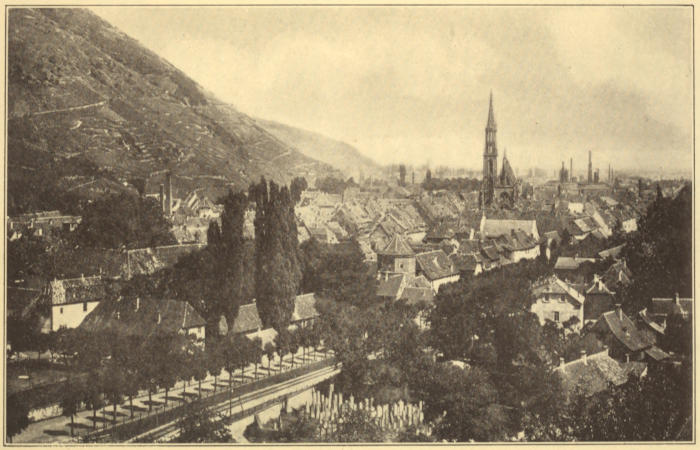
THANN AND ITS VINEYARDS
As we dipped down into the valley of the Thur, the
belfry of the church of Thann appeared, so mistily,
lacily soft that its form and substance seemed but as
something breathed into the air, at any moment to be
dissolved, against hills that were like brocaded stuffs,
whose gold would be very thick if one turned them
wrong side out. My heart was stirred because of the
fairness of the Sabbath world.
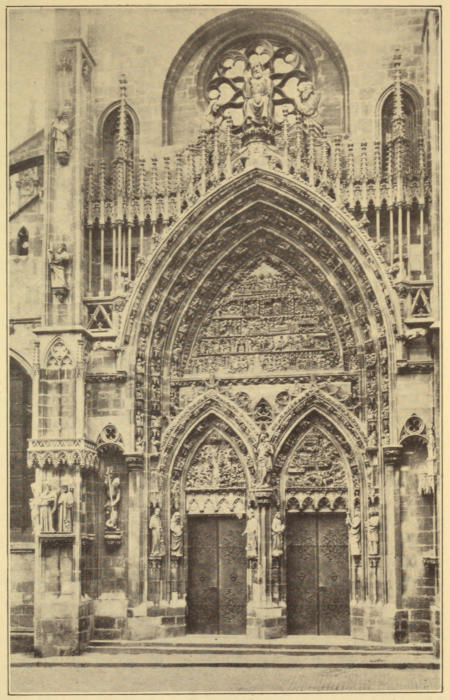
We drew up in front of the gorgeous portal of the
cathedral, once a deep pink, but with time grown
paler and softer at all its edges, and whose boardings
and sandbags now partly hide the carved story of the
life of Christ and His Mother. We grope our way in
through several swinging doors, and find the high,
Gothic space filled with a misty yellow light coming
in through narrow windows, covered with oiled paper,
the precious stained-glass having been long since removed.
Little by little the forms of kneeling women and
children, and many soldiers standing, detach themselves
from the lovely gloom. The green vestment of the
priest at the altar, on which are six tall, crystal, wide-branched
candelabra, misty like the rest, is the only
spot of color, for the splashes of horizon-blue become
nearly white after a strange fashion of this color in dim
light, whether of church or falling night. In the ancient
wrought-iron pulpit the curé was just finishing a sermon
in French, immediately beginning one in German. It
appears that as the communiqués improve, the French
sermon gets longer, and the German shorter, and mercifully
neither is long.
We passed out quickly after the “Ite, missa est.”
I had been feeling that Captain B—— might be in a
hurry, but when I looked about to see if he were fidgeting,
I found him doing what any miles gloriosus should
be doing from time to time, saying his prayers.
And this is the story of the building of the church
of Thann, and of its arms, which bear a single pine tree.
Death found the holy Bishop Théobald in the Umbrian
Valley, and, knowing that his hour had come, he said to
his servitor Maternus, who knelt weeping by his side:
“Thou knowest I leave no worldly goods, for the
poor have needed what I had. But this sapphire ring,
dear memory of her once loved, take it, thou, that worms
may not dwell within it.” And then he entered into contemplation,
saying nothing further of the things of earth.
When Maternus had made ready to hide his master’s
body from the light, he tried to take the ring from its
finger. But with the ring came the finger, and both
were inclosed as in a shining rim.
Maternus, greatly wondering, hid the precious relic
in a hollow place in his staff and started back to Alsace,
begging his bread along the way. After many delays,
having been set upon by wicked men and molested by
prowling animals, he finally arrived in the valley of the
Thur.
Exhausted, he laid himself down to rest, placing
against a pine tree the precious staff. The next morning
he was awakened by the ringing of the Angelus, and
when he started to grasp his staff he found that it was
as if grafted on to the great pine, while to left and right
were burning two tall, pale, sapphire flames.
At this moment the lord of the Engelburg came by,
the ruins of whose great castle are those one sees rising
above the town of Thann. He had perceived the two
blue flames from afar and, hastening to find out what
they signified, he recognized Maternus, faithful servitor
of his friend Théobald.
Maternus then related the death of the saint in the
Umbrian plain, showing him the finger and the ring;
whereupon the lord of the Engelburg, weeping and
sighing, cried:
“Oh! my precious friend Théobald; oh! my dearly
loved sister Adelaide, this is thy betrothal ring, and
these two sapphire flames announce thy union in dear
heaven!” (In those days they were quick to see divine
meanings.)
Now, the so well-loved Adelaide, in her green youth,
had been struck by a bolt from heaven, after which
Théobald, for whom the whole round earth held nothing
more of value, had consecrated himself to God.
The lord of the Engelburg, his gaze fixed upon the
luminous finger and the familiar blue ring, knew soon
the too often hidden will of God, and cried out again:
“Here I will build a church, and its reliquary shall
contain this precious ring and finger.”
And so was built the church and monastery of Thann,
and about them grew the town, and during long centuries
on the vigil of the feast of Saint-Théobald, a freshly
cut pine tree was placed in front of the cathedral,
flanked by two great wax candles. Nor can any one,
even of the very positive-minded, who look no farther
than stones and mortar for all meanings, give a better
reason for the arms of Thann.
Then we motored on toward Vieux Thann, half destroyed,
and evacuated since 1914, but were obliged to
leave the too visible motor on the outskirts of the village,
creeping close along a very high screen of wire and broom
branches that we might not be seen by the enemy. For
we were in the plain of Cernay, now known as the
Ochsenfeld, once called the “Field of Lies,” where the
three sons of Louis le Débonnaire routed their father’s
army. Lothair, Louis, and Pépin were their names.
But of all this another time.
Vieux Thann is a half-demolished, echoing, empty
town, with a background of neglected vineyards on
very close-pressing hills.
Everywhere were signs of German war occupation.
The schoolhouse had been their evacuation hospital,
and one of the old inns bore the sign, “Verband-Station.”
The only living things in Vieux Thann were the fountains,
quite lovely in the pink-stoned, gracious Alsatian
way, with their gentle, unhurried streams of crystal
water. It all reminded me vaguely of Pompeii, even in
the misty light of a northern Indian summer sun.
Above, in the perfect blue, the usual firing on German
airplanes was going on. Long after the black specks
had disappeared to the east the little, round, soft,
compact balls of shrapnel were still slowly unfolding
themselves.
About fifteen hundred feet from us were the battle-lines,
where the French and Germans have faced each
other in the “Field of Lies” since 1914.
One of the battered inns, “Zum Goldenen Lamm,”
has its once lovely old sign still hanging out, but the
golden lamb is gone, and only his golden feet and the
green wreath of laurel that once entwined him remain.
And to what winds had the dwellers of the great
village been scattered? Where had they been received,
unwillingly, by strangers, those hosts of refugees, fleeing
from their homes, red with excitement, bright-eyed,
voluble? I’ve seen them, too, after months of treading
up another’s stairs and eating of the salt bread of charity—pale,
silent, dispirited, returning to villages like Vieux
Thann, to see their all among disorderly piles of fallen
stones and crumbling mortar....
Back to the living city, to an increasing sound of
cannon, but the Sabbath stillness was so deep nothing
seemed really to disturb it.
The cathedral with its single, finely pointed tower
was like a needle everywhere threading up long streets.
I had a desire to see it empty, and as I entered, its perfect
proportions gave me a sweet and satisfying welcome.
The red lamp of the sanctuary was now the only
spot of color in the thick yellow gloom, out of which
line and proportion gradually detached themselves.
The celebrated choir-stalls had been removed to Sewen,
but above the altar of the Virgin is a Gothic triptych,
and the beautiful pulpit is of fifteenth-century wrought-iron.
We groped our way into a low, vaulted chapel
which existed even before the church was built, passing
a tombstone bearing the arms of the house of Ferrette,
a family once all-powerful in these valleys. Over the
altar of the chapel is an ancient statue of Saint-Théobald.
He has a long, thin, shaven, upper-class face,
his eyes are bent, and he is looking perhaps as he did
shortly before death found him in the Umbrian Valley.
It is the visage of a man having done with personal
things, and a great pity is woven into the downward
curves of the benignant face.
We drove back to Masevaux, over one of the splendid
new war roads, rising and dipping through forest-covered
hills. The brilliant sun shone athwart each
leaf, still dewy and sparkling, and a strong, rich, autumnal
smell exuded from the earth. It reminded Captain
Bernard of hunting before the war, that carefree chasse
d’avant-guerre, and I thought of Hungarian castles, and
long days in forests, walking through rustling leaves,
or sitting silently in glades with men in green-brown
hunting garb, awaiting the game. In the evening,
shining dinner-tables, and talk about the day’s bag
by men in pink hunting-coats and women wearing their
best gowns and all their jewels.... And much that is
no more.
We descended at the popote as the hand of the church
clock pointed to 12.15. Blue-clad officers were standing
by the windows reading the Belfort morning paper just
arrived, and the Paris newspapers of the day before, as
I went in.
The enemy is beating his retreat through the Argonne
Forest, to the sound of the hour of destiny, and there
are armistice and abdication rumors, and indications
that they want to sauver les meubles, or, as they would say,
seeing they’ve got into a bad business, retten was zu
retten ist—i.e., German unity, which, saved, means all
is saved. But there are strange dissolvents infiltrating
everywhere, scarcely any substance can resist, and the
blood of peoples boiling over, and much good broth
spilling, and too many cooks everywhere. For what
man but wants to try his ’prentice hand at seasoning of
the mess? And it was all talked about to the consuming
of Mère Labonne’s especially excellent Sunday dinner,
an example of la vraie, la délicieuse cuisine française
bourgeoise. There were pieds de veau that melted in
the mouth, and creamed potatoes, after which a very
delicious hachis, with some sort of horseradish sauce,
and when I remark that it has also a touch of garlic,
Sérin cries out, “But not at all—it’s only horseradish.”
On my being supported by everybody at the table,
he finally says, with an innocent but somewhat discomfited
smile, “It’s true that there must be a lot for me
to notice it.” Then he tells with gusto of a repast in
his dear Toulouse where there was a whole cold pheasant
for each guest, and each pheasant was blanketed with
such a thick cream of garlic that the bird itself could
scarcely be seen. “It was exquisite,” he added. “I
dare say; one can even smell it here,” some one cruelly
finished.
Then they spoke of how the French had supported
captivity better than the English, and why.
“We always talk while eating,” said Bernard, “no
matter how scanty or ignoble the repast. It’s our hour
for relaxation.” (Any one lunching or dining at French
officers’ messes will have noticed this.) “But with the
English it is different. They eat silently, and in captivity
they easily get the spleen and fall into melancholy,
because the food isn’t served as they would like, or
because they can’t wash or shave or exercise.”
And I told the story of the brother of a French friend
whom I had recently seen, just back from nearly four
years’ captivity, who returned in such a stout, rosy condition
that his sister was ashamed to show him, and when
asked about her pauvre frère would blush.
We sat long, talking now of books, now of personages,
now of local happenings, Sérin telling of passing that
morning through one of the smaller villages where even
the young girls had saluted him with a military salute
as he rode by—and one of the officers said, with a flash,
“Très délivrées celles-là!”(“Very delivered, those!”) Then
some one told the story of the man who came down to
Masevaux to make a book on Alsace and, seeing the line
of the trenches marked that day in blue on the commandant’s
map, remarked, in a dégagé way, “Le Rhin,
n’est-ce pas?” (“The Rhine, I suppose?”)
“Not yet,” was the quiet answer.
He then rushed them all off their feet for ten hours,
after which, having got what he wanted, he went back
to Paris and wrote his book. And from what I hear it
wasn’t a bad book, either. Though one of the officers
said he knew he could do the same about Prague or
Peking, that he’d never seen, with some books, a good
pair of scissors and as much paste as he wanted.
All is handled lightly, as only a group of Frenchmen
could handle it, glissant, n’appuyant jamais, each bringing
his little gift of wit and culture, enjoying the impersonal
with the same pleasure as the personal, in the
French way. Of course, the communiqués are as honey
after four years of bitter herbs, very bitter, even though
distilled in extinguishable hope.
And I must say that to me lively and untrammeled
conversation is the salt of daily life; and if, as it sometimes
happens, one’s own thoughts are expanded,
brightened, and returned to one, it is indeed delectable
above all things, the true salt to be used in quantities
(if you can get it). For, alas! the majority of people
have no ideas, when you come down to it, or, having a
few, they are pig-headed and look but into the converging
point of the angle, knowing nothing of the
splendor of diverging lines where self is swallowed up in
unself. And there are the close-headed, whose minds
work slowly in a cramped way, or not at all, and they
are forever complaining that they only think of things
to say when they get home and the lights are out.
They might just as well not think of them (one sometimes
doubts if they really do) for all the good they are
to their neighbors. And there are those very thin-skinned
ones who immediately get contentious, and think the
arrow is meant for them instead of the universe at large,
and one could go on indefinitely through the list of impenetrable
heads, to whom the blow of an ax is as the
brush of a feather, or cushiony heads that once dented,
however, never regain their contours, and many, many
others. These all need material sauces, good, rich sauces
to their food, or they would find it tasteless, not having
even a pinch of this other salt to season it with. And
they are mostly those who do not work, but whose
fathers worked—sometimes even their mothers—and
oh, là là, the subject is endless, for everybody talks—even
those who have nothing to say.
V THE BALLON D’ALSACE
Sunday afternoon.—At two o’clock I started
out with Captain Bernard and Captain Antoni
for the great mountain known as the Ballon[7] d’Alsace,
sometimes called, too, “the knot of Europe,” in an
especially high-powered motor (I never know the mark
of any of them, distinguishing a Ford from a Rolls-Royce
only by the generally pampered feeling pervading
me when in the latter).
The Ballon rises like a wall at the very end of the
valley of the Doller, and we passed through many villages,
shining pinkly in the prismatic November afternoon,
where there was much going into church for
vespers, of blue- or black-clad figures. The thirteenth
century-towered church of Sewen is on a slight eminence
in the heart of the village, and the cemetery around it
was crowded with the faithful, regretting their dead, or
some, perhaps, for one reason or another (What know
I?), feeling, “’Tis better they lie there.” “Live long, but
not too long for others,” is an excellent device.
The charming lake of Sewen, though far from the
village, seen from a certain angle, reflects the tower of
the church and is, they told me, of Moorish origin. These
valleys and hills seem everywhere like open books concerning
the dim, dim youth of the earth; I had a sense
of my transitories, with those lessons written everywhere.
And it is autumn, too.
We got out at the immense reservoir of Alfelt which
dams up dangerous springtime floods with its giant
wall of masonry, for from the “knot of Europe” loosened
waters flow to the North Sea and to the Mediterranean.
Climbing to the top of the rocky elevation, we read
on the monument the date of the inauguration of the
reservoir, 1884, and the name, Prince Hohenlohe
Schillingfurst, Statthalter.
And, looking down, the shining villages through which
we had just passed, Sewen, Oberbruck, Niederbruck,
Masevaux, are like beads on the thread of the lovely
valley, lying between the breasts of the hills.
The mountain-ringed lake of the reservoir reflects the
rich coloring of the hills in which it is set; white-stemmed,
yellow-leaved birches, blood-red cherry trees; rust-colored
beeches, larch trees shining like torches borne
by wanderers, on black pine slopes; all is seen twice—once
on the hills and once in the mirror of the lake.
Then we mount up, up, up, twisting and turning over
the magnificent military road, made like so many others
since the war, to become some day the joy of tourists,
when, thousands upon ten thousands, nay, millions upon
millions, they shall come from over ocean and mountain
to see what it all looks like and get the belated thrill.
Violet hills become black, outlined against a copper-colored
band of western horizon. Captain Bernard
points out some English airplanes just over our heads,
tiny, tiny specks hanging in a high waste of heaven,
and I wonder if in one of them sits my friend, the chartered
accountant of the Belfort train, fulfilling his destiny
in the air.
We leave the motor at the highest point of the road,
where trees no longer grow, and start to climb the
grassy crest, patterned with great brown patches of
barbed-wire defenses. Captain Bernard’s sharp eyes
soon discerned the chicanes, intricate, almost indistinguishable
pathways through the wire, and if one knew
them one could get through without leaving one’s
clothes. Breathless, we arrived at the table d’orientation
and find ourselves looking out over what seemed the
edge of the universe. In front of us lay the gorgeous
panorama of the Alps and behind it the wide band of
copper-colored sky, with here and there a burnishing of
glaciers by the dipping sun. To our left stretched the
immense and splendid valley of the Rhine, behind it
the Black Forest, clearly yet softly outlined against a
paler horizon. One could have rolled the whole earth
like a ball from the feet. I felt as if suddenly freed
from any heaviness of the flesh, and Goethe’s soaring
words brushed against my mind, and beckoned me on—those
words he cried after he had reached the Brocken
and was looking down on a cloud-covered Germany.
I knew those vast expanses for material out of which
a new earth, if not a new heaven, must be formed, on
some eighth day of creation. And the new earth was
to be made out of old and conflicting desires, worn,
yet persistent passions, small, yet greedy thoughts, the
whole about as facile as the weighing of the winds,
making one almost feel that He who worked with new
materials those first seven days had the easier part.
I was filled, too, with a great longing for an improbable
wisdom and strength to be breathed into the men who
are to reharness the plunging, escaping destinies of the
nations. Each man that has his hands on the reins seems
like some one clinging to a runaway horse, trying to
dominate a relentless, unreasoning, reckless course.
Reverberating through the eternal hills was the sound
of heavy cannon; and before my mind came a vision
of the great forges wherein they were formed, men working
day and night in hot, dim, noisy spaces—Creusot
and Krupp and Skoda, and all the rest....
Some near summit hid the dread Hartmannswillerkopf,
the “Verdun” of Alsace, and one of the officers
spoke of that winter of 1916, when its snow was always
pink with blood and black with death—“tens of thousands
sleep there.” I thought of the souls breathed out
into that pure, high ether, like to this, but cold, cold,
almost as tenuous as the immortal stuff commingling
with it.
Then we started to the other edge of the summit,
whence we might look into l’élégante et douloureuse Lorraine,
for one side of the Ballon slopes toward Alsace
and the other toward Lorraine.
As we threaded our way carefully through more
chicanes of barbed-wire defenses “that you had to have
your nose in before they could be distinguished,” I
discerned on the crag three familiar silhouettes, outlined
against the heavens toward the Lorraine slope.
And as things are rarely in their proper setting nowadays,
there on the Ballon d’Alsace were three dusty
Y.M.C.A. men who had come from their cantine at
Belfort. We spoke to them and gave our names, and
the brightest one, Tallant was his name, asked if I were
the wife of my husband—and said he’d been on the
Mexican border.
Then we told them where the table d’orientation was,
but forgot to point out the chicanes, and we saw them
from a distance entangled in barbed wire. Their souls
were safe, I hope, but heaven help those khaki clothes!
And looking down into Lorraine from my splendid
height was as if looking into another world, for its distances
were bronze and silver and pale green.
Great black spots of shadow cast by wasteful masses
of white clouds were lying heavily over those new and
ancient battle-fields. Forever obliged to protect themselves
from some invader, the villages hide rather than
display themselves, and are barely detached from the
silvery brown of the plain, crossed here and there by
the bosky lines of the Meuse, or those of the great canal
joining the French river to the Rhine. And each tiny
hill has been an altar or a fortress, often both at once.
Over the majestic, melancholy stretch Romans have
passed, the hosts of Attila, Normans, Germans, Burgundians,
Swedes, English, and many others. Now its
white roads sound to the tramp of American armies, are
encumbered by giant quantities of war material brought
from over the seas. And of all who have passed over it,
of the most ancient even, much remains. Close against
one another are Roman encampments, feudal castles, the
two-sided, two-faced bastion defenses of Vauban, the
great, mined earthworks of modern times, and now in
leafy darknesses are the cement emplacements of the
big guns of the twentieth century.
But alas! as I turned to go, pulling my gaze from the
wide horizon (a pale, pale pink where it covered the
western way to the city that is the heart of France), I
saw on that slope, directly under me, a cruel statue of
Jeanne d’Arc. A stiff yet boneless Pucelle sat astride
an equally stiff yet boneless steed; both seemed about to
drop into space, the mountain falling away from them,
and both were of a dreadful superfluity! However,
one isn’t so plagued with horrid modern statues in
Alsace as in other places I have been, for they run rather
to fountains and living waters. At St.-Amarin, for
instance, I don’t remember anything later or more personal
than the fiery Gallic cock, “der spuckende Welschhahn,”
surmounting a sphere, borne in turn by the
column of the 1830 fountain; and the fountain in the
Place du Chapitre at Masevaux, bearing the date 1768,
has a single, lovely column, too, on whose top burns a
stone flame in an urn. And the shaft of the fountain
of the wine-growers at Thann is a mass of rich yet noble
carving, surmounted by a helmeted figure bearing a
shield on his back. Furthermore, crystal water flows
into its six-sided emblazoned basin.
I think of the statue of Thiers, Libérateur du Territoire,
in that dusty, begonia-planted, iron-railed plot
in front of the station at Nancy, and I could weep.
But hereabout I haven’t found a single nineteenth-century
statesman in frock-coat and top-hat, done in
granite, nor any bronze female pointing him the way to
a dubious heaven, with a long finger and a heavy palm-branch—and
so may it remain.
Certainly the très chic chef of the Military Mission
will be well punished for his good works in Alsace if they
ever raise a statue to him. For they will make him, too,
out of either bronze or marble with a plaque de commissaire
on his frock-coated breast, and heaven knows what
kind of a hat they’ll put on him, or how the fancy will
seize them to do his hair! And the statue won’t be of
lapis lazuli, as it should be, nor of pale sapphire, nor of
dull turquoise, nor of any of the lovely blue stones of
the earth, alone fit to perpetuate the beauty of the blue-clad
men who have written France’s greatest epic.
Blue-clad men splashed about fountains at twilight,
blue-clad men taking form and substance as they emerge
out of gray mountain mists, blue-clad men weaving
their cerulean patterns through the woof of long-trunked
pine forests, blue-clad men like bits of turquoise
embedded in the matrix of white roads, and what know
I besides?
As I gave a sigh for Art and a prayer for the serried
ranks of her erring devotees, I found myself looking into
another splendid valley, toward Giromagny, near where
is a height known as La Planche des Belles Filles, after
a story of the Thirty Years’ War, when men with blue
eyes and very light hair and skin were for a while masters
of the domains of Belfort and Ferrette. After the
best manner of invading armies, ’tis recorded that these
Swedes committed many excesses, and dark-eyed girls
lay concealed in the forest, and when they feared their
hiding-place had been discovered they fled to the mountains,
but even there they were pursued by the hosts of
fair-haired, fair-skinned, blue-eyed men, bent on the
most elemental of errands. And again they fled precipitately,
scarcely knowing their direction. When they got
to the top they found themselves on a great ledge of
rock and in their distress they tumbled from the height
onto other rocks below, and the blue-eyed, fair-skinned,
fair-haired men from the North knew them not. Hence
the “Ledge of the Beautiful Girls.”
And then we took a last look at the vast heaping of
the Alps; to the left, the Jungfrau and the Mönsch, to
the right, Mont Blanc, the whole great mass outlined
against that persistent dark-red band. The glacier of
the Jungfrau was as if in conflagration; Mont Blanc was
soft and roseate, yet its beauty left me cold.
Captain Bernard said he had climbed the Ballon many
times and only twice before had he seen the great panorama;
but as, alack! to him who does not want shall be
given, except for their gorgeousness, I would have
turned from them indifferently, had not my beloved
mother been dwelling almost in the shadow of Mont
Blanc.
But one[9] has written, as men of genius write of things
in times of peace, of this Ballon d’Alsace. He who
brought out from his Gallo-British mind new things and
old has said in one of the most charming of books: “Then
on the left you have all the Germanies, a great sea of
confused and dreaming people, lost in philosophies and
creating music, frozen for the moment under a foreign
rigidity, but some day to thaw again and to give a
word to us others. They cannot remain long apart
from visions.” I thought they have, indeed, given a
“word.” But when again the “visions”?
I turned and followed my two blue-clad officers down
the Alsatian slope, over the gray grass, threading neatly
through the chicanes of the brown, barbed-wire defenses,
and got into the motor waiting on the roadway once
known as that of the Dukes of Lorraine.
We were silent as we started down the great mountain.
I was again wrapped in thoughts of the New Day
to be created out of old and rotting stuffs, and of the
death of heroes. The hills were velvet-palled against
the deepening crimson band of light.
Later, a panne, and we waited in a violet-valleyed
world, illumined only by white candelabraed torches of
strangely luminous larch and birch, while the prudent
yet daring chauffeur changed the tire.
A great khaki-colored motor passed us, marked with
two stars, filled with khaki-clad men of my race, going
up, up, whence we had come.
Then we stopped at the little restaurant of Alfeld.
The lake of many colors was dark and mysterious. Its
high tints had been dipped in something deep in the
hours since last I saw it, though strange blues and
purples and rust colors were still reflected in it, and
the light of a single, very yellow birch had not yet
been snuffed. At the restaurant four glasses of white
liqueur were poured for us (one, of course, for the
chauffeur), distilled from raspberries, the odor of the
berry very strong, and long afterward the taste, the
arrière-goût, remains in the mouth, as if one had just
eaten the fruit. But one of the officers said, “All the
same, it doesn’t equal a good quetsch or kirsch or, above
all, a good mirabelle.”
And then we dipped into the darkening valley of the
Doller and through dim villages found the way to
Masevaux and the house on the Place du Chapitre,
where the Demoiselles Braun had tea awaiting us, and
there were stories told that made us laugh. And one
was of the renowned 15th Dragoons, so long quartered
there, which, briefly—and humanly—is this:
At intervals after their departure little dragoons saw
the light of a war-world, and, to be exact, fifty in all
saw it. The curé was broken-hearted at the ravages
among his sheep, but he was also a practical, long-sighted
curé, so he wrote, presenting his idea of the matter before
the colonel of the regiment, with the result that from
the savings-box of that same regiment a sum was subtracted
to provide ten years later for the first communion
and confirmation clothes of the fifty! (Would
you have thought of it?) Then, casting about in his
mind how he could further improve the general situation,
this time not so much from the temporal point of view
as from that of eternity, he decided upon a pilgrimage—a
pilgrimage of reparation to Huppach, where is the
shrine known as that of the Virgin of Klein Einsiedeln,
near Sewen, through which we had just passed. He announced
the pilgrimage from the pulpit, then took the
further precaution of rounding up his strayed sheep in
person, and in person conducting them to Huppach to
offer up prayers and tears to the Virgin of Klein Einsiedeln.
There were so many of them, however, and they
were mostly so young, that history does not record the
pilgrimage as being entirely without smiles—and God
have mercy on us all!
But the curé was not yet (so to speak) out of the
woods, for fate replaced the Dragoons by another regiment,
having, as it happened, a colonel possessed of a
boundless love for his men and who couldn’t do enough
for them (or rather have the inhabitants of Masevaux
do enough for them).
“The inhabitants of Masevaux are very nice, very
nice indeed,” quoth he, “but the happiness of my men
above everything. We left three thousand on the
battlefield last week, and the others need distraction—of
a pleasant sort. My men above everything.”
So the colonel who loved his men with a boundless
love and, furthermore, was not one to waste time in
vain endeavors to portray the eternal feminine as undesirable,
nor to render the chase unpopular, caused
dances to be organized on this very Place du Chapitre,
under these very linden trees, then heavy-scented, and
every evening. The curé, foreseeing trouble, with the
aid of Heaven and his own undiscourageable will, had
them suppressed after eight days (eight days is a long
time) of wrestling with leagued powers both civil and
military. And again God have mercy on us all!
Now the virtuous, I mean the truly virtuous (that
is, the untried, untempted virtuous), mustn’t throw
stones at Masevaux nor at this book, but rather remember
that anything could have happened to anybody had
everything been different. And even so, hasn’t a lot
happened to many of you? You know a good deal
better than I do just how much.
To the popote at seven-thirty, and before I’m an hour
older I’m going to tell you about the popote. And you’ll
wish you had been there instead of hearing about it—as
runs the classic expression, “Regarder manger des
glaces,” and I give the translation, “Watch others eat
ice-cream,” partly because I want you all to know just
what I mean, and partly because some one in the United
States wrote to my publishers that My Lorraine Journal
was a nice book, but couldn’t they suggest to me that I
write my books either in French or English.
Mrs. O’S.: “But, my dear Mr. Graham” (his name is
Graham, and this may be his chance of immortality),
“I couldn’t write one entirely in French to save my soul,
and to save my soul I’d find it impossible when everything
I’m writing about takes place in France not to
slip into la belle langue occasionally.”
Mr. Graham (from a distance): “Occasionally!
There you’re at it again. Occasionally!” (It does get
on his nerves.)
Mrs. O’S.: “And there is another saying to the effect
that ‘On ne peut pas contenter tout le monde et son père.’
That is to say, dear Mr. Graham, that you can’t please
everybody and your father as well, and this, of course,
mostly applies to young men (are you a son or are you
a father?) trying to win smiles outside family circles—and
father ultimately paying the bills. But as it occurs to
me here, there must be some connection.”
Mr. Graham: “I don’t see it. And while I’m about
it, I’d like to tell you a thing or two concerning those
Mexican books of yours. The Spanish was awful—even
The Yale Review and The Nation noticed it.”
Mrs. O’S. (getting a bit nasty): “It’s about all
either of them did notice, especially The Yale Review;
and nobody loves me on The Nation, but it was entirely
the printer’s fault. He received them immaculate. I
turned my face to the wall for three days after a glance
at A Diplomat’s Wife. But then you probably don’t
remember how perfectly sweet about these very books
The North American Review was (a man with the most
perceptive of souls and a neat flair for the imponderabilities,
named Lawrence Gilman, does their book reviews),
also The New Republic, which possesses a man named
Alvin Johnson, inexorably sure about the humanities,
separating with a single, infallible gesture the goats
of letters from the sheep (but he still thinks, alas! that
all men are born free and equal). And The New York
Sun was kind, kind, and The New York Evening Post, too,
and they do say this latter rarely says anything nice
about people till they’re dead and can’t enjoy it, and
The New York Tribune, which has the reputation of
being very particular about itself, and The New York
Times, which never jokes and is known as a searcher
after truth.”
Mr. Graham, dreadfully bored with me, mumbles
something like “this is what you get when you try to
do somebody a good turn.” I couldn’t catch it all, as
he’d doubtless continued farther on his journey through
the great Northwest. He wrote from one of a chain of
“Grand Trunk Pacific Hotels,” and all I can think of
to call after him is Bon voyage, though he won’t like it.
And now back to Masevaux in the valley of the Doller—Masevaux
smelling a bit like nice leather things
in expensive shops, with a hint of falling leaves.
VI LA POPOTE
And how shall he who has not dined be strong?
And how shall he who is not girded fight? And
how shall he who has not wept laugh? And how shall
he who hath not made a free offering of his life find it?
And many other things occur to me, but enough for the
wise of heart.
And now for la popote, which is in what was once the
house of the Oberforster, in a street doubtless always
muddy, looking out on the church, and it is square, of
gray stucco, and red brick with a hall running through
the center, like many and many a house.
The woodwork is everywhere painted brown and the
wall-paper, too, is brown, a lighter, depressing brown.
Above the dining-table is a ponderous, imitation-bronze
chandelier, but its cruel light now shines on blue-clad
men who have fought the good fight, agreeable, cultivated
men of the world, and it touches strongly scar
and galloon and decoration of these, selected ex millibus
et ex millibus, by hidden powers, to return from battlefield
and trench....
It’s the Oberforster’s glass that we use; it’s his imitation-bronze
fruit-dish that is now filled with dark,
rich grapes of victory. It’s his imitation-tin and real-glass
punch-bowl that is on the table by the window.
On the porcelain stove that heats well, too well (I sit
with my back close to it), is a dégagé marble bibelot, the
heads of a man and a woman in basso-rilievo cut in an
obtrusively chance bit of marble, and it bears the motto,
“Amor condusse noi.” Perhaps on their honeymoon,
the Oberforster and his bride had made the classic
Italienische Reise, and had pressed closely, so closely
against each other in the railway carriage, that the apprehensive
fellow-voyagers shut their eyes or sought
another compartment. The Teutonic “will to live” is
irresistible, and when it’s at work there’s nothing to
be done except get out of the way.
Theirs were the lithographs representing beings of
the Biedermayer epoch, theirs the many-tiered machine-turned,
walnut sideboard. Theirs was (I know
not how it got into that company of ersatz and imitation)
a beautiful old glass carafe, a shepherd and a sacrificial
lamb engraved upon it (perhaps once a church
vessel), but in it was a stopper, half cork and half tin,
with an imitation turquoise in the middle.
Theirs was a smoking-set of imitation tin whose massive
ash-receiver in the most horrid art nouveau continually
mocked the delicate spirals of smoke. Said the
commandant one evening, flicking his cigar-ash into the
dreadful thing:
“That invasion was almost as bad as this. You could
have bought an ash-receiver like it in every big shop
in Paris.”
“And in every little one,” finished Laferrière. “Thank
God the frontier is closed, even at the price.”
In the corner between the windows was an upright
piano piled with the best of music, and there was a large
and completely uninteresting turned-wood clock, stopped
at 12.25 on August 7th, four years ago.
And the man that earned and owned it all is dead
in a soldier’s grave, and the woman, Anna by name,
weeps somewhere her lost love and the equally lost gods
of her household. Et c’est la guerre.
COMMANDANT POULET
As for Madame Labonne’s cooking, she knows her
business, and if it weren’t the obvious duty of those
sitting about the table to take the gifts the gods and
Madame Labonne provide, I should feel I were living
much too well.
She gives us a gâteau à la crème that disappears smoothly,
leaving but an exquisite memory. She has another
gâteau à l’oignon (don’t turn away; it’s perfectly delicious
and takes a day to make the onion part), her
filets melt in the mouth, and her purées are the insubstantial
fabric of a dream. When she serves the classic
Alsatian dish of sauerkraut decorated with boiled potatoes
and shining pieces of melting pork, you don’t
really need to eat for twenty-four hours, and wouldn’t
go to the popote except for the conversation and the
company. Sometimes the officers, the unwedded ones,
think of marrying Madame Labonne—she’s fat and about
sixty and doesn’t try to look young (by her works alone
they shall know her), and the married ones think of
trying to introduce her into their happy homes in some
rôle or other.
And when they move into the rich, shining Alsatian
plain, that they have looked down upon these four long
years, she is to take part in the triumphal procession.
And this is how we generally find ourselves placed
at table. I sit on the right of Commandant Poulet,
who, somewhat as a prince of story, for these four years
has administered with much calm, with great good
sense, with wide understanding, and, above all, with
immense tact and kindness, the not always simple
affairs of the delivered ones of the reconquered triangle.
Only he can know the difficulties of the French Military
Mission, though all may see the results. It is a
land flowing with honey if not with milk (the busy bee
in and out of war-time doth its work, though, it would
seem, not so the cow).
In full maturity it has been given to Commandant
Poulet to see results, and sometimes I have looked
almost in and at a man whose strange lot during the
war years has been constructive work. His first public
appearance was when, as tout jeune lieutenant remplissant
des bouts de table, he accompanied President Loubet
to St. Petersburg on his 1902 visit. Since then many
honors have been his, and here in Alsace he has been
both Paul and Apollo, for he has reaped where he has
planted and God has given the increase. Très chic,
in his horizon-blue, with his high decorations on his
breast, et très homme du monde. This is what I see and
it seems very fair. Of his personal life what can I know?—except
that it must be as the life of all that walk the
earth, disillusion succeeding illusion, grief tripping up
joy; for there is no getting away from the old verses:
Ainsi du mal au bien,
De la joie à la peine
Passe la vie humaine.
Somewhere in Lorraine the commandant has a destroyed
château. But he can always dwell in the dwelling
of his labors in Alsace.
Vis-à-vis is his first aide, Captain Tirman, whom I
saw on my arrival, always with deep rings under his
eyes, too much in rooms and bending over desks—il
boit le travail. Entirely devoted to his chief. He is
musical, too, and sometimes while waiting in the dining-room
for the mess to assemble we find him playing
Beethoven or Bach, or more recent and more compromising
Germans, from the piles of the Oberforster’s
music on the Oberforster’s piano. La musique n’a pas
de patrie—for musical men who have fought. (But let
a zealous civil far from the front hear a strain of Schumann
or Brahms issuing from some window and he runs
straightway to the police.) Captain Tirman wears the
Legion of Honor and the Croix de Guerre, and is so pale,
I am told, because of the hard campaigns he has passed
through, and wounds and illness. He is always in charge
in the absence of the commandant, but though être
Tirmannisé is one of the gentle jokes of the popote, no
signs of tyranny were apparent to me.
Captain Bernard, second aide, is, like the commandant,
from Lorraine, and had prepared himself for the Paris
bar. He conducted himself admirably during the war,
Laferrière tells me. Wounded three times, he bears
a great scar—sa belle cicatrice, as his comrades proudly
call it—on his forehead (Verdun, August, 1916) and over
his heart la Légion d’Honneur and the Croix de Guerre.
Always very carefully dressed—tiré à quatre épingles
(pulled out by four pins), as they nearly all are.
At his right sits Captain Sérin from Toulouse, the
only Meridional at the table. He is very straightforward
and uncomplicated, I should judge, as regards
his psychology, with the rather objective eye of the man
from the south. (They don’t dream the way we farther
north do.) He sees a joke at any distance and is the
sort, they tell me, who would obey as simply as he
would breathe, without a thought of hesitation, an order
unto death. The sort that when told to bring up reinforcements
at a moment when it seems impossible,
quite simply does it, and it only happens to happen
that he is living. He is not tall, but wide of shoulder,
holding himself very straight, and on his breast there
are ribbons, too. He is chief of the Gendarme Service,
the first and last provost of Alsace reconquered.
On the other side of Captain Bernard sits Captain
Toussaint, chief of the Forestry Service of the Masevaux
district, clad in bottle-green, with silver bugles on his
collar and the Legion of Honor and other decorations
on his breast, d’une grande bonté, his comrades tell me.
He is from the north, from Douai (his brother was
killed at the front), tall, slim, pale-faced, lantern-jawed,
everything is in his eyes—in the regard, as some one said
of him—and much of his life is passed alone in forests.
So different from Captains Bernard and Lavallée, living
in Paris, between whom he generally sits; and he nearly
always comes in late from his forests for luncheon and
dinner.
“For Toussaint, Creation is represented by the first
day when the heavens were formed, and everything that
came afterward had something to do with forests,” some
one said last night, as he was talking rather hotly about
the war-time cutting down of the trees of France, and
the influence the loss of forests had on the life of
nations. Très catholique, also; but then these men
of the Mission, with all of whom I have entered tabernacles,
are of an extreme reverence. What they “believe”
I know not.
Lieutenant Laferrière sits sometimes by me, sometimes
at the end of the table. He has early gray hair,
a fresh complexion, gray-blue eyes with a certain inwardness
of expression, a smiling movement of the lips when
speaking, and, with all his wit, an extreme kindness in
human judgments. Indeed, I am struck by something
of softness and patience in the eyes of each one of these
men to whom nothing of war is foreign, who have looked
on all combinations of mortal anguish, and whose eyes
at times, too, have had the red look, the hard, bright
look of men who have just killed.
Laferrière is very cultivated after the way of us
dwellers in cities. He was Doctor of Law at the University
of Lille. On the 2d of August, 1914, he closed
his books, after which, as under-officer, he had lived for
months that closely packed life of the trenches, “where
one was never physically a moment alone” (hardest of
all hardships, I have heard fastidious men say), then he
had been called as jurist to the Mission. Emotional,
but through circumstances or will, how can I know?
giving the effect of having dominated the personal—to
what point also I know not.
Lieutenant Lavallée, but recently come from Paris,
sits at another end. His personality is less striking than
some of the others at the table, though he has une tête
un peu mauresque, like pictures of the Conquistadores,
and is inclined to solemnity of mien. He has a charming
voice, fresh, with warm notes in it, and sometimes of an
evening sings Breton chansons populaires. We especially
like the one concerning la douce Annette, who spun a
fatal love-story with a certain Pierre who wouldn’t let
go her hand.
There is one, Stroll by name, now absent, but his comrades
evidently love him, for I often hear, “What a
pity Stroll isn’t here”; or, “That is Stroll’s story.”
Also for a few days en visite like myself is Captain
Antoni, born at Strasbourg, but very French in appearance,
a tall, svelte, thin-faced man with a rising and
falling inflexion in his voice, who has been through the
whole campaign and wears many decorations. He said
last night that the fighting at Verdun, especially that
at Hill 304, was the worst he had seen.
At this moment the Verdun sector, which knows the
blood of men of many climes, is moist with that of my
countrymen.
Now this is part of what I see as I sit at table with
these men. The common patriotic effort tends to screen
the personal life of each, of which I know nothing. But
I do know that destiny is largely formed by character
and endowments, and, barring the fact that time and
chance happeneth to all, I would be tempted to wager
that when such or such a thing came to such or such a
one, thus he received it—gift or blow—thus he used it,
once his own. So unescapable and visible are the sequences
of character.
Sometimes we play bridge in the evening, pleasant,
easy bridge, anybody taking a card back when once
played, and changing his mind about declarations.
As they so truly say, “Nous jouons pour nous amuser.”
And yesterday there appeared on the table the famous
cafetière and Sérin, his face shining with a great light,
performed the rites. It was one of those large, high
glass bulbs with a nickel coffee-pot below. Dry coffee
is put into the glass bulb, water into the pot, an alcohol-lamp
beneath, and the whole is hermetically sealed.
After which, according to the mysterious and wonderful
laws of nature, the water rises and wets the coffee; it
must rise thrice, giving forth at the same time volcanic
sounds. During the ceremony nothing else is thought
of. The officiating high priest is harried with liturgical
suggestions, or unkind remarks are made about his
natural endowments. As that corked spout of the pot,
horrid with potentialities, is turned now toward one,
now toward the other, men who would have given their
lives without a thought in the trenches, get nervous and
call to Sérin, “Dis-donc, tu vas me crever un œil!” “Not
toward Madame. It would be too terrible,” etc., etc.,
and in the end the spout, with all its possibilities, is
turned toward the Oberforster’s made-in-Germany clock.
After which one has a delicious cup of coffee and conversation
becomes normal.[10]
Last night I found they were talking about giving a
certificate of good conduct to one of them who is married,
to take home with him to reassure his wife. A
comrade, after a little badinage in the Latin manner,
but very discreet I must say, objects: “But now there
won’t be any permissions,” and, doubtfully, “We would
have to give him the certificate for three whole months.”
Then, like the antiphon of some song, a voice said,
“Trois mois, c’est long.”
Another said, “Trois mois, c’est très long.”
Another, with a sigh, “C’est trop long....” And I
to smile—within myself.
Then a stumbling home on an invisible but strong
horizon-blue arm, through the inky streets, ankle-deep
in mud. Sometimes I haven’t known which one of the
various kind arms it was, the electric pocket-lamp only
occasionally making the darkness more manifest. No
one to bump into, as circulation in the streets is forbidden
after nine o’clock, on account of possible espionage.
And you will say these are pleasant days!
Later.—Hunting in the bookcase, I found a small
diamond-printed copy of Hermann und Dorothea. As,
to the sound of near night-firing, I turned its smooth
old pages, I realized it for one of the most completely
objective works of genius ever born into the world. No
thread of its maker’s identity is woven with it, no color
of his personal experience. I felt but a sense of his complete
and serene equilibrium, though the stream of
words, bearing those golden thoughts, was so softly
flowing, so crystal-clear, that it made me remember a
line from another of Goethe’s poems, as subjective as
this is objective:
Der Geist ist Bräutigam.
Wort sei die Braut.
In the little preface I found that the poet, in his old
age, was wont to say of Hermann und Dorothea that of
his long poems it was almost the only one that gave him
pleasure. I seemed to understand what he meant. By
reason of its complete objectivity, he could have had
no consciousness of that inadequacy familiar to mortals
contemplating anything formed from themselves. No
suffering had attended its birth; rather it would seem
to have formed itself spontaneously on the heights out
of some plastic stuff, light and bright as summer air,
imperishable as granite. It did not recall to Goethe
(nor does it to one who reads) that night of personal
anguish, that day of emptiness, that hour of longing,
nor even some glimpsing, vistaed moment wherein personal
fulfilment held out its shining, shadowy hand.
In spite of the sound of cannon and the smarting of
my eyes from the strain of the tiny Gothic print, for a
moment within myself an almost equal feeling of harmony
arose, taking a form of Peace, like an antique
statue, free yet restrained, noble yet persuasive; bearing
no one’s mark, nor any signs of workmanship, except
that stamped by its own beauty. Then it vanished,
leaving the little book to throb between my hands to
the beat of my own times. Though generations had
passed on and other wars were being fought, and the
word “freedom” was again on every lip, as always, the
women, the children, the old, were paying the heaviest
tithes of invasion. Had I not seen like streams of
fugitive populations flooding into Paris that hideous
spring of 1918, heard the cries of anguish from those
fleeing before an enemy army? Then also death and
birth waited not on circumstance, and love and hate,
fear and hope, hurry and exhaustion, were at work in
strange commingling. I had seen deeds of succor, too,
like unto those of the lovers, proffered in boundless devotion,
by nameless, uncounted men and women, coming
from the world’s ends to minister to its woe.
A vision of toux ceux qui ont bu à la coupe amère de
cette époque passed before me. Deeply sighing, I at last
put out my light, thinking “war is war,” needing no
adjectives, and of the changelessness of the human heart,
however the formulas may be multiplied and renewed;
and forever Væ victis!
VII THE HOUSES OF THE CHANOINESSES THE COMMANDANT TRACES THE RECONQUERED TRIANGLE ON MY MAP. THE MILITARY MISSION
Monday, November 4th.—Dreamed of old griefs
and awakened with the heavy taste their memory
can even now distil. Raining. The yellow-and-brown
carpet under the lindens of the Place du Chapitre is wet
and dull and the few leaves still on the trees are soft
and heavy, the houses damp and shabby. “The old
wounds burn,” even here, where all is new and bright,
and fancy flings itself delicately, amorously, consolingly
about the pleasant happenings of each day.... Fortunately
my breakfast is brought early by a smiling maid,
who enters, bringing with her the aroma of fresh tea
and the delicately scented, dark-green, liquid honey
of these pine forests. There is that blessed volatilization
of night-grief, and I arise to another pleasant day,
knowing once again, however, that everywhere the old
ghosts find one....
The rainy light coming in seems but to darken the
oak-paneled room. What there is of wall-paper is a
darkish blue with a narrow frieze of red. The curtains
are stripes of red-and-blue cloth. Even the daytime
cover of the very comfortable eider-downed bed is of the
same red-and-blue-striped stuff. It was because they
were the colors of the French uniform that the young
man once living herein, under German rule, chose them.
But he himself is gone, gone the hope of his house.
One of his sisters was saying to me last night as I tarried
for a few minutes in the little sitting-room, where I
had first found them all rehanging the portraits of their
ancestors:
“The price for peace is so high and terrifying that
one can’t yet rejoice in it. Rather one says to oneself
in desolation, ‘and all that was so precious is gone, that
in the end one may sit around deserted fireplaces, or
try to find shelter under bombarded roofs, and be at
grips with the terrible après-guerre!’” And of her brother:
“At least he fell for the cause that is so dear to us;”
she added after a moment’s silence, “it might so easily
have been otherwise.”
I have noticed everywhere a great pride tempering
grief over fallen beloved dead. Even in mothers’ hearts
this pride is strong enough to console. They know why
their sons were born, and to many a death of glory has
been as a second birth; he whom they lost is, in some way,
laid a second time, bright, beautiful, complete, in their
arms, and safe from life. And they are blessed who so
mourn.
Sometimes there are further griefs. I knew a mother
of twin sons; one had fallen far away, a gentle, young,
musician son, in a fierce, unequal conflict, whose details
she was not spared; the other had been brought back
to her on his twenty-first birthday a sightless stump.
I cannot forget her as she stood, tall, black-veiled, by a
pillared door, like an antique statue of grief, her eyes
as dry as marble eyes. And though she, too, said:
“At least I know why I bore them, and it was for
something more than myself,” the obsession of a further
grief was in her eyes as she added, “I must not die first—and
he is so young!”
Here on the borderland I find there is often an additional
reason for pride, where Fate, which could so
easily have willed it otherwise, sometimes has allowed
the beloved to die for the beloved cause, as did the brother
whose room is now mine. And this is his story, or
rather the end of it. Those first four days of August,
1914, he had gone about the mountain heights and passes
with his field-glass continually at his eyes to see if help
were not coming from the hills in the guise of the pantalons
rouges. But on the fourth day he was obliged to
accompany his regiment into Germany, where he stayed
three months. On hearing of the battle of the Marne
through a French prisoner, he cried, “Nous avons eu
là une belle victoire!” (“We have had a great victory!”)
and he was put under arrest. His one idea being to
desert, he asked to go into the lines again, knowing there
would be no opportunity, if he remained in prison, training
recruits. His chance came when he was fighting
against the English in the north. His chiefs being killed
or wounded, he, as under-officer, found himself in command
of a company of a hundred and fifty men. With
him deserted ninety-seven others. Later, he fell fighting
in the French lines near Tahure. And this (it is
perhaps much) is all I know of him or ever shall; if he
were beloved of a woman or had loved many, I know not.
He, the last of his race, took his name with him to the
grave.
All that surrounds me as I write was his. His
the full bookshelves, with an elaborate set of a
Geschichte der Literatur, and a Welt-Geschichte in many
volumes, his the books of early boyhood, of travel, the
many old, little books of prayer in tooled and beveled
bindings of a generation or two ago, and the piles of
the Revue des Deux Mondes. Two eighteenth-century
maps hang on the walls, one of “Alsatia,” with queer
German names for familiar places, and another of “Gallia,”
and there is an incomparable, white, porcelain
stove which heats quickly and gives out its pleasant
heat during long hours.
On a little corner shelf is an old engraving of the
last chanoinesse of the Chapter of Masevaux, Xavière
de Ferrette. She is dressed in full canonicals, with a
large ruched coif and ermine-trimmed mantle; some high
order in a Maltese-cross design is suspended from the
broad ribbon worn across her breast, and in her hands
is a richly embossed prayer-book.
The long face with its immensely high forehead has
a full-lipped, very human mouth, and in the right, upper
corner is her sixteen-quartered coat of arms.
The story of the Chapter would make good, though
long, reading, for, like many other things in this part
of the world, it begins with Charlemagne and ends with
the French Revolution. Of both France seems equally
proud, and certainly il y en a pour tous les goûts.
Women always seem to have had great influence on the
life of their times in Alsace. Not even those with the
vote and all the rights, together with all the privileges
of our times, can pretend to half the influence of certain
holy women of the so-called dark ages. They built
on hilltops and in valleys those many citadels of peace
whose traces still are to be seen, where life was free from
violence, and, like sweet odors uncorked, their good deeds
have perfumed the ages. Saint-Odile, Vierge Candide
et Forte, daughter of Duke Atalric, is patroness of Alsace,
and in her many have sought the feminine ideal of the
Alsatian soul; and there are Saint-Richarde, tried by
fire for a guiltless love, wife of Louis the Fat, and Herrade,
Abbess of Hohenburg, author of the famous Hortus
Deliciarum, preserved through seven centuries and
destroyed in the siege of Strasbourg in 1870. These
are but a few, and the histories of the secular dwellers
in the Rhine Valley, spectacular though they were,
seem often quite colorless contrasted with those of these
saints of the Holy Roman Empire.
The first monks and pilgrims to come to Alsace were
from Ireland (the last of these before the very end of
the world will doubtless also come from Erin). It would
appear that even in those days it could not be said of
the Irish that they were neither hot nor cold, which is
probably one of the reasons “why God loves them.” In
the lovely rivered plains and great forests of the Rhine
Valley it was they who built the first chapels and traced
the first paths. It was an Irish monk whom Atalric,
hoping for a son, consulted before the birth of his daughter;
but of Saint-Odile another time.
The house next the one wherein I dwell was that of
the abbess, and now belongs to Madame Auguste Lauth.
It, too, has a beautiful stairway, with a time-polished
oaken balustrade, and it contains the great room of
noble proportions and lovely panelings (still heated by
the celebrated porcelain stove, fit only for a museum),
where the ladies of the Chapter assembled in their rich
toilets and great coifs to go to the church, reached by a
two-storied gallery, which old prints show as having
a most distinguished air, with its sloping roof pierced
with oval windows and its pleasant proportions. But
the upper story and the roof were done away with in
the nineteenth century, which has demolished so much
(not always in heat of battle), and it is now but a long,
formless building used for some sort of storehouse connected
with the Koechlin manufactories. And the way
the six houses came to be constructed was this:
The Abbess Xavière de Ferrette, a woman of resolution
and energy, as one can easily see by the high forehead
and long jaw, becoming alarmed at the increasing
expenses of the Chapter and the equally decreasing
revenues, decided on some radical remedies. Through
the Middle Ages, down to her time, the chanoinesses
had lived under one roof, and, according to the holy
rule, ate together. But with them fared so many outsiders,
their friends and their friends’ friends, with their
domestics, that they found themselves being literally
eaten out of house and home. The abbess called a
solemn meeting wherein they arranged for the building
of separate houses, whose construction was given into
the hands of Kléber, then architect and inspector of
the royal buildings at Belfort. Pictures of Kléber,
known rather impersonally to Americans by the Parisian
avenue that bears his name, abound in Alsace, and show
a sensitive, artistic face, with a pleasure-loving mouth
above a short chin, and a halo of light, curly hair. He
met an early death in Napoleon’s Egyptian campaign.
“Il avait six pieds en tout,” his contemporaries were wont
admiringly to say of him.
In these separate houses, with garden attached, each
chanoinesse was to live alone with her demoiselle, who
at her death would step into her very comfortable shoes,
and the abbess only was to receive guests in the name
of the Chapter.
The house I lodged in was that of the Chanoinesse
von Reutner. These dames had to make their titles
very clear to their earthly mansions, each having to
possess sixteen quarterings evenly balanced, eight on her
father’s side and eight on her mother’s side. Gentlemen
were chosen to give their word on this somewhat
elusive subject, and methought ’twas well they didn’t
have to put their hand in the fire at the same time, for
what can be sworn to with certainty of those things
which have their origin on the mysterious borderland of
the emotions? However....
The chanoinesses belonged mostly to the great families
of Alsace, the Masevaux, the Ferrettes, though the
records show many German names like Furstenburg and
Seckingen, or French like Beauffrémont and Fontenoy.
Sometimes the Abbey and Chapter were under French
domination, sometimes under Austrian, sometimes they
would be ceded to noble families like those of the Counts
of Bollwiller and of Fugger, and in many ways their
history had been checkered since their foundation in
the eighth century.
And as for the Thirty Years’ War, they could have
told tales of the Swedish invasion scarcely to be beaten
by certain tales of our days. Indeed, so complicated is
the history of those times, every shade and branch of
combatant having fought against every other shade
and branch, in kaleidoscopic changes, that when Turenne,
allied with the Spaniards, revolted against the king,
Louis XIV, it was a Swede, Rosen by name, who helped
the Maréchal du Plessis Praslin to conquer him at Réthel.
Rosen, who with his brothers had come originally from
Livonia with the armies of Gustavus Adolphus, then
promptly put on his standard a tower falling on a rose-bush
in full bloom, with the device, Malgré la Tour les
Roses fleuriront.[11]
In turning over pages concerning the involved chronicles
of this borderland, I feel once again that history
is, of all things, the most difficult to write, because of
having to do with facts, and what more elusive than
facts, eternally subjective? Even this simplest record of
historic days is as different from one that another might
have written about the same things as if it dealt, instead,
let us say, with the genial suggestion of letting the Hottentots
and the Zulus have their own government. It
is that fantasy-awakening thing called temperament
that is forever at work with facts, one thing always
suggestive of another, rather than explanatory of itself,
and I frankly rejoice that the “primrose by the river’s
brim” is to me something more than a primrose.
I am now such a long way from the history of the
Chapter that there is scarcely time to get back, and so
I will finish quickly by saying that in the epoch preceding
the Revolution it found itself entangled in various
temporal affairs, especially lawsuits with the inhabitants
concerning their convenient but disappearing feudal
rights. Otherwise life was probably not too strenuous
for the chanoinesses. As nothing escapes the influence
of its hour and age, why should one think the Chapter
entirely escaped those of that light, pervading, charming,
inconsequent, rich thing known as the eighteenth
century, where everything seems to have finished by a
song, or a witty quatrain, or by delicious angels holding
up holy-water founts in the shape of lovely shells.
To the popote at 12.15.—Its windows look out on the
unmistakably plain timepiece in the church tower, and
everybody knows when anybody is late, and just how
late, and there’s a nice little green box on the table
designed for fines, but only intermittently insisted on.
Commandant Poulet greets me with the words, “At
three o’clock to-day Austria ceases hostilities.” Something
cruel and red seemed suddenly rolled away.
In a flash I saw that Viennese pre-war world I had
known so well, partaking tranquilly of the pleasant
things of life, public events making little noise, intellectual
passion absent—or discouraged, and things easy,
easy—except for those dying of hunger. But that world
has been burned to ashes, and the winds of destiny are
about to scatter even them.
Then, as usual, some one read the American communiqué.
And to the deeds of the First Army must be added
those of the National Guard, for the words Texas,
Oklahoma, Kansas, Missouri, Colorado, New Mexico,
New York, New Jersey, are stamped in fadeless red
upon the villages and banks of the Meuse.
We talked long, and at two o’clock, as we arose from
table, I knew that those others to the east had already
arisen from the bitter meal of defeat, and after the
manner of human hearts were adjusting themselves
to the things that are. And perhaps there in Vienna
they may not find it so difficult. They’ve been defeated
before and they’re far enough east to have a touch of
fatalism.
Later.—Through mist and low-hanging clouds and
rain with Captain Bernard to Sewen, where we visited
first the school. Neat rows of sabots were in the hallway,
all alike to me, but it appears some spirit in the
feet leads each unmistakably to his or her own pair.
A dozen children only were in the schoolroom, the
others ill with grippe.
The school-teacher, a tall, horizon-blue-clad Frenchman,
with kind eyes and a decoration on his breast,
had just finished the dictation. Its subject was de la
viande (concerning meat). Looking at the copy-book
of the nearest little boy, very blue-eyed, I read de la
fiande, and his dictation was further embellished by
sounds reminiscent of German rule. “Chez le bourgé,
le tinton, le charcoutier, le boutin, le zocisse,” but as I
said, that’s their German ear—and little by little it
will be done away with and “French as she is spoke”
will take its place. One small boy who wrote a beautiful,
copper-plate hand was stone-deaf, but he had dear,
questioning eyes and something patient in his being.
I asked, when we came out, if nothing could be done
for him. But the master said, with a terrible finality,
“His father is an alcoholic.”
It is evidently not without result that they distil
their quetsch and their kirsch, their rose haws and their
gentian, and everything else that has the merest embryo
of a fruit or a berry or leaf in these pleasant valleys;
as to which the bright-eyed, Italian-looking curé initiated
us further, as you will see.
Leaving the school, we went to the church, beautifully
familiar to me against the sky, but completely and,
from our point of view, hopelessly modernized within;
though I couldn’t help feeling that for those who come
from dingy farms and dung-heaps the crude splendor
of that house of God must be greatly comforting.
The old ossuary chapel nearby, with its fifteenth-century
vaulting, was crowded with beautiful things
from the church at Thann. The carvings on the choir
stalls, of the most delicate workmanship, were amusing
to boot, nothing human being foreign to the artists
that made them. One figure forming an arm-rest had
a swollen cheek bound up in a cloth, and, furthermore,
he evidently had an ache in the center of his being,
for he was doubled up, his hands pressed close to his
person in the classic position of one so suffering. Another
showed a man leaning over, with delicately modeled
back, his head in his hands, but his ache was very manifestly
spiritual. Another had a goiter, and monkeys
and parrots abounded, the native fancy of the fifteenth
century evidently being out on a loose snaffle. A celebrated
row of musical angels were so delicately carved,
with cymbal and harp and bugle and lyre and flute,
that they would be well placed in some vitrine rather
than high on a choir stall in a dim Gothic church. The
celebrated statue in stone of Saint-Théobald from the
column of his fountain at Thann had been brought here
for safety, too, and I fingered it as well as many another
thing generally beyond reach.
As we came out, the clock in the tower of the church
struck three. The great and disastrous Austrian war-act
was finished.
It was a moment beyond words, and as we walked
silently over to the curé’s house I thought of the cruel,
interminable lists of dead and wounded and missing
in the Vienna newspapers that winter of 1915, when the
Russians were flooding Galicia and spilling over the
ridges of the Carpathians. The curé, however, young,
with fine, Italian face-bones, and frayed and spotted
cassock, somewhat changed our thoughts by bringing
out various of the thirty-four specimens of distilled
liqueurs which are the pride and playthings of these
valleys, explaining to us with snapping eyes special
variations of his distillings. Holding a bottle and a
glass up against the light in his long, thin primitif hands,
he poured me slowly something wrested from the mountain-ash
(I had thought I might as well have a completely
new sensation), and I went about the rest of the afternoon
feeling as if a hot stone were lodged in my breast.
Arrived at Masevaux, we drove to a house on the
Place du Chapitre, where I found another interior of the
kind I am now familiar with—that of the high and comfortable
Alsatian bourgeoisie.
Madame Chagué, large, white-haired, energetic, intelligent,
agreeable, received us flanked by an amiable
married daughter and a thin, upstanding veteran, his
ribbon of honor in his buttonhole. But, to be perfectly
frank, the veterans get on my nerves. It’s the picture
of what the gorgeous young heroes of our great war
will be one day, sans eyes, sans teeth, sans hair, sans
everything, and toutes les fins sont tristes.
“Now,” said Madame Chagué when once started and
tea had been poured (accompanied by cakes you don’t
get a chance to serve unless you are délivré, and you have
to be well delivered, or else never in bondage, to get
the chance to eat them), “the government must proceed
with a good deal of caution as well as consideration.
The Alsatians aren’t like anybody but themselves.
They mustn’t lay hands on our little ideas and ways,
‘ces Messieurs de l’Administration ont compris cela’
[with an appreciative look at Bernard]. We held on
all these years, awaiting the day of deliverance. Enfin,
for two generations we have looked on the reconquest of
Alsace as the coming of heaven upon earth, as if that
once come to pass, there would be nothing more to
desire.”
She said all these things with an appraising light in her
eye; being a clever old lady, in the four years since
she had been “delivered,” she had doubtless found that
life is life—even though there is a great choice as to
whom one wants to live it out with, and how.
About this time the veteran was encouraged to tell a few
of his 1870 experiences, and I felt as my grandchildren,
if I ever have any, will feel when the veterans of 1918
will tell what they did “single-handed in the trenches,”
or how, “as the only man left of their regiment,” they
had held back the invaders, or how they hid in a barn
and let them go by and then gave the alarm, “and a
whole battalion had to surrender,” or what know I?
Politely, but without eagerness, I listened, the 1870
veterans almost “spoiling the war” for me, with their
eternal illustration of the flatness of not dying on the
battlefield. I tried to bring the conversation back to
1918—leaving a rather long and not very clear account
of how he kept his ancient, beloved, red képi under glass,
or next his heart, or pressed in an album, I rather forget
which. I wanted to hear the story of the famous entry
of the Pantalons Rouges into Masevaux on August 7,
1914, where they have been ever since, though now
changed into this celestial blue, which decorates the
earth (as I have frequently said, and doubtless will
again) as never before has it been decorated by any
men of any age or any war. Pictures of “La Guerre en
Dentelles,” or gallooned and be-caped and be-frogged
officers with lances or drawn swords on horseback,
charging the enemy in the typical poses of Lasalle, or
“La Vieille Garde,” or Wellington or Blücher at Waterloo,
or anything else that ever was, are dull beside the
strange, appealing beauty of the blue battalions of the
twentieth century.
I listened to Madame Chagué telling of the glad
reception of those who entered Masevaux on that 7th
of August, houses and hearts flung wide open, how everywhere
the upper windows were crowded with women
and children leaning out to see them come over the
dark mountains and along the bright roads. Many
left that same night, as they did from Thann and
Bitschwiller and Moosch and all the towns about,
marching on to Mulhouse, which they took only to be
driven out, and since then many red-trousered ghosts
walk the otherwise unmystical, industrial streets of Mulhouse.
Three weeks later Mulhouse was again entered,
and again, with many losses, other red pantaloons were
driven out, since which the chimneys of Mulhouse have
smoked a German smoke to a German heaven.
Madame Chagué is very Catholic, too, and bristles at
the bare idea of any government, even the “Tiger’s,”
taking liberties with the ancient faith. They want a
bishop of their own, an Alsatian shepherd—“faut pas
nous bousculer dans nos petites habitudes”—she kept
repeating. I wondered what the Tiger and all the imitation
tigers would say when they come to learn just how
they feel here. There’s the most Gordian of knots
awaiting them, for it appears that the Germans gave
three thousand marks a year to each curé, and the
French government, less enamoured of the ministers of
God, doesn’t give any. However, that is only one of a
series of knots on a very long string, and patient and
very deft fingers will be needed for the untying.
In each of these comfortable houses authentic ancestors
look from the walls, ancestors who knew the Thirty
Years’ War, or the Napoleonic campaigns, or 1870, or
ancestors-to-be who have seen the World War. And all
the dwellers of these large-roomed, high-roofed, deep-windowed
houses, having been delivered, in turn deliver
themselves of their sensations, thoughts, emotions, acts,
on being delivered. One might, I dimly foresaw, do to
one’s breast what the wedding guest did to his when he
heard the loud bassoon. That I may not seem unkind,
I want to say another last word about the veterans, the
so often toothless, bent, sightless, forgetful veterans.
They would be all right in themselves, if they weren’t so
horribly illustrative. They seem to be saying all the
time, “If Mortality doesn’t get you one way, it does
another,” till you think that short agony on the battlefield,
and long glory, are greatly preferable to decay
and no glory. And no veteran will keep this my little
book on the table by his bed. He would know, too
well, that I am right.
Later, as I slipped across the cobbly square to my
house, and mounted the broad oaken stairway to my
room, a feeling of nostalgia possessed me at the thought
of leaving Alsace, to which but a few short days before
I had seemed so unrelated. This bit of French history
in the making, molded by the men of the grave, kind
eyes, whose comradery with one another is so unfailing
and whose courtesy to me is so exquisite, had become
dear to me, and, too, I was looking on something that
would never be again. The web was shifting, other
figures were to be woven in it. Fate was to pull new
things as well as old out from its storehouse and proceed
with its endless combinations. Masevaux, capital of
Alsace Reconquered, would be overshadowed by Strasbourg,
by Metz, by Colmar, by Mulhouse. But it will
have had again a little day, which is all an individual
or a town can reasonably ask, standing under the changeless
stars.
As I went to the popote, low over the houses stretched
the Great Bear, so vast, so splendid, that it seemed
almost alone in a heaven growing misty toward its
edges, though Alcor, the Starry Horseman, was twinkling
strangely bright close to Mizar. But the autumnal
stars hanging over the rich-colored hills of Alsace have
not the brilliancy of those that I saw above the gray-white
Châlons plain, that late, red October of 1917.
After dinner Commandant Poulet drew on my map
the boundaries of Alsace Reconquise, as it is now, this
fourth day of November. But as he drew I knew he
was feeling that it was a fleeting, vanishing thing he
was recording, for he stopped a moment, as a man might
stop following a wind or tracing a line in water.
Then as we sat, some half-dozen of us, about the dining-table,
under the hard light of the Oberforster’s
chandelier, the commandant, flicking his cigar ash into
the Oberforster’s dreadful ash-receiver, told me something
of the history of the Mission, which is briefly this.
Though French troops entered the valleys of the
Doller, the Thur, and the Largue on the 7th of
August, 1914, the French administration of that little
triangle of Alsace Reconquered, as I found it, was organized
only in November of the same year. Its first
form was purely military, the authorities responsible
for the civil population being also in command of the
military operations, the final word in all that concerned
Alsace coming from the general in command of the
Seventh Army, in whose sector it was. These were
successively Generals de Maud’huy, Villaret, Debeney,
and de Boissaudy. The little triangle was first divided
into two territories only, that of the valley of the Largue,
with Dannemarie as its capital, that of the valley of the
Thur with Thann as capital. Masevaux at that time
did not form a distinct territory, but was an annex, as it
were, of Thann, as also was St.-Amarin.
The officers administering the territories were chosen
mostly from the reserve—men whose former avocations
had prepared them for the various rôles they were to
fill in Alsace. They were members of the Conseil d’Etat,
of the Cour des Comptes, magistrates, Gardes des Forêts
et des Eaux, together with many others belonging to
technical professions. The first Capitaine Administrateur
was Captain Heurtel, in civil life Maître des
Requêtes au Conseil d’Etat. Though seriously wounded
at the very beginning of the war, in December of 1914,
he asked to be again sent to the front. He met his
death at Verdun in 1916. His successor was Commandant
Poulet, Conseiller d’Etat, who took up office
on Christmas Day, 1914.
In July, 1917, the Mission was detached from the
General Headquarters and placed under the Ministry
of War. Its new name, expressive of enlarged activities,
was changed to Mission Militaire Administrative en Alsace
(Military Administrative Mission in Alsace), the central
office being transferred to Masevaux, which Fate had
placed half-way between St.-Amarin at one end of the
reconquered triangle and Dannemarie at the other.
Ever since, in and out of the building of the German
Kommandantur, once the nave of the old Abbey, men
clad in horizon-blue have been coming and going, busied
about affairs after the French way, the ancient town of
Masevaux entering into the unexpected enjoyment of
what might be called an Indian summer. Nothing else
has happened to it, so far as I can see, since the Revolution,
when the Chapter was suppressed and the Goddess
Reason briefly installed in the Abbey. And Masevaux
loves and cherishes its brief glory as only lovely and
transient things are loved and cherished.[12]
VIII LUNCHEON AT BITSCHWILLER. THE MISSION IN RESIDENCE AT ST.-AMARIN. SAINT-ODILE
November 5th.—Awakened early, early by the
sound of heavy firing. Later, looking out of the
square, I see the market in full swing. Against the inn of
Les Lions d’Or, with its comfortable courtyard and two
red wings, stands a wagon-load of hay with a pale-green
cover thrown over it. Carts of cabbages and carrots,
drawn by white oxen, are pulled up under the yellowing
trees. The black of the clothes of the women making their
purchases cuts in very hard. Blue-clad men come and go;
several motors are standing before the door of the
Administration. The shining, diffused light of the mist-hidden
sun rounds every corner and fills up every space
with a pleasant softness.
At eleven I start out with the commandant, Captain
Sérin, and Lieutenant Laferrière to motor to Thann
through a world of rust and green and gold-colored
hills, under the whitest of heavens. So soft and shining
is the beauty of the lovely earth, and so soon to pass
into the winter, that I say to the commandant how like
the transient beauty of a woman of forty-five are these
delicate, hazy hills with their cashmere shawls still
twisted about their shoulders, drawn up over their
heads, dropping down to their green-valleyed feet. I
mean the woman of forty-five who is still loved.
Again we stopped on the crest between the valleys
of Masevaux and of Thann, and again we stopped and
peered through the wire-and-pine screen, out toward
Mulhouse and the Rhine and the Black Forest. The
valley was blue and shining. Even the windows of the
great, white building of the Idioten-Anstalt, where the
Germans are bivouacked, were visible. Beyond were
the high towers of their potassium-works. As those
three men stood looking out over the rich plain I thought,
“Always will I remember the officers of the Mission like
that, standing on the heights, shading their eyes with
their hands as they looked down into the land of Egypt,
wherein the Lord was to lead them....”
New shell-holes were all about us, and there was a
sharp, continual reverberation of cannon among the
cashmere-shawled hills.
At Thann we stopped for a moment by the fountain
near the church (in peace-times, the old statue of St.-Théobald
that I saw at Sewen surmounts the charming
column), the commandant having been saluted by a
young American officer, leading by the hand a little girl
of seven or eight, in Alsatian costume—huge black bow,
black velvet bodice, full white skirts. He was quite
simply a young man whose parents had gone to America,
he himself had fought on the Mexican border, got his
commission, and was proudly—oh, so proudly and so
smilingly—walking his native streets of Thann with his
little niece.
We are en route to lunch with M. and Madame Galland,
at Bitschwiller, who receive us as agreeable people
of the world receive their guests in all quarters of the
globe. They were of those who could have gone, yet
remained, during the many bombardments of the town—noblesse
oblige, and have been a blessing to the valley.
THANN. THE CATHEDRAL PORTAL
Madame Galland, with powdered hair, slender,
delicate of feature and of form, dressing older than she
is, might have looked out of a Latour pastel. M. Galland,
too, is fine-featured, well groomed, agreeable, and
there was a handsome daughter with a quietly sorrowful
expression on her young face. It is a house from every
one of whose many wide windows one saw gold leaves
hanging on black branches, behind them warm, rust-colored
hills, traced with pale-yellow larches and stamped
with black patterns of pine. Within, the rooms were
beautiful with blue-clad men. There was an agreeable
and suave odor of kindness and unstintingness about
the house, mingling with that of the ease of people of the
world, and the surety of those in authority, altogether a
good house. Eight or ten officers besides ourselves sat
down to the usual delicious and abundant Alsatian
luncheon, the conversation intimate enough to have
color, general enough not to exclude the stranger within
the gates. And it ran after this way, beginning with
accounts of that last day of July, 1914, when Kriegsgefahrzustand
had been proclaimed in the valley and
they were completely cut off from the outer world,
witnessing only the sinister passing and repassing of
regiments of dragoons and detachments of artillery.
M. Galland had procured all the flour and dried vegetables
possible at Mulhouse to ration the population of
Bitschwiller in case of need, and collected what money
he could. The days passed in suspense, till the 6th
of August, when they remarked much coming and going
of troops; on the 7th the German cavalry was seen
beating a hasty retreat.
A Brigadier de Chasseurs, mounted on a great black
horse, is the first Frenchman they see, advancing alone,
looking slowly about him, his revolver in his hands,
fearing some snare. Then the Pantalons Rouges pour
into the valley, flowers at every bayonet and in every
tunic, and the Gallands receive the first French general
to enter Alsace since 1870, General Superbie, commanding
the 41st Brigade. At two o’clock, after refreshments
had been offered from every house, the regiment took
the road to Mulhouse, where that same night many of
them had their “rendezvous with death.”
The talk then fell on that mysterious thing called
luck, and how the soldier must have it, be chançard, if
he were to come through, and of generals who, like
General Liautey, wouldn’t have under them any save
notoriously lucky officers. And there was much heedless
joking (with the Fates perhaps listening). I, who never
say even within myself, “I will do thus and so,” without
adding “if God will,” remarked at last, propitiatingly,
that “’twas somewhat difficult to tell beforehand who
was going to be lucky.”
“But for military purposes,” dryly remarked an officer
who had not yet spoken, “one needs to be lucky only
as long as the war lasts,” which being hideously true,
we turned to the less elusive subject of the rich and easy
living of the peasants in this part of the world since the
war, and how they, even like unto those other tens of
thousands of “war-workers,” will “miss” it. They had
become accustomed to the troops, and there was the
thrice blessed popote in which they more or less shared.
And when the Americans came things were still better
in a still better world. For they were very free with
their money (though no one could understand a word
that they said), and then they went, and the French
troops came again, and there was something very
pleasant about their return. Though they didn’t have
the money of the Americans, they could be conversed
with and they would lend a hand in the garden, and
were always joking with the children, and helped with
the crops, and the virtues of the Americans, if not their
money, were somewhat forgotten. They were, in
places, even remembered as a nuisance, wanting everything
cleared up, stupid bores about the dung-heap,
“and will you believe it, Monsieur,” one of them said
to Laferrière, “they even washed their dishes with
soap, and you couldn’t give the dishwater to the
pigs!”
After which I related Colonel Burnside’s “best short
story,” also concerning the peasant point of view.
When he was in Lorraine with his men, at the well-named
watery (not watering) place called Demanges-aux-Eaux,
a delegation of villagers waited on him,
with the complaint that the Americans made so much
noise at night that the sheep couldn’t sleep!
And we finished luncheon gaily, to the rather distant
sound of German guns, with the story of the wife of a
(or probably the) French soap manufacturer in Tonquin
who came to the Gallands’ for convalescence after “war-strain.”
How she charmed them with her singing,
especially of children’s songs, delighted them with the
reserve and modesty of her conduct, and after two
months turned out to have been once a well-known,
café-chantant singer with the proverbial “past and many
brilliant presents,” enjoying a glimpse of home-life in
Alsace.
Coffee was poured by the handsome daughter, who
with her firm yet delicate profile, and rich, dark hair
drawn heavily back, looked like some model for a head
on a bank-note or medallion. Her mother, saying to
me, “Vous êtes femme de cœur” took me apart and told
me her history.
And perhaps because so much had been buried in the
great war of youthful love and hope, I may record a
little of this story; its grief is typical in simplicity and
purity of many countless thousands in this land of
France.
For months she had been beloved by a handsome
young chasseur stationed with his regiment at Bitschwiller,
one of many officers to frequent the hospitable
house of the Gallands. His photograph on a table
shows him tall, broad-shouldered, straight-eyed, kind-mouthed.
On account of the uncertainties of his life
he did not declare himself while there, but immediately
afterward, doubtless because of some presentiment, he
wrote to the mother telling of his love. This was found
to be returned and they became fiancés.
A few weeks after he was killed in Flanders, in one
of the Mont Kemmel combats, a ball striking him
in the forehead as he leaped from a trench to lead a
counter-attack.
He was one of ten sons. Six of his brothers had fallen,
too. Awed, I asked concerning her who had borne
them, but she had gone to her grave long before the
World War; though I knew her not, thinking of the
mother of the Maccabees, and many like her, I
thanked God that those seven wounds had been
spared a mother’s heart. Then we returned to the
young girl’s story.
“But never to have looked into each other’s eyes
and exchanged the glance of love,” I said, “it’s a
shadowy and heavy grief for her youth to bear. Would
it not have been better for them to have been united?”
The mother answered, after a pause, “There was no
time.”
“But this can’t be the end for her; she’s only beginning
life!” I said, and thought of the great, sorrowing
hosts of these young widows of the heart alone, and
of the vexed question in their families, as to whether it
was better to become a widow or remain a maid.
“She said to me only the other day, ‘I have all that
I need for my whole life.’”
“She will find that the heart is not like that,” I cried;
“it doesn’t seem able to content itself even with the
sweetest and holiest things of memory. It’s forever
reaching out.”
For a moment we stood with clasped hands, looking
out to the hills whence despair had so often come, and
Madame Galland added, quite simply, “Fifty thousand
sleep around about us.”
For one of the many-colored hills, pressing close to
the broad windows of the salons, separated us from the
Molkenrain and the sacramental Hartmannswillerkopf.
In the nearest, that rises without any perspective
immediately from the house, is an old quarry, and it
is there that since four years the workers in M. Galland’s
factory are sheltered during the frequent bombardments
of the town, for in what once was used
for constructing spinning-machines eleven million shells
have been turned out, all of which is quite well known
to the enemy.
The pleasant odor of the house followed us to the
motor and even as we rolled swiftly down the valley
of the Thur, past Moosch, against whose hill, still like a
picture tilted back, lies the military cemetery, cut out
of the rust and gold-colored hill, with its black splashes
of pines. Again peace to those who lie there.
Everywhere negro troops, sitting, standing, leaning,
lying (a good deal of leaning and lying). An occasional
forlorn-looking white officer. It is the same Fifteenth
New York Infantry.
“I am told they were all, before they were drafted,
lift-boys and newsboys and bootblacks and railway-car
porters,” said one of the officers.
“You mustn’t class these last with the others. You
don’t know the majesty and authority of the Pullman-car
porter. He’s as final as the Germans think the
Fourteen Points are,” I answered.
I had felt myself somewhat exotic when I arrived in
Masevaux; but I’m blotted into the landscape, one
with Alsace, compared to these sons of Ham, clad in
khaki, who fill the blue-and-gold valley of the Thur.
Then we roll into the long street of the village of St.-Amarin,
named after the saint to whom a saint friend
said, upon seeing him about to make himself scarce at
the approach of assassins, “If you miss this opportunity
for martyrdom, you may never get another!” (It all
depends on what you want and what your friends can
do for you, and it isn’t a bit like politics.) But I’ll tell
the story of St.-Amarin another time.
The town that bears his name is long and rambling.
There is a pink church tower surmounted by
a slate-roofed top, shaped something like a turban
with a point like those on helmets, and there is the
fountain bearing the date 1830, and on its column is
perched the Gallic cock, and it is the pride of the
long street and vies with the church square as a
meeting-place.
But this is 1918 and the commandant, who loves St.-Amarin,
as I can see by the gentle, almost affectionate
way he looks about, shows me first the cinematograph,
in a sort of club for soldiers. It has been a Mecca of
warmth and comfort since three years for those coming
down from frozen mountain-sides. Pictures by George
Scott (good pictures) decorate it, and fancy is unbridled
where the enemy is concerned.
The Crown Prince is represented in a loge with a
voluptuous actress twice his size, and, furthermore, the
artist, not content with mere paint and canvas, has
given him real wooden legs which dangle from the
painted sides of the painted loge. The Prince of —— said
to an officer showing him about, “And even so you have
flattered my cousin.”
Franz Joseph, shrunken by years, is represented huddled
up in another loge, with another actress, but it
didn’t strike me as funny, nor did it recall in any way
the tales of his very unspectacular friendship with the
faithful Käthe Schratt.
A little way down the street is the pleasant officers’
club, with books and papers, deep chairs and long
divans. I dwell a little on the comfort of it all, thinking
what it has meant to half or entirely frozen men coming
down from those relentless winter heights.
Then we go to the Bureaux de l’Administration across
the way, which had been the headquarters of the “Mission
Militaire d’Alsace” until it was transferred to
Masevaux a year ago.
It, too, is in what was once the Oberforster’s house,
only its walls had been hung by the commandant with
ancient souvenirs picked up in the valley; old engravings
of Alsatian generals, Rapp, Kléber, and Lefèvre,
Duke of Dantzig, this last vanquished husband of
Madame Sans-Gêne as well as victorious general of
France. And there are some old engravings of the
portals of the church at Thann, and 1860 street scenes,
with bombazined women and high-collared men. An
enormous flag of Louis Philippe decorates one corner,
and many horns and antlers of the Oberforster’s time
hang in the entrance-hall. There is a busy, pleasant
coming and going of men who like their work.
More officers are presented, and there is much joking
about our Masevaux popote and odious comparisons.
We tell them proudly of the new coffee-pot, but the
haughty chef of the St.-Amarin popote answers that it
was needed, and probably we had at last heard what
people really thought about the coffee at the Masevaux
mess. I am to lunch here on Thursday and see—or
rather, taste!
And all love St.-Amarin and its wide valley, even
those who now live at Masevaux.
Home by the Route Joffre with Sérin and Laferrière.
A rising up over indigo mountains, blackening at their
base, blotted against the strange white sky, white even
now at sunset, then a drop into the dark valley of
Masevaux, talking of politics, theirs and mine, things
of wisdom and valiance done or undone. And the end
in sight. Though Laferrière said: “I am not sure that
they will feel so conquered. They will proudly record
the dates of their great victories, and their historians
will tell of their sweeping invasions; one must confess
they have had great generals. They will doubtless
reproach their statesmen with not having made better
alliances, and decry their gaffes. But as for fighting,
they will feel that men may fight one to two, one to
three or to four or even five, but that no one can fight
the world. Tenez, for Napoleon, after Waterloo, there
was nothing more personally, but his victories remain
among the great military glories of history.” On the
crest as we started to drop into the valley, in that pale,
pale sky above a blue, blue hill, something almost like
words was written in delicate gold, in long looping
characters, by the unseen, setting sun. I know not
what they spelled, but I think it was Peace, lovely
Peace....
Thinking my day fairly over, I had just taken off
my things and lain me down when word was brought
up that Captain Bernard was waiting for me. Put on
my hat in total blackness, the electric light again out
all over Masevaux, my candle snuffed, and in a darkness
which conceals the whereabouts of the match-box, as
well as minor accessories like gloves and veil, I depart
to take tea at another large manufacturer’s, where I find
more handsome girls of the coming generation. Delicious
little bobbin-shaped doughnuts, called shankelé, are
served with tea, and there was brought out a great
tricolor flag whose staff was surmounted with the eagle
of Napoleon III. It was of matchless, uncrushable
silk, dipped in unfading dyes. After Sedan, like many
and many another, it had been put in a long box and
nailed against the beams in the attic, remaining so
hidden until the visit of President Poincaré in the
winter of 1915.
Then home through black and muddy streets, full of
hurrying, stumbling forms. Later the cheerful popote.
And then before I went to sleep I read again the story
of Saint-Odile according to Edouard Schuré, and it runs
somewhat like this:[13]
At the end of the seventh century a powerful Frank of
the Rhine Valley, Atalric, was named Duke of Alsace by
Childeric II, one of the last of the Merovingian kings.
He was like many of his kind, fierce and implacable,
worshiping neither pagan divinities nor the one God.
He dwelt in a great castle near the town of Obernay
in the Vosges, and here one day he received the visit
of an Irish monk and gave him shelter, according to the
custom of the time.
Thinking to improve the opportunity, the duke said
to him:
“Those who wear the priestly garb boast of miraculous
powers. If that be true, demand of thy God that my
wife Bereswinde, now with child, bear me a son and
heir.”
At that the monk threw himself on his knees, remaining
long in prayer in spite of Atalric’s impatience.
When at last the holy man arose, he said:
“No one can change the will of Heaven. Thy wife
will bring forth a daughter, and thy life will be one
long struggle with her. But in the end the dove will
vanquish the lion.”
Atalric’s first thought was to have the unpleasant
prophet well flogged, but he finally contented himself
by chasing him from the castle to the accompaniment
of his choicest maledictions.
When, a few days later, the gentle Bereswinde in fear
and trembling (her lord having made no secret of what
he expected) gave birth to a blind daughter, such a
rage possessed Atalric that the dwellers in the castle
thought their last hour had come. Bereswinde’s feelings
are not recorded. The duke declared loudly that he
did not intend to endure such dishonor, and that if the
child were not promptly hidden he would with his own
hands make away with it.
Fortunately Bereswinde had a sister who was abbess
of the Convent of Baume-les-Dames in Burgundy. To
her the child was sent, and the legend has it that
Odile recovered her sight at the touch of the baptismal
waters, thus symbolizing the opening of her eyes to
spiritual light in the darkness of a barbarian age.
She was tenderly reared by the abbess, who, however,
told her nothing of her princely birth, letting her think
she was the child of parents killed in war, though, as
she grew in years and beauty, she was treated as a
princess; her charm and gentleness were so great that
it was recorded that birds and even deer would eat from
her hands as she wandered in the forest clearings. Often
at night in her cell she had strange and beautiful visions.
The most frequent was that of an angel of shining though
severe visage, who would appear presenting her now
with roses, now with lilies, the perfume enfolding her
as if in some heavenly felicity. But once as day was
about to break she had quite a different vision. It
was that of a proud and beautiful adolescent who wore,
as did the Frankish lords of the times, a gray tunic with
a leathern girdle, while his golden hair fell freely about
his shoulders. His long sword was suspended from a
strap decorated with shining plaques of gold. The
purple border of his tunic showed him indeed to be a
prince, and in his mien there was both pride and gentleness.
Odile’s heart leaped up and she was about to address
him when suddenly he vanished, and the angel of the
austere visage took his place, holding out a cross of
ebony on which hung an ivory Christ. The next night,
and many after, the young lord returned. At last he
came carrying in his hands a crown of gold. Odile was
about to grasp it, when the angel, graver and sterner
than before, stepped between them and presented to
Odile a jeweled chalice. Thinking she was to partake
of the Saving Host, Odile pressed it to her lips. What
was her horror when she found it filled with blood still
hot and throbbing. So great was her trouble that on
awakening she recounted her dream to the abbess,
who then revealed to her the secret of her birth. How
her gentle mother, worn by the harsh tempers of the
duke, was long since dead, and her father had sworn
never to look upon her face. The image in the dream
was that of her young brother, Adalbert, born after her,
and heir to the duchy. “But,” added the abbess,
“beware of seeking out thy fierce father; thy mother is
no longer there to defend thee. Stay rather here, for
thou art destined at my death to become abbess of this
convent.”
But Odile was so deeply moved by this glimpse of
the glory of her race and the promise of fraternal love
that she could not resist the desire to contemplate with
her earthly eyes the brother whose image had so enchanted
her, to enfold him, if even for a single time, in
her arms. By a faithful servitor she despatched a letter
to him, saying in it: “I am Odile, thine unknown
sister. If thou lovest me as I thee, obtain from my
father that I enter into my daughterly estate. I salute
thee tenderly. At thought of thee my heart blossoms
like a lily in the desert.”
This letter acted as a charm upon Adalbert, awaking
in his youthful heart all generous and romantic sentiments.
He cried, “Who is this sister whose words
are sweeter than those of a betrothed?”
A tender desire seized him to make her his companion
and coheir and to give her back her rank and family
estate. He answered, “Trust but in me. I will arrange
all things for the best.”
Shortly after, while his father was absent at the chase,
he sent to Baume-les-Dames a splendid chariot drawn
by six richly caparisoned horses. With it went a numerous
retinue, that Odile might return to her father’s
house in a way befitting her estate. And now begins
the tragedy.
Atalric is in the banquet-hall of his castle of Obernay,
where his birthday is being celebrated with great pomp
and circumstance. It is the day, too, that he has
chosen to present his son and heir to his vassals. About
the tables, groaning under the weight of gold and silver
dishes, his many courtiers are sitting, drinking from
great horns of aurochs or clanking their burnished
hanaps. Atalric, happening to go to the window, espies
in the plain a chariot approaching, drawn by six horses;
banners are flying and palms waving. Above it float
the ducal colors.
He cries out in surprise, “Who is it that approaches?”
Adalbert answers with all the valiance of his young
and trusting heart, “It is thy daughter Odile come to
beg thy mercy.”
“Who is the dolt that counseled her return?”
“It is I who called her, and on this day of thy feast
I beg thy grace for her.”
“How has she, who desires my death, been able to
bewitch you?” cries Atalric, pale and stiff with anger.
Adalbert protests, invoking his father’s pity, the
honor of the family, and his own brotherly love, but
Atalric, beside himself, commands the youth to cast his
sister from the threshold. Adalbert refuses.
“If it must be done, do it thyself,” he answers, proudly.
Upon this the duke menaces his son with disinheritance
if he does not immediately obey. But Adalbert, drawing
his sword, lays it at his father’s feet, telling him
that rather than fail in fraternal love he will give up his
heritage. This fills his father with so blind a fury
that he gives his son a great blow upon the temple
with the hilt of his sword.
The stroke is mortal, and Adalbert falls to the ground.
The vassals crowd in fear at one end of the great hall,
while Atalric stands alone, petrified by the horror of
his crime.
At this moment in the fullness of her young beauty,
dressed as a bride for her nuptials, Odile enters the hall.
A single look suffices. She gives a great cry and throws
herself on her knees by her dying brother. She clasps
his bleeding head, she kisses his glazing eyes, and in that
single kiss, that one despairing embrace, the pain of the
whole world transpierces her gentle breast. It is the
chalice of blood the angel once put to her lips. The
dreadful crime of her father, the loss of her adored
brother, to whom she had been mystically united by a
more than fraternal bond, turn all her desires to the
other world; the first young innocent love of family
is changed into solicitude for all who are suffering in
that barbarian world. Her novitiate begins.
Atalric, devoured by remorse, though still impenitent,
did not dare cast his daughter out, but he spoke no
word to her, harboring always in his heart the prediction
of the Irish monk, “The dove will overcome the lion.”
In order to avoid him, Odile spent her days mostly
in the great forests that surrounded the castle, often
climbing to the heights of Altitona. Under the shadow
of those great trees, high as the nave of some cathedral,
she no longer heard the striking of the hours of human
time. All things appeared to her under the guise of
eternity. Her beautiful brother, her unique love, was
dead, almost as a martyr. Why should she not in
turn gather for herself a palm like to that he carried as
he roamed the heavenly fields?
One day, as she was deeply meditating these things,
she found herself midway up the great hill, when,
enveloped in a blinding light, the angel of her dreams
in the convent of Burgundy suddenly appeared. His
wings, touched with glory, were widely unfolded, and his
face shone like the sun. With an imperious yet protecting
gesture he pointed to the top of the mountain,
where were seen the crumbling remains of a Roman
camp, saying to her soul, “There, Odile, is thy home;
there shalt thou dwell and gather to thee others whose
thoughts are holy and whose wills are bent to service.”
Odile remained long in ecstasy. When she had recovered
her fleshly sight the angel was gone, but she had
understood. On the heights of Altitona she was to
build a sanctuary which should be a refuge of peace,
a fortress of prayer, a citadel of God. It was vocation.
Strangely increased in beauty, she returned at night-fall
to the castle, and this added beauty was observed
by all.
Shortly after Atalric, through pride and also to get
rid of her, conceived the design of marrying her to a great
Austrasian lord from Metz, then his guest, who had
been struck by love for her. He called her to him, and
told her his intention. She answered gently:
“Father, thou canst not give me to any man. Thou
knowest I am vowed to Christ alone.”
The duke, enraged at her resistance, but grown somewhat
wary by experience, sought out a docile monk
and commanded him to impress upon Odile the wisdom
of obedience, by which she might placate him and even
win his heart. But all was in vain. Then he conceived
the black idea of delivering his daughter by
force into the arms of the Austrasian lord, thinking, once
she had been embraced by the lover, she would consent
to marriage. He sent two armed men to seize her
in a grotto where she was accustomed to pray. Hardened
by the fierce design that filled his heart, he cried
out when she was brought before him, “The Lord of
Austrasia awaits thee for betrothal; willingly or unwillingly
thou shalt be his.”
Odile, knowing the supreme moment had come, answered:
“Thou hast already killed thy son. Wouldst
thou also cause the death of thy daughter? If thou
bindest me to the arms of this man I will not survive
my shame, but I will kill myself. Thus thou wilt be
the cause not only of the death of my body, but of my
soul as well, and thou wilt thyself be destined to eternal
damnation.”
“Little care I for the other world. In this I am and
will remain the master.”
“That in truth thou art,” she answered, gently, “but
listen to me and recognize the goodness of my God.
Allow me instead to build a sanctuary upon the heights
of Altitona; thou wilt thus be delivered from me for
all time. There I, and those gathered with me, will
pray for thee. I feel a strange power within me.”
Atalric made a violent gesture, but she continued
without flinching, “Menace me, trample me under-foot,
but tremble before this image,” and she took from
her bosom the ivory Christ hanging from the ebon cross.
In that moment, as father and daughter faced each
other, the powers of heaven and hell, of spiritual promise
and unregenerate will, were arrayed in combat. But
Atalric did not at first give way. Suddenly, however,
the countenance of Odile became more terrible than
that of a warrior, and her whole mien was wrapped in an
angelic majesty. In her dilated eyes Atalric thought
for an instant that he saw the bleeding image of his
murdered son. An intolerable pain filled his heart,
and he cried out under the irresistible pressure of the
heavenly will: “Thou hast conquered. Do as thou wilt,
but never let me look upon thy face.”
“Thou wilt see me in the other life,” answered his
child.
The legend adds that Atalric, regretting his moment
of weakness, did not immediately renounce his evil
designs. Odile was obliged to flee before his increasing
wrath and was pursued by him and the Austrasian
lord, accompanied by many armed men, even beyond
the Rhine.
But at the moment when they were about to seize
her, at the foot of a mountain where there seemed no
issue, the rock parted suddenly and received her. A
few minutes later it again opened and Odile appeared
enveloped in a supernatural light, declaring to her
awestruck pursuers that she belonged forever to Christ
alone. Then Atalric and the Austrasian lord turned
silently and left the spot. The dove had conquered the
lion.
The legend has transformed her father’s momentary
conversion to her will into the physical image of the
suddenly sundered rock. But in the end it is all the
same, for Odile, Vierge Candide et Forte, represents
forever the victory of the transfigured soul over brute
force, the incalculable power of faith sealed by sacrifice,
the saving breath of the invisible world breathed into
the visible.
During centuries the great Benedictine Convent of
Mount Saint-Odile (Odilienberg) performed its works of
faith and mansuetude in that barbarian and ruthless
world; the voices of Taran, the God of War, and of
Rosmertha, the Goddess of Life and Love, according
to the pagan ways, were replaced by another, promising
eternal felicities to those born again in Christ.
From a wall of grès rose, this same grès rose that I
have found as building-stone for temple and home and
fountain all over Alsace, Odile, needing one day to give
instant refreshment to an old man spent with fatigue,
caused the spring of crystal water to gush forth from
which pilgrims still drink. And in the Chapel, called
that of Tears, is a deeply indented stone, worn, it is said,
by the knees of the saint as she knelt there praying for
the release of the soul of her father (long dead and
unpenitent) from the pains of purgatory. The legend
has it that only toward the end of her life was she able
to accomplish this, when at last the chalice of blood the
angel once gave her was transmuted into an elixir of
eternal life.
The redemption of the soul of Atalric signifies, too,
the conversion of the Merovingian world to Christianity,
and to a new will to give up life that it might
be found again—and many other things that it is difficult
to tell of in words, but the soul can perceive them.
And on the Odilienberg has beat for centuries the very
heart, as it were, of Alsace; above its throb being laid,
passionately, now a hand from the West, now one from
the East....
To this day, they who at evening ascend its heights
and wander under the lindens of the terrace built above
the old pagan wall, looking out upon the splendid
panorama of the Vosges, breathe the mystical fragrance
of the lily and the rose that perfumed the last sigh of
Saint-Odile.
These things I am not able to know of myself, for
the Odilienberg is still in German hands.
IX THE “FIELD OF LIES” AND LAIMBACH
Faro come colui che piange.—Dante
November 6th.—And to-morrow I am to pass into
the sweet, broad valley of the Thur and there
dwell. I ask neither how nor why, knowing it will
be vastly pleasant, though a somewhat startled feeling
overtakes me at the thought of leaving Masevaux,
tout ce qui finit est si court. For a fleeting, nostalgic
moment I think, too, “What am I about, binding
sheaves in this rich corner of the earth that is not
mine?”
As we gather for lunch, some one reads the sweeping
clauses of the conditions of the armistice with Austria-Hungary.
Nothing is left save hunger and disorder.
I wonder if those to whom one of the “first aims of the
war is the dismemberment of the Dual Monarchy”
see, in their passion, what it will mean to surround the
centripetal force of Germany with floating, unsteady
bits, that inevitably will be drawn to it. Some one
hazarded the remark, evidently not so trite as we once
thought it, that “if Austria didn’t exist, she would
have to be invented.” Passion seems more than ever
to be its own blind end, and, looking at those men, I
thought, have we not fought and died the good death
for other and further ends?
Then Laferrière began reading the American communiqué.
We are but five miles from the Sedan-Metz
line, one of the principal lines of communication of the
Germans!
As in a dream I listen to the deeds of my soldiers,
recited in the most beautiful of French, as many deeds
of many men have been recited to many women through
the ages.
“Ce matin la Ière Armée a repris son attaque. En dépit d’une
résistance désespérée nos troupes [américaines] ont forcé le passage de
la Meuse à Brieulles et à Cléry-le-Petit.” ...
“Beaumont, nœud de routes important, est tombé devant nos
troupes victorieuses qui se sont avancées jusqu’au Bois de l’Hospice
à deux milles au nord de Beaumont. Au cours de leur avance elles se
sont emparées de Létanne. A Beaumont, nous avons délivré 500
citoyens français qui ont salué nos soldats comme leurs libérateurs....
“L’avance des deux derniers jours a amené en certains points
notre ligne à cinq milles de la voie ferrée Sedan-Metz, une des principales
lignes de communication des armées allemandes.”[14]
As we sit down the commandant tells me they had
been picking all sorts of strange things out of the air
that morning, the ether stamped with unaccustomed
names. He had just got a message, not meant for
French ears, bearing a new signature, Ebert; the day
before he had got one bearing that of Scheidemann.
It is like a further dream of a dream, these things that
are borne “upon the sightless couriers of the air.”
At two o’clock I started out with Bernard and Laferrière,
the latter on the errand of rounding up an actor in
one of those obscure yet deadly village dramas.
“Generally I have little to do; they know they are
well off,” he said, and we agreed that it was indeed a
pity to be pursued by original sin even unto these
pleasant valleys.
We descend at Rammersmatt, a quite unsinful-looking
place, and while he is gone Bernard and I visit the old
church, beautifully held in the cleft of the hill, lying
against another hill, looking down on the plain of Cernay,
toward the German lines. It is this same plain of
Cernay, which I mentioned before, that was known in the
old days as the “Champ de Mensonges.” There Ariovistus
was defeated by Caæsar. There, too, Louis le
Débonnaire was attacked by his three sons and betrayed
by his army, and ever since it has been justly known as
the “Field of Lies.” Centuries later the Swedes vanquished
the imperial armies there under a Duke of
Lorraine. To-day it is that thing known as “No
Man’s Land,” brown with barbed-wire entanglements
and rough with shell-holes—and other things besides.
Back of it are the zigzagging German lines. It is, too,
the place of the century-old legend of the Niedecker’s
young Thierry who, wandering there one night, saw
strange sights. He had not drained a single glass of
the Rang de Thann, nor of the red wine of Turckheim,
called “Sang des Turcs,” but was dreaming, as an adolescent
does, of everything and nothing, when suddenly
the very stones of the valley began to move, and great
fissures showed in the earth. From them issued thousands
upon thousands of warriors of bygone times,
striking against their shields and crying out in strange,
hoarse voices, “Hodeīdah! Hodeīdah!”
Finally a man taller than all the others, Louis le
Débonnaire, son of Charlemagne it was, his long,
silvery hair surmounted by a gold and jeweled crown,
jumped on a white horse and called by name, one
after the other, the chiefs of his cohorts, who answered,
“Here.”
Then the king, groaning with great groans, spoke beseechingly
the names of the sons he had begotten,
Lothaire, Louis, and Pépin.
But Lothaire, Louis, and Pépin mocked him and to
further wound him caused to be brought on the battlefield
his nephew, Bernard, he who had taken arms
against him and whose eyes the king had caused to be
put out (and for this the king knew little sleep).
Then as the battle begins the sightless Bernard jumps
up behind the king’s saddle, paralyzing his every movement.
But at the very height of the combat, above its
clash and shoutings, the third hour of morning sounds
from a church tower, and suddenly the earth receives
again the ancient host and all is as before. Only
Thierry from the Niedeckers lay as if dead.
And the Field of Lies, le Champ de Mensonges, is
said to be the spot where the children of earth will be
assembled at the Day of Judgment, for what crime can
equal that of the sons of Louis, who conquered, imprisoned,
and caused to die of grief a father whose only
fault was that he loved them too well? It is even said
that it is the troops of Louis who will sound the brazen
trumps to awaken the dead for their last accounting.
Now I see it as “No Man’s Land,” rusty and brown
with patches of barbed wire, rough with great shell-holes,
but they say that even in intervals of peace
it is never so luxuriantly fertile as are the fields that lie
about it....
A white, very white afternoon heaven stretches above
us. Very violent cannonading.
“C’est nous—c’est le Boche,” Bernard repeats from
time to time. Then his sharp eye distinguishes a group
of German airplanes, and, looking where he points, I
see five spots black, black in the white sky.
They, too, are immediately fired on. I hear over my
head the great swish made by the shells from the guns
placed on a hill behind us—or so sounding. My ear is
not quick to distinguish directions in these echoing hills.
Little balls of snow-white shrapnel, like beautifully
wound balls of fleecy wool, gently unloosen themselves
about the black spots of the five airplanes, which, after
a while, disappear to the east.
Though not so overcome as the Niedecker’s Thierry,
I feel that my eyes, too, have looked on a strange
spectacle.
Then Laferrière rejoins us. By the pleased look on
his face we guess that he hasn’t made the wages of
sin too high, and we continue on our way under the late,
and still very white, afternoon sky. Suddenly the
heavily plated, thickly enameled rust and gold and
black of the hillsides seem to disappear and the earth
is green again, young and tenderly green, like spring,
but how and why? It lasted but a few minutes, for
on the slopes toward Thann there was again the autumnal
gleam of gold and rust, and spots of fathomless black.
Entering Laimbach, we stopped to get the mayor, who
was to conduct us to the old Jesuit church, half-way
between his village and the village of Otzwiller, or
rather its site, for Otzwiller disappeared completely
during the Thirty Years’ War, wherein each lovely
Alsatian valley had been sacked and burned and destroyed,
and friends of yesterday were enemies of to-day,
and vice versa.
The mayor was a voluble, amiable mayor, who had
conserved, during those many German years, a vast
amount of creaking, noisy, unpleasant French.
His village was ancient, high-roofed, many-fountained,
and had been much shelled. The streets were full of
children playing, blue soldiers were walking about,
girls were leaning out of the windows to give and get a
greeting, or being pinched as they giggled about the
streets, clicking their sabots in the mud. As we passed
out the white sky darkened suddenly and a hard red
began to burn in the west. We found ourselves nearing
a half-demolished fifteenth-century church, placed
strangely between the battered, living village and the
ghostly village of the Thirty Years’ War. It was of
grès rose and had been built on the foundations of an
even earlier one, and near it was a shell-shot, ancient,
high, red-roofed presbytery. For generations the church
had been a shrine of St.-Blaise, and on every 3d of
February the mayor told us (but sadly, as one speaking
of a pleasant past) there had been a great pilgrimage
made by those suffering from throat maladies.
Now over all was hanging a penetrating atmosphere
of bootless desolation, and I was suddenly seized with
an anxious feeling that I should be about the secret lonely
business of my soul. Life seemed unbearably sad and
short, and “where was the place of eternal happiness,
the place where the Barbarian need be feared no
more?” ...[15]
In front of the church had been placed, somewhat
indiscreetly, the officers thought, a big battery. And
the mayor said, too, apologetically, “Evitément z’édait mal
joizi par écard à l’éclise,” for the battery had soon been
sighted. After the church had received many shells
right in her pink and lovely bosom, it had been moved
some forty meters away, but even so it had again been
repérée, and the church had suffered the usual fate of
churches near batteries. Some fine old columns were
left in the apse, of the delicious grès rose. For a moment
Laferrière and I stood scaling off bits of the disfiguring
gray plaster and wondering why it had ever been put
on, it and all the other gray stucco that a certain austere
century had plastered over gorgeous building-stone
everywhere in Europe.
The church, like the village of the Thirty Years’ War,
will soon be but a name, for its walls are cracked and
sagging, and with another winter’s frost they will crumble
and fall. Through the roofless nave we walked over a
mass of torn-up old mosaic flooring, and heaps of gaudy
modern stained glass fallen from the lovely, ancient,
pointed windows.
It was getting dark as we passed out into the disorderly
cemetery, between the church and the battery
(and even for a cemetery very uninviting, torn up as it
was by recent shells). Ends of coffins were sticking out,
shabby, twisted, bead wreaths and muddy, discolored
tricolor badges lay about, while in the middle of a once
tidy family plot, by name Hilz, was a huge new shell-hole
of only the day before.
The mayor gave a shudder as he looked at his own
familiar graveyard, where his parents and his friends
had been laid—though not to rest. He was out for the
first time after grippe and he said, with a determined
look and in his most creaking French, “If I have to die,
all right, but I’ve forbidden my daughter to bury me
here.” Many, many had also fallen in the fields, and
everywhere thin earth lay over damp, shallow graves
marked by shabby, crooked crosses. Meadow mists
were beginning to rise and the copper-colored edge had
hardened in the sky. I felt again an inexpressible discouragement.
I tried to think of Peace, so near, so
hotly desired, so redly pursued, but I could only perceive
the damp meadow, the demolished church, the
gun-emplacements, the disorderly, shelled cemetery,
and the humid odor of death and mold and rotting
leaves. As yet nothing seemed to have risen incorruptible.
We turned and went again along the dark, damp
valley road till we reached the village with its consoling
hum of life. Through the dusky street washed the
lovely soft blue of soldiers; a group stood with some
girls around the beautiful fountain, deeply pink in the
half-light, built in the fifteenth century by the Jesuits,
though the mayor insisted on placing the Sons of Loyola
in the fourteenth. In fact, the Jesuits and the
fourteenth century were one in his mind. Then, as far
as he was concerned, came the war of 1914. He wanted
us to come into his house to partake of some brand of
white liqueur—as I have said the people of these valleys
distil all and every bright-colored fruit of their earth.
It would seem that the whole flora of Alsace can be
used to this end, and no matter which of God’s colors
go into their alembics, passing through, it comes out
pure white, to befuddle the heads and harden the
stomachs of the populace—and little boys are born
with the burden of deafness. Though twilight enveloped
us, I knew the look that must be on the mayor’s face,
and something a bit phosphorescent came into his
eyes as he spoke of a petite mirabelle. Fortunately, it
was too late to accept.
A few minutes later we found ourselves on the screened
road to Masevaux, moving slowly, without lights, the
road overlooking the Field of Lies, where the Germans
watched.
Above the hills in front of us was a very thin, very
long, very red, crescent moon. No one spoke.
Doubtless the officers, like myself, were wondering
upon what, when it was full and white, its light would
shine. Now it was turned to blood.
The roads were crowded with rattling artillery wagons,
transporting guns and supplies under cover of the deep,
blue night. Once or twice on some hillside, turned away
from the German valley, was the leaping of a flame,
from the fire of a group of artilleurs, who were to wait
the morning on wooded slopes.
Thoughts of the ghostly village of Otzwiller, now
but a name, pursued me, and of the Swedish invasion.
And the miseries of the Thirty Years’ War seemed to
confound themselves with these of the war I know so
well, while the night deepened, under the long, thin,
red moon, hanging behind black-palled hills, in a heaven
that still had an edge of copper.
A church bell sounded and something flying swiftly
touched me at that hour of the evening sacrifice, and I
knew then that those who tread the olives are rarely
anointed with the oil, and I cried out within myself
suddenly and in despair, a long-unremembered line of
the great Italian:
“Faro come colui che piange.”
X THE VALLEY OF THE THUR
November 7th, St.-Amarin.—This morning farewell,
perhaps a long farewell, to Masevaux, and I now
dwell in the broad, sweet valley of the Thur. I had felt
many pains of parting while putting my things into the
Japanese straw basket and the little leather valise. This
was quite a simple act, for I flatter myself that those
receptacles contain only essentials, though I had long
since begun to wish that I had brought another dress
for evening, feeling a bit dull always buttoned up in my
uniform, and only a white shirt changed from a blue
one to mark the difference between morning and evening.
One of those 1918 dresses, that can be carried in the
pocket without making it bulge, would not have added
perceptibly to the weight of my accoutrement, and
would have brightened up the popotes. The light from
the Oberforster’s chandelier at Masevaux was as pitiless
as that which beats about thrones—and presidential
chairs (which much resemble them)—and ladies en
mission should come prepared.
Before leaving I went to say good-by to Mère Labonne,
who showed me the good things in preparation for
luncheon and begged me to stay—scrambled eggs with
truffles, two poulets ready for roasting, a tart au mocha
that she was frosting on a marble table. But the look
of one who goes was in my eyes, and she ceased to
insist.
Return to the Place du Chapitre; many officers and
motors under the yellowing trees in front of the Kommandantur,
a general arriving, some sort of delegation
departing. I say a thousand thanks to the amiable,
cultivated, agreeable Demoiselles Braun, three of whom
wear decorations for their war-work in hospitals, for
contagious diseases, and one, Stéphanie, “qui n’a pas dit
son dernier mot,” is charming after the way of the perceptive,
witty women of the seventeenth or eighteenth
century. Then I find myself getting into the motor
of the commandant, who, in the meantime, has greeted
and sped the general on his way. His face has something
shining about it as he gives the great news, written
on the no longer insubstantial air, of the German demand
for an armistice. Then he reads the communiqué from
the Belfort newspaper as we drive out of Masevaux, telling
us more about the Germans in full retreat, and the
Americans close behind them at Sedan! What a rustling
of the pages of history! The mind leaps to new things,
life normal again, and all forces bent to reconstruction.
As we pass over the screened road to Thann, where
we are to lunch with the military mayor, Captain Saint-Girons,
the net of broom and pine camouflage, screening
the valley where the Germans are, suddenly seemed
some monument of ancient history; and, unlike the
noisy hours of yesterday, there was no sound of cannon.
Arrived at Thann, it is we who give the great, the
unbelievable, the unrealizable news of the demand for
an armistice to Captain Saint-Girons, who, with several
uniformed schoolmasters, is waiting in front of the
Mairie to receive us. And our “feet are beautiful as
the feet of them that bring the Gospel of Peace and
glad tidings of good things.”
I think for a moment how strange for me to carry
it to them, to these men, who have fought for it, who
have waited for it, watched for it, bled for it—but everything
is strange in this strangest of all strange worlds.
Going into the house, we find other schoolmasters,
with some bright-eyed little boys ranging in years from
seven to twelve.
Then to lunch. I sit on the commandant’s right,
Captain Gasquet, adjoint of the mayor, on my other
side, the mayor himself opposite, the schoolmasters
placed prudently and watchfully near that selected flock,
who enliven the ends of the table. Now these little
Alsatian hopefuls are very bright of eye, rosy of cheek,
and on their good behavior, which, in spite of lurking
potentialities, persisted during the lunch, even when
a glow, doubtless not unaccustomed, tinged their
cheeks, as they drank the wine of their own hillsides.
At dessert I asked Commandant Poulet to drink to
Sedan, the new Sedan. I thought within myself, “Is
it not even now as a temple being cleansed and glorified
in the chalice of the blood of my people, the blood of the
khaki-clad youths from over the seas, whom Fate,
since all time, had decreed to unseal it?” Tears came
to my eyes, there was a deep beat in my breast.
And it had been forty-eight years and two months
and seven days since it was torn from a vanquished
France.
I scarcely remember what was said of the day’s
events; feeling, rather than thought, was flooding about
the table, and it was in gratitude, in wonderment, and
rather silently, for a group of Frenchmen, that the
luncheon proceeded. Each was thinking perhaps of
his part of loss and grief making up the victory.
Names of Americans who had visited Thann were
spoken: Dr. Herbert Adams Gibbons, long the friend
of Alsace, and in some wise, as I told them, the god of
the machine directing my steps to them; Mr. John
Weare; and others whom I don’t recall. There had been,
too, a fair and fleeting vision of Mrs. Bliss one snowy
winter day.
Many beautiful words were said of my country,
and in that hour I think it was, to them of the reconquered
triangle, “dulce et decora” to have even the
least of the daughters of the Stars and Stripes at their
board, that hers should have been among the feet bringing
“the glad tidings of good things.”
When coffee and quetsch and cigarettes were passed
around, the schoolmasters made ready to pour some
of the heady white liqueur into the glasses of even the
smallest of the little boys, but the commandant said,
“No,” and cigarettes only are offered to the babes. I
would put my hand in the fire (knowing I could draw
it out unsinged) that it was not the first time they had
puffed “caporals.” The seven-year-old one held his
with an astounding ease, not entirely hereditary. When
he had finished he was stood on a chair, from which he
recited “Le Loup et l’Agneau,” the lines concerning
the now extremely well-demonstrated “La raison du
plus fort est toujours la meilleure,” being given almost at
a breath, one word tightly tied to another in quite an
ingenious way.
An older one, whose naturally flashing eye was slightly
restrained only by the solemnity of the occasion, gave
us the equally classic, “Maidre corpeau sur un arbre
bergé.” He hadn’t been caught so young, and the old
Adam in the shape of his German accent was heavy
upon him. Then, standing in a row, they sang “Le
Chant du Départ,” that greatest of all the wars’
marching songs, and the childish voices cut my
heart like a knife, and tears were loosened, and
through their blur I seemed to see the march of the
generations of Alsace adown the ages, fulfilling the
shifting, cruel destinies of border peoples. Ghosts of
the Thirty Years’ War, of the Napoleonic wars, of 1870,
and of 1914, and of the other dateless struggles that
have ravaged their rich valleys, come before me. I
weep and weep, and my handkerchief is a microscopic,
damp, gray ball. I have an idea that pride of sex alone
restrained the blue-clad men from tears. Peace, lovely
Peace, desired like the morning, was arising, but her
light was to shine on rivers of blood, running through
such black ruins that her glory and her sweetness, and
even her hope, hurt with a great hurt, and I thought
again on those who, empty-armed, must yet rejoice....
Afterward I strolled along the banks of the pebbly
Thur with the commandant and Captain Saint-Girons.
There is a river-path leading under balconied, red-roofed
houses, or by gray walls, and there is an old
round tower having a caplike roof with a point on the
top, and against it are silhouetted a poplar and a sycamore.
Nearly everywhere the lovely gray lace spire
of the cathedral shows above roof or tree or chimney;
and it is said that though Strasbourg’s cathedral is
higher and Friburg’s is wider, Thann’s is the loveliest.[16]
When the Mission had its headquarters at Thann,
the commandant and Captain Saint-Girons were wont
to walk along this path in the afternoon, holding a
sort of tribunal, receiving petitions, granting favors,
righting differences that may occur even among the
delivered, quite after the fashion of Saint-Louis receiving
the petitions of his people under the great tree.
The river flows through the heart of the lovely old
town, badly bombarded in spots. To our left as we
walked rose the deep-colored hills in the full afternoon
burnishing of their deep rusty reds and pale gilts. As
we pass up the steep winding road we meet the Duc
de Trévise, under-lieutenant, with a sketch in his hand
of a shell-shot historic corner of Thann, the commandant
wishing to save at least a memorial wherever he can.
Furthermore, Thann was black-spotted with our negro
troops. Sometimes I stopped and spoke, sometimes
I waved as I passed, just to see the full, white-toothed
smile against the exotic background.
THANN. LA VIEILLE TOUR
The orphanage toward which we are bound is in the
old Château de Marsilly, beautifully situated in the
cleft of its own hill and restored not too cruelly. Close
above it rises the Engelberg, the tower of whose castle
was blown up when Turenne practised the arts of war
in the valley. Part of it lies like a great ring, and is
called the “Eye of the Witch.” To our right as we
mount is a V-shaped glimpse of the valley where the
Germans lie intrenched, formed by close, rich hillsides,
on which lie in lovely, ruglike designs the vineyards of
l’heureuse Alsace féconde en vignobles.
A charming, vivacious nun whose age was unguessable
by twenty years, dark-eyed and satin-skinned, whose
manners could not have been surpassed for ease by
any woman of the great world, greets us. I think for
the thousandth time how perfect the polish the conventual
life gives. I have seen in peasant cottages
the rooms wherein they were born, these women of
restrained gesture, of dignified mien, of easy charm in
conversation, of finished courtesy, and realize again
that something invisible, imponderable, yet all-powerful,
shapes the coarse block, polishes the rough surface, till
there is no resemblance to that out of which it was hewn.
As we turn to go down we stand for a moment looking
again through the V-shaped cleft at the rich, blue
plain held by the enemy.
“How often,” said Captain Saint-Girons, after a
silence, “it has seemed to me like the Promised Land,
and how often during these four interminable years
have I longed to look at these hills from the plain.”
“Now all is fulfilling itself,” I answered.
The commandant said nothing, but his gaze, too, was
fixed on the wide horizon.
Then we visited the military cemetery, a pleasant
place, as cemeteries go, with many trees, and fallen,
rustling leaves, and a few late-blooming flowers. Many
sons of France were lying there since “the beginning”;
others had been but lately laid away. The two officers
stood for a moment with uncovered heads by the graves
of four comrades of the Mission, killed by a bomb in
front of the Mairie, as they were going in for lunch.
Again I bowed my head and tears were loosened. Never
as in this war has “death been made so proud with pure
and princely beauty.” How can we so soon be engaged
in “business as usual,” compete with the splendor of
these dead?
Then we pass down the valley of the Thur, so greatly
loved by those who dwell therein, inclosed by purple
and dark-amber hills, but inclosed easily, widely,
leaving room for fancy, for delight, with no sense of
being shut in by heaps of earth that press too tight.
As we enter St.-Amarin, the long, central street is
like a pale-blue ribbon, for through it a battalion of
some Marseilles regiment is passing. As my eye
received it I knew the lovely picture for some bleaching
daguerreotype, its color and lineaments to fade in the
bright light of peace. We stop a moment at the Administration
building and see again M. de Maroussem,
to whom, on meeting him first at Madame Galland’s,
I had said, “You are an Englishman?” And to those
who have frequented international worlds I don’t need
to say how he looks. To others I would say that he is
tall, blond, athletic, wearing easily a well-cut, not too
new uniform, and having a perceptive blue eye (which,
however, is really a very French eye when one takes
a second look). One would have known that he hunted
in England and had polo-ponies in France. In civil
life he is a banker.
Now among other things he is chef of the St.-Amarin
popote and tells me dinner is at 7.45 “tapant.” The
hour is near wherein I am to be shown how far superior
the St.-Amarin popote is to that of Masevaux.
Then the commandant accompanies me to the house
of M. Helmer, the well-known Alsatian lawyer who is
counsel for the Mission. Also it was he who defended
Hansi when he was brought before the German courts
and condemned for lèse-majesté.[17]
From the great bowed window of Madame Helmer’s
drawing-room I could look down the suddenly mystical-seeming
valley, discerned by the spirit rather than the
eye at 4.30 of a November afternoon. It was but a
stretch of white filmy substance between violet hills,
under a gray-green heaven, with something warm and
precious at its western edge. Such a passing of the day
as the saints of old would have loved.
Hung along the wall opposite the great window are
engravings of the Mantegna frieze from Hampton
Court, and there were many books.
After tea the commandant took his leave and Madame
Helmer showed me to my comfortable room where I
had thirty saving minutes, horizontal and in the dark,
fully conscious, but completely resting, thought consecutive
but not active, flowing in a smooth way between
banks of quiet nerves in quiet flesh.
“Seven forty-five tapant” finds me again at the
Administration building, whither M. Helmer accompanied
me, and it is very pleasant as I enter. Commandant
Poulet is sitting at a huge desk signing papers,
more blue-clad officers and two infirmières are presented,
after which we pass into the dining-room, whose doors
are flung open in classic style by a well-trained orderly.
In Masevaux we simply gathered and sat down. Now
the mess-table of St.-Amarin has a decided touch of
elegance, too, in the way of pink-shaded candles, and
in the middle there was an arrangement of chrysanthemums
and autumn leaves. Instead of a Mère Labonne
they have a cordon bleu who performs his rites very
suitably in the dark-blue uniform of the chasseurs. We
sit down to a dinner that might have been served with
pride at Voisin’s or the Café de Paris, where all except
the chairs is extra and getting back a cane or hat costs
the remaining eye (if one remains) of the head. I am
indeed impressed, as I was meant to be, and M. de
Maroussem might have said, “Didn’t I tell you so?”
in his pure and pleasant English. I sat between the
commandant and Captain Perdrizet, chief of the Forestry
Service of the Thann district, and to the sound of cannon,
which in spite of peace prospects was heavily
firing over the Hartmannswillerkopf, we consumed
carpes à la Flamande, a course of game elaborately
presented with all its feathers, finishing with poires
Bordaloue, the whole perpetuated on a charming menu
card decorated with the classic Alsatian stork by
Andrieux, one of the officers of the mess.
As I sat down I saw in front of me a sign over the
door leading into the pantry, a somewhat Y.M.C.A.-ish
sign, “Sois sobre et tu vivras longtemps” (“Be sober and
you will live long”), and de Maroussem’s feelings were
almost hurt when I asked if perhaps behind me there
was one that said, “Mange peu et tu seras invité souvent”
(“Eat little and you will be invited often”). And when
it came time for coffee and cigarettes and some especially
old quetsch he brought out the book, “The Friends of
France,” that I had first seen at Harry Sleeper’s in
Gloucester Bay, a thousand years ago, it seemed, and we
turned to the death and citation of Norman Hall, Commandant
Poulet recalling again that he had begun his
work in Alsace on the 25th of December, 1914, and on
the 26th he had stood by Norman Hall’s open grave.
Then a radio, just received, concerning the Parlementaries,
is discussed; among them is slated von
Hintze, leading to talk of the days when I had known
him in Mexico. Count Oberndorf, too, husband of a
dear and charming friend of Dutch and American birth,
was on the list, and we spoke of Vienna as it had been—and
was no more. Sic transit ... though I thought
within myself, as I looked, for a flashing moment, down
the vista of history, many things return.
It was late when two officers accompanied me to
my dwelling, to the sucking sound of boots in mud,
and under a starless sky hanging dark and heavy over a
black, black earth. At last I could draw literally the
drapery of my couch about me and lie down to dreams
of my men in blood and glory before Sedan.
XI THE RE-GALLICIZING OF ALSACE
November 8th, St.-Amarin, Night.—Fancy and feeling
too quickened for sleep. If there is anything I
did not see or anything I did not feel, in and about
St.-Amarin, I challenge some one of the Mission to
produce it.
This was my day, or rather half of it. At 8.45 Lieutenant
Fress, Inspector of Schools, came to fetch me,
and not knowing how to be late (alack!), I am on the
stairs as he rings the bell. We pass out into a white,
rather flat November world toward the schoolhouses,
everywhere the clean odor of freshly hewn wood and
sawdust hanging on the November air.
Now the re-Gallicizing of Alsace is one of the most
interesting political operations I have ever seen, and
Heaven knows I’ve seen many in many lands. But this
washing out and marking in of history on the clean
slate of childhood is different from anything else, though
easier than most things, the eye of youth glancing
easily from earth to heaven and from heaven to earth—and
soft and eager the slate of its mind.
The St.-Amarin schoolhouse is a large, solid building,
its walls hung everywhere with huge war-posters, all
of those one sees in Paris and many besides.
The classes for the smaller children, in accordance
with the traditions of the valley, here also are in the
hands of the Sisters of “The Divine Providence,” who,
in the earliest years of the nineteenth century, opened in
St.-Amarin the first school for girls. The other classes
are taught by carefully selected Alsatian teachers or
by mobilized French schoolmasters. Formerly French
was the language of honor, for the well-to-do only, but
now this article, once “of luxury,” is for all the language
of their country and their heart, and pride mixes
with the zeal with which the peasants pursue la belle
langue—not always successfully. For in these border
regions the tongue has an un-Gallic thickness; the
voice is placed far back in the throat, with a strong
accent on the tonic, nothing of the light flinging from the
lips that makes the beauty of the French language and
its conquest so difficult.
We begin with a class of small children, where a
smiling, almost exuberantly happy nun is teaching a
group of little delivered darlings to sing, “il y avait une
bergère et ron, ron, ron, petit pat à pon”—to my surprise,
in the latest manner of Jacques Dalcroze. They evidently
mean to keep abreast of the times here in Alsace.
While they recited I looked about. The room was
large, light, and superheated by a small, black, iron
stove fiercely burning. On the wall were maps of the
Old World, and, I had almost said, of the world to
come, for new divisions of countries were indicated.
Among the many posters and in the place of honor
was a big colored text, which I afterward saw in every
room, with the head-line, “Pourquoi on ne peut pas conclure
une paix fondée sur la parole de l’Allemagne” (“Why
one cannot make a peace founded on the word of
Germany”).
The children were literally as good as gold. No
scuffling of feet nor restless rubbing about on the seats.
I remarked this as we left the room after listening to
“Le Loup et l’Agneau” recited in those shrill, thin
voices, and Lieutenant Fress said, with a smile:
“What remains of the Boche discipline makes them
docile and attentive scholars; they are often several
hours in class without needing to be reprimanded for
chattering or lack of attention.”
Later I delicately inquired about ink-throwing or
“spitballs,” but it appeared they’re unknown.
We then betook ourselves upstairs to a class of older
girls, from ten to thirteen or thereabouts, to whom
Lieutenant Fress, with the greatest confidence, put the
most difficult questions. It was a class of French
history, and he began boldly with the Druids and
finished with the war of 1914. He has a gift for teaching,
and was so easy with those children, whom I should
have been embarrassed, not to say terrified, to approach,
that the answers came pleasantly and quickly. When
at a certain moment, however, there was a delay, I got
anxious, thinking to myself, suppose the Sister or Lieutenant
Fress were to say to the class:
“You don’t know? Then we must ask this aimable
lady who has come across the ocean to visit you. She
will tell us.” And of Charles the Fat, then engaging
our attention, I only remembered vaguely that he had
had a saintly wife of whom he grew tired. There were
other questions, too, about Louis of Aquitaine, which
awakened only the faintest echoes in memory, but which
to my relief were answered to complete satisfaction
by a determined, dark-eyed, round-faced girl of twelve
or thereabouts.
Lieutenant Fress then asked who could recite “La
Laitière et le Pot au Lait.” All hands shot up, and the
recitation proceeded with much brio.
“What does this teach us?” he boldly asked at the end.
At this a heavy-jawed, but very bright, near-together-eyed
girl raised her hand without a second’s hesitation,
and equally without a second’s hesitation answered:
“To think only of the present.” As is elegantly expressed
in the enemies’ tongue, that girl wasn’t one of
whom it would be said she would be “left hanging,”
except of course as regards the imponderabilities.
Lieutenant Fress: “But is it well to think only of the
present? What of imagination, and things that may
happen in the future?”
A small, undersized girl with a deep-blue eye somewhat
nervously answered:
“In imagination one builds castles in Spain.”
This was encouraging, but what she called châteaux
d’Espagne seemed not, however, to find great favor, for a
silence fell on that bright-eyed class.
“But isn’t that all right?” continued Lieutenant
Fress, giving a fillip. “Must we think only of the things
we can see and touch?”
At the mention of seeing and touching, hands again
shot up. He indicated a thick-haired, heavy-browed
girl.
“In thinking of the things she doesn’t see, the good
housewife would forget to cook the dinner, et cela serait
tommage,” was the answer coming from the deepest
depths of her consciousness.
On which we leave the schoolroom, with its extremely
practical atmosphere, the argument being unanswerable,
even by Lieutenant Fress. I could but think on that
long line of peasants who have wrestled with realities,
begotten, brought forth, tilled the soil, baked the bread,
struggling all the time with their border-destiny, nature
and history, even more than their own wills, having
made them what they are. It struck me as reasonable
that they should be a canny set, those little girls. Something
alert, perceptive of realities, was forming them,
they could not be over-given to dreams, for which one
is both sorry and glad, according to the way one happens
to feel about human things at the moment—and not
necessarily the way they are. Even Marcus Aurelius
tells us that “if a thing displease us” (I suppose he
only forgot to add, “or if a thing please us”) “it is not
that thing, but our view of that thing.” And certainly
a lot of perfectly good things are spoiled by the
point of view.
In the next room they were having a lesson in American
history, quite in the note everywhere these days,
and I know the Sister saw the hand of God as I entered
at that special moment (she was a quiet-eyed, not very
young Sister, who had trod further paths than those of
learning). Then and there I heard the tale of the
Boston Tea-party, and its consequences, of the War of
the Rebellion, and the name of Lincoln, pronounced
“Lancone,” who “wanted all men to be free and equal,”
sounded through the room. No one, of course, expressed
a doubt, nor ever will in schoolrooms, that men aren’t
free, neither are they equal. As for myself, I thank
God nearly every morning that some men always will
be better than others, realizing that there is more
difference between man and man than between man
and beast, which truth was recalled to me but shortly
by an equalitarian friend of the New Republic—but
it’s not for schools, like many other truths. Even
Saint Paul can do nothing except cry out, “Shall not
the potter have power to shape the vessel as he will,
some to honor, some to dishonor?” which again recognizes
the fact of inequality without explaining it. However,
there’s no use going into that now.
I soon found myself in a class of boys of twelve to
fifteen years of age. They were having a lesson in
German, and were reading a “piece” called “Der arme
Sepp,” the history of whose misfortunes (he was a stable-boy,
and the horse ran away and the wagon was broken,
and he was received by his master with blows) didn’t
seem to stick; for after it had been read out no boy,
in answer to Lieutenant Fress’s questions, could recount
the short and simple annals of poor Sepp.
They weren’t nearly so bright as the girls. Dull-eyed,
pimply-faced, squeaky-voiced, they were wrestling with
something that was for the time stronger than books—the
eternal Frühlings Erwachen, that has always occupied
philosophers and scientists—though not so much parents,
who are apt to avoid the issues involved.
We passed finally into a class where young women
were dissecting Les Obsèques de la Lionne, under the
guidance of a brown-bearded, one-armed teacher in
uniform. It was a small room, and you could have
cut the air with a knife. And for the mist I could
scarcely see the placard “Pourquoi on ne peut pas conclure
une paix fondée sur la parole d’Allemagne” and the portraits
of Clémenceau and Poincaré.
About this time I began to understand that La
Fontaine is the pillar of the French educational system;
and there is no doubt that he did clear up a lot of doubtful
things, in the most liquid use of the clearest of all
languages.
We listened here to dissertations on the falseness of
courts and courtiers, the charms of which were not
touched on. How those who frequented them learned
disastrous habits of dissimulation, not to say lying, and
how ’twas better to live in obscurity (which for some
reason is always supposed to be cheerful and where
nobody ever lies perhaps because it isn’t worth while).
Courts are not in favor anywhere just now, but everybody
will admit they’ve had a glorious past; and as for
democracy’s future, which the Bolsheviki and the New
Freedom are decidedly handicapping, they may run it a
close second. This class was not so interesting, however,
as were the children’s—discussions of intellectual propositions
by people who aren’t intellectual being an
awful bore at any time.
Toward the end there was a horrid moment, Lieutenant
Fress bearing up with equanimity, when the
over-bold teacher, interrupting the reading, asked the
meaning of the word “apothéose.” Dead silence.
“Continuez,” he finally said, though a young woman
with an immense amount of corn-colored hair waved
low about some spectacled blue eyes, and wearing a large
silver pin with the word “Adieu” on it, showed signs of
being about to bring forth the answer.
They finished the fable in unison in their strong
border-accent, which seemed to get thicker and thicker
as we got farther up the flights of learning.
Amusez les rois par tes songes,
Flattez-les, payez les d’agréables mensonges.
Quelque intignation dont leur cœur soit rembli,
Ils goberont l’abbât, vous serez leur ami.
But methought it isn’t anything like what the “people”
will have to “swallow,” when everybody is free
and nobody is equal. And I wondered again at those
who think to change the destinies of nations from without,
by formulas or commands, when each evolves
mysteriously, mystically, inevitably from within, out
of its own particular shape and substance and strength.
Even one from over the seas, clad in the supremest
power a great nation has ever lent a mortal, though he
pull the earth to pieces in the attempt, cannot change
this law of nature. “Que direz-vous, races futures?”
And time respects nothing that is done without it.
As we came out into the square, little boys were
bringing in armfuls of wood for their schoolroom stoves,
others were already noisily scampering home for dinner
in the crisp, sawdusty air; straight columns of smoke
from many chimneys evoked women standing about
noonday fires; there was a homely, human feeling about
it all....
As I went through the school it seemed to me that the
types of the children were modified in two ways, inclining
now toward the elongated head, with pointed chin,
dark hair, dark eyes, and mantling color, now toward
the round-headed, square-jawed, blond type, with full,
dreamy, blue eyes. But under these modifications one
felt that there was a persistent something that was their
own, neither German nor French nor anything else,
for all the mingling; the Alsatian root and stem, with
an inalienable, peculiar life mounting in it, its very own,
its race-gift.
And this essential gift, this rich, diverse inheritance,
had been received from each point of the compass.
From the south, through the defiles of the Alps, the
great Latin traditions had infiltered. From the north
and east had come Germanic thought, with its mystical
reactions, its metaphysical inclinations, its marvelous
legends, and its romantic chronicles of gods and half-gods.
From the west, from Gaul, came grace and
courtesy and the deathless wish for liberty. Was ever
a people more richly endowed? Yet, how shall even
such a seed grow if it never lie quiet in the warm darkness
of the earth?...
Then I turned from the paths of learning, and went
over to the very well-kept ambulance, in charge, since
several years, of the ladies from Mulhouse, whom I
had met at dinner the night before.
And I stood by the bed of a dying negro of the Fifteenth
New York Infantry, his eyes already glazed, and
thought how he was to leave the broad valley of the
Thur for that other wider Valley of the Soul, where,
it is said, we are all of one color. And I am inclined to
believe it, for the further I go, even in this life, the less
real difference I find in people; even the white, unfortunately,
are extraordinarily alike about most things; and
one can but wonder why the few high differences, rather
than the low and easy likenesses, are discouraged by
so many good men.
Then I sought out the church of pink stone, passing
a pink fountain in the chestnut-planted square it fronts
on, where blue-clad soldiers were coming and going,
busy about their midday meal. And, entering the
church, I thought, after commending the soul of the
negro to its Maker, of St.-Amarin, who has given his
name to the broad, sweet valley and its pleasant town.
The chronicles have it that he erected an oratory
hereabouts with his own hands. Later when St.-Prix,
the holy bishop of Auvergne, was passing by, on his way
to the court of Childeric to obtain permission to build a
church, he stopped at the oratory to rest and found its
builder lying ill of a fever. St.-Prix making the sign
of the cross upon his breast, immediately the fever falls,
and Amarin finds himself bathed in a gentle sweat. He
arises, gives thanks to God, and in gratitude offers to
accompany St.-Prix to the king’s court.
Now, some time before, St.-Prix had run afoul of a
vicious, thick-souled man named Hector, Count of
Marseille. The matter being brought to court, in the
final judgment the holy bishop had been acquitted, and
the wicked Hector convicted and put to death.
But the family of Hector was proud and vengeful
and powerful (in our days we’ve seen such), and learning
that St.-Prix had set out on the journey, sent a squad
of archers and other soldiery to make away with him
en route.
These came upon him, accompanied by St.-Amarin,
in a village known as Volvic. Now when Amarin saw
the assassins stretching their bows, the first thought of
the natural man was to get out of harm’s way. But St.-Prix,
further advanced in sanctity and therefore more
perceptive of the invisibilities, seizing him by the arm,
said to him the words, alas! so incomprehensible to us,
children of the age: “If you lose this opportunity for
martyrdom, you will perhaps never find it again!”
At this Amarin stood his ground, though one has a
feeling from the little one knows of him that he had a
natural love for life. He was the first to be massacred,
“his soul leaving his body in the company of angels.”
The assassins, thinking their work well done, were
about to depart, when St.-Prix called to them, saying:
“But I am he whom you seek. Do with me what you
will.” Whereupon one of the evil men, Radebert by
name, gave him a sword-thrust through the breast.
And as he cried out the words each one of us should
ever have ready on his tongue (Heaven knows they are
needed often enough), “Forgive them, Lord, they know
not what they do,” another thrust caused his brains to
spurt from his head. Whereupon angels were seen
again descending, and the murderers, appalled by a
great light that filled the valley, took their flight.
Sitting quietly in the pink church of St.-Amarin
(its interior is noble of breadth and length, though not
high), I thought how sweet is the mystical gift, and that
one but stingily endowed in other ways, without houses
or lands, or even learning or beauty or grace, if he have
but the inner light, draws many unto him.
So alluring are such that kings in anguish call for them;
even the wasters of life, they know not why, sometimes
seek them out; others have been known to forget their
money-making, or stop their spending, and render themselves
physically uncomfortable, trying to get at the
strange and secret gift they offer.
For the permanent interest of life is the unseen, and
neither visible joys nor visible griefs can compete with
it, nor any of the ways of the flesh, however pleasant
or however straight.
And who would not sometimes dwell on these inner
stages of the life-journey? With joy on the first period,
which is that of innocence, passing with a sigh to the
second, which is that of deviation; with a moistening of
the dry heart to the third, that of reconciliation. Finally
in humility to the fourth and last, which is that of pilgrimage,
where the soul, accepting the two great natural
abhorrences, old age and dissolution, hopeth for redemption
and renewal....
And then I found the clock was striking twelve and I
left the inner world (alas! rarely is my stay in it long,
even if no clock strikes) and hurried to the popote.
XII THE HARTMANNSWILLERKOPF
“Now thou art come upon a feast of death”
Very pleasant luncheon, after the accounting of the
flesh, though not dallied over, as Captain Perdrizet,
a man (Heaven reward him; I never can) of much élan
and quite a little perception of values, suggested changing
my afternoon program, which was that of calling
on various members of the high and comfortable bourgeoisie,
whose “fleeting mansions” are known to me in
many lands. When I found that, instead of basking
in the comforts of this same bourgeoisie, eating their
sweet and pleasant cakes, sitting in their deep armchairs,
looking at the portraits of their ancestors, fingering
their bric-à-brac and looking out at their view,
I might, if the special commander of the special sector
so willed it, make a pilgrimage to the sacramental
Hartmannswillerkopf, where fifty thousand sleep—and
where others even then as we spoke were laying themselves
down, my heart was greatly quickened and my
soul, after its manner, began to burn.
The sun was coming out between heavy showers as
Captain Perdrizet and I departed hastily for Wesserling,
where the permission was to be got. Now Wesserling
rather deserves a page of its own, for many reasons,
though, having a single thought—that of the pilgrimage—I
gave but a glance at the very interesting little war-museum,
stamped hastily on memory the quite delicious
emplacement of the old château, now divided into various
large and comfortable dwellings of the people on whom
I was to call, and commanding the lovely valley to the
west. Captain Perdrizet, who proved at every step to
be a man of sequence as well as enthusiasm, took me
straight to Commandant de Saint-Denis. After some
conversation, which I politely didn’t catch, but which
terminated by: “Oui, si c’est comme ça” (I looked perhaps
more reasonable than I felt with that heat about my
heart), “but I must telephone to the commandant of
the sector at Camp Wagram, and from there you must
proceed with an armed escort.” Gratefully, but with
exceeding celerity, we shook the dust of the Kommandantur
from our feet, and returned through the valley as
far as Willer, when we began to rise in a world of mist
and breaking light, from time to time deluged by a
diamond-like shower. Up, up through hills that one
can no longer call changeless, for they are hills with their
heads nicked off, neither branch nor leaf left on the
stumps that outline their notched and shabby crests.
Past batteries and gun-emplacements, embedded in
wet foliage, many of them made by American troops
last summer. Deep through a world of rusty beeches,
with pine forests splashed like ink on near hills, here
and there the torch of a larch—mélèze, it is called—and
it is the only one of its family that grows yellow in
autumn and sheds its foliage, and doubtless kind heaven
made it so, that it might be a lamp in dark forests.
There was the sound of rushing waters; and everywhere
that beauty of moving, blue, helmeted figures afoot, on
horseback, or on muleback was woven into highway
and forest path, and to mind came immortal verses, of
which I changed two words:
Know’st thou the mountain-bridge that hangs on cloud?
Blue men in mist grope o’er the torrent loud.
In caves lie coiled the dragon’s ancient brood.
For do not everywhere “in caves” great guns “lie
coiled” whose “ancient brood” are these munition-heaps
spawned upon the mountain-side?
AMERICAN TROOPS AT MASEVAUX CELEBRATING THE FOURTH OF JULY
FRENCH TROOPS AT MASEVAUX CELEBRATING THE FALL OF THE
BASTILE, JULY 14TH
Up, still up, past a long convoy of munitions and
food mounting slowly and heavily to the sacrificial
Hartmannswillerkopf, which seems like a great altar
under whose stone lie many saints—and the number of
its cemeteries is one hundred and thirteen, while God
alone knows the unnamed, unnumbered graves, and
those yet to be dug. I find that rarely do the bones
of soldiers travel far, and so it should be, for what
spot, even of a father’s inheritance, is so truly his as that
where he has fallen? No litigation of man can despoil
him of it, and even when he and his deeds are forgotten
it is still his. So let him lie.
Everywhere from the forest came strong, damp odors
of things fugitive and deciduous. The violently released
sap of shell-splintered and broken trees mingled its
odors with that other natural smell of falling leaf.
Lush mosses exuding still deeper, earthier odors were
folded about the broken shafts in soft, green velvet
swathings. And some of these forest wounds were
new, some old and almost healed, like the human
griefs of the war.
At a sharp turn in the road we leave the motor,
passing on foot many camouflaged dugouts, and, somewhat
breathless, reach the collection of low wooden
huts known as “Camp Wagram.” Each little building
has layers of fresh pine branches on its roof, and its
sides are painted in piebald or zebra-like patterns.
We were shown into the dugout of the commandant,
commanding the 363d Infantry, whom we found writing
at a little pine table. He received us smiling, and
not surprised, our visit having been announced by
telephone. A smallish man with very attentive eyes,
whose quiet exterior and strong Burgundy accent cover,
I am told, a heart of gold, together with quick judgment
and complete fearlessness.
He gives me a military cape to replace my heavy fur
coat, and we start out to Camp Meudon, farther up,
where we are presented to another commandant who
is frankly, though politely, surprised to see a woman
where no woman has been.
A few harmless jokes about being at Meudon, yet,
alas! so far from Paris, are exchanged, after which, followed
by the armed escort, we mount through the wet,
shabby forest to the very top of the Molkenrain. There
crouching in some bushes we peer out through them to
the Hartmannswillerkopf, that culminating, coveted
point of the great plateau, where men have wrestled
unto death these four years past. Brown, withered,
not a tree on it left, its form is traversed only by a long
black line—the German trenches.
Behind and on each side of “Le Hartmann,” as it is
called “for short,” is a great, misty, German plain;
toward the left, in the extreme background, is the three-crested
hill of the “Hohkoenigsberg”; great flamelike
patches of cloud lay upon it, transmuting its stones and
mortar into something gorgeous and unsubstantial. To
our right and beyond stretched another great German
plain, in front of which curtains of sun-shot cloud were
falling and rising. One moment villages and fields
and white ribbons of road shone, the next they would
be blotted out by pillars of mist, and others came into
view.
“If they see us, they will fire,” warned the commandant
as I made an involuntary movement to rise,
when another quick diamond-like shower beat about us.
“But isn’t it too dark?” I asked; that world of the
Hartmann sector seemed so indistinct in shifting light
and rain.
“They’ve seen us when it was darker than this,” he
answered, rather grimly, with the expression of one
remembering lost men.
Passing to another vantage-ground of the Molkenrain,
whence we could see the Sudel, now entirely in French
hands, we met a group of blue men, emerging beautifully
out of the colored mist under the silver heaven. They
were carrying hot soup to other blue men in the brown
trenches of the Hartmann.
Standing for no uncompleted emotions as far as the
Hartmann is concerned, Captain Perdrizet stopped
a glowing-eyed, red-cheeked, black-haired Meridional
stripling and told him to let me have a taste from the
can he was carrying. I drank, thinking “there are many
ways of winning the war,” from a dipper for which a
trusty, much-camouflaged hand had first to hunt in its
steaming depths. As I thanked him I wondered within
myself should I wish him a quick young death or a
long life and a toothless old age? As will be seen I’m
obsessed by the veterans.
About this time Commandant Moreteaux said: “But
Madame will only have seen the Hartmann in mist
and rain. Why not come a second time and lunch with
me to-morrow?”
I looked at Captain Perdrizet, he at me, and both
being, as I have said, mortals of “first movement,” and
knowing holy enthusiasm, we accept—though I bethink
me somewhat late of our chief, the commandant of the
Military Mission, who marks the shining course of my
Alsatian hours, and who might have other plans. It
was “to see.”
As we came down in the gathering gloom, over the
shell-ravaged sides of the mountain, I was conscious of
a deep, in some way sweet, feeling that I might be going
to see, to feel, it all again. And, too, as is the way of
the heart, it seemed then somewhat to belong to me.
I was not as one who never more will pass.
Everywhere in the brown, wet forest pale-blue forms
stood aside to make way for us. As we reached Camp
Wagram, where I re-exchanged the long, blue military
cape for my coat, great shots began to echo through the
hills, and the flare of guns illuminated the thin, dark,
scraggly crests. It was still war. Near, so near, men
were breathing out their souls, to be “scattered by winds
and high, tempestuous gusts.”
As we stood making our adieux, a radio was brought
to Commandant Moreteaux, and we heard then and
there that Foch had received the German Parlementaries,
and given them seventy-two hours, from eleven o’clock
of that day, Friday, to say “Yes” or to say “No.”
Nobody spoke when he ceased reading. It seemed
suddenly like the world’s end.
And it’s a good, quick place to get one’s world-news,
there in the Hartmannswillerkopf sector!
Then we said another and quite hasty au revoir,
fearing night would descend upon the valley before we
could, for the motor had to go without lights, and there
was many a turn and twist at which to take a skidding
chance at fate.
The forest got blacker and blacker, there was the
sound of rushing waters, the rattle of munition-wagons,
the stamp of hoofs, and voices of dimly outlined men
whose tunics were quite white in the twilight. The
odors, too, deepened with the coming darkness. I was
chilled in body and soul, for were not they also there,
those other tens of thousands, whose beds were dug
in these damp hills, mingling in some way with the
living? How close the two worlds are I never knew
until this war, where death is ever near, and sometimes
sweet, and often, often young. The hoary Reaper
with his scythe has been replaced by a figure, lithe and
strong, a bugle in his hand.
As we reached the dark valley the cannon cracked
again, again the night sky was illumined. The unnatural
shapes of trees fallen one against the other at
sharp angles were black in the twilight fog; the road
was a loose, wet ribbon; more waters rushed. And
who would see the Hartmannswillerkopf in sunshine?
This damp, gray, afternoon robe of consecration,
clasped with its clasp of emerald, carnelian, topaz,
amethyst, like to the clasp of a high-priest, is its true
garb. And the wide mantle of the November night
was folding close over all its beauty and its grief.
At Bitschwiller we call on Madame Jules Scheuer.
She knows irremediable grief and bears it with a noble
courage. One of her sons fell far from her in Champagne;
the other, mortally wounded on the Hartmann, was
brought down one winter night to die in her arms, and
lies forever in the sweet, broad valley of the Thur,
claiming so little of his vast inheritance....
To the popote at eight. Six Protestant pastors had
been announced to dine with us, two of mine in the act
of being convoyed through Alsace by four of theirs.
The Americans were “looking over the ground,” they
delicately informed me. I didn’t ask “what ground”;
with my name it might have sounded argumentative,
which I never, never am.
Now during these days of my Alsatian visit I had
thought, at intervals, that it might very possibly be a
nuisance to have a woman always tagging at some
polite heel or other, but when I saw that six pastors
could happen to them all at once, I then and there
ceased forever feeling apologetic. I even fell to thinking
that they hadn’t done so badly when they got me.
I can’t say that, at dinner, all went as merry as a
marriage feast, because the Americans didn’t speak
French, nor the officers English, except de Maroussem,
who could but didn’t, even seeming but remotely interested
in watching them consume the plenteous repast.
And as for myself, I was too dull with fatigue and too
spent with the emotions of the Hartmann to be able to
do any “paying in person.” For a time, too, those men
of my race were the strangers to me, not the blue-clad
men of the Mission.
Suddenly, as we were unsuspectingly taking our coffee,
one of the shepherds began saying prayers over us with a
drop in his voice after each sentence, thanking God
for their being there, for our being there, for Alsace
being there, and I don’t remember what else, save that
it was fairly comprehensive. After which everybody
signed everybody’s menu, and then as they were on the
run through the garden of Alsace, lingering nowhere,
though scattering possibly seedless blessings everywhere,
they said good-by and went out forever into the
rain. And they ought to have thanked God for the
dinner, which was a triumph, with vintage wines served
by two orderlies, under Monsieur de Maroussem’s
chic though somewhat detached eye.
As the door closed we fell to talking as people would
when six clergymen who came all at once leave all at
once, though unexpectedly one came back for his umbrella—producing
a momentary hush.
One of mine had generously given me several boxes
of cigarettes, produced from deep, sagging pockets,
and we stopped to have an “evangelical puff” as some
one called it, while I tried to explain what “nervous
prostration” is to those Frenchmen—and to explain
why the largest of the American clergymen, very nice,
and looking like a lion-tamer, as some one remarked,
could have had it, and been in bed with it, for a year.
“Chacun a sa petite misère,” one of them said, “mais
c’est étrange, tout de même.”
One of the officers of the St.-Amarin popote, Debrix,
is the image of the famous Coligny, and so called by
his comrades, but he is, it appears, an excellent Papist,
while Perdrizet, who, if he had on a suit of mail, might
have borne the banner of the Virgin, following Godefroy
de Bouillon into Jerusalem, is an equally excellent
Protestant, his family having fled to Montbéliard after
the revocation of the Edict of Nantes, and these two
are continually being joked about their natural—or
unnatural—camouflage. But in these days nobody
really cares, alack! alack! what anybody believes,
scarcely, alack! what anybody does, especially if they are
quiet about it and it doesn’t interfere with the other
person’s plans. And that’s why the war will be forgotten
just as soon as the newspapers stop talking
about it and business looks up and the women get new
clothes, which they need. However, as the dead soldiers
will mostly be in heaven, their smiles won’t be too
unkind, though their language!—if it’s anything like
what I’ve discovered they use on earth!
I was finally convoyed home by a largish contingent
of the sons of Mars. As soon as we stepped from the
door we were in ankle-deep mud; the sky, black and
flat and close, had a vaultlike heaviness, and the
fog was so clinging that I was as if wrapped in some
soft, wet stuff. Monsieur and Madame Helmer were
kindly waiting up for me, but mercifully let our good-night
be short. And here I am with no more thought
of sleep than a meadow-lark at dawn, though that’s
my only resemblance to the meadow-lark, for I am
tired, dead-tired, and my hair is still wet with the
mists of the Hartmann.
And how shall one sleep who has so lately touched
the fringe of the mountain-couch where many soldiers
lie?
XIII “LES CRÊTES.” “DÉJEUNER” AT CAMP WAGRAM. THE FREUNDSTEIN AND ITS PHANTOMS
November 9th.—This morning at eight-thirty we
started out, Captain Perdrizet, Lieutenant Debrix,
and I, for the famous trip along the crest of the mountains
that, on one side, hang over the valley of the Thur,
and on the other fall toward the Germanies. Having
beheld with my eyes the first and second line defenses
of these crests and of the “Hartmann,” I have come
to some slight realization of how men have lived (and
died) four winters through on these weather- and shell-swept
heights.
We had to go to the very end of the shining valley
before beginning the ascent to the crests, passing Wesserling,
situated so charmingly on its eminence in the
ancient moraine, commanding the valley from both
ways. Once upon a time the Château of Wesserling
belonged to Prince Löwenstein, Abbot of Murbach,
the history of the great Abbey of Murbach being closely
bound up with that of these valleys, for Charlemagne
gave to the first abbot, St.-Pyrmin, the whole country
of the Thur, with St.-Amarin and Thann and all the lesser
towns. In the eighteenth century the Abbey was converted
into a noble Chapter with residence, and a big
new church, at Guebwiller, now in German hands. But
the Chapter had a short life there, and probably not a
gay one, and during the Revolution it was suppressed.
The vineyards round about have been renowned
since time immemorial, and on Guebwiller’s southern
slopes there is a wine celebrated even among the most
celebrated of Alsace, which enlivens without making
noisy, and inspires without depressing (evidently what
the juice of the grape was meant to do when the vine grew
on the first hillsides of the world). It is called “Kitterle
brisemollets” (“Kitterle break your calves”), those
whom it delights evidently not journeying far, except
in fancy.
A great book could be written about the wines of
Alsace, the soft, gleaming, light-colored wines of this
land of sunny slopes, which may become even as a Mecca
for pilgrims arriving “dry” from over the seas. In
fact, quite a delightful perspective opens itself out.
From Wolxheim comes a wine, once the favorite of
Napoleon, which was always found on the imperial
table. There are the wines of Rouffach, “home town”
of the husband of Madame Sans-Gêne; of Kaisersberg,
known fashionably and pertinently as “Montlibre” for
a short space during the Revolution, and by the “Rang”
of Thann; Alsatians once swore, “Que le Rang te heurte!”
(“May the Rang strike you!”) There is, too, an exceptional,
ancient, red vintage called “Sang des Turcs,”
whose name recalls the twilight days of Turkish invasions
and Soliman the Great.
But the Alsatian wines are mostly made from compact
bunches of little, white, sweet grapes, with irislike
colors shading them richly. The inhabitants, holding
their pinard in great veneration, feel it a sacred duty
to see that it is good. It is called colloquially “thé
d’Octobre” (“October tea”) one of the officers told me,
after the manner of the famous “purée septembrale”
(“September purée”) of Rabelais, who, it appears, greatly
appreciated the wines of these hillsides. But they are
pitiless concerning poor wines, which they call “fiddlers’
wines,” or “Sans-le-Sou,” or “gratte-gosier” (“throat-scratcher”),
and “grimpe-muraille” (“wall-climber”), as
he who drinks them is apt to try that and other useless
feats, instead of sitting and dreaming or joking and
being happy. These bad wines are also known collectively
and disdainfully as vins des trois hommes
(wines of three men) because it appears it takes
three men to accomplish the feat of drinking a single
glass—the man who supports the drinker, the man
who forces the treacherous liquid down his throat,
and the third the unhappy victim. Now the once
rich soil of the ancient mellow vineyards has got thin
and stony; for the men who have grown them have
been occupied with killing these past four years, and
neglect for even a season can spoil the best and oldest
vines.
In times of peace there are many textile manufactories
in these valleys, too. After the Napoleonic wars la
main d’œuvre (labor) was scarce, just as it will be after
our war, workmen being brought even from India,
and to this day in the midst of modern machinery here,
in the valley, there are places where they still keep to
the ancient block system of stamping cloth, with the
ritual hammer-stroke, this process giving more fadeless
and beautiful colors than any machine-stamped, aniline-dyed
stuffs that ever were. Such cloths are still called
“Indiennes.”
And all around here the Swedes did as tidy a bit of
work as was ever done by invading armies, the seventeenth
century being for the valley a century of ravage
and desolation. In one of the books[18] Mr. Helmer
gave me last night I read that the cantons were so
reduced during the Thirty Years’ War that places like
Bitschwiller could register but four adults and eleven
children, Moosch eleven adults and twenty-three children,
St.-Amarin thirteen adults and forty-four children,
and so on, the chief of their diet being acorns and roots
and mice and other classic nutriment of epochs of
destruction. There were moments when the Imperials,
the Swedes, the French, and the Lorrains disputed the
territory, and various troops camped on the Hartmannswiller
and descended to the valley—and the Roi Très
Catholique was the ally of the Swedes, and the Abbey
and its territories were under the Holy German Empire.
But whoever was momentarily in possession, it was
always disastrous for the inhabitants of the valley—and
of what the children suffered these fatal figures I
have quoted evoke some dull perception.
As we pass the pleasant villages of Fellering and
Odern and Krüt, all shining in the radiance of a strong
though intermittent sun, with here and there scarfs of
rainbow-like mists draped about them, we foolishly
mocked the weather wisdom of Mr. Helmer, who, on
being asked as we started out, if the weather would
hold, had regretfully said, “No.”
At Krüt we start to ascend the Wildenstein. Gorgeous
matutinal effects continued their prismatic play
everywhere on soft and fathomless black hills, the
yellow lights on the mélèze almost outshining the sun.
On one mountain-side they made a line as would some
procession of pilgrims bearing torches, and one almost
thought one saw cowled heads and heard the chanting
of a “Pilgerchor.”
The air we were breathing was strong yet tenuous,
and I felt a great refreshment and exhilaration.
In these wide days of bending the hills, of folding the
valleys, there has been, as it were, some unpacking of
my mind, some shaking out of my soul, things long
hidden have come to light, and the patched lining of
memory has been freshened. Almost every event has
appeared, accompanied by its secret meanings, in its
relationship to secondary, generally unapparent, significances.
I have had, too, a quickened sensitiveness to
the beauty of the natural world. And can a journey
do more for one than this?
It was a stiff mount to Huss in a sort of distilled
pine fragrance, with a continual looking back, where
the billowing lightsome pink and yellow scarfs, woven of
sun and mist, were flinging themselves more and more
wastefully about the shining valleys. Near the top our
motor’s bougies got clogged with oil, and a thin, white
fog, now opaque, now sun-shot, began to close in on us.
We arranged the bougies, but there was nothing for
human hands to do about that white fog, and we found
ourselves suddenly, at a turn in the road, tightly inclosed
by it, and were seemingly alone on the heights,
where the only thing that appeared to grow and thrive
were the stretches of wire entanglements, like great
patches of dried heather. Everywhere were groupings
of black crosses, with their tricolor badges, above wind-swept,
fog-enveloped, sun-bathed graves, dug on these
treeless heights.
But there, in that thin, high air, I suddenly became
conscious of the volatilization of the spirit, and knew
those graves indeed for empty....
One last time, as we passed Camp Boussat, named after
the colonel who fell here, and looking like a mining-camp,
the mist shifted, showing the jeweled, gossamer-clad
valley, and then we were again fog-locked, and I
saw its beauty no more—only brown seas of wire
entanglements losing themselves in those shrouds of
cottony white, which lifted here and there to show some
detail of the strange life on the bleak crests. There
were dugouts everywhere, and very low buildings
camouflaged in wood-colors and crisscross designs.
In them were men washing, men cooking, men smoking,
all in astonishment, which sometimes gave place to
grins, and doubtless pleasantries in the best Gallic
manner, at the appearance of the weaker sex on their
grim, bare mountain-tops.
We passed endless gun-emplacements, and cemented
munition-depots, barely visible through thick layers of
pine branches, and near them heads would be sticking out
of what seemed mere holes in the earth.
About this time Captain Perdrizet, whose ardent spirit
had been considerably dampened by the closing in of
that thick, cold fog, began also to fear we should be late
for déjeuner at Camp Wagram, from which, it appeared,
we were separated by several valleys and a few hills
of the eternal sort. The motor’s bougies got clogged
again (what part of its being they are I know not);
the chauffeur got moody, Captain Perdrizet more
visibly vexed, Debrix quieter and more philosophic
(he is a littérateur when there’s no war, and has written
a beautiful poem about Thann); as for myself, knowing
strange and enkindling things were behind me, others
doubtless before me, and that whatever happened would
be interesting, I felt myself sweetly detached from time
and circumstances, which for one of deadly punctuality
is saying much.
A peculiarity of the motor’s ailment was that it
couldn’t go down as fast as it could go up, so, a-limp,
a-crawl, a-hump, we descended into a valley packed
extravagantly with that thick, unspun cotton-like
atmosphere, leaving the dead and living alike to their
bare heights. At a certain village whose name I forget
(I can hear the reader saying, “Thank God she has forgotten
it, and we can perhaps get on to Camp Wagram
for lunch”)—at a certain village, however, I repeat, two
ravens went across our path, going to the left of the
motor. Said Perdrizet, on taking in the dire occurrence,
his color like to the white fog and his hair and mustache
like to the raven’s, “We’ll never get there!”
Now I am superstitious, too, and glory in it, for, though
it gives me a good deal of otherwise avoidable worry, it
colors life. From time to time friends and circumstances
load me with a new one, and I go staggering on.
Two ravens crossing the road to the left was a novelty,
and I see anxious days to come when motoring for
engagements where one must be in time—or one thinks
one must. And superstition has nothing to do with the
processes of the brain, rather lodges itself elusively
anywhere and everywhere in one’s being.
The two officers consulted their timepieces again,
finding a trifling and consoling difference of twenty
minutes (looked at from one way). The chauffeur’s
watch didn’t go, and I never carry one. As the motor
stopped again, Perdrizet began to fidget extremely
much, and to say that if it weren’t for me he’d kill
the chauffeur, and decided that we couldn’t take in the
village of Goldbach, almost entirely destroyed in this
war, where Madame Sans-Gêne first saw the light of
day, and later the duke.
However, in spite of the two ravens and the Erdwible,[19]
or other spirits of those forest-hills, we at last found ourselves
twisting up the road to Camp Wagram, an hour
late, and we began to sound noisily the horn of arrival.
The commandant and his young captain had been long
awaiting us on their hillside. With many apologies on
our part because of the delay, and on theirs because
of the fog, we went into the little, low mess-room built
of rough boards, with its heavy camouflage of fresh
pine branches on its low roof, its windows of oiled paper,
and its sides painted like a green-and-yellow tiger.
The commandant did something to his watch as we sat
down, and then gallantly yet unblushingly remarked
that it was just 12.30, but that even had we been late it
would have only meant a longer anticipation of something
pleasant. My companions both gave smiles of
satisfaction for that, on the Hartmann, where men
are almost entirely concerned with killing or being
killed, the commandant was living up to the French
reputation in more ways than one. I thought, too,
that it was a very happy beginning, looking well, so
to speak, among the hors d’œuvre. Captain Perdrizet
had told me the day before that if the commandant
had to requisition every man and mule in the sector
there would be an excellent lunch. Now the very good
food was accompanied by a delicious, warm Burgundy
from the commandant’s own part of the world, and at
dessert a bottle of Pommery & Greno, very cold, a
souvenir of his service in Champagne, was poured. All
drank sparingly of both, after the manner of Latins.
Some asked delicately, even humbly, as one really
wanting information, concerning the rumor that the
United States were “going dry,” and wondered why
it was to be. I rather wondered myself, up there on the
Hartmann, forgetful for a moment of the unpleasant
things I know about distilled liquors in the Home of the
Free and the Land of the Brave.
Said the commandant, puzzled, looking at his not
large glass of ruby liquid, “Un peu de vin en mangeant,
tout de même? ...” (“But a little wine at one’s
meals?...”)
Said another officer, with a quickly restrained gesture
of distaste: “Est-ce vrai qu’il faut boire seul et debout et
entre les repas en Amérique?” (“Is it true that one
must drink alone and standing up and between meals
in America?”)
I was saved an answer to this question, which was a
fairly near picture of some of the national customs, by
the shaking, deafening sound of an exploding shell.
Those paper windows didn’t seem to mind it, though
everything on the table rattled. The commandant
looked at the captain, who disappeared, returning almost
immediately to say that an artilleryman with his horses
had been killed—and the doctor, who had started to
the door, sat down again.
A few minutes later, as we were beginning the tournedos
grillés, maître d’hôtel, the telephone rang, and a
radio was brought in hot and given to me for a souvenir.
It was one sent by the German parlementaries saying
that as they were unable to get back to Germany by
road on account of broken bridges, they would be
obliged to proceed by air, and that their ’plane would be
marked by two white flames—zwei weisse Flammen.
“It sounds safe, but all the same I don’t envy the
officer detailed to accompany them,” said somebody;
and they all smiled and seemed glad they weren’t in
the airplane. I’ve noticed in the past two or three days
that military men are beginning to prize life again.
I was sitting opposite the commandant, on my right
was Doctor Lantieri with four stripes on his sleeve, and
on my left was young Captain de Santis, who had met
us. Curiously enough, both were of Corsican descent,
and showed it so distinctly that when some one mentioned
the great Italian bag of Austrian prisoners after
the cessation of hostilities, and how the “Tiger” had
said you simply couldn’t hold them back, I got a bit
worried, though nobody else seemed to mind.
The young captain took from his pocket a couple of
proclamations dropped by German aviators on the Hartmann
yesterday—and furthermore presented me with a
large panoramic view of the Champagne sector, where
he had fought. I thought it was something rightly
belonging to his family, but there was that in his proud,
Corsican gesture which forbade refusal.
The German People Offers Peace.
The new German democratic government has this programme:
“The will of the people is the highest law.”
The German people wants quickly to end the slaughter.
The new German popular government therefore has offered an
Armistice
and has declared itself ready for
Peace
on the basis of justice and reconciliation of nations.
It is the will of the German people that it should live in peace with all
peoples, honestly and loyally.
What has the new German popular government done so far to put into practice
the will of the people and to prove its good and upright intentions?
a) The new German government has appealed to President Wilson
to bring about peace.
It has recognized and accepted all the principles which
President Wilson proclaimed as a basis for a general lasting
peace of justice among the nations.
b) The new German government has solemnly declared its readiness to evacuate
Belgium and to restore it.
c) The new German government is ready to come to an honest understanding
with France about
Alsace-Lorraine.
d) The new German government has restricted the U-boat War.
No passengers steamers not carrying troops
or war material will be attacked in future.
e) The new German government has declared that it will withdraw all
German troops back over the German frontier.
f)—The new German government has asked the Allied Governments to
name commissioners to agree upon the practical measures of the
evacuation of Belgium and France.
These are the deeds of the new German popular government. Can
these be called mere words, or bluff, or propaganda?
Who is to blame, if an armistice is not called now?
Who is to blame if daily thousands of brave soldiers needlessly have to
shed their blood and die?
Who is to blame, if the hitherto undestroyed towns and villages of France
and Belgium sink in ashes?
Who is to blame, if hundreds of thousands of unhappy women and children
are driven from their homes to hunger and freeze?
The German people offers its hand
for peace.
After which, being the only woman who had ever
lunched in the H.W.K. sector, I was photographed
by the doctor with the four stripes. Then in a fog
thickly enfolding us, as well as the mountains, we
started out with gas-masks, compasses and pistols,
plus an armed escort, toward the German lines, for they
wanted to show me the ruins of the Castle of Freundstein,
now an observation post, directly overhanging
the great plain I had seen yesterday. Much banter
between the commandant and Captain Perdrizet, their
eyes very alert, as to the right road, the one that wouldn’t
lead us into the enemies’ hands. Suddenly a firing of
French guns began right over our befogged heads, with
a near swish and crack, and answering duller German
guns. In the thick fog, even those men accustomed to
sensations seemed quite keyed up, and the commandant
had become like some woodsman, looking closely at the
trunks of battered trees, some with old scars, some with
new, and other indications, invisible to me, along the
path. Finally, at a certain crossroad, he stopped, saying:
“That would lead us straight to them. Even
now a pointed casque might appear, though, with the
probable armistice in sight, they will be less venturesome.”
I: “What would they do?”
He: “Throw hand-grenades first and then”—he
looked at the others—“there’d be a scuffle.”
It didn’t sound attractive, I must say, the potentialities
of the fog seeming even quite horrid, and I was
entirely ready to hunt in the opposite direction for the
path to the Freundstein, which, according to the compass,
lay pleasantly due west. Dreadful, unexploded
things, too, were lying about, in new and ancient shell-holes,
and there was much careful stepping among
broken tree-trunks and half-demolished barbed wire,
and I got a horrid rip in the last of my American boots.
Here and there was a black cross, and the possibility
of being underneath one, instead of above one, if we
did meet a German patrol, came before me. With all
one’s poetizing or philosophizing, there is a difference,
and one’s a long time dead—as I know Lieutenant
Lavallée would agree.
Suddenly the path began to rise, the commandant
giving an exclamation of relief as he saw a steep ladder
almost in front of us, apparently leaning against a
wall of fog. Captain Perdrizet’s eyes began to shine
again; he’d been quite subdued, not to say cast down.
“It’s like a scene of opera, isn’t it?” he exclaimed.
And then he proceeded up the ladder, tipped, it seemed,
at an angle of forty-five degrees the wrong way, I wondering
how on earth I was to get down, unless I fell. Then
we descend from a ledge over heaps of century-old, moss-grown
mortar deep into the tower, and, passing through
a long, subterranean passage, find ourselves in a tiny,
closet-like room of ageless masonry. Stationed at an
opening are two men with telephones over their ears,
binoculars, compass, and charts lying on the sill of the
opening in the masonry, which is shaped like this ⌓
and looks to the northeast, toward the Hartmann and
the Sudel, and other consecrated heights, as well as the
great, covered German plain—whose contours were
more impenetrably veiled than its future. I had had
a feeling, crouching in the wet bushes the day before,
gazing out on its wide splendors in shifting sun and
shower, that I would look no more upon it, nor upon
the little, worn, brown crest of the Hartmann, cut
by the black line of the German trenches, running
through the naked wilderness of branchless trees—though
I had not known why.
When we had blithely retraced our steps to the highroad,
cracking many uncomplicated jokes, pleasing
largely because we felt that kindness toward the universe
so distinctive of the front, when no actual killing is
going on, we suddenly encountered, almost bumping
into them, two swearing, sweating, heavily laden poilus,
who had got lost in the fog looking for their detachment.
On seeing us they threw down their accoutrement on a
wet bank and expressions strong and classic began to
cut the air. A sergeant, risen up from somewhere at
the unmistakable sounds, ran toward them, calling and
gesticulating wildly. But, wiping their brows, they
continued. They had taken the last step they were
going to on that so-and-so and so-and-so mountain,
and if they found their detachment or not they enfiché’d
themselves, only they didn’t use this elegant word to
express their sentiments. The sergeant got more excited,
and cried, “Espèces de types” and.... At this
the commandant, foreseeing that the artillery exchange
might get too loud for feminine ears, said to the biggest
one (both were enormous), seeing his number: “You
are looking for Camp Meudon, mon ami. It’s farther
up; in an hour you are there. Follow the path up and
always to the right.”
On which, like lambs, they who had sworn not to move
from that spot till the hill crumbled shouldered their
accoutrement, thanked Perdrizet in the best French
manner for the cigarettes he gave them, and disappeared
quickly, the strains of “Madelon” being loudly borne
back to us on the fog.
“Ce sont des enfants” (“They are children”), said
the commandant, with his kind smile, “and good
children.”
And that was the last word I heard concerning the
war and “les enfants de la Patrie” on the Hartmann,
for the hour of farewells had come.
And how deep was the mutual well-wishing enfolding
that moment those who have seen peace breaking over
the graves of the Hartmann, as I and they saw it,
alone can know.
As we parted, they taking a higher path, disappearing
almost immediately in the fog, and we the lower road
back to the motor, I suddenly understood, too, the new
look one sees in all men’s faces. Everywhere it is the
same. It is that of men who have been ready to die,
to “separate from the pleasant habit of existence, the
sweet fable of living,” but who suddenly know they
need not die, at least not now—nor that way.
Coming down the heavily shrouded mountain-slope
as quickly as possible, to be in time for my adieux
to St.-Amarin before hastening over to Masevaux that
same evening, Captain Perdrizet told me the legend
of the “Phantoms of Freundstein.” I was then at a
point of fatigue where present emotions were no longer
possible, and time works such wonders that the most
tragic tale of Freundstein, the Rock of Friends, was even
as a poultice. And I could still be interested in hearing
that to this very day there is a proverb, “Er isch vom
Freundstein” (“He is from Freundstein”), which, said
of a man, means so hospitable is he that his house
belongs to his friends. And the legend runs after this
fashion:
The last of the lords of Freundstein, Count Jerome,
had a beautiful daughter, Christine by name, whom he
adored, and whom he took with him everywhere, even
to the chase, for which purpose a gorgeous litter had
been made wherein she might rest. The Lord of
Geroldseck, passing by one day, saw her as she lay asleep.
Struck by her loveliness, he swore then and there that
he would make her his.
Soon after he proceeded to Freundstein to ask her
hand in marriage, but she answered that it was useless,
as her heart already belonged to a certain very noble
cavalier of Thann. Her father gave the same answer.
One night a great noise was heard before the gates of
Freundstein; it was the Lord of Geroldseck come with
his vassals to take the castle and its lovely young
châtelaine by assault. Freundstein resisted for three
days. Then, seeing it was in vain, Christine and her
father took final refuge in the high tower whose ruins
rise above the chamber where we found the men with
the telephones strapped to their ears. There had once
been a sloping stairway in the tower, so broad that a
horseman might ascend it. Up this road the Lord of
Geroldseck pursued them. Arrived at the top, he was
about to seize the girl, but her father, taking her in his
arms, leaped with her into space. The gesture that
Geroldseck made to retain her whom he loved caused
him to lose his own balance, and he, too, fell and was
killed. And their ghosts forever haunt the spot, and
the echo, no matter what words are cried to the hills,
always gives back the last, despairing call of Geroldseck:
November 9th.—I was received so warmly by the
amiable Demoiselles Braun, who had my room ready
for me; so kindly by Captain Bernard, who came a moment
afterward to tell me he would call for me at seven-fifteen;
so dearly by Laferrière, who also called for me,
that I felt I had indeed got “home.” As we were walking
along to the popote Captain Tirman joined us in the
darkness and told us that Bavaria had proclaimed itself
a republic, and that there was news (military news by
radio) of the abdication of the Kaiser. Somebody cried,
“Demain, de quoi demain sera-t-il fait?” as we entered
the house where the little cat, the forgetful, unabashed
little cat, who but three short days before had done
such well-nigh disastrous things to my fur coat, also
awaited me.
Again a charming dinner, conversation about that
first August of the war, the retreat from Mons, of
Charleroi, and many, many other places; of forced
marches and aching feet; of fatigue and hunger and
thirst, now packed away gloriously in memory, though
sometimes the strange look appeared on their faces as
they talked. Stories were told of those who had gone
to “faire un bridge à Limoges”[21] and remained there, and
of others, like Mangin, who had come back, Mangin,
the booty of whose glorious Tenth Army now overflows
the Place de la Concorde. And of Foch who had nearly
gone there. And of the immense glory hanging over
each and every battlefield, for, though black crosses
were evoked, each was entwined with colors too bright
for human eyes. And then we turned our thoughts
from tempus lachrymarum to the New Day, in whose
sun, though not like to the brightness of those fallen,
we all shine. The long destiny is heavy and dark beside
the light, bright way of heroes, and never did one
realize till now how truly the gods love those whom
they snatch young. We, after all, as one of the officers
remarked, will die in our beds or by accident—and is it
so desirable?
Then Sérin told his oft-repeated, but now dearly
loved, story of “Bravo, Capitano,” of the Capitano who
thanked the Madonna for the thirteen trenches and
the sea of barbed wire between himself and the enemy,
but which I won’t tell. And Captain Antoni told the
story of the wounded Boche who was given the Croix
de Guerre, and how the French general said, as he entered
the hospital ward:
“Are these the brave men who so valiantly held their
position on the twenty-fourth? With inexpressible pleasure
I give each one his well-merited Croix de Guerre,” and
then proceeded down the line of beds. On Number 33
was lying a man with closely bandaged head, only one
gleaming eye visible, and the Croix de Guerre was pinned
also on his valiant breast, and if it was removed by the
Angel of Death or by orders of the colonel I forget.
Neither is it recorded if the German smiled.
And I told of the swift passing of the autos, mine
and the commandant’s, on the dark hills of the Route
Joffre, when I was coming back from St.-Amarin and
he going there. How sadly I had seen its kind lights
rise along the heights and disappear, and there had been
no friendly handclasp on the hills, nor words of thanks
from me in the dim light of the blurred Pleiades and the
young, half-veiled, white moon.
After dinner some one hazarded the word “bridge,” but
there must have been that in my eye making for solitude
rather than companionship, for the next thing I heard
from some Frenchman, perceptive as to woman’s looks,
was:
“Madame est sans doute bien fatiguée et nous jouerons
demain.”
And soon I was stumbling home on one or two or
three blue-sleeved arms, in the inky darkness of a starless
and moonless Masevaux.
I had found St.-Amarin charming, and I left with
deep regret, but at Masevaux I was experiencing the
sensation, very agreeable, I must say, of one who, having
wandered, returns to his or her first love; and any one
who has done it will know exactly how I felt, and I
don’t have to tell them. As for those who have never
returned, they wouldn’t understand if I did explain.
XV THE VIGIL OF THE ARMISTICE
“The Star is fall’n and Time is at his period”
November 11th, 1 A.M.—At ten-thirty Captain
Tirman came back to the popote where we were
playing bridge—Sérin, Laferrière, Toussaint, and I.
He was very pale, but there was something shining
about his face.
“Ça y est, l’armistice.”
Dead silence; we don’t even drop our cards. In his
excitement a very naughty soldier’s word escapes him.
He turns away in consternation, and the others, somewhat
appalled, too, at last drop their cards. I try not
to smile. General recovery; they hope I didn’t catch
it. It was sufficient, however, to break that strange
feeling of absence of feeling that each one of us was
experiencing.
“Alors c’est fini, la guerre,” some one finally said in a
dazed way, and with the words the cruel thing seemed
to drop heavily from us, as would some hideous, exhausting
burden.
Toussaint, with his far look of one who loves forests,
very strongly marked, said, “To think that it has found
us like this playing bridge at the popote!”
Sérin: “I’ll not go to bed to-night.”
I: “Oh, my friends!” and then nothing more—my
knees suddenly as if broken.
Laferrière (very quietly, after a pause): “I cannot
but think of those who are not here.” And his words
evoked great shining bands of the dear young, pressed
closely, one against the other, out of their flesh, crowding
the heavens.
Then Sérin, again with his bon sourire d’enfant, “Il
faut boire.”
A bottle of Asti spumante is produced by Laferrière,
who in a dreamy way remembers that he is chef de popote.
The stock of champagne is exhausted. Nearly every
day, and sometimes twice a day for the past week, have
not the radios, plucked out of the air by the commandant,
plus the beauteous communiqués, necessitated the opening
of bottles even unto the last?
Sérin, as we drink, all of us paralyzed by the sudden
cessation of the world-horror, tells how one of his
gendarmes would keep referring to the armistice as “la
Mistie,” in two words, and we drink to la Mistie. But
in spite of the too, too simple joke, how still, yet stern
was each one’s heart!
About this time Toussaint seizes from the stove the
marble “hunk” (it’s the only word for it), “Amor
condusse noi,” and makes as if to throw it at the dead
and gone Oberforster’s clock, stopped, as I said, some
four years ago at 12.25.
Sérin again, with his most childlike expression: “La
Paix a éclaté! Peace has broken out, and I will break
out worse than peace if I don’t do something!”
As I have said, Masevaux at that hour—it had got
to be eleven o’clock—was as lustrous as an ink-pot,
and all being still the prey of a strange paralysis of
feeling, nobody suggested anything.
Peace, lovely, precious peace, dreamed of, desired
through years of anguish, so redly bought in money of
the heart’s blood, was ours! Those crowding hosts
gone out into the “dateless night” seemed suddenly to
return, the only moving things on a stunned earth. They
had not renounced in vain the dear clothing of the flesh.
But how could we understand in one moment the
immensity of what had happened? Never have I felt
myself so small, so almost non-existent—an insect that
had fortuitously not been crushed. But the soul’s great
converging point was reached. The war was done and
won. Men need no longer kill each other by the tens
of thousands, nor need women by the millions, because
of it, weep.
We touched glasses again, but quietly, oh so quietly!
Some one sighs and no one speaks. After a while
Toussaint, standing by the stove, again fingers “Amor noi
condusse,” but it is taken out of his hands by one of the
officers. Then Sérin suggests waking up the curé,
getting the keys of the church, and ringing the bells.
Tirman, in authority in the absence of the commandant,
still at St.-Amarin, is gripped by that conservatism
known to each and every one in command at great moments,
and becomes cautious, even suspicious.
“Mais non, c’est peut-être tout de même une blague.
Attendons jusqu’à demain.” (He has quite recovered
from his naughty word.)
Some one insists, “But Headquarters wouldn’t joke
about a thing like that.”
Tirman, however, sits down at the piano, breaks out
into the “Beautiful Blue Danube” and refuses to have
the bells rung.
Sérin: “But what can one do here at Masevaux,
black as the ace of spades and everybody snoring! A
Paris, il y aurait moyen de fêter même si c’est une blague!”
I: “You are ready for anything.”
He: “Et comment!” With a light in his straightforward
good soldier’s eye, and somewhat as a child
longing for the impossible, “Just think of them in
Paris, the restaurants full, et des femmes sentant bon!”[22]
Then four dazed officers accompanied by a dazed
lady proceeded to awaken the postmaster from his
slumbers. That heroic expression of rejoicing accomplished,
we groped our way to the Place du Chapitre.
In one of the chanoinesse houses Captain Bernard also
dwells. Sometimes he has headaches on account of his
wound, and to-night he had left us early to go home.
On his not answering, some one hazarded the remark,
“Perhaps he isn’t there” (Heaven knows there’s nowhere
else to be but where one belongs, at Masevaux!), and it
proved, indeed, to be pure defamation, for after a while
he appeared at his window, or rather one heard him
saying: “What’s the matter? I was sleeping the sleep
of the just.”
“Ça y est, l’armistice,” some one cried out.
Then that man, who had been through every campaign
and would forever wear “Verdun” stamped on his brow,
made no answer.
And the night was dark, dark, the lovely moon too
young to wait up, even for peace. We stumbled across
the roughly paved square to my dwelling, and there we
clasped hands with a strange, new clasp, and I, the
woman and the American, wanted to say something,
anything, but I had only begun, “Mes chers amis,” when
I felt my voice break. I turned quickly and went in.
What need to speak? Hearts lay open that night.
2 A.M.—Have been reading to quiet the heavily
throbbing nerves. Picked out of the bookcase an hour
ago L’Histoire des Elèves de St.-Clément, Metz, 1871.
The names Gravelotte, St.-Privat, Malmaison, Sedan,
confuse themselves in my mind with Ypres, Verdun,
with Belleau Woods, with St.-Mihiel, Suippes, Eparges.
I remember being told that in a terraced cemetery at St.-Mihiel
three thousand Germans sleep. Though friend
or foe, this night I see them all arisen, standing each
one by his grave, clad in horizon-blue, khaki—or field-gray,
all those who at some word of command had
left the “pleasant habit of living, the sweet fable of
existence,” and I whispered in great need of consolation,
“I know that my Redeemer liveth and at the last day
we shall rise.”
3 A.M.—And how shall sleep come, lovely sleep,
desired like the morning? I slept not that night of
the 3d of August which held the whole war in its
darkness, and now with the youth of the world lying in
“the grave’s quiet consummation,” shall I sleep?
Then slowly I became conscious of emanations from
a giant, near people in defeat, not knowing what new
thing to will, casting off the old fidelities, which once
had given them the horn of human plenty. Thrones
were shaking; “when peoples rage, kings must weep”;
a world was to be remade out of empty places and
blood.... I remembered how a poet[23] had cried out, as
a prophet, after that other war:
Ton peuple vivra,
Mais ton empire penche, Allemagne!...
And then I fell to thinking on love, I know not why,
unless it was for the millions of lovers taken so suddenly
from the world, or because of those yet left. How
shall I say? But I knew that there were three things,
not two—the lover, the beloved, and love. And of this
last and separate thing one can have, in extremely
sensitive states, impersonal cognizance, when for some
reason (again what know I?) fancy has been set free,
imagination stirred, and they go flinging themselves,
not so much about the personal as about the common
destiny. For a moment, so brief that it was gone
even as it came, my soul caught the light that hangs
over dear, persistent, far, illusory hills of fancy and
inclination, and felt the mysterious break of feeling on
the dim, shadowy lake of the heart. Vague, beaming
forms passed along its shores, dissolving, lambent outlines,
awakening desire for all the beauty of the wide
earth, for things not in my personal destiny, and which,
if they were to be, would be no better than that which is,
not even so good. It was the greed of the human
heart....
And I cried out from my many-times-turned pillow,
“O Life, O Love, O Death, O too, too fragile illusion
of existence!”
4 A.M.—A soft, rich-toned bell is striking. A cold
breath comes in at the window, a cock crows. There is
the first sound of the click of sabots across the square;
the Day of Peace is about to break over the world.
But here in the bed of the young deserter from the
German ranks, dead in Champagne, the war still has
me in its arms and presses me close to its cold, oozing
breast. The familiar odor of drying blood comes to me.
Old groans strike on my ear. Those who, dying, are not
dead crowd about me, and the “blue-black cloud”
envelops me. I am weary unto dissolution. And
Sleep, darling Sleep—not even a brush of your wings
against me!
In this early morning, in the “little hour before dawn,”
the grief of the world sits tight about my heart—the icy
hurt for things dead and gone, and the heaviness of
those who awaken to a world empty of what was once
the heart’s concern and desire.
Old distastes, too, press on me, old distastes, I say,
not hates. How hate any one like unto myself, hurrying
along the night-path to the grave, mutual, frightened
possessors of a shadowy, urgent immortality?
For these last few years I have entered, as it were,
into some knowledge of charity, not that I like everybody,
but I have come to realize that the distaste is
often in myself and not due to some fault or lesser
excellence in others. Truly in this whole journey I
have encountered but two whom in an idle, hazy way
I did not like; one was of an amorphic species and the
other had judgments too violent, and at the same time
too conventional and platitudinous, to permit interest.
But even of these I shall ultimately think with indulgence.
5 A.M.—Closed the book recording the deeds of
those young, long, long fallen of St.-Clément’s school,
and I pass to thinking how the word now on the lips
of the world is freedom.
But is not the deepest wish of the human heart for
love which is never free, but always in bond to that
which is its hope and its desire? And I cried out concerning
freedom what once in the world’s greatest hour
was cried out concerning truth, “What is it?” and
begged that it might show its true form and aspect,
above all to one who, invested with incredible power
by a great people, would seem to hold even the lightnings
in his hand.
More sabots click across the square, and a pale light
sifts in at the top of the curtains. It’s the eighth day
of Creation. Innumerable men have stood (and so near
me) their last night through in the trenches....
Yesterday with its happenings seems a thousand
years ago. I had motored with Laferrière to lunch at
Dannemarie across a rich plain, through Morzwiller,
where Alan Seeger spent a week with the Foreign Legion,
and spun who knows which of his young and gorgeous
fancies?
Now, as then, the long street of Morzwiller was
crowded with a highly colored, exotic regiment, and
we were stopped a moment by a detachment passing.
In front of the red-roofed, cream-colored inn, with its
yellowing grapevine clinging close and flat, a young
officer in the strong, mustard-tinted khaki and red
checchia of the Moroccans was getting off his horse, a
blooded, white, long-tailed beast of Araby; on his
breast was a blaze of decorations and there was something
implacable in his young glance as he looked about,
and something very straight in his mien—a man who
had been at his enemy’s very throat, or drawn the
sucking bayonet out all red. Two or three men of his
regiment, wearing also their crimson checchias, were
sitting at a table drinking a light-yellow wine. A
woman came out, emptied a pail, called to a cat. A
very young girl behind her made a slight sign to one of
the men sitting at the table. In another minute we
had passed on.
Everywhere in the rich fields were great brown
stretches of barbed-wire entanglements, repeating the
rusty tones of the beech forests which fringe them. I
asked Laferrière what would become of those thousands
upon thousands of kilometers of barbed wire. He answered
indifferently, as one does of things past, “Little
by little the peasants will use the poles for their kitchen
fires and the wire for their hedges.”
And we continue through that flat yellow and green
and brown world to Dannemarie, one of the “territories”
of the reconquered triangle, drawing up before
some sort of government building, known to German and
to French administrators, in and out of which American
soldiers are now passing. I ask one of them where
their officers are quartered, thinking to pay my respects
after lunch. There is a vagueness as he asks of a
passing comrade, “Say, ’ain’t we got a major somewhere
here?” The flooding Americanism of my soul
is for a moment stemmed; then we go over to the
popote, where we are to lunch with Lieutenant Ditandy,
in charge at Dannemarie. Laferrière, always ready to
praise his comrades, tells me that he is possessed of much
energy, good sense, and decision (rather in our American
way, I found later) and the “territory” has flourished
under him.
Pleasant lunch, enlivened by some last German salvos,
which shook the windows and caused the glasses on the
table to ring. Much and easy conversation—as we
ate the classic Alsatian dish of sauerkraut, boiled potatoes,
and pork, and the equally classic pancakes—mostly
about the irrealizable and irreconcilable dreams of small
and penniless nations, springing up like poor and unthrifty
relations at the day of inheritance. And how
amusing, even, the adjustments might become, once the
blood-letting had ceased, though everybody felt more
or less of a pricking in the thumbs at the thought of
l’après-guerre. One could not then foresee that the
movement of the Peace Conference would be about as
rapid as that of the notoriously timeless glacier. Nor
was it given to prophets to foretell the exceeding glitter
of its generalities, nor how those same small nations,
without a cent in their pockets, some even without
pockets, like the Zulus and Hottentots, would multiply
a hundredfold in its dewy shade. The metaphors are
mixed, though not more so than the theme, and unfortunately
it won’t “be all the same in a hundred years,”
everything having been taken into account except the
future.
After lunch we start out in the motor driven by the
swift yet careful chauffeur, accompanied by a doctor
à deux galons, who speaks English very well, but
doesn’t understand a word I say—and my English
is generally intelligible, though perhaps one wouldn’t
know right away if I came from England or the United
States.
We passed the high, broken, pink viaduct of the
railway, looking, against the near Swiss hills, like a bit
of aqueduct in the Roman Campagna, though without
any beauty of light. It had been destroyed the first
days of the war, rebuilt, again destroyed, and then
abandoned.
We were running straight toward the trenches,
through that green and gold and brown autumn world,
the road screened by wire netting interwoven with
pine branches and broom, and there were kilometers of
cloth screening, too, torn and flapping. The lines are
but a few yards distant, and everywhere between us
and them are the brown lakes of barbed wire.
At St.-Léger an infantry band is playing the terrible,
the gentle, the dolorous, the gorgeous, the human, the
superhuman “Sambre et Meuse,” which will forever
evoke those seventeen hundred thousand sons of France
who to its beat marched to their death. We stop to
listen. A veteran of 1870 (no village seems to be complete
without one or more) comes out, his green-and-yellow
ribbon in his rusty buttonhole, and gives Lieutenant
Ditandy a toothless, palsied salute. Black-clad
women are grouped about the blue-clad band, under
a great yellow chestnut tree. The mustard-tinted
khaki and red checchias of a passing Moroccan regiment
give a last deep accent to the color of the scene. And
for a long way our road runs like this:
We continue swiftly through villages shot to bits
and deserted save for the troops, Quatrième Zouaves
mixtes, they mostly are, quartered within their crumbling
walls. There are tattered cloth screens for camouflage
hung across the streets, as electioneering signs
would be hung, or the banners of festivities and welcome.
Open-mouthed, the soldiers see the auto pass where
for two years no wheeled thing has rolled. If men went
there they slipped silently behind the screens and under
cover of night, with food and munitions or carrying
wounded men.
As for me, I begin to feel like a cross between Joan
of Arc and Madame Poincaré.
Lieutenant Ditandy points out “le Bec de Canard,”
the duck’s bill, a long tongue of Swiss territory that
juts in comfortingly between the French and German
lines, and is greatly beloved by everybody.
On the outskirts of the battered village of Seppois
we pause; a few more turns of the wheel and we would
be in full sight of the German lines. I make good my
woman’s reputation for lack of sense of responsibility
and beg to proceed. Lieutenant Ditandy, however,
caps daring by a somewhat belated prudence (there is
something bold and hard in his eye when it’s turned
toward the enemy), saying:
“We ought not to be here; as it is, our safe return
depends on whether a German officer sees us and,
seeing us, thinks he might as well turn the mitrailleuses
on. The first man to be killed in the war was killed
near here—it would be too stupid to be the last.”
Laferrière: “Not to speak of the incident it would
create, and if the colonel sees us—well, the prison at
Seppois isn’t inviting.” So we turned toward the
Swiss frontier instead, and I thought deeply, sweetly
on her so dear, so near, as I looked toward these hills
enfolding her, the best loved of my heart.
Then we turned another way, passing again through
Seppois. Arab troops are quartered there, and we were
held up by the sentinel, who wanted to see our papers.
He was dark of color, delicate of hand, straight of nose,
and wore his military coat buttoned by one of its top
buttons in such a way that it fell with an effect of
burnous. He couldn’t read French characters, so he
called to another thin, small-handed, straight, coffee-colored
man, who might have been his twin, who couldn’t
read them, either, and finally they both threw up their
slender hands, resembling those of some antique bronze
of an adolescent, after which we passed on. And I
told Sérin’s story of the Arab guard who held him up
one dark night, in the trenches, but generously gave him
the countersign, saying to him, “Si tu ne dis pas
tire-lire, tu ne passes pas!” (“You can’t pass unless
you say tire-lire!”)
They’re cold, these Arabs, they’re gray with cold, and
they don’t know why they fight, nor whom, but they
follow their officer to the death, and, if he falls, lose
heart under these gray skies with which Allah seems
only remotely connected.
And then we turned back and went through young
woods where countless thousands, no, millions of shells
were piled on shelflike receptacles, as one would pile
bottles of wine on cellar shelves. Everywhere were the
words “Route interdite,” “Défense de passer,” and we
passed, until we came to Faverois, with its old, old
church on the top of a tiny hill, over which the town
spilled. The broad, low steps of the church were made
of ancient tomb slabs, and, stooping, I saw, on one of
them, half obliterated, “in pace,” and “16—.”
There was much that was unspoiled, or more likely
forgotten, in the interior. A suave-expressioned St.-Sebastian,
with dimpled limbs, so evidently unfit for
the arrows that transfixed them, and something yearning
and earthly about his eyes, was above the Louis XV
altar; quite unmistakably he was of the gay century.
In another niche was an unknown saint, dressed like a
personage of opera; three plumes were on his head and
he wore a golden shirt of mail and high, fringed boots.
At the side-altars were charming, very pure models of
angels, and bow-knots and shells (I mean, for once,
sea-shells). As we came out we noticed that the roof
of the church was painted a silver-white and that of
the old house nearby, with the round tower, was
painted the same way, and other houses, too, and
when we asked why they told us it shone like crystal
at night and was to warn airplanes of their nearness to
the Swiss frontier.
A blue group of poilus was standing on the crest of
the street, looking at a newspaper. One cried out in a
loud voice, “Guillaume a ——,” only one can’t write the
word. And going up we saw the news of the Kaiser’s
abdication in letters quite American in size.
Then in a very understandable zeal that I should miss
nothing, the doctor à deux galons, espying a khaki figure,
said, “There comes an American,” and I saw approaching
a blond, round-faced young man with spectacles.
Something leaped within me as I turned to him. But
he answered me in the stiffest German accent possible,
“Ja, pig news”; and when I said, “Yes, we’ve won
the war!” he answered, “Well, I do t’ink we god ’um
shust now.” Unreasonably, the thing that had leaped
within me lay down. I said, “Good-by.” He said, “So
long.” And so much for American meeting American
on the hill of the village of Faverois.
Laferrière had marched all through this country,
sac-au-dos, and in one place he buried a comrade, and
in another he knew hunger and thirst, and in another
he had watched the day break after a night battle.
There is a history to Faverois, too, but I don’t know it,
and it’s just as well, for I would be sure to tell it in this
long vigil, and I must finish with the war.
Back to Dannemarie, the chauffeur driving like the
wind, and Lieutenant Ditandy finds out where the
American officers have their headquarters. There is a
battalion[24] attached to the Seventh French Army. I
am conducted over a muddy street, past two classic
dung-heaps, the kind so evidently handed down from
father to son, and go up some dark backstairs, and there
Colonel Wing and Major Griffiths are rung up by an
orderly. I give my name, and they all know of me.
In a moment appear, young and slim and untried and
eager, the colonel and the major, glad to see an American
woman in Dannemarie. And then they took me
to their more than simple quarters out through another
door and another court, where there was the usual mud,
but only the scent of a vanished dung-heap. How many
good American dollars they had “planked down” for
this priceless compound I know not. After a while we
walked back to the motor waiting in the square, and
I presented them to the French officers. One of them
said he had been at Plattsburg with my husband that
first historic summer, and spoke of General Wood,
whose aide he had then been, saying, with a flush, “He
is the greatest man in the United States, as well as the
greatest general,” and there in the square of Dannemarie
I thought, “Magna est veritas,” and then, “Too late, too
late.”
On our way home, not far out of the town, we come
across a group of Americans and French colonials standing
by the road. Lying on the embankment was a young
man with a fractured skull, his face deathly pale, except
for the contusions, already swollen and blue. His hair
was matted with blood and his red checchia lay in the
ditch. The stern young officer of the many decorations
(there were three rows of them) that I had seen descending
at the inn at Morzwiller, was there, on his beautiful
mare, and he held the halter of another very good beast,
the one that had just unhorsed his rider. We got out
and the young man was placed carefully in our motor
to be taken to the hospital at Dannemarie, after which
we started to walk back to Masevaux—about thirty
kilometers. In war-time you don’t wonder “can you
do it,” you just start out; sometimes you get there alive,
sometimes you don’t. This turned out all right, for
shortly after our motor, which had met an ambulance,
came back for us.
AMERICA AND ALSACE
And then we found ourselves passing through a sunset-world,
cut by a bar of level light, so strangely thick
where it touched the golden earth that it was almost
like a ledge or a wall over which we looked into wind-still,
purple forests, and above us, like the tarnished
gilt ceiling of a temple, was the pale, amber sky. We
talked somewhat of hope, somewhat of life, from which
the red thing had so suddenly gone, as they alone can
talk who have laid their heads close against the cruel,
beautiful, full breast of war.
As we drove into the Place du Chapitre a delicate
white moon, seen through the nearly bare lindens, was
hanging in a deepening sky, close above the soft, dark
roofs of the houses of the chanoinesses. There was no
breath of wind. No cannon sounded. One’s heart, too,
I found, was very still. Millions of men waited face
to face in dark lines, and that same moon touched their
bayonets, their helmets, and their drinking-cups. The
sun had set upon the last day of the World War....
The maid who brings my breakfast as I lie half dead,
but not asleep, after the burning, consuming night,
opens my blinds.
French and American flags are flying from many windows.
Something wets my eyes. Then—if in my flesh
or out of it I know not—I see a strange brightness filling
the Place du Chapitre, and a further glory bathes my
being in such sweet and cooling waters that I again am
strong to pass, with the Sons of Victory, into the New
Day.
In the old house are sounds of feet running to and fro.
From our windows also blue and white and red flags
are being hung. In the street are heard, “Ça y est,” and
“L’armistice est signé.”
XVI DIES GLORIÆ
“O Eastern Star! Peace, peace!”
And I arose and went to the church where there was a
great ceremony, for it was the feast of St.-Martin,
patron of Masevaux, as well as the end of the war....
Afterward I stood outside on the wide rose-gray
steps, under a sky of matchless silver-blue, among
groups of villagers, soldiers, and officers. A blue infantry
band, grouped under that blue vault against
the pink church, played the “Marseillaise” and “Sambre
et Meuse,” with a great blare of trumpets, quickening
the heart-beats, then “The Star-Spangled Banner,” and
many eyes were wet with tears of hope and loneliness.
Amid the throng I noticed some new silhouettes,
always in groups. They were those of husky young men
in civilian holiday garb; flat, black hats, short, black
jackets coming only to the waist, long, tight, black
trousers, pink vests, and high, white collars. These
young men, who looked no one straight in the eye, were
strange-souled ones who had burned with no fever of
combat; the lamp of no cause had shone before their
faces; they had known no country for whom ’twas sweet
and fitting to die. Free not to serve in the French army,
out of reach of the German authorities, they had passed
from adolescence to manhood during the World War
unsplashed by blood. And they will be a generation
apart. Even as they appeared on the day of victory
in groups, apart. Later, in tribulation of maturity, in
weakness of old age and fear of death, they may sigh
that they were not among those who “dying are not
dead,” and would exchange the worn drapery of their
couches for the “blue-black cloud.” And those who
have not known a hot youth will know a cold old age.
A motor was standing under the lindens of the Place
du Chapitre and by it a black-bearded, giant chauffeur
who might have been among the hosts of Louis le
Débonnaire on the Field of Lies. I got in with Laferrière
and he took me up on a hillside, and from the height
showed me a last time the kingdoms and principalities
into which his race had come. The plain shone in a
blue and exceeding beauty; we ourselves were caught
in a glistening web of air shot with color by the low-arching
November sun. Marking the course of the
great river was a line of mist shimmering in the
same warm-tinted sun of Indian summer. “L’été de
St.-Martin” indeed. Here and there villages shone
brighter than day, and the hills were deep-colored, yet
soft and unsubstantial. Victory, like a shining, soft-rolled
ball whose tangles were hidden, was in our hands—or
like to a crystal sphere as yet undarkened by
events.
The grass of our hillside was dew-wet in the sun,
white and frosty in the shade. Each fallen, rust-colored
beech leaf, each scarlet cherry leaf, was set with something
glittering. All, all was a-shine. Even the heart,
too, after the dark years.
I cried within myself, though I might have said it
aloud, “O beauty of life, why art thou so often hidden?”
And I had in mind the eternal years, though the newborn
hour of victory was so passing sweet upon the
hillside.
And looking at the splendid river whose course was
marked by the shining band of mist, I thought how
deep the Lorelei was hidden in its timeless waters,
though ’tis said she betrays but once those listening to
her song. And long since, for the noise of battle, the
hypnotic chanting of the Rhine-maidens lulling their
nation to dreams of boundless might had not been
heard. I thought, too, how the blood of the world’s
armies had put out the circle of fire about Brünnhilde,
though whence it was first kindled it may be again
rekindled; and for all our dead—and theirs—in the
middle of Europe there are, I know not how many,
tens of millions to whom the fire-music is their light and
heat, the river the symbol of their strength; and what
to do with it all? Walhalla has been destroyed in the
greatest roar of sound mortal ears have ever heard,
but that which wrought its pillars and its walls is still
there, and in other wide-doored mansions Wotan’s
warriors may drink again deep cups of hydromel.
Siegfried lies dead upon his bier, but Brünnhilde’s
candle throws a light upon his face, and though Loge
seems no longer at his post, it is believed he waits somewhere
unseen, protecting, as best he may, the Walkyries’
unquiet sleep, until they wake and ride again, crying,
“Je ho, je te ho!” inciting to battle and to sacrifice.
And as nations always have the governments their
mystical qualities create, in spite of the great defeat
in the West and the solvent forces in the East, I thought,
“Is anything really changed in Germany of that which
makes each nation like only unto itself?” Old things
may take new names, but, the blood-madness past, they
will walk again the banks of their great river—listen
once again to the Rhine-maidens, and Lorelei, combing
her hair, will sing once more for them, while the wonder-working
music that has so scorched us will draw again
its circle. And the German people may be more portentous
in defeat than when their armies were spilling over
Europe—only, one who says this too soon will be stoned
and one who thinks it not at all be deceived.
Then from some distant church tower softly sounded
the first noontide of peace, and, turning, I left the Germanies
to their predestined fate. “He beheld and
melted the nations,” and truly of them may be said
“Glück und Unglück wird Gesang.”
For to each one his own, and the power of rhythmic
sound over the world’s will can no more be separated
from that nation’s destinies than can certain inborn
qualities of the French be separated from theirs. That
pervading sense of style, that illuminating, stimulating
art, their conversation, that incomparable arrangement
of words, their prose; or, in the mystical realm, that
bright and singular thing they denominate “la Gloire,”
which one of my countrywomen[25] has written of in
golden words, and that other peculiar and essential
translation into habit and custom of the word “honneur,”
and many more deathless qualities that make France
what she is and not something else....
Then I found myself following Laferrière over another
diamond-set path of rustling autumn leaves, and we
got into the motor and went down the hill into the
beflagged and crowded town, drawn so brightly, yet so
transiently, out of its antique obscurity.
At the popote many guests were assembled, among
them three men of the Anglo-Saxon race, come to eat
in Masevaux the first-fruits of victory, and later, not so
very much later, perhaps that very night, they were
to tell of it to the world, each seeming to have, as it
were, the end of a telegraph wire cuddled in his pocket
by his stylographic pen.
Many, I knew not who they were, came in after lunch
to salute the commandant, whose house and heart were
wide open that day. Black-robed, tremulous women,
youngish officers with very lined faces on which, over
night-loss and night-grief, was written something at
once soft and shining and eager; but, with all the
coming and going, a strange new quiet pervaded
everything. Noise had, for a time, gone from the
border-world.
Afterward we were taken up to see the room once
lived in by Anna, the wife, or rather widow, of the
Oberforster. In it was the most extraordinary piece of
furniture, designed to occupy two sides of a corner,
that I have ever seen. It was a divan, a narrow, hard
divan, at right angles with itself and upholstered in
mauve rep. Above the narrow seat and reaching nearly
to the ceiling was a series of mirrors set in woodwork
like many panes of glass, the mirror parts too high to
see oneself in. On the floor near it was a hard, tasseled
cushion of old-gold satin on which I am sure no foot
had ever rested, for it seemed rather to belong to the
dread family of bric-à-brac. On the divan was a small,
woolen-lace cushion bearing the words “nur ein Viertelstündchen”
in shaded silks.
Voluptuous the divan was not, neither was it respectable,
nor comfortable, nor practical, nor anything
natural to a divan, but it doubtless represented some
dim longing of the soul of her who bought and installed
it, some formless inclination toward beauty,
out of the daily round of the good housewife; perhaps
even a “soul storm,” after the Ibsen manner,
had so externalized itself. Who knows, or ever will
know, or cares?
The wide bed was of the newest and horridest of
art nouveau, and over it was a spread of many pieces
of coffee-colored machine-made lace put together with
colored wools. There was a writing-table near the
window at which you couldn’t write, for all the writing
space was taken up with little drawers or tiny jutting-out
shelves, and an imitation bronze vase, holding some
faded artificial roses, was built into it, where the hand
would naturally slip along when writing. Over it, between
the windows, hung an illuminated verse, “Allein
soll ich denn reisen? die Heimat ist so schön.” From the
Oberforster’s album some one took and presented to
me a photograph of Anna, which I couldn’t connect
with that room, a rather sharp-nosed, mild-eyed woman
whose head was leaning against her husband’s head.
And the husband is one among millions of husbands
who lie in their graves, for whom the pleasant habit
of existence is no more.
Downstairs on their upright piano, in the corner of
the dining-room, are those high piles of music of the
masters, and much of it is arranged for four hands.
In the afternoon a great weariness came upon me,
and the light of victory seemed to pale, but I knew that
it was only within myself, because of the long vigil in
which I had burned both oil and wick. I stood listening
for a while to the military bands in the Halle aux Blés
and the Place du Marché, but the gorgeous fanfare of
the trumpets reached me only dully, as from a great
distance.
Then many little boys, after the eternal manner of
little boys, began to set off firecrackers, and the sudden
noises hurt my ears.
I went to my room, but was too wearied to compose
myself to rest, and soon came out, chilly and wandering.
The sun had set upon the square and something cold
had began to come up from the earth; I seemed to have
finished both joy and mourning. I thought that perhaps
forever I would be alone, unable to partake of
the world’s gladness.
I could not remember, in that afternoon ebb of vitality,
that with the evening hours would come rushing in
the tide of nervous strength, bringing again warmth to
my heart, light to my spirit, and that buoyantly I
would be treading the Via Triumphalis of this borderland.
A little later in a blue twilight, bluer close to the earth
where those many Sons of Victory pressed, I walked
out with Laferrière past the ancient, evocative Ringelstein,
along the Doller, and we called on a very charming
woman who had also seen the war of 1870—Madame
Caillaux. She gave us a perfect cup of tea and was
flanked by no veteran, and she, the portion of whose
youth and age had been war, was calm with the pleasant
calm of those who harmoniously have sewed together
the ends of life.
When we came out a pale white moon had arisen
over some black cedars planted near the door, and as
we walked slowly back, saluted by blue-clad men, or
standing aside to let munition-wagons rattle by, Laferrière
told me of some of the glorious deeds of his comrades
of the popote, though no word of himself.
In the Place du Chapitre the populace was already
gathered about the fountain of the stone flame. It was
like looking at an old print, recording old victories and
old rejoicings, together with the eternal hope of the
people that new victories, unlike the old, may mean
new things for them.
I felt through my single being the surge of the generations,
and against my hand the beat of the changeless
human heart, forever quickened or retarded by the same
things. Loving, hating, desiring, forgetting, and finally
relinquishing its beat, because it must. Though I
remembered that in all times there are men who prefer
something else to life....
In the evening Madame Mény gave a great dinner for
the officers of the Mission, to which I was also bidden.
Madame Mény is the daughter of Madame Chagué and
lives next door to her mother in an ancestral home with
high, sloping roof and deep windows, giving on the Place
du Marché, overlooking the fountain, which I can’t see
from my window. The officers wore all their decorations
and even gloves, and I felt as a wren might feel
among the birds of paradise, and I wished again that
I had brought a good dress and something sparkling
for my breast. When dinner was half through came
Captain Bacquart from Paris, belated on that Belfort
train, still at its old tricks. He was slightly condescending,
as one might be coming from the City of Light to
the dusky provinces, but everything he had to tell,
even the things he had heard in the greatest solemnity
from Ministers of State, had been grabbed by the Mission
out of the air before he left Paris, and in addition
everybody knew a lot of things he didn’t know, that had
happened while he was on the way. But we did smile
at the story of the routing out of a station-master, whose
trust was train-schedules and lost articles rather than
events, to be asked whether he knew if the armistice
had been signed, by the species every station-master
hates even in peace-times—that is to say, travelers—and
“Saperlotte!” and “Nom de Dieu!” rose to the station
vault when he found that that was what they wanted
him for!
After dinner there was music and for a last time I
heard Lavallée sing of “la douce Annette.” Then another
officer whom I had not seen before, Lieutenant Ruchez,
sang in a veiled but flooding voice many of Schumann’s
songs. It began by the commandant asking for the
“Two Grenadiers,” and for a time the old wounds
ceased to burn, even though we thought of those many
whose prayer had been “Bury me in the earth of
France.” On that night of victory he sang, too, in his
musician’s voice, “Du meine Seele, du mein Herz,” and
“Ich grölle nicht wenn auch das Herz mir bricht,” and
nobody found it strange. They knew how for all time
lovers will tremble at the words, “Ewig verlor’ nes Lieb,”
or in ecstasy cry out, “Du meine Seele, du mein Herz,”
to the impulse of the immortal music.
Afterward we sang the “Marseillaise” with further
and deeper thought of those hosts who to its sound
had gone up to a death of glory.
Then M. Mény opened more champagne and each one
drained a last time the red-gold hanap of victory.
And many, many shades haunt these borderlands,
the clash of spear on armor mingling with the roar of
75’s and 420’s.
When we came out midnight was striking. The
ancient square was dark and still where all the evening
distorted forms had gesticulated in the flare of torches,
crying of victory and, too, of freedom, the word I scarcely
dare breathe, so strange and terrible may be its meaning....
Though what shall more deeply move us than the
hope that the unborn inclination of our soul toward
love in freedom shall find its being and its breath?...
The commandant and his staff accompanied me a
last time across the starless, moonless square to my
dwelling, where there was a close handclasping of friends
in victory, for had I not been caught up in the apotheosis
of the Mission? I felt for a moment, as I stood on the
broad steps, like a figure in the background of some
great allegorical painting.
For these men, as for me, the “moving finger having
writ, was moving on.” Soon they would go from the
hillside to the plain they had so long looked down upon.
And the scroll of their history there is tightly rolled,
nor can any man say what is written on it.
But this they knew, and with a point of sadness,
that their work of intimate companionship, of trust, of
hope and dolor shared in the valleys of St.-Amarin,
Masevaux, and Dannemarie was already in the past.
And all endings are sad, even those of victory.
The next morning, in a pale, chill, shifting fog, through
which I had glimpses of camions full of shivering, velvet-bodiced,
black-bowed children en route for the Belfort
train to Paris, and huddled veterans bound the same
way, I passed forever from Masevaux, as a wind that
goeth and returneth not.
[7] The word “ballon” comes from the patois, bolong, bois long, which
took its name from the great forest, “La Selva Vosagus,” once covering
the Alsatian plain and its mountains.
[10] A letter from Laferrière of November 20th, recounting national events,
and the breaking up of the little group, says also: “La cafetière, la fameuse
cafetière a une large felure qui fait craindre sa fin prochaine. Ce serait un
symbole?”
[11] In spite of the Tower (Turenne was a La Tour d’Auvergne) the Roses
will bloom.
[12] After the signing of the armistice and the French occupation of the
two provinces in their entirety, another reorganization became necessary.
To each of the three divisions of Alsace-Lorraine was sent a Commissaire
de la République—the Commandant (I had almost said my Commandant)
Poulet was given charge of Upper Alsace with residence in the ancient
and comely town of Colmar. To Lower Alsace with residence at Strasbourg
was appointed M. le Conseiller d’Etat Maringer with the title of
High Commissioner, and to M. Mirman, the celebrated Mayor of Nancy,
was given Lorraine with residence at Metz.
[13] Edouard Schuré, L’Alsace Française, Rêves et Combats.
This morning the First Army resumed the attack. In spite of desperate
opposition our troops have forced a crossing of the Meuse at Brieulles
and at Cléry-le-Petit. They are now developing a new line in the
heavily wooded and very difficult terrain on the heights east of the river
between these two points.
On the entire front the enemy is opposing our advance with heavy
artillery and machine-gun fire, notwithstanding which we are making
excellent progress. The west bank of the Meuse, as far north as opposite
Pouilly, lies in our hands.
In the course of several successful raids in the Voivre, detachments of
the Second Army have penetrated the enemy’s trenches, destroying
material, dugouts, and emplacements, and capturing prisoners.
Tuesday evening.
The First Army under Lieut.-Gen. Liggett has continued its success.
Crossing the river south of Dun-sur-Meuse under a heavy artillery fire
which frequently wrecked the new constructed bridges, the troops of
Maj.-Gen. Hines’s Corps fought their way up the slopes of the east bank.
Breaking the enemy’s strong resistance, they captured Hills 292, 260,
Liny-devant-Dun, and drove him from the Bois de Châtillon.
During the afternoon our gains in this sector were extended northward;
Dun-sur-Meuse was captured and our line pushed forward a
mile beyond that town, as far as the village of Nièlly. The troops of
Maj.-Gen. Sunmerall’s Corps reached the river at Cesse and Luzy and
mopped up the forest of Jaulnay.
The important road center of Beaumont fell before our victorious
forces, who pushed on to the Bois de l’Hospice, two miles north of that
town, capturing in their advance the village of Létanne.
At Beaumont we liberated five hundred French citizens, who welcomed
our soldiers as deliverers.
The advance of the past two days has carried our line to points within
five miles of the Sedan-Metz railroad, the main line of communications
of the German armies. Between Beaumont and Bar Maj.-Gen.
Dickman’s Corps, in close liaison with the French Fourth Army on its
left, pushed forward under heavy artillery and machine-gun fire through
the rugged forest areas beyond Stonne.
The villages of Yoncq, La Basace, and Stonne were taken.
We have taken to-day west of the Meuse 51 additional guns, making
a total of more than 150 since November 1st.
Thirty of our bombing planes executed a successful raid on Mouzon
and Raucourt this morning, dropping over two tons of bombs with good
effect. Reconnaissance and pursuit squadrons carried out many successful
missions, machine-gunning enemy troops and greatly assisting the
advance of our troops.
Seventeen enemy planes were shot down and two enemy balloons
burned. Seven of our planes are missing.
[15] And now let all those come who love Paradise, the place of quiet, the
place of safety, the place of eternal happiness, the place where the Barbarian
may be feared no more.—St. Augustine, Upon the Barbarian
Persecution.
[16] “S’Strassburger Münster isch s’höschet, s’Friburgers’ dickscht,
aver S’Thanner s’fienecht.”
[17] Some of the jokes that were Hansi’s undoing were exceedingly harmless,
as, for instance, the domestic revelations of Frau Professor Kugelberg,
who answers to the correspondence column the following: “No, I
never throw away the old trousers of my husband. I have had great
success with cutting them skilfully and employing the least worn parts,
in constructing for my young daughters charming and dainty corset-covers,
which have the merit also of being very inexpensive. Trimmed
with white ribbons, these corset-covers have quite a virginal air, but also
with apple-green and cherry-red bows they can be made most attractive.”
As for “Professor Knatschke” he is now a classic. The Alsatians have, in
a very marked degree, what one might call the wit of border peoples,
the tongue often being the only weapon left them.
[18] Gilles Sifferlen, La Vallée de St.-Amarin, 1908.
[19] Fairies: kindred to the “green people” of Ireland.
[20] “I will have thee, I will have thee, I will have thee.”
[21] “To play bridge at Limoges” means that an officer is temporarily—or
permanently—retired before the age limit. “Être limogé,” to be
limoged, is another familiar form.
[22] The next morning I learned that Sérin, who had been “ready for anything,
et comment,” had gathered together, being chief of the Gendarme
Service, those of his men who were watching over the slumbers of Masevaux
and quite simply “opened wine” for them, drinking solemnly
again to “la Mistie,” while they as solemnly drank to the health of their
respected chief. So do great hours fulfil themselves in little ways.