Surgeon to Addenbrooke’s Hospital,
Cambridge; University Lecturer in
Surgery; Member of the Alpine Club
Cambridge: Macmillan & Bowes
1896
PREFACE
The following pages were mostly written
with pencil in the railway train when the
writer was returning from Alpine holidays.
The letters were published in the Cambridge
Chronicle as a record of the mountaineering
season, and extend over the past five years.
A few serious remarks on the climbing
foot, and on accidents, are added separately,
and little attempt has been made to retouch
these yearly letters. Being “touched
for the evil” has been known, according
to the court wags, to kill a feeble son of
Tom Esmond’s. There being little but
evil in the lad’s composition, the royal
touch which expelled the evil from the
patient was a fatal performance. Fearing
it might prove so for my poor tracts, they
remain much as they were originally printed.
Only of this I feel assured, that similar
notes, put into my hands when I began
climbing, would have been read by me
with avidity.
If one of these papers be found now and
then somewhat technical, and to savour
of another craft, more useful even than
mountaineering, that possible usefulness must
be my excuse for these digressions.
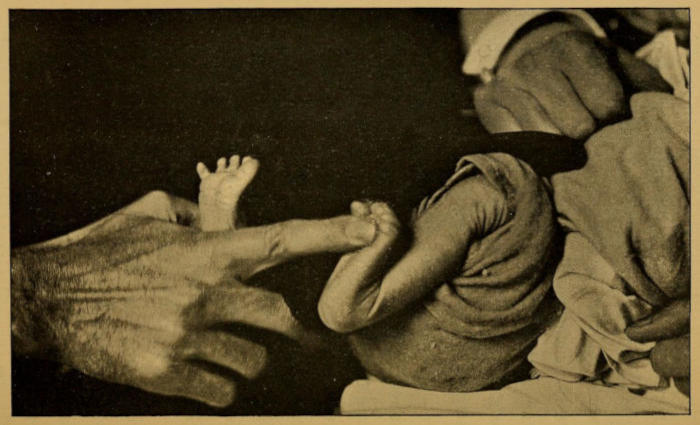
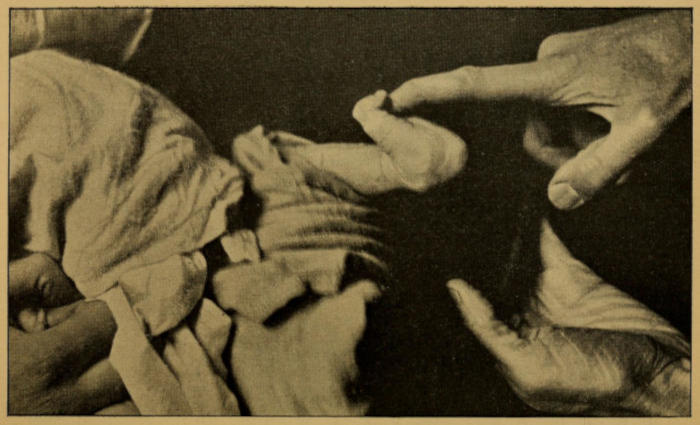
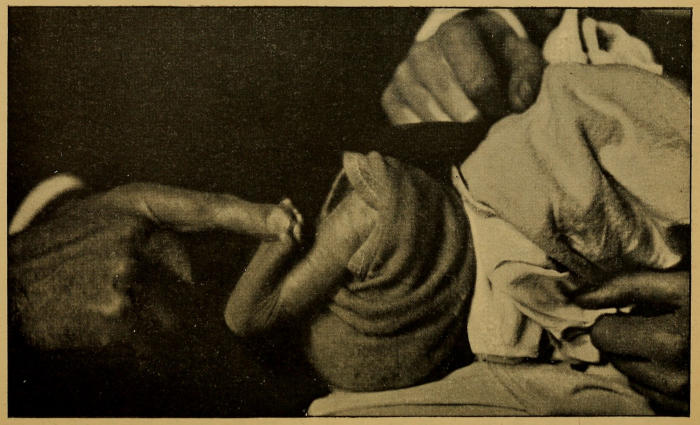
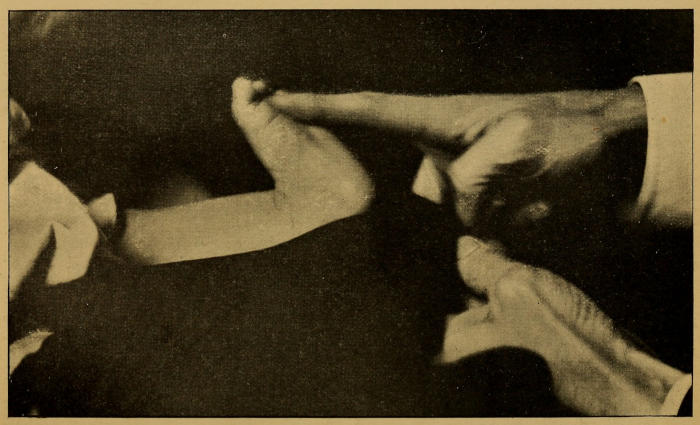
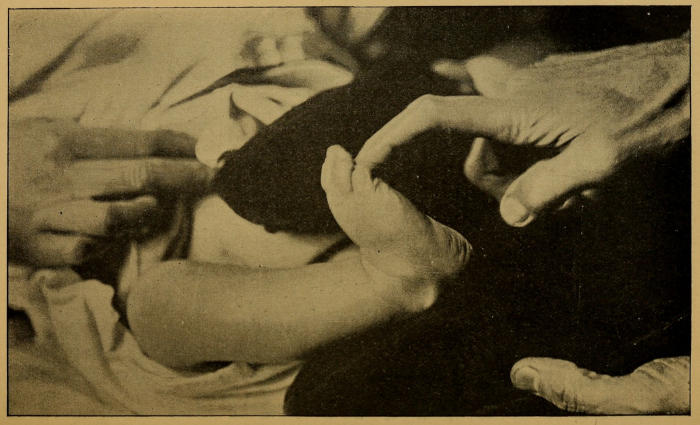
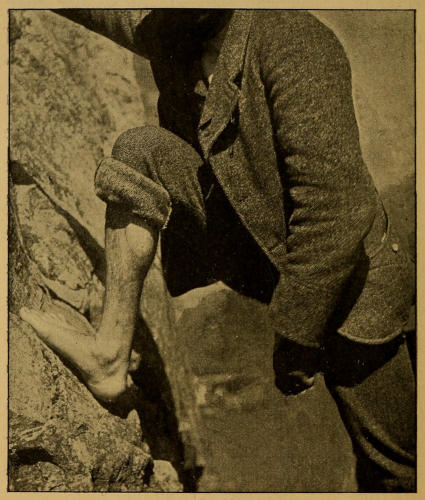
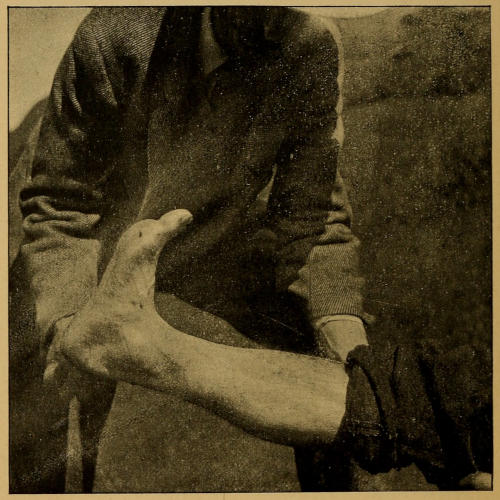
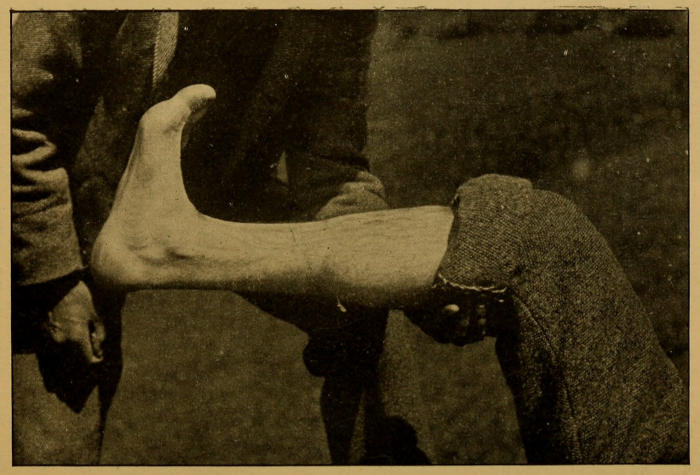
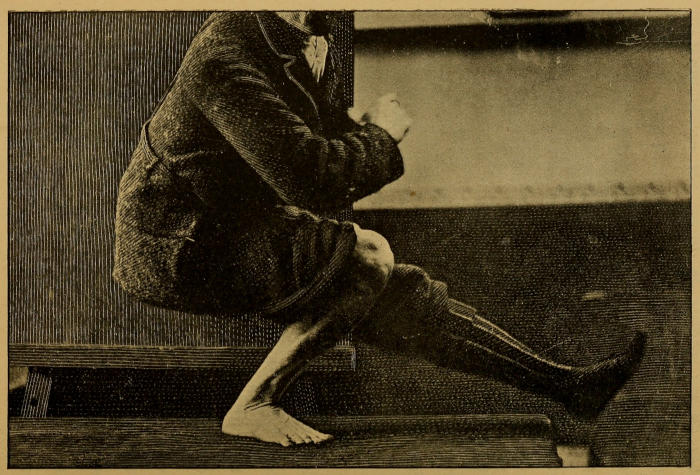
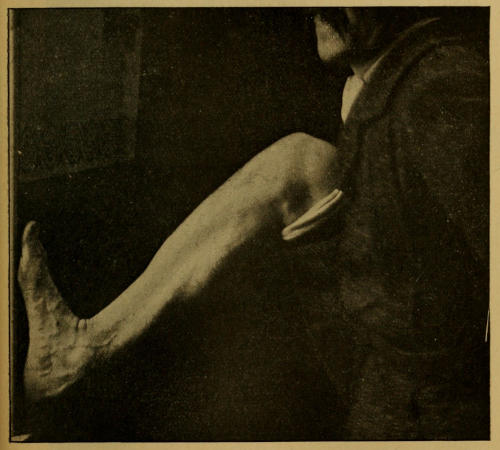
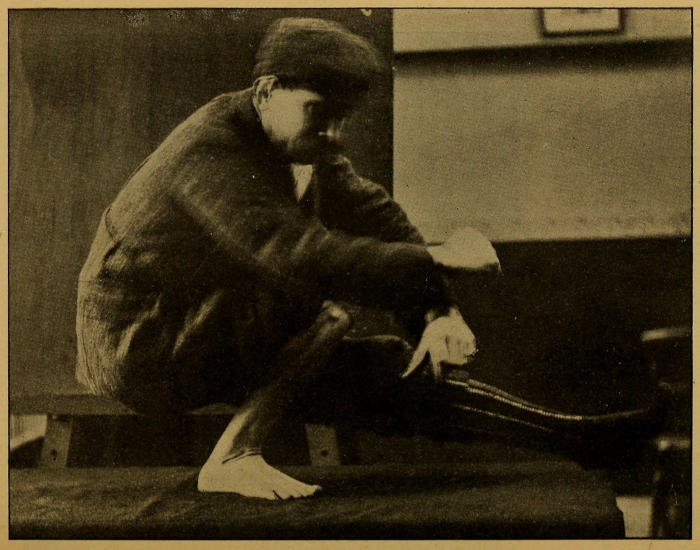
The series of pictures to illustrate the
chapter on the climbing foot I hope
will prove of interest. Mr. Stearn, the
photographer, of Bridge Street, Cambridge,
has caught the expression in the infant’s
foot, which I kept in position with my
finger, and the remarkable adaptation of the
tiny infant’s foot for climbing and all-four
progression is very well shown; also those
by Captain Abney of the Swiss guides have
come out exceedingly well.
These notes may be found acceptable to
any novitiate, who, after making his first
climb, can feel what Meredith’s hero in
The Amazing Marriage so well expresses
to his comrade:
“I shall never forget the walk we’ve had.
I have to thank you for the noblest of pleasures.
You’ve taught me—well, a thousand
things; the things money can’t buy. What
mornings they were! and the dead-tired
nights! Under the rock, and up to see
the snowy peak pink in a gap of thick
mist. You were right: it made a crimsoning
colour shine like a new idea. Up
in those mountains one walks with the
divinities, you said. It’s perfectly true. I
shall remember I did. I have a treasure
for life! Now I understand where you get
your ideas. The life we lead down
there is hoggish. You have chosen the
right.”
A small matter will suggest pleasant
memories of mountaineering to those (harmless
degenerates, according to Max Nordau)
who see the Mer de Glace in every frozen
puddle, as a child sees pictures in the
fire.
Many a man helping a dish of Devonshire
junket on his table, thinking of Forbes’s
viscous theory, watches for the place opposite
the first gap made by the spoon, where
in the junket there forms a chasm parallel
with the side, still leaving a fringe or shelf
attached to the edge of the dish—for him
at the moment that crack is a bergschrund—there
he finds at one point a bridge convenient
for crossing, at another an impossible
yawning crevasse.
Such a man will not find these notes dull,
for he can enjoy the plainest junket, and
though he finds recorded few new things,
yet pleasant thoughts will be suggested of
the past, and infinite possibilities for the
future.
Training at Kandersteg—Climbing the south face of the
Birrenhorn—The viper’s cast—The larches replacing
the pines—The ascent of the Doldenhorn—The Petersgrat—The
ascent of the Bietschhorn—An interesting
anniversary ascent—Ascent of Monte Rosa by the Lys
Pass—Cold feet on the glacier—The Furggen Joch—Accident
to a guide—Traverse of the Matterhorn—Naked
feet of guides photographed in climbing position—The
Traverse of the Charmoz—Farewell to Melchior—Lines
to my lantern.
Every one should try to be in good training
once a year, and experience has confirmed
my opinion that Kandersteg, in the Bernese
Oberland, is a good place to train for a
climbing holiday. There the expeditions
are interesting enough without being too
serious. The enervating effect of what is
ironically called carriage exercise, which
only exercises the carriage, and does nothing
for the man inside, must be gradually
counteracted by hard work in fine air.
Also it must be remembered that as one
grows older, training is more difficult, and
too often hurried in the process.
With a friend of former years, our first
little climb up the Tschingellochtighorn
resulted in a ducking, and for myself it
must be confessed that the bodily fatigue
of the first tug up steep slopes hardly
permits of the usual interests and enjoyments
of the way. Now it is rather sad
to reflect upon those two black sluggish
lizards that I was too lazy to collect, and
that a fine crop of yellow Gentians were
merely noticed without pleasure. Climbing
the Tschingellochtigrat—a yellow Gentian
it was that: and very little more.
Every struggle makes the next more
easy—at first it is a purgatory for the pie-crust
of the past year, then the later labour
is all delight.
Mr. M., that veteran climber, hailed me
on my arrival at Kandersteg with a shout:
with him was his son, already at sixteen
well experienced in mountain craft, and
the well-beloved Melchior Anderegg. Mr.
M. says “a man is always at his best on
the Alps,” and surely this is true; his body
is most freed from disorder, and his mind
from cant, as he climbs away from all the
worries of life.
We had an expedition together, a pretty
climb up the steep south face of the
Birrenhorn; on our way up to the rock we
killed an adder. Near this spot last year
I found a perfect viper’s cast (eye-covers
and lips also quite entire). It is now in
the Cambridge Museum, and proves that
Gilbert White is correct in his statement
that the snake’s cast is turned completely
inside out. Here too are a great number
of large white snails like escargots—“O
helix infelix tui quam miseresco
sine sheetis aut blankets dormientis al
fresco.”
As my friend had made with me this
same ascent last year, we were allowed to
lead the way up, and had a nice scramble,
notes of which are to be found in the
Alpine Journal, and seen on a later page.
This excursion gives a good view of
the forests of the two valleys seen from
many points above the Kander stream and
Oeschinen See. No one can fail to note,
when once attention is aroused to it, how
the larch is gaining ground in the struggle
for existence, and the pine is rapidly
diminishing. Rarely does one see a young
Arolla pine, and the old trees are picturesque
ruins. In the Arolla valley the same
observation may be made, and there are
decaying stumps of trees, 200 or 300 years
old, remaining high up, near the glaciers,
where once a forest stood. A great advantage
the larch has in being a deciduous
tree, shedding its thin and spiky leaves
every winter, and riding out the storm with
bare poles, when the pine holds on its
evergreen branches a great weight of snow,
and presents a large surface for the tempest
to burst upon.
When these pine trees stand together
collecting snow, more opportunities for
avalanches occur, and ruin is scattered on
the forest beneath. The lovely green tints
of the sprouting larches in Spring will
bring us some compensation if the pines
are to be lost.
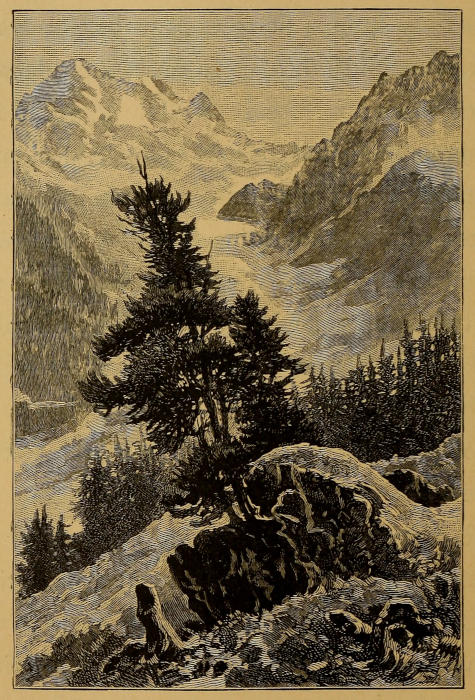
A REGIMENT OF LARCHES ADVANCING ON VETERAN PINES.
According to Mr. Sowerby, in his Forest
Cantons, the larches always choose the
crystalline rocks, while the pines prefer the
limestone.
Starting from the Hotel at half-past one
in the morning, we had a roasting hot day
on that beautiful snow-peak, the Doldenhorn.
With Hari as guide, we followed a large
swinging oil-lamp, instead of the usual
lantern, and toiled up through jungle, to
find the snow all fresh and soft; lovely
to look upon, but wearisome to travel up;
a long ice-slope at the top gave rest to
all except our leader, who had to cut
steps to the final corniced ridge; there we
held him with the rope in leaning over to
judge whether we might safely sit down
upon the summit.
On our departure from Kandersteg, a
lady and her husband joined us in a
delightful walk over the Petersgrat. We
rested a night at the Selden châlets in
the hay, giving the lady the only bed of
the place, and, starting the next morning
early, had an easy day over that beautiful
glacier pass, arriving at Ried in the
Lötschen Thal in a broiling sun. Nothing
more was then known of those two poor
fellows who went for their last climb a
few weeks before, left the little inn and
never returned.
My companion had come with me to
ascend the Bietschhorn, and we found it
a first-rate climb, requiring continual care
because of the rotten state of the rock
arête. Every stone has to be tested before
the weight is allowed to rest upon it, and
the movements over the ridge must be
lovingly and embracingly made without
jerk or hurry. In Alpine slang the mountain
is badly in need of repair. We were
on the summit during an earthquake, of
which we felt nothing, though at Zermatt
there was considerable alarm, and a climber
on the Rothhorn is reported to have had
to sit tight as though on a bucking horse!
Next day we walked down to the
Rhone valley, and came to Zermatt with
our guides, Alois Kalbermatten and Peter
Perren. Here again Mr. M. was actively
at work with Melchior, and as he came
down from Monte Rosa, he told me how
pleased he was to have made an anniversary
ascent of a mountain he had climbed forty
years ago!
We made for the highest point of Monte
Rosa by starting from the hut by lantern-light,
and going up the glacier as if to
cross the Lys Joch, then taking a rock
arête to the summit, we descended by the
usual snowy route to the Gorner glacier,
and so back to Zermatt. My feet had
been very cold on the glacier; the mass
of nails carried, unless the soles of the
boots be very thick, chills the feet as the
iron gets cold upon the ice, and in this
respect there is more to say for Mummery
spikes, which carry the feet slightly off
the ice. F. Andenmatten, of Zermatt, made
such a successful improvement in clumping
my boots, that he obtained an order for
another pair on the spot, and I believe him
to be an artist of the first rank for climbing
boots.
On our next climb, in crossing the
Furggen Joch to reach the Italian hut
above the Col du Lion, on the Italian side
of the Matterhorn, we had an awkward
adventure. Perren was helping a porter,
who carried up wood for us, over the bergschrund,
and was leaning forwards to reach
him with his axe, when down came a
stone from above—“a bolt from the blue”
and struck poor Perren on the head. The
blood ran over his face and gave him a
ghastly look. The blow did not result in
ordinary shock, it only excited him so that
he would not sit down to have his hurt
dressed, but shouted out a noisy account
of the accident. Fortunately I had an
antiseptic dressing and bandage in my
rücksack, and though he had a nasty torn
wound of the scalp, I decided to proceed
at least as far as the hut, though it was
five hours’ hard climb, and I felt doubtful
as to whether he would be fit to traverse
the Matterhorn in the morning.
The main object of our expedition was
to climb over the top of the mountain
from Italy and down the Swiss side to
Zermatt. However, when day broke he
wished to proceed, and assured me that
he could manage the climbing. Rather
than risk the success of the expedition,
I offered to come down with him, and pay
him the same price, but he would not
hear of it, and the other guide being quite
confident, with some misgiving I went
over the mountain with the wounded man.
My fear was of brandy combined with a
hot sun, and images arose before me of
a strong man delirious on the awful precipices
of this south side of the Matterhorn.
It was very soon apparent that my guide’s
powers were fully equal to his work, for
our party went strongly and at a fair pace.
We had breakfast and rested half an hour
on the classic rocks of the Tyndallgrat, and
reached the summit in less than five
hours from the start, the second time we
have stood together on that snowy ridge
which crowns the majestic mountain. “Long
Biner,” a Zermatt guide, who came up
with a party from the other side, here told
us of the death of Emile Rey, and we
were filled with wonder that the famous
climber should have ended his career by
a fatal slip when all his serious work was
done on the Aiguille du Géant—a mountain
which he knew so well.
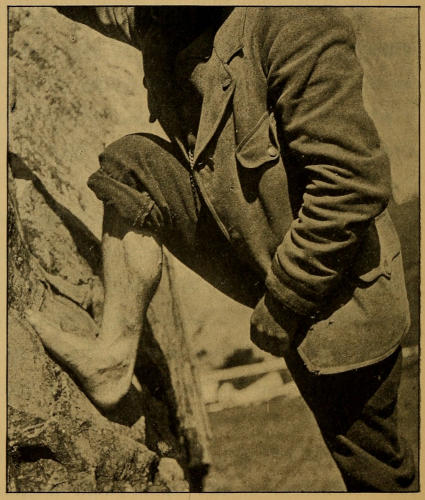
Returning to the Monte Rosa Hotel
for a rest, I was fortunate in falling in
with Captain Abney, who kindly photographed
for me the naked feet of my
guides in the act of climbing a rock.
It has often been noticed that a guide can
go face forward, and whole-footed up a
slope, while the amateur following, and
coming to the steep part, has to go on his
toes or turn sideways. It seems possible
that the angle made by the foot with the
leg may be more acute in the guide who
has climbed from infancy, and though it is
probably very much a matter of balance, I
wished to compare photographs of amateurs’
feet when put into similar action. The
guides wear thick leather boots loosely
laced at the top, so that it is difficult to
see the play of the ankle.
There is a most interesting discussion
by Darwin, in his voyage of the Beagle,
on muscular action and balance in riding,
but of course in the case of the guides’
feet there may be some structural difference,
hereditary and acquired, actually permitting
more freedom of movement at the ankle
joint, which neither muscular action nor
power of balance could give to the amateur.
These points are separately considered in
another chapter on the “Climbing Foot.”
On a memorable morning at the end of
August, the morning of Miss Sampson’s
fatal accident upon the Triftjoch, while we
were packing up to travel over that same
pass, my friend had a telegram to report
the death of his mother at Chamounix.
It was his first great grief, and seemed
the one unbearable thing in life. With
him I travelled to join his afflicted family.
The sorrow of others thus threw a strong
shadow over me, and my friend having
gone to England, I had now little heart
for further climbing.
Nevertheless, taking my guides to Montanvers
I traversed the Charmoz, a very
fine rock climb, in which five points of
varying size are scrambled over. There
is a good deal of standing on one another’s
shoulders in acrobatic fashion in the ascents,
and the use is frequent of a second rope
looped over a point of rock in the descents.
The highest peak is the last climbed, and
its couloir is descended to the base of
the rock to join the route below the couloir
of the first ascent. The glacier which it
is necessary to cross is, this year, in a
dangerous state; falls of ice are seriously
frequent. When on the highest point of
the Charmoz, the most awful avalanche
of stones came thundering down from near
the top of the adjacent Grépon. The noise
was deafening, and a strong sulphurous
smell, which lasted some time afterwards,
suggested, as Whymper says, that the
Devil was at the bottom of the business.
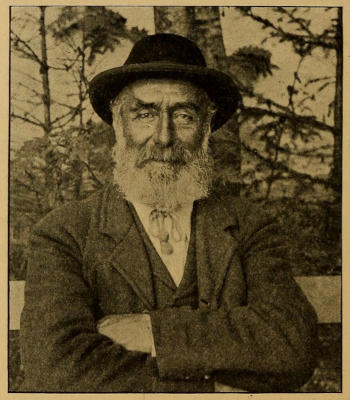
MELCHIOR ANDEREGG, 1895.
FROM A PHOTOGRAPH BY MR. MYLES MATHEWS.
Wandering into Couttets’ Hotel at Chamounix
quite without intention, I witnessed
a touching farewell between Mr. M. and
Melchior. To see an undemonstrative
Englishman kiss his grey-bearded old guide
on both cheeks, when these two have
climbed together for forty years, gives one
suddenly a glimpse of the pathos of life
impossible to recall without emotion.
Beautiful for weather, dreadful for disasters,
this season will be remembered as
the year in which Emile Rey was killed
on the Alps, and Mummery lost in the
Himalayas. All who knew the strong and
genial Benjamin Eyre have felt his loss,
and he was a man with many friends.
Then alas! there were others to whom we
say farewell for ever.
For this season I have said good-bye
to my faithful guides, one of whom is a
friend of many other climbs, giving them
a modest addition to their moderate fees
and the old rope, which I leave behind.
My folding lantern shall come away with
me for future use; it shuts up into a leather
case no larger than the little sketch-book
in which I write the following somewhat
heathenish, but very hopeful hymn:
Guide, who breaks my midnight sleep,
Leads me up the glacier steep,
Where the lantern’s feeble beams
Shine on snow and icy streams;
We fear no darkness in the night
While your strong hand controls the light.
Dawn will for the climber rise,
Daylight point him to the skies—
What if all be mist and cloud
When we reach that summit proud?
Who, conquering, can victory cry,
More gladly lives, dreads less to die!
Mighty Guide! who woke and led me here,
Lend Thy light to make my pathway clear.
Though dim at first on Life’s all doubtful way,
The struggle ends in dawn and perfect day;
Obscuring daylight hides my lantern and Thy star,
But purple glows with gold on glorious peaks afar.
Mountaineering in Dauphiné
1894
Wet weather at Kandersteg—Fly-fishing there—The fisherman’s
fear of a precipice—Birrenhorn ascent—Ascent
of the Blümlis-Alphorn—Chateau at Vizille—La Bérarde
in the Dauphiné—Accident to a guide’s tongue—Traverse
of the Pointe des Ecrins—Guide’s hand benumbed—Wild
and impressive scenery—Ascent of the Grande
Aiguille—A frost-bitten porter—My ascent of the Meije
with a broken rib—The heel spikes of the district.
The Alps of Dauphiné, which may be said
to lie in France between the Mont Blanc
range and the Mediterranean Sea, would
be best approached by Paris, Lyons, and
Grenoble, but as my climbing friend, A. B.,
was at Kandersteg, I went there to meet
him and a guide, and to stretch my legs
on the Swiss mountains. On the first day
after my arrival we inspected, with a view
to attack the steep south face of the
Birrenhorn, and surmounted the only difficulty
of the climb, a steep chimney where
a rope is useful to avoid risk. We planned
to complete the ascent on the first fine day.
On this little mountain I found the most
perfect snake’s cast I ever saw, which I
gave to Professor Newton. Its head end
was in the hole where its owner got rid of
it. The films over the eyes were present,
and by blowing into the mouth I could
inflate the cast to a lively resemblance of
the creature it had covered.
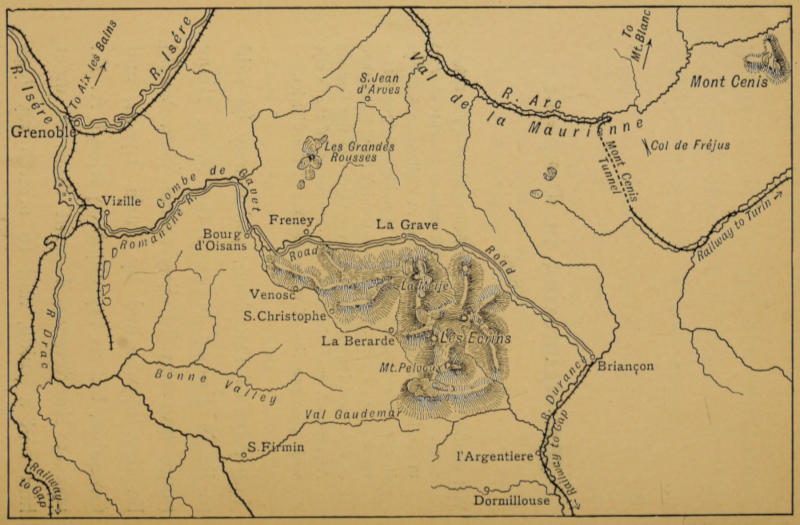
MAP OF THE HIGHEST MOUNTAINS IN THE DAUPHINÉ.
Walker & Bontall sc.
The weather in the Bernese Oberland was
very bad, every day it rained in the valleys
and snowed on the peaks; on any expedition
one was sure to get wet, and mountains
of any magnitude were impossible. With
a Surgeon-Major on leave from India I
took a turn at fly-fishing, not in the glacier
water of the Kander, but in a pretty stream
with pools, where the trout, though small,
would rise to a fly. His Himalayan experience
made the Surgeon-Major anxious
to stock the glacier torrents of Switzerland
with Mahsir, a fish more powerful than the
salmon, whose first wild rush on tasting
the hook gives such a fierce joy to the
sportsman.
My companion, who was a strong walker,
described to me his horrible sensations at
the sight of a precipice. He told me that
his father, though he had shot game in the
Himalayas, could never overcome this fear.
If the idea of space was absent my friend
could climb well, but I gathered that
horizontal as well as vertical distance was
concerned, because he could not comfortably
eat his lunch on a flat platform of an
acre of grassland when there were miles
of country far distant below and beyond.
Mountain climbing for him was out of the
question, his condition was almost that of
one suffering from agoraphobia or la peur
des espaces.
We engaged Joseph Truffer as guide,
and as soon as he joined us we completed
the Birrenhorn expedition. It was a satisfaction
to me to find that he did not climb
the couloir easily or at the first attempt, but
we had a good scramble on an interesting
arête rather like the Portjengrat, in which
there is a rock hole or window to crawl
through. We went home by a long route
up by way of the Ober-Oeschinen Alp,
and got thoroughly wet as usual.
To climb the Blümlis-Alphorn, the highest
point of the range, we slept out at a hut,
which was unluckily occupied by workmen,
who were building another hut close by.
Our night in dirty straw was not so pleasant
in dirty company, and the early morning
was dark and threatening; we started however
at 4.30, led by Joseph Hari, a local
man. After crossing the glacier he took us
over some smooth slabs of rock arranged
like a slated roof and coated with ice to
make us careful. These safely crossed,
Truffer took the lead, and up the final
steep everything was ice wherein steps had
to be laboriously cut to the summit. We
stood on the top at 10 o’clock, but saw
little of our surrounding glories, except
occasionally a brief glance round through
the mists while standing perched in an ice
step. The weather ended up in snow,
which shut us in on the glacier below, and
made us thankful to be well off the ice,
and safely quit of a mountain which, though
usually an easy climb, could assert itself
seriously in a storm.
Taking Truffer with us, A. B. and I
travelled to Dauphiné; we spent a few
hours at Grenoble to see the old church
and the Bayard statue. While at lunch
at the Hotel Monnet I admired the oak
wine jugs, which are called there “Brocs.”
There is a charming old chateau at
Vizille, with a lovely trout stream in the
grounds full of big fish. The tennis
court no longer stands in which in 1788 a
memorable meeting took place to protest
against the tax. The late President Carnot
unveiled a statue in 1888 in memory of
this Revolutionary event and slept at the
chateau as the guest of Madame Casimir-Périer.
The old soldier who took us round
showed an oubliette in the old part of the
building—beneath its horrible shaft he had
seen armour-coated skeletons dug up.
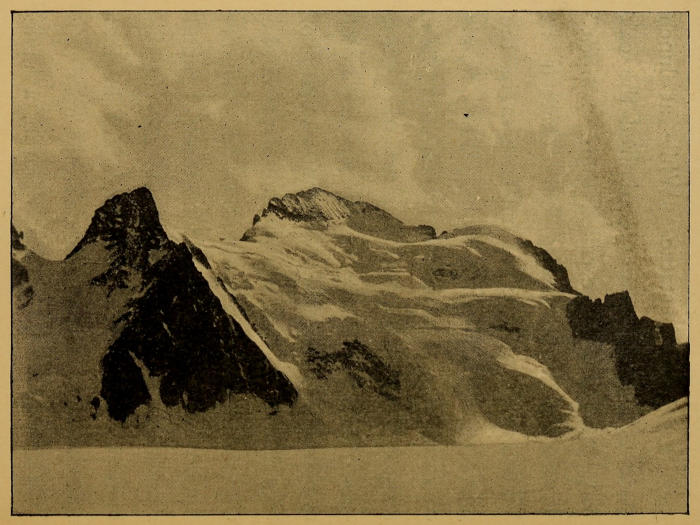
LES ECRINS FROM THE GLACIER BLANC.
We walked up to La Bérarde, a mule
carrying our baggage. Immediately on my
arrival I was told of an awkward accident
which had just happened. Two parties
were ascending a slope of ice when the last
man of the first caravan slipped out of his
step and sent his iron-shod heel into the
jaw of the leader of the second caravan,
who was too near. Poor Maximin Gaspard
got a bad torn wound of his tongue, cut
by his teeth, which I had to stitch up with
silk and horse-hair. As he was in fine
health the wound healed well, and in a
few days, in fact, as soon as ever he could
feed, he was climbing again. Maximin’s
father, Pierre Gaspard, is the fine old fellow
who has made so many first ascents in these
districts, and still makes the great climbs.
The highest mountain in the Dauphiné,
is the Pointe des Ecrins, 13,462 feet, its
summit is a ridge of several beautiful points
of snow and rock. With Hippolyte Rodier
to assist Truffer we started to traverse this
peak. We met on the way to the Challeret
hut, a native with a dead sheep on his
shoulders; it had been killed by a stone
falling from the height above, and no doubt
was to be made into “precipice mutton.”
After sleeping a few hours at the hut we
got off at 1.30 in the morning, over the
glacier to the Col des Avalanches. Rodier
led us to the couloir on the south face,
and we began to crawl up; this was a
rock couloir, which at a steep part was
iced and caused some delay. Our leader,
however, got up to a firm position and I
followed, but no one else came, and looking
down I saw Truffer wringing his hands
and in distress. He explained that his
right hand was frost-bitten and he could
not proceed; nevertheless, he was pulled up
by the help of the rope, and finding from
the appearance of the hand and from the
pain, which is really a good sign of reaction,
that recovery was sufficient, we decided to
proceed, with some misgiving on my part.
We gained the highest part of the Ecrins
about 10 o’clock. There was a great deal
of fresh snow on the arête, and in coming
down to the glacier Blanc on the north
side we worked hard for five hours without
a halt to reach the Col des Ecrins. Here
we rested and then descended a couloir of
1,000 feet to the glacier de la Bonne Pierre,
with its long and dreary moraine. There
is a measurement station on this moraine
to register the movements of the glacier,
and here we found a marmot recently killed,
its flesh almost entirely eaten, the entrails
strewn around. An eagle’s feather on the
body suggested the mode of death. The
sight of the sheep killed by a stone, and
still more the beautiful furry marmot killed
by an eagle, added in a strange way to
the savagery of the scene. In this wild
region stern Nature seems to cry, “I care
for nothing, all shall go.” We had a long
walk home, the last half-hour by lantern
light, having been eighteen hours over our
expedition.
We wished next to traverse the Meije
from La Bérarde to La Grave, which neither
of our guides had ever done, so it seemed
best to let Truffer go back to Switzerland,
lest on a serious expedition his hand should
fail him again and its recovery be delayed.
His helpless condition in the iced couloir
was explained by the fact that months
before he had been ill with a bad hand,
and its vitality had been impaired by what
was probably a previous attack of frost-bite.
Before his departure we had a lovely day
on the Grande Aiguille; on the top we
basked and slept in the sun after a lunch of
tinned fruits and bread and butter. There
is a little ice and snow requiring care on
this beautiful peak, but we climbed it up
and down without a rope, and here we
passed over the slope where the tongue
accident occurred.
One evening I was aware of a pain in
my chest, especially when I laughed, and I
was reminded that at Easter I had broken
a rib—in climbing to the top of a cromlech
on Dartmoor called “The Spinster’s Rock,”
but the bone seemed to have mended in
spite of some neglect, and was forgotten
until my compass box in the breast pocket
jammed against the hurt in some scramble
and found out the weak point. I was
warned by pains in certain movements of
the arms against any attempt to traverse
the Meije, and very sadly I had to see my
friend take off our guides for a successful
expedition; for though with a suitable bandage
on my chest I was quite active, yet
could not pull myself up by my arms in
climbing.
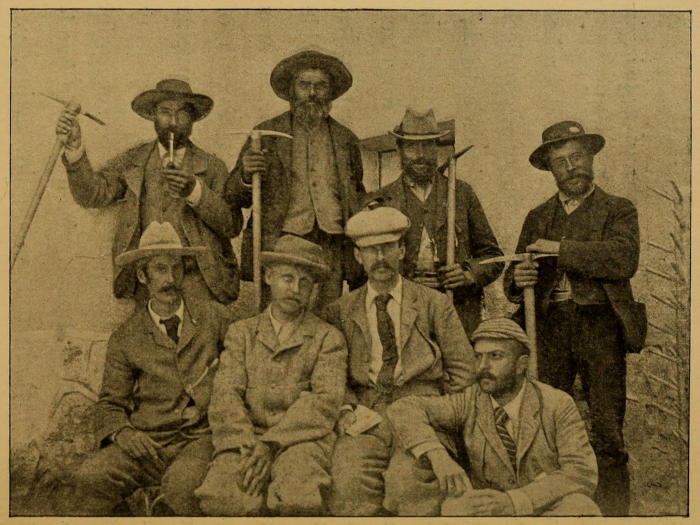
JOSEPH TURC.PIERRE GASPARD.MATHON.HIPPOLYTE RODIER.
W.HERR VON RATH.A. B.HERR GRISAR.
We had parted from Truffer with mutual
regrets, for he was a very good fellow, and
taken on Joseph Turc, a more experienced
man than Rodier, and they worked well
together. This Turc had just come over
from La Grave with a porter named
Etienne. The latter, a poor wizened sun-baked
little man, had all his finger tips
on each hand blackened with frost-bite;
his thumbs had escaped. It appears that
a Frenchman who could not climb well
was taken by Turc to traverse the Meije
from La Bérarde. They got no further
than the Pic Central, there they had to
spend the night—next day getting into
La Grave. The poor porter was allowed
to sleep with his fingers in this bad state,
and come back over a pass to La Bérarde
where in the afternoon I saw him. He
had had some pain in the morning of this
day, and this encouraged me to attempt
treatment; so during two or three hours
I rubbed him and watched him, and was
assisted by my friend; it was satisfactory to
find a considerable improvement, especially
in his right hand, which next morning was
even more apparently improved when the
limits of the black dead portions were more
defined—his nails will probably come off,
and there will be ulcerated surfaces on his
finger ends, which will be months in healing.
The aspect of this man presented a pitiable
combination of apathy and patience, reminding
me of the wolf-bitten Russian peasants
I saw in Pasteur’s laboratory in the Rue
D’Ulm years ago. The guide with the
frost-bitten feet, of whom I wrote in my
letter last year, is only now hobbling about
with sticks, the wounds of his amputated
toes still unhealed, so much is the process
of repair hindered in tissues damaged by
frost-bite.
What I call determination, but my friends
describe as obstinacy, now induced me, after
three days’ rest, to climb the Meije, 13,081
feet. It is a serious rock climb, decidedly
stiffer than the Matterhorn, and I did not
attempt the traverse, but it was an error of
judgment to have climbed it in my crippled
condition. Doubtless the fine air, which
makes a man laugh so easily, and makes
the careworn light-hearted, steals away the
reason like champagne—making the old
man seem young—so the poet writes—
“The plague of guide and chum, and wife and daughter
Is Senex who will climb and didn’t oughter.”
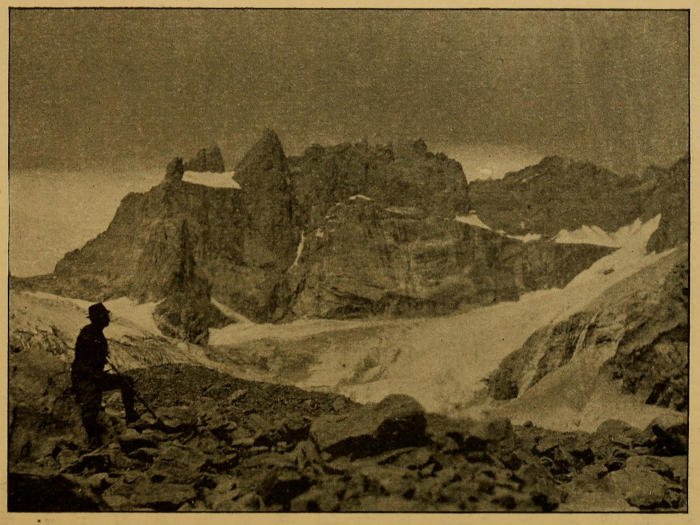
LA MEIJE FROM THE VAL DES ETANÇONS.
My friend having returned to rest from
his expeditions I took off the guides for
the ascent of the Meije. We walked
up the valley and halted at the hut.
Joseph Turc wanted to put his skin of
wine, containing over five bottles, into my
rücksack, and we had a difference, as I
objected to his claret leaking into my shirts,
so he had to carry it separately; it was
quite an easy matter, as I had a porter to
carry my sleeping bag to a rock gîte where
the night was to be passed, a climb of
several hours. On reaching the glacier,
Joseph and I being in front of the others,
who carried the rope, he asked me if I
was afraid to go over the glacier. Probably
he meant without the rope. I said
it was what I had come for; but when we
began to get to steep ice I found he did
not cut steps, and as he had three large
spikes in each of his heels he could go
where I could not follow without using my
axe vigorously. He then said he could not
cut the steps because of his wine skin, and
thus I was left either to cut on up all the
slopes or carry his skin. After a little
hesitation I offered to carry the wine for
fear of hurting my rib, and I carried it up
to the sleeping place, though I did not find
the steps cut much better after his burden
was removed.
We went to sleep under the stars on a
lovely night, but the day broke dark and
gloomy, so that it was half-past four before
we could start. We roped at once, leaving
the porter to take the things back, and
Turc led, but instead of placing me second
I was left to the last. With my own rope
of 80 feet long it happened frequently that
the men passed out of sight, and I had no
sort of communication with them unless I
chose to pull and shout. But this is well
enough when going straight up. It is a
difficult corner or traverse where the position
is a bad one; the experts who have
been on their own mountain before, leave
the traveller alone to get round his corner
as best he can. “In medio tutissimus ibis,”
is a good motto.
I gained the summit at nine o’clock,
but just at the final struggle, where it is
necessary to straddle on a sharp red rock
ridge, called the “cheval rouge,” with fine
precipices below, my rib gave way, and
went completely broken through. In spite
of firm bandaging, the coming down was a
painful experience, for I could feel and
even hear the ends of the broken bone
grating together; but I kept at it, going
down steadily and slowly with groans and
grunts. The guides sang and shouted and
drowned my feeble exclamations. They
had had a good feed with tinned peaches
and plenty of wine on the top when we
rested, and it seemed to make them very
happy. They carried seven bottles of wine
on this expedition, besides each man a
flask of brandy, and as I do most of my
climbing on cold tea, they had a good
allowance.
Joseph Turc is a real genius at rock
climbing, a truly brilliant performer; but
on ice, as he can’t cut steps, another
time I should get spikes or crampons.
The guides here use three spikes in each
heel, driven in, fixed by gomphosis, not
like the Mummery spikes with a screw.
I got to the Inn in time to change for the
table d’hôte, not in the least fatigued, only
blaming myself for the painful ordeal I had
passed through. While changing my garments
in the small bedroom we occupied
together, my companion could plainly hear
across the room the grating of my fractured
rib. So soon as exertion ceased I was
entirely well, and had a good dinner and
night’s rest.
No traveller who goes for mountain expeditions
to the Dauphiné district will leave
without feeling a debt of gratitude (mixed
with envy) to his own countrymen who have
climbed and walked all over this wonderful
country. The maps and climber’s guide by
Mr. Coolidge are marvels of convenience
and accuracy, and must be carried by everyone
who wishes to learn his way about
these very difficult regions. Mr. Whymper
ought to be as proud of the conquest of the
Pointe des Ecrins as of the Matterhorn.
My friend had a good climb on the Pic
Bourcet, but of course I did not attempt
this, returning to England by easy stages,
halting at Aix-les-Bains and at Paris. In
London I found laughing at “Charley’s
Aunt” a serious matter for my damaged
rib, though I thoroughly enjoyed this absurd
farce, as I enjoyed every day of my vacation,
and there was no day I would not willingly
live over again.
Switzerland and Savoy
1893
Begin at Kandersteg—Benighted on the Zinal glacier—Glacier
tables and baths—Wild beasts in the hut—The
Col Durand—Guide in a crevasse—Ascent of the
Dent Blanche—A climber exhausted—Ascent of the
Weisshorn—A thunderstorm—Death of Mr. Lucas and
Mr. Seiler. The Furggen Joch—Italy and the Italian
side of Mont Blanc—The hut on the Aiguille Grise—The
traverse of Mont Blanc—Anxiety as to weather—The
observatory on the summit—Ascent of Aiguille
du Dru. Ascent of the Aiguille Verte—Frost-bitten
guide—Peculiar dangers of a fine season.
When Albert Smith made the ascent of
Mont Blanc in 1851, he did not seem to
enjoy himself much; he was thoroughly
exhausted and done up, as well he might
be, with sixteen guides, and £20 worth of
provisions. If he did not have a good time
our fathers did, in hearing his lecture, or in
reading his dear little book. They listened
with the greatest interest to his serio-comic
groans. A hundred bottles of wine, sixty-seven
fowls, joints of meat in proportion,
and ten cheeses carried up the mountain
ought to have led to trouble somewhere.
On the other hand I enjoyed myself so
much in the ascent of Mont Blanc that I
fear I have nothing left to entertain others.
My climbing friend was with me and two
guides, also friends of former years; we had
no certificate and no cannon. Nor was
there any pretty Julie down below to give
me a cornelian heart and talk about “une
alliance.”
But I will begin at the beginning, and
travel first from Cambridge to Kandersteg,
from the land of fen and bog to the land of
fine air and bright mountains—the Bernese
Oberland. At Kandersteg my friend was
staying in Egger’s most comfortable inn,
and there we made a plan of campaign.
We were fortunate in crossing the Gemmi
to obtain a fine view of the mountains we
were about to attack. We slept at Sierre
in the Rhone Valley, and in the morning
went up the Val D’Anniviers, one of the
finest valleys in the Alps, a beautiful journey
to Zinal, where we met our trusty guides—Alois
Kalbermatten and Xaver Imseng.
We must needs try and reach the hut
high up the glacier that same night, and
consequently got benighted, and arrived
very late at the Mountet Cabane, rather
cross and tired. While the daylight lasted I
saw on the glacier hundreds of glacier-tables,
like a crop of gigantic mushrooms. The
hot weather this year may have made these
more apparent, for on all the glaciers I
walked over they seemed more conspicuous
than usual. A stone, as big as a teacup or
a cottage, when it lies upon the glacier,
protects the ice beneath from the sun, so
that in time the ice melting all round leaves
the stone perched on a pedestal of ice.
The icy pyramid gradually yields on the
sunny side, and allows the stone to tilt and
fall always in the same direction. On the
Gorner Glacier I saw a stone supported by
two separate pyramids, but this is unusual.
If the stone which lies upon the glacier be
thin enough, it may be so warmed through
by the sun that it makes a hole for itself in
the ice, and is buried in a pit full of water.
So may dirt make a bath in the glacier,
or if it be in large quantity, may leave a
cone of solid ice all dirt covered, looking
like a large ant heap.
The deep pits full of water are started
in the manner indicated, but the sun-warmed
surface water is continually being replaced
by the ice-cold water below, and the warmed
water deepens the pit in the ice, until a
large bath is formed, often two or three
feet deep, with steep sides, and no warning
ledge or ridge around, so that a careless
walker might go in, and in the dusk they
are very difficult to avoid.
We had a dark experience on the glacier,
and had to leave it for the icy-hearted
moraine for fear of accidents, thankful to
find shelter after some hours of weary
stumbling along, when there was light
enough to see our dangers but barely
enough to permit us to avoid them. When
in the welcome shelter of the hut, we shared
with fleas and rats that rough abode—whether
the rats in the straw had guides
to this place is a curious problem; the
fleas in the rugs were unusually fierce and
hungry. There was a rat in the hut before
its building was completed; when I called
M. Constans’ attention to his first visitor,
he remarked in surprise “Déjà!” but it
no doubt migrated from the old Mountet
Cabane near by to the Constantia, as the
present place is called in honour of the
architect.
All next day the weather was too bad
to climb, and we had to give up our
traverse of the Rothhorn this season,
having been beaten in the same way last
year after coming over the Triftjoch. We
went to Zermatt over the Col Durand,
which led us to an ice slope of some steepness
up which steps had to be cut, and
then over snow. As we neared the top of
the pass, with no suggestion of any crack
in the smooth white surface of snow, we
walked along all roped together; quite suddenly
our leading guide disappeared down
a crevasse. I was last on the rope and saw
nothing but his hat; however, he was soon
out again by wrigglings on to his back,
shook himself free of snow, and appeared
to mind it about as much as a Newfoundland
dog minds water. But it was a good
lesson in the use of the rope, which alone
can make such an ordinary journey safe.
My first care in reaching Zermatt was to
have my boots well nailed. English nails
are no good, though Flack’s boots stood
me well. My next thought was to present
the local chemist with a prescription which
puzzled him for the moment—Mr. Pulex
Irritans—Rx: Pulvis usque ad mortem pulicibus
ferocibus quantum sufficit. My friend
said this dog Latin was appropriate, for
dogs and fleas were inseparable. I was
soon supplied with a tin of Keating.
The weather was too good for dawdling,
and we proceeded to attack the Dent
Blanche. Taking provisions and rugs to the
Schönbühl rock, our men cut bits of dry trees
with their ice axes before we left the woods
below us to cross the glacier, and thus
provided fuel to cook the excellent supper
we enjoyed before we slept. There were
two other parties on the rocks that night—the
Stockje hut being in ruins. We
crept into a hole and had a good night
there, in a natural cave which was warm
and dry. When in the small hours of the
morning we were drinking our chocolate, a
cry suddenly arose from one of the other
parties that their rope was missing. We
stirred the fires and searched with lanterns,
and it was all very picturesque, but did not
lead to discovery—the rope was lost. So
only two parties started off early and began
to climb, and reached the summit after a hot
fatiguing ascent up ice, snow, and rock.
The younger man of this other party
climbed in a boating sweater, appeared to
feel the heat exceedingly, and went to sleep
whenever there was a halt. Before the
descent was over he was decidedly ill, but
fortunately not utterly collapsed until after
the more dangerous ice slopes had been
descended; his “legs” were then quite
gone and he had to be supported by the
guides before he reached the sleeping place,
where we left him wrapped in my shawl
with his friend faithfully beside him to
pass the night.
The unlucky man whose rope had been
lost was a Britisher not easily beaten. He
sent his guides back on their tracks, and
by daylight the rope had been found, where
it had been carelessly dropped, upon the
glacier; so that, though rather delayed,
his ascent was made successfully, and the
traveller returned by another route to
Ferpècle. We, after having decided that
the sick man was safe enough and fast
asleep, found our way with difficulty in
the dark, except for lanterns, across the
glacier, whereon we wandered nearly three
hours, and Xaver refreshed himself by
falling into a big water bath. Finally we
had to stay at Staffel Alp instead of at our
hotel at Zermatt. But we here enjoyed a
sound refreshing sleep all night, and walked
down cheerfully in the sunlight of the early
morning.
As the Weisshorn was to be our next
peak we took train one afternoon to Randa
and climbed up the Schalliberg some hours
to the rocks below the ruined hut. This
was a warm sleeping place, though rather
exposed, where we slept well beneath the
stars, woke up quite fresh, and enjoyed
the climb immensely. On the rock arête
at about 12,000 feet up, and while the
dawn was lighting the peaks around, a
dense black cloud appeared over Italy
slowly moving towards the Matterhorn;
lightning came flashing out of it every few
seconds. It was a strange sight to witness
this storm-cloud bursting over a distant
land, while all about us the sky was clear
and the stars were seen fading before the
rising sun. A climber has related his
experience in a thunderstorm which stopped
him on the Dent Blanche, when the electric
current made his goggles hiss upon his
head. The hissing of the ice axe is
generally near enough for an unpleasant
sensation, and is not a rare occurrence,
but the snow glasses being affected makes
a more powerful appeal to the imagination.
We had a good day on the Weisshorn
(14,804 feet), and rested at the gîte on
the rocks as we descended, then later
had a refreshing tea at Randa, where
we heard the first sad news of the loss
of life that morning upon the Täschhorn
just opposite us. A party of four, two
gentlemen and two guides, trying to traverse
the Täschhorn from Saas Fée to Randa,
got benighted in the descent. By light of
a lantern they got to a point of comparative
safety where all four lay down to sleep,
but only three woke up; Mr. Lucas had
wandered off in the night and fallen over
a precipice, where his body was found in
the morning.
At Zermatt, though the hotels seem
crowded, there are not many climbers, they
go up higher or appear only for a day
and off again. The place is full of people—omnibuses
run over you in the streets—and
you may be there some time before
you notice that Mdlle. Biner has now
started a cabin near the Monte Rosa and
shaves you as well as ever, advertising
herself as a coiffeuse. She is dressed in
black, mourning for her brother, the guide
killed this year with young Seiler on
the Matterhorn. Just up the street is a
tailleuse, a useful person sometimes after
climbing rocks, and when your wardrobe
is scanty.
Leaving Zermatt we spent one night
at the Schwarzsee Hotel, close to the
Matterhorn, intending to cross over into
Italy by the Furgg-joch—this pass skirts
the Matterhorn; we climbed to the top in
about two and a half hours; starting from
our inn at 4, we arrived at Valtournanche
about 10 A.M. Then taking a carriage
after a long rest and refreshment, our
driver just made us miss the train at
Châtillon, when the Italian sun was at its
hottest; we had a siesta and dined there,
and so in the evening to Aosta, where we
slept the night. We took places in the
diligence to Courmayeur next morning, and
saw Mont Blanc before us in a few hours.
The Aiguille Blanche de Péteret is well
seen from the road, a sad reminder to all
Cambridge men of Dr. Frank Balfour, who
perished on that mountain in 1882. It
has been climbed by Sir Seymour King,
and again this year by Dr. Güssfeldt with
Emile Rey as guide. Six hundred francs
is said to have been paid as fee for
guidance.
We were up early for an eight hours’
climb, with a final rock scramble to the
Italian Quintino Sella club hut on the
Aiguille Grise (11,812 feet). Here we had
good food and sleep; our men went out
for an hour and cut steps up a steep ice
slope, ready for the ascent of Mont Blanc
in the morning. As this ice slope appeared
to be dangerous from falling stones, we
began early, and were greatly helped by
the steps already cut; if any stones came
down we were not aware of them, though
out of sight is not out of mind in these
steep places.
The weather when we began our climb
in the dusk before the day broke was very
threatening, and later on a light fall of
snow and hail gave us anxiety, as we
clambered up the steep rocks, lest we
should be driven back to our hut, the
difficulty and danger of such a repulse
increasing every hour until it was necessary
to go on and make the ascent whatever
befell us.
We passed on the higher rocks an enormous
rusty ice axe of an ancient pattern,
which doubtless has a story; we left it on
the spot for others to wonder at. We
made the ascent in about eight hours,
including halts, and I stood on the highest
point in these Alps—the great snow summit
of Mont Blanc—15,780 feet. But let us
not be proud, the highest mountain in the
world, Mount Everest, is nearly twice as
high.
On the curve of snow at the highest
point a huge timber skeleton of a building
is erected; heavy beams as thick as my body,
strongly fixed together, make a truncated
pyramid with a rectangular base, which
looks as if it might stand the storms, or
get buried in snow. At present the wind
whistles through, and it presents no surface
to the blast. M. Vallot, who is building
this for an observatory, has had to plant
the foundations in ice, finding no rock after
thirty feet excavation. Whether the ice
will move, or piled up snow will displace
the structure, remains to be proved. Snow
collects always more on the north (French)
aspect of the summit, and this tendency to
collect may be increased by the obstruction.
The workmen stated at Chamounix that plum
stones were found at a depth of twenty
feet, and if this be true it is exceedingly
interesting and important as showing that
these stones, which must have been dropped
on the summit by travellers, had maintained
their verticalness, and had not been carried
down towards the glaciers below. There
the hut stands at present with a small
tricolour flag floating alongside. My vulgar
wish to climb the timbers was unexpressed
and unfulfilled. We were shut in completely
by dark fog. Cold wind and the
dangers of storm drove us down to just
below the top on the Chamounix side, where
there is a hut built as an observatory.
This shelter we feared at first to leave;
wind and darkness kept us there, no tracks
were visible, nor anything to guide us but
the snow all round. The wind was not
the dangerous (south) Föhn wind, and
presently, after a cold blast, we were able
for a moment to see our direction; then
by the advice of our guides we hurried
down over the Grand Plateau, scuttling and
sliding to the Grands Mulets, and safety,
in two hours and ten minutes. After a cup
of tea and a rest we continued our journey
over the beautiful glacier des Bossons in
bright sunshine. We reached Couttet’s
capital hotel in Chamounix at six o’clock,
thus traversing Mont Blanc from Italy into
France in fourteen hours, including halts by
the way. This is a far finer expedition
than up and down from Chamounix, but is
not so popular, and the traveller, bringing
with him foreign guides into the place, is
not saluted by a salvo of artillery.
Next day we were at Montanvert admiring
the Mer de Glace, and during
thunderstorms of many hours we made our
arrangements to climb the Aiguille du Dru.
Sleeping out under a rock, where we had
passed a stormy night last year, we began
in fine weather our steep ascent mostly
of rocks, with plenty of opportunities for
adventures on the way. There is one
place in climbing the rocks where a rope
is hung over a precipice, and by gently
swinging on this rope a long step or
giant stride is made across to a foothold
beyond. It is only one of the many
positions in mountaineering where imagination
shows you what a slight distance there
is between what you are and what you
may become. In the descent a frightful
avalanche of stones fell down just as we
cleared the rocks, but it was not near
enough to shake our nerves.
On the 28th of August I slept at the Couvercle
to climb the Aiguille Verte. This
sleeping place is a good one where an enormous
rock overhangs the little platform on
which the sleeper stretches, and it is grandly
situated above the famous Jardin in the
Glacier de Talèfre. Being roused before
midnight in threatening weather, we hesitated
before attacking such a mountain as
the Aiguille Verte with a high wind and
storm-clouds in prospect; meantime we had
some hot chocolate, and only set off with
some misgivings at one in the morning.
The wind moderated as the day broke, we
got over the bergschrund, and made a successful
ascent in about nine hours. The
summit of the Verte is of snow, commanding
a fine view of Mont Blanc and the peaks
around. We noted with feelings of annoyance
that the majestic snow curve upon
the head of the Monarch is broken by the
erection of Vallot’s wooden building, which
looks from here like a projection of dark
rocks. Time may revenge himself, and
play skittles with the timbers.
When I parted from my guides, whose
conduct was worthy of all praise, and came
down to Chamounix, I saw there a most
piteous sight, that of a fine young fellow
with both feet frost-bitten. All the toes of
both feet were black, and large blisters
appeared on the reddened skin of the foot
above the blackened toes. He was a guide
named Maquignaz, and forty-eight hours
before my visit had been exposed during
one night on the Italian side of Mont
Blanc; he was with Mr. F. and another
guide, a cousin of the same name. The
others of the party put their feet into
their knapsacks, and took such like precautions,
and so escaped. On examining
this poor fellow’s boots I discovered that,
though sound enough in the soles, they
had the tongues fastened only halfway up
the upper leathers, and with no gaiters
or other wrapping except his trousers, he
must have got his feet wet. The latest
accounts I heard were not hopeful as to
saving the big toes. Without the great toes
he cannot climb again and his occupation
will be gone; the loss of the little toes is
not so serious. The reflection after such a
sad sight is forced upon one, that though
over sixty deaths are said to have occurred
on Mont Blanc, history takes small account
of the travellers who have lost portions
of their bodies upon the mountains and
had their after lives wrecked by their
maimed condition.
The delay caused by an endeavour to
help this unfortunate man, decided me to
journey to Geneva with my friend rather
than travel alone over the Tête Noire.
It was late next night before I reached
Zermatt again and joined my wife, who
had reached the Riffelberg from Paris ten
days previously. We found most comfortable
quarters at the Riffel Alp lower down,
in an enormous hotel, where two hundred
and seventy people dined every day, including
an archbishop and forty-five clergymen.
The weather this year has been good for
climbers, though there have been peculiar
dangers associated with the sunshine; and
as every season has its own peculiar dangers,
so this year the weather was almost too
good. The sun tamed the severity of giant
peaks, and made the descents dangerous
from avalanches.
The great rocks have been bared of ice
and snow and tempted attacks, while earth-fast
and frost-bound stones were loosened
from the heights above and made the
mountains dangerous. The steep couloirs of
the Aiguille Verte were decidedly dangerous
from falling stones, and though I do not
pretend to have any hair-erecting story to
tell, it will be understood that we made our
way up and down on the rocks, as much
as possible avoiding the tracks of the stones.
The traverses across the couloirs were as
rapid as caution could permit, and only
made when absolutely necessary. Great
stones occasionally hurtling down as if shot
from a catapult, with enough force to dash
the brains out or hurl to destruction the
poor climber balanced in his ice step. Thus
upon the Aiguille Noire a man was killed
by a blow on the head, and many had
narrow escapes. On all great mountains
where ice, snow, and rock have all to be
climbed over, it must be difficult to find
weather which will suit so as to find everything
in perfect order, but for the true
enjoyment of a climb both the man and
the mountain must be in fine condition.
The weather of the day I have described
on Mont Blanc, though it gave us some
uneasiness, was just perfect for avoidance
of fatigue and mountain sickness. Absence
of sun and presence of wind enabled the
climbers to feel fairly vigorous, though at
such a height. In other conditions of hot,
still weather, the strain might have been
severe.
These days are now delightful memories
for me, and if my remarks just written
do not rise above what Scott called the
“ordinary bow-wow,” at least they are “high
notes” in one sense, and may find an echo in
the hearts of those who love the mountains.
An Alpine Letter
1892
Saas Fée—Grimsel Pass—Mountain sickness—A tired lady
on the Matterhorn—Ascent of the Matterhorn—Ascent
of the Ober-Gabelhorn—The Trift Joch from Zermatt
to Zinal—The Concordia Hut—The Jungfrau—The
Lötschen Lücke—Mr. Nettleship’s death on Mont
Blanc—Beaten by bad weather on the Dru—The
disaster at St. Gervais—Neuchâtel to Bâle.
“In all my wanderings round this world
of care” I have found few places so free
from the black canker as the mountain tops.
Let the climber carry out a burden as big
as was Christian’s in the Pilgrim’s Progress,
he leaves it all behind upon the high peaks.
If Mr. Gladstone could only have managed
to attain to the summit of Snowdon he
might have seen more than the coast of
Ireland.
Truly it may be said that the outside of
a mountain is good for the inside of a man.
So once again I take my holidays upon
the Alps, and will hope that the following
account may interest readers who travel,
for these like to be reminded of beautiful
places they have visited, and those who
stay at home may be encouraged to try the
mountains abroad.
In order to avoid the hot part of the
Rhone Valley, and to reach Saas Fée, our
first halting place, by an interesting route,
my wife and I took the train for Lucerne—by
way of Calais, Rheims, Laon, and Bâle.
This journey takes less than a day. Starting
from London at 11 A.M. we found ourselves
the following morning in a boat on the blue
Lake of Lucerne with the mountains around
us. Travelling by rail over the Brünig
Pass, which we had crossed on foot ten
years before, we reminded each other of a
long walk from Meiringen to Lauterbrunnen
in one day, over the Greater and the Lesser
Sheidecks when our porter over-ate himself
at Grindelwald, about midway, and nearly
collapsed at the end of the journey, turning
very white and sick in the steep descent to
Lauterbrunnen. We came to Meiringen,
still chiefly in ruins from the recent fire.
The hot, strong Föhn wind blowing from
the south is the cause of these awful fires,
it will both start and spread the flames.
For miles round Meiringen there are notices
forbidding smoking in the open road when
this wind is blowing. From this sad spot
by easy roads we came to Guttannen and
here spent the night, rising early next
morning for a walk over the Grimsel Pass,
with a man to carry our light luggage.
The first early morning walk in Switzerland
is always delicious, and wipes away
the discomfort of the journey out. We
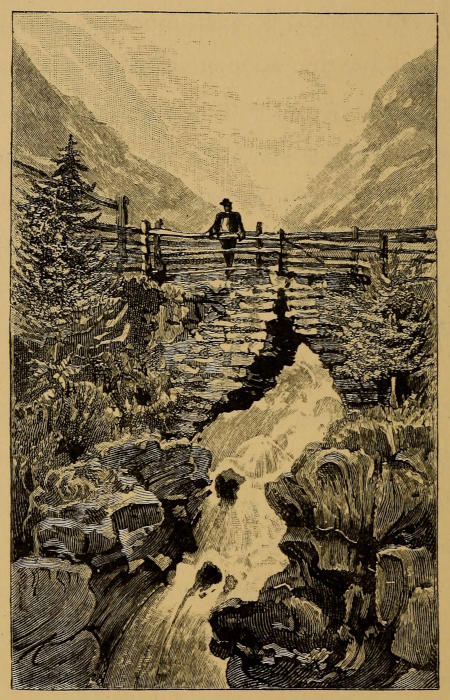
stayed at Handeck to look at the finest
waterfall in the country. Two converging
torrents, “with a mighty uproar,” pour their
waters into an unfathomable, mysterious
abyss, hidden by clouds of spray, where a
rainbow arches in the sun.
As we walk up the pass, which has
been described as a “sepulchre unburied
by the sun,” there are, on either hand,
enormous, dark, smoothly rounded rocks,
the evidence of glacier action in the ages
gone. The Grimsel Hospice is situated
in the most savage rock scenery, and is
not improved by containing a piano,
electric bells, and a smart waiter in dress
clothes. However, I made use of their
telegraph to order a mule from Saas Fée
to meet us at Stalden for my wife to ride
up there. All the crooked places are now
being made plain by means of telegraphs
and railways!
A great new road is in process of making
over this pass, and as we reached the
summit, the blasting operations were heard
in many explosions; each was at first like
the pop of a champagne cork, but after
a pause came a tremendous thundering echo
from all the mountains around. We left
the Rhone glacier on our left hand, and
descended to Obergestelen in the upper
part of the Rhone valley, taking there
a carriage to Brieg. The sensations are
delightful on a sunny day, when, after
some hours’ walking in bleak, bare, rock
wilderness, you come down into a green
and fertile valley; the effect of the keen
fresh air is still with you as you drive
along among the trees and flowers in the
sun, and you are cheered with a sense of
well-being in the present and the future.
Here you “cannot see the smiling earth
and think there’s hell hereafter.” A night
was spent at Brieg and then a short journey
by rail to Visp and up to Stalden, from
whence I followed my wife’s mule to Fée.
After spending a few days in comfortable
quarters there I left to make some expeditions.
My climbing friend, A. B., was at the
Eggishorn Hotel, and had just made the
ascent of the Finsteraarhorn, the highest
peak of the Oberland, whereupon he had
been taken with mountain-sickness, and
made his ascent with some difficulty, his
guide helping him on and holding his
head occasionally while he vomited. His
trouble was, probably, caused by his going
too fast up his first peak, for, though
accustomed to the mountains, he had only
been out from England a few days of this
season. This interesting malady is well
described in Whymper’s travels amongst
the Great Andes of the Equator; both
himself and his men suffered from headache
and fever, but the conditions were very
different from what obtains on our mountains;
the highest point is here only 15,700
feet (Mont Blanc), compared with over
20,000 on Chimborazo. All exertion seems
more severe at great heights, and though
in Europe mountain-sickness is rare, there
are few climbers who have not felt at 14,000
feet a sense of breathlessness if going
upwards at any great pace. It is often
hard to distinguish it from mere fatigue,
and I do not think that guides would
acknowledge it in themselves; but for myself
I have had the feeling, and “thought
I could not breathe in that fine air.”
Whymper’s observations prove that man
may gradually accustom himself to these
great alterations in barometric pressure,
though the dangers of want of training and
of sudden ascents are well known.
Paul Bert, by means of a metal cylinder,
in which he shut himself, had the pressure
of the air reduced to be equivalent with
that on Mont Blanc, but was soon sick
and dizzy; afterwards, in experiments, he
was able so much to revive himself with
bags of oxygen gas, that three balloonists
were emboldened to ascend to a height of
28,000 feet, taking with them a supply of
oxygen: with the result that when the
balloon again reached earth two of the
aeronauts were dead, and the third had
a very narrow escape. Man has not yet
gained the summit of Mount Everest.
Very extraordinary is the description
given of the effects of altered atmospheric
pressure by early climbers. Mr. Fellows
(afterwards Sir Charles Fellows) in 1827,
with Mr. Hawes and ten guides, writes
that at the distance of 1000 feet below the
summit of Mont Blanc, “the effect of the
rarity of the air was still more striking, for
the noses of several of our guides burst out
with blood.... None of us were free from
many effects of the peculiarities of the
atmosphere: we all spat blood; the eyes of
all were blood-shot, our faces were blistered,
and in our respiration we all suffered
intensely; for it was impossible to proceed
many paces without stopping to recover
our breath.” Near the summit “two of
our guides fell from faintness, and copiously
vomited blood, while all of us gave proof
of its internal loss (we all experienced
symptoms of haematuria).” Mr. Fellows
and his companions suffered less than did
the guides.
Those who are interested in this subject
should read the account of the ascent of
the German Emperor’s balloon Phœnix in
1895, in which Coxwell’s record was beaten.
Oxygen cylinders were used.
My friend, A. B., joined me at Schwarz
See to climb the Matterhorn. Our two guides
were also ready; the leading man, Alois
Kalbermatten, we usually called Hercules;
his brother, a still stronger man, was named
Quinbus Flestrin, or the man-mountain.
Together we went up to the hut to spend
the night, ready to begin our ascent in
the morning. As we were thinking about
supper there came down a wretched, worn-out,
grey lady, who said she had been
up the Matterhorn, was too exhausted to
proceed, and must stay the night with us.
The place was very unfit, dirty, and stuffy,
so we made her rest awhile, restoring her
with brandy and lemonade. I then made
her guides rope her carefully the whole of
the way down, and she reached the hotel
safely.
On a fine day when the Matterhorn will
“go,” the hut is always crowded, chiefly
with foreigners, and we stretched ourselves
on the bunkers alongside of a polyglot
Pole, who talked half the night. Italian
guides stole one of our lanterns, and my
friend’s silk scarf.
We had a lovely day for our ascent,
which occupied six hours, including halts
and feedings. Upon the summit we spent
about an hour of most glorious life in view
of Italy on one side and Switzerland on
the other, while we walked carefully on the
delicate ridge of snow which forms the apex
of the peak. The ascent of the Matterhorn
from the Zermatt side is more interesting
historically than as a climb. The hut occupied
by Whymper in early attempts still
remains, and as the guides pass the fatal
spot they cheerfully point out where poor
so and so broke his neck, where poor
Dr. B. died. The shattered photographic
apparatus remains on the precipice upon
which, two years ago, an entire party was
killed.
The difficult parts near the top are now
so strongly roped that some are tempted
to make this climb who are not fitted by
previous training, and as a tired man is a
dangerous man on a steep mountain which
is 14,700 feet high, I fear we have not
done with accidents on the Matterhorn.
The descent ought to be carefully done, and
almost as long a time given to it as the
ascent. At present there is no railway up,
but such a project is seriously in the air,
or, like the mountain, in nubibus.
After a pleasant day at Schwarz See
wandering above the beautiful Zmutt valley,
we went to Zermatt and thence to the Trift
Inn to try the Ober-Gabelhorn, but bad
weather beat us back. Later on we were
successful, and had a glorious day, starting
at two in the morning in the starlight.
“So climbers by some Alpine mere,
Walk very softly thro’ the clear
Unlitten dawn of day:
The morning star before them shows
Beyond the rocks, beyond the snows,
Their never-travelled way.”
We were five and a half hours climbing
up, and were back about half an hour
after mid-day. The snow was in good
order, but coming down we had a run
to dodge falling stones, though none came
upon us. Next day we crossed the Trift
Joch, a famous pass from Zermatt to Zinal.
From our inn we reached the Mountet
hut under five hours, intending to return
over the Rothhorn next day; but at the
hut a great storm of hail and wind kept
us in shelter for a time, and drove us
down in the afternoon to Zinal, where it
rained night and day continuously.
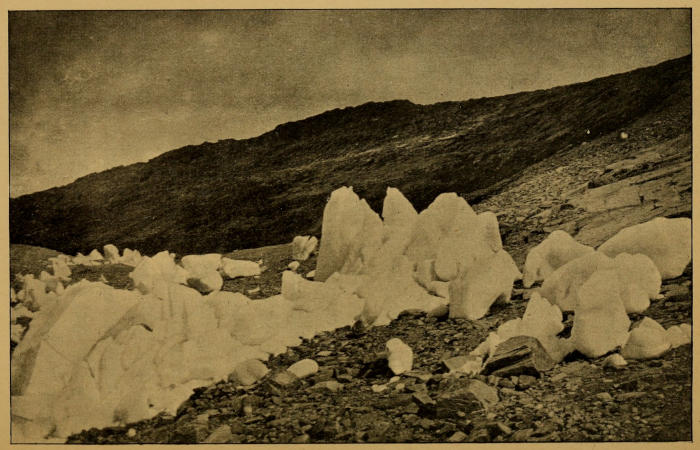
ICEBERGS STRANDED ON THE BED OF THE MÄRJELEN SEE
AFTER THE DEPARTURE OF THE WATER.
With such a downfall, which on the
high peaks would be mostly snow, it was
useless to think of any Zermatt mountains
at present, so we decided to go to the
Eggishorn Hotel, and then try the Jungfrau,
one of the Oberland giants. The storm
had rather scattered me, for I had some
wraps at the Trift inn, a bag at Zermatt,
unpaid bills at both places, besides a wife
at Saas Fée. However, this was settled
so far as luggage and payment concerned
me, by sending our man to arrange it,
and we went off to the Eggishorn. On
a Sunday afternoon, after service in the
little church, we walked to the Concordia
hut, and found the Märjelen See drained
almost dry; instead of a great blue sheet
of water with icebergs floating in it, there
is nothing but a muddy pond. This is
partly the result of draining operations,
and makes the valley below much safer as
a dwelling place, but takes away from the
beauty of this part of the great Aletsch
glacier.
It is interesting to note the great stones
which now and then are carried about on
these icebergs, or left stranded when the
water is low; thus illustrating, on a small
scale, the theory which best explains the
position of erratic boulders—namely, that
they were carried by icebergs in the glacial
age.
The Concordia hut is grandly situated
near the beginning of the great glacier,
close to the Oberland mountains, and is
a starting-point for many expeditions. A
member of the Swiss Alpine Club who
shared the hut with us was a most excitable
little man, and signalled his arrival
by letting off with a frightful explosion a
large maroon, and to my horror he carried
another, quite as large as my fist, ready
for his departure in the morning. He
actually began to light the thing inside the
hut just before our start, but we got
outside and out of the way, while in the
darkness before the dawn, under the quiet
stars, he yelled, and waved his hands
about, and burst his infernal machine. It is
hard to forgive these queer foreign manners.
He afterwards stopped his guide that he
might exchange cards with us.
After this adventure we had a quiet time
and a perfect day on the Jungfrau. We took
five and a half hours to make the ascent,
including breakfasts and halts. There is
just room to stand or sit carefully on the
highest point of snow. We had a glorious
view. The beautiful green valleys of
Grindelwald and Lauterbrunnen spread at
our feet, and all the peaks around us far and
near were perfectly defined. The sun was
all day very powerful, and the reflection off
the recent snow was dazzling in brightness;
my face and ears got touched slightly in
spite of anointing with lanoline, and peeled,
though not painfully, during the next few
days. To prevent sunburn hazeline cream
is a most excellent application, combining
a vegetable astringent with lanoline.
Early on the morning following we crossed
the Lötschen Lücke, a beautiful pass of
snow and ice, with the finest crevasses full of
strange ice architecture, and came to Ried
in the Lötschen Thal, where is a comfortable
inn at the foot of the Bietschhorn,
the mountain we were anxious to climb.
Here the weather broke, great clouds came
with a south-west wind, and gathered all
over Italy. The peaks could not be seen
in the stormy sky, while a large eagle or
lämmergeyer hovered over the hotel.
We had to give up our expedition, and
after a quiet day in this peaceful inn we
went down to the Rhone Valley, dined
at Sierre, slept at Sion—lulled to sleep
by pouring rain—and next night came to
Chamounix by way of the Tête Noire. A
shadow was over Chamounix because of the
sad death on Mont Blanc of that well-known
Oxford scholar, Mr. R. L. Nettleship.
I saw the newly turned sods on his grave
in the little churchyard, and heard again
the story of his loss, so far as it ever will
be known. After a stormy night spent in
a snow shelter, his guides came down and
left his body on the mountain, where it
was found by a search party later on. Mr.
Myer’s beautiful lines seem to have been
made for such an event:
“Here let us leave him; for his shroud the snow,
For funeral lamps he has the planets seven,
For a great sign the icy stair shall go
Between the heights to heaven.”
The survivors must have been very strong
fellows and able to carry very thick clothing.
Certainly a storm on a great mountain is
very awful to encounter, and the strongest
man may die if he tries to face it and fight
the elements.
At Montenvers, above Chamounix, there
is the well-known inn, comfortable enough
if the weather be fine, from which we took
blankets and food, and crossing the mer de
glace, bivouacked a few hours up the rocks
on the other side, in order to climb the
Aiguille du Dru.
“The Dru is a Dragon of mountains,
They scaled him long ago.”
Pardon the parody. But we were not to
be fortunate—an angry sunset, so gorgeous
as to repay any day of laborious mountain
climbing, was followed before midnight by a
storm of wind, hail, thunder, and lightning.
Crouched under a rock with the rain running
into our ears, we got through the
hours of darkness, and in the morning,
though we could hardly stand up for the
wind, our guides managed to light a fire
in a deep hole, and cooked some chocolate
for us, and, as soon as the weather and
daylight allowed us, we climbed down to
the inn.
My wife in my absence had arrived
there, while I was on a rock all night in
the storm, and we each had our adventures
to relate. A few days of broken weather
ended in snow all round the hotel. No
more mountains were to be climbed by
me this year, and regretful good-byes had
to be said to my guides.
Our journey home was made by Geneva.
On the way we passed the scene of the
great catastrophe at St. Gervais in July
last. Here miles of mud covered the
green meadows, uprended trees stripped of
their bark and branches, demolished houses,
fragments of timber and rock, were strewn
about wherever they had been hurled by
the violence of the flood. An inhabitant
of a near village told me that at one in
the morning the avalanche and deluge came
down on the ill-fated hotel, crushed down
everything in its way; that he saw next
day the people who were saved from the
flood were dying in numbers, as he said,
choked and poisoned (empoisonné) by the
filthy stuff which had filled their mouths,
lungs, and stomachs. One hundred and
twenty-five bodies were found, but the
number of the dead will never be known.
Only a week ago an arm and part of
the bust had been found five miles from
St. Gervais; many such dreadful relics are
yet to be discovered. A baby still in its
cradle was carried miles away to a village
below, but had not survived the perilous
voyage.
The best account of the cause of this
catastrophe appeared November 1892, in
Knowledge, written by The Right Hon.
Sir Edward Fry. An enormous amount
of subglacial water was suddenly let loose
from high up on the Tête Rousses glacier,
where two great chasms were photographed
next day. The moving mass of ice and
water destroyed the village of Bionnay and
hurled down everything in its irresistible
course, including a rock of vast dimensions.
“The villagers of Bionnay were intending
to celebrate a fête on the 14th July, and,
with a view to letting off feux de joie on
that occasion, holes had been bored in a
stone then in the village. That stone, with
its holes, is now at St. Gervais, and was
probably highly effective in the destruction
of the baths. It is rather a rock than
a stone. It is further stated that the iron
safe in the office of the baths was carried
five miles down the stream to Sallanches,
where it was found.”
Geologists do not perhaps yet realize
what such deluging catastrophe can effect.
Slow action, as of evolution among the
living, and the gradual change effected by
ice and water in the inorganic world, chiefly
impress us to-day. But such conditions
of ice as are described by Sir Martin
Conway in his valuable book on the Karakoram-Himalayan
glacier, whereon large
quantities of water would lie with no
crevasses or chinks to carry it away, seem
to afford opportunities for catastrophe on
a gigantic scale, and help the imagination
to realize such possibilities in the glacial
age.
These great disasters, with the terrible
boiler explosion on the Lake of Geneva,
have made the fire at Grindelwald seem
quite a small affair, and there have been
very few climbing fatalities this season.
My wife told me that a victim of the
Grindelwald fire arrived at Fée in his only
surviving suit of clothes. To the victim
the rhyme fitted aptly:
“I’ve lost my portmanteau! I pity your grief!
My sermons were in it! I pity the thief!”
For all the poor parson’s garments were
looted, but he discovered at the Fée post-office
his two bags crammed one inside the
other, containing only his twelve original
sermons and two old shoes!
A romantic robbery took place at Arolla,
where a gentleman walking alone on the
glacier was set upon by a brigand, who
covered him with his gun, and made him
put his property on the snow—a selection
was then made by this Italian rascal, who
fled over the frontier into his own country,
where such thieves abound.
The railway journey through Neuchâtel
to Bâle is through fine country, and Bâle
itself between the Black Forest and the
Jura, with its old-world look and its
bridges over the Rhine, is well worth a
visit. You will find here memorials of
Erasmus, of Holbein, of Paracelsus, with
museums full of interesting mediaeval work—while
at the Hospital you have evidence
that modern methods are understood, and
the appliances, especially on the surgical
side, are the best obtainable in Europe.
Three hundred beds are contained in the
building, and, like our own noble institution
of Addenbrooke’s, this is endowed and
supported by liberal citizens, who wisely
use their wealth and knowledge, not merely
for profit and loss, but “for the glory of
God and the relief of man’s estate.”
A Month upon the Mountains — NOTE
1891
Contrast between fens and mountains—The south side of
the Lake of Geneva—The Great St. Bernard Pass—The
St. Bernard dogs—A walk in Italy—The St.
Theodule Pass—Last year’s accident on the Matterhorn—The
Täsch Alp hut and a lady climber—The
Mischabeljoch and Alphubel mountain—Saas Fée and
the walk by the chapels—The old stone bridge at
Fée—The Portjengrat—The ascent of the Südlenzspitze
and Nadelhorn—The Laquinhorn with Mr. Eyre—The
Rothhorn ascent from Zermatt—The Märjelen
See.
What change can be imagined greater
than from these “gray flats” to the glorious
snow mountains? The sea, except where
there may be a bold and broken coast
line, is too much like our own surrounding
surface, which God never meant to be seen,
and which, according to our forefathers, we
owe entirely to Drains, Dutchmen, and the
Devil. My wife and I are both active
persons, and, as we usually take our
excursions in the Alps, it may interest
other travellers to have this year a brief
account of a fen man’s adventures in
foreign parts. To start at 11 o’clock in
the morning from London it was formerly
necessary to sleep in town overnight: now
the train serves, and we go direct from
Cambridge and travel in twenty-four hours
to Switzerland. Rather avoiding the more
usual routes, after a nasty game of pitch
and toss in the channel we arrive at Paris,
cross that city in a cab, refusing to be
dropped by the ingenious driver at the
wrong station (Vincennes instead of P.L.M.),
dine comfortably, and then sleep uncomfortably
in the carriage until we reach the
Lake of Geneva, the south side of which,
by the way, is not so well known as is
the other. This blue sheet of water is
shaped like a crescent moon, the horns
pointed downwards so that the concave
edge is south, and along this we coasted
fifty miles in a small steamboat, admiring
the beauty of the lovely lake and the
vine-covered slopes of the shore with the
mountains beyond. It was too far away
to the north for any view of the other
coast—or of the famous castle of Chillon.
On board we can wash, feed, and write
letters, delight ourselves with the varied
scenes around, the voyage made more
refreshing from the contrast after the dusty
shaking railway box in which we were
packed so many hours.
Landing at Bouveret—our heavy luggage
having been sent by post to Zermatt from
Geneva—we are free of everything except
satchel and stick, knapsack and ice-axe.
A short journey by train to Martigny in
the Rhone Valley brings us at about 4 P.M.
on the second day of our travels, and here
we took a one-horse carriage up as far as
Liddes, on our way over the famous Great
St. Bernard Pass. At 9 o’clock the new
inn at Liddes was all dark and shut up,
but we soon had out the landlord, who got
us supper and good beds. Next morning
we were up at 4 o’clock, and I walked
after my wife’s mule as far as the Hospice,
just halting to see the place, the monks,
and dogs. All is very like the Hospice
on the Simplon Pass, with like rules and
regulations for the society of Austin Canons
regular who live here a life of genuine
charity. Alas! to give up the cherished
delusion that the dogs search for lost
travellers in the snow! Have we not seen
the picture of the dog with a child on its
back and brandy keg round its neck?
“Travellers pass every day during the
winter, notwithstanding the perils of such
a journey at such times. These persons,
when they arrive at a certain house not
far from the summit, are desired to wait
until the following morning, when a servant
and a dog descend from the top to this
kind of refuge and take up all the persons
assembled, the servant being conducted by
the dog, who, it appears, never misses his
way, but, entirely hidden, except his tail,
in the snow, directs the march of the
whole cavalcade.” If any traveller lie dead
or dying in the track, the dog will probably
discover him, and in this way rescue has
come for wanderers over the pass when
lost between the stations.
There are five or six dogs at the
Hospice; they are not so fine and large
as the show of St. Bernard dogs in
England. They are bred in the canton
of Berne, and are supposed to be a cross
between the Newfoundland and the
Pyrenean.
The Great St. Bernard, though not so
grand as other high passes, is full of
historical interest—we are on the track
of the great Napoleon, we lunch in the
same room at Bourg St. Pierre—we realize
what it must have cost him to drag his
cannon over such a place. From the
Hospice we both walk an hour down to
St. Rémy, the Italian frontier—with our
muleteer, who left his animal at the Hospice,
to carry our things; he was anxious to
know whether I had tobacco or cigars,
and carefully hid his own modest packet
before he led us to the Custom House.
The soldiers dismissed us civilly after a
complete inspection of our knapsacks.
At St. Rémy, after lunch we drove
down to Aosta. In this valley live many
cretins; everything else is perfectly beautiful
under the blue Italian sky, strangely different
from the desolate and dreary pass
above.
From Aosta a short railway journey
brought us to Châtillon at about 4 P.M.,
on our third day out. Hiring a likely
looking man, named Luigi Bich, to carry
our traps up to Valtournanche, we finished
the day by a good four hours’ walk, all
up hill, with a very fine view of the
Matterhorn at the end of our climb. Here
we sup and sleep, rising before day to
follow a lantern and walk over the St.
Theodule Pass to our hotel at Schwarz
See, above Zermatt. We had breakfast
at Breuil, best known to British travellers
from its forming the base of operations in
the ascent of the Matterhorn from the
Italian side.
Our guide, who seemed rather out of
condition, begged to be allowed to bring
along a boy, his nephew, who was to be
no further expense to monsieur. When
we reached the top of the pass after a
hot and fatiguing walk through fresh snow,
a little mountain inn offered us rest and
refreshment. The view is very fine, especially
of the Matterhorn and the range
on the other side beginning with the Breithorn;
here the sunlight on the vast snow
slopes was far too brilliant to be faced
without dark glasses. After a short noon-day
sleep this is indeed like waking in
another world. The wily Italian at the
proper moment now interviewed me, and
represented that it was impossible he could
properly care for madame unless he should
bring his boy also; of course the boy
went with us, and obtained a vast amount
of pleasure at a small cost to his employer.
We roped as in duty bound over the
névé, and came to Schwarz See; the hotel
is built on one of the spurs of the Matterhorn,
about three hours above Zermatt. As
usual we found friends in residence, and
after so long a journey were glad of the
shelter of a comfortable inn. A daughter
of the great Alexander Seiler is in charge,
and is devoted to the care of her visitors,
who find all they can possibly wish for,
and more than would be expected at 8,000
feet above the sea.
One object of my visit here was to climb
the Matterhorn, that grand rock which is
more impressive than most higher peaks
from its isolated position, standing “alone
in its glory.” It is impossible to avoid
thinking of the many mountaineers who
have been killed there; one comes to regard
it as a great gravestone in memory of
these, and can fully realize the expression
of Tyndall as to the “moral effect” of this
mountain upon the climber. Unfortunately,
the Matterhorn would not “go” this year—only
three ascents were made so far as
I know—whereas in a good year 75 have
gone up.
Of these three ascents I witnessed the
second, and could see with a telescope that
it was a long and laborious business, with
much snow to plough through, and many
steps to be cut. The man with his two
guides came down just before dark, so
why the Times should in the notice of
this feat have left the poor fellow on the
summit at 9 P.M. it is hard to say. In
September a party of five got up, and
came down with difficulty, much of the
descent being by lantern, and only arrived
at Schwarz See at 3 in the morning.
They had found, near where ropes are
stretched over a difficult bit of the mountain,
a portion of the camera which belonged
to the party of three who were killed last
year, thus confirming one theory of the
disaster, that in the descent the box on the
back touched the steep slope, and throwing
the bearer off his step, hurled the whole
party to destruction.
A man who saw their bodies told me
that they were battered beyond recognition,
and described how the brother of one of
the victims howled loudly at the sight, in
that utter abandonment to grief so rarely
seen in a strong man, so terrible to witness.
But these are the adventures of others—to
continue my own. By a short excursion
round to Staffel Alp I nearly completed a
tour of the Matterhorn; it appears from
this aspect like an enormous snow cathedral,
just the tower remaining to show the dark
rock of the peak, the rest is ice and snow.
The weather was too uncertain to attempt
much of an expedition, and after a week,
down came the snow—over boot tops—all
round the hotel. But all is ready, guides
are waiting, an active friend comes to the
hotel, and as soon as the sun shines we
go down to Zermatt, where I part with my
wife, she to journey next morning to Rieder
Furka, while I and my friend with guides
sleep up at the Täsch Alp hut for an ascent
in the early morning.
My first experience here occurred of a
real lady climber in action; she had sent
on her guide and secured a room to herself,
rather hard upon the unfortunate male,
as the dens of the wooden cabin contain
each two or three beds. My friend and
I had to toss up who should sleep on the
floor—I won the only remaining bed. This
lady was dressed in a Norfolk jacket,
knickerbockers, and worsted stockings; she
looked very business-like; one of my guides
was much interested and said, “She is a
gentleman-lady.” She was a Viennese, and
kept possession of her more comfortable
quarters, though my friend was not polite
enough to say that he preferred sleeping
on the floor. On this point I feel very
strongly, that a lady should behave on
such occasions exactly as if the cabin were
a railway carriage.
At about half-past two we were up,
intending to traverse the Mischabeljoch,
and ascend the Alphubel Mountain, thence
down to Saas Fée. We followed a lantern
up to the snow and rock, on a very steep,
frozen moraine, awkward to walk on in
the dark; then roped, and had a good
day, except that the snow was fresh and
fatiguing. Also we were longer in the
descent than we liked, my friend’s knee,
which had been slightly hurt on a mountain
some days before, was now rather severely
taxed, and this was the only expedition we
accomplished together. We stayed at Saas
Fée, one of the best places in Switzerland,
good for walkers or climbers; it is about
three-quarters of an hour above Saas Grund—said
to be the abode of Mrs. Grundy,
who has not yet reached Saas Fée.
The most charming walk down to the
valley is by the chapels, of which there
are a dozen or more, each full of quaint,
coloured wooden figures, about two feet
high, representing scenes in the life of our
Lord. The artistic merit of these figures
is very unequal—some few are said to
be the work of an Italian artist named
Tabaketti, of the sixteenth century, who
crossed the frontier and worked on the
Swiss side. An odd effect is produced by
the villainous-looking wretches who are torturing
the Saviour, being represented with
goitres and a cretinous aspect truly repulsive.
A few minutes’ walk from the hotel
towards Mattmark is a wonderful old bridge
over the mountain torrent. It is one of
the most ancient structures in Switzerland;
flat stones are laid, over-lapping more and
more, to meet similarly placed flat stones
on the other side of the stream, advantage
being taken of big boulders of rock which
approach to form natural buttresses. The
whole is so overgrown with trees and moss
that many pass over it without notice.
At Saas Fée, on a moraine in the midst
of glaciers and ice falls, there is a tiny
timber-built inn, presided over by Clara,
who is well known for the good tea she
always gives the tired traveller, and certainly
her name ought to appear in the guide books.
If only a hut could be built higher up the
Lange Fluh, mountaineers could sleep above,
and Clara could supply provisions from below;
this would be a real gain to climbers.
OLD STONE BRIDGE AT SAAS FÉE.
To test my friend’s feeble knee, he was
to try the Portjengrat, a most interesting
climb, in which I was much tempted to
join; but having done it in a former season,
I took a lazy day—then finding that after
his climb my friend limped a good deal, I
set about a serious expedition, the ascent
of the Südlenzspitze, without him. With
two good guides, and a porter to carry
up blankets, firewood, and provisions, I
started one afternoon and reached a rock
some hours above Fée, where we were
to sleep; with our axes we cleared away
several hundredweight of ice and snow,
lighted a fire, cooked two tins of Moir’s
turtle soup, mixing it in a big pot with
pannikins of snow. Words can’t express
how good it was, how it hit the right
place! We ate in the dark, except for a
feeble lantern; then spreading a rug over
the little shelf we had cleared, we all lay
down as tight as sardines in a tin, so that
I could not even turn on my long axis.
I was not very cold, having on three pairs
of stockings, three waistcoats, a shawl, a
rug, and the blanket in which we were all
packed. There was no need for me to
fear walking in my sleep over a precipice.
I didn’t sleep. The wind nearly blew me
out of my rug and howled like a savage
beast, but at length the morning broke and
“tipped the hills with gold.” Day-dawns
such as these live in the memory for ever.
After a cup of hot chocolate, the porter
went down, and we began to climb the
Südlenzspitze, a peak over 14,000 feet
high, next to the Dom one of the highest
points in Switzerland; several parties had
failed this year, and we were anxious to do
it with the Nadelhorn as well, to crown
our success. The Südlenzspitze is not a
“guide book mountain,” but it is a good
climb, and there is an awkward gendarme,
or pinnacle, standing up like an obstructing
sentinel on a ridge along which it is
necessary to travel. This gendarme may
be the size of a church or not larger than
a lamp post, and give serious trouble to
the climber. However, we struggled to the
top, and found a tremendous wind on the
peak, so that we had to wear our sleeping
caps over our ears and feel now and then
our frozen features. Byron must have
imagined such an ascent when he wrote
those fine lines:
He who ascends to mountain-tops, shall find
The loftiest peaks most wrapt in clouds and snow.
He who surpasses or subdues mankind
Must look down on the hate of those below.
Though far above the sun of glory glow,
And far beneath the earth and ocean spread,
Round him are icy rocks, and loudly blow
Contending tempests on his naked head,
And thus reward the toils which to these summits led.
We left a card in a bottle at the top,
where none had been this year before us.
Descending a steep snow edge to come
to visiting terms with the Nadelhorn—a
peak of steep but easy rocks with some
gendarmerie—my leading guide loosened a
big stone at the top, which narrowly missed
me and dropped on the man below, hitting
on the steel of his axe, but he held firm,
and this was the only escape I was aware
of. We came down into a snow storm
and thick mist, but got safely home after
fifteen hours’ climbing, then a light dinner
with a glass of champagne, and so to bed.
From Fée I walked with a strong man
who wanted to stretch his legs to climb
the Laquinhorn. It is a long way there
and back, but not a great climb; we returned
by the chapels, after a roasting day in the
sun. My companion had bargained with
me over night that he was to be allowed
to stop and feed every four hours. He
did so, and ate up everything, even the
cheese; the guides then hurried us home
lest they themselves should be eaten too!
Alas! there will be no more such pleasant
walks. Eyre was killed on the Sparrenhorn,
1895. Later on, again I went to Zermatt,
slept at the Trift Inn, and climbed the
Rothhorn. I greatly wished to go down
from the summit to Zinal and back by the
Trift Pass next day, but my guides would
not permit the descent to the Constantia
Hut, and no doubt they were right. How
do these men, Xaver Imseng and Alois
Kalbermatten, win my regard? Xaver has
an angel face, and Alois a form like Hercules.
It is not only their courage, skill,
and devotion to duty, but their sympathy
with my delights or difficulties—this is the
great charm.
One night only at Zermatt and then up
at 4.30 to catch the six o’clock train from
Zermatt to Visp in the Rhone Valley.
This is the new line which many climbers
believe will disturb the happy hunting-grounds.
The journey was very pleasant;
being allowed to stand outside, and the
train moving slowly, I enjoyed the scenery
and chatted with one of the few men who
this year climbed the Matterhorn.
Four hours’ walk above Brieg in a
blazing sun on one of the hottest days
known, ended in a storm of rain which
wet me through; it delayed me in a forest
where I had the luck to see a fine fox
at close quarters; we watched each other
quietly for some minutes. I found my wife
and friends at Rieder Furka and walked
with them up and down a baby mountain
called the Riederhorn; then later, with an
active fellow made the ascent and back to
the hotel in twenty-two minutes, just to
dry my clothes.
The hotel is well placed above the
Great Aletsch Glacier, upon which delightful
expeditions are made, especially to the
Märjelen See, a wonderful ice-bound lake
with icebergs in it, which has before now
threatened Brieg with a flood from the
sudden bursting of its waters upon the
valley far below.
Home again by Geneva, I visited the
Cantonal Hospital there, which is well
built and planned; but in the summer the
building is empty and clean, the patients
being in open-air barracks, timber-built
with canvas sides. Would that our
English climate would allow of the
like. On the other side of the city, at
the Rothschild’s Eye Hospital, there seemed
every comfort, but few patients to be
treated.
The sight of England again always cheers
us, with homely peaceful scenes; well may
we say in travelling through the Kentish
hop fields:
“Let Frenchmen boast their straggling vine,
Which gives them draughts of meagre wine,
It cannot match this plant of mine
When autumn skies are blue.”
The Birrenhorn by the south face. This good climb,
which has probably not before been done by travellers,
is said to be a hunter’s way.—Alpine Journal, Nov.
1895, p. 600.
To climb the Birrenhorn (2,511 metres) by
the south face, go from Kandersteg up the
nearest and steepest grass slopes which lie
to the E.N.E. of the Victoria Hotel, to a
couloir which is found by following the
highest shingle. Here it is well to rope
in order to ascend the couloir to a chimney.
Climb through this to a shelf above, and
turning slightly to the W. continue straight
up until a narrow horizontal shelf is reached
running to the W.S.W. as far as some
little pine trees; thence ascend by going
up the face more to the E., until after a
stiff scramble up twelve feet of difficult
rock (which may be avoided by a circuit)
a cleft is found in which lies an enormous
grass-covered fallen block. Beneath this
you crawl through a “Fenster,” and soon
reach a narrow grass saddle with views into
the two valleys (Kander and Oeschinen).
The final climb is then before you. Cross
the grass saddle, ascend the rocks or grass
slopes beneath which the shepherd’s path
is seen. The rock arête above the highest
grass has a cairn and pole on the summit,
reached in four and a half hours from
Kandersteg. In descending the path towards
the Oeschinen See, the way down to
the valley is difficult to find, especially if
there be any mist. The three-fingered rock
(Drei Eidgenossen) will be seen opposite
the couloir, which is the last but one
before reaching a great grass promontory.
After a considerable descent a traverse is
made to the right, where two iron stanchions
guard an awkward place.
The Climbing Foot
It has often been noticed in mountaineering
that a guide can go face forward and
whole-footed up a slope, while the amateur
following, and coming to the steep part,
cannot plant his whole foot upon the slope,
but has to go on his toes or else turn
sideways.
The difficulty with the young climber
seems to be to get his heel down, and
he learns to look out for little humps or
embedded stones on which he may place
his heel.
Then if his calf muscles permit his foot
to be correctly planted down, this interferes
with his upward step, giving him discomfort
at the back of the leg, experience very
slowly enabling him to walk with the pelvic
roll characteristic of the guide’s uphill gait.
It is worth noting here that rowing men
in using sliding seats cannot always keep
the heel down on to the stretcher at the
beginning of their stroke.
It seems possible, and many climbers
must have considered it so, that the angle
made by the foot with the leg may be
more acute in the guide who has climbed
from childhood, and that in the case of the
guide’s feet there may be some structural
difference, both hereditary and acquired,
actually permitting more freedom of movement
at the ankle-joint, which neither
muscular action nor power of balance could
ever give to the amateur.
The guides wear their thick leather boots
loosely laced at the top during an upward
climb; so that it is difficult to judge of
the play of the ankle: but last year I
was fortunate in falling in with Captain
Abney, who kindly photographed for me
the naked feet of my guides in the act of
climbing a rock, and in other positions for
purposes of comparison.
So leaving out of the question all lateral
movements at the ankle-joint as difficult
and complicated to estimate, we will briefly
consider the question of the ordinary angle
that the foot makes with the leg so far as
it is less than a right angle, and whether
the trained guide has any advantage over
the amateur in this respect.
FOOT OF AN INFANT FIVE WEEKS OLD, SHOWING THE INSTEP
TOUCHING THE SHIN ON SLIGHT PRESSURE OF THE FINGER.
The adaptation of the foot for progression on all fours. The baby is
wrapped in a napkin and black velvet, and held by a nurse.
To begin with the foot of an infant, we
notice that the foot, like the hand, is all
adapted for climbing. Dr. Louis Robinson
has shown that the infant’s hand-grip is so
strong, that the whole weight of its body
can be borne by the prehensile power of
the hand. The miner in Bret Harte’s
The Luck of Roaring Camp realized this
strength of grip when he said after an
experience with a cradled infant, “He
wrastled with my finger, the d——d little
cuss!”
The following photographs show how the
child’s foot can be made by a touch of
the forefinger to approximate the instep to
the leg until there is actual contact. The
toes curl round to take a great grip of
the object pressing against the sole, and
generally speaking there is the most wonderful
adaptation both for climbing and for
progression on all fours.
The infant chosen for the first photograph
was rather an unusually thin baby,
but it had a fair amount of vitality, and
illustrates better than a chubby child the
points which it is necessary to bring out.
If, with tracing paper placed over the
picture, a pencil line be drawn along the
bearing surface of the sole of the foot,
and another along the leg to meet the
former line below the heel, the angle made
by these two lines will measure about
twenty degrees.
FOOT OF AN INFANT FIVE WEEKS OLD TOUCHED WITH THE FINGER
TO SHOW THE ANGLE OF THE FOOT WITH THE LEG AND THE PREHENSILE TOES.
The baby is wrapped up in a napkin and black velvet, and held by a nurse.
Some may claim that this wonderful
function in the infantile foot is a remnant
of its former arboreal existence. “Hush-a-bye
baby on the tree top” is evidence
on this point also according to other most
learned people. This remarkable function
of the infantile ankle-joint is probably an
evidence of our origin, and if we have really
descended from apes we should rather be
proud of our present position than ashamed
of our ancestry. We may well suppose that
in the pre-natal state, the child was continually
occupied in climbing the walls
of its narrow prison, like an infantile
Sisyphus, and the flexibility of the ankle-joint
was an advantage for the maternal
structures.
FOOT OF AN INFANT FIVE WEEKS OLD. THE INSTEP IS MADE TO
TOUCH THE SHIN BY SLIGHT PRESSURE OF THE FINGER.
The foot is adapted for climbing and progression on all fours. The baby
is wrapped in a napkin and black velvet, and held by a nurse.
In the very tiny infant then of a few
weeks old, nothing stops the foot from
making the most acute angle with the
leg except contact. The child a year or
so old has lost some of this freedom,
and begins to be adapted for the upright
position; later on will begin to “feel its
feet,” as the nurses say, and soon to rear
itself upon its hind-limbs. The infant’s
foot is plantigrade, and gradually during
growth becomes adapted for the erect
posture, and loses freedom of movement
as it gains in strength.
FOOT OF AN INFANT NEARLY A YEAR OLD.
On pressure with the finger the angle of the foot with the leg is less
acute and more adapted for the erect posture.
In the adult, in order to measure the
angle required, it is necessary to get the
long axis of the leg and the long axis of
the foot, and then take the angle both
when the foot is pressed upon and also
when no pressure is permitted. To obtain
this angle shadows may be tried; photographs
are good, from which diagrams may
be made with tracing paper and pencil; also
mechanical plans, such as placing the back
of the leg on a plane surface (as a table)
allowing for the calf by a block behind the
ankle, and then pressing a thin board
against the sole of the foot, measuring with
a suitable instrument the angle the board
makes with the table at moments of extreme
position, both with pressure and
without. With the sole of the foot on the
floor, and the heel well down when the leg
is carried forward to the extreme position,
the angle that the leg makes with the floor
will indicate sufficiently, much as is shown
in the picture of sitting down using only one
limb. Whatever method is used the result
is only approximate, but they will all agree,
and are sufficient for our purpose. The measurements
made when the feet are pressed
gives alike in the Swiss guides and in
the adult amateur an angle of about 60
degrees; without pressure the angle is
nearer 70 degrees, and I measured two
rowing men who could get no more acute
angle than 70 degrees under any conditions.
Always remembering that there is a fairly
considerable “personal equation,” we may
conclude that if there be any difference
between guides and amateurs it will not be
enough at any rate to explain more than
a trifling part of the superiority of the
guides in walking up a slope. The height
of the boot heel may be taken to be the
same in all mountain boots, but the guides
tend to wear heels rather high.
FOOT OF AN INFANT NEARLY A YEAR OLD.
Already the angle of the foot with the leg is less acute and more adapted
for the erect posture. The child is wrapped up by a nurse in a black
velvet covering.
At Zermatt, on a sunny afternoon, Alois
Kalbermatten and Peter Perren were good
enough to allow me to pose them with
their bare feet on a well-known rock, appropriately
named the Shoehorn, while Captain
Abney made admirable photographs, from
which the reproductions accompanying this
chapter were selected.
The guides laughed like schoolboys
over the business, or over my solemnity at
a scientific experiment. The photographs
show very well the climbing position of the
foot, and, if a comparison be made of an
amateur’s foot, it does not appear that the
angle made by the foot with the leg is
more acute in the case of the guide. Even
with Röntgen’s rays I do not think that
any structural difference in the bones of the
foot would be discovered.
In the case of the infant, so much of the
bones of the foot is in the cartilaginous
stage that nothing of the configuration could
be studied with these searching rays, because
cartilage shows so little shadow.
The foot then of the infant can be
flexed until it is almost parallel with the
leg; during growth it loses flexibility as it
gains in strength and becomes adapted for
the erect position and for walking, which
is the natural gait of man. The angle made
by the foot with the leg in adults is fairly
fixed, and a difference between guides and
amateurs in this respect is not easy to discover.
Nevertheless, there may be more power
on the part of the experienced to keep a
straight knee under the conditions of a
flexed foot, and as the straight position
is the strong position of the knee, the
guides may well have an advantage
there.
Mr. Clinton Dent has so ably described
the mechanism of the uphill walk in the
Badminton book on mountaineering, that
it is only necessary to remind sportsmen
of the figure therein of “ein junger,”
page 92, going on his toes, using so much
his calf muscles, and so little his greater
powers above.
GUIDE’S FOOT IN CLIMBING POSITION AGAINST THE SHOEHORN
ROCK AT ZERMATT.
Alois Kalbermatten photographed by Captain Abney. The angle made by the
foot with the leg is about 60 degrees.
It is in balance that the guide has such
strength. He maintains his equipoise under
all conditions with the minimum of muscular
effort, so that even under adverse conditions
of sudden blasts of wind, pulls on the rope
or other disturbances, he can keep his feet
firmly planted, and his balance sure. At
the end of a long day’s climb he is little
wearied, and at the end of a long life he
has a lot of climbing left in him. Let it not
be supposed that great muscular strength
is not there, because the guide does not
put it out injudiciously. That great observer,
Charles Darwin,[1] writing on balance in riding,
makes the following interesting remarks
on this very important subject:
GUIDE’S FOOT IN CLIMBING POSITION AGAINST THE SHOEHORN
ROCK AT ZERMATT.
Peter Perren photographed by Captain Abney. The angle made by the foot
with the leg is about 60 degrees.
GUIDE’S FOOT, TO SHOW THE ANGLE MADE BY THE FOOT WITH THE
LEG WITHOUT PRESSURE.
“The Gauchos are well known to be
perfect riders. The idea of being thrown,
let the horse do what it likes, never enters
their heads. Their criterion of a good
rider is a man who can manage an untamed
colt, or who, if his horse falls, alights on
his own feet, or can perform such exploits.
I have heard of a man betting that he
would throw his horse down twenty times,
and that nineteen times he would not fall
himself. I recollect seeing a Gaucho riding
a very stubborn horse, which three times
successively reared so high as to fall backwards
with great violence. The man
judged with uncommon coolness the proper
moment for slipping off, not an instant
before or after the right time; and as soon
as the horse got up the man jumped on
his back, and at last they started at a
gallop. The Gaucho never appears to exert
any muscular force. I was one day watching
a good rider, as we were galloping
along at a rapid pace, and thought to
myself, surely if the horse starts, you
appear so careless on your seat, you must
fall. At this moment a young ostrich
sprang from its nest right beneath the
horse’s nose. The young colt bounded to
one side like a stag; but as for the man,
all that could be said was that he started
and took fright with his horse.” And
again Darwin writes in reference to balance
without apparent muscular effort, “Each
morning, from not having ridden for some
time previously I was very stiff, I was surprised
to hear the Gauchos, who have from
infancy almost lived on horseback, say
that under similar circumstances they always
suffer. St. Jago told me that, having been
confined for three months by illness, he
went out hunting wild cattle, and, in consequence,
for the next two days his thighs
were so stiff that he was obliged to lie in
bed. This shows that the Gauchos, although
they do not appear to do so, yet really must
exert much muscular effort in riding.” The
guides, in the same way, do not appear
to exert much muscular effort, but great
power is there both latent and manifest,
and none of it is wasted in a useless
manner. There is even found in climbing
that ars celare which is so pretty in figure-skating.
FOOT OF A SWISS GUIDE.
The angle made by the foot with the leg without pressure. From a
photograph by Captain Abney.
For an example of strength in balance,
combined with bending at the ankle-joint, a
climbing friend of mine, who is as graceful
as a Greek athlete, and has a good balance,
maintaining his equilibrium with the least
possible muscular effort in mountaineering,
has given me the study of carpet
athletics photographed below. It represents
two positions in the feat of standing on
one foot, sitting slowly down, and then
getting up again with the same leg without
touching the floor except with the buttock.
It is best not to attempt this performance
often after the age of fifty, but it is no
matter to mountaineers, for on the Alps
all of them are of the same age, i.e.about
five and twenty.
THE ACT OF SITTING DOWN, USING ONLY ONE LIMB, TO SHOW THE
BALANCE WITH THE BENT KNEE AND ANKLE.
First position.
FOOT OF AN EXPERIENCED AMATEUR, TO SHOW THE ANGLE MADE BY
THE FOOT WITH THE LEG.
THE ACT OF SITTING DOWN, USING ONLY ONE LIMB, TO SHOW THE
BALANCE WITH THE BENT KNEE AND ANKLE.
Second and more extreme position.
On Accidents
Forethought should go with courage—A life saved by
the use of a big knife—Dr. Jenner’s ride in a snowstorm—Death
by lightning on the Drym—Mr. Justice Wills’
warning—The three great dangers of the Alps—Climbing
accidents among British labourers—Our plans of prevention
far behind our methods of cure—Value of collective investigation—Sure-footedness
more important than speed—Pace
not to be hurried.
As accidents will happen in so dangerous
a sport as mountaineering, it is the duty
of every climber to study the causes of
these accidents, as far as possible to prevent
them, and to remember that in danger
“presence of mind,” as it is called, is
generally due to careful thought beforehand,
and to the rehearsal in imagination of every
possible disaster.
It is curious that men should brave
more danger when most they are in the
enjoyment of life, and that loving life the
most they should then fear the least to
die. “For surely the love of living is
stronger in an Alpine climber roping over a
peril, or a hunter riding merrily at a stiff
fence, than in a creature who lives upon a
diet, and walks a measured distance every
day in the interest of his constitution.”
Climbers must take care that the courage
born of fresh air and fine training does
not develop into foolhardiness. In my
notice of the ascent of the Meije with a
broken rib, this warning is conveyed.
In these pages various accidents have
been mentioned without much effort to point
the moral, though in every case an attempt
has been made to suggest the cause of
casualties, however slight.
In connection with the risk that a man
runs who climbs alone without a companion,
or who climbs over a serious place without
his axe (thus Mr. Eyre lost his life), it
is well worth giving an account of the
narrow escape related to me by an old
climber, who was once travelling over a
mountainous path in the dusk. He wandered
off the track, and not having even a pointed
stick with him, he slipped over the edge
of a dangerous slope, the turf and vegetation
gave way at his clutches, so that he ceased
struggling, and hung in a cold sweat over
a dark abyss. Fortunately, at that moment
he thought of his big knife which hung
ready; he was just able to open it, dig
it in, and anchor himself safely, until
courage and strength saved his life, leaving
a never-forgotten experience, which is recorded
because in some such emergency a
strong knife might prove again a good
friend.
Frost-bites, and the losses of limb or
life from cold, are not confined to Alpine
snows. Phenomenal weather occurs even
in England, and the account by so good
an observer as Dr. Jenner, in his own
words, of a snowstorm to which he was
exposed, will interest many mountaineers.
The late Dr. Edward Jenner, of Gloucestershire,
gives the following account of a
ride through a snowstorm which he had to
undertake in the above-named year.[2]
“January 3rd, 1786. I was under the
necessity of going hence (Berkeley), to
Kingscote. The air felt more intensely cold
than I ever remember to have experienced
it. The ground was deeply covered with
snow, and it blew quite a hurricane, accompanied
with continual snow. Being
well clothed, I did not find the cold make
much impression upon me till I ascended
the hills, and then I began to feel myself
benumbed. There was no possibility of
keeping the snow from driving under my
hat, so that half my face and my neck
were for a long time wrapped in ice. There
was no retreating, and I had still two miles
to go—the greatest part of the way over
the highest downs in the country. As the
sense of external cold increased, the heat
about the stomach seemed to increase. I
had the same sensation as if I had drunk
a considerable quantity of wine or brandy,
and my spirits rose in proportion to this
sensation. I felt as if it were like one
intoxicated, and could not forbear singing,
etc. My hands at last grew extremely
painful, and this distressed my spirits in
some degree. When I came to the house
I was unable to dismount without assistance.
I was almost senseless; but I had just
recollection and power enough left to prevent
the servants bringing me to a fire. I was
carried to the stable first, and from thence
was gradually introduced to a warmer atmosphere.
I could bear no greater heat
than that of the stable for some time.
Rubbing my hands in snow took off the
pain very quickly. The parts which had
been most benumbed felt for some time
afterwards as if they had been slightly
burnt. My horse lost part of the cuticle
and hair at the upper part of the neck,
and also from his ears. I had not the
least inclination to take wine or any kind
of refreshment. One man perished a few
miles from Kingscote at the same time
and from the same cause.
“The correspondent who sent us the
above extract from a letter of Edward
Jenner, being a medical man, must feel,
as we do, grateful that January, 1896, has
not opened with the rigour of January, 1786.
We print it because it paints a remarkably
true and vivid picture of the alteration of
sensation under the influence of extreme
cold.”
The pain poor Jenner suffered, when
occurring so immediately after exposure,
should rather have cheered him, as a sure
sign of recovery of frozen limbs; and he
was indeed fortunate in retaining sufficient
power to prevent the servants bringing him
to a fire. The rubbing with snow and
gradual introduction to warmth saved his
hands, and Dr. Jenner lived to give the
world his experiments on vaccination some
years later.
In the height of summer, often in extremely
hot weather, weather of the finest,
there comes another risk, that of thunderstorms.
A climber soaking wet, with his
iron-shod boots, his steel-pointed axe, and
metal framed goggles, makes as good a
lightning conductor as could well be found
without manufacturing a lighting-rod.
The ice-axe fizzling in the hand, and the
spectacles upon the head, with hairs of the
scalp set all bristling,—these are signs which
at any moment may appal the stoutest
heart that ever faced a storm.
In July last again, another country doctor,
Mr. Reese, who lived at the village of
Ystradgynlais, in the Swansea Valley, made
his way to an urgent case of a poor child
accidentally burnt, over a mountain called
Drym.
When at the summit he apparently
entered the focus of a severe storm, and
a discharge of lightning took place through
his body and that of his horse, killing
them both instantaneously. A mountain-top
is a most dangerous place in a thunderstorm;
a cloud is attracted by the most
elevated point, and any one crossing is
extremely likely to be struck by lightning.
The doctor was probably wet, and, being
on a horse, had a good earth connection
by means of the horse’s iron shoes, so that
any discharge between the earth and the
cloud would be very likely to traverse his
body. If he could only have waited on
the lower slopes he would have been safer,
but his anxiety to reach the patient led
him to his most honourable death.
Mr. Reese no doubt knew his risk perfectly
well, and took his chances at the
call of human need. In pointing out the
warning to keep off prominent peaks and
buttresses of a mountain in such a storm,
I should be sorry to withdraw attention
from this noble devotion to duty. To
bear their silent testimony, three thousand
friends attended the funeral of this brave
man.
To avoid being a prominent object when
on a mountain may be difficult, for self-effacement
is not an easy thing. Moreover,
on the plains a man may be killed, as offering
the best conductor for the lightning, and
determine the direction of the discharge, no
tree or other high point being near.
The traveller should find a hollow place
or hole as soon as possible, and stay there
until the storm has abated. The sensitive
aneroid may have given warning of the
approaching clouds, a warning to take, as
sailors say, “any port in a storm.”
The danger of standing under a tree is
well known, but this applies rather to trees
that offer a prominent mark. In large
forests it appears that the lightning does
not always single out the tallest trees, and
the trees when struck are seldom set on
fire, though foresters find the lightning a
convenient excuse for their own carelessness.
In the huge forests of Russia and Norway,
the pines, with their thousand masts and
millions of pointed leaves, are said to act
as protectors for themselves and to relieve
tension for the whole district by their
distribution.
Mr. Justice Wills sounds a true note of
caution in the introduction to Mr. Dent’s
Badminton book, when he says: “There
are three things specially to be dreaded
on the mountains as beyond human control
and occasionally beyond human foresight:
bad weather, falling stones, steep grass
slopes, with herbage, either short or dry,
or long and wet and frozen. I do not
think it possible for any one who has not
felt it to have any idea what very bad
weather means in high places, even in
places by no means of the highest; or to
imagine the rapidity with which, under
unsettled atmospheric conditions, the destructive
forces of nature can be raised,
and the worst assaults of the enemy delivered.
“Falling stones may come from the
most unexpected places, and I have seen
from my own Alpine home a whole flake
of mountain side peel off without warning,
and sweep with a cannonade of thirty
hours’ duration a gully that I and mine
have used for years as a highway to the
upper world.
“Slopes of grass look so easy, and are
so treacherous, that it is scarcely possible to
secure for them the respect which they have
a deadly fashion of enforcing. There are
few other dangers which care and knowledge
will not eliminate.”
It will be pardoned me, I trust, if, making
a digression from the special to the general,
I pass from Alpine accidents to consider
others connected with climbing, which frequently
occur to workmen. It was my
sympathy with climbing which first drew
my attention to the number of disabling
accidents resulting to labourers from using
only one hand in climbing ladders and
carrying something, however slight, which
hampers the other hand. There is no
general understanding or training among
workmen on this point. The weight could
nearly always be so slung or balanced as
to keep both hands free for climbing steps
or ladders.
Scaffolders often run greater risks than
bricklayers in attempting to climb ladders,
using one hand instead of both. Under
my care lately was a scaffolder who fell
thirty feet, breaking his collar bone and
several ribs, lacerating his right lung and
the liver. From the latter injury, by an
abdominal operation, I drained away several
pints of bile and blood clots. He made a
good recovery and returned to his wife
and six children still able to earn a living
for them. He tells me that never again
will he carry a bundle of shavings under
one arm when climbing a long ladder.
On nearing the top, and in making the
traverse to reach the platform, the slip
occurred which was so nearly fatal. Both
the balance and the grip were wanting at
the critical point.
The slightest slip or want of balance
when only one hand is at work may lead to
a fall. When an Alpine climber comes to
any hair-erecting place on rocks, he takes
care to have both hands free, his ice-axe
is slung round his arm or wrist, so that
his grip is secure. There is no pretence
that mountaineering is not a dangerous
sport; but the dangers are reduced by
forethought, and when accidents occur it
is generally from the neglect of simple
measures of precaution. Rules for avoiding
dangers are made, and it would be quite
unsportsmanlike to cross névé without a
rope, or show other sign of inexperience
in mountain craft.
It is significant that the members of the
English Alpine Club—though the mortality
is far too heavy—do not provide the most
victims of accidents, and certainly this is
not from any want of adventurous activity
in the Alpine Club.
In 1893 I saw a guide who had both
feet frost-bitten, all the toes were gangrenous,
and Melchior Anderegg, kindest
of nurses, was applying the dressings,
muttering “schlecht, schlecht!” A climber
with his two guides had been exposed
during one night in snow. Of the three,
this guide was the only one who suffered
frost-bite. He wore new boots, which I
inspected, and found the tongues not sewn
to the upper leathers; also he used no
gaiters or other appliance to keep the
snow out of his boots. Neither did he
put his feet in the rücksack as did the
others. His boots were simply converted
into bags of ice.
In the year 1894 I saw a case of frost-bitten
fingers in the Dauphiné which was
due to violation of every wise law. There,
too, I came across an accident rather
unusual in mountain experience. A guide
was struck in the mouth while ascending
an ice-slope by the iron-shod heel of the
man above, who slipped from his step.
Two caravans were together too closely,
and the leading guide of the second party
suffered in consequence. His tongue was
badly torn, and I had to put in several
stitches.
There is a quantity of good literature
about Alpine accidents, and their causes
and prevention. What is done in this
way for the scaffolder? What training has
he corresponding to that of the mountaineer?
The fault did not lie in the least with my
scaffolder’s employers, who are most careful
of their people; but that there are no
definite plans of prevention among the men
themselves; no general rules of their craft
such as obtain among climbers. Now, if
a bricklayer, when he takes bricks up a
ladder, uses the ancient hod which balances
on the shoulder, it is not gripped by the
hand, and takes nothing from the prehensile
power of the man. If anything drops, it is
the bricks, not the bricklayer; but his
business nowadays is rather with small
buildings, for the larger buildings, with
scaffoldings, which are quite works of art,
do not require the carrying of the hod,
but take their weights up by pulleys to
platforms above.
The way in which the Alpine Club have
met the risks of the mountains is interesting
as showing how intelligent men deal with
danger, and should make us hopeful that
in the future we shall deal with many of
the risks which workmen incur in their less
dangerous avocations.
As to accidents in general, we are too
military altogether; in our attitude with
regard to them, we seem to expect to
give and take injuries. Ambulance lectures
are organized all over the country which
teach wise plans of first aid to the injured.
This is very good and helpful, but if, with
this teaching, were combined methods,
thoughtfully planned and taught, of prevention
of accidents, especially those common
or peculiar to the occupations of the
districts, these lectures might be made most
valuable means of spreading useful knowledge.
Notification and collective investigation,
as in infectious diseases, would soon put
a check to many common accidents in our
villages,[3] and we should reflect more on
this subject because the progress of surgery
saves so many lives formerly regarded as
hopelessly lost. The individuals so saved
are often mutilated, and no inquest being
held on eyes or limbs, the value of a public
inquiry as to the accident is lost. Many
are the lives saved in our hospitals, many are
the lives lost or maimed by our ignorance
and carelessness, for our plans of prevention
have by no means kept pace with our
methods of cure.
The intelligent sportsman always leads
the van, and invents new ways of protecting
himself; for example, those men who, being
short-sighted, have to shoot in spectacles,
and wear shot-proof glasses, have rather
gained an advantage over the keen-sighted
by this useful protection against stray
pellets.
It is obvious that forethought should
extend to every sport and occupation,
especially when attended by danger, and
with regard to hunting a useful article has
lately appeared on accidents in the hunting
field in reference to prevention, by Mr.
Noble Smith.[4] It would be well if this
kind of formulated knowledge could extend
and spread among British workmen, especially
agricultural labourers, whose awakened
intelligence has to deal with new machinery,
making new accidents, into the causes of
which no methodical inquiry is ever made.
Let every young climber read Dr. Claude
Wilson’s chapter on the dangers of the
mountains, as a thoughtful epitome on this
important subject. Climbing will not be
less enjoyed by men possessing knowledge
of the dangers; and more successful expeditions
are made by those who understand
such matters best, and look on their knowledge
as an essential part of the sport.
If, in spite of every care, an accident
occurs of a minor kind, it will often happen
that an antiseptic pad and bandage ready
in the rücksack and skilfully applied will
give confidence to the party, and prevent
the expedition from being a failure. Every
man of the caravan in climbing should
have his little packet, there would thus
be enough bandages altogether to steady
a sprain or a dislocation, or to deal even
with a broken limb.
A note should be kept of all casualties
occurring in the cognizance of the climber,
so that comparing records of minor accidents
may prevent greater ones. The
methodical yearly records of the Alpine
Journal, summed up now and then by
able and experienced climbers like Mr.
C. E. Mathews, may prove of value, not
only to mountaineers, but to mankind.
Twenty years ago Mr. Leslie Stephen
wrote to the Alpine Journal, “I hold that
we can best promote Alpine Climbing by
enforcing with all our power a code of
rules which will make it a reputable pursuit
for sensible men.” The pursuit needs no
defence now. One man may be born a
lover of the mountains, another by climbing
come to love them later; but as a baby,
boy, or man, he is always a climbing animal.
After forty, a climber is in the old age
of his youth, and must not be so reckless as
to pace; his endurance and sure-footedness
may be better, but his elasticity is less,
though there may be nothing to remind
him that “changeful time with hand severe”
will make him soon those sports forego
which he still pursues with the enthusiasm
of his youth. In the most active party
there is usually some one rather slower
than the rest, to remind us of that famous
jest of Calverley, when toiling up a slope
with an eminent novelist,—“the labour we
delight in physics Payn.” We can scarcely
compute how much the toils add to the
pleasures, only of this we may be assured,
of what also is often found in life, that
“to travel hopefully is a better thing than
to arrive, and the true success is to
labour.”
GLASGOW: PRINTED AT THE UNIVERSITY PRESS BY ROBERT MACLEHOSE AND CO.
Macmillan and Bowes, Cambridge.
CLARK, J. W. THE BOOK OF OBSERVANCES OF
AN ENGLISH HOUSE OF AUSTIN CANONS, written about
A.D. 1296. Edited, with an English Translation, Introduction,
Plan of an Augustinian House, and Notes.
Printed on Dutch hand-made paper, the edition limited to 300 copies,
of which 120 are already ordered. Price to Subscribers 12s. 6d.
Nearly ready.
A detailed prospectus may be had on application.
AN ILLUSTRATED CATALOGUE OF THE LOAN
COLLECTION OF PLATE EXHIBITED IN THE FITZWILLIAM
MUSEUM MAY 1895. By J. E. Foster, and
T. D. Atkinson.
Demy 4to. with 16 Photogravures illustrating 50 objects, and 15 illustrations
in the text, bound in buckram with gilt top 21s. net
(limited to 250 copies for sale). Also printed entirely on Japanese
paper bound in half vellum with gilt top 52s. 6d. net (limited to 35
copies for sale). The volume contains a general Index with all
makers’ marks and the names of donors, owners, etc., also a
chronological list of all the pieces exhibited.
GLASGOW HERALD.—“The illustrations are extremely good, delicate, and
yet exquisitely clear, and amply deserve the editors’ praise.”
THE SCOTSMAN.—“The Collection was peculiarly rich in old College plate,
and many of these founders’ cups and other articles are, apart from the interest
attaching to their age and history, noble specimens of old silver work.”
THE TIMES.—“A very beautifully illustrated Catalogue of the Fitzwilliam
Exhibition.... Among especially beautiful plates we may mention that of the ‘Founders’
Cup’ of Emmanuel College (34), the ewer and salver belonging to Sidney College (37),
the ‘Poison Cup’ of Clare, and Archbishop Parker’s ewer and salver belonging to
Corpus College.... Lord Carysfort contributed two wonderful pieces, an incense ship
and a censer, among the earliest known work of an English silversmith, which, having
belonged to Ramsey Abbey, were found in Whittlesea Mere in 1850.”
PALL MALL GAZETTE.—“It is a work of great beauty, and contains
sixteen full-page plates, besides many illustrations in the text. The book should be
prized, not by collectors alone, but by all interested in old plate, and by those who
hope for more grace in modern design.”
PUBLISHED JOINTLY WITH MESSRS DEIGHTON, BELL AND CO.
FOR THE CAMBRIDGE ANTIQUARIAN SOCIETY.
ALPINE NOTES AND THE CLIMBING FOOT. By
George Wherry, M.A., M.C. Cantab.; Member of the Alpine
Club. Crown 8vo. With Map and 21 illustrations. 5s. net.
Just ready.
Contents: An Alpine Letter 1895, Mountaineering in Dauphiné
1894, Switzerland and Savoy in 1893, An Alpine Letter 1892, A
Month upon the Mountains 1891, On the Climbing Foot, On Accidents,
Index.
PAPERS BY DECIMUS (Written 1881-1894). Being a
Gathering of scattered Thoughts on Matters touching the Welfare
of our Nation in Society and Politics. 16mo. printed on hand-made
paper, bound in parchment. 2s. net.
MILES, E. H., HOW TO ANSWER GRAMMAR AND
PHILOLOGY QUESTIONS. With hints and specimens and
full answers to two Examination Papers and full Index. 8vo.
2s. 6d. net.
HORTON-SMITH, LIONEL, ARS TRAGICA SOPHOCLEA
COMPARATA. An Essay on the Tragic Art of Sophocles
and Shakspere. To which was awarded the Members’ Prize
for Latin Essay in the University of Cambridge 1894. 8vo. Cloth.
CLARK, J. W., LIBRARIES IN THE MEDIEVAL
AND RENAISSANCE PERIODS. The Rede Lecture 1894.
With Illustrations. Crown 8vo. Cloth. 2s. 6d. net.
HOW THE CODEX WAS FOUND. A Narrative of
Two visits to Sinai, from Mrs Lewis’s Journals, 1892-1893. By
Margaret Dunlop Gibson. With Two Illustrations. Crown
8vo. Price 3s. 6d. net.
Contents: First Visit to Sinai—Identification of the Codex—A
Greek Description of Sinai (from Perikles Gregoriados)—St Sylvia
of Aquitaine—Second Visit to Sinai. Illustrations: Facsimile
Page of the Codex (Luke vii. 39-viii. 2)—St Catharine’s Convent,
Mount Sinai.
ROYAL ASIATIC SOCIETY’S JOURNAL.—“This interesting little work
gives an account, much fuller, of course, than appears in our present issue, of
the discovery of the palimpsest MS., of which Mrs Lewis exhibited the photographs
at our May meeting.... The whole is a very charming narrative of an important
literary discovery, which is of especial interest as being due to the self-sacrificing
zeal of two lady scholars.”
TIMES.—“An unpretending but vivid record of the successful pilgrimage of two
ladies to Mount Sinai, and their discovery of an early and important codex of ancient
Syriac Gospels, as well as of three other valuable codices of later date.”
ILLUSTRATIONS OF THE GREEK PLAYS performed
at Cambridge, Drawn and Etched by Robert
Farren.
1894. THE IPHIGENIA IN TAURIS OF EURIPIDES.
One hundred copies 4to. in paper covers, 7s. 6d. net; cloth,
10s. 6d. net.
Fifty copies proofs in paper covers, 15s. net; cloth, 21s. net.
1887. THE OEDIPUS TYRANNUS OF SOPHOCLES.
Paper covers, 7s. 6d. net; cloth, 10s. 6d. net.
Proofs. Paper covers, 15s. net; cloth, 21s. net.
1885. THE EUMENIDES OF AESCHYLUS.
Paper covers, 7s. 6d. net; cloth, 10s. 6d. net.
Proofs. Paper covers, 15s. net; cloth, 21s. net.
1883. THE BIRDS OF ARISTOPHANES.
Paper covers, 10s. net; cloth, 13s. net.
Proofs. Paper covers, 42s. net; cloth, 47s. net.
THE OEDIPUS TYRANNUS; A RECORD BY L.
SPEED AND F. R. PRYOR of the Performance in November
1887. The text with illustrations on each page, and a heliogravure
by Dujardin, after a water colour by J. O’CONNOR. Paper covers,
9s. 6d. net; cloth, 12s. 6d. net.
BOWES, ROBERT, A CATALOGUE OF BOOKS
PRINTED AT OR RELATING TO THE UNIVERSITY,
TOWN AND COUNTY OF CAMBRIDGE, FROM 1521 TO
1893. With Bibliographical and Biographical Notes, and 98
illustrations. With Index 2 Vols. 18s. net, Dutch paper 24s. net.
PLAYTIME WITH A PEN. A Dramatic idyll, a Tragic
Fragment, and other pieces in Prose and Verse. By G. H.
Powell. 8vo. pp. 32. 1891. 1s. 6d.
OXFORD MAGAZINE.—“Any one who is prepared to part with what Mr
Tigg once called ‘the ridiculously small amount of eighteenpence’ will be well advised
to expend that sum in purchasing this little book.”
WORKS BY THE LATE Mr J. K. STEPHEN.
Complete collected edition.
LAPSUS CALAMI AND OTHER VERSES. By the
late J. K. Stephen. With a Biographical Introduction and
Photogravure Portrait after a Chalk drawing of Mr F. Miller.
Foolscap 8vo. Cloth. 5s. net. Just ready.
The editor says of this volume: “I have made this edition practically complete,
omitting only a few short pieces for more or less special reasons.” Besides the
contents of the third edition of Lapsus Calami and the whole of Quo Musa Tendis?
it has several pieces from the first and second editions of Lapsus Calami that were
omitted from the third, and two pieces not before printed.
QUO MUSA TENDIS? Foolscap 8vo. 3s. 6d. net;
also 150 Copies on large paper, Dutch hand-made. 12s. 6d. net.
TIMES.—“His verse is musical and various, and his themes are touched with a
happy knack of originality.”
SCOTSMAN.—“Poetry or not, his verse is of the kind that invariably inspires
a friendly feeling to the writer; and every one who reads either this book or Lapsus
Calami will keep a kindly eye open for Mr Stephen’s next appearance, and share
the pleasures of its success.”
DAILY CHRONICLE.—“The whole of the Lapsus Ultimi are very clever,
and show keen analysis of character as well as effective dramatic handling.”
CAMBRIDGE REVIEW.—“Mr J. K. Stephen’s new book, Quo Musa
Tendis? fully maintains the reputation which its predecessor earned, and will be
warmly welcomed by Mr Stephen’s numerous admirers.”
FREEMAN’S JOURNAL.—“On the whole the neat little volume is full of
genuine and original merit, thoughts and fancies brightly expressed, and bearing
evidences of the refined culture one associates with the best traditions of University
life. We can only trust that ‘J. K. S.’s’ prose will not be unworthy of the promise
of the muse of his student days.”
LAPSUS CALAMI. Fifth Edition (Fourth Thousand).
With considerable omissions and additions. Foolscap 8vo.
2s. 6d. net. Also 150 on large paper, Dutch hand-made.
SPECTATOR.—“Parodies of moderate merit are so easy, that we seldom
enjoy parodies, but J. K. S.’s parodies are of more than moderate merit. They do
not merely make one smile, and then regret that one has smiled from the sense of
emptiness which follows; they make one almost think that the parody must have
been written by the poet parodied in a moment of amused self-ridicule.... Take it all
in all, the Lapsus Calami will be a favourite wherever it is read.”
HERALD (Boston U.S.).—“Lapsus Calami was first published in the April of
1891. In May a second edition was called for, and in June a third was issued,
an edition with various omissions and additions. I am glad that the stanzas I am
about to copy were not omitted, for I think them delightfully wicked.... If the Boston
Browning Club were not so grave and serious a body, I should like to read The Last
Ride together to them when I come home.” Louise Chandler Moulton.
THE LIVING LANGUAGES. A Defence of the Compulsory
Study of Greek at Cambridge. Crown 8vo. 1s.
CAMBRIDGE REVIEW.—“The pamphlet before us can be enjoyed, whatever
our opinions may be, and deserves to be read and considered whether we
are convinced by it or no.”