The illustrations have been re-positioned slightly to avoid falling
within a paragraph.
Minor errors, attributable to the printer, have been corrected. Please
see the transcriber’s note at the end of this text
for details regarding the handling of any textual issues encountered
during its preparation.
Any corrections are indicated using an underline
highlight. Placing the cursor over the correction will produce the
original text in a small popup.
Any corrections are indicated as hyperlinks, which will navigate the
reader to the corresponding entry in the corrections table in the
note at the end of the text.
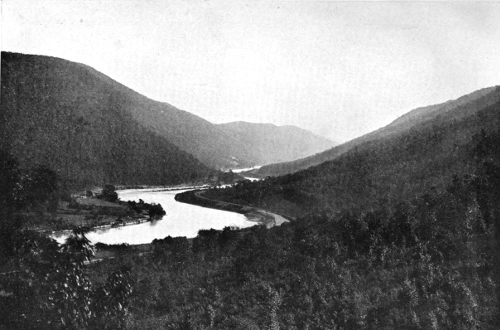
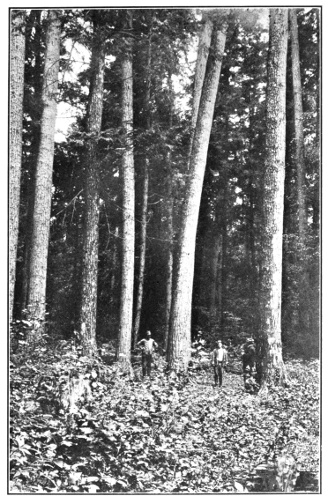
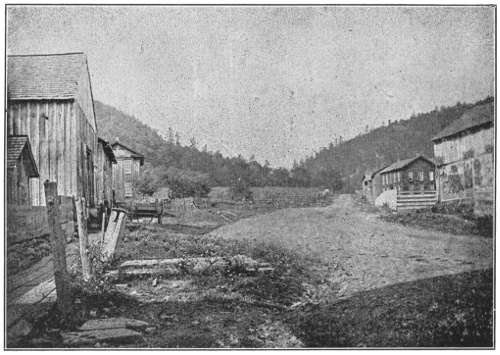
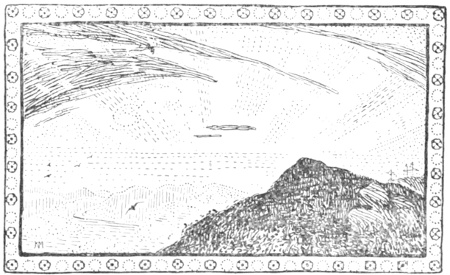
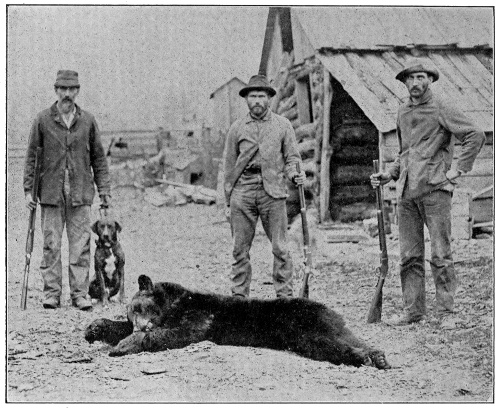
OUTPOSTS OF THE ALLEGHENIES. (Photograph by W. H. Rau.) Frontispiece
Folk Lore and Legends Collected in
Northern and Western Pennsylvania
By HENRY W. SHOEMAKER
Volume XI Pennsylvania Folk Lore Series
“The country east of the Mississippi was inhabited by a very
powerful nation. * * * Those people called themselves Alligewi.
* * * The Allegheny River and Mountains have been
named after them. * * * The Lenni-Lenape still call the
river Alligewi Sipu, the river of the Alligewi, but it is generally
known by its Iroquois name–Ohe-Yu–which the French had literally
translated into La Belle Riviere, The Beautiful River,
though a branch of it retains the ancient name Allegheny.”
–John Heckewelder.
ALTOONA, PENNSYLVANIA
Published by the Altoona Tribune Company
1922
Copyright: All Rights Reserved.
Foreword
3
The author tells me that I was his discoverer,
and that without a discoverer we cannot do anything.
Very true; one American author had to
write till he was forty-eight, and then be discovered in
Japan. Henry W. Shoemaker was discovered nearer
home, and by a humbler scholar.
In my last foreword I emphasized the value of
folk-lore. Its significance grows upon me with age.
I have now come to regard it as a kind of appendix
to Scripture. Outside of mere magic, an abuse of
correspondences, as Swedenborg calls it, there is in
folk-lore a digest of the spiritual insight of the plain
people. It also contains actual facts boiled to rags.
For instance, in 1919 the dying Horace Traubel saw
in vision his life-long idol, Walt Whitman, and the
apparition was also seen by Colonel Cosgrave, who felt
a shock when it touched him.
The flimsy modern paper whereon the scientific
account of this is printed will soon perish, and then
there will be nothing left but loose literary references
and memories to witness that it happened. Any skeptic
can challenge these, and the apparition will become
folk-lore. As it is in its scientific setting in the Journal
of the American Society for Psychical Research for
1921, it is a side light on the Transfiguration. For
if Whitman appeared to Traubel in 1919, and Swedenborg
appeared to Andrew Jackson Davis in 1844, why
should not the great predecessors of Christ appear also
to him?
4Such is the value of folk-lore, and for this reason
the Armenian Church did well to attach an appendix of
apocrypha to the Holy Gospel. In such a document as
the uncanonical Gospel of “Peter” (this was not one
of the Armenian selections, but it ought to have been,
in spite of the fact that the Mother Church of Syria
had suppressed it) the life of Christ is seen in a dissolving
view, blending with the folk-lore of the time;
and let us hope that some day this valuable piece of
ancient thought will be printed with the New Testament
instead of some of the unimportant matter that
too often accompanies it.
Albert J. Edmunds.
The Historical Society of Pennsylvania,
Philadelphia, March 1, 1921.
Introduction
5
It is a good thing to make resolves, but a better
thing, once having made them, to keep them. On
two previous occasions the compiler of the present
volume has stated his resolve in prefaces to issue nono
more books of the kind, but has gone ahead and
prepared more. Probably the motive that brought into
existence the first volume can be urged in extenuation
for the eleventh, namely, the desire to preserve the
folk-lore of the Pennsylvania Mountains.
The contents of the present volume, like its predecessors,
were gathered orally from old people and
others, and written down as closely as possible to the
verbal accounts. In order to escape ill feeling, as in
the case with the earlier volumes, some names of persons
and places, and dates have been changed. This
has been done with the greatest reluctance, and only
where absolutely necessary. The characters are real
persons, and most of them appear under their rightful
names. Many of the legends or incidents run counter
to the accepted course of history, but tradition is preserved
for what it is worth, and the reader can draw
his own conclusions. While some of these tales end
unhappily, the proportion is not greater than in life
as we know it, and the general ascendency of right
over wrong shines through the gloomiest passages.
Life could not exist, or the world go on, unless the
majority of events ended fortuitously; it is that happy
preponderance which makes “hope spring eternal,” and
6is so often rewarded by a realization of the heart’s
desire.
The various phases of the supernatural in the
ensuing pages depicts probably a more normal condition
of our relationship with the unseen world than the
crude and clumsy mediumship found in the big cities,
and may present a rational explanation of life “behind
the dark curtain.”
There is certainly a spiritual life, and a purely
spiritual God, and all the events of the soul are regulated
by divine laws, which have only too frequently
been confused with the physical life so subject to
chance and reversion back to chaos.
The origins of Pennsylvania folk-lore seem to the
writer like a happy blending of Indian and European
elements which would have gradually, had backwoods
conditions continued, developed into a definitely Pennsylvanian
mythology. The fact that the writer had so
many more legends in form of notes, which otherwise
would have been mislaid and come to nothing, prompted
him to break his resolve and prepare the present volume.
And, for good or ill, he has many more, dealing
with other parts of the State. What shall be their
fate? Are they worthy of perpetuation as folk-lore?
Apart from the general idea of preserving legendary
matter for future generations, there is the added reason
that the heroic lines of some of the characters appealed
to him, and, to save them from the oblivion of the
“forgotten millions,” their careers have been herein
recorded.
Probably one-half of the stories were told to the
compiler by one lady–Mrs. W. J. Phillips, of Clinton
County--who spent some of her girlhood days, many
7years ago, on the Indian Reservations in Pennsylvania
and southwestern New York.
Professor J. S. Illick, Chief of the Bureau of
Research of the Pennsylvania Department of Forestry,
is due thanks for securing many of the illustrations.
Four of the chapters–Nos. IX, XV, XXI,
XXII–are reprinted from the compiler’s historical
brochure, “Penn’s Grandest Cavern,” and the first
chapter, “Tulliallan,” was published in the “Sunbury
Daily”; otherwise none of the chapters of this book
have hitherto appeared in print.
Persons interested in more intimate details concerning
the origins and characters of the various tales
will be cheerfully accommodated “for private circulation
only.” Like James Macpherson of “Ossian,”
it can be said “the sources of information are open
to all.”
The compiler hopes that through this book a more
general interest in the Pennsylvania folk-lore can be
created; its predecessors have missed achieving this,
but there is always that hope springing afresh to “Godspeed”
the newest volume. No pretense at style of
literary workmanship is claimed, and the stories should
be read, not as romances or short stories, but as a
by-product of history–the folk-lore, the heart of the
Pennsylvania mountain people. With this constantly
borne in mind, a better understanding and appreciation
of the meanings of the book may be arrived at.at.
The kindly reception accorded to the previous volumes,
and also to “North Pennsylvania Minstrelsy”
by the press and by a small circle of interested readers,
if equalled by the present volume will satisfy the compiler,
8if his ambitions for a wider field of usefulness
are not to be realized.
To those of press and public who have read and
commented on the earlier volumes go the compiler’s
gratitude, and to them he commends this book, the
tales of which have had their origins mostly along
the main chain of the Allegheny Mountains and on
the western watershed. Sincere thanks are due
to Miss Mary E. Morrow, whose intelligence and
patience in transcribing the manuscripts of this and
the majority of the earlier volumes of the series has
had much to do with whatever recognition they may
have achieved, and a pleasant memory to the author,
as well.
Henry W. Shoemaker.
Department of Forestry,
State Capitol, Harrisburg,
February 23, 1922.
P. S.–Thanks are also due to Mrs. E. Horace
Quinn, late of Bucknell University, for her kindness
in revising the proofs.
9-5-22.
I Tulliallan
9
“Why, yes, you may accompany your Uncle
Thomas and myself to select the plate which
we plan to present to the battleship of the
line, ‘The Admiral Penn,’ which the First Lord, His
Grace, Duke of Bedford, has graciously named in
honor of your distinguished grandsire,” said Richard
Penn, pompously, answering a query addressed to him
by his young son, John.
The youth, who was about eighteen years of age
and small and slight, seemed delighted, and waited
impatiently with his father for Uncle Thomas’ arrival.
Soon a liveried footman announced the arrival of
Thomas Penn, and the brothers, after embracing,
started from the imposing mansion in New Street,
Spring Gardens (near the Admiralty Arch), accompanied
by the younger scion and a retinue of secretaries,
retainers and footmen.
It so happened that the leading silversmith in
the city, James Cox, was of the Quaker faith, to which
William Penn, the famous founder of Pennsylvania,
and father of Richard and Thomas, belonged, and was
particularly pleased to be the recipient of this costly
and important order. It was an occasion of such importance
to him that his wife, sons and daughter had
come to his place of business to witness the transaction
and, perhaps, meet the aristocratic customers.
10As they entered the establishment, the tradesman
himself opened the door, bowing low as the two portly
gentlemen, with their plum-colored coats, snuff boxes
and walking sticks, entered arm in arm, followed by
the diminutive John, in a long, red coat, while the
minions of various degrees waited outside, clustered
about the gilded chairs.
It must be understood that these sons of William
Penn were not members of the Society of Friends, but
had assumed the faith of their grandfather, the Admiral,
and founder of the family fortunes, and young
John was nominally a member of the same faith.
The portly and self-important gentlemen were
soon absorbed in studying the various designs of silver
services, while the restless and half-interested gaze
of young John wandered about the salesroom. It was
not long in falling on the slender, demure form of
Maria Cox, the silversmith’s only daughter. Clad in
her Quaker garb and bonnet, she was certainly a
picture of loveliness, almost seventeen years old, with
deep blue eyes, dark brows and lashes, fair complexion,
with features exaggerately clearcut, made John
Penn’s senses reel in a delirium of enthusiasm.
Ordinarily he would have become impatient at
the delay in selecting the silver service, for the older
gentlemen were slow of decision and he was a spoiled
child, but this time he was lost in admiration and he
cared not if they remained in the shop for the balance
of the day. John Penn, himself, for a small lad was
not unprepossessing; his hair was golden, his eyes
11expressive and blue, his complexion like a Dresden
china doll’s, his form erect and very slim, yet few
girls had fancied him, for he was selfish and not
inclined to talk.
Seeing that he was not assisting his elders in
selecting the silverware, Mrs. Cox, the wife, and a
woman of some tact and breeding, introduced conversation
with the young man, eventually drawing her
daughter into it, and it was a case of love quickly on
both sides.
When, after four hours of selecting and changing
and selecting again, the Penns finally accepted a design
and placed their order, John had arranged that he
was to dine with the Cox family and see the young
beauty frequently. All went well until the day appointed
for the visit to the home of the silversmith.
John Penn presented himself before his father attired
in his best red velvet coat with gold facings, white satin
knee breeches, pumps with diamond buckles, his face
much powdered, and sporting a pearl inlaid sword.
The elder Penn demanded to know the cause of the
youth’s magnificence, for ordinarily his Quaker blood
showed itself in a distaste for fancy apparel.
“To dine with Mr. and Mrs. James Cox and their
charming daughter, whom I much admire,” was the
calm rejoinder.
“What, what,” fairly shouted the father, almost
having an apoplectic attack on the spot; “dining with
common tradespeople! You must be in a frenzy, son;
we’ll have you in Bedlam.”
12“I don’t see why you talk that way, father,” said
John, retaining his composure. “Are we so very different?
It was only a few generations back when the
Penns were plain rural yeomen, and Madame van der
Schoulen, or Grandmother Penn, your own mother,
was she not the daughter of a Dutch tradesman?”
“Don’t speak that way, lad; the servants may
hear, and lose respect,” said the father.
The lad had touched a sore subject, and he preferred
to let him keep his engagement rather than
to have an expose on the subject of ancestry.
The dinner and visit were followed by others, but
at home John’s romance did not run smoothly, and
he quickly realized that his father and Uncle Thomas,
whose heir he was to be, would never consent to his
marriage with the daughter of a silversmith. Consequently,
a trip to Gretna Green was executed, and
John Penn, aged nineteen, and Maria Cox, seventeen,
were duly made man and wife.
When Richard Penn and his brother Thomas were
apprised of what he had done they locked him in his
room, and after night got him to the waterfront and
on a ship bound for the French coast. He was carried
to Paris and there carefully watched, but meanwhile
supplied with money, all that he could spend. Temporarily
he forgot all about Maria Cox, plunging into
the gaieties of the French Capital, gambling and betting
on horse races, the “sport of kings” having been only
recently introduced in France, until he was deeply in
debt. He became very ill, and was taken to Geneva
13to recuperate. There he was followed by representatives
of his creditors, who threatened to have him
jailed for debt–a familiar topic in family talk to him,
for his grandfather, William Penn, despite his ownership
of Pennsylvania, had been arrested for debt
many times and was out on bail on a charge of non-payment
of loans made from his steward at the time
of his death.
John wrote frantically to his father in London,
who turned a deaf ear to the prodigal; not so Uncle
Thomas. He replied that he would save the boy from
jail and pay his debts, provided he would divorce his
wife and go to Pennsylvania for an indefinite period.
John was ready to promise anything; a representative
of the Penn’s financial interests settled all the claims
in and out of Paris, and John Penn was free.
While waiting at Lille for a ship to take him from
Rotterdam to Philadelphia, the young man was advised
to come to London for a day to say good-bye to his
relatives. The packet was expected in the Thames
on a certain day, but got into a terrific storm and was
tossed about the North Sea and the Channel for a
week, and no one was at the dock to meet the dilapidated
youth on his arrival at Fleet Street.
As he passed up the streets in Cheapside, to his
surprise he ran into the fair figure of his bride, the
deserted Maria Cox-Penn. He was again very much
in love, and she ready to forgive. They spent the
balance of the day together, enjoying a fish ordinary
at a noted restaurant in Bird-in-Hand Court. Over
14the meal it was arranged that Maria should follow
her husband to America; meanwhile, he would provide
a home for her over there under an assumed name,
until he became of age, when he would defy his family
to again tear them asunder.
None of John Penn’s family had the slightest
suspicion of anything out of the usual when he
presented himself in their midst, and he returned
quietly to Lille, where he remained until the ship was
announced as ready to take him to America. He arrived
in New York during a terrible tornado, in November,
1752. At Philadelphia he evinced little interest
in anything except to take a trip into the interior.
As he had plenty of money, he could accomplish most
anything he wanted, and was not watched. On his
way to the Susquehanna country he traveled with an
armed bodyguard, as there were even then renegade
Indians and road agents abroad. A number of less
distinguished travelers and their servants were, for
safety’s sake, allowed to accompany the party. Among
them was a man of fifty-five, named Peter Allen, to
whom young John took a violent fancy.
It was not unusual, for Peter Allen was what the
Indians recognized as a gentleman, although he was
only a cadet, or what we would call nowadays a “poor
relation” of the proud Allen family, the head of which
was William Allen, Chief Justice of the Province, a
man about Peter Allen’s age, and for whom Northampton
or Allensville, now Allentown, was named.
Peter Allen had built a stone house or trading
15post, which he called “Tulliallan” after one of the
ancestral homes of the Allen family in Scotland, on
the very outpost of civilization, twenty miles west of
Harris’ Ferry, where all manner of traders, hunters,
missionaries, explorers and sometimes Indians congregated,
where balls were held with Indian princesses
as guests of honor, and the description of this place
fired John Penn’s fancy.
The idea had flashed through his mind that Maria
could harbor there unknown until he became of age,
and some day, despite the silly family opposition, she
would become the Governor’s Lady. John Penn went
to Peter Allen’s, and not only found a refuge for
his bride, but liked the frontier life so well that it
was as if he had been born in the wilderness. Mountains
and forests appealed to him, and his latent
democracy found full vent among the diversified types
who peopled the wilderness.
Peter Allen had three young daughters, Barbara,
Nancy and Jessie, whom he wished schooled, and John
Penn arranged that Maria should teach them and, perhaps,
have a select school for other children of the
better sort along the Susquehanna. Peter Allen was
secretly peeved at his family for not recognizing him
more, and lent himself to anything that, while not
dishonorable, would bend the proud spirit of the Proprietaries
and their favorites, one of whom was the
aforementioned “Cousin Judge” William Allen.
John Penn returned to Philadelphia, from where
he sent a special messenger, a sort of valet, to London,
16who met and safely escorted Maria to America. She
landed at Province Island on the Delaware, remaining
in retirement there for a month, until John could slip
away and escort her personally to Peter Allen’s.
The girl was bright, well-educated and sensible,
and found the new life to her liking, and her young
husband loving and considerate.
It was in the spring of 1754 when they reached
the stone house at the foot of the Fourth or Peter’s
Mountain, and during the ensuing year she taught
the young Allen girls and three other well-bred children,
and was visited frequently by her husband. She
assumed the name of Mary Warren, her mother’s
maiden name, which proved her undoing. All went
well until representatives of the Penns in London
learned that Maria Cox-Penn was missing, and they
traced her on shipboard through the name “Mary
Warren,” eventually locating her as the young school-mistress
at “Tulliallan.”
The next part of this story is a hard one to
write, as one hates to make accusations against dead
and gone worthies who helped to found our beloved
Pennsylvania; but, at any rate, without going into
whys and wherefores, “Mary Warren” mysteriously
disappeared. Simultaneously went Joshua, the friendly
Indian who lived at the running spring on the top of
Peter’s Mountain, and Arvas, or “Silver Heels,” another
Indian, whose cabin was on the slopes of Third
(now called Short) Mountain, near Clark’s Creek.
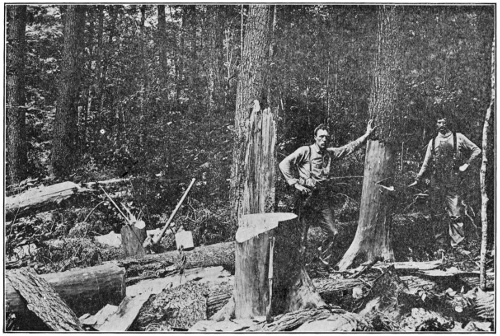
VIRGIN WHITE PINES, WARREN COUNTY, 1912
It was in the early summer of 1755 when John
17Penn, accompanied only by one retainer, John Monkton,
a white-bearded veteran of Preston, rode out of
the gateway of the stockade of John Harris’ trading
post, bound for Peter Allen’s. His heart was glad
and his spirits elated for, moody lad that he was,
he dearly loved his wife and her influence over him
was good.
On the very top of the Second Mountain he drew
rein, and in the clear stillness of the Sunday morning
listened to a cheewink poised on the topmost twig of
a chestnut sprout, and viewed the scenes below him.
In an ample clearing at the foot of Fourth Mountain
he could see Peter Allen’s spacious stone mansion,
where his love was probably at that minute instructing
the little class in the beauties of revealed religion.
They would soon be united, and he was so wonderfully
happy!
As the cool morning breeze swayed the twig on
which the cheewink perched, it sang again and again,
“Ho-ho-hee, ho-ho-hee, ho-ho-hee!” in a high key, and
with such an ecstasy of joy and youth that all the
world seemed animated with its gladness, yet Penn’s
thought as he rode on was, “I wonder where that bird
will be next year; what will it have to undergo before
it can feel the warmth and sunlight of another spring?”
He hurried his horse so that it stumbled many
times going down the mountain, and splashed the
water all over old Monkton in his anxiety to ford
Clark’s Creek. He lathered his horse forcing him to
trot up the steep contrefort which leads to “Tulliallan,”
18though he weighed hardly more than one hundred and
twenty pounds. He drew rein before the door; no one
rushed out to greet him, even the dogs were still. He
made his escort dismount and pound the heavy brass
knocker, fashioned in the form of an Indian’s head.
After some delay, Peter Allen himself appeared, looking
glum and deadly pale.
“What is wrong?” cried Penn who was naturally
as intuitive as a woman, noting his altered demeanor.
“Can I tell you, sir, in the presence of your bodyguard?”
“Out, out with it, Allen,” shouted Penn, “I must
know now.”
“Mary Warren has been gone a fortnight, we
know not whither. She had taken the Berryhill children
home after classes, and left them about five o’clock
in the evening. She did not return, and we have
searched everywhere. Strange to relate, George
Smithgall, the young serving man whom you left here
to look after your apartments, and who accompanied
Mary from London is gone also; draw your own inferences.”
John Penn’s fair face was as red as his scarlet
cloak. Despite Allen’s urging he would not dismount,
but turned his horse’s head toward the river. He rode
to Queenaskawakee, now called Clark’s Ferry, where
there was a famous fording, and, accompanied by his
guard, he made the crossing and posted for the Juniata
country. Near Raystown Branch he caught up with
the company of riflemen and scouts organized by
19“Black Jack,” the Wild Hunter of the Juniata, who
was waiting for General Braddock’s arrival to enlist
in the proposed attack on Fort Duquesne at Shannopin’s
Town, now Pittsburg. Black Jack was no
stranger to him, having often met him at social gatherings
at Peter Allen’s, and the greeting between the
two men was very friendly. John Penn occupied the
same cabin as the Wild Hunter, and he told him his
story.
“It is not news to me,” said Captain Jack. “I
heard it before, from Smithgall. He went through
here last week hunting for Mary.”
Despite this reassuring information, Penn refused
to believe anything but that the lovely Quakeress had
proved false and eloped with the German-American
serving man. Word came in a few days that the
vanguard of General Braddock’s army had reached the
Loyalhanna, and were encamped there. Captain Jack,
with John Penn riding at his side, and followed by his
motley crew with their long rifles–Germans, Swiss,
Frenchmen, Dutchmen, Indians, half breeds, Negroes
and Spaniards–approached the luxurious quarters of
General Edward Braddock, late of the Coldstream
Guards. The portly General, his breast blazing with
decorations, wearing his red coat, was seated in a
carved armchair in front of a log cabin erected for
his especial use by his pioneers, who preceded him on
the march. A Sergeant-Major conveyed the news of
“The Wild Hunter’s” presence to the General’s Aide,
who in turn carried it to the august presence.
20“I cannot speak to such a fellow, let alone accept
him as a brother officer,” said Braddock, irritably.
“Besides, his methods of fighting are contrary to all
discipline, and I want no Pennsylvania troops. Tell
him that if he insists I will make him top-sergeant,
and place my own officers over his company.”
Captain Jack was half angry, half amused, when
the rebuff was handed to him via the sergeant major.
“My father was a Spanish gentleman from the
Minisink, and my mother a woman of tolerably good
Hessian blood. I see no reason for such rank exclusiveness.”
Quickly turning his horse’s head, the sturdy borderer
ordered his troop to proceed eastward.
“Don’t act too rashly, Captain,” entreated Penn.
“General Braddock is ignorant of this country and
Indian methods of warfare. He may have orders not
to enlist native troops, yet without your aid I fear for
the success of his expedition. Please let me intercede
with him; he will do it when he hears that I am your
friend.”
“To the devil with him and his kind, the swinish
snob,” growled Captain Jack, while his black eyes
flashed a diabolical hatred; his Spanish temper was
uncontrollable. That night, when Captain Jack and
John Penn were seated at their camp fire at Laurel
Run, a messenger, a Major, not a Sergeant Major,
from General Braddock was announced.
Saluting, the officer asked to be allowed to speak
with John Penn, Esquire. Penn received the officer
21without rising, and was cooly civil throughout the interview,
which consisted principally of reading a letter
from Braddock, expressing deep regret “that he had
not known that the son of his dear friend, Richard
Penn, had been with –-- Jack,” and offering Penn
the captaincy of Black Jack’s company of scouts,
“–-- Jack to be First Lieutenant.”
Naturally, Captain Jack was more enraged than
ever, but he said: “Take it, John, I’ll withdraw and
turn my men, who, you know, are the best shots in the
Province, over to you. They would go through hell
for you.”
“Never fear,” replied Penn, and, turning to the
Major, he said: “Tell General Braddock, with my
compliments, that I decline to accept a commission
which he has no authority to tender. As for my companion,
Captain Jack (laying emphasis on the Captain)
the General had his decision earlier in the day. Goodnight,
Major.”
Thus terminated the “conference” which might
have changed the face of history. As the result of
Braddock’s pride and folly, his defeat and death are
a part of history, known by every Pennsylvanian.
John Penn was wretchedly unhappy, even though
Captain Jack tried to console him, when he shrewdly
inferred that “Mary” had been kidnapped by emissaries
of his relatives, and had not eloped with a vile serving
man. His heart was too lacerated to remain longer
with the Wild Hunter, now that no active service was
to be experienced; so, accompanied by Monkton, the
22veteran of Preston, he set out the next morning for
the West Branch of the Susquehanna to the unexplored
countries.
At Waterford Narrows they passed the body of
a trader recently killed and scalped by Indians.
“May I draw one of his teeth, sir?” said the old
soldier, “and you can carry it in your pocket, for the
old people say ‘The only thing that can break the enchantment
of love is the tooth of a dead man’.”
Penn shook his head and rode on. For a considerable
time Penn and Old Monkton visited with
Dagonando (Rock Pine), a noted Indian Chief in
Brush Valley (Centre County), for the young man,
like the founder of Pennsylvania, possessed the same
irresistible charm over the redmen.
Years afterwards, in Philadelphia, speaking to
General Thomas Mifflin, Dagonando stated that had it
not been for his unhappy love affairs, John Penn
would have been the equal of his grandfather as Governor,
and prevented the Revolutionary War. But his
spirit was crushed; even a mild love affair with Dagonando’s
daughter ended with shocking disaster. Reaching
Fort Augusta, Penn became very ill; a “nervous
breakdown” his ailment would be diagnosed today.
During his illness he was robbed of his diary. He
reached Philadelphia in the fall, and almost immediately
set sail for England. He remained abroad until
1763, when he returned as Governor of Pennsylvania.
He arrived in Philadelphia on October 30, in the midst
of the terrific earthquake of that year, and on November
235, George Roberts in a letter to Samuel Powell, in
describing the new Chief Magistrate, says:
“His Honor, Penn, is a little gentleman, though
he may govern equal to one seven feet high.”
Charles P. Keith has thus summed up Penn’s
career from the time of his first arrival in Pennsylvania:
“He was one of the Commissioners to the
Congress at Albany in the summer of 1754, and made
several journeys to the neighboring colonies. Nevertheless,
his trouble made him again despondent; he
began to shun company; he would have joined Braddock’s
army had any Pennsylvania troops formed part
of it, and perhaps have died on the field which that
officer’s imprudence made so disastrous. Some two
months after the defeat he returned to England.”
On June 6, 1766, a brilliant marriage occurred in
Philadelphia. John Penn, Lieutenant Governor, aged
thirty-seven years, married Anne, the daughter of William
Allen, Chief Justice; a strange fate had united the
relative of Peter Allen of “Tulliallan” to the husband
of Maria Cox, pronounced legally dead after an absence
of eleven years in parts unknown. Commenting
on this alliance, Nevin Moyer, the gifted Historian,
remarks: “The marriage was an unpleasant one, on
his (Penn’s) account, for he was found very seldom
at home.” It was during the wedding that a fierce
electrical storm occurred, unroofing houses and shattering
many old trees.
It was not long after this marriage when a feeling
of restlessness impelled him to start another of his
24many trips to the interior. This time it was given out
that he wished to visit Penn’s Valley, the “empire”
discovered in the central part of the province by
Captains Potter and Thompson, and named in his
honor, and Penn’s Cave, the source of the Karoondinha,
a beautiful, navigable stream, rechristened “John
Penn’s Creek.” He managed to stop over night, as
everyone of any consequence did, at “Tulliallan,” and
slept in the room with the Scotch thistles carved on
the woodwork, and saw Peter Allen for the first time
in twelve years.
A foul crime had recently been committed in the
neighborhood. Indian Joshua, who used to live at the
running spring, had gone to Canada the year of Braddock’s
defeat (the year of Mary’s disappearance, Penn
always reckoned it) and had lately returned to his old
abode. He had been shot, as a trail of blood from
his cabin down the mountain had been followed clear
to Clark’s Creek, where it was lost. In fact, pitiful
wailing had been heard one night all the way across
the valley, but it was supposed to be a traveling
panther. Arvas, or Silver Heels, had also come back
for a time, but, after Joshua’s disappearance, had gone
away.
“Maybe he killed his friend,” whispered Allen,
looking down guiltily, as he spoke what he knew to be
untruthful words.
“It is all clear to me now, Allen,” said Penn. “I
should have believed Captain Jack, when in ’55 he told
me that my late wife was carried off to Canada by
25Indians; the kidnappers came back, and for fear that
they would levy hush money on those who had caused
my Mary to be stolen, murdered Joshua as a warning.”
Allen did not answer, but Penn said: “You have
kept a public house so long that you have forgotten to
be a gentleman, and I do not expect you to tell the
truth.”
In 1840 seekers after nestlings of the vultures
climbed to the top of the King’s Stool, the dizzy pinnacle
of the Third Mountain. There they found the
skeleton of an Indian. It was all that was left of
Joshua, who had climbed there in his agony and died
far above the scenes which he loved so dearly. The
hunters put the bones in their hunting pouches and
climbed down the “needle,” and buried them decently
at the foot of the rocks.
The King’s Stool is named for a similar high point
near Lough Foyle, Ireland, and there are also King’s
Stools in Juniata and Perry Counties. The North of
Ireland pioneers were glad to recognize scenes similar
to the natural wonders of the Green Isle!
A great light had come to John Penn, but he accepted
his fate philosophically, just as he had the abuse
heaped upon him for his vacillating policy towards the
Indians. He followed up his vigorous attempt to
punish the Paxtang perpetrators of the massacres of
the Conestoga Indians at Christmas time, 1763, by promulgating
the infamous scalp bounty of July, 1764,
which bounty, to again quote Professor Moyer, paid
26“$134 for an Indian’s scalp, and $150 for a live Indian,
and $50 for an Indian female or child’s scalp.”
There are not enough Indians to make hunting for
bounties in Pennsylvania a paying occupation today, so
instead there is a bounty on Wildcats and foxes, wiping
out desirable wild life to satisfy the politicians’ filthy
greed.
John Penn returned to Philadelphia without visiting
Penn’s Valley or Penn’s Cave or John Penn’s
Creek. He had seen them previously in 1755 when
they bore their original Indian names, and his heart
was still sad. It was not long after returning that he
again started on another expedition up the Susquehanna,
traveling by canoe, just as his grandfather, William
Penn, had done in his supposedly fabulous trip
to the sources of the West Branch at Cherry Tree, in
1700. A stop was made at Fisher’s stone house,
Fisher’s Ferry. A group of pioneers had heard of his
coming and gave the little Governor a rousing ovation.
He felt nearest to being happy when among the frontier
people, who understood him, and his trials had,
like Byron, made him “the friend of mountains”; he
was still simple at heart. In the kitchen, seated by the
inglenook, he heard someone’s incessant coughing in an
inner room. He asked the landlord, old Peter Fisher,
who was suffering so acutely.
“Why, sir,” replied Fisher, “it’s an Englishwoman
dying.”
In those days people’s nationalities in Pennsylvania
were more sharply defined, and any English-speaking
27person was always called an “Englishwoman”
or an “Englishman,” as the case might be.
“Tell me about her,” said the Governor, with ill-concealed
curiosity.
“It’s a strange story, it might give Your Worship
offense,” faltered the old innkeeper. “They tell it, sir,
though it’s doubtless a lie, that Your Excellency cared
for this Englishwoman, and your enemies had her kidnapped
by two Indians and taken to Canada. The
Indians were paid for keeping her there until a few
years ago, when their remittances suddenly stopped
and they came home; one, it is said, was murdered
soon after. Arvas, his companion, was accused of the
crime, but he stopped here for a night, a few weeks
afterwards, and swore to me that he was guiltless. The
Englishwoman finally got away and walked all the
way back from a place called Muskoka, but she caught
cold and consumption on the way, and is on her death-bed
now. I knew her in all her youth and beauty at
Peter Allen’s, where she was always the belle of the
balls there; she had been brought up a Quaker, but my,
how she could dance. You would not know her now.”
“I want to see her,” said the Governor, rising to
his feet.
It was getting dark, so Fisher lit a rushlight, and
led the way. He opened the heavy door without rapping.
His wife and daughter sat on high-backed rush-bottomed
chairs on either side of the big four-poster
bed, which had come from the Rhine country. On the
bed lay a woman of about forty years, frightfully
28emaciated by suffering, whose exaggeratedly clear-cut
features were accentuated in their marble look by the
pallor of oncoming dissolution. Her wavy, dark hair,
parted in the middle, made her face seem even whiter.
“Mary, Mary,” said the little Governor, as he ran
to her side, seizing the white hands which lay on the
flowered coverlet.
“John, my darling John,” gasped the dying woman.
“Leave us alone together,” commanded the Governor.
The women looked at one another as they retired.
The thoughts which their glances carried indicated
“well, after all the story’s true.”
They had been alone for about ten minutes when
Penn ran out of the door calling, “Come quick, someone,
I fear she’s going.”
The household speedily assembled, but in another
ten minutes “Mary Warren,” alias Maria Cox-Penn
had yielded up the ghost. She is buried on the brushy
African-looking hillside which faces the “dreamy Susquehanna,”
the Firestone Mountains and the sunset,
near where travelers across Broad Mountain pass every
day. John Penn returned to Philadelphia and took no
more trips to the interior. He divided his time between
his town house, 44 Pine Street, and his country seat
“Lansdowne.”
During the Revolution he was on parole. He died
childless. February 9, 1795, and is said to be buried
under the floor, near the chancel, in the historic Christ
Church, Philadelphia, which bears the inscription that
29he was “One of the Late Proprietors of Pennsylvania.”
Most probably his body was later taken to England.
His wife, nee Allen, survived him until 1813.
The other night in the grand hall of the Historical
Society of Pennsylvania in the Quaker City, a notable
reception was given in honor of the grand historian-governor,
William C. Sproul, fresh from his marvelous
restoration of the Colonial Court House at Chester.
As he stood there, the embodiment of mental and
physical grace and strength, the greatest Governor of
a generation, receiving the long line of those who came
to pay their respects and well wishes, Albert Cook
Myers, famed historian of the Quakers, mentioned that
the present Governor of the Commonwealth was standing
just beneath the portrait of John Penn, one of the
last of the Proprietaries. And what a contrast there
was! Penn looked so effete and almost feminine with
his child-like blonde locks, his pink cheeks, weak, half-closed
mouth, his slender form in a red coat, so different
from the vigorous living Governor. Penn was also
so inferior to the other notable portraits which hung
about him–the sturdy Huguenot, General Henri
Bouquet, the deliverer of Fort Duquesne in 1758 and
1763; the stalwart Scot, General Arthur St. Clair, of
Miami fame, who was left to languish on a paltry pension
of $180 a year at his rough, rocky farm on Laurel
Ridge; the courageous-looking Irishman, General Edward
Hand; and, above all, the bold and dashing eagle
face of General “Mad Anthony” Wayne. Such company
for the last of the Penns to keep! Though lacking
30the manly outlines of his fellows on canvas, who
can say that his life had one whit less interest than
theirs–probably much more so, for his spirit had felt
the thrill of an undying love, which in the end surmounted
all difficulties and left his heart master of
the field.
Though his record for statecraft can hardly be
written from a favorable light, and few of his sayings
or deeds will live, he has joined an immortal coterie
led down the ages by Anthony and the beautiful
Egyptian queen, by Abelard and Heloise, Dante and
Beatrice, Petrarch and Laura, Alfieri and the Countess
of Albany, and here in Pennsylvania by Hugh H.
Brackenridge and the pioneer girl, Sabina Wolfe, and
Elisha Kent Kane, and the spiritualist, Maria Fox.
Love is a force that is all-compelling, all-absorbing and
never dies, and is the biggest thing in life, and the story
of John Penn and Maria Cox will be whispered about
in the backwoods cabins and wayside inns of the Pennsylvania
Mountains long after seemingly greater men
and minds have passed to forgetfulness.
But for a few lines in the writings of Charles P.
Keith, H. M. Jenkins, Nevin W. Moyer and various
Penn biographers, such as Albert Cook Myers, the
verbal memories of ’Squire W. H. Garman, James Till,
Mrs. H. E. Wilvert and other old-time residents of the
vicinity of “Tulliallan,” all would be lost, and the inspiration
of a story of overwhelming affection unrecorded
in the annals of those who love true lovers.
II At His Bedside
31
When old Jacob Loy passed away at the age of
eighty years, he left a pot of gold to be divided
equally among his eight children. It was a
pot of such goodly proportions that there was a nice
round sum for all, and the pity of it was after the
long years of privation which had collected it, that
some of the heirs wasted it quickly on organs, fast
horses, cheap finery and stock speculations, for it was
before the days of player-pianos, victrolas and automobiles.
Yolande, his youngest daughter, was a really attractive
girl, even had she not a share in the pot of gold,
and had many suitors. Though farm raised and
inured to hardships she was naturally refined, with
wonderful dark eyes and hair, and pallid face–the
perfect type of Pennsylvania Mountain loveliness.
Above all her admirers she liked best of all
Adam Drumheller, a shrewd young farmer of the
neighborhood, and eventually married him. Three
children were born in quick succession, in the small
tenant house on his father’s farm in Chest Township,
where the young couple had gone to live immediately
after their wedding.
Shortly after the birth of the last child old Jacob
Drumheller died, and the son and his family moved
into the big stone farmhouse near the banks of the
32sulphurous Clearfield Creek. It was not long after
this fortuitous move that the young wife began to
show signs of the favorite Pennsylvania mountain
malady–consumption. Whether it was caused by a
deep-seated cold or came about from sleeping in rooms
with windows nailed shut, no one could tell, but the
beautiful young woman became paler and more wax-like,
until she realized that a speedy end was inevitable.
Many times she found comfort in her misfortune
by having her husband promise that in the event
of her death he would never remarry.
“Never, never,” he promised. “I could never find
your equal again.”
He was sincere in some respects; it would be
hard to find her counterpart, and she had made a will
leaving him everything she possessed, and he imagined
that the pot of gold transformed into a bank balance
or Government bonds would be found somewhere
among her effects.
Before ill health had set in he had quizzed her
many times, as openly as he dared, on the whereabouts
of her share of the pot.
“It is all safe,” she would say. “It will be
forthcoming some time when you need it more than
you do today,” and he was satisfied.
As she grew paler and weaker Adam began to
think more of Alvira Hamel, another comely girl
whom he had loved when he railroaded out of Johnstown,
at Kimmelton, and whom he planned to claim
as his own should Yolande pass away.
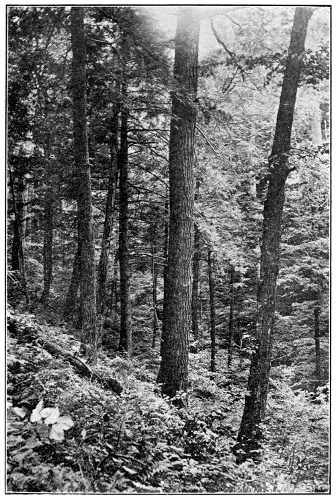
SCENE IN SNYDER-MIDDLESWARTH PARK
33Perhaps his thoughts dimly reflected on the dying
wife’s sub-conscious mind, for she became more insistent
every day that he promise never to remarry.
“Think of our dear little children,” she kept saying,
“sentenced to have a stepmother; I would come
back and haunt you if you perpetrate such a cruelty
to me and mine.”
Adam had little faith in a hereafter, and less in
ghosts, so he readily promised anything, vowing
eternal celebacy cheerfully and profoundly.
When Yolande did finally fade away, she died
reasonably happy, and at least died bravely. She
never shed a tear, for it is against the code of the
Pennsylvania Mountain people to do so–perhaps a
survival of the Indian blood possessed by so many of
them.
Three days after the funeral Adam hied himself
to Ebensburg to “settle up the estate,” but also to look
up Alvira Hamel, who was now living there. She
seemed glad to see him, and when he broached a possible
union she acted as if pleased at everything except
to go on to that lonely farm on the polluted Clearfield
Creek.
By promising to sell out when he could and move
to Barnesboro or Spangler, a light came in her dark
eyes, and though he did not visit the lawyer in charge
of his late wife’s affairs, his day in town was successful
in arranging for the new alliance with his
sweetheart of other days.
In due course of time it was discovered that the
34equivalent of Yolande’s share of the pot of gold left
by old Jacob Loy was not to be found. “She may
have kept it in coin and buried it in the orchard,” was
some of the very consoling advice that the lawyer
gave.
At any rate it was not located by the time that
Adam and Alvira were married, but the bridegroombridegroom
was well to do and could afford to wait. After a
short trip to Pittsburg and Wheeling the newly married
couple took up housekeeping in the big brick
farmstead above the creek.
The first night that they were back from the
honeymoon–it was just about midnight and Alvira
was sleeping peacefully–Adam thought that he heard
footsteps on the stairs. He could not be mistaken.
Noiselessly the door opened, and the form of Yolande
glided into the room; she was in her shroud, all white,
and her face was whiter than the shroud, and her
long hair never looked blacker.
Along the whitewashed wall by the bedside was
a long row of hooks on which hung the dead woman’s
wardrobe. It had never been disturbed; Alvira was
going to cut the things up and make new garments
out of them in the Spring. Adam watched the apparition
while she moved over to the clothing, counting
them, and smoothed and caressed each skirt or waist,
as if she regretted having had to abandon them for
the steady raiment of the shroud.
Then she came over to the bed and sat on it close
to Adam, eyeing him intently and silently. Just then
35Alvira got awake, but apparently could see nothing
of the ghost, although the room was bright as day,
bathed in the full moon’s light.
Yolande seemed to remain for a space of about ten
minutes, then passed through the alcove into the room
where the children were sleeping and stood by their
bedside. The next night she was back again, repeating
the same performance, the next night, and the
next, and still the next, each night remaining longer,
until at last she stayed until daybreak. In the morning
as the hired men were coming up the boardwalk
which led to the kitchen door, they would meet
Yolande, in her shroud coming from the house, and
passing out of the back gate. On one occasion
Alvira was pumping water on the porch, but made
no move as she passed, being evidently like so many
persons, spiritually blind. The hired men had known
Yolande all their lives, and were surprised to see her
spooking in daylight, but refrained from saying anything
to the new wife.
Every day for a week after that she appeared on
the kitchen porch, or on the boardwalk, in the yard,
on the road, and was seen by her former husband
many times, and also her night prowling went on as
of yore. The hired men began to complain; it might
make them sick if a ghost was around too much;
these spooks were supposed to exhale a poison much
as copperhead snakes do, and also draw their “life”
away, and they threatened to quit if she wasn’t “laid.”
All of them had seen spooks before, on occasion, but
36a daily visitation of the same ghost was more than
they cared about.
Had it not been for the excitable hired men,
Adam, whose nerves were like iron, could have stood
Yolande’s ghost indefinitely. In fact, he thought it
rather nice of her to come back and see him and the
children “for old time’s sake.” But the farm hands
must be conserved at any cost, even to the extent of
laying Yolande’s unquiet spirit.
The next night when she appeared, he made bold
and spoke to her: “What do you want, Yolande,” he
said softly, so as not to wake the soundly sleeping
Alvira at his side. “Is there anything I can do for
you, dear?”
Yolande came very close beside him, and bending
down whispered in his ear: “Adam,” said she,
“how can you ask me why I am here? You surely
know. Did you not, time and time again, promise never
to marry again, if I died, for the sake of our darling
children? Did you not make such a promise, and see
how quickly you broke it! Where I am now I can
hold no resentments, so I forgive you for all your
transgressions, but I hope that Alvira will be good to
our children. I have one request to make: After I
left you, you were keen to find what I did with my
share of daddy’s pot of gold. I had it buried in the
orchard at my old home, under the Northern Spy, but
after we moved here, one time when you went deer
hunting to Centre County, I dug it up and brought it
over here and buried it in the cellar of this house. It
37is here now. There are just one hundred and fifty-three
twenty dollar gold pieces; that was my share.
The children and the money were on my mind, not
your broken promise and rash marriage, which you
will repent, and which I tell you again I forgive you
for. I want my children to have that money, every
one of the one hundred and fifty-three twenty dollar
gold pieces. I buried it a little to the east of the
spring in the cellar, about two feet under ground, in a
tin cartridge box; Dig it up tomorrow morning, and
if you find the one hundred and fifty-three coins, and
give every one to the children, I will never come again
and upset your hired men. Why I have Myron Shook
about half scared to death already, but if you don’t
find every single coin I’ll have to come back until you
do, or if you hold it back from the children, you will
not be able to keep a hireling on this place, or any
other place to which you move. Many live folks can’t
see ghosts; your wife is one of these; she will never
worry until the hired men quit, then she’ll up and
have you make sale and move to town. Be square
and give the children the money, and I’ll not trouble
you again.”
“Oh, Yolande,” answered Adam in gentle tones,
“you are no trouble to me, not in the least. I love to
have you visit me at night, and look at the children,
but you are making the hired help terribly uneasy.
That part you must quit.”
“That’s“That’s enough of your drivel, Adam,” spoke
Yolande, in a sterner tone of voice. “Talk less like a
38fool, and more like a man. Dig up that money in the
morning, count it, and give it to the children and I’ll
be glad never to see you again.”
To be reproached by a ghost was too much for
Adam, and he lapsed into silence, while Yolande slipped
out of the room, over to the bedside of the sleeping
children, where she lingered until daylight.
Adam was soon asleep, but was up bright and
early the next morning, starting to dress just as the
ghost glided out of the door. By six o’clock he had
exhumed Yolande’s share of the pot of gold which
was buried exactly as her ghostly self had described.
It was a hard wrench to hand the money over to
the children, or rather to take it to Ebensburg and
start savings accounts in their names. But he did
it without a murmur. The cashier, a horse fancier,
gave him a present of a new whip, of a special kind
that he had made to order at Pittsburg, so he came
home happy and contented.
Night was upon him, and supper over, he retired
early, dozing a bit before the “witching hour.” As
the old Berks County tall clock in the entry struck
twelve, he began to watch for Yolande’s accustomed
entrance. But not a shadow appeared. The clock
struck the quarter, the half, three quarters and one
o’clock. No Yolande or anything like her came; she
was true to her promise, as true as he had been false.
It was an advantage to be a ghost in some ways. They
were honorable creatures.
Adam did not know whether to feel pleased or
39not. His vanity had been not a little appealed to by a
dead wife visiting him nightly; now he was sure that
it wasn’t for love of him or jealousy, she had been
coming back, but to see that the children got the money
that had been buried in the cellar. And at last she had
spoken rather unkindly, so the great change called
death had ended her love, and she wasn’t grieving over
his second marriage at all. However, he fell to consoling
himself that she had chided him for breaking
his word and marrying again; she must have cared
for him or she would not have said those things.
Then the thought came to him that she wasn’t really
peeved at anything concerning his marriage to Alvira
except that the children had gotten a stepmother. He
wondered if Alvira would continue to be kind to them.
Just as he went to sleep he had forgotten both Yolande
and Alvira, chuckling over a pretty High School girl
he had seen on the street at the ’burg, and whom he
had winked at.
III. The Prostrate Juniper
40
Weguarran was a young warrior of the Wyandots,
who lived on the shores of Lake
Michigan. In the early spring of 1754 he was
appointed to the body-guard of old Mozzetuk, a leader
of the tribe, on an embassy to Bethlehem, in Pennsylvania,
to prevail on the holy men there, as many Indians
termed the Moravians, to send a band of Missionaries
to the Wyandot Country, with a view of
Christianizing the tribe, and acting as advisors and
emissaries betweenbetween the Wyandots and allied nations
with the French and other white men, who were constantly
encroaching on the redmen’s territories.
Weguarran the youngest and the handsomest of
the escortescort, was very impressionable, and across Ohio
and over the Alleghenies, he made friends with the
Indian maidens of the various encampments passed
en route.
The reception at Bethlehem was cordial, but
not much hope was held out for an immediate despatch
of Missionaries as the Moravians were anxious to
avoid being drawn into the warlike aspirations of the
English and French, preferring to promote the faith
in pacified regions, as very few of them were partisans,
but if they had a leaning at all, it was toward the
French. This was due to the fact that the French always
understood the Indians better than the English,
41were more sympathetic colonizers, and while many
French Missionaries carried forward the tenets of
Rome, there was no religious intolerance, and Missionaries
of every faith seemed to thrive under their leadership.
While at Bethlehem and Nazareth, Weguarran
was much favored by the Indian maids of those localities,
but did not wholly lose his heart until one
afternoon at the cabin of an old Christian Pequot
named Michaelmas. This old Indian, a native of Connecticut,
lived in a log cabin on a small clearing near
the Lehigh River, where he cultivated a garden of
rare plants and trees, and raised tobacco. All his
pastimes were unusual; he captured wild pigeons,
which he trained to carry messages, believing that
they would be more valuable in wartime than runners.
He also practiced falconry, owning several
hawks of race, goshawks, marsh hawks and duck
hawks. The goshawks he used for grouse, wood-cocks
and quails; the marsh hawks for rabbits, hares
and ’coons; and the duck hawks for wild ducks and
other water birds, which fairly swarmed on the Lehigh
in those days. He was a religious old man, almost
a recluse, strong in his prejudices, and was much
enthused by the Wyandot embassy, giving his waning
hopes a new burst of life for an Indian renaissance.
He took a great fancy to the manly and handsome
Weguarran, inviting him to his cabin, and it
was there that the youthful warrior met the old man’s
42lovely daughter, Wulaha. She was an only child,
eighteen years of age. Her mother belonged to the
Original People and was also a Christian.
Love progressed very rapidly between Weguarran
and Wulaha, and as the time drew near for the embassy
to depart, the young girl intimated to her lover
that he must discuss the subject with old Michaelmas,
and secure his approval and consent, after the manner
of white Christians.
The old Pequot was not averse to the union,
which would add another strain of Indian blood to the
family, but stated that a marriage could only take
place on certain conditions. Weguarran, in his conversations
with Michaelmas, had told him of his military
affiliations with the French, which had filled
the old man’s heart with joy for the hopes of a new
order of things that it seemed to kindle. When he
asked the hand of the fair Wulaha in marriage,
Michaelmas “came back” with the following proposition:
“Weguarran, I am getting old and feeble,” he
said. “I may pass away any time, and I could not
bear the thought of my squaw being left alone, which
would be the case if you married Wulaha and took
her to the distant shores of Lake Michigan. However,
there are greater things than my death and my
squaw’s loneliness, the future of the red race, now
crushed to earth by the Wunnux, as we call the white
men, but some day to be triumphant. You have told
me that within this very year the French and Indians
43are sure to engage the English in a mighty battle
which will decide the future history of the Continent.
You can marry Wulaha right after that battle, if you
are victorious; otherwise you can do as the Missionaries
tell us the Romans did–fall on your sword.
You can never return here, as I do not want my
daughter to marry and continue the race of a beaten
people. I would far rather have her die single, and
have our seed perish, for if this victory is not won,
doomed is every redman on this Continent. The only
wish of the English is to encompass our extermination.
Wulaha will remain at home until after that
battle, when you can come for her and claim her as
your own, and we will give her to you with rejoicing.”
“What you say is surely fair enough, Father
Michaelmas,” replied Weguarran, “for I would see
no future for Wulaha and myself if the English are
victorious in this inevitable battle. As soon as it is
won–and it will be won, for the high resolve of
every Indian warrior is to go in to win–I will hurry
back to the banks of the Lehigh, never stopping to
rest, sleep or eat, to tell you of the glad tidings, and
bear away my beloved Wulaha. I want to ask one
special favor of you. I have admired your wonderful
cage of trained wild pigeons, which you say will
carry messages hundreds of miles. Lend me one of
these pigeons, and as soon as the victory is won, I
will release the bird, and while I am speeding eastward
on foot, our feathered friend will fly on ahead
44and end the suspense, and bring joy to yourself, your
squaw and Wulaha.”
“I will gladly let you have my best trained pigeon,
or hawk, or anything I possess, if I can learn of
the victory, but in turn I will ask a favor of you.
I listened with breathless interest to your tales of the
Prostrate Junipers which grow on the shores of the
great lakes, which cover two thousand square feet,
and are hundreds of years old. You promised to
bring me a scion of one of those curious trees, so that
I might plant it in my garden of rare trees and shrubs.
Now, here will be a chance to associate it with the
great victory; pluck a stout but small scion, and if
the victory is won, affix it firmly to one of the pigeon’s
legs and let it go. If it comes back without the
twig of Juniper I will know that our cause has lost,
and while you fall on your sword, I and my family
will jump into the Lehigh.”
“I will gladly do as you say, Father Michaelmas,”
said Weguarran, “and will send a twig that will grow,
and some day make a noble tree, and in years to come,
our people will call it Weguarran’s Victory Tree. TheThe
fact that it is a Prostrate Tree makes it all the
more appropriate, as it will represent the English
race lying prostrated, crushed by the red race they
wronged, and by our kindly and just French allies.”
Weguarran was so inspired by the thought of
the pigeon messenger, the sprig of Prostrate Juniper,
and the impending victory that it assuaged his
grief at the parting from Wulaha, sending him away
45determined to give a good account of himself in all
things.
Old Michaelmas selected a handsome cock pigeon,
with a dragon’s blood red breast–his very best
and most intelligent, and surest flyer, named Wuskawhan,
which he placed in a specially built, bottle
shaped basket, which had no lid, yet the top was too
small for the bird to escape. In this way it could
rise up and peer out, as it was carried along, and not
bruise its wing coverts or head, as it would if it flew
against the top of a square basket with a lid.
After a touching parting with Wulaha, her
mother and father, the young warrior went his way
with his precious burden.
The Indians, even old Mozzetuk, were rapid travellers,
and in due time they reached the country of
the Prostrate Junipers on the shores of Lake Michigan.
They arrived in what seemed like an armed
camp, for all the braves had been called to arms,
which plotted to drive Indians and French to the
uttermost ends of the earth.
Weguarran was quickly mobilized, and a musket
in one hand and tomahawk in the other, while on his
back he bore the sacred pigeon, he marched toward
his foes. In the excitement he had not forgotten to
slip into his pouch at his belt a sprig of the Prostrate
Juniper, which would be the emblem of the English
race prostrate under the foot of French and Indian
allies.
In due course of time the army of which the
46picked Wyandot warriors formed a part, met their
English foemen on Braddock’s Field, completely routing
and all but annihilating them. General Braddock
himself was shot from behind by one of his own men
in the wild stampede, and the French and Indians were
completely victorious.
Surveying the goreygorey scene, every wooded glade
lying thick with dead redcoats and broken accoutrements,
Weguarran carefully opened the panther skin
pouch at his best, taking out the sprig of Prostrate
Juniper. Then he lifted the handsome wild pigeon
from its bottle-nosed cage of oak withes, and with a
light leathern string, affixed the little twig, on which
the berries still clustered, to the bird’s leg, then tossed
the feathered messenger up into the air.
The pigeon quickly rose above the trees, circled
a few times, and then started rapidly for the east, as
fast as his broad, strong wings could carry him.
This done, Weguarran visited his chief, obtaining
leave to proceed to Bethlehem to claim his bride,
promising to report back with her on the banks of the
Ohio as speedily as possible. The pigeon naturally
had a good start, and by the next morning was flying
over the palisaded walls of John Harris’ Trading Post
on the Susquehanna.
A love story was being enacted within those walls,
in the shadow of one of the huge sheds used in winter
to store hides. Keturah Lindsay, Harris’ niece,
an attractive, curly-haired Scotch girl, was talking
with a young Missionary whom she admired very
47much, Reverend Charles Pyrleus, the protege of Col.
Conrad Weiser.
Unfortunately they had to meet by stealth as his
attentions were not favored by the girl’s relatives,
who considered him of inferior antecedents. They
had met in the shed this fair July morning, whether
by design or accident, no one can tell, and were enjoying
one another’s society to the utmost.
In the midst of their mutual adoration, the dinner
gong was sounded at the trading house, and Keturah,
fearful of a scolding, reluctantly broke away.
As she came out into the sunlight, she noticed a handsome
wild pigeon drop down, as if exhausted, on one
of the topmost stakes of the palisade which surrounded
the trading house and sheds.
Keturah, like many frontier girls, always carried
a gun, and quickly taking aim, fired, making the
feathers fly, knocking the bird off its perch, and it
seemed to fall to the ground outside the stockadestockade. In
a minute it rose, and started to fly off towards the
east. She had reloaded, so fired a second time, but
missed.
“How strange to see a wild pigeon travelling
through here at this time of year,” she thought, as carrying
her smoking firearm, she hurried to the mess
room of the big log trading house.
The messenger pigeon had been grievouslygrievously hurt,
but was determined to go “home.” On and on it went,
sometimes “dipping” like a swallow, from loss of
blood, but by sheer will power keeping on the wing. As
48it neared the foothills of the South Mountains, near
the village of Hockersville, with old Derry Church
down in the vale, it faltered, spun about like a pin
wheel, and fell with a thud. Gulping and blinking a
few times, it spread out its wide pinions and lay on
its breastbone–stone dead–the twig of Prostrate
Juniper still affixed to one of its carmine feet. There
it lay, brave in death, until the storms and winds
shivered it, and it rotted into the ground.
Weguarran was a rapid traveler, and in forced
marches came to the shady banks of the Lehigh in
three or four days. He was so excited that he swam
the stream. He brought the first news of the great
victory in the west to the surprised Michaelmas and
his friends. But where was the prized wild pigeon,
Wuskawhan? It could not have gone astray, for such
a bird’s instinct never erred. “Caught by a hawk or
shot down by some greedy fool of a Wunnux” was the
way in which old Michaelmas explained its non-appearance.
The news spread to the white settlements and to
the towns, and there was consternation among all
sympathizers with the Crown–with all except a few
Moravians who were mum for policy’s sake, and the
Indians, whose stoical natures alone kept them from
disclosing the elation that was in their hearts.
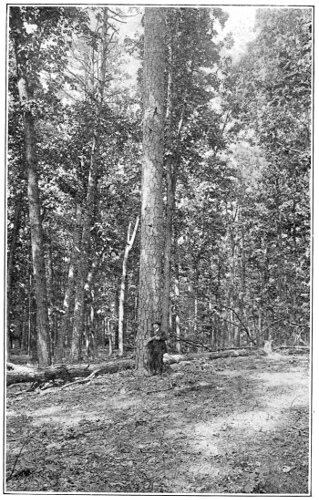
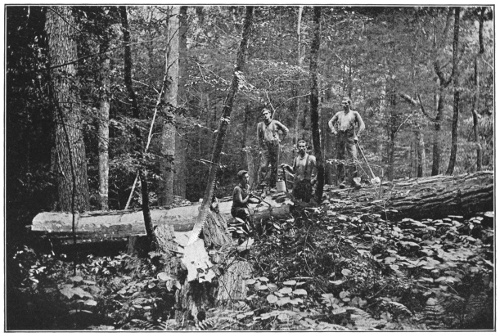
A MAMMOTH SHORT-LEAF PINE
“The English never wanted the Indians civilized,”
said Michaelmas, boldly. “They drove the Moravians
out of Schadikoke and from the Housatonic when
they saw the progress they made with our people;
49were it not for the Quakers in Pennsylvania, they
would have had no place to harbor; those of us who
felt the need of these kind friends followed them in
their exile, but we can never forgive that we had to
leave the Connecticut country of our birth under such
circumstances. I am glad that our enemies were
beaten and annihilated.”annihilated.”
Weguarran was baptized, and he and the lovely
Wulaha were married by one of the Moravian preachers,
and started for the great lake country, which was
to be their permanent home.
Michaelmas and his squaw were too old to make
the long journey, but they were happy in their garden
of rare trees and plants, the wild pigeons, the
hawks of race, and the dreams of an Indian renaissance.
They lived many years afterwards, and are
buried with the other Christian Indians at Bethlehem.
Out in the foothills of the South Mountains,
overlooking old Derry Church, in the fertile Lebanon
Valley among the pines and oaks and tulip trees, a
strange seedling appeared in the spring of 1756, different
from anything that the mountain had known
since prehistoric times. Instead of growing upward
and onward as most brave trees do, it spread out wider
and greater and vaster, until, not like the symbol of
the Anglo-Saxon prone beneath the heel of French
and Indian, it was the symbol of the all diffusing
power of the English speaking race, which has grafted
its ideals and hopes and practical purposes over the
entire American Continent. Nourished by the life’s
50blood of the travelling pigeon that bore it there, it
had a flying start in the battle of existence, and today,
after all these years, bids fair to last many years
longer, to be the arboral marvel and wonder of the
Keystone State.
Well may the Boy Scouts of Elizabethtown feel
proud to be the honorary custodians of this unique tree
with its spread of 2,000 feet, for apart from its curious
appearance and charm, it has within it memories
of history and romance, of white men and red,
that make it a veritable treasure trove for the historian
and the folk-lorist, and all those who love the
great outdoors in this wonderful Pennsylvania of
ours!
IV. Out of the Ashes
51
Last Autumn we were crossing Rea’s Hill one afternoon
of alternate sunshine and shadow, and
as we neared the summit, glanced through several
openings in the trees at the wide expanse of Fulton
County valleys and coves behind us, on to the interminable
range upon range of dark mountains northward.
In the valleys here and there were dotted square stone
houses, built of reddish sandstone, with high roofs
and chimneys, giving a foreign or Scottish air to
the scene. Some of these isolated structures were deserted,
with windows gaping and roofs gone, pictures
of desolation and bygone days.
Just as the crest of the mountain was gained, we
came upon a stone house in process of demolition,
in fact all had been torn away, and the sandstone
blocks piled neatly by the highway, all but the huge
stone chimney and a small part of one of the foundation
walls. Work of the shorers had temporarily
ceased for it was a Saturday afternoon. Affixed to
the chimney was a wooden mantel, painted black, of
plain, but antique design, exposed, and already
stained by the elements, and evidently to be abandoned
by those in charge of the demolition.
The house stood on the top of a steep declivity,
giving a marvelous view on four sides, almost strategic
enough to have been a miniature fortress!
52It was the first time in a dozen years that we
had passed the site; in 1907 the house was standing
and tenanted, and pointed out as having been a temporary
resting place of General John Forbes on his
eastern march, after the successful conquest of Fort
Duquesne, in 1758. Now all is changed, historic memories
had not kept the old house inviolate; it was to
be ruthlessly destroyed, perhaps, like the McClure
Log College near Harrisburg, to furnish the foundations
for a piggery, or some other ignoble purpose.
As we passed, a pang of sorrow overcame us at
the lowly state to which house and fireplace had fallen,
and we fell to recounting some of the incidents
of the historic highway, in military and civil history,
the most noteworthy road in the Commonwealth. The
further, on we traveled, the more we regretted not
stopping and trying to salvage the old wooden mantel,
but one of our good friends suggested that if we
did not are to return for it, we shouldshould mention the
matter to the excellent and efficient Leslie Seylar at
McConnellsburg, who knew everyone and everything,
and could doubtless obtain the historic relic and have
it shipped to our amateur “curio shop.”
The genial Seylar, famed for his temperamental
and physical resemblance to the lamented “Great
Heart,” was found at his eyrie and amusement centre
on top of Cove Mountain, and he gladly consented
to securing the abandoned mantel. As a result it is
now in safe hands, a priceless memento of the golden
age of Pennsylvania History.
53But now for the story or the legend of the mantel,
alluded to briefly last year in the chapter called
the “Star of the Glen,” in this writer’s “South Mountain
Sketches.” The story, as an old occupant of the
house told it, and he survived on until early in the
Nineteenth Century was, that General Forbes, on
this victorious eastern march, was seized many times
with fainting fits. On every occasion his officers and
orderlies believed that the end had come, so closely
did he simulate death. But he had always been delicate,
at least from his first appearance in Pennsylvania,
though when campaigning with the gallant Marshal
Ligonier in France, Flanders and on the Rhine,
participating in the battles of Dettingen, Fontenoy
and Lauffeld, no such symptoms were noted. Although
less than fifty years of age when he started
towards the west, he was regarded, from his illnesses,
as an aged person, Sherman Day in his inimitable
“Historical Collections” states that there was “much
dissatisfaction in the choice of a leader of the expedition
against Fort Duquesne, as General Forbes,
the commander, was a decrepit old man.”man.”
What caused his ill health history has not uncovered
at this late date. It has been said that he was an
epileptic, like Alexander and other great generals, or
a sufferer from heart trouble or general debility. His
military genius outweighed his physical frailties, so
that he rose superior to him, but it must not be forgotten
that he was aided by two brilliant officers,
54Colonel George Washington and Colonel Henry Bouquet.
His immediate entourage was a remarkable one,
even for a soldier of many wars. Like a true Scotsman,
he carried his own piper with him, Donald MacKelvie,
said to be a descendant of the mighty MacCrimmons;
and his bodyguard was also headed by a
Highlander, Andrew MacCochran, who had been a
deer stalker on one of the estates owned by the General’s
father.
Forbes himself, being a younger son, was not a
man of property, and Pittencrief House, his birth-place,
was already occupied by an older brother, from
whom, so Dr. Burd S. Patterson tells us, all who
claim relationship to him are descended.
The General was carried in a hammock, with frequent
stops, from Harris’ Ferry to Fort Duquesne,
and back again, borne by four stalwart Highlanders,
in their picturesque native costumes, wearing the tartan
of the Forbes clan. The deerstalker, MacCochran,
was the major domo, and even above the chief of
staff and Brigade Surgeon, gave the orders to halt
when the General’s lean weazened face indicated an
over-plussage of fatigue.
It was late in the afternoon as the returning army
had neared the summit of Rea’s Hill; the pipers were
playing gaily Blaz Sron, to cheer foot soldiers and
wagoners up the steep, rocky, uneven grade, with the
General in the van. The ascent was a hard one, and
the ailing commander-in-chief was shaken about considerably,
55so much so that MacCochran was glad to
note the little stone house, where he might give him
his much needed rest.
Old Andrew McCreath and his wife, a North of
Ireland couple, the former a noted hunter, occupied
the house; their son was serving in the Pennsylvania
Regiment, which formed a part of General Forbes’
expeditionary forces. The old folks were by the roadside,
having heard the bagpipes at a great distance,
eager to see the visitors, and catch a glimpse of their
hero son. They were surprised and pleased when
MacCochran signalled the halt in front of their door,
which meant that the entire procession would bivouac
for the night in the immediate vicinity. There were
several good springs of mountain water, so all could
await the General’s pleasure.
Permission was asked to make the house “general
headquartersheadquarters” for the night, which, of course, was
quickly given, as the old couple were honored to have
such a distinguished visitor. There was a great couch,
or what we would today call a “Davenport” in front
of the fire, and there the General was laid, the room
dark, save for the ruddy glow of the roaring fire,
which illuminated every nook and corner, and made
it at once as cheerful as it was warm and comfortable.
The General’s eyes were wide open, and he gazed
about the room, while his faithful domestics watched
him to anticipate every wish. When he was ill he excluded
his Staff, but kept his servants with him, and
they, with McCreath and his wife, stood in the corners
56of the room, back of the couch, waiting for his
commands.
The piper asked if he could liven his master with
a “wee tune or two,” but the General shook his head;
his sandy locks had become untied, and flapped about
his bony face; he made a motion with his hand that
indicated that he wanted to be alone, to try and get
some sleep. McCreath and his wife, and their stalwart
son, the other bearers of the hammock and litters,
and the surgeon of the expedition, Major McLanahan,
who had slipped into the room, withdrew,
leaving the piper and MacCochran standing in the
corner back of the couch, to aid the General should he
become violently ill in his sleep.
The General dozed, and the bodyguard became
very tired, for they had had a hard march, and sank
down on the floor, with their backs to the wall. All
was still, save for the tramp, tramp of the sentry outside
the window, or the crackle of some giant bonfire
in the general campground, or the barking of some
camp follower’s dog. The fire had died down a little,
but threw great fitful shadows, like a pall, over the
sleeping General, and caused an exaggerated shadow
of his bold profile to appear on the wall.
All at once, without the slightest warning, he
jumped to his feet, with the elasticity of a youth,
and arms outstretched, seemed to rush towards the
fire. He might have tripped over the pile of cord
wood, and fallen in face foremost, had not the ever
watchful piper and MacCochran, springing forward,
57caught him simultaneously in their strong arms. They
did not find him excited, or his mind wandering, like
a man suddenly aroused from slumbers. On the contrary,
he was strangely calm. He whispered in MacCochran’s
ear:
“Andy, I have seen my lady of Dunkerck. She
came out of the ashes towards me. I rushed forward
to greet her, and she went back into the hearth and
was gone.”
The General would say nothing further, but allowed
himself to be laid out on the couch once more,
and be covered with buffalo robes, and while he lay
quiet, he slept no more that night, but every minute
or so kept looking into the fire. At daybreak, at the
sounding of Surachan on the pipes, he was able to
start, and the balance of the march executed without
incident.
He reached Philadelphia in safety, but within a
short time after arriving there he passed away unexpectedly,
and was buried in historic Old Christ
Church, where a tablet with the following inscription
was erected in the Chancel by the Pennsylvania Chapter
of the Society of Colonial Wars: “To the Memory
of Brigadier-General John Forbes, Colonel of the
17th Regiment of Foot, born at Pittencrief, Fifeshire,
1710, died in Philadelphia, March 11, 1759.”
MacCochran was released from the army, and being
enamored of the wild mountain country in the interior
of Pennsylvania, returned to the forests. Later,
though nearly fifty years old, he enlisted and served
58through the Revolutionary War in Captain Parr’s Riflemen.
After peace was declared he bought the little
stone house on Rea’s Hill from young McCreath, who
had served with him in the Rifle Brigade, and lived
there alone until he died about 1803. He said that he
liked the place for its memories of General Forbes,
and he was always fond of telling to his mountaineer
friends when they dropped in of an evening for a
smoke and a toddy, of his hero’s exploits in peace
and war, and more than once recounted the tale of
the wraith which appeared to the General at the fireplace,
during his eastward journey from Fort Duquesne.
General Forbes, he said, as noted previously, was
a younger son, and had entered the army early in life.
He had been too busy campaigning to marry, but not
always too busy to fall in love. Yet he was a serious-minded
man, and his romances were always of the
better sort, and would have ended happily on one or
more occasions but for the exigencies of his strenuous
campaignscampaigns, which moved him from place to place.
Of all his love affairs, the one that hit him the
hardest, and lasted the longest, occurred after the
victory of Lauffeld, won by Marshal Ligonier, when,
as Lieutenant-Colonel, he was quartered with his regiment
at Dunkerck, preparatory to embarking for England.
Colonel Forbes’ billet was with one Armand
Violet, a rich shipowner, who resided in a mediaeval
chateau, which his wealthwealth had enabled him to purchase
from some broken-down old family, on the outskirts
59of the town. It was built on a bare, chalky
cliff, overlooking the sea, where the waves beat over
the rocks, and sent the spray against the walls on
stormy nights, and the wind, banshee-like, moaned incessantly
among the parapets.
Violet was away a good deal, and his wife was
an invalid, and peculiar, but their one daughter, Amethyst
Violet, was a ray of sunshine enough to illuminate
and radiate the gloomiest fortress-like chateau.
She was under eighteen, about the middle height, slimly
and trimly built, with chestnut brown hair, blue
eyes, and a fair complexion; her hair was worn in puffs
over her ears and brushed back from her brows, just
as the girls are again wearing it today; she was vivacious
and intelligent, and detected in the Colonel, despite
his thirty-seven years, a man of superior personality
and charm.
In the long wait, due to conflicting orders, and
the non-arrival of the transport, Forbes and Amethyst
became very well acquainted, in fact the Colonel was
very much in love, but would not dream of mentioning
his passion, as he deemed it folly for a man of
his years and experience to espouse a mere child. The
girl was equally smitten, but more impulsive, and less
self-contained.
Every evening the pair were together in the great
hall, sitting before the fire in the old hearth, their
glances, which often met, indicating their feelings, but
the Colonel confined his talk to descriptions of military
life, Scotland, its glens and locks and wild game, old
60legends and ballads which he loved to recite. He was
particularly fond of repeating the old ballad of Barbara
Livingston.
One night while the wind was howling, and the
spray was lashing against the castle walls, and the
rain dashed and hissed against the panes, the time to
retire had come, and Amethyst, instead of tripping
away, sprang right into Forbes’ arms, and lay her
fluffy head against his bespangled breast.
“You are the coldest man in the world” she sobbed,
looking up with tear-dimmed blue eyes. “What
have you meant all these nights, we two alone for
hours and hours, your eyes on only the sparks as they
swept upwards through the ‘louvre,’ and your thoughts
only on battles and mountain scenery. I love you more
than all the world, and yet you could not see it, or did
not care. I can restrain my feelings no longer; tell me
the truth, for I cannot bear the suspense and live.”
Forbes revealed his love by holding her very tight,
and covering her wet, hot eyelids with kisses. “Oh,
foolish, darling Amethyst,” he said, “I love you just
as much as you care for me. I have from the first
moment I saw you, and hoped that the transport would
never come, but I am twice your age, and battered
by many hard campaigns, and while I think I could
make you happy now, ten years hence I would be an
old man, and you would despise me.”
Amethyst looked up into his sad, steady eyes,
saying, “I don’t care what happens ten years from
now; we might both be dead. I love you, and I want
61you. I will give you a week to decide; if you do not,
I will jump off the highest parapet into the sea, and
you can have yourself all to yourself, and prosper if
you will with your stern Covenanter’s principles.”
The Colonel, though moved, was too prudent a
Scot to capitulate. He took the case under advisement,
and every night for a week, though chivalrous
and charming, neglected to set the beautiful girl’s
mind at rest. Yet when he retired to his room, he
paced the floor all night, for he knew that the exquisite
girl could revive his youth.
The fatal night arrived. Perhaps the result
might have been different if Amethyst had reminded
her lover of her threat. She was too proud to do so,
and the Colonel, thinking that she had forgotten her
rash words–to some extent at least–was mum, and
they parted gaily, Amethyst darting out of the hall
humming the old love song of Barbara Livingston
as light on foot, and apparently as light-hearted as any
carefree child.
She was never seen again–at least not until
Forbes saw her come out of the embers at the fireplace
on Rea’s Hill, more than thirteen years later.
When the word came that her room in one of
the turrets was empty, a general search was made, revealing
the trap-door to the parapet open. In her
haste she had omitted dropping it. From that Forbes
knew that the worst had happened. When MacCochran
told it to him, standing pale and frigid by the
ancient hearth, he tried to stroke his small military
62mustache, to show his sang-froid, but fell in a swoon
on the stone floor, lying unconscious for a week.
That was the beginning of the fainting fits that
plagued him for the rest of his life, and the commencement
of his distaste of life, which caused him
to ask for active service in America, in a new and wild
environment, far from scenes similar to the terrible
tragedy of his love and pride. And yet, out of the
fire, in distant Pennsylvania, had appeared the long lost
Amethyst Violet, perhaps as a “warning” of his fast
approaching end, to open the portals to that better
world where they would be together, and all things
be as they should.
MacCochran, philosophic and superstitious Scot
that he was, had many reasons for lingering in the
little stone house. Often he said, when he sat smoking
late at night, the shadows from the dying fire
would cast dark shapes, much like General Forbes’
bold features, on the walls, and he felt the magnetic
spell of his old Master’s presence. Perhaps out of
the ashes would emerge Amethyst Violet, or her spirit
self, and the lovers could be re-united before his eyes
in a shadowland.
But nothing ever happened so fortuitous, and the
engraved likenesses of “Bonnie Prince Charlie” and
Madame d’Albany, unhappy lovers also, which hung
on either side of his Revolutionary rifle, above the
mantel, looked down on him as if in sympathy, for
his fidelity which had survived the grave. The long
looked for visitations never came; perhaps among
63the vaults and cornices and lofts of Old Christ Church,
where the General is resting, the reunion of the lovers
has taken place, but wherever it has, the place is known
only to the spirits of Forbes and the fair Amethyst
Violet; there are no witnesses.
And now the present owner of “General Forbes’
Fireplace,” as he calls it, is waiting to set it up in some
study or hunting lodge, beneath the skull and antlers
of the extinct Irish elk, from Ballybetag Bog, where
amid forest surroundings, in the dead of night, he can
keep vigil like MacCochran, after reading “Volumes
of Quaint and Forgotten Lore,” and maybe be rewarded
by a sight of the true lovers from out of the
ashes.
V Wayside Destiny
64
Like many natives of the Pennsylvania Mountains,
Ammon Tatnall was a believer in dreams
and ghosts. Even in his less prosperous days,
when life was considerable of a struggle, he had time
to ponder over the limitless possibilities of the unseen
world. Probably his faith in the so-called supernatural
was founded on a dream he had while clerking
in a hotel at Port Allegheny, during the active days
of the lumber business in that part of the Black Forest.
It seemed that his mother was lying at the point
of death, and wanted him to come to her, but as she
did not know his whereabouts, was suffering much
mental anguish. Just in the midst of the dream the
alarm clock went off, but he awoke and got up with
the impression that his vision had been real. In the
office he informed the landlord of his dream. Like a
true mountain man, the proprietor merely asked him
to come back as soon as he could, such occurrences
being not unusual in his range of experience.
AMONG THE VIRGIN HEMLOCKS, BLACK FOREST. (Photograph by W. T. Clarke.)
At home, in the Wyoming Valley, he found conditions
exactly as reproduced in the dream. His sudden
coming proved the turning point in his mother’s
illness; she rallied and got well. During her convalescence,
for Tatnall remained longer than he had expected,
she told him of a story which her mother had
65told her of the straight dreaming of some of their ancestors,
pioneers of the North Branch.
The woman in question, who lived many years
before, dreamed one night that her daughter who lived
in Connecticut, and who had married just as they left
for Wyoming, appeared to her with a baby in her arms.
SheShe said she herself was dead and she desired the baby
to be given to the grandmother. As a sign of the reality
of the vision, she placed her hand on the wrist of
the grandmother, leaving a mark on it that could never
be effaced.
The grandmother took the long journey to Connecticut
and found that everything had happened as
told in the dream. The child grew up, and became
the wife of a well-known Methodist preacher, and was
famed throughout Northern Pennsylvania for her good
deeds.
Tatnall gradually advanced in life, and became
agent or traveling salesman for several wholesale lumber
concerns. He had gotten his start by being polite
to the manager of one of the companies who came
up from Pittsburg every week and stopped at the hotel.
He made a success as a salesman, and it was a matter
of quiet satisfaction to him that in ten years he hadhad
sold 160,000,000 feet of lumber. But he had been too
busy to marry, too busy to have a home; was a driving,
pushing machine in the interests of his employers.
Sometimes on the trains he met with intelligent people,
but generally his associates were like himself, human
66dynamos, but without his interest in the supernatural.
There was one railway journey which he took
frequently, and on fast trains. His westbound trips
carried him through the most mountainous part of
the country in the late afternoon, but there was generally
light enough to show the various aspects of
the wild, rugged landscape. There was a little abandoned
graveyard, all overgrown, with an uneven stone
wall around it, near where the tracks crossed the river
bridge. Standing among the lop-sided and battered
tombstones, the tips of some of the older ones of
brownstone being barely visible, looking as if they
were sinking into the earth, he would always see the
figure of a young woman attired completely in grey.
The train was always traveling so fast that he counted
a different number of stones every time he went by–there
were probably a “Baker’s Dozen.”
For a long time he thought that she must be some
particularly devoted mourner, a recently bereaved widow,
but it did seem a strange coincidence that she
should be there on the same days and hour that he
passed by in the fast train. Once he called his seat-mate’s
attention to the figure, but the companion could
see nothing, and laughingly said: “Why, you must be
seeing a ghost.”
The word ghost sent a thrill through Tatnall, and
after that he said no more to anyone, but conceded to
himself that the girl in grey was a wraith of some
kind. Though the train did not pass close to the
67graveyard, and was always moving rapidly, he fancied
that he could discern the ghost’s type of feature,
or imagined he did; at any rate he had an exact mental
picture of what he thought she looked like, and would
pick her out in a crowd if he ever saw her in hailing
distance.
This had kept up for five years, and he began to
feel that it was getting on his nerves; he must either
abandon that particular train or go to the graveyard
and investigate. He chose the latter course, and one
afternoon arrived at the nearest station, via a local
train. The graveyard was on the opposite side of the
river, and there seemed to be very little hurry on the
part of the boatman, who lived on the far shore, to
carry him across. It was late in the fall, after Thanksgiving,
and the trees were bare of leaves, and shook
and rattled their bare branches in the gusts of wind
that came out of the east.
He sat down on an old rotting shell of a dugout
by the bank, watching the cold, grey current, for the
river was high after many days of fall rains. It was
a dreary, but imposing scene, the wide, swollen river,
the wooded banks and hills beyond, and back of him,
high rocky mountains, partly covered with scrubby
growth and dead pines.
Finally, in response to frequent calling, he could
see the boat launched; it looked like a black speck
at first, and gradually drew nearer to him and beached.
The boatman was a tiny man, with a long drooping
mustache and goatee, wearing a Grand Army button;
68he was pleasant, but inquisitive, though he “allowed”
Tatnall could have no other business than to be a
“drummer” bound for the crossroads store on the opposite
bank.
Tatnall had remembered a small, dingy store in
a hamlet, about half mile from the little cemetery; he
had intended going there as he wanted information
concerning the families who were buried there. Perhaps
he could learn all he wanted to know from the
riverman, and save the walk down the track to the
store, but for some reason held his tongue.
The boatman’s final remark was that it was strange
for anyone to be willing to pay a dollar to be ferried
across the river, when most people walked the railroad
bridge. It was trespassing on railroad property,
and dangerous to do it, but it was worth the risk,
many travelers thought.
Arriving safely across the roily current, Tatnall
paid and thanked the boatman, and started in the direction
of the little country store. In front of the store
was a row of mature Ailanthus trees, which seemed
like sturdy guards over the old stone structure,
which had once been a tavern stand. The porch was
filled with packing cases and barrels.
As Tatnall opened the door, he could see a number
of habitues seated about on crates and barrels.
One of them, a white bearded Civil War Veteran,
rose up, leaning heavily on his cane, and bid the
stranger welcome. Almost before he had a chance
to engage in conversation with the regulars, he glanced
69behind the counter, where he beheld a young woman,
who had just emerged from an inner apartment behind
the store room.
In the dim half-light, the dark aquiline face and
meagre figure seemed strangely familiar. She was
more Oriental than Indian in type, with that curly
hair and wonderful nose, those thin lips, and complexion,
the deep pink tone of a wild pigeon’s breast.
Where had they met before? For a moment his mind
refused to correlate, then like a flash, he realized that
she was the counterpart of the girl in grey who
haunted the little disused cemetery so regularly. And
the way she looked at him was as if they had seen
one another before; on her face was a look of mild
surprise.
Addressing some pleasantries to her, they were
soon engaged in conversation, as if they had known
each other for years. It was getting late, time to light
lamps and fires at home, so the long-winded dissertations
of the habitues were left off, to be continued
after supper. One by one they filed out of the store;
if they had any opinion of the stranger conversing
with Elma Hacker, the store-keeper’s niece, it was
that he was probably some traveling man, “talking
up” his line of goods.
When the last one had gone, and the acquaintance
had progressed far enough, Tatnall, leaning over
the counter, confided bravely the purpose of his visit
to the remote neighborhood. For five years he had
been seeing a figure in grey, in the late afternoons,
70while passing by the little graveyard in the western
express. No one else could see it, yet he was certain
that his senses were not deceiving him. Did she
know anything of this, and could she help him fathom
the mystery?
The dark girl dropped her eyes and was silent
for a moment. She was hesitating as to whether to
disclaim all knowledge, or to be frank and divulge a
story which concerned her soul.
“Yes, I do know all about it, how very funny!
I, too, have had the power of seeing that figure in
grey, though very few others have ever been able to,
and many’s the time I’ve been called crazy when I
mentioned it. ‘The girl in grey,’ as you call her,
strangely enough was an ancestress of mine, or rather
belonged to my father’s family, and while I have the
same name, Elma Hacker, I don’t know whether I
was named for her or not, as my parents died when
I was a little girl.
“It used to make me feel terrible when I was a
little girl and told about seeing the figure. I hated
to be regarded as untruthful or ‘dullness,’ but at last
my uncle, hearing of it, came to the rescue and told
me not to mind what anyone said, that, from the description,
he was sure I had seen the ghost. He had
never had the power to see her, but his father, my
grandfather had, and other members of the family.
“It was a sad and curious story. It all happened
in the days of the very first white settlers in these
mountains, when my ancestors kept the first stopping
71place for travellers, a Stone fortress-like house, in
Black Wolf Gap; the ruins of the foundations are
still visible, and folks call it ‘The Indian Fort.’ The
Hackers were friendly with the Indians, who often
came for square meals, and other favors from the
genial pioneer landlord and his wife. The Elma
Hacker of those days had a sweetheartsweetheart who lived
alone on the other side of the Gap; his name was
Ammon Quicksall, and from all accounts, he was a
fine, manly fellow, a great hunter and fighter.
“He would often drop in on his beloved on his
way home from his hunting trips, at all hours of the
day. One one occasion four Indians appeared at
the tavern, intimating that they were hungry, as Indians
generally were. Elma carried a pewter dish
containing all the viands the house afforded to each,
which they sat eating on a long bench outside the
door.
“One of the Indians was a peculiar, half-witted
young wretch who went by the name of Chansops.
He came to the public house quite often, being suspected
of having a fondness for Elma and for hard
cider. She always treated him pleasantly, but kept
him at a distance, and never felt fear of any kind in
his presence. No doubt his feelings were of a volcanic
order, and under his stoical exterior burned a
consuming passion. He was munching his lunch, apparently
most interested in his food, when Ammon
Quicksall and his hunting dogs hove in sight.
“Their barking and yelping were a signal to Elma,
72who rushed out of the house to greet her lover, perhaps
showing her feelings a trifle too much; though
she had no reason to imagine she should restrain
herself in the presence of the Indians. All the while
Chansops was eyeing her with gathering rage and
fury. When Elma took her lover’s arm–she must
have been a very impulsive girl–and rested her head
against his shoulder, it was too much for the irate
Indian.
“He jumped up, firing his pewter dish into the
creek which flowed near the house, and danced up
and down in sheer fury. His companions tried hard
to calm him, as they wanted to keep on good terms
with the innkeeper’sinnkeeper’s family, but he was beyond all
control. Quicksall and Elma were walking on the
path which led along the creek; their backs were
turned, and they little dreamed of the drama being
enacted behind them. The other Indians, realizing
that Chansops meant trouble, lay hold of him, but
he wrenched himself free with a superhuman strength,
threatening to kill anyone who laid hands on him
again.
“Old Adam Hacker, Elma’s father, finally heard
the commotion and came out, and asked in Dutch
what the trouble was all about. One of the Indians,
the oldest and most sensible, replied that it was only
Chansops having a jealous fit because he saw Elma
walking off with Quicksall. While these words were
being said, Chansops was edging further away, and
looking around furtively, saw that he had a chance to
73get away, and sprang after the retreating couple.
Bounding like a deer, he was a few paces behind
Quicksall in a twinkling of an eye. He had a heavy
old flint-lock pistol with him, which he drew and fired
point blank into the young lover’s back at two or three
paces. With a groan, Quicksall sank down on the
ground, dying before Elma could comfort him.
“Before Adam Hacker or the friendly Indians
could reach the scene of the horrid tragedy, Chansops
had escaped into the forests, followed by Quicksall’s
hounds yelping at his heels. He was seen no more.
The dogs, tired and dejected, re-appeared the next
day; evidently they had been outraced by the fleet
Indian runner.
“It was a blow from which the bereaved girl
could not react. She was brave enough at the time,
but she was never the same again. She gradually
pined away, until she was about my age, she died,
and was buried not in the little graveyard, but in her
father’s yard. That was done because it was feared
that the crazy Chansops might return and dig up her
body, and carry it away to his lodge in the heart of
the forest. Quicksall was buried in the pioneer cemetery,
and that is the place where Elma Hacker of
those days evidently frequents, trying to be near her
sweetheart’s last resting place, and to reason out the
tragedy of her unfulfilled existence.
“It is a very strange story, but odder still, to me,
that you, a stranger, should have seen the apparition
74so frequently, when others do not, and been interested
enough to have come here to unravel the mystery.”
“It is a strange story,” said Tatnall, after a pause.
He was figuring out just what he could say, and not
say too much. “The strangest part is that the figure
I have been seeing is the image of yourself, bears
the same name, and my name, Ammon Tatnall, has
a somewhat similar sound, in fact is cousin-german
to ‘Ammon Quicksall.’”
In the gloom Elma Hacker hung her pretty head
still further. She was glad that there was no light
as she did not want Tatnall to see the hot purple
flush which she felt was suffusing her dark cheeks.
“The minute I came into the store,” Tatnall continued,
“you looked familiar; it did not take me a
minute to identify you as the grey lady.”
“And you,” broke in Elma, “appear just as I always
supposed Ammon Quicksall looked.”
How much more intimate the talk would have become,
there is no telling, but just then the door was
swung open, and in came old Mrs. Becker, a neighbor
woman, to buy some bread.
“You must be getting moonstruck, Elma,” she
said, “to be here and not light the lamps. Why, it is
as dark as Egypt in this room, and you were always
so prompt to light them.”
Elma bestirred herself to find the matches, and
soon the swinging lamps were lit, and the store aglow.
Again the door was thrown open, and Elma’s
75uncle came in. He was Adam Hacker, namesake of
the old-time landlord, and proprietor of the store.
Mrs. Becker got her bread and departed, and Elma
introduced Tatnall to the storekeeper. Soon she explained
to him the stranger’s business, to which the
uncle listened sympathetically. At the conclusion he
said:
“It is really curious, after all these years, to have
an Adam Hacker, an Elma Hacker and an Ammon
Tatnall–almost Quicksall–here together; if Chansops
was here it would be as if the past had risen
again.”
“Let us hope there’ll be no Chansops this time,”
said Tatnall. “Let us feel that everything that was
unfulfilled and went wrong in those old days is to be
righted now.”
It was a bold statement, but somehow it went
unchallenged.
“I believe in destiny, the destiny of wayside cemeteries,
of chance and opportunity,” he resumed. “It
can be the only road to true happiness after all.”
“How happy we’d all be,” said Elma demurely,
“if through all this we could only lay the ghost of my
poor ancestress, the grey lady.”
“Nothing that is started is ever left unfinished,”
answered Tatnall. “And we of this generation become
unconscious actors in the final scenes of a drama
that began a couple of centuries ago. In that way
the cycle of existence is carried out harmoniously,
else this world could not go on if it was merely a
76jumble of odds and ends, and starts without finishes;
as it is, everything that is good, that is worthwhile,
sometimes comes to a rounded out and completed fulfillment.”
The moon, which had come out clear, was three
parts full, and shed a glowing radiance over the rugged
landscape. After supper Ammon and Elma strolled
out along the white, moon-bathed road. Coming
to a cornfield the girl pointed to a great white oak
with a plume-like crest which stood on a knoll, facing
the valley, the river, and the hills beyond; they
climbed the high rail fence, and slipping along quietly,
seated themselves beneath the giant tree. Of the
many chapters of human life and destiny enacted beneath
the oak’s spreading branches, none was stranger
than this one. There until the flaming orb had
commenced to wane in the west, they sat, perfectly
content. “Oh, how I like to rest on the earth,” said
she. “How I love to be here, and look at your wonderful
face,” he whispered, as he stroked the perfect
lines of her nose, lips, chin and throat.
VI The Holly Tree
77
It was while on a mountain climbing trip in the
French Alps, when stormstayed at a small inn
at Grenoble, that a chance acquaintance showed
The Viscount Adare a copy of “The Travels of Thomas
Ashe,” a book which had recently appeared in
London and created a sensation in the tourist world.
The Viscount had already perused “Travels Beyond
the Alleghenies,” by the younger Michaux, but the
volume by Ashe, so full of human interest, more than
sharpened his old desire to travel in the United
States, now that a stable peace between the young
republic and the Mother Country was a matter of
some years standing.
The mountains, as described by both Michaux
and Ashe, seemed stupendous and inspiring, wild
game and mighty forests were everywhere, and a
glimpse might be caught of the vanishing redmen,
without journeying as far west as the Mississippi
River.
Thomas Ashe excelled in descriptions of the life
along the mountain highways, though nothing could
be more vivid than Michaux’s pen picture of his feast
on venison cooked on the coals on the hearth at Statler’s
stone tavern on the Allegheny summits, near
Buckstown. This ancient hostelry is, by the way, still
78standing, though misnamed “The Shot Factory,” by
modern chroniclers, much to the disgust of the accurate
historian of Somerset County, George W.
Grove.
All during his trip among the Alps of Savoy, and
Dauphiny, The Viscount Adare was planning the excursion
to Pennsylvania. His love of wild scenery
was one compelling reason, but perhaps another was
Ashe’s description of his meeting and brief romance
with the beautiful Eleanor Ancketell, daughter of the
innkeeper on the Broad Mountain, above Upper
Strasburg, Franklin County.
It was well along in August, the twenty-first to
be exact, when Ashe’s book was first shown to him,
therefore it seemed impracticable to make the journey
that year, but the time would soon roll around,
and be an ideal outing for the ensuing summer. From
the time of his return to London, until almost the date
set for the departure, The Viscount Adare busied
himself reading every book of American travel and
adventure that he could lay his hands on, besides accumulating
a vast outfit to take along, although the
trip was to be on foot, and without even a guide.
Needless to say, with such an interesting objective,
the year passed very rapidly, not that The Viscount
had no other interests, for he had many, being
a keen sportsman and scientist, as well as a lover of
books, paintings and the drama.
It was on the twenty-third of August, a little
over a year after his first acquaintance with the writings
79of Ashe, that The Viscount embarked for Philadelphia,
on the fast sailing ship “Ocean Queen.”
Very few Englishmen went to America for pleasure
in those days as the sting of the Revolution was still
a thorn in their sides. Many Britishers did go, but
they were mostly of the commoner sort, immigrants,
not tourists.
The Viscount Adare, even before sailing, had his
itinerary pretty well mapped out. He would tarry a
week in Philadelphia to get rid of his “sea legs,” then
proceed by carriage to Louisbourg, then beginning to
be called Harrisburg, and go from there to Carlisle,
Shippensburg, and Upper Strasburg, at which last
named place he would abandon his conveyance, and
with pack on back, in true Alpine fashion, start overland,
traversing the same general direction of Michaux
and Ashe towards Pittsburg. At Pittsburg he
planned to board a flat boat and descend the Ohio,
thence into the Mississippi, proceeding to New Orleans,
at which city he could set sail for England.
It was an ambitious trip for a solitary traveler,
but as he was known by his Alpinist friends as “The
Guideless Wonder,” some indication may be divined
of his resourcefulness.
The journey across the Atlantic was interesting.
A school of whales played about the ship, coming so
close as to create the fear that they would overturn it.
The Captain, a shrewd Irishman, was not to be daunted,
so he ordered a number of huge barrels or casks
thrown overboard, which immediately diverted the
80attention of the saurians, with the result that a smart
breeze coming up, they were left far astern.
A boat, said to be a pirate, was sighted against
the horizon, but fortunately made no attempt to come
close, heading away towards the Summer Islands,
where, say the older generation of mountain folks,
arise all the warm south breezes that often temper
wintry or early spring days in the Pennsylvania Highlands,
with blue sky and fleecy clouds.
The Viscount Adare was pleased with these trifling
adventures, and more so with ocean travel, as
it was his first long sea voyage, though he had crossed
the Channel and the Irish Sea scores of times.
He debarked in Philadelphia after a voyage lasting
nearly six weeks, consequently the green foliage
of England was replaced by the vivid tints of Autumn
on the trees which grew in front of the rows
of brick houses near the Front Street Landing Wharf.
He had letters to the British Consul, who was anxious
to arrange a week or two of social activity for the
distinguished traveler, but The Viscount assured him
that he must be on his way.
The ride in public coaches to Lancaster and Harrisburg
was accomplished without incident. His fellow
travelers were anxious to point out the various
places of interest, the fine corn crops, livestock and
farm buildings, but the Englishman was so anxious to
get to the wilds that this interlude only filled him with
impatience.
BARK-PEELERS AT WORK. BLACK FOREST
He was impressed not a little by the battlefields
81of Paoli and Brandywine, but most of all by the grove
where the harmless Conestoga Indians were encamped
when surprised and massacred by the brutal Paxtang
Boys. The word “Indians” thrilled him, and
whetted his curiosity, which was somewhat appeased
on his arrival at Harrisburg by the sight of five Indians
in full regalia, lying on the grass under John
Harris’ Mulberry Tree, waiting to be ferried across
the river.
He tarried only one night at Harrisburg, then
hiring a private conveyance, started down the Cumberland
Valley, where he most admired the many
groves of tall hardwoods–resting at Carlisle and
Shippensburg–as originally planned. At Carlisle, he
was waited on at his inn by a German woman, who
explained to him that she was none other than “Molly
Pitcher,” or Molly Ludwig, the intrepid heroine of the
Battle of Monmouth.
It was on a bright autumnal morning that, with
pack on back, and staff in hand, he started for the
heights of Cove Mountain, towards the west country.
On the way he passed a small roadside tavern, in
front of which a few years before had played a little
yellow-haired boy, with a turkey bell suspended
around his neck so that he could not get lost. The
German drovers who lolled in front of the hostelry
were fond of teasing the lad, calling him “Jimmy mit
the bells on,” much to the youngster’s displeasure.
His mother was a woman of some intellectual attainments,
and occasionally would edify the society
82folk of Mercersburg by reciting the whole of Milton’s
“Paradise Lost.”
In time this boy became known as James Buchanan,
the only Pennsylvanian to occupy the Presidential
chair.
There were many taverns along the road, considering
the wildness of the country, and The Viscount
thought how much history and tradition was
being made about their inglenooks and home-garths.home-garths.
The forests of chestnuts, yellow pine and rock oak,
the grand scenery of distant valleys and coves, interested
him more, and the occasional meetings with
the mountain people along the way, whom he enjoyed
conversing with, about the local folk-lore, game and
Indians. On many of the log barns and sheds were
nailed bear paws, deer horns and wolf hides, and the
hieroglyphics and signs, to ward off witches, were
keenly interesting to his inquiring gaze.
It was amazing how the road wound in serpentine
fashion among the mountains; the distance could
have been much shortened, he thought.
One morning a backwoodsman with a black beard
that hung almost to his feet, explained to him the
“short cuts,” or paths that went down the steep slopes
of the mountains, lessening the distance of the regular
roads followed by the packers around the elbows
of the mountain ravines.
The Viscount Adare enjoyed these “short cuts”
hugely. They reminded him of his Alpining days,
and they led him right through the forests, under the
83giant oaks and pines where he saw many unusual
looking birds, such as Pileated Woodpeckers and Carolina
Paraquets, while occasionally a Deer or Gray
Fox crossed his path. He had reached the bottom of
a ravine where a stream headed at a big spring, while
taking one of these “short cuts,” when he came in
sight of a clearing which contained a corn field, a
pasture lot or commons, a log house, log barn, and
a smaller log cabin, that looked like a smoke-house.
Smoke was issuing from an opening in the roof of
the tiny structure, which might have passed for a
child’s play house, modelled after the larger log
dwelling. As he neared the little hut, which reminded
him of an Alpine baracq, and which stood close to
the path, the door opened and two most curious looking
figures emerged. In old England he had seen
sweeps, but these were more grotesque and grimier
than any he could recall. As he drew nearer, he perceived
that while one appeared to be a man, the other
was a young woman. Both were entirely unclad, save
that the woman’s locks were covered by a homespun
cap of the tam o’shantero’shanter pattern. Both were literally
black, from head to foot.
When they saw the traveler, the woman ran back
into the cabin, pulling the door shut, while the “Jim
Crow” man waited in the path until joined by the
surprisedsurprised Viscount.
“What is all this, my good man,” he queried,
“been cleaning your chimney and fallen through it
into a barrel of tar?”
84“Oh, no,” said the grimy mountaineer, smiling,
his teeth looking very white against his swarthy visage.
“My business is to make lamp black, and my
friend and I have been sweeping down the walls, collecting
the output this morning, and boxing it, and
had just finished when you appeared in sight.”
The fellow made no attempt to apologize for his
outlandish appearance, but stood there in the sunlight
like an imp of darkness, chatting with the Englishman.
“I don’t want to keep your lady friend penned
up in there any longer,” said The Viscount, as he
started to move away.
“Oh, don’t go,” said the maker of lamp black,
“I don’t know why she acts that way; stay and have
dinner with us. We never let a stranger go by without
furnishing him with some food.”
Ordinarily, The Viscount Adare, unconventional
as he was, would have scurried away from such
grimy surroundings, but there was something that
appealed to him about the lamp black maker’s lady,
even in her coat of ebony grime, that made him decide
to tarry.
“Thanks, I will stay,” he replied, “but I’ll go to
the barn so as to give your ‘friend,’ as you call her,
a chance to come out.”
“Don’t you bother to do that,” said the black man.
“She is acting foolish today; don’t give her the satisfaction
to move a step. She never minded showing
herself to anybody before.”
85These last words were secretly pleasing to the
Viscount, as it showed that the young woman recognized
in him a person of superior sensibilities, but
he hurried to the barn until he knew that she had
been given time to escape to the house. But he could
not help hearing the lamp black maker loudly chiding
her for modesty, a trait she had never displayed
previously. Pretty soon he saw the fellow making
trips to the spring, carrying water buckets into the
house. The Viscount sat on the doorstep of the barn,
watching the juncos flying about among the savin
bushes in the clearing, or his eyes feasting on the cornelian
red foliage of the sassafras trees on the hill,
inwardly speculating if with her black disguise washed
off, the young woman, whose higher nature he
had aroused, would be as good looking as he imagined
her to be. He made a mental picture of her loveliness,
ranking her close beside that of high bred beauties
of his own land, of the types depicted by Romney,
Kneller and Lely.
It was not long before he saw her emerge from
the house, all washed and scrubbed, with her hair
neatly combed, clad in a spick and span “butternut”
frock. As she came towards him, he noted that she
was a trifle above the average height, and her feet,
despite the rough brogans she wore, were very small.
He saw, to his amazement, that she was the counterpart
of his mental picture, only more radiantly lovely.
When she drew near, she asked him, her face
lighting up very prettily, as she spoke, if he would
86like to come to the house to rest, that she would soon
prepare dinner, and hoped that he would not be too
critical of her humble efforts as a cook.
Her eyes seldom met his, but he could see that
they were large and grey-brown, with delicately penciled
black brows, and black lashes. Her face was
rather long and sallow, or rather of a pinkish pallor.
Her hair was cameo brown, her nose long and
straight, the lines of her mouth delicate and refined,
with lips unusually thin. He had noticed, as she came
towards him, that her slender form swayed a little
forward as she walked, reminding him of the mythical
maiden Syrinx, daughter of the River God, whom
the jealous-hearted Pan changed into a reed.
The Viscount Adare was far more disconcerted
than his hostess, as he followed her to the log house.
Just as they approached the door she whispered, “I
hope that you will forgive the awful exhibition I made
of myself.”
Indoors she sat down on one of the courting
blocks by the great open hearth, where pots of various
sizes hung from the cranes. The man, who was still
trying to get the lamp black out of his curly hair and
beard, was only partially dressed, and looked all the
world like pictures of the lascivious Lupercalian Pan
himself.
The Englishman felt strangely at ease in the
cabin, watching the slender, reed-like girl prepare the
meal, and enjoyed the dinner with his humble entertainers.
87Shortly after the repast another bearded backwoodsman
appeared at the door. The lamp black
maker had an appointment to go with him to some
distant parts of the Shade Mountains to examine
bear pens, and asked to be excused. He would not be
back until the next day; it was nothing unusual for
him to leave his friend alone for a week at a time on
similar excursions.
The Viscount was in no hurry to go, as never
had a woman appealed to him as did the lamp black
maker’s young assistant. Perhaps it was the unconventional
character of their first meeting that shocked
his love into being; at any rate he was severely smitten;
probably John Rolfe was no more so, on his first
glimpse of the humane Pocohontas.
After the two hunters had gone, the young woman
sat down on the other courting block, on the opposite
of the inglenook, and The Viscount decided
to ask her to tell him the story of her life. She colored
a trifle, saying that no one had ever been interested
in her life’s history before, therefore, she might
not repeat it very well.
She had been born at sea, of parents coming from
the northern part of Ireland. They had settled first
in the Cumberland Valley, then, when she was about
a dozen years old, decided to migrate to Kentucky.
They had not gotten much further than the covered
bridge across the Little Juniata, when they were ambushed
by robbers, and all the adult members of the
party, her parents and an uncle, were slain. The
88children were carried off, being apportioned among
the highwaymen. She fell to the lot of the leader
of the band, Conrad Jacobs, who took more than a
fatherly interest in her.
He was a middle-aged married man, but he openly
said that when the girl was big enough, he would
chase his wife away and install her in her place. But
she was kindly treated by the strange people, even
more so than at home, for her mother had been very
severe and unreasonable.
When she was fifteen she saw signs that the outlaw
was going to put his plan into effect–to drive
his wife out into the forest, like an old horse–and
probably would have done so, but for Simon Supersaxo,
the lamp black man, who came to the highwayman’s
shanty frequently on his hunting trips.
The robber became jealous of the young Nimrod
and threatened to shoot him if he came near the
premises again. A threat was as good as a promise
with such people, so Supersaxo was ready to kill or
be killed on sight.
He met the highwayman one evening in front of
McCormick’s Tavern, and drawing the bead, shot
him dead. He was not arrested, but feted by all the
innkeepers for ridding the mountains of a dangerous
deterrent to travel, while she, her name was Deborah
Conner, went to help keep house for him, along with
the outlaw’s widow, but in reality to help make lamp
black.
That was four years before. Since old Mother
89Jacobs had died and Deborah, now nineteen years
of age, was being importuned by Supersaxo to marry
him.
Previous to the Englishman’s coming that morning,
she had never felt any shame at working in the
lamp black hut with her employer, or appearing before
passers-by unclad, but now a great light had
come to her; she was free to confess that she was
changed and humiliated.
The Viscount looked her over and over, and far
into those wonderful stone grey eyes that mirrored
a refined soul lost in the wilderness. Then he made
bold to speak:
“Deborah”, he said, “since you have been so frank
with me in telling the story of your life, I will freely
confess to you that I loved you the minute my
eyes rested on you, even in your unbecoming homespun
cap, and lamp black from head to foot. I
realize that your being here is but an accident, and
my coming the instrument to take you away. I will
marry you, and strive always to make you happy,
if you will come away with me, and I will take you
to England where, among people of refined tastes,
you will shine and always be at peace.”
Deborah opened her thin delicate mouth in surprise,
and her eyes became like grey stars. “Really,
do you mean that”? she said.
“I mean every word,” replied The Viscount
Adare.
“I know that I feel differently towards you than
90any man I have seen, so I must love you, and I will
always be happy with you,” resumed the girl. “And
while I owe Simon Supersaxo a deep debt of gratitude
for saving me from being forced into marrying
that horrid old road-agent, I owe myself more, and
you more still. I will go with you whenever you are
ready to take me, no matter what my conscience will
tell me later. Though I’ll say to you honestly that I
never thought there was any life for me further than
to make lamp black, until you came.”
She explained to him that at Christmastime the
lamp black man always went with a party of companions
on a great elk hunt to the distant Sinnemahoning
Country, and if The Viscount would return then, she
would arrange to meet him at a certain place at a
certain day and hour, and go away with him. “There
is a little clearing or old field on the top of the ridge,
beyond this house,” and pointing her slender white
hand, showed to him through the open door. “Meet
me there on the day before Christmas, and I will be
free to go away with you rejoicing.”
The balance of the visit was passed in pleasant
amity, until towards nightfall, when The Viscount
shouldered his pack and seized his staff, and started
away, not for Pittsburg, but eastward again. Deborah,
her slender reed-like figure swaying in the
autumn breeze, walked with him to the edge of the
clearing. She kissed him goodbye among the savin
bushes, and he kissed her many times in return, until
they parted at the carnelian-leafed sassafras trees
91on the hill, and he commenced the ascent of the
steep face of Chestnut Ridge.
The trip back to Philadelphia was taken impatiently,
but with a different kind of impatience; he
wanted the entire intervening time obliterated, until
he could get back to his strange exotic mountain love.
In Philadelphia he engaged passage for England the
first week in January, and wrote letters abroad to
complete the arrangements for taking his wife-to-be
to his ancestral home. He could never forget the last
afternoon in the Quaker City. Christmas was coming,
and the spirit of this glad festival was in the air,
even more so than in “Merrie England.” He was
walking through Chancellor Street when he came upon
two blind Negro Christmas-singers, former sailors,
who had lost their sight in the premature explosion
of a cannon on the deck of a frigate on the Delaware
River during the Revolutionary War. He
stopped, elegant gentleman that he was, listened enraptured
to their songs of simple faith: “Praise God
From Whom All Blessings Flow.”
“If they had so much to be thankful for,” he
mused, “how much more have I, with lovely Deborah
only a few days in the future.”future.”
Then he gave them each five shillings and moved
on. A little further down the street, he met an old
Negro Woman selling sprigs of holly with bright
red berries. He bought a sprig. “I’ll take it to Deborah,”
he said to himself.
He returned to Harrisburg by the stage coach,
92accompanied by a Negro body-servant well recommended
by the British Consul. At Harrisburg he
purchased four extra good horses. With these and
the Negro he retraced his previous journey. He
left the Negro and the horses at McCormick’s Tavern,
continuing the balance of the journey on foot,
his precious sprig of holly, with the bright red berries,
fastened on the top of his staff, that had often
been decked with the edelweiss and the Alpine rose.
Deborah had said that she knew all the mountain
paths back to McCormick’s, so they could reach there
quickly, and be mounted on fast horses almost before
her employer missed them.
His heart was beating fast as he neared his
trysting place, the little clearing on the ridge, the
morning before Christmas. Peering through the
trees, he observed that Deborah was not there, but
surely she would soon come, the sun was scarcely
over the Chestnut Ridge to the east! A grey fog
hung over the valley, obscuring the little cabin in
the cove.
He waited and waited all day long, but no Deborah
appeared. He walked all over the top of the
ridge to see if there were other clearings, lest he had
gotten to the wrong one. There were no others, just
as she had said. Cold beads of perspiration stood
out on his forehead; he was angry; he was jealous;
the day was closing bitterly cold. “The woman that
I want, she will not come.”
Finally as the sun was going down behind the
93western summits of the Alleghenies, he untied the
sprig of holly from the end of his mountain-staff,
and bending over, stuck it in the fast freezing earth,
a symbol of his faithless adventure, and started down
the mountain, straight towards Deborah Supersaxo’s
cabin.
At the foot of the hill he met her coming towards
him–her face was deadly pale, her thin lips white
as death–instantly his hate changed to tender love
again.
“Kill me if you wish,” she cried out before he
had time to speak, and held out her arms to show her
non-resistance, “for I have been unworthy. I broke
my faith with you, and was not going to come; I repented
at leaving Supersaxo, who had been so good
to me when I was in distress. I was going to leave
you in the lurch. Then, then,” and here tears trickled
down her ghastly cheeks, “I was sitting on the courting
log by the fire, commending myself for my loyalty,
when a few minutes ago one of his friends came
in to say that the day before yesterday, while looking
at somebody’s bear pen near the Karoondinha, it
fell in on him and broke his neck. I was just coming
up the hill to tell you, if you were still waiting, how
wicked I had been to you, and how I had been punished.
Kill me if you wish, I can never be happy
any more.”
The Viscount Adare did not hesitate a moment,
but flinging down his staff, he rushed to the girl and
caught her in his arms. “Doubly blessed are we this
94night, dear Deborah, for there is now no impediment
to our happiness; no misdirected sense of duty can
cast a shadow on the joy that lies before us. I want
you now more than ever before, after this final trial,
and you must come with me!”
“Never say must again,” said Deborah, sweetly,
looking up into his eyes, “I am your willing slave; I
will go with you to the ends of the earth: I want to
redeem this day by years of devotion, years of love.”
Picking up his staff, The Viscount Adare and
the mountain girl resumed their journey, past the
now deserted log house and the lamp black shack
where they had first met, up the steep mountain, and
off towards McCormick’s Tavern, near where, in a
deep pine grove, the Negro body-servant would be
waiting with the horses.
That is all that has been recorded in the mountains
concerning the lamp black girl and The Viscount
Adare. In England there is an oil painting of a
certain Viscountess of the name that bears a striking
resemblance to the one time Deborah Conner.
Up on the ridge, in the little clearing, one or
more of the seeds of the sprig of holly took root, and
grew a fine tree. In order that this story may be
localized, it is said that this is one of the points
furthest north of any specimen of the native holly in
Pennsylvania. In time it died off, but not before
other scions sprang up, and there has always been a
95thrifty holly tree on the hill, as if to commemorate a
lover’s tryst, whose heart when on the point of breaking
from hideous despair, found the fullness of his
happiness suddenly, and whose story is an inspiration
to all aching hearts.
VII The Second Run of the Sap
96
The selective draft, according to Dr. Jacobs, a
very intelligent Seneca Indian, residing on the
Cornplanter Reservation in Warren County,
was practiced by Pennsylvania Indians in some of
their earlier conflicts, notably in the bloody warfare
in the Cherokee country.
In the war against the Cherokees, there was a
popular apathy at home, as it was not undertaken to
repel an unjust invasion, but for the purpose of aggression,
after the murder of a number of Cherokees
by the Lenape, and as such did not appeal to
the just and patient tribesmen in general.
In order to increase the invading armies beyond
the limits of the volunteer quotas of warriors and
chiefs, who were of patrician antecedents, the draft
was resorted to, with the result that a formidable
host departed for the Southland, ravaging the enemy’s
country, and bringing in many prisoners.
The Cherokees were not completely vanquished,
as they were victorious in some of the conflicts, and
also made numerous prisoners. Some of these were
tortured to death, others were adopted by families
that had lost their sons, while a few escaped and
made their way Northward.
THE FALLEN MONARCH, PORTAGE CREEK
The war was followed by the usual period of
97upheaval and reconstruction, and the moral code of
the redmen suffered as much as did modern civilization
as an aftermath of the world war. Many Cherokee
prisoners were brought to Pennsylvania and put
at menial work, or bartered as slaves while others
intermarried with the northern tribes, so that Cherokee
blood become a component part of the make-up
of the Pennsylvania aboriginies. The Cherokee legends
and history lingered wherever a drop of their
blood remained, so that the beginnings of some, at
least, of our Pennsylvania Indian folk-lore hark back
to the golden age of the Cherokees.
They certainly have been the martyr-race, the
Belgians of the North American Indians, even to the
time of their brutal expulsion from their Carolina
homes during the Nineteenth Century by U. S. troops
at the behest of selfish land-grabbers, and sentenced
to die of exhaustion and broken hearts along the
dreary trek to the distant Indian Territory.
Among the bravest and most enthusiastic of the
Pennsylvania invaders was the young warrior In-nan-ga-eh,
chief of the draft, who led the drafted portion
of the army against the Cherokee foemen. He
was of noble blood, hence himself exempt from the
draft, but he was a lover of war and glory, and rejoiced
to lead his less well-born, and less patriotic
compatriots into the thick of battle. Although noble
rank automatically exempted from the draft, the
young scions of nobility enlisted practically to a man,
98holding high commissions, it is true, yet at all times
bold and courageous.
In-nan-ga-eh was always peculiarly attractive to
the female sex. Tall, lithe and sinewy, he was a
noted runner and hunter, as well as famed for his
warlike prowess. At twenty-two he was already the
veteran of several wars, notably against the Ottawas
and the Catawbas, and thirsted for a chance to humble
his southern rivals, the Cherokees. He wished
to make it his boast that he had fought and conquered
tribes on the four sides of the territory where he
lived, making what is now the Pennsylvania country
the ruling land, the others all vassal states.
He was indiscriminate in his love making, having
no respect for birth or caste, being different from
his reserved and honorable fellow aristocrats, consequently
at his departure for the south, he was
mourned for by over a score of maidens of various
types and degrees. If he cared for any one of these
admirers, it was Liddenah, a very beautiful, kindly
and talented maiden, the daughter of the noted wise
man or sooth-sayer, Wahlowah, and probably the most
remarkable girl in the tribe.
That she cared for such an unstable and shallow-minded
youth to the exclusion of others of superior
mental gifts and seriousness of purpose, amply
proved the saying that opposites attract, for there
could have been no congeniality of tastes between the
pair. Temperamentally they seemed utterly unsuited,
as Liddenah was artistic and musically inclined, and
99a chronicler of no mean ability, yet she would have
given her life for him at any stage of the romance.
She possessed ample self-control, but when he went
away her inward sorrow gnawing at her heart almost
killed her. She may have had a presentiment of what
was in store!
During invasions of this kind, communication
with home was maintained by means of runners who
carried tidings, good or bad, bringing back verbal
lists of the dead, wounded and missing, some of which
they shamefully garbled.
In-nan-ga-eh was decorated several times for
conspicuous bravery, and was reported in the vanguard
of every attack, until at length came the shocking
news of his ambush and capture. Over a score
of the most beautiful maidens along the Ohe-yu and
Youghiogheny were heartbroken to distraction, but
none more so than the lovely and intellectual Liddenah.
This was the crowning blow, her lover taken by
his cruel foes, being perhaps boiled alive, or drawn
and quartered. Seated alone in her lodge house by
the banks of The Beautiful River, she pictured all
sorts of horrors befalling her beloved, and of his own
deep grief at being held prisoner so far from his
homeland.
It was a humiliation to be captured, and by a
band of Amazons, who begged permission to entrap
the fascinating enemy. Finding him bathing in a
deep pool, they surrounded it, flinging at him slightly
poisoned darts, which made him partially overcome
100by sleep, so that he was only able to clamber out on
the bank, there to be secured by his fair captors and
led in dazed triumph to their chief.
The Chieftain was elated at the capture, and
treated the handsome prisoner with all the deference
due to his rank. Instead of boiling him in oil, or
flaying him, he was feted and feasted, and the warlike
bands became demoralized by catering to his
pleasure.
It was not long before the chief’s daughter, Inewatah,
fell in love with him, and as her illustrious
father, Tekineh, had lost a son in the war, In-nan-ga-eh
was given the choice of becoming the chief’s adopted
son or his son-in-law. He naturally chose the latter,
as the wife-to-be was both beautiful and winning.
The war resulted in defeat for the Cherokees,
although the old chief escaped to fastnesses further
south with his beautiful daughter and alien son-in-law.
All went well for a year and a half after the
peace when In-nan-ga-eh, began to feel restless and
listless for his northern mountains, the playground of
his youth. He wanted to go on a visit, and asked
the chief’s permission, giving as his word of honor,
his love for the chieftain’s daughter, that he would
properly return.
The Cherokee bride was as heartbroken as Liddenah;
she had first asked that she might accompany
him on the trip, which was refused, but she accepted
the inevitable stoically outwardly, but with secret
aching bosom.
101In-nan-ga-eh was glad to get away; being loved
too much was tiresome; life was too enervating in
the warm sunshine on Soco Creek; he liked the camp
and the hunting lodge; love making, too much of it,
palled on him. He wanted to be let alone.
Accompanied by a bodyguard of selected
Cherokees, he hurriedly made his way to the North.
One morning to the surprise and delight of all, he
appeared at his tribal village by the Ohe-yu, as gay
and debonair as ever. As he entered the town almost
the first person he saw was Liddenah. She looked
very beautiful, and he could see at one glance how
she loved him, yet perversely he barely nodded as he
passed.
When he was re-united with his parents, who
treated him as one risen from the dead, his sisters began
telling him about the news of the settlement, of
his many friends, of Liddenah. Her grief had been
very severe, it shocked her mother that she should
behave so like a European and show her feelings to
such an extent. Then the report had come that he
had been put to death by slow torture. “Better that,”
Liddenah had said openly in the market place, “than
to remain the captive of barbarians.”
Once it was taken for granted that he was dead,
Liddenah began to receive the attentions of young
braves, as they came back from the South laden with
scalps and other decorations of their victorious campaign
against the Cherokees. Liddenah gave all to
understand that her heart was dead; she was polite
102and tolerant, but, like the eagle, she could love only
once.
There was one young brave named Quinnemongh
who pressed his suit more assiduously than the rest,
and aided by Liddenah’s mother, was successful.
The pair were quietly married about a year after
In-nan-ga-eh’s capture, or several months before he
started for the North, leaving his Cherokee bride at
her father’s home on the Soco.
Quinnemongh was not such a showy individual
as In-nan-ga-eh, but his bravery was unquestioned,
his reliability and honor above reproach. He made
Liddenah a very good husband. In turn she seemed
to be happy with him, and gradually overcoming her
terrible sorrow.
When In-nan-ga-eh had passed Liddenah on entering
the village, he had barely noticed her because
he supposed that he could have her any time for the
asking. When he learned that she was the wife of
another, he suddenly realized that he wanted her very
badly, that she was the cause of his journey Northward.
The old passion surged through his veins;
it was what the bark-peelers call “the second run of
the sap.”
Through his sisters, who were among Liddenah’s
most intimate friends, he sought a clandestine meeting
with his former sweetheart. They met at the
“Stepping Stones,” a crossing near the headwaters
of Cowanshannock, in a mossy glade, which had formerly
103been his favorite trysting place with over a
score of doting maidens in the ante-bellum days.
Liddenah, inspired by her great love, never looked
more beautiful. She was probably a trifle above
the average height, gracefully, but solidly made. Her
skin was very white, her eyes dark, her hair that of
a raven, while her aquiline nose, high cheek bones and
small, fine mouth made her resemble a high-bred
Jewess more than an Indian squaw, a heritage perhaps
from a remote Semitic origin beyond the Pacific.
She showed openly how happy she was to meet In-nan-ga-eh,
until he told her the story of his tragic love,
how she had broken his young heart by cruelly marrying
another while he languished in a Southern prison
camp. In vain she protested that, on all sides came
seemingly authentic reports of his death; he was
obdurate in the destiny he had decreed. Quinnemongh
must die by his hand, and he would then flee
with the widow to the country of the Ottawas. The
hot blood surging in his veins, like a second flow of
sap in a red maple, must be appeased by her submission.
Liddenah was horrified; she came of eminently respectable
ancestry, she admired Quinnemongh, her
husband, almost to the point of loving him, but where
that affection ended, her all-pervading obsession for
In-nan-ga-eh began and knew no limitations in her
being.
“Tonight”, said In-nan-ga-eh, scowling dreadfully,
“I will surprise the vile Quinnemongh in his lodge
104house, and with one blow of my stone war-hammer
crush in his skull, then I will scalp him and meet you
at the stepping stones, and by the moonlight we will
decamp to the far free country of the Ottawas, his
scalp dangling at my belt as proof of my hate and my
bravery”.
Liddenah gave a reluctant assent to the fiendish program
when they parted. On her way home through
the forest path her conscience smote her with Mosaic
insistence–the blood of her ancestors, of the Lost
Tribe of Israel, would not permit her to sanction the
murder of a good and true warrior. She would
immolate herself for her family honor, and for her
respect for Quinnemongh.
Arriving at the lodge-house she went straight to
Quinnemongh and confessed the story of her meeting
with the perfidious In-nan-ga-eh, all but the homicidal
part. Quinnemongh was not much surprised, as he
knew of her great love for the ex-Cherokee prisoner,
and In-nan-ga-eh’s capricious pride.
“Quinnemongh”, she said, between her sobs, for, like
a white girl, she was tearful, “I was to meet In-nan-ga-eh
tonight, when the moon is over the tops of the
trees, by the stepping stones, and we were to fly together
to the country of the Ottawas. You present
yourself there in my stead, and tell the false In-nan-ga-eh
that I have changed my mind, that I am true to
my noble husband”.
Needless to say, Quinnemongh was pleased at this
recital, and promised to be at the ford at the appointed
105time. Like most persons under similar circumstances,
he was eager to be on his errand, and departed early,
armed with his favorite scalping knife. Liddenah
kissed and embraced him, calling him her “hero”, and
once he was out of sight, she darted into his cabin
and lay down among his blankets and buffalo robes,
covering herself, all but the top of her brow, and
huddling, all curled up, for the autumnal air was chill.
The moon slowly rose higher and higher until it
reached the crowns of the giant rock oaks along the
edge of the “Indian fields”. The gaunt form of In-nan-ga-eh
could now be seen creeping steadily out of
the forest, bounding across the clearing and, stone axe
in hand, entered the cabin where he supposed that
Quinnemongh was sleeping. A ray of shimmery
moonlight shone full on the upturned forehead of his
victim. Animated by a jealous hate, he struck a
heavy blow with his axe of dark diorite, crushing in
the sleeper’s temples like an eggshelleggshell. Leaving the
weapon imbedded in his victim’s skull, he deftly cut
off the long bushy scalp with his sharp knife, and,
springing out of the hut, started off on a dog-trot towards
the stepping stones, waving his bloody, gruesome
souvenir.
He approached the fording with the light of the
full moon shining on the waters of the brook; he was
exultant and grinding his teeth in lustful fury. Who
should he see there–not the fair and yielding goddess
Liddenah, but the stalwart form of the recently
butchered and scalped Quinnemongh. Believer in
106ghosts that he was, this was almost too much of a visitation
for him. Pausing a minute to make sure, he
rushed forward brandishing the scalp in one hand, his
knife, which caught the moon’s beams on its blade in
the other.
“Wretch”! he shrieked at Quinnemongh, “must I
kill you a second time to make you expiate your sin
at marrying Liddenah”?
Quinnemongh, who stood rigid as a statue at the
far side of the ford, replied, “You have not killed me
once; how dare you speak of a second time”?
“Whose scalp have I then”? shouted In-nan-ga-eh,
as he continued to rush forward.
“Not mine surely”, said Quinnemongh, as he felt
his comparatively sparse locks.
Just as the men came face to face it dawned on both
what had happened, and with gleaming knives, they
sprang at one another in a death struggle. For half
an hour they fought, grappling and stabbing, kicking
and biting, in the shallow waters of the ford. Neither
would go down, though Liddenah’s scalp was forced
from In-nan-ga-eh’sIn-nan-ga-eh’s hand, and got between the breasts
of the two combatants, who pushed it, greasy and
gory, up and down as they fought. They literally
stabbed one another full of holes, and bit and tore at
their faces like wild beasts; they carved the skin off
their shoulders and backs, they kicked until their shin
bones cracked, until finally both, worn out from loss
of blood, sank into the brook and died.
In the morning the scalped and mutilated form of
107Liddenah was discovered among the gaudy blankets
and decorated buffalo robes; a bloody trail was
followed to the stepping stones, where the two gruesome
corpses were found, half submerged in the red,
bloody water, in an embrace so inextricable, their
arms like locked battling stags’ antlers that they could
not in the rigidity of death be separated. Foes though
they were, the just and patient Indians who found
them could do nothing else but dig a common grave in
the half-frozen earth, close to the stepping stones, and
there they buried them together, with Liddenah’s soggy
scalp and their bent and broken knives, their bodies to
comminglecommingle with earth until eternity.
VIII Black Chief’s Daughter
108
It was the occasion of the annual Strawberry Dance
at the Seneca Reservation, a lovely evening in June,
when, after a warm rain, there had been a clear
sunset, and the air was sweet with the odor of the grass,
and the narrow roads were deep with soft, brown mud
and many puddles of water.
In the long, grey frame Council House all was
animation and excitement. The grim old Chief,
Twenty Canoes, decked out in his headdress of feathers,
followed by the musicians with wolf-skin drums
filled with pebbles had arrived, and taken places on
the long bench that ran almost the entire length of
the great hall. Other older and distinguished Indians,
Indian guests from the Cornplanter Reservation in
Pennsylvania, and from the New York Reservations
at Tonawanda, and the Geneseo, and a few white visitors,
including the Rev. Holt, the Town Missionary
and Attorney Vreeland, the agent, with their families,
completely filled the lengthy bench.
The Indian dancers, male and female, gaily attired,
had been gathering outside, and now, with the first
rattle of the drums, filed into the room and began to
dance. As the first loud tattoo was heard, the dancers
commenced shaking their shoulders, holding their arms
rigid, and the “Shimmy” of decadent New York and
Philadelphia of nearly half a century later, was rendered
109effectively by its originators, the rhythmic aborigines.
As they danced in single file around the visitors’
bench and past the Chief, to the beat of the wolf skin
drums, they melodiously chanted, first the men, and
then the women: “Wee-Wah, Wee-Wah, Wee-Wah,
Wanna; Wee-Wah, Wee-Wah, Wee-Wah, Wanna.”
At times the women joined in the general song,
swelling the volume of the melody, until it drowned
out the drum-beats. The windows were open and
the perfume of lilacs was wafted in on the evening
breeze, as the swaying files of Indian braves and
maidens shimmied around and around. Among the
white visitors was one young man who was particularly
impressed, as he was there not out of idle curiosity,
but to study the manners and customs of the last of the
Senecas, in order to write his doctor’s thesis at the
University, the subject being “The Later History of
the Seneca Indians in New York.”
Christian Trubee, for that was his name, had
always been interested in the redmen, a natural
heritage from pioneer and frontiersman ancestors who
had fought the Indians all along the Allegheny Mountains
and in the Ohio River basin. He had lately
come to Steamburg, putting up at Pat Smith’s “long
house,” where he had quickly become acquainted with
Simon Black Chief, a handsome Indian youth who
picked up a living as a mountebank among the frequenters
of the ancient hostelry.
Simon was a wonderful runner, and if he could
interest the lumber buyers and the traveling men, would
110match himself against a little black mare owned by
Smith and usually ridden by the landlord’s stepson,
for a half mile or mile, and generally beat his equine
rival. Other times he would ride the horse at a gallop,
without saddle or bridle, over the common between the
hotel and the Erie Railroad Station, picking up handkerchiefs,
cigars and quarter dollars off the greensward
without ever once losing his equilibriumequilibrium.
On the evening in question, he invited the young
student to accompany him to the Strawberry Dance at
the Council House, and passing by the one-roomed
board shack where he lived, his sister, known as Black
Chief’s Daughter, came out and joined them, so that
the trio proceeded single file to the scene of the festivities.
Neither Simon nor his sister danced that evening,
but sat near their distinguished guest, explaining as
best they could the methods and art of the performers,
for they were very proud of the Indian dancing and
music. As the evening progressed, Christian Trubee
found himself admiring the Indian maid at his side
more than he did the shimmying hordes on the floor,
or the quaint picturesqueness of the unique ceremonial.
Black Chief’s daughter was certainly the best
looking girl present, almost more like an American than
an Indian in appearance, for her profile was certainly
on refined lines, and it was only when looking her full
in the face did the racial traits of breadth of the bridge
of the nose, flatness of lips and deep duskiness of complexion
reveal themselves. Her dark eyes were very
clear and expressive, her teeth even and white, her
111neck and throat graceful, and her form long, lithe and
elegant.
Christian Trubee liked her very much, and was
entirely absorbed by her at the time of the last beat
of the drums when, with a loud yell, the dance concluded,
and the now limp and perspiring Indian dancers
crowded out of doors into the cool moonlight. On the
way back Simon Black Chief led the way, his long hair
blowing in the breeze, his sister following. Trubee did
not follow single file, but walked beside the fair damsel.
She was as tall as he was, though she wore deerskin
shoes without heels. When they parted, in the long
lush grass, before the humble cabin, she promised to
show him some of the interesting spots on the reservation–the
grave of Blacksnake, the famous chief
and orator, the various tribal burial places, and a visit
to King Jimmerson, who alternated with Twenty
Canoes as President of the Seneca Nation, to see the
silver war crowns of Red Jacket, Blacksnake and The
Cornplanter, and to Red House to meet Jim Jacobs,
the venerable “Seneca Bear Hunter.”
All of these excursions duly came to pass, about
one a day, as the weather turned steadily clear, day
after day, when the Keewaydin blew, and the distant
mountains along The Beautiful River wore a purple
green, and fleecy white clouds tumbled about in the
deep blue sky. On these excursions Black Chief’s
Daughter seemed to be the equal of her brother and
Trubee as a pedestrian, was never tired, always cheerful
and anxious to explain the various points of interest.
112At one of the graveyards she pointed out the last
resting place of an eccentric redman known as “Indian
Brown,” with two deep, round holes in the mound,
made according to his last wishes, because he had been
such a bad Indian in life, that when the Devil came
down one hole to get him, he would escape by the
other!
The three young people got along famously on the
trips and Trubee was absorbing an unusual amount of
aboriginal history and lore, and under the most pleasant
circumstances. While he never said a word of affection
or even compliment to Black Chief’s Daughter, he felt
himself deeply enamored, and often, in his quiet moments,
pictured her as his wife. Once or twice came
the answering thought, how could he, a man of so much
education and refinement, take for life a mate who
could not read, and whose English was little better
than a baby’s jargon? Where would he take her
to? Would she like his life, for surely he could
not become a squaw man on the reservation? On
the other hand, she was gentle, sympathetic and
thoughtful, and the blood of regal Indian ancestors
gave her a refinement that sometimes education does
not convey. But he was happy in the moment, as are
most persons of adaptability of character. He was at
home in any company, or in any circumstances, and had
he been old enough to enlist, would have made a brilliant
record in the Civil War; as it was he was but ten
years of age when the conflict ended.
READY FOR THE LOG DRIVE, KETTLE CREEK
As the days wore on, each one more delightful
113than its predecessor, Simon Black Chief and his sister
vied with one another to plan trips to points of interest.
One evening Simon asked his white friend if he had
ever seen a wolf-house, the local Indian method of
trapping these formidable animals.
“What was it like, and where was there one?” was
Trubee’s instant reply.
“A wolf-house,” said Simon, "is a walled trap like
a white man’s great, big mouse-trap, with a falling
door. There is still one preserved over at the Ox
Bow, at the tall, stone mansion called ‘Corydon,’
across the Pennsylvania line."
Trubee’s interest was aroused, not only in the
wolf-house, but the “tall stone mansion” and its possible
occupants. Simon explained to him that an
English gentleman lived there, a son-in-law of one of
the heads of the Holland Land Company. He had
been a great hunter in his earlier days, following
exclusively the methods taught him by the Indians.
It was a longer trip than any yet attempted, but Trubee
secured Pat Smith’s little black mare and two other
horses, so that the trio departed on horseback for the
distant manor house. Black Chief’s Daughter, who
rode astride, was a skillful and graceful horsewoman,
even though her mount was a poor excuse of horseflesh.
The trip along The Beautiful River was very enjoyable,
and at length they came in sight of “Corydon”
on the hill, above the river, a great, high, dark stone
structure, ivy grown, standing in a group of original
white pines, some of these venerable monarchs being
114stag-topped, while others had lost their crests in sundry
tempests. There was a private rope ferry across the
river, but they rode the horses through the stream,
which was so deep in one place that the animals were
forced to swim. They rode into the grounds, past the
huge stone gate posts, up the hill, under the dark pines.
As they neared the front door, the portico designed
by the famous Latrobe, several dogs which looked like
Scottish deerhounds rushed down from the porch and
began to leap about thethe horses’ throatlatches, barking
loudly.
Trubee checked his horse, and asked Simon, who
was acquainted with the family, to dismount and inquire
if he might inspect the wolf-house, which stood on a
heathy eminence behind the garden. Once wolves had
been so plentiful and so bold that five of the monsters
had been caught in the trap in the space of three
months.
Before Simon Black Chief could dismount, two
figures emerged from the house, a young man and a
young woman. Trubee’s quick glances made mental
pictures of both. The man was about thirty-five years
of age, short and thickset, with blond hair parted in
the middle, a small mustache and “Burnsides,” decidedly
military in his bearing. The girl was of
medium height, possibly twenty years of age, decidedly
pretty, with Sudan brown hair, hazel eyes, clear cut
features, a fair complexion and wearing a flowing
Mother Hubbard gown of prune-colored brocade.
Trubee rode up to them, bowing, reining his horse,
115which he turned over to Simon and, dismounting, apologized
for his intrusion. He explained how the Indian
had told him of the curious wolf-house back of the garden
and how it would help him in his researches to see
it. The girl graciously offered to show it to him, but
first invited the Indian girl to dismount and rest. The
young man remained talking to the Indian, but the
Seneca maid continued to sit on her horse, rigid and
silent as a Tanagra. On the way to the wolf-house,
Christian Trubee introduced himself, and, being able
to mention several mutual acquaintances, which put
him on an easy footing with the fair chatelaine of
“Corydon”.
The charming girl told him that she was Phillis
Paddingstowe, the daughter of the lord of the manor,
which made Trubee feel like saying how natural it was
to find Phillis at Corydon! The young military-looking
man, “the little Colonel” she called him, was Lieutenant
Colonel Thomas Caslow, who had served with General
Huidekoper, “the hero of Gettysburg” in that immortal
conflict, and was at Corydon for a few days on a trout
fishing trip. The old garden through which they passed
on the way to the wolf-house was full of boxwood trees,
which had been brought from Bartram’s gardens in
Philadelphia by wagon to Warren, and up the Ohe-yu
in flat boats. They gave a spicy, aromatic odor to the
summer afternoon atmosphere. The wolf-house was
falling to decay, but Trubee took out his note book and
sketched it and recorded its dimensions. It was surprising
that wolves should come so close to a habitation,
116but Phillis stated that when she was a baby they
had actually killed and eaten three of her father’s
favorite Scotch deerhounds in one night, though they
were chained to kennels at the rear of the house.
By the time they had returned from their inspection,
Clement Paddingstowe, Phillis’ father, had appeared,
and supplemented his daughter’s cordial invitation
that they stay to tea. Trubee might have remained,
but Black Chief’s Daughter, though she was
again urged by Phillis and her father, seemedseemed disinclined
to partake of the hospitality. They rode down
the drive all a changed party. The Indian girl had
heard Trubee accept an invitation to return to “Corydon”
in the near future, and noted his admiring glances
at her fair person; she felt for the first time that she
stood no chance against a white girl of gentle blood,
though her own native antecedents were of as noble
quality, for was she not Black Chief’s Daughter, and
the granddaughter of the undefeated warrior, Destroy-Town?
She was silent and hung her head the whole way
back to Steamburg. Phillis, though delightfully courteous
by nature, seemed a trifle distant to the little
Colonel that evening. Simon Black Chief was piqued
at himself for having brought unhappiness to his sister.
Christian Trubee was in love with Phillis Paddingstowe.
Nevertheless, the young collegian was too much
a man of the world not to value the kindnesses bestowed
on him by Simon and his Sister, their parents
and other Indians of the reservation, to become suddenly
117cold and indifferent. Yet, alone, he wondered
why he had ever for a minute contemplated marrying
an Indian girl, and how slight would be their spiritual
intercourse? Yet he was here underrating Black
Chief’s Daughter, who was not of the earth-earthy,
and had called herself to him “an imaginative person.”
He tried to be polite and attentive to the Indian
girl, but she noted that on several occasions where she
planned trips for certain days, he demurred on account
of engagements at “Corydon.” His manner was different;
the Indian girl, uncannily intuitive, would not
be deceived. The summer wore along, and Trubee saw
that he could not keep up pleasing Black Chief’s
Daughter, a break must come somehow. And the
neglected maiden, unknown to him, was reading his
every thought, and prepared to make that break first.first.
She had brought some late huckleberries to Pat Smith’s
wife at the long house, where she was told that Trubee
had been absent for three days at “Corydon”; that it
was rumored he would marry Clement Paddingstowe’s
daughter in the Fall.
As she walked along the path between the yellow,
half-dead grasses, swinging the little iron pot that had
contained the berries, she began planning for the dissolution
of her unhappy romance. There were many
May apples or mandrakes ripening in the low places,
and, stooping, she uprooted several plants, half filling
the pot with them. Then she left the trail, and started
across the meadow toward a group of ancient hemlock
trees, beneath which was the Cold Spring. Near the
118spring were large, flat stones laid up like seats, and the
remains of some stone hearths where the Indians often
roasted corn. She had her flints and steel with her,
and gathered enough dry twigs and punk to light a
fire. Then she sat down on one of the flat stones
and, with her hands over her face, she reviewed the
story of her love for Trubee. He had cared for her
at first; that was consolation, but she was helpless
beside the white rival; red blood was as nothing beside
blue. Then she nervously tramped out the fire, as if
to start on again. This life was a very little thing,
after all; if her dream had failed in this existence,
better end it, and come back again and fulfill it, even
as a flower or bird; it was impossible to prevent living
again. She began to munch the roots of the May apples
which she had gathered, and then began to walk across
the fields toward the graveyard which contained the
tomb of “Indian Brown,” the bad man.
As she came near the road which led to “Corydon”
she made an effort to run across it, but in the middle
of it a dizziness seized her, then a sharp pain, and she
staggered and dropped in a heap, the dust rising from
the dry highway as she fell. The sand got in her eyes,
nose and mouth as she lay on the path, her legs twisting
in convulsive spasms. The sun was beginning to sink
close to the tops of the long, rolling summits of the
western mountains as the form of a horseman came in
sight away down the long stretch of level road. It was
Christian Trubee returning from “Corydon,” flushed
with the progress of his love making with the fair and
119dainty Phillis Paddingstowe. He saw a black object
in the road; a wool sack fallen from some wagon, was
his first conjecture. Coming closer, he perceived it to
be a human being, a woman, Black Chief’s Daughter.
He threw the bridle rein over the little mare’s head
and sprang to the ground. As he caught the limp form
of the Indian girl in his arms, she half opened her eyes
and looked up at him.
"Oh, Mr. Trubee, let me be, I pray of you; let me
stay here and die; I haven’t anything more to live for
since we visited at ‘Corydon’."
The young man did not know how to answer her,
for he was honest always. He lifted her on the saddle
behind him, holding the long, lean arms around his
waist, while her head bobbed on his shoulder, and
started the little trappy black at a trot for the long
house. It was supper time as he neared the old hotel.
In order to avoid attention, he rode up to the kitchen
door, at the back of the house. A small, ugly, very
black colored boy, with a banjo, from Jamestown, was
strumming a Negro melody to amuse the cooks.
“Get on this horse quick, boy,” Trubee called to
him, as he dismounted with his limp burden, “and bring
over Doctor Forrester; Black Chief’s Daughter is in a
bad way from poison.”
Pat Smith’s wife and the other cooks ran out, and,
taking in the situation at a glance, carried the almost
unconscious but uncomplaining girl into the house
where they laid her on a bench in the dance hall, all
unknown to the guests, munching their huckleberry
120pie in the nearby dining room. The Doctor’s buggy
was standing in front of his cottage, and putting his
horse to a gallop he raced the little Negro back to the
hotel. It did not take him long, as he was a noted
herbalist, to diagnose the case as poison from May
apple root, very deadly, but a drastic Indian emetic,
administered just in time, preserved her life.
It was a grisly scene in the bare, cheerless ball
room; Black Chief’s daughter, all undressed, lay on
a bench, while Old Black Chief, her father, and Taleeka,
her mother, Simon, Pat Smith, his wife, his daughter,
Sally Ann, Doctors Forrester and Colegrove, and
Christian Trubee stood near her, or coming and going,
most of them holding lighted candles, which cast fretful
shadows against the walls and close-shuttered windows
of this scene of much former ribald merrymaking. All
present knew why the girl had sought to take her life,
yet not a single accusing word was uttered. All wanted
to save her–for what? Later she was carried into one
of the adjoining guest rooms and put to bed.
Somewhat later Pat Smith’s wife, a motherly
woman, met Trubee in the hall, saying to him:
“Won’t you please let me whisper to her that you
are happy her life is saved, and that you will marry her
as soon as she is able?”
The young man hesitated, then faltered: “I rather
you’d not say it just now.”
When she was almost to the door he ran after her,
saying: “Tell her what you suggested, in my presence.”
He followed her into the room. The landlady
121bent over the stricken girl and gave her the message.
Black Chief’s daughter looked up at Trubee, and
trying to smile, said:
“I can’t do it; all I ask is that everything be as it
was before you came to the Reservation.”
“ said the young man, "that I return
to the University, having everything as it was
before we went to the Strawberry dance, or before
you took me to ‘Corydon’".
“That is exactly my meaning”, the girl whispered
faintly. “Then all will be well”.
“I think I can gather my things together and make
the three o’clock train east this morning; it is only
right that I should go; I have made everybody unhappy
since I came here.”
“replied Black Chief’s daughter, "only
me, and then only since the trip to ‘Corydon’."
With a lingering hand clasp they parted, and
Christian Trubee, like one dazed by his unsuccessful
tilt with Fate, moved off towards his room, not knowing
whether to be glad or sorry, but secretly eased in
spirit for accepting the only course that would extricate
him from his triangular dilemma.
After he was gone, Black Chief’s daughter fell
into a peaceful slumber and did not wake, even when
the roaring express train, with its blazing headlight
slowed down at Steamburg for its solitary eastbound
passenger.
IX The Gorilla
122
If Sir Rider Haggard was a Pennsylvanian he would
doubtless lay the scenes of his wonderful mystery
stories in Snyder County. It is in that ruggedly
picturesque mountainous county where romance has
taken its last stand, where the old touches the new, and
hosts, goblins and witches and memories of panthers,
wolves and Indians linger in cycle after cycle of imaginative
reminiscences. Every now and then, even
in this dull, unsympathetic age, when the world, as
Artist Shearer puts it, “is aesthetically dead”, Snyder
County is thrilled by some new ghost, witch, panther
or mystery story. The latest of these in the last days
of 1920 and the first of 1921–the giant gorilla–has
thrilled the entire Commonwealth by its unique horror.
The papers have told us how a gigantic man-ape
escaped from a carnival train near Williamsport, and
seeking the South, fled over the mountains to Snyder
County, where it attacked a small boy, breaking his
arm, held up automobiles, rifled smoke houses and
the like, and then appeared in Snyder Township,
Blair County, still further South, his nocturnal ramblings
in that region proving an effective curfew for
the young folks of a half-dozen rural communities.
This story sounds thrillingly interesting, but as
gorillas live on fruit, and do not eat flesh, the animal
in question would have starved or frozen to death at
123the outset of his career in the Alleghenies, and there
the “X”, unknown quantity of the real story begins.
The newspapers have only printed the most popular
versions of the gorilla mystery, only a fraction of the
romance and folk-lore that sprang up mushroom-like
around the presence of such an alien monster in our
highlands. Already enough has been whispered
about to fill a good sized volume, most of it absolutely
untrue, yet some of the tales, if they have not hit the
real facts, have come dangerously close to it.
Let the readers judge for themselves. Probably
one of the most widely circulated versions among the
Snyder County mountaineers, the hardy dwellers in
the fastnesses of the Shade, Jack’s and White Mountains,
is the one about to be related. It is too personal
to warrant promiscuous newspapers publication,
and even now all names have been changed and localities
altered, but to a Snyder County Mountaineer “all
things are plain”. This is the “authoritative”, confidential
Snyder County version, unabridged:
To begin with, all the mountain people know
Hornbostl Pfatteicher, whose log cabin is situated
near the heading of Lost Creek, on the borders of
Snyder and Juniata Counties. He has never been
much of a worker, living mostly by hunting and fishing,
prospering greatly during the days when the
State raised the bounty on foxes and wild cats to an
outrageously extravagant figure–but no one cares;
let the hunter’s license fund be plundered and the
taxpayers be jammed.
124He was also very noticeable during the Spring
and Fall forest fires, which never failed to burn some
art of his mountain bailiwick annually. He was
opposed to Forester Bartschat, regarding him as too
alert and intuitive, and made valiant efforts through
his political bosses to have him transferred or removed.
He was regular in his politics, could always
have a hearing at Harrisburg, and though an ardent
fisherman, saw no harm in the dynamiting or liming
of streams, and upheld the right of “the interests” to
pollute the waterways with vile filth from paper mills
and tanneries. In other words he was, and probably
is, typical of the professional mountaineer that the
politicians, through the nefarious bounty laws, have
maintained in the forestsforests, to the detriment of reforestation
and wild life.
Hornbostl, about 1915, was in love with a comely
mountain girl, Beulah Fuchspuhr, the belle of Lost
Creek Valley, but he was away from home so much,
and so indifferent, and so much in his cups when in
the neighborhood that she found time to become
enamored of a tie-jobber named Heinie Beery, and
ran away with him to Pittsburg.
During the flu epidemic, about the time of the
Armistice, she was seized with the dreaded malady,
and passed away, aged twenty-eight years.
Hornbostl was in the last draft, but the Armistice
was signed before he was called to the colors,
much to the regret of the better element, for he was
the sole pro-German in the mountains–a snake in a
125brood of eaglets–and all allowed he should have been
given a chance to fight his beloved Kaiser. Though
his name had a Teutonic flavor, he was only remotely
of German ancestry, and should have known better
than to root for a despotism–he, above all others,
whose sole creed was personal liberty when it came
to interfering with his “vested rights” of hunting and
fishing out of season, and all other privileges of a
lawless backwoodsman.
After attending the funeral of his wife in Pittsburg,
he took the train to Philadelphia, and while
there the news of the Armistice was received, consequently
his grief was assuaged by this very satisfying
information. He boarded on one of the back
streets in the southern part of the Quaker City, in a
rear room, which looked out on an alley where there
were still a number of private stables or mews, occupied
for the most part by the horses and carriages
of the aristocracy.
Hornbostl liked to sit at the window after his
day’s work at Hog Island, smoking his stogie and
watching the handsome equipages coming and going,
the liveried colored coachmen, the long-tailed horses,
with their showy brass mounted harness, with jingling
trappings, the animated groups of grooms, stable
boys and hangers-on. Some of the darkies kept
game roosters, and these occasionally strutted out into
the alley and crowed when there was bright sunshine
and the wind came from the “Summer Islands”.
One afternoon he saw a strange spectacle enacted
126at the stable opposite his window. A large collection
of moth-eaten and dusty stuffed animals and birds were
unloaded from a dray–stuffed elks, horns and all,
several buffalo heads, four timber wolves, with a red
bear like they used to have in Snyder County, a golden
eagle, with tattered flopping wings and a great
black beast that stood upright like a man were the
most conspicuous objects. A crowd of mostly Negro
children congregated as the half a hundred mangy
specimens of this “silent zoo” became too much for
Hornbostl, and putting his stogie between his teeth,
sallied out the back door, hatless and in his shirt
sleeves, a brawny rural giant who towered above the
puny citified crowd.
He was greatly interested in that huge black
beast which stood upright, and could not quite classify
it, though its hair was like that of a black bear in its
summer pelage. He sought out the tall Negro coachman
who was in charge of the stable, and asked why
a museum was being unloaded at that particular
moment.
“Yer see its jest dis way”, said the darkey, confidentially,
“old Major Ourry have died an’ ’is heirs dey
didn’t want de stuff about, so dey sent ’em down to de
stable fer me to put in de empty box stalls”.
As the conversation progressed the Negro intimated
that the aforementioned heirs would be glad
to sell any or all of the specimens at a reasonable
figure.
127“I’ll give you ten dollars for that big animal that
looks like a cross between a Snyder County black bear
and a prize fighter”, said Hornbostl.
“The gorilla, you mean”, interposed the darkey.
“Yes, I mean the gorilla”, answered the backwoodsman.
“It’s yours”, said the Negro with a grin, for he
was to get half of the proceeds of all sales. He wondered
why the uncouth stranger wanted a stuffed
gorilla, but of all the animals in the collection, he was
most pleased to get rid of that hideous effigy, the man-ape
that might come to life some dark cold night and
raise ructions with the horses.
Hornbostl offered five dollars more if the Negro
would box the monster, and they finally arranged to
box it together, and keep it in the stable until he would
be let out at Hog Island. Eventually they got it to
the freight station, billed to Meiserville.
At the time of the purchase it is doubtful if
Hornbostl had any definite idea of what he was going
to do with his “find”, all that came later. Hornbostl
was glad to return to his mountain home, and sank
complacently back in his seat on the 11.30 A. M.
train for Selim Grove Junction. It was an uneventful
trip, for he was an unimaginative person, taking
everything as a matter of course, though he did notice
an unusually pretty high school girl with a wonderfully
refined face and carriage, who got off the train
at Dauphin, and followed her with his eyes as she
walked along the street back of the station and across
128the bridge that spans Stony Creek, until the moving
train shut her from view behind Fasig’s Tavern. He
thought that he had never seen anything quite so lovely
before; if his late sweetheart who had run away
had been one quarter as beautiful and elegant she
would be worth worrying about.
He reached Meiserville well after dark, for it
was almost the shortest day of the year, and put up
there for the night. In the morning he inquired at
the freight office for his consignment, but hardly expected
it that soon. He had to wait three days before
it arrived, but when it did, he secured a team which
hauled it to his mountain retreat, depositing the crate
in front of his door. After the teamster with his
pair of heavy horses, decked out with jingling bells,
departed, Hornbostl unpacked his treasure, and the
huge, grinning man-ape stood before him, seven feet
tall. It was set up on a platform with castors, so he
ran it into the house, leaving it beside the old-fashioned
open fireplace, where he used to sit opposite
his mother while they both smoked their pipes in the
old days.
LAST RAFT IN THE WEST BRANCH OF SUSQUEHANNA
That night after supper, when the raftered room
was dark, save for one small glass kerosene lamp, and
the fitful light of the embers, the mountaineer sat and
smoked, trying to conjure up the history of the hideous
monster facing him across the inglenook. Instead
of evolving anything interesting or definite, the
evil genius of the man-ape, as the evening progressed,
seemed to take complete possession of him. He became
129filled with vicious, revengeful thoughts; all the
hate in his nature was drawn to the surface as the
firelight flashed on the glass eyes and grinning teeth
of the monstrous jungle king. All at once the maelstrom
of nasty thoughts assumed coherent form, and
he realized why he had brought the gorilla to Snyder
County.
He had heard since going to Philadelphia that
the hated Heinie Beery had taken a tie contract on the
Blue Knob, the second highest mountain in Pennsylvania,
somewhere on the line between Blair and Bedford
Counties. He wanted to kill his rival, and now
would be a chance to do it and escape detection. He
would dress himself up in the hide, and proceed overland
to Snyder Township, reconnoitre there, find his
victim and choke him to death, which the Negro
coachman had told him was the chief pastime of live
gorillas in the African wilds.
Suiting the action to the word, he drew his long
knife and began cutting the heavy threads which
sewed the hide over the manikin. He soon had the
hide lying on the deal floor, and a huge white statue
of lath and plaster of Paris stood before him, like an
archaic ghost. He did not like the looks of the manikin,
so pounded it to a pulp with an axe to lime his
kitchen garden. The hide was as stiff as a board, but
between the heat of the fire and bear’s grease he had
it fairly pliable by morning. By the next night it
was in still better shape so he donned it and sewed
himself in. Physically he was not unlike the man-ape,
130gross about the abdomen, sloping shouldered
and long-armed, while his prognathous jaw and
retreating forehead were perfect counterparts of the
gorilla’s physiognomy.
Arming himself with a long ironwood staff, he
started on his journey towards the Blue Knob country.
He had to cross the Christunn Valley in order
to get into Jack’s Mountain, which he would follow
along the summits to Mount Union. It was a dark,
starless night, and all went well until he suddenly
came upon the scene of a nocturnal wood chopping
operation. The wood-cutter, a railroader, had no
other chance to lay in his winter’s fuel supply than
after dark, and by the light of a lantern placed on a
large stump had already stacked up a goodly lot of
cordwood. His son, a boy of fourteen, was ranking
the wood. At the moment of the gorilla-man’s appearance
in the clearing the man had gone to the
house for a cup of hot coffee, leaving the lad alone at
his work. The boy heard the heavy footfalls on the
chips, and thinking his father was returning, looked
up and beheld the most hideous thing that his eyes had
ever looked upon. He uttered a shriek of terror, but
before he could open his lips a second time the “gorilla”
was upon him, slapping his mouth until the
blood flowed, with one brawny paw, while he wrenched
his arm so severely with the other that he left it
limp and broken, hanging by his side. Then the
monster, looking back over his shoulder, loped off
into the deep forest at the foot of Jack’s Mountain.
131The boy, more dead than alive from fright, was
found a few minutes later by his father, to whom he
described his terrible assailant.
After that the man-ape was more careful when
he traveled, although he was seen by half a dozen persons
until he got safely to the vicinity of “the Monarch
of Mountains”.
Blue Knob is a weird and impressive eminence
around which many legends cluster, some of them
dating back to Indian days. Its altitude at the new
steel forest fire tower is 3,165 feet above tide.“is a beautiful word
picture of the disappearance of two little tots on the
slopes of Blue Knob, from the gifted pen of Rev.
James A. Sell, of Hollidaysburg.
Heinie Beery was living alone in a small shack
on Poplar Run, a stream which has its heading on the
slopes of Blue Knob, not far from the home of the
mighty hunter, Peter Leighty. Since the loss of his
wife he was gloomy and taciturn, and refused to live
with his choppers and teamsters in their big camp
further down in the hollow.
While searching for Beery, the man-gorilla was
seen by several of the woodsmen, and the lonely
camp was almost in a panic by this savage visitation.
The man-ape was glad that his outlandish appearance
struck terror to all who saw him, else he might have
been captured long before. He watched his chance
to get Beery where he wanted him, and in the course
of several days was rewarded. Meanwhile he had
to live somehowsomehow, and at dead of night broke into
132smoke-houses and cellars, eating raw eggs and butter
when hunger pressed him hard. In some ways it was
no fun playing gorilla on an empty stomach.
One Sunday afternoon Beery, after eating dinner
with his crew at their camp near the mouth of
the hollow, started on a solitary ramble up the ravine
which led past the small shanty where in the local
vernacular, he “bached it” towards the top of the
vast and mysterious Blue Knob. Little did he know
that the man-ape was waiting behind his cabin, and
followed him to the summit, which he reached about
dusk, and sat on a flat rock on the brink of a dizzy
precipice watching the lights flashing up at Altoona
and Johnstown, the long trains winding their way
around Horse Shoe Curve. He heard the brush
crack behind him, and looking around beheld the
hideous monster that he had supposed his workmen
had conjured up out of brains addled by too much
home-brew.
Heinie Beery was a fighting Dutchman, but on
this occasion his curly black hair stood straight on
end, and his dark florid face became as ashen as
death. He lost his self-control for an instant, and
in this fatal moment the giant “gorilla” gripped him
behind the shoulders and sent him careening over the
precipice “to take a short cut to Altoona”.
With a shout of glee the monster turned on his
heel, his mission accomplished, to return along the
mountains and through the forests to his cabin near
the sources of Lost Creek. He was seen by a number
133of children at Hollidaysburg and Frankstown,
late at night, frightening them almost out of their
wits; he terrified several parties of automobilists
near Yellow Springs; he had all of Snyder Township
in an uproar before he had passed through it, but he
eventually got to Shade Mountain safe and sound.
Once on his home mountains, overlooking Lewistown
Narrows, a strange remorse overcame him; he
began to regret his folly, his odd caprice. He sat on
a high rock near the top of the mountain, much in the
attitude of Rodin’s famous “Penseur”, and began to
sob and moan. It was a still night, and the trackwalkers
down in the valley heard him and called to
him through their megaphones. But the more they
called the worse he groaned and shrieked, as if he
liked to mystify the lonely railroad men. At length
he got up and started along the mountain top, wailing
and screaming like a “Token”, until out of hearing
of the trackwalkers and the crews of waiting
freight trains. He had played a silly game, made a
monkey of himself and was probably now a murderer
in the bargain. He could hardly wait until he got to
his cabin to rip off the hideous, ill-smelling gorilla’s
hide, and make a bonfire of it. He hoped that, if no
evil consequence befell him as a result of his mad
prank, he would be a better man in the future.
However, as he neared his cabin, all his good resolves
began to ooze out of his finger tips. By the
time he reached the miserable cabin he decided to
stick to his disguise, and continue the adventure to
134the end, come what may. If he would be shot down
like a vile beast, it would only be retribution for
Heinie Beery hurled off the crag of Blue Knob, without
a chance to defend himself. The night was long;
he would travel until morning and hide among the
rocks until night, picking up what food he could along
the way.
In his northward journey he had many thrilling
experiences, such as crossing the covered bridge at
Northumberland at midnight, riding on the trucks of
a freight train to Jersey Shore and frightening fishermen
at Hagerman’s Run. When last seen he was
near the flourishing town of Woolrich, frightening
old and young, so much so that a young local sportsman
offered a reward of “five hundred dollars dead,
one thousand dollars alive”, putting the Snyder
County gorilla in the same category with the Passenger
Pigeon as a natural history curiosity.
And in this terrible disguise Hornbostl Pfatteicher
is expiating his sins, black as the satanic form
he has assumed, and when his penance is over to be
shed for the newer and better life.
X The Indian’s Twilight
135
According to Daniel Mark, born in 1835,
(died 1922), when the aged Seneca Indian, Isaac
Steel, stood beside the moss-grown stump of the
giant “Grandfather Pine” in Sugar Valley, in the early
Autumn of 1892, he was silent for a long while, then
placing his hands over his eyes, uttered these words:
“This is the Indians’ Twilight; it explains many
things; I had heard fromfrom Billy Dowdy, when
he returned to the reservation in 1879, that the tree
had been cut by Pardee, but as he had not seen the
stump, and was apt to be credulous, I had hoped that
the report was untrue; the worst has happened.”
Then the venerable Redman turned away, and
that same day left the secluded valley, never to return.
The story of the Grandfather Pine, of Sugar
Valley, deserves more than the merely passing mention
already accorded it in forestry statistics and the
like. Apart from being probably the largest white
or cork pine recorded in the annals of Pennsylvania
sylviculture–breast high it had to be deeply notched
on both sides, so that a seven foot cross-cut saw could
be used on it–it was the sacred tree of the Seneca Indians,
and doubtless of the earlier tribes inhabiting the
country adjacent to the Allegheny Mountains and the
West Branch Valley.
It was a familiar landmark for years, standing as
136it did near the mouth of Chadwick’s Gap, and could be
seen towering above its fellows, from every point in
Sugar Valley, from Schracktown, Loganton, Eastville
and Carroll.
Professor Ziegler tells us that the maximum or
heavy growth of white pine was always on the winter
side of the inland valleys; the biggest pines of Sugar
Valley, Brush Valley and Penn’s Valley were all along
the southern ridges.
Luther Guiswhite, now a restauranteur in Harrisburg,
moving like a voracious caterpillar easterly
along the Winter side of Brush Valley, gradually destroyed
grove after grove of superb original white
pines, the Gramley pines, near the mouth of Gramley’s
Gap, which Professor Henry Meyer helped to “cruise”,
being the last to fall before his relentless juggernaut.
Ario Pardee’s principal pineries were mostly
across the southern ridge of Nittany Mountain, of
Sugar Valley, on White Deer Creek, but the tract on
which the Grandfather Pine stood ran like a tongue
out of Chadwick’s Gap into Sugar Valley, almost to
the bank of Fishing Creek. It is a well known story
that after the mammoth pine had been cut, Mike Courtney,
the lumberman-philanthropist’s woods boss, offered
$100 to anyone who could transport it to White
Deer Creek, to be floated to the big mill at Watsontown,
where Pardee sawed 111,000,000 feet of the
finest kind of white pine between 1868 and 1878.
The logs of this great tree proved too huge to
handle, even after being split asunder by blasting
137powder, crushing down a number of trucks, and were
left to rot where they lay. Measured when prone,
the stem was 270 feet in length, and considering that
the stump was cut breast high, the tree was probably
close to 276 feet from root to tip. The stump is still
visible and well worthy of a visit.
In addition to boasting of the biggest pine in the
Commonwealth, one of the biggest red hemlocks also
grew in Sugar Valley, in the centre of Kleckner’s
woods, until it was destroyed by bark peelers in 1898.
It dwarfed the other original trees in the grove, mostly
superb white hemlocks, and an idea of its size can be
gained when it is stated that “breast high” it had a
circumference of 30 feet.
When Billy Dowdy, an eccentric Seneca Indian,
was in Sugar Valley he told ’Squire Mark the story
of the Grandfather Pine, then recently felled, and
while the Indian did not visit the “fallen monarch” on
that occasion, he refrained from so doing because he
said he could not bear the sight. The greatest disaster
that had yet befallen the Indians had occurred,
one that they might never recover from, and meant
their final elimination as factors in American history.
Dowdy seemed unnerved when he heard the story
of the demolition of the colossal pine, and it took several
visits to the famous Achenbach distillery to
steady his nerves so that he could relate its history to
his old and tried friend the ’Squire. In the evening,
by the fireside, showing emotion that rarely an Indian
138betrays, he dramatically recited the story of the fallen
giant.
Long years ago, in the very earliest days of the
world’s history, the great earth spirit loved the evening
star, but it was such an unusual and unnatural attachment,
and so impossible of consummation that the
despairing spirit wished to end the cycle of existence
and pass into oblivion so as to forget his hopeless
love. Accordingly, with a blast of lightning he opened
his side and let his anguish flow away. The great
gaping wound is what we of today call Penn’s Cave,
and the never ending stream of anguish is the wonderful
shadowy Karoondinha, now renamed John Penn’s
Creek.
As time went on fresh hopes entered the subterranean
breast of the great earth spirit, and new aspirations
towards the evening star kindled in his heart of
hearts. His thoughts and yearnings were constantly
onward and upward towards the evening star. He
sought to bridge the gulf of space and distance that
separated him from the clear pure light of his inspiration.
He yearned to be near, even if he could not
possess the calm and cold constellation so much beyond
him. He cried for an answer, but none came,
and thought that it was distance that caused the coldness,
and certainly such had caused the great disappointment
in the past.
His heart was set on reaching the evening star, to
have propinquity with the heavens. Out of his strong
hopes and deep desires came a tall and noble tree, growing
139in eastern Sugar Valley, a king among its kindred,
off there facing the shining, beaming star. This tree
would be the symbol of earth’s loftiest and highest
aspirations, the bridge between the terrestrial and the
celestial bodies. It was earth’s manliest, noblest and
cleanest aspiration, standing there erect and immobile,
the heavy plates of the bark like gilt-bronze armor, the
sparse foliage dark and like a warrior’s crest.
The Indians, knowing full well the story of the
hopeless romance of the earth spirit and the evening
star, or Venus, as the white men called it, venerated
the noble tree as the connecting link between two manifestations
of sublimity. They only visited its proximity
on sacred occasions because they knew that the
grove over which it dominated was the abode of
spirits, like all groves of trees of exceptional size and
venerable age.
The cutting away of most of the bodies of original
pines has circumscribed the abode of the spiritual
agencies until they are now almost without a lodgement,
and must go wailing about cold and homeless
until the end of time, unless spiritual insight can
touch our materialistic age and save the few remaining
patches of virgin trees standing in the valley of
the Karoondinha, the “Stream of the Never Ending
Love”, now known by the prosaic cognomen of “Penn’s
Valley”.
The Tom Motz tract is no more, the Wilkenblech,
the Bowers and the Meyer groves are all but annihilated.
Where will the spirits rest when the last original
140white pine has been ripped into boards at The
Forks, now called Coburn? No wonder that Artist
Shearer exclaimed, “The world is aesthetically deal!”deal!”
The Indians were greatly dismayed at the incursion
of white men into their mountain fastnesses, so
contrary to prophecy and solemn treaties, and no
power seemed to stem them as they swept like a plague
from valley to valley, mountain to mountain. The
combined military strategy and bravery of Lenni-Lenape,
Seneca, Cayuga, Tuscarora and Shawnee failed
before their all-conquering advance. How to turn
back this white peril occupied the mind and heart of
every Indian brave and soothsayer.
One evening just as Venus in the east was shedding
her tranquil glory over the black outline of the
pine covered ranges of the Nittanies, a mighty council
of warriors and wise men, grave and reverent, assembled
under the Grandfather Pine. Hitherto victory,
while it had rested with the white invaders, had not
been conclusive; there was still hope, and the Indians
meant to battle to the end.
It was during this epochal conclave that a message
was breathed out of the dark shaggy pigeon-haunted
tops of the mighty tree. Interpreted it meant
that the Indian braves and wise men were reminded
that this great pine reached from heaven to earth, and
by its means their ancestors used to climb up and down
between the two regions. In a time of doubt and
anxiety like this, the multitudes, conferring beneath
the tree, were invited to ascend to hold a council with
141the stars, to exchange views and receive advice as to
how the insidious white invader could be kept in
proper bounds, and to preserve the glory and historic
dignity of the Indian races. The stars, which were
the spirits of undefeated warriors and hunters and
huntresses of exceptional prowess–their light was the
shimmer of their silvery targets–had always been the
allies of the red men.
In solemn procession the pick of the assemblage
of Indian warriors and wise men ascended the mighty
tree, up, up, up, until their forms became as tiny
specks, and disappeared in the dark lace-like branches
which merged with the swart hues of the evening
heavens. They set no time for their return, for they
were going from the finite to the infinite, but they
would be back to their beloved hills and valleys in
plenty of time, and with added courage and skill, to
end the regime of the pale faced foes.
Every wife and mother and sweetheart of a warrior
who took this journey was overjoyed at the privilege
accorded her loved one, and none begrudged being
left behind to face the enemy under impaired leadership,
or the risk of massacre, as in due course of time
the elite would return from above and rescue them
from their cruel tormentors.
Evidently out of space, out of time, was almost
the equivalent of “out of sight, out of mind” for all
who had witnessed the chosen band of warriors and
warlocks ascend the pine, even the tiny babes, reached
maturity and passed away, and yet they had not returned
142or sent a message. The year that the stars fell,
in 1833, brought hopes to the anxious ones, but never
a falling star was found to bring tidings from that
bourne above the clouds.
Generation after generation came and went, and
the ablest leaders still were absent counseling with the
stars. Evidently there was much to learn, much to
overcome, before they were fully fledged to return and
battle successfully.
The succeeding generations of Indian braves
fought the white foes as best they could, yet were ever
being pushed back, and they were long since banished
from Sugar Valley where grew the Grandfather Pine.
Occasionally those gifted with historic lore and
prophecy journeyed to the remote valley to view the
pine, but there were no signs of a return of the absent
Chieftains.
It was a long and weary wait. Were they really
forsaken, or were there affairs of great emergency in
the realm of the evening star that made them tarry so
long? They might be surprised on their return to
find their hunting territories the farms of the white
men, their descendants banished to arid reservations
on La Belle Riviere and beyond. They had left in the
twilight; they would find the Indians’ Twilight everywhere
over the face of the earth. It was a sad prospect,
but they never gave up their secret hope that
the visitors to strange lands would return, and lead a
forlorn hope to victory.
Then came upon the scene the great lumberman,
143Ario Pardee. The bed of White Deer Creek was
“brushed out” from Schreader Spring to Hightown,
to float the millions of logs that would pile up wealth
and fame for this modern Croesus. What was one
tree, more or less–none were sacred, and instead of
being the abode of spirits, each held the almighty dollar
in its heart.
Pardee himself was a man of dreams and an
idealist, vide Lafayette College, and the portrait of his
refined and spiritual face by Eastman Johnson, in the
rotunda of “Old Pardee”. Yet it was too early a day
to care for trees, or to select those to be cut, those to
be spared; the biggest tree, or the tree where the buffaloes
rubbed themselves, were alike before the axe and
cross-cut; all must fall, and the piratical-looking Blackbeard
Courtney was the agent to do it.
Perhaps trees take their revenge, like in the case
of the Vicar’s Oak in Surrey, as related by the diarest
Evelyn–shortly after it was felled one of the choppers
lost an eye and the other broke a leg. Mike Courtney,
it is reported, ended his days, not in opulent ease lolling
in a barouche in Fairmount Park with Hon. Levi
Mackey, as had been his wont, but by driving an ox-team
in the wilds of West Virginia!
The Grandfather Pine was brought to earth after
two days of chopping by an experienced crew of
woodsmen; when it fell they say the window lights
rattled clear across the valley in Logansville (now
Loganton). It lay there prone, abject, yet “terrible
still in death”, majestic as it sprawled in the bed that
144had been prepared for it, with an open swath of forest
about that it had maimed and pulled down in its fall.
Crowds flocked from all over the adjacent valleys
to see the fallen monarch, like Arabs viewing the lifeless
carcass of a mighty lion whose roar had filled
them with terror but a little while before.
Then came the misfortune that the tree was found
to be commercially unprofitable to handle, and it was
left for the mould and the moss and the shelf-fungi to
devour, for little hemlocks to sprout upon.
Billy Dowdy was in the West Branch Valley
trying to rediscover the Bald Eagle Silver Mine–old
Uriah Fisher, of the Seventh Cavalry, can tell you all
about it–when the story was told at “Uncle Dave”
Cochran’s hotel at Pine Station that Mike Courtney
had conquered the Grandfather Pine. It is said that
a glass of the best Reish whiskey fell from his nerveless
fingers when he heard the news. He suddenly
lost all interest in the silver mine on the Bald Eagle
Mountain, which caused him to be roundly berated
by his employers, and dropping everything, he made
for Sugar Valley to verify the terrible story. ’Squire
Mark assured him that it was only too true; he had
strolled over to Chadwick’s Gap the previous Sunday
and saw the prostrate Titan with his own eyes.
The Indians’ twilight had come, for now the
picked band of warriors and warlocks must forever
linger in the star-belt, unless the earth spirit, out of
his great love, again heaved such a tree from his inmost
creative consciousness.
A FENCE OF WHITE PINE STUMPS, ALLEGHENIES
145SometimesSometimes the Indians notice an untoward bright
twinkling of the stars, the evening star in particular,
and they fancy it to be reassuring messages from their
marooned leaders not to give up the faith, that sometimes
they can return rich in wisdom, fortified in courage,
ready to drive the white men into the sea, and over
it to the far Summer Islands. When the stars fell on
the thirteenth of November, 1833, it was thought that
the starry hosts were coming down en masse to fight
their battles, but not a single steller ally ever reported
for duty.
Old John Engle, mighty Nimrod of Brungard’s
Church (Sugar Valley), on the nights of the Northern
Lights, or as the Indians called them, “The Dancing
Ghosts”, used to hear a strange, weird, unaccountable
ringing echo, like exultant shouting, over in the
region of the horizon, beyond the northernmost
Allegheny ridges. He would climb the “summer”
mountain all alone, and sit on the highest summits,
thinking that the wolves had come back, for he wanted
to hear them plainer. In the Winter of 1859 the distant
acclamation continued for four successive nights,
and the Aurora covered the entire vault of heaven with
a preternatural brilliance. Great bars of intensely
bright light shot out from the northern horizon and
broke in mid-sky, and filled the southern skies with
their incandescence. The sky was so intensely red that
it flared as one great sheet of fire, and engulfed the
night with an awful and dismal red light. Reflected
146on the snow, it gave the earth the appearance of being
clothed in scarlet.
The superstitious Indians, huddled, cold and half-clad,
and half-starved in the desert reservations, when
they saw the fearful glow over beyond Lake Erie,
and heard the distant cadences, declared that they
were the signal fires and the cries for vengeance of
the Indian braves imprisoned up there in star-land,
calling defiance to the white hosts, and inspiration to
their own depleted legions, the echo of the day of reckoning,
when the red men would come to their own
again, and finding their lost people, lead them to a new
light, out of the Indians’ twilight.
XI Hugh Gibson’s Captivity
147
After the brutal massacre, by the Indians, of
the Woolcomber family, came fresh rumors
of fresh atrocities in contemplation, consequently
it was considered advisable to gather the
women and children of the surrounding country
within the stockade of Fort Robinson, under a strong
guard, while the bulk of the able-bodied men went
out in companies to reap the harvest. Some of the
harvesters were on guard part of the time, consequently
all the men of the frontier community performed
a share of the guard duty.
Among the most energetic of the guardsmen was
young Hugh Gibson, son of the Widow Gibson, a
name that has later figured prominently in the public
eye in the person of the Secretary of the American
Legion at Brussels, who endured a trying experience
during the period of the over-running of the Belgian
Paris by the hordes of blood-thirsty Huns, as rapacious
and merciless as the red men of Colonial Pennsylvania.
Hugh Gibson, of Colonial Pennsylvania, was
under twenty, slim and dark, and very anxious to
make a good record as guardian of so many precious
lives. As days wore on, and no Indian attacks were
made, and no fresh atrocities committed by the
148blood-loving monster, Cooties, the terror of the lower
Juniata Valley, even the punctilious Gibson relaxed a
trifle in the rigidity of his guardianship.
It was near the end of the harvest when the
majority of the men announced that they would remain
away over night at a large clearing on Buffalo
Creek, as it would be difficult to reach the fort by
nightfall and be back at work by daybreak the next
morning. Hugh Gibson was made captain of the
guard and placed in charge of the safety of the stockade
full of refugees.
All went well with Gibson and his fellow pickets
until about midnight, when the Indians launched a
gas attack. The wind being propitious, they built a
fire, into which they stirred a large number of oak
balls, and the fumes suddenly engulfing the garrison,
all became very drowsy, with the result that the nimble
redskins rushed in on the defenders, who were
gaping about, thinking that there must be a forest
fire somewhere, but too dazed and semi-conscious to
think very succinctly about anything.
When the guards saw that it was red men, and
not red fire, they roused themselves as best they
could, and fought bravely to save the fort and its
inmates. By throwing firebrands into the stockade,
the women and children, and cattle, were stampeded,
and by a common impulse burst open the gates, and
dashed past the defenders, headed for the creek, to
escape the threatened conflagrations. Then the Indians
closed in, and in the darkness, amid the crackling
149of the fire–for a forest fire was now in progress,
and part of the stockade wall was blazing, amid war
whoops and shrieks of hatred and agony, the barking
of dogs, the bellowing of cattle running amuck,
rifle shots, the crack of tomahawks on defenseless
skulls, the midnight air resounded with uncouth and
horrible medley.
The fight continued all night long, until the approach
of dawn, and the danger of the forest fire cutting
them off made the Indians decamp. They did
not stop until in the big beaver meadow at Wildcat
Valley, they paused long enough to take stock of
prisoners, and to count wounded and missing. They
had captured an even dozen prisoners, and as the light
grew stronger they noticed that they had one male
captive, his face almost unrecognizable with soot, and
mostly stripped of clothing, who proved to be none
other than the zealous Hugh Gibson himself.
It was a strange company that moved in single
file towards the Alleghenies, eleven women and one
man, all tied together with leather thongs, like a party
of Alpinists, one after another, not descending a
monarch of mountains, but descending into captivity,
into the valley of the shadow.shadow. The Indians were
jubilant over the personnel of their captives. In
addition to Hugh Gibson, late captain of the guard,
they had taken Elsbeth Henry, daughter of the
most influential of the settlers, a girl of rare beauty
and charm, who had enjoyed some educational advantages
150among the Moravians at Nazareth, the
pioneers of women’s education in America.
Gibson had for a year past, ever since he first
appeared in the vicinity of Fort Robinson, admired
the uncommonly attractive girl, and being ambitions
in many ways, aspired to her hand. She had never
treated him with much consideration, except to be
polite to him, but she was that to everyone, and could
not be otherwise, being a happy blend of Huguenot
and Bohemian ancestry.
The minute that Gibson saw that Elsbeth was
his fellow prisoner he forgot the chagrin at being
the sole male captive, and congratulated himself in
secret on the good fortune that would make him, for
a year or more, the daily companion of the object of
his admiration. He would redeem the humiliation
of this capture by staging a sensational double
escape, and then, after freeing the maiden, she
could not fail to love him and agree to become his wife.
He was, therefore, the most cheerful of prisoners, and
whistled and sang Irish songs as he marched along at
the tail end of the long line of captives.
It seemed as if they were being taken on a long
journey, and he surmised that the destination was Fort
Duquesne, to be delivered over to the French, where
rewards would be paid for each as hostages. He
could see by the deference paid to Elsbeth Henry
that the redmen recognized that they had a prisoner of
quality, and as she walked along, away ahead of him,
151whenever there was a turn in the path, he would note
her youthful beauty and charm.
She was not very tall, but was gracefully and
firmly built. Her most noticeable features were the
intense blackness of her soft wavy hair, and the
whiteness of her skin, with minute blue veins showing,
gave her complexion a blue whiteness, the color of
mother of pearl almost, and Gibson, being a somewhat
poetical Ulster Scot, compared her to an evening sky,
with her red lips, like a streak of flame, across the
mother of pearl firmament, her downcast eyes, like twin
stars just appearing!
The further on the party marched the harder it
was going to be to successfully bring her back in safety
to the Juniata country, through a hostile Indian territory,
for he had not the slightest doubt that he would
outwit the clumsy-witted redmen and escape with her.
It might be best to strike north or northwest, out of
the seat of hostilities, and make a home for his
bride-to-be in the wilderness along Lake Erie, and never
take her back to her parents. But then there was his
mother; how could he desert her? He must go back
with Elsbeth, run all risks, once he had escaped and
freed her from her inconsiderate captors.
After a few days he learned that the permanent
camp was to be on the Pucketa, in what is now Westmoreland
County. Cooties was located there, and
since his unparalleled success in massacring whole
families of whites, he was apparently again in favor
with the Indian tribal Chieftains. He was to take
152charge of the prisoners, and when ready, would lead
them to Fort Duquesne, or possibly to some point
further up La Belle Riviere, to turn them over to the
French, who would hold them as hostages.
It was in the late afternoon when the party filed
into Cooties’ encampment, at the Blue Spring, near
the headwaters of the beautiful Pucketa. Cooties
had been apprised of their coming, and had painted
his face for the occasion, but meanwhile had consumed
a lot of rum, and was beastly drunk, so much so that
in his efforts to drive the punkis off his face, which
seemed to have a predilection for the grease paint, he
smeared the moons and stars into an unrecognizable
smudge all over his saturnine countenance.
As he sat there on a huge dark buffalo robe, a
rifle lying before him, a skull filled with smoking
tobacco on one side, and a leather jug of rum on the
other, smoking a long pipe, his head bobbing unsteadily
on its short neck, he made a picture never to be forgotten.
The slayer of the Sheridan family was at
best an ugly specimen of the Indian race. He was
short, squat–Gibson described him as “sawed off”;
his complexion was very dark, his lips small and thin,
his nose was broad and flat, his eyes full and blood-shot,
and his shaven head was covered with a red cap,
almost like a Turk’s fez.
He was too intoxicated to indicate his pleasure, if
he felt any, at the arrival of the prisoners. In front
of where he sat were the embers of a campfire, as the
weather–it was early in March–was still very cold.
153He had the prisoners lined up in front of him beyond
the coals, while he squatted on his rug, eyeing them as
carefully as his bleared, inebriated vision would permit.
Calling to several of his henchmen, he had them
fetch fresh wood and pile it beside the embers, as if a
big bonfire was to be started later.later.
Just as they were in the midst of bringing the
wood, a group of six stalwart Indians rushed on the
scene, literally dragging a rather good-looking, dark-haired
white woman of about thirty years, whose face
showed every signsign of intense terror. From words that
he could understand, and the gesturesgestures, Gibson made
out that this woman had belonged to another batch of
prisoners, but before she could be delivered at Shannopin’s
Town had somehow made her escape.
To deliver a body of prisoners short one of the
quota had brought some criticism on Cooties, and he
was in an ugly frame of mind when she was brought
before him. There was an ash pole near the wood
pile, to which prisoners were tied while being interrogated,
and Cooties ordered that the unfortunate
woman should be strapped to it. The Indian warriors,
needless to say, made a thorough job and bound
her to it securely, hand and foot.
Though she saw twelve or more white persons,
the bound woman never said a word, and the captives
from Fort Robinson and other places were too terror-stricken
to address a word to her. They stared at her
with that look of dumb helplessness that a flock of
sheep assume when peering through the bars of their
154fold at a farmer in the act of butchering one of their
number. Sympathy they may have felt, but to express
it in words would have availed nothing.
Once tied to the tree, Cooties ordered that the
wood be piled about her feet. It was ranked until
it came almost to her waist. Then the cruel warrior
turned to his victim, saying to her in German, “It’s
going to be a cold night; I think you can warm me up
very nicely.”
Then he grinned and looked at each of his other
prisoners menacingly. Silas Wright in his excellent
“History of Perry County” thus quotes Hugh Gibson
in describing the scene then enacted: “All the prisoners
in the neighborhood were collected to be spectators
of the death by torture of a poor, unhappy
woman, a fellow-prisoner who had escaped, and been
recaptured. They stripped her naked, tied her to a
post and pierced her with red hot irons, the flesh
sticking to the irons at every touch. She screamed
in the most pitiful manner, and cried for mercy, but
the ruthless barbarians were deaf to her agonizing
shrieks and prayers, and continued their horrid cruelty
until death came to her relief.”
After this fiendish episode, the Fort Robinson
prisoners were sick at heart and in body for days,
and most of them would have dropped in their tracks
if they had been compelled to resume the long, tedious
western journey.
It appeared that in the foray on Fort Robinson
one young Indian had been slain; rumor among the
155Indians had it that he had been shot by mistake by
a member of his own party. At any rate his parents,
who lived near Cooties’ camp-ground, took his end
very hard, and the squaw, who was Cooties’ sister,
demanded the adoption of Hugh Gibson to take the
place of her lost warrior son. This was a good point
for Gibson, although the warrior’s father, Busqueetam,
acted very coldly towards him, and he feared he might
some day, in a fit of revenge and hate, take his life.
However, the young white man, by making every
effort to help his Indian foster parents, who were very
feeble and unable to work, won their confidence, and
also that of Cooties, who requisitioned him to do all
sorts of errands and work about the encampment.
One day Busqueetam was in a terrible state of
excitement. His spotted pony, the only equine in the
camp, and the one that he expected to give to Cooties
to ride with chiefly dignity through the portals of the
Fort had strayed off in the night.
Most of the Fort Robinson and other prisoners
who had been brought in from various directions
since their arrival, to make a great caravan of captives
to impress the commanders at Shannopin’s Town, like
a Roman triumph, were allowed their liberty during
the daytime. At night they were all tied together
as they lay about the campfire, not far from the charred
stump of the ash pole where the poor white woman
had been burned to death, and where the small Indian
dogs were constantly sniffing. There were about
twenty-five prisoners, all told, and with these were
156tied about half a dozen guards, and all lay down in a
circle about the fire, guards and prisoners sleeping at
the same time. It was a different system from that
of the whites, for if a prisoner got uneasy or tried to
get up, he or she would naturally pull on the leather
thongs, and rouse the guardians and other prisoners.
The thongs were around both wrists, so a prisoner was
tied to the person on either side.
Hugh Gibson managed to have a few words with
Elsbeth, when he heard of the horse’s disappearance.
Much as he would like to have talked to her, few words
passed between them during the captivity. Elsbeth
was naturally reserved, and had never known Hugh
well before, and he was playing for big stakes, and
saw how the Indians resented any hobnobbing among
their prisoners. He managed to whisper to her that
he would volunteer to hunt for Busqueetam’s missing
pony, but would return at night and wait for her in
the Panther Glade, a dense Rhododendron thicket
through which they had passed on their way to the
campground; that she should gnaw herself free with
her teeth, and that done, with her natural agility and
moccasined feet, could nimbly spring away into the
darkness and escape to him. He thought he knew
where the pony was hiding, and she could ride on the
animal to civilization. And now let Gibson tell the
adventure in his own words:
“At last a favorable opportunity to gain my liberty.
Busqueetam lost a horse and sent me to hunt
him. After hunting some time, I came home and told
157him I had discovered his tracks at some considerable
distance, and that I thought I would find him; that I
would take my gun and provisions and would hunt
him for three or four days, and if I could kill a deer
or a bear, I would pack home the meat on the horse.”
Hugh Gibson, the privileged captive, strolled out
of camp with a business-like expression on his lean
face, and carrying Cooties’ favorite rifle. He took a
long circle about through the deep forest, and at dark
was ensconced in the Panther Glade, to wait the fateful
moment when Elsbeth, his beloved, would come
to him, and as his promised wife, he would lead her
to liberty.
It was a cold night, and his teeth chattered as he
squatted among the rhododendrons waiting and listening.
The wolves were howling, and he wondered if
the girl would feel afraid!
At the usual time the various prisoners and their
guards were lashed together, and lay down for their
rest around the embers of the campfire. Most of them
were short of coverings, so they huddled close together.
Not so Elsbeth, for Cooties looked after her and provided
her with four buffalo robes, which she would have
loved dearly to share with her less favored fellow prisoners,
but they would not allow it. The Indians made
the captives work hard during the day cutting wood,
dressing furs and pounding corn. They did not feed
them any too well, as game was scarce and ammunition
scarcer, so all were tired when they lay down by the
campfire’s soothing glow.
158One by one they fell asleep, all but Elsbeth, who,
covering her head with the buffalo robes, began to
gnaw on the leather thongs as if they were that much
caramel, first this side, then the other. She felt like
a rodent before she was half through, and her pretty
pearl-colored teeth grew shorter and blunter before she
was done. It was a gigantic task, but she stuck to it
bravely, and some time during the “wee, sma’” hours
had the delicious sensation of knowing she was free,
even though she felt horridly toothless and sore-gummed
in her moment of victory.
Like a wild cat she slipped out from under the
buffalo robes, wiggled along among the wet leaves and
moss, then crawled to her feet and was off like a
deer towards the Panther Glade, regardless of the
howling of the wolves. Hugh Gibson’s quick sense of
hearing told him she was coming, and he walked out
so that he stood on the path before her, and clasped her
white shapely arms in heartfelt congratulations.
“Now that we are free,” he said, “I will take you
to the pony in three hours’ travel. I want to arrange
the one final detail to make this reunion always
memorable for us both. We have shared common
hardships and perils; we have plotted and planned
for freedom together. Let us guarantee that our
lives shall always be together, for I love you, and
want you to be my wife.”
Elsbeth drew herself back out of his grasp, and
a shudder went through her supple little frame. “Why
I have never heard the like of what you say, much
159as I have appreciated all you have done; ours was
only a common misfortune. I could not care for you
that way, even though recognizing your bravery,
your foresight and your kindliness.”
For a moment Hugh Gibson was so angry that
he felt like leading her back to Cooties, where she
would probably have been received with open arms,
and be burned at the stake, but he finally “possessed
his soul” and accepted the inevitable.
They found the pony by morning, but it took
some maneuvering to capture the wily beast, and
packed him across the Kittanning Path, where, at Burgoon’s
Run, they came upon a party of traders headed
by George McCord, who had lately come from
the Juniata.
McCord told them the details of the conflict at
Fort Robinson, of the shocking killing of Widow Gibson,
Robert Miller’s daughter, James Wilson’s wife,
John Summerson, and others, on that bloody night of
gas, forest fires, smoke and surprises.
It was the turning point in Hugh Gibson’s life;
his mother gone, and not a sign of weakening in Elsbeth
Henry’s mother-of-pearl countenance; in fact,
the indistinct line of her mouth was more like a
streak of crimson flame than ever. A new light had
dawned for him out of these shocking misfortunes;
his purpose would be to redeem his inactivity at Fort
Robinson, his overconfidence, his over self-esteem, by
going at once to Carlisle to secure a commission in
160the Royal American Regiment of Riflemen. He left
Elsbeth in charge of the McCord party who would
see her back to her distracted parents, while he
tramped over the mountains towards Reastown and
Fort Littleton, by the shortest route to the Cumberland
Valley.
BILL BREWER, “HICK” PREACHER
XII Girty’s Notch
161
The career of Simon Girty, otherwise spelled
Girtee and Gerdes, has become of sufficient interest
to cause the only authoritative biography
to sell at a prohibitive figure, and outlaw or renegade
as he is called, there are postofficespostoffices, hotels, streams,
caves and rocks which perpetuate his name throughout
Pennsylvania.
Simon Gerdes was born in the Cumberland Valley
on Yellow Breeches Creek, the son of a Swiss-German
father and an Irish mother. This origin
guaranteed him no high social position, for in the
old days, in the Cumberland Valley, in particular,
persons of those racial beginnings were never accepted
at par by the proud descendants of Quakers,
Virginia Cavaliers, and above all, by the Ulster Scots.
After the world war similar beginnings have correspondingly
lowered in the markets of prestige, and a
century or more of gradual family aggrandizement
has gone for nil, the social stratification of pre-Revolutionary
days having completely re-established itself.
UnfortunatelyUnfortunately for Simon Gerdes, or Girty, as he
was generally called, he was possessed of lofty ambitions,
he aimed to be a military hero and a man of
quality, like the dignified and exclusive gentry who rode
about the valley on their long-tailed white horses and
162carried swords, and were accompanied by retainers
with long rifles. There must have been decent blood
in him somewhere to have brought forth such aspirations,
but personally he was never fitted to attain
them. He had no chance for an education off there
in the rude foothills of the Kittochtinnies; he was
undersized, swarthy and bushy headed; his hands
were hairy, and his face almost impossible to keep
free of black beard. Analyzed his features were not
unpleasant; he had deepset, piercing black eyes, a
prominent aquiline nose, a firm mouth and jaw, and
his manner was quick, alert and decisive.
Such was Simon Girty when his martial dreams
caused him to leave home and proceed to Virginia
to enlist in the Rifle Regiment. A half century of
Quaker rule in Pennsylvania had failed to disturb
the tranquility of the relations between whites and
Indians, but in the Old Dominion, there was a constant
bickering with the redskins along the western
frontier.
As Girty was a sure shot, he was eagerly accepted,
and in a short time was raised to the grade of
Corporal. Accompanied by a young Captain-lieutenant
named Claypoole, he was sent to the Greenbrier
River country to convey a supply train, but owing
to the indifference of the officer, the train became
strung out, and the vanguard was cut off by Indians,
and captured, and the rearguard completely routed.
As Girty happened to be the vidette, the Captain-lieutenant,
who was in the rear and should have come
163up and seen that his train traveled more compactly,
had a splendid opportunity to shift the blame. An
investigation was held at Spottsylvania, presided over
by a board of officers recently arrived from England,
who knew nothing of border warfare, and were sticklers
for caste above everything else.
Someone had to be disciplined, and if a fellow
could be punished and a gentleman exculpated, why
then of course, punish the fellow. This was speedily
done, and Girty was taken out before the regiment,
stripped of his chevrons, denounced by the Colonel,
forced to run the gauntlet, Indian style, and drummed
out of camp.
Girty, though humiliated and shamed, felt glad
that he was not shot; he would have been had he been
actually guilty of neglect; he was punished as badly
as an innocent man dare be punished to shield a guilty
superior. After receiving his dishonorable discharge,
Girty sorrowfully wended his way back to the parental
home on the Yellow Breeches, his visions of glory
shattered. He did not tell his parents what had happened,
but they knew that something had gone wrong,
and pitied him, as only poor, lowly people can pity
another.
Henry Fielding, a gentleman born and bred, has
said: “Why is it that the only really kindly people
are the poor,” and again, “Why is it that persons in
high places are always so hard?”
About this time Simon Girty found work breaking
colts on the estate of an eccentric character named
164Gaspar, known in the Cumberland Valley as “French
Louis,” who resided near the mouth of Dublin Gap,
on the same side of the trail, but nearer the valley
than the present Sulphur Springs Hotel. All that
remains of his ambitious chateau is the chimney,
which was recently photographed by Professor J. S.
Illick, head of the research bureau of the State Department
of Forestry.
“French Louis” Gaspar was a Huguenot, a Gascon,
and prided himself on a resemblance to Henry
of Navarre, and wore the same kind of fan-shaped,
carefully brushed beard. His wife was also of French
origin, a member of the well-known Le Tort family,
and a woman of some education and character. They
had several daughters, all of whom married well, and
at the time of Girty’s taking employment, but one was
at home–the youngest–Eulalie.
She was a slim, dark girl, with hair and eyes as
black as Girty’s, a perfect mate in type and disposition.
It is a curious thing while unravelling these
stories of old time Pennsylvania, that in seeking descriptions
of the personal appearance (which is always
the most interesting part) of the persons figuring
in them at an early day, scarcely any blondes are
recorded; the black, swarthy Indian-like visages so
noticeable to strangers traveling through Pennsylvania
today, were also prevalent, commonly met with
types of our Colonial period.
Eulalie Gaspar could see that there was something
on Girty’s mind, and tried to be kind to him
165and encourage him, but she asked no questions, and
he volunteered no information. If he had not received
such a complete social setback at Spottsylvania,
the youth might have aspired to the girl’s hand, but
he now was keenly aware of the planes of caste, realizing
that he stood very low on the ladder of quality.
He seemed to be improving in spirits under the
warm sun of encouragement at Chateau Gaspar, as
“French Louis” liked to call his huge house of logs
and stone, for the Huguenot adventurer was much of
a Don Quixote, and lived largely in a world of his
own creation. Eulalie, hot-blooded and impulsive,
often praised his prowess as a horseman, and otherwise
smiled on him.
There was a great sale of Virginia bred horses
being held in the market place at Carlisle, and, of
course, “French Louis” mounted on a superbly caparisonedcaparisoned,
ambling horse, and wearing a hat with a
plume, and attended by Simon Girty, were among
those present.
The animals ranged from packers and palfreys
to fancy saddlers of the high school type, and although
Gaspar had every stall full at home, and some wandering,
hobbled about the old fields, he bought six
more at fancy prices, and it would be an extensive
task to return them safely to the stables at the “Chateau”.
It was near the close of the sale when a young
Virginian named Conrad Gist or Geist, one of the
sellers of horses, who had been a sergeant in Girty’s
166regiment, and witnessed his degradation at Spottsylvania,
came up, and in the presence of the crowd,
taunted young Simon on being court-martialed and
kicked out of camp.
Girty, though the humiliating words were said
among divers of his friends, bit his lips and said nothing
at the time. Later in the tap room, when “French
Louis” was having a final jorum before starting
homeward, the Virginian repeated his taunts, and
Girty, though half his size, slapped his face. Gist
quickly drew a horse pistol from one of the deep pockets
of his long riding coat, and tried to shoot the affronted
youth. Girty was too quick for him, and in
wresting the pistol from his hand, it went off, and
shot the Virginian through the stomach. He fell to
the sanded floor, and was soon dead.
Other Virginians present raised an outcry, in which
they were upheld by those of similar social status in the
fraternity of “gentlemen horse dealers” residing at
Carlisle. Threats were made to hang Girty to a tree
and fill him full of bullets. He felt that he was lucky
to escape in the melee, and make for the mountains.
Public opinion was against him, and a reward placed
on his head. Armed posses searched for him for
weeks, eventually learning that he was being harbored
by a band of escaped redemptioners, slaves, and gaol
breakers, who had a cabin or shack in the wilds along
Shireman’s Creek. It was vacated when the pursuers
reached it, but they burnt it to the ground, as well as
167every other roof in the wilds that it could be proved
he had ever slept under.
By 1750 he became known as the most notorious
outlaw in the Juniata country, and pursuit becoming
too “hot”, he decided to migrate west, which he did,
allying himself with the Wyandot Indians. He lived
with them a foe to the whites, more cruel and relentless,
the Colonial Records state, than his adopted
people.
Some of his marauding expeditions took him
back to the Susquehanna country, and he made several
daring visits to his parents, on one of which he
learned to his horror and disgust, that Eulalie Gaspar,
while staying with one of her married sisters at
Carlisle, had met and married the now Captain Claypoole,
the author of his degradation, who had come
there in connection with the mustering of Colonial
troops.
During these visits Girty occupied at times a
cave facing the Susquehanna River, in the Half Fall
Hills, directly opposite to Fort Halifax, which he
could watch from the top of the mountain. The
narrow, deep channel of the river, at the end of the
Half Fall Hills, so long the terror of the “up river”
raftsmen, became known as Girty’s Notch. The sinister
reputation of the locality was borne out in later
years in a resort for rivermen called Girty’s Notch
Hotel, now a pleasant, homelike retreat for tired
and thirsty autoists who draw birch beer through
straws, and gaze at the impressive scenery of river
168and mountain from the cool, breezeswept verandas.
But the most imposing of all is the stone face
on the mountain side, looking down on the state road
and the river, which shows clearly the rugged outlines
of the features of the notorious borderer. An
excellent photograph of “Girty’s Face” can be seen
in the collection of stereoscoptic views possessed by
the genial “Charley Mitchell” proprietor of the Owens
House, formerly the old Susquehanna House, at Liverpool.
It was after General Braddock’s defeat in 1755
that Captain, now Major Claypoole, decided to settle
on one of his parental estates on the Redstone River,
(now Fayette County) in Western Pennsylvania. Being
newly wedded and immensely wealthy for his day,
he caused to be erected a manor house of the showy
native red stone, elaborately stuccoed, on a bluff overlooking
this picturesque winding river. He cleared
much land, being aided by Negro slaves, and a horde
of German redemptioners.
When General Forbes’ campaign against Fort
Duquesne was announced in 1757, he decided to again
try for actual military laurels, though his promotion
in rank had been rapid for one of his desultory service;
so he journeyed to Carlisle, and was reassigned
to the Virginia Riflemen, with the rank of Lieutenant
Colonel of Staff.
He was undecided what to do with his young
wife in his absences, but as she had become interested
in improving “Red Clay Hall,” as the new estate was
169called, he decided to leave her there, well guarded by
his armed Virginia overseers. The Indians had been
cleared out of the valley for several years, and were
even looked upon as curiosities when they passed
through the country, consequently all seemed safe on
that score.
However, while Lieutenant-Colonel Claypoole
was at Carlisle, before the Forbes-Bouquet Army
had started westward, an Indian with face blackened
and painted, in the full regalia of a chief, appeared at
the door of “Red Clay Hall” and asked to see the lady
of the manor, with whom he said he was acquainted–that
she would know him by the name of Suckaweek.
This was considered peculiar, and he was told to
wait outside, until “her ladyship” could be informed
of his presence. Eulalie Gaspar Claypoole, clad in a
gown of rose brocade, was in her living room on the
second story of the mansion, an apartment with high
ceilings and large windows, which commanded a
view of the Red Stone Valley, clear to its point of
confluence with the lordly Monongahela. She was
seated at an inlaid rosewood desk, writing a letter to
her husband, when the German chief steward entered
to inform her of the strange visitor waiting on the
lawn, whom she would know by the name of Suckaweek.
Taking the quill pen from her lips, for she had
been trying to think of something to write, the dark
beauty directed the steward to admit the visitor at
170once, and show him into the library. Hurrying to a
pier glass, she adjusted her elaborate apparel, and taking
a rose from a vase, placed it carefully in her sable
hair, before she descended the winding stairway.
“Suckaweek” (Black Fish), which was a pet
name she used to call Girty in the old days, was waiting
in the great hall, and the greeting between the ill-assorted
pair seemed dignified, yet cordial. They
spent the balance of the afternoon between the library
and strolling over the grounds, admiring the extensive
views, dined together in the state dining room,
and the last the stewards and servants saw of them,
when informed their presence would be no longer
required, was the pair sitting in easy chairs on either
side of the great fireplace, both smoking long pipes
of fragrant Virginia tobacco.
In the morning the Indian and Madame Claypoole
were missing, and an express was sent at once
to Carlisle to acquaint the Colonel with this daring
abduction of a lady of quality. The news came as a
great shock to the young officer, who obtained a leave
of absence and a platoon of riflemen to engage in the
search for his vanished spouse.
The marriage had seemed a happy one, but in
discussing the case with his father-in-law, “French
Louis,” indiscreetly admitted that his daughter had
once seemed a little sweet on Simon Girty, the outlaw.
All was clear now, the motive revealed.
It was the truth, the lovely “Lady” Claypoole, as
she was styled by the mountain folks, had gone off
171with the seemingly uncouth renegade, Simon Girty.
Why she had done so, she could never tell, but
doubtless it was a spark of love lain dormant since
the old days at Chateau Gaspar, when she had seen
the young outlaw breaking her father’s unmanageable
colts, that furnished the motive for the elopement.
In the glade, where at an early hour in the morning,
Girty and his fair companion joined his entourage
of Indians and white outlaws, Simon, in the presence
of all, unsheathed his formidable hunting knife,
a relic of his first campaign against the Indians when
he belonged to the Virginia “Long Knives,” and cut
a notch on the stock of his trusty rifle, which was
handed to him by his favorite bodyguard, a half Jew,
half Indian, named Mamolen, a native of Heidelberg
in Berks County.
Although during the past eight years he had personally
killed and scalped over a hundred Indians
and whites, Girty had never, as the other frontiersmen
always did, “nicked” his rifle stock.
Turning to Lady Claypoole with a smile, he said:
“Some day I will tell you why I have cut this notch;
it is a long and curious story.”
In order to have her safe from capture or molestation,
Girty took the woman on a lengthy and perilous
journey to Kentucky, “the dark and bloody
ground.” To the country of the mysterious Green
River, in what is now Edmonson County, land of
caves, and sinks, and knobs, and subterranean lakes
172and streams, amid hardwood groves and limestone,
he built a substantial log house, where he left her,
protected only by the faithful Mamolen, while he returned
to fight with the French and Indians along
the banks of the Ohe-yu, “The Beautiful River.”
The defeat of the allied forces by the British,
and the abandonment of Fort Duquesne, were sore
blows to Simon Girty’s plans and hopes, but his position
and prestige among the Indians remained undimmed.
Claypoole, though promoted to full Colonel, did
not take part in any of the battles, being intermittently
off on leave, hunting for his recreant wife, and
spluttering vengeance against “that snake, that dog,
Girty,” as he alternately called him. It seemed as if
the earth had swallowed up the lovely object of the
outlaw’s wiles, for though Girty himself was heard
of everywhere, being linked with the most hideous
atrocities and ambushes, no Indian prisoner, even
under the most dreadful torture, could reveal the
Lady Claypoole’s whereabouts. The reason for that
was only two persons in the service knew, one was
Mamolen, the other Girty, and Mamolen remained
behind with the fair runaway.
It was not until after the final collapse of the
French power in 1764, and the western country was
becoming opened for settlement, that Colonel Claypoole
received an inkling of Eulalie’s whereabouts.
It did not excite his curiosity to see her again, or
bring her back, but merely fired his determination the
173more to even his score with Girty. When he was
sober and in the sedate atmosphere of his correctly
appointed library on Grant’s Hill, in the new town of
Pittsburg, he realized how foolish it would be toto
journey to the wilds to kill “a scum of the earth,”
he a gentleman of many generations of refined ancestry,
all for a “skirt” as he contemptuously alluded
to his wife.
But when in his cups, and that was often, he
vowed vengeance against the despoiler of his home,
and the things he planned to do when once he had
him in his clutches would have won the grand prize
at a Spanish Inquisition.
If it was Girty’s destiny to notch his rifle once,
Nemesis provided that Colonel Claypoole should also
have that rare privilege. At a military muster on
the Kentucky side of Big Sandy, during the Revolutionary
War, Simon Girty boldly ventured to the outskirts
of the encampment, to spy on the strength and
armament of the patriot forces, as he had done a
hundred times before. Colonel Claypoole, riding on
the field on his showy, jet black charger, noticed a
low-brewed face, whiskered like a Bolshevik, peering
out through a clump of bushes. Recognizing him
after a lapse of over a quarter of a century, he rode
at him rashly, parrying with the flat blade of his
sabre, the well directed bullet which Girty sent at
him. Springing from his mount, which he turned
loose, and which ran snorting over the field, with
pistol in one hand, sabre in the other, he rushed into
174the thicket, and engaged his foe in deadly combat.
He was soon on top of the surprised Girty, and
stamping on him, like most persons do with a venomous
snake, at the same time shooting and stabbing him.
When his frightened orderly, leading the recaptured
charger, rode up, followed by a number of excited
officers and men, and drew near to the thicket,
they were just in time to see Colonel Claypoole emerging
from it, red-faced but calm, carrying a long rifle.
“I see you have put a notch in it already,” said
one of his companions, as he eagerly wrung his hand.
“So I perceive,” replied the Colonel, “but it was
hardly necessary, for I have only killed a snake.”
There are some who say that Colonel Claypoole’s
victim was not Simon Girty at all, but merely a
drunken settler who was coming out of the bushes
after a mid-day nap, and a coincidence that the fellow
was armed with a rifle on which there was a
single nick. Yet for all intents and purposes Colonel
Claypoole had killed a good enough Simon Girty, and
had his rifle to prove it.
Other reports have it that Simon Girty survived
the Revolution, where he played such a reprehensive
part, to marry Catharine Malott, a former captive
among the Indians, in 1784, and was killed in the
Battle of the Thames, in the War of 1812.
C. W. Butterworth in his biography of the Girty
family, says that Simon, in later life, became totally
blind, dying near Amlerstburg, Canada, February 18,
1818, was buried on his farm, and a troop of British
soldiers from Fort Malden fired a volley at his grave.
XIII Poplar George
175
“I have been reading your legends of the old days
in the ‘North American,’”American,’” said the delegate to
the Grange Convention, stroking his long silky
mustache, “and they remind me of many stories that
my mother used to tell me when I was a little shaver,
while we were living on the Pucketa, in Westmoreland
County. There was one story that I used to like
best of all. It was not the one about old Pucketa
the Indian warrior for whom the run was named, but
about a less notable Indian, but more esteemed locally,
known as ‘Poplar George.’
“It isn’t nearly as interesting an Indian story as
the one that Emerson Collins tells, of the time when
his mother, as a little girl on the Quinneshockeny, went
to the spring for a jug of water, finding a lone Indian
sitting there all by himself, looking as if he was
in deep thought. As he made no move to molest her,
she filled her jug, and then scampered back to the
house as fast as she could tote the jug there.
“She was a little shy about telling of her strange
experience, but finally, when she mentioned the subject,
her mother said, ‘maybe the poor fellow was
hungry.’ Quickly spreading a ‘piece,’ she hurried
back to the spring, but no Indian was to be found,
only a few prints of his mocassined feet in the soft
earth by the water course. If it hadn’t been for those
176footprints she would have always felt that she had
not seen a real live Indian, but a ghost.
“It was the last Indian ever heard of on the
Quinneshockeny, and he had probably come back to
revive old memories of his happy childhood. No,
Poplar George was hardly like Emerson Collins’ ‘last
Indian,’ as he, my mother averred, was part Indian,
part ghost. He was also the last Indian that ever
visited the Pucketa, which had been a famous stream
in its day for redmen, from the time when old Pucketa,
himself, came there to spend his last days, after
having been driven out from his former hunting
grounds at the head of Lost Creek, which runs into
the ‘Blue Juniata’ above Mifflintown.
“The principal part of this story revolves around
two large trees that used to stand near the Pucketa,
one a big tulip or ‘whitewood’ tree, hollow at the butt,
so much so that a half grown person could hide in it,
and a huge water poplar tree, or ‘cottonwood,’ a rare
tree in Pennsylvania, you know, that stood on lower
ground directly in line with it, but on the far side of
the creek, which ran parallel with the road. It wasn’t
much of a road in those days, I’m told, isn’t much of
one yet, little better than a cow path, with grass and
dandelions growing between the wagon tracks, and
worn foot-path on the creek side of it. Many’s the
time I’ve gone along that path to and from school, or
to fetch the cows.
AGED FLAX-SPINNER AT WORK, SUGAR VALLEY
“In my boyhood there were two big stumps which
always arrested my attention, the stumps of the ‘cottonwood’
177and the tulip which I have already mentioned.
The native poplar stump, which was chopped
breast high for some reason, had been cut before my
day, but the tulip tree had stood a dead stab for many
years, and was not finally cut until my babyhood. I
was too young to recall it, and its stump had been
sawed off almost level with the ground.
“When my mother was old enough to notice
things, say along six, or seven or eight years of age,
both trees was standing, and despite their venerable
age, were thrifty and green; the hollow trunk of the
tulip did not seem to lessen its vitality. Trees in
those days, of all kinds, were pretty common, and regarded
as nuisances; the farmers were still having
‘burning bees’ in the spring and fall when all hands
would join in and drag with ox-spans the logs of the
trees that had been cut when they were clearing new
ground, and making huge bonfires, burn them like a
modern section foreman does a pile of old railroad
ties, and by the way, the time is going to come soon
when tie burners will be as severely condemned as
the instigators of the ‘burning bees’ in the olden days.
“Trees were too plentiful to attract much attention
or create affection or veneration, but these two
trees had a very special human interest.
“Long after the Indians passed out of our country
they came back as ghosts or ‘familiars,’ just as
the wolves, panthers and wild pigeons do, so that the
stories of folks seeing them after they became extinct,
while not literally true, are in a sense correctcorrect. Closely
178associated with the life of the big cottonwood was
an old Indian, mother said; he wasn’t a real live Indian,
yet not a ghost, was probably a half ghost, half
Indian, if there could be any such thing.
“The tulip tree was inhabited by a very attractive
spirit, an Indian girl, an odd looking one too, for her
smooth skin was only a pumpkin color and her eyes
a light blue. They all called her ‘Pale Eyes,’ and
she was described as slight, winsome and wonderfully
pretty. The Indian man, because he spent so
much time under the cottonwood or water poplar, became
generally known as ‘Poplar George.’ He would
appear in the neighborhood early in the spring, in
time to gather poke, milkweed, dandelion and bracken
for the farmer’s wives, and to teach the young folks
to fish, to use the bow and arrow, and snare wild
pigeons and doves.
“It was a sure sign of spring when the young
people would see him squatting before a very small
fire of twigs under the still leafless branches of the
ancient poplar tree. He would remain about all summer
long, helping with the harvest, so he must have
been real flesh and blood, in a sense, and in the fall he
gathered nuts, and later cut some cordwood for those
who favored him–but in truth he never liked hard,
downright work overly much.
“He was a creature of the forests and streams.
When he went away in the fall, after the wild pigeons
had left, he always said that he wintered south, on
the Casselman River, where the weather was not so
179severe, in that wonderful realm of the Pawpaw, the
Persimmon and the Red Bud.
“Often when he took the young folks of the
neighborhood on fishing trips, and his skill with the
angle and fly were unerring, the pretty Indian maiden,
‘Pale Eyes,’ would turn up, and be with the party all
day. When asked who she was, he would sometimes
say that she was his daughter, other times his nieceniece, or
grand-daughter, but when anyone asked of ‘Pale
Eyes,’ she would shake her pretty head, indicating
that she only spoke the Indian language. Poplar
George could speak Dutch and a little English.
“No one knew where Poplar George slept, if it
wasn’t in the open, under the cottonwood tree. If
he slept in barns, or under haystacks, no one had ever
seen him coming or going, but a detail like that, mattered
nothing as long as he was kindly and harmless,
and took good care of the children.
“He was a master of woodcraft, much like that
old Narragansett Indian ‘Nessmuk,’ who furnished
the late George W. Sears with his inspiration as well
as ‘nom de plume.’ Poplar George could call the wild
birds off the trees, so that they would feed on the
ground before him, the squirrels and even the shy
chipmunks climbed all over him, and extracted nuts
from his pockets.
"The old Indian was an odd person to look at, so
my mother said; of medium height, meagre, wrinkled
and weazened, tobacco colored, with little black shoe-button
eyes, and a sparse mustache and beard. He
180dressed in rags, and was often bare-footed, yet he
never complained of the cold. He was always jolly
and cheerful, had always been the same; he had been
coming to the Pucketa Valley for several generations
before my mother’s day; in fact, no one could remember
when he hadn’t been there, but that wasn’t saying
much, as it was a new country, dating only from the
time when Pucketa and his tribesmen had enjoyed it
as a hunting ground for big game.
"Once when some hunters killed a bear, they were
going to nail the paws on the end of a log barn, but
Poplar George begged for them, and invited the children
to a feast of ‘bear paw cutlets’ under the cottonwood
tree. My mother sat beside ‘Pale Eyes,’
and took a great fancy to her; she was able to talk
with her in sign language, and Poplar George, seeing
how well they got on together, occasionally interpreted
for them.
"Mother managed to learn that ‘Pale Eyes’’
abode was in a huge hollow tulip tree, but that she,
too, wintered in the south, but beyond the Maryland
line. Those were all gloriously care-free, happy days,
and my mother, in later life, never tired talking about
them.
"Once in the fall when the buckwheat harvest
was in progress, millions of wild pigeons came in, and
mother could never forget the sight of old Poplar
George sitting on a ‘stake and rider’ fence, with a
handsome cock pigeon resplendent with its ruddy
breast, pearchedpearched on one of his wrists, while it pecked
181at some buckwheat seeds in his other hand. Beside
him sat the demure ‘Pale Eyes,’ a speckled squab of
the year in her lap, stroking it, while other pigeons,
usually so wild, were feeding in the stubble about
them, or perched on the stakes of the fence.
"Some of the boys of sixteen years or thereabouts,
grown lads they seemed to my mother, wanted
to be attentive to ‘Pale Eyes,’ but she was so shy that
she never let them get close to her. As it was a respectable
backwoods community, and all minded their
own business, no further efforts were made to have
her mingle in society.
"There was a rich boy, Herbert Hiltzheimer from
Philadelphia, whose father was a great land owner,
and who sometimes came with his parents to stay with
their Agent while inspecting their possessions, who,
at first sight of ‘Pale Eyes,’ fell violently in love with
her. On rainy days he was not allowed out of doors,
and sent word to Poplar George that ‘Pale Eyes’
should go to the Agent’s house, and play with him.
Old Poplar George replied that he was willing if his
niece would consent, but she always ran away into the
depths of the forest, and was never once induced to
play with him indoors. She did not dislike the city
boy, only was very timid, and was afraid to go inside
of a house.
"My mother was made a confidante of by Herbert,who,who
offered her five dollars, a collosalcollosal sum in
those days, if she would induce ‘Pale Eyes’ to at least
come into the Agent’s yard, and play with him alone.
182He had her name cut on everything, even on the window
frames, and wrote verses about her which he
carried in his pocket, and sometimes tried to read to
her.
"In the fall he was taken back to Philadelphia to
school, but said that, the evening before, when he
walked up the lane, weeping over his misfortune, he
opportunately met the fair Indian maid alone at the
tulip tree, and actually kissed her. She broke away
and ran into the hollow trunk, and while he quickly
followed her into the aperture, she had disappeared.
"The lands on which the cottonwood and the tulip
tree stood were a part of a farm belonging to
’Squire George Garnice, an agreeable, but easy going
old gentleman, who never learned to say ‘no’ to any
one, though not much to his detriment for he was
very generally respected.
"One fall some of the Fiedler boys suggested to
him, that he let them go on his property and cut up a
lot of old half-dead good-for-nothing trees for cordwood
and of course he assented. The first tree they
attacked was Poplar George’s favorite, the mighty cottonwood.
They were skilled axemen, and cut a level
stump but too high for these days of conservation.conservation.
Soon the big poplar was down, and the boys were
trimming off the sweeping branches. Before cutting
into stove lengths, they hopped across the creek and
started on their next victim, the hollow tulip tree, the
home of ‘Pale Eyes.’
"One of the boys, the youngest, Ed, had gotten
183a new cross-cut saw, and begged them to try it on
the tulip. They notched, and then getting down on
their knees, started to saw a low stump, for some reason
or other. They had sawed in quite a distance on
both edges of the hollow side when they heard a piteous
shrieking and wailing down the road, toward
the old ’Squire’s barn.
"Leaving saw, axes and wedges, they ran to
where the cries came from, and to their horror, found
‘Pale Eyes’ lying on the grassy bank beside the road
at the orchard, her ankles terribly lacerated, front and
back, clear in to the bones, and bleeding profusely.
On this occasion she was able to speak in an intelligible
tongue.
“‘Run quick to the ’Squire’s, and get help,’ she
said, in Pennsylvania German; ‘I am dying, but I
want something to ease this dreadful pain.’
“The sympathetic boys, without waiting to inquire
where she received her greviousgrevious hurts, scurried
down the road and through the ’Squire’s gate. The
old gentleman was in his library, drawing up a legal
document, when the long, lanky youths, hatless and
breathless, burst in on him.
“‘Oh, sir,’ they chorused, ‘the Indian girl, ‘Pale
Eyes,’ you know, has cut herself, and is dying up the
road, and wants help.’
"The ’Squire always kept an old-fashioned remedy
chest in his desk, so seizing it, and adjusting his
curly wig, so that it would not blow off, he ran out
after the nimble mountaineers. As they left the gate
184they saw old Poplar George running across the orchard
in the direction of the wounded girl. Evidently
he, too, had heard her cries.
"When they reached the spot where marks on
the greensward showed where ‘Pale Eyes’ had been
lying, she was nowhere to be found, neither was
Poplar George. There were no signs of blood, only
a lot of sawdust like comes from the workings of a
cross-cut saw.
"The old ’Squire was nonplussed, but consented
to accompany the boys to the scene of their wood
cutting operations. ‘Pale Eyes’ was not there either,
nor Poplar George. The newly formed leaves of the
cottonwood–it was in the month of May–although
the tree had only been cut and sawed into but an
hour before, were scorched and withered.
"The ’Squire showed by his face how heartbroken
he was to see the two picturesque trees so
roughly treated, but he was too kindly and forgiving
to chide the boys for their sake. As he was standing
there, looking at the ruin, a number of school children,
among them my mother, came along, for it was
during the noon recess, or dinner hour. They saw
the butchered trees, and learned of the events of the
morning; several of them, prosaic backwoods youngsters,
though they were, shed bitter tears.
“‘Dry your eyes,’ the ‘’Squire urged them, ‘else
your people will think that the teacher licked you.’
Then they all chorused that it was a shame to have
ruined the retreats of Poplar George and ‘Pale Eyes.’
185“Evidently ’Squire Garnice was wise in the lore
of mysticism, for he shook his head sadly, saying,
‘Never mind, you’ll never see Poplar George nor ‘Pale
Eyes’ again.’
“It was a dejected company that parted with
him at his gate. The old ’Squire was right, for never
more was anything seen or heard of Poplar George
and the mysterious ‘Pale Eyes.’ They must have
been in some unknowable way connected with the
lives of those two trees, the cottonwood and the tulip–their
lives or spirits maybe, and when they were
cut into, their spirits went out with them.
“I knew of a wealthy man who had a cedar tree
in his yard, that when he fell ill, the tree became
brown, but retained a little life. Finally it was cut
down as an eyesore, and the gentleman died suddenly
a few days afterward. That tree must have contained
a vital part of his spirit.
“By fall the tulip tree looked as if it had been
dead for years, and the bark was peeling off. As the
wood of the poplar would not burn, and set up a fetid
odor, the Fieldler boys never bothered to finish cutting
down the hollow tulip tree, of which the shy
wood sprite, ‘Pale Eyes,’ had been the essence.
"Much of the mystery and charm of that old
grass-grown way along the gently flowing Pucketa
had vanished with its Indian frequenters. But the
memory of Poplar George and ‘Pale Eyes’ will never
be forgotten as long as any of those children who were
lucky enough to know them, remain in this world."
XIV Black Alice Dunbar
186
Down in the wilds of the Fourth Gap, latterly
used as an artery of travel between Sugar
Valley and White Deer Hole Valley, commonly
known as “White Deer Valley,” a forest ranger’s
cabin stands on the site of an ancient Indian
encampment, the only clearing in the now dreary
drive from the “Dutch End” to the famous Stone
Church. Until a dozen years ago much of the primeval
forest remained, clumps of huge, original white
pines stood here and there, in the hollows were hemlock
and rhododendron jungles, while in the fall the
flickers chased one another among the gorgeous red
foliage of the gum trees.
Now much is changed; between “Tom” Harter
and “Charley” Steele, and other lumbermen, including
some gum tree contractors, little remains but
brush and slash; forest fires have sacrificed the remaining
timber, and only among the rocks, near the
mouth of the gap, can be seen a few original yellow
pines, shaggy topped in isolated grandeur. Some day
the tragic Indian history of White Deer Hole Valley
will come to its own, and present one of the most
tragic pages in the narrative of the passing of the
red man.
It was into this isolated valley, that terminates
187in Black Hole Valley, and the Susquehanna River,
near Montgomery, that numbers of the Monsey Tribe
of the Lenni-Lenape, called by some the Delaware
Indians, retreated after events subsequent to the
Walking Purchase, made them outcasts on the face
of the earth. It was not long afterwards that warlike
parties of their cruel Nemesis, the Senecas, appeared
on the scene, informing the Monseys that they had
sold the country to the whites, and if they stayed, it
was at their peril.
Even at that early day white men were not wholly
absent; they came in great numbers after the Senecas
had sold the lands of the Lenni-Lenape to the
“Wunnux,” but even coincident with the arrival of
the Delawares, a few white traders and adventurers
inhabited the most inaccessible valleys.
Alexander Dunbar, a Scotchman, married to a
Monsey woman, arrived in White Deer Hole Valley
with the first contingent of his wife’s tribes-people,
settling near the confluence of White Deer Hole Creek
and South Creek. Whether he was any relation to
the Dunbar family, who have long been so prominent
in this valley is unknown, as his family moved further
west, and the last heard of them was when his
widow died and was buried in the vicinity of Dark
Shade Creek, Somerset County.
Dunbar was a dark, swarthy complexioned man,
more like an Indian than a Celt, and dressed in the
tribal garb, could easily have passed off as one of the
aboriginies. At one time he evidently intended to remain
188in the Fourth Gap, as in the centre of the greenswardgreensward
which contained the Indian encampment, he
erected a log fortress, with four bastions, the most permanent
looking structure west of Fort Augusta. In it
he aimed to live like a Scottish Laird, with his great
hall, the earthen floor, covered with the skins of panthers,
wolves and bears, elk and deer antlers hanging
about, and a huge, open fireplace that burned logs of
colossal size, and would have delighted an outlaw
like Rob Roy MacGregor.
When the Seneca Indians penetrated into the valley
they were at a loss at first to ascertain Alexander
Dunbar’s true status. If he was related to the
prominent Scotch families identified with the Penn
Government, he would be let alone, but if a mere
friendless adventurer, he would be driven out the
same as any one of the “Original People.”
Dunbar was a silent man, and by his taciturnity
won toleration for a time, as he never revealed his
true position. When the Senecas became reasonably
convinced that, no matter who he had been in the
Highlands of Scotland, he was a person of no importance
in the mountains of Pennsylvania, they began
a series of prosecutions that finally ended with
his murder. This took its first form by capturing all
members of the Lenni-Lenape tribe who ventured
into the lower end of the valley, for those who had
settled further down, and on the banks of the Susquehanna
and Monsey Creek had moved westward
when they learned that they had been “sold out.”
189However, the residents of Dunbar’s encampment occasionally
ventured down South Creek on hunting
and fishing expeditions. When the heads of half a
dozen families, and several squaws, young girls and
children had been captured, over a dozen in all, and
put into a stockade near the present village of Spring
Garden, and rumor had it that they were being ill-treated,
Alexander Dunbar, carrying a flag of truce,
set off to treat with the Seneca Council, at what is
now Allenwood, with a view to having them paroled.
The unfortunate man never reached the Senecas’
headquarters, being shot from ambush, and left to
die like a dog on the trail, not far from the Panther
Spring, above the present John E. Person residence.
While the surviving, able bodied Monseys could
have risen and started a warfare, they deemed it prudence
to remain where they were, and to make Sugar
Valley, and the valleys adjacent to White Deer
Creek, their principal hunting grounds.
While Dunbar had lived, squaw man, though he
was, he was the leader of the Indians among whom
he resided, else they would never have permitted his
erecting a pretentious fortress in the midst of their
humble tepees of hides and poorly constructed log
cabins. At his death the leadership devolved on his
eighteen-year-old daughter, “Black Agnes,” his widow
being a poor, inoffensive creature, a typical Indian
drudge.
“Black Agnes” was even darker complexioned
than her father, but was better looking, having fine,
190clear cut features, expressive dark eyes which flashed
fire, although she was much below medium height, in
fact, no bigger than a twelve-year-old child. She
wore her hair in such a tangled way that her eyes,
lean cheeks and white throat were half hidden by the
masses of her sable tresses. She usually attired herself
in a blue coat and cape, a short tan skirt trimmed
with grey squirrel tails, and long Indian stockings.
She was in miniature a counterpart of Miriam Donsdebes,
the beautiful heroine of one of the chapters in
this writer’s book “South Mountain Sketches.”
While it may have given the Senecas added cause
to repeat their jibe of “old women” at the Lenni-Lenapes,
for not avenging Dunbar’s death, it was a case
of living on sufferance anyway, and foolish to have
attacked superior numbers. The Senecas always had
white allies to call on for arms and ammunition, while
from the first, the Delawares were a proscribed people,
slated to be run off the earth and exterminated.
During this lull, following the Scotchman’s murder,
which the Senecas would have doubtless have disavowed,
an embassy appeared at the Dunbar stronghold
to ask “Black Agnes’” hand in marriage with a
young Seneca warrior named Shingaegundin, whom
the intrepid young girl had never seen. While it
would have been extremely politic for “Black Agnes”
to have accepted, and allied herself with the powerful
tribe that had wronged her people, she sent back
word firmly declining.
After the emissaries departed through the gate of
191the stockade, she turned to her warriors, saying, in the
metaphorical language of her race: “The sky is overcast
with dark, blustering clouds,” which means that
troublesome times were coming, that they would have
war.
The embassy returned crestfallen to Shingaegundin,
who was angry enough to have slain them all. Instead,
he rallied his braves, and told them that if he
could not have “Black Agnes” willingly, he would taketake
her by force, and if she would not be a happy and
complaisant bride, he would tie her to a tree and starve
her until she ceased to be recalcitrant.
The bulk of the Monseys having departed from the
valleys on both sides of the Susquehanna, to join others
of their tribe at the headwaters of the Ohe-yu, left the
Dunbar clan in the midst of an enemy’s country, so that
it would look like an easy victory for Shingaegundin’s
punitive expedition.
“Black Agnes” had that splendid military quality of
knowing ahead of time what her adversaries planned
to do–whether “second sight” from her Scotch blood,
or merely a highly developed sense of strategy, matters
not. At any rate, she was ready to deal a blow at her
unkind enemies. Therefore she posted her best marksmen
along the rocky face of the South Mountains, on
either side of Fourth Gap. Behind these grey-yellow,
pulpit-shaped rocks, the tribesmen crouched, ready for
the oncoming Senecas. “Black Agnes” herself was in
personal command inside the stockade, where she was
surrounded by a courageous bodyguard twice her size.
192The women, old men and children, were sent to the top
of the mountain, to about where Zimmerman’s Run
heads at the now famous Zimmerman Mountain-top
Hospice. At a signal, consisting of a shot fired in the
air by “Black Agnes” herself, the fusillade from the
riflemen concealed among the rocks was to begin, to
make the Fourth Gap a prototype of Killiecrankie.
In turn the entrance of the Senecas into the defile
was to be announced by arrow shot into the air by a
Monsey scout who was concealed behind the Raven’s
Rock, the most extensive point of vantage overlooking
the “Gap.”
When “Black Agnes” saw the graceful arrow speed
up into space, she again spoke metaphorically, “The
path is already shut up!” which meant that hostilities
had commenced, the war begun.
The little war sprite timed her plot to a nicety. When
the Senecas were well up in the pass, and surrounded
on all sides by the Monseys, whom they imagined all
crowded into the stockade, “Black Agnes” fired her
shot, and the slaughter began. The Senecas began
falling on all sides, thanks to the unerring aim of the
Monsey riflemen, but they were too inured to warfare
to break and run, especially when caught in a trap.
Shingaegundin, enraged beyond all expression at
again being flouted by a woman, and a member of the
tribe of “old women,” determined to die gamely, and
within the stockade which harbored “Black Agnes.”
He seemed to bear a charmed life, for while his
cohorts fell about him, he plunged on unhurt. The
193gate of the stockade was open, and “Black Agnes”
stood just within it, directing her warriors, a quaint
but captivating little figure, more like a sprite or fairy
than one of flesh and blood.
OLD CONESTOGA WAGON, BRUSH VALLEY
Shingaegundin espied her, and knew at a glance that
this must be the woman who the wise men of his tribe
had selected to be his bride, and the cause of this senseless
battle. His was a case of love at first sight, the
very drollness of her tiny form adding to his passion,
and he ran forward, determined to be killed holding her
in his arms and pressing kisses on her dusky cheeks.
Such thoughts enhanced his ambition and courage,
and he shouted again and again to his braves to pick
themselves up and come on as he was doing. Dazed
with love, he imagined in a blissful moment that he
would yet have the victory and carry “Black Agnes”
home under his arm like a naughty child.
Just outside the palisade he was met by three of
Agnes’ bodyguard, armed with stone hatchets. None
of his warriors were near him; shot and bleeding, they
were writhing on the grass, while some were already in
the hands of the Monsey braves, who had come down
from their eyries, and were dexterously plying the
scalping knives. Few of the mutilated Senecas uttered
cries, although as the scalps were jerked off, it was
hard to suppress involuntary sobs of pain.
“Black Agnes” saw nothing in the long, lank form
of Shingaegundin to awaken any love; she detested
him as belonging to the race that had sold her birthright
and foully murdered her father, and she called
194to her warriors: “Suffer no grass to grow on the war-path,”
signifying to carry on the fight with vigor.
Shingaegundin was soon down, his skull battered
and cracked in a dozen places. Even when down, his
ugly spirit failed to capitulate. Biting and scratching
and clawing with his nails like a beast, he had to have
his skull beaten like a copperhead before he stretched
out a lifeless, misshapen corpse. As he gave his last
convulsive kick the Monsey warriors began streaming
through the gates, some holding aloft scalps dripping
with blood, while others waved about by the scalp locks,
the severed heads of their defeated foemen.
Never had such a rout been inflicted on the Senecas;
perhaps “Black Agnes” would be a second Jeanne
d’Arc, and lead the Lenni-Lenape back to their former
glories and possessions!
The victorious Monseys became very hilarious, hoisting
the scalps on poles, they shimmied around “Black
Agnes,” yelling and singing their ancient war songs,
the proudest moment of their bellicose lives.
“Black Agnes” was calm in triumph, for she knew
how transitory is life or fame. Biting her thin lips,
she drew her scalping knife and bent down over the
lifeless form of Shingaegundin, to remove his scalp in
as business-like a manner as if she was skinning a
rabbit. Addressing the grinning corpse, she said:
“Bury it deep in the earth,” meaning that the Seneca’s
injury would be consigned to oblivion. Then, with rare
dexteritydexterity, she removed the scalp, a difficult task when
the skull has been broken in, in so many places.
195Holding aloft the ugly hirsute trophy, she almost
allowed herself to smile in her supreme moment of success.
Her career was now made; she would rally the
widely scattered remnants of the Delawares, and fight
her way to some part of Pennsylvania where prestige
would insure peace and uninterrupted happiness. But
in these elevated moments comes the bolt from the blue.
One of the panic-stricken Senecas, bolting from the
ignominious ambush of his fellows, had scrambled up
the boulder-strewn side of the mountain, taking refuge
behind the Raven’s Rock, lately occupied by the chief
lookout of the Monseys–he who had shot the warning
arrow into the air. Crouching abject and trembling
at first, he began to peer about him as the fusillade
ceased and smoke of battle cleared. He saw his slain
and scalped clansmen lying about the greensward, and
in the creek, and the awful ignominy meted out to his
lion-heartedlion-hearted sachem, Shingaegundin. At his feet lay
the bow and quiver full of arrows abandoned by the
scout when he rushed down pell mell to join in the
bloody scalping bee.
The sight of “Black Agnes” holding aloft his chieftain’s
scalp, the horribly mutilated condition of Shingaegundin’s
corpse, the shimmying, singing Monseys,
waving scalps and severed heads of his brothers and
friends, all drew back to his heart what red blood ran
in his veins.
“Black Agnes” stood there so erect and self-confident,
like a little robin red-breast, ready for a potpie,
he would lay her low and end her pretensions. Taking
196careful aim, for he was a noted archer, the Seneca let
go the arrow, which sped with the swiftness of a passenger
pigeon, finding a place in the heart of the brave
girl. The tip came out near her backbone, her slender
form was pierced through and through. The slight
flush on her dark cheeks gave way to a deadly pallor,
and, facing her unseen slayer, “Black Agnes” Dunbar
tumbled to the earth dead.
The dancing, singing Monseys suddenly became a
lodge of sorrow, weeping and wailing as if their hearts
would break. The Seneca archer could have killed
more of them, they were so bewildered, but he decided
to run no further risks, and made off towards his encampment
to tell his news, good and bad, to his astounded
tribesmen.
When it was seen that “Black Agnes” was no more,
and could not be revived, the sorrowful Monseys dug
a grave within the stockade. It was a double death for
them, as they knew that they would be hunted to the
end like the Wolf Tribe that they were, and they had
lost an intrepid and beloved leader.
According to the custom, before the interment,
“Black Agnes’” clothing was removed, the braves deciding
to take it as a present to the dead girl’s mother,
to show how bravely she died. They walled up the
grave and covered the corpse with rocks so that wolves
could not dig it up, graded a nice mound of sod over
the top, and, like the white soldiers at Fort Augusta,
fired a volley over her grave.
That night there was a sorrowing scene enacted at
197the campground near the big spring at Zimmerman’s
Run. The grief-stricken mother wanted to run away
into the forest, to let the wild beasts devour her, and
was restrained with great difficulty by her tribesmen,
who had also lost all in life that was worth caring for,
peace and security.
With heavy hearts they started on a long journey
for the west, carrying the heart-broken mother
Karendonah in a hammock, to the asylum offered to
them by the Wyandots on the Muskingum. The bereaved
woman carried the blood-stained, heart-pierced
raiment of her heroic daughter as a priceless relic,
and it was in her arms when she died suddenly on the
way, in Somerset County, and was buried beside the
trail, on the old Forbes Road. The Monseys, however,
took the costume with them as a fetich, and for years
missionaries and others interested in the tragic story of
“Black Agnes” Dunbar were shown her blue jacket
with the hole in the breast where the arrow entered.
That arrow pierced the hearts of all the Monseys,
for they became a dejected and beaten people in their
Ohio sanctuary.
While it is true that most of the very old people who
lived in the vicinity of the Fourth Gap have passed
away, it may yet be possible to learn the exact location
of the cairn containing the remains of “Black Agnes”
and place a suitable marker over it. One thing seems
certain, if the tradition of the Lenni-Lenape that persons
dying bravely in battle reach a higher spiritual
198plane once their souls are released, her ghost will not
have to hunt the hideous, burnt-over slashings that
were once the wildly romantic Fourth Gap; it has gone
to a realm beyond the destructive commercialism of
this dollar-mad age, where beauty finds a perpetual
reward and recognition.
XV Abram Antoine, Bad Indian
199
Abram Antoine, a Cacique of the Stockbridge
Tribe of Oneida Indians, had never before
while in Pennsylvania been off the watershed
of the Ohe-yu, or “The Beautiful River,” called
by the white men “Allegheny,” until he accepted the
position of interpreter to a group of chiefs from the
New York and Pennsylvania Indians, to visit “The
Great White Father,” General Washington, at Mount
Vernon.
While the General had not been President for several
years, and was living in retirement at his Virginia
home, the red Chieftains felt that his influence would
be such that he could secure redress for their wrongs.
Cornplanter had been on many such missions, and
come home elated by promises, few of which were ever
fulfilled in any shape, and none in their entirety, consequently
he declined to accompany the mission on what
he termed a “fool’s errand.”
Abram Antoine, through life in New England, New
York and Canada, had become much of a linguist,
speaking English and French with tolerable fluencyfluency,
besides being well versed in the Seneca and other Indian
tongues. He was a tall, handsome type of redman,
powerfully muscled, his career on “The Beautiful
River,” where he rafted and boated between the Reservations
200and Pittsburg, and his service as a ranger
for the Holland Land Company, had developed his
naturally powerful form to that of a Hercules. Previously
he had served in the American Navy, during
the Revolutionary War, which had instilled in him a
lifetime respect for the name of Washington. He was
eager therefore to act as interpreter on an occasion
which would bring him into personal contact with the
Father of his Country.
The Indians took the usual overland route, coming
down the Boone Road, to the West Branch of the
Susquehanna at the mouth of Drury’s Run; from there
they intended hiking across the mountains to Beech
Creek, there to get on the main trail leading down the
Bald Eagle Valley to Standing Stone (now Huntingdon),
and from thence along the Juniata to Louisbourg,
then just beginning to be called Harrisburg. It
had been an “open winter” thus far.
At the West Branch they met an ark loaded with
coal, bound for Baltimore, in charge of some Germans
who had mined it in the vicinity of Mosquito Creek,
Clearfield County, near the site of the later town of
Karthaus. A friendly conversation was started between
the party of Indians on shore and the boatmen,
with the result that the pilot of the ark, Christian
Arndt, invited the redmen to climb aboardaboard.
The invitation being accepted with alacrity, the ark
was steered close to the bank, and the Indians, running
out on an uprooted snag which hung over the water, all
leaped on the deck in safety. It made a jolly party
201from that moment on. The time passed happily, and
many were the adventures and experiences en route.
No stops of any consequence were made except at the
mouth of Mianquank (Young Woman’s Creek), and
Utchowig (now Lock Haven), until the Isle of Que
was reached, where other arks and flats and batteaux
were moored, and there were so many persons of
similar pursuits that a visit on dry land was in order.
There was much conviviality at the public houses of
Selin’s Grove, and the Germans amused themselves
trying to carry on conversations with the native Pennsylvania
Dutchmen, dusky, dark-featured individuals,
who saw little affinity between themselves and the fair,
podgy “High Germans.” In wrestling and boxing
matches, throwing the long ball, running races, and
lifting heavy weights, the Germans were outclassed by
the native mountaineers, but they took their defeats
philosophically. A shooting match was held, at which
all the Indians except Abram Antoine held aloof, but
his marksmanship was so extraordinary that he managed
to tie the score for the up-river team. This was
a consolation for the Germans, and they left the Isle of
Que well satisfied with their treatment.
Other arks left their moorings at the same time,
mostly loaded with grain or manufactured lumber from
the Christunn and the Karoondinha, and the fleet was
augmented by a batteau loaded with buffalo hides, at
the mouth of the West Mahantango. This was the last
consignment of Pennsylvania bison hides ever taken to
Harrisburg, the animals having been killed at their
202crossing over the Firestone or Shade Mountains, the
spring previous.
It was a picturesque sight to see the fleet of arks
and other boats coming down the noble river, the flood
bank high, driving up flocks of water birds ahead of
them, while aloft like aeroplanes guarding a convoy of
transports, sailed several majestic American Eagles,
ever circling, ever drifting, and then soaring heavenward.
Out from the Juniata came several more arks, consequently
the idlers in front of the rivermen’s resorts
at “The Ferry,” as some of the old-timers still called
Harrisburg, declared that they had never seen a flood
bring in a larger flotilla at one time. All, however,
were anxious to get in before the river closed up for
the winter.
When the up-river ark with its load of Teutons and
redmen made its moorings for the night near the John
Harris tree, they noticed that all the flags were at half-mast–there
were many displayed in those days–and
there was a Sunday calm among the crowds lolling
along the banks in the wintry sunshine.
“Who’s dead?” inquired Abram Antoine, as he
stepped on the dock; his naval training had made him
alert to the language of the flag.
“General Washington,” was the awed reply.
The big Stockbridge Indian’s jaw dropped, his lifetime
ambition of conversing with the “first in the hearts
of his countrymen,” and the purpose of the mission had
been thwarted by a Higher Will.
203Turning to the gaudy appareled chief behind him,
he conveyed the unhappy message. The Indians shook
their heads so hard that their silver earrings rattled,
and were more genuinely sorry that Washington was
no more than the failure of their quest. All ashore,
they held a conclave under the old Mulberry tree, deciding
that there was no use to go any further, but
would spend a day or two in the thriving new town,
Louisbourg or Harrisburg, whichever it was proper to
call it, and then return home. There was no use going
to Philadelphia again, and a new prophet sat in the
chair of the Father of his Country at the Nation’s
Capitol.
The party then separated for the present, most of
them hurrying to the nearest tavern stands to refresh
thirsts made deeper by the sharp, fine air on the river.
Abram Antoine stood undecided, one hand resting on
the trunk of the historic Mulberry, a crowd of small
boys watching him open-mouthed and wide-eyed, at a
respectful distance.
Pretty soon he was accosted by a very old, white-bearded
Dutchman, with a strip of soiled gray silk on
the lapel of his coat, which indicated that he was a
veteran of the Royal American Regiment of Riflemen
that had figured at Fort Duquesne in 1758. Abram
Antoine had seen many such veterans in and about
Pittsburg, and held out his hand to the aged military
man. The old soldier signalled with his cane that the
Indian come and sit with him on a nearby bench, which
he did, and they passed an hour pleasantly together.
204The conversation turned principally to soldiering,
and then to firearms, and all the ancient makes of
rifles were discussed, and their merits and demerits
compared. The veteran allowed that the best rifle he
had ever owned was of Spanish make, the kind carried
by the Highlanders in the campaigns of 1758 and
1763; it was of slim barrel, light and easily handled,
and unerring if used by a person of tolerable accuracy.
There was one gunsmith in the alley over yonder, a
veteran of the Revolution, named Adam Dunwicke,
who made a rifle close to the early Spanish pattern.
It was the best firearm being turned out in the State of
Pennsylvania. The gunsmith, anyhow, was a man
worth knowing, as his shop was filled with arms of
many makes and periods, and he liked to talk with
any one who was an enthusiast on guns.
Abram Antoine was fired by what the veteran told
him, and as it was still early in the afternoon, asked if
he would escort him thither. It would be fine if he
could get an extra good rifle as a souvenir of his ill-starred
trip to Mount Vernon. The old man had too
much time on his hands as it was, and was only too glad
to pilot the redman to the workshop. They made a
unique looking pair together, the old soldier, bent and
hobbling along on his staff, the Indian, tall, erect, and
in the prime of life. Their high, aquiline noses, with
piercing, deep-set eyes, were their sole points of physical
similarity.
When they reached the gunshop, in the dark, narrow
alley that ran out from Front Street, the veteran
205banged the grimy knocker, and it was almost instantly
opened by Dunwicke himself, a sturdy man of medium
height, who wore great mustaches, had on a leather
apron and his sleeves were rolled up, revealing the
brawny biceps of a smith.
Standing by the gunmaker, in the shadowy, narrow
entry, was a very pretty girl in a dark blue dress. She
was as tall as the smith, but very trim and slight, and
her chestnut brown hair was worn low over her ears,
throwing into relief her pallid face, and the rather
haunted, tired look in her fine grey eyes, the marvelous
smooth lines of her chin and throat.
A third figure now emerged from the gloom, a small
Negro boy, to whom the girl was handing a letter, with
her trembling white hands. As the Indian, the veteran
and the gunsmith withdrew into the workroom, Abram
could hear her saying to the lad, as she closed the door
by way of added emphasis: “Tell him to be sure and
come.”
He could hear the footsteps of the girl as she went
upstairs, and henceforth he lost most of his interest in
the question of obtaining a rifle of the Spanish design.
All his designs were elsewhere, and he was glad when
the smith suggested they visit another room on the
opposite side of the entry, to look at several sets of
extra large horns of the grey moose or elk, which had
recently come down on an ark from somewhere up
Tiadaghton.
As they crossed the hallway, Abram Antoine looked
up the flight of stairs–there were three that he could
206make out–wondering on which floor the fair apparition
retired to; he presumed pretty near the roof, as
he had not heard her on the loose laid floor above the
workshop.
When they returned to the gun shop, the Indian,
knowing the smith well enough by then, inquired who
the lady was whom they had seen in the entry.
“Oh, I don’t quite know what she is,” he replied.
“She stays upstairs, under the roof; you know that the
upper floors of this building are let for lodgers.”
Instantly a life’s story, tragic or unusual, grouped
itself about his image of the girl, and his heart was
filled with yearning. He was hoping against hope
that she would come down again. He had no excuse to
go up, but several times while the smith was chatting
with the veteran of the Royal Americans, he managed
to wander across the hall, looking up the well towards
the grimy skylight, and then took another perfunctory
glance at the huge antlers standing against the wall.
He prolonged his stay as long as he could, saying
that he liked to watch gunmakers at work, and having
ordered and paid for a costly rifle, he felt that his
presence was justified.
It was well into the gloaming when “knock, knock,
knock” on the front door resounded through the hollow
old building. Abram Antoine’s blood ran cold; he
could have shot the visitor if he was the slender girl’s
recalcitrant lover, but fervently hoped that, whoever it
was, would have the effect of bringing her downstairs.
True enough, before he could get to the door at the
207smith’s heel, he heard the light, familiar footsteps, and
the girl, trying to look unconcerned, was the first to
turn the lock.
It was only Simon Harper, a big, lean hunter from
Linglestown, over by the Blue Mountain, who had
come to take delivery of a rifle made to order.
“Oh, I am so disappointed,” said the girl, as she
turned to run upstairs.
The smith was escorting his swarthy customer into
the shop. Abram Antoine’s opportunity had come, if
ever.
“Do you have the letting of the rooms upstairs?” he
said, politely, hat in hand.
The girl looked at him; it was probably the first
time during the afternoon that she had noticed his presence,
so pre-occupied she had been.
“No,” she said, softly; “the lady lives on the next
landing, but I saw her going out.”
Abraham was well aware how closely she had been
watching that doorway! “Are there any vacancies?”
The girl dropped her head as if in doubt about carrying
on the conversation further, then replied: “I
think there are.”
“said the Indian.
Whether it was loneliness or desperation at the non-arrival
of the person to whom she had sent the letter,
or the tall redman’s superlative good looks and genteel
demeanor–for a handsome man can attempt what a
plain one dare never aspire–at any rate without another
208word, she turned and led the way up the long,
steep stairs.
It was with no sense of surprise that she brought
him to the top of the house, into her own garret, with
its two small dormer windows which gave a view in
the direction of the Narrows at Fort Hunter, and the
broad, majestic river. There was a narrow bed with a
soiled coverlet, a portmanteau, a brass candlestick, and
two rush-bottomed chairs, and nothing else in it. In
those days lodgers washed at the well in the back yard.
Both sat down as if they had known each other all
their lives; the frigid barrier of reserve of a few minutes
earlier had broken down. They were scarcely
seated when the ominous “Clank, clank, clank,” that
the girl had been listening for so intently all afternoon,
resounded up the dismal vault of the stairway.
Casting a frightened look at the big Indian, as much
as to say, “What will he say if he finds you here?” she
bounded out of the room, descending the steps two or
three at a time.
Abram Antoine did not take the hint to retire, if
such was meant, and sat stolidly in the high-backed,
rush-bottomed chair, in the unlighted room. It was
only a few minutes until she returned, her face red, all
out of breath, carrying the same letter which he had
seen her hand to the colored boy earlier in the afternoon.
OLD SCHELLSBURG CHURCH, LINCOLN HIGHWAY
“Not in town, don’t know when he will return,” she
was chanting to herself, as she came through the open
door. She started back, as if surprised to find her new
209champion still there. Without speaking, she dropped
down on the bed, facing him, fanning her flushed cheeks
with the envelope, although the little room was quite
cold.
“I am sorry that your letter was undelivered,” said
Abram Antoine, after a considerable silence. There
was another pause, and then the girl, still clutching the
fated letter, revealed her story of embarrassment.
“It isn’t a long story,” she began. "My name is
Ernestine de Kneuse. My father is the well-known
miller and land-owner at New Berlinville, in Berks
County–Solomon de Kneuse. About a year ago a
young stranger, Carl Nitschman, I think a High German,
came to the town, stopping at the ‘Three Friends’
Inn, which it was rumored he was to purchase. While
negotiating, he naturally met many of the leading people.
He was handsome and engaging, and all the girls
went wild over him. It gave me a fiendish pleasure to
think that he favored me above the rest, and one afternoon
I cut my classes at the Select Academy, where I
was in my third year, and went walking with him.
"My father, who belonged to the old school, had a
hatred for any one who might even consider going into
the liquor business, saw us together and told mother.
On reaching home, although I was eighteen and had
not had even a spanking for several years, and thought
I had outgrown it, my mother took me to my room and
administered a good, sound ‘scotching’ with the rod.
"Previously they had forbidden the young man the
210house, and when I informed him how I was treated, he
told me if I was disciplined again, to run away.
"Not long afterwards I was kept in at school, and
mother accused me of meeting my lover. I told her to
go to the school and find out for herself, which she did,
but nevertheless that evening my mother visited me in
my room with the strap, and walloped me until I was
black and blue from shoulders to ankles.
"Meanwhile Carl’s negotiations for the purchase of
the tavern had fallen through, and he was preparing to
leave for Reading. Through one of my girl friends
who was not so strictly raised, I communicated to him
the story of this latest indignity, begging him to take
me with him. He replied that he would be traveling
about for some time before settling down there, but as
soon as he was located, he would send me his address,
and to come.
"I recall the morning of his departure, how I crawled
out of bed before dawn, and pressed my tear-stained
face against the window lights as he climbed on the
coach at the inn, which was across the street from
where we lived, and settling down among his goodly
store of bags and boxes, was driven away.
"Weeks passed, and I eventually got a letter through
one of my girl friends whose parents were less strict,
that he had gone to Harrisburg, and I should join him
there. By exercising a great amount of ingenuity, I
got out of the house, and on the night stage for Reading,
during one of the terrible Equinoctial rains,
making close connections with another stage for Harrisburg,
211and I came to my present abode a month before,
but have never once seen Nitschman in the interval.
“I’ve now learned that my parents are on my track,
and will reach town tonight; I have spent my last cent,
and my letters to Nitschman receive no satisfactory
answers. I am now penniless, and cannot pay my
lodging, have eaten nothing all day, and have no place
to go. I would not return for all the world and subject
myself to an irate mother.”
The Indian was much interested by the recital, and
told her that he had loved her the minute he laid eyes
on her, and would marry her if she would return with
him to his home, which adjoined the Cornplanter Reservation,
in Warren County. “I will marry you right
away if you will accept.”
Pressed and harassed on all sides, and hungry as
well, Ernestine, looking up into the handsome face of
the redman, capitulated. Closing up her scanty belongings
in the shabby portmanteau, she went down to the
landlady and settled her bill in full out of a “Double
Eagle” which Abram gave her, and then the pair
quickly left the building. The gunshop was locked,
and dark, the veteran of the Royal Americans and the
smith had forgotten all about their Indian friend and
gone their ways regardless.
They soon found the leading hotel stand, where they
enjoyed a good supper and learned of a preacher who
would marry them.
Just as they were about to leave the tavern the stage
212from Reading and Stitestown pulled in, horses and
running gear all spattered with mud and slush. Among
the first to clamber out was old Solomon de Kneuse and
his wife, but they gave them the slip in the darkness
and confusion.
At the manse, after the ceremony, the clergyman
mentioned that his brother was to be a juryman the
next day at the trial of Nitschman, the highwayman,
who had held up and robbed the aristocratic McAfee
family on the road to York Springs. “May he pay
dearly for interfering with quality,” he added, seriously.
Ernestine hung her head; she understood now why
it was she had been unable to see her lover since she
came to the town; he had been in jail, and perhaps she
was stung with some tiny feelings of remorse to have
renounced him so quickly. However, necessity knows
no law, but she thought she knew her man.
Before daybreak the newly married couple were ensconced
in the stage bound for Northumberland and
Williamsport, and in due course of time reached their
future home, just across the river from Corydon.
None of the other Indians returned for several
weeks. When they did, they were miserable looking
objects from drink, and Abram half blamed himself
for not looking after them, but love had blinded him to
everything else. He provided a comfortable home for
his bride, and as an agent for the Holland Land Company,
mingled with respectable people, who were considerate
to his wife. Among these were the family of
213Philip Tome, that indomitable Indian-looking Nimrod,
author of “Thirty Years a Hunter,” whose prowess
in the forests of Northern Pennsylvania will never be
forgotten while memory of the big game days lasts.
Ernestine was really happy, and did not aspire to
any different lot. Though she was fearless, she hated
to be left alone when her husband was absent on inspection
trips, and he generally managed to have an
Indian boy or girl–one of the O’Bails or Logans–remain
with her when he was away.
In due time his handsome Spanish-type rifle, with its
stock inlaid with mother-of-pearl and silver, like the
gun of some Moorish Sheik, reached him, and of it he
was justly proud, partly because it was the instrument
of his meeting Ernestine.
On the first anniversary of their wedding he killed a
fine stag with it on the Kinzua, while hunting with
Philip Tome. It was in the fall of the second year of
their marriage that Abram Antoine was called awayaway
during a heavy flood in the Ohe-yu, which flowed
in front of their house. Old Shem, the one-eyed, half-breed
ferryman, had difficulty in getting him across
in the batteau, so swift was the angry current. He was
to be gone, as usual, several days.
On the night when she was expecting him home,
Ernestine heard a loud knocking at the kitchen door.
Opening it she beheld Old Shem standing outside, the
rain dripping from his hat and clothing.
“Missus Antoine,” he wheezed, “Abram is over to
214the public house at Corydon, a very sick man, and
wants you to come to him at once.”
Ernestine was horrified, but, jerking down her
cloak from the nail on which it hung, ran out into the
storm, and followed the aged ferryman down the steep
bank to the landing. The wind was bellowing terribly
among the almost bear hickories and butternuts along
the shore, the current was deep, dark and eddying.
When one-third the way over, Old Shem looked up,
saying: “Missus, it hain’t Abram that’s sick; it’s your
other man, Mister Nitschman, what wants you.”
“shouted Ernestine. “I never had
any other man. Take me back home at once, you
treacherous old snake in the grass.”
Just then a pile of buffalo robes in one end of the
deep batteau stirred, and the form of a man arose–Carl
Nitschman, back from jail.
“Talk sensibly, Ernestine,” he said. “I have come
for you, and will forgive everything. You know you
belong to me; your going off with that Indian was all
a hasty mistake.”
Ernestine glared at him and again ordered the ferryman
to take her home. Instead he seemed to be trying
to reach the Corydon shore the faster. Just then
Nitschman stepped forward, with arms outstretched,
as if to seize her.
The slight and supple Ernestine sprang up on the
gunwale, the boat tipped; she either fell or jumped into
the dark, swirling current. She was gone before an
effort could be made to save her, and the two frightened
215men, white as ghosts, pulled for the light which
gleamed through the storm, in the tavern window at
Corydon, with redoubled energy. With a thud the
prow hit the muddy bank and slid on shore.
To their surprise Abram Antoine was standing on
the bank. The one-eyed ferryman began to cry, a
strange thing for any one of Indian blood. “I was
fetching your wife across to meet you and she fell in
the river.”
Just then Nitschman, who had climbed out of the
boat, was passing by Antoine, who seized him by the
collar. “Who is this son of –--?” demanded the six-foot
Indian.
It was then that the ferryman broke down completely
and confessed all.
Antoine shook his captive like a rat, and slapped his
face many times, eventually tumbling him into the mud
and kicking him like a sack of flour. Then, picking up
an oar, he beat the ferryman over the head until he
yelled for mercy. The noise roused the habitues of
the hotel, and as the victims were shouting “murder,”
the local Constable, who ran the hotel, placed Abram
Antoine under arrest, beginning his fatal brand as
“Bad Indian.”
Nitschman did not appear to press the charge next
day, and the ferryman apologized for his part in the
affair, so Abram was free, minus his beautiful wife
and his reputation.
It was beginning with that terrible tragedy that he
began to find solace at the tap room of the public house
216at Corydon. Philip Tome and even old Cornplanter
himself tried his best to save him, but he became an
Indian sot, losing his position with the land company,
his home and his self-respect. All that he held on to,
and that because being an Indian he was sentimental,
was his Spanish rifle with the inlaid stock. He spent
more and more of his time in the forests, shunning
white people and fraternizing only with his own kind.
He made a protege out of young Jim Jacobs, a Seneca
hunter of unusual ability, and they spent many weeks
at a time in the forests.
To him he confided that before he died he would
literally have Nitschman’s scalp, have the blood atonement
against the destroyer of his happiness.
A score of years had to pass before he met the ex-highwayman
face to face. He had heard of the early
exploits of this modern Claude Du Val, who was supposed
to have reformed, and his blood boiled that such
a villainous wretch could wander about scot free.
It was in the fall of the year, about 1822 or thereabouts,
when the great county fair was in progress at
Morris Hills, one of the leading towns above the New
York State line, adjacent to the Indian reservations.
All manner of persons were attracted by the horse
races, displays of cattle, Indian foot races and lacrosse
games, as well as the more questionable side shows and
gambling performances.
Abram Antoine’s Indian friends had been sobering
him up for weeks, and he presented a pretty good
appearance for a man of over sixty, when he appeared
217to challenge all comers in tests of marksmanship with
the rifle. Never had “The Chief,” as everybody called
him, done better than the afternoon of the first day of
the fair. The wild pigeons were flying high overhead
in the clear, blue atmosphere of that fine crisp autumn
day, but whenever he turned his rifle upwards he
brought one down for the edification and applause of
the crowd.
Just as he had shot a pigeon, his keen eye noticed a
medium-sized, fair-haired man, loudly dressed, edging
hurriedly through the throng, as if trying to get away.
Antoine had never seen Nitschman except that night
when he had trampled him into the mud, but this fellow’s
size and general demeanor Corresponded with
his mental conception of the one that he had ever afterwards
regretted that he had not slain.
Moving with rapid strides through the crowd, pigmies
beside his giant stature, he blocked his little enemy’s
further progress. “Nitschman, I believe you are,”
he said.
“No, no; that hain’t my name,” spluttered the short
man, coloring to the roots of his faded yellow hair.
“Yes, it is, Chief,” yelled a young Indian who was
standing close by.
That confirmation was all that Abram Antoine, bad
Indian, wanted. Swinging his rifle above the crowd,
he brought it down with terrific force on the head of
his foe, crashing right through his high, flat brimmed
beaver hat and shattering the lock.
To use the language of Jim Jacobs, Nitschman fell to
218the turf like a “white steer,” and laid there, weltering
in blood, for he was dead.
All the latent hate and jealousy in the crowd against
Indians immediately found vent, and an angry mob
literally drove Abram Antoine, bad Indian, out of the
fair grounds to the town lockup. It was some time
during 1823 that he expiated his crime on the gallows.
XVI Do You Believe in Ghosts?
219
A. D. Karstetter, painstaking local historian,
tells us that there was no more noteworthy
spot in the annals of mountainous Pennsylvania
than the old Washington Inn at Logansville. Built
after the fashion of an ancient English hostelry, with
its inn-yard surrounded by sheds and horse stables, it
presented a most picturesque appearance to discerning
travelers. The passage of time had obliteratedobliterated it, long
before the great fire on June 24, 1918, swept the town,
removing even the landmarks which would have showed
where the old-time inn was situated.
Many are the tales, grave or gay, clustered about its
memory, far more, says Mr. Karstetter, than were
connected with the Logan Hotel, run by the Coles,
which was erected at a much later day, just when the
old coaching days were passing out, and the new era
coming in. All of the history that grew up about the
Washington Inn ante-dated the Civil War, while that
of the Logan Hotel was of the period of that war and
later. This gives one a good mental picture of the type
of legend interwoven with the annals of the ancient
Washington Inn.
A winter rain had set in, just at dusk, as the great
lumbering five-horse coach (three wheelers and two
leaders) from Hightown entered the straggling outkirts
220of Logansville. The post boy on the boot blew
his long horn vociferously, waking the echoes up
Summer Creek, then back again, clear to the “Grandfather
Pine” at Chadwick’s Gap.
A whimsical old German, who worked at Jacob
Eilert’s pottery, picked up his old tin horn that he used
to blow as a boy when wolves or Indians were about,
and answered the clarion in cracked, uncertain notes.
Lights glimmered in cabin windows, and many a tallow
dip, fat lamp or rushlight was held aloft to get a good
view of the coach as it swirled along through the mud,
and its crowded company. Everybody was standing
up, buttoning their coats and gathering together their
luggage, as the big, clumsy vehicle checked up under
the swinging sign, on which was painted the well-loved
features of the Father of His Country.
The old landlord, his wife and the hostlers and
stable boys and household help were outside to assist
the travelers to alight and show them into the comfortable
glow of the lobby.
“When do you start out in the morning?” all were
asking of the rosy-cheeked driver, although the hour
for continuing the journey west from Logansville was
printed in big letters on the rate card at the posting
office at Hightown, as “Sharp, 6.00 A. M.”
In the candle-lit lobby, by a blazing fire of maple
logs, the travelers surveyed one another, the landlord
and their surroundings. They were an even dozen in
number, nine men and three women. Some of the men
were hunters and had their Lancaster rifles with them;
221the others commercial travelers. The women were also
engaged in business pursuits.
The stage was the sole means of penetrating into the
back country, and the canals and the Pennsylvania
Central Railroad (now known as the Main Line) the
only methods of crossing the Keystone State in those
early days.
A good supper was served–hickory smoked ham and
eggs, hot cakes and native grown maple syrup, and
plentiful libations of original Murray “Sugar Valley”
whiskey, which put the huntsmen and the drummers in
capital humor. After the meal they brought out their
pipes and sat in groups about the fire in the great, low-ceilinged
room. The three women, who were middle-aged
and of stolid appearance, sat together, talking in
undertones.
All at once, when the fire suddenly spluttered up,
one of the drummers, a big, black-bearded fellow, said
loudly enough so that all could hear–he was evidently
trying to make the conversation general–"In the
mountains they say that it’s a sign of a storm when the
fire jumps up like that."
“And I guess we’re having it,” said another of the
travelers, a little man with gray side whiskers, dryly.
Then, as wide shadows fell across the floor, another
of the men, a hunter, ventured the remark: “Do you
believe in ghosts?”
There was a pause, as if no one wanted to take up
such a very personal topic before strangers. It was
in the days when the Fox sisters were electrifying all
222of Pennsylvania, including the celebrated Dr. Elisha
Kane, with their mediumship, so that it was as popular
a topic then as now, in the days of Sir Oliver Lodge
and Mrs. Herbine.
At length one of the men, also a hunter, from Berks
County, broke the silence by asking if any one present
had heard the story of the Levan ghost of Oley Township,
in Berks; if not, he would tell it. None had ever
heard it, so he told of the young Levan girl who had
lost her father, to whom she was particularly attached.
One evening, while milking, she was seized with a
very strong feeling that her father was near, which
feeling kept up for a week, growing stronger daily. At
last one evening she went into her room–the house
was built all on one floor–and she saw her father, as
natural as life, seated on an old chest that had come
from France, for the Levans were Huguenot refugees.
The girl did not seem to be afraid to see her father,
about whom a light seemed to radiate, and they conversed
some time together, mostly on religious topics.
Her mother and sisters, who were in another room,
heard her talking, and the voice which sounded like
that of the departed, and came to the door, which was
ajar.
“Who are you talking to?” the mother inquired.
“To father–he is here; come in and see him,” replied
the girl, calmly.
The family was afraid to enter, remaining outside
until the conversation had finished and the ghost vanished.
When the girl rejoined them, the side of her
223face that had been turned to her father was slightly
scorched or reddened, as if she had been close to a fire.
And that tenderness of skin remained as long as she
lived.
While other versions of the story have appeared,
this is the way it was told that stormy night in the
Washington Inn in the long ago.
The ice having been broken, one of the women spoke
up, saying that the part of the story which told of the
girl’s face being burned by the aura from the ghost
interested her most, that over in the Nittany Valley
there was a case in the old Carroll family of a woman
who had an only child which she loved to distraction,
but which unfortunately died. The mother took on
terribly, and during the night when she was sitting up
with the little corpse, besought it to prove to her that
the dead lived, if only for just one minute.
In the midst of her weeping and wailing, and romping
about the cold, dimly-lit room, the dead child rose
up in its little pine box and motioned its sorrowing
mother to come to it. The woman ran to the coffin and
the little one touched her forehead with its finger,
which burned her like a red-hot poker. Then it sank
back with a gasp and a groan, and was dead again.
Ever afterwards there was a sore, tender spot on the
woman’s forehead where the corpse had touched it.
Then another of the women told how she had been
selling Bibles in the Great Smoky Mountains in Tennessee,
and one of the wheels of her carriage became
dished from the bad roads. She had tried to put up
224with a mountaineer who would not take her in, and
gave her the choice of sleeping in the barn with the
team and the driver, or to occupy a room in a deserted
Negro “quarters” across the road.
All night long she had been annoyed by her candles
being blown out and the door blowing open, though she
locked it time and again.
It was a commonplace sort of a ghost story, and one
of the hunters yawned at its conclusion. The evening’s
reminiscences might have ended then and there if the
third woman traveler, the youngest and sturdiest of
the lot, who thus far had been the quietest, turned to
the landlord, who sat smoking in the settle, with a
couple of his guests, asking him if he remembered the
Big Calf.
“What do you know about the Big Calf?” he said,
quizzically, looking at the woman in order to see if he
could recognize her.
“I know as much as you do, I reckon,” she said. “I
lived in this town for a year learning millinery with
Emilie Knecht.”
“said the landlord.
“I surely am,” responded the woman, “and I knew
you well, Jakey Kleckner, in those days.”
“said the boniface, sitting up very straight.
INTERIOR OF SCHELLSBURG CHURCH
“Long years ago,” began the business woman, "when
this public house was first opened, the landlord’s cow
gave birth to an unusual calf. At six weeks it was as
225big as most heifers of six months, and it was handsome
and intelligent, a brown-gray color–‘Brown Swiss’
they called the breed. All the drovers and cattle buyers
in the mountains wanted that calf for a show, and her
fame spread all over the ‘five counties.’
"There were two buyers from out about Greensburg
that came in all the ways to get her, but the price was
too steep. They hung around all day, drinking with
the landlord in the tap room, and though he took too
much in this drunken bout, kept enough of his wits
with him to refuse to lower the price one shilling. The
next morning he had to go away on important business,
and in the afternoon the drovers returned, telling the
landlord’s wife that they had met her husband on the
road, and he had consented to accept a lower figure.
"The woman replied that while she was sorry her
‘man’ had shown such weakness to change his mind so
quickly, when on leaving he had told her that he had
been sickened by the importunities of the two strangers
the day before, yet she claimed, the calf as hers and it
would not leave the premises for any price, and except
over her dead body. She prized it especially since she
had also raised the mother, which had recently been
killed by a wandering panther.
"The men departed in an ugly mood. When the
boniface returned in the evening he was indignant at
what his wife told him; he had not met the drovers on
the road, and if he had, the calf was not for sale.
"Shortly after his arrival a German Gypsy, one of
the Einsicks, appeared in the inn-yard with a big she-bear,
226a brown one, which he took about the mountains
to dance and amuse the crowds at public houses, fairs
and political meetings. The stables were full, but after
some arguing the landlord consented to let the bear
occupy the box stall where he kept the Big Calf, which
he removed to the smoke house.
"During the night, which was very dark, the covetous
drovers returned, and, not knowing of the Big Calf’s
changed quarters, one of them went into steal it. In
the darkness the bear seized him and hugged him almost
to death. His companion, vexed at his slowness
in fetching out the Big Calf, called to him, and he made
known his predicament.
"There was no way to free the captive but to begin
clubbing the bear, which set up such a loud growling
that it aroused the owner and the landlord, who ran out
with pistols, just in time to see the two would-be cattle
thieves decamping from the inn-yard. They both fired
after them, but the scoundrels got off scot free. They
never returned.
"The Big Calf grew into a very handsome cow, and
was the pride of the mountain community. It was
always brought in from pasture at night and milked,
lest it share its mother’s fate and be pulled down by a
Pennsylvania lion.
"One evening, while the landlord’s only daughter, a
very pretty, graceful girl, was driving the cow home,
she was joined by a handsome, dark-complexioned
young man, mounted on a superb black horse. He
accompanied her to the stables, where he watched her
227milk, and then put up for the night at the inn. Next
day he became very sick, and several doctors were called
in, who bled him, but could not diagnose his ailment.
"Meanwhile he proposed marriage to the landlord’s
daughter, who nursed him, pretending that he was a
young man of quality from Pittsburg, which flattered
the innkeeper and his daughter mightily.
"All this while he was trying to learn if the landlord
kept any large sum of money in the house. It was not
long until the girl confided to him that her father had
gone into debt buying a farm in Nippenose Bottom,
as he wanted to retire from the tavern business. It
was there where he was when the two dishonest drovers
from Greensburg had returned and tried to euchre his
wife out of the Big Calf.
"Satisfied that there was no booty in the house, the
fellow rose one morning before daybreak, dressed
quietly, although the girl was in the room, wrote a
note to her which he left on the clothes press, and made
his escape. The wording of the letter ran about as follows:
“‘Dearest Love:–I am sorry to have left without
saying goodbye, but my intentions were not sincere,
for while I admired your beauty and good sense, which
none can deny, I was only here to find out where your
father kept his money. But since he has none, and has
gone into debt, I need remain no longer. I thank you
for all the information you gave me, and for your
kind attentions. Gratefully yours, David Lewis.’
“The poor girl had been one of the dupes of the
228celebrated ‘Lewis the Robber,’ or some one impersonating
him, as he had many alter egos, some more daring
than himself, and understudies. If half the stories told
of his exploits were true, he would have had to be a
hundred years old to do them, and get to so many
places.
"At any rate, the pretty girl was frightfully cut up
by her misfortune, and took to the bed lately vacated
by ‘Lewis.’ She had told all of her friends that she
was to marry in a fortnight, and go to live in a big
house on Grant’s Hill, Pittsburg, and it was all terrible
and humiliating. Rather than let the real story get out,
the girl’s parents connived with her to say that word
had been brought that the young gentleman, while
riding near Standing Stone Town, had been thrown
from his horse and killed. Hence when the girl was
able to reappear, she was dressed in black, as if in
mourning for her dashing sweetheart.
"The first time she came out of doors she went for a
walk alone just about dusk, so that not many people
would be abroad, towards the lower part of the village.
She was never seen or heard of again. There was no
stream or pool big enough for her to drown herself in;
a panther could hardly have dragged her off and not
left signs of a struggle; she might have fallen in a
cave or sink, it is true. At all events, it seemed as if
the earth had swallowed her up. Perhaps Lewis, or
whoever he was, came back after her.
"When I came to Logansville to learn millinery with
Emilie Knecht, I lived in her house over the store, just
229across the way from this hotel; the building was burned
down afterwards. How such a gifted milliner came
to settle off here in the mountains I could never tell,
but I suppose mountain ladies must have nice hats just
like those in the valleys.
"We became good friends, and very confidential,
though at that time she was over thirty years of age
and I was at least a dozen years younger. She would
never tell where she came from, except that it was
down country, and there seemed to be something on
her mind which weighed on her terribly. Though I
think she was the loveliest looking woman I have ever
seen, she cared absolutely nothing for the men. As
she believed in ghosts, and so did I, we compared experiences.
"I told her of a ghostly episode which left a deep
impression on my childish nature, which happened
when I was six years old. My father worked in the
mines, and was on ‘night shift.’ Mother locked the
doors and we all went to bed. Mother’s room adjoined
mine and my sister’s. After we were in bed for some
time, but not yet asleep, a man–he seemed to be black–came
to the door which led from mother’s room to
ours, and smiled at us. He drew back, re-appeared
and smiled again, or rather grinned, showing his white
teeth; it was a peculiar smile.
"I wanted to call mother, but sister, who was eight,
said I must not speak, I must keep very still.
"Next morning we asked father what time he came
home, and he said ‘not until morning.’ We told our
230experience, but father and mother seemed to think we
had only imagined it.
"But two persons do not imagine the same thing at
the same time. Besides, we were not afraid. I have
often wondered what it was. My sister died shortly
after that. Could it have been a ‘warning,’ I wonder?
"The pretty milliner’s story was even more startling
and unusual. She declared that her grandmother’s
ghost had come to her bedside every night since she
was a small child. She said that she never feared it,
but took it as a matter of course. I think that these
nightly visitations took a whole lot out of her. I can
see her yet running down the steep, narrow stairs in
the mornings to the shop where I was working–I was
always an early riser–her face looking as if it had
been whitewashed, more so perhaps because her hair
and eyes were so dark.
"She was often nervous and irritable, and I laid it all
to the vital force which the ghost must be drawing out
of her to materialize, but she said it was only her liver
which made her so dauncy. I begged her to let me
sleep with her, that I did not think that the ghost
would come if I was present, and if it did it could draw
on some of my vitality, as I was a big, strong, hearty
girl. She would not let me sleep with her, saying that
she had gotten used to the ghost.
"One evening Miss Knecht and I were invited to a
chicken and waffle supper at the home of old Mrs.
Eilert, wife of the potter, whose house was the last
one in town. In those days there was quite a distance
231not built up between the potter’s home and the rest of
the village. The holidays were approaching, and we
were getting ready for the Christmas trade, consequently
stayed later in the shop than we had expected.
"As I said before, Mrs. Eilert lived at the extreme
end of town. When we were a few squares from home
we noticed a woman dressed in mourning who seemed
to be following us, or at least going in our direction.
She was an entire stranger to us, and we wondered
where she could be going; so each house we came to I
would look back to see whether she entered. When
we were half a square from where we were going, we
passed a house which stood back pretty far from the
road. There was considerable ground to the place,
and a high board fence all around. After we passed
the gate I turned, as before, to see whether this woman
would enter. She did not. I watched her until she was
past the gate quite a ways. I turned and told my companion
she had not entered, and immediately turned to
look at her again, and she was gone!
"Where could she have gone in those few seconds in
which I was not looking at her? Everywhere there was
open space–nowhere for her to hide. Had she jumped
the fence she could not have gotten out of sight in those
few seconds. I have often wondered since what it was.
"When we reached the Eilert home I noticed that
Miss Knecht was in a highly unstrung condition, more
so than I had ever seen her before. We told the story,
and the old potter smiled grimly, saying: ‘You surely
have seen the ghost of the landlord’s daughter who
232disappeared, all dressed in black, after being jilted by
the robber.’
"Emilie shook her pretty dark curls, muttering that
she feared it was something worse. She was afraid
to go home that night, and we spent the night with our
friends; yet she would not remain unless given a room
by herself. In the morning she was in a most despondent
mood; she had not seen her grandmother–what
could it mean?
"The woman in black must have been her ‘familiar’
leaving her, warning her to that effect, and not the
ghost of the landlord’s daughter after all, she maintained.
I tried to reassure her that she would see her
grandmother once she was in her own room, but next
morning brought the tidings that the faithful spirit was
again absent. This continued for a week, my friend
becoming more nervous and despondent.
"One morning she did not come downstairs, so at
eight o’clock I went up after her, to see if she were ill.
The bed was empty, and had not been slept in. I
searched the house and found her lying dead on a miserable
cot in the cellar–beautiful in death–which an
elderly Dutchman sometimes occupied, when cutting
wood and taking care of the garden for us. She had
drunk a potion of arsenic that she had bought some
months before to poison rats which infested the cellar,
but her lovely face was not marked.
“I left town shortly afterwards, and have never been
back until tonight.”
233The burly commercial traveler who had started the
general conversation stroked his long black beard.
"I guess it is time for all of us to retire. I don’t
think we need to ask this lady again, ’Do you believe
in ghosts?‘"
XVII A Stone’s Throw
234
When land warrants were allotted to Jacob
Marshall and Jacob Mintges, of the Hebrew
colony at Schaefferstown, there were elaborate
preparations made by these two lifelong friends to
migrate to the new country of the Christunn. That the
warrants were laid side by side made the situation
doubly pleasant, a compensation in a measure for any
regrets at leaving the banks of the beautiful Milbach.
The country was becoming too closely settled, opportunities
were circumscribed, and the liberality of the
Proprietary Government should be taken advantage of.
When the two groups of pioneers were ready to start
for the new home, it was like some scene from the
patriarchal days of the Old Testament. The long, lean,
gaunt, black-bearded Jews, black-capped, cloaked to
their heels, and carrying big staffs, led the way, followed
by their families and possessions of live stock,
farming and household utensils. Each head of a family
had an Indian and Negro servant or two, which added
to the picturesqueness of the caravans. Dogs, part
wolf, herded the flocks of sheep, goats and young cattle,
while the women rode on mares, the foals of which
trotted along unsteadily at their sides.
Rachel, Jacob Marshall’s handsome daughter, was
mounted on a piebald filly; on her back was slung her
235violin, a genuine Joseph Guarnerius, with which she
discoursed sacred music around the campfire in the
evenings, just as her ancestors may have done on some
harp or cruit in remote days in Palestine or in the Arabian
highlands.
These German Jews, who came to Pennsylvania in
1702 to re-convert the Indians, whom they believed to
be the lost tribe of Israel, back to the ancient faith of
Moses, while destined to fail as proselyters, became
one of the potent root sources of the so-called Pennsylvania
Dutch, “The Black Dutch” of the Christunn,
Philadelphia, New York and the World.
The Pennsylvania Dutch are the most adaptable race
in the world, altering the spelling of their names, their
genealogies and traditions with every generation. They
find success in all callings and in all walks of life like
the true Nomads that they are. A Pennsylvania Dutchman’s
lineage is kaleidoscopic any way–possibly
German, Jewish, probably Indian, with sure admixtures
of Dutch, Quaker, Swiss, Scotch-Irish, Greek, Bohemian,
Spanish or Huguenot. And there were some
propagandists shallow enough to try to line them up
with Kaiserism in the days just anterior to the World
War, and call them “Pennsylvania Germans.”
Their very swarthiness and leanness, the intenseness
of their black eyes, gave the lie to any Teutonic affiliations,
despite the jargon that they speak. And what a
race of giants they have produced–Pershing, Hoover,
Gorgas, Schwab, Replogle, Sproul, the Wanamakers,
Newton Diehl Baker, Jane Addams–a group as potent
236as any other in the sublime effort of making the world
“safe for democracy.”
When the pilgrims reached the Karoondinha, they
were met by the local agents and surveyors of the Proprietors,
who escorted them to their new estates, which
were bounded on the south by the Christunn, now renamed
“Middle Creek,” and on the north by the craggy
heights of the culminating pinnacle of Jack’s Mountain,
the famed “High Top,” climbed by the Pennsylvania
Alpine Club, August 24, 1919.
A large gray fox, or Colishay, having led Mintges‘
dogs away from the camp, caused this “Father in Israel”
to be absent during the critical moments when
the line between his property and that of Marshall was
being confirmed by the Proprietary surveyors. When
he returned, exultingly swinging the fox’s pelt above
his head and looking all the world like a lower Fifth
Avenue fur jobber, the day was almost spent and the
surveyors were gathering up their instruments.
Marshall, who was a kindly and just man, tried to
explain to his friend, before the sun went down, just
where the line was blazed. It seemed fair enough at
the time to Mintges. Later on, when alone one day,
he walked over the line, comparing it with the warrant,
and it did not seem to satisfy him as much. He believed
that the surveyors had deviated a rod or two all
along, to his disadvantage. Doubtless if such was the
case, it had been due to their haste to get through, for
they had a daily grind of similar cases, but Marshall,
237he thought, should have compelled them to follow the
parchment drafts, and not uncertain instruments.
Nevertheless, he decided to say nothing to his friend;
they had always been good intimates, why should their
relations be jeopardized for a paltry rod or two.
Mintges confided the mistake to his wife, and later on
to his children. It was unfortunate, but where therethere
were so few neighbors it was hardly worth a fight.
As Mintges grew older the matter began to prey on
his mind, to obsess him. It worried him until his head
ached, and he could not drive it away. Marshall and
his heirs were profiting at his expense; it should not be
allowed to rest that way.
The surveyors had placed a great stone at the upper
corner of the line, at the slope of the mountain, and
there Jacob Mintges repaired one moonlight night,
armed with a crowbar, and reset the stone two rods
on the alleged domain of Jacob Marshall. Mintges was
an old man at the time, rabbinical in appearance, and
he chuckled and “washed his hands” as he stood and
viewed the fruits of his labor. A wrong had been
quietly righted; why hadn’t he done it twenty years ago?
It so happened that Jacob Marshall went out for
chestnuts a week or so after Mintges’ performance,
and saw the altered position of the stone. Instead of
hastening to his friend’s house and asking him for a
frank explanation, he, not being conscious of any
wrong-doing, moved the stone back to its original position,
to rebuke the presumptuous Mintges. Then he
238stood admiring his work, while hehe stroked his long
black beard.
A few weeks later Mintges and his sons went to the
mountain to brush out a road on which to haul logs
with their oxteams in the winter-time. One of the
boys, named Lazarus, called his father’s attention to
the stone’s position. It made the old man “see red,”
and he would not rest until, with the aid of his sons, it
was again set where he felt it should rightfully be.
All this produced a coolness, almost a feud, between
the two families, which kept up until Jacob Mintges
died at the age of eighty years. Jacob Marshall, friend
of his youth and companion of his “trek” to the wilderness,
did not attend the obsequies.
It was not many nights afterwards when reports
were made on all sides that Mintges’ spook was abroad,
walking about the fields and lanes adjacent to Jacob
Marshall’s home, his arms holding aloft a great block
of stone. Marshall saw the apparition several times,
but shunned it as he had the living Mintges the last
years of his life.
What he wanted was very plain, for sometimes the
night wind wafted the mournful words down Marshall’s
bedroom chimney (for he always kept his windows
nailed shut): “Where shall I put it; oh, where shall
I put it?”
The ghost began his hauntings in the spring, kept it
up all summer, fall, winter, then another spring and
summer. He had affixed himself to the family, Marshall
239thought, as he racked his brain to lay the troublesome
night prowler.
It was during the fall of the second year that a big
party of moonlight ’coon hunters went up the lane
which led between the Marshall and Mintges farms,
headed for the rocky heights of Jack’s Mountain. In
the party was Otto Gleim, the half-witted drunkard of
Selin’s Grove, little, dumpy, long-armed High German,
high-shouldered Otto Gleim, who was left at the foot
of the mountain to hold one of the lanterns.
Gleim was half full on this occasion, as it was in the
cider season, and he staggered about under the aged
chestnut trees, while his wits revolved in his head with
the speed of an electric fan. He felt lonesome, sick
and uncomfortable. It was a relief to see a great, tall
figure, with a long, black beard, approaching him,
holding aloft a huge stone. It looked like “Uncle Jake”
Marshall at first; no, it wasn’t–it was no one else but
the late “Uncle Jake” Mintges, his neighbor.
As the gaunt figure drew nearer, it began groaning
and wailing: “Where shall I put it; oh, where shall I
put it?” in tones as melancholymelancholy as those of the Great
Horned Owl on a New Year’s Eve.
“Put it where it belongs,” spluttered Otto Gleim, the
drunkard, with a gleam of super-human prescience,
and lo and behold, the ghost set the stone where it had
been for twenty years after the surveyors had placed
it there. Then the apparition vanished, and Gleim, in
a matter-of-fact way, sat down on the cornerstone,
where he waited until the ’coon hunters returned.
240Jake Mintges’ ghost ceased to wander and lament,
but instead allied itself closely with Jake Marshall’s
family as private stock banshee, warning, token or
familiar. Whenever a disaster was due to any member
he would show his grinning tusks, as much as to say:
“Now, make the best of what is coming; life is short
anyway.”
No doubt his visits of forewarning strengthened the
nerves of the family to face trouble with a greater degree
of equanimity; in all events the poor old fellow
meant it that way. Old and young, rich and poor, in
cities or in the wilds, wherever the blood of Jacob
Marshall flowed, the ghost of Mintges was in evidence
at the climacteric moments of their lives. They were
all used to him, and never resented his visits or tried
in any way to lay him.
The scene shifts to one of the last to encounter this
strange old ghost. It is in a great city, in a high-ceilinged,
yet gloomy room, furnished in the plush
and mahogany of the middle eighties of the last century.
A very dark girl, with full pouting lips and
black eyes, half closed and sullen, yet beautiful in the
first flush of youth withal, is seated on one of the upholstered
easy chairs. Standing in the bay window
facing her is a very tall man, equally dark, his drooping
black mustache and long Prince Albert coat making
him appear at least ten years older than the twenty-eight
which was his correct age.
LOOKING TOWARDS SUMMER CREEK GAP FROM LOGANTON
On a centre table, with a top of brown onyx, on
which were also several bisque ornaments, lay an
241ancient violin and bow, a veritable Joseph Guarnerius.
It was made of a curious piece of spruce which, when
growing in some remote forest of Northern Italy, had
been punctured by a “Gran Pico” or large green woodpecker,
and the wood stained, giving a unique and picturesque
touch to this specimen of the skill of the old
master of Cremona.
“I have determined to go home tonight,” said the
dark girl, with decision, “and nothing can stop me.
When any of our family see the face of Jacob Mintges,
it means disaster to some one near to us; my mother
and her old parents, whom I left so suddenly, may be
grieving to death; I will go to them tonight.”
The tall man fumbled with his long fingers among
the tassels on the back of a chair in front of him, as if
trying to frame up a decisive answer. “This is what I
call base ingratitude,” he faltered at length, in high,
almost feminine tones. “Just when I have had your
musical talent developed, turning you from a common
fiddler to a finished artiste, and having you almost
ready to make your stage debut as a popular juvenile,
you leave me in the lurch, and all because you imagined
you saw a ghost–imagined, I say, for there are
no such things.”
The dark girl sat perfectly still, biting her full red
lips, her immoble face as if made of ivory.
“What are you, anyway?” she finally responded;
“nothing but what my father called a mountebank; he
hated them, an actor, and I owe you nothing but contempt
242for having brought me here to be your plaything
while my youth and good looks last.”
Then, as she got up and started towards a door,
the tall man darted after her.
“I’ll not let you make a fool of yourself,” he hissed,
theatrically. Catching her by the wrists, he attempted
to detain her.
“Sit down; we must have this out.”
She was almost as tall as he, and very muscular, and
the Jewish strain in her blood was hot. The pair
struggled about the room, until the man in his anger
seized the old violin and hit her a heavy blow over the
head. She sank down on the floor in a limp mass, and
the man, picking up his brown Fedora, ran out of the
room and down the long flight of stairs and out into
the street. The girl was not badly hurt, only stunned,
and came to herself in about fifteen minutes. She saw
that she was alone, and the Guarnerius was around her
neck.
Gathering herself up, her first thought was for the
violin, and tying the smallest chips in her handkerchief
she went to the inner room and began to pack a large
portmanteau. Then she put on her hat, veil and cloak
and, locking the apartment door and slipping the key
in her grip, she left the house and hurried down town
towards the railroad depot.
It was dark when she reached there, and she quickly
boarded a local, to wait in the suburbs until the night
sleeping car train for Derrstown made its stop there.
All went well, and by midnight she was boarding the
243sleeper and was soon afterwards undressed and under
the sooty-smelling blankets in a lower berth.
She did not know how long she had been sleeping
when the train suddenly stopped with a jerk and she
was awake. Looking around, she saw a face peering
through the curtains. It was not the porter, but the
leering, open mouth, old Jacob Mintges himself, tusks
and all.
Twice now in twenty-four hours he had come to her,
for the night previous she had waked just in the gray
half light before dawn, and had seen him standing
grinning by her bedside.
An inexperienced person might have screamed, but
not so Eugenie Carlevan, the great-great-granddaughter
of Jacob Marshall. When their eyes met, Mintges
quickly withdrew, and the girl, wide awake, began
thinking over the past years of her life, as the train
again started to roll on into the night. She had always
been fond of music and theatres. The violin given to
her on her sixth birthday by her grandfather Marshall
had become the evil genius of her destiny. Her father
had died and her mother was too much of a drudge to
control her. She had attended every circus, burlesque,
minstrel show or dramatic performance that had come
to the town where she had lived, since she was thirteen
years old.
When the young Thespian who called himself Derment
Catesby had come to Swinefordstown, where she
was visiting an aunt, with the “Lights O’London”
Company, she had fallen violently in love with him,
244had made his acquaintance, and he, struck by her imperious
beauty and musical predilections, had asked
her to go away with him.
She had joined him a few days later in Sunbury,
bringing her precious violin, and traveled with him to
the great city. There the actor soon signed up to play
in repertoire at a stock company. She liked him well
enough, despite his vanity and selfishness, for he was
very handsome. It was before the days when actors
were clean-shaven like every servant, and looked much
like other people. However much she had loved him,
Jacob Mintges’ ghost had revealed a more pressing
duty twice, and she was on her way home.
Soon she fell asleep again, and did not wake until
the porter’s face appeared to notify her that the train
was leaving Sunbury. Her mother lived with her aged
parents out near Hartley Hall, among the high mountains;
it would be a relief to see those lofty peaks and
wide expanse of vision once more, after the cramped
outlook of the city. How peculiarly sweet the air
seemed, with the sun coming up behind the fringe of
old yellow pines and oaks along the river! What refreshing
zephyrs were wafted from those newly-ploughed
fields. The bluebirds and robins were singing
in the maple trees about the station. On a side-track
stood the little wood-burner engine, with its
bulbous stack, puffing black smoke, ready to pull its
train of tiny cars out to the wonderful, wild mountain
country, the land of Lick Run Gap, the Lost Valley,
245the High Head, Big Buffalo, Winklebleck and
Shreiner!
How well she remembered the first time she had seen
that wood-burner, as a little tot, going on a visit with
her father and mother. It was in the golden hour, and
deep purple shadows fell from the station roof athwart
the golden light on the platform!
All these thoughts were crowding through her head
until the bell on the little engine reminded her that the
L. & T. train was soon to depart.
She reached home in time for dinner, was received
with no enthusiasm, for her mother and grandparents
were true mountaineers, and their swarthy faces
masked their feelings, yet she was made to feel perfectly
welcome.
Nobody had died, no one was sick, the house hadn’t
burned down, evidently the trials foretold by Jake
Mintges were yet to come.
That afternoon she showed the broken violin to her
grandfather, who took it to his workbench in an out-house
to repair it, undaunted by the seeming endlessness
of the reconstruction.
Eugenie seemed perfectly contented to be at home,
She had had enough of the bizarre, and reveled again
in the humdrum. Five or six days after her return
the weekly county paper appeared at the house, with
its boiler plate front page and patent insides. Some
instinct mademade her open the wrapper as it lay on the
kitchen table. On the front page she saw the likeness
246of a familiar face, the well-known full eyes, oval
cheeks, rounded chin and drooping mustache, Derment
Catesby. Then the headlines caught her eyes, “Handsome
Actor Shot to Death by Insanely Jealous Husband
at Stage Door.” Then she glanced at the date and
the hour. It was the night that she had taken the train–the
very moment, perhaps, that Jacob Mintges’ grinning
face had looked through the curtains of her berth.
Yes, the murderer had waited a long time, as the victim
had tarried in the green-room.
Eugenie sucked her full lips a moment, then looked
hard at the picture and the whole article again. Then
she turned to her mother and grandparents, who were
seated about the stove.
“Say, folks,” she said, coldly,coldly, “there’s the fine gent
I went away with from Swinesfordstown. I got out
in time, the very night he was murdered.”
The mother and the old people half rose in their
chairs to look at the wood cut.
“How did you know he was playing you false?” said
the old grandfather.
“How did I know, gran’pap?” she replied. “Why,
the night before, Jake Mintges came to me, and I knew
something was due to go wrong, and home was the
place for little me. You see I missed it all by a stone’s
throw.”
"You’re right, ‘Genie’," said the old mountaineer.
“Mintges never comes to us unless he means business.”
XVIII The Turning of the Belt
247
There are not many memories of Ole Bull in the
vicinity of the ruins of his castle today. Fifteen
years ago, before the timber was all gone, there
were quite a few old people who were living in the
Black Forest at the time of his colonization venture,
who remembered him well, also a couple of his original
colonists, Andriesen and Oleson, but these are no more.
One has to go to Renovo or to Austin or Germania to
find any reminiscences now, and those have suffered
through passing from “hand to mouth” and are scattered
and fragmentary. They used to say that the
great violinist was, like his descendants, a believer in
spiritualism, and on the first snowy night that he occupied
his unfinished mansion, chancing to look out he
saw what seemed to him a tall, white figure standing
by the ramparts.
Fearing that it was some skeld come to warn him of
impending disaster to his beloved colony, he rushed out
hatless, only to find that it was an old hemlock stab,
snow encrusted.
Disaster did come, but as far as local tradition goes
Ole Bull had no warning of it. The hemlock stab
which so disturbed him has been gone these many years,
but a smaller one, when encased in snow, has frightened
many a superstitious wayfarer along the Kettle Creek
248road, and gone on feeling that he had seen “the ghost
of Ole Bull.”
But unaccountable and worthy of investigation are
the weird strains of music heard on wild, stormy nights,
which seem to emanate from the castle. Belated
hunters coming down the deep gorge of Ole Bull Run,
back of the castle, or travelers along the main highway
from Oleona to Cross Forks, have heard it and refused
to be convinced that there is not a musician hidden
away somewhere among the crumbling ruins. The
“oldest inhabitants,” sturdy race of trappers, who antedated
Ole Bull’s colonists, declare that the ghostly musician
was playing just the same in the great virtuoso’s
time, and that it is the ghost of a French fifer, ambushed
and killed by Indians when his battalion was
marching along the “Boone Road” from Fort Le Boeuf
to the memorable and ill-starred attack on Fort Augusta
at Sunbury in 1757.
At the mention of “Boone Road” another question is
opened, as there is no historic record of such a military
highway between Lake Erie and the West Branch of
the Susquehanna River. The afore-mentioned very
old people used to say that the road was still visible
to them in certain places; that there could be no doubt
of its existence and former utilization.
Daniel Boone, if he be the pioneer of that name who
first “blazed it out,” was a very young man during the
“French and Indian War,” and his presence in that
part of the country is a mooted question. Perhaps it
249was another “Boone,” and a Norseman, for many
persons named “Bonde” or “Boon” were among the
first Swedish settlers on the Lanape-Wihittuck, or Delaware
River, unconsciously pioneering for their famous
cousin-German, Ole Borneman Bull.
In all events, the French fifer was shot and grievously
wounded, and his comrades, in the rout which ensued,
were forced to leave him behind. After refreshing
himself at the cold spring, which nearly a century
later Ole Bull named “Lyso”–the water of light–he
crawled up on the hill, on which the castle was afterwards
partly erected, to reconnoitre the country, but
dropping from exhaustion and loss of blood, soon died.
The wolves carried away his physical remains, but his
spirit rested on the high knoll, to startle Ole Bull and
many others, with the strains of his weird, unearthly
music.
It seems a pity that these old legends are passing
with the lives of the aged people, but the coming of Ira
Keeney, the grizzled Civil War veteran, as caretaker
for the handsome Armstrong-Quigley hunting lodge,
on the site of one of the former proposed fogderier
Walhalla, has awakened anew the world of romance, of
dashing exploits in the war under Sheridan and Rosecrans,
of lumbering days, wolves, panthers and wild
pigeons, all of which memories the venerable soldier
loves to recount.
Yet can these be compared with the legend that Ole
Bull, seeing a Bald Eagle rise from its nest on the top
of a tall oak near the banks of Freeman’s Run, named
250the village he planned to locate there Odin, after the
supreme deitydeity of the Scandinavian mythology, who
took the form of an eagle on one period of his development.
His other settlements or herods he called Walhalla,
Oleona and New Bergen. Planned at first by
the French to be a purely military route for ingress to
the West Branch country, but owing to the repulse at
Fort Augusta, very infrequently traversed by them, if
at all, it became principally an overland “short cut” for
trappers, traders, travelers and settlers, all of whom
knew its location well.
Who could have laid out such an intricate road over
high mountains and through deep valleys, unless a military
force, is hard to imagine, even if for some strange
reason it was never written into “history.”
After the Revolutionary War there was naturally an
unsettled state of affairs, and many farmers and adventurers
turned their thought to the country west of the
Allegheny Mountains and River, as the land of opportunity,
consequently there was much desultory travel
over the Boone Road. Unemployment prevailed everywhere,
and hordes of penniless ex-soldiers, turned
adrift by their victorious new nation, traveled backwards
and forwards along all the known highways and
trails, picking up a day’s work as best they could, their
precarious mode of living giving them the name of
“cider tramps.” A few more reckless and blood thirsty
than their fellows, claimed that the country which they
had freed owed them a living; if there was no work
and no pensions, and they could not get it by hook
251they would take it by crook. In other words, certain
ex-service men, became strong-arm men, road agents,
or highwaymen, whichever name seems most suitable.
The Boone Road, in a remote wilderness of gloomy,
untrodden forests, made an ideal haunt for footpads,
and when not robbing travelers, they took their toll
from the wild game, elks, deer, bears, grouse and wild
pigeons which infested the region. Law and order had
not penetrated into such forgotten and forbidding
realms, and obscure victims could report outrages and
protest to a deaf and dumb government. How long it
was before these robbers were curbed is hard to say.
One story which the backwoods people about Hamesley’s
Fork used to tell dates back to five years after
the close of the Revolution, about 1788. Jenkin Doane,
possibly a member of the same family that produced the
Doane outlaws in the Welsh Mountains, was one of the
notorious characters along the Boone Road. Like others,
he was an ex-soldier, a hero of Brandywine and
Paoli, but his plight was worse, for just before peace
was declared, when a premature rumor to that effect
had reached his company, lying at Fort Washington,
he had assaulted and beaten up an aristocratic and
brutal officer who was the terror of the line. For this
he had been sentenced to death, but later his sentence
was commuted, and finally, because there were no satisfactory
jails for military prisoners, he was quietly released,
sans h. d. and the ability to make a livelihood.
He finally became a wagoner and hired out with a
party of emigrants going to Lake Erie, who traveled
252over the Boone Road. He saw them safely to their
destination, but on his return journey tarried in the
mountains, hunting and fishing, until his supplies were
gone, when he turned “road agent.” He evidently had
a low grade of morals at that time, for he robbed old
as well as young, women as readily as men. He was
fairly successful, considering the comparative lightness
of travel and the poor class of victims financially.
In an up-and-down country, where feed and shelter
were scarce, he kept no horse, but traveled afoot. He
had no opportunity to test his heels, as he never ran
away, all his attacks being followed by speedy capitulation.
If a trained force of bailiffs had been sent out
to apprehend him, doubtless he could have been caught,
as he had his favorite retreats, where he lingered,
waiting for his prey.
There were not many such places in the depths of
the seemingly endless forests of giant and gloomy
hemlocks and pines, places where the sun could shine
and the air radiated dryness and warmth. One of his
best-liked haunts was known as the Indian Garden,
situated in an open glade among the mountains which
divide the country of Kettle Creek from that of Drury’s
Run.
“Art.” Vallon, one of the oldest hunters on Kettle
Creek, who died recently, once described the spot as
follows: “More than sixty years ago my father on a
hunting trip showed me a clearing of perhaps half an
acre, which he told me was called ‘The Indian Garden.’
I visited it many times afterwards on my trapping excursions.
253It impressed me as very unusual, being entirely
free from undergrowth, except the furze grass
one sees on poor, worked-out land.
“It“It was a perfect square of about half an acre, and
was surrounded by the deep, primeval forest. There
was a fine spring not very far away.”
It was there that Jenkin Doane and two other reckless
characters who had served with Simon Girty and acted
as his henchmen lolled for hours in the sun, waiting for
victims. It was there that he usually maintained his
“camp fire” and at night slept on the ground in a sleeping
bag of buffalo hides.
One night in the late winter, when there were still
patches of snow on the ground, Doane dreamed very
vividly of a girl whom he had never seen. He could
hardly realize he had been dreaming when he awoke
and sat up looking about him, to where his vision was
cut off by the interminable “aisles of the forest.” He
seemed to be married to her, at least they were together,
and he had the pleasure of saving her life from drowning
in a deep torrent where she had gone, probably to
bathe.
He had never seen a person of such unusual beauty.
Her hair was dark and inclined to curl, complexion
hectic, her eyes hazel, but the chief charm lay in the line
of her nose and upper lip. The nose was slightly
turned up at the end, adding, with the curve of her
upper lip, a piquancy to an expression of exceptional
loveliness.
All the day he kept wishing that this charming young
254woman might materialize into his life; he could not
bring himself to believe but that such a realistic vision
must have a living counterpart.
It was during the morning of the second day, when
he had about given up hope, that he saw coming towards
him, down a steep pitch in the Boone Road–it
is part of the Standard Oil Pipe Line now–a young
woman on horseback, wearing a red velvet hat and a
brown cloak. She was mounted on a flea-bitten white
horse of uncertain age and gait. Close behind her rode
two elderly Indians, also indifferently mounted, who
seemed to be her bodyguard, and between them they
were leading a heavily-laden pack-horse.
He quickly turned his belt, an Indian signal of
great antiquity, which indicated to his companions that
they would make an attack.
Just as the white horse touched fairly level ground
he commenced to stumble and run sideways, having
stepped on a rusty caltrop or “crow’s foot” which the
outlaws had strewn across the trail at that point for
that very purpose. Seeing the animal’s plight, the
young equestrienne quickly stopped him and dismounted.
She had been riding astride, and Doane
noticed the brown woolen stockings which covered her
shapely legs, her ankle-boots of good make, as she
rolled off the horse’s back.
As she stood before her quivering steed, patting his
shoulder, Doane and his companions drew near, covering
the three with their army muskets. It was then to
his infinite surprise he noticed that the girl in brown,
255with the red hat, was the heroine of his dream, though
in the vision she had been attired in black, but the
gown was half off her shoulders and back when he
drew her out of the water.
It would have been hard to tell who was most surprised,
Doane or the girl. Much as he admired her
loveliness, there had been the turning of the belt, which
meant there could be no change of purpose; his comrades
were already eyeing the well-filled packsaddles.
The frightened Indians had dismounted, being
watched by one of the outlaws, while Doane politely
yet firmly demanded the whereabouts of her money.
Lifting her cloak and turning her belt, she disclosed
two long deerskin pouches, heavy with gold. Unbuckling
them, she handed them to Doane, while tears
began to stream down her cheeks.
“You may take it, sir,” she sobbed, "but you are
ruining my chances in life. I am partly Indian, Brant’s
daughter, grand-daughter of the old Brant, and my
father had arranged a marriage for me with a young
officer whom I met during the war, and I love him
dearly. Though I told him of my love, he would not
marry me without a dowry of $3,000, and it took my
father five long years to gather it together. I would
not care if I did not love him so much. I was on my
way to his home at the forks of Susquehanna, and now
you have destroyed all my hopes."
The brigand’s steely heart was for a moment
touched. “Brant’s daughter,” he said, “you Indian
people know the turning of the belt, which means that
256what is decided on at that moment must be carried out;
before I saw who you were I resolved to rob you. It
must be done, for I have two partners who will demand
their shares.”
"You said ‘before you knew who I was,’" broke in
the girl, her tearful, piquantpiquant face filled with curiosity.
“You never saw me before.”
“Oh, yes, I did,” replied Doane, “in a dream a couple
of nights ago.”
“she said, as a final
appeal.
“I am afraid not,” he answered, as his comrade
started to open one of the pouches. Then he paused,
saying: “I will not take all. I’d not take anything from
you except that I have these partners. I will retain
half for them, and let you go on your way with the rest.
Your good looks–for you are truly the prettiest thing
I ever laid eyes on–will outweigh with your lover a
paltry fifteen hundred dollars in gold.”
“cried the girl
weeping afresh. “He does not love me; he only wants
the gold. I am the one that loves, and am lost and discarded
without the dowry.”
Meanwhile one of the outlaws had drawn the caltrop
from the horse’s frog, and having smeared it with
bear’s grease, the animal was walking about in a fairly
comfortable manner.
AN ALLEGHENY EPISODE
The girl stood looking at Doane. He was young,
strong, and had a fairly decent face. How could he
257be so cruel? Then she looked at his partners, low-browed
wretches, who were already muttering at the
delay, and she realized there was no hope. Doane gave
up his share, and tossed the other of the bags of gold
to his “pals,” then ordered the girl and her escort to
proceed. He said that he would accompany her to the
river, to where the danger of meeting other highwaymen
would be passed. The girl traveled on foot the
entire distance, to ease her horse over the rough, uneven
trail, walking side by side with the highwayman.
They parted with civility, and on Doane’s side with
deep regret, for the dream had inflamed his soul, and
the reality was so startlingly lovely that he was deeply
smitten. Before he had reached the river he wished
that he had shot his grasping companions, rather than
endanger this beautiful creature’s future happiness.
“That was an unlucky turning of the belt,” he said to
himself, as he retraced his steps towards the Indian
Garden.
Brant’s daughter rode with a heavy heart the balance
of the journey, for she knew her lover’s nature. The
Indian bodyguards were equally downcast, for they had
sworn to deliverdeliver her safe and sound at the forks of the
Susquehanna.
When she reached the handsome colonial gray stone
house, on a headland overlooking the “meeting of the
waters,” her lover, a handsome upstanding youth, with
a sports suit made of his old officer’s buff uniform, and
surrounded by a pack of his hunting dogs, came out to
greet her. His manner was not very cordial. With
258penetrating eyes he saw that she was disturbed over
something, so he quickly asked if she suffered from
fatigue after the long overland journey.
“No, Major,” she replied, “I am not at all tired in
body, but I am in heart. I cannot postpone the evil
moment. On the Boone Road we were stopped by three
highwaymen, armed, who took from me half of my
dowry.”
The Major’s handsome countenance darkened. “Why
did you not tell them you needed it to get married?” he
blurted out angrily. “A pretty wench like you could
have honey-foogled them to keep it.”
“replied the girl, confidently, “and
for that reason the chief of the band, a very pretty man,
let me keep the one-half, but he had to retain the rest
for his companions.”
“
“I think I came off well,” she said, hanging her pretty
head, her cheeks all crimson flush. She was sitting on
the horse, her feet dangling out of the stirrups, her
skirts turned up revealing those shapely legs, and he
had not asked her to dismount.
The Major drew nearer, with an angry gesture. “I
have a mind to smack your face good and hard for your
folly,” he stormed. “What do you think I have been
waiting for, a paltry fifteen hundred dollars?”
Brant’s daughter turned her belt and handed him the
pouch of gold, which he threw down testily. It was
259quickly picked up by one of his German redemptioner
servants, who carried it into the house.
“Aren’t you going to ask me to come in?” pleaded
the now humiliated love-sick girl. “You can slap me
all you want. Punish me any way you will,” offering
him her stiff riding crop, “only don’t cast me off.”off.”
“Come down if you wish; I don’t care,” he mumbled
in reply. “I wouldn’t exert myself enough to whip you,
but your hide ought to be tanned for your stupidity.”
Cut to the heart, yet still loving abjectly, she slid off
the horse and meekly followed the imperious Major
into the mansion. During the balance of the afternoon,
and at supper, and until she begged to be allowed to
retire, she was reviled and humbled in the presence of
his redemptioners. He declared that no one man in a
thousand, in his station of life, would consider marriage
with a person of Indian blood; that it was worth twice
three thousand dollars, the figure he had originally
named. Nevertheless, he had carefully put the money
bag in his strong box, even though saying nothing
about setting a date for a marriage.
She was shown into an unfinished room. There was
no bed, only a few chairs, and two big walnut chests.
Tearful and nervously unstrung, she took off her shoes
and, wrapping herself in her cloak, lay down on the
cold wooden floor. She could have called for blankets,
and doubtless gotten them, but her pride had rebelled
and she resolved to make the best of conditions. She
could not sleep, and her mind was tortured with her
love for the Major, anger at his ungrateful conduct,
260and an ever-recurring vision of the highwayman on
the Boone Road. She heard the great Irish clock in
the hall below strike every hour until one.
Suddenly she got up, her face brightened with a new
resolve. Tying her shoes together, she threw them
them across her shoulder and tiptoed to the door, which
she opened softly, and went downstairs. Her Indian
bodyguards were sleeping on the stone floor in the
vestibule, wrapped in their blankets.
“Exundos,” she whispered in the ear of the oldest,
“get me out of this; I am going to go away.”
The trusty redskin, who always slept with one eye
open, nudged his comrade, Firequill, and made their
way to the door. It was locked and chained, and the
key probably under the Major’s pillow.
Exundos was determined to redeem his record. He
rushed upstairs to where a portly German was sleeping
in the officer’s antechamber. He knocked the valet
senseless with the butt of his horse pistol. Then he
sprang like a panther over the prostrate body into the
Major’s apartment. In a moment he had gagged him
with the caltrop extracted from the horse’s foot, then
bound him hand and foot.
The key was under the pillow. In five minutes the
fugitives were on the front lawn, surrounded by the
Major’s pack of yelping, snarling hounds. Getting by
them as best they could, the trio made for the bluffs,
found a dugout in which they crossed the river, and
were soon in the shelter of the friendly mountains.
In the morning the Major’s other servants who slept
261in quarters near the stables, found the half-dazed bodyguard
with a bloody head, and their gagged and helpless
master. Once released, the Major decided not to
send a posse after the runaways; he was heavily in
debt, and needed that pouch of fifteen hundred dollars
in gold.
Brant’s daughter, after her fortuitous escape, was
not completely happy. She had longed for the Major
for five years, and had almost gotten him as the result
of severe privations. It was pretty hard to lose him
now. She was going home defeated, to die unwed.
Her feelings became desperate when she reached the
Boone Road, with all its haunting memories.
As she clambered up the steep grades, and the Indian
Garden came into view, she reached down and turned
her belt, the symbol of resolution. No one was about
as she passed the garden, which made her heart sink
with loneliness for some strong man’s love.
When Kettle Creek was reached and crossed near
the Cold Spring, she decided to rest awhile. After a
meal, which she barely tasted, she told the Indians that
she was going for a little walk in the woods.
“I am safe now,” she said, bitterly; “I have no gold.”
Past the Cold Spring she went, on and on up the
wild, narrow gorge of what is now called Ole Bull Run,
where a dark and dismal hemlock forest of colossal proportions
bent over the torrent, keeping out the light of
day.
While she was absent, who should appear at the
Cold Spring but Doane, with his colleagues in crime.
262“So he took her after all, with only half the money,”
he said, almost regretfully, to the Indians.
“I don’t know,” replied one of the bodyguard. “He
was very ugly when he heard it, wanted to slap her,
and she ran away in the night, leaving horses, saddle-bags
and gold. Oh, she felt terribly, for she truly loved
the monster.”
“said Doane, in surprised tones.
The Indian pointed up the dark gorge of the run.
That moment the outlaw thought of his dream, of his
rescuing her from an angry torrent. Motioning to her
guards to follow, he made haste along the edges of the
stream, slipping often on the moss-grown rocks. Half
way to the top of the gigantic mountain, he heard the
roar of a cascade. There was a great, dark, seething
pool beneath. Just as Doane came in sight of this he
beheld, to his horror, Brant’s daughter, hatless and
cloakless, plunging in. It was like a Dryad’s immolation!
With superhuman effort he reached the brink and
sprang after her. He caught her, as she rose the first
time, by her profuse brown hair, but as he lifted her
ashore a snag or branch tore her shirtwaist, so that her
shoulder and back were almost completely bare, just
as in the dream. Aided by the faithful Indians, he laid
her tenderly among the moss and ferns, and poured
some rum from a buffalo horn flask down her throat.
She revived and opened her pretty hazel eyes quizzically.
“Am I at the Indian Garden?” she said.
263“You are with the one who turned his belt there,”
answered Doane; “only this time I don’t want anything
for my comrades. I only want you for myself.”
“said Brant’s daughter, having now fully recovered the
power of speech. “When I came back to the Garden
and you were not there, I turned my belt.”
“said Doane, “for that last
resolve has brought us together. I should have known
from the beginning my destiny was revealed in that
dream.”
“said
the girl.
“Of course I will, anywhere with you, and never
follow the road again, or anything not strictly honorable.
Wrongdoing, I see now, is caused by the preponderance
of the events of life going against us. Where
things come our way, and there is joy, one can never
aspire to ill. Wrong is the continued disappointment.
I could never molest a soul after I saw you, and have
lived by hunting ever since. I made my partners return
the purse of gold; it shall go to your father to buy a
farm.”
Brant’s daughter now motioned to him that she felt
like sitting up, and he propped her back against an old
cork pine, kissing her pretty plump cheeks and shoulders
many times as he did so. “And that scoundrel
264would have smacked you,” he thought, boiling inwardly.
Then taking her cold hands in his, he said:
“Out of evil comes good. I do not regret this one
robbery, for if I had not taken that gold for my comrades,
some one would have robbed me of you!”
XIX Riding His Pony
265
When Rev. James Martin visited the celebrated
Penn’s Cave, in the Spring of 1795, it was related
that he found a small group of Indians
encamped there. That evening, around the campfire,
one of the redskins related a legend of one of the curiosities
of the watery cave, the flambuoyant “Indian
Riding Pony” mural-piece which decorates one of the
walls.
Spirited as a Remington, it bursts upon the view,
creates a lasting impression, then vanishes as the power
skiff, the “Nita-nee,” draws nearer.
According to the old Indians, there lived not far
from where the Karoondinha emerges from the cavern
a body of aborigines of the Susquehannock tribe who
made this delightful lowland their permanent abode.
While most of their cabins were huddled near together
on the upper reaches of the stream, there were straggling
huts clear to the Beaver Dams. The finding of
arrow points, beads and pottery along the creek amply
attests to this.
Among the clan was a maiden named Quetajaku, not
good to look upon, but in no way ugly or deformed.
In her youth she was light-hearted and sociable, with a
gentle disposition. Yet for some reason she was not
favored by the young bucks. All her contemporaries
found lovers and husbands, but poor Quetajaku was
266left severely alone. She knew that she was not beautiful,
though she was of good size; she was equally certain
that she was not a physical monster. She could
not understand why she could find no lover, why she
was singled out to be a “chauchschisis,” or old maid.
It hurt her pride as a young girl, it broke her heart
completely when she was older.
Gradually she withdrew from the society of her
tribal friends, building herself a lodge-house on the
hill, in what is now the cave orchard. There she led a
very introspective life, grieving over the love that might
have been. To console herself she imagined that some
day a handsome warrior would appear, seek her out,
load her with gifts, overwhelm her with love and carry
her away to some distant region in triumph. He
would be handsomer and braver than any youth in the
whole country of the Karoondinha. She would be the
most envied of women when he came.
This poor little fancy saved her from going stark
mad; it remedied the horror of her lonely lot. Every
time the night wind stirred the rude hempen curtain
which hung before the door of her cabin, she would
picture it was the chivalrous stranger knight come to
claim her. When it was cold she drew the folds of her
buffalo robe tighter about her as if it was his arms.
As time went on she grew happy in her secret lover,
whom no other woman’s flame could equal, whom no
one could steal away. She was ever imagining him
saying to her that her looks exactly suited him, that
she was his ideal.
267But like the seeker after Eldorado, years passed,
and Quetajaku did not come nearer to her spirit lover.
But her soul kept up the conceit; every night when she
curled herself up to sleep he was the vastness of the
night.
On one occasion an Indian artist named Naganit, an
undersized old wanderer appeared at the lonely
woman’s home. For a living he decorated pottery,
shells and bones, sometimes even painted war pictures
on rocks. Quetajaku was so kind to him that he built
himself a lean-to on the slope of the hill, intending to
spend the winter.
On the long winter evenings the old woman confided
to the wanderer the story of her unhappy life,
of her inward consolation. She said that she had longed
to meet an artist who could carry out a certain part of
her dream which had a right to come true.
When she died she had arranged to be buried in a
fissure of rocks which ran horizontally into one of the
walls of the “watery” cave. On the opposite wall she
would like painted in the most brilliant colors a portrait
of a handsome young warrior, with arms outstretched,
coming towards her.
Naganit said that he understood what she meant
exactly, but suggested that the youth be mounted on a
pony, a beast which was coming into use as a mount
for warriors, of which he had lately seen a number in
his travels on the Virginia coast, near Chincoteague.
This idea was pleasing to Quetajaku, who authorized
the stranger to begin work at once. She had saved
268up a little property of various kinds; she promised to
bestow all of this on Naganit, except what would be
necessary to bury her, if the picture proved satisfactory.
The artist rigged up a dog-raft with a scaffold on
it, and this he poled into the place where the fissure
was located, the woman accompanying him the first
time, so there would be no mistake. All winter long
by torchlight, he labored away. He used only one
color, an intensive brick-red made from mixing sumac
berries, the pollen of the Turk’s Cap Lily, a small root
and the bark of a tree, as being more permanent than
that made from ochers and other ores of stained earth.
Marvelous and vital was the result of this early impressionist;
the painting had all the action of life. The
superb youth in war dress, with arms outstretched, on
the agile war pony, rushing towards the foreground,
almost in the act of leaping from the rocky panel into
life, across the waters of the cave to the arms of his
beloved.
It would make old Quetajaku happy to see it, she
who had never known love or beauty. The youth in
the mural typified what Naganit would have been himself
were he the chosen, and what the “bachelor maid”
would have possessed had nature favored her. It
was the ideal for two disappointed souls.
Breathlessly the old artist ferried Quetajaku to the
scene of his endeavors. When they reached the
proper spot he held aloft his quavering torch. Quetajaku,
in order to see more clearly, held her two hands
269above her eyes. She gave a little cry of exclamation,
then turned and looked at Naganit intently. Then she
dropped her eyes, beginning to cry to herself, a rare
thing for an Indian to do!
The artist looked at her fine face, down which the
tears were streaming, and asked her the cause of her
grief–was the picture such a terrible disappointment?
The woman drew herself together, replying that it
was grander than she had anticipated, but the face of
Naganit’sNaganit’s, and, strangely enough, the face she had
dreamed of all her life.
“But I am not the heroic youth you pictured”, said
the artist, sadly. “I am sixty years old, stoop-shouldered,
and one leg is shorter than the other.”
“
NaganitNaganit looked at the Indian woman. She was not
hideous; there was even a dignity to her large, plain
features, her great, gaunt form.
“I have never received such praise as yours. I
always vowed I would love the woman who really understood
me and my art. I am yours. Let us think
no more of funeral decorations, but go to the east,
to the land of war ponies, and ride to endless joy
together.”
270Quetajaku, overcome by the majesty of his words,
leaned against his massive shoulder. In that way he
poled his dog-raft against the current to the entrance
of the cave. There was a glory in the reflection from
the setting sun over against the east; night would not
close in for an hour or two. And towards the darkening
east that night two happy travelers could be
seen wending their way.
XX The Little Postmistress
271
It was long past dark when Mifflin Sargeant, of
the Snow Shoe Land Company, came within sight
of the welcoming lights of Stover’s. For fourteen
miles, through the foothills on the Narrows, he had not
seen a sign of human habitation, except one deserted
hunter’s cabin at Yankee Gap. There was an air of
cheerfulness and life about the building he had arrived
at. Several doors opened simultaneously at the signal
of his approach, given by a faithful watchdog, throwing
the rich glow of the fat-lamps and tallow candles
across the road.
The structure, which was very long and two stories
high, housed under its accommodating roofs a tavern,
a boarding house, a farmstead, a lumber camp, a general
store, and a post office. It was the last outpost of
civilization in the east end of Brush Valley; beyond
were mountains and wilderness almost to Youngmanstown.
Tom Tunis had not yet erected the substantial
structure on the verge of the forest later known as
“The Forest House.”
A dark-complexioned lad, who later proved to be
Reuben Stover, the son of the landlord, took the horse
by the bridle, assisting the young stranger to dismount.
He also helped him to unstrap his saddle-bags, carrying
them into the house. Sargeant noticed, as he passed
272across the porch, that the walls were closely hung with
stags’ horns, which showed the prevalence of these
noble animals in the neighborhood.
Old Daddy and Mammy Stover, who ran the quaint
caravansery, quickly made the visitor feel at home. It
was after the regular supper-time, but a fresh repast
of bear’s meat and corn bread was cheerfully prepared
in the huge stone chimney.
The young man explained to his hosts that he had
ridden that day from New Berlin; he had come from
Philadelphia to Harrisburg by train, to Liverpool by
packet boat, at which last named place his horse had
been sent on to meet him. He added that he was on his
way into the Alleghenies, where he had recently purchased
an interest in the Snow Shoe development.
After supper he strolled along the porch to the far
end, to the post office, thinking he would send a letter
home. A mail had been brought in from Rebersburg
during the afternoon, consequently the post office, and
not the tavern stand, was the attraction of the crowd
this night.
The narrow room was poorly lighted by fat-lamps,
which cast great, fitful shadows, making grotesques
out of the oddly-costumed, bearded wolf hunters present,
who were the principal inhabitants of the surrounding
ridges. A few women, hooded and shawled, were
noticeable in the throng. In a far corner, leaning
against the water bench, was young Reuben, the hostler,
tuning up his wheezy fiddle. As many persons as
possible hung over the rude counter, across which the
273mail was being delivered, and where many letters were
written in reply. Above this counter were suspended
three fat-lamps, attached to grooved poles, which, by
cleverly-devised pulleys, could be lifted to any height
desired.
SETH NELSON, JR., AFTER A GOOD DAY’S SPORT
The young Philadelphian edged his way through the
good-humored concourse to ask permission to use the
ink; he had brought his favorite quill pen and the paper
with him. This brought him face to face, across the
counter, with the postmistress. He had not been able
to see her before, as her trim little figure had been
wholly obscured by the ponderous forms that lined the
counter.
Instantly he was charmed by her appearance–it was
unusual–by her look of neatness and alertness. Their
eyes met–it was almost with a smile of mutual recognition.
When he asked her if he could borrow the ink,
which was kept in a large earthen pot of famous Sugar
Valley make, she smiled on him again, and he absorbed
the charm of her personality anew.
Though she was below the middle height, her figure
was so lithe and erect that it fully compensated for the
lack of inches. She wore a blue homespun dress, with
a neat checked apron over it, the material for which
constituted a luxury, and must have come all the way
from Youngmanstown or Sunbury. Her profuse
masses of soft, wavy, light brown hair, on which the
hanging lamps above brought out a glint of gold, was
worn low on her head. Her deepset eyes were a transparent
blue, her features well developed, and when she
274turned her face in profile, the high arch of the nose
showed at once mental stability and energy. Her complexion
was pink and white. There seemed to be always
that kindly smile playing about the eyes and lips.
When she pushed the heavy inkwell towards him he
noticed that her hands were very white, the fingers
tapering; they were the hands of innate refinement.
Almost imperceptibly the young man found himself
in conversation with the little postmistress. Doubtless
she was interested to meet an attractive stranger, one
from such a distant city as Philadelphia. While they
talked, the letter was gradually written, sealed, weighed
and paid for–it was before the days of postage stamps,
and the postmistress politely waited on her customers.
He had told her his name–Mifflin Sargeant–and she
had given him hers–Caroline Hager–and that she was
eighteen years of age. He had told her about his prospective
trip into the wilds of Centre County, of the
fierce beasts which he had heard still abounded there.
The girl informed him that he would not have to go
farther west to meet wild animals; that wolf hides by
the dozen were brought to Stover’s each winter, where
they were traded in; that old Stover, a justice of the
peace, attested to the bounty warrants–in fact, the
wolves howled from the hill across the road on cold
nights when the dogs were particularly restless.
Her father was a wolf hunter, and would never allow
her to go home alone; consequently, when he could not
accompany her she remained over night in the dwelling
which housed the post office. Panthers, too, were occasionally
275met with in the locality–in the original surveys
this region was referred to as “Catland”–also huge red
bears and the somewhat smaller black ones.
If he was going West, she continued in her pretty
way, he must not fail to visit the great limestone cave
near where the Brush Mountains ended. She had a
sister married and living not far from it, from whom
she had heard wonderful tales, though she had never
been there herself. It was a cave so vast it had not as
yet been fully explored; one could travel for miles in it
in a boat; the Karoondinha, or John Penn’s Creek, had
its source in it; Indians had formerly lived in the dry
parts, and wild beasts. Then she lowered her voice to
say that it was now haunted by the Indians’ spirits.
And so they talked until a very late hour, the crowd
in the post office melting away, until Jared Hager, the
girl’s father, in his wolfskin coat, appeared to escort her
home, to the cabin beyond the waterfall near the trail
to Dolly Hope’s Valley. She was to have a holiday
until the next afternoon.
The wolf hunter was a courageous-looking man,
much darker than his daughter, with a heavy black
beard and bushy eyebrows; in fact, she was the only
brown-haired, blue-eyed one in the entire family connection.
He spoke pleasantly with the young stranger,
and then they all said good night.
“Don’t forget to visit the great cavern,” Caroline
called to the youth.
“I surely will,” he answered, “and stop here on my
way east to tell you all about it.”
276“That’s good; we want to see you again,” said the
girl, as she disappeared into the gloomy shadows which
the shaggy white pines cast across the road.
Young Stover was playing “Green Grows the
Rushes” on his fiddle in the tap-room, and Sargeant
sat there listening to him, dreaming and musing all the
while, his consciousness singularly alert, until the closing
hour came.
That night, in the old stained four-poster, in his tiny,
cold room, he slept not at all. “Yet he feared to
dream.” Though his thoughts carried him all over the
world, the little postmistress was uppermost in every
fancy. Among the other things, he wished that he had
asked her to ride with him to the cave. They could have
visited the subterranean marvels together. He got out
of bed and managed to light the fat lamp. By its sputtering
gleams he wrote her a letter, which came to an
abrupt end as the small supply of ink which he carried
with him was exhausted. But as he repented of the
intense sentences penned to a person who knew him so
slightly, he arose again before morning and tore it to
bits.
There was a white frost on the buildings and ground
when he came downstairs. The autumn air was cold,
the atmosphere was a hazy, melancholy gray. There
seemed to be a cessation of all the living forces of nature,
as if waiting for the summons of winter. From
the chimney of the old inn came purple smoke, charged
with the pungent odor of burning pine wood.
With a strange sadness he saddled his horse and resumed
277his ride towards the west. He thought constantly
of Caroline–so much so that after he had traveled
ten miles he wanted to turn back; he felt miserable
without her. If only she were riding beside him, the
two bound for Penn’s Valley Cave, he could be supremely
happy. Without her, he did not care to visit
the cavern, or anything else; so at Jacobsburg he
crossed the Nittany Mountains, leaving the southerly
valleys behind.
He rode up Nittany Valley to Bellefonte, where he
met the agent of the Snow Shoe Company. With this
gentleman he visited the vast tract being opened up to
lumbering, mining and colonization. But his thoughts
were elsewhere; they were across the mountains with
the little postmistress of Stover’s.
Satisfied that his investment would prove remunerative,
he left the development company’s cozy lodge-house,
and, with a heart growing lighter with each mile,
started for the east. It was wonderful how differently–how
vastly more beautiful the country seemed on
this return journey. He fully appreciated the wistful
loveliness of the fast-fading autumn foliage, the crispness
of the air, the beauty of each stray tuft of asters,
the last survivors of the wild flowers along the trail.
The world was full of joy, everything was in harmony.
Again it was after nightfall when he reined his horse
in front of Stover’s long, rambling public house. This
time two doors opened simultaneously, sending forth
golden lights and shadows. One was from the tap-room,
where the hostler emerged; the other from the
278post office, bringing little Caroline. There was no mail
that night, consequently the office was practically deserted;
she had time to come out and greet her much-admired
friend. And let it be said that ever since she
had seen him her heart was agog with the image of
Mifflin Sargeant. She was canny enough to appreciate
such a man; besides, he was a good-looking youth
though perhaps of a less robust type than those most
admired in the Red Hills.
After cordial greetings the young man ate supper,
after which he repaired to the post office. By that time
the last straggler was gone; he had a blissful evening
with his fair Caroline. She anticipated his coming,
being somewhat of a psychic, and had arranged to spend
the night with the Stovers. There was no hurry to
retire; when they went out on the porch, preparatory
to locking up, the hunter’s moon was sinking behind
the western knobs, which rose like the pyramids of
Egypt against the sky line.
Sargeant lingered around the old house for three
days; when he departed it was with extreme reluctance.
Seeing Caroline again in the future appeared like something
too good to be true, so down-hearted was he at
the parting. But he had arranged to come back the
following autumn, bringing an extra horse with him,
and the two would ride to the wonderful cavern in
Penn’s Valley and explore to the ends its stygian depths.
Meanwhile they would make most of their separation
through a regular correspondence.
Despite glances, pressure of hands, chance caresses,
279and evident happiness in one another’s society, not a
word of love had passed between the pair. That was
why the pain of parting was so intense. If Caroline
could have remembered one loving phrase, then she
would have felt that she had something tangible on
which to hang her hopes. If the young Philadelphian
had unburdened his heart by telling her that he loved
her, and her alone, and heard her words of affirmation,
the world out into which he was riding would have
seemed less blank.
But underneath his love, burning like a hot branding
iron, was his consciousness of class, his fear of the
consequences if he took to the great city a bride from
another sphere. As an only son, he could not picture
himself deserting his widowed mother and sisters, and
living at Snow Shoe; there he was sure that Caroline
would be happy. Neither could he see permanent
peace of mind if he married her and brought her into
his exclusive circles in the Quaker City.
As he was an honorable young man, and his love was
real, making her truly and always happy was the solitary
consideration. These thoughts marred the parting;
they blistered and ravaged his spirit on the whole
dreary way back to Liverpool. There his colored servant,
an antic darkey, was waiting at the old Susquehanna
House to ride the horse to Philadelphia.
The young man boarded the packet, riding on it to
Harrisburg, where he took the steam train for home.
In one way he was happier than ever before in his life,
for he had found love; in another he was the most dejected
280of men, for his beloved might never be his own.
He seemed gayer and stronger to his family; evidently
the trip into the wilderness had done him good.
He had begun his letter-writing to Caroline promptly.
It was his great solace in his heart perplexity. She
wrote a very good letter, very tender and sympathetic;
the handwriting was clear, almost masculine, denoting
the bravery of her spirit.
During the winter he was called upon through his
sisters to mingle much with the society of the city. He
met many beautiful and attractive young women, but
for him the die of love had been cast. He was Caroline’s
irretrievably. Absence made his love firmer, yet
the solution of it all the more enigmatical.
The time passed on apace. Another autumn set in,
but on account of important business matters it was not
until December that Sargeant departed for the wilds of
mountainous Pennsylvania. But he could spend Christmas
with his love.
This time he sent two horses ahead to Liverpool.
When he reached the queer old river town he dropped
into an old saddlery shop, where the canal-boat drivers
had their harness mended, and purchased a neat side
saddle, all studded with brass-headed nails. This he
tied on behind his servant’s saddle.
The two horsemen started up the beautiful West
Mahantango, crossing the Shade Mountain to Swinefordstown,
thence along the edge of Jack’s Mountain,
by the gently flowing Karoondinha, to Hartley Hall
281and the Narrows, through the Fox Gap and Minnick’s
Gap, a slightly shorter route to Stover’s.
On his previous trip he had ridden along the river to
Selin’s Grove, across Chestnut Ridge to New Berlin,
over Shamokin Ridge to Youngmanstown, and from
there to the Narrows; he was in no hurry; no dearly
loved girl was waiting for him in those days.
Caroline, looking prettier than ever–she was a trifle
plumper and redder cheeked–was at the post office
steps to greet him. Despite his avoidance of words of
love, she was certain of his inmost feelings, and opined
that somehow the ultimate result would be well.
Sargeant had arranged to arrive on a Saturday evening,
so that they could begin their ride to the cave that
night after the post office closed, and be there bright
and early Sunday morning. For this reason he had
traveled by very easy stages from Hartley Hall, that
the horses might be fresh for their added journey.
Sargeant’s devoted Negro factotum was taken somewhat
aback when he saw how attentive the young man
was to the girl, and marveled at the mountain maid’s
rare beauty. Upon instructions from his master, he set
about to changing the saddles, placing the brand new
lady’s saddle on the horse he had been riding.
It was not long until the tiny post office was closed
for the night, and Caroline emerged, wearing a many-caped
red riding coat, the hood of which she threw over
her head to keep the wavy, chestnut hair in place. She
climbed into the saddle gracefully–she seemed a
natural horse-woman–and soon the loving pair were
282cantering up the road towards Wolfe’s Store, Rebersburg
and the cave.
It was not quite daybreak when they passed the
home of old Jacob Harshbarger, the tenant of the “cave
farm;” a Creeley rooster was crowing lustily in the
barnyard, the unmilked cattle of the ancient black breed
shook their shaggy heads lazily; no one was up.
The young couple had planned to visit the cave,
breakfast, and spend the day with Caroline’s sister,
who lived not far away at Centre Hill, and ride leisurely
back to Stover’s in the late afternoon. It had been a
very cold all-night ride, but they had been so happy
that it seemed brief and free from all disagreeable
physical sensations.
In those days there was no boat in the cave, and no
guides; consequently all intending visitors had to bring
their own torches. This Caroline had seen to, and in
her leisure moments for weeks before her lover’s coming,
had been arranging a supply of rich pine lights that
would see them safely through the gloomy labyrinths.
They fed their horses and then tied them to the fence
of the orchard which surrounded the entrance to the
“dry” cave, which had been recently set out. Several
big original white pines grew along the road, and would
give the horses shelter in case it turned out to be a
windy day. The young couple strolled through the
orchard, and down the steep path to the mouth of the
“watery” cave, where they gazed for some minutes at
the expanse of greenish water, the high span of the
283arched roof, the general impressiveness of the scene, so
like the stage setting of some elfin drama.
They sat on the dead grass, near this entrance, eating
a light breakfast with relish. Then they wended their
way up the hill to the circular “hole in the ground”
which formed the doorway to the “dry” cave. The
torches were carefully lit, the supply of fresh ones was
tied in a bundle about Sargeant’s waist. The burning
pine gave forth an aromatic odor and a mellow light.
They descended through the narrow opening, the young
man going ahead and helping his sweetheart after him.
Down the spiral passageway they went, until at length
they came into a larger chamber. Here the torches cast
unearthly shadows, bats flitted about; some small animal
ran past them into an aperture at a far corner.
Sargeant declared that he believed the elusive creature
a fox, and he followed in the direction in which it had
gone.
When he came to this opening he peered through it,
finding that it led to an inner chamber of impressive
proportions. He went back, taking Caroline by the
hand, and led her to the narrow chamber, into which
they both entered. Once in the interior room, they
were amazed by its size, the height of its roof, the
beauty of the stalactite formations. They sat down on
a fallen stalagmite, holding aloft their torches, absorbed
by the beauty of the scene.
In the midst of their musing, a sudden gust of wind
blew out their lights. They were in utter darkness.
The young lover bade his sweetheart be unafraid, while
284he reached his hand in his pocket for the matches.
They were primitive affairs, the few he had, and he
could not make them light. He had not counted on the
use of the matches, as he thought one torch could be lit
from another; consequently had brought so few with
him. Finally he lit a match, but the dampness extinguished
it before he could ignite his torch.
When the last match failed, it seemed as if the couple
were in a serious predicament. They first shouted at
the top of their voices but only empty echoes answered
them. They fumbled about in the chamber, stumbling
over rocks and stalagmites, their eyes refusing to become
accustomed to the profound blackness. Try as
they would, they could not locate the passage that led
from the room they were in to the outer apartment.
Caroline, little heroine that she was, made no complaint.
If she had any secret fears, her lover effectually
quenched them by telling her that the presence of
the two saddle horses tied to the orchard fence would
acquaint the Harshbarger family of their presence in
the cave.
“Surely,” he went on, “we will be rescued in a few
hours. There’s bound to be some member of the household
or some hunter see those horses.”
But the hours passed, and with them came no intimations
of rescue. But the two “prisoners” loved one
another, time was nothing to them. In the outer world,
both thought, but neither made bold to say, that they
might have to separate–in the cave they were one in
purpose, one in love. How gloriously happy they were!
285But they did get a trifle hungry, but that was appeased
at first by the remnants of the breakfast provisions,
which they luckily still had in a little bundle.
When sufficient time had elapsed for night to set in,
they fell asleep, and in each other’s arms. Caroline’s
last conscious moment was to feel her lover’s kisses.
When they awoke, many hours afterwards, they were
hungrier than ever, and thirsty. Sargeant fumbled
about, locating a small pool of water, where the two
quenched their thirsts. But still they were happy, come
what may.
They would be rescued, that was certain, unless the
horses had broken loose and run away, but there was
small chance of that. They had been securely tied. It
was strange that no one had seen the steeds in so long a
time, with the farmhouse less than a quarter of a mile
away–but it was at the foot of the hill.
Hunger grew apace with every hour. After a while
drinking water could not sate it. It throbbed and
ached, it became a dull pain that only love could triumph
over. Again enough hours elapsed to bring
sleep, but it was harder to find repose, though Sargeant’s
kisses were marvelous recompense. Caroline
never whimpered from lack of food. To be with her
lover was all she asked. She had prayed for over a
year to be with him again. She would be glad to die
at his side, even of starvation.
The young man was content; hunger was less a pain
to him than had been the past fourteen months’ separation.
286Again came what they supposed to be morning.
They knew that there must be some way out near at
hand, as the air was so pure. They shouted, but the
dull echoes were their only reward. Strangely enough,
they had never felt another cold gust like the one which
had blown out their torches. Could the shade of one of
the old-time Indians who had fought for possession of
the cave been perpetrator of the trick? suggested lovely
little Caroline. If so, she thought to herself, he had
helped her, not harmed her, for could there be in the
world a sensation half so sweet as sinking to rest in
her lover’s arms?
Meanwhile the world outside the cavern had been
going its way. Shortly after the young equestrian
passed the Harshbarger dwelling, all the family had
come out, and, after attending to their farm duties,
driven off to the Seven Mountains, where the sons of
the family maintained a hunting camp on Cherry Run,
on the other side of High Valley.
The boys had killed an elk, consequently the guests
remained longer than expected, to partake of a grand
Christmas feast. They tarried at the camp all of that
day, all of the next; it was not until early on the morning
of the third day that they started back to the Penn’s
Creek farm.
They had arranged with a neighbor’s boy, Mosey
Scull, who lived further along the creek below the farm
house, to do the feeding in their absence; it was winter,
there was no need to hurry home.
When they got home they found Mosey in the act of
287watering two very dejected and dirty looking horses
with saddles on their backs.
“Where did they come from?” shouted the big
freight-wagon load in unison.
“I found them tied to the fence up at the orchard.
By the way they act I’d think they hadn’t been watered
or fed for several days,” replied the boy.
“You dummy!” said old Harshbarger, in Dutch.
“Somebody’s in that cave, and got lost, and can’t get
out.”
He jumped from the heavy wagon and ran to a corner
of the corncrib, where he kept a stock of torches.
Then he hurried up the steep hill towards the entrance
to the “dry” cave. The big man was panting when he
reachedreached the opening, where he paused a moment to
kindle a torch with his flints. Then he lowered himself
into the aperture, shouting at the top of his voice,
“Hello! Hello! Hello!”
It was not until he had gotten into the first chamber
that the captives in the inner room could hear him.
Sargeant had been sitting with his back propped against
the cavern wall, while Caroline, very pale and white-lipped,
was lying across his knees, gazing up into the
darkness, imagining that she could see his face.
When they heard the cheery shouts of their deliverer
they did not instantly attempt to scramble to their feet.
Instead the young lover bent over; his lips touched
Caroline’s, who instinctively had raised her face to meet
his. As his lips touched hers, he whispered:
288“I love you, darling, with all my heart. We will be
married when we get out of here.”
Caroline had time to say: “You are my only love,”
before their lips came together.
They were in that position when the flare of Farmer
Harshbarger’s torch lit up their hiding place. Pretty
soon they were on their feet and, with their rescuer,
figuring out just how long they had been in their prison–their
prison of love.
They had gone into the cave on the morning of December
24th; it was now the morning of the 27th; in
fact almost noon. Christmas had come and gone.
Caroline still had enough strength in reserve to enable
her to climb up the tortuous passage, though her lover
did help her some, as all lovers should.
The farmer’s wife had some coffee and buckwheat
cakes ready when they arrived at the mansion; which
the erstwhile captives of Penn’s Cave sat down to enjoy.
As they were eating, another of Harshbarger’s sons
rode up on horseback. He had been to the post office
at Earlysburg. He handed Sargeant a tiny, roughly
typed newspaper published in Millheim. Across the
front page, in letters larger than usual, were the words,
“Mexico Declares War on the United States.”
Sargeant scanned the headline intently, then laid the
paper on the table.
“Our country has been drawn into a war with
Mexico,” he said, his voice trembling with emotion.
“I had hoped it might be avoided. I am First Lieutenant
of the Lafayette Greys; I fear I’ll have to go.”
BIG SNYDER COUNTY WILD CAT
289Caroline lost the color which had come back to her
pretty cheeks since emerging from the underground
dungeon. She reached over, grasping her lover’s now
clammy hand. Then, noticing that no one was listening,
she said, faintly:
“It is terrible to have you leave me now; but won’t
you marry me before you go? I do love you.”
“replied Sargeant, with enthusiasm.
“I will have more to fight for, with you at home bearing
my name.”
Love had broken the bonds of caste.
XXI The Silent Friend
290
Every one who has hunted in the “Seven
Brothers’”, as the Seven Mountains are called
in Central Pennsylvania, has heard of Daniel
Karstetter, the famous Nimrod. The Seven Mountains
comprise the Path Valley, Short Bald, Thick
Head, Sand, Shade and Tussey Mountains. Though
three-quarters of a century has passed since he was in
his hey-day as a slayer of big game, his fame is undiminished.
Anecdotes of his prowess are related in
every hunting camp; by one and all he has been
acclaimed the greatest hunter that the Seven Brothers
ever produced.
The great Nimrod, who lived to a very advanced
age, was born in 1818 on the banks of Pine Creek, a:
the Blue Rock, half a mile below the present town of
Coburn. In addition to his hunting prowess, he was
interested in psychic experiences, and was as prone to
discuss his adventures with supernatural agencies as
his conflicts with the wild denizens of the forests.
There was a particular ghost story which he loved
dearly to relate.
Accompanied by his younger brother Jacob, he had
been attending a dance one night across the mountains,
in the environs of the town of Milroy, for like all the
backwoods boys of his time, he was adept in the art
of terpsichore. The long journey was made on horseback,
291the lads being mounted on stout Conestoga
chargers.
The homeward ride was commenced after midnight,
the two brothers riding along the dark trail in single
file. In the wide flat on the top of the “Big Mountain”
Daniel fell into a doze. When he awoke, his mount
having stumbled on a stone, Jacob was nowhere to be
seen. Thinking that his brother had put his horse to
trot and gone on ahead, Daniel dismissed the matter of
his absence from his mind.
As he was riding down the steep slope of the mountain,
he noticed a horseman waiting for him on the
path. When they came abreast the other rider fell in
beside him, skillfully guiding his horse so that it did
not encounterencounter the dense foliage which lined the narrow
way. Daniel supposed the party to be his brother,
although the unknown kept his lynx-skin collar turned
up, and his felt cap was pulled down level with his
eyes. It was pitchy dark, so to make sure, Daniel
called out:
“Is that you, Jacob?”
His companion did not reply, so the young man
repeated his query in still louder tones, but all he
heard was the crunching of the horses’ hoofs on the
pebbly road.
Daniel Karstetter, master slayer of panthers, bears
and wolves, was no coward, though on this occasion he
felt uneasy. Yet he disliked picking a quarrel with
the silent man at his side, who clearly was not his
brother, and he feared to put his horse to a gallop on
292the steep, uneven roadway. The trip home never
before seemed of such interminable length. For the
greater part of the distance Daniel made no attempt to
converse with his unsociable comrade. Finally, he
heaved a sigh of relief when he saw a light gleaming
in the horse stable at the home farm. When he
reached the barnyard gate he dismounted to let down
the bars, while the stranger apparently vanished in the
gloom.
Daniel led his mount to the horse stable, where he
found his brother Jacob sitting by the old tin lantern,
fast asleep. He awakened him and asked him when
he had gotten home. Jacob stated that his horse had
been feeling good, so he let him canter all the way.
He had been sleeping, but judged that he had been
home at least half an hour. He had met no horseman
on the road.
Daniel was convinced that his companion had been
a ghost, or, as they are called in the “Seven Brothers,”
a gshpook. But he made no further comment that
night.
A year afterwards, in coming back alone from a
dance in Stone Valley, he was again joined by the
silent horseman, who followed him to his barnyard
gate. He gave up going to dances on that account. At
least once a year, or as long as he was able to go out
at night, he met the ghostly rider. Sometimes, when
tramping along on foot after a hunt, or, in later years,
coming back from market at Bellefonte in his Jenny
Lind, he would find the silent horseman at his side.
293After the first experience, he never attempted to speak
to the night rider, but he became convinced that it
meant him no harm.
As his prowess as a hunter became recognized, he
had many jealous rivals among the less successful
Nimrods. In those old days threats of all kinds were
freely made. He heard on several occasions that certain
hunters were setting out to “fix” him. But a man
who could wrestle with panthers and bears knew no
such thing as fear.
One night, while tramping along in Green’s Valley,
he was startled by some one in the path ahead of him
shouting out in Pennsylvania German, “Hands up!”
He was on the point of dropping his rifle, when he
heard the rattle of hoof beats back of him. The silent
horseman in an instant was by his side, the dark horse
pawing the earth with his giant hoofs. There was a
crackling of brush in the path ahead, and no more
threats of hend uff.
The ghostly rider followed Daniel to his barn yard
gate, but was gone before he could utter a word of
thanks. As the result of this adventure, he became
imbued with the idea that he possessed a charmed life.
It gave him added courage in his many encounters with
panthers, the fierce red bears and lynxes.
Apart from his love of hunting the more dangerous
animals, Daniel enjoyed the sport of deer-stalking. He
maintained several licks, one of them in a patch of
low ground over the hill from the entrance to the
“dry” part of Penn’s Cave. At this spot he constructed
294a blind, or platform, between the two ancient
tupelo trees, about twenty feet from the ground, and
many were the huge white-faced stags which fell to
his unerring bullets during the rutting season.
One cold night, according to an anecdote frequently
related by one of his descendants, while perched in his
eyrie overlooking the natural clearing which constituted
the lick, and in sight of a path frequented by
the fiercer beasts, which led to the opening of the
“dry” cave, he saw, about midnight, a huge pantheress,
followed by a large male of the same species, come
out into the open.
“The pantheress strolled from the path,” so the
story went, "and came and laid herself down at the
roots of the tupelo trees, while the panther remained
in the path, and seemed to be listening to some noise
as yet inaudible to the hunter.
"Daniel soon heard a distant roaring; it seemed to
come from the very summit of the Brush Mountain,
and immediately the pantheress answered it. The
the panther on the path, his jealousy aroused, commenced
to roar with a voice so loud that the frightened
hunter almost let go his trusty rifle and held tighter to
the railing of his blind, lest he might tumble to the
earth. As the voice of the animal that he had heard
in the distance gradually approached, the pantheress
welcomed him with renewed roarings, and the panther,
restless, went and came from the path to his flirtatious
flame, as though he wished her to keep silence, as
295though to say, ‘Let him come if he dares; he will find
his match’.
"In about an hour a panther, with mouse-color,
or grey coat, stepped out of the forest, and stood in
the full moonlight on the other side of the cleared
place, the moonbeams illuminating his form with a
glow like phosphorescence. The pantheress, eyeing him
with admiration, raised herself to go to him, but the
panther, divining her intent, rushed before her and
marched right at his adversary. With measured step
and slow, they approached to within a dozen paces
of each other, their smooth, round heads high in the
air, their bulging yellow eyes gleaming, their long,
tufted tails slowly sweeping down the brittle asters
that grew about them. They crouched to the earth–a
moment’s pause–and then they bounded with a
hellish scream high in the air and rolled on the ground,
locked in their last embrace.
"The battle was long and fearful, to the amazed and
spellbound witness of this midnight duel. Even if he
had so wished, he could not have taken steady enough
aim to fire. But he preferred to watch the combat,
while the moonlight lasted. The bones of the two
combatants cracked under their powerful jaws, their
talons painted the frosty ground with blood, and their
outcries, now gutteralgutteral, now sharp and loud, told their
rage and agony.
"At the beginning of the contest the pantheress
crouched herself on her belly, with her eyes fixed upon
the gladiators, and all the while the battle raged,
296manifested by the slow, catlike motion of her tail, the
pleasure she felt at the spectacle. When the scene
closed, and all was quiet and silent and deathlike on the
lick, and the moon had commenced to wane, she cautiously
approached the battle-groundbattle-ground and, sniffing the
lifeless bodies of her two lovers, walked leisurely to a
nearby oak, where she stood on her hind feet, sharpening
her fore claws on the bark.
"She glared up ferociously at the hunter in the blind,
as if she meant to vent her anger by climbing after
him. In the moonlight her golden eyes appeared so
terrifying that Daniel dropped his rifle, and it fell to
the earth with a sickening thud. As he reached after
it, the flimsy railing gave way and he fell, literally
into the arms of the pantheress. At that moment
the rumble of horses’ hoofs, like thunder on some
distant mountain, was heard. Just as the panther
was about to rend the helpless Nimrod to bits, the
unknown rider came into view. Scowling at the
intruder, mounted on his huge black horse, the brute
abandoned its prey and ambled off up the hill in the
direction of the dry cave.
"Daniel seized his firearm and sent a bullet after
her retreating form, but it apparently went wild of
its mark. Meanwhile, before he had time to express
his gratitude to the strange deliverer, he had vanished.
"Daniel was dumbfounded. As soon as he had recovered
from the blood-curdling episodes, he builthe built a small
fire near the mammoth carcasses, where he warmed
his much benumbed hands. Then he examined the
297dead panthers, but found that their hides were too
badly torn to warrant skinning.
"Disgusted at not getting his deer, and being even
cheated out of the panther pelts, he dragged the ghastly
remains of the erstwhile kings of the forest by their
tails to the edge of the entrance to the dry cave.
There he cut off the long ears in order to collect the
bounty, and then shoved the carcasses into the opening.
They fell with sickening thuds into the chamber
beneath, to the evident horror of the pantheress, which
uttered a couple of piercing screams as the horrid
remnants of the recent battle royal landed in her
vicinity.
“Then Jacob shouldered his rifle and started out in
search of small game for breakfast. That night he
went to another of his licks on Elk Creek, near Fulmer’s
Sink, where he killed four superb stags,” so the
story concludes.
But to his dying day he always placed the battle of
the panthers first of all his hunting adventures. And
his faith in the unknown horseman as his deliverer and
good genius became the absorbing, all-pervading influence
of his life.
XXII The Fountain of Youth
298
Old Chief Wisamek, of the Kittochtinny Indians,
had lost his spouse. He was close to sixty years
of age, which was old for a redman, especially
one who had led the hard life of a warrior, exposed to
all kinds of weather, fasts and forced marches. Though
he felt terribly lonely and depressed in his state of
widowerhood, the thought of discarding the fidelity of
the eagle, which, if bereaved, never takes a second
mate, and was the noble bird he worshipped, seemed
repugnant to him until he happened to see the fair and
buxom maid Annapalpeteu.
He was rheumatic, walking with difficulty; he tired
easily, was fretful, all sure signs of increasing age; but
what upset him most was the sight of his reflection in
his favorite pool, a haggard, weazened, wrinkled face,
with a nose like the beak of an eagle, and glazed eyes as
colorless as clay. When he opened his mouth the reflected
image seemed to be mostly toothless, the lips
were blue and thin. He had noticed that he did not
need to pluck the hairs from his skull any more to give
prominence to his warrior’s top-knot; the proud tufttuft
itself was growing sparse and weak; to keep it erect he
was now compelled to braid it with hair from a buffalo’s
tail.
Brave warrior that he was, he hated to pay his court
299to the lovely Annapalpeteu when on all sides he saw
stalwart, six-foot youths, masses of sinews and muscle,
clear-eyed, firm-lipped, always ambitious and high-spirited,
more suited to be her companions.
But one afternoon he saw his copper-colored love
sitting by the side of the Bohundy Creek, beating maize
in a wooden trough. Her entire costume consisted of a
tight petticoat of blue cloth, hardly reaching to the
knees, and without any ruffles. Her cheeks and forehead
were neatly daubed with red. She seemed very
well content with her coadjutor, a bright young fellow,
who, except for two wild cat hides appropriately distributed,
was quite as naked as the ingenuous beauty.
That AnnapalpeteuAnnapalpeteu had a cavalier was now certain,
and immediately it rankled what flames remained in his
jaded body; he must have her at any cost.
Down by the Conadogwinet, across the Broad Mountain,
lived Mbison, a wise man. Old Wisamek would
go there and consult him, perhaps obtain from him
some potion to permanently restore at least a few of
the fires of his lost youth. Though his will power had
been appreciably slackening of late years, he acted with
alacrity on the idea of visiting the soothsayer. Before
sundown he was on his way to the south, accompanied
by several faithful henchmen. Carrying a long ironwood
staff, he moved on with unwonted agility; it was
very dark, and the path difficult to follow, when he
finally consented to bivouac for the night. The next
morning found him so stiff that he could hardly clamber
to his feet. His henchmen assisted him, though
300they begged him to rest for a day. But his will forced
him on; he wanted to be virilevirile and win the beautiful
AnnapalpeteuAnnapalpeteu.
The journey, which consumed a week, cost the aged
Strephon a world of effort. But as he had been
indefatigable in his youth, he was determined to reach
the wise man’s headquarters walking like a warrior, and
not carried there on a litter like an old woman. Bravely
he forged ahead, his aching joints paining miserably,
until at length he came in sight of his Promised Land.
The soothsayer, who had been apprised of his coming
by a dream, was in front of his substantial lodge-house
to greet him. Seldom had he received a more distinguished
client than Wisamek, so he welcomed him with
marked courtesy and deference.
After the first formalities, the old chief, who had
restrained himself with difficulty, asked how he could
be restored to a youthful condition, so that he could
rightfully marry a beautiful maiden of eighteen summers.
The wise man, who had encountered similar
supplicants in the past, informed him that the task was
a comparatively easy one. It would involve, however,
however, first drinking the waters of the Warm
Springs (in what is now Perry County), then another
journey across mountains.
Wisamek shouted for joy when he heard these words,
and impatiently demanded where he would have to go
to be finally restored to youth.
“Across many high mountain ranges, across many
broad valleys, across many swift streams, through a
301country covered with dark forests and filled with wild
beasts, to the northwest of here, is a wonderful cavern.
In it rises a deep stream of greenish color, clear as
crystal, the fountain of youth. At its heading you will
find a very old man, Gamunk, who knows the formula.
Give him this talisman, and he will allow you to bathe
in the marvelous waters and be young again.”
With the final words he handed Wisamek a red
bear’s tooth, on which was cleverly carved the form
of an athletic youth. The old chief’s hands trembled
so much that he almost dropped the precious fetich.
But he soon recovered his self-control and thanked the
wise man. Then he ordered his henchmen to give the
soothsayer gifts, which they did, loading him with
beads, pottery, wampum and rare furs.
Despite the invitation to remain until he was completely
rested, Wisamek determined to depart at once
for the warm springs and the fountain of youth. He
drank the warm water copiously, enjoying the beautiful
surroundings at the springs. He was so stimulated by
his high hope and the mineral waters that he climbed
the steep ridges, crossed the turbulent streams and put
up with the other inconveniences of the long march
much better than might have been the case. During
the entire journey he sang Indian love songs, strains
which had not passed his lips in thirty years.
His followers, gossiping among themselves, declared
that he looked better already. Perhaps he would not
have to bathe in the fountain after all. He might resume
302his youth, because he willed it so. Indians were
strong believers in the power of mind over matter.
When he reached the vicinity of the cave he was
fortunate enough to meet the aged Indian who was its
guardian. Though his hair was snow white and he
said he was so old that he had lost count of the years,
Gamunk’s carriage was erect, his complexion smooth,
his eyes clear and kindly. He walked along with a
swinging stride, very different from Wisamek’s mental
picture of him. The would-be bridegroom, who
handed him the talisman, was quick to impart his mission
to his new-found friend.
“It is true,” he replied, “after a day and a night’s
immersion in the cave’s water you will emerge with all
the appearance of youth. There is absolutely no doubt
of it. Thousands have been here before.”
With these reassuring words Wisamek again leaped
for joy, gyrating like a young brave at a cantico.
The party, accompanied by the old guardian, quickly
arrived at the cave’s main opening, where beneath them
lay stretched the calm, mirror-like expanse of greenish
water.
“Can I begin the bath now?” asked the chief, impatiently.
“I am anxious to throw off the odious appearance
of age.”
“replied the old watchman, who took
him by the hand, leading to the ledge where it was highest
above the water. “Jump off here,” he said quietly.
Wisamek, who had been a great swimmer in his youth
and was absolutely fearless of the water, replied that
303he would do so. “But remember you must remain in
the water without food until this hour tomorrow,” said
the guardian.
As he leaped into the watery depths the chief shouted
he would remain twice as long if he could be young
again. Wisamek was true to his instructions; there
was too much at stake; he dared not falter.
The next morning his henchmen were at the cave’s
mouth to greet his reappearance. They were startled to
see, climbing up the ledge with alacrity, a tall and handsome
man, as young looking as themselves. There was
a smile on the full, red lips, a twinkle in the clear eye
of the re-made warrior as he stood among them, physically
a prince among men.
The homeward journey was made with rapidity.
Wisamek traveled so fast that he played out his henchmen
who were half his age.
Annapalpeteu, who was seated in front of her parents’
cabin weaving a garment, noticed a youth of
great physical beauty approaching, at the head of Chief
Wisamek’s clansmen. She wondered who he could be,
as he wore Wisamek’s headdress of feathers of the
osprey or “sea eagle.” When he drew near he saluted
her, and, not giving her time to answer, joyfully shouted:
“Don’t you recognize me? I am your good friend
Wisamek, come back to win your love, after a refreshing
journey through the distant forests.”
Annapalpeteu, who was a sensible enough girl to
have admired the great warrior for his prowess, even
though she had never thought of him seriously as a
304lover, was now instantly smitten by his engaging appearance.
The henchmen withdrew, leaving the couple
together. They made marked progress with their romance;
words of love were mentioned before they
parted.
It was not long before the betrothal was announced,
followed shortly by the wedding festival. At the nuptials
the bridegroom’s appearance was the marvel of all
present. It was hinted that he had been somewhere
and renewed his youth, but as the henchmen were
sworn to secrecy, how it had been done was not revealed.
The young bride seemed radiantly happy. She had
every reason to be; the other Indian maids whispered
from lip to lip, was she not marrying the greatest warrior
and hunter of his generation, the handsomest man
in a hundred tribes? Secretly envied by all of her age,
possessing her stalwart prize, the fair bride started on
her honeymoon, showered with acorns and good wishes.
So far as is known the wedding trip passed off blissfully.
There were smiles on the bright faces of both
bride and groom when they returned to their spacious
new lodge-house, which the tribe had erected for them
in their absence, by the banks of the sparkling Bohundy.
But the course of life did not run smoothly
for the pair. Though outwardly Wisamek was the
handsomest and most youthful-looking of men, he was
still an old man at heart. Annapalpeteu was as pleasure-loving
as she was beautiful. She wanted to dance
and sing and mingle with youthful company. She
305wanted her good time in life; her joy of living was at
its height, her sense of enjoyment at its zenith.
BLACK BEAR, KILLED IN SUGAR VALLEY
On the other hand, Wisamek hated all forms of
gaieties or youthful amusements. He wanted to sit
about the lodge-house in the sun, telling of his warlike
triumphs of other days; he wanted to sleep much, he
hated noise and excitement.
Annapalpeteu, dutiful wife that she was, tried to
please him, but in due course of time both husband and
wife realized that romance was dying, that they were
drifting apart. Wisamek was even more aware of it
than his wife. It worried him greatly, his dreams were
of an unhappy nature. He pictured the end of the trail,
with his wife, Annapalpeteu, in love with some one else
of her own age, some one whose heart was young. He
had spells of moodiness and irritability, as well as several
serious quarrels with his wife, whom he accused of
caring less for him than formerly.
The relations became so strained that life in the
commodious lodge-house was unbearable. At length it
occurred to Wisamek that he might again visit the
fountain of youth, this time to revive his soul. Perhaps
he had not remained in the water long enough to
touch the spirit within. He informed his spouse that
he was going on a long journey on invitation of the war
chief of a distant tribe, and that she must accompany
him. He was insanely jealous of her now. He could
not bear her out of his sight. He imagined she had a
young lover back of every tree, though she was honor
personified.
306The trip was made pleasantly enough, as the husband
was in better spirits than usual. Annapalpeteu enjoyed
the waters of the warm springs, would liked to
have tarried. He thought he saw the surcease of his
troubles ahead of him!
When he reached the Beaver Dam Meadows, at the
foot of Egg Hill, near the site of the present town of
Spring Mills, beautiful level flats which in those days
were a favorite camping ground for the red men, he
requested the beautiful Annapalpeteu to remain there
for a few days, that he was going through a hostile
country, he would not jeopardize her safety. He was
going on an important mission that would make her
love him more than ever when he returned. In reality
no unfriendly Indians were about, but in order to give
a look of truth to his story he left her in charge of a
strong bodyguard.
Wisamek’s conduct of late had been so peculiar that
his wife was not sorry to see her lord and master go
away. Handsome though he was, a spiritual barrier
had arisen between them which grew more insurmountable
with each succeeding day. Yet, on this occasion,
when he was out of her sight, she felt apprehensive
about him. She had a strange presentiment that she
would never see him again.
Wisamek was filled with hopes; his spirits had never
been higher, as he strode along, followed by his henchmen.
When he reached the top of the path which led
to the mouth of the enchanted cave he met old Gamunk,
307the guardian. The aged redman expressed surprise at
seeing him again.
“I have“I have come for a very peculiar reason,” he said.
“The bath which I took last year outwardly made me
young, but only outwardly. Within I am as withered
and joyless as a centenarian. I want to bathe once
more, to try to revive the old light in my soul.”
Gamunk shook his head. “You may succeed; I
hope you will. I never heard of any one daring to take
a second bath in these waters. The tradition of the
hereditary guardians, of whom I am the hundredth in
direct succession, has it that it would be fatal to take a
second immersion, especially to remain in the water for
twenty-four hours.”
Then he asked Wisamek for the talisman which gave
him the right to bathe. Wisamek drew himself up
proudly, and, with a gesture of his hand indicating disdain,
said he had no talisman, that he would bathe anyhow.
He advanced to the brink and plunged in. Until
the same hour the next day he floated and paddled
about the greenish depths, filled with expectancy. For
some reason it seemed longer this time than on the previous
visit.
At last, by the light which filtered down through the
treetops at the cave’s mouth, he knew that the hour
had come for him to emerge–emerge as Chief Wisamek–young
in heart as in body. Proudly he grasped the
rocky ledge and swung himself out on dry land. He
arose to his feet. His head seemed very light and
giddy. He fancied he saw visions of his old conquests,
308old loves. There was the sound of music in the air.
Was it the martial drums, played to welcome the conqueror,
or the wind surging through the feathery tops
of the maple and linden trees at the mouth of the cave?
He started to climb the steep path. He seemed to be
treading the air. Was it the buoyant steps of youth
come again? He seemed to float rather than walk.
The sunlight blinded his eyes. Suddenly he had a
flash of normal consciousness. He dropped to the
ground with a thud like an old pine falling. Then all
was blackness, silence. Jaybirds complaining in the
treetops alone broke the stillness.
His bodyguards, who were waiting for him at old
Gamunk’s lodge-house, close to where the hotel now
stands, became impatient at his non-appearance, as the
hour was past. Accompanied by the venerable watchman
they started down the path. To their horror they
saw the dead body of a hideous, wrinkled old man, all
skin and bones, like a desiccated mummy, lying stretched
out across it, a few steps from the entrance to the cave.
When they approached closely they noticed several familiar
tattoo marks on the forehead, which identified
the body as that of their late master, Wisamek.
Frightened lest they would be accused of his murder,
and shocked by his altered appearance, the bodyguards
turned and took to their heels. They disappeared in
the trackless forests to the north and were never seen
again.
309Old Gamunk, out of pity for the vain-glorious chieftain,
buried the remains by the path near where he fell.
As for poor Annapalpeteu, the beautiful, she waited
patiently for many days by the Beaver Dam, but her
waiting was in vain. At length, concluding that he had
been slain in battle in some valorous encounter, she
started for her old home on the Bohundy.
It is related that on the way she met and married a
warrior of her own age, living happily ever afterwards
in a comfortable cabin somewhere in the majestic
Bower Mountains. In him she found the loving response,
the congeniality of pleasures which had been
denied the dried, feeble soul of Wisamek, who bathed
too often in the fountain of youth.
XXIII Compensations
310
It seemed that Andrew McMeans and Oscar Wellendorf
were born to be engaged in rivalryrivalry, although
judging by their antecedents, the former
was in a class beyond, McMeans being well-born, of
old Scotch-Irish stock, a valuable asset on the Allegheny.
Wellendorf, of Pennsylvania Dutch origin, of
people coming from one of the eastern counties, was
consequently rated much lower socially, had much more
to overcome in the way of life’s obstacles. The boys
were almost of school age; Wellendorf, if anything,
was a month or two older. In school in Hickory Valley
neither was a brilliant scholar, but they were evenly
matched, and although not aspiring to lead their
classes, felt a keen rivalry between one another.
When school days were over, and they took to rafting
as the most obvious occupation in the locality, their
rivalries as to who could run a fleet quickest to Pittsburg,
and come back for another, was the talk of the
river. In love it was not different, and despite the
talk in McMean’s family that he should marry Anna
McNamor, daughter of his father’s life-long friend,
Tabor McNamor, the girl showed an open preference
for Oscar Wellendorf.
The old Scotch-Irish families were, as the London
Times said in commenting on some of the characteristics
311of the late Senator Quay (inherited from his
mother, born Stanley) “clannish to degree,” and
Anna’s “people” were equally anxious that she marry
one of her own stock, and not ally herself with the
despised and socially insignificant “Dutch”. Old
Grandmother McClinton called attention to the fact
that the headstrong beauty was not without a strain
of “Dutch” blood herself, for her great, great grandmother
had been none other than the winsome Madelon
Ury, a Swiss-Huguenot girl of Berks County, who,
when surprised in the field hoeing corn by a blood-thirsty
Indian, had dropped her hoe and taken to her
heels. She ran so fast over the soft ground that she
would have escaped her moccasined pursuer had she
not taken time to cross a stone fence. This gave the
red man the chance to throw his tomahawk, striking
her in the neck, and she fell face downward over the
wall. Just as her foe was overtaking her, Martin
McClinton, a sword maker from Lancaster, who was
passing along the Shamokin trail en route to deliver a
sabre to Colonel Conrad Weiser, at Heidelberg, rushed
to her rescue and shot down the Indian, so that he fell
dead across his fair victim.
McClinton extricated the tomahawk from her neck,
bound up the wound with his own neckerchief and carried
her to her parent’s home, near the Falling Springs.
He remained until the wound healed, when he married
her. Later the pair migrated west of the Alleghenies.
Madelon McClinton was very dark, with an oval face
and aquiline features, possibly having had a strain of
312Pennsylvania Jewish blood to account for her brunette
type of beauty. She always wore a red scarf wrapped
about her neck, being proud and sensitive of the ugly
long white scar left by the Indian’s weapon.
This ancestress, so Grandmother McClinton thought,
was responsible for Anna’s affinity for the rather prosaic
Dutchman Wellendorf. Although the girl was
open in her preference for Oscar, she did not make a
decision as to matrimony for some time. When Wellendorf
was absent, she was nicer to McMeans than
anyone else. However, if Oscar appeared on the
scene, she had eyes and ears for no other.
On one occasionoccasion when the two young men started
down the river on their rafts, proudly standing at the
steering oars in the rear, for the Allegheny pilots rode
at the back of the rafts, whereas those on the Susquehanna
were always at the front. Anna was at the
water’s edge, under a huge buttonwood tree–or, as
Wellendorf called it in the breezy vernacular of the
PennsylvaniaPennsylvania Dutch, a “wasserpitcher”–and waved a
red kerchief impartially at both.
McMean’s raft on this trip was of “pig iron”, that
is unpeeled hemlock logs, as heavy as lead, and became
submerged when he had only gotten as far as the mouth
of French Creek. He had to run ashore to try and
devise ways and means to save it from sinking altogether,
while Wellendorf floated along serenely on
his raft of white pine, and was to Pittsburg and back
home before McMeans ever reached the “Smoky City.”
“John C.
313French tells us, "White Pine (pinus strobus) was
King, and his dusky Queen was a beautiful Wild
Cherry, lovely as Queen Alliquippa of the redmen.
Rafting lumber from Warren County began about
1800, and it reached its maximum in the decade, 1830
to 1840. The early history of Warren County abounds
in very interesting incidents, along the larger Allegheny
River, from rafts of pine lumber assembled to
couple up for Pittsburg fleets.
"After the purchase of Louisiana, in 1804, the hardy
lumbermen decided to extend their markets for pine
beyond Pittsburg, Wheeling, Cincinnati and Louisville–to
go, in fact, to New Orleans with pine and
cherry lumber. So large boats were built in the winter
of 1805 and 1806 at many mills. Seasoned lumber
of the best quality was loaded into the flat boats
and they untied on April 1, 1806, for the run of two
thousand miles, bordered by forests to the river’s edge.
"It was in defiance to ‘All Fools’ Day’, but they
went through and sold both lumber and boats. For
clear pine lumber, $40.00 was the price per one thousand
feet received at New Orleans–just double the
Pittsburg price at that date. For three years thereafter
the mills of Warren County sent boats to New
Orleans loaded with lumber, and the men returned on
foot. Joseph Mead, Abraham Davis and John Watt
took boats through in 1807, coming back via Philadelphia
on coastal sailing ships.
"The pilots and men returned by river boats or on
foot, as they best could. The markets along the Ohio
314from Pittsburg to St. Louis soon took all the lumber
from the Allegheny mills, and the longer trips were
gladly discontinued.
"It was in 1850 that there came the first lumber
famine at Pittsburg. Owing to the low price of lumber
and an unfavorable winter for the forest work,
few rafts of lumber and board timber went down the
Allegheny on the spring freshets, but the November
floods brought one hundred rafts that sold for more
favorable prices than had previously prevailed. Clear
pine lumber sold readily for $18.00 and common pine
lumber for $9.00 per one thousand feet.
"The renown of these prices stimulated lumbering
on the Allegheny headwaters and the larger creeks. So
the demand for lumber was supplied and the railroads
soon began to bring lumber from many sawmills.
The board timber was hewed on four sides, so there
were only five inches of wane on each of the four
corners. These rafts of round-square timber were sold
by square feet to Pittsburg sawmills.
"Rafts of pine boards at headwater mills were made
up of platforms, 16 feet square and from 18 to 25
courses thick, 9 pins or “grubs” holding boards in place
as rafted. Four or five platforms were coupled in
tandem with 3 feet “cribs” at each joint, making an
elastic piece 73 feet or 92 feet long for a 4 or 5 platform
piece as the case might be, 10 feet wide.
"At Larrabee or at Millgrove four of these pieces
were coupled into a Warren fleet, 32 feet wide, 149
feet or 187 feet long.
315"Four Warren pieces or fleets were put together at
Warren to make up a Pittsburg fleet. At Pittsburg
four or more Pittsburg fleets were coupled to make
an Ohio River fleet. Some became very large, often
covering nearly two acres of surface, containing about
1,500,000 feet of lumber at CincinnattiCincinnatti or at Louisville.
They each had a hut for sheltering the men
and for cooking their food. They often ran all night
on the Ohio. To find where the shore was on a very
dark night, the men would throw potatoes, judging
from the sound how far away the river bank was and
of their safe or dangerous position. These men were
of rugged bodies and of daring minds.
"A small piece, in headwaters and creeks, had an oar
or sweep at each end of the piece to steer the raft with.
Each oar usually had two men to pull it. An oar-stem
was from 28 to 35 feet long, 8″ by 8″, and tapered
to 4″ by 4″, shaved to round hand-hold near the end
toward center of raft. The oar blade was 12′, 14′
or 16′ long, and 18″ to 20″ wide, a pine plank, 4″
thick at the oar-stem socket, and 1″ thick at the out-end,
tapered its whole length.
"There were other sizes of stem and blade, but the
above indicates the power that guided a raft of lumber
along the flood-tides, crooked streams, and over a
dozen mill dams to the broader river below.
"From the Allegheny boats or scows, 30 feet long
and 11 feet wide, carried loads of baled hay, butter,
eggs and other farm produce to the oil fields of
Venango County in the ’60’s, sold there and took oil
316in barrels to the refinery at Pittsburg. Then sold the
scows to carry coal or goods down the Ohio.
"Mr. Westerman built five boats at Roulette about
1870, 40 feet long and 12 feet wide, loaded them
with lumber and shingles and started for Pittsburg,
but the boats were too long for the dams and broke
up at Burtville, the first dam.
"Much of the pine timber of the west half of Potter
county was cut in sawlogs and sent to mills at
Millgrove and Weston’s in log drives down the river
and Oswayo Creek into the State of New York. The
lumber was shipped via the Genesee Valley Canal to
Albany and New York City and other points on the
Hudson River.
"The first steamboat to steam up the river from
Warren was in 1830. It was built by Archibald Tanner,
Warren’s first merchant, and David Dick and
others of Meadville. It was built in Pittsburg; the
steamer was called Allegheny. It went to Olean, returned
and went out of commission.
"The late Major D. W. C. James furnished the incident
of the Allegheny voyage. A story was told by
James Follett regarding the trip of the Allegheny
from Warren, which illustrates the lack of speed of
steamboats on the river at that early day.
"While the steamer was passing the Indian reservation,
some twenty odd miles above Warren, the famous
chief, Cornplanter, paddled his canoe out to the vessel
and actually paddled his small craft up stream and
317around the Allegheny, the old chief giving a vigorous
war hoop as he accomplished the proud feat.
"Chief Cornplanter, alias John O’Bail, first took his
young men to Clarion County, about 1795, to learn
the method of lumbering, and in 1796 he built a sawmill
on Jenneseedaga Creek, later named Cornplanter
Run, in Warren County, and rafted lumber down the
AlleghenyAllegheny to Pittsburg for many years.
"Many tributary streams, such as Clarion, Tionesta
and Oswayo, contributed rafts each year to make up
the fleets that descended the Allegheny River from
1796 to 1874, our rafting days.
"We must mention the Hotel Boyer, on the
Duquesne Way, on the Allegheny River bank, near the
“Point” at Pittsburg, where the raftsmen and the lumbermen
foregathered, traded, ate and drank together,
after each trip. Indians were good pilots, but must
be kept sober on the rafts. ‘Bootleggers’ along the
river often ran boats out to the rafts and relieved the
droughty crews by dispensing bottles of ‘red-eye’
from the long tops of the boots they wore."
Of the big trees in the Allegheny country, Dr. J. T.
Rothrock, “Father of Pennsylvania Forestry,” has
said: "About 1860, when I was with a crew surveying
the line for the Sunbury & Erie Railroad, we had
some difficulty in getting away from a certain location.
A preliminary line came in conflict with an enormous
original white pine tree, and the transitman
shouted ‘cut down that tree’. After it was felled
another nearby was found to be in the way, and was
318ordered out. The stump of the first tree, four feet
above the ground measured 6 feet, 3 inches in diameter;
of the second tree a trifle over 6 feet. Such was
the wastefulness of the day."
As soon as Oscar returned he saw Anna forthwith.
She was in a particularly pliant mood, and in response
to his direct question if she would marry him, replied
she would, and the couple boarded the train at Warren
for Buffalo City, where they were married.
When Andrew McMeans came back from his protracted
expedition they were already home from their
honeymoon, and residing with the elder McNamors in
the big brick house, overlooking the Bend. Andrew
McMeans felt his jilting deeply; it was the first time
that any real disappointment had come in the twenty-one
years of his life; he had imagined that, despite
her predilection for Wellendorf, he would yet win
her, and his pride as well as his heart was lacerated.
Outwardly he revealed little, but inwardly a peculiar
melancholy such as he had never felt before overcame
him, and like Lincoln, after the death of Ann
Rutledge, he realized that he must either “die or get
better.”
Anna seemed happy enough in her new life, and
liked to flaunt her devotion to Oscar whenever her
rejected lover was about. Ordinarily this might have
wounded him still deeper, but he was absorbing fresh
anxieties, reading Herbert Spencer, whose abominable
agnosticism soon wrecked his faith, and bereft of love
319and the solace of immortality, he became the most
wretched of men.
It was five years after Anna’s elopement, and when
she was twenty-one years old, that one morning she
started for Endeavor to get the mail and make some
purchases at the country store. It was a cold, raw
day in the early spring, and the wild pigeons were
flying. The beechwoods on both sides of the road
were alive with gunners, old and young. Some one
fired a shot which hurtled close to the nose of the
old roan family horse, a track horse in his day, and
he took the bit in his teeth and ran away madly, with
the buggy careening after him. Anna, standing up in
the vehicle, was sawing on the lines until he crashed
into a big ash tree and fractured the poor girl’s skull.
She was picked up by some of the hunters and carried
home unconscious theunconscious the next thing was to get the
news to her husband. Oscar at that time had just
finished a raft on West Hickory Creek, while his old
time rival, McMeans, was completing one on East
Hickory, which stream flowed into “The Beautiful
River”, almost directly opposite to the West Hickory
Run.
About the moment that Anna received her cruel
death stroke, the two rafts were being launched simultaneously,
with much cheering on both banks, for partisanship
ran high among dwellers on either side of
the river. Members of the family hurried to the
river side to watch for the Wellendorf raft, to “head
him off” before it was too late. It was several hours
320after the accident when the two rival rafts, with the
stalwart young pilots atat the sterns, swept around the
Bend, traveling “nip and tuck”. It promised to be an
evenly matched race, barring accidents, clear to Pittsburg.
The skippers of the contending yachts for the
American Cup could not have been more enthused for
their races than were Andrew McMeans and Oscar
Wellendorf.
In front of the McNamor homestead several women
were to be seen running up and down the grassy sward,
franticallyfrantically waving red and green shawls. What could
they mean? They were so vehement that Oscar
divined something was wrong, and steered ashore, followed
by McMeans, who, noting the absence of Anna
from the signaling partyparty, feared that a mishap had
befallen her.
Both young men jumped ashore almost simultaneously,
leaving their rafts to their helpers. The worst
had happened–Anna was in the house with a fractured
skull, and the doctorsdoctors said she could not live the
night. If anything, McMeans turned the paler of
the two. The men said little as they followed the
women up the boardwalk to the house.
That night McMeans, who asked to be allowed to
remain until the outcomeoutcome of the case, for the river had
lost its attractions, was sitting in the kitchen with
Grandmother McClinton. The raw air had blown
itself into a gale after sundown, and during the night
the fierce wind beat about the eaves and corners of the
house like an avenging fury. The old tall clock, made
321years before by John Vanderslice, of Reading, on
top of which was a stuffed Colishay, or gray fox, with
an uncommonly fine brush, was striking twelve. Amid
the storm a wailing voice joined in the din, incessantly,
so that there was no mistaking it, the Warning of the
McClintons.
RUINS OF FORT BARNET. BUILT IN 1740. (Photograph Taken 1895.)
The old grandmother watched McMeans’McMeans’ face until
she saw that he understood. Then she nodded to him.
"It is strange how that thing has followed the McClinton
family for hundreds of years. In Scotland it was
their ‘Caointeach’, in Ireland their ‘Banshee’, in Pennsylvania
their ‘Token’ or ‘Warning’. It never fails."
As McMeans listened to the terrible shrieks of
anguish, which sometimes drowned the storm, he shivered
with pity for the lost soul out there in the cold,
giving the death message, so melancholy and sad, and
perhaps unwillingly. Anna lay upstairs in her room,
facing the river, or windward side of the house, and
the Warning was evidently somewhere below her window,
where the water in waves like the sea, was
over-running the banks.
On a kitchen chair still lay a red Paisley shawl that
had been used to signal to Wellendorf earlier in the
day. It seemed ample and warm. Picking it up,
McMeans went to the kitchen door, which he opened
with some effort in the force of the gale, and, walking
around the house, laid it on one of the benches at the
front door, saying, “Put on this shawl, and come around
to the leeward side of the house.”
When he returned, he said to Grandmother McClinton,
322“That Token’s voice touched me somehow tonight.
Something tells me she hated her task, is cold
and miserable. I left the shawl on the front porch
and told her to come out of the wind.”
After that they both noticed that the unhappy wailings
ceased, there was nothing that vied with the storm.
“Perhaps you have laid her,” said Grandmother
McClinton. “Anna may now pull through.”
But these words were barely out of her mouth, when
Oscar Wellendorf, pale as a ghost, appeared in the
kitchen to say that Anna had just passed away.
Andrew felt her death keenly, but he was also satisfied
that perhaps he had by an act of kindness, removed
the Warning of the McClintons. He was more convinced
when a year later Anna’s father joined the
majority, then her mother, with no visits from the
mournful-voiced Warning.
Five years more rolled around, and Andrew
McMeans, still unmarried, and cherishing steadfastly
the memory of his beloved Anna, embarked his fleet
for Pittsburg. It was a morning in the early spring,
the air was soft and warm, and the shad flies were flitting
about. He arrived in safety, but was some time
collecting his money, as he was dealing with a scamp,
and meanwhile put up at a boarding house on the river
front, near the Hotel Boyer. The afternoon after his
arrival he was sitting on the porch of his lodgings, gazing
out at the rushing, swirling river, which ran bank
full, on a bench similar in all ways to the one on
which he had laid the shawl to warm the freezing back
323of the Warning of the McClintons. Somehow he fell
to thinking about that ghost, and its disappearance, and
of Anna McNamor; how much he would give if only
he could see her again.
He recalled how the old grandmother had told him
that some families married out of the Warning, while
others married into it, much as he had heard was the
case with the Assembly Ball in Philadelphia. The
McClinton Warning had evidently clung to the female
line, as it had been very much in evidence when Anna
McNamor’s time had come.
Something made him look up the street. Coming
slowly towards him was a slender school girl, with a
little green hat perched on her head, the living image
of Anna, dead for five years! He almost fell off
the bench in surprise, to note the same slim oval face,
the aquiline features, and hazel eyes that he had known
and loved so well. She paused for a moment in front
of the house next door, holding her school books in her
arms, while she looked out at the raging river. The
spring breezes blowing her short skirts showed her slim
legs encased in light brown worsted stockings. Then
she went indoors.
It did not take him long to seek his landlady and
learn that she was a flesh and blood, sure enough girl,
Anna Harbord by name, whose mother, widow of Mike
Harbord, an old time riverman, also ran a boarding
house. It was not many days before some errand
brought the girl to the house where McMeans was stopping,
324and matters fortuitously adjusted themselves so
that he met her.
He was struck by her similarity to the dead girl, even
the tones of her voice, and it seemed strange she should
have such a counterpart. She appeared friendly disposed
towards him from the start, and it was like a
compensation sent after all his years of disappointment
and loneliness. She was then sixteen years old, and
must have been eleven when her “double” passed away.
As their acquaintance grew into love, and all seemed
so serene, as if it was to be, Andrew McMeans gradually
regaining his faith, human and divine, felt he
owed his happiness to the Warning of the McClintons’,
whose misery he had appeased by taking the cloak out
to her, while engaged in her disagreeable duty of fortelling
the coming dissolution of the unfortunate girl.
McMeans and Anna Harbord married. They decided
to remain in Pittsburg, and he became in a few
years a successful and respected business man.
If few persons had been kind to ghosts, certainly
he had profited by his interest in the welfare of the
“Warning of the McClintons”. The girl’s mother informed
him that in the early spring, about five years
before, her daughter had been seized with a cataleptic
attack, had laid for days unconscious, and when she
came out of it, her entire personality, even the color of
her eyes, had changed. Could it have been, the young
husband often thought, as he sat gazing at his bride
with undisguised admiration, some act of the grateful
“Warning,” in sending Anna McNamor’s soul to enter
325the body of this girl in Pittsburg, and reserving her for
him, safe and sound from Wellendorf and all harm,
until his travels brought her across his path! Human
personality, he reasoned, is merely a means to an end.
The unfinished life of Anna McNamor could not go
on, like a flower unfolding, until her fragrance had
been spent on the one who needed it most. Then he
would shudder at the idea that if the school girl, who
stopped to look at the flooded river, had started on
again, passing him by, never to see her again. He
would feel that he had been dreaming perhaps, until,
touching his wife’s soft creamy cheeks, would realize
that she was actually there, and his.
Through her his soul took on new light, and from a
vigorous young woodsman, he was slowly but surely
passing into an intellectual existence. He had been
strangely favored by the mainsprings of destiny, and
why should he not give the world all that was best in
him. Life, ruthless though it seems, has always compensations,
and if we live rightly and truly, the debt
will be owing us, whereas most of us through mistakes
and misdeeds, have a great volume of retribution coming
in an inevitable sequence.
XXIV A Misunderstanding
326
It was the night before Christmas in the little
mountain church near Wolfe’s Store. The small,
low-roofed, raftered chapel was illumined as brightly
as coal oil lamps in the early stage of their development
could do it; a hemlock tree, decked out with candles
and tinsel stood to one side of the altar, an almost
red-hot ten-plate stove on the other, while the chancel
and rafters were twined and garlanded with ground
pine and ilex, or winter berries. In one of the rear
pews sat a very good looking young couple, a former
school teacher revisiting the valley, and his favorite
pupil. Lambert Girtin and Elsie Vanneman were their
names.
The young man, who was a veteran of the Civil War,
possessed the right to wear the Congressional medal,
and while teaching at the little red school house on the
pike near the road leading to Gramley’s Gap, had noticed
and admired the fair Elsie, so different from the
rest of his flock. She was the daughter of a prosperous
lumberman, a jobber in hardwoods, and her mother
was above the average in intelligence and breeding, yet
Elsie in all ways transcended even her parents.
She had seemed like a mere child when he left her at
the close of the term the previous Christmas, but he
could not evict her image from his soul. It was mainly
327to see her, though he would have admitted this to no
one, that induced him to revisit the remote valley during
the following holiday season. The long drive in the
stage through drifted roads had seemed nothing to him,
he was so elated at the thought of reviving old memories
at the sight of this most beloved of pupils.
In order not to arouse any one’s suspicions, he did no
more than to inquire how she was at the general store
and boarding house where he stopped.
“You would never know her,” exclaimed old Mother
Wolfe, the landlady. “Why, she’s a regular young
lady, grown a head taller,” making a gesture with her
hand to denote her increased stature.
On Christmas Eve there was to be the usual entertainment
at the Union Church, and Lambert Girtin
posted himself outside the entrance to wait for the object
of his dreams. The snow was drifted deep, and it
was bitterly cold, yet social events were so rare in the
mountains that almost every one braved the icy blasts
to be present. It was not long before he was rewarded
by a sight of Elsie Vanneman. It was remarkable how
tall she’d grown! As he expressed it to himself, “An
opening bud became a rose full-blown” in one short
year!
She of course recognized him, and greeted him
warmly, and they entered the church together. Inside
by the lamplight he had a better chance to study her
appearance more in detail than by the cold starlight on
the church steps. She had grown until she was above
the middle height, yet had literally taken her figure and
328her grace with her. She was slender, yet shapely,
dainty and graceful in the extreme. Her violet eyes
were even more deeply pensive than of yore, her cheeks
were pink and white, her lips red and slightly full. Her
hair was a golden or coppery brown, and shone like
those precious metals in the reflected light of the lamps
and the stove; the slight upward turn of her nose still
remained.
How demure, earnest and sincere she was! In the
intervening year he had never seen her like in Bellefonte,
Altoona or Pittsburg. She seemed to be happy
to be with him again, minus the restraint existing between
a pupil and teacher. Instinctively their fingers
touched, and they held hands during most of the evening.
Towards the end of the sermon, which was long and
loud, and gave the young couple plenty of opportunity
to advance their love making unnoticed, Girtin whispered
to her: “Have you an escort home, dear Elsie?”
The answer was a hesitating “Yes.”
The young man felt his heart give a jolt, then almost
stop throbbing, and an instant hatred of some unknown
rival made his blood boil furiously. How could
she act that way? She had, even as his pupil, been
indifferent to all of the opposite sex except him, and
during the period of their separation her sprightly
letters had borne evidence of tender sentiments, to the
utter exclusion of all others. Had he not believed in
her, he would not have taken that long journey back
into the mountains, that many might have been glad to
quit for good. Her beauty and her grace had haunted
329him, and he had determined to wed her, until this sign
of duplicity had been sprung on him. Of course she
did not know he was coming, and had made the fatal
arrangements before; yet, if she cared for him as he
did for her, she would not be making engagements with
the boys, especially at her tender age.
He tried to console himself by noticing a shade of
regret flit over her blushing face after she said the
fateful words, but until the close of services he was ill
at ease and scarcely opened his mouth. At the benediction
he managed to stammer “Good evening,” and was
out of the church in the frosty starlight night before
any one else.
With long strides he walked up the snowy road ahead
of the crowd who had followed him. The sky was very
clear, and the North Star, “The Three Kings,” or Jacob’s
Rake, Job’s Coffin, and other familiar constellations,
were glimmering on the drifted snow. Instead of observing
the stars, had he looked back he would have
seen that the “escort” she referred to was none other
than a girl friend, Katie Moyer, and both, Elsie in
particular, would have been only too happy to have a
sturdy male companion to see them through the snow
banks.
As a result of his disappearance, Elsie was as unhappy
and silent as Girtin had been, as she floundered
about in the drifts. Despite her gentle, sunny nature,
she was decidedly out of sorts when she reached home
at the big white house near the Salt Spring. She gave
monosyllabic answers to her parents in response to
330their queries as to how she had enjoyed the long-looked
for Christmas entertainment. She did not sleep at all
that night, but tossed about the bed, keeping her friend
awake, and on Christmas Day was in a rebellious mood.
Her mother reminded her how ungrateful she was to be
so tearful and sullen in the face of so many blessings
and gifts.
There was no stage or sleigh out of the valley on
Christmas Day, else Girtin would have departed. He
moped about all day, telling those who asked the matter
that he was ill. Elsie, knowing that he was still in the
valley, hoped up to bedtime that he would at least come
to pay her a brief Christmas call, but supper over, and
no signs of him, she was uncivil to her mother to such
a degree that her friend openly said that she was
ashamed of her.
Though Katie and she were rooming together, it did
not deter her mother, goaded by the remarks of the
younger children to visit her room while they were
undressing, saying “that she deserved a good dose of
the gad,” and, ordering her to lay face downward on
the bed, administered a good, old-fashioned spanking
with the flax-paddle. After this humiliating chastisement
in the presence of her friend, the unhappy girl
cried and sobbed until morning.
It was a wretched ending for what might have been
a memorable Christmas for Lambert Girtin and Elsie
Vanneman.
The next morning the young man managed to hire a
cutter and was driven to Bellefonte, leaving the valley
with deep regrets. Through friends in the valley he
331learned afterwards that Elsie had gone as a missionary
to China.
Life ran smoothly in some ways for Lambert Girtin,
for he became uniformly successful as a business man.
The oil excitement was at its height, and he was sent
by a large general supply house in Pittsburg to open a
store in Pithole City, “the Magic City,” to the success
of which he contributed so much that he was given an
interest in the concern.
At heart he was not happy. He could never focus
his attentions on any woman for long, as in the background
he always saw the slender form, the blushing
face, the pansy-like eyes and the copper-brown, wavy
hair of his mountain sweetheart, Elsie Vanneman. Her
loveliness haunted him, and all others paled beside her.
He was in easy circumstances to marry; friends less
opulent were taking wives and building showy homes
with Mansard roofs, along the outskirts of the muddy
main thoroughfare of Pithole City, where landscape
gardening often consisted of charred, blackened pine
stumps and abandoned oil derricks.
Sometimes, in his spiritualspiritual loneliness, he betook himself
to strange companions. One of these was a Chinese
laundryman, a prototype of Bret Harte’s then popular
“Heathen Chinee,” who seemed to be a learned
individual, despite his odd appearance. Girtin, who
had read of the exploits of the Fox sisters and other
exponents of early spiritualism, was unprepared for
the learning and insight possessed by this undistinguished
Celestial.
332Drawn to him at first because he could possibly tell
about conditions in China, where Elsie was supposed
to be, he became gradually more and more absorbed by
the laundryman’s philosophic speculations. The fellow
confided at length that he was married, and had five
children at Tien-Tsin, to whom he was deeply attached.
He would have died of a broken heart to be so far away
from them but for the power he had developed by concentrating
on the image of his native mountains, which
yearning was reciprocated, and at night he claimed that
his spirit was drawn out of his body and “hopped” half
the span of the globe to the side of his loved ones.
There must be something after all in the old Scotch
quotation, “Oh, for my strength, once more to see the
hills.”
Girtin expressed a strong desire to be initiated into
these compelling mysteries. In order to cultivate his
psychic sense, the Chinaman induced him to smoke
opium, which, while repellent to Girtin, he undertook
in order to reach his desired object. If he had been a
man of any mental equilibrium, he would have secured
a leave of absence from business and gone to China and
claimed the fair Elsie, if she was still unmarried. He
would not do that because he was still tortured by the
memory of her preferring another at the moment when
his hopes had been highest, yet he wanted to see her,
hoping that he could do so without her knowing it.
The results attained were beyond his expectations.
He quickly mastered his soul and “hopped” to the
interior of China. Elsie was there, surrounded by her
333classes; at twenty-one more wondrously lovely and
beautiful than when he had parted from her that frosty
night, with the Dipper and Jacob’s Rake shining so
clearly in the heavens.
Though there were many missionaries and foreign
officials who would have courted her, her dignity and
quiet reserve were impenetrable. Was she so because
of the love for the youth who was to escort her home
from church that night, or did she cherish the memory
of her whilom schoolmaster admirer? These were the
thoughts that annoyed him by day, the “hang over” of
his spiritual adventures at night.
The opium and the intense mental concentration
were taking a lot out of him. He became sallow and
irritable, and neglected many business opportunities.
One of the head partners of the firm in Pittsburg was
going to Pithole City “to have it out with him,” as the
mountain folks would say. Before he could reach the
scene word was telegraphed that Lambert Girtin,
frightfully altered in appearance, was found dead one
morning in a bunk back of the Charley Wah Laundry
at Pithole.
He had no relatives in the town, and his sisters, who
could not come on, telegraphed to bury him in the new
Mount Moriah Cemetery, now all overgrown and
abandoned, like Pithole itself! There could be no
doubt as to his death, as Bill Brewer, just coming into
fame as the “Hick Preacher,” officiated at the obsequies.
So Lambert Girtin was quickly forgotten in
most all quarters. If he was remembered for a time,
334it was in the remote valley in which he had taught
school, and where news of his early demise occasioned
profound regret.
Years passedpassed, and Elsie Vanneman, after giving
some of the best years of her life to missionary activities
in various parts of China, resigned her position, in
consequence of a shattered nervous system, caused by
overwork during a great earthquake, where she ministered
to thousands of refugees, and started for home.
Her parents had died while she was in the “Celestial
Kingdom,” but she had a number of brothers and
sisters who were glad to welcome her, and with whom
she planned a round of visits.
She was only thirty when she returned, a trifle paler
and a few small lines around her mouth, but otherwise
a picture of saintliness and loveliness. One of the first
bits of news she heard on reaching the valley was of the
ignominious end of Lambert Girtin in a Chinese laundryman’s
shack–"a promising career cut short," all
allowed.
It was shocking to Elsie, as she had dreamed of this
young man nearly every night from a certain period of
her stay in China. She was on the street during the
great quake, and as the earth cracked and swallowed
countless victims, she fancied she saw a European, the
counterpart of Girtin, plunged into the deadly abyss.
She had come home with the intention of learning
definite news of him, and if he was not the earthquake
victim, and still lived, perhaps to renew their old-time
interests.
335She had been so upset by his failure to call, or even
to write, after the Christmas eve at the little country
church, that she had never communicated with him
again. Her dreams had been most vividly realistic,
as if he had been really near to her in China, and she
could not make herself believe that he was dead in
Pithole City, Pennsylvania.
Owing to this piece of bad news, she did not remain
as long in the valley as she had planned, and almost
from the day of her arrival had pined to be back in the
Far East. The valley seemed dull, anyway; saw-mills
were making it as treeless as China; she hated to see
Luther Guisewhite destroy those giant original white
pines, which reared their black-topped spiral heads
along the foot of the mountains on the winter side; the
wild pigeons no longer darkened the sky with their
impressive flights, the flying squirrels were being shot
out in Fulmer’s Sink, near her old home; her parents
were gone–everything was different.
Unsettled and dissatisfied, especially after a visit to
the girl who had accompanied her home on the eventful
Christmas Eve, now the mother of eight handsome
children, she decided to return to China. The vast
herds of buffaloes that had impeded the progress of
her train on her first journey westward were gone. The
Indians who occasionally furnished a touch of color to
the prairie landscape, likewise had disappeared. Civilization
was spreading through the Great West.
She timed her arrival in San Francisco so as to be
there shortly after the arrivalarrival of a ship from China, so
336as to go back on its return journey. She would have
several days to wait in the City of the Golden Gate
but it was quaint and picturesque, the time would pass
quickly.
One evening–she was not afraid, as she knew the
language and customs of the Celestials–she decided to
take a stroll through the famous Chinese Quarter. As
she was walking along, her head down, her mind abstracted
and noticing little, some one touched her on the
arm. Looking around, as if to resent a familiarity, to
her bewilderment she beheld her long-lost friend, Lambert
Girtin.
“Lambert Girtin!” she said, in amazed tones.
“Elsie Vanneman–it is surely you?” he replied.
“Of all people, after all these years! I had been
hearing that you died five years ago in the oil regions
somewhere; what are you doing?”
The ex-schoolmaster took hold of both of her
hands, there in the crowded, moving throngs of Chinatown,
saying: “I came in from China today, after
what I thought was a hopeless search for you. Years
ago, after our separation, a Chinaman showed me how
to visit China in my dreams, and be close to you. It
took a whole lot of mental concentration, was pulling
me down physically. I kept it up too long, for one
night I dreamed I was in a terrible earthquake. It was
so vivid that my physical as well as my spiritual being
was translated to China, and I found myself there penniless.
But, search as I may, I could not find you. If
I died in the oil regions, it must have been another
337physical self, shed as a snake does his skin, for the
Lambert Girtin who stands before you is fully alive,
and resolved never to part from you again.”
JESSE LOGAN, PENNSYLVANIA INDIAN CHIEF (Photograph Taken 1915 by P. C. Hockenberry)
Old memories came to Elsie Vanneman, conquering
her fears, and her face flushed as in schoolgirl days:
"You speak of our ‘separation’–pray, tell me more
about it; why did you leave me so abruptly and run
away that Christmas Eve after meeting? I could never
understand why you did not even come to wish me a
‘Merry Christmas’ the next day. Why didn’t you ever
write me a line? What did I do to merit such neglect?"
“What did you do?” replied Girtin, drawing her aside
from the passing stream of pig-tailed humanity into a
shadowy doorway. “It doesn’t seem very serious now,
but it hurt me a whole lot at the time. You told me you
had an engagement with some one to see you in from
church, and I was angry and jealous, for I had been
imagining that your thoughts had only been of me,
that you cared for no one else.”
“replied the girl with alacrity.
Girtin turned as pale as death; his sufferings, mental
and physical, his wanderings, physical and actual, his
wasted years, all had been caused by a misunderstanding.
He was at a loss for words for some time, but he held
on to Elsie’s hands, looking into her beautiful, ethereal
face, the vari-colored light of a Chinese lantern shining
down on her coppery-gold hair.
“Do you care for me at all, now?” he said, at length.
338“Yes, I think I do; I must, or I would not have
came back all the way from China to hunt you,” she
answered.
“Then we have both suffered,” he said, sadly. “What
shall we do now?”
“she said.
“That’s where I want to go,” he replied, “if I can
ever live down that dying story in Pithole City.”
“said Elsie. "There was a case
in our valley of a soldier reported as killed at Gettysburg;
they sent his body home, began paying his widow
a pension; she married a former sweetheart, and then,
worse than ‘Enoch Arden,’ he appeared as if from the
grave. He had no explanations to make, and our mountain
people asked no questions, all having faith in supernatural
things. Neither will I ask any of you. I have
seen too much in the east to make me disbelieve anything,
or that we can die two or three times under stress
of circumstances, shedding our physical selves–to use
youryour words–as snakes do their skins. I am only
happy I did not marry some one else, as I was tempted
to do when I imagined you were engulfed in the earthquake."
That night in Chinatown for once a misunderstanding
ended happily.
XXV A Haunted House
339
When Billy Cloyd prospered in the lumber and
milling business, he determined to erect a mansion
overlooking the arrowy waters of the
Sinnemahoning that would reflect not only his success,
but the social status of his family as well. Accordingly
Williamsport architects who made a specialty of erecting
houses for the wealthy lumbermen of that community
were commissioned to prepare plans for what was
to be the grandest private dwelling on the outposts of
civilization, a structure which would outdo the already
famous club house built for the use of the stockholders
of the Philadelphia Land Company at Snow Shoe, or
the offices of the agents of the Queen of Spain at
Reveltown and Scootac.
The result was a large, square house, along Colonial
lines, with a spacious doorway, above which was a
transom of antique colored glass brought all the way
from the home of one of his ancestors at Old Carlisle.
Windows were numerous, commanding views up and
down the beautiful, billowy stream, then teeming with
fish and aquatic bird life.
The surrounding mountains were covered with virgin
pine forests, while the great hemlocks, oaks and birches
hung over the water’s edge. There was a clearing in
which the mansion stood, the chief feature of which
340was an old-fashioned garden of carefully laid design,
with plenty of columbine, called by the mountain folks
“church bells,” and eglantine, with boxwoods from the
“Quaker City,” purchased from the heirs of “Eaglesfield.”
The dark forest came to the back of the garden, and
stood black in the gorge of Mill Creek near the projected
flouring and fulling mills, to the east of the
mansion; the ever-busy saw-mill, the chief symbol of
the prosperity of Castlecloyd, as the domain was called,
was situated near the mouth of the creek. There was
barely a distance of two hundred yards from the sloping
banks of the Sinnemahoning to where the forest and
the steep mountains began, consequently the mansion,
mills, workshops, stables and mill hands’ and woodsmen’s
houses were all close together.
Along the water’s edge carpenters were steadily at
work building arks and flats which carried the products
of the mills to the terminus of the railroad at Lock
Haven, or to Sunbury or Harrisburg.
Now all is changed. The view from the portico and
the lawn of Castlecloyd is upon a stream flowing with a
liquid the color and texture of ink, frowning with fine
yellow bubbles; not, a living fish has been seen, according
to the present occupant of the premises, the venerable
Seth Nelson, Jr., since 1899, when the paper mill
at Austin sent down its first installment of vile pollution.
Then the fish leaped on the shore in frightful
agony, dying out of water, but away from the insidious
poisoning of the acids.
The water birds are gone; they cannot drink the
341polluted water, and give the region a wide berth. Instead
of cooling zephyrs, when the wind blows off the
creek towards the house, there comes a stench worse
than a week-old battlefield in Flanders.
No forests of virgin timber are to be seen, if you
strain your eyes looking up or down stream, nothing
but charred, brown wastes, the aftermath of killing
forest fires which followed the lumbering operations.
Here and there on some inaccessible cliff a lone original
white pine or hemlock has its eyrie, but even there the
fires are finding them, and they are all scorched and
shaky at the butts, and go down easily in sharp gales.
Altar Rock, famed in song and story, still has one pine
standing on its top, but it is dead, and will soon share
the fate of its mate, which was blown down over twenty
years ago.
The entire scene is one of loneliness and desolation,
yet a quiet, peaceful home for the octogenarian hunter
Nelson and his devoted and equally aged sister. How
different all this from what it was in the hey-day of
prosperous Billy Cloyd! The hum of the mills, the
busy teams of horses and ox-spans bringing in the logs,
the carpenters and boatmen, the large family of the
successful woodsman, their guests, and the hunters and
surveyors who often made the house their headquarters.
It was at the time that the line of the Sunbury and
Erie Railroad was being surveyed from Rattlesnake,
now Whetham, to Erie, and one surveying crew was
quartered at Castlecloyd. A few weeks earlier Dr.
J. T. Rothrock had stopped there, but was now further
342west, camping with Mike Long, the wolf hunter, in the
midst of a great deer and pigeon country in Elk County.
Those were days of reckless waste of our natural
resources, according to the good Doctor. One of the
surveyors, so as not to have to curve his line, ordered
that three giant original white pines be cut. All the
stumps were measured by Dr. Rothrock and averaged
considerably over six feet in diameter. They were, of
course, left to rot in the woods, thousands of feet of
lumber of priceless value today!
Philip L. Webster, who died a few years ago in Littletown,
now Bradford, was also a member of one of
these surveying parties on Elk Creek, a branch of the
Clarion River; on one occasion he saw four elks together,
in a swale.
As “Buffalo Bill” had been the professional hunter
for the Northern Pacific engineering crews, Jim Jacobs,
“The Seneca Bear Hunter,” was attached to Mr. Webster’s
organization in the same capacity. Instead of
bison roasts, Jacobs was to furnish fresh elk steaks,
and he kept the surveyors, axmen and chain-carriers
supplied with plenty of it all summer long.
The members of the party billeted at Castlecloyd
were composed of young Philadelphia gentlemen, sons
of prospective stockholders in the new railroad, finely
educated, traveled youths, whose love of adventure had
been fired by the deeds of their colleagues, the Brothers
Kane. One of them stood out more brilliantly than
the rest for his scholarly attainments and poetic nature.
He was young Wayne Stewardson, scion of a distinguished
343Quaker house of that name, and probably connected
with the family who owned the lands on Kettle
Creek, once occupied by Ole Bull.
The young man had been educated at the university
in his native city, and in Europe. His early upbringing
had been in great cities, and his sentimental tastes came
out in a peculiar admiration of spires, chimneys,
towers, stacks, vanes, arched roofs, corbels and crockets.
He would wander for hours just at evening watching
the skyline in the changing light, peopling the growing
shadows with all manner of grotesque shapes and
chimeras. His love of shadowland was so great that he
fell naturally to cutting charming silhouettes of his
friends, his likeness of the lovelorn and ill-fated Dr.
E. K. Kane being highly prized.
His visit to the Sinnemahoning Country was his first
induction into the heart of nature, and his admiration
of man’s handicraft as exemplified in minarets and
high gables softened to a deep reverence for the spiral,
columnar forms of the giant pines as they serrated the
skyline of the Allegheny summits.
There was a bench between two red maple trees, on
the bank of the Sinnemahoning, just in front of Castlecloyd,
where he would sit after supper, watching the
crimson sunset reflected in the stream, with the dusky
shapes of the ancient trees athwart, and the sky gradually
becoming less of rose and more of mother-of-pearl,
behind the sentinel pines on the comb of the mountains
beyond Birch Island. It was more beautiful than anything
344he had ever seen in cities, in its sheer ferocious
wildness.
One evening, on hearing a woman’s voice humming
an old tune, he looked around, beholding Cloyd’s pretty
daughter sitting, watching the afterglow from the portal
of the classic doorway. Her knees were crossed, revealing
pretty, plump little legs, encased in blue cotton
stockings. His first thought at seeing her was to recall
Poe’s youthful lines, “Helen Thy Beauty is to Me.”
Previously he had not noticed her much, except that
she seemed more than ordinarily good-looking and
refined, for the drudge’s life she was living. Now
that, like himself, she was a person who took notice of
her surroundings, she must be different, he thought,
and have a soul more in keeping with her lovely appearance.
When she saw that he had observed her, instead of
jumping up and running into the house and slamming
the door, like some crude backwoods girl might have
done, she came forward and stood leaning against one
of the red maples, and chatted pleasantly about the
wonderful scenery.
It was a blissful experience for Stewardson, and as
he had hardly spoken to a girl for a month, was in a
particularly susceptible mood. He studied her appearance
minutely. She was probably a trifle under the
middle height, very delicately made, with chestnut hair
and eyes of wondrous golden amber. Her skin was
transparently white, and the delicate peach-blow color in
her cheeks was too hectic to betoken good health. But
345the outstanding feature was the nose, the most beautiful
nose he had ever seen, the bridge slightly aquiline, yet
a sudden shortness at the tip that transcended the
retrousse. She was modest and simple, reticence being
her chief trait, as she told about the deer which often
took harbor in the stream, in front of where they were,
when pursued by dogs.
She said that she had been christened Marie Asterie,
but was generally called by her second name, though the
first was shorter and easier to pronounce.
Just as they were becoming nicely acquainted, a
young woodsman, whom she introduced as Oscar Garis,
put in an appearance, and the two walked away together,
leaving Stewardson still meditating on the
bench. Evidently they were lovers, thought the young
surveyor, and when he looked out on Sinnemahoning,
the light was gone–the water ran dark and menacing.
Though he had noticed the girl’s unusual nose the
first time he saw her, he had been too busy to become
well acquainted, but he recalled that she occupied a
small interior room, just off where he slept, in the
second-floor lobby. He had seen her go upstairs to
retire every night, but proximity had meant nothing to
him, so deeply had he been imbued with ideas of class.
Tonight it would be different.
He walked around a while longer, watching the bats
flit hither and thither, and listening to the plaintive
calling of the whippoorwills, then he went indoors and
joined his fellow surveyors in the lobby. He kept
watching the clock and watching the door for Asterie to
346return, amusing himself trying to cut her marvellous
profile, the like of which King Henry VIII or King
Arthur may have admired, for she was evidently a
“throw back” to some archaic type. It was always the
rule for the men to remain downstairs until the women
had retired, and on this occasion they were all yawning
but Stewardson, waiting for Asterie, who was the last
to come in, close to ten o’clock.
Garis seemed indifferent to her, but it was the negligence
of bad manners rather than lack of interest.
This gave Stewardson a chance to light her fat lamp
for her, and she closed the door and went upstairs.
When the young surveyor and his companion ascended
the stairs, he noted the rays of light from her room,
streaming from the crack beneath her door. The night
after the lights were out, and his friends asleep, he
drew his mattress nearly to her door, repeating to
himself the lines of Horace’s Ode X, in Book III:
“O Lyce, didst thou like Tanais,
Wed to some savage, what a pity ’tis
For me to lie on such a night as this
Before your door,
My feet exposed where haunting north winds hiss,
And angry roar.”
The concluding lines of which were:
“O thou as hard as oak no storm can break,
As pitiless as Mauritanian snake,
Not thus forever can I lie and quake,
Nor thus remain
Before thy threshold, for thy love’s sweet sake,
Soaked by the rain.”
347But it wasn’t a terrible night, only a fairly chilly
one in early June, with all the stars out, and Asterie’s
worst offense was that she was “keeping company”
with another!
The young man could not sleep all night and wondered
if the girl was similarly afflicted, as the light continued
to burn; or maybe she was only like many mountain
people, and slept with a night-light, for no sound
came from her tiny apartment. After that night his
pleasures at Castlecloyd were ended. He loved the fair
and fragile girl, whom he hated to see working so hard,
so patient and so misunderstood. He dreaded the
thought of her inevitable marriage to Garis, a rough,
common fellow of no refinement. He could not think
of courting her himself as his family had never in ten
generations been declasse. There was nothing to do
but to sigh in vain, and watch that light coming from
beneath her door. And on nights when the wind
howled, and the rain beat about the roof, or some particularly
hard gust sent a few cold drops pattering
through a crack in the shingles, on his face, he found
consolation by reciting to himself the lament of Horace
in his Ode X. But he did present her with her silhouette,
which she blushingly accepted, and on several occasions
when she sang at the organ, complimented her
on her sweet contralto voice.
In the autumn when the red maples had cast the last
of their leaves, and the pines and hemlocks looked the
blacker in contrast, Stewardson’s particular work was
done, and he prepared to return to Philadelphia. John
348Smoke, aged Seneca, professional hunter of the outfit,
agreed to take him and one of his chums to Rattlesnake
in a birchbark canoe. Seth Iredell Nelson, another
hunter, would take two more of the young men in another
canoe. Asterie was on the leaf-strewn bank to
see them depart, dressed in her best pink denham frock,
and cherry colored peach-basket straw bonnet. It
made him resentful to watch Garis put his arm on her
shoulder as the canoes shoved away, to the tune of old
Smoke’s Seneca chant.
Billy Cloyd himself was not present; he excused
himself as not feeling well, and Went upstairs shortly
after breakfast. On the journey old Smoke confided
to his passengers the cause of the landlord’s backward
conduct. A black calf had been born the night before;
whenever one appeared in the family it brought bad
luck; that had been a belief with Cloyd’s people even
in the remote days when they lived in the “old
country.”
Then the aged Indian told the legend of how the
redmen came to the American continent. They had
been driven eastward by famines until they came to a
great sea, across which they found a narrow strip of
land, which they crossed. They came to a country
teeming with game, and made themselves at home,
wandering great distances to enjoy the chase and visit
the natural wonders.
Later they decided to revisit their old home, but the
sea had washed over the strip of land, and their canoes
were not stout enough to breast the angry waves.
349Stewardson listened to this and other old tales in a
half-abstracted way; his thoughts were back with
Asterie Cloyd; she with that wonderful, impossible-to-silhouette
nose, her sweet voice, and quiet, restful
manner. He did not marry any of the stately Junoesque
beauties whom he knew, upon returning to Philadelphia,
but became critical of the fair sex, and shunned
their company whenever possible. About two years
later the Civil War broke out, and being intimately
acquainted with the Kane family, he hurried to Harrisburg,
and the genial “Colonel Tom” gave him a
commission in his 1st Rifle Regiment, soon to win
deathless fame under the name of “Bucktails.”
One evening in camp Colonel Kane and Captain
Stewardson were sitting before their tents, stroking
their long fair beards, for it was the aim of every
young soldier to be the most shaggily hirsute. The
Colonel was telling of his memorable trip on rafts
from McKean County to Harrisburg with his recruits
and how he spent a night with a man named Garis,
who had acted like a copperhead, and though an expert
rifleman, declined to enlist. “Yet he had ample
cause to be out of sorts” continued the Colonel. “He
had lately buried his wife, who, from all accounts,
was an exceptionally pretty girl, one of Billy Cloyd’s
daughters.”
If he had watched Stewardson’s face carefully, he
would have seen it growing paler, even in the camp
fire’s ruddy glow, beneath that mighty beard.
“Cloyd, who before the girl’s marriage, had lost
350his wife,” continued Colonel Kane, "went up Bennett’s
Branch, to take out spars, and started to clear
a farm on the mountain top, and build an even more
ambitious mansion. Garis told me that the old man
had recently sold the whole property, including the
timber, to William E. Dodge of New York, who intends
naming it after the President, the ‘Lincoln
Farm’, and using it for a private summer resort."
Captain Stewardson did not care to hear more; as
soon as he could consistently excuse himself from his
commanding officer, he did so, and wandered off
among the pines, inwardly moaning.
In the early part of 1864, as the result of wounds,
he was given an indefinite sick leave, but instead of
going home, he resolved to visit Asterie’s grave.
The railroad was completed to Renovo, and the
ties were down, ready for the rails, almost to Erie.
A mail carrier on horseback travelled from Renovo
to the backwoods settlements of Sinnemahoning and
Driftwood, and hiring an extra horse, the now Major
Stewardson arranged to accompany him. They had
not ridden far through the snowy road when the mail
man, Wallis Gakle, began telling about the Haunted
House, Billy Cloyd’s old place that they would pass.
“Nobody’s lived there,” he said, “since Oscar Garis
moved out in the summer of ’61, after burying that
pretty wife of his. They say he worked her to death,
making her do all the cooking for all the lumber and
mill crews, and was always after her to do more; he
literally hounded the poor little child to death.”
351Then he went on to tell how towards nightfall people
were afraid to go past the deserted house for the
awful screaming and yelling, like a woman in torment,
that came from the upper rooms. Travellers
never went on that side of the creek, unless in parties
of four or five together, preferring to follow the
right-of-way of the railroad across the creek, but
even there they could hear the shrieks and moaning.
Some were even hinting that Garis, who had gone to
live with his late father-in-law on the Clarion, had
in a fit of temper murdered his wife. At the time it
was said that she had died of lung trouble.
All this was interesting to the young soldier, and
he next inquired where the poor girl was buried.
“She’s lying on the hillside, overlooking the meeting
of the First Fork and the Driftwood Branch, a
beautiful spot, but it’s cold and bleak under the pines
when the country is covered with snow.”
Just beyond the present town of Westport, Gakle
and Stewardson fell in with two hunters tramping
along on snowshoes with their dogs, headed for the
panther country. They were the veteran Nimrod
Jake Hamersley and a young hunter named Art
Vallon.
“Glad to meet you, gentlemen,” said old Jake, half
joking; “we wanted a little bolstering up before passing
the haunted house.”
“said Gakle, “I am never afraid,
but my horse rears like one of the deil’s own buckies
when he hears those dreadful screams. I always try
352to get by before dark, for they say the racket is a lot
worse after sundown.”
As the party wended its way along the narrow trail
by the river’s edge, all manner of hunting and ghost
stories were recounted. All were in an eerie frame
of mind, as with the rays of the setting sun shining
in their faces, they neared the deserted Castlecloyd.
The deep woods screened the clearings and gardens,
but long before they came in view a melancholy wailing,
like a woman tortured by fiends, echoed through
the aisles of the primeval forest.
“I guess we’ll have to face it,” said the mail carrier,
"but four man sized men, and a like number of
varmint hounds ought to be able to ‘rassle’ any spook."
As they neared the house, the setting sun tinted to
the brilliancy of the stained glass of some mediaeval
cathedral the vari-coloured lights above the classic
portal. They noticed that the door stood open. From
an upper room came the doleful groans and lamentations.
“What’s those tracks?” said the keen-eyed young
Vallon, who had run on ahead with the dogs.
Coming up the bank from the ice-bound Sinnemahoning,
crossing the trail, and entering the mansion
by the front door, were huge round footmarks like
those of some mammoth cat. “Painter, painter” they
all cried, as they looked at them, while the dogs, knowing
well the ferocity of the Pennsylvania Lion, slunk
about their master’s feet.
All wanted to go indoors, and no one cared to mind
353the horses. They tied the jaded beasts to the red
maple trees, on either side of Major Stewardson’s
one-time favorite resting place. Gakle had an old-time,
flint-lock horse pistol that had been carried by
David Lewis, the Robber, when he was wounded on
the First Fork; Stewardson had his army pistol, while
the two hunters had their flint-lock Lancaster rifles.
They followed the tracks into the lobby, and by
the snow and mud left on the floor, to the staircase,
which they ascended. Stewardson’s eyes fell on the
green-painted door of the little room once occupied
by his beloved, which was ajar. He rushed forward,
pistol in hand, and pushed it wide open.
On the bed, a small affair of the four poster type
which he had never viewed before, the scene of the
fair Asterie’s vigils, stood a great lithe, lean pantheress,
clawing the counterpane and mattress with all
four feet, and beating her fluffy tail with a regular
rhythm against the headboard. In her mouth was a
huge rat, bleeding, which she had lately captured.
Before he could recover from his amazement and
shoot, the greycoated monster sprang over the foot-board,
and through the window, carrying the sash
with her. The other men appeared just in time to
see the brute’s long tail disappearing through the casement.
Quickly turning, they seized the dogs by their collars
and pushed them down the narrow winding stairs.
Outside, in the fading light, the spoor could be seen
at the side of the house where the lioness bounded
354over the lawn, and down the bank, and crossed the
stream on the ice.
The dogs took up the scent, and were away, the
hunters following gamely. The baying of the hounds
echoed and re-echoed through the narrow valley; by
their volume the quarry was not far ahead. The snow
was deep and very soft in the woods, and it was getting
very dark. Perhaps the chase would have to be
abandoned, and the panther or spook, whichever it
was, got away after all.
Soon the barking of the dogs indicated that the
beast had been run to cover. It was just at dark
when the hunters saw the pantheress crouched in a
rock oak at the forks, on the steep, stony face of the
Keating Mountain, with the dogs leaping up frantically,
the monster feline hissing and growling savagely.
Jake Hamersley was selected to give the death shot,
“taking” the brute between the eyes. She fell with a
thud, and with a few convulsive kicks, expired on the
snow. Major Stewardson built a military campfire
while Hamersley and Vallon carefully skinned the
carcass, and fed the flesh to the dogs. The Nimrods
offered the hide to the young Major as a trophy, but
he declined with thanks. He could not bear to have
such a remembrance of a creature that had disported
itself so recently on his loved one’s little four poster
bed. Perhaps it had partaken of her spirit, from absorbing
the environment where she had pined away
to death.
355He only wanted to visit her grave, above the meeting
of the waters, to drop there a few tears, a part of
the boundless water of life. His heart would always
be a Haunted House.
It was verging on the “witching hour,” and an ugly
winter drizzle had begun to fall, as the triumphant
hunters ascended the soggy bank, and stood before
the portals of Castlecloyd, undecided as to whether
they should bivouac there until morning. Major
Stewardson was muttering to himself the concluding
lines of that Ode of Horace,
“Not thus forever can I lie and quake,
Nor thus remain,
Before thy threshold for thy love’s sweet sake,
Soaked by the rain.”
356
Transcriber’s Note
Compound words that are hyphenated on a line or page break retain the
hyphen if warranted by the preponderance of mid-line instances of the
same word elsewhere. Where hyphenation is inconsistent in mid-line
occurrences, the text is given here as printed.
There are numerous instances of commas appearing as full stops, which
we attribute to the printing process (vi.6, vii.31, 16.5, 26.1, 30.25,
46.2, 108.4, 114.30, 115.23, 121.18, 292.11, 350.27).
Errors deemed most likely to be the printer’s have been corrected, and
are noted below. Where the apparent error occurs in quoted text, we
defer to the text as printed.
The references are to the page and line in the original.