PERHAPS one of the most vivid impressions which the tourist receives
upon his entrance into any Spanish city whatsoever, is of its muscular
beggars—men of enormous size, with their ruffianly swaggering strength
exaggerated by the national cloak. This garment is of heavy, tufted
woollens, long and fringed, almost indestructable, and is frequently worn
to muffle half the face; and the broad slouch hat, usually with a couple of rough
feathers stuck in its band, does not tend to soften the general brigandish effect.
These beggars are licensed by the government, which must reap a goodly revenue
from the disgraceful crowd, as they are numerous, and therefore they pursue their
avocation in the most open manner. They will frequently follow the traveller a
half-mile, especially should they find him to be ignorant of that magic formula of
dismissal which is known to all Spaniards:
Pardon, for God’s sake, Brother!
This appeal is constantly on the lip of every Spanish lady. She utters it swiftly,
without so much as a glance, a dozen times of a morning on her way to church,
as a dozen gaunt, dirty hands are thrust in her face as she passes; and hearing it,
the most persistent fellow of them all is at once silenced, and falls back.
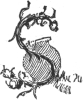
Coming in from their kennel-homes among the ruins and the holes in the hills
outside, it is the custom to make an early morning tour of the city before they
take up their stations for the day at the various church and hotel doors. Each seems
to be provided with “green pudding,” in his garlic pot, and he eats as he goes
along, and prays as he eats, stopping in front of the great oval patio or court gates
of iron lattice, which guard the mansions of the rich.
At these patio doors he makes a prodigious racket, shaking the iron rods furiously,
and all the while muttering his prayers, until some one of the family
appears at a gallery window. Then instantly the mutter becomes a whine, a pitiful
tale is wailed forth, and alms are dolefully implored “for the love of God.”
But although such mottoes as “Poverty is no Crime” are very often painted
on the walls of their fine houses, the probability is that the unmoved Señorita
will murmur a swift “Pardon, for God’s sake, Brother!” and retire, to soon appear
again to silence another of the fraternity with the same potent formula.
However, each of the countless horde is sure to gather in centimes sufficient
for the day’s cigarettes and garlic, and, in the long run, to support life to a
good old age.
THE Spaniards are a nation of dancers and singers. Every Spanish
child seems born with the steps, gestures, snappings and clappings
of the national fandango dance, at the ends of his fingers and toes.
A guitar is the universal possession, and every owner is a fine
player. The solitary horseman, the traveller by rail, takes along his
guitar; and in car, or at cross-roads, he is sure of dancers at the first
thrilling twang. There is always a merry youth and maiden aboard ready to
make acquaintance in a dance, and anywhere the whole household will troop from
the cottage, the plowman will leave his team in the furrow, and the laborer
drop his hoe, for a half-hour’s joyous “footing o’t.”
One of the interesting sights of Toledo is the great city fountain on Street
St. Isabel, near the cathedral. It is a good place to study donkeys and their
drivers, and the lower classes of the populace. The water, deliciously sweet
and cool, is brought from the mountains by the old Moorish-built water-ways,
and flows by faucet. There is no public system of delivery, consequently a good
business falls into the hands of private water-carriers. These supply families at
a franc a month. The poorer households go to and fro with their own water-jars
as need calls, carrying them on their heads. They often wear a cushioned
ring, fitting the head, to render the carrying of the jar an easier matter.
A picturesque article of dress among Spanish men, is the national sash,
a broad woollen some four yards in length, of gay colorings. This is wound three
or four times around the waist, its fringed end tucked in to hang floating, and the
inevitable broad knife thrust within its folds, which also hold the daily supply
of tobacco. A common sight is the sudden stop on the street, a lighting of a
fresh cigarette, a loosening of the loosened sash, a twitch of the short breeches,
and then a tight, snug wind-up, when the lounger moves on again.
Another amusing sight is the picturesque beggar who seems at first glance
to be hanging in effigy against the cathedral walls, so motionless will some of
these fellows stand, hat slouched over the face, the brass government “license”
labelling the breast, a hand extended, and, in many cases, a crest worn prominently
on the ragged garments, to show that the wearer is a proud descendant
of some old grandee family. To address this crested beggar by any other
title than Caballero (gentleman) is a deadly insult.
AMONG the many small sights of the Plaza about Christmas time, are
the sellers of zambombas, or Devil’s Fiddles. This toy, which the
stranger sometime takes for a receptacle of sweet drinks to be imbibed
through a hollow cane, is a favorite plaything with Spanish
children. A skin is stretched over a bottomless jar; into this is
fastened a stout length of sugar-cane, and lo! a zambomba. Its urchin-owner
spits on his palms, rubs them smartly up and down the ridgy cane, when the
skin-drum reverberates delightfully.
The fruit markets are of a primitive sort. The peasant fills his donkey-panniers
with grapes, garlic, melons straw-cased and straw-handled, whatever he has ripe,
and starts for town. Reaching the Plaza, in the shade of the cathedral, he
spreads his cloak, rolling a rim. On this huge woollen plate he arranges his
fruit, weighing it out as customers demand.
From the old Moorish casements, the traveller looks down on the most rudimentary
sort of life. He sees no labor-saving machinery. Instead of huge vans
loaded with compact hay bales, he beholds the donkey hay-train. The farmer
binds a mountain of loose hay on each of his donkeys, lashes them together,
and with a neighbor to help beat the train along, starts for market. These
trains may be seen any day crooking about among the steep mountain-ways.
The student of folk-life notes the shoemakers on the Plaza at work in the
open air. Formerly the sandal was universally worn, with its sole of knotted
hemp, and its canvas brought up over the toe, at which point was fastened a
pair of ribbons about four feet long, and these ribbons each province had its
own fashion of lacing and tying. But now the conventional footgear of Paris
is common, and one buys boots of the fine glossy Cordovan leather for a trifle.
The proprietors of the neighboring vineyards visit the wine shops weekly to
bring full wine-skins, and take such as are emptied. These skins, often with
their wool unsheared, are cured by remaining several weeks filled with wine-oil,
and all seams are coated with pitch to prevent leakage. The wholesale skins
hold about eight gallons, being usually those of well-grown animals. They are
stoutly sewn, tied at each knee, and also at the neck, whence the wine is
decanted into smaller skins by means of a tunnel.
THE beggars of Spain are a most devout class. Piety is, with them, the
form under which they conduct business; a shield, and a certificate of
character. They walk the streets under the protection of the patron
saint of the principal church in town, and they formally demand alms
of you in the name of that saint. It is Religion that solicits you—the
beggar’s own personality is not at all involved; and it is thus that the
proud Spanish self-respect is saved from hurt.
The tourist who has not tarried in French towns, is, at first, astonished to
behold women passing to and fro upon the streets with no head covering whatever.
Hats and bonnets are rarely seen upon Spanish women of the lower and
middle classes. Those who are street-venders sit bareheaded all day long in their
chairs on the Plaza, wholly indifferent to the great heat and blinding dazzle of
the Spanish sun. About Christmas, dozens of a “stands” spring up along the
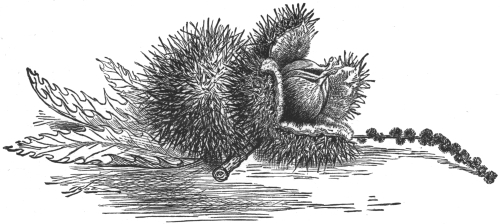
Plaza. It is at that season that the gypsy girls come in with their roasters
and their bags of big foreign chestnuts; and they do a thriving business,
for every good Spanish child expects roast chestnuts and salt at Christmas.
Many of the mountain families about Toledo keep small flocks of sheep—flocks
that, instead of dotting a green landscape with peaceful white, as in
America and Northern Europe, only darken the reddish-brown soil of Spain with
a restless shading of a redder and a deeper hue. These brown sheep are
herded daily down on the fenceless wastes. The shepherd-boys are usually
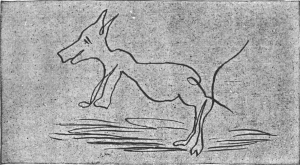
attended by shepherd-dogs so enormous in size that the traveller often mistakes
them for donkeys. They are sagacious, and do most of the herding, their masters
devoting themselves to the guitar, the siesta, the cigarette, and the garlic pudding.
Toledo, more than any other Spanish city, abounds with interesting bits and
noble examples of the old Moorish architecture, for the reason that it has not
been rebuilt at all, and that few of its ruins have been restored, or even
retouched. Color alone has changed. The city now is of the soft hue of a
withered pomegranate. Turn where you will, your eye is delighted by an ornate
façade, a carved gateway with its small reticent entrance door, a window with
balcony and cross-bars, and everywhere there is the horseshoe arch with its beautiful
curve. The old Alcazar is standing, though occupied as a Spanish arsenal,
and on the height opposite is the ruin of a fine Moorish castle.
ONE of the best “small businesses” in a Spanish city, is that of the
domestic water-supply. Those dealers who have no donkeys, convey it
to their customers in long wheelbarrows constructed with a frame to
receive and hold several jars securely. Stone jars, with wood stopples
attached with a cord, are used, the carrying-jars, being emptied into
larger jars in the water-cellars. The peasants have a poetic appellation
for the soft, constant drip of the water from the old aqueducts: The sigh of the Moor.
With the Spaniard, as with the American, the turkey is a special Christmas
luxury. But the tempting rows of dressed fowls common to our markets and
groceries, are never to be seen. As the holiday season draws very close at hand,
the mountain men come down into the city, driving before them their cackling,
gobbling, lustrous-feathered flocks, bestowing upon them, of course, the usual daily
allowance of blows which is meted out to the patient family donkey. These poultry
dealers congregate upon the Plaza, where they smoke, and chaff, and dicker, keeping
their droves in place with the whip; and the buyer shares in the capture
of his flying, screaming, flapping purchase, in company with all the children on
the street, for the turkey market is usually great fun for the Spanish youngster.
In the cold season, one of the morning sights of a Spanish town is the preparation
of the big charcoal braziers outside the gates of the fine dwelling-houses.
The coals are laid and lighted, and then the servant blows them with a large
grass fan until the ashes are white, when he may consider that all deadly fumes
are dissipated, and that it is safe to carry it within to the room it is to warm.
Nearly all the peasants in the near vicinity of cities are market gardeners
on a small scale. They cultivate small plots, and whenever any crop is ripe,
they load their donkey-panniers and go into the cities, where they sell from
house to house. These vegetable-panniers have enormous pockets, and are woven
of coarse, dyed grasses, in stripes and patterns of gaudy blue and red. When
filled, they often cover and broaden the donkey’s back to such an extent that
the lazy owner, determined to ride, must sit on the very last section of backbone.
Some of the streets in Toledo are so narrow that the brick or stone
walls of the buildings have been hewn and hollowed out at donkey-height, to
allow the loaded panniers to pass. The buyers make their bargains from the
windows, a sample vegetable being handed up for inspection.
TRAVELLERS should deny themselves Spain during December, January
and February. The heating apparatus of the American and the English
house is unknown in Spanish dwellings—fireplace, stove, nor furnace.
The peasant draws his cloak up to his nose and shivers and
cowers, while the middle-class family lights a single brazier, and the
household, gathering in one room, hovers over the charcoal smouldering
away in its brass cage, and the cats sit and purr on the broad wooden rim.
These braziers are expensive—constructed of brass and copper—and few families
afford more than one, making winter comfort out of the question, as the floors,
of marble or stone, never get well warmed.
With the coming of pleasant weather Spanish families usually forsake the
blinded, draperied, balconied rooms of the gallery for the secluded and garden-like
patio. This court is often fifty feet square, and in its enclosure there is
generally a fountain; the floor is tiled with marble, there are stately tropic plants
in tubs, and orange and palm-trees are growing. Should the sunshine become too
fierce there are smoothly-running screens and awnings to roof the whole court
in an instant. Some of the old Moorish patios contain quaint wells, dry at
some seasons, but often affording water sufficient for housekeeping needs.
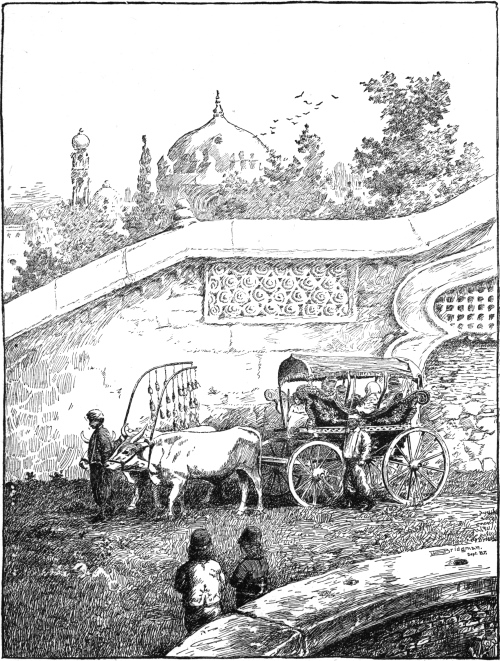
The water-jars come from the famous potteries of Seville, and, made of a
rude red clay, are similar in hue to our plant pots. They are brought in high
loads by oxen—and these pottery carts are often an enlivening feature of the
dull country roads.
The water cellar is not a cellar at all, but a stone-paved room off the patio,
delightfully cool and sloppy of a fiery July day, with the water-carriers unloading,
and filling the array of dripping red jars with the day’s supply from the
public fountain.
Every Spanish peasant wears a knife in his sash. These knives are usually
about eighteen inches long, with a broad, sharp, murderous blade. The handles
are of tortoise or ivory, often carved richly, or inlaid with figures of the Virgin,
the Saviour, or the crucifix. The knife is kept open by a curious little wheel,
between blade and handle, and is used indiscriminately, to slice a melon or lay
bare a quarrelsome neighbor’s heart.
SEVILLE is celebrated for its oranges and its pottery. Nearly the
whole Spanish supply of water-jars comes from this city; and the
outlying country is agreeably dotted with orange orchards, as olive
oases enliven the vicinity of Cordova. The export of the fruit is
a considerable business. The most delicious orange in the world may
be bought in the streets of Seville for a cent, and the ordinary rate for the ordinary
fruit is four for a cent. In the Christmas season large and selected oranges are
sold in the outdoor booths. They are carefully brought, and temptingly hung in
nets, along with melons cased in straw, fine bunches of garlic, chestnuts,
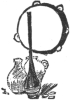
assorted lengths of sugar-cane, tambourines, zambombas, and such other sweet
and noisy objects as delight the Spanish youngster.
The decorative plant of Spain is the aloe—truly decorative, with its base of
long, dark, clear-cut, sword-like leaves, its tall slender trunk often rising twenty
feet high, and its broad candelabras of crimson blooms.
A picturesque industry of Seville is the spinning of the green rope so much
used by Spanish farmers. It is manufactured from the coarse pampas grass of
the plains, and the operation is a very leisurely and social one, requiring three
persons: one to feed the wheel, one to turn it, and a third to receive the
twisted rope.
Plowing, in Spain, is still a very rude performance. The primitive plow of
the Garden of Eden era is yet in use—a sharp crotch of a tree, crudely shod,
however, with iron.
An indispensable article of peasants’ costume for both men and women, should
an absence of even two hours be contemplated, is the alforja, or peasant’s bag.
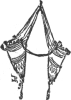
This, in idea, is similar to the donkey-pannier—a long, stout, woollen strip
thickly tufted with bunches of red and blue wool, with a bag at either end,
and is worn slung over the shoulder. The pockets of the alforja invariably contain,
one a pot of garlic, or green pudding, the other a wine skin.
The mouths of some wine-skins are fitted with a bottomless wooden saucer,
and are lifted to the lips for drinking; but the preferable and national style is
to catch the stream with the skin held aloft and away at arm’s-length.
A CENTRAL point of interest for visitors to Seville is the Cathedral.
Its tower, known as the Giralda, is one of the most celebrated
examples of sacred Moorish architecture. It was erected in an early
century, and was considered very ancient when the Spaniards, in
the reign of Ferdinand and Isabella, built upon it the fine Cathedral.
In the interior, the Tribuna de la Puorta Mayor is much visited for its lofty
and beautiful sunlight effects, and there are several precious Murillos.
The ascent of the Giralda is usually made by tourists—an agreeable variety in
European climbing, as there are no stairs, the whole progress being by an easy
series of inclined planes of brick masonry. Queen Isabella, not long ago, made
the entire ascent and return upon horseback. From the summit, one views the
whole of Seville, with its dark-green rim of orange gardens, set in the great
flat barrens that stretch out towards Cadiz. A comic sight usual at the foot of
the tower, significant as a sign of the complete contempt in which the Catholic
Spaniard holds all things Moslem and Moorish, is that of a goat belonging to
one of the custodians, tethered from morning till night to a fine old Muezzin bell.
Another noted building is the Tower of Gold, on the banks of the Guadalquiver,
opposite the Gypsy quarter. Tourists visit it to get the fine architectural
effect of the Cathedral, also for its view of the Bull Ring. It stands on
the site of the old Inquisition, where hosts of Moorish captives were tortured.
The Alcazar, always visited, is an ancient Moorish palace, and is considered,
in point of elegance, second to only the Alhambra. It is now set aside by
the government as the residence of the Queen-mother Isabella.
San Telmo is also much visited. It is the palace of the Duc de Montpensier,
known throughout Spain as “the orange man.” He owns numerous orange
orchards, and lavishes much time and money on his plantations and hothouses.
Another point of curiosity is known as the House of Pilate. It is said to be
an exact reproduction of the celebrated House of Pilate in Jerusalem. It is
remarkable for some exquisite tiles, and it bears many interesting inscriptions.
Seville presents an odd aspect to the stranger between the hours of three
and six P. M. During this hot interval the streets and shops are deserted,
everybody, even to the beggars, being under cover and asleep.
MOST of the peasant girls in the vicinity of Spanish cities contrive
to keep a bit of flower-garden for their own personal
purposes. She is a thriftless lass indeed, who has not at least
one fragrant double red rose in tending, or some other red-flowered
shrub. From Christmas on through the spring fête-days of the Church,
they reap their tiny harvests. During this season every Spanish man and woman
who can, wears a red flower in button-hole or over the ear, and the streets are
thronged with bareheaded, black-tressed peasant and gypsy flower-venders.
Flowers are a part of the daily marketing, and two or three centimos—a
centimo is one fifth of a cent—suffice to buy a fresh nosegay. New Year’s is
a marked fête in Seville, as then “The Old Queen” in the Alcazar rides out
in state, the Alameda is thronged with carriages, and the whole populace is
a-blossom with red.
A custom noticed by the tourist who lingers about cathedral doors, is one
most observed, perhaps, by the poorer and more superstitious classes. Men and
women dip the fingers, on entrance and departure, in holy water, and wet some
one of the countless crosses which are set in the wall just above the cash-boxes—the
cash-box in Spain being the inevitable accompaniment of the cross.
As in other Spanish cities, the noble Profession of Beggary considers itself
under the protection of the Church, and the entrance to the cathedral is down
a long vista of outstretched hands, the fortunate one at the far end, who holds
aside the matting portiere for you to enter, feeling sure of a fee, however the
others fare. The whole vicinity abounds with loathsome spectacles of disease
and distress, those entirely helpless managing to be conveyed daily into holy
precincts. It is often amusing to witness an adult beggar “giving points” to
some young amateur in the art, the dignity of the national calling evidently
being insisted upon.
An agreeable sight in this city of churches and beggars, is the afternoon
stroll of companies of young priests and students from the convents. They are
very noticeable, as part of the panorama, with their broad, silky shovel hats and
black flowing gowns. Some are scholastic and intent upon their studies even in
the streets, while others evidently take a most young man-of-the-world enjoyment
in their cigarettes and the street-sights.
REVENUES are collected in most primitive ways by the Spanish
City Fathers. As there are no important sources of public
income, there are few transactions, however trifling, that do not pay
tax and toll. Every man is suspected of smuggling and “false
returns,” and it is a small bunch of garlic that escapes. Burly
officials, often in shirt-sleeves and with club, lounge at all the entrances to the
town, to levy duty upon any chance donkey-pannier or cart bringing in fruit
and vegetables for sale. Frequently there are scenes of confusion, sometimes of
violence. The government is determined that not a turnip, not a carrot, not a
cabbage shall escape the yield of its due; and it is not to be denied that the
poor farmer hopes fervently to smuggle in a wine-skin or two—a dozen of
eggs, or some other article of price, among his cheaper commodities. As a rule,
he fails; for, suspicious of over-much gesticulation and protestation, the official
is quite likely to tumble out sacks, baskets, bundles and bales, and empty every
one upon the ground, leaving the angry farmer to pick up and load again at
his leisure.
Andalusia is a brown region stretching gravely between Cadiz and Granada.
The effect of this landscape, all in low tones, upon natives of the green lands
of America and England, is most depressing. The soil itself is red, and the
grass grows so sparsely that the color of the ground crops up, giving impression
of general sun-blight, broken here and there by the glimmering moonlight
gray of an olive orchard, or the dark-green of an orange garden. The huts of
the farmers are built of the red clay; the clothing of the population appears
to be of the undyed wool of the brown sheep, while to add to the prevailing
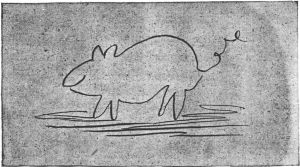
russet hue, the general occupation seems to be that of herding pigs on the
plains—and the pigs are hideously brown also. It is said that they derive
their color from feeding on the great brown bug, or beetle, which abounds in the
soil. The traveller counts these feeding droves by the dozen, each with two lazy,
smoking swineherds.
Travelling by rail over the Andalusian levels, one passes a succession of petty
stations, villages of half a dozen houses each, where the only visible business
appears to be in the hands of women, in the shape of one or two open-air
tables, with pitchers and glasses, and a cow or goat tethered near in order to
supply travellers, as the trains stop, with drinks of fresh milk.
MANY of the public buildings of Spanish cities stand as they were
captured from the Moors. Sometimes, as in Cadiz, the town has
received a coat of whitewash; but more frequently the only Spanish
additions and improvements are a few crosses inlaid in the old cement, or a plaster
Virgin niched, in rude contrast, beside some richly wrought Moorish door of
horseshoe form. The town hall of Seville remains to-day as ten centuries ago.
The Spanish towns lie, for the most part, in the valley. The Moors usually
chose the site for their cities with a view to the natural defences of mountain
and river. The hills of course, remain, but the rivers, once full rushing tides,
are now dried into stagnant shallow waters, a natural result in a country long
uncultivated.
A favorite business with the young men among the mountain peasants is the
breeding of poultry; not alone of fat pullets for the Christmas markets—that
is a minor interest so far as enjoyment goes—but of choice young game cocks—cock-fighting
being the staple, everyday national amusement, while the bullfight
is to be regarded as fête and festival—“the taste of blood” is a welcome
ingredient in any Spanish pleasure. All poultry is taken to market
alive; the pullets, hanging head downwards, are slung in a bunch at the saddle
bow, and the cocks are carried carefully in cages. Fowls are not a common
article of food, as in France, but are, instead, a holiday luxury, and the costliest
meat in the market.
Looking idly abroad as he crosses the Andalusian plains, the tourist on donkey-back
notices the queer carts that take passengers from one station to another.
These odd omnibuses are but rude carts, two-wheeled, and covered with coarse
mats of pampas grass, and they are drawn by two, three, four or five donkeys
harnessed tandem. On the rough, movable seats, gentlemen in broadcloth, and
common folk with laced canvas shoes and peasant-bags, huddle together, all eating
from the garlic-pots as they are passed, and drinking from the same wine-skin;
this good fellowship of travellers is one of the unwritten laws of Spain. Meantime
the sauntering boys of the roadside hop up on the cart behind with the
identical vagrant joy experienced by the American urchin after a like achievement.
YOU never can be sure when a Spaniard will arrive. Due at noon,
should he meet a guitar, he comes at nightfall; and as it is certain
that every second Spaniard, walking or riding, will have his guitar
along, it is best not to look for the return of any messenger before
evening. He may have chosen to alight from his donkey and dance an hour,
or he may have elected to sit still and clap and snap a dance in pantomime—either
is exciting and deeply satisfactory—and a fulfilment of one of the obligations
of daily life which no true Spaniard can be expected to neglect for any
such simple considerations as promise given, command laid, or bargain made.
A peculiarly gloomy look is lent to the Spanish landscape by the cypress,
sometimes growing in groups, sometimes towering singly in solitude. This tree,
funereal in its best aspect, has a dead, dry, white trunk, and the branches begin
at a height of twenty, thirty, or forty feet, and then drape themselves in a
cone-like monumental mass of purplish green. These gloomy evergreens are common,
and the tourist feels, even if he does not note, the absence of the lively sunny
greens of American and French landscapes, with the bowery shadows that everywhere
invite the wayfarer to stop and rest.
The Bergh Societies would find ample range for work in Spain, for the beating
and prodding of the donkey is one of the national occupations. As a rule,
poor Burro is overloaded. A whole family will frequently come down into the
city on his back, and tired though he be with plodding and stumbling and holding
back, the officer at the gate is sure to give him a blow and a bruise with
his bludgeon of authority as he passes in; and the poor creature sometimes very
justly lies down in the street and dies without warning, allowing his owners to
climb homeward on foot.
Now and then one comes unexpectedly on an example of ancient enterprise
put to use. There are spots in the brown waste which are green and fertile,
because the old irrigating wells have been cleaned out and set in motion—a
pair of wheels studded with great cups operated by means of a pair of poles,
and a pair of donkeys, and a pair of drivers. The land is cut in ditches, and
often the farmer can be seen hoeing his garlic and his cabbages while he stands
in water ankle-deep.
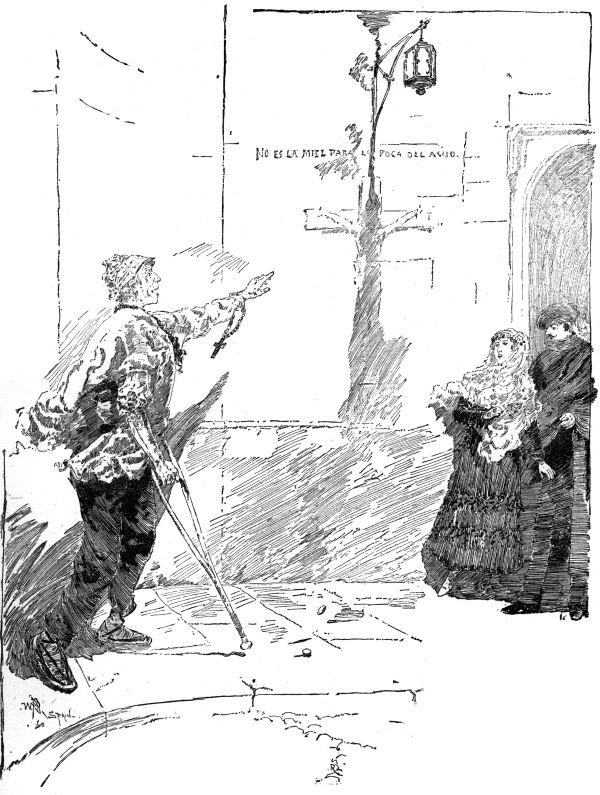
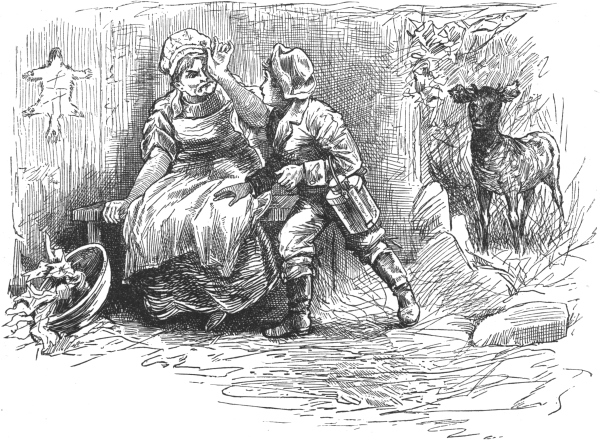
GREATLY dreaded by the unmarried young Spanish woman is the Beggars’
Curse; and a goodly portion of the beggars’ revenue is ensured by
this superstitious national fear. The more vicious of the fraternity
keep good watch upon the wealthy young señoritas and their cavaliers when
they go out for pleasure. They do not follow them, perhaps; instead they take
up their stations around the doors of those restaurants—whence they never are
driven—where ladies and their escorts are wont to stop for chocolate, or
coffee, or aguardente, on their return from calls or the theatre, or the Bull Ring.
As the pair are departing, the burly beggar approaches, half barring the way
perhaps, and asks for alms. It is usually bestowed; but he begs insolently for
more; and if it be not forthcoming, a bony and rosaried arm is raised, “the
evil eye” is fastened upon the doomed ones, and the Beggars’ Curse—the Curse
of the Unfortunate—which all Spaniards dread, is threatened; and if it be evening,
it is quite probable that the group stand near some crucifix of the suffering
Saviour, with the red light of the street lantern shining down upon its ghastliness,
so that the feeling of pious dread is greatly heightened, and a frightened pressure
on the cavalier’s arm carries the doubled alms into the outstretched hand.
The dress of Spanish people of fashion is singularly artistic and pleasing.
Although Paris styles are now followed by the señoritas, they still cling to the
national black satin with its lustrous foldings and flouncings, to the effective
ball fringes, and to the mantilla, draping face and shoulder with its heavy black
or white laces, the national red rose set just above the ear. Nor is this too
remarkable under the high broad lights of the Spanish sky, though it might seen
theatrical in our cold, harsh, Northern atmosphere. The dress of the Spanish
gentlemen is as picturesque. The hat is usually a curious, double-brimmed silky
beaver, while the cloak is most artistic in color and in drapery. This cloak,
lasting a life-time, is of fine broadcloth, lined with heavy blue or crimson velvet;
and it is so disposed that the folding brings this gorgeous lining in a round collar
about the neck, while another broad fold is turned over upon the whole long
left side of the garment. The peasant’s cloak, of the same cut, is lined with red
flannel, but it is often worn as gracefully. Long trousers are becoming general,
but in some districts the tight pantaloon, slashed at the knee, is still seen, with
its gay garter embroidered with some fanciful motto. One just brought from Spain
bears this legend: There is a girl in this town—with her love she kills me.
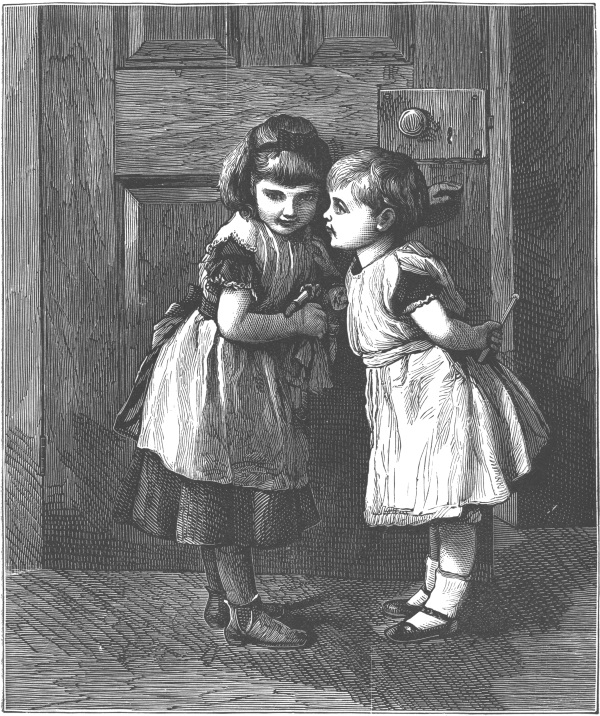
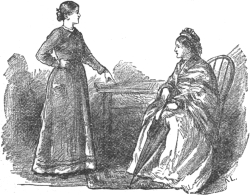
WHAT THEY ALL FEAR—THE BEGGAR’S CURSE.
MORE! SEÑORITA. MORE!
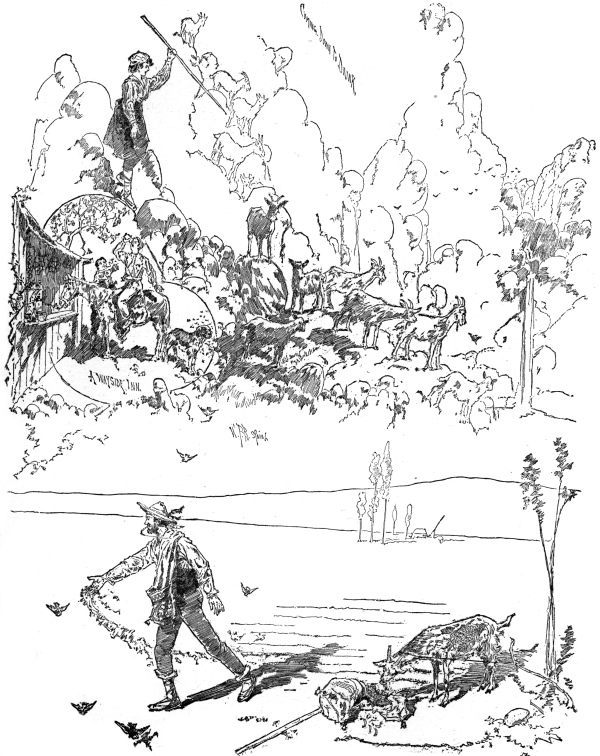
SOUTHERN Spain is so mountainous that herding naturally becomes
the occupation of the peasantry, rather than tillage. Great flocks
of goats browse and frolic among the rocky heights and along
the steep ravines where it seems hardly possible for the tiny
hoofs to keep foothold; and the traveller often beholds far above
him dozens of these bounding creatures, leaping down the cliffs to drink at
the valley streams. They are generally followed, at the same fearless pace, by
a short-frocked shepherdess as sure-footed as they. Her rough, hempen-soled
shoe, however, yields her excellent support, being flexible and not slippery, like
boot-leather.
Along the narrow mountain highways, the traveller frequently comes upon little
booths built in among the cliffy recesses, like quaint pantries hewn in the rock.
Melons, and grapes, and garlic, and oranges in nets, hang against the wall, and
the heavy red wine of the country is for sale by the glass, also goat’s
milk.
Farming processes go on at all times of year in Spain. Subsistence is a
matter comparatively independent of care and calculation. Crops may be sown
at any time. The whole year round the peasant lights no fire in his earthen,
bowl-like hut of one room. He cooks outside his door, in gypsy fashion. His
furniture consists of some rude wool mattresses, a table, and some stools with
low backs. A few bowls, plates, and knives and forks suffice to set his table. A
kettle and a garlic pot comprise his cooking utensils. Frequently he and his
family are to be seen at meals, leaning their elbows on the table in company,
and sipping like so many cats, from the huge platter of hot garlic soup, crumbling
their slices of coarse black bread, as they need. In contrast with this crude
bread of the common people, are the long, fine, sweet white loaves to be had at
the Seville bakeries—a bread so cake-like, so delicious, as to require no butter,
even with Americans accustomed to the use of butter with every meal.
The salted butter of American creameries, made to keep for months, is wholly
unknown in Spain, Spanish butter being a soft mass, and always eaten unsalted.
But with his strong garlic and his fine fragrant tobacco, the Spaniard hardly
demands or appreciates the refinements of food, and his tobacco is of the best,
coming from the Spanish plantations in Cuba, and is very cheap, as it enters
the country free of duties.
Sunny Spain: Sewing and Reaping in Winter
HOUSEWORK, among the sun-basking, siesta-loving Spaniards, seems
to be not the formidable, systematic matter that it is made in America.
Washing, as well as cookery, is of simplest form. “Blue Monday”
does not follow Sunday in Spain. A necessary garment is washed when needed;
superfluous ones are allowed to accumulate until it is worth while to give a day
to the task. Then, among the peasants, “the washing” is carried to a mountain
torrent, and the garments are rubbed and rinsed in the swift waters, while
picnic fun makes the labor agreeable, as often several families wash in company.
Among townspeople, the work is done in great stone tubs in the patio, or in the
water-cellar. There the goods, repeatedly wetted, are laid upon a big stone table
and beaten with flat wooden paddles. The snowy array of the American clothes-line
is seldom seen. The washed garments are hung upon the table edges, and
held fast by stones or other weights until dried.
A frequent incident in mountain travel is the sight of some stout lazy peasant away
up the heights, holding fast by his donkey’s tail to help himself along as the
poor creature scrambles up the zigzag steeps. At the base and along the face
of these rocks cacti grow abundantly, often presenting a beautiful cliff-side of
cacti fifty feet high.
Another sight, not so agreeable, along many a Spanish roadside, is that of the
ancient wooden crosses, erected on the sites where travellers have been murdered
by banditti. These roads are often desolate and dreary beyond description,
unfenced, seldom travelled, and set with the constantly recurring stones of the
Moorish road-makers. Leading across brown, treeless wastes, with habitations far
apart, both peasant and tourist would easily wander from these roads, were it not
for those rude mile-stones, which are often the only guide-posts and land-marks.
When a fence is required, a hedge of aloe is usually started.
Spanish children chew sugar-cane as American children munch candy. The
cane is brought from Cuba and is sold everywhere; carried about by venders in
big bundles of handy lengths, to capture all stray centimos.
Not so well patronized is the street dealer in soap—“old Castile” soap—for this
business is recognized to be a form of beggary, and though bargains are made
and money paid, the soap is seldom carried away by the purchaser.
EVERY male Spaniard is obliged to render three years of military
service; but usually this is no severe hardship, and loving his
ease, he leaves home cheerily enough. The government is rather
embarrassed than served, in the matter of stationing this soldiery,
especially since the close of the Carlist War. The conscripts are set to guard
the palaces, the parks, the national buildings; they are sent to Cuba and
elsewhere, whenever it is possible, in fact all opportunities and pretexts are seized
to set up a soldier on duty, or rather a pair of them, as two are usually to be
seen together. Leave of absence is easily obtained, and but few days of actual
presence and service are required during the third year. However, the military
requirements by the government never relax, as “insurrections” are indigenous
to the country and climate.
As the ancient Moorish doors are still frequent, so is the old form of knock
and admission. The arrival raps smartly at the small door set within the great
nail-studded gate. Presently an eye, a face, appears at the little wicket window
to reconnoitre, to question. Should the examination reveal nothing dangerous or
disagreeable, the latch-string is pulled, and entrance is permitted.
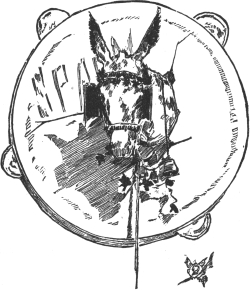
“Burro” must needs appear in all Spanish picture and story, for he is prominent
in all Spanish folk-life. He is to be seen everywhere, with his rude harness
tufted with gay woollens, and big brass nails, moving over the landscape in town
or country—the helpless slave and abused burden-bearer, seldom petted, even
by the children of the family. There are very handsome mules in Madrid and
a few elsewhere; but the donkey is the national carrier. He is small, brown,
brave, and always bruised. The Spaniards’ “Get up!” is a brutal blow between
the eyes. He is seldom stabled, seldom decently fed. He is tethered anywhere—under
the grapevine, by the door, among the rocks, but always at his master’s
convenience; and his food is in matter and manner best known to himself.
His harness is heavy and uncomfortable, and his hair is clipped close on his
back where he needs protection most from the burning sun. This clipping is
usually done at the blacksmith’s, by a professional clipper, and is a sight of
interest to the lazy populace. Under the great shears Burro’s body is often
decorated with half moons, eyes, monograms, garlands—whatever the fancy of
his master, or the clipper, or the bystander may direct. Poor Burro! from first
to last—poor Burro!
IN Cordova, a sudden stir in the street often betokens “The Return
from the Chase”—not, however, the picturesque scattering of the
“meet” after an English fox-hunt, but the arrival home of some
solitary mule and rider, with a pack of harriers. The huntsman has
been riding across country all by himself, his cigarette, and his dogs,
to ferret out some luckless colony of hares in a distant olive orchard.
The rabbits are very mischievous in the young olive plantations, and the huntsman
and his pack are warmly welcomed by the olive-growers. These Spanish
harriers are a keen-nosed race of dogs; quite as good hunters as the English
fox-hounds. Nearly every breed of dog is found in Spain, except, perhaps, the
Newfoundland. In most Spanish cities the dogs are one of the early morning
sights as they gather in snarling, quarrelsome packs of from fifteen to twenty,
before the doors of the hotels and restaurants, to devour the daily kitchen refuse—a
very disagreeable spectacle; but there seems to be no other street-cleaning
machinery.
The chief streets of a Spanish town are usually thronged with fruit-sellers,
especially the Plaza, where the great portion of the population seems to congregate
to lounge and sleep in the sun all day long, naturally waking now and
then to crave an orange, a palmete, or a pomegranate—“regular meals” appearing
to be a regulation of daily life quite unknown. These fruit sellers are girls, for
the most part, though sometimes there may be seen some old man who has
not been able to procure a beggar’s license. Oranges are always plenty. Palmetes,
a tender, bulbous growth, half vegetable, half fruit, are brought into the
city in January, and are consumed largely by the peasants and beggars, who
strip them into sections, chewing them for their rather insipid sweetish juices.
The Spanish peasant cooks out-of-doors, like a gypsy. Often his kettle is his
only “stove furniture;” in it he stews, boils, fries and bakes. Even in January,
the cold month in Spain, he makes no change in his housekeeping. The
peasants’ daily bread is hardly bread at all, but rather a pudding, a batter of
coarse flour, water and garlic, stirred, and boiled, and half baked in his kettle, and
then pressed into a jar. This “garlic pot” he always carries about with him in
his shoulder bag. In the patio apartments of some of the ancient, Moorish-built
houses there are quaint arches with stone ovens, which are sometimes utilized
for cookery.
A DRUNKEN Spaniard is rarely seen, although the “wine-skin” keeps
constant company with the “garlic pot” in the peasant’s bag. The
heavy red wine of the country is used as freely as water, being sold
for four cents a wine-skin; this wine-skin holds a quart or more. Not to drink
with the skin held at arms-length, is to be not Spanish, but French—their
generic name for a foreigner or stranger. Fine and delicate wines are made in
the neighborhood of some of the great vineyards, but they are chiefly for
exportation.
There is a popular saying, that Spanish ladies dress their hair but once a
week. This is on Sunday, when they meet on one another’s balconies to chat
and gossip while their maids arrange their coiffures, each maid taking care that
she pat, and pull, and puff until her mistress be taller than her friends, for
height is a Spanish requisite for beauty and style. Certain it is that the tourist
sometimes looks up and beholds this leisurely out-of-doors toilet-making. The glossy
black hair is universal, a fair-haired woman becoming an occasion for persistent
stares, although Murillo, in his time, seems to have found plenty of red-haired
Spanish blondes to paint. Happy is the gazing traveller if he also may listen;
for the music of a high-bred Spanish woman’s voice is remarkable, holding in
its flow, sometimes, the tones of a guitar, and the liquid sounds of dropping
water.
Spanish urchins are as noted for never combing their hair as Italian boys are
for never washing their faces. The change of the yellow handkerchief dotted
with big white eyes, which they knot about their heads and wear day and
night, seems to be the only attention they think needful ever to bestow upon
their raven locks.
That Spanish peasant is very poor and unthrifty indeed, who does not contrive
to own a foot or two of land upon which to grow a choice Malaga grapevine.
Owning the vines, he erects an out-of-door cellar to preserve his crop—a
simple arbor, upon the slats of which he suspends his clusters for winter use.
Hanging all winter in the current of wind, the bunches of pale-green grapes
may be taken down as late as February, and still be found as plump and
delicious and as full of flavor as when hung. It is in this simple manner that
they are preserved for the holiday markets.
ONE of the most picturesque features of natural scenery which the
traveller comes upon in Southern Spain, is that of the olive orchards,
especially those which cluster about Cordova. As the time of harvest
draws near, the coloring of these orchards is particularly pleasing.
The ripening fruit varies in tint, from vivid greens to gay reds and
lovely purples, while the foliage, of willow-leaf shape, restless and quivering,
is of a tender, shimmering, greenish gray, and the trunks often have a solemn
and aged aspect. Many of these plantations are very ancient indeed, planted
perhaps by the grandsires of the present owners. They are usually a source of
much profit, as the best eating olives are those grown in Spain, and though
the trees come into bearing late, there are orchards which have been known to
yield fruit for centuries.
Each orchard has a guard, or watchman, who tends it the year round, for
the pruning, the tillage, and the watch upon the ripening fruit, demand constant
care. In the harvest season the watch is by night as well as by day, for a
vigorous shake of the branches will dislodge almost every berry, and a thief,
with his donkeys and his panniers, might easily and almost noiselessly strip an
entire orchard in a few hours. The olive guard lives in a hut of thatch or
grass in summer, and in a sort of cave, or burrow, in winter.
The crop is mainly harvested by girls and women, and the scene is like a
picnic all day long, for Spanish girls turn all their labors into merry-making
whenever it is possible to do so. The gray orchards are lighted up with the
rainbowy colors of the peasant costumes, and the air is musical with the donkey
bells, while the overseer, prone on the ground with his cigarette, “loafs and
invites his soul,” evidently finding great delight in the double drudgery he controls—that
of the donkeys and the damsels.
In regard to the great age of olive-trees, a recent writer says: “When
raised from seed it rarely bears fruit under fifty years, and when propagated in
other ways it requires at least from twenty to twenty-five years. But, on the
other hand, it lives for centuries. The monster olive at Beaulieu, near Nice, is
supposed by Risso to be a thousand years old. Its trunk at four feet from the
ground has a circumference of twenty-three feet, and it is said to have yielded,
five hundred pounds of oil in a single year.”
CORDOVA, lying in the beautiful valley of the Guadalquiver, surrounded
with gardens and villas, is well named the city of Age,
Mellowness, and Tranquility. It abounds with antiquities, and at
every turn memories are awakened of old Roman emperors, and
the Arabian caliphs; the gates, the sculptures, the towers, the mullioned
windows and nail-studded doors, the galleried houses and their beautiful patios
fitted for idle life in the soft Andalusian weather, the mosques and the great
bridges are all of those times. Even the streets are named after the old
Roman and Spanish scholars and poets.
The large bridge over the Guadalquiver was originally built by the Roman
Emperor, Octavius Augustus; it was afterwards remodelled by the Arabs.
The gate is very fine which leads into the gypsy quarter. The Moors had
three thousand baths on the banks of the river, but in their day it was a full
shining tide; now it is a muddy current, hardly in need of bridging at all.
The mosques of Cordova are fine, and among them is the greatest
Moslem temple in the world, with its beautiful chapels, its Court of Oranges,
and its wondrous grove of marbles. This mosque, now used for Christian
worship, was erected on the ruins of an old cathedral, which it is said had
been built upon the site of a Roman temple. The Moslem structure was
erected by the Caliph Abdurrahman, in the seventh century, and was a hundred
years in building. The principal entrance is through the Court of Oranges,
where beautiful palms also grow, and other tropical trees. Thence one emerges
among a very forest of marble pillars, where countless magnificent naves stretch
away and intersect, and the shining columns and pilasters spring upward into delicate
double horseshoe arches. One marble is shown where a Christian captive,
chained at its base, scratched a cross upon the stone with his nails. In some
sections the ceiling is dazzling with arabesques and crystals. Within the mosque,
in its very centre, rises a fine Catholic church, built in the time of Charles
the Fifth. It contains many illuminated missals and rare old choir books.
The Cordovans, like the people of other Spanish cities, are indebted to the
Moors for the fine aqueducts which bring the cold mountain water across the
valley into the public watering places. These great reservoirs are good points
for observing some phases of folk-life.
GRANADA, the beautiful city, with beautiful rivers, is named for
a “grenade” or pomegranate. At the time of the Conquest, King
Ferdinand on being assured how valiantly the Moors would defend
their last stronghold, replied, “I will pick out the seeds of this
grenade one by one.”
There is a tradition among the Moors that when the hand carved over the
principal entrance of the Alhambra shall reach down and grasp the key, also
carved there, they shall regain their city, the ancient home of their
caliphs.
The Generalife lies across the valley from the Alhambra. It was the summer
palace of the Moorish sovereigns, and is built on a mountain slope by
the Darro River, and its white walls gleam out from lovely terraced gardens,
and groves of laurel. The grounds abound with fountains and summer houses.
The Alhambra—the great royal castle—a town in itself—is built on a
lovely tree-embowered height, its many towers rising high above the mass of
foliage. From these towers one looks across the vale of the Vega to the spot
where Columbus is said to have turned back, recalled by Isabella, on his
way to seek English aid in his discovery of a New World. From these
towers, too, can be seen the valley in the distance, where Boabdil, last of the
Moorish Kings, looked back on Granada for the last time; and across the
river, one gazes upon the sombre region of the gypsy quarter, a swarming
town of caves in the hillside.
Two relics of Alhambra housekeeping still remain; a great oven, and a fine
well. Both are utilized by the custodian of the palace. The palace itself has
many beautiful patios. The finest is known as the Court of Lions, named from
the sculptured figures which support the fountain in the centre. Another is
known sometimes as the Court of the Lake, and sometimes as the Court of
the Myrtles; and still another, entered by subterranean ways, is the Hall of
Divans, the special retreat of the Favorites. There are many others, and all
these patios and halls are bewilderingly beautiful with arabesques, mosaics,
inscriptions and wondrous arches and columns, porticos, vistas, alcoves and
temples—and everywhere elegance of effect indescribable.
AT Granada, whenever it is desired, the proprietor of the Washington
Irving Hotel will engage the Gypsy King to come with his
daughters and dance the national dance at the house of one of
the guides. This dance is a most wild and weird performance.
There is an incessant clapping of hands and clatter of castañets, a sharp
stamping of heels, an agonized swaying of the body and the arms; and often
the castañets and guitar are accompanied by a wild and mournful wail from
the dancers. The king of the Granada gypsies is said to be the best guitar
player in Spain.
The climb from the city up to the vast Gypsy Quarter, known as the
suburb of the Albaycin, is an adventure of a nightmare sort. The squalor and
horror of the life to be witnessed on the way up along narrow streets swarming
with the weirdest and dirtiest of brown beggars, may not be painted, may not be
written; yet now and then one goes under a superb Arab arch, passes a door
rich with arabesques, or comes upon a group of elegant columns supporting a
roof of mud and rock. The long hillside seems honeycombed with the denlike
habitations of the gitanos, many of whom, among the men, are blacksmiths,
while others work at pottery, turning out very handsome plates and water jars,
while the women weave cloth, and do a rude kind of embroidery, all selling
their wares in the streets—in fact the spinning and weaving and sewing is
often carried on in the street itself.
But the little ones too (las niñas) add largely to the family income, as they dance
for the visitor; the traveller and his guide being always invited to enter the
caves. These gypsy children dance with much spirit, and they also sing many
beautiful old ballads of Spanish prowess. The most beautiful ones among the
girls are early trained to practice fortune-telling.
With their dances, their songs, their fortune-telling, their importunate, imperious
begging, and their rude industries, these Granada gypsies live here from century to
century, in swarms of thousands, never attempting to improve their condition,
but boasting, instead, of the comfort of their dismal caves as being cool in
summer and warm in winter. It is plain that they consider themselves and their
Quarter “a part of the show,” and hardly second in interest to the Alhambra
itself.
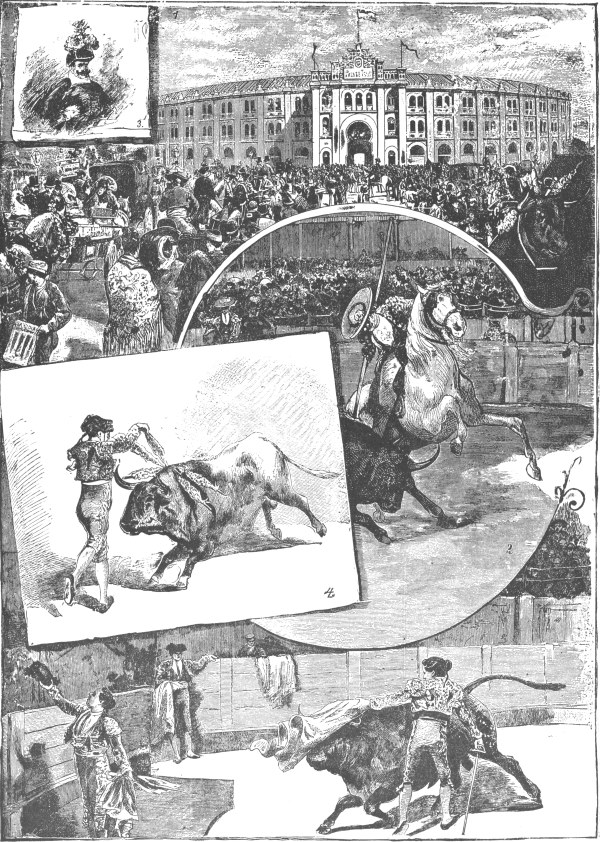
HARDLY is there a Spanish town of note, that does not possess its
great Bull Ring; and there are scores of inferior Bull Circuses
throughout Spain. There is but a slight public sentiment against
the brutal sport which is the favorite Sunday recreation of the whole
nation. Spanish kings and queens for many centuries have sat in the royal
boxes to applaud, and many of the Spanish noblemen of the present time
breed choice fighting bulls on their farms, and there is the same mad admiration
of the agile, skilful espado or bull slayer, as a hundred years ago. To be
a fine picador or banderillo, is to be sure of the praise and the presents of the
entire populace. Men, women and children go; the amphitheatre is always
crowded and always the crowd will sit breathless and happy to see six or
eight bulls killed, and three times that count of horses—the rich and the
nobles on the shady side under the awnings, the peasants sweltering and
burning in the sun. It is the picador who rides on horseback to invite with
his lance the attacks of the bull as he enters the arena; it is the capeador
who springs into the arena with his cloak of maddening red or yellow, to distract
the bull’s attention from the fallen horseman; it is the banderillo who
taunts the wounded creature with metal-tipped arrows, the barbs of which
cannot be extracted, or with his long pole leaps tauntingly over the back of
the confused creature; but it is the gorgeous espado with his sword, entering
the arena, at last, who draws all eyes. With his red flag he plays with the
bull as a cat with the mouse, until the amphitheatre is mad for life blood; then
with a swift, graceful stroke he ends all, his superb foe lies dead, and he turns
from him to meet the wild shower of hats, cigars, flowers, fans, purses that
beats upon him from all sides—it is a scene of unimaginable exultation, for
there are glad cries and plaudits, and royalty itself throws the bull-slayer a
golden purse and a pleased smile, and the beautiful Spanish señoritas lavish
upon him the most bewildering attentions.
The Spanish boy is born with a thirst for this sport. Their favorite game
is Toro. One lad mounts on his fellow’s back to take the part of the picador
and his horse; another, with horns of sticks, represents the bull; and the rest
are capeadors, banderillos, and escodas, while the audience of adult loungers look
on with fierce excitement. It is in this fierce, popular street sport that the
future champions of the Bull Ring are trained and developed—to be an escoda
is usually the height of a Spanish boy’s ambition.
NOWHERE in Spain are you refreshed with the restful sound of water,
sometimes soft, sometimes gay, as in Granada. You hear the flow of
the Darro over its stones and rocks, you hear the splash of fountains,
the gay hurry of mountain brooks, the soft sound of springs—everywhere
flow, or gurgle, or drip. You hear it on the tree-bordered and bowered
Alameda in your moonlit walks, and you hear it through the windows of your
fonda, or hotel, when you wake. It is everywhere about the Alhambra heights,
and the Generalife terraces. The Spaniards call this continuous water-sound,
“The Sigh of the Moor.”
Most of the young Spanish women as well as the men, are accomplished
guitar-players. The guitar belongs in story to the Señorita, along with her
mantilla and her fan. It usually hangs on her casement, brave with ribbons
and gay wool tufts and all manner of decorations, and by moonlight she will
come out upon the balcony to answer her cavelier’s serenade with a song as
sweet as his own. You feel the atmosphere of the Spanish night vibrating all
about you, as you stroll along the moonlit street, with the low, soft, delicate
twinkle of a hundred guitars, the players half-hidden in the dim patio
balconies.
It is often the custom to drive the goats from door to door to be milked, and
often an accustomed goat, tinkling its bells, will go along the street, stopping
of its own will and knowledge at the doors of its customers, and knocking
smartly with its horns should no one appear. The servant of the house comes
out into the street and milks the desired quantity, while the “milkman”
lounges near by with his cigarette.
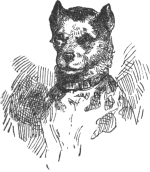
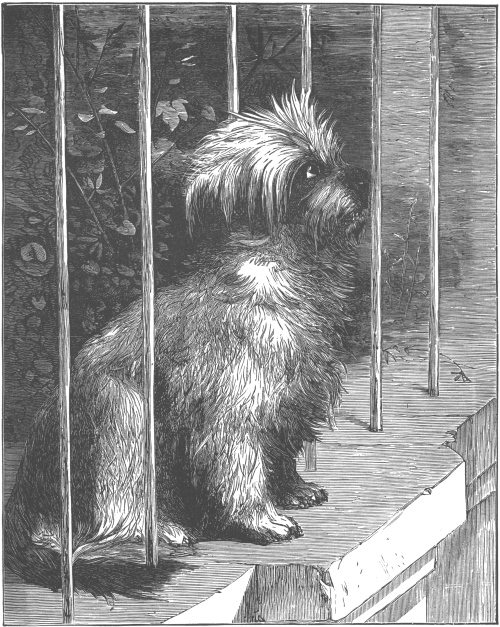
Often it is as amusing to watch the dogs of the beggars by the
churches as the men themselves. While the noble Caballeros, Don Miguel and
Don Pedro, exhausted with the saying of prayers and the much asking of
centimos, have fallen asleep in the shade, their respective dogs remain
awake to glare at each other with true professional jealousy, and to growl and
snap, should a chance stranger drop a coin in one hat and not in the other.
The beggar is the last sight, as well as the first, which greets the traveler in
Spain.
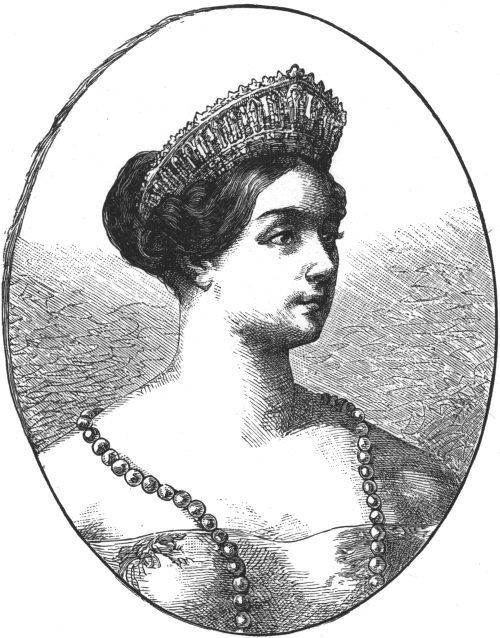
QUEEN LOUISA AND THE CHILDREN.
BY MARY STUART SMITH.
QUEEN LOUISA of Prussia was the mother of
William I., Emperor of Germany, and although
she has been dead over sixty years her one hundredth
birthday was celebrated elaborately throughout
her son’s dominions,
with almost
as many rejoicings
as we made
here over the one
hundredth birthday
of these United
States.
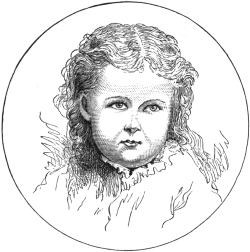
When a child
Louisa was very
beautiful, and as she
grew up did not disappoint
the promise
of those early days.
She was married
to Frederick William,
Crown Prince
of Prussia, when only
seventeen years of
age, and brought
down upon herself a
sharp rebuke from
the proud mistress
of ceremonies for
the love she showed
to a little child as
she was making her
public entry into
Berlin, preparatory
to the solmnization
of her marriage. It
happened thus:
The streets were thronged with people who had
come to catch a glimpse of the fair young bride,
while every now and then select persons would step
forward and present complimentary poems of welcome,
or some pretty gift. A sweet little girl advanced
to give the queen a bunch of flowers, and
Louisa was so struck with the child’s loveliness that
she stooped down and kissed her on the forehead.
“Mein Gott!” exclaimed
the horrified
mistress of ceremonies.
“What has
your majesty done?”
Louisa was as artless
and simple as a child
herself. “What?”
said she, “is that
wrong? Must I
never do so again?”
But the prince,
her husband, was no
fonder of show and
ceremony than herself,
and asserted
manfully the right
of his wife and himself
to act like other
affectionate people,
in spite of being king
and queen.
QUEEN LOUISA.
This royal pair
had eight children,
and upon these
children was lavished
every care and
attention. It is said
that every night the
king and queen went
together to visit their
sleeping children after
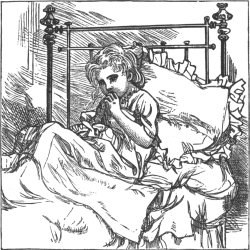
they had been put into their little beds, and many
a time were they surprised by a bright pair of wide-awake
eyes smiling back upon them a look of love in
return. Queen Louisa used to say, “The children’s
world is my world,” nor were the little creatures slow
to reciprocate the love she gave.
You know Christmas is observed in Germany
with peculiar reverence, and is a season set apart for
mirthful recreation among all classes, but more especially
for the enjoyment of children. Berlin is gay
with Christmas trees and a brilliant array of toys
etc., for at least a week beforehand.
Like other parents the king and queen found delight
in preparing pleasant surprises for their little
ones. While engaged in choosing presents for them,
on one occasion they entered a top-shop where a
citizen’s wife was busy making purchases, but recognizing
the new-comers she bowed respectfully and
retired. The queen addressed her in her peculiarly
winning way and sweet voice. “Stop, dear lady,
what will the stall-keeper say if we drive away his
customers?” She then inquired if the lady had come
to buy toys for her children, and asked how many
little ones she had. Hearing there was a son about
the age of the Crown Prince, the queen bought some
toys and gave them to the mother, saying, “Take
them, dear lady, and give them to your crown prince
in the name of mine.”
But I must tell you a yet prettier story, showing the
queen’s fondness for making children happy.
There lived in Berlin a father and mother, who from
some cause were so poor, and low-spirited besides,
that when the holiday came which all children love
best, they quietly resigned themselves to having nothing
to give their little ones. What can be more sad
than a house which no Kriss Kringle visits? Just
think of it! They told their children that there was
to be no Christmas tree for them this year. The little
boy and his sister had been led to believe that the
Christ-kind or Christ-child provides the tree and
the gifts which are placed on tables round it; only
ornaments, sweets and tapers are hung upon the
branches. Under this disappointment the children, in
the innocent simplicity of their faith, sought the aid of
the good Christ-kind in their own way.
Christmas Eve came, and the poor troubled parents
looked on with wonder as they beheld their children
hopping and skipping about with joy, although they
were to be the only children for whom no Christmas
tree would be lighted, nor pretty gifts provided.
Still in high spirits they watched at the window, and
clapped their hands when the door-bell rang, exclaiming:
“Here it comes!” The door was opened and a
man-servant appeared, laden with a gay tree and
several packets, each addressed to some member of
the family.
“There must be some mistake!” said the mother.
“No, no!” cried the boy, “it is all right. I wrote
to the good Christ-kind, and told him what we wanted,
and that you could not buy anything this year.”
The parents enjoyed the evening with their children
and afterwards unravelled the mystery. The
postmaster, astonished by a letter evidently written
by a very young scribe and addressed to the Christ-kind,
had sent it to the palace with a respectful inquiry
as to what should be done with a letter so strangely
directed. Queen Louisa read it and, as a handmaid
of the Christ-kind, she answered his little children.[1]
Louisa’s sympathies were ever ready to flow for
the sorrows of childhood, which so many grown people
will not stoop to even notice.
One day as the king and queen were entering a
town, a band of young girls came forward to strew
flowers and to present a nosegay. Her majesty inquired
how many little girls there were. “Nineteen,”
replied the artless child; “there would have
been twenty of us but one was sent back home because
she was too ugly.”
The kind queen feeling for the child’s mortification
sent for her and requested that she might by all
means be allowed to join in the festivities of the day.
Nor did Louisa slight the boys.
She was one day walking in the streets of Charlottenburg,
attended by a lady-in-waiting; a number
of boys were running and tumbling and playing
somewhat rudely, and one of them ran up against the
queen. Her lady reproved him sharply, and the
little fellow looked frightened and abashed. The
queen patted his rosy cheek, saying: “Boys will be
a little wild; never mind, my dear boy, I am not
angry.” She then asked his name and bade him
give her compliments to his mother. The child knew
who the lady was, and besides having the pleasant
memory of her gracious speech and looks received
a lesson in politeness which he never forgot.
Sometimes the royal children were allowed to have
a party, and this indulgence young princes and princesses
enjoy just as much as other juveniles. A
queer anecdote is told of the only daughter of the
famous Madame de Stael, in relation to one of these
entertainments.
The little lady was about ten years of age, but
had already imbibed many opinions and prejudices.
At all events she had a high idea of her own importance,
and was totally wanting in respect for her
superiors in rank. She was apt to be very rude in
her manners and in her remarks. On this occasion
she took offence at something which the little Crown
Prince said or did to her, and very coolly gave him
a sharp box on the ear, upon which he ran crying to
his mother and hid his face in the folds of her dress.
As mademoiselle, when remonstrated with, showed
not a particle of concern, and refused to say she was
sorry, she was not invited again, and her learned
mamma found that she must keep her daughter at
home until she taught her better manners.[2]
The annual fair at Paretz, the king’s beloved country
home, took place during the merry harvest-time.
A number of booths were then put up near the village,
and besides buying and selling there was a
great deal or dancing and singing going on, and all
sorts of games and sports. It was then that the
wheel of fortune was turned for the children’s lottery.
Lots of cakes and fruit were set round in order, which
were given away according to the movements of a
pointer, turned by the wheel.
Queen Louisa encouraged the children to crowd
around her on these occasions; she could not bear
to see them afraid of her, and placed herself beside
the wheel, in order to secure fair play and to watch
carefully that she might make some amends for the
unkindness of fortune. She had her own ample
store of good things which she dispensed among the
unlucky children, many of whom thought more of the
sweet words and looks of the queen than of anything
else she could give them. Moreover she was
glad to have a chance of leading even one of her little
subjects to be generous and self-denying. For, while
she liked to see them all happy, she at the same
time interested herself in giving pleasantly little
hints as to conduct that might be of lasting benefit.
All her life Queen Louisa watched beside the
wheel in a higher sense. She overlooked the whole
circle of which she was the centre, anxiously seeking
to hold out a helping hand to any whom she saw
likely to be ruined by losses in the great lottery of
real life.
Is it matter for wonder then that German children
still cherish her memory, and delight to place
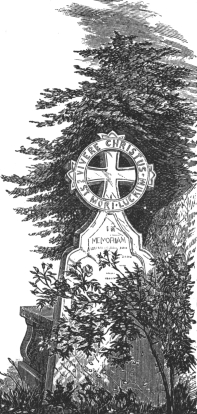
flowers upon vase or tomb that bears her name?
THE PLAYTHING OF AN EMPRESS.
BY M. S. P.
DOUBTLESS the readers of Grammar School
have heard it said that “Men and Women are
only children of a larger growth.” No matter how
stately the grand ladies that we often meet with may appear,
you may be very sure that they sometimes envy the
pleasures of children, who have no thoughts about
fine houses and servants, and a hundred other cares.
Even wearing a crown does not bring happiness; the
dignity it entails often becomes burdensome.
Once a young prince, who had everything that he
could possibly want given him,—books, jewels, playthings
of inconceivable variety, horses and dogs, in
fact all the nice things that you can imagine to bring
him pleasure,—was observed by his attendants to be
standing by the window, crying. When asked the
cause of his tears he replied that he was unhappy because
he could not join the boys in the street who
were making mud pies!
The Indians who use the bow and arrow say that
the proper way to keep the strength of their bows is
to unstring them after use and let them relax. So it
is with those whose minds or bodies are engaged in one
long strain of work; they must be relaxed or they become
useless. The late Pope of Rome was a very
dignified old man, and was also surrounded by
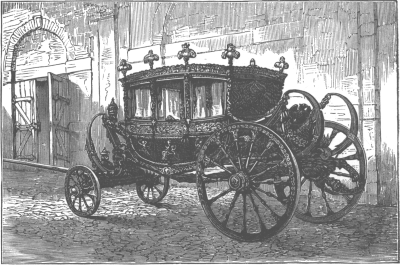
learned and great men. He rode in a gilded coach
drawn by four horses, and was in public a very grand
and stately person. But I read the other day that
the old gentleman and some of his cardinals were
once seen playing ball in his garden, for the purpose
of amusing a little boy.
More than a hundred years ago the great country
east of Germany, known as Russia, was ruled by the
Empress Anne. It is a very cold country and the
winter is very long. The capital is St. Petersburg,
and through it the river Neva runs. This river
freezes in winter, and the ice is frequently so solid
that it will bear up an army of several thousand men
with all their heavy guns and mortars, and these be
discharged without so much as cracking the ice.
At the close of the year 1739, during an extremely
cold winter, the empress ordered one of her architects
to build an Ice Palace. The great square in front
of the royal palace was chosen for its site. Blocks of
the clearest ice were selected, carefully measured
and even ornamented with architectural designs.
They were raised with cranes and carefully placed in
position, and were cemented together by the pouring
of water over them. The water soon froze and
made the blocks one solid wall of ice. The palace
was fifty-six feet long, seventeen and one half feet
wide, and twenty-one feet high. Can you imagine
anything more beautiful than such a building made
of transparent ice and sparkling in the sun?
It was surrounded by a balustrade, behind which
were placed six ice cannon on carriages. These cannon
were exactly like real metal ones, and were so
hard and solid that powder could be fired in them.
The charge used was a quarter of a pound of powder
and a ball of oakum. At the first trial of the
cannon an iron ball was used. The empress with all
her court was present, and the ball was fired. It
pierced a plank two inches thick at a distance of
sixty feet.
Besides these six cannon in front of the palace
there were two ice mortars which carried iron balls
weighing eighty pounds with a charge of one quarter
of a pound of powder. Then, too, there were two
ice dolphins, from whose mouths a flame of burning
naptha was thrown at night with most wonderful effect.
Between the cannon and dolphins, in front of
the palace, there was a balustrade of ice ornamented
with square pillars. Along the top of the palace
there was a gallery and a balustrade which was ornamented
with round balls. In the centre of this stood
four beautiful ice statues.
The frames of the doors and windows were painted
green to imitate marble. There were two entrances
to the palace, on opposite sides, leading into a square
vestibule which had four windows. All the windows
were made of perfectly transparent ice, and at night
they were hung with linen shades on which grotesque
figures were painted, and illuminated by a great number
of candles.
Before entering the palace one naturally stopped
to admire the pots of flowers on the balustrade, and
the orange trees on whose branches birds were perching.
Think of the labor and patience required to
make such perfect imitations of nature in ice!
Standing in the vestibule, facing one entrance and
having another behind, one could see a door on
either hand. Let us imagine ourselves in the room
on the left. It is a sleeping-room apparently, but if
you stop to think that every article in it is made of
ice you will hardly care to spend a night there;
and yet it is said that two persons actually slept on
the bed there for an entire night. On one side is a
toilet-table. Over it hangs a mirror, on each side of
which are candelabra with ice candles. Sometimes
at night these candles were lit by being dipped in
naptha. On the table is a watch-pocket, and a variety
of vases, boxes, and ornaments of curious and
beautiful design. At the other side of the room we
see the bed hung with curtains, furnished with sheets
and a coverlid and two pillows, on which are placed
two night-caps. By the side of the bed on a foot-stool
are two pairs of slippers. Opposite the bed is
the fireplace which is beautifully carved and ornamented.
In the grate lie sticks of wood also made
of ice, which are sometimes lighted like the candles
by having naptha poured over them.
The opposite room is a dining-room. In the centre
stands a table on which is a clock of most wonderful
workmanship. The ice used is so transparent
that all the wheels and works are visible. On each
side of this table two beautifully carved sofas are
placed, and in the corners of the room there are statues.
On one side we see a sideboard covered with a
variety of ornaments. We open the doors and find
inside a tea-set, glasses and plates which contain a
variety of fruits and vegetables, all made of ice but
painted in imitation of nature.
Let us now go through the opposite door and notice
the other curious things outside the palace. At
each end of the balustrade we see a pyramid with an
opening in each side like the dial of a clock. These
pyramids are hollow, and at night a man stands inside
of them and exhibits illuminated pictures at the
grand openings.
Perhaps the greatest curiosity of all is the life-like
elephant at the right of the palace. On his back sits
a Persian holding a battle-axe, and by his side stand
two men as large as life. The elephant, too, is hollow,
and is so constructed that in the daytime a
stream of water is thrown from his trunk to a height
of twenty-four feet, and at night a flame of burning
naptha. In addition to this, the wonderful animal is
so arranged that from time to time he utters the most
natural cries. This is done by means of pipes into
which air is forced.
On the left of the palace stands a small house,
built of round blocks of ice resembling logs, interlaced
one with another. This is the bath-house,
without which no Russian establishment is complete.
This bath-house was actually heated and used on several
occasions.
When this wonderful ice-palace was completed it
was thrown open to the public, and such crowds came
to see it that sentinels were stationed in the house to
prevent disorder.
This beautiful palace stood from the beginning of
January until the end of March. Then, as the
weather became warmer, it began to melt on the south
side; but even after it lost its beauty and symmetry as
a palace it did not become entirely useless, for the
largest blocks of ice were transferred to the ice-houses
of the imperial palace, and thus afforded
grateful refreshment during the summer, as well as a
pleasant reminder of “The Plaything of an Empress.”
CHARLIE’S WEEK IN BOSTON.
BY CHARLES E. HURD.
CHARLIE was going to Boston.
The ceaseless clatter of his little copper-toed
boots over all the bare places in the house, and the
pertinacious hammering he kept up upon everything
capable of emitting sound, rendered it impossible for
his mamma or the new baby to get any rest, and so
it was that the decision came about. Aunt Mary,
who had lent her presence to the household for the
preceding fortnight, was to return home the following
day, and with her, after infinite discussion, it was
decided that he was to go for a week.
The momentous news was withheld from Charlie
until the next morning, for fear of the result upon his
night’s sleep, but it was injudiciously let out by Aunt
Mary before breakfast, the effect being to at once
plunge the young gentleman into the highest state of
excitement. He had played “go to Boston” a thousand
times with his little cart and wheelbarrow, but
to take such a journey in reality was something he
could hardly imagine possible.
“Am I going to Boston, real ’live?” he wildly inquired.
“Where’s my rubber boots, and my little
chair, and my cart, and I want my piece of gum
mamma tooked away, and where’s my sled?”
“But, Charlie,” said Aunt Mary, persuasively, “you
are not going now, and you don’t want to take all
those things. There isn’t any snow in Boston, and
good little boys don’t chew gum. You must have
some breakfast.”
“I don’t want any breakfast. I want to go to Boston.
I got to go, now you said so.”
“Yes, but you must have something to eat first.
It would make you sick to ride so far without eating.
And then you must have a nice bath, and put on
your new suit that papa bought last week. You’ve
plenty of time.”
But Charlie, generally good to mind, was thoroughly
demoralized by the new turn in affairs, and
had to be brought to the table by main force.
“It’s like taking a horse to water,” said Aunt
Mary. “You can get him to the trough, but you
can’t make him drink without he likes. Charlie,
have a nice large griddle-cake?”
Griddle-cakes were Charlie’s weak point, but in a
time like this he rose superior to the temptation.
“Don’t want griddle-cakes; don’t want bread;
don’t want toast; don’t want anything. I want to
get right down out of my little chair, and go to Boston,
awful quick!”
“The child will be down sick if he goes away on
an empty stomach,” said grandma from her bedroom,
where she could see all that transpired at the
table. “Can’t you make him eat?”
“It’s all very well to say ‘Make him eat,’ but he
won’t,” said Aunt Mary. “You might just as well
make a squirrel sit down and eat in a respectable
manner.”
“Let him go till he gets hungry, then,” said his
father. “He’ll come to it soon enough. There’s no
danger of his starving.”
If Charlie had been a grown man, with whiskers,
and going to some European Court as Minister Extraordinary,
he couldn’t have felt the importance of
his prospective journey more, or been more weighed
down by the preparations for it. The train which
was to carry him did not start until two o’clock, and
in the six hours which intervened his little tongue was
in constant motion, and his little feet tramping up and
down stairs, “getting ready.”
“But you’re only going to stay for a week, you
know, Charlie,” said Aunt Mary, dismayed at the heap
of toys he had industriously gathered in a corner of
the sitting-room for transportation, “and you’ll see
so many pretty things that you won’t care for any of
these.”
“I want to carry my wheelbarrow. I will be cross
if I don’t carry my wheelbarrow. And my cunnin’
little cunnin’ watlin’ pot, and my high chair, and some
more.”
But Aunt Mary couldn’t get them into her trunk,
and the railroad man wouldn’t let Charlie take them
into the cars. “Put them all away nicely, and then
Charlie will have them when he comes home.”
It required a great deal of judicious argument,
intermingled with promises, to gain the point, and
final success was only achieved by a formal agreement,
to which grandma was made a witness, by virtue of
which Charlie was to become the possessor of “a
speckled rocking-horse, just like Johnny Baker’s,
with real hair ears, and a tight tail, that boys couldn’t
pull out.” This compact having been made, Charlie
submitted to the washing and dressing process with
comparative good grace.
An exceedingly light dinner preceded the start,
varied by excursions to the front door to see if the
depot stage was coming. It came at last, and, after
the leave-taking, Charlie and Aunt Mary were packed
in among half a dozen others. The whip cracked,
the coach gave a sudden lurch, and then dashed
down the street at the heels of the horses, who seemed
anxious to get to the station at the earliest possible
moment. There was just time to get tickets and seats
before the train started.
If Charlie was unmanageable before, he was doubly
so now. At every stopping-place he made desperate
efforts to get out of the car, and once or twice, in
spite of Aunt Mary’s efforts, very nearly succeeded.
He dropped his hat out of the window; he dirtied
his face beyond redemption with dust and cinders;
he put cake crumbs down the neck of an old lady
who had fallen asleep on the seat just in front, and
horrified the more staid portion of the passengers in
the car by a series of acts highly inconsistent with
the rules of good breeding, and the character of a
nice boy.
Boston was reached at last, and the perils of procuring
a hack and getting safely home in it were
surmounted. So thankful was Aunt Mary that she
could have dropped upon her knees on the sidewalk
in front of the door; but she managed to control her
feelings, paid the hackman his dollar, still keeping a
tight grip upon Charlie, and, despite his struggles to
join the distant audience of a hand-organ, managed
to get him safely into the house, where he was at
once delivered over to the other members of the
household.
“I never, never, never will go out of the house with
that child again!” she declared, half crying, and
sinking into a chair without taking her bonnet off.
“He’s enough to kill anyone outright. No wonder
they wanted to get rid of him at home! It’ll be a
mercy if he don’t drive us all crazy before the week
is out. One thing is certain, they’ll have to send for
him. I’ll never take him home again.”
“Why didn’t you drug him, Aunt Mary,” asked
Tom, with a great show of sympathy. “I would.”
“I declare I would have done anything, if I had
only known how he was going to act! You may
laugh and think it’s all very funny, but I just wish
you’d some of you try it yourselves. Where is he
now? If he’s out of sight a single minute he’ll be in
some mischief. There he goes now!”
The last declaration of Aunt Mary was preceded
by a series of violent bumps, followed by a loud
scream from the bottom of the basement stairs. A
grand rush to the spot revealed Charlie lying at the
foot, beating the air with his legs, with a vigor that
at once dispelled all fears as to his serious injury.
He was picked up and borne into the kitchen by the
cook, where the gift of a doughnut soon dried his
tears, and he was returned to the sitting-room to
await the ringing of the bell for tea.
“Has he had a nap to-day?” asked grandmother.
“Nap! I should think the child would be dead for
want of sleep. I don’t believe he’s winked to-day!”
“He looks like it now, anyway,” said Tom, who
was holding him in his arms.
Sure enough, his eyelids were beginning to droop,
and a moment after the half-eaten doughnut dropped
from his loosened fingers upon the carpet.
“Carry him up to my room, Tom, and lay him
upon my bed. Don’t for mercy’s sake hit his head
against anything. We shan’t have any peace if he
gets awake again.”
Slowly and carefully Tom staggered under his little
burden up-stairs, and laid it upon the clean white
coverlet of Aunt Mary’s bed.
“That will do,” said Aunt Mary, who had followed
close behind. “He’s thoroughly tired out, and no
wonder. You may go down now and I will take care
of him, dear little fellow.”
With careful fingers she untied the laces of his little
boots, and pulled them off. The stockings came
next, and the hot little feet were released from confinement.
The tiny jacket was then removed, the
tangled hair put back, and then, with a sponge wet in
cool water, the dirty, sweaty little face was softly
bathed until it became quite presentable again.
“There!” she said at last, surveying him with a
feeling of satisfaction, “he will sleep at least a couple
of hours. By that time I shall get rested, and can
manage him better. I suppose it’s because he’s so
tired, and everything is new.”
With this apology for Charlie in her heart, and a
half remorseful feeling for her lately displayed impatience,
she descended the stairs to the dining-room,
where the rest of the family were already seated at
the table.
A few minutes later, and while she was deep in an
account of matters and things at Charlie’s home, the
cook came up-stairs in something of a fluster.
“Plaze, ma’am, there’s something on the house.”
“Something on the house?”
“Yes. McKillop’s boarders across the way are all
at the windows, an’ the men is laughin’ and the
women frightened.”
With one accord a sudden and informal adjournment
to the parlor window was made, the result being
a verification of the cook’s statement.
“What on earth can be the matter?” said grandmother.
At this moment Mrs. McKillop, after a series of
incomprehensible gestures, which nobody could translate
with any clearness, dispatched her girl across the
street.
“There’s a child, ma’am,” she exclaimed, in breathless
excitement, “a baby, walking about on the outside
of your house like a fly! he’s— Howly Father!”
This sudden exclamation was caused by the descent
of a flower pot, which, coming with the swiftness of a
meteor, missed the head of the speaker by less than
a hand’s-breadth, and crashed into a thousand pieces
on the front steps.
The situation was taken in at once. With a succession
of screams Aunt Mary flew up the stairs two
at a time. By this a crowd was rapidly gathering.
“Bring out something to catch him in if he falls,”
shouted a fat old gentleman, pushing his way to the
front.
Grandmother caught a tidy from the arm of the
sofa, and, snatching a volume of Tennyson from the
centre-table, rushed frantically into the street, closely
followed by Tom with a feather duster.
A single glance told the whole story. There sat
Charlie, utterly innocent of clothing save a shirt of
exceeding scantness, on the very edge of the broad
projection below the third-story window, his legs dangling
in space, watching with delighted interest the
proceedings of the excited crowd in the street below.
No one knows what might have happened, for, at that
moment, while a hot discussion was being carried on
among the gathered spectators, as to the propriety of
sounding a fire alarm for a hook and ladder company,
the arms of Aunt Mary came through the window,
and closed upon him like a pair of animated pincers.
There was a brief struggle, productive of a perfect
shower of flower-pots, and then, amid a hurricane of
shouts and cheers, the little white body and kicking
legs disappeared within the room. When, two minutes
later, the entire household, with a fair sprinkling
of the McKillop boarders, had reached the scene,
they found Charlie shut up in the wardrobe, and Aunt
Mary in hysterics, with her back against the door.
“If he stays here a week we shall have to board up
the windows, and keep a policeman,” said grandmother,
that night, after Charlie had been guarded
to sleep on the sitting-room lounge, with the door
locked. “We shall have to have watchers for him,
for I would no more dare to go to sleep without some
one awake with him than I would trust him with a
card of matches and a keg of gunpowder. And that
makes me think: we musn’t leave matches where he
can get them; and, father, you’ll have to go down
town the first thing in the morning, and see about an
insurance.”
Notwithstanding the universally expressed fears,
Charlie slept like a top all night, and really behaved
so well the next morning that it was deemed safe to
give him an airing, and introduce him to the sights of
Boston. Right after dinner he was taken in hand,
and dressed and curled and frilled as he never had
been before, creating serious doubts in his own mind
as to whether he was really himself, or another boy of
about the same size and general make.
At half-past two o’clock the party set out, Aunt
Mary on one side, tightly grasping Charlie’s hand, and
on the other a female friend, especially engaged for
the occasion. Tom followed on behind as a sort of
rear guard, ready to be called upon in case of emergency.
First the Public Garden was visited. Hardly had
half the circuit of the lake been made, when Charlie,
attracted by one of the gayly painted boats which was
moored a few feet from the shore, broke loose and
made a sudden dash to reach it, to the utter ruin of
his stockings and gaiters. In vain Aunt Mary coaxed
and remonstrated and threatened; in vain she attempted
to hook him out with the handle of her parasol;
he was just out of reach and he kept there. He
was brought out by one of the gardeners at last, who
seemed to look upon
it as an excellent
joke. Tom,
who had lagged behind,
was sent back
after dry stockings
and Charlie’s second-best
shoes,
which, when
brought, were
changed in the vestibule
of the Public
Library, and the
line of march again
taken up. The
deer on the Common
were fed,
Punch and Judy
viewed and criticized,
and the thousand
and one various
objects in the
vicinity visited.
Charlie was delighted
with everything,
but through
and above all one
grand desire and
determination rode rampant—the desire and determination
to enter into possession of the promised,
but as yet unrealized, “wocking-horse.”
“Mounted upon the back of the largest and realest looking horse.”
Down Winter Street to Washington, in the great,
sweeping crowd of men, women and children; past
the gorgeous dry goods stores; past candy and apple
stands; past all sorts of strange and funny and bewildering
things, Charlie was slowly dragged, a helpless
and unwilling prisoner. He only broke silence once.
Passing a window filled with braids and chignons, and
doubtless taking them for scalps, he inquired with
considerable interest if “Indians kept store there.”
“Oh! what a lovely silk!” ejaculated Aunt Mary’s
friend, coming to a sudden stop before one of the
great dry goods emporiums on Washington Street.
Aunt Mary stopped, too. The pattern was too
gorgeous to be lightly passed. She raised her hand
to remove her vail, forgot her charge for a moment,
and when she looked again Charlie had disappeared.
“Charlie! Charlie! Why, where is he?” she exclaimed,
pale with
fright. “I thought
you had hold of
him!”
“I dropped his
hand not a minute
ago, to be sure my
pocket hadn’t been
picked. I thought
you would look out
for him.”
In vain they
searched; in vain
they questioned
clerks and policemen
and apple-women.
Nobody had
seen such a boy,
and yet everybody
seemed to think
that they certainly
should remember
if they had. It
was now half past
four. And Tom,
who might have
helped them so
much, was gone!
“Perhaps,” suggested a pitying apothecary’s clerk,
with a very small moustache and very smooth hair,
“perhaps the young man Tom has taken him home.”
There was a small spark of comfort in this suggestion
and, though unbelieving, the two hurried homewards,
only to find Tom sitting on the doorstep, lazily
fanning himself, and hear his surprised ejaculation:
“Why! what have you done with Charlie?”
“He’s lost!” said Aunt Mary, bursting into tears.
“He’ll get run over, or carried away, or something
terrible will happen to him. I shall never have
another minute’s peace while I live!”
Tom listened impatiently to the details of the
story, told by both together, and, tossing his fan into
the hall, started down the steps.
“Don’t fret till I come back. He’s all right somewhere,
and I’ll bring him home with me.”
“I’m going back. I can’t stay here. I can help
search,” said Aunt Mary, still in tears, and her loyal
companion avowed her determination to stand by her.
Tom had hurried away without stopping to listen,
and was now out of sight; but the two wretched
women, heated, footsore and wearied, followed resolutely
after. The scene of the mysterious disappearance
was at last reached, and again the oft repeated inquiries
were made, but with the same result.
“Here is where I was intending to bring him,” said
Aunt Mary, pausing mournfully before the window of
a toy-bazar crowded with drums, guns, trumpets and
wooden monkeys. “He had talked so much about
his rocking-horse, the poor lost lamb! And now—”
The sentence was never finished, for, with a half
hysterical shriek, she dropped her parasol upon the
sidewalk and rushed into the store, where the apparition
of a curly head of flaxen hair, slowly oscillating
back and forth, had that instant caught her eye. It
was Charlie, sure enough, in the highest feather,
mounted upon the back of the largest and realest-looking
horse in the entire stock of the establishment,
whose speed he was endeavoring to accelerate by the
aid of divers kicks and cluckings, while the proprietor
and unemployed clerks looked admiringly on.
Aunt Mary, despite her regard for appearances,
hugged him and cried over him without stint, and
finally made a brave attempt to scold him, but her
heart failed her, at the very outset.
“He’s been here nigh upon two hours,” said the
proprietor, as he made change for the coveted horse.
“He came in alone and went right to that horse, and
there he’s stuck ever since. I don’t let boys handle
’em much without I know they’re going to buy, but
he made me think so much of a little fellow I lost a
year ago that I let him do just as he liked.”
No mishap occurred in getting Charlie home this
time. The toyman’s boy was sent for a hack, and,
with the rocking-horse perched up by the side of
the driver, and the doors tightly closed, nothing happened
beyond what happens to ordinary boys who
are carried about in hacks. Some little difficulty was
experienced in getting him out on arrival home, for
it appeared that he had formed the plan on the way
of taking his horse into the coach and making a tour
of the city by himself. He could not in any manner
be satisfied of the impossibility of such an arrangement,
and was at last taken out in a high state of indignation
by the driver, who expressed a vehement
wish to himself that “he had such a young one!”
Nothing took place worthy of mention before bed-time,
with the exception, perhaps, of the breaking of
the carving-knife, and the ruin of Aunt Mary’s gold
pen in an attempt to vaccinate his new acquisition.
For three days peace—comparative peace—reigned
in the household. From morning till night, in season
and out of season, Charlie was busy with his horse,
astride of it, or feeding it, or leading it to water, or
punishing it for imaginary kicks and bites, and so
keeping out of mischief; but with the dawn of the
fourth he awoke, apparently for the first time, to a
realization of the fact that he was not lying in his own
little bed, and a sudden flood of homesickness rolled
over his soul, drowning out rocking-horse, hand-organs,
Tom’s music-box, and each and every Bostonian delight
which, until that moment, had led him captive.
From that moment his mourning was as incessant
and obstinate as that of Rachael. He sat on the
top stair, and filled the house with wailings. Cakes,
candy and coaxings were alike in vain, and even a
desperate promise of Tom’s—to show him a whole
drove of elephants, had no more effect upon him, to
use the cook’s simile, “than the wind that blows.”
“No human being can endure it any longer,”
declared grandma, and in that statement every member
of the household cordially agreed.
That fact having been established without discussion,
but one thing remained to do; to get him
home in as good condition as when he left there.
“One can hardly do that,” said Tom. “He’s got
a rag on every finger but one, and I don’t know how
much court-plaster about him.”
Notwithstanding, the afternoon train saw Charlie
on board, under the double guardianship of Aunt
Mary and Tom, and at five o’clock he was in his
mother’s arms.
“The silence in the house was a thousand times
worse than the sound of his little feet,” she said, with
her eyes full of tears, “and made me think of that
possible time when I should never hear them any
more.”
Johnny’s a drummer and drums for thᵉ King. MDC*VII
A WONDERFUL TRIO.
BY JANE HOWARD.
IN a little stone hut among the mountains lived
Gredel and her son Peterkin, and this is how
they lived: They kept about a dozen goats; and all
they had to do was to watch them browse, milk them,
and make the butter and cheese, which they partly
ate and partly sold down in the village, or, rather,
exchanged for bread. They were content with bread,
butter, and cheese; and all they thought about was
the goats. As for their clothes, it would be impossible
to speak of them with patience. They had no
ambition, no hope, no thought beyond the day, and
no sense of gratitude towards yesterday. So they
lived, doing no harm, and effecting little good; careless
of the future, and not honestly proud of anything
they had done in the past.
But one day Gredel (who was the widow of a
shepherd that had dropped over the edge of a cliff)
sat slowly churning the previous day’s milk, while
Peterkin sat near her, doing nothing at all, thinking
nothing at all, because he had nothing to ponder over,
and looking at nothing at all, for the goats were an
everyday sight, and they took such capital care of
themselves that Peterkin always stared away over
their heads.
“Heigho!” suddenly exclaimed Gredel, stopping
in her churning; and Peterkin dropped his stick,
looked at his mother slowly, and obediently repeated,
“Heigho!”
“The sun rises,” said Gredel, “and the sun sets;
the day comes, and the day goes; and we were yesterday,
and we are to-day, and we shall be for some
tomorrows; and that is all, all, all.”
Said Peterkin, “Mother, what is there in the
world?”
“Men and women,” repeated the wise parent;
“goats, and many other things.”
“But is it the end of life to get up, watch goats,
eat and drink, and fall asleep again? Sometimes I
wonder what is on the other side of the hill.”
“Who can say what is the end of life?” asked
slow-thoughted Gredel. “Are you not happy?”
“Yes. But there is something more.”
“Do you not love me—your mother?”
“Yes. But still I think—think—think.”
“Love is enough,” said Gredel, who had passed
more than half way through life, and was content to
rest.
“Then it must be,” said Peterkin, “that I want
more than enough.”
“If so, you must be wicked,” remarked Gredel;
“for I am at peace in loving you, and you should be
content in loving me. What more do you want?
You have enough to eat—a warm bed in winter—and
your mother who loves you.”
Peterkin shook his head.
“It will rain to-night,” said Gredel; “and you will
be warm while many will be shivering in the wet.”
Gredel was quite right; for when the sun had set,
and the heavens were all of one dead, sad color,
down came the rain, and the inside of the hut looked
very warm and comfortable.
Nevertheless, Peterkin still thought of the something
beyond the mountain, and wondered what it
might be. Had some wise one whispered in his ear,
he must have learnt that it was healthy ambition,
which helped the world and the worker at the same
time.
Soon it began to thunder, and Peterkin lazily
opened the wooden shutters to look at the lightning.
By this time Gredel, having thanked Providence
for a large bowl of black bread steeped in hot goat’s
milk, was nodding and bobbing towards the flaming
wood fire.
“Mother mother! here comes something from this
world!”
“And what comes from the world?”
“Something like three aged women, older than
you are a very great deal. Let me wait for another
flash of lightening. Ha! The first has a big stick;
the second has a great pair of round things on her
eyes; and the third has a sack on her back, but it is
as flat as the palm of my hand, and can have nothing
in it.”
“Is there enough bread, and cheese, and milk,
and salt in the house?—We must consider.”
“Aye,” answered Peterkin; “there
is plenty of each and all.”
“Then let them come in, if they
will,” said Gredel. “But they shall
knock at the door first, for we go not
out on the highways and in the byways
to help others. Let them come
to us—good. But let us not go to
them, for they have their business,
and we have ours; and so the world
goes round!”
“They are near the door,” whispered
Peterkin, “and very good old
women they look.”
The next moment there was a very
soft and civil tapping at the door.
“Who goes there?” asked Peterkin.
“Three honest old women,” cried a
voice.
“And what do three honest old
women want?” called Gredel.
“A bit of bread each,” replied the
voice, “a mug of milk each, and one
corner for all three to sleep in until
in the morning up comes the sweet
yellow sun.”
“Lift up the latch,” said Gredel.
“Come in. There is bread, there is
milk, and a corner laid with three
sacks of thistle down. Come in, and
welcome.”
Then up went the latch, and in
stepped the three travellers. Gredel
looked at them without moving; but
when she saw they were pleasant in
appearance—that their eyes were
keen in spite of their many wrinkles,
and that their smiles were very fresh and pleasant
notwithstanding the lines about their mouth, lazy but
good-hearted Gredel got up and made a neat little
bow of welcome.
“Are you sisters?” she asked.
“We are three sisters,” answered the leader, she
who carried the stick. “I am
commonly called Sister Trot.”
IN STEPPED THE THREE.
“And I,” said the second,
who wore the spectacles, “am
commonly called Sister Pansy.”
“And I,” added the third, who carried the bag,
“am styled Sister Satchel.”
“Your mother and father must have been a good-looking
couple,” said Gredel, smiling.
“They were born handsome,” quoth Trot, rearing
her head proudly, “and they grew handsomer.”
“How came they to grow handsomer?” asked
Peterkin, who had been standing in a corner.
“Because they were brisk and hurried about,”
replied Pansy, “and never found the day too long.
But pray, sir, who are you?”
“I am Peterkin, son of Gredel.”
“And may I ask what you do?” inquired Trot.
“Watch the goats.”
“And what do you do when you watch the goats?”
“Look about.”
“What do you see when you look about?” asked
Sister Pansy.
“The sky, and the earth, and the goats.”
“Ah!” said Pansy, “it is very good to look at the
sky, and truly wise to look at the earth, while it is
clever to keep an eye on the goats; but Peterkin—Peterkin—you
do not look far enough!”
“And when you look about,” queried Sister
Satchel, “what do you pick up?”
“Nothing,” said Peterkin.
“Nothing!” echoed the visitor. “What! not even
an idea?”
“What is an idea?” asked Peterkin.
“Oh, oh, oh!” said the three sisters. “Here is
Peterkin, who not only never picks up an idea, but
actually does not know what one is!”
“This comes of not moving about,” said Trot.
“Of not looking about,” said Pansy.
“And of not picking up something every day,”
said Satchel. “And a worse example I, for one,
never came across.”
“Nor I!” “Nor I!” echoed the other sisters.
Whereupon they all looked at Peterkin, and seemed
dreadfully serious.
“Why, whatever have I done?” he demanded.
“That’s just it!” said the sisters. “What have
you done?”
“Nothing!” exclaimed Peterkin, quite with the
intention of justifying himself. “Nothing at all!”
“Ah!” said Trot, “that is the truth, indeed; whatever
else may be wrong—done nothing at all!”
“Nothing!” “Nothing!” repeated Satchel and
Pansy, in a breath.
“Dear me!” said Peterkin.
Whereupon Gredel, half-frightened herself, and
partly indignant that her boy should be lamented
over in this uncalled-for manner, said, “Would you
be pleased to take a seat?”
“Certainly!” said Trot. “Still I, for one, would
not think of such a thing until your stools were
dusted.”
Gredel could not believe her eyes, for actually Trot
raised one end of her stick and it became a brush,
with which she dusted three stools.
“I think, too,” said Sister Pansy, looking out
sharp through her spectacles, “that if we were to
stop up that hole in the corner we should have less
draught. As a rule, holes are bad things in a house.”
So off she went, and stopped up the hole with a
handful of dried grass she took from a corner.
“Bless me!” said Satchel; “here are four pins on
the floor!”
Whereupon she picked up the pins and popped
them into her wallet. Meanwhile Gredel looked on,
much astonished at these preceedings.
“I may as well have a rout while I am about it,”
said Trot, beginning at once to sweep up.
“Cobwebs in every corner!” cried Pansy; and
away she went, looking after the walls.
“No wonder you could not find your wooden
spoon,” remarked Satchel; “why, here it is, most
mysteriously up the chimney!”
There was such a dusting, sweeping, and general
cleaning as the place had never seen before.
“This is great fun!” said Peterkin; “but how it
makes you sneeze!”
“Here, dame Gredel,” cried Satchel; “I have
picked up all the things you must have lost for the
last three years. Here is your thimble; and now
you can take the bit of leather off your finger. Here
are your scissors, which will cut cloth better than
that knife; and here is the lost leg of the third stool—so
that I can now sit down in safety.”
“Why,” exclaimed Peterkin, “the place looks
twice as large as it did, and ten times brighter.
Mother, I am glad the ladies have come.”
“I am sure, ladies,” said the good woman, “I
shall never forget your visit.”
To tell the truth, however, there was something
very ambiguous in Gredel’s words.
“There!” said Trot; “and now I can sit down in
comfort to my bread and milk.”
“And very good bread and milk, too,” said Satchel.
“I think, sisters, we are quite fortunate to fall upon
this goodly cot.”
“Yes,” remarked Trot, “they are not bad souls,
this Gredel and Peterkin; but, they sadly want mending.
However, they have good hearts, and you know
that those who love much are forgiven much; and
indeed I would sooner eat my supper here than in
some palaces you and I, sisters, know something
about.”
“Quite true!” assented the others, “quite true!”
And so they went on talking as though they had
been in their own house and no one but themselves
in the room. Gredel listened with astonishment, and
Peterkin with all his ears, too delighted even to be
astonished.
“Now this,” thought he, “comes of their knowing
something of what goes on beyond the Great Hill as
far away as I can see.”
“Time for bed,” suddenly said Dame Trot, who
evidently was the leader, “if we are to see the sun
rise.”
The sisters then made themselves quite comfortable,
and tucked up their thistle-down beds and
home-spun sheets with perfect good humor.
. . . . . . . .
Peterkin awoke cheerily, and he was dressed even
before the sun appeared. He made the fire, set the
table, gave the place a cheerful air, and then opened
the door to look after the goats, wondering why he
felt so light and happy. He was soon joined by the
three sisters, who made a great to-do with some cold
water and their washing.
“Is it good to put your head souse in a pail?”
asked Peterkin.
“Try it,” replied Dame Trot.
So by this time, quite trusting the old women, he
did so, and found his breath gone in a moment.
However, he enjoyed breathing all the more when he
found his head once more out of the pail, and after
Pansy had rubbed him dry with a rough towel,
which she took out of Satchel’s wallet, he thought he
had never experienced such a delightful feeling as
then took possession of him. Even since the previous
night he felt quite a new being, and alas! he
found himself forgetting Gredel—his mother Gredel,
who loved him and taught him only to live for to-day.
“And shall I show you down the hill-side?” asked
Peterkin, when the three sisters had taken their porridge
and were sprucing themselves for departure.
“Yes,” said dame Trot, “and glad am I thou hast
saved us the trouble of asking thee.”
“A good lad,” remarked Pansy to Gredel, “but he
must look about him.”
“Truly,” said Satchel. “And, above all, he must
pick up everything he comes across, when he can do
so without robbing a neighbor, and he may steal all
his neighbor knows, without depriving the gentleman
of anything.”
Then Peterkin, feeling as light as a feather, started
off down the hillside, the three old sisters chatting,
whispering, and chuckling in a very wonderful manner.
So, when they were quite in the valley, Peterkin
said, “Please you, I will leave you now, ladies;
and many thanks for your coming.” Then he very
civilly touched his tattered cap, and was turning on
his battered heels, when Sister Trot said, “Stop!”
and he turned.
“Peterkin,” she said, “thou art worth loving and
thinking about, and for your kindness to us wanderers
we must ask you to keep something in remembrance
of our visit. Here, take my wonderful stick
and believe in it. You know me as Trot, but grown-up
men call me the Fairy Work-o’-Day.” Peterkin
made his obeisance, and took the stick.
“I will never lose it!” said he.
“You never will,” said Trot, “after once you know
how to use it.”
“Well,” said sister Pansy, “I am not to be beaten
by my sister, and so here are my spectacles.”
“I shall look very funny in them,” said Peterkin,
eyeing them doubtfully.
“Nay; nobody will see them on your nose as you
mark them on mine. The world will observe their
wisdom in your eyes, but the wires will be invisible.
By-the-by, sister Pansy is only my home-name; men
call me Fairy See-far; and so be good.”
“As for me,” said the third sister, “I am but the
younger of the family. I could not be in existence
had not my sisters been born into the world. I am
going to give you my sack; but take heed, it were
better that you had no sack at all than that you should
fill it too full; than that you should fling into it all
that you see; than that you should pass by on the
other side when, your sack being full, another human
being, fallen amongst thieves, lies bleeding and wanting
help! And now know that, though I am sometimes
called Satchel, my name amongst the good
people is the Fairy Save-some.”
“Good by,” suddenly said the three sisters. They
smiled, and instantly they were gone—just like
Three Thoughts.
So he turned his face towards home, with sorrow in
his heart as he thought of the three sisters, while hope
was mixed with the sadness as he glanced towards
the far-off mountain which was called Mons Futura.
Now, Peterkin had never cared to climb hillsides,
and, therefore he rarely went down them if he could
help it, always lazily stopping at the top. But now
the wonderful stick, as he pressed it upon the ground,
seemed to give him a light heart, and a lighter pair of
heels, and he danced up the hillside just as though
he were holiday-making, soon reaching home.
“See, mother,” said Peterkin, “the good women
have given me each a present—the one her stick, the
second her glasses, and the third her wallet.”
“Ho!” said Gredel. “Well, I am not sorry they
are gone, for I am afraid they would soon have made
you despise your mother. They are very pleasant old
people no doubt, but rude and certainly ill-bred, or
they would not have put my house to rights.”
“But it looked all the better for it.”
“It looked very well as it was.”
“But the world goes on and on,” said Peterkin.
Gredel shook her head. “Humph!” she said, “a
stick, an old pair of spectacles, and a sack not worth
a dime! When people give gifts, let them be gifts
and not cast-offs.”
“Anyhow,” said Peterkin, “I can tell you that the
stick is a good stick, and helps you over the hill
famously. I will keep it, and you may have the sack
and the spectacles.”
“Let us try your spectacles,” cried Gredel. “Oh!”
she said, trying them on carelessly. “These are the
most wonderful spectacles in the world,” she went on;
“but no more civil than those three old women.”
“What do you mean, mother?”
“I see you, Peterkin—and a very sad sight, too.
Why, you are lazy, careless, unwashed, and stupid;
and a more deplorable object was never seen by honest
woman.”
Poor Peterkin blushed very much; but at this point,
his mother taking off the glasses, he seized and placed
them before his own eyes. “Oh!” he exclaimed.
“What now?” asked Gredel in some alarm.
“Now I see you as you are—and a very bad
example are you to set before your own son! Why,
you are careless, and love me not for myself but yourself,
or you would do your best for me, and send me
out in the world.”
“What? And dare you talk to your mother in such
fashion? Give me the spectacles once more!” and
she clapped them on again. “Bless me!” she continued,
“the boy is quite right, and I see I am selfish,
and that I am making him selfish—a very pretty
business, indeed! This is to be thought over,” she
said, laying aside the spectacles.
By this time Peterkin had possessed himself of the
stick, and then, to his amazement, he found it had
taken the shape of a spade.
“Well,” said he, “as here is a spade I think I will
turn over the potato-patch.” This he did; and coming
in to breakfast he was admonished to find how
fine the milk tasted. “Mother,” said he, “here is a
penny I have found in the field.”
“Put it in the bag,” said Gredel.
He did so, and immediately there was a chink.
Over he turned the sack, and lo! there were ten
pennies sprinkled on the table.
“Ho, ho,” said Peterkin, “if, now, the bag increases
money after such a pleasant manner, I have but to
take out one coin and cast it in again, and soon I
shall have a fortune.” He did so; but he heard
no chinking. He inverted the bag again, and out
fell the one coin he had picked up while digging the
potato-patch.
“This, now, is very singular,” he said; “let me
put on the spectacles.” This done, “Ha!” he cried,
“I see now how it is. The money will never grow in
the sack, unless one works hard; and then it increases
whether one will or not.”
Meanwhile Gredel, taking up the stick, it took the
shape of a broom, and upon the hint she swept the
floor. Next, sitting down before Peterkin’s clothes,
the stick became a needle, and she stitched away
with a will.
So time rolled on. The cottage flourished, and
the garden was beautiful. Then a cow was brought
home, and it was wonderful how often fresh money
changed in the wallet. Gredel had grown handsomer,
and so also had Peterkin. But one day it came to
pass that Peterkin said: “Mother, it is time I went
over the great hill.”
“What! canst thou leave me?”
“Thou didst leave thy father and mother.”
Gredel was wiser than she had been, and so she
quietly said: “Let us put on the spectacles. Ah!
I see,” she then said, “a mother may love her son,
but she must not stand in his way as he goes on in
the world, or she becomes his enemy.”
Then Peterkin put on the spectacles. “Ah! I
see,” said he, “a son may love his mother, but his love
must not interfere with his duty to other men. The
glasses say that every man should try and leave the
world something the better for his coming; that many
fail and but few succeed, yet that all must strive.”
“So be it,” said Gredel. “Go forth into the world,
my son, and leave me hopeful here alone.”
“The glasses say that the sense of duty done is the
greatest happiness in the world,” said Peterkin.
Then Gredel looked again through the glasses.
“I see,” said she; “the glasses say it is better to
have loved and lost than never to have loved at all.
Go forth into the world, my son: we shall both be
the happier for having done our duty.”
So out into the world went Peterkin.
What else is there to tell? Why, who can write of
to-morrow?
By the way, you should know that amongst the
very wise folk sister Trot is known as “Industry,”
sister Pansy as “Foresight,” while honest Satchel is
generally called “Economy.”
Out For the Afternoon
TWO FORTUNE-SEEKERS.
BY ROSSITER JOHNSON.
ONE afternoon I went over to see Fred Barnard,
and found him sitting on the back steps,
apparently meditating.
“What are you doing?” said I.
“Waiting for that handkerchief to dry,” said he,
pointing to a red one with round white spots, which
hung on the clothes-line.
“And what are you going to do when it’s dry?”
said I.
“Tie up my things in it,” said he.
“Things! What things?”
“O, such things as a fellow needs when he’s traveling.
I’m going to seek my fortune.”
“Where are you going to seek it?” said I.
“I can’t tell exactly—anywhere and everywhere.
I’m going till I find it.”
“But,” said I, “do you really expect to turn over
a stone, or pull up a bush, or get to the end of a
rainbow, and find a crock full of five-dollar gold
pieces?”
“O, no!” said Fred. “Such things are gone by
long ago. You can’t do that nowadays, if you ever
could. But people do get rich nowadays, and there
must be some way to do it.”
“Don’t they get rich mostly by staying at home,
and minding their business,” said I, “instead of
going off tramping about the world?”
“Maybe some of them do,” said Fred; “but my
father has always staid at home, and minded his business,
and he hasn’t got rich; and I don’t believe he
ever will. But there’s uncle Silas, he’s always on the
go, so you never know where to direct a letter to him;
and he has lots of money. Sometimes mother tells
him he ought to settle down; but he always says,
if he did he’s afraid he wouldn’t be able to settle
up by and by.”
I thought of my own father, and my mother’s
brother. They both staid at home and minded their
own business, yet neither of them was rich. This
seemed to confirm Fred’s theory, and I was inclined
to think he was more than half right.
“I don’t know but I’d like to go with you,” said I.
“I don’t want you to,” said Fred.
“Why,” said I, in astonishment; “are we not good
friends?”
“O, yes, good friends as ever,” said Fred; “but
you’re not very likely to find two fortunes close together;
and I think it’s better for every one to go
alone.”
“Then why couldn’t I start at the same time you
do, and go a different way?”
“That would do,” said Fred. “I’m going to start
to-morrow morning.” And he walked to the line,
and felt of the handkerchief.
“I can take mother’s traveling-bag,” said I. “That
will be handier to carry than a bundle tied up.”
“Take it if you like,” said Fred; “but I believe
there’s luck in an old-fashioned handkerchief. In all
the pictures of boys going to seek their fortunes, they
have their things tied up in a handkerchief, and a
stick put through it and over their shoulder.”
I did not sympathize much with Fred’s belief in
luck, though I thought it was possible there might
be something in it; but the bundle in the handkerchief
seemed to savor a little more of romance, and
I determined that I would conform to the ancient
style.
“Does your father know about it?” said I.
“Yes; and he says I may go.”
Just then Fred’s father drove around from the
barn.
“I’m going away,” said he to Fred, “to be gone
several days. So, if you go in the morning, I shall
not see you again until you return from your travels.”
And he laughed a little.
“Well, I’m certainly going to-morrow morning,”
said Fred, in answer to the “if.”
“You ought to have a little money with you,” said
Mr. Barnard, taking out his wallet.
“No, sir, I thank you,” said Fred; “but I’d rather
not have it.”
His father looked surprised.
“I think it’s luckier to start without it,” said Fred,
in explanation.
“Very well! Luck go with you!” said Mr. Barnard,
as he drove off.
“Do you think it best to go without any money
at all?” said I. “It seems to me it would be better
to have a little.”
“No,” said Fred; “a fellow ought to depend on
himself, and trust to luck. It wouldn’t be any fun at
all to stop at taverns and pay for meals and lodging,
just like ordinary travelers. And then, if people saw
I had money to pay for things, they wouldn’t believe
I was going to seek my fortune.”
“Why, do we want them to know that?” said I.
“I do,” said he.
“That isn’t the way the boys in the stories do,”
said I.
“And that’s just where they missed it,” said Fred;
“or would, if they lived nowadays. Don’t you see that
everybody that wants anything lets everybody know
it? When I’m on my travels, I’m going to tell every
one what I’m after. That’s the way to find out where
to go and what to do.”
“Won’t some of them fool you,” said I, “and tell
you lies, and send you on the wrong road?”
“A fellow’s got to look out for that,” said Fred,
knowingly. “We needn’t believe all they say.”
“What must we take in our bundles?” said I.
“I’m going to take some cookies, and a Bible, and
a tin cup, and a ball of string, and a pint of salt,”
said Fred.
“What’s the salt for?” said I.
“We may have to camp out some nights,” said
Fred, “and live on what we can find. There are lots
of things you can find in the woods and fields to
live on; but some of them ain’t good without salt—mushrooms,
for instance.” Fred was very fond of
mushrooms.
“And is the string to tie up the bags of money?”
said I—not meaning to be at all sarcastic.
“O, no!” said Fred; “but string’s always handy to
have. We may want to set snares for game, or tie up
things that break, or catch fish. And then if you
have to stay all night in a house where the people
look suspicious, you can fix a string so that if any one
opens the door of your room, it’ll wake you up.”
“If that happened, you’d want a pistol—wouldn’t
you?” said I. “Or else it wouldn’t do much good to
be waked up.”
“I’d take a pistol, if I had one,” said Fred; “but
I can get along without it. You can always hit ’em
over the head with a chair, or a pitcher, or something.
You know you can swing a pitcher full of water
around quick, and not spill a drop; and if you should
hit a man a fair blow with it, ’twould knock him
senseless. Besides, it’s dangerous using a pistol in a
house. Sometimes the bullets go through the wall,
and kill innocent persons.”
“We don’t want to do that,” said I.
“No,” said Fred; “that would be awful unlucky.”
Then he felt of the handkerchief again, said he
guessed it was dry enough, and took it off from the
line.
“Fred,” said I, “how much is a fortune?”
“That depends on your ideas,” said Fred, as he
smoothed the handkerchief over his knee. “I should
not be satisfied with less than a hundred thousand
dollars.”
“I ought to be going home to get ready,” said I.
“What time do we start?”
“Five o’clock exactly,” said Fred.
So we agreed to meet at the horse-block, in front
of the house, a minute or two before five the next
morning, and start simultaneously on the search for
fortune.
I went home, and asked mother if there was a red
handkerchief, with round white spots on it, in the
house.
“I think there is,” said she. “What do you want
with it?”
I told her all about our plan, just as Fred and I
had arranged it. She smiled, said she hoped we
would be successful, and went to get the handkerchief.
It proved to be just like Fred’s, except that the
spots were yellow, and had little red dots in the middle.
I thought that would do, and then asked her
for the salt, the cup, and the cookies. She gave me
her pint measure full of salt, and as she had no cookies
in the house, she substituted four sandwiches.
“But,” said I, “won’t you want to use this cup
before I get back?”
“I think not,” said she, with a twinkle in her eye,
which puzzled me then, but which afterward I understood.
I got my little Bible, and some twine, and then went
into the yard to hunt up a stick to carry the bundle
on. I found a slender spoke from an old carriage-wheel,
and adopted it at once. “That,” said I to
myself, as I handled and “hefted” it, “would be just
the thing to hit a burglar over the head with.”
I fixed the bundle all ready for a start, and went
to bed in good season. Mother rose early, got
me a nice breakfast, and called me at half past
four.
“Mother,” said I, as feelings of gratitude rose
within me at the excellence of the meal, “how does
a camel’s-hair shawl look?”
“I don’t know, my son,” said she. “I never saw
one.”
“Never saw one!” said I. “Well, you shall see
one, a big one, if I find my fortune.”
“Thank you,” said mother, and smiled again that
peculiar smile.
Fred and I met promptly at the horse-block. He
greatly admired my stick; his was an old hoe-handle,
sawed short. I gave him two of my sandwiches for
half of his cookies, and we tied up the bundles snugly,
and slung them over our shoulders.
“How long do you think it will take us?” said I.
“Maybe three or four years—maybe more,”
said he.
“Let us agree to meet again on this spot five years,
from to-day,” said I.
“All right!” said Fred; and he took out a bit of
lead pencil, and wrote the date on the side of the block.
“The rains and snows will wash that off before the
five years are up,” said I.
“Never mind! we can remember,” said Fred.
“And now,” he continued, as he shook hands with
me, “don’t look back. I’m not going to; it isn’t
lucky, and it’ll make us want to be home again.
Good-bye!”
“Good-bye! Remember, five years,” said I.
He took the east road, I the west, and neither
looked back.
I think I must have walked about four miles without
seeing any human being. Then I fell in with a
boy, who was driving three cows to pasture, and we
scraped acquaintance.
“Where y’ goin’?” said he, eyeing my bundle.
“A long journey,” said I.
“Chiny?” said he.
“Maybe so—maybe not,” said I.
“What y’ got t’ sell?” said he.
“Nothing,” said I; “I’m only a traveler not a
peddler. Can you tell me whose house that is?”
“That big white one?” said he; “that’s Hathaway’s.”
“It looks new,” said I.
“Yes, ’tis, spick an’ span,” said he. “Hathaway’s
jest moved into it; used to live in that little brown
one over there.”
“Mr. Hathaway must be rich,” said I.
“Jolly! I guess he is!—wish I was half as rich,”
said the boy. “Made ’s money on the rise of prop’ty.
Used to own all this land round here, when ’twas a
howlin’ wilderness. I’ve heard dad say so lots o’
times. There he is now.”
“Who?—your father?” said I.
“No; Hathaway.” And the boy pointed to a very
old, white-headed man, who was leaning on a cane, and
looking up at the cornice of the house.
“He looks old,” said I.
“He is, awful old,” said the boy. “Can’t live
much longer. His daughter Nancy’ll take the hull.
Ain’t no other relations.”
“How old is Nancy?” said I; and if I had been a
few years older myself, the question might have been
significant; but among all the methods I had thought
over of acquiring a fortune, that of marrying one was
not included.
“O, she’s gray-headed too,” said the boy, “’n a post, ’nd blind ’s a bat. I wish the old
man couldn’t swaller a mouthful o’ breakfast till
he’d give me half what he’s got.” And with this
charitable expression he turned with the cows into
the lane, and I saw him no more.
While I was meditating on the venerable but not
venerated Mr. Hathaway and his property, a wagon
came rumbling along behind me.
“Don’t you want to ride?” said the driver, as I
stepped aside to let it pass.
I thanked him, and climbed to a place beside him
on the rough seat. He was in his shirt-sleeves, and
wore a torn straw hat. He had reddish side-whiskers,
and his chin needed shaving, badly.
“Got far to go?” said he, as the team started up
again.
“I expect to walk all day,” said I.
“Then you must get a lift when you can,” said he.
“Don’t be afraid to ask. A good many that wouldn’t
invite you, as I did, would let you ride if you asked
them.”
I promised to remember his advice.
“Ever drive a team?” said he.
“Not much,” said I.
“I want a good boy to drive team,” said he. “Suppose
you could learn.” And then he began to talk to
the horses, and to whistle.
“How much would you pay?” said I.
“I’d give a good smart boy ten dollars a month and
board,” said he. “Git ap, Doc!”
“How much of that could he save?” said I.
“Save eight dollars a month easy enough, if he’s
careful of his clothes, and don’t want to go to every
circus that comes along,” said he.
I made a mental calculation: “Eight times twelve
are ninety-six—into a hundred thousand—one thousand
and forty-one years, and some months. O, yes!
interest—well, nearly a thousand years.” Then I
said aloud, “I guess I won’t hire; don’t believe I’d
make a very good teamster.”
“I think you would; and it’s good wages,” said he.
“Nobody but Methuselah could get rich at it,”
said I.
“Rich?” said he. “Of course you couldn’t get
rich teaming. If that’s what you’re after, I’ll tell you
what you do: plant a forest. Timber’s good property.
The price of it’s more than doubled in ten years past,
and it’ll be higher yet. You plant a tree, and it’ll
grow while you sleep. Chess won’t choke it, and the
weevil can’t eat it. You don’t have to hoe it, nor
mow it, nor pick it, nor rotate it, nor feed it, nor churn
it, nor nothing. That’s the beauty of it. And you
plant a forest of trees, and in time it’ll make you a
rich man.”
“How much time?” said I.
“Well, that piece of timber you see over there,—that’s
Eph Martin’s; he’s going to cut it next season.
The biggest trees must be—well, perhaps eighty
years old. You reckon up the interest on the cost of
the land, and you’ll see it’s a good investment. I
wish I had such a piece.”
“Why don’t you plant one?” said I.
“O, I’m too old! My grandfather ought to have
done it for me. Whoa! Doc. Whoa! Tim.”
He drew up at a large, red barn, where a man and
a boy were grinding a scythe. I jumped down, and
trudged on.
After I had gone a mile or two, I began to feel
hungry, and sat done on a stone, under a great oak
tree, to eat a sandwich. Before I knew it I had eaten
two, and then I was thirsty. There was a well in a
door-yard close by, and I went to it. The bucket was
too heavy for me to lift, and so I turned the salt out
of my cup in a little pile on a clean-looking corner
of the well-curb, and drank.
The woman of the house came to the door, and took
a good look at me; then she asked if I would not rather
have a drink of milk. I said I would, and she brought
a large bowlful, which I sat down on the door-step
to enjoy.
Presently a sun-browned, barefooted boy, wearing
a new chip hat, and having his trousers slung by a
single suspender, came around the corner of the house,
and stopped before me.
“Got any Shanghais at your house?” said he.
“No!”
“Any Cochins?”
“No!”
“Any Malays?”
“No!”
“What have you got?”
“About twenty common hens,” said I, perceiving
that his thoughts were running on fancy breeds of fowls.
“Don’t want to buy a nice pair of Shanghais—do
you?” said he.
“I couldn’t take them to-day,” said I.
“Let’s go look at them,” said he; and I followed
him toward the barn.
“This is my hennery,” said he, with evident pride,
as we came to a small yard which was inclosed with
a fence made of long, narrow strips of board, set up
endwise, and nailed to a slight railing. Inside was
a low shed, with half a dozen small entrances near
the ground.
“Me and Jake built this,” said he. “Jake’s my
brother.”
He unbuckled a strap that fastened the gate, and
we went inside. A few fowls, of breeds unfamiliar to
me, were scratching about the yard.
“Don’t you call them nice hens?” said he.
“I guess they are,” said I; “but I don’t know
much about hens.”
“Don’t you?” said he. “Then I’ll tell you something
about them. There’s money in hens. Father
says so, and I know it’s so. I made fifty-one dollars
and thirteen cents on these last year. I wish I had
a million.”
“A million dollars,” said I, “is a good deal of
money. I should be satisfied with one tenth of that.”
“I meant a million hens,” said he. “I’d rather
have a million hens than a million dollars.”
I went through a mental calculation similar to the
one I had indulged in while riding with the teamster:
“Fifty-one, thirteen—almost two thousand years.
Great Cæsar! Yes, Great Cæsar sure enough! I
ought to have begun keeping hens about the time
Cassius was egging on the conspirators to lay out that
gentleman. But I forgot the interest again. Call it
fifteen hundred.”
“Let’s go in and look at the nests,” said the boy,
opening the door of the shed.
The nests were in a row of boxes nailed to the wall.
He took out some of the eggs, and showed them to
me. Several had pencil-writing on the shell, intended
to denote the breed. I remember Gaim, Schanghy,
and Cotching.
“There’s a pair of Shanghais,” said he as he went
out, pointing with one hand while he tightened the
gate-strap with the other, “that I’ll sell you for five
dollars. Or I’ll sell you half a dozen eggs for six
dollars.”
I told him I couldn’t trade that day, but would certainly
come and see him when I wanted to buy any
fancy hens.
“If you see anybody,” said he, as we parted, “that
wants a nice pair of Shanghais reasonable, you tell
’em where I live.”
“I will,” said I, and pushed on.
“Money in hens, eh?” said I to myself. “Then
if they belonged to me, I’d kill them, and get it out
of them at once, notwithstanding the proverb about
the goose.”
After some further journeying I came to a roadside
tavern. A large, square sign, with a faded picture of
a horse, and the words Schuyler’s Hotel, faintly
legible, hung from an arm that extended over the road
from a high post by the pump.
I sat down on the steps, below a group of men who
were tilted back in chairs on the piazza. One, who
wore a red shirt, and chewed a very large quid of
tobacco, was just saying,—
“Take it by and through, a man can make wages
at the mines, and that’s all he can make.”
“Unless he strikes a big nugget,” said a little man
with one eye.
“He might be there a hundred years, and not do
that,” said Red Shirt. “I never struck one.”
“And again he might strike it the very first day,”
said One Eye.
“Again he might,” said Red Shirt; “but I’d rather
take my chances keeping tavern. Look at Schuyler,
now. He’ll die a rich man.”
The one who seemed to be Schuyler was well worth
looking at. I had never seen so much man packed
into so much chair; and it was an exact fit—just
enough chair for the man, just enough man for the
chair. Schuyler’s boundary from his chin to his toe
was nearly, if not exactly, a straight line.
“Die rich?” said One Eye. “He’s a livin’ rich;
he’s rich to-day.”
“If any of you gentlemen want to make your fortune
keeping a hotel,” said Schuyler, “I’ll sell on
easy terms.”
“How much, ’squire?” said Red Shirt.
“He took the East Road, I the West, and neither looked back.”—See page 61.
“Fifteen,” answered Schuyler.
“Fifteen thousand—furniture and all?” said One
Eye.
“Everything,” said Schuyler.
“Your gran’f’ther bought the place for fifteen hundred,”
said One Eye. “But money was wuth more
then.”
While listening to this conversation, I had taken
out my cookies, and I was eating the last of them,
when One Eye made his last recorded remark.
“Won’t you come in, sonny, and stay over night?”
said Schuyler.
“Thank you, sir,” said I; “but I can’t stop.”
“Then don’t be mussing up my clean steps,”
said he.
I looked at him to see if he was in earnest; for I
was too hungry to let a single crum fall, and could
not conceive what should make a muss. The whole
company were staring at me most uncomfortably.
Without saying another word, I picked up my stick
and bundle, and walked off.
“Thirteen thousand five hundred,” said I to myself,
slowly,—“in three generations—four thousand five
hundred to a generation. I ought to have come over
with Christopher Columbus, and set up a tavern for
the red-skins to lounge around. Then maybe if I
never let any little Indian boys eat their lunches
on the steps, I’d be a rich man now. Fifteen thousand
dollars—and so mean, so abominably mean—and
such a crowd of loafers for company. No, I
wouldn’t keep tavern if I could get rich in one generation.”
At the close of this soliloquy, I found I had instinctively
turned towards home when I left Schuyler’s
Hotel. “It’s just as well,” said I, “just as well!
I’d rather stay at home and mind my business, like
father, and not have any fortune, if that’s the way
people get them nowadays.”
I had the good luck to fall in with my friend the
teamster, who gave me a longer lift than before, and
sounded me once more on the subject of hiring out to
drive team for him.
As I passed over the crest of the last hill in the
road, I saw something in the distance that looked
very much like another boy with a bundle over his
shoulder. I waved my hat. It waved its hat. We
met at the horse-block, each carrying a broad grin the
last few rods of the way.
“Let’s see your fortune,” said I, as I laid my
bundle on the block.
“Let’s see yours,” said he, as he laid his beside it.
“You started the plan,” said I; “so you tell your
adventures first.”
Thereupon Fred told his story, which I give nearly
in his own words.
He traveled a long distance before he met with
any incident. Then he came to a house that had
several windows boarded up, and looked as if it might
not be inhabited. While Fred stood looking at it,
and wondering about it, he saw a shovelful of earth
come out of one of the cellar windows. It was followed
in a few seconds by another, and another, at
regular intervals.
“I know how it is,” said Fred. “Some old miser
has lived and died in that house. He used to bury
his money in the cellar; and now somebody’s digging
for it. I mean to see if I can’t help him.”
Going to the window, he stooped down and looked
in. At first he saw nothing but the gleam of a new
shovel. But when he had looked longer he discerned
the form of the man who wielded it.
“Hello!” said Fred, as the digger approached the
window to throw out a shovelful.
“Hello! Who are you?” said the man.
“I’m a boy going to seek my fortune,” said Fred.
“What are you digging for?”
“Digging for a fortune,” said the man, taking up
another shovelful.
“May I help you?” said Fred.
“Yes, if you like.”
“And have half?”
“Have all you find,” said the man, forcing down
his shovel with his foot.
Fred ran around to the cellar door, laid down his
bundle on the grass beside it, and entered. The
man pointed to an old shovel with a large corner
broken off, and Fred picked it up and went to
work.
Nearly half of the cellar bottom had been lowered
about a foot by digging, and the man was lowering
the remainder. With Fred’s help, after about two
hours of hard work, it was all cut down to the lower
level.
Fred had kept his eyes open, and scrutinized every
shovelful; but nothing like a coin had gladdened his
sight. Once he thought he had one, and ran to the
light with it. But it proved to be only the iron ear
broken off from some old bucket.
“I guess that’ll do,” said the man, wiping his brow,
when the leveling was completed.
“Do?” said Fred, in astonishment. “Why, we
haven’t found any of the money yet.”
“What money?”
“The money the old miser buried, of course.”
The man laughed heartily. “I wasn’t digging for
any miser’s money,” said he.
“You said so,” said Fred.
“O, no!” said the man. “I said I was digging
for a fortune. Come and sit down, and I’ll tell you
all about it.”
They took seats on the highest of the cellar steps
that led out of doors.
“You see,” continued the man, “my wife went down
cellar one day, and struck her forehead against one
of those beams; and she died of it. If she had lived
a week longer, she’d have inherited a very pretty
property. So I’ve lowered the cellar floor; and if I
should have another wife, her head couldn’t reach the
beams, unless she was very tall—taller than I am. So
if she inherits a fortune, the cellar won’t prevent us
getting it. That’s the fortune I was digging for.”
“It’s a mean trick to play on a boy; and if I was
a man, I’d lick you,” said Fred, as he shouldered his
bundle and walked away.
Two or three miles farther down the road he came
to a small blacksmith shop. The smith, a stout, middle-aged
man, was sitting astride of a small bench
with long legs, making horseshoe nails on a little
anvil that rose from one end of it.
Fred went in, and asked if he might sit there a
while to rest.
“Certainly,” said the blacksmith, as he threw a
finished nail into an open drawer under the bench.
“How far have you come?”
“I can’t tell,” said Fred; “it must be as much as
ten miles.”
“Got far to go?”
“I don’t know how far. I’m going to seek my fortune.”
The smith let his hammer rest on the anvil, and
took a good look at Fred. “You seem to be in
earnest,” said he.
“I am,” said Fred.
“Don’t you know that gold dollars don’t go rolling
up hill in these days, for boys to chase them, and we
haven’t any fairies in this country, dancing by moonlight
over buried treasure?” said the smith.
“O, yes, I know that,” said Fred. “But people
get rich in these days as much as ever they did.
And I want to find out the best way to do it.”
“What is that nail made of?” said the smith, holding
out one.
“Iron,” said Fred, wondering what that had to do
with a boy seeking his fortune.
“And that hammer?”
“Iron.”
“And that anvil?”
“Iron.”
“Well, don’t you see,” said the smith, resting his
hammer on the anvil, and leaning over it toward
Fred,—“don’t you see that everything depends on
iron? A farmer can’t cultivate the ground until he
has a plow; and that plow is made of iron. A
butcher can’t cut up a critter until he has a knife;
and that knife is made of iron. A tailor can’t make
a garment without a needle; and that needle is made
of iron. You can’t build a ship without iron, nor
start a mill, nor arm a regiment. The stone age,
and the brass age, and the golden age are all gone
by. This is the iron age; and iron is the basis of all
wealth. The richest man is the man that has the
most iron. Railroads are made of iron, and the richest
men are those that own railroads.”
“How can one man own a railroad?” said Fred,
amazed at the vastness of such wealth.
“Well, he can’t exactly, unless he steals it,” said
the smith.
“I should like to own a railroad,” said Fred; and
he thought what fun he might have, as well as profit,
being conductor on his own train; “but I didn’t come
to steal; I want to find a fortune honestly.”
“Then look for it in iron,” said the smith. “Iron
in some form always paves the road to prosperity.”
“Would blacksmithing be a good way?” said
Fred.
“Now you’ve hit it,” said the smith. “I haven’t
got rich myself, and probably never shall. But I
didn’t take the right course. I was a sailor when I
was young, and spent half my life wandering around
the world, before I settled down and turned blacksmith.
I dare say if I had learned the trade early
enough, and had gone and set up a shop in some
large place, or some rising place, and hadn’t always
been so low in my charges, I might be a rich man.”
Fred thought the blacksmith must be a very entertaining
and learned man, whom it would be pleasant
as well as profitable to work with. So, after thinking
it over a few minutes, he said,—
“Do you want to hire a boy to learn the business?”
“I’ll give you a chance,” said the smith, “and see
what you can do.” Then he went outside and drew
in a wagon, which was complete except part of the
iron-work, and started up his fire, and thrust in some
small bars of iron.
Fred laid aside his bundle, threw off his jacket, and
announced that he was ready for work. The smith
set him to blowing the bellows, and afterward gave
him a light sledge, and showed him how to strike the
red-hot bar on the anvil, alternating with the blows of
the smith’s own hammer.
At first it was very interesting to feel the soft iron
give at every blow, and see the sparks fly, and the bars,
and rods taking the well-known shapes of carriage-irons.
But either the smith had reached the end of his political
economy, or else he was too much in earnest
about his work to deliver orations; his talk now was
of “swagging,” and “upsetting,” and “countersinking,”
and “taps,” and “dies”—all of which terms he
taught Fred the use of.
Fred was quick enough to learn, but had never
been fond of work; and this was work that made the
sweat roll down his whole body. After an hour or
two, he gave it up.
“I think I’ll look further for my fortune,” said he;
“this is too hard work.”
“All right,” said the smith; “but maybe you’ll
fare worse. You’ve earned a little something, anyway;”
and he drew aside his leather apron, thrust his
hand into his pocket, and brought out seven cents;
which Fred accepted with thanks, and resumed his
journey.
His next encounter was with a farmer, who sat in
the grassy corner of a field, under the shade of a
maple tree, eating his dinner. This reminded Fred
that it was noon, and that he was hungry.
“How d’e do, mister?” said Fred, looking through
the rail-fence. “I should like to come over and take
dinner with you.”
“You’ll have to furnish your own victuals,” said
the farmer.
“That I can do,” said Fred, and climbed over the
fence, and sat down by his new acquaintance.
“Where you bound for?” said the farmer, as Fred
opened his bundle, and took out a sandwich.
“Going to seek my fortune,” said Fred.
“You don’t look like a runaway ’prentice,” said
the farmer; “but that’s a curious answer to a civil
question.”
“It’s true,” said Fred. “I am going to seek my
fortune.”
“Where do you expect to find it?”
“I can’t tell—I suppose I must hunt for it.”
“Well, I can tell you where to look for it, if you’re
in earnest; and ’tain’t so very far off, either,” said
the farmer, as he raised the jug of milk to his mouth.
Fred indicated by his attitude that he was all attention,
while the farmer took a long drink.
“In the ground,” said he, as he sat down the jug
with one hand, and brushed the other across his
mouth. “There’s no wealth but what comes out of
the ground in some way. All the trees and plants,
all the grains, and grasses, and garden-sass, all the
brick and stone, all the metals—iron, gold, silver,
copper—everything comes out of the ground. That’s
where man himself came from, according to the Bible:
‘Dust thou art, and unto dust shalt thou return.’
And the first primary foundation of it all is agriculture.
Hewson, the blacksmith, pretends to say
it’s iron; and he maintained that side in the debating
club at the last meeting. But I maintained it
was agriculture, and I maintain so still. Says I, ‘Mr.
President, what’s your tailor, and your sailor, and
your ship-builder, and your soldier, and your blacksmith
going to do without something to eat? [Here
the farmer made a vigorous gesture by bringing down
his fist upon his knee.] They can’t eat needles, nor
spikes, nor guns, nor anvils. The farmer’s got to
feed ’em, every one on ’em. And they’ve got to
have a good breakfast before they can do a good
day’s work, and a dinner in the middle of it, and a
supper at the end of it. Can’t plow without iron?’
says I. ‘Why, Mr. President, in Syria and thereabouts
they plow with a crooked limb of a tree to
this day. The gentleman can see a picture of it
in Barnes’s Notes, if he has access to that valuable
work.’ And says I, ‘Mr. President, who was first in
the order of time—Adam the farmer, or Tubal Cain
the blacksmith? No, sir; Adam was the precursor of
Tubal Cain; Adam had to be created before Tubal
Cain could exist. First the farmer, and then the
blacksmith;—that, Mr. President, is the divine order
in the great procession of creation.’”
Here the farmer stopped, and cut a piece of meat
with his pocket-knife.
“Boy,” he continued, “if you want a fortune, you
must dig it out of the ground. You won’t find one
anywhere else.”
Fred thought of his recent unpleasant experience
in digging for a fortune, and asked, “Isn’t digging
generally pretty hard work.”
“Yes,” said the farmer, as he took up his hoe, and
rose to his feet; “it is hard work; but it’s a great
deal more respectable than wandering around like a
vagrant, picking up old horse-shoes, and hollering
‘Money!’ at falling stars.”
Fred thought the man was somehow getting personal.
So he took his bundle, climbed the fence, and
said good-bye to him.
He walked on until he came to a fork of the road,
and there he stopped, considering which road he would
take. He could find no sign-board of any sort, and
was about to toss one of his pennies to determine the
question, when he saw a white steeple at some distance
down the right hand road. “It’s always good
luck to pass a church,” said he, and took that road.
When he reached the church, he sat down on the
steps to rest. While he sat there, thinking over all
he had seen and heard that day, a gentleman wearing
a black coat, a high hat, and a white cravat, came
through the gate of a little house almost buried in
vines and bushes, that stood next to the church. He
saw Fred, and approached him, saying,—
“Whither away, my little pilgrim?”
“I am going to seek my fortune,” said Fred.
“Haven’t you a home?”
“Yes, sir.”
“Parents?”
“Yes, sir.”
“Are they good to you?”
“O, yes, sir.”
“Then you are fortunate already,” said the gentleman.
“When I was at your age, I had neither home
nor parents, and the people where I lived were very
unkind.”
“But my father isn’t rich,” said Fred; “and he
never will be.”
“And you want to be rich?” said the gentleman.
“Yes, sir. I thought I’d try to be,” said Fred.
“What for?”
“What for? Why—why—so as to have the
money.”
“And what would you do with the money, if you
had it?”
“I’d—I’d use it,” said Fred, beginning to feel that
he had come to debating school without sufficiently
understanding the question.
“Do you see that pile of large stones near my
barn?” said the gentleman. “I’ll give you those,
and lend you a wheelbarrow to get them home.”
“I thank you,” said Fred; “but I don’t want them.
They’re of no use.”
“O, yes, they are! You can build a house with
them,” said the gentleman.
“But I’m not ready to build a house,” said Fred.
“I haven’t any land to build it on, nor any other
materials, nor anything to put into it; and I’m not
old enough to be married and keep house.”
“Very true, my son! and if you had a cart-load of
money now, it wouldn’t be of any more value to you
than a cart-load of those building stones. But, after
you have been to school a few years longer, and
trained yourself to some business, and made a man of
yourself, and developed your character, then you will
have tastes, and capacities, and duties that require
money; and if you get it as you go along, and always
have enough to satisfy them, and none in excess to
encumber you, that will be the happiest fortune you
can find.”
Fred took a few minutes to think of it. Then he
said,—
“I believe you have told me the truth, and set me
on the right track. I will go home again, and try to
make a man of myself first, and a rich man afterward.”
“Before you start, perhaps you would like to come
into my house and get rested, and look at some
pictures.”
Fred accepted the invitation. The lady of the
house gave him a delicious lunch, and he spent an
hour in the clergyman’s study, looking over two or
three portfolios of prints and drawings, which they
explained to him. Then he bade them good-bye,
shouldered his bundle, and started for home, having
the good fortune to catch a long ride, and arriving
just as I did.
“What I’ve learned,” said he, as he finished his
story, “is, that you can get rich if you don’t care for
anything else; but you’ve either got to work yourself
to death for it, or else cheat somebody. You can get
it out of the ground by working, or you can get it out
of men by cheating. But who wants to do either? I
don’t. And I believe it isn’t much use being rich,
any way.”
Then I told Fred my adventures. “And what
I’ve learned,” said I, “is, that you can get rich
without much trouble, if you’re willing to wait all
your life for forests to grow and property to rise.
But what’s the use of money to an old man or an
old woman that’s blind and deaf, and just ready to
die? Or what good does it do a mean man, with a
lot of loafers round him? It can’t make him a
gentleman.”
And meditating upon this newly-acquired philosophy,
Fred and I went to our homes.
“Mother,” said I, “I’ve got back.”
“Yes, my son, I expected you about this time.”
“But I haven’t found a fortune, nor brought your
camel’s-hair shawl.”
“It’s just as well,” said she; “for I haven’t anything
else that would be suitable to wear with it.”
THE LITTLE CHRISTMAS PIES.
BY E. F.
FLORIS shut up her book, and looked at mamma.
“Mamma, I wish we could be s’prised
Christmas!”
“Surprised.” It was a moment before mamma
understood. “It is somewhat difficult,” she said
then, “to surprise little girls who feel at liberty
to go to mamma’s drawers at any time, and to untie
all the packages when the delivery-man comes. In a
small house like this people have to help surprise
themselves.”
“Who wants to help surprise theirselves!” exclaimed
little Katy. “You ought to be cunning,
mamma, and hide things; a ‘truly’ hide—you
know—and not just in bureau drawers.”
“That’s not what I mean at all, Katy,” said Floris.
“Mamma, I mean a surprise, and not our Christmas
presents. Of course, Katy and I know what them’ll
be, or most know. It’ll be our new hats, or some
aprons, or something we’d had to have any way, and
just one of the every-day Christmas presents besides;
a book, or a horn of candy. I most know mine’ll be
a silver thimble this year, ’cause I lost my old one,
and I heard you tell papa that Katy’d better have a
workbox, so’s to s’courage her to learn sewing more.
Now, see ’f ’tain’t so.”
Mamma sat before her little daughters, her guilt
confessed in her looks.
“Not that we blame you, mamma,” added Floris,
kindly. “I’m old ’nough now to know that if Santa
Klaus brings us anything, he comes round beforehand,
and gets every cent they cost out of papa—great
Santa Klaus, that is!”
“But what did you mean by a surprise, Floris?”
“O, I d’no, quite,” answered Floris. “But I
thought I sh’d like to have something happen that
never had before; something planned for me ’n’ Katy
that we didn’t know a breath about, and there was no
chance of prying into, so that ’twould honestly s’prise
us. I never was s’prised in my life yet, mamma. I
always found out some way.”
Mrs. Dewey smiled. She went out to prepare
dinner, and nothing more was said; and Miss Floris
took up her book with a sigh.
But at night, while she was buttoning the two white
night-dresses, Mrs. Dewey returned to the subject.
“My little daughters, if you will keep out of the
kitchen to-morrow, all day, I think I can promise that
something very strange and delightful shall happen
on Christmas.”
Four little feet jumped right up and down, two little
faces flew up in her own, four little hands caught hold
of her, four bright eyes transfixed her—indeed, they
came pretty near having the secret right out of her on
the spot.
“O, mamma! What is it?”
“You must be very anxious to be ‘truly s’prised,’”
remarked mamma.
Floris saw the point. She subsided at once. She
smiled at mamma with the first elder-daughter smile
that had ever crossed the bright child-face.
“I guess I shall be ‘truly s’prised’ if we are
s’prised,” she said, with a funny little grimace, as she
laid her head on the pillow.
“Now, remember, it is to be a ‘truly keep-out,’”
warned Mrs. Dewey. “You are not to enter the
kitchen at all—not once all day to-morrow.”
“Why, surely, mamma Dewey, you are not to do
anything towa’ds it before breakfast,” reasoned little
Katy.
“I shall at least notice whether I am obeyed.”
“What’ll happen if we don’t?” inquired Katy.
“Nothing’ll happen then,” said mamma, quietly.
The little voices said no more, and mamma went
down stairs. They said not a single word more, because
the little Deweys were so constructed that had
there not been a standing command that they should
not speak after mamma closed the door, their little
pink tongues would have run all night; but they
squeezed each other’s hands very tightly, and also
remained awake somewhat longer than usual.
Mrs. Dewey smiled next morning to see her daughters
seated at their lessons in that part of the sitting-room
furthest from the door that opened into the
hall and thus into the kitchen. They never once
directly referred to last night’s conversation; but they
were extremely civil to her personally, most charmingly
civil, obedient, and thoughtful. Indeed, Katy’s
little round shingled head would bob out into the hall
almost every time mamma’s step was heard. “You
must let me bring you anything I can, mamma—anything
I can, ’thout going into the kitchen, I mean.”
But, to Katy’s disappointment, mamma wished no
assistance. Floris offered to go down town, if mamma
needed. But mamma wished nothing that Floris could
do. However, to their delight, they saw the delivery-man,
when he came, taking down lots of orders in his
book. “Would it be w’ong to listen in the hall?”
Katy whispered. “’Cause I could hear everything
she told him, ’f I was a-mind to.”
Floris told her it would be very wrong.
The elder little girl studied, and played, and sang,
and amused her doll all the morning, and refused to
listen to any pleasant sound she heard from the
kitchen. She shut her little nose, also, against a sudden
whiff of deliciousness as some door opened. She
even went to the well, and brought hard water for her
room, because the rain water would have taken her
near the forbidden regions.
But little Katy was as restless as a bee. She had
a thousand errands through the hall. When Floris
reprimanded her, she said she didn’t ’tend to go a-near
the kitchen door. Floris looked out often; but, at
last, the little one settled on the hall stairs with her
paint-box, and the elder sister felt at rest.
But even to her it finally grew a long forenoon. Before
ten o’clock she found herself infected with the
same restlessness. Then the various sounds which she
heard distracted her, such busy sounds—she would,
at last, have given almost anything to know what was
going on out there.
The mantel clock was just striking eleven when the
hall door unclosed, and Katy’s plump little person
partially appeared.
“Come here, quick, quick! or she’ll be back. I’ve
found out, Flory!”
“O, have you—Why, Katy Dewey!” Floris over-turned
the music-stool as she ran. Katy, her head
turned listeningly toward the kitchen door, blindly
crowded a spoonful of something into her mouth.
“There! isn’t that ’licious good? O, Floris, such
things as I have seen out there!—the box of raisins
is down on the table, and all her extrach Lubin
bottles. I couldn’t stay to look much; but, Floris,
there’s twelve of the most beautiful mince patties—O,
the most beautiful! all iced, and ‘Merry Christmas,’
in pink sand, on every one, and there’s twelve
more in the iron ready to fill—wasn’t that I gave
you crammed with raisins!”
Floris’s eyes danced. “Kit Dewey, I’ll bet we’re
going to have a Christmas party—a party of little
boys and girls! What else was there, do tell me!”
“O, I d’no; there was heaps of raisins—and,
mebbe, there was ice cream;” suddenly remembering
Floris’s fondness for that delectable.
Floris knew better than that; but still her eyes
danced. Suddenly they heard the back kitchen door,
and, as suddenly, Floris turned white. “The mince-spoon,
Katy! You’ve brought the mince-spoon!
Mamma’ll know!”
Katy’s little mouth dropped open.
“Quick! She’s coming this way!”
Floris softly got into the sitting-room, so did Katy.
“Where is the spoon?” hurriedly whispered the
elder girl.
“I stuffed it under the stair carpet, where that rod
was up.”
They could hear mamma coming through the hall.
But she came only part way. After a pause, she
returned to the kitchen.
“Katy, what if she’s found it?”
“She couldn’t.”
They stole out into the hall. The spoon was gone!
“O, Katy! I’ll bet you left it sticking out!” said
Floris, and burst into tears. Katy did the same.
With one accord they ascended the stairs to their
room.
When, with red eyes, they came down to dinner,
they found mamma in the dining-room as placid as
usual. The kitchen door was wide open. After
dinner Floris was requested to wipe the dishes. Her
work took her into every part of the kitchen domains,
and her red eyes peered about sharply; but nothing
unusual was to be seen—not one trace of the beautiful
patties, not a raisin-stem, even!
Christmas day came and went. Floris had her
silver thimble, and Katy her work-box. The dinner
table was in the usual holiday trim. But the little
frosted pies, with the pink greetings, were not brought
forward—no, and not one word was said concerning
them, not even by mamma’s eyes.
At night they cried softly in their little white bed,
after mamma had gone down. “And, Floris, I ’member
now, there was something else, under a white
cloth, like a plate of kisses, I thought,” sobbed Katy,
her wet little face pressed into the pillows; “and I
shall always think she was going to make fruitcake,
for there was citron all cut up, and there was
almonds—”
“Don’t, Katy! I don’t want to hear it! I can’t
hear it!” said Floris, in a thick voice; “and don’t
let us disobey mamma more by talking.”
But what did become of the beautiful, frosted, pink-lettered
little pies—would you like to know?
Floris and Katy cannot tell you; for never yet
have mamma and her little daughters exchanged a
word upon the subject—but I think I can. At least
I was told that a factory-weaver’s family, where there
were several little girls, had the most lovely of patties,
and kisses, and sugar-plums sent them for their
Christmas dinner last year.
THE STRANGERS FROM THE SOUTH.
BY ELLA FARMAN.
UNLESS I take a long half mile circle, my daily
walk to the post-office leads me down through
an unsavory, wooden-built portion of town. I am
obliged to pass several cheap groceries, which smell
horribly of sauer-kraut and Limburg cheese, a restaurant
steamy with Frenchy soups, a livery stable,
besides two or three barns, and some gloomy, windowless,
shut-up buildings, of whose use I haven’t the
slightest idea.
Of course, when I go out in grand toilet, I take
the half mile circle. But, being a business woman,
and generally in a hurry, I usually go this short way
in my short walking-dress and big parasol; and, probably,
there is an indescribable expression to my nose,
just as Mrs. Jack Graham says.
Well, one morning I was going down town in the
greatest hurry. I was trying to walk so fast that I
needn’t breathe once going by the Dutch groceries;
and I was almost to the open space which looks away
off to the sparkling river, and the distant park, and the
forenoon sun,—I always take a good, long, sweet
breath there, coming and going,—when my eye was
caught by a remarkable group across the street.
Yes, during the night, evidently, while the town
was asleep, there had been an arrival—strangers
direct from the Sunny South.
And there the remarkable-looking strangers sat, in
a row, along the narrow step of one of the mysterious
buildings I have alluded to. They were sunning
themselves with all the delightful carelessness of the
experienced traveler. Though, evidently, they had
been presented with the liberty of the city, it was just
as evident that they didn’t care a fig for sightseeing—not
a fig, either, for the inhabitants. All they asked
of our town was its sunshine. They had selected the
spot where they could get the most of it. Through
the open space opposite the sun streamed broadly;
and the side of a weather-colored building is so
warm!
What a picture of dolce far niente, of “sweet-do-nothing,”
it was! I stopped, hung my parasol over
my shoulder,—there was a little too much sunshine
for me,—and gazed at it.
“O, how you do love it! You bask like animals!
That fullness of enjoyment is denied to us white-skins.
What a visible absorption of luster and heat! You
are the true lotus-eaters!”
The umber-colored creatures—I suppose they are
as much warmer for being brown, as any brown surface
is warmer than a white one. I never did see
sunshine drank, and absorbed, and enjoyed as that
was. It was a bit of Egypt and the Nile life. I could
not bear to go on.
Finally, I crossed the street to them. Not one of
them stirred. The eldest brother was standing, leaning
against the building. He turned one eye on me,
and kept it there. At his feet lay a bulging, ragged
satchel. Evidently he was the protector.
The elder sister, with hands tucked snugly under
her folded arms, winked and blinked at me dozily.
The little boy with the Nubian lips was sound asleep,—a
baby Osiris,—his chubby hands hiding together
between his knees for greater warmth. The youngest
sister, wrapped in an old woolen shawl, was the only
uncomfortable one of the lot. There was no doze nor
dream in her eyes yet—poor thing, she was cold!
I didn’t believe they had had anywhere to lay their
heads during the night. Liberty of a city, to one
kind of new arrivals, means just that, you know.
Sundry crumbs indicated an absence of the conventional
breakfast table. Poor little darkies!
“Children,” I said, like a benevolently-disposed
city marshal, “you mustn’t sit here in the street.”
“We’s gwine on soon, mistis,” said the protector,
meekly.
“I ’low we ain’t, Jim!” The big sister said this
without any diminution of the utter happiness of her
look.
“It’s powerful cold comin’ up fru the norf, mistis.
I mus’ let ’em warm up once a day,” said Jim.
“Up through the north! Pray, where are you
going?”
Jim twisted about. He looked down at the toe of
his boot, reflectively.
“I ex-pect, I ex-pect—”
“You spec, Jim! You allers spectin’! Mistis,
we’s free—we kin go anywhars!”
I suspect there had been a great deal of long-suffering
on the part of Jim. He burst out like flame
from a smoldering fire,—
“Anywhars! That’s what ails niggas! Freedom
means anywhars to ’em, and so they’re nuffin’ nor
nobody. You vagabon’, Rose Moncton, you kin’t go
anywhars much longer—not ’long o’ me!”
“O, you white folksy Jim! I ’low this trompin’
was yer own plan. When you finds a town whar it’s
any show of warm, I’ll hang up my things and stay,
and not afore—ye hyar that! I ’low I won’t see
Peyty and Kit a-freezin’!”
She scowled at me, she actually did, as if I froze
her with my pale face and cool leaf-green dress, and
kept the sun off her, talking with that “white folksy
Jim.”
I fancied Jim was hoping I would say something
more to them. I fancied he, at least, was in great
need of a friend’s advice.
“Where did you come from?” I asked him. But
the other head of the family answered,—
“Come from nuff sight warmer place than we’s
goin’ anywhars.”
“Rose is allers techy when she’s cold, mistis,”
Jim apologized. “Ole Maum Phillis used fer to say
as Rose’s temper goose-pimpled when the cold air
struck it. We kim from Charleston, mistis. We’s
speckin’ to work out some land for ourselves, and
hev a home. We kim up norf to git wages, so as we
kin all help at it. I’d like to stop hyar, mistis.”
“Hyar! I ’low we’s goin’ soufard when we gits
from dis yer, you Jim,” sniffed “Rose Moncton,” her
face up to the sunshine.
Poor Jim looked care-worn. I dare say my face
was tolerably sympathetic. It felt so, at least.
“Mistis,” the fellow said, “she’s kep us tackin’ souf
an’ norf, souf an’ norf, all dis yer week, or we’d been
somewhars. She don’t like de looks of no town yet.
We’s slep’ roun’ in sheds six weeks now. I gits
sawin’ an’ choppin’, an’ sich, to do once a day, while
dey warms up in de sun, an’ eats a bite. Den up we
gits, an’ tromps on. We’s got on so fur, but Rose
ain’t clar at all yit whar we’ll stop. Mistis, whar is
de warmest place you knows on?”
I thought better and better of myself as the heavy-faced
fellow thus appealed to me. I felt flattered by
his confidence in me. I always feel flattered when a
strange kitty follows me, or the birdies hop near for
my crumbs. But I will confess that no human vagabond
had ever before so skillfully touched the soft
place in my heart. Poor, dusky wanderer! he looked
so hungry, he looked so worn-out, too, as a head of a
family will when the other head pulls the other way.
“Well, Jim, the warmest place I know of is in my
kitchen. I left a rousing fire there ten minutes ago.
You all stay here until I come back, which will be in
about seven minutes; then you shall go home with
me, and I will give you a good hot dinner. You may
stay all night, if you like, and perhaps I can advise
you. You will be rested, at the least, for a fresh
start.”
Rose Moncton lifted her listless head, and looked
in my face. “Laws!” said she. “Laws!” said
she again.
Jim pulled his forelock to me, vailed the flash in his
warm umbery eyes with a timely wink of the heavy
lids. He composed himself at once into a waiting
attitude.
I heard another “Laws!” as I hastened away.
“That young mistis is done crazy. She’ll nebber
kim back hyar, ’pend on dat!” Such was Rose’s
opinion of me.
I opened my ears for Jim’s. But Jim made no
reply.
Father and mother had gone out of town for two
days. Our hired girl had left. I really was “mistis”
of the premises. If I chose to gather in a circle of
shivering little “niggas” around my kitchen stove,
and heat that stove red-hot, there was nobody to say
I better not.
I was back in five minutes, instead of seven. Jim
stood straight up on his feet the moment he discovered
me coming. Rose showed some faint signs
of life and interest. “’Clar, now, mistis! Kim
along, den, Jim, and see ye look to that there verlise.
Hyar, you Kit!” She managed to rouse her sister
with her foot, still keeping her hands warmly hidden,
and her face to the sun.
But the other head took the little ones actively in
charge. “Come, Peyty, boy! come, Kit! we’s gwine
now!”
Peyty opened his eyes—how starry they were!
“O, we goin’, mo’? Jim, I don’t want to go no mo’!”
“Ain’t gwine clar thar no, Peyty, boy; come, Kit—only
to a house to warm the Peyty boy—come
Kit!”
Kit was coming fast enough. But Peyty had to
be taken by the arm and pulled up. Then he stepped
slowly, the tears coming. The movement revealed
great swollen welts, where his stiff, tattered, leathern
shoes had chafed and worn into the fat, black little
legs. “Is dat ar Mistis Nelly?” he asked, opening
his eyes, wonderingly, at the white lady.
Rose had got up now. A sudden quiver ran over
her face. “No, Peyty. Mist’ Nelly’s dead, you
know. Wish we’s back to Mas’r Moncton’s, and
Mist’ Nelly libbin’, an’ Linkum sojers dead afore
dey cum!”
There was a long sigh from everybody, even from
Jim. But he drew in his lips tightly the next moment.
“Some niggas nebber was worf freein’. Come along,
Peyty, boy—ready, mistis.”
I walked slowly along at the head of the strangers
from the south. Little feet were so sore, Peyty
couldn’t walk fast. Kit’s big woman’s size shoes
were so stiff she could only shuffle along. Jim’s toes
were protruding, and I fancied he and Rose were as
foot-sore as the little ones. I dare say people looked
and wondered; but I am not ashamed to be seen with
any kind of children.
I took them around to the back door, into the
kitchen, which I had found unendurable while baking
my bread and pies. The heated air rushed out against
my face as I opened the door. It was a delicious
May-day; but the procession behind me, entering,
proceeded direct to the stove, and surrounded it in
winter fashion, holding their hands out to the heat.
Even from Jim I heard a soft sigh of satisfaction.
Poor, shivering children of the tropics! I drew up
the shades. There were no outer blinds, and the
sun streamed in freely.
“There, now. Warm yourselves, and take your
own time for it. Put in wood, Jim, and keep as much
fire as you like. I am going to my room to rest for an
hour. Be sure that you don’t go off, for I wish you
to stay here until you are thoroughly rested. I have
plenty of wood for you to saw, Jim.”
I brought out a pan of cookies. I set them on the
table. “Here, Rose, see that Peyty and Kit have
all they want. When I come down, I’ll get you some
dinner.”
The poor children in stories, and in real life, too,
for that matter, always get only bread and butter—dear
me, poor dears! When I undertake a romance
for these waifs in real life, or story, I always give them
cookies—cookies, sweet, golden, and crusty, with
sifted sugar.
I left them all, even to Jim, looking over into the
pan. My! rich, sugary jumbles, and plummy queen’s
cakes? When I saw their eyes dance—no sleep in
those eyes now—I was glad it wasn’t simply wholesome
sandwiches and plain fried cakes, as somebody
at my elbow says now it ought to have been. I
would have set out a picnic table, with ice-cream and
candies, for those wretched little “niggas,” if I could!
I nodded to them, and went away. It is so nice, after
you have made a child happy, to add some unmistakable
sign that it is quite welcome to the happiness!
I knew there was nothing which they could steal.
I expected they would explore the pantry. I judged
them by some of my little white friends. But the silver
was locked up. China and glass would hardly be
available. If, after they had stuffed themselves with
those cookies, they could want cold meat, and bread
and butter, I surely shouldn’t begrudge it. Then I
thought of my own especial lemon tart, which stood
cooling on the shelf before the window; but I was
not going back to insult that manly Jim Moncton by
removing it.
Just as I was slipping on my dressing-gown up in
my own cool, quiet chamber, I caught a faint sound
of the outside door of the kitchen. Something like a
shriek, or a scream, followed. Then there was an
unmistakable and mighty overturning of chairs. I
rushed down. At the very least I expected to see my
romantic “Rose Moncton” with her hands clenched
in brother Jim’s kinky hair. With loosened tresses,
without belt or collar, I appeared on the scene.
What did I see? Why, I saw Phillis, Mrs. Jack
Graham’s black cook, with every one of my little
“niggas” in her arms—heads of the family and all!
There they were, sobbing and laughing together, the
portly Phillis the loudest of the whole. One of Mrs.
Jack’s favorite china bowls lay in fragments on the
floor.
Phillis called out hysterically as she saw me. Jim
discovered me the same moment. He detached himself,
went up to the window, and bowed his head down
upon the sash. I saw the tears roll down his cheek
and drop.
“Laws, Miss Carry! dese my ole mas’r’s niggers!
dey’s Mas’r Moncton’s little nigs, ebery one! dey’s
runned roun’ under my feet in Mas’r Moncton’s
kitchen many a day down in ole Carline—bress em
souls!” She hugged them again, and sobbed afresh,
The children clung to the old cook’s neck, and waist, and
arms like so many helpless, frightened black kittens.
Phillis at last recovered her dignity. She pointed
them to their chairs. She picked up the pieces of
china in her apron. “Done gone, anyhow—dese
pickaninnies gib ole Phillis sich a turn! It mose like
seein’ Mas’r Moncton an’ Miss Nelly demselves.
Whar you git ’em, Miss Carry?”
I told her.
“Bress your heart, Miss Carry! Len’ me a cup,
and git me some yeast, and I’ll bring Mistis Graham
ober, an’ I’ll be boun’, when she sees dat ar lubly
little Peyty, she’ll hire him to—to—to—lor! she’ll
hire him to look into his diamint eyes.”
I know she herself kissed tears out of more than
one pair of “diamint eyes” while I was getting the
yeast. I heard her.
“O, Maum Phillis!” I heard Jim say. “You think
we’ll hire out roun’ hyar?”
“Could we, Maum Phillis?” pleaded Rose, her
voice soft and warm now. “We’s done tired out.
I’m clean ready to drop down in my tracks long this
yer blessed stove, and nebber stir anywhars!”
“Bress you, chilluns! You hev tromped like sojers,
clar from ole Carline! Spec it seems like home,
findin’ one of de old place hands—Phillis knows.
Dar, dar! don’t take on so. Miss Carry, she’ll bunk
you down somewhar it’s warm, and thar you stay an’
rest dem feet. I’ll send my mistis ober, and dey
two’ll pervide fer ye on dis yer street; dis yer one ob
de Lord’s own streets.”
Well, do you think Mistis Graham and Mistis Carry
dishonored Maum Phillis’s faith in them?
No, indeed! The family found homes on “de
Lord’s own street.” Jam is coachman at Squire
Lee’s. Peyty is at the same place, taken in at first
for his sweet disposition, and “diamint eyes,” I suspect.
He is now a favorite table-waiter.
Kit is Maum Phillis’s right-hand woman. Rose is
our own hired girl. She is somewhat given to sleepiness,
and to idling in sunny windows, and to scorching
her shoes and aprons against the stove of a
winter’s evening. But, on the whole, she is a good
servant; and we have built her a bedroom out of
the kitchen.
I have never regretted crossing the street to speak
to the strangers from the south.
WI’ WEE WINKERS BLINKIN’.
BY J. E. RANKIN, D. D.
WI’ wee winkers blinkin’,
Blinkin’ like the starn,
What’s wee tottie thinkin’?
Tell her mither, bairn.
On night’s downy dream-wings,
Where’s the bairnie been,
That she has sic seemings
In her blinkin’ een?
Let her mither brood her,
Like the mither-doe;
When enough she’s woo’d her,
She maun prie her mou’:
Let her mither shake her,
Like an apple bough,
Frae her dreams to wake her:—
That’s our bairnie now!
There! I’ve got her crowin’
Like the cock at dawn;
Mou’ wi’ fistie stowin’,
When she tries to yawn:
She’ll na play the stranger
Drappit frae the blue,
Lest there might be danger
Back she sud gae through!
She’s our little mousie,
In this housie born,
That I tumble tousie,
Ilka, ilka morn:
She’s her mither’s bairnie,
Only flesh an’ blood;
Blinkin’ like the starnie
Through a neebor cloud.
LUCY’S PET.
THE CHILDRENS’ SHOES.
BY BLANCHE B. BAKER (nine years’ old).
FOUR pairs of little shoes.
All in a row;
Four pairs of little shoes
For to-morrow.
Four pairs of little shoes
Worn every day;
Four pairs of little shoes
Ready for play.
Four pairs of little shoes
By the fire’s glow;
Four pairs of little shoes
White at the toe.
Four pairs of little shoes
Travelling all day;
Four pairs of little shoes
Resting from play.
Four pairs of little shoes
Waiting for day;
Four pairs of little shoes
Never go astray!
ETHEL’S EXPERIMENT.
BY B. E. E.
WHITE flakes on the upland, white flakes on the plain,
Frost bon-bons in meadow, in garden, in lane;
And wise little Ethel—the strangest of girls—
Puts on her grave thinking-cap, shakes her brown curls,
And talks to herself, in a curious way,
Of “snow” and a “ball” and a “hot summer’s day!”
Then, down to the brook, where the gnarled willows grow,
And the ice-covered reeds stand like soldiers in row,
Our brave little girl trudges off all alone,
And rolls a large snow-ball just under the stone
That lies on the brink of the streamlet, and then
In this wise begins her soliloquy: “When
The Fourth of July comes, what fun it will be
To have all this snow tucked away, for you see
Nobody will guess how it came there,—but me!”
Green leaves on the upland, green leaves on the plain,
And bluebirds and robins and south winds again.
The brook in the meadow is wide awake now,
And fragrant bloom drops from the old willows bough,
When Ethel remembers her treasure, her prize,
That under the edge of the great boulder lies;
And stealthily creeping close down to the brink,
Where the slender reeds quiver—now what do you think
Our little girl found? Why, never a trace
Of the snow-ball—O no! but just in its place
A tiny white violet, sweetest of sweet,
Because of the coverlid over its feet
Through all the long winter! And Ethel’s mamma,
When she heard the whole story said, “Truly we are
No wiser than children. We bury our grief,
And find in its hiding-place Hope’s tender leaf!”
CINDERS:
THE FORTUNE CARL FOUND IN THE ASHES.
BY MADGE ELLIOT.
HOW artful the wind was that cold March morning,
hiding away every now and then, pretending
to be quite gone, only to rush out with a fearful
howl at such unexpected moments that Carl was
nearly blown off his feet each time.
But he struggled bravely forward, bending his head
to the blast, and holding his brimless hat on with one
hand, while he carried his battered tin pail in the
other.
There was not a gleam of fire in the wretched room
he had just left; and Tony and Lena, his little sisters,
wrapped in the old piece of carpet that served them
for a blanket, were almost crying with hunger and
with cold.
They would have cried outright if Carl had not
kissed them, and said, “Never mind, young uns—wait
till I can give you each a reg’lar bang-up lace
hankercher to cry on,—then you may cry as much as
you please.”
Father and mother had died within a week of each
other, when February’s snows were upon the ground,
leaving these three poor children without money and
without friends—a bad way for even grown-ups to be
left.
So Carl, poor boy, found himself, at ten years of
age, the head of a family.
Of course he became a newsboy.
Almost all heads of families ten years and under,
become newsboys.
Twenty-five cents given him by an old woman who
sold apples and peanuts, and who, by the way, was
not much better off than he was himself, started him
in business.
But the business, I am sorry to say, scarcely paid
the rent, leaving nothing for clothing, food and fire,
three very necessary things,—be a home ever so
humble.
So every morning, almost as soon as the day
dawned—and I can tell you day dawns very quickly
in a room where the window hasn’t a scrap of shade
or curtain—before he went down town for his stock
of morning papers, Carl started out to bring home
the family fuel.
This consisted of whatever sticks and bits of wood
he could find lying about the streets, and whatever
cinders and pieces of coal he could pick from the
ash-barrels and boxes.
If the weather was at all mild, Tony, the eldest
sister, and the housekeeper, went with him, and helped
him fill the old pail.
She carried a forlorn-looking basket, that seemed
ashamed of the old piece of rope that served for its
handle, and stopped on her way home at several
houses, where the servant girls had taken a fancy to
the gray-eyed, shy little thing, to get the family marketing.
But alas! very very often the supply fell far short
of the demand, for the winter had been a very severe
one, and everybody had such a number of calls from
all sorts of needy people, that they could afford to
give but little to each one.
This particular March morning Carl went out alone,
wondering as he went when “the fortune” was going
to “turn up.”
For these poor children, shut out from dolls,
fairy-books, and all things that make childhood merry
and bright, used to while away many an hour, talking
of “a fortune” which the brother had prophesied
would one day be found in the ashes.
At different times this dream took different shapes.
Sometimes it was a pocket-book, oh! so fat with
greenbacks, sometimes a purse of gold, sometimes “a
diamint ring:” but, whatever it should prove to be,
Carl was convinced, “felt it in his bones,” he said,
it would be found, and found hidden among the
cinders.
Once he had brought home a silver fork, “scooped,”
as he called it in newsboy’s slang, from an ash-heap
in an open lot.
On this fork the family had lived for three days.
Once he rescued a doll, which would have been
lovely if it had had a head; and at various times there
were scraps of ribbon, lace and silk, all of which
served to strengthen the belief that something wonderful
must “turn up” at last.
“Cricky! how that old wind does holler,” said Carl
to himself, as he toiled along, “an’ it cuts right
through me, my jacket’s so thin an’ torn—I’d mend
it myself if I only knew how, and somebody’d lend
me a needle and thread.
“Don’t I wish I’d find the fortune this morning!
“I dreamt of it last night—dreamt it was a bar of
gold, long as my arm, and precious thick, too.
“Guess I’ll go to that big bar’l afore them orful
high flat houses—that’s allus full of cinders.
“It’s lucky for us them big bugs don’t sift their
ashes! We wouldn’t have no fire if they did,—that’s
what’s the matter.”
So he made his way to the “big bar’l,” hoping no
one had been there before him, and, leaning over
without looking, put his cold, red hand into the ashes,
but he drew it out again in a hurry, for, cold as it was,
it had touched something colder.
“Hello!” cried Carl, “what’s that? It don’t feel
’zactly like the bar of gold,” and, dropping on his
knees, he peeped in.
A dirty little, shaggy, once-white dog raised a pair
of soft, dark, wistful eyes to his face.
“Why! I’m blessed,” said Carl, in great surprise,
“if it ain’t a dog. Poor little beggar! that was his
nose I felt, an’ wasn’t it cold?”
“I s’pose he’s got in among the ashes to keep
warm; wot pooty eyes he’s got, just like that
woman’s wot give me a ten cent stamp for the Tribune
the other day, and wouldn’t take no change. Poor
old feller! Are you lost?”
The dog had risen to its feet, and still looking
pleadingly at Carl, commenced wagging its tail in a
friendly manner.
“Oh! you want me to take you home,” continued
Carl. “I can’t ’cause I dunno where you live, and
my family eats all they can git theirselves—they’re
awful pigs, they are,” and he laughed softly, “an’
couldn’t board a dog nohow.”
But the dog kept on wagging his tail, and as soon
as Carl ceased speaking, as though grateful for even
a few kind words, it licked the cold hand that rested
on the side of the barrel.
That dog—kiss won the poor boy’s heart completely.
“You shall go with me,” he cried impulsively. “Jest
come out of that barrel till I fill this pail with cinders,
and then we’ll be off. He kin have the bones
we can’t crack with our teeth ennyhow,” he said to
himself,—not a very cheerful prospect, it must be
confessed, for the boarder.
The dog, as though he understood every word,
jumped from the box, and seated himself on the icy
pavement to wait for his new landlord and master.
In a few moments the pail was full, and the boy
turned toward his home, running as fast as he could,
with the dog trotting along by his side.
“See wot I foun’ in the ashes,” he cried, bounding
into the room. “Here’s the fortune alive an’ kickin’.
Wot you think of it?”
“Oh, wot a funny fortune!” said Tony, and “Wot
a funny fortune!” repeated little Lena.
“It’s kinder queer,—the pocket-book an’ the dimint
ring a-turnin’ into a dog!” Tony continued.
“But no matter, if we can’t buy nothin’ with him, we
can love him, poor little feller!”
“Poor ’ittle feller!” repeated Lina. “He nicer
than dollie ’ithout a head, ennyhow. We can lub him.”
“An’ now, Carl,” said the housekeeper, “you make
the fire, an’ I’ll run to market, for it’s most time you
went after your papers.”
And away she sped, to return in a few minutes with
five or six cold potatoes, a few crusts of bread, and
one bone, with very little meat—and that gristle—clinging
to it.
And this bone—think if you can of a greater act
of self-denial and charity—the children decided with
one accord should be given to “Cinders,” as they had
named the dog on the spot.
That night, after Carl had sold his papers, and
come home tired but hopeful, for he had made thirty
cents clear profit to save toward the rent, they all
huddled together, with doggie in the midst of them,
around the old iron furnace that held their tiny fire.
Presently the Head of the Family began whistling
a merry tune, which was a great favorite with the
newsboys.
Imagine the astonishment of the children when
Cinders pricked up his ears, rose on his hind legs,
and, after gravely walking across the room once,
began to walk round and round, keeping perfect time
to the music!
“Hurrah! hurrah!” shouted Carl, his eyes sparkling.
“Look at that! look at that! Tony, it ’tis the
fortune after all! an’ I did find it in the ash-box!”
“Why, wot do you mean, Bub?” cried Tony, almost
as excited as her brother. “Wot do you mean,
an’ ware’s ‘the fortune?’”
“Why there, right afore your eyes. I mean Cinders
is one o’ them orful smart hundred-dollar dogs
wot does tricks. He’s bin lost by that circus wot
went away night afore last, an’ he’s bin lost a-purpose
to make my dreams come true! I’ll take him out the
fust fine day, an’ we’ll bring home lots of stamps.
You see if we don’t!”
“I’ll sell the papers,” said Tony, by this time quite
as excited as her brother; “I kin do it, Carl. ‘’Ere’s
the mornin’ Herald, Sun, Times an’ Tri-bune!’”
imitating the shrill cry of the newsboy, and doing it
very well, too, “an’ the fellers’ll be good to me, ’cos
I’m your sister, an’ they like you.”
“You’re a brick, Tony!” said Carl, “an’ for sich a
small brick the brickiest brick I ever knowed; but I
kin sell ’em myself in the mornin’, an’ you kin take
’em in the afternoon, for that’s the time Cinders an’
me must perform. ‘Monseer Carlosky an’ his werry
talented dog Cinders, son of the well-known French
performing poodle Cinderella.’ How’s that, Tony? O
I’ve read all about ’em on the circus bills, and that’s
the way they do it. Yes, you’ll have to take the
papers in the afternoon, cos then’s when the swell
boys an’ gals is home from school,—’cept Saturdays,
then we’ll be out most all day.”
“Dance more, Tinders, dance more!” here broke in
little Lena; but Cinders stood looking at his master,
evidently waiting for the music.
So Carl commenced whistling—did I tell you he
whistled like a bird?—and Cinders once more
marched gravely across the room, and then began
waltzing again in the most comical manner.
He had evidently been trained to perform his tricks
just twice; for when the music ceased this time he
proceeded to stand on his head, and then sitting up
on his hind legs, he nodded politely to the audience,
and held out one of his paws, as much as to say,
“Now pay if you please.”
The poor children forgot hunger and cold in their
delight, and that miserable room resounded to more
innocent, merry laughter that night than it had heard
for many long years, perhaps ever before.
Cinders got another bone for his supper—the
others had nothing—and then they all went to bed,
if lying on the bare floor, with nothing for a pillow
can be called going to bed, and dreamed of “the
fortune” found at last in the ashes.
The next afternoon, which fortunately was a fine
one, for March having “come in like a lion was preparing
to go out like a lamb,” Carl came racing up
the crazy stairs, taking two steps at a time, and, tossing
a bundle of evening papers to Tony, he whistled
to Cinders, and away they went.
Poor Carl looked shabby enough, with his toes
sticking out of a pair of old shoes—a part of the
treasures “scooped” from the ash-heap—and not
mates at that, one being as much too large as the
other was too small, his tattered jacket and his brimless
hat.
But Cinders followed him as faithfully as though
he had been clad in a costly suit of the very latest
style.
Turning into a handsome, quiet street, Carl stopped
at last before a house where three or four rosy-cheeked
children were flattening their noses against the panes
of the parlor windows, trying to see a doll which
another rosy-cheeked child was holding up at a window
just opposite.
“Now Cinders, ole feller!” said Carl, while his
heart beat fast, “do your best. Bones!” and he
began to whistle.
At the first note Cinders stood up on his hind legs,
at the second he took his first step forward.
At the beginning of the fourth bar the waltz began;
and by this time the rosy-cheeked children had lost
all interest in the doll over the way, and were all
shouting and calling “Mamma!” and the cook and
chambermaid had made their appearance at the area
gate.
The march and waltz having been gone through
with twice, Cinders stood on his head—“shure,” said
the cook, “I couldn’t do it betther myself”—tumbled
quickly to his feet again, nodded affably once to the
right, once to the left, and once to the front of him,
and held out his right paw.
“He’s the cliverest baste ever I seen,” said the
chambermaid, “so he is!” and she threw a five cent
piece in Carl’s old hat; and, at the same moment the
window was opened, and out flew a perfect shower of
pennies, while the little girl across the way kept shouting,
“Come here, ragged little boy! Come here,
funny doggie! Oh, why don’t you come here?”
And, making his best bow to his first audience,
Carl went over to the doll’s house, and was received
by the whole family, including grandpa and grandma,
with great delight and laughter, and was rewarded at
the end of his entertainment with much applause,
three oranges, and a new ten cent stamp.
That afternoon Cinders earned one dollar and
three cents for his little master; and I can’t describe
to you the joy that reigned in that small bare room
when Carl, in honor of his debut as “Monseer Carlosky”
brought in, and spread out on a newspaper on
the floor, a wonderful feast! Real loaf of bread,
bought at the baker’s, bottle of sarsaparilla at the
grocer’s, and peanuts, apples, and a hunk of some
extraordinary candy from the old woman who kept a
stand at the corner, and who had started Carl as a
newsboy. She also received her twenty-five cents
again, with five cents added by way of interest.
“Why! didn’t they look when they see me a-orderin’
things, and payin’ for ’em on the spot!” said
“Monseer,” with honest pride, as he carved the loaf
with an old jackknife.
As for Cinders, no meatless bone, but half a pound
of delicious liver, did that remarkable dog receive,
and more kisses on his cold, black nose than he knew
what to do with.
After that, as the weather grew finer and finer, and
the days longer, Carl and his dog wandered farther
and farther, and earned more and more money every
day, until the little sisters rejoiced in new shoes, hats
and dresses, and the housekeeper had a splendid basket—not
very large, of course—with a handle that
any basket could be proud of, and actually did go to
market, fair and square, and no make believe about it.
And Carl presented himself with a brand-new suit
of clothes, from the second-hand shop next door, including
shoes that were made for each other, and a
hat with a brim.
By-and-by the cheerless room was exchanged for a
pleasanter one; and the story of the fair-haired Head
of the Family, and the fortune he found in the ashes,
took wings, and returned to him laden with blessings.
And five years from that bleak March morning,
when Cinder looked up so pleadingly in the boy’s,
face, Carl found himself a clerk in the counting-room
of a generous, kind-hearted merchant.
“A boy who worked so hard and so patiently to
take care of his little sisters,” this gentleman said to
his wife, “and who was ready to share his scanty
meals with a vagrant dog, must be a good boy, and
good boys make good men.”
And Tony and Lena, both grown to be bright,
healthy, merry girls, befriended by many good women,
were going to school, taking care of the house, earning
a little in odd moments by helping the seamstress
who lived on the floor below, and still looking up with
love and respect to the Head of the Family.
Cinders, petted and beloved by all, performed in
public no more, but spent most of his time lying by
the fire in winter, and on the door-step in summer,
waiting and listening for the step of his master.
So you see Carl was right.
He did find his fortune among the ashes.
But would it have proved a fortune had he been a
cruel, selfish, hard-hearted boy?
Ah! that’s the question.
TOM’S CENTENNIAL.
A FOURTH OF JULY STORY.
BY MARGARET EYTINGE.
“HURRAH! To-morrow’s the Fourth of July—the
glorious Fourth!” shouted Tom Wallace,
careering wildly around the flower garden, as a Roman
candle he held in his hand, evidently unable to contain
itself until the proper time, went off with a fizz and a
pop and flashed against the evening sky, “and it’s
going to be the greatest Fourth that ever was known,
because it’s the
Centennial!”
“A cent-tennial!”
said his little sister
Caddy, “that won’t be
anything great.”
“Pooh! you don’t understand—girls
never do—Centennial don’t
mean anything about money. Centennial means ’pertaining
to, or happening every hundred years’—if
you don’t believe me ask Noah Webster—and just
a hundred years ago this magnificent Republic of
America, gentlemen of the jury,” he continued, mounting
a garden-chair, and making the most absurd gestures,
“was declared free and independent, and its
brave citizens determined not to drink tea unless they
chose to, and our cousins from the other side of the
Atlantic went marching home to the tune the old cow
died on.”
“What tune was that?” asked Caddy.
“Gentlemen of the jury,” said Tom, “I’m astonished
to find such ignorance in this great and enlightened
country. The name of that memorable tune was
and still is, as Your Honor well knows, Yankee Doodle;”
and the orator, descending from the chair,
commenced whistling that famous melody.
“Well, then,” said Caddy, after a moment’s
thought, “if a Centinal is something about a hundred
years old, Aunt Patience is one, for she’s a hundred
years old to-morrow—she told me so—and she feels
real bad ’cause she can’t go to the green to see the
fire-works, on ’count of the pain in her back, and Faith
ain’t got any shoes or hat, and the flour’s ’most gone,
and so’s the tea, and she says ‘the poor-house
looms.’”
“‘The poor-house looms,’ does it?” said Tom
laughing; and then he stuck his hands in his pockets,
and hummed “Hail Columbia” in a thoughtful manner.
“I say, Frank,” he called out at last, going up on
the porch, and poking his head in at a window, “what
are you doing?”
“‘The king was in the parlor, counting out his money,’”
answered Frank.
“How much, king?”
“Twenty—thirty—thirty-five,” said Frank, “one
dollar and thirty-five cents. How do you figure?”
“Two, fifteen. Come out here, I want to tell you
something.”
Frank, who was two years younger than Tom appeared.
“What’s up?” he asked, throwing himself into the
hammock which hung from the roof of the porch, and
swinging lazily.
“Would it break your heart, and smash the fellows
generally, if we didn’t go to the meeting on the green
to-morrow evening, after all the fuss we’ve made about
it?”
“What?” asked Frank, in a tone of surprise, assuming
a sitting position so suddenly that the hammock—hammocks
are treacherous things—gave a
sudden lurch, and landed him on the floor.
Tom’s laughter woke all the echoes around.
“Forgive these tears,” he said, as he wiped his
eyes, “and now to business. You know not, perhaps,
my gentle brother, that we have a centenarian, or as
Caddy says, a centinal among us?”
“A centinal?” said Frank, stretching himself out
on the floor where he had fallen.
“A centenarian, or centinal, whichever you choose,
most noble kinsman, and she lives on the outskirts of
this town. Her name—a most admirable one—is
Patience. Her granddaughter’s—another admirable
one—Faith.
“Patience has the rheumatism. Faith has no shoes.
They want to see some fire-works, and hear some
Fourth of July—being centinals they naturally
would.
“What say you? Shall we and our faithful clan,
instead of swelling the ranks of the militia on the
green, march to the humble cottage behind the hill,
and gladden the hearts of old Patience and young
Faith with a pyr-o-tech-nic display?”
“Good!” said Frank, who always followed the
lead of his elder brother.
And “Good!” echoed Caddy; “but don’t spend all
your money for fire-works. Give some to Aunt Patience,
’cause she’s the only centinal we’ve got.”
“And she’ll never be another,” said Tom,
“‘While the star-spangled banner in triumph doth wave,
O’er the land of the free and the home of the brave.’”
So on the evening of the Fourth the people of
Tomstown were somewhat astonished to see the
young Centennial Guards march down the principal
street, pass the green, where extensive preparations
for festivities had been made, and keep on up the hill
until, beginning to descend on the other side, they
were lost to sight.
At the head marched Frank with his drum. Caddy
came directly behind him with a bunch of brilliant
flowers. The others carried flags, Chinese lanterns,
and boxes of fire-works, while Captain Tom flew here
and there and everywhere, trying to keep—an almost
hopeless task—the mischievous company in something
like order.
“Where away?” shouted Uncle Al—an old sailor
home for the holiday—as the guards passed his
door.
“To Aunt Patience—our own special Centennial,”
Frank shouted back with a tremendous roll of the
drum.
Uncle Al, always ready for fun, pipe in mouth, fell
in line, waving his tarpaulin on the end of a stick, and
Ex, his yellow dog, and Ander, his black one, followed
after, grinning and wagging their tails.
Then the butcher’s boy, and his chum the baker’s
boy, who were going by, turned and joined the procession,
and away they all went, hurrahing, laughing
and drumming, to the door of the very small cottage.
“Bless my heart!” said Aunt Patience, who was
sitting in a wooden arm-chair on the stoop, and who,
hearing faintly, poor, dear, deaf old soul, the noise of
the approaching “guards,” had been thinking the frogs
croaked much louder than usual, “what’s this?”
And bare-footed, brown-eyed Faith came out with
wonder written all over her pretty face.
“Three cheers for our special Centennial!” shouted
the boys; and they gave three with a will, as Caddy
placed her flowers in the old woman’s hand.
“Now for the pyr-o-tech-nic display!” commanded
Captain Tom; and for nearly an hour Roman candles
fizzed, blue-lights popped, torpedoes cracked, pin-wheels
whizzed, and fire-crackers banged.
Old Patience said it was worth living a hundred
years to see.
And as the last fire-work went up a rocket and came
down a stick, the gallant company formed in single
file, and, marching past Aunt Patience, each member
bade her “good-night,” and dropped some money in
her lap.
As for Uncle Al—that generous, jolly, warm-hearted
old sailor, his gift was three old-fashioned
silver dollars; one for himself, one for Ex, and one
for Ander.
“No one should think,” he said, “that his dogs
were mean dogs.”
Then away they all went again, hurrahing, shouting,
and drumming like mad!
LITTLE CHUB AND THE SKY WINDOW.
BY MARY D. BRINE.
LITTLE CHUB sat on the curb-stone, dipping
small brown toes into the not very pure water
which flowed along the gutter, and watching with his
large, blue eyes the fleecy clouds which far up above
the narrow court in which he dwelt with granny sailed
lazily across the patch of blue sky just visible between
two tall buildings opposite.
Chub’s real name was Tommy Brown, but, on account
of his roly-poly figure and little round face, he
was nick-named “Chub,” and even granny called him
so, till the boy forgot he had another name.
There had been a funeral that morning near Chub’s
house, and all the boys gathered about the spot, listening
open-eared and open-eyed to the service which
told the mourners of that “happy land, far, far away,”
and was intended to comfort them.
But Chub was too little to understand much of all
he heard, and could only feel very sorry for the poor
little girl who cried for her dear mamma, and clung to
her father’s hand terrified because that mamma would
not even open her eyes nor look at her. Then the
carriages moved slowly down the street, and Chub
went home to granny and teased her with questions.
“Granny, what’s up there?”
Mrs. Brown, at her wash-tub, half-enveloped in
steam, scrubbed away and answered:
“The other wurrld, honey dear,” reverentially raising
her eyes to the blue patch of sky to which Chub’s
fat finger pointed.
“What other world, granny?”
“The good place where yer mammy and daddy have
gone, to be sure.”
“How did they get there?” from Chub, his little
brow full of puzzled knots.
“Arrah thin, ye ax too many questions, honey.
Some good angel flew down and lifted them up, of
course, and—and—flew away wid ’em agin. Run
now to the corner and fetch me a bar of soap, there’s
a dear.”
Chub went for the soap, and, returning, seated himself
on the curb-stone as we first found him, and calculating
the length of time it might possibly take an
angel to fly heavenward with little Jennie’s mother,
watched the blue patch and fleecy clouds to see the
final entrance of the two into that other world granny
talked about. Presently two bootblacks strolled
along, jingling pennies in their pockets, and swinging
their blacking-boxes independently.
“Hi, Chub,” they shouted, “want a penny?”
Chub held out his hand nothing loth.
“Who giv it ter yer?” he asked, delightedly, for so
much wealth had not been his since he could remember.
“Earned it shinin’ boots, ov course. We’re rich
men, Chub, don’t ye know that?” passing on with a
chuckle.
An idea seized our small boy. He withdrew his
toes from the gutter, forgot all about the flying angel
and patch of sky, and startled granny, who was bending
over her wash-tub, with:
“Granny, I’m goin’ inter business, like other men.”
“Bless the boy! what does he mean?”
“Two fellers giv me a cent just now, and they
earned it a-shinin’ boots, and I’m goin’ to ’sist you
and grow rich, granny.”
Granny stopped punching her clothes, came out of
the steam, and sat down to laugh at the new man of
business.
Chub’s round face glowed with honest determination,
and his roly-poly figure straighted as well as it
could.
“Yes, ma’am! I’m a-goin fur a bootblack, and
I’m goin’ to buy an orange as soon as I earn a cent.”
“Where you goin’ ter git yer box and brushes, hey,
Chub?” asked Granny, renewing her attack upon the
wash-boiler and its contents.
The boy’s countenance fell, and visions of oranges
faded slowly and reluctantly from his eyes. Suddenly,
however, he remembered his friend Sim Hardy, who
frequently gave him the uneaten end of a banana, and
now and then part of a stick of licorice, for which favors
Chub had yielded in return a large share of his
warm little heart.
“Sim’ll get me a box, ’thout it’s costin’ anythin’.
Maybe he’ll hook one fur a little chap like me.”
Granny rested from her labors and turned a stern
face upon the boy.
“Thomas Brown, never dare you lift a finger of
yourn to touch what’s been stole. Remember who’s
watchin’ ye all the time, and don’t go fur to sile the
family name of Brown. If yer do, I’ll trounce yer
well for it, there, now!”
“Granny, I’am goin’ inter business, like other men.”
It was probably the last awful threat that awed
Chub into obedience, for he gave no more thought to
Sim’s way of getting a machine for him, but tried to
think of another plan.
It wasn’t long, however, before his friends among
the bootblacks raised a sum between them and presented
Chub with the necessary capital with which to
begin business in earnest. And to granny’s delight
her boy started off one fine morning regularly equipped
for his first battle for daily bread—and an orange.
For a long time the little, six-years-old bootblack
sat on the Astor House steps awaiting custom. But
big boys somehow grabbed all the jobs, and nobody
noticed little Chub, nor heard his weak cry, “Shine
yer up fur ten cents! Want a shine, sir?”
So when night came, the little fellow shouldered his
box and went home, minus his orange, and with pockets
as empty as when he started from home. He
cried a little, to be sure, and granny comforted him
with kisses, and put him to bed tenderly. For nearly
a week things worked very badly for Chub. Business
didn’t prosper, and sitting all day in the hot sun made
the little fellow sick of trying to be a man and do
business. He couldn’t somehow make the thing
work, and Sim Hardy, the friend who would have
taught him, was busy on another route, and so Chub
sat swinging his little bare feet all day, with nothing
to do but watch the sky and wish he could fly up to
“that other world” where he didn’t believe the “angels
would let him go so long without a job.”
One night he went home with
two ten cent stamps in his pocket,
and a prouder boy never lived.
But granny’s anxious eyes saw
an unusual flush on the boy’s
cheeks, and the little hands felt
dry and hot. And that night the
boy was restless and talked in
his sleep.
It had been a fearfully hot day,
and granny feared the child was
suffering from sunstroke. So she
kept ice on his head, and with
part of the newly-earned money
bought some medicine which
quieted Chub and gave him an
hour’s sweet sleep just before
sunrise.
Then he opened his blue eyes
and told granny about a dream
in which he had seen a beautiful
angel peep out of a little window
in the sky and look all about as
if searching for something. And
presently Chub heard a voice
say, “Oh, there’s little Chub!
I’ve found him.” Then, as he
looked up to see who had called
his name from the clouds, the window opened wide,
and the angel spread beautiful white wings, as white
as snow, and fluttered gently down with arms opened
lovingly towards Chub, who dreamed he was sitting
with his box all that time on the Astor House steps.
But just before she reached him he woke up, and, lo
and behold, all the angel his waking eyes saw was
dear old granny, who stood with a cooling drink beside
the bed, and fanned away the tormenting flies.
So Chub told his dream. Granny wiped her eyes
with the corner of her apron, and hugged her boy
closer.
“Want a shine, sir?”
“The angels can’t have ye yet, Tommy,” she said.
“Yer granny’s boy, and this wurrld is good enuff fur
ye this long while yet.”
Chub felt better the next day, and went out to his
day’s business with a stout little heart, and eyes full
of sunbeams. Some of the sunshine of the day crept
out of the little room with him when he left granny
alone over her wash-tubs, but she knew when he returned
at night he would bring it all back again. So
she scrubbed and rubbed and boiled and punched her
clothes, until the room resembled cloud-land, and the
white clothes hanging on lines shone out of the mist
like the white wings Chub had talked about.
. . . . . . . .
“Oh, dear! Them big fellers don’t give a little
chap a chance at all, at all.”
A big sigh shook Chub’s breast as he muttered this,
wiping the perspiration from his face, and settling the
torn hat more comfortably on his curly head. He
slid down from his seat, and stood on the edge of the
sidewalk a minute, waiting a chance to cross.
Hark! what a swift galloping of hoofs on the cobble-stones!
Down the street, the closely-crowded street,
dashed a runaway horse, dragging the light buggy,
whose owner had just vacated it. Everybody scampered
right and left in the first moment of terror, but
a wee child, frightened from its nurse’s hand, stands
directly in the path of the swift-coming animal.
Impulsively Chub, the boy of six years, the brave
little business man, flings his blacking-box directly at
the head of the runaway horse, and as fast as his short
legs can carry him he rushes for the child whose
life is in peril. In one instant the horse, startled by
the well-aimed blow, turns aside, and then plunges on
despite the efforts of strong arms to stop him.
That instant spared the little girl, but Chub’s box
had opened the sky-window for him—poor little fellow—for
over his brave little figure, crushing the life
from his braver heart, passed the animal which had
jumped on one side when the box struck him, and
directly in Chub’s line.
They lifted him tenderly, and laid him on the broad
step which had been the only business office Chub had
owned. But only once the blue eyes opened, and then
they sought the blue sky above, and even strong men
felt tears in their eyes when faintly and gaspingly the
dying boy cried, “Oh, angel! angel! here’s little
Chub a-waitin’ fur yer; don’t ye see him?”
Then upward reached the small, brown arms, and
downward fluttered the white lids, which were raised
never on earth again, not even when granny’s tears
covered the round, white face, and her arms clasped
close the little roly-poly figure which had suddenly
grown so stiff and helpless.
Up to “that other world,” through the “sky-window,”
the white-winged angel had borne little Chub;
and all that had puzzled him on earth was, maybe, in
his angel-mother’s arms, made clear to him at last.
LITTLE BOY BLUE
BY C. A. GOODENOW.
NOT the identical one that slept under the haystack,
while the cows trampled the corn; no,
indeed, he was quite too wide awake for that! Our
little Boy Blue had another name; but he was seldom
called by it, and did not much like it when he was.
For when he heard people say “John Allison Ware!”
he knew that he was in mischief, and justice was
about to be meted unto him.
Why was he called little Boy Blue? Because,
when he was a tiny baby, his eyes were so very blue—“real
ultramarine,” Aunt Sue said; but baby only
wrinkled his nose at the long word, and mamma
smiled.
However, the eyes kept their wonderful color as
the baby grew up, so the name was kept, too.
Boy Blue had four sisters: three older, one younger,
than himself. He used, sometimes, to wish for a
brother, but mostly he was too busy to worry over
trifles. He had so much to do the days were not long
enough.
He had to work in his garden; it was about as
large as a pocket-handkerchief, but it required a great
deal of care. He had to feed the kitty, help shell
the peas for dinner, ride on the saw-horse, and be an
ice-man, a strawberry-seller, a coal-heaver and a fish-monger,
all with only the aid of his wheelbarrow.
Above all, he had to help Jotham.
What Jotham would have done without his help I
cannot tell. With it, he kept the garden in order,
mended the broken tools, made sleds, swings, skipping-ropes,
carts and baby-houses for the five little Wares.
If Jotham could not have got along without Boy
Blue, I am sure the little Wares would have sadly
missed Jotham.
One day Jotham was making a sled for Elsie. It
was June, and people do not usually wish to slide on
the daisies and clover; but Jotham liked to get things
finished early. I suppose he knew, too, that when
Elsie’s sled was done he would have to make one
a-piece for Lill, for Dora, for Boy Blue, and for little
Tot; so, perhaps, he thought from June to December
was not too long time for so much work.
The sled was ready to be painted; and blue paint,
in a nice little bucket, with a small brush in it, was
waiting for the sled. Boy Blue stood by helping.
Just then somebody called Jotham into the house.
“I might paint a little until he comes back,”
thought Boy Blue. “Don’t fink I’d better, maybe.
Elsie said blue stripes; ’haps I shouldn’t get them
even. H’m!”
The blue eyes twinkled, and the funny little mouth
was puckered in a round, rosy button as their owner
considered the matter.
“I might practice, first,” said Boy Blue.
So he tugged the paint-bucket down from the
bench; he slopped a little over, too. It did not fall
on his trowsers; they were short, and fastened at the
knee with three buttons; the blue splashes were on
the white stockings below the trowsers, and Boy Blue
saw them.
“But they will wash,” said he to himself.
Then Boy Blue and the paint-bucket walked off behind
the tool-house; that was a good place to practice,
because the clapboards were so smooth, and of a
nice gray color, on which the blue paint showed
beautifully.
“I’ll make five stripes, ’cause I’m most five years
old,” thought Boy Blue.
The first were crooked, and he had to make five
more; they-were too long, so he made some shorter
ones. Soon all the side of the tool-house, as high as
his short arm could reach, was painted in blue
stripes.
“If I only had a ladder!” mused Boy Blue.
“Fink I’d better get one.”
He trudged into the shed, still carrying the paint-bucket;
it was not so full now as when Jotham left it,
and did not slop much.
There was no ladder in the shed, so he went on
into the barn.
“Ouf! ouf!” grunted Piggy White, hearing steps,
and expecting dinner.
“I’m busy now, Piggy White,” said Boy Blue, looking
over the side of the pen. “I’m painting. Oh
my! Piggy White, you’d look just beautiful if you
only had some blue stripes!”
Piggy White was a young pig, quite clean and
pretty; the little Wares made a pet of him. He had
a fresh straw bed every night, and Jotham took a deal
of care to keep his house tidy. He was so accustomed
to visits from the children he only gently
grunted in reply to Boy Blue’s remark.
The next thing seen of that small lad he had
climbed over and was as busy over Piggy White as
he had been on the tool-house. Piggy liked to have
his back rubbed, and was very quiet while Boy Blue
painted a long stripe down his spine and shorter ones
across his sides.
“Piggy White, if you wig your tail so I fink I’ll
scold. I want to paint the end of it.”
By this time there was not much paint in the
bucket, but there was a great deal on Boy Blue’s
hands, on his stockings, on the short trowsers, and on
the front of his little blouse.
“H’m!” said Boy Blue, suddenly looking up. “I
fink—Jotham—I fink I’ve got frough.”
“The land of liberty!” said Jotham, looking down.
“You’re blue, sure enough.”
Then he picked up the little workman and carried
him into the house.
When mamma had been out and looked at the tool-house
and Piggy White, and had come in and looked
at Boy Blue, she said what she had said about five
hundred times:
“I don’t know what I shall do with you!”
But she did. For she told Nurse Norah to give
him a bath.
When he had been scrubbed and rubbed and dried,
and stood very red and warm to have his hair brushed,
he sobbed:
“Somebody didn’t ought to look after me better!”
“Sure, ’twould take a paycock’s eyes, and more, to
look after sich a stirabout! Now run, see the organ-man
with your sisters, and be good,” said Norah.
The organ-man carried a monkey, and the monkey
carried a tambourine, with which he played such
pranks the little Wares fell off the steps one after
another in fits of laughter, and Boy Blue decided at
once to buy that monkey if he could. So when the
organ-man went away Boy Blue followed. Only Tot
saw him go, for the others were running back to the
nursery to see if the dolls were awake. And Tot
could not make people understand what her little,
lisping tongue meant to say.
It grew late and later; it was almost dark. Boy
Blue did not come home. They began to wonder;
they began to be anxious; they began to look for
him. They called his name everywhere. They
shouted, “Little Boy Blue! Boy Blu-u-u-e! Blu-u-u-ue!”
He did not come. They thought what if he should
never come back!
Mamma cried.
“Somebody has stolen him!” said Norah.
“He is drowned!”
“He is run over!”
“He is—”
“Here he is!”
So he was! They had looked everywhere and inquired
of everybody, and given up in despair. Papa
and Jotham had gone to get help in searching for
him. Mamma was in distress. And there little Boy
Blue came walking into the house himself!
“Where have you been?” cried the sisters.
He had followed the monkey until he was tired,
had come back unseen, had climbed into the hammock
in the orchard, and had been asleep there ever
since.
“And we just crazed about ye, ye bad boy!” said
Norah, while mamma hugged him.
“You needn’t fink I’d get lost,” said Boy Blue,
proudly. “I don’t do such fings. I want my supper!”
He had it. But at our house we still keep asking
this question:
“What shall we do
With little Boy Blue?”
GHOSTS AND WATER-MELONS.
BY J. H. WOODBURY.
BOBBY TATMAN was a little Yankee fellow, but
he looked like an Italian boy, with his tangly
brown hair, and his soft, simple dark eyes. He was very
fond of water-melons; but he was very much afraid of
ghosts; and in his simple heart he believed everything
that was told him, and thereby hangs a tale.
There was a man, whom all the neighbors knew as
Uncle Ben, who had some very fine water-melons—which
Bobby knew all about—for they were only
about a mile from Bobby’s father’s house.
These were the nearest water-melons that Bobby
knew of, and he used to go over occasionally, with his
friend James Scott, to look at them, and see how they
were coming on. Both Bobby and his friend grew
much interested in the melons, as they were ripening,
and Bobby wondered why his father did not raise
water-melons, too. This was not a large patch, and it
was in a sunny nook of Uncle Ben’s farm, out of sight
from his house.
“It wouldn’t be stealing to take water-melons,” remarked
Bobby’s friend one day, as the two were sitting
on the fence alongside the little patch. “It wouldn’t
be any more stealing than picking off corn to roast,
when we go a-fishing, would be stealing, as I can
see.”
“I don’t know as it would be,” Bobby admitted,
musingly. “I should like that old big fellow! Uncle
Ben says that’s a mountain-sweet. But it would almost
be stealing to take that one, sure! and Uncle Ben
would miss it the first thing, too.”
“I s’pose he would,” said James, “and then there’d
be a row. It won’t do to take that one. I tell you
what, Bobby, we won’t take any of ’em now, but we’ll
come to-night, after dark, and then there won’t be any
danger of anybody’s seeing us. Of course it won’t be
stealing; but Uncle Ben’s just mean enough to make
a row about it, I s’pose, if he should happen to find
it out.”
“I guess he would,” said Bobby. “I shouldn’t
want to have him see us, anyhow.”
And so, not to run any risk, they concluded to
wait.
When it was night they came again, and sat together
upon the same fence, listening for a time for
sounds of any others who might be approaching,
before they got down to select their melons. All was
still, and, feeling secure from detection, they got down
and began to search among the vines. They could
tell by rapping upon the melons which the ripe ones
were, and it was not long till they had made their
selection, and were scudding away, each with a melon
almost as large as he could carry, along the fence
towards Uncle Ben’s corn-field, which was still farther
from his house.
When they got to the corn-field they felt safe, and,
as the melons were heavy, they concluded to eat one
before going further. So they sat down in a nook of
the fence—a Virginia rail-fence, as we used to call
that kind—and Bobby took out a knife that he
thought a great deal of—because his Aunt Hannah
had given it him, and it had his initials on a little silver
plate set in the handle—and in a moment more
they were eating and praising the delicious melon.
“Of course ’tain’t stealing,” said James Scott, as
Bobby again brought up that question. “Uncle Ben
always does have better water-melons than anybody
else, and he can’t expect to have ’em all to himself.
What’s the use of living in a free country, if you can’t
have a water-melon once in a while? Help yourself.
Bobby—but don’t eat too near the rind.”
Bobby helped himself,—though he could not help
thinking all the time that it was to Uncle Ben’s water-melon,—and
the boys filled up, gradually, till they
could hold no more. Then each had a great shell
that would have almost floated him, had he felt like
going to sea in it, and the question was, what to do
with them.
“Let’s tuck ’em under the bottom rail,” said James;
“they won’t be noticed there.”
So they tucked them under the lower rail—a
broad, flat rail that seemed to have been made on
purpose to cover them—and then they both got
straight up on their feet to stretch themselves. In
the same instant they both started suddenly, and took
to their heels.
They ran till they were out of breath; and James
Scott got a long way ahead of his friend Bobby. But
Bobby came up with James before he started again,
and asked, as soon as he could get breath enough,
“Was it Uncle Ben?”
“It must have been him, or his ghost,” was the
reply. “Did you see his legs, Bobby?”
“No. Did you?”
“It didn’t look as if he had any. He was a queer-looking
chap, anyhow.”
“I wonder if he’s coming?” And Bobby seemed
almost ready to start again. “Do you s’pose he knew
us?”
“Shouldn’t wonder if he did. But, if ’twas Uncle
Ben, he’d know he couldn’t catch us. He must have
been there all the time. I say, Bobby, I’m afraid
we’ll hear about this.”
“I don’t see how he happened to be right there!
Oh, dear! I left my knife, too!”
“I guess if t’was Uncle Ben he’ll take care of that.
Of course he’ll know who it belongs to. If he gets
that knife, he hadn’t oughter say anything about the
water-melon. It’s worth more’n both on ’em.”
“I know it. Don’t you suppose it was Uncle Ben’s
ghost, after all? I wish it was!”
“It couldn’t have been, unless he’s died since
noon, you know. He looked well enough then. Do
you s’pose it would be of any use to go back,
Bobby?”
“No, indeed! I’d rather go home. I wish I had
my knife, though. I wonder why he didn’t speak?”
“That’s what I don’t understand. I should have
thought he would just said something, before we got
out of hearing.”
“Like as not it wasn’t him, after all.”
“Like as not it wasn’t, Bobby. S’posing we go
back.”
“I’m going home,” was Bobby’s reply. “I don’t
believe it pays to steal water-melons, anyway.”
“’Twasn’t stealing, Bobby!—no such thing! Of
course anybody’s a right to take a water-melon. Uncle
Ben had no business to raise ’em, if folks had got to
steal ’em before they could eat ’em!”
“That’s so,” groaned Bobby. “I shouldn’t have
thought he’d have planted them.”
And so, groaning in spirit, Bobby went home. He
had lost his knife, and everybody would know next
day that he had been stealing water-melons. He
couldn’t help thinking that the folks would call it
stealing, after all.
What to do he didn’t know; but he must go home
at all events. He was never out very late, and when
he went in his mother asked him where he had been.
He said he had been over to James Scott’s.
“I don’t like to have you over there so much,
Bobby,” said his mother. “I am afraid James Scott
is not a very good boy.”
Bobby’s face was flushed, and he seemed very tired,
so his mother told him he had better go to bed. He
was glad enough to go, but he lay a long time thinking
of his knife and the water-melons, and of Uncle Ben
standing there by the fence, before he went to sleep.
Bobby slept in the attic, up under the roof. There
was another bed in the same attic for the hired man.
There were also a great many things for which there
was no room anywhere else,—large chests, piles of
bedding, and things that had got past use.
Bobby got to sleep at last; but he awoke in the
night—something unusual for him—after the moon
had risen, and was giving just light enough to show
things in the room very dimly. He opened his eyes,
and almost the first object he saw caused his heart to
beat very quickly. Somebody was sitting upon one
of those large chests. It was a dim and indistinct
form, but it looked ghostly white in the moonlight,
and Bobby could not help feeling afraid. He had
never seen a ghost, fairly, but he began to think now
that he had one in his room.
Bobby lay and watched that ghost, feeling warm
and cold by turns, till at last he was sure it was beginning
to look like Uncle Ben. The wind had begun
to blow, and to move the branches of the old elm
outside, thus causing the moonlight to flicker fitfully
in the room. It seemed as if it must be Uncle Ben!
Bobby could see him laugh, though he could not hear
a sound except the sighing wind and the swaying
branches of the old elm, mingling dolefully with the
snoring of the hired man.
The ghost laughed and shook his head by turns,
and pointed his finger at Bobby, as if to say, “I’ve
marked you!”
Bobby began to imagine that Uncle Ben had been
run over by a cart, or killed in some way that very
afternoon, and that his ghost was really there. He
was almost glad it was so, for he could endure the
ghost, disagreeable as he felt his presence to be, much
better than meet Uncle Ben alive, with that knife in
his possession.
So he shivered, and sweat, and reasoned himself
more firmly into the belief that it was Uncle Ben’s
ghost that was sitting on the chest. He was glad of
it, for now he could go in the morning and find his
knife, and hide that other water-melon before anyone
else should pass that way. Still the presence of the
ghost was very disagreeable to him; and at last he
ventured to go and get into the other bed with the
hired man, rather than lie longer alone.
The hired man stopped snoring, turned over, woke
up, and asked Bobby what was the matter.
“There’s somebody up here,” said Bobby, ashamed
to own that it was a ghost.
“Who? where?” and the hired man sat up and
looked around.
“On that chest,” said Bobby. “Don’t you see
him?”
“Ye—yes; I see him.” And, as if afraid to
speak again, the hired man watched the blinking
countenance of the stranger closely.
After a moment he got out of bed carefully, saying
in a whisper as he did so:
“How long has he been there, Bobby?”
“Ever so long,” was Bobby’s reply. “Ain’t it a
ghost?”
“I guess so. I’ll find out, at all events,” and the
bold fellow moved carefully towards it.
He approached on tiptoe till he could almost touch
it, and then he stopped.
“It’s a ghost, Bobby,” said he, “sure enough; but
I’ll fix him!”
He just drew back one arm, and planted a prodigious
blow right in the ghost’s stomach; and you
ought to have seen that ghost jump!
It went almost out of the window at one leap; but
fell short, on the floor, and lay as if dead. The hired
man went boldly back and got into bed, remarking:
“That’s one of the ghosts we read about, Bobby;
I guess he won’t trouble us any more!”
Bobby did not quite understand it. He began to
think that Uncle Ben might be still living; but he
went to sleep again, at last, and the next time he
awoke it was morning. It was daylight, and the hired,
man had gone down-stairs. He looked for the ghost.
There he lay, sure enough, very quiet on the floor,
but, after all, it was only a bag of feathers!
So Bobby felt sure he would have to meet Uncle
Ben, and that everybody would know all about it; and
he felt very miserable all day, waiting for him to come.
He did not go near James Scott, for he felt that it
was largely owing to him that he had got into trouble.
It wasn’t at all likely that he could or would help him
out of it. He wanted dreadfully to go and look for
his knife, but would no more have done that than he
would have gone and drowned himself. Indeed, he
did think rather seriously of doing the last; but,
being a good swimmer, he supposed the probabilities
would be against his sinking; and besides, he still
had a regard for the feelings of his mother.
It was a miserably long day, but after all Uncle Ben
did not come. What could it mean? Bobby did not
know, but he went to bed and slept better the next
night. And the next day his fears began to wear
away. It was night again, and still Uncle Ben had
not come.
The third morning Bobby was almost himself again.
He was resolved, now, to go and look for his knife.
It must be that Uncle Ben had not found it. If he
had, he would certainly have made it known before
this. He was quite sure, too, that Uncle Ben could
not have known who those two boys were. So he
went, with a lightened heart, early in the day, to look
for his knife.
Of course he took a roundabout way, that he might
keep as far from Uncle Ben’s house as possible.
Judge of his surprise and relief when he saw, on
coming in sight of the spot, not Uncle Ben, but a
dilapidated scarecrow. It stood leaning against the
fence, where, having served its time, Uncle Ben had
probably left it, neglected and forgotten. Being arrayed
in one of Uncle Ben’s old coats, it did have a
strange resemblance to the old man himself.
“It’s all right, after all,” thought Bobby, and he
hurried confidently forward to pick up his knife. But
imagine now the surprise and fright that came into
Bobby’s soft eyes when he found that his knife was
not there! Neither the knife, the water-melon, nor the
water-melon rinds! All were gone.
Without stopping long, Bobby turned to retrace his
steps. But as he did so some one called to him. It
was Uncle Ben; and he stopped again and stood
mute.
“I’ve been waiting to see ye, Bobby,” said the old
man, coming up. “I reckoned you’d come for your
knife, and I thought you’d rather see me here than
have me bring it home to ye. Of course I knew you’d
been here, when I found this, but it wasn’t likely
you’d come alone. I’m sorry you’ve been in bad
company, Bobby. Your father and mother think
you’re a good boy, and I don’t want them to think
any other way. Of course you don’t want them to
think any other way, either, do you, Bobby?” And
the old man looked kindly down into the soft eyes.
Bobby made out to say that he did not.
“That’s the reason, Bobby, why I didn’t bring the
knife home. I thought I’d better give it to ye here.
Now take it, and don’t for the world ever say a word
to anybody how you lost it. And I want ye to come
down to the melon-patch with me, for I’m going to
send a nice mountain-sweet over to your mother.”
Bobby took his knife, and followed Uncle Ben,
unable to utter a word. As they went along, the old
man talked to him of his corn and his pumpkins, just
as if there was no reason in the world why he and
Bobby should not be on the best of terms. He
seemed to have quite forgotten that Bobby had ever
stolen anything from him. Arrived at the patch he
picked off one of the finest melons, as large as the
boy could carry, and, after a little more talk, sent him
with it to his mother.
And so, after all, Bobby’s heart never felt lighter
than it did that morning, after he had left Uncle Ben.
He had at last found words to thank him, and to say
that he was very sorry for what he had done, but
scarce more. But that was all Uncle Ben wanted;
and, so long as he lived, after that, he had no truer
friend among the neighbor’s boys than Bobby Tatman.
FUNNY LITTLE ALICE.
BY MRS. FANNY BARROW (“AUNT FANNY”).
ONCE on a time, not long ago, four little girls
lived together in a large farm-house. It was
quite by itself—on the top of a hill with thick woods
all around it—but as it was full of people from the
city, thirty miles away, and as these people were always
polite to each other, and it was warm, sweet
summer-time, they were very happy together.
Daisy and May were sisters; Katie had another father
and mother, and funny little Alice was the only
child of a lady whose husband was dead, so Alice had
no father. Poor little thing!
But as she was only two and a half years old, she
was too young to feel very sorry for herself, especially
as all the ladies in the house loved and petted her;
every gentleman rode her to “Banbury Cross” on his
foot, and “jumped her” almost as high as the ceiling;
and Daisy, May and Kate, who were each seven
years old, let her come in to all their plays—which
I hope you also do, my little reader, with your baby
sisters and brothers.
One day Alice was walking in the road with her
nurse. She had seen one of the ladies pick a checkerberry
leaf out of the grass and eat it, so she pulled up
a handful of leaves and crammed them into her
mouth.
“Oh, take them out, take them out! Do, Alice!”
cried the nurse. “They may be poison! If you
swallow them you will die, and have to lie in the cold
grave, and the worms will eat you up!”
But the nurse had to pull her mouth open, and dig
out the leaves, for Alice had never before heard of
the cold grave, and she did not care a button about it.
That night her mamma, with whom the little girl
slept, was awakened by a feeling as if some one were
choking her, and found Alice sleeping with her curly
head buried in her mother’s neck, and the rest of her
little fat body spread across her breast. She lifted
the child gently, and put her back on her own pillow.
But the next instant Alice flung herself again on her
mother.
“Don’t, dear,” she said; “you must lie on your
own side. It hurts me to have your head on my
throat.”
“Well,” said the sleepy little thing, “if you don’t
let me I shall die, and have to lie in the told drave,
and the wullims will eat me up.”
Her mother was perfectly astonished at this speech.
She could not imagine where Alice had heard it; but
we know, don’t we?
The farmer had a poor old fiddle-headed white
horse, whose stiff old legs couldn’t run away if the rest
of him wanted to, and the young ladies used to drive
him by themselves in a buggy. The morning after
Alice’s speech two young ladies took her driving with
them. She sat on a little bench at their feet, and
went off in high glee.
It was cloudy, and, for fear it might rain, they took
a big waterproof cloak. Before they got back it was
pouring down, so all were buttoned up in the cloak,
with Alice’s little round rosy face just peeping out in
front. The old white horse jogged on not a bit faster
than usual, though Miss Lizzie, who was driving,
slapped his back with the reins the whole time. At
last he whisked up his tail, and twisted it in the
reins.
“Oh, now, just look at that horrid old tail!” said
Miss Lizzie. “How am I ever to get rid of it?”
“It is not a horrid old tail!” cried Alice, her
sweet hazel eyes flashing. “It’s a nice white tail!
He’s a booful horse, with a nice white tail.”
“Well, so he is,” said Miss Lizzie, laughing. “So
hurra for the booful horse!”
This reminded the funny little thing of one of her
songs, which she immediately set up at the top of her
voice, and as they reached the house in the pouring
rain, the ladies inside heard Alice singing with all her
little might:
[3] These are the words little Alice meant, as I suppose you all know:
“Hurra, boys, forever!
Hurra, boys, hurra!
Down with the traitor!
Up with the star!
We’ll rally round the flag, boys,
Rally round again,
Shouting the battle cry of freedom!”
That afternoon, when it had cleared up, Daisy
said:
“Come, May, come, Katie, let’s take our dolls and
have a picnic.”
“I want to picnic, too,” cried Alice.
“So you shall, you little darling,” said all the girls,
running to her and kissing her, “and you can bring
Nancy with you.”
Nancy was a knit worsted doll, with two jet beads
for eyes. She slept with Alice, who loved her dearly,
and who now ran off to get her, in a great state of
delight.
The children took a lunch, of course; for who ever
heard of a picnic without it? A stick of peppermint
candy was broken in four pieces, which, with four
ginger-cakes and four huge apples, begged from the
farmer’s wife, were packed in a little basket, and then
they set off, all running, for no girl or boy can walk
when they are so happy; at least, I never knew of
any—have you?
The warm, bright sun had dried up all the drops on
the grass long before. They ran merrily through the
meadow at the back of the house, and soon got to the
entrance to the wood. There they found a nice,
mossy place, and, sitting down on the old roots of the
trees, they spread their lunch on a large, flat stone
that was near, and commenced to “tell stories.”
“Last night,” began Daisy, “I woke up, and I
thought I would get out of bed, and look out of the
window; and what do you think I saw?”
“Oh! what?” cried the rest, with their mouths
wide open.
“Why, I saw ten thousand diamonds dancing and
sparkling in the dark.”
“Oh, oh! I wish I had seen them!” cried May
and Katie.
This was the first time that Daisy had seen the
fire-flies flashing their soft, bright lights. She did not
mean to tell a falsehood; she really thought that they
were diamonds.
“My mamma went to a party last winter, and what
do you think she ate?” asked Katie.
“What?” inquired May and Daisy.
“Frogs!” said Katie.
“Oh! oh! how awful!” cried May and Daisy—but
all this time little Alice had said nothing.
“Once I saw an elephant,” said May in her turn.
“It was in the menagerie. A little boy stuck a pin in
his trunk, and he caught the boy up by his jacket, and
shook him right out of it, and hurt him so! and he
screamed like everything!”
“Oh, oh! how dreadful!” exclaimed Katie and
Daisy, but little Alice said nothing—because she was
not there! While the others had been lost in wonder
over the stories, she had trotted off farther into the
woods, clasping her dear Nancy in her arms, and
softly singing this queer little song:
“By-lo-by, my darlin’ baby,
Baby,
Taby,
Faby,
Maby,
Darlin’ baby.”
“There, now, she’s fas’ as’eep,” said Alice. “Sh!
sh!” She laid Nancy softly down among the mossy
roots of a hollow tree, and, sitting close beside her,
she heaved a funny little sigh, and said: “Oh, my!
that child will wear me out!” which was a speech her
nurse had very often made to her.
Soon there was a rustling sound. The hollow tree
was full of dry, dead leaves, and out of these a huge
black snake came crawling. It slowly curled itself
round Nancy, and then lay quite still.
Alice looked curiously at a creature she had never
before seen, or even heard of. Then she put out one
little fat hand, and gently patted the snake on its
head.
“Did you want to see my Nancy?” she asked.
“Well, so you s’all, poor sing!” Then she smoothed
the snake’s head, who appeared to like it very much,
for it shut its eyes and seemed to sleep.
And the sweet little tender-hearted child, never
dreaming of any danger from the loathsome reptile,
looked up and smiled at the birds piping over her
head, and kept on softly smoothing the head of her
plaything.
And this was how “Mitter ’Trong,” as she called
the gentleman who rode her oftenest to “Banbury
Cross,” found Alice, as he was walking through the
wood that summer afternoon. No wonder that he
screamed, and rushed to her, and caught her up and
kissed her, and almost cried, and then went at the
snake with his stick.
But it was as frightened as he was, and May, Daisy
and Kate came running up, just as it was squirming
back into the hollow tree. Then there were three
more screams, and their six bright eyes grew perfectly
wild with terror—while little Alice looked on very
much surprised, but not a bit frightened.
The children had missed their dear little playmate
at last, and, very much alarmed and ashamed of their
carelessness, were searching for her.
Mr. Strong carried little Alice home in triumph on
his shoulder, where she was kissed and cried over
again, and Mr. Strong was thanked for saving her.
The black snake might not have bitten her, but it
might have squeezed such a little thing to death, so
Mr. Strong and another gentleman went back, and
poked the snake out of the hollow tree, and killed it;
and, finding Nancy patiently waiting for some one to
come for her, they brought her back to the arms of
her cunning little mother. And after this, funny little
Alice never went out without her nurse.
We must bid her good-bye now, because this story
is long enough; but some day I will tell you more
about her.
“PRETTY,” AND HER VIOLIN.
BY HOLME MAXWELL.
FELICE was a servant. She was just twenty
years old, but she was like a child in our land.
She talked a little, soft, broken English; our words
were very, very hard for her fine, pretty Italian lips
to manage. She was tall, and extremely refined and
delicate; every one admits this now, but her little
girl-mistress saw it at a glance, as Felice came in
behind papa, pausing, tall and slender, with her
exquisite brown hair and brown eyes, to be addressed.
“Here is your mistress,” said the papa to Felice,
indicating the young girl dressed in white. “She is
the little woman of the house, and will tell you about
your duties.”
Felice bowed like a tall lily, as the “mistress,” so
much younger and so much smaller than herself,
came forward, slowly and with irregular steps, leaning
upon a fairy sort of cane. “You are pretty,
pretty, pretty—pretty as I could ask for,” said the
young girl.
Felice was not accustomed to be taken by her
mistresses with two tender, white hands, and called
“Pretty, pretty, pretty.” A soft color came into her
pale, clear cheeks, and her eyes grew liquid as she
bent over the little girl without speaking. But when
the little girl turned away, looking so quaint in her
stylish white dress, as she leaned upon her little cane,
Felice instinctively followed her. She placed the
velvet hassock under her feet as she sat down, and
slipped the cane into the “rest” attached to the
small lounging-chair.
“Can you make a bed nicely, Pretty?” said the
little girl.
“Yes, mees,” answered Felice.
“Can you put the room nicely, Pretty?”
“Yes, mees.”
“And do birds and flowers and gold-fish prosper
with you, Pretty?”
“I cannot tell you, mees.”
“Can you sew nicely?”
“Mees say nicely—no, alas! I work not with the
needle, none, in four year.”
“Well, then, can you read,—our English books?
you know,—and a long while at a time? Pray,
don’t say no.”
“Alas, mees, I know not to read the Ingleese,
none. Ah, mees, I think now to my heart this is one
meestake. You wish not me. You wish not one
chambermaid.”
“You cannot know what I wish, my Pretty.” But
the little mistress’s face was downcast and clouded.
From under her sunny eyelashes she studied the long,
slender, folded hands of poor “Pretty.” They were
browned and hardened with rougher labors than hair-dressing,
and embroidering, the mending of laces, or
the tending of flowers.
She pointed at last to a door across the hall.
“Your room, Pretty. Have your things brought up.”
“Felice,” corrected the soft Italian lips.
“No, Pretty,” persisted the little mistress, with a
lovely smile.
This little girl of fourteen—Lulu Redfern—was
mistress of many things: of a brown-stone mansion,
of her papa, and of his immense wealth. She was
almost like a fairy in her willfulness and in her power.
Why might she not change her servant’s name if she
chose?
While “Pretty” was gone, Mr. Redfern came back.
“Papa,” said the mistress, “of what were you thinking?
Pretty does not sew, does not understand flowers
and pets, does not read, does not even dress
hair!”
“Don’t she?” said papa, crestfallen. “Why, she
looks as if she did.”
“Papa, did you ask at all?”
“No,” confessed papa, “I did not. I supposed,
of course, she could; else why did she apply. Can’t
she be of any use, my birdie?”
“I don’t see how, papa.”
“Well, then, we shall have to send her away, I
suppose. I fancied she would be quite the person
you would like to have about you—she is so different
from that fluttering, nervous French Adele. But
you certainly do not need another mere chambermaid.”
“Yet, papa, I cannot have her go, now that she
has come. Can’t I keep her, papa, to look at? She
won’t cost so much as a Sevres vase.”
Felice, with her droopy face and soft steps, was
passing. She had a small satchel in one hand, and
in the other—what do you suppose?
A violin-case, little, black, old.
“Whew!” said papa to himself. “That’s queer
luggage.” But Miss Redfern did not see the queer
luggage.
So “Pretty” staid, on the footing of a Sevres vase;
and drooped over and about her little mistress like a
beautiful lily wherever she went, and that was nearly
all she could do for many days.
Now, this little girl, who could have everything
almost, could not have everything quite. She loved
music beyond all things else; but on account of her
little lame feet she could not play. The grand piano
was for the guests. Rare players used to come and
play for her; and none of the music ever seemed to
depart from the house, so that all the rooms were
haunted by divine harmonies. When Lulu lay awake
at night, kept awake by pain, the wondrous strains
played themselves again at her ear, and the sweet,
pure young soul took wings to itself, and swept away
and away among lovely scenes, until lameness and
pain and a thwarted life were quite forgotten.
It was one night, about a week after Felice came.
She had lifted her mistress into bed, and had said,
“I wish you a most lofely good night, Mees Looloo,”
and had gone. It was not a “most lofely” night.
“Mees Looloo’s” little feet were throbbing with pain
worse than ever before; but about midnight she was
growing hushed and serene. There were wafts and
breathings of Mendelssohn, and Wagner, and Mozart,
and Beethoven all about her; and she was falling
asleep, when, suddenly, a fine, sweet, joyous, living
strain pierced through the dreamy songs and harmonies.
Lulu lifted her head. She knew in a moment that
this was real music. Enchanting as were her dreams
by both night and day, no one so clear-headed as the
little mistress. She had sat and listened too often
for coming and going feet, for closing doors, to be
mistaken as to the source of any sound. This midnight
music came from “Pretty’s” room; and she
who loved reed, and pipe, and horn, and string so
well, knew that it was the rarest violin-music.
It was entrancingly sweet. Air after air entirely
unknown to the little music lover floated out on the
still midnight. Poor little Miss Redfern! She buried
her face in her pillows and sobbed in an ecstasy of
happiness. “Now I know what it is so pure, so high,
that I see in my Pretty’s face. It is that which is in
the faces of all the artists that come here. My Pretty
is no servant. Papa said that she looked as if she
could do all these things—papa felt she was an
artist. Papa could not help bring her, I could not
help keep her,—O, my own Pretty!”
By and by the music ceased; and, listening, Lulu
heard the violin deposited in the box.
She looked bright as a bird when her maid came
to lift her to the bath, next morning. “Ah, Mees
Looloo, I wish you a lofely good morning.”
“It is both lovely and good, dear Pretty,” said the
child-mistress, stooping to kiss the long artist fingers
busy with her sleeve-buttons. “I understand these
fingers now.”
“Haf you not always understood their mooch slow
ways, Mees Looloo?”
“Mees Looloo” clasped the two strong, nervous
hands close to her breast. “Pretty! I know what
they were made for; they are the musician’s hands.
I heard you last night. I heard a violin in your room.
How could you have it here, Pretty, and not bring
it out when I am often so tired and need to be
soothed?”
“O, Mees Looloo, I haf not thought. I haf played
when I could not haf sleep to mine eyes, and haf
thought of Etalee.”
Then Lulu heard the simple story. It was the violin
belonging to Felice’s father, and Felice had handled
it from her babyhood. She had brought it to America
and had carried it from place to place with her.
Nobody had cared; nobody had questioned the poor
young chambermaid.
But “Mees Looloo” cared. “Pretty” brought the
violin as simply as if bidden to bring a flower or a
book. It was old, dark, rich—mellow in its hues as
in its tones.
“May papa come up?”
“I haf always lofed to please you, mees,” said
“Pretty.” “But I haf nevaire learn moosic. I haf
none other but vary old moosic.”
There were, indeed, some old, yellow sheets of
foreign music lying in the bottom of the case; but
Felice did not take them out. “I know in my heart
this moosic—father’s lofely moosic.”
She lifted the instrument to her bosom. She laid
her clear, dark cheek against it lovingly, in the unconscious
fashion of the true lovers of the violin; her
fingers, long, supple, dark, sounded the chords; the
bow gleamed and glanced as it sought the strings;
and, bending over it, “Pretty’s” young face paled and
flushed gloriously, as the father’s “lofely moosic”
stirred her two listeners to tears.
The child mistress talked to papa in a very excited
manner as he bore her away on his shoulder to the
breakfast-room. Papa listened, papa thought, and,
finally, papa assented.
“I think so, dear. She is worth it! There are
only you and I to spend the money, and why shall we
not do as we like, birdie?”
So little lame Miss Redfern was to be a Patron of
Music. That was almost as good as to be a musician.
“Pretty” could refuse nothing to her dear little mistress.
In her loving simplicity she did as she was
bidden, even to the trying on of one handsome dress
after another when she was taken to the fine shops.
And at night, after the hair-dresser was done with the
soft curls of her brown hair, and she stood before the
mirror in her lace frills and silk dress, she simply
said in her soft, limited English, “You have made me
mose lofely, Mees Looloo.”
In the evening, when the invited guests—bearded
and spectacled men, and fine and gracious women—were
gathered down in the gardens below, among the
lighted trees and the fountains and the arbors, the
tall, simple “Pretty” obeyed her mistress again without
a question. Lifting her violin to her bosom, she
came out upon the balcony, and played once more
the old Italian music. With bared heads and silent
lips the company of musicians stood to listen.
Soft bravos, fluttering handkerchiefs, showers of
fresh flowers, greeted simple “Pretty.” They thought
her some new star, and this her private début.
What was their surprise to hear it was the little
Miss Redfern’s maid whom they had thus quietly
been brought to see and pass judgment upon! But,
gracefully, nay generously, they acknowledged her as
thoroughly worth the musical education Mr. Redfern
and his daughter were planning to bestow.
To simple “Pretty” herself, simple with all the
honesty and unconsciousness of true genius, the great
plan was not at all too strange, nor too great. If one
had offered her beauty or pleasure in another shape,
she might have drawn back from the gift—but not
from music. It did not seem to surprise her that she
was going back to the Old World, and not as a steerage
passenger, but dressed in costly robes, and under
the care of friends, to study with the great masters
of music.
“I will come back, dear Mees Looloo, and sing to
you and the kind papa lofelier than you can think,
when I sall haf staid long. Some other day you sall
haf to be proud of your ‘Pretty.’”
Yes, some day “Pretty” will come back to her
little mistress, and to us, with the sweet old Italian
violin.
DOLLY’S LAST NIGHT.
BY EMILY HUNTINGTON MILLER.
THE clock in the warm, bright kitchen was striking
nine; not nine in the morning, but nine in
the evening, which is a very different thing, as the old
clock seemed to know, for it counted off the chime
with a soft, sleepy roll, as if bent upon making the
least possible disturbance.
Dolly put the cookies into the deep tin box that
had held thousands of such dainties in its day, set
the lid a-tilt upon the edge, gave a glance of satisfaction
at the great loaves peeping out from the white
cloth that covered them, the row of pies on the shelf
below, and the plump chickens trussed up sociably on
the platter, and then came out from the pantry, and
shut the door upon the savory smells. Dolly was not
a beauty, but she had a clear, fresh face, and was full
of health and vigor and content. She was a model
housekeeper, too, as the old clock could have testified,
and this was the first time it had been called upon to
countenance such irregular doings as the turning of
night into day. But this was the night before Thanksgiving,
and when one is cook, chambermaid, housekeeper,
and mistress of the manse, she certainly has
a right to regulate her own days in spite of the
almanac-man.
Yes, and nurse besides; for on the lounge lay
Dolly’s mother, not exactly sick, but weak from a long
fever that had left her ankles so swollen and painful
that she could not walk a step without assistance.
Bess and Johnny had been away through it all, but
now their father had gone for them, and early in the
morning they would reach home,—the pleasant
prairie home, with its broad, boundless fields, from
which they expected some day to reap a fortune.
The lounge was in the kitchen, for the Marshalls
cared a great deal more for comfort than ceremony,
and Dolly’s kitchen, with its clean yellow floor, bright
rugs, white table, and window full of growing plants,
was a famous place for comfort.
“I hope you are through at last,” said Mrs. Marshall,
looking up sleepily at Dolly.
“All but the candy, and that’ll not take long,” said
Dolly cheerily.
“For pity’s sake, do let the candy go; the children
are just as well off without it.”
“Oh, but I promised Johnny I’d have some for
him, and it wouldn’t seem like Thanksgiving without
it. The nuts are all cracked, and I’ll sit here and
pick out the goodies while the molasses boils,” and
Dolly whisked out the clean iron skillet, and poured
the molasses in so quickly her mother could only say:
“You’ll kill yourself working so hard, and what
good do you think that will do the children?”
“Choog! choog!” said the molasses in its hurry
to get out of the jug, and Dolly smiled as she coaxed
it to make less haste and more speed.
“I’m tough as a pine knot,” she said, merrily;
“but if I were really going to die I should like to
have the children say, ‘She always tried to help us
have good times, and the very last night she was
here she made us some candy.’”
There was a foolish little moisture in Dolly’s eyes
as she dropped into the low-cushioned chair, the same
old creaky chair in which her mother had rocked her
when she was a baby, and in which she herself had
rocked Bess and Johnny scores of times. She was
very tired, now that she came to sit down and think
about it, and her little speech wakened a sort of
pathetic pity for herself. She even began to fancy
what they would all do without her, but just at that
point the molasses made a sudden rush for the top of
the skillet, and put an end to her musing.
Mrs. Marshall roused up a little also.
“It seems so strange to have Thanksgiving come
without a flake of snow! Joel says it is as dry as
midsummer, too. I never feel easy about the stacks
until there’s a good fall of snow.”
“Joel is very careful,” suggested Dolly, “and father
plowed a good strip around the stacks before he
went away.”
“Yes, I know. But what good would a few furrows
do against a prairie fire such a time as this?”
“Then we’ll hope the Lord’ll not let a fire start in
such a time as this,” and Dolly seized her boiling
syrup at the precise moment of crispiness, poured it
over the plump white kernels spread thickly in the
shallow pans, and set the whole to cool in the back
kitchen.
When everything was tidy, and Dolly was ready to
help her mother to bed, the old clock ventured to
remark, in the same soft purr as before, that it only
lacked two hours to midnight; to which Dolly smilingly
answered that Thanksgiving only came once a
year.
“How the colts stamp,” said Dolly. “I wonder if
Joel could have forgotten to water them before he
went home.”
“Joel ought not to have gone home,” said her
mother. “It isn’t right for two lone women to be
left with no neighbors within a mile. Are you sure
the fire is all right, Dolly? seems to me there’s a
smoky smell in here.”
“It’s the molasses, I dropped a little on the stove;
but I’ll go out and see that all is right after you are in
bed, and then we shall both feel better.”
Dolly went without her lamp, and as she passed the
hall window she caught sight of a dull red glow, down
against the dark horizon. In another instant she
stood outside, her rosy color all blanched at sight of
the fire sweeping down the prairie on those swift, terrible
wings of the west wind. For an instant she was
dizzy and confused with terror at the thought of her
utter helplessness, then, as if a voice had repeated it
to her, she recalled the verse she had read that morning,
“What time I am afraid, I will trust in Thee,”
and, with a silent prayer for help, she went back to her
mother.
“The prairie is on fire,” she said, trying to speak
quietly.
Her mother sprang from the bed, and sank down,
almost fainting, from pain.
“O Dolly!” she gasped, “we shall die here all
alone.”
“I’ll make a good fight, first,” said Dolly, bravely.
“I must go and do what I can, and you must wait
here and pray. Only perhaps you had better get
your clothes on again, in case of the worst.”
Dolly threw some heavy shawls upon the bed,
placed her mother’s clothes within reach, hugged her
once, and rushed away. In two minutes more she
had put on Joel’s boots, tied up her curly head in an
old comforter, and buttoned herself into her father’s
coat. She was ready to fight fire, and she knew just
how to do it. But first the colts must be taken from
the low thatched stable that would be sure to blaze
at the first spark. Already they were growing restless
with the strong smell of smoke, and that strange intuition
of danger which horses seem to possess. Dolly
had some difficulty in leading them out, and then she
hardly knew what to do with them, for she knew well
enough they would go scouring off when the fire came
near. She was a quick-witted little woman, however,
and she soon had the colts in the back kitchen, tied
fast to the old carpet loom. Then she filled the tubs
and pails with water, and set them along the line of
the buildings, cut some heavy branches of hemlock,
and brought out the horse-blankets and dipped them
in water.
The house, behind its clump of evergreens, might
possibly escape, but there seemed little chance for the
low barn, the granary, and the immense stacks of
hay, yet in them lay their hopes for a year, and Dolly
determined not to give them up without a desperate
struggle. She scarcely dared look at the fire, but she
saw once how a brighter light leaped up as the flames
caught a barn or a stack of hay in the distance. As
rapidly as possible she broadened the circle about the
line of buildings, lighting the thick grass with one
hand, and dashing out the flame with the other, when
it threatened to go beyond her control. She felt almost
guilty as she saw the blaze she had kindled go
sweeping away towards the east, carrying the same
terror to others which was rapidly coming down upon
her, but it was her only chance of escape, and there
was not another house between them and the river.
She worked on in desperation as the air grew thick
with smoke, and at last she could hear the roar and
crackle when the flames swept the great corn-field,
fairly leaping along the rows of dry stalks. It was
almost upon her, and she ran back within her burned
circle, and waited for doom.
Her hands were blistered, her eye-lashes were
burned off, but she did not know it. She only watched,
with every nerve tense and throbbing, to see if the
fire would leap the line. It died down a little in
spots, crept sullenly along the edge, as if loth to go
by, flamed up here and there at a bunch of tall weeds,
then, with a sudden puff, the wind lodged a whirling
handful of cinders at the foot of the great straw
stack!
Dolly sprang at it like a tiger, tearing away the
burning straw, and striking right and left with the
wet blanket. Then a little blaze crept under the
fence, and she beat the life out of it in a breath.
Another whirl of cinders upon the roof of the stable,
but they fell black and harmless. Then another blaze
running along the edge of the shed, but the water was
ready for it; and Dolly, with eyes everywhere, ran,
and beat, and trampled, until at last the fire veered
away to the south, and left the little homestead safe
in the midst of a blackened waste.
Dolly walked back and forth, around the stacks and
the buildings, whipping out the smallest sparks, and
then turned towards the house in a stupor of exhaustion.
She wanted to lie right down on the warm
ground by the side of the straw pile, and go to sleep,
but she had enough sense left to reach the house, and
make her way to her mother’s room.
“We’re all right, mother,” she said in a husky
voice, “the fire has gone by;” and dropping upon
the bed, smoke, dirt, boots, and all, she sank into a
heavy sleep. Her mother tried in vain to rouse her,
so she dragged the shawls over her, and watched
anxiously for morning. But as the gray light began
to reveal Dolly’s face, she was terrified at its ghastly
whiteness, intensified by the soot and smoke which
begrimed it. She tried again to rouse her, but Dolly
lay in a stupor, and she could only clasp her hands
and pray for help. She crept painfully from the bed,
and was trying to drag herself to the door, when Joel
rode up on horseback, with his wife behind him.
She was a stout, red-cheeked young woman, and,
springing off without waiting for help, ran to the back
kitchen, where there were sounds of some one stirring.
“Miss Dolly splittin’ kindlin’s, I’ll be bound!
Joel’s jest that shiftless not to think on’t. My gracious
Peter!” she exclaimed, as she suddenly opened
the door, and found herself confronted by one of the
colts.
She left Joel to settle matters with the colts, and
made her way to Mrs. Marshall and Dolly, carrying
the poor lady back to bed in her strong arms, as if she
had been a baby.
“Don’t you worry about Dolly, ma’am,” she said,
confidently, “she’ll sleep it off, and come out all right,
and I’ll just take off my things and do for you. I
can stop as well as not; our house was burned up,
and we just managed to save ourselves, so you see I
ain’t got a smitch o’ work to do for myself.”
“Your house burned! Oh, Sarah, how hard that
is for you and Joel,” said Mrs. Marshall.
“Yes’m, it’s a kind of a pity, and I’d got the nicest
kind of a chicken pie ready for Thanksgivin’. We
never see the fire till it was jest ketchin’ holt of us,
and then we got on the colt and raced it down the
gully to Dickerman’s pond ahead of the fire. We
just made a go of it, and set there till mornin’. Says
I, ‘Joel, it’s Thanksgivin’ day; be ye right down
thankful?’ And Joel he looked at me and says, kind
o’ solemn like, ‘Yes, I be!’ And so be I, ’cause we
might ’a been burned in our bed, leastways I might,
if Dolly hadn’t been so considerin’ as to let Joel
come home.”
Sarah had been all the time tugging at Dolly, pulling
off boots and coat, and undoing her scorched
hair. She bathed her face and hands, and lifted her
upon the pillow, but Mrs. Marshall’s terror only increased
at seeing Dolly remain perfectly passive, never
opening her eyes, and allowing Sarah to lift her as if
she were dead. Hour after hour she slept on, only
when Sarah raised her on her vigorous arm, and fed
her with chicken broth, forcing it patiently into the
closed mouth, until at last a little color crept into the
pallid face, and the sleep was not so death-like. But
even at nine o’clock, when the travelers arrived, Dolly
gave them a doubtful recognition. She smiled faintly
at the children’s kisses, stared for an instant at her
father’s anxious face, and then went on dozing and
muttering. Bess stole in and out on tiptoe, the tears
dropping down on her pet kitten, and Johnny blundered
about with his mouth full of delicious candy
his very heart dissolving with grief and gratitude.
Dolly talked about the candy, and Johnny was impressed
with the idea that she wanted some, and
actually made an attempt to administer a small
chunk, but he was not very successful, and Dolly
kept on muttering: “The very last night she was
here she made them some candy; the very last night;
the very last night; but they couldn’t find it; they
never could find it; the fire came and burnt them all
up; the very last night; the—very—last—night.”
If there had been a doctor at hand, Sarah would
have given up her patient to a course of brain fever,
with proper deference; but as there was none within
twenty miles she was compelled to persevere with
her sensible applications of water, friction, and chicken
broth, and in a couple of days she had the satisfaction
of seeing Dolly laugh in quite a natural fashion
at Joel’s story of the gray colt, which was taken from
the kitchen with one foot firmly bedded in a pan of
molasses candy.
“’Twasn’t all stepped on,” said Johnny, “and I
saved you a chunk. I’m awful glad you made it,
’cause nobody ’tended to Thanksgiving very much.”
“I’m glad I made it,” said Dolly, “for I should not
have seen the fire in time if I had gone to bed earlier.
I remember something foolish about its being my last
night,” and Dolly smiled doubtfully at her mother,
not feeling quite sure what she had said, and what she
had only thought.
“It was not foolish at all, dear,” said her mother,
kissing the scorched fingers. “Nothing better could
be said of any life, than that it was a sacrifice for
others.”
“Shet yer eyes, Dolly, and never mind about yer
last days,” said Sarah, decidedly; “you won’t see ’em
this fifty year, if things is managed anyway reasonable.”
NIB AND MEG.
BY ELLA FARMAN.
AND who do you suppose rang at
the Doll Doctor’s door one Saturday.
Two noticeable personages, I
assure you.
Three or four lovely phaetons
were drawn up before the house;
the drawing-room was open; and
pretty faces, set in brown, and
black, and yellow hair, and
crowned with flowery hats, were
looking out until every one of Miss Chatty’s windows
seemed like a painting thronged with cherubs; small
ladies, gloved and parasolled, and draped à la mode,
were coming and going up and down the front steps;
and Miss Teresa Drew was just stepping from the
beautiful family carriage, that had its coachman, and
its footmen, and its crested panels, and her tall French
maid was behind her with a doll and a doll’s maid in
her arms—but all the gay show didn’t begin to attract
the attention that was universally bestowed, the moment
they appeared in sight, upon the two queer little
beings who came across the street, unattended and on
foot, right up to Miss Chatty’s gate.
But, you see, they were gotten up in their very, very
best. I am not a fashion writer, my dears, and I
couldn’t begin to tell you, so that you would have a
clear idea, how Miss Teresa Drew was dressed; but I
must try to give you the tout ensemble of these two
new children. “Tout ensemble,” my Wide Awakes, is
one of those French phrases that mean so much, and
are so handy, but which take so many of our English
words in the translation; a little miss of my acquaintance
renders it as “the all-over-ness of a person.”
The costume of these children had a peculiar all-over-ness.
Their shawls, a pair of ragged and worn broches,
enveloped them to the throat and dragged after them;
and the effect over short dresses and bare legs was
striking; and the shawls, in both cases, were surmounted
by old straw hats which looked, for all the
world, like two much-battered toadstools.
Miss Chatty happened to see them coming up to
the door, all her richly-dressed little people drawing
aside to let them pass; and she dropped her order-book
and made her way through her à-la-mode cherubs,
and answered the door-bell herself.
“Be you the Doll Doctor, mem?” asked the elder
of the children.
Miss Chatty intimated that she was.
“They told us as wot you lived here, mem, and as
how you could put the wust cases together.” Opening
her shawl, she drew forth a bundle, and, dropping
upon one knee, undid it deftly. She was self-possessed
in spite of her bare feet; but Miss Chatty was
much embarrassed. The children, evidently, were
street Arabs, and she hesitated, from various reasons,
to ask them in among her little girls; but neither had
she the heart to dismiss them; besides, she was, withal,
considerably curious and amused. The hands busy
with the bundle were very hard, and very tanned;
the face, all intent upon the knot of the string, was
strangely quaint and mature,—indeed, the utter absence
of childish timidity and embarrassment was perhaps
the chief reason why Miss Chatty hesitated, with
such a dear, funny, soft-hearted manner, in her treatment
of these new patrons.
Finally the knot was untied. A couple of dolls’
heads were displayed, very much curtailed as to nose,
badly rubbed as to their black china curls, and sadly
crackled as to their cheeks, as cheeks will after long
painting.
“There, mem, Nib and me, us found these in an
ash bar’l one day,” said the girl. “But jest heads
hain’t much to hug; and Nib and me’s got nither
time nor patterns for bodies; and wen us heard as
wot there was a Doll Doctor, us done ’thout a breckfus
mornin’s, and saved up fer ter buy ther cloth an’
ther waddink. Ther cloth is ter cut out ther bodies,
and ther waddink is ter stuff ’em—Nib an’ me don’t
like sawdust—waddink won’t go ter run out ’f ther’s
a rip. An’, mem, Nib an’ me, us hopes as they’ll be
done a-Saturdy. An’ here, mem, is wot us hopes’ll
make a dress for ’em both. An’ here, mem, is ther
thread ter sew it. An’ this here, mem, in this little
paper, is some adgink for ter trim ther things. An’
us is werry pertic’ler ’bout its bein’ a-Saturdy, mem,
as Sundy gits ter be a-lonesum with nothink ter do.
Hain’t Sundy a-lonesum, Nib?”
“You bet!” affirmed Nib.
All the cherubs, haloed with the pretty hair and
crowned with the flowery hats, and Miss Chatty, too,
would, doubtless, have been very much shocked had
Nib’s voice not been like a little flute, and the eyes
she lifted, like two great big violets, and the teeth she
showed, beautifully white. But when lips and lids
closed again, she was as homely as the other; and
then everybody was shocked at what they had heard,
the cherubs looking at each other, and the Doll Doctor’s
face becoming much suffused as she received
the young rag-pickers’ spoils. But she could not send
them away. She shuddered at the old calico. Still
she respectfully took it.
“Us want’s ’em as tall as this, jest about,” continued
Meg, showing Miss Chatty a strip of paper.
“Us thinks that’s the purtiest size for a doll.”
Miss Chatty was scarce able to speak even now;
for the audacity, the simplicity, and the perfect good
faith of the rag-baby “order” was as paralyzing as it
was funny. She was a dear, honest Christian, but
she couldn’t think quite what to do with her new customers
much more readily than would Sexton Brown
had Nib and Meg gone into Grace Church on Sunday.
It was well for Sexton Brown that Nib and Meg
had never heard that God the Father was preached at
Grace Church, or they might have gone in.
Meg, at last, seemed struck by the silence of the
Doll Doctor. “Mem,” said she, hastily, “don’t you
go fer ter be afeard us won’t pay. Us has got ther
money saved up—hain’t us, Nib?”
“I’m not afraid, not at all,” said Miss Chatty.
“And they will be done on Friday. Come for them
on that day. I am always extremely busy on Saturday.”
At that Meg looked much pleased. “Mem, ’f you
do do us a nice job, an’ so prompt-like, ther’s lots of
girls us knows as’ll get you ter fix ther dolls. Us
girls thet sells things hain’t got no time fer nothink,
and us couldn’t go fer ter sew and cut out if us
had!”
Evidently not. Nib and Meg, under the shawls,
were picturesque with tatters.
“Us wants our dolls tidy and lovesome, mem,” she
added, caressingly touching the white cotton in Miss
Chatty’s hand, and feasting her eyes upon its whiteness
perceptibly. Miss Chatty saw it; and she saw
something else at the same moment,—direful gaps
and rents about the childish waist betraying that there
was sad lack of “whiteness” for little Meg’s own
wear,—poor Meg! that wanted her dolly “tidy and
lovesome,” feasting upon the one shred of wholesome
white cloth,—Miss Chatty knew the little girl’s soul
to be clean by that token; and if she had halted in
her treatment before, she took the little ones right
into her heart now, which was a much lovelier place
than her parlor.
“Don’t you think, mem, as ther’s likely to be
adgink for all ther underclothes, cos us’d get more
ef ther wasn’t.”
Miss Chatty was sure there would be plenty; and
Nib and Meg went down the steps and away, at their
leisure. “My! wasn’t them thar swell girls!” said
little Nib, all aloud. “But I didn’t care; did you,
Meg? An’ I seed derlicious dolls in ther,—I’ll bet
ourn’ll have flouncers, or sumthink.”
Miss Chatty, hearing, resolved there should, at least,
be “sumthink.”
Her little ladies all were looking at her as she re-entered
the drawing-room. They were ready to burst
forth into a breeze of fun and ridicule, or to be very
sorry,—just which way their dear Doll Doctor gave
the cue. She laid the bundle on the shelf, the pink
calico by itself in a bit of paper, and wrote down the
order. “Poor little waifs,” she sighed. “Think of
it, children, how hard they try to be like other folks,
and how much they seem to wish for something to
love!”
There was a little hush, until Teresa Drew spoke.
“I never thought of it, but I wonder what street-children
do do for dolls!”
“Madame ought not to have to touch objects from
the barrel of the ashes; it is very mooch disgoosted,”
said Teresa’s French maid. She stooped and whispered
to her little mistress. The child directly took
out her purse, and laid a shining half eagle on the
table by Miss Chatty’s hand.
“Please buy them both a nice, well-dressed doll,
with plenty of ’adgink’ on the clothes. Who would
think they could care for lace! We must tell mamma
that, Hortense.”
Miss Chatty kissed her kind little customer. All
her little ladies were pleased if she shook hands when
they came, and very happy indeed if she twined a curl
over her finger, or re-tied a sash,—for she had the
dearest and daintiest of mother-ways. “My dear,”
she said, “I think the little girls would feel tenderest
toward the very dollies they have worked so hard to
get. But I should like to buy clothing for the children
themselves with your gold piece.”
The idea roused a creditable little furore of benevolence
among the children. Every tiny pocket-book
came open, and although there was no more gold,
Miss Chatty soon became the treasurer of a respectable
fund for the benefit of Meg and Nib, whom several
now remembered to have seen as rag-pickers
and match-girls.
Indeed, there was so much generous talk about
Meg and Nib that when Miss Chatty went to bed she
dreamed a very long and very nice dream.
In this dream all the pavements in the city were
fringed with toadstools, and the stems were little girls,
each with a doll in her arms, and they were all on
their way to her house to be mended. When all had
arrived, a tall, white angel came, and stood in the
door and looked in. And she said, “Behold, I am
she that weepeth over the woes of children. I sit
upon a cloud over this city. To-night, on the evening
air, I listened for the noise of crying and quarreling,
and, instead, I heard laughter, and playing, and lullabies.
The thanks of one that weeps are sweeter than
all others. Take my blessing, O giver of dolls, because
you have learned that a little girl, to be good,
must have something to love.”
Then the children sang “bye-low-baby-bye” in soft
tones; and after they were through singing, they sat
and nodded deliciously,—children, dolls, and she,
too; and all this while the Angel of the Children’s
Woes sat in their midst on a canopied coach that had
a coachman, and a footman, and a French maid, and
rested from her tearful labors—indeed her eyes grew
every moment of a most bright and smiling azure;
and while she was resting, on a loom of silver she
wove edging until there was a great plenty to have
trimmed all the dolls in the world.
It was quite a pleasant dream, in fact; and Miss
Chatty woke with her heart all soft, and young, and
warm, and it staid so all day Sunday.
After breakfast, Monday morning, she put on her
holland gloves and went out to dig around her roses.
She desired the circle of dark loam about her trees
to be exactly and truly round. So she found it necessary
to do her own digging.
As she set her foot on the spade, a little voice she
knew called from the bottom of the garden. “Please,
Miss Chatty, were there a great many nice dolls
brought Saturday?”
And another little voice continued, “May we go
and see them?”
It was Sylvey Morgan and Teddy. They were
looking over the broken paling of the garden fence,
their little faces twinkling with smiles and sunshine.
“Yes, birdies. You may go up through the basement,
and I will step over and see Mintie.”
The children flew to the gate and up to the house,
for you must know that it was very nice, indeed, to go
up to Miss Chatty’s parlors and look at the beautiful
dolls all by themselves. They well knew they
“mustn’t touch;” and Miss Chatty was well assured
they wouldn’t.
She picked some clove pinks and went over to the
house of the children. It was a small cottage in vines
fronting a back street. She went around to the sitting-room,
where, by the window, sat a young girl
with a poor little pinched-up face. A cane, gayly
painted, and adorned with a flowing ribbon bow,
leaned against the window, and told the girl’s story.
The room was very plain only about this corner.
This nook had a bird cage and a hanging basket of
ivy in the window; Mintie’s chair, with its gay cushion,
stood on a Persian mat; there was a little window
garden growing on the ledge; and on the elbow stand
was a globe with gold fish, while opposite hung some
pretty water colors. Mintie’s hair was tied back with
a rose-pink bow, and her wrapper was a marvelous
web of roses and posies. Altogether the endeavor to
surround poor Mintie Morgan with brightness and
beauty was very evident.
But Mintie herself looked peevish, and as if never
anything in the world had been done for her. It was
plain she was no nice, ideal invalid, but a girl whom
to take care of would be a great trial.
She did smile, however, as she took Miss Chatty’s
clove pinks. “You always bring enough, and plenty
of grass and leaves, so that there is a chance to try a
bouquet. I believe you do it that I may fuss with
them half the forenoon if I like.”
Miss Chatty colored a trifle at being detected.
“Well, that is nothing against me, I hope, Mintie.
How do you feel to-day?”
“O, good-for-nothing, and all tired out just to think
it is Monday morning instead of Saturday night.”
“I do wish you had something pleasant to occupy
yourself with,” said Miss Chatty, sympathetically, instead
of whipping out the little sermon on contentment.
She had always thought she wouldn’t thank
anybody to preach contentment to her, had she been
broken-backed and with no feet to speak of, like
Mintie.
“Isn’t there anything you can do?”
“Of course there isn’t,” said Mintie. “I want
something pretty if I have anything, work which will
make me forget I am in this chair. I won’t sew the
children’s clothes. Father and mother should contrive
that I was amused. And if you felt so very bad
for me, Miss Chatty, I guess you would have offered
to let me dress some of them dolls before now!”
“So I might, I should think myself,” said Miss
Chatty, startled into saying a very unwise thing; for,
of course, a ten-dollar doll wasn’t to be put in careless
fingers.
“But, of course,” continued Mintie, fretfully, “you
don’t have more than you can do yourself.”
“No,” said Miss Chatty, much relieved, “I don’t.
But, poor little Mintie, you ought to have something
nice to do!”
“Well, you need all the money, and I shouldn’t
like to work, even at anything pretty, unless I was
paid. I don’t wish to talk about work at all unless
that is understood. You needn’t ever bring anything
here to do just to amuse me.” And Mintie looked,—only
think of a young girl looking as ugly as pictures
of misers that you have seen!
As for Miss Chatty, she blushed clear up to her
eyes. “My dear child!” she exclaimed. “How
could you think I should be unjust!”
And then she went and stood in the door. The
dear little old maid was dreadfully ashamed, and a
trifle indignant, too, over Mintie’s bad manners and
selfishness. But after a moment she reflected that
probably the poor girl had no pocket-money at all,
and couldn’t get any either; and she recollected also
that it had been said that physical deformity often
produced spiritual crookedness and halting. She
tried to think of some way to help her. She thought
of offering Nib’s and Meg’s dolls to make and clothe;
but no, Mintie wished to handle only beautiful things.
All at once her dream came up before her, as
pleasant as in her sleep, and it seemed to turn inside
out and reveal its meaning.
She went back and kissed Mintie. Then she went
home and kissed Sylvey and Teddy and sent them
away. After that she made herself ready, and went
upon another eccentric little journey among her
wealthy friends.
It is said that Miss Chatty talked a deal of beautiful
and flowery nonsense at every house where she
called, all about the influence upon poor children of
a flower to watch, or a bird to tend, or a lovely doll
to love. She told everybody that she was going to
send a missionary in the shape of a pretty doll to
every ragged and dirty child in the city.
They laughed at the idea of the doll-mission; but
as she begged at most places for nothing more than
“pieces,”—bits of silk and bright woolens, remnants
of ribbons and laces, the natural leavings of dressmaking,
of which there is always plenty at every
house,—Miss Chatty did not render herself very
obnoxious.
But at three or four houses there was far more
weighty talk; and from them Miss Chatty took away
considerable money. Then she went down upon Vesey
Street, and one of her friends among the merchants
gave her a roll of bleached muslin, and the same good
man also gave her a card of edging in the name of
his little daughter. She then went down farther still,
to Bleecker Street, where a jolly young importer of
cheap toys sold her a gross of china dolls at cost.
Tuesday, all day, she cut patterns of skirts, and
polonaises, and basques, and fichus, and walking jackets,
all as fanciful as possible, bearing in mind the
temper of her seamstress.
On Wednesday she went over to Mintie, carrying
the bundles and her own walnut cutting board.
And when Mintie had looked at the great army of
curly-pated dolls, with their naked little kid bodies,
every one of them wearing the same rosy smile, and
had laid all the lustrous silky velvets to her cheek,
and had sheened the silks over her knee, and had delighted
with the laces and the iris ribbons, she did
smile, the first sunny smile of her blighted life, I do
believe; and she said she should be very, very happy,
and that she should dress no two dolls alike; and she
never mentioned her wages at all.
But after Miss Chatty had unfolded her plan, and
told her how well she was to be paid, Mintie became
cross again. She said after the dolls were done it
was a shame for ragged children to have them, and
they would have to be taken from her house to be
distributed, for she couldn’t, and wouldn’t, bear the
sight of such creatures!
But in what manner the Doll Mission was organized,
and how the lovely missionaries did their work,
and whether the Angel really stopped weeping, will
make another long story; and it will be still more
beautiful than this and the other.
THE LITTLE PARSNIP-MAN.
BY E. F.
ONE year Mrs. Dumpling was
ill all the summer, and there
was nobody much to tend the
kitchen garden, except Dimple.
Dimple was extremely sturdy,
but being shorter than the spade,
he could not use the spade at all;
and he was so very much shorter
than a hoe, that the hoe kicked,
and generally hit Dimple on the
nose; and before summer was out
he was so much shorter than the
weeds, that when he went to pull
them, the weeds felt quite at liberty
to turn about and pull him;
they’d hang back and pull, and
pull, until they got Dimple all excited
and puffing, and then they’d
suddenly let go his little hands, and down would go
Dimple on the ground, over on his back, pulled right
off his little roots,—his little feet, I mean,—while
the weeds would just swing, and nod, and shake with
laughter, and then they would grow—oh, how they
would grow! A little rough pulling at one, if you
don’t get pulled clear off your feet and out of your
place, is so very good for anybody.
Dimple finally gave up the weeds, and tended the
vegetables only. He cultivated them with a stick,
scratching along the roots, and making the soil black
and loose. One day he sat under a shady row of
tall mustard-weeds, and scratched along a line of some
feathery green stuff his mamma had sowed. He sat
poking the dirt, and thinking what a pretty green
plants turned as the dirt was stirred, when suddenly,
poking away a big stone, he saw something white, and
round, and wrinkled, just like a head,—an old man’s
bald head!
“Why,” said Dimple, “who’s here?”
He dug a little, and he came to some sleepy old
eyes, all shut, and wrinkled, and peevish.
“Why-ee!” said Dimple. “It is somebody!”
He dug and dug, and he came to a nose,—an
awful big nose.
“Why-ee!” said Dimple. “It’s a Roman nose. I
fink it is a grandpa.”
He dug a little mite more, and there were some
moustaches growing right out of the big nose. He
pulled and pulled with his two forefingers, and loosened
them up, and all at once they flopped out of the
dirt; and they were two long waxed moustaches.
Dimple was so surprised he said nothing this time,
but dug away, almost scared. Pretty soon he found a
mouth, a large funny mouth, close up under the nose,
and the mouth was dreadful live and quirky.
“Why-ee-ee!” said Dimple. “I fink it is somebody,
and he’s waking up!”
For now the eyes did seem to twinkle, and the little
bare skull to wink and move its wrinkles up and
down.
Dimple dug away again, and found a chin and some
straggling beard.
“I fink what it is now,” said Dimple. “Mamma
readed about him yes’day. He lives down in the
mines. He’s a Kobold, and he wants to get out.”
It was so bad to be stuck fast in the dirt, Dimple
dug now just as hard as he could. The little old man
himself didn’t help at all to loosen up his two long,
slim legs. Finally Dimple, with a mighty effort, and
by shutting both eyes hard, pulled them out, and he
tumbled over on his back, and the little old man tumbled
over on his back, and lay like one dead.
Then Dimple saw he had no arms. “Dee-me!”
said he. “I be’eve he started to bring up some gold,
and the other Kobolds ran after him and cut off his
arms. Dee-me! I fink what if he has got up so far
and beed-ed to deff!”
Dimple scampered in, and his face was so white,
and his story so wild, that Mrs. Dumpling managed
to walk up into the garden.
Dimple took her to the place; the little old man
was there, sure enough. Mrs. Dumpling saw him
herself, in a glimmering dazed kind of way, for just
one moment,—his twinkling eyes, his bald skull, his
Roman nose, his long moustaches, and his straggling
beard.
Then she sat down on the grass and laughed.
She picked him up; and the moment she touched
him there was an awful transformation. Even Dimple
saw it was only a parsnip,—a pronged, ill-shaped,
tough old parsnip.
But that night something happened which Dimple
never forgot. The old Parsnip-Man came to his bed
and spoke to him. But I regret to say that he used
many large words which Dimple could not understand.
“Kind sir,” said he, “naturally we are a fine and
shapely race,—we, and our cousins the Beets and the
Carrots and the Salsify. If we are brought up, as
every new generation ought to be, with tender surroundings,
and kept out of the company of stones
and clods and weeds, we have a dear promise that
many of us shall be placed on the dinner-table when
children eat, and be changed into rosy cheeks, and
white arms, and handsome young bodies, and live a
long, merry life above ground in the sunshine. But
if we are neglected by those upon whom we are dependent,
we are changed underground, and become
horrid old fellows, with ugly faces; and when we are
pulled up, we are carted away and fed to cattle.
“Do you know what it must be to be fed to cattle?”
he roared.
And then, after a moment, he smiled mournfully.
“A word to the wise,” he said. The low, pleading
tone floated all about Dimple like a cool, green leaf.
When he looked up to ask what the “Word” was, the
Parsnip-Man had disappeared.
Dimple told his mamma in the morning. Mamma
knew the “Word” very well. She said it was too
bad, and she would have the parsnip-bed hoed that
very day.
HOW DORR FOUGHT.
BY SALOME.
LITTLE Dorr Eastman always wore his sword—in
the daytime, I mean. He would have liked
to wear it at night—indeed, he tried it once; but as
the belt was indispensable, and that was exceedingly
rasping and uncomfortable with a night-gown, and as
he often rolled upon the sword itself, and the sword,
being hard, hurt his soft, plump side, and his soft,
plump limbs, he gave it up, regretfully, since it was
Dorr’s belief that “real truly” soldiers always slept
with their “arms” on. And Dorr “knew”—for was
not his brother Dick a colonel, and his father a general,
and his grandfather a general?
But, then, they had been at West Point, and got
toughened. After he grew up and had been at West
Point, and had undergone discipline, doubtless a belt
would not be uncomfortable in bed, and a sword
could be worn with a night-gown!
The fancy-store in the village where Dorr’s papa
owned a summer mansion, drove a flourishing trade
during the season in gilt papers, and mill-boards, and
tinsels; for, once a week, at least, the young soldier
fashioned new stripes and epaulets; one day being
a sergeant, on the next a major; and then, for days
together, commander-in-chief U. S. A., during which
space mamma, and Trudie, and Soph addressed him as
His Excellency. Every stick which he could hew into
the shape of a horse’s head, became a gallant charger,
until mamma’s hall was one long, vast stable; mamma
blew a whistle for reveillé; and the embryo cadet
thought nothing of turning out at five in the morning,
and splashing into a cold tub, especially on picnic
mornings. But Dorr said he was hardening for West
Point and glorious campaigns.
“Hold your Hand, now.”
His greatest anxiety was concerning these campaigns.
“Mamma,” he said to her one day, “I fears
there’s no use in me growing up!”
“Why, Your Excellency? It grieves me to hear
that,” said mamma.
“’Cause everybody will be fighted out before that,
mamma. Colonel Dick says they settle things now,
and not fight.”
“Well, my little son, there will always be men who
must wear swords, to make people afraid, so that they
will think it is the safer way to settle without a war.
My little Dorr shall be one of those men, and a great
share of the time he will be home on furlough and
stay with mamma. Won’t he like that?”
“No, he wouldn’t!” cried Dorr, stoutly, swelling
up after the manner of colonels and generals. After
a turn or two across the room, he came back to his
mamma’s knee. “It’s likely, though, there’ll be Injuns.
There always was Injuns in this land, Trudie
says, and if they’s lasted s’long, it’s likely they’ll last
s’long as I live; and Dick says there’ll be always
war s’long as there’s Injuns!”
“O! my little blue-eyed Dorr,” said mamma,
“wouldn’t you care to be scalped?”
“Why’d I care?” answered Dorr. “Wouldn’t
my ‘feet be to the foe’?”
Mamma could not but laugh at her stern little
man; and then she thought he had better go
with the girls in the garden.
And there he was not a moment too soon.
The sacred inclosure was already invaded by
a ruthless hand—a fat, yellowish-black little
hand, which was thrust through the paling, evidently
after one of Soph’s treasures—the beautiful
rose-pink dwarf dahlia.
Dorr saw it. “Soph! Soph! he’s breaking
off your new Mex’can Lilliput dahlia!” and
headlong went Sergeant Dorr toward the fence;
but, half way there, he tripped in the tall asters,
and crushed dozens of mamma’s choice autumn
blooms as he fell.
Soph and Trudie both came running down
the gravel. The boy behind the paling also
ran, or would, had not the fat arm been thrust
in too far; for, turning it in haste, it stuck fast,
and now held him Sergeant Dorr’s prisoner.
His fall had made Sergeant Dorr very mad;
and, picking himself up, he drove toward the
paling in hot haste. “You flower-thief! them’s
Soph’s flowers! You clear out of this, or I’ll shoot
you with my sword!”
And the sword was brandished; and as Roly-poly
couldn’t “clear out,” much as he wished, he staid,
his hand still clasping the stalk of the “Mex’can Lilliput,”
which he seemed unable to let go. Seeing
that, down came Dorr’s wooden sword upon the arm!
It was a sturdy stroke, too, so sturdy that the sword
bounded and flew over on the other side, where an
angry little bare black foot kicked it far out into the
road, while the owner of the foot howled with pain.
“Dorr Eastman!” cried Trudie.
“You cruel, cruel boy!” cried Soph.
“He no bus’ness with your flowers, then!” said
Dorr, crowding back an angry whimper.
“I’ve a mind to shake you!” said Trudie. But,
instead, she went to the fence where the little bow-legged
mulatto, still howling, was trying to get free.
“Little boy,” said she, “I’m sorry; but it is wrong
to steal!”
“But we done got no flowers of our own,” said he;
“and besides, I hain’t broke it. O, dear, where’s
mammy? I hain’t gooine to stay hyer—don’t!
don’t!” He howled louder than ever as Trudie
took his arm.
“Hush up, simpleton! I’m only going to get you
out.” With a firm grasp she turned his arm
where he might draw it back. “There, I’ll let
you out now, if you will stand still a moment
after I let go.”
The boy sobbed mightily, but stood still.
“Stand there till I tell you to go,” commanded
Trudie. Then she broke one of her own flowers
for him, and also went into her pocket.
“Hold your hand, now,” said she.
Sobbing, and with hidden face, the small ragamuffin
held up his hand, and Trudie poured
into it a stream of pennies and candies. “The
flower,” said she, “is because you like pretty
things. The rest is to pay you for being
struck.”
The tawny little hand dashed the “pay” to
the ground. “I can’t be paid for being struck!”
he cried, baring his tearful eyes, and gleaming
with them at the “sergeant.”
“What’s all this?” asked mamma, coming
down the walk.
He tumbled into her Arms Head first.
Hearing the story, she went outside, and
bared the beaten arm. There was a frightful
lump on the soft, black baby flesh. She looked
up at her little soldier ruefully, and he ran off.
She took the child in, and bathed the bruise
with camphor, picked him a gorgeous bouquet,
and sent him home with various admonitions
and tendernesses. Then she waited for Dorr
to come.
By and by he came. He was still without his sword.
He rushed to her, as she turned at the sound of the
little footstep, and tumbled into her arms head first.
“Mamma,” he said, “I have martial-courted myself!
I runned after him, but he wouldn’t strike me.
Then I thought what you said ’bout ‘kisses for blows,’
but he wouldn’t kiss me; but I know’d there should
be a kiss somewheres, ’cause ’twas your kind of a
battle, not papa’s; so I gave him my sword, and asked
him to come to play—and—well, mamma, I haven’t
got any sword no more!”
The little heart heaved; but mamma hugged him
close, and shed a glad tear to think her teaching had
had its effect as well as papa’s.
“My kind of battles are very hard, much harder
to be fought than papa’s,” she said, “and Dorr is
braver than if he had killed a hundred men.”
ALL THE WAY TO CANADA.
TIM’S PARTNER.
BY AMANDA M. DOUGLAS.
“AIN’T got nothin’, Miss May, to set
up a chap in housekeepin’—have
you?”
“Housekeeping!” the young lady
cried in surprise. “Why, surely,
Tim, you are not thinking of—” and she
paused, suddenly eying the figure before her
from head to foot.
A strange, misshapen creature it was. He
was barely eighteen, but he might have been twice
that from the looks of his face, which was thin and
sharp, and wrinkled about the eyes and forehead, surmounted
by a shock of sandy brown hair, and thatched
with an old gray felt hat going to tatters. A short,
humpbacked figure, with a body out of all proportion
to the pinched, slender legs. The arms were long,
and finished by hands twice too large. A poor, pitiful
object; yet there was something wistful and touching
in the great brown eyes.
“Of gettin’ married? Was you goin’ to say that,
Miss May? He! he! A gal would want a husband
mighty bad, wouldn’t she, when she picked up such a
crooked stick? The good Lord knows why he made
me this way, I s’pose,” falling for a moment into a
reflective mood. “But ’tain’t that, Miss May. I’ve
got a room of old Mother Budd, and a stove, and a
mattress, and now I’ve taken a pardner—Jerry; but
you don’t know nothin’ ’bout him. He’s a little chap
what’s had a drunken father all his life, and has to
get about on two crutches—worse’n me, a good
sight,” looking down with pride on his thin legs and
substantial feet. “And now his father’s sent up to
the Island, ’nd he had no place to go to. So we’ve
set up together. He’s smart in some ways, is Jerry—kin
sew like a gal, and cook, and we’ll get along just
jolly. Only if we had some dishes and things. You
see we have to pay a dollar a week in advance, for
old Mother Budd’s sharp at a bargain, lookin’ out for
tricks. Then I bought some coal an’ wood, an’ that
took about all my spare capital.” He gave a sort of
humorous grin, as he said “capital.”
He had shoveled off the snow and cleaned out the
gutter to perfection. Miss May had paid him thirty
cents. After a moment she said,—
“Come down in the basement, Tim. I should not
wonder if we could find you an outfit. Two boys
housekeeping! It’s rather funny!”
Tim scraped and wiped his feet, stood his shovel
in the corner of the area, and followed the young lady
within. All winter he had been on hand to clean the
sidewalk and put in coal. Besides his wages she had
given him a few old garments, and his gratitude had
touched her. Now she felt rather amused.
Bridget gave him a somewhat unfriendly stare as
he entered the kitchen. She never could understand
why a lady like Miss May should take fancies “to
beggars and that sort of trash.” Dr. May looked
rather serious about it, and wished her mother had
lived, or that aunt Helen knew how to interest her in
other people. He saw quite enough of the misery
and wretchedness of the world without having his
pretty young daughter breaking her heart over it.
“Come and warm yourself, Tim. Bridget, where
are those cracked and checked dishes and old tins I
picked out the other day? And there are some chairs
down cellar. O, and those old comfortables I laid
away.”
“Sure, miss, I was goin’ to ask you if I mightn’t
give the dishes to my cousin, Ann Flynn, who is to be
married on Sunday night. They’d be a godsend to
her.”
“We’ll divide them;” and Miss May smiled.
Bridget very unwillingly opened the closet door.
The idea of giving china dishes to a beggar! She
grudged everything that could go to a “cousin.”
Miss May picked out two cups and saucers, four
plates, two bowls, and several miscellaneous articles,
including a block-tin tea-pot and two or three dilapidated
tin pails.
“O, Miss May! Why, we’ll feel as grand as kings!”
and the eyes were lustrous with gratitude.
“Here’s a basket to pack them in. Bridget, give
him a little tea and sugar, and some of the cold meat
left yesterday. I’ll run up stairs and find some bed-clothes.”
She came back laden. Tim’s face glowed to its
utmost capacity, which was large, seeing that he had
been out in the cold all the morning.
“There, I haven’t any table, but all these will help.
You are sure your partner, as you call him, is a trusty
fellow?”
“He’s good as gold, though he hain’t no legs worth
speakin’ of. He used to sell papers on the cars, but
he stumbled one day, ’nd had one cut off, and t’other
hurt. His father used to keep him round beggin’,
but he’s bound to have nice times now along o’ me.
If you could hear him sing, Miss May—it’s like a
bird hangin’ out a winder. When the weather comes
warm he kin sell apples and flowers, and sich. I’ll
have a little spare capital bimeby to start him with.
An’ it’ll be next to havin’ folks of one’s very own. I
never had any, you see. Not that I’d want a father
like Jerry’s. Poor little chap, he’s had rough times,
what with the beatin’ and the starvin’.”
Miss May winked a tear out of her blue eyes. How
ready these street Arabs were to stand by one another!
Would anybody in her “set” take in a poor
brother unhesitatingly?
Tim was grateful from the very depths of his soul,
and it was no mean one. He bundled the articles in
a great pack, and shouldered them, chairs and all,
and drew his rough sleeve across his eyes, while his
good-bye had a very husky sound.
If Miss May could have heard the rejoicing!
And yet it was a miserable little room, up three
flights of stairs, with only one window looking into a
rear house. Their bedstead had been made of dry
goods boxes, and when they covered it with her clean
chintz comfortable, and arrayed their closet shelves
with the dishes, leaving the door open so they could
feast their eyes on their new possessions, they could
not resist giving three cheers; and Tim was actually
coaxed into dancing a breakdown, while Jerry clapped
“Finnegan’s Wake” with his thin hands on the one
good knee he had left. It was a blustering March
day, but they two had a delightfully warm room and
a feast. What amused them most of all was beautiful
Miss May’s idea that Tim was going to be married.
“Tim,” said Jerry solemnly, when their laugh had
ended, “I don’t know how girls feel about such poor
cripples as you and me, but my opinion is that my
mammy would have been glad enough to had a husband
with the great, tender heart you’ve got. Poor
mammy! I’m glad she’s in heaven along of the angels,
and I’m glad she don’t know about my legs.
God wouldn’t tell her when she was so happy—would
He, Tim?”
“No, He wouldn’t,” said Tim over a great lump in
his throat.
There never were such happy days in the life of
either as those that followed. Jerry cooked, kept
accounts, washed, ironed, and mended, and as the
days grew warmer began to do quite a thriving business
in button-hole bouquets, standing on the corner
as the men went up town. Now and then he sold
popular photographs on commission, or a lot of choice
bananas.
Tim was brisk and active, and caught up all manner
of odd jobs. Now and then he saw Miss May.
Once he sent Jerry with a bouquet of flowers.
“I wanted you to see him, Miss May,” he said
afterward, hanging around until he caught sight of
her. “He don’t look pale and peaked, as he did
when we first set up. It’s good livin’, you see, and
no beatin’s. And we have just the jolliest times you
ever heard of. He don’t want me to call him anything
but pardner. I do believe that ere little chap
would give his life for me.”
“O, Tim, how good you are!” she cried. “You
shame richer and wiser people. It is very noble to
take that poor little boy by the hand and love and
protect him.”
“Noble!” echoed Tim, pulling his forelock and
coloring through the tan and grime. “Why, Miss
May, he’s a sight of help and comfort to me; better’n
any wife would be, ’cause, you see, no woman who’d
take me ever’d be half so good.”
“Tim,” she said, opening her dainty Russia leather
pocket-book, “I want to add a little mite to your happiness.
I am going to the country soon, for the
whole summer. I want you to take this, and spend
it just as I tell you. You and Jerry must go on
some nice excursion; there will be plenty of them
presently. Get a good dinner, and take all the delight
you can, and remember to tell me all about it
afterward.”
“O, Miss May, you are too good for anybody’s
folks! Indeed, I’ll tell you every word. And can
I come again next winter to shovel snow and do
chores?”
“Yes, indeed. I shall be glad to have you. God
bless you and your partner, poor, brave little soul.
I shall think of you often.”
“I never see an angel ’xcept the ones in the picters
with wings, but I know Miss May is one,” said Tim
to himself.
Tim and his partner counted their money that
night. Business had been flourishing of late.
“There’s twenty-one dollars that we’ve saved up
free and clear, and the lady’s five. Tim, you had
better put it in the bank;” and Jerry’s eyes sparkled
feverishly.
“I’d have to hide the bank book then;” and Tim
chuckled. “Think of havin’ a bank account! Why,
we’d feel a’most like Astor, or the old Commodore.”
“But I wish you would, Tim. I’m afraid to have
so much in the house. It will be something against
winter when business is dull. Now we’re making
plenty to live on. Won’t you, Tim?”
“To be sure I will—to-morrow. And we’ll hide
the book in that same chink in the floor. No one
would think of looking there. And we’ll have a rousin’
time on some ’xcursion. We’ll choose one with a
brass band, and have a little dance in one corner by
ourselves. There isn’t the beat of Miss May in this
whole world.”
“She’s good, but then she’s rich, you know. Five
dollars doesn’t look so large to her as it does to you
and me. But, Tim, I love you better than a hundred
Miss Mays.”
Tim chuckled and winked hard, but said never a
word.
He was off early in the morning, as he had an important
job on hand. Jerry would have dinner all
ready at noon, and he would put on his “store
clothes” and go down to the bank like any other
swell. My eyes! Weren’t they in clover?
Tim could not get home until three; but he had
earned two dollars since morning. They each had a
key to the door, and finding it locked, Tim drew out
his. Jerry had gone to business; afternoons were his
time. There was no dinner set out on the table and
covered with a napkin. A curious chill of something
like neglect went to Tim’s warm heart; but he whistled
it away, found a bite of cold meat and some oatmeal.
Then he decided he would run over on Broadway and
tell Jerry of his good luck. It was too late to think
of going to the bank.
No little chap sat on the well-known corner. Tim
walked up a block, down again, and studied the cross
street sharply. Had he sold out and gone home?
Or may be he had taken the money to the bank!
Tim ran home again. Yes, that was it. The money
was gone.
He waited and waited. Somehow he did not feel
a bit jolly; but he boiled the kettle and laid the supper.
No Jerry yet. What had become of him? Had
he put on his best suit?
They had made a clothes-press out of a dry goods
box, and Tim went to inspect it. Why—Jerry’s
shelf was entirely empty. Shirts, stockings, yes,
everything, even to his old every-day suit, gone.
Tim dropped on the floor, and hid his face in his
hands. Had Jerry—
It was funny, but Tim squared off and gave the box
a thump that bruised his knuckles. It seemed to him
that the box had breathed a suspicion that Jerry had
stolen the money and run away. Then he kicked it,
and sat down and cried as if his heart would break.
His pardner, little Jerry, a thief! No, he would
never, never believe it.
He sat up till midnight, and it seemed to him there
had never been such loneliness since the world began.
Then the next morning he made some inquiries.
Their two nearest neighbors were washerwomen.
Both had been out all day. No one had seen
Jerry.
If Jerry’s father were not in prison—but he had
been sent up in February for a year, and here it was
only the last of June. Or if there had been any evil
companions hanging around; but Jerry and every
scrap of his belongings, as well as the money, had
surely disappeared.
There was no gay excursion for Tim. He brooded
over his desertion, and grew morose, began to save his
money again, and shut himself up like a hermit. The
poor, crippled boy that he had taken to his heart, that
he had warmed and fed! Ah! it was very bitter.
Perhaps not even his beautiful Miss May would care
to remember him.
So he did not go near her. Autumn came on
apace. One dreary November day, when he could
find nothing to do, he turned homeward, weary and
heart-sick. Ah, if there was only a cheery voice to
welcome him!
Some one stood by his door, a lady in dainty attire.
Some one caught his arm, and cried,—
“O, Tim, I’m so glad you have come! I have
been waiting almost an hour. Tim, I’ve found little
Jerry, and he is dying; but he asks for you constantly.
Come right away. Don’t lose a moment.”
“Jerry!” in a sort of dazed way, as if he but half
understood. “Little Jerry—my pardner? O, Miss
May—no, you can’t mean it—dying?”
“Yes. Hurry, Tim. I’ve waited so long already!”
They walked down the stairs, scudded through the
streets to a horse car. It seemed to Tim as if they
rode an hour. Then they alighted, and a short walk
brought them to a decent looking tenement house.
Up one flight of stairs, and the door opened.
“Is it Tim?” asked a weak voice.
Tim threw himself on his knees by the bedside,
and kissed the sweet, wan face with the tenderness
of a mother. For some minutes only sobs were
heard.
“You told him, Miss May?”
“No, Jerry. We hurried so there was no chance.
But I will tell him every word.”
“O, Tim, you didn’t think I was a thief? It broke
my heart to go. It was father. He got out some
way, and had been watching us. He came that night
when we were so happy counting our money, but he
didn’t dare offer to take me away then. The next
morning he walked in with a paper, which he said
was a warrant for me, and that if I dared to say
a word he’d send me to the Refuge. I picked up
my things—I was so afraid of him—and then he
wanted the money, and swore if I didn’t get it he’d
murder me. I told him I wouldn’t; so he tied my
hands and bound my mouth, lest I should scream,
and then he hunted everywhere; and O, Tim, he
found it! He took me right out of the city with
him to a vile den, where they wanted to make a
thief of me.”
“O, Jerry, dear, don’t talk; it takes away all your
strength. God knows I never could have a hard
thought of you now;” and Tim broke down.
“Just a little. I couldn’t get back to you. They
watched me, and beat me until I was sore and stiff;
and there I staid until only a fortnight ago, when one
night I gave them the slip. I wanted to come back
and tell you how it was, but the way was so far, and
I was so tired, so tired! Then I fell down in the
street, and a good woman picked me up and brought
me in here, where it’s so nice and clean, Tim, and
such a quiet place to die in! And then I don’t seem
to remember much until yesterday, when Miss May
came in, and this morning, when she brought her
father. And then I wanted to see you, to tell you—Tim,
if I could live and earn the money—you were
so good to me—so good. Tim, if you could hold
me in your arms again! Miss May said I would find
mammy in heaven; that God cared for poor little
boys. Does He, Tim? I like you to tell me. And
will you come and let me be your pardner again?
Is it very far? Kiss me, Tim. You know now I
wasn’t a thief. Miss May sang something yesterday
about opening the starry gates—”
“At the portals Jesus waits;
All the heavenly host, begin;
Open wide the starry gates,
Let the little traveller in,”
sang the sweet voice over a tremulous sob.
Closer clung the thin arms, and the cool cheek was
pressed against Tim’s, hot with burning tears. The
little hands that had kept their house tidy, and prepared
the simple meals, lay limp and useless. The
eyes could not see any more, but the lips smiled and
murmured a few incoherent words, soft, sweet, and
then an awesome silence. The little waif Jerry had
gone over the river.
“O, Miss May,” cried Tim, “they will take him in—won’t
they? For, you see, the poor little chap didn’t
have a square chance in this world! He’s been
kicked and cuffed about, and had to go on crutches,
an’ been half starved many a time, but he wouldn’t
lie nor steal for all that. He ought to be happy
somewheres. O, Jerry! Jerry! I loved you so! And
you was true to the last!”
“They will take him in,” Miss May says, with solemn
tenderness. And presently she unclasps the arms
that are wound around Jerry’s neck, lays the poor
hands straight, and leads Tim over by the window.
He looks at her with dumb, questioning eyes, as if he
would fain have her fathom the mystery that he knows
so little about. She brushes away some tears; but
O, what can she say to comfort him? For Jerry was
all he had.
Presently Tim comes back and kisses the cold lips
and stares at the strange beauty overspreading the
wan face.
“O, Miss May,” he cries, “do you suppose I could
ever earn enough to pay for his being buried in some
country place, where there’d be a few flowers and a
tree growing over him? I’d work all my life long.
For he’d like it so. I can’t bear to think of having
him carried away—”
“No,” she says, with a shiver. “I will see about
it, Tim.” Then she gives a few orders to the woman,
and goes away, leaving Tim with his “pardner.”
Dr. May shook his head at his daughter at first,
and said it was folly; but two days after he had him
buried in a pretty rural cemetery, with a white marble
slab above his head containing two words—“Tim’s
Partner.” And Tim, who takes care of the doctor’s
horse now, and does odd chores, pauses occasionally
and says to Miss May, “There never can be anybody
quite like Jerry to me again. Over in the other country
we’ll be pardners forever.”
“UNTO BABES.”
BY HELEN KENDRICK JOHNSON.
“’ET, ittie oottie, I dettie ut ’en it det e ittie
iter;” which, being interpreted, means,
“Yes, little rooster, I’ll get up when it gets a little
lighter.”
The same was uttered by a pair of cherry lips,
opening below a pair of laughing eyes, which were
parted from the cherry lips by a cherry nose. The
nose was cherry because it stuck out from the face so
round and plump that the sun, which had been around
painting cherries just this time of the year, threw a
glance at it and said, “There’s another!” and gave
it a good strong stroke with his brush. This little accident
made the whole face look funny; for, like most
people who do their work in a hurry, the sun had
dipped up so much paint, and dashed it at the nose so
carelessly, that it had hit ever so many other places—a
spot on the chin, a daub on the cheeks, and a
streak on the forehead.
Now there is some excuse for the sun; for while
everybody knows that boys never will stand still long
enough to have their faces properly attended to,
everybody, little and big, and not only that, but every
tree and flower and blade of grass, keeps dancing and
whirling about, while the sun is trying to fix it.
The result is just what you would expect—apples
with one red cheek and one white one, blackberries
with three colors on the same stem, so that the boys
can always quote the old riddle, “blackberries are
red when they’re green,” and cherries that make half
your pail-full, “not fit to eat,” according to your
mother, and speckled little fellows, just like this
one.
On this particular morning there was great excitement
in the towzley head that popped up to make the
lucid remark above quoted. His big sister did not
dream that little Wide Awake took it all literally when
she said, “Don’t get up the first time the rooster
crows.”
She forgot that childhood’s sweetest trait is trust,
and she was startled to remember it when she heard
the precious little fellow’s sweet voice twitter out in
the faint dawn:
“Et, ittie ootie, I dettie ut ’en it det e ittie iter.”
Long before the sun had fairly got his paints mixed
for another dash at the fruit and the children, Strut
crowed again.
Was Wide Awake asleep? Asleep, indeed! Up
went the head again, and this time two flying heels
followed, and the bright voice sang again:
“’E ootie c’ows, an’ a’aw ’e do’s.”
He meant to say:
“The rooster crows, and away he goes,” meaning
his little self.
“Little brother, it isn’t time to get up for an hour.
Hop into bed again,” called out Sister Laura.
“’Ou ed e ’econ’ tine,” said a sorrowful, drooping
little voice.
“Go to sleep—that’s a good boy!” was the answer,
and Laura set the copy for him by going off
instantly herself.
But Wide Awake had not won his name without
deserving it, and he passed a long and lonesome hour
trying to amuse himself with nothing.
Finally, dressing-time came. When he reached the
kitchen, all was as busy as a coming picnic could
make it. Dinah was flying from cellar to pantry, and
from pantry to oven. As soon as he got to the back
stairs door-way, Wide Awake spied something wrong
high up on Dinah’s back.
“Attieilly on ou olly,” he cried out.
“Keep still, Allie; don’t boffer me screaming,”
said Dinah.
“Attieilly on ou olly,” said he, coming close to her,
and pointing, and pulling her dress.
“Go ’long, I tell you!” said she. “I’ll tell your
sister, and you won’t get no cake.”
Allie reluctantly stepped back a little; but he
spoke volumes of anxiety, had any one been looking.
No one was.
“Oh! what’s dat on my neck?” screamed out Dinah,
in a minute. “Oh-h-h!”
“Allie tole Dine attieilly on ou olly,” said Allie, as
Dinah’s cries brought Laura, who picked off from Dinah’s
neck an immense caterpillar, which the patient
little fellow had been compelled to watch in its upward
journey from the shoulder where he first espied it.
At length the preparations were fairly finished, the
horses were at the door, Allie’s eyes were dancing
almost out of his head with joy, the refreshments were
all packed in, and, almost in the midst of the baskets
a stool was set for Allie, and his happy little self deposited
upon it. The rest were finally seated, and
the picnickers move off for Dudley’s woods.
Everybody talked and laughed together; and Allie
sang to himself, with no fear of being heard. Presently
he seized an end of his sister’s shawl, and
shouted with all his might:
“Doos, Laula, doos!”
“Yes, dear, Laula knows.”
“My doos, Laula! my doos ober dare.”
“Yes, dear, never mind,” was the answer.
“Ve’er min’ doos, Laula?” said the voice, anxiously.
“No, never mind, we’ll see another.”
“Where is the feather on your hat, child?” asked
Laura, when they had ridden two miles farther.
“Doos dawn, Laula; ’ou ed no min’ my doos.”
“Dear me! that was what he called his feather,—his
goose,” said she. “I might have remembered.”
“Laula, Allie’s feets feel ’et.”
“Wet, child? I guess not,” said Laura, and
chatted on.
They were nearing the woods as she spoke, and
soon the loaded carriages turned into a wood so uninviting
and full of underbrush that you looked again
all over the party to see if they appeared crazy from
anything but gay spirits.
No, they were sane, no doubt; and there must be
an explanation for such a choice. The explanation
was, that it was not choice at all, it was circumstance
which guided them. Twenty-five years ago that very
day, a party of four young married people, with their
older children, had come to this wood to pick blackberries,
which grew in great abundance upon its borders.
It was half a frolic; but still it was no accident
that sent them home with forty shining black quarts
to enjoy by their firesides. The next year they went
again, and the next, and the next; and every year
the company grew larger. But, strange to say, as it
grew larger the quarts grew smaller, and finally, somehow
or other, “the blackberries are not worth picking
this year;” or “the blackberries are all dried up
this year,” became the continual complaint when the
excursionists returned home with emptier and emptier
baskets.
But the “Blackberry Party” grew as thick as its
namesake fruit had been of old, and now, for twenty-five
years, fathers and mothers, sons and daughters,
grandchildren and neighbors, gathered to the time-honored
festival. To be sure, every year more of the
elders stayed behind, because they missed one and
another who were there “last year,” and life’s merriment
was checked for them forever until they should
follow.
But new ones had come to take the lead, and the
merry scenes went on in the gnarled old forest. It
was a strange fact that in all these years the day on
which the picnic occurred had never been stormy.
A glorious succession of bright days had spanned the
quarter of a century, and it was taken as a sign that
heaven smiled peculiarly upon the innocent joy which
the day was sure to bring.
This was the quarter centennial, and the procession
had picked up little Allie, as “big enough to go this
year.” And so little Allie was very happy, although,
in spite of Sister Laura’s assurance, he did think that
his feet were “’et.”
Laura thought so too, in a minute; for she lifted a
can that had once held six quarts from the “morning’s
milking,” and found “only a stingy little pint or
so,” left.
“Allie’s feet us ’et, Laula,” said the voice, which
did not dream that it sounded like the silver trumpet
of an unheeded angel.
“Fisk an’ Tarlo ginkin auty, Laula,” said Allie
once more.
“Carlo naughty! drive him away. But he won’t
bite Allie.”
“No, ’e bite auty, ’pring auty.”
“Never mind,—he won’t hurt you. Carlo is a
good doggie.”
“Go ’way, there! What are you doing, you
scamps! I declare! Frisk and Carlo have been
drinking half that spring water!”
“Allie tole Laula.”
But Laula was bemoaning the loss; for the spring
was almost a mile away, and this wood was provided
with no modern conveniences.
The cask of ice-water was too precious to be used
for cooking purposes, and away trudged the youths
for another bucket-full.
This weakened the effective force of the dinner
getters materially; for, under the pretense of picking
the traditional blackberries, nearly all the party, in
couples or in groups, had strayed off to parts unseen.
The remaining ones were lighting a lively fire, and
going through various manœuvres before it, and a
certain odor therefrom said plainly, “You don’t often
get better coffee than I come from.”
Allie, meantime, was roaming about unnoticed.
He gained an immense amount of information in this
leisure hour.
Presently Laura called out, “I have got the lemons
ready; bring me that box of sugar.”
The box was brought, a ten-pound one, and full to
the brim.
“Laula, don’ pu’ dat! Dat au ’alt, Laula!”
“Allie doesn’t like to see his pet sugar thrown
away in such a big hole,” said she, gayly, as she emptied
the box into the oaken cask. “Run for the ice-water,
I hear them coming from all directions.”
Great white lumps of ice, pure cold water,—in
they went, and Laura stirred violently with her monstrous
ladle.
“Allie shall have the first taste,” said she, “to
show him that his dear sugar is not wasted.”
“Allie don’ wan’! Allie know e au ’alt.”
“All spoilt? No, dear, just see how nice it is!”
“Laula pu’ in ’alt,” said he, again. “Laula ta’!”
Laula did “ta’,” then; and she dropped the cup
with a scream of horror. For, besides the fact that
ten pounds of salt in any combination do not help to
make either a refreshing or a thirst-allaying drink,
here were five dozen fine lemons, and many quarts of
ice-water, a hopeless loss.
“How could that stupid Dinah bring the salt
instead of the sugar?” she muttered, as soon as vexation
would allow her to speak at all.
One by one the party dropped in, and the first cry
was for lemonade, “Laura’s famous manufacture.”
More famous than it ever had been it became immediately,
and, amid the general din of exclamations no
one heard Allie say:
“Allie knew. Allie tole Laula ’bout ’alt!”
Then was felt, with greater cruelty, the absence of
milk for the fragrant coffee; and the delicious cake,
and sandwiches, and ham, and turkey, and tarts, and
pastry, were but half enjoyed.
It was with a heavy heart that poor Laura packed
up the dishes, and laid away more untouched food,
than usual.
A row of lemon and berry pies had been set upon
one of the benches; and somebody, to keep the insects
out, had thrown a table-cloth upon them. Along
came two lovers, whose visions were only fairy-like,
and who were in that state of mind when it made no
difference where they rested or went, so that they
rested or went together. With their eyes entirely occupied
in gazing at one another, they wandered up to
the temporary cupboard.
A little voice close by fairly screamed out:
“Don’ ’it on ’e bys! Don’t ’it on ’e bys!”
A vague smile into his earnest face was all the reply
he received, and down sat the pair, too full of a
fond trust in themselves to remember to doubt anything
created.
“Oh! oh! oh! oh!” resounded all about them,
and an instant later their own “oh” mingled in the
chorus, as the groan of broken crockery rose on the air,
and table-cloth and drapery were pronounced a ruin.
“’Ou ’at wite on ’e bys,” said a voice which was
not needed to confirm the fact.
At length the light of the twenty-fifth glorious day
began to steal in long darting lines among the foliage
that had been a shelter from its rays all day. As the
company assembled, it was found to have been an
unusually bad year for blackberries, though why it
should have been the most imaginative did not venture
to suggest.
As they started homeward Laura said:
“Now sit right still, Allie, for fear you should fall
out, for we shall go very fast indeed.”
There was little need for the warning, as Allie was
well wedged down in front, and well wrapped up in an
extra shawl of Laura’s, because she forgot to bring
his little overcoat.
But by-and-by the whip worked quietly out of its
broken holder, and no eyes but the two bright, observant
eyes in the littlest head saw that in a minute it
must fall.
The little fellow tried to dart forward, but the great
shawl held him too securely.
“Sit still, Allie,” said Laura.
Poor Allie seemed to think he might as well, too.
His warnings had saved nothing, yet; but still from
his huge roll of woolen he said:
“’E ’ip dop, Laula.”
Presently the horses lagged a little, and the driver,
leaning forward for his whip, discovered its loss.
The long procession halted, wondering what had
happened to the first carriage. The whip was found,
“’way back,” and, as two carriages had passed over
it, it was a handsome whip no more.
“What a shame!” said the driver, as he tried to
crack the broken lash.
“Allie tole ’ou. Allie’s patint am keen wown ou’!”
fell from the cherry lips.
Now came home and bed for the little child who
had begun to be joyous in anticipation at four o’clock
in the morning. No wonder that in such a long series
of discouragements his “patience was clear wore
out.”
His sleep that night was broken by a kind of baby-boy,
Cassandra-like murmur, which would have
touched to its depths the heart of any tender soul
that heard it.
“Laula,” it said, plaintively, “Allie tole ’ou!”
But Laula was fast asleep.
A PRIZE FOR A SQUIRREL.
WHAT HAPPENED TO THE BABY.
BY MAGARET EYTINGE.
THE Tutchy children were all mad.
I don’t mean they had lost their senses and
required strait-jackets, but they certainly did need
something to smooth the frowns from their brows and
the pouts from their lips.
The Tutchy children were pretty children—when
they weren’t mad—with bright blue eyes, much the
color of some of their grandmother’s centennial
dinner-plates, and auburn hair that looked as though
it would, on the slightest provocation, turn red.
There were nine of them, Susie, Willie, Robbie,
Lizzie, Nellie, Annie, Sallie, Maud and Baby.
Quite enough for such a little woman as Mrs.
Tutchy to look after.
Captain Tutchy was away—he was away about
half the time with his ship “The Treasure”—named,
he said, after his wife—and Mrs. Tutchy had just
received a letter from him saying he could not be
home for the Christmas holidays, and so the children
must wait for their presents and their party until he
came, “and you may expect me, my dear,” the letter
ended, “the second day of the New Year.”
And this is why the Tutchy children were mad.
They said nothing until mamma, hearing baby cry,
went out of the room. Then they began:
“What will Christmas be without papa?” said
Lizzie. “Who’s to laugh, I’d like to know? Papa
does most of the laughing.”
“I shan’t, for one!” said Willie.
“Nor I,” said Robbie.
“There won’t be a bit of fun getting up early on
Christmas morning,” said Nellie. “No boxes to
open, and no stockings to empty!”
“I’ll not hang up my stocking, and I’ll not get up
early, either—so there now!” said Annie.
“Why? won’t Santa Claus come at all?” asked
Sallie and Maud, in one breath.
“Yes, I s’pose he’ll come,” answered Annie, “but
he won’t bring such nice things as he does when
papa’s home. He’s a very, very old friend of
papa’s.”
“No party! Just think of it!” said Susie.
“’Twon’t seem like Christmas.”
“And the captain,” said Robbie, who was fond of
giving the captain his title, “isn’t coming back till
the day school begins. He never did such a thing
before, and I think it’s real mean!”
“Great old holidays!” said Lizzie.
“I’m mad!” said Susie, who, by-the-by, was the
eldest of them all.
“So are we all of us!” said the others in chorus.
Just then Mrs. Tutchy came into the room with
Baby in her arms, and in Baby’s arms was a funny,
broken-nosed doll.
Baby was the sweetest, dearest little thing that ever
played “patty-cake” or said “goo.”
Her eyes were so blue that you thought of violets,
blue-bells, and summer skies, the moment you saw
them, and then gave it up, for there was nothing quite
as blue as they were, and her silken hair lay all over
her pretty, round head in tiny rings just the size and
color of mamma’s wedding-ring.
Mrs. Tutchy looked both surprised and sad when
she saw eight frowns and pouts—perhaps I should
say seven, as wee Maud’s almost disappeared when
she looked up at her mother—instead of eight
smiles.
But she pretended not to notice the sixteen unlovely
things, and said, in a pleasant voice, “Baby is ready
for a ride. I have wrapped her up warmly. Get her
hood, Susie, and, Willie and Robbie, fasten her little
wagon on your new sled. You may all go for a walk—I
don’t remember such a fine 24th of December
for years—but I shall expect you home in an hour,
and whatever you do, take good care of Baby.”
Now if the Tutchy children had not been mad they
would have jumped up and down and shouted and
half-smothered Baby with hugs and kisses; but being
mad, they went silently about—their silence, to tell
the truth, would have been considered noise by a
small, quiet family—preparing for their walk.
And when they were ready, if Maud had not set
them the example, they would have actually forgotten
to kiss mamma “good-by.” Dear me! how mad they
were!
Off they started in a funereal manner, Susie and
Maud ahead, the other girls following two by two,
and the boys dragging Baby, still holding the broken-nosed
doll, in her little wagon on the sled, bringing
up the rear.
Baby crowed and cooed and prattled to her dollie—there
never was a jollier baby in the whole world—but
still Will and Bobbie frowned and pouted.
“I wish we didn’t have to lug Baby everywhere,”
at last said Willie.
“So do I,” said Robbie.
They had never thought, much less said such a
thing before, but then they had never been quite as
mad before.
Suddenly the sound of a drum was heard, then the
shrill blasts of horns and the ear-piercing strains of a
fife, and they could see a crowd gathering in the
distance.
“Hurry up!” called Susie, who had remarkably
sharp eyes, “there’s some men on horseback dressed
awful funny!” and away she ran, dragging Maud by
the hand, and away went Nellie, Lizzie, Annie and
Sallie after her as fast as they could go.
“We can’t run with Baby,” said Willie, “and we’ll
miss all the fun!”
“Too bad!” said Robbie, with two frowns rolled
into one. “But I say, Will, let’s go anyhow.”
“Pshaw! there won’t be anything to see by the
time we get there,” said Will.
“I don’t mean to take Baby,” said Robbie. “We’ll
leave her by the door of this empty house. Nothing
can happen to her before we come back.”
“That’s so,” said Will, “we won’t be gone a minute;”
and they lifted the sled, wagon and all, up the
two steps that led to the door, and, before Baby knew
what they were about, they were off.
The other children were already two blocks away,
but the boys soon overtook them, and another block
brought them to the spot where the crowd was
gathered.
The frowns and pouts, for the time being, disappeared,
and the Tutchys laughed long and loud at the
antics of the queer-looking figures who were parading
about with a patch-work banner inscribed, “Old
Original Santa Claus Guards,” when suddenly Susie
turned around, and with frightened eyes cried out:
“Why Will,—Robbie, where’s Baby?”
Will hung his head, but Robbie, assuming a careless
air, replied:
“The captain’s youngest daughter? O! she’s
safe. We couldn’t bring her and run after you too,
and so we left her.”
But Susie waited to hear no more. “Show me
where!” she said, and they all started back again
on a much faster run than that with which they had
followed “The Old Original Santa Claus Guards.”
The “house to let” was quickly reached.
No sled—no wagon—no broken-nosed doll—no
BABY was there!
And now indeed the frowns and pouts took flight,
and tears and sobs came in their stead.
“O dear! O dear!” cried the Tutchy children,
“what shall we do?”
Then they ran hither and thither, asking every one
they met:
“Have you seen a baby in a little wagon on a
sled?”
“A beautiful baby, with blue eyes?”
“A broken-nosed baby—O, no, no, no! a lovely
baby with a broken-nosed doll?”
“A sweet baby, with golden curls?”
“A baby named ‘Snow-drop’ and ‘Diamond’ and
‘Bird’ and ‘Plum’?”
No one had seen her, and sadly the procession took
up the line of march for home.
How they told their mamma they never knew, but
when the tale was done she gave one great gasp, and
tore out of the house like a wild woman, with no hat
on her head, and nothing but a small shawl about her.
“I must go too,” said Susie, and she flew after the
poor distracted mother, while the seven other children
sat down on the floor and cried.
“O! how wicked we have been,” said Lizzie, “to say
that to-morrow wouldn’t be a merry Christmas, when
we had such a darling, beautiful baby!”
“And dear papa coming home in a few days!”
sobbed Nellie.
“And mamma so good and sweet!” said Sallie.
“And all of us such very nice chilluns!” said Maud.
Willie and Robbie said nothing, but buried their
faces in their hands, and wept softly.
“I SEE DIS YERE BABY A-SETTIN’ ON A SLED.”
The sun went down, and back came mamma and
Susie, hollow-eyed and pale, but no Baby.
Not one of the children thought of stockings, or
presents, or parties, or Christmas itself, that wretched
Christmas Eve, but they clustered in silence, real
silence this time, about their mother, until one by one
they fell asleep.
But Mrs. Tutchy sat with dry, wide-opened eyes,
listening—listening all night long, until the joyous
morning chimes rang out upon the clear, frosty
air.
As they ceased, the sharp ringing of the street door-bell
echoed through the quiet house.
Dropping wee Maud from her lap, where she had
slept for several hours, the poor little woman, her
heart beating loud and fast, hastened with trembling
steps to the door and flung it open.
There stood a tall, straight negro woman, with a
gaudy turban on her head, a small boy, much darker
than herself, clinging to her skirts with one hand, and
yes—O, thanks to the good God—holding the rope
of the boys’ sled with the other, baby in her arms!
Almost as wild with joy as she had been with
sorrow, the mother snatched her darling, and covered
her with kisses.
“Come in, come in,” she cried, in her old, pleasant
voice, the tired gone out of her face, and her eyes
shining bright with happiness.
Up jumped the Tutchy children from all corners of
the room, and such a hurrahing and shouting of
“Merry Christmas,” and kissing of Baby never was
known, even in that house before.
“An’ now, yo’ Abraham Ulysses, yo’ jess tell the
lady yo’ information,” said the woman to the grinning
boy, pulling her dress out of his hand, and pushing
him forward.
“Needn’t push so,” said Abraham Ulysses, rolling
his eyes about in the most wonderful manner for a
moment, and then fixing them solemnly on Mrs.
Tutchy’s face.
“I war a-goin’ along, an’ da’ war a drum down da’—I’s
goin’ to have a drum—”
“I’ll drum ye,” interrupted his mother, giving him
a smart slap on the cheek. “Perceed on yo’ story
widout no prelimnaries.”
“Yo’ jess stop dat now, Mary Ann Johnson. I
ain’t tellin’ no story. I’s tellin’ the truff, ebery word
of it, an’ yo’d better mine yo’ brack bisness, Mary
Ann Johnson, and dat’s de fac’!”
“Lissen at dat ar sassy young nigger!” said Mary
Ann Johnson, raising her hands and eyes. “Go on,
I tell yo.”
Abraham Ulysses went on.
“Da war a drum an’ sojers—I’s goin’ to be a
sojer, a sword sojer—and all de wite folks dey runned
to see ’em, an’ I runned, too, but ’pears, tho’, I
couldn’t git da’, an’ I see dis yere baby a-settin’ on a
sled, an’ I sez to myself, ‘Bressed nippers! Abra’m
’Lysses, dat ar’s one of dem angel babies dat done
come done from hebben Chrismasses, an’ dat ar’ sled
she’s a-settin on, Santy Close’s goin’ to giv’ to yo’
sho’s yo’ bohn!’ an’ I took hole dat ar rope, an’ drug
dat ar’ sled—”
“To our premises,” interrupted his mother, “an’ he
cum a-runnin’ in, an’ a-shoutin’ ‘Hi! mam, here’s a
little angel fer yo’! take her out de waggin quick, an’
giv’ de sled to me.’”
“But bress yo’ heart, honey, I knowed dat ar’ baby
was mislaid de minute dese eyes beheld her, an’ I took
de sweet thing in my arms an’ mollified her tears, an’
giv’ her some milk an’ soon she fell asleep.
“An’ I set up dis yere bressed night wid dat ar’
bressed chile, ’spectin’ ebery minute somebody’d
come and require for her, an’ sho’ ’nuff, a perliceman
makes his appearment early dis yere bressed mornin’
an’ tole me—how he foun’ out war de chile was de
Lord ony knows—to fetch de pooty lammie here, an’
I done come tho’ Mr. Johnson is a-waitin fer his
breakfis’, an’ de pork a-sizzlin’ in de pan dis yere
bressed minute.”
“Thank you a million times!” said Mrs. Tutchy;
and in the twinkling of an eye Mary Ann Johnson was
several dollars richer than when she entered the room.
“Thank you a million of times!” repeated the
children; and Will, after whispering a moment with
Robbie, went up to Abraham Ulysses, and placed the
rope of the sled, which he had dropped while telling
his story, in his funny little black hand. “The ‘Two-Forty’
is yours,” he said.
“Hi, mam! look a-yere, yo’ Mary Ann Johnson, wot
I done tole yo’? Santy Close did send it to me,”
screamed Abraham Ulysses, cutting a queer caper,
“an’ sho’s yo’s bohn dat ar’ baby is an angel, too,
ain’t she?” turning to Mrs. Tutchy.
“Yes, my boy,” said the happy little woman, “the
angel of this house.”
A TURKISH CARRIAGE.
MRS. WHITE’S PARTY.
BY MRS. H. G. ROWE.
“NOW, Ef May, you go right straight back home!
Lotty an’ I want a little time to ourselves without
a little snip like you taggin’ after, an’ listenin’ to
every word we say; so you go right straight back this
minute!”
Little Effie Maylie Marsh (called “Ef May” for
short) turned her round blue eyes for a moment full
upon her sister, and then, without word or sign, trotted
composedly along in that sister’s wake, serenely
oblivious of the fact that she was the one too many
in the little party that had started, joyful at the prospect
of a whole afternoon’s confidential chat, for the
blackberry patch over the hill, when poor Ef May as
usual intruded her roly-poly presence just when she
was least wanted.
“Did Mother know that you came?”
Sister Anne looked and spoke with all the dignity
that her twelve years was capable of, but the intruder
never flinched.
“Yes, she did. I said lemme go pick blackberry
with the other girls, an’ she said”—
“What?”
“Yes, if they don’t project.”
Both girls laughed, for Ef May was famous for her
conversational blunders, and good-natured Lotty
whispered under the shelter of her sunbonnet:
“Let her go, she won’t do any harm.”
“Yes she will. She’ll hear every single word we
say and tell Gus of it just as quick as she gets home.
I know her, of old.”
Poor Anne had had bitter experiences of her little
sister’s quickness of hearing and equal quickness in
repeating whatever she had heard, and she was far
too shrewd to trust her on this occasion. But how to
get rid of the dear little nuisance—ah, that was the
rub!
“May,” she whispered mysteriously, and Ef May
pricked up her ears and looked curious. “If you’ll
go home now, like a good girl, you shall (put your
ear closer, so Lotty won’t hear) go to Mrs. White’s
party, to-night.”
Ef May had often heard older people talk about
parties, and in her inquisitive little soul she had
longed many a time, to know more about them, and
especially to see with her own eyes what they were like;
and now she stood with her great blue eyes wide open
like a pair of very early morning glories, and a little
flush of excitement deepened the roses on her plump
cheeks, as Anne continued in her most seductive
tones:
“Now, run right along, there’s a darling! and I’ll
get you ready, my own self, and see that you have
a”—
“Rockaway?” suggested Lotty, in a voice that
sounded suspiciously hoarse, to which Anne replied,
with an air of lofty disdain that,—
“Ef May had outgrown such babyish ways long
ago, and would go to the party as other folks did.”
Ef May was a very old bird for one of her age, and
this “chaff” between the two girls did strike her as a
little suspicious. Perhaps there was some hidden
flaw in this magnificent offer, and jerking her little
yellow curly head one side like a shrewd canary, she
fixed one round, bright eye full upon her sister’s face
as she asked solemnly:
“Now, Anne Marsh,—‘honest an’ true, black an’
blue,’ can I go to Mrs. White’s party, this very
night?”
“Yes, you shall, if I have to go with you myself.”
Ef May was satisfied; even Lotty’s half suppressed
giggle passed unobserved, and her face shone with
happy anticipation as turning her chubby feet homeward
she smiled her parting salutation:
“Good-by,—I’ll go home an’ ’repair myself for
the party.”
The girls laughed, but Lotty said rather regretfully:
“It was kinder too bad to fool the little thing so.
What will you say to her when night comes?”
“Oh, I’ll coax her up, somehow—make her doll
a new hat, maybe.”
And thus dismissing poor Ef May and her forthcoming
disappointment from their minds the two girls
walked gaily on, laughing and chatting in their
pleasant school-girl fashion, as they gathered the rich
purple berries, heedless of scratched hands and
stained finger tips, while they listened to the partridge
drumming in the cedars overhead, or the social
chatter of that provident little householder the squirrel,
who, perched upon some convenient bough out of
possible reach of their longing fingers, discoursed in
the choicest squirrel language of his way of preserving
acorns and beechnuts by a receipt handed down from
squirrel forefathers as far back as the days of Noah—a
receipt that never had failed and never would.
It was after sunset when, with full baskets and
tired steps, they walked up the lane that led to
Anne’s home, both starting guiltily as they caught
sight of Ef May’s little figure seated in the doorway
with her bowl of bread and milk and her blue eyes
turned wistfully upon them as they came slowly up
the clover-bordered path.
“I was in hopes she’d be asleep,” muttered Anne
with an uncomfortable feeling at the heart as she saw
the joyfully significant nod with which her little sister
greeted her, and hastily bestowing a generous handful
of the delicious fruit upon her, she said, with an
effort to appear natural and at ease:
“See what a lot of nice, ripe blackberries I brought
you!”
The little girl smiled, but she shook her head with
an air of happy importance.
“I’ll put ’em away for my breakfast,” she whispered.
“I must save my appetite for to-night, you
know.”
Anne could have cried with a relish.
“Oh, Ef May,” she began penitently, “I’m afraid
I’ve done wrong in telling you—”
“Come, Anne! Come right in! Supper is waiting
for you,” called their mother, and the confession
was postponed until they should be alone again; but
when that time came, and, after her usual custom
Anne took the little one to her room to undress and
put her to bed, the sight of the child’s happy expectant
face forced back the words that she would have
spoken and made her feel that she could not yet confess
the deception.
“You must curl my hair real pretty, now. I do
wish,” with a sigh, “that mamma would let me wear
her waterwig.”
And the bright eyes shone like stars, as she thus
gave the signal for the preparations to commence; and
Anne obeyed, patiently brushing out the tangled locks
and curling them one by one over her fingers, while
she listened to the excited chatter of her little charge
and vaguely wondered how long it would be possible
for those dreadfully wide awake eyes to keep open.
She was as long about her task as possible, but the
the last curl was finished at last, and Effie asked
eagerly:
“What dress are you going to put on me?”
By this time poor Anne was fairly desperate.
“I forgot to tell you,” she said with a sudden determination
to carry out the joke to the end, “that
this is a queer party, something like the ‘sheet and
pillow case balls,’ that you’ve heard of,—and everybody
goes to this in——in their nightgowns.”
Ef May looked up sharply.
“What’s that for?” she asked with a suspicious
look at her sister’s guilty face.
“Because—well, I guess its because its the fashion.”
Ef May pondered the subject for a moment, and
then her brow cleared:
“I’ll wear my very bestest one, then, with the
tuckered out yoke an’ Humbug trimming,” she said,
complacently, “an’ my corals outside.”
Anne obeyed without a word, and the little lady
surveyed herself in the glass with a smile of intense
satisfaction.
“Ain’t it most time to go?” she asked, and Anne
detecting, as she thought, just the ghost of a yawn in
the tone, replied briskly:
“Oh no, not for some time yet. Come and sit in
my lap,—there lay your head on my shoulder, ea-sy,
so as not to tumble the curls, and I’ll sing, ‘Tap, tap,
tapping at the garden gate,’ so you won’t get tired of
waiting you know.”
Mrs. White’s Party.
The little girl was nothing loth to accept her sister’s
offer, for in spite of her exertions to keep herself
awake the heavy eyelids would droop, the curly head
press more heavily, and the lively, chattering little
tongue grow slower and more indistinct in its utterances
until at last it was silent altogether; not even
the tiniest line of blue parted the golden lashes, the
dimples settled undisturbed into their old places
about the rosy mouth while only the faintest breath
of a sigh answered to Anne’s good-night kiss as she
softly laid her precious burden down among the
snowy pillows of her own little bed, and stole away,
with the secret resolve in her heart that never again,
by word or act, would she deceive the innocent little
sister who trusted so implicitly in her truth and honor.
. . . . . . . .
It was a funny party, and Ef May looked about
her in astonishment as a servant in dressing gown
and night-cap, announced in a sleepy sing-song tone:
“Miss Ef May Marsh?”
Mrs. White, a heavy-eyed lady in an elaborately
embroidered and ruffled night-dress, gave her hand a
little languid shake, and asked, in a faint, die-away
voice:
“How do you rest, my dear?”
“Very well, ma’am, generally, ’cept when I eat too
much cake for my supper.”
At this Mrs. White nodded intelligently.
“’S that you, Ef May?” murmured a voice at her
elbow, and there was Tommy Bliss, his brown curls
all in a tangle, and—oh, horrible! in a yellow flannel
night-gown with legs. Such a figure as he was with
his short body all the way of a bigness, and his little
yellow straddling legs like an old-fashioned brass
andiron.
Ef May turned away and pretended not to see him,
while she remarked with an air of kindly condescension
to a little girl near her:
“It’s impressively warm here.”
“Kick the clo’es off, then.”
There was a refreshing briskness in the tones that
went straight to Ef May’s heart and she “took to” the
stranger on the spot.
“Who is that old gentleman with such a big tassel
in his night-cap?”
The little girl rubbed her eyes and looked in the
direction indicated.
“Oh, that’s old Dr. Opiamus. He gives all the
babies paragoric, and the old folks laudanum, so that
they can die and not know it.”
Ef May shuddered. There was something in the
idea that even to her childish fancy was horrible.
“Don’t you want another blanket?” asked her new
friend; but Ef May shook her head.
“I hear some music?” she exclaimed, and just
then began the funniest medley of sound that was ever
heard:
First, a low, soft, half-frightened strain as of some
wandering night-bird calling to his mate to set her
glow-worm lamp in the window to light him home;
then the quick, cheery note of the cricket chimed in;
the owl’s solemn “too-whit! too-whit! too-whoo!”
broke in at stately intervals; and the “rain-call” of the
loon burst forth like a wild, weird laugh in the midst
of the softer sounds, until the dancers, who had tried
in vain to keep time with the strange music, faltered,
hesitated, and at last stopped entirely, and dropped
off to sleep upon the couches and easy chairs with
which the rooms were filled, to a low, monotonous
march that sounded exactly like the patter of raindrops
upon the roof.
The costumes were a study, and Ef May who
strange to say didn’t feel at all sleepy herself, found it
rare fun to watch them.
There were old ladies, who minus their false fronts,
teeth, and spectacles, would never have been recognized
by their most intimate friends, in “calf’s-head”
night-caps tied tightly under their chins, short night-gowns
with wide, crimped ruffles at neck and wrists,
and blue flannel petticoats just short enough to show
the felt slippers beneath; young ladies, whose wealth
of curls, braids and puffs had many a time excited
the admiration and envy of their less fortunate sisters,
appeared here, looking like picked chickens, their
luxuriant tresses packed away in a drawer, their
flounces, and ruffles, and panniers, and overskirts, all
safe in the closet, their jewelry and their smiles laid
aside together, and they nodded indifferently to stately
gentlemen in tasselled night-caps and gorgeous dressing
gowns, or frowned aside upon the boys, who, in
all sorts of night gear, bobbed about in the most desirable
nooks and corners, disturbing everybody with
their clumsy ways and sleepy drollery.
In short, taken as a whole, a comical looking set
they were,—and so stupid! Ef May felt somewhat
hurt and a good deal offended when even her new
friend dropped off into a doze instead of listening to
her questions, and she was only too glad when a good
looking young gentleman with a pen behind his ear
and a roll of manuscript sticking out of the pocket
of his dressing gown, walked leisurely up to her and
began talking in a queer rambling fashion about the
people around them.
“What makes some of the sleepiest folks groan
and grumble so, all the time?” asked the little girl
curiously, and her companion laughed, a queer,
dreamy sort of a laugh, as he replied:
“Oh, those are the ones that came here on nightmares,—that
sort of riding always makes people restless,
it’s worse than a hobby for that!”
He spoke the last words with a sudden fierceness
that startled her, but he didn’t seem to notice her
frightened face for he kept on talking, in that steady
but far off tone:
“Do you see that man there with his face all twisted
up into a knot? That’s the head master of the Boys’
Grammar School,—he ate toasted cheese for his supper
and he’s having a hard night of it,—no doubt the
boys will have a hard time of it, to-morrow.”
Ef May thought of brother Gus’ careless scholarship,
and trembled.
“There’s a little girl that told a lie to her mother,—hear
her moan and sob! She will confess her
fault and ask to be forgiven, in the morning, I think.”
Ef May silently took the lesson to heart.
“Do you see that old fellow in the corner? How
he grasps with his hands and mutters, and now he is
trying to call ‘murder!’ He has spent all his life
hoarding up riches, and now, sleeping or waking, he
lives in constant terror of losing his gold that he will
neither spend for himself or others.”
“But here,” and the speaker pointed to a corner
near at hand, where rolled up into a round yellow
ball, was the figure of Johnny Staples, sound asleep
in the velvety depths of an easy chair, his good-natured,
honest little face, calm and peaceful, with
not a cloud of suffering, remorse or fear to mar its
innocent beauty.
“But here,” he repeated, “is one who will find in
our friend’s party the refreshment and rest that only
health and innocence can reasonably expect.”
Just then the company showed signs of a general
breaking up, and the assembled guests gave such a
loud, unanimous snore that Ef May started up, terrified
half out of her senses; and pulling vigorously at
her sleeping sister’s sleeve, she cried out with a burst
of angry tears:
“It’s a nasty, mean old party, any how! They
snore, an’ talk in their sleep, an’ make up faces, an’—I
won’t go again, so, there!”
But she did for all that.
QUEER CHURCH.
BY REV. S. W. DUFFIELD.
OF course Queer Church is on
Queer Street, in the town of
Manoa. And all good boys and
girls who study geography
know just where Manoa
ought to be.
The Rev. Mr. Thingumbob is
the minister, and among the
principal attendants are Mr.
So-and-So, Mr. What’s-his-Name,
Mr. Jigmaree,
Mr. You-Know-Who,
Mrs. Grundy, Mr. Tom Collins,
the Misses Glubberson,
Mr. What-d’ye-Callum, that
distinguished foreign family
the Van Danks, Mr. William
Patterson, Mrs. Partington,
and Mr. Gradgrind.
You have possibly
heard of some of these
persons before. Besides,
there is quite
a congregation, and
there is
also a
very big
number
of little people, aged all
the way from five to fifteen.
Where there are so many of them it naturally
follows that they have a large number of things their
own way. But probably my story would not have
been written if a little girl called True Gravelines
hadn’t come to town. “True” is short for Gertrude,
which was her name.
True had been taken from the Orphan Asylum by
Mrs. Potiphar. And because she loved the little
lady, Mrs. Potiphar had her taught and trained as
her own daughter, and even Mrs. Grundy said that
she was charming, and the Glubberson girls—who
were old maids and not handsome—allowed that
she would make a fine woman.
Finally True came across the story of
“Goody-Two-Shoes,” which that great big
child of an Oliver Goldsmith told so sweetly,
and she had some new ideas. One of them
was that she would like to make some changes
in Queer Church.
So she got all the boys and
girls together after school
and proposed her plan. Now
True was tall for her age, with
dark eyes, and beautiful rich
brown hair. And she wore
lovely dresses, and such kid slippers,
and such a splendid real gold chain with a true
and genuine watch that ticked and kept time. So
of course she had matters a good deal in her own
hands.
The “chatter meeting” (as she called it) was held
in the summer-house that cost ten thousand dollars,
and that stood among Mrs. Potiphar’s roses in the
side garden back of the lawn. And it resolved to
send a committee to wait on Mr. Thingumbob—for
Queer Church was the only church in Manoa, and
they all went there on Sundays.
They weren’t a bit afraid of him—not they! He
had lots of boys and girls of his own, and one of
them had such rosy cheeks that he looked as though
the angel had forgotten to bring him to the front
door and had stuck him in the apple-tree, whence,
when he was ready to be picked, his father had taken
him down.
To be sure True was the head of the delegation,
and it started off, twenty strong, on Saturday morning.
How the people at the Manse opened their
eyes as the troop came in, just as grave as you please,
and asking to be shown up to the study. Well, so
did the minister when he saw them. He laid down
his pen and he said: “How do you do, gentlemen
and ladies! Pray be seated!” So they all sat down
wherever they could, and waited for True to begin.
“Mr. Thingumbob,” she said, “why can’t we be
somebodies in church, too?”
“I don’t know, my dear. Aren’t you somebodies
now?”
“O-dear-bless-me-no,” says True, all in a breath.
“Well, what would you like to do?” asked Mr.
Thingumbob.
“Why, we’d just like to have one week all to ourselves
in the church, and one Sunday all to ourselves,
to have sermons, and sing hymns, and all such
things.”
The pastor looked very queer—just like his
church. Now that had in it everything to make a
church pleasant—but it was all for big people. Said
he “True, I guess I’ll try it. You stay here with me
and let the rest of these youngsters go.”
So the black-eyed ten-year-older stayed and talked
and planned, and then how they laughed, and then
they talked some more and laughed some more, and
then it was dinner-time. And away went True.
On Sunday morning in that beautiful autumn
weather, Mr. Thingumbob—who did pretty much as
he pleased too told the church about it. All that week
the children were to have it their own way. Nobody
was to do anything but the children. As a special
favor to himself he wanted to have them do just as
they pleased all that week and next Sunday, and he’d
be responsible.
When I first heard the story I thought the children
and he must have loved each a great deal, for him to
make such an offer. And I guess they did.
Let’s see. Monday was his reception evening and
he wanted nobody to come but the children. So
they all came, and played big people, and asked about
his health and how he enjoyed his summer vacation,
and talked of business, and said their children (doll-children
you know) had the measles and the whooping-cough,
and what luck they had in shooting (with
a bow-gun) and how they hoped he’d call soon and
all that. Such a time! How funny it did seem, too.
And then there was Tuesday evening, and Mr.
Thingumbob had a literary circle who met in the
church parlor. So all the children went, and all the
big people were to have stayed away—but I know
some who peeked. And Mr. Thingumbob told them
about the little boy, Tom Chatterton, up in St. Mary
Radcliffe church, and the boxes with the old papers,
and how this small chap wrote poetry and how he
pretended to copy it from the old papers, and how
great learned men went to words over it and some
said ‘He did’ and some said ‘He didn’t’ and some
called him a ‘forger’ and some called him a ‘genius,’
and how he got tired of it all, and how he took a
drink of arsenic and water and died when he was
hardly grown to be a man.—For that was just what
the big folks expected to talk about.
And then there was Wednesday evening, and that
was Prayer-meeting. And the big grown-up people
all stayed away and the little folks all came. How
they did sing! And what a pleasant talk they had
that night too—about the little Boy that heard the
doctors and asked them questions until his mother
thought he had run away and got lost. And Mr.
Thingumbob sat right down in the middle of them
and they got all around him and he was the only big
man there was there.
And then there was Thursday night—when the
church people used to go to their Mission Chapel
and help the poor people to sing and pray and find
out how they did and what they wanted. So they all
went together—all the larger children of Queer
church, that is—and saw the mission people. And
True Gravelines felt so badly for a poor little girl that
she gave her her warm gloves. And Tommy What’s-his-name
let another fellow have his brand-new jack-knife
because he hadn’t got any at all of his own.
And there wasn’t one of them that didn’t give the
Mission people pennies, or promise things to them,
like the big folks.
And on Friday afternoon they had a sewing-society
and the girls came and sewed—dear, dear, what sewing
it was!—and they brought lunch along and the
boys came to tea, and it was just like a pic-nic. And
Mr. Thingumbob was there too. And afterwards
they played “Hy-Spy” in the church up-stairs, down the
aisles and in the galleries and back of the organ—and
True Gravelines, for real and certain, hid under
the pulpit! And then they set back all the chairs in
the Sunday-school room and played “Fox and Geese”
and “Thread the Needle” and ever so many other
things that I don’t know the names of—only I do
know that they were bound to act all the while like
gentlemen and ladies, and they surely did.
And then came Saturday and they forgot all about being
big men and women, and went off to play and let
Mr. Thingumbob alone so he could write his sermon.
But he said he didn’t want to write his sermon, he
wanted to talk it, and he asked True what he should
talk about. And she told him she wanted to hear about
the little girl that was sick and died and that Some
One took by the hand and made her well. So he
said he would, and he promised to use real short
weenty-teenty words—“Because” said True, “there’s
some that’s only little bits of things and they won’t
understand.”
And then Sunday came. And all the big people
took back seats. And all the little people went in to
play big people, and opened their bibles and their
hymn-books, and stood up, and sat down, and sang, and
leaned their heads forward in prayer-time, and did
just what they saw their papas and mammas do.
And one boy, Peter Gradgrind, he went to sleep, because
he said that was the way his father did. And
Mr. Thingumbob laughed when he heard that.
And that was a real short service. It was all there,
every bit of it. But the sermon was only a quarter
of an hour long and all the rest was in the same proportion.
When it came time for Sunday school they all
went. And the biggest one in each class taught the
others. And by this time they had all got to be so good
that they were trying to be big folks in earnest. And
there was Tom Collins Jr. for Superintendent and he
tried his best. And True played the tunes on the
cabinet organ. And you never did see how well it
all went!
Weren’t they tired when night came! But out they
came again—that is the bigger ones did—and then
Mr. Thingumbob talked to them about growing to
be men and women. It was a little sermon in short
words, but I don’t think they will forget it—for it
was about a Boy who did what his father and mother
wanted him to do, who learned his father’s business
and worked to help the family along, who always did
good to others, who tried to be a boy and yet to do
like grown-up folks all the while. And by this time
all the boys and girls knew how it seemed to play at
big people, and make calls, and hear sermons, and do
good.
Then, they all went to bed and slept like tops.
And they talk there to this day about it. And isn’t
it funny?—the Queer Church people actually have
fixed some of the seats in front low enough for the
little folks, and they are very proud to see them sitting
there like small men and women. And every
now and then Queer Church has a sermon in short
words, and a prayer-meeting where the children
swarm on Mr. Thingumbob’s chair, and a sewing-club
of little girls—O, and ever so many strange nice
things for children, that came of that week of playing
at big people.
And when you ask the folks there “What does
Mrs. Grundy say?” and “How does Mr. Gradgrind
take it?” what do you think they answer?
Why, they just say “We don’t care. We want the
children to grow up to love the church and to love
things that are good.”
Wouldn’t you like to go to Queer Church and
make a week of it?
THE FUN-AND-FROLIC ART SCHOOL.
BY STANLEY WOOD.
COUSIN JOE had been sitting half asleep over a
book in the library, when all at once the door
opened just a little and a row of eyes peeped in at
him, the eyes beginning somewhere near the top of
the door and ending pretty close to the bottom.
There were just five of these eyes; the one nearest
the top being large and of a lovely soft brown color,
the next one gray, the next one brown, the next blue,
and the last one away down towards the bottom, a
mischievous brown.
“Peep!” said a voice, which matched the mischievous
brown eye, and a fat little hand was thrust
in through the crack.
“May we come in?” asked a soft voice, which
sounded near the top of the door.
“Certainly,” said Joe, shutting his book and trying
to look as though he had not been half asleep over it.
The door opened, and the cousins marched in. First
came Bryant, a chubby five-year-old, with sturdy legs,
a large head, yellow hair and brown eyes full of mischief,
next to him Leefee, seven years old, slight of
figure, a little lady with light hair and sky-blue eyes;
then Adale, ten years old, her brown hair flying and
her brown eyes dancing; after her Maud, only fourteen,
but quite a young lady for all that, with serious
gray eyes, and last of all, Cora, a slender young
woman of seventeen with soft brown hair and eyes.
“Ladies and gentleman,” said cousin Joe, when
they all stood before him, “to what do I owe the
honor of this visit?”
“Your Royal Highness,” replied Maud, who had
read one of Sir Walter Scott’s novels, “we have a
humble petition to present, in which—”
“My top’s broked,” interrupted Bryant, suddenly.
“And we want you to tell us a story,” said Adale
with eagerness.
“Have you learned your lessons, Adale?” asked
cousin Joe, very solemnly.
“Oh yes, indeed.”
“Where is Terra del Fuego?”
“But cousin, I study geography only five days in
the week; you can’t expect me to know where Terra
del Fuego is on Saturday.”
“Really, I hadn’t thought of that.”
“And you’ll tell us a story?” said Leefee.
“One we haven’t heard before,” suggested Adale.
“My top’s broked,” said Bryant with much emphasis.
“Friends,” said cousin Joe, “the demand for new
stories is in great excess of the supply. When I
finished telling you my last story, Adale there remarked
that she had read that story in Wide Awake.
Now there’s a moral in that remark of Adale’s, for
when my friends and fellow-citizens have grown old
enough to read stories they are too old for me to tell
them to.”
“Oh, cousin!”
“But, I’ll compromise with you; instead of a story
I’ll give you a drawing-lesson.”
“I get drawing-lessons enough at school,” said
Adale.
“I didn’t know you could draw, cousin Joe,” said
Clara.
“I can’t; and that’s the beauty of my system.
The teacher doesn’t need to know anything about
drawing, and the students never learn anything.”
“How absurd!” said Cora.
“How curious!” said Maud.
“How pleasant!” said Adale.
“How funny!” said Leefee.
“My top’s broked,” said Bryant.
“The class will come to order,” said cousin Joe.
Then they all gathered around the library-table,
and each one was provided with a pencil and a bit of
paper.
“Students of the Fun-and-Frolic Art School,” said
Joe, “we have met for mutual deterioration in art.
As you all ought to know, but no doubt many of you
do not, Sir Edward Landseer was a great artist in
dogs, Rosa Bonheur is a great artist in horses and
kine, but we unitedly will be great artists in—pigs.”
“Pigs?”
“Yes, ladies and gentleman, I repeat it—PIGS!
Is there anyone in the class who can draw a pig?”
“I can draw one, such as the boys draw on their
slates at school,” said Adale.
“Please draw one then,” said cousin Joe. In a
moment Adale had accomplished the task and handed
him the result.
“This,” said Joe, as he held it up in view of the
class, “this is
THE CONVENTIONAL PIG.
“You see it doesn’t look like a pig, but every boy
knows it is intended to represent a pig. If it looked
a good deal more like a pig he might not recognize it.
Thus conventional politeness does not resemble real
politeness, yet everybody knows what it is intended to
represent. There is a moral in that remark somewhere—if
you can find it—and now we’ll go on with
the lesson. The first thing you must do in order to
become an artist in my school is to shut your eyes.”
“Shut our eyes!”
“Why, cousin,” said Cora, “I thought all artists
had to keep their eyes especially wide open.”
“There are some who do not,” said cousin Joe,
sententiously.
“I’ve seen people shut one eye and look at pictures
through their hand with the other—so,” said Adale,
making a fist of her little hand and peeping through
it.
“Those people were connoisseurs,” said Joe; “we
are artists and must shut both eyes, Cora; will you
begin? Shut your eyes, place your pencil on the
paper, and draw the outlines of a pig as nearly as you
can.”
“But, cousin Joe, isn’t this a play for little
girls, not for—well—proper young ladies?”
“Very well, Miss Cora; we’ll begin with Leefee
then.”
Little Miss Leefee seized her pencil eagerly, and
shutting her eyes uncommonly close, drew this:
THIS IS A PIG.
How the rest did laugh at poor Leefee!
“You’ll have to write under it, ‘This is a pig,’”
said Adale.
“And I will do it too,” said Leefee, and she did
so, as you can see by the picture.
“It’s your turn now, Adale,” said Joe.
“This will be a conventional pig, like my other
one,” said Adale, laughing as she shut her eyes.
When she had finished her drawing, all confessed,
amidst great laughter, that it was not at all a “conventional
pig;” so Adale wrote under her production:
“THIS IS AN UNCONVENTIONAL PIG.”
“It looks more like a tapir than a pig,” said Leefee,
mindful of Adale’s criticism on her effort.
“Well, isn’t a tapir a kind of unconventional pig?”
replied the artist.
“Your pigs are all too long,” said Maud; “you
don’t make them fat enough.”
“You can be guided by your own criticism, for you
come next after Adale,” said cousin Joe, merrily.
Maud drew her pig with great care. “There!”
said she, as she displayed the result of her labors,
“what do you think of that?”
MAUD’S FAT PIG.
“Oh what a funny rabbit!” exclaimed Adale.
“It’s more like a rat,” said Leefee.
“It must be a pig,” said Maud firmly, “I’m drawing
pigs.”
In the mean time Miss Cora, who had declined
to enter into such childish sport, had been closely
observed by Adale. Suddenly that versatile young
lady seized Cora’s paper before she could prevent it,
and exclaiming with a triumphant flourish, “Cora’s
pig! Oh, do look at Cora’s pig!” she displayed this:
CORA’S FEROCIOUS PIG.
Cora blushingly acknowledged that she had been
induced by the enthusiasm of the others to try and
improve on their efforts.
“What a fierce-looking quadruped,” said Maud.
“Yes; I have called it my ferocious pig,” replied
Cora, evidently greatly enjoying her production.
“Ladies and gentleman of the Fun-and-frolic Art
School,” said cousin Joe, oratorically, “your incapacity
has exceeded my highest expectations. Your efforts
to draw the lineaments of the domestic animal known
as the pig having exceeded in grotesqueness and
falseness to nature the efforts of many more experienced
artists, I am naturally very much gratified. I
now have the honor to announce to you that ‘school’s
out.’”
“Oh not yet, cousin.”
“Not yet?”
“No; you must draw a pig,” said Maud.
“You must draw a pig,” said Adale.
“You must draw a pig,” said Leefee.
“My top’s broked,” said Bryant.
“Necessity knows no law,” said cousin Joe.
“Bring me my pencil now, my hand feels skilful,
and the shadows lift from my waked spirit airily and
swift,” and with an air of vast importance he began
to execute his task. The little cousins were so fearful
that he would take a sly peep at his work, that
they blindfolded him, and his production was received
with shouts of laughter. When they took off his
muffler he saw this:
THE ACEPHALOUS OR ONE-EYED PIG.
“Oh what a bad pig,” said Cora.
“Oh what a bad pig,” said Maud.
“Oh what a bad pig,” said Adale.
“Oh what a bad pig,” said Leefee.
“My top—”
“Shall be mended,” said cousin Joe, taking little
Bryant upon his knee.
SOME QUAKER BOYS OF 1776.
BY C. H. WOODMAN.
IN 1776, the eastern end of Long Island was over-run
with the English troops and mercenaries.
There was no security to life or property: everything
was at the mercy of the wicked Hessians.
At this time there was living on the island, and not
far from New York, a Quaker by the name of Pattison.
Henry Pattison, the father, was one
of the strictest of the sect; of a noble, generous
nature, a kind neighbor, and a wise
councilor. He was universally loved and
revered. He won the name of the Peace-Maker.
He owned a fine farm, and was growing
wealthy, when the war came and sad days
settled down upon the community.
Mother Pattison was the true type of the
Quaker wife and mother. Under her tidy
white cap beamed the placid, tender face
which is so common among these pure-hearted
people, and her skillful advice and
winning words of consolation were often
heard in the house of the sick and afflicted.
Eight sturdy boys, and one little sweet,
timid flower of a daughter, blessed this
good couple, and made their home one of
happiness and love.
Edmund, the oldest son, was a handsome,
manly lad of eighteen. Beneath his broad-brimmed
hat, his quiet “thee” and “thou,” beat a
fiery and fearless heart that often broke through the
mild Quaker training and made him, notwithstanding
his peace principles, a leader among his fellows.
One day, as he sat in the barn, quietly enjoying his
noonday rest, a British trooper rode up to the door.
Seeing Edmund he shouted:
“Come, youngster, make haste and stir yourself.
Go and help my driver there unload that cart of timber
into the road!”
Now Edmund had just been hard at work loading
that wood, to carry it to a neighbor to whom it was sold.
Both wagon and oxen belonged to his father.
“Come, hurry!” said the horseman.
“I shall not do it!” said Edmund.
“What—sirrah!” cried the ruffian, “we shall see
who will do it!” and he flourished his sword over the
boy’s head, swearing and threatening to cut him down
unless he instantly obeyed.
“Seeking for some firm spot of entrance”—PAGE 82.
Edmund stood unflinchingly, fiercely eyeing the
enraged soldier.
Just then a little boy, Charles, the son of a neighbor,
ran into the house and told Mrs. Pattison that “a
Britisher was going to kill her Edmund.” She rushed
to the barn, begged the soldier to stop, pleaded with
her son to unload the wood and so save his life.
“No fear of death, mother; he dare not touch a
hair of my head.”
“Dare not!” The horseman flourished his sword
before the lad’s face and swore he would kill him
instantly.
“You dare not!” said Edmund firmly; “and I will
report you to your master for this.”
The fierce and defiant look really awed the trooper,
and he mounted his horse, although he still told
the boy he would “cut him into inch pieces.”
Edmund knew that such things were actually done
by the soldiers, and he appreciated the man’s terrible
rage. He coolly walked across the barn-floor, and
armed himself with a huge pitchfork.
“You cowardly rascal!”—the boy’s words came
fierce and sharp. “Now take one step towards this
floor, and I stab you with my pitchfork.”
The gentle Mrs. Pattison expected to see her boy
at once shot down like a dog. She ran to the house,
and, meeting her husband, sent him to the rescue.
Friend Pattison rode hastily up, and said calmly to
the trooper:
“You have no right to lay a finger upon that boy,
who is a non-combatant.”
The man did not move.
Then Farmer Pattison turned toward the road, saying
he would ride and call Col. Wurms, who commanded
the troops.
Upon this the horseman, thinking it best for him to
see his master first, drove the spurs into his horse and
galloped away, uttering vows of vengeance.
The little boy who had alarmed Mrs. Pattison was
a lad of fourteen,—the son of a neighbor who was in
Washington’s army.
Sitting one day under the trees, with the little Pattisons,
talking indignantly of the “British thieves,” he
saw a light-horseman ride up toward a farm-house
just across the pond. He guessed at once what the
man was after. He tried to signal the farmer, but in
vain.
“They are pressing horses,” cried Charlie; “they
always ride that way when stealing horses.”
He thought of his father’s beautiful colt, his own pet.
“Fleetwood shall not go!” said he.
Running as fast as he could to the barn, he leaped
on to his back, and started for the woods.
The red-coat saw him, and, putting his spurs into
his horse, rising in the saddle and shouting, he tore
down the road at headlong speed.
Charlie’s mother rushed to the door. She saw her
little son galloping towards the woods with his murderous
enemy close upon his heels. Her heart beat
fearfully, and she gave one great cry of prayer as her
brave little boy dashed into the thick woods, and out
of sight, still hotly pursued by the soldier.
The trees were close-set and the branches low.
Charlie laid down along the horse’s neck to escape
being swept off. He cheered on, with low cries, the
wild colt, who stretched himself full length at every
leap.
With streaming mane, glaring eyes, distended nostrils,
he plunged onward. Charlie heard the dead
dry boughs crackling behind, and the snorting of the
soldier’s horse, so near was his fierce pursuer. On, on
Fleetwood dashed, bearing his little master from one
piece of woods to another, till the forest became
dense and dark. He had now gained some on the
soldier; and, seeing ahead a tangled, marshy thicket,
Charlie rode right into its midst.
Here he stood five hours without moving.
The soldier, so much heavier with his horse, dared
not venture into the swamp. He rode round and
round, seeking for some firm spot of entrance. Sometimes
he did come very near; but every time sinking
into the wet, springy bog he was obliged to give it
up; he could not even get a shot at the boy, the brush
was so thick, Fleetwood instinctively still as a mouse,
and finally, with loud oaths, he rode off.
But the lad and the colt still stood there hour after
hour, not knowing whether they might venture out;
but at nightfall his mother, who had been watching all
the while, with tears and prayers, saw her dear boy
cautiously peeping through the edge of the woods. By
signs she let him know that the danger was past, and,
riding up to the house, he dismounted. Then, leaning
against his beautiful colt, his own bright, golden curls
mingling with Fleetwood’s ebon mane, the plucky
little fellow told his adventures to the eager group.
The Quaker neighbors in this vicinity had at last
been driven, by the outrages of the hostile troops, to
use some means of defense. They agreed that, whenever
a house should be attacked, the family would fire
a gun, which would be answered by firing from other
houses, and so the neighborhood become aroused.
But Farmer Pattison so abhorred the use of a gun
that he would have none in his house. He procured
a conch-shell which, when well blown, could be heard
a great way.
One night, while Charlie’s family were all soundly
sleeping, and, without, the clear November air was unstirred
by a breath of wind, suddenly the grum report
of the conch boomed in at the windows and alarmed
the whole house.
Wakened so unceremoniously, all thought it was a
gun; but no one could tell whence it came. The venerable
grandfather knelt in prayer; the sick English
officer, staring at the house, ordered his two guards to
prepare for defence; the mother sat trembling, while
the two little girls, Grace and Marcia, hid their faces
in their mother’s night-dress.
But our Charlie was brave. He loaded the old firearm,
and, going down to the piazza blazed away, loading
and firing, to frighten away the unseen foe. Through
the still air could be heard the guns of the neighbors,
all aroused to defend their homes.
But no burning building could be seen, nor were
there any shouts or noises of conflict.
The alarm subsided, but for the rest of the night
the little family sat anxious and waited for the dawn.
In the morning they learned the cause of the alarm.
It seems that at noon, the day before, the Pattison
boys were trying their lungs on the conch, calling the
hired men to dinner.
Little Joseph stood by, waiting his turn, but it
didn’t come. Dinner was ready, and the shell was
put away on the shelf over the kitchen door. The
little fellow’s disappointment was great, and that night
he dreamed of robbers, of English soldiers and burning
houses. He dreamed that he must blow the shell.
Up he jumped, ran down stairs, and through two
rooms, still asleep, and, standing in a chair, got the
conch from the shelf. Going to the back door he
blew it lustily, and aroused the whole family. They
rushed down-stairs in great alarm, and there stood the
little boy, bareheaded and in his nightgown, while
great drops of perspiration stood on his face, from the
exertions he had made!
WHAT I HEARD ON THE STREET.
BY CLARA F. GUERNSEY.
NOT long ago, while I was waiting for the cars at
a street corner, I heard two men talking together.
The one was a young fellow of nineteen or
so, a big, tall youth, whose appearance would have
been pleasing had he not worn, in addition to a general
air of discouragement, that look of being on the
down-hill road, which, once seen, is unmistakable.
His clothes were sufficiently good in quality, but
they seemed never to have known the clothes-brush,
his coat lacked four or five buttons, for which three
pins were a very inadequate substitute, and he had an
aspect generally of having forgotten the use of soap
and water.
Perhaps all this might not have been his fault. It
is possible he had no womankind belonging to him,
though I don’t hold that an excuse for missing buttons,
and his work might have been such as bred fluffiness
and griminess, but no man’s work obliges him to
slouch when off duty, to keep his hands in his pockets,
or tilt his hat on one side.
The other man was a brisk, middle-aged person,
whom I take to have been a worker in iron in one way
or another. He had on his working-dress, and his
hands were black, but the blackness in his case was
a mere outside necessity, and went no farther than the
surface. He looked bright and sensible, and it was in
a pleasant voice that he asked the younger man:
“Well, Jim, got a place?”
Jim gave a weary, discouraged sigh, and shifted
from one foot to the other.
“Yes, I’m in Blank’s, but I might as well not be.”
“Why?”
“Oh,” returned Jim, in a forlorn manner, “what’s
the use? I work all the week, and when Saturday
night comes, there’s just five dollars. What’s that?
Why, it’s just nothing.”
“No, it ain’t,” replied the senior, laying a kindly
hand on the other’s shoulder. “It’s just five dollars
better than nothing. Put it that way, Jim.”
“Well, now, that’s so,” said Jim, brightening up
wonderfully after a minute’s thought. “It does make
it seem different, don’t it?” And he walked off, apparently
much comforted.
If you think of it, Reader, you will see that the
difference between five dollars and nothing is infinitely
greater than that between five and five thousand.
KIP’S MINISTER.
BY KATE W. HAMILTON.
JACK and Jill went up the hill,’” piped Bud’s
shrill voice from the hayloft in the barn where
she was hunting eggs. “‘To fetch a pail of water.
Jack fell down and broke his crown, And Jill——’”
If Bud’s own name had been Jill she could not
have come “tumbling after,” any more speedily than
she did. A board tilted, her foot slipped, and in a
moment she was sitting on the floor below. Fortunately
a quantity of hay had fallen with her, so
there was no broken crown or other crushed bones;
but her dignity was considerably jarred, and glancing
around to see whether any one had witnessed the
mishap, she discovered Kip looking out toward the
road from a door at the farther end of the building.
“Kip Crail! what makes you stand there for?”
she demanded, severely.
“I’m a-watching my minister,” answered Kip
slowly.
It is not every boy who owns a minister all by himself,
but Kip spoke as if nobody else had any claim
upon this one; and as he seemed to have noticed
neither her tone nor her downfall, Bud regained her
chubby feet, shook the hay from her yellow curls,
and going to Kip’s side looked curiously after the
slightly grey-haired man, in clothing somewhat worn,
who was quietly picking his way along the road.
Her blue eyes discerned nothing remarkable, and she
turned away disappointed.
“Ho! Why he’s everybody’s minister; he a’n’t
yours.”
Kip knew better than that. Did not he remember
who always knew him, and stopped to shake hands
and say “How do you do, Christopher?”—a name
that made him feel nearly as big as anybody. And
who always asked after his mother? And did not
forget when he told him little Bob was sick? The
people in the house hitched up their sleek horses and
nice carriage, and drove two miles to the city church
every Sunday; but Kip, with freckled face shining
from soap, head wet and combed till not a hair could
stir from its place, and red hands thrust into his
pockets, trudged whistling over the hill to the little
frame church where most of the people from
the straggling villages and the neighboring farms
gathered.
“So he is my minister,” said Kip stoutly as he
considered the matter.
He would have liked to share the honor that day,
however, with the inmates of the large comfortable
farm-house; for they were really the most prosperous
family in the village, while he, only a distant relative,
was “chore boy and gener’ly useful” as he phrased
it. And there was to be a “donation party” at his
minister’s home that very evening.
“If they’d just give something handsome!” he
said to Nancy the “hired girl,” who was busy in the
kitchen.
“They won’t never think of it no more’n they will
of flyin’,” replied Nancy, dextrously turning a flapjack,
and the subject also, by requesting Kip to “run for
an armful of wood.”
Somebody always wanted wood or water, or something
from the cellar, or something from the attic,
whenever Kip was in sight. But he scarcely thought
of the constant calls that morning, so full was he of
other thoughts. Nancy might dispose of the question
carelessly, but he could not. He was connected
with the house, and he felt that the honor of the
house was involved. Beside, he wanted his minister
well treated and he knew—few knew better than Kip—how
sorely the “something handsome” was needed
in the shabby little parsonage. He did not mean
they should “never think of it” as Nancy had said!
he would remind them by bringing up the subject
naturally and innocently in some way.
So he lingered in the room a few minutes after
breakfast, while Mrs. Mitchel was gathering up the
dishes, and Mr. Mitchel consulting the almanac. He
coughed once or twice, and then, staring straight out
of the window, observed as follows:
“There goes our big rooster! He’s most as big as
a turkey, a’n’t he, Aunt Ann? Turkeys always make
me think of Thanksgivings, Christmases, Donations
and such things—oh yes! there is going to be a
donation down to the minister’s to-night!”
Kip considered that very delicately and neatly
done!
“Eh? what?” said Mrs. Mitchel, paying no attention
except to the last sentence.
“Who’s going to have a donation?”
“Down to the minister’s,” repeated Kip. “Everybody’ll
take ’em things, you know—flour and potatoes
and wood—something handsome, I hope—the folks
that can ’ford to.”
That was another masterly hint. Kip chuckled to
himself at his success in managing his self-appointed
task but his spirits sank with Mr. Mitchel’s first
words.
“Well, now, I don’t know as I approve of that
way. The folks here can do as they please—it’s no
affair of mine—but seems to me it’s better to pay a
man a decent salary, and let him buy his own
things.”
“Don’t know as I ’prove of that way either,”
soliloquized Kip indignantly when he found himself
alone behind the wood-pile. “Don’t know as I
’prove of folks giving me their old clothes,” looking
down at his patched knees. “Seems to me ’twould
be better to pay me decent wages and let me buy my
own clothes. But seein’ they don’t, these trousers are
better’n none; and I guess if Uncle Ralph had a sick
wife and three or four children he’d think a donation
party was a good deal better’n nothing.”
Ideas that found their way into the brain under
Kip’s thatch of light hair were sure to stay, and the
cows, the chickens, and the wood-pile heard numerous
orations that morning—all upon one subject.
“Now if I owned all these things, do you s’pose
I’d go off to the big city church every Sunday, and
wouldn’t go down now and then to see what was
a-doin’ for the poor folks round here? And when
I went, don’t you s’pose I’d see how his coat was
gettin’ shinier and shinier, and her cloak fadeder,
and all the new clothes they have is their old ones
made over? A boy don’t like that kind of dressin’-up
partic’lar well, and how do you s’pose my minister
feels? Don’t you b’lieve I’d know when she got sick,
how the bundles from the grocery-store was smaller
and fewer ’count of the bottles that had to be paid for
and the doctor’s bill? And wouldn’t I hear the tremble
in his voice when he prays for them that has ‘heavy
burdens to carry?’ Just wait till I’m a man and
see!”
Old Brindle looked at him meditatively, and one
pert little bantam mounted the fence and crowed
with enthusiasm, but no member of the barn-yard
offered any suggestions; and going to a little nook
behind the manger, Kip drew forth his own offering
for the important evening—a little bracket-shelf,
clumsily designed and roughly whittled out, but
nevertheless the work of many a precious half-hour.
He looked at it rather doubtfully. It did not altogether
satisfy even his limited conceptions of
beauty.
“But then if you keep it kind of in the shade, and
look at it sort o’sideways—so—it does pretty well,”
he said, scrutinizing it with one eye closed. “I guess
Mis’ Clay will, seein’ she’s had to look sharp for the
best side o’things so long.”
But how he did wish the others would send something—“something
that would count,” as he said.
He was down on the ground gathering up a basketful
of chips when one of the well-kept horses and the
light wagon passed out of the yard and down the lane
bearing Mr. Mitchel away to the town. A host of
brilliant possibilities suddenly trooped through Kip’s
thoughts as he watched the vehicle out of sight. His
wish grew into something deeper and stronger.
“Oh please do make him think and bring back
something nice for them!” he murmured.
Bud, who had a fashion of appearing in the most
unexpected times and places, looked at him wonderingly
from around a corner of the wood-pile.
“What makes you do that for?” she asked
solemnly.
“’Cause,” answered Kip briefly, with a flush rising
to his freckled cheeks. “I don’t care,” he whispered
to himself. “The minister’s folks are good and care
for other folks, and it’s ’bout time somebody was takin’
care of them.”
Bud did not quite accept the lucid explanation
given her. She seated herself on a log and pondered
the subject until she reached a conclusion that she
considered satisfactory; and after that, though she
said nothing about it, she watched quite as eagerly
and much more expectantly for her father’s return
than did Kip.
There certainly was something new and unusual in
the light wagon when at last it drove up to the door
again. Both children discovered that at once—Bud
from the window, Kip from the piazza—a great,
easy, luxurious arm-chair. Mr. Mitchel lifted it out
and carried it into the house.
“See here! What do you think of that?” he said
to his wife triumphantly. “I happened into a furniture
store where they were auctioning everything off
and I got this at such a bargain that I took it in a
hurry. Isn’t that as comfortable a chair as you ever
saw? Just try it.”
Mrs. Mitchel examined and admired; Nancy who
came to the kitchen door exclaimed and interjected;
and the household generally bestowed such unqualified
commendation that Mr. Mitchel’s gratification
increased.
“I think I know a good thing when I see it,” he
declared, “and this couldn’t be bought anywhere else
for that money. Nothing in the world the matter
with it either, not a flaw about it except”—showing
where the back could be lowered to make it more of
a reclining chair—“this spring works a little hard.
But a cabinet-maker could fix that in a few moments,
and we’ll have it done right away. Kip!” as the boy
passed the door—“Kip, could you take this down to
the parson’s this afternoon? I want it to go at once.”
Kip could scarcely believe his ears. “Yes sir!”
he said with his eyes fairly dancing. “You mean to
send it to him, uncle Ralph? guess I can take
it!”
He never called his minister “the parson”—it
scarcely sounded respectful enough—but of course
he knew who was meant and he was far too happy for
any criticising thought. That handsome easy chair!
Wouldn’t the very sight of it rest poor tired Mrs.
Clay? Kip could see just how her pale face would
look leaned back against the cushions.
“AND JILL CAME TUMBLING AFTER.”
“It’s pretty heavy for you to carry so far though,”
Mr. Mitchel was saying when Kip recalled his wandering
wits far enough to understand. “’Jim could
take it in the wagon perhaps”—
“I might put it in the hand-cart and wheel it over,”
interposed Kip with a sudden inspiration. He could
bear no delay, and he wanted to take it himself.
Mr. Mitchel commended that suggestion as “not
a bad notion on Kip’s part.”
“And what shall I tell him, uncle Ralph?”
“Tell him—why, he’ll understand; he can see for
himself. Tell him I sent it, and he’ll know what to
do with it, I suppose.”
Kip supposed so too. He waited for no further
directions, but made a partial toilet very expeditiously,
and was soon safely out on the road with his
treasure. To say that he was pleased and proud is a
very faint description of his feelings. He trundled
that hand-cart by no out-of-the-way route, and he was
not long alone; the village boys hailed him:
“Hello, Kip! What you got there?”
“It’s our folks’ present to the minister,” answered
Kip grandly, and one after another the admiring boys
fell into line until the chair formed the center of a
triumphal procession. The village soon knew of the
gift, as the village always did know of everything that
happened within its limits, and Kip had the satisfaction
of being stopped several times, and of hearing
that Mr. Mitchel had done “the handsome thing,”
and that the chair was “out-and-out nice.”
So, in a beatific state, he reached the gate of the
little parsonage. There was no lack of assistance.
Every urchin was anxious to share at least the
reflected glory of helping to carry it, and it was
borne to the house very much as a party of ants bear
off a lump of sugar—by swarming all over it. The
minister came to the door, the body-guard fell back,
and Kip presented his prize.
“Here’s something that Uncle Ralph sent you, sir;
he bought it in town to-day. He said tell you he
sent it, and he guessed you’d know what to do with
it,” he said with shining eyes.
The minister’s eyes shone too, and then grew dim.
This was so unexpected, and it meant so much to
him! It had sometimes seemed hard to that kindly,
tender heart that the one of all the village who could
have done most, had never manifested any interest in
his work for those poor people—had not lifted with
even a finger the burden of care and sacrifice, or
shown any disposition to aid or encourage. But
there must have been sympathy after all. This was
a generous gift in its luxuriousness—a thoughtful
one, for it was for the dear invalid. He opened a
door near him and said softly:
“Rachel, look here!”
How he had wanted just such an easy, restful
cushioned niche for the worn slight form! The boys
could not understand what it was to him in itself and
in what it represented—“Only his voice had a tremble
in it like when he prays,” Kip said to himself on
his homeward way.
However he hated “fixed up company” in general
he would not for anything miss the gathering at the
parsonage that evening, and wood and water, cows
and kindlings must be looked after early. So it
happened he did not speak with Mr. Mitchel again
until nightfall. Then that gentleman bethought him
of his commission.
“Ah, Kip, carried the chair safely, did you?”
“Yes sir.”
“Well, what did he say to it?”
“I wish you’d seen him, uncle Ralph!” said Kip
radiantly. “Not, as he said much either, only something
’bout he didn’t know how to thank you—”
“How to thank me?” repeated Mr. Mitchel in
amazement. “Why should he? He isn’t so short of
work as all that, is he?”
“Short of work, uncle Ralph!” It was Kip’s
turn to open wide eyes of astonishment. “I should
think not, with all his preachin’ and Sunday-school
and poor folks! I don’t s’pose he thought
he’d have time to sit in it much himself; but Mrs.
Clay, she’s sick—”
“What have the Clays to do with it?” demanded
Mr. Mitchel with clouding brow and a dawning
suspicion of something wrong. “I told you to take
it to Mr. Parsons—the cabinet-maker’s—to have
that spring fixed.”
Kip saw it all then, but he wished the floor would
quietly open and drop him into the cellar, or that he
could fly through the roof. He thrust his hands
deep into his pockets, and his face flushed and
paled.
“I—thought—you said the parson’s,” he stammered.
“I s’posed ’twas for the minister’s donation,
and so—”
“You took it there?” Mr. Mitchel completed the
sentence. “Now how in the world—”
But it was too much to be borne. Kip waited for
nothing more, but rushed from the house, and if in
the shadow of the friendly wood-pile he leaned his
head against the rough sticks and cried, there was no
one to see.
“They may fix it up any way they please,” he said.
“I can’t do it! I can’t and I wont!”
A little later he stood by the old gate watching the
great yellow moon come up, and digging his red fists
into his eyes now and then to wipe away some stray
tears of shame, indignation and grief that still
gathered there. This was not a very nice world
anyhow, he decided with a queer aching spot at his
heart. Almost it seemed as if he had asked for bread
and received a stone—a sharp heavy stone at that.
Indoors Mr. Mitchel had expressed very distinctly
his opinion of the carelessness and obtuseness that
could have caused such a blunder, and the “awkwardness
of the whole thing,” and in no little vexation
was trying to find some means of remedy.
“I might write a note and explain, but then—I
declare it’s the most awkward disagreeable thing I
ever knew! Such a stupid blunder.”
“Papa,” interposed the slow, wondering voice of
Bud, “I didn’t know there could be any mistakes up
there.”
“Up where, child?”
“In heaven. Kip prayed you’d bring something
for his minister—’cause I heard him—behind the
wood-pile,” said Bud with slow emphasis. “I thought
that made the chair come. I’m most sure ’twasn’t
any mistake, papa.”
Mr. Mitchel pushed aside pen and paper, put on
his hat and walked out. He really did not know the
best way out of the difficulty. It was very vexatious,
and in his perplexity he journeyed towards the
parsonage. When he came in sight of the house
he paused. What did he intend to do? Go there
when others were making their offerings, and explain
that he had not wished to show any friendship or
appreciation, and wanted to take back what had
been proffered through mistake? Certainly not! He
turned, but at that moment some one joined him.
“Ah, Mr. Mitchel! Just going in? That was a
generous gift of yours—exactly the thing for poor
Mrs. Clay.”
Others came with similar comment. There was
no chance to say anything, and scarcely knowing why
or how, Mr. Mitchel found himself in the well-filled
room, saw the sweet, pale face, with its smile of
welcome for all, looking out from the cushions of
the new chair, and felt the quick warm grateful clasp
of the minister’s hand. Something in look and
clasp and murmured words brought a sudden throb
to Mr. Mitchel’s heart, a moisture to his eye.
Then, before he had time to recover from his
bewilderment, some one had called on him to “make
a few remarks,” and others echoed the request, and
he found himself pushed forward to the front and
heard his own voice saying, “How much cause all
had to value Mr. Clay’s work in the village,” and
expressing the hope that he might “enjoy these
simple offerings as tokens of esteem and friendship.”
Aye, and he meant it too, for catching the spirit of
those around him, and swiftly comprehending more
of the good man’s life and work than he had ever
done before, he only regretted that he had not sent
the offering of his own free will and pleasure.
He found an opportunity, however, to whisper to
Kip who had slipped in later with very sober face—a
face that brightened at sight of him.
“It’s all right. Don’t say a word to anybody
about it.”
He had a pleasant evening despite a feeling of
strangeness about it, and on his homeward way
muttered something to himself about “a blessed
blunder.” What he told at home Kip did not know,
but when the boy arrived, a little later, Bud, wide-awake
and listening for his step, raised her yellow
head from its pillow and called:
“Ke—ip! it all comed out right, didn’t it?”
Kip thought it had. He was sure of it afterward
when he saw the friendship that from that night
began between the Mitchels and “his minister.”
JIM’S TROUBLES.
BY GRANDMERE JULIE.
Spot.
“I KNOW he didn’t
do it,” said good Mrs.
Martin; “he says he
didn’t do it, and I believe
him.”
“Then you don’t believe
me?” asked Mrs.
Turner rather severely.
“I wish I had never
seen that boy! I’m sure
I have done my best by
him, and been a mother
to him. And now he’s turned out bad, everybody
blames me for it. Father says, if he has done it,
it is my fault for tempting him; Nelly has nearly
cried her eyes out about it; and everybody seems to
think it is more wicked to lose a spoon than to steal
it—I declare they do.”
“Well, he’s been a good, honest boy ever since he
came here—a real nice, obliging, pleasant spoken
little fellow; and it stands to reason a good boy
don’t turn bad all in a jerk like that,” said Mrs.
Martin, shaking her head.
“I don’t know about jerks,” answered Mrs.
Turner, “but I do know that, as soon as I had done
cleaning that spoon, I put it back in the case, and
as I was a-going to put it away, Jim comes in to get
a pail, and says he, ‘ain’t it a pretty little box!’ and
says I: ‘yes, but what’s in it is prettier.’ Then I
smelt my bread a-burning, and I put down the case
right here,” said Mrs. Turner striking the corner of
her kitchen table, “and I ran to see to my bread,
and when I came back Jim was gone, and my spoon
was gone too. And I don’t suppose it walked off
itself—do you?”
“Of course it didn’t,” said Mrs. Martin; “but
some one else might have come in, or it may be
somewhere”—
“I’d like to know where that somewhere is, then,”
said Mrs. Turner; “I have looked high and low and
turned the house upside-down for a week, and I
haven’t seen any spoon yet. And nobody could
come in without my seeing them because the front
door was locked and so was the kitchen door, and
anybody who came in or went out had to go through
the back kitchen where I was. I saw Jim go out
with his pail, but I didn’t suspect anything then—why
should I? And it isn’t the spoon I mind so much,
it’s the trouble, and the idea of that boy that had
been treated like one of the family—but I won’t
say anymore about it. I’ll send him back to New
York, and”—
“No, don’t do that! I guess I’ll take him,” said
Mrs. Martin. “He hasn’t any home to go to, and if
you send him back, there’s no telling what will become
of him. Where is he?”
“I guess he is sulking about the place somewhere,”
said Mrs. Turner. “He said he hadn’t
done it, and now he won’t say another word. I’ll
call him if you really want him.”
Mrs. Martin said she really wanted him, and Mrs.
Turner, stepping out on the kitchen porch, called out,
“Jim, Jim!”
There was no answer, but pretty soon a boy
walked across the yard toward the house, and stopped
near the porch.
He was a boy about twelve years old, tall of his
age and rather thin, and with a round, honest face,
which looked very pleasant when he was happy, but
which was at that moment very much clouded.
“I’ll speak to him by myself, if you don’t mind,”
said Mrs. Martin, shutting the door and seating herself
on the porch step.
“Come here, my boy,” said she kindly, while her
homely face looked almost beautiful with goodness.
“I don’t believe you are a bad boy; I think it’s all a
mistake, and it will come out all right some day. I
am going to take you home with me, if you will
come.”
Jim’s brown eyes brightened, but he answered, not
very gratefully, “Thank you, but I’d better go away
from here—they all believe I took it.”
“No, they don’t; I don’t for one. You had better
stay and behave like a good, honest lad, and I’ll
be a true friend to you. Besides, we mustn’t run
away from our troubles! you know they are sent to
make us good and strong, don’t you see, my boy?”
Having finished her little sermon, Mrs. Martin
got up and gave Jim a motherly hug and a kiss.
And poor Jim “broke down” as he would have
called it. But it was a breaking down that did him
a world of good, and made a new boy of him.
“There, there,” said Mrs. Martin, “now go and
get your things, and we will go home.”
Jim went up-stairs quietly to the little attic room
that had been his own for two years. He made a
small bundle of his old clothes. He wouldn’t take
the new ones. “They was my friends when they
got them for me,” he said to himself, “but now they
ain’t my friends any more, and them clothes don’t
belong to me now.”
Jim’s grammar was not perfect, but he meant well,
and in his heart he was very sorry to leave the
friends who had been so kind to him during two
happy years.
As he turned to go down-stairs, he heard a noise
in the hall, not far from him, and he saw Nellie
Turner who seemed to be waiting for him. “Oh!
Jim,” she said, and could not say more, because she
began to cry.
Poor little Nelly had been breaking her heart about
Jim’s trouble. She was a nice little girl ten years
old, with bright yellow curls, pink cheeks, and blue
eyes; but now the pink of her cheeks had run into
her eyes, and she did not look as pretty as usual.
But Jim thought she was beautiful, and her red
eyes were a great comfort to him.
At last he spoke, “Good-by, Nelly; I am going
away.”
“I know it,” said Nelly, “but, Jim, I don’t believe
you are bad, and you will be good, won’t you?”
“Yes, I will,” said Jim. Then he left Nelly crying
on the stairs, and went quickly to the porch
where Mrs. Martin was waiting for him.
“Well, good-by, Jim,” said Mrs. Turner. “I hope
you’ll be a good boy. Remember I have been kind
to you.”
“Yes’m, thank you,” said Jim, rather coldly. He
wanted to see “Father,” but Mr. Turner had taken
himself out of the way.
While Mrs. Martin was walking home with her
little friend, and talking to him to cheer him up, they
heard something running after them, and Jim said,
“Here is Spot, what shall I do? I am afraid I can’t
make him go back.”
“Well, we’ll take him home, too,” said Mrs. Martin.
“I like dogs, they are such faithful friends;
they don’t care if people are pretty or ugly, rich or
poor, good or bad, they just love them, and stick to
them. Yes, we will take Spot, and make him
happy.”
This remark made two people very happy. Jim
brightened up, and laughed; and Spot, who had
kept his tail between his legs in a most respectful
and entreating manner, now began to wag it joyfully,
and showed his love by nearly knocking down Mrs.
Martin, to let her know that he understood what she
had said, and approved of it.
Spot had been given to Jim by one of his school-mates,
and Jim was very proud of his only piece of
personal property. Spot was a white dog with a
great many black spots all over him, and he was not
exactly a beauty, but he was the best, lovingest,
naughtiest, and most ridiculous young dog that ever
adorned this world. He was always stealing bones,
and old boots and shoes, and burying them in secret
places as if they had been treasures, and no one had
the heart to scold him much, because he looked so
repentant and as if he would never, no never, do it
again as long as he lived.
Since the silver spoon had disappeared, Spot had
been very unhappy; people seemed to give him all
the benefit of their disturbed tempers. Mrs. Turner
spoke crossly to him, and would not let him
stay in the kitchen; Mr. Turner had slyly kicked
him several times; Nelly cried over him when he
wanted to play, and Jim only patted his head, and
said, “poor Spot, poor Spot!” by which he meant,
“poor Jim, poor Jim!” But now Spot felt that a
good time was coming, and he rejoiced beforehand,
like a sensible dog.
And, in truth, a pretty good time did come. Jim
was not entirely happy, because he could not prove
his innocence, but he found that no one had been
told of his supposed guilt.
Mrs. Turner had not said a word about her missing
spoon to any one. “I will give him another chance
to begin right,” she had said to her husband. And
Mr. Turner had replied, “I don’t believe he took it
any more than I did; so what’s the good of making a
fuss about nothing?”
No fuss had been made; but Mrs. Turner had
said to her little daughter, when she started for
school the morning after Jim’s departure, “Nelly,
you must be careful not to say a single word to anybody
about Jim. But I don’t want you to ask him
to come here, and it’s just as well for you not to
play with him much.”
“It is too bad,” said Nelly. But she was an
obedient little girl, and the first time Jim came to
school, when she saw that he hardly dared to look at
her she thought that it would be better to tell him
the truth.
OPINIONS DIFFER RESPECTING JIM.
So at recess she called him, and asked him to go
with her on the road, where no one would hear them;
then she said:
“Jim, I want to tell you something. Mamma
told me I must not ask you to come to the farm any
more, and that I must not play with you much, and
so I won’t do it. But I like you just the same, and
I will give you an apple every day to say we are
friends.”
Nelly was as good as her word. Every morning,
at recess, she gave Jim a small red and yellow “lady-apple,”
which she had rubbed hard to make it shine,
and which was one of the two apples her father gave
her when she went to school; and the “lady-apples”
were all kept for her, because she said they were so
good and so pretty—“just like my little girl,” Mr.
Turner said.
And what do you suppose Jim did with his
apples?
Eat them. No, not he!
Every time Nelly gave him an apple, he put it in
his pocket and took it home. Then in the evening
before going to bed, he made a hole in it—the apple,
not in the bed—and strung it on a piece of
twine which hung from a nail in the window-sash in
his little room.
The poor apples got brown, and wrinkled, and dry,
but they were very precious to Jim, but every one of
them said to him, as plain as an apple can speak:
“I like you just the same.”
And so the winter passed away quietly. Mrs.
Martin became very fond of Jim; she said he was
so smart and so handy about the house she didn’t
know what she would do without him, and she didn’t
think boys were any trouble at all.
But, alas, how little we know what may happen!
Spring had come, and house-cleaning had come
with it. Mrs. Martin had a nice “best-room”
which she never used except for half an hour on
Sunday afternoons during the summer, and which
was always as clean as clean can be. But in Spring,
it had to be made cleaner, if possible; summer
could not come till that was done.
So the carpet was taken up, shaken, and put down
again, and as Jim had helped in the shaking, Mrs.
Martin kindly invited him to come in, and admire
the room.
“What a pretty room it is!” said Jim; “why don’t
you live in it?”
“Because it would wear out the carpet, and it is
more comfortable in the sitting-room;” answered
Mrs. Martin. Then she showed him a few books,
boxes, and other works of art which were spread out
on the big round table, and Jim admired everything.
Among Mrs. Martin’s treasures, there was a brown
morocco “Keepsake,” containing a pair of scissors,
a silver thimble, and a needle-case. It had belonged
to Mrs. Martin’s little daughter who had died several
years before, and when Mrs. Martin went into
the best-room on Sunday afternoons she always
opened the “Keepsake,” and thought of the little
hands that had played with it, long ago. And now
as a reward of merit, she showed it to Jim.
“It is the prettiest thing I ever saw!” said Jim;
“when I am rich I will give Nellie Turner one just
like it.”
“She will have to wait some time, I guess,” said
Mrs. Martin, laughing.
Then they looked at the pictures of George Washington
shaking hands with nobody, and of his wife,
looking very sweet and handsome.
“You are so great at stringing up things, Jimmy,”
said Mrs. Martin with a funny look, “I want you to
hang up these pictures for me, will you?”
“I will,” said Jim, blushing a little as he thought
of his string of apples; “I will do it next Saturday.”
Jim kept his promise. The pictures were hung in
the best light and made the room look so much prettier,
that even Spot, who had been a silent observer,
could keep still no longer, and barked his approbation.
Then the blinds and windows were closed, the
door locked, and the best-room was left to quiet and
darkness.
The next day being Sunday, Mrs. Martin paid
her usual afternoon visit to the best-room. She admired
the pictures a little while, then
she went to the round table to take
up the Keepsake; but the Keepsake
was not there.
She looked all over the table and
under it, behind every chair and in
every corner, but she did not find
it. “I wonder where it can be?
Perhaps I took it to the sitting-room
without thinking,” said Mrs. Martin
to herself.
She went back to the sitting-room
and looked everywhere, but found no
Keepsake. Then she sat down in
her rocking-chair and tried to think
about something else, but could only
say to herself: “I wonder where it
is!”
Jim came into the room with a
new Sunday-school book, which he
began to read. Mrs. Martin looked
at him while he read, but for some
reason she did not say anything to him about the
Keepsake.
The next morning she put off her washing, and as
soon as Jim had gone to school she began to search
the whole house; but no Keepsake did she find.
“It can’t be, it can’t be,” she said with tears in
her eyes; “but I must look in his room—perhaps
he took it up to look at—he said it was so pretty.”
Mrs. Martin went up to Jim’s room, but found
nothing there except his clothes, the apples, and a
few little treasures such as boys have.
Then she fell on her knees by Jim’s bed, and cried
with all her heart. “No, I won’t believe it till I
have to,” she said at last. “Poor boy; it’s hard on
him and he has been so good, too! But I must speak
to him about it, and if he has done wrong I must try
to be patient with him.”
When Jim came home from school in the afternoon,
Mrs. Martin called him into the sitting-room.
“Come here, Jim,” she said; “I want to speak to
you.”
She had said it very kindly, but there was something
in her voice that made Jim feel a little
queer.
He came in and stood before her, and she said to
him: “Jim do you know what has become of that
pretty Keepsake I showed you the other day? I can’t
find it anywhere, and I have looked and looked.”
“I LIKE YOU JUST THE SAME! I LIKE YOU JUST THE SAME!”
“No,” said Jim boldly, “I havn’t seen it since. I
hope it isn’t lost.” Then he stopped, and his face
blushed crimson. There was something in Mrs.
Martin’s eyes, as well as in her voice, that reminded
him of his trouble about the silver-spoon.
“Oh! you don’t think”—he cried out.
But he could say no more—Mrs. Martin had him
in her arms the next moment.
“No, I don’t think,” she said, “I don’t, my boy!
not for the world I wouldn’t! only I can’t find it,
and—and—”
“Let me look for it,” said Jim.
They looked again together, but with no success.
That night there were two heavy hearts in the quiet
little house, and the next morning there were two
pair of red eyes at the breakfast table.
“You must not grieve so, Jim,” said Mrs. Martin.
“I hope it will all come out right; we must try to
bear it well, and go to work as if nothing had happened.”
But she could not follow her own advice, and the
washing remained undone.
Jim did not go to school, and spent his time looking
everywhere in the orchard and in the garden,
while Spot followed him, wondering what was the
matter.
No one had any appetite for dinner, and after trying
in vain to eat a potato, Jim went up to his
room.
Mrs. Martin tried to sit still, and sew, but she
could not bear it long; and when she heard the
children coming from school, she went to the gate to
look at them; they were so happy that it seemed to
do her good.
“Is Jimmy sick?” asked little Nelly, stopping on
her way.
“No,” said Mrs. Martin; “but he’s been busy,
and couldn’t go to school.”
Nelly wanted to send him a nice russet apple she
had kept for him, but she did not quite dare to do it
because Mrs. Martin looked so sober.
Jim heard her voice from his room, but he did not
dare to show himself. “She won’t like me just the
same when she hears of this,” he thought; and he
felt as if he had not a friend in the world. “I would
give my head to find that thing,” he said; “she don’t
believe I took it, but she believes it too; I shall
have to go away from here, and I don’t care what
becomes of me, anyway.”
Mrs. Martin stood at the gate a little while watching
the children, then she went to the garden to look
at her hot-beds—two large pine boxes in which
lettuce, radishes, and tomatoes were doing their
best to grow fast and green.
When she came near the beds, she saw Spot
stretched on the ground, enjoying an old bone, as
she thought.
“This won’t do, Spot,” she said; “I don’t want
you to bring your bones here. Go away!”
Spot did not seem to mind her at all, so she came
a little nearer to make a personal impression upon
him with the toe of her shoe.
Spot growled, and turned away his head a little,
and as he did so, a little silver thimble fell out of the
old bone and rolled upon the ground.
“My Keepsake!” exclaimed Mrs. Martin. And,
as she said afterward, she was so taken by surprise
you could have knocked her down with a feather.
She waited half a minute to get her breath when
she picked up the thimble and ran toward the house,
calling with all her might: “Jim, Jim, here it is!
here, come!”
Jim never remembered how he got down stairs,
but there he was staring at the thimble, and so happy
that he couldn’t even begin to say a word.
Mrs. Martin was just explaining to him: “you
see it was Spot, and the bone, and the hot-bed
fell out of it, and I knew it was not you”—when,
they heard a big voice calling from the road: “Jim,
Jim, come out here quick!”
They looked round, and saw farmer Turner running
as fast as such a fat man could run, and waving
something shiny over his head.
“Here it is!” he said, “here is that blessed
spoon! I was a-plowing in a corner of the orchard,
when I turned up a soft stone made of red morocco,
with a silver spoon in it. Didn’t I tell you so? I
never believed it. Hallo! what’s the matter?”
The matter was a most wonderful scramble. Mrs.
Turner and little Nelly had run across lots, and here
they were, talking, and laughing, and crying. Everybody
hugged everybody else, and everybody was so
glad she was so sorry, or so sorry she was so glad—farmer
Turner vowed he couldn’t tell which it was
most.
At last they made out that they were all very glad,
and Mrs. Martin invited them all to stay to tea.
They accepted the invitation, and such a tea-party
never took place anywhere—not even in Boston—for
the company had joy as well as hot biscuits, and
happiness as well as cake.
Spot was scolded and forgiven, and wagged his tail
so hard that it is a wonder it didn’t come off.
As for Jim, he got kisses enough that evening to
last him for a lifetime.
This is the true end to a true story, but not
the last end by any means.
For Jim is now a “boy” twenty-one years old,
and Nelly “likes him just the same,” only a great
deal more.
“They’ll think I’m Papa!”
THE CHRISTMAS THORN.
ON THE WAY TO THE BLOOMING.
BY LOUISE STOCKTON.
IN the December of 1752, Roger Lippett was a boy
of ten years, and “Dan,” his dog, was six
months old and had to be taught to swim. To this
pleasing duty Roger addressed himself whenever he
had a chance, and the only draw-back was that his
mother would allow no wet dog upon her sanded
floor, and as Roger had to be wherever Dan was, he
had often a tedious time in waiting for such a very
curly dog to get dry.
But this Sunday afternoon the two had taken a
long walk after the swim, and when they came back
Dan was dry and uncommonly clean and white.
In the little parlor Roger found the usual Sunday
company. In an arm-chair on one side of the fireplace
sat Simon Mitchels, the school-master; opposite
to him, on a three-legged stool, was Caleb Dawe,
the parish clerk, and on the settle, in front of the
fire, was Roger’s cousin, old Forbes the miller, and
short Daniel Green, the sexton. His mother sat in
her high-backed chair by the window, and Phœbe
Rogers’ younger sister was near her playing gleefully
with a kitten.
“Christmas!” said Caleb; “there’ll be no Christmas!
What between the New Way and the Old
Way, we’ll all go astray. It is a popish innovation
at the best, and if King George knew his duty, he’d
put his foot on it.”
“Nonsense!” said Simon, testily; “when a thing
is wrong, ’tis wrong, and if you mean to make it
right, you must not mind a little temporary trouble.
King George knows that just as well as any one, and
so do you! If you wanted a new roof on your house
you would first have to take the old one off.”
“Not Caleb,” said old Forbes. “Caleb ’d patch
the old one until it was new-made over.”
“Yes,” replied Simon, “that is just what we have
been doing with the year—patching and patching.
Now here comes King George, and says, ‘Look here,
this is 1752, and if we are ever going to have a decent
regular year with the proper number of days in it,
’tis time we were about it.’ But you people who
patch roofs object because it alters the dates for one
year a day or two. Thanks be to the King, however,
he has the power.”
“Alters the dates a day or two!” repeated Caleb.
“You yourself said the New Way would take eleven
days out of the year.”
“Only this year,” Simon replied; “afterward it will
be all right. It is but to bring the first of January in
the right place.”
“It was right enough,” persisted Caleb. “And I
say no one, king or no king, has any right to take
eleven days away from the English people.”
Then Mistress Margery Lippett spoke:
“For my part,” she said, “I think the New Way
unchristian. Mistress Duncan, you know, has a fine
crowing little boy, and when the squire asked how
old he was, she told him—’twas but a day so ago—three
months and two weeks; and he laughed, and
told her she would have to take the two weeks off.
Now that I call unchristian, and not dealing justly
with the child.”
At this the school-master laughed, and taking his
pipe out of his mouth, and pushing his velvet skull-cap
a little farther back, he replied:
“They were both right, Mistress Margery. Both
of them. The mother counts by weeks—very good—the
squire by the proper calendar. One makes the
child three months and two weeks, and she is right;
the other deducts eleven days to fit the calendar, and
he, too, is right.”
“Out with it,” cried Caleb; “out with such a calendar!
Why, the whole realm will be in confusion.
None of us will ever know how old we are, or when
the church-days are due; but I doubt if, in spite of
it all, the Pope’s new calendar doesn’t keep the
squire’s rent-day straight. They’ll look out for
that.”
“I suppose,” said Simon, “you all think the year
was created when the world was?”
“Of course it was,” said Mistress Margery; “didn’t
He make the day and the night, and do you suppose
He would have passed the year over?”
“You are about right,” said Simon; “but the
trouble is we are just finding out what His year is?
See here, Roger,” and he turned his head to the
boy, “do you know how many different kinds of
years we can reckon?”
“Not I, master,” said Roger.
“Well, I’ll tell you. Suppose you wanted a measure
of time answering to a year, you might reckon
from the time the apples blow to when they blow
again, but if a frost or a blight seize them, you’d be
out with your count, wouldn’t you?”
“Truly,” said Mistress Margery, who delighted to
see how well Roger understood his learned master.
“Well, then,” resumed the teacher, “you would
soon find that if you wanted a regular, unchangeable
guide, one unaffected by seasons, by droughts, heats,
or hostile winds, you would look to the skies. You
would, perhaps, if you were wise enough, and had observed—you
would single out some special star;
you would take close notice of its position, note its
changes, then you would say, ‘When that comes
back to the very spot where it was when I began to
watch it, that time I shall count as my year.’ Do
you follow me?”
“That I do,” said Roger.
“That, then, is one way in which a year was once
calculated, and the star chosen gave three hundred
and sixty-five days for a year.”
“Now that is a calendar, true and unchangeable,
and correct beyond what a Pope can make,” said
Caleb.
“That, Roger,” said Simon, taking no notice of
Caleb, “is called a Sidereal year. Now, come you
here, Phœbe, and tell me what is a Lunar year?”
“A year of moons,” said Phœbe, her bright eyes
dancing.
“You have the making of a scholar in you,” said
Simon; “’tis a pity you are a girl. A Lunar year is
a year of twelve moons. This Lunar year has but
three hundred and fifty-four days, still it served the
purposes of the Chaldeans, the Persians, and Jews.
“Then there was the Solar year, calculated by the
sun; and it and the Lunar year agreed so badly that
every three years another lunar month had to be
counted in to keep the one from running away from
the other. Now, I suppose you all think,” looking
at the group around the fireside, “that all these years
began the first of January and ended the thirty-first
of December?”
“It is but just that they should,” said old Forbes,
Caleb disdaining to speak.
“But they didn’t,” said Simon. “The Jews began
their year in March; in Greece it began in June, and
certain Eastern Christians began theirs in August.”
“That isn’t England,” said Caleb, in a tone of
contempt.
“Truly not,” said Simon; “but the English year
used to begin the twenty-fifth of December, until the
coronation of William the Conqueror—when was
that, Phœbe?”
“In 1066,” said Phœbe, smoothing her teacher’s
ruffles with the air of a petted and privileged child.
“It was January the first, 1066,” resumed Simon;
“and it was judged so important an event that it was
ordered that ever after the year should begin on that
day. But I can tell you worse than that of England.
There are places in England to-day, where they
reckon their year from the twenty-fifth of March!
“But long before William’s time,” he continued,
“the Romans had ideas, and they thought it wise to
straighten up the year for their own use. So Julius
Cæsar—when did he begin to reign, Phœbe?”
“I don’t know,” said she.
“In 63, B. C.” said Roger, eagerly.
“No, that was Cæsar Augustus, and we are coming
to him. Julius Cæsar lived before that, and he arranged
the years so that all the even numbers among
the months, except February, had thirty days, and all
the odd ones thirty-one. Do you understand that?”
“Not I,” said Phœbe, frankly.
“January is the first month; it is not an even
number?”
“No,” said Phœbe.
“March is the third month, and so is not an even
number?”
“No,” said Phœbe again.
“They each then, being odd, had thirty-one days,
while May and July, and the other even months, except
February, had thirty days. That was all very
easy, and the length of the year seemed settled; but
when Cæsar Augustus came on the throne he was
not satisfied. ‘What,’ said he, ‘shall Julius Cæsar
in his month of July have thirty-one days, and I, in
my month of August, have but thirty!’ And so he
at once made August longer.”
“He was very foolish,” said Phœbe. “I was
born in February, wasn’t I, mother? and I don’t care
because Roger was born in December, when there
are more days.”
“But you are not a Cæsar,” replied her teacher.
“At any rate this Cæsar made the year all wrong
again; and in 1582 Gregory, who was Pope, set to work
to help matters. He had to drop some days, I believe,
in the first year just as we are going to now. The
French and Italian people, and some others, were
wise enough to see this improvement at once, and
they adopted Pope Gregory’s year; but we, for nearly
two hundred years more, have been getting along
with the old way, and our new year comes ahead of
almost everybody else’s, and those who travel get
their dates badly mixed.”
“Surely,” said Roger, “it would be best to have
the same year the world over.”
“So King George thinks,” said Simon; “but Caleb
here says not, and quarrels because eleven days have
to be dropped out of this one year, so that for all
aftertime the years, months, and days, will go on in
an even, regular and seemly manner.”
“And I rightly object,” replied Caleb; “and when
the proper Christmas-day comes I shall keep it, and
no king, no pope, and no Julius Cæsar, nobody, shall
ever make me change the blessed day for any other
falsely called by its name.” And Caleb put his
hands to his three-legged stool, and lifting it and
himself at the same moment, brought it down with a
bang.
“Well, we can’t go wrong about Christmas-day,”
said Mistress Margery, “if we but follow the blooming
of the Glastonbury Thorn.”
“That we cannot,” answered old Forbes. “For
hundreds and hundreds of years, long before popes
or calendars were thought of, that Thorn has bloomed
every Christmas Eve, and not only the one at Glastonbury,
but every sacred slip cut from it and planted
has remembered the birthday of The Child and never
failed to blossom!”
“That is all superstition,” said Simon; “the plant
naturally blossoms twice a year—that is all.”
“Indeed that is not all,” cried Mistress Margery.
“I was born and raised at Quainton, but seven miles
from here, and there, as you all know, is a fine tree
grown from a Glastonbury slip, and many’s the time
when, with the whole village, have I gone out to see
the blooming.”
“And when did it bloom, mother?” asked Phœbe.
“Always on Christmas Eve. The blossoms were
snow white, and by Christmas night they were gone.”
“But, mother,” said Roger, “why is the Glastonbury
tree the best, if this at Quainton blooms as
well?”
“Because it was the first one planted, of course,”
said Mistress Margery; “I know no other reason.”
Phœbe saw the little smile upon Simon’s face, and
taking his coat lappets in both hands, she bent her
pretty little head in front of his, and said:
“Tell us, master.”
“You think,” he answered, “that I must know all
the old wives’ stories? Well, I will tell you this one.
Joseph of Arimathea, you know, gave his sepulchre
to receive the body of the Lord. Into it the blessed
angels went, and out from it, upon the third day,
came the Risen Saviour. From that hour, until the
one in which he saw the Lord return unto the skies,
Joseph followed Him, and then all Palestine became
to him empty and weary. There were people who
doubted the resurrection; people who said that
Joseph himself was one who aided in a deception;
and so, tired of it all, he took his staff in hand and
wandered until he came to England, and to Glastonbury.
On Christmas-day he climbed the hill where
the old, old church now stands, and here, in sign that
his wanderings were over, he planted his staff. At
once it rooted, it shot forth leaves, it blossomed, and
the scent of the milk-white flowers filled the air.
From that time to the days when Charles and Cromwell
fought, it has blossomed on Christmas Eve;
but then it was cut down by some impious hand, yet
still all the slips, the twigs, which had been cut off
by pilgrims, have kept the sacred birthday; and as
your mother says, the one in Quainton can as well as
the other decide between the Old calendar and the
New.”
“I am glad to hear thee say so,” exclaimed Mistress
Margery, with brightening eyes, “and if you
choose to journey with us when next we go to Quainton,
you are heartily welcome to our company, and
I’ll bespeak thee a honest welcome from my sister
who, like my Phœbe here, has a strong leaning
toward learning.”
“Nay,” said the school-master, looking a little
ashamed of himself; “I but told the story to amuse
the child. The plant is merely a sort of hawthorn
from Aleppo, and regularly blooms twice in the year,
if the weather be but mild.”
But although Mistress Margery was much disappointed
that he had no desire to go to Quainton, she
found both Roger and Phœbe bent upon witnessing
the Christmas blooming.
“I don’t know,” said she, lightly, “but that between
the Old Way, and the New, the Thorn will be
confused, and not know when it should bloom.”
“It will not bloom on your new Christmas, take
my word for that,” said Forbes; “and if the children
will wait until the true day comes, I myself will take
them along, for I have a mind to see it myself.”
“But, cousin Forbes,” said Phœbe, “it may bloom
on the new day.”
The little people had their way. On the morning
of the twenty-fourth of December, by the New Style,
but the thirteenth by Caleb’s count, Roger and
Phœbe started off, mounted on their mother’s own
steady white horse, Phœbe behind her brother, with
the bag containing their holiday clothes, while to
Roger was given their lunch, and a bottle of blackberry
wine for their aunt, with whom they were to
lodge in Quainton.
The morning was cold and bleak, but the children
rode merrily on. It was the first time they had been
trusted alone on such an expedition, and Phœbe at
once proposed that they should play that Roger was
a wandering knight, and she one of the fair, distressed
damsels who were always met by knights when on
their travels.
“I would,” said Roger, “if you could find another
knight to whom I could give battle, but it is rather
tame to be pacing along here with you behind me,
and no danger ahead.”
“I wish then,” said Phœbe, “that mother had not
wanted cousin Forbes’ horse, for, perhaps, he would
have lent it to us, and then, with such a horse, we
could have been a knight and a lady out hawking,
and I would have given you a race.”
“That would have been a rarely good plan,” said
Roger, looking up the level road, “and I do not like
to lose it. Ho, lady,” he cried, looking behind him,
“thy father is in pursuit!” And clapping both feet
to the sides of the horse, he put him to his speed.
“Oh, Roger! oh, sir Knight!” exclaimed Phœbe,
“my hood—if I could but tie it!”
“I cannot wait for hoods,” said the knight, in a
stern voice; “when we reach my castle thou shalt
have twenty-two, and a crown beside.”
The lady would not have doubted this for the
world, but she nevertheless loosened one hand,
clinging desperately to her protector with the other,
and pulled off the hood, held it, and clutched her
knight who, with cries of “on Selim, on!” urged
poor old Dobbin to his best.
There was, indeed, a clatter of horses’ hoofs behind,
and with it a loud cry, Phœbe turned her
head.
“Oh, sir Knight!” she cried with very short
breath; “my father is near at hand! Hasten, oh,
hasten!”
And sure enough, some one was! He was short
and stout, and looked much more like a butcher’s
boy than a gentle lady’s father; and he was certainly
in pursuit, and he called again and again, but the
only effect was to make the flying knight more
vigorously kick the sides of his horse, and more
vehemently push on. But as fortune would have it
the father’s horse was the swiftest, and in spite of
the knight’s best efforts he was down along-side.
“What do you mean?” he exclaimed, “by racing
off in this way! If I didn’t know that was Mistress
Margery Lippett’s horse I would have let you go on,
seeing that you haven’t
sense enough to know
he has lost a shoe.”
At this Roger quickly
stopped his steed.
“Which one?” he
exclaimed—“Here
Phœbe, I must get down—the hind foot shoe is gone.”
ON THE ROAD ONCE MORE.
“Oh, Roger,” cried Phœbe, “what would mother
say! She is so careful of Dobbin, and she charged
us to take heed of him; and Roger, must we go
home, do you think?”
“Of course not,” replied Roger, “and see here
Dick,” for he now recognized his pursuer, “cannot
you tell me where to find a blacksmith?”
“There is one at Torrey,” said Dick, “a mile
down that road. It is the nearest place, but it will
take you out of your way, if you are going to the
Blooming as am I, who must be off, or my master
will take my ears in pay for my tarrying.”
It was easy enough to find the blacksmith’s shop,
but the blacksmith was not there, although he would
soon be back, his wife said. Roger tied his horse,
and then he and Phœbe wandered about until he
declared it was lunch time; so they came back, and
were about to eat their lunch by the stile, when the
smith’s wife saw them, and calling them into her
kitchen, spread a table for them, and added a cold
pie and some milk to their repast.
But still the man did not come, and Roger waited
in great impatience. He was almost ready to start
off again for Quainton, but Phœbe was so sure that
the penalty of injuring Dobbin would be the never
trusting of them alone again, that he was afraid to
risk it. Then there came a man with two horses to
be shod, and he waited and scolded and stamped his
feet, and then the blacksmith came, but he at once
attended to the man, and so Dobbin had to wait.
But at last Dobbin was shod, and Roger mounted,
and then the blacksmith lifted Phœbe up.
“Where are you going?” said the smith.
“To Quainton,” replied Roger; “we are going to
see the Blooming.”
“Why, so are we,” said the man. “It is late for
you children to be on the road. If I had known all
this I would have shod your horse first. You had
better wait for us.”
“Oh, no,” replied Phœbe, “we have first to go to
our aunt’s. It would frighten her greatly to have us
come so late.”
Roger looked down the road. It was certainly
late in the afternoon, but the road was direct, and so
he said good-by, and off old Dobbin trotted.
It now seemed as if the mile out of the way had
stretched itself to two, and it was fast growing dark
when they reached a mile-stone three miles from
Quainton. Little Phœbe was certain they should be
lost riding on in the dark; but not so Roger.
“There is no fear of that,” said he stoutly, “we
will meet others going.”
And Roger was right. The nearer they got to
Quainton the greater became the throng of people,
and they were one and all going to the Blooming.
They came from the lanes, from over the fields,
out of every hamlet, from every road. They were in
wagons; they were on foot and on horse-back; two
old ladies were in a sedan-chair, and at last they
overtook an old man carried like “a lady to London,”
by two great sons. As it grew dark and darker, and
no stars came out to brighten the sky, wandering
lights began to shine forth and torches, candles,
lanterns, gleamed out on the roadside and flickered
in the bushes and among the trees. There was in
every group much talking and discussion; and it was
easy to be seen that most of the people were of
Caleb’s opinion, and doubted the new way of arranging
the year; but it was equally clear that they
meant the slip from the Glastonbury thorn to decide
the matter for them.
Roger kept close behind a travelling-carriage which
was attended by two horsemen carrying torches, and
greatly to his joy it went into Quainton and passed
directly by his aunt’s home.
“There is no use in stopping,” cried Phœbe, as
the house came in sight, “it is all shut up and dark,
and aunt Katherine has surely gone with the others.”
This was so likely to be the case that Roger urged
on his horse, and again overtook the carriage. When
they reached the field in which the Thorn-tree stood
it was already filled with flickering, moving lights,
and was all astir with people and voices.
Roger jumped down, lifted Phœbe, and then tying
Dobbin to an oak sapling which still rustled with
dried and brown leaves, he turned to his sister and,
hand in hand, they hastened to where the Thorn was
growing, and around which stood a large group.
The tree was bare, leafless, and looked as if dead.
“If that blooms to-night,” said a woman, “’twill
be a miracle.”
“It is always a miracle,” said a grave and sober-looking
man by her side.
Phœbe held closely to her brother’s hand; but the
scene was too wonderful to promise much talking on
her part. The darkness, the dim and shadowy trees
and bushes, the tramping of unseen horses, the confusion
of voices, the laughing and complaining of
children, the moving lights, the thronging people,
and in the centre of it all a ring of light and a dense
group around the tree, made a wonderful picture.
Nearer and nearer the people pressed, the parish
beadle in advance, with his watch in his hand, a man
by his side swinging his lantern so that the light
would fall directly upon it. Many eyes were bent on it.
It grew late, and the crowd became silent, gathering
closer around the tree.
“Twenty minutes of twelve—a quarter of twelve—five
minutes of twelve!” proclaimed the beadle.
The tree was still bare, and gave no signs of bloom.
“Twelve o’clock!”
And off in the distance pealed the bells, ushering
in King George’s Christmas.
The torches flared upon the tree; the people in
the rear of the crowd stood on tiptoe and craned
their necks to see the milk-white bloom.
But the tree was silent and bare!
King George could not be right.
The next day aunt Katherine came out of the
room where she was putting her bed linen away in
the lavender-scented press.
“The church-bells have done ringing,” she said.
“Run, children, and see if any one has gone.”
Off flew Phœbe with Roger after her, and when
she reached the church-yard, the only person she
saw was Marian Leesh, a neighbor’s child, looking
over the wall at the minister and the clerk who were
standing by the door. When the clergyman saw
Phœbe he came toward her.
“Child,” he said, “what is the meaning of this?
Is it possible that the people refuse to keep the
Christmas-day? Where is your family?”
“We do not belong here,” said Phœbe; “we came
to see the Blooming. We are at aunt Katherine’s,
and she is looking over her linen press.”
The minister frowned.
“And the rest of the people?”
“They are all at work,” cried Roger, coming up;
“the cooper has his shop open, and the mercer is
selling, and they have all put away the cakes and the
mistletoe, and there is to be no Christmas until the
true day comes.”
“Nonsense!” cried the minister. “Jacob, bring
me my hat!” and without taking off his gown he
strode down into the village.
But it was all in vain; the minister talked and
scolded, but the people went on with their work.
They would not go to church; they would not sing
their carols nor hang holly and mistletoe boughs.
“This New Way might do for lords and ladies,”
they said, “but as for them the Christmas kept by
their fathers, and marked by the blooming of the
Thorn, was their Christmas,” and so the sexton
closed the church, and the discomfited minister went
home; and he was the only person in Quainton who
that day ate a Christmas dinner.
When the news came to London and to the court
of how these people, and others in different villages,
refused to adopt the New Style, the little fat king and
his lords and ladies laughed; but they soon found it
was a serious matter, and so it was ordered that the
churches should be opened also on “old Christmas”
and sermons preached on that day wherever the
people wished them. And thus it was that our
sixth of January, known as “Twelfth Night,” “little,”
or “old Christmas,” came to be a holiday.
But Roger and Phœbe spent one year of their
lives without a Christmas. They returned home upon
the twenty-sixth, and found that there the New Christmas
had been kept; and as they could not go back to
Quainton when the Old Christmas came, they missed
it altogether.
As for the Thorn-tree! Who can tell whether it
still blooms? In the chronicles which tell of the
Glastonbury bush, and of the Quainton excitement,
there is no mention made of its after blooming; and
the chances are Phœbe’s mother was a true prophet
when she said it was possible that between the Old
Style and the New Style the Thorn would become
confused and bloom no more for any Christmas-day.
MIDGET’S BABY.
BY MARY D. BRINE.
“O MY SAKES!” It was early in the morning
when Midget stood on tiptoe, peeping behind a
large ash-barrel, and, with wide-open eyes, uttered this
exclamation. So early that only a few enterprising
milkmen and extra smart market-men were about the
street, and nobody but Midget had heard the feeble
cry which startled her and led to an inquisitive peep
behind the barrel.
It was in an alley-way where piles of rubbish, all
sorts of odds and ends, and much that was impure
and disagreeable, had it all their own way from dawn
till night, that Midget was standing this chilly morning.
And “O my sakes!” escaped her lips once again
before she ventured to stop staring and begin work.
No wonder she stared, for on the ground, surrounded
by bits of broken crockery and discarded ale-bottles,
half-choked with the dust of ashes, and carelessly
wrapped in a dilapidated old shawl, a baby was lying,
stretching little thin arms helplessly into the narrow
space between the high brick wall and the barrel, and
testifying by feeble wails its need of timely assistance.
Midget was so shocked and surprised at first that she
could only give vent to her favorite exclamation as
above, but presently her small shoulder was pressed
against the barrel, and after much tugging and some
hard breathing it was shoved aside, and Midget had
her arms around the forlorn and neglected baby in a
moment.
It was just at that part of the fall season when
early mornings and evenings are chilly and suggestive
of shivers, and baby, who might have been all night
on the ground, was blue with cold and quite savage
with hunger. Midget’s shawl, ragged almost as that
which was wrapped about the baby, was made to do
double duty, as she folded the little waif in her arms,
and realized the important fact that she was holding
a real, live baby.
It was not possible to carry a bundle of wood and
baby at the same time, so the bundle which was to
help grandma get her cup of tea was unceremoniously
dropped, and the little girl hurried home with her
new-found treasure.
While she is hastening over the pavements, her
blue eyes dancing with joy and excitement, we may
learn something concerning her and her rather uncomfortable
home.
Midget lived with her grandmother, who was both
father and mother to the little thing who had never
known the care or love of either parent. Her father
had never, in his best days, been much of a man, and
when, soon after his wife’s death, he was accidentally
killed in the factory where he worked, poor little
Midget was left totally unprovided for, and quite
dependent, in her babyhood, upon grandma, who at
least was able to pay the small monthly rent of the
cellar home to which Midget was taken. The child,
because of her small size, had earned from neighbors
the nickname “Midget,” and had reached the age of
eight years, still answering to the title, and almost
forgetting her real name was Maggie. A wild, wilful,
and not far from naughty little girl she was, but her
heart was kindly disposed, and held a world of good
intentions and affectionate thoughts, that somehow
nobody, not even grandma, could often get a sight of.
She didn’t understand why there was not a little sister
with whom she might play all day, instead of having
to go out early in the morning to pick up sticks and
chips for the fire which cooked their scanty meals.
Midget much preferred a game of “ring around a
rosy” with the other children, properly called “Les
Miserables,” who swarmed about the side street where
she had lived so long, than to work for her daily
bread and blue milk, according to granny’s directions.
And poor old granny herself, possessing not much of
the virtue called patience, was called upon by her
idea of training a child the way she should go, to
give little Midget many a “cuff on the ear,” and a
shaking which roused all that was naughty in the
lassie’s heart, and made the blue eyes snap very
angrily. As for school, Midget had no time for
education, but in some way, she, with several other
children, had learned their letters, and could spell cat
and dog as well as any school girl. During the day
she earned a little by selling papers on the street, and
yet I’m sorry to say most of her pennies went in
sticks of candy down her little throat, unknown to
granny. “If I only had a little sister,” she would
think, excusing herself, “if granny would only buy
babies, as other women do, why I’d be as good as
anything, and help her take care of it! I would!”
“Eh! what’s that?”
But granny didn’t buy babies, and Midget still hated
work, and sometimes there were clouds and sometimes
sunshine, and on this very morning when Midget
found the baby she had been saucy to grandma, and
grandma had boxed the little ears, and so it had begun
a very cloudy day indeed.
But we must return to Midget, who, ere this, has
reached home.
How glad she was, and at the same time how
frightened, poor little Midget! What
should she do with the baby, that was
the question; and when at last the
cellar was reached, and Midget laid
her burden in grandma’s lap, she
asked the question over again.
“Eh! what’s this?” asked the old
woman, lifting her hands and brows
together, while baby, who, in all its
life of eighteen months had never beheld
such a queer thing as granny’s
broad-frilled cap, opened its mouth
and screamed a terrified answer.
“’Tain’t only a baby, granny,” exclaimed
Midget, patting the wee
stranger’s hands, and trembling lest
her grandmother should rise and drop
it. “Only nothin’ but just a baby,
and I’m so glad I found it, ain’t you,
granny? ’Cause you see it’s a kind
of sister, you know, and you won’t
have to buy one.”
“Glad?” repeated the old woman,
“that I ain’t!” But the rather snappish
answer was quite out of keeping
with the impulsive kiss laid on the
little one’s velvety cheek. Midget
brightened when she saw granny do
that.
“I say, do you think it’s got any
mamma, granny?” she asked.
“Did have, most likely, but reckon
her ma wa’n’t good for much,” was
the reply, while the baby, amused
by Midget, began to laugh.
“I shouldn’t have thought any mother would chuck
her baby behind a barrel,” said Midget, thoughtfully.
Then she began to plead with her grandmother that
it might be allowed to stay with them, promising such
wonderful things, and such care of it, that granny,
who loved babies, and didn’t really know but what a
reward might be offered for the child, at last yielded,
and promised to keep it at least a few days. And
Midget, delighted beyond measure, seemed to feel
two years older as she rocked the little stranger to
sleep, and laid it in her own little straw bed. “I was
a stranger and ye took me in,” kept somehow repeating
itself in granny’s mind all that day. She had
read it in her Bible long ago, and had heard it from
the pulpit once, but never before had it come back so
forcibly as to-day. “Well! well! The Lord will
provide, I dare say. And goodness knows, if he
don’t, the child will starve along with Midget and her
old granny.”
No advertisement appeared in reference to the lost
baby, and at the end of a week the little one had
grown so dear to the two who had taken her in, that
granny decided to keep her “a little longer.”
But what had come over Midget? The frowsy
head began to look smooth as the clustering curls
would permit, the little, active body, always bent upon
mischief, had busied itself in new ways, and began to
look tidy and neat as the unavoidable rags would
allow. Hands and face were clean as soap and water
could make them, and Midget actually kept her boots
laced since baby’s advent into the family. Granny
also noticed that Midget grumbled less at having to
go out in the early dawn for sticks,—in fact, the
grumbling in course of time ceased altogether; for
Midget was bent upon fattening the baby and making
it grow. And how could a baby grow fat unless she
kept it nice and warm, and gave it plenty of food?
Granny’s cup of tea would not do for baby, but
Midget drank cold water most of the time, and baby
had the blue milk all to her hungry, healthy little self.
By-and-by, after the little one had been in her new
home about three weeks, and all the children had
kissed it and admired it to their hearts’ content, and
all the old crones of the neighborhood had speculated
as to how granny would be able to provide for it,
Midget found pleasant work to do in selling cut
flowers on the street for a florist near by. Such an
important little Midget had never before been heard
of in that neighborhood, and it was wonderful how
long it had been since granny had found it necessary
to punish her. No more saucy words, or frowns on
the child-face, because there was baby always watching
her little Midget-mamma with wide eyes, and once,
just once, Midget saw the baby kick out its tiny foot
just as she had naughtily kicked a little playmate who
ventured to provoke her anger. And as Midget was
determined her baby should excel all others, of course
she was careful of her influence. Then, too, she
continued to be neat and tidy, lest the baby might
turn her sweet face away when a kiss was wanted,
and that would almost have broken Midget’s heart.
The mornings were daily growing colder, and our
little girl’s shawl grew no thicker or warmer, sad to
say, as she started early each day for the flower-stand
on Broadway. But
Midget kept up a
brave heart, and was
glad for the little custom
she found. How
closely she stuck to
business, and how
patiently she looked
forward to the hour
when, released from
duty, she would
scamper home for a
frolic with baby, we
have neither time nor
space to describe minutely,
but we may
say that with this
new happiness in her
heart, and with the
importance of taking
good care of her
baby constantly in
her mind, no wonder
our little Midget
grew gentle and
good, and found the
sunshine oftener than
she used to.
“Midget and her Baby.”
And all this time
the wee stranger
grew pretty and strong, and granny began to fear lest
somebody should claim this bright treasure, which
made the old cellar so happy a place, despite its
scanty furniture and lack of home comfort. But nobody
came for it, and finally the winter had slipped
by and spring made its appearance.
Midget had laid up a few dollars—think of it,
children who read this, a few dollars! probably the
sum that some of you spend in candy and toys during
one day and think nothing of—for a new dress for
baby and some trifles for granny and herself. She
was eight years old, old enough to feel very grand
and important when planning her shopping expedition;
and indeed, the little girl sadly needed something to
wear, if she would still make herself bright and
attractive to baby.
When the days grew warm she used to take her
baby to the flower-stand, and people passing paused
often, as well to admire this bright little nurse and
her charge as to purchase the dainty blossoms offered
for sale. Then in an hour or so granny would come
for the baby, and, taking her home, leave the small
flower vender free to attend to business.
Didn’t Midget get tired of selling her flowers all
day on the street? O yes, very tired; but the day’s
hard work only made her evenings merrier; and the
bed-time frolics with baby made Midget grow fat
from laughing, if the old adage is true, “Laugh and
grow fat.” There had been so many bright days, in
Midget’s opinion, since baby came; that the little girl
quite forgot that there were such thing as clouds.
And so one day, when she went home, it gave her a
dreadful shock to find poor old granny faint and ill
upon the low bed, and two of the neighbors watching
beside her.
Midget looked around. Where was her baby?
There was granny, so white, and grown so suddenly
older than Midget had ever noticed before, but baby
was crying in the arms of a girl-neighbor, who had
volunteered to “kape the spalpeen quiet” till Midget’s
return.
It didn’t take our little mother a minute to secure
within her own tender arms the frightened baby, and
then Midget sat patiently down beside granny, who
neither stirred nor opened her dim eyes until midnight.
If I had time I could tell you how, after days of
watching and sadness, grandma made Midget understand
that her sickness could not be cured on earth.
But the end came, after all, too suddenly for little
Midget’s comprehension, and when the kind neighbors
had laid the old woman away, to rest forever from
labor, our little heroine had only her laughing, crowing
baby to comfort and cheer her.
She went to live with a kind woman who had
known granny for years, and was but little better off
in worldly goods than the old grandmother had been.
Still, Midget could not starve; and she and her baby
were made welcome in the new home. And after
that she took the little one with her to the flower-stand,
and brought her home at noon herself each
day for two weeks.
And then another thing happened, which, for a
brief time, almost broke the child’s heart.
It was a beautiful day late in the summer, and
baby, a big, fat girl, was crowing and laughing in
Midget’s lap, when a gentleman paused to buy flowers.
While Midget was giving him change baby reached
out her hand to touch the gentleman’s cane, and he
looked at the baby face first with indifference, then
more earnestly, and finally with a startled look on his
own face which puzzled Midget.
Then he questioned her about the child, and asked
if it had, under the soft golden curls, on the back of
the neck, a small red mark.
Midget innocently replied: “O, I’ve seen it whenever
I’ve dressed my baby; why, sir?”
Poor little Midget! Little she knew that with her
own lips she was giving away her baby, for the gentleman,
raising the curls that fell about the fat little
neck, saw himself the mark which gave him back his
own lost child.
It would be too long a story to relate how, just as
he and his wife, so long ago, were going on board a
European steamer, followed by nurse and baby, the
nurse, carrying out a well-laid plot, slipped behind
and sold for a large sum (promised) her little charge
to an accomplice, who hoped to claim the reward
which he thought would be offered, when, too late,
the child’s loss was discovered; and, from that day
until now, both parents had mourned for their baby.
The nurse, failing to receive her promised share of
money, worried and frightened the accomplice until
he deserted the baby, and when the nurse would have
sought it, Midget had taken her treasure home. The
reward was offered, but, as it happened, granny had
not seen it, and thus the child of aristocratic birth
became indebted for life to Midget’s care.
All this the gentleman explained afterwards to
Midget, after he had bidden her return to the florist
her flowers and come with him. And then, in the
presence of baby May’s mother Midget told her story,
with many sobs and tears.
But the sunshine was coming to our heroine again,—the
clouds were only for a little while. And when
Mr. and Mrs. —— engaged at a good price the services
of faithful Midget, as nurse for the baby she loved, and
took both baby and Midget away to the beautiful
country-house, where were birds and flowers and
hanging leaves and grasses, which made the fall so
cheery a season as it never had been for Midget
before—why, then, the little girl wondered if it were
not all a dream, and if the beautiful house and
charming meadows would not suddenly change into
dismal streets and old cellars and she a poor little
flower-merchant again.
Little Midget is still nurse to baby May, still a
bright, tidy, well-shod little girl, and best of all, baby
still calls her “sissy Mid’it” and loves her as dearly
as when, in the old times, Midget fed her on blue
milk and crackers.
A NOCTURNAL LUNCH, AND ITS CONSEQUENCES.
BY LILY J. CHUTE.
THERE was one pet, secret fault which was the
delight of Tot Sheldon’s heart, and that was the
eating, at night, after going to bed of such goodies
as she could previously lay her mischievous little
hands on.
Anything whatever to eat between the five o’clock
P. M. supper and the seven o’clock A. M. breakfast
was a forbidden luxury to the Sheldon children, for
their good parents considered it altogether an unwholesome
habit for little ones to give their stomachs
work for the night. It was only adults, in their
opinion, who might indulge themselves in rosy-cheeked
apples, tempting nuts, or other dainties, in
the long winter evenings, with impunity. To be sure,
these little treats, seeming doubly delicious to the
watering mouths of the children because forbidden
them, were only brought forth after the clock had
struck eight—the bed-hour of the youthful Sheldons,
but, by some mysterious instinct which children
often possess, they knew well enough the night
custom of their elders, and were ambitious to grow
up, that they, too, might not go to bed hungry.
For it was not seldom the case that they were, notwithstanding
their hearty suppers of bread and milk,
and such other food as was supposed to be harmless
to the youthful digestion, really hungry before they
fell to sleep.
Little Tot, however, had a special antipathy to
hunger, either real or imaginary, and a similar love,
as has been said, for secret nocturnal feasts. The
other children being boys, Tot had a cunning little
bed-room all to herself, and so could indulge her
eccentric appetite without much fear of disturbance.
To be sure, she often felt certain guilty qualms of
conscience, when her mother would look into her
room to kiss her good-night, and she feigned sleep,
while clutching tightly her prize beneath her pillow.
Crumbs of gingerbread or cracker would have betrayed
her the next day, but Tot had been brought
up to take care of her own mite of a room.
She wasn’t afraid of nightmares. Not Tot! She
had eaten too many stolen suppers, and passed
through the ordeal unharmed, to be afraid of any
such bugbears, as she termed them. Neither of illness,
for she considered her little stomach to be quite
equal to that of any feather-bearing ostrich that ever
stalked.
Sometimes it was a rosy baldwin or a brown russet
apple, a juicy pear, or bit of cake, or even a “cent’s
worth” of candy, that found its way to Tot’s chamber.
But one night it was a whole pint of roasted
chestnuts which her uncle Harry had given her as he
met her coming from school, and which she had
hoarded away, beneath the snowy sheets of her bed,
till night.
For once Tot Sheldon was not unwilling to go to
bed, a most remarkable occurrence. She said her
good-nights with such cheerfulness, and started off
with such alacrity that, unmindful of the many bed-times
when the contrary had been true of her behavior,
Mr. Sheldon said something, in a satisfied
tone, about “the good effect of early training,” etc.
Chestnuts were Tot’s special delight,—and roasted
chestnuts!
How she longed to get at them, that she might release
the mealy meat, white and fine almost as flour,
from the bursting brown shells, and revel in the
peculiar, delicious flavor which she knew and loved
so well!
Having undressed and ensconced herself in her
cosey little bed, she waited with impatience for her
mother’s nightly visit. She daren’t eat any of the
nuts before, for fear something of the nutty aroma
might be in her breath.
But she forgot that roasted chestnuts have a fragrance
of their own, even while yet in their shells,
and she trembled with fear least she should lose her
treasures, when her mother, after kissing her, said
kindly:
“You haven’t been eating chestnuts, have you,
Tot? It seems as though I smelled them.”
“No, marm,” replied naughty, trembling Tot.
“That’s right, for you’d be sure to have dreadful
nightmares,” said Mrs. Sheldon, as she bade her
child good-night, and closed the door, distrusting the
evidence of her own keen sense of smell.
“Well, anyway,” said Tot to herself, as her
mother’s footsteps died away, “I hadn’t eaten any,
so I didn’t tell a lie.”
She thought the matter over a moment, thinking of
the nightmares of which she had been so often told,
and half resolving to be so good a girl as not to eat
any of the nuts; but in the midst of her resolution
her hand strayed beneath her pillow, and into a
paper-bag, and came out with a splendid great chestnut,
which she had no sooner tasted than she sat up
in bed, and with the bag in her lap began a feast.
The room was not very dark, for the light from the
hall burner streamed through the transom over her
door; and, if it had been pitch dark, Tot had no fear
of it, for she had never been frightened with any of
the silly, wicked stories often told to children.
So she crunched away on the delicious nuts until
they were about half gone, and then stopped suddenly
with a sense of fear lest she had eaten too
many, rolled the bag carefully about the rest, put
them under her pillow, and soon dozed off to sleep.
But she didn’t sleep as soundly as usual, and woke
up sometime in the night, when the hall-light had
been put out, and it was perfectly dark. Her hand
was tightly grasping the bag of nuts, and as she
didn’t go at once to sleep, she thought she would try
just one more,—which resulted in her again sitting
up in bed, and finishing the pint of roasted chestnuts
in the dark.
“She sat up in bed, and began a feast.”
That was a fearful infliction for Tot’s little stomach,
strong as it was naturally, and although she
didn’t have any nightmares—that she could remember,
at least—she woke reluctantly in the morning,
to a sense that Bridget was knocking loudly on her
door, and telling her that breakfast was over, and it
was very late.
At first she felt obstinate, and declared that she
wouldn’t get up, but would go to sleep again; then a
sudden guilty consciousness of the paper-bag full of
the husks of a pint of chestnuts came to her mind;
and the fear least somebody should come into the
room and discover them made her turn hastily out of
bed and begin to dress.
But, as the old saying goes, she got out “the
wrong side of the bed” that morning, and everything
was troublesome. Never had Tot experienced so
much trouble with every article of clothing, with her
ablutions, with her hair; and at last she nearly left
the room without her bag of shells, which she had
laid on a chair while making the bed, which she
dared not leave unmade, although there was no time,
this morning, for it to air first.
But cramming the shells into her pocket, together
with her pocket-handkerchief, Tot started down-stairs,
regardless of such faults in her toilet, as that her
petticoat was wrong side out, her dress buttoned “up
garret and down cellar,” her hair parted almost as
much on the side as a boy’s, while her curls, usually
so pretty, were mere stringlets.
When she reached the sitting-room, the clock
pointed to quarter before nine, and as there was no
time for her to eat the breakfast which had been
saved for her, she threw on her sack and hat, seized
her books, and started for school.
The rule of the school was that each pupil must be
in his or her seat at five minutes before nine, and as
Tot was one of the best scholars, and very ambitious,
she was disgusted to find that all kinds of street
obstructions concurred to belate her.
She came within a hair’s breadth of being run over
by one desperate driver, and was only rescued by a
brave policeman who pulled her from the tangle of
horses and teams, but he hurt her arm severely by
his grasp. Indeed, poor Tot afterward found it was
black and blue.
Then she fell down in the mud and made a sorry
looking spectacle of both herself and her books.
So that when she arrived at school, only to find the
doors closed for the morning prayer, she was about
as thoroughly cross as could well be imagined.
A reproof from her teacher, who was vexed that
his best pupil should set such an example of tardiness,
exasperated Tot into an ugly obstinate resolve
to say nothing of the accidents by which she was
belated. So she took her seat without a word, and
looked for her French grammar, to study the lesson
which was soon to be called for.
But she couldn’t find it, and then she remembered
laying it apart from the other books, the previous
evening, and that it was thus left at home.
Too angry still with the teacher, whom she had
always before liked, to tell him of the blunder, Tot
turned to her desk-mate and broke another rule, by
asking the loan of the French grammar which the
latter was not using.
But the master’s eye was on her.
“Miss Sheldon, you were whispering! Take a
misdemeanor!”
Tot did not answer, and choked down the rising
sobs. A “misdemeanor” was the blackest of black
marks, and never before had she received one.
Some of her friends among the pupils looked at
her sympathizingly, but there were those who, always
envious of the more studious and obedient of their
number, showed their spiteful delight at her fall.
Of course she failed in her French, and lost her
high place in the class, and finally, when a stinging
and almost unjust rebuke came from the teacher,
poor Tot could stand it no longer, and bursting into
tears she hastily pulled her handkerchief from her
pocket, when, with it, out flew the forgotten chestnut-shells
all over the room!
Into the master’s very face and eyes they went,
and he, half blinded, and not fully realizing how it
happened, told Tot that she needn’t stay at school
any longer unless she could behave better.
Out of temper from the beginning, angered beyond
measure at what she considered injustice, and maddened
still more by the shout of laughter that went
up from the school at the episode of the nut-shells,
Tot defiantly replied:
“Then I’ll go home, and never enter this hateful
old place again as long as I live—never!”
“Miss Sheldon, you will repent this. Miss Mayfair
will accompany you to your mother at once, and
will take with her your discharge from this school.
Go to the dressing-room. Your books will be sent to
you to-night.”
With flushed face and quickly beating heart, Tot
left the school-room, put on her things, and started
for home.
Had not her companion been with her, it is possible
that she would have made some truant attempt to
avoid meeting her parents’ eyes.
It was a little strange that Nettie Mayfair, her own
particular friend, should have been selected as her
companion. But so it was, and, as soon as they
were out of the building, Nettie exclaimed in friendly
but annoyed tones:
“Why, Tot Sheldon, how could you!”
“I!” repeated Tot, her anger rising toward the
very one to whom she had meant to pour out all her
griefs, “how could I? Why, I didn’t do anything—it
was all that mean old Mr. Stimpson! I never saw
such an abominable man in my life!”
“Oh, Tot!” began Nettie indignantly, “you know
he has always been as good as—”
“No, he hasn’t either, Net Mayfair—and if you
stand up for him, you’re just as bad as he, a mean
hateful girl—so!”
“I should think you’d be ashamed of yourself, you
spiteful girl,” cried Nettie, “I don’t see how I ever
came to like you.”
“And I never did like you” retorted Tot, “though
I was fool enough to think I did! I’ll never speak
to you again!”
“Nor I to you, so long as I live!” was Nettie’s
reply.
Arrived at home at last, the message and accompanying
discharge from Mr. Stimpson was read by
Mrs. Sheldon, who, full of sorrow and almost in tears,
told her daughter to go to her chamber and remain
till her father should come home, and they could
decide what should be done with her.
The key was turned that made Tot a prisoner in
her own little bed-room, and here she remained
through the long hours of the day without hearing a
word or a step near her door. No voice came to her
longing ears from parent or brother; no food to eat,
and no books to read,—nothing to do but to think.
What a condition was she in indeed! Discharged
in disgrace from the school she loved; under the
lasting ban of the displeasure of the master she had
always so much respected; the friendship with her
own Nettie utterly broken; and a prisoner in her
room, utterly uncertain what the future might be to
which her parents would consign her.
The twilight darkened, and night came on. The
hall gas was not lit, and still no sound came to her.
All was silent as the grave.
At last, fearing and trembling, poor little Tot undressed
and crept into bed, where she lay for a long
time unable to go to sleep, the bed seeming as if
lined with thorns.
But at last she slept so soundly, that she was only
awakened by her mother’s voice, close to her face,
saying in its kindest and sweetest tones:
“Why, Tot, my darling, what is the matter? Why
are you so flushed and restless?”
In utter delight at the dear sound of her mother’s
voice so gentle and kind, Tot sprang out of bed
when her mother exclaimed, half laughing and halt
in amazement:
“Bless the child! I don’t wonder you were restless!
Why, you’ve been sleeping on a bed of chestnut-shells!
But, oh! you naughty girl, you told me
last night you hadn’t been eating chestnuts!”
The laugh had left her mother’s voice, and it was
sad but yet tender, when Tot exclaimed in surprise:
“Last night! wasn’t it night before last? What
day is this, mamma?”
“Tuesday, of course,—what do you mean?”
“I thought it was Wednesday, and oh! such
dreadful things happened yesterday!” and Tot threw
herself on her mother’s bosom, and burst into sobs.
“Oh—I see, my dear,” said Mrs. Sheldon, tenderly
stroking her child’s tumbled curls, “you’ve had
your nightmare! But don’t cry, for nothing really
dreadful has happened, except that I’m afraid my
little girl told her mother a wrong story last night.”
“Oh, no, I didn’t, mamma—or, at least I thought
I didn’t; for I hadn’t eaten a single nut when you
asked me, but ate them afterwards;—but, oh! I’ll
never do it again in the world, if you’ll forgive me.”
The forgiveness was freely granted, when the story
of a day’s troubles which had been crowded into an
hour’s disturbed slumber, had been related, and Tot
in the neatest of toilets and with the freshest curls,
ate her breakfast, and, without forgetting to take her
French grammar, went off to school. She could
hardly get it out of her head all day long, that she
was in disgrace, but her lessons went off well, Mr.
Stimpson was as kind as ever, and Nettie Mayfair
was as loving as a bosom-friend could possibly be.
Tot’s strong digestive organs had done the heavy
work assigned them by their reckless little mistress,
but they had given her a foretaste of what might happen
in reality, were she to grow dyspeptic and miserable,
through abusing them. In her unrest, she had
turned over her pillow to find a cool spot for her
head, and spilt the shells from their bag into the bed.
One good lesson was taught by the nightmare,
however, to the mother as well as the child, for thereafter,
some light refreshment, as a slice of light plain
cake and a glass of milk, was allowed each child of
the Sheldon family, an hour before he or she went to
bed, and thus the temptation to recur to her old
habit never overcame Tot’s resolution to eat no
more private lunches.
DAISY’S SURPRISE.
LULU’S PETS.
BY MARY STANDISH ROBINSON.
FIRST, there was Tom Doddles; and he was a
bother. Grandma said so, when she found him
snugly curled up in her favorite arm-chair, grandpa
stumbled over him in the doorway, and sister Caroline
declared that “the little plague shouldn’t go with her
when she went to take her music lessons.” Don’t
imagine that Tom Doddles cared for music; O, not
at all; he plainly said so when he heard any, by a
series of howls, and little, jerky barks.
But he liked to drive out in the phaeton, and stand
up with his fore-paws on the dash-board, and look at
the horse, with the most solemn air imaginable.
That is, he would do so for a short distance, until
thinking, doubtless, that the wise traveler should
improve all opportunities, he would dash down and
away for a nearer inspection of bird or butterfly.
And once he had too much curiosity about a bee;
after that, he thought bees were rather disagreeable,
and quite ignored their society.
And you see, scrambling through sand-heaps, and
splashing through mud-puddles, was apt to disarrange
his toilet. And he didn’t care in the least, but would
jump back again in a social manner, that was very
distressing to Caroline.
She did not like to have her clean frocks “mussed”
and disfigured by mud, and ever so many little black
and white hairs.
But what could she do? What would you do, if
you lived in the country, and your little sister had a
little pet dog that wanted to go to town whenever you
did? Would you let him go? And if he stood up
on his hind legs, as straight as a soldier, and begged,
“jess as hard,” as his little mistress said, while she
kissed and coaxed for him, could you refuse?
Caroline could not, for a long time; but one day
she drove off, leaving Lulu and Tom Doddles wailing
together, while she flourished the whip to keep him
at a distance.
His non-attendance was such a relief and comfort
generally, that she decided to leave him at home in
future; and for several weeks poor Tommy supplicated
in vain.
At last, when the phaeton and little gray pony
came around to the door, Tom was invisible.
Cad laughed as she took the reins.
“Why, Tom has given it up,” she said, “poor little
fellow! How he did enjoy going; but he was a nuisance,
and I’m glad if he’s learned better.”
“Come, Fannie,” to the friend who was going with
her, and away they went, as gayly as if there were no
little dogs breaking their hearts at home.
However, that day, the little dog was otherwise
engaged. You’ll laugh to hear that when they were
about two miles from home, the merry chatter of the
girls was broken by a tiny, smothered bow-wow, very
much like a suppressed sneeze in church.
“O!”
“What is that?” chorused the girls.
Then Cad jumped, and almost let the gray pony
have his own way.
For something under the seat was tickling her; and
before she could look for the cause, out popped the
head of Thomas Doddles, Esq., who proceeded to
look serenely about him, as if conscious of a success
that no one could dispute.
“The cunning darling!” said Fannie, laughing so
that she could not sit up straight.
“O you scamp!” cried Cad. “I’d throw him away
if ’twere not for Luly.”
“Now sir!” said she, addressing him with great
severity, “don’t you dare to jump out of this carriage
to-day.”
But you’ll not be surprised to learn that he did so
the very next moment. How could he help it, when
a chipmunk chattered a challenge for a race to the
nearest tree?
Tom lost, and nearly dislocated his neck by looking
up so much, and barking at the same time.
As for the chipmunk, not a walnut cared he; and
what he chippered back might mean:
“You’re smart, Mr. Dog, but, smart as you are you
can’t catch me!”
Well, Tom Doddles was a bother! But he was a
cunning one, and between the scoldings and the
pettings that he received he was as spoiled as a
doggie could be.
But we all felt bad when a careless man shot him
by mistake.
And Lulu mourned so much that Aunt Sarah, after
talking with mamma and grandma, went away one
afternoon, and returned at night with a large box,
about which she was as mysterious as a fairy godmother.
Lulu knew from experience that Aunt Sarah’s
mysteries always meant something delightful; and
after a little teasing about what was in the big wooden
box, she put two kisses on auntie’s cheek, and said
she would go to bed, and “find it all out in a dream.”
But she didn’t, after all. She was awakened the
next morning by a smart little tap that was not a kiss,
on her own round, pinkie-pearly cheek.
And there was such a queer little munchy noise
going on!
The blue eyes opened; languidly at first, but they
were wide and bright in an instant, for there was
something curious for them to see. First, a heap of
walnuts lying on her bed. Where did they come from?
Then, sitting up in the midst of them, and working
away like a complete little nut-cracker, was the most
charming gray squirrel that anybody ever saw.
“O!” exclaimed Lulu. “Why!! Where did you
come from, Beauty?”
For all answer, Gray-Coat tossed her an empty
walnut-shell, and cracked an uncommonly large one
on the spot, just to show her how well he could do it.
Lulu picked up a piece of shell from the pillow.
“That’s what struck me on the cheek,” she said,
jumping up. “I know now! he was in Aunt Saty’s
box, and I guess he’s all mine. Where’s auntie?
Where is mamma?
“O! O! O! What is this here? A little silver
house, true’s I live.”
By this time the little girl was dancing around the
room, as if she were practising for a ballet performance.
Grandma, mamma and Aunt Sarah appeared
in the door-way, and grandpa peeped in, too.
“What’s going on here?” asked he.
“O, I never!” said Lulu, hugging first one and
then the other. “I know all ’bout it, auntie. You
did it, an’ I think he’s lovely, an’ what’s his name, an’
he’s mine for always, ain’t he?”
“His name is Dick,” said auntie.
“Dickon Gray,” suggested mamma, “and I hope
that Pussy will not eat him.”
“We must watch him,” said grandma.
And they did, very carefully at first. But surely,
that squirrel and cat were predestined friends; for
they would frolic and play together like two kittens.
And when puss was in extra good humor she would
treat Dickon to a ride on her back.
“Arrah,” said Robert, the hired man, “an’ did ye
iver say the loike o’ that, now? It bates the li-in an’
the lamb, I’m thinkin’.”
Yes, and puss evidently had much respect for
Dick’s judgment; because, upon her return from
market she often brought a tender mouse-steak for
his inspection.
I suppose you would like to know if Dickon lived
in his little house? It was of tin, and so new and
bright that it did look like silver. He had a nice
bed made of cotton wool, in the upper story. But
did he sleep in it? Well—sometimes. One morning
he was not there; and after much vain searching
Lulu was sure that he was dead—had run away—been
stolen—the cat had eaten him.
And she was dolefully sobbing for each separate
fate, when Robert opened the kitchen door and said,
“Ah, come ’ere now, Miss Luly! an’ ye’ll laugh a
laugh as big as Tim Toole’s.”
Robert was a favorite with Lulu, and she followed
him up-stairs into the grain-chamber, sobbing and
sighing as she went.
He swung her up in his strong arms, over the great
oat-bin, with, “An’ only say there, now, Miss Luly!”
And then, how she did laugh! for there was the
darling, eating his way out of the oats, as if his very
life depended upon it.
Didn’t she hug him, though! He was so tame
that she could handle and fondle him without fear of
being bitten; but this time her joy made her squeeze
him so close that he suddenly darted up, and sliced a
tiny bit of skin from the tip of her saucy little nose.
“Euh!” cried Lulu, “mamma! Dick’s bit my
nose! I ’fraid he’s all spoiled it! What shall I do?”
Mamma was frightened, I assure you, and ran to
examine her little girl.
Dick repented the moment he did this naughty
thing; and tucked his head under Lulu’s arm while
he trembled violently.
“It’s nothing serious, but he must be whipped,”
said mamma.
“O no! please don’t whip him,” said Lulu. “His
little heart beats so fas’ now I’m ’fraid ’twill break.”
“’Twas only a love-pat,” said grandpa, “I guess he
didn’t mean to.”
“He’ll bite harder next time if he is not properly
punished,” said mamma, firmly, and she shut him in
his cage, and gave him three or four strokes with a
small switch. Then he was left alone in disgrace.
But it was not long before Lulu stole in, and gave
him a lump of sugar that she had coaxed from
grandma.
“Don’t you mind it, Dicky,” said she, kissing him
through the prison-bars. “I love you just as much’s
ever, and to-morrow you shall come out again.”
Dick nibbled part of the sugar, and slyly tucked
away the rest in a corner. I dare say he was thinking
of next winter; just as housekeepers are when they
put up the sweetmeats that we all like so well.
Then he remembered that he had a carriage at
command, and bowled away in his wheel at a rapid
pace; only he never arrived anywhere, you know, and
that must have puzzled him sorely.
So Lulu went on loving him more and more every
day, until Tom Doddles was almost forgotten.
Dolls were neglected, and sometimes abused; for
was not Miss Patty Primrose (who only a year ago
had been “the beautifulest darling”), found lying on
the hard, cold floor, with her clothing in wild
disorder?
Lulu well knew that Miss Patty had been snugly
tucked up in a cradle-bed, and put by on a high
shelf. How came she down there in this plight?
Lulu looked up at the cradle, and saw a pair of
very bright, sprite-y eyes peering out of it. Behold!
Master Dick had turned out poor dolly, and was lying
flat on his stomach in the little bed, using his own
silver-gray tail for a blanket.
It grieves me; but as a faithful historian I must relate
that a sad day finally came, when dear Dickon was
missing; and alas! this time, he could not be found.
There was no clue to his fate.
Perhaps the voices of the woods had called him
back to his early home. Perhaps he had been enticed
away.
No one knew, but in a few days they realized that
he had gone “for always,” as Lulu said, and they
spoke of getting another one for her.
But she did not want it.
“I would rather ’member my own p’ecious Dicky,”
she said, “than to have fifty ‘other ones,’ They
could never be the same, and would only make me
think that p’r’aps he was mis’able somewhere while
they was havin’ a good time.”
DAYS OF THE WEEK.
Sunday.—Day of the Sun.
Monday.—Day of the Moon.
Tuesday.—Day of Tuisco, the Scandinavian god of war.
Wednesday.—Day of the Scandinavian god Wodin, or Odin.
Thursday.—Day of the Scandinavian god Thor, the god of thunder.
Friday.—Day of the Anglo-Saxon goddess Freya.
Saturday.—Day of the Norse god Sæter.
WHAT JANET DID WITH HER CHRISTMAS PRESENT.
BY L. J. L.
WHEN Janet awoke on Christmas morning and
saw her stocking, which had been placed
most invitingly beside the chimney the night before,
hanging as limp and apparently as empty as at the
moment of leaving it there, she was not a little astonished
as well as grieved at the thought that Santa
Claus had passed her by.
This was not strange, for such a thing had never
happened before; but after rubbing her eyes to make
sure of being awake, she looked again and was so
positive it had occurred now, notwithstanding there
was no reason to expect it, that when she arose to
prepare for breakfast she did not take the pains to so
much as peep into her stocking to verify her surmises.
And there is no telling when she would have done
so had not her pride whispered, as she was about to
leave the room, that it would be well to put the
empty stocking out of sight, and thus hide from
others the evidence of her disappointment.
But the moment she laid her hand upon it for this
purpose she discovered that she had been laboring
under a great mistake. It was not empty. Concealed
in a fold of the upper part was a sealed envelope
directed to Miss Janet Dunstan, and beside it a neat
package wrapped in tissue-paper which, when unrolled,
she found to contain five ten-dollar bills!
What could it mean? Could so much money be
really hers?
For a little while Janet was too much bewildered
to think of the note in her hand as a probable explanation,
but presently she caught sight of it, and with
a little laugh at her own stupidity she opened it and
found in Grandpa’s hand-writing the quaintest, queerest
epistle it had ever been hers to receive.
It began with “Respected Granddaughter,” and
then with a profusion of big words and complimentary
phrases, went on to relate how a number of her worshipful
friends, consisting of father, mother, uncle
Tim, grandma and himself had gathered themselves
together at an appointed place to deliberate upon the
matter of Christmas gifts; and being thus in “solemn
conclave assembled” that which should be done
for her had received due attention, and it had been
the unanimous decision in view of the fact of her
having attained the dignity of fifteen years, that it
was time to cease filling her stockings with toys and
confections; and, as it proved somewhat difficult to
decide what other offerings might be most acceptable,
they had finally come to the conclusion to act upon a
suggestion made by uncle Tim, which was to give
nothing but money, with which she could procure
such things as would best suit her taste: therefore,
in the accompanying package she would please find
fifty dollars—ten dollars from each; and hoping
this would prove entirely satisfactory, he had the
honor to subscribe himself her humble servant, etc.,
etc., etc.
Janet laughed. Knowing well grandpa’s propensity
for joking she saw the sly fun with which all these
stilted phrases had been indited; but when she again
looked upon the money in her hand, her eyes filled
with tears at the thought of the confidence in her, on
the part of her relatives, which so generous a gift
signified.
For none of them were wealthy, although in fairly
comfortable circumstances, and she knew so large an
amount of money would never have been placed at
her disposal had they not been tolerably sure that it
would not be foolishly expended. And, then and
there, she resolved they should see that their confidence
had not been misplaced. Not one dollar
would she use until there had been discovered some
good purpose to which the whole could be devoted.
But the discovering of such a purpose proved more
difficult than was anticipated; partly, because she
knew without being told, that it was not expected the
money would be used for clothing or for any of those
necessary things such as her parents had been in the
habit of providing; and she labored under a great
disinclination to ask advice in the matter, having an
instinctive feeling that the money was given her as a
sort of test, which stimulated her to be equal to the
emergency alone.
A week elapsed, and the opening day of the winter
term of school arrived with the question no nearer a
settlement than on Christmas morning, except that
she had come to the determination to find, if possible,
some method of investing her money, by which, while
serving some useful purpose to others as well as
herself, it should be made to yield something of
interest in return.
This denoted both a benevolent and practical turn
of mind; and as if only waiting such a conclusion, a
plan whereby this possibly might all be accomplished
was that day suggested to her in a remark made by
one of her school-mates which she chanced to overhear.
“Oh, how I wish,” said one little girl to another,
“some one here would keep books to lend as they do
in cities. My auntie writes she has the reading of
all the books she desires by simply paying two cents
a day for their use.”
Janet started as the thought flashed across her
mind that, perhaps, here was something she could
do; and she wondered how many books fifty dollars
would buy, and if she would be capable of managing
a circulating library of this kind.
The more she thought about it the more pleasing
seemed the idea; and when Saturday came, bringing
a respite from school duties, as was her wont with all
matters of importance, she went to talk it over with
grandpa and get his opinion.
Without preamble or delay, waiting only to exchange
greetings, she plunged directly into her subject
by saying:
“Grandpa, I have decided that I would like to
open a circulating library with my money. Do you
think I have enough?”
Evidently grandpa was not a little surprised, as well
as amused, for he seemed for a moment to be struggling
between a desire to both whistle and laugh,
although he actually did neither; but, giving Janet a
quizzical look over his spectacles he said:
“Oho! and so you propose to devote your means
to charitable purposes, do you?”
“No, I don’t mean to do anything of the kind,”
answered Janet; “I propose to have pay for lending
my books.”
Then grandpa did laugh and whistle too. But
Janet did not allow herself to be disturbed, well
knowing that she was sure of his sympathy and attention
when he should have his laugh out; and directly,
as she expected, he became quite grave, and asked
her what had put such an idea into her head.
Then, as she was confident he would, he listened
most kindly while she told him all that had been in
her mind from the moment of receiving her gift, and
of how the little girl’s remark had seemed to indicate
a way by which she could do not only that which she
so much desired, but also to gratify a wish she had
herself often felt—a wish for more fresh reading
matter than it had been at all times convenient to
procure. For she thought, could she purchase a
small number of volumes and lend them in the manner
suggested, that perhaps these might yield a
sufficient return to enable her to get such others as
might from time to time be desired.
A look of pleased interest gradually stole over
grandpa’s face as Janet told her plan, and when she
had finished he took his spectacles in his hand, and
while balancing them on his forefinger, remarked:
“Why, Janet, you bid fair to become a capital business
woman! This is not a bad project for a fifteen-year-old
head!”
“But what do you think, grandpa?—can I make it
work?” queried Janet impatiently, too intent upon
her purpose to care for compliments.
Grandpa deliberated a few moments and then replied:
“Yes, Janet, I believe your idea is a practicable
one, providing you are willing to begin in a small
way.”
GRANDPA HIGHLY APPROVES OF JANET.
This Janet expected, as a matter of course, for she
well knew fifty dollars could not be made to buy a
great number of books; but thinking there might be
more in grandpa’s remark than appeared, she asked
him to explain.
“Why,” said he, “inasmuch as your means will
not admit of many books, it seems to me that it
would be advisable to restrict the variety to only such
as may be suited to a single class of readers; for
instance, to young people like yourself.”
Janet’s eyes sparkled as she clapped her hands and
said:
“I like that. So it shall be; and we will call it
the Boys’ and Girls’ Library.”
The project approved and a name chosen, what
further remained to be done seemed comparatively
easy. At least so Janet thought; for grandpa, thoroughly
pleased with the idea, very cheerfully offered
to assume the entire care of bringing the library into
working order, after which it was understood the
whole management would rest upon Janet.
It would occupy too much space to enter into all
the details of how this was finally brought about—of
the letters written to distant booksellers and the
answers received; of the catalogues he and Janet
looked over together and their discussions in regard
to the merits of different authors—therefore we will
omit all this and come at once to the completed work
as it stood when ready to hand over to Janet’s charge.
At first father and mother had been somewhat
doubtful of her scheme; but upon learning that it
met with grandpa’s approval they concluded to allow
it a fair trial. They saw that to insure the harmonious
working of the library, there were two important
things to be secured at the outset: That patrons
should have perfect freedom to come and go, and
still not be allowed to intrude upon the quiet or privacy
of the household; and with this end in view
they caused a tiny room at the end of the hall, which
had an outside door of its own, to be fitted up and
set apart for the exclusive use of the library.
Across one side of the room was placed a row of
low shelves where, after being carefully numbered,
the books were neatly arranged, but leaving when
all was done considerable unoccupied space which,
grandpa said, was for growth should the venture
prove a success.
Before the window stood a small table holding
pens, ink, and record-book, with which, and two
chairs, the furniture of the room was complete.
The main feature of the room, of course, was the
books; and, considering that these had all come
before the public long after grandpa had ceased to
be personally interested in youthful literature, it
seemed almost a mystery how he had been able to
make his selections with such admirable taste and
judgment. But this was soon accounted for by the
fact that he had been governed in his choice by the
standing of publishing houses and the approval of
critics of established taste and ability. Only such as
were thus vouched for were allowed a place in the
collection. When all were shelved there were thirty-five
volumes in strong cloth covers, including stories
for both boys and girls, biographies, travels, etc., and
one which would be classed under no general head,
bearing the funny title “Behaving.”
These cost on an average $1.20 each, and were all
the works of standard authors, such as Mrs. Whitney,
Miss Muloch, Miss Alcott, Miss Yonge, Miss
Jewett, T. B. Aldrich, J. T. Trowbridge, with
others of equal merit. One novel feature of this
library must not be omitted, which was a tiny microscope
intended to accompany a book entitled,
“Evenings with the Microscope,” indicating that
grandpa meant this library to be a means of profit as
well as pleasure to the young people of the village.
The cost of the books and microscope amounted to
forty-four dollars, leaving six dollars, which were invested
in a subscription to two monthly magazines,
one a four-dollar monthly, suited to mature minds,
and one copy of Wide Awake, which took the remaining
two. The magazines were Janet’s own suggestions,
in order that every young person should be
sure to find in the library something to please the
individual taste.
Grandpa thought it advisable to burden the working
of the library with as few rules as possible, and
after careful deliberation he decided upon three
which, if strictly adhered to, he thought would be
quite sufficient.
First, The library was to be open to the public on
three days of each week between the hours of four
and six, P.M.,and at no other time. Not even for the
accommodation of some special friend were books to
be either taken from or returned to the library at
irregular hours.
Second, Borrowers of books were to pay for their
use at the rate of two cents per day; and were to
make good any damage received at their hands;
and last but by no means least, no running accounts
were to be allowed. Every book was to be paid
for when returned, otherwise the delinquent person
was to be denied another until the indebtedness was
cancelled.
Grandpa’s idea in this was not so much to prevent
loss, as to instil into the minds of Janet and her
friends correct business habits.
He reasoned, very correctly, that if a person contracted
the habit of incurring debt in youth it would
be very likely to follow him through life; therefore,
even in so small a matter as this he thought it wisest
and best to be careful and exact.
Everything being in readiness, Janet announced
her project by distributing among her schoolmates a
few neatly written notices, containing a statement of
her plan of lending books, and the rules to be observed,
and then in a few courteous words invited
patronage.
Such a commotion as this simple announcement
created! The questions and explanations which
arose from all sides were something to be remembered:
“Whatever had made her think of such a
thing? Could any one have a book that wished?
and must every one pay? Surely she would make
exceptions in favor of her dearest, dearest friends?”
until poor Janet was fairly bewildered.
But she finally succeeded in making them understand
all about it, and why it would be necessary to
conduct the library with strict impartiality by showing
them how unjust it would be to favor one above
another.
Two or three of her most intimate friends were at
first a little inclined to feel themselves personally
aggrieved at this; but their better judgment soon
convinced them of their error, and on the day of opening
these were the very first to present themselves.
The eagerness with which others followed, and the
number of books taken on this day proved that Janet’s
venture had met with sufficient favor to warrant its
success.
And Janet proved a good manager, too. When
the hour for opening the library arrived, she took her
place by the table before the open record-book, and
as fast as each one made a choice of a book she
wrote under the proper date its number and the
name of the taker, leaving on the same line a blank
space where the date of return, and amount received
for use, was to be daily recorded.
Both magazines and fully two-thirds of the books
were taken on this first day; but, as was to be expected,
this was rather above the average on succeeding
days. Still the demand for books continued fair
throughout the winter, and also through the spring
and summer months, one set of readers succeeding
another until there was scarcely a house in the village
where one or more books from Janet’s little library
had not found its way.
And wherever they went they carried a good influence
with them, one which tarried and before long
became manifest in several different ways. For,
besides being bright and interesting, affording entertainment
of a high order, there was not one which
did not teach some useful lesson, inculcate some
pure and noble sentiment, or show the beauty and
desirability of brave and unselfish purposes.
And so these few good books became a refining
and inspiring element in the young society of this
retired, humdrum little village, such as had never
been felt there before, and from which the young
people profited to a surprising degree.
Throughout the entire school this good influence
was especially felt, helping the boys to grow more
manly and courteous, the girls to become gentle and
more attentive to their studies, while yet sacrificing
nothing of their accustomed jollity but its rudeness
and carelessness.
The boys and girls were not, to all appearances,
conscious of the change in themselves, nor had they
been would many have recognized its source; but
their elders were not slow to discover the little leaven
at work in their midst, nor to benefit by the suggestion
of a duty owed to themselves and families which this
contained, as the unusual number of subscribers to
some of our best periodical literature the following
year amply testified.
As the year was about drawing to a close, grandpa
looked over Janet’s record-book to ascertain what
had been the measure of the pecuniary reward of the
enterprise; and this is what he learned: The different
patrons of the library numbered nearly one hundred,
a few having read every one of the books,
while others had taken not more than one or two.
But of the thirty-five books each and every one had
been out several times, and as some had proved
greater favorites than others, grandpa made a general
average of time upon the whole of one hundred days
each—equal to thirty-five hundred days—which, at
two cents per day, had brought a return of seventy
dollars. The magazines, evidently, had been the
greatest favorites of all, as the record showed that
they had been out fully three-fourths of the time, and
had earned a trifle over ten dollars.
This, added to the earnings of the bound books,
made the nice sum of eighty dollars in something less
than one year—thirty dollars over and above the
original investment—while not one book was lost,
nor one so badly worn that it would not do good
service some time longer.
To say that grandpa was delighted at this showing
would be but a feeble expression of his feelings; and
when the facts in regard to the success of her undertaking
were laid before Janet’s friends, they were so
well pleased that their united judgment was in favor
of a continuance of the work, advising that she withdraw
the thirty dollars profit and put this amount out
on interest, while the original sum should be reinvested
in new books.
This was quite in accordance with her own wishes;
and as the year had been prolific of cheap editions of
old and standard works, as well as of many new
ones, she was enabled to increase her stock to over
one hundred choice volumes suited to both old and
young readers, naturally increasing the number of
her patrons and adding greatly to the popularity of
the little library. And although only about one-fourth
of the second year has elapsed, the people of
the village are already beginning to look upon Janet’s
library as one of the permanent and praiseworthy
institutions of the town, many talking confidently of
a time in the near future when it shall comprise
many hundreds of volumes, and be no longer “the
Little Library.”
CHRISTMAS ROAST BEEF.
BY A. W. LYMAN.
I HAD just sat down to my dinner, Christmas
Day, when there was a distant shout down the
street; then another still nearer. The policeman on
the corner sounded his rattle for reinforcements; there
was the sharp clatter of hoofs on the paving stones;
two pistol shots in quick succession, and the confused
murmur of many voices. I rushed to the window in
time to see an excited crowd gathered about a prostrate
and wounded steer, a fugitive from a passing
drove of Texas cattle. There was little damage done
by his mad flight; the old newsman on the corner
was knocked down and sustained trifling injuries, and
the excitement was soon over. The wounded animal
was taken away in a wagon, and I resumed my dinner,
with my mind on the Texas steer. “Poor fellow!”
I mused, “you have a long, hard journey of it
from Texas to roast beef!” and I began mentally to
follow him in his successive steps.
From the peculiar figure which I saw on his flank
as he lay in the street, I could trace him back through
two thousand miles of wanderings, down to the ranche
of Col. Mifflin Kennedy, where he was born.
There are three or four larger ranches in Texas, but
Kennedy’s is a model in its way, and a brief description
of it will give an idea of the manner in which
stock-growing is carried on here. Kennedy’s ranche
is a peninsula, comprising more than one hundred
thousand acres of land, projecting into the gulf between
the Neuces and Rio Grande rivers. On three
sides of this tract are the waters of the gulf, so that all
the owner had to do was to build a fence on the land
side, and his farm was enclosed. But this was not so
easy a task as one might think, for this fence of stout
planks is thirty-one miles long. At intervals of three
miles along the fence are little villages, groups of
houses for the herders, stables for their horses, and
pens for the stock. Within the enclosure roam about
forty thousand cattle, ranging in size from young
calves to three-year-olds, and perhaps as many more
horses, sheep and goats.
I should guess that our steer began his first experience
with life at Kennedy’s, on an early spring day.
A spring day in March, the very thought of which
makes you shiver, is in Texas a season of bud and
blossom and singing birds. The new grass is thrusting
its bright green blades up through the brown and
faded tufts of last year’s dead verdure, the trees are
unfolding their leaves and the broad prairies are
white and blue and purple by turns, with the early
wild flowers which grow in beds miles in extent.
“The branding process.”
The little calf has enjoyed a happy existence of a
few days amid scenes like this, when his first sorrow
comes—an experience much like that of the baby
with vaccination. This is the branding process
which he must undergo,
a hot iron being placed
against his flank, which
burns off the hair, and
imprints upon the tender
hide a mark—a sort of monogram—which he
never outgrows—and which serves to distinguish
him forever from the cattle of other ranches. In
Texas every stock-grower has his own peculiar brand,
which is registered with the proper official, and no
person is permitted to use that mark besides himself.
By this means cattle that wander away or are stolen
can be singled out wherever found, as you see I recognized
our wanderer in New York.
After the branding the calf is turned loose to make
his living on the plains, and for two or three years he
leads a life of absolute freedom. He rapidly grows
tall, gaunt, uncouth and belligerent, and by the time
he is a full-fledged steer, what with his immensely
long horns, shaggy hair, and wild-rolling eyes, he is a
fierce-looking fellow. I have a pair of horns taken
from a steer in Western Texas, which measure more
than five feet across from tip to tip, and this is not a
remarkably large measurement.
When our steer is not more than three years old, he
enters upon another stage of his existence, which for
him ends ingloriously, in a few months, in a Northern
slaughter-house. Some spring day, such as I have
described, the cattle-buyer appears, and the steer
changes owners.
The collecting and assorting of the herds for
the drive Northward, on the fenced ranches
in the settled portions of the State, are easily accomplished;
but in the grazing regions further west,
where the cattle roam without limit, this work is both
difficult and perilous. The cattle in these remote
regions are mostly bought by a class of bold, daring
men, of long experience on the frontier, known as
“out-riders,” who buy and collect the cattle from the
stock-raiser, and sell them to the speculators from
the north.
The outrider fills his saddle-bags, and most likely a
belt which he wears around his waist, with gold coin
to the amount of tens of thousands of dollars, for in
the section of country he visits there are no banks;
and, taking a few trusty companions, all well mounted
and armed, sets out on his long journey, beset by constant
danger from lurking Indians and white outlaws
who infest this wild country.
The stock-grower who has lived remote from the
settlements, perhaps seeing no human being except
the owner of a neighboring ranche for a year, looks
upon the “outrider’s” visit as an event in his existence.
He is a most hospitable host, and for several
days after his guest’s arrival no business is thought
of, and a season of feasting, riding and hunting is
observed. When this is over they begin their negotiations.
The herds are scanned over to get some idea
of their condition, but the cattle are not carefully
counted and weighed as stock is in the North. The
herds are simply sold “as they run.” That is, the
owner looks through his book to see how many cattle
he has branded, and the “outrider” pays him so
much for his brand, which entitles the buyer to all the
cattle that he can find in scouring the prairies, which
bear the purchased mark.
There is considerable sport and a great deal of
hard, rough riding in getting the wild herds together
and assorting them. It is in this work that the splendid
horsemanship and
wonderful skill with the
lasso or lariat, of which
so much has been written,
are displayed by the
Texas herder.
In a few days everything
is in readiness, and
the herds are started on
their long Northern
march.
‘The Outrider.’
A route
is selected
which
affords
the best
pasturage,
and
is most
convenient
to the streams, as it is essential that the
cattle should reach the end of the drive in prime
condition for the market.
There are few incidents to enliven the wearisome
weeks that follow. The herds browze leisurely along
from six to ten miles a day, following the winding
courses of the creeks and rivers, the herders following
lazily after to keep them in the general direction
northward.
For days and days human habitations are lost
sight of, and the droves and riders are alone
in the midst of the great, grassy ocean. Not quite
alone, either—I came near forgetting that bright and
cheerful companion of the drove, the cow-bird, a
brown little fellow about the size of the well-known
chipping-sparrow, or “chippy,” as the boys call
him.
Flitting along on the outskirts of the drove, one moment
tilting gleefully on a tall, swaying weed, the next
perching saucily on the tip of a steer’s horns, perhaps
at night roosting complacently on his back, the cow-bird
goes through the long journey from the Texas
plains to the stock-pens at the Kansas railroad station,
whence the cattle are shipped to the east. Whether
the little fellows return to Texas to accompany the
next herd, or die of grief at separation from their
long-horned friends, I cannot say; but I think they
must go back, for their cheerful presence is never
missed, and their number never grows less.
“The lasso.”
Although, as I have said, there are few incidents to
interrupt the monotony of the drive, the cattle-men
sometimes meet with thrilling experiences. In former
years Indian attacks were not infrequent, and many
a brave band of herders has been surrounded and
killed by the savages whose hunting-grounds were encroached
upon by the droves. There is always danger,
too, of stampedes in the herds, caused either by
the terrific thunder-storms and tornadoes which burst
upon the great plains without warning, or by the “cattle
thieves,”—bands of white, Indian, or half-breed outlaws,
who live by stealing stray cattle from the herds,
and sell them or kill them for their hides. Having
in his early life encountered one or more of the devastating
prairie fires which sweep over the great, dry
pastures almost every fall, the slightest smell of smoke
or sight of flame will plunge the steer into a panic of
fright, and this well-known circumstance is turned to
advantage by the cattle thieves in securing their plunder.
Getting some distance to windward of a herd on
a dark night, the rogues set fire to a buffalo robe, and
the pungent smoke of the burning hair is borne down
upon the reposing cattle by the
wind. The first whiff gives the
alarm, ten thousand pairs of horns
are reared aloft in air, and one united
snort of terror is heard. Before
the herders can mount their horses
and check the panic the herd is
past control, and the maddened
and terrified animals, trampling
one another and whatever comes in
their way under foot, dash frantically
off in the darkness with a
noise like the roll of distant thunder.
They scatter beyond hope
of recovery. In the confusion
following upon the heels of the
stampede the thieves succeed in
driving off scores and sometimes
hundreds of the stragglers.
“The Cow-Bird.”
There are other incidents that I could narrate of
amusing and exciting adventures during the drive.
One episode I now recall of my first trip over the
great cattle trail, was the encountering of a large herd
of buffaloes which became intermingled with our cattle
just after we crossed the Arkansas River in
Southern Kansas.
The buffaloes
became
so bewildered
that they
marched along
with the cattle,
and the young
Texans enjoyed
rare
sport for two
days in lassoing
them. We
had a welcome
variety in our
scanty bill of
fare by the addition of tongue and other choice tid-bits
to our larder.
As the railroads are neared the drive becomes
more and more tiresome, and the Texas herders,
longing for the wider freedom of the plains, are not
sorry to have it end. But the steer, if he could peep
into the future, would be sorry to have the journey
brought to a close, for with the railroad the romance
of his career is over, and the last two weeks of his life
are full of hunger, thirst and suffering. The great
droves are divided into small herds, and distributed
among the hundreds of stock pens. After a rest of a
few days the last journey is begun. With eighteen or
twenty of his companions the steer is taken from the
pens and stowed away in the cattle-car—a sort of
gigantic coop on wheels. There is neither room to
turn around nor to lie down, so closely are the poor
fellows wedged in. Now and then a steer contrives to
get down on his knees at the risk of being trampled
under the feet of his neighbors, but he gains little
rest in this way.
The cattle trains run slowly, and from ten or twelve
days are occupied in the journey from Central Kansas
to New York. At intervals of three hundred miles
the trains are stopped and the cattle are taken off,
placed in pens and fed and watered. After a rest of
twenty-four hours the journey is again resumed. During
the continuous runs of three hundred miles—about
thirty hours in time—the poor creatures are
without food or drink, and their suffering, especially
in warm weather, is intense. Is it a wonder that they
lose on an average two hundred pounds in weight
each between the Texas prairies and New York?
“A large herd of buffaloes became intermingled with our cattle.”
The cattle dealers are not, as might at first appear,
regardless of the sufferings of their stock. To them
the loss in weight is a loss in money, and for selfish
reasons, if for no other, they would be interested in
any plan for keeping the animals in good condition.
Many devices and inventions have been tried to lessen
suffering and save flesh, all of which have been found
objectionable. One of these inventions was a “palace
cattle car,” which was introduced a few years ago.
It was a car divided into stalls, so as to allow each
animal a separate apartment. There was room to lie
down, and food and drink were supplied to every
stall, so that there was no need to take the cattle from
the cars during the entire journey. But for some
reason the cars did not work well. The speculators
and butchers objected on the ground that with so few
cattle in a car the cost of getting them to market was
too great; and those who had welcomed them because
they promised to relieve suffering, acknowledged that
the steer, placed singly in a stall, was bruised more
by being thrown against the partition walls than when
he was jammed in between two of his fellow prisoners
in the old cars. So the “palace cars” were withdrawn,
and the old system of slow torture—twenty-four to
thirty-six hours of fasting and jolting followed by a
day of feasting and rest—went on. But thoughtful
and humane men have for years been studying the
question of live stock transportation, and some day
not long distant means will be found to lessen the
sufferings of the steer in his railroad trip to New
York. Even no less a personage than a United
States Senator has devoted many years to this subject,
and I am not sure but more real fame will attach
to the name of the Hon. John B. McPherson of New
Jersey for a recent invention to relieve suffering cattle
than he will earn in the Senate Chamber; at any
rate he is entitled to everlasting gratitude from all the
sons and daughters of Bos.
The invention to which I refer is a simple arrangement
for feeding and watering stock on the cars, and
consists of a trough for water which revolves on a
pivot so as to be readily cleaned and inverted when
not in use; and a folding rack for hay, which can
be shut up out of the way when empty. Experiments
with Mr. McPherson’s invention have proved
its usefulness, and the Pennsylvania Railroad Company
will soon have two hundred cars built with his
improvement. With a well-filled rack before him,
and fresh water always within reach, the steer will
be able to get through the journey with a tolerable
degree of comfort, even though
he is without a bed to lie upon.
The cattle-yards in our large
cities, acres of small, square pens,
ranged in long rows, with narrow
lanes between, are familiar and
not particularly inviting places,
and, luckily for the steer, his life
there is short. Landed from the
cars he is driven into one of the
small pens with about thirty others,
where he stays for a day or
two without experiencing any new
incident in his life, except that
he is poked and yelled at by any
number of beef-buyers who want
to learn his condition. Poor fellow!
It makes little difference
what condition he may be in, for
there are a million mouths to
feed in the city over there, and three thousand miles
across the blue ocean yonder, those pursy Englishmen
are calling for “American beef!”
About the second morning after his railroad journey
is finished, and our steer is in the Jersey stock
pens, a dirty-looking old ferry-boat runs up alongside
the wharf. The gates are opened and the cattle go
rushing pell-mell on deck, where they find themselves
in pens similar to those they have just left. Twenty
minutes steaming up and across the Hudson River,
and the steamer ties up at the Thirty-fourth Street
dock in New York.
Manhattan Market, where the cattle are going, is
that large brick building nearly two blocks away
from the river. The river-front and the broad avenue
between the landing and the market are crowded with
piles of freight, and heavily-loaded trucks, and we
instinctively wonder how the timid and frightened
cattle can ever be driven through such jam and confusion.
At many of the landings this work has been
attended with the greatest difficulty; accidents have
been of frequent occurrence, and many cattle have
escaped and rushed madly through the crowded
streets, like the hero of our story.
Cattle-yard.
But the cattle dealers have overcome this obstacle
just as the railroads conquer the mountains and rocks—by
tunneling. As the cattle come from the boat
they pass under an archway, and find themselves in
an underground passage, a long tunnel dug many
feet underneath buildings and streets. The further
end of the tunnel opens in the abattoir, or slaughter-house,
and the cattle come out face to face with fate
in the shape of a hundred butchers, who stand with
gleaming knives awaiting their victims. The cattle
are driven forward. Overhead, fastened to strong
cross-beams, is a windlass, around which a rope is
coiled. A stout iron hook hanging from the end of
the rope is seized by one of the butchers, who deftly
catches it around the hind leg of a
steer. The windlass is turned, and
in a trice the poor fellow is swinging
in mid-air, head downward. A
huge tin pan is slipped under his
head, and a long knife, keen-edged
as a razor, is drawn across his
throat. The life-blood gushes out
in a dark stream, and in less time
than it takes to tell it our steer
ceases to exist, and becomes beef.
We shall not have time to watch
the process of cutting up and the
disposition of all the parts in detail.
From the time the steer passes
into the hands of the man with the
hook until he is hung up two halves
of beef occupies eleven minutes,
and on a trial of skill between the
butchers the work has been done
in eight minutes. But this is a small part of the
work. The pan of blood has to be taken to the tanks
in the adjoining room, where it is dried and made
into a fertilizer to enrich the earth; the horns are
saved for the comb manufacturer; the large bones in
the head are sent to the button factory; the hide to
a tannery; the hoofs to the glue and gelatine makers.
The tripe man comes around for the stomach; one
man buys all the tongues, and another has a contract
for all the tails; and so on, until every scrap is disposed
of.
If we visit the abattoir on a cold day we shall see
perhaps three thousand beeves hanging up in the
cool and airy room, but in warm weather we shall
have to take a peep into one of those gigantic refrigerators
yonder, each of which holds three hundred
cattle. The meat is suspended from hooks over a
vast bed of ice which keeps the air at a temperature
of thirty-eight degrees. Similar refrigerators have
been built recently in the holds of vessels, and with
forty tons of ice three hundred beeves have been
safely transported to Liverpool and sold in the British
markets.
Around the door, as we pass out, is a group of
pale, hollow-faced men, delicate women, and sickly
children, with hacking coughs. These are the blood-drinkers—people
in all stages of consumption, who
come hither to catch the warm blood of the cattle,
which they drink with the eagerness of hope. Some
of them have been coming for many months, and
have been benefited by the medicine, but in the case
of others it is plainly to be seen that they are making
a hopeless struggle against death.
“All is over.”
As soon as the meat has cooled sufficiently it is
delivered to the retail butchers of the city and its
suburbs, who haul it to their shops or to the markets.
All night long, while the great city is asleep, the market
wagons creak and rumble through the almost
deserted streets, and by four o’clock in the morning
the beefsteaks for a million breakfasts, and the roasts
and other choice cuts for a million dinners, are temptingly
displayed on the white wooden blocks or marble
slabs, behind which stand the fat, ruddy-faced, good-natured
butchers in white aprons ready to serve all
comers. The days before Thanksgiving and Christmas
are the occasions when the butchers make their
greatest displays, and the markets are then well worth
a visit. Beef in halves and quarters, fancifully decked
with wreaths and streamers, fat haunches, juicy sirloins
with just the right proportion of fat to lean, “porterhouse”
steaks garnished with sprigs of parsley, and
other tender bits, are set off with as much art and
made as attractive as a Broadway shop window in the
holiday season.
But we have finished our slice of Christmas roast
beef and thus ends our story. We may wonder
whether there will always be meat enough to supply
all the world; but a moment’s reflection will satisfy
us that we need not worry about that. There are in
Texas alone nearly five millions of cattle and there
are nearly half a million driven to market every year.
Only think of it! supposing this number all in one
drove marching in single file at the rate of ten miles
a day, it would be nearly two months from the time
the first steer entered New York until the last one
came in sight. They would make a line reaching
from Columbus, Ohio, to New York—550 miles long.
GRANNY LUKE’S COURAGE.
BY M. E. W. S.
“COME, Tim, hurry
up and be
courageous.”
Tim didn’t
hurry up, nor
was he in a
hurry to be
courageous.
“Can’t you
shoot the creature?”
“No, grandma,
I’m afraid.”
“Afraid of
what?”
“Well, grandma,
I’m afraid of hurting it,” said Tim.
“But that’s what shooting was meant for!” said
Granny Luke, indignant at the weak-minded grandson.
“You shoot it, grandma!”
“I don’t know how to shoot—and, well—I am
afraid of a gun, because I am a woman!” said Mrs.
Luke, who was known in all the mining region as
“Granny Luke”—more because she called herself
so, than because anybody else gave her that title.
She was an “old country” woman who, having
lost her children, was left with a number of young
grandchildren to bring up. Fate had wafted her to
the lead mines in Iowa, down by one of which she
had settled in a log cabin, and had picked up a living
by boarding the miners, attending to them in sickness,
and by sending her eldest, Tim, down the shaft
with the miners’ dinners. A lead mine is worked far
under ground, from a shaft which is sunk like a
bucket in a well. Tim was not afraid to go down
this bucket, nor to crawl on his hands and knees far
into Yorkshire Tom’s lead, with a tallow candle in
his cap, to carry the miner his dinner; nor did he
dread an occasional rattlesnake, who, coiled at the
mouth of the cave, would often ring his deadly rattle
at the boy. No, Tim was inured to danger, and he
knew how to give the rattlesnake a good tap over his
ugly head with a stick, and silence his hiss forever;
and he knew how to measure and guard against the
equally poisonous air, in some parts of the mine, by
the uncertain flame of his candle.
But he could not “shoot the creature.” Love made
him a coward.
For the “creature” was a beautiful fawn, the loveliest,
soft eyed, tender pet that ever lived, whom Tim
had trained and fed and educated, and brought in
from the prairie when the fawn was a baby. Some
hunters had shot the pretty doe, the fawn’s mother,
and Tim had educated the orphan.
Granny Luke had a little garden where she raised
with her own hands a few vegetables, highly prized
by the miners. The fawn had shown a great appreciation
of early cabbage sprouts, green peas, beet
tops and other succulent green things. No bars
could keep him out, and no ropes could tie this gentle
robber. He would jump over everything, and he
nibbled so neatly and judiciously that Granny Luke’s
garden had been ruined several times, and now her
really long-suffering patience was at an end.
“No early peas and no late peas, no corn, no
squash, no lettuce, no anything,” said Granny, in
despair. “The creature shall be shot.”
TIM’S COURAGE FAILS.
She loved Primrose, too—as Tim had named the
pretty fawn, whom he found deserted, lying on a bed
of those yellow flowers which grow in tufts on the
prairie. Primrose had tears in his big eyes, and was
crying for his mother just like a human baby, when
Tim found him and brought him home in his arms.
Granny Luke had fed him with warm milk then, and
had tended him as carefully as she did Tim, at a
similar tender age; but those days were past, and
Primrose was growing every day to be a buck of
promise; and although he was tame enough to them,
his moral nature could not be cultivated to know
that while it was proper to eat green boughs and
the coarse grass of the prairie, it was a sin to eat
the fine things behind the fence.
Granny Luke gardened like a German woman,
and sowed her water-cresses and spinach every day,
hoping for continuous crops. But Primrose allowed
them to nearly reach perfection, and then down
they went, under his even, strong, white teeth.
If Granny Luke threw a stone at him he would
give her one tender, loving look out of his beautiful
eyes, and run away over the prairie for fifty miles,
perhaps, glad of the exercise; always back, however,
to greet Tim, when he crawled up out of the well-like
bucket and from the cold, dark mine into the sun,
and ready to offer him the warm friendship of his
own well-furred neck, as the poor boy threw an arm
around his four-footed friend, and the twain sat down,
to an out door supper.
And now his grandma wished him to shoot this intimate,
dear, beautiful friend!
No wonder that Tim’s courage failed.
“I have invited the General to a venison dinner
day after to-morrow,” said Granny Luke; “and Primrose
must be shot. I shall roast his saddle.”
Poor Tim shuddered. Granny Luke’s sensibilities
had been blunted by time, and hard work and poverty.
She had been doing very well in her affairs—thanks
to the friendship of the General Superintendent
of the mines, an old-country friend of her’s;
and as he appreciated her excellent cooking, and
fresh vegetables, she occasionally gave him and his
fellow officers a good dinner. Primrose was to be
offered up to two passions—revenge and avarice—for
as he ate her spinach, he must therefore be
eaten.
The group was standing outside the cabin door,
Tim leaning irresolutely on his gun; Granny Luke,
her arms akimbo, looking at him; and Primrose, as
beautiful as only a fawn can be, was calmly nibbling
the lower branches of a tree. Animals are better
off than we are; they never suffer from anxiety. So
Primrose had no possible idea that those branches
might be the last which he would ever munch. He
looked up at Mrs. Luke and her grandson and gave
a friendly “neigh!”
This upset Tim, and he burst out a-crying: “I
can’t shoot him! Granny—and I won’t!”
There came round the corner of the house a slow,
massive tread. It was Yorkshire Tom, with his
pick-axe on his shoulder.
“What’s all this! what’s all this!” said the man,
catching Mrs. Luke’s arm as it was descending on
Tim’s back.
“The boy is disobedient, and refuses to shoot
Primrose,” said the stern old woman.
Yorkshire Tom was a patient man, and he staid a
half hour to listen to the ins and outs of this
curious case. He liked Tim and had felt his heart
warm many a time as the little pale fellow, with the
candle in his cap, came creeping through the dark
alleys bringing him a dinner, and staying to chat
awhile of the bright upper earth.
“Now, Dame, thee’s a little hard on the young un!
ain’t thee!” said Tom, in broad Yorkshire brogue.
“Come lad, take the beast, and come along o’ me.
I’ll shoot him for thee.”
So Tim, with his arm around the neck of dear
Primrose, walked off to Yorkshire Tom’s, far out of
sight and hearing of Granny Luke.
It was ten o’clock, of a moonlight night, when Tim
came wearily home, with a saddle of venison on his
back. Although he was weary, he looked bright, and
his cheeks very red—perhaps from the exercise.
“A large, plump saddle!” said his grandmother,
“I had no idea Primrose was so fat—that comes
from eating my spinach! A nice roast this for the
General—why, boy, you look feverish. I must give
you some peppermint tea! So Yorkshire Tom did
it, did he? Well, Tim, you tell him to keep the rest
of the meat to pay himself for the trouble—all but
two steaks from the hind leg, remember.”
“Yes, Granny; I’ll remember,” said Tim, whose
eyes were sparkling.
That was a good dinner that Granny Luke cooked
for the General. The saddle was done to a turn,
and she had some wild currant jelly, some fried
potatoes, and a few vegetables which Primrose had
not eaten. As she waited on the gentlemen, she
enjoyed hearing them commend her cooking, and
did not hesitate to utter a few words of praise over
her departed Primrose! We often think of virtues
in our friends after they have gone, which did not
occur to us while they were living.
Alas, for human constancy! Tim ate a large
plateful of roast Primrose; and what was more, he
liked him.
“Well! I was right,” said his grandma; “he has
forgotten all about his lost pet, and I am glad I have
had Primrose shot!”
But Granny Luke missed the fawn more and more,
and she saw her spinach and water-cresses and
lettuces grow unmolested without that supreme pleasure
which she had thought would be hers! Her days
were lonely, as her grandchildren left her for their
tasks, and no Primrose came to give her trouble.
She awoke one day feeling rather unwell, and as
she was tying her cap over her gray hairs, which were
her crown of glory, she saw a little black snake wiggling
its way through the logs of her cabin.
It frightened her; not because she cared for the
little snake, but because the miners believe it an evil
omen if a snake crawls into a house. She was superstitious,
the poor old ignorant woman; and although
she had plenty of courage in every other way, she
was afraid of a “bad sign.”
However, she drove the snake away, and went
about her household tasks. Tim was sent off with
the miners’ breakfast—her other grandchildren were
fed and sent out to pick out the shining bits of metal
from a heap of stones, and the strong old woman
bent over a wash-tub to do her week’s washing. She
had got about half through when she, fairly tired, let
the soap fall, rubbed her arms dry, and thought she
would look at her spinach and see how it was growing.
“Oh! gracious goodness!” what did she see?
Who was there nibbling the spinach, eating off
the young water cresses, and taking an occasional
shy glance at the beet tops, and shaking his pretty
furry ears? Who but Primrose!
“I knew it! I knew it!” said Granny Luke. “I
knew when I saw that black snake that I was going
to have bad luck! That is an evil spirit—and he
has come after me! Oh, hou! ough! hou! Tim!”
Granny Luke’s courage was all gone. Primrose
was dead—and she had eaten him; yes, two steaks
out of his hind legs. But there he was, with little
horns growing out of his forehead!
But Primrose—for it was he, and no other—hearing
her familiar voice, had leaped the paling and ran
to lick the kind hand that had fed his infant deership.
GRANNY LUKE LOSES HER COURAGE.
This was too much, and Granny Luke fainted dead
away; and when Tim came home he found her on
the ground in front of the cabin, and Primrose was
licking her forehead with his cool, rough tongue.
“You see, grandma,” said he, in explanation,
“Yorkshire Tom goes a-hunting sometimes, and he
had just shot a fine buck when you wanted me to
shoot Primrose. So he took us both over to his
cabin and we tied Primrose up, and he sent you
some venison from his buck, and he kept Primrose
at his house. I went over to see him every day; and
Yorkshire Tom said it was not wicked, so that I
didn’t have to tell a lie; and you never asked me
anything about Primrose, and so I didn’t have to say
anything. And we meant to keep him always tied
up, and he has got away to-day and I’m sorry,
grandma; but I hope you won’t make me shoot him
now, because he’s so big; and all I’m afraid of is
that somebody else will shoot him—”
And Tim skipped off as lightly as Primrose himself
to caress and fondle the creature who was now no
longer a fawn.
It took Granny Luke some time to believe that
Primrose was not a spirit! He had to eat a whole
crop of lettuces before she believed in him, but she
was secretly so glad to see him that she forgave Tim,
and only asked of Yorkshire Tom that he would
build a more secure paling for Mr. Primrose, and
also to make her a higher fence for her vegetables; all
of which he did, and she forgave him, particularly as
he sent her another saddle of venison, and “two
steaks from the hind leg,” of another deer which he
had shot, assuring her that Primrose was still too
young to make good venison.
BILLY’S HOUND. ( A Two-Part Story. )
BY SARA E. CHESTER.
PART I.
BILLY used to read Sir Walter
Scott’s poems when he
was not much larger than the
book, his sisters say. From
Sir Walter he received the
idea that there is no such
thing as a hero without his
steed and hounds. Although
Billy did not aim at being a
hero exactly, he by no means called himself a coward;
and he considered a horse and dog as necessary
to a daring, manly fellow as to a regular hero.
The horse Billy confidently expected to own when
he should come into long-tailed coats and moustaches.
He knew the high price of a good article, and was
willing to wait; but a “trusty hound,” which he
could have for the asking, he wanted at once. All
the boys belonging to his little clan either owned, or
had some time owned, a dog; and when the huntsmen
set out for the chase (in pursuit of such noble
game as nuts or apples, birds’ eggs or nests) the dogs
followed their masters. Those who were not followed
had tales to tell—either of mysterious
strangers who had lurked about the premises and
enticed their dogs away on account of their immense
market value, or of bloody street fights in which
their brave ones had perished. Each boy except
Billy had had his experience, and if not the present
possessor of a hound, could boast the noble pedigree
or gallant death of one departed.
But it was not altogether Sir Walter, nor an ambition
to be the owner of a high-born warrior, which
made Billy long for a dog; he was born with a love
for them as certain people are born with a love for
babies, and he had many fancies about his hound
which were not of a bold and bloody nature. He
pictured him affectionate and gentle. He pictured
him comfortably dozing by the fire on winter evenings;
sharing a corner of his room at night; sharing his
last crust should changing fortunes make them
paupers—always faithful, tender and true, a friend to
be relied upon though other friends might fail.
Unfortunately he did not inherit his tastes from
his father. That gentleman disliked the canine race
in proportion as Billy liked it, and although an indulgent
parent generally, would not listen to Billy’s
petitions for a dog. Occasionally, however, Billy
received such a tempting offer that he was emboldened
to renew his pleas, and one day, unable to
resist the fascination of a fierce little black-and-tan,
began:
“Father, there’s a dog——”
“Once for all,” interrupted his father, rather noisily,
“I say, no! Don’t mention that subject to me again,
sir! Anything that is reasonable, from a parrot to a
monkey, I’ll consider. But you are not to mention
dogs to me again, sir!”
“You know papa was bitten once, dear,” said his
sister, as the door closed after their angry sire. “You
really ought not to tease him. Why won’t you try
and be contented with a dear little kitten, or a
canary?”
“I’d as soon pet a rattlesnake as a kitten,” said
Billy; “one is as mean and sly as the other. And
that canary of yours—it’s got just about as much
soul as a lump of sugar.”
“How would you like a goat? Goats are big and
fierce——”
“A goat is a brute,” said Billy. “As for the dog
that bit father, you know it was a bull—the only
variety of dog that has any treachery in its blood. I
don’t ask to own a bull-dog. But a goat! Do you
s’pose Byron could ever have said this about a goat?”
(Billy had spoken the poem at school, and proceeded
to declaim):
“In life the firmest friend,
The first to welcome, foremost to defend;
Whose honest heart is still his master’s own;
Who labors, fights, lives, breathes for him alone!”
“I’ll have a dog, or nothing,” he concluded.
“He has his father’s will,” sighed his mother, as
he left the room.
A few weeks later Billy was rambling home. He
had been sent with a dish to an invalid; and between
the fear of spilling its contents and the attention he
must pay to his steps had had a wretched time; so
on the way home he was thoroughly enjoying liberty.
Hands were free to shy stones at balky and rickety
horses, and feet were free to roam and linger where
they listed. He was a long time on that homeward
journey, and only reached the graveyard at half-past
four.
Billy had been known to quicken his footsteps
when passing the graveyard by moonlight; and it is
said that once when the sky was dark above and
the night dark beneath, he ran quite around the
corner, where he sauntered and whistled indifferently.
But there was no occasion for running to-day.
Neither moonlight nor darkness brooded over the
graves; the white stones were dazzling in the sunshine,
and the blades of grass twinkled like so many
little stars; birds hopped fearlessly over the graves,
not changing their gay tunes nor lowering their loud
voices out of respect to the place; and altogether the
graveyard looked so cheery and tempting in the
afternoon sunshine that Billy stepped over the stile.
There was a general scattering of birds, butterflies,
chipmunks and squirrels, each of these inferior
creatures being warned by a voice in its little
breast to flee. A noble dog would have needed no
such warning, but would have approached Billy as
an equal, assured of the reception to which his rank
entitled him.
Having sole possession of the premises, Billy
strolled about with a sovereign air. He pulled off
his cap and turned up his face, letting the sunshine
warm his cheeks to red and his yellow hair to gold.
He surveyed the sky with some interest, as there was
quite a variety of colors to-day, which pleased him
better than the ordinary white and blue that in his
opinion too much resembled milk and water. He
cut a willow stick for a whistle, and examined names
and dates as he passed the tombstones. Arriving at
the grave of a boy who had died at his age, he sat
down, took out his knife, and as he worked whistled
cheerily above the little fellow whose whistling days
were over. By and by an occasional chipmunk or
squirrel ventured out in search of nuts; and at last
a reckless kitten came within throwing distance. It
would have been sad for the kitten had the soil been
sterile and stony; but in that grassy region there was
nothing to throw except the knife and the stick in the
boy’s hands. The knife could by no means be
spared, so away went the whistle with the coward
cat before it. As the whistle was not to be found
after a hunt in the thick grass, Billy resumed his
rambles.
This brought him back to the stile in course of
time; and he lifted a foot to go over when he was
stopped by a faint cry. He paused just as he stood,
one foot on the stile and one on the ground, listening
breathlessly; for his educated ear knew the animal
by its voice. Faint as the tones were they were
unmistakable puppy tones. No kitten’s fretty
“me-ouw,” no squirrel’s soulless “chir-chir,” was
there; it was the noble voice of a puppy, though so
faint and far that Billy could not at once detect its
source. He listened until the cry came again, prolonged
and piteous. It was a puppy in distress, a
little baby dog in need of championship! who so
ready in the wide world as he to espouse its cause!
His knightly soul thrilled with pity as he ran eagerly
about, led hither and thither by the repeated cries.
He grew wild as he could not find the puppy behind
a tree or tombstone or anywhere in the grass; and it
was not until a second voice came to his aid that
he ran in the right direction. The second voice
was loud and angry, and provoked the first to shriller
efforts. Puppies at war! Now Billy was doubly
anxious to find them, for he could see the
fun as well as support the under dog. He had
decided by this time that they were near the fence
which separated the graveyard from the barley field;
and as he ran thither a third cry broke upon his ears,
then a fourth, a fifth—till voices innumerable
seemed to join the chorus.
“A dozen, as I’m alive!” said Billy; and by this
time he had an opportunity to count them, though it
was by no means easy to count all the big heads and
little feet which he found struggling, pushing and
climbing in the old tin pan between the fence and a
walnut tree. He bent above the moving mass, and
after various attempts learned that their number was
seven. In regard to eyes, total blindness indicated
extreme youth. And as to the cause of their complaint,
it was evident that they had been abandoned
in their ignorance and helplessness, and were in need
of food.
Billy gazed into the pan with emotions of pride and
compassion; the pride of a discoverer and possessor;
the compassion of a heart always sensitive to canine
grief, but moved to its depths by this spectacle of
blind and orphaned infant woe. Seven little wails
proceeding from seven hungry mouths, fourteen little
paws groping and struggling towards escape from
suffering whose cause was hardly comprehended—the
sight might rouse a stouter heart than Billy’s.
“They’re a prize,” thought he, viewing the enormous
heads and wee paws, critically. “They look
like rare ones—Irish setters, perhaps. Bob would
know. He’s up on those things.”
Bob might also make some helpful suggestions in
regard to the puppies’ future; for Billy could not
take them home; he could not leave them to starve,
and he was far from willing to distribute among his
friends the orphans whom he had rescued from
untimely graves, and towards whom his heart was
beating with such tender interest.
In his dilemma he left the puppies, to consult with
Bob; and as he ran away, looked in vain for the
mother dog.
“It would never do to let them starve,” said Bob;
“but we must give the mother a fair chance. If she
isn’t back by seven we can conclude they’re abandoned,
and they shall have a home in my barn, for
the present.”
Having met at seven, Bob and Billy hastened to
the graveyard. No mother dog could be seen as they
approached the stile, and a chorus of loud wails informed
them that she had not returned. They were
soon kneeling by the pan, criticising forms and faces;
at the same time observing with deepest pity how the
little mouths told their misery and the weary paws
strove to escape from it.
BILLY EXPERIENCES UNSPEAKABLE HAPPINESS.
“I should judge you were a pointer by your nose,”
said Bob, addressing the only puppy who could be
said to have an attempt at the feature. “This may
be a Newfoundland,” referring to one whose nose
they would not have discovered but for the end of a
wee pair of nostrils. “They’re a splendid lot, poor
babies! It’s a clear case of desertion, Billy. We
mustn’t leave them here without food another
moment.”
Billy lifted the rusty old pan and clasped it tenderly
against his jacket. Then they stepped briskly
towards the stile, for the graveyard was by no means
the tempting place it had been two hours ago.
“Keep an eye out for my father,” said Billy.
“They make such a noise they may get us into trouble.”
But by sometimes crossing streets and turning
corners suddenly, sometimes running and sometimes
dodging, they succeeded in reaching the barn without
encountering friend or acquaintance who would
betray them.
“Take them in and make them at home on the hay
while I go for their supper,” said Bob.
At the barn door Billy and the puppies were received
by no less a person than Timothy, the coachman,
who had consented to give the orphans a temporary
asylum. He also bent gravely and critically
over the pan; but his verdict did not agree with
Bob’s.
“Mongrel, very mongrel,” said Timothy, shaking
his head.
The fact that they belonged to his own humble
rank in life may possibly have increased his sympathy;
but it is certain that no orphaned kittens could
have roused such emotions of pity in his manly
breast. He had a corner ready, cushioned with hay;
and they were soon rubbing against something better
adapted to their tender sides than cold tin. But
though they nestled in the hay as if they liked
it, their wails continued, and they soon began to
toddle about in search of food. When Bob came
bringing it, however, Timothy shook his head and
said:
“Ten chances to one against touching a drop,
Billy. I’ve known ’em to die rather than drink it out
of a saucer at that age.”
A vision of seven little puppies wailing and toddling
to their doom, of seven cold, stiff forms, seven
green graves in a row, clouded Billy’s fancy for a
moment. But no, he would not accept such dark
possibilities. The puppies must be tenderly persuaded
what was for their good; and canine reason
must triumph over mere brute prejudice.
But, alas, for Billy’s faith in canine intelligence—no
sooner were the little noses introduced to the
saucer than wails broke forth with tenfold energy.
One after another they struggled from his hands and
toddled away, until the seventh sat afar in the hay,
with milky nose and empty stomach protesting
against the insult it had received.
Billy was sorely tried and disappointed; but he considered
their youth and blindness; he reflected that
even human intelligence fears what it cannot see, and
that it becomes one to have much patience with blind
puppy babies. So he captured them again, individually,
and repeated the process several times, until
each, in spite of kicks and screams, had been compelled
to sniff or lap up a few drops. He did not
rest till the saucer was emptied; and by that time
Timothy thought they had probably taken enough to
preserve life through the night, though not enough to
make them comfortable and hush their wails.
Billy went home with the wails still in his ears.
You may be sure, however, that it was not of seven
weak, blind, crying infants that he dreamed; but of
seven gallant hounds full-statured, noses cold and
keen of scent, heads erect and proud—for faith and
hope are brave at the age of twelve.
But like other dreams which faith and hope have
dreamed at night, Billy’s fled at dawn. One-seventh
of it at least could never come true. One-seventh of
it was found stiff and still in the hay; and was speedily
borne to a lonely little grave beneath the apple
tree.
“What did I tell you?” said Timothy. “They’ll
all be dead afore night, sooner’n drink from a saucer.
You’d best drown ’em, Billy, and put ’em out o’
misery.”
But Billy vowed he would never drown them; that
he wouldn’t hesitate if they were kittens; but he’d as
soon drown a baby as a puppy. He was going to
raise the six! No pains should be spared to rear
a round half-dozen. Number Seven was the obstinate
member of the family anyway. Billy knew him
by the spot on his right ear; and didn’t he remember
how much harder he kicked than the other six
last night? Drown them! Never!
An expression, not of disappointment, might have
been observed on Timothy’s face; although he shook
his head, saying:
“Mongrel, very mongrel, Billy. It’s my advice to
drown ’em.”
That head shook frequently during the day; indeed,
whenever Timothy appeared in the barn door to see
how Bob and Billy were succeeding. They were not
to be discouraged by head-shakings; but were rather
provoked to greater efforts, as perhaps, Timothy
intended. Hopes prevailed over fears until evening,
when it became only too evident that a pair of
the puppies toddled more and more feebly as the
shadows fell. Applications of milk to their nostrils,
force, and even mild persuasion, so annoyed them
that it seemed true kindness to let them depart in
peace. They were allowed therefore to toddle into a
secluded corner, where they lay down together, and
from which they toddled out no more.
“It’s better so,” said Timothy. “They ain’t got
nothing to go a-huntin’ and cryin’ for now. If they
ain’t found what they wanted by this time, they don’t
know the difference.”
It was said with quite a softening of Timothy’s big
voice, as he gently lifted them for the burial. Billy
and Bob sat apart, silent and abject, their hands in
their pockets and scowls upon their brows. But they
rose and followed Timothy as he advanced to the
cemetery, bearing a puppy in each hand. Few
remarks were made until they were returning to the
barn, when Bob said:
“Brace up, Billy. Four’s a better number than
seven. You would have found seven a big family on
your hands. I’ve always noticed a difference in their
constitutions. Those two never had as much strength
as the others.”
“Do you think the others will come on?” Billy
asked, timidly.
“I do,” said Bob. “They’re robust compared to
the others; and they’ve eaten quite a lot to-day. I
shouldn’t wonder if their eyes would be open by
morning.”
Billy was only too glad to hope again, and went
home to dream of a gallant quartette, in spite of
Timothy’s parting words:
“Very mongrel, Billy, and no constitution. The
sooner you put an end to ’em, the better for all
parties.”
Timothy having spoken, went immediately to the
kitchen, where he confided to cook the whole tragic
tale, and said he had heard how oatmeal porridge
was nourishing for young puppies; “and suppose
you make us a little, Eliza, with not too much oatmeal
and a plenty of milk, so ’s ’t’ll go down easy.”
Later, Timothy might have been seen, by the light
of a lantern, kneeling upon the hay, feeding the
puppies porridge, which he promised would give them
“sound sleep with something on their stomachs,” and
save them perhaps from being dead puppies in the
morning.
Although Billy dreamed his brave dreams of an
unbroken quartette, still he stepped into the barn
with some anxiety the next morning. But the oatmeal
porridge had proved popular; the puppies took
it with little urging, and even learned to smell their
way into its neighborhood. It did not make them
strong and sprightly; it did not open their eyes;
but it kept them from dying, and surely this was not
a small thing to accomplish. The very fact that
three days went by and no death occurred in the
family, encouraged them all to hope that a stronger
tide of life would soon set in, forcing eyes open and
making legs frisky. But when three other days had
dragged along,
Timothy, in a moment
of impatience
declared that their
eyes would never
open.
“A blind dog is
sure no good,” said
he; “and mongrel
as they are, you’ll drop ’em in the river, if you take
my advice, Billy.”
NOTWITHSTANDING THEY ARE MONGREL.
Nevertheless he went to Eliza and said: “Why
not try a little juice of the beef? Meat, as all know,
is the food for grown dogs. Why not the juice of the
meat for young dogs without teeth to chew the solid?
I’ll step around to the butcher’s, Eliza.”
He returned from the butcher’s with a pound of
chopped beef. Eliza put the water to it; and early
the next morning Timothy might again have been
seen kneeling on the hay. He endeavored to persuade
the puppies that his cup had invigorating properties
and a cure for blindness; and urged them as
they loved life and desired to view the face of nature,
to partake. But, alas, once more for canine reason!
One after another they sniffed, spit, sputtered, wailed
and retreated.
“You’re a mongrel, brutish set,” said Timothy, in
righteous indignation; “and I’ll be blowed if you’re
worth saving!”
But before he could leave them to their fate, either
his words, or a sudden instinct of self-preservation,
turned one of the retreating puppies straight about.
Timothy was not inclined to offer any assistance and
run the risk of another disappointment. But when
it became evident that the puppy was trying to smell
his way to the beef-tea, he put the cup under his nose,
and was rewarded by seeing a small pink tongue
come out for a taste. One taste led to another and
another, until the little fellow had breakfasted bravely,
and Timothy was so rejoiced that he tried the obstinate
three again. But his efforts were vain; and he
fastened all his hopes on the good puppy, whose conduct
he hastened to report to Bob and Billy.
THE BEEF-TEA PREVAILS.
Now whether medical science will allow any direct
connection between beef-tea and the eyes, we do not
know, but it is certain that when Billy entered the
barn two hours later he was startled by a bright gaze.
If a pair of stars had fallen from the sky to gaze at
him out of that corner, he could hardly have been
more amazed than to discover that the bright objects
were the eyes of a dog—of his little dog.
“Bob! Timothy!” he screamed. But before they
could arrive he had bounded towards the puppy and
lifted him up. Seated upon Billy’s hands he held his
head erect and looked at his master with (the foolish
master fancied) affectionate recognition.
“It’s the beef-tea!” said Timothy, who had by
this time arrived.
“And thanks to you, old friend,” said Billy. “He’ll
live now, Tim. Do you s’pose he’d change the world
that’s to be taken a good look at for a hole in the
ground? Not he!”
“You’re right!” said Timothy. “We must make
these blind fellows take some of the eye-opener and
get a look at the world before it’s too late.”
They were all so encouraged by that pair of bright
eyes that they labored patiently with the three blind
brothers; but though they still partook of oatmeal
porridge freely, they could never be induced to
imbibe more than an occasional drop of beef-tea; and
instead of waxing fat and active on oatmeal, they
waned daily.
All the love which Billy had divided among seven
was given to the quartette; and so a greater portion
was blighted when the next puppy died.
“It makes me think of the ‘ten little Injuns,’ the
way they drop off one after another,” said Billy, as
they laid him away from the sunshine which he had
never seen.
So the love of four fell to three; and though Billy
was very proud of the puppy who ate beef-tea, who
was learning to walk firmly and briskly, he was
equally as tender of the less fortunate brothers. It
is true that on entering the barn one morning he forgot
them for a moment as the other trotted towards
him and laid—yes, actually rubbed!—his nose in his
hand. But he recovered from the glad surprise
directly, and looked over at the bed in the corner.
Still asleep, the lazy fellows! He tossed some hay
at them, which caused a languid paw to appear; then
a head stirred, and another until the little soft heap
had shaken itself apart and separated into two
puppies, who faced about and looked at each other.
Yes, for the first and last time, they celebrated their
awakening after the usual fashion of opening the eyes.
“Hurrah!” shouted Billy.
(END OF PART I.)
IN YE OLDEN TIME.—“BEWITCHED!”
BILLY’S HOUND. ( A Two-Part Story. )
BY SARA E. CHESTER.
PART II.
BUT it was his last hurrah; for puppies, like
people, view the world through their own eyes,
and where their brother had seen, approved, and desired,
they gazed quite indifferently. Bob and Billy
carried them out-doors for a broader view of life; but
could not persuade them that sunshine and verdure
were more to be desired than two snug little beds
underground. Better death, with no good Puppy-land
to go to; better an end of all things, than life
with its ups and downs, its roses and thorns, the uncertain
joys and certain ills that puppy flesh is heir
to—such seemed their reflections as they gazed upon
the world with languid, melancholy eyes. They
shunned their brother’s gay society; they refused
food and wailed with hunger; they partook of a little
and wailed with pain; one died in the evening, yawning
and stretching; the other in the morning, kicking
and squealing; two new graves were dug under the
apple-tree: and one puppy fell heir to the love of six.
“I wouldn’t care so much if they hadn’t opened
their eyes,” said Billy; “but I thought they were sure
to live then. It’s discouraging, I declare; I’m afraid
it’s going to end like the ten little Injuns, ‘And then
there were none.’”
“No, it won’t,” said Bob. “We’ll raise this fellow.”
“Yes,” said Timothy, “he’s going to live.” When
Timothy spoke so positively one could afford to hope.
“Do you hear?” said Billy, capturing the lively
puppy, who was behaving like anything but a mourner
after the funeral. “We have hopes of you, sir; and
beware how you disappoint us. See what obstinacy
has done, and take warning by your brothers. I advise
you to make the most of all the life you’ll ever
get, for it isn’t soul that gives you such a knowing
look. There is nothing behind those eyes but brains;
and brains die out as much as bodies, sir. Bob,” he
exclaimed, “see him look at me. Don’t tell me he
doesn’t understand!”
“I wouldn’t risk such an opinion,” said Bob.
“They say that eyes are the windows of the mind.
Now that he’s got his windows open why shouldn’t
you take looks back and forth.”
“Pretty good,” said Billy. “Duke has spied out
the fact, somewhere, that I’m his master.”
They had named him, in contempt of Timothy, and
in anticipation of the rank which was expected to
assert itself with his growth.
“He certainly makes a difference between you and
the rest of us,” said Bob.
The difference became more marked each day. In
no one’s hand did Duke rub his little nose so often as
in his master’s; no one else’s cheeks were licked so
affectionately. It was Billy that he trotted after, and
squealed for, when the big gate separated them and
his master’s face was set towards home. These signs
of preference were very flattering to Billy, but also
caused him pangs, for the fonder he became of the
dog, the more he feared to lose him. Although he
increased rapidly in bulk,
strength, vivacity and intelligence,
it was a long
time before Billy could
cease to be alarmed if
he appeared languid,
over-slept, or ate lightly.
However, he developed
at last into such a sturdy
fellow that anxiety on his
account was absurd. All
lingering doubts as to his
loyalty, also, came to an
end, for Billy had feared
that his best affections
might be won over to the
master who fed him. But
Duke knew his own master, and did not seem disposed
to inquire why he was banished from his table.
AFTER HIS MASTER.
The devotion of “Bob’s dog” to Billy was a constant
source of surprise to the boys who had not heard
the secret of the mastership. Wherever Billy went,
the dog was sure to go—unless ordered to the contrary,
for whatever Billy ordered, the dog was sure to
do. His absolute obedience, rather than natural
talent, made him the accomplished fellow which he
became. Billy’s will was his dog’s will, and so great
was the patience of both teacher and scholar that in
course of time there was hardly a dog in town so
skilled as Duke in leaping, vaulting, fetching and
carrying, so at home on land and water—whether
summoned to scour a field, explore a bush, stem a tide,
or save a boy from drowning.
Assured, then, of his life and loyalty, proud of his
character and his accomplishments, Billy had but
two things to regret: that Duke was a plebeian and
an exile.
He had grown to full size, and neither developed
into pointer, spaniel nor mastiff; into setter, Irish or
English; into hound, fox, blood or grey. Indeed, he
had not the positive traits which would admit him
into any family, however humble. Duke was hopelessly
“mongrel.”
Considering his stubby paws, blunt nose, ungainly
shape and indefinite color on the one hand, and on
the other his intelligence, good-humor, honor and
fidelity, Billy could not but learn a gradual lesson on
the folly of judging from appearances. Never, he
reflected, was canine exterior more plebeian, canine
character more noble. So, though something of an
aristocrat by nature, radical principles slowly worked
in Billy’s mind, until one day, at Timothy’s suggestion
that he should change Duke’s name, he was prepared
to answer:
HE WAS A FAMOUS VAULTER.
“No, sir! I believe people ought to rank according
to their actions. What difference does it make
how you happen to look, or what family you happen
to be born into, if you’re a good fellow? My dog
and I are Americans, and we’ll stand by our principles,
and take rank according to the
way we behave; won’t we, old fellow?
I claim that he’s a duke in
character, Tim; and he’s handsome
enough to suit me. I wouldn’t have
a spot on him changed now.”
To which plebeian Timothy, with
an approving smile, replied:
“There’s no danger of his getting
stolen, neither, Billy, for the price
he’d fetch in market; no more’n he’ll get shot or
poisoned for his bad temper.”
“No great loss without some small gain,” said
Billy. “I’m satisfied, except for one thing, Tim.”
That one remaining cause of dissatisfaction Timothy
appreciated. He knew that Billy would never be
contented to have the dog which he had saved from
death, reared and educated an exile from his home;
and, though he and Bob would have missed Duke
from their table, they made various plans for getting
him admitted to Billy’s.
“I was screwing up my courage to lay the case
before father,” said Billy, “when out he came with
something about that ugly little dog of Bob’s that
he’d seen around our house. He warned me not to
encourage him—but I can tell you it’s hard work to
keep Duke away, though he’s such an obedient fellow,
and the cook never feeds him.”
“Billy,” said Bob, “he’ll have to save your father’s
life. That’s the way the enemies in books always
get into favor. Can’t you have him pull him out of
the water one of these windy days?”
“That’s not such a bad suggestion,” said Billy;
“the best you’ve made yet. What do you think,
Duke? Could you swim a mile and pull him ashore?
I believe he’s equal to it, Bob; and you know father’s
always tipping over. He generally rights himself, to
be sure; but he may be glad of a little assistance
some time. I’ll keep Duke trained on bringing logs
ashore, and we’ll be on the lookout windy mornings;
for father never misses a breeze.”
But many a windy morning a dog and his master
saw a stout gentleman set sail in a frail bark on a
crafty sea; many a morning they roamed the beach,
practicing on drowning logs, as they watched the
wind sport with a distant sail; and however the sail
might swell and veer, and lie over toward the waves,
it always came erect and stately into port, while a
stout gentleman stepped safely ashore.
“The winds are against us, Duke,” said Billy.
“There’s no use in fooling around the shore any
longer. I’m going to make a bold strike to-day; and
if father won’t listen to reason, we’ll just have to
give it up—unless we run away and live together.
What do you say to that?”
Duke replied by a series of barks which Billy
understood to signify assent.
“We’ll try father first,” said Billy.
He waited till his father was in his after-dinner
mood. He followed him from the dining-room to the
piazza, watched his chair go back on two legs, his
feet go up on the railing, his cigar take its place in
his teeth, the smoke curl and climb, the newspaper
turn and turn, and still the courage of the boy on
the steps did not rise to the occasion. It was not
until the chair came down on four feet, and the stump
of cigar dropped over the railing, that Billy ventured
to speak:
“Father!”
He looked so well pleased with life as he walked,
portly and smiling, towards his hat, that Billy thought
now, if ever, he would be willing to please his son.
Hats of various shapes and degrees hung upon the
rack. There was the broad-brimmed straw in which
Judge Jenks appeared the country squire; there was
the little cloth cap in which he rode the waves a gallant
mariner; there was the soft felt which suited
rough-and-ready moods; there was the second-best
beaver; and there was the best beaver, known to Billy
and his sisters as the “Pet and Pride.”
The choice to-day fell on the “Pet and Pride.”
“Good luck!” thought Billy. “I can get anything
out of him when he’s petting that hat.”
“Well, my son,” said papa, holding the hat in one
hand and passing the other caressingly around and
around the crown, until the fur lay in silkiest smoothness.
But Billy waited until the hat was on, and papa
surveyed the result in the mirror. It gave him an
elegant judicial aspect, and was vastly becoming
beyond a doubt.
“Now’s my time,” thought Billy.
“Father,” said he, “I’d like to have a little talk
with you—a little discussion on a certain subject.”
“What is it?” said papa. “The Greenback movement?
Or have you been catching Communism from
Pat? What is it, Billy? Have you got the questions
of the day settled for us? Which shall it be:
hard or soft money, free-trade or the tariff?”
“I’m not just up on those matters, sir,” said Billy.
“It’s a different subject.”
“Well,” said papa, giving the “Pet and Pride” a
parting glance, ere he walked to the door, “well,
Billy, what is it?”
“It’s—it’s—dogs, sir,” said Billy, meekly.
Stern and cold grew the beaming face beneath the
“Pet and Pride.” Aversion was in the tones which
repeated Billy’s word “Dogs!”
“And what have you to say on this subject?” inquired
his father; “that they are faithful, trusty
beasts? I tell you they are treacherous and villainous;
that you wish to own one for no reason but
that they are odious to your father and you are determined
to have your own way! I reply better than
you deserve, and offer you once more a goat, or a
pair of them.”
“Thanks. It’s a dog or nothing, sir,” said Billy.
“As you please,” said his father. “But understand
that this subject is not to come up again. Nothing
could induce me to have a snarling, snapping,
vicious, treacherous cur on the premises; and you
are never to mention dogs to me again, sir.”
Billy stalked out of one gate and his father out of
another.
“He has the Jenks will,” reflected his father, not
without an emotion of pride. “A dog or nothing,
indeed!”
But the Jenks will did not support Billy very
bravely as he walked on towards Bob’s; and by the
time he reached the gate, anger, pride and all harsh,
inspiring feelings had given place to sadness. Bob
told Timothy afterwards that he had never seen Billy
so nearly “floored.” He did not need to ask the
result of his interview; but proposed that he should
accompany him to the post-office, whither he was
hastening with a letter.
The wind which had lured Billy to the shore in the
morning still rose in fitful gusts, playing tricks with
all detached objects, greatly to the delight of Duke
who ran in pursuit of every flying thing.
Billy’s eyes followed the dog gloomily.
“If it wasn’t for that leg of father’s that got bitten
thirty years ago!” he said. “Speaking of angels,
there goes father now. Hold on to your hat, Bob.”
Each boy seized his hat as a sudden gust came
sweeping down the street. But papa, who had
appeared in view a block ahead of them, walked
calmly on, as if assured that no impertinent breeze
would dare molest the “Pet and Pride.” He was so
confident and careless that the wind could not resist
taking him down a little, and lifting the hat whirled
it about his head.
The uncovered judge put forth his hand, but the
movement was too grave and deliberate; the wind
wished to play tag, and it takes two to play at that
game, so the judge must be taught how. As the
deliberate hand almost reached the hat, off skipped
the wind with it, compelling the judge with a stately
skip to follow. But he could be taught even swifter
motions than those; a second time he almost reached
the hat, and it moved on with a hop and a whirl;
while he, with something like a hop and a whirl,
moved after. But still the hat, so near his hand, was
not in it. His indignation rose. He could not allow
matters to proceed after this unruly fashion. With a
plunge he pounced on his property—when, lo! it
lay across the ditch in the dust of the road, while his
tormentor laughed at him!
But no, it was not the wind that laughed after all,
though it seemed quite human enough to do so—the
shrill tones proceeded from three open mouths on the
corner. How dare those ragged urchins lift up their
voices in derision of a Judge of the Supreme Court!
Better, perhaps, to lose the hat than gratify them by
pursuing it. But it was his “Pet and Pride”—by no
means an inexpensive affair; a city hat, only to be
replaced by a day’s journey; and then he might
never find such an easy fit again.
After two or three somersets the hat stood still,
unhurt, except for a little dust. The wind fell as suddenly
as it had risen, and the judge was enabled to
recover his property without sacrificing his dignity.
At least so he flattered himself as he walked at his
usual gait over the ditch, into the road. He had not
calculated on another gust; and when the hat was
actually snatched almost out of his grasp again,
rather than become the sport of those rascals on the
corner he decided to let it go, and run the risk of
getting it at the next ebb of the wind.
He was turning away when he happened to see
near the corner a big, black mud-puddle, lying in wait
for unwary victims of the wind. If the wind and
water had conspired to tease him they could not have
succeeded better. While the hat was blown directly
towards the puddle, the water was at the same time
lashed upward to show him how black and muddy it
was, how totally destructive to hats.
He felt tempted to pursue the “Pet and Pride” at a
flying gait; but as he paused to consider the boys on
the corner, the mud-puddle lost its terrors in a new
object which appeared upon the scene. This was
nothing less than a dog that came galloping after
the hat with almost the speed of the wind. Better
that the “Pet and Pride” should be drowned in the
muddiest depths than become a puppy’s plaything,
thought the judge. It was too late for him to rescue
it by this time. The hat was doomed to the dog or
the water—the water he sincerely hoped, as he prepared
to seek the nearest store where a covering for
his head could be found.
But as he was turning away he observed that the
chances were in the dog’s favor. It was wonderful
to see those four little paws fly over the ground. They
were gaining on the wind, no doubt about it. Gaining,
gaining—till the race was so close that one
must wait a moment and see it out. “Ah, the rascal
has it! No, you little scamp, you’re beaten! You
didn’t count on that gust, sir!”
But as the judge so soliloquized, a familiar voice
behind him shouted, “Fly, Duke, fly!” With a leap
those four winged feet overtook the gust; and there
stood the dog at the edge of the mud-puddle, carefully
holding the “Pet and Pride” in his teeth.
The judge recognized that “ugly little dog of
Bob’s” at the same time that he recognized his son’s
voice; and presently he discovered that the race had
been run not for his torment, nor for mere amusement,
but for the purpose of rescuing and restoring
his property.
“Well, well,” said the judge, as Duke trotted up
and presented the hat to him; “well, well, Bob, you’ve
a fine dog, sir; a gentlemanly fellow, upon my word.
You’ve trained him well, Bob. He does you credit,
he does indeed.”
Bob rapped Billy with his elbow, as much as to
say, “Here’s your golden opportunity; speak up!”
“He’s mine, sir,” Billy blurted out.
“Yours!” said the judge, removing his hand from
the canine head he was actually condescending to
pat; “yours!”
Encouraged by another rap Billy continued:
“You can’t say that he’s ever given you any trouble,
father. He’s never eaten a mouthful at home.”
“What do you think of such deception, sir?” said
his father. “Do you mean to tell me that you have
been boarding him out?”
“No, sir; he lives on charity. Bob supports
him.”
“Charity!” said his father. “What do you mean,
sir?”
But as he dusted the “Pet and Pride,” caressing it as
of old, he took a kindly peep at the little head by his
knee, and gave it one more pat before moving away.
“You’re all right, old boy,” said Bob. “You’ve had
your chance; that wind did you a good turn, after
all. It doesn’t sound quite so fine to say Duke saved
his hat as his life, but it amounts to the same in the
end. Just keep cool, Billy, and you’re all right.”
It was not very easy to keep cool, however. Billy
hoped and watched and waited a whole day before
the subject of dogs was mentioned again.
“Where did you get him?” asked his father, as
the smoke began to curl from his after-dinner cigar.
“Him?” said Billy, confusedly. “Oh, Duke? I
found him in the graveyard, with six more. The
mother had left them, and I couldn’t let them die—though
the rest did, after all. But we succeeded in
raising Duke; and I couldn’t part with him after all
that, sir.”
“Don’t attempt to excuse your obstinacy,” said his
father, inwardly commenting on “that Jenks will.”
“He’s a trained animal, I see. That is where the
time has gone which should have been devoted to
Latin. A very bad report that last, sir. Is he anything
of a mouser?”
“Splendid!” said Billy.
Nothing more was said until the “Pet and Pride,”
after the usual amount of caressing, was surveyed in
the mirror—then tender memories prompted papa to
say, gruffly:
“He is not to live on charity like a beggar. Shut
him up in the store-room, if he’s good for anything,
and let him have it out with the rats. But keep him
away from me, sir. Let him be fed in the basement,
but let him understand that he is not to come above
ground where I can see him;
and remember that he is on
trial—distinctly on trial.”
WITH DUKE’S COMPLIMENTS.
The glad news was at once
conveyed to Duke, Bob and
Timothy; and Billy was a happy
boy—for a few days. Like
other mortals of whom we hear,
having gained much he wished
to gain more. He
was not satisfied that
Duke had conquered the rats and won the servants’
affections. He wished his higher accomplishments
to shine in higher circles. He wanted his dog admitted
to the full privileges of citizenship. He
longed to introduce him to his own room on the
second floor, and he found stern discipline necessary
to keep him from the first floor.
Having investigated the kitchen, Duke felt a
natural curiosity as to the parlor, and he was often
caught on the top stair, peeping into the hall. Billy’s
sisters called him up, but could not make him disobey
his master. However he might stretch his neck,
wag, cry and peer wistfully, he could not be tempted
to put a paw on the hall floor.
“Where did he learn obedience?” said the judge
one day, after observing his daughters’ vain attempts.
“Certainly not of his master. But perhaps you know
the secret, Billy, and can give it to me to try on my
son. I should like to see if there’s anything to be
done with that will of his.”
“Duke has never had any teacher but me, sir,” said
Billy. “Shall I forbid his coming on the stairs?”
“Come up here,” said the judge, snapping his
fingers towards Duke. “Let’s see what you think of
this hall before we send you down.”
But to his surprise the dog did not obey.
“Come!” said Billy; and at the word he leaped
toward his master, then looked about for some means
of expressing gratitude. Spying a newspaper, and
newspapers and elderly gentlemen being associated in
his mind, he fetched it and presented it to the judge.
The next noon he was
summoned again. By
that time he had discovered
that the newspaper
was taken with the cigar,
and no sooner saw the
one produced than he
ran in search of the other.
After a few days it happened
that the judge
dropped all responsibility
in regard to his paper.
He took his cigar and sat
down, assured that wherever
the paper might be,
to what remote corner of
the house any careless
member of the family
might have taken it, that knowing little dog would
find it for him.
THE CIRCUS.
Having proved that he was a useful member of
society, Billy wished Duke to display his higher accomplishments,
and one day introduced to the dining-room
what was known down-stairs as the Circus.
Judge Jenks was greatly entertained, and the next
day undertook to be circus-manager
himself. He succeeded so well that
it became an after-dinner custom
for Duke to speak, leap and dance
at his bidding. It was funny to
see the portly gentleman whistling
sprightly airs, with the greatest
gravity of countenance, while the
little dog, with countenance as
grave, spun around on two
feet, wholly intent upon keeping
time to the tune. He would
become a lion, monkey, or squirrel at command, but
the last was his favorite character, as it involved nuts,
which he must sit upright and nibble. After his fondness
for almonds was discovered Billy noticed that they
were seldom missing from dessert without being called
for. By many little indications he was persuaded that
Duke’s merits had overcome his father’s prejudices.
But after all Duke was only a dog, with faults as well
as virtues; and while he was still on trial Billy could
not help fearing that some mischievous prank might
end the trial unfavorably. He waited many days,
hoping that his father would declare the probation
ended; but at last there came a day when Duke gave
a table-cloth a shaking which brought the judge’s
favorite meerschaum pipe to ruin. Billy considered
the misfortune fatal.
NOTHING COULD BE WORSE THAN THIS.
“It’s come at last. All’s up with us,” he thought,
as he administered the punishment customary for
such offences. But what was his surprise to hear his
father say, sternly:
“That will do; that will do, sir! Who left the
pipe on the table? You had better find out and save
some of your blows for the chief offender. How
would you fare if I should deal out justice to you at
that rate? Dogs will be dogs, sir; and Duke’s none
the worse for an occasional overflow of spirits.”
“Thank you, father, for defending my dog,” said
Billy, warmly. “I was afraid it might end in my
having to part with him.”
“Part with him?” said his father. “A very good
suggestion. The best thing you can do. I advise
you to part with him by all means. I should recommend
an elderly gentleman who has learned to temper
justice with mercy; one who needs a cheerful,
young companion, competent and willing either to
wait upon him or amuse him; one who will promise
the dog a permanent home, and agree not to be too
hard upon him for trifling offences. Allow me to
recommend Judge Jenks, sir.”
“With Judge Jenks’ permission, I’ll take the home
and keep the dog,” said Billy.
“We will call it a bargain,” said his father, his
eyes twinkling as he added, “remarkable what a difference
there is in dogs; eh, Billy?”
“Yes, sir!” said Billy.
PUSSY WILLOW AND THE SOUTH WIND.
Fie! moping still by the sleepy brook?
Little Miss Pussy, how dull you look!
Prithee, throw off that cloak of brown,
And give me a glimpse of your gray silken gown!
My gray silken gown, Sir Wind, is done,
Put its golden fringes are not quite spun.
What a slow little spinner! pray, pardon me,
But I have had time to cross the sea.
Haste forth, dear Miss Pussy! the sky is blue,
And I’ve a secret to whisper to you.
Nay, nay, they say Winds are changeful things,
I’ll wait, if you please, till the Bluebird sings.
LITTLE SISTER AND HER PUPPETS.
BY REV. W. W. NEWTON.
GOOD NIGHT, LOVELY STAR.
THERE was a dear
little girl once
whose name was Emily,
but everybody called her
“Little Sister,” because
she was so sweet, and
loved everyone.
She couldn’t pronounce
some words plainly, and
people used to get her to
talk, on purpose to hear
the cunning words used.
She used to sing a little
song before she went
to bed, and this was the way she sang it:
“Good night nitten tar (little star)
I mun (must) go to my bed
And neave (leave) you to burn
While I nay (lay) down my head,
On my pinnow (pillow) to neep (sleep)
Till the morning light,
When you mill (will) be fading
And I mill (will) be bight (bright).”
As she sang this little song, she would lean her
face up against the window pane and throw a sweet
kiss to the star and say, “Dud night, you nubny
(lovely) nitten (little) tar!” (star.)
“Little Sister” used to make everybody love her who
came near her. The grown-up people would always
want to take her right up in their laps, and the little
children loved to have her come up with her flowing
silken hair and put her arms around them and kiss
them.
When she went out with her sled in winter time,
the gentlemen used to want to pull her, and the little
boys would always drag her sled up hill again
after a slide.
This was because she was so kind and
sweet, and had such polite ways.
Little Sister used to love to go and see
some puppets which were exhibited at a
Punch-and-Judy show near where she lived.
The men used to stand under a great overspreading
elm tree and work their puppets
there, but there were so many people around
the show that she could not see it plainly.
Betsey, her nurse, used to hold her up, but
still Little Sister couldn’t see it all.
On Little Sister’s fourth birthday, when
she came down into the dining-room at breakfast
time, what should she see over in one
corner of the room but a puppet stand, with
six puppets. First of all there was Punch,
and then there was Judy; then there was the
Doctor and the Judge, and the Policeman and
Sheriff.
She was delighted. “Where did this come
from?” she asked.
Then her papa told her that he had had
the stand made for her, and had bought the
puppets as a birthday present.
These puppets he worked with his thumb
and fingers.
“Oh! what nubney nitten puppets!” said
Little Sister, and off she ran to show them to
her mamma.
Then in the afternoon of her birthday, her
mother invited some little friends to come in
and see the first exhibition of Little’s Sister’s
puppets.
Nobody could see how her papa worked
them from behind the stand.
They were ever so funny. One puppet was named
Tommy, and he sat down to eat a piece of meat.
Then the pussy-cat came on the boards, and walked
right up to Tommy to take away the meat he had in
his hands. Tommy gave the cat a hit on the head
with his funny arm, and then pussy stood up on her
hind legs and hit Tommy back. Finally pussy got
hold of the piece of meat and jumped down, while
poor little Tommy was left alone crying. Pussy was
beautifully dressed up with a white paper ruffle
around her neck, and pink ribbons tied on her feet
and tail.
LITTLE SISTER’S BIRTHDAY PRESENT.
Then Tommy brought his naughty cat who had
stolen the meat, before the Judge, an old wise-looking
man, with a grey wig on, and the Judge sentenced
pussy to be put in prison.
There was a prison all ready, which Little Sister’s
papa had made out of a paper box. There were
slats in it, and it was painted black, and had the
word “Prison” printed at the top of it in large black
letters.
Poor pussy, the thief, looked very sadly when the
puppet policeman marched her off to prison.
Then there was old Punch, who threw the baby
out of the window, and was also taken before the
Judge and was hanged.
Then Tommy got sick from eating too much meat,
and the Doctor had to come and bleed him. This
made all the little folks laugh ever so much.
After this, Judy went to a store to buy some
sausage, and when she got it home it turned into a
snake and ran away.
THE POLICEMAN PUTS PUSSY IN A SAFE PLACE.
Then Tommy took up his father’s musket to fire it
off and the gun went to pieces, and poor little Tommy
was blown up in the air; his head and hands and
feet were all blown away from his body and there was
nothing left of him.
Then there was a paper doll named Polly Flinders,
who set herself on fire.
This was the song Little Sister’s papa sang in a
piping, squeaky voice, when he made little Polly dance:
“Little Polly Flinders
Sat among the cinders
A-warming her pretty little toes;
Her mother came and caught her
And spanked her little daughter
For burning her nice new clothes.”
When he got through singing this funny little song,
he would set Polly on fire and then put her in a toy
wash-tub, and all of a sudden a little fire-engine
would appear and squirt water on her in the wash-tub.
Then the curtain would drop down, and Punch
would put his head out and say in a squealing little
voice, “Children, don’t you ever play with fire.”
These were some of the ways in which Little
Sister and her papa amused their friends on Saturday
afternoons.
Sometimes Little Sister and her brother invited
poor children to come in and see the funny puppets
work. Sometimes these little children went
with their papa while he showed the puppets to poor
little children in some of the houses and asylums in
the city where they lived.
One time they all went to the Children’s Hospital,
where the sick children were, and made the poor
little things laugh over the funny doings of Tommy
and Jerry, and Pussy and Polly Flinders.
And in this way dear Little Sister and her little
playthings did good to others; for we can serve God
and be doing good by making others happy even in
our plays, and with the toys which are given to us,
instead of keeping them selfishly for ourselves.
FIRST SPRING FLOWERS.
SPRING FUN.
THE best of fun, I tell you, boys—
I wonder if you know?—
Is to get a dozen polywogs
And find out how frogs grow.
You go and catch them in the pond,
Along in early spring;
And when you stir them up—O, my!
They squirm like anything!
They are just like a little spot
Of jelly, with two eyes;
And such a funny little tail,
Of quite astounding size.
You put them in a great big dish—
A large bowl is the best.
They swim and squirm, and squirm and swim,
And never seem to rest.
Put in some dirt and water plants—
I’ve known them to eat meat.
They’ll grow and grow so beautiful
The girls would call them sweet.
And bunches by and by appear—
On each side there are two.
And little legs, like sprouting plants,
Will pretty soon peep through.
The legs grow long, the tail grows short;
And by and by you’ll see
There isn’t any tail at all
Where a tail used to be.
And froggy now can jump on land,
Or in the water swim.
And scientific men will now
“Amphibious” call him.
THE LOST DIMPLE.
BY MARY D. BRINE.
MY little boy lies in his trundle bed,
With chubby arms above his head,
And a rosy flush on his cheek so fair,
And a gleam of gold in his tangled hair;
His beautiful eyes, so soft and blue,
’Neath rose leaf lids are hidden from view;
For sound asleep is my little boy,
My troublesome comfort, baby Roy!
But ah! there’s something upon his cheek
Of which I do not like to speak;
So I kneel beside my baby dear,
And softly kiss away the tear.
And I kiss from his rosy mouth a pout,
Which even slumber has not smoothed out.
And I have another kiss to spare,
To smooth the frown from his forehead fair.
How came the tear and the pout and frown
On this dear little face to settle down?
Ah well! I’m sorry to have to say
That Roy was a naughty boy to-day.
It wasn’t pleasant to play, you see,
When Roy and mamma couldn’t agree;
So he went to Dreamland to find a smile,
And the dimples will come in a little while.
There’s one should be in his cheek, right there,
And one belongs in his chin. ’Tis rare
That I look in vain for the merry trace
Of the winsome dimples in baby’s face!
But, by and by, he will open his eyes,
All soft and blue as the summer skies:
And when he laughs at my merry call,
I shall find the dimples, the smiles, and all.
THE OTHER SIDE OF THE STORY.
BY KATE LAWRENCE.
WATCHING FOR PAPA.
THERE were once two little bears who lived in
a cave in the woods.
Papa Bear had been killed by a hunter, and his
skin made into a coat, which the hunter wore while
killing other bears.
Mamma Bear accepted this hard fact, but the little
bears never gave up hoping that he would come, and
they used to watch for him at the window every day.
One day when they were watching, they saw two
little boys who had come into the woods for berries.
Their baskets were about half full, but some dispute
had arisen, and the luscious fruit hung ungathered
while the two boys fought—boxing and scratching
one another in a manner too shocking to be described.
“O, Mamma Bear!” they cried together, “do
come and see; here are two of those dreadful creatures
whom you call boys—they are fighting terribly.”
“Don’t stand and look at them, my darlings,” said
Mamma B.; (the children sometimes called her
Mamma B.) “‘evil communications corrupt good
manners.’”
“What does that mean Mamma B.,” asked the
little bears.
Now Mamma Bear did not like this question, for
she did not know exactly what it meant herself. But
she managed to say, “It means, my dears, that if you
like to stand and watch boys and girls when they are
quarrelling and fighting, you will soon get to be as
bad as they are yourselves.”
At this both the little bears put their paws up over
their faces, and cried, “O, Mamma B.!” for their
feelings were dreadfully hurt by this comparison.
“O, Mamma B., we couldn’t be so bad! never,
never!”
“I hope not,” said Mamma B., kindly; “but when
I was a little bear, my mother used to say, sometimes,
that her children were as cross as boys and
girls.”
“O, Mamma B.!” cried the little bears again.
“Boys and girls are dreadful creatures, aren’t they?”
THE SLEEP OF THE INNOCENT.
“Men and women are dreadful creatures,” said
Mamma B.; “and though their babies are very gentle
and playful at first, it will not do to trust them.
Human nature soon begins to show itself. Men often
kill, not to get their food, or defend themselves against
their natural enemies, as bears do, but for the pleasure
of killing. Besides they kill each other; and
that, you know, bears very seldom do.”
“But we kill lambs and calves, mamma dear,” said
one little bear, proudly; “I have killed a chicken myself!”
“That was for your natural food,” said Mamma
Bear, beaming upon him fondly. “The most intelligent
animals are those which, like bears, eat both
meat and vegetables. Men are almost as intelligent
as we are; but they never will be truly wise, until
they learn to live in peace with each other, as bears
do.”
Before the little bears went to bed that night, their
mamma taught them this pretty little hymn:
“Let boys delight to scold and fight,
For ’tis their nature to;
Let naughty children scratch and bite—
All human beings do.
“But little bearies, never let
Your angry passions rise;
Your little paws were never made
To tear each other’s eyes.”
When the little bears could recite this perfectly,
they went to sleep with their paws around each
other’s necks, resolving that they would never, never
quarrel, for fear that they might sometime get to be
as bad as boys and girls; and their mamma could not
but feel grateful that they were so docile.
JACK HORNER.
ALMOST every child has been early taught to
repeat the lines:
“Little Jack Horner
Sat in the corner,
Eating a Christmas pie;
He put in his thumb,
And pulled out a plum,
And said, ‘What a brave boy am I!’”
And Jack has generally been regarded as a nice,
fat little boy, who, having pleased his mother by his
good conduct, has been rewarded by a pie of his own.
And we have thought of him as sitting quietly in the
chimney-corner, enjoying his pie; and when he pulled
out that plum, wondering if it were full of plums.
But among the many “investigations” of the present
day, it appears that Jack Horner, though a boy,
was a “defaulter” to a serious amount, and the plum
which he pulled out of his pie cost the life of another.
A tradition which had its rise in the county of
Somersetshire, England, has at last found a place in
history, and seems to be looked upon as reliable.
During the imperious reign of Henry VIII., he procured
by an act of Parliament the abolishment of several
hundred monasteries, and a court was established for
the management of their revenues and their silver,
all of which he ordered granted for his benefit.
When this act came in force, at the monastery at
Wells it was determined by the abbot that the title-deeds
of the abbey estates, and the valuable grange
attached, should not be confiscated by the king, but
sent to the commissioners at London.
The abbot, wishing for some safe method of conveying
them, finally hit upon this curious device. To
avoid their being taken, he thought the safest method
would be to put them in a pie, which should be sent
as a present to one of the commissioners. The
trustiest messenger, and one little likely to excite suspicion,
was a boy named Jack Horner, the son of poor
parents, living in the neighborhood of the monastery.
He set out on foot carrying the pie.
It was a tiresome journey, and the road probably
had few attractions, so, selecting a comfortable corner
on the wayside, Jack sat down to rest. Like most
boys on such occasions, he began to think of something
to eat; and, having no well-filled bag to go to,
he thought he might take a little from the inside of
the pie, and it would never be missed.
So, “he put in his thumb,” when to his astonishment
he found only papers. This was poor satisfaction
to the hungry lad, but he had wit enough to
conclude that papers sent in such a manner must be
valuable, so he determined to pocket one, which he
did, and pursued his journey.
Upon delivering the pie, it was at once discovered
that the chief deed was missing, and, as it was thought
the abbot had withheld it, an order was at once sent
for his execution, for not the slightest suspicion seems
to have fallen upon Jack.
Years after, the paper was found in the possession
of Jack’s family, which, being the deed to abbey estates,
was a “plum” of some value.
1. Tell in your own words the meaning of the rhyme of “Little Jack Horner.”
2. Do you know any other Mother Goose rhyme that has a hidden meaning?
DOUBLE DINKS.
BY ELIZABETH STODDARD.
WIDE AWAKES, you have
not heard of the boy Lolly
Dinks that was, and is—a
boy mitey in body and
mighty in mind. He knows
himself as the son and ruler
of Mr. Dinks, a mild, pleasant
man, who tears his shirt
collar in two of mornings
when his slippers are in the
very place he put them, and
he can’t find them, and who
sits up of nights making
books out of other people’s
thoughts, and calls it a Literary
Avocation! I call it
st—al—ng. What I write
comes from my own mind
and Lolly’s.
Now, as always, the business
of my life is to amuse
Lolly. Lots of oat-meal,
beef-tea, little pills, have I
taken to keep me up so
that I might make a successful
business. For a
time I supposed that I was
teaching him; but I wasn’t,
he was teaching me, and from that he went on till I
found he governed me. Did you ever hear anything
like this—me, Mrs. Dinks, his mother, minding Lolly
Dinks? Somebody has to mind me, and as Mr. Dinks
will not read this, I confess I make him mind.
And I thought myself so clever,—that I was packing,
cramming the cells of Lolly’s brain with useful
in-for-ma-tion, as full as the cells of a bee-hive with
honey. I did it at all hours, and made a nuisance
of myself under all circumstances. I’d go on this
way: Suppose it a winter morning, and breakfast-time.
Lolly and I are waiting for the bell to ring.
“Lolly,” say I, “little Jack Frost came in last
night by the window panes; don’t you long to hear
about little Jack?” and my voice is sweet as a sugar
lump.
“No, marmy, I want some beefsteak. I smell it;”
and Lolly gives so loud a sniff that I have to raise
my voice, and thereby lose some of its sweetness.
“It is strange so many things should have Jack
tied to them,” I continued. “There’s Jack-at-a-pinch,
Jack-at-all-trades,—”
“Tom Bower,” breaks in Lolly, “has a toy he calls
Jack-in-a-box; nasty thing, it jumps. I want my egg
boiled so hard that this poker couldn’t smash it,” and
he gives the fender such a bang that my nerves go
ting-a-ling like a cracked bell,—not like poor Ophelia’s
sweet bells, jangled, out of tune. But duty requires
me to go on, for must not my Lolly understand
something of great Nature’s laws? With sternness I
proceed.
“There is, also, Jack-a-dandy, Jack-ass, Jack-a-napes,
Jack Ketch, the hangman, Jack-pudding—”
“And Jack-straw,” cries Lolly; “and somebody’s
lost my set of ivory Jack-straws.”
“My son, the substance, or appearance, which we
call Jack Frost, is rigidly and beautifully regulated by
laws, crystals—”
“Where is that boy?” asked papa Dinks, coming
from behind his newspaper.
A moment afterward we heard him singing in the
breakfast-room, “Spring, spring, gentle spring,” and
presently found him near a beefsteak tranquilly munching
a biscuit.
“The childhood,” says Milton, “shows the man, as
morning shows the day;” but Milton was always saying
one thing or another. If this is true, what will
Lolly’s bump of reverence be when he has grown to
be a man? Where shall a bank be found rich enough
for him to draw the money he must have? And how
many persons will be hired to find his garters, his hat,
his knife, his book? I never could abear Paradise
Lost, and I don’t wonder that the angel with the flaming
sword kept Adam and Eve out of the garden, for
Adam and Eve were a poky pair, after all, and could
never have raised vegetables; that is, according to
Milton. As a man, will this said Lolly domineer over
his kind, and exact his rights? He thinks it hard that
children should not have the privilege of scolding
parents, when the parents are so old and the children
so young; and why shouldn’t he contradict, when he is
contradicted; he knows just as well as any old Dinks
knows?
Lolly is not a nice hero for a story, but what can I
do? He is all the Lolly Dinks I have,—a “poor thing,
but mine own.” And if I can’t make the best of him,
I must make the worst; it is “live and Dinks live”
with me. All is, Wide Awakes, try to help him with
his poor traits; that is, not make use of them on your
own account.
Outside his family circle, which is compact though
narrow, my Lolly has the reputation of a “perfect
gentleman.” Our friends and neighbors invite him to
dinner and to lunch. Then they tell how good, how
refined, how sweet his manners, how gentle! And
this young Dinks hears it all; does he believe so?
Why not? He is to these people as he appears; but
when I try to present to their view an interior picture,
one I am somewhat familiar with, they return a pitying
smile, and believe in their hearts that I am describing
myself, or, at any rate, that I am solely to
blame for all his shortcomings. I even bring up absolute
facts. I say, “This morning, when I offered
Lolly five cents, he tossed away, because I would not
give him ten cents.” Or, “Yesterday, because I refused
to go on the beach in a gale of wind to sail his
boat, Lolly said, ‘You never do anything for me; you
sit in your chair and read and read, and I think you
are real mean.’” This, too, when I had trudged a
mile into the woods with him, and lugged home a pile
of bushes, flowers, and grasses. It is of no use; I am
in the minority; they sympathize with him, not with
me. I must hold my peace, but I will ask myself the
question, so long as I have the spirit of a woman,—not
Pilate’s,—whether old people or young people
tell the truth; but, is it the young people or the old
people who lie?
Whatever Lolly’s aspects are, life is a constant surprise
and delight to him. He walks daily among
wonders, as Emerson says. Well, as I have said before,
this Master Dinks got into the habit of instructing
me. His style was more imperative and curt than
mine. Here is a sample:—
“Do you wish to know?
Listen, Marmy.
Shall I tell you?”
Of course I have got to know. His lesson begins:
“Suppose, Mrs. Marmy, that the moon, being tired of
her white color, should wish to borrow a few yellow
rays from the sun,—where would she find postage
stamps to get it at the sun post office?”
This terrible conundrum floors me, and I sit dismayed.
“Get ’em from the next rainbow!” he shrieks.
“My Lolly,” I reply, solemnly, “I see you understand
the eternal fitness of things.”
And then in his turn he is posed, and falls back
into his simple child ways. He twists himself up into
my lap, and rubs his head against my shoulder, and
says, for the hundredth time,—
“Tell me what you used to do, mother, dear.”
He kisses me; but I must own there is an “ancient
and fish-like smell” about him, which comes from his
fondness for catching minnows, and other small deer
of the sea. Still it goes for a kiss.
A short tale follows.
Cola Meggs and Sailor Studd were two dogs, whose
acquaintance I made in my childhood. One was
mouse-colored, and the other was white, with large
black patches; both were large. They hated cats,
they hunted cats. In the underpinning of our house
was a hole where the broken crockery was thrown. I
used to crawl through this hole to get dishes for my
family’s table; very odd-shaped dishes, kind of three-cornered
things they were. The cats hid in this dark
place when Cola and Sailor were on the war-path, and
made themselves very unpleasant. So much so that
I was often obliged to sit on the doorstep while the
battle raged between cats and dogs. Then I knew
what it meant by reigning cats and dogs. One day I
sat on the cold, cold doorstep till I grew numb, but my
brain was on fire. I composed a poem.
“So Cola Meggs and Sailor Studd
Had a fight and fell in mud.
Won’t I hang them onto pegs,
Even though they have 8 legs.”
(The cat was killed.)
“Marmy,” said Lolly, with dignity, “will you please
read me Jules Verne’s story ‘Round the World.’”
Ah me, the mitey part of my Lolly Dinks had flown
into the past, where so many little children lie in the
amber of a mother’s memory.
He reminds me of the apple blossom and the apple;
both are perfect in their way, and in the latter the nub
of the blossom, from which the fruit comes, remains.
But this does not make me opposed to apple trees; I
am not like the man who said he was fond of apples,
but he did not approve of the cultivation of the apple
tree. I am willing that they should grow as crooked
as they like, and lay their dark arms about Tennyson’s
fields, and his white kine glimmer as they please.
I also made it one branch of my Dinks amusing
business to print some of my talks with Lolly. Mr.
Gill made a book for me; not the Mr. Gill whose
teeth Wordsworth has given an immortal chatter to,
but a Boston Gill. I thought some mothers might
find a soothing syrup in the book for their Dinks boys.
I know one little girl liked it so much that in reading
it she fell out of bed and bumped her head dreadfully.
A boy found it in a circulating library, but his mother
carried it back the next day. She could see neither
rhyme nor reason in it, and the boy cried, because he
said he was afraid there was only one Lolly Dinks
mother in the world; if there was, he was sure he
could be as bad as Lolly Dinks, too.
What to do next about Lolly? Some wise person
talks to me about the transition periods; meantime
am I to submit to having all my moral corns trod
upon, and to watch the growth of his incipient corns?
So far he has had everything, from Noah’s ark to a
schooner-rigged boat, from a paint box to a set of
croquet. He has had all that money can buy; but I
have a curious feeling that now he needs something
that money cannot buy. I hope this confession will
not bring down upon my weak head any dogmatic,
cut-and-dried mamma. I am not at home to her. I
have gone out: business calls me yonder. Perhaps
my own Lolly will tell me what to do next. With all
his restlessness and perversity, I see how the sense of
beauty develops in his mind, and that somehow he
begins to perceive the harmony of goodness; that to
be selfish gives him a kind of creepy shame.
“Our Father in heaven,” he said, one day. “Where
is the Mother?”
Will he see our life better, more clearly, than Mrs.
Dinks, his mother, or Mr. Dinks, his father? We are
waiting to learn.
LEARNING TO SWIM.
BY EDGAR FAWCETT.
HERE I am, papa,
In my new tights dressed,
Crazy for a bath,
It must be confessed.
Shall we go straight in?
Oo! the water’s cold!
Let me take your hand,
Nice and large to hold.
I’m a big boy, now,
Tall and strong of limb.
Eight years old to-day,
Yet I cannot swim!
Teach me, please, papa;
Keep my chin up ... so!
Not a bit of use—
Down I’m sure to go!
Don’t I kick out right
While my arms are spread?
O, I really think
That I’m made of lead!
Floundering here, I feel
Like so sad a dunce!
It’s as though you tried
Twenty things at once!
While you make your strokes
Regular and neat,
You must also tend
To your legs and feet!
I don’t even float
As well as some old log!
O, how can you swim
Unless you’re born a frog!
SWEETHEART’S SURPRISE.
BY MARY E. C. WYETH.
I.
Rosebud! Goldilocks! Busy Bee!
Sweetest of all sweethearts to me!
Where art thou hiding? “Tum an’ see!”
Ah, those rippling child-tones,
Sweet with baby glee,
Lure my feet to lightness
When they summon me.
II.
Where away, darling? Where hast thou fled?
Shine out and show me thy sunny-ringed head.
Ho! hiding there in my white lily bed!
“Ha, ha! pitty mamma!
Finks you’se foun’ me out?
Dess you tant imazhin
What dis dirl’s about.”
III.
“Huwwy up—fas’ you tan—shut ’oo eyes,
Sweetheart’s dot such a lovely s’prise!
Peep now, twick, mamma, ’fore he flies!”
Ope her waxen fingers
On a jewel rare:
Lo! a gleaming humming-bird,
Darting through the air!
IV.
“Flied yite into my hands—dess so.
Wasn’t it tunnin’ to see him go?
Wasn’t it lovely to s’prise you, though?”
Oh, thou wee, wise baby,
Early to divine,
’Tis the sweet surprise that makes
Simplest joys to shine.
THE CROSS-PATCH.
BY MRS. EMILY SHAW FARMAN.
I KNOW a little black-eyed boy, with tight curls all
over his head. He is very sweet and pleasant
when things go right; but he has days when everything
seems to go wrong, and then he is called Cross-Patch.
His other name is Frank. When these days
come round, everybody wishes it was night.
Cross-Patch comes down to breakfast with a red
nose and a snuffle, and drags his feet along as if they
were flat-irons.
Papa hears him coming, and says, “Falling barometer,
heavy showers, and, possibly, storms.” Papa
says this as if he were reading the newspaper, but
he is really reading Frank.
As Cross-Patch comes into the room and bangs
the door, Tom, his big brother, exclaims, “Indicative
mood!” and Susie, who goes to the High School,
laughs and says, “Objective case, and dis-agrees with
everybody in the first person singular!”
“I don’t care! I ain’t! and you shan’t laugh at
me!” roars Frank.
“Croth-pash!” lisps little Lucy.
“Come here, Frank,” says mamma, very gently,
“and tell mamma what is the matter.”
“Phebe got soap in my eyes, and she washed my
face hard in the middle, just as if I didn’t have any
nose at all, and the comb stuck in my hair every time,
and hurt, and—”
“And you got out at the foot of the bed!” says
provoking Tom.
“No, I didn’t. I got out at the side; and ’tisn’t
fair!” cries Frank.
“No,” says papa, with a sigh, “I see it isn’t; it is
very cloudy and threatening.”
Then they all laugh, and Cross-Patch gets worse
and worse. He sits down at the table, and takes a
baked potato; it is hot, and burns his fingers; so he
pushes his plate away very hard, and upsets a glass of
milk, and has to be sent up stairs. He puts an apple
in his pocket, and goes off to school without any
breakfast. On the way a big bad boy takes the apple
away from him, just as he is going to take his first
bite.
At school things are no better. The hardest word
in the spelling lesson is t-h-r-o-u-g-h, through, and
of course the teacher gives him that word to spell,
and he sticks in the middle of it, and can’t get
through.
Then comes the multiplication table, and the teacher
asks him “nine times four,” and he answers, “sixty-three.”
The crosswise has got into his brain, and he
keeps on saying “sixty-three” till he thinks it is right;
and then he is very cross when he is told to learn his
lesson, and stay after school to recite it.
As he goes home he wishes he could meet the man
that made the spelling book, and the other man that
made the multiplication table, so that he might knock
them both down, and jump on them with all his might
a long time; but, as he doesn’t see them anywhere,
he thinks he will play ball.
He plays that the front gate is the spelling-book
man, and that the lantern post is the man that made
the multiplication table, and he sends the ball, first
at one, and then at the other, with great fury. At
last, in a very wild throw, Cross-Patch hits the multiplication
man—I mean the lantern post—on the
head. The pieces come rattling down on the sidewalk,
and this dreadful noise frightens away all the
crossness. Frank runs into the house to his mamma,
and tells her how sorry he is, and begs her to tell
papa all about it, and gives her all the money in his
little savings bank to pay for the broken lantern.
Then mamma asks him if he is sure that Cross-Patch
has gone away entirely, and he cries a great shower
of tears, and says, “Yes, mamma, every inch of him!”
and mamma gives Frank some supper, and puts him
to bed, and tells him to pray to the good angels to
drive Cross-Patch very far off, in the night, so that he
can’t get back for a great many days.
THE PROUD BANTAM.
By Clara Louise Burnham.
THERE lived a Bantam rooster on a farm not far away,
So haughty and puffed up, as I have heard the neighbors say,
That from morning until evening he would strut the country round,
And crow aloud self-praises as he stepped along the ground:
“I’m Chanticleer Grandissimo, my pedigree is fine,
Oh, who can show as yellow claws or such a comb as mine?
Where some have one tail feather, I am proudly waving two,
And I have an extra doodle to my Cock-a-doodle-doo!”
The other roosters in the barn-yard talked the matter o’er,
The little upstart really was becoming quite a bore.
At last a handsome game-cock volunteered to take the case;
“It’s time,” he said, “the creature should be taught to know his place;
It goes against the grain, my friends, to whip a thing so small,
But since it’s for our peace of mind, why—duty first of all!”
And hardly had these sentiments escaped the noble bird
Than up came little Bantie with his haughty, scornful word.
The handsome game-cock’s feathers glistened golden in the light;
Loud cried the tiny rooster in his coat of snowy white,
“Just step aside and let your betters pass, I’ll thank you, sirs!”
“We’ve all a right here,” mild replied the owner of the spurs.
Oh, then the Bantam tiptoed round: “What’s that I heard you say?
I’m Chanticleer Grandissimo!”—ah! in the dust he lay.
Above him stood the game-cock like a giant in his might,
And round him all the other fowls rejoicing in his fright.
And while he still lay, giddy, with his dainty claws in air,
He was forced to hear a lecture from the other, then and there;
And, greatly to the credit of the silly little bird,
He changed his manner afterward and heeded every word.
“My name is Cock-a-doodle Small,” he meekly learned to say,
He minded his own business, nor got in others’ way.
So in our world we sometimes find Grandissimos, and all
Would do well to recall the fate of Cock-a-doodle Small.
THERE is a young man with a cane,
Whose thoughts are not fixed upon gain;
For he says, “Don’t you see,
It’s enough, just to be
Such a young man with a cane!”
THE TRUE STORY OF SIMPLE SIMON.
BY HARRIETTE R. SHATTUCK.
ONCE there was a boy named “Simple Simon.”
He wasn’t a pretty boy, for his nose turned up
at every thing, and the corners of his mouth turned
down, and he was always crying for something he didn’t
possess. He had a tooth come once, but instead of
being glad that he had something to eat with, he cried
all the time till he got two more teeth; and even then
he wasn’t satisfied and he had to have twenty more;
such a simple boy as he was!
He had nice little white dresses, but he didn’t like
them and cried for pants and a jacket; and when he
got those he wasn’t contented, but wanted some
pockets! Just think what an unreasonable boy!
They used to put him to bed at six o’clock, but a boy
down town didn’t go to bed till eight, so he cried to
sit up till eight; and when they had let him do so,
was he content? Oh, no! he fussed until they had
to allow him to go to bed only when the rest of the
folks went. Only see what a silly boy!
They always gave him bread and milk for his supper,
and sometimes strawberries and jelly; but he
saw that his aunt had sponge cake and his uncle
warmed-up potatoes, and he thought he must have
them too, so he cried into his mug and daubed his
chin with jelly until they had to give him cake and
potatoes too. What a greedy boy!
His father gave him a pretty boat with white sails,
and a flag on top, and he used to pump the sink full
of water and sail the boat in it, but once he saw a
pond, and then he cried to go and sail his boat on
that, and when they took him there the pond wasn’t
big enough! What could they do with that boy?
He had a rocking-horse at Christmas and he rode on it
as much as a week without complaining, but one day
he discovered that his horse wouldn’t go ahead any—only
up and down—and he got mad at it and
pulled out its tail, and then cried for a real horse that
would kick and go. But they couldn’t keep on giving
him all he wanted, this funny boy!
He used to read out of a picture-book about “Jane
and John,” and “the five pond lilies,” until he found
a big book in the library that had long words in it
which he couldn’t understand, and he teased and
teased until he got somebody to tell him all about it.
What an absurd boy he was getting to be!
Once a little lady gave him a daisy to wear in his
button-hole, but he pulled it in pieces instead, and
they had to tell him what every part was named.
His father took him to an Art Exhibition, and he saw
a big picture of horses and men, but he couldn’t admire
it quietly, but had to feel of it and find out how
it was done; and before he would consent to go home
his father was obliged to buy him a paint pot and a
brush; and he spent a whole week trying to paint a
horse on one of the barn doors—and what a horse!
and what a boy! Well, finally he was too big to learn
at home, (as he already knew more than anyone else
in the house) and they sent him away to the academy
where he studied, like the rest of the boys—but
when he found out that there were some books that
the other boys didn’t study, then he insisted on learning
those lessons, and he studied Turkish and Chinese
and the Wealth of Nations, this wise boy who was
no longer contented with doing only what others could
do!
He never played base ball or cricket, or rowed on
the river; these things were too common for him—other
boys might do so, but he preferred to walk in
the woods and pull bugs to pieces, write letters for
the newspapers and talk in debating societies. Thus
he was different from other boys, and that suited him—but
still he didn’t feel satisfied yet, this restless
boy! and he never did get satisfied in all his life, because
it was impossible for him to be, though he became
rich and was sent to Congress and even ran for
the Presidency, with six or eight other boys. And I
suppose if he had been chosen Emperor of Russia,
he would still have wanted something better, he was
such an ambitious boy!
So you can see why he was called “Simple Simon.”
They might have called him a more disagreeable name
still if he had been a girl, and acted so.
IN THE TUNNEL OF MOUNT CENIS.
BY MRS. ALFRED MACY.
GRANDMOTHER’S CLOCK.
LEAVING Turin,
the whole country
is mountainous, the
tributaries of the Po
frequently relieving
the sameness. The
engine now shoots
into this tunnel, now
into that, either of
which, from its length,
the inexperienced traveller
might mistake for
“the grand.” When,
however, the approach
of the latter was near,
there was no misjudging
the signs. The
lights overhead were
newly arranged; there
was a general quick-step
on the top of the
car; and, too late to
draw back, we were,
willing or unwilling,
propelled into
“chaos.”
Entering these
depths a seriousness
takes possession of
one similar to that
which affects a passenger
for the first time
crossing the Suspension
Bridge at Niagara
Falls. The air seems
stupefying, and were it not “that the lamp holds out
to burn,” you would not believe there were any oxygen
in the atmosphere.
Subterranean apartments were occasionally seen
at the right and left. In one instance several persons,
perhaps the mountain kings, though by no
means, in royal robes, appeared to be lunching.
The glare of their lights was dismal. These rooms,
or dens, were invariably near the lamp-posts, as
though between these points life could not be endurable.
Pastime is out of the question in this Great
Tunnel.
As everything seems to be rushing to destruction,
reflections are a natural consequence during this ride
of nearly a half hour. It takes but very few minutes
to “retrospect” (any word is right in a tunnel)
one’s whole life. It is surprising too, how thick and
fast the short-comings present themselves, especially
those of childhood. Indeed I did not get beyond
the first dozen years of my youth, yet they were
countless. One of these transgressions out of which
in later years I had had much enjoyment on the review,
came to me very significantly in the tunnel and
I grew very sober over it. Now that I am safely at
Modane and know that I will never take the route
through the “Alpine Bore” again, I transcribe a
confession of the above in the form of the
STORY OF THE CLOCK.
My real name was so short that I was called
Nancy, “for long.” I was the fourth child in a very
large family. The three elder were a brother and
two sisters. The first, very quick at books and figures,
finished his education at an early age, and
seemed to me about as old and dignified as my
father. My sisters, Sarah and Mary, were exemplary
in school and out. The former, at eight, read Virgil;
painted “Our Mother’s Grave” at eleven—’twas an
imaginary grave judging from the happy children
standing by; wrote rhymes for all the albums,
printed verses on card-board and kept on living.
Mary read every book she could find; had a prize
at six years of age for digesting “Rollins’ Ancient
History;” had great mathematical talent, and though
she sighed in her fourteenth year that she had grown
old, yet continues to add to her age, being one of
the oldest professors in a flourishing college.
With such precedences, it is not strange that my
parents were astonished when their fourth child developed
other and less exaggerated traits, with no inclination
to be moulded. Within ten months of my
eighth year, my teacher, who had previously dealt
with Sarah and Mary with great success, made the
following remark to me: “If thou wilt learn to
answer all those questions in astronomy,” passing
her pencil lightly over two pages in Wilkin’s Elements,
“before next seventh day, I’ll give thee two cents
and a nice note to thy parents” (my father was a
scientific man, and my mother a prime mover in our
education).
“Two cents” did seem quite a temptation, but the
lesson I concluded not to get. “I worked wiser
than I knew.” I may have wanted a “two cents”
many a time since, but I never was sorry about that.
Spelling, arithmetic, grammar, geography, history
and reading, though they were the Peter-Parley edition,
seemed about enough food for a child that was
hungering and thirsting for a doll like Judith Collin’s,
and for capacity to outrun the neighboring boys.
To be sure the recitation in concert, where the names
of the asteroids, only four in number (instead of a
million and four) were brought out by some of us, as
“vesper,” “pallid,” “you know,” and “serious”
showed that we did not confine ourselves too closely
to the book.
Seventh-day afternoon was a holiday, and on one
of these occasions I was sent to stay with my grandmother,
as my mother and my maiden aunt (the latter
lived with my grandmother) were going to Polpis
to a corn-pudding party. I was too troublesome to
be left at home, therefore, two birds were to be
killed with one stone.
Now I had for a long time desired to be left alone
with my lame and deaf grandmother and the Tall
Clock, especially the Tall Clock. I went, therefore,
to her old house on Plover street in a calm and
lovely frame of mind and helped get my aunt ready
for the ride.
’Twas a cold day though September; and after she
took her seat in the flag-chair tied into the cart, I
conceived the notion to add my grandmother’s best
“heppy” to the wraps which they had already put into
the calash. I always had wanted a chance at that
camphor-trunk; and the above cloak, too nice to be
worn, lay in the bottom underneath a mighty weight of
neatly-folded articles of winter raiment. It came
out with a “long pull” and many a “strong pull”
and I got to the door with the head of it, while the
whole length of this precious bright coating was dragging
on the floor. But the cart had started, and
when my aunt looked back, I was flourishing this
“heppy” to see the wind fill it.
I returned to the room, restored the article to the
chest quite snugly, leaving one corner hanging out
and that I stuffed in afterwards and jumped upon the
cover of the trunk so that it shut. Very demurely I
sat down before the open fire by my grandmother’s
easy chair, rocking furiously, watching my own face
in the bright andirons, whose convex surfaces reflected
first a “small Nancy” far off, then as I
rocked forward, a large and distorted figure. My
rapid motions made such rapid caricatures that I remained
absorbed and attentive. My grandmother,
not seeing the cause of my content, decided (as she
told my mother afterwards), “that the child was sick,
or becoming regenerated.” Happy illusion!
At last, my grandmother got to nodding and I
sprang to my long-contemplated work.
Putting a cricket into one of the best rush-bottom
chairs, I climbed to the Clock; took off the frame,
glass and all, from its head, placing it noiselessly on
the floor; opened the tall door in the body of the
clock; drew out and unhung the pendulum—the
striking weight, whose string was broken, was made
all right and put for the time being on the table.
Then the “moon and stars” which had been fixed for
a quarter of a century, were made to spin; the “days
of the month” refused to pass in review without a
squeak that must be remedied, so I flew into the
closet to get some sweet oil which was goose-grease;
but shutting the closet-door I roused my grandmother.
I quietly went at the old rocking again, the bottle
of goose-grease in my pocket, which I feared might
melt and I should lose the material—the bottle was
already low.
Fortunately my grandmother began napping again,
and I resumed my task. Applying the oil with a
bird’s wing was lavish process—the wheels moved
easily; the hands became quite slippy; the moon
“rose and set” to order; the days of the month
glided thirty times a minute, and I was just using
a pin to prove the material of the dial when my
grandmother turned her head, at the same time
reaching for her cane (the emergency had been
foreseen and special care had I taken that the cane
should not be forthcoming). “Nancy! Nancy! is
thee crazy?”
Thinking to strengthen this idea, I jumped into
the clock and held the door fast; but finally thinking
’twas cowardly not to face it I jumped out again, up
into the chair, saying, “I am mending this old clock;”
and notwithstanding her remonstrances, continued
my work putting back the various pieces. When I
was afraid of “giving out and giving up,” I decided
I would just answer her back once and say “I wont.”
The wickedness would certainly discourage her
beyond a hope, and then I could finish.
So I put the moon on, staring full; in putting on
the hands I got, I thought, sufficiently worked up to
venture my prepared reply to her repeated “get
down!”
I accordingly approached my grandmother, stopping
some feet from her; bent my body half-over,
my long red hair covering my eyes, and my head
suiting its action to my earnestness, and in a decided
rebellious tone, I spelled, “I W-O-N-T;” but accidently
giving myself a turn on my heel I fell to the
floor, with the pronunciation still unexpressed.
I quickly rose, though I saw stars without any “two
cents,” and returned to, and finished my work. I
had just put the last touch on when I heard the
wheels. How I dreaded my aunt’s appearance! As
she entered the door I was found “demurely rocking”
to the pictures in the andirons.
My aunt thought I did not seem natural, and kissed
me as being “too good, perhaps, to be well.” My
grandmother tried to speak, but I interrupted:
“I must go home without my tea. I am not afraid
of the dark, and I better go.”
This was another proof of indisposition to the
aunt. I left the house, kissing as I thought, my
grandmother into silence; but as I looked back I
saw she could not utter a word without laughing at
the aunt’s anxiety, and so had to put off the narration
till after my departure.
I went home about as fast as possible; desired to
go to bed immediately—never went before without
being sent, and then not in a very good mood. My
mother followed me with a talk of “herb tea,” and as
I thought I must have some “end to the farce,” I
agreed that a little might do me good. My mother
consequently brought me, I do believe, a “Scripture
measure” pint of bitter tea, which I hurriedly drank,
as I knew my sisters had already started for my grandmother’s,
to see how I had been through the afternoon.
When they returned, though I heard the
laughing and talking in the sitting-room below, I was,
to all intents and purposes, sound asleep and snoring.
No allusion was ever made to my demeanor. I
went to school as usual, and told the school-girls that
I had had such a good time at my aunt’s the day before
that I would never go there again “as long as I
lived.”
My grandmother and aunt died long ago. For
years I had no reason to believe that my afternoon’s
tragedy was known to any one. But once, not
long since, speaking of that clock, I said, “I’m glad
it did not descend to me;” when a friend replied,
with a very knowing look, “So is your grandmother!”
“THREE MICE SAT IN THE BARN TO SPIN.”
A RIDE ON A CENTAUR.
NURSERY TILES. —APRIL SHOWERS AND APRIL SUNSHINE.
BY HAMILTON W. MABIE.
SID’S mother had a way of telling him stories just
before he went to bed, and Sid loved bed-time
more than any other hour in the day. I couldn’t begin
to tell you all he had learned in this way nor all
the places he had been to. When people travel in
strange countries they have to have a guide who knows
the fine roads and wonderful places to be seen in that
part of the world. Now Sid was a little traveller just
setting out on a very long journey and it was a very
fortunate thing for him that he had his mother as a
guide.
When night was coming on and it was getting dark
out of doors, the open wood fire was lighted in the
back parlor; and then in the glow which made everything
in the room look so queer, with his hand in hers,
Sid’s mother took him off to other lands and even to
the Moon.
One night, not long ago, as Sid sat looking into the
fire with his head against his mother’s knee, she said:
“Come, Sid, let’s go to Greece and take a ride
on a Centaur.”
Nothing could have pleased Sid more. He hadn’t
the slightest idea what a Centaur was, but he loved to
ride, and it made very little difference to him what he
rode on.
Besides he was tired to-night and didn’t feel like
walking; so, with his eyes half shut, and feeling very,
very comfortable, Sid waited for the Centaur to take
him off.
“Well,” said his mother, in a voice that was always
very sweet to him; “there’s a little country in Greece
called Thessaly, and it’s full of caves, and beautiful
valleys as well. In one of the caves lived a Centaur
named Chiron. He had the body of a horse, but instead
of a horse’s neck and head he had the head
and shoulders and body of a man down to the waist.
He was a very old and wise Centaur and although he
lived in a cave he loved the open air on the high
mountains.”
How much longer Sid’s mother talked I don’t
know. Although she did not notice it, Sid was gone.
He had been carried off by a Centaur. While he
was looking into the fire and wondering what made
the coals take such queer shapes he heard a strange
noise outside. It wasn’t exactly the neighing of a
horse and it was not exactly the voice of a man, but
it was something between the two.
“That’s very funny,” said Sid to himself; “wonder
what it is!”
In a moment or two he heard it again and it
sounded a great deal nearer than before. Then there
was a sharp canter down the road and the clatter of
hoofs past the windows. Sid’s mother did not seem
to pay any attention to the noise, but she had stopped
talking—at least Sid thought she had, and he got up
very quietly, stepped out into the hall and went to the
side door. There wasn’t any moon but the stars were
shining brightly and there, going round and round the
circle of grass under the apple trees, Sid saw a
splendid black horse. As it came round again to the
place where he stood Sid saw that it was not a horse
after all, for above its forelegs it had the head and
body of a man.
It was a Centaur. Sid had never seen one before
and he was sure nobody in that neighborhood owned
one. Where it had come from he hadn’t the slightest
idea, and if it hadn’t been for the apple trees and
the great, dark church beyond he would have believed
he was dreaming.
The Centaur cantered around two or three trees
more and then, without saying a word, as he passed
Sid, stretched out his arms, caught the boy, put him
on his back and was off like a racer. No boy ever
had such a ride before and I don’t know that any
one ever will again.
No sooner had the Centaur struck the road than he
broke into a gallop and went thundering along
through the night as if a thousand witches or some
other horrible creatures were chasing him. His
hoofs rang on the hard ground and struck sparks of
fire out of the stones along the way. On and on they
flew, past houses and orchards and ponds over which
a white mist lay like a soft night dress. They leaped
the tall gates without so much as dropping a penny
for the keeper who was fast asleep in the little house,
and they rushed over bridges as if there were no notices
about fast driving posted up at either end.
Faster and faster they flew along until fences and
trees and barns were all mixed up together and Sid
couldn’t tell one from the other. He thought the
Centaur couldn’t go any faster, but he was mistaken,
for he broke into a dead run and then such going!
It took Sid’s breath away. Every thing vanished and
there wasn’t any thing left in the world but himself
and the Centaur and the wind that was trying its best
to blow him off. There wasn’t any noise either. It
was just one tremendous rush. It was like the flight
of an arrow that goes straight through the air from
the moment it leaves the bow till the moment it
strikes the mark and there’s hardly a breath between.
How long the ride was I don’t know for Sid never
could tell, but after a time the Centaur began to
slacken speed, broke into a gallop, then into a gentle
trot and finally stopped short. His broad flanks
were steaming and he was wet from hoof to hoof, but
he did not seem to mind it.
Sid had been a little frightened at first, and you
must admit that it was rather alarming to be picked
up and carried off like the wind by a Centaur—but he
was a brave boy and soon forgot every thing but
the splendid ride he was taking. As soon as the
Centaur stopped he slipped down and stood on the
ground.
Although it was night the air was so soft and pure
and the stars shone so brightly through it that he
could see it was a strange country. There were hills
every where but they were green and although it was
wild it looked beautiful as far as he could see.
The Centaur stretched himself on the ground and
Sid saw that although his face was very queer it was
quite intelligent. He seemed to be waiting to rest
himself. Sid wanted very much to talk with him but
he wasn’t sure that he ought to and he didn’t know
exactly what to say. There was so much of the horse
about the Centaur that Sid couldn’t make up his
mind whether he really was a horse or a man.
The Centaur paid no attention to the boy for a
long time but finally he turned to him and said:
“Well, how did you like it?”
The voice was queer, there was no doubt about
that. It made him think of a horse, but the words
were human. The Centaur could speak good English,
there was no doubt about that either.
“It was just splendid,” Sid answered. “What
made you come for me?”
“Why,” replied the Centaur, speaking slowly as
if it were not easy for him to talk; “I knew you could
ride and I was sent for you.”
Sid couldn’t understand why he could ride easier
than any other boy. “Can’t everybody ride?” he
asked in a quick way he has when he is interested in
anything.
“Oh, bless you, no,” said the Centaur; “very few
indeed; it all depends on your mind. Most boys
wouldn’t have seen me, much less kept on my
back.”
Sid thought that was very queer, but he asked no
more questions about it. He didn’t feel very well
acquainted yet.
“Who sent you for me?” he continued at last.
“Chiron sent me,” answered the Centaur getting
on his legs, “and we must be off.”
He put Sid on his back as before and started on a
gentle canter. They were on the side of a mountain
with here and there olive trees and pines.
“Where are we?” asked Sid after a moment.
“Is this Thes—Thes—?”
“Yes,” said the Centaur; “it’s Thessaly.”
“Where am I going?”
“You are going to school,” replied the Centaur.
That rather surprised Sid and didn’t entirely
please him. He thought he had enough of school
by daylight without going at night too, but he said
nothing, thinking it certainly must be a new kind of
school if they had to send so far for scholars, and
wondering whether his father, who was a minister,
would be able to pay the bills.
The road which the Centaur took led them around
the mountain and presently they came out into a little
level space in the side of the mountain and in front
of a cave. In the middle of this grassy place a Centaur
was lying on his side, and around him were ten
or more young men stretched full length on the
ground and leaning on their elbows, in a half circle.
Sid slid down to the ground and slipped into the little
group without being noticed. The Centaur in the
middle was very old, so old that he looked as if he
had been alive for centuries; and he had a very wise
and beautiful face.
The young men were the most splendid fellows Sid
had ever seen. They had beautiful forms and noble
heads and fine, bright faces, and they had magnificent
arms and chests. They looked like heroes, and
I think most of them were.
This was the school and a very queer school it certainly
was. Sid was eight years old and went to a
Kindergarten where he had books and blocks and all
kinds of things and here they hadn’t so much as a
scrap of paper. He was inclined to think it must be
a poor affair, but he thought he would wait until he
had heard some of the recitations before he made up
his mind. That was the queerest thing of all—there
weren’t any recitations. No books, no desks, no
black-boards, no recitations! well, it certainly was a
funny school. There wasn’t even a roll called. If
there had been Sid would have heard some strange
names. That great splendid fellow at the end of the
line, with his curly hair all in confusion about his
noble head, was called Hercules, and the next was
Achilles and the next Theseus and then came Castor
and Pollux, and Ulysses and Meleager and Æsculapius
and others whose names I have forgotten.
While Sid was thinking about these things the old
Centaur began to talk. His voice was very low and
very sweet and somehow it made Sid feel that the
teacher had seen everything there was to be seen in
the world and knew everything there was to be
known. School was evidently going to begin.
“I have told you,” said the Centaur, very slowly,
“about the Gods and the old times when the world
was young. I have told of heroes and of the great
things they did. I have taught you music which the
Gods love, and medicine which is useful for men. I
have told you how to be strong and high-minded
and noble. I have taught you to be brave and true
that you may do great things for yourself and the
world. By day I have made your bodies firm and
sinewy, and at night I made you think of the Gods
who live beyond the stars. What shall I tell you
now?”
Nobody spoke for a minute and then Ulysses, who
had a very wise face for one so young, said: “Tell
us of yourself, oh, Chiron.”
This seemed to please everybody and all the scholars
repeated the words:
“Tell us of yourself, oh, Chiron.”
“The Centaurs,” began Chiron after a little while,
“were born long before men came into the world. It
was a rough place then and needed somebody stronger
than men to live in it. So the Gods made us with
the strength and swiftness of the animals and yet
with some of the thoughts and feelings of men. And
we lived in caves and ran through the valleys, and
leaped across the rushing streams and climbed the
mountains. And we learned many things about the
world and made it easier for men when they came. I
think we were sent to do what animals couldn’t do
and that now you are come and grown strong to conquer
even the animals, our work is done and we
must soon die.”
Just then a little bell rang. At first Sid thought
school must be out, but the bell sounded very familiar
to him. In fact it was the cuckoo clock in the
front parlor striking nine.
“Bless me, Sid,” said his mother; “you ought to
have been in bed an hour ago.”
Lill’s Travels in Santa Claus Land.
BY ELLIS TOWNE.
EFFIE had been playing with her
dolls one cold December morning,
and Lill had been reading,
until both were tired. But it
stormed too hard to go out,
and, as Mrs. Pelerine had said
they need not do anything for
two hours, their little jaws
might have been dislocated by
yawning before they would as much as pick up a
pin. Presently Lill said, “Effie, shall I tell you a
story.”
“O yes! do!” said Effie, and she climbed up by
Lill in the large rocking-chair in front of the grate.
She kept very still, for she knew Lill’s stories were
not to be interrupted by a sound, or even a motion.
The first thing Lill did was to fix her eyes on the
fire, and rock backward and forward quite hard for
a little while, and then she said, “Now I am going
to tell you about my thought travels, and they are
apt to be a little queerer, but O! ever so much
nicer, than the other kind!”
As Lill’s stories usually had a formal introduction
she began: “Once upon a time, when I was
taking a walk through the great field beyond the
orchard, I went way on, ’round where the path turns
behind the hill. And after I had walked a little way,
I came to a high wall—built right up into the sky.
At first I thought I had discovered the ‘ends of the
earth,’ or perhaps I had somehow come to the great
wall of China. But after walking a long way I came
to a large gate, and over it was printed in beautiful
gold letters, ‘Santa Claus Land,’ and the letters
were large enough for a baby to read!”
How large that might be Lill did not stop to
explain.
“But the gate was shut tight,” she continued, “and
though I knocked and knocked and knocked, as hard
as I could, nobody came to open it. I was dreadfully
disappointed, because I felt as if Santa Claus must
live here all of the year except when he went out to
pay Christmas visits, and it would be so lovely to see
him in his own home, you know. But what was I to
do? The gate was entirely too high to climb over,
and there wasn’t even a crack to peek through!”
“Little barefoot children ran off with them.”
Here Lill paused, and Effie drew a long breath,
and looked greatly disappointed. Then Lill went
on:
“But you see, as I was poking about, I pressed a
bell-spring, and in a moment—jingle, jingle, jingle,
the bells went ringing far and near, with such a merry
sound as was never heard before. While they were
still ringing the gate slowly opened and I walked in.
I didn’t even stop to inquire if Santa Claus was at
home, for I forgot all about myself and my manners,
it was so lovely. First there was a small paved square
like a court; it was surrounded by rows and rows of
dark green trees, with several avenues opening between
them.
“In the centre of the court was a beautiful marble
fountain, with streams of sugar plums and bon-bons
tumbling out of it. Funny-looking little men were
filling cornucopias at the fountain, and pretty little
barefoot children, with chubby hands and dimpled
shoulders, took them as soon as they were filled, and
ran off with them. They were all too much occupied
to speak to me, but as I came up to the fountain one
of the funny little fellows gave me a cornucopia, and
I marched on with the babies.
“We went down one of the avenues, which would
have been very dark only it was splendidly lighted
up with Christmas candles. I saw the babies were
slyly eating a candy or two, so I tasted mine, and
they were delicious—the real Christmas kind. After
we had gone a little way, the trees were smaller and
not so close together, and here there were other
funny little fellows who were climbing up on ladders
and tying toys and bon-bons to the trees. The children
stopped and delivered their packages, but I
walked on, for there was something in the distance
that I was curious to see. I could see that it was a
large garden, that looked as if it might be well cared
for, and had many things growing in it. But even in
the distance it didn’t look natural, and when I reached
it I found it was a very uncommon kind of a garden
indeed. I could scarcely believe my eyes, but there
were dolls and donkeys and drays and cars and
croquet coming up in long, straight rows, and ever so
many other things beside. In one place the wooden
dolls had only just started; their funny little heads
were just above ground, and I thought they looked
very much surprised at their surroundings. Farther
on were china dolls, that looked quite grown up, and
I suppose were ready to pull; and a gardener was
hoeing a row of soldiers that didn’t look in a very
healthy condition, or as if they had done very well.
“The gardener looked familiar, I thought, and as I
approached him he stopped work and, leaning on his
hoe he said, ‘How do you do, Lilian? I am very
glad to see you.’
“The moment he raised his face I knew it was
Santa Claus, for he looked exactly like the portrait
we have of him. You can easily believe I was glad
then! I ran and put both of my hands in his, fairly
shouting that I was so glad to find him.
“He laughed and said:
“‘Why, I am generally to be found here or hereabouts,
for I work in the grounds every day.’
“And I laughed too, because his laugh sounded so
funny; like the brook going over stones, and the wind
up in the trees. Two or three times, when I thought
he had done he would burst out again, laughing the
vowels in this way: ‘Ha, ha, ha, ha! He, he, he, he,
he! Hi, hi, hi, hi, hi! Ho, ho, ho, h-o-oo!’”
Lill did it very well, and Effie laughed till the tears
came to her eyes; and she could quite believe Lill
when she said, “It grew to be so funny that I couldn’t
stand, but fell over into one of the little chairs that
were growing in a bed just beyond the soldiers.
“When Santa Claus saw that he stopped suddenly,
saying:
“‘There, that will do. I take a hearty laugh every
day, for the sake of digestion.’
“Then he added, in a whisper, ‘That is the reason
I live so long and don’t grow old. I’ve been the
same age ever since the chroniclers began to take
notes, and those who are best able to judge think I’ll
continue to be this way for about one thousand eight
hundred and seventy-six years longer,—they probably
took a new observation at the Centennial, and
they know exactly.’
“I was greatly delighted to hear this, and I told
him so. He nodded and winked and said it was ‘all
right,’ and then asked if I’d like to see the place. I
said I would, so he threw down the hoe with a sigh,
saying, ‘I don’t believe I shall have more than half a
crop of soldiers this season. They came up well, but
the arms and legs seem to be weak. When I get to
town I’ll have to send out some girls with glue pots,
to stick them fast.’
“The town was at some distance, and our path
took us by flower-beds where some exquisite little
toys were growing, and a hot-bed where new varieties
were being prop—propagated. Pretty soon we came to
a plantation of young trees, with rattles, and rubber
balls, and ivory rings growing on the branches, and as
we went past they rang and bounded about in the
merriest sort of a way.
“‘There’s a nice growth,’ said Santa Claus, and it
was a nice growth for babies; but just beyond I saw
something so perfectly splendid that I didn’t care
about the plantation.”
“Well,” said Lill impressively, seeing that Effie was
sufficiently expectant, “it was a lovely grove. The
trees were large, with long drooping branches, and the
branches were just loaded with dolls’ clothes. There
were elegant silk dresses, with lovely sashes of every
color—”
Just here Effie couldn’t help saying “O!” for she
had a weakness for sashes. Lill looked stern, and
put a warning hand over her mouth, and went on.
“There was everything that the most fashionable
doll could want, growing in the greatest profusion.
Some of the clothes had fallen, and there were funny-looking
girls picking them up, and packing them in
trunks and boxes. ‘These are all ripe,’ said Santa
Claus, stopping to shake a tree, and the clothes came
tumbling down so fast that the workers were busier
than ever. The grove was on a hill, so that we had a
beautiful view of the country. First there was a park
filled with reindeer, and beyond that was the town,
and at one side a large farm-yard filled with animals
of all sorts.”
“Santa Claus fed them with lumps of sugar.”
“But as Santa Claus seemed in a hurry I did not
stop long to look. Our path led through the park,
and we stopped to call ‘Prancer’ and ‘Dancer’ and
‘Donder’ and ‘Blitzen,’ and Santa Claus fed them with
lumps of sugar from his pocket. He pointed out
‘Comet’ and ‘Cupid’ in a distant part of the
park; ‘Dasher’ and ‘Vixen’ were nowhere to be
seen.
“Here I found most of the houses were Swiss
cottages, but there were some fine churches and public
buildings, all of beautifully illustrated building blocks,
and we stopped for a moment at a long depot, in
which a locomotive was just smashing up.
“Santa Claus’ house stood in the middle of the
town. It was an old-fashioned looking house, very
broad and low, with an enormous chimney. There
was a wide step in front of the door, shaded by a
fig-tree and grape-vine, and morning-glories and
scarlet beans clambered by the side of the latticed
windows; and there were great round rose-bushes,
with great, round roses, on either side of the walk
leading to the door.”
“O! it must have smelled like a party,” said Effie,
and then subsided, as she remembered that she was
interrupting.
“Inside, the house was
just cozy and comfortable, a
real grandfatherly sort of a
place. A big chair was drawn
up in front of the window,
and a big book was open on
a table in front of the chair.
A great pack half made up
was on the floor, and Santa
Claus stopped to add a few
things from his pocket. Then
he went to the kitchen, and
brought me a lunch of milk
and strawberries and cookies, for he said I must be
tired after my long walk.
“After I had rested a little while, he said if I liked
I might go with him to the observatory. But just as
we were starting a funny little fellow stopped at the
door with a wheelbarrow full of boxes of dishes.
After Santa Claus had taken the boxes out and put
them in the pack he said slowly,—
“‘Let me see!’
“He laid his finger beside his nose as he said it,
and looked at me attentively, as if I were a sum in
addition, and he was adding me up. I guess I must
have come out right, for he looked satisfied, and said
I’d better go to the mine first, and then join him in
the observatory. Now I am afraid he was not exactly
polite not to go with me himself,” added Lill, gravely,
“but then he apologized by saying he had some work
to do. So I followed the little fellow with the wheelbarrow,
and we soon came to what looked like the
entrance of a cave, but I suppose it was the mine. I
followed my guide to the interior without stopping to
look at the boxes and piles of dishes outside. Here
I found other funny little people, busily at work with
picks and shovels, taking out wooden dishes from the
bottom of the cave, and china and glass from the top
and sides, for the dishes hung down just like stalactites
in Mammoth Cave.”
Here Lill opened the book she had been reading,
and showed Effie a picture of the stalactites.
“It was so curious and so pretty that I should have
remained longer,” said Lill, “only I remembered the
observatory and Santa Claus.
“When I went outside I heard his voice calling
out, ‘Lilian! Lilian!’ It sounded a great way off,
and yet somehow it seemed to fill the air just as the
wind does. I only had to look
for a moment, for very near by
was a high tower. I wonder
I did not see it before; but in
these queer countries you are
sure to see something new
every time you look about.
Santa Claus was standing up
at a window near the top, and
I ran to the entrance and commenced
climbing the stairs.
It was a long journey, and I
was quite out of breath when I came to the end of
it. But here there was such a cozy, luxurious little
room, full of stuffed chairs and lounges, bird
cages and flowers in the windows, and pictures on
the wall, that it was delightful to rest. There was
a lady sitting by a golden desk, writing in a large
book, and Santa Claus was looking through a
great telescope, and every once in a while he
stopped and put his ear to a large speaking-tube.
While I was resting he went on with his observations.”
“Presently he said to the lady, ‘Put down a
good mark for Sarah Buttermilk. I see she is trying
to conquer her quick temper.’
“‘Two bad ones for Isaac Clappertongue; he’ll
drive his mother to the insane asylum yet.’
“‘Bad ones all around for the Crossley children,—they
quarrel too much.’
“‘A good one for Harry and Alice Pleasure,
they are quick to mind.’
“‘And give Ruth Olive ten, for she is a peace-maker’”
Just then he happened to look at me and saw I was
rested, so he politely asked what I thought of the
country. I said it was magnificent. He said he was
sorry I didn’t stop in the green-house, where he had
wax dolls and other delicate things growing. I was
very sorry about that, and then I said I thought he
must be very happy to own so many delightful things.
“‘Of course I’m happy,’ said Santa Claus, and
then he sighed. ‘But it is an awful responsibility to
reward so many children according to their deserts.
For I take these observations every day, and I know
who is good and who is bad.’
“I was glad he told me about this, and now, if he
would only tell me what time of day he took the
observations, I would have obtained really valuable
information. So I stood up and made my best courtesy
and said,—
“‘Please, sir, would you tell me what time of day
you usually look?’
“‘O,’ he answered, carelessly, ‘any time from
seven in the morning till ten at night. I am not a
bit particular about time. I often go without my own
meals in order to make a record of table manners.
For instance: last evening I saw you turn your spoon
over in your mouth, and that’s very unmannerly for a
girl nearly fourteen.’
“‘O, I didn’t know you were looking,’ said I, very
much ashamed; ‘and I’ll never do it again,’ I
promised.
“Then he said I might look through the telescope,
and I looked right down into our house. There was
mother very busy and very tired, and all of the
children teasing. It was queer, for I was there, too,
and the bad-est of any. Pretty soon I ran to a quiet
corner with a book, and in a few minutes mamma had
to leave her work and call, ‘Lilian, Lilian, it’s time
for you to practise.’
“‘Yes, mamma,’ I answered, ‘I’ll come right away.’
“As soon as I said this Santa Claus whistled for
‘Comet’ and ‘Cupid,’ and they came tearing up the
tower. He put me in a tiny sleigh, and away we
went, over great snow-banks of clouds, and before I
had time to think I was landed in the big chair, and
mamma was calling ‘Lilian, Lilian, it’s time for you to
practise,’ just as she is doing now, and I must go.”
So Lill answered, “Yes, mamma,” and ran to the
piano.
Effie sank back in the chair to think. She wished
Lill had found out how many black marks she had,
and whether that lady was Mrs. Santa Claus—and
had, in fact, obtained more accurate information about
many things.
But when she asked about some of them afterwards,
Lill said she didn’t know, for the next time
she had traveled in that direction she found Santa
Claus Land had moved.
GRANDMA AND TODDLEKINS.
BOB’S “BREAKING IN.”
BY ELEANOR PUTNAM.
“WHY don’t you write a story, Tom?” said
Jim.
“Can’t,” said I; “never did such a thing in my
life.”
You see the beginning of it all was Jim’s coming
home for a three months’ leave. Jim’s in the navy
and just home from Japan. So he came to see us,
and so I broke my leg. When we came home from
school we had planned no end of larks for the vacation,
what with the Christmas tree and sleighing and
skating and coasting, and making candy over to Aunt
Lewes’, and going into Boston to Pinafore and having
Charlotte-russe at Parker’s, and all the rest.
So the first thing I did the very night after we got
home, was to fall through a bad place in the stable
floor and break my leg, and Will said it was lucky it
wasn’t one of the horses. Of course that finished
my fun, for I could not go anywhere with the rest, but
just had to lie there with my leg in splints; and
though of course I had my presents just the same, I
was mad all the vacation.
It wasn’t any great fun, you’d better believe, to lie
on a lounge and stick in the house and see Will going
everywhere and having no end of jolly times every day.
Then when the Saturday came for him to go back
to Dr. Thomas’s and leave me behind, and I thought
of seeing all the fellows and hearing what they had
for presents and all that, I concluded that if I’d
been well I’d have been glad for once in my life even
to go back to school. It wasn’t that I didn’t have
enough done for me either, for mother and Jennie,
the cook, almost cured me of ever liking cream cakes
and jam again, by the heaps of it they gave me.
Nell made me more neckties than I can wear in ten
years, and played backgammon by the hour. Father
brought me a new book from the city nearly every
night, and Jim told me more stories—“yarns” he
called them—and he and I made the most complete
man-of-war that ever was seen in these parts. So
you can see that I was not neglected, but I tell you
there’s nothing like being well and having two whole
legs to stand on. I’d got pretty tired of reading and
jig-sawing and painting, and one afternoon I’d been
telling them about the time we broke Bob Richards
in at school, and says Jim:
“Tom, old fellow,” says he, “why don’t you write
a story. Write it all out, and send it to Wide Awake;
you never know what you can do till you try,” says
he.
I thought I couldn’t at first, but the next day Jim
had to drive over to Medford, and Nell had to go too
to match mother’s gray dress and get some red ribbons
for the dog. They both went off, and mother had a
caller down stairs, so I was left all alone, and that’s
how I came to write about it anyway.
You see our fellows have always had a fashion of giving
the new boys a “breaking in.” The thing began
by just doubling up the bed clothes, or sewing up the
fellow’s sleeves, and then they got to ducking them
and scaring them with ghosts, and when at last they
pumped on little Fred Harris and frightened him into
brain fever, Dr. Thomas forbade anything more of
the sort.
Now when Dr. Thomas says anything he has a way
of meaning it, so we fellows were surprised enough
when one day Jeff Ryder came into the gym where
we were having a circus, and said: “I tell you what
let’s do! Let’s give Bob Richards a regular breaking
in!”
“Yes I would, Jeff,” said Harry Thorndike, in the
odd, quiet way he had with him. Harry Thorndike
was our head boy, and entered Harvard last summer.
“Yes, I would,” says he, “and get sent home for a
month; it would be no end of fun. I would.”
Of course we boys all looked at Jeff when Harry
spoke in that way, to see if he didn’t feel cheap, but
he didn’t, a bit.
“I’ll take all the blame,” says he, “and I’ll risk
being sent home.”
So then he told us all about his plan, and we
thought it was a jolly good one too.
Bob Richards was a new fellow; only been there
four weeks; and when he first came we thought he
was a regular moon-calf. He was rather small of his
age and had a kind of pinched, half-starved look, as
if he’d never had a good square meal from soup clear
through to pudding in his life. He was homesick
and lonesome too, and we got into the way of calling
him “baby” and “sissy,” but he never seemed to
mind a bit, but would always help a fellow with his
lessons just the same, and was first-class in any game.
One day Ralph Bixby, the bully of the school, said
something about Richard’s mother, and I just wish
you could have seen that little fellow fire up.
“You say what you like about me,” says he, “but
don’t you say anything about my mother; it won’t be
best for you, Bixby.”
“Do you want to fight?” says Bixby, bristling up
like a turkey cock.
“It is not fighting I am after,” says Richards, very
quietly, “but I can fight if there is need of it.”
But Bixby said he wouldn’t fight with an underclass
man, and then went off and told Dr. Thomas
that little Richards had been offering to fight. We
all liked little Richards, for he was clear grit right
through and no mistake. So when Jeff told us his
plan we all agreed to it and there weren’t more than
half a dozen of us fellows that knew about it, and
we didn’t have to go and tell everyone about it either,
as girls would.
BOB IS CALLED UPON TO MEET HIS DOOM.
At last the term was ended, and we were going
home next day; that is, all we fellows who had any
homes to go to, or any invitations to visit. But Bob
Richards, he didn’t have any place to go because his
mother was poor and lived way down in Machias, and
it was too far away. So most boys would have been
ugly about it and envious of the other boys, but Richards
wasn’t a bit. Will and I were though, one winter
when all our people were away in Germany, and
we had to stay at the school or else go to Aunt Jocelyn’s.
We don’t like very well to go to Aunt Jocelyn’s,
for she always has cold meat and rice pudding
without any plums, and says that she likes to see
boys sober and useful. She gave Will and me dictionaries
for Christmas presents. So we’d rather go
most anywhere than to Aunt Jocelyn’s. But we
were mad though to think we had to stay at the school,
and Will told one of the fellows that he’d punch
him if he didn’t stop looking so glad.
Little Richards you would have thought was going
himself, he looked so glad and happy, and rushed
about up and down stairs into all the rooms, helping
the fellows pack and cord their trunks, strap up their
valises, and directing cards for their boxes, and you’d
have thought he was going himself sure enough.
“Don’t you wish you were going home, Richards?”
said Ned Smith. He is one of those fellows
who are always saying things they ought not
to, though not meaning to be hateful. He’d do no
end of things for a fellow who was sick, and then
like as not tell him something that would make him
sicker than ever. So he couldn’t think of anything
better to say than to ask little Richards if he didn’t
wish he was going home.
“Why, yes,” said Bob, in the bright, quick way he
had with him; “why, yes, of course I wish I was going
home, but if I can’t I can’t, so there’s an end to
it. Besides I’m going home next summer; it’ll only
be twenty-five weeks.”
Just to think of his speaking of it in that chipper
way, as if he’d said twenty-five minutes instead of
weeks.
The packing was all done after a while, and we
were ready for an early start next morning. We had
eaten our last supper, beef-steak and fried potatoes—we
always have a sort of extra good supper the
last night of the term. Then after supper we had a
good time in Mrs. Thomas’ own room, with her two
babies and her cousin who played the piano for us,
and by ten o’clock we were all in our rooms and the
house got still.
It was eleven o’clock when we heard three mews
and a scratch like a cat, which was Jeff Ryder’s signal;
he could have opened the door and come in
just as well, but he was always very fond of giving
all kinds of signs.
We opened the door and there were Hal Thorndike
and the two Everett boys and Jeff. Will and I had a
room alone. We came out and joined them and
went up stairs trying to keep still, though Will would
giggle, and he and Jeff had a scuffle on the landing
about which should go in and get Bob out of bed.
At last Harry Thorndike settled it by telling them
both to go. They had masks that Jeff and I made
of black cloth with holes cut through for the eyes and
mouth.
So they went in and waked up Bob, and said in a
horrid, scarey sort of way, “Unhappy mortal! prepare
to suffer your doom! Arise and proceed to the
hall of judgment!”
He wasn’t more than half awake, but he was clear
pluck, and he came out shivering with cold and with
a blanket round his shoulders.
The boys had blindfolded him, and they led him
round and round till he was pretty well mixed up,
and then they took him to the Hall of Judgment,
which was Harry Thorndike’s room.
The two younger boys staid with him while we
older ones fell to work like beavers in Bob’s room.
We had a hard time though you’d better believe,
trying to keep quiet, for the fellows would forget
every now and then and speak or laugh out loud.
We had Archibald, the school janitor, up to help us,
and we made quick work of what we had to do I can
tell you.
To begin with, his room was just the forlornest
place that ever you saw, and no mistake! We furnish
our own rooms at Dr. Thomas’, and we always
try to fix them up rather gorgeous. Our mothers and
sisters are always sending us gimcracks to make our
dens kind of gay. Then if fellows happen to have
any girl friends you know, they are always sending
them tidies and such trash for philopene presents,
and though we don’t much care to have the things
round under feet, somehow if one fellow has them, all
the rest wants them too.
But I just wish you could have seen little Richards’
room! the barest, coldest place! There was
no carpet, only a common sort of rug before the little
old stove, that was so wheezy and full of cracks
that it would not do much but smoke anyway. There
was a bedstead, and his study table with his books on
it. There was a picture of his mother, and one of
his sister—rather pretty she was too, with smiling
eyes like Richards’, and soft hair in little rings about
her forehead and face. Thorndike said that she
would be very pretty when she was older—say seventeen.
Mrs. Thomas’ cousin is sixteen and a half.
Bob had put a little wreath of some kind round the
two pictures. There was a plant too on the table.
He brought it in his hand all the way from Machias,
with a brown paper bag over the top of it, and now
it was just ready to bloom.
The first thing we did was to bring in a big warm
carpet all made and fitted to the room, and we spread
it down, but didn’t nail it because of the noise and
because we thought he’d like to do it himself. Then
we covered the old table and mantle with jolly, bright
cloths. We never could have picked them out in the
world if it hadn’t been for Mrs. Thomas’ cousin, the
one who played on the piano for us. She is rather
nice for a girl, and sometimes wears little gold horse-shoes
in her ears. Jeff Ryder is going to marry her
when he is twenty-one, but nobody knows it yet, not
even she. Jeff only told me one night when I had a
sore throat and he slept with me. So she helped us
pick out the things, and gave us a tidy, and a pin-cushion
the size of a bean bag. Then we moved in
a first-class stove, and Archibald set her up and built
a rouser of a fire in her. We put a pair of new
blankets on the bed, and Jeff Ryder brought out a
student’s lamp—one of the double headers; the
two Belknap boys—that means Will and me—gave
a big easy chair to go beside the table; then the
Everett boys gave a set of book shelves; and Dr.
Thomas gave a box of books, as many as a dozen I
should think. We left these in the box, for Will and
I always think that half the fun of having presents
is opening the bundles ourselves. Harry Thorndike
gave the stove and a little clock from his own room.
We put the pin-cushion on the bureau, and the tidy
on the chair, and while we were standing there looking
at it all, there came the very softest kind of a
step outside and there was the Doctor’s wife. She
had a picture in her arms, one that I had seen a good
many times in her own sitting-room. It was quite a
large picture of a woman with a sort of hood on her
hair and a baby in her arms; both the woman and
the baby had a kind of shiny hoop just above their
heads in the air, looking as if in a minute they’d drop
down and make crowns. Will told me once that he
thought it was a picture of Mrs. Thomas and the
baby, but I think not, though there was the same
kind of look too on both their faces.
“Hang this up, boys,” she said; “he is very fond
of it, and I have had it for a good many years. I’ve
babies of my own now to look at, so we will give this
to Bob. Let us hang it over the mantle-piece.”
There is something rather queer about the Doctor’s
wife. It isn’t that she isn’t pretty, for she is; and
it isn’t that she is odd or old, for she is younger a
good deal than the Doctor, and as kind and jolly as
a girl; but there is something queer about her, for I
don’t know how many fellows have said she seemed
just like their mothers; and what I want to know is
how in creation can she look and seem like the mothers
of so many boys—dark and light, and homely
and handsome, English, German, American, and even
one colored fellow said she made him think of his
“mammy.” I think it must be a kind of motherish
way which she has, that makes us all feel so about
her.
She gave the picture to Hal Thorndike and he
hung it up, and I tell you the room did look just immense.
Then we went down stairs and brought Bob up
again, and sat him down in his new chair, and told
him not to take off his blinder till he’d counted three
hundred, and then we all ran down into Will’s and
my room to wait and see what he would do. We
rather expected to hear him shout, or tear round, or
do something or other; but we counted three hundred
two or three times over, and not a sound came
from his room.
By and by Jeff said he was going up to see what
the row was—which was only his way of speaking;
for you couldn’t call it a row, could you, when there
wasn’t a sound to be heard!
Jeff didn’t come back, and then Will said he’d go
and see where Jeff was, so Hal said it was like Clever
Alice and her cheeses that she sent rolling down hill
after each other; but at last the two boys came back,
not grinning at all, but solemn and long-faced enough.
“I guess he’s mad,” said Jeff; “anyhow he can’t
be glad, for he’s howling!” which was another of
Jeff’s ways of speaking; for Bob certainly was not
howling.
“I don’t see what he wants to act that way for,”
said Will. “I bet I wouldn’t if I had so many
things given to me at once!”
“You can’t always tell,” said Hal. “It isn’t
always a sign a fellow is mad if he howls. I howled
like a good one when my father came home from sea,
when I was a little fellow, a good many years ago.”
“Let’s go up and see what’s the matter with him,”
said I.
“Let’s go to bed!” said Harry. “Don’t one of
you young rats go near his room to-night, or I’ll report
you to the Doctor!”
We all laughed, for of course we knew he’d never
report us; he isn’t that kind; but we minded what
Hal said all the same, as everybody has a way of
doing, and we didn’t hear a sound more till morning,
and the gong waked us up.
And then there was Archibald at the door to help
with the trunks and boxes, and the lamps were lighted
in the dining-room, and there were fritters and
syrup for breakfast, but they were too hot to eat.
Then there was Jeff Ryder with a present for the
Doctor’s wife’s cousin—some candy in a jolly, silver
box, lined with blue silk (Jeff will spend all his
quarter’s money on one thing), and there in a dark
corner of the stairs was the cousin herself, with a little
pink sack on, crying about something, and Harry
Thorndike was leaning on the balusters saying, as I
came along, “Why Anette, child, it’s only for two
weeks anyhow! Come, don’t send me off this way;
can’t you wish me a merry Christmas?”
Then they shouted that the big sleigh was ready,
and I thought we were going to get off without having
to see Bob at all.
So I rushed out through the hall and
down the slippery steps, but there was
Bob before me, very white in the face,
and with his eyes looking more than
ever like his sister’s.
I tell you we fellows felt awful cheap;
a sight cheaper than Bob did himself.
Jeff Ryder whispered to me that he
was going to bolt, but it was no go.
Bob stepped right in front of us.
HURRAH FOR HOME AND CHRISTMAS!
“Boys,” said he; “boys, you must
let me—if I only could tell you—if
you only knew—” and just then Hal
Thorndike came along (the cousin had
run away up-stairs) and set things right
as he has a way of doing.
“All right, youngster,” he said; “we
know just what you want to say—no
one who looked at you could accuse
you of being ungrateful. Let up now,
old fellow, don’t say a word more, but
go up to my room and see if I left my
watch-key on the bureau.”
Bob ran off, and Harry said, “now
cut for it, fellows!” says he; “hip,
vamoose, get, pile into the sleigh, or
he’ll be back again, thanking you
worse than ever!”
So in we jumped, the whip cracked,
the bells jingled, and we gave three
cheers for the Doctor, and three more
for his wife, and then we dashed
away.
Of course, little Richards wrote to
us, but a letter isn’t half so bad as to
have a fellow brace right up and thank
you before your face and eyes. So
we got out of it pretty well after all, didn’t we?
And this is all there is about “Bob’s ‘Breaking
In,’” and not much of a story either to write all out and
send to a magazine. But you see Jim told me to, and
it was lonesome with Jim and Nell and mother gone,
and only the cat for company the whole afternoon.
LITTLE John Locke
Says kittie can talk;
And this, my dears, is exactly how:
John said, “Kittie mine,
Say, when will you dine?”
And kittie looked up and said, “Neow-w.”
THE FIRST HUNT
BY J. H. WOODBURY.
EPHRAIM BARTLETT’S first hunting adventure
was of such a serio-comic nature that it
seems really worth relating.
Ephraim’s father was a “selectman.” He had also
been a captain of militia in his younger days, and
therefore it happened that in speaking of him everybody
called him “The Captain.” He bore his honors
meekly, was a well-to-do farmer, and very much
respected.
It was town-meeting day—early in November,—when,
of course the captain had to go to the polls to
look after the voting, and help count the votes. It
was delightful Indian-summer weather, too; one of
the last of those soft hazy days in the late autumn,
when there is such a quiet beauty over the earth that
it seems of heaven itself. When even the winds forget
to blow; and it seems, at times, as if all nature
were asleep. Then can be heard, in the edge of the
distant forest, the tapping of woodpeckers, the barking
of squirrels, and the hoarse cries of blue-jays, so
distinctly does every slight sound reach you through
the still atmosphere. It was on such a day that the
captain and his hired man went to town-meeting,
leaving Ephraim “the only man on the farm.”
Now Ephraim had been all the fall longing for a
hunt; but his father had not time to go hunting with
him, and he thought Ephraim too young to go alone.
His father had no objection to his going alone, if he
would only go without a gun; but Ephraim could not
see the use of hunting without a gun. He longed to
get into the woods with his father’s old training gun,
all alone. This old piece was rather heavy for sporting
purposes; but it was always kept in perfect order,
standing in a corner of the captain’s bed-room, behind
his desk.
So, after his father was gone, and while his mother
was busied about the house, the temptation to take
that gun was more than Ephraim could withstand.
Watching his opportunity, he first secured the powder-horn
and shot-pouch out of the drawer where they
were kept, and then he took the musket, and bore it
stealthily away behind the barn. He felt in a hurry,
and as if he were not doing quite right, and was not
quite easy in his mind, even after he had got the gun
out of sight. He half resolved to carry it back at
once, but finally concluded that he could return it
just as well after he had had his hunt, and went to
work to load it.
Ephraim was not quite sure how the gun should be
loaded; but the powder seemed the most essential
thing, so he put a handful of that in first. Then,
without any wad between, as there should have been,
he put in a handful of shot; and they were large
enough, he thought, to kill almost anything. He put
a very big wad on top of these, and rammed it hard
down with the iron ramrod. It was a flint-lock piece,
and he knew that powder would be needed in the
pan; so he opened it to put some in. But the pan
was already filled; for in ramming down the charge
the piece had primed itself.
It was all right, Ephraim felt sure, and, keeping
the barn between him and the house, he went towards
the wood.
It was a lonely old wood. I often went through it
myself when I was a boy, and I know all about it.
In the brightest day it would be dark and gloomy
under some of those great, wide-spreading, low-branched
hemlocks. There were all kinds of wood
there that are found in a New England forest; beech,
birch, maple, oak, pine, hemlock and chestnut; and
partridges, squirrels, rabbits, owls,—in fact, all sorts
of small game made it their home.
With the gun on his shoulder Ephraim entered the
woods and went trudging straight into it, as if all
the game worth shooting were in the middle of it.
He could hear the squirrels and blue-jays in the high
branches overhead; but it was his first hunt, and he
was resolved to have something bigger.
His progress was suddenly arrested, however, by
the appearance of a very sedate-looking bird, as large
as a good-sized fowl, with a thick muffler of feathers
around its throat and shoulders, that sat perched on
a dead limb before him. The bird was facing him,
and when he stopped it stretched its neck downward,
and turned its head to one side as if to listen or
observe his movements. Ephraim wondered why it
did not fly away, but presently it occurred to him that
it was an owl, and could not see him.
“Ah!” thought he, “you are just the fellow I’m
looking for! Now just stay where you are a minute,
and I’ll fix you!”
He had to find a rest before he could hold his gun
steady, and then he was sure to take good aim. But
he had to draw so hard on the trigger that he closed
his eyes, just as the gun went off; and when he
opened them again he was looking another way.
The action of his piece seemed unaccountable. It
had started backward so suddenly as to throw him
over, and there was a pain in his shoulder as if it had
been hit. But he was sure he had killed the owl, and,
looking for it, he was again surprised to see it sailing
noiselessly away. It seemed in no great haste, and
evidently had not started without due reflection. It
stopped, before going out of sight, and remained
perched on another dry limb, as if waiting for Ephraim
to come and shoot it again.
Without reflecting at all as to whether he would be
any better off after shooting that owl, or whether it
had not just as good a right to live as he, Ephraim
sprang up, seeing that there was a chance for another
shot, and made all haste to reload his piece.
He put the powder and shot in without any wad
between, as before—though not quite so much as at
first,—for he thought he had loaded a little too
heavy. There was a pain in his shoulder yet, and he
did not care to be hit that way again. He rammed
the charge down in a great hurry, looked in the pan
to see if the priming was all right, and then went
softly towards the owl.
When Ephraim got near the owl turned his head
first to one side and then to the other, as if he suspected
there was a boy in the woods, somewhere; but
he did not fly, and, nervous with haste, Ephraim found
another rest, and again took good aim.
Strange to say that gun hit him again. He even
rolled upon the ground, feeling as if he had got a
double allowance of pain. Just as soon as he could
think at all, he decided that he wouldn’t fire that gun
again. Of course he had killed the owl (a very reasonable
supposition, considering how hard the gun
had hit him), and he guessed he wouldn’t hunt any
more that time.
But when he looked for the owl he didn’t see him
anywhere. Could it be that there hadn’t been any
owl there? An optical illusion, he might have thought,
had he ever heard of such a thing. At any rate there
was no owl there. But he noticed something sticking
in the limb where he thought the owl had been—and
he kept his eyes on it for some time. It looked
like the ramrod that belonged to his gun; but how in
the world could that be?
He looked at his gun, which was lying on the soft
bed of leaves where it had fallen, and then he felt
sure it was the ramrod, for it was gone. But how in
the world?—He couldn’t understand it—till he
happened to think that perhaps he didn’t take the
ramrod out after loading.
“Ah! that’s it!” thought he. “But what am I
going to do? It’s away up there and I can’t get it!”
and then Ephraim began to wish he had left the gun
at home. The pain in his shoulder didn’t trouble him
much then; his trouble was mostly in his mind, concerning
his father and that ramrod. How he could
reconcile one to the loss of the other was more than
he could tell.
It was a very large tree, without a foot-hold or a
finger-hold for a long way up, and the ramrod was
stuck in a large dead limb, ten feet out. Ephraim
saw at once that he never could get it; and he wished
he hadn’t fired that last shot. Possibly he thought
the owl was to blame; but whether he did or not
there was no help for it. So after awhile he got up,
and picked up his gun, and went slowly and sadly
towards home.
He had not decided upon any course in particular
when he entered the house. It was one of those
cases the explanation of which must be left largely
to the circumstances of the moment.
His mother met him with the gun in his hand.
“Ephraim!” said she astonished, and too frightened
to say more.
“I’ve been hunting, mother,” said Ephraim, very
demurely.
“Hunting, my child? Merciful Father!”
“Father didn’t know, it, mother; and I don’t want
you to tell him.”
“My son! my son! is the gun loaded?”
“Not now, mother. I fired it off.”
“For pity’s sake, Ephraim! don’t ever take it out
again.”
“You won’t tell father, if I won’t take it again, will
you, mother?”
“You’ll promise me, Ephraim, that you will never
take it again?”
“Yes, mother, if you won’t tell him.”
“Then put it where it belongs,—just as you found
it. It’s a wonder you didn’t get hurt.”
Ephraim might have said that he was a little hurt;
for he had a sore and swollen shoulder; but he said
nothing of that, nor of the ramrod; but he tried to
be as good a boy as he could all the rest of the
day.
The captain was late home that night, and did not
notice anything wrong; but the next day, while at his
desk, his eyes fell upon his old training-gun, and he
saw that the ramrod was missing. He mused upon
it. Where could it be? He never lent that gun;
nobody had had it out of the house that he knew of.
He went and asked his wife.
Ephraim happened to be with his mother; and
when his father asked about the ramrod he looked at
her and she looked at him. One or the other of them
must let the cat out, but which should it be?
“Do you know anything about the ramrod, Ephraim?”
she asked.
“I went a-hunting, father,” said Ephraim, looking
down.
“A-hunting? Who—what—when? You have
not been shooting that gun, have you?”
“Yes, sir.”
“Goodness! Who loaded it?”
“I—did—sir.”
“And fired it off?”
“Yes, sir.”
“Did you kill anything?”
“I—don’t know,—sir.”
After all, the captain couldn’t help laughing at this
point, and as soon as he did Ephraim felt better. He
brightened up in a moment, and made the best of his
father’s good-nature by telling the whole story at
once. He had forgotten to take the ramrod out, he
said, and fired it at the owl. He guessed the owl
went off to die somewhere, for he didn’t see him
again; but the ramrod was up so high he couldn’t get
it.
The captain laughed; still, the view he took of the
matter was an unpleasantly serious one for Ephraim;
who understood that if he should ever take that gun
again in his father’s absence the consequences would
be direful. The gun was no gun without a ramrod,
in his father’s trained eyes, so he at once set out, with
Ephraim as guide, and the hired man carrying a ladder,
to recover it.
Ephraim led them straight to the tree, and there
the ramrod was, still sticking in the limb. But the
ladder proved too short, and they had to go back
without it. The next day they went again, with the
longest ladder on the farm, and got the ramrod and
carried it home.
But Ephraim never fired it off again.
CHINESE DECORATION FOR EASTER EGGS.
By S. K. B.
DIAGRAMS OF DECORATIONS FOR EASTER EGGS.
YOU should select a good-sized egg, and of a rich
dark color. I have found that eggs laid by
the Brahma hens are just about the right shade for
pleasing effect.
First make an opening in the large end and drop out
the contents of the shell. Then with your pencil trace
lightly on the shell some features as in fig. 1. Next
paint the whites of the eyes with solid white, and the
lips a bright vermilion. Then go over your outlines
with black paint or India ink, filling the eyeball with
black. Use water-color paints.
Now we have a showy-looking Chinaman, but he
has no cap on; neither does he wear the national
pigtail. To supply the first of these necessary articles,
you will cut a piece of bright-colored paper after
the fashion of fig. 2. If you please, you can decorate
it with a heavy line of black paint. Its pieces 1, 2, 3
and 4, are to be bent tightly up at the dotted line, so
as to receive a decided crease. Then each one may
be touched with stiff paste, slipped within the shell
and fastened. Then the strip must be pasted together
at A and B, drawing one end over the other
far enough to make the cap fit well.
To make the pigtail, take some black silk twist
and make a braid about four inches long, and about
as thick as single zephyr worsted. Tie one end with
a bit of thread, and paste the other end on the top of
the back part of the head. This you will do before
you fasten the cap on. Now our Chinaman is finished—and
when you have hung him up by a silken
ribbon pasted inside of his cap, he will look very
much like fig. 3, and he can be made to hold popcorn
or any light candy.
IL SANTISSIMO BAMBINO.
BY PHEBE F. MᶜKEEN.
ON the Capitoline Hill, in Rome, stands a church,
twelve hundred years old, called Ara Cœli. It
is unpromising in its outward appearance, but is rich
in marbles and mosaics within.
The Bambino.
The most precious possession of this ancient church,
however, is a wooden doll called Il Santissimo Bambino—The
Most Holy Infant. It is dressed like an
Italian baby, and an Italian baby is dressed like a
mummy. We often see them in their mothers’ arms,
so swathed that they can no more move than a bundle
without any baby inside of it. Their little legs must
ache for the freedom of kicking. The dress of the
Bambino is very different from that of a bambino after
all, for it is cloth of silver, and it sparkles all over
with jewels which have been presented to it, and it
wears a golden crown upon its head.
This is the history of this remarkable doll, as devout
Roman Catholics believe. You must judge for yourselves
how much of it is truth and how much fable.
They say this image of the infant Saviour was
carved from olive-wood which grew upon the Mount
of Olives, by a monk who lived in Palestine; and, as
he had no means of painting it with sufficient beauty,
his prayers prevailed upon St. Luke to come down
from Heaven and color it for him. Then he sent it to
Rome to be present at the Christmas festival. It was
shipwrecked on the way, but finally came safely to
land, and was received with great reverence by the
Franciscan monks, who placed it in a shrine at Ara
Cœli. It was soon found to have miraculous power
to heal the sick, and was so often sent for to visit
them, that, at one time, it received more fees than any
physician in Rome. It has its own carriage in which
it rides abroad, and its own attendants who guard it
with the utmost care.
One woman was so selfish as to think it would be
a capital thing if she could get possession of this wonder-working
image for herself and her friends.
“She had another doll prepared of the same size
and appearance as the ‘Santissimo,’ and having
feigned sickness and obtained permission to have it
left with her, she dressed the false image in its
clothes, and sent it back to Ara Cœli. The fraud was
not discovered till night, when the Franciscan monks
were awakened by the most furious ringing of bells
and by thundering knocks at the west door of the
church, and, hastening thither, could see nothing but
a wee, naked, pink foot
peeping in from under the
door; but when they
opened the door, without
stood the little naked figure
of the true Bambino
of Ara Cœli, shivering in
the wind and rain. So the
false baby was sent back
in disgrace, and the real
baby restored to its home,
never to be trusted away
alone any more.”
This marvelous escape
is duly recorded in the
Sacristy of the church
where the Bambino safely
dwells under lock and key
all the year, except the
time from Christmas to
Epiphany, when it comes
out to receive the homage
of the people.
We went to see it last
Christmas.
As I told you, the church
stands on one of the Seven
Hills of the Eternal City;
it is approached by a flight
of stone steps as wide as
the building itself and as
high as the hill. There
were many beggars on
these steps; some old and
blind, others young and
bright-eyed. Beside the
beggars, there were people
with tiny images of the
Baby in the Manger, toy
sheep, and pictures of the
Bambino for sale.
When we went into the
church, we found one of the chapels fitted up like a
tableau. The chapels are something like large alcoves
along the sides of a church. Each is consecrated to
some saint, and often belongs to some particular family
who have their weddings and funerals there.
Family of Roman Beggars.
It was in the second chapel on the left that we
found the scene represented. The Virgin Mary was
dressed in a bright blue silk, adorned with various
jewels. In her lap lay the Bambino, about the size of
a baby six weeks old. I do not believe St. Luke
painted its face, for it was not half so well done
as most of the wooden dolls we see. An artificial
mule had his nose close to the baby’s head.
Joseph sat near, and in front the shepherds were
kneeling. All these people were of life-size, made of
wood, and dressed in real clothes. Beyond them was
to be seen a pretty landscape—sheep, covered with
real wool, a girl with a pitcher on her head coming down
a path to a sparkling fountain of glass. In the distance
was the town of Bethlehem. In mid-air hovered
an angel, hung by a wire in his back from the
ceiling. On pasteboard screens, above the Virgin and
Child were painted a crowd of cherubs looking down,
and in their midst God the Father—whom no one
hath seen nor can see—was represented in the likeness
of a venerable man, spreading his hands in
blessing over the group below.
A great many little children were coming with the
older people to look at all this, and talking, in their
pretty Italian tongue, about the “Bambino.”
Epiphany, as perhaps you know, is the day kept in
memory of the visit of the Wise Men whom the Star
in the East guided to our Saviour’s cradle. On that
day, Il Santissimo Bambino was to be carried with all
ceremony back to the Sacristy; so we went to see
that.
We were glad to find the Blessed Virgin had two
nice silk dresses; she had changed from blue to red,
and the Bambino was standing on her knee. The
Shepherds had gone, and the Wise Men had come,
all very gorgeous in flowered brocade and cloth of
gold, with crowns on their heads, and pages to hold
their trains.
It was yet an hour or two before the “Procession of
the Holy Cradle” would proceed; so we went out of
the side door of the church to stray about the Capitoline
Hill in the meanwhile.
We went down the steps where Tiberias Gracchus,
the friend of the people, was killed, some two thousand
years ago. That brought us into a small square
called Piazza di Campidoglio. It is surrounded on
three sides by public buildings, and in front has a
grand stairway leading down to the street. It was in
this very spot that Brutus made his famous speech
after the assassination of Julius Cæsar. We crossed
the square, went up some steps and through an archway.
A company of little Romans were playing soldier
there, and the small drum-major made the walls of
the capitol resound with his rattling music. That
reminds me to tell you that Santa Claus does not
visit Italy; but an old woman, named Navona, comes
instead. She may be his wife, for aught I know; in
fact, it seems quite likely, for she has a way, just like
his, of coming down the chimney, bringing gifts for
the good children and switches for the naughty.
These must have been very good little boys, for
every one of them seemed to have a new sword or
gun. Probably Navona has to keep the house while
Santa Claus is away about his Christmas business,
and that is the reason she does not reach her small
people here until the night before Epiphany, the 6th
of January.
We went down a lane of poor houses, dodging the
clothes which hung drying over our heads, and came
to a large green gate in the high stone wall of a garden.
We knocked, but no one answered. Presently
a black-eyed little boy came running to us, glad to
earn two or three sous by going to call the custode.
While we wait for him to do so, I must tell you why
we wished to go through this green door. You have
read, either in Latin or English, the story of Tarpæia,
the Roman maiden, who consented to show the Latin
soldiers the way into the citadel if they would give
her what they wore on their left arms, meaning their
bracelets, and then the grim joke they played after
she had done her part, by throwing upon her their
shields, which were also “what they wore on their
left arms.”
It was to see the Tarpæian rock, where she led her
country’s enemies up, and where, later, traitors were
hurled down, that we wished to go through the gate.
Presently the keeper came, a rosy young woman, leading
a little girl, who was feeling very rich over a new
dolly she was dangling by its arm.
We were admitted to a small garden, where pretty
pink roses were in blossom, and the oranges were
hanging on the trees, though the icicles were fringing
the fountain not far away. On the edge of the garden,
along the brow of the cliff, runs a thick wall of
brown stone; we leaned over it and looked down the
steep rock which one assaulting party after another
tried, in old times, to scale.
It was on this side that the Gauls were trying to
reach the citadel at the time the geese saved the city.
Do you know that for a long time, annually, a dog
was crucified on the capitol, and a goose carried in
triumph, because, on that occasion, the dogs failed to
give the alarm and the geese did it!
We looked down on the roofs and into the courts
of poor houses which have huddled close about the
foot of the hill, but beyond them we could look down
into the Forum, where Virginia was stabbed, where
Horatius hung up the spoil of the Curiatii, where the
body of Julius Cæsar was burned, where the head of
Cicero was cruelly exposed on the very rostrum where
had often been seen the triumph of his eloquence.
Opposite to us stood the Palatine Hill, a mass of
crumbling palaces; a little farther off rose the mighty
wall of the Coliseum, where the gladiators used to
fight, and where so many
Christian martyrs were
thrown to the wild
beasts while tens of
thousands of their fellow-men,
more cruel
than lions, looked on,
for sport.
Just at the roots of
the Capitoline, close by,
though out of sight,
was the Mamertine
Prison, where St. Paul,
of whom the world was
not worthy, was once
shut up in the dismal
darkness of the dungeon.
As we went from the
garden back to the Piazza
di Campidoglio, we
saw something unusual
was going on in the palace on the left of the capital.
In the door stood a guard in resplendent array of crimson
and gold lace. Looking through the arched entrance,
we could see in the inner court an open carriage
with driver and footman in livery of bright scarlet.
Something of a crowd was gathering in the corridors.
We stopped to learn what it was all about. An Italian
woman answered, “La Principessa Margarita!” and
an English lady close by explained that the Princess
Margaret, wife of the crown prince, had come to distribute
prizes to the children of the public schools.
Only invited guests could be present, but the people
were waiting to see her come down. So we joined the
people and waited also.
It was a long time and a pretty cold one. A brass
band in the court cheered our spirits now and then.
The fine span of the princess looked rather excited, at
first, by the trumpets so close to their ears, but they
stood their ground bravely. If one of the scarlet
footmen tightened a buckle, it raised our hopes that
his mistress was coming; the other put a fresh cigar
in his mouth, and they sank.
The Equipage of the Bambino.—Page 76.
Meantime the guard in the gold-laced crimson coat
and yellow silk stockings paced up and down. At
length there was a messenger from above; the royal
carriage drove under the arch close to us. There was
a rustle, and down came the princely lady, dressed in
purple velvet, with mauve feathers in her hat, a white
veil drawn over her face, and a large bouquet in her
white-gloved hand—rather pretty, and very graceful.
Before entering her carriage, she turned to shake
hands with the ladies and gentlemen who had accompanied
her. She was very complaisant, bowing low
to them, and they still lower to her. Then she bowed
graciously to the crowd right and left, and they responded
gratefully. She smiled upon them, high and
low, but there was a look in her face, as it passed close
to me, as if she was tired of smiling for the public.
She seated herself in the carriage; the lady-in-waiting
took her place beside her, the gentleman-in-waiting
threw over them the carriage-robe of white ermine
lined with light blue velvet and stepped in himself.
Then the equipage rolled off, the scarlet footmen
getting up behind as it started. This princess is very
good and kind, greatly beloved by the people, and, as
there is no queen, she is the first lady in the kingdom.
Her husband first and her little son next are heirs to
the crown.
This show being over, we hastened back to the
church, fearing we had missed the Bambino in our
pursuit of the princess. But we were in good time.
On the side of the church opposite the tableau was a
small, temporary platform. Little boys and girls were
placed upon this, one after the other, to speak short
pieces or recite verses about the Infant Christ. It
was a kind of Sunday-school concert in Italian. The
language is very sweet in a child’s mouth. There
were a great many bright, black-eyed children in the
church, and most of them seemed to have brought
their Christmas presents along with them, as if to
show them to the Bambino.
There were ragged men in the crowd, and monks,
and country-women with handkerchiefs tied over their
heads for bonnets. One of them who stood near me
had her first finger covered with rings up to the last
joint. That is their great ambition in the way of
dress.
At length the organ ceased playing, and the notes
of a military band were heard. Then we saw a banner
moving slowly down one of the aisles, followed by
a train of lighted tapers. Over the heads of the people
we could only see the banner and the lights; they
passed down and paused to take the Bambino. Then
they marched slowly all around the church—people
falling on their knees as they passed by.
Out at the front door they went, and that sacred
image was held high aloft, so that all the people on
the great stairway and in the square below might get
a sight of it, and be blessed. Then up the middle of
the church they came, to the high altar. This was
our chance to see them perfectly.
First the banner, with an image of the Virgin on it,
was borne by a young priest dressed in a long black
robe and a white short gown trimmed with lace; next
came a long procession of men in ordinary dress, carrying
long and large wax candles, which they had a
disagreeable habit or dripping as they went along.
“Servants of great houses,” remarked a lady behind
me.
“They used to come themselves,” answered another.
Then followed Franciscan monks in their brown
copes, each with a knotted rope for a girdle, and sandals
only on his bare feet. After these came the
band of musicians, all little boys; and now approached,
with measured tread, three priests in rich
robes of white brocade, enriched with silver. The
middle one, a tall, venerable-looking man, with hoary
hair and solemn countenance, held erect in his hands
the sacred dolly. As it passed, believers dropped
upon their knees. When he reached the high altar,
he reverently kissed its feet, and delivered it to its
custodian to be carried to the Sacristy!
MY MOTHER PUT IT ON.
BY MRS. A. D. T. WHITNEY.
IT was old Boston—Boston forty years and more
ago,—and it was New Year’s morning.
We had lived in our new house in one of the lately
laid-out, airy neighborhoods over on the West Hill
since June. Before that, we lived in Pearl street,
where all the great warehouses are now, and where
the other great warehouses were burned down,—melted
into strange, stone monuments of ruin,—in
the terrible fire, six years ago from now. Down in
Pearl street, in a large house with a garden to it, and
a wonderful staircase inside that had landings with
balustraded arches through to other landings, and
which was a sublimity and delight to me that the
splendid stairways in Roman palaces can scarcely
equal now,—still lived my best and beautiful friend,
Elizabeth Hunter. I thought in those days all Elizabeths
were beautiful, because I knew two who had
fair, delicious complexions, sweet, deep-cornered
mouths, and brown hair. My hair was light and
straight and fine; it looked thin and cold to me by
side of theirs.
On this New Year, I was to go and spend the day
with Elizabeth. My father and my brother Andrew
were to come to dinner. My mother was an invalid,
and could not bear the cold and the fatigue. But
she had my pretty dress all ready for me, a soft, blue
merino—real deep-sky blue,—with trimming to the
tucks and hem and low neck-band and sleeve-bindings
of dark carbuncle-colored velvet ribbon in a
raised Greek pattern. You may think it looked
queer; but it didn’t; it was very pretty and becoming.
Before I was to go, however, there was ever so
much other New Year delight to keep the time from
seeming long. Father and Andrew were going down
to the whip-factory in Dock square, to choose for Andrew
the longest-lashed toy-whip, with the gayest
snapper and the handsomest handle, that he could
pick out there. And afterward they were going to a
great toy-shop, to buy me the wax doll I had been
promised.
I did not care to choose my doll, as Andrew would
choose his whip. I had a kind of real little-mother
feeling about that. I would rather have what came
to me, what my father brought me. I wanted it to be
mine from the first minute I saw it, without any
doubt, or any chance to choose otherwise. If I had
looked and hesitated among dozens of them, and
picked out one, I should always have felt as if I had
left some child behind that maybe ought to have
been mine, and that I had not quite whole chosen
any one. So I was content to stay with my mother,
and run down from her with the quarter and half dollars
to the watchman and the carrier and the scavenger
and the milkman, when they came with their expectation
of a little present. What dear old simple
days those were, when we had a family regard for our
milkman, our watchman, our scavenger!
Meanwhile, I was to be dressed.
I had just got on my blue morocco slippers, that
looked so funny with my striped dark calico morning-frock,
when the bell, that I thought I had done answering
with the silver fees, rang loudly again. Marcella,
our housemaid, called me from the foot of the
nursery stairs.
“It’s somebody for you, Miss Emmeline,” she said,
and I thought she meant another man for money. I
took the last quarter from the little wallet father had
filled for me, and ran down. But it was the tall black
servant from the Hunters. And he had in his hand
a pretty paper box tied with a silk cord.
“Mrs. Hunter’s compliments and love, miss, to
you and to your ma; and she hopes you’ll wear something
she has made for you just like Miss Elizabeth’s,
to-day.”
I took the box, made a little courtesy to him, and
said, “Please thank Mrs. Hunter, and say I wish her
a happy New Year, and here’s a happy New Year for
you.” For I thought he couldn’t help seeing the
silver quarter, and thinking it was for him; and father
had told me to “use my judgment,” and I certainly
wanted to give it to him the minute I saw he had
come all the way with a present for me. Elizabeth
and I liked Jefferson very much; he gave us macaroons
and prunes and almonds from the pantry, and
he swung us in the swing in the great drying-room.
He made me a fine bow, and thanked me, and said
he should keep my quarter for luck.
So I ran up to my mother, and kissed her—for
somehow whenever anything pleasant came to me I
always kissed my mother—and we opened the box.
It was a beautiful blue silk braid net, with a long blue
ribbon run through to tie it round the head with.
“O, mother!” I cried, “it’s a long ribbon, for flying
ends!” I was so glad; for I had no curls like
Elizabeth’s and I thought flying ribbons would seem
like them a little, and I had never worn any.
“It is very pretty,” said my mother; “but I think,
dear, with your short hair, a short bow would look
better.”
She did not tell me that my face was narrow and
my nose was long, and that I couldn’t possibly look
like Elizabeth Hunter, even with flying ends. I know
it now, as I have found out a good many things that
I didn’t understand at the time.
I was disappointed; too disappointed to say anything;
and before I spoke, mother, who had put the
net over my hair, and drawn the ribbon, tied a butterfly
bow with it over my left ear, and snipped the ends
into short dovetails with her small bright toilet scissors.
I choked a little in my throat, and the tears came
into my eyes.
“Did you care so much?” asked mother tenderly,
and kissed me again. “But it is a great deal prettier
for you so; trust me, dear.”
I did not speak then, for I couldn’t; but I tried to
swallow the choke and the tears; mother who was always
kind, had been so dearly kind to me that day.
And Andrew came running up the stairs just then,
and bounced in at the door; and there was my dear
wax-baby in his arms, and I was a happy little mother;
and what happy little mother, with her baby born
on New Year’s morning cares how her cap is tied?
The baby was dressed in a pretty white slip and a
bib; and there was a blanket with pink scalloped
edges, to wrap it in.
“There were dollies a good deal older, and some
all grown up,” said Andrew; “but father thought
you’d want to have it a real baby, and let it grow.
And it opens and shuts its eyes. See here! There!
it’s gone to sleep; and now look at my whip!” He
pulled it out from under his arm, whence it trailed
behind him, and cracked it gloriously with its yellow
snappers, right over my baby’s head.
“O, And! Be careful! Give her right to me.
Boys don’t know how to tend babies, you know.
But you’re real good; and your whip is splendid!”
“Guess I am! Brought her right straight along,
and didn’t care a mite, and three boys hollered after
me, ‘’Fore I’d be a girl, and carry a rag-baby!’ I
just kept her with one hand and cracked my whip
with the other, and looked right ahead, as if they
wasn’t anywhere!”
I put my arms round his neck, and hugged him
and the baby and the whip all together; for my
Andie always was a hero, and loved me. He brought
me my greatest gift pleasures, and my happiest surprises.
Father always took him into the plan, if
Andie hadn’t already begged it for me,—whenever
there was one. I think our parents had that notion
about son and daughter, and what the little man and
woman should be to each other. Mother used to set
me to do all the little cheery, comfortable home-things
for Andie. Andie brought me my wax doll when I
was seven years old; he walked down to Jones’s,
with father, the day he was seventeen, and brought
me home my real, gold watch. I always mended
Andie’s stockings after I was old enough,—and
quite little girls were old enough in those days; and
I made pan ginger-bread for his supper when he was
coming home cold from coasting on the Common;
and I read to him when he was sick with sore throat
and saved money to fill his bag with white alleys
when marble-time came round. Andie and I used to
promise never to get married, but to keep house with
each other when we were grown up. I have never
got married; but Andie has been lying in the gray
stone tomb at Mount Auburn for thirty years.
My mother hurried me a little now; for Marcella
was ready.
We walked down across the Common, Marcella
and I; she was to leave me at the door. There was
a biting wind, with snow-needles in it; and the path
was deep with half-trodden snow; but I was warm in
my cloth pelisse with gray fur cape and border,—my
quilted bonnet edged with fur, and my thick little
mocasins with gray fur round the ankles.
I was perfectly happy till Mrs. Hunter unfastened
my things by the large parlor fire, and lifted off my
bonnet carefully.
Elizabeth, with her dimpled face, her sweet-set
mouth, her brown curls among which the long blue
ribbon floated,—for the net was a mere matter of ornament,
and lay light and loose over the hair, held
only by the ribbon band simply tied at the left temple,—was
standing by, impatient to get me out and begin
our day.
“Why, where are the long ends?” she said. And
then I immediately felt as if all there was of me was
that one little, short-chopped, butterfly bow.
“Mother thought—” I began, and there stopped.
My lips trembled a little, and I blushed hot.
Mrs. Hunter looked sorry. “Was she quite particular?”
she asked, after an instant. “Because I
have another ribbon. Just for to-day, perhaps, because
you like to be like Lizzie? It would be a pity
not to please the child,” she said to Mrs. Marchand,
her sister, who was there. She was drawing the blue
ribbon from her pretty round, carved worktable, and
she put out her hand to untie my little bow.
Then it came over me. I started back. “Please!
No! Please not, Mrs. Hunter. Thank you—a great
deal—” I stammered, in a hurry, and afraid I was
dreadfully impolite,—“but mother put it on!”
I wouldn’t have had that bow with the dovetailed
ends untied, that minute, for all the world.
A singular expression, I thought, passed between
the faces of the two ladies. Mrs. Hunter leaned
down from her chair, reached my hand, drew me to
her again, and kissed me. “You are a dear little
thing,” she said to me. “The little souls know best,”
she said to her sister.
“When the little souls are—” but Mrs. Marchand
did not say what.
I wondered why Mrs. Hunter, while she praised
me,—but it was not praise either; it was better than
that,—should have looked as if she pitied me so. I
couldn’t think it was for the sake of the ribbon. No,
indeed: I know now what it was.
We had a beautiful time. Of course I had brought
my baby, and I secretly thought it was a great deal
cunninger and prettier than Elizabeth’s, that she had
had ever since her last birthday, and that really looked
quite old and common to me now, though she had
kept it so nice, and I had admired it so.
Father and Andrew came to dinner; and after dinner
we had forfeits, and Hunt the Ring, and Magical
Music, and Still Palm. There were three other children
who came to spend the afternoon.
I was very happy. There was a hidden corner in my
heart that kept warming up every now and then, as if
mother and I had a secret together, and we were
whispering it to each other across the wide, cold city.
Elizabeth’s pretty hair and long blue ribbons flew this
way and that in the merry play and running; and I
noticed them just
as I always had,
and I knew that
there was nothing
pretty about my
short, plain, light-colored
hair, and I
did think that flying
ends would
have been a comfort
if I could
have had them in
the first place; but
there was something
beyond comfort
in the loyalty
of wearing that
butterfly bow
which nobody
need touch or try
to change for me,
since—because
she thought it best
for me to wear it so—my mother had put it on!
I HAD BROUGHT MY BABY.
I ran straight up to her dressing-room the minute
we got home. She sat there in her white flannel
wrapper before the fire. I threw my arms around her
and laid my head down on her lap.
“Now untie the little bow,” I said: and she asked:
“Did my little girl wear it all the day for my sake?”
She understood. We had been whispering to each
other’s thought across all the cold, wide city.
“Mother,” I asked her, after I said my prayers,
and before I said goodnight, “why did I have such
a Rocky-Mountain kind of a face? Why couldn’t God
have given me a pretty, flat face? Can you tell?”
“God didn’t see best to make you handsome, dear;
but He will make you beautiful, if you will let Him,
his own way. And I don’t think,” she added, more
lightly, and laughing a sweet laugh, “that my Emmie’s
face could be a flat one! It wouldn’t suit her at
all; and I love this a great deal better!”
When I was seventeen years old, my mother had
been dead eight years. I had a stepmother.
That was horrible, you think? Wait till you hear.
When my father—a graver, silenter, but not less
kind and gentle man—brought home at last this
lady, as truly, I
think, for our
sakes as his own,—he
called us to
them both as they
sat together on
the long velvet
sofa in the library.
I remember the
moment, and the
look of everything
as if it were just
now. It was a
September midday;
they had
been married in
church, and we
had all come
straight home;
there was no
company,—“this
day was for themselves
and the
children,”—and dinner was going on, almost just
as usual, in the dining room beyond.
The lady, whom we had seen but few times,—her
home had been at a distance in the country,—was
dressed in a plain violet silk; and now her bonnet
was off, her dark hair looked homelike and simple,
just parted away over her low, pleasant forehead and
twisted richly behind; and her face,—I never forget
that about it,—was watching the door when we came
in.
My father said to me, being the girl and the oldest,—“Emmeline,
I hope you will be the happier for this
day, and I believe you will, from this day forward as
long as you and my wife shall live.” He fell, unpremeditatedly,
into the words of the Solemn Service
that had been spoken over them; it was as if he
had married us two, in our new relation, to each
other.
He said to Andrew—“My boy knows what men
owe to women; he and I must do our best and manliest
for these two. We four are a family now.”
The new wife stretched out a hand to each of us.
She slipped her arm round me, and drew me to her
side, while she held Andrew’s hand upon her knee.
The face that looked into mine was very wistful and
kind; it almost seemed to beseech something of me.
It asked leave to be loving.
We children did not know what to say. I felt uneasy
not to speak at all. I believe I smiled a little,
shyly. Then I asked—
“What shall I call you, please?”
“What shall they call you, Lucy?” asked my father.
“Call me ‘step-mamma,’” was the answer; and I
think he was utterly surprised.
“I will not take their mother’s name away,” she
said. “I will not be instead of her. I will be called
just what I want to be; a step, a link, between her
and them. I will try and do for her what she would
have done if she had stayed.”
“Then I think I’ll call you ‘For-mamma,’” said
straight-spoken Andrew. “I think that will do very
well.”
We all laughed; and it relieved the feeling.
“Thank you, Andrew,” said our step-mamma. “That
is a great help at the very beginning. I believe we
shall understand each other.”
For my part I only kissed her. By the way she
kissed me back, I knew it was her first act “for” my
mother.
So we began to love her, and we called her “step-mamma.”
People thought it very odd, and we never
explained it to them. We let our relation explain itself.
But among ourselves, the familiar, privileged,
lovely name was “For-mamma.” That we kept
this sign through so many years,—the years of our
troublesome, probative childhood,—tells more than
any story of the years could tell.
I only wanted to say a little bit of what she was to
me at seventeen; and how my mother’s very words
came again to me through her, as by an accepted mediation.
I went with her to a large party; my very first large
grown-up party.
My old friend, Elizabeth Hunter, was a bride this
winter. I had been bridesmaid at her wedding; that
was the beginning of my coming out, earlier than
I should otherwise have done.
What a plain little bridesmaid I had been, to what
an exquisite vision of a bride! I remember thinking
as we, the bridal party, walked through the long
rooms, when all was gay, and ceremony was broken
through at supper-time—when the rooms rustled
with the turning of the groups to look after her and
the murmur went along about her beauty—“What
difference ought it to make, that she is the beauty,
and that I can never be,—so long as the beauty is
and we all feel it?” Yet the strange difference was
there, and the cross of my beauty-loving nature was
that I in my own being and movement, could never
hold and represent it.
I looked at myself when I had dressed for this
large party. The lovely blue silk—the delicate lace—the
white roses—they almost achieved prettiness
enough of themselves; and I suppose I looked as
nice as I could; but there were still the too prominent
brows, the nose too big for the eyes, the lips too
easily parted over the teeth fine and white, but contributing
to the excess of profile, or middle-face, that
had made me call it Rocky-Mountain outline when I
was a child.
I went down to my step-mamma’s room. She, in her
ruby-colored satin, was fairer at thirty-eight than I at
seventeen. I sat watching her as she put pearl earrings
into her ears.
“For-mamma,” I said, “I don’t believe I shall ever
care much for parties. And it will be for a very
mean and selfish reason, too.—I think it is only pretty
people who can enjoy them much.”
She laid down the second pearl hoop on the table,
and came to me.
“Emmie,” she said, “I know it is a hard thing for
a woman who loves all lovely things, not to be very
beautiful herself. The dear Lord has not made you
very beautiful, in mere features. But can’t you wear
a plain face awhile, because He has given it to you to
wear, and trust to Him to make it lovely in his way
and season?”
My step-mamma hardly ever said anything so direct
as this to me, about religion. She only lived her
religion in a pleasant, comfortable, unassuming way,
and kept a light shining by which I saw—without
her flashing it upon me like a dark-lantern—into
any little selfish or God-forgetful course of my own
life. Now, these words came to me—across ten
years—the very words said to me in that same room,
at that same hour of night.... Why—it was
the very night! We were going to a New Year’s
party.
A great heart-beat came up in my throat, and the
tears pressed up together into face and eyes, while I
felt the kindling of my own look, and saw what it
must be by the answering color and the light in hers.
I put my hands out and reached them round her
waist as she stood close to me in her beautiful glowing
dress, under which a more beautiful heart was
glowing brighter. “I cannot tell you two apart,
Mamma and For-mamma!” I said.
We went together to the party. For-mamma had
to put her one pearl hoop in her pocket after she got
there, for she had forgotten the other on her dressing
table. And what that party was to me I wonder if
any grand, lovely, tender church-service ever was to
anybody, more or better!
I had a quiet time, compared to some girls who
were always rushed after, and rushing through the
gay dances. I was politely asked, and I did dance;
but not every time; that was as it always was with
me. But all the beauty and all the gladness in the
whole room was mine; for it was all “the dear
Lord’s,” and He was giving it as He would. “Passing
it round,” I couldn’t help thinking—was it irreverent,
I wonder—as the sweet, rich confections were
passed round, that were meant, a share in turn, for
all. My turn would come. And for my plain, still,
Rocky-Mountain face that I was wearing now,—there
was a secret between me and some Heart that
thought of me across whatever cold and emptiness of
wintry way might seem to lie between, like that which
had been when in my childish disappointment I
wore the simple bit of ribbon that “my mother had
put on.”
There came a time when I had to give up other
beauty. To recognise that it was not for me,—yet.
Not in all this long, waiting world, as other people
have it. That was harder; yet it was all one. It
seemed to me that some people were given at their
birth a kind of ticket that opened to them all paradises;
and that others were thrust forth, unaccredited,
into a life whose most beautiful doors would be
shut, one after another, in their faces.
THE GROWN-UP EMMELINE.
I had to content myself with a fate like my face;
a plain pleasantness without great, wonderful delight.
A Rocky-Mountain aspect of living, that seemed
hard and rough until I got into the heart of it, and
let it shut out the fair champaigns, and then it showed
me its own depth, and height, and glory.
There was one long, heavy time when For-mamma
and I were separated for years. For-mamma was
a widow, now; we four that had been a family together
were we two here and they two there; they
three, in the other home. And my grandmother, in
her feeble, querulous, uncomfortable old age, had nobody
to come and live with her and “see her
through,” as she said. At nearly the same time, For-mamma’s
sister died, and there were five little children
to be cared for. I thought she would never get
away from that duty, though mine might see an end.
But a new wife came there after a good while, as
For-mamma—I hope it was as she came—had come
to us; and then grandmother died, and nobody could
say otherwise than that it was a release. I did not
say so; I hate to hear people say that; it is so apt to
mean a release for those who outlive. There are
long dyings, and brief ones; when it is over, we go
back to the well time to measure our loss. Grandmother’s
dying began almost twenty years before,
when her nerves gave out, and her comfort in living
was over, and people began to lose patience with her.
I looked back to that time, and thought what a bright
handsome woman, fond of her own way but with
such a fine capable way, I could recollect her.
I had tried to do my duty; it was a piece of life
that the same Love had put on me that I had learned—a
little—to believe in as a mother’s; and now it
was over—“through,” and For-mamma and I came
together again, so gladly!
I suppose everybody thinks we are very fortunate
people, and perfectly happy; for we have plenty of
money, and can do all the pleasant things that can
be done with money, for ourselves and for others. I
suppose many persons think that my five years with
Grandmother Cumberland were paid for in the fifty
thousand dollars that she left me. I know that they
were paid for as they went along, and as I found myself
able and cheerful to live them.
For-mamma and I are happy; I do not think we
shall ever leave each other now so long as we both
may live. I often think how my father joined us together
with those words.
We have a lovely and dear home, and friends to fill
it when we want them; we have happy errands to
many who get some happiness through our hands;
we have travelled together, and seen glorious and
wonderful things; we read and think, we sing and
sew, we laugh and talk and are silent together; we
do not let each other miss or want. But, for all this
we have each—and both together—our troubles to
bear, that would not have been worthy to be called
troubles if they had stirred in us so slightly as to have
been forgotten long ago.
We only bear them as things grown tender to us
by their very pain and pressure, because of Some
One who will say to us when we go home to
Him:
“Did my dear child wear it all the day for My
Sake?”
AFTERWARDS.
Once, down in the night, but a blinded thing:—
Now, the great gold light and the beautiful wing!
A CHILD IN FLORENCE.
BY K. R. L.
PART I.
WE lived in that same Casa Guidi from whose
windows Elizabeth Barrett Browning’s poet-eyes
saw what she afterward put into glowing verse.
Casa Guidi is a great pile of graystone, a pile of
many windows which give upon the Via Maggio and a
little piazza, as the squares in Florence are called.
Consequently it is lighter and brighter than are many
of the houses in Florence, where the streets are narrow
and the houses lofty.
According to almost universal custom, Casa Guidi
was divided into half a dozen different apartments,
occupied by as many families. Ours was on the
second floor, on the side of the house overlooking
the piazza on which stood the church of San Felice.
The pleasantest room in our apartment, as I thought,
was a room in which I passed many hours of an ailing
childhood; a room which I christened “The
Gallery,” because it was long and narrow, and was
hung with many cheerful pictures. It opened into a
little boudoir at one end, and into the salon at the
other. The walls of gallery and boudoir were frescoed
gayly with fruits, and flowers, and birds.
Here the sun streamed in all through the long,
mild, Florentine winters; here I would lie on my
couch, and count the roses on the walls, and the birds,
and the apricots, and listen to the cries in the streets;
and, if a procession went by, hurry to the window and
watch it pass, and stay at the window until I was
tired, when I would totter back to my couch, and my
day-dreams, and my drawing, and my verse-making,
and my attempts at studying.
I was fired with artist-ambitions at the age of ten;
and what wonder, surrounded as I was by artists living
and dead, and by their immortal works. It seemed
to me then that one must put all one’s impressions of
sight and form into shape. But I did not develop
well. Noses proved a stumbling-block, which I never
overcame, to my attaining to eminence in figure-sketching.
The picture that I admired most in those days was
one of Judith holding up the gory head of Holofernes,
in the Pitti Gallery of Paintings. I was seized with
a longing to copy it, on my return from my first
visit to the Gallery. I seated myself, one evening, before
a sheet of drawing-paper, and I tried and tried;
but the nose of Holofernes was too much for me. All
that I could accomplish was something that resembled
an enlarged interrogation mark, and recalled
Chinese Art, as illustrated on fans. I was disappointed,
disgusted—but, above all, surprised: it was
my first intimation that “to do” is not “as easy as
’tis to know what ’twere good to do.”
In the midst of my futile efforts, a broad-shouldered,
bearded man was announced, who, having shaken
hands with the grown-ups, came and seated himself
beside the little girl, and her paint-box and pencils
and care-worn face.
“O, Mr. Hart,” I cried, “do make this nose for
me!”
Whereupon he made it, giving me many valuable
suggestions, meanwhile, as to the effect produced by
judicious shading. Still, I was discouraged. It was
borne in upon me that this was not my branch
of art.
“Posing.”
“Mr. Hart,” I said, “I think I would like to make
noses your way.”
“Would you? Then you shall. Come to my studio
to-morrow, and you shall have some clay and a board,
and try what you can do.”
So the next day I insisted upon availing myself of
this invitation. Mr. Hart was then elaborating his
machine for taking portraits in marble, in his studio
in the upper part of the city. He had always several
busts on hand, excellent likenesses. His workmen
would be employed in cutting out the marble, while he
molded his original thought out of the plastic clay.
There has always been a fascination to me in statuary.
Mr. Ruskin tells us that form appealed to the
old Greeks more forcibly than color. That was in
the youth of the race; possibly, the first stage of art-development
is an appreciation of form; in my case,
I have not passed into the maturer stage yet. The
rounded proportions, curves, and reality of a statue
appeal to me as no painting ever did.
Nevertheless, I made no greater progress in
molding than in sketching. I made my hands
very sticky; I used up several pounds of clay;
then I relinquished my hopes of becoming a
sculptor. I found it more to my taste to follow
Mr. Hart around the rooms, to chatter
with the workmen, to ask innumerable questions
about the “Invention.”
It has been suggested that it was to this Invention
of Mr. Hart’s that Mrs. Browning referred
when she wrote of—
“Just a shadow on a wall,”
from which could be taken—
“The measure of a man,
Which is the measure of an angel, saith
The apostle.”
Mr. Hart wore the apron and the cap that
sculptors affect, as a protection from the fine,
white dust that the marble sheds; generally,
too, an ancient dressing-gown. Costumes in
Bohemia, the native land of artists, are apt
to be unconventional.
It was a most wondrous thing to me to watch
the brown clay take shapes and beauty under
the sculptor’s touch. I can still see him fashioning a
wreath of grape-leaves around a Bacchante’s head; the
leaves would grow beneath his hand, in all the details
of tendrils, stems, veinings. It seemed to me he must
be so happy, to live in this world of his own creating.
I hope that he was happy, the kindly man; he had
the patience and the enthusiasm of the genuine artist,—a
patience that had enabled him to surmount serious
obstacles before he reached his present position.
Like Powers and Rheinhart, he began life as a stone-cutter.
I wonder what dreams of beauty those three
men saw imprisoned in the unhewn stone, to which
they longed to give shape, before Fate smiled on
them, and put them in the way of doing the best that
in them lay!
An Italian Garden.
In spite of the fact that neither Painting nor Sculpture
proved propitious, a great reverence and love of
Art was born in me at this time. Possibly a love and
reverence all the more intense, because Art became
to me, individually, an unattainable thing. I remember
passing many hours, at this period, in what would
certainly have been durance vile, had I not been fired
with a lofty ambition. Mr. Edwin White was sketching
in a picture which called for two figures—an old
man and a child. The old man was easily obtained,
a beautiful professional model of advanced years;
but the child was not so readily found. I was filled
with secret joy when it was suggested to me that I
should be the required model. I was enchanted when
the permission was given me to perform this important
service. This was before the time of the long
illness to which I referred in the beginning of this
paper. The spending every morning for a week or so
in Mr. White’s studio implied the being excused
from French verbs and Italian translations. What a
happy life, I thought, to be a model! I envied the
beautiful old patriarch with whom I was associated in
this picture. Kneeling beside him, as I was instructed
to do, I thought what bliss it would be to be associated
with him always, and to go about with him from
studio to studio, posing for pictures.
There must be an inspiration for artists in the
very air of Florence. The beautiful city is filled with
memorials of the past, painted and carved by the
masters passed away. I suppose that artists are
constantly aroused to the wish to do great things by
the sight of what these others have accomplished.
Then, too, the history of the past, the religion of
the past, are such realities in Florence. The artist
feels called upon to interpret them, not as dead fancies,
but as facts. The mythology of the Greeks
and Romans meets one at every turn. I, for one,
was as intimately acquainted with the family history of
Venus, of Ceres, of Pallas, of Persephone, as with that
of Queen Elizabeth, of Catherine de’ Medici, of Henrietta
Maria. Nay, I was more intimate with the delightful
elder set.
The heathen gods reigned sylvanly in the Boboli
Gardens, and it was there that I formed a most intimate
personal acquaintance with them. The Boboli
Gardens are the gardens of the Pitti Palace, an immense,
unlovely pile, the memorial of the ambition
of the Marquis Pitti, who reared it. He had vowed
that he would build a palace large enough to hold in
its court-yard the palace of his hated rival, the Marquis
Strozzi. He was as good as his word; but in carrying
out his designs he ruined his fortune. The
vast palace, when completed, passed out of his hands
into those of the Medici, then the Dukes of Florence.
Afterwards, it became the residence of the foreign
rulers of Florence. When I remember the city, Austrian
soldiers guarded the great gateway of the Pitti,
and marched up and down the court-yards; and the
showy white uniforms of Austrian officers were conspicuous
in the antechambers and guard-rooms.
But behind the great palace, the fair Boboli Gardens
spread away. There was a statue of Ceres
crowning a terrace, up to which climbed other terraces—an
amphitheatre of terraces, in truth, from a fish-pond
in the centre—which commanded the city
through which the Arno flowed. Many a sunny day
have we children—my sisters and I—sat at the base
of this statue and gossiped about Ceres,—beautiful
Mother Nature, and her daughter, who was stolen
from her by the Dark King. Further down, on a
lower slope, was a statue of Pallas, with her calm,
resolute face, her helmet, her spear, her owl. I remember
that Millie, and Eva, and I, were especially
fond of this Pallas. I used to wonder why it was
that men should ever have been votaries of Venus
rather than of her. I have ceased to wonder at this,
since then; but in those days I especially criticised
a statue of Venus, after the well-known Venus
of Canova, which impressed me as insipid. This
statue stood hard by the severe majesty of Pallas,
white against a background of oleanders and laurestines.
Then there was a second fish-pond, in the center
of which was an orange-island, about which tritons
and mermen and mermaids were disposed. I can
see their good-humored, gay—nay, some of them were
even leering—faces still. Soulless creatures these,
we were well aware, and so were sorry for them.
The immortal gods, of course, we credited with souls;
but these—with the wood-nymphs, and bacchantes,
and satyrs, that we were apt to come upon all through
the garden,—these we classed as only on a level a
trifle higher than that of the trees, and brooks, into
which some of them had been transformed in the
course of the vicissitudes of their careers.
Perhaps it is because the spirit of the old religion
so took possession of me in that Italian garden, that
to this day the woods, and the dells, and the rocks,
seem to me to be the embodied forms of living creatures.
A Daphne waves her arms from the laurel
tree; a Clytie forever turns to her sun-lover, in the
sunflower.
A CHILD IN FLORENCE
BY K. R. L.
PART II.
THE two public picture galleries of Florence—the
Pitti and the Uffizi—are on either side of
the Arno. They are connected by a covered way,
which runs along over the roofs of houses, and crosses
the jewelers’ bridge, so called because upon it are
built the shops of all the jewelers in town,—or so it
would seem at first sight. At all events, here are
nothing but jewelers’ shops; small shops, such as I
imagine the shops of the middle ages to have been.
But in the narrow windows, and in the unostentatious
show-cases, are displayed most exquisite workmanship
in Florentine mosaic, in turquoise, in malakite, exquisite
as to the quality of the mosaic and the character
of the designs in which the earrings, brooches,
bracelets, were made up. As a rule, however, the gold-work
was inferior, and the settings were very apt to
come apart, and the pins to break and bend, after a
very short wear.
Sauntering across this bridge, one passes, on his
way to the Uffizi, various shops in narrow streets,
where the silks of Florentine manufacture are displayed.
Such pretty silks, dear girls, and so cheap!
For a mere song you may go dressed like the butterflies,
in Florence, clad in bright, sheeny raiment, spun
by native worms out of native mulberry leaves.
Equally cheap are the cameos, and the coral, that are
brought here from neighboring Naples, and the turquoises,
imported directly from the Eastern market,
and the mosaics, inlaid of precious stones in Florence
herself.
So we come out upon the Piazza, or Square, of the
Uffizi. The Uffizi Palace itself is of irregular form,
and inclosed by loggiae, or covered colonnades. In
front of the palace stands the David of Michael
Angelo, in its strong beauty. Michael Angelo said of
this that “the only test for a statue is the light of a
public square.” To this test the David has been
subjected for over three hundred years, and still, in
the searching light of day, stand revealed the courage
and the faith and the strength of the young man who
went forth to do battle with the giant, “In the name
of the Lord of Hosts, the God of the armies of
Israel.” And who shall say to how many of us
Michael Angelo does not preach, across the centuries,
a sermon in stone, as we stand before his David?—as
we recall what Giants of Doubt, of Passion, of
Pride, we, too, are called upon to battle with in our
day?
In a square portico, or loggia, giving upon the
Piazza, is a statue of Perseus, another slayer of monsters,
or, rather, a slayer of monsters in another
realm. It was this Perseus to whom Pallas gave a
mirror-shield of burnished brass, whom Mercury armed
with an adamantine scythe, giving him also wings on
his feet. It was this Perseus who slew the Gorgon
Princess Medusa. In the statue, the fatal head of
Medusa, with its stony stare, is held aloft by the warrior,
who is trampling upon the headless trunk. This
head had, in death as in life, the power of turning
many men to stone, and was thus made use of by
Perseus against other enemies of his. The subject
of the stony-eyed Gorgon possessed, apparently, a
curious fascination for artists. There is a famous
head painted on wood by Leonardo da Vinci, besides
this statue by Benvenuto Cellini, in the Uffizi.
How, as a child, I used to puzzle over the strange
fable in both statue and picture! But, since then,
I have had experience of Gorgon natures in real life;
natures that chilled and repressed, stupefied all with
whom they came in contact; and I wonder less at the
fable, and I pass the word on to you, that you may
know, when unsympathetic surroundings chill your
heart and blunt your feelings, and subdue your better
self, that you are being haunted by Da Vinci’s very
Medusa, by Gellini’s very Medusa, snaky locks, fixed
eyes, impassive deadness.
Michael Angelo in his Studio.
Into the great Uffizi Palace: up the wide marble
stairway, into the long gallery that opens into the immense
suite of rooms hung with pictures; the gallery
hung with pictures, too, and set with statues.
How I wish I could make you see with my eyes!
How I wish I could be to you something more than a
mere traveler, telling what I have seen! That long
corridor, windows on one side, statues and pictures on
the other, always seems to me like a nursery for love
of art. At the far end are the quaint pictures of
Giotto and Cimabue. Then the reverent, religious
paintings of Fra Angelico. Oh, those sweet-faced,
golden-haired angels! Oh, the glimpse into the land
seen by faith, inhabited by shining ones! Oh, the
radiance of those pictures! The gold back-grounds,
the bright faces, the happy effect of them! The artists
believed them with all their souls, as Ruskin has
said; so they painted pictures which recall the refrain
of Bernard de Cluny’s Rhyme of the Celestial Country.
Presently pictures by Perugino, Raphael’s master, and—quite
at the other end of the gallery—the portrait
of Raphael, painted by himself. This picture is on
an easel, and stands apart. Are you familiar with
Raphael’s beautiful, calm, young face? It is a face
which has passed into a proverb for beauty and
serenity. A velvet cap is pushed off the pure brow;
the hair is long and waving; the eyes are large and
dark and abstracted. I always stood before this picture
as before a shrine.
All the way down the gallery are statues and busts.
There are the Roman emperors, far more familiar to me
through their counterfeit presentments than through
the pages of history. Augustus, Diocletian, Trajan:
to us girls they were studies in hair-dressing, if in
nothing else. Some of them with flowing locks, some
with close, short curls, some with hair parted in the
middle and laid in long, smooth curls, like a woman.
Of such was Heliogabulus, and of such was Vitellius.
One morning—soon after we came to Florence—we
started off up on a quest—through the Uffizi—Millie,
Eva and I, and our elders. The object of
our quest was no less a goddess than she called of
the Medici.
I remember that we wandered down the long gallery
I have described, and through room after room. It
was the fancy of our mamma, and the uncle who was
taking care of us all, to find their way about for themselves.
For instance: if we had been told that a
certain picture, by a certain master, was to be found
in a certain palace, we roamed in and out around the
other pictures until the picture revealed itself to us. It
was surprising how seldom we were deceived in this
method of ours. We would pass by dozens of pictures
by inferior artists, completely unmoved; then,
suddenly, a thrilling vision of beauty would glow upon
us, and we would acknowledge ourselves to be in a
royal presence-chamber.
Such a presence-chamber is the Tribune in the
Uffizi palace. We came upon many marble Venuses
before we arrived in this Tribune, a large, octagon
room, with a domed ceiling, blue, flecked with gold
stars; but we passed them all by—until finally we
entered the reverent stillness which is kept about the
Venus of Venuses. We recognized her at once.
There she stood, in that silent room, the light subdued
to a judicious mellowness—beautiful with the fresh,
smiling beauty of perpetual youth; beautiful with the
same beauty that gladdened the heart of the Greek
artist who carved her, hundreds of years ago; so
many hundreds of years that the marble has, in consequence,
the rich cream-color of old ivory.
In this same Tribune hangs the portrait of a beautiful
young woman, called the Fornarina. Of her only
this is known, that she was the beloved of Raphael,
and that she was the daughter of a baker in Rome.
Fornarina means little bakeress, or, perhaps we
should say, baker-girl. But this Fornarina might be
a princess. An “ox-eyed Juno” princess, dark and
glowing, with a serene composure about her that one
remembers as her most striking characteristic.
Raphael’s lady-love. Millie and I knew more
about her than was ever written in books. Not reliable
gossip—gossip of our own invention, but gossip
that delighted our hearts.
Other pictures by Raphael hang here, too. How
distinctly I recall them. How vivid are all the works
of this great painter! The critics say that one who
excelled in so many things, excelled also in expression.
Yes. It is this which gives to his pictures the distinctness
of photographs from life. They are dramatic.
They take you at once into the spirit of the
scene represented. They are full of soul, and herein
lies the great difference between Raphael’s works and
those of other schools, the Venetian, for instance.
The painters of Venice aimed at effects of color;
Raphael used color only in order to express a loftier
thought.
Are you tired of the Uffizi? Come with me, for a
few minutes, before we go, into the Hall of Niobe.
Words fail me to relate with what mingled emotions
of sympathy, distress and delight we children used to
haunt this hall, and examine each sculptured form in
turn. The story goes that Niobe incurred the displeasure
of Diana and Apollo, who wreaked their
vengeance upon the mother by killing her fourteen
children. At the head of the hall stands Niobe, convulsed
with grief, vainly imploring the angry brother
and sister to show compassion, and at the same time
protecting the youngest child, who is clinging to her.
But we feel that both intercession and protection will
be in vain. On the other side of the hall are her sons
and daughters. Some already pierced with arrows,
stiff in death; some in the attitude of flight, some
staggering to the ground. It is an easy matter for the
imagination to picture the supreme moment when, bereft
of all her children, the mother’s heart breaks, and
she is turned to stone. The legend relates that that
stone wept tears. Nor was it a difficult matter for
me to take this on faith. What is more, many is the
time I have planted myself before the very marble
Niobe in the Uffizi, firmly expecting to see the tears
flow down her cheeks.
La Fornarina of the Uffizi, at Florence.
So we come out upon the streets of Florence again.
Fair Florence, the narrow Arno dividing her, the purple
Appennines shutting her in the Arno’s fertile
valley. Flower-women stop us on the streets, and
offer us flowers. Flower-women who are not as pretty
as they are wont to be at fancy-dress parties; they
are apt to be heavy and middle-aged, in fact, one of
them, the handsomest of the band, has a scar on her
face, and a tinge of romance attached to her name.
It is whispered about that her lover’s dagger inflicted
the scar, in a fit of jealousy. Once I myself saw a
look flash into her eyes, when something was said to
offend her by a passer-by on the street, which suggested
the idea that she might have used her dagger
in return. It
was the look of
a tiger aroused.
And after that
I never quite
lost sight of the
smothered fire
in those black
eyes of hers.
I used to
wonder why I
saw so few
pretty faces
in Florence.
Moreover, how
lovely the
American ladies
always
looked in contrast
with the swarthy, heavy Tuscan women. As a
rule, that is. Of course, there were plain Americans
and handsome Tuscans; but our countrywomen certainly
bear off the palm for delicacy of feature and coloring.
Still, the Tuscan peasant-girls make a fine
show, with their broad flats of Leghorn straw; and
when they are married they are invariably adorned with
strings of Roman pearls about their necks. So many
rows of pearls counts for so much worldly wealth.
I stroll on, stopping to look in at the picture stores,
or coming to an enraptured pause before a cellar-way
piled up with rare and fragrant flowers, such as one
sees seldom out of Florence—the City of Flowers.
A CHILD IN FLORENCE.
BY K. R. L.
PART III.
ONE summer we lived in a villa a short distance
outside the gates of Florence. For Florence
had gates in those days, and was a walled city, kept
by Austrian sentinels. That was the time of the
Austrian occupation. Since then, Solferino and
Magenta have been fought, and the treaty of Villafranca
has been signed, and now, “Italy’s one, from
mountain to sea!”—
“King Victor has Italy’s crown on his head,
And his flag takes all heaven with its white, green and red.”
But then the Florentines bowed their necks under
a hated foreign yoke, scowling when they dared at a
retreating “maledetto Tedesco” (cursed German).
The phrase “white, green and red” recalls to me
the fire-balloons we used to send up from our villa
garden, on the summer nights of long ago. We had,
for our Italian tutor, an enthusiastic patriot, who had
fought in the Italian ranks in ’48, and who was looking
forward to shouldering a musket soon again. It
afforded him intense gratification to send the national
colors floating out over Florence. Our villa was built
on a hill-side, commanding a fine view of the Val
d’Arno, and of the City of Flowers herself, domed,
campaniled, spired. The longer the voyages made
by our balloons, the higher rose the spirits of our
Signor Vicenzo. He regarded these airy nothings,
made by his own hands, of tissue paper and alcohol,
as omens of good or ill to his beloved country.
I suppose he was a fair type of his countrymen
intensely dramatic, with a native facility of expression.
One notices this facility of expression among all
classes. The Italians have an eloquent sign-language
of their own, in which they are as proficient as in the
language of spoken words. It is charming to see
two neighbors communicating with each other across
the street, without uttering a syllable, by the means
of animated gestures. It seems a natural sequence
that they should be a people of artists.
Such long rambles as my sisters and I and our
maid Assunta took, starting from the villa! Assunta
was the daughter of a neighboring countryman of the
better sort, who cultivated a grape vineyard and an
olive field, besides keeping a dairy. We had a way
of happening by in the evening in time for a glass of
warm milk. Assunta’s mother supplied our table
with milk and butter daily, moreover; butter made
into tiny pats and done up daintily in grape leaves,
never salted, by the way; milk put up in flasks
cased in straw, such as are also used for the native
wine. Was it the unfailing appetite of childhood, or
was that milk and butter really superior to any I have
ever tasted since? What charming breakfasts recur
to me! Semele, as we called our baker’s rolls; a
golden circle of butter on its own leaf; great figs
bursting with juicy sweetness; milk.
How good those figs used to taste for lunch, too,
when we would pay a few crazis for the privilege of
helping ourselves to them off the fig-trees in some
podere (orchard, vineyard), inclosed in its own stone
wall, on which scarlet poppies waved in the golden
sunlight, beneath the blue, blue skies. Am I waxing
descriptive and dull? Well, dear girls, I wish you
could have shared those days with me. Roaming
about those hill-sides, my sisters and I peopled them
with the creatures of our own imaginations, as well
as those of other people’s imaginations, to say nothing
of veritable historical characters. We read and
re-read Roger’s Italy. Do you know that enchanting
book? Can you say by heart, as Millie, Eva and I
could, “Ginevra,” and “Luigi,” and “The Brides of
Venice”? I wonder if I should like that poetry now?
I loved it then. Also, I date my knowledge of Byron
to that same epoch. We children devoured the descriptions
in “Childe Harold,” and absorbed “The
Two Foscari,” which otherwise we would perhaps
have never read. Byron was the poet of our fathers
and mothers; but in these early days dramatic and
narrative poetry was more intelligible than the
mysticism of Tennyson and the Brownings, so
enchanting to me now.
A Christmas Tree Festival.—
One evening, some friends who occupied a
neighboring villa invited mamma to be present
at the reading of a manuscript poem by
an American poet, Buchanan Read. I was
permitted to go, too, and was fully alive to the
dignity of the occasion. Mr. Read was making
a reputation rapidly; there was no telling
what might be in store for him. The generous
hand of brother artists in Florence all cheered
him on his way, and accorded to him precisely
that kind of sympathetic encouragement which
his peculiar nature required. The group of interested,
friendly faces in the salon at Villa Allori
rises up before me as I write, on the evening
when Mr. Read, occupying a central position,
read aloud, in his charming, trained voice.
I remember that, in the pauses of the reading,
Mr. Powers, who was present, amused one
or two children about him by drawing odd little
caricatures on a stray bit of note paper, which
is, by the way, still in my possession. Doubtless
Mr. Powers’ reputation rests upon his
statues, not his caricatures; yet these particular
ones have an immense value for me, dashed off with
a twinkle in the artist’s beautiful dark eyes.
There was also present on this occasion a beautiful
young lady, for whom Mr. Read had just written
some birthday verses, which he read to us, after
having completed the reading of the larger manuscript.
Those birthday verses have haunted me ever
since, and this, although I cannot recall a word of
the more ambitious poem.
Mr. Powers had lived for so many years in Florence
that he was by right of that, if by no other right, the
patriarch of the American colony there. He and
his large family were most intensely American, in
spite of their long expatriation. His was emphatically
an American home, as completely so as though the
Arno and the Appenines had been, instead, the
Mississippi and the Alleghanies. This was no doubt
due to the fact that Mrs. Powers was preëminently
an American wife and mother, large-hearted and
warm-hearted. She never forgot the household traditions
of her youth. She baked mince-pies and
pumpkin-pies at Christmas and Thanksgiving, and
dispensed these bounties to her countrymen with a
lavish hand. Then, too, the Powers lived in a house,
and not in an apartment, or, as we say, on a flat.
The children ran up and down-stairs, and in and out
their own yard, which lay between the dwelling-house
and the studio, just as American children do. And
in this genial, wholesome home an artist grew up in
the second generation. A son of Mr. Powers is now
making name and fame for himself in his father’s
profession.
It has been said that the beautiful face of the
eldest daughter of this family is suggested in her
father’s “Greek Slave.” I looked up to her then
with the respect which a child feels for an elder girl,
“a young lady in society.” I can appreciate now
and admire, even more than I did then, the extreme
simplicity and unconsciousness which so well accorded
with her grand, classic beauty. She was the good
fairy at a Christmas Tree Festival, to which all the
American girls and boys in Florence were bidden, on
the twenty-fifth of December. We were all presented
with most exquisitely made bonbonnieres, chiefly of
home manufacture. We were feasted on doughnuts
which brought tears to some of our eyes; dear
American doughnuts, that might have been fried in
the land of the free. We had French candy ad
libitum; but there was also on exhibition a pound or
so of genuine American stick candy, such as we see
by the bushel in this country, and which had been
brought over from the United States by a friend
recently arrived, at Mrs. Powers’ special request
We examined this stick candy with patriotic enthusiasm.
We ate little bits of it, and thought it infinitely
better than our candied fruits and chocolate creams.
Doubtless this little incident here recalled will account
for the fact that I always associate peppermint stick
candy with the flag of the Union. It is an unfortunate
caprice of mind; but, nevertheless, the national
stripes always rise before me when I see these red
and white sticks.
I am inclined to the belief that exiles make the
best patriots. We American children stood up fiercely
for our own native land, whenever the question as to
national superiority arose between ourselves and
English, French, or Italian children,—especially the
English. With these we fought the Revolutionary
war all over again, hotly, if injudiciously. And I am
confident that we had a personal and individual sense
of superiority over them. No doubt we were endowed,
even at that early age, with the proverbial national
conceit. Some one had told me that every American
was a sovereign, and that I was consequently a princess
in my own right. This became a conviction
with me, and greatly increased my self-importance.
How glorious to be the citizen of a country of such
magnificent gifts of citizenship!
But to return to Mr. Powers. His statue of California
was on exhibition at this time. This is, to my
mind, the most noble and impressive of his works.
The strong, resolute face, of classic outlines, and of
the sterner type of beauty, bears a distinct resemblance
to the sculptor’s second daughter, although
by no means a portrait. It has been told me
that one of the fathers of our American church,
traveling in Italy, suggested an important alteration
in this statue. California originally carried in her
hand a bar, supposed to represent a bar of solid gold.
The idea occurred to the bishop that were this
smooth bar—which might mean anything—made
to represent a nugget of gold in the rough, the point
of the story would be far more effectively told; and
on this idea the bishop spoke. The sculptor was
impressed directly, and with all the unaffected simplicity
of real genius he thanked his critic for the
hint. California now displays her symbolic nugget;
and, moreover, about her head is designed a fillet of
bits of ore in the rough.
The America of Powers is another impressive and
beautiful female form. A vision of the sculptor comes
before my eyes, standing in front of this statue, and
talking it over with a party of visitors. Such a beautiful,
simple-mannered man—with his mild dark eyes
and serene face! He wore the usual blouse and
linen apron, and the cap of the sculptor. He held his
chisel in his hand as he conversed. Some of his
audience did not agree with him in the peculiar political
views he held. But Mr. Powers would not argue,
and what need? Had he not preached his sermon in
stone and eloquently!
The wisest Child in the village in school
Was walking out in the evening cool
When she spied an Owl in a tulip-tree,
So a civil “Good evening, sir” said she,
Bu it gave her a shock (as it might give you)
When he solemnly answered “To wit:—to who?”
“Why, to you, to be sure!” said the little maid:
“But you’ve made a mistake, sir, I am afraid.
I don’t know what you mean by ‘to wit’
But objective is ‘whom’, I am sure of it.
The story-books say you’re a very wise fowl,
But that was a blunder, Mr Owl!”
SEEING THE POPE.
BY MRS. ALFRED MACY.
IT is only the young people of America who, in this
age of the world, have not been to Europe; therefore
to them and for them I have written down, in
journal form, a few incidents of travel; among them,
a brief account of an evening spent with La Baronessa
Von Stein, and a presentation to the Pope.
Wednesday. This evening we have spent, by invitation,
with the Baroness Von Stein, widow of Baron
Von Stein of Germany. The Baroness, a German by
birth, passed much of her youth in Poland. Skilled as
a horsewoman, she often joined her father in rural
pastimes, shooting, hunting etc. Being perfectly well,
and of great mind, she acquired, as do all the noble
women of Europe, a thorough knowledge of the
ancient classics in their originals; also a familiarity
with nearly every spoken language of the Old and
New World. Well comparing with Margaret, Queen
of Navarre in fluency of tongue, she readily changes
from Italian to French, from French to Spanish,
quotes from Buckle, Draper, etc., in English, is quite
at home on German philosophy, notwithstanding her
devotion to the Catholic Church. A singularly attractive
old lady is she now; rather masculine in
manner, exceedingly so, in mind; a fine painter in
oil to whom the Pope has sat, in person, for his portrait.
We have seen the likeness. It is pronounced
perfect. She is very anxious for us to see his Holiness,
and we certainly shall not leave Rome without
so doing. The Baroness has an autograph note from
Pio Nono, which is a rare possession. This she displayed
with far more pride than was apparent upon
showing her own handiwork. When the Holy Father
sat to her, in order to get the true expression, conversation
was necessary and she repeated, with much
satisfaction, snatches therefrom, which were of the
brightest nature. However learned he may be, in the
Baroness Von Stein he meets no inferior.
As we entered her room, she was smoking: she
begged pardon, but continued the performance.
The cigar was a cigar, no cigarette, no white-coated
article, but a long, large, brown Havana, such as
gentlemen in our own country use.
“You will find no difficulty,” said she, between her
whiffs, “in seeing ‘Il Papa,’ and then you will say
how good is his picture.”
During a part of our interview, there was present a
sister of a “Secretario Generalissimo to the Pope,”
who told us the manner in which the Popeship will
be filled—she talked only in Italian, but I give a
literal translation. “The new Pope is approved by
the present Pio Nono. His name is written upon
paper by the present Pope and sealed. The document
is seen by no one, till after the death of ‘Il
Papa,’ when it is opened, as a will, by the proper
power. Unlike a will, it can not be disputed.”
Pio Nono certainly had his election in a far different
way, according to the statements of the Roman
Exiles of that day.
As the life of his Majesty hangs upon eternity, the
matter of a successor will soon be decided. “Antonelli
gone, where will it fall!” said I, but at once
perceived that I was trespassing and the subject was
speedily changed.
We left the Baronessa, intent upon one thing, viz.,
a presentation to the Pope, as soon as practical. Our
Consul being no longer accredited to this power, but
to Victor Emanuel, we must apply elsewhere.
Thursday. Started early this morning, from my
residence corner of Bacca di Leone and Via di Lapa
(doubtful protectors), for the American College and
Father Chatard, in order to get a “permit” to the
Monday Reception at the Vatican. On my way
(and those who know Rome as well as we do will
know how much on the way) I took, as I do upon all
occasions, the Roman and Trajan forums, always
walking when practicable; by the above means, I am
likely to become very familiar with these beautiful
views. They are so fascinating that I can not begin
any day’s work without taking these first. The Trajan
is my favorite. It may not be uninteresting to
mention here that, on my circuitous stroll to the said
College, I saw, and halted the better to see, one of
those picturesque groups of Contadini and Contadine
who frequent the towns of Italy. There were, first
the parents, dressed in the fantastic garb of their class
of peasantry, i.e., the mother with the long double
pads, one scarlet and one white, hanging over her
head and neck, while the father wore a gay slouched
hat; then three girls, severally garbed in short pink
dress, blue apron embroidered with every conceivable
color simple and combined, yellow handkerchief
thrown over the chest, long earrings, heavy braids,
bare-footed or in fancifully knit shoes.
Roman Contadino.
Two boys in equally remarkable attire, and a baby
that looked like a butterfly, completed the domestic
circle. They
did not seem
to mind my
gaze. The
father continued
his smoking,
the mother
her knitting,
the girls
their hooking,
the boys their
listless lounging,
and the
baby its play
in the dust.
There was a
charm in the
scene. One
sight however
(to be sure
mine was an
extended opportunity)
is
sufficient. A
few steps beyond
this
gathering, I
found photographs
colored to represent these vagrants, and at one
store pictures of the very individuals—I purchased
specimens to take to America, a novelty the other
side of the Atlantic.
After an hour or two, I reached the American
College, was met by the students who very politely
directed me to the Concièrge, and my name was taken
to the learned Father. The students all wore the
long robe, though speaking English.
Being a Quaker by birth, therefore educated to
respect every man’s religion, and to believe that
every man respects mine, nevertheless I felt misgivings
incumbent upon the meeting of extremes. I was
ushered into a large drawing-room and was examining
the pictures, which generally tell the character of the
owner, when Mr. Chatard entered. As he asked me
to be seated, I thought, as some one has expressed it
before me, “the whole world over, there are but two
kinds of people,—‘man and woman.’”
The youth of this college may thank their stars that
America has given them one of her most learned and
worthy sons, though the sect to which his mother
once belonged must deplore his loss.
In conversation with this Reverend gentleman, I
obtained the requirements necessary to an introduction
to the Pope, and was a little surprised that he
should question my willingness to conform to the
same. It was however, explained. He had been
much embarrassed by the demeanor of some of the
American women. Seeking the privilege of meeting
the Pope in his own palace, where common courtesy
and etiquette naturally demand a deference to the
Lord of the Manor, yet these ladies, having previously
guaranteed a compliance with the laws of ceremony,
after gaining admission refused to obey them.
Seeing the Pope was not, to me, a religious service
and is not generally so considered.
My only fear was that my plain manners in their
brusqueness, would have the appearance of “omission.”
But the requirements are simple. Bending the
knee, as a physical performance, was a source of anxiety.
I at once called to mind the great difficulty
which, as a young girl, I had in the play:
“If I had as many wives
As the stars in the skies,” etc.
Notwithstanding the person who had to kneel in the
game had a large cushion to throw before her to receive
the fall, I always shook the house from the foundations
when I went down. I can hear the pendants
now, of a chandelier in a certain frame house in my
native town ring out my weight, as I flung the cushion
in front of a boy that knew “he was not the one,”
and took to my knees. True, the Vatican is not
shaky in its underpinnnings, and faithful practice
upon the floor of my apartment in Bocca di Leone, I
thought, would be productive of some good. Quickly
running through this train of reflection, and finally
trusting that the gathering would not be disturbed by
any marked awkwardness, I returned home to await
the tidings.
Monday Evening. Have seen Pio Nono—have
committed no enormity.
According to directions, in black dress, black veil,
à la Spanish lady, ungloved hands (what an appearance
at a Presidential reception!) we were attired.
Took a carriage for the Vatican. Before we left home
the padrona viewed us, pronounced us all right, and
earnestly sought the privilege of selecting a coach for
us. She had an eye to style. Is it possible that she
did not give us credit for the same “strength,” and
we traveling Americans? It is to be confessed that
the horses were less like donkeys than otherwise
might have been. Trying the knee the last thing
before leaving the house, there was certainly reason
for encouragement, though still a lingering humility.
Our ride was subdued, but we reached St. Peter’s,
passed through the elegant halls of the Pope’s Palace,
surpassed only by those of the Pitti at Florence
in their gold and fresco, and were ushered into the reception
room of Pio Nono.
This apartment, long and narrow, seemed more
like a corridor than a hall. Its beauties are described
in various guide books, so that “they who read can
see.”
We were the only Protestants. The other ladies
were laden with magnificent rosaries, pictures, toys,
ribbons, etc., for the Holy Father’s blessing. Even I
purchased one of the first, viz., a rosary, to undergo
the same ceremony, as a gift to a much-loved servant
girl at home.
We sat here many minutes in quiet (inwardly longing
to try the fall.) At length the Pope was led in.
We forgot our trials. A countenance so benign,
beaming with goodness, spread a cheer throughout
the assembly. We took the floor naturally and involuntarily.
Except in dress, he might have been any
old patriarch. The white robe, long and plain, gave
him rather the appearance of a matriarch.
It chanced that his Holiness passed first up the
right side of the hall. We sat vis à vis, so that we
had the benefit of all that he said before we came in
turn. While addressing the right, who continue on
their knees, the left rise. As he turns to the latter
they again kneel, whereas those opposite change from
this posture to the standing.
The Pope talked now in French, now in Italian
mostly in the former. As he approached our party,
we were introduced merely as Americans, but our
religion was stamped upon our brows. Turning
kindly to my young daughter, who wore, as an ornament,
a chain and cross, he said, as if quite sure
of the fact, “You can wear your cross outside, as an
ornament; I am obliged to wear mine inside as a
cross;” whereupon, with a smile, he drew this emblem
from his wide ribbon sash, showing her a most
elegant massive cross of gold and diamonds, probably
the most valuable one in the world. As he
replaced this mark of devotion, his countenance
expressing a recognition of our Protestantism, perhaps
a pity for our future, placing his hand upon
our heads, he passed on. The blessing of a good
old man, whatever his faith, can injure no one, and
may not be without its efficacy, even though it
rest upon a disciple of George Fox.
I shall never cease to be glad that I have seen
Pio Nono.
FAYETTE’S RIDE.
BY CLARA F. GUERNSEY.
“HELLO, girls! I say, hello!”
This polite salutation was
addressed to two young girls
who were standing at the parsonage
gate in the little village
of Valery’s Corners. The taller of
the two colored with vexation, and
looked back to the house as though she hoped
no one had seen or heard.
The second answered in a clear, rather peculiar
voice, “How do you do, Carlos?”
“I say,” returned Carlos, “I was up to your place,
and seen your folks to-day.”
“I hope they were all well,” said the girl who had
spoken before, while the other took no notice of Carlos
whatever.
“Well, no, they wasn’t, jest. I thought I’d tell
you—”
“O, what is it?” cried Fayette Locey, running out
to the wagon, while her companion followed more
slowly, looking rather annoyed than anxious.
“O, it ain’t nothing to be scared at, only Mr. Ford
and Dick ain’t to home. They’ve gone over to the
cattle sale at Elmira, and young Mis’ Ford she’s there
alone, with only your aunt, and the hired man, and the
baby.”
“Is the baby sick?” asked Fayette, troubled.
“No, not the baby.”
“Will you be good enough to tell us at once what
is the matter?” said Helen Ford, speaking for the
first time with a sort of cold irritation and a certain
dignity which Carlos, though it rather awed him,
resented as “stuck up.”
“Ye see,” said Carlos, letting the reins hang loose
over the backs of the two old farm horses, “I was
a-going past your house this morning, and I knew you
was down here, and I thought your folks might have
something to send.”
“You were very kind,” said Fayette; but Helen
made no sign.
“I see young Mis’ Ford, and she said the old lady
was kind of ailin’, and the men folks being away, and
no one but Hiram, she felt kind of lonesome.”
“Did she send you for us?” asked Helen.
“No, not jest. She said the old lady might be
going to have one of her bad spells, and as I was
coming down to the corners I might tell you, and you
could act your judgment, though she didn’t want to
disappoint you of your visit. I could see she was
consid’rable anxious.”
“Are you going back soon?” asked Fayette.
“’Bout half an hour or so. Tell ye what. I’ll call
when I’ve done my arrands, and then you’ll have your
minds made up.”
“O, thank you, Carlos,” said Fayette, gratefully.
“I wish you would.”
Helen said nothing; but as they walked back to
the house, she looked perplexed and annoyed. “So
provoking of Sue,” she broke out at last. “If there
was anything really the matter, why couldn’t she send
a note? But she is so nervous and fanciful.”
“Sue’s not very strong, and you know Hiram is no
one to depend upon. I hope Mrs. Allison and Eleanor
will be back before we go.”
“So you are going?” said Helen, as if the idea
vexed her.
“Why, Helen, I think one of us should go. If
aunt had such an attack as she had in the winter,
what could Sue do?”
“I dare say it is only her fancy,” said Helen.
“But you are as ready to fancy things as she is,
Fayette. If there were any reason for anxiety,” she
continued in the even tones which had contributed to
establish Helen Ford’s character as a “superior girl,”—“If
there were any reason for anxiety, don’t you
suppose I should be as anxious about my mother as
you can be, who never saw her till you came to live
with us three months ago?”
There was a covert sting in these words which
Fayette felt and resented, but she held her tongue.
“Then I don’t want to miss this lecture,” Helen
resumed. “It is the last of the set, and I feel it
my duty to improve every opportunity that is offered
me.”
Fayette slightly raised her black eyebrows. She
knew her cousin’s way of squaring her duty with her
inclination.
“I presume, too, that the boy has quite exaggerated
the case. Persons of that class always like to
make a sensation, and I dare say Sue only meant
that mother had a little cold. She has such a habit
of talking to all sorts of people as if they were her
equals.”
“Yes, I think Sue does rather look upon human
beings as if they were her fellow-creatures,” said
Fayette.
“I don’t profess to understand sarcasm,” said
Helen, setting her rather thin lips very straight.
“Papa and Dick will be at home to-morrow, and
one night can make no very great difference to Sue.
It would be a serious disadvantage to me to lose this
lecture. I have the notes of the whole set, and this
is the last, and I should never be satisfied to leave
them in that unfinished state.”
“And suppose you were not satisfied? What
then?” said Fayette.
For a moment Helen had an odd sensation, as
though some one had suddenly lifted a curtain and
given her a glimpse of an unsuspected near and unpleasing
region; but the feeling passed, and left behind
it a sense of vexation with her cousin.
“Persons who do not care for intellectual pleasures
can never understand what they are to others,” said
Helen, with a superior and pitying smile, which provoked
Fayette. “As the professor said last night, it
is the first duty of every one to develop his or her
nature to its highest capacities, and to seize every
opportunity for mental enlargement.”
“Fiddlesticks!” thought the irreverent Fayette;
but she did not say it, and that at least was something.
“Then it would not be polite to the Allisons to go
off in this way, and when company is coming to tea,
too. Mr. Allison is gone, and the ladies won’t be
home till nearly tea time. How it would look to go
off!”
“We could leave a message; and, Helen, if Sue
were nervous and fanciful,—and I don’t think she
is,—it would only be one more reason for not leaving
her alone. I shall go,” concluded Fayette, with sudden
decision.
“You will do as you please, of course,” said Helen,
coldly, but secretly not ill pleased. “But it will look
very strange.”
“I can’t help it. You can tell them all how it
was;” and Fayette ran up stairs to pack up her
things.
She had hardly done so when Carlos came back.
“I wish you joy of your companion,” said Helen to
her cousin, with something very like a sneer.
“I might easily have a worse one,” said Fayette,
who liked the big, simple young fellow. “One of us
is enough to go, and it may as well be I as you. I
hope you’ll enjoy the evening. Remember me to
Miss Fenton and the others.”
It was with a little pang that Fayette spoke. She
had been quite as much interested in the lectures as
her cousin, and she had found herself very much at
home with the Misses Fenton, the granddaughters of
Mrs. Lyndon, at the Hickories.
“Well, of course one is enough, and more than
enough,” said Helen; “but I suppose now you have
alarmed yourself so, you will not be satisfied to stay
here. I shall come home with Mr. Allison Sunday.
Good-bye.”
Helen went back to the house, and laid out her
dress for the evening.
The party from the Hickories, and the stray professor,
who had given four lectures on geology in
Valery’s Corners, were coming to tea at the Parsonage.
Helen had met the professor before, and had been
complimented on the interest she displayed in science,
and she felt, as she said, that she could not be satisfied
without putting down the notes of the last lecture.
Helen was an intellectual girl—so said her teachers,
and so she believed. She liked to acquire facts,
and rules, and classifications, and dates, and range
them all nicely away in her mind, as she put her cuffs,
and collars, and laces, and ribbons in her boxes; as
she saved odds and ends of silk and linen, and put
them into labeled bags.
As it pleased her to look over her drawers, and
count up her possessions, so she liked to review her
stock of knowledge gained from text-books, and say,
“All this is mine.”
She told Mrs. Allison that her sister-in-law had
sent a message by Carlos, and that Fayette had gone
home.
“Sue is a little nervous sometimes,” said Helen,
in her most superior manner.
Helen’s evening was very successful. She was invited
to the Hickories by Mrs. Lyndon. She talked
to the professor. She took her notes, but some way,
even when she had neatly copied out the names of all
the saurians, she did not feel as well “satisfied” as
she had expected.
It was not till between seven and eight that evening
that Carlos set Fayette down at her uncle’s
gate.
The roads were rough, and they had been a long
time coming the nine miles. Carlos lived at Scrub
Hollow, a very forlorn hamlet, three miles further
away.
It was a wild March night, with a loud-sounding
wind rushing through the upper air. Fayette, as she
stood at the gate a moment, and looked out over the
confused mass of rounded, rolling hills that formed
the dim landscape, felt lonely and half frightened.
Everything was so dim and gray, and seemed so
full of mysterious sound! The low roar of increasing
streams, the multiplied whisper and rustle of the
woods, made the world seem something different from
the ordinary daylight earth.
She shook off the fancies that crowded upon her,
and walked quickly up to the house, which stood at
some distance from the road—a pile of gray buildings,
with sharp, many-angled roofs rising against
the sky.
A light shone from the “living-room” window.
Fayette opened the door, and was greeted by a cry
of joy from young Mrs. Ford.
“O, Fayette! I’m so glad it’s you!” and there
was an emphasis as, if the speaker were rather glad it
was not some one else.
“I thought I’d come,” said Fayette, kissing her.
“How’s aunt?”
“I think she is pretty sick,” said Sue, lowering her
voice. “She’s gone to bed.”
“Have you sent Hiram for the doctor?”
“Hiram has gone. I’m all alone. Word came
over from Springville, just after Carlos was here, that
his father had broken his leg, and he had to go, of
course.”
“But why didn’t you tell him to send Dr. Ward
over?”
“Mother wouldn’t let me. You know how she
hates to send for a doctor, and she thought she’d be
better.”
A voice from the next room called to know who
was there, and Fayette went in.
Mrs. Ford was in bed, her face drawn and pinched.
A look of pain crossed her features as her niece
entered. There was disappointment in her voice as
she said,—
“Is that you, Fayette?”
“Yes, aunt. I thought I’d come.”
There are women who, in Mrs. Ford’s place, would
have been angry with the girl for doing what one
dearer had left undone; but Mrs. Ford, if she
had such a feeling, was too just to visit it upon
Fayette.
“You are a good child,” she said, with uncommon
softness, but with a sigh. “Don’t be troubled. I
shall get over it by and by.”
But Mrs. Ford did not get over it. The trouble
was furious and intense neuralgia; not such as young
ladies have when they suffer “awfully” in the morning,
and go to a party at night, but blinding, burning
pain, reducing the life power every minute, and threatening
the heart.
Sue and Fayette tried in vain every remedy in their
power. Even Mrs. Ford’s favorite panacea of seven
different herbs, steeped in spirits with pepper and
spice, utterly failed.
The patient grew worse and worse, and at midnight
it was evident that, unless help came speedily, her
hours were numbered.
The farm was not on the high road, and their nearest
neighbors were two old maiden ladies, a mile
away, neither of whom could have been of the least
use.
Scrub Hollow lay three miles to the south. A
nurse might have been found there, but no physician.
Springville, where Dr. Ward lived, was a little further
off in the opposite direction.
The road to Springville was rough and lonely, and
lay over wind-swept hill and through dark valley,
by woods and swamps; for this portion of the southern
frontier is even now but thinly settled.
“What shall we do?” said poor Sue, wringing her
hands. “What shall we do?”
“There’s only one thing to do,” said Fayette, desperately.
“I shall go for the doctor.”
“O, Fayette! Walk all that way alone!”
“I shall ride Phœbe. I can saddle her myself.
Father taught me how. I must go, Sue. I can’t let
aunt lie here and die, and never try to save her. It’s
hard to leave you alone, but it won’t take long. Baby
hasn’t waked up once. What a mercy! Don’t say a
word, Sue: I must go.”
“O, Fayette!” cried Sue, helplessly; but she made
no further objection, and Mrs. Ford had not heard
the hurried consultation.
Fayette would give herself no time to think. She
was a nervous little thing, and she dreaded the long
ride through the windy night more than she had ever
feared anything in her life.
She was not a very daring rider, though at the little
frontier post where she had passed two years with her
parents, her father had taught her to manage a horse
with reasonable skill, and she had ridden many a mile
with him over the prairie.
“O, if father were here now!” she said, a sob suddenly
rising.
Then she was doubtful about her own power to
manage Phœbe, the great chestnut mare, the pride
of her uncle’s heart, strong, swift, spirited creature
that she was.
For two years Phœbe had borne away the prize at
state and county fairs, and the horse-racing world had
tempted her owner in vain. Fayette had mounted
her more than once, and ridden around the yard, and
up and down the road, but always with some secret
fears. She had never dared even to try a canter; and
now to mount at “mirk midnight,” and go, as fast as
might be, off into the darkness alone on Phœbe’s
back, seemed an awful thing to poor Fayette.
She knew that the mare was gentle, and she had
often petted her, and fed her, and led her to water.
She did not much doubt but that Phœbe would submit
to be saddled and bridled by her hand, but still
it was with many a misgiving that she put on her hat
and jacket. She did not take time to find her habit,
and, lighting the lantern, went out to the barn.
Phœbe was not lying down. Disturbed, perhaps,
by the loud-blowing wind, she was wide awake; and
as Fayette entered with the light, she turned her
head with a low whinny, as though glad to see a
friend.
Fayette went into the stall in fear and trembling;
but she loosened the halter, and led Phœbe out unresisting.
The mare was so tall, and Fayette was so short, that
she was obliged to stand up on a box to slip on the
bridle; to which Phœbe submitted, turning her soft,
intelligent eyes on the girl with mild, wondering inquiry.
The saddle was harder to manage, but Fayette
strained at the girth till her wrists ached, and hoped
all was right.
Some faint encouragement came to her, as she saw
how gently the mare behaved. “O, Phœbe, darling,”
said Fayette, “you will be good—I know you will.
You are the only one that can help us now.”
Petted Phœbe, used to caresses as a house cat,
rubbed her dainty head on Fayette’s shoulder, as if to
reassure her.
Poor Fayette put up one brief wordless prayer for
help and courage, and then she led Phœbe out of the
stable, mounted her by the aid of the horse-block, and
rode away into the night.
Sue, watching forlorn, heard the mare’s hoofs beating
fainter down the road; and relieved that at least
Fayette had got off without accident, listened till the
last sound died away on the wind.
CHAPTER II.
IT was a wild March night. The wind blew loud
and cold, though there was in the air a faint breath of
spring, and the brooks were coming down with fuller
currents every hour to swell the Susquehanna. There
had been heavy rains for the last few days, and the roads
were deeply gullied, and somewhat dangerous by night.
The wild, white moon, nearly at the full, was
plunging swiftly through heavy masses of gray cloud,
that at times quite obscured her light, and the solid
shapes of hill and wood, and the sweeping, changing
shadows were so mingled that it was hard to distinguish
what was real earth and what was but the
effect of cloud and wind-blown moonshine. All the
twilight world seemed sound and motion.
Phœbe, as well as her rider, perhaps, felt some of
the influences of the time; for she snorted and turned
her head homeward, as if minded to return to her
warm stable; but she gave way to Fayette’s voice
and hand, and, striking into a steady pace, picked
her way down the steep and deeply-furrowed road as
soberly as an old cart-horse.
The Ford farm-house lay half way up the side of a
high hill, and the farm extended into the valley below
in pasture and meadow land. Here, for a space, was
a hard gravel road; and Fayette, yielding to the
spur of the moment, let Phœbe canter, which she
was only too willing to do, and was relieved to find
how easily she kept her seat, and how gentle was the
motion.
In a few minutes the bounds of the farm were
passed, and Fayette’s heart sank low as they drew
near the roaring, sounding woods through which the
road lay. The trees stood up like a black wall, with
one blacker archway, into which the path ran, and
was lost in the darkness beyond.
People who have never been allowed to hear the
word “ghost,” who know nothing of popular superstitions,
who are strangers to ballad lore and to Walter
Scott, will, nevertheless, be often awed and sometimes
panic-struck by night, and darkness, and wind, and
that power of the unseen which laughs Mr. Gradgrind
himself to scorn.
Fayette, however, had not been properly brought
up, according to Mr. Gradgrind’s system. She had
read all sorts of wild tales, and listened to them from
the lips of a Scotch nurse. She knew many a ballad,
and many a bit of folk lore, and old paganism,—pleasant
enough puppets for imagination to play with
under the sunshine, but which now rose up in a
grim life-likeness quite too real.
The owls began to call from the shadows, and once
and again came a long, wild scream, which, in the
darkness and wind, had an awful sound.
Fayette knew perfectly well that it was only a coon
calling, but for all that it frightened her. There came
over her that horrible feeling which most people have
experienced once in their lives at least—the sense
that some unseen pursuer is coming up behind. In
a sudden spasm of terror, she very nearly gave way to
the impulse that urged her to rush blindly on anywhere
to escape the dread follower. Nerves and imagination
were running wild; but Fayette, from her
earliest years, had been trained to self-control and
duty. She checked the panic that urged her to cry
and scream for help. She used her reason, and forced
herself to look back and assure her senses that, so
far as she could see the dim track, she and Phœbe
were the only living creatures there.
“I am doing what is right,” she said to herself.
“God is here as much as in my room at home. It is
folly to fear things that are not real, and as for living
beings, not even a wolf could catch me on Phœbe.”
Resolutely rousing her will, she grew more used to
her situation, and, more able to control her terrors,
she sternly refused to give rein to her frightened
fancy. She drew a long breath, however, when once
the wood was passed and the road began to climb the
opposing hill, behind which, and across the creek, lay
Springville. She thought of William of Deloraine
and his ride to Melrose, and smiled at the remembrance
of that matter-of-fact hero.
“It’s a good thing, Phœbe, dear, that you and I
have no deadly feud with any one,” she said; and
then she patted the mare and praised her, and Phœbe,
quickening her pace, broke into a gallop, and took the
hill road with long, sweeping strides that soon brought
them to the summit.
Fayette began to enjoy the swift motion and a
sense of independence and safety in Phœbe’s gentle
compliance with her will; but at the hill-top she
checked the pace, fearing a stumble down the deeply
gullied hill, which was still sending rivulets to the
creek. The amiable Phœbe chose to obey, and picked
her way, careful both for herself and her rider.
Now rose a new voice on the wind. It was the
sound of angry waters, a long roar rising louder from
time to time.
“How high the creek must be!” thought Fayette;
and as the roar increased, she began to have a sort
of fear of the bridge, which she knew must be crossed;
but she classed the feeling with her ghostly terrors,
and soon found herself drawing near the bridge, the
noise of the water almost drowning that of the wind.
As she came to the bank, a heavy cloud came over
the moon, involving the whole landscape in sudden
and dense blackness; and at that instant Phœbe
planted her feet like a rock, and refused to stir an
inch.
In vain Fayette coaxed and urged, for she dared
not strike, even if she had had a whip. Phœbe was
immovable as a horse of bronze; but at last she began
to pull at the bridle, as though she meant to turn
homeward.
Just then the moon came out, and Fayette, looking
eagerly forward, saw, to her horror, that the bridge
was gone. A post and rail only remained, and beyond
was a chasm where the furious waters had not
even left a wreck behind.
Had Phœbe’s senses not been more acute than her
own, two steps more would have plunged horse and
rider into the flood.
Fayette turned sick, and felt as if she should fall
from the saddle. She rallied, however, for she knew
she must. Her senses came back in thankfulness to
God, and she confessed humbly enough to Phœbe
that she had known best; and Phœbe, looking over
her shoulder, said, “I told you so,” as plainly as a
horse could.
Fayette was at a loss. A mile further up the stream
was another and much better bridge than the rickety
old plank structure that was missing; but to reach it
she must turn back and make a long detour, that
would nearly double her journey, while every minute
lessened the chances of the sufferer at home.
She knew that just below the bridge was a ford easily
passable in summer, and she remembered hearing her
uncle say that once, when the bridge was down, he had
crossed this ford on horseback. It might be that even
now she and Phœbe could make their way across.
A wagon track led down to the water’s edge, and
Phœbe did not refuse to follow this path to the
stream’s edge, where Fayette checked her, afraid to
face the passage.
The creek was coming down ruffled before the wind
into waves “crested with tawny foam,” and the “wan
water” looked eerie and threatening.
Fayette refused to think of the water kelpie, who
just then obtruded himself on her mind. She bent
from the saddle and scanned the road.
Judging from the traces on the gravel, she thought
that a wagon must have passed not many hours before.
Her courage rose, and she set her will to the
task before her.
“If Phœbe thinks it safe, I’ll try it,” she said; and
as the rein hung loose, Phœbe stepped cautiously in.
She seemed doubtful at first, but she went on, and
the water rose and rose.
The moon cast an uncertain, wavering light on the
dancing stream; the roar filled Fayette’s ears like a
threatening voice; the waves, as they plunged toward
her, seemed hands raised to pull her down; and still
Phœbe stepped steadily on, and the stream came higher
and higher. Fayette drew up her feet as far as she
could, and glanced back to the shore, half minded to
turn; but it was now as far to one bank as to the other.
The water touched her feet; it flowed over them.
The next instant she scarcely checked the shriek
that rose to her lips, for she felt that the mare no
longer touched bottom, but was swimming for her life
and her rider’s.
At the real danger her ghostly terrors fled. With
a sense of wonder she felt her mind grow calm, her
courage rise, her senses wake to their work.
To her relief she saw that Phœbe had not lost her
wits, but was keeping straight across the creek. She
let the mare take her own way, only helping her as
far as she could by keeping her head in the way she
wished to go. She thought of nothing but the minute’s
need; and of all the possibilities before her, the
only fear that shaped itself in her mind was one for
her horse.
The current was strong, but so was Phœbe, and
her blood was up. She snorted fiercely, as if angry
with the force that crossed her will, and putting out
her strength, she breasted the storm gallantly.
It was but a minute, though it seemed an hour to
Fayette, before she touched bottom.
The water sank rapidly, and she reached the shore
but a little below the usual landing. The bank came
down to the stream with a somewhat steep incline; but
mountain-bred Phœbe planted her fore feet firmly,
scrambled cat-like up the incline, shook the clinging
water from hide and mane, and with a joyous whinny,
rushed like an arrow on the track.
The way was plain before her, and in a minute or two
more Fayette, with some trouble, checked Phœbe’s
gallop at Dr. Ward’s gate. A light was burning over
the office door.
Fayette slipped from the saddle, but before she
turned to the house, she put her arms round Phœbe’s
neck, and kissed the white star on her forehead. As
she ran up the walk, she felt, for the first time, that
she was wet nearly to her knees, and the wind made
her shiver.
She rang the bell sharply, and to her relief the
door was opened directly by Dr. Ward himself, who
had just come in.
Hurriedly, but clearly, Fayette told her story.
“Yes, I understand,” said Dr. Ward. “But, dear
me,” he added, as the light fell on her more clearly,
“where have you been to get so wet?”
“In the water,” said Fayette. “The creek is so
high, and the bridge is down.”
“Child! You did not ride that ford to-night?”
“Not all the way, sir. Phœbe swam.”
“Phœbe, indeed! A pretty pair are you and
Phœbe to race round the country at midnight. Go
to Mrs. Ward and get some dry clothes, while my
man gets out the gig.”
“O, sir, please be quick.”
“Yes, yes; only get off those wet things. Let
Phœbe stay here till to-morrow, for my old gig can’t
swim the creek, whatever you and the mare can do.
We must go by the upper bridge.”
Mrs. Ward, called out of bed, supplied Fayette with
dry things, and Phœbe was consigned to the doctor’s
admiring colored man, to be well cared for before
she took possession of her bed in the warm stable.
The doctor kept a trotter for emergencies, and in
an hour and a half from the time she had left home
Fayette came back.
Sue came to meet them, white and scared; and, as
she came, Fayette heard a cry of anguish, which she
knew that nothing but the direst extremity could have
wrung from her strong, self-controlled aunt.
The doctor took out his ether flask and sponge, and
hurried to the bedside.
Before long the ministering spirit did its good office.
The tortured nerves relaxed, and the patient slept.
Fayette put on her wrapper, and curled herself up
on the sofa, leaving Sue and the doctor watching by
the fire.
When she woke it was broad daylight. All seemed
quiet about the house. She stole across the floor, and
looked into her aunt’s room. Mrs. Ford was awake,
and held out her hand.
“Is the pain gone, aunt?” asked Fayette, kissing
her, and feeling a new love rising in her heart.
“Yes, child; but I am very weak.”
“It was the ether saved your life, I really think,”
said Fayette, to whom the past night seemed like a
dream.
“No, my dear,” said Mrs. Ford. “It was you.”
“Bow-wow.”
FANNY.
BY CLARA DOTY BATES.
WHAT do the wistful eyes discover,
Full of their baby dignity?
Lips, I know, are as red as clover,
Cheeks like the bloom that flushes over
Peaches, sun-ripe on the tree.
Let but a merry play-thought brighten
Over the little pensive face,
Then how the sober shades will lighten,
Then how the dimples deep will frighten
Every grave line from its place.
Well, I know there is mischief sleeping,
Plenty of it, behind this guise;
Little brain has a way of keeping
Back the smiles; but still they are peeping
Out from the brow, the mouth, and eyes.
LITTLE MARY’S SECRET.
BY MRS. L. C. WHITON.
O LARKS! sing out to the thrushes,
And thrushes, sing to the sky;
Sing from your nests in the bushes,
And sing wherever you fly;
For I’m sure that never another
Such secret was told unto you—
I’ve just got a baby brother!
And I wish that the whole world knew.
I have told the buttercups, truly,
And the clover that grows by the way;
And it pleases me each time, newly,
When I think of it during the day.
And I say to myself: “Little Mary,
You ought to be good as you can,
For the sake of the beautiful fairy
That brought you the wee little man.”
I’m five years old in the summer,
And I’m getting quite large and tall;
But I thought, till I saw the new-comer,
When I looked in the glass, I was small;
And I rise in the morning quite early,
To be sure that the baby is here,
For his hair is so soft and curly,
And his hands so tiny and dear!
I stop in the midst of my pleasure—
I’m so happy I cannot play—
And keep peeping in at my treasure,
To see how much he gains in a day.
But he doesn’t look much like growing,
Yet I think that he will in a year,
And I wish that the days would be going,
And the time when he walks would be here!
O larks! sing out to the thrushes,
And thrushes, sing as you soar;
For I think, when another spring blushes,
I can tell you a great deal more:
I shall look from one to the other,
And say: “Guess, who I’m bringing to you?”
And you’ll look—and see—he’s my brother!
And you’ll sing, “Little Mary was true.”
HOW PATTY CURTIS LEARNED TO SWEEP.
NURSERY TILES. —THE SHEPHERD BOY.
BY MRS. M. L. EVANS.
NOWADAYS nearly every school-room is furnished
with a waste-paper basket, dust-pan
and brush, with which the pupils are expected to keep
the room tidy. But in the days when Patty Curtis
went to school in the old brick school-house in Sagetown,
such luxuries were unheard of, and the school-room
during the greater part of the day was a haven
for dirt—rather clean dirt it was, but it answered
the definition which says, “Dirt is matter out of
place.”
Certainly the school-room floor was no place for
the scraps of paper over which Patty industriously
scribbled with her stubby lead-pencil, but it was there
she dropped them without thought of wrong-doing or
idea of further responsibility for her manuscript fragments.
Cores of haws and crab-apples, and shells
of “pig-nuts” found the same resting place, and
soiled slate-rags were in such abundance as would
have delighted the heart of any “old rag man;” during
flower season, too, a desk proudly adorned with
fresh flowers in the morning meant a floor sadly strewed
with wilted, trodden fragments in the afternoon, and
over all this litter was plentifully sprinkled the dust
of the earth. Of this we are all supposed to be made,
and it needs but little faith to believe that children
are made of it, when one sees, in a school-room, the
quantity of it they can kick off their feet, and shake
out of their jackets and skirts.
The services of a janitor were as unknown to the
old school-house as were the basket, dust-pan and
brush; the teacher was expected to do the sweeping
herself. This, Miss Kelsey, Patty’s new teacher one
spring term, found no pleasant ending to a hard day’s
work. The desks and seats were awkwardly constructed,
and placed very close together; if Miss
Kelsey tried to sweep without looking under them,
she found she left more dirt than she swept out, and
if she thrust both head and broom under the seat, in
order to see what she was doing, she was sure to
bump her head, and “jab” herself with the broom-handle,
and in either case she came out of the school-room
tired and hot, and choked with dust.
It is not strange, then, that she had not done the
sweeping many days before she came to the conclusion:
“It is the children who make all this labor necessary,
and it is but right that they should do it themselves;
they are little and active and could sweep
under these troublesome seats more easily than I can;
besides the girls will soon have such work to do at
home, and their mothers will be glad to have them
learn to do it here.”
So one evening when both hands on the little
round clock pointed to IV., and thirty-six boys and
girls were waiting the tap at the bell that should dismiss
them, Miss Kelsey spoke:
“I have decided to ask you children to do the
sweeping for me hereafter, and I will choose two each
evening from your names, as they stand on my register,
to do the work. To-night Sarah Adams and
Aggie Bentley may sweep. There are two brooms,
one girl can take the boys’ side and the other the
girls’ side of the room, and you will soon finish the
sweeping.”
For a moment each pupil eyed the dirty floor, and
tried to decide whether or not sweeping was a desirable
piece of work. Sarah Adams very soon decided
to her satisfaction that it was not, and she raised her
hand.
“Well, Sarah?” said Miss Kelsey.
“Please, Miss Kelsey, mother’s at a quiltin’ at
Deacon Smith’s, and she told me to come home as
soon as school was out, and help Nancy get supper
for the men.”
Sarah was the oldest girl in school, and Miss Kelsey
knew that in whatever she led the other children
were sure to follow, but she did not want to offend
Mrs. Adams by refusing to allow Sarah to go home
when school was dismissed, so she reluctantly said:
“Well, then, I suppose I will have to excuse you.
Hattie Bitner may take your place to-night, and you
can sweep to-morrow night.”
Up went Hattie’s hand as if worked by a spring.
“Miss Kelsey, mother’s making soap, and she told
me to come home right away as soon as school was
out to tend the baby.”
It was natural, though perhaps not wise, for Miss
Kelsey to lose patience at this point.
“Then,” said she, “you may go immediately, and
mind you run every step of the way. Well, Patty
Curtis, what is your mother doing that you cannot
stay to sweep?”
Now, Patty had been trying during all of the previous
dialogue to think if there was not something
that her mother might possibly want her to do after
school, by which she might escape the sweeping, but
all in vain, for Patty’s mother was one of the women
who “never want children bothering around about
the work,” and as Patty was too conscientious to invent
an excuse, as some children would have done,
she had no answer for Miss Kelsey’s question except
a rather sulky, “Nothing that I know of, ma’am.”
“Then you and Aggie Bentley take the brooms
when the others are gone,” said Miss Kelsey, as she
tapped the bell.
Aggie Bentley was one of the pleasantest little
girls in the world; when appointed to sweep she did
not think of trying to evade the duty, it was enough
for her that her teacher had asked her to do it, and she
took the broom so cheerfully and went to work with
such a vim that Patty was shamed out of her unwillingness,
and soon was swinging the broom as
briskly and as awkwardly as was Aggie. Still it was
not a pleasant task, and when she came out of the
school-room, coughing, sneezing, and wiping the dust
out of her eyes, she found words for her disgust:
“Ugh! Nasty work! I’m glad there’s thirty-four
more to sweep before it comes our turn again. Let’s
see, thirty-four, two at a time, that’s seventeen days.
Nearly a month before we’ll have to sweep again,
Aggie!”
But Patty was doomed to disappointment, for at the
moment she was making this clearly expressed calculation,
Miss Kelsey was also giving the sweeping
question serious thought.
“It is going to be a hard matter to persuade these
children to do the sweeping,” thought she. “I suppose
most of the mothers can find something for
them to do, and the little rogues who have always
loitered and played half an hour or more on their
way home, will come to-morrow with a fine assortment
of excuses, all to the effect that they must be at home
immediately after school. I think I had better
change the plan and make the sweeping a punishment
for whispering. They will not care to tell their
parents that they are detained for misdemeanors, and
it will put a check on the whispering too.”
So the next morning as soon as school opened she
told the pupils she should appoint to the sweeping,
that night, the first two that she should see whispering.
“O, my goodness gracious!” said thoughtless
Flindy Jenkins to herself in a loud whisper, “I’ll get
caught sure.” And sure enough she did, for down
went her name in Miss Kelsey’s “black book.”
Whispering was Patty’s besetting sin, and on hearing
Miss Kelsey’s decision she buttoned up her mouth
very tightly indeed, and resolved not to open it again
until some one else was caught, and she would no
doubt have kept this politic resolution had she not
soon after spied little Biddy Maginnis in the act of
whisking out of a knot-hole in the desk a bunch of
violets that Patty had, a short time before, fastened
there. They were the first violets of the season and
Biddy wanted to smell of them, but Patty did not
like to have her treasures so roughly handled and in
the excitement of a moment forgot everything
else.
“Give those back here,” she said, fiercely, and
almost aloud.
“Patty Curtis,” said Miss Kelsey, as she wrote her
name under that of Flindy Jenkins, “I am sorry to
say that you will have to sweep again to-night.” And
Patty with a gasp of shame and surprise, sank back
into her seat with her rescued flowers.
“It’s too bad,” she said to herself as she heard
the children around her giggle, and in spite of her
efforts the tears chased each other down her cheeks,
giving the pretty violets a salt bath. The tears
stopped after a while, but Patty did not recover from
her vexation: she sulked all day, and was sulky still
when she took the broom in hand after school. She
would show Miss Kelsey, she thought in her naughty
little heart, that the school-room would look but
precious little better for her being kept to sweep it.
Flindy Jenkins was a poor companion for a little
girl in such a frame of mind, and she really fell in
with Patty’s suggestion that they sweep so the school-room
should “look like Biddy Maginnises’ house in
the Hollow;” and when Miss Kelsey came to school
early the next morning she found the room looking
worse, if possible, than if it had not been swept
at all.
That afternoon Miss Kelsey sat at her desk thinking
so intently about the sweeping, that she did not
see Aggie Bentley standing beside her until the little
girl spoke timidly:
“Please, Miss Kelsey, may Patty Curtis and I go
out and play a little while? we have got all our lessons.”
Miss Kelsey glanced over to Patty and saw an
eager face shadowed by a very doubting expression,
for the little girl knew she deserved no play-time
after her conduct of the night before. So she was
surprised to see Miss Kelsey’s face brighten, and to
hear her give a cordial consent. The truth was that
Miss Kelsey had suddenly solved the problem that
had been troubling her for several days. Offer as
reward to the two that would sweep, a half hour’s extra
recess when lessons were learned! Why had she
not thought of it before? for if there was anything
more coveted than “reward cards,” it was these
“half hours.” Before school closed she made a simple
statement of her new plan, and was amused to
see what an electrifying effect it had upon the children;
and when they were dismissed what a scramble
there was for the brooms! if there had been thirty-six
of these, thirty-six children would soon have been
sweeping away at the floor of the little school-room;
as there were but two, great was the pulling and twisting
they received, and loud the uproar among those
who wanted to use them. The trouble was soon settled
by Miss Kelsey, who took possession of the
brooms and said the two should sweep who came
first in the morning.
Patty Curtis was now in luck, for the fact that her
mother had nothing for her to do at home, which had
been such a draw-back to her before, would be the
greatest help now; she could come to the school-house
as early as she liked while other little girls had
to wash dishes, or rock cradles, and the boys had
wood to split and cows to drive to pasture.
The next morning Patty was the first one at the
school-house, and she had nearly finished half the
sweeping when Sarah Adams came, so she and Sarah
had the half hour play together. Sarah was two
years older than Patty, and a very quarrelsome girl,
and she and Patty succeeded in quarelling so over
the play-house they were building that neither little
girl got much enjoyment from the reward of her
labor.
As Patty intended to sweep the next morning, and
did not want Sarah for a playmate, she lingered after
school was dismissed to make arrangements with
Aggie Bentley to assist her. They agreed that Aggie
was to prevail upon her indulgent mother to allow
her to start for school as soon as she ate her breakfast.
Patty was to go at the same time, and they
would have the sweeping done before Sarah, or any
one else, should arrive.
But when the two little girls went into the entry to
get their sunbonnets they noticed that the brooms
were gone from the corner where they always
stood.
“Perhaps they have been carried out of doors,”
said Patty, and she looked out on the steps and in
various possible and impossible places, but in vain;
then she went into the house and told Miss Kelsey
that the brooms were gone, and Miss Kelsey helped
the little girls search. At last they all gave up.
Then the teacher spoke:
“I suspect, Patty, some of the pupils think you
have done enough sweeping for a while, and want to
give you a rest, so have hidden the brooms. Never
mind, you will have many more chances to do the
sweeping, and besides you ought not to want all the
half hours for yourself.”
But this did not comfort Patty very much; you will
see she was rather a selfish little girl, and she did
want all the half hours, as well as all other obtainable
good things, for herself.
“It is that Sarah Adams who has hid them
brooms,” she said to Aggie as they walked home together,
“and she has just done it for spite. I wish I
could think of some way to get ahead of her, but I
can’t.”
“Well, we won’t have to go to school so early,”
said Aggie; “you come over to my house and we
will have a nice play before the bell rings.”
Before dark, however, Patty had thought of a way
to “get ahead” of Sarah Adams. This was simply,
to take a broom with her when she went to school
the next morning. But a lion in the form of Patty’s
mother stood in the way of her getting a broom;
Patty knew she would never allow one to be taken
away from home; if Patty took one she must take it
without permission. Now there were but two brooms
in the house; one stood in the kitchen and was in
such constant use that Patty knew it would be missed
long before she could return it; the other was kept
in the hall closet and was used once a week, in
sweeping the parlor and “spare room,” and the day
before had been the regular sweeping day. This she
must take if she took either, altho’ she knew she
should not, but she did not allow herself time enough
to think about it to be persuaded out of the notion;
she took the broom from the closet, and in the gathering
darkness carried it to a hiding place between
the wood shed and the pig-pen, and then went to bed
to be tormented all night with visions of her mother’s
best broom:—an old beggar woman stole it away;
a black witch mounted it, and rode to the moon, never
to return; and lastly, Sarah Adams found it, and
knowing Patty intended sweeping with it burned it
up before her very eyes. Patty was glad when morning
came, and she hurried out to assure herself of
the safety of the broom, as soon as she was dressed.
When she had eaten her breakfast she started to
school with the broom, and stopped for Aggie Bentley.
Aggie found an old broom which her mother
said she might take. They swept and dusted the
room in high glee, and Patty had perched herself upon
one of the front desks, and sat kicking her heels in
triumph, when Sarah Adams and Hattie Bitner entered
with the hidden brooms.
“Needn’t mind sweeping this morning, girls,” said
Patty; “and the next time you hide brooms you’d
better hide all in Sagetown.”
“I’ll pay you up, miss,” said Sarah, when she had
recovered from her astonishment, and she and Hattie
threw down their brooms and left the room in high
wrath.
Some way Patty did not enjoy her half hour play
that morning; she was fearful that she might not be
able to get her mother’s broom back into the house
without being discovered, and Sarah’s threat troubled
her; what means Sarah would take to get her into
trouble she could not imagine.
That evening as Patty sat at home, swinging back
and forth in her little rocking-chair, who should come
to make her a visit but Sarah; that hypocritical
young woman was as smiling and as amiable as possible,
but she declined all of Patty’s invitations to
“go out and play;” this made Patty uneasy, she
wished Sarah would go home. Pretty soon Patty’s
mother came in and sat down, and Sarah immediately
began talking about school and Miss Kelsey’s
plans for the sweeping. Patty grew still more uneasy
and made another effort to get Sarah out of doors,
but when Sarah said—
“My mother said she thought it was so queer that
Mrs. Curtis should let Patty take a new broom from
home to sweep that dirty school-house with,”—then
Patty resigned herself to her fate.
“Patty Curtis! you don’t mean to say that you
took my best broom to the school-house,” said Mrs.
Curtis, dropping her knitting in her astonishment.
“Yes I did,” said Patty; “but I wouldn’t, if that
mean thing there hadn’t hid the brooms.”
“And I,” said Sarah, “wouldn’t have hid ’em, if
you hadn’t been so stingy as to want all the play-times
yourself.”
“There, that will do for you both,” said Mrs.
Curtis. “Patty, you may get yourself a bowl of bread
and milk for your supper, and go to bed immediately.”
This, Mrs. Curtis considered a very light punishment;
it would have been much heavier if her motherly
indignation had not been a little stirred against
Sarah for playing informer; but to Patty it was hard
enough, for she had intended going out on the common
with the girls, late in the evening, for a game of
“black man” by the light of the rising moon; and
as she eat her bread and milk, crying quietly to herself,
she heard Sarah’s taunting voice under the
window:
“Don’t you wish you’d let me sweep, so you could
play ‘black man’ to-night?”
“Don’t care,” answered Patty; “I had a play
when you didn’t, and I’ll have another to-morrow.”
So she did, and though Miss Kelsey interfered to
prevent Patty from having a monopoly of the sweeping,
still she did it so often that before the term
closed she became a famous sweeper, and her mother
actually allowed her to take charge of the sweeping
of the sitting-room at home, and was not at all sorry
that Miss Kelsey had proved such a skillful tactician.
A BIRD STORY.
BY M. E. B.
IT’S strange how little boys’ mothers
Can find it all out as they do,
If a fellow does anything naughty,
Or says anything that’s not true!
They’ll look at you just a moment
Till your heart in your bosom swells,
And then they know all about it—
For a little bird tells!
Now where the little bird comes from,
Or where the little bird goes,
If he’s covered with beautiful plumage,
Or black as the king of the crows,
If his voice is as hoarse as a raven
Or clear as the ringing of bells,
I know not—but this I am sure of—
A little bird tells!
The moment you think a thing wicked,
The moment you do a thing bad,
Are angry or sullen or hateful,
Get ugly or stupid or mad,
Or tease a dear brother or sister—
That instant your sentence he knells
And the whole to mamma in a minute
That little bird tells.
You may be in the depths of a closet
Where nobody sees but a mouse,
You may be all alone in the cellar,
You may be on the top of the house,
You may be in the dark and the silence,
Or out in the woods and the dells—
No matter! Wherever it happens
The little bird tells!
And the only contrivance to stop him,
Is just to be sure what you say—
Sure of your facts and your fancies,
Sure of your work and your play;
Be honest, be brave, and be kindly,
Be gentle and loving as well,
And then—you can laugh at the stories
The little bird tells!
A NEW LAWN GAME.
By G. B. Bartlett.
A COMPLETELY new lawn game has just been
imported from Germany, which must soon become
a very popular and amusing pastime for old and
young, for the appliances are very simple and any one
can play it, while with practice great skill will be developed.
At present there is only one set of this game
in America; but the readers of the Wide Awake will
need to try it but once to appreciate and enjoy it.
BOGGIA.
The game of Boggia requires one black ball, nine
white balls, and nine colored balls. Croquet balls will
answer; but those of hard wood are better, since they
are heavier; still if made of light wood, melted lead
can be poured into holes made with a gimlet until
they weigh about one-half pound each.
Any even number can play, from two to eighteen
persons.
The players are divided into two equal sides. The
colored balls are divided among the players of one
side, and the white balls among the players of the
other side.
At first the players choose by lot which shall have
the first roll; but in all future games the side that
wins has the first roll. To make this choice, the
leader of one side holds behind him a colored in one
hand, and a white ball in the other; and the leader
of the other side guesses, right or left. If he guesses
the hand which holds the color of his own side he
gains the right to begin the game; if not, the other
side begins. The leader first rolls the black ball on
the lawn to such a distance as he chooses, from a
starting-line. Upon this starting-line every player
must place his right foot when he rolls; this line extends
across the lawn at least twenty feet, and the
player can roll from any part of it, as it is often desirable
to roll from different angles.
The leader then rolls a white ball, trying to have it
stop as close as possible to the black ball.
The leader of the other side then rolls a colored
ball; his object being to come in closer, or to knock
away either the black ball or the white ball.
The players of each side play alternately—a white
and a color—and the luck constantly changes; for
as, at the close of the game, all balls of one side
count which are nearer to the black than any ball of
the other side, a lucky roll may change the whole result
by coming in closer, or by knocking away either
black, white, or colored balls.
Great skill can be used, as, if the ball is too swift, it
goes beyond all the balls unless it hits and scatters
them; if too light, it fails to come in near the black.
Great excitement always attends the last roll, as a
good player who knows the ground can often change
the whole aspect of the game for the advantage of his
own side, and a careless one often throws the game
into the hands of the opposite by knocking away the
balls belonging to his own side.
The side which first scores ten wins the game.
The pussy cat’s licking her paws:
I wonder what can be the cause!
Naughty cat, have you eaten a dear little bird?
But the big maltese beauty says never a word.
Now Kit, tell the truth while you live in this house—
What have you been eating? And Pussy says, “Maowse!”
Mother Pussy’s Pet.
HOW PHILIP SULLIVAN DID AN ERRAND.
By Mary Densel.
BANG, bang, bang! went Philip Sullivan’s hammer,
as he pounded on his sled “Chain Lightning.”
“Chain Lightning” had needed mending ever
since last winter, but Phil had concluded not to touch
it till “just before the snow came.”
“Never do to-day what you can put off until to-morrow.”
The consequence was that the north wind suddenly
puffed up a midnight storm, and Master Phil was
awakened one morning by the shouts of the six Dyke
boys, who were coasting merrily down “Sullivan
Hill.”
Phil was out of bed in a twinkling. Ten o’clock
found him still working fiercely on “Chain Lightning,”
his glue-pot simmering before the fire in company
with his father’s best chisel and his mother’s
machine oil-can.
The shouts of the Dyke boys still resounded; and
not only their jubilation but that of forty more coasters
drove Phil nearly frantic.
With all his might Phil worked on, and “Chain
Lightning” was beginning to look as if it might hold
its own even among newer sleds, when the door leading
into the library opened softly, and fair-haired
Rosabel, Phil’s sister, appeared on the threshold. At
the same moment an opposite door flew open with a
jerk, and there stood Rosabel “done in sepia,” as it
were; little brown Kate, Rosabel’s twin-sister.
Phil glanced up, and then became more than ever
absorbed in his work. There was a peculiar expression
on the twins’ faces. Phil instantly recognized
it. “The errand cast of features,” he grimly called
it.
“Phil, dear,” began Rosabel.
“Phil, dear,” echoed Kate.
Phil handled a screw-driver dextrously.
“Phil, dear, will you please run over to the station
and see if my new skates have come by the twelve-o’clock
train? Go when the cars are due, won’t
you?”
“And Phil, dear,” chimed in Kate, “can’t you
manage to go into the city to-day and call for a roll
of music which is to be left for me at Hale and McPherson’s?”
Now could anything be more trying to the temper
of the average youth than requests like these, made
under the existing circumstances? Perhaps some of
us may find it in our hearts to forgive Phil for answering
with a certain touch of asperity:
“Don’t ‘Phil dear’ me! I’m not going to the station,
and I’m not going to the city, and—”
Bang, bang, bang! the hammer expressed the rest
of his sentiments.
Rosabel arched her eyebrows, and mildly withdrew.
Kate tarried to wheedle the enemy a bit, and, that
failing, gave it as her opinion that boys ought never
to have been created. Departing she closed the door
with more force than was strictly needful, and left
Phil alone.
That individual worked on in an injured and
gloomy frame of mind.
“Mean enough in them to be forever nagging me.
Mean enough in me not to get their skates and
music.”
It was hard for Phil to decide which was the greater
wretch, himself or Kate. Rosabel, he concluded,
could never be a “blot on the earth,” whatever she
did. It was Rosabel who had helped him write his
composition on “Spring;” it was Rosabel who knit
his mittens; it was Rosabel who never shirked her
share of the stirring when they made molasses candy.
The remembrance of Rosabel’s virtues haunted
Phil even after “Chain Lightning” was in order, and
he was shooting down “Sullivan Hill,” lying prone
on his sled, with his legs waving in the air.
Perhaps that was the reason that when his elder
brother Will came hastily up the hill and offered him
five cents if he would carry a bundle to a store next
the railway station (you see that Phil was regarded
as the family errand boy), he condescended to saunter
in that direction. Not that he cared for the pennies,
although he accepted them as a token of brotherly
esteem.
He even quickened his pace as a shrill whistle
sounded in the distance, and ended by racing up to
the depot just as the twelve-o’clock train stopped.
No one seemed to know about Rosabel’s skates.
“Ask the man in the express office—perhaps they
came on an earlier train,” suggested Fred Rodman,
who was standing on the platform. “I’ll keep your
sled for you. Or, see here, just slip the rope through
this iron ring on the rear car.”
Phil did as he was bidden, and leaving his sharp-shooter
tied with a slip-knot, went into the express
office.
The man in the express office had never heard the
proverb concerning “a place for everything;” or, if
he had, knowing it was not among the Ten Commandments,
felt under no obligation to heed it. He
remarked that “somebody had said something
about some skates being somewhere,” and went
fumbling among boxes and bundles, exclaiming alternately,
“Hi! here they be,” and “Ho! no they ain’t.”
NOT GOING TO LOSE “CHAIN LIGHTENING” AT ANY RATE!
At last, just as he laid his hand on a queer-looking
package, and was next to sure that here were the
skates, the engine bell rang, there was a slight scurry
outside, and the train began to move.
Phil was out of the depot in a flash.
“Stop!” he cried; but the locomotive paid no
heed.
Slowly past the platform glided the cars, pulling
“Chain Lightning” behind.
Almost before he knew what he was doing, Phil
had thrown himself on the sled and grasped its rope.
To his horror the slip-knot suddenly tightened, and
“Chain Lightning” was firmly fastened. Every
moment the train quickened its speed.
I should not dare to tell the rest of this story, were
it not true. I am not “making it up.” It really
happened.
The sled hung on the car. Phil Sullivan clung to
the sled. Do you suppose he would lose “Chain
Lightning?” Not he.
Faster and faster—faster and faster still—dashed
on the train. Over the sleepers bounded “Chain
Lightning.” To this side, to that, it swayed madly.
Phil’s grasp never slackened. On they rushed. Phil
dared not roll off the sled now lest he should be
killed. It seemed no less certain death to stay
on.
The engine gave short panting breaths, as if it
were frightened, itself, at the trick it was playing
the boy.
A kindly tree stretched out a limb, but tried in vain
to rescue Phil. The sled bounded far less now as
the train whizzed along. The runners were half an
inch from the ground. Held by its strong rope, the
sharp-shooter was like a small tail to a big kite.
Cinders flew—the cars flew—“Chain Lightning”
flew—Phil flew. (I am telling you the truth.)
It seemed to our friend as if he had been rushing
through space ever since he was born. It seemed as
if he had come millions of miles. Would this awful
ride never end? Phil’s fingers were numb, so tightly
did they clasp “Chain Lightning’s” edge. He saw
stars before him.
And now thump! bump! bump! thump! “Chain
Lightning” was knocking the sleepers once more.
It might have occurred to Phil that he could hardly
bear this sort of travelling much longer had not his
brain been too dizzy to do much thinking.
Presently, after another small eternity, with a final
shriek the locomotive drew up in the city depot.
An hour later Philip Sullivan entered the paternal
mansion. Never a word did he say in regard to the
black-and-blue spots which dotted him from head to
foot, not yet did he feel it necessary to mention that
every bone in his body had an especial and separate
ache.
“I thought I might as well go into town,” he remarked
carelessly. “Here’s your music, Kate.
Your skates will probably come to-morrow, Rosabel.”
“Well, you are a dear,” began Kate, looking up
from her crocheting. But before she could finish
there came a loud ring at the door-bell, and in rushed
Fred Rodman. As he caught sight of Phil, his eyes
and mouth opened wide, and he stared for a full
minute.
At last, “Aren’t you dead?” he gasped.
“Pho!” said Phil loftily. “I’ve as much right to
be living as you, sir.”
“Well, I never!” said Fred. “I was over to the
post-office when the whistle blew, and came out just
in time to see you off, and I raced most of the way
to the city after you, and then I turned round and
raced back to tell your folks!”
“Pho!” said Phil again.
We will pass over any family discussion of the incident;
but within an hour one half of the boys in town
were relating to the other half the story of Phil Sullivan’s
ride. To be sure the versions differed, and to
this day some of the lads a little out of Phil’s own
circle are convinced he went to town on the cow-catcher,
and other some believe that he rode all the
way under a car, sitting on a brace between the
wheels.
But that evening, Phil much bruised and battered,
yet whole in every limb, told to a select few the full
particulars of his journey; and the facts of the case
are as I have here narrated them.
WINTER WITH THE POETS.
By The Editor.
OUR prose writers have many winter scenes
worthy of reading and remembrance (notably
such as are found in the writings of Charles Dickens
and Nathaniel Hawthorne) which might almost be
called prose poems; but to-day we will wander together
through the flower gardens of the real poets,
whose eyes were made clearer to see the beauties of
the world around them, by the loving attention they
gave to common things.
There is a rabbinical fable to the effect that Jesus
was once passing along a crowded city street, and
that he came to a place where lay, unsightly, ragged
and bruised, a dead dog. The disciples said, “What
does this carrion here? throw it out of the Master’s
way.” But the Master said, “Look what beautiful
teeth—they are white as pearls!”
So the poet finds “nothing common or unclean”
in anything that God has made, and man has not
marred; and even, as in the case of the poor, ill-used
animal, finds something left to admire in the
wreck and ruin of former beauty. And though
winter wrecks the beauty of the summer, it has a
beauty of its own.
For a country winter in New England there is no
better description than Whittier’s “Snow-Bound”
and for the same season in Old England parts of
Cowper’s “Winter Evening,” “Winter Morning
Walk” and “Winter Walk at Noon.” Longfellow
has a description of winter in “Hiawatha” and a
winter storm at sea in the “Wreck of the Hesperus.”
Shakespeare has scattered references to winter
throughout his plays; but he is rather the poet of
human life and society than of inanimate nature.
James Thomson, who wrote “The Seasons,” has
a fine description of Winter; and every one should
know by heart the first twenty lines of his “Hymn
on the Seasons.”
Percy Bysshe Shelley has some beautiful lines on
a winter’s night; and Tennyson has many fine lines,
“The Death of the Old Year,” and parts of “In
Memoriam” being the finest.
Would it not be interesting to each one of the
readers of the Grammar School to gather together
all the references to winter thoughts and scenery to
be found in the writings of their favorite poet?
Try and see!
BESSIE’S STORY.
By Frank H. Converse.
WHAT my own—my true own name may be or
may have been, I do not know. I have a
fancy like a dream, that perhaps it has been Adélê.
And yet I cannot say why. My father, the captain,
whose daughter I am by adoption, gave to me the
name of Bessie, for his wife, and Luna, for the moon.
Thus within the log-book it is written Bessie Luna
Wray.
Girls that have upon the shore their home can tell
to an exactness what age they have and when their
birthdays shall be. But for myself who have only a
home upon the sea, I may know but this—that I
have nearly fifteen years of age, “or thereabouts,” as
the captain says. I have never known of the birthday—only
an anniversary. And when I have forgotten
myself of the day of the month on which that
happens, I obtain the “Petrel’s” log-book for the year
of eighteen hundred and sixty-four, where I find this
of record:
“Journal of hemaphrodite brig ‘Petrel,’ Wray, master, from
San Francisco to Honolulu, Dec. 25, 1864.
“This day begins with clearing weather and light airs from S. E.
Middle part of day wind light and baffling. At 3 P. M. passed a
quantity of floating wreck stuff. Moon fulls at 11. P. M. At 11.30
P. M., Lat. by obs. 30° 15´, hove to, and picked up a boat of French
build with ‘Toulon’ written in pencil on the seat, and a female
child about one year old wrapped in a capote such as is worn
by the pilots of Dieppe. Got under way at 12 M., course W. b. N.
Call the child Bessie Luna Wray. So ends this twenty-four
hours.”
Such is all I know of my beginning of life. Excepting
that only for the uncommon brightness of
the moon, the lookout had not seen the drifting boat.
It is said in all the books I have read, of the babe
who is discovered, that it smiles sweetly in the face of
its benefactor. But the captain tells me often that
I rent the air with crying till I was black in the face,
until, arriving on the deck of the “Petrel,” old Candace,
the negress, took me in her embrace. She it was
who was stewardess, with her husband Jim (also of
color) as cook.
The captain would at once have had me fed with
Port wines, condensed milk, canned soups, and
like nourishment. But Candace said “no,” and gave
me of food in small quantities. “Dat ’ar little
stummick mus’n be filled to depletion,” is that which
the captain repeats as her words to him.
Remaining on board, she had a care of me for
four years. I would not be on the shore for even an
hour. I cried bitterly when out of sight of my captain.
Again we had a stewardess who was English,
with her husband to cook. She taught me my sewing,
and a prayer to say to the good God. But as I became
more old in years the captain gave to me my
instruction in books. He learned me of many things
useful, and it is said of me that I have a marvellous
power to attain in study. At my present age I am
thin—svelte, as old M. Jacques, the former mate,
says—with a complexion of brunette, and eyes and
hair which are black. This it is, with the readiness
which I had in learning the French language of M.
Jacques, which gives me to think that my mother at
least was French. The accent and words seemed to
always be known to me as of a dream.
But the captain will have it to say that I am a gift
of Christmas from his wife who is with the good God.
Be that as it may, I am to him as his very, very own,
and he to me as father and mother in one, “the child
of his old age,” he insists; for though straight and
erect as the mast of the “Petrel,” he is in age sixty
years.
He has provided for me everything of comfort and
elegance that a young girl could wish. For the
“Petrel” is a small brig which goes over all the
world where a keel may float, in order to trade. It
may be to purchase shells in the Indian ocean, furs
in St. Petersburg, fruits at Havana, spices in Ceylon,
silks at Nankin, diamonds or ostrich feathers at
Cape Town, knick-knacks in London, or bijouterie at
Havre—anywhere and everywhere that a bargain
may be made, we go. And in every port the ladies of
the consignee, or the American consul, will have me at
their homes, and are so good to me. They take me
to the galleries of art and places of interest. I attend
the service of the church with them, and at
their homes I meet people who are delightful. Thus
I have learned to love things which are beautiful,
and the captain is only too willing to get for me what
I desire. He has had built for me into the cabin a
little cabinet organ. We took as passengers to the
Sandwich Islands last year, a good missionary, and
his wife, who accompanied him, taught me the music,
and to sing and play, so that I am never ennuyéed
at sea. I have a great abundance of books; I have
my music, my studies (navigation is among them), my
sewing, a canary bird, and a pot of ivy—beside my
journal from which these pages are recorded—what
would you more? It does not matter that we meet
storms—sometimes terrible ones. I do not say it to
boast, but I have not anything of fear within. I love
to be on deck; I have the long oil coat which buttons
close about me like that of the captain, and boots of
rubber. Oftentimes the captain permits that I give
the orders for taking in the light sails, or tacking the
brig. And I can steer with the wheel as well as old
Dan himself, or trace the vessel’s course upon the
chart when I have figured the reckoning.
You of the young ladies who murmur because of
the space of closets, should visit my room. It has a
length of ten feet, a breadth of six. My berth, with
three drawers beneath it, takes much of the room.
But I have a tiny wash-stand, a small chair, and a
trunk also.
Pictures too. The one, “Christ Stilling the Tempest,”
is a small painting in oil, which was a present
to myself from a lady in Rome whose husband is a
great artist.
Opposite hangs a photograph of the “Immaculate
Conception,” also a present from a lady in Liverpool,
Mrs. Fancher. There is fastened to the wall a swinging
lamp of solid silver. A diver of the submarine
brought it up from the wreck of a steam yacht which,
belonging to Omar Pacha, was lost with all those on
board in the Persian Gulf. The man gave it as pay
for his passage to Foochow. But imagine to yourself
the curtains of my berth being of silk damask worked
with gold thread! They are of much value, yet
when one asks of their price, the captain says, with
his laugh, that he bought them for a song. It was
while we were loading with a few teas at Foochow. A
man habited as a sailor came on board at the evening,
and offered this for fifty dollars. He had been a
runaway from a ship, and seeking the country, was
impressed into the army of Chinese insurgents.
They had sacked the emperor’s country seat at Ningpo,
and this was torn from the hangings of the couch
of the princess—or he thus said. The captain told
him he could not give but twenty dollars, though it
was of more worth. But the man said “no,” and
went out. It was then, thinking that he had gone, I
began to sing and play the song of Adelaide Proctor,
“The Lost Chord,” which I so love. And the
strange man came back and began to cry! He said
to the captain if I would sing it once more, he should
have the stuff at his own price, which I did willingly,
and thus it was purchased.
My book-shelves are of sandal-wood inlaid with
ebony. They were given me in Madras by the merchant
with whom the captain has done business these
many years. The ewer and jug in my wash-stand
are of bronze. They were discovered from a tomb
in the Island of Cyprus.
But it is in especial of one voyage—the last—of
which I have to tell, for it came near to become an
adventure. We were bound to Lisbon, seeking a
cargo of the light wines for the market of New York,
and the captain had with him for the purchase three
thousand dollars in gold. He had shipped for the
voyage a different chief mate, and also two men of
the crew who came on board with him. It happens
to me to notice small things, and I remember that I
looked with surprise at the familiarity which these
common sailors had secretly with the first mate. Old
Jacques would hardly have spoken to a sailor even
upon the land, except in the way of duty. I had for
this Mr. Atkin, as he called himself, a strong dislike.
His face had a smooth badness, but he was fluent of
tongue with an appearance of education, and the captain
smiled at what he said was my childish prejudice.
Yet the good God has given me to read the
human face, and I often have chosen out those from
the crew who I felt would make trouble to the officers,
and was seldom with mistake.
The second officer was Waters, a man very young
but brave and active. He too regarded this Atkin
with suspicion. “Tell your father, Miss,” he said
to me in private, “to keep his weather eye open, and
look out for Atkin.”
The captain did but laugh when I told him, and
bade me not trouble my little head with fears. But
I found him watchful in a quiet way after that, though
there happened nothing for some time of suspicion.
I find as I copy from my journal that I do not
sometimes frame these sentences in the exact order
that I read them in books. I cannot seem to readily
correct myself, so I have made a point to put down
all the conversation which I remember, exactly as it
was spoken by those of whom I shall write. It will
be a good practice for me. I began to keep my journal
three years since, with view of having a better
command of language.
We finally made sight of the Teneriffe peak among
the Canary Islands. It rises many thousand feet
above the sea, and for miles is visible in the clear
weather.
That night the winds died away, and we were becalmed,
and so warm as it was! I could not sleep,
and in the first watch—that of the captain—I went
upon deck. Old Dan is a sailor who has been at
sea with us a great many years, and the only one that
the captain wishes me to speak with when he is not
present.
So after I had chatted with the captain a little, he
went forward a moment with a command for the
second mate.
“How do you head, Dan?” I asked of him idly.
“Mostly all round the compass, there being no
steerage way to speak of, Miss,” he made answer.
I yawned, for I had a strong desire to sleep, yet
cared not to go to the close air of below.
All at once, I thought of the life-boat which swings
at the “Petrel’s” stern, covered with canvas, and
how delightful to be in it were it possible. If there
came a breath of wind I should feel it there; and remembering
that I had seen a torn fore-royal put into
the boat a few days previous, I made up my mind
what to do. “Look you, Dan,” I said, “I am going
to sleep in the life-boat till you shall come to the
wheel again in the morning watch from twelve till
four, and then you can call me.”
“Very well, Miss,” he made reply, though he regarded
me with a little doubt, “only maybe Cap’n
Wray wouldn’t think—”
“He need know nothing of it,” I said with impatience,
for I have a will headstrong, which often causes
me after-sorrow. And without other words I slipped
myself within the boat, pulling the cover in place with
care.
“Where is Miss Wray?” I heard the captain to
ask as he came aft a moment after.
“She’s turned in, sir,” was the answer of Dan.
Then the captain began his walk of the quarter-deck
with vain whistlings for the breeze.
But it was charming laying upon the old sail listening
to the twitter of Mother Cary’s chickens, and the
cool swash of the sea about the rudder.
It is not a wonder, then, that I fell into fast sleep,
only to awaken by the bell striking “one, two, three,
four,” which I knew had the meaning of two o’clock
of the morning, and I had some regret at my foolish
whim, for it had become quite cool and damp. Yet
I knew I might not release myself until four o’clock,
when old Dan again had the wheel.
I raised a corner of the cover and peeped out.
Spanish Joe stood with one hand upon the wheel,
looking sideways in the half darkness of the night.
The light from the binnacle was upon his swarthy face
with strength, and I told myself, with a little shiver,
that it was the face of a brigand such as I had gazed
upon in some gallery of pictures. But figure to yourself
my feelings as Mr. Atkin, after listening a moment
at the open window of the state-room of the
captain, came directly behind the wheel, and seating
himself upon the taffrail so near that I could touch
him, began with an absent drumming of his fingers
upon the cover of the boat itself!
“Everybody is sound asleep but you and I, Joe,”
he said in half a whisper.
“Bueno,” was the reply of Joe; “an’ now, s’pose you
say what you have think ’bout us try to get dis money
you tell us of, eh?”
“Well, Joe,” he answers, and you cannot imagine
to yourself how like oil was his voice, “I’ve laid the
thing out about this way. To-morrow night when Dan
is steering and the Swede on the lookout, we’ll give
young Waters a little pleasant surprise, and when he
comes to himself, he’ll find that his hands are lashed
and something over his mouth to keep him from making
a noise—savey, Joe?”
I trembled in every limb, and was with a cold perspiration
on my face. Had I been one who swoons
readily I should have fainted. But at once I recovered
myself. “Be brave, Bessie,” I repeated to my
heart: “it is for the dear captain’s sake.”
“Then we’ll get the captain out,” the wretch continued,
as Spanish Joe made a small nod of the head,
“and serve him so, and if the cook, or Dan, or the
Swede make a fuss (which they won’t dare do) they’ll
see that the balance of power is with us, for we’ve got
pistols, and they haven’t. Eh, Joe?”
“Then w’at?” asked Joe with much of eagerness.
“Why, then,” Mr. Atkin goes on with the ease that
he would remark upon the weather, “we’ll put the
long boat over the side, and politely invite Captain
Wray, Miss Wray, Mr. Waters and the cook or one
of the men to step in. They can shape their course
for the Azores, only thirty miles away, Joe, and we’ll
shape ours for Europe.”
“But will you?” I thought within myself with my
teeth clenched.
“I’ll take command, of course,” thus the bad man
continued; “and when we are near the land we’ll
rig up the life-boat here”—and he thumped it with
his hand—“take some provisions, water and the
money—”
“One tousan’ apiece,” breaks in the sailor.
“Take the money,” Mr. Atkin went on as if Joe
had not interrupted; “and when we get ashore, every
man will take his share, Joe—and scatter!” he said
with a flourish of his fingers.
“But the brig shall find harbor too—they gives
alarm and sends after us,” said Joe.
“Not after I have fixed the rudder and taken away
the compass, my good Joe,” said the smooth Mr.
Atkin; “so now you can let Jerry know what is expected
of him, and to-morrow night—”
He made no finish of his words, though, but rising,
walked slow away.
Ah, how slowly passed the time! but finally, Joe,
with yawns, struck the eight bells, and the wheel was
relieved by old Dan.
Surely I lost no time in coming from my hiding-place,
and I sought the captain, who, without removing
his clothing, had reclined himself upon a lounge
in the cabin. I revealed to him in whispers that
which I had heard.
“My brave little girl!” he said, as I had made an
end of my story; but I could not think what there was
of bravery in laying perdu, and listening to conspirators.
Had I not given him counsel, though, I think
he would have been for dashing upon the three who
thus conspired, and smiting them hip and thigh. But I
told him to communicate in secret with Mr. Waters,
and they two together might make plans of strategy
which would avail without bloodshed; and he did so.
It was unfortunate that the captain was entirely
without firearms of any kind. I think I myself would
have dared to use one in such an emergency. But
he whispered to me in the morning that he had that
which should serve the same end; and with a beating
heart I awaited the result.
The calm remained into the forenoon of the next
day. The sea was like oily glass, without a ripple as
far as one could view, and the sun made itself hardly
to be endured, so fierce did it beat down upon the
scorched deck, in the seams of which the pitch fairly
melted. The sails hung without motion against the
mast, and the wheel was idle.
With a heart fast beating I followed the captain,
who had told me to be without fear, upon the deck.
“I wish we had a couple of the turtle that are laying
round so plenty, asleep on the water, this morning,”
said the captain, as if to myself, who, stood by
him, though in a careless way.
I had no meaning of his words, but Atkin, who
was near, looked at the black specks upon the water
some distance away, with interest.
“Yes, sir,” he made reply, “there’s always lots of
them about the Azores in calm weather—nice soup
they make, too.”
“You might take the longboat, if you like, Mr.
Atkin,” said the captain with a yawn, as if it had
but then occurred to him, “and with your watch take
two or three—it would be a change from salt beef.”
“Very well, sir,” Atkin replies; for this man was a
lover of nice food—a gourmand. “Here, you Joe
and Jerry, get the boat over the side.”
THE TABLES ARE SUDDENLY TURNED ON THE CONSPIRATORS.
I began to guess that there was a purpose in
this. I saw that the captain had, under a mask of
carelessness, a face of anxiety, and that the hand that
held his glasses with which he viewed the horizon,
trembled never so little as he paced backward and
forward while the two men were putting over the
boat. When all was ready, Mr. Atkin in the stern-sheets
pushed off from the vessel’s side.
“Stop a bit!” now called the captain, as I watched
with strong anxiety his face. There was a stern ring
in his voice which I had seldom heard. And at the
same time I saw Mr. Waters, Dan and the Swede
come from the cook’s galley with buckets of hot water
which they brought to the rail.
“Well?” asked Atkin with inquiry. And he motioned
the two men to cease from rowing.
“You see Teneriffe peak, do you?” again spoke
the captain.
“Why, yes, sir,” was the answer of Atkin: “what
then?”
“Just this,” said the captain; “my advice to you,
you scoundrels, is that you pull your prettiest for the
Azore Islands; for while my name is Wray not one of
you ever shall set foot again of this brig’s deck!”
Ah, then what oaths! what cries of rage! And so
desperate was this villain Atkin that he drew a pistol
and commanded his men to pull back, which they
did with hesitation. But they were scarce within
reach when old Dan discharged the contents of his
hot-water bucket full at them. I clapped my hands.
I could not resist. For Atkin caught enough of it
on his neck and shoulder to cause him to fall backward
over the thwart with a roar, and by accident,
discharge his pistol in the air.
Then it was they saw they were entrapped, and
pulled hastily away to a distance, where they laid
upon their oars with angry words each to the other.
And oh, how with eagerness we watched for a
breeze, which came not until in the late afternoon.
But when once more the ripple of the water made
around the bows, and the sails swelled out with a
wind from the southwest, I breathed with freeness,
and we all thanked the good God as we watched the
boat of the conspirators to disappear in the distance.
There were left on board the captain, second mate,
two men, the cook and stewardess. And Captain
Wray said I should be his second mate, Mr. Waters
acting as chief officer.
Many times I stood at the wheel for three and four
hours before we reached Lisbon. But the “Petrel,”
which has but a tonnage of one hundred and sixty,
was easily handled, and the good God gave us favoring
winds, as also fair weather; so with much
fatigue, but otherwise well, we finally reached our port
in safety.
The captain sometimes speaks as one who is getting
too old for the life of the ocean—in particular of
late does he say this. And he has made hints at a
home upon the land, with a house which shall look
far out over the sea, and be ever within the sound of
its voice. It may be that after a time, and with him,
I should be content thus to live. But as now, I regard
it with dread. I had somehow dreamed of a
continuation of this life which so delights me, and
some day to be buried under the blue waves. But
we shall see.
The foregoing story is entirely true in all its essential features.
I was somewhat acquainted with Miss Wray, and it was with sorrow
that in the list of disasters two winters ago, I read that the
brig “Petrel” was lost in the English Channel, with all on
board, in a December gale.
F. H. C.
A DIFFERENCE OF OPINION
By The Editor.
WINTER TO SUMMER.
“I would not be so friendly with the sun;—
Hot-headed fellow, prying everywhere!
My flowers brightly bloom when he is gone,
And sparkle in the clear and frosty air.”
SUMMER TO WINTER.
“Winter, I own your icy blossoms fair,
But cold and white, unlike the rainbow hues
That paint my flowers—and who would ever care
For flowers less lasting than my morning dews?”
THE GRASS, THE BROOK, AND THE DANDELIONS.
BY MARGARET EYTINGE.
THE sparkling, babbling,
baby-brook that ran
gayly through the meadow
whispered to the
sleeping grass, one
lovely spring morning,
just as dawn was
breaking, “Wake up,
wake up, and see what
May has scattered over
you.” And the grass,
awaking from a pleasant
dream of summer,
beheld a number of
bright, yellow, star-shaped
dandelions,
smiling in the early
sunshine.
“Welcome a thousand times,” said its many blades
in a chorus of delight. “How sweet and fresh you
look, with the dew-drops clinging to your dainty petals
of shining gold. But you may well look bright and
happy,” they continued in less cheerful tones, “for
you are flowers, and flowers so beloved by the sun
that he paints you his own beautiful color.”
“And are you not happy, too?” asked the dandelions,
in innocent surprise.
“Yes, we are happy,” answered the grass, with a
little sigh; “but we would be so much happier if we
were flowers!”
“We are nothing, you know, but common grass,
with no hope of being anything better.”
“No change for us. No budding and turning into
sweet, blue, white, pink, or golden blossoms.”
“Grass we are, and grass we must remain until the
end of our days.”
“For shame!” cried the dandelions, their honest
faces all aglow. “‘Common grass,’ indeed! Dear
May told us all about you, and the blissful mission
that is yours, only yours, before she dropped us here.”
“You have been chosen to clothe the whole earth,
while the flowers you envy are only the ornaments
that cling to the lovely robes you weave.”
“Surely you would not have been so chosen if you
were not beautiful, and most beautiful.”
“Why are we never called so, then?” asked the
grass. “Even the children never notice us; but mark
our words, the moment they see you, they’ll shout,
‘O, the pretty, pretty dandelions!’”
“They don’t call us ‘pretty’—O, no, indeed!”
“Nothing is ever said about us.”
“We’re grass, that’s all. No one ever gathers us.”
“We are never made into posies or worn in waving
ringlets.”
“Nobody admires us and nobody praises us.”
“Not so, not so,” murmured the brooklet, soft and
low, and its words all flowed in tune and rhyme.
“I’ve sung your praises many a time. And bird and
bee oft tell to me, as through the meadow and field I
pass, how much they love the beautiful grass. So
don’t get blue, whatever you do, for green’s the color,
dear grass, for you. And, believe me, everywhere
you grow, a joy you bring, I know ’tis so. And now,
I pray, bend over this way, and take the kiss I have
for you.”
The grass bent gracefully toward the brook, and
took not one, but three kisses, and then the chattering
little thing went dancing on its way.
Early that evening, as the setting sun was sinking
slowly in the west, a strong, sunburnt young fellow,
with a merry twinkle in his bright brown eyes, came
into the meadow, and began cutting some sods,—whistling
as he worked,—and packing them away in
a wheelbarrow he had brought with him.
The grass that had talked with the dandelions, and
been kissed by the brook in the morning, was the last
to be cut, and so was placed upon the top of the
load.
“O, what can this mean?” asked its many tiny
blades, this time in a chorus of sorrow. “Why are
we taken from our home? Alas! we never knew
how much we loved our beautiful meadow until now,
when we are leaving it forever. Where can we be
going?”
But just then the man took up the handles of the
wheelbarrow, and the grass only had time to wave a
last farewell as he trundled it away.
“Farewell,” called the dandelions; “farewell,”
murmured the brook; and “farewell,” sighed the
grass that was left behind.
The young man wheeled the barrow into the front
yard of a newly-built little cottage on the other side
of the road.
There was here no sign of anything green, but the
brown earth had been dug and nicely raked, and the
grass heard it saying softly to itself in joyful tones,
“O, now I shall be dressed at last—here comes the
beautiful, friendly grass to cover me.”
Then the grass thought of what the dandelions had
said.
Down went the sods on the ground, and away went
the barrow for some more; and again and again it
went, until at least a dozen loads had been brought;
and then, taking off his coat, the very brown young
man, whistling merrily all the time, began to make a
grass plot.
Soon all the sods were put down; and the tiny garden
commenced already to look bright and cheerful.
“Jenny!” called the brown-faced, brown-eyed,
brown-haired (wasn’t he brown?) gardener, as he
took off his hat to wipe his brow.
A rosy-cheeked, blue-eyed young woman came to
the cottage door in answer to his call, with a rosy-cheeked,
blue-eyed baby girl in her arms. “O, the
beautiful grass!” cried she, when she saw what had
been done; and, “Pretty, pretty!” said the baby girl,
clapping her fat, dimpled hands.
Then the grass thought of what the brook had
sung.
“It makes the place look pleasant at once,” said
the man, leaning on his spade and looking smilingly
at his work. “But just wait till we have a good
shower, and then it will be as green as—as—green
as—well, as green as grass, for I don’t know anything
greener,” he added, laughing. “And I say,
Jenny, what a splendid place it’ll be for baby to
tumble about on! You can latch the gate, and then
she can roll about here as much as she pleases—bless
her little heart!”
“Bess ’er ittie heart!” echoed baby, with funny
gravity.
“Yes, indeed,” answered the happy mother, kissing
the soft, sweet red mouth of her darling. “She’ll
have many a merry hour here, with the daisies and
dandelions. How thankful we ought to be,” she went
on a moment after, her face growing serious with a
feeling of gratitude, “to Our Father in Heaven for
covering the earth with such a lovely garment—so
soft for the weary feet, so refreshing to the tired eyes!
And do you know, Ralph, I never feel so sorry for
the poor in great cities as I do in summer, when I
think of them shut in tall, dreary brick houses, from
the windows of which they can see nothing but paving-stones,
no beautiful grass, or else such little struggling
patches that the sight makes them sadder than
ever.”
“There, what did we tell you?” asked a voice so
tiny that only the grass heard—and lo! a dandelion
that had clung to its friends, and so been carried
along to share their new abode.
“Yes—yes, you were right,” answered the grass.
“We see how blessed we are, and now we wouldn’t
change places with the sweetest flowers that ever
bloomed.”
THE BIRDS’ HARVEST.
BY MRS. J. D. CHAPLIN.
IF “Restwood,” the little country-house to which
we fly from the heat, and dust, and toil of the
great city, were only large enough, we would invite
all the young “Wide Awakes” to gather there. We
would show them such scenery; we would wander
with them through the deep pine-forest, whose whisperings
are mingled with the wild roar of the dashing
sea, and take them to sail in our fairy-like boat, over
a bay that cannot be outshone by even the lovely
Italian waters.
Near us are rich country squires, in great, square,
white houses, where their fathers lived and died;
farmers, who fight manfully against what inlanders
call sterility, making fruitful the very sands by their
energy; and a few retired city gentlemen, who fish,
and sail, and hunt, and read, and ride, and eat, and
sleep.
But the greatest among all these, a few years ago,—he
may prove in the coming day one of the greatest in
the kingdom of heaven,—was a tall, frail young man,
whom his neighbors regarded as deficient in intellect.
Everybody is weak in some direction. A wise man
has remarked, that no one since the fall, when all humanity
lost its balance, has been perfectly sane. It
is sometimes very hard to tell who, taking all things
into account, are the “weaker;” but there is little
doubt that a jury of wise men would have counted our
friend Jotham Belden among them.
What little balance-wheel was missing in that mind,
He who made it only knows; but we rejoice that,
while He withheld some powers common to most men,
He also bestowed on him what He withholds from
many—a powerful memory, and a delicately refined
taste, and a strong sense of right.
Jotham was no pauper weakling. He was the
cherished son of an honorable widow, who had ample
means to gratify all his innocent desires; who speaks
of him now with a sigh as well as a smile, and tells
how he was the fairest and brightest of her fold, till
the blight fell on him, and he rose from his sick bed
shattered in body, and with a cloud over his mind.
“He was never again the same Joe, whose bright
speeches and merry pranks had been the pride of the
farm-house, and the amusement of the village,” she
tells you.
The Scotch have this beautiful saying: “The
feckless (witless) are God’s peculiar care.” And it
seemed as if this blighted one, Joe Belden, were,
indeed, His peculiar favorite; as if, in the furnace
of pain, with his worldly wisdom had also been consumed
all of meanness, and selfishness, and hardness.
Jotham grew up very watchful of the interests of all
about him. No fellow-being was too low or too sinful
to claim his pity; no creature of God too mean to
share his love and protection. Being weak in body,
he had never toiled for his bread. When in the
house, he read, in stammering accents, to his mother,
held the yarn while she wound it, and performed any
little task she required. This all done, he would
stroll out, as he said, to see that all was right in town.
He would go to a house where there was sickness,
look anxiously up at the windows, and hang patiently
round the gate till spoken to. Then he would ask,
“Want anybody to go for the doctor? Want any
jelly? Want burdocks, or horseradish, or anything?”
If sent for the doctor, or allowed to dig herbs for
the sufferer, he was the happiest man in town; if
nothing was wanted there, he would wander off to the
lonely poor-house—a long, red building, in a barren
waste, looking as if erected to teach men and women
that they had no business to be old and poor, and
that they must be punished for it. Here his were
like angels’ visits in the joy they brought. His pockets
were an unfathomable depth; heavy with jack-knives,
gimlets, screws, nails, buttons, keys, chalk,
cinnamon, cloves, and lozenges, and the thousand innumerable
trifles which become treasures in such a
blank as this poor-house was.
Jotham’s coming made more commotion than a
peddler’s; for although he brought far less stores,
either in quantity or quality, they could get his as
they could not the other’s, for want of money. Newspapers,
tracts, and, occasionally, a book, were among
his gifts; and perhaps He who seeth not as man
seeth, regarded and blessed these weak efforts as He
does not always the gold and the silver which rich
men cast into the treasury.
One spring day, after an unusually severe winter,
Jotham presented himself before his mother in a blue
farm-frock, with his pants tucked into a pair of two
capacious cowhide boots.
“Why, my son, are you going to work?” the old
lady asked, in surprise.
“Yes, Hans has plowed the three-cornered field
for me, and I’m going to sow grain myself,” he cried,
triumphantly.
“But that’s poor soil, dear boy, and it’s far from
the house. There are stones there, and you cannot
gather your crop if any grows,” said his mother.
“They’ll gather the crops themselves, mother; they
don’t need any sickle, nor any one to teach them.
God teaches them how to get in their harvest,” was
Jotham’s reply.
“Whom are you talking about, Jotham,” asked his
mother, in surprise.
“Of God’s birds, mother. The men said at the
store last night, that lots of birds died round there in
the fall and spring—starved to death, and all the
grain is God’s. I’m going to sow a field on purpose
for them, and nobody shall reap it but them. I love
them because God loves them. I’ll feed them as he
feeds me.”
Tears filled her eyes as she laid her hand tenderly
on the brown head of her smitten son. Was she not
happier than many a mother whose bright boy has
wandered far from innocence and truthfulness?
One day, not long after this, Jotham’s minister saw
him walking over the fields in a strange, circuitous
manner, describing curves and angles like a drunken
man. Waiting till he came up to the road, the gentleman
asked, “What makes you walk in that way,
Jotham?”
“For fear I’ll step on the ant-hills, sir. There
never were so many ants before, sir; the fields and
the roads are full of their little houses. They built
them grain by grain; and what would God think of
me if I trod on them just for carelessness,—as if a
giant should tear our house down to amuse himself, or
because he didn’t care! You know, sir,” he added,
in a whisper, looking reverently up to the skies, “He
hadn’t any home down here, though the foxes and the
birds had; and He’s very careful of all homes now,—homes
are such beautiful things, sir.”
“God bless you, dear boy,” said the minister. “It
was for Christ’s sake you cast seed broadcast over
that rocky field, for His sake that you turned your
foot away from the home of the poor ant; and for
this love He will never leave you hungry or homeless.”
“Thank you, sir,” was the innocent reply of poor
Jotham.
“God’s birds” gathered one harvest under the eye
of their grateful patron, and then he was called away
from his simple work.
His step had long been growing weaker, and the
hectic burning more brightly in his cheek, when, one
evening, as he lay on the lounge beside his mother, in
light slumber, he called her, and said, “Did you hear
that, mother?”
“No, Jotham. What do you hear?”
“The fluttering of a great many wings—birds
of every color; and all the other creatures I have
loved, are enjoying themselves in the sunshine. The
black ants have all turned to gold, and all the other
creatures that men hate. I hear a voice, mother—hark!
‘Ye are of more value than many sparrows.
Go to the ant; consider her ways.’ I never hurt
anything God made—did I, mother?”
“No, my child.”
“Well, I told Him so, and He smiled on me.”
“You’ve been dreaming, Jotham,” said his mother,
tenderly.
“Have I?” he asked; and it is no matter whether
his vision was what we call “dreaming,” or not; he
had dealt lovingly with the weak things of God, and
was now receiving His approval, as “faithful over a
few things.”
Before day dawned Jotham’s weak powers were
expanding in the warmth of God’s love, and he is
now, for aught we know, one of the greatest in the
kingdom of heaven.
Many summers have brought birds and flowers
since then; but if you should pass Willow Brook
Farm to-day, you would see a wild-looking crop of
grain growing rank and free in a three-cornered field,
off to the east of the house. Perhaps you would also
see an aged woman standing in the door-way, shading
her eyes with her hand, as she looks off on this little
memorial crop which she has caused to be planted
every year, for the sake of him who planted it once
“for Christ’s sake.”
BIRDS’-NEST SOUP.
BY ELLA RODMAN CHURCH.
EVERY one thinks of China when birds’-nest
soup is mentioned—it seems so naturally to
belong with stewed snails, fricasseed rats, and other
delicacies of that sort; and the Chinese are very large
consumers of this strange dish, but they are not the
only ones.
The nests from which the soup is made are found
in Borneo, Java, and other warm regions, and are the
dwelling-houses of the edible or esculent swallow.
They are not made, like other nests, of moss, leaves,
and twigs, as not much soup could be extracted from
such things, but the substance is like gelatine, and is
thought to proceed from the body of the bird—just
as the web does from that of the spider, or the cocoon
from the silk-worm.
When the swallows’ houses are new and fresh they
are snowy white, and so delicate and pretty, that they
look quite good enough to eat. This is the kind that
the Chinese are extravagantly fond of, and they pay
enormous prices for them. But the sun and wind
soon darken them, and a family of swallows at housekeeping
do not keep them in very nice order; so that,
before they are fit for soup, they have to be cleaned
and bleached.
The airy swallows, who do not think anything of
precipices, and never trouble their heads about the
soup business, build their nests in such dangerous
caves, often hanging directly over the sea, that the
people who gather them do it at the risk of their
lives; and this makes birds’-nest soup a very expensive
dish. The nests are very clear and beautiful,
and so transparent that, when held to the light, pictures
placed on the other side can be seen through
them. Some of them are shaped like clam and oyster
shells, and much thicker at the end that is fastened
to the rock.
The outside is in layers; but the inside shows the
glutinous threads of which they are made, and which
exposure to the air has made as hard as isinglass.
These nests are so shallow, that they do not seem
capable of holding either birds or eggs, one of them
measuring only two inches in length, one and three
quarters in breadth, and half an inch in depth. It is
said, however, that the building of one nest will keep
a pair of swallows hard at work for two months; it is
well, therefore, that the little laborers do not know
that they are not building houses but soup.
There are four different kinds of swallows that make
these gelatinous nests; and the opening to the cave
where they are built is always taken possession of by
a swallow that mixes moss with the gelatine, and tries
to drive the soup swallow away. But they fight sturdily
for their beloved caves, and even attempt to
knock down the mixed nests with stones.
The people of Borneo, where these nests are found
in the greatest quantities, have many singular stories
about their origin; and perhaps the most interesting
of these is the account of the hungry little boy to
whom no one would give anything to eat.
This little boy was taken by his father from one
Dyak village to another, called Si-Lébor; and as the
journey was long, they arrived tired and hungry. It
was a large village, with plenty of Dyaks in it; and
the chief of the tribe brought refreshments for the
father, but gave the poor child nothing. The dishes
must have been served in hotel fashion, just enough
for one; for it did not take the poor little traveler
long to see that he was to go hungry. The narrative
says that “he felt much hurt;” which he undoubtedly
did, and began to cry.
Instead, however, of appealing to his selfish father
for a share of the viands, he made quite a little speech
to the chief and his followers:—
“To my father,” said he, “you have given food,
the prīok of rice is before him, the fatted pig has been
killed—everything you have given him. Why do you
give me nothing?”
But people who keep their enemies’ heads in their
houses, in ornamental rows, as these Dyaks did, cannot
be very tender-hearted; and the moanings of a
hungry little boy were nothing more to them than the
buzzing of a fly. The child cried and cried; but his
father placidly pursued his way through the rice and
the pig; while the others probably continued their conversation,
or stared stolidly at nothing in particular.
After a while the poor little neglected boy became
quiet, and seemed to have forgotten about being hungry.
He even amused himself with a dog and a cat,
which he placed together on a mat round which all
the people were seated in Dyak fashion. The cat and
the dog, guided by the boy, cut up such queer antics,
that every one burst out laughing.
But a spell was working against them for their
cruelty. The boy was protected by the evil spirits;
and soon the sky grew black, and fearful gusts of
wind rushed over the place. Then came such awful
peals of thunder and lurid flashes of lightning, while
the ground beneath them shook and rumbled, that
the whole universe seemed breaking up.
The darkness was frightful; and the dazzling flashes
of lightning only showed the fearful changes that were
taking place. The village, with its houses, melted
away; and, with the inhabitants, were changed into
masses of stone. Not one was left alive, except the
boy; and it must have been a long time before he got
anything to eat.
He went back to his native village, and lived to be
respected as the chief of his tribe; it is not probable
that any one ever neglected him again in the matter
of rice and fatted pigs. Indeed, one would suppose,
after that lesson, a constant guard of watchers would
be kept on a sharp lookout for hungry little boys.
But to come to the birds’ nests. Many years after
this particular little boy had died an old and honored
chief, a young chief, who was his lineal descendant,
had a remarkable dream. In this dream, he was told
that he and his tribe would find great riches if they
went to Si-Lébor, the petrified village. They started
the next day; and, searching carefully about among
the rocks, they came to an extensive cave. They entered
it with lighted torches, and found it full of the
famous edible birds’ nests.
“Ah!” said they, delighted, “this is our portion,
instead of that which was denied to our ancestor; his
due was refused then, it has now been given to us his
descendants; this is our ‘balas’ (revenge).”
The birds’ nests were brought out of the cave by
thousands; and thus they found their treasure. These
Si-Lébor caves are still considered the richest; and
the tribes who own them, the descendants of the hungry
little boy, are the most prosperous and respected
in all the region round.
“They say you are the Fellow that made so much Trouble in Kansas.”
THE STORY OF TWO FORGOTTEN KISSES.
BY KITTY CLOVER.
WHEN little Dimple Dumpling, one chill fall evening,
Was tucked up, all in white, within his downy bed,
His mamma quite forgot to come and kiss him,
And in the morning, too, forgot to come, ’tis said:—
Of course ’tis strange that two forgotten kisses
Should make such mischief in the house in just one night;
But when Boy Dumpling woke up in the morning,
His lips, they say, had lost their sweet, his eyes their bright,
And he, who’d always been a darling,
He fell at once with nurse to quarreling.
He would not wear his scarlet frock,
Although the morn was chill and frosty;
And off he kicked his sky-blue sock,
Till nurse called him “Mister Crosstie,”
And, all at once, giving a dreadful groan,
She left cross Dimple Dumpling all alone.
But when the sounds of silver spoons and bowls
Came up and jingled round in Dimple’s chamber,
And in stole savory sniffs of steaks and rolls,
Quick from his chair did Dimple clamber;
And as he knew that little leggies bare
Were not received at mamma’s breakfast table,
He thought he’d better oil and ’fume his hair
And button on his frock himself if able,—
The scarlet frock,—
The sky-blue sock,—
He was in it
In a minute!
But down stairs Dimple hourly grew more cross,
And o’er the house with awful noise went rushing,
Till all his folks stood up, quite at a loss
To hit upon some brand-new means of hushing.
But on his friends the ogre frowned,
And in the desks and drawers went prowling,
Until a fierce jack-knife was found
That just exactly matched his scowling.—
Then Dimple opened every blade,
And went right at his dearest treasures,
And hacked, till every toy was made
The victim of his savage measures.
Next Dimple growled aloud he’d “keep a school;”
So up hopped Minnie, merry as a linnet,
And offered picture-book and painted rule—
But “no,” he shrieked, “he wouldn’t have her in it!”
He seized her wooden dolls that couldn’t smile.—for O,
O, how he hated smiles, grim Dimple Dumpling!
And all the time they sat there in that wooden row
His yellow head against the wall was crumpling,—
It must have been so sore,—but there he sat, like stone,
And kicked the floor till mamma cried, “O, this is
Very bad!”—but, ah, if mamma’d only known
Her little boy was bad for lack of kisses!
Well, all at once, the silver sun shone out,
And Minnie played she’d never heard those speeches,
But led cross Dimple out, with skip and shout,
Down where the wind had blown the rareripe peaches.
Just one single Red-Cheek lay on the grass,
And O, how Dimple pushed and rushed to get it,
Though Minnie stepped aside to let him pass;
And, then, away he ran to stand and eat it.—
O, Dimple Dumpling! O, such a bad little man,
All for two kisses! I wonder if this can
The reason be that so many a little brother
Goes wrong his life long,—for lack of kisses and mother!
How do I know but a terrible hunger
Gnaws at the hearts of motherless boys?
How do I know but ’tis that that destroys
All that is good, until boys that are younger
Than you, Boy Dumpling, make the streets sorrowful places,
And the angels weep at the look on the wee, wee faces?
But off ran selfish Dimple through the pink peach trees,—
“I’s goin’ by myse’f into the meadow,”
He screamed,—instead, he fell upon his chubby knees
And tumbled over in the brambly shadow.
Then loud did Dimple shriek, “Minnie! hornets and bees!”
He rolled, he struck before, and struck behind him,
While little Minnie flew along the pink peach trees,—
“O, dear Dimple! Dimple darling!”—to find him.
Ah, well, perhaps the hornets like a naughty fellow!
For there they rested on his round and rosy cheeks,
And there they clung upon his hair so soft and yellow,—
No wonder that the tender little sister shrieks!
And when they heard her not a hornet missed her;
They stung her blind just ’cause she was his sister!—
Poor little sister, poor little brother,
One ran one way, and one the other!
All day long was dear little Dimple lost,
And all the house was out and calling, “Dimple! Dimple!”
Till just at dark a dingle dim was crossed,
And there, asleep, down in the grass, all sweet and simple,
And like a lily, Dimple was; and mamma, in her joy,
Kissed and kissed him, and he woke up Her Own Good Boy.
Transcriber’s Notes:
Variations in spelling and hyphenation are retained.