THE BOAT-BUILDER SERIES. — ALL TAUT OR RIGGING THE BOAT
I.
ALL ADRIFT; or, The Goldwing Club.
II.
SNUG HARBOR; or, The Champlain Mechanics.
III.
SQUARE AND COMPASSES; or, Building the
House.
IV.
STEM TO STERN; or, Building the Boat.
V.
ALL TAUT; or, Rigging the Boat.
VI.
READY ABOUT; or, Sailing the Boat.
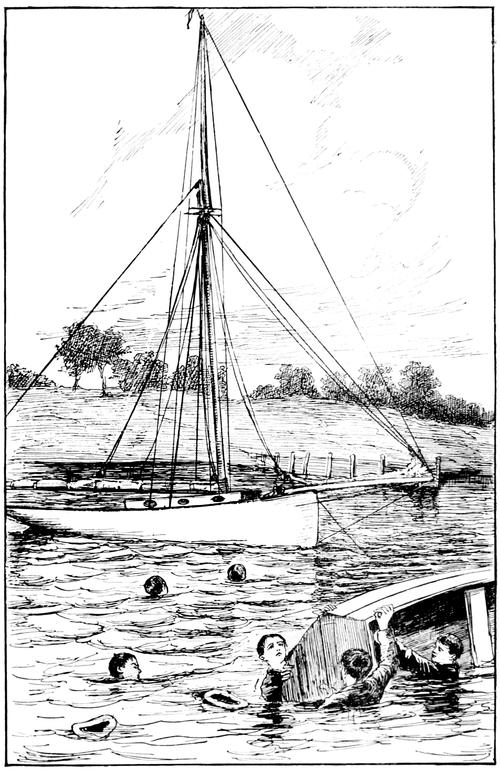
"The Thunderer had foundered."—Page 35.
BY
OLIVER OPTIC
AUTHOR OF "YOUNG AMERICA ABROAD" "THE GREAT WESTERN SERIES"
"THE ARMY AND NAVY SERIES" "THE WOODVILLE SERIES" "THE
STARRY-FLAG SERIES" "THE BOAT-CLUB STORIES" "THE
ONWARD AND UPWARD SERIES" "THE YACHT-CLUB
SERIES" "THE LAKE-SHORE SERIES" "THE
RIVERDALE SERIES" "ALL ADRIFT"
"SNUG HARBOR" "SQUARE AND
COMPASSES" "STEM TO
STERN" ETC. ETC.
WITH ILLUSTRATIONS
BOSTON
LEE AND SHEPARD, PUBLISHERS
NEW YORK
CHARLES T. DILLINGHAM
1887
Copyright, 1886,
By WILLIAM T. ADAMS.
All rights reserved.
All Taut.
TO
My Young Friend,
FRED G. BERGER, Jr.,
OF GRAND RAPIDS, MICH.,
This Book
IS AFFECTIONATELY DEDICATED.
PREFACE.
"All Taut" is the fifth volume of "The Boat-Builder
Series," which will be finished in the
next book. Nearly all the characters presented, and
all who take prominent parts in the story, have been
introduced in the preceding volumes. The principal
of the Beech Hill Industrial School entertains some
doubts in regard to the principle upon which he has
been conducting the institution, and brings about a
partial change in its character. He is a firm believer
in the utility of the school as he has organized it;
and, apart from its industrial mission, he believes it
may accomplish another purpose that will render it still
more valuable to the community in which he resides.
The founder of the school has demonstrated to his
own satisfaction, to say the least, that the institution
is a practicable cure for some of the evils of American
society; and he adds to it the feature of making it
partly reformatory. The subjects of his new experiment
in this direction are the Topovers, who have been
the bad characters of the story. He finds them more
tractable than he had anticipated, and the story will
show with what results he applied the naval discipline
of the school to them.
In spite of the rather formidable reformatory plan
of Captain Gildrock, the book contains about the same
amount of incident and adventure as its predecessors
in the series; but they are events which forward the
action of the principal, and illustrate his method of
reforming bad boys. The Lily is rigged, and makes a
very good record as a fast sailer on the lake.
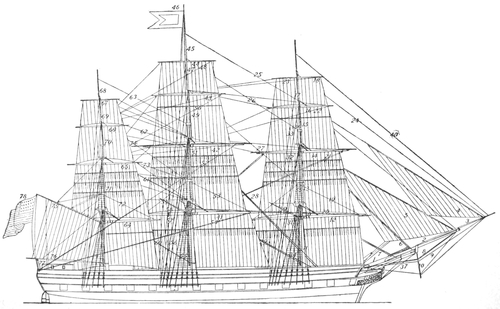
The principal, though the actual work to be done by
the students is only to rig a fore-and-aft schooner,
explains to them the different kinds of vessels, classed
by their rig, and fully illustrates the system by which
the spars, rigging, and sails of a ship are named, so
that he makes quite an easy matter of it for the boys.
The next and last volume of the series will be devoted
to the sailing of boats; though, as in the other
books, the subject will be amplified so as to include
nautical manœuvres of larger vessels.
"What's the use of rigging the boat, Tom Topover?"
demanded Ash Burton, with no little disgust apparent
in his tones and looks.
"How can you sail the boat if she isn't rigged,
Ash?" retorted Tom, who had always been the
leader of the "dangerous class" of boys in Genverres.
"We don't want to sail her; we can't sail her
in this creek," replied Ash Burton, who seemed
to be inclined to dispute the authority and reject
the leadership of the Topover.
"What's the reason we can't?" asked Tom,
suspending his labors upon an old stick which
was to serve as a mast for the craft they were
getting ready for service.
"Because there is no room up here to sail a
boat. This creek is not more than ten feet wide,
and the wind is blowing directly up stream. It is
half a mile to Beechwater, as the fellows in the
Industrial School call it. The current will carry
us down with only a little steering."
"What are we going to do when we get to the
little lake? We have nothing but a couple of
pieces of boards for oars, and we can't do nothing
rowing," argued Tom Topover.
"All we want to do in this tub is to get down
to the grove, and then we shall be all right,"
added Ash Burton warmly.
"We are going to sail down," persisted Tom;
not that he cared how the craft was propelled
through the water, but because he always wanted
his own way, and that his word should be law to
his companions.
"You don't know how to sail her after you get
her rigged," said Ash, with no little contempt in
his tone.
"You do, and that's enough. When we get her
into the water, your work will begin, and mine
will end."
Ash Burton had recently moved to Genverres
from Westport, where he had sailed in a boat a
few times, and claimed to know something about
the management of one. Half a dozen boys had
gathered on the bank of the creek; and they were
all the associates, more or less, of Tom Topover,
Nim Splugger, Kidd Digfield, and boys of that
stamp.
They had heard a great deal about the building
of the Lily, the schooner which had been launched
by the students of the Beech Hill Industrial School
just before the end of the term. The people of
the town had talked a great deal about it, and
most of them were interested to see her rigged
and sailing in the waters of the river and lake.
It was well understood that the rigging of the
boat was the first thing in order after the school
was re-organized in the month of September.
The young ladies in Genverres, and others who
had attended the launch, which had been one
of the great occasions of the year, had talked
with the students; and "rigging the boat" was
still the subject of conversation among them. Of
course the boys did more talking on this subject
than all others. Tom Topover had seen the
launch, and heard the subject of rigging the new
craft discussed. He was inspired to do something
of the same kind, and this explained his persistency
in part.
It was the last week in August, and in two
weeks the industrial school would be open again;
but the students who went to their homes had not
yet returned, and every thing was very quiet
about the grounds and buildings. A few boys
who had no homes, or had them in the immediate
vicinity, spent a good deal of their time in the
Sylph, the steam-yacht of the principal, Captain
Gildrock.
Dory Dornwood had preferred to remain at
home with his mother and sister, at the mansion
of his uncle the captain. He made a call as often
as it was decent for him to do so, at the cottage of
Mr. Bristol on the bank of the creek. Miss Lily
Bristol, the daughter of the engineer who lived
there, was acknowledged everywhere to be a remarkably
pretty girl, about Dory's own age.
Dory was a great character at the school, and
he was now the captain of the Sylph when the
institution was in session. He was by no means
a fighting character, though he had been in some
hard battles with students and others, and his
prowess possibly had something to do with his
popularity in school and out.
During the vacation, the Sylph was in service
a great part of the time. As she went somewhere
nearly every day except Sunday, Dory had
frequent occasion to go to the cottage to give the
engineer his orders for the next day. His message
to the father was generally coupled with an
invitation to Lily and her mother to join the party.
Besides, Lily had a brother who had won distinction
among the students for certain battles he
had fought with Major Billcord and his son Walk.
Under Dory's direction, the students had moved
the cottage in which the Bristols lived, from Sandy
Point to its present location; and this event, in
one way and another, had led to a very close intimacy
between the young captain of the Sylph
and Paul Bristol, Lily's brother.
Perhaps Dory wished to see his friend very
often; at any rate, he went to the cottage about
every day in the week. Some of the students,
and even his sister Marian, were disposed to laugh
at him for his frequent visits; but Dory never
admitted, even to himself, that he went to see
Lily. Being quite young, it is probable that he
did not understand the matter very well, and was
ignorant of what it was that attracted him to the
cottage.
Tom Topover and his followers had been hearing
all the talk in the town,—at school, at the
taverns, and in the shops,—about the doings at
the Industrial School. They had been inclined to
imitate, in their own way, the operations of the
students on the water. They had endeavored to
get into various quarrels with them, sometimes
for the simple fun of bothering and annoying
them, and sometimes for the purpose of getting
possession of their boats.
Twice they had stolen the long barges; and
once, when they were assisted by the students of
the Chesterfield Collegiate Institute, they had
given the owners a great deal of trouble in recovering
the property of the school. It is not
strange that the frequent view of so many elegant
boats on the river and lake inspired them to imitate
their more fortunate neighbors in the sports
of the water.
Tom and his companions believed that the students
and their principal were especially mean
and selfish, in keeping all these elegant boats
exclusively for their own use. He had done his
best in trying to be civil, and even polite, in
making his request, for himself and his associates,
for the use of some of the boats for an hour or
two. He had always been refused; for they were
not competent to manage such craft, in the first
place, and the principal had no fancy for indulging
bad boys.
Being unable to obtain the use even of the
four-oar rowboats of the institution, though it was
vacation, they had constructed a flat-bottomed
affair, which they called a boat, but to which no
one else would have had courtesy enough to apply
the term. It had been constructed under the
direction of Ash Burton, who was certainly a
higher grade of boy than the original Topovers;
but it may be doubted if his standard of morals
was any more elevated. He had been well educated
so far, and was now in the high school.
The Topovers were enterprising and daring;
and this fact, rather than their coarse manners
and disregard of the laws of God and man, had
drawn him to them. With him in tone and manners
were half a dozen other boys like him, who
had joined the Topovers. The old leader had
been in some bad scrapes, and the people were
generally sorry that he had not been convicted
for his assault upon Paul Bristol, on the other
side of the lake. They believed, that, in their
own State, he would have been sent to a correctional
institution.
The addition of boys like Ash Burton and Sam
Spottwood had greatly changed the character of
the original band. Hearing some of their number
speak good English, had led them to improve
their own language. But morally, they probably
dragged down the recruits quite as much as the
latter elevated them. On the whole, however,
the tone of the crowd was improved.
The thing they called a boat had been built,
and launched with some of the show which had
attended the advent of the Lily into her destined
element. The next thing in order, according to
Tom's idea, was to rig her. It would not be
proper to make an excursion in her, if she would
float with half a dozen of them in her,—which
had yet to be demonstrated,—until she had been
rigged. The leader and some of the others had
brought such bits of line as they could lay their
hands upon, not always with a strict regard to the
rights of property.
Ash Burton and Sam Spottwood did not believe
in this folly, and they were disposed to rebel
against the chief of the Topovers. The old sheet
which Tom had brought for a sail would be as
useless as a steam-engine without a propeller, in
going down Beech Creek.
"If you want to rig her, go ahead, Tom," said
Ash, when he had exhausted his arguments
against the plan. "Sam and I will wait until
you do the job."
"But I don't know how," added Tom. "I
never had any thing to do with sailboats."
"Let him have his own way, Ash," suggested
Sam Spottwood, in a low voice. "Help him out,
and we shall get off all the sooner."
The new boat was not only to be rigged that
day, but she was to convey her builders down the
stream to the lake. Tom had hacked out a boom
and gaff, and had set up the crooked stick which
was to serve as a mast. One of the boys had to
devote himself all the time to the work of baling
out the leaky craft, while another was punching
cotton-wool into the gaping seams, and plastering
them over with putty.
The mast-hole was so large that the spar would
not stand up; and Ash rigged a pair of shrouds
to support it in place. The sail had already been
bent on the boom and gaff in a very unnautical
manner, and a few minutes served to attach it to
the mast. The master rigger on this occasion was
not disposed to waste any time on the rigging;
and the gaff was not made to hoist and lower, but
was simply tied to the top of the mast. A piece
of bed-cord was fastened to the boom, to serve as
the main sheet, and the craft was ready for sea.
But the calker had not yet finished his labors,
and Sam Spottwood assisted him. The cotton
had but a light hold on the wood, in the wideness
of the seams, but the putty kept it in place. In
another half-hour, the workmen declared that the
boat was tight, and would keep dry, even in a
heavy sea, out in the great lake. Ash Burton had
some doubts on this point, but he said nothing.
If they all got overboard, it would be easy enough
to get out of the creek, it was so narrow.
"Is every thing all right now?" asked Tom
Topover, in a tone of authority, when the calker
announced that his job was finished.
"Every thing is all right," replied Kidd Digfield,
who had used the cotton and putty. "The
boat is all ready."
Tom proceeded to take his place at the stern.
CHAPTER II. THE VOYAGE OF THE THUNDERER.
"Who is to be the captain of this craft,
Tom?" asked Ash Burton, when the
leader of the gang had taken his place at the
post of honor.
"I am, of course," replied Tom, opening his
mouth from ear to ear in a grin which was intended
to express his astonishment that any one
should put such a question to him.
"All right," added Ash, with a nod of his head
in addition to emphasize his consent; "we will
all obey your orders."
"Of course you will. In a boat there can be
only one head, and others must do as the captain
says," continued the self-appointed skipper.
"You are exactly right there, Tom. On board
of the Sylph a fellow is not allowed to say his
soul is his own; and if he disobeys the orders of
his superior officer, he is shut up in the dark, or
something of that sort."
"That's the right way to do it," argued Tom.
"If a fellow won't mind the captain, he ought to
be shut up, and kept there till he is willing to
mind."
"We shall all mind," said Ash; but some of
his companions could not help noticing a sort
of chuckle as he spoke.
As no one said any thing more on the subject,
and all seemed to agree that he should be the captain,
Tom proceeded to station his ship's company
in the boat. He ordered Ash to take a place
beside him in the stern. There was no more than
room enough for the six boys, and certainly none
for as many more who had taken part in the
building of the boat, but were not present at
the rigging of the craft.
The Thunderer—for that was the name Tom
had given her in spite of the protest of Ash and
Sam, who wanted to call her the Boxer, perhaps
as a compliment to the leader of the party, but
more probably because she was more like a box
than a boat—had her bow on the sand at the
bank of the creek. Tom directed Sam Spottwood,
who was in the forward part of the boat, to shove
her off.
The boy addressed had a piece of board in his
hand, and he obeyed the order. The clumsy craft
slid off the sandbank into the water. The six
stout boys in her settled her down so, that Tom
began to manifest some signs of timidity; but
when she had reached her bearings she did very
well, and rested like a log on the water. The
hills and trees on each side sheltered the creek in
this place from the breeze that was blowing, and
the sail hung idly from the gaff.
The boat was provided with a rudder moved by
a tiller thrust into a half-inch auger-hole. It was
sufficient to move the rudder, and that was all that
was expected of it. Tom thought that the boat
was a decided success, as she had not yet spilled
them out into the creek. The current of the
stream was strong enough to set the craft in motion,
and she began her maiden voyage down to
the little lake.
But she did not pay proper allegiance to her
helm, in spite of all the twisting and jerking that
Tom bestowed upon the innocent tiller, which
was not at all responsible for the erratic course of
the Thunderer. She bunted on the sandbars, and
even poked her blunt nose into the banks as if
she were hunting for muskrats.
"There is some mistake about this boat," said
Tom, when he had exhausted his strength and his
patience in vain attempts to bring the craft to
some definite course.
"What is it, Captain Topover?" asked Ash,
winking slyly to Sam in the bow.
"That's more than I know, for every thing
seems to be all right about her. The rudder
moves when I shift the tiller, but she don't mind
it no more than a naughty boy minds his mother,"
replied Tom, looking over the boat in his efforts
to ascertain what the matter was.
Just at that moment, the obdurate Thunderer
was whirled by an eddy in the current, and
thrown against a log of wood projecting from
the bank. She canted over, and Kidd Digfield
sprang to his feet. It looked as though the boat
were going to spill them all out, but she did not:
on the contrary, she rebounded from the obstacle,
and went whirling on her way down the stream.
"Sit down, Kidd Digfield!" shouted Tom imperatively.
"You have been in a boat enough to
know better than to stand up in that fashion. No
fellow is to get on his feet, whatever happens."
The skipper had learned this from the discipline
of the students, with some of whom he had conversed;
and he had often been near enough to
their boats to learn something of the way in which
they managed them.
"That's right, Captain Topover," said Ash approvingly.
"A fellow that stands up without
orders in such a craft as this ought to be thrown
overboard."
"No matter what happens, no fellow must get
on his feet," repeated Tom sternly. "It won't
do."
"Suppose the thing upsets or sinks, are we to
keep our seats?" asked Kidd, more to bother his
commanding officer than for any other reason.
"When it comes to that, it is another thing,"
replied Tom, with all the dignity he could manage
to muster. "Obey the orders of your captain;
and when he gets on his feet, it will be time
enough for you to do so."
The Thunderer continued to wander and whirl
in the current and the eddies, in spite of the best
skill of the skipper to prevent it. Ash Burton
knew very well what the matter was, but he did
not think it proper for a simple sailor to give
advice or instruction to the high and mighty captain.
Tom was the captain, and it devolved upon
him to manage the Thunderer as he thought
best.
The boat whirled entirely around sometimes,
rudder or no rudder; and Tom did not know
what to make of it. He had never seen a boat
act so before, and he was sure that none of the
school navy behaved in such an unaccountable
manner. The progress of the expedition was very
slow; and the skipper declared that it would take
all day to get to Beechwater at this rate, to say
nothing of Lake Champlain, upon whose waves
they desired to navigate the Thunderer.
"I say, Sam Spottwood, just use that board of
yours a little, and keep the boat from twisting
about like a ram's horn," said Tom, when he
could devise no other expedient for keeping the
boat in a direct course.
"What am I to do with it?" asked Sam, who
had some idea of what had been passing in the
mind of Ash.
"When you see her whirling about, just stick
the board on the bottom, or against the bank, and
push her round," added Tom.
Sam obeyed the order when the bow came near
enough to the bank for him to touch it. But
when he attempted to reach the bottom of the
creek, the water was too deep for the length of
his stick. The boat whirled again, and Tom reproved
the hand forward for not preventing it.
"I can't touch bottom with this oar," replied
Sam. "I can only use it when she runs into the
bank."
The Thunderer was approaching the stone-quarries,
and the creek was wider and deeper than
where they had embarked. Tom could give no
further orders to remedy the difficulty, and the
craft continued to waltz on her course. When
they had gone a short distance farther, a slight
breeze from behind Beech Hill filled the sail. In
that turn of the stream it happened to be fair,
and the boat began to move more rapidly through
the water.
There was no more trouble about the steering
at that moment; for, as soon as she had steerage-way,
there was something for the rudder to act
against.
"That's the talk!" exclaimed Tom, when he
saw the Thunderer behaving like a proper and
obedient Thunderer. "She has got over that bad
trick, and she steers like a lady now."
The craft reached the hill, and again she was
left in a calm. Not a particle of breeze came to
fill the sail, and she began to gyrate as she had
done before. Tom was vexed; and he tried in
vain to solve the mystery, while Ash chuckled at
the ignorance and stupidity of the captain of the
Thunderer.
Passing the Bristol cottage, which seemed to
be closed up, they came into Beechwater. There
was a little breeze on the lake, and the sail filled
again. But the wind did not come from the same
direction as before; and after the sheet—not the
main sheet, but the bed-sheet doing duty as a
mainsail—had filled once, it refused to fill again.
It had been trimmed at random, and was not in
position to profit by the light air that came to
it.
Ash Burton laughed in his sleeve, and winked
at Sam Spottwood. As the Thunderer had passed
out of the current, or where the force of it was
diffused through the whole breadth of the lake,
she ceased to move at all, so far as her gallant
skipper could discern.
"Are we going to stop for dinner here?" asked
Ash, with another wink at Sam.
"That sail keeps flapping, and there is wind
enough; but the boat don't seem to go at all,"
replied the perplexed commander of the Thunderer.
"I wonder what's the matter with her?"
"The captain of the vessel ought to know what
ails her," added Ash.
"Well, I don't know; and she won't move at
all," added the skipper. "Do you know what
ails her, Ash Burton?"
"I don't pretend to know any thing at all
about it, and I only obey the captain's orders,"
answered Ash, winking again at his crony forward.
"If you want to tell me any thing about the
matter, I am ready to hear you," continued the
captain, nonplussed at the situation.
"I don't want to tell you a single word. I
know my place better than to do such a thing.
It would be nothing less than mutiny for me to
presume to tell the commander of the vessel what
to do."
"We will let up a little on that," added Tom,
with a grin, which was his apology for receding
from his position. "Can you tell me what the
matter is?"
"I cannot, but I am ready to obey orders,"
replied Ash.
Tom Topover took hold of the main sheet,—not
the bed-sheet this time, but the rope,—and
pulled the boom towards him. He had done so
in the process of his investigation, rather than to
accomplish any movement. But the effect was
the same as though he had done it on purpose.
The moment he hauled in the sail, the wind
filled it, and the boat began to go ahead again.
Tom was not a fool in all branches of human
action, and he could not help seeing how he
should keep the sail full. He made fast the
sheet; and the boat continued to go ahead, till
she was within a short distance of the Goldwing,
Dory Dornwood's sloop-yacht.
"Run for the shore, Tom!" suddenly shouted
Nim Splugger, who was seated in the middle of
the craft.
"What's the matter with you, Nim?" demanded
the skipper.
"The putty and cotton is coming out of the
cracks, and the boat will be full of water in about
two minutes," added Nim.
"That's so!" yelled Kidd. "The water is
pouring in like a mill-stream, and we shall be in
the lake in a couple of minutes."
The two minutes had not elapsed when the
boat was half full, and she rolled over as gently
as though she had been a log.
CHAPTER III. A QUESTION DEBATED AND SETTLED.
The Thunderer had foundered; but not being
provided with ballast she did not go to
the bottom, as it is set down in poetry and
prose that she should do when she fills with
water. All the Topovers of the present party
had been educated in the manly sports of the
locality, and they could all swim. The disaster
was not, therefore, a very appalling catastrophe.
But they were not required to swim any great
distance, and the useful art they had acquired
was of more service in enabling them to retain
their self-possession than for the purpose of reaching
the shore.
The clumsy craft went out from under them,
for it was no longer able to hold them up. As
she rolled over, she filled with water to the gunwales,
and emptied her living freight into the
lake. But the event occurred not ten feet from
the Goldwing's moorings; and while one half of
the crew swam to the sloop, the other half clung
to the wreck. Among the latter was Captain
Topover, who possibly believed that the master
should be the last to leave the ill-fated bark.
Those in the forward part of the Thunderer
had gone to the yacht, as they were the nearest
to it; while those in the stern did not "give up
the ship,"—not just then, though they did so
a few moments later when they discovered that
the wreck was floating towards the outlet. Ash
Burton was the first to take this step, and the
other two immediately followed him. There was
plenty of room on board of the Goldwing for
a dozen, and the shipwrecked party were not
crowded.
"That's the end of the Thunderer!" exclaimed
Sam Spottwood, as he shook the water
from his garments, and tried to make himself as
comfortable as possible. "It is lucky that she
left us to shift for ourselves just here, instead
of out in the middle of Lake Champlain."
"Can't we save her?" asked Tom Topover,
who had been reduced by the disaster to the level
of his companions.
"She isn't worth saving," replied Sam contemptuously.
"She can never be made to stay
on the top of the water, and I wouldn't give two
cents for a boat that wants to burrow in the
mud at the bottom."
"I don't think the Thunderer was a success,"
added Ash Burton, as he wrung out the sack
coat he wore. "I shall not go into the shipbuilding
business at present."
"But she was a good boat, and worked very
well," insisted the late captain of the craft.
"She sailed very well when she got the hang
of it."
"Or when her skipper got the hang of it,"
suggested Ash.
Tom took no notice of this bit of sarcasm, and
perhaps did not understand it. All the party
proceeded to do what they could to get the
burden of water out of their clothes. But it was
a warm day in August, and they were not likely
to suffer from their involuntary bath. The hot
sun was rapidly restoring the garments to their
former condition; and the rough crowd made
light of the affair, for they were in the water
half the time during the long vacation.
"We have lost our sail," said Sam Spottwood,
who had no interest in the craft which was now
half-way to the outlet of Beechwater.
"That's so, and we have lost all the work we
put into that craft. However, I did not expect
much of such a tub, and I am not much disappointed
in the result of the first cruise. But
here we are, and here we are likely to remain
until some one from the school comes and takes
us off."
"You will have to wait a long while if you
expect to be taken off," added Sam; "for all the
people belonging to the place went off this morning
in the Sylph, and they won't be back till
night."
"It isn't ten o'clock in the forenoon yet, and
they will not be back till dark, for they take
their suppers on board," said Ash Burton, shrugging
his shoulders at the prospect. "We shall
get no dinner, and no supper, and it looks like a
starving time ahead."
"You can bet I don't stay here without any
dinner and without any supper," interposed Tom
Topover. "If I don't get my dinner to home to-day,
it will be because I get it somewhere else."
"I don't see how you are going to manage it.
Do you mean to swim ashore?" asked Ash.
"I could do that if I wanted to, and so could
the rest on us; but there is a better way," replied
Tom, with a significant grin.
"A better way? What is it?" asked Sam.
"We ain't in the water, be we?" asked the
late captain, with an expressive look at his companions,
as though he desired to take the measure
of them for a new enterprise.
"We be not," answered Ash, who had taken
the job of correcting the leader's English, and
had succeeded to a considerable extent. "We
are not in the water: on the contrary, we are on
board of the able and swift-sailing Goldwing;
and we should be driven from her like cows from
the corn if there were any of the officers of the
school at home."
"Just so, but they are not at home. Most
likely they are up to Whitehall or some other
place at that end of the lake. Do you think I
am going to stay here all day without any dinner
and supper, when we might just as well use this
boat as leave her alone?" demanded Tom Topover
earnestly.
"It will be the safest way to let her alone,"
replied Ash, shaking his head. "You came very
near being doomed to look through the bars of a
gridiron for the next three or six months, over
on the other side of the lake; and it will be well
for you to keep a sharp lookout to windward,
Tom."
"That was because I licked Paul Bristol,"
added Tom, with a grin.
"Or because you got licked by him," suggested
Ash. "According to all accounts, you got the
worst of it."
"I can lick Paul Bristol or Dory Dornwood
out of their boots, every time," bragged Tom,
who was never able to remember his defeats in
the past; and both of the worthies mentioned
had been too much for him. "But that ain't any
thing to do with us now."
"If you should take this boat, and sail her
away from her moorings, what should you call the
act?" asked Ash, pinning his leader down to a
point.
"I should call it taking the boat."
"Captain Gildrock would call it stealing her;
and the court on this side of the lake might send
you to the house of correction, or some such
place, for a year or two," continued Ash Burton,
carrying the point to its issue.
"We didn't come out here to steal her," protested
Tom. "The captain would say we had no
right to come on board of her; but you was the
first one to get on board of her."
"I don't think the principal would find any
fault with us for coming on board of her, after we
were wrecked in the Thunderer," answered Ash.
"Of course he couldn't. That's one thing.
The next is, shall we leave in the boat, or stay
on board of her? We might as well drown as
starve to death," argued Tom.
The high-school boy scratched his head, for
there seemed to be some force in the late captain's
argument. He was opposed to going without
his dinner and supper, and he did not believe
that a man as reasonable as Captain Gildrock
would ask such a sacrifice of him. It occurred
to him, that the gardener of the estate, or some
of the stable-men, might be at home, and might
be called to their assistance, if they shouted persistently
for help. He proposed this to Tom, but
it was received with a sneer.
"The boats are locked up in the new boat-house,
and the gardener don't keep the keys,"
replied Tom. "You might as well holler for the
captain himself, at Whitehall, as to try to find
any one on the place when he is away."
"It couldn't do any great harm if we should
sail the Goldwing up to the wharf," said Ash, as
much to himself as to his companions. He did not
like the idea of taking the boat, for Captain Gildrock
was a Tartar to deal with in such matters.
"Of course it won't!" exclaimed Tom. "We
can't do any other way. We should be fools to
stay here and starve to death, within a quarter
of a mile of the land."
Tom had made up his mind some time before,
and had looked the boat over to ascertain whether
or not she was available. During the summer
the Goldwing had been supplied with a horizontal
wheel, and the tiller could not be locked up in
the cabin. But even if it had been, the cabin-doors
were not locked as usual, for the reason
that one of the crew had dropped the key overboard,
and another had not been fitted. Tom
found that there was nothing to prevent his party
from getting the sloop under way.
Ash Burton and Sam Spottwood had always
been law-abiding young men, as most of the
others on board were not. If the proposition had
been made on shore, to go off and take the Goldwing
for a sail, in the absence of the owner, they
would not have consented to take part in such
an affair. But they had been put on her deck
almost in spite of themselves; they had saved
themselves from possible drowning by getting on
board of her, for they did not believe they could
swim to the shore.
Tom Topover's argument had its influence
upon them; and they finally consented to assist
in taking the boat, for the purpose of reaching the
shore. The moorings were cast off, and the mainsail
hoisted rather by tacit consent than by actual
agreement. Ash assisted in the work, or it might
never have been done, for the want of knowledge
how to do it on the part of the others.
"Who is to be captain of this craft?" asked
Ash, when the matter came to his mind.
"I am, of course," replied Tom confidently.
"All right," added Ash, who had thought he
might not feel confident to handle the sloop. "I
will obey orders, and do just what you tell me."
Tom went to the wheel. He had not noticed
it particularly before, and he had no more idea of
its use than he had of handling a quadrant or a
log-line.
"What's this thing? and where is the tiller?"
asked Tom, as he gave the wheel a twirl.
Ash Burton, who was the only one who was
competent to answer the question, made no reply.
The boat had been got under way in the most
unseamanlike manner, and she was now drifting
towards the outlet. There was wind enough to
make the sail bang about above the heads of the
party, for it had not been trimmed to any course.
Tom studied the working of the wheel for a time,
for he had come to the conclusion that it was to
be used instead of a tiller. He turned it as far
as he could, one way, and then looked over the
stern, to note the position of the rudder. Then
he reversed the wheel, and looked again. He had
solved the mystery, and partially got the hang of
the thing.
The wind was west; and Tom pulled away at
the main sheet, until, guided by his experience
in the Thunderer, he filled the sail. The sloop
started off at a speed that startled the skipper.
She heeled over, and frightened some of the
party, who were not used to the movements of
a sailboat. By feeling his way, the skipper had
brought the sloop on the starboard tack, headed
for the outlet. The direction was not Tom's
choice; but, trimmed as she was, she would not
go any other way.
Ash Burton wanted to protest against being
carried away from the wharf, but he would not
interfere with the skipper.
CHAPTER IV. A MUTINY, AND A NEW SKIPPER.
Ash Burton did not believe that Tom
Topover could handle the Goldwing; and
he was anxious to have him appeal to him for
assistance, which, however, he had decided not to
render while the present incumbent remained as
captain. Tom was sailing the boat away from the
wharf, and two of the party at least were strongly
opposed to doing so. The wind was fair for the
wharf, but Tom had not the most remote idea of
the way to bring the sloop about. His nautical
education had been confined to rowboats.
Ash walked forward to the forecastle, where
Sam Spottwood had seated himself. He was fully
resolved to give the skipper rope enough so that
he could hang himself, and prove his own incompetency.
There was hardly wind enough in
Beechwater to upset the boat, and the emergency
was to be something else that would call him to
command.
"We are going away from the wharf," said
Sam, when his friend seated himself by his side.
"Of course we are; I am not exactly blind.
Tom don't know enough to bring the boat about,
and that's what's the matter," replied Ash.
"I believe the fellow means to go off on the
lake," added Sam.
"Not a bit of it! He couldn't get her down
the river if he tried a week. No; he couldn't
even get her through the outlet, for at the turn
he will have the wind dead ahead," chuckled Ash.
Tom Topover at the helm looked as though he
were supremely contented with his position. He
had got the hang of the wheel so far as to be able
to steer the sloop when there were no complications.
By trial he found that when he pulled the
spokes towards him, sitting on the weather side,
it caused the bow to swing in the same direction.
If he turned the wheel too much, it felt as though
the boat would tip over. Turning it too much
the other way, made the wind shake the sail as
it was "spilled." This was the extent of the
skipper's present skill in sailing a boat.
The Goldwing moved rapidly even in a light
wind, and she was soon near the outlet. It looked
as though Tom meant to go through, for he made
no attempt to check the further progress of the
sloop in this direction. Sam protested that he
must not go any farther: the navigation of the
outlet was difficult, and it required all Dory
Dornwood's skill to carry her through with a
west wind.
"Why don't you say something to him, Ash?"
asked Sam, beginning to be anxious about the
result of the venture.
"He is the skipper, and I don't want to interfere
with him," replied Ash very decidedly.
"But he means to run away with the boat, and
we don't agree to that," remonstrated Sam. "He
don't know what to do, even if he don't intend
to take a cruise on the lake; and you ought to tell
him, for you are the only fellow on board that
knows any thing about a sailboat. He will get
us all into a scrape that we did not bargain for."
"I tell you he can't get through the outlet,"
replied Ash impatiently. "When he gets her
aground, as you may be sure he will, all we have
to do is to jump ashore and go home."
"We had no business to come down here in the
boat, and I want to get out of the muddle before
it gets any hotter," persisted Sam.
"You have a tongue in your head, and you
know how to use it. Why don't you talk to Tom
yourself?" inquired Ash.
"I don't know any thing more about a sailboat
than I do about making turtle-soup," added Sam.
"That won't prevent you from telling Tom
to come about and go to the wharf by the boat-house."
Sam Spottwood had not thought of this before.
If he told the skipper to go back, he thought he
must explain how it was to be done.
"This won't do, Tom Topover!" said he vigorously,
as he walked aft through the standing-room.
"We are going away from the wharf all
the time, and we shall never get there at this rate."
"I suppose you don't know much about a boat,
but you have to sail as the wind will let you,"
replied Tom in an airy manner, as though he
comprehended the subject perfectly.
"I don't know any thing about a sailboat, but
I think it is high time we were getting near the
wharf," added Sam.
"I was just thinking so myself, and I will turn
her about now," said Tom, as he cast his eyes
about him like a prudent sailor before he changes
the position of his vessel.
In this part of the lake the country was more
open than farther up the creek, and the wind
from the great lake came fresh over the lowlands
at the mouth of Beaver River. As Sam spoke,
the breeze freshened; and, as the boat happened
to have a "good full," she heeled over till her
gunwale was very near the surface of the water.
This sudden jerk frightened all in the boat except
Ash Burton; and the captain more than any one
else, for he felt the responsibility of his position.
Tom Topover was bound to do something to
counteract the pressure of the wind against the
sail; and he put the helm hard up, instead of hard
down as he should have done. He neglected to
cast off the main sheet, which he had made fast
to the cleat. The result was that the boat came
as near going over as she could in that amount of
wind. The skipper was so mixed up that he did
not know what to do next, and he moved the
wheel over the other way as soon as the boat had
gybed. A moment later the Goldwing repeated
the operation, for she was not used to being handled
in this clumsy manner.
Tom whirled the wheel from one side to the
other, for he did not know what he was about;
and finally she was again headed into the outlet,
with her sail drawing on the starboard tack. He
could make her go as she had gone before, and
that was all he could do.
Ash Burton was used to the movements of a
boat, even when badly managed; and he was not
at all alarmed, for they were close to the shore.
He laughed at the struggles of the skipper to
set things to rights.
"I thought you were going to the wharf," said
Sam, as soon as he had recovered in some measure
from his fright. "You are headed the wrong
way."
"She won't go the other way," protested Tom.
"The wind is west, and it ought to take us
the other way as well as this," Sam objected.
"But it won't take us that way," replied Tom
sharply. "Haven't I just tried it?"
"But you don't know how to manage the
boat," protested Sam, disgusted with the conduct
of the captain.
"Who says I don't know how?" demanded
Tom, who never admitted his inability to accomplish
any thing he undertook to do.
"I say so, and you have proved it. I believe
you mean to take us out on the lake."
"Well, what if I do? I don't believe the
fellows will object to a trip on the lake in this
boat," replied Tom, willing to take the clew the
mutinous hand had given him.
"I object to it, and for one I won't go on
any trip on the lake. You don't know how to
manage the boat, and you will drown the whole
of us."
"I guess I know what I am about; and if you
don't dry up, Sam Spottwood, I'll bat you over
the head. I am the captain of this ship, and I
ain't goin' to have any feller stick his nose into
my baked beans," returned the skipper angrily.
Sam was not a coward; but he had never
measured his skill with Tom, and he did not
care to quarrel in the boat. He went forward
again, and he and Ash agreed to jump ashore as
soon as they got a chance.
The boat was now fairly in the outlet of Beechwater.
The course for a short distance was the
same as before. The current could be felt as
the lake narrowed into a stream of less than a
twentieth part of its width, and the Goldwing
increased her pace. The turn in the stream
would bring the wind dead ahead in a moment.
Tom Topover kept his eyes wide open; but he
might as well have shut them tight, for he did
not know where the channel was, and he could
not have kept the boat in it if he had known.
It was necessary to change the course of the
sloop to prevent her from running into the bank,
and Tom shifted the helm to send her in the
direction of the most water. The sail shook, and
the boat began to swing about, as it was quite
proper for her to do; but he met her with the
helm too soon, not knowing any thing about his
business, and the sloop lost her headway, so that
she missed stays. The next moment she drifted
into the shallow water, and was aground close
to the bank, which was a little higher than the
forecastle of the craft.
Ash Burton saw his opportunity at once, and
without a word to any one he leaped upon the
land. Sam Spottwood followed him without a
moment's delay. The sail hung loosely from the
gaff, and was slapping and banging in a manner
that was trying to the nerves of the inexperienced
skipper. The noise seemed to be an element of
danger to him, though it was entirely harmless.
He saw the two members of his crew leap ashore,
and this step on their part contributed to complete
his demoralization.
"What are you about, Ash Burton?" demanded
Tom, as he saw his late companions seat
themselves on the grass.
"About to quit that trip," replied Ash. "I
have had enough of it if you are not going
to the wharf as we agreed in the beginning."
"I am ready to go to the wharf, but the boat
would not sail that way," the skipper explained.
"She would sail that way as well as the other;
but you don't know how to handle her, and you
have made a mess of the whole thing," continued
the mutineer.
"Perhaps you think you can sail her up to the
wharf?" added Tom, with a withering sneer.
"I know I could before she got aground."
"No, you couldn't! What's the use of talking?
You couldn't do it, for no boat will go
where the wind won't take 'em. I'll bet two
cents against a leather cabbage you can't do it!"
continued Tom, who seemed suddenly to have
recovered his usual tone.
"Of course I can't now that the boat is
aground, with her bottom buried in the mud."
"We can shove her out of this in two minutes,
and then I will give you a chance to see what
you can do," added Tom, who thought this was
a good way of getting out of the scrape without
confessing his own incompetency.
"All right; we will help you," replied Ash,
who felt that he was gaining his point. "I will
sail the boat to the wharf if you will make me
captain, for I can't handle the sloop unless I have
full power."
"All right; you shall be captain till we get to
the wharf," replied Tom.
"Throw the painter ashore, and perhaps we
can pull her off," continued Ash.
Sam and he manned the line; and while those
on board pushed with the oars and boat-hook,
they dragged the Goldwing into deep water, for
only her bow was in the mud. Ash and Sam
returned to the boat.
With an oar the new skipper swung the boat
about, and filled the sail on the port tack.
Greatly to the surprise of Tom, the Goldwing
started off on her new course at a lively rate,
and a moment later was in the lake, and headed
for the wharf.
CHAPTER V. A QUESTION OF AUTHORITY.
There was no difficulty in sailing the Goldwing
up the lake, any more than there had
been down the lake. Though Ash Burton had
never steered with a wheel before, he had observed
Tom Topover while he was at the helm,
and he was soon familiar with its management.
The late captain was greatly annoyed to see the
sloop going along so well in the direction in which
she would not go before; but Ash was too much
delighted with his occupation to think of indulging
in any triumphant expressions, and he said
nothing. Like most boys who live near the water,
he was ambitious to become a boatman, though
his experience had been very limited.
"The wind is better now than it was when I
had her," said Tom, after he had watched the
motion of the sloop for a time. "She goes along
very well now."
"The wind is exactly the same now as it was
before," added Sam Spottwood, when he saw that
the new skipper made no reply to this remark.
"You can see the vane on Captain Gildrock's
stable, and it points exactly to the west as it has
all day."
"I don't care nothin' about the vane, I say the
wind is better than it was when I was steering
her," returned Tom rather sharply. "You could
see for yourself that she wouldn't go this way
when I had her."
"That was only because you did not know how
to handle her, and Ash does," added Sam; and
one of the original Topovers would hardly have
ventured to make such a remark.
"If you say that again, I will bat you over the
head, Sam Spottwood," retorted Tom, shaking his
head.
"I have said it once, and that is enough," continued
Sam, who had not yet been subdued by a
thrashing.
"We are almost over to the wharf," interposed
Ash, who wished to prevent a quarrel. "The
only way to get to the grounds from the pier is
through the boat-house, and the doors are all
locked. I did not think of it before, but we
can't land there."
"We don't want to land there or anywhere
else yet a while," growled Tom, for the success of
Ash in handling the sloop had reduced him to a
very bad humor.
"You don't mean to use this boat any longer,
do you?" asked the new skipper.
"If you can make her go, I can," answered the
Topover sourly; "and I'm going to do it."
"We can land at the old wharf," continued
Ash, as he looked about him without heeding the
remark of the leader of the gang.
"We don't land at the old wharf or any other,"
added Tom. "I'm going to sail this boat for an
hour or two before I go on shore."
"You can't sail her: you don't know any more
about a boat than a goose!" exclaimed Sam imprudently,
though he spoke the literal truth.
"Say that again, Sam Spottwood!" blustered
Tom, doubling his right fist, and looking very
savagely at the speaker.
"You are not deaf, and you heard what I said.
It's no use for me to say it again," replied Sam.
"You dassent say it again!"
"We took this boat to get ashore in after we
had been cast away, and I don't believe in using
her any more than is necessary," said Sam, deeming
it wise to change the subject.
"I don't let any fellow tell me that I can't
handle a boat," replied Tom.
"I said it, and I shall not take it back, for it is
true; and you proved it, Tom Topover," returned
Sam boldly, for neither he nor Ash had ever
submitted to the bullying of the bravo, though
they had thus far escaped a fight.
But Tom had a feeling that either of them
would fight, and he had always been obliging
enough to stop short of a blow.
Ash Burton was delighted with the occupation
of steering the boat, she worked so prettily; and
he was sorry when she approached the landing.
He had been on the point of proposing another
turn around the lake, when his predecessor in
office announced his determination to sail the
boat himself. This put a new aspect upon the
business of using a boat borrowed without leave.
All his manly virtue came back to him, and he
resolved not to remain any longer in the boat
if Tom was to sail her.
By this time the Goldwing was not more than
a hundred feet from the wharf, and it was time
to decide what should be done. If he went to the
wharf, the party would be no better off than on
board of the sloop, for they could not get away
from it without climbing over the boat-house. On
the other hand, if the present skipper came about,
Tom Topover would insist upon taking the helm.
But the course of the yacht must be changed at
once, or she would run into the wharf.
Ash Burton put the helm hard down at a venture,
and without waiting to decide the main
question. Things looked stormy ahead to him.
The sloop promptly came up to the wind, and the
boom went over in readiness for the other tack.
It would not take more than a minute or two for
the lively craft to reach the old wharf. Ash realized
that he was still the captain, and by the
consent of Tom. He headed for the landing-place
he had chosen.
The wind was blowing squarely upon the old
wharf, which made it very difficult for an inexperienced
skipper to bring the boat alongside of
it. The structure was low enough to allow the
boom to swing out over it, and thus spill the sail
as the craft came up to it; but the manœuvre
requires skill, and the new skipper was not confident
enough in his own powers to undertake it.
He chose a safer way; and when he came up with
the wharf, he threw the sloop up into the wind,
intending to lower the sail and let her fall off till
she came to the landing-place.
He called Sam Spottwood, and pointed out to
him the halyards. Tom was busy about something
else just then, and did not notice what the
skipper was saying. At the right moment, Ash
put the helm down, and when the sail began to
shake, he shouted to Sam, who had returned to
the forecastle.
"Let go!" was his order, and the hand addressed
understood him.
The halyards were both cast off; and the sail
came down, aided by Sam, with a rush.
"What are you about, Ash Burton?" demanded
Tom Topover, as the canvas came down
on his head, and filled him with consternation, for
he thought something had broken. "What's the
matter now?"
"Nothing at all," replied the skipper pleasantly.
"Stand by with the boat-hook, Sam."
"What do you want with a boat-hook?" asked
Tom, who had been studying the situation with
a view to sailing the boat himself again.
"Fend off, Sam," added the captain. "We
don't want to strike the wharf too hard: it
might injure the boat."
"We don't want to strike it at all!" blustered
Tom, springing to his feet, and taking in the
new order of things at a glance. "Is the sail
broke, that made it come down?"
"Nothing is the matter with it, so far as I
know," replied Ash.
"What made it come down, then?"
"Because I ordered Sam to let go the halyards,
and he did as I told him."
"You told him to let down the sail?" demanded
Tom.
"Of course I did: if I hadn't, the boat might
have been smashed against the wharf," Ash
explained.
"What did you come near the wharf for?"
growled Tom.
"Fend off, Sam," added the skipper.
By this time the Goldwing was so near that the
wharf could be reached with the boat-hook, and
Sam fastened to it. He eased off the boat so
that she came alongside without any crash. The
sail was in the standing-room, and there was no
pressure on her, so that she behaved like a lamb.
Ash Burton, seeing that his mission on board
was completed, went forward to join his friend
and crony.
"You did this on purpose!" stormed Tom,
when he realized the situation.
"Of course I did," replied Ash, with abundant
good-nature, as he had carried his point.
"What did you bring us in here for? Who
told you to do it?" demanded Tom.
"As I was the captain of this craft, I did not
take any orders from any one. Wasn't I the
skipper, with your consent, till we came to the
wharf?" asked Ash.
"Didn't I say I wanted to sail her myself?"
"I don't care what you said: I was the captain,
and I have brought the boat to the wharf."
It looked as though there were going to be a
storm, and Ash, without hurrying himself, stepped
on the wharf. He was followed by Sam, the
four original Topovers remaining in the standing-room.
Their leader, though no process of reason
could convince him against his inclination, was
nonplussed at the argument of the retiring
skipper.
Just at that moment the sound of a sharp
whistle came across the little lake. It was followed
by a succession of shouts, and all the
party looked in the direction from which the
sounds came. On the opposite shore stood half
a dozen boys, who proved to be the rest of the
Topover gang. Some of them were among the
new recruits to the group who ran together, and
were inclined to think more of Ash and Sam
than of the veritable leader. Others were original
associates of those in the boat, though of a
milder type of rascality.
"There's the rest of our fellows!" exclaimed
Tom, willing to dodge the question of authority
which had just come up.
"Come over here, and give us a sail!" yelled
one of the party over in the grove, loud enough
to be understood.
"Where are you going now, Ash?" asked
Tom, in the mildest tone he could command.
"The fun for to-day is all over, and we may
as well go home," replied the last skipper.
"We are going to take a little sail in this boat
now that we have her, and there is plenty of fun
ahead," continued Tom. "Won't you go with
us?"
"You don't know how to handle the boat,
and I won't go in her with you for skipper,"
interposed Sam Spottwood, before Ash had time
to reply. "You came very near upsetting us once
or twice, and I don't risk my head with you."
"I can handle the boat as well as Ash can,"
answered Tom, but his manner was now adapted
to carrying his point. "We might as well have
a sail as go home without one. Captain Gildrock
is away in the Sylph, and he won't be back till
dark. Before that time we will put the boat
back where we found her, and no one will be
the wiser for the fun we have had."
"You are more likely to leave her on the
bottom of the lake than you are to put her back
at her moorings," returned Sam.
Nim Splugger and Kidd Digfield then began
to talk in a low tone to their leader. They had
sense enough to see that Tom could not handle
the boat, and very likely they feared that the
prediction of Sam Spottwood would be verified.
CHAPTER VI. A ROW ON BOARD THE GOLDWING.
"I don't care who is captain of the boat,"
said Tom Topover, after his companions had
talked him into something. "Come on board
again, Ash Burton, and you shall be captain."
"That's so; come back, we want you to be
captain," added Kidd Digfield, who knew more
than his companions about a boat, though that
was saying very little.
"What do you say, Sam?" added Ash, turning
to his crony.
"I don't believe in it," replied the other decidedly.
"You can't depend upon Tom Topover.
If you are the skipper, he will insist upon your
obeying his orders as he did a little while ago."
"I will give it all up to Ash Burton," interposed
Tom, who had heard a part of Sam's
remarks.
Ash was strongly tempted; for if there was any
one thing in the world that he liked better than
any thing else, it was boating. At Westport he
had sometimes sailed in the Silver Moon, and
had learned a little about the management of
such a craft, though he was very far from being
a skilful boatman.
"Tom will get the helm, and then the boat
will go to the bottom if they go out on the
lake," argued Sam.
"I don't believe in using the boat, myself,"
replied Ash faintly; for he was sighing for the
delight of holding the wheel of the Goldwing
while she dashed at her lively pace over the
water. He could hardly refuse the invitation of
the Topovers.
"Tom don't know any thing at all about the
boat, and that fact makes him reckless. In my
opinion, he will sink the boat, and there will be
an awful row in Genverres about this evening
when the Sylph returns," continued Sam, seeing
that his friend was inclined to yield.
"Ash Burton shall have the full command,
and I won't interfere with him," said Tom; but
the two boys on the wharf did not see the wink
he gave to Nim Splugger when he uttered the
gracious words.
"Some of them will be drowned," reasoned
Sam.
"Then I think I ought to go with them!"
exclaimed Ash, suddenly crushing his scruples.
"I don't know much about a boat, but I know
more than any of the rest of the fellows; and I
can keep the Goldwing on the top of the water,
if nothing more."
"We had better keep out of the scrape,"
added Sam, but more weakly than before, for
he was almost as fond of sailing as his friend.
"The rest of the fellows are on the other side
of the water, and we shall have to take them in.
If things don't work right when we get across the
lake, we can jump out of the boat again; and we
shall be nearer home there than we are here,"
said Ash, almost vanquished by his own logic.
He wanted to go so much, that it was easy for
him to persuade himself that it was his duty to
do so in order to prevent Tom from drowning
himself and his companions. The conflict in his
mind ended by his going on board of the sloop,
followed, more reluctantly, by his crony.
"I want this thing understood before I go,"
said Ash, as he walked aft to the standing-room.
"The wind has breezed up a good deal while we
have been talking about it, and it would be as
easy as putting your fingers in the fire to tip the
sloop over."
"We understand it well enough: you are to
be captain, and all the rest of us will obey your
orders—as long as we like," replied Tom impatiently,
and uttering the last words so that
they were heard only by Nim Splugger.
"But I want it made as clear as day that I am
to handle the boat. I know enough about a
sailboat to keep her right side up, and I don't
want to be spilled into the lake by any fellow
that don't know as much about the business as
I do."
"We all agree to it," interposed Kidd Digfield.
"It's no use to talk all day about it."
The last speaker knew the halyards from the
boat-hook; and he proceeded to hoist the sail,
assisted by Pell Sankland. Ash considered it
understood that he was to be skipper till the
end of the cruise, which he did not intend should
last for more than an hour or two. He took his
place at the wheel, and gave the necessary orders
for getting the sloop under way. The fresh
breeze took the sail, and in a couple of minutes
she was across the lake. With the wind off the
shore, he had no difficulty in making a landing at
the little stage which served as a landing-place
for boats from the other side.
"Where is the Thunderer, Tom?" asked Chick
Penny, as he stepped on board.
"She came to grief," replied Tom. "She
dropped to pieces, and tipped us all into the
lake."
"That's just what I supposed she would do,"
replied Chick. "I wouldn't trust my old boots
in her, to say nothing of my precious carcass."
Hop Cabright wanted to know how they had got
hold of the Goldwing, and the story of the morning's
adventures had to be told. But Ash did
not wait for it to be finished. He got under way
again, and stood towards the outlet. More than
half of the recruits, making the whole party a
dozen, were fellows like Sam and himself; and
he felt more at home in the Goldwing than he
had before. But five of them were original Topovers;
which meant that they did not scruple to
steal a boat when they got a chance, or to rob an
orchard, or to break all the windows in the side
of a building for simple fun.
The other seven of the party were very fond
of fun, and could be easily led into mischief,
though they had a better idea of the rights of
property. In the dozen who filled the standing-room
of the sloop were all shades of moral obliquity,
from Tom Topover, who respected no
person's rights except his own, up to Sam Spottwood,
whose greatest failing was the weakness
which did not always induce him to do what
he knew was right.
The narrow limits of Beechwater did not satisfy
the desire of the skipper for a sail, and he stood
boldly into the outlet. Possibly, if the sloop had
not been aground a little before at the first sharp
turn in the stream, he would have sailed her into
the mud which the current deposited there. But
he was forewarned by the former accident, and
he tacked before the keel touched bottom.
More by good chance than by the possession of
any skill in navigating this difficult stream, Ash
got the boat through the bend, and it was then
plain sailing to the river. It was wide enough
here to beat, and in half an hour more the Goldwing
was in the great lake. Ash enjoyed his
occupation more than ever before, and he was in
a state of exuberant delight.
"I guess I'll take that wheel now, Ash Burton,"
said Tom Topover, with a broad grin on his ugly
face, when the boat was fairly out of the river.
"That wasn't the trade," replied Ash.
"I don't care whether it was the trade or not:
I am going to steer now," added Tom very decidedly.
"Didn't you agree that I should be captain on
this cruise?" demanded Ash, keeping down his
indignation as well as he could.
"That was only to get you to come along,"
replied Tom, with the most barefaced effrontery.
"I had a point to carry, and I carried it. Get out
of my way, Ash Burton, and I will take the thing."
"You don't know how to handle the boat, and
I object," interposed Sam Spottwood.
"Shut up, Sam!" said Tom, turning a savage
glance at the last speaker.
"I shall not shut up! You made a fair agreement
that Ash should be captain, or I would not
have come," retorted Sam boldly.
"I should not either," added Ash.
"It's no use of jawing about it. I am going to
steer this boat the rest of the cruise, and"—
"No, you are not! You have tried to cheat us,
and we will stick to the trade we made fairly!"
insisted Sam.
"Shut up, Sam Spottwood, or I'll bat you over
the head!" said Tom fiercely, and he turned
towards Sam with his fists in fighting condition.
"You don't know how to handle a boat, and I
for one won't submit to have the bargain broken,"
protested Sam, his blood heated up to fever temperature.
"Don't hit him, Tom!" interposed Kidd Digfield.
"Ash is captain, and he ought to steer," shouted
Chick Penny from the forecastle.
"Ash must keep the wheel," added Hop Cabright;
and so said several of the others.
Tom Topover looked at them, and then he was
mad in good earnest. He declared that he was
going to take the wheel, and he wanted any fellow
that objected to step out into the standing-room,
and he would "polish him off" in the twinkling
of an eye.
"I object, and I shall stick to it. A trade's a
trade, and I don't think any fellow has a right to
back out of it," Sam responded.
Tom was furious at this remark; and he made
a pass at Sam, who was seated by the side of the
skipper, with his fist.
"None of that, Tom!" interposed Ash, stepping
between the bully and his intended victim.
"What are you going to do about it, Ash
Burton?" yelled Tom, and he aimed a blow at
the skipper, which was intended to annihilate
him.
Ash warded off the blow; but when another
was aimed at him, he struck back. The original
Topovers attempted to interfere, but the fury of
Tom could brook no opposition from friend or
foe. The result was a general row. The recruits
to the gang took sides with Ash and Sam, and
they did their best to support him; but before the
affair could be decided either way, about a hogs-head
of water rolled into the standing-room over
the washboard.
The cooling effects of this inundation were
immediately perceptible. Tom had been thrown
down by the skipper, and the wave had nearly
drowned him. All the others were wet through,
and the sloop was rolling as though she intended
to do the same thing again. Ash was boatman
enough to understand the situation. He had put
the helm up when he was attacked, for the boat
had a tendency to broach to; and she had fallen
off till she presented the broad side of her mainsail
to the stiff breeze.
The boat had come up headed the other way.
With the water splashing about in the standing-room,
the skipper came about again, and headed
the sloop on her former course. The cold water
had cooled off Tom, and just now he was wringing
out his coat. He appeared to submit to the
situation for the present. Sam desired to return,
but Ash wanted to fight the battle out if it was
renewed again.
The Goldwing had dipped up the water when
she was off the mouth of Porter's Bay. Ash set
his companions to baling out the standing-room,
and with all the vessels on board, the work was
soon finished. Before she was up with the
point beyond the bay, the sun had dried the
floor and seats, and she was the cleaner for her
bath.
"Boat ahoy!" shouted some one from the
point, which was covered with trees.
A glance in the direction from which the hail
came informed the boys that there was a picnic
on the point.
CHAPTER VII. AN UNEXPECTED APPEARANCE.
"On shore!" replied Ash Burton, to the hail.
"We should like to hire your boat for a while:
can we do it if we pay well for her?" continued
the speaker on the point.
"She is not to let," replied the skipper.
"We will give you two dollars an hour for her,
with the person to manage her," continued the
gentleman on the shore.
"We have to go home to dinner pretty soon,"
added Ash.
"We will give you all a dinner into the bargain,"
persisted the stranger.
"Take him up!" said Tom Topover very
decidedly.
"Take him up!" repeated several others.
"We shall get home too late for dinner."
"We have no business to let her," added Sam
Spottwood earnestly.
"We have just as much right to let her as we
have to use her at all," added Ash. "Two dollars
an hour is a big price."
The last speaker became less earnest when he
saw that his friend was inclined to favor the
proposition. Doubtless the promise of the dinner
was quite as tempting as the money that was
offered, though not one of the crew of the Goldwing
did not think himself rich when he had a
dime.
"Will you all stay on shore while I take the
party out?" asked Ash Burton, turning to his
companions, when his crony weakened.
The party replied in the affirmative to the
question, not even Tom Topover making any
objection to the plan. Ash ran for a small
staging which answered for a wharf, and the
Topovers all went on shore peaceably. The
picnickers were having a grand time; for they
had music and dancing, and there seemed to be
at least a hundred of them. Farther back from
the lake were half a dozen long furniture-wagons
and other vehicles, while a great number of horses
were picketed near them. It was evident that
the party had come from some distance back in
the country, and were not likely to know any
thing about the ownership of the Goldwing.
About a dozen ladies and only two gentlemen
were embarked in the boat, and Ash got under
way. There was just breeze enough to make it
lively and pleasant sailing. The sea was regular
and moderate, so that there was nothing to call
for any extra skill on the part of the skipper.
The wind being west, he ran down the lake as
far as Split Rock, and then returned. He did
not get her best speed out of the sloop, and by
the time he reached the wharf the hour had
expired.
The party were landed; and Ash supposed the
contract had been completed, especially as the
gentleman in charge handed him four half-dollars,
of which he seemed to have an abundant supply.
But the excursionists were hardly on shore before
another gentleman appeared, followed by a
dozen more ladies, and took the boat for another
trip.
Ash did not object, and he was gone the same
time with the second party. On his return to
the wharf he found another party ready for him,
with the Topovers assembled on the wharf. The
gentleman who had paid him before gave him
four more half-dollars, and he spoke for the boat
for the third trip.
Ash mildly suggested that he had had no dinner.
Though he had for the last two hours been
the undisputed skipper of the Goldwing, he had
not yet become so ethereal as to lose his boyish
tendency to be hungry. The gentleman said they
were in no hurry, and they would wait for the
skipper to take his dinner.
"I'll take this party out, Ash Burton," interposed
Tom Topover, with cheek enough to fit
out a lightning-rod agent. "You can get your
dinner while I am gone."
"That won't do," replied Ash, in the mildest
of tones.
"What's the reason it won't do?" demanded
Tom, beginning to bluster. "I can handle the
boat as well as you can."
"You don't know any thing at all about a
sailboat," added Sam Spottwood, more for the
benefit of the gentleman in charge of the party
than to irritate Tom.
"Say that again, and I'll knock you into the
middle of last week," bullied Tom. "I am going
with this party, and Ash can get his dinner."
"We prefer the one who has managed the boat
before," interposed the gentleman, who measured
Tom at a glance.
"I didn't nearly tip the boat over, and fill her
half full of water, as Ash Burton did," added
Tom.
"It was you that made the row, so that the
captain had to leave the wheel," retorted Sam,
who did not seem to scare at all at the bluster
of the leader.
"I am going to sail this party, or the boat don't
go again," said Tom decidedly.
"No, you are not, for Ash is the skipper, and
we all agreed to obey his orders," added Sam,
retiring from the wharf in order to make room
for the ladies.
The rest of the party, with the exception of
Tom, had done this before; and he followed Sam.
The gentleman began to assist the ladies to their
seats in the standing-room, for he thought the
skipper could settle the dispute.
"What's the reason I'm not going to sail that
party if I want to?" demanded Tom, following
up Sam Spottwood.
"Because you don't know how to manage the
boat, and I don't believe they would go with
you," replied Sam fearlessly.
This was too much for Tom; and he made a
pass at Sam with his fist, which the latter parried,
and saved himself from harm.
"None of that here!" shouted several of the
Topovers.
"Sam Spottwood thinks he is my boss, and I
will show him what he is and what I am," continued
Tom, rushing upon the plain-spoken boy.
Sam did not run: he hit back, and after a brief
struggle the bruiser went over on his back. He
jumped up, and began to declare that Sam did
not fight fair; when the other Topovers crowded
around him, and prevented him from renewing the
battle if he was disposed to do so, though it
generally was the case with him, that he did not
follow up a contest when the other party "meant
business." The others talked to him of the impropriety
of getting up a quarrel in the presence
of the ladies.
"I don't care nothing about that," replied Tom;
and he rushed back to the wharf, where the gentleman
was just going on board of the sloop.
"Stop, Ash Burton! I tell you I'm going to sail
the boat this time."
"Stop where you are, young man," interposed
the gentleman, as he took Tom by the collar.
"You want to make a row; if you don't get out
of the way, I will duck you in the lake."
"Let me alone!" howled Tom, as the man
hurled him away.
Ash shoved off the bow of the Goldwing, and
the gentleman stepped on board as the stern
swung in. Ash was disgusted with the conduct
of the leader of the Topovers, and he decided
then and there to have nothing to do with him
after that time. He sailed the party for the hour,
though he did it on a growling stomach. On his
return, he received four more half-dollars, making
twelve in all which his pocket now contained.
His employer conducted him to the tables, and
he proceeded to partake of the collation.
While he was thus pleasantly occupied, the rest
of the Topovers, seeing the return of the sloop,
hastened to the wharf. No other party wished
to sail, and Tom proposed that they should start
on their way back to Beechwater. The others
were ready, and most of them seated themselves
in the standing-room.
"Ash Burton is the captain, and he is at his
dinner," said Sam Spottwood.
"We can get along without him," replied Tom
with a coarse grin. "I am going to sail the boat
back."
At these words Chick Penny and Hop Cabright
jumped on the wharf again, declaring they would
not go in the boat if Tom was to be the skipper.
The bruiser insisted on his point, and that the
boat should leave at once. Then Con Binker and
Syl Peckman followed the example of Chick and
Hop. Even Kidd Digfield and Nim Splugger had
some doubts about trusting themselves with Tom,
and they began to reason with him. There was
no reason in him, and in spite of them he shoved
off the boat. Taking the wind on the starboard
tack, the usurping skipper headed the sloop to
the southward. Tom had his own way this
time.
"Hold on, Tom!" shouted Pell Sankland.
"Ash Burton has all the money he has taken for
the boat. Is he to have the whole of it?"
"Six dollars," added Nim Splugger. "He ought
to make a divvy."
"He is not going to keep the whole of it anyhow,"
said Kidd Digfield.
"There he is, coming down to the wharf," continued
Pell. "We have as much right to some
of the money as he has. The boat don't belong
to him."
"We can get it out of him the next time we
see him," said Tom, who did not like the idea of
returning to the shore, for he was afraid of losing
his position at the wheel.
"He will spend it all, and I won't trust him,"
replied Pell.
The original Topovers were in a majority of
the present crew, and perhaps Tom was tempted
by the prospect of putting some money in his
pocket. At any rate, he attempted to put the
boat about. The sloop was far enough out from
behind the point to feel the force of the wind.
If there was any wrong way to take, Tom Topover
always took it; and he put the helm up instead
of down. The effect was to gybe the boat,
and nearly upset her. However, she did not ship
any water this time, but Tom was bewildered by
the behavior of the boat. She was about two
hundred feet from the shore.
"There comes the Sylph!" shouted Nim Splugger,
as the sharp bow of the steam-yacht appeared
beyond Porter's Bay.
This cry filled the Topovers with consternation.
They realized that Tom at the wheel was utterly
powerless to get them out of the scrape, and it
looked as though he would tip them over before
he got the boat under way again. The Sylph
seldom if ever returned from her excursions in
the summer till night, and she was not expected
at three o'clock in the afternoon.
"Start her up, Tom!" yelled Kidd, almost
frantic at the idea of being caught in possession
of the Goldwing by the yacht's people.
"She don't behave right," replied Tom, who
had made several attempts to get the boat under
way.
"Run her ashore, and let us get out of the
way."
"I tell you she won't start for me," added Tom,
as the boom banged over from one side to the
other as it had done half a dozen times before.
It was clear enough to the culprits, that the
captain of the Sylph, who was also the owner of
the Goldwing, had recognized the craft; for the
steamer was headed directly for the point. If she
were going down the lake, she would have headed
for the other side of Diamond Island.
At last, by some accident, Tom got the sail
filled, and the boat under way; but she had
caught the wind on the starboard tack, upon
which it was not possible to reach the nearest
land. The Topovers growled and yelled to Tom
that he was going the wrong way. The bungling
skipper put the helm down; but he met her too
soon, and she missed stays. The Sylph was close
aboard of her, and placed herself between the
yacht and the shore.
CHAPTER VIII. A STARTLING EVENT ON THE ROAD.
When the Sylph had secured a position
between the Goldwing and the shore, so
that the party on board of the latter could not
escape, she stopped her screw, and backed until
she rested motionless on the water. The appearance
of the steamer so near the point created
a sensation in the picnic-party, and the whole
crowd on the shore hastened to the water-side.
Before the steamer lost her headway, her starboard
quarter-boat was dropping into the water.
The yacht was not heavily manned, as she was
when the school was in session, and there were
not hands enough on board for any brilliant
manœuvres. Captain Gildrock, Bates, the old
quartermaster, Paul Bristol, and Oscar Chester
got into the boat, and pulled to the Goldwing.
Dory Dornwood and Mr. Bristol, the acting engineer,
remained on board with the ladies to take
charge of the steamer.
When Tom Topover and his companions saw
the boat approaching them, they abandoned all
hope of escape, and gave up in despair. They
wished they were ashore, with those who had
been left.
"What are you doing with this sloop?" demanded
Captain Gildrock sternly, when the quarter-boat
came alongside of the Goldwing.
"I can't do any thing with her," replied Tom.
"You have stolen her, as you have tried to do
before," added the principal; "and we will make
short work with you."
Paul Bristol was directed to take the painter
of the sloop on board, and the Goldwing was
towed to the Sylph. The six culprits on board
of her were ordered to the deck, and they knew
Captain Gildrock well enough not to disobey
him. The quarter-boat was hoisted up to the
davits; and the yacht came about and stood away
from the shore without communicating with the
picnic-party. She headed up the lake, and in a
few minutes disappeared in the river.
Ash Burton and his companions observed the
proceedings of the people of the yacht with
almost as much consternation as though they had
been captured with their late associates. They
could hardly hope to escape the consequences of
their conduct, for Tom and the rest of the Topovers
would be sure to betray them. They
looked upon it as a bad scrape; for the principal
of the Beech Hill Industrial School was one who
obeyed the laws, and went to them for redress
when he was injured instead of administering
justice on his own account.
Sam Spottwood was sorry he had not followed
his own impulse to do right, instead of allowing
himself to be led into error by his friend. But
he did not reproach Ash, for he felt that he was
the victim of his own weakness. The whole six
of them were quite as repentant as the half-dozen
who had been captured in the sloop. No doubt
they made big resolutions, which are good things
to make if they are only remembered in the
hour of temptation.
The picnic-party seemed to be very much astonished
at the proceedings of the people on
board of the yacht, which was now approaching
the river with the sloop in tow. Ash saw that
they wanted some explanation; and when he saw
the gentleman who had paid him the dozen half-dollars,
he felt that he had business elsewhere.
He beat a hasty retreat, followed by his companions.
He did not care to appear before his late
passengers as a culprit, and he was not inclined
to tell any lies about the matter.
"We are in for it now," said Hop Cabright,
as they walked with hasty steps away from the
point, in the direction of the road to Genverres.
"No doubt of that," replied Sam Spottwood.
"It is a bad scrape, and the worst of it is being
associated with such fellows as Tom Topover."
"As Captain Gildrock did not catch us in the
boat, perhaps he will not meddle with us," suggested
Syl Peckman.
"Those fellows will blow on us, after all that
happened this afternoon," added Chick Penny.
"Of course they will, and we are just as guilty
as they are," added Sam Spottwood. "You don't
catch me having any thing to do with Tom Topover,
and the fellows like him again: they are a
hard crowd."
"We never did any thing very bad with them
before," said Ash Burton. "I am sure we have
done something towards making them better fellows,
for we have tried to improve their manners
and their morals."
"I don't think they are much better, though I
know of three or four instances where we have
prevented them from stealing. But we ought to
have prevented them from using the Goldwing,
instead of taking part with them in the wrong,"
said Sam.
"You know how it happened, and how we were
led into it," pleaded Ash. "We were wrecked,
and out in the middle of Beechwater, without
any way to get ashore except in the sloop."
"I understand all about that; but we were
weak to get into the boat again after we got
ashore," argued Sam.
"I don't believe I should have done so if it had
not been to convince Tom Topover that the boat
could be sailed either way. It is all up with us
now, and we must take the consequences, whatever
they may be."
"Do you suppose the captain will prosecute
us?" asked Sam.
"Probably he will, though he may let up on
us when he finds that we did not go out to the
sloop with the intention of taking her. The
Topovers have tried to steal the boats before,
and he may think it is necessary in order to protect
himself from them," replied Ash.
"I hope he won't; for the penalty will be a fine,
I suppose, and my father will have to pay it,"
added Sam very gloomily. "He is not able to
pay it, for he has not had work half the time
this summer. He would have taken me out of
school if he could have found any thing for me
to do that would pay for my board and clothes."
"My father is no better off, for he had been out
of work so long over at Westport that he came
over here, hoping to do better; but he has not,
and he finds it hard work to get enough to live
on. But what am I to do with this money? I
have six dollars in my pocket, which I intended
to divide among the fellows."
"That would be half a dollar apiece; but the
fellows that went off in the boat without us don't
deserve any of it," said Hop Cabright.
"I shall not use any of that money, or touch
it," interposed Sam Spottwood. "It belongs to
Dory Dornwood if it belongs to anybody, for he
is the owner of the Goldwing."
"I should like some of the money well enough
to give to my father, but I feel just as though I
had stolen it," continued Ash.
"I don't think it belongs to us, at any rate,"
repeated Sam.
"But I don't want to keep it. I don't like the
feeling of it in my pocket."
By this time they had reached the road; and
they were a sorry set, for all of them had consciences,
and such boys always feel worse when
they have done wrong than when they have been
without their dinner and supper. They continued
to talk over the subject, trying to agree upon
what they should do. Sam insisted that they
should call upon Captain Gildrock, confess their
error, and throw themselves upon his mercy, with
the statement that their fathers were too poor
to pay any fines. They would tender the money
to him for Dory Dornwood, and promise never to
take anybody's boat again, and to withdraw entirely
from the association with such boys as Tom
Topover.
There was scarcely a house in this part of the
town; but they soon came in sight of a small cottage,
which deserved no better name than a hovel.
They had been eating cold ham and sweet cake,
and they were quite thirsty after their long walk;
for it was all of two miles from the point to the
town. They could get a drink there, for they saw
the well-curb between the hovel and the road.
Before they could reach it, they heard a succession
of screams so shrill that they seemed to pierce
through the drums of their ears. They were not
sounds made by adult persons, but by children,
and they were most agonizing. Ash Burton, without
making any remark, broke into a run for the
house, from which the cries appeared to come.
"Pell Sankland lives in that house," said
Chick Penny, when they started. "His mother
goes out washing when she can get any work in
that line."
But Ash did not care who lived there, and he
continued to run without making any reply. As
they came a little nearer, they saw smoke coming
out of one of the front windows, and it was apparent
that the hovel was on fire. Ash struggled to
increase his speed, and was the first to reach the
front door of the house. He attempted to open
it and found that it was locked or otherwise fastened
so that he could not get in. Before he had
done trying to effect an entrance, his companions
came up.
"The door is locked! Run for the back door!
There are children in the house, and they will
be smothered in the smoke if we don't do something
quick," gasped Ash, out of breath with his
efforts.
They reached the back door, and that also was
fastened. The woodpile, what there was of it,
was close to this entrance. Of the half-dozen
sticks that remained, there was one at least six
inches in diameter. Ash and Sam seized this, and
butted with it a few times against the back door.
It was an ill-fitting and poorly constructed affair,
like all the rest of the house, and it readily yielded
to the vigorous blows of the assailants.
Ash rushed into the house, and made his way
to the front room, where he had seen the smoke
issuing from the window. There he found a child
of seven, with another not more than four. The
older was a girl, and her dress was on fire, as was
the side of the room nearest to the fireplace, for
there was no stove. Sam and the others were
close behind him, and discovered the terrible peril
of the child almost as soon as he did.
"Lay her down on the floor!" shouted Ash, as
he sprang to the bed in the room.
He took the comforter from it, for he found no
blanket, and rushed to the child. He was wrapping
the girl in it when he saw that the flames
had caught in the cotton which projected from
the ragged holes in it. It began to blaze, and he
cast it aside. A piece of old carpet was spread
before the fire, and he hastened to wrap the child
in that. It was too small to cover the sufferer;
but Ash and Sam fought the fire with their hands,
and in a moment had extinguished the flame.
Hop Cabright brought a bucket of water he
found in the back room, and the contents were
poured over the child. The smaller child's clothes
had not taken fire, and she was not injured. But
both of them continued to scream even after the
fire on the older was extinguished.
"Don't cry any more, little girl," said Ash, in
a tender tone, as he proceeded to look at her and
see how much she was burned.
"The house is on fire, Ash, and we must put
it out!" cried Sam, as he took the smaller child,
and rushed out doors with it.
"'Lay her down on the floor!' shouted Ash."—Page 98.
Ash followed him, with the girl still screaming
from pain and terror both. The well was on the
front of the house, and they found no more water
drawn. Each of the six boys seized whatever
vessel he could find, and rushed to the well.
They returned to the room where the fire was,
with all the water they could carry. But the
whole side of the room was in a blaze, and the case
looked hopeless.
CHAPTER IX. LOOKING FOR A SETTLEMENT.
Lying on the floor near the fireplace was a
kerosene-lamp, the glass shade of which was
broken. The fire had started at this part of the
room; and it was evident that the little girl had
lighted the lamp, and dropped it upon the hearth.
Doubtless she had tried to put out the fire, and
the flame had communicated with her dress.
The ceiling of the room was plastered, but the
walls were cased with pine. With this combustible
material to supply it, the fire had rapidly crept
to the ceiling, and penetrated the attic above.
Ash Burton saw that it was useless to pour water
on the flame below while the fire was rapidly
ascending to the roof. With a bucket of water
he led the way up-stairs, and found the fire just
coming through the floor.
He turned the water very carefully into the
hole which the fire had made, though he was
very nearly suffocated by the smoke that filled
the attic. The effect was immediately visible: the
flame was checked, though the smoke continued
to pour out of the opening. Taking the water
brought by his companions, he used it to the best
advantage. Their work appeared to be accomplished
in this part of the house, and Ash sent
part of the boys down to dash water on the
burning boards in the room where they had found
the children.
For some time the boys watched and worked,
pouring on water whenever they found any signs
of fire.
The flames had destroyed the wall by the side
of the fireplace, and made a considerable opening
into the attic. The smoke had been very trying
to the young firemen, for the rooms were filled
with it. When Syl Peckman opened one of the
windows, Ash instantly closed it; for he knew
that the draught of air would feed the flame with
the element it needed to increase its force. They
worked as long as they could find any vestige of
fire.
They had broken in the front door so that
they could the more readily get the water where
it was needed; but after he went up stairs, Ash
did not come down till the fire was out. The
others had a little relief from the smoke when
they went out for water; but he remained in the
attic to pour on the water, and he suffered much
more than his companions. His eyes rained tears,
and they were red and swollen. All of them attended
to these important organs as soon as they
found the time, and washed them thoroughly.
The fresh air and the water soon relieved them
in a great measure.
There had been smoke enough to be seen in
the distance; and when the fire was fully extinguished,
people began to arrive. The smoke had
been seen by some men at work in the field, and
they had given the alarm. They were too late
to be of any service in putting out the fire; but
they took the two children, and conveyed them
to the next house.
The older girl was not so badly burned as the
boys feared in the beginning. She and the little
one had evidently begun to scream before her
dress took fire, probably terrified when they saw
the flames running up the wooden wall. It takes
longer to tell the story than it did for the fire
to get under way. The boys were not far from
the house when they heard the screams; and the
child's clothes could not have been burning more
than a moment when they came to her relief.
The girl's hands, and her limbs near the knees,
were considerably burned, and she had received
injury enough to cause her great pain. The farmer
and his two men were the first to arrive;
but the fire was out, and the good man gave all
his attention to the sufferer. His house was but
a short distance from the cottage; and he carried
her there, assisted by one of his men. On his
arrival he sent his companion for the doctor.
Before he could reach his home, an engine from
the town, which was not half a mile distant, rushed
to the scene of the fire. The foreman examined
the premises, but he could not find any fire. He
bustled about for a time while he made his examination,
but there was nothing else for him
to do.
"It came very near burning the house," said
he to Ash Burton, who showed him over the
premises, and explained the situation. "How did
it take fire?"
"The girl was in so much pain that I did not
ask her any questions," replied Ash, as he led the
fireman into the front room, in which the family
lived. "There is a kerosene-lamp on the floor,
and the fire began there. The shade is broken,
and perhaps the girl dropped the lamp on the
floor after she had lighted it."
"What was she doing with a lamp in the
middle of the afternoon?" asked the foreman.
"That is more than I know; but it looks as
though the fire was caused by dropping the lamp
on the floor," replied Ash.
"It was lucky for the owner that you happened
to be near," continued the fireman. "Where were
you when you saw the fire?"
"We were just coming around that bend in the
road when we heard the screams of the children.
We did not see the fire at first. When we got
here the doors were all fastened, and we had to
beat in the back one with a stick of wood. We
put out the fire in the girl's clothes first, and then
we poured water on the flames."
As the man asked more questions, Ash explained
fully the manner in which they had
treated the girl, and then put out the fire.
"You have saved the house; and if you had
been a minute later, the little girl might have
lost her life. You boys have done remarkably
well. You have been brave and resolute, and
you have managed the fire with excellent judgment,"
said the foreman, when he had learned all
the facts. "Most boys would have continued to
throw water on the fire in the room below; but
you went up-stairs, where alone the fire could be
checked. You have done well; and the whole
fire-department of Genverres, if it had been here,
could not have accomplished any more, or done
it more neatly."
"Ash Burton was the leader of the party, and
he found all the brains," said Chick Penny magnanimously.
"That's so; we followed his lead," added Sam
Spottwood; and the others expressed their
assent.
"I thank you, sir, for what you have said. I
tried to do the best I could, and I am glad we
succeeded; for I am sure I could not have done
any thing if the other fellows had not worked like
firemen. They all behaved first-rate, and did not
give up when the smoke had strained their eyes
nearly out of their heads," returned Ash, giving
his companions the credit they deserved.
"There is nothing for us to do here, and we
may as well return to our quarters. I am afraid
that child is badly burned, and we will stop at
the house where she is," continued the foreman,
giving his men the order to return.
The rope of the engine was not very heavily
manned, and the six boys were permitted to take
part in dragging the machine back to town; and
this, to the average boy, is supposed to be fun,
however it may be with full-grown men. They
were all well rested after the work they had done,
and they had even forgotten for the time the unpleasant
results of the cruise of the Goldwing.
The engine stopped at the next house, where the
farmer lived. Ash Burton and the foreman went
in to inquire about the sufferer.
"I am keeping her quite comfortable by putting
cold water on the burns about once a minute,"
said the farmer's wife. "I don't know as the
doctor will approve of it when he comes, and I
should not apply my remedy if the burns were
on the head or body. For burns in any other
places, cold water is my remedy, because it deadens
the pain at once."
"How does the girl seem?" asked the foreman.
"She is pretty badly burned, but she will get
over it without any trouble. I always told Mrs.
Sankland that she ought not to lock up the children
when she went out to work; but the poor
woman has a terrible hard time of it, and I suppose
she could not help it, for she has to earn
enough to get food for her family," replied the
good woman.
"But she has a son," suggested the fireman.
"It would be a good deal better for her if she
had no son, for he is a good-for-nothing fellow.
He won't work to earn any thing, or even take
care of the children while his mother is at work.
She has to feed him, and it would be a good thing
if she had one less mouth to fill."
"He is a bad boy, and runs with Tom Topover,
which is enough to condemn any boy," added the
fireman.
Ash Burton and his companions winced under
this remark, and they were glad they had gone so
far as to resolve to avoid him in the future.
"My husband would give the boy work all
summer, and pay him all he could earn; but he
will not do a thing, and he is worrying the life
out of his mother," continued the farmer's wife.
"I think something ought to be done with him;
and it would be a good thing if he could be sent
to the house of correction, or some other institution,
where he could be made to work."
The foreman of the engine quite agreed with
her, and promised to inquire into the matter on
his return to the town. The march, for it was
not a run on the return, was resumed with the
machine, which soon reached its destination. Several
persons who kept horses had ridden out to
see where the fire was, and the report of what
had happened was already in circulation through
the place.
It was not more than four o'clock, and the
reformed Topovers—as they regarded themselves—were
not inclined to go home until they had
done something about the cruise of the Goldwing.
As they came out of the engine-house, they saw
Captain Gildrock in his buggy. He had stopped
in the street, and was talking to a fireman who
had just left the engine.
The reformers halted, and decided to hail the
principal as soon as he finished his conversation
with the man. The latter seemed to be talking
to him very earnestly, and pointed down the
street. Suddenly the captain turned his horse
in the direction the man had pointed, and drove
off so rapidly that the boys could not hail him.
He turned the next corner, and the boys followed
him.
They had gone to another corner when they
saw the captain's team standing at the door of a
mechanic's shop. He had left the vehicle, and
secured the horse by a weight. Sam suggested
that he was getting out a warrant for the arrest
of those who had stolen the sloop; but Ash was
confident that no magistrate lived on that street,
which was occupied mainly by mechanics' shops
and small factories.
"I don't want to miss him next time," said Ash.
"I should like to have this business settled, or at
least to know what is going to be done about it,
before I go home. Captain Gildrock goes off like
a rifle-shot when he starts, and seems to be thinking
of something all the time."
"That's so," Sam replied. "We don't want to
disturb him while he is busy about something.
I will go around to the main street, and stop him
if he comes out that way."
This suggestion was approved and adopted.
Sam and two of the party went around, and soon
appeared at the other end of the street, for they
did not want to be seen till the principal had time
to attend to them.
It was all of half an hour before Captain Gildrock
appeared.
CHAPTER X. TWO CONFLICTING STORIES.
Captain Gildrock turned his horse, and
started on his return by the way he had
come. As Ash Burton and the others saw, he
was engaged in deep thought, and had his eyes
fixed on the floor of the buggy. He seemed to be
engaged in some important business; but Ash decided,
at once, that the circumstances were enough
to warrant him in disturbing his reflections.
"Captain Gildrock!" called the leader of the
party, stepping into the street where he was about
to pass.
The principal reined in his horse, and seemed
to come out of the reverie in which he had been
buried.
"We should like to speak to you, sir, when you
are ready to hear us," continued Ash.
"I am ready to hear you now, if you have a
short story to tell; but I am in a hurry," replied
the captain, rather briskly.
"Then we will wait till you have more time,
sir; we will call at your house when you are not
busy," added Ash, who did not think it wise to
ask the principal to sit in judgment upon their
case when he was in a flurry of excitement.
"Very well; come to my house this evening at
any time after half-past six," said the captain, as
he started his horse. But he suddenly reined
him in, and took a piece of paper from his pocket.
"Do you know a young man by the name of Ashley
Burton, and another by the name of Samuel
Spottwood?" he asked.
"My name is Ashley Burton, sir; and I wanted
to see you about the wrong we have done in taking
the boat on Beechwater," replied Ash, rather
sheepishly.
"About the wrong you did!" exclaimed the
principal, opening his eyes as though a new revelation
had just been made to him.
"Yes, sir; and I have six dollars in my pocket,
the earnings of the Goldwing, which belongs to
you, or to Dory Dornwood," continued Ash, carrying
out the good resolution of himself and his
penitent companions.
"I have been looking for you and the others
who were with you," replied the captain, biting
his lip as though things had not happened just as
he expected.
"We are all here, sir," answered Ash, as he
looked up the street, and saw Sam and his party
running towards them. "We are very sorry for
what we have done, and we will promise never
again to touch one of your boats without permission."
"But I hear very bad stories about you. You
were going to take the boat, and, with the money
you had earned with her, were going to Burlington
to 'have a time' as Tom Topover called it."
Ash looked at his companion, and there was
something like a smile on his face. As he might
have supposed, Tom had told his own story, and
cast all the blame upon the members of the party
he had left at the point.
"Not a word has been said in my hearing about
going to Burlington, or any other place," replied
Ash; and his companions said the same thing.
"I have been led to believe that Ashley Burton
and Samuel Spottwood were the ringleaders of the
enterprise, and that Topover, Digfield, Sankland,
and the others we found on board of the Goldwing,
had been cheated into going into the boat by
you. Then, when they found you meant to leave
them at the point, and go to Burlington, they had
taken possession of the sloop, and were going to
return her to her moorings," said the captain,
smiling while he repeated the substance of Tom
Topover's explanation.
"I suppose you can believe either story you
please, sir. I am willing to tell the truth; and we
all confess that we were very much to blame,
though there was some excuse for our going on
board of the Goldwing in the first place; and I am
sure we did not go to her with the intention of
sailing in her," answered Ash, frankly and openly.
Captain Gildrock seemed to be moved by the
narrative of the speaker. He glanced from one
to another of the penitents till he had examined
all their faces. He did not say that he was impressed
in their favor; but their bearing certainly
compared very favorably with that of the original
gang, who were in the majority in the party captured
by the Sylph.
"I have been so much annoyed by these attempts
to steal the boats of the institution, that I
have decided to put a stop to them," continued
the principal, after he had looked over the Burton
party. "I intended to prosecute all the offenders
engaged in stealing the Goldwing, if I found I
could make out a good case; and I am now investigating
the matter."
"I hope you will not prosecute us, sir," interposed
Ash, very humbly, "for my father cannot
very well afford to pay my fine."
"While I was inquiring about you, I heard
about the fire which burned the house in which
the mother of one of the boys I have on board the
Sylph lived; and I was told at first that a little
girl, this boy's sister, had been burned to death."
"Not so bad as that, sir," replied Ash.
"I have just been to see the foreman of the
engine that went to the fire, and I have obtained
all the facts from him," continued Captain Gildrock.
"But I can't investigate the case here. If
you can come on board of the Sylph, where the
six boys I found in the Goldwing are, I think we
can soon settle the matter so that I shall know
what to do."
"We will go there at once, sir," replied Ash;
and all the others assented. "But here is the six
dollars paid me for taking out the parties at the
picnic."
"No matter about that now," added the principal,
as he drove off.
"He did not say a word about what we did at
the fire," said Hop Cabright.
"He has just been to see the foreman of the
engine, too," said Syl Peckman.
"I don't know that it had any thing to do with
the Goldwing or the Topovers," said Sam Spottwood.
"Perhaps not, but we did a good piece of work;
and, if we had not come along just as we did, the
little girl would have been burned to death, and
the house destroyed," argued Hop, who seemed to
think that the two events of the day had some
connection.
"Do you expect that putting out the fire at the
Widow Sankland's will atone for the wrong we
did in taking the Goldwing for a sail?" asked
Ash, turning to Hop.
"Well, I think it will prove that we are not the
worst fellows in the world," replied Hop.
"Do you think if a fireman should kill a
man, it would save him from punishment because
he had saved a woman from being burned to
death?"
"I don't know that I think that, but I think
he ought to have the credit of his good deed,"
answered Hop, stoutly.
"I don't believe it would save his neck from
being stretched," persisted Ash, who was assuredly
a very good fellow—when he was not led away
by some temptation like the desire to sail a boat.
"I don't believe that it will make a particle of
difference to Captain Gildrock that we put out
that fire, and saved the little girl. He is not a
milk-and-water man."
This conversation was continued till they
reached the grounds of the Industrial School.
The boys had been assured of the intention of
the principal to prosecute if he could make out a
good case. It appeared that Tom Topover had
invented some story which failed to explain the
manner in which they had first gone on board of
the sloop.
They found the entire party which had been
away in the yacht still on her deck. The ladies
looked with interest upon the additional culprits,
as they walked forward where the principal held
court. Lily Bristol was talking to Dory; and they
were generally together on board, which caused her
to spend the greater portion of her time in the
pilot-house. She seemed to have a good deal of
pity in her looks as she gazed at them.
Paul Bristol received them when they came on
board, as he had been instructed to do, and conducted
them to the forecastle, where they found
their six companions in the cruise of the Goldwing,
under the charge of the relentless quartermaster,
who figured so largely in the extreme discipline
of the institution. Captain Gildrock had just returned
from his visit to the town, and had seated
himself near the gangway.
He received the party from the point more
kindly than they had expected, and immediately
proceeded with the examination of the case. He
called out Tom Topover, and said he wished him
to repeat the explanation he had made before, in
the presence of those whom he charged with being
the ringleaders in the adventure. Tom grinned
as though he was as innocent as a lamb on the
hills, and went into his narrative without any
hesitation.
According to Tom's version, Ash Burton and
the other five who had just come on board had
taken the boat, and were going out upon the lake
in her. He and the rest of the party captured had
been in the grove, when Ash brought the boat up
to the wharf, and said they had permission from
the principal to use her, and finally persuaded
them to join the excursion.
"Persuaded you, did they? If they had permission
to use the boat, how did it happen that
you needed any persuasion?" asked the captain.
"We did not believe they got leave to take the
boat. They coaxed us to go with them, and were
willing to take their oath that it was straight
about the boat. We gave in then," replied Tom.
"When we got to the point, and found a picnic
there, Ash Burton went ashore, and offered to let
the boat for two dollars an hour. The folks there
took him up, and he carried out three loads, and
got six dollars for it."
"Then it was Ashley Burton who first proposed
to take out the parties?"
"Of course it was. He made all of us go on
shore, and stay there three hours. Then we
overheard one of them telling another, that they
would leave us at the point, and go to Burlington,
and spend the money. But I got ahead
of them," chuckled Tom. "When Ash Burton
went to dinner, I got my fellows into the boat,
and we started for home, to carry the boat back
to you. That's the whole of it."
"I am glad it is," replied the captain, turning
to the six from the shore. "Now we will hear
the other side of the story."
Ash Burton related it, and the others were
called upon to indorse the statement if it was the
truth; and they did so without any qualification.
Their leader had related the simple truth, and had
not put in any excuses for himself or his friends.
"That's all a lie!" exclaimed Tom, looking as
though he was shocked to hear so many falsehoods
crowded into a short story.
"You say it was Ashley that first proposed to
take out the parties, Topover?" added the principal.
Tom persisted that it was, and the others backed
him. Captain Gildrock called Paul Bristol, and
by him sent an order to Dory to get the yacht
under way again. In a few minutes she was
standing down Beechwater to the outlet.
CHAPTER XI. COMPLIMENTARY TO THE PICNIC-PARTY.
The penitents had never been on board of the
Sylph before; and, even in the midst of the
examination which was to decide what was to be
done with them for the misdemeanor of the forenoon,
they enjoyed the motion of the yacht. Tom
and his companions were prisoners on the forecastle;
and, though nothing had been said to the
penitents, they considered themselves in the same
condition. They had heard of Bates, who was
the ogre of the institution to bad boys; and there
he was, acting as a deck-hand.
Paul Bristol attended to the stern-line, against
which the steamer backed to throw her head out
from the wharf. Sometimes he had served as
fireman; but a man was now employed for that
service, and the engineer's son was a man-of-all-work.
He had learned something about the engine,
so that he could attend to it for a short time;
and Dory had instructed him in piloting, so that he
could take the wheel when it was plain sailing.
Lily Bristol went to the pilot-house with the
captain when he was ordered to get under way.
She wondered where they were going, but she
had taken little interest in the examination on
the forecastle. Captain Dornwood told her, with
a pleasant smile, that it was not customary for
officers and seamen to ask questions in regard to
the movements of the vessel: all they had to do
was to obey the orders of their superior officers.
A soldier or a sailor who asked questions before
he did what he was directed to do, was good for
nothing.
"But you are the captain of the steamer, Dory,"
said she, as the young gentleman politely ushered
her into the pilot-house.
"When we have the ship's company on board,
I am the captain; though even then it is only a
position in name, for I have to obey the orders
of the owner," replied Dory. "But, now that we
are not in commission, not much attention is paid
to rank; and sometimes when my uncle is at the
wheel I act as deck-hand."
"What do you mean by being in commission,
Dory? Have you any commission?" asked Lily.
"That's what my uncle calls it when we have
the regular ship's company on board. A ship in
the navy, or a yacht, is said to be in commission
when she has her officers and men on board, and
is in condition for going to sea, or doing what is
required of her."
"You don't go to sea; but you go to lake, just
the same now as when you have thirty or forty
on duty," laughed Lily.
"But Captain Gildrock don't call us in commission
when we use the steamer with our present
crew: that's all the difference there is. Three
persons can handle the Sylph very well; and four
is enough to work her comfortably, though not
when there are any meals to be served."
Just then, as the steamer was standing across
the little lake towards the outlet, Paul Bristol
appeared at the door of the pilot-house, with the
order of the principal to run to the point where
the picnic was, and make a landing at the wharf.
"To the point where the picnic is, and make a
landing at the wharf," repeated Captain Dornwood;
and Paul touched his hat and retired, possibly
thinking that his company was not wanted
there.
"Didn't you hear him? What makes you say
it over after him?" asked Lily, as her brother
was leaving.
"My uncle requires us to repeat all orders, so
as to be sure that they are understood, as they do
in the navy, where he served several years when
he was a young man. We do every thing in navy
fashion when we are in commission, and we keep up
some of the forms even now," replied the captain.
"What are we going to the picnic for, I wonder,"
added Lily.
"I haven't the least idea. I have learned to
conquer my curiosity, or at least not to let it get
the better of me," laughed Dory.
"But Captain Gildrock has all the boys now
that were out in the Goldwing. What do you
suppose he is going to do with them?"
"I haven't the least idea. I should as soon
think of asking the minister what he is going to
preach about next Sunday, as of asking my uncle
what he is going to do."
"I should think he would tell you without
asking."
"Sometimes he does, but not often; and when
we are going to do any thing on shore, or on board
of the boats, the orders come as a surprise to us."
As the steamer approached the mouth of the
river, Captain Gildrock came on the hurricane
deck, but he did not even look into the pilot-house.
He began to walk up and down, and Lily
watched him for a few minutes with interest.
"He looks as though he had something in his
head now," said Dory, as he observed the thoughtful
expression of his uncle.
"He must be thinking about those boys," suggested
Lily.
"Very likely: they have been a great nuisance
to us, for they have stolen the boats a great many
times before (that is, the row-boats), when they
have been left on shore."
"Do you know those boys?"
"Some of them: we have had some dealings
with the Topovers when they ran away with the
barges. But there is a lot of new fellows among
them now that I hardly know by sight. Within
a week I have heard my uncle drop some few
remarks about the bad boys of Genverres, as
though he was thinking about them. This affair
with the Goldwing is perhaps the text of his
thoughts. But it will all come out, if there is
any thing, very soon."
The Sylph stood across the mouth of the bay,
and made her landing at the rude wharf (and it
was so rude, that Dory had to be very careful in
handling the yacht, or she would have stove it all
to pieces). When it was evident that she was
going to stop there, the picknickers hurried to the
wharf to see her, for she was a great curiosity to
people who did not live near the lake. The present
party were from twelve miles inland, and
intended to drive back to their home by moonlight.
"Can we be permitted to go on board, and look
at this steamer?" asked the gentleman who had
employed Ash Burton to sail the party in the
forenoon, as he hailed Captain Gildrock on the
hurricane deck. "Our people have never seen
such a steamer as this appears to be, and their
curiosity is excited."
"How many people have you?" asked the principal.
"About eighty-five."
"We have room enough for the whole of them,
then; and I shall be happy to have them take a
little trip in her," added the captain.
"You are very kind, sir; and your invitation is
very unexpected. We are very glad to accept,
especially as we do not start for home till eight
o'clock," replied Mr. Murdock, the manager of
the party.
"I have a little business with you, sir; and,
after your party are on board, I should like to see
you in the pilot-house."
"Business with me?" exclaimed Mr. Murdock,
greatly surprised.
"In regard to the boys who took some of your
party out to sail," Captain Gildrock explained.
The picnickers were delighted with the invitation,
and accepted it with enthusiasm. They
crowded on board so eagerly, that the principal
interfered to prevent them from breaking the
wharf down with their weight. They were soon
on board, and the order was given to Captain
Dornwood to back out from the pier.
The picnic-party had a band of music with
them, and they enlivened the occasion with their
music. The passengers satisfied their curiosity
first, and the principal conducted Mr. Murdock
all over the vessel. The examination ended at
the pilot-house, which both of them entered. To
the inquiries made by Captain Gildrock, the gentleman
gave him all the information he required.
He had hailed the Goldwing as she was passing
the point; and the young man who was steering
the boat objected, at first, to taking any passengers.
As the captain suspected, Tom's story was a
tissue of lies, and that of Ash Burton and his companions
seemed to be the simple truth. The principal
explained that the sloop was used without
permission of the owner, upon which Mr. Murdock
assured him that he would not have employed
her if he had known the fact.
"The fellow they called Tom Topover is an unmitigated
young scoundrel," he added; "while the
one who sailed our parties behaved like a gentleman,
and seemed to understand his business very
well."
"I think I comprehend the case very well now,
but I am very much embarrassed about it," added
Captain Gildrock, whose brow was contracted
with the thought that he was giving to the subject.
"If Tom Topover and his gang, who have
robbed my fruit-trees till I built fences so high
that they could not get over them, were all of the
culprits, I should prosecute them at once, though
it would only compel their parents, who are poor
people, to pay their fines. Ashley Burton and
the rest of the boys who were left on shore at the
picnic are better boys; and I cannot think of
taking them to the court, now that I have got at
the facts."
"It is a difficult matter to manage," added Mr.
Murdock.
"I cannot prosecute half the culprits, and let
the other half escape; for they are all equally
guilty of the offence against the law. But Burton
and his companions came to me, very penitent,
with the money the boat had earned; while
Tom and his companions lied till they were black
in the face. As you say, it is a difficult case to
manage. I shall have to find some other remedy
for my grievances besides a court of justice."
The principal had learned all the facts he
wished to know. Tom had lied to him; while
Ash and his party had voluntarily told the whole
truth, and manifested a genuine penitence. He
was sure the latter would give him no further
trouble. The business settled, Captain Gildrock
devoted himself to the party on board, and made
them as happy as he could. He pointed out all
the objects of interest on the lake, including Split
Rock, which finds a place in the guide-books.
When he landed them at the wharf, they were
profuse in their expressions of gratitude for the
pleasant trip he had given them.
At the wharf, Tom Topover and his companions
attempted to escape by getting into the crowd of
picnickers as they were going on shore; but Bates
had been directed to take charge of them, and he
had his eyes on them. Tom found himself taken
by the collar, and hurled to the deck. The others
retreated to the bow, where they had been ordered
to remain. Tom Topover was as mad as a March
hare when he rose to his feet. He began to indulge
in some foul talk, when Bates collared him
again and pitched him into the bow. He showed
some signs of resistance.
"Shut up!" said Bates, in a low tone.
Tom looked at him. The old quartermaster
was not the kind of person he liked to deal with,
and he concluded to obey him. In fact, the bully
did most of his fighting with his tongue, and generally
found a way to back out when it came to
hard blows.
The party on shore gave three cheers for the
steamer and her polite owner, the band played a
parting strain, and the steamer whistled a return
of the compliments paid to her as she departed for
her wharf.
Captain Gildrock was still in deep thought. In
fact, he had done a great deal of heavy thinking
over the very problem which now occupied his
mind, during the entire summer. But he said
nothing to any one, and Lily and Captain Dornwood
chatted as merrily as ever in the pilot-house.
When he landed, the principal went to his library,
attended by Ash and his penitent companions.
CHAPTER XII. A NEW MISSION FOR THE BEECH-HILL SCHOOL.
It was within two weeks of the time for the
opening of the Beech-Hill Industrial School.
Only one-half of the students for the coming
year had been engaged, and this was the circumstance
which had given the principal so much
thought during the summer. It was not that
there was a lack of applicants; for, while he could
accept only sixteen in addition to the number
which remained over, he had more than a hundred
applications for admission.
The subject had almost elevated itself to a
question of political economy in the mind of the
old shipmaster. He found that more than one-half
of his pupils in the past had been the sons
of wealthy or well-to-do people, who were abundantly
able to pay for the tuition of their sons,
including all the branches pursued in his school.
He had come to the conclusion that he could
make a better use of his money than in educating
the children of those who were able to pay for it.
The institution was no longer an experiment, and
the most important question was in regard to those
who should be selected to receive its benefits.
Captain Gildrock had come to feel that he
ought to provide for those who were not able
to provide for themselves. He could render a
greater service to the community in which he
lived, by fitting for usefulness those who were
neglected by their parents, or who could not be
controlled by them, than by instructing those who
needed no assistance. He had demonstrated the
problem he had undertaken to solve, and now he
felt that he ought to make the school as serviceable
as possible to the State.
With this question in his mind he had looked
over the list of applicants, with the description
of each. Against nearly the whole of the questions
in the printed form of application, which
related to the financial ability of the parents, it
was written that they were wealthy, or that they
were well off. With his new views of duty, he
had been able to select only four whom he was
willing to accept. He would not take pupils at
a price, and those who were able to pay for the
education they desired for their sons could establish
such a school as that at Beech Hill.
The taking of the Goldwing, and the capture
of Tom Topover and his gang, intensified his
reflections over the problem. If he could reform
and reconstruct such bruisers, and make them
capable of taking care of themselves, as well as
become useful members of society, he would
render a more acceptable service to the community
than he could by instructing boys whose
parents were able to pay their tuition-bills.
The event narrated in this story enabled him
to come to a conclusion. He knew all about the
Topovers. They had been a nuisance in the
town for years, and their parents could do nothing
with them. They would not work, though
their parents needed the little they could earn.
They were very irregular at school when they
pretended to go, and they had no correct views
in regard to the rights of property. So far as he
could inform himself, they had average ability,
and were capable of being made into decent men,
to say the least.
Of the original Topovers there were only four,
though they had been recruited by two more as
rough as themselves. These were the six who
had been captured in the Goldwing; and they
were now on the forecastle, in charge of Bates,
while the six who had put out the fire were with
the captain in his library. The principal had
considered what effect the admission to the school
of such fellows as Tom Topover, Kidd Digfield,
and the others would have upon the morale and
the discipline of the institution. If he could not
reform them, he could keep them under a sharp
discipline, and they would have little power to
contaminate others.
"Ashley Burton, I have finished my examination
of this case; and I shall not prosecute you,
as I intended at first," said the principal, opening
the subject of the interview.
"Thank you, sir!" exclaimed Sam Spottwood.
The others said as much as this, and they were
certainly very grateful to the captain for his
indulgence.
"I took out the picnic-party for the purpose of
ascertaining the facts. The gentleman in charge
of the party spoke very well of you, and fully
confirmed the statement you made to me. I
think you are sincerely penitent for the wrong
you have done. If you had left the Goldwing
at the wharf when you went ashore first, I should
have found no fault with you for taking her, I
should say that you had done just right; though
it was constructively and technically wrong for
you to unmoor the boat, even if you had lost
your dinner and your supper. I am not a close
constructionist."
"You are very kind, sir," added Sam, who was
more demonstrative than the others.
"I had started in my buggy to intercept you
as you came home from the picnic. On my way,
there was an alarm of fire; and I soon heard
that the house of the Widow Sankland had been
burned, and one of the children had lost its life.
This was a mistake, for I met the engine returning
from the fire. I went to see Captain Linder,
who is the foreman of the company; and he spoke
in the highest terms of your conduct, and the
good judgment you used in managing the fire.
No doubt you saved the life of the child, and the
house from total destruction."
"Ash Burton was the leader, and told us what
to do," interposed Sam Spottwood.
"You all did well, and you are worthy of praise.
What you did at the fire is not an offset for the
wrong you did on the lake; for a good deed will
not balance an evil one, though it may modify
our judgment of the evil-doer. I have nothing
more to say to you now, and I am confident you
will not again meddle with any property of the
institution."
"We will not, sir," replied Ash, as he took the
dozen half-dollars from his pocket, and tendered
them to the principal. "These do not belong to
me, or to any of us. They were earned with
Dory's boat."
"The money certainly does not belong to you;
and, obtained as it was, I am not willing that you
should retain and enjoy it," replied the principal.
"We do not let the boats under any circumstances,
and we do not need any money they
might earn. I have spoken to Dory about the
matter, and he left it entirely to me. I have decided
what shall be done with it. It shall be
given to the Widow Sankland, who needs it more
than you or your parents, though they may not be
very well off. You may carry the money to her
to-night, Ashley, if you are willing to do so."
"Perfectly willing, sir; and I will go as soon as
I have had my supper," replied Ash; and the
party left the house with lighter hearts than they
had entered it, for the terrible fear of prosecution
no longer confronted them.
Captain Gildrock did not say a word in regard
to the other culprits in taking the sloop, and the
Burton party wondered if the principal intended
to bring them up before the court. Hop Cabright
was sure that he would not do so, for he would
have served them all alike. Syl Peckman was
confident that he did not mean to let them off as
he had their party, for they had been captured on
board of the sloop. Ash and Sam had no opinion,
and said it was impossible to say what such a man
as Captain Gildrock would do, for he was different
from all the other men in Genverres.
They went to their suppers; and all the questions
asked them by their parents related to the
fire, and the child they had saved. Nothing was
said about the Goldwing, and probably nothing
was known about the scrape from which they had
so happily escaped.
They met after supper, and walked over to the
house they had saved from destruction. They
found the Widow Sankland there with her two
children. The one who had been burned was on
the bed; but she was quite comfortable, for the
doctor had prescribed the continuance of the cold
water, which was renewed every few minutes.
The farmer and his wife had been there, and done
what they could to make the house habitable
after the fire and water had done so much mischief.
The widow received the money which Ash presented
to her, with many thanks. She had no
money, for she had not received the pay for her
day's work. She said she was very poor indeed,
and it was only with the hardest struggle that she
earned enough to feed her children, to say nothing
of clothing them.
Mrs. Sankland explained that her daughter had
lighted the lamp to go down cellar for some milk
for the little one. She had dropped it on the
floor, and the fluid had taken fire, from which her
dress had caught when she tried to put it out.
"Have you seen any thing of Pelham to-day?"
asked the widow. "He must have heard of the
fire, and he ought to have come home. He could
help a good deal if he only would. He could take
care of the children while I am at work, but he
won't even do that."
Sam Spottwood told her that Pell had been
captured with the other Topovers; and Ash added
the rest of the story, that they had been in the
scrape.
"Something must be done with him, for I cannot
do any thing with him. He won't mind me
any more than if I wasn't his mother," said the
widow, wiping the tears from her thin face.
"He will be at home soon, I should think,"
added Ash.
"It does not make much difference whether he
comes or not: he does me no good, and I have to
feed him. I wish something might be done with
him, for he is a bad boy."
The boys departed much impressed by the confessions
of the poor woman; and they wished they
were rich, like Captain Gildrock, that they might
help her. But Ash Burton was willing to go a
point beyond wishing that he was rich, and he
decided to apply to some of the wealthy people of
the town for assistance in clothing and food for
her. But the boys had not gone ten rods from
the house before they met the carriage of the rich
man of the Beech-Hill estate. Dory and his
mother were with the captain; and, as he stopped
his horses in front of the cottage, Dory took a
large basket from the carriage. He carried it into
the house, and then returned to take care of the
horses while his uncle and his mother went in.
They never heard of a case of distress within ten
miles of their home without doing all they could
to relieve it.
Mr. Sankland had been a laborer who worked
on the farms in the vicinity. He was not a
thrifty man, and he drank too much whiskey for
his reliability. He had died less than a year before,
leaving nothing at all; though his wife had
saved enough from her own earnings to bury him.
When she could get work, she did tolerably well,
especially washing that she could take home with
her. In summer there were people boarding in
the town, and at the farmhouses in the vicinity,
who gave her their work; but in winter it had
been almost a starving time with her. In the
spring an agency for a laundry had been established
in the place, and Mrs. Sankland lost most
of her customers.
Mrs. Dornwood presented her with the contents
of the basket, which consisted mainly of meats
and vegetables brought from the provision store,
and groceries from another establishment. The
poor woman was glad to get these things, and
she soon told the history of her miseries. She
repeated what she had said to the young firemen
about her son, and it ended in the captain's
asking her if she was willing to put the boy in
his care. She was willing and glad to do so.
CHAPTER XIII. THE BEGINNING OF THE TROUBLE.
Captain Gildrock drew from his pocket
a paper he had drawn up for the widow to
sign. He read it to her, explaining its meaning
as he proceeded. It was a contract by which, in
consideration of her son's board, clothing, and
tuition, she surrendered to the principal the entire
charge of the boy for three years. Mrs. Sankland
was entirely satisfied with the document, and
signed it without any hesitation.
"He shall be as well treated as the rest of the
boys in the institution, but he must obey orders;
and he will have no time to roam about the
streets and fields," said the principal. "It is
necessary that he should be subjected to strict
discipline; and no violence will be used unless he
shows fight, or refuses to obey an order."
"He needs a good whipping more than any
thing else," added his mother, as she wiped the
tears from her eyes. "He has done nothing for
me; and I cannot afford to support a great fellow
like him in idleness, when he will not even take
care of the children while I am at my work."
"I shall try to make a man of him, Mrs. Sankland;
and, if no one interferes with me, I think I
shall succeed," added Captain Gildrock, as he
moved towards the door.
"There is no one on earth to interfere with
you, sir, except me; and I am too glad to have
him taken care of to meddle with any one who is
so kind as to take care of him," replied the poor
widow.
The principal and his sister returned to the
carriage, and the captain drove to the house of
Tom Topover's father. He was a laboring man,
who worked very hard to support a large family;
and Tom was the oldest of the children. But
they lived in comfort and plenty compared with
the Widow Sankland. Neither the father nor the
mother was a person of much force, though they
got along very well in the world.
"I called to see you, Mr. Topover, in regard to
your son Thomas," the captain began, when the
introduction had been disposed of.
"He is a bad boy, Captain Gildrock; and I
know that he has given you a deal of trouble at
one time and another," said the father, who felt
that he was very unfortunate in having such a
son; though he closed his eyes to the fact that he
had spoiled the boy by indulgence years before.
"I am afraid you are not far from right, Mr.
Topover," replied the captain.
"What has he been doing now, sir? I am
sorry he was not sent to the house of correction
when he was taken up on the other side of the
lake. Has he been troubling you again?" asked
the man.
The principal explained what Tom had been
doing, relating the events of the day in connection
with the Goldwing.
"I am sorry for it, sir; but I can't do any thing
with the boy. I have talked with him, and I
have thrashed him till I am tired of it. What
can I do with him?" asked the poor father, puzzled
by the situation.
"I intended to prosecute the boys the next
time they stole any of the boats," continued the
principal.
"Do it, sir. I shall not object to any thing
you do with my boy, for he deserves the worst he
is likely to get for his bad behavior," replied the
father.
"He will be condemned to a fine, and you will
have to pay it," suggested Captain Gildrock.
"I will not pay it! I have done that twice,
and I shall not do it again," protested Mr.
Topover.
"Then he will stand committed till the fine is
paid."
"So much the better!" exclaimed the desperate
parent. "I have no money to waste on a boy
who treats me as Tom does. He won't do a
thing about the house; and, when he is out late,
he makes his mother get his supper for him when
he comes in. He is a bad boy, sir; and, if they
keep him in jail for six months, I will not say a
word."
"He needs a little sharp discipline."
"That he does! He hasn't been near the
house since morning, and we may not see him
to-night till nine or ten o'clock. Then he will
want his supper, and a piece of bread and butter
and some pie will not be enough for him. He
makes such a row, that his mother has to cook
something for him, even if the fires are all
out."
"He seems to be a perfect tyrant in the house,"
added the principal with a smile, as he realized
that the boy had been spoiled by his parents.
"That's just what he is. If he don't get what
he wants, he makes such a row that he wakes all
the children, and we have trouble half the
night."
"He will not come home to-night, unless you
wish to have him do so," said Captain Gildrock,
coming nearer to his point.
"I don't care if he never comes into the house
again," protested Mr. Topover.
"You don't mean that, Richard," mildly interposed
his wife. "I wish the boy could be taken
care of, but I don't want him to come to any
harm."
The principal took a paper like that he had
read at the Widow Sankland's, adapted to the
case of Tom Topover. He read it, after he had
proposed that the vagrant boy should be admitted
to the Beech-Hill Industrial School. He explained
its meaning fully.
"We shall make him obey orders, but we shall
use him as well as he will allow us to do," continued
Captain Gildrock. "If both of you will
sign this paper, I will keep him at the institution
until the term begins. He will be fed, clothed,
and instructed, and taught to work at some trade.
I think we should make a machinist of him, for
he seems to have a taste for working with tools
upon iron."
"But Tom won't agree to it," replied Mr.
Topover.
"I haven't asked him to agree to it, and I don't
intend to do any thing of the sort. You are his
father, and his legal guardian: you can do any
thing you please with him, so long as you don't
abuse him," continued Captain Gildrock, sharply;
for he did not like the disposition to temporize
with a serious case.
"I should be very glad to have him go to your
school, Captain Gildrock," added the father.
"So should I, and I should be easy about him
all the time if he were only there," said Mrs.
Topover.
"Then all you have to do is to sign this paper.
His father's name would be enough to stand the
law, but I prefer to have his mother's also."
"When he comes home he will make a terrible
row, and"—
"He won't come home till he is in a frame of
mind to be decent and respectful to both of you,"
interposed the captain.
"I will sign the paper," said Mr. Topover,
after some hesitation. "I can't do any thing
with him; and, to tell the truth, Captain Gildrock,
I don't believe you can."
"Perhaps I can't: I don't know. I am willing
to try; and I believe the boy can be saved,
though he will need sharp discipline."
Both the father and the mother seemed to be
afraid of the tyrant son, and this was the trouble
with them. But they signed the paper after a
good deal of delay; though the principal did not
urge them to do so, and took no means to conceal
the fact that the boy would be subjected to
severe discipline.
The captain left the house, promising to report
to the parents upon the conduct of the son.
In the same manner he visited the homes of Kidd
Digfield and Nim Splugger. The father of the
former was a blacksmith: and he had done his
best to get his son into his shop to blow and
strike for him, but he had utterly failed. The
boy would promise any thing, but he did not keep
his promises. He was much pleased with the
idea of having his son admitted to the school,
and signed the paper presented to him, as did
his wife, without any objection or hesitation.
The father of Nimrod Splugger was a German
shoemaker, who had married a Vermont woman.
Both the father and mother seemed to be totally
indifferent in regard to the welfare of the boy,
and they were willing to sign any thing that
relieved them from the burden of feeding and
clothing him. The principal's business at the
home of the German was soon finished; and he
drove back to the mansion, leaving two more
cases to be disposed of in the morning.
The six captured young rascals had been left
on board of the Sylph, in charge of Mr. Bristol
and Bates. After the party on board had taken
supper in the forward cabin, the young ruffians
were marched in, and they had satisfied their
appetites with the good things set before them;
and their imprisonment did not seem to impair
their ability to eat and drink.
After the meal they had been taken back to
the forecastle. Tom and the bolder of the
vagrants growled, and threatened evil things to
those who detained them; but they made no
attempt to escape, for they saw that it would be
useless. When the captain appeared, at about
nine o'clock in the evening, he called out Raglan
Spinner and Benjamin Sinker, whose parents he
had not been able to see for the want of time,
and dismissed them. They were not quite as
enterprising as Tom and Kidd; but they were not
a whit better, and no more disposed to obey their
parents.
Captain Gildrock made no explanations to the
two he discharged, and the young ruffians concluded
that they had fully atoned for their offence
by the imprisonment they had suffered. They
were to take a different view of the matter the
next day.
The principal went to the forecastle, where
the four ruffians were to be seen under the
awning, by the light of a lantern which hung
over their heads. Neither of their custodians
had said any thing to them, and did not encourage
any talk on their part. They asked questions
about what was to be done with them;
but Bates did not know, and would not have
answered if he had known. When they saw
the captain, they had worked themselves up to the
height of discontent. They were accustomed to
have their own way; and any restraint was a
burden to them, even if it subjected them to no
discomfort.
"I want to go home," growled Tom Topover
as soon as he saw the principal. "I'm not going
to stay here all night."
"You will not stay here all night," answered
Captain Gildrock, in his mild tones. "Bates,
you will take them to the dormitory, and give
them four rooms at the farther end on the left."
"On the left, sir; I understand," replied the
old quartermaster.
On the outside of the windows of these rooms
was an iron grating like that used in banks to
cover the operations of the cashier or teller.
They had been fitted up for those who were disposed
to run away. Besides the locks on the
doors, there were crossbars across each of them,
secured by padlocks, so that they could not be
removed.
"Mr. Bristol and I will assist you," added
the captain, when he saw that four of the young
ruffians might be more than a handful for the
old man, though he was still strong and active.
"I want to go home," growled Tom again,
when he found that no notice had been taken of
his complaint.
"You will not go home, and you will come
with me," continued the principal.
The trouble began then.
CHAPTER XIV. THE PRISONERS IN THE DORMITORY.
Captain Gildrock had already directed
Dory and Paul to prepare the four rooms
indicated for the reception of the new pupils.
They were furnished with good beds, and were
far more luxurious than the rooms the ruffians
occupied at home.
"I'm not going with you!" yelled Tom angrily.
"I am going home, and you haven't any right to
keep me here!"
Captain Gildrock did not wait to hear any more.
He took Tom by the collar with his right hand,
while he grasped Nim Splugger with the other.
Tom lay down upon the deck, and refused to
move; but this made no difference to the stalwart
principal, who dragged him along as though he
had been nothing but a small parcel.
Nim Splugger always followed his leader, and
he lay down also; but both of them were dragged
to the forward gangway, where the principal
dropped them. Dory and Paul, having put the
rooms in order, had come to the wharf. But
the captain would not employ any pupil to assist
in managing another. Tom lay upon the deck,
too obstinate to get up; and Nim pursued the
same policy.
The principal took a rope, and tied the hands
of Tom behind him, and then made him fast to a
stanchion. Taking Nim by the collar, he led or
dragged him to the dormitory, where he locked
him into his room. The engineer and the deckhand
did as much for Pell Sankland and Kidd
Digfield. Each was crowded into a room by himself,
and left to his own reflections.
They returned to the steamer to dispose of Tom.
In spite of his struggles, he was taken to his room.
He fought, kicked, and tried to lie down; but, in
the hands of two men, he was utterly powerless.
As soon as he was in the apartment assigned to
him, the principal removed the cord that bound
his hands behind him.
"This will be your room for the future," said
Captain Gildrock, without a particle of anger or
indignation in his tones or his looks.
"I'm not going to stay here! I want to go
home!" protested Tom, so mad that he could not
help crying like a great baby.
"This is your home, and you will stay here,"
added the principal gently.
"I tell you I won't stay here! I don't belong
to your school, and you have no right to keep me
here!" howled the chief ruffian.
"Perhaps I have. I advise you to cool off, and
take things calmly," continued the captain, as he
took the papers which had been signed that evening
from his pocket. "I might prosecute you, and
you would be condemned to pay a heavy fine."
"My father would pay it: I would make him
pay it."
"On the contrary, he will pay no more fines on
your account."
"Yes, he will!"
"More than that, he will not be called upon to
pay any," replied Captain Gildrock, selecting the
agreement with Mr. Topover from the bundle.
"You are now a member of the Beech-Hill Industrial
School, and you will be as well used as your
conduct will allow; but you will learn to obey
orders."
"I am not a member of the school, and I would
not be!" replied Tom. "I never joined, and I
shall not join!"
"Perhaps you would like to read this paper,"
added the captain, handing it to him.
The ruffian was scholar enough to make out the
meaning of the document at once. He had cooled
off to some extent, and the contents of the paper
seemed to be a great surprise to him. He read it
a second time, before he raised his eyes from the
writing.
"Did my father and mother sign that paper?"
asked he, as the principal took the document from
his hand before he had thought of tearing it up.
"You can see for yourself that they did," replied
Captain Gildrock. "You won't obey them,
and you are of no use to them, and have made
them no end of trouble."
"I don't believe they signed it. They had no
right to sign it without saying any thing to me,"
blustered Tom.
"I think they had a perfect right to do so, and
they have done it. The paper gives me entire
control of you for the next three years, and you
have no power to escape it."
"But I won't stay here!"
"I will see to that part of the agreement,"
added the captain, with a smile.
"My father and mother will catch fits the next
time I see them," moaned Tom, beginning to realize
the situation.
"I shall take care that you don't see them
until you are in a proper frame of mind to do so."
"They have put me into this school for three
years without saying a word to me!" blubbered
Tom, rising from his chair, and beginning to walk
about the room.
"It was not necessary to consult you. Your
parents have the right to dispose of you as they
think best, as long as they do not subject you to
any abuse. They have placed you at this school;
and you may depend upon it, that you will stay
here, and that you will obey orders. If you
behave yourself like a reasonable being, you will
enjoy yourself, and we shall make a man of you
before we are done with you. You can go to bed
when you are ready to do so."
The principal retired from the room, and Bates
secured the door. It had hardly been closed before
Tom began to kick against the wall of the adjoining
room. Then he set up a hideous series of
yells, that would have done credit to the lungs
of wild Indians. He upset the table, and then
began to smash the furniture. Crash after crash
followed, until it was evident that all the furniture
was in process of destruction.
"Bates," called the principal, "take all the furniture
out of the brig."
In less than five minutes the old salt reported
that he had obeyed the order, and he was directed
to unfasten the door of Tom's room. The occupant
was still smashing the furniture, and was
engaged in tearing the bedstead to pieces.
"Remove him to the brig, Bates," continued
the principal, as mildly as though Tom had been
a mile from the dormitory.
When the door opened, Tom was stupid enough
to suppose that he had carried his point by the
racket he had made. He suspended his operations
on the bed, from which he had removed the
mattress, and was taking out the slats.
"Have you got enough of it?" demanded he,
furiously, as Bates entered the room.
The quartermaster made no reply, but took the
prisoner by the collar. Tom pitched into him,
and struck at him with his fists. Bates bore him
to the floor, and then tied his hands behind him.
Taking him by the arm, he walked him to the
other end of the hall. Tom had heard of the brig,
in some of his talks with the boys of the school.
It was lighted from the outside, and its walls were
as black as a cloudy night.
The old salt made no remark of any kind, but
thrust his prisoner into the apartment. He removed
the cord with which he had bound him,
and then closed and fastened the door. The principal
visited the rooms of each of the ruffians, and
gave them the same information he had imparted
to their leader. If they were disposed to resist,
they were more prudent than Tom; and they
appeared to accept the situation.
The brig to which Tom had been consigned
was a strong room. The walls and ceiling were
covered with spruce plank, and these were
sheathed with sheet iron. The furniture was of
iron, but this had been removed. The interior
had been painted black, and it was gloomy enough
to answer for a state-prison in the days of feudalism.
The windows were strongly barred with
iron, and so was the aperture through which the
room was lighted at night.
Tom Topover looked about him. There was
no furniture to smash. He began to kick against
the walls. He followed this with the most unearthly
yells. Outside, no attention was paid
these sounds, and the prisoner was permitted to
wear himself out with his fruitless exertions.
When the principal had informed the other
three that they were members of the school, and
that they would be well treated if they behaved
well, he went to his house. Bates was to sleep in
the dormitory, where he had a room for occasional
use. Mr. Bristol went to his cottage. Tom continued
to kick and pound upon the walls of his
prison, till the patience of Bates was somewhat
tried, for he wanted to go to sleep. Then the old
salt went up-stairs to his room; and, on the way,
he extinguished the lamp which lighted the brig,
and Tom was in total darkness. Bates went to
bed, and in spite of the racket went to sleep.
For a full hour longer, Tom kept up his demonstrations,
until he had tired himself out; and then
he ceased. He began to be sleepy, but there was
no bed in the room. He seemed to think, that,
when he wanted any thing, some one would come
to supply him with what he desired. He shouted
with all his might, that he wanted to go to bed.
But the quartermaster slept on till the sun rose
the next morning. Tom slept a little on the hard
iron floor, and he was but little rested in the
morning.
Bates turned out with the sun, and walked
through the hall. He heard nothing, and he went
about his customary duties. At seven o'clock,
breakfast was carried to the prisoners by the old
sailor, who simply put the trays on the tables, and
retired without saying a word, refusing to answer
any questions. Tom was supplied through an
opening in the wall, which was provided with an
iron door. Tom wanted to know how long he
was to stay in this hole, but Bates did not answer
him.
After breakfast, Captain Gildrock visited the
homes of Ben Sinker and Rag Spinner. Neither
of them had been home that night, and their
parents were not a little worried about them.
The principal informed them in regard to the
events of the day before, and then proposed to
admit them to his school. Both fathers and
mothers were glad to have them admitted, and
signed the papers without any hesitation.
"But I don't know where they are," said Mr.
Sinker, who was a journeyman carpenter. "I
will find my boy if I can, and bring him over to
you."
Captain Gildrock had hardly reached his home,
after transacting some business in the town,
before both the fathers of the truant ruffians
called upon him. A man who had been fishing
near the mouth of the river had seen the boys
come down in a boat with a man. On the lake
the boat had set her sail, and gone to the northward.
They thought the boat belonged in Burlington,
and that the boys had gone there.
"You can go to your work, and I will find
them," replied the principal.
"We have no work," said Mr. Sinker, speaking
for himself and Mr. Spinner, who was also a journeyman
carpenter.
"I am going to Burlington in the Sylph this
forenoon; and, if you choose, you can go in her."
About ten o'clock, Captain Gildrock visited the
dormitory. Bates reported that three of the boys
had given him no trouble, and that Tom was
quiet since morning. The prisoners were taken
from their rooms, and marched to the steamer.
CHAPTER XV. FIRST LESSONS IN DISCIPLINE.
Captain Gildrock had business in Burlington;
and it was more convenient for him
to go by the Sylph than by rail, as then he
could return when he pleased. Besides, the cool
air of the lake was very enjoyable in the hot
weather. It required at least three persons to
manage her, which took the greater part of the
home force; and the principal did not care to
leave the prisoners in the dormitory when so
many of them were absent.
He expected to have a great deal of trouble
with them; and he thought that the sooner he
brought them into a state of subjection, the
better it would be for the new pupils, and the
better for the school. When the family went
with him, the cook, and one or two of the domestics,
who enjoyed these excursions, were taken,
and housekeeping was carried on aboard the
yacht.
Tom Topover had passed a very uncomfortable
night in the brig, with nothing but a sheet-iron
floor to sleep upon. When he was brought out
of his dungeon by Bates, who was the turnkey
on such occasions, he looked a good deal the
worse for the wear. The other three had been
more sensible, and had slept very well. The
uniform of the steamer had been carried into
their rooms, and three of them had put it on;
but Tom refused to do so. They had all been
supplied with a good breakfast; and, taken separately,
all but Tom were disposed to submit.
They walked quietly to the yacht when Bates
told them what they were to do. Tom did not
make any forcible resistance, but he was still
stubborn and sullen.
The principal was on the forecastle when they
arrived. He looked at them, and saw that three
of them had put on the uniform, which indicated
that they were in a better frame of mind. He
spoke to these three, and told them they were
to be part of the ship's company, and would do
duty as deck-hands. If they were willing and
tractable, they would be treated as well as any
students of the school. They said nothing, and
the principal did not ask them to make any
promises. He preferred to judge them by what
they did, rather than by what they said.
"I see that you have not yet put on the new
uniform, Thomas Topover," said the principal,
approaching the chief of the ruffians.
"I ain't going to put on any uniform!"
growled Tom in reply. "I don't belong to the
school, and I ain't going to join it."
"If you want to knock your head against
solid walls of stone and iron, you will have the
privilege of doing so until you are tired of it;
for you will not hurt the walls, and you will
hurt your head—Bates," called the captain.
The old salt presented himself; and the principal
directed him to tie the hands of Tom behind
him, and confine him to a stanchion.
"I ain't going to be tied up any more!" protested
Tom.
But Bates proceeded to obey the order just as
though he had said nothing. The prisoner had
lost a great deal of the pluck he exhibited the
night before, and his opposition was very feeble.
His three companions looked on while he was
secured: they did not say he was a fool to kick
when it did no good, but they thought so.
"When you are ready to put on your uniform,
and act like a reasonable being, you will be released,
and be allowed to join your companions,"
said the principal curtly.
"You haven't any right to tie me up in this
way, and I won't stand it," grumbled Tom.
"I will take care of that part of the business,
and will settle the question of my right with any
one who disputes it," added Captain Gildrock.
"As long as you choose to be obstinate, and
refuse to put on your uniform, you will remain
in your present condition. When you want to
put on your uniform and do your duty, you have
only to say so, and you will be set at liberty, as
your companions are."
Perhaps these last words were said quite as
much for the benefit of Spinner and Sinker, the
fathers of the two missing boys, who had just
come on board. They saw three of the four
prisoners on duty, for they were sweeping up
the deck. They hardly knew them in their new
uniform.
"That's the right way to serve them," said
Spinner to the principal. "I hope you will make
my boy mind, for I don't have time to look out
for him when I have work."
"The one thing required of the boys, above all
others, is, that they shall obey orders," replied
Captain Gildrock. "If they do that, and try to
discharge their duty, they will be all right here;
for I give them plenty of recreation, and provide
them with the means to be happy and contented."
The steamer backed away from the wharf, and
commenced her trip down Beechwater. Bates remained
on the forecastle; and when he found that
the three boys were willing to obey, or that they
did obey, whether they were willing or not, he did
not give them any hard work to do. He limbered
up his tongue, and began to explain their duties
to them. In spite of themselves, they were interested.
He took them to all parts of the steamer, and
pointed out the lines they were to handle in making
fast to a wharf. He showed them how the
boats were lowered into the water, and manned,
and gave them all the instruction they could
digest. Kidd Digfield was not willing to confess
it, but he found that he rather liked life on
board of a steamer.
When he had finished his lesson, the quartermaster
went on deck to report to Captain Gildrock,
that the three boys were as tame as kittens,
and he did not think there would be any trouble
with them. The captain was not at all confident
that this would be the case, and asked Bates if
he had left them alone; suggesting that they
might release Tom, and take to one of the boats,
which he had instructed them how to put into
the water.
"I want Kidd Digfield and Nim Splugger to
say a word or two to Tom, and I have given them
a chance to do so," replied Bates. "They will
tell him that he is a fool to resist."
"Perhaps they will," added the principal, with
a smile.
"I know they will, and Tom will ask to put on
the uniform in less than half an hour," persisted
Bates.
And he was right. The old man had had a
great deal of experience, and could form some
idea of what the young ruffians were thinking
about. He went to the ladder, and looked down
to the forecastle, without allowing them to see
him. As he supposed they would, they went to
Tom as soon as they saw that they were alone.
But Tom had been the first to speak.
"You are the three biggest fools I ever saw!"
he muttered, as they walked towards him. "What
did you cave in for? You are acting like so many
spring chickens."
"What would you have us do?" asked Kidd,
with a broad grin; for he felt that he ought to
apologize for his submission, when his chief had
resisted to the utmost.
"If you would do as I do, they would soon get
sick of it, and let us go," replied Tom.
"It's no use to buck your head against a stone
wall. You don't hurt the wall any, as the captain
says; and you do hurt your head," replied Nim
Splugger. "We are going to take things easy till
we have a good chance to do something, and then
we are going to do it."
"That's the best way," added Kidd. "They
think we have given in, and treat us very well."
"We had a good bed last night, and every thing
was nice. If we had done as you did, we should
have had to sleep on the floor," argued Nim.
"But I won't stand it."
"You can't help yourself, Tom."
The chief had begun to weaken. Even if he
wanted to escape, the best way was to do as his
companions had done. When Bates had allowed
them time enough to consider the matter, he came
below. Tom at once asked him for the uniform.
He was released, and taken to a stateroom, from
which he soon came out dressed like his companions.
His duties were explained to him, and
he listened in sullen silence.
The day was very pleasant, with scarcely any
wind; and, when the Sylph had passed Split Rock,
Dory discovered a sailboat trying to get ahead in
the light breeze. With the glass, he discovered
that it contained a man and two boys. Paul Bristol
was doing duty as wheelman, and he was sent
to the principal to report the fact.
The boat had scarcely a particle of wind, and
had not yet made half the distance to Burlington.
The two boys, Rag Spinner and Ben Sinker, had
been broiling in the hot sun all the forenoon; and
they were willing enough to accept the invitation
to go on board of the steamer, though without
understanding the reason for the request. The
man in the boat asked to be taken in tow; but
Captain Gildrock ordered the Sylph to go ahead,
without heeding the request.
Raglan Spinner was not a little astonished to
find his father on board of the steamer, and Ben
Sinker was hardly less surprised. At the next
glance they saw their companions of the day
before dressed in the uniform of the Industrial
School, and this was a still greater surprise. They
began to see why they had been invited to go on
board of the Sylph.
"So you were going to run away, Raglan,
were you?" said Mr. Spinner sternly, as he confronted
his son. "Why didn't you come home
last night?"
"I didn't like to after the scrape we got into
yesterday," pleaded Rag, with a laugh; and it
was apparent that he did not stand in awe of his
father.
"I have put you where I can find you when I
want you," continued the carpenter. "You will
spend the next three years in the care of Captain
Gildrock."
"All right: we shall have plenty of boating,"
replied the boy.
The two boys were immediately supplied with
a uniform, and took their places with the other
Topovers on the forecastle. Bates proceeded to
go over his instructions for deck-hands again, for
the benefit of the new-comers.
Before they reached Burlington the principal
shot a duck on the wing, and the bird dropped
into the water. The steamer was stopped, and
the captain gave the order for the port-quarter
boat to be put into the water, and the bird secured.
Under the direction of Bates, the deck-hands had
an opportunity to apply the knowledge they had
gained. The original Topovers were ordered to
the thwarts, and Bates acted as coxswain. The
bird was dead, and not likely to escape; so that
the officer in charge of the boat did not hurry
himself. He took time to instruct his pupils in
pulling a man-of-war stroke; and, before they
reached the duck, they did tolerably well, for
they had learned to row before.
When the steamer reached her destination, she
did not go up to a wharf as usual; but the order
was given to let go the anchor just outside of the
breakwater. The principal, with a smile, said it
would be cooler here than at the wharf, while
those on board were waiting for him. The boat
was dropped into the water again, and the same
crew pulled the captain to the shore. While he
was attending to the business of the bank, of
which he was a director, Bates gave his pupils a
lesson in managing the boat, and handling the
oars. In an hour the principal was ready to go
on board, and the steamer returned to Genverres.
CHAPTER XVI. THE PUPILS FOR THE NEXT YEAR.
As soon as the fathers of the last two recruits
to the school had been landed, the Sylph
went out to the lake again, and started on a long
cruise, from which she did not return till after
dark. The principal went ashore at Plattsburgh,
and the boys took some more lessons in rowing.
At dinner and supper on this day, the Topovers
were seated with the family, and were not required
to sit at a second table. On the return,
Kidd Digfield was sent to the pilot-house to take
a lesson in steering, for any of the deck-hands
were liable to be called upon to act as wheelmen.
The reprobate was not willing to confess
that he was delighted with this occupation, even
though he had to act under the orders of Dory
Dornwood.
He soon got the hang of the wheel; and because
he was interested in his occupation, in spite of his
efforts to appear otherwise, he was an apt scholar.
It was not a difficult thing to learn, as long as a
course was given to him; and he soon felt quite
at home at the wheel.
"I rather like this thing," said Kidd, when he
joined his associates on the lower deck. "I have
steered the steamer nearly all the way since we
left Plattsburgh."
"You are a traitor, Kidd Digfield!" was the
reply with which the chief Topover received this
manifestation of pride on the part of one of his
band. "You will give us all away."
"What do you mean by traitor, Tom Topover?"
demanded Kidd.
"Do you think I would let Dory Dornwood
boss me?" growled Tom.
"He is the captain of the steamer; and I would
rather have him boss me in the steamer, than have
you do it in a sailboat, for he knows what he is
about every time."
"All right! You have gone over to the enemy."
"What's the use to talk about bossing, Tom?"
interposed Nim Splugger. "You want to be boss
all the time; and, in a boat, you are ten times as
rough with a fellow as Dory Dornwood. He is
as polite as a dancing-master."
"Then you are going to leave me to fight this
thing out alone?" demanded Tom, disgusted with
the admissions of his friends. "You don't catch
me bending my knee to Dory Dornwood."
"He don't ask any fellow to bend his knee to
him. He shows you how to do a thing, and don't
bully, like you do, Tom," added Kidd.
"If you think more of him than you do of me,
you can throw me over," added Tom, with a show
of meekness. "But I thought you were going
to make the best of it till we had a good chance
to make a strike."
"I am making the best of it, and I am getting
along first-rate," added Kidd, as he turned upon
his heel and walked away.
"When there is a chance to do any thing, you
will find us there," added Nim Splugger. "But
I think you are making a fool of yourself, by setting
your teeth even against things you like. I
have had a first-rate time to-day, and we are living
as well as we should at the hotel."
"And when you go on shore you will be locked
into a room with iron bars on the windows,"
sneered Tom.
"The room has a good bed, and every thing a
fellow wants in it. The lock and the bars don't
hurt me, but they will not be kept up a great
while. I didn't expect to like it; but I do like it,
and we are having plenty of fun every hour in the
day."
"I don't want to cave in, but I like this thing
as well as Kidd and Nim," added Pell Sankland.
"It is vacation now, and we are doing nothing
but play with this steamer. What will you do
when you are set down to your books, or made to
shove a foreplane all the afternoon?" asked Tom,
with the curl of disgust hanging about his lips
still.
"What did we build the Thunderer for?" demanded
Nim sharply.
"For fun, of course. We shouldn't have done
it if it had been hard work."
"All the tools we had were a shingling-hatchet,
a bucksaw, and a half-inch auger; and we worked
for a week for the fun of it!" exclaimed Nim
warmly. "Do you think there will be any less
fun in working three or four hours in the afternoon
with good tools, and machinery to help
us?"
"It's no use to talk with you, Nim Splugger.
You have sold out," replied Tom. "You want to
be under Dory Dornwood's thumb; and you may
do it if you like, I shall not."
"You will be under his thumb just as much as
I am, whether you like it or not; and if you want
to get licked into doing what you are told, like a
contrary horse, you can do it if you like," answered
Nim, as he turned on his heel, as his
companion had done, and left the impracticable
leader.
"Those fellows don't like to study their lessons
any better than I do, and I guess they will have
enough of it here," added Tom.
"We can all read, write, and cipher; and we
don't have to study such things as we did at the
town-school," replied Pell Sankland.
"I am not going to stay in this school any
longer than I can help. As soon as I get a chance,
I shall be among the missing, though all the rest
of the fellows have deserted me," added Tom.
"I don't believe in kicking at nothing, Tom,"
argued Pell. "It only wrenches a fellow's foot.
We have all had a good time since we were raked
in, and I don't believe in making a row as long as
things go well with us. You don't get such roast
beef as we had for dinner to-day when you are at
home, nor such puddings and pies."
"The grub is good enough, but I would rather
be free than to be well fed. I must have my
liberty."
"We have liberty enough for me on board of
this steamer," said Pell, as in turn he, too, turned
on his heel, and left the chief to his own reflections.
Tom Topover was restored to the room in which
he had first been placed; and he had a good bed,
though he was locked in, and the iron bars confronted
him at the windows. As the recruits were
not outwardly refractory, they were taken to the
table in the house, with the others of the principal's
family; for he regarded his students as a part
of his family, and treated them as such.
Every day during the week the Sylph was moving
about the lake. In conformity with his new
idea, the principal was notifying the parents of
the new pupils he had decided to accept for the
term of the coming year. They were all the sons
of poor people, and some of them were quite as
hard boys as Tom Topover. In fact, he had selected
them because they were not controllable
by their parents and teachers. The Beech-Hill
School was to assume the character, in part, of a
reformatory institution.
The half of the school that remained over were
in excellent discipline, and would give the principal
no trouble. Three days before the term was
to begin, there were still six vacancies in the roll,
and the principal was in doubt. Just at this time
he received a visit from the six young firemen, as
he called them to distinguish them from the rest
of the Topovers, with whom they had been associated.
The principal was rather surprised to see
them. He had learned from his sister, that they
had been actively employed in rendering assistance
to the Widow Sankland since the fire, not
only in soliciting articles of clothing and food for
them, but in sawing and splitting her wood, and
doing other chores about the house. Two of them
had even spent three days in taking care of the
children when she was at work; for the fire, and
the "advertising" it had given her, had brought
her a considerable increase of customers.
"Well, boys, what can I do for you this time?"
asked the principal, with a pleasant smile; for he
was very kindly disposed towards them since he
had heard of their good deeds.
"We are almost sorry that we were not captured
with the rest of the Topovers, in the Goldwing,"
said Ash Burton, with a smile, to indicate
that he did not quite mean what he said.
"If you had been, perhaps I should have prosecuted
the whole of you," replied the captain,
pleasantly. "But I don't quite understand the
force of your remark."
"Tom Topover and the rest of them have been
rewarded for their part in the affair by being
admitted as pupils of the Beech-Hill Industrial
School," continued Ash. "If we had been caught
in the boat, and stuck to the lies Tom told, we
might have been admitted also."
"Rewarded?" exclaimed Captain Gildrock.
"They have been close prisoners since they were
admitted. They are locked into their rooms at
night, and the windows are protected with iron
bars. Do you call that rewarding them?"
"I shouldn't care any thing about the barred
windows if I could only be admitted," said Sam
Spottwood. "I don't say that if stealing a boat
is the way to get in, we shall try to get in that
way; but some other fellows might say so."
"But all four of the original Topovers fought
with all their might against the discipline, till we
brought them to terms; and I am sure they do
not consider their admission as a reward, but as a
severe punishment, even worse than being brought
up before a court."
"They have been in the school over a week,
sir: do they still keep up the fight?" asked Ash.
"No: they have had enough of it, and are behaving
very well," replied the principal thoughtfully.
"We have talked the matter over among ourselves,
and with our parents. We all agree that
the Topovers were lucky to get into the school,
and we all wish we were in their shoes."
"Then I will admit you all," replied Captain
Gildrock.
"Will you indeed, sir? We will not give you
any trouble, and we won't run away if you don't
lock us up nights!" exclaimed Sam.
The boys went home to inform their parents of
the good news. They were all the children of
parents who could not afford to pay their tuition
in any school, whatever they might learn there;
and, in this respect, they were within the rule the
principal had laid down for his guidance. He had
been thinking over this question of admission that
day. He had already decided to receive ten refractory
boys, and he thought this would be
enough to enable him to try the question of
reform.
He was not pleased with the statement that he
had rewarded the Topovers by receiving them,
and he was willing to do something to remove
such a mistaken impression in the community.
The ranks of both classes were full now, and he
had only to think of the actual work of the first
term. Before the end of the last week, the instructors
arrived; and they were not especially
pleased when they learned the character of some
of the new scholars.
The principal explained his new idea to them,
and they were willing to co-operate with him in
carrying out his purpose. Mr. Brookbine, the
master carpenter, was a disciplinarian himself;
and he did not object to the original Topovers,
or to the hard boys from Whitehall, Plattsburgh,
and Burlington. He was confident that he could
make them work. If they did not take kindly to
the use of tools, he would set them to lugging
lumber, or something of that sort, till they got
over their sulkiness.
"As we used to say in the navy, we must keep
every thing 'all taut,' and we shall get along
very well," said the principal.
CHAPTER XVII. TOM TOPOVER FINDS HIMSELF IGNORED.
On the first day of the new term, Captain Gildrock
made his usual speech of welcome and
explanation. Just one-half of the school were
new scholars, and it took a week to get them
properly classified. Nearly one-third of the number
were "hard boys;" though six of them had
been disciplined for two weeks, on board of the
steamer. But the new pupils had not learned
their duties in the schoolroom.
Tom Topover had come to that part of the programme
of the institution, where he expected to
recover his lost prestige as a leader of his gang.
Study had always been an abomination to him;
and he supposed it was to his companions, the
original Topovers. For himself, he refused to
make any effort to apply himself; and, when
called upon for a recitation, he was entirely unprepared.
He thought he could get the better of
his teachers and the principal in this department.
Mr. Darlingby sent him to his room to learn his
lesson when he failed. Tom laughed in his sleeve,
at this sort of discipline. He stretched himself
on the bed, and went to sleep. At dinner-time
his meal consisted of nothing but bread and
butter, and cold water. Tom did not touch it;
for he was disgusted with such food, after the
good living he had so greatly enjoyed since he
came to the school.
Kidd Digfield and the others did the best they
could with their lessons, and were subjected to
no discipline on account of them. They had been
to the grammar school, and were fair scholars in
the ordinary branches. No difficult tasks were
assigned to them, and they passed the forenoon
with infinitely better satisfaction to themselves
than they had expected.
In the afternoon, when the students were assembled
in the shops, they all felt more at home.
They were provided with tools, all in good order,
and required to make a box two feet long, a foot
wide, and eight inches deep. This was the work
of all the new boys; and the use of the tools was
explained to them, precisely as it had been to all
the classes who had preceded them.
All of them, wherever they came from, took
kindly to this lesson. It was a new thing to
most of them, even to those who had some little
skill in tinkering. Kidd Digfield declared at
night, when the shopwork was finished, that he
had had a first-rate time. In fact, he and his companions,
with the exception of Tom, were fairly
reconstructed. It was nothing but fun to make
a box, with such excellent tools as they were provided
with; and they laughed when they thought
of the bungling work they had done on the
Thunderer.
After supper, there was still an hour and a half
of daylight, and the barges were manned with
their new crews. One of them was assigned to
the new pupils for the first lessons, and Dory
Dornwood was to act as coxswain. But Captain
Gildrock was in the Marian, with a crew of five
of the old boys; and he kept near enough to quell
a rebellion if one should break out. But this
was fun for the boys; and they were instructed
according to the man-of-war rules, rather than
those of the sporting fraternity.
Tom Topover, from the grated window of his
chamber, saw his companions in the boats, and
wished he were with them. It had not occurred
to him that he was to be deprived of his air
and exercise, and be kept in his room after the
closing of the study-hours. He realized now, that
he was to be kept a prisoner in his room, on bread
and water, until he learned his lesson.
He had some mechanical taste; and he had
looked forward, with something like pleasure, to
the time when he should be required to handle
the tools in the shop. Enough had been said
among the boys in regard to this part of their
daily duties to inspire his ambition, and he expected
to distinguish himself in this department.
On Saturday the ship's company of the Sylph
was to be organized, as it had been in the two
preceding years; but the lessons came first.
The supper of the prisoner was the same as
his dinner had been. He was so faint, that he
ate his allowance, and drank the glass of water
that came with the food; but he did it with a
rebellious soul. In the evening he heard the
voices of his companions about the dormitory.
The excited speech and the noisy laugh in the
adjoining rooms, as his late associates talked over
the experiences of the day, indicated that they
were all happy. But no one went near him after
he had eaten his supper. As he listened to the
sounds which came to him, he heard his friends
say that the bars had been removed from the
windows of their rooms sometime during the day.
In fact, Tom's three cronies were on precisely
the same footing now as even the older pupils
of the school. They were not locked into their
rooms that night; for they had accepted the situation,
and were doing all that was required of
them in a cheerful spirit. In the boat, Dory
Dornwood had instructed them in the use of
the oars; but he had done it so pleasantly and
politely, that they could not find a word of fault
with him.
It was plain to Tom, that his friends had surrendered
without conditions; though they still
said they were acting only from motives of policy.
It was no use, they continued to say, to buck
their heads against a stone wall. It was easier
to do their duty than it was to rebel, and take
the consequences.
At about dark the rebellious chief heard the
voices of his cronies in the next room, which was
Kidd Digfield's. The discipline had been relaxed
in their favor, for they had not before been
allowed to visit one another's rooms. They did
not talk about him: he had not heard his name
mentioned by them. He felt very lonely, and
very much hurt by the want of loyalty to him
on their part. He rapped several times on the
wall. It was more to see if they would notice
his signal than for any other reason.
Kidd knocked on the wall, in reply to the call.
Tom asked him to come to the door, and speak
to him through the keyhole. Kidd replied that
he could not do it, they were forbidden to have
any communication with him. This he said loud
enough to be heard by the prisoner. He did not
care who else heard him, though he suspected that
Bates could not be far off.
The answer roused the anger of the bully, and
he began to use some strong language. Nim
Splugger advised Kidd not to make any reply.
This increased Tom's wrath; and he called them
traitors, so that his voice could be heard half the
length of the hall. Then, in his anger, he resorted
to kicking against the wall again. This soon
brought Bates. The door was unlocked; and, without
a word of any kind, the old salt collared him,
and marched him to the brig. The furniture had
not been restored to its place, and he was left
alone in the iron-bound cell.
To Tom Topover, the most galling feature of
the discipline was in the fact that no notice had
been taken of him. Even his companions would
have no intercourse with him. He was shut up
in the brig, and as fully ignored as though he had
been dead and buried. But he had decided not
to study his lessons, and he could not give up.
He spent a miserable night in the gloom of the
dark prison. His breakfast was brought to him
in the morning, but it was the same as his dinner
and his supper the day before. Without a word
of explanation, he was conducted back to his
chamber, and locked into it. The book he had
brought from the schoolroom was there.
All he had to do in order to end his term of
imprisonment, was to learn the lesson assigned to
him. The book was a simple treatise on natural
philosophy. He was not required to commit any
thing to memory, only to read over the first half-dozen
pages. It was simply a question of will.
He had refused even to look into the book. No
one came near him during the forenoon, and he
hardly heard a sound. His slices of bread and
butter, and his glass of water, came to him at
noon.
"How long have I got to stand this thing?"
asked Tom, in a tone of utter disgust, when Bates
put his dinner on the table.
The old man made no reply to him, and would
not even look at him. He would not come again
till supper-time; and Tom saw that he must back
down then, or there would be no chance to do so
before night. But he had not the moral courage
to say he would learn his lesson. When the door
was locked upon him, he picked up the book; but,
before he had looked into it, he began to cry,
though he was a great fellow of fifteen. It took
him an hour to get over this feeling of depression,
and then he looked into the book. He began to
read the lesson which had been assigned to him.
It was simple reading, and about matters within
his comprehension. Before he realized that he
was actually engaged in learning the lesson assigned
to him, he was interested in the subject.
It had been chosen for this reason,—that he could
hardly help enjoying what he read. He found a
solace in the book during the afternoon; and, when
his supper was brought to him, he informed Bates
that he had learned his lesson. The old man did
not say a word, even to hint that he heard him;
but, in a few minutes, Mr. Darlingby appeared.
He had nothing to say on the question of discipline,
but took the book at once, and proceeded
to examine Tom on the first pages. The rebellious
pupil was well posted in every thing he had
read, and had studied far beyond the task assigned
to him.
All the instructor did when he had finished the
recitation, was to inform him that he was at liberty
to leave his room. He made no remarks, did
not preach to him, or even point a moral from the
events of his imprisonment. Tom went out of
the room, and descended the stairs. The students
were just coming out of the mansion after their
supper, and they were hurrying to the boat-house.
Tom showed himself among them; but not one of
them manifested any surprise at seeing him, or
said a word to him about his conduct.
All this was very strange. He hastened to
Kidd Digfield when he saw him coming, and was
thinking how he should explain to his crony the
fact that he had given in. He had yielded, and
that was a thing he was not in the habit of doing;
and he felt that some apology was necessary to
atone for his wickedness.
"We are going to row in the Gildrock," said
Kidd, as soon as he saw his defeated chief.
"There is a place for you in the boat, Tom."
"All right: I shouldn't mind taking a turn at
the oars," replied Tom, as they were joined by
Nim and Pell.
"You are No. 11, next to the stroke oar," added
Nim.
"I am No. 2," added Pell, as if he was simply
recalling the locality of his place in the barge.
Not a word about his imprisonment, not a hint
in relation to their opinion of his conduct. Tom
thought it was very strange. He was allowed to
take his place in the ranks of the students, and
no one seemed to know that he had been standing
out against orders. The same state of things had
bothered delinquents in years before, and they
could not explain it. Others could, if they had
been disposed to do so.
The principal had requested all the pupils not
to allude to any matters of discipline to offenders.
If one had been punished, they were not to talk
about the matter, and not to inform the delinquent
that they even knew of the fact. To the
reformed Topovers, it seemed more like a good
joke on Tom not to notice what had happened;
and they took pleasure in complying with the
principal's request. He had made quite a speech
in regard to this matter. Tom's vanity had no
standing-room. Nobody seemed to care whether
he had been punished or not.
CHAPTER XVIII. NAUTICAL INSTRUCTION ON THE WHARF.
The first two weeks of the term were devoted
to giving the new students a proper start in
their studies, and in the work of the shop. At
the same time they learned to pull an oar, and to
handle a rowboat. At the end of that time the
crew of the Winooski could pull a very fair
stroke, and were tolerably obedient to the orders
of the coxswain. A Whitehall fellow undertook
to have his own way at one time, and the boat
went to the shore at once. In five minutes more
he was locked up in his room.
The next day, after he had backed down, and
resumed his place in the schoolroom, he took his
oar again. No one appeared to know that he had
disobeyed orders; no one said anything; he received
no sympathy, and was subjected to no condemnation,
among his associates. He had a good
chance to turn over a new leaf if he was disposed
to do so. The very fact that he was ignored,
proved that his fellow-students were in full
sympathy with the principal.
The students were simply requested to ignore
any offender, and they could disregard the request
if they were desirous of doing so. If there was
any real or fancied grievance among the pupils,
of course they would disregard it; but just now
all was serene, and even the bad boys were
delighted with the routine of the institution.
The early lessons were given out with a view to
interest them. In the shop, they were set to
making something,—a box at first,—which could
not help amusing them.
On the first Saturday of the term the ship's
company of the Sylph were organized. Dory
Dornwood was captain again; though only for
the first month, while the new scholars were
broken in. It was understood that Oscar Chester
was to take his place from the first of October.
The principal offices were filled by the old students,
who were qualified to instruct their subordinates.
The recruits were scattered about: some
were firemen, some were stewards, and most of
them were deck-hands.
The day was devoted to exercising the students
in their new duties. Of course, there was considerable
friction in places, but not so much as
the principal had expected. As long as the boys
tried to do their duty, their short-comings and
their failures were overlooked. If one refused
to obey an order, he was shut up in a storeroom;
and excellent discipline prevailed on the second
Saturday, when the practice was repeated.
On the following Monday afternoon, all hands
were ordered to the boat-house after dinner, in
place of going to the shops. The Lily, which
the students had built in the earlier part of the
year, had been brought alongside of the wharf
by Bates and Mr. Bristol. The work of rigging
the boat was to be begun at this time. On the
wharf lay the two masts of the schooner, which
had been made in Burlington, and brought down
a few days before. There were several other
sticks on the wharf, whose use most of the students
did not understand. Lying on the top of
the masts were a great number of small pieces
of rope; and old Bates was as busy as a bee, with
a lot of things which were incomprehensible to
even the old students.
The principal was the instructor on the present
occasion; for, of the subjects to be treated, the
other teachers were as ignorant as the pupils.
The boys were requested to seat themselves on
the spars and timbers. Captain Gildrock picked
out one of the pieces of rope about three feet long,
from the pile, and then mounted a box where
he could be seen by all hands; and several of the
teachers were present.
"The next business in order is to rig the boat
we have built," he began. "It is not a very
complicated matter to rig a fore-and-aft schooner."
"What does that mean?" asked Sax Coburg,
one of the hard fellows from Burlington, though
he was interested in rigging the boat.
"I will tell you in a moment, when I have
spoken of the general plan of proceeding while
we are rigging the boat," replied the principal,
who encouraged the pupils in asking sensible
questions. "It is a comparatively simple matter
to rig a schooner; but, in connection with it, I
shall endeavor to have you learn something of
the rig of other kinds of vessels. Those of you
who live on Lake Champlain never see any sailing
craft on its waters, except schooners and
sloops. Now, may I ask some student to tell me
what a ship is, as he understands it?"
Most of the boys thought they knew all about
it, and raised their hands to indicate that they
wished to speak, as they had been instructed to
do.
"Bark Duxbury," said the principal, calling
upon one of the old boys of the school.
"A vessel with three masts," replied the student
called.
"Is that the entire definition?"
"It is all the definition I know," replied Bark.
"What do you say, Leo Pownall?"
"A vessel with three masts and square-rigged,"
answered Leo.
"What's square-rigged?" interposed Jack
Dumper.
"Raise your hand if you wish to ask a question;
but no question should be put in the midst
of one subject, which relates to another, till a fit
time comes to do so," said the principal. "Leo
Pownall is nearer right than Bark was, but the
definition is not accurate. I dare say you could
all give an opinion, and I should like to hear you
all on the subject if I had more time. A ship is
a vessel with three masts, square-rigged on the
fore, main, and mizzen masts. You cannot correctly
define a ship in less words."
At this point Jack Dumper raised his hand
again, and the principal indicated that he would
hear him. He said he did not know what a ship
was, for the reason that he did not know what
square-rigged meant. This time Captain Gildrock
approved the question, and nodded to Mr.
Jepson, who planted a large easel on a box near
the one on which the principal stood. He placed
on it a great pile of large papers; and, of course,
the attention of the pupils was strongly attracted
to what was coming.
"The eye must help the ear in this lesson,"
said the principal, as he turned over the paper on
the top of the pile. It was a picture of a ship
under full sail. "This is a full-rigged ship," said
he.
When the students had looked at it a minute
or two, he selected another paper, and placed it
on the easel so that it could be seen by all.
"This is a fore-and-aft schooner. What difference
do you notice between the two vessels?" he
asked.
"The ship is square-rigged, and the schooner
is not," replied Fred Grafton, when the captain
pointed to him.
"Right: one has yards, and the other has not;"
and half a dozen hands were raised, before the
words were fairly out of his mouth. "What
are yards? is the question you wish to ask," continued
the principal, as he exhibited the picture
of the ship again. "The sticks across the masts
are yards; and the sails are hung down from
them, like the banner of the engine-company on
parade. A schooner of this kind," added the
principal, as he presented the schooner again,
"has no yards on her masts."
"I see it!" exclaimed Jack Dumper, with
enthusiasm.
"I am glad you do; but you need not take the
trouble to mention it," added Captain Gildrock,
with a smile. "Now, your eye has taught you the
difference between a full-rigged ship and a fore-and-aft
schooner. One has yards, and the other has no
yards. Here is another vessel with three masts."
The picture was displayed on the easel, and a
few of the boys put up their hands to indicate
that they knew what to call her.
"What is it, Pinkler?"
"A bark."
"Why a bark?"
"Because she is not square-rigged on her hind-mast,"
replied Archie Pinkler.
"Hind-mast is rather rough to a nautical ear,"
said the principal, "but you are right. Fore, main,
and mizzen mast are the proper names; and you had
better begin now to use these terms. I heard a
young lady singing the other day, 'My bark is on
the wave!' Did she mean this kind of a vessel?"
Some of the older students laughed, and some
were puzzled. The question looked as though
there was a catch under it, and they were shy
about answering it.
"We read in the Good Book, about those 'who
go down to the sea in ships.' Does it mean
square-rigged on the fore, main, and mizzen
masts? We find in the New Testament frequent
allusions to the ships on the Lake of Galilee.
Were these square-rigged vessels?"
"They were nothing but boats," replied Tucker
Prince, when his name was called. "The word
ship and bark are used, in a general sense, to
mean any kind of a vessel."
"That is entirely correct, Prince.—How
many fingers have you, Kidder Digfield?" asked
the principal.
"Eight, sir," replied the ex-Topover, with a grin.
"I have ten, and I am apparently more fortunate
than you are; but I use the word fingers in
a general sense. When you come down to particulars,
you say, very properly, that you have eight
fingers."
"I don't think thumbs are fingers," added
Kidd, when the principal nodded to him.
"All right: you have a perfect right to your
own opinion. How many toes have you?"
"Ten."
"But two of them are big toes. Why not
say that you have eight toes and two big toes?"
added the captain. "Now you know what a
ship is, and that the word is used, in a general
sense, to mean any kind of vessel. We speak of
the ship's company, in general terms, on board
of a craft of any size. The ocean and coast
steamers are called ships, and some of the
former have four masts. A few sailing-ships,
like the Great Republic, have been rigged with
four masts."
"What do they call the after-mast when there
are four?" asked Dick Short.
"The usage differs somewhat: some call it the
jigger-mast, and those of more dignity call it the
after-mizzen-mast. In a vessel with two masts,
the terms are main and mizzen mast. I have
shown you a ship and a bark; what is this?"
asked the captain, as he displayed another picture.
"A brig," replied Con Bunker; though none
spoke unless they were called upon.
"Right; and what is a brig, properly defined?"
"A vessel with two masts, square-rigged on
both," replied Hop Cabright.
"What is this?" and the principal showed
another drawing.
Such a craft had never been seen on the lake;
and only Matt Randolph, and a few others from
New York and Boston, could answer.
"It is a three-masted schooner," answered
Tucker Prince. "Her masts have the same
names as those of a ship."
"And she is a fore-and-after," added Captain
Gildrock.
The next picture was a puzzle to all except
Matt Randolph.
CHAPTER XIX. THE DIFFERENT RIGS OF VESSELS.
"Well, Randolph, you seem to be the only
one who can give the name of a vessel
with this rig," said Captain Gildrock, calling upon
the New-Yorker.
"She is a barkentine," replied Matt. "The rig
is new, and the name has not yet got into the
dictionary."
"And I hope it will not get there as you pronounce
it, and as the newspapers usually spell it,"
added the principal. "The word 'brigantine' is
spelled with an a; and there is no reason why it
should not be a barkantine, rather than a barkentine."
"But 'bark' was formerly 'barque,'" suggested
Matt.
"If she were a barquentine, that would be
another thing. Some people still insist upon
writing a bank 'cheque;' but there are a score
of words that might as well be spelled the same
way, if the fashion had not changed.—I suppose
you have seen four-masted schooners, Matt?"
"Yes, sir, a few of them; though they are not
very common," replied the New-Yorker.
"Many of these three-masted schooners are three
times as big as a full-rigged ship used to be in old
times; and I mean within my recollection. They
were first used as coalers, vessels which had to
work up Delaware Bay and River; and these
schooners could be kept closer to the wind in
beating.—What is this?" asked the captain, as
he changed the picture.
"A brigantine," replied Lon Dorset when
called.
"I think not," added the principal.
"I have heard of a vessel like that, rigged like
a ship forward, and like a schooner aft, called a
brigantine," persisted Lon.
"So have I; but this is an hermaphrodite brig,
though she is sometimes called a brig simply, for
short," added Captain Gildrock.
"What is a brigantine, then?" asked Lon.
"It is a rig you seldom, if ever, see in a sailing
vessel in these days; though it is sometimes applied
to steamers."
"It is called a small brig, in the dictionary,"
said Lon.
"Some of the dictionaries are not correct on
nautical matters. I should say that a brigantine
was a fore-and-main-topsail schooner; that is, a
vessel with two masts, fore and aft sails below,
and with a topsail and topgallant-sail on each
mast. A full-rigged vessel carries a royal above
these, and may have a skysail also."
"What is a moon-raker?" asked Thad Glovering
with a laugh.
"That is a fancy sail, a term applied to a sail
set above the skysail. There is another distinction
between a full-rigged mast and that of a
schooner. The former is provided with a top,
which is wanting in the latter. A brig has a top
on each mast, while a schooner or a brigantine has
none. A top is a kind of platform, on which several
men may stand, in large vessels, over which
the futtock shrouds pass," continued the principal,
as he pointed it out on the foremast of the
vessel in the picture.—"What is this?" he
asked, displaying another drawing.
"A topsail schooner," answered Bent Fillwing.
"She is sometimes called a fore-topsail schooner,
but the expression is redundant, since there is no
such craft as a main-topsail schooner. She carries
a topsail and topgallant-sail on her foremast."
"She would be a brigantine if she had the same
rig on her mainmast, without any tops," added
Matt Randolph.
"There is only one other craft which we shall
notice," continued the principal, changing the
drawing. "What is it?"
"A sloop," replied Nat Long. "We have
plenty of them on Lake Champlain."
"This is the simplest rig of all. But sloops,
especially in yachts, vary a great deal. This is
the rig of the English cutter, in the main; though
some of them have a couple of yards on the mast,
as you never see it in an ordinary sloop. As I
have said before, there are many variations in all
these rigs. Some vessels are provided with sails
which others of the same rig do not have. The
fashions change also. A ship now is quite a different
thing from what it was forty years ago. The
study is to work a vessel with the fewest men that
can handle her; for, the less the number, the
smaller the expense, and the more profitable the
vessel is to her owners.
"For example, mercantile ships, as distinguished
from naval vessels, have a different rig from what
they had twenty-five years ago. Instead of one
large topsail, they have two sails, called the upper
and lower topsails, with an extra yard. It saves
handling the larger sail, and avoids much of the
difficult and dangerous work of reefing in heavy
weather. But you do not see this rig in the navy.
Men-of-war are always heavily manned, and they
have force enough to handle any sail. Now we
will turn to the business of rigging this schooner.
It is better for you to learn the names and the
uses of things as you proceed with the work,
rather than attempt to get at them in a lesson.
"Nautical terms look very formidable to shore-people;
and so they are, in fact, though not so
much so as people generally imagine. There is
a certain system about naming the various spars
and pieces of rigging, which simplifies the whole
subject. In a ship, the three words 'fore,' 'main,'
and 'mizzen' distinguish the fore and aft position
of every thing. For the elevation we have the
word simply; then with the addition of top, topgallant,
and royal, we fix the position above the
deck.
"To indicate the side to which a part belongs,
we say weather and lee if the vessel is under
way, or starboard and port if she is at rest. The
weather-maintop-gallantbrace covers the whole
matter. If you know what a brace is, you can
describe any similar piece of rigging in the ship.
To-morrow afternoon, when some drawings I am
having made are done, I shall explain the rigging
of a ship.
"I might talk all the afternoon about the rigging
of even a fore-and-aft schooner, but I am
afraid it would only perplex you. There are at
least thirty different kinds of blocks, each with
its proper name, indicating its position or use."
"What is a block?" asked Sax Coburg.
"It is a kind of pulley," replied the principal,
picking one up from the pile on the wharf. "It
consists of a shell, which is the wooden frame,
the sheave or wheel, the pin, or axis on which
the wheel turns, and the strap, which is the rope
or iron by which it is secured to some other body.
The sides of a shell, which usually round outward,
are called the cheeks. That's all we need
say about blocks till we come to use them in
setting up the rigging."
"The two round sticks, squared at the top,
are the masts. Are they of the same length?"
"These seem to be," replied Luke Bennington,
"but the mainmast is generally longer than the
foremast."
"These are of the same length. This afternoon
we will put them in their places. The
first thing to do is to rig the shears. Do you
know what they are?"
"Something to cut with—a pair of scissors,"
replied a shore-boy.
"Not exactly, though it is rigged something
like a pair of shears. It is a kind of derrick,
used for hoisting heavy weights."
Bates had been at work for some time on a
couple of the long round sticks on the wharf,
and had lashed them together at a point about
three feet from the smaller ends. The students
were required to carry this machine to the deck
of the Lily; and, after guy-lines had been attached
to it, it was raised in the forward part of the
deck. A purchase-block had been attached to
the lashing, and a single block to one of the arms
of the shears above.
A noose was then slipped on the mast just
above the centre of gravity, to which the purchase-block
was hooked. A couple of lines were
fastened to the top of the spar, so that it could
be swayed in any direction desired.
"Now we need a snatch-block," said the principal;
and Bates immediately brought one from
the pile on the wharf. "What is a block for?"
"To increase the effect of the power applied,"
answered Leo Pownall, who had been called
upon as one who would be likely to know.
"Is that so?" asked the principal, looking
around among the students.
"No, sir," replied one indicated. "The power
is gained only with movable blocks."
"It takes ten pounds to balance the same
weight by a line passed over a single fixed pulley,
or through a block," continued the principal.
"You gain nothing except at the expense of
time. If you pull one rope down a foot, the
other is raised only a foot. With a movable
pulley, you have to pull down two feet to raise
the weight one foot. With one pound of power,
you raise two pounds of weight. Now, if there
are two pounds of weight, and you exert only one
pound of power, what becomes of the other
pound?"
"It is supported by the fixed end of the line."
"In the purchase-block attached to the mast,
we must exert a power equal to one-half of the
weight of the mast, the other half being supported
by the shears. Bates has made fast the snatch-block
in the deck, but we gain nothing in power
by its use. What is it for then?"
A dozen hands were raised, but most of the
boys were studying the problem. The principal
waited until one of these appeared to have made
up his mind.
"Without the snatch-block we could only pull
on the up-and-down rope, and not more than
three or four of us could get hold of it for the
want of room to stand near it," replied the student
indicated.
"That's the idea exactly," replied the principal.
"Forty of us could get hold of the rope while
it is run out from the snatch-block, parallel with
the deck," added the thoughtful boy.
"Precisely so; well answered. Then the
snatch-block only enables us to change the direction
in which the power may be applied. In
unloading vessels, they often use a horse to hoist
the cargo. The animal could not pull straight
down on the rope, but the snatch-block enables
him to draw the rope parallel with the top of
the wharf. I think you will remember what a
snatch-block is, and what it is for. Now man
the line."
The students took hold of the line, and walked
away with it. The mast rose in the air, and
hands were then placed at the guy-lines to keep
it in place. When the lower end of the mast
was above the deck, Bates took the girt-line
attached to the shear-head, and drew the mast
into position. Two of the students were sent
into the hold to direct the tenon into its step,
which is the mortice above the keelson.
The mast was lowered slowly into its place,
the square tenon adjusting itself in its place as
it belonged, so that there was nothing more to
be done, except to wedge it in at the mast-hold
in the deck.
CHAPTER XX. THE SPARS, SAILS, AND RIGGING OF A SHIP.
Before night the two masts of the Lily
were in their places, and wedged up so that
they would stand alone. After supper there was
another lesson in rowing given to the new scholars,
and they crossed the lake for the first time.
After the recitations the next day, the students
were called to the schoolroom after dinner; and
they found on the wall several nautical drawings.
The first was a full-rigged ship, "The Queen of
the West," a large merchant-vessel. It was drawn
in outline, and was so plain that all its parts could
be easily seen. The principal stepped upon the
platform in front of this drawing, with the pointer
in his hand.
"I am going to give you a general idea of the
rigging of a ship," said he, when the attention of
the school was directed to him. "To obtain all
the details, nothing but practice will suffice. Only
a small portion of the rigging of a ship is delineated
in this drawing. A sailor has to be so
familiar with every part, that he can find any rope
in the darkest night, when he cannot see his hand
before him.
A FULL-RIGGED SHIP.
1. Bowsprit.
2. Jib-boom.
3. Flying Jib-boom.
4. Flying Jib.
5. Jib.
6. Fore-topmast-stays.
7. Fore-stays.
8. Jib Martingales.
9. Flying-jib Martingales.
10. Martingale.
11. Foremast.
12. Fore Yard and Sail.
13. Fore-topmast.
14. Fore-topsail Yard and Sail.
15. Fore-topgallant-mast.
16. Fore-topgallant Yard and Sail.
17. Fore-royal-mast.
18. Fore-royal Yard and Sail.
19. Fore-lift.
20. Fore-braces.
21. Fore-topsail-braces.
22. Fore-topgallant-braces.
23. Fore-royal-braces.
24. Fore-topgallant-stay.
25. Main-skysail-stay.
26. Main-royal-stay.
27. Main-topgallant-stay.
28. Main-topmast-stays.
29. Main-stays.
30. Fore-spencer-gaff.
31. Fore-topmast-backstays.
32. Fore-topgallant-backstays.
33. Fore-royalmast-backstays.
34. Fore-rigging.
35. Fore-topmast-rigging.
36. Fore-topgallant-rigging.
37. Bobstays.
38. Bowsprit Shrouds.
39. Slings Foreyard.
40. Fore-skysail-stay.
41. Main Yard and Sail.
42. Main-topsail Yard and Sail.
43. Main-topgallant Yard and Sail.
44. Main-royal Yard and Sail.
45. Main-skysail-mast.
46. Burgee, or Private Signal.
47. Main-royal-mast.
48. Main-royal-brace.
49. Main-topgallant-mast.
50. Main-topgallant-brace.
51. Main-topmast.
52. Main-topsail-brace.
53. Main-lifts.
54. Main-brace.
55. Main-rigging.
56. Main-topmast-backstays.
57. Main-topgallant-backstays.
58. Main-royal-backstays.
59. Main-spencer-gaff.
60. Mizzen-stay.
61. Mizzen-topmast-stay.
62. Mizzen-topgallant-braces.
63. Mizzen-royal-stay.
64. Mizzen Yard and Sail.
65. Mizzen-topsail Yard and Sail.
66. Mizzen-topgallant Yard and Sail.
67. Mizzen-royal and Sail.
68. Mizzen-skysail-mast.
69. Mizzen-royal-mast.
70. Mizzen-topgallant-mast.
71. Mizzen-topsail.
72. Mizzen-lifts.
73. Mizzen-topsail-braces.
74. Mizzen-topgallant-stay.
75. Spanker-gaff.
76. Spanker-boom.
77. Spanker-sheets.
78. American Ensign.
"You have already learned the names of the
three masts, and you can recognize them at a
glance. The bowsprit was built into the Lily,
and you know it in this ship (1)."
"But there are three sticks in the bowsprit of
this ship, when the Lily has only one," suggested
Benton Fillwing.
"We could add two more to the Lily if it
were advisable. If we added one, it would be
the jib-boom (2), which is the middle piece in the
picture. The third spar is the flying jib-boom (3).
The vertical piece of wood on the end of the bowsprit,
through which the jib-boom passes, is called
the cap. The stick which points down from the
cap (10) is the martingale, or dolphin-striker."
"The sails on the bowsprit are the jibs, are
they not?" asked a student who wanted to make
a point.
"There are two of them; but we will let the
sails rest until we have disposed of the spars,"
replied the principal. "Now we will return to
the masts. You perceive that there are three of
them; but they are not always separate sticks,
the two upper ones generally being in one piece.
The three lower ones are called simply the masts,
and sometimes the lower masts when it is necessary
to distinguish them more particularly. The
three names I have given you—fore, main, and
mizzen—are applied to them, as to all the other
masts above them.
"The next mast above is the topmast (13);
then comes the topgallant-mast (15); above
which is the royal-mast (17). The mast above
this is the skysail-mast (45), when there is one.
Now I shall point to the different masts, and you
will give me the names of them," continued Captain
Gildrock, as he placed his pointer on one of
them.
"Main-topmast," promptly replied the scholar
indicated (51).
The principal moved his pointer.
"Mizzen-royal-mast" (69).
Another was pointed out.
"Fore-topmast" (13).
The principal continued this exercise some time
longer, until every student could name any mast
of the fifteen in the picture. They were willing,
then, to agree with the principal, that the system
removed all complications and difficulty; and some
of them were quite proud to know so much about
a ship.
"There are a few other spars to be remembered,"
continued the captain, as he fixed his
pointer again. "This is the aftermost sail of the
ship; and it is called the spanker, though it occupies
the place of the mainsail in a schooner or
sloop. The stick at the bottom of it is the spanker-boom
(76); the one at the top of it is the spanker-gaff
(75). There is also a gaff on the mainmast
(59), and another on the foremast (30), called
spencer-gaffs, with the keywords 'fore' and
'main.'
"At the point where the lower masts join with
the topmasts are tops, to the outer edges of which
the topmast rigging is set up. At the head of the
topmasts are the cross-trees, to which the topgallant
rigging is secured. The round piece of
wood at the tip of each royal or skysail mast is
the truck, in which holes are made for the passage
of signal halyards, used in hoisting the burgee
or other signal-flags."
The principal proceeded to review the students
by pointing out the spars explained. There was
hardly one of them who made a mistake, for they
had all got hold of the system.
"Now we will examine some of the rigging
of this ship. The same principle is applied to
the ropes as to the spars," continued the principal,
pointing to the fore-rigging of the vessel.
"Here are six very large ropes leading from the
top down to the side of the ship. In detail,
these are the shrouds; but the whole is called the
fore-rigging, which may be designated by its side
also, as the starboard or the weather fore-rigging
(34). Across these ropes are drawn smaller
ones, which land-people call rope ladders, but
which sailors call ratlines. But they don't say
they go up the ratlines, any more than that
they go up the rope ladders. They ascend
the fore-rigging. You see a couple of round
things at the lower end of each rope. They are
dead-eyes; each having three holes in it by which
the shroud is hauled taut, or tightened when it
gets loose. Under these are broad pieces of
plank, bolted edgewise to the side of the ship,
to sway out the shrouds. The lower dead-eyes
are attached to iron bands, running down to the
side, and bolted through the timbers, called
chains. The planks, or platforms, are channels.
The men who sound are sent out on the channels,
and are said to stand in the chains.
"The three shrouds extending from the tops
to the cross-trees are the topmast rigging, with
the keyword before it (35). Above, you have
the topgallant rigging. Behind each mast are
ropes leading down to the channels, all of which
are called backstays, as the fore-topmast-backstay
(31), the topgallant-backstay, (32). Of
course, these stays may have the name of the
side, weather or lee, port or starboard.
"Beginning at the bowsprit, you see a multitude
of ropes leading to the foremast, and from
one mast to another. These are all called by
the general name of stays. The lower one on
the bowsprit (7) is the forestay, and leads
to the top of the foremast. The next one goes
to the fore-topmast-head, and is therefore called
the fore-topmast-stay (6). The next two, on
which the jibs run, are simply jibstays. From
near the end of the flying jib-boom are the fore-topgallant-stay
(24), and the fore-royal-stay,
(40).
"The stays between the masts take the names
of spars from which they lead forward. The
mainstay (29) comes from the head of the mainmast.
There are a great many of these ropes;
but, by observing the rule, you can readily call
them by name."
The principal used his pointer for a time, in
testing the knowledge of the students; and only
through carelessness could they make any mistake.
"Now we come to the sails, but I think you
must already know them by applying what you
have learned. Only two jibs are set in this
drawing, the jib (5) and the flying jib (4).
There is one furled, which runs on the fore-topmast-stay
(6), which is the same as the jib in
shape, and is called the fore-topmast-staysail.
Outside of these three head-sails,—a fourth
called the outer jib, and even a fifth the jib o' jib,—these
names are differently used.
"The three lower square-sails are called from
the names of the mast, the fore, main, and mizzen
sails. Together, they are called the courses;
and sometimes any one of them may be called
the fore-course or the main-course, but not often.
Formerly, and now among old sailors, the lower
yard of the mizzen-mast did not follow the system,
but was called the cross-jack-yard, and they
pronounced it crogic. No sail was bent to this
yard in old times.—Now, what is this?" asked
the captain, pointing to the next sail on the foremast.
"The fore-topsail" (14).
"This?"
"The main-topgallant-sail (43)," replied Matt
Randolph, clipping the words in sailor fashion.
The captain pointed again.
"The mizzen-royal" (67).
This exercise was continued until the students
were entirely at home with the sails. Then the
principal pointed to the end of the spanker-gaff.
"This corner of the spanker is called the peak,
as it is in any fore-and-aft square-sail. The flag
is called the ensign, and the lines by which it
is set are the signal halyards. The rope with a
block in the middle of it is the weather-spanker
vang, the lee-vang is on the other side, and they
are used to hold the gaff in place. You observe
a rope leading from the mizzen-cross-trees to the
spanker-gaff, and from that to the mizzen-mast-head,
and back and forth again. This is the
spanker-halyards, by which this sail is hoisted.
This word applies to all ropes by which sails are
hoisted, whether attached to a spar, or to the
canvas direct. Now, with what would you hoist
the flying jib?"
"With the flying-jib halyards," replied Dick
Short.
"When the topsails are set, the yards are
hoisted up by halyards. Now, I think we are
done with this drawing, and we will take another,"
continued the principal; and he removed it, and
pointed to a new one. "This is a picture of the
fore-topsail of a ship, with all the rigging that
belongs to it, as well as the two yards by means
of which it is set. What is the upper yard
called?"
"The fore-topsail-yard," answered Fred Grafton.
"On this yard are the jackstays, which was
a rope hauled taut, in old times, and secured to
the wood. But in modern times the jackstays
are made of wood or iron. However they are
made, the sail is secured to the yard by them.
You perceive that the yard is held to the fore-topmast
by a band of iron over the mast, so that
the cross-spar may slip easily up and down.
The halyards are forward of the mast, and pass
over a sheave in the head of a topmast. The
yard is hoisted by men standing on the deck.
The two ropes which run from the mast to the
ends of the yard are the lifts by which one end
may be raised and the other lowered, which is
termed cock-billing the yard. The lines that
run down to the middle of the sail are the bunt-lines,
and are used to haul up to the yard the
bunt, or body, of the sail, when it is clewed up.
The double lines that extend from the middle
of the yard down to the corners of the sail are
the clew-lines, and are employed in hauling up
the corners, or clews, of the topsail. The ropes
or chains, as may be, which lead from the corners
of the topsail to the end of the topsail-yard
below are the sheets.
"Nautical language is very exacting on some of
these points. For example, we clew up a topsail,
but we haul up a course. The clew-lines of a
topsail become clew-garnets when applied to a
course.
"The blocks at the end of the topsail-yard are
for the braces to pass through. These are the
ropes by which the yards are set at the proper
angle to take the wind. They lead to different
parts of the vessel, as convenience requires. At
the extreme end of the yard is the jewel-block,
through which the halyard of the studding-sail
passes. Across the sail are three pieces of canvas,
called reef-bands, to strengthen the sail where
the reef-points are placed. By the reef-tackle the
leech of the sail is drawn up to the yard, and
the points tied over the top of the sail. But that
will do for to-day."
CHAPTER XXI. THE RIGGING AND SAILS OF A SCHOONER.
"You did not tell us what studding-sails
are," said Ash Burton, who had been
deeply interested in the explanations given. "You
said the halyard of the studding-sail passed through
the jewel-block, and that was all."
"I have nothing to illustrate the subject with,"
replied the principal. "On some of the yards
there are extra spars, which can be run out, thus
increasing the length of the yard. On these are
set the studding-sails. The extra spars are called
studding-sail booms."
Captain Gildrock took the chalk, and made a
rough drawing of the sails described, so that the
pupils could get an idea of them. The students
were then dismissed, and after supper pulled the
barges over to Sandy Point, where some of them
wanted to hear about the removal of Mr. Bristol's
cottage from this place to its present location.
After the lessons of the forenoon the next day, the
work of rigging the boat was continued.
But, before the students went to the wharf, they
were assembled in the schoolroom, where a diagram
of a schooner was presented to them. The
rig was very simple; for she was not to be fitted
out as a racing craft, though some of the "kites"
used were described.
"The rope, which is sometimes of wire, which
passes from the end of the bowsprit to the mast-head
is the jibstay, which, in our craft, does duty
as the forestay. The bobstay leads from the end
of the bowsprit on the under side, to the cutwater,
to assist in bearing the strain of the jibstay. In a
craft of this size it is not necessary to have bowsprit-shrouds
and other headgear used in a large
vessel. The bobstay is enough.
"We shall put two shrouds on each side of each
mast. They have to be set up taut, and they will
keep the jibstay tight. The rope passing from
the head of the foremast to the head of the mainmast
is the spring-stay, which ties the two masts
together, and equalizes the strain upon all the
rigging."
"A schooner has no tops; but we use a short
stick placed across the mast to stay the topmast,
sometimes two of them, like the cross-trees of a
ship. A single backstay on each side of the
topmast is enough to sustain it. From the topmast-head
we have a stay, which is the fore-topmast-stay.
This is really all the standing-rigging
there will be on board the Lily."
"We have not had that term before," suggested
Sam Spottwood.
"The two terms 'standing' and 'running' rigging
explain themselves," replied the principal.
"The former is that which is immovable, except
with the vessel: the latter is that by which the
sails are set and trimmed, and the various movements
of all kinds are effected.
"The other spars of the schooner will be the
gaffs and booms, two of each kind, which take
their names from the masts to which they are
attached. Sometimes there is no boom to the
foresail, in which case it is called the lug-foresail.
The rope from the mainmast-head to the
end of the boom, to support its weight when the
sail is not set, is called the topping-lift.
"Now we are ready to look at the sails, and
the rigging necessary to work them," continued
the principal, as he pointed to the outlines of the
sails on the drawing. "The jib is a three-cornered
sail, while the fore and main sails are more
nearly square. There are certain names of the
parts of the sails which you must learn. The
head of the sails is the part attached to the gaffs,
while the foot is fastened to the boom. The leach,
as a general term, is the outside of the sail. The
outer, or after, leach of the mainsail is therefore
that part of the sail which reaches from the after
end of the gaff to the same part of the boom.
The inner leach is next to the mast. This is also
called the luff.
"The corners of the sails are called the clews;
and you remember that the clewlines of a topsail
were to hoist up the corners of the sail. The
after corner of the sail at the foot, is also called
the tack. On the corners of the courses of a
ship, there are ropes for holding the sail in position,
which change their names. When the ship
is on the wind, the forward one is the tack, and
the after one the sheet. When the ship goes
about, these ropes change their names, to conform
to the general system; which is, that a
sheet is the after rope by which the sail is held
when full.
"The jib has the same parts as the other sails,
though of course it has only three clews; and the
same is true of a gaff-topsail. Now, what do you
call the line by which we hoist the jib?"
"The jib-halyards," replied Chick Penny, who
had got the idea of the system very clearly in his
mind.
"The word 'halyards' applies to all sails. What
is the rope with which the foresail is hoisted?"
"The fore-halyards," answered Con Bunker.
"And so on. Coming back to the jib, what is
the rope attached to the lower corner?"
"The jib-sheet," said Syl Peckman.
"Sometimes, especially in small craft where the
sheet leads aft to the standing-room, there are two
of them, which are distinguished as weather and
lee jib-sheets. Sometimes the sheet works on a
traveller, which is an iron bar extending across
the forecastle, on which the ring holding the
sheet-block may slip from side to side as the vessel
tacks. There must be two flying-jib sheets,
so that the sail may be drawn down on each side
of the jib-stay, as occasion requires.
"Inside of the hanks or hoops of the jib, where
they run on the stay, is a rope leading to the head
of the sail, used for hauling it down, and called
a downhaul. I have mentioned all the running-rigging
of the jibs; though some vessels are provided
with additional gear, as the brails, by which
the sail is gathered up as it comes down. Now
we will pass to the after sails, the jibs taking the
general name of head-sails.
"There are two sets of halyards belonging to
the fore and main sails. The inner end of the
gaff, where it is hollowed out to fit the mast, is
called the throat. From this part, the inner halyard
gets its name of throat-halyards. They consist
of a double purchase, with a rope leading
down to the deck on the port side. The peak-halyards
are sometimes worked with a double
block, and sometimes with several single blocks,
fixed at some distance apart on the gaff, so as to
divide the pressure. They lead down on the starboard
side."
"Which is the larboard-watch?" asked a Vermont
boy, who had probably heard the song with
this name.
"Larboard and port mean the same thing; but
the former word has gone out of use, because it
is so liable to be mistaken for the opposite term,
starboard. The two words sounded so nearly
alike that mistakes were sometimes made. Some
time within a few years, an effort was made in
France to adopt the English terms, 'starboard'
and 'port,' instead of stribord, or tribord, as it is
now written, and babord; though they are not so
nearly alike as starboard and larboard."
"Do sailors have to learn the names of terms
in foreign languages?" asked Tucker Prince, who
seemed to be surprised that the principal knew
them.
"Not unless they are to serve in foreign vessels.
The Spanish name for starboard is like the French,
for it is estribor; while port, babord in French, is
babor. In Italian the words are dritta and sinistra.
But if you learn the terms in English, it will be
sufficient. The larboard-watch is now called the
port-watch. The ship's company are divided into
the two watches, called the starboard and port
watches.
"Both the fore and the main sail have sheets,
each taking the systematic name. Of course, you
can all tell where the fore and the main sheet are
to be found. Some vessels have brails for gathering
up the mainsail when it is lowered, but they
are not very common."
"Where is the main-brace?" asked a new student.
"I heard a man talking about splicing the
main-brace."
"You will not find the main-brace in a schooner,
and you will not find the particular one that man
meant anywhere, I hope. The main-brace in a
ship is one of the two by which the main-yard is
trimmed. Vulgarly, to splice the main-brace,
means to take a dram.
"On the mainsail of the Lily, we shall have
three rows of reef-points, by which we reduce the
sail to as many different sizes as the force of the
wind may require. At the outer leach, in line
with the reef-points, is a cringle. This is simply
a hole, through which a line, called the reef-pendant,
is passed, and by which it may be lashed
down to the boom. Another is used at the luff;
and when the sail is hauled down with the reef-pendants,
the points are tied in square knots, so
that they can be easily cast loose. In the foresail,
we shall have but two reefs; often, there is only
one."
"What is a balance-reef?" asked Dick Short,
who had never seen any thing of the kind on the
lake.
"A row of reef-points is sometimes, but very
rarely, extended from the throat of the gaff to
the cringle of the upper line of reef-points in the
outer leach. When this reef is put in, only the
peak of the sail is hoisted. It is used in very
heavy weather, when the other reefs are not sufficient.
"On the jib, laced to the lower leach, is a piece
of canvas called a bonnet, which makes the jib
so much larger. The Lily has a bonnet on her
jib, which she will wear except when the wind
is so strong as to render it necessary to remove it.
"Through the end of the main gaff is a hole,
sometimes fitted with a sheave, through which the
ensign-halyards are passed. This is the place to
display the American flag, which is the ensign in
the navy. On yachts, under certain circumstances,
it is carried as a challenge to another
yacht to sail with the one carrying it.
"The Lily is to be provided with gaff-topsails,
not so much to increase the amount of canvas, as
because, among the hills that surround the lake
in places, there is often a breeze aloft, when there
is none, or next to none, below. These sails are
triangular in form, and are usually bent on a pole
to which the halyards are attached. Sometimes
the sail is shaped like the mainsail, and then the
pole becomes a sort of yard. Besides the halyard
by which the pole is hoisted, there are two other
ropes by which the sail is worked from the deck.
The tack passes through a block at the mast-head,
so that the inner corner of the sail can be drawn
down by it. The sheet, sometimes called the
clew, is rigged in a block at the outer end of the
gaff, so as to correspond with the other sheets,
and passes down to the deck. It is not necessary
to go aloft to set the sail, unless something gets
foul.
"I have disposed of the ordinary sails of the
Lily. She may be provided with several others.
On the fore-topmast-stay, we may set a jib-topsail
or a balloon-jib. The former is a comparatively
small sail; while the latter extends to the
topmast-head, and reaches aft to the fore-rigging.
It is made of light duck, and is bent to the stay
with spring hanks, so that it may be readily taken
off and stowed below. This same sail may be
used as a spinnaker, in which case, the tack is
rigged at the end of a sort of studding-sail-boom
carried out from the fore-chains. It is used in
either way only when the wind is free; that is,
abaft the beam. We might also set a staysail,
which is square; the upper clews being hoisted to
the topmast-heads, and the tack and sheet secured
near the deck. This may be used on the wind."
The students then went to the wharf.
CHAPTER XXII. ORGANIZING THE SHIP'S COMPANY.
For the next week, Bates was the principal
instructor of the students on board the Lily
while they were employed in putting on the rigging.
The short lines which had been on the
wharf for a week were in demand, and the old
man showed the boys how to make a few of the
most useful knots. They were required to repeat
the operations till they could make the knots
without stopping to dream over them.
The old quartermaster was patient with them
while they were attentive to their duty; and in
a few days they could make a bowline hitch, tie a
square knot, put a clove hitch on a stick, and
some others. Then came a lesson in short and
long splices, and then in parcelling and serving.
Thus trained, the work of setting up the rigging
proceeded rapidly; and in a couple of weeks the
schooner was rigged and her sails bent.
It was a day of triumph at the school when she
was completed, and ready to go forth on the lake.
So great was the interest in her, that the Sylph
was neglected on Saturdays and holidays. The
Lily was large enough to accommodate the entire
school of thirty-two; and immediately after breakfast,
on the Saturday after she was finished, all
hands were required to be on board of her.
Among the older pupils were two from New-York
City, who had received a very fair nautical
education on the yacht of the father of one of
them. Matt Randolph knew all about a schooner;
for such was the rig of his father's yacht, and
he had sailed in her for several years. He had
crossed the Atlantic one summer in her, and, from
choice, had done duty as a foremast hand. Luke
Bennington, his friend, had been with him enough
to be very well informed on nautical subjects.
The students were expecting something unusual
when they went on board of the schooner that
morning. The first thing they were required to
do was to tow the Lily out into the middle of
Beechwater, which was done with the small
boats.
When her anchor went down, Captain Gildrock
opened the business of the day with a speech. As
all hands wanted to sail in her, he proposed to
organize a ship's company to man her.
"As on board of the Sylph, we shall do every
thing by rule," said the principal. "We will
divide the ship's company into two watches, and
do every thing in nautical style. In the first
place we want a captain and two mates. I shall
appoint these. For captain, I name Matthew
Randolph; for he has had more experience with
schooners than any other student."
Not a few of the boys looked at Dory, as though
they thought he ought to have been assigned to
this position; but he looked serene, and there
was no appearance of disappointment visible in
his open face.
"For first officer, or mate, I appoint Luke Bennington,
who has also had considerable experience
in schooners. For second mate, or second officer,
Oscar Chester. In merchant vessels, the first officer
is called simply the mate. We shall need but
two of these officers, one for each watch. Generally,
the captain keeps no watch; and, by a certain
nautical usage, the second mate is said to keep
the captain's watch, which is the starboard."
Oscar Chester, the second mate, wanted to decline
the position assigned to him; for he felt that
Dory Dornwood, who was considered the most
capable student in the school, had been strangely
ignored. The principal smilingly declined to permit
him to do so. In fact, he had talked this matter
over with Dory, who felt that he had received
all the honors that belonged to him, and wished to
be ignored for the benefit of others.
Captain Gildrock then appointed a cook, who
was experienced in his line on board of the steamer,
and three stewards. In the forward cabin, there
was a cook-stove; and there was a pantry in the
cabin, which extended nearly to the foremast.
"I need not say to you, for you have all sailed
enough in the Sylph to know it, that all hands
must obey their superior officers. Now we will
proceed to divide the ship's company into watches.
The captain will take the first choice, and the
mate the second, and so on until all are stationed."
"Dory Dornwood," said Captain Randolph.
"Thad Glovering," added the mate.
The captain's watch were required to go over
to the starboard side, and the mate's to the port
side. The principal gave each student a star,
with a pin to it, so that it could be stuck on
the coat-sleeve. The starboard-watch wore it
on the right arm, and the port on the left.
"It is now eight o'clock," said the principal, consulting
his watch, and looking at the new captain.
"Quartermaster, strike eight bells," said Randolph,
nodding to Dory.
Dory obeyed the order, and struck the required
number on a bell, which Mr. Jepson had put up on
the bowsprit bitts. He made the sounds by twos,
as is the custom on board ship, so that the number
may be easily counted.
"The captain has appointed Dory Dornwood
and Corny Minkfield quartermasters," said Captain
Gildrock. "In the navy, it is the duty of
these officers to con the wheel."
"Con the wheel!" exclaimed a student.
"Not a familiar expression on shore, I grant;
but that is the word on a naval vessel. It means
to watch the wheel, or to oversee the steering,"
the principal explained. "The sailor who has the
trick at the wheel may be careless, and the quartermaster
is responsible for the steering. Sometimes
two, and even four, men are required to
handle the wheel in heavy weather."
The boys were beginning to be impatient; for
they were anxious to get under way, to see how
the vessel they had built would work, and whether
there was any speed in her. But there was not
a breath of air stirring, and it would have been
useless to hoist the sails. When one asked if they
were going to set the sails, the principal explained
that it would be worse than folly to do so, for the
schooner would certainly drift to the shore, and
get aground.
"While we are waiting for a breeze, and we
shall soon have one, I will explain something more
about the watches," continued the principal. "In
getting under way, all hands are on duty, and the
first business is to arrange the watches as we have
done. The first watch, which is always the starboard,
goes on duty at eight on the evening of the
first day. It is in charge of the second mate,
though the captain may keep it if he chooses.
"This watch serves till twelve o'clock at night;
and then the port-watch is called, and the mate
takes the deck. At four, the starboard-watch
serves the next four hours. The watch from midnight
till four in the morning is called the mid-watch,
that from four in the morning till eight is
the morning-watch. From eight till twelve is the
forenoon-watch, which comes in at the present
time. From twelve till four in the afternoon is
the afternoon-watch.
"At this time we come to the dog-watches,
which are two hours in length, instead of four, as
the others are. Without them the starboard-watch,
which was on duty from eight till twelve,
and then from four till eight in the morning,
would have to take the same place the next night.
They were on watch eight hours in the night,
while the port-watch served only four.
"During the first dog-watch, from four till six
in the afternoon, the port-watch is called. At six,
to serve till eight, the starboard-watch has the
deck; so that the port will come on at eight, and
have eight hours of duty during the second night.
The dog-watches therefore equalize the night
work. But, in very heavy weather, all hands are
liable to be called, and to remain on duty all
night.
"When a ship leaves a foreign or domestic port
for home, the rule is reversed, and the port-watch
goes on duty at eight in the evening. As the
sailors say, the captain takes the ship out, and
the mate brings her home. But it looks as though
we should have a breeze soon, and we are not
quite ready for it."
Like the proceedings of a political caucus, every
thing seemed to be cut and dried, even to the
wind that did not blow; for the principal now produced
a bundle of cards, which he called the
station-bills. He gave one to each student; and
the boy found his own name written upon it, with
his duty in all the operations of working the vessel.
His place in weighing the anchor, in setting
the sails, in coming to anchor, in making a landing
at a wharf, and in tacking, were written upon
the card.
The principal explained that a short drill was
next in order, and directed Captain Randolph to
proceed with it. He put the crew through the routine
of every manœuvre, and practised it till each
student knew his station. The schooner was very
heavily manned, and it had required no little skill
to divide the work among them. Before the drill
was finished, there was quite a ripple on Beechwater,
indicating that there was wind enough to
give the vessel steerage-way.
"Stations for hoisting the fore and main sails!"
called the captain, at a signal from the principal.
There was no nonsense about the work this time,
for the schooner was to get under way. The boys
were very active, and even Tom Topover moved
as though he delighted to obey orders.
Certain hands stationed themselves at the halyards,
and others stood ready to loose the sails.
Orders had been sufficiently established by the
drill, to prevent the boys from touching a rope
till the command to do so was given.
"Loose sails!" shouted the captain.
"Loose sails," repeated the mate, who was in
the waist, and was required to repeat every order
when all hands were on duty.
The sail-loosers cast off the stops, which secured
the sails to the booms; while a couple of others
at each of the masts cast off the halyards, overhauled
them, and saw that they were in order for
instant use.
"Hoist fore and main sail!" said the captain;
and the order was repeated by the mate, while
the second mate was required to see that the work
was properly done at the foremast, as the first
officer did at the mainmast.
The sails went up as if by magic, so vigorous
were the hands at the halyards. They were
swigged up, and the slack taken in, as prescribed
in the drill.
"Man the capstan!" called Captain Randolph,
when the sails were properly set. "Heave up
the anchor to a short stay, Mr. Bennington!"
The mate superintended this operation, and the
anchor was soon reported aweigh.
"Man the jib-halyards! Stand by the jib-downhaul!"
continued the captain, when the report
had been made to him. "The wind is a little
south of west, and we will cast on the port-tack."
"On the port-tack, sir," replied the mate, as he
went forward to see the order executed.
Enough hands remained at the capstan to trip
the anchor; and, as the jib went up the stay, the
anchor was lifted from the bottom. Two hands
were at the jib-sheets, and, as the sail began to
draw, they trimmed it down; and, for the first time
in her brief existence, the Lily began to move
under sail through the water.
"Three cheers!" shouted Dory Dornwood; and
they were given.
CHAPTER XXIII. THE TRIAL TRIP OF THE LILY.
Dory Dornwood had been sent to the
wheel; and, as the sails of the schooner filled,
he met her with the helm. She heeled over a
little, and but a little, for the wind was very light
in Beechwater. On the shore, everybody connected
with the institution in any capacity had
assembled to observe the movements of the new
vessel. The three cheers in which Dory had led
off drew from them a lively response.
In a few minutes the Lily was near the outlet;
but the principal directed the captain to make a
turn around the lake, so that all could get a good
view of her.
"Ready, about!" shouted the commander to
the officers, who repeated the order, and all hands
took their stations for tacking.
Dory saw that the Lily had a good full. The
sails fitted extremely well; for they had been
made by the firm recommended by Matt Randolph,
who had furnished his father's yacht, as
well as many others of the highest class.
"Hard a-lee!" continued the captain, when the
vessel was in the right place for coming about.
Dory put the helm down, and all the sails shook
for a moment; then they began to fill on the
other side. As instructed, the hands in charge
of the jib-sheets held the sail over till it was
filled; and, in this position, it caught the wind
sooner than the other sails, and assisted in carrying
the head around.
"Draw jib!" said the captain; and the order was
repeated by the second mate on the forecastle.
"Slack off the weather-sheet!" added Oscar
Chester, who knew his part well, though this was
the first time he had ever sailed in a schooner.
"Haul on the lee-sheet! Too much! Ease off a
little! That will do; belay the lee-sheet!"
The schooner had come about, and was now
standing towards the old wharf, where the people
of the institution were assembled, including the
ladies from the house and the cottage. The instructors
and others cheered lustily, and the ladies
waved their handkerchiefs vigorously. Doubtless,
the latter wished they were on board; but the
principal would not allow any extra persons on
board until the ship's company had been well
drilled in handling the vessel.
With so many hands, there was very little for
them to do; but the captain gave them as much
as possible to work off their enthusiasm. He kept
those at the sheets tolerable busy hauling in and
easing off frequently, to enable him to get the
"points" of the craft, as he described it. He let
her go free for a moment, and then braced her up
to the wind, making all the change he could without
tacking.
As the Lily approached the old wharf where
the spectators were assembled, he got a course
parallel with the shore, and, with the wind a little
abaft the beam, allowed her to do her best in a
light wind. Her bow was quite sharp, and she
was the best model the principal could obtain of
the most celebrated modeller in New York. She
had been built in strict conformity to the plans
and specifications, both in respect to the spars and
sails as well as the hull.
It had been unanimously agreed that she ought
to be a fast sailer, by all who had seen her, including
some experts who had visited Captain Gildrock.
It remained still to be proved whether or not she
was all that had been hoped and expected of her.
Though she did not wear racing-sails, she was
liberally supplied with canvas. But the wind
in Beechwater was too light to give her a fair
test, and it came in light puffs and squalls.
For the amount of breeze she had, she did
very well; and there was quite a bone in her
teeth as she approached the wharf. The cheers
and signals of the ladies were promptly answered;
for Captain Gildrock was a naval officer of the
old school, and insisted that every compliment
paid to the craft should receive a proper response.
There was no steam-whistle, as on board of the
steamer; and the only way, except with cheers,
to reply, was by dipping the ensign. This was
done several times by Quartermaster Minkfield.
Off the old wharf it was necessary to brace
her up, and she was headed for the mouth of
the creek; but there was no one at the cottage
to salute the new craft, its occupants having
joined the other spectators. The water was deep
at the entrance of the stream; and the captain
ran the schooner a short distance into it, as far
as he could and have room to come about.
"Ready, about!" he called to the mate rather
sharply, when she had gone as far as he deemed
it prudent to proceed up the creek.
She did not tack as handsomely as she had at
the other end of the little lake, for the wind was
baffling behind the woods on the shore; but she
got about with a little humoring. Captain Gildrock
smiled, and shook his head, as he looked at
Captain Randolph.
"Didn't I do it right, sir?" asked Matt, when
he saw that what he had done was not approved,
though it was not condemned.
"Perfectly right, so far as handling the schooner
is concerned. But you made it possible that we
might require the services of the Sylph to assist
in getting her off a mud bank," replied the principal,
tempering his remark with a smile again.
"I thought I had room enough to go in stays,"
pleaded the captain of the Lily.
"So you had, so far as the schooner is concerned;
but you had to humor her in stays, for
the wind was unsteady and puffy."
"Of course it was! What could you expect
in such a place in the woods? There is little
wind enough anywhere on Beechwater, but there
is less among the trees than in the open water.
The principal trouble with boys is that they will
run risks. They want to cut a hair off at every
corner. They think a young fellow can't be a
good boatman unless he takes risks; and, the
greater the risk, the better the boatman, in his
estimation," continued the principal, in a low
tone, so that none of the other students could
hear him.
"I didn't think I was taking any risk," added
Matt.
"You took the risk of getting aground between
two puffs, and nothing but the current of the
stream saved you from it," replied Captain Gildrock.
"I believe in taking a risk when there is
need of it, but never for mere sport, or to show
that one is a skilful boatman."
"I am much obliged to you, sir, for speaking
to me about it," replied Matt, who did not regard
himself as censured; for the principal had a way
of condemning an act without hurting the self-respect
of the actor.
"I have said it a great many times in school,
and in the various craft, that we should take no
unnecessary risks. I believe that nearly the
whole of the boating accidents result from carelessness.
There is no reason why a good boat
should not stay on the top of the water, even in
a gale of wind. If the boat is a good one,—and
it is a risk to go on the water in any other,—she
will float on any sea."
"She may be caught in a squall," suggested
Matt.
"Squalls are always to be expected, and it is
necessary to understand how to deal with them.
At sea, out of sight of land, we have to take
whatever comes. You have sailed a yacht enough
to know what to do in a squall."
"Something may break," suggested Matt.
"Sails and rigging should be frequently overhauled,
to make it reasonably sure that they will
not give out at a critical moment. It is taking
a needless risk to neglect to do this."
"Then you don't believe that any disasters
ought to occur?"
"I will not go quite so far as that: nine-tenths
of them could be avoided by taking no needless
risk. But we are all human; and while boatmen
will take risks, and be careless, there must be
accidents. I advise you to let the pilot take the
vessel through the outlet."
Dory Dornwood was the pilot; and he had had
more experience in taking sailing craft through
the bend of the stream than any other person on
board,—or in the town, for that matter. The principal
wanted to add, that this same pilot was the
most reliable young skipper he had ever known,
and for the simple reason that he took no needless
risks, though he was ready to incur those which
occasion required; but the remark might hurt
the feelings of the new captain, and it was not
uttered.
The Lily was handed over to Dory, and the
ship's company were directed to obey his orders.
This was no sacrifice of dignity or authority, for
every pilot in charge of a vessel has the absolute
command of her for the time. The current of the
outlet had piled up banks of sand and mud in
places; and it was necessary, in such a comparatively
narrow channel, to know where they were.
Dory gave his orders to the mate, and they were
executed in the same manner as though they had
come from the captain. The wind was better at
the V-Point than it had been in the creek, and the
pilot had no difficulty in taking the Lily through.
She was not as long, by forty feet, as the Sylph;
but at one place she had to make a short tack
of not much more than twice her length, and it
required no little skill to make every thing work
so as to avoid a miss-stay.
The schooner came out all right on the river.
Captain Randolph resumed the command. The
students watched the motion of the Lily with the
most intense interest, especially those who had
taken a hand in building her hull. The wind
freshened as she came nearer to Lake Champlain:
she heeled over more, and the bone in her teeth
increased in size.
In a little while she passed out of the river into
the lake. The wind was now about south-west,
and this is always a rather unsteady breeze. As
she came to the point at the mouth of the river,
the sheets were started, and the schooner went off
with the wind on the port-quarter. As the day
advanced, the breeze had freshened, till the students
had all they wanted. It came over miles of
open lake, and there was nothing to obstruct it.
The Lily seemed to fly on her course, and the boys
were excited to a degree which made them quite
noisy. After the sails had been trimmed, there
was nothing for them to do except to watch the
motion of the vessel.
Captain Gildrock carried his watch in his hand,
and had noted the second when the schooner
passed the point at the mouth of the river. It
was exactly three miles to the headland just beyond
the light at Split Rock Point. Dory told his
fellow-quartermaster, that the speed of the Lily
could not be much less than that of the Sylph
when she had a good breeze. She was up with
the point ahead before any one had had time to
do much thinking over the matter.
"Fifteen minutes from the mouth of the river
to Split Rock Point!" exclaimed the principal,
looking at his watch.
"Twelve knots an hour!" exclaimed Captain
Randolph.
"Not quite," added the principal. "The distances
on the lake are given in statute miles. It is
only about two and half nautical miles from point
to point, and that is only ten knots an hour, which
I call very fast sailing."
The principal gave the speed to the rest of the
students, and then explained the difference between
nautical and statute miles.
"The Lily will do better than that yet," said
Captain Randolph, "for we have not hurried her;
and, with the gaff-topsails, I think she will be good
for twelve knots an hour."
The principal assented to the proposition.
CHAPTER XXIV. A LIVELY BREEZE ON LAKE CHAMPLAIN.
The trial trip of the Lily was certainly a success
so far, but her captain was not quite satisfied.
She had made ten knots an hour; and he
wanted to know if she was not equal to twelve,
which was the ordinary speed of the Sylph.
Above Split Rock the lake begins to widen, and
the schooner had plenty of searoom. The sea
had become tolerably smart, and the Lily pitched
in a very oceanic style. The boys liked this sort
of thing, though some of the new hands began to
be seasick.
At the request of Captain Randolph, the principal
consented to the setting of the gaff-topsails.
It was blowing very fresh now; and it was not a
very easy thing to get these sails aloft, especially
with a crew not a half a dozen of whom had ever
seen a gaff-topsail set. Even Dory had never
seen this sail set, except at a distance; but he was
perfectly familiar with theory.
The lake was now covered with white caps, and
the sea seemed to be increasing. The principal
was rather sorry that he had consented to the setting
of the gaff-topsails. He was the only adult
on board, for even Bates had been left on shore.
He finally modified his consent, after the sails
had been brought up from below, so as to require
that the Lily should be anchored under the lee
of Cannon's Point when the gaff-topsails were
set.
The captain gave the order to brace her up, and
run for the point indicated. The crew were astonished
when the order came for them to take their
stations to anchor the schooner. When she luffed
up, the jib was hauled down; and, at the right time,
the anchor was let go.
"Stations for setting the gaff-topsails!" called
the mate, who had received the order for the work
from the captain.
By this time the boys had studied their station-bills
enough to know their duty, and they had
been drilled in doing it. While waiting for a
breeze, they had set both gaff-topsails at the same
time; and off Cannon's Point it was done as well
as it had been in the quiet of Beechwater.
"Stations for weighing anchor!" called the
captain.
The students were happy again, and even happier
than before; for the extra sails had been set,
and they were to be under way again. In a few
minutes more—for, with so many hands, very
quick work was made of all the manœuvres,—the
Lily was standing down the lake again. The gaff-topsails
made a wonderful difference in the action
of the schooner, for they took the wind from above
the bluffs.
With the wind on the port-quarter, the schooner
seemed to leap like a greyhound on her course.
It was evident that she was an able sea-boat; for
she lifted handsomely on the waves, and did not
bury her bows in the water. She carried a strong
weather-helm; though the power gained by the
horizontal wheel made it easy to steer her, much
easier than it would have been even with a long
tiller.
Captain Gildrock measured the distance from
Cannon's Point to Burlington, where he had directed
the captain to put in, and found it was six
miles to a certain spot near the breakwater. He
was sorry he had forgotten to bring a log-line with
him. He took the time of the departure, after
the schooner was fairly under way.
"I shall ask you for a boat off Burlington
when you get under the lee of the breakwater, for
I have to go to the bank," said the principal to
the captain. "I shall be busy there for two
hours; and, while I am on shore, you may run over
to Au Sable Point, which is about far enough to
use up the time. Do you think you can get along
without me?"
"I should be glad to have you with us all the
time; but I am sure I can handle the schooner,
for I have navigated the Sea Sprite for a whole
day in the absence of the sailing-master," replied
Captain Randolph confidently.
"The wind is blowing rather fresh, but the Lily
proves herself to be an able sea-boat. The only
thing to fear is, that some of your crew may give
you trouble."
"I don't think they will be likely to do so on
the first trip; but, if any do, I think we can manage
them, for I am sure all the old scholars will
stick by me."
"I don't believe you will have any trouble, and
you will be likely to be back in less than two
hours. I will get through as soon as I can."
There was nothing about the crew that indicated
a mutiny, or even any trouble; for all of
them obeyed orders with the nicest care. It was
a new thing; and the boys were not likely to make
trouble, if ever, until the schooner had become
an old story. Hardly any of them had ever seen
any livelier sailing on the lake, and half of them
had hardly ever been in a sailboat. Half a dozen
of them were too seasick to hold up their heads.
Among them was Pell Sankland, and even Kidd
Digfield was able only with a struggle to keep
his place in the ranks.
The government charts of Lake Champlain have
a scale on each sheet, in statute miles, nautical
miles, and kilometres. The principal had taken
off the distance to the point in Burlington Harbor,
from the scale of sea-miles. In exactly thirty
minutes from the departure from Cannon's Point,
the Lily was abreast of the mark; and the distance
was six knots. The yacht had therefore
made her twelve knots an hour; and the fact was
announced to the ship's company, whereat they
gave three rousing cheers.
As he had been directed to do, the captain ran
the schooner behind the breakwater. The order
had been given for the port-quarter boat to be
made ready, and her crew of five were called
away. The hands had learned how to lower a
boat, on board of the steamer; and the work was
done properly, and to the admiration of a crowd
of spectators on the steamboat wharf, who had
run to see the new craft.
The principal was landed, and the boat returned.
The captain ordered it to be hoisted up at the
davits; though Tom Topover, who was one of the
crew, grumbled. It would have to be lowered
again in a few minutes, and what was the use of
hoisting it up, he reasoned.
But he was hardly on deck before the order was
given to get up the anchor; and the Lily was soon
standing to the northward, inside of the breakwater.
At the lower beacon, she hauled in her
sheets, and a course to the north-north-west was
given out. The sea was breaking over the top of
the breakwater, and outside of it the lake was
decidedly rough. At this point the lake is twelve
miles wide, so that there was room enough to stir
up big waves for an inland sheet of water.
"We are going off without Captain Gildrock,"
said Tom Topover, after the sheets had been properly
coiled up.
"Why shouldn't we?" asked Nim Splugger, to
whom the remark had been addressed; for he was
the only one of the remaining original Topovers
who could hold his head up, Kidd Digfield having
just succumbed to the malady, after holding out as
long as he could.
Nearly one-half of the ship's company were seasick,
and Captain Randolph had begun to fear
that he might be short-handed before he returned
to Burlington. Even some of the old students
were sick.
"I think I could manage this thing as well as
Matt Randolph," continued Tom Topover, looking
into Nim's face with interest. "I know all
about sailing a boat now. I have been out twice
with Dory in the Goldwing, and he showed me
how to steer her."
"I think I should rather have Matt than you
in command," added Nim. "I can steer, but I
shouldn't want to have to manage a boat of this
size."
"I should like the fun of it; and, if our fellows
were as good as they used to be, I would get hold
of her, and have a cruise on our own hook," said
Tom. (And it appeared that he had lost none of
his former enterprise, however it might be with
his late cronies.) "But they have all joined the
church, and there is no more fun ahead for
us."
"Joined the church!" exclaimed Nim.
"I mean old Gildrock's church. They are all
as proper as lambs; and the fun has all gone out
of them, you among the others, Nim Splugger."
"I think there is as much fun in me as there
ever was," added Nim.
"Why don't you show your colors then? You
are as meek as Moses."
"So are you!"
"I couldn't do any thing all alone. The fellows
caved in, and did not take any more notice
of me than they did of any other fellow," growled
Tom, who evidently believed that he was born to
be a great leader among men.
"It was no use for a fellow to bite his own
nose off," Nim explained, as he and the others had
done twenty times before to Tom, who had always
been ready to remove his nasal appendage in the
manner indicated. "If you want to do any thing
that is reasonable, just let the fellows know, and
you will see where they stand. They have not
joined Captain Gildrock's church any more than
you have."
"I have had a pretty good time since I was
raked into the Industrial School, and I have not
thought much about studying up any thing in
the way of fun; but it is getting to be a little
heavy on my hands to be tied to a bell-rope,
and keep step with some little lamb like Dory
Dornwood."
The conversation was interrupted just as Tom
Topover had delivered himself of these sentiments.
The first officer had discovered that all the hands
stationed at the jib-sheets were seasick, which was
a very humiliating state of things to the captain,
and some changes had become necessary in the
station-bills. Four hands were transferred from
the fore and main sheets to the jib.
The Lily had the wind on the beam; and there
was nothing to be done, till the order, "Ready,
about!" was given off Point Au Sable. The
schooner came about in the liveliest manner, and
stood for Burlington on the opposite tack. She
was soon inside of the breakwater, and came to
anchor there. The other quarter-boat was sent
to the shore; and, after waiting a short time, it
brought off the principal.
The deck had the appearance of a hospital-ship
when the principal came on board, and he directed
the captain to beat up Shelburne Bay. Under
the lee of the point, where the water was smooth,
the Lily came to anchor, to give the seasick ones
a rest. The cook and stewards had been at work
getting dinner, and at twelve it was served in the
cabin. But not many more than half of the students
wanted any dinner, and some of them said
they did not want any more sailing on the lake.
The dinner was creditable to the cook, and was
heartily enjoyed under the novel circumstances.
The seasick ones rapidly recovered, and soon
wanted something to eat. But the sea continued
heavy all the rest of the day, and the principal
changed his plan; for he had intended to make a
trip to Isle La Motte, and return after dark, in
order to give the students a practical exemplification
of the use of the signal-lights, as well as
of navigating by course and compass. It happened
that this had to be deferred till the following
week; for an event occurred at the school, a
little later, which caused the principal some
trouble.
The Lily returned to her moorings early in the
afternoon.
CHAPTER XXV. TOM TOPOVER IN THE ASCENDANT AGAIN.
The Lily was to make another excursion on
the following Saturday; and Marian Dornwood
and Lily Bristol were to be passengers, as
well as their mothers. The principal had predicted
the strong breeze which had prevailed
during the first trip, but it was just what was
desired for a trial trip. The schooner had proved
herself to be a very able sea-boat, and had exceeded
all expectations in regard to her speed.
She was easily managed, and "filled the bill" in
every respect.
She was entirely finished now; and, on the following
Monday, all hands went to work in the
shops again, in the afternoon. Some of the new
scholars, who had shown more taste for work in
iron and brass than in wood, were set to work
with a file; for this was the first lesson given to
the machinist. Among these was Tom Topover;
and it was found, in a few days, that, after some
experience, he was the best filer of the new-comers.
His eye proved to be good, and the principal was
much encouraged in regard to him.
Since the first vain efforts to get up a rebellion,
he had behaved very well; and as he was not
allowed to go beyond his depth, either in the
schoolroom or the shop, he had appeared to be
quite satisfied with his condition. Mr. Bentnick
insisted that he was reformed and entirely reconstructed.
Mr. Brookbine was of the same mind.
But Captain Gildrock shook his head, and did not
believe it, though he saw that the fellow was
wonderfully improved.
"He gives us no trouble at all," said Mr.
Jepson; "and he handles a file better than any
new boy I have had."
"Intellectually, he is not much of a scholar, and
he never will be brilliant in his studies; but he
learns his lessons a good deal better than some of
the brighter boys," added Mr. Bentnick; "I have
great hopes of him."
"So have I," added the principal: "but he is
one of the students who is almost sure to make
a slip sooner or later, and it will not surprise me
at any time, to find him getting up a conspiracy.
The trouble is, that he has no high aim,—in fact,
no aim at all. He is not yet trying to be any
thing or any body. He is doing very well just
now, simply because he is interested. He learns
his lessons because he don't like to be a prisoner
in his room. It will take but a little thing to
throw him off his balance."
"I think he wants to be a machinist, and I
reckon he has a fancy for running an engine,"
said Mr. Jepson.
"If you believe it, encourage him by all means.
The first thing to be accomplished in his case, is
to plant some kind of an ambition in his being.
If he wants to be an engineer, the desire is capable
of making a decent man of him; though I am
afraid he will always be, to a greater or less degree,
uncertain and unreliable."
Hardly a week passed without the appearance
at the school of one or more visitors, for it was a
rather novel institution. It had been written up
in the newspapers, and been the subject of a discussion
in an educational meeting. About the
middle of the week after the trial trip of the Lily,
half a dozen gentlemen came to Beech Hill, in the
afternoon, but not particularly to see the workings
of the institution. They were capitalists who desired
to interest Captain Gildrock in an enterprise
in which they were engaged. But when they got
there, they were invited to inspect the workshops,
and look over the grounds. They were pulled off
to the Lily, which was exhibited as a specimen of
the workmanship of the students.
They had been so much interested in what they
saw, and so much absorbed in the business that
had brought them to Beech Hill, that they remained
till the supper-bell rang. They were invited
to remain to tea, and accepted the invitation.
Afterwards they went out to Beechwater to see
the students in the barges, who still practised with
the oars every evening. By this time the rowing
was almost perfect, even among the new pupils.
It was getting dark when the crew of the Winooski
came from the boat-house. In the walk,
Tom Topover was observed to pick up something;
but, as he did not say he had found any thing, no
further notice was taken of the fact. He went to
the dormitory with the others, and a keen observer
might have seen that he was a good deal elated
about something. But Tom was as cunning now
as he had ever been, though that is not saying
much. It was a low cunning, and Tom believed
he was at least ten times as smart as anybody considered
him to be.
Kidd Digfield and Pell Sankland went to work
upon their examples in arithmetic, which related
to a practical subject; and they were interested in
them. While they were at work, Tom and Nim
Splugger paid them a visit. Although the bond
which bound them together was not as strong as
it had been, it still existed; and they associated
more with each other than with the other students,
though they were quite intimate with Bent
Fillwing and Jack Dumper, who were regarded as
two of the hardest characters among the recruits.
"I am spoiling for a good time," said Tom Topover,
as he seated himself on the bed in Kidd's
room.
"What kind of a time are you spoiling for?—such
a one as we had last Saturday?" asked
Kidd, who had been so seasick, that he did not remember
the trial trip with much satisfaction.
"I didn't get seasick, and I had a good time,"
replied Tom. "But the thing was a little too
stiff for me. There was too much officer about
the whole thing to suit me. But I should like to
take a trip in the Lily, and have it on our own
hook."
"Do you believe you could handle her?" asked
Pell.
"I know I could. I have learned to steer, for I
had one trick at the wheel, and I have stood at
the helm on board of the Sylph."
"But the steering is only a small part of handling
a boat," suggested Kidd. "A fellow has to
know what is under water as well as above it."
"I could take that schooner up to Rouse's
Point—and that is as far as I ever went—as well
as Captain Randolph," persisted Tom, with a good
deal more spring in his manner than he had displayed
of late.
"I don't know but you could," added Kidd,
turning to his slate.
"There isn't any fun in you, Kidd Digfield,
since you got into this school. I believe you like
it as well as Ash Burton and Sam Spottwood,"
added Tom, with no little disgust in his manner.
"I tell you I am spoiling for a time, such a time
as we used to have."
"What sort of a time?" asked Kidd, looking
up at him.
"A regular out-and-out bender," chuckled Tom,
showing more of his mysterious spring than before.
"I don't know what you want yet," replied
Kidd. "Do you mean to get into some scrape?"
"I don't believe that if I got three miles from
this concern, I should ever get back again," added
Tom significantly.
"Do you want to run away?" asked Kidd,
dropping his voice.
"That's about the color of it," answered the ex-chief,
with a wink.
"I don't think I want to get away," replied
Kidd, turning to his slate again.
"I don't say I shall run away, but I do say I
am going on a time," continued Tom, in a whisper,
as though the walls might have ears. "I must
have some fun, even if I have to spend a week in
the brig for it."
"What kind of a time? Why don't you say
what you mean, and not beat about the bush all
night," demanded Kidd, who was certainly filled
with curiosity, even if the memory of past exploits
with the Topovers did not influence him.
"And you will go to old Gildrock, and tell him
all about it!" exclaimed Tom.
"That's too bad, Tom!" said Kidd, springing
to his feet in his excitement. "Did you ever
know me to do such a thing?"
"I never did; but you have become a little
lamb, and the shepherd leads you with a silk
thread. There is no knowing what you will do,"
muttered Tom.
"You ought to know that I won't do a mean
thing," returned Kidd indignantly. "I don't believe
in bucking against a stone wall as you do,
but I am no more of a lamb than you are."
Kidd certainly was not very thoroughly reformed,
or he would not have so indignantly
repelled the charge of being a good boy. To be
able to bear such scoffs and taunts was the next
lesson he had to learn, and it was a great pity that
he had not learned it sooner. But he could not
bear to be reproached because he had behaved himself.
This is the misfortune of any boy who has
earned a bad reputation,—that he feels obliged
to sustain his bad name.
"You never used to do mean things, but since
you became a little lamb"—
"I am not a little lamb!" protested Kidd, more
angry than he would have been if he had been
called a thief. "I mean to get along as easy as I
can, and I don't care about living on bread and
butter and cold water. This is a free country,
and every fellow that wants to do so can put his
fingers into the fire."
"Do you want to have a little fun, Kidd
Digfield? That's the question before the house
just now, as the nobs say," continued Tom Topover,
dropping his voice down to a confidential
tone.
"It depends upon what sort of fun it is," replied
Kidd. "If you mean the fun of being locked into
your room for a week, and be fed on short rations,
I don't want any fun."
"I don't mean that, or any thing of that kind,"
said the ex-chief, going to the door, and looking
out into the hall to see if any listeners were near.
"I mean some real out-and-out fun, like a sail by
ourselves, a day or two at a hotel, spending the
nights at the theatre, or some such place."
"I shouldn't object to something of that sort,"
replied Kidd; and Pell Sankland began to look
as though he felt an interest in the subject of the
conversation, for he put his slate on the table, and
gave his attention to the conversation.
"Now you begin to act like yourself," added
Tom approvingly.
"But what's the use of talking about such a
time?" Kidd objected.
"It takes money, and a lot of it, to go to a
hotel and the theatre. Besides, there are no theatres
within twenty miles of Beech Hill."
"There is one in Burlington, another in Plattsburgh,"
returned Tom. "As to money, there will
be enough of that."
"Enough of that? Do you mean that you have
got any money?" demanded Kidd.
"I don't mean to say any thing about it," added
the ex-chief, who seemed to be regaining his old
sway over his companions. "All I've got to say
is, that if you want to have some fun of the sort
I have spoken of, just say the word, and don't ask
any questions."
Kidd raised some objections, and so did Pell;
but Nim Splugger appeared to have been taken
into the confidence of the Topover in the beginning,
for he treated all that was said as a matter
of course. Tom called Kidd and Pell "little
lambs" a few times; and this seemed to have more
effect than any other arguments, albeit it was no
argument at all. Kidd and Pell did not want to
yield, but they were driven into submission by the
raillery of Tom and Nim. At nine o'clock they
had crept out of the dormitory, and found Bent
Fillwing and Jack Dumper at the old wharf.
CHAPTER XXVI. AN INDEPENDENT LEADER.
Since the Topovers and the other hard boys
had behaved themselves so well, all precautions
were relaxed; for the principal knew that
barred windows were a standing temptation for
them to escape. The students were allowed all
the liberty it was practicable to give them. The
bars had been removed from the windows of the
restless spirits, as soon as they showed a spirit of
subordination.
All the students retired at whatever time they
pleased, provided that it was before ten o'clock.
All lights were to be put out at that hour, and
one of the instructors always passed through the
halls of the dormitory at this time. The boys
were required to lock their doors; and, when it was
found that the door was locked and the light put
out, that was sufficient evidence that the occupant
of the room had gone to bed.
Tom Topover had instructed his gang to lock
their doors, and put the keys in their pockets. If
they succeeded in reaching the old wharf, which
was the place appointed, without being seen, they
would be safe. They passed out of the dormitory
one at a time, and crept very cautiously to the
meeting-place.
It was evident that Tom had opened the subject
to Bent Fillwing and Jack Dumper before he said
any thing to his former comrades. But he was
careful not to say a word of the details of his plan
to any one. He had caught this idea from the
principal, and the officers of the steamer. They
never said what they were going to do, and always
insisted on blind obedience. He had followed
their example, as well for the sake of prudence as
in order to preserve his power over his companions.
He believed in "sealed orders," and he
kept his own counsel.
Nim Splugger had entered readily into the spirit
of the enterprise, whatever it might prove to be;
but Kidd and Pell were sorry a dozen times before
they reached the old wharf. They would have
turned back, if they had learned to bear the ridicule
of Tom and Nim.
"Now what is all this about, Tom?" asked
Bent Fillwing, who had been the terror of the
town in which he lived before he came to Beech
Hill.
"You will find out all about it in due time,"
replied Tom.
"But I want to find out now," Bent insisted.
"I can't tell you a thing now. All you have
to do is to obey orders," replied Tom serenely, as
though he believed it was all right.
"Obey orders? Whose orders?" asked Bent,
with an obvious sneer.
"Mine, of course. I got this thing up; and I
am going to see it through, whatever it costs."
"Oh, you are!" snuffed Bent. "But I prefer to
know something more about it before I go any
farther."
"Not a thing!" exclaimed Tom. "If you don't
want to join, you can go back to your room and
study your lessons. I have had lessons enough
for a while, and I don't believe old Gildrock will
see me again very soon. I am a free man!" blustered
Tom.
"Do you expect us to follow your lead without
knowing where we are going, or what we are to
do?" demanded Bent, rather sharply.
"I have said enough to let you know that we
are to take a sail, that we are going to a hotel,
and that we shall go to the theatre or the circus,
if we can find one. I saw some big bills, with
colored pictures, on the fences near the wharf in
Burlington; and I guess there is a circus somewhere
in these parts."
"That's all very well, but we don't know that
you can do all you say you can," replied Bent,
moved by the bill of fare which their leader held
out to them.
"I can do all that, and a great deal more,"
answered Tom, chuckling, and with an air of confidence
which seemed to have its influence upon
his companions.
"It takes money to go to a hotel, or to get into
a theatre or a circus," continued Bent; and not
one of the party had ever been any nearer to an
equestrian performance than the outside of the
canvas.
"I know that as well as you do," replied Tom,
as he put one of his hands into his trousers-pocket,
as if to emphasize his remark.
"If you have got any money, say so, and tell
us how much you have," said Jack Dumper.
"What's the use of being so secret? It don't do
any good."
"Do you suppose I am going to have any one
of you fellows that gets mad, running back to old
Gildrock, and telling him what I have got in my
trousers-pocket, where we are going, and what
we are going to do? Not if I know myself. And
Tom Topover thinks he knows himself better than
any other fellow knows him. That's the whole
of it. I won't trust you any farther than I have
said; and you can all go back if you like, and I
will carry out the plan myself, without any help
from any of you. I can get along well enough
alone, and I know where to go and what to do."
This independence was too much for the rest
of them; and, though Bent growled, he submitted.
They were all sure by this time that the chief
had plenty of money, and they wondered with all
their might where he had obtained it. There was
no report of any theft about Beech Hill, and most
of the boys never left the grounds except in the
boats.
"I don't like this way of doing it, but I hate
to back out," said Bent, when Tom had delivered
himself, in full, of his opinions and intentions.
"The fairest thing would be to tell what you are
going to do, Tom; and then the fellows can't find
any fault if things go wrong."
"The fellows may find fault if they like: what
do I care for that? If I find the money and the
brains for the scrape, I ought to have the management
of the thing."
"Nobody objects to your managing it," said
Jack Dumper. "But we should like to know
what you are going to do."
"You won't know from me," replied Tom doggedly.
"If any fellow wants to back out, now is
the time for him to make tracks."
Kidd and Pell were tempted to accept the invitation.
"I don't want any little lambs with me," added
Tom; and this remark upset the two penitents,
and they had not the pluck to retire from the
enterprise.
Tom Topover continued to talk for some time
longer in a low tone, so that no one who happened
to be out could hear him. He was waiting for
the timid ones to withdraw, but no one did so.
The good time promised influenced Bent and
Jack, while the fear of ridicule upset the good
intentions of Kidd and Pell. It was evident
enough that Tom intended to take one of the
boats; and it must be one of the sailboats, for all
the barges and rowboats were locked up in the
boat-house.
But at the old wharf there was a skiff, which
was used when the Goldwing was to be brought
in for a party. It was not large enough to accommodate
more than three with safety, and Tom
divided his forces for the trip. It was not till
after ten that he did this, and the lights were all
put out in the dormitory. Even the mansion was
shrouded in darkness; for all the people in it were
early risers, and had retired before this time. It
was clear that the absent ones had not been
missed at the dormitory.
Tom sent Nim back for the three who had been
left on shore; for he would not trust either Kidd
or Pell, lest they should back out and give the
alarm. He could control them while they were
in his presence, but he was afraid of them if they
were out of sight. The messenger could bring
only two of them, and he went a second time for
the last one, who happened to be Bent Fillwing.
To the surprise of this worthy, he found that the
leader had taken possession of the Lily, instead
of the Goldwing, which he supposed would be the
one selected. He objected with all his might to
the selection.
"This is the stupidest thing you ever did in
your life, Tom Topover!" he exclaimed, when he
met the commander of the expedition on the
forward deck of the schooner.
"What is?" asked Tom coolly.
"To take the Lily when there are only six of
us," repeated Bent, rounding up fully the expression
of his wonder at the folly of the leader.
"What are you going to do in this big boat?"
"The fun of sailing her is half what the trip
is for," added Tom. "If you don't want to go in
the Lily, there is the skiff, and you know the way
to the shore. I don't want you, if you won't take
things as they come and quit grumbling. I am
going to do all the grumbling myself."
"You always do it all, and it is not fair to give
the other fellows no chance at all," replied Bent,
struggling to be as facetious as the chief. "It
took thirty-two of us to handle her last Saturday;
and six of us have no show, and in the night too.
How are you going to get through the outlet with
her? You are no pilot, and Dory Dornwood is
fast asleep by this time."
"I can take her through as well as Dory. I
don't want any more growling. If you are not
satisfied, Bent, go ashore, wrap yourselves up in
your wool and go to sleep. I am the captain of
this ship."
"Perhaps you are!"
"I know I am. Did you hear any fellow growling
to Matt Randolph last Saturday?"
"He had the principal behind him. Besides,
some of the fellows will get seasick, and then who
will handle this big schooner. I move you put it
to vote, whether we go in the Goldwing or the
Lily," continued Bent, suddenly assuming a pleasant
tone.
"I don't care how you vote, or what you want
to do. I am going in the Lily, and any fellow
who don't want to go with me can go on shore,
and go to bed," said Tom decisively.
That settled the question. Tom did not hear
the remarks the principal made to the captain of
the schooner, in regard to taking risks; but he determined
to run no needless risk on the present
occasion. Though everybody appeared to be asleep
at Beech Hill, Captain Gildrock might be wandering
about the estate; for he was a man who was
very likely to turn up unexpectedly when any
mischief was in progress. Tom waited till he
heard the town-clocks strike eleven. It was safe
then, in his opinion, to proceed.
The leader of the Topovers had certainly learned
a great deal since he had been a pupil at Beech
Hill. The principal, to encourage him when he
appeared to be doing well, had humored him a good
deal. He had steered the steamer and the
Goldwing, and could handle a sailboat about as
well as the average boy who did not pretend to be
a boatman.
The moorings of the Lily were so near the dormitory
and the stables, that Tom was afraid to
hoist the fore and main sail of the schooner, lest
any noise should be heard on shore. The old
quartermaster had a room over the carriage-house,
and he slept with one eye open. The moorings
were cast off into the skiff, and the Lily was allowed
to float on the current. It took her a long
time to get to the outlet. With all his boasted
skill, Tom was afraid to sail the schooner through
the outlet in the darkness.
He rigged a pair of large oars in the fore-rigging,
and put his crew on the handles. They obtained
headway enough to give her steerage-way,
and the pilot had no trouble in keeping the Lily
in the middle of the stream. With no little difficulty,
and a great deal of jaw, the sails were set,
and the schooner stood down the river.
The wind was light; but in half an hour she
passed into the lake, and Tom headed her to the
north.
CHAPTER XXVII. A SLEEPY SHIP'S COMPANY.
The wind was from the west, and there was
but little of it. Tom knew a great deal
more about sailing a boat than when he tried to
handle the Goldwing; and he trimmed the sails on
the port-tack so that the schooner went along very
well, though she was making not more than two
knots an hour. It was very dark, and the gloom
of the night was rather trying to the new skipper.
But he could see the light on Split Rock Point,
and steered for that.
It was very quiet on the lake at midnight, for
there was nothing to create a particle of excitement.
There was nothing to be done to the sails;
for Tom could hardly see them, and he was not
skilful enough to know their condition from the
feeling. He had sent Kidd Digfield and Pell
Sankland to the forecastle to keep a lookout,
while the other four remained in the standing-room
with the chief.
Tom had hardly laid a course before his companions
began to gape and yawn. Not one of
them was accustomed to being up at so late an
hour; and all of them had done a day's work in the
shop, and pulled the Winooski for an hour after
supper. They were tired; and, when the first excitement
of Tom's scheme had died out, they
began to wish they were in bed in their rooms.
The lookout on the forecastle were troubled in
the same way. There was nothing to do, and
little to think about. The leader's sealed orders
did not permit any play of the imagination; and
what the day would bring forth they could not
imagine, even if every thing worked as Tom expected.
Kidd gaped, and Pell gaped. They found
the softest places on deck, and stretched themselves
out. In a few minutes they were both fast
asleep.
With the wheel in his hands, Tom had enough
to keep him awake for a time. Bent Fillwing had
not a great deal of confidence in the seamanship
of the skipper, and he kept watch of the course of
the boat. But, with the light ahead, it was not
easy for him to go wrong; for there were no islands
or dangerous places in the course.
"Are we all to sit up all night, Tom?" asked
Bent, when he had nearly dislocated his jaws
with gaping. "Some of us might as well go to
bed, and sleep till morning."
"I guess not," replied Tom. "Do you want to
leave me alone on deck?"
"Why can't we have watches, just as we had
on the trial trip?" asked Bent, gaping again.
"All right. In that case we shall want a mate,
and I appoint Nim Splugger. I will keep the
other watch myself."
If Bent had not been rather more than half
asleep, he might have rebelled at this selection;
for Nim was generally regarded as one of the
poorest sailors in the crew. But he made no objection;
though Nim, conscious of his lack of
ability, declined the position. He did not feel
competent to take charge of the vessel in the absence
of the skipper. He whispered his thought
to Tom, and suggested that he should appoint
Bent to the position.
"I won't do it!" exclaimed Tom decidedly.
"Won't do what?" demanded Bent, who heard
this answer, though he had not heard Nim's suggestion.
The skipper made no reply, but he insisted that
Nim would do very well, and must be mate,
whether he were willing or not. Bent Fillwing
had a mind of his own, and he was disposed to
resist the authority of the leader sometimes. Tom
was afraid to make him his second in command.
He feared that Kidd and Pell might be weak
when he needed their support, and he could not
depend upon them. Jack Dumper was about the
same sort of a cipher as Nim.
"If Nim is to be mate, let us have the crew
divided into watches," said Bent impatiently, and
with a succession of yawns.
"I choose Jack Dumper," added Tom.
"I take Bent Fillwing," continued Nim, submitting
to the greatness thrust upon him.
"Pell Sankland," said the captain.
"Kidd Diggfield," followed the mate, taking
the last.
"According to rule, the captain's watch has the
deck, and the port-watch can turn in," continued
Bent, rising from his seat. "We are to sleep for
the next four hours. You will call us at four in
the morning, Tom."
"I shall call you when I want you," said Tom
sharply; for Bent talked as though he were the
skipper, and he damaged the dignity of the captain.
"By that time you can hear the church-clocks
at Burlington, and you will know when it is four
o'clock. Now, Nim, go forward, and call Kidd
Digfield."
"Go yourself, Bent," interposed Tom, who
thought the speaker was giving off orders as
though he thought he was the captain.
But Nim was not injured by the words of his
subordinate, and he went forward. He roused
the sleepers, and informed them that they were
divided into watches, and Kidd could turn in.
He was glad enough to do so, and he followed the
mate to the cabin. This apartment was a good-sized
room, and contained four berths. They
were all furnished; and every thing on board was
in place, as though she had been prepared for a
long voyage. There was a lantern hanging to a
beam, which Bent lighted. Without a moment's
delay they turned in, and were soon asleep.
Pell Sankland wished he had been in the starboard-watch,
but it was all the same to him. He
turned over and went to sleep again, as soon as
Kidd had gone below. Jack Dumper had reclined
on the cushioned seats of the standing-room, and
he was asleep almost as soon as the lookout on
the forecastle.
Tom Topover had an imagination, coarse and
low as it was; and its wings were not clipped by
the secrecy which limited the thoughts of his
companions. The Lily passed Split Rock Light,
and the lake was wider than below this point.
The wind freshened a little, and the schooner
increased her speed.
Tom did not feel quite as much at home as he
had before. The gloom of the night vexed him,
and the water looked black. He had never been
a close observer of the lake; but he knew that
there were islands between the mouth of Beaver
River and Burlington, and it would not be a difficult
matter to run over them. He had never
sailed at night before, and knew nothing of the
position of the lights, except the one on Split
Rock Point. He could see another ahead, just
as far as he could see at all; but he had forgotten
where it was, if he had ever known.
The skipper was troubled, and spoke to Jack
Dumper; but the fellow was fast asleep. He stood
up, and looked ahead to see if there were any
obstructions in his course. He could see nothing,
but he lacked confidence. He thought of calling
Bent, for he knew more about the lake than any
other fellow on board; but he could not ask for
help from one who aspired to power. In spite of
himself and the perplexity of his position, he
began to gape and yawn. He was so sleepy he
could hardly keep his eyes open, and something
must be done.
Taking Jack Dumper by the collar, he dragged
him off the cushions before he could get a word
out of him. His watch-mate knew less than the
skipper about the lake. He could not tell any
thing about the islands. He sent him forward
to ask Pell. The lookout was roused with difficulty;
and, when he was awake, he was so heavy
that he could not remember that there was a single
island in the lake. Tom rated both of his
watch-mates for going to sleep; and, putting the
helm down, he directed them to haul in the
sheets. They knew how to do this, and it was
done.
The skipper could keep his eyes open no longer,
and he dropped asleep once at the wheel. But
the shaking of the sails waked him in a minute.
He had headed the Lily for Cannon's Point, where
she had anchored on Saturday. He called on his
watch to haul down the jib and let go the anchor.
The wind was light, and he did not lower the
other sails. He dismissed the watch, and they all
went below. Tom took the remaining berth, and
his two companions laid down on a divan. They
were asleep as soon as they had stretched themselves
out.
When the sun rose, it brought up a breeze with
it from the south-west. The sails which had been
left in a very unseamanlike condition, began to
rattle and bang. They filled, and the schooner
forged ahead until she was brought up by her
anchor. Then the sails went over, and filled on
the other tack; and the racket was repeated. As
the wind increased in force, the noise and shaking
increased, until even the heavy sleepers in the
cabin were disturbed. Bent Fillwing was the first
to wake. He rushed to the companion-way, and
took a look at things on deck.
The schooner was at anchor, and the jib was
hauled down. He returned to the cabin, and saw
Tom fast asleep in his berth. The rest of the
starboard-watch were snoring on the divan. At
this moment the wind filled the fore and main
sails, and the yacht heeled over till Bent could
hardly stand up.
"Tom Topover!" he shouted at the top of his
lungs. "You are a pretty captain!"
"What's the matter, Bent?" asked Tom,
straightening himself up in his berth.
"Nothing yet, but something will soon be the
matter. Is this the way you sail the schooner?
You are a pretty captain, to turn in and leave the
Lily to take care of herself!" raved Bent, indignant
at the conduct of the captain.
"Hold your jaw, Bent Fillwing, or I will bat
you over the head!" returned Tom, as soon as
he came to the consciousness that he was the
captain of the schooner, and that one of the crew
was scolding at him. "Go on deck, and lower
the sails!"
"Lower the sails! Are you going to stay here
all day? It is sunrise now, and we ought to
be down to Plattsburgh by this time," replied
Bent.
"I am captain of this craft, and you will obey
orders," added Tom, as he turned over in his
berth, as if he intended to go to sleep again.
The racket on board had aroused Pell Sankland
and Kidd Digfield. Bent told them to follow him,
and he went on deck. They were surprised, as
Bent had been, to find the schooner at anchor
under the lee of Cannon's Point. Without losing
any time, and without regard to the orders of the
sleepy captain, they got up the anchor, hoisted the
jib, and the Lily stood away from her anchorage.
Bent put Kidd Digfield at the wheel, and then
went into the cabin to "have it out" with the
captain. Though he had learned all about nautical
obedience on board of the Sylph, he was not
inclined to practise it on the present occasion. In
fact, he was disposed to be a rebel, and to bring
the captain to a sense of duty. He went to Tom's
berth. The chief Topover was fast asleep.
The skipper had settled on his back, with his
arms spread out. Bent was on the point of taking
him by the collar, to bring him to a sense of duty,—for
he had lost all his respect for the dignity of
the office, since the incumbent had abandoned his
post,—when he saw something protruding from
the vest-pocket of the sleeper.
It looked like a roll of bank-bills. Without
disturbing the unconscious skipper, he laid hands
upon it, and adroitly secured possession of it. He
did not wait to have it out with Tom. As he had
supposed when he first saw it, the object was a
roll of bills. With his prize, Bent went on deck
again.
CHAPTER XXVIII. STEALING A MARCH UPON THE LEADER.
Bent Fillwing took the roll of bills from
his pocket as he halted on the forecastle. He
had possessed himself of the principal secret of
Tom Topover, and he felt that he was in condition
to dictate to his superior if he was disposed
to do so. He realized that Tom was not competent
to manage the schooner, and he had his
doubts about his own ability.
He opened the roll of bills. The first one he
saw was a ten. So was the next one, and it soon
appeared that the roll of bills were all of this
denomination. There were six of them, and the
amount was sixty dollars. It was a large sum of
money for a boy to have, and he wondered where
Tom had obtained it. But it did not much matter
to him, so far as the moral question was concerned.
The Topover must have stolen the money,
for he had no way to obtain it honestly.
But Tom had not been off the estate except in
the boats; and, so far as Bent had seen, there was
no money left there so that it could be stolen.
It was possible that he had robbed the room of
some teacher or other person. When the loss was
discovered, there would be a tremendous tempest
at Beech Hill. The absence of the Lily would
be discovered about the same time, and the roll
would be called. They were sure to be caught.
There was no end of circus and theatre in the
sum of sixty dollars, to say nothing of what might
be bought at the stores, or obtained at the hotels.
But the risk was tremendous. Captain Gildrock
would be up by this time. It would be
natural enough for him to discover the loss of the
Lily, when he took his first look at Beechwater.
Taking the boat was one thing, but stealing the
sixty dollars was another thing, and the principal
might resort to a court to settle the matter. The
schooner was within four miles of Beech Hill, and
many hours of the night had been wasted.
Bent was full of doubts, and he cast anxious
glances up and down the lake to see if the Sylph
or the Goldwing was not in pursuit of them. The
wind was fresh, but not as strong as it had been
on Saturday. He could not expect to escape the
steamer, and hardly the Goldwing, with her skilful
skipper at the helm. He wished he was out
of the scrape, not on moral considerations, but
because the risk was so great. Putting the money
in his pocket, he went aft, and seated himself in
the standing-room.
He looked at Kidd and Pell. They did not
appear at all as though they were having a good
time. When he thought of the promised fun
ahead, the theatre and the circus, he could not
help seeing that any enjoyment, if there was any
ahead, was to be purchased at the price of submission
to Tom Topover. He was carrying it with
a lordly sway, and sailed under "sealed orders."
"Do you think there is any fun ahead for us,
Kidd?" he asked, after he had thought of the situation
for a while.
"I don't see any. I supposed we should be off
Plattsburgh, or a good way farther north than we
are; and it looks more as though we should be
caught than that we should have a time," replied
Kidd.
"We have nothing to eat on board," added
Pell. "There may be some crackers, or something
of that sort; but we shall get no breakfast
unless we land at Burlington."
"How do you know Tom will let us land at
Burlington?" asked Kidd. "I know he didn't
mean to stop there, for we are all too well known
in the city."
"If we want to land there, we can do so; for we
are half of the party, and we are as good as the
other half," replied Bent.
"We haven't any money to get a breakfast, if
we should land while Tom is asleep," added Pell.
"It will be a starving time, and I am sick of it.
I didn't want to come, and I am sorry now that
Tom beat me into it."
"I have been sorry I came, ever since I got into
the skiff. Tom never used to be so topping, and
now he treats us as though we were his slaves."
"Precisely so; and, as you say, I have had about
enough of it," said Bent. "I expect to see the
Sylph or the Goldwing after us before we can get
to Burlington, if we are going there;" and Bent
looked up the lake again.
"We can't get any thing to eat short of Burlington,
and, after that, nothing till we can get to
Plattsburgh," continued Pell. "I know Tom
won't let us go ashore at Burlington; so that we
are not likely to get any thing to eat till noon, if
we are not caught before that time. Tom has the
money, and he can starve us if we don't mind
him."
Bent Fillwing pulled the roll of bills from his
pocket, and held it up before his companions.
He explained how he had obtained it; and, for
some little time, they wondered where Tom got
the money.
"Now, fellows, there are only two things that
we can do," said Bent, who had evidently come to
a conclusion. "We have money enough to buy a
breakfast in Burlington; but we wear a uniform,
and everybody will know us as soon as we show
our coats and caps. Captain Gildrock has found
out before this time that the Lily is gone. It is
about six o'clock now, and he can ascertain who
have taken her by looking out for the absent students.
It would be like him to telegraph to Burlington
to have us arrested, or to have the boat
captured if we don't go on shore. It will be hot
water ahead, whatever we do."
"I am in favor of going back to Beech Hill,"
said Kidd Digfield. "If I had known the Lily
was at anchor, I should have taken one of the
boats and gone ashore, or pulled back to the
school."
"I was ready to go with him," added Pell Sankland.
"We have been well used at the school;
and there is ten times as much fun there as there
is going off on a time as the slaves of Tom
Topover."
"Shall we put about, and go to Beech Hill?"
asked Bent.
"I am in favor of it," replied Kidd, and Pell
agreed with him.
Kidd was the best sailor of the three; and he
was allowed to retain the wheel, and direct the
movements of the others. Without any difficulty,
he brought the Lily on her course to the southward.
The wind was freshening all the time, and
the sea was beginning to look very rough in the
broad lake ahead of them.
"We shall have a sweet row as soon as Tom
Topover wakes up," said Bent, when they had all
resumed their places in the standing-room. "But
I don't care for that. Don't say a word about the
money; and, as soon as we get to Beech Hill, I
will hand it over to Captain Gildrock."
"Not a word," replied Kidd. "Tom is sure to
pitch into us as soon as he finds that we are
headed for Beech Hill."
"He will take the schooner away from us, and
head her the other way," added Pell.
"I don't believe he will," replied Bent, shaking
his head as though he meant business. "There
are three of us; and I will agree to take care of
Tom, if you will take care of the others. One
of us ought to take the lead; and you may as
well do so, Kidd."
"I would rather have you do that; though I will
handle the schooner as well as I can, if you will
prevent Tom from interfering with me," answered
Kidd.
"I will do that," Bent assented; and he did not
seem to think he had taken a large contract.
"Tom Topover could lick any fellow in Genverres,
and all of us used to be afraid of him,"
said Pell.
"Since Dory Dornwood knocked him out, and
Paul Bristol gave him more than he could
stomach, the fellows have not been afraid of him.
Ash Burton and Sam Spottwood were ready to
stand up before him."
"I am not afraid of him," added Bent, who had
been another such fellow as Tom, in the town
where he lived.
All these boys had been greatly influenced, and
their characters modified, by their residence at
Beech Hill. Now that the three on deck had
taken the first step towards putting themselves
right, they found a certain strength which had not
belonged to them before. They had taken their
position, and they were ready to carry it out in
spite of the blows and the ridicule of Tom. The
two original Topovers were beginning to understand
why they had yielded to their old leader,
but the fear of his sharp sarcasm had been overcome.
The Lily sailed like a bird, having the wind
nearly on the beam. It was only four miles to
the mouth of the river, with a leading wind all the
way up to the moorings. While they were talking,
they heard a distant church-clock strike six.
They had got under way before five, and now
they were close to the mouth of the river.
Tom still slept; for he had been very tired, and
he had been up till a very late hour for him. The
motion of the schooner was very easy, and Bent
had closed the doors of the cabin so that the
conversation could not be heard if any one waked
below. After the Lily had come about, she had
held a straight course to the river. Not a sheet
had been disturbed, and not much change would
be required until she reached the bend in the
outlet of Beechwater. Kidd had advised that no
noise should be made, for he wished to postpone
as long as possible the row with Tom Topover.
The result of his cautionary measures resulted
much better than he could have anticipated. The
Lily went into the river, and the increasing breeze
went with her. With a south-west wind, there
was no difficulty at the bend; though it was necessary
to gybe her there. The wind was not strong
enough yet to make this a very dangerous manœuvre;
and she came about handsomely, and the
mainsail was eased off so that it made but little
noise.
"Here we are!" exclaimed Bent in a low tone,
when the schooner shot into Beechwater. "There
will be no row after all; or, if there is, the principal
can settle it. I hope we shall be able to get
ashore before Tom wakes."
"Then, if you will get the anchor ready, we
will ease it into the water, and haul the jib down
without noise," added Kidd.
"We have stolen a march upon Tom, and I
hope we shall get ashore without waking him,"
said Pell, as he went forward with Bent.
At the right time Kidd luffed her up, and went
forward to assist in the work there. He hauled
down the jib while his companions were easing
the anchor into the water. In a moment she
was fast to the bottom. Tom had not yet put
in an appearance, and the rebels had succeeded
beyond their expectations.
"Don't go aft again," said Kidd, as he hauled
the skiff up to the bow of the schooner. He had
preferred to anchor, lest the noise of mooring
should disturb the sleepers.
Bent got into the skiff, and was followed by
the others. They paddled to the shore, and left
the Lily with her fore and main sail set. They
landed at the old wharf. As they had supposed,
the principal was wide awake, and had discovered
the loss of the Lily. He had called the students
together, and had only just taken the names of
the absent ones. When he saw the Lily come into
Beechwater, he walked at once to the old wharf.
"Good-morning, Digfield! Good-morning, Fillwing!
You have been taking an early sail," said
the principal in his usual tones.
Bent replied to the salutation, and then handed
the roll of bills to Captain Gildrock, who received
them with astonishment, not to say wonder.
CHAPTER XXIX. TOM TOPOVER'S RECEPTION.
"Sixty dollars!" exclaimed Captain Gildrock,
when he had looked over the roll of bills
handed him by Bent Fillwing. "Why do you
give this money to me?"
"Doesn't it belong to you, sir?" asked Bent,
who had put on the meekest expression he could
find among his resources.
"I am not aware that it does. I have not lost
any money," added the principal.
"Has any one about the school lost any, sir?"
inquired Bent, who began to think he had proceeded
too rapidly.
"I have not heard of any one who has lost any
money. Perhaps you had better explain where
you got it, as you seem to be anxious to get rid
of it," suggested the captain.
"We went on a little lark in the Lily, but some
of us concluded to bring her back," replied Bent,
fixing his gaze upon the ground, which is the
proper thing for a penitent to do.
"Where is Tom Topover, who went with you?"
asked the principal, as he looked at the three
excursionists who had presented themselves before
him. "Where are Splugger and Dumper?"
"We left them asleep on board of the Lily,"
replied Bent, with a smile, as he watched the
expression of the principal. "As they don't show
themselves, I suppose they are still asleep."
Bent Fillwing chuckled when he thought of the
trick he had played on Tom Topover. He had
expected a fight with him, and he had even been
ready for that; for he did not believe so much in
the pugilistic prowess of the bully as most of the
students, and he was at home in that sort of business.
He thought he knew how to manage the
principal: and he was acting all the time, as much
as though he had been the leading card in a
show.
The story of Ash Burton and Sam Spottwood,
who had escaped the consequences of the stealing
of the Goldwing, was well known; and the principal
seemed to have a weakness in the direction
of penitents, if he had one in any direction. It
was evident that he knew all about the scrape as
far as it could be ascertained at Beech Hill, for
he had mentioned all the names of the party not
before him.
"You seem to be amused at something, Fillwing,"
continued Captain Gildrock, smiling himself.
"We have concluded to tell the whole truth,
and keep nothing back, not even the money," said
Bent; though he had a sort of suspicion that he
had been a little premature in disposing so suddenly
of the sixty dollars.
"That is a wise plan. It seems that you have
voluntarily returned, in spite of Tom Topover,
Splugger, and Dumper," replied the principal encouragingly.
"Yes, sir, we were sure we should be captured;
and, while Tom was asleep, we brought him back
to Beech Hill, and we are very sorry we took any
part in the enterprise," added Bent, acting his
part very well; though the principal understood
him as well as though he had said he was playing
the penitent.
"Perhaps it is fortunate for you that he was
asleep, if you decided to retrace your steps."
"I think we should have come back all the
same if he had been awake, though it might have
cost us a fight in that case; and we had agreed
to take things as they came," replied Bent, with
a modest display of virtue.
"That is, you had resolved to fight for the
privilege of doing your duty," added Captain
Gildrock. "Don't be over modest about it. Duty
presented herself before you; and, though peril
and suffering lay between you and her, you were
determined to follow her at all hazards."
This raillery took all the starch out of Bent
Fillwing. The principal saw through his parade
of confession, and took no stock in his penitence.
"I said we came back because we were sure we
should be caught, though we all agreed that the
scrape was a bad egg," replied Bent, switching off
to a new track.
"What was the scrape?" asked the captain,
looking from one to another of the delinquents.
"That is more than we know. Tom Topover
sailed under sealed orders; and he would not tell
us what we were going to do, or where we were
going. He promised us that we should go to the
theatre, and live at the hotels; and he did not
mean to come back to Beech Hill. We couldn't
get any thing out of him in regard to his plan.
He said he would pay the bills, but he would not
tell us any thing," Bent explained.
"And you went with him on these terms?"
"I was willing enough to go, until he put on
as many airs as though he had been the principal
of the Beech-Hill Industrial School. He was
always under sealed orders, and gave off his commands
as though he expected them to be obeyed,
and no questions asked."
"That is the proper way to obey orders," added
the principal, with a smile.
"Kidd and Pell did not want to go, but Tom
blackguarded them into joining; and they were
ready enough to come back as soon as the way
was open. I don't know but they would have
had a fight in order to follow that lady you spoke
of," continued Bent, who was himself now.
"What lady? I have spoken of no lady."
"Duty—Miss Duty; but she was not as good-looking
as Miss Lily Bristol. In our case she
seemed to be pointing to the door of the brig."
The principal thought he might get the truth
out of Kidd Digfield and Pell Sankland, who had
not yet spoken a word. He questioned them; and
they told him without any attempt at concealment
or palliation, and with no mock humility,
all that had occurred since they went to their
rooms the night before. They were genuine penitents,
and there was no fraud about them.
"You were weak to allow the blackguard talk
of a fellow like Tom Topover to turn you aside,
but you will know better next time," added Captain
Gildrock very mildly. "Do you know any
thing about this money?"
"Nothing at all, sir: I did not know Tom had
it, except from what he said," replied Kidd.
"You don't know where he got it?"
Not one of them had the remotest idea.
"I came to the conclusion that he had robbed
some teacher's room, or had been exploring your
strong-box, sir," interposed Bent. "At any rate,
I was sure that he had not come honestly by it;
and, when I saw it sticking out of his pocket, I
took possession of it, for it was the sinews of
war."
"And, when you got it, you decided to return?"
asked the principal, with a smile.
Bent winced under the glance bestowed upon
him; for he realized that the principal understood
him, and that any more humility or pretence of
duty would do him no good.
"I did not decide to return because I had got
the money, but because Tom had deserted his
post, and instead of being up at Plattsburgh, or
some point miles nearer the foot of the lake, we
were not four miles from the mouth of Beaver
River."
"That sounds quite reasonable. Tom had
spoiled the enterprise he had undertaken to manage,"
added the captain.
"That was exactly it. He was sleepy, and
then he anchored the schooner and turned in. I
knew we couldn't get away after he had lost three
or four hours. There was no chance for us, and
I gave it up as soon as I had looked over the
ground. The moment I said a word, Kidd and
Pell were eager to come back."
"You may come over to the boat-house with
me," continued the principal, leading the way.
The boat-house was open, and they found all
the students assembled there. The smoke was
pouring out of the smoke-stack of the Sylph, and
the runaways concluded that they were getting
her ready to go in search of the Lily. No one
seemed to be stirring yet on board of the schooner;
and it was evident that Tom Topover and his two
companions had not yet finished their nap. It was
only seven o'clock, and they had not turned in
till one; so that they had not yet made up the eight
hours of sleep to which they were accustomed.
Dory Dornwood and Paul Bristol were called
by Captain Gildrock, and directed to go out to
the Lily, buoy the cable without waiting to get
up the anchor, and to bring her to the wharf
without waking those in the cabin.
Dory laughed heartily when he had learned
enough of the absence of the schooner to comprehend
the situation; and he and Paul executed the
order with which they were charged, to the letter.
The Lily was brought alongside of the wharf, and
made fast. The sleepers in the cabin were entering
on their seventh hour of slumber, and the
movements of the boat had not disturbed them.
"Now, boys, form a line," said the principal.
"Keep step; and, when I give the word, I want
you to put your feet down in earnest."
The students formed the line; and, when Bent
and his two associates held back, they were required
to take their places in the line. The boys
had been trained a little in a few military movements
for marching purposes, and they knew how
to place themselves. Dory was directed to lead
them to the deck of the Lily; and the students
were required to step lightly, until the word was
given for a change.
The students filed upon the deck of the schooner,
in good order, and without making any noise.
When the last one was on the deck, and Dory
had marched the head of the column around the
standing-room, Captain Gildrock gave the word,
"Attention! march!" The file was closed up, so
that the students stood touching each other. All
as one, they began to put their feet down on the
planks in a very heavy step. All hands were
intensely amused, for they had been told the situation
of things on board, and were laughing as
though they enjoyed the affair in which they were
engaged. Tom and his fellow-rebels would have
no reason to suppose they were not at anchor off
Cannon's Point.
The tramp of their feet could be heard half a
mile from the wharf, for Mrs. Bristol and Lily
soon came to the scene to ascertain what the
matter was. The boys kept up the step with
all the vigor of those interested in the business.
The cabin-doors were closed; but, if the runaways
were still alive, they could not help waking, with
such a tremendous noise over their heads.
"On deck there! what are you doing?" shouted
Tom Topover, at the top of his lungs. "What's
all that noise for?"
The principal, who still stood on the wharf,
where he could overlook the operations, raised
his hand; and all the students became as statues
at once. Silence reigned supreme. In a low
tone, he told Dory to be ready to give three
cheers; and the word was passed along the line.
"Why don't you answer me, Bent Fillwing?"
shouted Tom again, when no attention was paid
to his first call.
The silence was not broken, and Tom was evidently
getting mad. A moment later he pushed
open the cabin-doors, and tumbled out into the
standing-room.
"Three cheers!" exclaimed Dory, prompted by
his uncle.
The cheers were lustily given, and Tom opened
his eyes very wide.
"The principal stood on the wharf, where he could overlook the operations."—Page 326.
CHAPTER XXX. THE REFORMED TOPOVERS AT BEECH HILL.
When Tom Topover heard the cheers, he
had made his way into the standing-room.
He had evidently expected to find his turbulent
subordinate, Bent Fillwing, there; and he had
opened his mouth to give him a severe rating.
But when he saw the students of the school gathered
around in solid phalanx, he started back, and
looked as though he had seen the world suddenly
come to an end.
He had slept like a log; and he had not the
remotest suspicion that the Lily was not at anchor
off Cannon's Point, where he had left her the
night before. A remarkable change had taken
place in the situation, and he could not account
for it. He saw that the Lily was at the wharf;
and there was the boat-house; and on the edge of
the wharf stood the principal, looking as smiling
as though no case of discipline ever troubled him.
Nim Splugger and Jack Dumper had been
awakened by the tramp of the boys on deck,
and were at the heels of the chief when he went
up the companion-way to the standing-room.
They were quite as much astonished as Tom.
In fact, all three of them were utterly confounded
by the situation. If they had been dreaming, in
their heavy slumber, of the theatre and circus,—visits
to which had been confidently promised to
them,—they awoke to a terrible certainty that
the fun was all over.
The principal said nothing for a couple of
minutes, in order to allow Tom and his companions
to take it all in, and gather up their ideas.
Then he stepped down from the wharf, and took
a stand on the rail of the schooner.
"Good-morning, Captain Topover; for I understand
that you are the commander of this schooner,"
the principal began, with mock solemnity.
"We learned that you had arrived this morning,
in your fine craft; and we have turned out to give
you a fitting reception. When great men come
to Beech Hill, we do our best to receive them
with suitable honors.
"On your return from your cruise in the Lily,
it gives us great pleasure to welcome you. We
hardly expected to see you so soon; and your
arrival at this early hour deprives the students
of the pleasure of meeting you on the lake in
the Sylph, in which they were preparing to receive
you some time in the course of the day.
"We congratulate you on the happy circumstance
that you have brought the Lily back in
good condition, and we have no doubt you have
enjoyed your excursion very much. We understand
that you have enforced discipline on board
of the schooner; and, as you were sailing under
sealed orders, you have kept your own counsel.
For myself, I may say that I have received the
sixty dollars which was the sinews of the trip."
"I didn't steal that money," blubbered Tom, as
he looked at the principal, and realized that all
the students, even to Bent, Kidd, and Pell, who
were seen among them, were laughing at him,
and enjoying the scene to their hearts' content.
"My dear Captain Topover, no one has accused
you of stealing it!" exclaimed the principal.
"You sailed under sealed orders, and you did not
even tell your companions in the enterprise where
you got that money. This was all very proper,
for it takes away from the dignity of a commander
to be too familiar with his subordinates.
We look upon you as a mighty man, and we
hardly expect you to be more communicative to
us."
Tom seemed to be a little bothered at the allusion
to the money, and he began to feel in his vest-pocket
for the bills. He had not shown them to
his companions; and they could not have known
any thing about the money, except the hint he
had given them that he was provided with funds.
The roll of bills had been in his pocket when he
went to sleep: it was not there now. And the
principal was talking about the amount, which he
had not mentioned, to the whole school. It
looked very strange to him now that he had time
to collect his thoughts. He could not explain it.
At this point of the interview, the breakfast-bell
rang at the door of the mansion.
"It is a happy circumstance that you arrived
just in time for our morning meal, and we shall
take great pleasure in escorting you to the banquet
hall. You must have an appetite after the
labors of the night, most of which you have
spent in your berth," continued Captain Gildrock.
"March to the house by twos, and open ranks in
the middle to receive our distinguished guests on
this occasion."
The students doubled up, and marched ashore.
In the middle of the column, in single file, the
three rebels were placed. Tom did not know
what to make of it. If the principal or Bates
had taken him by the collar, and pitched him on
the deck, he could have comprehended it. If he
was disposed to rebel, he could not do so in the
face of the ridicule that was in process of being
heaped upon him. He took his place in the line,
and the column marched to the house.
The teachers and others had collected on the
lawn, aware that something unusual had transpired;
and they could not help joining in the general
laugh, when they saw in the procession the
three runaways marching to the mansion. At the
table all took their usual places, and the lake voyagers
were hungry enough to do excellent justice
to the meal set before them.
While they were at breakfast, Bates moved the
Lily back to her moorings, fished up the anchor,
and put the craft in her usual neat trim. Nothing
was said at the table about the escapade of the
Topover party; and, though the students kept an
eye on the chief, the principal hardly glanced at
him. While he was still at the head of the table,
a servant brought in the morning mail. As the
party rose from their seats, the captain handed the
letters to those to whom they were directed.
Among several belonging to himself, he opened
one. He read for a moment, and then rapped on
the table.
"Here is a letter from a gentleman who was
here to see me yesterday; and, as it explains a
great mystery, I will read a portion of it to you,
as it relates to the sinews of the late cruise of the
Lily. 'On my return from Beech Hill last evening,
I went to the office of the Van Ness House to
pay my bill, for I intended to go home by the
evening train; but I found I had not a dollar in
my pocket. I had a roll of bills in my vest-pocket,
which, to the best of my remembrance,
contained sixty dollars. I have not the least idea
where I lost it. Possibly, I dropped it in your
grounds. If so, and you happen to find it, please
give me credit for the amount, or send a check to
me at my residence; for I borrowed enough to get
home with.'
"Now, thanks to the honesty of Captain Topover,
late commander of the Lily in her cruise to,
but not from, Cannon's Point, I am enabled, to return
this money to its rightful owner," continued
the principal. "It has been placed in my hands
for safe keeping, and I did not expect to find
the owner of it so soon."
"Who placed it in your hands for safe keeping?"
asked Tom, rather impudently.
"I think we will follow your example,—sail
under sealed orders, and keep our own counsel,"
replied Captain Gildrock. "At any rate, none of
the money will be spent for theatre and circus,
and none for hotel-bills on our account."
The students laughed heartily at the discomfiture
of Tom Topover. Captain Gildrock had told
the three penitents not to mention the manner in
which the money had been obtained, or that they
had handed it to him. He did not care to have
Tom pick a quarrel with Bent on account of it.
This part of the adventure remained concealed
from all, and Tom could not explain it; though he
suspected that his three renegade companions had
done some things which they did not explain.
The students went to their studies, and the
rebels were surprised that nothing more was said
to them. The only penalty to which they were
subjected was that the windows were covered with
bars again, in the rooms of Tom, Nim, and Jack
Dumper. The others were truly sorry for the
part they had played in the scrape, and no
punishment awaited them. But the ridicule to
which the three guilty ones were subjected,
proved to be a very salutary medicine for their
complaint.
"You went back on me, Bent Fillwing," said
Tom Topover, in the evening, when they were
alone on the lawn.
"And you went back on the whole of us,"
retorted Bent.
"I did? Not a bit of it! If you hadn't deserted
me, I would have done all I promised.
What do you mean by saying that I went back on
you? Tom Topover never went back on any
fellow in his life."
"Bosh!" sneered Bent. "When you got sleepy,
you anchored the schooner and went to sleep. I
call that going back on us in the worst possible
manner. You haven't brains enough to manage
any affair, Tom Topover. You are as vain as a
bantam rooster, and you put on airs enough to
fit out a sergeant at a country muster."
"None of your lip, Bent Fillwing. If you
talk like that, I'll bat you over the head. I don't
let any fellow talk to me like that," said Tom,
doubling up his fists.
"You will let me tell you the truth; or I will
tell you, whether you let me or not. If you want
to bat me over the head, I will show you, in one
second after you have done it, how long you are
when you are spread out on the ground. I repeat,
that you are a vain pup, and no fellow can trust
you. When Kidd and Pell and I had the watch
below, what did you do on deck? You gave up
the battle, and went to sleep. In the morning,
when we ought to have been below Burlington,
and out of sight of people who know us, we were
fast to the anchor, only four miles from the mouth
of the river. I had no confidence in you, and I
gave it up. I wouldn't trust you to lead a farrow
hen to water."
"You and I will have to settle this business,
Bent Fillwing," muttered Tom.
"Why don't you settle it now, if you want to.
If you wish to know how long you are, I can
make a plan of you on the ground in the twinkling
of an eye. Then you acted as though you
were the commander of a big man-of-war, when
you were nothing but a sick puppy. No fellow
could stand it when you began to lord it over
him. If we had not brought the schooner back,
the Sylph would have captured us; and then the
fun would have been all over. It was no use to
think of doing any thing, after you had lost four
hours of the time we ought to have used in getting
to a safe part of the lake."
"How did old Gildrock get that sixty dollars?"
asked Tom, finding it was useless to bully Bent.
He was too ready to be hit, and to return the
compliment.
"Don't you suppose he went down to your
berth after you came into Beechwater, and took
it from your pocket?" asked Bent, laughing.
Tom did not believe he had done so. But he
could get nothing out of him or the other penitents,
and he had to give it up. Perhaps he will
know some day, but it is still a great mystery to
him.
Captain Gildrock said it was a great misfortune
to Tom, that he had found that roll of bills. The
money had, no doubt, tempted him to plan the
excursion in the Lily, on the spur of the moment.
He would not have thought of such a thing, if the
"sinews" had not been obtained by accident.
Up to this time, Tom had been doing very well.
He observed all the rules, and learned his lessons.
In the shop he was particularly attentive to his
work. For some time before the long vacation
the students had been engaged in building the
engine for the proposed steamer, which was to
be about half the size of the Sylph. Tom was
employed on this work, and his lessons related
to the natural forces employed to obtain steam-power.
He was interested in this subject, and he
read with attention all his text-book contained in
relation to it.
In a few weeks, when it was seen that Tom and
his associates in the cruise of the Lily were doing
as well as they knew how, the bars were removed
from their windows, and the doors were not locked
at night. All of them were allowed to visit their
parents, and to spend Sunday with them; but
they did not value the privilege very highly, and
preferred to spend most of the time at Beech
Hill.
Tom became a skilful machinist in time, though
he never entirely recovered from the faults of
his disposition. He was kept busy at the school
during his three years; and he gave but little
trouble, on the whole, though he sometimes had
an outbreak which worked off the bad blood for
the time. The people of Genverres were astonished
at the fact, when they realized it, that the
Topovers had been reformed, and were doing
their duty in the institution. It was a merciful
thing to them as well as to the boys, for they
had suffered a great deal from their pranks and
depredations.
Mrs. Sankland had occasion to look back to
the fire in her house as a godsend; for it had
called the attention of the people to her wants,
and she was supplied with all the work she could
do.
About the time Tom Topover graduated, and
took a place to run a stationary engine, his father
died; and he did his full share in supporting the
family. The school had made a new man of him,
as a school of no other kind could have done.
A little later in the season, the keel of the steam-yacht
was laid down in the sheds built for the
accommodation of the Lily. The wood-workers
among the students labored on her all winter,
and had enough to do; while those in the metalshops
finished the engine.
In the following spring, as soon as the weather
was suitable for going out on the lake, classes in
boat-sailing were organized, under the instruction
of Matt Randolph and Dory Dornwood, who continued
in service as captains of the Lily and the
Goldwing; and all hands made a practical use of
the phrase they had so often heard, "Ready,
about!" as they learned the art of "sailing the
boat."
OLIVER OPTIC'S BOOKS.
THE BOAT-BUILDER SERIES.
To be completed in Six Volumes. Illustrated.
Per Vol., $1.25.
1. ALL ADRIFT;
Or, The Goldwing Club.
2. SNUG HARBOR;
Or, The Champlain Mechanics.
3. SQUARE AND COMPASS;
Or, Building the House.
4. STEM TO STERN;
Or, Building the Boat.
5. ALL TAUT;
Or, Rigging the Boat.
6. READY ABOUT;
Or, Sailing the Boat.
The series will include in successive volumes the whole art
of boat-building, boat-rigging, boat-managing, and probably
how to make the ownership of a boat pay. A great deal of
useful information will be given in this Boat-Building series,
and in each book a very interesting story is sure to be interwoven
with the information. Every reader will be interested
at once in "Dory," the hero of "All Adrift," and one of the
characters to be retained in the future volumes of the series;
at least there are already several of his recently made friends
who do not want to lose sight of him, and this will be the
case of pretty much every boy who makes his acquaintance
in "All Adrift."
WOODVILLE STORIES.
Uniform with Library for Young People. Six vols. 16mo. Illustrated.
Per vol., $1.25.
1. RICH AND HUMBLE;
Or, The Mission of Bertha Grant.
2. IN SCHOOL AND OUT;
Or, The Conquest of Richard Grant.
3. WATCH AND WAIT;
Or, The Young Fugitives.
4. WORK AND WIN;
Or, Noddy Newman on a Cruise.
5. HOPE AND HAVE;
Or, Fanny Grant among the Indians.
6. HASTE AND WASTE;
Or, The Young Pilot of Lake Champlain.
Though we are not so young as we once were, we relished
these stories almost as much as the boys and girls for whom
they were written. They were really refreshing even to us.
There is much in them which is calculated to inspire a generous,
healthy ambition, and to make distasteful all reading
tending to stimulate base desires.—Fitchburg Reveille.
THE LAKE SHORE SERIES.
Six volumes. Illustrated. In neat box. Per vol., $1.25.
1. THROUGH BY DAYLIGHT;
Or, The Young Engineer of the Lake Shore Railroad.
2. LIGHTNING EXPRESS;
Or, The Rival Academies.
3. ON TIME;
Or, The Young Captain of the Ucayga Steamer.
4. SWITCH OFF;
Or, The War of the Students.
5. BRAKE-UP;
Or, The Young Peacemakers.
6. BEAR AND FORBEAR;
Or, The Young Skipper of Lake Ucayga.
"Oliver Optic" is one of the most fascinating writers for
youth, and withal one of the best to be found in this or any
past age. Troops of young people hang over his vivid pages,
and not one of them ever learned to be mean, ignoble, cowardly,
selfish, or to yield to any vice from anything they ever
read from his pen.—Providence Press.
YACHT CLUB SERIES.
Uniform with the ever popular "Boat Club," Series, Completed
in six vols. 16mo. Illustrated. Per vol., $1.50.
1. LITTLE BOBTAIL;
Or, The Wreck of the Penobscot.
2. THE YACHT CLUB;
Or, The Young Boat-Builders.
3. MONEY-MAKER;
Or, The Victory of the Basilisk.
4. THE COMING WAVE;
Or, The Treasure of High Rock.
6. THE DORCAS CLUB;
Or, Our Girls Afloat.
6. OCEAN BORN;
Or, The Cruise of the Clubs.
The series has this peculiarity, that all of its constituent
volumes are independent of one another, and therefore each
story is complete in itself. "Oliver Optic" is perhaps the
favorite author of the boys and girls of this country, and he
seems destined to enjoy an endless popularity. He deserves
his success, for he makes very interesting stories, and inculcates
none but the best sentiments; and the "Yacht Club"
is no exception to this rule.—New Haven Jour. and Courier.
THE GREAT WESTERN SERIES.
Six Volumes. Illustrated. Per vol., $1.50.
1. GOING WEST;
Or, The Perils of a Poor Boy.
2. OUT WEST;
Or, Roughing it on the Great Lakes.
3. LAKE BREEZES;
Or, The Cruise of the Sylvania.
4. GOING SOUTH;
Or, Yachting on the Atlantic Coast.
5. DOWN SOUTH;
Or, Yacht Adventures in Florida. (In Press.)
6. UP THE RIVER;
Or, Yachting on the Mississippi. (In Press.)
This is the latest series of books issued by this popular
writer, and deals with Life on the Great Lakes, for which a
careful study was made by the author in a summer tour of the
immense water sources of America. The story, which carries
the same hero through the six books of the series, is always
entertaining, novel scenes and varied incidents giving a
constantly changing, yet always attractive aspect to the
narrative. "Oliver Optic" has written nothing better.
FAMOUS "BOAT-CLUB" SERIES.
Library for Young People. Six volumes, handsomely illustrated.
Per volume, $1.25.
1. THE BOAT CLUB;
Or, The Bunkers of Rippleton.
2. ALL ABOARD;
Or, Life on the Lake.
3. NOW OR NEVER;
Or, The Adventures of Bobby Bright.
4. TRY AGAIN;
Or, The Trials and Triumphs of Harry West.
5. POOR AND PROUD;
Or, The Fortunes of Katy Redburn.
6. LITTLE BY LITTLE;
Or, The Cruise of the Flyaway.
This is the first series of books written for the young by
"Oliver Optic." It laid the foundation for his fame as the
first of authors in which the young delight, and gained for
him the title of the Prince of Story-Tellers. The six books
are varied in incident and plot, but all are entertaining and
original.
THE ONWARD AND UPWARD SERIES.
Complete in six volumes. Illustrated. In neat box.
Per volume, $1.25.
1. FIELD AND FOREST;
Or, The Fortunes of a Farmer.
2. PLANE AND PLANK;
Or, The Mishaps of a Mechanic.
3. DESK AND DEBIT;
Or, The Catastrophes of a Clerk.
4. CRINGLE AND CROSS-TREE;
Or, The Sea Swashes of a Sailor.
5. BIVOUAC AND BATTLE;
Or, The Struggles of a Soldier.
6. SEA AND SHORE;
Or, The Tramps of a Traveller.
Paul Farringford, the hero of these tales, is, like most of
this author's heroes, a young man of high spirit, and of high
aims and correct principles, appearing in the different volumes
as a farmer, a captain, a bookkeeper, a soldier, a sailor,
and a traveller. In all of them the hero meets with very
exciting adventures, told in the graphic style for which the
author is famous.—Native.
THE STARRY FLAG SERIES.
Six volumes. Illustrated. Per vol., $1.25.
1. THE STARRY FLAG;
Or, The Young Fisherman of Cape Ann.
2. BREAKING AWAY;
Or, The Fortunes of a Student.
3. SEEK AND FIND;
Or, The Adventures of a Smart Boy.
4. FREAKS OF FORTUNE;
Or, Half Round the World.
5. MAKE OR BREAK;
Or, The Rich Man's Daughter.
6. DOWN THE RIVER;
Or, Buck Bradford and the Tyrants.
Mr. Adams, the celebrated and popular writer, familiarly
known as "Oliver Optic," seems to have inexhaustible funds
for weaving together the virtues of life; and notwithstanding
he has written scores of books, the same freshness and novelty
runs through them all. Some people think the sensational
element predominates. Perhaps it does. But a book
for young people needs this; and so long as good sentiments
are inculcated such books ought to be read.—Pittsburg Gazette.
YOUNG AMERICA ABROAD.
SECOND SERIES.
A Library of Travel and Adventure in Foreign Lands. 16mo.
Illustrated by Nast, Stevens, Perkins, and others.
Per volume, $1.50.
1. UP THE BALTIC;
Or, Young America in Norway, Sweden, and Denmark.
2. NORTHERN LANDS;
Or, Young America in Russia and Prussia.
3. CROSS AND CRESCENT;
Or, Young America in Turkey and Greece.
4. SUNNY SHORES;
Or, Young America in Italy and Austria.
5. VINE AND OLIVE;
Or, Young America in Spain and Portugal.
6. ISLES OF THE SEA;
Or, Young America Homeward Bound.
"Oliver Optic" is a nom de plume that is known and loved
by almost every boy of intelligence in the land. We have
seen a highly intellectual and world-weary man, a cynic whose
heart was somewhat imbittered by its large experience of
human nature, take up one of Oliver Optic's books and read
it at a sitting, neglecting his work in yielding to the fascination
of the pages. When a mature and exceedingly well-informed
mind, long despoiled of all its freshness, can thus
find pleasure in a book for boys, no additional words of recommendation
are needed.—Sunday Times.
YOUNG AMERICA ABROAD.
FIRST SERIES.
A Library of Travel and Adventure in Foreign Lands. 16mo.
Illustrated by Nast, Stevens, Perkins, and others.
Per volume, $1.50.
1. OUTWARD BOUND;
Or, Young America Afloat.
2. SHAMROCK AND THISTLE;
Or, Young America in Ireland and Scotland.
3. RED CROSS;
Or, Young America in England and Wales.
4. DIKES AND DITCHES;
Or, Young America in Holland and Belgium.
5. PALACE AND COTTAGE;
Or, Young America in France and Switzerland.
6. DOWN THE RHINE;
Or, Young America in Germany.
The story from its inception and through the twelve volumes
(see Second Series), is a bewitching one, while the information
imparted, concerning the countries of Europe and
the isles of the sea, is not only correct in every particular, but
is told in a captivating style. "Oliver Optic" will continue
to be the boy's friend, and his pleasant books will continue to
be read by thousands of American boys. What a fine holiday
present either or both series of "Young America Abroad"
would be for a young friend! It would make a little library
highly prized by the recipient, and would not be an expensive
one.—Providence Press.
ARMY AND NAVY STORIES.
Six Volumes. Illustrated. Per vol., $1.50.
1. THE SOLDIER BOY;
Or, Tom Somers in the Army.
2. THE SAILOR BOY;
Or, Jack Somers in the Navy.
3. THE YOUNG LIEUTENANT;
Or, Adventures of an Army Officer.
4. THE YANKEE MIDDY;
Or, Adventures of a Navy Officer.
5. FIGHTING JOE;
Or, The Fortunes of a Staff Officer.
6. BRAVE OLD SALT;
Or, Life on the Quarter-Deck.
This series of six volumes recounts the adventures of two
brothers, Tom and Jack Somers, one in the army, the other in
the navy, in the great civil war. The romantic narratives of
the fortunes and exploits of the brothers are thrilling in the
extreme. Historical accuracy in the recital of the great
events of that period is strictly followed, and the result is
not only a library of entertaining volumes, but also the best
history of the civil war for young people ever written.
Transcriber's Note
Corrections have been made for missing punctuation and
obvious printer's errors.
Variations in hyphenation and compound words have been
preserved.