“ALL’S NOT GOLD THAT GLITTERS,” The Young Californian. — CHAPTER I. BAD MANAGEMENT.
“Ain’t the stage rather late, Squire? I’ve
been waiting round a considerable while now.”
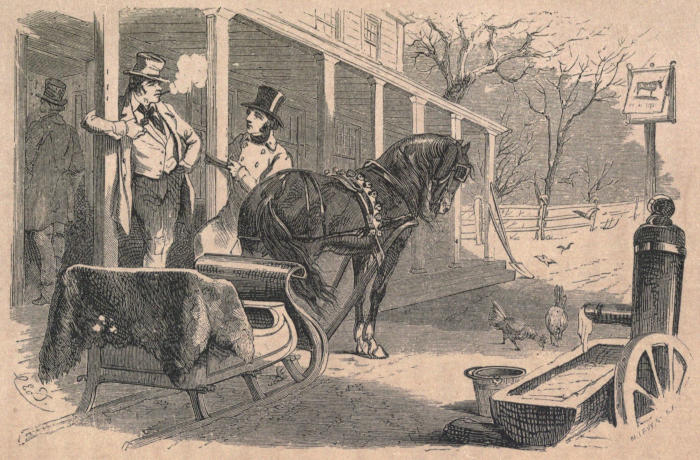
The “Squire” had just driven up to the Post
Office, which was at one end of the village tavern,
and a man hanging to a post that upheld the
piazza addressed him.
“Perhaps it may be, I’m rather late myself;
but I drove the long road past Deacon
Chase’s. Do you expect any body, Gilman?”
“Well—I can’t say I do, Squire; but I like
to see the newspapers, and hear what’s going on
in the world, as well as most people, specially
since the Californy gold’s turned up. I wouldn’t
mind finding a big lump or so myself.”
Gilman chuckled as he said this, and set a
dilapidated hat a little more over his eyes, to
shade them from the strong light of the declining
sun. No wonder they needed it; for they were
weak and bleared, and told the same tale that
could be read in every line of a once expressive
face. The tavern bar had seen as much of him
as the piazza. He knew by long experience the
taste of all those fiery liquids, contained in the
rows of decanters, and worse still, of many a cask
of New England rum, dispensed by the landlord
of “Mooney’s Tavern.”
“I’ve heard your wife’s father say there was
gold buried on every farm in New Hampshire,
if people only knew where to find it,” the Squire
answered pleasantly, fastening his horse to the
much used tying-up post; “there ought to be
on what’s left of his, by this time—there’s been
enough buried there.”
The man, dull as his once clear mind had
become, seemed to understand the allusion and
the reproof it conveyed, for his face flushed even
through deep unhealthy redness, as he walked
off to a knot of idlers like himself. They stood
with their hands in their pockets, and coats
buttoned up to the chin—discussing the wonderful
news that was then the only topic of
conversation through the whole Atlantic coast,
and even far in the backwoods, where much
less of the great world’s doings came—the gold
discovery in California.
At first it had been scarcely credited—many
who were afterwards ready to stake life itself in
gaining it, declared the whole thing a hoax, and
ridiculed those who believed in it. But as month
after month brought fresh arrivals, and more
marvellous intelligence from the new-found El
Dorado, even the endless discussion of politics
was given up for this fascinating theme. So far,
no one had gone from Merrill’s Corner, the name
of this retired New England village; but many
from neighboring towns were now on their way to
“make their fortunes,” or lose their lives in “the
diggings.”
The door of the post office had scarcely
closed upon Squire Merrill, when the jingling
of sleigh-bells and the quick tread of horses was
heard coming up the hill. It was the stage-sleigh,
that passed through from Concord every
afternoon, bringing the eagerly expected mail and
a few travellers, farmer-looking men, who were
glad to spring out, and stamp their benumbed
feet, the moment it drew up. One of them
threw a morning paper into the knot of questioners,
telling them rather abruptly to “look
for themselves,” as they asked the invariable
question, “what’s the news?” and Gilman, who
was so fortunate as to seize it, was instantly
surrounded as he unfolded the sheet.
The expected arrival was announced, in huge
letters, at the top of the paper:—
ONE MONTH LATER FROM CALIFORNIA!!
ARRIVAL OF THE CRESCENT CITY.
HALF A MILLION IN GOLD DUST!!!
NEW DISCOVERIES MADE DAILY.
PROSPECTS OF THE MINERS CONSTANTLY IMPROVING!
And with a voice trembling with eagerness, the
wonderful particulars were read aloud, interrupted
only by exclamations of astonishment,
more expressive than elegant.
Lumps of gold, according to these wonderful
accounts, were to be picked up for the stooping.
Some men had made a fortune in a single month,
from steamer to steamer.
Every remarkable piece of good fortune was
exaggerated, and the sufferings and privations,
even of the successful, barely touched upon.
There was scarcely enough shade to temper the
dazzling light of this most brilliant picture. No
wonder that it had all the magic of Aladdin’s
wonderful lamp to these men, who had been born
on the hard rocky soil of the Granite State, and,
from their boyhood, had earned their bread by
the sweat of the brow. If it dazzled speculators
in the city, men who counted their gains
by thousands, how much more the small farmer,
the hard-working mechanic, of the villages, whose
utmost industry and carefulness scarcely procured
ordinary comforts for their families.
Just as the stage was ready to drive off again
Squire Merrill came out on the piazza with several
newspapers in their inviting brown wrappers,
a new magazine, and one or two letters.
There was of course a little bustle as the passengers
took their seats, and the driver pulling
on his buckskin gloves, came from the comfortable
bar-room, followed by the tavern-keeper.
“More snow, Squire, I calculate,” remarked
the sagacious Mr. Mooney, nodding towards a
huge bank of dull-looking clouds in the west.
“What’s your hurry?”
“All the more hurry if you’re right, Mr.
Mooney,—I think you are; and somehow I
never find too much time for any thing. Going
right by your house, Gilman; shall I give you a
lift?”
“Well I don’t care if you do,” answered
Gilman, to the surprise of his fellows, and especially
the hospitable Mr. Mooney. He had not
yet taken his daily afternoon glass, and just
before one of them had signified his intention
of standing treat all round, to celebrate the good
news from California.
The Squire seemed pleased at the ready assent,
for it was equally unexpected to him,
knowing Gilman’s bad habits. He did not give
him time to withdraw it, for the instant the stage
moved off, followed, in the broad track it made
through the snow, the bells of both vehicles
jingling cheerfully in the frosty air. It may
seem strange to those unaccustomed to the plain
ways of the country, especially at the North,
that a man of Squire Merrill’s evident respectability
should so willingly make a companion of
a tavern lounger. But, in the first place, the
genuine politeness of village life would make
the neighborly offer a matter of every day occurrence,
and besides this, the Squire had known
Gilman in far different circumstances. They
played together on the district school-ground,
as boys, and their prospects in life had been
equally fair. Both had small, well cultivated
farms, the Squire’s inherited from his father, and
Gilman’s his wife’s dowry, for he married the
prettiest girl in the village. Squire Merrill,
with true New England thrift, had gone on, adding
“field to field,” until he was now considered
the richest man in the neighborhood, and certainly
the most respected. His old school-fellow
was one of those scheming, visionary men, who
are sure in the end to turn out badly. He was
not industrious by nature, and after neglecting
the business of the farm all the spring, he was
sure to see some wonderful discovery that was to
fertilize the land far more than any labor of his
could do, and give him double crops in the fall;
or whole fields of grain would lie spoiling, while
he awaited the arrival of some newly invented
reaping machine, that was to save time and work,
but which scarcely ever answered either purpose.
Gradually his barn became filled with this useless
lumber, on which he had spent the ready
money that should have been employed in paying
laborers—his fences were out of repair, his
cattle died from neglect.
Mr. Gilman, like many others, called these
losses “bad luck,” and parted with valuable land
to make them up. But his “luck” seemed to
get worse and worse, while he waited for a favorable
turn, especially after he became a regular
visitor at Mooney’s. Of late he had barely managed
to keep his family together, and that was
more owing to Mrs. Gilman’s exertions than his
own.
The light sleigh “cutter,” as it was called,
glided swiftly over the snow, past gray substantial
stone walls, red barns, and comfortable-looking
farm houses. The snow was in a solid, compact
mass, filling the meadows evenly, and
making this ordinary country road picturesque.
Sometimes they passed through a close pine
wood, with tall feathery branches sighing far
away above them, and then coming suddenly in
sight of some brown homestead, where the ringing
axe at the door-yard, the creaking of the
well-pole, or the bark of a house-dog made a
more cheerful music. There are many such
quiet pictures of peace and contentment on the
hill-sides of what we call the rugged North,
where the rest of the long still winter is doubly
welcome after the hard toil of more fruitful seasons.
Squire Merrill seemed to enjoy it all as he
drove along, talking cheerfully to his silent companion.
He pointed out the few improvements
planned or going on in the neighborhood, and
talked of the doings of the last “town meeting,”
the new minister’s ways, and then of Mrs. Gilman
and the children. Suddenly the other
broke forth—
“I say it’s too bad, Squire, and I can’t make
it out, anyhow.”
“What’s too bad, Gilman?”
“Well, the way some people get richer and
richer, and others poorer and poorer the longer
they live. Here I’ve hardly got a coat to my
back, and Abby there—nothing but an old hood
to wear to meetin’, and you drive your horse,
and your wife’s got her fur muff, and her satin
bonnet! That’s just the way, and it’s discouraging
enough, I tell you.”
“My wife was brought up to work a good
deal harder than yours, Gilman, and we didn’t
have things half as nice as you when we were
married.”
“I know it—hang it all—”
“Don’t swear—my horse isn’t used to it, and
might shy—. Well, don’t you think there
must be a leak somewhere?”
“Leak—just so—nothing but leaks the
whole time! Hain’t I lost crop after crop, and
yours a payin’ the best prices? Wasn’t my
orchard all killed?—there ain’t ten trees but’s
cankered! And hundreds of dollars I’ve sunk
in them confounded—beg pardon, Squire—them—them—outrageous
threshing machines.”
The Squire chirruped to his horse—“Steady,
Bill—steady! Haven’t you been in too much
of a hurry to get rich, Gilman, and so been discontented
when you were doing well? You
always seemed to have more time than I. I
don’t believe I ever spent an afternoon at Mooney’s
since I was grown up. I’ve worked hard,
and so has my wife.” “Yours has, too,” he
added, after a moment. “I don’t know of a
more hard-working woman than Abby Gilman.”
“True as the gospel, Squire, poor soul!”
and the fretful, discontented look on the man’s
face passed away for a moment. A recollection
of all her patient labor and care came over him,
and how very different things would have been if
he had followed her example, and listened to
her entreaties.
“Why don’t you take a new start?” said
the Squire, encouragingly, for he knew that if any
thing could rouse his old companion it would be
the love for his wife. “You’ve got some pretty
good land left, and ought to be able to work.
We’re both of us young men yet. My father
made every cent he had after he was your age;
and there’s Sam, quite a big boy, he ought to be
considerable help.”
“Yes, he’s as good a boy as ever lived, I’ll
own that—but hard work don’t agree with me.
It never did.”
Gilman was quite right. It never had agreed
with his indolent disposition. There are a
great many children as well as men who make
the same complaint.
“If a body could find a lump of gold, now,
Squire, to set a fellow up again.”
“I do believe you’d think it was too much
trouble to stoop and pick it up,” Mr. Merrill said,
good-naturedly. He saw that California was
still uppermost in his companion’s mind. “And
just look at that stone wall, and your barn—it
wouldn’t be very hard work to mend either of
them, and I don’t believe a stone or a board has
been touched for the last two years, except what
Sam has contrived to do.”
Gilman looked thoroughly ashamed. With
the evidence of neglect staring him in the face,
he could not even resent it. He seemed relieved
when the Squire drew up before the end door, to
think that the lecture was over. There, too,
were broken fences, dilapidated windows, every
trace of neglect and decay. The place once
appropriated to the wood-pile was empty, and instead
of the daily harvest of well-seasoned chips,
hickory and pine, a few knotted sticks and small
branches lay near the block. One meagre-looking
cow stood shivering in the most sheltered
corner of the barn-yard, without even the cackle
of a hen to cheer her solitude. The upper hinges
of the great barn door had given way, but there
was nothing to secure it by, and it had been left
so since the cold weather first came. Every thing
looked doubly desolate in the gray, fading light
of a wintry day, and the blaze that streamed up
through the kitchen window was too fitful to
promise a cheerful fireside. Yet fifteen years
ago, this very homestead had been known for
miles around for its comfort and plenty.
CHAPTER II. A NEW PLAN.
“Why, father!” was the surprised and cheerful
exclamation of Mrs. Gilman, as her husband
entered the room. It was an unusually early
hour for him, and besides, she saw his step was
steady. No wonder that she left the bread
she was kneading, and came forward, her hands
still covered with flour, to meet him. As she
stood in the fire-light, she was handsome even
yet, though her face looked careworn, and her
figure was bent, as if she had been much older.
Her ninepenny calico dress was neatly made, and
though she had no collar, a small plaid silk
handkerchief, tied closely around the throat, supplied
the place of one. She must have had a
cheerful, sunny temper originally, for in spite
of her many trials, there was not a trace of despondency
or fretfulness in her face or manner.
“Didn’t you go to the Corner? Oh, was
that you in Squire Merrill’s sleigh? I thought
I heard it stop. Abby, get father his shoes—Hannah,
just look at the bannock, it must be
almost done by this time, and we don’t have father
home every day. Come, children, step
round:” and Mrs. Gilman made a lively motion
to quicken the tardy Hannah, who was straining
her eyes out over a book by the very faint twilight
of the west window.
Mr. Gilman felt that he did not deserve this
hearty welcome, in a home to which he had
brought only sorrow and trouble. There were
other thoughts that kept him silent too, for after
explaining that Squire Merrill had brought him
home, he sat down by the fireplace and watched
his wife and daughters while they prepared tea,
as if it had been a holiday. Cold brown bread,
that substantial New England loaf, and the
smoking corn meal bannock, were all that they
had to set forth, with a simple garnishing of butter
and a bowlder of apple-sauce, made, also, by the
good mother in the autumn. The largest and
driest sticks of wood were added to the fire, so,
though there was but one candle, and that but a
“dip,” any thing in the room was plainly visible.
The Windsor chairs and side-table were scoured
clean and white; through the open door of the
buttery was seen a dresser in perfect order, even
to the row of shining, but, alas, too often empty
milk-pans, turned up under the lower shelf, and
the bread-bowl, covered by a clean towel. The
looking-glass between the windows, surmounted
by curious carving and gilding, and the tall peacocks’
feathers, the thin legs of the table at which
they sat, indeed nearly every thing in the room
were old friends of Mrs. Gilman’s childhood.
The house and farm had been her father’s homestead,
and she an only child. She often said she
was too thankful that she did not have to go
off among strangers, as so many young girls did
when they were married, for she knew every rock
and tree on the farm. Here she had been married,
here her children were born, and here she
hoped to die.
“Sam won’t be home in time to milk, I
don’t believe,” observed Abby, the oldest girl,
reaching her plate for a second supply of bannock.
“He’s always out of the way when he’s
wanted, seems to me.”
“I don’t know,” “mother” answered good-naturedly.
“I think he’s worked most hard enough
all day to earn a good long play-spell. Sam’s
getting very handy, father. He fixed the well-sweep
after dinner as well as you could have
done it yourself. So after he’d brought in the
wood, and gone to the store, I let him go over to
Deacon Chase’s. I thought you’d have no objection.”
Mr. Gilman was home too little to know
much about his children’s movements, but his
wife always kept up a show of authority for him,
that he might be respected at home at least.
Abby had found time for another theme.
“Mother, I should think you might let Hannah
and me have some new hoods. Julia Chase has
got an elegant one, lined with pink silk, and a
new merino cloak. And there’s Anne Merrill
and Jane Price. I’m sure we’re as good as any
body; ain’t we, father?” for Abby, being her
father’s favorite, was always sure of a hearing
from him.
“So you are, Abby—every bit, and you shall
ride over their heads yet. I tell you what, mother;
I can’t stand this much longer; I don’t
see why you shouldn’t have your silks and satins
as well as Eliza Merrill, and Hannah, go to boarding
school if she wants to, when she’s old enough.
I’ve about made up my mind to go to California—there—and
there’s the end of it!” and the
excited man struck his knife upon the table so
that every dish rattled.
Mrs. Gilman looked up with an anxious,
questioning face. She was afraid that he had
been drinking after all, and her hopes of a quiet
evening, “like old times,” vanished. Hannah
ceased to wonder absently what would have became
of the Swiss Family Robinson, if it had not
been for their mother’s wonderful bag, out of
which every thing came precisely at the moment
it was needed. Abby improved the opportunity
to help herself to an extra quantity of “apple
butter,” unobserved. Abby certainly had a
strong fancy for all the good things of life, dainties
and new hoods included.
“Why, what on earth has put that into
your head, father?” Mrs. Gilman said, after a
moment, still addressing him by the familiar
household name, at first so endearing and afterwards
habitual. She did not think it possible he
could have any serious thoughts of such a scheme.
Her husband’s plans very often ended in “talking
over,” and from the time they were married
some project occupied him.
“It ain’t any new plan; I’ve been turning
it over ever since the last steamer, and I only
waited to see if the luck would hold out. Now
the news is come, and I’m goin’. That’s just
all there is about it. I don’t see why I should
stay here and be a poor man to the end of time,
when other folks has only got to turn round and
make a fortune. Why there was one man took
five ounces of gold out of one hole, in among the
rocks! The paper says so, and gold’s nineteen
dollars an ounce. Five times nineteen is——”
“Ninety-five,” responded Abby, quickly.
She had been a diligent student of Smith’s
Arithmetic, at the district school all winter, and
when her father was speaking considered she had
a perfect right to join in the conversation.
“Yes—ninety-five dollars in ten minutes,
just as fast as he could scoop it out, and I might
work six months for it here on this plaguy farm.
Why, it tells about lumps of real solid gold, as
big as my fist! and one man’s just as good as
another there. None of your Deacons and
Squires, settin’ themselves up above other folks.”
Poor Mr. Gilman, like many other persons
whose own faults have degraded them, had a
bitter envy towards those who continued to do
well. It must certainly be on the principle that
“misery loves company;” there is no better
way to account for this selfish desire to see others
in trouble, when we are suffering from our own
rashness or folly, “selfish,” to say the least.
“Is any body going from the Corner?” Mrs.
Gilman had laid down her knife and fork, and
pushed back her plate. She felt a sick, choking
sensation, that would not let her eat. She saw
her husband was in his sober senses, and more
determined than he had been on any subject for
a long time.
“Yes,” he answered doggedly, as if he did
not wish to be questioned further.
“Who?” persisted his wife, with an anxious
foreboding of the name she would hear.
“Well, if you must know, it’s Bill Colcord,
and we’ve agreed to go into partnership. I know
you don’t like him, but it’s just like one of your
woman’s notions. Bill’s a first-rate fellow, and
gives as long as he’s got a cent.”
Mrs. Gilman did not remonstrate. She knew
it was of no use. The time had been when her
husband would scarcely have spoken to this man,
who had always been idle and dissolute. How
he lived no one exactly knew. He was very
clever at making a bargain, was always betting,
and, it was said, could overreach any body he dealt
with. It was only of late years that he had
become Mr. Gilman’s companion. His wife had
warned and entreated him in vain. Mr. Gilman
would sometimes promise to give him up, but
the man always had a hold on him, treating at
Mooney’s, or lending him small sums of money.
In spite of herself, Mrs. Gilman drew a
heavy sigh when she heard him mentioned;
but she saw Hannah looking up earnestly, and
Abby listening, and remembering every word.
“You can clear away the table, girls—come,
be spry,”—she said, rising with a great air of
alacrity herself; but she had a heavy heart, as
she took up her knitting from the side-table,
and sat down in her low arm-chair in the corner
of the fireplace. Mr. Gilman followed and
squared himself on the other side, leaning his
elbows on his knees, with a show of obstinate
determination, as he looked from his wife to the
fire.
“Mustn’t we wait for Sam?” asked Hannah,
who had already seized on volume second of
her beloved history. She had a natural disinclination
to household tasks, an indolence inherited
from her father, and but partly excused to
the notable Mrs. Gilman, by the love of reading,
which kept her out of mischief.
“No; Sam knows when we have tea, and
the table can’t be kept waiting for him.”
“He don’t deserve any, I’m sure,” Abby was
quite ready to add. “I hate to strain the milk
after dark, and he knows it, and stays away
just to plague me. Come, Hannah, take the
bread into the buttery, while I pile up the
things. You know it’s your week for putting
away, and you try to get things off on other
people. Mother—mustn’t Hannah come and
help me?”
The book was reluctantly closed, and Hannah’s
tardy step made a slow accompaniment
to her sister’s bustling movements. There was
much more clatter than was necessary in piling
up the four cups and saucers, emptying the tea
tray, folding the cloth, and setting back the
table. It was quite a picture to see the handy
little housewife, tucking back her dress and apron,
as she dexterously carried the still smoking tea-kettle
into the buttery, and filled a large milk
pan with clean hot water, while Hannah expended
all her energies in reaching down a towel
and preparing to dry the few dishes.
The buttery, a long wide closet at one end
of the kitchen, added very much to the neatness
of the family sitting-room. It was Abby’s
especial pride to keep the sink, the numerous
pails and buckets, in order, and the one low window
as clear as hands could make it. Hannah,
though a year the eldest, hated the buttery, and
always made her escape as soon as possible. To
use her own favorite word—she “hated” washing
dishes, and dusting, and peeling potatoes, in
fact, every thing like work. She liked reading
and walking in the woods, especially in spring-time,
making wreaths of wild flowers, and fanciful
cups and baskets from the twigs and leaves,
Hannah’s imagination was already captured by
these wonderful golden visions. Plenty of money,
stood for plenty of time to do just as she
pleased. Her mother could not be always telling
her, “you must learn to be industrious, for
you are a poor man’s child, and have got to
make your own way in the world.”
“I hope father will go to California,” was
the first symptom of consciousness she showed,
while Abby splashed away in the water, regardless
of scalded hands and mottled elbows.
“My goodness, Hannah! do see what you
are about—letting the end of the towel go right
into the dishwater. I’m sure I don’t want my
father to go clear off there and die, if you do.”
“People don’t always die—there’s Robinson
Crusoe, taken home after all he went through,
and I’m sure the Swiss Family will. I don’t
like to look at the last chapter ever, but of
course they will be. I heard father tell mother,
when I was folding up the table-cloth, that he
wouldn’t be gone over a year and a half, and
was sure to make ten or twenty thousand dollars.”
“Twenty-thousand-dollars! Why, Hannah,
that’s more than Squire Merrill’s worth!
Why, how rich we’d be! perhaps we’d have a
new house.”
“And a big book-case in the parlor, full of—every
thing!” added Hannah, intent only on
her personal accommodation.
“And handsome carpets all over it, and a
mahogany sofa, and a big looking-glass. Just
’spose it once.”
“I hope we’ll have a garden, with an elegant
arbor, as shady as can be.”
“With grapes, and lots of fruit-trees, and
plenty of dahlias! Well, it would be nice,” and
Abby suffered the knife handles to slip into the
hot water, a piece of carelessness expressly forbidden
by the careful Mrs. Gilman, while she
rested her chubby hands thoughtfully on the rim
of the milk pan.
“But come, the water’s all getting cold, and
there’s Sam round by the barn whistling. There’s
the knives.”
“It’s always cold here,” shivered Hannah,
fretfully; “I should think mother might let us
wash dishes on the table in the kitchen. I’m
most frozen here every night. It takes twice as
long—”
“There’s Sam slamming the door as usual,”
interrupted Abby, “tracking up the whole floor,
of course.”
And there stood Sam, as she looked over her
shoulder into the centre room, his face glowing
with the quick walk, a woollen comforter knotted
about his throat, and the torn vizor of a seal-skin
cap hanging over his eyes. His old round-about,
buttoned up close to the chin, was powdered
with feathery flakes of snow, and his gray satinet
pantaloons, with “eyes,” as he called the
patches on the knees, scarcely reached to his
boots. But for all this, he was a fine, hardy-looking
boy, full of life, and health, and spirits, and
would have demonstrated the latter by an impromptu
war dance, on the kitchen floor, if he
had not caught his mother’s look of warning.
“Been to supper at the deacon’s—give us
the milk pail, Chunk,” he called out very unceremoniously
in answer to Abby’s threatened lecture.
“I know you like to strain the milk after
dark, so you can have me to hold the light for
you. Don’t she, Nan?—hurry up there,” and
snatching the pail, he was gone again in a moment,
out into the darkness and increasing storm,
caring neither for the loneliness nor the exposure.
Mrs. Gilman’s face lighted as she looked after
him. She had been listening to her husband’s
plans, clearer, and more capable of being carried
out, than most of them, showing that some one
else had been assisting to make them. Mr. Gilman
had persuaded himself, with this adviser’s
assistance, that he would be perfectly right in
selling the remnant of the farm, with the house,
to pay for his passage and outfit to California.
“As he only went to make money for his wife
and children, they ought not to complain,” he
reasoned, “and he would return so soon, to give
them all that heart could wish. Meantime,” he
said he would leave them something, and by time
winter came he would send money from California.
Mrs. Gilman well knew that she must be
the entire dependence of her family, however
fair all might seem in prospect.
CHAPTER III. THE MOTHER AND SON.
But this was not the thought that weighed
heaviest, when all but Mrs. Gilman had forgotten
their plans and their pleasures in sleep.
As she sat alone by the broad flagging of the
hearth, she could hear the heavy breathing of
her husband in the next room, the ceaseless ticking
of the clock, the purr of the cat, in its warm
corner by the ashes. Overhead were her sleeping
children, she alone, watchful and anxious.
Slowly the old clock marked the passing hour,
the brands mouldered with a dim redness, then
broke, and fell with a shower of sparks upon the
hearth. The rising wind rattled the loose window
frames, the cold snow drifted upon the sill,
white and chilling. She had kept many a midnight
watch since she had been a wife, but this
was the dreariest of all. She did not bury her
face in her hands, and sob—her habitual industry
had retained the coarse stocking, and
her hands moved rapidly to the monotonous click
of the needles, while hot tears gathered slowly
in her eyes, and plashed down upon them. She
did not wipe them away,—she did not know they
were there. She was thinking over all the long
time since her marriage; how very happy she
had been at first, with her dear baby in the cradle,
and her young husband, so fond of her and
his first born, and the gradual and entire change
that had since come over him and over their home.
She had never ceased to hope through it all,
that the time would come when he should be
given back to her “in his right mind.” How
earnestly she had prayed for it, sitting there,
watching patiently night after night, trying to
keep cheerful through all things; to make his
home pleasant for him, when he least deserved
it. And this was the end. She knew he was
going, she felt it from that first abrupt announcement,
and with the perils of the sea, and that
new country, he might not return. She must
go out from that old homestead, must see even
the very burial-place owned by others, and he
who had promised to love and protect her was
the cause of all. It was hard to put down the
bitter, reproachful feeling that had tempted her
before, and to think of him with love, of God’s
will, with submission and hope. Then came a
picture of her husband, suffering, sick, dying on
that long journey, for she knew how his health
had been weakened, and how little fitted he was
to bear exposure. This was terrible. If some
friend, some one she could trust, was going with
him, instead of that bad man, she could bear it
better.
A noise that she would not have noticed in
the stir of daylight, made her look up. It was
only her boy’s cap, which he had hung carelessly
behind the door, falling from the nail. “How
strong and well he is,” thought the lonely woman—“why
could not he go, and take care of his
father?”
When she first tried to reason with herself
about the future, he had seemed her only comfort
and stay. Must she give him up too?
Mrs. Gilman did not often act from impulse,
but she had become restless, and eager, thinking
these things over. She took the candle, already
burned to the very socket, hurried up the narrow
winding stairs leading from the room in which
she sat, to the “garret chamber,” chosen
by her boy as his winter sleeping room, for
the greater convenience of disposing of and
watching over his hoard of treasures. They
were few enough, but invaluable to him. The
ears of corn he had saved for parching, hung
by their braided husks, the soft pine blocks, prepared
for whittling,—his skates, his new sled, not
yet trusted to the doorless barn, the pile of hickory
nuts in the corner, were nearly all that he
owned; but no money could have purchased
him more valued possessions.
The boy was sleeping soundly after the day’s
hard work and exercise. His mother put down
the light upon the chest that served him for a
table, and sat down upon the bed beside him.
He looked very beautiful to her, his long brown
hair thrown back over the pillow, and his face
flushed with a red glow of health. One arm was
thrown above his head in a careless, graceful way,
the brown hand bent, as if reaching to grasp a
branch above him. Should she, who had held
him in her arms, with the first prayerful thrill
of a mother’s love, innocent and pure, send him
forth to contact with the world unshielded! To
see vice, and perhaps crime in every form—to be
the companion of those long familiar with it!
But, surely, it was a sacred mission to watch over
and care for an erring parent, perhaps to save
him from still greater degradation. Would not
God reward her for this loving sacrifice, by keeping
him in the charge of all good angels!
Her strong faith trusted in this, as she knelt
down, still watching his heaving chest, and laid
her hand lightly in unconscious blessing upon his
broad forehead. It may have been that blessing
which bore him through strange trials and
temptations. We know that those who ask “in
faith,” nothing wavering, have their reward;
and what can exceed the yearning faithfulness
of a mother’s love?
“No, nothing is the matter, my son,” Mrs.
Gilman answered to the boy’s start of surprise,
and half frightened, half sleepy question. “I
did not mean to wake you up, Sam, I came to
see if you were asleep yet and quite comfortable.
Are you sure you have clothes enough? It’s
going to be a very cold night.”
“Plenty, mother,—it’s just like you to be
worried. I thought it must be morning first,
or father was sick, or something. Good night,”
and he turned still drowsily to his pillow.
“Sam, did you know your father had concluded
to go to California?”
“Goodness, mother!” and all sleepiness
was gone in an instant, the boy sat up in bed,
and looked at his mother eagerly.
“Yes, he has decided to go, and I’ve been thinking
if it wouldn’t be better for you to go along.”
“Me?”
“I guess it’s best, Sam. I don’t see how
I can spare you very well: but your father will
need you more than we shall; we shall make out
to get along somehow. You will be coming home
some day with a fortune, like the young princes
in the story books.”
Mrs. Gilman tried to speak playfully, but it
was hard work to keep down the sobs.
“It isn’t like you, mother, to want me to
leave you and the girls, just to make money. I’ve
heard you say too many times, that you would
be contented to live any way, so long as we could
all be together, and work for each other. What
put it into your mind?”
There was an earnest directness in the boy’s
manner Mrs. Gilman could not evade. She had
never before alluded to her husband’s weakness
to one of his children. It was hard now, but it
was right Sam should know all.
“You can remember, Sam, when we were all
a great deal happier; before father took to going
to the corner every day. You know how
he comes home night after night, and how bad
company has changed him. Bill Colcord has
followed him every where, and has persuaded him
into this. If father has you with him, he’ll think
of us oftener, and perhaps it will keep him from
doing a great many things Colcord might lead
him into. You are old enough to know what’s
right and what’s wrong.”
“I ought to, mother, when I’ve had you to
tell me ever since I was a baby.”
“God knows I’ve tried to do my duty,” Mrs.
Gilman said, clasping her hands together, “I’ve
tried, Sam, and I’m trying now, though it’s hard
to see whether it’s right to send you away with
that bad man. But it must be! Look out for
your father just as I would. Keep right yourself,
and then he will listen to you. But it’s all in
your Bible; and you won’t forget to read it, will
you? You say your prayers, don’t you, like a
good boy?”
“Sometimes I forget till I am almost asleep,”
the boy confessed honestly. “But I don’t sleep
half so well, I think, or wake up so good-natured
at any rate. When is father going—does he
know you want me to?”
“Not yet, but we must not mind that—Colcord
won’t want you. Something tells me you
ought to. Sam, I only want you to make me
one promise. Never to touch a drop of any thing
that could hurt you—you know what I mean,
any spirit, and keep father from it as much as
you can. You will, won’t you?”
“I never tasted spirit yet, mother, and I
never will, so long as I can remember to-night.
I’ll swear it on the Bible if you want me to.”
“No, I don’t ask that, only your promise.
If you wouldn’t keep a solemn promise, you
wouldn’t keep an oath. And never let yourself
get lazy. People sit ’round and do nothing, and
so they are tempted to drink just to pass away
the time, and most men who will drink, will
swear or do any thing else. I don’t say all
will;” and a painful flush rose to the poor woman’s
forehead as she thought of her misguided
husband, “but it leads into mischief they never
would think of or consent to in their sober senses.
Don’t be afraid of hard work. I never was, and
my father was called well off. If one kind of
work is not handy do something else, it keeps
away bad thoughts, and hard thoughts too, sometimes.”
It seemed that Mrs. Gilman could not bear
to leave her son. It was the first time she had
ever opened her heart to him at all. He was too
young to understand half its silent loneliness
and care; but he loved her better than anybody
in the world, and was ready to do any thing or
promise any thing that would make her look
happier. He did not get asleep for a long time
after she went away, though the candle had
burnt out, and the snow sifting against the window
made it very dark. He turned over the
pillow, and drew up the quilt, but it was no use.
To any boy of his age, the novelty of going to
sea would have been exciting. And California!—he
knew as much about it as any of his elders
and betters. The boys had been talking about
it once, as they helped Ben Chase shell a double
quantity of corn, so that he could go skating
with them after school, Monday; and boasting,
as boys will, of what they would do, if they could
only get there! How astonished they would be
to find he was going! He could not help feeling
very important, and suddenly improved almost
to man’s estate, even in his own eyes.
Then his imagination rambled on to a very distant
and undefined future. How he would come
home with piles and piles of gold—great bags
full, and give five to his mother, and one to each
of the girls, and buy back the farm. Whether
he should put the old house in splendid order, or
build a new one, he could not quite make up his
mind. But there would be time enough for that.
One thing was certain. His mother should have
every thing she wanted, and never do another
bit of work, if she didn’t choose to. His mother’s
troubled face brought him back very suddenly
to the present. He understood better than ever
he did before, how many things she must have
to worry her, especially about his father. He
thought about this a long time, and made new
resolution to keep his promise, and be very good
and industrious. His good resolves were a little
confused and misty at the last, mixed with wandering
thoughts about the ship, for he had never
seen one, and Ben Chase’s new skates, which
had been the object of his highest ambition three
hours before. Then he slept as soundly as if the
whole plan of his life had not been changed that
eventful day; unconscious of the hardships, the
trials, and the temptations that were to mark
every step of his future path through boyhood.
So it happened that our young hero, as his
mother had said, like a prince in some marvellous
fairy tale, “went out to seek his fortune.” He
had no “shoes of swiftness,” or “invisible cap,”
nor yet the “purse of Fortunatus,” that he expected
to find. But he carried a light heart,
willing hands, and a determination to do right,
whatever happened, “three gifts” that perhaps
could bring him as much in the end.
CHAPTER IV. GOING TO CALIFORNIA!
It is strange how soon the most startling things
that happen to us, settle into a matter of course.
Before another Saturday night the whole Gilman
family thought and talked of “going to California,”
as if they had looked forward to it for a
year. Sam contrived to gather more information
about Cape Horn and the Pacific coast than
he could have learned from a study of Olney’s
Geography all his life. As Mrs. Gilman expected,
her husband’s adviser made a determined opposition
against taking a boy, and one as sharp-sighted
as Sam Gilman particularly. But she
was equally determined, and as Colcord knew
she had it in her power to stop the sale of the
farm, and cut off their means of going, he thought
it best to give up. He concluded he should be
able to manage both father and son after a while,
and it might not be such a bad plan in the end.
Squire Merrill tried his best to dissuade Mr.
Gilman, when he saw what was on foot. He even
offered to lend him money to stock his farm, and
get started again, but he could have had about
as much influence on the wind. He proved himself
to be a true friend, even though his advice
was not taken.
He bought the remnant of the once valuable
farm, paying ready money for it, though he was
afterwards sorry he had not kept the sum intended
for Mrs. Gilman’s use in his own hands. It
would have been much better if he had. His
old neighbor could not bear to have money and
not be generous. With his hundred dollars
clear, in his pocket, after paying Colcord enough
to secure his passage in the same ship,—it was
called a loan,—he felt quite as good as any one
in the county, and would not listen to the suggestion
that they should take passage in the steerage.
He even debated going in the Crescent
City, but found that quite beyond his means.
There was one comfort in this self-importance.
He renewed a promise made and broken,
many, many times, not to drink any more, and
in spite of the past sad experience, his wife almost
believed he would keep it. It was this
hope, and seeing him more like his old self, kind
and affectionate, that helped her through those
two weeks of preparation. Her busy thoughts
flew fast into the future, as her needle kept time
to them. She said to herself she would forget
the unhappy years that were gone, and work on
cheerfully. How many bright pictures of the
future were wrought into her daily tasks! She
could even see them measuring the land, and
sign the deed that gave up all right to it,
thinking how soon the old homestead might be
theirs again, and once more have fields crowned
with plenty.
Sam seemed to think a long face was expected
from him, and tried to put on one every time the
matter was talked over. He found this harder
and harder, as the time came near. A journey
to Boston was an event in the life of Ben Chase
he had never quite recovered from. Ben Chase
had seen the Bunker Hill Monument and the
State House, with Washington’s Statue, and,
dear to a boy’s heart, the Common, with its renowned
Frog Pond, which he never would own,
even to himself, had disappointed him. Ben
Chase talked of Boston Harbor, and like all boys
brought up out of sight of salt water, thought of
all things in the world he should like to be a
sailor. He had even contemplated running away
and persuading Sam Gilman to go with him.
But Ben was a deacon’s son, and heard “honor
thy father and mother” read out of the big family
Bible very often. He had compunctious visitings
the next day after concocting this notable
scheme, at family prayers, and quite repented of
it when he saw his father go round with the collection
plate, the Sunday after. Now all his enthusiasm
revived. He looked up to Sam quite
as much as Sam expected or desired, when he
found they were going “round the Horn.” He
favored him with many decidedly original suggestions,
always prefaced with—“I’ll tell you
what, Sam,” and read over in the retirement of
the barn chamber his limited collection of voyages
and travels, burning with a renewed desire to
“Walk the waters like a thing of life,”
as he poetically termed staggering across a ship’s
deck. Sam sometimes felt a little uncertainty
about his positive happiness in leaving home,
when he saw how sorry Julia Chase looked; but
Ben’s conversation had quite an opposite effect
on his spirits. Julia presented him with a heart-shaped
pincushion, made out of the pieces of her
new hood, as a keepsake. Ben deliberated among
his accumulated stores a long time, and finally
decided on the big hickory bow and arrow he
was making with a great deal of care and skill.
“It would be so useful if you was cast away on
a desert island, you know,” he said.
Julia and Ben came over on Saturday afternoon
to bring their presents, and some dried apples
from Mrs. Chase to Mrs. Gilman. The last
were prefaced by the apology that “she didn’t
know but Mrs. Gilman’s must be most out.”
Many a useful gift had come from the same quarter,
prompted by equal kindness, and offered
with the same natural delicacy. “Neighbors” in
New England, mean more than living near a
person. The rule of the Samaritan is taken rather
than the Levite’s, and certainly good wishes
and kind acts were as “oil and wine” to Mrs.
Gilman of late, however trifling they might seem
in themselves.
The children passed a greater part of the afternoon
in the garret chamber, which being directly
over the kitchen, was warm and comfortable.
Sam’s clothes were to go in his father’s
chest—“a real sea-chest”—as he told Ben, but
he was to have a box of his own besides. Packing
this box was the excitement of the afternoon,
as it included a distribution of that part
of Sam’s treasures, he found it impossible to accommodate.
One particular red ear of corn
presented to Julia Chase, made a great deal of
amusement; some speckled bird’s eggs, and the
principal curiosity of his museum, a carved elephant’s
tooth, brought home by some sailor uncle
or cousin of his mother’s, completed her share
of the spoils. The sled was presented to Ben,
and Abby and Hannah shared the remainder,
feeling far richer than many a grown up legatee
does in receiving a bequest of thousands. An
animated conversation was kept up, Julia bringing
forward a fact in history that had troubled
her very much for the past few days. Her class
were studying Goodrich’s United States for the
first time, and she remembered that when the
English settled at Jamestown they discovered
earth containing a great quantity of shining particles
which were supposed to be gold by the
colonists. She sympathized very heartily with
them in their disappointment, when they found
their ship loads sent to England turned out
worthless, and she had become quite anxious on
Sam’s account. What if after all the California
gold should end in the same way! Hannah
and Abby were very much agitated for a while
with this startling historical inference, but Ben
did not hesitate to say, “girls were fools, they
knew nothing and never did;” while Sam gave
such remarkable anecdotes and facts, that they
were reassured, and all grew merry and good-natured
again.
For the first time in many Sundays, Mr.
Gilman went with his wife and family to meeting.
His new rough great coat and respectable
hat made him seem like another man. But he
did not like the sermon at all, and considered it
as meant for him. It was rather singular that
the text should be—
“Lay not up for yourselves treasures upon
earth, where moth and rust doth corrupt, and
where thieves break through and steal:
“But lay up for yourselves treasures in heaven,
where neither moth nor rust doth corrupt,
and where thieves do not break through nor steal.”
Sam, who had persuaded his mother to let
him sit in the gallery with Ben, became much
more attentive than usual. The new minister
evidently had the California adventure in his
mind, though he only spoke of the feeling extending
all over the country; the sudden haste
to get rich, and the willingness people showed
to leave their families and their homes to go in
search of golden treasure. He said if they would
make half as many sacrifices to lay up treasure
in heaven, they would be thought to have lost
their senses, and ridiculed on every side; yet
there was no comparison between the worth and
value of the two.
Ben on the contrary thought the sermon very
long and tiresome, and amused himself by carving
on the seat what he fondly called a ship,
working most industriously with one eye on his
father’s pew, to see when he was unobserved.
Ben certainly never could have supported existence
without a knife, and though it was only a
jack-knife, and not a very elegant one at that,
it was surprising what a number of things he
managed to do with it.
All the neighbors stood in the entry, or porch,
at the noon recess, and shook hands with Mr.
Gilman, just as they used to do. His wife sat
near the glowing stove, talking with Mrs. Chase,
and could not help thinking how much happier
it would be if, instead of going away the next
morning, he would stay with her and the children,
and try to get along at home. But then,
perhaps, it was wrong not to be thankful for any
change that promised better things. Squire
Merrill spoke very kindly and encouragingly,
Deacon Chase in his queer, forgetful way, shook
hands twice over, and insisted on driving them
home, after afternoon meeting, although Mrs.
Gilman told him they were going back with Mr.
Conner, whose wife was not well enough to go
out, so there was plenty of room. Sam on his
side had a large congregation of all the boys
round him, most of them looking very stiff and
uncomfortable in their Sunday clothes, with their
straight, sunburnt locks, plastered down by an
extra allowance of soap and water. In their secret
hearts they all envied him, and he knew it,
but tried not to overpower them by a sense of
his own importance, leaving it for Ben to set
forth his probable route and adventures. Julia
had brought his sisters a big Baldwin apple
apiece, and shared her luncheon of dough-nuts
in the most generous manner; a kindness which
Abby fully appreciated, as all their apples were
gone long ago, and dough-nuts had been a rarity
for the last two winters. Hannah, with characteristic
forethought, saved her Baldwin until she
could have a good chance to read her new library
book. A book and an apple was the height of
Hannah’s enjoyment. We must not forget, however,
that she was capable of self-denial, for that
same treasured Baldwin, with its beautiful crimson
cheek, found its way into Sam’s overcoat
pocket the next morning. Let those who have
given up a hoarded dainty, appreciate the sacrifice!
Mr. Gilman was very restless—“fidgety” the
Deacon would have called it, all that evening.
It was Sunday; all preparations were completed;
he could not make an excuse to go to Mooney’s,
and he had to think. He went out to the barn,
and even mounted to what was once the hay-loft.
He walked to the road, back to the kitchen,
and out to the road again, with his hands in his
pockets, and his hat set down over his face.
He began to whistle, but stopped, remembering
it was Sunday. No one but He who can
read the thoughts of our hearts, knew all that
came into his, in the quiet and deep stillness of
that last Sunday evening at home. The sermon,
the journey, the next day’s parting with his
wife, her love for him, and his selfish neglect, all
mingled there, and brought remorse and self-condemnation
with them. When he went into
the house, Mrs. Gilman was sitting in the fire-light
with her children, singing hymns that her
own mother had taught her. This had once been
the happiest hour of all the week, but now the
mother’s voice was tremulous, and her heart full
of heaviness. The last night of an unbroken
family circle, perhaps for ever; the last Sunday
beneath the roof of her father’s homestead!
How could it be otherwise? Mr. Gilman was
persuaded that this was the commencement of
a new and better life for him. All the indifference
and selfishness of years seemed to melt
away; something like a silent prayer came in
its place, a prayerful resolve only, not one for
aid and guidance. Depending on himself, and
forgetting how often he had been self-betrayed,
he meant fully, at that moment, to be industrious
and persevering for their dear sakes. He would
toil with a strength and energy that must succeed,
and his wife should be doubly rewarded for
all she had suffered.
Perhaps she felt the certainty of this as he
sat near her, shading his eyes with his hand;
for her voice grew clearer and stronger as she
sang—
Ye fearful souls fresh courage take,
The clouds ye so much dread,
Are big with mercy, and shall break
In blessings on your head.
Judge not the Lord by feeble sense
But trust him for his grace—
Behind a frowning Providence
He hides a smiling face.
His purposes will ripen fast,
Unfolding every hour;
The bud may have a bitter taste,
But sweet will be the flower.
Oh, these calm, thoughtful Sunday evenings
in a New England home, where the strict, and
it may be rigid rule of our forefathers, is still preserved!
What a blessed memory they are, in
after years, to the toil-worn and world-wearied
heart! The dear circle gathered in the fire-light,
one clasping a mother’s hand—the youngest nestling
in a father’s arms!—the long quiet talk of
pleasant and holy things—the wonderful Bible
stories of Joseph and his brethren, Moses in the
bulrushes, and the destruction of Pharaoh’s host—the
old-fashioned hymns, led by a dear mother’s
voice, in which all strive to join; the simple melodies,
and the pious words sinking unconsciously
into the memory! Who would exchange these
recollections for the indulgence of carpeted nurseries,
a servant’s twice-told tales of ghost or
goblin, the muttered sleepy prayer at her knee,
when another Sunday is over, a day of idle play,
or marked only by a careful toilette for the dinner
company who were expected, and engross
the time and thoughts of worldly parents in the
drawing-room? We may be mistaken, after all,
about the privileges which the children of the
rich enjoy.
Actually saying “good-bye,” is hardly ever
as hard as we expect it will be, or the loneliness
afterwards proves. The next morning found Mr.
Gilman as confident as ever, and bustling around
with great alacrity, to be ready in time for the
stage. His wife did not allow herself to think.
She had her breakfast to prepare—though Abby
was the only one of the party that seemed to
need it—and many things to see to at the last
moment. Wherever she was, and whatever occupied
her hands, her eyes and her heart followed
Sam, who felt all the excitement of departure.
His father had been so little comfort or company
lately, that it would be easier to be accustomed
to his absence. Sam she had depended on—his
willing, cheerful readiness to assist her, the frank
honesty that never deceived, young as he was,
had filled up a great void in her heart. His very
voice, and step, were music and lightness.—Do
all she could the tears could not be kept back,
but filled her eyes, and almost blinded her, as
she went about her morning work. And then
the time came—her husband kissing her hurriedly
and nervously as the toiling horses came in
sight, her boy not ashamed to cling to her neck,
while she wrapped her arms around him, as if he
had been still the baby in her bosom, and kissed
him in an agony of love, and fear, and blessing.
They were gone, and the house, no longer her
home, was empty and desolate, and her straining
eyes could not catch another glimpse of that
bright boyish face.
All day long Mrs. Gilman busied herself with
strange haste, and unnecessary care. It seemed
as if she dreaded to have her hands unemployed
for a moment. The children forgetting their
tears, as children will, played, and worked, and
disputed, but she scarcely seemed to notice them.
It seemed to her as if death, not absence, had
removed her son.
CHAPTER V. SETTING SAIL.
Their future constant companion joined the
father and son, as might be expected, at Mooney’s
Tavern. He had no leave-takings to subdue the
boisterous spirits in which he set out on an expedition
that was to make a rich man of him.
His brothers and sisters were married, and had
lost all interest in him long ago. They were even
glad that he would no longer be a daily disgrace
to them. He was very grand with Mr.
Gilman’s money, and expected, of course, to drink
to their success in a parting glass at Mooney’s.
He had drank to it so often already that morning,
that it was doubtful whether he would be fit
to start on the journey. It had the effect of
making him unusually good-natured, fortunately,
so that he took Mr. Gilman’s refusal with only
the complacent remark, “more fool he.” The
stage did not make long stoppages so early in the
day; away they drove again—the tavern, the
post-office, the white meeting-house on the hill,
disappearing in turn, and then the young traveller
felt that home was really left behind.
He was very quiet, he could not help it.—The
day was exceedingly cold, and the road, for
miles together, dreary and uninteresting. The
noisy laugh of Colcord troubled him, while he
thought of his mother and the girls. This could
not last long, as the stage filled up, stopping now
at a farm house, where a place had been bespoken
for its owner the day before, or receiving a
passenger at some wayside tavern. Sam began
to feel all the dignity of being a traveller himself,
and particularly when he saw how much the
strangers were interested, hearing that they were
bound for California. Colcord talked to every
one, and made himself out the commander-in-chief
of the expedition. He was going to “invest,”
as he called it; he expected to see the
time when he could buy up the whole of an insignificant
little village like Merrill’s Corner!—And
then the most incredible facts were related,
exaggerated newspaper reports given, as having
happened to the uncle, or cousin, or friend of the
speaker. When they came to a tavern, Colcord
was the first man out, strutting around the bar-room,
and asking all his fellow-passengers to drink
with him. Even Mr. Gilman seemed ashamed
of his partner, as he loudly proclaimed himself
to be.
Sam went to bed at Concord that night, wondering
if New-York could be larger, or have
handsomer houses, and what they were doing at
home. It seemed as if months had passed since
bidding them good-bye. Then came the novelty
of a railroad, the hurried glimpse at Manchester
and Lowell, with their tall piles of brick and
mortar, the loud hiss of steam, and clanking of
machinery. How busy and restless all the world
began to seem, and how far off the eventless
village life, which had till now been a world in
itself.
Colcord did not let them lose a moment’s
time. He had found out on the journey, that
no ship was to sail from Boston for more than a
week. A week, he said, would give them a long
start; as they had the money, they might as well
push through to New-York, where whole columns
of vessels were advertised.
The morning of the third day after leaving
home, Sam found himself following his father
and Colcord along the crowded wharves of this
great city, going to secure their passage.
The “Helen M. Feidler,” was the unromantic
name of the ship Colcord had selected. She
was to sail first, and the handbills pasted along
the corners, described her as nearly new—fast
sailing—with every possible accommodation for
freight and passengers. The owners said she
would make the voyage in half the usual time,
and if they did not know, who should? In fact
the clerk, or agent at the office, gave such a
glowing account of her wonderful speed, the excellent
fare, and the rush of people to engage
their berths, that Mr. Gilman was all ready to secure
three cabin vacancies that happened, by the
most fortunate chance in the world, to be left.
He had even taken out the old-fashioned leather
pocket-book, in which the bills were laid, when
he saw Colcord making signs to him not to be in
too much of a hurry. The clerk assured them,
his warm manner growing very cold and distant,
as he replaced his pen behind his ear, that the
next day would probably be too late. Sam did
not understand what Colcord said to his father,
but almost as soon as they were in the street,
they told him he had better stroll around and
amuse himself; they were going to look at the
ship, and see if all that had been said was true.
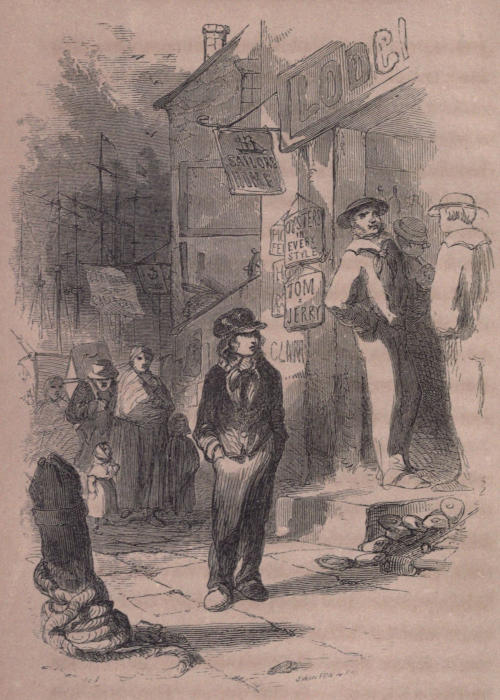
“HE STROLLED ALONG THE WHARVES.”
Page 66.
This was certainly very reasonable. Sam
wondered, at the same time, what had made Colcord
so suddenly cautious, and why they did not
take him with them. However, he strolled along
the wharves, where all was new to him; the inviting
eating saloons, with their gayly-painted
signs, the sailors in their blue and red shirts, and
rolling gait, that came out and went into them,
the tall warehouses of the ship-chandlers, with
the piles of ropes, and what seemed to him rusty
chains, and useless lumber, scattered about the
lower floor. It was a bitter day, and seemed
doubly cold and disagreeable in the absence of
snow, which only was found in dirty and crumbling
piles out on the wharves or along the edge
of the frozen gutters. The signs creaked and
clanked in the wind, that came sweeping with icy
chillness from the river; and the bareheaded emigrants,
women and children, that came trooping
along the sidewalk, looked half frozen and disconsolate.
Still it was new and wonderful, and
so were the rows of vessels, schooners and brigs,
that lined the docks, some receiving and others
discharging their cargoes, with a hurry and bustle
of drays, and creaking pulleys, and a flapping of
the sail-like canvas advertisements, fixed to the
mast, that told their destination, and their days
of sailing. The black hulls and dirty decks did
not look very inviting; but, of course, the wonderful
Helen M. Feidler, did not in the least resemble
such uncouth hulks as these!
How he did wish for Ben as he walked along,
trying to shield his face from the wind, with nobody
to ask a question of, or tell his discoveries
and conjectures to! He wished for him more
than ever when he inquired his way back to the
lodging house, in which they had left their chests,
and found his father had not yet returned. It
was a cheap place of entertainment, and chosen
by them because near the water. Sam did not
think it nice nor comfortable in the uncarpeted
sitting-room, scarcely any fire in the dirty stove,
and nothing to look at but an old file of newspapers
on the baize-covered table. But that was
better than the bar-room and its unwelcome
sights and sounds.
He expected his father every moment, and told
the waiter so, when he asked him if they would
have dinner. The afternoon came on, still lonely,
dark and gloomy. He began to be anxious
for fear they had lost their way, or perhaps been
robbed, and carried out to sea,—he had heard of
such things. Hungry, and tired and lonely, he
laid down on the long, wooden settee, and fell
asleep, dreaming that he saw his mother, and
made her very happy by telling her that his
father had resisted all Colcord’s endeavors to get
him to drink, and talked about her every time
they were alone together.
It was very late—nearly midnight—before
the men returned. They were quarrelling violently
on the stairs, and poor Sam instantly knew
that his father had again been led into temptation.
He did not know until the next day what
a misfortune this had proved. When his father
awoke, haggard and sullen, it was to charge Colcord
with having robbed him of every cent the
pocket-book contained, more than half of all he
possessed. Colcord’s own poverty disproved this
charge. Between them, there was just enough
to take a steerage passage for the three, and paying
their bill at the lodging house, but a few dollars
were left.
They had not yet purchased the necessary
tools and stores for their business; with the exception
of a newly invented patent gold-washer,
in which Mr. Gilman had rashly invested a third
of the sum originally intended for their outfit, on
their way to the wharves, there was nothing to
rely upon when they should arrive out. Colcord
tried to get him to exchange this for the
less expensive picks and spades; but Mr. Gilman
was stubborn and dogged, as he always was
under the influence of strong drink, and insisted
on what he considered a fortunate speculation.
It was in this way, after all his father’s pride
and spirit on leaving home, that Sam, with his
two still unreconciled companions, was entered
as a steerage passenger on one of those very vessels
that he had considered so unpromising at
first sight. He tried to write a cheerful letter
home, the day of sailing, describing what he had
seen, but saying as little as possible about his
father, or the vessel, that he could not think of
without disgust. It was indeed a comfortless
prospect, to be shut up for months in that dreary-looking
steerage, so dark and stifling, so crowded
with human beings of every grade and country.
The same glowing description was given of
the speed and safety of the “Swiftsure;” but
Sam began to doubt even the merits of the
Helen M. Feidler, when he read column after
column, in which barks, schooners and brigs up
for California, were advertised to possess every
advantage that could possibly be desired. It
was his first great lesson that promise and reality
are by no means the same thing.
Boy as he was, and hopeful as he had always
been, he sat down disconsolately on his
father’s chest, and tried to realize all that had
befallen him. The place described in the advertisement
as “large, roomy, well lighted and
ventilated,” seemed to him dark, crowded, and
suffocating. The space between the rows of
bunks, as the slightly built berths were called,
was piled with chests and boxes, over which
each new comer climbed, and fell, and stumbled
along, venting their annoyance in oaths and imprecations.
The air was damp, at the same time
so close and heavy that he could scarcely breathe.
A fear of stifling when night and darkness came,
made him start up and rush on deck, while it
was yet possible to do so. They had already
moved out of the dock in tow of a small steamboat,
that was to take them down the bay, and
carry back the friends of the cabin passengers,
who helped fill the decks. There was scarcely
an inch of plank to stand upon, or an unobstructed
path to any part of the ship. Water-casks,
fresh provisions for the cabin table, crates of
fowls, the cackle adding to the general uproar;
chests, boxes and trunks of the passengers, and
freight received up to the last moment, were
scattered, piled and packed in what seemed hopeless
confusion. If there was dreariness and heart-sinking
in the steerage, the cabin made amends
with its uproar and jollity. Every one seemed
to be of Colcord’s opinion, that too many parting
glasses could not be, and wine and brandy
flowed as freely as water.
It might have seemed a festival day to Sam,
if the sun had shone and the shores been covered
with summer foliage; but the sky was in those
close racks of clouds, so often seen in winter,
chilling the very sunlight to transient watery
beams. Cakes of ice, dirty, huge and discolored,
were floating in the bay, crashing against the
puffing little steamboat, with every revolution
of the wheel. No golden horizon could gild the
chilliness of the whole scene, or make it promise
brightness to come.
It was late in the afternoon when the steamboat
cast loose from them, and the ship, with
every sail set to the strong breeze, went on her
way alone. The friends of the cabin passengers
departed with cheers on each side, while some on
ship-board went below to write one more hasty
word of farewell to still dearer ones left behind.
The pilot, bearer of these messages, resigned
his brief command to their captain, and left
them last of all. The low line of coast—the
Neversink highlands—that last glimpse of home
became indistinct in the wintry twilight, as the
swell that bore them on sank into the long, rolling,
foam-crested waves—the boundless expanse
of ocean.
The discomforts of the inevitable sea-sickness
past, Sam began to find even the steerage endurable.
It was crowded to be sure, and his fellow-voyagers
were many of them quite as disagreeable
as Colcord, who formed quantities of new
acquaintances, and was so good as to trouble
them very little with his society. After daylight,—and
once accustomed to the rolling of the
vessel, Sam slept as sound in his bunk as when
his mother came to tuck in the bed-clothes in
the garret chamber,—he saw very little between
decks, until night came again. He made friends
with the cook in the galley, and the sailors in the
forecastle, where he was a welcome visitor. There
was a never-ceasing interest in the long yarns
which the sailors told of their various voyages in
every quarter of the globe, and their numerous
adventures in port; some of which did not speak
much for their morality, I am sorry to say. It
was as good as six volumes of Sinbad, as many
of Munchausen, and libraries of Gulliver. Sam
watched all their ways with the most lively interest,
and considered them the best fellows
that ever were born. “How he should like to
astonish Ben!” he used to think, as he sat on
deck, watching them unravelling the tarred ropes
for “spun-yarn,” or in the dim light of the forecastle,
while they cut and made, and mended
their wide pantaloons, or overhauled the thick
clothes provided for their passage round the
Horn, a prospect that did not seem very agreeable
to them. He found himself adopting their
peculiar gait, and practising from a large collection
of sea-phrases. They taught him to climb
the rigging, the names of the different sails and
ropes, and the meaning of the curious orders sung
out by the captain or mate, that at first had
seemed like a foreign language. It was all so
new and exciting, particularly when he came to
understand the working of the ship, that he wondered
what people meant when they talked of
the “monotony of sea-life.” It doubtless was
monotonous to the young men in the cabin, who
slept, and ate, and drank, and lolled around
the deck, sometimes with a book, sometimes
hanging over the ship’s sides in perfect lack of
occupation, “like cows in a pasture”—Sam used
to say. He managed to get up a great feeling
of superiority and pity, when he saw them turn
out on deck after breakfast, looking so languid
and sleepy. He had been up since sunrise,
and seen the decks washed down and cleansed,
seated in some part of the rigging, above the
unceremonious flood that followed his promenade
on deck. It was his delight to follow the sailors
to the galley for their kids of beef and cans of
coffee—what an appetite he always had for the
“hard tack,” and meat almost as unimpressible to
the teeth, that fell to his own share! The poor
fellows in the cabin were starving by their own
account, and thought as longingly of the abundance
and variety of the tables at Delmonico’s
and the Astor, as ever the children of Israel in
the desert did of the flesh-pots of Egypt!
Many good mothers would have been troubled
at this constant companionship with men they
are accustomed to think of as degraded beings;
but for a boy with Sam’s disposition, it was far preferable
to the example of the more refined circle
in the cabin. Sam knew that the oaths and honestly
told “scrapes” of the sailors were wrong.
There was no concealment intended, and it was
easy to distinguish good and evil, when so broadly
marked.
The twenty cabin passengers, mostly young
men, who had led idle and dissipated lives in
large cities, had a code of morals, that would
have had a more secret and fatal influence.—Their
conversation over the card table, the unending
games, in which money was always staked to
make it exciting, would have had a much worse
effect. Sam knew that almost any sailor would
drink when it was possible to do so, and had
heard the habit spoken of as the worst which
they were given to. He might have thought his
mother was mistaken in the harm, after all, if
he had seen the daily excesses of the captain’s
table, and educated men boasting of the quantity
of wine they had, or could carry, without
being considered intoxicated. Their recklessness
of any thing good and holy was appalling, and
Sam would not have wondered so much at one
of them, who used to go aloft to the cross-trees
every fair day, and read or muse hours over his
Bible, if he had heard how jestingly the sacred
volume was named by the rest.
CHAPTER VI. THE STORM.
A fair and prosperous voyage was prophesied
by all, as the vessel flew along the Gulf Stream,
the air growing softer with every day’s advance,
and a fair wind keeping the officers and crew in
perfect good humor.
After he had once conquered the dizziness
with which he first tried to climb the rigging,
Sam began to think with Ben, that the most delightful
life in the world was a sailor’s. He
had never been very fond of study, though he
liked to read when the book exactly suited him.
The district school from time immemorial had
been taught by a woman in the summer. This
was partly from a motive of laudable economy
on the part of the school committee, who thought
it their duty to have the young ideas of Merrill’s
Corner taught to shoot with as little expense as
possible. As to a woman’s earning half as much
as a man, or justice demanding she should receive
an equal rate of wages, it had never entered
into their wise heads. “A woman’s school,” all
the boys in the neighborhood felt to be entirely
beneath their dignity, whether their services were
needed at home or not.
In winter, “fun” was the principal pursuit.
School was all very well, as an excuse for the
boys to get together, and most of them studied
just enough to keep out of the reach of punishment.
Snowballing, skating and practical jokes
upon the master, were pursued much more industriously
than the geography, grammar and arithmetic,
which they “went through” again and
again. Up to the time of his leaving home, Sam
had not the least understanding what English
grammar was intended for. The master who
taught it, sinned against half the rules in explaining
them. He would tell them they “dun
their sums wrong,” and that they “hadn’t got
no lesson for a week.” Nor did the boys bother
themselves with wondering what it was all about.
They were brought up to go to school so many
months every year, and supposed it was all right.
Now, at sea, there were very few books to be
found. The sailors had a collection of old song
and jest books, voyages, and biographies of celebrated
criminals. One of them had bought
Fox’s Book of Martyrs by mistake, at a stall,
thinking from the pictures that it was an account
of some great executions, possibly of pirates and
highwaymen. It was the only thing like a religious
book in the forecastle, except a few tracts
and Testaments, sent on board by some society
before the vessel left New-York. There was a
Bible on the cabin table, replaced regularly every
morning, after cleaning up, but no one ever
looked into it. Cheap novels was the only branch
of literature that had any encouragement in the
cabin, where dice, cards and dominoes, formed
the principal amusement.
It was astonishing to Sam how much he recollected
at sea of what he had read at home.
All the books in the district school library relating
to political life or history, he ran through
as he read them, without attempting to remember.
He could not recall three rules in syntax,
or the population of a single country of Europe,
but facts and events he had not read more than
once, he could tell by the half-hour to the sailors
in return for their long stories, until these
simple-hearted, unlettered men, began to look
on him as a prodigy. They taught him every
kind of knot that could be tied, or plaits that
could be twisted, all the practical seamanship that
a boy could understand, and for the first time in
his life Sam began to feel a pride and interest in
acquiring knowledge, for its own sake, and for
the use he could put it to.
So far he had met with only one great disappointment.
He had privately longed for a storm
at sea, with “waves rolling mountains high,”
as Ben used to quote from his favorite authors,
and the ship “scudding under bare poles,”
one of his newly acquired nautical phrases. He
began to be afraid he should not be gratified, as
the Swiftsure was fast leaving the region of
storms behind, and the Horn seemed too distant
to calculate upon. Every day as he went aloft
to watch for a sail, he looked quite as wistfully
for clouds. The captain had promised to speak
the first homeward bound vessel, that they might
send letters to the States. He did not intend to
go into any port but Valparaiso, as they were so
fortunate in the outset of their voyage, and he
was anxious to round the Horn as soon as possible.
So all hands watched for homeward-bound
vessels every fair day, and those who had not
become too indolent, amused themselves keeping
a diary, to be sent by them to their friends. Sam
had an elaborate sea-letter to Ben on hand, as
his father intended writing to Mrs. Gilman, an
intention which stopped there, for though he
found plenty of “nothing in the world to do,”
he never found “time to commence.”
Ben was to be furnished with a practical
commentary on navigation, that might fit him
for his favorite pursuit, if his father ever came
to consent to it. It opened with several bold
allusions to Christopher Columbus and Captain
Cook. Sam’s first great discovery in seamanship,
that there were but eight “ropes” in a ship, after
all, followed the historical introduction. It would
seem as incomprehensible to Ben as it had been
to him at first, and he enjoyed in anticipation
the puzzled look of unbelief, until the clue to the
riddle was found, when he proceeded to name
the complicated rigging, as braces, stays, clue-lines,
halyards, &c., and contradicted the popular
fallacy that “sheets” were sails, as they had
always supposed. A statement that “eight
bells” did not mean eight o’clock alone, but were
sounded every four hours in the day, was added.
Ben “stood generally corrected,” and a great
deal of useful information upon reefing, furling,
and slushing down the masts, was combined in
the next page.
The last was written the first stormy day they
had met with since leaving New-York harbor.
Sam had been on deck, as usual, in the morning,
but retreated to the society of the forecastle, as
the wind and rain gradually increased. None of
the sailors thought it was going to end in “much
of a blow” at first, or that it was worth honoring
with thick jackets and “sou’ westers.” The
cabin passengers sat as long as possible at dinner,
to pass away the time, and bothered the captain
with useless questions every time he appeared
among them.
But the gale increased slowly and surely.
One sail after another was taken in. The captain
was on deck all night, the mate or himself
shouting their orders in the teeth of the roaring
wind, and even then the men could scarcely distinguish
them. Shut up in the dark and crowded
steerage, bruised with the rolling of the vessel,
Sam began to think, on the second day, that a
storm at sea was by no means so romantic as he
imagined. Some of the men, Colcord among them,
were horribly frightened, and sure they were all
going to the bottom. Some slept and some
prayed, and cried like boys—some boys would
have scorned the cowardice—and never ceased
wishing they were safe on land again. Others
swore at them for making such a disturbance,
and exhorted them, in no very pious way, to “die
like men”—at any rate.
Still the gale increased until the morning of
the third day. The captain had very little hope
that the ship could live through the tempest, and
did not attempt to conceal it from the few passengers
that ventured upon deck, clinging to the
ropes and sides, lest they should share in the fate
of every thing movable, and be washed over-board
by some retreating wave. It seemed impossible,
as the huge foam-crested surges rose
above them, that the vessel could ever be lifted
in safety,—as though the roaring waters must
close over, and drive the ship with its awful
freight of human souls down, down, down to the
very depths of the yawning sea.
And now came a stunning shock, as the
dread changed to the horror of reality, and driven
over by the mingled force of wind and wave,
the ship lay beaten helplessly along, her tall
yards dipping the dark turbid waters.
There was no time for thought, scarcely for
fear. The worn-out crew, the helpless passengers
guided by the frantic gestures of the captain,
worked with a strength and courage impossible
in a less awful moment. The orders
shouted in their very ears died away in the roar
of the storm before they could be understood;
but all obeyed the instinct of the moment, and
worked as one man to lighten the ship. They
cut and tore away with reckless energy every
thing within their reach. The foremast, with
every stay severed by rapid hacking strokes—quivered,
snapped like a reed in the gale, and
fell away with a dull, heavy plunge, heard above
the awful roar. Not till then did any dare to
hope, or even see as the ship slowly righted,—every
timber creaking and shuddering as in the
strain of parting,—that the dense clouds drifted
with less violence above them, and the gale had
spent its utmost fury.
In the first certainty of safety, no one thought
of the losses and inconveniences that they had
suffered. Yet, by the time the sea began to
subside, captain, crew and passengers seemed to
forget the awful danger, in fretting about losses,
trifling in themselves, at least in comparison to
their escape. Not a trace of fresh provisions
now could be found, more than half the water
and meat casks had disappeared in company with
the mast. The “doctor,” as the cook was called
by the sailors, mourned vainly over absenting
pots, pans and coppers, that had gone to cook,
this “food for fishes,”—and the cabin table vented
their disgust to half-raw ham, and coffee,
which had more the flavor of beef tea,—on his
devoted head. The sunshine of mate and captain
vanished with the serene sky, as the rigging
of the jury-mast was retarded, and the sailors
exercised their ancient privilege of grumbling
on every thing that “turned up,” or “didn’t
turn up,” as the case might be. Five, ten, fifteen
disconsolate days above and below, until
from the change in the vessel’s course, and a
momentary condescension on the captain’s part,
it was discovered that the Swiftsure was nearing
Rio, to refit and take in fresh provisions.
Perhaps no one but the very youngest among
them remembered with more than a passing
thought how near they had been to the end of
life. The danger, though he had not known it
until it was over, had been a sermon which Sam
could not but listen to, and he wondered at first
with child-like undoubting belief in a future life,
how they could all seem so indifferent to it.
Then the recollection became less vivid, as the
sea and sky returned to their calm beauty, and
were absorbed, except in some just waking or
sleeping moment, in the eager anticipation of
land; and above all, first setting foot in a foreign
country.
Nothing could be more welcome, or more
beautiful, than the first distant, then gradually
deepening view of Rio and the country
around it. “Land ho,” had a magical sound,
that brought every passenger to crowd the deck.
For the last week the discomforts of the ship
had become almost intolerable. Head winds, increasing
heat, salt provisions adding to the cravings
of thirst, that could only make the thick
slimy water doled out to them endurable, were included
in the list of grievances. The “Swiftsure,”
was declared to belie her name entirely. The
owners were rated and blamed from morning till
night for crowding freight and passengers into a
vessel scarcely sea-worthy, as they now suddenly
discovered. Sam usually kept out of the way of
his old comrades, the sailors, unless especially invited
to join them, and they in turn crossed the
Captain’s path as seldom as possible. Now every
thing was changed, even the wind. The
men moved with alacrity, the passengers clustered
sociably together, talking of tropical fruits
and wines, and were even heard to mention spring-water
complacently.
It was the realization of some of his many
dreams of enchantment to Sam, as the shore became
more defined. The rocks and foliage of
New Hampshire, for his home had been in one
of its least fertile parts, gave him very little
idea of the luxuriance of tropical countries, or
the vivid beauty of color of the earth, and sea and
sky, in the glowing sunset which welcomed them.
It was so strange, after the isolation of the voyage,
to see other ships passing, even steamboats,
trailing their lines of smoke and vapor in the
distance. The sharp summits of the Sugar Loaf,
and the other mountains that gird this fine harbor,
were touched by the very clouds.
The city, picturesque and novel, in the first
distant view, grew stranger still as they came
nearer and nearer, and cast anchor at last in the
far-famed harbor of Rio Janeiro.
CHAPTER VII. THE FIRST LETTER.
“Where do you suppose they are now, mother?”
Hannah Gilman kept her finger on the map, as
she looked up to ask the question. She was tracing
out for the twentieth time, the track of the
vessel, by the aid of an Olney’s Atlas.
“Let me see,” answered the mother musingly,
waxing the linen thread more slowly, as she
dwelt on the thought of her absent ones. It
was almost the only pleasure Mrs. Gilman allowed
herself, a stolen respite from her never-ending
daily labor. “What day of the month
is it, Abby?”
“Twenty-ninth—Hannah, you won’t get
your hat done—Mother, just see Hannah’s short
straws scattered all ’round.”
“Perhaps it would be just as well if you
would attend to your own work, Abby,—how often
must I tell you, that I don’t like to see children,
sisters especially, interfering with each
other. Yes, it’s April 29th, Hannah, and they
expected to get into San Francisco the middle
of May, or first of June. You must look in
the Pacific for them now, near Valparaiso, I hope.
It will be a long, long time before we hear.”
Four months, a long New Hampshire winter,
had gone slowly by. How slowly, only those
who count days, and weeks, and months of absence
can tell. At night Mrs. Gilman’s last
thought was one of thankfulness, that another
day was gone. In the morning she woke with
a wish that it was night again. They were living
in a small house near the end of the village,
to which they removed the week after New-Years.
Squire Merrill had begged Mrs. Gilman
to stay in the homestead all winter at least,
but this she could not consent to. Since she
must leave it, it was best to go at once, and she
could warm the hired house, the only empty one
in the village, much more economically. It was
one of those so often seen on a country road-side,
standing in a little door-yard, low and unpainted.
There were but two rooms on the ground floor,
and an unfinished attic above; but it was all they
would really need, and the rent was very low.
Abby’s pride was greatly hurt when she first
heard of the arrangement, and she declared very
plainly, that she “never would, never go to that
little mean place, where old Lyman had lived.”
Abby’s threats were generally the extent of her
disobedience, and after all, she proved the greatest
help in moving, and getting settled again.
The two girls divided the house-work between
them now, even the baking; for which Abby
began to show a decided genius, and Mrs. Gilman
sat at her needle from morning till night.
It was all she had to depend upon, but the first
year’s house rent which she put aside.
She had a plan for the girls, which she expected
Abby would rebel at, that might in the
end be a great deal of assistance to her. When
at the store she had seen piles of coarse palm-leaf
hats brought in and exchanged for dry goods
or groceries. She did not see why Abby’s nimble
fingers could not braid these as well as knit
stockings, for which there was little sale. The
young lady for once proved reasonable, and even
Hannah’s emulation was excited, when her sister
entered into a precise calculation of what their
gains might be before the end of the winter.
The palm-leaf came home, looking so fair and
even in the long bundles, and the two sisters
plunged into the mysteries of “setting up,”
and “adding in,”—“double turns,” “binding
off”—and “closing up.” While the fever lasted,
Abby could scarcely be persuaded to take
time for eating and sleeping; and when the novelty
began to wear off, she had acquired a mechanical
skill and dexterity that made her new
profession quite as easy as knitting. It was
harder for Hannah, until she discovered that she
could read while she braided down the crown, so
in her hurry to get to this favorite part of the
work, her hat was completed almost as soon as
her sister’s.
And how much do you suppose, my little city
ladies, who are always in debt when allowance-day
comes,—these industrious Yankee girls received,
as the sum of a week’s hard work; rising at five
o’clock, and never ceasing but for household duties
until the sun went down? Eighteen and
three-quarter cents at first, not half as much as
you have wasted at the confectioner’s and the worsted
stores in the same length of time! Three
cents a piece for braiding a whole hat, and Abby
thought herself very rich when she could do one
and a half a day! So it is—but do not pity
them too much—they had twice your enjoyment
in spending it.
Abby was on the last round of the brim,
when Hannah laid her hat down to look for the
atlas. They had all been talking of father and
Sam,—and wishing the captain had been going
to stop at Rio.
“We should have heard of him before this if
he had,” Hannah said, “for I looked in the ship
list, the place that tells all about vessels, in
Squire Merrill’s paper, the last time I was up
there; and I saw some vessel had come in forty
days from Rio. That’s less than six weeks, and
it will be four months Thursday since they
sailed.”
“Here comes Squire Merrill now,” remarked
Abby from her post at the front window. She
always took possession of it, and kept them informed
of every passer-by, if it was only a boy
driving a yoke of oxen. “I guess he doesn’t find
it very good wheeling, his wagon is all spattered
with mud. How high wagons look, after seeing
sleighs all winter. Why I do believe he’s
going to stop here! He is, just as sure as I’m
alive. I’ll go to the door, Hannah—he’s beckoning
with a letter or something, as if he didn’t
want to get out.”
Mrs. Gilman, usually so calm, felt her heart
give a sudden bound, as she hurried to the window
in time to see Squire Merrill give the letter
to Abby, and drive off again, with a smiling nod
to herself, as if he shared in the pleasure it
would give her. No doubt he did, knowing very
well, when he found that heavy brown envelope
lying at the post office, what a rejoicing it would
make.
It was Sam’s coarse, but very plain school-boy
hand, in the direction, and if there had been
the least doubt in the matter, the ship-mark on
it would have told who it came from. Abby
thought her mother was the greatest while getting
it open, and wondered what made her hands
tremble so. Mrs. Gilman could not command
her voice to read the very first lines, before Abby
had made out half the first page, looking over
her shoulder.
To be sure she had a right to—for it commenced:
“Dear mother and the girls.” It was dated
Rio Janeiro, March 4th, and must have cost
Sam a week’s hard work at least, covering three
large sheets of foolscap, and full of “scratching
out” and interlining.
“Here we are at last,” was the boy-like and
abrupt commencement, “where I never expected
to be last Thanksgiving Day, did I? The Captain
doesn’t want to be here now; but I’ve told
Ben all about that in my letter. What an awful
storm that was, though! I never expected to
see land, I can tell you, and old Jackson says
(Jackson is the sailor I like best, you will see
all about it in Ben’s letter) he never saw such a
blow as that, and he never wants to see another.
I don’t, I’m sure. I’ve got so much to tell you
I don’t know where to begin. I suppose I
ought to say ‘we are all well, and hope you are
the same.’ Well, we are—father and me. Jackson
says I’m a regular ‘lubber,’ that means
very fat, with him. I shouldn’t like to have
him call me a ‘land lubber,’ though. Dear
mother, you don’t know how much I want
to see you and the girls; I could talk to you all
night, but I’m afraid I can’t tell half I want to,
on paper.
“We got here two weeks ago. The Captain
thought he was going right off again, but you
never saw such a lazy set, as the people are here.
Jackson says he and I could do as much as
twenty Portuguese. I go on shore almost every
day. She doesn’t lie at a dock as she did in
New-York, for they do not have any docks. It
seemed so queer at first, to see all the vessels
anchored out in the bay, and the little boats
pulling around them. Just think—there have
been twenty-two vessels put in here this last
month, from the United States, to refit. The
reason is, so many were like ours, not fit to go to
sea at all, they say, and too much loaded. I
think the owners must be bad men to risk people’s
lives for the sake of making a little more money.
Don’t you?
“Father knows a great many people here, he’s
got acquainted with them off the different vessels,
and keeps very busy.” Good hearted Sam! he
had puzzled half an hour over that sentence, lest
he should betray his father’s faults, but Mr. Gilman
well knew with all his caution, what he intended
to conceal.
“I do not know whether he will find time to
write home by this ship, but he means to”—the
letter went on to say; for Sam had seen how
writing had been put off from day to day, and
wished to soften his mother’s disappointment,
if no letter came.
“So I go round by myself, and see enough
curious things. Why I could not tell you half in
ten years. Just think! they are all Catholics in
Rio; and have great big churches, that you could
put two or three of our meeting-houses right inside!
They don’t have any pews, but anybody
kneels right down on the stone floor, and says
their prayers. I guess our girls wouldn’t like
it, with their Sunday-go-to-meeting dresses on!
The ladies here don’t seem to mind it at all, but
they don’t wear the same kind of clothes. Abby
could tell you more about their rigging in ten
minutes, than I could in a whole week, so I guess
I won’t try. The priest (that’s like our minister)
sings all the prayers, in Latin. I guess the
folks don’t know much what he means. There
are pictures all round some of the churches, and
I like to go to hear the music—not singing,
like our choir, but real bands of music, that play
lively tunes.
I got acquainted with another boy, a real
splendid fellow, last week; he came from Boston
in the Mermaid, and the Captain is his father.
We have great times. There isn’t many boys,
going to California. His name is John. Well,
John and me did think it was so queer to see
real slaves at first. There’s hundreds, and hundreds
of them in the streets, and the streets aren’t
a bit like what I thought they were going to
be—more like little narrow alleys, such as I saw
in New-York. (I’m all out of breath with such
a great long sentence, so I guess I’ll stop and
rest a while.)”
The next page was written with blue ink,
and dated two days later.
“Dear mother, I’ve seen such beautiful things
this morning, that I must sit right down to tell
you before I forget it. I wish Abby had
been with John and me this morning. His father
took him there yesterday, and he took me there
to-day. I mean to the great flower-shop, which
is enough handsomer than Squire Merrill’s garden.
I thought just as much as could be they were all
real flowers, and wondered how they kept them so
fresh, without any water; and John laughed,
and laughed when I said so! John is most as
good a fellow as Ben—he knows all about navigation,
his father is teaching him; I told Jackson
yesterday I wish I had known him before I
finished Ben’s letter. Just tell Ben that the sun
doesn’t stop, when it’s just noon,—I thought it
did a minute; but it begins to go down the
minute it gets in the middle of the sky, and then
the Captain knows when it’s exactly noon. Ben’s
letter tells about it, if you want to know.
Oh, about the flowers. They were artificials.
Abby would go out of her senses to have a bunch
for her straw bonnet. If father and me stops
here on our way home, I will bring her and Hannah,
and Julia Chase, a bushel. They are made
out of feathers, bird’s feathers, and colored shells—the
littlest things! you ever saw, the shells
are; and a good deal brighter and handsomer
than real flowers are. I mean New Hampshire
flowers. Rio flowers are splendid—tulips and
dahlias ain’t nothing to them, tell Abby. Why,
geraniums grow right along the road, as high and
big as a great mustard bush—and that prickly,
green-looking thing like a snake, Julia used to
have in a flower pot. The cactuses are nothing
but weeds here—not half so scarce as white
clover in a hay-field.
Then they have whole farms out back of the
city, where nothing but coffee grows! I haven’t
seen it growing, but John has, he rode out with
his father and some gentlemen. The slaves,
(there, I meant to tell you about the slaves,)
they bring it in on their heads in great bags, and
trot along like old Prince, singing something or
other, way down in their throats, and one of
them has a rattle, something like Mrs. Chase’s
baby’s. I don’t mind the slaves at all now,—it
seems just as natural to see them all along the
streets, or curled up going to sleep in their big
baskets, on the door-steps. John says he’d rather
be a nigger than go to sea before the mast, tell Ben.
There are great high mountains all around Rio,
not like the White Mountains look from our house,
but right up sharp and steep, as a bare rock.
They don’t have wells here, with buckets and a
sweep, the acqueducts (I believe I’ve spelt it right)
brings the water along in pipes from one of the
mountains, and it spouts up in fountains all over
the city. Then the slaves come and get it, and
carry it home on their heads, like the coffee.—John
says that he thinks they must have wooden
heads, or very thick skulls to stand it. I should
think so too. I told Jackson, and he said they
didn’t have any feeling; any way, Jackson can’t
learn ’em anyhow, he says he’d show ’em how
to step ’round!
I guess, now, I must tell you about what we
are going to do. Just as soon as the vessel is
ready, we are going to sea, and bear right down
for the Cape. Jackson has been round the Horn
twice, and says we must look out for squalls.
We are going right down to Staten Land, that’s
an island, and perhaps through the strait, Le
Maire, not Magellan. Our ship is too large for
them. Then we come up to Valparaiso, and
hope to get to San Francisco, the middle of June.
I expect I shall be glad enough by that time.
Father has just come on board, and says he will
write by the “Racer” that goes out next week.
He says he supposes I told all the news, and
sends his love to you and the girls. I wish—well,
I do wish that Colcord was in Jericho, and
I can’t help it, there, if it is wicked. I’ve told
John about my sisters, and Julia Chase, and he’s
told me about his. We have real good times.
Give my love to Mrs. Chase and Julia, and all
inquiring friends. No more at present, from
your affectionate son—
Sam’l Gilman.”
Sam had added “Esq.” to the above flourish,
but afterwards scratched it out, as if he concluded
it was not quite proper. There was a lengthy
postscript, in which several messages for Ben
were included, and ending—
“I try to do as I know you want me to,
mother. I have read my Bible every Sunday,
and keep my promise, so far.” Blotted and hurried
as were the lines, it was the most precious
part of that long, and carefully-written and
boyishly egotistical letter; dear as it all was to
his mother.
Ben came over the next day with the Sea
Journal, which was as good as hearing again
from the travellers, and though Mr. Gilman’s
promised letter by the “Racer,” never arrived,
his wife felt that she ought to be only too thankful
for this. The precious letter was kept between
the leaves of the family Bible, and every fold
was worn long before another came.
CHAPTER VIII. SAN FRANCISCO.
It was the Fourth of July, the great holiday of
boys, if not of the nation, when the Swiftsure
came slowly into the magnificent harbor of San
Francisco. The weather-beaten sails and canvas
told of a long and disastrous voyage. The
crew were sullen and discontented, the passengers
worn down by long confinement and miserable
fare. They had escaped any furious gales after
leaving Rio, but encountered head winds, and
long unhealthy calms, almost from the time of
entering the Pacific. They laid scarcely out of
sight of Valparaiso twenty days together. Sam
was not the only one on ship-board, who thought
then, with almost longing, of the stiff gales and
driving sleet and mist off Cape Horn. Our young
sailor had comparatively a very comfortable experience
of that great bugbear to all seamen.
Sometimes the weather was fine for several days
together; and gentle-eyed cape pigeons, so
tame that it seemed cruel to capture them,
came round the ship, or the passengers amused
themselves in snaring an albatross, and watching
the flapping of its useless wings from the
deck.
This strange looking bird reminded Sam of
the story he had read in verse, from a book belonging
to his last teacher. Ben and he had carried
it off from the desk to hide it, and have their
own fun in the search, but finding the “Rhyme
of the Ancient Mariner,” read it over so frequently,
that they could remember more than half,
when the hue and cry after the missing volume
compelled them to restore it. Jackson and his
messmates were favored with recitations as they
passed within sight of the rugged and barren
promontory, and stretching far away for a favorable
wind, entered the long, rolling swell of the
Pacific. There was life and excitement in the
hardest squall they encountered there, that Sam
considered in every way more agreeable than
the sameness of a calm in a southern latitude.
Jackson was sure a sailor must have written
the description Sam used to spout from his favorite
“Ancient Mariner,” and was disappointed
to find it was only a poet—“a kind of craft”
he had very little respect for. And so it was—
“Down dropt the breeze, the sails dropt down,
’Twas sad as sad could be—
And they did speak only to break
The silence of the sea.
All in a hot and copper sky,
The bloody sun at noon,
Right up above the mast did stand
No bigger than the moon.
Day after day, day after day,
They stuck, nor sense nor motion,
As idle as a painted ship,
Upon a painted ocean.”
Life grew almost a blank to those on board,
until the certainty of nearing San Francisco,
roused once more the feverish excitement with
which they had left home.
Sam thought the last night would never end.
He walked the deck restlessly, and tried to plan
what they were going to do. Colcord he knew had
schemes of his own, that Mr. Gilman would be
sure to follow. But how were they to get to the
mines to begin with? They had no money, no
friends to apply to. The day broke over the
broad swell of the bay, and lifted the heavy fog
that obscured the new city of San Francisco. It
was as yet a wilderness of tents and canvas-covered
sheds, stretching along the beach without
order or regularity. Here they dropped anchor
at last, and another eager crowd of adventurers
landed on the shores of California.
Mr. Gilman planning the voyage in the bar-room
of Mooney’s tavern, or talking it over, by
his comfortable fireside, was a very different
person from Mr. Gilman landed on the beach at
San Francisco, not knowing where to get a breakfast,
or the money to pay for it. Colcord too,
was more crest-fallen than Sam ever saw him
before or afterwards, and condescended to say,
“Well, Sammy my boy, what are we going to do
first?”
That was the question, for they could not sit
on their chests all day and watch the vessels
anchored near their own, and Mr. Gilman found,
to his dismay, that it would cost twenty dollars
even to land his cherished gold rocker. Colcord
proposed that they should try to get an advance
on it, and for this the two men left Sam to look
after their baggage, a very useless precaution as
he soon found. The whole shore was strewn with
piles of goods far more valuable than a sea chest,
and lighters were already coming and going from
the different ships, adding to them. Sam strolled
off towards one of these, as he thought he made
out the ship from which it came. He was not
mistaken; the Mermaid had arrived before them,
and if the disheartened boy had suddenly been
set down at home, he could scarcely have felt
happier, than when he saw his Rio acquaintance,
John, spring on shore. It was a most fortunate
meeting. John had been a Californian three
whole weeks, and gave Sam an astonishing
account of what was going on in the country.
People had to pay fifty dollars a week for board,
and poor fare at that, John said; as for the gold-washer,
on which so much depended, if they got
themselves to the mines they would be fortunate,
and nobody wanted to buy machinery on speculation
for that reason. John had gone to work
already, and advised Sam to do the same. He
knew men were wanted to help unload the Mermaid,
and other vessels in port, and some of them
had ten dollars a day; boys like themselves were
earning six and eight. John had not much time
to talk. He looked as important as any business
man on the New-York Exchange, and bustled
around among the sailors and porters, assisting
the clerk who had come down to take charge of
the Mermaid’s cargo. Fourth of July gave no
respite from business here, and but for the
national flag flying from every ship, and an
occasional ambitious discharge of Chinese crackers,
no one seemed to notice it.
Colcord and Mr. Gilman came back, not very
amiable towards each other or any one else. Sam
had been thinking over his mother’s parting
counsel, and came to the conclusion that she was
right about work, as well as other things.
“Never be afraid of hard work”—he said to
himself. “If one kind of work is not handy, do
something else.”—He had come to dig gold, but
as far as that was concerned he might as well
have been at home. So he thought the next
best thing would be to earn it. Sam walked up
and down the beach, with hands in both pockets,
whistling Hail Columbia, in honor of the day,
with an absent air, when the two men came
up; but in half an hour from that time he was
working away alongside the Mermaid, under
John’s orders. Colcord followed his example,
when he found it was the only thing to be done,
but Mr. Gilman could not forget his pride, or
conquer his indolence, until driven to it by a very
uncomfortable night on the beach. Even the
shelter of a canvas tent had to be paid for. He
did more real hard work, that one week in San
Francisco, than he had on the farm in six years.
Sam now began to be of some consequence
in the partnership, and felt his importance, as
might be supposed. He contributed almost as
much as either of the others to the common
stock, when they came to purchase their tools
and provisions for the mines.
Mr. Gilman insisted on taking the gold-washer,
until the very last moment, although
after he succeeded in getting it landed, it was
said to be useless by people coming from the diggings.
No one would make him the smallest
offer for it, and finding at last that it would be
impossible to get it carried across the country
from the Sacramento, he left it reluctantly on
the beach at San Francisco, the twenty dollars—two
days’ hard work!—paid for landing, added
to the original cost.
Sam was very glad to bid good-bye to San
Francisco, and find himself actually on his way
to the mines. He had seen very little of it, except
at night, when the eating houses and gambling
saloons were like so many great transparencies,
as the light struck through the canvas
roofs and sides. There were no other places of
amusement, no churches, no public buildings to
visit. Men worked and speculated all day, and
managed to spend at night almost as much money
as they had made. They had no homes, no
family circles, scarcely a tie to life; no wonder
that half of them grew reckless. Sam was not
old enough either in years or in the world to
comprehend these things, and he longed for new
adventures. He gave a last look to the old
Swiftsure, rocking in the bay, without any other
feeling of regret than a fear he should never see
Jackson, his sailor friend, again. Jackson thought
they might “run alongside” in China or Calcutta
yet, but Sam did not think it was very
likely his travels would ever extend so far. John
said he might possibly “take a run up to the
mines before the rainy season set in,”—for California
boys talk very independently, and it was
John’s great ambition to be considered grown
up. He patronized Sam extensively, the last
few days, and slapped him on the shoulder with
a “good-bye old boy—take care of yourself”—as
the little party embarked on the sloop in which
they had engaged passage to Sacramento.
The clothes that Mrs. Gilman so carefully
prepared, were reduced to a very small compass,
when they selected what they could carry to the
mines. Where every thing had to be paid for at
the rate of twenty cents a pound, and provisions
and mining tools were indispensable, ordinary
baggage was not to be thought of. Many boys
of Sam’s age think it impossible to leave home
for a quarter at boarding-school, without at
least “five changes of raiment”—not to mention
dressing case, desk and carpet bag, including a
silver fork and spoon. The catalogue of the
young miner’s outfit was very brief. The clothes
he wore—two shirts, and a huge jack-knife, with
a common share in the pans, pick-axes and
shovels, a tin cup, frying-pan, and coffee-pot.
Boarding-school fare, much as it is berated,
would be considered a feast in comparison to the
crackers, jerked and salt beef—packed with their
“assorted cargo”—the stock of provisions that
was to last them to the mines.
Sam felt very dignified and Robinson Crusoe-ish,
as he stuck his knife in a new leather belt,
and slung a coarse blue blanket that was to serve
as a bed,—mattress, quilts, pillows, and all,—over
his shoulder. He found the last slightly uncomfortable
when the sun beat down upon the narrow
deck, and was obliged to deposit it ignobly
beneath him. He was ready for any kind of adventure
in the morning, Indians, coyotes or
bears, but such an unworthy foe as a mosquito
cloud damped his ardor very considerably. He
was not at all prepared for the early advances
these tormenting little insects made, nor the
perseverance with which the attack was followed
up. He could readily believe the stories some
of the passengers told, of men who had gone
mad from their torments, and especially of a
thief, who could not be made to confess by the
lash, or any threat of death, but came to terms
very suddenly when tied to a tree, where he was
exposed, defenceless, to a swarm of mosquitoes.
Some of these men had already been to the mines,
and were returning with supplies from San
Francisco. Their marvellous stories of the increasing
abundance of the gold, the great yield
of the gulches on the Yuba and Feather Rivers,
and the ease with which it was attained, elated
Mr. Gilman wonderfully. He was in better
humor all through the trip than he had been
since leaving New-York, and talked more to Sam
of home. To have listened to him, any one
would have thought he had always been a most
loving and considerate husband, and was now
exiled from all that he cared for, a martyr for
their sakes; when the truth was, he had wasted
all that belonged to them, and came away when
his wife would willingly have worked twice as
hard, rather than have him and her son exposed
to the hardships and temptations they were now
encountering.
The low, foliage-covered banks of the Sacramento
looked pleasant, late as it was in the season,
to those who had been so long on ship-board.
Sometimes they had a distant glimpse
of the mountainous country they were approaching,
through the glades and openings along the
bank. Then the river spread through the tule-marshes,
all overflowed in the rainy season, but
now only beds of rank coarse rushes. The
voyage to Sacramento City, which lasted three
days, was on the whole monotonous and uncomfortable,
varied only by a succession of mosquito
battles, or going on shore as the sloop warped
slowly through the cut-away, a kind of canal,
made by a turn in the river, which had forced
its way through, instead of winding around a
jutting point of land.
Sacramento City, like San Francisco, they
found to be a collection of temporary houses,
half the population living in tents, which were
pitched under the old forest trees, so recently
standing there in solitude. The streets were
more regularly laid out, and filled with a motley
crowd, the teams of emigrants and miners arriving
and departing constantly. The canvas-covered
stores were as busy as if they had been
the most respectable brick warehouses, quick
sales and large profits being the order of the
day. The cattle market and auction sales going
on in the open air, called together the oddest
looking people Sam had ever seen; genuine miners,
with their faces and hands like leather,
their long beards and careless dress being the
most noticeable. It was certainly a great contrast
to the quiet routine of New England village
life, more so even than the narrow, crowded
streets of Rio; and Sam sometimes thought he
must be dreaming over Gulliver’s Travels in the
great barn chamber. What had altered him
most of any thing since leaving home, was having
no companion his own age. He had lived among
men, and listened to their conversation, until he
had almost lost the fresh simplicity of boyhood.
When he first comprehended his father’s faults,
it took away his simple faith, and the care which
his mother impressed on him, had changed the
ordinary feeling between father and son. Painfully
sensitive to every weakness in his father’s
habits and disposition, he could not bear any one
else to notice them, and never thought for a moment
that there was any less claim on his obedience.
Yet the first love and devotion of his
heart was his mother’s. It was the same everywhere;
up aloft on the Swiftsure, watching for
a sail, toiling on the hot beach at San Francisco,
or lying in a dream of home, as the sloop
glided up the Sacramento, the thought of his
mother brought a glow to his heart, and often
tears to his eyes. She should not be disappointed
in him at any rate, he said to himself, a
hundred times, as he remembered the troubled,
anxious look he had seen at times steal over
her cheerful face.
CHAPTER IX. THE PLAINS.
Sam did wish Ben could have seen them, as
they started across the plains in the wake of the
team on which their cooking and mining utensils
were carried. Several of the sloop’s passengers
had joined the party, so that the wagon
was heavily loaded, and the oxen toiled patiently
along. Before them stretched an endless reach
of level country, the road winding through it
past clumps of oaks, that dotted the plain like
islands, for miles and miles, with scarcely a shrub
or rock to break the uniformity. The only
danger to be dreaded was a scarcity of food for
the oxen, and water for themselves. The springs
and wayside pools had all disappeared in the heat
of the dry season, and every person carried their
bottle of water, as carefully as if it had been
some costly luxury. If water had been the only
liquid that the party carried, it would perhaps
have been better for many of them, Mr. Gilman
included.
The afternoon shadows were stretching from
the tents pitched on the outskirts of Sacramento,
when they left it, and the first stage of their
journey lengthened to midnight. The owner of
the oxen, a fortune in themselves at this time,
took good care to guide them to a spring, and
here they halted for the night. The cattle were
turned loose to graze, fires were built of dry
twigs and branches, kettles boiled, and beef
hissed in the frying-pan. Sam was installed the
cook for their party. His father stretched himself
on the grass as soon as possible, and Colcord
knew very little about the matter. It was no
hardship to the young cook, who watched the
rest of the party, and practised on his recollections
of the galley of the Swiftsure. Never had
beef or coffee tasted like that to him, though he
was no more remarkable for a bad appetite than
most boys of his age, at any time. He was so
delighted with his success, that he thought it
was useless to try to go to sleep. And so it
was. He found it the very easiest thing in the
world, once rolled in his blanket, watching the
moonlight flicker through the leaves on the
queer figures stretched around him.
Long before daylight the little camp was
again in motion, the remnants of the last night’s
supper made them a hurried meal, the kettles
were slung to the wagon, the oxen driven in and
harnessed, the water bottles filled, and they were
miles on their journey when the sun rose. This
early start was to avoid the great heat of the unsheltered
road at mid-day, and halting as before,
at a clump of low scrub oaks, they lolled
around in what shade they could find, cooked
their dinners, and waited until almost nightfall to
recommence their journey.
The fourth day they were not so successful
in finding water. They were later in starting,
as the cattle had strayed some distance, and the
sun came out hot and red. Neither the men nor
animals were fresh, the loose gravelly ridges of
the road impeded them, and their flasks were all
empty, from the lengthened merry-making of the
night before. The straggling party dragged
slowly along, their steps impeded by as little
clothing as it was possible to wear. The patient
oxen lolled their parched tongues, and the
jokes and snatches of negro melodies, with which
the men beguiled the time, died away in an
ominous quiet. They had not breath to waste
even in complaining. It was almost noon when
they came to a shallow stagnant pool, mantling
with green mould, and the driver tried in vain
to make them pass it without halting. He expected
to find a spring by digging in the dry
hollows, through which the road sometimes ran;
but they would not listen to him in their frantic
thirst. Some of the party threw themselves
on the ground, and drank where the oxen themselves
turned away, and then sickened of the
nauseous draught. Others tried in vain to conquer
their disgust, and but moistened their
parched lips.
Poor Sam, the bravest of them all, had never
imagined such suffering. His feet seemed
like bars of iron as he tried to keep in the sandy
road, and his head grew dizzy, while his mind
wandered to the old well at home, the ice-cold
water brimming and dripping over the bucket,
as he raised it to his lips. Then he seemed to
hear the plash of the fountains at Rio, mocking
him,—the recollection of the scanty allowance,
warm and unpalatable as it then seemed, served
out to them at sea, was delicious. He thought
he must die as travellers in the great deserts
had done, and he tried to pray, but his mind
wandered again to the old well, to the mill
pond, with its shadow of alder bushes, and
sweet flags. Could it be possible that he had
ever wasted water so—that it had ever been
plentiful enough to bathe in, to float about,
laving his limbs with its cool ripple. Then he
looked around again to try and remember where
he was, and saw the dreary plain, the short
fringe of grass withered to dust beneath his feet,
and the first belt of timber where they could
hope for shade, miles beyond, the furnace glow
of the plain cutting off all hope of reaching it
alive. He would have laid down there, and
died, or gone raging mad, as men have done
from thirst, had not his father sunk with fatigue
and fever, resisting the entreaties of his companions.
It roused him for a moment to forgetfulness
of his own agony. He urged and prayed,
and entreated his father to struggle on a little
longer, with no answer but moans of suffering.
He could not leave him to die by the road-side.
But they must both perish, if he staid there
longer; the train, slowly as it moved, was far
ahead of them. He lost sight of their guide descending
in a dry ravine. Why did they stop
there so long? they could not all have despaired;
the last straggler hurried forward—he
thought he heard a faint shout—a cry of joy!
He left his father alone on the hot sand; he ran,
he struggled on, as in some horrid dream, feeling
that every step must be the last, that he
should never, never reach the train. All consciousness
of action left him,—but they saw him,
they came towards him, some less selfish, less
delirious than the rest; and as he staggered and
fell, a kind hand held water to his lips, and
dashed it on his face. In that first gasp of returning
strength, he only thought that his father’s
life was saved. What was gold—mines
of gold—mountains of gold, to that one precious
draught, that most common of all God’s blessings,
water!
No one thought of food for hours after. A
sleep, almost like lethargy, followed the intense
thirst and exhaustion, and then as night came,
they woke to drink and sleep again. They
scarcely noticed the long unbroken outline of the
Sierra rising before them, the first wooded slope
of the highlands being almost gained. For once
they forgot even their thirst for gold.
The next evening’s travel was delightful, after
they had entered the scattered wood at the bottom
of the hills, although the path was rough
and uneven. The stir of foliage overhead was
pleasant, and rocks and falling trees, though they
made the way more difficult, were something to rest
the eye after the unbroken sameness of the plains.
Sam could scarcely realize their late danger, encamped
for the night near a small but clear and
sparkling lake one of the party had discovered
among the hills. The camp fires streamed up,
the coffee bubbled and steamed over the glowing
coals, they ate and drank and sang, and speculated
over the sums they expected to make, with
reckless unconcern, though only the day before
they would have given all but life for a cup of cold
water! Most of them had met with too many
perils and hairbreadth escapes, to give one thought
to any thing that was fairly over with, however
frightful or disagreeable it might be at the time,
and they were within one day’s journey of the
waters of the Yuba—and boundless wealth. At
least it was theirs in anticipation, though many
of them were never to have it in reality.
It was almost as thrilling as the first cry of
“land!” when Sam reached the summit of
the mountain ridge, and looked down upon the
camp of the miners on Larkin’s Bar.
Here he was,—the same good-hearted daring
boy, that a year ago had considered a ducking
in the mill-pond, or climbing Prospect Mountain,
an adventure,—in the very heart of a California
range, thinking as eagerly of gold hunting,
as the party of bearded, travel-worn men around
him. His brown sunburnt face, neglected hair,
and careless dress, would have drawn a crowd in
Yankee-land, but here it was the costume of the
country. He stood on the very highest spur of
the hill, looking back with a wave of the tin cup
in his hand to cheer on less active climbers, and
then down into the ravine, through which the
shrunken stream brawled and foamed, as if fretted
at the many intruders that were tearing up its
banks.
Sam had heard them talk of bars, and
knew they were going to one, but he had always
supposed it was like the bar at the entrance of a
river or harbor. To his great wonder, it was only
the bed of the river, laid bare by the water subsiding
in the dry season, into a narrow, rocky
channel. As the particles of gold were washed
down from the mountains, they were deposited
on these bars, beneath the loose, gravelly soil, or
in the fissures of the rocks. The miners’ camp
was beneath the high bluff on which he stood. A
few small tents, a rough canvas-covered shed,
dignified into a store,—some benches and a table,
at which meals were served to those who could
afford the luxury of having their cooking done
for them, and groups of cooking utensils at intervals
marking the place where less opulent individuals
“did their own work,” and slept in
their blankets, was all that made Larkin’s Bar
a habitable place.
It was nearly sundown when they reached
it, and most of the miners had finished a week’s
hard toil, and were collecting or calculating
their gains. The only curiosity they showed in
receiving the new comers, was for news from the
States, and when a mail was expected; but they
were very good-natured in giving them all the
information they wanted.
Mr. Gilman was not at all pleased with his first
discovery. All the bar had been claimed, or
bought of the original discoverers, and the privilege
of working it was to be paid for, accordingly.
The smallest claim, as the water lots
were called, could not be had under three hundred
dollars. Mr. Gilman was for resisting any such
injustice, and Sam did not like the idea of working
two or three weeks for other people, when
they might as well be helping themselves. It was
found the best and only thing they could do in
the end, as all the bars in the neighborhood were
occupied, and they would lose more time in going
on to the Feather River; it might be only to
find the same thing there.
There was some comfort in hearing that nearly
every one who arrived hired themselves out
for a few days, to learn how to handle their tools;
but the commencement of Mr. Gilman’s schemes
of independence, was to find himself using a
spade and pickaxe as a day-laborer.
CHAPTER X. A GLIMPSE AT THE MINES.
And now the romance of “going to California”
began to subside into the dull reality of a pick
and shovel. The claim would never have been
purchased but for Sam. It did not suit either
Mr. Gilman’s or Colcord’s inclinations to settle
down to steady, hard work, after all the stories
of wonderful “luck” they had heard in the
States and on their way to the mines. Such
things had happened more frequently before the
crowd of miners had scoured the whole country.
Gold that had laid undisturbed for ages, silently
collecting in the crevices of the rock, was discovered
by some fortunate stroke, and gathered almost
pure. But the first boundless harvest was
nearly over, and the gold crop, like any other,
was not to be had without labor.
Every straggling party that came to their
camp was questioned by Mr. Gilman, who took
all they said for truth, and was ready to start off
“prospecting,” or searching among the neighboring
ravines, and leave the bar to those who claimed
it. Colcord hesitated between the father and
son. Sam talked with the miners by whom he
worked steadily all day, many of whom had explored
the whole gold region. They told him
that the gold of the Yuba was the purest, and
in the end was sure to make a safe return.
Many of the camps were unhealthy from chills,
and more wasting diseases, and those who roved
from place to place were sure to lose as much
time and strength on the road, or in days and
days of vain search, as they made by their most
fortunate discoveries. These rough, hard men,
all seemed to like the cheerful, industrious boy,
and showed him many a kindness, that was the
more pleasant because unexpected. They taught
him the easiest way to detect and separate the
fine particles of gold in the pans of earth dug
up from the river’s bed, and here, as well as at
home, he saw that much was gained by doing
things the right way, instead of wasting time in
experiments.
At first he was employed to carry earth from
where the men were throwing it up in piles with
shovels and spades, to the cradle, or gold washer,
in which it was cleansed. This was a much
more simple affair than the complicated machine
Mr. Gilman had bought under that name.
It was something the shape of the old-fashioned
cherry wood cradle in which he had been rocked to
sleep, but was built of rough boards, and in length
would have accommodated a man better than a
baby. One end was left open; in the other was
fixed a shallow iron pan, pierced with holes.
In this the dirt was thrown, the water poured
over it, and as the cradle was rocked the gold
fell through, and being heavier than the dirt remained
in the bottom, caught between the bars
of wood placed across it. As it needed several
persons to manage a cradle properly, others working
on their own account washed out the gold in
an ordinary tin pan, such as they had brought
with them.
Some of the more successful miners hired the
Indians, who were attracted to their camp, to
work for them at these cradles. Sam was very
much amused at their odd ways, and careless,
simple habits. They had no idea of laying up,
or saving any thing for themselves. So that they
had enough to eat, and could purchase any trifle
they took a fancy to among the possessions of the
miners, it was all they seemed to care for. Sam’s
first ounce was made by exchanging for it a fanciful
worsted cap he had picked up at sea, from
the stores of his friend Jackson, the red tassel
having fascinated his new work-fellow. The
natives seemed much more like children than
grown up men, just as he had read of them
in books of travel. He did not think they came
up to his idea of the North American Indians,
found by the first settlers on the Atlantic coast.
To Ben and himself, King Philip and his followers
had always seemed finely formed, stern and
resolute braves,—it would be hard to transform
the thoughtless, degraded Californian natives
into warriors, even in imagination.
Mrs. Gilman might well think anxiously of
her absent son, for hard work was not by any
means the worst he had to bear. He could get
along well enough in the daytime, though his
back ached with stooping in the hot sun, or his
limbs were chilled by standing almost up to the
waist in water. It was pleasant in the early
morning to watch the sunshine drive away the
dense masses of shadow from this mountain
gorge, striking the tents and the bed of the
stream with glancing rays,—to listen to the hum
of voices, and the ringing stroke of those at
work among the rocks. When the heat became
intense, and his work more severe, there was a
never-ceasing pleasure in dreams of home, and
wondering about the changes that had been, or
would be. He could see the ever dear mother’s
face, and Abby’s teasing ways, and Hannah, more
quiet, but not so dear to him as “little Chunk”—his
favorite nickname for his chubby playmate.
And then he was always planning their return;
how he would leave father to come on in the
stage, and he would hurry on from the last stopping
place. He would be so grown, and brown,
and altered, that Mooney would not know him
as he went by the tavern, nor even Ben standing
at the post-office door. But he could not wait
to talk to them with the little brown house in
sight. There would be his mother sewing by
the window,—but she would look up as if she
had never seen him before, and Abby would answer
his knock, while he asked the way to Squire
Merrill’s. His mother would start when she
heard his voice, and come out into the entry, and
then he could not keep in any longer, but say,
“don’t you know me, mother?”—in a voice all
choked, and—here the dream was broken by the
signal for quitting work, and weary enough he
would go back to their camping ground to find
his father fretful and discontented, or perhaps
bearing Colcord’s abuse, which Sam dared not
resent, though it made his very blood boil.
His day’s work was not yet over; not until
he had collected brush and dry sticks in the ravine
to cook the evening meal; mixed the cakes
of flour and water—even this was costly fare—stewed
the jerked beef, or boiled the coffee, if
they were so fortunate as to have any. His own
share was eaten while trying to keep peace between
the two men, who quarrelled incessantly
over their plans and gains, especially when there
was any liquor to be obtained at the shanty,
which furnished them with food at enormous
prices.
They had agreed to work their claim on equal
shares, Sam proving that he could earn as much
as either of them in the course of the day, by
his steady industry and greater skill. He did
not think of claiming any part for himself. He
was working for his father, and his father was
working for “mother and the girls,”—it was all
the same thing. But Colcord was constantly
quarrelling about this. He said the partnership
was between himself and Mr. Gilman, and they
ought to share equally. Every fresh outbreak,
Sam was in hopes they would separate. He did
not care how hard they worked, so they could
keep peace. He was frightened at the wicked
feeling of hate, that would come into his mind,
towards this man, who had been the cause of so
much disgrace and trouble to his father; and he
was haunted by the fear that it would end in
bloodshed between them. Sleeping or awake
this fear followed him. He often dreamed that
he saw Colcord standing over his father in sleep,
with a face made horrible by passion, and lifting
an iron bar, or pick, to strike him dead.
Rumors of murder and robbery came from every
part of the country: the curse of avarice seemed
to rest upon it.
Mr. Gilman, who might have lived in peace
and plenty in his own house, among his own fields,
had come to work like a slave; to bear such fatigue
as the lowest New England farm-laborer
never imagines, and the tyranny of a man he
hated and despised. Yet he was one among
hundreds on the slopes, or in the ravines of the
great Sierra, who had thrown away competency,
and the love and comforts of a happy home, for
a life that the prodigal son could not have accepted
in his greatest need. To many of them
repentance, when it came, was not less bitter, but
the return to a father’s house, with its plenty
and its affection, impossible.
Rumors of a new discovery higher up the
river, excited Colcord’s grasping disposition, just
as their claim was beginning to make a yield that
even experienced miners called remarkable.
Wonderful stories of “pockets,” holding a pound
of clear gold, and lumps weighing almost as
much, were in busy circulation; and many of
the oldest settlers of Larkin’s Bar emigrated on
the first report. If Colcord had not wanted to
go, Mr. Gilman would have insisted on it,—but
they happened to be more at variance than ever,
about a disputed loss at cards, and Mr. Gilman
obstinately opposed the plan. Colcord was
dogged,—but offered to settle the matter by selling
his share of the claim, at a most enormous
sum. He had no idea Mr. Gilman would agree
to it, knowing very well that it was almost every
cent they had saved. Just at that moment Mr.
Gilman would have thrown away every thing in
his old pride and obstinacy, and though Sam saw
what an unjust demand it was, he begged his
father to consent to it. And in this way, when
he had almost given up all hope of better times,
or ever saving enough from the drinking and
gambling Colcord always contrived to draw Mr.
Gilman into, Sam found himself his father’s sole
companion and adviser.
In all his California perils and adventures,
that boy never felt a greater relief, than when
he lost sight of Colcord. He hoped it was for
the last time. He thought of the Old Man of
the Sea, who had proved such a troublesome acquaintance
to Sinbad, and his father laughed as
he had not done for many a day when he heard
the comparison. It was a happy moment for
Sam, when his father cheerfully shouldered his
shovel and said,
“Well, Sammy, as we’ve shaken him off, at
a pretty considerable price, we shall have to work
all the harder to make up for it. I guess your
mother won’t be sorry though, if we do have to
stay a year longer on the strength of it.”
Since they came to the mines, Mr. Gilman
had hardly ever spoken of home, and Sam took
what he said, as a sign of “the good time
coming.”
At last it did begin to seem as if Mrs. Gilman’s
trust and hope would have its reward.
Her husband was right in thinking she would be
willing to have them stay longer, when she
found out Colcord had left them. She did not
hear of it until three months afterwards, for the
cheerful, affectionate letter, which Sam coaxed
his father into writing, had a long and wandering
journey to San Francisco, in the team of the
trader to whose charge it was given. There
was no weekly mail, as there is now, uniting the
interests and the lives of the two coasts. The
short, travel-stained letter, was received with a
welcome only less glad than would have been
given to the dear exiles themselves.
A new love and interest grew up between
the father and son. They toiled cheerfully all
day side by side. Mr. Gilman resumed his old
good nature, and was in better spirits than Sam
had ever seen him. He was ready with a joke
and laugh, at the many amusing incidents of
their wild life, and half civilized companions.
Every body threw off the artificial manners of
city life, at the mines. Never was there such an
odd assembly gathered together. The rough
western farmer was in partnership with a young
man just out of college, or who had danced the
polka at Saratoga or Newport the year before.
They troubled themselves very little about
dress, and any one who had never heard of the
Californian gold mines, would have thought
them a race by themselves, with a national costume
of well worn trousers and red flannel
shirts, who were under a vow never to shave or
submit to the modern operation of hair cutting.
In only one thing was Mr. Gilman unlike
himself. “Easy come, easy go”—was the
principle on which most of the miners acted. It
seemed folly to be careful about small sums,
when there was so much to be had for the digging,
and not taking care of the “ounces,” the
“pounds” soon disposed of themselves. After
Colcord disappeared, the very spirit of avarice
seemed to take hold of Mr. Gilman. He scarcely
allowed himself time to sleep or eat. They had
purchased a tent of some departing miner before
Colcord left them, on the anticipation of the
rainy season, or they would still have been sleeping
with only their blankets for a covering after
the day’s fatigue.
Mr. Gilman’s habits of idleness and self-indulgence,
had injured his strength before leaving
home. The voyage which made Sam so
brown and hardy, had a contrary effect on him.
When Sam was braving the cold wind on deck,
or exercising every nerve and muscle in climbing
the rigging, Mr. Gilman slept in his bunk,
or played some game of chance in the close air
of the steerage. He had never recovered from
the last day’s exposure on the plains, and it was
natural that this severe and unaccustomed toil
should have its effects. Sam did not know that
the very industry at which he wondered and rejoiced,
was the effect of a feverish excitement of
mind and body that could not last. It seemed
only natural that his father should exert himself
to the utmost, to get home again. Mr.
Gilman appeared almost afraid Sam should
know the amount they had collected. In one
month after Colcord left, they had more than
made up the amount paid to him, and Mr. Gilman
was never tired of calculating it to himself.
He seemed to grudge the smallest remittance to
his family, telling Sam it was “all for them in
the end, every cent,” when he began to talk
about sending home to his mother for the winter,
as they had promised. It was always to be
done by the next opportunity, but opportunities
passed, and Mrs. Gilman was looking forward to
a penniless winter, while her husband was
hoarding nearly two thousand dollars, on the
banks of the Yuba.
CHAPTER XI. THE FATHER AND SON.
Sam was always up at the earliest light, and
busied himself about the tent, preparing breakfast,
which was generally ready before Mr. Gilman
woke. The first warning he had of his father’s
illness was seeing him toss restlessly on
the earthen floor of their tent, moaning and
muttering in his sleep.
“I’d lie by to-day, if I was you, father”—he
said, bringing a tin cup of coffee, as Mr. Gilman
sat up with a start, and looked wildly around
him. “I can wash that pile out alone, and
to-morrow’s Sunday. One day’s rest will set
you right up again.”
“Who’s talking about resting! I don’t
want rest! I ain’t sick, I tell you, I ain’t sick,
who said I was?”
Sam was still more alarmed at the quick, almost
fierce, manner in which his father spoke.
“Nobody said so, sir,” he answered as quietly
as he could. “Only you know how tired you
were last night, and you talked some in your
sleep.”
“Did I? What did I say?” Mr. Gilman
began dressing with trembling hands, the matted
hair falling over his thin, sunburnt face,
and his blood-shot eyes glaring around the
tent, with the wildness of fever. “What did I
say, Sam—why don’t you answer me? Did I
tell you somebody had stolen every cent?
Don’t let them know it, Sam, the rest of them,
will you? I mean it shall be two thousand dollars
before the week’s out. Some rascal or other
will track it yet—I know they will. There’s
Tucker, don’t tell him; he wanted to know yesterday,
how things stood. His pile don’t grow
so fast just by hard work,—yes, it’s all gone,
every cent—ain’t it hard, Sam?”
“I guess you’re mistaken, father,” Sam said,
soothingly. “It was all right last night, don’t
you remember? If I was you, I’d just drink
some coffee and lay down awhile—you’ll remember
all about it by-and-by. It ain’t time to
go to work yet, any way.”
But Mr. Gilman would not be persuaded to
lie quietly. He insisted on following Sam to the
pile of earth they had prepared for washing out,
and plunged knee-deep into the water, as if the
coolness would take way the fever heat. It was
the very worst thing he could have done, for the
fever was followed by chills, and though he worked
more than an hour with unnatural strength, it
left him at once, and he laid down as helpless as
a child, in the very glare of a hot sun.
He had been muttering to himself all the
while, and his wild gestures drew the notice of
those working around him. Sam was bending
over his father almost as despairingly as he had
done on the plains, trying to rouse him, when he
heard some one say—
“I thought the old man needed looking after
the last two or three days. Bear a hand, and
we’ll carry him where he can lie more like a
Christian.”
It was a young man Sam liked best of any
in the camp. He was a general favorite; for,
with his careless manner, and rough ways, there
was an unselfish, generous temper, shown in
numberless good turns, to those less experienced
or less fortunate than himself. Nobody knew
his real name, but they all called him “Major.”
His costume was rather peculiar, even for the
mines, his red flannel drawers and shirt being
girt by a crimson military sash. For the six
weeks since his arrival at Larkin’s Bar, he had
not been guilty of the extravagance of a pair of
pantaloons; it was the only economy, however,
that could be set down to his credit, as the store-keeper
could testify. His eyes and teeth were
almost all that could be seen of his face, a mass
of brown, waving hair falling over his broad
forehead, and his heavy beard reaching almost
to his sash; but the eyes had always a good-natured
smile, and his teeth were even and brilliantly
white.
“Well, you’re not as heavy as you might be,
are you, neighbor?” he said, lifting Mr. Gilman,
as if he had been a child, when he found he was
unable to assist himself. Sam followed with a
brandy-flask, some one had brought forward;
brandy was both food and medicine to most of
them. He had never seen severe illness before,
and was entirely ignorant of what ought to be
done. There was no physician within miles of
them, and no medicine except stimulants, if there
had been. The brandy was, perhaps, the best
thing Mr. Gilman could have taken just then—so
weak and exhausted; but when the fever
came back at night, more violent than ever, Sam
could only bathe his forehead and hands with
cold water, while he listened to his wild ravings.
The gold seemed to haunt Mr. Gilman the
whole time. He assured Sam, over and over
again, that it was all stolen, every cent of it, in
the most pitiful tone, and then the expression of
his face changed to cunning, and he would
whisper—“We’ll cheat them all, Sammy, Tucker
and the rest. I guess your mother can get
along, don’t you? She knows how to manage,
and Abby’s a smart one. I guess we won’t send
just now; you don’t mean to make me, do you,
Sammy? It might get lost, and none of us
would be better off, would we?”—or hours of
lethargy followed, from which it was impossible
to rouse him, the convulsive motion of his hands,
or his vacant, rolling eyes, terrifying the solitary
boy.
The miners came to offer any service, with
their sincere, hearty kindness, but there was
nothing to be done, and their time was too precious
to be wasted. The Major came oftener
than any of the rest, and all that he advised
Sam tried to do. It was a relief to be busy
about something, for though he did not think his
father’s life was in danger, it was very hard to
see him suffer so. The Major talked as encouragingly
as he could, and told him not to be down-hearted;
but the next week dragged very slowly,
and he could not help being discouraged, as
the fever and chills continued. Mr. Gilman’s
frame wasted, and his sunken eyes and haggard
face were painful to look at, even when at rest,—and
then came that last awful change, which
all but the love-blinded watcher had foreseen from
the first.
Poor, lonely boy! He could not believe it
was death, though the wan, shadowy look startled
him, as he stooped down to moisten the parched
lips with water. He left the sick man alone for
the first time, while he went to call assistance,
for night was coming, and he thought something
might be done or wanted before daylight.
It was too late for earthly help. The men
knew it was death, they were only too familiar
with that fixed and rigid expression. They
spoke in low voices to each other, and did all
that was to be done, almost as tenderly as women,
thinking, perhaps, that their turn might
come soon. Sam watched them, following every
motion, but he did not hear half they said to
him, or scarcely understand what they were doing.
The shock was too sudden for boyish grief
or fear.
They went away again when all was arranged
for the simple burial; for even the kind-hearted
young man who had been with him
most, felt it was best to leave the boy alone.
The moonlight came in through the opening of
the tent, and made every thing dimly visible, as
he sat on the ground, by that stiff, motionless
form. He put his hands over his face, and
tried to think. His father was dead. He had
heard them say so. His mother’s husband,—Abby’s
father—Hannah’s father! They could
not see him again. They were thinking about
his coming home, and they would look for him,
but it was no use. He felt it would kill his mother,
when she came to know about it, and it
seemed as if he could hear Abby’s passionate
crying, and sobs, when she heard the dreadful
news. She had always been her father’s favorite,
without any jealousy from the others,
since the first moment that her soft baby arms
were wound around his neck.
He wished that it was him, instead of his father,
who had gone, since one of them must die;
it would not have made half so much difference
at home. Then he lifted up his head from between
his knees, and looked at his father’s face
again,—only to sink down and rock his body
slowly, as he thought on, and on.
If his father had died at home, how different
it would have been. The whole neighborhood
would have known Mr. Gilman had a fever. The
doctor and the minister, and his mother, would
have been by, and he might have known them,
and talked about Heaven, and some one would
have prayed.
Then Sam thought, what was living, after
all, and what use was it to come into the world
so full of trouble? Perhaps the thought was a
prayer, for the answer came in the recollection
of many things that he had read and studied in
his Bible. His mother had explained to them
again and again, how Our Father in Heaven permits
us to have trials and troubles as long as we live,
so that we shall not forget there is a better and a
higher life. And there every one is told so plainly
what is right and what is wrong; those who do
right being happy, even in sickness or poverty. It
was only natural in Sam to think for an instant,
how much better it would have been for them
all if his father had been as good and contented
as their mother was, but that feeling was lost in
the bitter one, that it was all over now, life was
ended, nothing could be changed.
“Oh, mother, mother, mother,” the boy
groaned, and he longed, as if his heart was
breaking, to lay his head on her knee, and look
up for comfort to her face, as he had often done
in his childish troubles. “Dear, dear mother!”
and the tears came at last, raining through his
fingers, and taking away that dull stupor of
pain from his heart. He was exhausted with
his long and anxious watch, and a strange heaviness
came over him, which he struggled
against in vain. He did not mean to sleep, but
he must have done so, for he roused himself up
and looked around with a sobbing start. He
had not forgotten that his father was lying dead
beside him, that he was keeping watch for the
last time—but he thought he had heard a
stealthy footstep outside the tent, and that the
shadow of a man fell across the entrance. But
no one came, and there was no sound but the
fretting of the river, as the moon sank behind
the hills, and left him in darkness and solitude.
There was not time for grieving over the
dead, or for more than the simplest burial rites,
in that rude mountain life.
The men came again, at earliest light, and
found the boy sitting where they had left him,
his long hair falling over his face, bowed down
upon his knee. Sam understood why they had
come, and rose to follow them, though no one
spoke a word to him, as they wrapped Mr. Gilman
in the blanket on which he laid, and carried
him away. His was not the only grave they
had prepared at midnight, for other low mounds
of earth marked a little slope, half way up the
bluff. And here they laid him, with kindly, not
loving, hands,—he was a stranger to them all,
and but one solitary mourner stood near. There
was no audible prayer, though no one can tell
what thoughts or wishes passed through their
minds, as the men stood silently for a moment,
with uncovered heads, when their task was
finished. It was but a moment, and then their
voices, and their footsteps sounded down the
hill, as quick and as careless, as if death could
not reach them.
Sam thought they had all gone, but some
one came and laid a hand on his shoulder. It
was the Major, who said cheerfully—
“Come, come, my boy, don’t give up; you’ve
got a long life before you yet.”
“A hard one,” Sam said, turning away his
face even from those friendly eyes, and leaning
his head against a tree. No wonder his voice
sounded hopeless, for he was yet a boy, and thousands
of miles from any one who knew him or
cared for him, in the first great trouble of his
life.
“It’s hard enough, anyhow, for that matter,
but there’s no use crying over it. I suppose
you think I’m a jolly dog—most people do.—Well,
I haven’t seen the day for these six years,
that I couldn’t thank any body who’d help me
out of it. Let’s sit down here a minute and
talk it over. Do you suppose any body is really
happy?”
“Any body!” Sam repeated wonderingly,
but he sat down on the grass beside his stranger
friend, who began hacking the root of the tree
with his knife as he talked. He forgot his own
troubles, wondering what such a good-hearted,
careless man could be miserable about.
But the Major did not seem disposed to talk
any more about himself; only he said—
“I never had a brother. I don’t know how
I’d feel towards one; but if there’s any thing I
can do for you let me know it. I’d advise you
to go home, if you’ve got enough to take you
there. California’s not the place for boys like
you.”
“I don’t know that I am different from
other boys,” Sam began to say.
“Oh, yes, you are,” the other interrupted.
“You don’t swear, and you don’t drink, you
don’t gamble,—now I’d like to know what other
boy of your age, would stand a voyage round the
Horn, and three months in California, without
being as bad as the rest of us. Boys are worse
I think.”
“Not if they had such a mother as I’ve got!”
and then Sam thought that his mother was all
now,—and his heart sank down again, for there
was the new-made grave,—he was fatherless and
she a widow.
“I wish I had a mother—I wish I had any
body to care for me, or any thing to live for. Go
home, and take care of your mother, my boy—stay
by her as long as she lives. You!—yes, go
home and comfort her. See what gold’s done
for your father—see what it’s doing for all of us,
here in the mines. We live like savages, and
we die like sheep. Your father was taken care
of, and buried decently, that ought to make you
thankful. I’ve seen men lie down by the road-side,
with no one to give them a drop of water—with
racking pain and thirst. And they’d die so,
and nobody knew even their names, or where
they came from. You must go home.”
Sam had not thought of what he was to do;
but he did not need such urging to decide. He
could go now,—he was free, his labor of love was
ended! He almost caught his breath with the
recollection, that there was nothing to keep him
one day longer away from all the comforts of life,
and among bad men. He was almost happy
again—even when looking back to his father’s
grave, for would he not leave death, and toil, and
care behind him, and have a home, and be a boy
once more!
“Well, good-bye, if I never see you again,”
the Major said, when he found the boy was fairly
roused. Sam had not noticed till then that he
seemed to be ready for a journey, and a pack,
such as a New-England pedler might carry, laid
under a bush near them. His companion raised
it, and secured it, with the long red sash, over
his shoulder.
“I’m off, you see, I don’t know exactly where.
If I did, I’d ask you to travel with me. You’d
better start with the next team that comes in
from Sacramento, and try a steamer this time if
you can. I would anyway, I’ve had enough of
the Horn.”
It was a brief, abrupt leave-taking, and Sam
had not known him long, yet he felt as if the
only friend he had in the country was gone, as
he watched the tall figure disappear over the
bluff above him. A little kindness had made
him feel a great interest in this strange, roving
man. But there are many such in California,
who seem to have no settled plans, and nothing
to live for, but the whim of the moment. Sam
was thankful even in his loss, that he had so
great a duty and pleasure before him, as to make
his mother happy, and take care of his sisters.
He was their only protector now. He was learning
in boyhood what some live a lifetime to find
out,—that the greatest happiness we can ever
have in this world, is thinking more and doing
more for other people than ourselves.
CHAPTER XII. AS WE FORGIVE MEN THEIR TRESPASSES.
He came slowly down the ravine, still heavy
with shadows, while the sun was shining above
him, and on the bed of the river below. The
tents were deserted and still, the men were already
at work, and the hum of voices and labor
came up the stream. The sound brought back
his thoughts in a moment, to the bare reality of
his position. If his father had not been persuaded
to come to California, and his mother’s
anxious fears made him a partner in the scheme,
he would now have been lounging about the old
homestead, thinking himself very useful and industrious
if he kept the vegetable garden in order,
and mended broken fences, glad enough to escape
from any thing that seemed like work, for
a game of ball, or a blackberry expedition.
Now he was free from all restraint as if he
had been a man; the undisputed possessor of
almost two thousand dollars. He hurried towards
the tent, to look at this accumulated treasure,
not with any selfish, miserly feeling, but to
find out the exact amount, and plan how he
could best reach home with it. In the short distance
he had still to go, his quick thoughts had
shaped out a great deal for the future. He
would go home by the steamer, and be the first
to tell his mother the sad news, for he knew she
could bear it better in the joy of his return.—There
would still be money enough left to buy
back the lost land they had parted with, and the
house, and something to get started with. He
could manage a little farm, if not very well at
first, after a few years, with Squire Merrill’s advice,
and his mother’s help. “Mother was as
good as a man, any day,” he said to himself.
But then how much gold there was yet in
California, and every one said they had had
wonderful luck. Now he was here, wouldn’t it
be best to stay and work another season, and
go home rich! How the people would look up
to him, and mother could have the whole farm.
He might as well after all that trouble!
It was a dazzling temptation, home and love,
comfort and peace,—balanced against the
chances of being rich while yet a boy; and a
long life of ease and prosperity before him!
His step became slower—it was very hard to
decide. How much more he could do for the
girls, the tempter said, putting on the most generous
disguise; and his mother should live
without having to lift her hands to work. Once
more his mother stood between him and an evil
choice. How often had she told him, that industry
made people happy, not idleness; that it
kept away bad thoughts, and left no time for
them to grow into bad actions. She would never
be satisfied to fold her hands, and live a
useless life. He knew that if she could read what
was going on in his mind, she would not think
he ought even to hesitate. God had so far taken
care of him, and prospered him, because he was
doing his duty. That duty was over now, and
another,—to return to the mother who had so
unselfishly devoted him to it, and make her
happy,—came plainly before him.
Yes, he had decided, he would go home.
The empty tent seemed to send a chill over him,
as he went into it. The silence spoke louder
than words, that his father was gone for ever.
The gold he had hoarded was useless now, it
could not purchase even one hour’s consciousness
at the last, to send messages of love to his family,
to ask the pardon of Heaven for a misspent
life. It was a mute commentary on the
fearful question—
What shall it profit a man, if he gain the
whole world, and lose his own soul?
Or what shall a man give in exchange for his
soul?
Something like a dim understanding of this
came into his son’s mind, as he stooped down to
scrape away the sand from under the edge of
the tent, where his father had concealed his
gains. It was a precaution very few of the
miners took, and the strangest thing in all their
peculiar life was, perhaps, the respect they all
observed towards any thing claimed by another
person. No matter how high a price was paid
for the common, indispensable tools and cooking
utensils, or how much a man might be in
want of them, the owner could leave his claim
for days, and come back to find them untouched.
So with the gold. It was often only rolled up
in their blankets, or left in some cup or pan, unguarded,
except by the strict law, made and enforced
among themselves. Death was usually the
instant and only penalty, before the Californians
could claim the protection of State laws.
Colcord’s thoroughly mean, avaricious disposition
would not trust to this, and Mr. Gilman,
growing more miserly every day after he left,
went on concealing the gold, in the same way.
Sam had never even disturbed it before, but he
saw his father lift out the old broken kettle,
and pass the shining scales through his hands,
only the night before he was taken sick. It
yielded readily to his grasp, for it was scarcely
covered by the light soil. Sam would have noticed
that the sand was smoothed less carefully
than usual by the sick man’s tremulous hands,
before this, but Mr. Gilman always laid down
by his treasure, and one corner of the blanket
had covered the place till now. No matter—all
precaution was useless—it was empty!
Sam could not believe the gold was all gone
at first. He thought it might have been hidden
in the sand, or thrown out accidentally, and
mixed with it. He snatched up the knife again,
and dug down deeper still, but a few scattering
flakes was all he found. His father’s ravings
about its being stolen flashed across his mind;
but he knew that was only the wildness of fever,
for he had seen it put there himself. Suddenly
he noticed that the knife he still held was not
his own, or his father’s. He had found it lying
there, and he had seen it before. He knew it
in a moment, and could have sworn to it in any
court in the land. The short, slightly curved
blade, the extreme point snapped off,—the heavy
bone handle,—he had seen Colcord display and
boast of that knife too often, not to know it
again. He recollected the stealthy footsteps and
the man’s shadow the night before, at the same
instant. Colcord must have heard that his father
could not live, and he knew only too well
where to find all they possessed. Sam felt that
he had slept nearly an hour, for he remembered
the moon was almost down when he roused
himself, and in this time, not content with living
ruin, Colcord had robbed the dead!
Mr. Gilman’s ravings had been a prophecy.
“It was all gone,” every dollar, and with it the
bright pictures of home and a comfortable independence.
Sam felt this with a dreadful heart-sinking,
as he dropped the knife and rushed out
upon the beach. His first impulse was to call
out his loss, and pursue the thief. No one was
near him at the moment, and he remembered
how many hours Colcord had been gone, and what
would be his fate if he was overtaken by these
unscrupulous dealers of justice, the miners.
Every thing about the theft was so aggravated,
they would be sure to hang him on the spot,—others
had been for even less offences, and yet
Sam knew that there was but one crime that
made this less than murder. The divine law
has ordained life to be taken only for life.
Oh, it was very hard—too hard for him to
bear—whichever way he turned! He went back
to the tent and sat and brooded over every thing,
feeling that he should go crazy; and then he
started up, and hurried away to the most desolate
spot he could find, lest he should be tempted
to the revenge that was boiling up in his mind.
And there he laid hours and hours, away from
every human sight and sound, battling with himself,
until he looked up despairingly to the sky
above him, and its peaceful serenity fell like a
thought of God and heaven upon the tumult of
his mind.
Passion and revenge, hate and despair were
arrested by one thought. “Vengeance is mine,
I will repay, saith the Lord.” A moment of
some Sunday’s lesson, or it might have been only
the text to a sermon he had not listened to at the
time; no matter how he had learned it, he knew
that it was as much to be regarded as the command,
“thou shalt not kill.” It was listened to
then, but many a time afterwards the struggle
came up again, and the self-conquest grew harder
and harder.
It was well for him that the miners did not
trouble themselves to pry into each other’s affairs,
and that Sam knew too little of any of them,
to ask or expect their advice. They thought he
was a sensible little fellow to keep on at work;
and called him a “queer stick,” for not wasting
what he made as they did. He was as industrious
as ever, but grew sullen and moody. How
could he help it? he was old before his time; the
very strength of will that made him without his
knowing it a moral hero, in keeping the secret
of Colcord’s villany, and working on when many
a man would have given up discouraged, was a
proof of it. It was all there, a natural trait of
character, but he might have grown up without
its being called out in less eventful life.
Sam toiled on at the nearly exhausted claim,
for he had not the means to secure a better one,
until the men began to talk of emigrating, for
the rainy season, to the dry diggings. It was
very discouraging to work so very, very hard, and
deny himself every thing, with so little success.
Many a night what he had made seemed hardly
worth adding to his little stock. The disappointed
men on the bar drank and gamed to throw off
their troubles, and he was often tempted to do the
same. Once he raised the glass to his very lips,—but
his promise was stronger than the wish to
drink it; and more than once, night after night
that miserable winter, he lingered in the large
gaming tent, made alluring by light, and warmth,
and jovial choruses, and watched the glittering
piles grow larger and higher, to be swept off by
some eager looker-on. It seemed so easy to make
up losses, by a single throw of the dice, or lucky
turn of the cards. He would not think of those
who were ruined by the same throw, then, but
steal off through the dark wet night to his own
tent, calling himself a fool for hesitating at the risk,
and resolved to play the desperate stake when
another evening came.
But even if he could have forgotten the warning
of his father’s example, he knew his mother
never would receive the wages of sin, and it was
for her, only for her, he cared to hoard.
He often looked back to that dismal and
pitied winter himself. Some of the miners, from
Larkin’s Bar, prepared to leave for the States, not
many weeks after he began the world again, contented
with what they had made. By one of
them Sam wrote a short desponding letter home,
trying to soften the news of his father’s death,
and their new misfortune; and then he left that
grave in the wilderness, and followed the miners
to their winter encampment.
The heavy rains made the roads almost impassable
before they reached it, and more than
one died, as Mr. Gilman had done, from fatigue
and exposure. Death in many forms was no
longer a strange sight.
I know it is a sad thing to read of these trials
happening to one so young, and I will not dwell
on the dark picture. Those who are reading it
in their pleasant homes, where want, and care,
and hardships are only heard of, cannot even
understand all the weariness and temptation of
that winter to the young exile. But they can
thank our Heavenly Father that their paths are
made full of pleasantness, and be more grateful
for the comforts around them. There were many
days when the steady fall of rain,—coming not
in showers but like a heavy column,—deluged
and obscured every thing, and left not even the
refuge of hard work, from home-sickness, and
heart-sickness. And then prospects brightened,
and hope came back with the sunshine, as the
boy worked cheerfully all day long, untouched by
the discontent and, worse than all, sickness around
him. So the winter wore away, darkness and
clouds, hope and brighter days coming and going,
to many an exile beside our young miner, through
the dry diggings of California.
CHAPTER XIII. FIRE.
“Well, what now?” one of his neighbors
called out, as Sam struck his shovel into the ground
and turned over his pan face downwards, one fine
April morning. The men were in high spirits,
for the rains were nearly over, and every thing
promised a successful season.
“I’m going to the States—that’s all—off in
the first boat, and want to sell out cheap.—What’ll
you give for every thing as it stands,
tent and all—give us a bid.”
“Two ounces; they ain’t much use now,
the dry season’s coming,” said the man, concisely.
He had been sharing the tent and accommodating
himself with its kitchen department, for a
weekly sum, since his arrival at Free Man’s Diggings,
a month before, and did not mind becoming
proprietor instead of boarder. It did not
need much time or many words to make a bargain
in those early days of California.
“I’ll take it,” from Sam was all that was
necessary, and with this, in addition to his careful
winter’s work, he was the possessor of nine
hundred dollars. It was very little,—but it
would take him home, and they could hire the
old place, which he had hoped to buy back
again. This hope had helped him through many
a hard day’s work. Never mind—it was not the
first disappointment he had met with. He
could help his mother along somehow—and see
her he must. The feeling was not exactly home-sickness;
it was a hearty disgust of every thing
around him. The monotony of a miner’s life
seemed unbearable that morning, with the bright
sunshine and perfumed foliage reminding him of
the spring at home. No such intention as starting
for it had crossed his mind when he went
out as usual. The fresh wind made him think
of what the farmers were doing on the hill sides
of New England. The lowing of oxen, the tinkle
of bells from the pasture, seemed to sound
in his ears. He thought of the brown earth,
turning up with its fresh smell, in long unbroken
furrows,—the children going to school along the
road, with their books and dinner baskets!
He struck down his shovel, and said to himself,
he would go home to civilized life, that was
the end of it. He had enough to take him there
and hands to work with afterwards.
In two hours more he was on the road to San
Francisco; his gold dust, sewn up in a little canvas
bag, was not a very heavy burden. He whistled
as he went along with a lighter heart than he
had had for many a day; and found himself
once more floating on the Sacramento, before he
had time to change his mind. Perhaps it was
just as well,—many a man worked on and on, to
find himself without the means to come home
when health and strength gave out.
Sam did not “rub his eyes” at this first
glimpse of San Francisco,—as his favorite princes
in the Arabian Nights always used to when things
astonished them; but it seemed quite as much
like the change of magic, as any thing in those
enchanted pages. He had left, not a year ago, a
crowd of tents scattered along an open beach, with
a few old frame houses, looking like any thing but
a city. Now a flourishing metropolis, with streets,
and stores, and hotels, invaded the hills and extended
into Happy Valley, where the smoke of
manufactories was going steadily up. Warehouses
stood beside the bay, and a wharf stretched
out at the very spot where he had landed, on an
empty beach, with vessels discharging their cargoes,
as he had seen on the piers and docks of
New-York. When he landed and went into
the hurry of the crowd, it seemed stranger still.
The rough dress of the miners was conspicuous
among them, and he saw shops, with every article
of use and luxury for sale as in the States.
Hotels had grown up around the old Plaza, now
re-named as Portsmouth Square; and merchants
collected in the piazzas and talked of business,
and “the markets,” the day’s transactions being
over, as they would have done on the steps of the
Astor or the Tremont House.
It was, indeed, “magic,” but the magic of
industry and enterprise, such as never has been
heard of in the history of the world. San Francisco
seemed to reverse the meaning of the old
proverb, “Rome was not built in a day.”
Sam went to bed that night, one among
twenty tenants of a large room in a lodging
house, near Portsmouth Square; the first time
he had slept under a roof, since leaving the
coast. He was completely bewildered with all
he had seen and heard, and so tired that he fell
asleep, in the midst of the talking and confusion
around him five minutes after he had placed
his travelling companion, the canvas bag, under
his head for safe keeping.
He woke with a strange roar, sounding
through his dreams, and half roused, thought he
was at sea, homeward bound, and the vessel
was nearing breakers. But he was in the midst
of a more awful storm, than any which ever
swept over the ocean. A thick, choking cloud,
a quick crackling of fire, a heat so intense that
he groped blindly along, his hands blistering on
every thing he touched, were all around him, and
he had scarcely reached the outer air, when a
volume of flame and smoke, red and dense, burst
through the adjoining roof, and swept down on
the pine building from which he had escaped,
with a shower of sparks and crash of falling
timber. The scene was more fearful, that no
help could avail to check the advancing flames.
Men worked with desperate energy to save their
goods and papers, but were driven back, square
after square, and street after street, by the rush
and roar of the fiery tide, that ran along the
dry, wooden pavements, like water forcing a
channel from the hills, and sweeping down all
before it. Some shut themselves up in buildings
that were thought fire-proof, and perished
with the goods they had heaped together for
safety. Men cried, and wrung their hands like
women, when they saw their property burning
like tinder, before their eyes, and the offer of
boundless rewards, could bring them no help.
When noonday came, and the fury of the
fiery storm went down, the very heart of the
town was desolated. Heaps of ashes, and smouldering
blackened timbers, only marked the
places, where rich warehouses stood. The
crowds of men were still there, but climbing
over ruins, instead of counting up their gains,
and among them, once more penniless, was the
boy whose strange history we are describing.
He discovered in the first moment of safety,
that he had left his gold in the burning house,
but saw at the same instant how useless trying
to reach it would be. It seemed nothing to
him then, in the thankfulness for his own
escape, and the wild excitement of the fire. It
scarcely crossed his mind, as he worked among
men who were losing hundreds of thousands,
plunging in the thickest smoke, and venturing
on the edge of frightful explosions, with almost
reckless courage; wild with the excitement of
the scene. But that was all over now—only the
certainty of loss remained to the merchants,
whose warehouses were in ashes, and the boy,
whose few hundreds had been his all.
He slept on the ground again that night
with only the sky above him, and woke with
the old heart-sickness and despondency; as far
from home as ever, though the waves of the Pacific
broke on the beach before him.
So many had been thrown out of business
and employment the day before, that he felt it
would be useless to seek for work where no one
knew him. He might earn enough to carry him
up to the mines, perhaps, but he could not bear
the thought of going back to the men and the
employment he had quitted. It was like returning
to hopeless slavery; “he would die
first”—he thought, as he made his way among
the piles of goods, and falling timber, where men
were already at work, clearing away the ruins
and preparing to build again, that business
might not be swept out of their hands. Many
of these men had lost every thing in the fire of
December, and now what they had made since
then, but were ready to go on, and trust once
more the treacherous element. They showed a
perseverance equal to their industry, and he
had borne up bravely before. Business was going
on the same, when the fire had ceased, as if
nothing had interrupted it. He met people hurrying
along to and from the post-office, with letters
and papers from the States. It was long
since he heard a word from home, and he had no
reason to think a letter would be directed to
him there; he did not expect any thing as he
followed after them, and inquired among the
rest. There was a few minutes’ delay, and he
fell back among the little crowd, as if he already
had heard “nothing for you.” No one would
have known him as the light-hearted, cheerful,
Yankee boy, who had battled bravely through
so much. He had grown both taller and thinner
the past winter. His clothes were blackened and
scorched by the fire, his hands blistered, and
there was a deep cut or bruise on his forehead.
With bodily pain to bear, and faint from want
of food, he scarcely cared what became of him.
For the first time he doubted God’s help and
goodness, and felt as if he was given up to evil
fortune.
The general mail from the States had been
distributed several days before, and letters from
business correspondents in the interior, were not
so eagerly looked for. The space in front of the
window at which Sam applied was nearly
empty, when his name was called, and to his
great astonishment a letter was held out to
him. But postage in those days was no trifle.
“Forty cents,” the clerk said, and Sam had not
forty farthings. He saw that it was, indeed, for
him, and in his mother’s handwriting.
“Forty cents,” the clerk repeated mechanically,
thinking he had not understood.
“Oh, dear, what shall I do!” burst out involuntarily,—that
precious letter lying within his
reach, yet it might as well have been in the
New-York post-office, for want of a single half
dollar.
“Do about what? Why don’t you take your
letter and be off; and give somebody else a
chance?”
The words were rough, but the voice was
cheerful and kindly. Sam turned with a piteously
anxious look; his voice trembled, and his
hands shook as he pointed to the letter.
“Oh, sir—it is from home, from my mother,”
he said, “and I haven’t a dollar, not a cent in
the world. I lost every thing in the fire yesterday.”
Even the post-office clerk in the hurry of
business looked interested, for the tears were
rolling down the poor boy’s face.
“You look as if you’d nearly lost yourself
in the bargain,” the gentleman said. “Here,
give the boy his letter,”—and he threw down a
gold piece carelessly. “Any thing for Frank
Hadley? I don’t expect to empty a steamer’s
mail.”
The manner and the voice sounded very familiar
to Sam; he noticed it even in his thankful
joy at having the letter in his possession.
He had never heard the name before—no, he
had known Frank Hadley,—but only as “the
Major.” His outward man had altered almost
as much as his name, since they parted that
morning at the mines. His hair and beard were
shorn of their immoderate length, though still
several inches longer than he would have worn
them in Broadway. Pantaloons made a difference
too.—Sam thought them a decided improvement
on the red flannel drawers, and his
teeth were whiter than ever.
“Oh, sir, I can’t thank you,” he began to
say, grasping the letter as if he was afraid some
one would claim it back.
“Well, then, I wouldn’t try—I’d read the
news. Hurry up there, if there’s any thing for
me—this sun’s as hot as a furnace.”
“But I thank you so much, and I’m so glad
to see you again”—Sam went on eagerly.
“Wasn’t aware you ever had that pleasure
before”—returned Hadley, facing around suddenly.
“Well, if it isn’t you, what business
have you here I’d like to know, cutting such a
figure as that! I thought you were in the
States, long ago. Did not I send you home?”
“I couldn’t go—truly I couldn’t, he stole
all I had—Colcord, the man that used to be
with us.”
“And you have been lying round ever
since. Why did not you jump up and try it
again, as the fellows down there are doing?”
“But I did, and that’s all gone too, in the
fire. I only got here yesterday, and the house
I slept in was burnt down, and now I don’t
know what to do.”
“A mighty hard case,” said the clerk, appearing
again. “One letter, sir—here’s your
change;” for Hadley was walking Sam off as
fast as possible, in utter forgetfulness of the five
dollar piece he had thrown down.
“I’ll tell you what to do; read your mother’s
letter right off, and see what she says. No—come
along and get some breakfast”—he
said, thrusting the change uncounted into his
pocket. You look as thin as a weasel. Well,
Colcord’s got his deserts, that’s one consolation.
I always thought he had a hang dog look.
“Robbed and murdered, coming from the
mines,” he answered to Sam’s questioning eyes,
as the boy tried to keep pace with his quick
strides down the hill. “I should have thought
you’d have heard of it—’twas in all the papers;
there, read your letter—and break your neck
stumbling, if you want to, I’ll pick you up”—and
the good-natured fellow broke the seal of
his own by way of example. Sam tried to read,
but the words were blurred and confused, and
he comprehended little more than that all were
well, until he was seated in the comparative quiet
of a little restaurant, and Hadley was calling for
coffee and mutton chops.
CHAPTER XIV. NEW PROSPECTS.
“My dear, dear child” (Sam could almost hear
his mother say these precious words), “I am
writing to you to-night, though our Heavenly
Father only can tell whether you will ever know
from this how my heart aches for you. I have
just got your letter with its dreadful news, but I
feel more for the poor girls and for you than I do
for myself. I am used to trouble. I don’t mean
to murmur, but it seems to me as if I’d had
hardly any thing else since my father and mother
died. God forgive me! when my children
have been such a comfort to me, you especially,
Sam.
“I know it’s all right; but if I could only
have been with your poor father and taken care
of him, if he was only buried here among his
own people, where I could go and see his grave
sometimes, it seems as if I could submit. But
I know you did every thing, Sam. I knew you
would when I let you go. God will reward you
for being a good, dutiful boy. I know it; I
feel it; and that’s all that keeps me up when I
think about your being alone, so far off, without
a friend to look to. O if you could only get
home to us! I only ask to see you again, and I
could die in peace.
“Poor Abby has cried herself to sleep these
two nights, and hasn’t eaten a meal. You know
she was always his favorite—and Hannah doesn’t
seem well this cold weather; she never was very
strong. All the neighbors are very kind, especially
Squire Merrill and Mrs. Chase—she sends
Ben over almost every day, to see if he can
do any thing, and I don’t know how we should
get along sometimes, if they did not send in
something every little while. Squire Merrill
was in here this afternoon, and says I had better
send this to San Francisco, for you might get
enough to come home with, and think to ask at
the post-office there before you do. He thinks
you will come right home as soon as you can.
It seems to me as if it would be best, but I don’t
know. My only comfort is, God knows what is
best for all of us; if we didn’t need trouble he
wouldn’t send it; I say that to myself over and
over again, and I pray for you, morning, noon,
and night. He has been my guide from my
youth up, only make Him yours, my son, and
He will take care of you. Whether I ever see
you again in this world or not, I hope to see you
in another, for absence or death can make no
difference in my love for you.
“It has been very hard to say ‘forgive us
our trespasses,’ when I think of Colcord, but I
try to, and I’m glad you did not tell. Sam,
there isn’t one boy in a hundred would have
done what you’ve done. No, nor in a thousand
neither!”
Sam’s hot tears fell faster and faster on these
words. He felt rewarded for all he had suffered,
and all that was before him. He was not
ashamed to lay his head down on the table and
“cry it out.”
“Well, now, if you’re through, suppose we
have some breakfast,” Hadley said, as he came
back with the waiter, bearing a tray covered
with good things. “I haven’t had any letters
from home, and I’m hungry. Yes—two oyster
stews, boy—any thing that’s good—hurry up
there.”
It was such a meal as Sam had not seen for
many a day, and served on a table with some
pretensions to comfort and elegance. At first
he tried to eat to please his generous friend, and
because he felt that he needed food; but by the
time the savory oyster stew arrived, he was doing
almost as well as his companion, in the way
of clearing the other dishes.
“I was just thinking it’s a great pity you’re
not a girl,” Hadley leisurely remarked, in the
interval of breaking a cracker into his plate, and
giving a little stir with his spoon.
Sam looked up, wondering why his sex was
a matter of regret; it never had been to him.
Who ever did see a boy that was not proud of
being one, and had not in the bottom of his
heart a great feeling of superiority towards all
“girls?”
“Why, you see, I’m looking up a cook, that’s
my errand down here. You did not know I had
turned ranchero, country gentleman, with a villa
under the elegant title of Hadley’s Ranch.—Well,
I have, and find it rather too much to see
to ploughing and sowing, making fences, taking
care of the chickens, stable boy and cook into
the bargain. Women folks are scarce up in our
valley, and unless I sacrifice myself and marry
one of those Pike County whole-team individuals,
I don’t see what’s going to become of me.”
“I did not know you were a farmer, sir,”
Sam said, while his mother’s counsel of working
at whatever offered itself, came into his mind.
“Nor I either—till I tried it, just by way of
a change when I came down from the mines.
What do you suppose my sisters would say to
such a fist as that? I used to wear Stewart’s
ladies’ gloves to their parties before I came away,
and think it was hard work to wait on them to
the opera. I don’t suppose they would own any
part of me but my moustache now.”
Hadley’s dress was certainly suggestive of
any thing sooner than a New-York dandy, and
so were his face and figure, hardy and sunburnt;
but his manners had the courtesy and
self-possession of a gentleman, as well as the free
and easy style of the new country. It was
quite true before he came to California he had
managed to spend a large property, left to him
by his father, and his sisters were among the
most fashionable women in New-York. His
riches had taken the wings of extravagance and
self-indulgence, to flee away; but as he often
said, it was the best thing they ever did
for him.
“I should think sisters would be glad to
own a person any way,” Sam said, thinking his
sisters would, if he came home a beggar.
“Very likely, if they’d lived together when
they were children, and had a mother to look
after them. My sisters always lived at boarding-school,
and so did I until I was old enough to
take the reins into my own hands. I drove a
little too fast, and got upset, you see. Won’t
you have something else?”
But Sam’s very good appetite was quite
satisfied, and that brought him back to business
matters. “I don’t believe but I could cook, sir.”
“You! what do you know about it?”
“A great deal; more than most boys I mean.
My mother is a first rate cook, and I used to
like to be around baking days, and in the galley,
on the ship. You know I always cooked on the
bar.”
“So you did—did not I teach you how to
make slap-jacks one day? I consider that an
accomplishment worth having;” and Hadley
shut one eye and looked up in the air, as if to
catch a smoking, brown, batter-cake, after a
scientific toss.
“Well, suppose you try it, till something
else turns up.”
Sam was only too glad to accept the proposal.
The prospect of immediate employment,
at any thing but mining, and with a person he
liked very much, seemed almost too good news
to be true. He had very little idea of a ranch,
except that it was something like a farm, and
he should live a kind of free and easy life. A
very pleasant prospect, since he could not get
home, after the great fatigue and monotony of
a miner’s life.
“I don’t promise very high wages”—was
about all the agreement they made, and they
were on the sloop that was to take them across
San Pablo Bay, before Hadley mentioned the
matter at all. They were very glad to get
away from the discomforts of San Francisco, as
soon as the business which had brought him
down, was finished. The air was full of ashes
and cinders, and every second person they met
was a sufferer in some way by the fire. The little
sloop had a load of lumber for Hadley’s ranch
on board, and an assorted cargo of flour, rice,
molasses, sugar, and groceries of all kinds for
the same place. These were to be given to
Sam’s charge forthwith.
The sail was perfectly delightful. The air
was so fresh and exhilarating, as the little vessel
bounded across the broad bay, the spray and
mist dashing up before her, and the white sails
filled with a favorable wind. The hills, usually
so bare and desolate, were covered with a vivid
mantle of green to the very summits, by the
heavy rains, and the few days of warm sunshine.
Hadley seemed to enjoy Sam’s delight, but told
him to keep his ecstasies for the ranch, for there
was no place in California, nor the whole world
to compare with it! A very small world, probably,
Sam thought.
But he did not wonder much, when he came
in sight of it; in his world, he certainly had never
seen any thing that could compare with that
first glimpse of Sonoma valley. It was as different
from any thing he had seen in California,
as if he had been in another country. The desolate
plains of Sacramento, the barren ranges
of the hills in the mining country, make the rich
valleys all the more beautiful by contrast.
It was an hour before sundown, when the
sloop came to, at the Embarcadero, or landing,
on a little creek, emptying into the bay, after
winding through the fertile valley lands. A
real wagon, and two spirited horses were waiting
them, in charge of Maloney, the head man,
whose universal knowledge, and blunders and
brogue, Hadley had been amusing Sam with
that afternoon. His employer took “the reins
into his own hands,” as he had said, and now he
could not drive too fast for Sam’s good pleasure,
or his own impatience. The ranch was a perfect
passion with him. Sam believed he was
right when he said he should not care any more
for a wife if he had one. The horses, Bill and
Dick, knew very well who was driving them, and
flew along a road as level as an English turn-pike;
bordered by fields instead of fences,
prairie-like meadows of wild oats, and countless
flowers, so thick, and with such brilliant colors
that the whole valley seemed like a bright carpet
unrolled before them. Clumps of oaks, and
red-wood trees stood like islands in this sea of
verdure, with a bright emerald foliage of early
spring, and waved and rustled their branches
from the hills on each side. There was not a
bare or barren spot for miles, and fording the
creek now grown narrower, but not less clear
and musical, they came suddenly on the new
house, standing in the very midst of this
luxuriance.
There were fences and out-houses, oxen lowing,
and hens cackling, the deep growl of the
watch-dog, and the snapping of two most ill-natured
looking terriers, to make up the picture.
The house itself was really a house, and not a
log cabin, or shanty, as Sam had supposed.
The frame had been shipped from the States,
and sent up by Hadley, to replace the shanty of
the first settler, when he came into possession of
the ranch. It was two stories high, with real
windows and doors, and painted white. Sam
had not expected to find any thing so comfortable
on the premises; and was astonished, much
to Hadley’s gratification, when he caught the
first glimpse of it through the trees.
Its furniture was not very elegant or abundant,
and the largest room was filled with a varied
collection of farming and carpenters’ tools, boards,
seeds, chests and boxes of all kinds,—a general
lumber room. In the absence of a barn, which
was to be built as soon as the ranchero could afford
it, or time would permit, the fowls had been
let out of the very large chicken house, and the
long legs of a Shanghai were walking comfortably
over the kitchen table, while three more
surveyed the new arrivals curiously from the
door-step. There was a bedroom on the
ground-floor, with a four-post bedstead, minus
mattress, sheets or pillows,—sacking, and a pair
of blue blankets supplied their places. Overhead
were two unfurnished rooms, occupied by
Maloney, and his brother work-fellows, in harvest
time; their blankets doing duty on the floor.
The housekeeping, to which Sam was speedily
introduced, was quite as miscellaneous.—Some
obliging neighbor had sent over a gallon of
buttermilk, and the bread was as light and well
baked as Mrs. Gilman’s. The fried, fresh beef,
and boiled beans, were eaten with silver forks,
a trace of Hadley’s early propensities, and the
only set that had so far entered the valley; and
he washed the dishes himself, by the light of
spermaceti candles inserted into empty claret
bottles. Perhaps Abby would not have been satisfied
with the general use the towels were put to,
and might have thought they would have lasted
longer if they had been hemmed. But Abby
was not there, and her brother saw nothing to
grumble at.
Matters looked a little straighter about the
house, however, after his ministrations commenced.
He shared in his mother’s love of order
and neatness, and many of her practical lessons
to Abby and Hannah came back to him. He
found that when the chairs were set up, and the
chickens dislodged, the stove cleaned, and the floor
swept, “the decks were considerably clearer to
work in.” Instead of thinking his employment
degrading or unbecoming, he took the greatest
pride and pleasure in it, since it was his work,
and kept in mind one of Mrs. Gilman’s favorite
maxims, “Whatever is worth doing is worth doing
well.”
He obeyed a still higher precept, “Whatsoever
thy hand findeth to do, do with all thy
might;” and thus it was, that “faithful in a
few things,” he fitted himself to “be ruler over
many” when the time should come.
Life on the ranch was never dull or monotonous.
Housekeeping was a very small part of
what he did. There were the fowls to feed and
water, the eggs to look after, and the young
brood to watch. Hadley’s fowls received as
much attention as any part of the family. They
were a China breed, rare and costly, and he was
as fond of them as of the ranch, or the house, or
Sam; for when Sam came to be known in the
valley, he was as great a favorite as he had been
on ship-board. People came miles to see the
fowls. Hadley knew them all apart, and had
named most of them, curious entries being made
in the farm journal, kept daily, of the eggs and
families of “Pert,” “Topknot,” “Old Maid,”
“Sauce Box,” “Dinah,” and many other occupants
of the chicken house. There was an excuse
for a vegetable garden laid out when Sam came,
but no one had found time to attend to it. By
June it was as flourishing as garden could be,
with rows of lettuce and early peas, and such
beets and melons, in prospect, as would have
astonished the farmers at Merrill’s Corner. Hay-making,
from the tall, wild oats, was the farm work
for the first few weeks, and Sam was as much
help as any of the extra hands. Hadley mowed
with the men all day, drinking molasses and
water from the same big pitcher, and beating
them by half an acre, when he became a little
accustomed to the swing of the scythe. He was
very much respected all through the valley, his
pride taking the form of a sturdy independence,
and his liberal, generous disposition finding its
proper place in the hospitalities of a new
country.
When the day’s work was done, Sam was his
chosen companion, while he smoked his cigar—another
trace of old habits—on a tour of inspection
to the stable, the garden, or the chicken-house,
or galloped over to Sonoma for letters, or
small stores. He had never passed a week in the
country before he came to California, except at
a watering-place, and listened to Sam’s practical
suggestions with a great deal of respect.
“I’ll tell you what, Sam,” he would say,
knocking the ashes from his cigar on the top
rail of the fence—“there’s no other life like it.
I’ve seen a good deal of the world, and spent a
good deal of money. There was my father
slaved himself to death, to leave his children
rich. What comfort did he take with all his
money, pinned down to a desk all day? Well,
I spent as fast as he made, when I came along.
I went to Europe before I was twenty-one, and
I bought every thing I took a fancy to, and saw
every thing that was to be seen. When all that
was gone, I came with the rest of the world to
California for more, and got to the mines just in
the thick of the gold crop. Handling the gold
is all well enough, but what’s the use of it up
there? It don’t bring a home, nor a house to
put your head in,—you spend about as much as
you can make, and have nothing to show
for it.”
Sam always agreed with him, and thought if
he was only earning a little more, for his mother
and sisters, or could be near them, he would not
change his life on the ranch for any thing he
could think of. He worked as many hours as
when he was at the mines, but he lived for
something else besides eating and sleeping. His
boyhood came back, surrounded by this beautiful
country, and enjoying its freedom. He had explored
it for miles in every direction, mounted
on one of Hadley’s excellent horses, which he was
as free to use as if they had been his own. Jerry
and Buck, the oxen, had a fancy for being
neighborly, when their day’s work was ended,
and straying off to try the oats on the adjoining
farms, or see how the barley crops came on.
Hunting after them was one of Sam’s favorite
sports; though they often led him a weary
chase, and were captured one at a time.
Then there was Sunday, that blessed day of
rest both to man and beast, when the house had
a more orderly air than usual, and Sam always
“went to meeting”—as he called putting on
clean clothes and reading his mother’s Bible.
The ranch abounded in books and newspapers,
in which its owner never stinted himself,
being supplied regularly by arrivals from the
States; and through these, Sam was getting a
good, practical education, mind and body both
developing, through natural, healthy exercise.
CHAPTER XV. THANKSGIVING DAY.
“Good-by, mother—it’s too bad you ain’t going.
I hate to leave you all alone.”
“Hadn’t you better come, Miss Gilman? the
sleigh can hold just as many as we can pile in,
and my wife don’t stint her oven Thanksgiving
Day,” urged the Deacon, standing up in the huge
box-sleigh, and tucking the buffalo robe around
Mrs. Chase, who was on the front seat with him.
“Now, I know you haven’t got nothing to
keep you,” said the good woman, seconding her
husband’s invitation.
“Do, mother!”—called out Abby again,
from between Ben and Julia Chase, and Hannah’s
eyes looked “do mother,” though Ben had
almost smothered her in the blue and white
coverlet, which came to their share.
“Two turkies,” said Ben, “real fine, fat fellows.”
“And whole oceans of mince and punkin
pies, I helped to make ’em, didn’t I, mother?”
added Julia, proud of her first great attempt in
the kitchen department; “besides, the biggest
plum pudding!”
Mrs. Gilman only shook her head, and pulled
her black hood close over her face, as she went
down the hill from the meeting-house. She was
afraid to speak, for fear her voice would tremble
with the tears she could hardly keep down. It
had been a hard day to her, one of the hardest
in her life, for she knew she ought to join in the
thanksgiving; and, look whichever way she
could, only her troubles came up to her.
The very name of the anniversary, so full
of associations to her,—the hymns of the
morning service, the minister’s text—O give
thanks unto the Lord, for He is good,
and His mercy endureth for ever! had
made her sad instead of rejoicing. When she
came out with the congregation, families that
she had known all her lifetime, all looking so
happy, a feeling nearer to envy of their prosperity,
and rebellion against her Heavenly Father’s
choice for her, than she had ever felt through all
her troubles, rose up, choking her voice, as she
tried to return their friendly salutations cheerfully.
She was glad the children were going
home with the Deacon, they would not miss
their thanksgiving dinner; but she felt it would
be impossible to accept the invitation for herself.
She did not look up as the sleighs passed her
on the road, though she had to stand aside for
them more than once, warned by their merry
bells. She was chilled by the damp new-fallen
snow, and felt utterly desolate, when she unfastened
the door of the little brown house. Squire
Merrill’s team, with its party of young and old,
was just going by the gate.
“There’s a mail in from California, I hear”—he
called out; checking his horses for a moment.
“I’ll go round to the post-office to-night.
Fine day, Mrs. Gilman,” and then she
was alone in the empty room. The promise did
not raise her spirits; so many mails had arrived
with nothing for her, that she had almost given
up looking for them. The neighbors had not
forgotten her in their own abundance, but she
did not feel like eating. She had never taken a
thanksgiving dinner alone, in her life, and she
could not so much as taste food.
Sometimes the room, bare as it was, looked
neat and comfortable to her, but not now.
Every thing had the stiff, cleared-up air of a holiday,
without its cheerfulness. The stove was
a poor substitute for the wide, blazing fireplace, to
which she had been always accustomed; and she
thought of the homestead, and those who had
gathered there in days gone by. If she could
have taken her work, it would have been a
great relief, but it would not have seemed right
to sew on thanksgiving day, any more than if it
had been Sunday; so she drew her chair up to
the black, uninviting stove, and leaning her
chin on her hand, went on with the bitter
thoughts, a weary, heart-stricken woman.
The thought of her childhood,—the abundance
and merriment of those thanksgiving
days, when the whole house was filled with
plenty, and she dreamed for weeks of the dainties
and merry making to come. When
she first had children of her own, she
lived it all over again in their pleasure. She
thought of her husband as he was then,—a
liberal, kind-hearted man, loved and respected
by others as well as herself. And her boy—her
first-born—where was he? She had not had,
since the news of his father’s death came, but
one short letter, when he wrote in the anticipation
of a home he might never have found.
His fate might be worse than death, a wanderer
in a strange land, and the pressing care of actual
poverty had come upon her with all
the rest.
She listened and watched through the afternoon,
with a kind of sickening eagerness, for
Squire Merrill’s return. But it was as she had
feared—no letter; and he did not even try to
comfort her. He saw by the look which came
over her face, that it would be useless.
“Never mind”—she said to herself with a
kind of despairing calmness, “she ought not to
expect any thing but disappointment in this
world.”
But she knew she was doing wrong in giving
up to such a temptation, and indulging
murmuring thoughts. “God forgive me! He
knows what is best”—she said half aloud,
and got up with a great effort, and put down
the paper window-curtains, before she lighted a
candle, to try and drive them away with the
darkness. Her hymn book, with its well-worn
leathern binding, laid on the mantel. It had
been her mother’s before it was her own, and she
had learned her letters from the large capitals
at the commencement of the lines. She turned
to the psalms first, and looked for those that
suited her present mood. She had often found
comfort in their deep faith, and humble, repentant
spirit. There was one she had read many
times of late—
How long wilt thou forget me, Lord?
Must I for ever mourn?
How long wilt thou withdraw from me,
O, never to return!
Oh, hear, and to my longing eyes
Restore thy wonted light;
Dawn on my spirit, lest I sleep
In death’s most gloomy night.
Since I have always placed my trust
Beneath thy mercy’s wing,
Thy saving health will come; and then
My heart with joy shall spring.
She had always tried to do right. He had promised
never to forsake those who trusted His love
and kindness!
She noticed something written with a pencil
on the margin of a hymn, as she turned over
the leaves in search of other favorites. It was
the text of the sermon, the Sunday before her
husband went away;—
Lay not up for yourself treasures upon
earth, where moth and rust do corrupt, and
thieves break through and steal.
Oh, if he had only heeded the warning, and
made a wise use of what had been given to
him! and there was the hymn they had all
sung, that last Sunday evening. It came as an
answer to her silent prayer, and hushed the last
struggling doubt of her heavenly Father’s goodness.
“Ye fearful souls fresh courage take,
The clouds you so much dread
Are full of mercy, and shall break
In blessings on your head.”
She sang to herself, as she rose with a quicker
step and lighter heart than she had had before
that day.
There was a knock at the front door, and she
opened it, wondering a little who of her neighbors
had left their families, Thanksgiving evening,
to pay her a visit.
But she had never seen the face before, and
the stranger did not know her either, for he
asked “if Mrs. Gilman lived here?” He took
off his fur travelling cap when he came into the
room, and his dark, handsome face,—strange
enough it looked to her, with its heavy beard
and moustache, lighted up with a pleasant smile,
as he said—
“I bring my introduction, and I hope my
welcome, too, in a letter from your son, madam.”
“Oh, sir, from Sam—from California? Have
you seen him? Is he well? I am so thankful.”
Mrs. Gilman had found her Thanksgiving Day
at last.
The gentleman made himself very much at
home, as she eagerly opened the letter, and would
not answer a question till she had read it. Then
he was ready to tell her all she wished to hear,
and such good news, that she scarcely knew how
to bear it.
Mrs. Gilman knew from the letter that Mr.
Hadley brought it. He had left Sam in charge
of the ranch, he said, and came to the States,
partly “to see if they were still standing,” and
partly to take her back with him. He and Sam
had talked it over until they thought it was the
best thing to be done. He wanted a housekeeper,
that would not go off and get married the day
she landed, and Sam wanted his mother and the
girls. He wanted a dairy, and Mrs. Gilman was
the very one to manage it,—butter was selling
at a dollar a pound, and they would go partnership
in it if she was willing. Sam was too valuable
a hand on the farm to waste his time in
housekeeping, and had been willing to enter into
bonds for Abby’s good care of the chicken-house.
“It would be a shame,” he said, “to take Sam
out of the country; he would do better there
than he could ever do in the States, and she
would see him in Congress yet, if he made as
popular a man as he was boy; but if Mrs. Gilman
wouldn’t come out, Sam would come home,
and that would be the last of him.”
There was no end to the praises that he lavished
on the young ranchero, for so he began to
call himself; on his honesty and industry, his
perseverance and his good sense. His pies and
his ploughing, Hadley declared, could not be
beaten in the valley, and he didn’t believe his
sisters could hem a towel or make a flannel shirt
better.
Mrs. Gilman actually laughed at this singular
list of accomplishments, and began to feel as
if she had known Sam’s friend a long time. They
got on very fast indeed. Hadley thought to himself
he could see Sam’s smile in his mother’s eyes,
and they had just that clear, honest look. He
was not in the least disappointed—and felt sure
he should carry her back with him, impossible
as she seemed to think it at first. Mrs. Gilman
did not wonder that Sam’s letter praised him so,
and hardly knew how to show him how sincerely
thankful and grateful she was.
Abby and Hannah came home in fine spirits.
“Ben had driven them in the cutter, and had
tipped them out in a snow-drift on Shingle Camp,
and they had such fun! and such a splendid
dinner, and Mrs. Chase had sent—”
But here the young ladies became suddenly
aware of the presence of a stranger, and became
as quiet, and shy, and awkward in a moment, as
they had been gleeful and graceful before.
Mr. Hadley did not intend this should last;
he liked their faces much better lighted up by
fun and frolic, than when they settled themselves
on the edges of two chairs, stiff, little country
girls.
“Well, what did Mrs. Chase send, Abby?—this
must be Abby,” he said, pulling the bashful
child towards him—“something good, I hope,
for your mother has not given me any supper yet.
Let’s see”—and off came the clean towels in
quick order, as he set the dishes out of the big
basket on the table. “Cold ham—very good—apple
pie, mince pie, better and better—goose
pie—”
“No, chicken,” corrected Abby, forgetting
her awe of the height, and moustache of the
stranger, in his funny ways. It was a mistake
“made on purpose,” and they were good friends
from that moment, though it took Hannah much
longer to get over her shyness.
“Well, now, let us have a plate, and a knife
and fork,” Mr. Hadley went on, “two of them,
Hannah; I shouldn’t wonder if your mother
would have some goose pie too;” and late as it
was, a capital supper was soon set forth, in which
Mrs. Gilman did join him. Hannah told Abby
that she did not believe her mother had tasted
a mouthful before, all day, and she was quite
right.
“Good-night,” Mr. Hadley said, taking up
his overcoat, when they had all talked, and
laughed, and wondered, until the old clock struck
ten. “Our friend, Mr. Mooney, has promised me
a bed, but I shall come and help you to finish
that pie in the morning. Oh, Sam said you’d
be wanting some new travelling frocks, or something,
and here’s a couple of slugs or so, to get
them with. Do all your shopping before you
start; our Sonoma stores haven’t the best assortment
of calicoes.”
Abby picked up the “slugs,” as Mr. Hadley
called them, six there were instead of a couple;
three hundred dollars, they found next day.
She never had seen any California gold before,
and thought they looked very like ugly,
heavy brass medals. “Small cakes of maple
sugar,” Hannah suggested, trying to describe
them to Julia Chase. They did not “glitter,” it
is true, but were excellent gold, for Squire Merrill
readily gave Mrs. Gilman three hundred dollars
in new ten-dollar bank bills in exchange.
Mr. Hadley came early the next morning, in
Mr. Mooney’s best sleigh, full of buffalo robes,
to give them a sleigh-ride. He wanted to go
over to the Deacon’s, he said, and see Ben, and
Julia, and Mrs. Chase. He knew them all very
well by Sam’s account, and had something in
charge Sam had sent. Abby had half a mind
to be jealous at first, when a heavy ring of Yuba-river
gold came out for Julia, whose eyes
sparkled not so much at the gift as the remembrance
of the giver. Ben had given up all idea
of going to sea, and “settled down into a real
stiddy hand,”—his father said, bidding fair to
occupy the Deacon’s seat one day. The Deacon
took a great fancy to Mr. Hadley, and they had
a long talk about crops, and California farming,
with a great many “deu tell’s,” and “jus’ so’s,”
on the Deacon’s part. He “tackled up,” and
went over to Mrs. Gilman’s that afternoon, to
tell her, that he and his wife thought the best
thing she could do, was to “take up with the
offer of this ere Californy chap, who seemed to
be doing first rate by Sam, and was real likely, if
he’d only shave that hair off his face.”
Squire Merrill’s opinion, a little more elegantly
expressed, agreed with the Deacon’s, when
he had seen and talked with Mr. Hadley. His
visit to the Gilmans, and their affairs, made a
great noise in Merrill’s Corner, which Abby
was not slow to take airs upon. He was the first
real Californian that had ever been in the village,
and the President, himself, would hardly have
had a greater crowd than gathered around
Mooney’s tavern to see him off. He was to come
back again in a month for Mrs. Gilman, whose
preparations and leave-takings would not take
more than that time.
No brother could have been kinder to Abby
and Hannah, when Mr. Hadley really took charge
of them at the commencement of their long
journey. He showed them all that he could
think of that would interest them in New-York,
until their heads were in a whirl of panoramas,
and museums, and picture galleries, with dissolving
views of the Battery and High Bridge, and
strong recollections of bookstores and confectioners.
For once in her life Hannah had enough
of candies and new books. Mrs. Gilman was
afraid they would be completely spoiled, and
talked to Mr. Hadley very seriously about indulging
them so.
He seemed to have adopted the whole family,
for he said “mother” half the time. So much,
that several people on the steamer talked to
Abby about “her brother,” much to her delight
and amusement. He was attentive as a son to
all Mrs. Gilman’s wants and wishes through the
discomforts of sea-sickness, and crossing the Isthmus.
The girls enjoyed the Isthmus mule-ride
more than any part of the journey. Abby
laughed at Hannah’s mishaps, and slipped off
the mule herself the next rough place they came
to. Mr. Hadley laughed at both of them, and
said he should have to give them lessons in horsemanship
as soon as they got to the ranch.
They arrived safely in San Francisco, the
steamer before Sam expected them, and Mr.
Hadley would not send him word, as he counted
on a grand surprise.
The team was waiting the arrival of the little
steamboat, which now touched twice a week
to the Embarcadero, Mr. Maloney having come
down for a load of supplies, which Sam had
been commissioned to get in advance, for his
mother’s arrival. He was “tuck off his feet entirely,”
when he saw his employer step on shore,
and land Mrs. Gilman and the girls, instead of
the expected furniture.
It was a little earlier in the season than when
Sam had arrived the year before, but every thing
in the valley was looking as lovely as a bright day
could make it. Mrs. Gilman, full of one thought—the
meeting so near at hand,—scarcely saw
the country; but the girls begged to have the
wagon stopped every acre of red, and blue, and
yellow flowers they came to. They could hardly
believe Mr. Hadley’s assurance, that the ranch
was covered with them, and they could gather a
bouquet as large as a bushel basket in ten minutes,
if they chose to. The Queen of Sheba
could not have been more astonished with the
magnificence of the Court of Solomon, than
these New Hampshire girls with the beauty and
abundance of the floral treasures of Sonoma
Valley.
Sam was discovered in the pastoral occupation
of watering his flocks and herds; that is to
say, Buck and Jerry, who had come to show a
less truant disposition,—and a shaggy-looking
colt, he considered the handsomest steed in the
valley. It was in his eyes, for “Shanks” was
his own personal property, and returned his affection
with interest.
It was a meeting which we cannot attempt
to describe, and none of the party quite recovered
their senses until the next morning, when
Mr. Hadley rode over to Sonoma on business,
and left Sam to do the honors of the house, garden,
and ranch generally. In the garden there
was not much to be seen as yet, but good intentions
and a few heads of lettuce,—but Sam had
laid out nice flower-beds for Abby in the front of
the house, and stocked them with hare-bells and
wild valley lilies, golden cardinals and blue
larkspurs,—all kinds of roots and seeds that
had taken his fancy. The new barn was
nearly completed, Sam and Maloney were the
principal carpenters,—a trellice of very respectable
lattice work relieved the square front
of the house, and a porch shaded the neat-looking
kitchen. Abby was introduced to her special
territory, the enlarged chicken house, where
the children and grand-children of “Topknot”
and her coop-mates flourished, and then they all
went to work to get the front room in order before
Mr. Hadley’s return. Maloney had arrived with
the load of furniture before breakfast; and the
neat chairs and tables were soon in their places.
There was a bureau for Mrs. Gilman’s room, the
upper chambers had been finished off, and Mr.
Hadley taken up his quarters in one of them,
while Maloney and his adherents retired to the
barn chamber.
Mr. Hadley came dashing up to the front
door at nightfall, and declared he did not know
his own house. The front room was graced
with curtains, and a lounge Sam had helped the
girls to manufacture. The tables held enormous
bouquets, and there was a work-basket still
standing on the window seat, sure token of a
woman’s presence. Mrs. Gilman had set the
tea-table, from what seemed, to her economical
eyes, the extravagance of the store-room, and no
one could have wished a more cheerful welcome
home.
Mrs. Gilman sat thinking of the beauty and
abundance of all around her that evening, and
the hearty kindness, which made her feel how
useful and happy she should be there. A
prayer for the pardon of her faithless doubts
and fears, came into her heart. She had not
one, but two Thanksgiving Days, and could join
most heartily in the glad invitation,—
O give thanks unto the Lord, for He is good,
and His mercy endureth for ever!
Julia Chase can probably tell best, whether
our young Californian ever intends to visit New
Hampshire again, as she is the only one in Merrill’s
Corner who is favored with letters from
Hadley’s ranch. Ben has not turned out much
of a scholar, but makes an excellent farmer,
and is contented with overlooking the correspondence,
and sending messages in the postscript.
One thing is certain, it will only be a
visit, if Sam goes, for he bids fair to be one of
the most respected and enterprising men in the
New Country.
THE END.