All rights reserved, including the right to reproduce this book, or parts thereof, in any form, except for the inclusion of brief quotations in a review.
PUBLISHED SIMULTANEOUSLY IN THE DOMINION OF CANADA
LIBRARY OF CONGRESS CATALOG CARD NUMBER: 62–18969
MANUFACTURED IN THE UNITED STATES OF AMERICA
VAN REES PRESS · NEW YORK
INTRODUCTION
v
At a party, celebrating the passage of the Phoenix through
the Panama Canal, the master of ceremonies introduced our
group as follows:
This is the crew of the yacht Phoenix, now on a voyage around
the world.
First we have Jessica Reynolds, who is the first little girl, to my
knowledge, to have attempted this feat.
Then there is Ted Reynolds, probably the first teen-age navigator
of a globe-circling sailing yacht.
The third member of the crew is Nick Mikami, from Hiroshima—the
first Japanese yachtsman to sail around the world.
Beside me is Barbara Reynolds, surely the most charming
circumnavigating yachtswoman I have yet had the pleasure of
meeting.
Finally—here is Dr. Earle Reynolds, whose sole claim to distinction
is that he is the first, and only, skipper ever to sail around
the world with all these wonderful people.
Fellow yachtsmen, both deep sea and dry land, both cockpit
and armchair, here we are—all in the same boat.
viDEDICATED TO
“All those men who want to go to sea and never do—” (Jessica’s Journal) and to their long-suffering wives.
AUTHORS’ NOTE
For simplicity, this collaboration is presented from the point of view of the Skipper
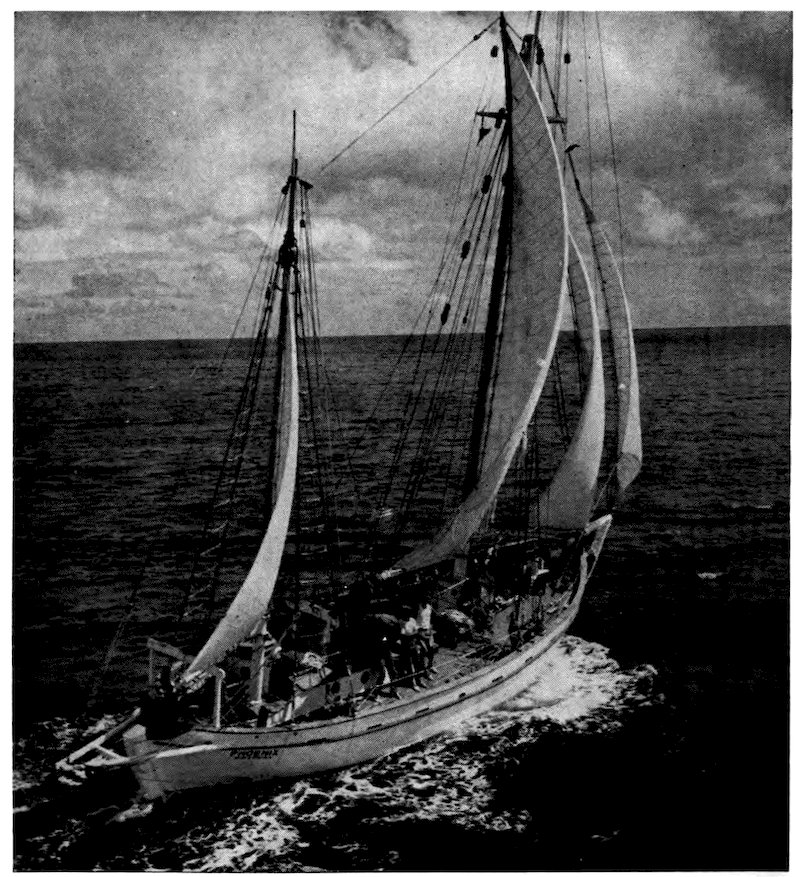
The Phoenix under full sail in the waters off Hawaii
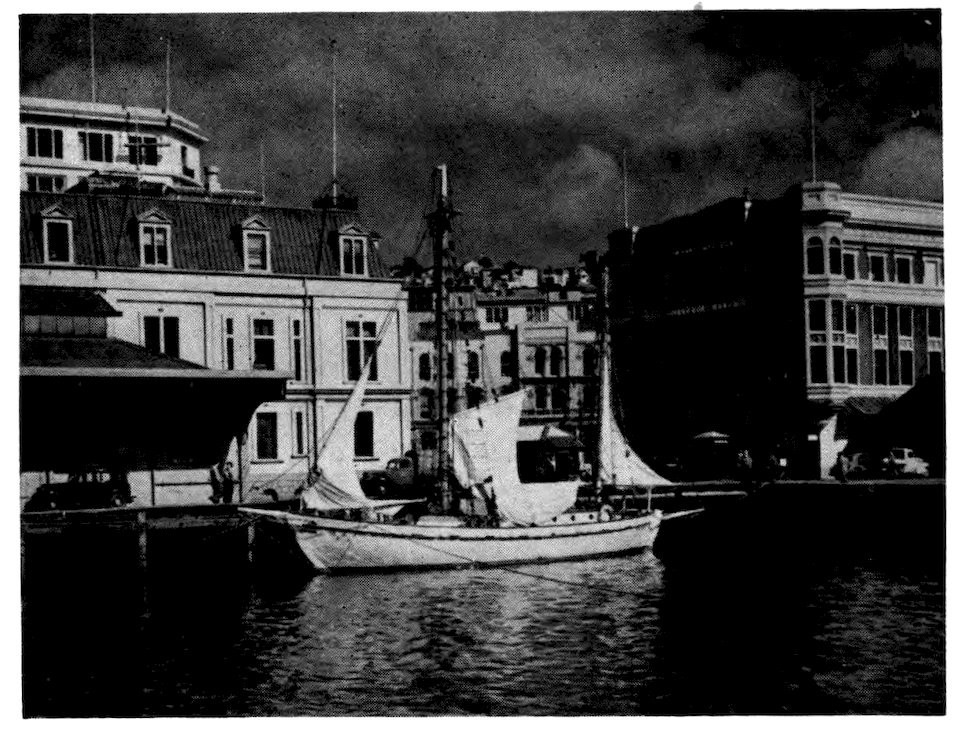
In port, Wellington, New Zealand
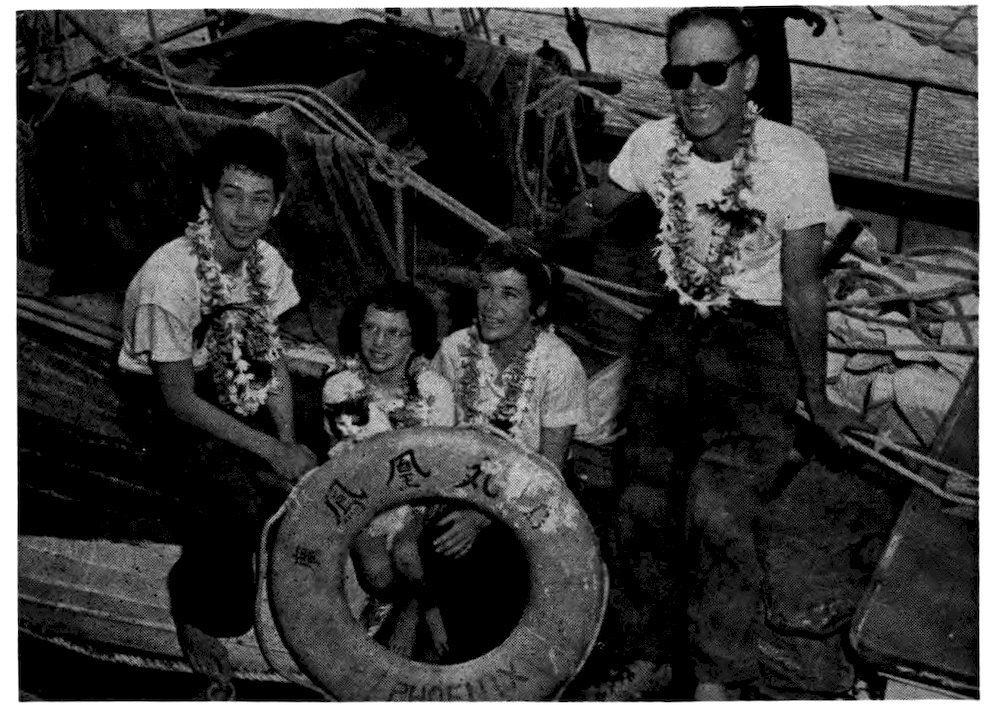
Arrival in Honolulu, 1954
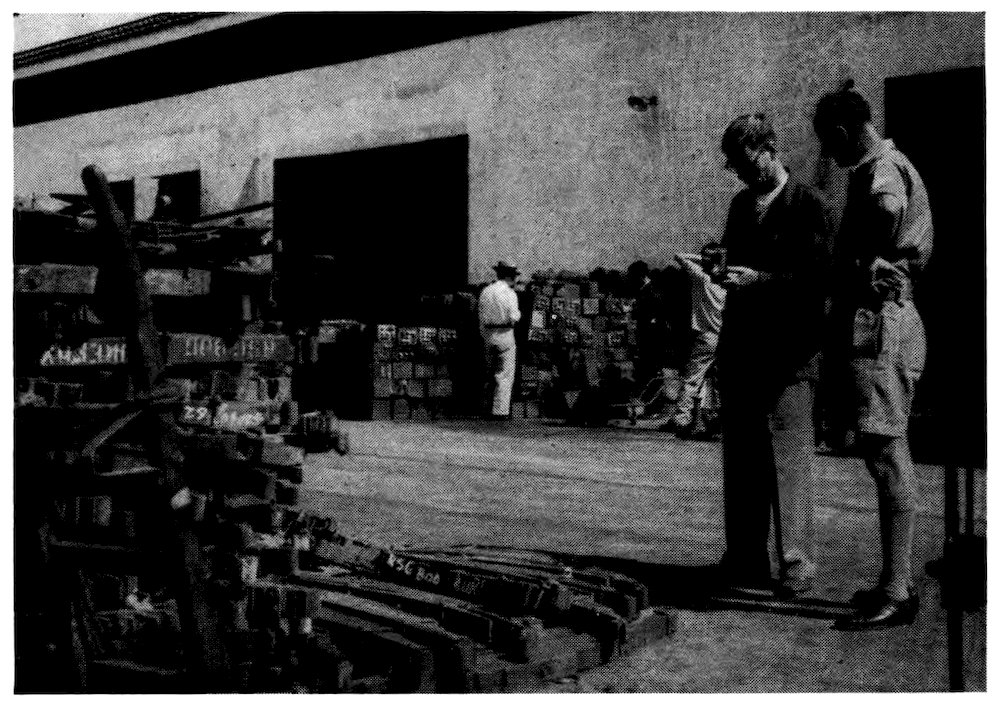
Japan, buying scrap iron to use as inside ballast
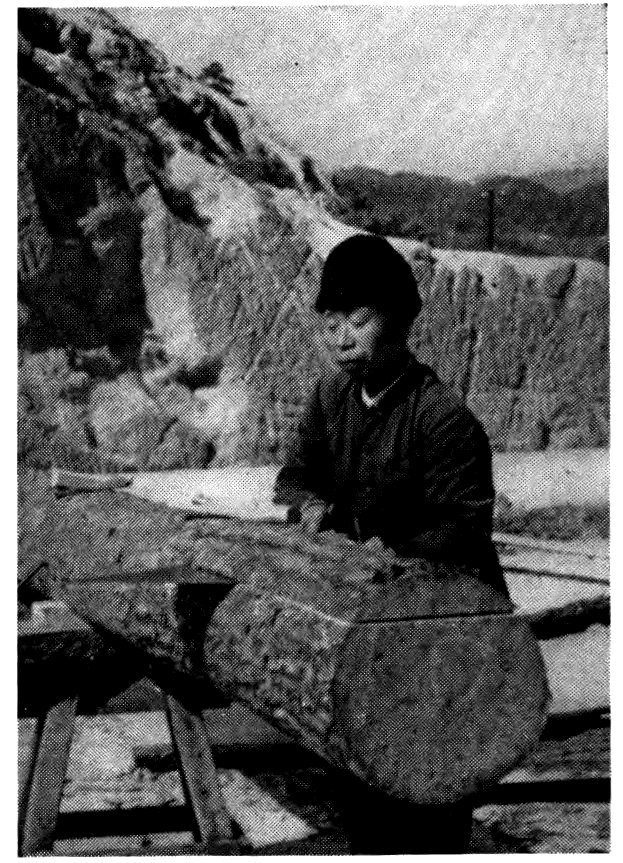
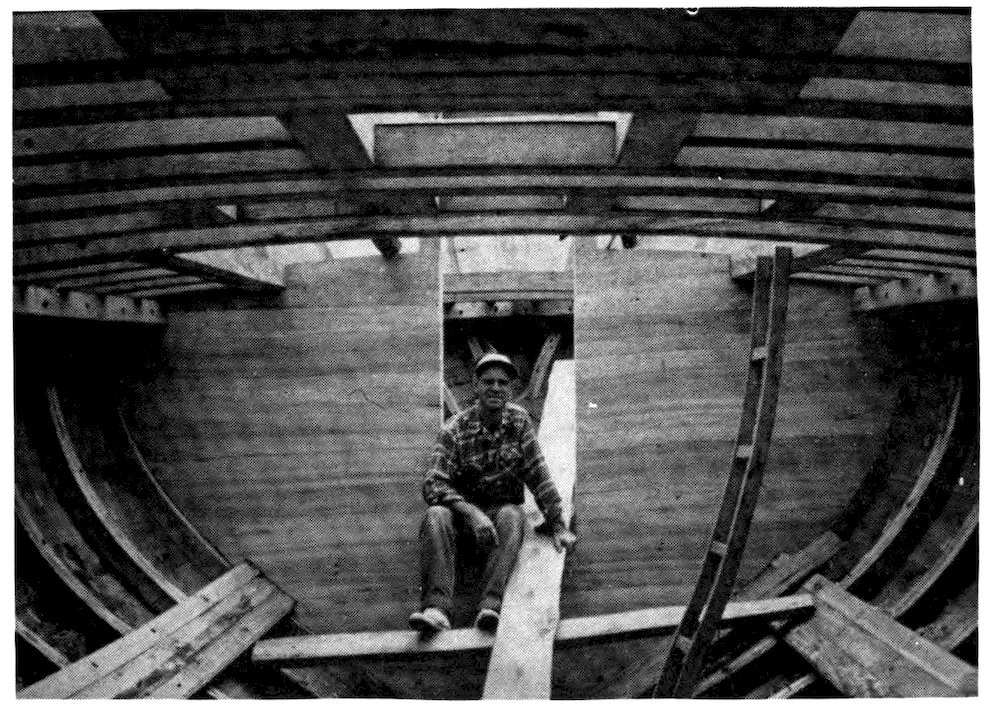
The timber is cut
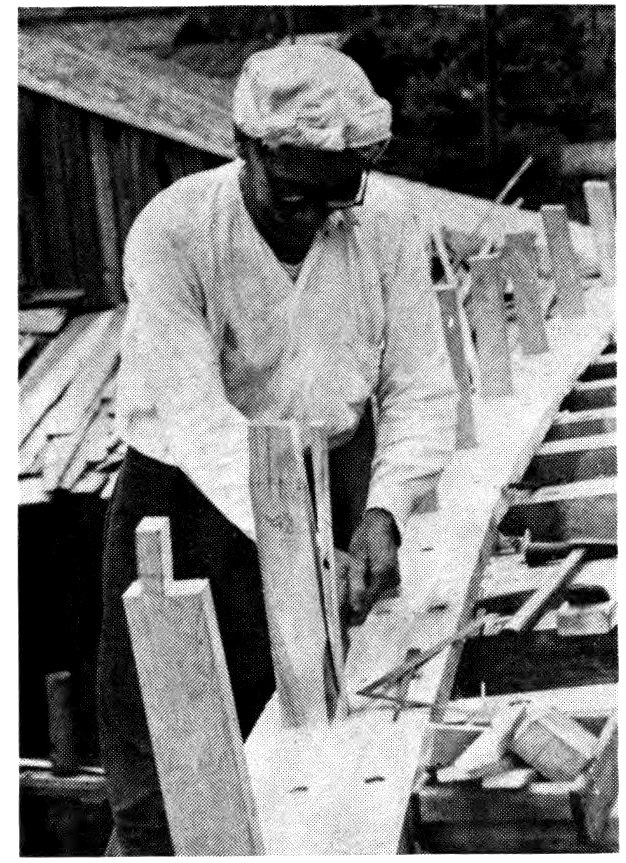
Shaping the hull
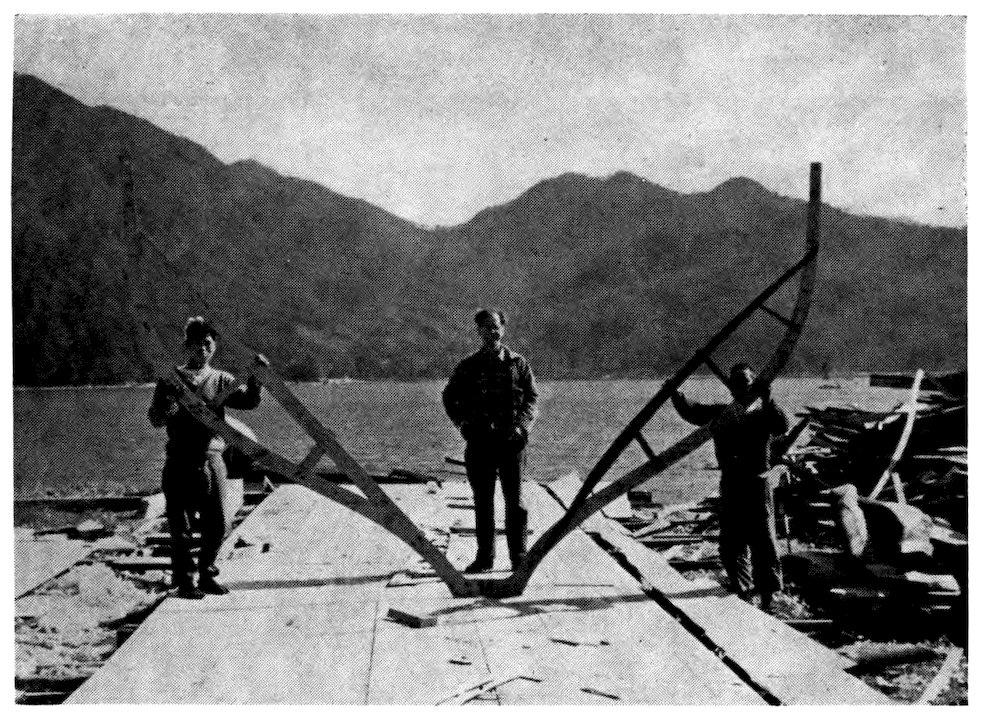
Full-size patterns for the ribs
The Captain and his ship
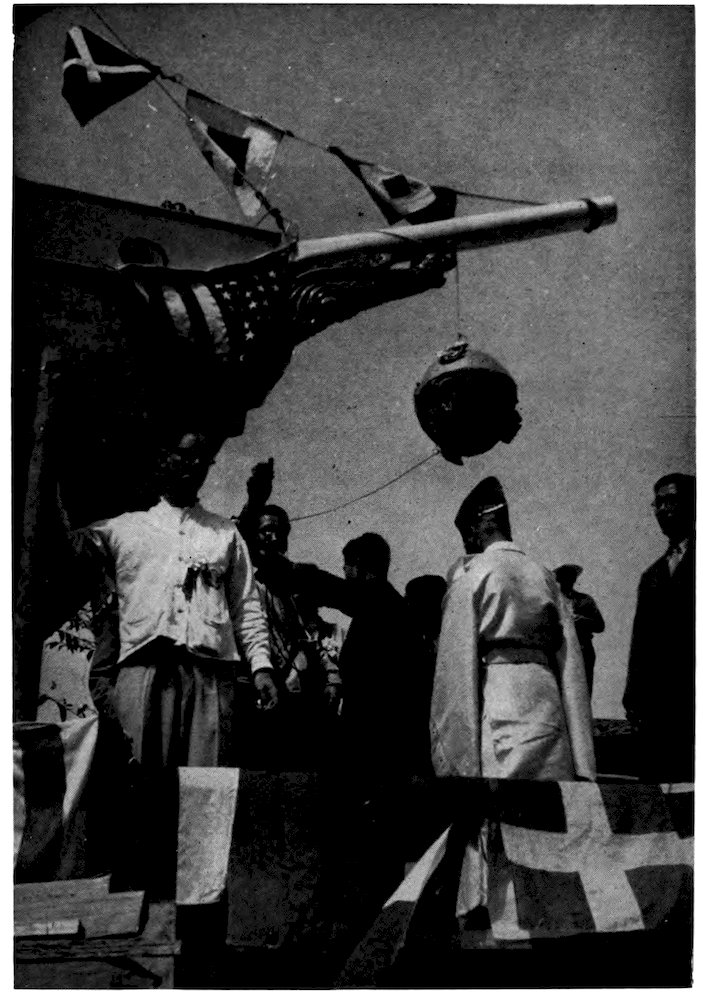
Launching day
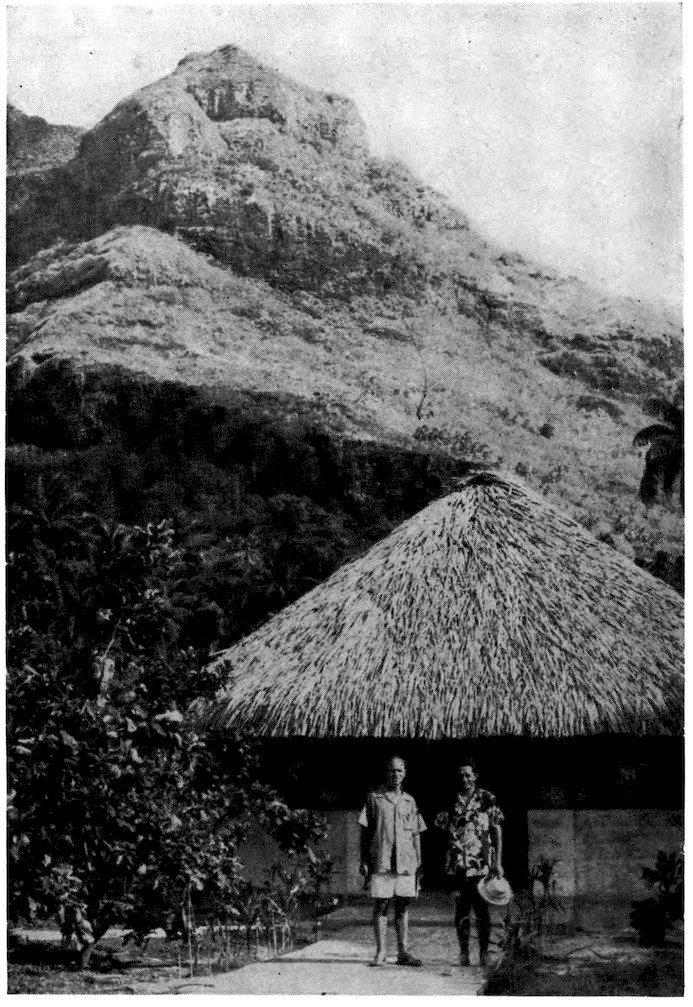
Bora Bora, French Oceania
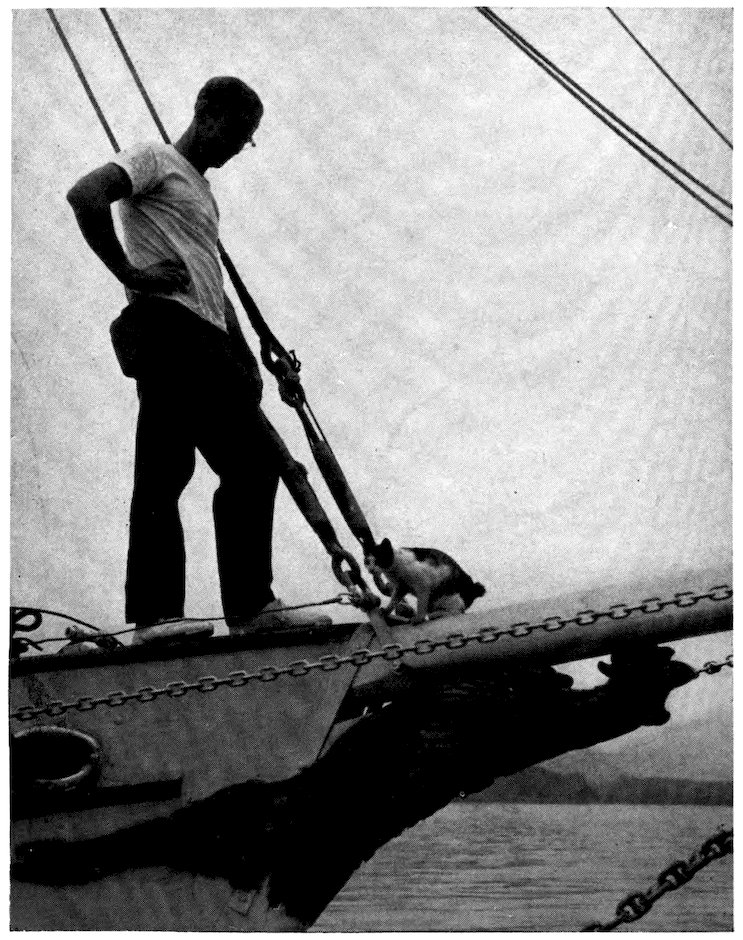
Skipper and Mi-ke
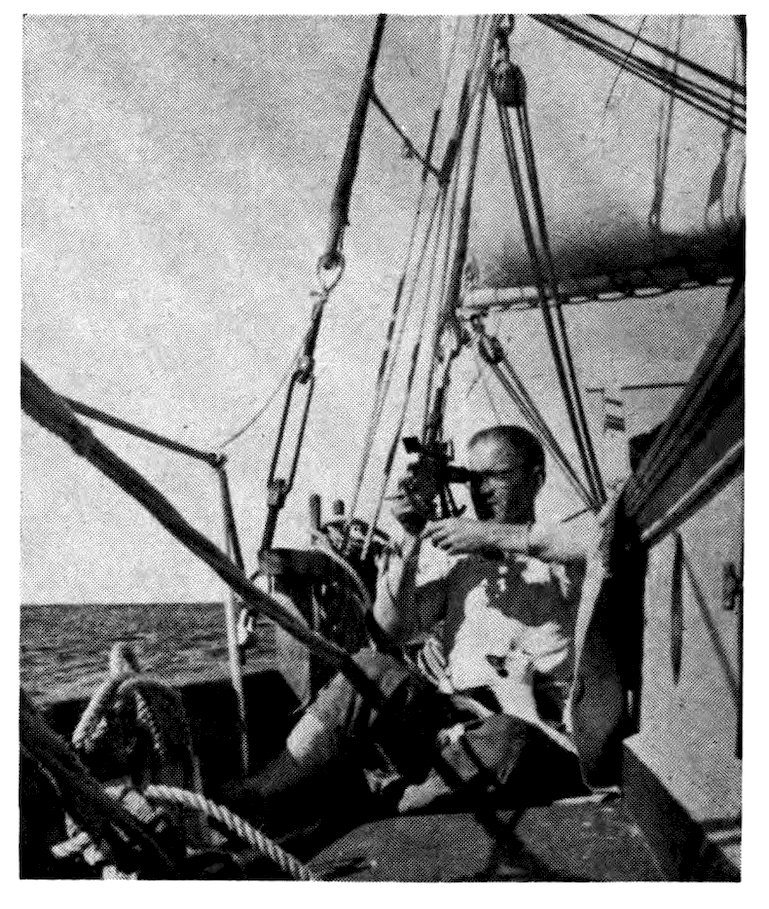
Sextant shot on a quiet day
Mickey: Portrait of a seasick sailor
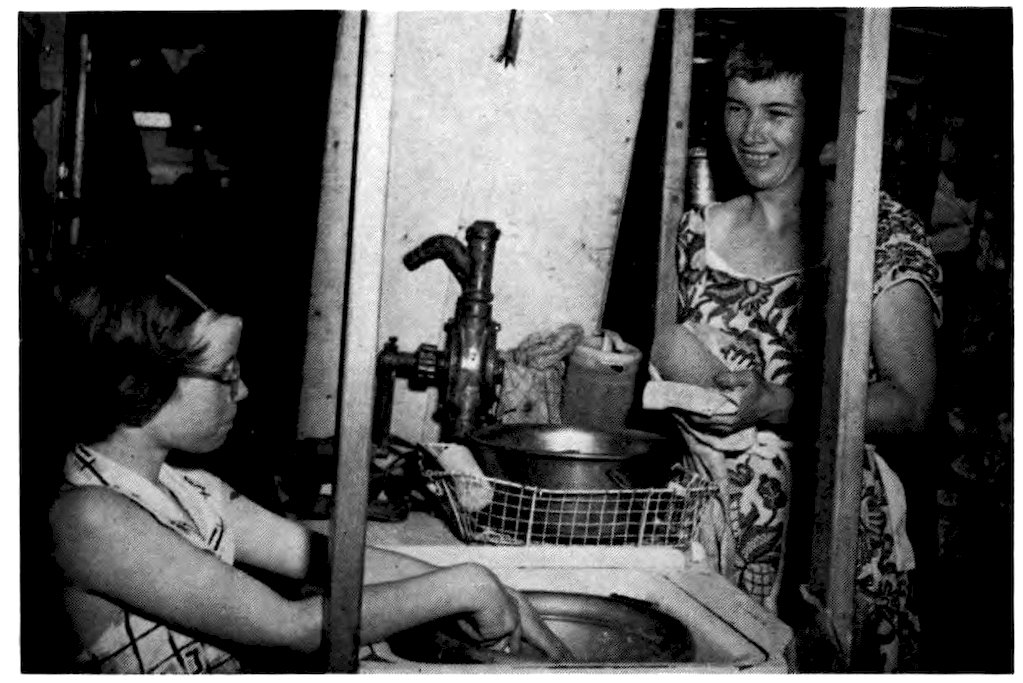
Galley scene, April, 1955
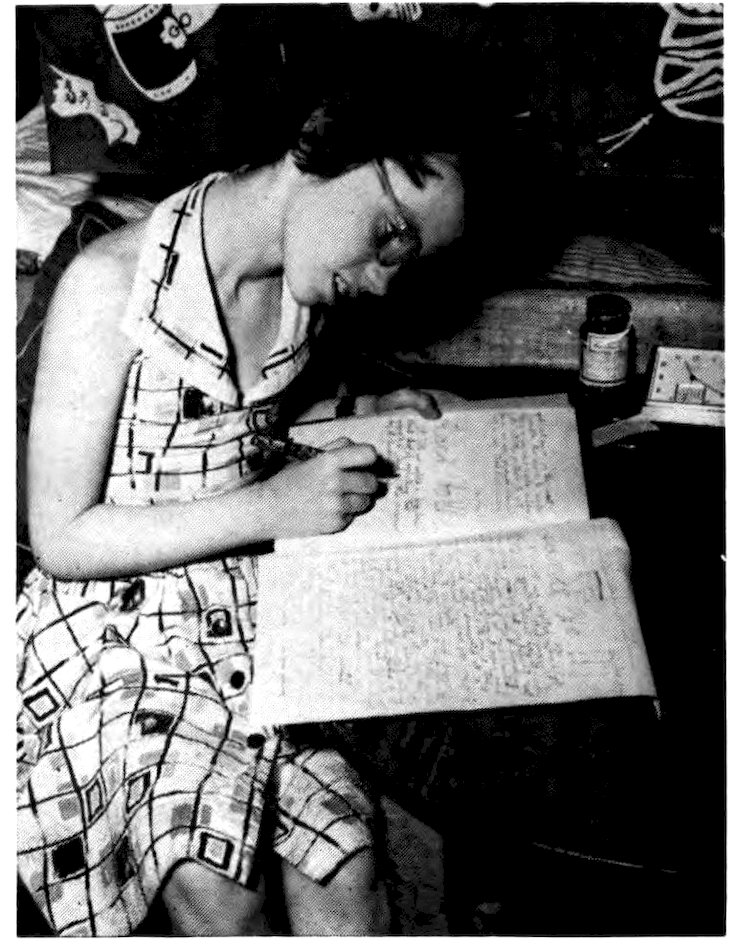
Jessica and her journal
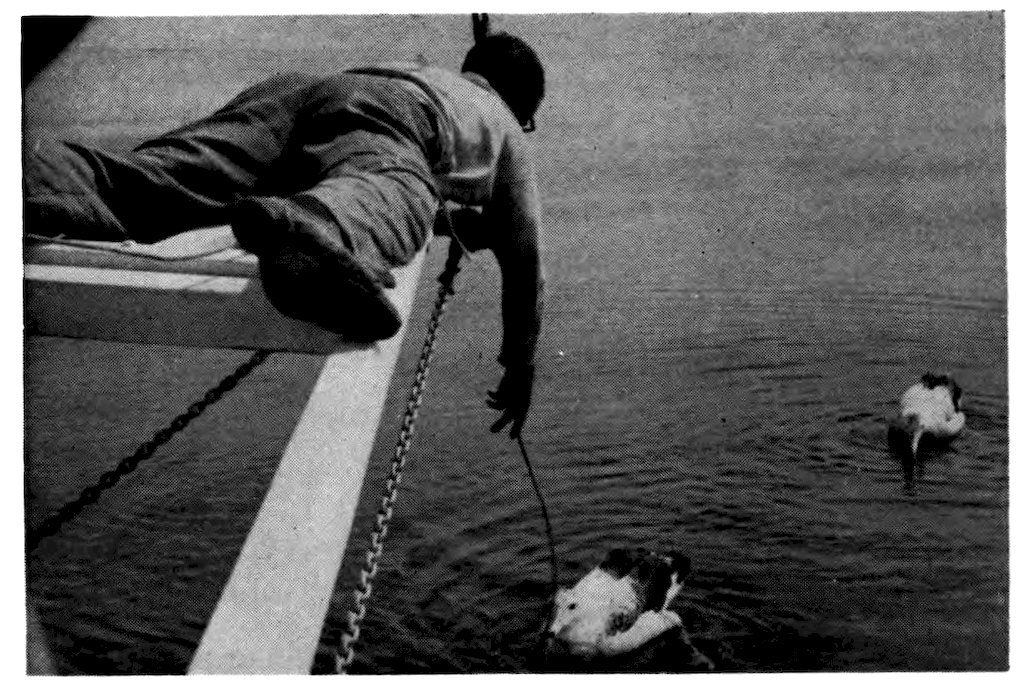
Lassoing albatross
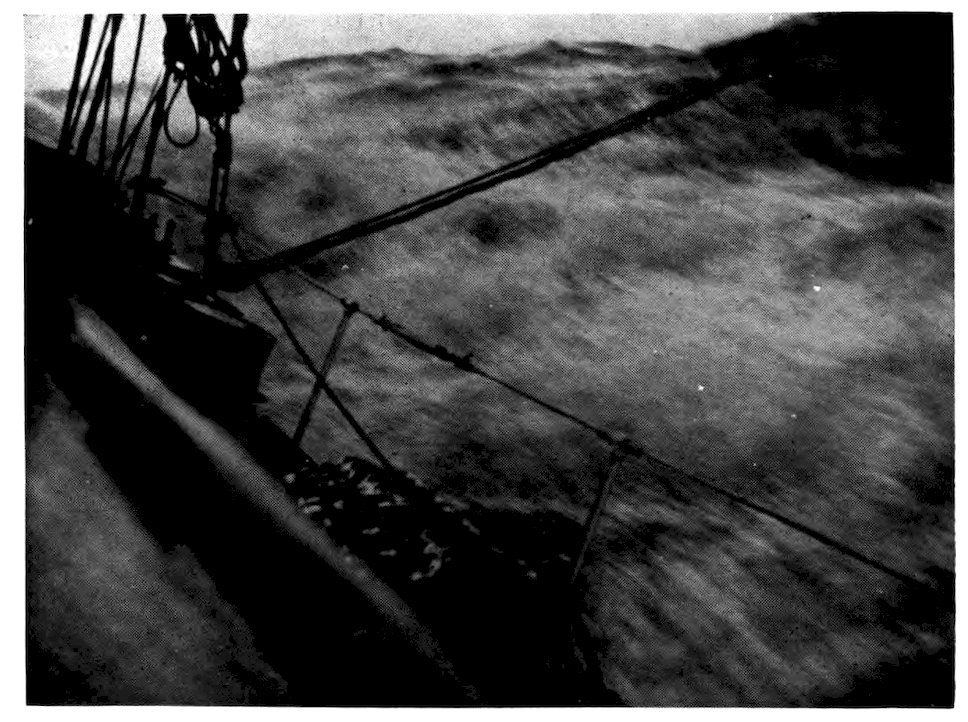
Rough day, Tasman Sea
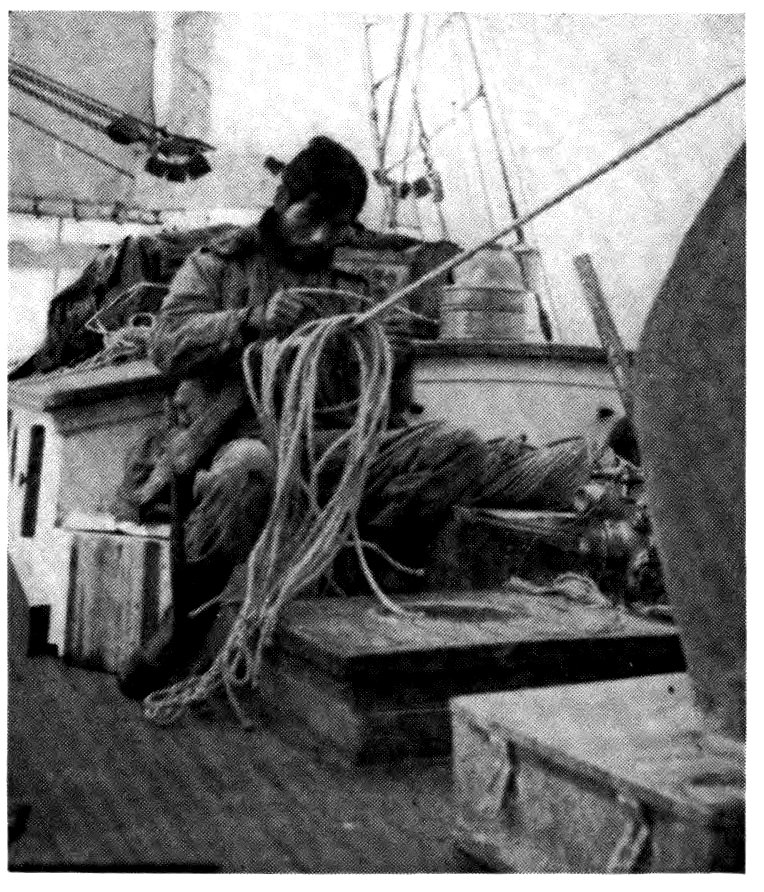
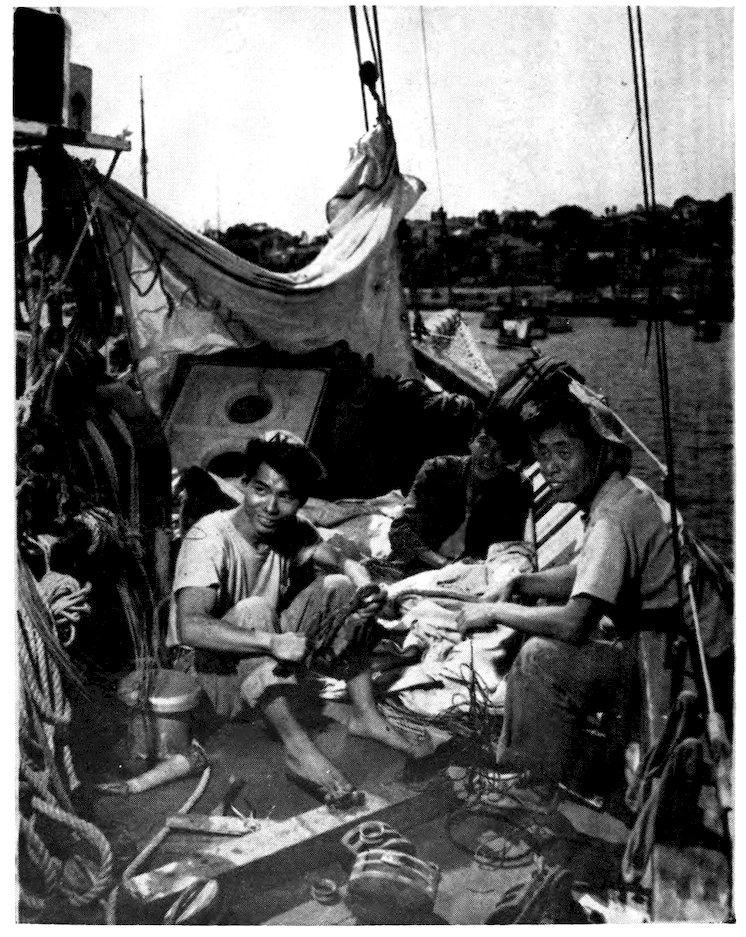
Repairing sails
Marina, Staten Island
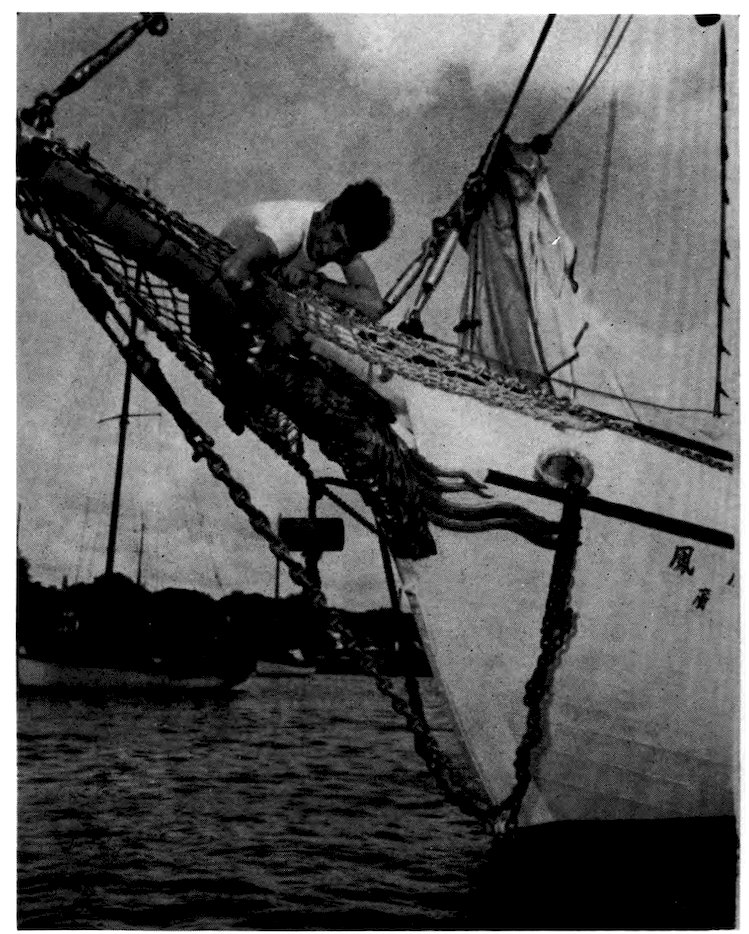
Ted refurbishing figurehead
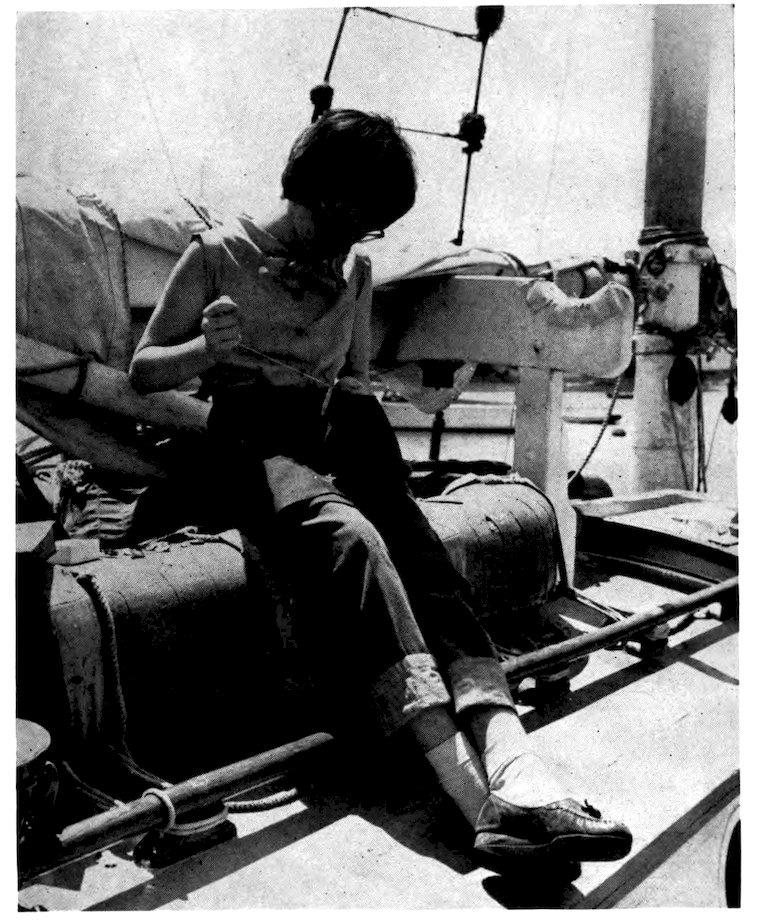
Jessica sewing on Girl Scout badges
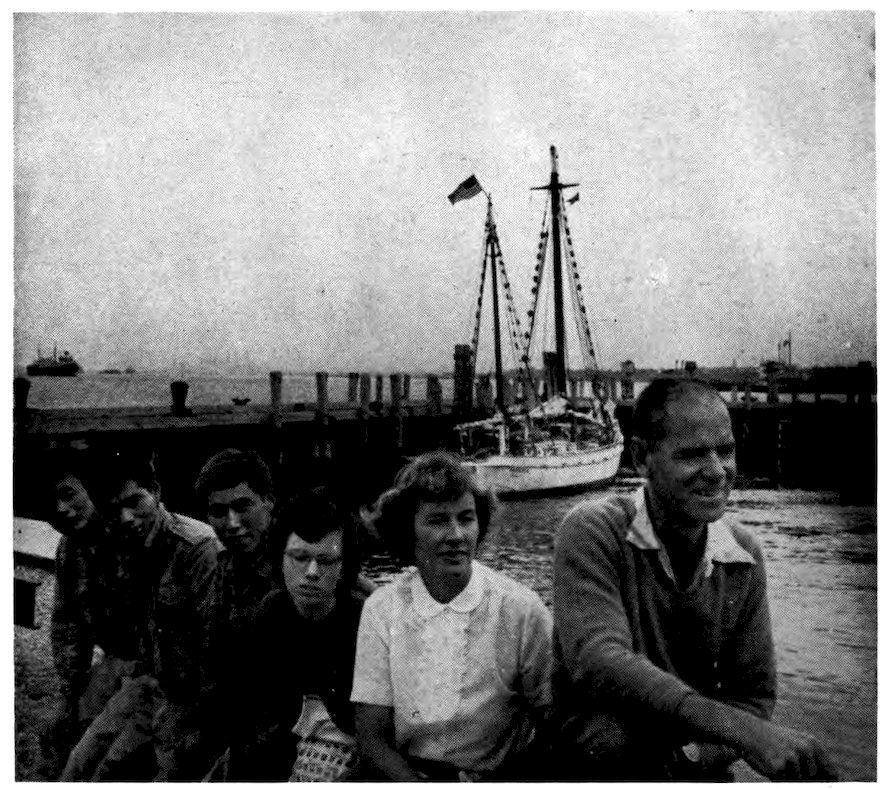
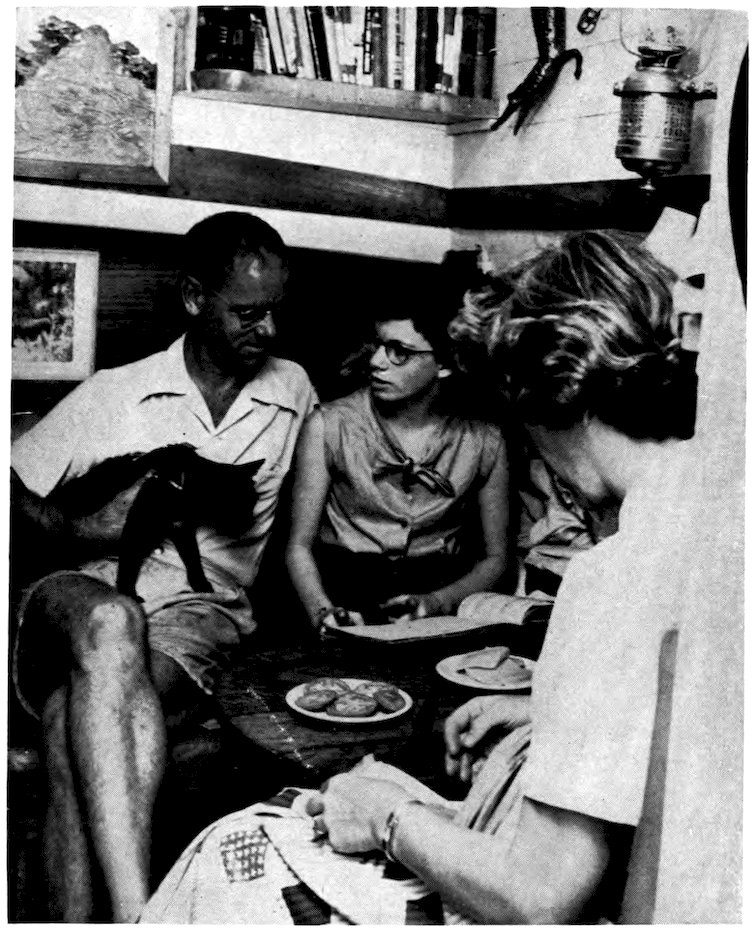
Reynolds family
1 THE RISE OF THE PHOENIX
1
“Between a dream and a deed lie the doldrums.”
The yacht Phoenix stood poised on the launching cradle.
The ways were greased, the tide at spring high, and only a
single wedge restrained our newly built ketch from sliding
into the waters of the Inland Sea of Japan.
Standing on deck, I looked at the crowd below, at the
Shinto priest chanting a blessing at the bow, and at Yotsuda-san,
my long-suffering shipbuilder, waiting alongside for my
signal.
Across the bay I could see the mountainous island of Miya
Jima, green and beautiful in the bright May sun. Over there,
in her famous shrine which at high tide seems to float upon
the surface of the sea, sleeps the goddess, Itsukushima-hime-no-mikoto,
famed and feared for her jealous nature. I could
only hope she would not begrudge us our brief moment
of glory.
When the priest had finished, I made a short speech, and
then mochi—pink and white rice cakes of ceremonial significance—were
tossed to the crowd. The moment had come: it
was high noon. I caught Yotsuda-san’s eye, and nodded. He
smiled, bowed, and signaled to a workman. I suddenly
thought, Well, Yotsuda, if this launching is a bust, I’ll be
2busted, too—but you’ll probably have to revive the good old
custom of harakiri.
“Ikimasho!—Let’s go!” I shouted. Then everything happened
very fast. Jessica, standing on tiptoe, cut with a tiny
golden ax the ribbon which symbolically bound the Phoenix
to the shore; Barbara swung mightily and broke the traditional
bottle across the bow, cutting her finger in the process;
a workman knocked out the last block. We paused for a
breathless moment, and then began our slide, picking up
speed as we descended rapidly, until we hit the blue waters of
the Inland Sea with a grand and noble splash.
From the boat Ted and I could hear mingled American
cheers and Japanese banzais floating out across the water, as
our Phoenix glided, riding free on the placid bay—where she
promptly rammed into the side of a Japanese sampan, and
spilled the too curious occupants into the drink.
So now we had our boat, and she floated. It was another
stage in a long-term dream, a dream which had been born in
my seventeenth summer. With my first pay check from my
first job I had bought a book: Joshua Slocum’s account of
the building of the beloved Spray, and of his singlehanded
voyage around the world. That was the beginning.
But between a dream and a deed often lie decades of
doldrums.
During the next two decades I lived what might be called
a normal academic life, acquiring three degrees (all in anthropology),
one wife, a daughter, two sons, a growing waistline,
and a suspicion that life was pulling a fast one on me.
It was not until 1951 that my dream of ocean cruising returned
in strength. At this time I was associate professor of
anthropology at Antioch College in Yellow Springs, Ohio—where
the nearest body of water is the local pond, three feet
deep—and head of the department of physical growth at the
Fels Research Institute.
That year the National Academy of Sciences asked me, as
an expert in the field of human growth and development, to
set up a scientific study in the atom-bombed city of Hiroshima.
I accepted and went to Japan, together with Barbara and our
3three children: Tim, now fifteen; Ted, thirteen; and Jessica,
seven. For the next three years I studied the effects of atomic
radiation on the growth of the surviving children of Hiroshima
and Nagasaki.
Now, for the first time in my life, I lived within sight and
sound of the sea, even though it was the relatively gentle
Inland Sea of Japan. Every day, as I drove to the laboratories
of the Atomic Bomb Casualty Commission, I passed busy shipyards,
where wooden ships, both large and small, were being
built with age-old skills. Oyster boats, fishing sampans, and
trading schooners dotted the blue waters of Hiroshima Wan.
Gradually, as I settled into my research and got my bearings,
I began to look about with a very specific purpose in mind.
There is a poem by Browning whose lines are haunting:
“Never the time and the place and the loved one all together!”
At last it seemed that these three magic elements
might possibly be combined. We had the time—a two-year
contract, with an option to extend it for a third year. This
was certainly the place—the magnificent Inland Sea, unrivaled
for beauty, with plenty of opportunity for sailing—while just
beyond lay the vast and challenging waters of the Pacific.
Moreover, there were skilled Japanese shipwrights here, with
centuries of tradition in the building of wooden craft.
As for the loved one—she existed as yet only in the notes,
sketches, and pictures I had stored over the years, but which I
hoped might be assembled into the plans for the ideal boat.
Finally, for the first time in our lives, we had a chance to
accumulate some capital. At last, and for once—the time, the
place, and the loved one seemed to have met.
The type of craft that evolved in my mind was a heavily
built ketch, stressing the factors of safety and simplicity. I
knew about the pros and cons of light-versus-heavy displacement
cruising boats, and had compared modern and old-time
designs, rigs and methods of construction. One fact was all-important:
styles in boats, like everything else, may change,
but the sea doesn’t. Boats built along traditional lines have
made long voyages in safety and relative comfort in years
past, and they can do so today, even though they may be
scorned as “old-fashioned.”
4With this idea in mind, I made a few contacts with stateside
designers and ordered a number of stock plans. I came
across some very fine designs, but none completely suited
me. One very real problem was the particular circumstances
under which this boat would have to be built. I would
have to use materials and equipment now available in Japan.
The boat would have to be built of Japanese woods. Would
a foreign designer know which to recommend? Also, there
was the matter of the local boatbuilders, who didn’t take too
kindly to plans and blueprints, to say nothing of the English
language. Would an absentee designer be able to anticipate
and provide for all the problems that were bound to arise?
Reluctantly I had to face the facts: if I wanted a boat built
in Japan, by local shipwrights, I would have to design it myself
and supervise every detail of its construction. If I didn’t
think I could do it, it would be better not to start.
I settled myself to the task. For the next year all my time
and energy outside the laboratory were devoted to the labor
of designing the boat. It was entirely a “library research” type
of job, based on my studies, collected materials, and the books
I had brought to Japan with me.
I drew up the plans for a double-ender, along the lines of
the early Colin Archer designs. It was to be 50 feet over-all,
with a 14-foot beam and a draft of 7½ feet, displacing about
30 tons.
The ketch was to have a straight keel, high bulwarks, gaff
main, topmast, inside ballast (6½ out of a total of 9 tons),
and a flush deck forward of a small after cabin. Her accommodations
would attempt to combine the best features of an
open design, so necessary in the tropics, with the essential
privacy for each member of the crew, which could make all
the difference on a long voyage.
With the plans well along, we hit a real snag. For months
all efforts to find a satisfactory boatbuilder, at a price we
could afford, drew only blanks.
A major problem was language. I could speak enough
Japanese to get a hot bath, to find out when the next train
left, or to agree that the scenery was out of this world—but
this was a long way from being able to discuss technical
5phases of boatbuilding. I began to enlist help from among
my Japanese friends, and before long had built up a working
team, which we called the “four-man parlay.”
Man No. 1 was Yasuda-san (“san” is a suffix meaning Mr.,
Mrs., or Miss). Yasuda-san was a teacher in the local high
school; his knowledge of English was excellent but he knew
nothing whatever about boats.
Man No. 2 was Takemura-san, key member of the Hiroshima
University Yacht Club. He was a former officer in the
Japanese Navy, an expert navigator, and a keen sailor of
small boats, though not a deep-sea yachtsman. His interest
in the venture was as a potential member of the crew. He
spoke not one word of English.
Man No. 3, whom we called the catalyst, was Niichi
Mikami, a fellow employee at the Atomic Bomb Casualty
Commission. Nick (as he quickly became known) spoke fair
English and had a good understanding of “how to get along
with Americans.” He was also a fine small-boat sailor and a
member of the local yacht club. He filled in the gaps in the
chain of communication.
Man No. 4 was myself, who thought I knew what I wanted
but was hard put, at times, to get it.
Whenever the team could be assembled, we toured the
boatyards of the surrounding areas, but without success. The
builders either refused outright, or quoted such a fantastically
high price that there was no point in dickering, or—more
in character—were so devious in their discussion that
this amounted, in Japanese terms, to a refusal. Not until the
search was widened well beyond Hiroshima, to the region
near Miya Jima, did I find my man. One cold, wet morning
in December, our four-man team set out for Miya Jima
Guchi, thirty minutes by standing-room-only train from
Hiroshima. From here a short walk took us to the small
shipyard of Mr. Yotsuda.
As we approached we could see Yotsuda-san himself, silhouetted
against the terraced rice fields of an adjoining hillside.
His kimono waving briskly in the breeze, he was repairing
his roof—and judging from the looks of it, none too
soon. At a hail, he scrambled down, and I bowed through
6the rituals of introduction, via Yasuda-san, via Takemura-san,
with help from Nick.
Yotsuda-san impressed me favorably when I met him, and
I had a feeling he liked me. He was a cheerful, shrewd-eyed,
honest-faced man of middle age. He had been a busy and
prosperous shipbuilder in Manchuria until after the war, but
now, repatriated to Japan, he had been able to bring back
only his family and a few hand tools. At present, the Yotsudas
were living precariously from hand to mouth, or rather, from
fishing smack to oyster boat.
The workshop consisted of an open shed, with living quarters
behind, and a nearby pile of scrap lumber. The shop had
a bare and austere appearance to American, gadget-accustomed
eyes. There were no high-speed tools in evidence, no
laborsaving devices, no power saws or sanding machines, not
even a brace and bit. There were only the traditional hand
tools of Japanese boatbuilding—adzes, chisels, hammers, augers,
saws. I noted that the saws functioned by pulling instead
of pushing. As I later discovered, so did the workmen.
Our group was ushered into the Yotsuda living-sleeping-dining
room, with its bare tatami mats and the family shrine
in the corner. There we knelt about the hibachi, trying to
warm ourselves from its core of glowing charcoal. The family
had apparently been banished to the earthen-floored kitchen.
While the wind whistled through the plainly visible cracks,
the “team” discussed with Yotsuda-san in tortuous fashion
the possibility of bringing to life, in wood and iron, my
sketches and notes. And I thought doubtfully to myself,
When this man can’t even plug the holes in his own walls,
how could he ever be able to build a good boat?
At any rate, I showed him what I wanted, bringing out my
plans and pictures, and discussing notes and construction.
Hours passed. Yotsuda-san looked and listened quietly. Behind
his impassive smile—that famous Japanese smile!—there
began to glow a spark of genuine interest and understanding.
Through the interpreters he began to ask pertinent questions
and make sharp comments. There was no doubt this man
knew his business, and that he saw, in the designs, a challenge
that intrigued him. Suddenly I found myself thinking that,
7cracks or no cracks in the wall, this man could build
our boat!
So I knelt there, with legs long ago gone to sleep, and
shivered silently in my overcoat, while a long and vigorous
discussion took place in Japanese. At last there was a pause,
a question from Takemura-san which could be recognized
as climactic, and Yotsuda-san’s answer, ending in the phrase,
“Dekimasu—Can do it.”
The team summed up the four-hour meeting succinctly:
“He say ‘Okay’!”
Now we had to come to grips with reality. A dream on
paper is no risk at all, but the time had come to back it with
a sizable wad of cash. Even though the price agreed upon was
remarkably low, by American standards, it would take all the
money we had and could raise. I had to face the fact that, if
anything went wrong, we might be financially wrecked before
we even got the boat in the water.
The contract, when completed, was a magnificent document,
embodying every item and clause I could cull from
legal terminology and textbooks on boatbuilding (I had eight
of them). It protected us (or so I thought) from every imaginable
disaster or delay, whether from act of God or from
error of Nippon.
Even so, the contract contained, as I later discovered, two
flaws. First, when translated into Japanese by Mr. Yasuda,
the language somehow lost the force of the English version,
so that the verbs “will” and “must” came out “it would be
nice if” and “it would be good to.” Months later, when I
came to know both Mr. Yasuda and the Japanese language
better, I asked him why he had so softened the original
version.
“Reynolds-sensei,” said Mr. Yasuda (“sensei” being a term
of respect accorded professors and the like), “Reynolds-sensei
is a very polite man.”
“Oh, I am?” I asked politely.
“Of course. And Reynolds-sensei would never say anything
to make Yotsuda-san unhappy.”
“No?”
“Because then Yotsuda-san maybe not work so well.” Mr.
8Yasuda smiled. “So I do not translate what Reynolds-sensei
say; I translate what he mean.”
“Oh.” I thought this over for a moment. “Mr. Yasuda—the
boat—it’s still to be fifty feet long, isn’t it?”
“Of course!” said Mr. Yasuda, shocked. “Everything just
like you say in contract!”
The second flaw in the contract was a very simple one. The
time stipulated for the completion of the job, to be started
in December, 1952, was June 15. The contract merely neglected
to mention which June 15.
In any event, having made the down payment, as per contract,
so Yotsuda-san could begin to buy the materials, I retired
to the bosom of my family for Christmas. Perhaps there
was something in the gifts I had shopped for so lovingly—heavy
brass ship’s candlesticks mounted in gimbals, a ship’s
bell with a truly mellow tone, a bright orange life jacket for
each member of the family—that made the kids realize that,
although this boat might be another of daddy’s whims, it was
a whim that was going to affect them directly. They began to
take a mild interest in the project and to look at my plans
with more respect. Jessica, in particular, asked to be shown
her place in the boat, and wanted it distinctly understood
that she would have no part in it unless room was made
for all her dolls. This was managed by simply labeling one
locker in the plans, “Jessica’s Dolls.”
Shortly after New Year’s Day I returned to the shipyard,
eagerly expectant. I looked forward to seeing the piles of
lumber, redolent with promise. Perhaps the keel had already
been laid. At least the lines of the boat would have been laid
down, full size, as directed.
I was alone this trip, so as I trudged the muddy road from
the station to the boatyard, I went over my meager Japanese
vocabulary. But after all, I wanted only to look at the progress
of the work, and surely no technical problems would come
up this soon.
None did, for when I arrived I found the shop, in its
original condition, together with Mr. Yotsuda, in his original
condition, and nothing else. At a disadvantage, I began a conversation
in my best pidgin Japanese.
9“Ohio gosaimasu—Good morning,” I said, as an opening
gambit.
Mr. Yotsuda bowed. “Ohio gosaimasu. Shinen omedeto
gosaimasu!” This meant not only good morning but also
Happy New Year, which put him one up.
“Boat,” I fumbled. “Not begin?”
“Yes,” agreed Mr. Yotsuda happily. “Not begin!”
“Ah so desuka?” This is the Japanese equivalent of “You
don’t say?” “Why not—begin?”
“Ah—now New Year!” Mr. Yotsuda seemed vastly surprised
at my ignorance.
“But, Yotsuda-san, New Year—three days before!”
“Ah, yes!” agreed Mr. Yotsuda. “Also today—and tomorrow—and
tomorrow.” His gestures indicated a vast array of
tomorrows. “Many, many days.”
So I learned a new thing about Japan—that New Year’s is
not a day, it is a season.
However, when we visited the yard again, together, late in
January, things looked more promising. Much lumber had
been assembled; nearby were many curved logs of keyaki,
comparable to oak, from which the frames would be made.
Set upon a foundation near the shore was a massive log of
kuromatsu (black pine) which the awkward-looking adzes of
the workmen were rapidly transforming into a long, gleaming
white keel. As I ran my hands lovingly over the fresh,
smooth wood, I knew that at last we were on the way.
The methods of the workmen never ceased to fascinate us.
In one corner of the shipyard was a sight that was to become
very familiar: a solemn little man in a black fur cap who, sawing
horizontally with an enormous curved saw, steadily, day
after day, reduced huge logs to two-inch planks. Every bit of
lumber on our boat was to be hand sawn. All the workmen
handled their tools with consummate skill, an ease which was
deceptive when one tried to use the same instrument. For
example, after the deck had been laid they smoothed it to
perfection by removing almost transparently thin shavings
with the swing of an adze—an operation in which a fraction
too much follow-through would have removed a toe or a miscalculation
10in depth would have left an ugly gouge. Neither
gruesome alternative ever happened.
The men worked mainly by eye, even when operating
within the confines of measurements, but the completed job
was always amazingly accurate. An example was the fitting of
the planking which, forced into position by huge vises, was
fastened to the frames with handmade, hot-dipped galvanized
boat spikes, through-bolted at the butts, and then, for additional
strength, edge-nailed from the inside. The planking
was begun from the bottom up and completed from the top
down. It remains one of the mysteries of the inscrutable East
how that last plank was so cut as to fit exactly into the space
that awaited it. No crack of light could be seen between the
finished planking, even before calking.
Both planking and deck seams were calked with oakum.
When the job was done, the cooperation of the local fire
department was enlisted and a hand pump set up on the sea
wall. A contingent of volunteers spent hours pumping the
Inland Sea into the hull, while workmen on the scaffolding
outside marked the few small leaks with chalk. At the end of
a busy day, a hole was drilled in the bilge and the sea allowed
to drain out.
The chief exceptions to traditional Japanese methods were
in my insistence on the use of wood preservatives, marine
glue and American putties and paints. Such procedures are
not a part of normal sampan-building activities. A certain
preliminary confusion was also caused by the fact that Japanese
shipwrights do not operate in terms of feet and inches,
but with shaku and sun, which are only rough equivalents.
Eventually, I discovered that the work proceeded much more
smoothly if I adapted to their measuring system and translated
my figures into Japanese dimensions. I became quite
casual, as time went on, in the use of shaku and sun, not to
mention bu, ken, kan, kin, tsubo, sho, to, and koku.
We never did become casual, however, about the manner
in which the workmen smoked on the job and tossed their
butts and matches—sometimes still aflame—into nearby piles
of trash and shavings. Naturally, there was a fire clause in
the contract, but we were realistic enough by now to know
11that if the job came to a fiery and untimely end, Yotsuda-san
would be profoundly distressed, but absolutely without
means to rebuild our boat. Insurance? Just the thought of
beginning negotiations made my head reel. No, the men must
stop smoking on the job. I told them so, and they smiled and
bowed politely. From then on, each time we came out to the
boatyard, they smiled, bowed, and carefully put out their
cigarettes. We smiled and bowed also, and hoped for the best.
Nevertheless, these months were happy ones for us all. The
work progressed steadily, if slowly, and although we had
gradually reconciled ourselves to the fact that we would not
launch in June, we felt that surely by July—or, at the latest,
August.... We still had much to learn.
During this time hundreds of problems arose, and each,
after its own nature, had to be met and surmounted. Scores
of items, major and minor, had to be hunted down, designed
or made, or contracted for. A principal source of supply was
in the junk and secondhand marine shops that lined the
waterfronts. The nearby city of Kure had during the war
been a mammoth shipbuilding center, and even then in some
half-forgotten bin at the back of a shop one could sometimes
make rich strikes. I would emerge sneezing, dragging out a
length of galvanized chain or an assortment of bolts. The
proprietor, knowing quite well who I was and what I was
up to, would grin amiably. The conversation usually went
like this:
“Kono jonku wa—ikura desuka?—This junk—how much?”
“Jonku!” he exclaimed in mock indignation. “Jonku nai!
Yotto no mono desu!—Not junk! Yacht equipment!”
“Iie! Jonku dake! Ikura?—No! Only junk! How much?”
He laughed. “Hokay. Sekai isshu no yotto kara, jonku
desu.—Okay. Because it’s for the round-the-world yacht, call it
junk.” He weighed it up, I paid for it at the rate of scrap
iron, and hauled it down to the boat.
In Kure also was an offshoot of the Korean War, the BCOF—British
Commonwealth Occupation Forces—salvage depot,
which was a high-class name for another junk yard. War materiel
poured into this depot in bewildering abundance and
a wide variety of conditions, from completely unused to completely
12useless. Climbing the mountainous piles of scrap in
the yard, or delving into the bins in the sheds, I would sometimes
make a fine haul, as on the day I picked up two new
65-pound plow-type anchors for one pound Australian ($2.25)
apiece.
Sometimes, however, the find would turn out to be fool’s
gold, as it was the time I bought a 1,200-foot coil of condemned
one-inch manila rope for 10 shillings, sight unseen,
only to discover that it should have remained sight unseen,
forever.
In time the officers in charge of the depot became interested
in our activities, and set aside items which they thought
we could use. In this way we acquired such things as a ton
of truck springs (for inside ballast), an Air Force compass
(which we used all the way around the world), a big bilge
pump (still in use), an aluminum gas tank from a crashed
plane (our deck water tank), and dozens of other items, great
and small.
No amount of searching, however, would dig up the outside
keel we had to have cast by a foundry, or a marine engine
(ordered from America), or our sails (made in Yokohama),
or the many special deck irons, or the rigging. In cases such
as these, I had to do it the hard way.
By September, work had progressed far enough so that we
felt it was high time to decide on a name for our craft. My
preference was for Daruma, the Japanese doll with a rounded
bottom and the well-known ability to bounce upright every
time it was pushed over. The Japanese have a saying about
the daruma: “Nana korobi, ya oki!—Down seven times, up
eight!” I liked those odds very much. So, when our Japanese
language teacher and very good friend, Mr. Yamada, next
visited us, we broached the subject.
“Daruma....” Mr. Yamada said, slowly tasting the word.
“Yes-s-s ... very good.” From his tone we knew he really
meant not worth a plugged yen. What we didn’t know at that
time was that to the Japanese the daruma also connotes a lady
of easy virtue, for obvious reasons.
“Maybe something else would be better?” Barbara said,
giving him an out.
13“I think so—maybe something else,” agreed Mr. Yamada.
“I will think about it.”
On his next visit Mr. Yamada did not bring up the subject
of the boat’s name directly. That was not his way. But he
did produce a 10-yen note and point out to us the mythical
bird engraved across its face, the phoenix. And during the
rest of the evening the word “phoenix” seemed to recur frequently
in our conversation. “We Japanese hold phoenix in
very great esteem.... One of the rooms in the Imperial Palace
is called Phoenix Room. It is most beautiful.” More importantly,
Mr. Yamada had written out for us, in his amazingly
neat script, an account of the place of the phoenix in
Oriental mythology—“He is legendary king of the birds appearing
to reign only in time of universal peace.” In turn
Mr. Yamada seemed both awed and incredulous when we
told him of the Western concept: that the phoenix is eternally
born again from the ashes of its own destruction.
“Perhaps—world peace—shall rise from the ashes of Hiroshima,”
he murmured.
“Mr. Yamada,” I asked, “what would you think of the
name of Phoenix for our boat?”
“Phoenix....” Mr. Yamada echoed the word softly. “Yes....
I think—maybe a very good name. Very—auspicious.”
And that was that.
The next step was to arrange for a suitable figurehead—naturally
a phoenix. A local wood carver submitted an ambitious
design. We managed to tame his enthusiasm somewhat,
but our present compromise, carved from a solid block of
camphorwood, is still a very impressive bird.
By now it was fall and we had begun to adjust our sights to
a December launching. After all, that would be only six
months late! The work was going along well and all seemed
serene when suddenly, like the collapse of a pricked balloon,
everything stopped. On several consecutive visits we saw no
workmen, no progress, no signs of life. Yotsuda-san seemed
not to be available.
There was only one thing to do. Rounding up the “team,”
I called a conference. Mrs. Yotsuda was sternly warned to
have her husband there.
14Yotsuda-san came to the meeting, but it was only after long
prodding that the reason for the delay came out. Yotsuda
had run out of money. Without pay, the workmen—even
though they were his relatives—wouldn’t work. Therefore,
he needed money—not more than the contract called for, but
the next installment in advance of the due date.
After getting this straight, I advanced the sum needed.
When Yotsuda-san, bowing his apologies all the way out of
sight, had departed, I asked the natural question.
“Why didn’t he tell me at once? Why waste so much
time?”
“Yotsuda-san was very much ashamed,” Mr. Yasuda
explained.
“Ashamed because he needed money?”
“Yes. Contract says, ‘Next payment when masts stepped,’
but masts not stepped yet, so Yotsuda-san is ashamed to ask
for money. It is a great disgrace to the Japanese people.”
“To the Japanese people?”
“Yes. You are foreign gentleman. You have made very
careful contract. To foreigners, contract is important. So
Japanese people much disgraced if Yotsuda-san cannot keep
contract.”
“Don’t Japanese people have contracts among themselves?”
“Of course!” said Mr. Yasuda. “They have contracts, but
do not use them. If contract is no good, they forget it.”
“Mr. Yasuda,” I said, “tell Yotsuda-san to forget the contract
and build the boat.”
“Ah,” said Mr. Yasuda happily. “I think it would be much
better.”
With the threat of disgrace from contractual obligations
removed from Yotsuda’s shoulders, together with judicious
advances of small sums at regular intervals, work again proceeded
slowly and happily, interrupted only by the prolonged
O-bon festivals of the fall months, the bad weather in November,
and of course by the expected hiatus at New Year’s.
By early March the work was far enough along so that I
thought we should discuss a definite date for the launching,
but I was determined that this date, once set, would not
15be postponed, and stressed this strongly at the next group
meeting.
Mr. Yasuda seemed surprised. “But date for launching is
already decided.”
“Ah so desuka!—You don’t say!” I remarked. “Who decided
it?”
Mr. Yasuda consulted his companions. “The priests at
Miya Jima shrine,” he announced.
“Oh—naturally. And the date—may I ask when it is?”
“The fifth of May, a very good day. The priests say this
is a lucky day. Also, it is big spring tide and you cannot
launch except at highest tide. And it is Boys’ Day—Japanese
national holiday—so everyone will come!”
This seemed to be an unbeatable combination, so May 5
was set as L day. In the meantime, we were busy as never
before. We hung the rudder—a big, barn-door affair, on
which the ironwork alone weighed 500 pounds. We sanded,
puttied, and painted. And we stepped the masts, an all-day
job using manpower alone. For this task the Hiroshima University
Yacht Club, of which Nick and Takemura were
members, turned out in a body to help. Even the press took
notice, reporting that “A gigantic yacht is building near Miya
Jima Guchi.” Compared to the snipes and sailing dinghies of
the local yacht clubs, the Phoenix did indeed look gigantic as
she reared up in her makeshift cradle, towering above the
roof (now repaired) of Yotsuda’s humble home-shipyard.
As the date approached, our craft, superficially at least,
began to take on the appearance of a boat. For the moment
we refused to think of the work yet to be done: all the interior
joiner work, the engine installation, the tanks, the
deck-iron work, the standing and running rigging, the sails.
And beyond this, such items as clothing, supplies, stores,
navigation equipment, charts—literally hundreds of individual
items to be obtained. And at the end of it all, the cruise
itself, for which the entire undertaking was merely preparation.
Of this last stage I dared not, at the moment, even
think.
In the last hectic weeks before launching Barbara took
16over a number of items that had been added to the already
lengthy list of Things to be Done. She located an upholsterer
who could cover the frames for our seats and couches; she
arranged for our weekly “sewing girl” to shift her talents
from shirts and dresses to such necessary items as mattress
covers, canvas cushions, and a complete set of signal flags.
All in all the family didn’t see too much of each other as
we moved into the home stretch, but we consoled ourselves
by thinking that once we moved aboard we’d be together
constantly. This prospect was not one of unalloyed bliss,
however, especially when Ted and Jessica tangled in a
brother-sister dispute. At such times we were inclined to
agree with Tim, who had announced violently, “I simply
couldn’t live with my family on a fifty-foot boat!”
Soon thereafter Tim announced his decision to return to
the States and go to college, rather than accompany us on our
voyage. Barbara was disconsolate.
“It was one thing when I thought we’d all be in this together,”
she tried to explain, “but with Tim in the States—and
the rest of us out of touch for weeks at a time—possibly
months—” She paused, and we both finished the thought
silently, Maybe forever.
“Families,” wailed Jessica, “ought to stay together! I don’t
want Tim to go!”
None of us did, but it was his decision to make. We let
him go with our blessing, and went ahead with our plans.
Barbara determined to do everything possible to draw the
rest of us even closer together.
The last forty-eight hours before launching was a time of
continuous work, accompanied by the hammering of shipwrights,
who removed most of the scaffolding and poised the
Phoenix in her launching cradle. They also had to demolish
a portion of the heavy sea wall so that the ways could be
extended out over the water. On the last night work continued
long hours after dark, by the light of bonfires. The
men themselves were considerably lit up by several cases of
beer, so it was a tired but musical gang who saw the sun come
up as the job was finally completed.
17During the night Takemura-san, Nick, and I completed
our preparations for the launching ceremonies, which had
blossomed until they were far more elaborate than anything
I had ever imagined or wanted. Much of this was due to the
activities of Takemura, the prospective first mate, who had
shown himself a bit unreliable in the matter of solid work but
now proved himself to be a born master of ceremonies.
Among other things he had arranged elaborate king-size
badges, to be worn by all participants. It was during the
preparation of these badges that the first faint signs of future
complications put in an appearance. At four in the morning
Takemura approached and through Nick indicated that he
needed to consult with me. Nick’s English, which had improved
remarkably during the months we’d known him, was
still strained a bit when conversations got beyond the realm
of the strictly functional.
“Takemura-san wants to know what to write on badge,”
said Nick.
“Do we have to have badges?” I asked desperately, but I
already knew the answer to that one.
“Of course,” said Nick. “Always have badges—very
important.”
“Okay,” I said resignedly. “On Oku-san—Mrs. Reynolds’
badge, write Cook.”
“Just—Cook?” repeated Nick, aghast.
“No—better make it Chief Bosun’s Mate,” I hastily
amended.
“Ah, taihen ii desu—Very good!” approved Takemura
when Nick translated. The title was duly brushed in, in beautiful
Japanese ideographs.
I was getting warmer now. “And on this badge—” taking
up Ted’s—“write Assistant Navigator, and on Jessica-san’s
badge write Cabin Girl.” This was done, and Nick, who had
been officially signed on, was given the title of second mate.
Then there was a pause, and I could sense some sort of crisis.
“Reynolds-san, your badge. Takemura-san asks what to
write.”
“Why, Captain, I should think. Unless you want something
fancier?”
18“Captain. Ah so desuka!” Takemura sucked air and bowed
very low. All at once I got it.
“Yes,” I repeated firmly, “Captain. And on your badge
write First Mate or Navigator in Chief—or both. Just as you
please.”
The last two titles were recorded in a rather tense silence.
I realized for the first time that Takemura had coveted the
senior title and that this entire build-up may have been
designed solely to establish that one point. Well, it’s been
established, I thought. It’s settled, once and for all. As I discovered
later, it settled something, all right, but not what
I expected.
By dawn a crowd had begun to arrive, and we shared
breakfast coffee with a dozen early well-wishers. The family
came soon after, driven out in a truck along with the housegirls,
the sewing girl, the gardener, and any number of large
paper fish (for flying on high during Boys’ Day), ceremonial
rice cakes, and various bottles of sake which had been
dropped off at the house during the preceding evening. The
most appreciated present, bar none, was the three-colored
kitten which Jessica was clutching tightly in her arms.
“Miss Uchida says a three-colored cat is lucky on a boat,”
Jessica announced. “Its name is spelled m-i-k-e—Mee-kay, not
Mike—and that means three-colored, and it will catch rats
when it gets big.”
“Just what we needed!” we managed to proclaim, to her
intense relief.
In spite of my forebodings, Barbara had not forgotten to
bring the champagne and a bag of netting to cover it, so the
glass wouldn’t be sprayed at the critical moment. The bottle
was promptly hung from the bow, convenient to the platform
that had been erected for the ceremonies. Beyond this
we had barely a moment to exchange a conjugal word (“Did
you remember to bring the lanterns I left on the porch?”
“Yes.”) before we were surrounded by friends who shoved
bouquets and gift-wrapped parcels into our hands and asked
us to pose, together with reporters, who held microphones of
portable tape recorders in front of our faces, and press photographers,
who begged for “Just one more, please!”
19Long before noon all the choice vantage points, including
nearby hills and the roof of Yotsuda-san’s house, were filled
with people. By eleven o’clock there was no room left on
shore, and very little left on the water. At 11:30 the program
began, and promptly at the tick of noon the Phoenix was
launched.
2 PREPARATIONS FOR A VOYAGE
20
“Cruising is walking, talking, buying, scrounging ... but cruising is also sailing.”
It was almost dark before visitors ceased to stream aboard
the Phoenix, now riding at anchor in the bay. Then it was
time for me to go ashore for a conference with the owner of
the sampan we had wrecked during the launching.
After that, I told Barbara, Ted and I would attend a party
ashore, given for everyone even remotely connected with the
building of the boat—except, of course, females. For the first
time Barbara appeared recalcitrant.
“Do Jessica and I stay on board here alone?” she asked.
“No, you go on back to the house. The Yacht Club boys
will keep anchor watch. Come back out tomorrow.”
“It was nice knowing you,” Barbara said, climbing down
into the dinghy. “I hope you and the Phoenix have a wonderful
honeymoon.”
Only after Barbara had left did it occur to me that she had
really wanted to stay on board, even without bunks or conveniences.
I suddenly realized that my actions must have
revealed my misgivings about the family, their adaptability
and willingness to “take it.”
The conference with the sampan owner was protracted.
His boat, badly holed, had been hauled up on the beach, a
21mute testimonial to the ruggedness of the Phoenix, which
was barely scratched.
The victim readily admitted his responsibility. He had
been warned to stand clear and had ignored the warning.
On the other hand, it was the Phoenix that had been
launched. Otherwise he wouldn’t have been there. If he
hadn’t come he wouldn’t have lost his sampan. Obviously, it
was nobody’s fault—it was the will of the gods. However,
since the captain of the Phoenix was a rich man—
I hastened to correct that statement.
—Well, anyway, richer than the sampan owner, and since
this was an auspicious day when everybody should be happy,
perhaps a sympathy offering....
“How much sympathy would the sampan owner need?” I
inquired cautiously.
This required a long conference, but it came out to 2,000
yen—about $5.50 American. I announced that I could be
that sympathetic, and the offering was duly made. With mutual
expressions of esteem and satisfaction the conference
broke up, and we moved on to the evening’s festivities.
This party, for which preparations had been under way for
weeks, cast me in the dual role of guest and host. As guest, I
was given the seat of honor; as host, I was expected to foot
the bill. I hasten to add that I was by no means being victimized;
it is the custom of the country. Besides, the whole
affair came to less than a hundred dollars, including a bonus
to each worker in proportion to his work.
It is also worth mentioning that Yotsuda-san never so
much as hinted that a bonus should be given to him or that
he should be paid more than the contract called for. This,
in spite of dire predictions by fellow Americans—“old Japan
hands”—who had warned me gloomily throughout that I’d
be “taken for a ride.” What they failed to recognize was that
Mr. Yotsuda was a completely honest man.
Late that night, after the party, Ted and I relaxed on deck,
listening to the rustling of the tide as it slipped gently past
the hull. Our first night aboard our yacht! In fact, I mused
ruefully, it was the first night I had ever spent aboard any
yacht. Ahead of us lay an unknown future but here, tonight,
22lying on deck and watching the stars overhead swing slowly
in gentle arcs, I was at peace.
Early the next morning the Phoenix was towed to Hiroshima
harbor, and the next stage of work began. A cabinetmaker
and three workmen, complete with tools and lumber,
moved aboard and began to carry out our plans for the interior
accommodations.
Four main areas had been laid out. There were to be seven
permanent bunks, each a tiny unshared domain. Two bunks
were in the forecastle, just aft of the forepeak and chain
locker. Between the forecastle and the main cabin an area
was laid out to starboard for the head (American fixtures)
and to port for a large and waterproof sail locker.
The large central cabin contained two more bunks, the
main companionway, galley, lounge, and food and storage
lockers.
Aft of the main cabin, and raised two feet, was the “ladies’
cabin.” It was to be finished in Oriental cabinet woods and
ornamented with a ramma, or carved bas relief, and a miniature
tokonoma, a replica of the family shrine that graces the
main room of every Japanese home. Beneath the floor of
this cabin was a large area for food storage.
At sea, there would be no traffic through the ladies’ cabin,
everyone forward using the main companionway. Aft of the
ladies’ cabin was a small cabin for the skipper, with navigation
table and chart drawers. Beneath the floor was the engine
space, and a small hatch led directly to the cockpit abaft
the mizzenmast.
The entire arrangement seemed well adapted to our needs,
giving adequate ventilation, but allowing a certain amount
of privacy.
Once the Phoenix was afloat and nearer the house, family
participation picked up. Barbara took a particular interest
in the galley, and made a number of changes in cupboard and
drawer arrangements. She and Jessica also ran a series of
experiments in food preservation and provisioning, including
a number of methods of preserving eggs. Each egg was
carefully marked as to process used and date, and every few
days one of the batch was tested—naturally on me. In the end
23we found the simple practice of greasing the eggs with oleo
to be the most practical.
Meanwhile, most of my free time was spent away from
home, working on the boat or roaming the streets and alleys
of Kure and Hiroshima, with a few jaunts as far afield as
Kobe, Osaka, and Yokohama. Only too well did we learn
that cruising is not just sailing—it is walking, talking (in
halting Japanese), buying, planning, scrounging, compromising—for
months and months—and all on dry land. Nevertheless,
we did manage to save several thousand dollars by
these efforts.
Our sails were made up by the Ohara (that is not an Irish
name!) Company of Yokohama and required, before negotiations
were completed, three trips upcountry—a day’s journey
each way. Drawing up the sail plans was a task on which
I had burned a lot of midnight oil, and after the contracts
were let I could only hope there had been no slip of the
pencil.
At last the day came when a dozen bundles, carefully
wrapped in rice straw, were dumped on the Hiroshima dock.
Eagerly we opened them, to be greeted by an exciting odor
of canvas, manila, and tar. Inside were the sails, gleaming
white. One by one we checked them, stretching each in its
appointed place. Outwardly businesslike and matter of fact,
I was tremendously relieved to see that each sail had been
properly designed.
We now had a mainsail, mizzen, forestaysail and jib (these
four lowers giving about 1,000 square feet), plus a mizzen
staysail, topsail, top jib, storm trysail, and storm jib. We had
spares for the main and foresail. (Later, in Honolulu, we
added a genoa.)
The arrival of the sails was a high spot during a time which
was otherwise rushed, uncertain, and confused. Crew problems
were beginning to emerge. We had been aware that
Takemura-san was becoming increasingly uneasy. Instead of
moving aboard to help with the rigging and final fitting-out,
as we had agreed upon, and as Nick had done, Takemura
became less and less dependable and often failed to show up
at all. One night, after a long conference which put a heavy
24strain on both Nick’s English and his loyalties, the two men
went up on deck and talked for several hours.
The next morning Takemura-san came to me, shook
hands long and earnestly, and with real tears in his eyes, said
“Sayonara.” He rowed ashore and out of our lives, leaving
us not only without a mate, but without a dinghy, as this had
been his contribution to the Phoenix.
Well, we thought glumly, we can always buy a new dinghy,
and at least we still have Nick.
This was the cue for Nick to appear and explain that,
under these changed circumstances, he would have to reconsider
his decision to join us. Since he had been Takemura’s
protégé, constant satellite, and uncritical admirer, we were
sure we knew what that meant.
“Okay, Nick,” I told him. “We understand.” I held out
my hand.
Nick looked a little startled. “I will go home, talk to
family.” He was obviously trying to let us down easy, passing
the ultimate responsibility to his parents.
“Fine,” I said, “you do that. Good-bye—and thanks for
everything.”
Hailing a passing launch, Nick too went ashore. We sat on
the deck and watched the harbor traffic, too dispirited to talk.
Below decks, Ted and Jessica were shouting at each other, in
an overheated sibling dispute. Here we are, I thought—what
remains of my crew. One woman—with only half a heart in
the venture. One son, age fifteen—willing, but a bit absentminded
and not too good with his hands. One daughter, ten
years old and small for her age, expert at handling dolls—but
what good will she be on the mainsail? And myself—an
armchair sailor, an untried skipper, who can cope fairly well
with things mechanical but has little finesse with human beings,
even his own family.
The inescapable conclusion of my gloomy inventory was:
You’ve had it. A foreign country, a half-finished boat, a
dwindling bank account, a divided family, and your crew has
just walked off. I hardly noticed when Barbara reached over
to slip her hand into mine. Nor did I note that the wrangling
25below had stopped of its own accord—as it always did—and
that Ted was now busily entertaining Jessica with a story.
The rest of the day passed like a funereal dream. In the
afternoon I went ashore and bought a secondhand rowboat.
That evening we sat on deck and were uncheered by the
nightly visit of the local sightseeing bus, which had added to
its itinerary a visit to the docks to see the American “Around-the-world-boat.”
“Around the world!” I muttered bitterly.
“We couldn’t even go around Hiroshima harbor.”
Early the next morning we were aroused by the sound of
oars and by voices alongside. Onto the deck clambered Nick,
grinning broadly, and with him were two young fellows I
recognized as members of the Yacht Club.
“Ohio gosaimasu!” Nick greeted us cheerfully. “Good
morning! My father said, You promise to go, you go. So—I
go. Okay. Oh—and these my friends—Fushima-san and Suemitsu-san.
They will help make boat ready. They both want
to go with us, which one do you want?”
From that day on, Motosada Fushima (Moto) and Mitsugi
Suemitsu (Mickey) slept and worked aboard the Phoenix,
splicing rope, wrapping blocks, and in general competing, in
a completely friendly fashion, for the berth vacated by Takemura.
In the end, unable to decide between them and perhaps
feeling that we might make up in manpower what we
lacked in experience, we took them both. Now all our bunks
were filled, with a ship’s complement of seven.
We were an oddly assorted group: two sexes, two races,
two languages and nationalities—and seven personalities, with
a wide age range. How these personalities would act—and
interact—would, I knew, have as much to do with the success
or failure of our voyage as the seaworthiness of the boat itself.
At the moment we could only guess—and hope.
Our crew selected, there remained the matter of obtaining
the consent of their families, which proved not too difficult;
and of acquiring Japanese passports and American visas,
which turned out to be very difficult indeed. We finally got
them, but it took several weeks of correspondence, several
trips to Kobe, and several times the amount of patience I
normally possess.
26During this summer we had still another problem to contend
with, and it was one we couldn’t do much about. This
was the weather. In three years in Japan, only one typhoon
had come close enough to Hiroshima to cause any real concern.
However, in the summer of 1954, after the Phoenix
took to the water, no less than four typhoons paid us an
unwelcome visit.
Typhoon June, the third of the unwonted—and unwanted—series,
was the worst of the lot. At the advice of the Coast
Guard we took refuge in a sheltered cove behind the island
of Eta Jima. On the way we tried out our newly rigged mainsail
and, for the first time, had the experience of heeling. As
we tilted in the breeze, Barbara, who had been making lemonade
in the galley, began to pick up broken glass and lemon
peel, while Jessica, a bit shaken, took refuge in the cockpit.
“I don’t like it,” she said. “I’d rather live in a house where
things don’t fall around!”
That night, however, she slept unconcernedly through the
worst of the blow, and by the next day was ready to brag of
her experiences and feel more than a little superior to her
shorebound friends.
For the rest of us, however, the night of Typhoon June is
one that will not soon be forgotten. Around midnight, with
the center of the typhoon less than twenty miles away, the
wind shifted abruptly. We were no longer in the lee of the
mountainous island, but much more exposed, and the waves
in this little bay built up to enormous heights. Suddenly Nick,
on anchor watch, let out a shout in frantic Japanese. I rushed
on deck, and though I couldn’t understand Nick, could see
at once what had happened. Our anchor chain had snapped.
Endless minutes passed, as we drifted inexorably toward the
nearby shore, while we struggled to get the spare anchor over
the side. Only a few feet short of grounding, the anchor
caught—and held.
Two souvenirs remain of that wild initiation night: the
broken link of our brand-new half-inch anchor chain and a
sheet from our recording barograph, which charts the pattern
of Typhoon June. The line of barometric pressure
descended sharply until, at the passage of the eye of the
27typhoon, the ship was bucking so wildly that the ink was
spilled out of the pen, and the record stopped.
We also gained some valuable information and experience
from this episode. First, we began to appreciate the difficulties
in communication that were to plague us in time to come.
Regardless of how well the men improved their English, and
I my Japanese, in a crisis they lapsed into “man’s talk”—rapid,
peremptory vernacular—which conveyed nothing but a
sense of extreme urgency. The normal, formal Japanese
language, which we knew a bit, was gone with the wind.
Beyond this I learned the absolute necessity for anticipation
if this voyage was to be a success. At all times we must
expect the worst, and try to be ready for it. Had the second
anchor been ready for instant use, precious minutes would
have been saved. On the credit side, I profited, because never
again were we caught without ready anchors.
Typhoon No. 4, Marie, caused no great damage in our area,
but roared past us and northward to Hokkaido, where she
overturned a seagoing ferry with the loss of over a thousand
lives. Locally, however, she did play havoc with the tides, and
drowned out the machinery in the local shipyard, so we had
to postpone our haul-out, for bottom painting, more than
two weeks—another unavoidable delay.
However, by September, in spite of typhoons, troubles, and
tape (red), we were far enough along to be thinking about a
date for our departure. We still lacked such extras as electricity,
running water, gimbaled stove, radiotelephone, and
a host of minor items, but we ignored these and concentrated
on the absolute necessities. Provisioning, of course, led the
list, and Barbara took the brunt of this terrible task. Now
that she had a better knowledge of the crew’s daily food consumption,
she doubled her original estimates of rice, fruits,
and canned foods, and then doubled the amount again as a
safety factor. The total was prodigious. Day after day, carrying
yardlong lists, she set out in a taxi-jeep, to return in the
evening with a mountain of supplies to be hauled aboard
and stowed.
Ted, meanwhile, when I informed him that he had been
promoted to chief navigator on the defection of Takemura,
28redoubled his studies. With a textbook and the help of a
navigation officer friend, Ted gained a competent grasp of
at least the theoretical aspects of his assignment. However,
when we worked out our practice sextant shots, we often
found the Phoenix not in Hiroshima harbor but somewhere
up the slope of Fujiyama.
Jessica, too, had been given an official role, that of ship’s
historian. She took her assignment seriously and, from the
day we moved aboard, she kept a daily record of our activities—as
she saw them (a very important qualification). I might
add that this diary was continued without a break for the
next six years, and by the time we had completed our voyage
around the world she had filled seven large ledgers with about
200,000 words. Unprompted and uncensored, Jessica’s Journal
provides a detailed, refreshing, and sometimes chastening
picture of our rather unconventional family life.
Time had now become an important element in our plans,
for it was late in the season. After many conferences with
family and crew, after a careful (and prayerful!) study of the
North Pacific Pilot Charts, and after consultation with the
Japanese Coast Guard, we finally decided that November was
the very latest date we could leave Japan and still have a
good chance of a successful crossing to Honolulu, over 4,000
miles to the east. This would put us at the tag end of the
typhoon season and, we hoped, ahead of the worst of the winter
storms which roar down out of the far north Pacific.
We decided upon Honolulu as our first landfall, because
it was an American port, where we could have the Phoenix
registered as an American ship and could obtain certain
supplies and equipment lacking in Japan.
The numerous unavoidable delays had made it impossible
to fit in the shakedown cruise in the open ocean, which we
had planned, but by leaving Hiroshima early in October we
could have a short cruise up the Inland Sea and give ourselves
and the boat at least a smooth-water test. We could then
complete our fitting-out at a northern port, make any adjustments
that seemed necessary, and still depart by the appointed
date. It was not an ideal plan, perhaps, but it was
29the best we could do. For a number of cogent reasons, mainly
financial, it was impossible to lay over until next June, the
optimum month for crossing the North Pacific under sail.
Our departure was set for October 4, and throughout the
day gifts poured aboard: flowers, candy, fruit, rice cakes, a
painting of the Phoenix, a new heaving line, a can of metal
paint, a gallon of used oil (“to pour on troubled waters”),
and most formidable of all, a magnificent Japanese doll for
Jessica, complete in a fragile glass case. This present brought
Jessica exquisite joy and the captain exquisite pain, for he
knew tears would flow when he had to jettison the case over
the side—in anticipation of the inevitable.
We grew more and more harassed as we found our last-minute
preparations and stowing of supplies continually interrupted
by the need for greeting another well-wisher, making
a short statement to yet another gentleman of the press,
or posing on deck for one more group picture. To load last-minute
supplies, we had come alongside the dock. All our
friends, many of whom had never been aboard, now wanted
a tour of the ship. They charitably assured us that they didn’t
in the least mind if everything was a mess, and asked us
literally hundreds of well-meaning questions, to most of
which we didn’t know the answers. “How long will the trip
to Honolulu take?” “Won’t you be bored?” “But isn’t it
dangerous?” “How will the children go to school?”—all very
good questions.
But the one most frequently asked, and the one we were
least able to answer, was “But won’t you be seasick?” All we
could reply was that we never had been—which was perfectly
true. On board the President Wilson, en route to Japan—our
only other experience on the high seas—none of us had been
in the least sick. Of course, this wasn’t quite the same thing.
Shadows were already long when we left the dock, with
all the ceremony of tossing bright paper tape, singing “Auld
Lang Syne”—in Japanese—and shedding copious tears. The
tears, I might add, were all in the eyes of those who saw us
off. We ourselves were much too busy to have time for sorrow
or regret—then—but to our hundreds of friends the whole
30venture was nothing less than a gallant form of suicide—for
which no one has a more subtle appreciation than the
Japanese.
A fleet of snipes and sailing dinghies from the Yacht Club
accompanied us halfway across Hiroshima Bay, while a plane
circled overhead to drop a tiny silk parachute carrying a
hand-lettered scroll of good wishes and prayers for our safe
return. One by one, our escorts waved and turned back until
at last we were on our own.
Our first day’s destination was not far—the shrine of Miya
Jima, just across the water from where the Phoenix had been
hatched. There, while Barbara started supper and the men
tried to find places to stow the piled-up gifts, I made my first
entry in our nice new logbook:
Dropped anchor at Miya Jima Guchi harbor, opposite the
shrine. Itsukushima is one of the famed “Three Most Beautiful
Places in Japan.” All secure by 1900. Big spaghetti dinner to celebrate—too
busy at noon to eat. Decks in good shape, but considerable
of a shambles below—2 tons of last-minute ballast, now on
floor of main cabin—169 iron pigs.
Many last-minute gifts—even a stack of old newspapers for
Mi-ke. Poor Mi-ke—her box was forced to give way, in its nook
under the starboard water tank, to a pile of iron pigs. The box
is now in the aisle of the main cabin, where she is doing her business
in the middle of traffic. Doesn’t seem to worry her too much.
That night, while the rest of the crew slept, I went on
deck. Across the bay the shrine gleamed faintly in the moonlight.
The Phoenix stirred gently in the swells from a distant
ferryboat. Above were the heavy masts, the intricate web of
sturdy rigging, the white sails, furled now but ready to be
raised at our command. We had our boat, and though she had
not yet proved herself at sea, I knew she would, and proudly.
This was not entirely a matter of wishful thinking. During
her construction, a number of experts had looked her over,
and their reactions had been unanimously favorable. But
even without their praise I had faith in the Phoenix.
About the human beings aboard I was not so sanguine.
None of us had ever been to sea in a small boat. The Japanese
31boys were good sailors of snipes in the Inland Sea, and
I had done some sailing in an 18-footer, but this was a far
cry from cruising outside.
And the family. How would the children take the trip?
Would they be able to adjust to discomfort and occasional
hardship? How much would they miss the companionship of
others their own age? What of their schooling? We were taking
along plenty of textbooks and teaching materials for both
of them, and Barbara, who had been a teacher, would handle
their lessons, but would this be sufficient?
And what of Barbara? We had made a contract with each
other—for better, for worse—but was a situation like this anticipated
in the contract? Suddenly I felt a surge of deep
respect and admiration for her, as it came to me with full
force that I was going because I wanted to go, but she was
going only because I was, offering me a rare and precious
loyalty.
Our Japanese crew—what of them? How would they wear?
How would two groups of diverse backgrounds get along, in
weeks at sea under confining conditions? So far the men had
shown themselves to be fine companions and hard workers.
Moreover, on that wild night when Typhoon June almost
had us on the rocks, they had proved themselves courageous
and resourceful. Would these qualities last during the long
grind?
Finally, the captain. Could he take it? And could his companions
take him? Could he curb his temper, learn to control
his impatience? I deeply felt my inadequacies, my faults,
and especially my lack of experience. Whenever one of the
family called me “Skipper,” as they had begun to do, I felt
uneasy and self-conscious. One of the biggest unknowns was
the ability of this so-called Skipper.
Beset with doubts I finally turned in.
The next day we slept late, and did not get underway until
midmorning. The doubts and introspection of the previous
night were swept away in the sparkling breeze. We had made
our choice, we were on our way, we would do our best. From
now on, all thoughts and energies would be directed toward
making a successful voyage.
32Slowly we drifted past the shrine, so that the men could
say their farewells to the goddess, which they did, standing
in a row on the foredeck with caps in hand and heads bowed.
Suddenly I realized that there was still another possibly
divisive factor—one I had not thought of: differences in
religion.
We continued up the strait and drew abreast the Yotsuda
shipyard. We broke out the foghorn, Mickey blew lustily,
and the entire shipyard crew—all four of them—came down
to the shore while Yotsuda-san ran up the Japanese flag, and
we dipped our American colors in a return salute. Just four
months ago the Phoenix had been launched from here.
The next several days were idyllic. The fall weather was
perfect, the breeze light but fair, the scenery unsurpassed. We
found out now that cruising may take a lot of work ashore,
but that cruising is also sailing, and this is the reward.
And we were beginning to learn our boat. From the log of
October 8, which was also Ted’s sixteenth birthday:
Good sailing practice today—many tacks, brisk breeze, getting
smarter and smarter in handling her. If only the time element
didn’t enter into the picture! But each day that passes puts us
later and later in the season. Four days out and still not in
Onomichi—only 72 miles (by land) from Hiroshima.
That night we dropped anchor in the beautiful harbor of
Mitarai. Fishing boats were close about us and one of them,
as it happened, was a bit too close, since we rammed him
slightly while maneuvering for a berth. In the log, I virtuously
recorded that the accident was a combination of poor
judgment on my part and a shifting wind that pushed us
down on the larger boat before we could stop our way.
From this we learned something about the momentum of
our thirty tons and of the inability of our small engine to
handle the boat properly in reverse. Later we called on the
captain to apologize, and to have the damage assessed. It came
to 556 yen, about $1.50 American. Accidents come cheaper in
Japan!
During our trial run up the Inland Sea we made quite a
few changes and improvements. We put downhauls all
33around, so we could get the sails down even in a gale. We
rerigged our mainsail peak, painted and stowed most of the
ballast, set up a third anchor aft, and got things more shipshape
below decks.
We practiced, too, in the open areas, tacking over and over,
learning to jibe smoothly, and establishing routines for various
maneuvers. We loosed the dinghy, and practiced rounding
up to it. When the breeze freshened, and we had our first
taste of really brisk sailing, we found we could make seven
knots with ease, using only the four lowers; moreover, the
boat had a very easy motion.
We reached Takamatsu, at the upper end of the Inland
Sea, on the morning of October 13. This would be our base
for the final stages of fitting-out before the long ocean crossing
to Hawaii. A Coast Guard boat came well out to meet
us and escorted us to the Prefectural Docks, where a crowd
was waiting, and we went through the usual gamut of
questions.
The following morning we accepted the kind invitation of
the Takamatsu Yacht Club to use their private dock, where
we remained for a very busy two weeks.
Takamatsu is a pleasant city, and at this season was gay and
bustling in preparation for the Hachiman Festival. In the
evenings, after a day of hard work, we usually wandered into
the city where the open-front shops remained ready for business.
We would stop to watch groups of strolling actors, or
try out our Japanese in the process of making a purchase, or
enjoy a nightcap of soba—Japanese noodles—in a tiny booth
before returning to the boat.
During the days, however, we worked, and worked hard.
Ted and Jessica finished the job of painting countless iron
pigs, and emerged at the end of each day with a new layer
of orange paint. In the course of this job Ted uncovered a
hitherto unsuspected talent: that of raconteur extraordinary.
Time passed quickly as Ted gave the iron pigs personalities
and guided them through a series of imaginary escapades in
the course of getting their faces painted. As we watched the
young ones at work we could sense a growing solidarity and
identification with the voyage.
34We made a number of changes in the rigging, based on our
brief experience in the Inland Sea. We unstepped the topmast,
suspecting—quite correctly—that we wouldn’t need it in
winter in the North Pacific. We made stormcovers for all the
hatches and portholes—hoping we would never have occasion
to use them. Also, we installed additional pinrails on either
side of the mainmast, having quickly learned that our one
bank of pinrails was inadequate.
On one day only, October 18, I exercised my prerogative of
declaring a holiday. By coincidence, it also happened to be
my birthday. We took this occasion to visit Kotohira, where
Kompira-san, the god of the sea and patron of Japanese seamen,
holds sway. We toiled up the thousand steps to the
shrine and paused at the summit to admire the magnificent
view, while Nick, Mickey and Moto went inside to pay their
respects to the priests and to inform them of our plans.
When they emerged they were smiling broadly. Kompira-san,
they had been assured, viewed their venture with favor
and predicted a successful outcome if—and this, to us, seemed
to be the joker—we promised to revisit the shrine at the conclusion
of our trip. It seemed to me that a sort of Delphic
aura surrounded this promise, but the boys seemed satisfied,
and we were only too happy to agree.
After this single day of relaxation we began our final preparations
in earnest. One by one jobs and purchases were
checked off, from a list which originally contained several
thousand items. On the day before our departure Barbara’s
most recent provisioning efforts were delivered to the dock:
a box of apples packed in bran; 100 pounds of potatoes; 70
pounds of onions; 40 of sweet potatoes, 5 of carrots, 6 of green
beans; and some two dozen heads of cabbage. All that day,
Barbara and Jessica sorted out vegetables, setting aside the
doubtful ones for early eating, while the rest were packed in
wooden crates and lashed to the cabintop.
Also on that day they coated and packed some thirty dozen
eggs with oleo. That night we had scrambled eggs for supper.
That evening Nick and Mickey stayed in the forecastle
writing stacks of last-minute notes, while Barbara, Jessica,
and Moto went out to dinner with new-found Japanese
35friends. Only Ted—and already I was coming to depend upon
him more and more—seemed to share a realization of the
enormity of the step we were undertaking. Of his own accord
he turned down the dinner invitation and remained to help
make a final inventory.
Together we made one more check of the entire list of
Things to Do and Get. The water supply had been topped up—300
gallons in five unconnected tanks. Canned food for
twelve weeks at normal consumption had been divided into
separate duffle sacks, a week’s rations to a sack, and stowed
beneath the floor of the ladies’ cabin. The fresh produce was
aboard and stowed securely. For ship lights, stove, and engine
we had 120 gallons of kerosene.
There were ample replacements for all expendable and
vulnerable items, from flashlight batteries to sail needles, and
safety equipment was complete from flares to heliograph.
In the navigation department we had six compasses aboard
(master, steering, inside telltale, lifeboat, and two spares);
four watches and a chronometer (rated); three barometers and
a barograph; a sextant; anemometer; inclinometer (never
used); thermometers of various kinds; a complete set of signal
flags; several pairs of binoculars; and, of course, the necessary
navigation books, sailing directions and charts, and the
1954 nautical almanac which Takemura had left with us at
his departure.
We had a spare battery radio, with batteries, wrapped in
a moistureproof package, and an emergency fresh-water still.
We had adequate sail repair equipment and materials, tools
of every description, and a quantity of spare lumber, in case
fairly extended additions or repairs proved necessary at sea.
Our medicine chest, a gift from the doctors at the Casualty
Commission in Hiroshima, was unusually complete, from
antibiotics to scalpels. Barbara had taken a survey course in
emergency medicine under our good friend Dr. George
Hazlehurst. She had passed the final examination with honors
by successfully injecting a grapefruit and suturing a sausage.
As Ted wryly observed, if anything went wrong with grapefruits
or sausages, we were all prepared.
As for education and entertainment, we were supplied and
36oversupplied. In addition to textbooks, we had a complete
set of the Encyclopaedia Britannica, the Book of Knowledge,
and some three hundred additional books. We had decks of
cards, and kits for checkers, chess, and backgammon; and sets
of Mahjong and Scrabble for family games. We had a handcranking
phonograph and a wide selection of records. Ted’s
grandmother, Minnetta Leonard, had even sent him a plastic
ukulele, evidently in the fond hope that he would be prepared
for the beach at Waikiki.
In everything except that important commodity, deep-sea
experience, I felt we were ready. If we were fools to embark
without that vital item, at least we were fools who were operating
within a framework of adequate preparation and
common sense.
As to the mental preparation of the ship’s company, that
was difficult to assay. Barbara had taken over without demur
whatever tasks were assigned to her, and Jessica wrote faithfully
in her diary, but neither of them asked questions or
appeared to be overly concerned. Whether due to an inability
to imagine what deep-sea life would be like or utter
confidence in the Skipper, it seemed to put an extra burden
on me.
As for the three Japanese men, they were, during the preparation
and the trip through the Inland Sea, completely unconcerned
in certain areas, and very active in others. Although
well-educated men, they seemed quite content with
manual skills: carpentry, painting, sail handling, and deck
seamanship. They appeared to have no interest in the sailing
plans, navigational methods, or the operation of the radio or
auxiliary engine. Also, as far as I could detect, they didn’t
seem to be worried.
On the morning of October 26, the Rev. Raymond Christopher,
a British missionary, visited us and held a short
service aboard, asking a blessing on our journey. His solemn
words sent a sudden chill through us and more than any other
event made us realize some of the implications of our
departure.
That evening we sailed from Takamatsu.
Our leave-taking was strongly reminiscent of Hiroshima:
37crowds, press, last-minute gifts, bilingual confusion, tears.
But there was one vital exception: we knew that this time we
were heading not for the quiet waters of the Inland Sea but
for the Hawaiian Islands, across more than 4,000 miles of
open ocean.
The day was hectic, culminating in a formal send-off, for
radio and national TV, presided over by the governor of
Kagawa Prefecture. The circumstances surrounding our departure
are shown in the log:
Final preparations completed, immigration cleared, and check
made with Coast Guard; decided to leave on afternoon of Oct. 26.
News of Typhoon 18 (now making up near Philippines) was received,
and decision made to proceed until more details available.
Decided to try to get through Naruto Straits if possible, rather
than go all the way around Awaji Shima.
Also I notified the U.S. Navy in Yokosuka of the date and
time of our departure, our approximate route, and the estimated
length of our trip (45 days, based on an assumed
distance, by sailing route, of 4,500 miles, and an average of
100 miles per day). I informed them, as I had the local Coast
Guard, that we had no facilities for sending radio messages,
only for receiving. We did, however, have a small hand-operated
emergency set (Gibson Girl) on which we could send
an automatic SOS at limited range, but this would be used
only in direst emergency.
We crossed Harima Nada during the night and reached
Naruto Straits the following afternoon. The narrow passage
to the open ocean looked formidable. Even without binoculars
we could see a white wall of foam as the tide fought its
way through, at a peak speed of 11 knots. The rips were
between 6 and 9 feet in height. Even as we watched, a
large ship battered its way through but another, which had
not been so lucky, could be seen stranded on rocks in
mid-channel.
We decided in any event not to attempt the straits at night,
but to check with the local fishermen and get their opinion.
If they agreed it was feasible for our boat, we would try the
passage at slack tide the next morning. So we crossed to
38Marugame, where we anchored, while the Japanese men
rowed ashore to talk to the inhabitants. From them we received
a golden nugget of advice: “When the fishing boats
go through, you go through.”
After the others had gone to bed, Ted and I reviewed the
strategy for perhaps the hundredth time. It was very simple—in
theory. We would head east as fast as was consistent with
safety, to get beyond the area of the late-season typhoons as
soon as possible. We would sail as far south as we could,
though still keeping within range of the prevailing westerlies
and the eastward-flowing Japanese current. In this way
we would get the benefit of warmer weather and less severe
storms.
In handling the boat we would try to keep a good margin
of safety, never overpressing, and we would reduce sail at
night during unsettled weather, until we knew our ship and
had gained experience and confidence in our abilities.
When we finally reached a position north of the Hawaiian
Islands, we would turn south, using the engine if necessary
to help us through the band of Horse Latitudes and into the
northeast trades. We would try to raise the island of Molokai,
the long island in the center of the group, and proceed to
Honolulu.
This, in brief, was our plan.
There was only one way to find out whether it would work.
3 FROM JAPAN TO HONOLULU
39
“The long shakedown ... a seven-week course in How to Sail.”
Before dawn we weighed anchor and sailed down to join
the fishing fleet near the strait and at 0955 we fell in with
a procession heading through Naruto. Great whirlpools, a
threat to the small boat when the tide is running, were still
circling turgidly, but now, during the slack, they had no
power. In a short time, with a fair breeze, we were in Kii
Suido, which funnels out to the open sea. This cutoff saved
us about three days—and later was to result in newspaper
headlines in our own country and in Japan that would
cause much anxiety to family and friends.
The morning was mild and sunny. Our ship rose and fell
gently in the long swells, so different from the shorter, choppier
waves of the Inland Sea. We headed south to round the
headland. As a first taste of ocean sailing, we thought, this
isn’t half bad!
It took only twelve hours for the Pacific to put us in our
place. Toward evening the barometer began to fall, the wind
rose, and the seas built up fast. During the night we lost—permanently—any
complacency we may have had. The men
were all kept busy on deck, fastening down the crates of provisions
which should have been better secured before we left,
40and putting extra lashings on fuel drums, water tank, and
extra spars. The boat plunged frantically as one wave after
another lifted her high or smashed against her sides.
The rain came, in a fury, and on deck the sounds of wind
and wave drowned out everything except a shout at top
voice. We began very quickly to accumulate that experience
we had lacked. “But won’t you be seasick?” We were—and
by the time we had the answer it was too late for any remedies
to have effect—they didn’t stay with us long enough!
Below decks everything that could fall fell; everything that
could break broke. The low railings we had just put around
tables and shelves—modest, unobtrusive fiddles—proved to be
completely ineffective. We had brought plenty of extra lumber
and fastenings on the assumptions that a few spots of
carpentry might be needed while underway, but that first
night there was nothing we could do but make a mental
note: “Higher fiddles.”
Our beautiful mugs—with their hand-painted phoenix designs
of which we had been so proud—swung violently on
their hooks and, one by one, parted company with their
handles and crashed across the cabin. It was obvious that
nothing fragile was going to survive this trip—and that included
people.
Barbara doggedly cooked supper but no one felt like
eating. The girls were told to climb into their bunks and pay
no attention to any crashes which might occur in the galley.
No mental effort, however, made it possible to ignore the
smash of waves against the hull. Each one that hit sounded
like a sledge hammer striking an empty drum—a nerve-racking
experience for those on the inside. In addition, the shouts
on deck and the pounding of feet overhead carried below
with an urgency that was frightening, since the clamor of the
elements, which made the shouting necessary, was somewhat
shut out by the heavy planking.
By midnight, although Barbara still lay awake expecting
each moment to be her last, we were in better shape on deck.
Once we had succeeded in getting everything secure, we
“jankenned” for the first watch—the “scissors, paper, stone”
method of selection traditional in Japan—and began a routine
41of two hours on, eight hours off, which we would maintain
around the clock from now on.
The sequence of watches, which was continued without
alteration for the next three years, was as follows: Moto,
Mickey, Nick, Ted, Skipper. There was a reason for this.
Ted, the youngest, was placed between Nick and Skipper;
Mickey, whose English was poorest, was sandwiched between
Moto and Nick.
The first official watch having been determined, and the
sequence agreed upon, those off duty went to their bunks. I
had no desire to go below, however, but remained in the
cockpit to study the behavior of our ship. The Phoenix
climbed to meet each rushing wave, slid into the trough, and
rose again to the next challenge. She never tired, never
faltered. I had heard about this, and read about it in books,
but now, for the first time, I was experiencing the wonder of
it, a wonder I have never lost. Wet, miserable, sick, and not a
little frightened by the tumult about me—even so, I was
happy.
By the next morning we were out of sight of land and our
dead reckoning put us far enough to the south to clear the
point. We changed course to the east and the long shakedown
was truly underway. Ahead of us, according to my calculations,
lay about a seven-week course in How to Sail. If
we were able to pass it, I was sure we would be able to go
anywhere on earth; if we failed—well, there would be nothing
more for us to worry about.
It was our hope that in the next few days we would sight
one of the small islands, preferably Hachijo-shima, that fan
out into the Pacific south from Tokyo. This would give us a
good departure—and also assurance that we had left the
islands safely behind us!
During the day I took my first sextant shot at sea, while
Ted worked out the sights. We were dismayed briefly when
we discovered that the nautical almanac inherited from
Takemura was printed—naturally enough—in Japanese. Fortunately,
numerals were the same as in English, and the only
critical ideographs—“toward” and “away”—were easily translated
for us by Nick. Though we had difficulties, both in getting
42a good shot and in working out the calculations, it was
easier than we dared hope. We were sure that, with practice,
we could handle this assignment. Once past the islands, there
would be a whole oceanful of sea room and plenty of time
to learn the business.
The weather continued clearing during the day and the
seas moderated. All of us felt better, and everyone helped
get our gear in order and stowed in more seamanlike fashion.
Our losses were mostly crockery and expendable items, and
nothing of any real importance had been broken, including
that most essential item, morale.
Several ships passed along the horizon during the day, one
of them an American aircraft carrier and another—as strange
an anachronism as we ourselves—the magnificent four-masted
training ship of the Japanese Merchant Marine, the Nippon
Maru.
In the afternoon we had a feathered visitor, which flew on
board and settled down to preen itself in the forward rigging,
ignoring the raucous complaints of Mi-ke. It stayed for several
hours, giving us an opportunity for close inspection,
including photographs, and it is our unanimous and unshakable
opinion that our friend was an American robin. Many a
mate to this little creature we had seen in the yard of our
home back in Yellow Springs, Ohio! How it got to the coastal
waters of Japan we didn’t know. Was it a pet, escaped from
the flattop we had seen earlier? Farfetched, but possible. At
any rate, toward evening it flew away, while Jessica rushed
below to enter full details in her Journal.
For the next two days we sailed east, with fair weather. We
were beginning to get organized and to find our sea legs although
Barbara, who had the least desirable job on the boat,
continued to suffer from recurrent malaise every time she entered
the galley. Food had assumed a tremendous importance
in all our lives, and she realized that to fail even once in the
preparation of a meal would only make the next defection
easier. And so, queasy though she was and unappetizing as
the very thought of food seemed to her, she wired the pots
to the stove and doggedly turned out an amazing variety of
hearty dishes.
43In addition to the galley, Barbara was responsible for three
other important departments: health, recreation, and education.
She set regular times for Jessica’s lessons, while Ted,
although carrying a full load as a working member of the
crew, also carried on with his studies.
However, the elements had something to say about leisure
time. On the afternoon of October 31, just as we were beginning
to congratulate ourselves on our fine adaptation to
life at sea, the barometer again began to fall, this time in
earnest. There was no doubt we were in for trouble. That
night the Pacific really lowered the boom.
My log merely says, “At midnight, high waves and strong
wind. Hove to for night, under reefed mizzen and storm
jib.”
How often I had read, in published logs and stories of
cruising, such cryptic sentences, and how often I had tried to
imagine the circumstances! That night I began to get some
idea, but it is not easy to put a reader in my place.
First, it is rough, and I don’t mean rocking-chair rough—I
mean rough enough to break a leg, if you are thrown across
the deck, or to smash in your skull, if a swinging block hits
you. Outside the cockpit, you must hold on at all times, especially
when working far forward. This means that everything
must be done in slow motion just at a time when all
your instincts tell you to rush.
Below decks, it is necessary to chock yourself in some safe
corner or to hold on continuously as you move about. “One
hand for the boat” is not just a catch phrase but an essential
habit that must be developed, and Barbara, who was reluctant
to abandon her instinct for two-handed efficiency in preparing
or serving a meal, was a mass of bruises until she learned
this basic lesson.
Second, it is noisy, and this means noisy at a level which
tempts one to panic. On deck, the high-pitched howling of
the wind cuts through all lesser noises. In order to be heard,
even if your companion is right beside you, it is necessary to
shout. Below, out of the wind, it seems at first almost quiet,
but the ship groans with a thousand noises, there are mysterious
44knocks and grinds, and at this stage of your experience
every sound is ominous and sinister. Occasionally there is the
sudden boom and the shock of a wave as it slams against the
hull. That’s when you’re thankful for two-inch planking and
four-by-six deck beams!
Finally, there is the sight of the waves, each one mountainous
and impersonally lethal. You know it would take only
one to finish you, and that there are plenty more where that
one came from. You wonder how the ship can possibly take
it. Just at this moment you don’t wonder about yourself, because
you’re too busy trying to reduce your canvas and set up
your storm sails. Your whole life narrows to a concentrated
attention on the state of the sea, the strength of the wind, the
look of the sky, and the behavior of your boat. Whether you
admit it or not, fear is your shipmate, and depending upon
your temperament, you work the better or the worse because
of it.
You may or may not enjoy the experience of sailing a small
boat in rough weather on the open sea, but I can assure you
of one thing—you positively will not be bored!
After several hours of labor, we finally had the boat hove
to. It was our first experience in this maneuver, and it was a
wonderful feeling to see how well the Phoenix behaved.
With the sails properly trimmed and the tiller lashed, she lay
head to the wind, quartering out of the trough, no longer
fighting the seas, but riding them like a duck, drifting slowly
downwind. Below, the motion became relatively comfortable,
and it was possible to cook a good meal and enjoy eating it,
and to rest quietly in the bunk.
Three times, during the course of our first passage, we hove
to thus, when the weather became too rough for safe sailing.
However, after we had gained experience and confidence we
carried on through seas which at first would have tempted us
to heave to.
On the afternoon of November 1 we sighted Hachijo-shima,
dead ahead, and changed our course to pass well to the
north of it. The island was a comforting sight, since it gave us
a definite position, against which we could check our dead
45reckoning and our accuracy with the sextant. Also, having
passed these islands, there would be no more land to worry
about between here and the Hawaiian Islands. At this stage
of our experience, what we needed more than anything else
was plenty of sea room.
Late that night, with Hachijo-shima astern on the starboard
quarter, we saw a smaller island looming up to the
north. We knew from the charts that this should be Miyake;
however, it showed a light, with a 15-second interval, and
Miyake had no light. A careful search of our list of Japanese
coastal lights, and an inspection of our charts, showed no
such light listed for this area, so I was considerably worried.
Could we possibly be in the wrong position? Ted and I were
convinced we were not, but Nick thought our position might
be much farther south and the island we had seen earlier
might not have been Hachijo-shima at all.
I checked again, widening my range, searching all the
charts within a radius of several hundred miles. There were
no 15-second lights, in any location, which could conceivably
be ours. No sleep for me that night, as we kept the island in
sight, and I checked and wondered.
At dawn, by studying the contours of the land, we were
able to identify it positively, light or no light, as Miyake. We
sailed on, but I still had a nagging worry in the back of my
mind. If one could not depend upon the light lists and
charts....
Two days later, in the evening weather forecast of November
3, the Japanese radio announced that on November 1 a
15-second light had been established on Miyake-shima. We
had seen it on its first night’s operation!
I mention this little incident because it serves to bring out,
as well as any other, several points which are important.
First, in a cruise of this kind it is not safe to take anything
for granted. I remember talking to a young chap in Fiji
who, with his companion, had been approaching the Society
Islands from the west. According to their calculations, they
were a good 50 miles out, so they set their sails and both
retired for the night. They were awakened about two in the
46morning by the distinctly unpleasant sound of their keel hitting
a coral reef. Their boat was a total loss. They actually
had been 50 miles out, but what they had taken for granted
was that there was open water all the way. What they had
overlooked was the existence of the small island some miles
to the west of Tahiti, which they had the bad luck to run
onto in the night.
Another lesson I learned from the Miyake incident was
that no matter how carefully you prepare, how many precautions
you may take, something unanticipated is bound to
come up. When it does, it should be met in a way that will
give the greatest margin of safety to the ship. If the chart
indicates there is a one-knot westerly drift, assume it could be
as much as two knots—one of these times it will be. If the
anchorage is strange and the weather uncertain, set an anchor
watch, no matter how sleepy you are. For ninety-nine nights
you’ll lose your sleep and nothing will happen, but on the
hundredth night you’ll save your ship.
This point of view, in a number of instances, may have
caused me to err on the side of caution—I know for a fact that
our Japanese crewmen tended to regard me as cautious to the
point of obsession. But when they became impatient, or at
times clearly disapproving, I reminded myself that, after all,
the responsibility was mine. This was my dream, my family,
and my boat—and I had to make the decisions.
Whether these precautions were excessive I have no way of
knowing, but I treasure the observation that Nick made, almost
grudgingly, after the successful completion of the trip:
“If other boys and I had been boss, we’d have gone on reef
many times!”
I accepted the admission in the spirit in which it was
meant, and refrained from pointing out that it might not be
necessary to run on the reef “many times.” Once might be
quite enough.
Finally, there is the practical matter of sleep. Unless you
can snatch it at odd intervals, and when necessary get along
without that precious commodity for long periods and still
maintain your efficiency, you will have a real handicap on a
47long ocean passage. You are lucky if you are a light sleeper,
for to awaken promptly when an anchor begins to drag or
when the changed motion of the ship indicates a change in
the weather is better than explaining that you didn’t hear a
thing until you hit the rocks or until the sail blew out. In
my case, I found out that a characteristic which ashore was a
liability—the habit of being easily awakened—was an asset
at sea.
As a matter of fact, all of us learned to grab sleep where
and as we could get it. Day ran into night. On a ship there is
always someone awake, and usually someone asleep. Only
at mealtimes does everyone generally put in an appearance,
and even then the man on watch must wait until he is relieved
before he can come below and eat. On our first crossing,
when getting ready to go on watch was often a case of
putting on heavy weather gear, it took some nice calculation
on Barbara’s part to serve each meal long enough before the
change of watch so that the man about to go up would have
time to eat and dress, and still report promptly for duty, and
the man coming off could come below to a still-hot meal.
Now we were well on our way, and there was no turning
back. Until we passed the islands, perhaps in all our minds
had been the knowledge that actually we were still close to
land, and might if necessary put in or send out a call on the
emergency radio. But now we were heading into the empty
North Pacific, well outside the shipping lanes. Soon we would
be far beyond the range of our tiny sending set, and for the
rest of the 4,000-mile trip, until we reached Hawaii, we would
be completely on our own.
In the first several days we saw a ship or two, and on November
10 a four-engined plane passed over us. After that,
nothing ... with one exception.
I had given standing orders, of course, to be notified, day
or night, if anything was sighted. According to my log, this
is what happened one dark night:
11/13. Poor run yesterday, high wind and higher waves.
Slogged it out, but everyone sick of the jouncing. Slept fairly well,
as waves gradually subsided. At 0400, Mickey, at the tiller, poked
48his head down the hatch. “Reynolds-sensei,” he said, without
expression.
“Yes?” I asked sleepily.
“Fune desu—boat.”
“Chikai desuka?—Is it close?”
“Hai, so desu—Yes, it is,” noncommitally.
I jumped up and poked my head out. When Mickey said close
he meant close. Just off our stern was a flattop, looking as big as
a mountain, which seemed to be bearing right down on us. I
jumped to the cabintop and waved our kerosene lantern frantically,
while Mickey, as ordered, turned the flashlight on the
sails.
After a long minute the carrier slowly changed its course to
port and gradually faded out of sight.
“Good,” said Mickey, his first sign of interest in the matter and
incidentally the first word of English I had ever heard him speak.
The following day I amended my order to add that I was
to be notified as soon as anything was sighted. It cost me more
sleep, but I didn’t begrudge that. I usually woke up anyway
at the change of watch, every two hours, and took a look
around—but I managed to average out my quota of rest, and
actually felt in fine shape.
The weeks at sea could never be disentangled in our
memories were it not for the help of the ship’s log, Barbara’s
diary, and most vividly of all, Jessica’s Journal. Disdaining
such mundane things as barometer readings and the state of
the sea, she concerned herself with vital matters, such as the
activities of Mi-ke or the winners in our family games. When
she thought ship events were sufficiently noteworthy to merit
attention, she recorded them in her own style. Here are two
interpretations of the same event:
From the ship’s log: Last night, about 2300, a very large wave,
quite out of proportion to even the largest of the then current
seas, broke over the ship. Estimated height about six feet above
deck. Half-filled cockpit, drenched my bunk through the afterhatch
and Moto’s bunk through the main companionway. Swept
several small loose items overboard, and thoroughly drenched
man at tiller (me) with solid water. Only one such wave—only
solid water on deck all night.
49From Jessica’s Journal: In the night while Skipper was on
watch he just happened to look to the North. He saw a great wall
of water four times the size of the biggest wave come charging
toward the Phoenix. It was coming from a completely different
direction from the other waves, and didn’t just go gently under,
heeling us a sukoshi (little).
It came over, soaked Skipper, flowed down the hatches, and
swooshed around in Skip’s bunk. It was a couple of minutes before
the cockpit emptied and the water stopped coming down the
hatches and we came up again. Skip says the wave was the only
one of its size and kind, and maybe caused by an underwater
earthquake. Mum says we heeled down and down on her side
until she was sure we’d tip all the way over. I bet the lifelines
skimmed the water that time! We realized how strongly the boat’s
built because some boats would have been smashed up by that
wave.
As to the human aspect of the voyage, I note in my log
after the first few days, “Relations between all most cordial
and friendly—I think this biracial setup is working out
nicely.” Always in my mind was the knowledge that our venture
was strung upon a chain composed of hundreds of links,
some of which would inevitably wear out and have to be replaced,
and some of which were irreplaceable. I tried to anticipate
and to prevent undue strain upon any one part—rigging,
sails, spars—or men. Which of them would give way first—and
at what crucial moment? I tried to keep myself constantly
aware of any evidence of chafing.
The first overt incident to occur involved Nick, the oldest
of the three and my former coworker at the Commission in
Hiroshima. Though usually cheerful, Nick was subject on
rare occasions to unexplained moody spells during which he
became almost surly. During one of these periods we had
hauled the mainsail down to repair a seam. Since water from
the bilge had been coming up into our bunks occasionally
when we heeled way over, I said we would pump out the
bilge before setting sail again.
Nick abruptly contradicted me. “No. Put up sail first.”
I was at the tiller. “No, Nick,” I insisted. “Once we put the
sail up, we’ll be heeling too far to get all the water out. First
we’ll pump.”
50“No!”
“We’ll pump first, Nick. Let’s go!”
“Do it yourself!” he suddenly burst out, in a black temper.
Nothing like this had ever happened before and all of us
were petrified. We had been in Japan long enough to know
the strong emphasis placed on courtesy and conformance. We
knew that Nick’s outburst, which might have been taken in
stride by Westerners, was an unthinkable breach of Japanese
etiquette.
There was a dead silence which stretched endlessly. Then,
without a word, Nick stepped forward and began to pump
the bilge.
After the job was done and the sail up again, Nick came
back to the cockpit and apologized. He said that he knew I
was right, but he had just felt tired. We discussed what we
could do about the problem of getting the bilge cleared when
we were heeling and decided that another pump, with extensions
on both sides to the turn of the bilge, would do the
trick. (This was duly installed, in Honolulu, and has proved
very effective.) Then we shook hands, and that ended it. For
the rest of the passage, Nick was his former stolid, dependable
self.
The next problem, which set in less dramatically but
threatened to be more serious, concerned Mickey. After we
sailed from Hiroshima, and during our quiet cruise up the
Inland Sea, Mickey had been the brightest and gayest of our
group. The ditty he sang constantly, which roughly translated
meant “I’m going to Honolulu where the coconuts grow,”
had earned him the private family nickname of Coconut Boy.
However, after our first bad night on the open ocean,
Mickey had quieted down considerably. He seemed to realize
for the first time that there was a lot of water between him
and his coconuts. Gradually his activity and behavior deteriorated
until at last he took to his bunk, rising only to go to
the head and for meals—which he seemed to eat with a fair
appetite.
The first night that Mickey defected completely, Nick and
Moto conspired to absorb his watch between them, without
51reporting his indisposition. But by the next day there was no
concealing the fact that Mickey “not feel so good,” and although
Nick and Moto offered to continue taking three-hour
watches until he felt better, it was agreed that we would
share and share alike.
From then on, Mickey was relieved of active duty until
further notice and the rest of us went on a schedule of two
on and six off. This of course meant that each man’s watch,
instead of shifting each day, remained the same. Ted drew
two dark watches (0400–0600 and 2000–2200) and found himself
carrying a man’s role in earnest. In addition to his job
as navigator, he already doubled as cabin boy—a thankless
job that included siphoning kerosene from the deck drums,
draining the dishwater from under the sink, and keeping the
water jugs filled from the main tanks (we had no pump). It
was not an easy life for a sixteen-year-old who had had few
responsibilities for the past three years beyond picking up his
own pajamas—and had often managed to avoid even that by
stalling until one of the Japanese housegirls did it for him.
Yet, Ted responded wonderfully, and I found myself depending
on him more and more. In these modern days
fathers aren’t supposed to get to know their sons, especially
their adolescent sons, but in the case of Ted and myself, never
were conditions better for getting acquainted. Ted’s watch
preceded mine, and I often went up a bit early, especially at
night, to give him a reassuring word and stayed on to chat of
this and that. His nature is quiet and reflective; his interests
run to mathematics, astronomy, the sciences, and for relaxation,
the classics. Our subjects ranged far afield and more
often than not Ted was the mentor.
Perhaps, as Barbara has since postulated, if Mickey had
not “cracked up,” one of the others would have—and I know
she is thinking of herself. Be that as it may, the heavier burden
placed upon us all by Mickey’s defection served to stiffen
the resolution of the others. Mixed with a very real concern
over our ailing member was a growing pride in my family
and I felt almost ashamed of the doubts that had troubled
me before we set sail.
52(Only much later was I told of the reservations Barbara
and the kids had secretly entertained, at the prospect of putting
to sea with me—a skipper whom they knew to be quick-tempered,
stubborn, and far more apt to be patient with
machines or statistics than with people. My own pride in
their performance under duress was apparently matched by
their own surprised and pleased discovery that I, too, was
making a real effort and apparently succeeding. In the course
of that first hard crossing, in short, all four of us were welded
into a close-knit unit based upon mutual trust.)
At the time, however, Mickey was our main cause for concern
and the basis of many worried conferences. His illness
seemed to have no specific character and responded to no
treatment Barbara could devise. It seemed impossible to pin
it down. With Nick as interpreter, we tried to outline the
symptoms, but it was tough going and largely dictionary
work. Sometimes it seemed to center around nausea; sometimes
constipation, or, equally often, dysentery. In general,
however, it seemed to be characterized only by a vague tiredness,
occasional dizziness, a general depression, and a disinclination
to get out of bed.
“No pains?”
“No. No pain.”
“Has he been taking the medicine?” (Barbara had
tried dramamine, bonamine, aureomycin, and various other
specifics.)
“Yes,” said Nick. “No good.” Mickey weakly put in a word
and Nick translated. “Mickey say, maybe better if you make
rice like mother used to make.”
“What? Like his mother? Well, how did she make it?”
“When Japanese is sick, his mother make special rice, very
soft, very good. If you make soft rice, maybe he be better.”
“Oh, dandy,” breathed Barbara, and repaired to the galley
to try cooking rice gruel for Mickey like his mother used to
make. Evidently she didn’t succeed, for Mickey’s condition
didn’t improve. We discussed the possibility of changing
course and heading for Midway, in order to get competent
medical attention, but since Mickey’s condition seemed to be
chronic rather than acute, we decided to carry on.
53And so, for three weeks, Mickey was a free-loader. He ate
regularly but took no part in the sailing of the ship. Not until
we turned south, heading directly for the Hawaiian Islands,
and began to pick up balmy winds, blue skies, and fair
weather, did Mickey show signs of recovery. He worked halfheartedly
at the simple tasks I assigned merely to get him up
on deck, and at last he announced, through Nick, that he
would take an hour of his watch during the afternoon. We
adjusted our schedule accordingly and gradually, over a period
of two or three days, Mickey felt his way back into full
participation. By the time we reached Honolulu he was again
our ebullient Coconut Boy.
Moto, through all this, remained quiet, gentle, and uncomplaining,
the ideal shipmate. His watch followed mine,
and never did he fail to come up promptly and with a smile
on his face. This, in the darkness of a cold, wet, rough night
takes more than a bit of doing, and my respect and liking for
him increased steadily as time went on.
My arrangements for living aboard seemed to be working
out well. From the main cabin we could hear Nick, Mickey,
and Moto carrying on animated conversations in their own
language, and Barbara, who had soon given up her praiseworthy
idea of cooking special breakfasts of sour bean soup
and cold rice, often reported exotic adaptations of cucumber
pickles with the oatmeal.
Of all the jobs on ship, Barbara’s in many ways was the
toughest. Not a boatwoman by inclination, or the typical
“athletic” type of girl, she suddenly found herself thrust into
a role which demanded every ounce of her courage and
stamina. That she discharged her duty with full honors is
shown by a simple mathematical fact: in 47 days at sea, regardless
of the weather, her physical distress, or the balkiness
of a temperamental kerosene stove (which the Skipper had
to keep in fighting trim), she never failed to prepare and
serve a meal—a hot meal—on schedule. Only those who have
cooked on a small boat at sea can know what this means.
As to her personal feelings during this time, a section from
her diary may give some idea:
54I’ve been doing a lot of thinking about people who went to
sea in small sailing ships. About Columbus, for one, who set out
not just for a six or eight weeks’ trip but for an incalculable and
unknown number of days in search of a perhaps nonexistent
land. And more than about Columbus himself, I wonder about
his men, those hardy souls whose individuality has been completely
overshadowed by the glory of their leader’s accomplishment.
Columbus went because he had a dream and a conviction—but
why, I wonder, did they go, all those unidentified others?
And I’ve been thinking about the women on the Mayflower and
on all the other tiny boats that set sail so confidently for a new
world. No longer are the Pilgrims a small band of cutout figures
whose storybook ships are somehow manipulated by wires across
a painted backdrop of heaving billows. They’ve become very real
to me, people I’d like to have known and talked to. I’d like to
have asked Mistress White, mother of Peregrine, “What did you
think the first time you smashed into a heavy sea, so that your
ship stopped short and shuddered at the impact? Did you think
you’d run onto an uncharted rock and would go down in a matter
of minutes? Or was there someone who knew about the sea,
someone to put his arm around you and say, ‘It was only a wave,
darling’?”
Or I’d like to have asked Mistress Carver and the rest of them,
“Did it help to have other women aboard—or were you too
miserable and scared for woman-talk to be of any use?”
In one way, I’m sure I’m better off than they, for I have my
assigned duties to keep me from spending too much time in
self-pity.
In addition to her job in the galley, Barbara had the personal
responsibility of taking care of Jessica. Since Jessica
had no special function on the boat, such as standing watch
or preparing meals, she was able to get a full night’s sleep
and was the only one to whom boredom during the day might
have been a problem. Fortunately, her Journal had developed
from an assigned chore into a welcome challenge. She had
always enjoyed writing and now, in the absence of companions
of her own age, she spent more and more time
experimenting with words and ideas.
In addition to her daily Journal entries, Jessica filled
several notebooks with imaginative stories which she illustrated
55in full color and which served to keep us all entertained.
One series in particular afforded us great pleasure—her
“Creatures,” complete from A (the Alphabetabobbical
Beast) to Z (the Znerrouch). The latter always left his feelings
lying about in a tangled web where they were inevitably
stepped on.
The worse the weather and the higher the waves the more
fantastic (and friendly) became the mythical creatures who
had become Jessica’s closest friends. She and Barbara were
good companions as they shared work in the galley or bent
together over the day’s lessons, but when Barbara—tired out
after a sleepless night or just in need of an hour or two
alone—retired behind the curtains of her bunk, Jessica was
never at a loss. She kept herself busy and amused with reading,
writing, and studying, and when the weather got too
rough to continue normal activities, she quietly crawled into
her bunk “to keep Mi-ke warm.” Sometimes, at night, I
would pass through the dark cabin and flash a light in her
direction to find her lying quiet, wide awake. She would
smile and wave, and I would go about my duties, immeasurably
cheered.
These days our lives as well as our outlook were regulated
by one major influence: the weather. When the going was
bad, we dug in and held on. When the barometer rose, our
spirits rose with it and we expanded accordingly.
The great weather cycles, which flowed down out of the
northwest, carried us along with them for a few days and
then gradually left us behind, only to be replaced by the
next. These cycles of alternating barometric highs and lows
lasted roughly a week each, and their nature can best be
described by brief excerpts from the log. One can begin
anywhere in the cycle:
11/23. Last night under full lowers, when heavy squall hit at
1930. Kept on, after 1½ hours hard work changing sails, under
mizzen, trysail and storm jib. Continued so all night. Frontal
passage at 0749, with sharp squall, heavy rain, and wind shift from
SE to NW. Jibed and continued E under same sails. Rain squalls
passing at intervals. Barometer rising at 0600.
5611/24. Good run last night, with a slowly rising barometer and
slowly falling wind and sea—also good sleeping ... jib clew
cringle broken.
11/25. A fine run last night—very slowly rising barometer, with
wind decreasing very slowly. Under mizzen, mainsail and foresail....
All day, fast-moving, low wind clouds have been pouring out
of NW, keeping the wind up, with now and then a scattered short
squall. Now under all five lowers.
11/25 (Number Two). Another good run last night, barometer
continuing its slow rise. Last night’s Thanksgiving dinner great
success, socially and gastronomically. Menu: suimono, baked ham
with raisin sauce, mashed pot., candied sweet pot., creamed
mixed veg., corn bread, pumpkin pie, ripe olives, grape juice,
port wine, mixed candies. Tonight another Thanksgiving dinner
(since we crossed date line yesterday, through the excellent timing
of the Skipper), but can hardly expect it to come up to last
night’s splendor.
11/26. At 0700, wind shifted to NNE, all night a series of
squalls have poured out of NW....
11/27. Same pattern as previous night ... low, fast-moving
clouds, each with a rush of wind that keeps the helmsman busy—sometimes
with rain. The seas are building ... the ship rides well.
At 1000 put reef in mizzen and 2nd reef in main. Changed course
to 100° compass. Barometer falling.
11/28. Bottom dropped out of barometer last night. (Barograph
broken, too rough for ink to stay in well.) Down 14 points
overnight. Wind and waves built up, hove to at 0800. Ship rides
nicely. Had a big breakfast and all hands turned in for some rest.
11/29. Hove to all night. Everybody got good rest. First full
night’s sleep I’ve had since trip began. Feel fine. Barometer fell
slowly until midnight (988 millibars), then rose slowly ... night
clear and stars shining brightly. Wind shifted between 2400 and
0200. Underway again 0900.
And so, with the barometer rising, the wind dropping, and
the seas moderating, the cycle is completed, only to repeat
itself during the next week, and the next, and the next—as
long as we remain in the latitudes of the prevailing westerlies,
above 30° North.
Just before the new low, there might be a day of calm:
5712/2. Very quiet night—seas down and wind gentle. Today is
drying and cleaning day—first chance. Everything damp—for last
several days have slept on cabin floor, because of soaked bunk
from Big Wave—so today is a welcome respite. Started engine today,
as a check, third time since Nov. 1—started at once, no trouble.
Checked food sacks. Moisture just beginning to get to them.
Will open the sacks that remain—dry and grease where needed—should
be okay for rest of trip.
Amazing odor—went on deck to find boys had got out their
dried squid—now soaked and moldy—and strewn them all over
the cabintop, to dry in the sun. Almost prefer bad weather.
Once we had crossed the date line and entered the Western
Hemisphere—the family’s part of the world—we felt that we
were on the downhill run. The morale of the ship’s company
was high, where before we had been a bit subdued and introspective,
going around, as it were, with our mental fingers
crossed. Now, although we knew we still had a long way to
go, we felt that we had a pretty good example of what the
Pacific had to offer at this season and, although we did not
much care for it, we had gained confidence in our ship and
in ourselves. These days we sailed through weather that
would have made us heave to earlier. This was not through
bravado, but because we now knew that it was safe to do so.
Thus, our average day’s run became encouragingly longer.
On December 5, at 163° West Longitude, we passed below
the 30th parallel and began to drop down on the Hawaiian
Islands. On the chart we had marked what we called “Position
X,” a point about 60 miles north of the island of
Molokai, and for this we headed. Our plan was to round up
gradually on this point and then head directly south. Particularly,
we would be careful not to get too far west, which
would put us downwind of the islands.
Shortly after crossing the date line we had begun to pick
up United States radio stations, though we listened to them
mainly to get news and check our chronometer with a time
signal. Now, as we neared our destination, the Honolulu
stations began to come in more and more clearly. On December
8, while I was listening with earphones to the tag end of
the 1800 newscast, I heard the announcer say: “The Honolulu
58Coast Guard says, ‘No word yet from the missing yacht
Phoenix.’”
This bulletin came as a complete surprise to all of us. In
fact, my shipmates seemed inclined to believe at first that I
was trying to pull their collective leg. It seemed unlikely that
anyone would be interested in our arrival—certainly not to
the extent of broadcasting our nonarrival. We speculated
endlessly. “No word yet—” What word? Why should there be
any word? How could they expect us to report when we had
no means of communication and had seen no ships for the
past month? Most important of all, we weren’t even overdue.
The 45-day estimate I had given the U.S. Navy and the
Japanese Coast Guard before we left Takamatsu had not yet
elapsed, so it was too early for alarm. What did it all mean?
We had to wait three more days before we found out.
We were heading almost due south now, pushed on by a
steady, brisk breeze out of the northeast. As far as this passage
was concerned, we went directly out of the westerlies into the
northeast trades, and we had no need of the extra drum of
engine fuel we had brought along to get us through the
notorious variables and calms of the horse latitudes.
We could easily tell we were getting south, even without
the obvious evidence of sun and compass. Gradually we
peeled off the woolens, long johns, and parkas we had worn
during most of the trip. The girls began to come up on deck
for sun baths, everyone went about in bare feet, and Mickey,
once more standing his regular watch, began to sing his
Coconut Song again.
Even the sea around us seemed to come to life. On December
7 we caught a glimpse of a large marine animal, the first
we had seen on the trip, although birds had been with us
most of the way. The next day something—maybe this same
creature—bit off our trailing taffrail log, which had been
turning faithfully for weeks. Fortunately, we had three spares.
That same day our first flying fish landed aboard, to be
pounced upon promptly by Mi-ke. (Although on later trips
we frequently trolled a line aft, on this passage we did no
fishing, having quite enough to do to handle our ship.)
59On December 10 we reached Position X, according to our
calculations, and set our course due south. If Ted’s navigation
was correct, we should raise Molokai sometime that day.
None of us voiced either confidence or doubt, but we all
spent a great deal of time on deck and there was nothing
casual in the way we searched the horizon.
At 1445 we saw a long, low cloud ahead on the horizon.
At first no one dared call attention to it, but when it did not
change shape or melt away but grew, instead, larger and more
distinct, someone at last found the temerity to voice the
fact: “Land ho!”
There was no doubt about it now. As we drew closer we
could discern the jagged white line of a waterfall marking a
dark cliff, and later still a pencil-thin structure, obviously
man-made, standing out against the somber background. A
quick check of our light list identified it as the Molokai
Lighthouse. Almost simultaneously, as the navigator let out
a triumphant shout, the light began to flash in the early dusk.
We jibed to the west, to run along the coast, and set a course
for Makapuu Light, the gateway to Honolulu.
By midnight we had closed in on Makapuu Light, passed
through the Molokai Channel, and were lying off Diamond
Head in full view of the lights, the beautiful lights, of Honolulu.
Throughout the day small boat warnings had been
broadcast repeatedly, but to us, sailing in the lee of Oahu
after seven weeks on the open Pacific, the seas seemed as
gentle as a millpond. We had no desire to attempt the harbor
entrance in the darkness, so for the rest of the night we
tacked, just offshore, from Diamond Head to Pearl Harbor
and back again.
Throughout the night Nick, Mickey, and Moto came up
to take their watch whenever they were called, but neither
the sight of land nor the lure of the unknown seemed to stir
their Oriental calm. Smiling at us gently, each one finished
his job, took a casual look around, and went below to sleep
out the remainder of the night.
But for the family there was no desire to sleep. A full
moon lighted a path across the water; dramatic mountain
60silhouettes loomed darkly behind the fairy-land lights of a
thousand human habitations; and a heady, never-before
noticed scent of land drifted out to us on the offshore trades.
We sat together in the cockpit, singing Christmas carols
and smelling the flowers, the closest, happiest family in all
the world.
4 ON TO THE SOUTH PACIFIC: FROM HAWAII TO TAHITI
61
“Banzai!... Banzai!... Banzai!”
In the morning we entered Honolulu Harbor under
power and were directed to Pier 7, in the heart of the city.
Quite a crowd had collected and what with officials, newsmen,
radio and television operators, dockworkers, yachtsmen,
and curious strangers, we found the confusion intimidating
after forty-seven days of isolation.
Even before the lines were made fast, reporters were shouting
questions, a television crew had asked us please to go
out and come in again for the benefit of their cameras (we
didn’t), and our good friends the Bushnells—who had spotted
us from their home on the heights and rushed down with
fragrant leis—were breaking the news that Barbara’s mother
had flown in from Wisconsin only a day or two before and
was awaiting our arrival.
As the Phoenix nudged the dock, an imposing individual
cleared a space around him and prepared to board. Our first
American visitor. I remembered my manners—we were back
in the States, where one doesn’t bow, but shakes hands. I
extended mine. He promptly put his briefcase into it, stepped
aboard, and ordered all hands below. At once. No accepting
of leis. No conversation with well-wishers on the dock.
62The reporters howled; the bystanders jeered; and Barbara,
in the midst of eager arrangements for getting in touch with
her mother, had to be dragged down the companionway. We
went below.
Our first visitor did not announce his function, but we
soon gathered that he was the port doctor. We rather wondered
why we could not at least have spoken to the people on
the pier. What obscure disease can be transmitted by voice?
As the doctor left, Immigration arrived. We were delighted
to produce the hard-won passports and U.S. visas for the
Japanese men. Next in line was an agricultural inspector who
apologetically threw overboard a couple of tired potatoes.
We didn’t want them anyway.
A truck arrived, with the ominous lettering “Animal Quarantine”
on it, and Mi-ke was snatched from Jessica’s arms and
whisked away to a cell. We could have her back in four
months we were told—and, no—the time spent at sea could
not be applied on the quarantine period! It was evident that
whatever terrible germs might find their way into Honolulu
they wouldn’t include rabies. As an anthropologist, my own
feeling was that these precautions, while commendable, were
a bit late, since a far worse disease, the white man, had long
ago taken a firm grip on the islands.
At last the officials moved on and we were free to come
and go—but not before the location of the Customs Office had
been pointed out to me, with instructions to report there as
soon as possible. We had just been introduced to a new aspect
of cruising: the inevitable bout with officialdom, just when
you are longing to get ashore after weeks at sea. Necessary,
perhaps, but infinitely frustrating.
Taking a deep breath we went up to join our patient
friends—and ran into the second land-based hazard of cruising:
reporters. Frankly, I was a little surprised to find the
press in Honolulu so interested in our arrival. After all,
boats by the hundreds come in here and they have to sail a
good long way to get to the islands, no matter which land
they set out from. Then why all the excitement about us?
I answered questions from reporters with half of my mind
and tried to carry on a conversation with friends with the
63other. All of us gathered together when told to and smiled
when asked and waved upon request—and breathed a sigh of
relief when at last the reporters and photographers left.
Hours later, on my way back from the Customs Office, I
bought a paper whose headlines screamed: Lost Yacht Arrives!What a coincidence, I thought. Another yacht—and on
the same day! Only after I looked at the accompanying picture
did I realize that the “lost yacht” referred to was the
Phoenix!
This news took a bit of digesting. Gradually, as our friends
filled us in, we learned that for more than a week we had
been the subject of a running story started, perhaps, when
friends who were expecting us had called the Honolulu
Coast Guard to ask for news.
“Yacht Phoenix?” The C.G. had no information. “Coming
from Japan? Never heard of her, but we’ll see what we can
find out.”
A query was sent to the Japanese Coast Guard who, checking
back, noted that a heavy storm had lashed Japan shortly
after we sailed. Further research dug up an early news story
indicating our original intention to sail up the coast before
heading out to sea. A belated search of coastal waters turned
up no wreckage of the Phoenix, no coastal station reported
having seen her after her departure from Takamatsu.—Reluctantly,
Japanese officials notified the U.S.C.G., “No trace
of yacht Phoenix”—and the panic was on.
Conflicting reports began to crop up and were given
international publicity. One, from an “authoritative source,”
said we had “undoubtedly gone down with all hands”—a
nicely flavored nautical phrase. Barbara’s mother, approached
for comment, expressed confidence that all was well. A “Japanese
naval expert” (our old friend Takemura?) was next
quoted as saying that our ship was “built for the Inland Sea
and would never withstand the rough waters of the North
Pacific,” while another “expert” was found to maintain that
a sturdier, better-built boat had never existed. “They’re safe”—“They’re
lost”—“Hope dims”—“Hope revived”—headlines
argued back and forth.
One article, the most bizarre of the lot, reported that a
64radio communication from the Phoenix had been received in
Hiroshima to the effect that we were safe and would reach
Hawaii “in a few days.” Eventually we tracked this down.
A message had been received—of a sort: Moto’s mother had
visited a shrine, where she had received assurance from On
High that all was well with the Phoenix. She had passed the
word along to the anxious relatives of the other men, the
word had spread, and the newspapers got hold of the story.
When the overseas news service picked it up, however, they
failed to recognize that a “message” could be heavenly as well
as electronic. In their own version, they presupposed a radio
contact without bothering to inquire whether we actually
had a radio transmitter aboard.
When we protested the inaccuracy—and the cruelty to
anxious friends and relatives—of such irresponsible reporting,
a newspaper acquaintance shrugged off our indignation.
“It’s just formula stuff,” he assured us. “Yacht sails—yacht
has trouble—yacht does (or doesn’t) arrive. Sometime during
the trip there has to be a crisis—a big storm—a man overboard—or
just, as in your case, no word at all. That’s always
good for at least a couple of ‘overdue’ or ‘lost’ stories. If the
boat is really lost, the accuracy of the press is upheld. If it
turns up—so much the better, because everyone feels good
and we can do follow-up stories, general rejoicing, and big
headlines.”
“Like ‘Lost Yacht Arrives’?”
He shrugged. “Anyway, it sells papers.” And then he
added, a bit defensively, “Our paper hasn’t any objection
to reporting the truth—so long as it doesn’t interfere with
our circulation.”
In our case the news value was enhanced by the interracial
character of our crew and the tremendous interest in the
Phoenix which was felt not only in Japan but throughout the
substantial Japanese-American community of the Hawaiian
Islands. The two Japanese-language newspapers gave the
story a big play. The Japanese Consul General paid his
respects within hours of our arrival. The Hiroshima Ken
Society (composed of hundreds of first-generation immigrants
from Hiroshima Prefecture) scheduled a Welcome Banquet
65in honor of our men. And a cable from Japan informed us
that a “Yacht Phoenix Supporters’ Association” had been
organized, with Governor Ohara of Hiroshima Province as
President.
This unexpected interest and publicity impressed us forcefully
with the fact that our voyage was no longer a private
affair. Whatever we did or said would be magnified by the
press, both in Japan and locally. This put the problem of
Mickey in a different light. Our instinct against washing one’s
dirty linen in public had kept us from saying anything to
press or public about Mickey’s failure, but the problem still
had to be faced among ourselves.
My own feeling was that we should send him back to
Japan, and the family felt the same. We had proved we could
manage without him during the worst that we were likely to
encounter in the way of weather and it seemed foolish to
carry as supercargo someone who might at any time become
a liability.
To my surprise, when I mentioned the subject to Moto
and Nick, I found them unalterably opposed. My point of
view was the narrow one of the skipper of a boat trying to
make a successful circumnavigation; but my men were no
longer thinking merely as yachtsmen. They had been greeted
as representatives of Japan and they felt the responsibility
keenly. A loss of “face” was involved. If one of them were
to be sent back, the failure would reflect upon them all. In
fact, there was the definite implication that if one went they
would all feel obliged to go.
As is usually the case, no decision could be entirely satisfactory.
If I kept Mickey, I felt he would be a constant threat
to our success—not just from the standpoint of a weak stomach
but because of his personality. Nick and Moto, however,
were emphatically positive that he would turn out all right.
We talked it over at tedious length and finally decided to
keep Mickey—on sufferance—at least for a while.
After several days at the commercial dock, we were given
permission to move to the Ala Wai Yacht Harbor, near
Waikiki. Here we quickly made the acquaintance of fellow
yachtsmen and, for the first time, had the real joy of visiting
66other yachts, of inviting friends aboard for coffee and yarns,
and of hearing at first hand the experiences and opinions of
men—and women—who had sailed all over the Pacific. We
learned that the trip from California to Honolulu, or from
Honolulu down to Tahiti, is considered the “milk run” by
local seagoing yachtsmen. They had a certain respect for our
Japan to Honolulu crossing, however, and we were human
enough to be gratified.
Our Phoenix, with her rugged build, heavy masts, and
massive tiller, looked a bit crude among the chrome and
varnish of her sleek neighbors but, as Moto said in a series
of articles he was writing for a Japanese-language paper, “Our
boat is the roughest looking boat in the yacht harbor, but one
of the most respected.”
All seven of us were made honorary members of the
Hawaii Yacht Club, which Barbara and I later joined officially.
Earlier, while still in Japan, I had joined the American
Yachtsmen’s Association, which gave us outstanding help
throughout our entire voyage. Soon we added still another
burgee—that of the Seven Seas Cruising Association, composed
of cruising yachtsmen who live aboard their craft and
keep in touch with one another by means of a monthly bulletin
to which all the S.S.C.A. “Commodores” contribute.
Every day brought visitors to the Phoenix. Some of them,
naturally, were friends of ours, or friends of friends, but so
many were people of Japanese ancestry who bowed and chatted
in their native tongue with Nick, Mickey, and Moto that
I sometimes wondered whether we weren’t still tied up to
the dock in Hiroshima.
“I thought you said you didn’t know anyone in Honolulu,”
I remarked to Moto, after several days had passed with no
slackening in the steady stream of callers.
“Yes!” Moto agreed happily. “We don’t! But Hawaii people
very kind, very friend.”
Indeed they were “very friend.” Day after day shiny black
limousines drew up at the docks and discharged Japanese-speaking
callers bringing gifts: clothes, cartons of cigarettes,
baskets of fruit, flowers, cakes, Japanese delicacies of all
kinds—and invitations without number.
67Thus began a period during which we were treated to a
hospitality such as few tourists, I am sure, have ever experienced.
Our own list of haole (white) friends grew rapidly
and we had no lack of invitations, which we could accept
without qualms, knowing that our Japanese companions also
were having a fine time. Only three or four times did our
paths cross: once when we were all invited to a most enjoyable
family dinner with the Japanese Consul General, Mr.
Hatoyama, his charming wife, and three of their ten children;
once when I was speaker at a Hawaii Yacht Club dinner; and
once for a never-to-be-forgotten “Welcome Party” given by
the Hiroshima Ken Society. All the guests were male (except
Barbara and Jessica), and the food, utensils, and speeches
were entirely Japanese. Mickey had apparently been elected
spokesman for the Phoenix crew and he made a stirring
speech, complete with gestures and bravado. For the first
time we experienced the rafter-raising Japanese cheer, a
chorus shouted at top voice from over two hundred enthusiastic
throats: “Banzai!... Banzai!... Banzai!” and we were
proud that our Japanese companions should be so honored.
In spite of an active social life and my own commitment
for a series of three articles about our trip, we managed to
make time for a great deal of work on the boat. In addition
to drydocking and doing a routine overhaul, we put in a
number of improvements based on our hard-earned knowledge
of what was needed most. With the proceeds from my
articles, I was able to install a 12-volt electrical system, which
only those who have returned, however briefly, to the onerous,
overheated, and smelly age of kerosene can appreciate.
Not only did this remove the necessity for reaching for one’s
flashlight before trying to move about at night, but it made
it possible for each of us to enjoy the infinite luxury of reading
in our bunks. It was an improvement, too, from the standpoint
of safety, for it became a simple matter to flick on
masthead light or sidelights at the first sign of an approaching
ship. I also installed a Navy surplus radiotelephone which,
although we had no intention of using it routinely, was a
comforting thing to have around.
68Changes were made in the galley, too. Previously, Barbara
had had to wire her pots to the stove—a tricky and sometimes
dangerous maneuver in rough weather. Now we set up the
stove in gimbals so it would always remain level—a sometimes
fantastic sight at sea when it often appears as if the pots on
the stove are the only things tilting and that liquid must
remain in them by some kind of magic. We put in sink
pumps for both fresh and salt water—the latter, as Moto
described it, connecting us to “the biggest water tank in the
world.” And we put in two more bilge pumps, one off the
engine and one which went out to the turn of the bilge and
also served to empty the sink. These changes, naturally, had
the enthusiastic endorsement of the cook as well as of Ted,
whose galley boy work was thereby considerably lightened.
Shortly after our arrival a Mr. Yotsuda from the northern
island of Kauai, had flown over to welcome us. He was a
brother of the Yotsuda-san in Japan who had built the
Phoenix and he had extracted a promise from us that we
would visit a little “The Garden Isle” before we sailed for the
South Seas.
By March Art Nelson, the local sailmaker, had completed
the genoa jib I had ordered for the fair-weather trade-wind
sailing we hopefully anticipated and, with all the rest of the
work done, we felt we were in fair shape for sea. It seemed
high time to keep our promise to Mr. Yotsuda and give the
Phoenix (and crew) a chance to try her wings again.
Early in March we set sail for Kauai, a hundred miles to
the northwest. The trip, which we had hoped would be short,
routine, and enjoyable, turned out to be otherwise. The channel
was rough, the wind was fickle, we were soft—and it took
three days. On the last evening a stiff breeze sprang up that
threatened to pile us onto the unknown lee shores of Kauai.
Ted and I had an uneasy time of it until we sighted land,
but it was too late to go in, so, once again, we tacked back
and forth all night. What with keeping an eye on the lights
and rousing the men every couple of hours to come about, we
got little sleep as we waited for daylight to arrive so that we
could round the breakwater and enter the beautifully protected
69bay of Nawiliwili. Happily exhausted, we dropped the
hook a few hundred feet from shore and crawled into our
bunks.
Within five minutes we had visitors—the East Kauai Hiroshima
Ken Association, led by Mr. Yotsuda, who had a full
program lined up for us. Under his direction we turned on
the engine and motored into the dock where a place of honor
had been reserved. On shore, a caravan of cars was waiting
and in no time we were on our way.
That day we saw all the points of natural beauty or historic
interest on the east side of the island—and they are
many. A full day ended with a formal banquet and many
speeches.
It was after midnight before we were returned to the
boat. At seven the next morning we were aroused by more
visitors—this time, the West Kauai Hiroshima Ken Association
who did the honors for the other side of the island,
including the banquet—and the speeches! If, that night, we
were all a little sleepy, there was general agreement that it
had been well worth it!
We also received an invitation from the Kauai Yacht Club,
but because of club policy it was extended only to the haole
members of our group. This gave rise to a situation we had
discussed at some length: the probability that in the course
of our world cruise we would run into discrimination. It was
distressing, however, that it had arisen first in the friendly
Hawaiian Islands—and particularly that it should be a yacht
club which excluded certain yachtsmen on the basis of race.
The family’s first inclination was to decline but Nick,
Mickey, and Moto were more realistic. As they pointed out,
they had already received more invitations than they could
accept, many of which did not include us. The most sensible
course, they seemed to feel, was for all of us to take things
as they came and enjoy whatever hospitality appealed to us.
We accepted the invitation, therefore, and tried, by our attitude
and conversation, to sow what seeds of tolerance we
could.
While we were in Kauai, Mr. Yotsuda continued to consider
himself our official host. “Did brother build you a good
70boat?” he asked, one day. “Is there anything you would like
to change?”
I assured him that we were well satisfied with his brother’s
work, but we would like to extend the stern sprit someday,
in order to set up a permanent backstay for the mizzen. The
next day Mr. Yotsuda appeared at dockside with his own
tools and stayed until the job was done. Boatbuilding, it appears,
runs in the family, and the Phoenix had become a
family affair.
After two pleasant weeks we headed back to Oahu and
Honolulu. As it happened, the return trip was rougher, if
possible, and took a day longer than the passage up. Our
initiation into trade-wind island hopping had been unfortunate,
and I could see signs of disillusionment and rebellion
among the women—particularly when we had to spend two
days within sight of Honolulu, beating our way in. It was a
hard lesson in the vicissitudes of sailing upwind and I discovered
that Barbara and Jessica had a tendency—regrettable
in those who must depend on the wind—to chafe a bit when
land was in sight.
We spent only a few days on Oahu, during which time we
loaded aboard canned goods in case lots for an estimated six
months. Then, bidding farewell to the many friends we had
made, and with promises to return “in a few years,” we
moved on to Maui. With us we took, as guest “hitchsailor,”
Alan Pooley, the son of Wisconsin friends, who provided
welcome companionship to Ted.
In Maui the Japanese community again took us to its heart
but this time they had to compete with the hospitality of Al
and Verity Collins, known throughout the cruising world as
hosts to visiting yachtsmen. Did we want some laundry done?
Bring it on up to the house and dump it in the machine. Hot
baths? Come on over—any time! Shopping to do? Here’s Al,
at the dockside with his car, ready to take you anywhere you
want to go.
The climax of our stay on Maui was the two-day trip into
Haleakala, the world’s largest extinct volcano crater. With us
went our young guest, Alan, enjoying his last adventure before
returning to the mainland, despite the minor inconvenience
71of a broken arm, obtained by falling down our forward hatch.
(This was the first accident aboard and we sincerely hoped
it would be the last.)
Our last memory of Lahaina is of the farewell party and
hula show put on for us at dockside just before our departure.
As we cast off the lines to the strains of “Little Brown Gal,”
we suddenly noticed that Jessica was still sitting on the edge
of the dock, her back to the Phoenix, so engrossed in the
performance that she was quite unaware of our departure.
Hastily I put the engine in reverse, Moto tossed a line to
shore, and willing hands boosted her up over the stern sprit—together
with three more cakes and another stalk of bananas
in case we should get hungry on the overnight trip to
the Big Island (Hawaii).
Sailing on down the Kona (leeward) coast of Big Island,
we spent several days in Kealakekua Bay, where Captain
Cook was killed. The bronze plaque which supposedly marks
the place of his death was under a couple of feet of water, a
short distance offshore. We could never have found it without
the help of “Cap’n” Glass, a salty-looking old landlubber-turned-yachtsman.
Even Cap’n Glass, however, could not tell
us how the marker had managed to end up in such an
unusual spot. Water risen? Land sunk? We’d still like to
know the details.
At Napoopoo we decided to make a further test of our new
equipment by beating around South Point and up to Hilo,
against both wind and current. I had good reason to believe
that the trip would be rugged and some instinct made me
suggest that the women go across the island by bus, a trip of
only a few hours, to wait for the rest of us in Hilo. Barbara
acquiesced with mixed emotions. In her diary she noted:
“Deserted the Phoenix. It was a queer, rootless feeling to
watch her moving out of the harbor far below us while we
were driven along the upper road on our way to the station
wagon-cum-bus.”
Four days later in Hilo, she noted in her diary: “Our
Phoenix was sighted this evening.... How wonderfully the
Japanese grapevine works! Three members of the Hiroshima
Ken Society were waiting at the dock when Earle and Ted
72rowed in to shore for the first time. Already we’re dated up
for the Welcome Dinner plus a day of sightseeing around
Hilo and another day touring the Volcano Area.”
We were exceptionally fortunate in visiting the Big Island
during the 1955 volcanic eruptions, so that we had far more
than the usual tourist excursion through Hawaii National
Park. New cinder cones were being pushed up daily within
easy driving distance of Hilo. In startling contrast to other
countries, where volcanoes claim innumerable lives and force
a mass exodus, Hawaii’s volcanic goddess, Pele, has a reputation
for benevolence. One of the favorite expeditions, day or
night, was to the scene of current activity. Tourists and locals
alike, serenely confident, flock to watch and photograph her
pyrotechnic displays or to scoop up—on a very long stick—souvenirs
of molten lava.
I was absorbed, however, with preparations for our long
hop to Tahiti, 2,200 miles to the south. The constant work
and pressure took up so much time and energy that I almost
resented the interruptions of volcanoes, hospitality, and the
ubiquitous visitor with his often ludicrous questions. A couple
of sailors from a naval ship wanted to know where we
kept our gyrocompass—and they weren’t kidding. A Hawaiian
housewife, too broad even to attempt getting down the main
hatch, expressed incredulity and distress when she learned
that Barbara had to get along without a washing machine.
And a gang of modern teen-agers, far from envying Ted’s adventure,
seemed rather to feel sorry for him because we didn’t
have TV!
I was so preoccupied, in fact, that I was completely
unaware of Barbara’s feelings or of the struggle she was having
with herself as the date of our departure drew near. And
not until several years later, after our trip had been successfully
completed, did she allow me to read notations she had
made in her diary at that time:
This whole period has been an emotionally confused one. Intellectually,
I know that no trip to come will be as bad as the
hop from Japan, but like the rat who’s been shocked too many
times, I have a deep-rooted dread of starting off again. A thousand
73times I’ve wanted to cry out, “I can’t go on with it—I just
can’t!” Yet I know I must. I can’t be the one to let Earle down—and
after the trip around from Kona, when the men batched it,
and have taken every occasion to tell me how important I am to
their well-being and how morale suffered when I was not along.
It’s supposed to be good to be wanted, but I feel only resentment.
The few wonderful, relaxing days at the Y.W.C.A. were not
enough and when we moved back to the Phoenix it was with
reluctance and a sense of being cheated. And yet, I wouldn’t have
wanted her any more delayed, for the last day or two before they
arrived was no pleasure because of my anxiety over the lack of
communication.
If that trip showed the men that they needed my contribution,
it also served to show me that as long as the Phoenix continues
on her voyage with Earle aboard, I have no choice but to string
along. Watching and wondering is much the hardest part!
On May 26, 1955, with a high barometer but amid showers
and overcast sky, the Phoenix set out from Hilo on the long
trip south. We felt much better equipped, both shipwise and
personally, than we had been when we left Takamatsu exactly
six months earlier, but I can personally vouch for it that
Barbara was not the only one who had some private trepidation.
One thing we were certain of, however: we could at
least expect better conditions than on the North Pacific trip.
It was our plan to make as much easting as possible in the
early stages of the trip, so that at the southern end, when we
reached the area of the southeast trades, we could make the
port of Papeete, Tahiti, without undue effort.
For the first four days the weather, as well as myself, was
uncertain. The pattern is shown in the log:
During night about a dozen mild squalls passed over, with or
without clouds and rain. My sleep was governed by these visitors,
as we had left the four lowers up, and I half expected something
to carry away. Each time a squall passed, with no sound of smashing
blocks or flapping canvas, and no call for help from the man
at the tiller, I sank again into an uneasy sleep. But all held, and
my lost sleep was wasted, for the night passed without incident
and we made good time.
74Our taffrail log was misbehaving, and I broke out the
spare (which I had bought from a fellow yachtsman in Honolulu).
For a while, we trailed them both—to port and starboard.
The Big Log doggedly and steadily recorded that we
were going 3 knots while the Little Log insisted that we were
making 9. Making use of a Dutchman’s log, I determined that
we were making about 5 knots, and Ted and I tried to work
out the mathematics that would reconcile the two.
Also, we now had two sextants, as I had picked up an extra
in a secondhand shop in the islands. It seemed to work fine—at
least Ted and I, each shooting the sun at the same time
with a different instrument, were able to get within five miles
of each other, and this was quite good enough for us.
The weather, after its bad beginning, steadily improved
until by the eighth day out it was perfect. Now, however, at
about 10° North Latitude, we began to run out of wind.
Each day it got a little lighter. My log asks one word,
“Doldrums?”
The following day we ran the engine, on a course due
south, for seven hours, to help us get into the southeast trades,
and by the tenth day we picked up light but steady airs from
the new direction. Slowly they increased, as we worked our
way south.
Our radio listening was confined to five minutes a day—from
a station in Los Angeles—at which time we caught a
short roundup of the news and a time signal, to check our
chronometer. That was all we wanted or needed. If anything
of world-shattering importance happened, we knew it would
be covered in that brief newscast. The rest could wait. My
log says:
So far, this trip, compared with the N. Pacific crossing, has
been a quiet afternoon’s sail on the Bay, complete with sunbathing,
naps, reading, games, and drinks—not, unfortunately, cold.
It’s full moon now and we stayed on deck late last night in a
scene of fantastic beauty.
We had moved to better locations the last-minute miscellaneous
items that had crammed the life raft on departure,
and now we found the raft a perfect family playpen and a
75fine spot for astronomy lessons from Ted. We had time, too,
for family games, such as Twenty Questions or Teapot,
and for conversation, that forgotten art. Unconsciously we
bridged the gap of years as we shared our reading and our
thoughts and kicked ideas around. There was a new sense of
relaxation. Hatches and portholes were left open day after
day, and meals were often served on deck. Gradually we
dared to believe that perhaps deep-sea cruising didn’t have
to be under conditions such as we had experienced on the
Long Shakedown—given the proper latitudes and the right
season of the year.
Mickey continued in good health and spirits and I began
to hope that that problem, too, was a thing of the past. Occasionally,
when it was the watch of one of the men, the others
would join him to hold long conversations. Once the discussion
became so vehement that I almost feared they would
come to blows. Overcome with curiosity, I joined them in the
cockpit and listened silently although I could catch nothing
of the quick and colloquial man’s idiom.
They were discussing Japan, Nick explained then—whether
their country’s future was a “dead end,” as one of them apparently
maintained, or whether there was cause for optimism.
Also, I gathered there was some divergence of opinion
about the United States—or as much of it as they had
seen so far. One was apparently outspoken in his enthusiasm,
while the others remained noncommittal. These points of
view were not identified and I could only hazard a guess on
the basis of incomplete knowledge. In Japan, the inseparable
comrades had been Nick and Moto, both inclined to be reserved
and thoughtful. As Nick had once told me, “We are
like brothers. I am sorry for Mickey. He is outside.” It
seemed likely to me that the ebullient, quicksilver Mickey
would have been the one to take immediately to the ease and
glitter of American living, while Nick and Moto, more conservative,
would tend to reserve judgment.
On the other hand, during our stay in Hawaii I had noted
an increasing tendency for Mickey to replace Nick, as Moto’s
friend and companion. Often the two younger men had gone
off sightseeing together, while Nick remained on board alone
76to read, to write letters, or to listen to music. At the time
we attached little importance to this and certainly, once we
put to sea again, there seemed to be no real schism among
the three who ate and chatted animatedly together in the
cockpit or around the table in the main cabin.
Only a few incidents served to mark the passage of time.
Trouble developed with the head of the topmast and one
afternoon we struck it—in one hour and twenty minutes,
which I thought not too bad for a first attempt at sea although,
of course, we were working under favorable conditions.
The iron cap at the head was completely off—faulty
design on my part—and we started fixing it in a leisurely sort
of way.
Another day we had our first experience of sea life on a
large scale: a school of hundreds of dolphinlike creatures,
which sent Jessica scurrying below for her Journal and reference
books. We saw them first off the starboard beam, where
they passed well forward of us and seemed to be passing on
their way. Suddenly they turned en masse and headed directly
for our boat. For two hours we were completely surrounded.
How many there were we couldn’t determine, but
they extended as far as the eye could see and we had a matchless
opportunity for taking pictures and enjoying their graceful
performance.
Through illustrations in Jessica’s Book of Knowledge, we
identified them as blackfish, a small variety of whale. They
ranged in length from 12 to 15 feet, had short snouts and
round foreheads with a blowhole on top. They seemed to be
enjoying themselves, expelling air with audible snorts as they
surfaced, or slapping their heads on the water with a thwack
before they went under again. Sometimes a platoon of three
or four would curve out of the water in graceful precision, or
dive in formation beneath the boat. Others seemed to make
a game out of swimming back and forth just in front of the
bobstay chain as it cut the water.
After more than two hours they slowly thinned out and
moved on, but several times during the night the man at the
tiller could recognize the distinctive whumph of a straggler,
surfacing and blowing just beside the boat.
77Two days later, on June 10, at 150° 20′ West Longitude,
we crossed the equator at about 2100 and were, for the first
time in our lives, in the Southern Hemisphere.
Had our Equator Crossing Celebration. Menu included roast
chicken, cranberry sauce, brown rice, spinach, olives, pumpernickel,
chicken broth, hot tea, peaches, fresh-baked “Equator”
cakes. Also, there were individual place cards, paper hats, and
candy favors, courtesy of Jessica. A gala time indeed, which began
with a splash when hot broth spilled in Nick’s lap. But no harm
done, since we had plenty of broth.
As far as the operation of the boat was concerned, we
were proceeding smoothly. We had finally settled our two
immediate problems, the log—we now used the Small Log
with a correction factor—and the topmast, which we had repaired
and restepped. Now, for the first time, we carried our
full canvas: main, mizzen, foresail, genoa jib, mizzen staysail,
topsail, and top jib. I wished there were some way we could
take a picture, as we had never seen ourselves fully decked out.
On this trip we trailed a fishing line but only occasionally
did we catch an addition to the menu. Near the equator, however,
the man on midnight watch pulled in a long, thin,
toothed fish, which looked like nothing we had ever seen
before. It definitely did not look edible. In the morning I
hunted in vain through my book on Deep Sea Fishes. Suddenly
Barbara had an inspiration.
“I’m sure I’ve seen a picture of that fish somewhere!” she
insisted. She ran her eye along the titles of the books in our
shelves and pulled out Kon-Tiki.
“There it is!” she announced. She pointed triumphantly
to a photograph of the gempylus, or snake mackerel, which
had found its way aboard the raft at about the same latitude.
Our visitor was its twin brother—snakelike body, vicious
needle-sharp teeth in an undershot jaw, saucer eyes, and all.
Kon-tiki’s gempylus, we read, had been the first specimen
ever found alive, so we recognized our catch as something
a bit out of the ordinary. Sacrificing all the spare alcohol on
board (methylated spirits, rubbing alcohol from the medicine
chest, and just a splash or two of gin), we popped our trophy
78into a spare five-gallon can and covered him with spirits. I
didn’t know exactly what we were going to do with him, but
he seemed too unusual to discard.
About this time we made a discovery which was to have
far-reaching consequences. Crawling around on the deck we
found a number of glossy, hard-shelled, beetle-like insects.
The first one or two I captured and placed in a glass jar,
thinking them isolated specimens of an insect found hundreds
of miles from the nearest land. As more turned up,
however, I reconsidered. Had they actually boarded us on the
high seas or were they stowaways? And, if the latter, where
had they hidden, and what damage might they be expected
to do? Eventually we were to find out, with distressing
consequences.
On June 18 in anticipation of our arrival in Tahiti—and
in honor of Father’s Day—Barbara and Jessica presented me
with a French flag they had made. Like our international
signal flags, it was concocted from flag material I had bought
in a job lot from my old standby back in Kure, Japan: the
BCOF salvage depot. This lot—one of my “sight unseen” bargains—consisted
of a couple of bushels of assorted ensigns, in
conditions ranging from brand-new to moth-eaten. Among
them were flags for Russia and Red China, each about the
size of a badminton court, and all of them made in Sydney,
Australia—a circumstance which we found mildly curious.
We were now about 12° South and had to be careful to
give Matahiva, to the east, a wide berth. We passed it in the
night, and set a course to clear Tetiaroa, north of Tahiti.
Now that we were approaching our landfall, the problem of
communications again became crucial. Although Mickey and
Moto were improving rapidly in their ability to understand
English, occasional incidents served to remind me that much
of our speech was restricted to highly selective bands, like a
radiotelephone.
For example, if I wanted the figures from the log, it was
necessary to tune in to the proper wave length: “What is the
log?” If I forgot and, poking my head up through the hatch,
inquired breezily “What are we making?” I would be greeted
by a polite but blank stare. The same applied to any of the
79other dozens of circumlocutions which I might use with
Ted: “How’re we doing?” or “Has our speed picked up (or
dropped)?” or even “What’s the log say?”
All of our ship work operated through such narrow, but
clear channels. We communicated in a kind of basic English.
Instead of saying, “Hand me the painter,” I would say, “Give
me the small boat rope.” We didn’t strike sails, we took them
down; we didn’t make fast, we tied.
Sometimes situations arose for which no channel of communication
existed, and at such times problems arose. Take
the following incident from the log:
We are approaching Tahiti now. Therefore, some time ago I
made a little speech to the crew, emphasizing that I wanted particular
care to be taken in making good the compass course assigned,
in reading and reporting the data from the log, etc. The
purpose, of course, I explained, was so that we would have a
reliable dead-reckoning position, if the weather closed in on us,
and it became impossible to take sights as we approached land.
It seemed to me that this was well understood by the men. On
the morning of the 17th, as we worked on our dead-reckoning position,
Ted and I noted that our speed had dropped off sharply
between midnight, when I went off watch, and 0600, when I
next checked the log—dropped, in fact, from the steady 6–7 knots
we had been making to a little over 4.
I asked Nick, “Everything all right last night?” “Sure, okay!”
(That international word!) “Was the wind the same, all night?”
Nick consulted with Moto and Mickey. “Yes.” “Same as now?”
“Yes.”
I went back to our figures, but they still didn’t jibe; I tried
again. “Are you sure you gave me correct log figures?” Another
conference. “Yes, okay.” Then either the log was defective or
we must have lost speed during the night, because now we were
again running between 6 and 7 knots.
There was a long conference this time. Finally Nick said,
“Mickey says log no good his watch.” “Why not?” “Fish line
tangle with log line—long time to fix—Mickey thinks log no good
then?” “I think—maybe not,” I said, and retired to my cabin to
cool down.
We passed Tetiaroa in the darkness on the night of June 19
and estimated that we should see Venus Point light before
80daylight. At 0500 we picked up the flashes dead ahead and
set our clocks—and our spirits—on Tahiti time.
As dawn broadened into day we could see the peaks of the
magnificent island take form, their green serrated ridges
touched with yellow in the early morning sun. As we approached
Papeete, a rainbow arched over the town, giving us
an auspicious welcome. We worked our way through the pass
and a pilot boat, whose assistance is obligatory in these
islands, came out to meet us and guide us to our berth. The
pilot—quite naturally—spoke French, putting the burden of
reply on Barbara, who, groping wildly for the appropriate
foreign language, came up with only Japanese! Her confusion
was only temporary, however, and soon we were able to
inform the pilot that our top speed was a possible three
knots. This was too slow to suit our escort (too slow, here in
the South Seas?), so we were put on a tow and hustled into
the harbor.
There, at 1000 on June 20, twenty-seven days and 2,500
miles out of Hilo, we dropped anchor in the harbor of
Papeete—the first port of our trip that was truly foreign to
us all.
5 TAHITI AND THE ISLANDS UNDER THE WIND
81
“Money? What I do with money?”
In Papeete, yachts are not just visitors—they are integral
parts of the community. The Phoenix was moored stern first
to the sea wall on the harbor side of the main street, between
the luxury cruising schooner Te Vega and the 30-foot
ketch Tahiti. Like them, we laid out a gangplank to the
shore and, since the rise and fall of the tide is negligible, it
needed no adjustment during the month of our stay.
Thus established as semipermanent residents, we settled
down to enjoy our central location. From the cockpit or while
working on deck (always there was work to be done) we
could watch the world of French Oceania as it went by,
ceaselessly, from before dawn on one day until the wee small
hours of the next. Here comes a woman, pushing her bicycle
with a small and squealing pig dangling from the handle
bars by its trussed trotters; there go a group of laughing
Polynesians, loaded with bundles and crowned with circlets
of leaves and brilliant hibiscus blossoms, on their way to
board an interisland schooner bound for the Tuamotus.
Sometimes a squad of tidily uniformed children passes by,
shepherded by a nun in a white habit; or a bearded priest in a
round-crowned hat cycles past, his cassock flying.
82The center of town, however—and one of the most fascinating
aspects of Papeete—is the open-air market. From
4:30 A.M. on, buses full of humanity, with roofs piled high
with stalks of bananas, bunches of coconuts, strings of fish,
trussed fowl and indignant pigs, pour in from the outlying
districts. On the waterfront similar cargoes are being unloaded.
Stalls in the market fill rapidly and the whole town
pours in with baskets to shop for the day’s supplies.
Most visitors make an effort to get up early—or stay up
late enough—to pay at least one visit to the Papeete market,
but for Barbara the 5:30 trip to market was not only fun
but essential. By seven o’clock most of the fresh vegetables
are gone and the fish are beginning to wilt in the heat. By
eight nothing is left but the picked-over discards. The buses,
loaded once again with produce which looks the same but
which has, presumably, changed hands, pull noisily out of
the market square and head back to the villages. By 8:30 the
market is deserted and, had we overslept, it would have been
impossible to buy fresh food for that day.
Usually I went with Barbara for companionship and to
help bring home the booty, but mostly to marvel at the display.
The Papeete market is the only place I know where a
magnificent branch of bleached coral, a fresh pig’s head, and
a flagon of Chanel No. 5 may be found sharing counter space
in a single stall. Surprises were never-ending and, after we
had made our purchases for the day—red-fleshed tuna chunks
threaded on a string, a small mound of tomatoes at an exorbitant
price, or a woven palm-leaf basket of fresh limes
for practically nothing, basket included—we usually wandered
through the crowded aisles admiring the color and
variety of the wares.
On the way home, in broad daylight, we would stop at a
little café to enjoy a prebreakfast café au lait, served in a cup
the size of a soup bowl.
Back at the Phoenix, the rest of the gang would still be
asleep, awakening only reluctantly at the insistent clanging
of the breakfast bell. Although they shared an inclination to
lie abed, we were actually very proud of our crew and received
frequent compliments on their industry. Old-timers,
83who had seen many a yacht come to grief in Tahiti on the
rocks of crew trouble, were greatly impressed with Nick,
Mickey, and Moto. Far from spending their time in the bars,
they worked for a part of every day on the endless small jobs
of upkeep without which a boat—and a cruise—begins to
come apart at the seams. This was a routine we had established
in Hawaii, even in the midst of a whirlwind round of
hospitality: half a day for the boat, half a day for fun. Nights
didn’t count!
My own tasks, though less obvious than painting in the
hot sun or greasing stays, included the ever-onerous and time-consuming
jobs of locating and purchasing needed supplies,
current or for the future, and the cutting of red tape in preparation
for further voyaging. For instance, while in Papeete
I obtained permission from the Governor to visit “Les Iles
Sous Les Vents”—The Islands Under the Wind—in the
French Oceania Group; I cabled the New Zealand authorities
for permission to visit Rarotonga, in the Cook Islands;
and I wrote the American Consul in New Caledonia about
the possibility of visiting Samoa. Since there were Japanese
nationals as well as Americans in our group, we didn’t dare
be too casual about our island hopping.
Most of my local negotiations, of course, had to be carried
on in French, of which I knew even less than Japanese. Just
to convey our thanks to the proprietors of the Cercle Polynesienne
for their offer of shower facilities, or to order a
drink, became a frustrating or a challenging adventure, depending
on the situation and one’s temperament. We began
to see the sense in having an international language which
would be a second tongue to all and could be dusted off and
used anywhere in the world.
Tahiti has always been a Mecca for yachtsmen. During our
stay, we met several—some of them transients like ourselves;
others who had succumbed to the charms of Tahiti and
settled themselves more or less permanently. Outstanding
among the latter was William Robinson, who circled the
globe many years ago in his famous Svaap. Robinson seemed
to be very shy and reserved, but when he came aboard he soon
lost his shyness, when the talk shifted from social nonessentials
84to a discussion of the best rig to use in trade-wind
cruising.
Another yachtsman of former days deserves special mention:
Robert Argod, who sailed out from France with his
wife and children and several others on Fleur d’Océan and
has remained as captain of an interisland schooner. He is the
uncontested senior host to all visiting yachts and has a fascinating
logbook with pictures and accounts of all the yachtsmen
they have met, a treasury of cruising yachts. We began
to understand more clearly the close bond that grows up between
those who sail, the gradual accumulation of anecdotes
and experiences which one hears and passes on so that, although
we may never meet many of the yachts mentioned in
the Argod logbook, we feel that we are old friends.
As June passed into July, preparations for the Bastille Day
fete began to get under way in earnest. Because of our location—practically
a part of the Midway—we had ringside seats
for everything and could stroll out a dozen times a day to see
how the work was getting along. The concessions themselves
were not unlike those of any honky-tonk state fair, but there
was a charm and novelty to the French and Tahitian songs
that poured out of every sidewalk café, a gaiety to the brilliant
pareu, or wrap-around skirt, with which the dark-haired
women clothed themselves, and a bit of humor in the fact
that the frequent parking areas, labeled “Garage,” were to
accommodate bicycles instead of cars. Cold pop vied in popularity
with drinking nuts—the natives drinking the pop and
the tourists the coconut milk!
Most fascinating of all was the transformation of the large
park in front of the Governor’s Palace, which was to be the
scene of the Bastille Day ball and the subsequent dance contests.
A huge wooden dance floor was fitted together and laid
down on the grass. Around it were set coconut palms, clumps
of plants, and flowering ginger—all transplanted for the occasion.
Strings of colored lights were festooned across the area
and dozens of little tables were set up around the edges of the
floor, changing the open lawn into a fairy-tale ballroom. On
the night of July 14 hundreds of couples completed the picture,
a picture as evanescent as Cinderella’s own finery, for
85the very next day the palms and the torch ginger were discarded,
the dance floor was carted off, and a new phase of the
construction got under way with the erection of grandstands
and bleachers around the smooth expanse of grass where the
dance contests would next be held.
The fete itself opened officially with a bang—with twenty-one
bangs, in fact—as the government fulfilled the promises
made on all the posters: Vingt et un coups de canon!!! That
afternoon (while Mi-ke was on the boat giving birth to a
long-awaited brood of kittens), the various dance teams, in
costume, paid ceremonial calls on the Mayor and the Governor
and presented gifts of bananas, breadfruit, and coconuts,
as well as bundles of live chickens, ducks, and even
suckling pigs. (After the formal presentations had been complete,
the gifts were quietly returned to the donors.)
As soon as the opening ceremonies had been disposed of,
the booths along the Midway went into full swing. Soon the
dancers themselves became a colorful part of the scene, their
grass skirts discarded and slung over their shoulders as they
wandered along the street in more conventional garb, licking
ice-cream cones.
Throughout the week of the fete, events came thick and
fast. The most widely publicized feature, of course, is the
series of dance contests in which teams from most of the
neighboring islands as well as of the many districts on Tahiti
itself take part. The Tahitian hula, justly famous, has to be
seen to be believed. The girls vibrate with such frenetic yet
effortless activity, to the insistent rhythms of native drums,
and their hips perform such incredible gyrations that the
dance leader not only has to call the figures but must constantly
circulate among the dancers to retie a skirt or adjust
a bra that a performer has danced herself right out of!
In addition to the nightly dance contests there was an overflowing
program of events: sailing canoe races, spear-throwing
contests, soccer games, swimming and diving competitions,
horse racing, greased-pole climbing, and to climax all,
the hotly contested outrigger canoe races, both single- and
double-hull canoes which are propelled at incredible speed
by teams of men or women rowers.
86The fete was officially over, but the Midway was still going
strong when we left Papeete on the 20th of July. The palm-bedecked
booths were turning yellow in the heat, the flowers
had long since wilted, but the performers, loath to return
to their outer island homes, still wandered the streets doing
brief dances for a few francs here and there or selling their
dance costumes outright if a buyer could be found. We
thought it time to sail on.
The island of Mooréa is eight miles and one universe away
from Tahiti. After living for twenty-four hours a day in the
midst of a never-sleeping carnival atmosphere, it was a
blessed relief to drop anchor in Papetoai Bay, which many
have called the most beautiful in the whole world. Certainly
it is one of the most spectacular. The mountain peaks are a
vivid emerald green and quite unreal in shape, rising almost
vertically to end in a surrealist play. In fact the whole scene,
the changing blues of the sky, the glowing greens of the land,
the clear, translucent blue and green and turquoise shades of
the water seemed like something dreamed up by a Technicolor
consultant gone berserk.
From our anchorage just off the palm-lined shore we could
see a couple of native houses with woven walls of split bamboo
and roofs of pandanus thatch. Beyond the houses, but
visible only from the top of the mast, ran the narrow crushed
coral road which is the main highway around the island—a
distance of some 36 miles. The nearest village, a cluster of a
dozen or so houses, an octagonal church with a red spire, and
two rather dispirited Chinese stores, was two miles to the
east. We walked there, to present our credentials and to buy
some supplies. Neither of the stores offered anything in the
way of fresh fish, meat, or vegetables, and no one seemed at
all interested in our papers, so we settled for four bottles of
warm “lemonade”—a sweetish soft drink—a large bag of unroasted
peanuts, and a handful of vanilla beans. Then we
returned to the boat to open cans for the first time since our
Tahiti landfall.
Outside of Tahiti, life was dreamy and time lost its sharp
insistence. There was no radio, no newspaper—and not even
the possibility of receiving mail. It was a relief not to have
87one’s anxieties and ulcers churned into unrest each day, as
they had been during our stay in Hawaii, where every newscast,
each fresh edition of the daily papers, had kept us aware
of the manufacture of each new ice cube in the Cold War.
We stayed five days in Mooréa, and would have postponed
our departure much longer had it not been for the lure of
such names as Huahiné, Raïatéa, Tahaa, and Bora Bora.
From Mooréa, we sailed to Huahiné, about a hundred
miles downwind. It was an overnight trip and gave us another
lesson in How Not to Navigate, as recorded in the log:
Last night, just after Nick came on watch (2400), I could feel
a definite change in the motion of the boat and heard the staysail
flapping and the foresail boom swinging. Went up and found
Nick working hard to keep the set course but unable to do so....
Noticed the stars weren’t in the proper position and checked the
compass. (It is a grid-type airplane compass, on which the course
is preset.) Saw at once that course was set for 252°—not proper
292°—and trouble was caused from this and not from a sudden
change in the wind direction.
What must have happened: After setting proper compass direction,
I presumably forgot to lock the rotating portion and one
of the men, at change of watch, brushed against it, changing the
course by 40°.... Learned new lessons: (1) Check the compass at
each watch. (2) Keep it locked.
To this I added one more rule, just to be on the safe side:
No one adjusts the compass but the Skipper.
We spotted Huahiné just at dawn and were able to get a
bearing and set a course to round the north end before the
island was lost in a series of rain squalls. Working our way
through the reef, we dropped anchor off the town, and
chalked up another South Seas landfall.
Fare, the port of Huahiné, is a village of perhaps a score of
small Chinese-owned stores along the waterfront, including
cafés, bars, and a hotel. We were quickly introduced to one
of its most charming features. A couple of times every day,
one or another of the storekeepers would roll a large ice-cream
freezer—hand-cranked—out onto his porch and chalk
up a sign on the blackboard in front: Glace en vent!! This
was the signal for customers to gather, with Jessica and Ted
88well in the front rank. First comers—solid ice cream; stragglers—soup!
One afternoon we took a hike around the north end of
the island, looking for the ruins of a two-storied temple site,
known locally as a marae—which was rumored to be in that
area. The road along the shore narrowed to a trail and in an
hour or so we were walking single file along faint paths.
At the end of the trip, we found a small settlement with
the ever-present Chinese store, but no marae—and no one
who could tell anything.
Disappointed, we started back. A good-looking young
Tahitian, his guitar slung over his shoulder, flashed us a
smile and stepped off the path to shake hands with each of us
as we passed, according to the hospitable custom of the
islands, and to wish us “Iorana!—Good Day!” When we asked
him, in halting French, if he knew anything about the lost
marae, he answered in quite understandable English and
volunteered to take us there!
The marae, it seemed, was across the lagoon on a wide
stretch where the fringing reef had risen above the sea and
was covered with undergrowth and trees. Getting there was
no problem at all. Our guide simply commandeered a pirogue,
complete with boatman, and arranged for us all to be
ferried across, three in each load. Reassembled on the other
side, we set off across the hundred yards or so of trackless
vegetation, accompanied by a host of interested Friends and
Acquaintances of our new-found guide and/or the boatman.
Each had equipped himself with a musical instrument of
sorts, and our South Seas safari was accompanied by an impromptu
orchestra composed of guitar, dry sticks, flat stones,
hollow coconuts, and an empty kerosene tin.
In this irreverent fashion we reached the ruins, a rather
extensive edifice of volcanic rocks in a fair state of preservation
though, of course, quite overgrown with plants and even
trees. Our guide led us to the top and, with a sureness born
of knowledge, lifted aside a slab of stone. From a cavity beneath
he lifted out two gleaming skulls, handling them with
a lack of awe that showed scant regard for the last two chiefs
of olden times, whose remains he claimed them to be.
89I examined the relics with interest, the anthropological
side of my nature uppermost, and decided that if these were
indeed the skulls of Tahitian chiefs, then chiefdom in those
latter days must have followed the female line. None of the
natives seemed to know or to have any interest in the history
or legends surrounding the people who had built the structure
long ago.
The next day, with Ted at the masthead to con us through,
we worked our way down inside the reef to the south end
of the island, where the charming little village of Haapu
nestles in isolated quiet. No roads connect it with the outer
world and only an occasional visit from a motor launch, with
mail and supplies, keeps the people in touch with the world
outside.
Here we tied up to the dock and took our first stroll down
the main street between rows of woven and brightly decorated
native huts, many of them raised on stilts. Everywhere
we were given a warm welcome. Haapu struck us at once as
the kind of South Seas community we had read about and
dreamed of and we gladly accepted the urging of the villagers
to make ourselves at home and stay awhile.
Our location once again was central, right next to the community
laundry—fresh-water tap on the shore beside the dock.
Here the housewives gathered every morning for washing
clothes and gossip and Barbara, who had not done any laundry
since Mooréa, took her sack of dirty clothes ashore and
joined them. Soon she was the center of an ever-increasing
throng and I strolled over to see what the excitement was
about.
Now, it should be explained that the women of the Societies
do their washing by first soaping the clothes thoroughly
on a large flat board or stone laid on the ground and
then they pound the soap in—and the dirt out (or such, I
suppose, is the theory)—with a rounded wooden stick. No
wonder they were impressed by our American know-how and
the laborsaving devices enjoyed by American women! With
envy and admiration they were watching Barbara scrub our
dirty boat clothes with efficiency and ease on a corrugated
washboard before rinsing them in a galvanized iron tub!
90In Haapu we had our first taste of real entertaining. It was
simple to issue invitations: we just sent Jessica up on deck
with the portable phonograph and told her to start playing
records. Within minutes villagers had begun to gather and
soon the party was in full swing. Breaking it up was not so
easy, for in spite of frequent showers and the coming and
going of the dinner hour no one deserted.
The dancing—both Tahitian and modified European—took
place beside the boat, on the dock. After each dance the men
boarded the boat to squat around and talk, while the girls
retreated down the dock to the shadows of the road. With the
beginning of a new tune the men would seek out their
partners and lead them back into the lighted area around our
pressure lantern. During the frequent showers, everyone
crowded aboard and took giggling refuge below so that, at
times, we had over a hundred people packed into the cabins,
the bunks, and the aisles, examining our possessions as they
waited for the rain to stop and making excited comments
about our accommodations.
Nothing, I hasten to add, was missing when the last guest
had finally gone, but the next day our ship’s inventory was
increased alarmingly by gifts of bananas, breadfruit, necklaces
of shells, carvings of wood and coconut, and hats of
woven pandanus.
Nick’s birthday fell on the day before we were to leave
Haapu, so we gladly accepted an invitation to eat Tahitian
style with a local family. We provided the pig—bought from
one of the villagers—and our friends agreed to cook it for us,
Tahitian style, in their family oven. Early in the afternoon
we gathered to watch them disjoint the pig and place the
large chunks of meat in a huge, saucer-shaped cooking pot
which was then placed directly on a bed of hot coals in the
hollowed-out dirt floor of the “cookhouse” behind the main
dwelling. Around the chunks of meat were laid quartered
breadfruit and dozens of peeled bananas. These were roofed
over with long branches, and upon the frame were piled
layer upon layer of green banana leaves followed by numerous
mats of pressed dried leaves and bark which had been
stored in stacks around the cookhouse walls. Finally, heavy
91burlap sacks were spread over everything and the oven was
complete.
While our Polynesian dinner was baking, Barbara decided
she would whip up a birthday cake—not because she was
afraid the dinner would be inadequate but because she
thought our hosts might be interested in our birthday customs.
Birthday candles and fancy holders she had stored
aboard in quantity, but for a time the lack of an egg threatened
to spoil her plans.
It is impossible to walk anywhere in Haapu—or in any
other Polynesian village, for that matter—without flushing a
chicken a minute, not to mention ducks and pigs. Getting
hold of an egg, however, was something else again. When
we inquired at the store, the Chinese proprietor seemed to
be quite taken aback at the very thought of anyone wanting
to buy an egg.
“Perhaps,” he suggested finally, in barely intelligible
French, “madam might ask chez le médecin?”
As she didn’t have a headache—yet—it seemed unlikely that
the doctor could help, but Barbara went there and tried
again. The doctor and his wife seemed completely nonplused,
but the daughter of the family, who had been to school in
Tahiti and could speak French, not only grasped the situation
but was able to make it intelligible to her parents. Immediately
they went into action.
Taking Barbara in tow, they set off on a house-to-house
canvass of the village. Every passer-by was stopped and, after
the usual exchange of greetings and handshakes, our problem
was presented. People waved from their porches as the growing
crowd moved on and when they were informed of the
dilemma they, too, came over to join in the discussion—and
the search. Children were excitedly recruited and sent off in
all directions—mostly into the bushes. Haapu was aroused
into a fever of activity and concern.
Eventually results were achieved. A child came proudly
out of the jungle with—an egg! It was rather small and very
dirty, but it was an egg. Barbara accepted it with private
reservations and paid the little girl the astronomical sum of a
five-franc piece—the smallest change she had. This staggering
92reward of industry (almost eight cents) caused a near panic
and other eggs began to be pressed upon her. One, which a
small boy delivered at a run, was fortunately broken when
its owner tripped and fell in his eagerness to hand it over.
(It had obviously been almost ready to hatch.) Two others
were safely delivered, however, and of the three, one proved
to be edible and the birthday cake was duly made and proved
to be a tremendous success.
After the dinner, and to top off Nick’s birthday celebration,
we went to the weekly movie—for the products of Hollywood
have penetrated even this remote outpost. The theater
itself was no bigger, nor did it look any different, than any
of the other woven houses along the meandering main street,
but inside the single room was lined with rows of backless
benches—very hard and very crowded. The whole village
seemed to be there, young and old, babies and octogenarians—even
pets. We were given seats of honor, right in the middle,
but since our area was slightly less crowded than the rest
of the house, we were each given a youngster to hold.
The show began with newsreels, all of which had long
since been withdrawn from regular circulation. Scenes of the
fighting in Korea were succeeded by a documentary of ancient
vintage about the armistice negotiations—a development
which obviously pleased the audience immensely. The
sound track, which was in French, alternately bellowed or
broke down altogether but it hardly mattered as no one was
listening. Action was what these people liked and when there
was no action, they called back and forth, made comments
at top voice, or bounced the babies. Every horse that failed
to clear a barrier, every bomb that blasted a house into
splinters, every soldier who fell in battle was greeted with
much clapping and with screams of delight and appreciation.
The feature itself had enough action to please even the
most critical, but the dialogue was unintelligible, having
been dubbed in in French. This was of no consequence,
however, as the sound track was considerately turned down
to a murmur so that a running translation and commentary
on the development could be shouted out in Tahitian by the
manager as the movie progressed.
93At the end of the feature it was announced that it would
be run again immediately, at no extra charge. This was our
cue and, bowing politely, we turned our seats—and the babies—over
to the women and made our way outside.
Here we discovered that not all the village had been inside
after all. In the dooryard of packed earth a number of
vendors had set up tables and were selling food and drink.
A circle of men played cards around a lantern in one corner
while a group of women in another part of the yard gossiped,
nursed their babies, or gave casual comfort or an absentminded
slap to various little ones who romped about them
in the dirt. Every once in a while a young couple would
come out of the theater, hand in hand, and stroll off into the
shadows, or someone would leave the movie long enough to
shove a fussy baby into the arms of someone outside. Although
it was after eleven when we walked back to the boat,
no one else in Haapu seemed in the least prepared to call it
a night.
The next morning we left Haapu, stopping at Fare only
long enough to pick up a few loaves of bread and say hello
to Buz and June Champion, fellow yachtsmen who had just
arrived on Little Bear. Then we took our departure for
Raïatéa, the next island to the west, which beckoned to us
across some 20 miles of intervening ocean.
It was an easy half-day trip and by early afternoon we were
tied up at the main dock of Uturoa, capital of the “Islands
Under the Wind.” It didn’t take long for word of our arrival
to get around and, as he has done for yachts before us and,
no doubt, since, Charles Brotherson turned up promptly to
take us in tow and make our brief stay in Raïatéa a pleasant
one. His cordial friendliness lengthened our one-day stopover
into four, climaxed by an evening of mutual cordiality
during which we gave a showing of our slides and a large and
appreciative crowd in Uturoa reciprocated with a program
of dances and ended by presenting us with a slit drum belonging
to the official Uturoa band, as evidenced by the initial
“U” carved on it. Another souvenir that money couldn’t buy!
We did not take the Phoenix to Tahaa, the other island
enclosed with Raïatéa in a single fringing reef, but we did
94spend an entire day going around Tahaa on the weekly
“mail” boat, an eye-opening experience. In addition to a few
letters, the launch carried meat (which dangled in bloody
chunks from the overhead beams during transit), sacks of
kapok, inner-spring mattresses, cases of canned goods, people—and
for a good part of the trip—two horses. The horses were
got aboard after much difficulty and tethered in the cabin
with the passengers. When their port of debarkation was
reached they were off-loaded by being goaded over the side
and left to swim ashore, where they were promptly lassoed.
The last island on our passage through the Societies was
Bora Bora, another half-day’s sail from Raïatéa. Throughout
the islands we had heard much of Bora Bora—and little of it
good. The natives, we were told, had been spoiled by the
Americans during the war. They were greedy and insolent,
out for all they could get. Moreover, many warned us that we
would not even be able to get bread on Bora Bora—or fresh
water!
We were already learning that it is not wise or fair to
form judgments in advance so, in spite of Charles Brotherson’s
dire predictions—and his tempting offers of expeditions
to fabulous marae on the far side of Raïatéa if we would only
remain a few more days—we decided we must push on.
With Jessica very proudly manning the tiller, we edged
cautiously out Paipai Pass through the Tahaa reef. Bora Bora,
its distinctive rocky pinnacles rising through the early-morning
mists, could be seen to the west, its distinctive profile like
a giant molar making a sharp break in the horizon. As we
sailed nearer we began to understand why many have called
this island the loveliest in the South Pacific. Green, precipitous,
cloud-capped, it beckons the seafarer from afar and its
beauty only increases as one draws closer to where the tumbling
line of crashing surf on the reef divides the deep-sea
indigo from the clear turquoise of the shallower lagoon.
Along the shore, eternal symbol of the tropic isle, we could
see a fringe of coconut palms.
One of our first visitors was the local schoolmaster, Francis
Sanford, beloved of yachtsmen. He took us to his house to
meet his vivacious French-Tahitian wife, Lysa, and half of
95his brood of children—the other five being away at school in
Papeete. We also met Coco, the 300-pound pig, who insisted
upon settling himself in the midst of any gathering and who,
once settled, was unbudgeable. He had been, Lysa explained
apologetically, only a very leetle pig when one of the children
brought him home as a pet, but he had grown!
The abandoned dock where we tied up during our stay in
Bora Bora was a relic of the war. Here, during the late unpleasantness,
several thousand American troops had directed
round-the-clock activity, a state of affairs that remains a highlight
in the memory of many on this island. As one of them
expressed it, “Maybe everybody have another war pretty
quick, yeah? Maitai!—Good! Then maybe more soldiers
come—we work like hell all day, all night—see plenty movies—eat
plenty ice cream—get plenty American babies!”
The Bora Bora attitude toward the mixed-blood children
left on the island was a strange contrast to the attitude toward
war babies in Japan. Every family on Bora Bora who has an
“American” child is very proud, and the children themselves
are eager to brag, in hesitant English, “I—am—Américain!”
even if they look the very model of a perfect Polynesian.
When an article about the war babies of Bora Bora was
published in an American magazine a few years ago, a number
of people from America sent letters offering to adopt a
child and take him back to the States where he would have
“all the advantages.” Not one family could be found, however,
who could be persuaded to give up so valuable a
treasure!
Because of their association with the U.S. military during
the war, the Bora Borans found it difficult at first to understand
the anomaly of an American family traveling in company
with feared and hated Japanese.
“They good boys?” everyone demanded doubtfully. “They
want to fight?”
We assured them that our companions had no desire to
fight, but the community reserved judgment for a day or two
and kept an eagle eye on the behavior of Nick, Mickey, and
Moto. It didn’t take long to convince them, though, and
soon the Three M’s were in greater demand than any of us.
96Day after day they squatted tirelessly on the dockside in the
midst of a crowd of admirers, and displayed postcards, magazine
pictures of Japan, and various souvenirs of their distant
home.
It soon became evident that, if the French administration
and the people of the other islands had no affection for the
people of Bora Bora, they, in turn, had no affection for the
French. “Bunch of thieves!” was the way one of the Bora
Boran natives described them, and he explained to us how
French officials had helped themselves to all the plumbing,
the quonset huts, and the fluorescent lighting which the
Americans had left behind “for the people of Bora Bora”
and had carried them away to install in Raïatéa, making
Uturoa perhaps the best-lighted town of its size in the entire
South Seas.
I remember the day a French official, resplendent in gleaming
whites, came aboard for a social call. Big Joe, our
nearest neighbor and the one who spoke the best “American,”
watched the proceedings anxiously from the dock and
as soon as Barbara had ushered our visitor below he drew me
aside.
“You want me throw him overboard, boss?” he whispered
loudly.
“No—why?”
“He French—no good. Bunch of thieves. You want me
punch him good?”
“It’s okay, Joe. He’ll be here only a short time.”
“I stay,” said Big Joe grimly. He settled himself on the
gunwales and remained there until our visitor had returned
to his jeep (the only one on the island) and driven out of
sight.
Actually, Bora Bora was personified for us by Big Joe. He
lived nearby with his wife and an “American” daughter of
about Jessica’s age, in a compact house of woven side walls
and a thatched roof, set high on stilts. Working together, he
and his wife made a living by making the dance costumes of
bleached fibers, elaborately decorated with hundreds of yellow
and brown cowrie shells, which sell for $25 to $30 American
in the tourist shops of Papeete. What Big Joe and his
97family made on the deal we never did find out, although we
suspected that the Chinese storekeeper to whom they turned
over their entire output managed to do very well on the
transaction.
In our own case, I am able to quote the price exactly, for
I ordered two of the outfits for Barbara and Jessica, complete
with “grass” skirt, a brassière of fine bark cloth trimmed
with shells, and the handsome crownlike headdress. When
Joe brought over the completed costumes—and Jessica’s, at
least, had been made to order, for it fitted her small size
exactly—Big Joe waved away any mention of cost.
“But, Joe, you’ve got to tell me how much! We’re sailing
tomorrow. If you don’t tell me how much to pay you for
these, I can’t take them!”
“Aw—never mind money. What I do with money?”
“But there must be something you need?”
Joe thought that one over. At last he asked, hesitantly,
“You maybe got an old pair pants? I could use pants. Or
maybe old blanket?”
We had plenty of blankets on board—all bought at the
Australian salvage depot for a couple of shillings apiece. I
gave Joe a couple, plus a pair of pants that were hardly large
enough for his vast size, and weighted the whole down with
a carton of cigarettes.
Joe looked at the items soberly, then said, “Wait a minute.”
He went over to his house and returned with two massive
necklaces and two bracelets made of large and beautifully
matched cowries, one to adorn each costume.
“Now okay,” he said, with a grin. He had no intention of
letting me get the best of him by adding something more
than the exchange he’d suggested.
So many memories come crowding back that even in writing
it is almost as hard to leave Bora Bora as it was in August,
1955, when we reluctantly said good-bye to the Societies.
How is it possible to pass on without mentioning the dockside
parties that foregathered nightly beside the Phoenix,
parties which sometimes started by a song or two in Japanese
by one of the Three M’s, or a cowboy or hillbilly record on
our portable victrola, but which always ended with the soft
98plucking of a guitar, the strumming of homemade coconut
ukuleles, and a completely spontaneous exhibition of Tahitian
dancing to the compelling rhythm of slit drum, kerosene
tin, or just the slapping of hands on a bare thigh. Everybody
sang—everybody joined in the dances—and the natural,
unself-conscious grace of even the little ones made it obvious
why, year after year, the dance teams of Bora Bora continue
to walk off with all the prizes at the Papeete fete.
And how can we fail to recall the simple services that were
held three times every Sunday at the small village church,
services we will never forget, not because we were inspired
by the sermons, which were in Tahitian and may or may not
have varied from one service to another, but because of the
singing—the most beautiful and inspiring we have ever heard.
Everyone sang, some singing the words while others chanted
or hummed the melody or a kind of antiphonal accompaniment
which filled the room with such tremendous rolling
resonance that we could hardly believe there was not an
organ somewhere, concealed behind the woven screen of the
altar or, perhaps, beneath the floor!
But nothing can be recaptured completely and there were
other landfalls ahead, other memories to gather.
“Please let us hear from you!” Lysa Sanford begged, adding
a bit wistfully, “Sometimes we don’t know if the yachtsmen
we’ve entertained even got to their next port!”
And, “Don’t forget—you promise to send us picture!” Big
Joe reminded us, referring to the many snapshots we had
taken of him and his family. “Plenty people take picture—but
we never see!”
We remembered the Sanford’s yacht register, containing
many blank spaces for pictures that had been promised and
never sent. We reminded ourselves of the tiny Kodacolor
print, now faded almost to invisibility, which occupied an
honored spot in the middle of Big Joe’s living room wall—the
only picture of himself that had ever been sent to him
of all that had been taken by passing yachts.
Then and there we resolved that the friends we made during
our various stops would not be forgotten; that the promises
we made would be kept. The hospitality, the favors, the
99gifts of fruit and vegetables and souvenirs that were pressed
on us everywhere were gifts we could never repay in kind,
but at least we would send, at the first opportunity, the
snapshots we had taken and a postcard to say we had not
forgotten. The chance to share vicariously in our experience,
to travel with us by means of whatever reports we could
send, would perhaps be thanks enough for the wonderful hospitality
we had received.
And so we sailed from Bora Bora on August 16, knowing
that no matter what enchantments might lie ahead we would
never see its like again.
6 WESTWARD THROUGH THE SOUTH SEAS: RAROTONGA, SAMOA, FIJI
100
“A broad reach, a quiet sea, a full moon....”
We set out for Rarotonga, capital of the Cook Islands. Although
we had official permission to visit these islands, we
had no idea what our reception would be—especially for the
Japanese. The Cooks are possessions of New Zealand, and of
course that country and Australia have Oriental exclusion
policies. Moreover, we knew that World War II was still
well remembered in this part of the world.
For five days we had good trade-wind sailing, then a day
of calm followed by a sudden sharpening of the breeze. It
looked like an easy passage. Crew relations were good, although
there still remained a gulf to be bridged—either of
communication or of differences between Western and Eastern
psychology.
One morning, after the wind had dropped off during the
night, I was awakened by the sound of the foresail boom slatting
around. I went up to the cockpit where Nick, at the tiller,
was staring ahead as if in a trance.
“Good morning,” I began. “Looks as if the wind’s dropped.”
Nick did not answer.
After a pause I said, “I wonder, if we rigged the foresail
more forward, would it work better?” There was no answer.
101“What do you think, Nick?” I pressed.
“I don’t know,” he replied, in a completely indifferent
tone. (Didn’t know whether it would work? Didn’t know
what I was talking about? Or didn’t want to be bothered?)
“I’ll go take a look,” I said, and did so. While I was forward,
adjusting the sail, Nick called Ted to the next watch
and went below. I fought down my rising irritation and tried
to understand, to put myself in Nick’s place. The incident
was trivial, and yet it was one of those things that could be
significant. True, there had been no emergency and one man
could easily do the job. Nick was tired and looking forward
to going off watch. On the other hand, why the silence which
seemed rude or sullen at the very least? What was the answer?
I didn’t know.
The only conclusion to be drawn was that, at this stage,
subtleties, suggestions, and hints were out of place. If I
wanted a job done I must give a simple direct order even
if it made me a Captain with a capital C, rather than a yachting
companion. So far as the work of the boat was concerned,
nothing must be left unclear. On the other hand, I couldn’t
look to Nick or the others for the kind of companionable
discussion of pros and cons of procedure that I was sharing
more and more with Ted. The Japanese seemed to prefer
clear-cut orders and to look upon preliminary discussions
as an indication of inefficiency on the part of their skipper.
This placed an additional burden on me!
On the sixth day, just after noon, we sighted land off the
port bow. Simultaneously, with a noise like an explosion, the
main after chain plate on the port side parted. Immediately
I put the boat about to take the strain off the port shrouds.
Everything else held.
When we inspected the damage, it was easy enough to see
what had happened. It was a matter of poor design—my design—in
having made the neck too narrow. This was a serious
matter and meant that all the chain plates would have to be
replaced at the first opportunity. In the meantime, we jury-rigged
the shroud, reduced sail enough to ease the strain, and
worked our way gradually toward Rarotonga. By the middle
102of the next afternoon we were off the entrance to Avarua,
port of entry for the Cook Islands.
The channel was easy enough to spot. It lay between the
wrecks of two ships that had missed the entrance and ended
their trips, one on each horn of the encroaching reef. The
pass was narrow and the harbor beyond obviously too small
to maneuver in. Feeling less than happy about the situation,
we dropped the sails, and I started the engine, prepared to
go in cautiously under power.
At this moment a small tug came out and offered to take
us in for 30 shillings (about $4). Never was a deal closed
more swiftly. The captain gave us a shouted rundown of the
procedure: “Get lines ready at each quarter—pass them to
the native divers as soon as you get in.... As soon as you’re
inside, drop your anchor at once and put the tiller hard
over ...” etc. I, in turn, repeated the orders to my crew in
slow and careful English, and assigned each man his position
and function. Only then, and under tow, did we tackle the
entrance. It was a narrow squeeze, but after much shouting
and more sweating, we were finally fixed in place like a fly
in a spiderweb, with two anchors forward, two lines aft to
the dock, four set out to rings in the underwater coral, and a
final line secured to an interisland trawler, Inspire, which
lay to the tiny dock and threatened to overturn from the
sheer weight of the crowd that had rushed aboard her for a
grandstand view of the proceedings.
We were not left long in doubt about the hospitality of the
Cook Islands. Ten minutes after we were secure, a note was
handed to me:
Dr. Earle Reynolds and Mrs. Reynolds:
Welcome to Rarotonga and the Cook Group. I hope you will
call at the Administration Building sometime at your convenience
and please let me know if there is anything we can do
for you.
Yours sincerely,
G. Nevill, Commissioner.
While we cleaned up the boat and ourselves and donned
our shore clothes, we savored to the full the satisfaction of
103having arrived safe and of being warmly welcomed. All of us
were looking forward to the amenities of shore living. As far
as Nick, Mickey, and Moto were concerned, hot baths were
at the head of the list—the hotter the better. Personally, I
also wanted a cold beer, a good steak, and a crisp salad.
Just to make sure, I asked the bearer of the note whether
it would be possible for us to dine out in Rarotonga. He told
me that the only public dining room was at the Government
Hotel, just off the docks, and he offered to go there directly
to make arrangements for hot baths and dinner reservations
for our entire group.
Barbara and I went ashore first, to pay our respects, and
arranged to meet the rest at the hotel. The Commissioner
was quite as cordial as his note. He invited us to tea at the
Residency the following afternoon and promised to put a
car and driver at our disposal so we could all make a trip
around the island at our convenience.
When we reached the hotel, glowing with good cheer, we
found our group were not so happy. They had had the promised
baths, but had been told that dinner “for so many” was
out of the question.
To the Japanese, sensitive to polite circumlocutions, this
meant discrimination and they were all for withdrawing
forthwith. I could not believe, judging from our reception,
that any slight had been intended and I approached the
manager directly.
I found him full of welcome and apology. “It’s just that
you came in so late, sir—the government freezer closes at
three, and each day we draw our rations from there. We
might have squeezed in one or two, but trying to do for seven
on such short notice would be hopeless. I trust you do
understand?”
“Then how about tomorrow night?” I wanted something
definite to take back to my companions.
“Oh, that would be excellent, sir! I think we can do you
very well indeed.”
And very well indeed they did do us, well enough to make
up completely for the letdown of having to open cans again
on our first night in port.
104There were few times during the rest of our stay when we
had occasion to eat on board, for the hospitality of Rarotonga
was overwhelming. As a family, we had little contact with the
native Cook Islanders (whom the government is careful to
refer to as “Maori”), but Nick, Mickey, and Moto saw a great
deal of them. This disparity was quite against our own inclinations.
We simply had no invitations to native dances or
gatherings and were quite envious of the reports brought
back by the Three M’s, who had their choice of both worlds—and
frequently chose the more colorful!
From Rarotonga we again headed north, bound for American
Samoa. We set our course to sight Aitutaki, then headed
northwest. It was good sailing—a broad reach, a quiet sea, a
full moon, and a seven-knot breeze. Two days out I noted
in the log: “Just informed today is Labor Day. Well, not
working too hard, anyway.”
At dusk on the seventh day out, we sighted the mass of
Tau Island, looming out of the mist, and jibed to the west
for the night, turning northwest again at dawn. At 0735 we
picked up Tutuila, dead ahead, and worked our way into the
entrance of Pago Pago harbor, one of the best protected in all
the South Pacific.
By midafternoon we had been met and escorted to the
docks and all was secure. The weekly mail, we were informed,
was due to leave within the hour, so our first official act was
to scribble hasty notes of reassurance to family and friends.
Our next—and one that gave us great pleasure—was to accept
the invitation of Phil Mosher, the representative of Governor
Lowe, to go with him to his house for hot baths and cold
drinks—an unbeatable combination for those who have just
come in from the sea.
We expected to spend about a week in Pago Pago; we stayed
over a month and hated to leave. A great many factors combined
to extend our visit, including the possibility that we
might be able to haul out at a government dock if we could
stay two or three weeks until they could fit us into the
schedule. Also, we were offered a two-bedroom house (at the
cost of $1 a day), which gave Barbara that chance to move
105ashore which she still seemed to crave. Jessica went off each
day to the dependent school, and both she and Ted were
given placement tests to see if they had lost ground in the
course of their rather haphazard program of home study.
(They hadn’t. In fact, Ted was issued a certificate equivalent
to a high school diploma on the basis of the tests developed
by the Army.)
Almost before she had been given a chance to adjust to
the rather frightening mob of thirty students—three of whom
were in her own seventh-grade class—Jessica was asked to give
a talk to the entire school about our travels. The prospect was
so terrifying that she was unable to eat breakfast, but when
she returned at the end of the day she was both relaxed and
triumphant.
“Now I know how to do it,” she explained, when we asked
about her speech. “It’s easy.”
“What did you tell them?”
“Anything they wanted to know. I just showed them a map
of the world and pointed out where we’d been. Then I said,
‘Any questions?’”
Our stay in Pago Pago was a round of constant activity, but this
time, in addition to many enjoyable evenings with local
officialdom, we were able to see something of Samoan life as
well. Our entree was through the school system.
Barbara mentioned to Mr. Fort, the director of education,
that she was interested in visiting some of the Samoan
schools. The next time he made a trip to one of the outer
villages for a meeting with the local school board, Mr. Fort
took her with him. She visited a number of classrooms, waxed
indignant over the folly of trying to teach reading to Samoan
pupils from stateside-oriented textbooks—“Mother and Betsy
are going to choose wallpaper for Betsy’s room”! Why, these
kids have never even seen a room with walls, much less wallpaper!—and
sat in on a “Board of Education” meeting in a
little village called Lauli’i.
Afterward, when Mr. Fort introduced her to the various
chiefs and “talking chiefs” who make up any Samoan village
council, there was so much interest shown in the Phoenix and
106her cruise that Barbara felt called upon to offer hospitality.
Remembering an incautious speech in Rarotonga, when she
had spoken at a school and invited “everybody interested”
to visit the Phoenix—and everybody, by the hundreds, had
come—she confined her invitation this time to “any representative
of your village who might like to see the way we
live on the boat and report back to his people.”
The very next day the pulenu’u (or mayor) of Lauli’i
turned up. We entertained him as best we could with cigarettes
and warm beer and gave him an exhaustive tour of the
boat. His English, though far from fluent, was adequate for
communication.
“Many boats come this island,” he explained. “But my people—we
never see inside. When I go back Lauli’i, I tell my
people many things your family. How you live. What you
show. How you are kind.”
He asked many questions about the United States which,
he pointed out, was his country also. (Samoans, as wards of
the government, are a kind of third-class citizen with certain
fringe benefits but a great deal of pride and loyalty.) Remembering
the pleasure the people of the Societies had in looking
at pictures of Japan, we brought out a three-dimensional
viewer and a series of stereo pictures of National Parks. It
was a great success.
“I never before see like this,” at last said the pulenu’u,
laying the gadget aside reluctantly. “It is like I go there.”
“Take it back to your village,” Barbara urged. “Show it to
your people and then bring it back next time you come to
town.”
The pulenu’u didn’t have to be urged. Stammering his
thanks and forgetting to finish his beer, he hurried off, clutching
the viewer and all the stereoscopic reels.
“But, mummy!” Jessica protested. “Don’t you remember
what that man in Honolulu said about the Samoans? You
can’t trust them—they’ll steal you blind! And you gave him
my viewer!”
“Let’s give him a chance, hon. Remember the French
officials in Tahiti, who were supposed to ask for bribes before
they’d give a boat clearance—and who didn’t? And the
107Bora Borans, remember—who were supposed to be greedy
and spoiled. Were they?”
“But that yachtsman in Hilo, who’d just come back from
here, said—”
“Let’s not take hearsay evidence. Let’s just keep on expecting
people to be honest and decent until we’re proved wrong.
Okay?”
Jessica remained dubious. After all, it was her viewer and
although we promised to replace it if anything happened to
hers, it might be many months before we could. She didn’t
have long to wait, though. Only a few days later the pulenu’u
came again, returning the viewer and all the reels. He told
us that his people had spent several evenings looking at the
pictures and discussing them and now, he continued, they
wanted to meet us! In fact, they wanted our entire group to
come to Lauli’i and make it our home for as long as we could
stay. His own fale, he added, would be put at our disposal.
We accepted with alacrity although Barbara, who had been
there before, felt there might be some problems connected
with living for any length of time in a completely open
pavilion with only thin lauhala mats to sleep on.
We arranged for a government jeep to drive us out to the
village and piled it high with presents for our hosts: cases of
corned beef, canned vegetables and pineapple, and a five-pound
can of hard candies for the kids.
It was my first trip outside the port town and I soon began
to see what Barbara meant. The Samoan fale is nothing if
not open. A thatched roof, a floor of coral, and between the
two, posts at regular intervals marking off a circle or an
oval. When it rains, shutters of woven pandanus matting can
be dropped on the windward side, but at all other times the
houses are as a cage at the zoo.
We had worried, however, without realizing the extent of
Samoan hospitality. The large oval pavilion in which the
chief had gathered for the school board meeting on Barbara’s
first visit had been transformed for our benefit. Every family
in the village must have contributed for our comfort: a long
wooden table, straight-backed chairs, a massive wardrobe
with a cloudy mirror on the door—all had been installed to
108make us feel at home. Army cots had been set up for the
men and, for Barbara and Jessica, one end of the open pavilion
had been curtained off with beautiful tapa cloth to form
an inner room. Within were two thick mattresses, made up
with clean sheets and elaborately embroidered pillow cases,
and draped about with folds of mosquito netting suspended
from the roof.
Our meals, too, deferred to Western taste. While the
families of the village gathered in the compound behind the
fales to share their food in Samoan style, we sat on the hard
chairs that had been provided for our comfort and ate from
a conglomeration of Navy issue crockery with monogrammed
utensils (USN). Only the pulenu’u ate with us, while his
wife and a couple of the younger men waited on table. Our
first meal, indeed, was served up to us from our very own
cans: corned beef, canned peas, and pineapple. In spite of
our insistence that these were for the people of the village,
the pulenu’u was sure we would not care for Samoan food.
One evening a group of children from the pulenu’u’s
family put on a performance of native songs and dances for
our benefit, and then we played our portable victrola for
them while Jessica demonstrated dances of other islands.
After the entertainment, the older people vanished silently
into the night, but the children lingered. Then the pulenu’u
unlocked the door of the large wardrobe, where he kept our
gifts, and brought out the big tin of hard candies.
Placing it on a table, he drew up a chair, and as the children
passed by in a single file, he carefully counted three
pieces into each outstretched hand. This was a nightly ritual,
and we decided that the candy, at that rate, would last quite
a while.
On our last afternoon in Lauli’i all the village chiefs gathered
once more in the guest fale and an ava ceremony was
held. It was a bit unusual for a woman to be included in
what is normally an all-male affair, but we were told that
“a brave woman is the equal of a man” and Barbara, by sailing
across the Pacific, evidently qualified.
The chiefs, clad only in lava-lavas (a kind of wrap-around
109skirt which reaches the ground) and garlands of green leaves,
settled themselves around the room each in his preordained
position, according to rank.
Ava, a slightly narcotic drink, is made from the fibrous
roots of a local plant, which is mixed with water according
to a very precise ritual. The resulting liquid is then passed
to each in turn and drunk in accordance with a ceremonial
formula. We had studied up on the ceremony in advance, had
removed our watches and all jewelry as demanded by etiquette,
and were very careful not to offend by stretching our
legs out in front of us, or by standing up inside the house.
As guests of honor, we were served first, from the polished
half-coconut shell. Each of us carefully spilled a few drops
on the matting in front of us and uttered the proper incantation
(Manuia—Good luck!) before draining the cup. We
could only hope we had not disgraced ourselves or our
country.
Back in Pago Pago we again took up our bustling activities.
Thanks to our rented house we were able to spread out a bit
and, while Barbara worked on her book, the boys and I set
ourselves to painting and redecorating the cabins. The haul-out
we had planned proved impossible, as we were too heavy
for the cradle, but we got far enough out of the water to have
a good look at the bottom and found it in pretty fair shape.
Since we had lingered so long, we were forced to shift our
plans and skip British Samoa. More and more we were realizing
that a trip such as ours must be a constant series of
compromises. If we go to this place we must miss that one;
if we stay longer here we must skimp our visit there. Weather
conditions and the length of the seasons places limits on the
amount of time we can spend in any one area, while hundreds
of islands must be bypassed because one simply can’t go
everywhere. Had we allowed ten years for the trip instead of
four, it still wouldn’t have been enough but, even so, we
were infinitely better off than those who travel by plane or
cruise ship with only a day or two in each port and no way
to meet people.
And so, knowing we would have no time at all in Fiji if
110we didn’t get going, we sailed from Pago Pago on October 9,
bound for Suva.
Throughout our nine-day passage we all scanned the sea
with more than usual attention, for a ship not much larger
than the Phoenix had disappeared mysteriously only a few
days before and all shipping in the area had been alerted.
Joyita, a charter boat operating out of Apia, had departed for
the Tokelaus, less than 250 miles away, but had never arrived.
The government boat from Pago Pago had joined with
British ships and planes from Apia to comb the area, but
without success.
We did not sight any wreckage of Joyita, but on the fifth
day we came across what was, on the face of it, another mystery.
Sighting the island of Niuafoo to the northwest, we decided
to make a detour to investigate. This island is referred
to in the Pilot Book as “Tin Can Island,” due to the local
custom of floating mail out to passing ships in a watertight
container. No one, however, attempted to float anything out
to us and, even with the aid of binoculars, we could see no
sign of any inhabitants save for a couple of horses up in the
hills. Intrigued, we sailed all the way around the island,
rather close in. On the northeast tip we saw a village with a
number of houses still under construction, but no sign of a
living soul. It was as if everyone had simply walked away a
few minutes before.
This was indeed a weird situation and we speculated endlessly.
Even if everyone had gone on an excursion into the
interior for some reason, surely there would have been old
people staying behind, there would have been dogs around—and
pigs—and chickens. And, no matter where they were,
the sight of our boat—an unusual visitor—should certainly
bring out at least one curious inhabitant!
Puzzled, we sailed on. Not until we reached Suva did we
learn that the entire population of Niuafoo, under the control
of Queen Salote of the Tongas, had only recently been
evacuated because of a volcanic eruption and the threat of
further disturbances.
Eight days out we saw the loom of Wailangi Lala Island
111light and another of those incidents occurred which demonstrate
how narrow is the borderline between success and disaster.
Knowing it would be several hours before we came up
on the light, I went below to rest, leaving what I thought
were clear instructions with Mickey, on watch, that I was to
be called before we reached it, so that we could make a
necessary change of course at the light. I slept fitfully and
came up on deck without having been called—to see the light
already abeam and the boat on a course that would very
shortly have piled us on the rocks. I changed the course and
asked Mickey why he hadn’t called me according to orders.
His only reason was that he couldn’t remember what I had
told him, and thus had done nothing!
It is necessary to navigate very carefully in the Koro Sea.
All day we cruised among countless inviting-looking islands,
wanting to stop, but required to push on to Suva, the official
port of entry for the Fiji Islands. We knew that, on this trip
at least, we would not have the time to backtrack, for the
hurricane season was approaching and by the first of November,
at the latest, we would have to be on our way south
to New Zealand, out of the area of tropical storms.
That night, as we worked our way through a tricky series
of lights at the western exit of the Koro Sea, I stayed on deck.
I had no desire to push my luck and knew there would be
plenty of time to catch up on lost sleep when we had dropped
the hook in the harbor of Suva.
By afternoon on October 18 we were rounding Viti Levu
with a good breeze and at 1600 we dropped anchor off the
Royal Suva Yacht Club. A very nice birthday present for the
Skipper!
As usual, the first hour or two was hectic. The port doctor
cleared us without difficulty, but the customs official sealed
not only our guns and liquor, but a case of root beer as well.
(Beer, he insisted, is beer!) The immigration officer was a bit
bothered by the presence of three Japanese tourists without
visas, although I explained that I had checked in advance and
been assured that no visas would be necessary for a short visit
of a yacht to a crown colony. At last he solved the dilemma
112by deciding officially to ignore their presence so long as they
did nothing to call attention to themselves. In other words,
so long as there was no trouble they had the freedom of
the port.
After we had been cleared there came, as usual, the press,
followed by the Commodore of the Royal Suva Yacht Club,
who presented the family with honorary membership cards.
When we introduced Nick, Mickey, and Moto, emphasizing
that they, too, were yachtsmen, there was an awkward pause.
“Er—well—yes!” I almost expected him to add, “Rawther!”
Instead, he drew me aside as soon as convenient and
confided that the club was forced to adopt a “Whites Only”
policy—because of the Indians, you know—and although he,
personally, had nothing against the Japanese—and he was
sure that most of the others would feel the same—well, there
it was, you know, and all that.
As a family, we discussed the situation long and seriously
and decided, at last, that we could do more good by accepting
the proffered membership than by huffily refusing. As Jessica
expressed it, “We’ll make friends and sow destruction!”
This we tried to do, taking every opportunity of bringing our
companions into the conversation: “They’ll be the first
Japanese yachtsmen ever to have sailed around the world”
and “Those chaps of ours are pretty good small-boat sailors.
They made a fine record in the All-Japan Intercollegiates—they
sail Class boats much like those you have here,” etc., etc.
When we admired the clubhouse, we expressed regrets that
all of us couldn’t see what a fine place they had and described
how wonderfully we had been treated by yacht clubs in
Japan. “Wonderful what a common interest in sports can do
to bridge international barriers, isn’t it?”
Our campaign didn’t seem to have much effect at first, but
after a few days we noticed that those who came aboard made
a special effort to be cordial to the Japanese, albeit somewhat
ponderously.
We did not change the policies of the Royal Suva Yacht
Club; Nick, Mickey, and Moto never saw the inside of the
clubhouse, and yet we felt we had gained something when
113one of the senior members remarked, in tones of obvious
astonishment: “Those lads of yours are fine chaps—very intelligent!”
And he added thoughtfully, “It is rather a pity
they can’t go into the clubhouse—walk around a bit, what?
Some of the trophies make a good show—and then, there are
the photographs.... Yes, it is a pity.”
We could not hope, during our brief visit, to sort out the
rights and wrongs of the complex issues here, but we found
the racial tension in Suva a disquieting contrast to that other
crossroads of the Pacific: Honolulu. Jessica, for instance,
found that although a Girl Scout may be “a sister to every
other Girl Scout,” in Fiji her sisterhood does not cross color
lines. There are Fijian Guides, Indian Guides, and European
Guides—and never the troops shall meet, not even for an
occasional jamboree.
Barbara and Jessica, however, visited them all and were
warmly received. The Fijian Guides, wearing costumes of
beautifully designed tapa, put on a program of native dances
and entertained the visiting Scout from America with lemon
tea (made by boiling lemon leaves in a tin can “billy”). They
even invited her into a native bure, the Fijian name for the
shaggy grass huts that are as completely closed and airtight as
the Samoan fale is open. But this was about all the Fijian life
they saw. True, the city of Suva itself is colorful, with its tall
and picturesque Fijian policemen, hair trained to a bushy
headdress, wearing red and white sulus with scalloped hems;
its tiny, fine-featured Indian women in gauzy saris, with
jeweled pins in their nostrils; its blatant Chinese shops; its
bustling open-air market, like something out of the Arabian
Nights; its colorful flower vendors. These sights are all worth
seeing and remembering.
But over it all hangs a sense of tension. There are sharp
contrasts in Suva between the principal ethnic groups: the
dominant British, the cheerful Melanesians, the quiescent
Chinese, and the restive Indians. The last-named are rapidly
increasing their economic and political influence in the
islands, and there is clearly a conflict brewing. There is no
contact between Fijian and Indian, nor between these groups
and the British. The British in turn have a patronizing
114affection for the Fijians, but a dislike and distrust of the
Indians, which is reciprocated. The Chinese sit in the background
and make money.
When we left Fiji we felt we knew even less of the people
here than we had in other Pacific islands, and we regretted it.
7 DOWN UNDER: NEW ZEALAND AND AUSTRALIA
115
“Ah-h-h, yes-s-s!...”
On the trip from Suva to Auckland, New Zealand, we had
a marine hitchhiker along, a lanky, cheerful Australian, Bill
Sherwood. Bill was on his way home to take part in the World
Championship 18-footer races and, as we all liked him at
once, he had little difficulty in persuading us to give him a
lift for the first 1,100 miles.
The first few days were quiet. Once we had cleared the
several islands of the Fiji group, south of Viti Levu, the
course presented no particular navigational hazards and we
settled quickly into our sea routines. With an extra man, I
evolved a new system of watches to give everyone, including
the cook, a bit of change and occasional relief. We continued
our schedule of two-hours-on-eight-off, but each day one of
the men was relieved from tiller duty and put himself at the
cook’s disposal for such chores as peeling vegetables, washing
the rice, or washing up the pots and pans. Mickey wasn’t too
happy about this, evidently considering galley duty as beneath
the dignity of a Japanese gentleman, but since the
Skipper took his own turn whenever it came around, there
was little Mickey could do but conform.
The missing ship Joyita was still on our minds and, in the
116early-morning darkness of the seventh day we had an encounter
that gave me some moments of uneasiness. A ship
passed us fairly close to port, only her riding lights showing.
Changing course, she pulled ahead and stopped as we sailed
by. I recalled that other boats besides Joyita had disappeared
without a trace in this region and the thought of pirates
flashed across my mind. As we approached, I began signaling
with the flashlight: “Yacht Phoenix. American Yacht
Phoenix. We are okay! We are okay!”
I sent this several times, but there was no response of any
kind from the silent ship ahead. After we had passed, the
vessel got underway again and moved on out of sight.
We were working our way south now, out of the area of
steady trades and into the horse latitudes. Gradually the wind
dropped and at last for several days we were becalmed outright
or made bare steerageway in very light airs.
Far from being bored, we found these quiet and indolent
days full of interest. We lolled on deck, read aloud, fished
(without success), shot at cans for target practice, and slept.
A great deal of time was spent just staring at the gently
heaving sea.
In some strange fashion, a sea that is utterly calm seems
to me more alive than a sea in a gale. An angry sea is a
mechanical monster, all sound, power, and threat of immediate
destruction. But a calm sea, its surface breathing slowly
and gently like a sleeping giant, seems animate and, in spite
of its seeming gentleness, somehow more menacing.
At various levels below the surface we could see hundreds
of life forms: jellyfish of many shapes and colors and innumerable
other floating shapes ranging from tiny, confetti-like
blobs to fairly large and elaborate, flower-shaped creatures.
We caught a man-of-war, floating on the surface of the water
like a child’s plastic bath toy, and Jessica, who spent hours
hanging over the gunwales, discovered a school of half a
dozen little banded fish, about eight inches long, who were
escorting us faithfully, in the shadow of the hull.
Our most memorable day at sea was the one we christened
the Day of the Albatrosses. In the glassy calm these birds, who
had been following us for hundreds of miles, one by one left
117the air and skidded in for a landing on the quiet sea, braking
with feet flat ahead as they hit the water. We threw out bits
of pilot cracker and soon they had been lured up to the boat
where they squabbled noisily over the scraps.
Our next move was obvious! Rigging a loop on the end of
a bamboo pole, we began to try our hand at lassoing them.
To my amazement, when I finally succeeded in dropping a
noose over the head of my chosen victim, he struggled hardly
at all—nor did his neighbors show the least alarm at his
predicament. I pulled the ungainly creature alongside, Nick
and I lifted him by his outspread wings and held him while
Barbara got a picture, and then we released him. He withdrew
only a few feet, grumbled a bit, and smoothed his ruffled
feathers. In no time at all, he had forgotten the indignity
and rejoined his fellows to battle under the stern sprit—and
another threatening noose—for the delectable bits of sea
biscuit.
During the next couple of hours each member of the family
had a try and all of us, including Bill Sherwood, earned our
membership in P.A.L.S.—the Phoenix Albatross Lassoing Society.
Since there weren’t enough birds to go around, it is
obvious that some of them must have been captured more
than once! (Sidelight on the mysterious East: Nick, who was
mildly interested in our capture of the first albatross, soon
went below without attempting to try his luck: Mickey,
reading in his bunk, never did appear throughout the excitement;
neither of the two bothered to wake Moto, who was
taking a nap.)
At last a light breeze, out of the northeast, rippled the
surface of the sea in a tentative manner. After a few false
starts, it settled down, and we were again on our way. With
the breeze came a large school of porpoises and a solitary
whale, who surfaced nearby as if to round out the
entertainment.
On the sixteenth day Ted calculated that we should be
able to see the lights of the north end of New Zealand soon
after dark. At this information Bill, suddenly infected with
land fever, glued himself to the upper shrouds and began to
strain his eyes to the south. Every half hour or so he
118descended, wondered volubly where the light could be, and
climbed to the crow’s nest again. Watching his antics, we
realized how really seasoned we had become. Naturally we
would be glad to make our landfall, but none of us was impatient.
We knew we’d see the light sooner or later. Poor
Bill, however, was in a fever of eagerness and doubt. Not
until 2200 did a loud and happy shout come from aloft and
Bill climbed stiffly down to announce triumphantly that he
had found the lights, right where Ted had said they ought
to be. Shortly afterward we were able to see them from deck
level.
By morning we could catch glimpses of land through the
haze and set our course for the entrance to the Bay of Islands.
Once we were in the straits, the wind came up strongly and
sent us bowling in so that, by midafternoon, we were riding
to anchor off the little port of Russell and ready to be granted
pratique.
Russell, New Zealand, is a charming village of some two
thousand souls, a world-renowned center for big-game fishing.
The clustered red roofs and the green hills beyond were very
inviting and we all looked forward to our traditional celebration
dinner ashore—and the nice, cold drinks that would
precede and accompany it. But now we were to have our
first taste of New Zealand casualness. We met with no difficulty
in clearing customs and immigration, the officials seeming
far more interested in the details of our passage than in
trotting out regulations. But quarantine? “Ah-h-h, yes-s-s ...”
in a delightful New Zealand drawl. That was a bit of a
problem, that! The only doctor, you see, was out fishing
and there was no telling where he was or when he might be
expected back. It was a pity he had chosen this day to go
fishing, but there it was. We would just have to wait.
When we asked about the prospects of getting dinner
ashore, we were assured there would be no trouble, no trouble
whatsoever. The Duke of Marlborough could serve any
number and no advance notice need be given. The only
thing, of course, was that we must get there before seven
o’clock, when the dining room closed.
119Rather enchanted than otherwise with this evidence of the
small-townishness of Russell, we settled down to wait for the
doctor’s return. In the meantime we tuned in the news and
learned that Joyita had been found at last, a battered and
empty hulk, drifting among the islands of the Fiji group.
Passengers and crew were missing and there was no clue to
their fate. No one of us said anything, but I was sure that in
all our minds was the knowledge that it could have been us.
The afternoon passed and the shadows lengthened. Finally
the sun set and Bill, who had been regaling us with descriptions
of the huge steak he intended to order, with two—no,
three!—fried eggs sitting on top, began to consult his watch
more and more frequently. Every time a fishing boat came in
he dashed hopefully on deck, only to rejoin us below with
obviously sagging spirits. At last, and with only a few minutes
to spare, the doctor arrived—apologizing charmingly for the
inconvenience. He glanced around, gave us a clean bill of
health, signed the guest book with a flourish, and then took
us ashore in his own boat and rushed us to the hotel, where
the entire gang was treated to a seven-course dinner as guests
of the management!
We spent a week in Russell and then, eager to reach Auckland,
where mail had been piling up (we hoped) for several
months, we started cruising down the coast. This was a type
of sailing we’d had little experience with. We found it fascinating
to be always within sight of land, sailing by visible
landmarks rather than by celestial navigation. The countryside
was fertile and lovely, with brilliant green uplands dotted
with the woolly blobs of grazing sheep, while along the
shore stretches of sandy beach piled into yellow dunes or
reared up in sheer sandstone bluffs.
We made only one stopover, at Kawau Island, where we
spent a most enjoyable weekend tied up to the private dock
of Roy and Irene Lidgard, New Zealand’s number one entry
in the Be Kind to Visiting Yachtsmen sweepstakes. There we
fished, went crabbing, helped crew the small-boat races at the
Kawau Yacht Club, and took long walks into the hills hunting
for elusive wallabies. The climax was a spontaneous potluck
120picnic that eddied back and forth between the Phoenix,
Jim Lawler’s Ngaroma out of Auckland, and the Lidgards’
front lawn.
Auckland, when we finally arrived, proved equal to its
reputation as one of the most yacht-conscious cities in the
world. It supports more than three dozen yacht clubs and its
beautiful and extensive bay provides opportunity for every
type of yachting activity. Certainly the welcome extended to
overseas yachtsmen would be hard to beat and, for those who
are interested in racing events, the Annual One-Day Regatta,
with its hundreds of entries, is undoubtedly the largest and
most varied of its kind.
Our concern about our Japanese companions was quickly
dispelled, for although we did hear one or two uncomplimentary
asides, most of our visitors were happy to accept us
all as yachtsmen rather than racial types. In addition, a number
of “Kiwis” who had spent some time in Japan under the
occupation came down to show the boys around as a gesture
of appreciation for courtesies shown them in Japan.
During our three months in Auckland we learned much
about the strange mixture that is New Zealand—a country
where personal relationships are warm and hospitable, but
where business contacts can be irritating in the extreme. The
casual absence of the doctor on the day we arrived turned out
to be quite typical of the “couldn’t care less” attitude of the
average New Zealander. The socialized state provides free
medical care, free dental care, old-age pensions, mothers’ pensions
(with bonuses to Maori mothers for increased production!),
and many other benefits so that worry scarcely enters
the consciousness of most individuals. No one works any more
than he can help and business and industry have to beg for
laborers and make all sorts of concessions to keep them
happy. We had hardly settled down after arrival when I overheard
the following conversation on the dock:
“How would you blokes like a job while you’re here? We’d
pay you right!”
“But we have only tourist visa. Cannot work.” This from
Nick, who had been strongly warned against trying to earn
any money while staying in Hawaii.
121“Oh, you can work here right enough! Anybody can. When
will you start?”
“I don’t think ...” Nick was obviously bewildered, afraid
of getting into trouble, not sure he had understood correctly,
or perhaps reluctant to desert the boat. I knew how low all
the boys were in personal funds and hurried up to reassure
him that they were quite free to take any job they might
wish. Before I could get there, however, the would-be employer
had pressed ahead so eagerly to close the deal that he
had twice raised the going rate—although even the base pay
was far more than any of the men had ever received in
Japan—and had even agreed, without being asked, to have a
taxi call for and deliver them every day.
And, as Moto said in bewilderment after the visitor had
extracted their willing promises and gone, “We don’t even
know what kind work! Maybe we cannot do!”
Actually, the job turned out to be the breaking up old
American planes for scrap metal, a task that all three could
do very well and took a particular delight in getting paid for.
Christmas in Auckland, 8,000 miles from home, found us
locked up behind the high board fence of a deserted shipyard.
December being midsummer in New Zealand and the
height of the yachting season, we had found only one shipyard
that could accommodate us for the bottom job we had
promised the Phoenix—and that only if we would do our
own work over the holidays. On the morning of Friday the
23rd the workmen had made a feeble gesture of assisting us
to haul out—then silently stole away to start their vacations.
Before we knew it, the last of them had gone, locking the gate
behind him, and there we were—trapped.
Of course, we could always rescue ourselves by rowing the
dinghy along the shore until we found an escape hatch, but
we wanted easier access to our ship. Moreover, we were smarting
with the indignity of it. How dare they just walk off and
lock us in? (We had yet to learn that the New Zealand workman
will dare anything.)
The family and I explored the yard, whose fences extended
down to the waterfront on either side, in a vain search for a
man-sized mousehole. Nick, Mickey, and Moto stayed on
122board and settled themselves for a philosophical nap. Situations
like this, they seemed to feel, were pre-eminently the
problem of the Skipper.
Dusk was falling as we climbed onto a pile of lumber near
the main gate and peered over into the silent, empty streets.
Suddenly Jessica shouted, “Man ho!”
Sure enough, far down the street a speck resolved itself
into a pedestrian. We waited until he came abeam.
“Hey!” I hailed him.
He looked up. “My word,” he observed genially, “Americans!”
“Too right!” I responded in flawless New Zealandese. “Can
you tell us how to get out of here?”
“I’m frightfully afraid I can’t,” he admitted. “I should
think everyone’s gone home by now. The holidays, you
know.”
He started on, but then he had a thought. “By the way,”
he added, coming back and speaking directly to Jessica, “if
you should want a Christmas tree, you’ll find bags of them
at my stand just down the road. No one seems to be buying
this year, I’ll take a frightful loss. Just trot on down and help
yourself!”
The man sounded positively shocked. “On Saturday! Now,
what would the wife and kiddies say if I was to tell them I
was going back to the stand on a Saturday just to sell a few
more trees? No, I stayed a good half hour over as it is and
now I’m for me holiday! And a happy Christmas to you!”
He disappeared around the next corner, but we were not
alone for long. A car drew up to the curb and four very large
bobbies stepped out. They deployed in approved Scotland
Yard fashion, one remaining near the car and two covering
the fence, while the fourth strode toward us purposefully. His
face was officially stern. He opened his mouth—but not fast
enough, for Barbara, always the strategist, spoke first.
“Can you tell us how to get out of here?”
The policeman seemed taken aback. “I beg your pardon?”
123“Out!” I pressed our advantage. “We want to get out!”
“We were informed,” he told me reproachfully, “that some
person or persons were attempting to break into this yard.”
“Quite the contrary!” We explained the circumstances and
suggested that they summon the manager.
“The manager? Of the shipyard? Impossible. It’s the holidays,
you know.”
I explained, as gently as my nature permitted, that we well
knew it was “the holidays.” In fact, that even increased our
desire to be free to come and go. We, too, would like to celebrate
Christmas. So would he please get the manager? Or
could he get a key to the gate? Or perhaps it would be simpler
if I just broke the lock?
That did it. My last suggestion was vetoed in horrified
tones, we were told to wait, and sometime later a defensively
apologetic manager came down and unlocked the gate. He
permitted us to put our own combination padlock on
it for the duration, and even gave us the key to the W.C.
and shower for which we had quite forgotten to make
arrangements.
Our original plan, to sail on down to the South Island after
the first of the year, was rudely changed in the course of this
overhaul, for a routine inspection revealed the presence in
the head of our mainmast of a nasty variety of boring insect,
the first of which we had discovered in the course of our trip
to Tahiti. After digging into the mast and finding that it had
been badly infested, I decided that, like a bad tooth, the
whole thing would have to go. The situation was discouraging,
however, for—unlike an infected molar—it would have to
be replaced immediately.
There was no doubt what wood we wanted for the new
mast—kauri pine, historically famous for its use as spars
on sailing ships. However, there is a modern-day hitch in that
kauri has become so scarce that it is now protected by law.
Where there’s a law there’s a loophole, however, and it was
the helpful manager of the shipyard who helped us find a
way. Suppose someone wished to build a new house—or construct
a road—and a kauri “ricker” just happened to be growing
124in the way? In such a case, permission might be obtained
to cut the tree and no questions would be asked as to its
subsequent disposition.
After scouting around for days we were finally directed to
the right combination of tree and circumstance. Permission
was granted, the tree was cut, and the trunk, bark and all, was
hauled to the shipyard and dumped. I had announced that
our own gang would do all the work, but when we looked the
log over it seemed a truly formidable undertaking. I could
feel my feet getting cold.
“Are you quite certain you know how to go about making
the mast?” the yard foreman asked.
“Quite certain,” I said firmly.
“Is there anything you need?”
“Nothing but adzes, axes, spokeshaves, planes, sandpaper—and
a few weeks.”
He lent us the tools and told us to take as long as we
needed. The boys looked at me.
“What do we do first?” asked Ted.
“First,” I said, “we take off the bark.”
About a month later we had our mast, gleaming smoothly
in the summer sun. Frankly, I was proud of our job. Kauri
is beautiful wood, both to look at and to work, and it has the
added advantage of needing no seasoning period. With the
help of the workers at the boatyard, we rolled the mast into
the water, borrowed a motorboat, and towed it across the
harbor to where the Auckland Harbor bridge was under
construction.
I approached the operator of an enormous steam crane.
“I have a boat,” I explained, “and that mast over there.
I’m trying to figure out how to get them together. Any ideas?”
He grinned. “Bring them on over.”
We did so, the crane lifted our new mast like a twig, poised
it dramatically for a moment over the gaping hole amidships,
and then lowered away. By nightfall we had our “homemade”
mast completely wedged and shrouded, with a bright
“thruppenny” bit—a gift from Jessica, which we were assured
would bring luck—nestled beneath the base.
It was time to move on and I began to inquire about the
125possibility of sailing down the east coast as far as Wellington,
through Cook Strait, and thus across the Tasman to Sydney.
“Wellington?” everyone demanded scornfully. “Why do
you want to go to Wellington? There’s nothing there, really.
And as for the trip down the coast—you’re likely to have very
bad weather, you know—shocking! Wellington harbor’s not
too good, either—exposed and windy. My word! Terrible! As
for Cook Strait—worst stretch of water in the world—absolutely
notorious. No yachts go that way to Sydney. You must
go north first, then west and around the cape. It’s the only
way.”
Still I hesitated. We’d come from Russell and it seemed
a shame to go up that way again when there was so much
farther south that we hadn’t seen. Surely there must be another
side to the story.
At last I found it. One day I met a charming chap on the
dock. He had just come in from his mooring. In the course
of our chat I mentioned the possibility of our sailing to
Wellington. He was delighted.
“Ah-h-h, yes-s-s! Wellington! Splendid place. You’ll like it.
Very active yacht clubs there—real sailors, you know—nothing
they won’t do for you. The trip down the coast? First-rate
fun—easy course. Fine sailing. Wellington harbor? Couldn’t
be better. Bit of a wind there, true—but it’s well protected.
Wellington to Sydney? Through Cook Strait? Well, why not—why
not? I remember distinctly another yacht made it that
way—no trouble at all. Back in the thirties, I think it was.
Not as sturdy a craft as yours, either.”
Here was the optimistic note I’d been seeking. I turned
away, encouraged, but had a sudden thought. “By the way,
where are you from?”
He smiled cheerfully. “Ah—Wellington, actually!”
At any rate, on February 6 we sailed south, en route to
Wellington. We left Auckland with a bit of a flourish, in a
force 6 southwesterly, amid showers. For two days we bowled
along, covering a record 280 miles in 48 hours, but then the
winds fell off. In the next few days we experienced the wide
variety of weather that can be expected in these latitudes,
with winds ranging from calms to gales in rapid succession,
126and neglecting no point of the compass. First-rate fun,
indeed!
Early on the morning of the eighth day we rounded the
last headland and tackled notorious Cook Strait. It did not
disappoint us—although we were more than willing to be
disappointed. A northerly gale funneled down on us and after
a few rough and profitless hours of beating through high
seas we eased off and continued on across the southern approaches
to the strait and ran for the lee of South Island. The
Phoenix, which takes a bit of a breeze to get underway, was
making an easy seven knots under storm jib and reefed mizzen
alone and her motion evoked unwelcome memories of
our North Pacific crossing.
By evening we were well down the coast and had about
decided to pay a visit to Christchurch, as long as we were in
the neighborhood, when the evening weather forecast announced
a strong southerly in Cook Strait. That was what we
had been waiting for, so we put about. The breeze swung to
the south, at first tentatively polite and then rudely boisterous,
and we tore back up the coast, staying well offshore.
When taking our sun shots the next morning we suddenly
realized that our latitude was now outside the range of the
H.O. 214 navigation tables we had on board. Ted, in no way
disturbed by this discovery, extrapolated the data necessary
to work out our position. That afternoon the entrance to
beautiful Wellington harbor rose out of the mists, dead
ahead. At 1800 we were met by the pilot boat and escorted
to a comfortable, if somewhat public, berth at Queen’s
Wharf, five minutes from the center of downtown Wellington.
Our first visitor was Bill McQueen, an enthusiastic young
chap from the Royal Port Nicholson Yacht Club, who had
spotted us through glasses as we entered the harbor. Anything
he could do for us? Any shopping? Perhaps we’d like him to
run up and bring us a few pies, since it’s well past teatime?
(A pie, in New Zealandese, is a delicious and filling meat-and-vegetable
concoction, a meal in itself.) We accepted the offer
gratefully.
While he was away, our next visitors arrived: Commodore
Tomkies and Vice-Commodore Catley, also of the yacht club.
127They, too, offered hot pies, and were a bit chagrined to learn
that one of the youngsters had beaten them to it. However—would
any of us care to come up to the house later for hot
baths and supper? We would? First rate! Someone would be
down to pick up the lot of us at eight o’clock.
The hot pies arrived, two apiece, fragrant and delicious.
Handing over honorary guest cards to all of us, our new
friends of the yacht club took their leave and we retired below
to enjoy our pies. It was nice to be alone for a few moments,
to sort out our impressions. Suddenly Jessica, curled
up on the seat box by her desk, glanced out the starboard
porthole and gave a gasp.
“There are hundreds of people up there on the dock—watching
every bite I take!”
“It is rather public,” Ted agreed, “but you can always close
your eyes.”
Our central location was both an advantage, for shopping,
and a disadvantage. Each day, during the noon hour, some
two or three hundred workers were decanted from nearby
offices and all of them wandered down to look us over and
comment on our activities while they stood about drinking
beer and eating fish and chips. Frequently, I’m sure, they
had no idea how their voices carried.
“Do they have to crawl around on their hands and knees?”
we heard one citizen demand, eying the two feet of cabin
that is raised above deck level.
“They came all the way from Hiroshima,” a man explained
to his companion. Obviously he had read the newspaper.
The girl beside him let out a little cry as she spotted our
bobtailed Mi-ke sleeping in the furled mainsail. “Oh, look
at the poor little pussycat!” she crooned. “It must have lost
its tail in the atom bomb!”
In Wellington we said good-bye at last to a quiet, but
not particularly attractive, deck passenger—the gempylus, or
snake mackerel, that we had caught and preserved on our
passage from Hilo to Papeete. We had had some correspondence
with Dr. Falla, of the Wellington Museum, and
now we turned our specimen over to him with accompanying
newspaper fanfare. “Snake Mackerel Arrives!” proclaimed
128headlines on the front page and we were reminded again of
how little it takes to titillate the reading interest of so remote
a country as New Zealand. Accompanying the article was a
picture of our unprepossessing-looking creature, curled into
a tight U-shape, just as it had solidified in the can. It was
obvious that it would need considerable expert attention to
restore color and natural form before it would be ready for
display.
Meanwhile, we were making preparations for our crossing
of the Tasman, mostly a matter of laying in provisions, as
we had given the ship a thorough overhaul in Auckland.
Another boathiker was signed on for this passage: Peter Callander,
a sensitive and intelligent young Britisher who was
looking for deep-sea cruising experience and promised to be
an enjoyable companion for Ted and a help to Barbara.
We sailed on March 5, with the promise of a southerly to
push us through the strait, a promise that was not kept. Cook
Strait had fought us coming in and it fought us going out.
Unable to make progress against a fresh northerly and heavy
seas, we crossed the strait and I checked the charts for a likely
anchorage along the coast of South Island. There was a choice
of two, but one was suspiciously empty of soundings, so I
elected to backtrack ten miles downwind to a better-marked
anchorage, Weary Bay. Once again my fellow crew members
made it obvious from their attitudes that they felt I was being
overcautious, and when I insisted on setting an anchor watch
there was even more audible dissent.
I think we were all a little jittery about the passage, particularly
as we had only recently been told, in graphic detail,
about two yachts that had been lost, with all their crews, in
the course of a race across the strait only the year before. We
lay uneasily at anchor and even though I had set an anchor
watch, my rest was disturbed. I was more than annoyed,
therefore, when I found Mickey sound asleep in his bunk
during the period of his watch. He apologized profusely, and
promised it would never happen again.
Once again the ever-recurring dilemma presented itself.
The only sensible thing to do with a delinquent or mutinous
crew member would be to fire him, for the safety of the ship.
129But how could I fire Mickey when I hadn’t hired him in the
first place? To sever our relationship now would mean putting
back to Wellington and waiting for an indefinite period
until passage could be arranged for him to Japan. On the
other hand, to make it clear that I intended to terminate the
association as soon as we reached Sydney would certainly do
nothing to make for smooth crew relationships on the potentially
difficult crossing of the Tasman. Again I compromised
with my better judgment, accepted Mickey’s apology, and
hoped that all would work out for the best. This solution
was not an easy one for me, personally, as I am not a patient
man by nature nor do I take kindly to mutiny. However, I
was learning patience, a lesson I sorely needed.
The south wind finally arrived in the early morning and
we began to work our way through the strait. By nightfall we
had recovered our lost ground and made good progress, but
we found the going very tricky at the northern end, where the
currents were strong and unpredictable. It was another day
before we had made a safe offing, and I had a deeper appreciation
of the passages in Cook’s Journal in which he describes
his own difficulties in this area, which came near to
wrecking his ship.
Once again, after a wistful looking backward to friends
left behind and things undone, we settled into the timeless
routines of life afloat, with Peter to continue the galley boy
arrangement that meant so much to our cook. It was good to
have leisure to relax, to get acquainted with one another
again, and to sort out our impressions of the country we had
just left before plunging into the whirl of the one that lay
ahead.
We were six days out before we had our first taste of “Tasman
weather.” A front passed, with its sudden squall, and
ripped out our foresail sheet. We had a busy half hour before
we got all secure and then I made one of my rather rare
radiotelephone contacts, reporting to the Wellington weather
station the passage of the front. I had a very good contact.
Two days later, in the predawn darkness, Peter called me
sharply. In an instant I was on deck.
130“Someone just shot a flare—off the port quarter. A green
flare.”
Together we watched for some time, but the signal was not
repeated. As Peter described it, he had seen a greenish glow
light up the white of the mizzenmast and had turned in time
to see the tail end of the rocket’s flight and the star shower.
I took a bearing, which was directly upwind of us, and attempted
to report to Wellington by radio. This time, however,
I was unable to raise them.
Whether it was an actual flare, a natural phenomenon, or
perhaps a flying saucer—we had no way of knowing, but we
tacked our way back, under power and sail. We cruised the
area all day, with a man at the masthead, but found nothing.
At nightfall we added the incident to our backlog of mysteries
of the sea and set the course again for Sydney.
The next day we spoke the Waitaki, Union Steamship
freighter bound for New Zealand, and reported the sighting
and the approximate position. We have never heard any more
about it.
On the thirteenth day the Tasman gave us another sample
of its dirtier side. The barometer had been dropping slowly
for two days and, at 0730, with a quick shift of wind to the
south and a torrential rain, the seas and wind began to rise.
By evening, with wind force 7–8, we took a reef in the main,
and thereafter rode easily. According to radio reports, we
were caught in the tail end of a cyclone centering over Lord
Howe Island, north of us.
The next day was squally, with overcast skies, but with
occasional fleeting glimpses of a wan sun. I kept a sextant to
hand all morning, and near noon Ted and I were lucky
enough to get two quick shots of the sun, so that we could be
reasonably satisfied of our position. Late that afternoon we
saw a line on the horizon that gradually hardened into land,
and by dark we were able to identify Barranjoey Light,
twenty miles up the coast from Sydney Heads.
The wind was now dead against us, so we tacked down the
coast all night. The breeze and seas were dropping rapidly,
and by 0600, with North Head in sight, we were becalmed
between short bursts of mild rain squalls. Taking advantage
131of each flurry, we gradually closed the heads and went in
under both sail and power.
It was good to drop anchor in the first likely-looking spot,
Watson Bay, and there, with our Q-flag flying, we waited
for the officials to arrive. The port doctor quickly gave us
pratique, the immigration officer glanced at our visas and
stamped our passports—and H.M. Customs took over. He
was courteous and affable, but his duty was to guide us
through the largest and most formidable assortment of documents
and manifests that we had ever seen. By the time we
had completed everything we were quite exhausted and ready
for the more enjoyable aspects of arrival to begin.
After the officials had left, we sat on deck, ate a leisurely
if belated lunch, enjoyed the splendid view—and felt a little
bit deflated. We had been cleared—yes, but we had no idea
of where to go next or what to do. Sydney’s harbor is so vast,
her anchorages so numerous, her geography so unknown that
we felt intimidated. We longed for someone to come and take
us by the hand.
The afternoon wore on and still we were unmolested. No
one on the shore seemed so much as to glance in our direction.
A few yachts and launches passed at a distance, but
we might have been a part of the permanent view for all the
attention we got. We commented on how nice and peaceful
it all was, how attractive the red roofs, how big and clean the
city. But Jessica summed up our unspoken feelings when she
demanded, at last, “Where is everybody?”
“This is a big city, honey,” Barbara explained carefully,
“the biggest we’ve visited. It’s a seaport, with hundreds of
ships coming and going all the time. We can’t expect them to
pay much attention to us.”
Suddenly I realized that she was right. We’re spoiled, I told
myself, that’s our trouble. Okay, so we’ve just crossed the
Tasman Sea of terrible repute, and we did it the hard way,
direct from Wellington. So what do we expect—a medal? Nobody
asked us to do it, nobody invited us to come. We complain
about the fuss and furor of greetings, the invasion of
our privacy by the press, the curiosity of dockside crowds, but
when we are paid no attention at all we pout.
132I went below and started checking the harbor chart for a
likely anchorage, while Ted and Barbara hunted through the
accounts of other yachtsmen to see what they had done about
Sydney.
You’re on your own, I reminded myself sternly. Nobody is
going to meet us, nobody is going to greet us. Sydney is just a
great, big, impersonal city and, as they say down under, the
inhabitants couldn’t care less.
A motorboat pulled alongside. “Ahoy, Phoenix!” sang out
a cheery voice. “Welcome to Sydney! We’ve been watching
for you!”
“You have?” unbelievingly.
“Too right! We’re from the Cruising Club of Australia.
Throw us a line!”
“A line?”
“Too right! We’ll tow you over to your moorings.”
“Okay!” It was wonderful to turn over decisions to someone
else, someone who knew his way around.
“We’ve been saving a spot for you, right off the clubhouse
in Rushcutter’s Bay. We only just heard you’d arrived—sorry
if you’ve been kept waiting. And, by the way—we have a couple
of gentlemen from the press who asked to come along.
All right if they come aboard?”
“Sure—come ahead! Boys, throw them a line!” And the
fun began.
8 —AND BACK UP: THE GREAT BARRIER REEF
133
“Better men than we had come to grief....”
Sydney, like most cities, is big, bustling, and impersonal,
but it has its own atmosphere and flair. The hills, covered
with typically red-roofed houses; the extensive harbor, with
its multitude of bays and sheltered coves, dominated by the
magnificent arching bridge that is Sydney’s pride; the breezy
friendliness of the people—all these give Sydney a unique
character.
Our own location, in quiet Rushcutter’s Bay, less than
fifteen minutes by bus from the heart of the city, was as lovely
a spot as one could hope to find in or near a metropolis.
Through the kindness of Mr. Packer, editor of the Sydney
Telegraph, whom we had met first in Honolulu, a company
car was put at our disposal during our entire stay but, due
to the trauma of driving on the left—and a vague fear of getting
involved in some accident that could wipe out our entire
savings—we depended mostly for transportation upon the scarlet
double-decker buses that moved majestically through the
streets.
One of the disappointing realities of travel is the impossibility
of ever seeing as much of any country as one had
hoped to do, and Australia was no exception. We had come
134armed with addresses: friends who had worked with me at
the Atomic Bomb Casualty Commission in Japan; the Japanese
wives of Australian servicemen whom Barbara had
taught in Kure. All of them had said, cheerfully, when we
parted: “See you when you get to Australia!” But now we
discovered how widely scattered these friends were and how
impossible to see them all. A few of the Japanese brides lived
in or near Sydney, and through them Barbara was able to get
news of many more, but the two friends Jessica had most
looked forward to seeing lived near Melbourne and we had
no time to sail farther south.
At last it was decided that Barbara and Jessica would travel
overland to Melbourne for a short holiday from boatkeeping.
Barbara stayed only a few days, long enough to fall completely
under the spell of the city, which was in a fever of
preparation for the Olympic Games, but Jessica was so delighted
to be with Carol Exton, whom she had known when
we first went out to Japan, and Clare Davis, the pen pal whose
father we had first met in Tahiti, that we didn’t have the
heart to tear her away while both families were urging extended
hospitality. As a result, Jessica stayed on for the better
part of two weeks in the army town of Puckapunyal and went
with Carol to the dependent school, where she learned to
figure in pounds, shillings, and pence. Then she switched
families for a visit with Clare in Melbourne. By the time
she rejoined us she was talking like a “proper Aussie,” throwing
around such expressions as “beaut,” “terribly posh,” “it’s
a dill” (meaning no good or stupid), or “let’s have a gig”—in
Yankee talk, “let me see.” In addition, she had persuaded
the Davises to let Clare sail with us up to the Great Barrier
Reef—and now all she had to do was convince the Skipper
that we needed a subdeb hitchhiker for a change. Since
Clare’s parents were quite willing to pay for her to return
by air from one of the northern Queensland ports before we
set off for Indonesia, I was more than willing. One of the
inevitable drawbacks to such a trip as ours is the lack of companionship
for those who are under age. Ted and Jessica got
along far better than most brothers and sisters with a five-year
gap in their ages—but the gap was there. And although Barbara
135had found an amazing number of interests, confidences,
and giggles that she and Jessica could share, we knew that
even the best mother-daughter relationship is no substitute
for an intimate of one’s own age.
At every port there are dozens of things on the list of
Things to Do and Things to Buy. Sydney was no exception.
Again we hauled out and gave the Phoenix her biannual
face lifting, using the Cruising Club’s slip. I arranged, at last,
to replace the faulty chain plates that had been much on my
mind for a reason which is obvious: there are two things that
must not fail on a seagoing yacht—the masts and the rudder.
The chain plates hold the shrouds that support the mast.
Period.
I laid in a supply of essential navigation aids for the next
stage of our trip—pilot books, light lists, tide tables, and
nearly a hundred charts, enough to get us to Durban, South
Africa. As was always the case, many of the charts were for
places we did not expect to visit, but plans have a way of
changing—or of being changed—as one goes along, due to
weather conditions, local advice, or dire necessity. Not too
long before us, a yacht bound for Australia had been blown
off course in a storm and had tried to put in to Lord Howe
Island—without a chart. It had ended up on a reef, with the
vessel a total loss.
There were the usual visas to arrange for, too. South
African officials raised no objections, in spite of their well-known
color bar, and even assured me that Japanese citizens
were considered “European.”
The very young fellow at the Indonesian Consulate, however,
was hesitant.
“Just why do you wish to visit my country, sir?” he asked
politely.
I had a sudden hunch that the usual reasons would not be
enough. It is one thing to fly to Jakarta, like any self-respecting
tourist, there to follow the beaten track on conducted
tours before flying home again—having “seen” Java. It is
quite another to request permission to sail in, to poke around
in ports where there are no other foreigners and no liking for
them, possibly to get oneself in a jam and even create an international
136incident. (Only recently, exactly that did happen,
the yacht ended up a wreck and the yachtsman landed in jail.)
I reminded myself that, once again, we were going
against all local advice in going to Indonesia at all. “Give
the whole bloody place a miss!” was the way one recently
returned Aussie phrased it. “They’re insolent puppies, the
whole bloody lot of them. Threw me passport right on the
floor, they did, and made me pick it up myself!” But we had
heard similar unfavorable comments about almost every port
on our itinerary—and since our informant had struck me as
rather an “insolent puppy” himself, we reserved judgment.
The young Indonesian was waiting, not at all insolently,
for my reply.
“The main reason we want to go is because Indonesia is a
young republic. You won your independence as we did, by
revolution, but you’re still having a lot of problems to face
and the going is hard. Back in the United States, we’re not
young and eager any more—we’ve forgotten our beginnings.
We’d like to see how it’s going with you—and how you’re
meeting your problems. And we’d like to be in Indonesia
on August seventeenth to help celebrate your eleventh
birthday.”
There was a long pause. Then the young man said, “Could
you come back in two weeks?”
I could and did, to be handed a visa for every member of
our Phoenix party, without qualifications. Across the visas
was written, boldly, “Guests of Indonesia.” There was no
charge.
While in Sydney, I bought an additional dinghy, a flat
little skiff that was promptly christened Flattypus. I also
added a “gadget,” a small, kerosene-burning refrigerator. It
seemed to work beautifully—in port, at least—and Barbara
was ecstatic. Knowing who would have to service it for the
rest of its natural life, I withheld my enthusiasm, but I had
to admit that it cooled the beer nicely and hoped that happy
condition would continue.
By late April (corresponding to October in the Northern
Hemisphere) the weather was getting nippy and we accelerated
137our preparations for departure. Once again, Barbara
drew up her commissioning list, making adjustments according
to whatever “tinned goods” and staples were available.
By now, she was quite an expert in estimating our needs for
weeks or even months at a time, and the provisions she laid
in now would be required to carry us all the way to Durban—an
eight to nine months’ supply. Even in English-speaking
countries, however, it is not always easy to find what one
needs. Baked beans and spaghetti, for instance, were sold in
tiny cans like potted meats and were used in much the same
way—for sandwiches. And canned food for cats was practically
unheard of.
“Cat food—in tins?” one wholesaler repeated incredulously.
“Now, why don’t you just nip down to the butchery
and ask for a tuppenny-’orth of scraps?”
When we sailed from Sydney it was our plan to make no
stops until within the Great Barrier Reef, almost a thousand
miles to the north. We all looked forward to a restful period
at sea to recover from the gradually accelerating pace of life
ashore which inevitably becomes frenetic as departure nears.
Especially after a prolonged stay in port, the last few days are
a rat race, complete with “little lists” and a constant, gnawing
worry lest something vital may be overlooked—either socially
or from a subsistence point of view. Have all thank-you’s
been said—or written? All engagements remembered
and kept? All necessary supplies purchased—and delivered?
Human nature being what it is, there are always a number of
items we tentatively check off because someone or other has
said, helpfully, “Oh, I can get that for you wholesale—just
leave it to me!” or “I’ve dozens of those lying around, I’ll
bring you all you can use.” But, as sailing day approaches,
where are they? If it is an important, but expensive, item,
you find yourself torn between laying out money for it unnecessarily
or running the risk of sailing without it.
As departure draws near, the visitors increase, as do the
number of invitations, until at last every waking minute of
every day is filled and only the nights are left for worrying
over things-to-be-done and things-to-be-bought. In the end
138there is a real sense of relief when we shove off and know
there will be no more chance callers, no more absolutely
necessary places to go or things to see, and no temptation to
rush downtown for one last vital item.
Naturally, there is never any way of knowing whether a
given trip will be pleasant or not. We usually have some
control over the first day or two, in that we can wait for a
favorable weather forecast or a fair wind, but after that it’s
anybody’s guess.
On our run up the east of Australia we had generally
good luck and racked up an auspicious record of 600 miles in
the first five days, which was not bad against the current and
in variable winds. Young Clare, who had never been away
from home before or on a ship, was both homesick and seasick
for the first few days, but she was a game sport. Gradually
she perked up, and before long she and Jessica fell into
an easy routine of schoolwork and play in a most congenial
vein.
We all joined in studying the geography and history of the
areas and towns we passed, for most of the time we were in
sight of land and able to get a good idea of the vastness and,
in the northern reaches, the desolation of the continent.
Even Clare was properly impressed that it took the better part
of four days to leave New South Wales behind—one of
the smallest of Australia’s seven states. As Jessica observed,
“Texas would certainly have its nose put out of joint down
under!”
By day we passed mile after mile of white sand beaches,
backed by rolling hills and occasional sharp, mountainous
profiles. By night we could spot our position at any given
time with the help of well-marked coastal lighthouses and
beacons that made coastal cruising a pleasure.
On May 8 we entered the wide southern mouth of the
Great Barrier Reef. Here the seas were calm, as quiet as any
we have ever experienced, yet we were twenty miles offshore
and well out of sight of land. The wind died away and for
the next two days, by going absolutely nowhere, we managed
to get back to our usual long-term average of four knots.
Actually, we were drifting slowly northward, for here the current
139goes up the coast rather than down as it had to the south.
By May 10 we could see the five high islands of the Percy
group, with grassy, wooded slopes, brilliant white beaches,
and inviting bays. Jessica and Clare, who had laboriously
made a pirate flag, complete with skull and crossbones,
wanted to land and take over an uninhabited island. Barbara,
too, had land fever and the islands looked so tempting
that we yielded to their lure. Picking one from the charts at
random, we cast anchor in a lovely bay off the west side of
Middle Island.
A mile away, Pine Islet has a lighthouse and, through the
binoculars, we could see a number of houses grouped about
it. On Middle Percy, however, the only sign of civilization
was an apparently deserted shack set well back from the beach
with a big sign: TELEPHONE. This, we assumed, was connected
in some way with the lighthouse settlement.
The surf was too high to carry four in Flattypus, so I rowed
Barbara ashore first, promising to return for the excited girls.
First, however, I decided to take a look at the shack. Inside
was the telephone, looking as tempting as Alice’s cake
marked: “Eat me!” How could I resist following the directions:
“Wind crank and lift handset.”
At once I found myself talking to the sole family on the
island, a Canadian sister and two brothers who lived high in
the interior. They knew all about the Phoenix, as soon as
I mentioned my name, having read my series of articles in
the Saturday Evening Post.
At their invitation, and under the guidance of Claude and
Percy White, who came down to the shore to meet us, we all
trooped up to the White home, a good stiff hike. There we
were able to send off a message of reassurance to Clare’s parents
by the interesting expedient of flashing a message in
Morse to the lighthouse of Pine Islet, from whence it was
relayed by radio to Mackay on the mainland and thence
overland to Melbourne!
This taken care of, we settled down to enjoy three days of
wonderful hospitality, climaxed by a wild-goat hunt—or I
might say a wild wild-goat hunt—which ended successfully
with a barbecue on the beach.
140Now began a new and delightful stage in our travels,
island hopping, with a different anchorage every night. Our
first call after the Percy Islands was at Lindeman, a resort
island where Clare’s father “shouted us” by means of a cable
to the management instructing them to entertain the entire
crew of the Phoenix in style. They did, and Clare took great
pleasure in her role as hostess at a sumptuous dinner in the
hotel.
From Lindeman we made our way gradually north, with
occasional stops to explore scattered and mostly uninhabited
islands. Barbara, especially, took great pleasure in “fossicking”
on the reefs at low tide and invariably returned to the
Phoenix with pailfuls of live shells which we had no convenient
way of cleaning while underway, since the approved
method is to bury them for a week or two and allow ants and
nature to do the job. As a result, we sailed always with a
more or less pervasive odor of decaying animal life and, try
as she would to keep her trophies downwind of our living
quarters, she insists that many of them were given the deep-six
by unnamed members of the crew.
Our next major stop was Townsville, on the mainland,
where we spent four days, catching up on baths, laundry,
fresh vegetables, and the news of mutual friends.
A day or two beyond Townsville we made one of our most
interesting stops in the Barrier Reef, at Great Palm Island,
the largest aboriginal settlement in Queensland. Great Palm
is strictly not for the tourist. There are no accommodations
for overnight guests and no public services. Only those who,
like ourselves, come in by boat and are self-sufficient—and
who are able to obtain the permission of the superintendent—are
allowed to remain after dark.
During our stay at Great Palm, we gave an evening of
slides and movies in the outdoor theater, a program which
was an outstanding success. For the first time, we ran the
movies we had taken of the Bastille Day fete in Tahiti and
the response of the Australian aborigines to the Tahitian
belles and their vibrant hula was such that we had to run
that particular reel three times! I made a special trip out to
141the Phoenix at anchor to bring back the slit drum from
Uturoa and the cowrie-trimmed grass skirts from Bora Bora,
and these exhibits were passed around and tried out by every
man, woman, and child in the settlement, to the accompaniment
of much giggling and many gibes.
By the way of return, the native population put on a “corraboree”
for our benefit. A great deal of care and elaborate
preparation had gone into the costuming and make-up of the
aborigines, whose black faces, ribs, arms, and pipestem legs
were outlined in strange patterns of white paint. At the last
minute, however, and when all was in readiness for the dance,
it seemed that a native drum and drummer were not to be
found. A plea for one, repeated several times over the loud
speaker, finally turned up a volunteer who used, as his drum,
that universal instrument—an empty kerosene tin!
From Great Palm Island to Cairns, the next mainland
port on our itinerary, was only a day’s sail. My log notes
that the seas were short and choppy after we had left the
shelter of the island and we rolled considerably with the resultant
sound of numerous crashes from below, “particularly,”
as I remark smugly, “in the ladies’ cabin.” A couple
of weeks of quiet sailing, plus sheltered anchorages, had made
us all a bit careless in stowing.
We reached the outer lights of Cairns channel at 2:30 in
the morning, but I refused to transit the narrow passage, five
miles long, until daylight, especially with a balky engine.
Again, my possibly overcautious decision to anchor and wait
out the night was at odds with the ideas of my Japanese companions,
who were all for going right on in. They grumbled
a bit about waiting, and even more over my insistence on the
ever-unpopular anchor watch, but I remained adamant. The
Phoenix, with 30 tons displacement and a 25-horsepower engine
(18 when using kerosene), is sluggish under power and
coming in to a strange anchorage is always tense under the
best of conditions. Channel markers, docks, and shore lines
may be well marked on the charts, but neither chart nor
pilot book can give advice about such imponderables as
weather, poor visibility, the movements of shipping, or the
vagaries of our own engine.
142Since I was engineer as well as skipper, and since the engine
is under the floor of the after cabin with no remote controls,
coming in to a dock or mooring demanded a high
degree of cooperation between the lookout forward, the man
at the tiller, and myself.
The next morning, with the wind dead ahead, and the
engine still acting up, we limped down the long corridor to
town, stopping once to make a quick spark plug change. I
think that even Nick was grateful for good visibility as he
helped pick out and guide us past the intricate system of
buoys that marked the channel.
As we entered the harbor we had another of those experiences
which can only sound routine in the telling but
was nerve-racking in the extreme. In Cairns there was a solid
line of docks and warehouses along the shore to starboard, but
nothing to indicate where we should go. Barely crawling, we
moved down the channel, scanning the land. At last we saw
a man in uniform emerge from one of the buildings. Waving
a paper in one hand, he signaled to us to come in. I dived
down the afterhatch, put the engine in reverse, ordered the
helmsman to put the tiller over, and we began to maneuver
our way alongside the dock. The current was strong, but we
finally succeeded in bringing our boat up neatly, almost
abeam of the uniformed official.
Moto made ready to throw a line.
“Phoenix?” The official demanded. At my affirmative, he
leaned over and handed me a letter. For Jessica. No greeting.
No word of explanation. Just a letter.
I shoved it into my pocket while I prepared to cut the engine
and make fast to the dock.
“You can’t tie up here!” the official told us, shocked. “This
is the main dock!”
“Where then?” I asked.
He looked amazed and nonplused. At last he suggested that
we had “best move right on down.” He gestured down the
harbor into infinity.
I put the engine in gear once more and we headed away
from the dock and on up the channel. At last, almost at the
143end of the harbor, we found an old jetty that seemed to be
sufficiently out of anyone’s way. A couple of bystanders
helped us come alongside, but we had barely made the lines
fast and put the engine to bed when our friend the official
arrived, panting.
“You’ll have to move on back,” he told us. “You can tie
up where you first came in, for a few hours. Then you’ll
have to move along, because there’s a big ship coming in.”
He also said we would be charged “regular docking rates”
while there. I was a little annoyed by then and retorted that,
if this were the case, I would have to charge admission to
come aboard the Phoenix. (I had a wonderful precedent for
that action: old Joshua Slocum himself did it, when officials
tried to gouge him.)
After we had moved back to our original spot, I visited
the dockmaster, who decided that if other ports in Australia
had not charged the Phoenix a docking fee, neither would
Cairns. I then graciously invited him to come aboard at any
time—no charge. He hardly seemed to know what to do with
a yacht, and was concerned because we might interfere with
the berthing of two big ships that were due in at the same
time. I assured him that if they came close enough to interfere
with us, they would be too dangerously close to each
other. He finally agreed to permit us to remain where we
were, which would put us right between them. And so it
worked out very nicely—our forward lines shared the same
bollard with the after lines of Manunda, while our after
lines kept company with the bowlines of Taiping.
We spent ten days at Cairns, which was Clare’s last port
of call before flying home to her family. Just before leaving
us, she confessed that she had been “a little bit scared” when
she started off with an unknown family—the first Americans
she had ever known.
“I’d heard a lot about Yankees,” she admitted, “and I just
didn’t know what you’d be like.”
“What do you think about Yankees now?” Ted asked her
teasingly.
Clare almost stammered in her eagerness to reassure us.
144“Oh!” she cried. “I’d like you now even if you were French
or Turquoise!”
We made several trips into the magnificent Atherton tablelands
of the interior, where dense jungle, crater lakes, rolling
grassland, giant anthills and, everywhere, the typical dusty
gray-green of the ever-present eucalyptus trees gave us a different
feeling for the Australian scene. It was frustrating to
be unable to get even farther from the seacoast, to experience
the peculiar isolation and beauty of the “outback” and the
renowned hospitality of those who live there.
During this stopover we had another flare-up of crew
trouble, or rather, a lot of suppressed minor grievances had
accumulated and become critical. This was something we
were beginning to recognize as a pattern in our East-West relations,
inevitable because of our very different backgrounds
and philosophies. The American way (or, at least, my way)
is to speak freely and openly, to discuss problems as they
arise, and to leave little doubt in anyone’s mind about my
reactions to events. Our companions, on the other hand, had
been reared in a tradition of reticence, submission, and fatalism.
They kept their feelings to themselves and looked upon
my occasional outbursts as signs of weakness. Moreover, the
idea of a free and open discussion of differences of opinion
was completely alien to them. They did not overlook or forget,
however, with the result that every once in a while the
pressure of accumulated misunderstandings or dissatisfactions
would mount until some ridiculously small incident
would bring our relations to a head.
Such an occasion arose in Cairns. I had called the gang
topside one morning to help get a drum of fuel on board.
Mickey, as usual, was slow to respond, and I called him rather
sharply a second time. Almost at once, he emerged from
his forward hatch, clad only in a pair of gaudily striped
underpants.
“Go below and get dressed!” I commanded sharply, thinking
he was being deliberately insolent.
“You never mind!” Mickey flared, unable to express himself
in English.
145“You can’t come up here in your underwear!” I spoke
hotly, furious at what I considered an insult to the ship and
family.
Immediately Nick, as hot-tempered as I, flung himself into
the fray. “Not your business what Mickey wears!” he
challenged.
My own problems with Nick had been many—open insurrection,
like the one in the North Pacific, or simply sullen
withdrawal, when he disapproved one of my decisions. Since
he was, technically, first mate, and at most times a good and
responsible shipmate, I felt the need of his cooperation. I
decided that now was as good a time as any to have it out, so
I called a conference of all the men in the hope that, somehow,
we could achieve a meeting of minds.
We began with the immediate source of irritation, Mickey’s
underpants. As was so often the case, the whole incident
turned out to be the result of a misunderstanding. Mickey,
who had had little experience in Western dress, had been
given the briefs in Hawaii, along with various other articles
of clothing: socks, shirts, bathing trunks, and neckties. Mistakenly
assuming them to be sportswear, he had donned them
for the first time that morning as being more presentable
than the patched khaki shorts he’d been wearing at sea.
This was finally settled and, with the ice broken, a great
many other grievances came out. Primarily, they stemmed
from two sources: the Japanese interpretation of quite innocent
actions as slights (as when we had once or twice omitted
introductions all around when some quite casual visitor came
aboard); and their continued feeling, in spite of everything
we did to combat it, that we did not treat them as “equals,”
as fellow yachtsmen. Nick showed us a local newspaper report
which referred to the “Reynolds family with crew of three
Japanese,” and seemed to feel it was my fault because I had
not properly briefed the newsman responsible. In this instance,
as in many, it was Ted who quietly stepped into the
breach, pointing out that the reporter in question had come
aboard when only the three Japanese were there and that
any information he had or had deduced must have come
146through them. Ted, I might add, was a very important member
of our conferences if only for his rare ability to remain
objective, aware of all points of view and partisan to none.
More than once, after a more than usually acrimonious debate,
he would manage to sum up the entire controversy in
a simple and direct restatement of viewpoints which often
had the effect of soothing and pointing the way to agreement
at the same time.
So it was in Cairns. Gradually our various points of disagreement
were dredged up and disposed of, the air was
cleared, and good relations were re-established—or so we
liked to believe. Now we could hope for smooth sailing, for
a time at least, until the next accumulation of resentments
boiled over.
Two days after leaving Cairns we reached Cooktown, a
veritable ghost town, whose glory, like its gold, has long since
played out. From the days when it was the third largest city
in Australia, with some 30,000 population, Cooktown has
dropped to 400 individuals, who live quietly amid the ruins
of the past.
We tied up at a dilapidated dock and walked to town
along wide streets lined with deserted mansions and tumbledown
hotels with rotting floors and elaborate wrought-iron
balconies. The few existing shops close during the heat of
the day, so we wandered the streets until four o’clock, inspecting
the inevitable monument to Captain Cook (he had been
everywhere before us, from Hawaii on through the South
Seas) and musing over the memorial drinking fountain (dry)
which commemorated the heroism of a woman who had died
of thirst in 1883.
When the shops reopened, we located an enterprising
baker who regretted his almost-empty shelves—“Hardly ever
get strangers here, and Cooktown people know what they
want!”—but who agreed to bake whatever we cared to order.
It was our last chance to get fresh supplies until we reached
Thursday Island, beyond the still-extensive reef, so we ordered
a dozen loaves. The baker also suggested a couple of
pies and I, thinking to surprise Barbara at her birthday dinner
that evening, slipped back to close the deal in secret.
147“What kind do you have?” I asked, my mouth watering
at the possible choice between apple, cherry, and lemon
meringue.
The baker greeted my question with stupefaction. “Meat,”
he answered, implying, Natch—what else?
For Barbara’s birthday dinner we had a pie apiece—meat.
With our departure from Cooktown began the serious part
of our trip through the reef. Above this point, the coral closes
in, the channel narrows day by day, the trade winds sharpen,
the tides and current strengthen. We would have to thread
our way with great care during the next 400 miles for, unlike
the larger ships that ply up and down, we could not follow a
radar course from one beacon to the next.
Ted and I consulted the charts and laid out anchorages in
advance for each night: Lizard, Bewick, Hannah, and Night
islands; all uninhabited, of course. The last 200 miles we
planned to do in a final stretch from morning of one day
until afternoon or evening of the next.
Back of our planning was the knowledge that better men
than we had come to grief in this treacherous region, including
Captain Cook himself. Even the old master, Slocum, had
nicked a coral reef with the Spray, “while going full speed.”
He was a lucky man, in that a six-inch difference in the tide
would have put a sudden end to his voyage.
There was no settlement along this stretch, no emergency
telephone or first-aid station, nor any outside help. To me, it
seemed somehow more isolated than mid-ocean and many
times more dangerous. The area offers fabulous beauty, endless
variety, wonderful sailing, and just below the surface—treacherous,
lurking danger. Even cloud shadows playing
across the surface of the blue-green waters could be nerve-racking,
suggesting the presence of underwater coral heads.
Our fears were not without justification. On the evening
of June 15 we approached Hannah Island, whose automatic
light had already begun to flash its signal through the dusk.
Under mizzen and foresail, we came in slowly from the south,
staying well west of the light and taking soundings. Suddenly
events kaleidoscoped.
148“Eight o!” called Moto, swinging the lead up forward.
Almost immediately, on the next cast, his report changed
urgently. “No! Cannot! Yon dake!—Four!”
“Hard to port!” I shouted. Ted, at the helm, pushed it
hard over but before we could even begin to swing around
there was a shock of impact. With an ominous crunch we
ground to a stop.
“We’ve hit!”
No further words were needed. Barbara and Jessica huddled
on the deck box, keeping out of the way while the men
sprang to drop the sails. I went below and started the engine,
but already the moment was past. Pushed by the current, the
bow of the Phoenix swung gradually and she drifted free
astern. Unbelievably, we felt again the gentle rise and fall of
the deck beneath our feet.
Hardly daring to credit our luck, I kept the engine going
as we drifted and sounded until we had reached eight fathoms.
Then we dropped the hook. We checked immediately
and pumped out, but so far as we could tell only the keel
had hit and we were taking no water.
In the morning—after a restless night in which treacherous
coral heads intruded into my dreams—we checked our position
and tried to estimate where we had been the previous
night. As far as we could determine, we had been nowhere
near the reef as indicated on the chart. It seemed likely that
we had happened on an isolated coral head, as yet unmarked,
and we made careful notes so that the maritime agency could
check further.
In any event, the sound of our keel crunching on coral in
that desolate section of the Great Barrier Reef is a sound
none of us ever wishes to hear again!
More than ever I became convinced that in every successful
round-the-world cruise a certain amount of luck—or, at
least, the absence of bad luck at a critical moment—must play
a part. Pidgeon, who twice sailed around the world singlehanded,
went ashore while asleep, just after sailing from
Cape Town. He landed on a small, sandy beach, the only
such on a rocky coast that extended for scores of miles. Moreover,
149he had miraculously gone over a rocky ledge, passable
only at high tide, in order to have landed there! Slocum
himself, in addition to his brush with Moody Reef, went
ashore on the coast of South America, but was fortunate
enough to escape without damage to the Spray. Every voyager,
I am sure, can recall some incident which could have
meant the end of his trip had not good fortune—or Providence—intervened.
So intrigued did I become with these speculations that,
during a stay in Cape Town, I gave a talk on the subject,
calling it “The Fifth Ingredient”—the other four being a
well-found ship; a good crew; adequate preparation and
maintenance; and seamanship. Regardless of the other four
essentials, it is my contention that a generous portion of this
fifth ingredient is essential if success is to be achieved.
During the afternoon of June 17 we knew we were truly
in the neck of the funnel. From deck level we could see the
discolored water of the fringing reef closing in, mile by mile,
as we sailed northward. Occasional blackish coral heads of the
white mounds of sand shoals humped above the surface at
low tide, only to disappear treacherously as the tide rose.
Low-lying reef islands broke the surface of the waters ahead
as the channel grew progressively narrower. We knew there
was a passage, but it was easy to understand how early voyagers,
with square-rigged ships that were unable to beat back
against the wind, must have trembled when they reached
this spot!
The final approach to Thursday Island was a harrowing
finale to a sleepless night, during which we had to pick our
way from beacon to beacon. Our entry into Ellis Channel was
complicated by brisk winds, a heavy tide, and a sharp rain
squall which hit just as we started through and forced us to
turn and head out again until it had passed. No one was in
sight when we finally entered the harbor and drifted down
on the Thursday Island dock, so we continued past and
dropped anchor in three fathoms just beyond the wharf in
the midst of a fleet of pearling luggers, sailing ships like
ourselves.
150Only then, as Jessica filled another red line on the map of
our trip, did I dare to relax and draw a deep breath of relief.
Another phase of our apprenticeship had been successfully
completed: the passage of the treacherous and awe-inspiring
Great Barrier Reef.
9 INTO INDONESIA: THURSDAY ISLAND TO BALI
151
“Our life at sea was teaching us....”
The importance of T.I., as it is called, is out of all proportion
to its size and population, for it is the focal point for the
thinly settled Cape York peninsula and for the many islands
of Torres Strait. Its principal products are pearl shell, crocodile
skin, and tall talk. Among other tale spinners we met a
team of two young men who had made a tidy stake out in the
bush, shooting crocs. They had started their venture with
only a gun and a flashlight apiece, their method being to
stand in a stream, with water up to their armpits, and shine
their lights until they attracted a customer. The technique
seemed to be to shoot the croc between the eyes before it got
close enough to grab one of them, but not so soon that the
valuable carcass would be swept away by the swift current
before they could get to it.
After they had spent a season in this way and collected
enough skins the enterprising hunters took their trophies to
town and invested the proceeds in a boat. As one said, the
hunting was drier that way.
Our location at anchor was well out from shore and had
its drawbacks. Rowing in presented no difficulties, as tide
and current set strongly toward the shore, but getting back
152was a different matter. The first night, when we went ashore
for our celebration dinner, we met a genial old codger who
was just full of anecdotes.
“Terrible current out there,” he told us proudly. “Hardly
a month passes but what it puts some ship on the reef—or
takes them off to sea. Wretched holding ground—slick—nothing
for an anchor to grab. And as for getting out to your
ship—why, just a couple of weeks ago two men were rowing
out to their lugger—got caught by the current and swept off
to the westward somewhere....” He gestured broadly. “They
sent out a powerboat, but never caught up with them.... Yes,
it’s a terrible current!”
I resolved to make arrangements as soon as possible to
bring the Phoenix up to the dock. Meantime I spoke to the
proprietress of the Royal Hotel, where we were dining, and
reserved a room for my womenfolk for that night. They deserved
a night ashore—and I had no desire to risk getting
them back to the ship after dark.
Barbara’s diary account of their accommodations was well
worth the pound I paid for their one night’s lodging-with-breakfast:
First you try to find the entrance to the overnight accommodations.
(The façade of any Australian hotel is all Pub and every
visible entrance leads to one bar or another.) Finally we were
rescued by “Miss Marie”—pronounced Mahry—the manageress,
and escorted up a creaking stairway which led from the lower side
veranda to a wide upper one, off which opened all of the bedrooms.
Every door was wide open for ventilation and most of the
guests seemed to be sprawled on their beds in full view, in various
states of deshabille.
Our own room was at the extreme end of the front porch, next
to a room marked “Ladies’ Bath.” How very convenient, I
thought, looking forward to an extra dividend in the form of a
Hot Bath.
Jessica and I waited on the porch until we saw the masthead
light wink on out in the harbor. Then, knowing the men had
made it safely to the boat, we prepared ourselves for bed: a
simple job, since we had brought no nightclothes and not even a
toothbrush.
The Ladies’ Bath turned out to be nothing but bath—and with
153cold water, at that. No soap, either. And there were no other
facilities visible, so I had to go downstairs and seek out Miss
Marie again to ask about the W.C. Greatly embarrassed, she led
me back up the stairs, along the two sides of the upper porch to
our own room and there—presto!—she crawled under my bed and
produced a porcelain chamber pot, child’s size!
My night ashore, to which I had looked forward for many weeks
at sea, turned out to be anything but a restful one. The bed was
considerably harder than my bunk on the Phoenix, and the snowy
mosquito netting which we were driven to drape around us shut
off most of the air. Since the “Ladies’ Bath” was the only room
beyond ours, I left the door open at first, but after two or three
very raucous males had wandered past and spent varying lengths
of time in the Ladies’ Bath, I pulled the half-curtains across the
opening, even at the risk of losing what feeble breeze there was.
The night was hot and stifling, although we had been assured
that this season is pleasant compared to the summer months
(November to March), when the wind blows from the other direction
and puts this side of the island in the lee. Every time someone
walked across the porch—or even when Jessica turned over
in her sleep—the floor shook as though an elephant were doing
a fandango. I couldn’t help thinking how ironic it would be if we
had sailed thousands of miles and survived the North Pacific and
the Great Barrier Reef, only to die in the shambles of the Royal
Hotel in T.I., on the night the upstairs sleeping porch collapsed
into the Pub below.
In the morning, we were awakened with cups of tea at an ungodly
hour. Some forty-five minutes later, a little girl of about
seven—who was entranced with our American accents—came up
to lead us down the stairs and through a rabbit warren of interconnected
parlors, dining rooms, halls, and porches to a small
breakfast room where we and the nine other guests of the hotel
had breakfast en famille. All along the way we kept stumbling
over cats which our guide told us belonged to the establishment,
but the five fat dogs who sat about the breakfast table and waited
for scraps were, she insisted, “only strays.” Better fed strays I
never hope to see.
Our anchorage continued uneasy. The trades funneled
through, the oceans held a daily tidal tug of war, and the
holding ground was slick. Twice in the first three days we
dragged and had to sweat mightily to keep off the shore.
154Finally, room was found for us at the dock. There was some
confusion as we approached about how they wanted us to lie
and, while we were still maneuvering in the channel, we
were caught by the change of the tide and swept against the
pilings and were pinned there for over an hour. Finally we
were able to work free and tie alongside Cora, a small coastal
vessel trading between T.I. and the Gulf of Carpentaria.
Safely berthed at last, we checked the damage: four bent
lifeline stanchions, a big dent in the deck water tank, paint
worn off the stern sprit, and a very ruffled skipper. At that we
were lucky, for a broken section of the pier was pointed out
as testimony that, only a few weeks earlier, a much larger
boat had been caught by the tide and current and pushed
straight through the dock, carrying all before it.
Provisioning with fresh supplies in T.I. was a bit of a
problem. Vegetables and fruits were brought in once a
month, on the supply boat from Brisbane. The cost was high
and the selection limited. Any number of people bemoaned
the fact that they “used to have” plenty of fresh vegetables,
grown locally, before the war but that nothing seemed to
grow any more. They seemed to think that the climate or the
soil must have changed as a result of the hostilities and no one
drew any conclusion from the fact that the Japanese, who had
made up a part of the T.I. population, had been repatriated
after the war.
On the night before our departure we were invited to a
church supper where the pièce de résistance was turtle, served
up in its own enormous shell. It was a gay party, but midway
in the proceedings I grew so restless that I excused myself and
returned alone to the boat. The next day’s departure was
very much on my mind and I wanted to go over the charts
once more. Before entering or leaving ports Ted and I made
it a practice to familiarize ourselves with the layout in advance,
for when an emergency arises it’s too late to run below
and start reviewing.
In addition, I needed leisure to go over my list of Things
to Do Before Sailing, a written check list of more than thirty
items which experience had taught me was the only way to
avoid overlooking some perhaps vital detail. It ranged all the
155way from checking such items as radiotelephone and engine
to making sure that everyone, including the cats, was aboard
at take-off.
The next day, June 27, I signed the last of several hundred
forms which had been shoved at me during our stay in
Australia, we took on our final supplies and the farewell gifts
of pearl shell, magazines, and cake (always welcome!) that
were put into our hands by friends of whose very existence
we had been unaware two weeks before. Then, with the beginning
of the west-going tide, we made an easy exit. By midafternoon
we had passed the Carpentaria Light Boat and
were well underway in the Arafura Sea.
Throughout most of our trip the breezes were light and
the seas moderate. By night we were treated to a breath-taking
spectacle of that phosphorescence for which the Arafura
Sea is famous: sheets of gleaming silver covered vast areas of
the ocean, while in others the dark surface was broken with
eerie patches of light that danced on the slow swells like reflected
moonbeams, though there was no moon. Sometimes
the bow pushed aside only black water, but again we would
enter a stretch where the entire ocean would be broken into
shimmering patterns of cold radiance and the bow wave
would become a sparkling, foaming crest of light.
Mi-ke and her all-black daughter, Manuia, also were fascinated
by the phosphorescence and spent hours sitting near
the bulwarks and staring into the depths. On July 2 my log
gives brief mention of an event which we all felt deeply:
0700. Mi-ke is missing. Jessica saw her last, yesterday afternoon,
sitting on an oil drum on deck. No sign since. Did not report for
supper last night. Did not show up for breakfast.
1200. No sign.
This was the obituary of a companion who had signed on
with us the day the Phoenix was launched. How she came to
go over the side we’ll never know. Perhaps the block of the
genoa sheet, alternately slacking off and jerking upward in
the light airs had snapped up and caught her unawares, stunning
her and flipping her over the side.
Jessica, consoling herself with Manuia, said little, but it
156was obvious that this break in our security had affected her.
In fact, the event served to bring home to us all most forcefully
how vulnerable we were. We had begun to regard the
Phoenix as a safe little world in the midst of the vast ocean,
a kind of magic circle within which we were safe, where nothing
could touch us. Yet now one of our group had slipped out
of that world and was gone—quietly, irrevocably, and without
even the man on watch being aware of her leaving.
As we moved slowly westward, it was both fascinating and
frustrating to study the charts and to realize that to each side
of us lay great areas that begged for exploration, areas we
would never see, since we knew we were not likely to pass
that way again. To the south lay the Northern Territory of
Australia, of which very little is known even today, with
Melville and Bathurst islands still the home of Stone Age
man. To our north, past the wilds of New Guinea, stretched
islands we knew only from their bewitching names: Aru,
Tanimbar, Sermata, Damar, Watubela, Ceram, Misol.... It
made us wish that time were never-ending. We could only
mutter, with no real conviction, “We’ll see ’em next time
around.”
Finally, on July 6, the island of Timor rose out of the haze
off the starboard bow—a birthday present for Mickey, this
time, but not one he could pack away under his bunk with
his other trophies.
All the next day we cruised westward, with the land growing
more distinct. By late afternoon we were sailing just off
the southern shore, but it was obvious that we could not
reach Kupang that night. The coasts of islands in the Indonesian
archipelago are not marked with coastal beacons as
was the case along even the most deserted stretches of the
Australian shores and I had no desire to feel my way along
a dark and unknown coast by night and then grope through
an unlighted channel on the way to Kupang. Telok Bay,
Sakala, seemed to offer a protected anchorage, so we dropped
the hook there in eight fathoms, half a mile offshore. It was a
restless night, with considerable swell, so I insisted on keeping
anchor watch once more.
157This time Barbara, who had been sharing the extra daytime
hour at the tiller with Jessica whenever we set the
clocks back, volunteered to take an hour of night duty. Later,
she confessed that the experience had given her a new respect
for the job of the man on watch!
Every time we pitched, the anchor chain jerked, making the
most frightful noise—as if it were going to break or rip out of its
fastenings at any moment. I kept studying the points of land on
each side of the bay, trying to decide whether or not we’d shifted
position, which would mean the anchor was dragging and I
ought to call Skipper. What a burden of responsibility! There’s
nothing like darkness—and being on duty all alone—to magnify
one’s fear!
At 0500 the next morning, we got underway and continued
along the coast. This was supposed to be the “dry
season,” but the visibility was consistently poor and at times
rain blotted out the land. Several times we passed sails—Indonesian
praus—the first signs of humanity we had seen
since leaving Carpentaria Light Boat behind.
We flew our colors and the Indonesian flag, which Jessica
had made during the trip, straightened up the deck, readied
the anchor, and put on clean shirts. After we had dropped
anchor in the harbor of Kupang, I even celebrated by going
below for a quick—and necessary—shave.
Two immigration officers in neatly pressed tans were the
first to board us. Both were very young and slight in build,
looking like neat, precocious, and well-scrubbed schoolboys.
Once again, the dire predictions of “informed sources” failed
to materialize, for no one threw our passports on the floor. Instead,
they examined them carefully and then handed them
back with a smile. One of them, indeed, wished us “Well
come!” in two understandable English words.
We spent an enjoyable hour while Barbara served coffee
and opened a tin of Australian “sweet biscuits” and I filled
out the necessary forms—which were printed in both Indonesian
and English.
That, the officials then indicated, was all. There were no
further requirements. We were quite free to go ashore.
158Thank you very much, we said. And where could we get
our American money changed?
Communications took a bit of time, because our pronunciation
of English words was obviously unintelligible, but we
were all patient and determined—and we were able to invoke
the additional assistance of Teach Yourself Dutch and Teach
Yourself Malay which I had prudently bought back in
Sydney.
American—money—changed? The officials looked at each
other. They consulted. They examined a proffered $10 bill
with great interest.
“May be Jakarta!” they suggested helpfully. (Jakarta, the
capital of the far-flung republic was a thousand miles to the
west.)
“No—before Jakarta. We want to buy food—here!”
“No. Here impossible,” they insisted, although with regret.
They climbed into their launch—an open dory with
American outboard—and chugged off.
Armed with our language books, we set off for shore in
Flatty—Barbara, Ted, Jessica, and I. We had anchored out
farther than we had realized and found it a long haul to the
beach past dozens of large sailing praus and a few motorized
fishing boats. People seemed to be living on all of them. We
could see them gathered around open fires on the raised poop
decks, cooking, eating, hanging out clothes. They watched
us curiously and when we waved they shouted back a friendly
greeting.
It was already dusk, but the beach was a ferment of
activity. A Dutch freighter had arrived, lighters were plying
back and forth, and hundreds of Timorese were wading out
beyond the shallow water to unload the boats and carry
boxes, barrels, and bales up to the customs shed. Drums of
oil were simply dumped overboard and floated to shore,
where they were rolled up the sloping beach by a number
of wiry men. The scene was one of frenetic bustling, a startling
contrast to the deserted quiet of the evening waterfront
in New Zealand or Australia, where the eight-hour day
is King.
159As we neared the shore, a crowd surrounded us and willing
hands helped to pull us in. No sooner had we stepped out of
the dinghy than a dozen men seized it and rushed it up far
beyond the high-water mark. No one spoke a word of English,
so we could only assume that Flatty was in the hands
of friends and would be well cared for until our return.
Out of the darkness a roly-poly Indonesian approached.
“Dr. Reynolds?” he asked, in carefully enunciated syllables.
He handed me his card: Mr. Ndonoe, Customs Office. He
wanted to go out to the boat.
“Tomorrow morning all right?”
“No, please. Now.”
A word from Mr. Ndonoe and the dinghy was rushed back
down the beach and refloated. We climbed in. Mr. Ndonoe,
as I mentioned, was hefty and there seemed no point in overloading
the boat, so I suggested that Ted, Barbara, and
Jessica remain ashore until our return. We gained nothing
by this maneuver, however, as their places were promptly
taken by three young Timorese, two of whom seized an oar
apiece and began to row mightily in opposite directions,
while the third shouted orders. Finally we got partially
squared away and began an erratic course out across the harbor.
Looking shoreward I could see that the rest of my family
were being herded up the beach under escort—evidently
someone had been delegated to look after them. I could only
hope that Mr. Ndonoe’s business would not keep them
waiting too long.
When we finally reached the Phoenix it developed that
Mr. Ndonoe’s visit was by no means an official one. His
curiosity stimulated by the reports of the two young immigration
officers, he simply wanted to see for himself the small
refrigerator that made ice by means of a kerosene flame! And,
having shown him the ice, which had hardly begun to
solidify around the edges, since we had used it for our earlier
guests, I had to mix him a drink to prove the usefulness of
the six small cubes.
By the time we got back to shore Barbara and the youngsters,
who had been shown to Mr. Ndonoe’s office in the
160customs shed, had practically memorized the customs forms,
written in Indonesian, which was all they had found to entertain
themselves. They had almost convinced themselves
that our amateur oarsmen had sunk us in the bay and were
so relieved to see us that nobody minded that it was too late
to shop for the bread and fresh vegetables we had hoped to
take back for supper.
I was able to assure them that Nick, Mickey, and Moto
were not waiting for any problematical fresh produce but
had already started philosophically to cook rice and open
cans.
“Then why can’t we go to a restaurant?” A longing for
someone else’s cooking—anything, in fact, that they themselves
hadn’t prepared—seemed to be an occupational disease
with the women.
“I doubt if there’s a restaurant here—and anyway we
haven’t any money, remember?”
Mr. Ndonoe confirmed my doubt. Yes, there was no restaurant
and there was no place to get our American money
changed.
“There is American family, though,” he volunteered.
“Where?”
A guide was sent to lead us through dark, narrow, teeming
streets to the large and rambling house (a Japanese hospital
during the war), where the Kingsleys, Mennonite agricultural
consultants, were living with their seven children
and a couple of missionaries from Australia. They took us in
at once and, when they learned we had not eaten, placed us
around their kitchen table and filled us with home-baked
bread, butter and jam, hot chocolate, and bananas—green in
color and about the size of a hot dog, but ripe and very good.
While we were still eating, another official dropped by. He
spoke no English, but told us—through our hosts—that our
Japanese men would not, after all, be allowed ashore. Also,
in spite of our earlier understanding that we had satisfied all
requirements, it now developed that Mr. Ndonoe wished to
see all of our ship’s papers in the morning; the “polisi”
wished me to report to them first thing; and it would also
161be necessary to pay calls on the harbormaster and the port
doctor. The next day, it appeared, would be a busy one.
In the morning, with the Australian, Mr. Dicker, to translate,
I went to plead with the headman. He was polite but
adamant. He had no intention of permitting any Japanese
to set foot in Kupang. He gave no reason, but I assumed it
was a personal matter. Perhaps he had unpleasant memories
of the Japanese occupation. He acknowledged that all our
visas were in order, but managed to bring out the fact that
it is a long way from Jakarta, where such permission is given,
to Kupang, where he was in charge. A long way, both in miles
and in authority.
I sent off a cable of protest to both the American and the
Japanese Embassy, but the Kingsleys warned me that even a
cable exchange between the islands would take at least three
days at best. This effectually killed any desire we had to
linger in Timor, for we felt keenly how infuriating it would
be to have to stay aboard, in full view of such a colorful
port. Moreover, I had a strong hunch that no matter what
cabled instructions were received, there would be no change
in local policy.
I decided to accept Mr. Kingsley’s offer to cash one of our
stateside checks for Indonesian rupiah so that we could lay
in a few fresh provisions and push on at once for Bali, where
we hoped our cabled protests would assure us of a friendlier
reception.
Mrs. Kingsley sent her cook to help Barbara and Jessica
shop. Ted and I made the rounds of the port authorities to
announce our change of plans and clear for sea again. The
cook was tiny—not just short, like Japanese women, but small
and fragile looking. She wore a white blouse and a figured
sarong and, like most women in Timor, even the poorest, she
wore dangling gold earrings through her pierced ears. She
spoke almost no English, but with the help of an Indonesian
phrase book borrowed from the Kingsleys, Barbara managed
to do very well.
Off they went, along the street that curves beside the harbor,
past the bombed-out shells of what had once been
162substantial brick buildings, to the market—a miscellaneous
collection of mats beneath a single thatched roof. The stallkeepers
squatted cross-legged on the ground or, if they
boasted counters, on the counters behind their wares. In
neat piles arranged upon banana leaves were chunks of meat,
hands of tiny green bananas, fish, eggs, Chinese cabbage,
bean sprouts, and bright red chili peppers. Barbara’s guide
seemed to know the going price of everything without asking.
Eggs—all tiny and without any guarantee of freshness—were
six rupiah for eight—one rupiah being worth about nine
American cents on the official exchange. Potatoes, sold in
heaps of ten or twelve, cost one rupiah per pile, the catch
being that each potato is, literally, the size of a marble! Tomatoes
were the same size and about as costly. Bananas, however,
were cheap—only five rupiah for a good-sized stalk—and
oranges were one rupiah for four.
The final purchase, and one for which the phrase book had
to be called into play and a special expedition made, was
bread. The bakery, at a considerable distance from the market,
had a complete stock of ten loaves of bread, each loaf
consisting of a length of five to eight bun-sized segments
which sold for a half rupiah apiece. The very idea of any one
customer buying the lot was staggering, but once Barbara
had managed to persuade the cook—and the cook had reassured
the baker—he became very businesslike. He wrapped
each loaf separately in a fresh green banana leaf and laid it
on the counter, where it promptly unwrapped itself while he
worked on the next one. The individual segments began to
come apart as he worked, but the baker, nothing daunted,
produced more leaves and showed a willingness to wrap each
bun if necessary. The market basket was already overflowing
and the cook’s arms were full, so Barbara scooped up the
whole lot, leaves, buns, and all, and made her way back to the
beach where we were waiting by the dinghy.
Ted and I, for our part, had been enjoying another aspect
of Kupang. Our official business disposed of, we had wandered
up and down the streets of the city trying to register
everything in a short time so that we could share it with the
163others on board. For the first time since leaving Japan we had
the impression in Kupang of teeming life, of countless people,
of bustle, color, movement—and above all poverty, grinding
poverty. Many people were clothed in nothing but patches,
one upon another. Faces were gaunt, arms and legs were
nothing but sinewy muscle laid upon bone. Most noticeable
of all were the toothless, gaping maws of the betel chewers,
men and women alike, their mouths stained red and drooling
fungus-like shreds as they chewed. It was a sight, we felt,
that would take a bit of getting used to.
There was wide variety in the costumes of Timor. The
most common form of dress seemed to be a tubular length of
bright cloth which served equally as a skirt, a shawl, or a
complete costume à la Gandhi. Fierce-looking banditti from
the hills strolled around with bright scarf turbans on their
heads and sheathed knives stuck in their sashes; Muslim in
black-velvet fez worked side by side with nearly naked
Malays whose headgear dress was an amazing replica in woven
pandanus of the fifteenth-century flat-crowned velvet hats
worn by the early Portuguese explorers.
This latter style, in fact, had for centuries been the traditional
headgear of the Timorese but when Ted, who has few
wants, demanded excitedly to know where he could buy such
a hat, Mr. Kingsley assured him that none were ever offered
for sale. Any man who needed a new hat would design and
create his own and there is no tourist trade in Kupang to
create a demand for mass merchandising.
Nothing daunted, Ted borrowed a phrase book, memorized
a few words, touched me for a handful of rupiah, and
began to scan every hat that passed with a critical and speculative
eye. In the end he succeeded in buying an almost new
hat right off the head of its surprised—and delighted—wearer.
A few more enterprising visitors like Ted, and mass production
of Timorese hats will revolutionize the economy of
Kupang!
At the waterfront there was plenty to see while we waited.
The freighter was loading with passengers for its return trip
to Jakarta and the beach was turbulent. Bedrolls, bundles of
goods wrapped in matting, fighting cocks in bamboo cages,
164and eating chickens tied by their feet into bundles were all
being carried down to the shore and loaded onto the backs
of porters, who waded out with them into deeper water
where the lighters were waiting, followed by the passengers
themselves. Just beyond the shallows, the boats would stand
by while the oarsmen held them steady and passengers scrambled
over the gunwales and helped to load the cargo aboard.
At last, with only inches of freeboard, the lighter would
move off ponderously in the direction of the freighter.
When the family finally assembled at the waterfront, I
loaded our purchases and the girls into the dinghy and then
shook hands with everybody, including Mr. Ndonoe, who had
come down to see us off. Mr. Ndonoe, however, simply kept
hold of my hand and used it to steady himself as he climbed
into the dinghy and settled himself comfortably. I tried to
explain that we were ready to sail as soon as we got to the
Phoenix, but he indicated that he would go along. Mr. Dicker
had the impression that the visit was official, so there was
nothing to do but make the best of it.
Once on board, however, it appeared that Mr. Ndonoe had
come with us for the same reason a pup jumps onto the seat
of a car—because he enjoys the ride. I’m afraid we were a
bit abrupt as we packed him into Flatty again, since Moto
had to row him all the way to shore and return before we
could load our dinghy aboard and get underway.
Boatwise, it is a pleasure to leave Kupang: just up anchor,
drift slowly seaward as you make sail at your leisure, and you
are on your way. No tricky channels, no coral, no adverse
tides, no shifting winds, no held breath.
Much as we had looked forward to a leisurely trip up the
Indonesian archipelago, we decided to make no more stops
until Bali, where we felt more certain of our welcome. We
had no desire to cause incidents, and were afraid that the feeling
against the Japanese which had been evidenced in such a
relatively large port as Kupang might cause even more trouble
in remote spots, even farther removed from central
control.
Accordingly, we set our course for Benoa, the port of entry
to Bali, 500 miles to the west. On this hop there was much
165leisure for reading and relaxation. Books were always a special
joy at sea, partly because we had time to think about
what we read and partly because, in the hours when we
gathered in the cockpit, we found pleasure in sharing what
we had been reading through discussion or by reading bits
aloud. Life at sea was teaching us the joys of conversation,
of propounding a theory, of following an idea to its logical
conclusion. We all increased our knowledge painlessly and
almost unconsciously as we compared impressions of the people
and places we had left behind or tried to learn a bit
about the ports that lay ahead.
In route to Bali we talked, among other things, about our
brief experience in Timor, about Mr. Ndonoe and his almost
childlike eagerness, about the unreasonably prejudiced
and stubborn senior immigration officer; about the very
young immigration officials; and about the Italian port doctor
who had come out for a two-year term “because not
enough doctor for all the place they need.”
For the first time, as we read something of the history of
this very new republic, we realized what terrible obstacles
Indonesia was facing in her struggle to achieve a place in the
community of nations. She had no background of gradual
education and preparation for self-rule, as had the Philippines.
Having thrown off a very paternalistic colonial rule by
sudden revolution, she found herself without enough experienced
leaders, professional men, and trained government
officials. No wonder so many of the officers we met had
seemed young. They were! And as for the older ones, like
our senior official in Kupang, he had perhaps worked in a
minor capacity under the Dutch and, on the basis of such
slight experience, had been quickly kicked upstairs. Perhaps
his overbearing and dogmatic attitude was simply a reflection
of the treatment he himself had received or observed under
the hated colonial rulers whom he had replaced.
Our periods of companionship in the cockpit were never
scheduled and sometimes burgeoned at an hour that would
have been unthinkable ashore. For example, from Barbara’s
diary:
166July 13. Woke up about 3 A.M. and realized by the wallowing
of the ship, the slatting of sails, and the banging of blocks that
the wind had left us. Went up to sit with Ted on watch. The
wind was beginning to tease us, coming in little puffs and then
falling off—but each time returning a little more strongly, until
gradually we began to move and the water aft began to gurgle
a bit. The phosphorescence of our wake was spectacular—we could
trace the curve of the rudder deep down and bubbles of light
like sparkling champagne were kicked up behind.
At four, when Earle came on watch, Jessica heard us talking
and she, too, came up and joined us, just in time for a thrilling
display of phosphorescent dolphins! They gamboled and disported
about us in luminous streaks and splashes. We could follow
them beneath the surface, a moving river of cold, greenish
light, until they broke the surface in a shower of spangles accompanied
by the characteristic “whoof” of expelled air.
Our entrance into Bali was one of the most trying and
difficult that we had yet experienced. The currents that sweep
down between the islands are fierce in these areas and the
monsoon wind pours down through the passes. The year
previous, a yacht larger than the Phoenix had been blown
down the strait while attempting to reach Bali and it had
taken her a month to work her way back against the winds.
We had no desire to emulate that experience!
The log tells of some of our difficulties:
Last night set course to reach Bali—allowed 1 knot westerly
current.
When estimated distance run at 0500, sailed N and at dawn
saw outlines of land. Rainy, misty, visibility poor.
Thought this point of land was S.E. Bali and set course to run
up coast to Benoa. No visibility in frequent showers. Lost land,
picked up another point, and decided we were in the middle of
Lombok Strait. Terribly rough—roughest we’ve had yet—high,
steep waves, from all directions. (Displaced all the boxes tied in
the back of the cockpit—first time that ever happened.)
Finally saw small island S. of Nusa Besar, and thus positively
identified position. Cut south of island, across both Lombok and
Bandung Straits.
Very rough, tough trip. To cross straits logged about 25 miles
to make 10 good.
167Finally located Benoa, in a relatively clear moment, got the
leading marks in line, when a heavy shower washed out all sight.
Since the entrance involves a right-hand turn and various tricky
meanderings, we put about and lay off one hour until the weather
cleared a bit.
When we entered, we found buoys were completely changed
from the pilot book and our up-to-date chart. Had to put man at
masthead and con our way through the reef.
The village of Benoa turned out to be a picturesque cluster
of houses and brightly painted fishing boats drawn up on a
spit of land to the left of the harbor, but the port of Benoa,
on the other side of the water, was less interesting. It consisted
of a few large and, at this hour, quite deserted buildings beside
a large dock. We drifted in, tied alongside just at dusk,
and gathered on the deck wondering what to do next and
whether anyone from the village should be notified of our
arrival.
Across the water a few early fires flickered in the town.
On the dock, high above, a half dozen men began to congregate,
squatting to look down at us with friendly curiosity. I
decided to see what I could find out, but when I climbed
up the ratlines and so to the dock, I met with no success.
Phrases I had memorized in Dutch—in Indonesian—in Malay—nothing
seemed to arouse any understanding. At last, in
desperation, I tried a few words of Japanese—and suddenly
we were off! Only then did I remember that Bali had been
held by the Japanese from 1942 until the end of the war.
Their Japanese was not much better than mine—but different.
Anyway, it served and through an exchange of very halting
questions-and-answers I learned that all the officials had
gone for the day, that it was quite all right for us to remain
at the dock overnight, and that Den Pasar, the main city of
Bali, was 11 kilometers away and could be reached by bus.
I returned to the deck, where we had a leisurely supper
and turned in early. To tell the truth, I was utterly exhausted.
The family took a short walk, but came back to report nothing
of interest on our side of the harbor except the dock
buildings, a long, deserted causeway stretching into the distance
168across tidal flats, and a stack of long wicker baskets like
porous sausages, each of which contained—a real, live pig!
Even this news failed to arouse me. However the Balinese
arranged to package and store their bacon for export, it could
wait, I decided, until morning.
10 BALI, JAVA, THE KEELING-COCOS
169
“A sense of uneasy anticipation....”
Bali was worth all the trouble it took to get there. Not only
is it spectacularly beautiful, with its rugged mountains, its
misty vales, its crumbling temples, and the glossy green of
its rice paddies, but the people are beautiful too. Outside of
Den Pasar, where the tourists congregate and create understandable
disruptions and where it is considered “rude” for
women to go about unclothed above the waist, the Balinese
serenely follow their age-old customs, practice the Hindu
religion, which is the hard core of their society, and preserve
their independence and integrity.
In contrast to other countries we had visited, even the
more remote islands, we saw little influence of the West in
Bali. No American movies, not even in Den Pasar; no Cokes
or chewing gum. Music could be heard as one strolled the
streets of a village at night, and it was not rock and roll but
the hauntingly compelling music of Bali, played on drum
and gamelin.
Our first act, after officially entering the next morning,
was to take the bus to Den Pasar to meet Barbara’s mother.
Minnetta herself was on a trip around the world, traveling by
a somewhat faster means and at a bit higher altitude, but the
170motivating aim of her entire junket had been to meet us in
Indonesia!
No one seemed to know the bus schedule, but all were
happy to show us where to wait for it. Eventually, a dilapidated
bus pulled up, so we climbed on and waited. And
waited. And waited.
Several praus with wishbone sails pulled up to the sea
wall and willing hands began to unload. Stalks of bananas,
bunches of coconuts, matting bundles were all unloaded,
carried up the sloping sea wall to the road and thence up a
narrow ladder to the top of the bus.
The driver returned, carrying a woven banana leaf tray
on which were a few carefully arranged yellow flowers and
a few leaves. He placed this in a niche above the driver’s seat
and stuck a stick of burning incense into a holder on the dashboard.
(There’s an extra that American models don’t have!)
We wondered if he was exorcising whatever demons may have
gotten aboard with us.
A little later the people began to get on. Soon the bus
was full, but still we waited. Down at the waterfront another
prau came in. This one was loaded to the gunwales with large
turtles and Barbara scrambled out with her camera.
“Don’t let them go without me!” she warned, stalking her
photographic prey.
She didn’t have to go to the shore for her pictures, however.
Her subjects were being brought to her, each turtle
borne upside down on the shoulders of a man who walked
with it easily up the sloping ladder to the top of the bus and
there deposited it neatly.
The last two turtles were too large to be carried by a single
man. These were slung from poles and brought up to the
road by two men each, who shoved them inside the bus
where they just filled the aisle and made an excellent footrest
for the passengers, who sat in long seats facing one another.
At last we started.
Once we were rolling, we passed beautifully irrigated rice
fields, villages with walled compounds, and temples which
looked centuries old, with carved elephants or boars guarding
their narrow gates. Everywhere we saw evidences of the rice
171harvest: rows of workers in the fields, seemingly bowed over
beneath the weight of huge mushroom-shaped hats as they cut
the ripened grain; men and women carrying sheaves to be
threshed, the men with two full shocks swinging from each
end of a pole across the shoulders, the women with a single,
larger bundle balanced on the head.
Throughout the Balinese countryside women apparently
have not heard of the regulation, promulgated in Java, that
they must be “properly clothed” or, if they have heard of it,
they pay it the same attention that the Balinese, through the
centuries, traditionally have paid to the directives of their
alien rulers: they ignore it. In the dooryards the lovely bodies
of the women, clothed only in a sarong of patterned batik,
moved in graceful rhythm as they bounced an upright pole
first with one hand, then with the other, to thresh the grain
which had been spread on mats to dry.
In Den Pasar we got off at the wide dirt lot which is the
bus terminus and transferred to a doh-ka, the pony-cart-for-two
which is the picturesque means of travel through the city
streets. The driver whipped his tiny horse to a gallop, the
plume of bells on its head jingled merrily, and in no time at
all we were deposited in front of the Bali Hotel, where Minnetta
was waiting on the porch.
She was far too travel-wise to be living at the Bali Hotel,
however. Already she had found lodgings, at one-fifth the
tourist rate, at a small Balinese hotel on a side street. That
night Barbara stayed with her there and, on the way back
from seeing the rest of us off at the bus terminal, she managed
to get herself completely lost. Through this happy accident
she made the acquaintance of Igusti Rai Suwandi, a charming
young Indonesian of Ted’s age who had been studying English
in school. Rai (Igusti, we learned, is a title of caste and
not a proper name) was happy to show Barbara back to her
hotel and practice his English.
“Tomorrow I come again,” he promised. “I will meet your
son. I will show him many things. If he will come by me for
two days I will show him fete of young girl who become big.”
This event, which took place in two days, turned out to be
the coming-of-age ceremony for a young cousin, and Rai invited
172our whole family to attend. At the appointed time he
took us to the outer courtyard of his “oldest brother’s wife’s
father’s home.” We found it overflowing with milling tourists
from the Bali Hotel who were busily taking pictures of
suckling pigs turning on a spit and lovely girls passing
through from the street to the inner courtyard with trays of
food on their heads.
Our hearts sank. We had hoped for more than this, colorful
as it was. But we needn’t have worried. Rai led us through
the crowd, up some stone steps, through a narrow doorway in
the brick wall, and down to the inner courtyard—and another
world. All about us were open buildings with thatched roofs,
their floors raised above the ground. Each of them was gaily
decorated with lengths of bright cloth, flowers, and woven
palm leaves. The guests, sitting cross-legged upon the floor
of each pavilion, were all wearing native Balinese costume—magnificent
sarongs of red or green or blue cloth with designs
of gold thread and turbans of batik. They eyed us with
curiosity and reserve and, for one horrible second, I wondered
if Rai had brashly invited us without consulting his elders.
Almost immediately, however, we were greeted warmly
by Rai’s brother, who told us to make his home our own and
led us to one of the detached buildings which had been, apparently,
assigned to us for our own use.
In one of the houses, discreetly curtained off with gay
hangings, the young girl for whom the ceremony was being
held was being adorned for the main event of the day: the
ritual of filing down her canine teeth. The reason for this
operation was cheerfully given us by Rai: “So she not be like
animal.”
When all was ready the maiden—a pretty, frightened-looking
girl of seventeen—was borne out on the shoulders of two
men, for on this day her feet must never touch the ground.
She was clothed in a sarong of green and gold lamé, with a
gold scarf bound around her breasts and wearing a tall crown
of beaten gold, heavy with ornaments.
In the center of the courtyard was the most gaily decorated
pavilion of all and here she was deposited on a raised couch
in full view of all the family and guests. Women attendants
173removed her headdress and helped her to lie down. A priest
then took over, intoning prayers and throwing petals of
flowers around and over her with a ceremonial gesture. Having
induced at least semihypnosis, he began the task of filing
down her teeth. Throughout the proceedings, the chants of
a dozen handmaidens provided a moaning background, in
which the girl herself joined at times as if in fear or pain.
Several times she sat up long enough to rinse her mouth and
spit into a yellow coconut shell. The business had just enough
of a suggestion of the dentist’s chair to lend it a slightly incongruous
note.
When all was over, she was again lifted to the shoulders of
her bearers and carried, wan and red-eyed, back to the privacy
of the dressing room.
“Soon,” Rai promised Jessica, who was visibly upset, “she
be more happy, you see. This afternoon, many food—everything
play.”
For us, too, there was “many food”: trays heaped high with
molded rice, both plain and highly seasoned; a wide variety
of curries and condiments; succulent roast pork; sate—bits
of spicy meat on thin skewers; bananas, mandarin oranges,
and various other dishes that I preferred to eat without
identifying.
In the afternoon, as Rai had promised, the girl—now a
marriageable young lady—was again carried among us, glowingly
triumphant. Dances and a Balinese puppet play were
presented for the assembled guests.
Also thanks to Rai—and because it was an auspicious time
on the Balinese lunar calendar for ceremonial occasions
of any kind—we had the opportunity of viewing a cremation.
The remains of a number of deceased persons had been
“saved up” for months, waiting until the bereaved families
could prepare, and afford, a properly grand celebration. I use
the term “celebration” advisedly, for a cremation in Bali,
coming many months after the sorrow of death has faded, is
not a time of mourning but a joyous release: release of the
soul of the departed and, one presumes, release of the family
from a heavy burden of obligation.
174The procession accompanying the crematory tower itself
was long and colorful. It included groups of musicians who
played on the melodious Balinese drums, gongs, cymbals, and
flutes; men who carried bundles of rice straw and others with
cords of firewood; and a lengthy file of women with offerings
of all kinds which they bore upon their heads. Everyone, it
seemed, contributed food or goods, according to his means
or ambition, and everything was to be consumed—by fire.
The main attraction, naturally, was the tall and elaborately
decorated cremation tower, which carried the mortal remains
of the dozen or so individuals who were being honored. This
was borne upon the shoulders of some eighteen or twenty
men, who plunged it from one side of the road to the other,
splashed it with water from the drainage ditches along the
way, or spun it about in erratic, zigzag patterns. This, we
were told, was to confuse the spirits of the dead so they could
not find their way back to haunt the living.
At the cremation grounds all the carefully wrapped bundles
of bones were removed from the tower and placed, each
in its own wooden coffin, beneath a long shed. The offerings
were piled, as if for lavish display, upon a low platform covered
with mats, nearby, and then the whole was set ablaze.
Only one development marred our enjoyment of this
happy island. This was an illness which laid Jessica low for
several days. On the night after the cremation—which had
been a swelteringly hot day filled with excitement and topped
off by a meal of strange and exotic foods—Jessica complained
that she “didn’t feel good.” I wasn’t too surprised, but we
decided to spare her the long bus ride back to Benoa and
arranged for Barbara and Jessica to take a room at Minnetta’s
hotel for the night.
Gradually Jessica’s vague symptoms seemed to localize in
a stiff neck and I set off for Benoa with Ted, sure that all she
needed was a good night’s sleep to put her back on her feet.
Early the next morning, however, Barbara turned up at
the boat, having left Jessica with her grandmother and caught
the first bus from Den Pasar.
“She must be running a high fever,” she told me, with a
slightly wild look in her eye. “It was like sleeping with a hot
175pad, but I didn’t have my thermometer or even aspirin with
me!”
She dived below to consult her medical bible, The Ship’s
Medicine Chest at Sea, which she had not, so far, been called
upon to use. Now, however, she was in no way reassured to
discover that both polio and meningitis may start with the
symptoms of “stiff neck and fever.” Armed with thermometer,
textbook, and an overnight case stuffed with every medication
she thought she might need, Barbara set off again for the
hotel.
By the time she got back Jessica’s fever had turned into
a chill and Minnetta, finding no blankets available at the
hotel, had commandeered every coat and sweater she could lay
hands on and piled them all on top of her shivering charge.
Jessica insisted that she had no headache, so Barbara gratefully
scratched meningitis as a possibility but the dread of
polio still lingered. Rai, as deeply concerned as the family,
had been hovering around anxiously and Barbara now dispatched
him on his bicycle to look for a qualified physician
who could speak English.
Jessica, meanwhile, slept fitfully. Occasionally she woke
up to report a new symptom or a change in one of her old
ones, whereupon Barbara flew back to her “do-it-yourself”
medical text and started her diagnosis all over. The stiff neck
turned out to be “more of a sore throat, really” and the
“buzzing in the head” was tracked down to a vagrant bluebottle
fly.
The climax came when Jessica, her temperature soaring
again, began to toss off sweaters and shawls and disclosed a
stomach covered with bright red spots! “Sore throat ... fever ... and a rash!” At last Barbara felt that she had it pinned
down. “Scarlet fever!”
She began the indicated medication. It was getting dark
now, and Jessica, in delirium, began to talk wildly. Barbara’s
nerve was just about to break when Rai returned to report
that he had “heard of a doctor” who could speak English.
The women bundled Jessica up, summoned a doh-ka, and off
they started across town, escorted by Rai on his bicycle.
Dr. M. Muhamad Angsar Kartakusuma left his supper to
176see them. He listened gravely as Barbara outlined the symptoms.
Then he took a tongue depressor (the one item Barbara
hadn’t thought to bring) and made an easy diagnosis—tonsillitis.
“A shot of penicillin”—he administered it almost before
Jessica had time to flinch; “and these pills every four hours”—he
handed an envelope to Barbara—“and I think you have
nothing more to worry!”
“But—what about the rash?” Barbara protested.
Dr. Kartakusuma examined it briefly. “From heat,” he
said, and added a box of medicated powder to relieve the itch.
The charge: nothing!
As Dr. Kartakusuma expressed it, “You are strangers in
my country—and in trouble.” He shook hands all around and
returned to his supper.
After several days of medication—complicated by the discovery
that she had a penicillin allergy—Jessica was recovered
enough to pour into her Journal a hundred pages of
impressions of Bali, which she has since epitomized in a single
word: eerie! The street noises outside her hotel room; a flute
and the weird cadence of a gamelin; an old sow who splashed
her way up the drainage ditch every morning; the startling
cry of a gekko lizard in the night—these apparently had
merged in her delirium with distorted memories of ceremonies
she had seen, such as the tooth filing and the cremation.
Most haunting of all, she and her grandmother had had
an experience the rest of us did not share. One night, escorted
by a fellow guest at the hotel, they had ridden many
miles into the country to witness a kris dance at a village
temple. The dancers had gone into trance and ended by
plunging the twisted blades of their daggers into their own
bodies “right up to the handle!” as Jessica insisted. People
near her had fallen to the ground, “invaded by spirits,” and
Jessica could actually feel the ground shaking.
As she summed it up, “It was enough to make anybody get
tonsillitis—or something!”
We could have spent much longer in Bali, but if we were
to get another sampling of Indonesia, the capital, we had to
push on. In Jakarta, Marjorie Harris—a childhood friend of
177Barbara’s—and her husband Mike, of the Ford Foundation,
were waiting for us, and Jessica was looking forward to meeting
their thirteen-year-old Susan.
Remembering our violently rough entry into Benoa, I put
my foot down firmly on Minnetta’s proposal that she return
to Jakarta on the Phoenix. No matter how indomitable the
spirit, the bones of a woman in her seventies are liable to be
brittle and the ways of the sea, especially in interisland channels,
can be rugged, as we had cause to know. And so, using
my authority as captain, I sent her back to Java by plane, to
wait for us there.
Actually our passage out through Lombok Strait was gratifyingly
easy and, once in the Java Sea, we had fine sailing.
Jessica, contentedly convalescent, was busy getting caught up
in her Journal or sunning in the cockpit while Ted reeled
off fabulous stories on his watch. I, tired for the moment of
serious reading, turned to a tale of high adventure at sea. So
overloaded was it with drama that I fell to considering the
whole difficult problem of trying to communicate a very
meaningful experience. How, for instance, could I convey
to a reader the wonderful adventure of just being at sea; the
thrill I sometimes felt, lying in my bunk and listening to the
whisper of water flowing past, in thinking, I’m doing it! I’m
actually sailing around the world, just as I planned and
dreamed! This is my ship, my life, my adventure, and nobody
can take it away from me! Perhaps it is necessary to
“juice up” a story, or nobody would ever read it, but although
I felt sorry for the hero on the night he crashed into
a reef—my own memory of a similar mishap was that it is
more like a sickening crunch. And yet, crash or crunch, how
is it possible to get across a feeling to one who has never been
there? More and more I was grateful to Barbara because she
had known instinctively that this experience was one that we
had to share, since no words of mine could ever have made
this vital part of my life real or meaningful to her if she had
stayed behind.
That night on watch, still struggling with the problem
that confronts any writer, of trying to capture and share an
experience through words, I was led to speculate on the subject
178of sounds at sea. Some are ominous, such as the snap of
a jerking anchor chain at an uneasy anchorage or the wind
rising and beginning to whistle high in the rigging; others
are merely annoying, like the slapping of halyards or the
banging of a block on a quiet night, if one is restless. While
musing over sounds, it occurred to me that by now I had
classified every sound my boat made (I had spent hours tracking
down each one in the first months when every noise was
a possible harbinger of trouble). At that precise instant, from
the darkness of the cabin below, I heard what can only
be described as thump—pause—plump—pause—plop—pause—thud!
That was a new one! I shone a light below. Nothing.
Now I did have something to occupy my mind throughout
the rest of my watch.
The next day, during lunch, there was a lull in the conversation.
Suddenly Manuia appeared at the porthole. She
leaped lightly down to Jessica’s desk—thump—then across to
the table—plump—then down to the plastic-covered couch
cushion—plop—and finally to the floor—thud.
At least one mystery of the sea had been solved!
All along the coast we passed numerous praus. I was always
conscious of the possibility of being hijacked by pirates,
and whenever one changed course and came over to take a
look at us, we mustered all hands—and a couple of rifles—and
waved heartily. Invariably, they waved back and shouted
cheery greetings and we each went on our way.
A more real danger turned out to be that of running
down, at night, an unlighted prau at anchor. On the night of
the 29th we had two narrow escapes from such a collision,
the second one literally by inches. This shook us quite a bit
and I debated following the local example and simply stopping
for the night to anchor in the shallow water along the
coast. Finally I decided to carry on, stationing a man forward
with a searchlight in addition to the man at the helm. Naturally,
having made the decision, I began to question my own
judgment, with the result that there was still another man
on duty for the rest of the night—me!
The next day we were far enough along the coast to hope
to reach Jakarta before dark, but the day was misty and,
179although we were close to shore, it was difficult to tell where
the water met the land. We could find nothing that looked
like a harbor of the size we knew must be at Jakarta.
At last we spotted a channel through which small-boat
traffic was moving toward shore and we worked our way in,
sounding as we went. At four fathoms, while still fairly well
out, I gave orders to drop the anchor.
“Why we don’t go in until eight feet?” asked one of the
crew with sweet reasonableness. “Then anchor?”
Since we draw almost eight feet, that would hardly have
left enough margin for error, tide, or rapidly shelving
bottom.
“We’ll anchor here!” I repeated firmly.
There was such obvious dissatisfaction with my decision
and so many allusions to “toi”—with the emphasis meaning
very, very far, that I picked Ted alone to accompany me in to
the shore. We started up the channel, but were quickly hailed
by a soldier at a guard station. He spoke no English, but had
an efficient-looking gun which spoke an easily understandable
language. We rowed over and struggled with a Malay dictionary
but were unable to communicate. Finally, soldier-plus-gun
piled into the dinghy with us and waved us on up
the channel. We started rowing again.
On the way we passed several hundred seagoing praus,
brilliantly painted, all very real and all very much lived on.
In this corner of the world, at least, the age of sail is far from
over. As we toiled up the narrow canal, several of these ships
passed us on their way in. It was truly thrilling to see them
drive boldly for the entrance, fly up the channel, shedding
canvas as they came, to reach their berths with sails neatly
stowed and just enough way on to come snugly up to their
dock. Such skill, however, doesn’t come from sailing even ten
times around the world, but from generations of experience
in a vessel which is not just an avocation but one’s whole life.
In the course of an hourlong trip we passed several check
points before we reached the inner sanctum and were taken
in hand by an English-speaking official. We explained the
situation, showed our credentials, and blessed the lucky day
that had given us the director of the Ford Foundation in
180Indonesia as a character reference. We were given permission
to telephone Mike, who further cleared up the difficulties and
gave us an explanation of what we had done.
We were, it seems, in Jakarta, all right—but in old Jakarta,
formerly known as Batavia. Only sailing ships were permitted
in here, many of whose crews were not entirely sympathetic
to the existing government. During their stay in port all these
ships were made to observe a rigid curfew and were kept
under close observation. It seemed that our proper port was
Tanjung Priok, the large new harbor for overseas vessels, five
miles along the coast. Now we could understand the reason
for the suspicious treatment, the guards, the frequent check
points, and the barbed-wire fences. For all they knew, we
were the vanguards of a revolutionary force, come to overthrow
the regime.
By the time we got back to the Phoenix it was well after
dark and Barbara was frantic with anxiety. Jessica was already
asleep and Nick, Mickey, and Moto, quite unconcerned
over our prolonged absence, also had retired. Had we been
set upon and carved up by pirates? Were we languishing in
some moldy Malay jail? Or were we having dinner with
President Sukarno, as honored guests of the government? Any
of these might have explained the delay, and I’m not sure
which possibility caused her more anguish.
Actually, the only danger we ran was on the return trip
when, with no flashlight, we were in constant danger of being
run down by belated praus charging past in the dark to reach
the channel before curfew.
The next morning, under power, we moved to Tanjung
Priok in a foggy calm, groped for the entrance, and were met
and escorted to a dock within easy rowing distance of the
Tanjung Priok “Jachtclub,” one of the few holdovers from
the colonial Dutch regime. There the Harrises, Minnetta,
and cold drinks were waiting to welcome us, and we were
made to understand that all the facilities of the club, including
free use of restaurant and bar, were at our disposal!
The location at Tanjung Priok had little beside the hospitality
of the yacht club to recommend it. It was steamingly
hot, noisy, and odorous. The nights were made miserable by
181mosquitoes and by the hourly clangor of the night watchman,
who punched his time clock every hour by beating a length
of pipe upon a metal ring.
Thanks to the Harrises, some of us were spared this discomfort
for all or a part of our three weeks’ stay, for they whisked
Barbara and Jessica off to Jakarta. Barbara shared the guest
room with her mother and Jessica moved in with Susan and
began to gain back a bit of the weight and color she had
lost during her illness.
I did not feel the same compulsion the girls apparently felt,
to desert ship at every opportunity; in fact, I always felt uneasy
when I did not sleep aboard. Yet in Java I, too, took a
holiday from the sea by accepting the Harrises’ offer of their
mountain retreat as a place to do some very necessary writing.
(Unless Barbara and I mailed off a couple of salable articles
before we left Java, there would be no checks awaiting us in
Durban—and no Christmas for the Phoenix.)
Our trip into the pundjak, the pass through the mountains
of Central Java, was an invigorating change from the fetid
city. Each morning we awoke in the crisp, cool air of the hills
and were greeted by a magnificent vista of twin mountain
peaks thrusting against the sky.
As Barbara expressed it: “Imagine! A view like that just by
opening your eyes! What luxury! No getting dressed, no going
up on deck—and not a speck of water in the foreground
to muck it all up!”
There are times when I suspect that Barbara is just a landlubber
at heart.
In these surroundings our writing flourished and almost
before we knew it the Harrises’ car had arrived to take us
back to the city with our completed manuscripts. Here we
rejoined Ted and Minnetta, who had also managed to
squeeze in an overland trip, to Jogjakarta, seat of Javanese
culture. There Ted, exploring the vast archaeological ruins
in the vicinity, had the experience of being accompanied by
an armed bodyguard. Being an American, he was obviously
a millionaire and a rich prize for kidnapers! (Little did they
know!) At night, through the solicitude of his hosts, the
bodyguard had slept across the threshold of Ted’s room, but
182whether such protection is conducive to better slumber Ted
didn’t reveal.
Our last few days were divided between laying in last-minute
supplies for our crossing of the Indian Ocean and
accumulating memories of a diffuse and very confusing place.
Jakarta is vast, sprawling, and amorphous. It is a city of
beautiful residential areas with red-tiled houses set well back
from shaded streets—and of squalid kompiangs where hundreds
of families are herded together without sanitation,
light, or even air. For these crowded thousands, the canals
that traverse the city are laundry, swimming pool, public
bath, social center—and privy.
From the deck of the Phoenix we could see, in one direction,
the beautifully appointed yacht club where a constant
procession of limousines drew up to discharge members and
their friends who came to swim, sail, or water-ski, or just to
relax with a drink on the shaded veranda. In the other direction,
just across the road, a procession of another sort moved
slowly from dawn to dark—a long line of tired, ragged
women, each waiting with a pail or a battered old kerosene
tin to get water at the single faucet which served as the sole
drinking and bathing supply for hundreds of people in the
dock compound. It was a desperate imbalance, which obviously
could not endure for long.
Generally speaking, the officials in Indonesia were very
helpful and pleasant. One of them, Commander of the Navy,
Jakarta, presented each of us with an imposing document
which called upon “Whom It May Concern” to give us all
possible aid and assistance. I flashed mine several times in
the course of my shopping expeditions, until an old-timer
pointed out that, in the present state of the government, there
were almost as many to whom a letter from Major Lie would
be an invitation to shoot me as there were those to honor it!
A Voyage around the World—October 4, 1954–July 30, 1960
Werner Stoy
Yacht Phoenix in full sail off Hawaii, after maiden voyage from Japan
Drying Sails—Wellington, New Zealand
The Reynolds Family Ted, Jessica, Barbara, and Earle
Buying scrap iron in Japan to use as inside ballast
Shaping up the hull by eye and by hand
A solemn little man, armed with an enormous saw....
Full-size patterns for the ribs
The skipper and his ship—even the ladder is curved
Launching the Phoenix The skipper, as new as his ship, makes a speech
Bora Bora, French Oceania. Earle Reynolds with Schoolmaster Sanford; in front of schoolhouse
The skipper and Mi-ke
Sextant shot on a quiet day
A seasick sailor Mickey wishing he weren’t there
Galley scene, April, 1955
Jessica and her Journal
The sea at her best Lassoing albatross on a calm day
The sea at her worst A stormy day on the Tasman Sea
Repairing sails, L. to R.: Moto, Mickey, and Nick in Sydney harbor
UPI
Staten Island Marina. Ted lost no time heading for the joys of New York
Judith Belisle
Ted painting the figurehead, Rowayton, Conn.
Jessica sewing on Girl Scout badges
Safe in port Captain Reynolds, Jessica, and Mrs. Reynolds
183The highlight of our stay in Indonesia, and one for which
we laid over a few extra days, was the eleventh anniversary
of the founding of the republic, on August 17. The entire city
was decorated for the occasion with archways of greenery
across the streets and parades and festivities in every district.
We had received invitations from President Sukarno himself,
beautifully embossed with the Indonesian emblem in
gold, to attend a program of dances at the palace that evening.
It was a splendid affair, staged on the floodlit grounds, beneath
the high branches of enormous trees. The variety and
fascination of the dances, representing many of the islands
of the spread-out archipelago, kept us enthralled until well
after midnight.
On August 20 we set out once more, bound for the Keeling
Cocos Islands, 740 miles out in the Indian Ocean. It was not
by chance that we were crossing this ocean in August and
September, but because, as I always tried to do, we had chosen
the season when, according to the pilot books, cyclones are
“unknown.” As far as we were concerned, they could remain
that way. We had had our bellyful of typhoons in Japan and
we knew that by any other name—whether cyclones in the
Indian, hurricanes in the Atlantic, or typhoons in the Pacific—these
tropical revolving storms are nasty customers and
nothing to fool around with.
Our first two or three days out of Jakarta were quiet, with
little wind and frequent rains. The second evening, after
passing through the Sunda Strait between Java and Sumatra,
we could see the volcanic cone of Krakatoa with a trailing
cloud, like a plume of smoke, rising from its tip. As we ate
our supper on deck, Ted read aloud the encyclopedia account
of that tremendous eruption, source of such widespread devastation,
and Jessica eyed the now somnolent peak uneasily.
“Shouldn’t we turn on the engine and go a little faster till
we get past?” she suggested, in a whisper.
“Better not,” Ted whispered back. “The engine might
wake it up!”
Jessica, who showed a regrettable tendency to “put down
roots” whenever she had been given shore leave, was finding
it particularly hard to leave the land—and Susan Harris—behind,
but she was not the only one who felt a continuing
malaise.
From Barbara’s diary on the third day:
Everyone feels unaccountably under the weather. No active
seasickness, but depressed and broody. Hard to carry out resolutions
184for making good use of my time at sea when each trip seems
to involve this period of adjustment after life ashore. By the time
the incipient mal de mer and the regrets of leave-taking have
subsided, the pattern of lazy, do-nothing days has already taken
hold.
Part of the mood was caused, I am sure, because the expected
trades never settled down, the seas remained high, and
the weather was vaguely threatening. There was a sense of
uneasy anticipation which could not be pinned down by any
instrument. This is not aftersight, as I noted in my log that
on the fourth night I felt so strangely ill at ease that I was
awake most of the night and during my early-morning watch
Barbara, who also was wakeful, came up to keep me company
as she frequently did at sea.
Barbara’s own diary continues to reflect the unusual
atmosphere:
A miserable, rolling, wallowing night with alternate rains and
high seas, followed by dropping winds. Rolled violently in my
bunk from side to side and dozed fitfully. The swift dropping
sensation as the boat rolls down, down, goes against one’s most
basic instinct, the fear of falling. A queer shuddering seems to
have entered the picture, giving rise to night fancies involving a
loosened rudder or working keel bolts! What terrors can suggest
themselves and become rapidly convincing in the dark!
The day before we were due to sight the islands, Ted and
I spent a number of hours checking the charts and making
our plans. The Cocos are low islands, with an altitude of only
10 feet plus the height of the palm trees. If the day continued
overcast so that we could not get a good position, we might
have quite a job finding them. If the weather was bad, we
would have to decide whether to attempt an entrance, to lay
off until the weather improved, or give the islands a miss
altogether, which would mean continuing on to Rodrigues,
2,000 miles to the west.
That night the barometer began a slow, ominous fall. The
next morning the seas were high and the wind at gale force.
It was time to heave to. With the wind out of the southeast,
we lay under mizzen alone, facing south, with a westerly drift
185of about two knots. The barometer was by now at about 1000.
We were riding well, and I hoped that the worst would soon
be over and we could continue on our way to the shelter of
the lagoon at Keeling-Cocos.
But the worst had just begun. By the afternoon, the barometer
fell sharply to 991, and for the first time in our trip we
were in conditions that I could honestly call “storm.” The
peak hit at 1400 with solid rain, blown horizontal by the
wind. I couldn’t see the mainmast from the cockpit and the
seas were enormous. The wind, especially at the height of the
gusts, had a strength and fury I had never known before, on
land or sea.
Faced with this, we at once changed our strategy. The last
thing we now wanted was to be anywhere near the reefs of
Cocos, especially with night coming on. What we needed was
plenty of sea room. The wind by now was out of the northeast
and shifting to north. The current in this area, according
to the charts, was about 18 miles a day, generally northwest,
but there was no telling what the storm had done to the pattern.
Our estimated position, about 25 miles east of the
islands, was too close for comfort and, if we remained hove to,
it was not at all impossible that we might drift down onto
the reefs.
In spite of the weather, I decided we must try to make
some easting. We set up the storm jib and mizzen and headed
east, managing to make good southeast at about four knots
even under this scrap of canvas. It was a very bad night and
my log book at this point is almost illegible, for the following
reason:
1930. Tremendous dollop of water through afterhatch—wet
everything—including this book. Gallons and gallons—worst inside
wetting I’ve ever had—bunk a shambles.
Barbara’s diary was spared, however, and she describes the
same incident with a bit more gusto:
In the early evening, after we had started to sail, a huge wave
came aboard and poured, steadily and by bucketsful, down the
afterhatch on top of poor Skip who had been trying to snatch a
186brief rest. He landed standing in the middle of his cabin, looking
as though he’d just been in for a swim with his clothes on. Even
the folded blankets under the mattress were soaked and his pillow
and bolster were hopeless. With the patience of Job, he unloaded
everything; wiped and blotted his books and instruments;
remade his bed—using dry wool blankets on top of the wet
mattress; got into dry clothes, and climbed back to continue his
sleep. What a man!
Throughout the night I arose frequently and kept an anxious
eye on the barometer, which was now slowly rising. By
morning it was up to 1004 and our spirits were obviously
climbing right along with it. There is a real lift in knowing
that the worst is over and I feel sure it is no accident that we
refer to spirits, as well as barometric pressure, as being “high”
or “low.”
I felt we had made enough easting during the night so we
could afford to give everyone a rest by again heaving to. This
time we tried a new maneuver—lying atry: that is, taking
down all sail and letting the ship take its natural position.
It seemed to make little difference to the Phoenix, other than
that she lay a little bit more in the trough. We rode quite
comfortably.
The seas and wind were down considerably, but this is
a relative statement as they were still very high. With a constant
drizzle, visibility was poor and there was no chance to
get our position. I estimated that we were about 35 miles
southeast of the islands, but that could be only the merest
guess.
During the next day the skies began to clear, with the
wind still strong and gusty. We could now be sure that the
worst was really over and began to check our damage. It was
not too bad: four or five clips had pulled loose from the foresail;
the main downhaul block was broken at the end of the
gaff; the mainsail had chafed through in one spot where ironwork
had rubbed against the furled sail. Otherwise we were
in good shape.
That afternoon the mizzen flag halyard, which had worked
loose and had been flying straight out and beyond our reach
for the past two days, at last allowed itself to be captured
187from the deck. I took this as a sign that we were ready to
carry on, so we set sail again to the northwest under mizzen
and foresail. In a couple of hours we had the main repaired
and ready for action.
Now our problem was to find the islands. The next day we
were able to get a hasty sun shot. Barbara took the tiller while
Ted and I went below to plot it. Suddenly she let out a
whoop.
“Land ho!”
“Where?”
“Off the port bow!”
“Right where it’s supposed to be!” said Ted, with satisfaction.
We felt a tremendous sense of triumph after four days of
storm and aimless drifting—to have been able to find our low
island after all, almost by dead reckoning alone.
As we approached it, however, we began to have doubts.
It was too small. And where were the other islands of the
group, some twenty or so, which encircled a reef-enclosed
lagoon?
Moto went up the mast and came down to report no other
islands visible.
Ted, unwilling to take another’s word, went up next, with
binoculars, and reported that he thought he could see other
islands beyond this one.
Nick went up last and announced, in his positive and dogmatic
way, that there was no other island. By this time we
were close enough to make further debate unnecessary. What
we had picked up was North Keeling, an isolated, seldom-seen
island 15 miles from our destination.
At least we knew where we were, which was a great relief,
but we also knew we had one more night at sea with a very
hard beat ahead of us, for the main group of islands was dead
upwind.
That night Barbara challenged Jessica to a game of cribbage,
but both of them were rather subdued and in the midst
of the game Jessica began to drip quiet tears and soon decided to
crawl into her bunk “to keep Manuia warm.”
Ted and I were up most of the night, trying to plot a
188course that would keep us within a day’s sail of the islands
without getting too close to the reef in the dark. The only
navigational light mentioned on Keeling-Cocos is a “sometime
thing” hung in a palm tree, so there was no question of
coming in close and standing off and on as we had done on
other occasions.
All night, with passing squalls and a high and confused
sea, we worked our way south, but by daylight there was no
land in sight. As soon as we could we got a sun shot, hasty
and unsatisfactory though it was, and estimated our position
as being south of the main group. We turned north.
At 0800 I sent Mickey up the mast, giving a specific order
this time instead of asking for a volunteer. It was a very tough
job and the first time he had ever done it, but the rest of us
had taken our turns and I felt that, for the good of the ship,
he must not shirk the assignment. He came down, looking
green—reported nothing in sight.
I frankly didn’t know where we were, in spite of having
had a good departure from North Keeling the day before.
I decided to look for the islands one more day and then,
unless the weather cleared so we could get a definitive position,
to stop flirting with the low reefs of Cocos and carry on
for the high island of Rodrigues.
It would not, I knew, be a popular decision.
However, by 1100 the welcome sight of palm trees shimmered
dead ahead and during the afternoon, with the
weather improving rapidly, we gradually closed the islands
and rounded to the north entrance.
Never did water look so calm and clear and blue! Never
did a beach gleam so white and welcoming! We were eleven
days, a thousand miles of sailing, and one humdinger of a
storm out of Java and very, very happy to be here.
11 ACROSS THE INDIAN OCEAN: COCOS TO DURBAN
189
“You have seen people of all sorts. Makes my mouth water....”
The Keeling-Cocos Islands are the perfect model of a South
Seas atoll. About twenty small, low-lying islets, of coral and
sand topped with palm trees, form an oval about a lagoon of
some 5 by 10 miles. Only three of the islands are inhabited:
Direction Island, off which we had dropped anchor, which
exists solely for the purpose of operating the British Cable
and Wireless establishment; West Island, five miles away
across the lagoon, where a colony of some 200 Australians
maintains the Qantas airstrip and meteorological station; and
Home Island, where some 500 natives live under the benign
but feudal patronage of the Clunies-Ross family, hereditary
owners of all the Keeling-Cocos Islands since the days of
Queen Victoria.
During our ten days’ stay we were to learn more of the
rather intricate relationships and frictions between these
three groups. At the moment, however, we were just happy
to have arrived.
On shore we could see a bustle of activity. Figures dashed
here and there, into buildings and out again, but nothing
constructive seemed to happen. At last a small native boat
was launched and started out under sail, bringing Chris
190Bartlett, manager of C. & W., some half dozen of his group,
and a couple of native boatmen.
As we helped him over the side, Mr. Bartlett’s first words
were “Well, how did you like the cyclone?”
This was the first time the word had been spoken aloud. I
had secretly thought that this storm bore all the earmarks of
a typical Indian Ocean cyclone but had pushed the idea
aside, because of course they just didn’t occur at this season!
Jessica’s eyes grew round. “Was it really a cyclone?” she
breathed.
“It certainly was!” Mr. Bartlett assured her. He handed us
a copy of a cablegram he had received from Perth, Australia:
28/8/56. HEREWITH CYCLONE WARNING AREA
AFFECTED LATITUDE 10 AND 25 LONGITUDE 90 AND
105 CENTRE BELOW 985 MILLIBARS MOVEMENT
INDEFINITE FORCE 10 TO 12 WINDS WITHIN 70 MILES
Jessica eagerly took the cable and rushed below to record
the momentous fact in her Journal. Later, at the weather
station, we were given more detail. Except for one other ship,
on the edge of the disturbance, West Island and the Phoenix
had been the only ones in a position to report the out-of-season
cyclone. Several hundred miles to the south the freighter
Hollywood had reported rough seas, confused swell, and
a barometer of 1003. Mr. Lardi, meteorologist at Qantas,
showed us all their records and was delighted when I turned
over the data from my log so that he could round out the
picture. The eye of the cyclone had passed between the
Phoenix and the islands, coming down out of the northeast.
At the height of the storm, the Qantas rain gauge measured
seven inches in 75 minutes, and the barometer dropped to
988 millibars. Peak winds were over 70 knots, or almost 80
miles an hour.
Barely within cyclone range but, as Jessica pointed out,
“It was a real cyclone, even if it was a little one—just the way
even a baby dragon would be a real dragon!” Even with my
dull adult mind I was able to follow her logic.
Locally, damage had been considerable. All the powerboats
in the lagoon had been sunk or put out of commission—an
191embarrassing circumstance for the Air and Sea Rescue
Service. Both power and water had failed on West Island; a
number of houses were damaged, and several score palm
trees were blown down or decapitated. The roof of the passenger
terminal at the airstrip had been blown away. The
schoolhouse was completely demolished, the walls knocked
down, and even the books blown away. Only the blackboard
had been left unharmed but this, as the schoolmaster put it,
had been “well and truly washed.” There were no serious
injuries.
The Keeling-Cocos have one distinction which will always
stand out in our minds: never have so many parties been
given so often by so few. Any occasion, it seemed, was sufficient
reason for a whingding: the 21st birthday of one of the
C. & W. “Exiles,” the arrival of a yacht, the miracle of having
survived a cyclone—or “just because it’s Thursday, you
know.”
Parties to welcome visiting yachts are rather rare, to judge
from the visitors’ book in the C. & W. office. I counted only
five yachts, from 1952 until the arrival of the Phoenix in
1956.
Supply ships, we were told, came almost as rarely and the
Cable and Wireless people, who must order everything out of
Singapore, have to provision almost as far in advance as we
of the Phoenix. Qantas employees, on the other hand, were
receiving fresh fruits and vegetables and frozen meats by air
twice a month, which made for a certain amount of envy on
the part of the Exiles, who had to “make do with tinned
goods.”
On the other hand, the Australians on West Island were envious
of the luxurious standard of living enjoyed by C. & W.,
who could import Malay help from the Straits Settlements, a
privilege Qantas did not accord to its employees, in conformity
with the “whites only” policy of Australia. Furthermore,
both groups felt a certain resentment against the
benevolent dictatorship of John Clunies-Ross, from whom
both Direction and West Islands were leased, because he
would allow none of his natives to work for, or even to visit,
the installations from which he derived profit.
192It was also forbidden to set foot on Home Island, except
by express invitation, which was rarely forthcoming. In the
case of the Australians, in the wake of some unspecified incident,
such an invitation was categorically denied. There was,
however, some social interchange between Clunies-Ross and
the C. & W. personnel, another cause for complaint.
As visitors, we were sought after by all three camps and
exposed to all three points of view. We were careful not to
take sides, but it did seem to us pitiful that, in such a remote
and potentially peaceful paradise as Cocos, it was not possible
to escape the discord and the rivalries of the outside world.
John Clunies-Ross and his wife were in England at the
time of our visit, but we spent a most interesting day on
Home Island at the invitation of the Keegans, caretakers and
baby-sitters-in-residence to two-year-old Linda, the crown
princess of the Cocos.
The natives of Home Island, so far as we could tell from
a superficial visit, were happy, healthy, and content, although
they are entirely dependent upon the Clunies-Ross
family for employment and subsistence. All necessities are
provided, so that their nominal wages for working in the
coconut plantations are needed only for such individual
luxuries as may be desired from the local store. The predominant
religion is Muslim and no attempt has been made
to convert them. On the contrary, they took great pride in
showing us a newly completed mosque, simple but attractive,
which had been built to supplement an earlier one. All of the
houses were well built and in good repair, but the older
buildings are gradually being replaced with modern units
with concrete floors and fluorescent lighting.
Little “Princess” Linda accompanied us on our tour in her
royal carriage (pram, that is), standing up and waving in semi-regal
fashion to her subjects. Crowds followed us wherever we
went, whether out of devotion to their blonde, blue-eyed
princess or out of curiosity over the presence of a strange
family, it was hard to say. Certainly, they seemed genuinely
happy and if, as we were told, they are being “ruthlessly exploited,”
they don’t seem to be aware of it.
Before our departure from Direction Island, and in honor
193of the American and Japanese visitors, an event was scheduled
which will forever stand out in my memory: a baseball
game, pitting the Exiles of C. & W. against the Outcasts of
Qantas. Naturally, it took place on the cricket field and, as a
special honor and because none of our hosts knew the rules,
I was appointed umpire.
The players, once the game had been explained to them
(“Rather like rounders, wouldn’t you say?”), took it very
seriously indeed, but added a certain exotic element that I
never could have imagined. Pitchers were changed every inning
and, under the influence of cricket, threw overhand with
a stiff arm. Runners slid into every base, regardless. And not
a single decision of the umpire was questioned—although
many of them, under the circumstances, were questionable.
Between the sixth and seventh innings a break was called
and players and spectators knocked off for a cup of tea. I
happened to make a comment about the polite restraint of
the gallery, comparing it to the more typical behavior of a
baseball crowd at Yankee Stadium. In the midst of the next
inning there floated out over the field in the sweet voice of
Mrs. Bartlett, one single, gentle recommendation: “Please
kill the umpire!”
The game lasted the full nine innings and the score, for
the record, was: Exiles, 22—Outcasts, 14.
We sailed on September 9, with regrets as always, but this
time with the guarantee of further friendships to come, for
we had entered into the magic network of the far-flung Cable
and Wireless system. Henceforth, we would be passed along
from one island outpost to another, introduced in advance by
the cable grapevine.
As if to make up for our unseasonable cyclone, the elements
combined, on the passage to Rodrigues, to give us some
of the finest sailing we have ever had. With a following wind
and under full lowers, the Phoenix racked up the best record
of her trip to date—2,023 miles in 13½ days, or better than
6 knots all the way.
There was little to record in the log other than good
weather, good progress, and good times. From my bunk,
where I had leisure to spend many lazy hours, I could catch
194scraps of Ted’s stories drifting down through the afterhatch,
as he kept himself entertained on watch by amusing Jessica.
“Once there was a small kingdom—” such a story would frequently
begin.
“Oh, goodie!” says Jessica, settling herself comfortably. “I
love small kingdoms!”
“—with a very small king,” Ted continues. “About two
days old, in fact.” And he’s off.
On another occasion, I made record of a typical exchange:
Ted: “—a lady of stupendiferous bearing—”
Jessica: “What bearing?”
Ted: “North by west.”
On the afternoon of September 22 we sighted the peaks of
Rodrigues just off the port bow. By 1750 we were at the port
of Mathurin, but still outside the reefs. A launch, loaded
with officials, local residents, and boatmen came out to meet
us. They undertook to pilot us through the intricate channel—and
promptly dumped us on a reef. For the next half hour,
in the growing dark, there was a certain amount of confusion,
with mingled orders and oaths in English, French,
Japanese, and various Creole dialects. Finally we worked
clear and were secured in mid-channel by divers, who personally
went down to set our anchor firmly in the coral.
No harm was done to the boat, aside from a small rubbed
spot at the turn of the starboard bilge. There was also a small
rubbed spot in the temper of the Skipper, but after I had
pouted a bit, we ushered our guests below and exchanged introductions.
Entry formalities were quickly cleared away by
Christian Belcourt, medical officer, and Claude Rouchecouste,
chief magistrate. Before we knew it, all seven of the Phoenix
crew were in the launch, along with the reception committee,
and heading in to shore for baths, drinks, and dinner with
M. and Mme. Rouchecouste. (Monsieur because, although
Rodrigues belongs to the British Crown Colony of Mauritius,
it is predominantly French in language and culture.)
On the way in we passed the only navigational light of
Rodrigues—a one-candlepower beacon marking the edge of
the inner reef. We knew it was one candlepower, because we
could see the candle itself, flickering fitfully behind its glass
195shade. As Ted summed it up, “If you can see this light, you’re
too darn close!”
Now began ten of the pleasantest days we have ever spent
anywhere. As on Keeling-Cocos all invitations and activities
included all of us. The veranda of the magistrate’s large house
near the landing was the unofficial clubhouse where we
were made to feel at home and where good conversation,
cold drinks, and numerous newspapers and magazines—both
French and English—were always available. In the course of
many convivial afternoons and evenings, we began to feel
that, through the interest of our hosts of Rodrigues, we were
learning more about our Japanese companions, their backgrounds
and their impressions, than we had ever been able
to elicit during the two years of our relationship.
Rodrigues itself is an island of unusual attractions, not the
least of which is its inaccessibility. There are only two practicable
ways to reach it: you can go on the supply boat from
Mauritius, which makes the trip three or four times a year
and stays about three days, or you may visit the island on
a private yacht.
Although the island is only 42 square miles in area, it is
densely populated. Most of the 16,000 people are of African
or Malagasy racial stock, many are descended from slaves
brought in from Mauritius by the French, while others trace
their ancestral lines back to Breton or Scottish families.
Mauritius is the hub of their universe and the supply ship,
also named Mauritius, is the connecting link. “Have you ever
visited Mauritius?” Barbara asked one of the teachers in the
Port Mathurin school.
“Oh, yes!” she answered eagerly. “We go on board every
time it comes!”
There are no newspapers on Rodrigues, no telephones, no
radio stations, no banks, no movies; there is no airport or
commercial shipping, no harbor, no railway, no buses, and no
taxis. There were, however, five horses (“three cobs and two
mules”), a number of bicycles, and two jeeps. The jeeps, one
of which belongs to the magistrate and the other to the Catholic
priests, are recent acquisitions and have already accounted
for one traffic fatality. Within the first week a cyclist
196tried to go between the headlights of an oncoming jeep, in
the mistaken impression that they were the lights of two
bicycles. By the way of instilling caution and avoiding further
accidents, there is now a large, hand-lettered sign over
the gate that leads from the schoolyard onto the road. STOP!
LOOK! LISTEN! JEEP!
Each night we had dinner at a different house, but always
with a nucleus of the same group: the magistrate and his wife,
the two doctors, the meteorologist, and various members of
the Cable and Wireless installation on Rodrigues.
As they came to know us better, the Rouchecoustes in particular
became more frank in their eagerness to learn all they
could about America and Japan while Exhibits A and B
were available. M. Rouchecouste confided that, although he
had studied for several years in Europe, we were the first
Americans, as well as the first Japanese, that he had ever met—and
the first of either, to his knowledge, ever to visit
Rodrigues.
“Tell me, Madame Reynolds,” he asked, “would you say
you were a typical American woman?”
Barbara, obviously nonplused, looked helplessly at me.
I came to her rescue. “I should imagine,” I stated judicially,
“that she’s certainly the typical American woman who
goes around the world on a Japanese-built yacht.”
This response seemed to be entirely satisfactory.
By contrast with our first week on Rodrigues, which was
peaceful and relaxed, the last three days gave us a taste of
the furor that surrounds the rare visits of M.V. Mauritius.
The sleepy town of Port Mathurin woke up. From all over
the island, people converged on the town. Boats from villages
along the shore began to arrive, piled high with produce
and livestock. Impromptu pens were knocked together and
the waterfront was transformed into a squealing, bleating,
and cackling open-air market where traders, who came over
from Mauritius on the boat, could wander up and down to
inspect and bid on the available stock.
The day the boat arrived was given over to landing the
cargo, including two mares to swell the equine population.
197Letters and packages were distributed in a daylong ceremony
of mail call from the porch of the administration building.
The second day saw hundreds of empty oil drums ferried
out, to be refilled and brought back on the next trip. The
produce of the island, principally garlic and dried octopus,
was sent aboard in a never-ending procession of lighters that
were towed out through the channel in strings of three or
four to deliver their cargo and then return, under sail, at
their own convenience.
On the final day, with a proficiency obviously developed
from much practice, the animals were loaded. The cows,
lassoed expertly and forced onto their sides by the seemingly
painful expedient of twisting their tails up between their legs,
were trussed up by their four feet and loaded upside down
into the open boats. Eight or ten were carried at a time, rolling
their eyes in patient misery until they had been hoisted
aboard the Mauritius by crane and released into the hold.
The goats were all driven out to the end of the dock,
their retreat was blocked off with movable barricades, and
then they were relentlessly herded off the edge into the waiting
lighters, some of the recalcitrant ones being tossed in by
a couple of legs. Arrived at the ship, a huge wicker basket was
lowered by crane, ten to twenty goats at a time were tumbled
in and lifted aboard to be dumped into deck pens.
Last of all went the pigs—and the passengers. The pigs,
“who always get seasick,” according to the captain, were
stacked on deck in the same kind of tubular wicker container
we had seen in Bali—with a snout protruding from one end
and a tail from the other. For the sake of the passengers, we
hoped their bloodcurdling shrieks and squeals as they were
rolled down to the boats would eventually diminish.
We sailed a few hours before the Mauritius, knowing she
would pass us, probably during the first night, and would be
waiting when we reached Port Louis. The only unusual circumstance
of our departure was our decision, on the advice
of the pilot, to slip our hawser rather than risk maneuvering
among the reefs while attempting to get it aboard.
“We’ll take it out to the supply ship,” he assured us, “and
you can get it from them in Mauritius.”
198The trip to Mauritius, 400 miles to the west, was routine
and we made an easy entrance into the inner harbor of Port
Louis at 1000 on October 5. By 1130 we had been cleared
by the harbor office, doctor, and immigration officer and were
free to explore the homeland of the now extinct dodo.
Our first impression of Port Louis, even before going
ashore, was of a harbor more bustling and colorful than any
we had yet visited. Work began early in the morning and
lasted, with much attendant shouting and seeming confusion,
until late at night. A procession of Indians in brief loincloths,
coifed like Egyptians of ancient tomb paintings,
marched back and forth like industrious ants between the
docks and a never-ending succession of barges. The coif arrangement
was formed by heavy material wound turbanwise
around the head and hanging down the back in a thick pad,
making it possible to distribute the immense weight of their
loads evenly between head and shoulders.
The island itself is a beautiful sight from the harbor. A
range of deep-green mountains, dominated by the distinctive
peak of La Pousse (The Thumb), forms a dramatic backdrop
to the low red roofs of the warehouses along the shore. We
anchored well out hoping to ensure a bit of privacy, but it
did us very little good. Local water taxis, flitting about like
bugs, were all too available and many curiosity seekers came
out for the ride and boarded us with no advance warning
other than a hail as they clambered over the gunwales.
One of our first callers was M. Appavou, the Indian ship
chandler who has earned for himself a well-deserved reputation
among yachtsmen. He gave us a bottle of the local rum
with his compliments, and urged us to make use of him in
any way. His representative would call daily to pick up our
shopping list and our orders would be delivered on board in
the afternoon. “No extra charge.”
I warned M. Appavou that he could expect little profit
from us, but that didn’t seem to worry him. Anything we
might need, he would be happy to get. Barbara decided to
test him out and ordered a fez. (My birthday was coming up.)
That afternoon the fez was delivered, a handsome one in
199maroon felt. Its cost, we discovered, was less than we would
have paid in the market.
Thereafter, we made full use of M. Appavou’s advice and
services. In addition to keeping us supplied with meat and
vegetables, he guided us to the best barbershop, arranged to
have a suit made for Ted, gave us tips on the races (we broke
even), located beautiful saris for the girls, and contracted for
the building of a new small boat. Moreover, we became very
good friends. At New Year’s, in South Africa, we were both
pleased and touched to receive a warm personal response to
the mimeographed letter we had sent out to announce our
arrival.
No doubt you must be proud of accomplishing such a cruise,
and you must be thankful to God for your luck of what I call a
trouble-free track, but for a few odds. You have seen oceans, seas,
countries, and peoples of all sorts. Makes my mouth water, so
to say. You have made friends everywhere, because sympathy is
not merchantable: it is born in Earle, Barbara, Ted, and Jessica;
you are such a charming group, you are.
Well, Capt., God give you en famille, His gifts in galore—which
spell: HEALTH, BLISS, HAPPINESS, and most happy conclusion of
the marvellous cruise of the gallant “PHOENIX.”...
During our stay in Mauritius we met a number of yachtsmen,
both cruising and local. One of them, planning a cruise
shortly, came aboard “for advice.” It seemed strange to have
another asking advice of us and making eager notes of such
bits and pieces of hard-won experience as we were able to
pass along!
Another small-boat sailor was Jacques Rousset, an eager
young chap who appointed himself our guide and mentor.
Piling us into his car amid cases of soft drinks and hampers
of lunch, he set off at top speed along the narrow, winding
roads of his island. Cows, goats, chickens, children, and ox-drawn
cane carts kept appearing unexpectedly around curves
and kept all of us, who had just come in from weeks on the
uncrowded ocean, in a constant state of nerves. In vain we
hinted that we would much prefer a more sedate pace. As
Jessica put it, “We want to see everything—but we want to be
able to remember it, too!”
200Perhaps Jacques thought we were old fuddy-duddies, but
I managed to take the sting out of my eventual ultimatum
by rhapsodizing over the charm of Mauritius, not only its
beauty, but the novelty of the sari-clad women we passed
along the road; the rows of sugar cane that alternated in the
fields with rows of rock; and the two-wheeled carts pulled
by broad-horned oxen.
“Don’t you have those in America?” Jacques demanded,
astonished. From then on he drove circumspectly, deriving
wonder and pleasure from our comments about his homeland
and plying us with questions about our own.
Three yachts arrived while we were in Port Louis, rather
more than usual. First was Jeanne Mathilde, a 40-footer out
of Singapore, with “Rex” King aboard. In our yacht register
King merely notes that he left Great Nicobar with a crew of
one and “arrived alone.” The actual story is dramatic. While
at sea, his companion developed acute appendicitis. By rarest
good luck, they met a passing ship and Rex was able, by
means of flares, to attract their attention and have the ill man
taken off. In the process of signaling, however, one of the
flares exploded and King was badly burned. He refused to
leave his ship and sailed on alone. When we met him in
Mauritius his face still bore scars and powder burns.
The second yacht to arrive was Marie Thérèse II, with
singlehander Bernard Moitessier, a very likable Frenchman.
He, too, had known the rigors of the sea. In his own words,
written in our log, his first Marie Thérèse, a Chinese junk,
was “lost in a reef in the Chagos Archipelago during her attempt
to reach the Seychelles Islands from Indonesia. Reason
was no chronometer, no radio, lost, no binoculars, and probably
too much cheek from the skiper” (sic!).
King and Moitessier, obviously, were not usual types, but
the third arrival was the most bizarre of all, as well as the
least communicative. This was a lone Australian on Kate.
His brief entry in the register says merely: “Best wishes and
regards from Bill Geering of Kate, 21 ft. L.O.A., and 60 days
out of Fremantle to Mauritius. Bon Voyage.”
The voyage, as we were able to piece it together, was less
routine. Kate, on a coastal cruise from Fremantle to Darwin,
201had been caught offshore and blown out to sea. With the
strong trade winds and westbound current against him, Geering
had no choice but to carry on across the Indian Ocean.
He had tried for Christmas Island, but missed it. He had tried
to find the Keeling-Cocos, but without success. At last, fifty-three
days out, he had made a landfall at Rodrigues and then
sailed on to Mauritius. He was not in too good shape when
he arrived, having been on short rations of food and water
for several weeks and without standing room in his tiny ship.
In addition, he had managed to injure his back. When we
asked him how long he expected to stay in Mauritius, he replied
succinctly, “Maybe forever!” Shortly thereafter he sold
Kate to a local resident and flew back to Australia.
Mauritius, rather pretentiously known as “The Crown and
Pearl of the Indian Ocean,” proved to be a fascinating island
but with a social and economic situation that is highly confused
and potentially explosive. It is made up of many racial
groups: English, French, Malay, African, Indian, Chinese, and
many admixtures—and these groups are further divided by
religious or social prejudices. The Hindus feud constantly
with the Muslims; the Chinese are divided into Communist
and Nationalist factions; while the 15 per cent that make up
the remainder of the population include a scattering of
British, who come on temporary government appointments
and feel superior to the locals, and a residue of French-Mauritians,
who regard themselves as the entrenched aristocracy.
A single observation summed up, to my mind, the self-consciousness
of the entire racial scene. As in other countries,
Jessica made contact with the Girl Guides and found them, as
in Fiji, divided into mutually exclusive troops on the basis of
race. The daughter of a British civil servant thus explained
it, “We don’t even call the younger Guides ‘Brownies’ here—because
of the Indians, you know. We call them ‘Bluebirds.’”
In almost every port we received applications from would-be
adventurers—of all ages and several sexes. I always listened
to their pleas with sympathy, for I have never forgotten the
day I spent at the yacht harbor in Honolulu on my way out
to Japan, too timid to ask if I might take a look aboard a
yacht. It must be admitted that the vast majority of applicants
202had little to offer aside from a vague desire to get away from
it all. Moreover, I noticed that the peak of these requests
always came on a beautiful Sunday afternoon when a gentle
breeze ruffled the waters of the bay. I have yet to have an
applicant row out to offer his services in some dark predawn
at the height of a williwaw, while we’re bouncing all over
the place and trying to get a second anchor out.
Many of our applicants, of course, were under the impression
that we employed a paid crew. The fact that Nick,
Mickey, and Moto were yachting companions rather than
hired hands was a source of constant astonishment, although
we never failed to emphasize the relationship. As for us, we
took increasing pride in the fact that after two years and
more than 25,000 miles, the original Phoenix crew was still
together and still, we felt, good friends.
There was one type of applicant, however, whom we sometimes
signed on for a short hop. Such a one was Jean de St.
Pern, an ebullient young French-Mauritian who begged to
sail with us as far as Durban. He volunteered to help Jessica
in her struggles with beginning French and, the clincher as
far as Barbara was concerned, expressed a willingness, nay,
an eagerness, to cook. We took him along.
We sailed from Mauritius on October 19, bound for South
Africa. Though our visas had been granted without difficulty,
we were more than a little dubious about our visit because of
the government’s well-known racial policies. Our relations on
board had been pleasant and increasingly friendly since leaving
Indonesia and we rather dreaded entering an area where
color and nationality would again assume false values. However,
it is difficult to go around the Cape without calling
somewhere in South Africa, so we hoped for the best.
Once again our life fell into that routine which is so difficult
for landsmen, day sailors, or even passengers on an ocean
liner to comprehend. The land one has left falls behind, the
pleasures and friendships that await are in some indefinite
future. All that exists is the present—the sea, the ship, the
ship’s company, and the little happenings of each day. Local
events, such as the loss of a whole bunch of bananas over the
side, become tremendously important, while world events
203recede into the background. Intellectually we could comprehend
and keep these things in perspective, but emotionally
the here and now has more impact than the there and
then. From the log:
Listened to five-minute summary of news. First sentence,
trouble in Hungary; 2nd, trouble in Singapore; 3rd, trouble in
Tunis; 4th, hydrogen bomb test.—Angrily, I turned the radio off.
On the seventh day out, when far south of Madagascar, we
could smell the land, literally. Suddenly all eight of us were
on deck, breathing deeply. There was a different quality in
the wind—a warm, dry, slightly dusty odor, faintly spiced,
like the scent of a distant campfire. Manuia, too, sniffed
deeply upwind, her front paws on the bulwarks. Moto
grinned appreciatively. “Maybe mouse on Madagascar,” he
observed.
Jean, true to his promise, showed great prowess in the
galley. He had brought aboard a mysterious carton of bottles
and jars, and from these he added a spoonful of this or a dash
of that to whatever he had on the fire. No matter what the
contents of a jar looked like—a spinach-green paste, a catsup-type
sauce, or something lumpy and yellow like mustard
pickles—it was all, according to Jean, called “piment” and was
invariably hot. One or two of us acquired a taste for this fiery
seasoning of Mauritian cooking (in moderation), but the rest
found it hard to be too unhappy when a sudden roll of the
boat sent Jean’s carton of condiments crashing to the floor
in a welter of broken glass. Desolate, he picked over the mess
and scooped up spoonfuls, insisting that a little glass wouldn’t
hurt anyone, but the Skipper was firm and insisted that all
food thereafter must be seasoned by the individual.
Jean could really cook, but in the tradition of great French
chefs. His talents ran to directing, concocting, adding, stirring,
and tasting. With one of us to hand him utensils, another
to cut up onions, and the Skipper to restrain his too
lavish use of piment, he turned out a number of delectable
dishes. As he explained seriously, “Eef I cook eet, eet has to
be good!”
204Like his condiments, Jean added interesting variety to our
shipboard life. Although a British subject, he was completely
French in language, personality, and gestures. He delighted
the family and both delighted and bewildered Nick, Mickey,
and Moto.
His effervescence rose to a crescendo on the day we ran
through a school of whales. Prancing all over the deck,
scrambling up the rigging, he was beside himself with excitement,
relapsing entirely into French punctuated with
staccato bursts of “Ooo-la-la! Ooo-la-la!” One whale, of impressive
size, came up for mutual inspection less than a boat’s
length away. We all felt, a little nervously, that that was quite
close enough and were relieved when he apparently felt the
same, and sounded.
We hove to once on this passage, in a heavy thunderstorm,
with driving rain and incessant lightning. The wind oscillated
between dead calm and terrific gusts, so we thought it
better to strike all sail and wait for the weather to make up
its mind. Early next morning, with the wind still strong and
the seas high, we could see the loom of Durban’s lights on
the horizon just before dawn. Throughout the day we worked
our way in but the wind was dead against us and after taking
several long tacks, each of which put us only slightly nearer
our goal, it became apparent that we could not make it before
dark. I wanted to lay off, but my crew had land fever
and I finally compromised by trying to raise the harbor officials
by radio telephone.
Five miles off the harbor entrance, I made contact and a
pilot boat was sent out to meet us. The seas were much too
rough for them to take us in tow, but they stood by for the
next three hours while we labored along under sail and engine,
against wind, heavy seas, and the outgoing tide, at the
magnificent speed of one knot. Inside the channel, well after
dark, they finally came alongside, put a pilot aboard, and
guided us briskly into the completely landlocked harbor,
where we were put on a buoy for the night.
On our way up the channel, with Nick at the tiller, my
crew were given a lesson in how to answer orders. Over and
over on the trip I had emphasized the need for repeating an
205order aloud, in times of stress or noise, so there could be no
misunderstanding. The Japanese had been very reluctant to
cooperate, perhaps feeling that it put them in a subservient
position. Now, on our way up the channel, the pilot called
an order to the helmsman and Nick, as usual, obeyed silently.
In no uncertain terms, though quite politely, the pilot directed
Nick (through me) to repeat every order as given.
I thought it a salutary lesson and was human enough to
see the culprit, thus reprimanded, squirm. And yet I wish I
could report that the lesson had been learned. On the contrary,
perhaps because of the loss of face involved, the issue
became sharper than ever before.
It was a baffling situation. A couple of years earlier I would
have dissolved the relationship summarily, exercising my
right to demand compliance even though it forced a parting
of the ways. Now, however, the desire to succeed in our trip,
to keep our original group intact, had assumed an importance
that made the question “Who is boss?” seem a bit childish.
In addition, I believe I was gaining in patience and understanding,
in desire to understand the point of view of my
companions. Their deep insecurity in the many situations
they had to face around the world gave them a real need to
re-establish constantly their status as equals. Untrained in
democratic procedures, they at times withdrew from responsibility
and left the entire weight of decisions to me; and at
times reasserted their independence by refusing, in unimportant
details, to accept any suggestion of authority.
Perhaps, I told myself, I was demanding a subservience to
which I was not entitled. Perhaps the matter of repeating
orders should be relegated to the same category as saluting
the bridge or piping the captain aboard, observances of rank
and authority that were perhaps correct in their proper place
but not aboard a small boat. And yet, balancing all this
rationalization was the knowledge that, in a tight spot, an
order not heard or perhaps misunderstood could mean the
loss of the ship. I didn’t give a damn about salutes and pipes,
but I cared a great deal about my family and the Phoenix.
At any rate, by 2130 we were snugly moored with the lights
of Durban all about us. Barbara, who had not wanted to miss
206our entrance, now went below to whip up a late, hot supper,
and everyone visibly relaxed as I broke out a bottle of rum. I
brought my log up to date: our last lap of 16 days at sea
had added another 1,756 miles; another ocean crossed, another
continent, another milestone on our voyage. We were
in Africa!
12 SOUTH AFRICA: BEAUTIFUL, UNHAPPY LAND
207
“What will you do when that day comes?”
In the morning we were again picked up by the pilot and
escorted to a mooring in the small-craft harbor.
“There will be no charge,” he told us.
“None at all?” I was incredulous, remembering that they
had come out at our request and stood by for three hours
while we crawled in.
“No charge,” he repeated. “We’re happy to serve you.”
It was luck we arrived when we did, for by the next week
they could not have served us at any price. The pressure from
the Suez crisis was beginning to be felt and every pilot was
working almost around the clock. Even so, many ships were
obliged to stand off and wait before they could be brought in
for refueling, and their lights at night stretched along the
coast like an offshore roadway.
Our next contact with South African officialdom was not
so hospitable. I hit a snag when I reported to immigration
officials and tried to clarify the position of the Japanese.
There are few Orientals in South Africa, most of them transients
aboard ships, who never leave the ports. Upon learning
that we all planned to take a trip to Kruger National Park,
the officials became disturbed and downright uncooperative.
208The Japanese were “urgently advised against” using public
transportation; we were “strongly urged” not to travel as
a mixed group. And, in any event, the Japanese could not
leave Durban without permission. When I requested that
permission, they said they would “take the matter under advisement”
and that it would be necessary to “clear with
Pretoria.” In the meantime Nick, Mickey, and Moto were
restricted to the city.
A reporter got hold of the story and asked me about it. I
pointed out that I had obtained, at a cost of £5 apiece, valid
visas for these men and that no travel restrictions had been
mentioned. I added that had I known of conditions here I
would have entered at Portuguese Lourenço Marques and
given Durban a miss altogether.
Since Durban is one of the largest holiday and resort centers
in South Africa, this blast, delivered primarily to get a
gripe off my chest, was given a big play in the papers. Just at
this time the men received an invitation from the Japanese
Ambassador to visit the Embassy in Pretoria. I was summoned
back to the immigration office and told that a special pass
would be issued (at the cost of an extra pound apiece) so that
the Japanese could make a trip to Pretoria and Johannesburg,
said trip to take no more than four days, including travel
time. It was not until I got back to the boat that we discovered
that the pass had been dated as of the day of issue and
therefore the first day of the allotted time period had already
elapsed. Since it takes twenty-six hours to get to Johannesburg—and
an equally long time to return—it didn’t leave
much time for visiting the Embassy or doing any sightseeing.
Nevertheless, two of the three elected to go anyway. On their
return they replied, briefly, to our questions, that they had
had “a nice time,” whatever that means. They never elaborated
except that once, many months later, Barbara asked
Nick, “How did you like your trip to Johannesburg?”
Nick replied, “Terrible!” and that closed the conversation.
The situation for the three M’s throughout our stay in
South Africa was anomalous in the extreme and the above is
only a sample. The government itself seems confused as to
who is who, and their definitions of racial categories do little
209to clarify the situation. The official definition of “European,”
as stated in a government publication, is as follows:
“European” means a person who in appearance is, or who is
generally accepted as a white person, but does not include a person
who, although in appearance obviously a white person, is
generally accepted as a coloured person. (A “coloured person,”
under the same edict, is a person who is “neither European nor
a Native.” “I guess that means us,” Jessica decided. “We’re
American.”)
So confused is the terminology that one of our “European”
acquaintances reacted with horror when I described a friend
as a “native of New Zealand.”
“Oh,” she cried, “I didn’t think they allowed natives
there!” To her—and to many in South Africa—“native” is
synonymous with “black man”—nothing else. So accepted is
this double talk that newspapers actually referred to a visiting
diplomat from Ethiopia as a “foreign native”!
Japanese may be officially regarded as “European,” but the
ruling meant nothing to the man on the street. Each waiter
or box-office clerk, was forced to make his own decision, to
serve or not to serve.
Early in their stay, before they had become so sensitive that
they refused to go out by themselves at all, Nick, Mickey, and
Moto were out seeing the town and decided to stop at a pub
for some beer. They entered a “European” bar, but the bartender,
albeit courteously, referred them to another place
just around the corner.
“That’s where you boys belong,” he told them. “This is
the European bar.”
Rather than argue their status, they went around the corner
as directed. Here, too, the proprietor, an Indian, was most
polite and helpful. “Just what are you men?”
“We’re Japanese.”
“I see. Well, I’ll tell you—you go just around the corner—”
At this point Mickey leaned forward and said confidentially,
“We don’t want European beer. We want non-European
beer. We don’t like Europeans!”
210“You don’t!” the proprietor exclaimed, in pleased amazement.
“Gentlemen, the drinks are on the house!”
Not only the barkeeper, but every patron in the establishment
insisted on setting them up, until the three M’s had
consumed all they could hold. They came back to the boat
considerably cheered, so much so that Nick volunteered the
story, which we would otherwise certainly never have heard.
The tension between “European” and “non-European” is
by no means the only conflict in this unhappy country. There
is a deep and ever-widening schism between the whites themselves,
between those of British background and those descended
from the early Boers. The latter speak Afrikaans,
are fantastically conservative, and are doing everything they
can to break all ties with the English. The few we met seemed
to us to have a pathological sensitivity to criticism. On one
occasion, in the course of a very enjoyable afternoon’s ride
through the countryside, I saw a sign painted in Afrikaans
beside the road: SKOOL. Beneath it was the same word in the
second official language: SCHOOL. I made a joking reference
to the first spelling, something like, “If at first you don’t
succeed, try, try again!”—only to be blasted by an outburst
from the lady in the party, who apparently came from an
Afrikaner family. Her tirade included charges that foreigners
always acted superior, were always looking for things to
criticize, and didn’t do any better in their own country!
There was much truth in what she said, so I made a shame-faced
apology and took the lesson to heart. She, too, apologized,
but her last remark was almost desperate in its intensity:
“You just can’t understand the situation here!”
To me the most remarkable thing about the incident was
the fact that such a trivial and relatively meaningless jest
should have brought on such a disproportionate response.
Tensions are great in South Africa and very little is required
to bring them to the breaking point.
We ourselves were by no means immune. There was poison
in the very atmosphere and doubts and dissensions began to
work insidiously within our own group. Nick, Mickey, and
Moto rarely left the boat, although they had many visitors,
mainly from visiting Japanese ships. More and more they
211drew into themselves and there was a subtle atmosphere of
brooding and dissatisfaction. Finally matters came to a head.
Some small incident released the pressure and we had another
“blowing off” session.
“Why you call us ‘boys’?” Moto, usually the peaceable one,
demanded. “You think we are your servant!”
Shocked, we re-examined the term we had often used with
reference to our companions as a group. We had always regarded
Nick, Mickey, and Moto as a part of our extended
family and just as we had referred to our two sons as “the
boys” (and as I had often spoken of my wife and daughter
collectively as “the girls”), so we had unconsciously stretched
the terminology to include all the junior males of the Phoenix
family. It had seemed less pompous than referring to them as
“the Japanese” and more accurate than “the crew”—since all
of us were crew together. Now, however, we realized that in
many countries “boy” is a peremptory form of address used
by a white man toward a colored person of any age, from one
to a hundred. By speaking to outsiders of “the boys,” we had
obviously given the wrong impression to many.
Thereafter we made a real effort to change our habits and
began to substitute the term “men”—although we felt that
our relationship lost something of its warmth and intimacy
in the process.
Fortunately for our crew relations—and for the reputation
of the white man in South Africa—there were those who extended
friendship and hospitality to our entire group. Outstanding
among these was Lindsay Moller, a South African
“European” whom we had met fleetingly two years before
when he had been vacationing on the Kona coast of Hawaii.
He had given me his card and told me to look him up when
we got to Africa—an eventuality that had seemed highly remote
and problematical at that time when my main concern
had been the next hop, around to Hilo. Yet now, miraculously,
we had arrived on the far side of the globe. I had
kept Lindsay’s card—and I dropped him a note.
He came down promptly and took us all in hand. The
Mollers were heaven-sent for our needs, for they had a long
list of assets over and above their warm hearts: two daughters,
212Christine and Vicky, who bracketed Jessica in age and
quickly adopted her for the duration of our stay; a town
house, which was convenient; a farm 22 miles up in the hills,
which provided, in addition to an ultramodern piggery for
2,700 pigs, a swimming pool, riding horses, miles of walking
trails, and an unsurpassed view of the mountains. Lindsay
drove up to the farm every weekend and always had room
for any and all, for a day or for the week. During our two-month
stay in Durban, all of us took him up at least once,
and Jessica, once the Moller girls were out of school for the
“long vac,” became a permanent resident at the farm.
For the men, as was always the case in major ports, work
on the boat came first. We made arrangements to haul out,
to paint the bottom, and catch up on the many small jobs
that had accumulated since Sydney. When we were put back
in the water and the bill presented, we found there was no
charge for the service and that all materials had been sold to
us at cost (or “nett,” as the British have it). The bill was
marked “Compliments of the Country.”
Jimmy Whittle, manager of the boatyard, and his wife Jean
showed us many kindnesses, including inviting us for a memorable
Christmas dinner along with all their visiting relatives
from Griqualand East and Natal, a traditional English celebration
with crepe paper hats, “crackers” to pull, and plenty
of sixpenny bits in the flaming plum pudding for the young
people to find.
Christmas shopping at the height of summer was an exhausting
experience but full of interest and surprises in Durban.
We found the big department stores in the center of
town rather depressing than otherwise, with their mixed
crowds of irritable Europeans and apologetic Africans (whose
money was accepted graciously in any store, apartheid notwithstanding),
but we never tired of browsing in the Indian
and native markets, which somehow managed to remain off
the beaten tourist track.
In the Indian market were hundreds of small stalls beneath
one roof where importunate salesmen of curios tried to waylay
the visitor with “cut rate” ebony or embroidered fans,
while dark-skinned women in graceful saris measured out
213curry seasonings from brilliant piles of brown, yellow, orange,
and saffron-colored powders.
Next door to the Indian market, on bare dirt behind a
corrugated iron fence, was the native bazaar. Here tribesmen,
just in from the hinterland, wandered barefooted, wrapped
in bright blankets, to inspect racks of used city clothing.
Women, their hair fashioned into elaborate headdresses held
in place with red clay, their arms and necks and waists encircled
with heavy ropes of magnificent beadwork, squatted
beside a counter full of scrap metal and suckled their infants
while searching for treasure: a usable flashlight, a rusty knife,
a discarded kerosene stove. In the bazaar one could see lion
or zebra skins being stretched and dried; could watch Zulus
fashioning medicine wands with leopard-tail tassels or stringing
necklaces and breastplates with thousands of tiny colored
beads; could see Xosa and Basuto and Swazi and Zulu and
hear the babel of their many tongues. And one could see the
swiftly veiled glint of distrust and hatred when one of them
looked up and recognized a white face.
We had been forced to give up our ambition to get to
Kruger National Park, both because of travel restrictions for
our entire group and because of finances. Nick and Moto, as
I have mentioned, settled for a trip to Pretoria; Barbara and
Jessica seemed quite content to relax at the Mollers’ farm.
But Ted and I would not give up so easily and we looked
about for a less-distant goal.
On the advice of Bill Sinclair, a wild-life photographer for
the national parks service whose spectacular color shots had
even further whetted our desires, we chose the Hluhluwe
(shloo-shloo-way) Game Reserve in Zululand. The variety of
game there, he assured us, was quite as impressive as at Kruger—if
we didn’t mind missing the elephants and lions. We
did mind, but we had long since learned that our trip was
of necessity a long series of compromises, and we settled for
Hluhluwe.
Actually, we were not at all disappointed, for we were able
to see not only the African interior, with its characteristic
highlands, its Zulu villages of kraals and beehive-shaped
rondevals, but also a fine selection of native animal life. We
214saw, in their native state, wildebeest, zebra, kudu, impala,
and warthog—and, the highlight of the trip, the ponderous
but amazingly swift rhino.
We have reason to know how fast a rhino can move. We
found out on the day we trotted down a narrow path through
the bush, in hot pursuit of a white rhino lumbering on ahead.
Suddenly he became aware that he was being trailed. Swinging
around abruptly, he reversed his course and we had
barely time to take to the trees before he crashed blindly
past us through the undergrowth.
Two days after the New Year we left Durban, bound
around the Cape of Good Hope to Cape Town. Although
this was considered the best season for the trip, we had no
guarantee that the passage would be quiet and I’m sure we
all had mentally crossed our fingers. A number of yachts accompanied
us through the harbor and the Sea Scouts, among
whom Ted had made many friends, continued for a short
distance outside in their launch. Then we were on our own.
On our own—but we did not lack for company, much of
which we could well have done without. Because of the Suez
blockade, there was scarcely an hour of the day or night when
we did not have at least one ship in sight. On the very first
day a freighter changed course and came bearing down on
us, a frightening sight to one who is maneuvering under sail.
We tacked and headed out, but the freighter too changed
course. I was becoming more and more uneasy. Obviously,
they were merely interested in looking us over, but what if
they overestimated our maneuverability under sail? What
if they came too close upwind and blanketed our sails so that
we lost steerageway? What if—It is impossible to describe
how small and vulnerable a yacht can feel when forced to play
tag with a large and relentless freighter!
The ship approached closer and at last Barbara was able
to make out the name on her hull: Sulu. It was a cargo ship
from the Philippines, whose captain had visited us on board
and had later taken us all out to dinner. Sulu approached
very close, far closer than I cared for, sounding her whistle
repeatedly. We broke out our compressed-air hooter and returned
the greeting, waving heartfelt permission for our
215jovial escort to go on his way. At last he did, and the Sulu carried
on out of sight.
For the first six days the breeze was light and the weather
fair, but on January 8 things took a turn for the worse. The
radio was giving out gale warnings, so we took down the main
and were prepared when a thunderstorm hit in the early-morning
hours, bringing heavy rain and strong winds at its
peak. By dawn the breeze had fallen off enough so that we
were banging around considerably in very heavy seas.
This was the worst spot in our rounding of the continent,
however. We drifted past Cape Agulhas, the southernmost
tip of Africa, in quiet seas and with the lightest of airs, as if
on a sail in the bay. On our last afternoon, while under bare
steerageway, we narrowly missed being run down by the
tanker Kongstank, which passed us just to port, running at a
good clip and with no one visible anywhere on the ship. So
far as we could see, the bridge was quite empty and we could
only assume that they had set the automatic controls and gone
below for a cup of coffee or a nap. It was a sobering thought
to realize that they might have sent us to the bottom without
ever knowing what they’d hit!
Throughout that day, as we cruised slowly northward, we
were skirting the Cape Peninsula, which well deserves its
reputation as one of the most beautiful sights in the world.
The dramatically eroded pinnacles, rather like a cross section
of the Grand Canyon taken out of context, run down to the
sea, with deep-purple gorges between. The Twelve Apostles,
the Lion, and, finally, Table Mountain were all formations
we had seen in photographs, but now we were seeing them
for the first time in full color. Dusk settled over the sea. A
pale moon gradually deepened to rich yellow as we drew
closer to Cape Town and, behind the mountain peaks, the
sky grew dark. Lights of the city began to flicker on around
the base of the hills, sparkling like fireflies. The air grew
colder. We were in the Atlantic now, and the water in this
new ocean was frigid to the touch. For the first time since
1954 in the North Pacific I could see my breath, and the fur-lined
parkas were dug out.
216During the night we lay off, merely keeping our position.
With an almost constant movement of shipping in and out,
we had no desire to attempt a strange and crowded harbor
after dark.
Next morning, finding ourselves blanketed by Table
Mountain, we turned on the engine and motored in. Following
the chart, we proceeded down the entire length of the
harbor, inside the breakwater, past several dozen freighters
and tankers and passenger ships, until we reached the area
marked “Small Boat Harbor” at the extreme end. A number
of frolicking seals came out to greet us and Jessica was enchanted
when two little penguins drifted by, sitting demurely
side by side on a floating board.
Near the inner entrance we were met by a motorboat filled
with members of the Royal Cape Yacht Club, who showed us
to the mooring that had been reserved for us. By midmorning
all was secure, we had been cleared, and Cape Town lay before
us.
Cape Town, spread out at the foot of Table Mountain, has
a spectacular setting, but the city itself, from the narrow
viewpoint of the yachtsman, is somewhat less than easily accessible.
The small-boat anchorage is at the far end of a long,
unfinished, and unshaded road within the commercial dock
area where no public transportation is available. Going out
and coming back it is necessary to check with guards at the
customs gate, some of whom were pleasant and some of
whom, like human beings everywhere, were officious. It was
at this gate that another of those incidents occurred, during
our stay in Cape Town, which had far-reaching consequences
in terms of misunderstanding. I recount it merely to illustrate
from what a small scratch a festering sore can develop,
particularly if the scratch occurs when poisons are in the
very air.
One evening we were driving out of the dock area in a
friend’s car. Barbara and I were in front with our host; Nick,
Mickey, and Moto, in the back.
As always, we stopped and made the usual report to the
guard: “We’re from the yacht Phoenix.”
217Usually this was enough to give us clearance, but this time
the guard came over and peered in the rear window. “What
about those chaps?” he demanded.
“They’re from the yacht, too.”
“Seamen?”
“No, yachtsmen.”
There was a pause—and then the guard waved us on. I
thought nothing more of the incident, but many months later
Moto rather sadly brought the incident up.
“You never on our side,” he accused us. “Never—really.”
“What do you mean?”
“Like Cape Town—you let policeman call us Japs.”
Only one who knows the fierce pride of the Japanese can
understand how they hate and resent being called Japs. I was
completely in the dark.
“When did anyone ever call you Japs—without my correcting
them?”
Finally, after much digging and probing, we pieced the
story together. Moto described the circumstances at the Cape
Town docks and suddenly the scene came back to me. I
recalled the guard, peering in the back window and asking,
in quite neutral tones, “What about those chaps?”
The Japanese didn’t know the word “chaps” and had
thought they were being insulted. Almost a year later I was
given a chance to explain, but it was too late. The damage
had been done.
The walk to town is long, even after one has left the dock
area—and it is even longer coming back with supplies. And
the wind! Here is one place where it blows—and rarely, it
seems, in a direction to give the tired pedestrian a needed
boost. One afternoon I was coming back from town, leaning
against the wind at every step, with my eyes slitted to protect
them from the grit that stung my face. Arriving at the club,
I understandably felt the need of a rest and nourishment before
attempting the trip by dinghy to my ship. The anemometer
on the clubhouse wall was registering 60 knots, but no
one seemed to be paying it any particular attention.
“Is your wind gauge accurate?” I asked a member.
218He smiled sheepishly. “As a matter of fact, I’m awfully
afraid it’s not. Underregisters a bit, you know—five or six
knots, actually. Must have it fixed!”
In a wind such as this, just getting out to the Phoenix became
high adventure. The method was to drag Flatty around
the harbor until well upwind of the Phoenix, then get in
and take a sleighride down to the boat, making very certain
not to miss! The approved method of rounding up into the
wind and coming up alongside would have got one nowhere—except
into the most remote corner of Duncan Dock at the
other end of the harbor.
Cape Town, we were happy to find, was more relaxed than
Durban. The Royal Cape Yacht Club extended a welcome
to our whole party and gave us the freedom of their facilities,
while the press also played up the interracial composition of
our group and ran a story that resulted in bringing us many
rewarding contacts we would not otherwise have had.
Among these visitors were three representatives of the
African magazine Drum, who came down to judge for themselves
an intercultural relationship that would be impossible
in South Africa. Two of them were “Colored,” one Indian,
and they stayed for several hours.
“How many of us can you squeeze in your sail locker?” one
of them joked, with a serious undercurrent that was pathetic.
“You could drop us off anywhere—Brazil—the United States—even
Mississippi!”
“You wouldn’t like Mississippi,” I said, speaking with
some knowledge, since I had spent much of my youth there.
“Man, just try me and see!” exclaimed one, a big Cape
Colored. “I’d trade places with any Negro in any part of your
‘Solid South’! At least there I’d know my children and grandchildren
would have a future.”
At last, with obvious reluctance, the Indian reminded them
that they had a deadline to meet.
“Just a few minutes more!” the big fellow pleaded. “Let
me stay here just a little longer—on free soil—and dream!”
On another occasion a South African—a Negro—came
aboard after writing us a note. Obviously well educated, a
born leader, he was polite but wary. When he came aboard I
219offered my hand as a matter of course. He hesitated, then took
it briefly.
We went below and spent a long afternoon. He told us,
vividly, quietly, and without ranting, of the situation that
existed in South Africa—from the black man’s point of view—and
tried to explain why it could not last.
I remember what he said: “A man who drives a truck can
drive a tank; a man who handles a shovel can handle a gun;
a man who can read the Bible can read a sign telling him to
rise up in revolt. They cannot use us as their tools without
giving us some education; they cannot educate us without
losing us.”
“Will there be an uprising?”
“There will be. There will be killing and destruction.
There will be a return to barbarism—on both sides—in spite
of all we can do. For the moment,” he added in measured
tones, “the barbarism is on only one side—the government’s.”
“What will you do when the day comes?” I asked.
He looked at us calmly. “I will kill as many white men
as I can, before I am killed myself.”
I rowed him to shore and when he got out he paused a
moment—and then offered his hand to me.
“Today,” he told me, “was the first time in my life that a
white man has ever shaken hands with me! Thank you—and
do not stay in this unhappy place.”
That same week at the home of the American representative
of Coca-Cola, we met the Commissioner of Education—a
white man, of course. We found Mr. De Plessis to be witty,
urbane, and well informed, a delightful dinner companion
but, like almost every other “European” we spoke to, defensive
and uneasy on the subject of apartheid. He expressed
sympathy for the condition of the natives and readily acknowledged
the dangers and inequalities of the existing government
policy. Nevertheless, he defended it, refusing to
admit that there was any alternative. He emphasized (as
did everyone else, as if it were a lesson they had learned
by rote) that “South Africa’s problem is very different from
yours in America,” and repeated the inevitable statistics:
eight million nonwhites; only two million whites.
220Of course, if one accepts his thesis that the white group is
innately superior (citing, among other authorities, the Bible)
and must maintain ascendancy, there does seem to be no
alternative. De Plessis’s only hope seemed to be that during
his tenure at least he would be able to maintain the status
quo.
This philosophy, however urbanely expressed, seems to be
prevalent in many countries today including, I am ashamed
to say, our own. It can be expressed crudely as: “Get yours,
keep the lid on, and leave the mess for your children to
clean up.”
It is not a philosophy that tends to make for secure or
stable children!
While we were in the country, several hundred prominent
citizens, including Alan Paton, were rounded up in a single
night and thrown into jail on the blanket, undocumented
charge of “treason.” Treason, in South Africa, can be attributed
to anyone who disagrees with the Nationalist party
or criticizes its policies, with the result that more and more
troubled individuals are leaving the country or, against the
dictates of conscience, letting themselves be lulled into doing
nothing.
We met one very brave man, a professor at the university,
and a group of his friends whom we would never have met if
it had not been for the unusual composition of our crew. Professor
Maxwell and his wife (that is not their name) daily
expected the ominous knock on the door, the summons to
appear—or to disappear. And for what heinous crime? Only
that they refused to choose or reject their friends on the basis
of race. They have continued to entertain in their home men
and women of whatever ancestry and by this personal defiance
have cut themselves off from most of their “European” associates,
who are afraid to continue a relationship with such
dubious characters. Already the professor’s classes had been
cut, his salary reduced, his membership canceled, in an effort
to force him into line. The next step, of course, which he
anticipated momentarily, was outright dismissal from the university—and
jail.
221The Maxwells’ courage was a revelation to us and a profound
inspiration. Through them, for the first time, was
brought home to us the realization that blind obedience to
the laws of one’s country is not always the highest duty of a
conscientious man. The actions taken by the Nationalists,
such as the disenfranchisement of the Coloreds, restrictions on
travel, the “pass laws” for Africans, curfews based on race,
curtailment of job opportunities, and other encroachments
on human rights have all been done quite legally—that is, in
accord with the existing laws in South Africa. And yet the
disparity between law and morality is so great that even those
who have helped to make the laws seem to feel an impelling
need to explain and justify.
What does a scientist do when confronted with such a
situation as exists in South Africa? I saw one man’s adaptation,
when I visited another university near Cape Town. My
host was a fellow anthropologist, a specialist in early man,
who very kindly spent the afternoon with me, showing me his
laboratory and materials. Later, over tea, I commented, as
one anthropologist to another, on the obviously erroneous
racist policy of the government. My host froze instantly.
“That is not my field of interest,” he said coldly.
“But as an anthropologist—”
“That is not my field of interest,” he repeated, and the discussion
was ended.
All of us were beginning to look forward almost desperately
to setting sail again, as though we, too, were in danger
of being imprisoned if we lingered. When the Brazilian Consulate
stipulated that we must all present a doctor’s report
from a complete physical examination before visas for that
country would be issued, I felt a ridiculous premonition that
something, some symptom, would be discovered which would
make it necessary for us to linger. Let sleeping dogs lie was
my feeling—but there was no way to secure our visas without
the doctor’s report—and Brazil was a “must” on our itinerary
because of our Japanese. They had had slim pickings in
many ports, but in São Paulo or Belém, where there was a
very large Japanese population, they could look forward to an
222overwhelming reception such as they had experienced in
Hawaii. They had it coming to them—and so I made appointments
for our physicals.
I needn’t have worried. The doctor did little more than
fill out and sign the official forms, after asking such general
questions as “Do you feel all right? Any complaints?”
The only complaint I had was the cost—a pretty stiff fee
for such a cursory going over. (I carefully filed the expensive
documents away with our other official forms, but no
one in Brazil ever examined or even asked for them. Needless
to say, however, had we neglected to get the papers, they
would have been the first thing we had to produce upon
arrival in Brazil.)
A few days before leaving we moved to Fisherman’s Harbor,
where there was a commercial slip, and once more we
hauled out to give the bottom a check and add an iron brace
to the rudder, which had begun to work a bit. Two nights
before our departure I was coming back from the Flying Angel
Mission for Seamen, carrying an armload of books they had
generously donated to the Phoenix. While crossing over a
couple of boats to get to our own, I made a miscalculation in
stepping from one to another. Instead of putting my foot on
solid deck, I walked off into air, with the result that I fell
heavily, knocked all the breath out of me, and injured
my ribs.
Barbara, as ship’s medical officer, immediately attempted
to invalid me, which I naturally resisted violently. She wound
me around with an elastic bandage and begged me to delay
departure until I was “out of danger,” but I had already announced
the day and hour of leaving and, being a determined
sort, I continued with preparations for departure.
(At this point Jessica has just reminded me of the conjugation
of “I am determined.” According to her, it continues:
“You are stubborn—he is a pigheaded fool!”)
In any event, I had no intention of letting South Africa
keep us in her clutches.
Barbara’s diary has something to say about the last hectic
day before sailing:
223Usual rush of shopping, this time with the help and company
of Mrs. Maxwell and Mr. T——. (Mr. T——, an African of the
Xosa tribe, speaks flawless English and is highly educated and
intelligent. He is a leader among his people—for which reason
his pass has been confiscated. For five years he cannot leave Cape
Town, nor attend any meetings or speak to any gathering. With
dogged determination, he is trying to get his message across
through the written word, but there is no outlet for his articles,
no money to have his books privately published.)
When we wanted to pause in the middle of our hectic day for
a cup of tea, we had to return to the Phoenix, as there is no public
place in all of Cape Town where we could have sat down and
been served together.
While we were relaxing and chatting over our tea, Mr. W——
(a white man) of the yacht club came aboard. We introduced him
to our friends. Noticed that he did not shake hands with Mr.
T——. Stayed only a moment and did not look directly at him
as he made his farewells. Awkward. A pity, as Mr. W—— is a fine
man and has been wonderfully kind to us. (He even took Nick,
Mickey, and Moto to his club one Sunday to sail with him in an
18-footer event. This took a bit of courage; as he admitted later:
“I didn’t know if I’d get away with it.” But apparently there is
all the difference in the world between a visiting Japanese yachtsman
and a resident African.)
I’ll be glad to leave South Africa, but some of the friends we
have made I’ll carry always with me. The Maxwells, Mr. T——,
the rest of their group—these people I will never forget. How
fine they are in every way—and under what terrible pressures.
I wonder how many of us would have the courage they have if
we were put to the test as they have been—every day, every hour.
At last the final day dawned. Manuia, who had produced
one small, black, and completely tailless kitten in Durban
(Hobson’s Choice—or Hobby, by name), was already in the
mood for trying again and had spent the night out. All day
we watched anxiously for her return, but the hour of sailing
drew near and there was still no sign of her.
“We can’t go without Manuia!” Jessica protested tearfully.
I had spent the morning going through the red tape of
clearing port, had handed in our exit visas to the immigration
authorities, and had spent my last few South African
coins on a few extra “sweets” for the trip. Besides, my ribs
224hurt and I thought Jessica’s tears were misplaced. Surely my
condition justified a few of them!
“Manuia knew we were sailing today,” I pronounced. “Besides,
that’s why you’ve got a Spare Cat.” That didn’t seem
to comfort her.
I went below and started the engine.
“Okay—cast off!” Ted, in the cockpit, relayed the order to
Mickey on the foredeck. We drifted slowly away from the
dock, Barbara waving to friends ashore and Jessica still looking
despairingly for a glimpse of the errant Manuia.
Suddenly we heard a hail. “Hold on!” Someone on the
dock was waving a slip of paper. “Here’s a notice from the
post office—a package is being held for you to clear it through
customs!”
“Our Christmas package from Minnetta!” wailed Barbara.
“It’s finally here. We’ve got to go back!”
“Manuia!” Jessica called piteously. “Manuia! Please come
back!”
At this moment Ted spoke up. “Skip, I don’t think the
water’s coming out right.”
I looked at the engine exhaust. He was correct.
That settled it. Ribs, cat, package, engine—we had four
valid reasons for postponing our departure. There was only
one thing to do, and I did it.
“Get up the sails!” I directed.
The men got up foresail and mizzen and, with a fair wind,
we sailed out of the harbor while I got to work on the balky
engine. I knew that if we turned back we might never get out
of South Africa.
We set the course for St. Helena, an isolated dot, 1,700
miles out in the Atlantic, and by nightfall the beautiful, unhappy
land at the tip of the African continent was fast falling
astern.
13 ACROSS THE ATLANTIC THE LONG WAY: CAPE TOWN TO NEW YORK CITY
225
“Beautiful night, new moon, slow progress, who cares?”
For the rest of the day I was very unpopular with the female
members of my crew, and that night Jessica cried herself to
sleep with our last remaining cat, three-month-old Hobby,
in her arms.
By the next morning, however, Barbara was able to record:
Feb. 9. Everyone in better spirits now that we have left S.A.
and its creeping poisons behind.... The Japanese seem very
friendly and willing again and I have a hunch that Cape Town
was the low point as far as group morale was concerned. Brazil
should be far better.
Our track lay close to the great-circle route between South
Africa and New York, so that we were not in an empty part
of the world as we had been in the North Pacific and the
Indian Ocean. On this trip we saw several ships.
For the first week we worked our way through light variables,
with generally fair weather, until we picked up the
trades at about 25° South. For the rest of the trip the wind
for the most part was almost dead aft, and we sailed with the
main on one side and the foresail or genoa swung out on
the other, wing and wing.
226On the morning of February 23 we rounded the north end
of St. Helena and dropped down to St. James Bay. As we
approached, the wind became strong and gusty. Several mild
squalls made maneuvering difficult, so we anchored well out,
and moved in later after the wind had dropped.
By 1400 we had been cleared and were free to go ashore
to look over our first Atlantic island. St. Helena is rugged
and beautiful—not at all the “barren fortress rock” we had
imagined. Perhaps our views had been shaped by our awareness
of St. Helena’s chief claim to world fame, as the place of
Napoleon’s last exile. Certainly it is remote enough, and we
could understand how, to Napoleon and later prisoners, it
might well seem like the end of the world.
On our first expedition to shore we had a few bad moments.
A native boy in a largish dory came alongside and
offered to row us in. Since we had not yet launched Dodo (our
new ship’s boat from Mauritius) and the seas in the roadstead
were too high for our Flatty to carry more than two, Barbara,
Jessica and I accepted the offer. We had only gone a few
hundred yards when our oarsman somehow lost one oar, and
we began drifting rapidly out to sea. He attempted to scull
with the other oar, but with little success. Fortunately Ted
was on deck and, seeing our predicament, rowed out in
Flatty, rescued the oar, and overtook us. If he hadn’t acted
quickly, we would have had the alternatives of jumping out
and swimming for it or of continuing our seaward drift,
with no help to be expected from shore. The nearest leeward
land was South America, 2,000 miles to the west, which would
have been quite a trip without food, water, compass, or sail.
Jamestown, the only settlement on the island, is a clean
and fascinating village huddled in the deep cleft between two
rugged mountains. The streets are narrow, winding into the
valley, with dignified houses of fieldstone painted a yellowish
cream and fronting directly on the pavement. Loaded burros,
with or without masters, wander through the village and
sometimes (as we found out) stop to poke their noses into a
conversation. The people—a mixture of European, East Indian,
and African—are friendly, dignified, and self-confident.
227There is undoubtedly, as elsewhere, a certain degree of stratification
and snobbishness, but it is refreshingly minor.
Sir James Harford, Governor of St. Helena, invited us to
the Residency for tea, and later Lady Harford, learning that
Barbara was planning to move into the local hotel for a few
days in order to finish a book, invited both her and Jessica
to Plantation House, where they could work in a “breakfast-in-bed”
atmosphere—an invitation which the girls wasted no
time in accepting. They returned with a completed book
manuscript and countless anecdotes about the island.
Jessica described the ponderous antics of Jonathan, the
200-year-old giant tortoise from the Galápagos who makes
his home in the Governor’s front yard and can cross it (all
250 feet) in 33 minutes when moving at top speed, as officially
timed by Jessica.
And Barbara told of the near-disastrous visit of Prince
Philip which had taken place only the month before. (So
rare are the visitors to the Residency that we were the next
guests to sign the book after the page that had been devoted
to the single imposing signature: “Philip.”) It seems that the
Prince and his party had created a minor crisis on arrival, for
they had been conducting a beard-raising competition, and
Philip, with “a face full of rather scruffy whiskers,” bore no
resemblance to the official photos that hung in every island
home. Thus many islanders did not realize they had actually
seen him until he had passed, and a number of Girl Guides
who had been waiting for hours broke into mass tears.
During our stay the fortnightly Castle Line ship called,
and we saw an amazing transformation take place when 500
tourists were decanted for the day. Shops which had been
locked and shuttered threw open their doors to display tables
covered with beautiful lacework, weaving, basketry, and art.
The streets were crowded. The visitors undoubtedly carried
away the impression of a bustling port town where hundreds
of people milled and bumped into one another day after day
in a frenetic pursuit of souvenirs. Only we, who remained
after the boat had gone and peace again descended on the
somnolent village, knew the truth.
It was amazing how much there was to do on so small an
228island. For one thing, there were the 699 steps of “Jacob’s
Ladder” to climb, a morning’s undertaking in itself. This almost
perpendicular flight of steps mounts steeply from Jamestown
to a cluster of houses on Signal Hill, saving a trip by
road of several miles. We found the short cut to be literally
breath-taking and made the grade only by pausing every
hundredth step to “admire the view.”
We had planned, of course, to pay our respects to the most
historic spot on the island: Longwood, the last home of
Napoleon. Jessica’s lessons after leaving Cape Town had
leaned heavily toward the Napoleonic era and, needless to
say, what Jessica studied we all studied. Always our readings
and discussions in the cockpit gained meaningful focus as we
looked forward to seeing the places we were reading about.
(Yet, over and over, we are asked, “But what did your children
do for their education?”)
But when we were driven up into the hills to see the rambling
house—painted a startling raspberry pink—the gate was
locked. The French Consul, whom we were told to telephone,
was most cordial, but we somehow failed to make connections,
and we finally had to sail, reluctantly but on schedule,
with the dubious distinction of being the only visitors who
have spent more than a week on St. Helena without visiting
Napoleon’s tomb.
On March 3 we departed for Ascension, 700 miles to the
northwest. There had been rumors that because of the American
missile installations being erected on this British island,
we might not be allowed to land. However, with the cooperation
of C. & W. contacts, we received a cable from the Resident
Magistrate granting us permission to visit, but adding
that “access to certain areas ashore, details of which will be
advised upon arrival, is prohibited.”
Our passage was quiet—almost too quiet. It took eleven
days, including two of flat calm right in the middle of the
southeast trades. On several nights the sea was so quiet that
the stars were clearly mirrored on its surface. My log says,
“Beautiful night, new moon, slow progress, who cares?”
On the tenth night we sighted Ascension just off the port
bow. We kept it in sight all night in the moonlight, and
229dropped anchor in the morning just off Georgetown. The
roadstead was very rough, which we were told was the usual
condition. Our trips to and from the land were made in the
shore boat, with skilled local boatmen at the long sweeps.
The passengers must have a certain degree of skill, too. Arrived
at the landing steps, one must wait for the proper moment,
then grasp a hanging rope and swing quickly to the
shore. If you fail to connect, you are left either swimming or
dangling, depending on just where you made your mistake.
C. & W. has for many years been the principal installation
on the island, which has no indigenous population. Now,
however, all is overshadowed by the busy and highly secret
activities of the U.S. military. Although we were in Ascension
for only three days, it was long enough to become aware of
a certain amount of friction between the British and American
factions, one reason for which lay in the fact that the
American installations have a superfluity of luxuries while
the British are obliged to live a rather austere life. For example,
there was the matter of water.
The British were dependent upon rain for their water
supply. Cement watersheds high in the hills trapped moisture
deposited by the trade winds and carried the water to storage
tanks which, at the time of our visit, were almost empty.
British water consumption, therefore, was strictly rationed.
For the Americans, however, there was a whole ocean full of
water distilled in practically unlimited amounts at a cost, we
were told, of some 10 cents per gallon to the American
taxpayers.
We sailed on March 16 for Belém, Brazil, which we had
given as our next mailing address. The family would have
preferred to set a course directly for Barbados and so back to
the States by the most expeditious route, but the detour was
made for the sake of our Japanese crew members. They
wanted to investigate the possibilities for emigrating to Brazil
and had chosen Belém because there was a Japanese Consulate
there, as well as a Japanese newspaper and more than
2,000 Japanese emigrants, and they had reason to expect a
more cordial reception there than they had had in South
Africa.
230Our course was laid to pass south of Fernando de Noronha
and around the bulge of South America. The breeze continued
light and fluky, although the weather was fine. On the
fourteenth day a series of squalls hit. The first, which was
the heaviest, caught us with the genoa up and ripped it thoroughly.
Fortunately, we had enough spare canvas to replace
the ruined panel, but Moto—who had quietly taken over most
of the sail repair chores—had to settle down to a three-day
sewing job.
As we closed the coast the weather grew more and more
uncertain, with frequent showers and many wind shifts. We
had done much reading en route, in an effort to learn something
about the conditions we might expect, but could find
nothing to indicate that any other yachts had ever called at
Belém, 70 miles up the Pará, a branch of the Amazon. However,
Frank Wightman of Wylo had been aboard in Cape
Town, and had mentioned Fortaleza, about 600 miles east of
Belém. According to him, the port was easy of access, so we
decided to put in there first, in the hope of getting some of
the information—and the hospitality—that the Japanese were
looking for.
On March 31 we sighted our first land and two hours later
we spoke a sailing schooner out of Alagoas, heading down
the coast. In our best Portuguese (culled word by word from a
dictionary and strung together in what we hoped was the
proper order) we asked, “Onde está Fortaleza?” and were
loudly reassured by gestures and unanimous voice vote that
we were on the right track. By afternoon we could see the
breakwater and the city beyond.
Having no harbor chart, we entered carefully, just at dusk,
and dropped anchor off the main part of town. Soon we were
sitting on deck, eating a hot dinner and admiring the view
of a new continent. Fortaleza, as seen from the harbor, is a
clean-looking city with a few large white buildings and many
modern-appearing homes with colored roofs. The bay was
full of sailing craft, most of them of the jangada type—a raft
of balsa logs with a mast and a sail, so that the boatmen sail
standing up and often have water swishing around their
knees. One by one, as night fell, the fishing boats sailed right
231up to the beach and were pulled beyond the tide line, where
they lay with their sails still up, like a flotilla of stranded
butterflies.
Morning came and still no one paid any attention to us.
Finally, becoming a touch impatient, we upped anchor and
made our way to the corner of the harbor where the breakwater
joins the land and where the greatest activity seemed
to be concentrated. Again we anchored and waited, flying our
Q-flag and a skillful facsimile of the Brazilian ensign which
Nick had painted on white cloth, its design and colors being
too complicated for the materials and ingenuity of the girls.
Still nothing happened. At noon I rowed ashore, only to be
motioned by the officer on the dock to go back on board.
Shortly thereafter an official boarded us: the port doctor,
who spoke practically no English, but chattered along most
sociably in Portuguese. He showed us pictures of his house
(Spanish type) and of his six children (Brazilian type), and
managed to convey that there was no American or Japanese
Consulate here, and no Japanese emigrants. He was not in the
least interested in our expensive and hard-gotten papers and
health certificates, but he inquired, by gestures, if we happened
to have a few spare cigarettes. We did, and were duly
cleared.
Later, from a German national working in Fortaleza, we
learned the reason for the long delay in acknowledging our
presence. Since our arrival we had been under constant surveillance.
To the Fortalezan mind there could be only one
reason for a foreign yacht to enter this port: smuggling. They
had held off boarding us in order to see what moves we would
make, and who would try illegally to contact us. Throughout
the night they had been watching us, until finally they had
concluded not that we were innocent of smuggling but that
we were too smart to try it in their port!
We spent four days in Fortaleza. It was a unique place. In
Brazil more than in any other country we ran into communication
difficulties, for practically no one spoke English. Not
shopkeepers, nor police, nor bus drivers. We were forced to
make sign language go a long way and had quite a time locating
essential supplies. Because of a severe drought in the
232islands of the South Atlantic we had been unable to lay in
fresh supplies and had arrived in Fortaleza completely out of
many of the basic comestibles upon which the cook depended:
onions, potatoes, eggs, cheese. Worst of all, we had
less than a cupful of rice aboard. Through the help of English-speaking
clerks at Brooks Bros. we were able to obtain
some of these items.
From our anchorage it was a five-mile bus ride to the center
of town, the road curving along the shore of the bay or
through narrow streets a block or two inland. The city, which
had looked so clean and modern from our first anchorage,
turned out to be a strange combination of squalor and a
rather down-at-the-heels magnificence. The bus stopped frequently
to allow herds of goats to move to one side or the
other of the road or waited while passengers who were about
to get on or off bade lingering farewells to the friends they
were leaving behind.
Fortaleza, though interesting, was no substitute for Belém,
as far as Nick, Mickey, and Moto were concerned. Instead of
2,000 Japanese emigrants, there was only one family of Japanese
ancestry—and they couldn’t speak Japanese! As to conditions
in Belém, and the practical problem of taking a yacht
up the Pará River, we could learn little. We did find out that
there was a pilot station at Salinas, just east of the mouth of
the Pará, and that because of shoals and unpredictable currents
all ships were required to stop there to pick up a pilot.
Whether this regulation included yachts, no one knew. What
the charges might be, no one knew. What the river was like,
no one knew. There was only one way to find out, and that
was to go and see.
We moved on up the coast, staying well offshore. On the
sixth day we edged back toward land, and the following
evening identified Japerica Island. That night we could see
Salinas Light faintly off the port bow. We sailed cautiously
and sounded at intervals, getting between 8 and 11 fathoms
at a distance of some 10 to 15 miles offshore. The area is cluttered
with shoals and banks and there is little comfort to be
derived from the chart, which says, “This chart cannot be
233regarded as trustworthy. The buoys cannot be depended
upon.”
Next morning we dropped anchor in six fathoms, about
five miles offshore. Many jangada were flitting about and we
hailed one. After a session in sign language, Ted and I were
taken aboard for a trip to the beach. We made a wet landing
in the surf and then walked the mile or so to the small village
where the pilot station is located. Here we were lucky enough
to find an English-speaking pilot, so that my soaked and
pulpy phrase book was not needed.
He strongly advised us to remain at anchor, rather than
attempt the Pará without a strong engine, and assured me
that our delegation to Belém could travel the ninety miles
overland “by bus.” He himself was scheduled to leave for
Belém at once as pilot on the freighter now waiting well offshore,
but he would drop us at the Phoenix on his way out
and leave orders for the pilot boat to come out in the morning
to pick up those who wanted to take the bus. It seemed
a very sound plan.
Ted and I returned to the Phoenix and called a conference.
Nick, Mickey, and Moto, of course, would form the
core of the overland expedition to Belém. That meant that
Ted and I must both remain aboard, as I had no intention of
leaving my ship in such an uneasy anchorage without two
able-bodied men to sail out in case of need. This made it
necessary for Barbara to head the expedition to Belém, so
that she could pick up our mail, cash some travelers’ checks,
and lay in the necessary provisions for our next hop, to the
West Indies. Jessica, anxiously expecting stacks of birthday
mail, elected to go, too.
Well before dawn the next morning the pilot boat came
alongside, signaling its arrival with a chorus of frantic shouts
in Portuguese, followed by a solid crash which left deep
gouges in our rubbing strake. The pilot boat was entirely
devoid of fenders or mats and the sea was, to put it mildly,
rough. While they maneuvered to stay alongside in darkness
and drizzle, we somehow accomplished the tricky transfer of
our five travelers and their duffel. Ted and I watched them
go and then settled down for an indefinite period at an anchorage
234which was, without any close competition, the worst
we had ever been in.
We stood watch and watch, spending most of our waking
time together playing chess. We held ourselves ready to sail
out at a moment’s notice, if necessary, and to cruise on and
off until the pilot boat brought back our ship’s company.
Rough waters, heavy tides, and numerous squalls kept us
company, and the imperative clank of the anchor chain was
an ominous and constant sound. Meantime, during the heavy
and frequent showers, we filled all the water tanks to overflowing,
and, on Jessica’s birthday, we whipped up and
frosted a birthday cake for her, which we put away against
her return.
We had estimated that the trip to Belém would take three
or four hours each way, and allowing one or two days for
business and pleasure, we looked for the travelers’ return any
time after the second day. Actually, four long days had to drag
by before the pilot boat came alongside again, to return a
bedraggled and exhausted bunch of excursionists. They had
brought with them all the supplies we needed for the next
leg and Barbara, guessing correctly that no one would want
to make another trip ashore, had attended to the formalities
of clearance.
Within half an hour we had everything stowed and, deciding
that the mail, the wild tales, and the delayed birthday
celebration could wait, I ordered the anchor up and we
headed out.
I have never been quite clear about what happened to the
rest of the gang during the trip ashore, but twenty-two pages
in Jessica’s Journal gave me some idea and Barbara tried to
fill me in on the rest. The “bus to Belém,” which I had
thought was standard transportation, had turned out to be a
private car, for which the driver expected to be paid 40,000
cruzeiros (about $90), in advance. Barbara tells me she had no
difficulty in making her emphatic “No!” understood, but
after the car had been driven sadly away, she found her
phrase book quite inadequate to ask the bewildered but
eager-to-help villagers who crowded around, “How do you
travel when you want to go to Belém?” The only interpretation
235she could make from their baffled shrugs was that no one
ever wanted to go there. There certainly was no regular bus
service, and the railroad, mentioned in the pilot book and
shown neatly on the map, had never been developed beyond
the ten miles of track laid in a flush of enthusiasm ten years
earlier.
By some intricate process I never fully understood, Barbara
got her entire gang to Belém, and back. They traveled
by truck, by local bus, by passing jeep, and by a number of
other unnamed means. In Belém they managed to pick up
the mail and supplies and, in the case of the men, to get a
smattering of the information for which we had come so far
out of our way.
We now set a course for Barbados, 1,100 miles to the northwest.
Our route led us across the Great Amazon Bight, a
region of dirty brown water and uncertain weather. For the
first two days it rained almost continuously, with mean rip
tides and cross swells. Our progress alternated between a
drift and a fast run, depending on the squalls. Each burst of
wind and rain carried us along a few miles and then passed
on, leaving us wallowing behind to wait for the next boost.
They were not too violent, so we kept up our four lowers
throughout.
On the afternoon of the second day, however, we could see
a squall approaching which obviously meant business, and
we thought it prudent to reduce sail a bit. My log tells what
happened:
Biggest squall we’ve ever had, hit suddenly just as we were
downing foresail. Ripped main and jib to pieces. Rain torrential
and flat out, stung like hail. Continued under foresail and mizzen
until things quieted.
The main was a total loss but the canvas scraps, as Slocum
philosophically observed under similar circumstances, made
good material for pot rags. The foresail was saved, with only
minor tears, but the jib was badly damaged and required a
complete overhaul. It was an amazing sensation to see a full,
billowing mainsail disappear in an instant, and Ted, who was
at the tiller, confessed that his first instinct was one of helplessness
236because bits of canvas were carried out of reach so
fast there was no chance to grab and save them!
We bent on our spare mainsail and carried on, working our
way across the bight under the three lowers. Frequently we
passed boiling patches of confused waters, bubbling in turbulent
rips. The water was dirty brown in color and brackish
in taste, although closer to shore it may well have been completely
fresh, as the stories of travelers claim. Sometime during
all this—we could not take sights because of overcast skies—we
passed the equator and entered the Northern Hemisphere,
but we didn’t feel in the mood to make a celebration
of it.
At last, toward evening of the third day, we saw blue water
ahead. The line of demarcation was surprisingly abrupt, and
as we passed out of the discolored area of the Amazon current
the weather, too, settled into an ideal trade-wind pattern. We
had left behind one more region of unpredictable conditions
which had been considerably on my mind. That night we
saw the North Star for the first time in two years.
We made the rest of the trip in good time and even better
spirits, reaching Barbados early in the morning of April 23.
We stayed a week at this very British isle, not so much because
we fell in love with its charms as from the necessity for
awaiting the arrival of funds. The authorities in Salinas had
managed to extract from Barbara every cent she had, as fees
for the trips made by the pilot boat. When she had turned out
her purse and pocketbook, and showed that was all the money
she had in her possession, the total charges proved to be, by
an amazing coincidence, exactly the amount she had.
On our first evening at anchor, while we were eating on
deck, we heard a splash alongside and a voice hailed us from
the water. “Ahoy, Phoenix! May I come aboard?”
Permission being granted, a sunburned face with a white
nose (zinc oxide) appeared over the gunwales. The wet and
burly stranger introduced himself as Larry Foley, New York
correspondent for the Sydney Daily Telegraph, now on vacation
in the West Indies. He had scented a story in the
Phoenix and had swum out to interview us.
237We became very friendly with Larry and on our departure
from Barbados invited him to island-hop with us for a bit, so
he could see how the other ten-thousandth of one per cent
lives.
Early on the morning of the 30th we passed between St.
Lucia and Martinique, an island of magnificent mountain
peaks reminiscent of Hawaii and the high islands of the South
Seas. By noon we had put Diamond Rock astern and rounded
Cape Solomon. In midafternoon, less than twenty-four hours
from Bridgetown, we dropped the anchor in the lee of an imposing
gray stone fortress. Fort de France, the port city and
capital of Martinique, spread out along the waterfront, looking
very much like Papeete in the French Societies. A park
along the shore was embellished with an edging of city dump
and the buildings facing the harbor bore large signs, in English:
“Buy your Perfume from us! Free Port Prices!”
We spent a couple of busy days in Martinique, some of us
going overland to visit Saint-Pierre, the site of the tremendous
volcanic eruption of 1902 in which some 40,000 lives
were lost. Ted decided to spend the night ashore, to get the
flavor of the place. What flavor he found, we didn’t learn, but
he dragged himself aboard the next morning muttering something
about walking all night, deserted roads, and a solitary
fellow pedestrian, and spent his second day in Martinique
sleeping.
I don’t always know how these things arrange themselves,
but on our second afternoon we discovered that we had annexed,
for a few hours, a French teen-ager of solid dimensions
and stolid personality (and no English) whom we knew
only as Mlle. Petite. The arrangements were Barbara’s and
had something to do with an exchange visit, Mlle. Petite being
traded for a couple of our men. I rowed them out to the
Phoenix and had to shove her up the boarding ladder, as she
was quite incapacitated by fright. We tumbled her onto the
deck, where she promptly became sick from the motion at
anchor. Each time she recovered slightly and attempted to go
below, the mal de mer returned, which, combined with her
embarrassment, reduced her to a state of mute despair. Barbara’s
halting French was inadequate to reassure or comfort
238her, and at last it appeared that the only remedy was to get
her back to shore.
Reversing ourselves, we tried to get her into the dinghy.
The bay was choppy, and she again petrified, this time clinging
desperately to the ladder even when her feet were in the
dinghy. The edge of the dinghy caught under the bottom of
the ladder and promptly swamped, swamping with it two
rather irritated people—the Skipper and Ted, whom we had
turned out of his bunk to help us. We clambered on deck,
righted and bailed the dinghy, brought it around again, unclenched
Mlle. Petite’s fists from the ladder, and dumped her
with scant ceremony onto the center thwart. With firm instructions
to “Restez la!” Barbara rowed her ashore, to await
the exchange of hostages.
Four hours later Barbara returned to the ship, minus Mlle.
Petite but with the rest of our crew.
“What did you do all that time?” I asked her.
“Walked!” she snapped, showing some very convincing
blisters.
“Did you improve your French?”
“Improve it!” she said bitterly. “How could I? I couldn’t
understand a word she said, and she couldn’t understand
me!”
We decided to stop the next day in Dominica, a British
possession just 50 miles upwind, which is not too accessible
to the tourist. It promised to be a good day’s sail, so we
weighed anchor at Fort de France at dawn, passing Saint-Pierre
Bay by 0730. Crossing the Dominica Channel in moderate
seas, we passed close up the west coast of the island and
anchored in Roseau Road by midafternoon. Since the bottom
slopes steeply here, it was necessary to come close in. By 1500
we were cleared and on our way ashore.
It was obvious, from the attention we commanded at
Roseau, that visitors are much less common here than in
Barbados and Martinique. A herd of small boys waited at the
dock and vied for permission to “look after” our dinghy—which
they did by overloading it almost to sinking point
and rowing happily around the harbor. A sizable crowd followed
us around as we wandered through the narrow streets
239where we heard our first West Indian calypso singers—on a
jukebox. When we returned to the dock we crossed thirteen
eager palms with copper in order to ransom our dinghy.
Several older boys applied eagerly for a berth on the
Phoenix. “I work for you cheap,” one pleaded.
“I work more cheap!” another countered.
Ted grinned at them as we shoved off. “We’ve already got
a crew that works most cheap,” he told them. “For nothing!”
Though we found Roseau attractive and worth exploring
further, we decided to move on the next day to Portsmouth,
another 20 miles up the coast. That evening, after dropping
the hook, we had a swim in the beautifully clear water of
Portsmouth Bay and then spent a wonderful evening aboard,
playing Hawaiian and Tahitian records.
The next morning we went ashore. It was market day,
which meant an unusual bustle in town, or so we were told
by the young Britisher in Barclay’s Bank, a one-room, clapboard
shack at the end of the dock. We visited the open-air
market and had the pleasure of buying an entire stalk of
bananas for “30 cents Bee-wee” (B.W.I.), or about 24 cents
American. My most vivid memory of Portsmouth is of three
young girls, with shining black skin and kinky hair, strolling
home from market, each wearing a hand of green bananas on
her head, like a hat.
During the day we stopped frequently to drink “punch,”
which turned out to be made with the local rum. Punch, at
10 cents B.W.I., was by far the most economical drink, as soft
drinks cost 14 cents, gin and brandy 18 cents a shot, and beer
a prohibitive 42 cents.
A couple of little girls attached themselves to Jessica and
followed her about all day. Instead of asking (or demanding)
“few cents,” as children had done during our tour of Roseau,
they asked, wistfully, if we had “an old dress.” When we said
we could probably find something, their faces lighted like a
sunrise.
“I bring you something!” one promised. “I bring you
coconut!”
Sure enough, when Barbara came ashore later with several
worn and outgrown garments, the two little girls met us at
240the docks with a coconut, three limes, and five nutmegs—all
that they had.
Our next port was the British island of Antigua (pronounced
an-tee-ga, and not, to our dismay, a rhyme for “what
a pig you ah,” as we had been fondly chanting). We were
looking forward to spending several days at Nelson’s Dockyard,
in famous English Harbor, so Larry Foley, whose vacation
was running out, decided to do the rest of his island
hopping by air.
We sailed from Dominica about sundown, setting a course
which would take us up the west coast of Guadeloupe during
the night. By 0600 we had put that island astern, in spite of
a light and fickle breeze in the lee, which kept up most of the
night nursing us along, and Montserrat was almost abeam to
port. We were finding that Caribbean cruising, as many
yachtsmen had discovered before us, has much of beauty and
fascination to recommend it. Almost never were we out of
sight of at least one island, mountainous and green, each one
unique in itself. Only a growing eagerness to reach our own
shores, after six years in foreign lands, kept us from stopping
everywhere and lingering indefinitely.
The entrance to English Harbor is not too easy to spot
from the sea, and even after we had identified its landmarks
and knew from the charts that a harbor would open up
sharply to port after making the narrow entrance, it took an
act of faith to approach what looked like certain disaster.
The directions had also been quite right in saying that a
head wind usually blows through the pass and that an engine
is desirable. It was.
At English Harbor we found a spot so hospitable, so historic,
and so quietly relaxing that, for the first time in our
mad rush homeward, we were tempted to linger. As Jessica
said, it was like living in a museum, for we were surrounded
by buildings which had been erected at the time of the British-American
“incident” of 1776. A few hundred yards from
the Phoenix was the Admiral’s House, where the commanding
officer resided when English Harbor was the naval fortress
of the British West Indies and Nelson was a young lieutenant.
Jessica had a wonderful time scraping around in the dirt of
241the ruins and coming up with likely-looking coins and buttons.
One coin turned out, upon polishing, to be a beaten-up
halfpenny of 1954, but a brass button, bearing a crown and
anchor, looked sufficiently authentic to have dropped from
the cuff of Nelson himself.
There is no village at English Harbor, no stores, and no
accommodations for overnight guests. A single family, the
Nicholsons, live in what was once the “Pay Office.” They had
arrived nine years earlier in their own yacht, Mollihawk,
from England and stayed on as “squatters” in the ruins. Now,
with their tenure officially recognized and their untiring contributions
to the restoration of a historic site commended and
encouraged, they remain the sole permanent residents.
From English Harbor we made another overnight hop, this
time to St. Martin (or St. Maarten, as the Dutch spell it), an
island which is amicably shared by two European powers.
The apocryphal story goes that a Dutchman and an officer
from a French ship set foot on the island simultaneously.
Each laid claim to it, but they agreed to settle the argument
by walking in opposite directions from a given point, meeting
on the other side of the island. The Frenchman, who
walked faster, had secured the larger northern section, but
the Dutchman gained the land containing the salt flats, which
yield the principal staple of the island.
There is a sand bar across the entrance to the bay fronting
Philipsburg, so we entered cautiously, watching the color of
the water and sounding as we went. Once inside, we anchored
just off the town and were quickly and efficiently cleared by
officials who spoke absolutely correct English. We found
Philipsburg an exceptionally clean and attractive little town.
Jessica and Barbara, who went off for a walk by themselves,
claim they even saw women sweeping the beaches. The rest
of us were somewhat more interested in looking for a cold
drink, but found that because we had arrived on a Sunday
no cafés or shops were open. So we strolled the streets, greeted
the villagers—who always smiled and gave us a hearty “Good
day” in English—visited the salt flats, and wandered back to
the beach to meet the girls.
The next noon we left St. Martin, bound for the American
242Virgin Islands. Twenty-four hours later we had covered the
120 miles and dropped anchor just off King’s Dock in Charlotte
Amalie, the port of St. Thomas. With the national ensign
and our yellow quarantine flag flying briskly, we waited
to be cleared.
Two hours later we were still waiting. There was plenty
of activity ashore and we could see officials moving about, but
none of the activity seemed to be directed toward us, nor did
we get any signals. Finally we upped anchor and motored
over to Long Bay, where we could see many yachts at anchor.
No sooner had we arrived and anchored within happy hailing
distance of the Carstarphens, of Shellback (fellow members of
the Seven Seas Cruising Association whom we had long been
waiting to meet), than a peremptory message was sent out
from shore: “Return to King’s Wharf and go up to the dock!”
With our quarantine flag still flying, we headed back across
the bay and nudged our way in among a flotilla of interisland
boats, a very tricky procedure. There was less than a foot of
clearance between the Phoenix and her neighbors when we
finally tied up at the dock.
Eventually we were boarded by an immigration official,
who seemed extremely irked because we had not come in at
once. Being in an irritatingly mellow mood for once, I did
not get my back up but only pointed out mildly that a ship
entering from a foreign port does not usually dock until told
to do so. We had been waiting to be boarded.
“How could we come out?” the official responded angrily.
“We don’t have a boat!”
This seemed a good reason, but I wondered why the Coast
Guard, which had three boats tied up alongside the dock,
could not be induced to offer the services of one of them to
Immigration. Meanwhile Barbara joined with me in applying
the soothing treatment to our visitor, by serving tea and
cookies, and although he made it difficult, we remained almost
unbearably pleasant. At length he was sufficiently mollified
to say that we might consider ourselves officially entered.
Once again we motored over to Long Bay and this time
were allowed to stay.
Charlotte Amalie combines the bizarre tourist atmosphere
243of a Waikiki with the indolent, quaint flavor of an old Danish
town revamped for a modern age. The stores, remodeled in
what used to be warehouses, are deep, cool caverns with great
steel doors that fold back by day and close to form a solid wall
at night. Inside are subdued lights, tasteful decorations, and a
display of wares from all over the world. Because St. Thomas
is a free port, it is possible to buy luxury items at substantial
saving: perfumes from France, clocks and music boxes from
Switzerland, Swedish crystal, Danish silverware, tweeds and
cashmeres from Britain, and of course liquor and tobacco
from any country you care to name.
At the invitation of our fellow yachtsmen we spent one
evening in a night-clubbing expedition to hear the renowned
“steel bands” of the West Indies. The instruments themselves
are ingenious—being fashioned from the cross section of a
large steel oil drum, open at the bottom. Some drums are
shallow, some deep, and each is made by the individual
player, who tunes it by heating the drum until the metal is
soft, and then pounding it until he acquires the exact tone
he desires. The actual musical quality of such an instrument
is a matter of opinion, but the combined effect of a number
of them playing in concert is certainly unusual.
It was fun for an evening, but for me once was enough.
The pleasure seemed highly artificial, and I suspected that
most of the people packed into the room were there not because
they actually enjoyed the heat and the noise and the
crowd but because they had never learned how to find pleasure
in themselves as individuals—only as members of a swarm.
By contrast, I found myself recalling (and looking forward to)
our peaceful evenings at sea, with familiar constellations
wheeling overhead, the soft slap of the waves against the
side, and a game of Twenty Questions or an animated discussion
to unite my family in a contented, self-sufficient
whole.
We sailed on May 20, bound for NEW YORK CITY, as Jessica
announced in very large letters in her journal. Ever since
leaving South Africa she had been getting more and more
impatient to reach “home,” to renew contact with friends
whom she had not seen in six years but who remained as
244dear to her as her family. One of them, indeed, Joan Clark,
was her avowed “blood sister”—they had pricked their fingers
and exchanged red smears by mail to prove it; and the first
six months of 1957 had been designated, by Jessica: “January,
February, March, April, May, JOAN!”
Our first four days were pleasant and we made good distance
but as we worked our way out of the friendly trades our
speed fell light. The sixteenth day marked our smallest run,
when we recorded 16 miles made good. Most of the night was
spent in slatting around, which is most unpleasant, as the
wear on the gear and sails is excessive, due to the constant
motion, and the noise is irritating.
We were sailing slightly to the west of the Sargasso Sea area
and a new problem arose—keeping the rotator log free of
floating Sargasso weed, which we passed in great patches. Another
annoyance that was becoming well-nigh unbearable was
bugs. We had gradually accumulated every kind and variety
known to man: cockroaches, small, medium, and huge; biting
ants, ants with wings, and ants without wings; moths; borers;
fleas and bedbugs; weevils; and an infinitesimal insect which
Jessica dubbed “red mouths” because they were all red and
all mouth. But I am exaggerating; we did not have mosquitoes,
sand flies, or hornets—although, as Barbara said, “We
hardly miss them.”
The girls, not to put too fine a point to it, were getting fed
up. Land fever was undermining their morale, but they nobly
kept their feelings to themselves and it was not until long
afterward, when I read their very outspoken journal entries,
that I realized with what eagerness they were straining toward
home and the reunion with family and friends. Barbara,
on June 4:
The combination of sleepless nights (thanks to BUGS), becalmed
days, and a diminishing larder makes it difficult to keep one’s
spirits aloft. We are now out of potatoes and all other vegetables
except one (1) onion. We have four cups of rice left (our usual
allowance for a single meal being six!); and only enough tea for
today’s tiffin; we are completely out of oleo and canned butter;
ship’s biscuits (except for the emergency supply lashed in the life
raft); and baking powder (I’ve been souring milk with vinegar
245and using baking soda for pancakes and dumplings, but now the
flour is also gone and only the weevils are left). Eggs are down to
three which, supplemented with (ugh) egg powder, will be sufficient
for tomorrow’s scrambled breakfast.
We have one more “weekly sack” but it would go fast if we had
only the canned goods it contains to fill us. The spaghetti is
gone—and the last of the macaroni (without cheese) will be our
supper tonight. Dehydrated soups, which usually eke out the
canned variety, have also been finished, so lunches will begin to
be a problem.
At any rate, we shan’t starve, for we have plenty of dried peas,
beans and apricots; vacuum-packed cans of oatmeal; tins of pineapple
juice; and lots of evaporated milk. A monotonous diet, but
loaded with vitamins and calories. If only the wind would do us
right, we could be there in two days!
However, the wind did not do us right, and on the morning
of June 5 fog—a condition we had devoutly hoped to
avoid—overtook us. As it gradually cleared, rain set in. We
were now making three knots after sixty hours of mostly calms.
For two days we had been unable to get a good position because
of overcast and had to rely on dead reckoning.
During the night we passed many boats. The most baffling
encounter is recorded as follows:
Small boat, dead ahead, showing green side-light, green masthead
light, and all-around white light same level as side-light. As
we approached, he turned off green light and headed directly for
us. Could clearly hear engines. No running lights. He stopped
several hundred yards away. We altered course and finally left
him behind. Mysterious!
The next day we were again in fog, with cold rain and only
a very light breeze. Our foghorn, hand operated, sounded
small and insignificant, but we pressed a mournful wheeze
from it every two minutes, in response to the hootings from
ships around us, and hoped that the sound would carry. Eyes
and ears have little relaxation in a fog. The known world
contracts and all beyond the narrow range of vision becomes
intangible and full of menace.
We had begun to feel that the small circle of visibility in
which we moved was the only clearing in an otherwise
246opaque world, when suddenly a distant foghorn metamorphosed
into a very large and close ship. It seemed to erupt
full blown from the curtain of fog, complete with navigation
lights, and passed us to port. Silent as a ghost ship it glided
by and vanished gradually like the Cheshire cat, on the other
side of our tiny circle, until only its stern remained, glowing
more and more remotely. Yet, as the ship disappeared, the
bellow of the foghorn doubled in volume, because its warning
was now being carried to us from upwind, with far more
urgency now that the danger was past.
We stood double watches, sounding our bellows continuously
all night, but even when I was off duty I got precious
little sleep.
In the morning we altered course to north-northwest, to
pick up the Jersey coast, still operating by dead reckoning.
We passed Scotland Light at 1000 and started the engine to
go up the channel.
Just after noon we pulled up to the dock at the U.S. Quarantine
Station at Staten Island, 19 days and 1,500 miles out
of St. Thomas. I don’t know about the crew, but Barbara
tells me she had a lump in her throat at the sight of the U.S.
flag waving over the buildings—and I felt pretty lumpish
myself.
14 EVERY KIND OF CRUISING: NEW YORK TO PANAMA, BY THE CORKSCREW ROUTE
247
“A man must stand up for what he believes.”
At Rosebank, the Quarantine Station for the Port of New
York, we were given another example of the unreliability of
hearsay predictions. In St. Thomas we had been warned that
it would be foolish to enter at New York City, since it was not
only dangerous for sailing craft (a point we were now willing
to concede) but because the treatment given yachts was high-handed
and arbitrary.
On the contrary, we were cleared in less than half an hour,
and invited by the officials to move to a more secure spot
inside the docks where we could relax for a day or two before
going over to Manhattan. We were happy to accept, especially
since it included showers and a chance to get in touch
with family and friends by telephone.
In no time at all representatives of various “communications
media” got wind of our arrival and began beating a
path to the main hatch. Also, the families at the Quarantine
Station, which is a surprisingly isolated community, were interested
in the Phoenix, and most of them came on board to
pay a visit, sign the guest book, and more often than not,
leave a youngster or two behind to climb the masts or chin
themselves on the ratlines.
248Our first act was to get in touch with Tim, who had come
into New York to await our arrival and now lost no time in
joining us. It was our first meeting with our older son since
he had left us back in Japan in ’53, and naturally we had a
great deal of catching up to do.
In spite of the bustle, the weekend at Rosebank was most
pleasant. As the reports of our arrival began to appear,
friends sought us out and telegrams and letters of congratulation
poured in.
We had an overflow crowd as we set out on Monday for
the momentous trip across the bay. It was a sparkling day and
lower Manhattan was a spectacular sight, especially as seen
from the deck of the Phoenix. We were under both power
and sail, but the breeze was too light to do us much good and
it took four hours to inch our way up the Hudson, against the
outgoing tide, to the small-boat basin at West 79th Street. On
the way we tried to stay on the fringe of the busy harbor
traffic and did not forget to make our bow to the Statue of
Liberty, as we passed her very close on the port hand.
At the commercial dock we settled down to ten days or so
of combined business and pleasure in Manhattan. The dockage
fee was higher than in any other port we had visited—5
cents a foot per day—but we had Riverside Park at our bow,
a view of the Palisades across the river, and fast connections
to midtown within a few minutes’ walk. There was no need
to remind ourselves that a cheap hotel room would have cost
even one of us several times what we were paying for all
seven.
It was a hot and hectic time. Just a list of the things we
did would be exhausting, but they included many of the
rubbernecking activities that Barbara and I had experienced
before, but which were new and exciting to Ted, Jessica, and
the three M’s. In addition we had a good deal of business
to attend to, including a series of conferences with Lurton
Blassingame, our indefatigable agent, and a number of radio
and TV interviews.
One of these—a half-hour interview-type program called
“Night Beat” on which I was interviewed alone—was particularly
interesting to me and, in retrospect, perhaps crucial, as
249it served to crystallize some hitherto rather amorphous thinking.
I had no idea which of the many subjects we had discussed
before going on the air would be emphasized, and was
completely surprised when John Wingate, the interviewer,
chose to ignore the yachting and travel aspect entirely and
concentrated instead on my scientific work in Hiroshima and
on the problem of radioactivity and our government’s foreign
policy as a whole.
The program was well known for its controversial nature
but Barbara, watching with friends, was as unprepared as I
was for the series of very direct questions regarding my attitude
toward nuclear testing and disarmament. She told me
later that she actually had not the slightest idea what my answer
would be when Mr. Wingate brought up the issue of the
recently announced “clean bomb” and asked what I thought
of it.
My first remark was almost instinctive. “A ‘clean bomb’
is like an antiseptic bullet. It kills you just as dead.” I
went on to amplify my feelings, pointing out that even the
“ideal” clean bomb described by Mr. Eisenhower, 96 per cent
“clean,” would be twice as radioactive as the bomb dropped
on Hiroshima, from which victims were still dying of long-term
effects of radioactivity.
Questions followed in quick succession. I didn’t resent the
fact that they were “loaded,” since I had come on the program
of my own free will and was intent only on answering as
honestly and frankly as possible.
“Dr. Reynolds, would you unilaterally stop the testing of
nuclear weapons?”
A host of thoughts crowded into my mind. To have given
the audience a fair and comprehensible survey of the thinking
and knowledge that determined my answer would have
taken at least an hour. Anything less than that would have
seemed equivocating. I simply answered, “Yes.”
The interviewer continued smoothly, “You realize, of
course, that President Eisenhower has stated that people who
express that point of view are giving aid and comfort to the
enemy?”
This, of course, was the climax of the show, and the spot
250toward which the interviewer had been building. Strangely
enough, to me it seemed an anticlimax. The President’s
statements were his, my statements were mine. I answered
briefly that a man must speak and act as he believes and not
tailor his thinking with no view but to oppose the enemy.
The United States would be in a sorry state indeed if our
only reason for saying “No” is because Russia has said “Yes.”
This merely plays into the hands of an antagonist.
“A man must stand up for what he believes.” I finished,
“even if this occasionally means agreeing with the enemy.”
Following the broadcast we were quite unprepared for the
reactions it caused. Within the next few days I was (a) hailed
as an individual of heroic courage, (b) regarded with suspicion
as a fellow traveler or dupe of Communists, (c) chided
for being so foolhardy as to “stick your neck out.” Frankly,
I was amazed. I had been asked certain questions and I had
answered them as honestly as possible. I didn’t think I knew
all the answers but, on the other hand, neither did I consider
myself completely uninformed, and in the area of radioactivity
and human well-being I felt I could speak with some
authority. I felt that I had the interests of my own country
at heart as well as did most Americans, and better than some.
Why all the fuss?
On June 22, after checking the tide tables carefully, we
rounded the foot of Manhattan and started up the East River,
with the tide in our favor. The trip was quiet and uneventful.
In the late afternoon we dropped anchor off the west end of
City Island, outside a small cluster of boats. Curious yachtsmen
soon boarded us, and after dinner we spent a fine evening
ashore as guests of the Stuyvesant Yacht Club, off whose
pier we had chanced to drop our hook.
The next morning we had a good day’s run among the
Sunday sailors on Long Island Sound. In the afternoon we
were met by Barbara’s cousin, Dave Dorn, and his family, in
their cruiser Grand Slam, and with a convoy of boating
friends were escorted to an anchorage off the Sprite Island
Yacht Club near Norwalk.
There we were introduced to the sociable custom of “rafting.”
With the Phoenix in the middle and our anchor responsible
251for the entire flotilla, we found six launches tied alongside,
to port and starboard. Hampers of food were unpacked,
and ice and drinks materialized, and people began to drift
back and forth from one boat to another. Without more ado
we found ourselves in the center of as cheering a welcome
party as I have ever experienced.
After several days here we moved to a small shipyard in
Rowayton, up the Five Mile River, where it had been arranged
that the boat would spend the summer.
Here Ted left us temporarily to join Minnetta in Madison
and enter summer school at the University of Wisconsin,
where he was accepted, in spite of his unorthodox schooling,
on the basis of entrance exams. Tim, too, checked out in
early July to enlist in the army, while Jessica and Barbara
made a semipermanent home ashore at the invitation of the
Dorns. The rest of us embarked on an extensive haul-out, including
the installation of a new engine, courtesy of Universal
Motors, who had offered to replace our doughty kerosene-burning
model with a gasoline engine of the same type, even-steven.
(Why they should want an old, slightly beat-up engine
which had been over 35,000 miles and across three oceans is
anybody’s—or maybe only an adman’s—guess.)
Using Rowayton as a base, we worked out a schedule which
would permit us to do the necessary boat work and still visit
friends and relatives in the Middle West. We planned to
take Nick, Mickey, and Moto with us, so they could see as
much as possible of the United States. To do this, I bought a
very secondhand station wagon. But when we were ready to
leave for Wisconsin, we learned that Mickey and Moto had
decided to remain. Only Nick elected to go with us. To me it
was another indication of the chasm that was widening between
the men, but we said nothing and set off with Barbara,
Jessica, Nick, and myself.
Back in Connecticut after this pleasant break (the longest
time I had been away from the boat since the launching), we
found a number of problems awaiting us. First, I had a bill
from the shipyard for $914.92, a figure which will remain engraved
in my memory. I was aghast, for I knew that the
dockage had been without charge, the materials at a discount,
252and we had done most of our own work. “Labor,” however,
was still the chief item on the bill, and I was forcefully reminded
of an incident I had witnessed earlier that illustrated
most vividly how labor costs can mount. While installing the
shaft, one of the workmen happened to touch a spot of wet
green paint on the engine. He stopped work immediately,
with a curse.
“That does it!” he exclaimed enigmatically, eying the
green spot with disgust. Throwing down his tools, he left
the boat.
Half an hour later I went from the boat into the shed and
saw him still sitting there, idly rubbing his fingers with a
rag, while smoking a cigarette. I said nothing, but later, while
checking over the bill, I figured that that little spot of paint
had cost me about $4—the cost of the time needed for the
workman to recover his mental composure and restore his
fingers to their former pristine condition.
Under the circumstances, I was particularly interested in
an article I read about that time, by a yacht owner who had
kept a record of the work done on his boat over a period of
thirty years. He pointed out that, labor costs aside, the time
taken to do the same job had more than doubled, and as I
thought of the pouting workman, lounging in the shop and
contemplating a green smear on his finger, I could understand
why.
Another problem was slower to become apparent, but no
less real, and couldn’t be solved by paying a bill. During our
absence, Mickey and Moto had become friendly with a very
fine family in Rowayton, who on our return immediately
extended their hospitality to us all. It was the first time in
our travels that we had spent so long a time in one place and
achieved such an easy intimacy with any one group, and perhaps
we should have been prepared for the tragicomic
consequences.
Mickey and Moto, quite unfamiliar with the camaraderie
of American girls, became enamored of the daughter of the
family. Jealous of each other, they promptly joined ranks
against Ted on his return to the boat, while he, completely
253unaware of the situation, began to compete for the attentions
of the young lady.
Not until the day before we sailed from Rowayton did we
realize that we had been sitting on a powder keg. Ted came
home from a sail with the girl, to be greeted with a torrent
of loud and tearful abuse from our usually quiet Moto, who
had obviously been drinking. The unleashing of this apparently
long-buried hatred and resentment was an unnerving
experience, since we had come to like and respect Moto very
much. His very real torment was obvious, and although at
this time we did not fully realize the cause, it was impossible
to write it off as the empty rantings of one in his cups.
We took off the next day, September 7, with a rather subdued
and introspective crew. During the next several weeks,
only gradually did we fit the story together. Just how involved
the various men of our crew had been we will never
know, but there is no doubt that bits and pieces of a number
of hearts had been left behind in Rowayton. How deeply
embedded were the suspicions and bitterness only slowly
came to light in experiences such as the following:
Weeks later, in the course of a violent outburst, Mickey
accused me of “spying on him.” It took considerable patience
and much probing to get at the origin of his belief, but
eventually it was traced back to Rowayton and an incident
that had occurred during our stay.
One evening, arriving late, and looking for Barbara and
our hostess, I had wandered into the small sitting room
reserved for television. All was darkened except for the TV
screen, and I had asked, referring to the program, “What’s
going on?”
Someone had answered and, not being attracted by the
program, I had gone on to another part of the house. Now,
weeks later, it developed that Mickey and the young lady in
question had been watching TV together, and Mickey had
interpreted my commonplace remark as suspicion of his actions
and a desire to spy on him.
In any event, our trip up Long Island Sound, around Montauk
Point, down to the entrance of the Delaware, and on
254through the Chesapeake and Delaware Canal into Chesapeake
Bay was not noted for its jollity. Nick was moody and
Ted and Mickey unusually withdrawn, but Moto was particularly
pathetic. In complete contrast to his former cheerful,
wryly humorous self, he sat for hours in the bow, staring
moodily at the water, or wove rope into intricate designs
with all the withdrawal symptoms of a paranoid. We felt that
he had lost so much face by his outburst that he did not know
how to get back to our former friendly relations, and we did
everything we could to assure him that we wanted to let
bygones be bygones. What we did not realize, yet, was that
his spirit was completely broken.
This trip was an introduction to a different type of cruising,
where we used the engine much of the time and measured
our progress not by noon shots but by markers as frequent as
street signs in a city. By night we anchored: at Reedy Point,
Delaware; Sassafras River, Maryland; and finally, in Whitehall
Creek, near Annapolis, where we lay just off the back
yard of Bob and Billy Phelps, guiding lights of the American
Yachtsmen’s Association. If anything was calculated to repair
shattered morale and raise the drooping spirits of our crew,
the two weeks we spent with the Phelpses was it. Their instantaneous,
homely welcome, the freedom of their pleasant
home, the effervescence of their two lively dogs, and the easy
exchange of yachting reminiscences were all fine medicine.
During this period we made one more inland trip, to our
old haunts at Yellow Springs, Ohio. Once again we had intended
to take the entire group, but once again, at the last
moment, plans were changed. Mickey decided he would
rather go to “see friend,” who lived near Schenectady or Syracuse,
or, at any rate, “somewhere in state New York.” And
Nick, at the last minute, announced that he would remain
on board to “write letters.” It seemed unlikely that he had
enough letters to last a week, but we accepted his decision.
Our return to Yellow Springs, although hectic and far too
brief, was a highlight of our stay in the States. We could
recognize now how unique was the community spirit we had
taken for granted during our eight years at Fels Institute and
on the Antioch campus. When a public meeting was organized
255to welcome us “home” and permit us to meet old
friends, as well as give a talk about our travels, we were very
much moved.
Jessica and Joan had renewed their former friendship so
completely that nothing short of a major operation could successfully
separate them, so we postponed that problem by
packing Joan into the station wagon with us and taking her
back for a short trip on the Phoenix and a week of sightseeing
in and around Washington.
At Annapolis we took on fuel and supplies and I gave a
slide talk to the members of the Yacht Club. It was an enjoyable
stay except for one fierce day with torrential rain,
and wind speeds up to 80 mph, which shattered a large window
on the club veranda. At the height of the storm, poor
Joan and Jessica finally had to part, and the weather provided
a dramatically satisfactory background as we put Joan on the
bus for Ohio, as per arrangement with her folks.
On October 9 we left Annapolis, sailing down Chesapeake
Bay. It was a quiet and pleasant interlude, during which we
made four stops—at Oxford, where we picked up our new
genoa jib, and at Solomon’s Island, Indian Creek and Horseshoe
Shoals. At Hampton, Virginia, we stopped for a slightly
longer stay. Here we discovered old friends—Hugh Gloster
and his family, of Hampton Institute. Hugh had been in
Hiroshima as a Fulbright fellow at the university during our
stay.
Also, I’m sorry to say that once again we found ourselves
in an area of segregation. When we visited the local Marine
Museum, I was deeply ashamed to see the look on my men’s
faces when they saw “White” and “Colored” on the rest-room
doors, here in my own country.
The tension caused by such incidents possibly triggered
another flare-up, which developed just before our departure
from Hampton. It began as a fairly routine issue between
Mickey and myself over one of his derelictions but quickly
developed into a confusing verbal free-for-all. It was obvious
even to the most obtuse that Nick, Mickey, and Moto were
badly divided. Mickey and Moto accused Nick of being
“troublemaker,” while Nick retorted that they did not really
256care about the success of the voyage, but were always complaining—of
the food, of the routines, of the Skipper. Mickey
and Moto demanded that Nick be sent home, and I myself,
remembering the many times he had been my outspoken
critic, wondered if he might not welcome an excuse to get
out. When I asked him, however, he maintained he wanted
to finish the trip as planned. It was a disturbing impasse. The
three seemed to be at complete loggerheads, and I could see
no compromise.
At last, after a heated debate, we emerged with a temporary
course of action: (a) Moto, who confessed that he had
not felt well for some time, would be given a thorough medical
examination at the first opportunity—and here Mickey
chimed in with “Me too! I not feel so good!” (b) We would
continue without any crew changes, at least as far as the Canal
Zone, at which time we would have another session.
Only after the conference had broken up did I realize, with
a kind of baffled double-take, that I had started out by taking
Mickey to task, and ended by putting Moto on the sick list
and asking Nick if he wanted to go back to Japan!
From Hampton we sailed past numerous naval ships at
anchor and into Norfolk Channel. At Great Bridge we pulled
alongside a dock, told the attendant to “Fill ’er up!” and
then docked nearby for the night, a procedure we were to
repeat a number of times. Again we were experiencing a new
kind of cruising, along narrow channels, into locks, and
through drawbridges where maneuvering was quite difficult
for our underpowered boat. Our only safety lay in making
plans well in advance, knowing the chart perfectly, and anticipating
problems. Even so, we had several tense moments
when a bridge seemed to lift with agonizing slowness while
we were bearing down on it, urged on by the current and a
following wind, with our puny reverse doing no measurable
good. Also, although we followed the channel faithfully, we
ran aground three times between Hampton and Morehead
City, North Carolina. Each time we were able to get ourselves
off without help, using sail, motor, and kedge.
Our last grounding was, humiliatingly enough, right in
Morehead City, only half a mile from our destination. Going
257by the chart, which indicated a sufficiently deep channel up
to the Yacht Club, we entered and immediately grounded.
With a strong tide setting across the channel and a fresh
north breeze, we were unable to budge. While we relaxed
and waited for high slack, a Coast Guard vessel came alongside
and offered to pull us off. I admit I was tempted.
“Well ...” I said.
“You just sign these papers in quadruplicate,” the officer
said briskly, handing them to me.
“Well,” I continued, “I’ll tell you. So far we’ve never asked
for help—I’d like to try to manage by ourselves.” Somehow
the sight of all that paper work seemed to turn a kindly offer
into a government project.
In Morehead City we tied up for two weeks at a gas dock
near the center of town while we made final preparations for
heading back out to sea. Also, we gladly accepted an invitation
from our good friend, Dr. Warner Wells, surgeon at the
University of North Carolina Medical School in Chapel Hill.
I had written Warner from Hampton about our health problems,
asking about a medical checkup for Moto and Mickey.
For several years Warner had been on the research staff of the
Atomic Bomb Casualty Commission in Hiroshima, where he
had been well liked and respected by the Japanese community.
He now had Japanese-speaking doctors on his staff,
and I knew that Warner, if anyone, would be sympathetic
with the psychology of our ailing men.
Moto and Mickey entered the university hospital, where
for three days they were given an exhaustive series of examinations.
The results, except for a slight vitamin C deficiency,
were negative. The charges, although I had written
in my letter that I would pay all fees, laboratory expenses,
X rays, and the like, also were negative!
We in the family were enjoying a holiday with the lively
and interesting Wells family. We would all have been perfectly
content if the examinations had taken a week or more.
But I had one more trip to make, back to Washington. At
the request of the National Academy of Sciences, I attended
meetings at which ongoing and future research programs in
Hiroshima were discussed. There it was finally decided that
258the prospective follow-up of my studies in Hiroshima would
not be “reactivated,” due to a change in research emphasis
and the presence of a new director of ABCC in Hiroshima.
My understanding that I would continue my research program
in Hiroshima, on our return, had been very clear, and
all our plans had revolved around this fact. However, I had
no formal, written contract to that effect, only a gentleman’s
agreement—and now, apparently, a new gentleman was in
charge.
I was advised, however, to consult with the new director
when we reached Hiroshima, as he would be “most sympathetic”
to my plan for a continuation of my study on the
effects of atomic radiation on the surviving children of Hiroshima
and Nagasaki. I appreciated the offer of sympathy, but
I would have preferred something more definite, as I felt
strongly that this promising line of research should be continued—if
not by me, then by someone else.
We sailed from Morehead City on November 15, happy to
be on the way once more. On a couple of mornings we had
seen a light frost on deck, and the evenings had become too
chilly for our blood and our wardrobes, both thinned by
extended tropical living. Pulling away from the dock, we
waved to the handful of friends we had made and headed out
the channel, setting a course to the southeast as soon as we
cleared the last buoy. By midnight we were well away from
land and on our way to Jamaica, by way of the eastern Bahamas
and the Windward Passage.
The two-week trip to the Bahamas was rather rugged, with
a variety of weather that ranged from glassy calm to winds
strong enough to cause us to heave to for half a day. The first
part of the passage was mostly in southerlies, and not until
the thirteenth day out did we have what might reasonably
be called “trade wind” conditions. Even then, hesitating to
tempt fate, I made the notation in the log in quotes.
On November 28, at 0900, we sighted Mayaguana Island,
dead ahead, rounded the northwest point, and came to anchor
just southwest of the lighthouse in five fathoms. We were
fourteen days out of Morehead City and very glad to be back
in the trades after a slow and vexatious passage. The direct
259distance was 763 miles, but we had logged over 1,000 due to
the large percentage of adverse winds.
We spent the day—Thanksgiving—at Mayaguana. Like
most of the Bahamas, it is low. The lighthouse, we learned,
was automatic, with no sign of life around it. A wide sand
road had been cleared through the surrounding growth of
cactus and scrub trees, but our first shore party followed it
for several miles without seeing any sign of habitation. They
returned—having left me aboard to do some necessary work
on the engine—with their arms full of booty: yellow fan
coral, marble-white brain coral, a round fisherman’s float of
blue-green glass, and numerous shells to add to Barbara’s
collection, which she had persistently been building throughout
our trip, in spite of our disinterest, gibes, and—when an
occasional uncleaned shell smelled to high heaven—active
protest. This time, however, no one said anything unkind,
for we remembered that it was Thanksgiving and wanted our
cook to be in a good mood.
She was. Relying entirely on canned goods, we had quite
a feast, including shrimp cocktail, glazed ham, asparagus tips,
potatoes (both mashed and sweet)—and, for dessert, mince
pie! The prize dish, however, was neither the pie nor the
ham, but a loaf of honest-to-goodness home-baked wholewheat
bread which Barbara somehow managed to whip up
in, of all things, a pressure cooker.
The next day Barbara and I went ashore to explore in the
other direction, this time with more success. After following
the road for four miles or more, we reached a small settlement—ten
or twelve boxlike houses built of whitened coral
stone, each with a wooden door and two wood-shuttered
windows painted in blue, green or pink. The place looked
deserted, but we could hear the voices of children at play and
finally found a group of them. They stared at us for a moment
with awe and then went tearing for the houses, yelling
the news at top voice: “Ooooooh—white mon! Oooo—white
mon!”
We gathered that Mayaguana was not a tourist island!
We were very hot and thirsty, but although there were
some coconut trees growing in most of the dooryards, and all
260of them loaded with good drinking nuts, we had no coin of
the realm and had not even thought to bring cigarettes or a
candy bar. Several women came out to look at us and smile
shyly, but no refreshment was offered and, as we had no
bargaining power, we had to make the long walk back without
refueling. How nostalgically we recalled the islands of
the South Seas, where native hospitality had provided cool
coconuts, open, ready and waiting, by the time the stranger
had arrived!
In the afternoon we weighed anchor and set out for Great
Inagua, some 70 miles to the south, arriving in Mathew
Town late the following morning. It was Saturday, and the
mail-and-supply boat had just arrived, so there was a considerable
stir in the village. Five of us rowed ashore and
spent several hours wandering around. As on most British
islands, the buildings on Great Inagua were neat and freshly
painted. The streets, paved with crushed white coral, were
well laid out and carefully tended.
We found the one store overflowing with people who had
just received their monthly pay checks from the town’s No. 1
employer, Morton’s Salt Company. We took our turn in line,
and at last were permitted to purchase seven tomatoes and
one (1) loaf of bread, both items having just arrived from
Nassau.
On the way back to the dock we called—by request—at the
office of the sole government official on the island, and forked
out $8 (American money was graciously accepted) for “harbor
and landing fees.” Clutching our unexpectedly costly
purchases, we rowed back out to the Phoenix, and left for
Jamaica the next morning.
The four-day trip, which took us through the Windward
Passage between Cuba and Haiti, was uneventful from a sailing
point of view, but climactic in terms of our crew relationships.
Only a brief entry in my log refers to the incident:
Mickey refused to obey order to steer by standing in cockpit
while boat was passing, so relieved him of duty.
The actual happening was somewhat less dry. In the afternoon
while Mickey was on watch and I was below, I could
261hear a boat’s engines. I went up, and found Mickey lounging
on the starboard side of the cockpit, steering with his foot.
Overhauling us rapidly from astern was a motor vessel, probably
a coastal trader, somewhat larger than we were. I spoke
to Mickey.
“There’s a boat coming,” I said, indicating aft. He paid no
attention, and did not move. “Mickey, stand up and steer.”
No movement. I repeated the order. Mickey said, without
moving, “Why?”
I answered, “Because it’s dangerous and also it doesn’t look
good.” No move. “Are you going to stand up and steer?”
“This is a yacht and I don’t have to.”
“Are you going to stand up and steer?”
“No.”
I stepped into the cockpit. “I will take the tiller.” Mickey
left the cockpit, as I began to steer. The boat passed us close
to port. I said, “Mickey, you are through.”
He went below. In a short while Nick appeared. “What
is trouble?” he asked.
I explained the circumstances. “Unless Mickey is willing
to apologize and make some effort to cooperate from now on,
he is through,” I added.
This time I felt, and the family agreed with me, that the
time had come for a showdown. Mickey knew how earnestly
we hoped to finish the voyage with our original crew, but we
felt that, more and more, he was taking advantage of this
knowledge, confident that we would condone anything rather
than break up the crew. Usually, however, his behavior took
a more subtle form, such as shirking in his work, coming up
late for “all hands on deck,” calling his relief watch five minutes
early, and so on. He had seldom been, like Nick, openly
in opposition, but on the other hand, I knew where I stood
with Nick, although I didn’t welcome his spots of defiance.
At least they cleared the air.
For the first time in our entire relationship we determined
that Mickey must admit his error, apologize, and make some
gesture of reconciliation. (In private I decided that even a
very small gesture would suffice—but I, too, had my face to
save.)
262We completed the trip to Jamaica, with Mickey relieved of
duty. By noon on the fourth day out we were off Kingston
harbor but, rather than enter the busy harbor, we decided to
pull in to the docks at Port Royal. We were still well out
when a launch approached and we were boarded by officials
who efficiently went about clearing us while we were still on
the way in. By midafternoon we were safely tied up, had been
cleared and given such a cordial welcome that we never did
get around to moving the Phoenix over to Kingston.
But casting a shadow over the friendly ministrations of Sir
Anthony and Lady Jenkinson, who were living aboard their
yacht Fairweather while operating the hospitable Port Royal
Beach Club, was the uncomfortable knowledge that the
“clearinghouse session,” which I had put off until we reached
port, would have to be held that night, and would be definitive.
We all dreaded it, but unless Mickey was willing to
meet me halfway, admit his error, and make a genuine promise
to mend his increasingly insolent ways, we would have to
part company. I said as much to Nick, who was doing what
he could as go-between, but Nick brought word that Mickey
would not apologize, that he considered it an “insult” for me
to tell him what to do.
The meeting that night was brief and bitter. I stated my
position, in clear and simple words. Mickey stood firm. I told
him that in that case I would have to send him back to Japan.
He said, “Good!”
As had been the case in Hawaii, it was the other two who
went to bat for Mickey. Their argument was that Mickey’s
defection was harmless and that, since we were so near the
end of our trip anyway, we should simply ignore the whole
thing. I refused, saying it was neither safe nor prudent to continue
with someone in whom I could have no confidence and
who continued openly to defy me. As we talked, it developed
that Mickey had given Moto a completely inaccurate version
of the episode: (1) I had made an unreasonable demand;
(2) he had complied with my order, but I had sent him below
anyway, for some unknown reason.
There was only one flaw in Mickey’s account: Jessica, who
263had been in her cabin below, had heard the whole incident
and remembered it perfectly.
I could only repeat that, under the circumstances, I had
no other choice than to send Mickey home, by the first
available ship.
There was a dead pause. Moto then said, in a low voice,
that he would go, too, if Mickey went; then Nick, not looking
at me, said he also would have to go. I said I was sorry
that was their decision, but that I would make the arrangements.
I left the boat and went ashore.
I walked aimlessly in the dark, in the vacant lot by the
docks, trembling with frustration and disappointment. In
a few minutes I saw dark forms approaching. It was the
family, and I called out in blind anger, “I suppose you’re
going to desert me too?”
They came over. “We just wanted to tell you,” Barbara
said quietly, slipping her hand into mine, “that you were
right and we’re with you all the way.”
“There was nothing else you could do,” said Ted, who
had always been our mediator and balance wheel. “You’ve
always put the safety of the voyage first and you mustn’t be
influenced now by that dream of finishing the trip with the
same crew. Even if we did give in, and take the boys back, it
would be a kind of lie to pretend we had succeeded in finishing
the trip as friends.”
“We’ll get along all right,” said Jessica. “I can take a
watch.”
With tears in my eyes, I embraced them all.
The next morning, while I was making ready to go over to
Kingston with Sir Anthony to see about boat schedules for
shipping the men back, Nick approached me. “Skipper,” he
began hesitantly, “if you would have me, I have changed
my mind.”
“What do you mean?”
“I want to finish voyage. I want to stay on Phoenix.”
“I’ll talk to the family.”
I did, and we decided to accept Nick’s offer. So Nick
stayed on with us, and from that moment an entirely new
264relationship began. Having thrown in his lot with us, breaking
completely with his mates, Nick now came over wholly
to our side, giving us unswerving loyalty and warm friendship.
It was an amazing transformation.
Moto’s role in the case was a strange one. We still liked
him very much; we felt strongly that he didn’t want to go but
that some force stronger than himself compelled his action.
He brooded for long hours, obviously miserable; and yet he
either would not or could not revise his decision.
I learned in town that it would be almost impossible for
me to send Mickey and Moto back from Kingston, as ships
bound for Japan rarely called there. It would be far easier,
I was told, to carry them on with us as far as the Canal Zone,
where arrangements could easily be made. Mickey objected so
violently to this suggestion that I told him he had full authority
to go to town and make his own arrangements for the
passage. He and Moto spent several days in town, but Mickey
finally had to admit that my information was correct and they
agreed to go on with us to the Panama Canal.
However, I made it very clear that they would travel as
passengers and would have no hand in sailing the Phoenix.
The family and Nick would handle the boat alone.
While here, it seemed wise to haul out once more, making
use of the rather primitive (but cheap) marine railway in the
old Naval Dockyard, instead of waiting until the Canal Zone,
where prices, under American administration, were likely to
be high. Sir Anthony enlisted the services of about twenty
men from Port Royal to lend us a hand for a day—at 10
shillings apiece—and we all turned to on the huge cranks of
the massive, hand-operated winch, taking an entire day literally
to inch our thirty tons up the incline.
During our stay in Port Royal we went into the city only
two or three times. There was no bus service between Kingston
and Port Royal, and the tiny ferry-launch ran only one
trip each way a day. The town was hot, dirty, and not too
colorful. Although the Christmas season was in full swing, we
found little that tempted us to buy.
Port Royal, however, we liked very much, and after a day’s
work on the boat we would often take a stroll through the
265old town, with its ancient stone houses, narrow streets, and
vital air of history. We knew that in the waters just off the
dock, buried in the earthquake of 1692, lay the remains of
most of the town, with its warehouses still full of booty taken
by the pirates. Here, in the middle of the seventeenth century,
was the city acknowledged to be the wickedest in the
world.
Old Fort Charles was still active, now the training ground
for the Jamaican constabulary. We recalled that Nelson
was in command here briefly in 1779, and his quarterdeck,
where he was wont to pace and watch for French ships, is
still preserved.
At the church we had a chance to see a Jamaican wedding,
which is often solemnized only after many years of preconnubial
bliss and large families. As a matter of fact, the two
little flower girls in flouncy white dresses, who escorted the
bride with her magnificent ruffled train dragging in the dust
as she came up the dirt road to the church, were daughters of
the bride and groom. This state of affairs is due not to lack
of morals but lack of funds, as a wedding must be celebrated
in proper style. If the length of the procession that accompanied
the bride was any indication of the length of the guest
list, the financial outlay must have been staggering.
The party following the ceremony went on all night, just
beyond the wall that separated the dockyard from the village
of Port Royal, but the music, unfortunately, was not calypso
or West Indian, but a particularly penetrating selection of
canned American hit tunes.
We sailed for the Canal on December 18, hoping to make
it in time to pick up our Christmas mail. Nick, Ted, and I
shared watches, two on and four off, while Barbara and
Jessica, between them, accounted for three hours during the
day. The system worked very well.
Our two passengers remained below decks most of the time.
Nick was patently being ostracized by them, but he refused
our suggestion that he join the family at meals, stolidly eating
in silence in the main cabin, ignoring and being ignored by
his former companions. We all felt the strain. Since it was
now too late to go back, and even surface formalities had
266ceased to exist, we looked forward to the time when we could
part company.
On the morning of the 22nd we sighted land, very faintly,
off the starboard bow. Later in the morning a number of
ships passed in the early mists, all heading in the same general
direction, so we knew we couldn’t be too far off course.
We headed south-southeast to pick up the coast more firmly,
then turned south along the coast to the harbor entrance.
By midafternoon we had passed the breakwater, noting that
the four buoys at the entrance, shown on our “up-to-date”
chart, were not present.
Dropping anchor in the merchant anchorage near the channel,
we flew our flags and awaited developments.
15 GALÁPAGOS: HOME OF THE LAST PIONEERS
267
“Those delicate souls whose coffee must be just so....”
We were at anchor, awaiting further orders, by 1530. Five
hours later we were still waiting. During this time, ships arrived,
were boarded, cleared, and allowed to move on toward
the entrance to the Canal. Several times official launches
passed, the officers gazing curiously at us and sometimes
waving.
Finally, just as we had decided to turn in for the night, we
were boarded by a very cheerful Canal officer. He said quite
frankly that the central office just hadn’t noticed us out here,
and none of those going back and forth on official business
had thought to report us. He didn’t look at our papers, passports,
liquor, or cigarettes (all laid out for inspection) but
merely told us to move over to the “East Flats” and gave us
some forms to fill out. Then he shook hands briskly, got into
his launch, and shot away.
We checked the chart, located East Flats, weighed anchor,
and worked our way over there, across the Canal channel,
dodging the harbor traffic which was moving busily even during
the night. It was almost midnight when we reached the
Flats, and dropped the hook. I got to work on the papers at
once, but we were boarded again before I had finished. This
268time we had two visitors who took out the tape measure and
solemnly, using flashlights, began to take measurements, inside
and out, for all the world as if they were going to give
our Phoenix a new suit—of sails, I hoped!
Because of their industry, I now have official figures on the
size of our “Engine Room”: 3 ft. × 3 ft. × 3 ft. 6 in. They
told me, while working, that they had just come from an
eight-hour job of checking a tanker (which they had also
measured with a tape measure). Surely there must be an
easier way to do these things!
We were told that I should report, in the morning, to the
port captain, Immigration, and Customs. It was already well
into tomorrow by this time, and when the instructions for
arriving at the protected anchorage off the yacht club began
to involve getting permission from the Port Captain to request
permission from the yacht club, whose permission must
then be reported back to the port captain, I began to get a
bit fuzzy.
By the time the measurements had been completed, I had
the forms properly filled out and was able to hand them over.
The two officials waved us a cheerful good night and took off—on
their way to another boat. Work here goes on around the
clock.
The next day we put the dinghy over the side, and Barbara
and I went ashore. It was a stiff 40-minute row, and the
harbor was choppy, so we arrived in a rather soggy condition.
However, we started our rounds of the offices while we were
still drying. After getting permission, etc., we walked the mile
to the Panama Canal Yacht Club, where a very friendly manager
received us and said it would be quite all right to anchor
off the club, but had we asked permiss— I said that we had.
“Then go back and tell them it’s okay with us!”
We motored at once to the yacht club, where we found a
berth in quiet and protected waters only a lifebuoy’s throw
from cold drinks and good old American hamburgers!
There we remained over the holiday season. We found that
arranging passage for Mickey and Moto, contrary to our expectations,
was a difficult and time-consuming task. Day after
day, I made the rounds of various agencies, went on board
269Japanese ships—of which there were many—and talked to
various officials. We got nowhere. At last I contacted Governor
Potter, in charge of the Zone, to whom we had a letter
from friends back in Yellow Springs. He very kindly put us
under the full-time protection of Jim Barrett, who immediately
put into motion wheels I had been unable to budge.
Very shortly we had secured two reservations on the Eishin
Maru due to pass through the Canal on January 6, bound for
Yokohama. It was the earliest available date, but the men
would have a private cabin and first-class accommodations.
During this period relations were strained on board. It
was bitter for us all to face the knowledge that one of our
aims—to complete the voyage with our original crew intact—had
failed. But, as Ted so logically remarked: “Suppose we
did complete the trip with all the men. If you ignored all the
troubles, evaded all the issues, and kept secret all the fights,
just so we could boast we had completed the voyage with the
same seven people—just what would we have proved?”
I located a nice hotel in Cristobal for Mickey and Moto
and was willing to underwrite their expenses while they were
waiting for their boat, but the Canal Zone officials had other
ideas: the men must stay on the Phoenix until transferred to
the Eishin Maru.
Christmas was quietly observed by the family, with none
of the gaiety of previous years. However, we did have our
Christmas mail, which had been piling up for us on the other
side of the Isthmus, and we had a most interesting introduction
to the Canal when we went across by train—“Span a
Continent, Atlantic to Pacific, in One Afternoon!” Skirting
the Canal and Gatun Lake, we could catch glimpses of great
steamships which seemed to be moving sedately through the
jungle. Occasionally, as the track ran closer to the Canal, we
saw them pausing at one of the locks, to be raised or lowered,
or wandering as if along an inland stream, looking as lost as
if they had been cast up from the Flood.
Back in Cristobal—the narrow American strip which borders
the sprawling Panamanian city of Colón—we went ahead
with arrangements for making transit of the Canal as soon as
Mickey and Moto were on their way. On the day after Christmas
270I went “across the tracks” to Colón, to order a new foresail
from a sailmaker whose address I had been given. It was
depressing to walk through the narrow, dirty streets, which
contrasted so markedly with the solid buildings and clean,
broad streets on the American side. Only the children were
out as I wandered through the seemingly deserted town; the
elders presumably were still recovering from Christmas. In
the alleys, as I passed, little boys were futilely snapping silent
cap pistols guaranteed only yesterday to give forever five
thousand bangs a day; while little girls were mourning over
the cracked heads of their unbreakable plastic dolls.
On January 6, early in the morning, the Eishin Maru arrived
and Mickey and Moto transferred themselves and their
belongings under the eye of the authorities. The log makes
the final entry:
Jan. 6, 1958. Mickey Suemitsu and Moto Fushima sailed today
for Japan, on Eishin Maru. All family agreed Mickey must go,
but feel sorry Moto went along. However, for months he has been
in very poor spirits and losing weight, though thorough medical
examination shows nothing wrong, so perhaps all for best.
Now only five in party.
On January 9 we made our transit of the Canal. We were
told we would need extra “linesmen” aboard—either hired or
volunteered—and Jim Barrett, who with his family had given
us help and friendship far beyond the call of duty, promptly
offered to take a day off and lend us a hand.
In addition, the pilot himself, when he reported aboard
in the drizzly predawn darkness, brought along a companion,
an apprentice pilot getting his first experience of taking a
yacht through the locks. The weather was rainy and windy—the
worst we had had since our arrival. At 0600 we got away
from the anchorage and headed for Gatun Locks in a driving
rain.
Well padded with fenders, and with one line forward and
two aft, we entered the first lock, slipping in just behind the
freighter Santa Olivia. We had elected to go through by tying
alongside the walls, rather than tying to another boat or being
held by lines in the middle of the lock. The walls
271stretched high above our heads. It was much the worst lock,
but even so, when the water started pouring in, I was surprised
at the turbulence. With a man on each line, we
strained to keep our position. Suddenly a heavy surge hit us,
and with a loud popping sound the two after lines snapped.
Out of control, the ship plunged almost across the chamber,
with only the forward line still holding.
At once our pilot, Captain Torstenson, blew a whistle and
the incoming flow of water stopped. We hauled ourselves back
toward the starboard wall by our remaining line, fending off
as we came in, and leaving a slight mark where our bowsprit
ground a light patch in the slimy discoloration of the lock
wall. Fresh lines were broken out and made fast, and we tried
it again, this time with the water coming in at a more sedate
rate. The lift proceeded without further incident, and soon
we were floating on a level with the men who had peered
down on us a few minutes before. A great chain was dropped
across the lock behind us, the heavy double gates ahead
swung open, and we proceeded cautiously behind Santa
Olivia into Lock No. Two. Each succeeding lift became
easier, but because of our lack of power, the closest attention
was required throughout the transit.
From the third lock we emerged into Gatun Lake, and a
completely new type of sailing—in a fresh-water lake 90 feet
above sea level where our course, marked by buoys at regular
intervals, led past the skeleton tops of long-submerged trees
and the peaks of hills which had learned to be islands. Santa
Olivia moved rapidly out of sight, and many other vessels
passed us going in both directions during the day. All the
way across the lake we had unsettled weather, but the wind
was fair, so I suggested using the sails to help out in the open
areas. Captain Torstenson was a power man, however, and
vetoed the idea. He seemed to be in no hurry. In fact, he and
his assistant, Captain Fetherston, were both amiable, easygoing
chaps who seemed to consider this job as a sort of picnic.
They regaled us with lively stories of the Canal and its
operations, and their relaxed attitude was infectious. We all
took it easy and enjoyed the trip.
Our only other tense spot was at the second, and last, Miraflores
272lock, where the current is fast. Here we had to be out
and away under full power even before the gates were fully
opened, in order to beat the surge of the incoming sea.
By 1830 we were anchored off Balboa Yacht Club. The
pilots and Jim left to catch transportation back to Cristobal
and the rest of us settled down to savor the knowledge that
we were once again in the Pacific—our own ocean.
The next morning we went ashore to check in at the Balboa
Yacht Club and once again were accorded a friendly welcome
and taken in tow by one of the old-timers. Our ten days
in Balboa were taken up with preparations for the 6,000 miles
of Pacific which lay between us and the Hawaiian Islands. We
planned to make two stops, in the Galápagos and in the Marquesas,
but in neither of these places could we expect to get
supplies or provisions, so it was necessary to be completely
self-sufficient for an indefinite number of months. Like Cristobal,
on the Atlantic side, Balboa is attractive, self-contained,
and completely American, catering only to government employees.
We were distressed to learn that, contrary to advance
information, we were not permitted to shop at the
American commissaries in the Canal Zone and as for “free
port” shops, such as those we had found so tempting in St.
Thomas, they don’t exist here.
Adjoining Balboa is Panama City, capital of Panama,
sprawling, colorful, and very Latin. Lovely old cathedrals
front on verdant squares; wide main streets peter out into
winding, thin alleys; Moorish-type architecture and free-flowing,
highly expressive Spanish reminded us constantly
that Panama has been and will remain far more simpatico
to Latin ways than to the often-irritating American influences
which exist in the Zone. While we were there, there was
considerable grumbling, especially among the university students,
at the control of the Canal by the United States; and
there was a constant agitation for a greater share of the profits.
It was easy to see that here, in times to come, will be one
of our country’s trouble spots, and it is not impossible that
the time will come when the Panama Canal, along with the
Suez and others, will have to be internationalized.
Our most difficult job here was getting permission to enter
273the Galápagos, which belong to Ecuador. Marie and Jerry
Trowbridge, on White Seal, had been quoted a dollar a foot
and had reluctantly decided to skip those islands. We knew,
however, that there was no hard and fast rule for getting a
permit, or the amount of the fee, so we again pulled rank
and asked Governor Potter to put in a word for us. He kindly
contacted the Ecuadorian Ambassador and we obtained permission
with remarkable ease, at a very modest fee.
While we were getting ready for sea, a number of visitors
called because they had “heard we were going to the Galápagos.”
Each would start out by extolling one particular island
in the group, and when we had been sold would casually remark,
“I wonder if you’d be willing to drop off a few things
for us”—packages, letters, foodstuffs—even a sizable wood-and-coal
stove, which we had to lash on deck. We were happy
to take all we could carry, because we knew that the passing
yachtsman was a major factor in supplying the pioneers on
these isolated islands. Also, on the advice of old-timers, we
took reading matter for the islanders—books, magazines, and
newspapers—as much as we could collect.
We sailed on January 18, bound for Wreck Bay, San Cristóbal,
the port of entry for the Galápagos. The islands are on
the equator, about 860 miles southwest of Panama, and we
were warned to expect a slow passage. Yachts have taken as
long as three months for the trip and some have managed to
miss the islands completely. This had, in fact, happened to
the Carrs, on Havfruen, who had preceded us by a couple of
months and had also been carrying a respectable load of supplies
for the colonies. They had carried on to the Marquesas,
where they had unloaded their cargo to be shipped to Tahiti.
From there, eventually, it would have to travel up to Hawaii,
over to California, and back down to the Panama Canal, there
to await another yacht bound for the Galápagos and willing
to take on the mission of good will. The entire circuit would
take upward of a year and we could only hope that none of
the cargo had been perishable!
We had no intention of missing the islands, no matter how
long it took us, and to our delight we started out as if we
were going to make a record passage. On the second day out,
274we made a noon-to-noon run of 197 miles, better than eight
knots, which we knew was accurate because we could check
our position with Malpelo Island. This delightful state of
affairs was soon over, however. We ran into the area of light
southerlies, where we had to work our way alternately west
and southeast, slowly making good our course. My log on the
ninth day out is representative:
Midnight. Very quiet. Moon just down. Two knots, course
west. Many dolphin about, snorting and leaping. Phosphorescence
all around.
We weren’t worried about our slow progress. The peace on
board was so wonderful that I personally felt a two-month
passage would have given me just that much more time to
soak it in. We three men continued our two-hours-on-four-off
system, with the girls sharing three daylight hours, thus shifting
the watch each night. Nick ate his meals with us, sat with
us in the cockpit, joined in our discussions, entered fully into
our family life. It was a happy ship.
On the tenth day out Ted and I tackled a navigation problem
that had been baffling us for several days. Obviously we
weren’t making all the distance we were sailing. In the past
two days, for instance, we were 62 miles short of the spot
where we estimated we should be. We knew there was an adverse
current in this region, but the loss seemed excessive.
Ted and I set to work studying charts and books, and found
a clue in a footnote of our Ocean Passages. It mentions “The
Holy Child Current, which runs from January to March, but
is not equally definite in all years.” It certainly seemed to be
definite this year, and our position on the chart was right
on the dotted line that represented this inconstant current,
called “El Niño” in the pilot books.
The weather was generally fair and the seas light, but we
had one sudden blow which caught Barbara on the tiller. I
had hesitated to give her a night watch, knowing it would not
result, as she fondly hoped, in giving me more rest. Actually
I had learned to snatch needed sleep at any hour, day or
night, and in fact slept more soundly during the day, when
the others were awake, than I did at night. But she wanted to
275try it, so we compromised, and I gave her an hour after supper,
from 1900 to 2000, so that she could learn to judge
weather conditions after dark.
It was during one of these evening watches that she gave
me a call: “Squall coming!” She was absolutely right. It hit us
at once, the wind changing in an instant from south to west,
accompanied by heavy rain. We took down staysail and genoa
and tacked to the south under mizzen, main, and foresail. For
the first time Barbara had the experience of keeping the tiller
during the passage of a “front” and was very proud, afterward,
of “her squall.”
Two days later, another incident was worth recording:
Jan. 29. Terrific bubbling all about, like a giant kettle. Can
hear it quite easily—like crossing Amazon Bight, but in Amazon
bubbling was bigger and color brown.
On this same day I had the bad luck to break my reading
glasses, the spares—having already lost the originals over the
side—and faced the poor prospect of a long passage, with plenty
of time for reading, and broken lenses. However, I patched
them together with transparent tape, and became quite adept
at reading through the chinks in the patches.
On February 1 we knew from the number of birds about
that we were close to land. Our morning shots seemed to indicate
that we were south of the island, so we edged a bit to the
north. At 1123 Ted sighted land through the haze off the
starboard bow, and soon we were rounding the southwest
corner of San Cristóbal, keeping well out because of swells
and the onshore current. We passed Freshwater Falls, on the
south side of the island, where the old-time sailing ships
were wont to water. On an exposed shore, with heavy surf and
a square-rigger to handle, this must have been a feat that demanded
real seamanship, not to mention plenty of nerve.
At 1900 we entered Wreck Bay. Coming up to the anchorage,
we pulled in our log line and discovered that there were
barnacles on it. If so many had attached themselves to us in
two weeks, how many, we wondered, must have signed on
with those ships that have drifted two or three months between
Panama and the Galápagos!
276Within half an hour we had been boarded and cleared by
very efficient officers, and I had brought the log up to date
and summarized the passage.
We had eagerly looked forward to our visit to the Galápagos,
having read everything we could about the islands, from
Darwin on. We had been intrigued by the accounts of the
weird geological formations, of unique and strangely fearless
animal life, of rugged individuals who had pioneered here.
But too often the accounts that one reads are of a bygone era
and do not accurately describe islands as they exist today.
Now we would have a chance to see for ourselves.
Puerto Chico, the settlement of some 200 people at Wreck
Bay, is the port of entry. It is a naval base (navy: 1 launch),
and the center of population for all the Galápagos—an island
group inhabited by fewer than 2,000 people. Water is the
limiting factor, and only four of the islands provide enough
water to sustain permanent colonies. The names of the various
islands can be most confusing, as each boasts of at least
two—Spanish and English—and usually more. Santa Cruz, for
example, is also known as Chavez, but the English gave it the
sturdy name of Indefatigable—a name which the people there
obviously find tiresome, as it is never used (except in articles
in the National Geographic).
We spent only a couple of days at Puerto Chico, long
enough to get our breath, stretch our legs, and deliver a letter.
The latter job took all one day. While in the Canal Zone
we had been entrusted with a message to Mrs. Karin Cobos,
who had come over as a child in a Norwegian colonizing expedition
which eventually petered out. She had married and
remained in the islands and was now, we were told, living “up
in the hills.” Ted, Nick, and Barbara expressed their willingness
to look her up.
They started walking early in the morning up the fine,
broad road which leads from Puerto Chico to Progreso, a tiny
settlement five miles up the mountain. This fine road lasted
for two miles. Beyond that it was still under construction.
Each working day the road is pushed forward a foot or so, and
there is universal confidence in the islands that someday,
277within the lifetime of many now alive (the younger ones), a
fine highway will run all the way to Progreso and a jeep will
be imported to use it.
Just beyond the end of the completed section the party left
the parched, sandy, cactus-strewn slopes and began to climb
into the hills where low-lying clouds were constantly dropping
moisture. The cleared track soon degenerated into a
muddy path, but there were still plenty of rocks so that the
travelers could step from one to another and so hope to keep
their shoes reasonably clean. As they plodded on, however,
the drizzle changed to a downpour, the rocks and lava hunks
became fewer and the mud thicker. Soon the path was
merely a trace winding through dense undergrowth and
knee-deep in mud. Long before the gang reached Progreso,
they were unrecognizable and hoping only to keep the mud
out of their hair.
In Progreso, which is a cluster of tiny houses scattered
about in a (muddy) clearing, they learned that (a) Karin
Cobos—well known, of course, throughout the islands—lived
somewhere up beyond the village, indicated by a vast and
indeterminate sweep of the arm, and (b) not a soul in Progreso
spoke a word of English.
They were ushered to the Catholic priest, a Franciscan,
whose rope belt dangled behind him tied in two neat knots,
as if he wanted to be sure not to forget some important commissions.
They spoke to him in English, French, fumbling
German, and fluent Japanese (courtesy of Nick), and he answered
in Spanish, Italian, Portuguese, and—presumably—Latin.
Anyway, he did understand their mission, and made a
sortie through the village to return with Chico, a lad who
would serve as guide and who was “bueno muchacho.”
Meanwhile they relaxed on the veranda of the priest’s
house and sampled some very uplifting brandy and cups of
Galápagos coffee—native grown and very strong and good,
which is made by adding hot milk ad lib to thick coffee
essence. There was also a basketful of fresh rolls, which made
a great hit, being the first fresh bread they had eaten since
Panama.
At last, in spite of the priest’s dubious warnings that the
278journey ahead would be “malo malo,” they pushed on, with
their young guide loping barefooted ahead. They were confident
that the going couldn’t possibly get worse—but they
were soon disabused. As they struggled on, Barbara confesses
to having cheered herself up with fantasies of their reception:
I conjured up the picture of a large and gracious hacienda with
a big living room and deep, comfortable couches and cold drinks
and efficient servants who would lead us off to bathe and provide
us with clean dressing gowns while other servants, somewhere in
the back of the house, set to work washing and pressing our
miserable clothes. And then, after a civilized lunch of crisp, fresh
salad and perhaps more hot rolls with our hostess, we would be
sent back down the mountain on horses so we could keep clean
and neat all the way home.
Barbara felt she had some foundation for her daydreams,
for we had all read accounts of Karin Cobos, written by successive
yachtsmen. We knew she had married the son of the
most prosperous plantation owner of the Galápagos, who had
later been killed by his own peons, and we had read descriptions
of their huge ranch house, their riding horses, and the
ease and luxurious living with which the family Cobos were
surrounded.
At last Chico stopped and pointed across the valley to the
ridge of the next hill, seemingly miles away.
“La casita de la Señora Cobos!” he announced proudly.
They saw a lonely, bleak shoebox sitting foursquare against
the skyline, and between them and it a sea of water in which
cattle splashed up to their bellies. Obviously, to get to the
“casita” they were going to have to swim.
At last they reached the house, wrung out their pants,
peeled off their sodden shoes and socks, and were ushered in.
Karin turned out to be a dark-haired and dark-eyed Norwegian
woman, who looked a handsome thirty-five, but must
have been in her fifties—Robinson, for instance, visited here
and was smitten by her in 1926. She didn’t seem at all surprised
to see them, but accepted her letter graciously and
read it at once, while her guests cleaned themselves up, using
a pitcher of water and a wash basin. Then they sat down to
279a plentiful lunch of rice, fried eggs, plantain, and more of
that strong, good Galápagos coffee.
Karin spoke surprisingly good English and was happy to
talk about former yachtsmen she had met, but not about her
life on the island. Barbara gathered that she had divorced her
Ecuadorian plantation-owning husband and moved high into
the hills, where hers was the only house for miles in any direction.
Apparently she liked it that way, and certainly it
lessened her former loss of cattle by theft. She made her living
by exporting beef to the mainland (Ecuador), where her oldest
daughter was at present at college.
This was our first encounter with the rugged and independent
breed which is the Galápagos pioneer—but we were
to meet quite a few more when we got to Santa Cruz.
The trip down the mountain was considerably faster,
though no less sticky, but with the advantage that conditions
got progressively better. In Progreso, they dropped off their
guide with a gift of some cheese and a couple of cans of V-8
(all they had left), and staggered into Puerto Chico just at
dark. Mission accomplished.
When I checked out with the San Cristobal authorities, I
was handed a bill for $10 U.S.A. (American money specifically
demanded—they did not want Ecuadorian.) The special
assessment was for “entering at an extraordinary hour”—namely,
6:00 P.M. local time. When I protested, the port captain
shrugged and said, “It’s the law.” I had a strong hunch
that had we entered at 10:00 A.M., another law—fresh from
the port captain’s desk—would have charged us $10—American—for
entering “in the forenoon.” I got part of my money’s
worth by delivering an oration of a few well-chosen words.
Part of my behavior was normal irritation, but part of it was
an act: I hoped that by a vigorous protest and a threat to report
the matter to Officials in High Places I could at least
keep the shakedown market stable, so that the next yachtsman
wouldn’t be faced with a bill for $20—U.S.A.
We left Wreck Bay by the light of a brilliant full moon at
0200, hoping to cover the 50 miles to Santa María (also
known as Charles and as Floreana) before dark. By suppertime
we were anchored in 4½ fathoms in Post Office Bay,
280renowned, obviously, for its post office—but one that is a bit
different from most and with a special history. Since the days
of the whaling ships, a barrel has been maintained here on
the beach, where ships outbound for two or three years could
deposit letters to be picked up by other ships on their way
home.
In recent years this tradition had been carried on by passing
yachts, with the help of the sole white family on the
island, the Witmers. Mrs. Witmer collects the letters that
have been deposited, cancels them with an official rubber
stamp marked “Post Office Bay,” and leaves them to be picked
up by the next yacht. We had heard that mainland postal
services all over the world honor this cancellation.
We had been given a number of letters and packages for
the Witmers and were told that they would sight us at once
from their “plantation of sorts” in the hills and would come
down to the beach to receive us. When no one appeared
throughout the next day, we decided that they might be down
at their “seaside cottage,” around the island at Black Beach,
and in the afternoon we climbed several miles up into the
hills, following an old trail and hoping it would lead us to
one establishment or another. There are only two or three
families living on Santa María, as the population is stringently
limited by that vital element—water. The one permanent
spring—a slow drip from the rocks—provides an assured
source of water sufficient to maintain a very limited group.
Our hike was very different in character from the soggy
expedition to Karin’s. Santa María is not high enough to
catch much rain. The terrain is rough and sandy, covered
with low brush and with frequent volcanic outcroppings.
Near the beach at Post Office Bay are evidences of an early
attempt at colonization, in the form of neatly laid-out foundation
stones and possibly old corrals of lava rock, but the
experiment failed before it had progressed very far due to the
lack of water. Beyond the abortive settlement a couple of
trails had been cut through the scrubby undergrowth and we
set off hopefully, but one after another they petered out into
goat tracks and then into nothing. At last we gave it up and
returned to the beach.
281We dropped our own mail into the white post office-barrel,
which has been kept painted and in good repair by the crew
of Irving Johnson’s brigantine Yankee, and added a small
signboard with the name Phoenix to the other names which
had been recorded through the years. In the process we disturbed
a big and lazy seal sleeping in the sun nearby. He was
not afraid of us, merely indignant at our disturbing his nap,
but when poked with a stick he obliged by cavorting clumsily
down the beach with Ted and Jessica in excited pursuit.
Our next call was at Academy Bay, on the south shore of
Santa Cruz, 40 miles to the north. Following the directions we
had been given back in Balboa, we anchored just off the stone
house on the point, which we knew belonged to Carl and
Marga Angermeyer. We put out a stern anchor to prevent
too much swinging and here we stayed for eight days—among
the most enjoyable days of our entire voyage. The settlers we
met in Santa Cruz came nearer to fitting our ideas of true
pioneers than any other group we had seen. No easy tropical
paradise for them—no bananas and breadfruit dropping from
the trees, no coconuts. Life is lived very close to the subsistence
level and everything has to be done the hard way. Their
salt is collected from saltpans; fats and cooking oils must be
rendered from giant green turtles that the men go out to
catch; bread is “sourdough,” and at each baking time a bit
must be kept back as a starter for the next batch; coffee is
grown in the hills and prepared by the individual housewife
as needed.
Those delicate souls whose coffee must be just so would be
interested in the virtuosity required to get a good cup of
coffee in the Galápagos. First, you get the beans from where
they are grown in the mountains, a round trip which takes
a full day. Let them dry for a few days. Then shell and pound
them until the hulls are free. Separate beans from chaff—a
tedious process unless you do it outdoors in a strong breeze—and
roast over a kerosene fire at low heat, stirring constantly
for a long time, until properly brown. Grind through the
coffee mill. Then make your coffee—and by now you’ll be
ready for it.
The principal problem is water, for although there is sufficient
282rainfall in the hills, the ground is porous, and the water
percolates through. At sea level rain is rare, and every drop
must be caught and treasured, so that the first step in constructing
a new house is to build the cistern, and the second
is to erect a properly guttered roof above it. Walls, floor, and
any desirable divisions into rooms can come later. Washing
and cooking are always done in brackish water collected from
shallow wells. In times of drought this is also drinking water.
To us, it tasted impossibly salty, but we were assured that
one could get used to it.
Of course, there are no doctors here, and no dentists; and
certainly nothing resembling a corner drugstore. Whatever
supplies must come from outside arrive by yacht, or by infrequent
supply ship from Ecuador. On this ship they send out
their only cash crop, and it is a skimpy one: fish which they
have caught and salted down. The boat also brings their
mail—when the captain thinks of it. On his most recent trip,
just before we arrived, he had forgotten to pick up the sacks
of mail waiting on the dock at Guayaquil, and seemed to
think it a great joke. Also, Marga showed us a 100-pound
sack, filled with sand, which had been delivered in lieu of
the sugar they had ordered. The captain disclaimed any
knowledge of the substitution and since there was no way of
tracing the theft there was nothing to be done about it—except
go without sugar and hope for better luck next time.
There is a strange dichotomy on Santa Cruz: those who
have settled at sea level and those who live on the mountain.
Only a narrow, rugged trail, impassable in the rainy season,
connects the two settlements, and it takes four hours of hard
climbing to reach the first of the houses “on the hill.”
The people here live a very isolated and completely agricultural
life. They grow vegetables and raise cattle, trading
their produce for sea-food products, or for a little cash, with
the colony along the shore. Each week, Alf Kastdalen, only
son of the most enterprising of the Norwegian settlers in the
hills, comes down to shore with a train of burros and distributes
the sacks of potatoes, the carrots and onions, bananas,
and freshly killed meat for which he took orders the week
before. On the return trip the burros carry an equal weight of
283supplies—anything from sacks of flour to rolls of barbed wire—which
must be ordered from Ecuador, stored in a locked shed
near the landing, and packed up the hill little by little as
needed.
Because we hoped to get some fresh vegetables to take with
us, Barbara and I took a trip up to visit the Kastdalens, who
have been on Santa Cruz for twenty-three years, having come
with one of the first resettlement groups from Norway. The
trail into the hills ran for six miles almost straight up and
could have been quite as bad as the one on San Cristóbal, except
that it was not raining. We took about four hours for
the ascent, trudging behind and beside Alf’s string of six tiny
burros who were well loaded with supplies. On a later trip
these same burros hauled up our small kerosene refrigerator,
which we had mistakenly bought in Sydney. As I had feared,
it turned out to be useless on the boat, smoking even in a
quiet anchorage, but worked fine when absolutely stable.
Now the Kastdalens, for the first time, could enjoy the luxury
of iced drinks.
We spent the night at the Kastdalens’, where we enjoyed
good conversation and a meal of wild pig (plentiful in the
hills, along with wild cattle), potatoes, avocados, fried plantain—and
plenty of fresh milk, butter, and home-baked bread.
It was an amazing contrast to the scanty fare of the equally
hospitable Angermeyers on the shore, but in talking with the
elder Kastdalen women we realized that they felt keenly their
isolation from friends in Academy Bay. Mrs. Kastdalen asked
wistfully for news of Marga Angermeyer, whom she had not
seen for over a year—the last time being on the occasion of a
wedding on Santa María of the Witmers’ son. This event had
been a gala affair, attended by almost every European on the
islands, all of whom seemed to feel as close to one another’s
affairs as if they had been members of a single family.
A few days later Ted and Jessica also made a trip into the
hills, this time as the guests of another Norwegian family, the
Hornemans. Old Mr. Horneman seemed a gentle and scholarly
sort, not at all the type to wrest a living from a complete
wilderness, yet it was he who was the first settler on Santa
Cruz; with his own hands he had built the solid house, raised
284on stilts, in which his wife and his teen-age son and daughter
lived; and by his own efforts he had reclaimed and fenced in
and cultivated many acres of land. He had captured and redomesticated
cattle gone wild, and bred a new stock. Now,
after many arduous years, he was taken with a very unusual
hobby: using selected gourds of the proper shape, he sketched
in, painted and decorated remarkably accurate globes of the
world.
The Hornemans’ two children, Friedel and Siegvart, were
mature beyond their years in responsibilities, but they had a
joyous enthusiasm for life and a thirst for knowledge that was
challenging. Both of them spoke five languages: English—which
was the lingua franca among the European settlers;
Spanish—the language of Ecuador; and German and French,
in addition to their own Norwegian. Siegvart explained
the French as follows: “Mamma and Mrs. Angermeyer used
to speak French when they didn’t want us children to know
what they were talking about, so of course we learned
French!”
Friedel also made a remark which impressed Ted and
Jessica deeply. “I had ice cream once,” she told them, obviously
savoring the memory. “During the war, when there
were Americans on Baltra, they took me to visit the camp
one day and I had ice cream!”
“We rode in a truck too,” Siegvart added.
The American Army, during the war, had had a base on
Baltra, a small island just to the north, which guarded the
Pacific approaches to the Panama Canal. After their departure,
the buildings and supplies left behind had gradually
found their way to the islands and to Ecuador. Salvaged
items are, of course, very important in the Galápagos, and
near the Angermeyers’ house, down on the coast, I saw the
remains of Joe Pachernegg’s yacht, Sunrise, wrecked on the
west side of Santa Cruz and brought over piece by piece.
Two yachts called at Academy Bay during our stay—a
rather unusual concentration of visitors. The first was Cle du
Sol, a French yacht, which had the distinction of having a
grand piano in the one large cabin, around which the boat
had evidently been built; and the day before we left, an
285American motor yacht, the 110-foot Valinda, out of Los Angeles,
pulled in. We met the owner of Valinda, who planned
to return soon to the States and arranged to rendezvous with
him at James Bay, on uninhabited James Island, on the morning
of February 16. He promised to pick up any mail we had
ready and give quick delivery back to California, a wonderful
opportunity to get messages home a couple of months
earlier than we had expected.
On the day before our departure we had a community
party ashore, and with the help of the men rigged up a 12-volt
generator, with a 110-volt converter, so that we could give a
slide show. This was our farewell gesture to the people of the
Galápagos, for although we planned to see more of the islands
as we cruised to the north, Academy Bay was the last human
outpost.
16 BACK TO HAWAII
286
“How come change ya mind?”
From Academy Bay, on February 13, we made a short hop
around to the east side of Santa Cruz, where we anchored for
the night between two tiny islands just offshore, the Plaza
Islands. It was dusk when we arrived and we lost no time in
launching the dinghy, in order to take a closer look at the
multitude of seals that were crowding the banks and disporting
in the water. As we drew closer to shore, more and more
seals slid from the rocks and swam out to circle about us,
yelping excitedly as though urging us to join them. Suddenly
we heard a fearful roar and turned to see a large bull seal who
had reared himself out of the water. With open mouth and a
truly terrifying bellow, he came charging toward our cockleshell.
Giving up our vague intention of perhaps landing and
kidnaping a baby seal to take along as a pet, we turned and
rowed a dignified retreat. We were allowed to depart in
peace, but found that any attempt to return from any angle
whatsoever would be violently challenged. Reluctantly we returned
to the Phoenix, swinging gently at anchor in our
tiny cove.
All night our sleep was interrupted by the continual bleating,
barking, yelping, and roaring of the dozens of seal colonies,
which seemed to keep the watch in turns.
287The next morning we set out at dawn and sailed on up the
coast and across to Bartholomew Island, just off James. The
scenery here is rugged and grand. We anchored just off a
most distinctive pinnacle of black rock, several hundred feet
high, and went ashore to explore a completely arid, sandy,
volcanic, cactus-strewn terrain. In a cave in a nearby hill, following
directions given us by the Angermeyers, we found the
tin can cache in which Robinson, in 1932, and a few others
since, have left messages. We entered the Phoenix in the select
company and, in the valley beyond, spelled out the name of
our ship in rock letters, to add to the other names we found
there, including Yankee, Inca, Thunderbird, Arthur Rogers,
Nellie Brush, and Windjammer (soon to be wrecked on
Easter Island).
From Sullivan Bay we sailed up the coast of James and
around to the lee, in order to spend the night in Buccaneer
Bay before proceeding on to James Bay and our rendezvous
with Valinda. We dropped anchor right in the middle of the
bay, in seven fathoms, and Ted and I went ashore with guns
to try our luck at varying the diet of canned corn beef. There
was no need to hunt for goats here, as we had done on the
Barrier Reef—they came to us. A large herd on the beach
merely looked curiously at us as we dragged the dinghy up on
the land, while on the ridge above, about 200 yards away, a
herd of cattle peered down. We walked over to the goats and
murdered one. They were standing in shoulder-high grass,
and it wasn’t until we had made the kill that we discovered
that we now had an orphan on our hands, a very young kid
which nevertheless gave Ted quite a run before he was able
to chase it down. We carried the carcass to the boat and tethered
the baby nearby, while we completed our explorations.
Up the large gully we found plenty of iguanas, so tame
they had to be shooed aside. We knew how ubiquitous these
creatures were—back at Academy Bay we had once counted
twenty-one, sleeping on the porch of Angermeyer’s house,
while a couple more had sneaked into the living room! In the
shallow caves under the banks we flushed a mother goat and
twin babies, who reluctantly rose and made a token retreat
until we passed. When we got back to the dinghy, where the
288kid was tied up, we found a large hawk had alighted on a
branch just a few feet away. I picked up a rock and tossed it
at him. He shrugged. I tried again, this time from a range of
six feet, and hit the branch on which he was sitting. He ruffled
his feathers, gazing balefully at me. Then I went up and
pushed him off his perch with a stick, at which indignity he
squawked angrily and flew to another tree 50 feet away.
Buccaneer Bay is the site mentioned by Heyerdahl, of Kon-Tiki
fame, in his monograph on the archaeology of the
Galápagos, and it was our desire to get a surface collection of
pottery shards to take back to the Bishop Museum in Honolulu.
We got the collection, all right, and it was a fine one—but
it never got out to the Phoenix. While we had been busy
ashore, the surf had risen and was now breaking heavily. We
loaded our knapsack of shards into the dinghy but left guns,
goat and kid for a second trip. It was lucky we did, for our
first attempt to launch the dinghy resulted in our prompt capsizing.
Before we managed to get the boat and ourselves back
to shore, we took a considerable beating and finally crawled
up onto the sand exhausted. The knapsack full of pottery
ended up on the bottom, as did my last pair of glasses—even
though I had worn them on a cord around my neck in approved
fashion.
The oars were eventually washed within reach and, after
tying them in securely, we managed to get the boat launched.
I kept it steady beyond the breakers while Ted waded out
with the kid held high above his head. Before he was able to
deposit it in the boat, a swell went over his head and even the
baby was dunked, momentarily. However, Ted kept his
feet—as well as his head—and soon we were on our way
back to the Phoenix where the girls and Nick had been anxiously
watching our activities through binoculars. The girls
promptly took charge of the soaked kid, while Ted and I, this
time with Nick following in the inflatable rubber lifeboat, returned
to fetch the rest of our belongings. By keeping the
dinghy out beyond the surf while we loaded goat and guns
into the rubber boat and hauled it out on a long line, we were
able to get everything safely aboard. We examined the beach
several times during the evening and again the next morning
289before we sailed, but the pottery—and my glasses—were not
returned from the sea.
The poor baby goat did not look long for this world. She
spent the night, more dead than alive, in a corner of the cockpit,
wheezing and gasping painfully for air. Barbara dribbled
milk, with a few drops of brandy added, between her reluctant
jaws with a medicine dropper, but very little seemed to
go inside. We expected every moment to be her last, but she
survived the night—and the next—and the next. In fact, she
not only survived, but thrived, and eventually became (Skipper’s
version) a blamed nuisance as time went on, as well as
(ladies’ version) a novel and joyous little companion—named
Goatie-Goat—for all of us on our long trip to the Marquesas.
The kid and the cats were not our only livestock at this
stage. Before leaving Academy Bay we had taken aboard a living
souvenir—and a family heirloom-to-be—in the form of a
young Galápagos tortoise. Jonathan Junior, named after the
venerable fellow who had supposedly hobnobbed with Napoleon
back on St. Helena, had become ours by virtue of barter:
six packages of instant powdered milk; one can of shortening;
and two bottles of hot pepper sauce, which was apparently the
going rate in the Ecuadorian settlement at Academy Bay.
This, of course, was a comparatively small specimen, measuring
only ten inches across the shell in each direction, but we
had every confidence that a few hundred years would make a
noticeable difference. Incidentally, we obtained him quite
legally, as we had a permit, issued in Ecuador, which gave us
the right to take “two of every kind” of animal.
We had one more reluctant passenger who was stowed in the
bilge. Fritz and Carmen Angermeyer had returned from a
successful sea turtle hunt with enough meat to provide the entire
colony on “Angermeyer Point” with several good meals.
When we left, they gave us not only a sizable hunk of fresh
turtle meat, but a specimen “on the hoof.” This green turtle
fitted neatly beneath the floor boards in a niche near the
mainmast, and there we carried him for quite a while, sloshing
him down frequently with a bucket of sea water, until we
all felt the need for fresh turtleburger.
290We would gladly have spent much more time in these
islands, but we had been at sea for three and a half years and
now the end was in sight. After only one more stop—in the
Marquesas—we would be closing the circle. Soon, instead of
the perpetual routine of “hello—good-bye” which was one of
the most difficult aspects of extended cruising, we would be
meeting old friends again. In Hawaii we would be able to
relax a bit and settle down for a while in familiar haunts
while we overhauled our faithful Phoenix. After a bit of rest
we would undertake the last leg, back to Hiroshima.
Only one thing remained before leaving the Galápagos—our
rendezvous with Valinda in James Bay. On the morning
of February 16, we got underway early and rounded the point
from Buccaneer Bay into James. It was empty. We crossed to
the south side and anchored, going ashore during the day in
two groups for exploration.
Throughout the day we kept an eye on the expanse of
James Bay, expecting at any moment to see the big power
yacht appear. We had a stack of letters ready to hand over and
we felt more than a little put out when darkness fell and it
became apparent that Valinda had not kept our date. By
noon the next day we reluctantly put away our envelopes
full of news, and started off for the next post office on our
route—3,000 miles away.
Out of fairness to her owner, this might be the place to
tell what happened to Valinda. Months later (while leafing
idly through a back issue of Life magazine) we learned that
Valinda had been there to meet us. She had reached James
Bay the night before and anchored to wait for us. Just at
dawn, while we were all asleep aboard the Phoenix, five miles
away around the point, Valinda had been boarded by twenty-one
escapees from the penal colony on the neighboring island,
Isabela. They had mutinied the night before, raided the
arsenal, stolen a couple of small boats, and by chance had
come across Valinda in the course of their escape flight.
The convicts forced her to sail for Ecuador, a trip of sixty-three
hours under power. At Puna they took the ship’s boat
and went ashore, leaving the yacht to sail north to the Canal
Zone, where they gave the alarm.
291No wonder they had not been there to meet us, when we
arrived in the bay some four hours later! And as I read the
account, even months after the fact, I wondered what would
have happened if it had been the Phoenix rather than Valinda
that had reached the rendezvous first.
Entire books have been written about voyages far shorter
than ours from James Island to the Marquesas, but my own
memory of the 26-day passage is of quiet seas, light breezes,
and peaceful company.
Once we had rounded the north end of Isabela and put
tiny Redonda Rock astern, we knew we would see no land
for 3,000 miles, and the chances were remote, in those empty
waters, that we would see another ship. Yet that one in a
million chance did happen, at midnight on the sixth day out.
Ted, on watch, saw lights and called me. We put on our
masthead light and a large ship came close to hand. We exchanged
signals and I flashed our identity. Then the liner, in
a wonderfully thrilling gesture, turned on all its lights, including
the system that outlined the name of the ship—City
of Brisbane—in enormous glowing letters. Although we could
only turn a flashlight on our sails in reply, the moment was
deeply heart-warming, as two ships that passed in the night
made brief contact across the dark sea.
This was the only even remotely exciting event of the trip.
The weather remained constant, the trade winds steady, and
my notes in the log are the briefest of our entire voyage. During
our watches Ted and Jessica took turns reading Melville’s
Typee aloud, and we all looked forward to seeing Nuku Hiva
and the beautiful Typee Valley (Taipi Vai), changed though
we knew it would be. In addition, we were longing for baths
in some isolated mountain stream, for we had had no fresh-water
showers since leaving the Canal Zone, water in the
Galápagos being far too precious for such indulgence.
By noon of March 14 we were just off the entrance to
Taiohae Bay, on the south coast. We took in our log line and
started the engine—which quit on us just at the entrance.
With light and baffling airs coming down from the surrounding
mountains, we continued in under sail alone and, at 1415,
dropped anchor in eight fathoms off the settlement at the foot
292of the bay, with 3,193 miles logged in a refreshingly relaxed passage
of twenty-six days.
Taiohae Bay is a dream anchorage. Deeply indented into
the coast, cradled by high hills, it offers perfect safety, and
with a sandy coast, groves of palm trees, and scattered huts, a
setting of unequaled charm. Nuku Hiva itself is a perfect example
of a high island in the South Seas, than which nothing
is more verdantly beautiful.
The French government maintains a small office here, so
we went ashore to present our credentials. All was quickly
taken care of, and once we had mailed our long-delayed letters
we were free to explore at will. As English-speaking visitors
to the island have done for decades, we gravitated to the
unofficial clubhouse of the renowned trader, Bob McKittrick,
a Britisher who had jumped ship in the Marquesas some forty
years before and had never left. He operates a small store, but
the commodity for which his trading post is most famous is
sociability. We spent many hours on Bob’s front porch, swapping
yarns with other visitors or, better, listening to Bob’s
own tales, of which he had an endless store.
Also on the island were Bob and Rae Suggs—archaeologists
on a field trip out of Harvard, who had been working up in
Taipi Vai and were now waiting for their boat to go home.
Bob, who spoke Marquesan, took me on several trips into the
surrounding bush, trying to buy examples of Marquesan
wood carving, for which the island is justly famous. However,
we found that the bitter laws of economics worked here
as elsewhere. Recently a visit had been made by a ship from
the U.S. Fisheries Division, and the crew had traded ship’s
stores for wood carvings—at an unrealistically inflated price
which they could easily afford, since the ship’s stores were
paid for not by them but by the U.S. taxpayers.
Moreover, the ship had promised even more lavish “trade
goods” on their next trip. As a result, all the old carvings—bowls,
tikis, turtles, ornamental swords—were being saved up
and new and hastily worked objects were being turned out as
fast as possible to await the return of these extremely generous
men off the Fisheries boat. My private pocketbook could
not begin to compete.
293Ted, however, had better luck. With Nick he took a trip
for twelve miles over the mountains, carrying a knapsack
filled with shirts and skirts. In Tai Oa, a quite unfrequented
spot, they spent a day with the chief and his family and presented
their gifts. Before they left, the son of the chief gave
Ted a splendidly carved wooden tiki, or little man, a bit over
a foot high. The wood was magnificent and the carving perfect.
Ted didn’t want to take it, as he had nothing of comparable
value to give, but the chief insisted, stuffing the tiki
into the knapsack. In addition he gave Nick a fine carved
wooden knife.
On the day before departure we planned to motor around
to the adjoining valley, Taipi Vai, and spend the day in Melville’s
Typee. Word of our plans spread like magic and by the
time we were ready to hoist anchor we had seven or eight
deck passengers, including a lovely young Marquesan woman
with two small children and a six-day-old infant. Since the engine,
in spite of several hours of tinkering, again quit on us,
and as I didn’t want to crowd our luck by trying to sail in, we
reluctantly abandoned the projected side trip. We off-loaded
our passengers, and with a smile and a wave they philosophically
set out along the trail which, after a good stiff walk,
would eventually get them over the mountains to Taipi Vai.
We left two of our passengers in Nuku Hiva. Goatie-Goat,
who had been growing rapidly and eying the charts hungrily,
remained behind, the proud possession of a Marquesan
family. And we bequeathed Duchess, our disdainful Spare
Cat, to Bob McKittrick. During all her months at sea she had
never learned to adapt to us or to boat life but she took to
Bob—and his plethora of unwanted rats—at once.
We sailed on March 21. I estimated about twenty days for
the trip and made Jessica a half-promise that I would have
her back in Hilo for her fourteenth birthday, on April 12. I
kept my promise but the trip, contrary to our expectations,
was in sharp contrast to the peaceful passage to the Marquesas.
The log is filled with notes on torn sails, squalls, rain,
and heavy seas. We started quietly enough, but after the first
week the going began to get heavy. On the seventh day we
crossed the equator for the sixth time and celebrated by
294catching a 47-inch wahoo—a member of the mackerel family—rather
an unusual event for us on the high seas, although we
usually trailed a line.
Two days later we lost another rotator from our taffrail log—about
half a dozen had been taken in all—and spent a couple
of days without one while I fashioned a spare from bits
and pieces of several sets. The new rotator, when I put it into
the water, worked fine—but backwards—so that our mileage
on the dial registered in reverse. Far from being discouraged,
we all thought this provided an interesting challenge, and
Ted worked out tables which made it possible for us to record
each day’s distance even with a rotator subtracting the miles.
Day after day went by with passing squalls and heavy
weather. A major part of our spare time was taken up with
sail mending. The truth is that our sails had just about
reached the end of the road and required constant repair.
On the seventeenth day out I noted: “For the first time in
ten days, a nice day—trade wind type, fresh. An Easter
present?”
The next day we set the clock on Hawaii time and the following
night we saw the loom of a light to port. The following
morning we sighted Hilo and headed in.
But we were not to finish the trip without a bit more work.
The engine had given up entirely and now the sails all went
on strike at once. First the foresail split, and while we had it
down and were making repairs, a rip appeared in the main.
With so much canvas spread out useless on the deck, we made
little progress even before the wind dropped almost to nothing.
Drifting idly in full view of our long-anticipated goal, we
passed out the leather sailmaker’s palms, the thread and beeswax
and sail needles. As we set to work to sew our way in, we
were cheered by a brief glimpse of that majestic landmark,
Mauna Kea, which appeared for a moment between the
clouds. Twice a Coast Guard plane flew low over us, which
Jessica interpreted as “Going back to get the leis ready!” The
Skipper, however, suggested that it was more likely that they
were going back to tattle about the rotten state of our sails.
And so we spent the morning shoving needles back and
forth through the heavy canvas and fighting down our impatience.
295By noon the job was done, enough to get in. The sails
were again hoisted, and the wind was up a bit. With clearing
weather and an arching rainbow lying low over the cone of
Mauna Kea, we entered the bay and rounded the breakwater,
making a neat two knots.
Two hours later we dropped anchor just off Kaulaiaiwi
Island in almost the exact spot where we had anchored when
we first arrived in Hilo after our hard beat around the Kona
coast. With great solemnity Jessica filled in the red ink-line
that completed an erratic circle around the inflatable globe
which had been given her for her birthday in Lahaina three
years before. The Phoenix—and five of her original crew—had
completed a voyage around the world—Hilo, Hawaii, to Hilo,
Hawaii.
Best of all, we had got ourselves into no trouble that we
couldn’t get out of by ourselves.
We shook hands rather solemnly all around, but I don’t
recall any particular sense of jubilation, only a sense of deep
and abiding satisfaction. As we had done in over a hundred
other ports, we unlashed the dinghy and put it over the side.
When entry formalities had been completed and we finally
rowed over to the dock, again we found representatives of the
Hiroshima Ken Society waiting to welcome us. It felt wonderfully
familiar. Later we took a walk. The town looked just
the same. We wandered a block or so from the dock, to the
little Japanese market center where we had done much shopping
before setting out. In the fishing tackle store the same
reels, lines, and hooks seemed to be on display in the window;
behind the counter sat the same Japanese proprietor, his grin
as friendly as ever. Nothing had changed.
“You on boat?” he asked.
“Yes, on Phoenix.”
“Ah—Ho-O-Maru,” he said, giving her Japanese name.
“That’s right!” We were surprised and flattered. “So you
remember us!”
“Sure I remember! You came here while ago.”
“That’s right!” Quite a while ago, I thought: 2 years, 10
months, and 15 days.
296“Say—” the proprietor said suddenly. “You folks say you
gonna sail rounda world.”
“That’s right,” I admitted, preening myself slightly.
“Okay. Why you no do it?” he said accusingly. “How come
change ya mind?”
17 THE LAST LEG: HONOLULU TO HIROSHIMA
297
“Of course, there were a couple of incidents.”
After a restful two weeks in Hilo, we moved on to Honolulu,
stopping en route for a week in one of our favorite
spots, Lahaina. Here in Maui is none of the frantic scrambling
to be seen on the island of Oahu. In Honolulu new
buildings are rapidly cutting off the classical sight of Diamond
Head, while automobile fumes compete with the subtle
fragrance of mimosa. But on Maui—at least for the moment—there
is leisure for rest and contemplation.
I qualified that remark because plans are now afoot to
make another Waikiki out of a stretch of beach just outside of
Lahaina, so the present description may be a requiem.
We squeezed out of tiny Lahaina harbor about noon on
May 1. Making the sharp right-angle turn, we broke through
the surf and crept under power through the narrow channel
against a head wind. It was a quick overnight trip in fresh
trades to Oahu, and by midnight we were once again laying
off Diamond Head, marveling at the lights and color. This
time, however, we were looking ashore at familiar landmarks
and could identify the myriad flashes and beams.
The next morning we entered the yacht harbor, and after
a couple of temporary tie-ups were assigned to a berth, where
298we began leisurely preparations for our last long leg, to
Hiroshima. The yacht harbor is jammed with craft, almost all
of which never have—or never could—go outside. Unfortunately,
most of the available harbor space on Oahu is in
Pearl Harbor, and not available to private yachts.
It was our plan to leave in about a month; it was not until
almost two years later that we were able to make the long
haul back to Hiroshima. The Phoenix was not quite idle during
this period—she sailed over 6,000 miles during 83 days
at sea—but our sailing was of a different nature than that of
a casual family cruise and does not enter into this account.
In brief, we sailed into the Bikini nuclear bomb test area,
then to Kwajalein, in the Marshalls, and finally—without the
Skipper and Jessica aboard—back to Honolulu. But, as I say,
that is another story (told in The Forbidden Voyage).
On April 26, 1960, we set out again, ready in all ways for
our long passage across the Pacific to Japan. The weather was
fair, the trades generally moderate, and our hearts were eager
to reach Hiroshima, which we think of as home. Our route
lay just north of one we had taken in 1958, to the forbidden
zone near Bikini, but this time we were unmolested,
since the bomb tests had long since been concluded.
It was on the whole a quiet trip, although there were a couple
of incidents. Also, we did a lot of experimenting with the
sails, partly for the fun of it and partly because our sails were
in such delicate condition that ingenious adaptations were
necessary. We very soon tried the jib which Bill Huntington,
of the Golden Rule, had given us, and it worked fine. A little
later we set up for the first time a spinnaker, which we had
bought secondhand in Honolulu. It also worked well, but we
were spoiled by long years of lazy cruising and just didn’t
have the racing man’s attitude. I’m afraid we never gave the
spinnaker the attention it deserved, and when it began to demand
too much attention we just took it down.
Log entries are meager during a fair-weather passage, and
the entry on the tenth day stands out prominently: “PHOENIX’S
SIXTH BIRTHDAY!” A couple of days later, we hit our first
“bad” weather—a mild line squall. Things were so quiet, in
299fact, that one morning I took a nap and officially made Jessica
the Captain—for a period of two hours. She promptly took
over the keeping of the log book, and her entries follow:
0700
Cap’n Blob takes over command.
0730
Cook mutinies, refuses to get out of bed.
0825
Wind from more or less aft.
0845
Former Cap’n refuses to do dishes. Ruled guilty by Majority of One, will be thrown in
irons, if any available.
0900
Took morning shot. Presiding Cap’n goofed.
0931
Cap’n turns over all responsibility to Skipper, and resigns from active (or
inactive) duty. Sigh.
One more entry:
1700
DATE LINE crossed. (Beep, beep! J.)
So we lost May 11 out of our lives. That night we saw what
must be a very rare sight, a “moonbow.” A full moon aft and
a shower forward combined to produce this phenomenon,
with actual rainbow colors quite visible.
Of course, as was the case all around the world, we had a
Cat and Spare Cat on board—Nos. 34 and 35, I believe, although
I’m quite sure Jessica, who kept complete pedigrees,
has accurate statistics in this department. Anyway, our present
Ship’s Cat was named Daimyo—so called from the early
feudal Japanese lord whose distinguishing characteristic was
an overbearingly haughty attitude. Daimyo had one trick,
and one only, but he worked it into the ground. He had
learned to ring the ship’s bell when he wanted something—and
he usually wanted something. In order to get a little
peace, it was necessary to muffle the bell at night. A very
early-morning log entry on several days indicates that I forgot—and
paid the penalty by being awakened by Daimyo’s
ringing for his breakfast.
On the night of our twenty-first day out we could see the
navigation light on Wake to the north and began to think
about edging up to the northwest, on a slant toward Japan.
We did so, and a week later I made this sad note: “Good-bye,
Trades!”—to which Jessica added in written baby talk: “Sank
oo for free sousan’ miles!”
300But we were not to reach Japan unscathed. Typhoon No. 2
(they are numbered anew each season) was churning up from
the Philippines, and as we plotted its path through daily
weather broadcasts we liked the situation less and less. My
entry of June 1:
36 days out. About 430 miles SE of Hachijo-shima. Sudden shift
of wind to N. Present course likely to take us right into Typhoon
No. 2. Decided to take down main and heave to. Only mizzen up,
tiller lashed. Breeze freshening, barometer dropping, rain ...
Squalls increasing in size and frequency. Riding well.... Winds
very strong.... Heavy confused seas.
By the next day No. 2 had passed in front of us, about a
hundred miles ahead, and the weather was rapidly improving.
Winds at the center of the typhoon were force 12—hurricane.
Glad we weren’t in them—we had our hands quite full
enough where we were.
Incidentally, leaving the mizzen up was a mistake—it was
blown to ribbons, and this isn’t a figure of speech; nothing
was left of it but thin strips of frayed canvas, cracking like
whips in the wind.
That didn’t bother us. We were on the home stretch now
and could almost smell the land. We broke out our topsail—Nick’s
idea—rigged it upside down in place of the mizzen,
and carried on. Only two thirds of the original area, and it
looked rather lubberly, but the yacht club critics don’t get
this far out, so it passed without comment. The important
thing was, it worked.
One day after the typhoon had passed the wind was down
to “light variables, with no visible progress.” This is what
keeps sailing from being boring.
The next day we had a visitor: “Large whale has been playing
tag with us for last half hour, swimming along just in
front of our course. Saw him 40–50 times.”
And on June 8, forty-three days out, we had our last
“incident”:
0955. Buzzed 3 times by U. S. Navy plane. Very low and close,
once knocking wind out of our sails.
301No comment. Wait, I do have a comment. You have been
at sea in a small boat for over six weeks. During that time you
have seen nothing but the sea and the sky. Suddenly you hear
a distant ominous roar, mounting in volume. You look aft,
and see a dark projectile overtaking you at fantastic speed. It
roars past you in a horrible crescendo of sound, seeming to
miss the mainmast by inches. The sails flap in the turbulence
caused by the sudden passing. The crew, startled out of their
somnolence, rush on deck. Before you can explain, they see
for themselves: again the plane dives at you, this time from
forward. Almost touching the waves, it passes just to starboard,
lower than the mast, banks sharply, and returns for a
third pass, the closest of all. Then it rises and rapidly dwindles
to a speck and disappears to the northwest. You have just
been “buzzed” and your peaceful voyage is over. You are back
among men.
That afternoon we sighted land to starboard, long, low, and
hazy. That night we saw Nojima light, and by the next day
we had felt our way through a dense fog into Yokohama harbor.
The weather reports were warning of the imminent arrival
of Typhoon No. 3. We decided to ride this one out at
anchor.
The fog lifted as we entered the harbor and we were met by
a boatload of Japanese reporters, so many we could hardly
get them all on board. We stopped near the outer breakwater
in order to give them pictures and stories. I was still
ruffled by the buzzing incident, but I said nothing about it,
knowing it might be played up disproportionately. However,
later I wrote the navy in Yokosuka, asking them what gave
with buzzing small ships like that. Of course, I got no answer,
but several months later, while talking to an ex-navy
man, he told me that it was “standard procedure” to use small
fishing boats as targets for buzzing practice. This time definitely
No Comment!
Our stay in Yokohama was extended one week beyond our
planned schedule, for reasons which I will merely enumerate:
(a) Typhoon No. 3. (b) Typhoon No. 4, which we rode out
at an anchorage near the yacht club (we drew too much water
to go into the club anchorage). For thirty-six hours we
302couldn’t get off the boat. (c) A berth up the river, where we
promptly grounded and lay on our side for six hours at low
tide. (d) A new berth at Dock 9, under construction, complete
with dynamite blasts at irregular and nerve-shattering
intervals. (e) Broken bowsprit, after being rammed by harbor
boat, while we were sitting at the dock minding our own
business. Consequence—had to make a new bowsprit—quite
a job.
However, we finally got away, after signing a waiver of
liability and obtaining a Permit to Cruise, which permitted
us to poke our bow into any place we wanted to.
We left Yokohama on June 23. I don’t know if any other
foreign yacht has ever made the coastal passage from Yokohama
to Hiroshima or thereabouts; I’ve never heard of any.
However, for the convenience of yachtsmen who might come
this way, I list briefly the thirteen ports we touched at, in the
course of our 700-mile trip covering nineteen sailing days:
Hashirimizu, Self-Defense Force anchorage.
Aburatsubo, wonderfully hidden little spot.
Shimoda, big port, tied alongside Coast Guard boat.
Omae-zaki, small village, with breakwater.
Toba, town, tied alongside Coast Guard boat.
Katsuura, summer resort, good anchorage, many spas.
Wakayama, big city, much water activity, yacht club.
Sumoto, on Awaji Island, fishing village, small.
Takamatsu, on Shikoku, which you know.
Kinoura, bay, village.
Kurohama, lovely bay, small village, beautiful spot.
Eta-uchi, near Hiroshima, where we rode out Typhoon June in 1954.
The Japanese maritime agencies were very kind to us all the
way down. Obviously we were expected wherever we went,
the word being passed along in advance. We rounded Shionomisaki,
the “Cape Horn” of Honshu, on July 11, without
incident, and headed northward toward the Inland Sea.
This time, however, we did not tackle Naruto Straits, but
sailed on past Kobe and Osaka, then westward to Takamatsu.
At Awaji-shima, we paused for a day or so in the tiny fishing
harbor of Sumoto, while I took a flying trip (courtesy
303Japan Air Lines) back to Tokyo, to participate in a very
popular nationally televised show, called “I Know a Secret.”
I was the Secret of the Week—for about thirty seconds. The
expert panel guessed my identity without asking a question,
so we spent the rest of the time chatting about our trip
around the world, using big maps which had been prepared
at the studio in advance. Then back to Sumoto and on into
the Inland Sea.
In Takamatsu, where we of course had many friends, we
were given a berth at the Coast Guard docks. The yacht club
gave us a fine party, at which we were presented with a lovely
plaque. Also, as we had promised long before, we paid a return
visit to Kompira-san. Following the custom, we took
along tangible evidence of the dangers of the sea from which
we had escaped, and added our old broken bowsprit—suitably
decorated and identified—to the temple museum.
At this time we were approached by the Committee of Welcome
from Hiroshima, who asked us to give them the date
and time of our arrival in Hiroshima. I was a bit nonplused
at first and then thought that, if the Johnsons in Yankee could
set up a schedule of this nature, so could I. I told them we
would be in Hiroshima between 1400 and 1500 on the afternoon
of July 30. Now all we had to do was get there on time.
After five days in Takamatsu we sailed through Naka Passage,
of Kurushima Straits, hitting it (by design) just as the
tide turned fair. At any other time we wouldn’t be able to
get through. Now we were back in familiar waters, and
our last two anchorages—Kurohama and Eta-uchi—were old
friends.
All in all, it was a rather enjoyable trip down, but I had my
fingers crossed, especially after committing ourselves as to an
arrival date. I tried not to let down my guard, lest some yacht-hating
demon deal me a nasty blow—and one almost did.
Almost the last entry in the log says:
1122 Petrolene, Monrovia, a big oil tanker, changed course
abruptly to SB at No. 1 Buoy, cut across the ship channel, and
almost ran us down. Had to change course 90° to avoid collision.
Vented my spleen by blowing my horn vigorously—which was
answered by happy waving from up above, on the bridge.
304On the morning of June 30, 1960, after a night in our old
typhoon refuge of Eta-uchi, we set out for Hiroshima, giving
ourselves plenty of time. Within an hour the first snipe from
the Hiroshima Yacht Club had reached us and soon we were
the middle of a flotilla. At exactly 1425 we tied up at our old
dock in Ujina, the port of Hiroshima. The UPI reported:
HIROSHIMA WELCOMES REYNOLDS
Hiroshima, Japan, Aug. 1 (UPI)—Dr. Earle L. Reynolds, an
American anthropologist, who left here six years ago on a round-the-world
yacht cruise....
BIG EVENT
The yacht returned Saturday with Dr. Reynolds and the same
crew that left Hiroshima’s Ujina port six years ago. His return
was a big event here.
To welcome the “homecoming” of the American, more than
30 yachts of the Hiroshima University and a score of motorboats
sailed out of the harbor to meet the Phoenix and escorted it to
the pier.
To add color to the welcome there was a display of fireworks
and multicolored balloons.
On the pier Dr. Reynolds was greeted by a crowd of Hiroshima
citizens. Later he was honored at a welcome back party at the
Hiroshima Maritime Safety Board.
I don’t recall any score of motorboats, and you know about
the crew situation—but there really was quite a bustle, and
we couldn’t have asked for a happier homecoming because
that’s what it was to us—we had come home to Hiroshima.
The next day there was a formal welcoming banquet, with
Governor Ohara, the honorary president of the Phoenix Supporters’
Association, as toastmaster. We were given a very
beautiful cup—a mounted replica of the world, in gleaming
black, with our track picked out in golden thread and the
details of our voyage inscribed in Japanese on the base.
For those who like figures, here they are: we visited 122
ports, spent 649 days at sea, and sailed 54,359 sea miles (about
62,500 land miles) to make good a direct track of 45,516 sea
miles (about 52,300 land miles). We had been away for 5
years, 9 months, and 26 days.
One might think that was enough, but soon after that we
sailed to Russia ... but that’s still another story!