The cover image was created by the transcriber and is placed in the public domain.
THE MACMILLAN COMPANY
NEW YORK · BOSTON · CHICAGO
DALLAS · ATLANTA · SAN FRANCISCO
MACMILLAN AND CO., LIMITED
LONDON · BOMBAY · CALCUTTA
MADRAS · MELBOURNE
THE MACMILLAN COMPANY
OF CANADA, LIMITED
TORONTO
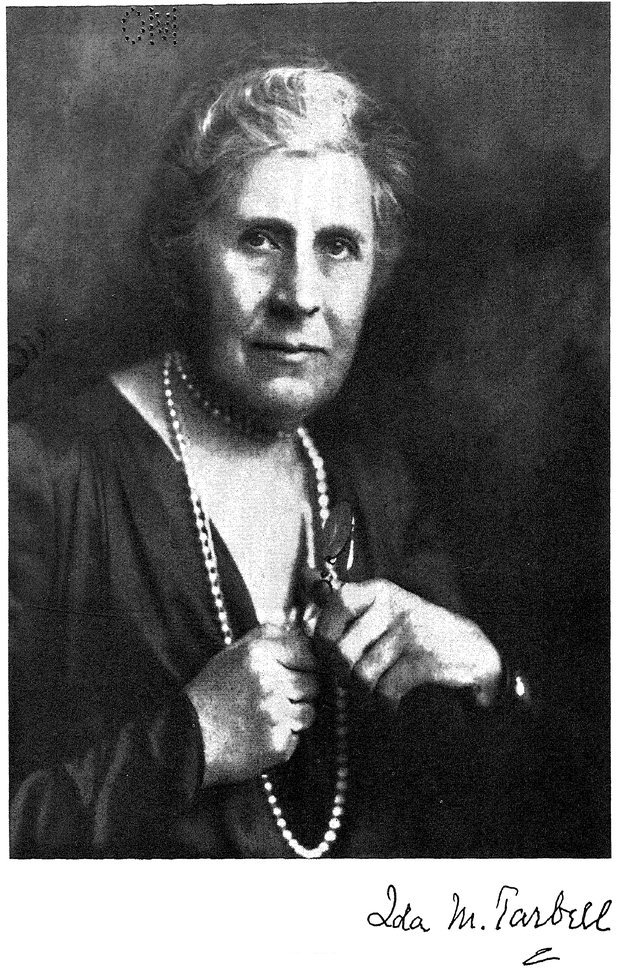
Photograph by Alfred Cheney Johnston
At 70
BY IDA M. TARBELL
NEW YORK
The Macmillan Company
1939
Copyright, 1939, by
THE MACMILLAN COMPANY.
All rights reserved—no part of this book
may be reproduced in any form without
permission in writing from the publisher,
except by a reviewer who wishes to quote brief
passages in connection with a review written
for inclusion in magazine or newspaper.
If it had not been for the Panic of 1857 and the long depression
which followed it I should have been born in Taylor County, Iowa.
That was what my father and mother had planned. In fact, however,
I was born in a log house in Erie County, Pennsylvania, on
November 5, 1857. It was the home of my pioneering maternal
grandfather Walter Raleigh McCullough. No home in which I
have ever lived has left me with pleasanter memories of itself. It
was a Cape Cod house, a story and a half high, built of matched
hewn logs, its floors of narrow fitted oak planks, its walls ceiled,
its “upstairs” finished, a big fireplace in its living room. There
were spreading frame outbuildings to accommodate the multiple
activities of a farm which was in my time a going concern. I remember
best the big cool milk room with its dozens of filled pans
on the racks, its huge wooden bowl heaped with yellow butter on
its way to the firkin, its baskets piled with eggs, its plump dressed
poultry ready for market.
Like all young married people of pioneer ancestry and experience
having their way to make, my parents wanted land. Land of
their own, combined with what my father could earn at his profession
as a teacher and his trade as a joiner, meant future security.
It was the proved way of the early American.
After much looking about in northwestern Pennsylvania where
the families of both were settled, they had decided that the West
offered greater opportunity and so in the spring of 1857, a
year after his marriage, my father, Franklin Sumner Tarbell
by name, started out to find a farm. He had but little money in
his pocket, and the last one hundred fifty miles of his search were
made on foot. How enthusiastic he was over the claim he at last
2secured! His letters tell of the splendid dome of sky which covered
it, of the far view over the prairie, of marvelous flowers and birds,
of the daily passing along the horizon of a stream of covered
wagons, settlers bound for California, Pikes Peak, Kansas, Nebraska;
and some of them, he found, were earlier Iowa settlers,
leaving the very state which for the moment seemed to him the
gate to Paradise.
He set himself gaily at breaking land, building the house for
mother, working in a sawmill to pay for the lumber. He did it
alone, even to the making of window frames and doors. I know
how he did it—whistling from morning till night, mischief and
tenderness chasing each other across his blue eyes as he thought
of my mother’s coming, their future together.
The plan they had made provided for her going west with their
household goods in August. The money was arranged for, so they
thought; but before it was taken from the bank the panic came,
and every county bank in Pennsylvania was closed. There was no
money anywhere, nothing for my mother to do but stay where she
was while my father struggled to earn by teaching and carpenter
work the money which would bring us on. But the panic reached
Iowa, dried up its money supply. People were living by barter,
my father reported. What a heartbreaking waiting it was for
them, coming as it did after an engagement of six years every
week of which they had both found long!
The fall and winter of 1857, the spring and summer of 1858
passed. Still there was no money to be had, and then in the fall of
1858 father started out to teach his way to us. Before he found a
school he had walked one hundred and eighty miles—walked until
his shoes and clothes were worn and tattered. It was “shabby and
broke,” as he had written it would be, that he finally in the spring
of 1859, when I was a year and a half old, made his way back to
my mother still living in the log house in Erie County.
According to the family annals I deeply resented the intimacy
between the strange man and my mother, so far my exclusive possession.
Flinging my arms about my mother, so the story went, I
cried, “Go away, bad man.”
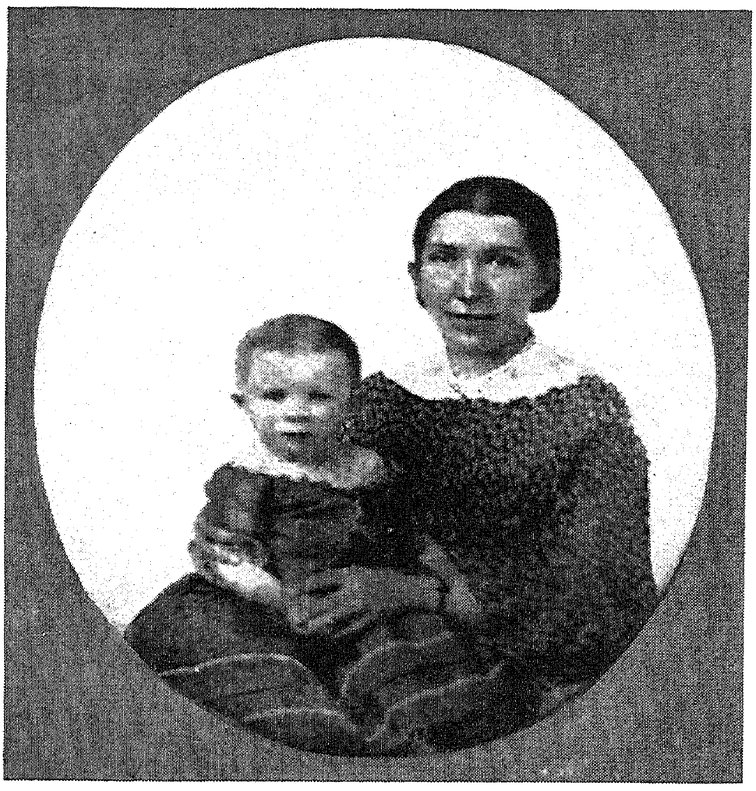
Esther Ann McCullough Tarbell and Ida Minerva Tarbell, November 5, 1858
3The problem for my father now was to earn money to take us
back to Iowa, for my mother to continue her patient waiting.
For a dozen years before her marriage she had taught in district
schools in Erie County, as well as in a private school of an aunt
in Poughkeepsie, New York. She was a good teacher, but she was
married! She must stay with her family then until her husband
had a home ready for her; so ruled my grandmother, chock-full as
she was of the best and severest New England rules for training
girls to be ladies. You might live in a log house. You were reminded
loftily that many of the “best families” had done that
while “settling the country,” but you must “never forget who you
are!” “Remember that your father is a McCullough of an ancient
and honored Scotch clan, his mother a Raleigh of Sir Walter’s family,
that I am a Seabury, my great-uncle the first Episcopal
Bishop in the United States, my mother a Welles, her father on
Washington’s staff.” It was a litany her four daughters all had
to learn!
Exciting employment waited my father. For six or seven years
before his marriage, when he was earning his way through the
Academy of Jamestown, New York, he spent his summers running
a fleet of three or more flatboats of merchandise to be delivered at
trading points on the Allegheny and the Ohio River—always as
far south as Louisville, sometimes even up the Mississippi. “Captain
Tarbell,” his small and jolly crew called him. The River was
the chief highway of a great country. To its waters came the
pioneer and trader, the teacher, the preacher, the scientist, the
prophet, as well as every species of gambler, charlatan, speculator,
swindler, cutthroat. My father’s stories of what he saw were
among the joys of my childhood: a great fleet of steamboats
burning at Pittsburgh, a hanging, river churches and preachers
and show boats, children who never knew other homes than a boat,
towns, cities, and what he loved best of all—nights floating quietly
4down the great Ohio, the moon above. Not strange that after those
cruel months of working his way back to us he should have seized
this opportunity again to take charge of his Jamestown friend’s
river enterprise.
The trip went well, and at the end of August, 1859, he turned
back, money in his pocket to take us to Iowa. But as he journeyed
eastward he was met everywhere by excitement. A man had drilled
a well near a lumber settlement in northwestern Pennsylvania—Titusville
it was called—drilled for oil and found it, quantities of
it. My father, like most men who traveled up and down the
Allegheny and Ohio in those days, was familiar with crude petroleum.
He had used it to grease creaking machinery and, too, as a
medicine, a general cure-all, Seneca oil; used it for the colds,
the fever and ague, the weak lungs which had afflicted him from
boyhood. He knew, too, that there were those who believed that if
rock oil, as it was called, could be found in sufficient quantities it
would make a better light than the coal and whale oils then in
common use. The well near Titusville producing twenty-five to
one hundred barrels a day—nobody knew how much—proved that
if other reservoirs or veins could be opened by such drilling there
would be oil to light the world.
Rumors were exciting and grew in the telling. The nearer he
came to Erie County, the bigger the well. He met men on foot and
horseback making their way in. Something to look into before he
started back to Iowa. He looked into it, not merely at Titusville
with its first well, but down the stream on which the first well
stood and where other wells were already drilling. Oil Creek, it was
called. What if they continued to get oil? my father asked himself.
Where would they put it? They would need tanks, tanks in
numbers. He believed he could build one that would hold five
hundred or more barrels. He said as much to the owner of a well
drilling down the creek near the mouth of a tributary called
Cherry Run. “Show me a model that won’t leak, and I’ll give you
an order.” He lost no time in making his model and got his order.
5Here was a chance for a business if oil continued to be found,
a business with more money in it than he had ever dreamed of
making. Moreover, he knew all the elements of that business, had
had experience in handling them. Tank building called for his
trade, that of the joiner. Iowa could wait.
By the summer of 1860 he had his shop going at the mouth of
Cherry Run near the well for which he had received his first order.
The shop running, he built what was to be my mother’s first home
of her own, the one for which with infinite confidence and infinite
pain she had been waiting since her marriage four years and a
half before.
It was in October of 1860 that my father drove his little family
over the Allegheny foothills some forty miles. There were two of
us children now, for in July of 1860 my brother William Walter
Tarbell, named from his two grandfathers, had been born. Close
beside his shop father had built a shanty. It had a living room
with an alcove, a family bedroom with trundle beds for us children,
and a kitchen. A covered passage led into the shop, which
was soon to be the joy of my life for here were great piles of long
odorous curly pine shavings into which to roll, to take naps, to
trim my gown, and in which to search day in and day out for the
longest, the curliest.
But these shavings and my delight in them were a later discovery.
My first reaction to my new surroundings was one of acute
dislike. It aroused me to a revolt which is the first thing I am sure
I remember about my life—the birth in me of conscious experience.
This revolt did not come from natural depravity; on the
contrary it was a natural and righteous protest against having the
life and home I had known, and which I loved, taken away without
explanation and a new scene, a new set of rules which I did
not like, suddenly imposed.
My life in the log house had been full of joyous interests. There
were turkeys and ducks and chickens, lambs and colts and calves,
kittens and puppies—never could I be without playmates. There
6were trees and woods and flowers in summer—a great fireplace
with popcorn and maple candy in winter, and I an only grandchild
the center of it all. But what had I come to? As mother
realized, a place of perils, a creek rushing wildly at the side of the
house, great oil pits sunken in the earth not far away, a derrick
inviting to adventurous climbing at the door. No wonder that
warnings and scoldings and occasional switchings dogged my
steps. Moreover, I was no longer the center of the circle: a baby
filled her arms—“my” arms! A man still strange gave me orders
and claimed her—“my” mother.
It was not to be endured, and so one November day just after
my third birthday I announced I was going to leave. “Going back
to Grandma.” “Very well,” my mother said. I knew the way the
men went when they walked away from the shop, and I followed it,
but not far. Across the valley in which we lived ran an embankment.
To my young eyes it was as high as a mountain, and the
nearer I came the higher it looked, the higher and blacker. And
then suddenly as I came to its foot I realized that I had never been
on the other side, that I did not know the way to Grandma’s. I
knew I was beaten, and sat down to think it over. Never in all these
years since have I faced defeat, known that I must retreat, that I
have not been again that little figure with the black mountain in
front of it, a little figure looking longingly at a shanty dim in the
growing night but showing a light in the window.
Finally I turned slowly back to the house and sat down on the
steps. It seemed a long time before the door opened and my mother
in a surprised voice said:
“Why, Ida! I thought you had gone to Grandma’s.”
“I don’t know the way,” I said humbly.
“Very well. Come in and get your supper.”
Respect for my mother, her wisdom in dealing with hard situations,
was born then. I was not to be punished; I was not to be
laughed at; I was to be accepted. Years later she told me of the
unhappy hour she spent watching me go off so sturdily, to come
7back so droopingly, watching with tears running down her cheeks,
but determined I must learn my lesson. It was a bit of wisdom she
never ceased to practice. My mother always let me carry out my
revolts, return when I would and no questions asked.
In the three years we spent in the shanty on the flats there was
but one other episode that had for me the same self-revealing
quality as this revolt. It was my first attempt to test by experiment.
The brook which ran beside the house was rapid, noisy, in
times of high water dangerous for children. Watching it, fascinated,
I observed that some things floated on the surface, others
dropped to the bottom. It set me to wondering what would happen
to my little brother, then in dresses, if dropped in. I had to find
out. There was a footbridge near the house, and one day when I
supposed I was unobserved I led him onto it and dropped him in.
His little skirts spread out and held him up. Fortunately at that
moment his screams brought a near-by workman, and he was
rescued. I suppose I was spanked; of that I remember nothing,
only the peace of satisfied curiosity in the certainty that my
brother belonged to the category of things which floated.
What I really remember of these early days concerns only my
personal discoveries, discoveries of the kind of person I was, of the
nature of things around me which stirred my curiosity. Whether
a childish experience was deep enough to etch itself on my memory
or I only know of it from hearing it told and retold, I always
decide by this test: if I really remember it, the happening
is set in a scene—a scene with a background, exits, entrances, and
properties. I know I remember my revolt and defeat because I always
see it as an act on a stage, every detail, every line clear.
Of the pregnant, bizarre, and often tragic development going
on about me I remember nothing; yet the uncertainties and dangers
of it were part of our daily fare.
Whether there was oil in the ground in sufficient quantities to
justify the prodigious effort being made to find it, nobody could
know. If not, the shop and shanty were a dead loss—another long
8delay on the road to Iowa. All that winter of 1860 and 1861 my
father was asking himself that question; but in 1861 it was answered
when up and down Oil Creek a succession of flowing wells
came in, wells producing from three hundred to three thousand
barrels a day—“fountain wells,” “gushers,” “spouters,” they
called them from the great streams which rose straight into the
air one to two hundred feet, to fall in an oily green-black spray
over the surrounding landscape.
Deadly, dangerous, too, as the Oil Region learned to its sorrow
by a disaster almost at the doorsteps of our Cherry Run home. It
was the evening of April 17, 1861. The news of the Fall of Sumter
had just reached the settlement, remote as it was from rail and
telegraph connections, and all the men of the town had gathered
after supper at one place or another to discuss the situation. What
did it mean? What would the President do? My father was sitting
on a cracker barrel in the one general store. As he and his friends
talked a man ran in to tell the company that a fresh vein of oil
had been struck in a well on the edge of the town. Its owner, Henry
Rouse, had been drilling it deeper; the oil was spouting over the
derrick. Great news for the community still uncertain as to the
extent of its field. Great news for my father. It meant tanks.
Everybody jumped to run to the well when the earth was rocked
by a mighty explosion. A careless light had ignited the gas which
had spread from the flowing oil until it had enveloped everything
in the vicinity. Before my father reached the place nineteen men,
among them his friend the well—owner Henry Rouse, had been
burned to death. How many had escaped and in what condition,
nobody knew.
Late that night as my father and mother grieved they heard
outside their door a stumbling something. Looking out, they saw
before them a terrible sight, a man burned and swollen beyond
recognition and yet alive, alive enough to give his name—one of
their friends. My mother took him in—the alcove became a hospital.
For weeks she nursed him—the task of the woman in a
9pioneer community, a task which she accepted as her part. Thanks
to her care, the man lived. The relics of that tragedy were long
about our household—comforts and bedquilts she had pieced and
quilted for Iowa stained with linseed oil, but too precious to be
thrown away.
But all this is as something read in a book, something which has
become more poignant as the years have gone by and I am able
to feel what those long weeks of care over that broken man meant
to my mother.
The business prospered, the shop grew. Little do I remember
of all this, or the increased comforts of life or moving into the
new home on the hillside above the town by this time known as
Rouseville. But the change in the outlook on the world about me,
I do remember. We had lived on the edge of an active oil farm
and oil town. No industry of man in its early days has ever been
more destructive of beauty, order, decency, than the production
of petroleum. All about us rose derricks, squatted engine-houses
and tanks; the earth about them was streaked and damp with the
dumpings of the pumps, which brought up regularly the sand and
clay and rock through which the drill had made its way. If oil
was found, if the well flowed, every tree, every shrub, every bit of
grass in the vicinity was coated with black grease and left to die.
Tar and oil stained everything. If the well was dry a rickety
derrick, piles of debris, oily holes were left, for nobody ever
cleaned up in those days.
But we left the center of this disorder, went to the hillside,
looked down on it; and as for me I no longer saw it, for opposite
us was a hillside so steep it had never been drilled. It was clothed
with the always changing beauty of trees and shrubs, the white
shadflowers and the red maples, the long garlands of laurel and
azalea in the spring, the green of every shade through the summer,
the crimson and gold, russets and tans of the fall, the frost-
and snow-draped trees of the winter. I did not see the derricks
for the trees. The hillside above our house and the paths which
10led around it became a playground in which I reveled. I was not
the only one about to forget the ugliness of the Valley and remember
through life the beauty of those hillsides. Years later I was
to know fairly well one of the great figures in the development of
oil, Henry H. Rogers, then the active head of the Standard Oil
Company. We discovered in talking over the early days of the
industry that at the very moment I was beginning to run the hills
above Rouseville he was running a small refinery on the Creek
and living on a hillside just below ours, separated only by a narrow
ravine along each side of which ran a path. “Up that path,”
Mr. Rogers told me, “I used to carry our washing every Monday
morning, go for it every Saturday night. Probably I’ve seen you
hunting flowers on your side of the ravine. How beautiful it was!
I was never happier.” That reminiscence of Henry H. Rogers is
only one of several reasons I have for heartily liking as fine a
pirate as ever flew his flag in Wall Street.
Soon after we went to the home on the hill the oil country, at
that moment suffering a depression, was stirred by the news that
a great well had been struck ten miles from Rouseville at Pithole,
an isolated territory to which the veterans in the business had
never given a thought. The news caused a wild scramble. A motley
procession of men with and without money, with and without
decency, seeking leases, jobs, opportunity for adventure, excitement
and swindling travelled on foot or horseback up the Valley
of Cherry Run in full view from our house.
Father was one of the first to take advantage of the Pithole
discovery, putting up his tank shops there and doing a smashing
business during the short life of the field. Its “bottom fell out” in
1869. He rode back and forth from his shop on a little saddle
horse—Flora, beautiful creature—usually with considerable
sums of money in his pocket. The country was full of ruffians,
and stories of robbery were common. When he was very late in
returning mother would walk the floor wringing her hands. I
could never go to bed those nights until he had returned, not
11because I felt her anxiety but because of the excitement and
mystery of it. I carried a dramatic picture of him in mind, a
kind of Paul Revere dashing along the lonely road, the rein on
Flora’s neck, his pistol in hand. But he always came home,
always brought the money he had collected, which he must keep
in the tiny iron safe in his office annexed to the house until he
could carry it to Oil City where he banked.
My life became rapidly more conscious now that I had left the
flats behind, experience deeper. Here was my first realization of
tragedy. It was the spring of 1865. Father was coming up the
hill, mother and I were watching for him. Usually he walked with
a brisk step, head up, but now his step was slow, his head dropped.
Mother ran to meet him crying, “Frank, Frank, what is it?” I
did not hear the answer; but I shall always see my mother turning
at his words, burying her face in her apron, running into her
room sobbing as if her heart would break. And then the house
was shut up, and crape was put on all the doors, and I was told
that Lincoln was dead.
From that time the name spelt tragedy and mystery. Why all
this sorrow over a man we had never seen, who did not belong to
our world—my world? Was there something beyond the circle of
hills within which I lived that concerned me? Why, and in what
way, did this mysterious outside concern me?
I was soon to learn that tragedy did not come always from a
mysterious beyond. What a chain of catastrophes it took to teach
the men and women who were developing the new industry the
constant risk they ran in handling either crude or refined oil.
They came to our very door, when a neighboring woman hurrying
to build a fire in her cookstove poured oil on the wood before
she had made sure there were no live coals in the firebox. An awful
explosion occurred and she and two women who ran to her assistance
were burned to a crisp. I heard horrified whisperings about
me. The refusal to tell me what had happened aroused a terrible
curiosity. I gathered that the bodies were laid out in a house not
12far away and, when nobody was looking, stole in to look at them.
Broken sleep for me for nights.
The mystery of death finally came into our household. There
had been a fourth child born in the house on the hill—“little
Frankie,” we always called him—blue-eyed like my father, the
sunniest of us all. For weeks one season he lay in the parlor fighting
for life—scarlet fever—a disease more dreaded by mothers
in those days than even smallpox. Daily I stood helpless, agonized,
outside the door behind which little Frankie lay screaming
and fighting the doctor. I remember even today how long the
white marks lasted on the knuckles of my hands after the agony
behind the closed door had died down and my clenched fists
relaxed.
Little Frankie died, became a pathetic and beloved tradition
in the household. My little sister, who had made a terrible and
successful fight against the disease, told me how she could not
understand why father and mother cried when they talked of
Frankie.
“If they want to see him,” she thought, “why do they not put
a ladder from the top of the hill up to the sky into heaven and
climb up? If Frankie is there God would let them see him.”
I have said that my first recollection of Lincoln was the impression
made by the tragedy of his death. That this was so was not
for the lack of material on him in our household. My father was
an ardent Republican. Back in ’56 he had written from his river
trip, “Hurrah for Frémont and Dayton.” As soon as he had had
more money than the actual needs of the family required, he had
subscribed to Harper’s Weekly, Harper’s Monthly, the New
York Tribune, began to buy books. Of all of these I remember
only the Weekly and Monthly. My brother and I used to lie by
the hour flat on our stomachs, heels in the air, turning over the
exciting pages of the War numbers; but none of it went behind
my eyes—none concerned me. Only now when I go back to the
13files of those old papers there is a whispering of something once
familiar.
Of the Monthly I have more distinct recollections. It was in
these that I first began to read freely. Many a private picnic did
I have with the Monthly under the thorn bushes on the hillside
above Oil Creek, a lunch basket at my side. There are still in the
family storeroom copies of Harper’s Monthly stained with lemon
pie dropped when I was too deep into a story to be careful. Here
I read my first Dickens, my first Thackeray, my first Marian
Evans, as George Eliot then signed herself. My first Wilkie Collins
came to me in the Weekly. Great literature—all pirated, I
was to learn much later. My friend Viola Roseboro tells me that
at this time she was reading Harper’s pirated paper-bound copies
of Dickens. It was much later that they came my way.
However, all the reading I was doing was not so respectable.
On the sly I was devouring a sheet forbidden to the household—the
Police Gazette—the property of the men around the house,
for we had men around the house, men of various degrees of
acceptability to my mother, but all necessary to my father’s
enterprises. The business had grown; it meant a clerk, bosses,
workmen. In a pioneer community like ours it was hard to find
comfortable living quarters for single men. My father and mother,
both brought up on farms, accepted as a matter of course the
housing and feeding of hired men. So it was in line with their
experience as well as with the necessities of the case that our
household was arranged to take care of a certain number of men
connected with my father’s business. For sleeping quarters a
bunkhouse was built on the hillside; mornings and evenings, they
sat at the family table. This accepting men of whose manners and
ways she often heartily disapproved was distasteful to my mother;
but she had not been a schoolteacher for nothing, and she applied
her notions of discipline. She would not have swearing, drinking,
rough manners, and certainly she would not have had the Police
14Gazette in the house. But the men had it, and now and then when
my brother and I played about the bunkhouse it was easy for me
to pick up a copy and slip it away where my dearest girl friend
and I looked unashamed and entirely unknowing on its rough
and brutal pictures. If they were obscene we certainly never knew
it. There was a wanton gaiety about the women, a violent rakishness
about the men—wicked, we supposed, but not the less interesting
for that.
One reason the Police Gazette fascinated me was that it pictured
a kind of life I knew to be flourishing in a neighboring settlement,
a settlement where my father had shops run by a boss
who, as well as his sister, was a family friend, and where I was
often allowed to visit. This settlement, Petroleum Center, had by
something like general consent become Oil Creek’s “sink of
iniquity.”
The discovery of oil, the growing certainty that it was the
beginning of a new industry, that money was flowing into the Oil
Region quickly brought an invading host of men and women
seeking fortunes. It was a new and rich field for tricksters,
swindlers, exploiters of vice in every known form. They were soon
setting up shops in every settlement and, to the credit of the
manhood of the Oil Region, usually being driven out by self-directed
vigilantes.
At Rouseville a “joy boat” which made its way up the Creek
that first winter and tied up near my father’s shop was cut loose
in the middle of the night after its arrival. Its visitors found
themselves floating down the Allegheny River the next morning
and obliged to walk back. From that time open vice shunned the
town. But when wealth poured out of the ground at Petroleum
Center there was too great excitement to think of order, decency.
Before it was realized, the town was alive with every known form
of wantonness and wickedness. By the time I was allowed to visit
our friends there, I saw from the corner of my eye as I walked
sedately the length of the street saloons, dance halls, brothels; and
15I noted many curious things. The house where I visited stood on a
slope overlooking one of the most notorious dance halls of the
Oil Region—Gus Reil’s. Often I left my bed at night and watched
that long low building from which rose loud laughter, ribald
songs, shouts, curses. Later horror was added to Gus Reil’s fascination,
for here a Rouseville boy was shot one night.
If Petroleum Center was giving me an opportunity to feed my
curiosity about things in the world of which I was not supposed
to know, it happened also to be the indirect means of awaking
my interest in the stars, one of the most beautiful interests of my
youth. My father had seen the early passing of the wooden oil
tank, the coming of the iron tank, and had used his capital to
become an oil producer. One of his first investments had been in
an oil farm on the hills above the wicked town which so excited
my curiosity. His partner in this venture, M. E. Hess, lived on
this farm with his family. In that family was a daughter about
my age and bearing my name—Ida. We became friends and
visited back and forth as chance offered. My chance came often
when Mr. Hess, riding with a companion over the hills to Rouseville
to consult with father, dropped his companion and took me
back with him, usually at night. A fine pair of saddle horses he
had—“High Fly” and “Shoo Fly.” My first experience in horseback
riding was following him on “Shoo Fly” over the hills after
dark.
Mr. Hess was an altogether unusual man, educated, with a
vein of poetry in him. As we rode he would stop every now and
then to name the stars, trace the constellations, repeat the legends.
My first consciousness of space, its beauty, its something
more than beauty, came then.
Not a bad counterbalance for what I was gathering in the
town below the farm on the hill and seeing reproduced in the
Police Gazette, which so perfectly pictured its activities.
But there were other correcting forces at work on me. The men
who formed the vigilante committee to make Rouseville difficult
16for commercialized vice (my father one of them) set themselves
early to establishing civilizing agencies—first a church.
It was decided by the men and women who were to build and
support this church that it should be of the denomination of
which there were the largest number in the community. The
Methodists had the numbers, and so my father and mother who
were Presbyterians became and remained Methodists. Their support
was active. We did not merely go to church; we stayed
to class meeting; we went to Sunday school, where both father
and mother had classes; we went to Wednesday night—or was it
Thursday night?—prayer meeting. And when there was a revival
we went every night. In my tenth or eleventh year I “went forward”
not from a sense of guilt but because everybody else was
doing it. My sense of sin came after it was all over and I was
tucked away in bed at night. I had been keenly conscious as I
knelt at the Mourners’ bench that the long crimson ribbons which
hung from my hat must look beautiful on my cream-colored coat.
The realization of that hypocrisy cut me to the heart. I knew
myself a sinner then, and the relief I sought in prayer was genuine.
I never confessed. It wasn’t the kind of sin other converts
talked about. But it aroused self-observation; I learned that
often when I was saying the polite or proper thing I was thinking
quite differently. For a long time it made me secretly
unhappy thinking that in me alone ran an underground river of
thought. Later I began to suspect that other people were like
this, that always there flowed a stream of unspoken thought
under the spoken thought. It made me wary of strangers.
A side of my life which moves me deeply now, as I think back,
was the continuous effort of my father and mother to give me
what were called advantages, to use their increasing income to
awaken and develop in me a taste for things which they had
always been denied. They wanted music in the household and our
grandest possession became a splendid Bradbury square piano—a
17really noble instrument—with one of the finest, mellowest tones
that I have ever heard in a piano.
A music teacher turned up in the community and I was at
once set at five-finger exercises, and I was kept at them and all
that follows them for many years; but I found no joy in what
I was doing. It is possible that with different teachers from those
available there might have been a spring touched, for untrained
as I am I am not without a certain appreciation of music.
I mastered the mechanics of piano playing well enough, however,
to become later one of the regular performers in the high
school in the town to which we were to move—Titusville, Pennsylvania.
I remembered nothing of this until two of my old friends
in Titusville, school chums, told me that I was one of the three
or four who played the piano for the morning exercises, that I
sometimes played my show pieces, and that on one occasion I was
an actor in a scene which they recalled with glee. They told me
I was playing a duet with a classmate. We either lost our place
or did not agree as to time—stopped entirely, argued the matter
out, began over, and this time went through without dissension;
but I have only this secondhand memory of my contribution to
the musical life of the Titusville High School.
I remember the efforts of my father and mother to show me
something of the outside world much more clearly than I do
those to awaken my interest in books and music. There were little
trips, once as far as Cleveland—the whole family—the marvel of
the “best hotel,” of new hats and coats and armfuls of toys.
There were summers at the farm, only thirty miles away. Best
remembered and most enjoyed were the all-day-excursion picnics.
No one can understand the social life of a great body of the
American people in the latter part of the nineteenth century
without understanding the hold the picnic had on them. The
Tarbell household took the picnic so seriously that it had a special
equipment of stout market baskets, tin cups and plates, steel
18knives and forks, tin spoons, worn napkins (the paper ones
were then unheard of). The menus were as fixed as that for a
Thanksgiving dinner: veal loaf, cold tongue, hard-boiled eggs—“two
apiece”—buttered rusks, spiced peaches, jelly, cucumber
pickles, chowchow, cookies, doughnuts (we called them fried
cakes), and a special family cake. And you ate until you were
full.
Our grandest picnic excursions in those days were to Chautauqua
Lake, a charming sheet of water only some fifty miles from
home. Near the head of the lake lay an old Chautauqua County
town, Mayville; at its foot, Jamestown where my father for several
years had been a student in the Academy, and from which
in vacations he had gone on his annual trips down the Ohio.
Loaded with big baskets of lunch, we took an early train to Mayville,
changed there to a little white steamer: zigzagged the
length of the lake, twenty or so miles, stopping at point after
point. We ate our lunch en route, and at Jamestown went uptown
to drink a bottle of “pop.” And then came the slow return home,
where we arrived after dark exhausted by pleasure.
Three or four miles from Mayville on the west side of the lake
jutted a wooded promontory—Fair Point—the site in those days
of a Methodist camp meeting; and here we sometimes stopped
for the day. We never liked it so well as going to Jamestown;
neither did father.
2 I DECIDE TO BE A BIOLOGIST
19
Five years went by in the house on the hill, and then in 1870
when I was thirteen I found myself in Titusville, Pennsylvania,
in a new house my father had built. How characteristic of the
instability of the oil towns of that day, as well as of the frugality
of my father, was this house! From the beginning of the Pithole
excitement he had, as I have said, made money—more than he
could ever have dreamed, I fancy; and then about 1869 practically
without warning the bottom fell out, as the vernacular of
the region put it. The end shut up my father’s shops there, but
it also gave us the makings of a home. In that rapid development,
only four years long, a town of some twenty thousand had
grown up with several big hotels—among them, one called the
Bonta House. It had features which delighted my father—long
French windows, really fine iron brackets supporting its verandahs,
handsome woodwork. The Bonta House was said to have
cost $60,000, but its owners were glad to take the $600 father
offered when the town “blew up.” He paid the money, tore down
the building, loaded its iron brackets and fine doors and windows,
mouldings and all, and I suppose much of its timber, onto
wagons and carted it ten miles away to Titusville where, out of it,
he built the house which was our home for many years.
Titusville was not like Rouseville, which had suddenly sprung
from the mud as uncertain as a mushroom of the future. It had
been a substantial settlement twenty years before oil was found
there, small but sturdy with a few families who had made money
chiefly in lumber, owning good homes, carefully guarding the
order and decency of the place.
The discovery of oil overran the settlement with hundreds of
20fortune seekers. They came from far and near, on foot, horseback,
wagon. The nearest railroad connection was sixteen miles
away, and the roads and fields leading in were soon cut beyond
recognition by the heavy hauling, its streets at times impassable
with mud.
The new industry demanded machinery, tools, lumber—and
the bigger it grew, the greater the demand. Titusville, the birthplace
of all this activity, as well as the gateway down the Creek,
must furnish food and shelter for caravans of strangers, shops
for their trades, offices for speculators and brokers, dealers in oil
lands and leases, for oil producers, surveyors, and draftsmen—all
the factors of the big business organization necessary to develop
the industry. In 1862 the overflow was doubled by the arrival of
a railroad with a connection sixteen miles away with the East
and West. The disbanding of the Army in June of 1865 brought
a new rush—men still in uniform, their rifles and knapsacks on
their backs. Most of this fresh inflow was bound to the scene of
the latest excitement, Pithole.
Stampeded though she was, Titusville refused to give up her
idea of what a town should be. She kept a kind of order, waged
a steady fight on pickpockets, drunkards, wantons; and in this
she was backed by the growing number of men and women who,
having found their chance for fortune in oil, wanted a town fit
for their families. After churches, the schools were receiving the
most attention. It was the Titusville schools which had determined
my father and mother to make the town their permanent
home.
But school did not play a serious part in my scheme of things
at the start. I went because I was sent, and had no interest in
what went on. I was thirteen, but I had never been in a crowded
room before. In a small private school the teacher had been my
friend. Here I was not conscious my teacher recognized my existence.
I soon became a truant; but the competent ruler of that
schoolroom knew more than I realized. She was able to spot a
21truant, and one day when I turned up after an unexplainable
absence she suddenly turned on me and read me a scathing lecture.
I cannot remember that I was ashamed or humiliated, only
amazed, but something in me asserted itself. I suppose that here
a decent respect for the opinions of mankind was born; at least
I became on the instant a model pupil.
A few months later I passed into high school; and when at the
end of the year the grades were averaged at a ceremony where
everybody was present I stood at the head of the honor roll.
Nobody could have been more surprised. I had not been working
for the honor roll: I had simply been doing what they expected
me to do as I understood it, and here I was at the top. I remember
I felt very serious about it. Having made the top once, I knew
what would be expected of me. I couldn’t let my father and
mother or my teachers down, so I continued to learn my lessons.
It was a good deal like being good at a game. I liked to work out
the mathematics and translations—good puzzles, but that they
had any relation to my life I was unconscious. And then suddenly,
among these puzzles I was set to solve, I found in certain
textbooks the sesame which was to free my curiosity, stir desires
to know, set me working on my own to find out more than these
books had to offer. The texts which did all this for me were a
series I suspect a modern teacher might laugh at—Steele’s Fourteen
Weeks in Zoology, Geology, Botany, Natural Philosophy,
Chemistry.
Here I was suddenly on a ground which meant something to
me. From childhood, plants, insects, stones were what I saw when
I went abroad, what I brought home to press, to put into bottles,
to “litter up the house.” The hills about Rouseville were rich in
treasures for such a collector, but nobody had ever taught me
more than their common names. I had never realized that they
were subjects for study, like Latin and geometry and rhetoric
and other such unmeaning tasks. They were too fascinating. But
here my pleasure became my duty. School suddenly became exciting.
22Now I could justify my tramps before breakfast on the hills,
justify my “collections,” and soon I knew what I was to be—a
scientist. Life was beginning to be very good, for what I liked
best to do had a reason. No doubt this uplift was helped by the
general cheerfulness of the family under our new conditions of
life.
Things were going well in father’s business; there was ease
such as we had never known, luxuries we had never heard of.
Our first Christmas in the new home was celebrated lavishly. Far
away was that first Christmas in the shanty on the flats when
there was nothing but nuts and candy and my mother and father
promising, “Just wait, just wait, the day will come.” The day
had come—a gorgeous Christmas tree, a velvet cloak, and a fur
coat for my mother. I haven’t the least idea what there was for
the rest of us, but those coats were an epoch in my life—my first
notion of elegance.
This family blossoming was characteristic of the town. Titusville
was gay, confident of its future. It was spending money on
schools and churches, was building an Opera House where Janauschek
soon was to play, Christine Nilsson to sing. More and
more fine homes were going up. Its main street had been graded
and worked until fine afternoons, winter and summer, it was
cleared by four o’clock for the trotting of the fast horses the rich
were importing. When New Year’s Day came every woman received—wine,
cakes, salads, cold meats on the table—every man
went calling. That is, Titusville was taking on metropolitan airs,
led by a few citizens who knew New York and its ways, even
spoke familiarly of Jay Gould and Jim Fisk, both of whom
naturally enough had their eye on us. Did not the Erie road
from which they at the moment were filling their pockets regard
oil as one of its most profitable freights? We were grain for
their mill.
There was reason for confidence. In the dozen years since the
first well was drilled the Oil Creek Valley had yielded nearly
23thirty-three million barrels of crude oil. Producing, transporting,
refining, marketing, exporting, and by-products had been developed
into an organized industry which was now believed to have
a splendid future.
Then suddenly this gay, prosperous town received a blow
between the eyes. Self-dependent in all but transportation and
locally in that through the pipe lines it was rapidly laying to
shipping points, it was dependent on the railroads for the carrying
of its crude oil to outside refining points and for a shipping
of both crude and refined to the seaboard—a rich and steady
traffic for which the Oil Region felt the railroads ought to be
grateful; but it was the railroads that struck the blow. A few
refiners outside the region—Cleveland, Pittsburgh, Philadelphia—concocted
a marvelous scheme which they had the persuasive
power to put over with the railroads, a big scheme by which those
in the ring would be able to ship crude and refined oil more
cheaply than anybody outside. And then, marvelous invention,
they would receive in addition to their advantage a drawback on
every barrel of oil shipped by any one not in the group. Those
in the South Improvement Company, as the masterpiece was
called, were to be rewarded for shipping; and those not in, to be
doubly penalized. Of course it was a secret scheme. The Oil
Region did not learn of it until it had actually been put into
operation in Cleveland, Ohio, and leaked out. What did it mean
to the Oil Region? It meant that the man who produced the oil,
and all outside refiners, were entirely at the mercy of this group
who, if they would, could make the price of crude oil as well as
refined. But it was a plan which could not survive daylight. As
soon as the Oil Region learned of it a wonderful row followed.
There were nightly antimonopoly meetings, violent speeches,
processions; trains of oil cars loaded for members of the offending
corporation were raided, the oil run on the ground, their
buyers turned out of the oil exchanges; appeals were made to the
state legislature, to Congress for an interstate commerce bill,
24producers and refiners uniting for protection. I remember a night
when my father came home with a grim look on his face and told
how he with scores of other producers had signed a pledge not to
sell to the Cleveland ogre that alone had profited from the scheme—a
new name, that of the Standard Oil Company, replacing the
name South Improvement Company in popular contempt.
There were long days of excitement. Father coming home at
night, silent and stern, a sternness even unchanged by his after-dinner
cigar, which had come to stand in my mind as the sign of
his relaxation after a hard day. He no longer told of the funny
things he had seen and heard during the day; he no longer
played his jew’s-harp, nor sang to my little sister on the arm of
his chair the verses we had all been brought up on:
Augusta, Maine, on the Kennebec River,
Concord, New Hampshire, on the Merrimack, etc.
The commotion spread. The leaders of the New York Petroleum
Association left out of the original conspiracy, and in a
number of cases (as was soon to be shown) outraged chiefly for
that reason, sent a committee to the Oil Region to see what was
doing. The committee was joyfully welcomed, partly because its
chairman was well known to them all. It was my Rouseville neighbor,
Henry H. Rogers.
Mr. Rogers had left the Creek in 1867 and become a partner
in the Pratt firm of refiners and exporters of Brooklyn, New
York. He and his associates saw as clearly as his old friends in
the Oil Region that—let the South Improvement Company succeed
in its plan for a monopoly—everybody not in the ring
would be forced to go out of business. The New York men seem
to have been convinced that the plans for saving themselves
which the organized producers and refiners were laying stood a
good chance of success, for back in New York Mr. Rogers gave
a long interview to the Herald. He did not mince words. Cleveland
and Pittsburgh were “straining every nerve to create a
25monopoly.” They would succeed if their control of the railroads
continued. He and his fellows felt as the men in the Oil Region
did, that the breaking up of the South Improvement Company
was a “necessity for self-existence.” They were as bold in action
as in words, for when a little later the president of the Standard
Oil Company of Cleveland, John D. Rockefeller (to date, the
only beneficiary of the South Improvement Company), sought
an interview in New York with Mr. Rogers and his committee he
was treated cavalierly and according to the newspapers retreated
after a brief reception “looking badly crestfallen.”
Thus was the Henry H. Rogers of 1872.
Out of the long struggle begun as a scrimmage came finally
a well developed cooperative movement guaranteeing fair play
all around. It was signed by the Standard Oil Company’s representative
and all the oil-carrying railroads. The railroads indeed
were the first to succumb, knowing as they did that what they
were doing was contrary to the common law of the land, and
being thundered at as they were by the press and politicians of
all the country. “I told Willie not to go into that scheme,” said
old Commodore Vanderbilt; and Jay Gould whined, “I didn’t
sign until everybody else had.”
Out of the alarm and bitterness and confusion, I gathered
from my father’s talk a conviction to which I still hold—that
what had been undertaken was wrong. My father told me it was
as if somebody had tried to crowd me off the road. Now I knew
very well that, on this road where our little white horse trotted
up and down, we had our side, there were rules, you couldn’t use
the road unless you obeyed those rules, it was not only bad manners
but dangerous to attempt to disobey them. The railroads—so
said my father—ran through the valley by the consent of the
people; they had given them a right of way. The road on which
I trotted was a right of way. One man had the same right as
another, but the railroads had given to one something they would
not give to another. It was wrong. I sometimes hear learned people
26arguing that in the days of this historic quarrel everybody
took rebates, it was the accepted way. If they had lived in the Oil
Region through those days in 1872, they would have realized
that, far from being accepted, it was fought tooth and nail.
Everybody did not do it. In the nature of the offense everybody
could not do it. The strong wrested from the railroads the privilege
of preying upon the weak, and the railroads never dared
give the privilege save under promise of secrecy.
In walking through the world there is a choice for a man to
make. He can choose the fair and open path, the path which
sound ethics, sound democracy, and the common law prescribe,
or choose the secret way by which he can get the better of his
fellow man. It was that choice made by powerful men that suddenly
confronted the Oil Region. The sly, secret, greedy way
won in the end, and bitterness and unhappiness and incalculable
ethical deterioration for the country at large came out of that
struggle and others like it which were going on all over the country—an
old struggle with old defeats but never without men
willing to make stiff fights for their rights, even if it cost them
all they ever hoped to possess.
At all events, uncomprehending as I was in that fine fight,
there was born in me a hatred of privilege—privilege of any sort.
It was all pretty hazy to be sure, but still it was well, at fifteen,
to have one definite plank based on things seen and heard, ready
for a future platform of social and economic justice if I should
ever awake to my need of one. At the moment, however, my reflection
did not carry me beyond the wrongness of the privilege
which had so upset our world, contradicting as it did the principle
of consideration for others which had always been basic in
our family and religious teaching. I could not think further in
this direction, for now my whole mind was absorbed by the overwhelming
discovery that the world was not made in six days of
twenty-four hours each.
My interest in science, which meant for me simply larger
27familiarity with plants and animals and rocks, had set me looking
over my father’s books. Among them I found Hugh Miller’s
“Testimony of the Rocks,” and sat down to read it. Gradually
I grasped with a combination of horror and amazement that,
instead of a creation, the earth was a growth—that the creative
days I had so clearly visualized were periods, eons long, not to be
visualized. It was all too clear to deny, backed as it was by a
wealth of geological facts. If this were true, why did the Bible
describe so particularly the work of each day, describe it and
declare, “And the evening and the morning were the first day,”
etc., and end, “and he rested on the seventh day”? Hugh Miller
labored to prove that there was no necessary contradiction between
Genesis and Geology. But I was too startled to accept what
he said. A Bible that needed reconciling, that did not mean what
it said, was not the rock I had supposed my feet were on; that
words could have other meaning than that I had always given
them, I had not yet grasped.
I was soon to find that the biblical day was disturbing a great
part of the Christian world, was a chief point of controversy in
the church. I had hardly made my discovery when Genesis and
Geology appeared in the pulpit of the Methodist Church of
Titusville, Pennsylvania. Filling this pulpit at that time was a
remarkable and brilliant man, Amos Norton Craft. Dr. Craft
was an indefatigable student. It was told of him to the wonder
of the church that he laid aside yearly $200 of his meager salary
to buy books. Like all the ministers of those days, he was obliged
to face the challenges of science. Many of his fellows—most of
them, so far as my knowledge went—took refuge in heated declarations
that the conclusions that science was making were profane,
godless, an affront to divinity. Not so Dr. Craft. He accepted
them, strove to fit them into the Christian system. He
startled his congregation and interested the town profoundly by
announcing an evening course of lectures on the reconciliation
of Genesis and Geology. The first of the series dealt with the
28universe. I had never known there was one. The stars, yes. I could
name planets and constellations and liked nothing better than to
lie on my back and watch them; but a universe with figures of its
size was staggering. I went away from those Sunday night lectures
fascinated, horror-stricken, confused—a most miserable
child, for not only was my idea of the world shattered, not only
was I left dizzily gyrating in a space to which there was no end,
but the whole Christian system I had been taught was falling in
a general ruin. I began to feel that I ought to leave the church.
I did not believe what I was supposed to believe. I did not have
the consolation of pride in emancipation which I find youth frequently
has when it finds itself obliged to desert the views it has
been taught. Indeed, I doubted greatly whether it was an emancipation.
What troubled me most was that if I gave up the church
I had nothing to put in place of something it had given me which
seemed to me of supreme importance; summed up, that something
was in the commandment, “Do as you would be done by.” Certainly
nothing which Hugh Miller or Herbert Spencer, whom
I began to read in 1872 in the Popular Science Monthly, helped
me here. They gave me nothing to take the place of what had
always been the unwritten law of the Tarbell household, based
as I knew upon the teachings of the Bible. The gist of the Bible,
as it had come to me, was what I later came to call the brotherhood
of man. Practically it was that we should do nothing, say
nothing, that injured another. That was a catastrophe, and when
it happened in our household—an inarticulate household on the
whole, though one extraordinarily conscious of the minds and
hearts of one another—when it happened the whole household
was shadowed for hours and it was not until by sensitive unspoken
efforts the injured one had been consoled, that we went on about
our usual ways.
This was something too precious to give up, and something for
which I did not find a substitute in the scientific thinking and
arguing in which I was floundering. The scientists offered me
29nothing to guide me in human relations, and they did not satisfy
a craving from which I could not escape; that was the need of
direction, the need of that which I called God and which I still
call God. Perhaps I was a calculating person, a cautious one. At
all events I made up my mind to wait and find out something
which better took the place of those things which I so valued. It
cost me curious little compromises, compromises that I had to
argue myself into. The chief came in repeating the creed.
I could repeat, “conceived of the Holy Ghost, born of the Virgin
Mary,” because for many years I did not know what that
meant. It was the resurrection that disturbed me. I could not
accept it, nor could I accept the promise of personal immortality.
That had become a grave doubt with me when I first grew dizzy
with the consciousness of the vastness of the universe. Why should
I expect to exist forever as a conscious mind in that vast emptiness?
What would become of me? I did not want to think about
it, and I came then to a conviction that has never left me: that
as far as I am concerned immortality is not my business, that
there is too much for me to attend to in this mortal life without
overspeculation on the immortal, that it is not necessary to my
peace of mind or to my effort to be a decent and useful person,
to have a definite assurance about the affairs of the next world.
I say this with humility, for I believe that some such assurance
is necessary to the peace and usefulness of many persons, and I
am the last to scoff at the revelations they claim.
And yet it was hard to give up heaven. Among the books on
our shelves—many of them orthodox religious books—was one
that had a frontispiece which I had accepted as a definite picture
of the heaven to which I was to go. Jehovah sat on a throne,
cherubim and seraphim around him, rank upon rank of angels
filling the great amphitheater below. I always wondered where
my place would be, and whether there would be any chance to
work up in heaven as there seemed to be on earth, to become a
cherub.
30But giving up this heaven was by no means the greatest tragedy
in my discovery that the world was not made in six days of
twenty-four hours each. The real tragedy was the birth in me of
doubt and uncertainty. Nothing was ever again to be final. Always
I was to ask myself when confronted with a problem, a
system, a scheme, a code, a leader, “How can I accept without
knowing more?” The quest of the truth had been born in me—the
most tragic and incomplete, as well as the most essential, of
man’s quests.
It was while groping my way, frightened like a lost child, I
found a word to hold to—evolution. Things grew. What did they
grow from? They all started somewhere. I was soon applying the
idea. Nothing seemed to matter now, except to find the starting
point of things and, having that, see why and how they grew
into something else. How were you to go to work to find the start
of life? With a microscope. And I soon was in the heat of my
first intellectual passion, my first and greatest—that for the
microscope. With a microscope I could perhaps get an answer
to my mystification about the beginning of life, where it started;
and then, I believed, I should find God again.
I was a practical person apparently, for I at once began to
save my money and soon had enough to put into a small instrument.
The house in Titusville, like many of its period, had a
tower room, a steep staircase running up to it. This room was
surrounded on three sides with big double windows. I begged to
have it for my own. Here I was allowed to set up shop; here I
had my desk, my papers, and my microscope; here I was alone
with my problems. That little microscope had a good deal to do
with my determination to go to college. If I was to become a
microscopist—I had already adopted that word—I must study,
get an education.
This determination of mine to get an education, go to college,
was chiefly due, no doubt, to the active crusade going on in those
days for what we called woman’s rights. Ours was a yeasty time,
31the ferment reaching into every relation of life, attacking and
remodeling every tradition, every philosophy. As my father was
hard hit by the attack on his conception of individualism in a
democracy—freedom with strictest consideration for the rights
and needs of others—as I was struggling with all the handicaps
of my ignorance, with the nature of life, a search for God, so my
mother was facing a little reluctantly a readjustment of her
status in the home and in society. She had grown up with the
Woman’s Rights movement. Had she never married, I feel sure
she would have sought to “vindicate her sex” by seeking a higher
education, possibly a profession. The fight would have delighted
her. If she had gone to Iowa she surely would have soon joined
the agitation led there in the late fifties by Amelia Bloomer, the
inventor of the practical and ugly costume which still carries her
name, the real founder of dress reform. We owe it to Amelia
Bloomer that we can without public ridicule wear short skirts and
stout boots, be as sensible as our feminine natures permit—which
is not saying much for us when it comes to fashions. But my
mother found herself a pioneer in the Oil Region, confronted by
the sternest of problems which were to be settled only by immediate
individual effort and good will.
The move to Titusville, however, soon put my mother in touch
with the crusade for equal political rights which was taking the
place of the earlier movement for woman’s rights. The Civil War
had slowed up that agitation; indeed, many of its best talking
points had been conceded and were slowly going into practice.
Most of the militants had thrown themselves into war work and,
after the war, into the campaign for negro suffrage; but the
passing of the Fourteenth Amendment in 1868, for the first time
introducing the word “male” into the Constitution, aroused a
sense of outrage, not only in the advocates of equal rights but in
many women who had not approved of previous agitations.
Elizabeth Cady Stanton and Susan B. Anthony, the greatest of
the early leaders, failing to keep the humiliating distinction out
32of the Amendment, began a tremendous national crusade for
woman’s suffrage. They marshaled a group of splendid women
and undertook an intensive campaign meant to reach every woman
in the country. It reached us in Titusville, even reached our home
where my father and mother, always hospitable to crusaders,
opened their doors to them. I remember best Mary Livermore
and Frances Willard—not that either touched me, saw me; of
this neglect I was acutely conscious. I noted, too, that the men
we entertained did notice me, talked to me as a person—not
merely as a possible member of a society they were promoting.
There was Neal Dow—father by this time was a prohibitionist—who
let me show him our Dante with Gustave Doré’s pictures.
Men were nicer than women to me, I mentally noted.
As the struggle for equal rights grew in heat I became aware
that it was far from a united struggle, that as a matter of fact
leaders and followers were spending almost as much time disapproving
of one another’s methods as fighting for their cause. The
friction came largely from the propensity of Mrs. Stanton and
Miss Anthony to form alliances shocking to many of their oldest
and wisest friends. Before the war they had, rather recklessly
from a political point of view, supported easier divorce. As one
of their friends wrote them, they had in so doing broken the heart
of the portly Evening Post and nearly driven the Tribune to the
grave. Time had not cooled their ardor for strange bedfellows.
They made an alliance now of which I heard no little talk by my
mother and her friends; it was with the two most notorious women
in the eye of the public at the moment. “Hussies,” conservative
circles in Titusville, Pennsylvania, called them—Victoria Woodhull
and Tennessee Claflin.
It was not difficult for even a girl of fifteen to pick up some
idea of what these women were, so well did they advertise themselves,
and so delightedly did the press back them up in their
doings. Beginning their careers as clairvoyants, they had developed
professionally their undoubted powers until they were in
33the sixties—the two best known and best paid trance-physicians
of their day. Victoria claimed to have raised a child from the
dead, and Tennessee, the harder worker of the two, made enough
money to keep thirty-five relations in comfort. “If I am a humbug
sometimes, look at the dead beats I have to support,” was
her answer to those who accused her of abusing her talents. Both
women frankly advocated free love, and so it was believed quite
as frankly practiced it.
With this equipment they entered Wall Street in the eighteen-sixties
as consultants. The “lady brokers,” they were called.
They quickly built up a profitable business. Old Commodore
Vanderbilt was so tickled by their combination of beauty and
effrontery, talents and ambitions, that he is said to have proposed
marriage to Victoria. He was more valuable as a friend.
She kept his picture on the wall of the salon where she received
her clients, and under it the framed motto, “Simply to thy cross
I cling.”
In 1870 Victoria Woodhull announced herself as a candidate
for President in 1872. So successful was she in attracting and
holding big audiences, and so brilliantly did she present the arguments
for equal rights, that Mrs. Stanton and Miss Anthony
threw scruples to the wind and took her into their camp—from
which promptly there was a considerable exodus of scandalized
ladies. Not only did Victoria win the countenance of these two
great leaders, but she involved them in the Beecher-Tilton scandal,
which for months she worked steadily to force before the
public.
The reverberations of the conflict inside the suffrage party,
together with what I picked up about the Beecher trial (I read
the testimony word by word in our newspapers), did not increase
my regard for my sex. They did not seem to substantiate what
I heard about the subjection of women, nor did what I observed
nearer home convince me. Subjection seemed to me fairly divided.
That is all: I saw there were “henpecked men,” as well as “downtrodden
34women.” The chief unfairness which I recognized was in
the handling of household expenses. Women who must do the
spending were obliged to ask for money or depend on charging.
My mother had not been trained to live on as generous a scale as
was now possible, but my father never said, “We have so much
and no more to spend.” They worked often at cross purposes. So
I gathered as I listened to intimate talks between women, listened
to suffrage speakers, read the literature; so did many American
husbands and wives. I felt no restraint myself, for I always had
at least a little money and I, too, could charge. This foolish practice
led me into funny expenditures.
I had no sense of the appropriate in clothes. Often I had an
ardent desire for something fitted only for grown-ups, and I
always had a keen ambition to fit myself out for occasions. Some
time in the early seventies Clara Louise Kellogg came to town.
My father and mother were in the West, but they had arranged
that I was to hear her. It seemed as if some kind of regalia was
necessary, so I charged a wide pink sash and a pair of yellow kid
gloves.
Out of the agitation for rights as it came to me, two rights
that were worth going after quite definitely segregated themselves:
the right to an education, and the right to earn my living—education
and economic independence.
The older I grew, the more determined I became to be independent.
I saw only one way—teach; but if I was to teach I must
fit myself, go to college. My father and mother agreed. I had a
clear notion of what I wanted to teach—natural science, particularly
the microscope, for I was to be a biologist. I made my
choice—Cornell, first opened to women in 1872; but at the moment
when the steps to enter Cornell were to be taken, there
appeared in the household as an over-Sunday guest the president
of a small college in our neighborhood, only thirty miles away,
Allegheny. Among the patrons of that college was the Methodist
organization known as the Erie Conference, to which the Titusville
35church belonged. I had heard of it annually when a representative
appeared in our pulpit, told its story and asked for
support. The president, Dr. Lucius Bugbee, was a delightful and
entertaining guest and, learning that I was headed Cornellward,
adroitly painted the advantages of Allegheny. It was near home;
it was a ward of our church. It had responded to the cry of
women for educational opportunity and had opened its doors
before the institution I had chosen.
Was not here an opportunity for a serious young woman interested
in the advancement of her sex? Had I not a responsibility
in the matter? If the few colleges that had opened their doors
were to keep them open, if others were to imitate their example,
two things were essential: women must prove they wanted a college
education by supporting those in their vicinity; and they
must prove by their scholarship what many doubted—that they
had minds as capable of development as young men. Allegheny
had not a large territory to draw from. I must be a pioneer.
As a matter of fact the only responsibility I had felt and
assumed in going to college was entirely selfish and personal. But
the sense of responsibility was not lacking nor dormant in me.
It was one of the few things I had found out about myself in the
shanty on the flats when I was six years old and there was a new
baby in the family.
The woman looking after my mother had said, “Now you are
old enough to make a cup of tea and take it to her.” I think, in
all my life since, nothing has seemed more important, more wonderful
to me than this being called upon by an elder to do something
for mother, be responsible for it. I can feel that cup in my
hand as I cautiously took it to the bed, and can see my mother’s
touching smile as she thanked me. Perhaps there came to her a
realization that this rebelling, experimenting child might one
day become a partner in the struggle for life so serious for her
at the moment, always to be more or less serious.
But to return to Dr. Bugbee and his argument; before he left
36the house I had agreed to enter Allegheny in the fall of 1876.
And that I did.
What did I take with me? Well, I took what from my earliest
years I had been told was necessary to everyone—a Purpose,
always spelled with a capital. I had an outline of the route which
would lead to its realization. Making outlines of what was in my
mind was the one and only fruit that I had gathered so far from
long terms of struggle over grammar, rhetoric, composition.
Outlines which held together, I had discovered, cleared my mind,
gave it something to follow. I outlined all my plans as I had
diagramed sentences. It was not a poor beginning for one who
eventually, and by accident rather than by intention, was to earn
her living by writing—the core of which must be sound structure.
One thing by choice left out of the plan I carried from high
school was marriage. I would never marry. It would interfere
with my plan; it would fetter my freedom. I didn’t quite know
what Freedom meant; certainly I was far from realizing that it
exists only in the spirit, never in human relations, never in human
activities—that the road to it is as often as not what men call
bondage. But above all I must be free; and to be free I must be
a spinster. When I was fourteen I was praying God on my knees
to keep me from marriage. I suspect that it was only an echo of
the strident feminine cry filling the air at that moment, the cry
that woman was a slave in a man-made world. By the time I was
ready to go to college I had changed my prayer for freedom to
a will to freedom. Such was the baggage I carried to college,
where I was soon to find several things I had not counted on.
3 A COEDUCATIONAL COLLEGE OF THE EIGHTIES
37
When I entered Allegheny College in the fall of 1876 I made
my first contact with the past. I had been born and reared a
pioneer; I knew only the beginning of things, the making of a
home in a wilderness, the making of an industry from the ground
up. I had seen the hardships of beginnings, the joy of realization,
the attacks that success must expect; but of things with a
past, things that had made themselves permanent, I knew nothing.
It struck me full in the face now, for this was an old college as
things west of the Alleghenies were reckoned—an old college in
an old town. Here was history, and I had never met it before
to recognize it.
The town lay in the valley of a tributary of the Allegheny
River—French Creek. Its oldest tradition after the tales of
Indians was that George Washington once drank from a spring
on the edge of the campus. Certainly he passed that way in 1753
when he came up the river valley from Fort Duquesne (Pittsburgh),
following the route which led to Fort Le Bœuf near Lake
Erie. He comments in his diary, published the year after his trip,
on the extensive rich meadows through which he had passed,
one of which “I believe was nearly four miles in length and considerable
wider in some places.” To this particular “rich meadow”
a few years later came one David Mead and laid out a
town and sold land. Here soon after came the representative of
the Holland Land Company, colonizers of first quality. Good
men came, distinguished names in Pennsylvania’s history, and
they wanted a college. The answer to their wish came in 1815
when one of the most scholarly men of that day, Timothy Alden
38of Massachusetts, heard their call and, picking up all his worldly
possessions, made the two months’ trip by coach and boat to
the settlement called Meadville.
Timothy Alden, like many of his fellows, was fired by a deep
belief that through Christian democracy alone could men arrive
at the better world towards which he, scholar that he was, knew
they had been groping from their earliest beginnings. But men
could only come to an understanding of their individual and
collective responsibilities to democracy through education. Therefore,
as men spread westward he and others like him must follow
them with education.
But once in Meadville how little he found with which to
carry out his project—a log courthouse for a schoolhouse, and
little or no money, though of what they had men gave freely.
Now Timothy Alden knew that throughout the East were men
of scholarly traditions convinced as was he that democracy
would work only if men were trained to understanding and sacrifice.
He believed that they would help his Western venture. In
1816 he went East to find out. He was not wrong in thinking
there would be sympathy for the young college. Out of their
meager store men gave—this one, fifty cents; that one, five dollars;
few, more—and men gave books, one, two, five. The list
of donors now in the college archives shows many of the best
known names of the day—Lowell, Adams, Tucker, Parkman,
Channing in Boston and twenty-nine fine New York names.
Friends were made for Allegheny in every town and city where
its brave story was told. Timothy Alden came back with $361
in money and with books, more needed than money, estimated
to be worth $1,642.26.
From that time he kept the undertaking steadily before the
East, promoted it by every method known to the times. A great
response to his passionate effort came in 1819 when the college
world of the East was shocked by learning that William Bentley
of Salem, Massachusetts, had left his famous collection of “classical
39and theological books, dictionaries, lexicons and Bibles”
to a college in the wilderness of northwestern Pennsylvania, a
college without a home, still doing its work in a log courthouse.
That gift, long a bitter drop in the cup of Harvard, it is said,
made a home of its own necessity for Allegheny, and in 1820 the
corner stone of Bentley Hall, named for the donor, was laid.
It took many years to complete it; but, when done on the lines
Timothy Alden had himself laid down, it was one of the most
beautiful buildings in the country. Today it easily stands after
Independence Hall as the most perfect piece of Colonial architecture
in the state of Pennsylvania. For me Bentley Hall was
an extraordinary experience. It was the first really beautiful
building I had seen, a revelation, something I had never
dreamed of.
Fifty-six years had passed since the corner stone of Bentley
Hall was laid, and not one of them without disappointments
and sacrifices. More than once it had seemed as if the brave attempt
must fail. Two buildings only had been added in these
years: Culver Hall, a frame boarding house for men; Ruter
Hall, a grim uncompromising three-story rectangular brick
structure, fifty by ninety feet in size, a perfect reflection of the
straitened period to which it belonged. The “Factory” was our
slighting name for Ruter Hall, but in this stern structure I was
to find a second deep satisfaction—the library; in a room on
the top floor, ninety feet long and at least sixteen in height was
housed not only the splendid Bentley collection, but one even
more valuable, that of Judge James Winthrop of Cambridge,
Massachusetts, rare volumes from the great presses of Europe,
three tons of books brought overland in wagons by Boston teamsters
in 1822. They lined the great unbroken inside wall, as well
as every space between openings. From the window seats one
looked out on the town in the valley, its roofs and towers half
hidden by a wealth of trees, and beyond to a circle of round-breasted
hills. Before I left Allegheny I had found a very precious
40thing in that severe room—the companionship there is in
the silent presence of books.
Allegheny did not of course admit women at the start; but
the ferment caused by the passing of the Fourteenth Amendment
making it clear that only men were to be regarded as citizens
stirred the Allegheny constituents mightily. Its chief patron,
as I have said, was the Methodist Church. Now the Methodist
Church was a militant reformer. The greatest of its bishops,
Matthew Simpson, had backed Mrs. Stanton and Miss Anthony
and their colleagues at every step. Leaders among Methodist
women had been abolitionists, aggressive temperance advocates,
and now they became militant suffragists. Their influence began
to tell. In 1870, with misgivings in not a few minds the admission
of women was voted. This was the same year that the University
of Michigan opened its doors to women, and two years
before Cornell. In the six years before I entered ten women had
graduated. When I came there were but two seniors, two juniors,
no sophomores. I was a lone freshman in a class of forty hostile
or indifferent boys. The friendly and facetious professor charged
with the care of the “young ladies” put it that I was “Lost in
the Wilderness of Boy.”
From the first I was dimly conscious that I was an invader,
that there was abroad a spirit of masculinity challenging my
right to be there, and there were taboos not to be disregarded.
My first experience was that of which Virginia Woolf speaks so
bitterly in “A Room of One’s Own”—the closing of the college
green to her at Oxbridge. Nearly fifty years before her book
was written I was having at Allegheny the same experience.
The sloping green of the campus below Bentley Hall was inviting.
Between classes I made my way one day to a seat under
a tree only to hear a horrified call from the walk above, “Come
back, come back quick.” An imperative summons from an upper-class
woman. “You mustn’t go on that side of the walk, only men
go there.”
41It was not so simple to find a spot where you could go and
be comfortable. If Bentley Hall, where all the classes were held,
was a beautiful piece of architecture, its interior could hardly
have been more severe. The rooms were heated with potbellied
cast-iron stoves, seated with the hardest wooden chairs, lighted
by kerosene lamps. In winter (and the winters were long) the
snow tracked in kept the floors wet and cold. Often one wore a
muffler in chapel. But of all that I was unheeding. My pioneer
childhood served me well. Moreover, I realized at the start that I
had found what I had come to college for, direction in the only
field in which I was interested—science. I found it in a way that
I doubt if Cornell could have given me at the moment, shy and
immature as I was: the warming and contagious enthusiasm of a
great natural teacher, one who had an ardent passion for those
things which had stirred me and a wide knowledge which he fed
by constant study and travel—Jeremiah Tingley, the head of
Allegheny’s department of natural science.
Professor Tingley was then a man of fifty, sparkling, alive,
informal. Three years before, he had been one of the fifty chosen
from many hundred applicants to spend the summer with Louis
Agassiz on the island of Penikese in Buzzards Bay. Agassiz had
planned with enthusiasm for the Penikese Summer School, and
for those privileged to enter who could understand and appreciate
it was an unforgettable experience; certainly it was for
Jeremiah Tingley. He carried there Agassiz’s faith in observation
and classification, as well as his reverence for Nature and
all her ways. For both men the material world was but the cover
of the spirit. Professor Tingley would quote Agassiz sometimes:
“Nature always brings us back to absolute truth whenever we
wander.”
This fervent faith had a profound and quieting effect on my
religious tumult. I learned a new word: Pantheism. Being still
in that early stage of development where there must be a definite
word by which to classify oneself, I began to call myself a pantheist—and
42I had a creed which I repeated more often than the
creed I had learned in childhood:
Flower in the crannied wall,
I pluck you out of the crannies,
I hold you here, root and all, in my hand
Little flower—but if I could understand
What you are, root and all, and all in all,
I should know what God and man is.
It reassured me; I was on the right track, for was I not going
to find out with the microscope what God and man are?
Professor Tingley’s method for those he found really interested
in scientific study was to encourage them to look outside
the book. There was where I had already found my joy; but I
suspected it was the willful way, that the true way was to know
first what was in the books. Here in Professor Tingley’s classes
you were ordered to go and see for yourself. He used to tell us
a story of his first experience at Penikese. A stone was put before
him, a round water-washed stone, on which he was to report. He
looked at the stone, turned it over. There was nothing to report.
“It is not the outside, it is the inside of things that matters,”
said Agassiz. And in the laboratory that became our watchword:
Look inside.
Discovering my interest in the microscope, I was not only
allowed, I was urged to use the magnificent binocular belonging
to the college, was given the free run of the laboratory along
with a few as crazy as myself. Here my most exciting adventure
apart from what I found under the microscope came from actually
having my hands on a “missing link.” Evolution, to which
I was clinging determinedly, could only be established, I realized,
by discovering the links. There was one peculiar to the
waters in our valley, the Memopomo Alleghaniensis, a creature
twelve to fifteen inches long with gills and one lung, able to live
in the water or mud as circumstances required. The mud puppy,
43as it was appropriately called, was slimy, loathsome, but I
worked over it with awe. Was I not being admitted into the very
workshop of Nature herself—seeing how she did it?
Professor Tingley took his little group of laboratory devotees
into his home circle. He and Mrs. Tingley were housed in a wing
of Bentley Hall—big rooms built for classrooms. They had no
children, and in the years of their study and travel they had
gathered about them things of beauty and interest. The atmosphere
of those rooms was something quite new and wonderful to
me. It was my first look into the intimate social life possible to
people interested above all in ideas, beauty, music, and glad to
work hard and live simply to devote themselves to their cultivation.
And such good talks! Much of it was concerned with fresh
scientific thought, the inventions and discoveries which were stirring
the world. An omnivorous reader of the scientific publications
of Europe and America, Professor Tingley kept us excited,
not only by what had been done but what it might mean. There
was the telephone. I had been in college but a few weeks when
my father asked me to go with him and my brother to the Centennial
Exposition of 1876. President Bugbee, who had made
me his special care for a time—Mrs. Bugbee even taking me into
their home until an appropriate boarding place could be found—was
heartily in favor of my going. I went, and when I returned
Professor Tingley’s first question was, “Did you see the telephone?”
I hadn’t even heard of it. Two exhibits only of that
exposition made a deep enough impression on me to last until
today—my first Corot and the Corliss engine. Professor Tingley
was greatly disappointed, and I did not understand why until a
few weeks later he called the student body together to explain
and illustrate the telephone by a homemade instrument. “You’ll
talk to your homes from these rooms one day,” he told us. “New
York will talk to Boston.” He didn’t suggest Chicago. “Dreamer,”
the boys said. “Dreamer,” my father and his Titusville friends
44said a little later when an agent of the Bell Associates, the first
company to attempt putting the new invention within reach of
everybody, came to town selling stock. How often I heard it said
later, “If I’d bought that telephone stock!”
Years later I told Alexander Graham Bell of my introduction
to the telephone. “Nobody,” he said, “can estimate what the
teachers of science in colleges and high schools were doing in those
days not only to spread knowledge of the telephone but to stir
youth to tackle the possibilities in electricity.”
What I best remember is not the telephone but Professor Tingley’s
amazing enthusiasm for the telephone. This revelation of enthusiasm,
its power to warm and illuminate was one of the finest
and most lasting of my college experiences. The people I had
known, teachers, preachers, doctors, business men, all went
through their day’s work either with a stubborn, often sullen
determination to do their whole duty, or with an undercurrent of
uneasiness, if they found pleasure in duty. They seemed to me
to feel that they were not really working if they were not demonstrating
the Puritan teaching that labor is a curse. It had never
seemed so to me, but I did not dare gloat over it. And here was a
teacher who did gloat over his job in all its ramifications. Moreover,
he did his best to stir you to share his joy.
But while I looked on what I was learning in the laboratory as
what I had come to college for, while each term stiffened my
ambition to go deeper and deeper into the search for the original
atom, science was not all that interested me. The faculty, if
small, was made up largely of seasoned men with a perspective
on life. There was not only deep seriousness but humor and tolerance,
and since we were so small a college the student was close
enough to discover them, to find out what each man as an individual
had to offer him. As I learned the power of enthusiasm
from Jeremiah Tingley, I learned from another man of that
faculty the value of contempt. Holding the chair of Latin was
one of the few able teachers I have known, George Haskins,
45father of that sound scholar of international repute, the late
Charles Homer Haskins, at the time of his death Professor
Emeritus of Medieval History at Harvard University. What deep
satisfaction his career gave his father, himself a man of many
disappointments!
George Haskins labored, usually in vain, to arouse us to the
choiceness of Latinity, the meaning of Rome’s rise and fall, the
quality of her men, the relation of that life to ours. Professor
Haskins’ contempt for our lack of understanding, for our slack
preparation, was something utterly new to me in human intercourse.
The people I knew with rare exceptions spared one another’s
feelings. I had come to consider that a superior grace;
you must be kind if you lied for it. But here was a man who
turned on indifference, neglect, carelessness with bitter and caustic
contempt, left his victim seared. The sufferers lived to say,
some of them at least: “I deserved it. He was never unjust, never
inappreciative of effort.”
“Cherish your contempts,” Henry James advised me once
when he had drawn from me a confession of the conflict between
my natural dislike of saying anything unpleasant about anybody
and the necessity of being cruel, even brutal, if the work I had
undertaken was to be truthful in fact and logic. “Cherish your
contempts,” said Mr. James, “and strength to your elbow.” If
it had not been for George Haskins I doubt if I should have
known what he meant; nor should I ever have become the steady,
rather dogged worker I am. The contempt for shiftlessness which
he inspired in me aroused a determination to be a good worker.
I began to train my mind to go at its task regularly, keep hours,
study whether I liked a thing or not. I forced myself not to waste
time, not to loaf, not to give up before I finished. If I failed at
any point in this discipline I suffered a certain mental and
spiritual malaise, a dissatisfaction with myself hard to live with.
In spite of my painful efforts to make a regular worker out
of myself, life at college was lightened by my discovery of the
46Boy. Incredible as it seems to me now, I had come to college at
eighteen without ever having dared to look fully into the face
of any boy of my age. To be sure, I had from childhood nourished
secret passions for a succession of older individuals whom I never
saw except at a distance, and with whom I never exchanged a
word. My brother and his friends, my father and his friends—these
I had always hobnobbed with; but those who naturally
should have been my companions, I shunned. I was unable to take
part in those things that brought the young people of the day
together. I did not dance—the Methodist discipline forbade it.
I was incredibly stupid and uninterested in games—still am. I
had no easy companionable ways, was too shy to attempt them.
I had my delights; the hills which I ran, the long drives behind
our little white horse, the family doings, the reading of French
regularly with my splendid friend Annette Grumbine, still living,
still as she was then a vitalizing influence in the town and
state for all that makes for a higher social life—these things
and my precious evening walks, the full length of Titusville’s
main street, alone or with some girl friend while we talked of
things deepest in our minds.
But in all this there was no boy. I was not long in discovering
him when I reached Allegheny, for the taboos I encountered at
the start soon yielded under the increased number of women,
women in college, in special courses, in the Preparatory Department.
They swept masculine prohibitions out of the way—took
possession, made a different kind of institution of it, less scholastic,
gayer, easier-going. The daily association in the classrooms,
the contacts and appraisements, the mutual interests and intimacies,
the continual procession of college doings which in the
nature of things required that you should have a masculine attendant,
soon put me at my ease. I was learning, learning fast,
but the learning carried its pains. I still had a stiff-necked determination
to be free. To avoid entangling alliances of all kinds
had become an obsession with me. I was slow in laying it aside
47when I began to take part in the social life of the college, and because
of it I was guilty of one performance which was properly
enough a scandal to the young men.
There were several men’s fraternities in the college; most of
the boys belonged to one or another. It was an ambition of the
fraternities to put their pins on acceptable town and college girls.
You were a Delta girl, or a Gamma girl or a Phi Psi girl. I
resented this effort to tag me. Why should I not have friends
in all the fraternities? And I had; I accumulated four pins and
then, one disastrous morning, went into chapel with the four
pins on my coat. There were a few months after that when, if it
had not been for two or three non-Frat friends, I should have
been a social outcast.
I spent four years in Allegheny College. Measured by what
I got instead of by what I did not get and was obliged to learn
later, I regard them as among the most profitable of my life. I
find often that men and women accuse the college of not opening
their minds to life as it is in the world. For a mind sufficiently
developed to see “life as it is” I cannot conceive a more fruitful
field than the classics. If I had been sufficiently mature I could
have learned from George Haskins’ teachings of Cicero and
Tacitus and Livy more than I know today about the ways of men
in their personal and their national relations, more of the causes
of war, of the weaknesses of governments. But I was not ready
for it. Life is the great teacher, and she leads us step by step.
It is not the fault of the human teacher that his pupil must
learn to climb by climbing.
It was in the spring of 1880 that I graduated. I still carried
the same baggage with which I had entered—a little heavier
to be sure, a little better packed, a little better adapted to the
“Purpose.” The only difference which threatened disturbance was
that I had added an item which I had refused to bring with me
in 1876. Then I was not willing to believe I would ever marry—now
I thought possibly some day I might; but the item was not
48heavy, not heavy enough at least to prevent my rejoicing over
the fact that I was graduating with a job. I had signed a contract
with an institution of which I had never heard until the
negotiations leading to it opened. After frequent communications
with the faculty a representative of the Poland Union Seminary
of Poland, Ohio, with some misgivings had employed me
to serve as its Preceptress—$500 a year “and board yourself.”
I was jubilant. It meant economic independence—the first plank
in my platform. I would use my leisure to work with the microscope;
I would save my money; I would one day go abroad and
study with some great biologist. I would never abandon my search
for the beginning of life, the point where I expected to find God.
It was then with entire confidence in the future that I started
out in August of 1880 for the town of Poland on the Western
Reserve of Ohio, to begin what women were then talking of in
more or less awed tones as a Career.
4 A START AND A RETREAT
49
If I had been going on my honeymoon I should scarcely have
been more expectant or more curious than I was in August of
1880 when I left home to take my first position: “Preceptress
of Poland Union Seminary, Poland, Mahoning County, Ohio—$500.00
a year and board yourself”! Poland was not a long
journey from my home—four or five hours.
I found the village delightful. It had the air of having been
long in existence, as it had. Here there was no noise of railroads,
no sign of the coal and steel and iron industries which encircled
it but had never passed its boundaries. Here all people seemed
to me to live tranquilly in roomy houses with pleasant yards or
on near-by farms where there were fine horses and fat blooded
sheep, and where planting and harvesting went ahead year in
and year out in orderly fashion.
The chief and only industry of Poland was its seminary, now
about thirty years old. It was a community enterprise started
in 1848 by Mr. B. F. Lee, the financial agent who had hired me.
Everybody in the village had subscribed to its endowment, practically
every church had at one time or another been its patron.
The long depression of the seventies had crippled its finances
sadly; but times were better now, and the well-to-do Presbytery
of Mahoning County had agreed to take it under its care. But
I was soon to learn that Poland Union Seminary in spite of the
patronage of the Presbytery lived on a narrow and worn shoestring.
Moreover, I at once divined, kind as were those who were
responsible for my being there, that I had been injected into a
situation of which Mr. Lee had given me no hint strong enough
to penetrate my inexperience. It was serious enough, as on the
50very day the school bell first rang for me the villagers began
to let me know. Men and women would stop me on the street to
say:
“So it’s you that’s taking Miss Blakeley’s place. You have no
idea how badly we feel about her resigning. I went to school to
her, my father and mother went to school to her. I had hoped all
my children would go to her. She was a wonderful teacher, a
beautiful character. You look pretty young; you haven’t had
much experience, have you?”
I was not long in learning that the devotion of the community
to Miss Blakeley was deserved. The village was right in honoring
her, in mourning her. It no doubt felt a certain satisfaction
in letting me know at the start it in no way regarded me as
an adequate substitute. Its insistence was such that, before the
end of my first fortnight, I was ready to resign.
My morale would hardly have been so quickly shaken if I
had not at once discovered to my consternation that there was
an important part of my duties which was in danger of proving
too much for me. The worst of it was that it concerned the largest
block of pupils in an institution where every pupil counted,
where Mr. Lee regarded it as of vital importance that every
pupil be given what he wanted. Here he advertised you could
prepare for college, here you could have special advanced work
in anything you wanted. And Mr. Lee was right if the seminary
was to live as a cog in the country’s educational wheel.
Somebody ought to write, perhaps somebody has written of
the passing of this once valuable institution. It came before the
college and the high school and for a time did the work of both;
but when the high school began to prepare students for the college
and the colleges added preparatory departments and at the
same time offered special courses the seminary slowly realized
that it must either go out of business or combine with one or
another of its healthy growing rivals.
In a few places, as in Poland Village, the seminary was hanging
51on tenaciously, trying to demonstrate that it was still a better
man than these new undertakings, these high schools, these
colleges with their preparatory schools.
The faculty which was to make the demonstration at Poland
was made up of three persons: in order of rank, the President,
the Preceptress, her assistant. The acting President insisted on
all the perquisites of his title. His chief duty he regarded as conducting
the chapel with more or less grandiloquent remarks.
When my assistant and I complained of too much work he would
scowl and say that his executive duties made it impossible for
him to take on more classes. The result was that I started out
with two classes in each of four languages—Greek, Latin, French,
and German, as well as classes in geology, botany, geometry, trigonometry.
In addition there was my threatened Waterloo, the
two largest classes in the school: one in what was called “verb
grammar,” the other, “percentage arithmetic”—so named from
the points in the textbooks where the term’s work began. From
time immemorial these two classes had been conducted in the
interests of the district schoolteachers of the territory. It was
the custom for these teachers to spend one term a year in the
seminary, where, regardless of the number of years they had
been teaching, the number of times they had treated themselves
to a period of study, they always (so I was told) insisted on their
verb grammar and their percentage arithmetic. It was like a
ritual. As they were the numerical backbone of the institution,
there was nothing so important in the judgment of management
as their satisfaction.
It was a killing schedule for one person, but I was so eager,
so ridiculously willing, so excited, and also so fresh from college
that I did not know it. Indeed, as I look back on it I think I
did fairly well, all things considered. I should have had no great
alarm about my success if it had not been for the grammar and
the arithmetic. From the first day I realized I was on ground
there which, once familiar, was now almost unintelligible. I could
52and did teach my geometry and “trig” with relish; I could and
did pilot fairly advanced classes in four languages so that the
pupils at least never discovered that in one of them I was far
beyond my depth, and that in all of them I at times knew myself
to be skating on thin ice; but these district schoolteachers,
several of them older than I, were not to be deceived or bluffed.
They had had experience—I had not; and like the villagers of
Poland they proposed to make me realize that no college diploma
could make up for inexperience. Experience in “percentage arithmetic”
and “verb grammar” came from doing the same examples
and diagraming and parsing the same sentences year after
year and going back to teach them in their communities. Many
of these examples were tricky. Many of the sentences were ambiguous.
They had learned solutions for both, solutions which
had the backing of tradition. I was soon terrified lest I be trapped,
so scared I would wake up in the night in cold sweats. This was
my state of mind when one day the most important man in the
Village, Robert Walker, the local banker, stopped me on the
street.
“Sis,” he said—he was to always call me Sis—“Sis, you are
following a fine teacher.” I could have wept—the same old story.
“But don’t worry, what you must do is keep a stiff upper lip.”
“Oh, thank you, sir,” I said as I hurried on lest I cry in the
street.
But that “keep a stiff upper lip,” coming from the man it
did, restored me; and I resolved, cost what it would, to find a
way to master my district schoolteachers. True, it took me two
months to discover the weak place in their armor. Finally I
learned they were solving problems and parsing sentences not
according to principles but according to answers they had
learned. The reason they insisted on going over them year after
year at the seminary was to keep the solutions in their memory.
I had no skill in solving puzzles, but I did know something about
the principles and determined to try them on problems and sentences
53that were not in their books or any books to which they
had access.
And so one day, luckily for me before they had a chance to
demonstrate my incapacity as two or three of them I am confident
were expecting to do, I casually put on the board two or
three rather tough examples from outside arithmetics, two or
three not simple sentences from grammars I felt sure they had
never seen. I always recall with satisfaction the perplexity with
which the two or three young men I most feared looked at what
I had set for them, their injured protest. “But those examples are
not in our books.” “What difference does that make? The only
important thing is that you know the principles. If you can’t
apply them, why learn them?”
After a month of excursions into territory unfamiliar to them
I had them humbled and slowly grasping certain new ideas. I
knew I was regarded with respect. It was the one conquest in the
two years I spent as the Preceptress of the Poland Union Seminary
of which I was proud.
Before these two years were up Mr. Lee must have realized
he would never get from me the help he needed in his ambition
to preserve the school as a seminary, that I would never become
another Miss Blakeley. He wanted some one ambitious to make
teaching a life work. I was not. Teaching was a mere stepping-stone
in my plan of life, and at Poland Union Seminary it had
proved a slippery stone. From the time I bounded out of bed in
the morning—for in those days I did bound out of bed—until I
dropped into it at an early hour, dead tired, I had no time for
my microscope. It had become dusty on the table, but the passion
for it and what it might reveal was still strong in me. My
confidence that I could save money to continue my studies on
five hundred dollars a year had proved illusory. I found myself
coming out short, obliged to borrow from my father. There came
to be a mutual, if unspoken, agreement between Mr. Lee and me
that I should resign. Neither of us was getting what he had
54hoped, and so at the end of the second year, June, 1882, I gave
up teaching as a stepping-stone.
So far as I could then see or did see for a long time, this first
effort at an independent self-directing life was an interlude
which had no relation to what I wanted at the time to do or
what, as it turned out, I did do.
The most lasting impressions and experiences in this Poland
interlude had little or nothing to do with my work in the seminary.
They came from the friendships I formed while that work
went on, centering in the family of the understanding gentleman
who had at the outset stopped me on the street to say, “Keep
a stiff upper lip.”
I was soon to realize that this shrewd bit of advice was instigated
by his daughter Clara, who was to become and who remains
one of my dearest friends. Indeed, it was due to her understanding
and affection that my two years in Poland, quite apart
from the professional disappointment in them, were the gayest,
most interesting, and in many ways the happiest of my life up
to that time.
Clara Walker, or “Dot,” as high and low in and about Poland
called her, was a fine example of the out-of-door girl of the
eighties, the girl who had revolted against lacing, high heels, long
skirts, and substituted for them an admirable uniform of independence—tailor-made
coat and skirt, high-neck shirtwaist with
four-in-hand tie, flat heels. This outfit suited Clara Walker’s
sturdy figure, her vigorous and free movement. Her eyes suited
her costume, for they were grey, direct, merry, looking unwaveringly
on everybody and everything.
Dot was close-mouthed, but when she sensed possible unfairness
in a situation which interested or concerned her she had
her own wordless way of dealing with it. It was she who realized
the determination of the villagers of Poland to make me feel
that I never could fill Miss Blakeley’s place to their satisfaction.
She was loyal as they to the old teacher, but she wanted me to
55have my chance and, the first week of school, announced herself
my champion by appearing at the door of the seminary as I was
making my weary way out at the end of the day.
“Wouldn’t you like to take a drive?” she said.
And there stood her smart turnout. What an escape from verb
grammar and percentage arithmetic and my growing inferiority
complex! From that time she never lagged in her determination
to help me conquer my problem by taking me away from it.
She apparently took real pleasure in showing me the country.
Never a week that we did not go somewhere: Into town for the
theater—the first time I saw Mary Anderson, then the most beloved
actress as well as the most beautiful woman in the country,
was in Youngstown in “Pygmalion”; to big farms with great
flocks of blooded sheep and horses and ponies; to coal mines
and iron mills; to little old towns and run-down settlements
skipped, like Poland, by the invasion of industry.
Clara peopled all these various places with the unadorned
realistic tales of living and dead men and women. She had been
born and had grown up in Mahoning County. She had a widely
scattered family connection, but most important was her genuine
interest in all human beings and theirs in her. She was a
perfect listener, never prying. People liked to talk to her; she
never forgot, related things, judged shrewdly and kindly, with
the result that she had in her mind a map of the human life of
the country, quite as reliable as a road map—a map in warm
humorous colors.
Years later I realized that in those two years in Poland I had
had under my eyes a vivid picture of what happens to the farmer,
his home, his town, his children when industry invades his land.
This Mahoning country had been so rich, so apparently stable.
The men and women so loved what they and their forebears had
done that they yielded slowly to the coal miner and the mill man,
but they were giving way in the eighties. The furnace was in
the back yard of the fine old houses with their ample barns; and
56the shaft of the coal mine, in the richest meadows. The effort to
reconcile the two was making, but industry was conquering:
the destruction of beauty, the breaking down of standards of conduct,
the growth of the love of money for money’s sake, the grist
of social problems facing the countryside from the inflow of
foreigners and the instability of work—all this was written for
him who could read. I could not read then, but I gathered a few
impressions which I realize now helped shape my future interests
and thinking.
It was on these long drives I first learned that not cities alone
but all communities have dregs, slums. Strange that it should
be in such a place as Poland, but here it was—a disreputable
fringe where a group of men and women had long been living
together with or without marriage. You heard strange tales of
incest and lust, of complete moral and social irresponsibility,
and they were having a scandalously jolly time of it. Why I was
not more shocked, I do not know; probably because incest and
lust were almost unknown words to me in those days.
And there were indelible impressions of the industrial world.
When we drove into Youngstown, ten miles away, we passed between
iron furnaces lying along the Mahoning River. After the
long depression of the seventies they were again busy, and into
the valley were coming hundreds and hundreds of foreigners
brought from Europe by the news that there was once again work
in the United States. It was in passing through the very heart
of this furnace district one night returning from the theater
that I first learned of the terrible dangers that lie in the smelting
of ore. A furnace had burst; men had been trapped by the molten
metal, and their charred remains were being carried across the
road. Unforgettable horror.
And it was on one of these chance drives that I first saw what
women can do in moments of frenzied protest against situations
which they cannot control, first had my faith challenged in the
57universally peaceful nature of my sex. I learned the meaning of
Maenads, Furies, as we came upon a maddened, threatening
crowd rushing towards the offices of the mills which had been
shut down without warning. It was led by big robust shrieking
women, their hair flying, their clothes disheveled. It was a look
into a world of which I knew nothing, but like the charred bodies
carried across the road as I rode from the theater it was an
unforgettable thing.
There were other introductions to the industrial world less horrifying.
It was while in Poland that I first went into a coal mine—a
deep old-fashioned coal mine, a subsidiary to a farm. Under
some of these great farms with their blooded sheep, their fine
orchards and fields, their horses and ponies, coal had been found.
And it was being mined as a side line of the farm, a new kind
of crop. Near the head of the shaft were little houses for the
miners; and when dull times came and the mine was shut down
the farmers took on their care. There was a slaughter of an immense
number of pigs, the putting down of barrels of pork, the
smoking of an incredible number of hams, the making of sausages
and headcheese.
“But why, why all this?” I asked.
“Oh,” said my hostess, “mining is unstable business. When
there are long shutdowns we must help the miners out, see that
they have food.”
The intimacy with Dot Walker gave me a home. Mrs. Walker
treated me as a daughter, and as for Robert Walker, who still
called me “Sis,” he liked to have me around and to give me a
word of wise counsel now and then. It is because, in those months,
I learned him to be as kindly, shrewd, honest, simple-minded a
man as I have ever known that I must interrupt my narrative
long enough to put in here the story of one of the cruelest episodes
of which I personally have known in the fifty years that I
have been a more or less understanding observer of our national
58political life. The story is of Robert Walker and his one-time
friend William McKinley, the twenty-fifth President of the
United States.
When I became an intimate of the Walker household a person
I often heard mentioned by its head was “the Major”—Major
McKinley. Now it was not in 1880 a name unfamiliar to me. I
had met it already at Allegheny College, where McKinley had
once been a student. When the Civil War broke out he had
joined the exodus of students who volunteered at the first call.
He had come out of the war a major, studied law, and settled in
Canton, Ohio, only sixty or seventy miles from Poland and in
the same Congressional District. Here in 1876—the Mahoning
district as it was called—had sent him to Congress. It was a
matter of interest in Allegheny in my time to have one of its
former students turn out a Congressman, its usual crop being
teachers, preachers, and missionaries.
When I came to Poland I learned quickly that McKinley had
lived there as a boy, had attended the seminary, and was their
proudest example of “the boy who had made good.” For four
years he had been their Congressman. How they boasted of him!
How solidly they voted for him!
I was not long in the Walker household before I sensed something
more in Robert Walker than a citizen’s pride in McKinley.
It was that species of adoration a modest, honest-minded man
often has for his leader—his leader who can do no wrong. I realized
this when I first saw them together. The Major had come
to our seminary commencement in June of 1881. I remember
nothing at all of the speech he made, but the scene on the wide
green in front of the village church after the exercises were over
remains vivid. Scattered about were scores upon scores of girls
and women in the frilly white gowns, the long white feather boas,
the flower-trimmed hats, the gay parasols of the period; and in
and out wound the Major, shaking hands, smiling, exchanging
friendly greetings—all together at home, no back slapping, no
59kissing of babies. It was all so gentle, so like a picture of an
English garden party where the politics are hidden beneath the
finest of social veneers. And there was Robert Walker almost
effulgent.
“Well, Sis,” he asked me later, “what do you think of the
Major?” A remark to which he expected no answer. What answer
other than his could there be?
What I did not know then was that from the beginning of
William McKinley’s political career Robert Walker had been his
chief—and for a time, I think, his only—financial backer. Beginning
with his first campaign for Congress in 1875 Mr. Walker
had advanced the Major $2,000 for expenses. He continued equal
advances before each successive campaign, the understanding
being that $1,000 a year was to be paid on the debt.
Along with this financial support went a staunch support of
all the Major’s political ideas. These ideas were those of the
Republican party, and for men like Robert Walker the party was
hallowed. It was “the party of Lincoln.” Loyalty to Lincoln
required loyalty to all that was directly or indirectly connected
with him.
“Is Robert Lincoln a dude?” one of my Mahoning County
acquaintances asked me years later when I told him that I had
been talking with Robert Lincoln about his father.
“Is he a dude?”—by which he meant, as I took it, a kind of
Ward McAllister.
“No, no, not that,” I assured him.
“Well,” he said reflectively, “even if he was a dude I would
vote for him for President because he is Abraham Lincoln’s son.”
The chief test of loyalty to the party of Lincoln in Ohio was
the degree of support given to the high protective tariff. William
McKinley’s support was devout and unqualified. He looked on
a duty so low that it allowed importations as a species of treason.
There was tin plate, for example.
The year that I went to Poland, 1880, McKinley first espoused
60a duty on tin plate. There was strong opposition among iron
and steel manufacturers. They felt they already had all they
could look after in Congress; but when they told this to McKinley
his answer was that unless they supported tin plate he would
not support their tariffs. Naturally they yielded, and tin plate
was added to their list of protégés. McKinley felt so sure of
ultimate victory for the duty that he evidently did not hesitate
to advise his friends to get ready for its coming. At all events
he encouraged Robert Walker, suggested to him in fact that he
establish in Youngstown, Ohio, a stamping plant for the making
of tinware, taking with him as partner his brother-in-law Andrew
J. Duncan. As Andrew Duncan had no money to invest the
Major gave to Mr. Walker a sheaf of signed notes to be used
whenever he had need of money.
Now Robert Walker was not a manufacturer; he was a farmer
and a good one—a coal operator—the banker of the Village
of Poland and the surrounding country, but it was not in Robert
Walker’s nature to refuse to help the Major or his relatives in
their ambitions, as he had already frequently proved. Indeed, at
that time he was backing McKinley’s brother Abner in a business
venture which was soon to fail with loss of all he had put
in. But Robert Walker’s faith in McKinley’s wisdom was such
that he could not conceive of failure in anything he advised.
The plant was started in 1890. There could not have been a
more unlucky moment to launch a new industry. The long depression
of the nineties was beginning. Iron and steel were already
seriously affected. Money was tight. Robert Walker found himself
almost at once forced to use the Major’s notes. He found
only too soon that he had embarked on a hopeless undertaking,
and in February of 1893 the works were closed.
Now at that moment Mark Hanna and his colleagues on the
National Republican Committee were counting on William McKinley
to win the Presidential election for them in 1896. The
announcement that he was involved in the Walker failure to the
61tune of some one hundred thousand dollars, more than the combined
fortune of himself and wife, was a cruel blow to their plan.
McKinley was straightforward with them. He had signed the
notes; he must give up politics, go back to the law, and pay his
honest debts. But that could not be permitted. He was too important—one
hundred thousand dollars was a small sum compared
to what the Republican Committee expected from his election.
The money was raised—not so quietly. It became necessary
to explain how McKinley had become involved to this amount,
and the explanation which McKinley’s political friends put out
was that he was a victim of “a man named Walker,” as Mark
Hanna’s able biographer, Herbert Croly, calls him—a man whom
he had trusted, and who had deceived him as to the amount of
money he was raising on his notes. That is, the Republican
committee deliberately put on Robert Walker the stigma of
fraud, presented him to the public as a man who had betrayed
confidence, and William McKinley never denied their presentation.
I have it from Robert Walker and from his daughter that no
note of William McKinley was ever cashed without consulting
him, and I believe them. Moreover, Andrew Duncan was in this
enterprise and knew what was going on. It is an interesting fact
that when my friend Clara Walker, who kept the accounts for
the McKinleys and her father, went the morning after the announcement
of the failure to her office in Youngstown, all her
books had disappeared along with many papers which belonged
to the firm.
I had been living abroad for two years when all this happened,
but just before I had left America I had talked with Robert
Walker about his venture—the money he was trying to raise
on McKinley’s notes. His confidence was untarnished.
“The Major knows, Sis. He will see this thing through. I’d
do anything to back him.”
And he did. When on my return I went to see my friends I
62found they had given up practically everything, and Robert
Walker himself was utterly broken by the ignominy heaped on
him.
I begged him to give me his side of the story, let me tell it,
told him I would never rest until I had an opportunity to put
down what I knew of his long support of the Major’s ambitions,
what I believed of him as a man of unselfish integrity. He absolutely
and finally refused. “Nobody would ever believe the Major
could do anything wrong. I didn’t.”
But the Major had allowed the oldest and most loyal friend
he had in his public life to be ruined not only in fortune but in
reputation. Now that Robert Walker and Mrs. Walker are both
gone and reviving the episode can no longer give them pain, it
gives me a certain solace to put down the story as I believe it.
I was leaving Poland, but what was I to do? Today, with my
passion for the microscope still undimmed, I would naturally seek
a place in one of the many laboratories now open to women. Hundreds
of women in the country bent on scientific research are
now in industrial, institutional, or governmental laboratories,
but in 1882 there was almost nothing of that kind open to women.
The change is due, first, to the tremendous advance in scientific
research; second, to the way women have proved their adaptability
to laboratory work. No doubt the great majority of them
are, like the majority of women in offices, laboratory wives, but
we have inspired workers among them; probably, all things considered,
as large a proportion as among men.
If things had been as they were in 1876, when I asked my
father if he could put me through college and he had so cheerfully
and happily, I think, agreed, I could have asked to be
financed for higher studies. But things were not as they had
been, and it would have been quite out of the question in 1882,
when I decided that my first step towards economic independence
was mistaken, for him to finance me—the country was coming
63into a new depression, that of ’83 and ’84, and the oil business
was in a serious state for those who produced the oil.
But my home was open, wide open. I think it was this fact
that is at the bottom of my strong conviction that the home is
an essential link in the security of men and women. After one
has gone forth on his own there frequently comes a time when
he is shelterless as far as his own resources go. To have a refuge
of which he is sure is one of the most heartening and stabilizing
experiences in a life. If my Poland venture was a failure professionally
it did not throw me on the street; I had a place to
go and think it over. When I asked my mother if it would be all
right for me to come home, her answer was what it always was
to be in the future when I was obliged (more than once) to make
the request: “Of course, that is your right.” That is, my father
and mother looked on the home they had created not as something
belonging only to them—a place they had for their comfort
and privacy, it was a place for all of those in the family
procession who had no other place to go. In turn I saw that
home opened to grandmother and grandfather, aunts and uncles,
children and grandchildren, quite regardless of the extra burden
it put on their resources, limitations on their space, the irritations
and complications that are always bred by the injection of
extra persons, however beloved and close, into a settled group.
It was in June, 1882, that I went back home, dusted my desk
in the Tower room now shared with my sister’s playhouse and
dolls—set up my microscope and went to work on the Hydrozoa.
But not for long.
5 A FRESH START—A SECOND RETREAT
64
It was the custom of the Tarbell household to do its part in
entertaining the Methodist ministers and presiding elders who
periodically “filled the pulpit” of our church. In the winter after
my return from the Poland venture we had a guest, an important
local personage, Dr. Theodore L. Flood, a preacher who
had retired from active ministry to take the editorship of a magazine
called The Chautauquan, published in the town thirty miles
from Titusville where I had so recently spent four years—Meadville,
the home of Allegheny College.
On this visit Dr. Flood asked me to “help him out” for a
month or two in a new department in his magazine. I was quick
to accept, glad to be useful, for I had grown up with what was
called the Chautauqua Movement. Indeed, it had been almost as
much a part of my life as the oil business, and in its way it was
as typically American. If we had a truer measure for values we
would count it more important.
This Chautauqua Movement had grown out of a Methodist
camp meeting held annually at Fair Point on the pleasant lake
which in my childhood had been the terminus of our most ambitious
all-day excursions. The president of this Association by
1870 was a man justly respected in all that part of the world
for his good deeds, as well as his business acumen—Lewis Miller,
a manufacturer of Akron, Ohio. Mr. Miller was to be known
nationally as the father-in-law of Thomas Edison, but old-time
Chautauquans put it the other way: “Edison is Lewis Miller’s
son-in-law.” That was enough recommendation for Edison in
their minds.
65Lewis Miller’s interest in Chautauqua went beyond the annual
camp meeting. He saw the opportunity to build up there a summer
home where parents could give their children healthy out-of-door
amusement, protection from the evil ways of the unregenerate,
and sound modern instruction in the Bible. Sympathy
with this program induced a half-dozen families in the Titusville
Methodist Church to join in the purchase of a lot on the
outskirts of the grounds and start a Titusville settlement—a cottage
with a mess hall and a few rooms—tents serving as sleeping
quarters for extras. Father joined the colony soon after we
moved to Titusville. We had a tent and a flat-bottomed boat.
Through the years I have been recalling, the years in high
school, college, as Preceptress of Poland Union Seminary, part
of all my summers had been spent at Chautauqua. Lewis Miller’s
laudable attempt to furnish attractive instruction in the Bible
meant little or nothing to me at first; the flat-bottomed boat
meant a great deal. But in 1874 something happened that
dragged me away from the water. Lewis Miller had persuaded
the most eminent advocate of the Sunday school in America,
Dr. (afterwards Bishop) John H. Vincent, to select Fair Point
as the home of a National Interdenominational Sunday School
Institute which he and those who saw with him had been for
some time planning. The first session of this new organization
was held in 1874 under the name of the Chautauqua Assembly.
It was recognized at once as a revolution upsetting the old order.
The most spectacular feature of the revolution was the Chautauqua
platform, making as it did stirring, challenging contacts
with current intellectual life. There one heard the great speakers
of the day on all sorts of subjects. There fine concerts were
given. It was the scientific lectures which caught me, particularly
those of Dr. R. Ogden Doremus of New York. His platform experiments,
in which two skillful women assisted, excited me as
I had never been before. But what aroused me most were certain
demonstrations with a magnificent microscope which they were
66giving in a little building at one side. Nothing in the world
seemed to matter to me so much as to be able to talk with these
women, to ask their advice about the work I was beginning with
the little instrument bought with my own carefully saved money.
Perhaps, oh, perhaps, I dreamed, they would let me look through
the great beauty they handled so deftly, focus it, watch the life
which went on in its field. So one day I hung around after the
talk was over, slipped up to them, steeled myself to tell them
that I was going to be a microscopist, begged them to give me
a few lessons, advise me. The two ladies smiled down from their
height, so plainly showing they thought me a country child with
a queer behavior complex. “Quite impossible,” they said, and
turned back to their conference with Dr. Doremus.
Abashed, humiliated, but luckily too angry to cry I made my
way back to my flat-bottomed boat. I would show them, I resolved,
clenching my fists!
It was years before I attempted again to get from a Chautauqua
undertaking more than it was offering to the public at
large. There were many of these undertakings. Dr. Vincent saw
to that. A man better fitted by experience, conviction, and personality
to persuade a half-asleep, wholly satisfied community
to accept a new order could not have been found in the America
of the eighties. John Vincent was forty-two years old when he
came to Chautauqua—handsome, confident, alert, energetic, radiating
well-being. And he was an orator, and orating at Chautauqua
made men tolerant even of heresy. He went about his
business of organizing the work of the Assembly with a skill
which commanded the admiration of everybody, even those hostile
to the secularization of their beloved camp meeting. As a platform
manager I never have known his equal. He had magnetism,
but he knew when and how to turn it on; he was shrewd, cunning,
pungent. He pricked bubbles, disciplined his audience. The
Chautauqua audience came to be one of the best behaved out-of-door
audiences in the country. The fact that we were out of doors
67had persuaded us that we were free to leave meetings if we were
bored or suddenly remembered that we had left bread in the
oven, or that the baby must have wakened. When the performance
had been stopped once or twice to “give that lady a chance
to go out without further disturbing the speaker” we learned
to stay at home or to sit out the lecture.
There is only one word to describe what Lewis Miller and Dr.
Vincent now did to Chautauqua, and that is “electrification.”
The community was made up mainly of hard-working men and
women who wanted a vacation in surroundings where they would
not “have to worry about the children.” Certainly if high fences
with gates through which you could not pass in or out after
ten P.M.—never pass without your ticket, and not even with one
on Sundays—if watchful guards and ten o’clock curfew, if a
mass public opinion on the part of elders in support of these
restrictions, could have suppressed all the mischief and lawlessness
in the youth which swarmed Chautauqua, parents were right
in sleeping tranquilly. As a matter of fact I never knew of any
serious offenses, though there probably were many which I was
still too much of a little girl to recognize. The worst mischief
in which I personally assisted was playing tag up and down
the relief model of Palestine, which skirted the lake as Palestine
does the Mediterranean. It was spotted with plaster-of-Paris
models of towns from Damascus to Bethsaida. I remember one
rule of our game was that you could not be tagged if you straddled
Jerusalem. The most serious vandalism of which I knew and
in which I had no part was stealing Damascus or Nazareth or
Tyre and carrying it away bodily.
Dr. Vincent did not change the restrictions, but he made them
more endurable by the fresh interest he put into our lives. His
effect on the community physically was immediate. It began to
grow. The sound of the hammers nailing together the, for the
most part, flimsy cottages was never still. The result was very
like what Mark Twain found in the summer colony of Onteora in
68the Catskills in its first year—“the partitions so thin you can hear
the women changing their minds.”
Housekeeping improved. It had been as sketchy as the cottages—picnic
housekeeping. You saw them at it, out in the rear
of their cottages, over an old wood stove or stone fireplace, the
men in their shirt sleeves, the women in big aprons, if not wrappers.
Planks on sawhorses for tables, mats (we had not learned
to say “doilies” yet), benches for seats. The natural practice of
bringing discarded furniture from home to furnish the cottages
led to the only distinctive piece of Chautauqua furniture I recall—a
long high-backed bench made from an old-fashioned four-post
bedstead. There were few garrets in all the country about
Chautauqua that did not harbor one or more such bedsteads.
They had been hidden away when families could afford the new-styled
quartered-oak or walnut bedroom suites. Some ingenious
mind had seen that by shortening the sidepieces of a four-poster
to seat width, using the headboard for a back, you had a commodious
and, with cushions, a comfortable seat, even couch. They
were scattered all over the place.
With the coming of Dr. Vincent, Chautauqua rapidly developed
a Promenade along the south end of the lake front. Cottages
here were lathed and plastered, had wicker chairs on their
verandahs, and the residents soon were taking their meals at
the really stately Athenaeum Hotel. It was in this front row that
Dr. and Mrs. Vincent came to live in a tent, a tent de luxe with
a real house—so it looked to us—behind it.
Sometimes when we were properly dressed and shod we walked
past the hotel and the cottages housing our aristocrats, and if
by chance we saw Dr. or Mrs. Vincent or, best of all, the “Vincents’
little boy”—George, we later learned his name to be—why,
then we boasted of it at the supper table as one might say
today, “I saw President Roosevelt, Mrs. Roosevelt, Sistie, Buzzie.”
Dr. Vincent kept the place on its toes not only by the steady
69improvement of its platform, its amusements, in the quality of
the people who came to teach and preach, but by a steady flow
of new undertakings. He planned incessantly to stir not only
our souls but our minds. We came to expect new ideas at each
successive session and were never disappointed if sometimes a
little bewildered. Behind all these various undertakings was the
steadying hand of Lewis Miller, the silent partner, who had begun
by spying out the land, establishing a community, laying
the foundations for the Institution as it exists today—a center of
democratic, Christian culture.
Dr. Vincent’s masterpiece, as I always thought, came in 1878
when he laid before his Chautauquans a plan which had been long
simmering in his never quiet mind. He did this in the finest of
what we call inspirational talks that I ever heard—at least it
stirred me so deeply that I have never forgotten the face of the
orator nor, more important, the upturned faces of his hearers.
He announced a scheme for a four-year course of home reading
under the direction of the Chautauqua management adapted to
men and women who had missed a college education, but who
felt a deep desire for knowledge and were willing to adopt any
practical plan which would give them a college outlook. It was
to be called the Chautauqua Literary and Scientific Circle.
Now this does not sound exciting; but as a matter of fact it
was deeply exciting, for the speaker was pouring out his heart.
He had never had a college education; he had never ceased to
feel the lack of what he believed it would have given him. He had
struggled to make up for his loss by persistent, systematic daily
reading and study. Establishing the habit as a boy, he had never
abandoned it. It had given him deep satisfaction, supplied, he
thought, the college outlook. He believed there were thousands
of men and women in the United States, scores, possibly hundreds,
in his audience, who had been forced, as he had been, to
sacrifice their early ambitions for education. They had hidden
the hunger in their hearts where at times it still gnawed. He was
70offering them the same help he had found, and confidently, glowingly,
he outlined the course of home reading which Dr. John H.
Finley has so aptly named the American Adult Education
Pioneer.
The uplifted faces all about me told the story, particularly the
faces of the women of thirty or more. Women of that generation
had had their natural desire for knowledge intensified by
the Woman’s Rights movement, in which the strongest plank
had been a demand for the opportunity for higher education.
These women were now beyond the day when they could go to
college, but here was something which they saw intuitively was
practical.
The immediacy of their response was in a degree accounted
for by their devotion to Dr. Vincent. I suppose most of the
women who frequented Chautauqua were more or less in love
with him, the worship a man of overflowing sentiment receives
from the benches, but most of his audience would have preferred
to die rather than reveal their secret passion.
Well, it was a great emotional experience with large and immediate
practical results, for, before the summer session was over,
eight thousand people had joined the Chautauqua Literary and
Scientific Circle.
They had joined, and they were buying the books chosen. The
most important volume in that first year’s course was Green’s
“Short History of the English People”—in my judgment the
most important book save one that the Chautauqua Literary
and Scientific Circle ever included, that exception being W. C.
Brownell’s “French Traits.” The sudden demand for so large
and expensive a volume as Green’s History, outside of regular
trade channels, followed as it was by spectacular sales of other
books from which neither publisher nor writer had expected anything
out of the normal, set the whole publishing world agog,
and naturally raised the question, “How are we to get in on this
new market?”
71There were many approaches, all legitimate enough so far
as I know. I found a rather amusing proof of one not long ago
in Marjorie Wiggin Prescott’s fine collection of manuscripts and
rare books—a volume of Lew Wallace’s “Ben Hur” enriched
by a letter to the publisher, signed by Mrs. Wallace and dated
November 24, 1884. The letter, which is self-explanatory, is
reproduced here with Mrs. Prescott’s permission.
Crawfordsville, Nov. 24, 1884.
Dear Sir
Because of inquiries of correspondents as to the number of
wives Gen. Wallace has had, I have thought best to instruct you
to add to the dedication of Ben-Hur, making it:
To
The Wife of My Youth
who still abides with me
This with Gen. Wallace’s consent.
Several literary clubs have made it a handbook for study in
connection with Roman History. If by some means you could
have it adopted by the Chautauqua Club, which numbers twenty
thousand members, it might be worth while to try. Pardon the
suggestion.
May I ask you to furnish me a report of the sales of Ben-Hur,
year by year, from the beginning?
With high regard,
Very truly yours
Susan E. Wallace.
As the Chautauqua Literary and Scientific Circle grew, there
came increasing necessity of a steady sympathetic administration.
To help in this task it was decided in 1880 to establish a
monthly organ—The Chautauquan, it was to be called—in
which portions of the required readings could be published more
cheaply than in book form, and through which by counsel and
suggestions the leaders could keep in closer touch with the readers—better
meet their needs. Dr. Vincent was quick to sense
72weak places in the organization, and ingenious in devising ways
to take care of them. It was to try out one of his devices that
Dr. Flood was now asking my temporary help.
Here was the situation that had been uncovered—hundreds
of those who had joined the great circle and bought its books
were without dictionaries, encyclopaedias, explanatory helps of
any kind, and they lived too far away—on the Plains, in the
mountains, on distant farms—to reach libraries. Headquarters
were inundated with questions: How do you pronounce this word,
translate this phrase? Who was this man, this woman? What does
this or that mean?
“Could not The Chautauquan take care of this difficulty,”
suggested Dr. Vincent, “by annotating the portions of the various
texts to be read in that particular month? Let some one try
it out.”
As I happened to be the “some one” within reach when Dr.
Flood received the suggestion, the attempt was put up to me—temporary
trial, I was made to understand. Now I had known
from childhood homes and towns where there were practically
no books beyond the Bible and the children’s spellers. As books
had always come after bread in our household I naturally pitied
those who did not have them; so I undertook the notes with the
determination to make them as helpful as I could.
To my surprise and delight Dr. Vincent sent word to me that
I had caught his idea, and that he had advised Dr. Flood to ask
me to prepare similar notes each month.
“Will you do it?” asked Dr. Flood.
I jumped at the chance, calculating that it would take not over
two weeks of my month, give me pin money, and leave time for
the microscope—that my future was in it, I did not dream.
But my task required better equipped libraries than Titusville
offered; Meadville, only thirty miles away, headquarters
for The Chautauquan, had them, and so I arranged to do my
work there, remaining until I had read the proofs—an exacting
73job which never ceased to worry me. What if the accent was in
the wrong place? What if I brought somebody into the world in
the wrong year? Something of the kind happened occasionally,
and when it did I quickly discovered that, while there might be
many Chautauqua readers who did not have books of reference,
there were more that did and knew how to use them.
Once in touch with the office of The Chautauquan I began to
see things to do. Dr. Flood had little interest in detail. The magazine
was made up in a casual, and to my mind a disorderly,
fashion. I could not keep my fingers off. A woman is a natural
executive: that has been her business through the ages. Intuitively
she picks up, sets to rights, establishes order. I began
at once to exercise my inheritance, proved useful, was offered a
full-time job, and threw myself heartily into an attempt to learn
how to make up a magazine in the way I suspected a magazine
should be made up.
When the long-suffering foreman of the printing office discovered
I was in earnest he undertook my education, taught me
the vocabulary—the only galley I had heard of up to that time
was a war vessel of the Middle Ages—suggested dummies, and
offered a model. He installed a proper respect for the dates on
which copy was to be in, and forms closed: showed me the importance
of clean copy by compelling me to see with my own eyes
the time it took to make a correction, trained me until I could
stand over the closing of the last form and direct the necessary
changes to be made in order to make room for a three-line advertisement
which had just arrived, and which, such was the need
of The Chautauquan for advertising, must under no consideration
be thrown out. When I could do that nonchalantly I felt as
if I had arrived. And this training I owed to as fine a craftsman
as there was in the trade at the time; as well, he was a
courteous and patient gentleman—Adrian McCoy, long the head
of the pressroom where The Chautauquan was printed.
My willingness to take on loose ends soon brought to my desk
74much of the routine office correspondence—letters to be answered
by a more or less set form, signed with Dr. Flood’s name and
mailed without troubling him to read them.
In this grist were many letters from readers, women chiefly,
who laid their troubles and hopes on our shoulders, confident of
understanding and counsel. Dr. Flood’s answers to such communications
were courteous but formal. Probably he appreciated
as I did not that there lay safety. I felt strongly that such an
appeal or confidence should have a personal, sympathetic letter,
and I began producing them, pouring out counsel and pity. I
shudder now to think of the ignorant sentiment I probably
spilled. But my career as a professional counselor was checked
suddenly by the unexpected result of a series of letters to a contributor.
This gentleman, a foreign lecturer and teacher, had
been chilled by the lack of understanding by Americans of his
ideals. And all of this he was expressing in letters to the office
after our acceptance of one or two of his articles. I was deeply
touched by his outpourings and answered in kind—of course
signing my editor’s name. Then one day Dr. Flood received a
letter saying that on such a day the gentleman would be in
Meadville. He must see the one who so understood him. And come
he did. Poor Dr. Flood did not know what it was all about.
“But these letters,” the visitor exclaimed. “Oh,” Dr. Flood
said, “Miss Tarbell wrote those. We’ll speak to her.”
And so he was presented—letters in hand—Dr. Flood looking
sternly at me and leaving me to my fate.
“Did you write these letters?” the bewildered and disappointed
stranger asked.
All I could say was, “Yes, I wrote them.”
“And Dr. Flood never saw them?”
“No,” I said, “he never does.”
“I might have known it was a woman,” he groaned, and fled.
And that was the last we ever saw or heard of him. But it made
a vast difference in my editorial correspondence.
75I was not satisfied, however, with setting things to rights and
counseling the unhappy. Having convinced my editor-in-chief
that I could keep his house in better order than he had been interested
in doing, I became ambitious to contribute to its furnishing,
to extend its field beyond matters purely Chautauquan.
I began by offering contributions to what was called the Editor’s
Table—the Editor’s Note Book. I began to write articles, even
went off on trips to gather information on subjects which seemed
to me to be fitting.
The first and most ambitious of these undertakings was an
investigation made in the Patent Office in Washington of the
amount of inventing the records showed women to have done. I
had been disturbed for some time by what seemed to me the
calculated belittling of the past achievements of women by many
active in the campaign for suffrage. They agreed with their
opponents that women had shown little or no creative power.
That, they argued, was because man had purposely and jealously
excluded her from his field of action. The argument was intended,
of course, to arouse women’s indignation, stir them to action.
It seemed to me rather to throw doubt on her creative capacity.
Power to create breaks all barriers. Women had demonstrated
this, I believed, again and again while carrying on what I as
an observer of society was coming to regard as the most delicate,
complex, and essential of all creative tasks—the making
of a home. There was the field of invention. At the moment it
was being said in print and on the platform that, in all the history
of the Patent Office, women had taken out only some three
hundred patents.
I had seen so much of woman’s ingenuity on the farm and in
the kitchen that I questioned the figures; and so I went to see,
feeling very important if scared at my rashness in daring to
penetrate a Government department and interview its head. I
was able to put my finger at once on over two thousand patents,
enough to convince me that, man-made world or not, if a woman
76had a good idea and the gumption to seek a patent she had the
same chance as a man to get one. This was confirmed by correspondence
with two or three women who at the time were taking
out patents regularly.
These dashes into journalism, timid and factual as were the
results, gave my position more and more body, began slowly to
arouse my rudimentary capacity for self-expression. At the same
time my position was enriched by a novel feature of our undertaking,
one that any editor of a monthly journal can appreciate.
We published but ten issues, suspending in July and
August in order to get out on the grounds at Chautauqua an
eight-page newspaper—the Chautauqua Assembly Daily Herald.
This meant moving our Meadville staff bodily to the Lake late
in June.
I was soon contributing two columns of editorials a day to
the Herald, comments on the daily doings of the Assembly, and
making many stimulating acquaintances in doing it. Among
them I valued particularly Dr. Herbert B. Adams and Dr. Richard
T. Ely of Johns Hopkins University, men who were stirring
youth and shocking the elders by liberal interpretations of history
and economics. We felt rather proud of ourselves at Chautauqua
that we were liberal enough to engage Dr. Adams and
Dr. Ely as regular lecturers and teachers, and that our constituency
accepted them, if with occasional misgivings.
It was not only the faculty of Johns Hopkins which was adding
to my friends. One who remains today among those I most
value came from its student body—Dr. John H. Finley. Dr.
Finley gave several summers to the Assembly Herald, reading
its copy and its proofs among other things. It was he who read
my two columns and, no doubt, kept me out of much trouble;
but once there did slip by him a misquotation over which he
still chuckles when we talk of Chautauqua days. I made it a
practice to head my first column with a digest of the day’s happenings—a
line to an event and, as a starter for the paragraph,
a quotation. I had been rather pleased one day to select a line
from James Thomson:
Office staff of The Chautauquan, 1888: Miss Tarbell at left, sitting
77The meek-eyed Morn appears, mother of dews.
A copy of the paper was always thrown on the verandah of
my upstairs room around five o’clock in the morning, and I
hopped out of bed to see what had happened to my column.
That morning something dire had happened, for my quotation
ran:
The weak-eyed Worm appears, mother of dews.
Eminence came from across the water annually and gave color
and importance, so we thought, to our doings. A foreign visitor
with whom I had a pleasant acquaintance running over some
years was Dr. J. P. Mahaffy of the University of Dublin. Dr.
Mahaffy had contributed a series of delightful articles to the
required readings in The Chautauquan—“Gossip About Greece”—and
in the summer of 1889 he came over for two or three
courses of lectures at the Assembly. A distinguished figure, he
was, and such a contrast in his tweeds, his free movements, his
spirited wide-ranging talk to most of us.
My acquaintance grew out of our mutual interest in the flora
of any spot where we happened to be. One day as I came in from
a botanizing expedition outside the grounds carrying stocks of
the lovely field lilies common in the region, Dr. Mahaffy seized
my arm: “You care for flowers and plants? I thought American
women had no interest in them.” A libel I quickly hooted. In
defense of my sisterhood I went diligently to work to show him
our summer flora. But he cared for nothing as much as our summer
lilies, begged me after the flowering was over to send him
bulbs, which I proudly did. In exchange I received from his
Dublin garden seeds of a white poppy which, he wrote me, he
had originally gathered in the shadow of the statue of Memnon
78in Egypt. Those poppies have always gone with me; they flourished
in my mother’s garden in Titusville—now they flourish
in my Connecticut garden.
My life was busy, varied, unfolding pleasantly in many ways,
but it also after six years was increasingly unsatisfactory, so
unsatisfactory that I was secretly, very secretly, meditating a
change.
I was scared by what The Chautauquan seemed to be doing to
the plan I had worked out for the development of my mind. I
had grown up with a stout determination to follow one course
of study to the end, to develop a specialty. The work I was
doing demanded a scattering of mind which I began to fear would
unfit me for ever thinking anything through. I realized that an
editor of value must have made up his mind about more things
than had I, feel himself ready to fight for those things if necessary.
I had no program in which The Chautauquan was interested.
Moreover, I did not want to be an editor.
But to break with The Chautauquan meant sacrificing security.
I had always had a vision of myself settled somewhere in
a secure corner, simple, not too large. I never had wanted things;
I always had a dislike of impedimenta, but I wanted something
cheerful and warm and enduring. There I could work over that
which interested me, day in and day out, with no alarm for my
keep. Now The Chautauquan was a secure berth; so far as I
could figure, it would last through my time at least. To give it
up meant complete economic insecurity. I probably should not
have been willing to sacrifice what I think I had honestly earned
if there had not been growing upon me a conviction of the
sterility of security. All about me were people who at least believed
themselves materially secure. They lived comfortably
within their means, they were busy keeping things as they were,
preserving what they had. They were the most respectable people
in town, but secretly I was beginning to suspect their respectability.
79One day, listening to a fine elderly Scotch Presbyterian minister
who had in his congregation a large group of these stable,
secure, best citizens, I was startled when he leaned over his pulpit
and, shaking his fist at us, shouted, “You’re dyin’ of respectability.”
Was that what was happening to me? I saw with increasing
clearness that I could not go beyond a certain point on
The Chautauquan, mentally, socially, spiritually. If I remained,
it was to accept a variety of limitations, and my whole nature
was against the acceptance of limitations. It was contrary to the
nature of things as I saw them; to be happy, I must go on with
fresh attempts, fresh adventuring. The thing that frightened me
earlier in my youth came to the top now: that thing that made me
determine I would never marry because it meant giving up freedom,
was a trap. It was clear enough that I was trapped—comfortably,
most pleasantly, most securely, but trapped.
As time went on I realized that this security to which people
so clung could not always be counted on. They might think so,
but had I not seen beautiful homes sold under the hammer in
Titusville, homes of those whom the town had looked on as impregnable
financially? In my years on The Chautauquan in
Meadville I had been a shocked observer of one of the many dramatic
political failures of the eighties, the defeat of the Republican
candidate for Governor of Pennsylvania at a critical
moment—a Meadville banker, Wallace Delamater. I was too much
of a mugwump to sympathize with the Republican platform, but
I liked Wallace Delamater. I believed him, as I think the records
show, to be a tool of a past master of machine politics—Matthew
Quay. Taken up by Quay, the resources of the Delamater bank
and of allied banks in Meadville at the call of his party, he made
a campaign which was called brilliant. There was no doubt of
the result in Meadville.
I went to bed early, the night of the election, expecting to be
aroused by the ringing of bells, the blowing of whistles, for there
was to be a celebration. When I awakened with a start it was
80broad daylight. Had I slept through the celebration? A sense of
doom hung over me; I dressed hurriedly, went down to get the
paper. Wallace Delamater was defeated. Promptly the Delamater
bank closed and, one after another, four banks of the town followed.
There was a heavy run on the one remaining, the one
where I had my little deposit. The panic in the town was desperate;
everything was going. I don’t think I have ever been more
ashamed of anything in my life connected with money than I was
when I took my bank book and went to my bank to ask for my
deposit. It was all the money I had in the world—times were bad.
But I have always continued to be a little ashamed that I yielded
to the panic, the more because my bank didn’t fail!
No, the security men flattered themselves they had achieved
was never certain. Moreover, my security was costing more in
certain precious things than I was willing to pay. Take the matter
of making something professionally sound, useful, justifiable,
out of myself, which is the only one of these “precious things”
that I am talking about! I could do no more towards it where I
was. To begin with, I at last knew what I wanted to do. It was no
longer to seek truth with a microscope. My early absorption in
rocks and plants had veered to as intense an interest in human
beings. I was feeling the same passion to understand men and
women, the same eagerness to collect and to classify information
about them. I find the proofs of this slow and unconscious change
of allegiance in an accumulation of tattered notebooks tucked
away for years, forgotten and only brought out after I had set
myself this curious task of tracing the road I have traveled
through my eighty years, trying to find out why I did this thing
and not that, getting acquainted with my own working life.
I seem to have begun to enter observations on human beings
soon after I had settled down to learn how to put a magazine together
in an orderly fashion. I applied the same method that I
had used for so many years in collecting and classifying natural
objects which excited my curiosity. Take leaves, on which I was
81always keen. I started out in high school to collect them from
all the flora in my territory, classifying them by shapes, veins,
stalks, color. Rarely do I take up a family book of those early
years that there do not fall out from between the pages leaves of
one thing or another that I had pressed to help me carry on my
scheme of classification. I suspect that I did not get much beyond
a glib naming of parts.
Something analogous happened when I recognized that men
and women were as well worth notes as leaves, that there was a
science of society as well as of botany.
What had happened was undoubtedly that the tumults, the
challenges of my day had finally penetrated my aloofness, and
that I was feeling more and more the need of taking a part in
them. The decade I spent in Poland and on The Chautauquan had
a background not so unlike that of the present decade. At its
beginning we were only fifteen years from a civil war which had
left behind not only a vast devastated region with the problem
of its reconstruction, but the problem of a newly freed people.
It had left bitterness which in intensity and endurance no war
but a civil war ever leaves. We had had our inflation, a devastating
boom followed by seven years of depression, outbreaks of all
the various forms of radical philosophy the world then knew.
Youth talks glibly of communism today as if it had just appeared
in the country; but Marxian Communists transferred the headquarters
of the International to New York City in the seventies.
More conspicuous than the Communists were the Anarchists.
Every city in the United States had its little group, preaching
and every now and then practicing direct action. Indeed, they
were a factor in all the violent labor disturbances of the period.
In 1879 prosperity had come back with a whoop, and, as she
usually does after a long absence, had quickly exhausted herself
by fantastic economic excesses. By the time I undertook to annotate
the Chautauqua Literary and Scientific Circle’s readings the
country had begun to suffer again from its wanton speculation
82and reckless overbuilding of railroads. Factories and mines and
mills shut down; and when work stopped disorder began, particularly
on the railroads of the Southwest, the awful massacre
of Chinese in Wyoming—more awful, the Haymarket riot in
Chicago followed as it was by the execution of four men, all
counselors of violence to be sure, but no one of them found guilty
either of making or of throwing the bomb.
The eighties dripped with blood, and men struggled to get at
causes, to find corrections, to humanize and socialize the country;
for then as now there were those who dreamed of a good world
although at times it seemed to them to be going mad.
The Chautauquan interested itself in all of this turbulent and
confused life. Indeed, it rapidly became my particular editorial
concern. We noted and discussed practically every item of the
social program which has been so steadily developing in the last
fifty years, the items which have crystallized into the Square
Deal, the New Freedom, the New Deal.
The present argument for high wages, we made in the eighties.
We called it “the new economic coefficient in our industrial life.”
“It is the well-paid workman,” said The Chautauquan, “who is
a relatively large consumer. We are built upon a foundation of
which this well-paid workman is an important part.”
As for hours and conditions, we were ardent supporters of the
eight-hour day, organized labor’s chief aim in the eighties, and
we were for contracts between labor and capital, each being held
responsible for his side of the bargain. We were for education,
arbitration, legislation, the program of the Knights of Labor
rather than the program of force which the growing American
Federation of Labor was adopting. We discussed interminably
the growing problem of the slums, were particularly strong for
cooperative housing, laundries and bakeshops; we supported the
popular Town and Country Club, seeking to keep a healthy balance
between the two; we were advocates of temperance but shied
at prohibition—largely, I think, because it had become a political
83issue, and we did not like to see our idealists going into politics,
as Bellamy and Henry George and the leaders of many causes
were doing.
That is, in the decade of the eighties we were discussing and
thinking about the same fundamentals that we are today.
My realization of the stress of the period began at home.
Titusville and all the Oil Region of Pennsylvania were struggling
to loosen the hold of the mighty monopoly which, since its first
attack on the business in 1872, had grown in power and extent
until it owned and controlled over 90 per cent of the oil industry
outside of the production of the raw crude. The region was divided
into two hostile camps—the Independent Producers and
Refiners, and the Standard Oil Company. Their maneuvers and
strategy kept town and country in a constant state of excitement,
of suspicion, of hope, and of despair.
There was a steady weakening of independent ranks both by
the men worn out or ruined by the struggle, and those who saw
peace and security for themselves only in settling and gave up
the fight.
In those days I looked with more contempt on the man who
had gone over to the Standard than on the one who had been in
jail. I felt pity for the latter man, but none for the deserters from
the ranks of the fighting independents. Those were the days when
the freeing of transportation, the privilege which had more to do
with the making of the monopoly than anything else, more even
than the great ability of its management, was the aim of all
reformers. For years the Independents had worked for an interstate
commerce law which would make rate discrimination a crime.
To me such a law had come to have a kind of sanctity. It was the
new freedom, and when it was passed in 1887 I felt an uplift
such as nothing in public life, unless I except Mr. Cleveland’s
tariff message of the year before, had ever given me.
But it was not the economic feature of the struggle in the Oil
Region which deeply disturbed or interested me. It was what it
84was doing to people themselves, to the people I knew, to my
father and mother and their friends. It was the divided town, the
suspicion and greed and bitterness and defeats and surrenders.
Here was a product meant to be a blessing to men—so I believed;
and it was proving a curse to the very ones who had discovered
it, developed it.
I began to fill pages with notes of things seen and heard, and
finally I decided I should write a novel about it. Very secretly
indeed, I went at it, assembling a cast, outlining a plot, writing
two or three chapters. Poor stuff. Luckily I soon found out I was
beyond my depth and gave it up.
From my notebooks I judge that I abandoned my novel the
more readily because I had conceived what I called “a more fundamental
research”! This was nothing less than a Science of
Society to be illustrated by my own observations on men and
women. Looking over it now, I see that the framework came from
reading the voluminous discussions of the nature of society then
flooding the public. I took my framework where I found it, but
I filled it in with observations, gathered on all sides, of people
I knew, heard about, particularly read about in the newspaper.
But this ambitious work soon met the same fate as the novel.
It broke off at the end of the third chapter because I had concluded
I could not construct society as it was until I knew more
about woman. I suspected she had played a larger part in shaping
society than she realized or perhaps was willing to admit. I
was questioning the argument that this is entirely a man-made
world. I had found too many woman-made parts in it to accept
the characterization at its face value. My science of society would
not be honest, I concluded, if the only part woman was allowed
to play in it was that of doormat, toy, and tool. I was troubled,
too, by the argument that women must be given suffrage if society
was to be improved. Man had made a mess of the world, I
was told; woman must take his tools and straighten things up.
I did not feel the confidence of my courageous friends. “Why
85should we expect them to do better with the vote than men have
done?” I asked. “Because they are women,” I was told. But they
were human beings, like men, and they were human beings with
no experience of the tools they wanted to use; and I had enough
sense of the past to believe that experience counted, and that it
would be wise for all men and women to consult it when they tried
new ventures.
There had been women in public life in the past. What had
they done? I had to satisfy myself before I went further with my
science of society or joined the suffragists. It was humiliating
not to be able to make up my mind quickly about the matter, as
most of the women I knew did. What was the matter with me, I
asked myself, that I could not be quickly sure? Why must I persist
in the slow, tiresome practice of knowing more about things
before I had an opinion? Suppose everybody did that. What
chance for intuition, vision, emotion, action?
My notebooks show that I began my plodding by making out
a list of women who seemed to offer food for reflection. The group
that excited me most were the women of the French Revolution.
I made little studies of several, wrote little pieces about them, and
these little pieces I submitted to the editor of The Chautauquan;
he published several of them—a study of Madame de Staël, of
Marie Antoinette, of Madame Roland. But soon I became heartily
ashamed of my sketches, written as they were from so meager
an equipment. I felt this particularly about Madame Roland. I
made up my mind that I was going to know more about this
woman, that she probably would teach me what sort of contribution
might be expected from a woman in public life.
That meant research. How was I to carry it on? Whatever
studying I did depended on my ability to support myself while
doing it; whatever studying I did while on The Chautauquan
must be turned into something available for the magazine. My
time and strength belonged to it. Obviously, I could not do sufficient
research and continue my position; it was as impossible as
86it had been to act as preceptress of the Poland Union Seminary
and at the same time carry on my study with the microscope.
Where was I to carry on this research? There was but one place—Paris.
And how was I to finance myself in Paris—a strange
country and a strange tongue—long enough to write a book?
I did not consider the possibility of getting a regular job: I did
not want one. I wanted freedom, and I had an idea that there
was no freedom in belonging to things, no freedom in security.
It took time to convince myself that I dared go on my own. But
finally I succeeded.
Coming to a decision has a loosening, tonic effect on a mind
which has been floundering in uncertainty. Liberated, it rushes
gaily, hopefully, to the charting of a new course. I had no sooner
resolved to strike out on my own than my mind was bubbling with
plans. I forgot that I was thirty-three years old and, according
to the code of my time and my society, too old for new ventures;
I forgot that outside of my very limited experience on The
Chautauquan I knew nothing of the writing and publishing
world, had literally no acquaintance among editors; I forgot that
I was afraid of people, believed them all so much greater and
more important than they often turned out to be that it cost me
nervous chills to venture with a request into a stranger’s presence.
Dismissing all these real handicaps, I plunged gaily into planning
for a career in journalism, self-directed, free-lance journalism.
Surely I could find subjects enough in Paris to write about,
subjects that would interest American newspapers. We were in
the thick of a great agitation over the condition and the conduct
of American cities. The Chautauquan had touched it occasionally.
How did Paris keep house? I planned a syndicate of my
own which would answer all questions. Out of my newspaper
work might not articles grow for magazines? I thought so, and
books, beginning of course with my study of Madame Roland.
So long as I told nobody about my plans, they worked beautifully,
carried me upward and onward into a new and happier,
87more profitable, more satisfying world. But when I announced
my decision, laid out what I proposed to do, all the glow and
confidence went out of me, all the weaknesses in my venture came
again to the top. There were friends who said none too politely:
“Remember you are past thirty. Women don’t make new places
for themselves after thirty.” There were friends who resented my
decision as a reflection on themselves. A woman whose friendship
I valued said bluntly: “You are one of us. Aren’t we good enough
for you?” My act was treason in her eyes. The whole force of the
respectable circles to which I belonged, that respectable circle
which knew as I did not the value of security won, the slender
chance of replacing it if lost or abandoned, was against me and
so out of friendliness.
When I told my editor-in-chief I was leaving, going to Paris
to study, he was shocked. “How will you support yourself?” he
asked, really anxious, knowing that I must depend on my own
efforts.
“By writing,” I said.
“You’re not a writer,” he said. “You’ll starve.”
He had touched the weakest point in my venture: I was not
a writer, and I knew it. I knew I never should be one in the high
sense which I then and still more now give to that word. I had
neither the endowment nor the passion nor the ambition to be a
writer. I was rather a student, wanting to understand things
quite regardless of how I could use that understanding if I
reached it. There was much selfishness in my wanting to know
for the sake of knowing, much of a dead scholar in me; and that
dead scholar has always hung, more or less a weight, about my
neck.
But if I was not a writer I had certain qualifications for the
practice of the modest kind of journalism on which I had decided.
I counted no little on my habit of planning in advance what I
was going to do, and I had a strong conviction that a plan of
my own was worth more than any plan which was made for me.
88Again, if I could not write, I did have a certain sense of what
mattered in a subject and a strong conviction that it was my
sense of what mattered, and not somebody else’s, that would give
my work freshness and strength if it was to have any.
Then there was my habit of steady, painstaking work—that
ought to count for something. And perhaps I could learn to
write. If I were to do so, could I do better than soak myself in
French prose? I had read French steadily from my school days;
I had done not a little translating of articles from the big reviews
for The Chautauquan. If I could live with the language, might I
not master something of what seemed to me its essential qualities,
those which gave it both body and charm? These qualities
were the soundness of structure, the way it held together, and
the beautiful clarity of expression. At least I could try for them.
But when I tried to explain all this to my critical friends they
continued frankly skeptical, indignant. It was my father and
mother who backed me up, though I think they were both puzzled
and fearful. “I don’t know what you can do, Ida,” my father
said, “that’s for you. If you think you can do it, try it.” But in
the end it took all the grit I had to go ahead.
Breaking up established relations is not easy. You begin by
pulling up deeply rooted things, rooted in your heart; you
abandon once cherished purposes. When I left The Chautauquan
I was no longer the eager and confident young woman who ten
years before had started out for herself in Poland, Ohio; I was
ten years older, and I was keenly conscious that I had in those
ten years accumulated a fairly complete collection of shattered
idols. That I could forget them as quickly and as completely as
I did, I owe to the Paris of the nineties. I had scarcely passed her
gates before I had fallen under her spell. At once I was experiencing
all the amazing rejuvenation that comes from falling in
love, whatever the object. It was not to be “See Paris and die,” as
more than one friend had jeered. I knew with certainty it was
to be “See Paris and live.”
6 I FALL IN LOVE
89
Falling in love with Paris at first sight—a coup de feu, it was—in
no way dimmed the energy and the care with which on the day
of my arrival I began to put into operation the cautious and
laborious Plan for self-support I had brought along. It rather
intensified it. As I must begin at the bottom to build up contacts
with strangers on the other side of the ocean, and as there was
but $150 in my pocket, there was no time to waste.
In the ten years I had been trying to support myself I had
learned that the art of spending money is quite as important in
a sound financial program as the art of earning it. I had been
going on the theory, as I still am—practice is another story—that
what I earned must cover my expenses and leave a surplus
for emergencies and expansion. I had applied my principles to
my small salary on The Chautauquan—never over $100 a month—well
enough to get myself to Paris and have this little reserve
to care for myself while I was proving or disproving that I could
convince a few American editors whom I had never seen that my
goods were worth buying.
The first step, obviously, in carrying out my program was
cheap living. Luckily for me, two of my associates on The Chautauquan,
excited by my undertaking, had decided to join me.
One, Josephine Henderson, was a friend of Titusville days and
like myself a graduate of Allegheny College. Jo, as we called her,
was a handsome woman with a humorous look on life—healthy
for me. I have never had a friend who judged my balloons more
shrewdly or pricked them so painlessly. With us was a beautiful
girl, Mary Henry, the daughter of one of the militant W.C.T.U.
workers of that day, a neighbor and a friend as well as a co-worker
90of the great temperance leader Frances Willard. At the
steamer a friend of Mary’s appeared, announcing that she, too,
was going along. This meant four of us to share rent and food.
Back in Titusville I had picked on the Latin Quarter as at once
the cheapest and the most practical place in Paris for one to
live who must go on the cheap. Then, too, the University was in
the Latin Quarter, and we were all planning to take lectures. I
was even flirting with the idea that I might find time to take a
degree.
So on arrival, putting our bags in the little room of the cheap
hotel on the Right Bank to which we had gone, we headed at
once for the Latin Quarter. I had picked on the neighborhood
where I wanted to settle, near the Musée de Cluny. Not that I
knew a thing about the Musée or what was in it; simply Cluny
was one of the words that had always pulled me. This magic was
largely responsible for our settling in the Rue du Sommerard
almost next door to the spot in the city which save one was to
have the greatest fascination as well as the deepest consolation
for me.
But finding these quarters was no easy task. My friends gulped
as I did at the stuffiness, the dinginess, the primitive sanitation,
the obvious fleas, and the suspicion of other unmentionable pests
in the places at which we looked. But settle I would, and so with
groans they consented finally to the taking of two tiny bedrooms,
a salon, along with the use of a kitchenette in one of the four
apartments controlled by a Madame Bonnet. Our selection was
not as unwise as it looked at the moment. Indeed, as it turned out,
Madame Bonnet remained my landlady throughout the coming
three years.
As quickly as we had found our lodging we established relations
with the little shops in the neighborhood where one could
for a few sous buy all the makings of a meal. You bought exactly
what you needed and no more—a single egg, one roll or croissant,
a gill of milk, two cups apiece of café au lait, never having a drop
91left in the pot. Brought up as we had all been at loaded tables,
the close calculation shocked us at first as something mean, stingy.
“Why, the very scraps from a meal at home would feed us here.”
And that was true—more shame to our bringing up. But we
learned to buy as our thrifty neighbors did and to like it, and
we learned how to order at the cheap and orderly little restaurants
of the Quarter so as to get a sufficient meal of really excellent
food for a franc (then nineteen cents or, as we carelessly reckoned
it, twenty-one hundred centimes to a franc). Only on
grand occasions did we allow ourselves two francs.
The pleasantest and most profitable part of the experience was
the acquaintances we made with the women who kept the little
shops, the little restaurants. As soon as they were convinced of
our financial responsibility and our social seriousness, they became
friendly—a friendliness not based on the few sous we were
spending so carefully but on interest and curiosity. We were new
types to them; but, once convinced we were what we pretended
to be, they treated us with a deference quite different from the
noisy greetings they gave the people of the neighborhood or their
rather contemptuous familiarity with the occasional cocotte who
strayed in. That is, we were very soon placed by the shopkeepers
of the vicinity. It was my first lesson in the skill, almost artistry
with which all classes of the French people classify those with
whom they are thrown in contact, notably foreigners. Later I was
to observe this in the more highly developed classes where I
established professional relationship.
I was a stranger seeking information—an American journalist,
a student, so I told them. But what kind of person was I? What
was there in me they could tie to, depend upon?
Obviously I was not rich. If I had been, there would have been
quickly gathered around me a group to offer entertainment as
well as treasures to buy; but it was clear I had little money, so
that was out of the question. There are other things by which
the French label you, a woman particularly—charm, beauty, chic,
92l’esprit, seriousness, capacity to work, intelligence, bonté. Those
with whom I had dealings for any length of time hit perfectly
on my chief asset. I was a worker. “A femme travailleuse,” they
said to one another, and if they passed me to an acquaintance
that was the recommendation. No people believe more than the
French in the value and dignity in hard work. I was treated
with respect because of my working quality. It was not saying
that I should not have gone farther and faster if I had been a
beauty, if I had had what they call charm and the fine secret
of using it, but they were willing to take me for what I had. Being
a worker, the chances were I was serious. I might or might not
prove intelligent, but here they gave me the benefit of the doubt
and waited for a final answer. That which they were slowest in
making up their minds about was goodness—bonté. They were
not willing to accept anything but natural unconscious goodness,
and it takes time to make sure about that.
While we were finding our way about, I was at work. If I did
not have the documents to prove it I would not believe today
that just a week after arriving, and in spite of the excitement and
fatigue of settling, I had written and mailed two newspaper
articles.
Enamored as I was of the city, no work could have been
more satisfying than that I had laid out for myself. My little
self-directed syndicate concerned itself with the practical everyday
life of the city. One is always keen to know all the common
things about the thing or person one loves. How did Paris keep
herself so clean? What did she eat and drink, and where did she
get it? How much did it cost her? Where did she go for fun?
How did she manage it that even her very poor seemed to know
how to amuse themselves, that her beggars were a recognized
institution? There were a multitude of things I thirsted to know
about her. And if I could get my bread and butter in finding out,
what luck! What luck!
At once I became an omnivorous reader of the newspapers, and
93I found to my joy that many of them felt as I did about the
Parisian scene. They carried paragraphs as captivating as those
that our New Yorker unearths for its fascinating editorial department
on the city to which it belongs. Another discovery which
surprised me was that my best source for illustration was the
illustrated catalogues of the French Salons of recent years. I
wanted pictures of markets, of rivers, of beggars, of marriages,
of all the things that people were doing as they went about their
business. And what rejoiced me was that many French artists
seemed to love the streets and what went on there in much the
same way that I did. They loved to see Paris at her daily toil,
meeting her daily problems, and every year they turned out pictures
showing her at it.
Later I was to discover that this daily life of the Parisians of
different classes has always been material for able artists. The
best illustrations I found for my Madame Roland in her youth
were those of Chardin in the Louvre.
My manner of living, the contacts and circumstances attending
the gathering of my material for my newspaper articles
brought me for the first time in my life into daily relations with
that greatest segment of every country’s population—those whom
we call the poor, and of whom if we are well-to-do or if we are
rich we are so curiously unconscious. I had belonged all my conscious
life to the well-to-do, those who spent a dollar without
seriously weighing it. Society had seemed to me to be chiefly
made up of such people. Of course there were the rich, but they
were so few in number as to be negligible—at least they had never
counted in my life; nor had the poor counted as a permanent
class. I had the American notion that the chief economic duty
of the poor was to become well-to-do. The laborer, the clerk, the
man who worked for others should save his money, put it into
the business, or start out for himself, no matter how hard, how
meager the return. Dignity and success lay in being your own
master, owning your own home—I am sure my father would
94rather have grubbed corn meal and bacon from a piece of stony
land which was his own than have had all the luxuries on a salary.
One of his complaints against the great oil trust was that
it was turning the men of the Oil Region into hired men—mighty
prosperous hired men, some of them, but nevertheless taking orders,
even orders as to what to say, for whom to vote.
To his way of thinking this was failure for an American. I
suspect his philosophy working in me was at least partially responsible
for my revolt against the kind of security I had achieved
on The Chautauquan. I was a hired girl.
But in the society where I found myself in Paris there was
no such contempt for the fixed job. On the contrary, it was something
for which you were responsible, to which you owed an
obligation. Serious workers in Paris seemed to me to give to the
job the same kind of loyalty that serious men and women in
America gave to the businesses they owned. You respected yourself
and were respected in proportion to your fidelity to it. You
might be advanced, but more probably not. Opportunity did not
grow on every bush as at home, and if it came a Frenchman’s
way he weighed it—at home you seized it, trusting to luck. Here
luck seemed to me to have little or no standing in a business
enterprise, big as it counted in the lotteries in which everybody
took part. To my surprise I found these people, working so busily
and constantly, were not restless like the Americans; nor were
they generally envious. I had a feeling that my concierge, who
never had been across the Seine to the Right Bank, who lived
in a room almost filled by her huge bed and its great feather
puffs, who must have looked long at a sou before she spent it,
would not have changed places with anybody in Paris. Were not
the lodgers on whom she kept so strict a watch kind, generous,
and regular with fees? Had she not friends in the street? Might
she not win a slice of a fortune one day from the fraction of a
lottery ticket which she annually found a way to buy? And who
95had so magnificent a cat? The pride of the House. What more
could she ask?
Certainly there was more interest in the tasks, less restlessness,
less envy, than in the same class in America. Was it my father’s
philosophy which made the difference? Was it your duty if you
were poor to struggle to be well-to-do, and if well-to-do struggle
to be rich? It meant you were always trying to be somebody else.
If it was your duty to be discontented, could you escape envy?
Was it not necessary, if you were to keep yourself up to the
effort, to feed yourself on envy as in war men must be fed on
hate if they are to kill with vigor and gusto?
It was too much to believe that the content, the fidelity to the
job were universal. Nevertheless, it was sufficient to cement the
laborious poor into a powerful and recognized class, a class with
traditions, customs, recognized relations to other classes, having
its own manner of homes, amusements, worship; a class self-respecting,
jealous of its prerogatives, and able in need to protect
itself.
But the multitude of hard-working and fairly satisfied men
and women were not all the poor with whom I came close. There
were those who could find no work; there were many of them,
for the long world depression of the nineties was on its way.
The winter of ’91 and ’92 was a cruel one, and the museums,
libraries, lecture rooms, churches where I went about my daily
duties were swarmed with poor souls trying to deceive the guardians
into thinking that they had come to study pictures, read
books, listen to lectures, to confess their sins or listen to mass.
The guardians only saw them when they became a crowd or
attempted to camp for the day. Most pathetic to me were their
efforts to make furtive toilets, taking a comb from a pocket to
smooth tangled hair, scissors to cut the fringe from a frayed cuff.
There were soup kitchens to keep them from starving, though
many a one starved or froze or ended his misery in the Seine
96that winter. At one of these kitchens I officiated for a brief time.
It was run by the McAll Mission in the Faubourg Saint-Antoine.
I was not there as a Samaritan but as a reporter looking for
copy. What could I do for them but tell Americans what a few
Americans were doing in Paris to ease the vast misery? It might
bring a few sous for soup. I believe it did.
But they pulled less strongly on my sympathy than a class
of the poor which I found to be in our Quarter—men and women
no longer young, past the employing age, who lived alone on
tiny incomes, sometimes the fruit of their own past thrift, sometimes
an inheritance, again the gift of a friend. I watched and
speculated about how they did it, the more seriously because I
asked myself if the day might be coming when I should belong
to this class. If I ever did, I hoped I could carry it off with as
much dignity as the one called the Countess on our street. She
lived sous les toits in a high house opposite me, a tall, erect, white-haired
woman in a gown and cape of faded and patched silk
which still showed its quality as did its wearer. More than once
I watched her stop late at night at the garbage can on the sidewalk
opposite, turning over its contents. Many of the tradespeople
seemed to feel that she honored them when she came in to
buy an occasional egg or apple. She was so gracious, so completely
grande dame. One day I heard the woman from whom I
bought my café au lait say: “Will not Madame honor me by
trying my coffee? It is still hot.” She was pouring out a cup
as she said it, and the Countess with a benignant smile said, “If
that will give you pleasure, my good Marie.” She needed it.
Marie knew that, but Marie was more than paid by that smile.
“It is a great honor,” she told me lest, being a foreigner, I did
not understand the Countess, “to have so great a lady come into
one’s shop.” There it was again, another standard than money,
the standard of class, breeding, cultivation, the grand manner.
The more I saw of the gallant poor of Paris, the more convinced
I was if they could get on so could I, learning to live on
97what I could make. And I was going to make something. My
doubt about that was set at rest some six weeks after my arrival
when I received a check for my first syndicate article—$5.00.
It was quickly followed by checks from two more of the six
papers to which I had submitted my syndicate proposition—50
per cent was not a bad percentage and they were good papers,
the Pittsburgh Dispatch, the Cincinnati Times-Star and the Chicago
Tribune. These three papers remained faithful to me until
the election of 1892 compelled them to give all their space to
politics, so they explained. I believed them, for they had all written
me kind letters about my stuff and the Times-Star, unsolicited,
raised my pay to $7.50!
Then the unbelievable happened. In December, a little less
than three months after my arrival in Paris, Scribner’s Magazine
accepted a story—a grand Christmas present indeed, that
news. Fiction was not in the Plan, but one of the first pieces of
work that I did after arriving in Paris was a story born of a
delightful relationship with an old French dyer of Titusville,
Monsieur Claude. As soon as I had finally determined that I
would burn all bridges and go to Paris for study, I had set
about my preparation in thorough fashion. There was the language.
I had read it fluently for years—but speak it? No. Could
I master enough in the few months I had before sailing to find
my way about? If so, I must have some one to talk with. The
best the town afforded was Monsieur Claude and his mouselike
wife. They were flattered by my request. Three times a week I
went, and we talked and studied until they both were sure I
could make myself understood in common matters. In this delightful
association I discovered that the passion of Monsieur
Claude, the longing of his heart, was to see France before he
died. He had insisted that I learn and almost daily repeat
Béranger’s “France Adorée.” Once in Paris, I understood him,
wrote his story, sent it—a trial balloon—to Scribner’s Magazine.
The selection was made on a principle which young writers too
98rarely consider when they attempt to place their wares, and that
is understanding of the tastes and prejudices and hobbies of periodicals.
Useless in 1890 to send a story on “France Adorée” to
a magazine which was interested purely and simply in realistic
literature; but the inexperienced writer frequently does not realize
that. Naturally I had learned in my work on The Chautauquan
something of the pet interests of the leading publishing houses.
I knew that Scribner’s enjoyed French cultivation, French character,
French history. I hoped my sentimental title “France
Adorée” would not antagonize the editor of Scribner’s Magazine.
But I had expected nothing from it, being in that state of
mind where I had ceased to expect, only to accept. So that when
I received a friendly letter from Mr. Burlingame, the editor of
the magazine, saying that he liked the story, that he accepted it,
I felt as one must who suddenly draws a fortune in the sweepstakes.
In due time a check for $100 arrived. What excitement in our
little salon when I showed my companions that check! “Now,”
declared our beautiful Mary, “we can move to the Champs
Elysées.” And she would have done it, for she was one of those
who always see spring in a single sparrow. We stayed where
we were, I requiring a whole flock of sparrows to convince me
that it was spring.
The influence of the story on my fortunes was all out of proportion
to its value. Most important was the courage it gave me.
If I, a stranger, could do something that a great editor of a
great magazine thought good enough to accept, why, after all,
I might work it out. That which moved me most deeply, gave me
joy that made me weep, was that now I should have something
to show to my family. I had felt a deserter. Times were hard in
the Titusville household in these early nineties. My father’s and
brother’s experiences in the oil business—of which I want to
speak later—were more than discouraging; they were alarming.
My sister was ill and in the hospital; my mother’s letters were
99saturated with anxiety. And here was I—the eldest child in
the family, a woman of years and of some experience, who had
been given an education, whose social philosophy demanded that
she do her part in working out family problems—here was I
across the ocean writing picayune pieces at a fourth of a cent
a word while they struggled there. I felt guilty, and the only
way I had kept myself up to what I had undertaken was the
hope that I could eventually make a substantial return. If any
one of the family felt that I should have been at home there never
was a hint of it. From them I had unwavering sympathy and
encouragement.
But if in three months’ time I could do what I had done, and I
made the most of it in my letters home, why, then they would see
some hope for the future. Not only would the story help them
to believe in me, it would give something more imposing to show
to inquiring friends than the newspaper articles which had been
their only exhibit.
When the story appeared in the following spring the reverberations
in my Paris circle were encouraging and useful. I even
heard of it from “the other side,” as we called the Right Bank,
for Theodore Stanton (at that time the head of the Associated
Press in Paris) came with Mrs. Stanton to call on me and tell
me he liked the story.
The most important fruit was that Mr. Burlingame looked
me up when he made his annual spring visit to Europe. Here
was my chance to tell him about Madame Roland, to ask if
he thought his house would be interested in such a biography if
it turned out to be a good piece of work. “The suggestion would
have to be considered in New York,” he replied. But he promised
me it would be considered. And it was, for not long afterwards
he wrote me that the house was interested in my project, certainly
wanted to see the manuscript.
This was enough to settle finally a struggle that had tormented
me for many weeks. I had come to Paris determined to fit myself
100for magazine work along historical and biographical lines; but
once close to the world of the scholar, surrounded by men and
a few women who lived stern, self-denying lives in order to master
a field however small I was seized with an ambition to be a
scholar. It was a throwback to my old passion for the microscope.
I would specialize in the French Revolution—I would become a
professor.
But Mr. Burlingame’s answer to my inquiry as to whether the
Scribner company would be friendly to a biographical study of
my lady settled the matter; which shows, I take it, how shallow
my scholarly ambitions really were.
The Scribner connection was not the only one putting heart
into me. Among my early trial balloons was one marked for
McClure’s Syndicate, New York City. It carried an article of
two thousand words with a catchy title—“The King of Paris”—cribbed
from a French newspaper. It was the story of Jean
Alphand and his services to the city. The balloon reached its
destination. The article was promptly accepted with a promise
of $10 when it was published, also a suggestion that they would
be glad to consider other subjects if I had them to offer—which
I did. Indeed, I gave them no time to forget me; not that they
took all I hustled across the Atlantic, but they took enough to
make me feel that this might be a stable and prosperous market
for short and timely articles. When suggestions finally began
to come from them I felt the ground firmer on my feet. One of
these suggestions led me into an especially attractive new field,
and in the long run had important bearing on my major interest,
Madame Roland. It was that I try a series of sketches of French
women writers. There was a respectable group of them, and I
asked nothing better than to look them up.
I began with a woman who at that time was introducing leading
contemporary English and American writers to the French
through the Revue des deux Mondes—Madame Blanc, her pen
name Théodore Bentzon, a person of rare distinction and of
101gallant soul. She had been a lady in waiting at Napoleon III’s
court, had made an unfortunate marriage, was now living on a
small income and what she could earn by writing. In her salon
there was a portrait taken in her young womanhood which
charmed me, but when I spoke of it she shook her head as if she
did not want to remember it. “Une femme qui n’existe plus,” she
said.
Hard worker as Madame Blanc was, she found time to start
me on my rounds among the French women writers. I doubt if
there was an American writer of our day who would have had
both the kindness of heart and the sureness of herself to take so
much trouble for an unknown woman. She started me off, and I
turned out ten or a dozen little pieces before I was through.
With one of my subjects I had an amusing flirtation—I think I
may call it a flirtation. This was Madame Dieulafoy who with
her husband had done eminent work in archaeology, and who
had a roomful of exhibits in the Louvre to her credit—a very
great person indeed. Madame Dieulafoy was the only woman I
had ever seen at that time who wore men’s clothes. It had been
found necessary to put her into trousers for excavating work,
and she liked them so well and Monsieur Dieulafoy loved her so
in them that they had obtained permission from the French
Government for her to wear them in Paris. From more than one
source I heard of the sensation she created among servants when
she came to call. They abandoned their duties to peep from dark
places at the woman in men’s clothes.
Madame Dieulafoy and I grew friendly over the history of the
exploits of women in the world, and it took no time at all for me
to decide to write the history of women from Eve up, as if I had
not already enough on my hands. She applauded my idea, gave
me many suggestions, but it never went any further than my
few visits, which as I say were more or less flirtations. She was
such a pretty little man, so immaculate (the best tailors in Paris
did her, I was told), that I could not keep admiring eyes off
102her. She used her eyes, too, and loved to pat me on the knee,
partly I suppose because I always blushed when she did it. It
was an amusing acquaintance and a profitable one to me, for she
was as interested in my plans for articles as if I had been one
of her own.
Another woman who interested me greatly was Judith Gautier.
My interest was stirred by my indignation that her name had
been left off the list of living women distinguished in French
literature sent to the Chicago Exposition of 1893. There was
much speculation among my friends as to how it happened. My
own conclusion was that it was because of her long and impassioned
devotion to the music of Richard Wagner.
The first Wagner opera to be given in Paris was “Tannhäuser.”
This was in the early sixties, when Judith Gautier was
about fourteen years old. She went to the opera with her father—Théophile
Gautier—and was enthusiastic although the house
received it coldly. As they were walking home a little fellow with
hollow cheeks, eagle nose, and very bright eyes joined them. He
rejoiced with cheerful violence over the failure of the opera. The
girl, angered, forgot her manners and blurted out, “It is clear,
sir, that you know you have heard a masterpiece, and that you
are talking of a rival.”
“Do you know who that was, saucebox?” her delighted father
asked as they passed on.
“No, who?”
“Hector Berlioz.”
It was the beginning of a lifelong devotion. Wagner was to
her not only the master musician but a species of divinity. In
1882 she published a volume on him—valuable for its reminiscences.
Early in the winter of 1892 “Lohengrin” was announced for
the season of Grand Opera. I was amazed at the loud and bitter
protests. Among the few lovers of Wagner who had courage to
come to the defense of the master was Judith Gautier. She was
103abused for it. As this was my first realization that political
hatred ever influences the judgment in matters of art, I took
the incident very much to heart. I could understand why people
might dislike Wagnerian music, but that the soldiers should be
called out to protect the Opera House when one of his greatest
works was to be given shocked me. You could then so hate an
enemy that beauty herself was outraged!
It was easy for me to conclude that Judith Gautier’s name
had been left off the list of writing women sent to the Chicago
Exposition because the committee wanted to punish her for
defending the works of a great artist in whom she profoundly
believed.
The opening up of opportunities so much more quickly than
I had dared dream spurred me to longer and harder hours at
work. There were few mornings that I was not at my desk at
eight o’clock; there were few nights that I went to bed before
midnight, and there was real drudgery in making legible copy
after my article was written. It was all done by longhand—careful
and painstaking handwriting, it was. I was to find later that
Mr. McClure’s partner in the Syndicate, Mr. J. S. Phillips, trying
to estimate the possibilities in this correspondent bombarding
them with articles and suggestions, set me down from my
handwriting as a middle-aged New England schoolteacher.
But if life was hard and life was meager, and if down at the
bottom of my heart it was continuously in question to which class
of the poor I would finally belong, life to my surprise was taking
on a varied pattern very different from the drab existence of
hard work and self-denial that I had planned and was prepared
to endure to the end. It began at the Rue du Sommerard, where
at the outset we stumbled on what turned out to be the most
colorful, unusual, and frequently perplexing association that had
ever come the way of any one of us.
When we took our rooms from Madame Bonnet she had told
us that one room in the apartment was reserved for an Egyptian
104Prince who came only for the week ends. He was bien comme il
faut, très riche, très everything desirable. He would not disturb
us, we might never see him. Upon inquiry we discovered that all
Madame Bonnet’s rooms save those we were taking were occupied
by Egyptian students of law or medicine or diplomacy. The
Prince, himself, a cousin of the Khedive, was in the military
school at Saint-Cyr. He kept a room at Madame Bonnet’s to
spend an occasional holiday or Sunday with his compatriots, all
of his age and all of the upper classes.
We all shared the American flutter over titles, and when we
caught a first glimpse of the Prince and his friends we were
still more excited. They were quite the most elegant-looking
male specimens so far as manners and clothes went that any one
of us had ever seen. Here was more in the way of flavor than we
had bargained for. We had come to study the French and had
dropped into an Egyptian colony.
We soon discovered that they were as curious about us as we
were about them, for hardly were we settled when Madame Bonnet
came to say that the messieurs were all in her salon. Wouldn’t
we come in and make their acquaintance? Of course we went.
They wanted us to dance. Now it was Sunday, and we had all
been brought up under the Methodist discipline. Sunday was a
day of rest and worship and no play, no amusement of any kind.
In my household at least I was supposed to play only hymns on
the piano as we were supposed to read only religious books. My
mother and I compromised at last on Gottschalk’s “Last Hope”;
she, being moved by the story of its composition, thought that
it must be religious, but “Martha” and “Poet and Peasant,” my
two other show pieces, were forbidden.
Indeed, when I was forty years old my father, catching me
reading a volume of a certain Congressional trust investigation
on a Sunday afternoon, reproved me in his gentle way. “You
shouldn’t read that on Sunday, Ida.” I quickly exchanged it for
105“Pilgrim’s Progress,” which is not without suggestion for a student
of the trust.
My young companions were particularly shocked at the Egyptians’
invitation to dance. I think it had never occurred to them
that all people did not keep Sunday. “No,” we said a little severely,
“we don’t dance on Sunday.” I had the satisfaction of
hearing them whisper soberly to one another, “très religieuses.”
It was just as well, I thought, they should have that idea to
start with; better than starting with the degree of intimacy
they might see in our dancing in their landlady’s salon on a first
meeting.
But we had what was for us an exciting evening, and when
we left and they all begged “Come again” we promised that we
would.
It was the beginning of a weekly party. Madame Bonnet gave
the Egyptians their dinners. We agreed to take dinners once a
week with her. We couldn’t afford more, and besides we wanted
to be on the safe side in our relations. There must be no question
in their minds about our entire respectability—respectability
as we understood it. What interested me particularly was that
at once they wanted to understand our conventions, social and
religious and political. Nothing disturbed them more, I found,
than a feeling that perhaps they had not quite understood, that
unintentionally they had infringed on our customs. Once convinced
of this, we could go with entire freedom to our weekly
Egyptian evenings. As I recall them they were happy evenings
much like children’s parties at home, for the Egyptians loved
games, tricks, charades, play of any sort. They laughed and
shouted and, if something went wrong, flew into a rage like
children.
The meat of the connection was the talk which sometimes ran
far into the night. All of these young men were in training for
some kind of professional or official position. Two or three of
106them had taken from three to four years at German gymnasia
or English universities. All of them spoke three or four languages.
The Prince’s English was perfect, and no one of us could ever
hope to approach the French of the group, learned for the most
part in Switzerland as children. They had much more curiosity
and real information about the social customs of other countries
than we had. They were eager to know all about our ways, particularly
the life of women, their relation to men before and after
marriage.
There were would-be reformers of Egyptian marriage customs
among them; especially did they resent the convention which
prevented them looking at the face of the bride before the marriage
ceremony. One of the group had made a vow never to marry
as long as that custom existed and was urging his compatriots
to join him. Nearly all of them insisted that they would never
marry more than one woman. They asked with a frankness
startling to our ears about the way monogamy worked in the
United States. They were curious to know the position of the
mistress, and when we were shocked and insisted that a good
man never had a mistress they were frankly incredulous. It would
never work out, they insisted. One wife they understood; but
one wife and no mistress seemed entirely impractical.
Politics interested them profoundly. Particularly did they hate
England—how deeply and bitterly I did not realize until in
January of ’92 news of the death of the Khedive, Tewfik Pasha
son of Ismail Pasha, great-grandson of Mehemet Ali, came to
the Rue du Sommerard. Madame Bonnet came in at once to tell
us how sorrowful our friends were and to ask that we dine with
them that night. We found them very grave. “He was a good
man,” they insisted, “our friend.” What was going to happen
now? I took it they feared changes in government which might
make their own futures uncertain. They were uneasy, frightened
and wanted us to understand the reason behind their anxiety.
After dinner a large number of their compatriots filed into
107the room. We were begged to stay. They evidently wanted us to
understand better their suspicion of what England might do in
this crisis. The longer the talk, the more bitter they grew.
“Down with England!” they began to cry.
Indignation and enthusiasm are qualities as contagious as
disease. Before I realized it, I shared their anger and was drinking
repeatedly in l’eau sucrée—good Mohammedans that our
Egyptians were, they never touched wine—drinking repeatedly
to loud and angry roars of “A bas l’Angleterre!”
The Egyptians were not only a picturesque and enlivening
feature in our life: they had a social value which they never suspected.
We used them rather shamelessly to impress wandering
Americans who looked with badly concealed scorn on the Latin
Quarter and particularly on our narrow and stuffy rooms. “A
Prince was our neighbor,” we said loftily, and to prove it we
could show an autographed photograph which the Prince on
his own notion had given me. I kept it on the mantel in the little
salon. When we felt particular need of asserting ourselves we
told of our weekly dinners and they lost nothing of their gaiety
and interest in our telling. There was so much more flavor in
them, we always assured those who tried to high-hat us, than
ordinary sightseeing offered!
I have always felt rather proud of the way we handled ourselves
in that year, keeping the entire respect of our Egyptians.
It was not always so easy. It fell into my awkward hands to
handle one rather violent love affair. A pretty and vivacious
young girl had joined our party at the request of her brother:
“Will you look after her?” The Egyptians were delighted with
her, and she treated them as she might a group of American boys,
could see no reason why she should not go out with them. Only
our combined disapproval, our insistence that if she did she soon
would be classed in the Quarter as little better than the gay little
girls who swarmed about, and with whom we occasionally out of the corner
of our eyes saw our Egyptians: she must not run that
108risk. But while that was managed the inevitable stir of youth
could not be managed, and it was not long before I had one of
the nicest of the boys begging me on his knees to let him pay his
addresses to my little friend, insisting that he would marry her,
never take another wife. He wept and pleaded, but I held my
ground until finally the young girl who loved his suit but not the
boy was safely on the ocean.
A long time afterwards I had proof that we did look after
ourselves. When a couple of our party were going to Italy one
of these young men gave them a letter of introduction to an
Egyptian friend in Milan. The letter was not presented, and not
opened until two or three years later, when my friend showed
me the postscript. It read: “Surtout soyez convenable avec ces
dames.”
After the Egyptians came our French professor, a woman of
forty, buxom, competent, gay-hearted, an able teacher. I have
never known man or woman more shrewd in gauging character
or more expert in turning the qualities she found to her own
advantage. If she respected or admired them she took no more
than she gave—frequently, as in my case, much less. But if she
found a pupil lazy or dishonest or stingy or rich and irresponsible,
she took mercilessly. “Such people deserve nothing—nothing,”
she declared once when I protested.
She respected me because I worked, but she always told me
frankly that although I read French easily and wrote it pas mal
I should always speak it with the “detestable” English accent.
“No ear—too old.” However, I could be made more fluent, my
vocabulary enlarged, my grammar perfected. And to that end
she bent all her efforts, establishing several useful exchange
relations. The chief of these was her most intimate friend, Monsieur
X, a man who I suppose had been for many years her lover.
Monsieur X had no superior intelligence; but he was industrious
and bon enfant, and partly at least through the help of
Madame A had come to hold an excellent official position. She
109kept him busy improving his chances. At the moment she took
me on she had him translating a big volume on the English system
of handling the unemployed and the helplessly poor, an acute
problem for France in the early nineties. As she already had
pried out of me full information of all I was trying to do, she
saw at once the possibility of a trade. If I would help him in
translating, he would secure reports and information on subjects
in which I was interested. It seemed a good thing for me at any
rate, and the arrangement was made.
I continued to help with the book until it was published. It was
well received, even couronné by the Academy of Science. To my
astonishment I found then that Madame A’s interest in this book
and its success was that it would help her in making a more
profitable marriage for Monsieur X. They had settled on a wife—that,
I knew—but, as she told me, his position was so much
improved by the success of his book that he was worth a much
larger dot. Therefore, she set out with his help, I suppose, to find
another wife. They succeeded, and the affair was arranged.
I was deeply disturbed by the matter. I believed, as I still do,
that the only safe basis for a happy marriage is a compound of
physical harmony, capacity for companionship combined with
understanding and acceptance of each other’s ideals. I could see
little chance where it was a matter chiefly of balanced income.
But Madame A had no sympathy with my idealistic attitude
towards marriage.
Of course it left her high and dry. The little dinners which
the three of us had shared almost every week became dinners
à deux. The first night I was torn with sympathy.
“Will you never see him again?” I asked.
“Of course, not now, later perhaps. These things arrange themselves,
mademoiselle.”
But I noticed she ordered a double cognac that night.
Madame A rendered one very great service to our group, one
which we could never repay. We had been but a short time in
110Paris before we realized that one of our duties was to be helping
out American girls and women who had come to Europe to
study a little, sight-see a little, travel a little, expecting easily
to form congenial relations with the people of the country, and
who for one reason or another had never been able to do this.
They were disappointed and unhappy. The four of us standing
together made a nucleus they envied. We made it a rule to do our
best to help them out; but at least in one case it involved us in
serious trouble.
Among those who had attached themselves to us was a woman
of some forty or more years with a curiously repellent personality.
I have never known a person to produce a more melancholy
effect on strangers. I have seen our little salon empty itself if
she dropped in on our evening at home. Even Madame Bonnet’s
little black dog Riquet, who had adopted us, would slink around
the edge of the room and beg to be let out if she came in. What
was the matter? We could not imagine. More than once she
threw herself into my arms and sobbed that she was unhappy,
in great trouble, of which she could not speak.
Miss C had been some three months in the house when we came
home from a week-end trip to be met by an outraged Madame
Bonnet. Miss C, she told us, had been arrested, arrested for stealing
at the Bon Marché and the Louvre. She was in Saint-Lazaire.
There was a note for me. I must do something. Think of the
disgrace to her establishment!
The note told me only where she was, that she had engaged
a lawyer, asked me to see him. I did, and found him of the type
which I suppose hangs around all prisons into which great cities
dump women of the street and petty criminals. His only interest
was in a possible retainer. How much would I pay him for taking
the case? Nothing, I assured him, until I had talked to the American
authorities. I went to the consulate, where an irate and worried
official swore loudly at the faculty of American women for
getting into trouble in France.
111“Here I am,” he said, “saddled with a girl who is going to
have a baby and who swears she’ll kill herself if I don’t arrange
for her to have it so her family will never know.
“I was afraid she would do it too, and then there would be
another nasty scandal to hush up, so I got the man here and
told him he must put up the money to see her through.
“He laughed at me; but I pulled this revolver out of the
drawer” (suiting the action to the word) “and told him I thought
I ought to shoot him, but that if I didn’t I’d send for the girl’s
brother and see that he did. Well, he settled for ten thousand
francs. But that does not let me off. What am I going to do with
the baby? And now here you are with one of the nastiest kind
of cases for a French court. They can’t stand foreigners stealing
from them.”
“But what am I to do?” I wailed.
“She’ll have to stand a public trial. You must impress the
judges. Find out if she’s got friends. Get cablegrams. Show she
has relatives willing to help her. Read her letters. See if they
don’t show what is behind this, and when the trial comes have
all the pretty girls and prosperous-looking men you know present.
They’ll look at you, and they’ll think twice. Put on a campaign,
woman.”
And so I started out to put on a campaign. I began by reading
her letters. I did not go far before I had the story—a tragic
one. Miss C was well born, her family prosperous and important
in her state, she a graduate of a great university. She had
been a successful teacher, was to have been married to a man
whom she had loved for years with passion and depth. For reasons
I never knew the engagement was broken. In an attempt to
forget, patch up her shattered hopes, she had come to Europe
for study and travel; but she couldn’t forget, and every week
for months she had written the man long letters and every week
they had come back to her unopened.
Her despair became so black that, as she told me later, “I had
112to do something.” And so, as when one bites on a sore tooth, she
had begun to steal. The proofs of it were all there in her room:
a pathetic collection of articles, not worth stealing, slipped
mainly from bargain counters. Among them there were at least
seventy pairs of gloves of every size and color—none of them
any one of us would have worn. There were some fifty pen
knives; there were a pile of half-bolts of ribbon and lace, innumerable
spools of silk and cotton, packages of pins and needles.
All taken not because she wanted them, only to hurt herself in
another spot, take her mind from the original wound.
Understanding her wretchedness, I could sympathize with her
folly. I began my campaign by telling Madame of our trouble.
She detested Miss C, thought her crazy, though she admitted
she was a better pupil than any one of us, but here was excitement,
also an opportunity to serve us. What the consul had not
suggested, she did.
There was a long wait. Our prisoner was transferred to the
Conciergerie, where I went to see her. A gruesome trip under
the very windows from which I knew Madame Roland had looked
in the days before she mounted the cart and took her last ride
along the quay to the guillotine.
When the trial came the sympathizing claque was a grand
success. At Madame A’s suggestion we dressed for it in the best
we had, bought new flowers for our hats and fresh gloves, brought
over two or three handsome young women from the Champs
Elysées Quarter. As for Madame A herself, she made a toilette
which even a judge would see and hear.
I had suggested that Monsieur X, being an important person,
might impress the judge. She was horrified. “Drag a member of
the Government into such a stupid affair! No, you Americans
must do it. I’ll bring the rich American.”
And she did. The rich American was a wealthy idler who for
several winters had taken lessons from her, largely, I think, because
he found her so pungent and amusing. He treated her
113royally as to fees and kept her in flowers and candy. He looked
his part of important man of affairs. No one could have added
more to our display, for one could see even the judges eyeing
enviously the elegance of his clothes.
Petty larceny cases were at that time, and I suppose still are,
taken into a courtroom perhaps forty by twenty, with seats for
friends and the public. On a mounted platform at the end sat
three judges in their robes. A dossier of each case lay before
them; they had for our friend a rather impressive collection of
documents, cablegrams from her family, proofs that her father
was or had been a man of importance in public affairs, her college
diploma, her check book and a letter of credit showing her
to have ample funds.
When all was ready seven prisoners were brought in, six men
half degenerate petty thieves and our poor pale tired friend
between them. Nothing more incongruous could have been seen
than this well dressed woman of evident breeding flanked by these
hopeless derelicts.
After looking over the papers in her dossier the judges looked
at her and then at us, now paler than she and praying for mercy
with eyes and clasped hands. They were perplexed and annoyed.
Was there an international angle to the case?
“What are you doing in Paris?” asked one of them harshly.
“Studying,” Miss C answered.
“You take a queer way to do it,” he said tartly. “Why did
you do this?” he asked more gently.
With a weary shake of her head she said, “Je ne sais pas.”
It was Madame A who won the case, for it was to her the
judges turned as one who, they knew at a glimpse, talked their
language. She sailed down the aisle to take her stand before
them, and I never have seen any one, man or woman, to whom
one could so aptly apply the old figure, “like a full-rigged ship.”
They let her talk. She told how comme il faut we all were—as
they could see. We were important, serious, rich. Yes, rich. Then
114she said candidly: “This woman is crazy. Send her home to her
friends.”
She had solved their problem, told them their duty, and they
followed her advice, adding a fine of five hundred francs and an
order that she leave France in a week after her dismissal, and
never return.
Madame A had saved Miss C, but she wanted no thanks from
her, wouldn’t see her; nor would Madame Bonnet let her come
into the house save to gather up her things. She had been a fool
and got caught. To steal the riens as she had! It was a disgrace
and respectable people like them could not afford to have her
cross their doorways.
Luckily for us, our association with American women was
not confined to problem cases. There was a disturbing number
of them compelling me to ask myself again and again if this
break for freedom, this revolt against security in which I myself
was taking part was not a fatal adventure bound to injure the
family, the one institution in which I believed more than any
other, bound to produce a terrible crop of wretchedness and abnormality.
Had not even the few successes I saw about me been
paid for by a hardening of heart, a suppression of natural human
joyousness that was uglier even than the case of my poor Miss C?
But I was saved from too much perplexity over what freedom
might be doing to my compatriots by a gradual drifting into
rather close companionship with a number of Americans like
ourselves taking lectures at the Sorbonne, and the Collège de
France. It was a great piece of luck for us since these Americans
were all students of more experience and attainment than any
one of us. There was Dr. John Vincent of the History Department
of Johns Hopkins University, and along with him his wife who
spent hours of every day making beautiful copies of canvases in
the Luxembourg. There were Fred Parker Emery of the English
Department of Massachusetts Institute of Technology and his
wife. There was a younger man, Charles D. Hazen, a Hopkins
115graduate—a man who was to make a distinguished career for
himself in French history, and now Professor Emeritus of History
at Columbia, the author of many valuable books.
Serious work did not dull our new friends’ curiosity about
French life in general nor prevent a humorous detached view of
things. We soon were dining together every week in restaurants
of the Quarter into which we had never ventured before. Here for
one franc, fifty (thirty cents) we got a decent dinner—vin compris,
as well as a gay company of students and their girls. They
were so merry, so natural in their gaiety that none of us were
anything but amused over their little ways. It was in one of these
restaurants that for the first time in my life I saw a girl take out
a compact, straighten her hat—her head had been on her cavalier’s
shoulder and it was out of plumb—straighten her hat and
powder her nose. That the day would come when the manners
and customs of the Latin Quarter of the nineties would be the
manners and customs of American girls in practically every rank
of life would have been unthinkable to me then.
Our new friends added greatly to the pleasure of the weekly
sightseeing excursions which had been one of the features of The
Plan. “Every week end, go somewhere”—I had laid down. So
every Saturday we were taking a bateau mouche or train or tram
journey costing only a few of our precious sous—to Saint-Denis,
the September fête at Saint-Cloud, Versailles. If the weather was
bad we went to the museums, the churches, the monuments. Our
new friends liked the idea. When spring came our promenades
took on a wider range. There were week-end trips to Fontainebleau
and to one after another of the great cathedral and château
towns—Chartres, Beauvais, Rheims, Pierrefonds, Compiègne.
Week ends in company as genial, unaffected and intelligent
as that of our new friends proved were a rare experience. When
the time came for a final break-up of the crowd in August of
1892—my first companions had already gone back to America—those
left of us decided to take a farewell vacation together.
116The difficulty was to settle on a place. Here was something not
on my schedule. We considered Etaples, Beuzeval-Houlgate,
Belle-Île and finally at the last moment took tickets to Mont-Saint-Michel—a
glorious spot; but after watching the tide come
in for two successive days, after climbing to the top and descending
to the bottom of the château, sitting out sunsets on
the wall and eating omelettes at Madame Poulard’s until we
were fed to the full we pushed on to Saint-Malo and exhausted it
as quickly as we had Mont-Saint-Michel. As we listened bored
to the orchestra in the square a poster on a wall suddenly caught
our collective eyes. It told us to go to the Island of Jersey. With
one accord we said “Let’s,” packed our bags and caught the
steamer all within an hour. At Jersey we walked into lodgings:
rooms, plenty of them; a salon looking on the sea; such sea fish
and vegetables and fruit as only that island offers. We thought
it was costing a fortune, but when the bill came—house, housekeeper,
maid, and food such as we had not had for a year—it
totaled just eighty cents apiece for a day.
That vacation put a gay finish on my first year in Paris. I
began the second in deep depression, for several good reasons.
First, I had exhausted my reserve. I think I came back from my
vacation with twenty francs in my pocket. All my American associates
were gone or going soon. I had a new address, for Madame
Bonnet had moved from the neighborhood of the Musée Cluny
to the more somber neighborhood of the Panthéon and, hardest
of all, I knew now that instead of one year more I must have at
least two to finish my undertaking. The homesickness and hunger
for my family had never been appeased. I had lived on their
letters. If they did not come regularly I scolded and wailed; I
begged for details of their daily life. My mother was an intimate
letter writer, delightfully frank about her neighbors and about
the family. She told who was at church, fretted because father
spent so much time with his precious Sunday school class of girls,
described every new frock, told what they had for Sunday dinner,
117announced the first green corn in the garden, the blossoming
of her pet flowers—snowdrops and primulas and iris in the
spring, roses in the summer, anemones in the fall, cactus in the
winter. Occasionally she would apologize for her homely details,
particularly after I had written a long guidebookish epistle
home describing some ancient monument I had been visiting.
How I must have bored them sometimes! But home details—“I
live off them,” I told her. “You can’t tell me too much about
your daily doings.”
This feeling about my family made me a sensitive receiving
plate and accounts, I suppose, for the only proof I personally
have ever had of the possibilities in telepathy. This came the first
Sunday of June, 1892. I had hardly taken my coffee when I fell
prey to a most unaccountable alarm. What it was about, I did
not know. I could not work and finally went to the street. For
hours I walked, not able to throw off the black thing that enveloped
me. It was late in the afternoon when I returned to find a
compatriot with a letter of introduction waiting. As he was leaving
the apartment after his call I picked up my daily copy of
Le Temps and as I always did turned first to the news from les
Etats Unis. It was to read that the city of Titusville and its
neighbor Oil City had been utterly destroyed by flood and fire.
The only buildings left in my home town were said to be the
railroad station and a foundry. A hundred and fifty persons had
been drowned or burned to death—the inhabitants had taken to
the hills.
At that moment my caller came back for his umbrella. I seized
him roughly: “Read, read. What shall I do?”
He was a sensible man. “Steady, steady,” he said. “Put on
your hat, and we’ll go out and get other papers.” We were soon
back with the last editions of all the English and French journals.
They all gave space to the disaster, each more distressing
and unsatisfactory than the one before.
This explains my black day, I told myself. The family is dead—our
118home gone. It was useless to cable, for the newspapers all
spoke of broken communications. But the next morning as I was
dressing, Madame Bonnet came in with a cablegram. Hardly
daring to open it I backed into the corner of the room to feel the
support behind me of the walls while my friend Mrs. Vincent,
still with me, watched with white face. The telegram was from my
brother, and it had just one word. “Safe.”
When finally a letter came, I found I had justification for my
day of horror. For many hours there had been but little doubt in
the minds of my father and brother that the family would have
to take to the hills. But they were safe, our home was standing.
The experience left me more nervous than ever about them, and
now that my friends were gone it took all the resolution I could
summon to keep my foolish alarms under control.
Although I was beginning my second year with no money in the
bank I had friendly relations with two publishing firms that
seemed to see a possible something in my work. There was Scribner’s
Magazine, a relation of which I was justly proud; not
only had they encouraged me about my book, but they had asked
me to let them consider magazine subjects that interested me and
that I was doing. But, while it was the relation on which I hoped
to build serious work in the future, at the moment I must share
it with something of quicker return; and that seemed to be the
McClure Syndicate. I felt surer of this after my first meeting
with its founder, S. S. McClure. That meeting had been just before
my vacation in the summer of 1892; Mr. McClure had
dropped into Paris in the meteoric fashion I found was usual
with him, and came by appointment to see me at my new address
in the Rue Malebranche. This crooked and steep passage off the
Rue Saint-Jacques was unknown to half the cochers of Paris, but
Mr. McClure found it and arrived bareheaded, watch in hand,
breathless from running up my four flights—eighty steps.
“I’ve just ten minutes,” he announced; “must leave for Switzerland
tonight to see Tyndall.”
119A slender figure, S. S. McClure, a shock of tumbled sandy
hair, blue eyes which glowed and sparkled. He was close to my
own age, a vibrant, eager, indomitable personality that electrified
even the experienced and the cynical. His utter simplicity, outrightness,
his enthusiasm and confidence captivated me. He was
so new and unexpected that practical questions such as, “Would
you be interested in articles on ...” and “How much will you
pay?” dropped out of mind. Before I knew it I was listening to
the story of his struggle up. How as a peddler he had earned
money for college—who could have let him go without buying?—his
vast schemes of learning undertaken when a freshman at
Knox College, one of which was to study every word in the English
dictionary, its start, its development, its present stage, its
possible future, his beautiful romance with Hattie, his wife, the
story of the Syndicate and of John—always John this, John
that, and last a magazine to be—soon. And here I was to come in.
While he talked I was managing somehow to tell him the story
of my life and hopes and to fit things together.
What was to have been ten minutes stretched to two hours or
more. “I must go,” he suddenly cried. “Could you lend me forty
dollars? It is too late to get money over town, and I must catch
the train for Geneva.”
“Certainly,” I said. I had forty dollars there in my desk, the
sum set aside for my farewell vacation. It never occurred to me
to do anything but give it to him.
“How queer,” he said, “that you should have that much money
in the house!”
“Isn’t it?” I replied. “It never happened before.” But I didn’t
mention the vacation.
I had some bad moments after he was gone. “Will-of-the-wisp,”
I said, “a fascinating will-of-the-wisp. I’ll never see that money.
He’ll simply never think of it again. I’ll have to give up that
vacation. Serves me right.”
I did see the money promptly, for Mr. McClure did not forget
120as I expected him to do, but wired his London office that night
to send me a check.
What the new magazine would want from me, I gathered in my
long and exciting interview with Mr. McClure, was articles on
the achievements of the great French and English scientists.
Not history, not literature, not politics, but science, discoveries,
inventions, and adventures.
Here I was back to my college days. I found my natural enthusiasm
for the physical world and its meanings which Professor
Tingley had directed was not dead, only sleeping. I found that,
little as I knew of all these things, I still had something of a
vocabulary and knew enough to find my way about by hard work.
There was Pasteur; there was Janssen, who was building an
observatory on Mont Blanc; there was Bertillon, the inventor of
the system of criminal identification then attracting the attention
of the world. It took all my courage to talk with these gentlemen,
but I was soon to find they were the simplest and friendliest
of people. For two years I kept on hand popular scientific
articles whose success depended on interviews with distinguished
specialists, and in that time I met with only one rebuff; but that
was a very contemptuous one. It was not from a man but from
a gifted American woman who was doing valuable special work
in one of the great French scientific institutions. The effect of
scholarship on a woman, I told myself. She doesn’t ripen, she
hardens. I know better now. It happens, but by no means to all
women. Take Dr. Florence Sabin, a great human being as well
as a great specialist.
The contacts I made on this work left me precious memories.
There was my acquaintance with Madame and Monsieur Pasteur.
One of the first articles Mr. McClure asked for was on the
Institute, then but eight years old. Of course that meant an interview
with Pasteur if it could be managed. It turned out to be
easy enough.
The Pasteurs lived in a spacious apartment in the Institute:
121big rooms with heavy furniture, heavy curtains, dark soft rugs
of the period. It was not until I was actually in the library where
Madame Pasteur led me that I realized how sadly Pasteur was
crippled by the paralysis of his left side which he had suffered
twenty-five years earlier after three years of incessant and exhausting
labor on the diseases of the silkworm. He moved with
difficulty, he hesitated painfully over words; but his eyes were
bright, curious, interested.
After a few more or less stumbling explanations on my part
we fell to talking naturally. They made it so easy. Mr. McClure
was insistent at that moment on what were called human documents,
series of portraits of eminent people from babyhood to
1893. I must have a Pasteur series. Monsieur and Madame were
delighted with the idea. The old albums were brought out, and
the three of us bent over them exactly as we did now and then at
home when the question of W. W. T. at one, S. A. T. at two,
I. M. T. at three came up. Again and again they stopped to say:
“Tiens! Voilà Pierre, comment il est drôle!” “Marie, comme elle
est jolie!”
When the album was closed and we had talked long of his
early life I made an effort to get some idea of what he was thinking
of now, but he said: “No science. If you want that, go see
Monsieur Roux.” And so reluctantly I went down the stairs that
led from the apartment, the kindly old faces watching me, for
Monsieur and Madame Pasteur had done me the honor to see
me off, and Monsieur kept repeating as I went down, “Look out,
the stairs are dark.”
When finally the article came out, in the second issue of
McClure’s Magazine, September, 1893, I took a copy to him. He
was as pleased as a boy with the pictures. On a later visit he
complained that one of his colleagues had carried off the copy.
Could I get him another? When I took this to him it was with the
request that he write a maxim for the January, 1894, issue of
the magazine.
122Mr. McClure had had the happy idea of asking from leaders
of science, industry, religion, literature a paragraph or two embodying
their convictions as to the outlook for the world’s future,
their hopes for it. There was need enough of encouragement. The
world had been going through as bad a year as often comes its
way, a year of despair, uncertainty, hopelessness. What was
ahead? The replies which filled eighteen pages of the magazine
included letters and sentiments from Huxley, Tyndall, Max
Müller, Henry Stanley, Julia Ward Howe, Cardinal Gibbons,
and a score of others: noble collection. It was published under
the heading “The Edge of the Future.” It raised my interest in
the venture to a high pitch of enthusiasm. It was for me the
spirit, the credo of the new magazine. It meant something more
than I had dreamed possible in magazine journalism.
For the “Edge of the Future” undertaking I was asked at a
last moment to collect all the sentiments I could from distinguished
Frenchmen. Pasteur, certainly, and he was easy. “Of
course I will do it,” he said. “Come back, and I’ll have it ready.”
But when I went back I found him in a flurry. He had written
his pensée, and it was lost.
“Never mind,” comforted Madame Pasteur. “She’ll come back
when you have it ready for her.”
And so I did; but it was unfinished, and Madame Pasteur had
to stand over him, encouraging him with tender très biens and
little pats while he wrote. He was peevish as a child; he didn’t
like the looks of it, tried again, and finally with a pathetic look
said: “I’m afraid you don’t want either. But if you do, take your
choice.” And so I did.
What he had written was:
“In the matter of doing good, obligation ceases only when
power fails.”
Before the time limit was up I had autographed sentiments
from Alphonse Daudet, Zola, Alexandre Dumas, François Coppée
123and Jules Simon, as veil as a collection of impressions still
clear. There was Zola.
I carried away from my visit with him an impression of a man
agitated, confused, sulky, an impression emphasized by the
amazing conglomeration of furnishings of all ages and all countries
which cluttered the entry, stairway, and big salon of his
house. I had to wind my way between suits of armor, sedan chairs,
Chinese lacquered tables and seats, carved and painted wood to
reach him standing at the end of the room. The whole house was
like that, as is shown in a series of sketches McClure published
in one of the early numbers. He talked long and violently about
his enemies, defended his realism, hinted that he was a latter-day
Balzac, also a great collector spending his leisure in Paris at
art sales, which accounted for my difficulty in finding him in his
own salon. The sentiment he gave me was a reflection of his talk
and of the point of view of his school.
“War,” he wrote, “is the very life, the law of the world. How
pitiful is man when he introduces ideas of justice and of peace,
when implacable nature is only a continual battle field.”
Dumas fils was the only serene person in the group and was
very courteous, the quietest Frenchman I ever met.
Jules Simon touched me deeply by what he wrote:
“Faire le bien
Récolter l’ingratitude
Se confier à Dieu.”
7 A FIRST BOOK—ON NOTHING CERTAIN A YEAR
124
Now that McClure’s was really started, I felt that on what I
could do for them and the two or three articles in which I had
interested Scribner’s I could live, and that I might drop everything
else and devote the bulk of my time to my real business—a
study of the life of Madame Roland. She had never been out
of my mind. Soon after my arrival I had found to my joy that
my daily walks to and from the National Library, where I was
spending most of my time, could be laid through the very Quarter
in which her father had carried on his trade of goldsmith and
past the house in which she had been born, the church where she
had taken her first communion, the prison where she had spent
her last days, along the route she followed to the guillotine.
“What luck, what luck,” I used to say, “that I should be taking
the very walks she took!” It was amazing how little things
had changed. The house where Madame Roland was born still
stands at the western point of the Ile de la Cité looking down
on the statue of Henry IV and the busy Seine, and to the right
the Pont-Neuf, in her day the heart of Paris and still to me one
of its most fascinating spots.
As she slowly came to life something more important began to
take shape, something which had been little more than a set of
dates and events in my mind. I began to see the Revolution
already well on its way when she was born; I saw it rising around
her, sucking her in, using her when she thought it had gone far
enough and should check its excesses, throwing her over without
her head while true to type it went the whole way, finally falling
exhausted into the hands of a dictator equipped with guns.
125The physical scars of all this long train of violence could be
seen on my daily walks or studied in the Musée Carnavalet where
Paris has gathered documents and relics of what she has destroyed
as well as of what she has achieved. But besides the scars
of Madame Roland’s time were other scars dating from the centuries,
scars of revolutionary outbreaks of the same type hardly
to be distinguished from those of the period I was trying to
visualize; and the more you knew of these explosions, the more
they seemed to fit together. You could not bound Madame
Roland’s Revolution as I had supposed. What I had called the
French Revolution was only an unusually violent episode in the
lifelong struggle of Paris to preserve herself as a free individual,
the slave of no man or group of men. Revolution had always been
her last resort in making herself what she was, in forcing kings
to do her bidding, tolerating them when they fed her well, beautified
her, protected her, but throwing them over when they asked
too much money for the job they did.
The marks were all over the city. How could I understand
Madame Roland until I understood the elemental force which
for centuries had been sweeping Paris in big or little gusts? Did
these who sought to loosen the force suppose that they created it
or could control it, once loosened? Had Madame Roland, confident
as she had been of her ability to act as Providence, frank
as she was in saying that no role but that of Providence was
suited to her powers, been anything more than a revolutionary
tool and victim?
It had always been at work and still was. I must find out about
it, and it looked at the moment as if I were going to have a good
opportunity to watch a revolutionary revival—of what proportions
no man could tell.
The Panama affair had disgusted all self-respecting Frenchmen.
“Is the Republic to be a failure?” they were asking. Nothing
so gives heart to the leaders of lost causes, disappointed political
groups, advocates of panaceas and particularly to the
126radical-minded, as a rousing political scandal. Panama stirred
all the parties of France to action—Bourbons and Bonapartists,
extreme conservatives, socialists of all the many varieties, and
particularly the anarchists.
There were four groups of the latter, no one of which would
have anything to do with any of the others. It was the Independents
who now went into action. Members of this group worked
alone, letting not even their fellows know what they had in mind.
A branch of the order existed in the United States, and it was
one of them, Alexander Berkman, who attempted this same year,
1892, to assassinate Henry Frick in Pittsburgh. The Independent
who acted first in Paris was Jules Ravachol by name, a man
some thirty-three years old, a dyer by trade, with a courageous
but not a criminal face. So I thought when, a little later, I secured
his photograph and measurements from the Criminal Identification
Bureau for McClure’s Magazine.
Ravachol began by blowing up various houses. It was like a
tocsin. All over France similar outrages followed, and they continued
at intervals for two or more years—the crowning one a
bomb thrown in the Chamber of Deputies in December of 1893
by a notorious anarchist known as Auguste Vaillant. Several
Deputies and eighty or more spectators in the gallery were
wounded seriously. It was a ghastly affair.
The outbreaks and the rumors of outbreaks as well as the
actual destruction had a bad effect on the nerves of many of the
French. There was Alphonse Daudet.
Madame Daudet had offered to get me a pensée for the collection
I was making for McClure’s Magazine, and arranged for
me to call for the copy. After we had tea she took me to the
library to see how “Alphonse was getting on.” It was my first
glimpse of him: a little man, with a shock of straight black hair
which stood out rather ferociously at the moment, evidently from
running his fingers through it. His face was pale, his eyes astonishingly
black and bright. He had lost two or three teeth, and the
127remaining ones were not very good. He was terribly excited. He
had not finished his pensée, he said, because he had just had a
visit from an anarchist. The servant had let in a man who had
demanded twenty francs to buy a wagonload of dynamite to blow
up the Hôtel de Ville. He grew more and more excited as he
talked.
“I really expected the man to kill me,” he said, “and I got out
this revolver which I always keep in the drawer.” And he pulled
it out to show it to me. “A pretty affair,” he said, “if while you
two were visiting in there a tragedy had gone on in here.”
I so shared the general nervousness that, more than once when
I saw a man on the omnibus carrying a package, I feared a bomb
and abruptly descended; yet along with all my nervousness I
was always nosing around, hoping to see a bomb go off. It seemed
to me that was my journalistic duty, but I never saw anything
more than the ruins they had caused. I did see a pretty good
revolution, one that had all the earmarks that I had been finding
in my attempted study of Revolution. It was in July of 1893.
This time it was youth in revolt, the youth of the Latin Quarter
and the Beaux Arts. From start to finish the revolt went on practically
under my windows.
The Annual Ball of the Beaux Arts in the winter of 1893 had
scandalized Paris. As I remember, the exhibit which outraged
was a lady who promenaded with no other covering than a mosquito
net. The protest finally reached the Chamber of Deputies,
where a member—Berenger—took it up in a serious way and
proposed a restrictive law which angered the students. It was,
they said, an interference with their right to amuse themselves.
Immediately long and picturesque monômes—single lines of men,
one hand on the shoulder of the man in front, the other grasping
a hand of the one behind—threaded their way up and down the
boulevards, particularly in the vicinity of the Luxembourg,
chanting at the top of their voices, “Conspuez Berenger!” “Conspuez
Loze [Chief of Police]!” “Down with the puritans!”
128The demonstration began on a Saturday, and that night a
great crowd centered in a café in my neighborhood. The place
was packed inside and out with youths noisier and noisier as the
hours went on. Finally the crowd became so unruly that a squadron
of police charged them. There was a great hubbub and in
the mêlée somebody hurled one of the heavy white match boxes
which were used on all the tables in the Latin Quarter restaurants—a
dangerous missile. It hit an innocent spectator who had
come to see the fun—a young man of twenty-two or twenty-three
from the other side of the river—and killed him. The students
were wild with rage, and all that night and all next day they
tore up and down the streets, pulling up trees, knocking over
kiosks, breaking windows.
The shopkeepers of Paris, having the experience of centuries
of revolutionary outbreaks behind them, knew when to retire;
and before Monday night the heavy wooden shutters with which
they protect their fronts were all up, their doors closed, and the
Quarter was alive with soldiers and mounted police. The center
of the disturbance that day, however, was not the Latin Quarter
but the streets around the Chamber of Deputies, where a great
band of angry students kept up a tumult. There were funny
incidents. A big group of deputies came out to look over the
demonstration, and on the instant the air rang with the jingling
of hundreds of big copper sous pitched on the pavements to cries
of “Panama, Panama.”
The Dahomans were pets of Paris in those days, a picturesque
addition to the population. Handsomer creatures never were seen.
It happened a carriageful, naked to the waist, attempted to pass
through the crowd. At once the students set up the cry, “Berenger,
Berenger, bring ’em a figleaf, bring ’em a figleaf.”
By Tuesday the Latin Quarter had begun to look sinister. The
inevitable had happened.
A popular disturbance never remains long in the full control
of those who start it. Advocates of all sorts of systems and causes
129join it, seize it, if one of them can produce a real leader. A students’
revolt can easily become an anarchist raid, with looting
and arson on the side by professional lawbreakers, who always
come out of their hiding places when anarchy breaks out. As the
to-be-expected invasion of the Latin Quarter from without began,
destruction increased. Omnibuses were seized and, at strategic
points, piled up as barricades.
But the rioters never succeeded in making a stand. Steadily
and quietly, night and day, platoons of mounted police moved up
and down the boulevards and into the Quarter. I tried at first to
go on my usual round, hoping to learn something of revolutionary
technique, but after I had been caught in a crowd the cavalry
was driving from the Place de la Sorbonne, had heard
bullets whistling over my head, been forced to take refuge in the
portal of the church, I was content to stay at home. However,
there was excitement enough there.
Our street was narrow and steep. When the cavalry charged,
it would fill up with the rioters. The movement was amazingly
quiet—no shouting, no shots, the only noise the clatter of the
horses’ feet as they drove the mass ahead.
This invasion of our street produced panic among the foreigners
in the house. There were a couple of middle-aged American
women on the floor below me out seeing the world; but they
had not bargained for a Revolution, and during the three or
four days our Revolution was going on they shut themselves
night and day in their room.
The Egyptians were in a worse panic. They whispered horrible
stories of what happened in revolutions, and one night when
fires had been set in our neighborhood and the firemen were out,
they were sure we were all going to be burned alive. “Here we
are, fourth floor,” cried one of them, “too high up to get out.
We’ll all be dead by morning.”
A week was as long as the students could hold out in the torrid
weather. There were too many cavalry, too many soldiers, too
130alert a police force, and also there were the apaches, the anarchists.
It was no longer their revolution. They gave up; and by the
end of the week kiosks were replaced, trees replanted, windows
and doors opened, and we were all going on in our normal way.
Over, all quiet, nevertheless it was a pretty fine little revolution
while it lasted. Was it not like Ravachol and Vaillant, a
symptom, the kind of symptom by which the rise of the revolutionary
fever always announces itself? Were there those who
would nourish these symptoms as carefully as Madame Roland
and her friends had nourished them in her day? If so, you would
get your explosion. And for what good, I was asking myself.
Madame Roland had lost her head because she was not content
with a first Revolution which had given the country a Constitution.
She wanted to get the King and Queen and the highborn of
all varieties out of the way. She wanted a Republic. She lost her
head to those who were not satisfied with getting King and Queen
out of the way, who wanted her and her followers out of the way
as soon as they began to cry for order. Her Republic had collapsed
under Napoleon Bonaparte. There had come a return to
the Bourbon, then a Republic, then a return to a Bonaparte and
again her Republic. But was this corrupt and vulgar Republic
I was hearing about any better than the corrupt and scandalous
court she hated and helped overthrow? Was the affair of the
diamond necklace any worse than the affair of Panama? Was the
Bastille a more ghastly prison than the spot where they were now
sending political prisoners—the Devil’s Island of the Tropics?
I did not have the consolation of a fixed political formula to
pull me out of my muddle. It is very easy to put everything in
its place when you have that and are armed with its faith and
its phrases. But here was I with a heroine on my hands whose
formula and methods and motives I was beginning to question as
I was questioning the formula, the methods and motives of
France of the moment.
What kept me at my task, prevented me from throwing up
131Madame Roland and going on a blind research for the nature
and roots of revolution, was the brilliant and friendly intellectual
circle into which my quest of Madame Roland had led me.
Among the names I had been advised to include in my series
on the writing women of Paris was that of A. Mary F. Robinson,
an Englishwoman of the pre-Raphaelite school, a poetess of
delicacy and distinction who had married one of the eminent
scholars of France, James Darmesteter, a Hebrew and a cripple.
One had only to look into his face to know that here was a great
soul. And what interested me so was that this something in his
face, his remarkable head, wiped out all sense of incongruity
between the mating of this slender and exquisite woman with this
man of alien race and crippled body. I never felt for a moment
an incongruity.
When Monsieur Darmesteter learned I was after Madame
Roland he was immediately helpful. “You must know Léon
Marillier of the Ecole des Hautes Etudes. He is a great-great-grandson
of Madame Roland. He has papers which have never
been given to the public. I will write you a letter.” Which he did,
a letter which brought me an invitation to dinner.
This dinner was the gate to a whole new social and intellectual
world. Here was a French academic household of the best sort,
simple, hard-working, gay. Léon Marillier was an excellent and
respected scholar. Jeanne, his wife, a sister of the Breton poet,
Anatole Le Braz, was not only a skillful household manager but,
like the wives of many French scholars, her husband’s amanuensis,
copy and proof reader, and general adviser. She had
particular charm among Parisians, for she was a Bretonne who
loved her pays and kept its distinguishing marks without being
provincial. Here I found, too, eager to go over the papers which
Léon Marillier spread out after dinner for my inspection, one
who was to prove a most helpful and delightful friend, Charles
Borgeaud the eminent Swiss scholar, a friend of my friends the
Vincents now back at Johns Hopkins.
132But this was not the end of it. There was a closer connection,
Léon Marillier’s mother, the great-granddaughter of Madame
Roland, and they quickly passed me on to her.
Here again I was invited to dinner, and here I discovered a
circle different from anything I had ever known, a household of
brilliant men presided over by Madame Marillier, a most gracious
woman, of fine intelligence, freed and mellowed by a tragic
life, as I was to learn. More than any woman I have ever known,
Madame Marillier came to stand in my mind and heart as the
personification of that quality which the French hold so high—bonté.
The leader of the group of men was a Sorbonne professor of
history—Charles Seignobos. He was a learned man who carried
his learning not as an accomplishment but as a social utility.
Seignobos was a not too dogmatic socialist and materialist, a
good pianist, a marvelous talker, a lovable and pungent personality.
Around him there gathered every Wednesday evening for
dinner at Madame Marillier’s table a number of young men—all
serious students, liberal minds, hard workers. After dinner six or
eight more habitués of the house were sure to drop in for coffee
and for talk.
Among these regular habitués was Lucien Herr, who at that
moment was seeking to convert to socialism the two men who in
the years since have done most to make the doctrine an impregnable
factor in political life in France—Jean Jaurès and
Léon Blum, the recent premier of France. Herr at that time was
the librarian at the Ecole Normale, as well as managing editor
of the Revue de Paris. In both positions he met many young
would-be scholars and writers. When one of them seemed to him
to have the makings of a liberal thinker he worked over him as
a missionary works to save a soul. He was so working in the early
nineties over Jean Jaurès and Léon Blum.
Occasionally Lucien Herr brought to the Seignobos circle one
of those whom he was seeking to convert. If Jaurès and Blum
133were ever among them they made no particular impression on me,
much as I dislike to think so. They were simply a couple of
Lucien’s young men.
Although Herr believed the socialistic state he sought would
and could come by a peaceful evolution, the thing I remember
best about him was an exhibit of indifference to bloodshed which
shocked me to the core. The night that Vaillant threw the bomb
in the Chamber of Deputies the group was dining with Madame
Marillier; Lucien was late, not an unusual happening. We were
halfway through when he came in, pale, exalted. We all turned
in our seats as he standing told us how he had been in the Chamber
when the bomb was thrown, of the explosion in mid-air, of
the wounded all about him. He had no word of the suffering, only
of the political bearings of the deed.
“But the wounded, Lucien,” broke in Seignobos, who could
not endure the thought of pain.
“Cela ne me fait rien,” said Lucien.
His opposition to bloodshed was intellectual, not emotional
like that of Seignobos.
On the face of it nobody could have been less at home in such
a group than I, a tongue-tied alien, all eyes and ears, contributing
nothing but my presence; yet it came about before many
weeks that “Mademoiselle Mees,” as Seignobos called me, had a
place at the weekly dinners. Undoubtedly the friendship that
sprang up quickly between Madame Marillier and me, as well as
the fact that I asked nothing but to listen, explained it. I could
afford to listen; I had never heard such talk. There was nothing
on earth that was foreign or forbidden. Opinions were free as
the air, but they had to fight for their lives. There was a complete
absence of pretense, and sophistry was thrown as soon as it came
to its feet. That it was a friendly circle, its acceptance of me was
proof enough.
Friendliness began at the door when I arrived Wednesday
evening. It was always Seignobos who came rushing to meet me,
134seized my hand, helped me off with my wraps, danced about me
asking eager boyish questions about what I had been doing since
I was there last. The talk begun, I was forgotten unless by chance
he suddenly recalled me. Then he would jump up, run over,
demand, “What do you think of that?” Half the time I was
thinking less about what they were saying than about their exciting
personalities. They seemed to be vividly related to life, but
much of their talk was based on something that was not life—abstract
literature, learning, speculation. I realized this when
they talked of America. Seignobos saw it only as he had read
about it in books. It seemed to him not to be producing that
intellectual élite on which he felt the salvation of society depended—a
group capable of doing the thinking and planning
for a world of lesser men. It was the lesser men who were coming
to the top in America. Confronted with superiority from America,
he refused to believe it native. One summer I presented to
him a friend of mine, a woman of exquisite mind and manner.
“She is not American?” he said. “They do not produce that kind
in America. Where was she born—where was she educated?”
“In Kansas,” I said. He bounded out of his chair like a ball.
“It couldn’t be, it couldn’t be. Kansas is only a half-settled state.
One has only to look to see this is a rare type that you have
brought here. She never came out of Kansas.”
I never saw him more outraged than one day when pressure
was brought to bear on him to accept a position in the University
of Chicago at a handsome salary. Jumping up, he raced around
the room. “Chicago! What can a man of intelligence find there?
You can’t build an intellectual center on money and organization.
It is a growth. Five hundred years from now Chicago may
be fit for scholars, but not now.”
He mistrusted the intelligence of the United States, but less
than that of England. Americans were not stupid: Englishmen
were. He wanted none of them in his circle. I met this prejudice
135head-on when I asked permission to introduce to him a brilliant
young English friend, H. Wickham Steed.
I had never known a young man who was surer of what he
wanted to do in life or who was preparing for it in a more thorough
and logical fashion than Steed. His ambition was to become
a foreign correspondent of the London Times. He knew that for
this it was necessary for him to be familiar with the languages,
the history, the men, the politics of the leading countries of the
Continent. He began by taking some two years in Germany. Now
he was acquainting himself with the French language, literature,
politics, leaders. I found Steed especially interesting on a subject
of which I knew little, although we were having reverberations
in the United States. This was the philosophy of Karl Marx.
Steed was familiar with its then status in Germany, knew its
leaders—Liebknecht and Engels. He envied me my relations with
the group at Madame Marillier’s, envied me my Wednesday
night dinner, as he might very well.
“Could you not present me?” he asked.
I knew how jealous they were of their circle, and knew, too,
they thought the English a stupid bigoted race and wanted none
of it. But Steed was certainly not stupid. Besides, he was young,
and I had a feeling that nothing would be better for him than
contact with these enlightened friends of mine. And so with some
hesitation I told Seignobos about him and asked him if I might
bring him.
“Never! The English are stupid.”
“You are wrong about Steed,” I argued. “You ought to be
willing to give him the benefit of the doubt.”
After some arguments I was allowed to present my protégé.
As I expected, they pounced on him mercilessly. It was fine to
see the way he held his own and a relief when, after an hour or
more of baiting, Seignobos came to my corner and in a tone of
surprise and wonder said, “Mademoiselle Mees, your Englishman
is intelligent.”
136When they came to that conclusion they took Steed in, and
from that time on he was welcome. All through the years of his
brilliant career as a correspondent and later through the war as
foreign editor of the London Times, the association with Seignobos
continued. In his recollections, “Through Thirty Years,”
Steed tells of his introduction to the circle—“a sort of entrance
examination” which convinced his examiners he was less stupid
than he ought to have been.
This then was the group in which my interest in Madame
Roland had landed me. As the weeks went on, the intimacy grew
greater. Whatever occurred to them that might help me in my
work, they suggested. It was through their introduction that I
was given every opportunity in the manuscript room of the
National Library to work over the large collection of Roland
manuscripts which had just been catalogued. Indeed, I was the
first person to work on them in the Library.
Delightful as well as important to my enterprise was the invitation
Madame gave me in the spring of 1893 to go with her
for a fortnight to Le Clos, a country estate which had been in
the Roland family for at least a hundred years before the Revolution.
After the death of Monsieur and Madame Roland in 1793
Le Clos had passed to their daughter. It now belonged to Madame
Marillier, who managed it, giving special care to its chief
yield, grapes—made into wine on the place.
Le Clos lay in the Beaujolais, some thirty miles north of the
city of Lyons and close to a hamlet called Theizé. Here Madame
Roland had spent some four years while her husband served as
inspector of manufactures at Lyons. The château was little
changed, so Madame Marillier told me. The activities were what
they had been a hundred years ago. It was a rare chance to see
my heroine in a different role, busy with other duties than those
of student, tuft-hunter, political diplomat, Providence to a Nation.
I needed to see her in a more natural and helpful environment,
for I was beginning to mistrust her.
137The journey to Le Clos with Madame Marillier, taken in May,
was an adventure for both of us. How much she had jeopardized
her position in her own family by traveling with a foreigner and
a Protestant, I did not realize until the day we spent sightseeing
at Dijon. She left me for an hour to visit an important and
ancient aunt. “I should not dare take you with me,” she said,
“my aunt would cast me out if she knew I was traveling with a
heretic.”
To reach Le Clos we left the railroad at Villefranche and
climbed in a horse-cart for an hour and more, steadily up hills,
across valleys, a high broad country, striped by many colored
ribbonlike farms, dotted by stout buildings of dull yellow, the
stone of the country, sprinkled with splendid trees, vineyards
and orchards. Theizé, the hamlet we sought, lay high. We drove
between its walls, turned into a lane, and stopped before a big
gate in a yellow wall. Behind it lay Le Clos, a little white château
of Louis XIV’s time with corner towers and red-tiled roofs, a
court on one side, a garden on the other. From this garden one
looked out over a magnificent panorama of hills, mountains, valleys,
stretching to the Swiss Alps in the east. On clear evenings
the snowcaps were visible and now and then the round crown of
Mount Blanc glowed on the sky line like an immense opal.
Within the château there had been little outward change from
Madame Roland’s time. There was the same great dark kitchen,
with its stone floor, its huge fireplace (although now a stove
helped out), the same shining copper vessels on the walls. There
was the same brick floor in the billiard room with its ancient table,
its guns and caps of successive generations of soldiers on the
walls. The brightest place within the house was the salon, done in
yellow plush, family portraits on the walls, a piano, books.
I had an apartment to myself looking out on the garden and
beyond to the mountains: a bedroom, toilet and workroom, severe
as a nun’s cell with its uncovered floor, its unadorned walls, but
containing every necessary comfort and a wealth of books—five
138hundred or more in my workroom, including several magnificent
sets. Among them, Voltaire complete in seventy volumes. They
nearly all bore eighteenth century dates, and some of them the
name of Roland himself. Indeed, the home was rich in books of
value. In Madame Marillier’s library there were two thousand or
more; but these were only “what was left.” From the collection
she had inherited she had given Léon Marillier complete early
sets of Voltaire, Rousseau, Diderot; she had made a collection of
scientific books for Louis Lapique, one of the members of her
Paris household, and another of historical books for Charles
Seignobos, and still there were all these hundreds, many of which
I had the right to believe Madame Roland herself had handled.
We ransacked them for marginal notes and hunted through the
drawers of old desks and bureaus for papers, finding not a few
small bits which were grist for my mill.
Books were about all the original possessions of Le Clos that
the Revolutionists of the seventeen-nineties had not made away
with. The château itself had not suffered seriously, though there
were still some slight scars; but, books aside, it had been completely
stripped of furnishings. Even today, so Madame Marillier
told me, it was not unusual when inquiry was made about the
origin of some interesting old piece in a Beaujolais farmhouse to
be told, “Oh, that came from Le Clos a hundred years ago.”
The Revolution stripped Le Clos of its possessions and all but
ended the family. But it did not succeed in convincing all the
Beaujolais of its beneficence. There was not a little outspoken
antirevolutionary feeling still abroad. The Marseillaise was never
played in Theizé, I was told. The curé and the municipal council
would not permit it, nor would they allow the 14th of July to be
celebrated. While I was at Le Clos there was a sharp dispute in
a neighboring hamlet on the playing of the “Marseillaise.” The
bandmaster refused to lead when it was asked. It was put up to
the band who voted yes. Thereupon the master laid down his
139baton and went off in a huff. Madame Roland’s Revolution was
not ended.
But I did not think much of such dark matters at Le Clos.
They did not belong to the years I had come there to relive.
Those were only gay, happy, useful years. I knew from her letters
before me she could and did fill the role of a local Providence,
adjusting her activities and reforms to what her constituency
understood and was willing to accept. She filled her time as I
saw my friend Madame Marillier filling hers, busy from morning
until night with the affairs of the estate, visiting the people,
prescribing remedies for man and beast, vegetables and vines,
arranging a marriage for this pair, making an invalid more comfortable,
taking care of some peasant’s wayward son, climbing up
the steep hillside to early mass to set a good example, discharging
naturally and intelligently that responsibility to the family,
the estate, the dependent countryside, which the Frenchwoman
seems to accept as her contribution to the state. It makes her
something steady, wise, superior, a strong factor in the economic,
social, and religious stability of France.
I had never seen anything which seemed to me more useful
than what Madame Marillier was doing, and I had opportunity
to judge, for everywhere she went she took me with her. Her invariable
card of introduction to these natural-born skeptics of
the value of all persons not born and raised in France was,
“Mademoiselle comes from the same country as your vines.” That
was enough for them. Their vines had been devastated by repeated
visitations of the phylloxera, and it was not until the
introduction of American roots that the vineyards had recovered.
They were looking well now. I was welcome at once; they treated
me as if I were the benefactor, yet I doubt if any of them knew
where America was. Most of them with whom I talked placed it
somewhere in Africa. Africa they did know, as a name at least,
because many of their sons went there for military service. One
of the most surprising things to me among the French, high and
140low, was their utter indifference to the geography of the rest of
the world. Why should they bother about the rest of the world?
There was only one land about which they should know: that was
France, and that they should know to the last corner. Even many
educated people I met did not distinguish North from South
America. In Madame Darmesteter’s drawing room I met cultivated
people who believed that all Americans carried weapons in
their pockets, and that Indians walked the streets of Chicago.
When I protested that it was against the law to carry a revolver,
and that the only Indians in Chicago were those that were
imported as they imported the Dahomans, they smiled incredulously.
Many of them, I concluded, got their notions of what America
was like from the exhibits in a certain public hall on the Grand
Boulevards. Here you paid a sou or two to look through stereoscopes
at amusing and sometimes very improper pictures. Here
the walls were decorated with illustrated newspapers from different
countries, and among them were always copies of the
Police Gazette. As a matter of fact it was in this hall of the
Grand Boulevard of Paris that I saw the first copy of the Police
Gazette that I had seen since those days back in Rouseville when
my friend and I carefully studied the underworld in the sheets
that we could slip away from the bunkhouse of my father’s
workmen.
The visit to Le Clos with its grist of impressions, the conviction
that I had seen Madame Roland herself, in her happiest as
well as her most useful days, completed the study of source material
for her life on which I had been working as I found time
through the twenty months I had been in Paris. It rounded out
the woman she was, softened the asperity which I was beginning
to feel for her; also it strengthened my suspicion that while a
woman frequently was a success as the Providence of a countryside
she did no better than a man when she attempted to fill that
function for a nation.
141Now I was ready to write my book. Of course while I was
doing this I must keep the wolf from the door, and it was not
so easy in the year 1893 for a stray journalist in Paris to get
out of the distracted American market orders or pay for orders.
The depression of the nineties, now in its third year with five
years more to go, was working havoc everywhere. It was hard to
get your money even if your debtors consented you had earned it.
I was depending at the moment largely upon the new magazine,
McClure’s. It had started in the summer of 1893, an undertaking
which only the young and innocent and the hopelessly optimistic
would ever have dared. It has always been a marvel to me that
Mr. McClure and Mr. Phillips were able to hold on through that
dreadful year; but they did, and with a resourcefulness, even
gaiety, that nobody but those who saw it can appreciate.
I knew perfectly well that if the magazine lived I should get
all the money I earned, but in the summer of 1893 they did not
have it. It came to a serious pass with me, a point where I did
not have a sou or anybody to whom I could confide my predicament.
Not for the world would I have told my devoted Madame
Marillier that there was no money in my purse; not for the world
would I have confided it to Madame A; and, as for the Americans
on the scene, I was bent on impressing them with the fact
I was really getting on. At all events it must not go back to
Titusville or Meadville, Pennsylvania, that this questionable venture
of mine had brought me so low.
And so one warm summer day I took my sealskin coat, which
really was a very good one quite out of keeping with the rest of
my wardrobe—by this time close to scandalous—I took the coat
and marched over town to the Mont de Piété. They were polite
to me; but I was a foreigner, that coat might be stolen, probably
was. What credentials did I have, whom could I give as reference?
There was nobody in the town that I was willing to have
know what I was doing. But did I have documents to prove my
identity?
142Yes, I said, I had; and I would bring them. So I left my coat
and raced back to the Left Bank for my credentials. And what
were they? What did I have? There were letters from my publishers;
there was my checkbook—exhausted but nevertheless a
checkbook. Without thinking it would be of any particular use
I took my Allegheny College diploma. The inspector passed
lightly over the letters of editors, the stubs in my checkbook, but
the diploma impressed him; and so it was on my Allegheny College
diploma I made the loan which helped me over the bad
months of 1893 while I was waiting for a check from a land in
the grip of one of the most serious money famines that it had ever
known.
Although there might be anxious moments over money I was
freer to work on my book than I had ever been. And work I did,
as hard as I could, all that terrifically hot summer. My friend
Madame Marillier had gone to Brittany. She begged me to come
along; but I had used up all my vacation money in my trip to
Le Clos—a trip I had extended to Switzerland and to a chain of
French towns where there were beautiful things I wanted to see,
to Bourg, Mâcon, Cluny, Autun. There was nothing that I
wanted to do more except finish up and go home.
But the finishing up was not so easy. I had undertaken the
study of this woman in order to clear up my mind about the
quality of service that women could give and had given in public
life, particularly in times of stress. I had hoped to come out with
some definite conclusions, to be able to say: “The woman at this
point will be a steady, intuitive, dependable force. She will never
lend herself to purely emotional or political approaches to great
social problems; she knows too much of human beings. Her business
has always been handling human beings. Building families
has been her job in society. You can depend upon her to tell you
whom to trust, whom to follow, whom to discard. These intuitions
of hers about people are born of centuries of intimate first-hand
dealing with human beings from babyhood on—they are among
143the world’s greatest values. And she will be no party to violence.
She knows that solutions are only worked out by patient cooperation,
and that cooperation must be kindly. She knows the danger
of violence in the group as she knows the danger of selfishness.
She has been the world’s greatest sufferer from these things, and
she has suffered them in order that she might protect that thing
which is her business in the world, the bearing and the rearing
of children. She has a great inarticulate wisdom born of her experience
in the world. That is the thing women will give.”
That was what I had hoped to find Madame Roland giving;
and I had found a politician with a Providence complex. I had
also found what I had been trying to shove aside, as women do,
new proof of that eternal and necessary natural law that the
woman backs up her man. Madame Roland had been Royalist,
Republican, Revolutionist, according to the man she loved. She
had served her man with unyielding conviction, would not temper
or cooperate, intolerant, inflexible.
But what woman in America seeking the vote as a sure cure for
injustice and corruption would listen to such a message? That,
of course, was no affair of mine. My affair was clearing my own
mind. So far I had only succeeded in adding to its confusion,
even in destroying faiths I had held. There was the ancient faith
that you could depend upon the woman to oppose violence. This
woman had been one of the steadiest influences to violence, willing,
even eager, to use this terrible revolutionary force, so bewildering
and terrifying to me, to accomplish her ends, childishly
believing herself and her friends strong enough to control it when
they needed it no longer.
The heaviest blow to my self-confidence so far was my loss of
faith in revolution as a divine weapon. Not since I discovered the
world not to have been made in six days of twenty-four hours
each, had I been so intellectually and spiritually upset. I had held
a revolution as a noble and sacred instrument, destroying evil and
leaving men free to be wise and good and just. Now it seemed to
144me not something that men used, but something that used men
for its own mysterious end and left behind the same relative proportion
of good and evil as it started with.
Never did I so realize my ignorance of life and men and society
as in the summer of 1894, when I packed up the manuscript
of my life of Madame Roland to take it back to America for its
final revision in the peace of my home.
Of course, I told myself, I would go through with it. I would
put down what I had found as nearly as I could, even if I had
not got what I came for. And then came the question, Can I get
what I came for? Is it to be found—the real answer to my question
about woman in society, the point or position where she can
best serve it? Can I find an answer to this other question that
has so disturbed me—the nature of revolution? Apparently, I
told myself, as I packed my bag finally to go back to America,
you have only begun; but at least you have a new starting point.
Cheer up, make a new plan. And I was making a new plan. I had
been making one for some time. It was laid down economically,
professionally, and socially with as much precision as the plan
with which I had come to Paris in 1891. It was a plan for my
return to Paris.
I would go home, get my book into shape, try to convince the
Scribners that it was worth their publishing. I would get a good
long visit with my family, the only thing I felt now to be worth
while in life. I wanted to be sure they were there, that the house
was there, that my father’s chair stood by the living-room center
table under the drop gas reading light, that the family Sunday
dinner was what it had always been. I wanted to hear my father
ask the blessing at the table, to sit with my sister and mother
afternoons out on the shady side of the lawn. I wanted all the
home flowers I could gather—and it was queer what a big place
flowers took in my dreams of home. My mother was one of those
women for whom, they say, “anything will grow.” And she had
had flowers, summer and winter. One of the deprivations of not
145having money in Paris had been that I could not buy flowers.
I had to content myself with lounging around the flower markets
on the Square of Notre Dame. I lingered there almost as much
as I did over the bookstalls along the Seine. But at home I could
gather all I wanted.
I would come back to France on different terms. My friendly
publishers would give me work. I had schemes for books and
articles which I felt sure would interest the Scribners, that history
of women, for instance. Then there was this lively, friendly,
aggressive, delightful McClure’s. There were plenty of things I
could write for them.
I would take an apartment in the Latin Quarter up high where
I could look over the roofs, see the sky. I would have a salon like
Madame Marillier’s. She would find me a bonne à tout faire, and
I could have people in to dinner—Madame Marillier, Seignobos,
and perhaps Lucien Herr and Louis Lapique and Charles
Borgeaud would come. The summer would bring over my precious
American friends—the Vincents, Emerys, Hazens, and my
sister must join me. Life would be full and satisfying while I
cleared up my mind on women and revolution and continued my
search for God in the great cathedrals.
It was with this baggage and a terrible thirst for a long drink
of family life that in June, 1894, I said “Au revoir” to my
friends. I felt so sure it was Au revoir.
The first two months after I reached America I spent at home
convincing myself that my family in spite of the trials it had
been suffering was unchanged in its ways, its loyalties, and its
philosophy. If life was not as easy materially for my father and
mother as their long years of labor and self-denial gave them the
right to hope, I found that they were enjoying that most precious
experience, the evidence of the continuity of their lives. My
brother and his fine wife with their children, two girls and a boy,
lived only a few doors away, and the grandchildren were as much
in one home as in the other. They gave, I found, a continual fresh
146zest to the household and its doings. My father again had the
legitimate excuse for going to the circus which our growing up
had taken from him: “The children want to go.” My mother had
as strong a justification for family picnics and birthday celebrations
on which she tired herself out: “The children enjoy
them so.”
For me those children were a challenging experience. Three
years had made the youngsters keen observers, and I found them
appraising me in the fashion of natural unspoiled children.
Launched on one of the long narrative monologues to which I am
addicted with intimates I would suddenly be checked by the cool
impersonal stare of nieces or nephew. They did not know they
were doing it, but I knew they were taking my measure. They
were not only an unending interest and joy to me but a salutary
correction, as they have continued to be to this day.
But before I was really sure of my standing with them, though
quite reassured as to that with their elders, and just as I had
put the finishing touches to my Madame Roland, I was snatched
away from Titusville by a hurried letter from Mr. McClure. I
must come at once to New York and write a life of Napoleon
Bonaparte.
8 THE NAPOLEON MOVEMENT OF THE NINETIES
147
When I reached New York I found that the situation behind
the hasty call to come on and write a life of Napoleon was pressing.
The Napoleon Movement, which I had been following in
Paris for two years, had reached the editorial desk of McClure’s
Magazine in the form of a permission to reproduce a large and
choice collection of Napoleon portraits, the property of a distinguished
citizen of Washington, D.C.—Gardiner Green Hubbard.
Mr. Hubbard was popularly known as the father-in-law of
Alexander Graham Bell, the inventor of the telephone. He was
as well the father-in-law of the telephone since it was largely
through his faith in the invention before it was recognized as a
practical utility, and his shrewd and indefatigable work in securing
patents, in enlisting supporters, and in fighting rival claimants,
that the telephone had been developed and secured for Mr.
Bell and his family.
Mr. Hubbard had long been a Napoleon collector. The revival
of interest in the man in the early nineties had made him feel
that his collection ought to be reproduced for the public. But he
insisted a suitable text—that is, one he liked—must go with the
pictures. Mr. McClure had secured something well written from
an able Englishman, Robert Sherard, a great-grandson of
Wordsworth; but it was so contemptuously anti-Napoleon that
Mr. Hubbard would not allow his pictures to go with it. And
here it was August, and Mr. McClure with the headlong speed
in which he conducted affairs had announced the first installment
for November.
I was both amazed and amused by the idea that a popular
148American magazine would think of such an undertaking. Why?
I asked myself. I had seen the Napoleon Movement start and
grow in Paris in 1892 and 1893. I had read everything that
came along in the way of fresh reminiscences, of brilliant journalism,
particularly that of Figaro, and I had tucked away in
my clippings a full set of the Caran d’Ache cartoons which so
captivated Paris; but I looked on the Movement as political, an
effort of the Bonapartists to revive the popular admiration for
the country’s most spectacular figure. If the revulsion against
the Panama brand of republicanism could be kept alive, fed,
might there not be a turning to Bonaparte? Just as the anarchists
took advantage of the situation by hurling bombs, so the
Bonapartists turned to blazoning France with the stories of the
glory that had been hers under the Little Corporal. It is an
amazing record of achievement, and one had to be a poor Frenchman,
or poor human being for that matter, not to feel his blood
stir at its magnificence.
But write a life of Napoleon Bonaparte? It was laughable.
And yet how could I refuse to try?
In passing through New York in June I had given Mr.
McClure the right to call upon me, promising to join his staff
after my vacation. He would give me forty dollars a week—more
money than I had ever expected to earn. With care I could save
enough to carry me back to Paris, and at the same time I could
learn more of the needs of the McClure organization.
The forty dollars a week was a powerful argument. Moreover,
I had been talking largely about devoting myself to French
Revolutionary history. If this wasn’t that, what was? But there
was something else. This man had pulled France out of the slough
where she lay when Madame Roland lost her head. I had a terrific
need of seeing the thing through, France on her feet. Napoleon
had for a time set her there and brought back decency,
order, common sense.
I would try, I told Mr. McClure, at his expense, but I should
149have to go back at once to Paris. Where else could I get sufficient
material? That idea of getting to Paris encouraged me to try,
but first we all agreed I must go to Washington and talk with
Mr. Hubbard, look over the collection. Promptly an invitation
came from Mrs. Hubbard to come at once to their summer home
out Chevy Chase way on Woodley Lane not far from the Rock
Creek Zoo. President and Mrs. Cleveland had their summer home
on the Lane, and the Maclean place, where Admiral Dewey was
to go when he returned the conquering hero from the Philippines,
was across the way. Twin Oaks, as the Hubbard place was called
from two big oaks just in front of the house, was the finest country
estate in the Washington district, as well as the most beautiful
home into which I had ever been admitted. Mrs. Hubbard
herself was a woman of rare taste and cultivation, a really great
lady, and what she was showed from end to end of that lovely
sunny house. Maids, butler, gardener, all took on something of
her dignity and gentleness.
Mr. Hubbard was a man of some seventy years then, wiry,
energetic, putting in every moment of his time serving his friends
and family and in worshiping Mrs. Hubbard. I think he tried
her preference for quiet and dignity and for people of her own
kind. It must have made her a little uneasy to have a strange
woman with a meager wardrobe and a preoccupied mind drop
into her carefree, gaily bedecked society; but she took it all in
the best nature and with unvarying kindness and understanding.
I liked her particularly for the way she accepted Mr. McClure
in the days to come. He would burst unexpectedly into the house
at any moment which suited his convenience, his bag loaded with
proofs of the Napoleon prints, and almost before he had made
his greeting the bag was open and the proofs spread helter-skelter
over the carpet. Being very much on my good behavior
I was a little horrified myself, and then I did so want them to
like and appreciate Mr. McClure. When I tried to apologize for
the dishevelment he wrought Mrs. Hubbard laughed. “That
150eagerness of his is beautiful,” she said, “I am accustomed to
geniuses.” And so she was, as I was to find.
It did not take me long to discover that there was plenty of
material in Washington for the Napoleon sketch. Mr. Hubbard
had the latest books and pamphlets. It was easy to arrange that
I have proofs from Paris of two or three volumes of reminiscences
that had been announced. In the State Department I found the
full Napoleonic correspondence published by the order of the
French Government. Files of all the leading French newspapers
of the period were in one library or another. In the Congressional
Library there was a remarkable collection of books gathered by
Andrew D. White when he was minister to Germany from 1879
to 1881, the bulk of them in German, French, and English. An
item of this collection not to be duplicated was some fifty volumes
of pamphlets in several different languages made in Germany
during the Revolution and covering the Napoleonic era. They
were for the most part the hasty agitated outbreaks of vox
populi—protests, arguments, prophecies, curious personal adventures—but
among them were rare bits. Taken as a whole
they reflected the contemporary state of mind of the people of
Europe as did nothing I had ever seen.
Convinced of the adequacy of material, I reluctantly gave up
Paris and settled down to work in the Congressional Library. It
was not so easy to find a writing table there in the early nineties,
and it took some persuasion to convince the ruler of the place,
Ainsworth Spofford, that I was worth the effort, that is that I
was there to use his books day in and day out until my task was
done. Certain of that, he tucked me in, though stacks of books
rising from floor to ceiling had to be moved to find room.
I wonder if students in the United States know how much
they owe to this man. He gave his life to making a library first
to serve Congress, for he held the firm conviction that Congressmen
generally needed educating, and that books handy in which
he could find materials for their committee work and their
151speeches would contribute to the process. He made it his first
business to provide them as near on the instant as possible with
what he thought they needed. In return for this service he used
every opportunity to wheedle, shame, beg money from them,
money for books, equipment, an increased staff, and always for
better accommodations; for Mr. Spofford had a great vision of
a national library, educating not only Congress but the people.
To realize that vision he had become what he was when I knew
him, a devoted, domineering, crabbed czar of his realm. He worked
incessantly, doing everything, knowing everything. He paid little
attention to the irritated criticisms of those who saw only the
inconveniences and dust and overcrowding of the old rooms, and
who charged him with inefficiency and tyranny. His mind was
on the arrangement and administration of the marble pile already
under way across the square. This was what he had been
working for—a worthy place for books. His sharp, irritated,
“There, maybe you can find something in that,” banging a dusty
volume on my table, has often sounded in my ears as in later
years I worked at the commodious desks of the library he had
dreamed, and which to my mind is a monument to him more than
to any other man—naturally enough since he was the only man
I ever knew who had anything to do with its existence.
Six weeks, and I had my first installment ready. I had done it
with my tongue in my cheek. Impudence, it seemed to me, to
write biography on the gallop. I had kept myself to it by repeating
in moments of disgust: “Well, a cat may look at a king.
I’ll sketch it in, and they can take or leave it.” But Mr. Hubbard
liked what I had done, and that meant Mr. McClure hurried it
to the printers while I in hot haste went ahead with my sketching.
I expected nothing for myself from it more than the forty
dollars a week, and the inner satisfaction of following the thrilling
drama from the terror of ’93 down to St. Helena. That
satisfied me. But to my surprise I did get the last thing in the
world I had expected, the approval of a few people who knew
152the field. John C. Ropes wrote me he liked the treatment: “Come
and lunch with me when you are in Boston and see my Napoleon
collection.” I couldn’t believe my eyes. Of course I went.
Charles Bonaparte, the grandson of Jerome Bonaparte, and
Mrs. Bonaparte invited Mr. Hubbard and me to lunch with them
in Baltimore to see their collection. Curious the little things one
remembers of long-ago experiences! Out of that visit I recall
only that Mrs. Bonaparte told me that in the garret when she
came into the house where Jerome and his American wife, Elizabeth
Patterson, had lived, there were literally barrels of string,
short lengths neatly rolled, accumulated by the sister-in-law of
Napoleon. Why remember that when the home was full of treasures
on my subject? Probably because I have never been able to
throw away a string without a pang.
Something better worth remembering was the startling resemblance
to Napoleon in a certain pose of Charles Bonaparte. As
he stood talking unconsciously, hands behind his back, slightly
stooped, he was the counterpart of Raffet’s Napoleon, the most
natural of them all.
A bit of consolation for my hasty work came from the last
source I would have expected: William Milligan Sloane, the
author of an elaborate study, the outcome of years of research,
recently published by the Century Magazine. That was the way
biography should be written, I told myself: years of research, of
note-taking, of simmering and saturation. Then you had a ripened
result. I said something of this once to Mr. Sloane.
“I am not so sure,” he replied, “that all the time you want to
take, all the opportunity to indulge your curiosity and run here
and there on bypaths, to amuse yourself, to speculate and doubt,
contribute to the soundness or value of a biography. I have often
wished that I had had, as you did, the prod of necessity behind
me, the obligation to get it out at a fixed time, to put it through,
no time to idle, to weigh, only to set down. You got something
that way—a living sketch.”
153I couldn’t have listened to more consoling comment. There
must have been something in his characterization of “living,” for
now, over forty years since it first appeared in book form, I still
receive annually a small royalty check for my “pot-boiling”
Napoleon!
What really startled me about that sketch was the way it settled
things for me, knocked over my former determinations, and
went about shaping my outward life in spite of me. It weakened
my resolve never again to tie myself to a position, to keep myself
entirely footloose; it shoved Paris into the future and substituted
Washington. It was certainly not alone a return to the security
of a monthly wage, with the possibility that the wage would soon
grow, that turned my plans topsy-turvy, though that had its
influence. Chiefly it was the sense of vitality, of adventure, of
excitement, that I was getting from being admitted on terms of
equality and good comradeship into the McClure crowd.
The “Napoleon” had given the magazine, now in its second
year, the circulation boost it needed. My part in it was not
exaggerated by the office or by me. We all agreed that it was
the pictures that had done it, but the text had framed the pictures,
helped bring out their value, and it had been done at a
critical moment.
The success of the “Napoleon” sketch did me a good turn with
the Scribners, who had had my manuscript of “Madame Roland”
for some time. They were hesitating about publishing it. There
was no popular appeal. I was entirely unknown, but the
“Napoleon” work gave me sufficient backing to persuade them.
At least that was the explanation the literary head of the concern,
William C. Brownell, gave me. Thus my first book was my
second to appear. My reward for writing it came from my interest
in doing it, what I learned about how to go at a serious
biographical study, certainly not in royalties. My first check
was for forty-eight cents. I had used up my share of the small
sales in corrections of the proofs and gift copies.
154I must stay with them, declared Mr. McClure. And the more
I saw of Mr. McClure and his colleagues, the more I wanted to
stay. Of my first impression of S. S. McClure in Paris I have
spoken. Closer views emphasized and enlarged that impression.
He was as eager as a dog on the hunt—never satisfied, never
quiet. Creative editing, he insisted, was not to be done by sitting
at a desk in a comfortable office. It was only done in the field
following scents, hunts. An omnivorous reader of newspapers,
magazines, books, he came to his office primed with ideas, possibilities,
and there was always a chance that among them was a
stroke of genius. He hated nothing so much in the office as settled
routine, wanted to feel stir from the door to the inner
sanctum. And he had great power to stir excitement by his suggestions,
his endless searching after something new, alive, startling,
and particularly by his reporting.
He stood in awe of no man, but dashed back and forth over
the country, back and forth to Europe interviewing the great
and mighty. He brought back from his forays contracts with
Stevenson, Conan Doyle, Anthony Hope, Kipling. It was something
to find yourself between the covers of a book printing a
Jungle story. They all came out in McClure’s in those years and
were followed by “Captains Courageous” and “Stalky” as well
as many of the greatest of the short stories and poems—“The
Ship That Found Herself,” “The Destroyers,” the “Recessional”—things
that left you breathless and gave to a number the touch
of genius for which the office searched and sweated.
Mr. McClure was always peering over the Edge of the Future.
It was this search for what was on the way that brought to
McClure’s the first article in an American magazine on radium,
the X-ray, Marconi’s wireless, Lilienthal’s and Octave Chanute’s
gliders, Langley’s steam-driven air-runner and in time the first
article on the Wrights’ flying machine.
In my field of biography and history the Edge of the Future
meant to Mr. McClure the “unpublished” or the so poorly published
155that its reappearance was equal to a first appearance. The
success of a feature spurred him to effort to get more of it, things
which would sharpen and perpetuate the interest. He was ready
to look into any suggestion, however unlikely it might seem to
the cautious-minded. He was never afraid of being fooled, only
of missing something.
His quick taking of a hint, his warm reception of new ideas,
new facts, had its drawbacks. If they were dramatic and stirring
Mr. McClure was impatient of investigation. He wanted the fun
of seeing his finds quickly in print. At one point in the publication
of the Napoleon he caused me real anxiety by his apparent
determination to print a story for which I could find no authority.
Among the contributors to the Syndicate at that time was a
picturesque European with a title and an apparently endless flow
of gossip. He pretended to have been a member of the Court of
Napoleon III and in the confidence of the Emperor. This relation
accounted for his having been invited to join a strange secret
party made up by the Emperor, who was worried over a rumor
that the body of Napoleon I did not lie under the dome of the
Invalides. It was not known who did lie there or what had become
of Napoleon. To reassure himself the Emperor decided to go
with a few chosen friends and open the tomb. They gathered in
the dead of night. The tomb was opened. There lay Napoleon,
unchanged. The Emperor’s mind was at rest. He swore the group
to secrecy, but took affidavits to be used in case of political necessity.
The fall of the Empire seems to have made the gentleman
feel that his oath was no longer binding, and that he could
cash in on his adventure.
I did not believe the story, but when I expressed my doubt all
I could get out of Mr. McClure was a severe, “What a pity you
do not know something about Napoleon!” No new idea to me,
since it was the first thing I was thinking every morning when
I went to work. What I did not know, as I worried over the
156possible publication of what I believed a fake, was that in spite
of his quick and enthusiastic acceptance of a good story, S. S.
McClure cared above all for the soundness, the truthfulness of
the magazine. Good stories—yes. But they must hold water, stand
the scrutiny of those who knew. Moreover, he knew what I did not
as yet, that he could go the limit in his enthusiasms since he had
at his side a partner on whom he counted more, I think, than he
then realized to balance his excitements.
This happened now. The story was in type, scheduled. Mr.
McClure was going to Europe. “While you’re over there, Sam,”
said his partner quietly, “you better verify that Napoleon story.
We’ll hold it until we hear from you.”
A few weeks later came a laconic postal card. “Don’t publish
the story of the opening of Napoleon’s tomb. It wasn’t opened.”
I never heard the matter referred to after that. By the time
he returned he had forgotten what to me was a near tragedy,
to him a joyful bit of editorial adventure.
I came later to feel that this quick kindling of the imagination,
this untiring curiosity, this determination to run down
every clue until you had it there on the table, its worth or worthlessness
in full view, was one of Mr. McClure’s greatest assets;
but it was an asset that would have landed him frequently in
hot water if it had not been for the partner who had saved him
from the Napoleon hoax, John S. Phillips—J. S. P. as he was
known in the office.
Living in Washington as I had been doing, I had seen little
of Mr. Phillips, only heard of him, for his name was the one
oftenest on Mr. McClure’s tongue. His calm and tactful handling
of the “General,” as the office called Mr. McClure, in the
ticklish Napoleon story delighted me.
“Here’s a man,” I told myself, “who has a nose for humbugs
as well as one who knows the power of patience when dealing
with the impatient.”
At her desk in the McClure’s office, 1898
157As time went on and I spent more and more of it in New
York, finally settling there at the end of the decade, I had better
opportunities to watch Mr. Phillips in action. I was not long in
learning that he was the focus of every essential factor in the
making of the magazine: circulation, finance, editing. Into the
pigeonhole of his old-fashioned roll-top desk went daily reports
of bank balances, subscriptions received, advertising contracts to
be signed, books sold. I doubt if he ever went home at night without
having a digest of those reports in his head. He knew their
relation to the difficult problem of putting the undertaking on its
feet.
It was largely Mr. Phillips’ love of fine printing and his habit
of keeping track of the advances in printing processes that led
McClure’s late in the nineties to set up its own plant. It included
all of the new miraculous self-feeding machines, automatic
presses, folders, binders, stitchers.
It was the first magazine plant of the kind in the country and
had many visitors. Among them was Mark Twain. Mr. Phillips
tells an amusing story of his visit. As they stood watching the
press perform, a sheet went awry on the bed. The press at once
stopped and rang a bell calling for the pressman, who immediately
came and helped the big automat out of its plight.
“My God, man!” cried Mark Twain, “That thing ought to
vote.”
It did more than cast votes for McClure’s. It saved the money
which finally balanced the budget—and then some.
To those of us on the inside it was always a marvel that John
Phillips found time to be an editor, as well as a focusing center
for everything that went on. At the bottom of his constant editorial
supervision was, I think, a passion for the profession. He
was unmistakably the most intellectual, as well as the best intellectually
trained, person in the office. After graduating at
Knox College in Illinois he had taken a degree at Harvard and
158later spent two years studying literature and philosophy in the
University of Leipzig. When he came to the magazine he put
all his training into the professional problem.
He was an invaluable aid to the group of staff writers the
magazine was building up. He was no easy editor. He never
wheedled, never flattered, but rigidly tried to get out of you
what he conceived to be your best, taking it for granted that
you wanted to make the most of your piece and it was his business
to help you. I never had an editor who so quickly and unerringly
spotted weaknesses, particularly in construction. He had
a fine feeling, too, for the right word, took the trouble to search
for it, often bringing in a penciled memo of suggestions long
after you had decided to let it go as it was. He knew the supreme
value of naturalness, detested fake style. “A kind of
disease,” I have heard him say, quoting somebody.
It always disturbed a few of us that nobody outside of the
office knew what an important part in the making of McClure’s
John Phillips played. He had that rare virtue—the willingness
and ability to keep out of the picture if thereby he could make
sure the picture was not spoiled in the making.
The one member of the staff besides Mr. McClure whom I
knew, when I began to find myself so to speak absorbed, was
already by virtue of his unusual gift for comradeship a friend
as well as a species of boss—that was Auguste F. Jaccaci, a brilliant
artist and art editor as well as one of the most versatile
and iridescent personalities I have ever known. I first met Jac,
as he was called by everybody, in Paris, when as an advance
agent of the new magazine he was sounding out possibilities for
writers and illustrators. He took me out to dinner and paid the
addition. We talked until late, then he simply put me on my
omnibus and let me go back to the Latin Quarter alone. Here
was established the modus operandi for our frequent visiting in
the future, in Paris, in New York, in Washington—with one
revision. After that first dinner I paid my share of the check,
159save on special occasions when Jac, a knowing epicure, selected
the dinner and treated me.
It was he who showed me the first copy of McClure’s, that of
August, 1893, showed it to me at five-thirty in the morning, at
a café across the square from the Gare Saint-Lazare where he
had ordered me by cablegram from London to meet him. For
nobody in the world excepting a member of my family should
I have been willing at that hour to cross Paris. But I couldn’t
afford to show a lack of interest. Moreover, I must confess that
this preposterous order flattered me a little. It was taking me
man to man, I said to myself. And so I was there. He had to bully
the garçon to get a table out on the sidewalk and make us coffee.
All this was a good basis for a comradeship which lasted to
his death. It lives in my memory as something quite apart in
my relations with men. Jac had a certain superior appreciation
and wisdom never quite put into words, but which you felt. I
for my part was always straining to understand, never quite
reaching it. Part of his charm was his confidence in his own superiority
and his anxiety lest we didn’t quite realize it. And then
there were his rages. They came and went like terrible summer
thundershowers. He would roar down the corridor of the office
while I sat and watched him enthralled. Those rages, whether
directed at me or somebody else, never made any other impression
on me than that of some unusual natural phenomenon.
Here then were the leaders in the crowd to which I had been
admitted by virtue of a hasty sketch of Napoleon Bonaparte done
on order.
Thank God I had sense enough to realize that here were three
rare personalities, and that to miss such associations would be
sheer stupidity. Also to know that I was an unusually lucky
woman to be accepted.
Then there was the magazine they were making. There was
something youthful, gay, natural about it which captivated me.
Often, too, it achieved a most precious thing. Mr. Phillips called
160it a “lift.” To be youthful, gay, natural with a “lift”—that was
an achievement.
And then I found the place so warmly and often ridiculously
human. Mr. McClure was incapable of standing up before a hard-luck
story, with the result that he brought into that overcrowded
office a string of derelicts ranging from autocratic scrub ladies
to indigent editors—brought them in and left them for J. S. P.
to place. But J. S. P. was not far behind in his sympathy for
those who were down and out. I watched him more than once
rescue an author who perhaps out of sheer discouragement had
taken to drink and landed in jail. Mr. Phillips saw that he was
bailed out, his debts paid, work given him. I never ceased to
wonder that these two men loaded with work and responsibility
should seemingly consider it part of their daily job to rescue the
wastrel and the disheartened.
There was reason enough for me to stay with McClure’s.
9 GOOD-BYE TO FRANCE
161
The Napoleon sketch had not been finished before Mr. McClure
was urging me into a new job—not writing this time, but editing,
editing according to his recipe. “Out with you—look, see, report.”
Abraham Lincoln was the subject. My heart fell. “If you
once get into American history,” I told myself, “you know well
enough that will finish France. It will also finish your determination
to solve the woman question and determine the nature of
revolutions. They will go the way of the microscope and your
search for God. Are you to spend your life running, now here,
now there, never follow a path to its end?” Or was I taking my
ambitions too seriously? It seemed probable. However, I was to
have five thousand a year if I went along. There was no question
in my mind but it was my duty to earn that money.
Lincoln was one of Mr. McClure’s steady enthusiasms. I once
saw him, in puzzled efforts to find the reason for the continued
life of a certain great American magazine, going through the
file from the Civil War on, solely to find out what attention had
been given to Lincoln. “Not a Lincoln article in this volume, nor
in this,” he cried. “It is not a great magazine, it has overlooked
the most vital factor in our life since the Civil War, the influence
of the life and character of Abraham Lincoln.”
His insight told him that people never had had enough of
Lincoln. Moreover, he believed that there was to be had for the
seeking a large amount of “unpublished” reminiscences. It was
on this conviction that he started me off.
He was right about “unpublished” material. Lincoln had been
dead only about thirty years, and hundreds of those who had
known him in one connection or another were still living. His
162secretaries Nicolay and Hay had finished their great documentary
life of their chief. They should have personal material not
in their volumes. There were members of his Cabinet still living,
members of Congress of his time, editors like Joseph Medill of
the Chicago Tribune, Horace White of the Chicago Tribune and
later of the New York Evening Post, Colonel McClure of the
Philadelphia Inquirer. There were scores of men in Illinois towns
who had traveled the circuit with him, for whom he acted as
counsel, scores of people who had as a youth heard the Lincoln-Douglas
Debates, and had been stirred to say, “Lincoln’s got it
right.” They had followed him in his fight against the extension
of slavery and later into the war to save the Union. There was
indeed no point of his short trail from birth to death where living
men and women had not known him as colleagues, friends,
opponents, critics.
Also, there had never been a time from the day he had become
a Presidential candidate to the hour of his assassination that his
life had not been under scrutiny. Yet it had been difficult to find
out much about him. “There is not much of me,” he told a friend
searching for biographical material. But there had been enough
always to touch deep springs in American hearts and consciences.
Men like William Dean Howells and J. G. Holland, later to
occupy high places in our literary life, had written campaign
lives of him. Hardly was he in his coffin before his brilliant, if
unstable, law partner William Herndon was gathering from all
sources reminiscences, estimates, documents on his life up to the
Presidency; and from his gathering Herndon made a story of
extraordinary vitality and color. Most important—always to remain
most important—was the collection of his Letters and
Speeches and the ten-volume “Abraham Lincoln: A History” by
Nicolay and Hay.
Why do more? What was there to be had? Mr. McClure insisted
that there was plenty if one searched.
I went to talk it over with John Nicolay, who as well as his fine
163daughter Helen was an honored member of the famous old Washington
Literary Society where I was a frequent guest. I told him
what Mr. McClure proposed. Did he not have something he could
give me? He was emphatic in saying there was nothing of importance
to be had. The collection of letters and speeches he and
Mr. Hay had made was complete; they had told all there was
worth telling of Lincoln’s life. He would advise me not to touch
so hopeless an assignment. I think Mr. Nicolay never quite forgave
me for going ahead. Later when the results of my search
began to appear and gradually to shape themselves into a Life
of Lincoln he came to me one evening to protest. “You are invading
my field. You write a popular Life of Lincoln and you do
just so much to decrease the value of my property.”
I was deeply distressed. He thought me a poacher. I told him
I believed he was mistaken. I pleaded that if I could write anything
which people would read I was making readers for him.
To know a little of Lincoln was for the serious a desire to know
more. He and Mr. Hay had written something that all students
must have. I could never hope to make an essential lasting contribution.
But he went away unconvinced.
Mr. Nicolay’s point of view, if not generous, was certainly
honest. I understand it better now than I did then. He had lived
through the great years of the Civil War always at Lincoln’s
elbow. He had been the stern, careful, humorless guardian of a
man who carried his mail in his hat and a laugh on his lips. His
reverence for him was a religion. He had given years of conscientious
hard labor to the editing of the “Complete Works”
and the writing of the history, and now he was retired. Lincoln
was his whole life. We all come to rest our case on the work to
which we have given our best years, frequently come to live on
that, so to speak. When the time comes that our field is invaded
by new workers, enlarged, reshaped, made to yield new fruit, we
suffer shock. We may put up a “No trespassing” sign, but all
to no use.
164Mr. Nicolay’s tragedy was in not having found a fresh field.
How different it was with his colleague John Hay, whose secretaryship
with Lincoln had been an episode in a diplomatic career
of unusual distinction and usefulness! In 1894 everybody recognized
that he had a greater future before him. His part in the
Life of Lincoln had been but one of many contributions to the
literature of his day. His social circle was the choicest, and he
was rich. Hay had everything; Nicolay, only Lincoln, and he
looked on all who touched his field as invaders.
Mr. Nicolay’s rebuff settled my plan of campaign. I would
not begin at the end of the story with the great and known, but
at the start in Kentucky with the humble and unknown; I would
follow the trail chronologically; I would see for myself what
sort of people and places those were that had known Lincoln,
reconstruct the life of his day as far as living men and women
backed by published records furnished reliable material. I would
gather documents as I went, bits of color, stories, recollections;
I would search in courthouses and county histories and newspapers;
I would pick up pictures as I went, a picture of everything
that directly or indirectly touched on what I was after.
I would make sure if among these people who had known him
there might not be letters not in the “Complete Works”; and, if
I were lucky, somewhere on the trail I might turn up the important
unpublished reminiscences which Mr. McClure was so
certain existed. It was a gamble, the greater because I was so
profoundly ignorant of American life and history.
It was in February of 1895, the Napoleon work still unfinished,
though far enough ahead to give me a month for a preliminary
survey, that I started for the Lincoln country of Kentucky to begin
work on this program. It was characteristic of Mr. McClure,
as he saw me off in the deadly cold, to take sudden alarm for my
comfort. “Have you warm bed socks?” he asked anxiously. “We’ll
send you some if not. It will be awful in those Kentucky hotels.”
165It was—Louisville aside—awful in more than one hotel and train
in my first month of Lincoln hunting.
The results were not exciting. They were too fragmentary:
bits of unrecorded recollections, a picture, a letter, a newspaper
paragraph, a court record which had passed notice. What was
to be done with them? Here was no smashing new contribution
such as an article of unpublished recollections from Mr. Nicolay
might have been, but here were bits of value if you were to enlarge
and retouch the popular notion of the man Lincoln. It was
soon clear to Mr. McClure and Mr. Phillips that what I was collecting
must be dovetailed into the published records; and that,
they told me, was my business. Before I knew it I was writing
a Life of Lincoln, though the first three chapters carried the
legend, “Edited by Ida M. Tarbell.” The office seemed gradually
to conclude that the editor had become the author, though
I think they were ahead of me in this decision.
We had a lucky break at the start which launched the undertaking
even better, I think, than the big article we were looking
for. Among my Washington acquaintances was a delightful Chicago
woman, Mrs. Emily Lyons. She belonged to the group of
early settlers who were still at this time in the thick of the exciting
struggle to make the city the richest, the finest physically
and socially in the country. Their energy, their daring, their
confidence, their eagerness to learn, to adapt, was one of the
social phenomena of the day. Now Mrs. Lyons’ husband was important
in the wealth-producing class as she was in the social.
She knew practically everybody. When she learned that I was
interested in new material on Lincoln she said at once: “Come to
Chicago. I’ll see that you meet Robert Lincoln, and I’ll see that
he gives you something.” Too good to be true. But Mrs. Lyons
kept her promise when I reached Chicago on my first expedition,
producing Mr. Lincoln at once.
“Now, Robert,” she ordered as she filled our cups, “I want
you to give her something worth while.”
166To be drinking tea with the son of Abraham Lincoln was so
unbelievable to me that I could scarcely take note of his reply.
I searched his face and manners for resemblances. There was
nothing. He was all Todd, a big plump man perhaps fifty years
old, perfectly groomed, with that freshness which makes men of
his type look as if they were just out of the barber’s chair, the
admirable social poise of the man who has seen the world’s greatest
and has come to be sure of himself; and this in spite of such
buffeting as few men had had—the assassination of his father
when he was twenty-four, the humiliation of Mary Lincoln’s half-crazed
public exhibition of herself and her needs, the death of his
brother Tad, the heartbreaking necessity of having his mother
committed for medical care, and more recently the loss of his only
son. Robert Lincoln had had enough to crush him, but he was
not crushed. At the moment he looked and felt, I think, that he
had arrived where he belonged. The Republican party would
have been happy, no doubt, to make him its leader if he had
shown political genius recalling that of his father. They tried
him out. Garfield and Arthur made him Attorney General, Harrison
named him minister to the Court of St. James’s, but nothing
happened. He was not political timber, but by this time big
business wanted him. It was his field. He was now president of
the Pullman Company.
I devoured him with my eyes. He was very friendly. To Mrs.
Lyons’ order to do his best for me he laughingly replied, “Of
course if you say so, Emily.” But he went on to say he was afraid
he had little that would help me. Herndon had taken all his
father’s papers from the law office. I think he used the word
“stolen,” but I am not sure; at least I knew he felt they were
stolen. He had protested, but was never able to get anything back.
As for the Presidential period, all the correspondence was packed
away in Washington, but it had been fully used by Nicolay and
Hay. However, he had what he believed to be the earliest portrait
167made of his father—a daguerreotype never published. I could
have that.
I held my breath. If it was true! I held my breath still longer
when the picture was finally in my hands for I realized that this
was a Lincoln which shattered the widely accepted tradition of
his early shabbiness, rudeness, ungainliness. It was another Lincoln,
and one that took me by storm.
Of course we made it the frontispiece to our first installment,
and the office saw to it that those whose opinions were of value
had fine prints of it. It called out some remarkable letters. Woodrow
Wilson wrote that he found it “both striking and singular—a
notable picture.” He was impressed by “the expression of the
dreaminess, the familiar face without its sadness.” Charles Dudley
Warner wrote that he found it “far and away the most outstanding
presentation of the man” he had ever seen. “To my eyes
it explains Mr. Lincoln far more than the most elaborate engraving
which has been produced.” A common enough comment
was that it “looks like Emerson.” Edward Everett Hale wrote
us that he had shown the picture to “two young people of intelligence
who each asked if it was not Waldo Emerson.”
A valuable and considered comment came from John T. Morse,
the author of a Life of Abraham Lincoln, as well as editor of a
series on leading American statesmen:
I have studied this portrait with very great interest [wrote
Mr. Morse]. All of the portraits with which we are familiar show
us the man as made; this shows us the man in the making. And
I think every one will admit that the making of Abraham Lincoln
presents a more singular, puzzling, interesting study than
the making of any other man in human history. I have shown it
to several persons without telling them who it was. Some say a
poet; others a philosopher, a thinker, like Emerson. These comments
also are interesting, for Lincoln had the raw material of
both these characters very largely in his composition though
political and practical problems so overlaid them that they show
168only faintly in his later portraits. This picture, therefore, is valuable
evidence as to his natural traits.
Robert Lincoln was almost as proud as I was of the character
of the comment. If he felt, as he well may have done, that he was
taking a chance in responding so generously to his friend Mrs.
Lyons’ order, he was rewarded by the attention the picture received
from those whose opinions he regarded highly. Always
thereafter he was quick to see me when I took a Lincoln problem
to him, as I did when I had exhausted all other sources. He was
always frank and downright. One puzzle I brought amused him
no little. It was the recurring rumor that Abraham Lincoln had
written a letter to Queen Victoria early in the war begging her
not to recognize the Confederacy. He was said to have sent it
direct. Now no hint, however unlikely, no clue, however shadowy,
was passed by in what had become in the McClure office a veritable
bureau of Lincoln research. “Anything is possible,” was our
watchword. I was carrying on a widespread correspondence and
continually dashing in one direction or another on what turned
out often to be wild-goose chases, but also not infrequently
brought in valuable game. Mr. McClure was especially excited
over this letter. The State Department pooh-poohed the idea;
the curator of documents in London was noncommittal. I interviewed
people who were in position to know what was going on,
but learned nothing. Finally I went to Chicago to see Robert
Lincoln. His eye seemed harder to me in his office than over Mrs.
Lyons’ tea table, but he quickly put me at ease. I was certain
that my quest was going to seem ridiculous to him; indeed, it had
become a little so to me. But he didn’t throw it aside. He picked
it up and played with it. He had never heard of such a letter
and doubted if it had been written.
“If father had done that,” he said with emphasis, “and Mr.
Adams”—Charles Francis Adams, then minister to Great Britain—“had
learned of it, he would have resigned. Father knew
169of course that all communication between governments must be
carried on by the credited ambassadors.”
And then he fell to talking laughingly of his own experiences
at the Court of St. James’s. He said he had received all sorts of
things to be presented to the Queen—patchwork quilts, patent
medicines, books, sheet music. “I suppose,” he said, “that lots of
Americans fancy that their ambassador smokes cigarettes awhile
every morning after breakfast with the Queen. They take it for
granted he can drop in for tea any time and present quilts. Of
course such people see no reason why a President cannot write a
Queen direct.” And he laughed until the tears came.
That interview put an end for the time being to the search for
“the letter to the Queen,” as the item had come to be called in
the office.
When the Life was finally complete Mr. Lincoln wrote me:
“It seemed to me at first that the field had been too many times
gleaned to hope for much from the work you were undertaking,
and I must confess my astonishment and pleasure upon the result
of your untiring research. I consider it an indispensable adjunct
to the work of Nicolay and Hay.”
Mr. Nicolay, however, never agreed.
If Robert Lincoln was always friendly he threw me once into
the greatest panic I suffered in the course of my Lincoln work,
though this was long after the Life was published. I had gone
to him to ask if he would arrange for me to consult the collection
of Presidential papers. “Impossible,” he said. “They are in
the safety vault of my bank. I won’t allow anybody to see them.
There is nothing of my father’s there, that is of value—Nicolay
and Hay have published everything; but there are many letters
to him which if published now would pain, possibly discredit able
and useful men still living. Bitter things are written when men
are trying to guide a country through a war, particularly a Civil
War. I fear misuse of those papers so much that I am thinking of
destroying them. Besides, somebody is always worrying me about
170them, just as you are, and I must be ungenerous. I think I will
burn them.”
I was scared; I feared he would do it, but Herbert Putnam,
the head of the Congressional Library, had already seen to that.
He did not burn them; the Library got them finally, but with
the condition that they were not to be opened until twenty-one
years after Robert Lincoln’s death. He died in 1926. The papers
will not be available to students until 1947, which probably lets
me out!
The early portrait set the key for the series and, as it turned
out, a much higher key than I had believed possible. I found
that court records did yield unpublished documents, that every
now and then I ran on a man or woman who said more or less
casually, “Why, we have a letter of Lincoln’s written to father
in ——. Copy it if you wish.” Occasionally I found a speech not
in the “Complete Works.” By the time the work was put into
book form in 1899 I had an appendix of three hundred unpublished
speeches and letters. This did not mean that none of them
had ever been in print. Many of them had appeared in newspapers
or historical magazines. “Unpublished” meant uncollected.
On the whole this collection stood the scrutiny of experts
very well, though I think I was swindled in the case of at least
one document, a forgery by a man recommended to me by an
honest scholar who had used the man frequently for years.
Forgery was easy, so was pilfering of documents in those days,
so little attention did clerks give to their old papers, so glad were
they to get rid of them. There was frequently no objection to a
student carrying off anything that interested him. One of the
most important documents in the controversy over the legitimacy
of Lincoln’s mother is now to be found in the Barton collection
which the University of Chicago bought. Mr. Barton probably
asked permission to take it home for examination, a common
enough practice in Illinois as well as in Kentucky, and forgot to
return it. Probably most of the legal documents in the private
171Lincoln collections have been stolen. The original thief would
have been horrified to have that harsh word applied to him. He
simply put it into his pocket with or without permission, saying,
“I’ll just take this along.”
But while I did get together some three hundred pieces I came
nowhere near turning up all the letters and speeches then at large.
I was under a time limit. Since I ended my search scores of items,
some of value, have been published in one or another collection.
I shall be surprised if, as time goes on, there does not turn up
every now and then a genuine letter, though now more than ever
caution must be taken in accepting a new piece. The forging of
historical documents has become a lucrative trade.
From the beginning I did my best to reconstruct the physical
surroundings of Lincoln’s homes and activities. I was particularly
interested in the setting of the Lincoln-Douglas debates,
which I followed in their order; but it was not until I reached
Galesburg, Illinois, where on October 7, 1858, the fifth debate
was staged, that I found the stirring and picturesque material
I sought in order to picture the scene of a debate. I was delighted
that it should have been the fifth debate, which I have always
considered the most important of the series, for it was in that that
Lincoln brought his argument down to what to him was the crux
of the whole matter, that is, that slavery was wrong and must be
kept back or it would spread over the whole country.
The debate had taken place on the campus of Knox College
on the east front of its historic Old Main, one of the most beautiful
college buildings of that period in the Middle West.
I had the luck to find in Galesburg a helper who not only
enthusiastically seconded my conviction that here was the place
for the illustration which we wanted, but set out heartily to help
me find material. This was John H. Finley, my old friend on the
Chautauqua Assembly Daily Herald. Dr. Finley was now president
of the college—“the youngest college president in the
United States,” he was popularly called, doing a piece of work
172which was winning him more and more recognition. It was
through him that I was able to find the newspaper reports of
the debate. It was through him that I was able to meet people
who could give me recollections of the day.
The picture which resulted from our joint efforts was made by
that excellent artist William R. Leigh, who did many of the
illustrations for the series. It has had a continuing life, being
reproduced again and again on the occasion of the commemorative
celebrations of the debate which Dr. Finley inaugurated in
1896. It was at this celebration that Robert Lincoln made his
first and only public address about his father.
The real fun of the Lincoln work, as well as some of the worth-while
results, came from setting myself little problems. I was
curious, for instance, to know more of Lincoln as a speaker.
Whenever I found an Illinois man who had been with him on the
circuit or in public life I would bombard him with questions. He
would tell me how Lincoln looked, what his voice was like, how
he used stories. They all talked more about the Lincoln and
Douglas debates than any other exhibit, but frequently would
conclude by saying, “Well, those were good speeches, but they
were nothing like the Lost Speech. That was the greatest thing
Lincoln ever did.” Or a man would begin by saying, “Well, you
can never know much about him as a speaker, nobody can that
never heard the Lost Speech.”
It was, they said, a speech which so stirred his audience that
the very reporters forgot to take their notes. Knowing reporters,
I was skeptical about that, so I looked up some of them. They
all told me that when Lincoln finally ended his speech they
found themselves standing on, instead of sitting by their writing
tables—and without a note!
Still I believed that somebody must remember something about
the speech—enough at least to give an idea of the argument. Perhaps,
I said to myself, I may pick up some of the phrases—get
some real notion of it; so I went prowling about asking questions
173and finally learned that in the state of Massachusetts was a man
who was said to have taken notes—a cool-headed man—a lawyer,
not a reporter. His name was Henry C. Whitney. He knew Lincoln
well, had travelled the circuit with him, had published a
“Life on Circuit with Lincoln” with which I was familiar.
Of course there was nothing to do but look up Mr. Whitney,
and that I did. To my great satisfaction I found he had a bunch
of yellowed notes. He had always intended to write them up, he
said; but when he tried it the result seemed so inadequate that
he gave it up.
After much persuasion Mr. Whitney did get out a version of
the Speech. When he turned it over to me I took it to the men
in Illinois with whom I had talked and asked them what they
thought of it. There were those who said, “It’s impossible to
write out that Speech.” But there were others who said, “Yes,
Whitney has caught the spirit, he has the argument, he even has
many of the phrases, as of course he would have if he made
notes.”
The most emphatic and enthusiastic statement came from a
man of importance—Joseph Medill, the editor of the Chicago
Tribune. Mr. Medill had been one of the reporters at Bloomington
in 1856 when the speech was made who found himself in the
end on top of the table without a note! He thought Mr. Whitney’s
version was close to the original. Indeed, he wrote to Mr.
McClure a long and interesting letter giving his recollections of
the Convention. In that letter he said:
Mr. Whitney has reproduced with remarkable accuracy what
Mr. Lincoln said, largely in his identical language and partly
in synonymous terms. The report is close enough in thought and
word to recall the wonderful speech delivered forty years ago
with vivid freshness.
Well, that seemed to us reason enough for publishing Mr.
Whitney’s report along with the story of how I had found it,
174what the people who heard the speech in the first place said
about it, both for and against. And that we did.
But out in Illinois there were a number of people who did not
want to give up the tradition. The Lost Speech was the greater
to them because it was lost. As long as it was lost you could
make it bigger than any speech any man ever made, and nobody
could contradict you. And so you will find those who claim that
the Lost Speech is still lost. And of course you can take it or you
can leave it.
More than once when I plumed myself on a “discovery” I
encountered the loyalty of men to their legends. There was the
Herndon story of Lincoln’s failing to appear at the first wedding
arranged for him and Mary Todd. I realized he rather lets his
“historical imagination” loose in his description, but I never had
questioned his story until by chance I mentioned it to one of the
family, a woman who would have been there if there had ever
been such a wedding ready. She froze me with her indignation.
“Mr. Herndon made that story up out of whole cloth. No such
thing ever happened.” Amazed, I flew around to see what other
men and women of the circle said. They all denied it. A sister of
Mary Lincoln was particularly indignant because Mr. Herndon
had put the bride in white silk. “Mary Lincoln never had a white
silk dress until she went to Washington,” she sputtered.
But in spite of all the documents and evidences I collected
demolishing the episode, I reaped only sour looks and dubious
headshakes. I had spoiled a good story or tried to. It still remains
a good story. Every now and then somebody tells it to me. A
biographer who tries to break down a belittling legend meets with
far less sympathy than he who strengthens or creates one.
The most important piece of ghost writing I ever did came
in the course of the Lincoln work—Charles A. Dana’s “Recollections
of the Civil War.” Mr. Dana, at that time the active editor
of the New York Sun, had had an exceptional war experience
dating from 1862 to 1865 as assistant to Secretary Stanton. He
175had spent much time in the field; he had been with Grant at Vicksburg,
with Rosecrans and Thomas at Chattanooga, again with
Grant in the Peninsular Campaign. “The eyes of the government
at the front,” Mr. Lincoln called him.
No man in the administration had had better opportunity of
judging Lincoln, particularly in relation to the conduct of the
war, and none was a better judge of character.
Could I get the whole story as far as it concerned Lincoln?
I hesitated to ask it. The truth was, I was afraid of Mr. Dana.
I knew him only on the editorial page of the New York Sun.
He was too clever, too quick-witted, too malicious for me to get
on with, I feared. They laughed at me at the office when I voiced
my qualms. Nobody was held higher there than Charles A. Dana.
He had been a customer of the McClure Syndicate from the beginning,
and they believed in his professional integrity, admired
his detestation and relentless pursuit of fakers, honored and
tried to imitate his editorial motto, “If you see it in The Sun
it’s so.”
“Why should you feel this way?” reproved Mr. Phillips. “Mr.
Dana is a gentleman.”
“Nonsense! I’ll take care of it for you,” said Mr. McClure,
and he rushed to the Sun, office. He did fix it and more, for, returning,
he told me with glee that Mr. Dana was willing to give
his whole war story, that is if I would do the work and arrange
some practical plan for the interviews. The first step, of course,
was to find what Dana material, published and unpublished, was
in the war records. The editing of the records then under way
was in charge of J. Leslie Perry. Mr. Perry did not believe in
women fussing with history, particularly with Civil War history.
War was man’s business.
“How can you understand it?” he shouted at me.
However, I insisted on my rights, and nobody could have been
more helpful when he considered a thing an obligation of his
official position. To the end Mr. Perry’s chief satisfaction came
176when he caught me slipping. “That’s what comes from allowing
a woman to write history,” he would say jubilantly.
Between us we brought together a grist of Dana’s dispatches
and reports. I crammed on the campaigns, and by appointment
appeared at the end of Mr. Dana’s day, about four o’clock in
the afternoon, for my first interview.
His desk was stripped of everything that pertained to the
newspaper, but held a row of the latest books, not only in English
but in three or four other languages, as well as a copy of
the Cosmopolis, an ambitious and rather pretentious review in
three or four languages issued for a short time in the late nineties.
Mr. Dana had already repented of his promise to Mr. McClure.
“I am not interested in what I did in the past,” he said irritably.
“I am interested only in the present; I am trying to keep up
with the world of today. I am studying Russian now—a very
fascinating language. I don’t want to bother with what I did in
the Civil War. What do you propose?”
What I proposed was that he let me come to him with a
stenographer and a set of prepared questions, say three times a
week. He agreed, and for a good many weeks of the winter of
’96 and ’97 I went regularly to the Sun office after the paper was
put to press. By the summer of 1897 I had my manuscript well
in shape. Mr. Dana had never seen any of it. “Send me the proofs,
I’ll read them.”
Publication was to begin in November of 1897. Mr. Dana went
to London for the summer. I sent the proof of the first chapter
over with a good many qualms, for it was all in the first person—“I”
and “We.” It came back with only a few verbal corrections—no
comments. He was never to read more of his Recollections. The
number of the magazine which carried the first chapter carried
the notice of his death.
We published the entire story, and later the articles were put
into a book, but with no credit to the ghost!
177Taking it all in all it was the most impersonal job I ever had.
I do not remember that Mr. Dana ever volunteered a word in
all the many interviews I had with him except on the subject
in hand, and that in answer to my questions. We never talked of
the things which I knew he loved—pictures, orchids, poetry. It
was a businesslike operation from start to finish. Probably it was
his way of punishing me for being afraid of him.
Another and more important series which came out of the Lincoln
work was Carl Schurz’s “Reminiscences.” Here I acted not
as a ghost but as an editorial representative. Mr. Schurz had
given me liberally for my story from his rich Lincoln experiences—the
most important unpublished item being the part he
played in helping Mr. Lincoln launch his plan for compensated
emancipation.
As I reported these interviews the office became more and more
convinced that here was a great series of reminiscences—just the
kind of thing that Mr. McClure had hoped for when he first
commissioned me to gather Lincoln material. Could Mr. Schurz
be persuaded to write his reminiscences? When I broached the
subject he almost immediately said: “No, no, I refused Gilder
[Richard Watson Gilder, editor of the Century]. I cannot do it
for anybody else.”
But I felt so convinced that he ought to do it that I persisted
in my begging, and finally he began to yield. The handsome sum
McClure’s was willing to pay had something to do with it, for
Mr. Schurz was not a rich man and here was a chance to leave
to his family this extra money. Once he had made up his mind to
the task, he thoroughly enjoyed it; and no one could have been
more anxious to use material to suit the needs of the magazine.
Working with him was a joy. He was gay, companionable, full
of anecdotes, frank in comment. I remember him best at his summer
home at Lake George where it was necessary for me to go
two or three times to settle some editorial point. Here you would
hear him in the morning as he was getting ready for breakfast
178giving the Valkyrie cries, singing motive after motive of the
Wagnerian operas, in a clear youthful voice. Sometimes he would
spring up from the table where he was at work, and seating himself
at the piano would improvise dashingly until the mood which
had taken him from his desk passed; then back to his labor.
The house stood in the upper corner of a park of fifty or sixty
acres of woodland—not over-cleared—and open by winding paths
down the hillside to the lake. Every turn, every rock had its name
usually celebrating some Wagnerian scene, and as you passed
Mr. Schurz would roll out the appropriate song. There never
was a more lovable or youthful man of seventy than Carl Schurz.
The completion of the Life of Lincoln did not end my interest
in the man. He had come to mean more to me as a human being
than anybody I had studied. I never doubted his motives, and he
never bored me. Still, whenever I have the opportunity I pick him
up. The greatest regret of my professional life is that I shall not
live to write another life of him. There is so much of him I never
touched.
10 REDISCOVERING MY COUNTRY
179
The four years I put in on “The Life of Abraham Lincoln” did
more than provide me with a continuing interest. They aroused
my flagging sense that I had a country, that its problems were
my problems. This sense had been strong in my years on The
Chautauquan, but the period following had dimmed it. Now I
was beginning to ask myself why we had gone the way we had
since the Civil War. Was there not enough of suffering and of
nobility in that calamity to quiet the greed and ambitions of
men, to soften their hates, to arouse in them the will to follow
Lincoln’s last counsels—“With malice toward none; with charity
for all ... let us ... do all which may achieve and cherish a just
and lasting peace among ourselves and with all nations.” But
greed and hate and indifference to the sufferings and rights of
others had been rampant since the war. Did war as a method of
righting wrongs so loosen the controls which man in times of
peace establishes over himself that he is incapable of exercising
the charity, the peaceful adjustments for which Lincoln called?
Was there always after war an unescapable crop of corruption,
of thirst to punish and humiliate and exploit the conquered?
Must men go back where they had started, go back with controls
weakened and burdened with a load of new and unexpected
problems? True, this war had ended slavery as a recognized institution,
given the black man legal freedom, but how about opportunity,
discipline for freedom? And then again was a war
necessary to destroy slavery? Was it not already doomed? Lincoln
thought so. Doomed because it was showing itself unsound
economically as well as because it outraged man’s sense of justice
and humanity. And how about the effect of this war on democracy?
180Were the problems it loosed less threatening to democratic
ideals than slavery had been? Were they not possibly a
more subtle form of slavery, more dangerous because less obvious?
A nice box of problems to tease me as I worked on Lincoln’s
life and out of the corner of the eye watched what was going on
in the country. The number of things in America I was beginning
to want to find out about was certainly dimming the things in
France I had wanted to find out about. Unquestionably these new
interests were helping to wean me from the plan on which I had
settled. The process was painful. More than once I told myself
that the sacrifice of my ambitions, of my love for Paris, for my
friends there, was too much to ask of myself. I could never replace
those interests and associations; but I was replacing them
and suffering as I realized what was happening, revolting that
nothing in my life seemed to last, to be carried through. By
nature I was faithful. To give my time to new friends, neglect old
ones in spite of never forgetting them, as I never did, was disloyal.
I was beginning to repeat dolefully as well as more and
more cynically, “Tout lasse, tout casse, tout passe.”
Washington was helping in my weaning. The city as I knew
it in the 1890’s is lost in the Washington of the 1930’s. The
pivots on which it swings, the Capitol, the White House, were
there then to be sure. So was the Washington Monument; but
they stood by themselves, the near-by flanking unpretentious,
often squalid. Today they are almost lost in the piles of marble
heaped about them to accommodate the ambitions and creations
of the last frantic twenty years. The town has stretched unbelievably
to the northwest. Where once I knew wide lawns, wooded
tracts, pleasant walks, are now acres upon acres of apartment
houses and hotels. They have engulfed the delightful Woodley
Lane where my friends the Hubbards lived in summer, and they
have changed no less the quarter in which their fine town house
stood—Connecticut Avenue where it merges into Dupont Circle.
181Great houses were only just beginning then to find their way
into the Circle. George Westinghouse had built there, so had
Mrs. Leiter of Chicago. Old Washingtonians sniffed at their
houses and their ways, laughed at Mrs. Leiter’s “spinal staircase”
as she was said to call it, and professed disgust at Mrs.
Westinghouse’s “reported” white velvet tablecloths. They resented
the invasion of rich women attracted by the social possibilities
of a diplomatic circle, of rich men attracted by the field
for lobbying furnished by a Congressional circle.
But of this side of Washington I saw nothing. My social life
was shaped largely by the continued kindness of Mr. and Mrs.
Hubbard. I had become almost one of the family, was freely invited
to meet their friends. Their circle was wide, including diplomats
and statesmen and eminent visitors, though its core was the
large group of distinguished scientists which made up the working
forces of the Smithsonian Institution, the Agriculture Department,
the Geological Survey, the Bureau of Mines, the Observatory.
An important group they were, and nobody in town
appreciated them more or took more pains to show his appreciation
than Mr. Hubbard. Naturally the center of this group was
Alexander Graham Bell, married to the Hubbards’ daughter,
Mabel.
The Bells lived across the Avenue from the Hubbards, and I
soon had the good fortune to be welcomed there—a great privilege,
for both Mr. and Mrs. Bell were rare persons. Mrs. Bell’s
story is well known, but it was only in seeing her with her husband
and daughters that one could realize what a fine intellect
and what an unspoiled and courageous character she had. She
had been deaf and dumb from infancy, and Mr. Hubbard had
determined to open life to her. Among the teachers of speech he
brought to her was a young man then at Boston University—Alexander
Graham Bell. Under his tutelage she made rapid
strides, and the two young people learned to love one another.
At that time Mr. Bell was giving his nights to trying to “make
182iron talk.” I once heard Mr. Hubbard say that when he found
Mr. Bell had made iron talk he told him he must develop his
telephone to a practical point or he could not have Mabel. Probably
no other argument would have persuaded Alexander Graham
Bell, for he was the type of inventor whose interest flags when
he has solved his problem. Let somebody else take care of the
development. He would be off on a new voyage of discovery.
At the time I came into the circle Mr. Bell was, I think, the
handsomest and certainly the most striking figure in Washington.
It was amusing to hear people discussing who was the handsomest
man in town. There were various candidates—General
Miles, General Greely, Colonel John Foster; but while I conceded
they all had their points no one of them had the distinction of
Alexander Graham Bell, and no one of them certainly had the
gay boyish appetite for what he found good in life. He was more
like Massa Henry Watterson in that than anybody else I have
ever known, though the activities and interests of the two were
utterly different.
Mr. Bell’s plan of living was modeled to suit himself. Often
he slept through the day when interruptions naturally came and
the telephone most often rang! If restless at night he played the
piano. Mrs. Bell could not hear, and the rest of the family, being
young and devoted, were never disturbed. He was up and began
his day around four to six. Often there were guests for dinner,
for everybody of note the world over who came to Washington
wanted to meet him. On Wednesdays after dinner there usually
gathered a group of scientists and public men to talk things over.
Mr. Bell was something to see at these dinners and gatherings,
the finest social impresario I ever saw in action, so welcoming,
appreciative, eager, receptive. I thought then I had never seen
anybody so generous about what others were doing. He loved to
draw out great stories of adventure and discovery and would
silence all talkers when once such narrating was started. Partly
this was because of Mrs. Bell, his intense desire that she enjoy
183everything that was going on; and she did, thanks to the intelligent
devotion of her daughters, Elsie and Marian, the first now
the wife of Gilbert Grosvenor, one of the founders and the present
editor of the National Geographic Magazine, the second the
wife of David Fairchild, botanist and explorer, the organizer in
the Agriculture Department of the work now known as the
Division of Foreign Plant Exploration and Introduction—two
men to whom the public owes big debts for services.
The most distinguished member of this Washington group of
scientists after Mr. Bell was Professor Samuel Pierpont Langley,
the head of the Smithsonian Institution, at that time agonizing
over the problem of flying.
When I first met Dr. Langley in 1894 he was working on his
air runner or aerodrome, a machine which, as I gathered from
the talk I heard and did not too well understand, was to run on
the air as an engine does on rails. He finally came out with a
machine weighing about twenty-five pounds made up of a pair
of rigid wings, twelve to fifteen feet across, and an engine which
weighed not over seven pounds. It had cost him four years’ work
to develop the engine to that lightness. But would it fly? Could
it be launched? Attempts were made from a houseboat down the
river. These experiments were carried on with the utmost secrecy,
for Dr. Langley was a taciturn man, proud, dignified, always
awesome to me. He knew that there was a public that thought
him a little touched in the head and wondered that the Government
kept, as director of a great national institution, a man
who held the crazy notion that one day people would fly, and
who was willing to give his days and nights to proving it.
Dr. Bell took the most genuine and enthusiastic interest in Dr.
Langley’s experiments, was always present, I think, when an
attempt to launch the air runner was made. I recall his disappointment
when it fell, his rejoicing when it did finally fly. This
was one day in May of 1896. I have heard him tell how suddenly
the air runner rose to one hundred feet and flew in a big
184circle. It did not fall but made a perfect landing. Again it was
launched and again it flew; and this time it went over the land
and over the treetops, came back to the river and when its power
was exhausted settled quietly on the water.
Inside that little circle at Dr. Bell’s there was the consciousness
of a great discovery, a certain solemnity that again it had
been proved that labor, training, thought, patience, faith are not
in vain.
Mr. McClure was as excited as any one of the Washington
group over the news. He must immediately have an article from
Dr. Langley himself, and I was commissioned to get it. I think
perhaps it was a little strain on Dr. Langley’s good will to have
a young woman come to him and say: “Now we want the whole
story of how you have done this thing, what it means; but no
scientific jargon, please. We want it told in language so simple
that I can understand it, for if I can understand it all the world
can.” Which, knowing me, he probably knew was true. He consented,
and I had the privilege of talking with him occasionally
about the article, of reading what he did and saying when necessary,
“I don’t see quite what this or that means,” of seeing
him docilely make it clear enough for me to understand. A year
after the Langley contraption first flew we had in McClure’s
Magazine the whole story.
As a reward for my persistent effort to see that article come
out to his satisfaction, he gave me what I think he considered the
greatest treat he could give his friends. He took me to the Rock
Creek Zoo after the crowds had gone and, with the help of the
director, Dr. Baker, made the kangaroo jump and the hyena
laugh.
But the public interest in his air runner, the fresh honors that
now came to him did but little to wipe out the bitterness that ridicule
had stirred in Dr. Langley. “There was a time,” he said as
he was going to England to take a degree which Oxford University
(I believe it was) was giving him, “there was a time when
185I should have been glad of this. It means little now.” Yet he had
his moments of strong emotion. Rarely have I been more moved
than at a dinner at Mr. Hubbard’s soon after the Greco-Turkish
War began in 1897. A half-dozen men of seventy or thereabouts
were at the table, among them Senator Hoar of Massachusetts,
Major Powell, Edward Everett Hale, and Dr. Langley. They
talked only of Greece and her helplessness before the Turk. They
recalled the wave of sympathy which in their boyhood had swept
over the country when the Turk attacked Greece. It was to
Greece, said Senator Hoar, that he first gave money of his own,
a long treasured twenty-five-cent piece. Dr. Hale and Dr. Langley
fell to quoting Byron. Their voices shook as they declaimed,
“The Isles of Greece, the Isles of Greece!
· · · · ·
Earth! render back from out thy breast
A remnant of our Spartan dead!
Of the three hundred grant but three,
To make a new Thermopylae.”
“It was Byron,” said Dr. Langley with an emotion of which I
had thought him incapable, “who first stirred in me an enthusiasm
for man’s struggles for freedom, with a desire to join those who
fight for it.” He thought Byron first opened England’s eyes to
her duty to the oppressed of the Continent of Europe and at the
same time opened the eyes of the Continent to the love of liberty,
the sympathy with the helpless, in English literature. Certainly
here was a Dr. Langley I had never before glimpsed.
This was not all of Washington I was seeing. As in Paris I set
aside time for learning the city. How thin and young and awkward
Washington seemed compared with the exhaustless life
and treasures of Paris! Here was none of that wisdom of experience,
that subtile cynicism, that pity and patience with men which
made Paris like a great human being to me. Nor was there here
the ripe charm of old palaces, quaint streets, hidden corners.
186Everything was new, sprawling in the open. But if Washington
had little to offer but promise it had that in abundance, and it
did not know its own lacks. It was too full of pride in what it
had done since John Adams moved into the White House and
Congress into the Capitol. And then I had a problem to think
about—the Washington Lincoln knew—and I went about with
him from White House to War Department, up to the Congress,
down to the Arsenal, into this and that hospital, up to the Soldiers’
Home, over to Arlington. The pain and tragedy behind almost
every step he took in the town dignified its unfinished streets,
gave a meaning and a sanctity to its rawness. By such steps I
told myself did Paris come through the centuries to be what she is.
But I did more than follow Lincoln about. I wanted to know
the Washington of thirty years after Lincoln, and so I went to
the Capitol when debates promised excitement, and I missed no
great official show. When McKinley’s inauguration came in 1896
I arranged to see it all. Once, I told myself, will do forever for
an inauguration—as it has done. I began after breakfast and
did not stop until the Inaugural Ball was far on its way. A fine
colorful sightseeing experience, leaving a series of pictures which
have never quite faded. Years later one of these pictures brought
me a curious bit of minor political history. I was trying to persuade
Richard Olney to write the story of the Venezuela message
for McClure’s and remarked that the first time I met him was at
the McKinley Inaugural Ball. To my surprise he flushed.
“Outgoing Cabinet members are not expected to attend the Inaugural
Ball of a new President,” he said. (I hadn’t known that,
or of course I should not have spoken.) “But there was a reason
for my presence. General Miles, then head of the Army, had come
to me to say that there were rumors of an attempt on McKinley’s
life. ‘Suppose that both he and Hobart should be assassinated before
a new Cabinet is appointed,’ he said. ‘You would be Acting
President. You must go to the Ball, walk with Mrs. McKinley,
and stay until the end.’ I didn’t like the idea, but General Miles
187insisted; so I went. But the new President walked with his wife,
and I had to hang around, conscious that more than one Republican
was saying, ‘What’s Olney doing here?’”
What was behind General Miles’ precaution, I never knew.
The lives of presidents are always in danger, even in what we are
pleased to call normal times, there being always plenty of grievances,
real and fancied, to be squared. At the moment of the
McKinley inauguration the despair and bitterness of many radicals
over the defeat of Bryan were outspoken. The experience of
the country with assassination in the thirty preceding years had
been alarming. A man in General Miles’ position charged with
the safety of the heads of the government must keep in mind all
possibilities. It would, of course, have been easy to assassinate the
President and Vice President at the Ball. Given clever and determined
conspirators, there would have been a chance to seize
the government while a new President was being elected. But
with a determined man like Olney on the ground, backed by a
watchful and sufficient military guard scattered through the
great Patent Office where the Ball was held, a temporary government
could have been formed while the murderer was being
manacled.
How General Miles would have enjoyed such a coup! In the
first years of McKinley’s administration I came to know him
well, another one of the friendly acquaintances made in carrying
out the varied tasks that came my way in my position as a contributing
editor of McClure’s Magazine. For several years popular
interest in military affairs had been growing. There were
several reasons: doubt of the efficiency of our army, talk of revolution,
and particularly our strained relations with Spain.
Interest was still further excited in 1896 by the outbreak of
the Greco-Turkish War, which, starting as a skirmish, soon
grew until it looked as if it might involve all southeastern Europe,
perhaps England, Russia. Obviously we should have an observer
over there, and so in May General Miles and a staff started for
188the field. He studied the military organization of Turkey and
of Greece, watched the armies lined up for battle, saw the end
of the war. From Greece he and his staff went to London to
represent the United States at Queen Victoria’s Jubilee. Following
that great show he had attended the autumn maneuvers of
the greatest of then existing armies, those of Russia, Germany,
and France.
Mr. McClure thought there was an important story in General
Miles’ observations, and I was commissioned to get it. But
General Miles, willing and glad as he was to tell of his European
experiences—he had never been abroad before—wanted to tell
only of the sights he had seen, sights which had nothing to do
with armies, their equipment, and their maneuvers. All that was
shop for him. “They’ll think I didn’t see anything but soldiers
and guns,” he growled, “think I’m not interested in history and
art. People don’t know how wonderful Pompeii is, and I would
like to tell them. A lot of them never heard of Alexander’s
sarcophagus—finest thing I ever saw. There are countries that
would pay a million dollars to get it, and there’s the Parthenon
and Moscow and the Tower of London and the Louvre. There
are the things I want to write about.” And he was preparing to
do it, as I saw by the stack of Baedekers, the volumes of the
Britannica, the pamphlets and travel books on his desk. It took
all my tact and patience to persuade the General that, whatever
his interest, ours was centered only on military Europe.
In the course of this distasteful task I came to have a real
liking for General Miles. He was as kindly and courteous a gentleman
as I have ever known, and certainly the vainest. One of
the real disappointments of his European visit was that the
American uniform was so severe. There were hundreds of lesser
ranks than himself on parade with three times the gold braid he
was allowed. When it came to the Queen’s Jubilee he revolted
and had special epaulets designed. I was at Headquarters the day
they arrived from London, and nothing would do but I must see
189them. He ordered the box opened, disappeared into an inner
office and came back arrayed in all the glory the American Army
allowed him.
I was working on the Miles articles on February 16, 1898,
when the Maine blew up in Havana harbor. As no message came
canceling my appointment with General Miles that morning I
presented myself as usual though with some misgiving, for it
seemed as if the very air of Washington stood still. At Headquarters
there was a hush on everything, but the routine went
on as usual. As we worked an orderly would come in with the
latest report: “Two hundred fifty-three unaccounted for, two
officers missing, ship in six fathoms of water only her mast visible,
sir.” Then a second report: “All but four officers gone, sir,
and there are two hundred women up in the Navy Department.”
(The Army and Navy were in the same building in 1898.)
The General made no comment, but every now and then blew
his nose violently, while his smart Chief of Staff, a gallant simple-minded
officer with a bullet hole in his cheek, kept saying to
himself: “Ain’t it a pity! By Jove, ain’t it a pity!”
Through the two months between the blowing up of the Maine
and the declaration of war I vacillated between hope that the
President would succeed in preventing a war and fear that the
savage cries coming from the Hill would be too much for him,
as they were in the end. I honestly believed then as I do now
that he was doing his best, and this in spite of the fact that my
heart was hot with resentment for what I considered his cowardly
desertion of my Poland friends in 1893.
McKinley was patient, collected, surprisingly determined.
Everybody indeed in the departments where the brunt must fall
if war came seemed steady to me, as I watched things in my frequent
visits to General Miles’ Headquarters. Everybody was at
his post, everybody except Theodore Roosevelt, Assistant Secretary
of the Navy. He tore up and down the wide marble halls
of the War and Navy Building—“like a boy on roller skates,”
190a disgusted observer growled. More than once he burst into General
Miles’ office with an excited question, an excited counsel.
Already he was busy preparing his Rough Riders for the war to
be if he had his way. Already he saw himself an important unit
in an invading army.
I remember this because it shocked me more than anything else
I was noting. What chance had government in peace or war if
men did not stay on their jobs? Was not fidelity to the trust
committed to you a first obligation? And if Theodore Roosevelt
felt—as he evidently did—that he was needed in the Army, did
not good manners if nothing else require resignation? I was
very severe on him in 1897, the more so because he had bitterly
disappointed me in 1884 when he had refused to go along with
the mugwumps in the revolt against Prohibitive Protection, refused
and gone along with my particular political abomination,
Henry Cabot Lodge. I had not been able to reconcile myself to
him even when as a Police Commissioner of New York City he
made his hearty and effective fight on the town’s corruption.
The steadiness of General Miles and his staff in the weeks between
the blowing up of the Maine and the breaking out of war
with Spain raised my respect for Army training as much as
Roosevelt’s excited goings-on antagonized me. At the same time
my contempt for the outpouring of Congress in a crisis was
modified by almost daily association with one of its oldest members,
the Senator from Massachusetts, George Frisbie Hoar.
When I had decided in 1894 that sufficient materials were at
hand in Washington for the sketch McClure’s wanted, to go
with Gardiner Hubbard’s Napoleon portraits, I went to live
at a boarding house on I Street between Ninth and Tenth recommended
by Mrs. Hubbard, chiefly because Senator and Mrs.
Hoar lived there. The neighborhood had been not so long before
one of the desirable residential sections of the town, but business
and fashion were pushing well-to-do residents into Connecticut
and Massachusetts avenues, into Dupont Circle and
191beyond. The fine old brownstone houses left behind were being
used by trade and occasionally by owners, whose incomes had been
cut or destroyed, as rooming or boarding houses. The head of the
house into which I was received was a Mrs. Patterson, the widow
of a once distinguished Washington physician. She and her
daughter Elizabeth made of their home one of the most comfortable
and delightful living places into which I had ever
dropped. Such food! And best of all the Senator.
At this time Senator Hoar was close to seventy years of age.
He had been in Congress for twenty-six consecutive years, seventeen
of them in the Senate, and everybody knew that as long as
he lived Massachusetts Republicans would insist on returning
him. He embodied all the virtues of the classic New Englander
and few of the vices. His loyalty was granite-ribbed; he revered
the Constitution and all the institutions born and reared
under it. He was proud of the United States, but his heart belonged
to Massachusetts. In his mouth the name took on a beauty
and an emotion which never ceased to stir me—Westerner that
I was.
Combined with his patriotic loyalties was a passionate devotion
to classic literature—Greek, Roman, English. He knew yards
of Homer and Virgil, as well as of the greatest of the early English
writers, and not infrequently at our Sunday morning breakfasts
he would repeat long passages in his sonorous voice. This
was the one hour in the week when the Senator laid aside all
formality and became our entertainer. He never spoiled things
by opinions on current events, but poured forth daily whatever
came into his mind. We were a good audience, willing to sit until
noon if he would talk. He claimed that it was Mrs. Patterson’s
codfish balls and coffee that put to flight all his cares and loosened
his tongue. That Patterson Sunday morning breakfast was
enough to put gaiety into any heart. Senator Hoar had already
celebrated it in a widely circulated letter to a Pennsylvania editor
who attacked him for never having done a stroke of useful work
192in his life and, what greatly amused the Senator, living in Washington
on “champagne and terrapin!”:
My dear man [he wrote the irate critic], your terrapin is all in
my eye, very little in my mouth. The chief carnal luxury of my
life is in breakfasting every Sunday morning with an orthodox
friend, a lady who has a rare gift for making fish balls and coffee.
You unfortunate and benighted Pennsylvanians can never know
the exquisite flavor of the codfish, salted, made into balls and
eaten on a Sunday morning by a person whose theology is sound,
and who believes in all the five points of Calvinism. I am myself
but an unworthy heretic, but I am of Puritan stock, of the seventh
generation, and there is vouchsafed to me, also, some share
of that ecstasy and a dim glimpse of that beatific vision. Be
assured, my benighted Pennsylvania friend, that in that hour
when the week begins, all the terrapin of Philadelphia or Baltimore
and all the soft-shelled crabs of the Atlantic shore might
pull at my trouser legs and thrust themselves on my notice in
vain.
As we all knew, Senator Hoar had no money for “champagne
and terrapin.” He had sacrificed his law practice to public service,
“getting a little poorer year by year.” As a matter of fact
he had no interest in making money. I never saw him more irritated
than after taking a difficult case for which he was to get
a fee of twenty-five thousand or thirty thousand dollars.
“Earning money is hateful to me,” he said. “Never in all my
life before have I undertaken a thing I did not want to do simply
for money. Some things I like to do, believe that I can do better
than I could do anything else. I never was such a donkey before.
There are so many things I long to do; one of them is to
learn Italian well enough to read Dante and Boccaccio and
Ariosto in the original; and I want to commit Homer to memory.
I would like to have my head packed with Greek.”
The Senator’s Sunday morning talks were rich with anecdotes
of New England types. He had his antipathies—Margaret Fuller
193Ossoli was one of them. He used to tell the story of an old
Concord doctor who was called up in the night by a quavering
voice outside his window asking, “Doctor, how much camphire
can a body drink without its killing ’em?” “Who drunk it?” he
asked. “Margaret Fuller.” “A peck,” snapped the doctor, shutting
his window with a bang.
Dr. Mary Walker, who in her rather shabby man’s attire
was a familiar figure in those days, was a particular abomination.
She made him “creepy,” he said. Simply to mention her,
I found, would dry up his talk. But the mention of Jonathan
Edwards’ name, although he particularly detested him, always
loosened his tongue. “He was an inhuman cuss,” he said one
morning. “There is a true story of his riding through Northampton
with a slave boy whom he had just bought tied to a cord
and trotting behind the horse. ‘Is thee doing as thee would be
done by?’ a woman of his faith called him, and Edwards said,
‘I’ll answer you some other time.’”
Senator Hoar rather enjoyed calling a man whose acts he disliked
by hard names. Indeed he very much enjoyed salty words
generally, and one morning ably defended them: “‘Dammit’
is a useful word. It eases one’s feelings.” He also put up a strong
argument for “whoppers.” “They are,” he contended, “a valuable
weapon with the impertinent and the imbecile.” There was
much boyish mischief in him. He greatly admired our wholesome
big-hearted Elizabeth, daughter of the house, her common sense
and her gaiety, and loved to pinch her plump arm. He did it
in the presence of us all and in spite of Mrs. Hoar’s reproaches.
“Do you know, Elizabeth,” he said one evening as he followed
us up the stairs from the dining room, “that it has taken nineteen
hundred years of Christian civilization to produce a man
who does not pinch a girl’s pretty ankle when she is going upstairs
ahead of him?”
In July, 1898, after Congress had adjourned Senator Hoar
made up a party for a trip through the Berkshire Hills and I
194had the good fortune to be asked to join it. I had heard him
talk much of his walking trips there in Harvard days with
his favorite classmate, Francis Child: “as great a man at seventeen
when he entered college,” he said, “as when he died—a real
genius.” From the moment our little caravan left his home at
Worcester the trip was like champagne to him. Trees, graveyards,
epitaphs, views, the homes of the honored in this day
and past days kept him busy. There was the Sheffield elm which
we must stop to measure, the grave of Mumbet with the inscription
his favorite Catharine Sedgwick had written for it; there
was the best view of the Sleeping Napoleon on Cedar Mountain—this
for me. Then we must spend the night at a certain inn on
Mount Washington to give Elizabeth plenty of time to look
up family graves and records. Her father had been born on
Mount Washington, which was one of many reasons why the
Senator admired her. He went with her to look up the graves
and, returning late, said, “If we had not feared you would wait
supper we would have stayed and been buried there.”
I have certainly never known anyone for whom life at seventy
was more joyous and full. He hated weakness, as well as everything
that impaired his dignity, his self-reliance. He was a true
untouchable and would fall into a rage if friend or stranger
offered to assist him. “Unhand me,” he thundered at a street
car conductor who one day seized his arm to help him up the
steps, and his wrath lasted until he had told us about the indignity
at the dinner table. On this Berkshire trip a little accident
happened to him which caused an explosion of the same nature.
We were at an inn in the mountains, and after dinner had gone
on to the lawn. The Senator was sitting on a rustic bench which
gave way, turned him on his back, feet in the air. We all ran
to assist him but were stopped in our tracks by a stentorian voice
which roared, “I decline to be assisted.”
But this was the Senator on a vacation, the Senator of our
Sunday morning’s breakfast. Take him when public affairs were
195in a serious tangle, and he was glum, unapproachable. He suffered
deeply over the trend to imperialism after the Spanish-American
War. To save Cuba from the maladministration of
Spain, to watch over her until she had learned to govern herself
seemed to him a noble expression of Americanism, but to annex
lands on the other side of the globe for commercial purposes
only, as he believed, was to be false to all our ideals. He had
the early American conviction that minding one’s own business
was even more important abroad than at home. He wanted no
entangling alliances, and in those days following the treaty of
Paris he feared as never before for the country. Certainly there
were far fewer Sunday morning breakfast table talks. His greatest
speech against the advancing imperialism was made in April
of 1900. At the head of the printed copy of his speech distributed
by the Senate he placed these sentences:
No right under the Constitution to hold Subject States. To
every People belongs the right to establish its own government
in its own way. The United States can not with honor buy the
title of a dispossessed tyrant, or crush a Republic.
I was learning something of what responsibility means for a
man charged with public service, of the clash of personalities, of
ambitions, judgments, ideals. And it was not long before I was
saying to myself, as I had not for years, You are a part of this
democratic system they are trying to make work. Is it not your
business to use your profession to serve it? But how? That was
clearly now my problem. I could not run away to a foreign
land where I should be a mere spectator. Indeed, I was beginning
to suspect that one great attraction of France was that
there I had no responsibility as a citizen. I must give up Paris.
Between Lincoln and the Spanish-American War I realized I
was taking on a citizenship I had practically resigned.
The war had done something to McClure’s as well as to me.
In all its earlier years its ambition had been to be a wholesome,
196enlivening, informing companion for readers, to give fiction,
poetry, science of wide popular appeal—an ambition which it
must be admitted opened the pages occasionally to the cheap,
though it rarely excluded the fine. An eager welcome was given
new writers. Indeed it was always a great day in the office when
we thought a “real one” had reached us. While it fostered new
writers it held on to the best of the old. It had touched public
matters only as they became popular matters. Thus, when the
Spanish-American War came it was quickly recognized that it
yielded more interesting material than any other subject. There
was a great war number and there was a continuous flow of war
articles. McClure’s suddenly was a part of active, public life.
Having tasted blood, it could no longer be content with being
merely attractive, readable. It was a citizen and wanted to do a
citizen’s part. It had a staff sympathetic with this new conception
of the work. Mr. McClure had had in mind from the start
the building of a permanent staff of good craftsmen, reporters
on whom he could depend for a steady stream of contributions,
as well as of editorial ideas. He wanted them versatile, flexible,
as interested in the magazine as in themselves, capable of sinking
themselves in a collective effort.
After I came in, the first to become such a permanent acquisition
was Ray Stannard Baker. An article on the capture of
John Wilkes Booth by Baker’s uncle, Colonel L. C. Baker, written
from personal reminiscences and documents, was submitted
by Baker, then on the staff of the Chicago Record. It was “the
General’s” ideal of a McClure’s article. Baker was urged to write
more, and each piece emphasized the first impression. The year
after his first appearance in the magazine, May, 1897, he joined
the staff and became a regular contributing editor.
Baker was an admirable craftsman, as well as a capital team
worker. He had curiosity, appreciation, a respect for facts. You
could not ruffle or antagonize him. He took the sudden calls to
go here when he was going there, with equanimity; he enjoyed
197the unconventional intimacies of the crowd, the gaiety and excitement
of belonging to what was more and more obviously a
success. He was the least talkative of us all, observant rather
than garrulous, the best listener in the group, save Mr. Phillips.
He had a joyous laugh which was more revealing of his healthy
inner self than anything else about him.
When I learned a few years later that Baker was the author
of the wise, homely, whimsical “Adventures in Contentment,”
“The Friendly Road” and other delightful essays under the
nom de plume of David Grayson I said at once, “How stupid
of me not to have known it! Haven’t I always known that Baker
is a David Grayson?” Few practical philosophers, indeed, have
so lived their creed as Ray Stannard Baker, and none have had
a more general recognition from the multitude of people in the
country who, like him, believe in the fine art of simple living.
It is a comforting and beautiful thing to have had as a friend
and co-worker over many years so rare a person as Ray Stannard
Baker.
By good fortune McClure’s in this period happened on a
reader of real genius—Viola Roseboro—the only “born reader”
I have ever known. I found her in the office after one of my
frequent jaunts after material. It was as a talker that I first
learned to admire and love her. Her judgments were unfettered,
her emotions strong and warm, her expressions free, glowing,
stirring, and she loved to talk, though only when she felt sympathy
and understanding. She loved to share books, of which
she read many, particularly in the biographical field; she wanted
none but the best—no imitation, no mere fact-finding. Her eagerness
to let no good thing slip, her consciousness of the all too
little time a human being has in this world to explore its riches
made her rigid in her choice. An unsleeping eagerness to find
talent and give it a chance, and secondarily, she said, to enrich
the magazine, made every day’s work with the unsifted manuscripts
an adventure. If she found exceptional merit that was
198also suited to McClure’s she might weep with excitement. And
she stood to it till faith grew in those less sure of the untried.
It was when McClure’s was making a great hunt for a good
serial that I saw her one morning bringing into the editorial
sanctum Booth Tarkington’s “The Gentleman from Indiana,”
tears celebrating the discovery as she cried, “Here is a serial
sent by God Almighty for McClure’s Magazine!”
This woman of unusual intelligence, loyalty and of truly
Spartan courage was a precious addition to the crowd. Ill health,
threatened blindness, have never lowered her enthusiasm, her
ceaseless effort to find the best, to give the best. She is still
doing it.
The most brilliant addition to the McClure’s staff in my time
was Lincoln Steffens. He had made himself felt in the journalistic
and political life of New York City by a fresh form of
reportorial attack. Young, handsome, self-confident, with a good
academic background and two years of foreign life and observation,
Steffens began his professional career unencumbered by
journalistic shibboleths and with an immense curiosity as to
what was going on about him. He was soon puzzled and fascinated
by the relations of police and politicians, politicians and
the law, law and city officials, city officials and business, business
and church, education, society, the press. Apparently groups
from each of these categories worked together, supporting one
another, an organization close, compact, loyal from fear or self-interest
or both. It was because of this organization, Steffens
concluded, that graft and vice and crime were established industries
of the city. Attacks from outraged virtue had slowed
up the system at intervals ever since the Civil War, but never
permanently deranged it. A few rascals might be exterminated,
but they were soon replaced. The system had bred new rascals,
grown stronger and more cunning with time. He set out to
trace its pattern. Incredibly outspoken, taking rascality for
granted, apparently never shocked or angry or violent, never
199doubtful of himself, only coolly determined to demonstrate to
men and women of good will and honest purpose what they were
up against and warn them that the only way they could hope to
grapple with a close corporation devoted to what there was in
it was by an equally solid corporation devoted to decent and honest
government, business, law, education, religion. First as a
reporter and later as the city editor of the Globe, Steffens stirred
the town.
It was entirely in harmony with the McClure method of staff
building that this able, fearless innocent should be marked for
absorption. He was persuaded to take the editing of the magazine,
now in its tenth year and steadily growing in popularity
and influence. He was to be the great executive—the editorial
head that would shift some of the burden from the shoulders
of Mr. McClure and Mr. Phillips. But the machine was running
smoothly even if with little outward excitement. Steffens made
a brave effort to adjust himself to the established order, to learn
the situation. Naturally he took Mr. McClure’s meteoric goings
and comings, his passionate and often despairing efforts to make
his staff “see” what he did, his cries that the magazine was
stale, dying, more seriously than those of us who had been longer
together. He seems to have been bewildered by what went on in
the excited staff meetings held whenever Mr. McClure came
in from a foraging expedition. I had come to look on Mr. McClure’s
returns as the most genuinely creative moments of our
magazine life. He was an extraordinary reporter; his sense of
the meaning, the meat of a man or event, his vivid imagination,
his necessity of discharging on the group at once, before they
were cold, his observations, intuitions, ideas, experiences, made
the gatherings on his return amazingly stimulating to me. Sifting,
examining, verifying, following up, were all necessary. Mr.
McClure understood that and trusted John Phillips to see that
it was done, but he properly fought for his findings. In his
“Autobiography” Steffens credits me with a tact in our editorial
200scrimmages which I do not deserve. It is true, as he says, that
I was the friend of each and all, but what I was chiefly interested
in was seeing the magazine grow in delight and in usefulness.
I knew our excited discussions were really fertile. They also were
highly entertaining.
It was in this unsatisfied seeking by Mr. McClure for more and
more of contemporary life that Lincoln Steffens’ chief contribution
to it and to the political life of his period had its root.
Mr. McClure’s fixed conviction that great editing was not to be
done in the office he finally applied to Steffens, who was bravely
struggling there to become the great editor he had been called
to be.
“You can’t learn to edit a magazine in the office,” Mr. McClure
told him. “Get out, go anywhere, everywhere, see what is going
on in the cities and states, find out who are the men and the
movements we ought to be reporting.”
And so Stef went for a month, to the Middle West mainly,
constantly reporting back to the office in McClure fashion what
he was finding. He combed the universities and the newspaper
offices; he looked up politicians; he searched for writers, anything
and everywhere which might possibly be grist to the greedy
mill in New York.
One of the schemes on which he had been commissioned to
check up was a series of articles on city and state governments.
Almost at once he began to see larger and larger possibilities
in the idea. There should be two series, he wrote the office, descriptions
of the actual government of four or five typical cities
and of as many states, humanized by studies of the men who
ruled them or who were fighting the true rulers. A meeting
with young district attorney Folk of St. Louis, then in the thick
of a fight to reform his town, whetted his appetite. “If we take
up the states,” he wrote, “I would prefer to wait for William
Allen White to write the articles. The cities will be more in my
201line. If I should be entrusted with the work I think I could
make my name.”
A few weeks later he was entrusted with the work. The result
was “The Shame of the Cities” which, as he prophesied, made
his name.
11 A CAPTAIN OF INDUSTRY SEEKS MY ACQUAINTANCE
202
As Steffens’ case shows there was always much fingering of a
subject at McClure’s before one of the staff was told to go
ahead. The original hint might come from Mr. McClure’s overflowing
head and pocket, Mr. Phillips’ notebooks, as much a
part of him as his glasses, the daily mail, the chance word of a
caller. We all turned in our pickings. They must concern the
life of the day, that which was interesting people. An idea, once
launched, grew until fixed on somebody; and, once started, it
continued to grow according to the response of readers. No response—no
more chapters. A healthy response—as many chapters
as the material justified.
It was by this process that my next long piece of work came
into being: “The History of the Standard Oil Company.”
The deluge of monopolistic trusts which had followed the
close of the Spanish-American War and the “return of prosperity”
was disturbing and confusing people. It was contrary
to their philosophy, their belief that, given free opportunity, free
competition, there would always be brains and energy enough
to prevent even the ablest leader monopolizing an industry. What
was interfering with the free play of the forces in which they
trusted? They had been depending on the Federal Antitrust Law
passed ten years before. Was it quite useless? It looked that way.
There was much talk in the office about it, and there came to
the top finally the idea of using the story of a typical trust to
illustrate how and why the clan grew. How about the greatest
of them all—the Standard Oil Company?
I suppose I must have talked rather freely about my own recollections
203and impressions of its development. It had been a
strong thread weaving itself into the pattern of my life from
childhood on.
I had come into the world just before the discovery of oil,
the land on which I was born not being over thirty miles away
from that first well. The discovery had shaped my father’s life,
rescuing him as it did thousands of others from the long depression
which had devastated the eighteen-fifties. I had grown up
with oil derricks, oil tanks, pipe lines, refineries, oil exchanges.
I remembered what had happened in the Oil Region in 1872 when
the railroads and an outside group of refiners attempted to seize
what many men had created. It was my first experience in revolution.
On the instant the word became holy to me. It was your
privilege and duty to fight injustice. I was much elated when,
not so long afterwards, I fell on Rousseau’s “Social Contract”
and read his defense of the right to revolt.
I had been only dimly conscious of what had happened in the
decade following—the decade in which the Standard Oil Company
had completed its monopoly. It was the effect on the people
about me that stirred me, the hate and suspicion and fear that
engulfed the community. I had been so deeply stirred by this
human tragedy, as I have told, that I had made a feeble and
ineffectual attempt to catch it, fix it in a novel.
The drama continued to unfold while I was abroad, came into
our very household when a partner of my father’s ruined by
the complex situation shot himself, leaving father with notes. To
pay them it was necessary in the panic of ’93 to do what in his
modest economy was unsound and humiliating—mortgage our
home. While the personal tragedies came in my mother’s letters,
my brother wrote me vivid accounts of what was going on in
the outside oil world, of the slow action of the Interstate Commerce
Commission from which all independents had hoped so
much, of businesses ruined while they waited for the decision;
of the Ohio suit which drove the trust to reorganization, a legal
204victory which in no way weakened its hold or crippled its growth.
Depressing as this was, I was elated by my brother’s reports
of the growing strength of a strongly integrated cooperative
effort of producers, refiners, transporters, marketers, the Pure
Oil Company. The only escape possible for those who would do
independent business, he argued ably, was to build their own
combination depending less on agitation, politics, legislation,
more on sound business. Fight if necessary, but above all do
business.
While I was still in Paris this clutter of recollections, impressions,
indignations, perplexities, was crystallized into something
like a pattern by Henry D. Lloyd’s brilliant “Wealth Against
Commonwealth.” I had been hearing about the book from home,
but the first copy was brought me by my English friend H. Wickham
Steed, who, fresh from two years’ contact with German
socialism, took the work with great seriousness. Was not this a
conclusive proof that capitalism was necessarily inconsistent with
fair and just economic life? Was not socialism the only way out,
as Lloyd thought?
I was more simple-minded about it. As I saw it, it was not
capitalism but an open disregard of decent ethical business practices
by capitalists which lay at the bottom of the story Mr.
Lloyd told so dramatically.
The reading and discussions whetted my appetite; and when
I came back to America in 1894, and heard anew in the family
circle of what had been going on, my old desire to get the drama
down seized me. Where were those notes I had made back in my
Chautauquan days? Gathering dust in the tower room. I looked
them up, saw that I had done well in choosing Pithole for my
opening scene. Nothing so dramatic as Pithole in oil history.
How many men it had made and ruined! But “the bottom had
dropped out” in 1866. What was left of it now—1894? My
brother and I drove over to see.
Thirty years before, Pithole had been a city of perhaps twenty
205thousand men and women with all the equipment for a permanent
life. Now here were only stripped fields where no outline
of a town remained. We spent a long day trying to place the
famous wells, to fix my father’s tank shops, so profitable while
Pithole lasted, to trace the foundations of the Bonta House,
which had furnished the makings of our home in Titusville. The
day left us with a melancholy sense of the impermanence of
human undertakings; and, more to the point, it showed me that
if I were to reconstruct the town with its activities and its people,
picture its rise and its fall, I must go back to records, maps, reminiscences;
that I must undertake a long and serious piece of
investigation before I began. But, given the material, how about
my ability to make it live, to create the drama which I felt? One
must be an artist before he can create—that I knew. I was no
artist.
Mr. McClure’s call to come on and write a life of Napoleon put
an end to my hesitations; and, Napoleon done, there had been
Lincoln and the Spanish-American War—no time to consider oil
or even to rejoice over the final success of the integrated industry
to which my brother had tied his fortune.
But here I was again faced with the old interest. The desire
to do something about it, get down what I had seen, seized me.
Was it possible to treat the story historically, to make a documented
narrative? The more I talked, the more convinced I was
that it could be done. But to tell the story so that people would
read it was another matter. Mr. Phillips finally put it up to me
to make an outline of what I thought possible. We couldn’t go
ahead without Mr. McClure’s approval, and he was ill, in Europe
with all his family.
“Go over,” said John Phillips; “show the outline to Sam, get
his decision.” And so in the fall of 1890 I went to Lausanne in
Switzerland to talk it over with Mr. McClure. A week would
do it, I thought; but I hadn’t reckoned with the McClure method.
“Don’t worry about it,” said he. “I want to think it over. Mrs.
206McClure and you and I will go to Greece for the winter. You’ve
never been there. We can discuss Standard Oil in Greece as well
as here. If it seems a good plan you can send for your documents
and work in the Pantheon.” And he chuckled at the picture.
Almost before I realized it we were headed for Greece via the
Italian Lakes, Milan and Venice. In Milan Mr. McClure suddenly
decided that he and Mrs. McClure needed a cure before
Greece and headed for the ancient watering place of Salsomaggiore.
Here, in the interval of mud baths and steam soaks
and watching such magnificent humans as Cecil Rhodes and his
retinue recuperating from their latest South African adventure,
we finally came to a decision. I was to go back to New York and
see what I could make of the outline I had been expounding.
Greece was to be abandoned.
Leaving Mr. and Mrs. McClure to finish their cure, I headed
for New York to write what, as far as title was concerned, certainly
looked like a doubtful enterprise for a magazine like
McClure’s: “The History of the Standard Oil Company.”
“McClure’s has courage.” How often that remark was made
after our undertaking was under way! But courage implies a
suspicion of danger. Nobody thought of such a thing in our
office. We were undertaking what we regarded as a legitimate
piece of historical work. We were neither apologists nor critics,
only journalists intent on discovering what had gone into the
making of this most perfect of all monopolies. What had we to
be afraid of?
I soon discovered, however, that, if we were not afraid, I must
work in a field where numbers of men and women were afraid,
believed in the all-seeing eye and the all-powerful reach of the
ruler of the oil industry. They believed that anybody going ahead
openly with a project in any way objectionable to the Standard
Oil Company would meet with direct or indirect attack. Examination
of their methods had always been objectionable to them.
“Go ahead, and they will get you in the end,” I was told by
207more than one who had come to that conclusion either from
long observation or from long suffering.
Even my father said, “Don’t do it, Ida—they will ruin the
magazine.”
It was a persistent fog of suspicion and doubt and fear. From
the start this fog hampered what was my first business, making
sure of the documents in the case. I knew they existed. Almost
continuously since its organization in 1870 the Standard Oil
Company had been under investigation by the Congress of the
United States and by the legislatures of various states in which
it had operated, on the suspicion that it was receiving rebates
from the railroads and was practicing methods in restraint of
free trade. In 1872 and again in 1876 it was before Congressional
committees; in 1879 it was before examiners of the Commonwealth
of Pennsylvania and before committees appointed by
the legislatures of New York and of Ohio for investigating railroads.
Its operations figured constantly in the debate which led
up to the creation of the Interstate Commerce Commission in
1887; and again and again since that time the Commission had
been called upon to examine directly or indirectly into its relations
with the railroads.
In 1888, in the Investigation of Trusts conducted by Congress
and by the State of New York, the Standard Oil Company was
the chief subject for examination. In the state of Ohio, between
1882 and 1892, a constant warfare was waged against the Standard
in the courts and the legislature, resulting in several volumes
of testimony. The legislatures of many other states concerned
themselves with it. This hostile legislation compelled the trust
to separate into its component parts in 1892, but investigation
did not cease; indeed, in the great industrial inquiry conducted
by the Commission appointed by President McKinley, the Standard
Oil Company was constantly under discussion, and hundreds
of pages of testimony on it appear in the nineteen volumes of
reports which the Commission submitted.
208This mass of testimony—most, if not all, of it taken under
oath—contained the different charters and agreements under
which the Standard Oil Trust had operated, many contracts and
agreements with railroads, with refineries, with pipe lines; and
it contained the experiences in business from 1872 up to 1900
of multitudes of individuals. These experiences had exactly the
quality of the personal reminiscences of actors in great events,
with the additional value that they were given on the witness
stand; and it was fair, therefore, to suppose that they were more
cautious and exact in statement than are many writers of
memoirs. These investigations, covering as they did all of the
important steps in the development of the trust, included full
accounts of the point of view of its officers in regard to that
development, as well as their explanations of many of the operations
over which controversy had arisen.
Aside from the great mass of sworn testimony accessible to
the student, there was a large pamphlet literature dealing with
different phases of the subject, as well as files of the numerous
daily newspapers and monthly reviews, supported by the Oil
Region, in the columns of which were to be found, not only statistics,
but full reports of all controversies between oil men.
But the documentary sources were by no means all in print.
The Standard Oil Trust and its constituent companies had figured
in many civil suits, the testimony of which was in manuscript
in the files of the courts where the suits were tried.
I had supposed it would be easy to locate the records of the
important investigations and cases, but I soon found I had been
too trustful. For instance, there was a Federal investigation of
the South Improvement Company, the first attempt to make a
hard and fast alliance between oil-bearing railroads and oil
refiners, an alliance which inevitably would kill everybody not
admitted, since by the contract the railroads not only allowed the
privileged refiners a rebate on all their shipments, but paid
them a drawback on those of independents. The railroads also
209agreed to give them full information about the quantity and the
destination of their rivals’ shipments. The Standard Oil Company
as a monopoly had grown out of this pretty scheme.
Where could I get a copy of that investigation? More than
one cynic said, “You’ll never find one—they have all been destroyed.”
When I had located copies in each of two private collections
I was refused permission to put my hands on them.
To be sure, I did by persistent searching find that so-guarded
investigation in a pamphlet which is one of the three which are
all I know to be in existence. I am not supposing that there are
not others, for I quickly learned, when I was told that the entire
edition of a printed document had been destroyed, to go on
looking. Once a document is in print, somewhere, some time, a
copy turns up, however small the edition. For instance, there
was the important Hepburn investigation of the relations of
railroads and private industries made by the State of New York
in 1879. I could not find a copy in the Oil Region where I was
working. The Standard had destroyed them all, I was told. At
that time there was in the Public Library of New York City
one of the ablest of American bibliographers—Adelaide Hasse.
She had helped me more than once to find a scarce document.
“How about this Hepburn investigation?” I wrote Miss Hasse.
“Here in the Library for your use whenever you will come
around.” But she added: “Only one hundred copies were ever
published. It is a scarce piece. I have known of a complete set
selling for $100.00. It was understood at the time,” she explained,
“that one or two important railroad presidents whose
testimony was given before the committee bought up and destroyed
as many sets as they could obtain.”
In the end all the printed documents were located. But there
was the unprinted testimony taken in lawsuits. Had incriminating
testimony been spirited away from the court files? Henry
Lloyd made such an accusation in his first edition of “Wealth
Against Commonwealth.” It disappeared from a second edition.
210I wrote to ask him, “Why?” “The testimony was put back after
my book first appeared,” he answered. I was particularly anxious
to have the original of one of these documents, but when I came
to look for it, it was not in the files. Where was it? How was I to
locate it? And if I did succeed would there be any chance—to
judge from past experience—that it would be turned over to me?
I saw that I must have an assistant, someone preferably in
Cleveland, Ohio, so many years the headquarters of the Standard’s
operations. It meant more expense, and I was already costing
the office an amount which shocked my thrifty practice. But
Mr. McClure and Mr. Phillips, being generous and patient and
also by this time fairly confident that in the end we should get
something worth while, told me to go ahead.
I had learned in my Lincoln work that an assistant, even if
faithful and hard-working, may be an incumbrance when it
comes to investigation. It needs more than accuracy; it needs
enthusiasm for finding out things, solving puzzles—anybody’s
puzzles. I wanted a young man with college training, a year or
two of experience as a reporter, intelligent, energetic, curious,
convinced everything he was asked to do was important, even if
he did not at the moment know why. He must get his fun in the
chase—you in the bag. Also he must be trusted to keep his
mouth shut.
I can recommend the technique I practiced in this case for
finding my rare bird. From each of three different editors in
Cleveland I asked the name of a young man whom he thought
competent to run down a not very important-looking bit of information.
To each of the names given me I wrote instructions
from New York. I would be around soon to pick up the report,
I told them, adding that I should prefer that he say nothing
about the assignment.
When I went to Cleveland to view my prospects I found both
number one and number two fine intelligent fellows. Their reports
were excellent, but they had not the least interest in what
211they had done. I thanked them, paid them, and said, “Good day.”
The third young man came, short and plump, his eyes glowing
with excitement. He sat on the edge of his chair. As I watched
him I had a sudden feeling of alarm lest he should burst out of
his clothes. I never had the same feeling about any other individual
except Theodore Roosevelt. I once watched the first Roosevelt
through a White House musicale when I felt his clothes
might not contain him, he was so steamed up, so ready to go,
attack anything, anywhere.
The young man gave me his report; but what counted was
the way he had gone after his material, his curiosity, his conviction
that it was important since I wanted it. I thought I had
my man. A few more trials convinced me John M. Siddall was
a find. He at that time was an associate of Frank Bray in the
editing of The Chautauquan, the headquarters of which had been
shifted to Cleveland from Meadville.
When Siddall once understood what I was up to he jumped
at the chance—went to work with a will and stayed working with
a will until the task was ended. He was a continuous joy as well
as a support in my undertaking. Nothing better in the way of
letter writing came to the McClure’s office. In time everybody
was reading Siddall’s letters to me, whether it was a mere matter
of statistics or a matter of the daily life in Cleveland of John
D. Rockefeller, the head of the Standard Oil Company. If anything
in or around Ohio interested the magazine the office immediately
suggested, “Ask Sid.” And Sid always found the answer.
Mr. McClure and Mr. Phillips began to say, “We want Sid as
soon as you are through with him.” Sid saw the opportunity,
and as soon as I could spare him in Ohio he joined the McClure’s
staff.
I had been at work a year gathering and sifting materials
before the series was announced. Very soon after that, Mr. McClure
dashed into the office one day to tell me he had just been
talking with Mark Twain, who said his friend Henry Rogers,
212at that time the most conspicuous man in the Standard Oil
group, had asked him to find out what kind of history of the
concern McClure’s proposed to publish.
“You will have to ask Miss Tarbell,” Mr. McClure told him.
“Would Miss Tarbell see Mr. Rogers?” Mark Twain asked.
Mr. McClure was sure I would not ask anything better, which
was quite true. And so an interview was arranged for one day
early in January of 1902 at Mr. Rogers’ home, then at 26 East
Fifty-seventh Street. I was a bit scared at the idea. I had met
many kinds of people, but this was my first high-ranking captain
of industry. Was I putting my head into a lion’s mouth? I did
not think so. It had become more and more evident to me that
any attempt to bite our heads off would be the stupidest thing
the Standard Oil Company could do, its reputation being what
it was. It was not that stupid, I told myself. However, it was one
thing to tackle the Standard Oil Company in documents, as I
had been doing, quite another thing to meet it face to face. And
then would Mr. Rogers “come across”? Could I talk with him?
So far my attempts to talk with members of the organization
had been failures. I had been met with that formulated chatter
used by those who have accepted a creed, a situation, a system,
to baffle the investigator trying to find out what it all means.
My nervousness and my skepticism fell away when Mr. Rogers
stepped forward in his library to greet me. He was frank and
hearty. Plainly he wanted me to be at ease. In that way he knew
that he could soon tell whether it was worth his while to spend
further time on me or not.
Henry Rogers was a man of about sixty at this time, a striking
figure, by all odds the handsomest and most distinguished figure
in Wall Street. He was tall, muscular, lithe as an Indian. There
was a trace of the early oil adventure in his bearing in spite
of his air of authority, his excellent grooming, his manner of
the quick-witted naturally adaptable man who has seen much
of people. His big head with its high forehead was set off by a
213heavy shock of beautiful gray hair; his nose was aquiline, sensitive.
The mouth, which I fancy must have been flexible, capable
both of firm decision and of gay laughter, was concealed by a
white drooping moustache. His eyes were large and dark, narrowed
a little by caution, capable of blazing as I was to find
out, shaded by heavy gray eyebrows giving distinction and
force to his face.
I remember thinking as I tried to get my bearings: Now I
understand why Mark Twain likes him so much. They are alike
even in appearance. They have the bond of early similar experiences—Mark
Twain in Nevada, Henry Rogers in the early
oil regions.
“When and where did your interest in oil begin?” Mr. Rogers
asked as he seated me—a full light on my face, I noticed.
“On the flats and hills of Rouseville,” I told him.
“Of course,” he cried, “of course! Tarbell’s Tank Shops. I
knew your father. I could put my finger on the spot where those
shops stood.”
We were off. We forgot our serious business and talked of
our early days on the Creek. Mr. Rogers told me how the news
of the oil excitement had drawn him from his boyhood home in
New England, how he had found his way into Rouseville, gone
into refining. He had married and put his first thousand dollars
into a home on the hillside adjoining ours.
“It was a little white house,” he said, “with a high peaked
roof.”
“Oh, I remember it!” I cried. “The prettiest house in the
world, I thought it.” It was my first approach to the Gothic arch,
my first recognition of beauty in a building.
We reconstructed the geography of our neighborhood, lingering
over the charm of the narrow ravine which separated our
hillsides, a path on each side.
“Up that path,” Mr. Rogers told me, “I used to carry our
washing every Monday morning and go for it every Saturday
214night. Probably I’ve seen you hunting flowers on your side of
the ravine. How beautiful it was! I was never happier.”
Could two strangers, each a little wary of the other, have had
a more auspicious beginning for a serious talk? For what followed
was serious with moments of strain.
“What are you basing your story on?” he asked finally.
“On documents. I am beginning with the South Improvement
Company.”
He broke in to say: “Well, that of course was an outrageous
business. That is where the Rockefellers made their big mistake.”
I knew of course that Mr. Rogers had fought that early raid
tooth and nail; and I also knew that later he had joined “the
conspirators,” as the Oil Region called them, in carrying out
point by point the initial program. But I did not throw it up
to him.
“Why did you not come to us at the start?” Mr. Rogers
asked.
“It was unnecessary. You have written your history; besides,
it would have been quite useless,” I told him.
“We’ve changed our policy,” he said. “We are giving out
information.” As a matter of fact Mr. Rogers may be regarded,
I think, as the first public relations counsel of the Standard Oil
Company—the forerunner of Ivy Lee—and I was, so far as I
know, the first subject on which the new policy was tried.
In the close to two hours I spent that afternoon with Henry
Rogers we went over the history of the oil business. We talked
of rebates and pipe lines, independent struggles and failures, the
absorption of everything that touched their ambition. He put
their side to me, the mightiness of their achievement, the perfection
of their service. Also he talked of their trials, the persecution
(as he called it) by their rivals, the attack of Lloyd: “I
never understood how Harper could have published that book.
Why, I knew Harry Harper socially.
“There has always been something,” he said a little ruefully.
215“Look at things now—Russia and Texas. There seems to be no
end of the oil they have there. How can we control it? It looks
as if something had the Standard Oil Company by the neck,
something bigger than we are.”
The more we talked, the more at home I felt with him and
the more I liked him. It was almost like talking with Mr. McClure
and Mr. Phillips.
Finally we made a compact. I was to take up with him each
case in their history as I came to it. He was to give me documents,
figures, explanations, and justifications—anything and
everything which would enlarge my understanding and judgment.
I realized how big a contribution he would make if he
continued to be as frank as he was in this preliminary talk. I
made it quite clear to him, however, that while I should welcome
anything in the way of information and explanation that he
could give, it must be my judgment, not his, which prevailed.
“Of course, Mr. Rogers,” I told him, “I realize that my judgments
may not stand in the long run; but I shall have to stand
or fall by them.”
“Well,” he said as I rose to go, “I suppose we’ll have to stand
it. Would you be willing to come to my office for these talks?
It might be a little more convenient.”
“Certainly,” I replied.
He looked a bit surprised.
“Will you talk with Mr. Rockefeller?”
“Certainly,” I said.
“Well,” he said a little doubtfully, “I’ll try to arrange it.”
For two years our bargain was faithfully kept, I usually going
to his office at 26 Broadway. That in itself at the start, for
one as unfamiliar as I was with the scene and customs of big
business, was an adventure. My entrance and exit to Mr. Rogers’
office were carried on with a secrecy which never failed to amuse
me. The alert, handsome, businesslike little chaps who received
me at the entrance to the Rogers’ suite piloted me unerringly
216by a route where nobody saw me and I saw nobody into the
same small room opening on to a court, and it seemed never the
same route. I was not slow in discovering that across the court
in the window directly opposite there was always stationed a
gentleman whose head seemed to be turned my way whenever I
looked across. It may have meant nothing at all. I only record
the fact.
The only person besides Mr. Rogers I ever met in those offices
was his private secretary, Miss Harrison: a woman spoken of
with awe at that date as having a $10,000 salary, one who knew
her employer’s business from A to Z and whom he could trust
absolutely. She radiated efficiency—business competency. Along
with her competency went that gleam of hardness which efficient
business women rarely escape. Miss Harrison appeared only on
rare occasions when an extra document was needed. She was as
impersonal as the chairs in the room.
We discussed in these interviews, with entire frankness, the
laws which they had flouted. I could not shock Mr. Rogers with
records—not even when I confronted him one day with the testimony
he had given on a certain point which he admitted was
not according to the facts. He curtly dismissed the subject.
“They had no business prying into my private affairs.” As for
rebates, “Somebody would have taken them if we had not.”
“But with your strength, Mr. Rogers,” I argued, “you could
have forced fair play on the railroads and on your competitors.”
“Ah,” he said, “but there was always somebody without scruples
in competition, however small that somebody might be.
He might grow.”
There it was, the obsession of the Standard Oil Company, that
danger lurked in small as well as great things, that nothing, however
trivial, must live outside of its control.
These talks made me understand as I could not from the
documents themselves the personal point of view of independents
like Mr. Rogers who had been gathered into the organization
217in the first decade of monopoly making. For instance, there was
Mr. Rogers’ reason for desiring the trust agreement made in
1882:
“By 1880,” said Mr. Rogers, “I had stock in nearly all of
the seventy or so companies which we had absorbed. But the
real status of these companies was not known to the public. In
case of my death there would have been practically no buyer
except Mr. Flagler, Mr. Rockefeller, and a few others on the
inside. My heirs would not have reaped the benefit of my holdings.
The trust agreement changed this. The public at once realized
the value of the trust certificate. That is, my estate was
guarded in case of my death.”
He often emphasized the part economies had played not only
in building up the concern but in their individual fortunes—economies
and putting their money back into the business. “We
lived in rented houses and saved money to buy stock in the company,”
he told me once.
Only one who remembers, as I do, the important place that
owning your own home took in the personal economy of the
self-respecting individual of that day can feel the force of this
explanation.
I was curious about how he had been able to adjust his well
known passion for speculation with Mr. Rockefeller’s well known
antagonism to all forms of gambling.
“Didn’t he ever object?” I asked.
“Oh,” he said a little ruefully, “I was never a favorite. I
suppose I was a born gambler. In the early days of the Charles
Pratt Company, the company of which I was a member—I always
carried on the speculations for the concern—Mr. Pratt said:
‘Henry, I haven’t got the nerve to speculate. I kicked all the
clothes off last night worrying about the market.’ ‘Give me the
money,’ I told him, ‘and I will furnish the nerve.’ We simply
raked in the money”—making a gesture with both hands. “And
of course it came out of the producer.”
218“That is what my father always said,” I told him. “One of
the severest lectures he ever gave came from one of those booms
in the market which sent everybody in the Oil Region crazy. I
suppose you were responsible for it. I remember a day when the
schools were practically closed because all the teachers in Titusville
were on the street or in the Oil Exchange—everybody speculating.
I was in high school; the fever caught me, and I asked
father for $100 to try my luck in the market. He was as angry
with me as I ever saw him. ‘No daughter of mine,’ he said, etc.,
etc.”
“Wise man,” Mr. Rogers commented.
“But it was not because he was so cautious,” I said. “It was
because he thought it was morally wrong. He would no more
have speculated in the stock market than he would have played
poker for money.”
“I always play poker when the market is closed,” commented
Mr. Rogers. “I can’t help it. Saturday afternoons I almost always
make up a poker party, and every now and then John Gates
and I rig up something. He’ll come around and say, ‘Henry,
isn’t it about time we started something?’ We usually do.”
All of these talks were informal, natural. We even argued
with entire friendliness the debatable question, “What is the
worst thing the Standard Oil Company ever did?” Only now
and then did one of us flare, and then the other generally changed
the subject.
“He’s a liar and hypocrite, and you know it,” I exploded
one day when we were talking of a man who had led in what
to me was a particularly odious operation.
“I think it is going to rain,” said Mr. Rogers, looking out
of the window with ostentatious detachment.
Mr. Rogers not only produced documents and arguments; he
produced people with whom I wanted to talk. The most important
was Henry Flagler, who had been in on the South Improvement
Company, that early deal with the railroads which had
219started the Standard Oil Company off on the road to monopoly.
There had always been a controversy as to who had suggested
that fine scheme. Mr. Flagler was in it. What did he know? Mr.
Rogers arranged that I talk with him.
Henry Flagler was not an acceptable figure even to Wall
Street in those days. There were scandals of his private life
which, true or not, his fellow financiers did not like. Bad for
business. I found him a very different type from Henry Rogers.
He, for instance, did not conceal his distrust of John Rockefeller.
“He would do me out of a dollar today,” he cried, off
his guard, and with an excited smash of his fist on the table;
and then, catching himself and with a remarkable change of
tone: “That is, if he could do it honestly, Miss Tarbell, if he
could do it honestly.”
Mr. Flagler knew what I had come for, but instead of answering
my direct questions he began to tell me with some show of
emotion of his own early life, how he had left home because his
father was a poor clergyman—$400 a year, a large family of
children. He had not succeeded until he went into the commission
business with Mr. Rockefeller in Cleveland. “And from that
time we were prospered,” he said piously. In the long story he
told me, the phrase, “We were prospered,” came in again and
again. That was not what I was after. Their prosperity was
obvious enough. Finally I returned with some irritation to the
object of my visit.
“I see you do not know or are unwilling to say, Mr. Flagler,
who originated the South Improvement Company; but this is
certain: Mr. Rockefeller had the credit of it in the Oil Region.
You know, yourself, how bitter the feeling was there.”
“But, ah, Miss Tarbell,” he said, “how often the reputation
of a man in his lifetime differs from his real character! Take
the greatest character in our history. How different was our
Lord and Saviour regarded when he was alive from what we
now know him to have been!”
220After that, further questioning was of course hopeless, and
until Mr. Rogers returned I sat listening to the story of how the
Lord had prospered him. I never was happier to leave a room,
but I was no happier than Mr. Flagler was to have me go.
Mr. Rogers produced Mr. Flagler and others of lesser importance.
But although I referred to his semi-promise in our first
interview to produce Mr. Rockefeller I found that after a few
months there was no hope of this. If I hinted at it he parried.
Nearly a year went by after my first interview with Mr.
Rogers before the articles began to appear. I rather expected
him to cut me off when he realized that I was trying to prove
that the Standard Oil Company was only an enlarged South
Improvement Company. But to my surprise my arguments did
not seem to disturb him. They had won out, had they not? He
sometimes complained that I had been unnecessarily blunt or
a bit vindictive, but he continued to receive me in friendly fashion
and to give me, perhaps not all the help he might, but always
something to make me think twice, frequently to modify a view.
But if he was not himself disturbed by what I was doing why
did he continue the interviews? Gradually I became convinced
it was because of his interest in my presentation of a particular
episode in their history. It was a case in which Mr. Rogers and
John Archbold, along with all of the members of the board of
a subsidiary company, the Vacuum Oil Company of Rochester,
New York, had been indicted for conspiring to destroy an independent
refinery in Buffalo, New York.
In my opening interview with Mr. Rogers he with some show
of feeling had told me he wanted me to get a correct and impartial
version of this Buffalo case, as he always called it. There
had been a break in his voice when with hesitation he said: “That
case is a sore point with Mr. Archbold and me. I want you to
go into it thoroughly. I have the reports of the testimony before
the grand jury; it took me months to secure them. Of course
in a sense I have no right with them. I told my children that if
221their father’s memory is ever attacked this will serve to vindicate
him. He must stand or fall in their estimation by that
testimony.”
At our second interview he produced the testimony before the
grand jury, repeating again that of course he had no business
with it but he had to have it. He would not allow me to take it
away, and at his request I read the sixty or more pages in his
presence. It seemed quite clear to me, as I told Mr. Rogers on
finishing the reading, that his connection with the affair had
been so indirect that there was no reason for his indictment,
although it seemed equally clear to me that there was ample
reason for the indictment of certain members of the Vacuum
board. The judge was of that opinion, for he dismissed the indictment
against Mr. Rogers and two of his fellow directors while
sustaining that against the responsible operating heads of the
concern.
I soon discovered that what Mr. Rogers wanted me to make
out was that the three men who had founded the independent
enterprise, all of them former employees of the Vacuum Oil
Company, had done so for the sole purpose of forcing the Standard
to buy them out at a high price; that is, that it was a case
of planned blackmail. But the testimony certainly showed little
evidence of that while it did show clearly enough that the managers
of the Vacuum Oil Company, from the hour they had
learned of the undertaking, had made deliberate and open attempts
to prevent the Buffalo refinery doing business.
The more thoroughly I went into the matter—and I worked
hard over it—the more convinced I was that, while there had
been bad faith and various questionable practices on the part
of members of the independent firm, they had started out to
build up a business of their own. Also it was clear they had had
hardly a shadow of success under the grilling opposition of the
Standard concern. This included various suits for infringement
of patents, all of which the Standard had lost. In course of the
222years of litigation four juries—two grand juries and two petit
juries—gave verdicts against the Standard Oil Company.
Finally the independent concern was so shot to pieces by the
continuous bombardment that it had to be put into the hands
of a receiver. The Standard offered to settle for $85,000, and
the judge ordered the acceptance. This made it the owner of the
bone of contention.
I had a feeling that my final conclusion in the matter would
probably end my relations with Mr. Rogers. I did not want to
spring that conclusion on him, that is, I wanted him to know
ahead of publication where I had come out. Although I had
never allowed him to read an article before its appearance, that
being part of the original compact, I broke my rule in this case.
Promptly I received a letter asking me to call at 26 Broadway.
He received me in his usual cordial way and told me he had
gone over my article carefully, compared it with certain papers
in his possession and had written me a letter in which he had
stated his criticisms.
Handing me the letter, he said, “I think it will be a good plan
for you to read that out loud, so that we can talk it over here.”
I began to read, but broke off with the first sentence. Mr.
Rogers had written that he appreciated my request that he
should make the story correspond with his knowledge and opinion
of the case.
“Mr. Rogers,” I said, “if you will look at my letter you will
see that I did not suggest that you make the article correspond
with your opinion of this case. I am convinced that I cannot
do that. I asked you to examine the article and see if I had made
any errors in statement or had omitted any essential testimony
on either side.”
He smiled. “Never mind, go ahead,” he said.
The letter was admirable, almost every point well taken. There
was nothing which it was not proper for me to consider at least,
223and with certain of his points I said at once that I was willing
to comply. The discussion of the letter finished, I inwardly
breathed a sigh of satisfaction. We were going to part on friendly
terms with neither of us having yielded our convictions.
But I had not counted on the resources of Henry Rogers in
a matter in which he was deeply concerned, particularly one
which touched his personal pride and aroused his fighting spirit.
For as I was about to go he sprang on me an entirely new interpretation
of the case. Not only was the suit of the independent
refinery in which he had been indicted a continuation of the
original blackmailing scheme, but the lawyers in the case had
themselves been in the conspiracy. He laid before me a number
of documents which he claimed proved it. The chief of these was
the itemized report of the receiver. This report, he said, showed
that the lawyers had taken the case knowing that if the Buffalo
concern did not win there would be no fees, and showed that
when the matter had finally been settled they had made what the
receiver considered exorbitant claims for their services. There
were five of them, and they finally were allowed some thirty
thousand dollars.
“You can see,” Mr. Rogers said as he pointed out these facts,
“why they were so eager to convict us. They were making a raid
on the Standard, and the bench was with them.”
His charge that the bench was with them, he based on the fact
that two of the lawyers originally in the case had later been elevated
to the bench. They had not of course heard the case, but
they had put their information and conclusions at the disposal
of their successors.
I was startled by this sudden and sinister accusation and sat
for some time with my head bent over the papers, forgetting his
presence, trying to get at the meaning of the documents. Was
there any other explanation than that which Mr. Rogers had
given me with such conviction? Looking up suddenly for the
224first time in my experience with Mr. Rogers, I caught him looking
at me with narrowed and cunning eyes. I took alarm on the
instant.
“We are not the only ones, you see, Miss Tarbell.”
“If this means what it seems to mean you are not. But I shall
have to study these documents, Mr. Rogers; I shall have to consult
a lawyer about the practice common in such cases.”
“That will be all right,” he said.
He was more exultant than I had ever found him. “I knew that
paper would come in well some day. To get it I consented to our
people buying the Buffalo refinery—we did not want it, but I
wanted to get the receiver’s reports and know just what had
been done with the money we had paid them.”
On the whole I had never seen him better pleased with himself
than he was at that moment. His satisfaction was so great
that for the first time in our acquaintance he gave me a little
lecture for a caustic remark I had made. “That is not a Christian
remark,” he said. I contended that it was a perfect expression
of my notion of a Christian.
“You ought to go to church more frequently,” he said. “Why
don’t you come and hear my pastor, Dr. Savage?”
We parted on good terms after a discussion of our religious
views and churchgoing practices, and he gave me a cordial invitation
to come back, which I agreed to do as soon as I had studied
the new angle in the Buffalo case.
Aided by a disinterested and fair-minded lawyer, I gave a
thorough study to the documents; but do my best I could not
convince myself that Mr. Rogers’ contention was sound. It is
not an unusual thing for lawyers to take cases they believe in,
knowing that their compensation depends on their winning.
Many clients with just cases would be deprived of counsel if
they had to insure a fixed compensation, for not infrequently,
as in the Buffalo case, all that a client has is involved in a suit.
The practice is so common among reputable lawyers that it certainly
225cannot be regarded as a proof of a conspiracy, unless
there is a reason to suppose that they have taken a case of whose
merits they themselves are suspicious. There was no evidence
that the counsel of the independent concern were not convinced
from the first that they had a strong case. Their claims were
large; but lawyers are not proverbial for the modesty of their
charges and, besides, exorbitant charges can hardly be construed
as a proof of conspiracy.
When I finally had written out my conclusion I sent a copy
of it to Mr. Rogers, saying I should be glad to talk it over with
him if he wished. He did wish—wrote me that he had new material
to present. But before the date set for the meeting an article
in our series was published which broke off our friendly relations.
In studying the testimony of independents over a period of
some thirty years I had found repeated complaints that their
oil shipments were interfered with, their cars side-tracked en
route while pressure was brought on buyers to cancel orders.
There were frequent charges that freight clerks were reporting
independent shipments.
I did not take the matter seriously at first. The general suspicion
of Standard dealings by independents had to be taken
into consideration, I told myself. Then, too, I was willing to
admit that a certain amount of attention to what your competitor
is doing is considered legitimate business practice. I knew
that in the office of McClure’s Magazine we were very keen to
know what other publishers were doing. And, too, there is the
overzealous and unscrupulous employee who in the name of
competition recognizes no rules for his game.
But the charges continued to multiply. I met them in testimony,
and I met them in interviews. There was no escaping
espionage, men told me. “They know where we send every barrel
of oil. Half the time our oil never reaches its destination.” I
could scarcely believe it. And then unexpectedly there came to
my desk a mass of incontrovertible proofs that what I had been
226hearing was true and more. As a matter of fact this system of
following up independent oil shipments was letter-perfect, so
perfect that it was made a matter of office bookkeeping.
“It looks sometimes,” Mr. Rogers had said to me, “as if something
had the Standard Oil Company by the neck, something
bigger than we are.”
In this case the something bigger was a boy’s conscience. A lad
of sixteen or seventeen in the office of a Standard plant had as
one of his regular monthly duties the burning of large quantities
of records. He had carried out his orders for many months
without attention to the content. Then suddenly his eyes fell
one night on the name of a man who had been his friend since
childhood, had even been his Sunday-school teacher, an independent
oil refiner in the city, a Standard competitor. The boy
began to take notice; he discovered that the name appeared repeatedly
on different forms and in the letters which he was
destroying. It made him uneasy, and he began to piece the records
together. It was not long before he saw to his distress that
the concern for which he was working was getting from the
railroad offices of the town full information about every shipment
that his friend was making; moreover, that the office was
writing to its representative in the territory to which the independent
oil was going, “Stop that shipment—get that trade.”
And the correspondence showed how both were done.
What was a youth to do under such circumstances? He didn’t
do anything at first, but finally when he could not sleep nights
for thinking about it he gathered up a full set of documents and
secretly took them to his friend.
Now this particular oil refiner had been reading the McClure’s
articles. He had become convinced that I was trying to deal fairly
with the matter; he had also convinced himself in some way
that I was to be trusted. So one night he brought me the full
set of incriminating documents. There was no doubt about their
genuineness. The most interesting to me was the way they fitted
227in with the testimony scattered through the investigations and lawsuits.
Here were bookkeeping records explaining every accusation
that had been made. But how could I use them? Together
we worked out a plan by which the various forms and blanks
could be reproduced with fictitious names of persons and places
substituted for the originals.
It was after this material had come to my hands that I took
the subject up with Mr. Rogers. “The original South Improvement
Company formula, Mr. Rogers, provided for reports of
independent shipments from the railroads. I have come on repeated
charges that the practice continues. What about it? Do
you follow independent shipments? Do you stop them? Do you
have the help of railroad shipping clerks in the operation?”
“Of course we do everything we legally and fairly can to find
out what our competitors are doing, just as you do in McClure’s
Magazine,” Mr. Rogers answered. “But as for any such system
of tracking and stopping, as you suggest, that is nonsense. How
could we do it even if we would?”
“Well,” I said, “give me everything you have on this point.”
He said he had nothing more than what he had already told me.
As I have said, the article came out just before I was to see
Mr. Rogers on what I hoped would be the last of the Buffalo
case. The only time in all my relations with him when I saw his
face white with rage was when I met the appointment he had
made. Our interview was short.
“Where did you get that stuff?” he said angrily, pointing to
the magazine on the table.
All I could say was in substance: “Mr. Rogers, you can’t
for a moment think that I would tell you where I got it. You
will recall my efforts to get from you anything more than a
general denial that these practices of espionage so long complained
of were untrue, could be explained by legitimate competition.
You know this bookkeeping record is true.”
There were a few curt exchanges about other points in the
228material, but nothing as I now recall on the Buffalo case. The
article ended my visits to 26 Broadway.
Nearly four years passed before I saw Henry Rogers, and
in that period exciting and tragic events had come his way.
There was the copper war. He and his friends had attempted
to build up a monopoly in copper to match that of the Standard
Oil Company in petroleum, the Amalgamated Copper Company.
A youngster, F. Augustus Heinze, had come into Montana, and
by bold and ruthless operation put together a copper company
of his own. The two organizations were soon at each other’s
throats. It was a business war without a vestige of decency, one
in which every devious device of the law and of politics was resorted
to by both sides.
But Mr. Rogers had other troubles. He and his friends had
been engaged in organizing the gas interests of the East. They
had engineered stock raids which had been as disastrous to
Wall Street as to gambling Main Street. Such operations in the
past had never cost him more than a passing angry comment by
the public press. Now, however, came something damaging to
his reputation and his pride. It was a series of lurid articles by
a bold and very-much-on-the-inside broker and speculator—Thomas
Lawson of Boston. For nearly two years Lawson published
monthly in Everybody’s Magazine under the admirable
title “Frenzied Finance” circumstantial accounts of the speculation
of the Rogers group and what they had cost their dupes.
That story cut Mr. Rogers’ pride to the quick. He is said to
have threatened the American News Company with destruction
if it circulated the magazine.
Taken all together the excitement and anger were too much for
even his iron frame and indomitable spirit, and in the summer
of 1907 he suffered a stroke which put him out of the fight for
many weeks. When he came back it was at once to collide with
the Government suit against the Standard Oil Company, and
soon after that with the “rich man’s panic” of 1907, a panic for
229which his old enemy in copper, F. Augustus Heinze, was largely
responsible.
Early in November, when the panic was still raiding the banks
and the millionaires of the country, I stood one day at a corner
on Fifth Avenue waiting for the traffic to clear. Suddenly I saw
an arm waving to me from a slowly passing open automobile,
and there was H. H. Rogers smiling at me in the friendliest way.
When I reported the encounter at the office Mr. Phillips at
once said:
“Why not try to see him? If he’ll talk about what is going on,
what a story he could tell!”
But would he see me? I was a little dubious about trying. Still
the greeting and the smile seemed to mean that at least he harbored
no ill will. Suppose, I said, he is sufficiently subdued to
go over with me his exciting life. What a document of big business
in the eighties and nineties he could produce if he would
put down his recollections with the frankness with which he had
sometimes talked to me! It seemed worth trying for, and I asked
for an appointment. I had not made a mistake. Mr. Rogers was
harboring no ill will. I was promptly invited to come to his house.
He greeted me heartily. I found him physically changed, stouter,
less sinewy, but quite as frank as ever. He told me of his stroke;
he spoke bitterly of what he called the Roosevelt panic as well
as of Roosevelt’s interference with the business of the Standard
Oil Company. He gave me my cue when he began to talk about
the early days of the Oil Region. “There is a whole chapter,”
he said, “that has not been written, that from ’59 to ’72.”
We were getting on swimmingly when our interview was cut
short by a card handed him—Joseph Seep, the head of the Standard
Oil Purchasing Agency. It amused him greatly that Mr.
Seep should have come in while I was there.
“Now you’ll have to go,” he said, and he put me out by a circuitous
route. As at 26 Broadway callers were not to see one
another.
230As we came into a dark hall he turned on the light. “You see
we have to economize now,” he said laughingly. Our good-bye
was cordial. “We’ll talk about this again,” he said. “Call up
Miss Harrison in a week or ten days, and we’ll make an appointment.”
The appointment was never made. The coming months were
too difficult for Mr. Rogers. His vast business affairs continued
complicated; the legend of his invincibility in the market was
weakened. Moreover, such was the bitterness of the Standard Oil
Company over the Government suit that I doubt if he or his
associates would have considered it wise for him to talk to me.
They probably thought he had talked already too much to too
little purpose. They—and he probably—never understood how
much he had done to make me realize the legitimate greatness
of the Standard Oil Company, how much he had done to make
me understand better the vastness and complexity of its problems
and the amazing grasp with which it dealt with them.
Their complaint against me, Mr. Rogers’ complaint, was that
I had never been able to submerge my contempt for their illegitimate
practices in my admiration for their genius in organization,
the boldness of their imagination and execution. But my
contempt had increased rather than diminished as I worked.
I never had an animus against their size and wealth, never
objected to their corporate form. I was willing that they should
combine and grow as big and rich as they could, but only by
legitimate means. But they had never played fair, and that ruined
their greatness for me. I am convinced that their brilliant example
has contributed not only to a weakening of the country’s
moral standards but to its economic unsoundness. The experience
of the last decade particularly seems to me to amply justify
my conviction.
I was never to see Mr. Rogers again, for in May of 1909 he
suddenly died—two years before the Supreme Court dissolved
the Standard Oil Company.
12 MUCKRAKER OR HISTORIAN?
231
It was inevitable that my visits to 26 Broadway should be noised
among critics and enemies of the Standard Oil Company curious
about what McClure’s was going to do. It was not infrequent for
some one on the independent side to say with a wise nod of the
head: “Oh, they’ll get around you. You’ll become their apologist
before you get through.” It was quite useless for me to insist
that I was trying to be nobody’s apologist, that I was trying to
balance what I found. At least two people of importance whose
experiences I was anxious to hear from their own lips refused to
see me. I learned later that Henry D. Lloyd had written them
after he learned I was seeing Mr. Rogers that they had better
not talk, better not show me their papers, that inevitably I should
be taken in.
Now I had already talked with Mr. Lloyd, already had help
from him, but the Rogers association evidently upset him for a
time. My first article seemed to reassure him, for he wrote me
at once on its appearance: “I read your first installment of the
story of the Standard Oil Company with eager curiosity, then
intense interest and then great satisfaction.” He seems to have
divined at once where I was heading.
The suspicion of my relations with 26 Broadway cut me off
for some two years from one of the most interesting independent
warriors in the thirty years’ struggle. This was one Lewis Emery,
Jr., whom I had known from childhood. He had grown up in
the oil business, side by side with H. H. Rogers; he had been a
producer and a refiner as well as one of the powerful factors in
building up the Pure Oil Company, the integrated concern in
which my brother was carrying on. From the start Mr. Emery
232had fought the Standard’s pretensions, individually and collectively,
politically and financially. He had a gift for language—a
marvelous vituperative vocabulary—and he had no restraint in
using it. He was a feature of almost every investigation, every
lawsuit, a member of every combination of producers and refiners.
Where he was, there were sure to be lively exchanges between him
and the representatives of the other side. His particular abomination
was John Archbold, vice president of the Standard Oil
Company, a person as free with charges and epithets as Lewis
Emery himself.
“You are a liar,” he shouted one day in an investigation when
Mr. Emery had made an exaggerated charge.
Joseph H. Choate was Mr. Archbold’s lawyer.
“There, there, Mr. Archbold!” he said. “We’ll put Mr. Emery
on the stand and convict him of perjury.”
Without noticing Mr. Choate’s remark Mr. Emery called
across the table, “Young man, if this table wasn’t so wide I would
tweak your nose for that.”
Such exchanges were not infrequent.
Henry Rogers, who really liked Lewis Emery, was always trying
to calm him down. “Can’t you stop this, Lew?” he said one
day. “Come with us, and it will be better for you. There is no
hope for you alone, but with us there is a sure thing.”
Mr. Emery, who told me of this offer, said: “Henry, I can’t do
it even if I wanted to. They would mob me in the Oil Region if
I went back on them.”
They would not have mobbed him, but they would have done
what would have been worse for a man of his temperament, his
passion for free action whether wise or unwise—they would have
ostracized him.
The most tragic effect I had seen in my girlhood of “going
over to the Standard,” as it was called, was partial ostracism of
the renegade. When a man’s old associates crossed to the other
side of the street rather than meet him, when nobody stopped
233him on the street corner to gossip over what was going on, few
men were calloused enough not to suffer. It was worse than mobbing.
The Oil Region as a matter of fact never mobbed any man
so far as I know, though it did occasionally destroy property and
once at least hung Mr. Rockefeller himself in effigy.
By this time Lewis Emery had fought his way to a substantial
position in the oil world; but to the end he prided himself on
being a victim. When he finally talked to me after he learned
from Mr. Lloyd that the embargo against me had been raised,
he said, with what seemed to me considerable satisfaction: “I
have been tortured. I am a wounded man because of them, and
I hate them.”
In spite of this he was getting a good deal out of life. He was
a rich man, and he was making the most of his money. He never
let money stifle his personality. His success in being himself was
in striking contrast to that of most of the successful oil men of
that day whom I knew. Most of them, independent and Standard,
submitted to an application of veneer, a change of habits which
destroyed much of their natural flavor. They took little part in
politics and social agitation; they remained regular in all things;
they made their investments only in sure enterprises. You knew
always where to find them. But not so Lewis Emery, Jr. He continued
to wear his clothes naturally, to go on his own erratic
way. He threw himself into political movements, wise and unwise,
and he never lost his pioneering spirit. After he was seventy
years old, as a final fling, he took on a gold mine in Peru, a gold
mine which was reached by climbing mountains and descending
narrow paths cut out of rock, crossing swaying rope bridges—approaches
fit only for the most daring mountain climbers. Yet
there he was when nearly eighty charging up and down those
mountains and trotting his mule across those bridges when
younger men led their mules and crept.
The degree to which he was reconciled to me after two years
of ostracism was proved by his annual invitation to come along
234to Peru with his party. And I would have gone and told the story
of his mine as he wanted me to do if it had not been for the pictures
he sent me—those pictures of unprotected swaying bridges
suspended from mountain side to mountain side, hundreds of feet
above the rushing rocky streams. I had not the head for that,
and so gave up what would have been, I am sure, one of the most
amusing adventures that ever came my way.
Not a few of the personal experiences in gathering my materials
left me with unhappy impressions, more unhappy in retrospect
perhaps than they were at the moment. They were part of
the day’s work, sometimes very exciting parts. There was the
two hours I spent in studying Mr. John D. Rockefeller. As
the work had gone on, it became more and more clear to me that
the Standard Oil Company was his creation. “An institution is the
lengthened shadow of one man,” says Emerson. I found it so.
Everybody in the office interested in the work began to say,
“After the book is done you must do a character sketch of Mr.
Rockefeller.” I was not keen for it. It would have to be done like
the books, from documents; that is, I had no inclination to use
the extraordinary gossip which came to me from many sources.
If I were to do it I wanted only that of which I felt I had sure
proof, only those things which seemed to me to help explain the
public life of this powerful, patient, secretive, calculating man of
so peculiar and special a genius.
“You must at least look at Mr. Rockefeller,” my associates
insisted. “But how?” Mr. Rogers himself had suggested that I
see him. I had consented. I had returned to the suggestion several
times, but at last was made to understand that it could not
be done. I had dropped his name from my list. It was John Siddall
who then took the matter in hand.
“You must see him,” was Siddall’s judgment.
To arrange it became almost an obsession. And then what
seemed to him like a providential opening came. It was announced
that on a certain Sunday of October 1903 Mr. Rockefeller before
235leaving Cleveland, where he had spent his summer, for his
home in New York would say good-bye in a little talk to the
Sunday school of his church—a rally, it was called. As soon as
Siddall learned of this he begged me to come on. “We can go to
Sunday school; we can stay to church. I will see that we have
seats where we will have a full view of the man. You will get him
in action.”
Of course I went, feeling a little mean about it too. He had
not wanted to be seen apparently. It was taking him unaware.
Siddall’s plan worked to perfection, worked so well from the
start that again and again he seemed ready to burst from excitement
in the two hours we spent in the church.
We had gone early to the Sunday-school room where the rally
was to open—a dismal room with a barbaric dark green paper
with big gold designs, cheap stained-glass windows, awkward gas
fixtures. Comfortable, of course, but so stupidly ugly. We were
sitting meekly at one side when I was suddenly aware of a striking
figure standing in the doorway. There was an awful age in
his face—the oldest man I had ever seen, I thought, but what
power! At that moment Siddall poked me violently in the ribs
and hissed, “There he is.”
The impression of power deepened when Mr. Rockefeller took
off his coat and hat, put on a skullcap, and took a seat commanding
the entire room, his back to the wall. It was the head which
riveted attention. It was big, great breadth from back to front,
high broad forehead, big bumps behind the ears, not a shiny
head but with a wet look. The skin was as fresh as that of any
healthy man about us. The thin sharp nose was like a thorn.
There were no lips; the mouth looked as if the teeth were all
shut hard. Deep furrows ran down each side of the mouth from
the nose. There were puffs under the little colorless eyes with
creases running from them.
Wonder over the head was almost at once diverted to wonder
over the man’s uneasiness. His eyes were never quiet but darted
236from face to face, even peering around the jog at the audience
close to the wall.
When he rose to speak, the impression of power that the first
look at him had given increased, and the impression of age
passed. I expected a quavering voice, but the voice was not even
old, if a little fatigued, a little thin. It was clear and utterly
sincere. He meant what he was saying. He was on his own ground
talking about dividends, dividends of righteousness. “If you
would take something out,” he said, clenching the hand of his
outstretched right arm, “you must put something in”—emphasizing
“put something in” with a long outstretched forefinger.
The talk over, we slipped out to get a good seat in the gallery,
a seat where we could look full on what we knew to be the
Rockefeller pew.
Mr. Rockefeller came into the auditorium of the church as
soon as Sunday school was out. He sat a little bent in his pew,
pitifully uneasy, his head constantly turning to the farthest right
or left, his eyes searching the faces almost invariably turned
towards him. It was plain that he, and not the minister, was the
pivot on which that audience swung. Probably he knew practically
everybody in the congregation; but now and then he lingered
on a face, peering at it intently as if he were seeking what
was in the mind behind it. He looked frequently at the gallery.
Was it at Siddall and me?
The services over, he became the friendly patron saint of the
flock. Coming down the aisle where people were passing out, he
shook hands with everyone who stopped, saying, “A good sermon.”
“The Doctor gave us a good sermon.” “It was a very
good sermon, wasn’t it?”
My two hours’ study of Mr. Rockefeller aroused a feeling I
had not expected, which time has intensified. I was sorry for him.
I know no companion so terrible as fear. Mr. Rockefeller, for
all the conscious power written in face and voice and figure, was
afraid, I told myself, afraid of his own kind. My friend Lewis
237Emery, Jr., priding himself on being a victim, was free and
happy. Not gold enough in the world to tempt him to exchange
his love of defiance for a power which carried with it a head as
uneasy as that on Mr. Rockefeller’s shoulders.
My unhappiness was increased as the months went by with
the multiplying of tales of grievances coming from every direction.
I made a practice of looking into them all, as far as I could; and
while frequently I found solid reasons for the complaints, frequently
I found the basic motives behind them—suspicion, hunger
for notoriety, blackmail, revenge.
The most unhappy and most unnatural of these grievances
came to me from literally the last person in the world to whom
I should have looked for information—Frank Rockefeller—brother
of John D. Rockefeller.
Frank Rockefeller sent word to me by a circuitous route that
he had documents in a case which he thought ought to be made
public, and that if I would secretly come to him in his office in
Cleveland he would give them to me. I knew that there had been
a quarrel over property between the two men. It made much
noise at the time—1893—had gone to the courts, had caused bitterness
inside the family itself; but because it was a family affair
I had not felt that I wanted to touch it. But here it was laid on
my desk.
So I went to Cleveland, where John Siddall had a grand opportunity
to play the role of sleuth which he so enjoyed, his problem
being to get me into Mr. Rockefeller’s office without anybody
suspecting my identity. He succeeded.
I found Mr. Rockefeller excited and vindictive. He accused
his brother of robbing (his word) him and his partner James
Corrigan of all their considerable holdings of stock in the Standard
Oil Company. The bare facts were that Frank Rockefeller
and James Corrigan had been interested in the early Standard
Oil operations in Cleveland and had each acquired then a substantial
block of stock. Later they had developed a shipping business
238on the Lakes, iron and steel furnaces in Cleveland. In the eighties
they had borrowed money from John D. Rockefeller, putting up
their Standard Oil stock as collateral. Then came the panic of
’93, and they could not meet their obligations. In the middle of
their distress John Rockefeller had foreclosed, taking over their
stocks, leaving them, so they charged, no time in which to turn
around although they felt certain that they would be able a little
later, out of the substantial business they claimed they had
built up, to pay their debt to him. Their future success proved
they could have done so.
I could see John Rockefeller’s point as I talked with his brother
Frank. Frank Rockefeller was an open-handed, generous trader—more
interested in the game than in the money to be made.
He loved good horses—raised them, I believe, on a farm out in
Kansas; he liked gaiety, free spending. From his brother John’s
point of view he was not a safe man to handle money. He did
not reverence it; he used it in frivolous ways of which his brother
did not approve. So it was as a kind of obligation to the sacredness
of money that John Rockefeller had foreclosed on his own
brother and his early friend James Corrigan. He was strictly
within his legal rights and within what I suppose he called his
moral right.
But the transaction left a bitterness in Frank Rockefeller’s
heart and mind which was one of the ugliest things I have ever
seen. “I have taken up my children from the Rockefeller family
lot. [Or “shall take up”—I do not know now which it was.]
They shall not lie in the same enclosure with John D. Rockefeller.”
The documents in this case, which I later analyzed for the character
sketch on which we had decided, present a fair example of
what were popularly called “Standard Oil methods” as well as
what they could do to the minds and hearts of victims.
The more intimately I went into my subject, the more hateful
it became to me. No achievement on earth could justify those
239methods, I felt. I had a great desire to end my task, hear no
more of it. No doubt part of my revulsion was due to a fagged
brain. The work had turned out to be much longer and more
laborious than I had had reason to expect.
The plan I had taken to Mr. McClure in the fall of 1890,
which we had talked over in Salsomaggiore, Italy—I still have
notes of our talk on a yellow piece of the stationery of the Hôtel
des Thermes—called for three papers, possibly twenty-five thousand
words. But before we actually began publication Mr. Phillips
and Mr. McClure decided we might venture on six. We went
through the six, and the series was stretched to twelve. Before
we were through we had nineteen articles, and when the nineteen
were off my hands I asked nothing in the world but to get
them into a book and escape into the safe retreat of a library
where I could study people long dead, and if they did things of
which I did not approve it would be all between me and the
books. There would be none of these harrowing human beings
confronting me, tearing me between contempt and pity, admiration
and anger, baffling me with their futile and misdirected
power or their equally futile and misdirected weakness. I was
willing to study human beings in the library but no longer, for
a time at least, in flesh and blood, so I thought.
The book was published in the fall of 1904—two fat volumes
with generous appendices of what I considered essential documents.
I was curious about the reception it would have from
the Standard Oil Company. I had been told repeatedly they were
preparing an answer to flatten me out; but if this was under
way it was not with Mr. Rockefeller’s consent, I imagined. To a
mutual friend who had told him the articles should be answered
Mr. Rockefeller was said to have replied: “Not a word. Not a
word about that misguided woman.” To another who asked him
about my charges he was reported as answering: “All without
foundation. The idea of the Standard forcing anyone to sell his
refinery is absurd. The refineries wanted to sell to us, and nobody
240that has sold or worked with us but has made money, is glad
he did so.
“I thought once of having an answer made to the McClure
articles but you know it has always been the policy of the Standard
to keep silent under attack and let their acts speak for themselves.”
In the case of the Lloyd book they had kept silent, but only
because Mr. Rockefeller had been unable to carry out his plans
for answering. What he had proposed was a jury of the most
distinguished clergymen of the day to consider Mr. Lloyd’s argument
and charges. Certain clergymen invited refused unless there
should be a respectable number of economists added to the jury.
That, apparently, Mr. Rockefeller did not see his way to do, and
the plan was abandoned. So far as I know Mr. Lloyd’s book was
never answered by the Standard Oil Company.
But I wanted an answer from Mr. Rockefeller. What I got was
neither direct nor, from my point of view, serious. It consisted
of wide and what must have been a rather expensive anonymous
distribution of various critical comments. The first of these was
a review of the book which appeared in the Nation soon after its
publication. The writer—one of the Nation’s staff reviewers, I
later learned—sneered at the idea that there was anything unusual
in the competitive practices which I called illegal and immoral.
“They are a necessary part of competition,” he said. “The
practices are odious it is true, competition is necessarily odious.”
Was it necessarily odious?
I did not think so. The practices I believed I had proved, I
continued to consider much more dangerous to economic stability
than airing them, even if I aired them in the excited and irrational
fashion the review charged. As I saw it, the struggle was
between Commercial Machiavellism and the Christian Code.
The most important of the indirect answers was an able book
by Gilbert Holland Montague. It separated business and ethics
in a way that must have been a comfort to 26 Broadway.
241As soon as published, Mr. Montague’s book became not exactly
a best seller but certainly a best circulator—libraries, ministers,
teachers, prominent citizens all over the land receiving copies
with the compliments of the publisher. Numbers of them came
back to me with irritated letters. “We have been buying books
for years from this house,” wrote one distinguished librarian,
“and never before was one sent with their compliments. I understand
that libraries all over the country are receiving them. Can
it be that this is intended as an advertisement, or is it not more
probable that the Standard Oil Company itself is paying for this
widespread distribution?”
The general verdict seemed to be that the latter was the explanation.
Some time later there came from the entertaining Elbert Hubbard
of the Roycroft Shop of East Aurora, New York, an essay
on the Standard extolling the grand results from the centralization
of the industry in their hands.
I have it from various interested sources that five million copies
were ordered printed in pamphlet form by the Standard Oil
Company and were distributed by Mr. Hubbard. They went to
schoolteachers and journalists, preachers and “leaders” from the
Atlantic to the Pacific. Hardly were they received in many cases
before they were sent to me with angry or approving comments.
For a couple of years my birthday and Christmas offerings were
sure to include copies of one or the other of these documents with
the compliments of some waggish member of the McClure group.
I had hoped that the book might be received as a legitimate
historical study, but to my chagrin I found myself included in
a new school, that of the muckrakers. Theodore Roosevelt, then
President of the United States, had become uneasy at the effect
on the public of the periodical press’s increasing criticisms and
investigations of business and political abuses. He was afraid
that they were adding to the not inconsiderable revolutionary
fever abroad, driving people into socialism. Something must be
242done, and in a typically violent speech he accused the school of
being concerned only with the “vile and debasing.” Its members
were like the man in John Bunyan’s “Pilgrim’s Progress” who
with eyes on the ground raked incessantly “the straws, the small
sticks, and dust of the floor.” They were muckrakers. The conservative
public joyfully seized the name.
Roosevelt had of course misread his Bunyan. The man to
whom the Interpreter called the attention of the Pilgrim was
raking riches which the Interpreter contemptuously called
“straws” and “sticks” and “dust.” The president would have
been nearer Bunyan’s meaning if he had named the rich sinners
of the times who in his effort to keep his political balance he
called “malefactors of great wealth”—if he had called them,
“muckrakers of great wealth” and applied the word “malefactors”
to the noisy and persistent writers who so disturbed him.
I once argued with Mr. Roosevelt that we on McClure’s were
concerned only with facts, not with stirring up revolt. “I don’t
object to the facts,” he cried, “but you and Baker”—Baker at
that time was carrying on an able series of articles on the manipulations
of the railroads—“but you and Baker are not practical.”
I felt at the time Mr. Roosevelt had a good deal of the usual
conviction of the powerful man in public life that correction
should be left to him, a little resentment that a profession outside
his own should be stealing his thunder.
This classification of muckraker, which I did not like, helped
fix my resolution to have done for good and all with the subject
which had brought it on me. But events were stronger than I.
All the radical reforming element, and I numbered many friends
among them, were begging me to join their movements. I soon
found that most of them wanted attacks. They had little interest
in balanced findings. Now I was convinced that in the long
run the public they were trying to stir would weary of vituperation,
that if you were to secure permanent results the mind must
be convinced.
243One of the most heated movements at the moment was the
effort to persuade the public to refuse all gifts which came from
fortunes into the making of which it was known illegal and unfair
practices had gone. “Do not touch tainted money,” men
thundered from pulpit and platform, among them so able a man
as Dr. Washington Gladden. The Rockefeller fortune was singled
out because about this time Mr. Rockefeller made some unusually
large contributions to colleges and churches and general
philanthropy. “It is done,” cried the critics, “in order to silence
criticism.” Frequently some one said to me, “You have opened
the Rockefeller purse.” But I knew, and said in print rather to
the disgust of my friends in the movement, that there was an
unfairness to Mr. Rockefeller in this outcry. It did not take
public criticism to open his purse. From boyhood he had been
a steady giver in proportion to his income—10 per cent went to
the Lord—and through all the harrowing early years in which
he was trying to establish himself as a money-maker he never
neglected to give the Lord the established proportion. As his
fortune grew his gifts grew larger. He not only gave but saw
the money given was wisely spent; and he trained his children,
particularly the son who was to administer his estate, to as wise
practice in public giving as we have ever had. That is, it did not
take a public outcry such as came in the early years of this century
against the methods of the Standard Oil Company to force
Mr. Rockefeller to share his wealth. He was already sharing it.
Indeed, in the fifteen years before 1904 he had given to one or
another cause some thirty-five million dollars.
If his gifts were larger at this time than they had ever been
before, his money-making was greater. If they were more spectacular
than ever before, it may have been because he thought it
was time to call the public’s attention to what they were getting
out of the Standard Oil fortune. At all events it seemed to me
only fair that the point should be emphasized that it had not
244taken a public revolt against his methods to force him to share
his profits.
I could not escape the controversies, hard as I tried. Nor
could I escape events, events which were forcing me against my
will to continue my observations and reports. My book was
hardly published before it was apparent that the oil field which
it had covered and which for so long had been supposed to be
the only American oil field of importance was soon to be surpassed
by those in the Southwest. The first state to force recognition
of the change on the country at large was Kansas, where
suddenly in the spring of 1905 there broke out an agitation as
unexpected to most observers as it was interesting to those who
knew their oil history. Kansas, we old-timers told ourselves, was
duplicating what the Oil Creek had done in 1872. It was putting
on a revolt. How had it come about?
For a number of years “wildcatters” with or without money
had been prospecting for oil in the state. Only a modest production
had rewarded them at first, but in 1904 oil suddenly
poured forth in great quantities. On the instant Kansas went
oil-mad, practically every farmer in the state dreamed of flowing
wells. As soon as it was proved that Kansas was to be a large
field the Standard took charge. It leased, drilled, and, most important,
it threaded the state with its pipe-line system. No sooner
was oil proved to be on a farmer’s land than the pipe-line people
were there caring for it at market rates. But they began not
only to develop and handle scientifically and efficiently, but quite
as scientifically and efficiently they began to get rid of all the
small fry that in the early days of small wells had been refining
and marketing. They would take all the oil that Kansas could
produce, they said, but on their own terms: they wanted no
interference.
As soon as this became clear to Kansas the state rose in revolt.
The Populists, who for six years now must needs grumble in a
corner, came out to inveigh with all of their old fervor against
245the trust. Women’s clubs took it up, political parties took it up.
A program was developed, the gist of which was that Kansas
would take care of its own oil. Bills were introduced into the
legislature calculated to control railroad rates, pipe-line rates,
competitive marketing. To the joy of the Populists and to the
horror of the conservatives a bill for a state refinery was presented
by the governor himself. Kansas had a hemp factory in
the state penitentiary not doing so badly. Why should not the
penitentiary run an oil refinery, too? The legislature agreed to
do it.
The excitement grew and so attracted the attention of the
country that the office concluded that I must go out and see what
I could make of it. I did not much want to go, not only because
of my desire to free myself of the subject but because my heart
was too heavy with personal loss to feel enthusiasm for any task.
In the spring of 1905 my father had died after a long slow illness.
To me he had always been everything that is summed up
in the word “dear.” Modest, humorous, hard-working, friendly,
faithful in what he conceived to be the right, he loved his family
and friends and church, and asked only to serve them. His business
associates held him as a man of honor and a gentleman.
Father’s death for a time darkened my world. Later I began
to realize that the dearness of him was to remain as a permanent
thing in my life. But in 1905 this sense of continued companionship
was something which came slowly out of a dark sea of loss.
So it was with a heavy heart that I went to see what was happening
in Kansas.
First I wanted to see with my own eyes if the fields I had been
hearing about were as rich as advertised; so I spent some ten days
driving about southeastern Kansas and northeastern Oklahoma,
then just coming in with the promise of great wells. It was about
as exciting a journey as I ever have made. It was on one of
these trips I saw my first dust storm. Driving in a buckboard
behind two spirited horses across a practically unbroken prairie,
246my companion suddenly looked behind him. “Jehoshaphat!” he
shouted. “Wrap your head up.” I turned to see the sky from
horizon to zenith filled with dark rolling clouds. It was not from
fire. What was it? “A dust storm,” my companion cried.
Quickly and expertly he prepared to take it. He loosened the
checkreins of the horses, and the spirited animals evidently knowing
what they were in for dropped their heads as low as they
could hold them and leaned up against each other. We wrapped
ourselves as closely as we could and, like the horses, clung to each
other. The storm did not last long, but it was pretty awful while
it did. The air was thick, you could not breathe. But it passed,
and I was ordered to shake myself out. I found that I was almost
engulfed with a fine black dust, that it was packed close to the
hubs of the wheels of our buckboard. It was ten days before I got
rid of that dust, for it was ten days before I had a real bath. The
dust had turned the primitive water supplies into a muddy liquid
quite impossible to drink and hopeless for cleansing.
The wonder of it was that the real discomforts counted not
at all at the time. I had joined an eager, determined, exultant
procession of wildcatters and promoters, of youths looking for
their chance or seeking adventure for the first time, tasting it
to the full.
Nothing so great as this Kansas and Indian Territory field
had ever been known. Every well was to be a gusher, every settlement
a city. On every side they were selling town lots and stock
in oil companies. One of the most irresponsible stock-selling
schemes I have ever known, I happened on in one of these trips.
Two anxious-faced boys were going about among experienced
oilmen begging them for oil leases, preferably oil leases on which
there was a proved well. The lads had come as sightseers and had
been caught in the wild excitement of the region. Everybody
had a scheme to make himself and his friends rich. Why not
they? And largely as a joke they had sent out a flamboyant
letter offering stock in a mythical oil field. The letter had gone to
247scores of innocents in the East, and in answer schoolteachers,
clergymen, and women with little or no money had poured in
subscriptions.
If there had been few subscriptions they would have been able
to return them, but here they were when I saw them with literally
a suitcase full of checks and money orders and not a foot of land
leased, and in the excitement there was practically no land to be
had. They must either get a lease or go to the penitentiary, they
concluded. Hence their alarm, their pitiful begging of older men
to help them out of the predicament into which their irresponsibility
had plunged them.
It was not long before I found I was being taken for something
more serious than a mere journalist. Conservative Standard
Oil sympathizers regarded me as a spy and not infrequently denounced
me as an enemy to society. Independent oilmen and
radical editors, who were in the majority, called me a prophet.
It brought fantastic situations where I was utterly unfit to play
the part. A woman of twenty-five, fresh, full of zest, only interested
in what was happening to her, would have reveled in the
experience. But here I was—fifty, fagged, wanting to be let
alone while I collected trustworthy information for my articles—dragged
to the front as an apostle.
The funniest things were the welcomes. The funniest of all
was at the then new town of Tulsa, Oklahoma. I had arrived late
at night in what seemed to me a no man’s land, and after considerable
trouble had found a place in a rough little hostelry
where I was so suspicious of the look of things that I moved the
bureau against the lockless door. I am sure now that I was as safe
there as I should have been in my bed at home.
I had registered, of course, and the next morning before I
had finished my breakfast I was waited on by the editor of the
local newspaper, who took me to his office, a barnlike structure
next door, for an interview. Almost immediately a handsome
youth in knickerbockers and high laced boots came hurriedly in.
248“I think I ought to tell you, Miss Tarbell,” he said with a grin,
“that you are in for a serenade.”
“A serenade,” I said, “what do you mean?”
“Well,” he said, “the Tulsa boomers have been making a tour
of cities to the north. Their special train has just come in; they
want something to celebrate, and, learning that you were in
town they are sending up the band to welcome you. They want
a speech.”
I had never made an impromptu speech in my life. I was horrified
at the idea. “You must get me out of this,” I begged of my
gallant but very amused informer.
“No,” he said, “there is no way to escape. Here they are.”
And there they were—a band of thirty or forty pieces, several
of the players stalwart Indians.
I had to face it, and for once in my life I had a happy idea.
“Go buy me two boxes of the best cigars that are to be had in
town.” And I shoved a bill into his hand. “Go quickly.”
And then the band began. Not so bad, but so funny. There I
was standing on the sidewalk with all the masculine inhabitants
of Tulsa—so it seemed to me—packed about, some of them serious
and some of them highly delighted at my obvious consternation.
I had not guessed wrong about the cigars. They preferred
them to a speech, I saw as I passed around the circle distributing
them to the players. What was left I gave to the bodyguard
which had assembled to back me up. A compliment I have always
treasured was given by one of the Indians, as he watched me
disposing of my goods: “He all right.” Still more flattering it
was as I went around in Tulsa that day to meet gentlemen who had
fat cigars tied with little red ribbons in their buttonholes, and
to have them point gaily to them as I passed.
But the serenade was not the end of the celebration. That
afternoon I was taken out in a barouche—the only one in the
countryside, I was told—the band behind, and paraded up and
down the distracted streets of Tulsa. A day or two later when
249I went on my journey, it was with a seatful of candy, magazines,
books, flowers, everything that the community afforded for a
going-away present. I never had been before nor have been since
so much the prima donna.
But all this was preliminary to the real task of finding out
what was happening in Kansas, outside of the production of oil.
The legislation already passed was intended to make the Standard
Oil Company the servant of the state. But I had long ago
learned it was one thing to pass laws and another thing to enforce
and administer them. How were they getting on?
I went first to see the governor—E. W. Hoch—a humorless
and honest man. It was he who had sponsored the state refinery.
I found him impressed by what he had done, but a little doubtful
about how things were going to come out. He was opening his
mail when I went in and he showed me letters nominating him
for the Presidency. He had been receiving many of them, he said.
It was obvious they came from radical socialists rejoicing over
the encouragement that he was giving to the public ownership of
industry. He liked the applause but did not like the source. He
was no socialist, he protested to me. He was a firm believer in
the competitive system. The state refinery was a “measuring
stick.”
He had wanted to settle definitely just what the profits of the
refinery business in Kansas were. Nobody knew except experts,
and they wouldn’t tell. A first-class oil refinery would settle for
all time the cost of refining Kansas oil and force the sale at a reasonable
price. He was not trying to drive private industry out of
the state. He merely wanted to force private industry to be reasonable—the
private industry being of course the Standard Oil
Company.
Governor Hoch and the state as a whole were soon feeling the
effect of the letdown which always follows an exciting legislative
campaign, particularly for the winner. Not since the early nineties
had Kansas enjoyed so rousing a time. And now it was over
250and they had to come down to business. But could they get down
to business? Could they administer the new laws? Meetings were
being held, half in jubilation over the successful legislation, half
in anxiety about the next step. I was asked to come and speak
at one of them.
I was no speaker, but I could not let them down. Moreover,
because of my familiarity with past exciting experiments on the
part of indignant oil independents I realized better than they
did, so I thought, the hard pull they had before them.
“Your problem now,” I told them, “is to do business. As far
as laws can insure it you have free opportunity; but good laws
and free opportunity alone do not build up a business. Unless
you can be as efficient and as patient, as farseeing as your great
competitor—laws or no laws, you will not succeed. You must
make yourselves as good refiners, as good transporters, as good
marketers, as ingenious, as informed, as imaginative in your
legitimate undertakings as they are in both their legitimate and
illegitimate.”
My speech was not popular. What they wanted from me was
a rousing attack on the Standard Oil Company. They wanted
a Mary Lease to tell them to go on raising hell, and here I was
telling them they had got all they could by raising hell and now
they must settle down to doing business.
“You have gone over to the Standard Oil Company?” said one
disgusted Populist.
I saw I had ruined my reputation as the Joan of Arc of the
oil industry, as some one had named me. But there were hard-headed
independent legislators and business men in the state who
consoled me, “You are right, we must learn to do business as well
as they do.”
One immediate national effect of the Kansas disturbance was
to arouse the legislatures of other oil-producing states in the
Southwest to enact laws not unlike those of Kansas, though I do
not remember that a state refinery was sponsored anywhere else.
251There was a wide demand that Congress place the pipe-line system
under the Interstate Commerce Commission, subject it to the
same restrictions as interstate rails, but most important was the
fine popular backing the row gave the trust-busting campaign
of Theodore Roosevelt, now President of the United States. He
had begun his attack on big business by putting an end to the
first great holding company the country had seen—the Northern
Securities Company. He had followed this by a bill establishing
a department for which people had been asking for a decade or
more, that of Commerce and Labor, including a Bureau of Corporations
with power to examine books and question personnel.
Congress at first shied at the measure, but Mr. Roosevelt thundered,
“If you do not pass it this session I will call an extra session.”
And they knew he would.
Ironically enough it was the Standard itself that broke the
reluctance of Congress. The proposal had shocked it out of its
usual discretion. There never was an organization in the country
which held secrecy more essential to doing business. Breaking
down the walls behind which it operated was not to be tolerated.
It seems to have been the peppery John Archbold who took
charge of the fight against the bill, using all the political influence
of the company, which was considerable at that moment.
Roosevelt soon learned something of what was going on—it is
not certain how much; and when he saw his measure in danger he
gave out the statement that John D. Rockefeller had wired his
friends in the Senate, “We are opposed to any antitrust legislation—it
must be stopped.”
The last thing in the world that John D. Rockefeller would
have done was to send such a telegram to anybody. Probably
Mr. Roosevelt knew that; but somebody in the Standard was
passing on such a word, and Mr. Rockefeller was the responsible
head of the organization. His name did the work. Congress
passed the bill in a hurry. The Bureau of Corporations was
speedily set up, an excellent man at its head—James Garfield.
252The first task assigned it by the President was an investigation
of the petroleum industry.
This investigation reported in 1906 that the Standard Oil Company
was receiving preferential rates from various railroads and
had been for some time. One of the most spectacular business
suits the country had seen up to that time followed. The Standard
was found guilty by Judge Kenesaw Landis, the present
arbitrator of the manners and morals of national baseball, and
a punishment long known as the “Big Fine”—twenty-nine million
dollars—inflicted. The country gasped at the size of the fine,
but not so the Bureau of Corporations. My correspondent there
contended that over eight thousand true indictments had been
found, and that the maximum penalty would have amounted to
over a hundred and sixty million dollars!
But even the twenty-nine million dollars, so modest in the view
of the Bureau of Corporations, was not allowed to stand, for in
1908 Judge Peter Grosscup of the Circuit Court of Appeals in
Illinois upset it. Roosevelt was angry. “There is too much power
in the bench,” he told his friends.
But by this time the Government had under way another and
a much more serious line of attack, from which Roosevelt was
hoping substantial results. Back in 1890 the Congress had enacted
what was known as the Sherman Antitrust Law, a law making
illegal every contract and combination restraining trade and
fostering monopoly. The Government was now seeking to apply
this law to the Standard Oil Company. Was it not the first industry
to attempt monopoly? Had it not been the model for all
the brood?
Such a suit was no new idea. Independent oilmen had long
talked of it, and in 1897 they had been ready to go ahead when
at the last moment the lawyer to whom they had entrusted their
case was taken suddenly ill and died. It must have seemed to the
energetic Lewis Emery, Jr., who had been engineering the attack
that the Lord himself had “gone over to the Standard.”
253Ten years went by, and then in September, 1907, the United
States of America began suit against the Standard Oil Company
of New York et al. There were months and months of hearings.
If I had been a modern newspaper woman I could have made
a good killing out of that long investigation, for more than one
editor asked me to analyze the testimony as it came along or
give my impressions of the gentlemen who appeared on the witness
stand. But I had no stomach for it; I never attended a
public examination though I of course read the published testimony
with care.
I knew well enough that the time would come when, if I did
my duty as a historian, I must analyze the suit; but that must
be after it was ended and a sufficiently practical test had been
made of the decision. It would be a long time, I told myself, before
I should be obliged to take up the story where I had left it.
13 OFF WITH THE OLD—ON WITH THE NEW
254
Twelve years had gone by since I tied myself, temporarily as
I thought, to the McClure venture. To my surprise, the longer
I was with the enterprise the more strongly I felt it was giving
me the freedom I wanted, as well as a degree of that security
which makes freedom so much easier a load to carry. Here was
a group of people I could work with, without sacrifice or irritation.
Here was a healthy growing undertaking which excited
me, while it seemed to offer endless opportunity to contribute to
the better thinking of the country. The future looked fair and
permanent.
And then without warning the apparently solid creation was
shattered and I found myself sitting on its ruins.
Looking back now, I know that the split in the McClure staff
in 1906 was inevitable. Neither Mr. McClure nor Mr. Phillips,
the two essential factors in the creation, could have done other
than he did. The points at issue were fundamental. Each man
acted according to an inner something which made him what he
was, something he could not violate.
Back of the difficulty lay the fact that at this time Mr. McClure
was a sick man. The hardships of his youth and early
manhood, the intense pressure he had put on himself in founding
his enterprises had exhausted him. For several years he had been
obliged to take long vacations, usually in Europe with his family,
his staff carrying on his work in his absence. The enterprises
were bringing him larger and larger returns and more and more
honor; but that was not what he most wanted. He wanted to be
in the thick of things, feel himself an active factor in what was
255doing. Above all he wanted to add to what he had already
achieved, to build a bigger, a more imposing House of McClure.
“What he wanted was more money,” I have heard men comment.
They were wrong. I have never known a man freer from the
itch for money as an end than S. S. McClure. Money for him
meant power to do things, to build, to help others. On his way
up he had gathered about him a horde of dependents with whom
he was always ready to share his last dollar. He was reckless
with money as with ideas.
In these years when he was practically living in Europe,
though returning regularly to the United States, his chief interest
was not in what his enterprises were accomplishing, but
in adding something bigger than they were or could be. Only by
doing this could he prove to himself and to his colleagues that he
was a stronger and more productive man than ever. Nothing
else would satisfy him.
His passion to build, to realize his ambitions, made him careless
about laying foundations. What he did usually had the
character of improvisation, frequently on a grand scale, sometimes
merely gay spurts of fancy. I was myself caught in one of
the latter when Mr. McClure in London suddenly ordered me in
Paris to drop whatever I was doing and to hurry into Germany
to collect material for an animal magazine.
Animals were an abiding interest with McClure’s. Rudyard
Kipling laid the foundation in the Jungle tales. After that great
series few were the numbers that did not have an animal in text
and picture. It was as much a passion as baseball was to become
in the latter days with The American Magazine.
I spent a lively month visiting zoos, interviewing animal trainers
and hunters and keepers, buying books and photographs,
turning in what I considered a pretty good grist of materials and
suggestions. What became of it, I never knew, for I never heard
256a word of it after I came back to America. The only remnant I
have now of that month is a powder box of Dresden china bought
at the showrooms of the factory of the crossed swords, it being
my practice when on professional trips to use my leisure seeing
the town, guidebook in hand, and buying all the souvenirs my
purse permitted.
It was in 1906 that Mr. McClure brought home from one of
his foraging expeditions the plan which was eventually to wreck
his enterprises. He had it cut and dried ready to put into action.
Without consultation with his partners he had organized a new
company, the charter of which provided not only for a McClure’s
Universal Journal, but a McClure’s Bank, a McClure’s Life Insurance
Company, a McClure’s School Book Publishing Company,
and later a McClure’s Ideal Settlement in which people
could have cheap homes on their own terms. It undertook to combine
with a cheap magazine—which it goes without saying was
to have an enormous circulation with the enormous advertising
which circulation brings—an attempt to solve some of the great
abuses of the day, abuses at which we had been hammering in
McClure’s Magazine. He proposed to do this by giving them a
competition which would draw their teeth.
By the time Mr. McClure got around to explaining his plan
to me and asking my cooperation he had worked himself up to
regarding it as an inspiration which must not be questioned.
It seemed to me to possess him like a religious vision which it
was blasphemy to question. Obsessed as he was, he was blind and
deaf to the obstacles in the way. I am sure I hurt Mr. McClure
by telling him bluntly and at once that I would never have anything
to do with such a scheme.
In a recently published letter Lincoln Steffens tells how he
saw Mr. McClure’s plan. To him it was not only “fool” but “not
quite right.” Certainly it was not right. As organized, it was a
speculative scheme as alike as two peas to certain organizations
the magazine had been battering.
257The tragedy of the situation was that Mr. McClure did not
see and could not understand the arguments of his associates
that his plan was not only impossible but wrong. This failure
of judgment was, I am convinced, due to his long illness. The
mental and physical exhaustion from which he was suffering,
and which he could not bring himself to understand or accept,
explains the unwisdom of this undertaking, his contention that
it was an inspiration, his stubbornness in insisting that it be
accepted and set to work. Human reason has little influence on
one who believes he is inspired.
The members of the staff were little more than outsiders when
it came to the final decision. It was up to John Phillips to accept
and do his utmost to aid in the grandiose adventure or patiently
to wait while persuading the General that it was not the mission
of the McClure crowd to reconstruct the economic life of the
country, that we were journalists, not financial reformers. I think
no man ever tried harder to keep another from a suicidal undertaking;
and certainly no man could have been firmer from the
start in his refusal to go along.
The struggle went on for six months, and no two men ever
tried more honestly to adjust their differences; but they were
irreconcilable. It came to a point where one or the other must
sell his interest in the magazine. It was Mr. McClure who bought
out his partner.
Although McClure’s Magazine is no longer on the newsstands,
it does occupy a permanent place in the history of the period that
it served, because it worked itself into the literary and economic
life of the country.
It was a magazine which from the first put quality above everything
else and was willing to chase checks around town in order to
pay for it. For those who collect Kipling there are the first publications
of many of his rarest poems, short stories, and such distinguished
serials as “Captains Courageous” and “Kim.” Here
first appeared Willa Cather and O. Henry.
258It was a magazine which backed regardless of expense, one
might say, the investigations and reports of men like Ray Stannard
Baker and Lincoln Steffens. For twelve years it encouraged
with liberality and patience the work of which I have been talking
in this narrative.
Mr. McClure had two editorial policies when it came to getting
the thing he felt was important for the Magazine. First, the
writer must be well paid and the expense money be generous. Second,
and most important of all, he must be given time. He did
not ask that you produce a great serial in six months. He gave
you years if it was necessary. I spent the greater part of five
years on “The History of the Standard Oil Company.” I was
what was called a contributing editor; that is, I turned in suggestions
as they came to me in my work around the country. I did
occasional extra articles that seemed to be in my line. I read and
took part in editorial counsels, but it was recognized that all the
time I demanded should be given to the serial. I know of no other
editor and no other publisher who has so fully recognized the
necessity of generous pay and ample time, if he were to get from
a staff work done according to the best editorial standard, and
worthy of the magazine and the writer.
When it was finally decided that Mr. Phillips was to sever his
long relation to McClure’s several members of the editorial staff
resigned, including Ray Stannard Baker, Lincoln Steffens, John
Siddall, the efficient young managing editor Albert Boyden, and
myself. We could not see the magazine without Mr. Phillips.
The last day we left the office, then on Twenty-third Street
near Fourth Avenue, some of us went together to Madison Square
and sat on a bench talking over our future. We were derelicts
without a job.
But not for long.
First year of The American Magazine, 1907
259There was then in New York, though it was not generally
known, a magazine group which wanted a change. The magazine
was very old—long known as Frank Leslie’s Illustrated
Monthly, recently changed to The American Magazine. Its owner
was Frederick L. Colver; its editor, Ellery Sedgwick (afterward
editor of the Atlantic); its publisher, William Morrow (afterward
the founder of William Morrow & Company, the book publishing
house). Mr. Colver approached Mr. Phillips: “Why don’t
you take it over?”
Finally in council assembled, our editorial group together with
David A. McKinlay and John Trainor of the McClure business
department, decided to incorporate the Phillips Publishing Company
and buy The American Magazine. With what we could
put in ourselves and money from the sale of stock to interested
friends, we secured funds for the purchase and sufficient working
capital.
We left McClure’s in March: six months later, October, 1906,
appeared our first issue. The announcement shows how seriously
we took ourselves, as befitted people who had seen something in
which they deeply believed go to pieces. We had been too cruelly
bruised to take anything lightly, but luckily we were able to
make two additions to our staff, each man with a vein of humor
not to be dried up or muddled by any cataclysms—William Allen
White and Finley Peter Dunne (Mr. Dooley).
We had known Mr. White in the McClure’s office since the day
of his famous editorial, “What’s the Matter with Kansas?” After
that came his Boyville stories, two or three of which McClure’s
published, and then at intervals studies of political situations
and political figures. It was not long before he began to come
to New York. He was a little city-shy then, or wanted us to think
so. As I was one of the official entertainers of the group, it occasionally
fell to me to “take him by the hand,” as he put it, and
show him the town. I could have hardly had a more delightful
experience. He judged New York by Kansas standards, and
New York usually suffered. His affection and loyalty for his
state, his appreciation and understanding of everything that she
does—wise and foolish—the incomparable journalistic style in
260which he presents her are what has made him so valuable a national
citizen. His crowning achievement among the many to be
credited to him has been remaining first, last, and always the editor
of the Emporia Gazette. A staunch friendship had sprung
up between Mr. White and Mr. Phillips, and it was natural
enough that he interested himself in the new venture.
As for Peter Dunne, we went after him and rather to my surprise
he came along, taking a desk in our cramped offices and
appearing with amazing regularity. At this time he was some
forty years old—the greatest satirist in my judgment the country
has yet produced. He had a wide knowledge of men and their
ways. There was no malice in his judgments, but a great contempt
for humbuggery as well as for all forms of self-deception
devoted to uplifting the world. However, he felt kindly towards
our ardent desire to improve things by demonstrating their unsoundness
and approved our unwillingness to use any other tools
than those which belonged legitimately to our profession. He
came out strongest in his contributions to the department of editorial
comment, which Mr. Phillips had introduced under the
head of “The Interpreter’s House.” We were all supposed to
contribute whatever was on our minds to this department. Mr.
Phillips and Mr. Dunne did the censoring and dovetailing. I did
not often make “The Interpreter’s House,” much to my chagrin.
Dunne said, “You sputter like a woman,” which I fear was true.
If it had not been for him the first Christmas issue of “The Interpreter’s
House” would have been bleak reading. We had each
of us broken forth in lament for the particular evil of the world
which was disturbing us, offering our remedies.
It seems to me [wrote Dunne, editing our contributions] that
we are serving up a savory Christmas number ... a nice present
to be found in the bottom of a stocking....
You cannot go to the Patent Office in Washington and take
out a patent that will transform men into angels. The way upward,
long and tedious as it is, lies through the hearts of men.
261It has been so since the founding of the Feast. Nothing has been
proved more clearly in the political history of the race than this,
that good will to men has done more to improve government than
laws and wars.
... Let us close down our desks for the year. If you want to
find me for another week I will be found in the wonderful little
toy shop around the corner.
That editorial broke the tension which had made me think this
was no time to go home for Christmas. I went.
Peter Dunne hated the pains of writing. His labor affected the
whole office—sympathy with what he was going through, fear
that his copy would not be in on time, eagerness to see it when it
came, to know if it was “one of his best.” But Peter’s work was
never what he thought it ought to be, and he sought forgetfulness.
Indispensable on the new editorial staff, seeing Peter through
his birth pains, keeping the rest of us at our tasks, nursing new
writers, making up the magazine, was Albert Boyden. He had
come fresh from Harvard to McClure’s and had at once made
himself a place by his genius for keeping things going and his
gift for sympathetic friendliness. It was a combination which
became more valuable and irresistible as time went on. Bert was
everybody’s friend, whether editor, artist, or writer. “One can
have friends, one can have editors,” Ray Stannard Baker was to
write later, “but Bert was both.”
He was of the greatest value to the American in bringing together
writers and artists who were attaching themselves to the
new magazine. Bert was so fond of us all that he could not endure
the idea that we did not all know one another, and he made it his
business to see that we had at least the opportunity. He lived on
the south of Stuyvesant Square, four flights up. There was no
one in all that circle of distinguished contributors who did not
welcome the chance to climb those stairs to Bert’s dinners and
teas. And what a group of people came! They are recorded in his
262guest book: Booth Tarkington, Edna Ferber, Stewart Edward
White, his wife and his brother Gilbert, Julian and Ada Street,
the Norrises, the Rices and Martins of Louisville, Joe Chase,
Will Irwin, and a dozen more, along with visiting celebrities,
politicians, scientists, adventurers. What talk went on in that
high-up living room! What wonderful tales we heard!
Bert was so much younger than the rest of us, so full of enthusiasm
and hope, so much more vital and all-shedding, that it
is still to me incredible that he should have left this world so
much earlier than I. He died in 1925, but he lives in a little
book which J. S. P. edited in his memory. How proud Bert would
have been of that! “There is nobody like J. S. P.,” he used to say.
Many of his big circle of friends contributed their recollections
of him. I have never known another person in my life for whom
quite such a book could have been written.
In spite of the gay unity of our group, the vigor and steadiness
with which it began and continued its operation, I had suffered
a heavy shock. I know now I should not have taken it as
well as I did (and inwardly that was nothing to boast of) if it
had not been cushioned by an engrossing personal interest. I had
started out to make a home for myself.
I had already made three major attempts to establish myself—first
in Meadville, then in Paris, then in Washington—and all
had failed. When in 1898 it became evident that if I were to remain
on the McClure’s staff I must come to New York, I was in
no mood to adopt a new home town. New York might be my
writing headquarters, but Titusville should be home. Finally I
would return there, I told myself. But Titusville was five hundred
miles away. There were no airplanes in those days. The railroad
journey was tedious and expensive, week-ending was
impossible. I soon grew weary of the week-end makeshifts of a
homeless person in a city. I wanted something of my own. And at
last by a series of circumstances, purely fortuitous, I acquired
forty acres and a little old house in Connecticut.
263I had meant to let the land and the house run to seed if they
wanted to. I had no stomach, or money, for a “place.” I wanted
something of my very own with no cares. Idle dream in a world
busy in adding artificial cares to the load Nature lays on our
shoulders.
Things happened: the roof leaked; the grass must be cut if I
was to have a comfortable sward to sit on; water in the house
was imperative. And what I had not reckoned with came from all
the corners of my land: incessant calls—fields calling to be rid of
underbrush and weeds and turned to their proper work; a garden
spot calling for a chance to show what it could do; apple
trees begging to be trimmed and sprayed. I had bought an abandoned
farm, and it cried loud to go about its business.
Why should I not answer the cry? Why should I not be a
farmer? Before I knew it I was at least going through the motions,
having fields plowed, putting in crops, planting an orchard,
supporting horses, a cow, a pig, a poultry yard—giving up a
new evening gown to buy fertilizer!
Seeing what I was in for and fearing lest I should do as so
many of my friends had done—go in deeper than my income justified,
find myself borrowing and mortgaging in order to carry
out the fascinating things I saw to do—I laid down a strict rule
which I have followed ever since, and which I recommend to people
of limited incomes who acquire a spot in the country, and
want it to be a continuous pleasure instead of a continuous
anxiety. I resolved that I would spend only what I could lay
aside from income, that I would divide this appropriation into
three parts—one for the land, one for the house, one for furnishing.
As the budget was very small it meant that a thousand things
that I wanted to do went undone, and still are undone. But it
meant also that I had little or no financial anxiety.
If the call of the land had been unexpected and not to be denied,
even more unexpected and still less to be denied was the
call of the neighborhood. I was not long in learning that in the
264houses I could see in valley and on hillside centered the most
genuine of human dramas, tragic and comic.
After the land and its background, the greatest gift of God
to us (“us” including my niece Esther) was our nearest neighbors
Mr. and Mrs. G. Burr Tucker, at the side of whose house
swung a sign, “Antiques for Sale.”
But it was as neighbors, not as customers Mr. and Mrs. Tucker
regarded us from the start. When Burr was not over helping us
settle he was watching what was going on from his front porch.
I have never had more pungent, salty, faithful friends. They
had spent most of their lives on the corner, not always selling
antiques. Mrs. Tucker had taught in the schoolhouse at the top
of the hill for twenty-nine years, and Burr had had a varied and
picturesque career as a salesman of pumps, fruit trees, any
gadget that seemed to be useful to his country neighbors.
Not long before we moved in he had discovered by accident
that there were people in the outside world who bought old spinning
wheels, ancient chairs, ancient pottery. Burr knew the contents
of every garret and woodshed for twenty miles around, and
when he made his discovery he began systematically to buy them
out. By the time I arrived on the scene he had an established
business.
Not knowing whether we were going to like our new acquisition
well enough to make it permanent, Esther and I had decided to
furnish out of a department store basement. But in looking over
Burr’s miscellaneous assortment my eye fell on an old-fashioned
melodeon, charming in line, its bellows broken but easy to repair—$10.
I couldn’t resist it, and so I became almost from the
first day a customer of my nearest neighbor. It was a great day
when Burr went “teeking,” as they called the hunt for treasures.
We would watch for his return, and when his white horse and
wagon loaded high with loot appeared down the road we were
on the ground as soon as he was.
Not only did the immediate vicinity yield rich and exciting
265material, but a little distance away there were people from the
world we knew. There were the friends who had first shown me
the country—Noble and Ella Hoggson, up the Valley, the center
of a jolly and interesting group known as the “Valley Crowd.”
A mile or so away was one of the most interesting women in the
literary world of that day—Jeannette Gilder, sister of Richard
Watson Gilder, a lively writer and editor.
Perhaps no woman in her time carried to more perfection the
then feminine vogue for severe masculine dress: stout shoes, short
skirt, mannish jacket, shirt, tie, hat, stick. They were the last
word in style. They suited her as they did few, for she was large
of frame, with strong, bold features and a fine swinging gait; but
the masculinity was all on the surface. Esther came home one day
shouting with laughter: “Miss Gilder is a fake. She wears silk
petticoats and is afraid of mice.”
Soon after I acquired my farm the countryside was stirred
by the news that Mark Twain was building only eight or nine
miles away from us. Everybody seemed to know what was happening
with the building, the settling, the life going on. That
was partly because of our omnivorous curiosity and partly because
Mark Twain was a friendly neighbor. He every now and
then gave a great party, sending the invitations around by our
peripatetic butcher, a member of one of our first families, a gentleman
as well as a good tradesman.
I have a few treasured recollections of days when Jeannette
Gilder and I drove over to tea or lunch with Mark Twain, heard
great stories of the doings in his new home. It was from him
that I heard the story of the famous burglary; it was from him
I heard the story of one of the best practical jokes ever played—when
Peter Dunne and Robert Collier sent him an elephant.
Not only was all this fun and excitement and novelty shared
by my niece and those of my family who came to see what we
were so excited about, but every member of the American staff
sooner or later appeared at the farm to look us over. From the
266start our chief counselor had been Bert Boyden, who six months
after I had taken the first option on the place had insisted on
accompanying me to see whether I had better take it up.
Bert looked at the oaks, he looked at the gay little stream
that ran across the land, and without hesitation said, “Buy it.”
And buy it, I did. Having had a part in the purchase, Bert
superintended henceforth all changes. He approved my plan of
budgeting. He helped me select the wallpapers which were hung;
he was interested in the larder for the winter.
In the summer when his family was at a distance J. S. P. came
often to discuss the perplexities of the magazine and rest himself
from the commotion of the office. The Norrises came, and
Kathleen named my pig. Who but Kathleen would have called
him “Juicy”? He looked it, fat as butter. The Siddalls came
often, for in the summer we kept their famous cat, “Sammy Siddall.”
The Rices, the Martins, the Bakers—all came to look on
that rough land and shell of a house and wonder, I suspect, how
I could be happy with anything so simple, be satisfied with no
more pretentious plans than I had.
Among those who came in those early days was one who has
left a crimson streak across the history of his time—Jack Reed.
Jack, just out of Harvard, was giving half-time to the American,
half-time to writing. We would invite him for the week end but
he was never at the station when we drove over to find him. Likely
he had missed his train, taken a freight—that was more fun.
And late in the evening he would come walking over the hilltop
demanding food and a bed, and we would sit long hearing the
adventures of his day.
It was on one of these trips that Jack found near by a natural
amphitheater. Before he had left he had planned to buy the place
and worked out in detail a Greek theater. He started towards
New York on foot, expecting to raise the money from friends
en route. “I was all ready to put up money,” one of them told me
not many years ago.
From Lumière autochrome by Arnold Genthe, N. Y.
Miss Tarbell in her garden at her Connecticut farm, 1914
267But when Jack was back at his desk in New York he forgot
the theater—I never heard of it afterwards. That was the delightful
creature Jack Reed was, up to the time that he discovered
what is called life. He took it hard. Now his bones lie under
a tomb in Moscow, one of the martyrs to Lenin’s great vision
of the communal life.
All this was good for me, cushioned the shock I had suffered,
convinced me that at least I had gotten my hands on something
permanent, a fundamental factor in my future security—a home—a
home capable of feeding me if the worst came to the worst.
But while it was good for me it was not so good for my work on
the magazine.
I had believed I could work better in the quiet of the country,
but I was discovering that the country was more exciting than
the town and the office as I knew it. Its attractions were proving
too much for the difficult task which had been assigned me in the
planning for the first year of the American. The task was nothing
less than to write a history of the making of our tariff schedules
from the Civil War on. It had been a natural enough selection
for me after the experience with the history of the Standard
Oil Company for the tariff was quite as much a matter of popular
concern at the moment as the trust had been in 1900. There was
a growing demand for revision. How could we get into the fight?
A subject must be found for me. How about the tariff? Was a
historical treatment possible? I thought so; at least I so despised
the prohibitive tariff that I was willing to try if the magazine was
willing to back me.
I suppose most of us have had at various periods of our life
homemade remedies for the economic ills we see about us. When
I was a girl in high school I looked on an eight-hour day of
productive labor for everybody as the way out. I was much less
worried by the hardships the long day brought working people
than the mental and moral deterioration I imagined suffered by
people who did not work. Idleness, not labor, was the scourge
268of the world. For me the eight-hour day was a save-the-idle day!
Before I left The Chautauquan I had concluded that there was
a trilogy of wrongs—all curable—responsible for our repeated
depressions and our poorly distributed wealth: discrimination in
transportation; tariffs save for revenue only; private ownership
of natural resources. I was still of that opinion when, largely by
accident, I had my chance to strike at number one in my trilogy.
Could I by the method I had followed in that case, and the only
one I knew how to use, present a plausible argument against
Number Two?
What had particularly aroused me was the way tariff schedules
were made, the strength of what we now call pressure groups—the
powerful lobbies in wool and cotton and iron and sugar
which for twenty-five years I had watched mowing Congress
down like a high wind. There was no concealment of the pressure.
The lobbyists went at it hammer and tongs and battered down
opposition with threats, bribes, and unparalleled arrogance. By
these tactics they had overcome Mr. Cleveland’s famous tariff
message of 1886, had passed the outrageous McKinley bill of
1890, had ruined the Wilson bill of 1893, had defeated the promise
of McKinley and Dingley and Aldrich to lower duties in 1896,
and had substituted the highest and most distorted schedules the
country had yet seen. But it looked in 1906 as if the Day of
Judgment was near, and I asked nothing better than to be on
the jury.
I went into it blindly—on faith, certainly not on knowledge—and
I had a handicap that I was far from realizing at the time:
that was that, while in the case of the Standard Oil I had spent
my life close to the events, the tariff and its makers had never
touched my life. This was something that I had read in a book.
Another handicap was that my indignation was directed
towards legal acts. Congress had adopted these schedules, under
coercion if you please, but still it had adopted them. The beneficiaries
had the sanction of law. It was a different case from
269challenging railroad discriminations, which were forbidden by
law.
As I worked on the Congressional Record and related documents
I looked up men still living who had had a part in the
struggle on one side or the other. There were many of them scattered
around the country, now out of Congress for the most part,
but not averse to talking. As a rule I got little from them. The
fight which seemed to me so important was a dead issue to them.
They had lost or won. It was all part of a game. Fresh from
reading the daily discussions in the Record, curious about this or
that man or argument, I found them hazy, often not particularly
interested. There was little of the righteous indignation which
I thought I found in their recorded speeches. Had that been
political, instead of righteous, indignation? I began to think so.
It was Grover Cleveland who put heart in me. He had lost
none of his righteous indignation over the aid prohibitive tariffs
were giving certain trusts, none of his alarm over the growing disparity
between industry and agriculture they were fostering. He
felt deeply the wrong of the prices they were inflicting on the
farmer, the professional class, the poor. I got nothing but encouragement
from him for the review I had planned.
Luckily I already had a pleasant working relation with Mr.
Cleveland. It had come about in my last two years on McClure’s,
when my chief editorial task had been trying to persuade him
that it was his duty to write his reminiscences for us, incidentally
offering myself as a ghost if he felt that he needed one.
As his letters to me at this time show he was not entirely unfriendly
to the project:
I want to do the thing; and yet I am afraid the difficulties in
the way of doing it are fundamental and inexorable. You see the
project requires me to exploit myself and my doings before the
public. I do not see how I can do this, though I am terribly vain
and often bore my friends privately by tiresome reminiscence.
And yet I cannot but think that there are incidents and results
270in my career, which, by their narration might be of service in
stimulating those who aspire to good citizenship—“and there we
are.” This latter consideration hints of duty; but then comes the
fear that what seems to me duty is a mere fantastic notion, and
thereupon the old disinclination resumes its sway.
I have frequently thought no one could help me so much as
you; and it has seemed to me more than once that you and I
might possibly “cook up something” in a summer vacation’s
freedom from distractions.
Nothing came at this time, 1904, of the “Tarbell-Cleveland
fantasy,” as Mr. Cleveland gaily dubbed it, and two years later
the project was dismissed, but in a letter so friendly that I cannot
resist quoting from it:
I do not believe a man who has turned the corner of sixty-nine
years, is any less vain and self-satisfied than when he was a youth.
At any rate here I am, in this sixty-nine predicament, delighted
with the generous things you say of me in the goodness of your
heart, and more than halfway deluding myself into the notion
that I deserve them. I want to be very sensible and hard-headed
in this affair; but in any event I am entitled to rejoice in your
good opinion of me, and your hearty wishes for my welfare and
happiness.
I thank you from the bottom of my heart for them; and I
shall gratefully remember them as long as I live. Somehow I have
an idea that you know me well—and surely I need not afflict
myself with the fear of vanity if I have found a friend in you.
With those letters in my files I felt free, when I undertook the
tariff work for the American, to ask Mr. Cleveland to talk to
me about the making of his tariff message in 1886, and the failure
of the Wilson bill in 1893. He was most generous, and when
I had completed my story of the two episodes I asked him to
read the manuscript and give me a candid judgment and of
course his corrections and his suggestions. The chief suggestion
that he made showed a sensitiveness to his literary style in public
271documents which I had not suspected. Charming letter writer
as Mr. Cleveland was, in his public documents he was ponderous.
I must have enlarged a little on this, for I find this paragraph in
his letter with which he sent back the proofs:
I have ventured to suggest a little toning down of your characterization
of my style—thinking perhaps you would be willing
to make an alteration to please me if for no other reason. You
know we are all a little sensitive on such a point.
There was another paragraph in that letter which touched
me deeply:
Your article has caused me to feel again the greatest sorrow
and disappointment I have ever suffered in my public career—the
failure of my party to discharge its most important duty
and its fatuous departure from its appointed mission.
But lean as heavily as I dared on Mr. Cleveland, work as I
would and did on the tariff debates of Congress (I can wish my
worst enemy no greater punishment than reading them in full),
I could not put vitality into my narrative. It was of the Congressional
Record—it was secondhand.
It was the making of the Payne-Aldrich bill in 1909 that
finally gave a certain life to my narrative. Here was something
belonging to the present, not something of the past. By all the
signs Theodore Roosevelt should have been the St. George to
lead in the revision the public was calling so loudly for, particularly
after the panic of 1907. Few of his party leaders paid
attention.
“Are not all our fellows happy?” Speaker Joseph Cannon
asked as the demand for revision became louder.
Roosevelt himself heard it, but frankly said to his intimates
that he did not know anything about the tariff. He did not and
he would not take the time to learn. He hammered at the effects
272of privilege, pursued “malefactors of great wealth,” but was
not willing to do the hard studying of the causes which produced
the malefactors.
Mr. Taft, who followed Roosevelt, had no choice. The platform
on which he was elected called “unequivocally” for tariff
reform, and as soon as he was inaugurated he called a special
session to do the work. My chagrin was great when I realized
at once that all the ancient technique I had been trying to discredit
was repeating itself. It is, I told myself, the same old
circus, the same old gilded chariots, the same old clowns. So far
as arguments were concerned they might have been taken from
the hearings of ’83, of ’88, of ’93, of ’96. Figures were changed,
and nobody could deny that these figures of growth were impressive;
but they came from interested men.
“They are incapable of judging,” Mr. Carnegie told the committee.
“No judge should be permitted to sit in a cause in which
he is interested; you make the greatest mistake in your life if
you attach importance to an interested witness.”
The process which “Sunset” Cox back in the seventies characterized
as “reciprocal rapine”—buying votes for the schedule
their constituents wanted by voting for schedules they could not
justify—was in full swing.
Never was the tariff as the “cause of prosperity” worked
harder. It was the answer of the prohibitive protectionist to the
charge that the tariff was a tax. In all the early years they had
called it so—a tax to produce revenue, encourage new industries,
protect higher wages, a better standard of living. But Mr.
Cleveland had called it boldly “a vicious, inequitable, illogical
tax,” and illustrated his adjectives tellingly. The effect of his attack
was so disastrous that the supporters of prohibitive duties
went into a huddle to find a new name. “The cause of prosperity”
was the euphemism they produced.
A repeater that had figured in every tariff bill was the answer
of the priests of the dogma to the argument that the poor should
273be considered. According to the pictures they drew there were
no poor in the United States. This refusal to recognize poverty
was no more discouraging in the making of the bill of 1909 than
the indifference to the effect high tariffs were having on the cost
of the necessities of life. In this they ran true to historical precedent.
From the time the business man took charge in the late
seventies any attempt to call the attention at hearings to what
a duty would do to the price of a necessity of life was ignored
or jeered.
Justice Brandeis, then plain lawyer Brandeis, was before a
committee considering the Dingley bill.
“And for whom do you appear?” he was asked.
“For the consumer,” he answered.
The committee, chairman and all, laughed aloud, but they
were good enough to say, “Oh, let him run down.”
This old indifference to the effect of higher prices on the living
of the poor stirred me to the only article in my series which
seemed to “take hold.” I called it, “Where Every Penny Counts.”
The worth-while thing, from my point of view, was that it
reached women. “I never knew what the tariff meant before,”
Jane Addams wrote me.
Here was something which touched those in whom she was
interested—wage earners. She knew from actual contact what
the increase of a cent in the price of a quart of milk, a spool of
thread, a pound of meat, meant to working girls with their six
or eight dollars a week. She knew that every penny added to
the cost of their food, clothes, or coal gave less warmth, less covering.
It was not difficult to show that what they were trying to
do in Washington in the making of the Payne-Aldrich bill was
just that—a tariff that would add to the cost of things that must
be had if people were to live at all.
To my deep satisfaction this effort to make the new tariff bill
in the good old way was promptly met by a rousing challenge
from a group of progressive Republican Senators, men who had
274been largely responsible for forcing the promise to reform into
the party platform. When they discovered that there would be
no reform if the lobbyists and their friends in Congress could
prevent it, they crystallized into one of the most vigorous and
intelligent fighting bands that had been seen for many years in
Congress. Insurgents, they were called.
The leader in the revolt, interested in railroad reform rather
than the tariff, was La Follette of Wisconsin. Others were Beveridge
of Indiana, Cummins and Dolliver of Iowa, Borah of
Idaho, and Bristow of Kansas. They were already familiar figures
at the American along with certain members of the House,
particularly the salty and peppery William Kent of California—Phillips,
Baker and Steffens being in frequent communication
with them.
The most brilliant and witty, as well as the most thoroughly
informed of the tariff insurgents was the amiable Senator Dolliver
from Iowa—twenty years in Congress—always regular—always
stoutly supporting the tariff bills turned out by the committee.
“What ails you now?” I asked him.
“Well,” he said, “I had been going on for twenty years taking
practically without question what they handed me; but these
alliances between the party and industrial interests have at last
set me thinking. I began to understand something of the injustice
that was being done to the consumer. And then we promised
to reform the tariff.”
When the insurgents divided up the schedules for study,
Schedule K—wool—the most difficult and the most important
politically, fell to Senator Dolliver. He found he had been voting
for years for duties which, when he sat down to read the schedule,
he could not understand. He discovered they were a mixture of
tricks, evasions, and discriminations—intended to be so, he believed.
He determined to master them.
And master them he did by months of the severest night work.
He pored over statistics and technical treatises. He visited mills
275and importing houses and retail shops. He sought the aid of
experts, and in the end he knew his subject so well that he went
onto the floor of the Senate without a manuscript and literally
played with Schedule K, and incidentally also with Senator
Aldrich, who was said to fly to the cloak room whenever Senator
Dolliver rose to speak. When he had finished his clean, competent
dissection, Schedule K lay before the Senate a law without
principles or morals; and yet, just as it was, the Senate of
the United States passed it, and the President of the United
States signed it, and it went on the statute books.
Why? Neither Mr. Taft nor Mr. Aldrich defended the wool
schedule which made the bill odious. They both were frank in
explaining that it was politically necessary, not at all a question
of the fairness of the schedule, but a question of what powerful
interests demanded. The wool interests could defeat the bill
if they did not get what they wanted.
My conviction about the inequity of Schedule K was so strong
that when the Outlook published a long defense of it, plainly
an advertisement but not so marked, I protested in a personal
letter to its vociferous contributing editor, Theodore Roosevelt,
with whom by this time I was on fairly friendly terms. Just what
I said in my letter about the Herald which so stirred his wrath
I do not remember, but his answer to my comment is so typically
Rooseveltian in temper and reasoning that I think it should be
preserved:
May 6, 1911
Oh! Miss Tarbell, Miss Tarbell!
How can you take the view you do of the Herald! You compare
it with the Tribune. It is perfectly legitimate to compare
the Tribune with Mr. Watterson’s paper, the Courier-Journal.
Honest people could agree or disagree about those two papers.
Personally I think that during the last thirty or forty years the
Tribune has been infinitely more helpful to good causes than
the Courier-Journal, but, as I say, people can differ on such a
276subject; and I should be very glad to meet at any time either
Henry Watterson or Whitelaw Reid. But to compare either one
of them with the Herald is literally and precisely as if I should
compare either the American Magazine or The Outlook with
Town Topics.
Having expressed his opinion of the Herald, he proceeded to
an elaborate specious explanation of the matter which had so
stirred my ire that I had protested to him.
Now as for what you say about The Outlook’s publishing “The
Truth about K.” In the first place, I admit at once that the
title, the type, and the placing of this advertisement did make it
look to many readers like an editorial article. We used the same
title, type and placing that had been used for similar articles
for twenty years; but our attention was subsequently called to
the fact, to which you now call my attention, i.e., that some people
were misled in the matter; and in consequence we at once abandoned
this twenty years’ custom. From now on, every article of
the kind will appear under the heading of “Advertising Department”
or “Advertising Section,” so that there cannot be any
possible mistake in the future. As for the publication of the article
itself, I most emphatically think that it was not only justifiable,
but commendable. The Outlook publishes continually letters
from people upholding policies or views with which The
Outlook diametrically disagrees. (For example, The Outlook has
on several different occasions published letters taking a very dark
view of my own character and achievements, whether at San Juan
Hill or elsewhere.) This particular article by Spencer I should
have been glad to see published in the regular section of the
Outlook as putting forth his side of the case, just as I am now
trying to secure publication in The Outlook of an article from
the North Western farmers giving their side of the case against
Canadian reciprocity. Spencer’s article, however, was too long,
and such being the case, as I say, I was not merely willing but
glad to see it put in. (I did not know it had been put in, of
course, until long after it had appeared; but when I did see it,
I was glad that it had been put in.) Probably you know that on
April 8th The Outlook editorially took up this question, stated
277that the American Woolen Company was entirely justified in
printing their article as an advertisement, and that The Outlook
violated in no degree the ethics of journalism in admitting
the advertisement to its pages and expressed its total disagreement
with the views expressed in the article. I would have gone
further than this; I would have stated that The Outlook did
not violate the ethics of journalism, but rendered a great and
needed service as an example in showing its willingness to accept
the statement of a case with which it did not agree, to put it in
exactly as it was written, and then itself to comment with absolute
freedom, as it has done, upon the arguments made in the
advertisement. Let me repeat that if The Outlook had had space,
which it unfortunately did not have, I should have been glad to
see Spencer’s article inserted, not as an advertisement, but as a
communication signed by Spencer, and avowedly stating his side
of the case.
Sincerely yours
Theodore Roosevelt
I felt that I had won my case with Mr. Roosevelt’s assurance
that henceforth every article of the kind would appear under
the head of “Advertising Department.”
When the Payne-Aldrich bill was finally passed with Mr.
Taft’s and Mr. Aldrich’s brutally frank explanations, I was
done with the tariff as a subject for further study and writing.
Four years later came the Democratic effort to make a revision.
I had only the most casual interest. It was the same old method.
They might make a better bill, I told myself, but there never
could be a fair one as long as tariffs were set by a Congress under
the thumb of people personally interested.
One thing seemed to me clear which is still clearer now, the
combined prohibitive tariff industries were digging their own
grave. Foreign markets they had to have; but they refused to
buy from those to whom they wanted to sell. What the gentlemen
did not realize was that by this procedure they were practically
forcing nations not naturally industrial to copy their
methods, industrialize themselves. These nations soon were succeeding
278with such skill that in spite of the boosting of the tariff
again and again the foreigners continued to undersell us.
But the prohibitive protectionists were building a future competitor
threatening to be stronger than foreign trade. This in
the realm of politics. There had been no more hearty and conscienceless
supporters of prohibitive tariffs than certain groups
of organized labor, conspicuously the Amalgamated Steel and
Iron Workers under John Jarrett. They were not a numerous
body, but with the cry of the full dinner pail they were able to
back the demands of the employers. They had a body of votes that
no political party dared defy. But in teaching organized labor
the power of political pressure the industrialists gave them a
weapon that they did not see might one day be turned against
themselves.
Back in the eighties one of the wisest and soundest economists
we have produced, David A. Wells, said in substance of the victory
of the tariff lobbies: “This is a revolution. It will take
another revolution to overthrow the leadership now established
by business men.”
I felt after the bill of 1909 that there was nothing for an outsider
like me to do but wait for that revolution.
I felt this so deeply that when President Wilson invited me to
be a member of the Tariff Commission he formed in December,
1916, I refused. I was pleased, of course, that Mr. Wilson thought
me fit for such a place. I knew that I should find the associations
interesting. The dean of tariff students in the United States—Dr.
Taussig of Harvard—was the chairman. To be under him
would be an education that would be worth the taking, but I
did not hesitate.
First, there was my personal situation—my obligations. I had
no right to give up my profession for a connection of that sort,
in its nature temporary. Then I realized my own unfitness as
Mr. Wilson could not. I had had no experience in the kind of
work this required. I was an observer and reporter, not a negotiator.
279I am not a good fighter in a group; I forget my duty in
watching the contestants. But primarily there was my hopelessness
about the service the Tariff Commission might render. Its
researches and its conclusions, however sound, would stand no
chance in Congress when a wool or iron and steel or sugar lobby
appeared. A Tariff Commission was hamstrung from the start.
Of course it was not only my interest and work on the tariff
that had led Mr. Wilson to offer me the position. He was looking
about for women to whom he could give recognition. He was
an outspoken advocate of suffrage and wanted to use women when
he thought them qualified.
Jane Addams pleaded with me to accept “for the sake of
women,” but I did not feel that women were served merely by
an appointment to office. Women, like men, serve in proportion
to their fitness for office, to the actual fact they have something
to contribute. I had no enthusiasm for the task, did not even
respect it greatly. I believed, too, that harm is done all around
by undertaking technical jobs without proper scientific training.
The cause of women is not to be advanced by putting them
into positions for which they are untrained.
The press comments on the idea of a woman on this commission
were not unfriendly, as far as I saw them; but they were a
little surprised and, as I was to find later, protests were made
to Mr. Wilson. My friend Ray Stannard Baker, working on
the Wilson papers, came across an answer of the President on
December 27, 1916, to one protesting gentleman which I am
not too modest to print:
As a matter of fact, she has written more good sense, good
plain common sense, about the tariff than any man I know of,
and is a student of industrial conditions in this country of the
most serious and sensible sort.
14 THE GOLDEN RULE IN INDUSTRY
280
I was done with the tariff, but it was out of the tariff that my
next serial came—born partly of a guilty conscience! In attempting
to prove that in certain highly protected industries only a
small part of a duty laid in the interest of labor went to labor,
I had taken satisfaction in picturing the worst conditions I
could find, badly ventilated and dangerous factories, unsanitary
homes, underfed children. But in looking for this material I
found, in both protected and unprotected industries, substantial
and important efforts making to improve conditions, raise wages,
shorten hours, humanize relations.
My conscience began to trouble me. Was it not as much my
business as a reporter to present this side of the picture as to
present the other? If there were leaders in practically every industry
who regarded it not only as sound ethics but as sound
economics to improve the lot of the worker, ought not the public
to be familiarized with this belief?
At that moment, and indeed for a good many years, the public
had heard little except of the atrocities of industrial life. By
emphasizing, the reformers had hoped to hasten changes they
sought. The public was coming to believe that the inevitable result
of corporate industrial management was exploitation, neglect,
bullying, crushing of labor, that the only hope was in
destroying the system.
But if the practices were not universal, if there was a steady,
though slow, progress, ought not the public to recognize it?
Was it not the duty of those who were called muckrakers to rake
up the good earth as well as the noxious? Was there not as much
driving force in a good example as in an evil one?
281The office was not unfriendly to the idea. As a matter of fact
The American Magazine had little genuine muckraking spirit.
It did have a large and fighting interest in fair play; it sought
to present things as they were, not as somebody thought they
ought to be. We were journalists, not propagandists; and as
journalists we sought new angles on old subjects. The idea that
there was something fundamentally sound and good in industrial
relations, that in many spots had gone far beyond what
either labor or reformers were demanding, came to the office as
a new attack on the old problem. Mr. Phillips, always keenly
aware of the new and significant, had his eye on the movement,
I found, and was willing to commission me to go out and see
what I could find.
This was in 1912, and for the next four years I spent the
bulk of my time in factories and industrial towns. The work took
me from Maine to Alabama, from New York to Kansas. I found
my material in all sorts of industries: iron and steel in and
around Pittsburgh, Chicago, Duluth; mines in West Virginia,
Illinois, and Wisconsin; paper boxes and books and newspapers
everywhere; candy in Philadelphia; beer and tanneries and
woodwork in Wisconsin; shirts and collars and shoes in New
York and Massachusetts. I watched numberless things in the
making: turbines and optical lenses, jewelry and mesh bags,
kodaks and pocketknives, plated cutlery and solid silver tea
services, Minton tableware and American Belleek, cans and ironware,
linen tablecloths and sails for a cup defender, furniture
I suspected was to be sold in Europe for antiques, and bric-a-brac
I knew was to be sold in America as Chinese importations, railroad
rails and wire for a thousand purposes, hookless fasteners
and mechanical toys. I seemed never to tire of seeing things made.
But do not ask me now how they were made!
I never counted the number of factories I visited. Looking at
the volume in which I finally gathered my findings, I find there
are some fifty-five major concerns mentioned; but these were
282those which in my judgment best illustrated the particular point
I was trying to make. There were many more.
My visits had to be arranged beforehand. I took pains to make
sure of my credentials, but I soon discovered that my past work
served me well. The heads of the industries and many workmen
were magazine readers, liked to talk about writers and asked
all sorts of curious questions about men and women they had
become acquainted with in McClure’s and the American: Kipling,
Baker, Steffens, Will White, Edna Ferber, just coming on at
that time. There was often considerable asperity at the top
when I presented my letters of introduction. They set me down
as an enemy of business; but again and again this asperity was
softened by a man’s love of Abraham Lincoln. He had a habit
of reading everything about Lincoln that he could put his hands
on, collected books, brought out my “Life” to be autographed.
That is, while I was persona non grata for one piece of work,
another piece softened suspicion and opened doors to me.
My first move in a factory was to study the processes of the
particular industry. Machines were not devils to me as they were
to some of my reforming friends, particularly that splendid old
warrior Florence Kelley, then in the thick of her fight for “ethical
gains through legislation.” To me machines freed from heavy
labor, created abundance. That is, I started out free of the inhibition
that hate of a machine puts on many observers. I think
because of this I was better able to judge the character of a factory,
to see its weak as well as its good points. I was able to
understand what the enemy of the machine rarely admits: that
men and women who have arrived at the dignity of steady workers
not only respect, but frequently take pride in, their machines.
Again, I gave myself time around these factories. The observer
who once in his life goes down for half a day into a mine
or spends two or three hours walking through a steel mill, naturally
revolts against the darkness, the clatter, the smoke, the
danger. As a rule he misses the points of real hardship; he also
283misses the satisfactions. As my pilgrimage lengthened, I became
more and more convinced that there is no trade which has not
its devotee.
“Once a miner, always a miner.” “Once a sailor, always a
sailor.” One might go through the whole category.
“Why,” I now and then asked miners, “do you stay by the
mine?”
“I was brought up to it.” “I like it.” “Nobody bothers you
when you are working with a pick.” “Nice and quiet in the
mines.”
“But the danger!”
“No worse than railroading.” “My brother got killed by a
horse last week.”
In the end I came to the conclusion that there was probably
no larger percentage of whose who did not like the work they
were doing than there is in the white-collar occupations. In the
heavy industries particularly, I found something like the farmer’s
conviction that they were doing a man’s job. It made them
contemptuous of white-collar workers.
I spent quite as much time looking at homes as at plants. The
test I made of the industrial villages and of company houses
was whether or no, if I set myself to it, I could make a decent
home in them. I found even in the most barren and unattractive
company districts women who had made attractive homes. There
was the greatest difference in home-making ability, in the training
of women for it. The pride of the man who had a good housekeeper
as a wife, a good cook, was great. I do not remember
that a man ever asked me to come to his house unless he considered
his wife a good housekeeper. I remember one so proud of
his home that he took me all over it, showing with delight how
his Sunday clothes, his winter overcoat, the Sunday dress of his
little girl, were hung on hangers with a calico curtain in front
to keep them clean. His housekeeper, in this case a mother-in-law,
confided to me in talking things over that night that in
284her judgment the reason so many men drank was that the women
did not know how to keep house.
Visiting with the family after the supper dishes were cleared
away, I managed to get at what was most important in their
lives. After steady work it was the church. After minister or
priest, the public-school teacher was the most trusted friend of
the household. In many places, however, I found her authority
beginning to be divided with the company nurse, for the company
nurse was just being added to industrial staffs. Many
of my reforming friends felt that in going into a factory and
taking a salary a nurse was aligning herself with the evil intentions
of the corporation, but the average man did not feel that
way. She helped him out in too many tight places.
As to the relation of workmen to their union—for often they
belonged to a union—I concluded that in the average industrial
community it was not unlike that of the average citizen to his
political party and political boss.
Both the union and the employer seemed to me to be missing
opportunities to help men to understand the structure of industry,
perhaps because they did not themselves understand it
too well, or sank their understanding in politics. Both union
and employer depended upon one or another form of force when
there was unrest, rather than education and arbitration. In doing
this they weakened, perhaps in the end destroyed, that by which
they all lived.
The most distressing thing in mills and factories seemed to
me to be the atmosphere of suspicion which had accumulated
from years of appeal to force. I felt it as soon as I went into
certain plants—everybody watching me, the guide, the boss, the
men at the machines.
But to conclude that because of this suspicion, this lack of
understanding, which keeps so many industries always on the
verge of destruction, there were no natural friendly contacts between
the management and the men is not to know the world.
285I found that practically always the foreman or the boss, sometimes
the big boss, in an industry had come up from the ranks.
In various industrial towns I found the foreman’s family or the
superintendent’s family living just around the corner, and his
brother, perhaps his father, working in the mine or the mill. He
was one in the family who had been able to lift himself. Nor
did it follow that there was bad blood between a “big boss” and
the head of a warlike union. I had been led to believe they did
not speak in passing. I had supposed that, if Samuel Gompers
and Judge Gary met, they would probably fly at each other’s
throat; but at the Washington Industrial Conference in 1919,
standing in a corridor of the Pan-American Building, I saw the
two approaching from different directions. They were going to
pass close to me. I had a cold chill about what might happen.
But what happened was that Mr. Gompers said, “Hello, Judge,”
in the friendliest tone and Judge Gary called cheerfully, “Hello,
Sam.” And that was all there was to it. Later, when I was to
see much of Judge Gary, trying to make out what the famous
Gary code meant, and how it was being applied, we talked more
than once of Samuel Gompers and his technique. The Judge
had great respect for him as a political opponent, as well he
might.
It is hard to stop talking when I recall these four years, drifting
up and down the country into factories and homes. The
contrast between old ways and new ways was always before me.
Many a sad thing I saw—nothing more disturbing than the
strikes, for I managed to get on the outskirts of several and follow
up the aftermath, which was usually tragic.
There was the ghastly strike in certain fertilizer plants at
Roosevelt on the Jersey coast. I followed it through to its unsatisfactory
end. Rival labor and political bodies fought each
other for days while the men with drawn and hopeless faces
loafed in groups in saloons or on doorsteps.
“All going to the devil while their unions fight,” said the
286woman who gave me my meals in the only boarding house in
the desolate place. “I am for the union, but the union does not
know when they go into a strike which they can avoid what they
are doing to men. It turns them into tramps. They leave their
families and take to the road. It is better that they leave. I think
the women often think that, so they won’t have any more babies.
No, the union does not see what it does to men. But what are
the men going to do when things were like they were in this
place? You know what their wages were. You know what a
hellish sort of place this is. What are they going to do?”
It was the men who saw industry as a cooperative undertaking
who gave me heart. I do not mean political cooperation, but
practical cooperation, worked out on the ground by the persons
concerned. The problems and needs of no two industrial undertakings
are ever alike. For results each must be treated according
to the situation. The greatest contributions I found to industrial
peace and stability came when a man recognized that
a condition was wrong and set out to correct it.
There was Thomas Lynch, president of the Frick Coke Company
of Westmoreland County, Pennsylvania. Tommy Lynch
had swung a pick before John Lewis did and, like Lewis, had
risen by virtue of hard work and real ability, from one position
to another—one to become the head of a group of mines, the
other to become the head of a group of miners. But no union
could keep up with Tommy Lynch in the improvements he demanded
for his mines and miners. It was he who originated the
famous slogan “Safety First.” When I talked with him about
rescue crews he swore heartily, “Damn rescue work—prevent
accidents.”
Tommy Lynch’s work did not end in the mine. He had a
theory that you could not be a good worker unless you had a
good home. He literally lifted some seven thousand company
houses, which he had inherited from an old management, out
of their locations between high mountains of lifeless slag and
287put them onto tillable land, gave every woman water in her
kitchen and a plot of land for a garden.
In 1914, when I was first there, out of 7,000 homes 6,923 had
gardens. And such gardens! It took three days for Mr. Lynch
and two or three other distinguished gentlemen to decide on
the winners of the nine prizes given for the finest displays. They
were estimating that the vegetable gardens yielded $143,000
worth of vegetables that year. I went back to see what they were
doing with those gardens in the middle of the late depression.
There were even more of them, and they were even more productive.
Knowing what the garden meant, the miners had turned
to the cultivation with immense energy. The company had
plowed and fertilized tracts of untilled land near each settlement,
and the men were raising extra food for the winter. Many
of these miners were selling vegetables in the near-by town
markets.
Believing as I do that the connection of men and women with
the soil is not only most healthy for the body but essential for
the mind and the soul, these gardens aroused almost as much
thankfulness in my heart as the safety work.
But Tommy Lynch could not have worked out his notions of
safety and gardening without the cooperation of the miners,
even if it was sometimes begrudging.
Then there was Henry Ford attacking the problem which
most concerned his plant, labor turnover—in his case something
like 1200 per cent. He had come into the industrial picture with
his minimum wage of five dollars a day just before I began my
work. In May of 1915 I set up shop for ten days in a Detroit
hotel in order to study what he was doing. The days I spent in
and around the Ford factory; nights, tired out with observations
and emotions, I came back to a hot bath and dinner in bed, talking
my findings into a dictaphone until I fell off to sleep.
Connections had not been hard to make. There was then at
the head of Ford publicity an experienced and able gentleman
288who realized that articles in The American Magazine on the
Ford plant, whether favorable or not, were good for the concern,
and who saw to it that I had every chance. Mr. Ford himself
was my first important objective. He saw me in his big
office looking down on the plant, a plant then employing eighteen
thousand men. At the first glimpse of his smiling face I was
startled by the resemblance to the picture of the young Lincoln
which had played such a part in the launching of the Lincoln
articles in McClure’s. It was the face of a poet and a philosopher,
as in the young Lincoln there was a young Emerson.
Like a poet and a philosopher, Henry Ford was unhurried.
He was no slave to his desk. I saw it practically abandoned when
he was wrestling with the successor to Model T. “Mr. Ford does
not often come in,” my conductor told me. “He is wandering
through the factories these days. We never touch his desk.”
He was boyish and natural in off hours. Coming into the private
lunchroom for officers at the plant, where I judged a place
was always left for him, I saw him throw his long right leg over
the back of the chair before he slid leisurely into the seat.
“I have got an idea,” he said. “People complain about the
doors of the car—not convenient. I am going to put a can opener
into every car from now on and let them cut their own.”
He delighted in the flow of Ford jokes, wanted to hear the
latest, to see it in the house organ.
When he saw me, it was he who did the talking, and he seemed
to be straightening out his thoughts rather than replying to
my questions. When I asked him his reasons for mass production
he had a straight-away answer.
“It is to give people everything they want and then some,”
he said. And then he went on to enlarge in a way I have never
forgotten.
“There’s no reason why everybody shouldn’t have everything
he needs if we managed it right, weren’t afraid of making too
much. Our business is to make things so cheap that everybody
289can buy ’em. Take these shears.” He picked up a handsome pair
of large shears on his desk. “They sell for three or four dollars,
I guess. No reason you couldn’t get them down to fifty cents.
Yes, fifty cents,” he repeated as I gasped. “No reason at all.
Best in the world—so every little girl in the world could have a
pair. There’s more money in giving everybody things than in
keeping them dear so only a few can have them. I want our car
so cheap that every workman in our shop can have one if he
wants it. Make things everybody can have—that’s what we want
to do. And give ’em money enough. The trouble’s been we didn’t
pay men enough. High wages pay. People do more work. We
never thought we’d get back our five dollars a day; didn’t think
of it; just thought that something was wrong that so many
people were out of work and hadn’t anything saved up, and
thought we ought to divide. But we got it all back right away.
That means we can make the car cheaper, and give more men
work. Of course when you’re building and trying new things
all the time you’ve got to have money; but you get it if you
make men. I don’t know that our scheme is best. It will take
five years to try it out, but we are doing the best we can and
changing when we strike a snag.”
What it simmered down to was that if you wanted to make a
business you must make men, and you must make men by seeing
that they had a chance for what we are pleased to call these
days a good life. And if they are going to have a good life they
must not only have money but have low prices.
There was much more, I soon found, than five dollars a day
and upwards that was behind the making of men at Ford’s.
There was the most scientific system for handling mass production
processes that I had ever seen. Tasks were graded. A workman
was given every incentive to get into higher classes. But I
was not long at Ford’s before I discovered that it was not this
system, already established, it was not the five dollars, it was
not the flourishing business, it was not advertising—deeply and
290efficiently and aggressively as all these things were handled—which
at the moment was absorbing the leaders of the business.
It was what Mr. Ford was calling “the making of men.” It was
a thoroughly worth-while and deeply human method. Mr. Ford
knew that, do all you can for a man in the factory—a short day,
higher wages, good conditions, training, advancement—if things
are not right for him at home he will not in the long run be a
good workman. So he set out to reorganize the home life of
the men.
It was done by a sociological department made up at that
time of some eighty men all taken out of the factory itself, for
Mr. Ford’s theory was then that, no matter what you wanted
done, you could always find somebody among the eighteen thousand
“down there,” as he called it, that was qualified. So they
had selected eighty for social service work and these men were
doing it with a thoroughness and a frankness which was almost
as important as the five dollars a day had been.
“Paternal” was the adjective generally applied to the Ford
method; but one of the interesting things about Mr. Ford is the
little effect a word has on him. Call a thing what you like, it
is the idea, the method, that he is after. If that seems to him to
make sense, you may have your word—it doesn’t trouble him.
So they went energetically about their determination to add
to what they were doing for the making of men inside of the
factory a thorough overhauling of the men’s lives outside. There
were certain things that were laid down as essential. You had
to be clean—cleanliness had played no part in the lives of hundreds
of these men. But when they did not get their “big envelope”
and asked why, they were told it was because their hands
were dirty, they didn’t wash their necks, didn’t wear clean clothes.
Ford’s men must be clean. Already it had made an astonishing
difference in the general look of the factory. And this cleanliness
was carried by the sociological department into the home.
The men must be kept clean, and the women must do their part.
291Many of the women as well as the men were discovering for the
first time the satisfaction of cleanliness. “Feels good,” said a
working woman to me, reluctant but thorough convert according
to my conductor. “Feels good to be clean.”
They were enemies of liquor, and no man who drank could
keep his place. But he was not thrown out: he must reform. And
some of the most surprising cures of habitual drunkenness that
I have ever come across I found in the Ford factory in 1915.
There was a strong sympathy throughout the factory for
derelicts. There were four hundred men in Ford’s when I was
there who had served prison terms. Nobody knew them, but each
had his special guardian; and no mother ever looked after a
child more carefully than these guardians looked after their
charges.
In this social work Mr. Ford was constantly and deeply interested.
As nearly as I could make out, there was nothing of which
they all talked more.
I dined one night with four or five of the officers, including
Mr. Ford, and while I had expected to hear much about mass
production and wage problems the only thing I heard was, “How
are you getting on with Mary?” “How about John?” “Do you
think we can make this housing scheme work?” That is, what
I was discovering at Ford’s was that they were not thinking
in terms of labor and capital, but in terms of Tom, Dick, and
Harry. They were taking men and women, individuals, families,
and with patience and sense and humor and determination were
putting them on their feet, giving them interest and direction in
managing their lives. This was the Henry Ford of 1916.
But work like that of Tommy Lynch and Henry Ford depended
upon individual qualities of a rare and exceptional kind,
also upon the opportunity to test ideas. Neither Lynch nor Ford
was willing to let bad situations, a stiff problem alone. It challenged
their wits, particularly when it concerned men in mine
and factory. They were not hampered by dogmas or politics.
292They did things in their own way, and if one method did not
work tried another; and both had a rare power to persuade men
to follow them. They were self-made, unhampered products of
old-fashioned democracy, and both were thorns in the flesh of
those who worked according to blue prints, mechanized organizations
or the status quo. But the success of both with the particular
labor problems they tackled was the answer to critics.
Only how could men of lesser personality, lesser freedom of
action, and lesser boldness in trying out things follow? They
could not. They had to have a more scientific practice if they
were to achieve genuine cooperation in working out their problems.
And what I was seeing in certain plants, as I went up and
down the country, convinced me it had come in the Frederick
Taylor science of management.
I had first heard of Taylor in the American Magazine office.
John Phillips had sensed something important on foot when he
read that Louis Brandeis, acting as counsel for certain shippers
in a suit they had brought against the railroads, had told the
defendants that they could afford lower rates if they would reorganize
their business on the lines of scientific management which
Frederick Taylor had developed. They could lower rates and
raise wages.
“And who is Frederick Taylor?” asked Mr. Phillips. “Baker,
you better find out.”
And so Frederick Taylor had come to know the American
group, and he had given to the American, much to our pride,
his first popular article explaining what he meant by scientific
management. In the following letter Mr. Taylor tells a protesting
friend why he gave it to us:
I have no doubt that the Atlantic Monthly would give us a
better audience from a literary point of view than we could get
from the American Magazine. But the readers of the Atlantic
Monthly consist probably very largely of professors and literary
men, who would be interested more in the abstract theory than
293in the actual good which would come from the introduction of
scientific management.
On the other hand, I feel that the readers of the American
Magazine consist largely of those who are actually doing the
practical work of the world. The people whom I want to reach
with the article are principally those men who are doing the
manufacturing and construction work of our country, both employers
and employees, and I have an idea that many more persons
of that kind would be reached through the American Magazine
than through the Atlantic Monthly.
In considering the best magazine to publish the paper in, I
am very considerably influenced by the opinion I have formed
of the editors who have been here to talk over the subject; and
of these Ray Stannard Baker was by far the most thorough and
enthusiastic in his analysis of the whole subject. He looked at
all sides in a way which no other editor dreamed of doing. He
even got next to the workingmen and talked to them at great
length on the subject. I cannot but feel, also, that the audience
which reads the work of men of his type must be an intelligent
and earnest audience.
Mr. ——, who has just been here, suggested that among
a certain class of people the American Magazine is looked upon
as a muckraking magazine. I think that any magazine which
opposed the “stand-patters” and was not under the control of
the moneyed powers of the United States would now be classed
among the muckrakers. This, therefore, has no very great weight
with me.
Taylor believed like Henry Ford that the world could take
all we could make, that the power of consumption was limitless.
“To give the world all it needs is the mission of industry,” he
shouted at me one day I spent with him at Boxley (his home
near Philadelphia)—shouted it with many picturesque oaths.
I have never known a man who could swear so beautifully and so
unconsciously.
Mr. Taylor’s system in part or whole had been applied in
many factories which I visited in my four years. You knew its
outward sign as soon as you entered the yard. Order, routing,
294were first laws, and the old cluttered shops where you fell over
scattered material and picked your way around dump heaps were
now models of classified order. A man knew where to find the
thing he needed, and things were placed where it took the fewest
steps to reach them.
Quite as conspicuous as the physical changes in the shop was
the change in what may be called its human atmosphere. Under
the Taylor System the business of management was not only
planning but controlling what it planned. Management laid out
ahead the day’s work for each man at his machine; to him they
went with their instructions, to them he went for explanations
and suggestions. Office and shop intermingled. They realized their
mutual dependence as never before, learned to respect each other
for what they were worth. Watching the functioning, one realized
men had come to feel more or less as Taylor himself felt:
that nothing of moment was ever accomplished save by cooperation,
which must be “intimate and friendly.” Praised once for
his work on the art of cutting metal he said a thing all leaders
would do well to heed:
“I feel strongly that work of any account in order to be done
rightly should be done through true cooperation, rather than
through the individual effort of any one man; and, in fact, I
should feel rather ashamed of any achievement in which I attempted
to do the whole thing myself.”
Nothing was more exciting to me than the principles by which
Taylor had developed his science. They were the principles he
had applied to revolutionary discoveries and inventions in engineering.
I made a brief table of them. They make the best code
I know for progress in human undertakings:
1) Find out what others have done before you and begin
where they left off.
2) Question everything—prove everything.
3) Tackle only one variable at a time. Shun the temptation
to try more than one in order to get quick results.
2954) Hold surrounding conditions as constant and uniform as
possible while experimenting with your variable.
5) Work with all men against no one. Make them want to
go along.
There is enduring vitality in these principles and there is universality.
They are as good for battered commonwealths as for
backward disorganized industries. Think what it would mean in
Washington today if all the experimenters began where others
had left off, if no demonstrated failure was repeated, if theory
was held to be but 25 per cent of an achievement, practice 75,
if one variable at a time was experimented with, if time were
taken for solutions and above all if everybody concerned accepted
“intimate and friendly” cooperation as the most essential of all
factors in our restoration.
This hunt for practical application of the Golden Rule in
industry left me in much better spirits than my studies of transportation
and tariff privileges. The longer I looked into the
latter the deeper had been my conviction that in the long run
they would ruin the hope of peaceful unity of life in America.
They seemed to me inconsistent with democracy as I understood
it and certainly inconsistent with my simple notions of what
made men and women of character. Were we not getting a larger
and larger class interested only in what money would buy? Particularly
did I dislike the spreading belief that wealth piled up
by a combination of ability, illegality, and bludgeoning could
be so used as to justify itself—that the good to be done would
cancel the evil done. What it amounted to was the promotion
of humanitarianism at the expense of Christian ethics; and that,
I believe, made for moral softness instead of stoutness.
But there was nothing soft about the experiments I had been
following. Where they succeeded, it was by following unconsciously
in general Taylor’s stiff principles. Patient training,
stern discipline, active cooperation alone produced safety, health,
efficient workmen, abundance of cheap honest output. I had faith
296in these things. They were the foundation of genuine social service.
All desired goods followed them as they became part of the
nation’s habit of life, reaching down to its lowest depths.
Many of my reforming friends were shocked because the one
and only reason most industrial leaders gave for their experiments
was that it paid. Generally speaking, the leaders were the
kind who would have cut their tongues out before acknowledging
that any other motive than profit influenced them. Certainly
they sought dividends; but they believed stability, order, peace,
progress, cooperation were back of dividends. That industry
which paid must, as Mr. Ford said, “make men.” That the right
thing paid, was one of their most far-reaching demonstrations.
Men had not believed it. They were proving the contrary; so
in spite of the charge of many of my friends that I was going
over to the enemy, joining the corporation lawyer and the company
nurse, I clung to the new ideals. What I never could make
some of these friends see was that I had no quarrel with corporate
business so long as it played fair. It was the unfairness
I feared and despised. I had no quarrel with men of wealth if
they could show performance back of it untainted by privilege.
Sometimes I suspected that the gains I set forth as practical
results of this experimenting inside industry were resented by
those who had been working for them for years through legislation,
organization, agitation, because they had come about by
other methods than theirs and generally in a more complete form
than they had ventured to demand. But that the idealists had
been a driving force behind the new movement inside industry
was certain. Their method could not do the thing, but it could
and did drive men to prove it could be done.
My critics who charged me with giving comfort to the enemy
did not see that often this enemy disliked what I was trying
to do even more deeply than my so-called muckraking. Indeed,
he took those pictures of new industrial methods and principles
as a kind of backhanded muckraking—indirect and so unfair.
297It threw all established methods of force into a relief as damaging
as anything I ever had said about high duties and manipulations
of railroad rates.
Whatever challenges my new interest aroused, however confused
my own defense of it was, I knew only that I should keep
my eye on it and report any development which seemed to me
a step ahead. That, of course, was counting on continued editorial
sympathy in the American. But hardly had I finished my book
before that sympathy was cut off by a change in ownership.
The change was inevitable, things being as they were in the
magazine world after 1914. The crew who had manned our little
ship so gallantly in 1906 when we left McClure’s had lost only
one of its numbers. A few months after we started Lincoln
Steffens withdrew. He objected to the editing of his articles,
demanded that they go in as he wrote them. The same editorial
principles were being applied to his productions that were applied
to those of other contributors. They were the principles
which he himself had been accustomed to applying and to submitting
to on McClure’s. The editorial board decided the policy
could not be changed and accepted Steffens’ resignation.
Back of his withdrawal, as I saw it, was Steffens’ growing dissatisfaction
with the restrictions of journalism. He wanted a
wider field, one in which he could more directly influence political
and social leaders, preach more directly his notions of the Golden
Rule, which certainly at that time was his chosen guide.
Certainly it was the creed of the American. It had always been
John Phillips’ answer to our fervent efforts to change things,
“The only way to improve the world is to persuade it to follow
the Golden Rule.”
I suppose Steffens had heard of the Golden Rule, but I am
certain he had never thought about it as a practical scheme for
improving society. It seemed to me, at the time, that it came to
him as an illumination, and for some years he held tight to it,
preaching it to political bosses, to the tycoons of Wall Street,
298the Brahmins of Boston, confronting them with amazing frankness
and no little satisfaction with their open disregard of its
meanings. He became greatly disillusioned finally by discovering
that men were quite willing to let their opponents act upon the
Golden Rule but much less so to be governed by it themselves.
My first realization that Steffens was struggling with the
problem which confronted us all—that is, whether we should
stick to our profession or become propagandists—was one day
when I looked up suddenly to find him standing by my desk more
sober, less certain of himself than I had ever seen him.
“Charles Edward Russell has gone over to the Socialist party,”
he said. “Is that not what we should all be doing? Should we
not make The American Magazine a Socialist organ?”
I flared. Our only hope for usefulness was in keeping our freedom,
avoiding dogma, I argued. And that the American continued
to do.
In the years that were to come, wars and revolutions largely
occupied Steffens. Wherever there was a revolution you found
him. He wrote many brilliant comments on what was going on
in the world. When he came back from Russia after the Kerensky
revolution he was like a man who had seen a long hoped-for
vision.
“I have looked at the millennium and it works,” he told me.
It was to be the practical application of that Golden Rule
he had so long preached. But to my mind the Russian Revolution
had only just begun. The event in which he saw the coming
of the Lord I looked on as only the first of probably many convulsions
forced by successive generations of unsatisfied radicals,
irreconcilable counterrevolutionists. When I voiced these pessimistic
notions to Steffens he called me heartless and blind.
But there were other forces working against the type of
journalism in which we believed. We were classed as muckrakers,
and the school had been so commercialized that the public was
beginning to suspect it. The public is not as stupid as it sometimes
299seems. The truth of the matter was that the muckraking
school was stupid. It had lost the passion for facts in a passion
for subscriptions.
The coming of the War in 1914 forced a new program. It
became a grave question whether, under the changed conditions,
the increased confusion of mind, the intellectual and financial
uncertainties, an independent magazine backed with little money
could live. In undertaking the American we had all of us put
in all the money we could lay our hands on. We had cut the
salaries of McClure’s in two, reduced our scale of living accordingly,
and done it gaily as an adventure. And it had been a fine
fruitful adventure in professional comradeship. We had made
a good magazine, and we were all for making a better one and
convinced we could do it. “I don’t think,” Ray Baker wrote me
not long ago, “that I look back to any period of my life with
greater interest than I do to that—the eager enthusiasm, the
earnestness, and the gaiety!” But we had come to a time when
under the new conditions the magazine required fresh money,
and we had no more to put in.
The upshot was that in 1915 the American was sold to the
Crowell Publishing Company. The new owners wanted a different
type of magazine, and John Siddall, who had been steadily
with us since I had unearthed him in Cleveland as a help in
investigating the Standard Oil Company, was made active editor.
Siddall was admirably cut out to make the type of periodical
the new controlling interests wanted. I have never known any
one in or out of the profession with his omnivorous curiosity
about human beings and their ways. He had enormous admiration
for achievement of any sort, the thing done whatever its
nature or trend. His interest in humankind was not diluted by
any desire to save the world. It included all men. He had a
shrewd conviction that putting things down as they are did more
to save the world than any crusade. His instincts were entirely
healthy and decent. The magazine was bound to be what we call
300wholesome. Very quickly he put his impress on the new journal,
made it a fine commercial success.
Gradually the old staff disintegrated. Peter Dunne went over
to the editorial page of Collier’s—Bert Boyden went to France
with the Y.M.C.A.—Mr. Phillips remained as a director and a
consultant—Siddall would hear of nothing else. “He is the greatest
teacher I have ever known. I could learn from him if I were
making shoes,” he declared. And years later when, facing his
tragic death, he was preparing a new man to take his place he
told him solemnly, “Never fail to spend an hour a day with
J. S. P. just talking things over.”
As for me it was soon obvious there was no place for my type
of work on the new American. If I were to be free I must again
give up security. Hardly, however, had I acted on my resolution
before along came Mr. Louis Alber of the Coit Alber Lecture
Bureau, one of the best known concerns at that time in the business.
Mr. Alber had frequently invited me to join his troupe,
and always I had laughed at the invitation: I was too busy;
moreover I had no experience, did not know how to lecture. Now,
however, it was a different matter. I was free, and I might forget
the situation in which I found myself by undertaking a new
type of work. Was not lecturing a natural adjunct to my profession?
Moreover, Mr. Alber wanted me to speak on these New
Ideals in Business which I had been discussing in the magazine,
and he wanted me to speak on what was known as a Chautauqua
circuit, a kind of peripatetic Chautauqua. Perhaps my willingness
to go had an element of curiosity in it, a desire to find out
what this husky child of my old friend Chautauqua was like.
At all events I signed up for a seven weeks’ circuit, forty-nine
days in forty-nine different places.
15 A NEW PROFESSION
301
It was not until my signed contract to speak for forty-nine
consecutive days in forty-nine different places was laid before
me that I realized I had agreed to do what I did not know how
to do. I had never in my life stood on my feet and made a professional
speech. To begin with—could I make people hear? I
felt convinced that I had something to say, and so did my sponsors—but
to what good if I could not be heard? What was this
thing they called “placing the voice”? I went to my friend
Franklin Sargent of the American Academy of Dramatic Arts,
told him of my predicament. After a first test he agreed with
me that I did not know how to use my voice, and that unless I
could learn I was letting myself in for a bad failure.
Mr. Sargent was good enough to take me on as a pupil, uninteresting
a one as I must have been. He began by putting me
on the simplest exercises but with severe instructions about keeping
them up. I went about my apartment day and night shouting
“Ma, Me, Mi, Mo,” “Ba, Be, Bi, Bo.” I learned that the voice
must come from the diaphragm, and that the diaphragm must
be strong to throw it out for an hour at a time. Regularly every
morning and every night, lying on my back with books on my
stomach, I breathed deeply until I could lift four or five volumes.
By the time the circuit opened in July I knew theoretically
how to use my voice; but I soon found that to do it without now
and then getting it into my throat, making horrible noises and
throwing myself into nervous panics, I must be more conscious
of it than was good for my method of handling my material.
Indeed, it was not until my second year of speaking that I could
count on my voice for the hour of the performance. I never
302came to a point where I did not have to ask that a glass of water
be put within reach—just in case. I found a glass of water a
safety device if my attention was distracted for a moment and
I lost my line of argument. I could pick it up, pretend to drink,
change my position, regain poise.
So much for my voice. I knew how to make people hear what
I was saying. Now as to material. I was to talk on the same subject
day after day. That is, I was supposed to make daily the
same speech. I was afraid of a memorized speech. A lecture experience
of my old friend George Kennan was largely responsible
for that. After he had published his classic work on Siberia Mr.
Kennan took his story to the lecture platform. He wrote his lecture
with characteristic care—memorized it and repeated it night
after night on the long tours he made. It was an admirable lecture,
one of the most moving I ever heard.
In telling me of his platform experiences Mr. Kennan dropped
this warning: “In giving a memorized lecture one must be very
careful that no two sentences end with the same words. In my
lecture on Siberia I unwittingly used five or six identical words
to end different sentences—one near the opening, the other near
the closing of my talk. One night when perhaps I was unusually
tired, instead of picking up what followed the first sentence I
picked up the words that followed the second. That is, I was
ending my lecture when I had only just begun it. I saved myself,
but after that I always took care that there were no two sentences
in my talk with identical, even similar endings.”
My memory is a tricky and unreliable organ—never properly
trained, never held resolutely to its job. I should have been afraid
to trust it on a lecture platform. Moreover, I realized that, since
I was no orator and never should be, my only hope was to give
the appearance of talking naturally, spontaneously. I put together
what seemed to me a logical framework and decided to
drape it afresh every day, never to begin with the same words,
to use fresh illustrations, to think aloud, experimenting. I soon
303discovered a fresh beginning every day was too much to ask
of myself under the conditions of travel. I found it foolish, too,
for if I had struck an opening that arrested attention, why
change it for one that might not? I soon found that illustrations
which were all right in an article did not serve with an audience.
The line of argument which I would have followed in an article
became more effective on a platform if switched. That is, as it
turned out, although I was giving the same lecture every day,
it was never quite the same. I worked on it constantly; and that
is what kept my interest. I think, because always I found however
tired I might be, however much I despised myself for undertaking
to do what I more and more realized I did not know how
to do, I always was interested in my subject, talking as if it
was something of which I had never talked before. It was that
personal interest in my material which carried me through.
I had not given a thought in advance to the physical aspect
of my undertaking. I had known that every day for forty-nine
days I was to speak in a different place; I knew that meant daily
traveling, but that had not disturbed me. I had always prided
myself that I was superior to physical surroundings. I had not
been long on the Chautauqua Circuit before I was realizing that
they played an enormous part in my day. I found I was inquiring
about the town to which we were headed: “How about the
hotel? Are there bathrooms? If so, am I to get one?”
I was uneasy about the table—the ideas of cooking and serving—and
at night about the noises, the drafts and other unmentionable
worries. To my amazement the bed in which I was to
sleep soon was taking an altogether disproportionate place in
my mind. It is a fact that, when the circuit was over and I came
to tell its story, I could draw a diagram of any one of the rooms
in which I had slept, giving the exact location of the bed in
relation to windows and doors and bathroom. I remembered these
beds when I did not remember the hotel.
To my surprise I found myself deeply interested in the physical
304life of the circuit, so like the life of the circus. We performed in
tents, and our outfit was as gay as ever you saw—khaki tents
bound in red, with a great khaki fence about, pennants floating
up and down the streets, and within, order, cleanliness, and the
smartest kind of little platform and side dressing rooms.
Naturally I had no little curiosity about my traveling companions.
Scoffing eastern friends told me that there would be
bell ringers, trained dogs, and Tyrolese yodelers. I found no such
entertainment, but I could hardly have fallen in with pleasanter
company. A quintette of young people whose business it was to
sing for three-quarters of an hour before my afternoon lecture
and for a like period before the evening entertainment, proved
to be the gayest, kindest, healthiest of companions. They were
hard workers, seriously interested in pleasing their audiences.
They knew not only how to work, but how to live on the kind
of junket that I had undertaken. In other words, here was a
group of five young people who were doing what to me was very
unusual, in a thoroughly professional way. The seventh member
of our party, the evening entertainer, Sydney Landon, had had
long experience on the circuit. He was doing his work exactly as
a good writer or a good lawyer would do his. I saw at once that
what I had joined was not, as I had hastily imagined, a haphazard
semi-business, semi-philanthropic, happy-go-lucky new
kind of barnstorming. It was serious work.
In starting the Chautauqua work I was not conscious that
there was a large percentage of condescension in my attitude.
My first audience revealed my mind to me with painful definiteness,
and humbled me beyond expression. It was all so unlike
anything that I had had in my mind. I was to speak in the evening
and arrived at my destination late and after a rather hard
day. It was a steel town—one which I had known long years before.
The picturesqueness of the thing struck me with amazement.
Planted on an open space in the straggling, dimly lighted streets,
where the heavy panting of the blast furnaces could be clearly
305heard, I saw the tent ablaze with electric lights, for, if you
please, we carried our own electric equipment. From all directions
men, women, and children were flocking—white shirtwaists
in profusion, few coats, and still fewer hats. And there were so
many of them! I felt a queer sensation of alarm. Here in the
high-banked tiers were scores upon scores of serious faces of hard-working
men. I had come to talk about the hopeful and optimistic
things that I had seen in the industrial life of the country; but
face to face with these men, within sound of the heavy panting of
great furnaces, within sight of the unpainted, undrained rows
of company houses which I had noticed as I came in on the train,
the memory of many a long and bitter labor struggle that I had
known of in that valley came to life, and all my pretty tales
seemed now terribly flimsy. They were so serious, they listened
so intently to get something; and the tragedy was that I had
not more to give them. This was my first audience. I never had
another that made so deep an impression upon me.
I had not been long on the Circuit before I realized that my
audience had only a languid interest in my subject, that what
they were really interested in, wanted to hear and talk about,
was the War, then ending its second year. But I could not talk
about the War. Nothing had ever so engulfed me as in a black
fog, closed my mouth, confused my mind. Chiefly this was because
of the apparent collapse of organized efforts to persuade
or to force peaceful settlements of international quarrels. These
had taken so large a place in the thinking and agitating of the
liberal-minded with whom I lived that I had begun to delude
myself that they were actually strong enough to prevent future
wars. Largely these efforts were the result of the revulsion the
conflicts of the nineties had caused; the Boer War, the Greco-Turkish
War, the Spanish War. People who wanted to live in
peace wrote books, talked, organized societies—national and international.
Jane Addams stirred the English-speaking world by
her “Newer Ideals of Peace.” William H. Taft, Elihu Root, leading
306public men, educators, combined in one or another society
advocating this or that form of machinery.
And while this was going on Theodore Roosevelt was doing
his best to counteract it by his bold talk of war as a maker of
men, the only adequate machine for preparing human beings for
the beneficent strenuous life he advocated.
What was the American Magazine to do about it? It seemed
to us that we ought to find some answer to Theodore Roosevelt.
Certainly we could not do it by promoting organized efforts;
certainly not by preaching. We must prove him wrong.
In 1910 our attention was turned to what seemed a possibly
useful educational effort against war, inaugurated at Stanford
University by its president, David Starr Jordan. I knew Dr.
Jordan slightly. His argument for opening the channels of world
trade in the interest of peace had helped keep up my spirits
when laboring against the tariff lobbies that so effectively closed
them. What were they doing in Stanford? It was decided that I
go out and see; at least there might be material for an article
or two. Early in 1911 Dr. Jordan arranged that I spend a few
weeks at the university. He was very cordial, meeting me at
Los Angeles, where I arrived low in mind and body from an
attack of influenza.
There was to be a peace meeting that night—Dr. Jordan
was to speak. They had announced me, and when I refused to
get out of my bed they took it as proof of indifference to the
cause. The truth was that the idea of speaking extemporaneously
was at that time terrifying to me; ill too, I could not, or perhaps
would not, rally my forces. I would rather be regarded as a
sneak than attempt it.
But Dr. Jordan understood and laughed off my apology, and
together we made a leisurely trip to Palo Alto. He was a delightful
companion when he felt like talking, as he often did! There
was nothing which did not interest him. Looking out of the car
307window, he talked not of peace at all but of birds and trees and
fishes and Roosevelt and the recent earthquake.
At Palo Alto I found that the most exciting course then offered
to the students was the six weeks on war and peace which I had
come to study. The big assembly room was packed for all the
public lectures. Among the advanced students following the
course were several who have since made names for themselves:
Bruce Bliven, Robert L. Duffus, Maxwell Anderson.
There was considerable intensive work on special themes. One
student was collecting war slogans; another, making a comparison
of declarations of war, each of which called God to witness
that its cause was just. Another student was compiling tables
showing the yearly increase in the costs of armament in the
twenty years from 1890 on; another, the economic losses through
the devastations caused by war; and so on. All interesting and
useful material.
But, study the work as closely as I could, I could not for the
life of me lay my hands on that definite something which the
American needed. Finally I took my discouragement to Dr. Jordan,
and together we planned collaboration on a series of articles
to be called “The Case Against War.” Dr. Jordan in his autobiography,
“The Days of a Man,” tells of our scheme and what
became of it; “crowding events permitted war to frame its own
case.”
In August, 1914, all of the machinery on which peace lovers
had counted collapsed. The Socialists in a body in every country
took up arms; so did organized labor, so did the professional
advocates of peace.
It was not only this collapse of effort that had stunned me.
From the hour war was declared I had a sense of doom quite
inexplicable in so matter-of-fact a person. We should go in; of
that, I felt certain. After we did go in John Siddall more than
once recalled how in August of 1914, when a party of us were
308dining at the then popular Hungarian Restaurant on Houston
Street, I had said that before the thing was ended the United
States, the world, would be in.
“You are a prophet,” Siddall would laugh.
But I was not a prophet. It was the logic of my conviction
that the world is one, that isolation of nations is as fantastic as
isolation of the earth from the solar system, the solar system
from the universe.
All this made a species of Fabian pacifist of me. I was for anything
that looked to peace, to neutrality, but it was always with
the hopeless feeling that one simply must do what one can if the
house is on fire.
I could not share the hate of Germany, in spite of my profound
devotion to France, my conviction that Germany had believed
a war of conquest essential to realize what she called her
destiny, that she had been consciously preparing for it, that she
thought the Day had come when she could venture it.
The awful thing seemed too big for hate by puny humans,
and I was amazed and no little shocked soon after the outbreak
when, visiting my friend John Burroughs at Squirrel Lodge in
the Catskills, I found him whom I had always regarded as an
apostle of peace and light in a continuous angry fever against
all things German. Woodchucks were troubling his corn, and
every morning he went out with his gun. “Another damned Hun,”
he would cry savagely when he returned with his dead game.
Time did not cure John Burroughs’ wrath, for in December,
1917, he pledged himself in an open letter published in the
New York Tribune never to read a German book, never to buy
an article of German make. But John Burroughs was not the only
one of my supposedly gentle-souled friends who felt this serious
necessity to punish not only now but forever.
I was too befogged to hate or to take part in the organizations
looking to ending the War which sprang up all about, and
which I felt so despairingly were all futile.
309There was Mr. Ford’s Peace Ship. Mr. Ford had startled me
one day in the spring of 1915, when in Detroit I was observing
his methods for making men, by saying suddenly: “You know I
am rather coming to the conclusion that we ought to join the
Allies. If we go in we can finish the thing quickly. And that is
what should be done. As it is now, they will fight to a finish.
It ought some way to be stopped, and I see no other way.”
Six months later Mr. Ford called me up at my home in New
York and asked if I would not come to his hotel: he and Miss
Addams wanted to talk with me. Of course I went at once.
It is curious how sometimes, when one steps inside a door without
knowing what is behind it, one senses caution. The door was
open to Mr. Ford’s suite—nobody in sight, no answer to my
ring; but I could hear voices and followed them to a room at the
end of the hall. Mr. Ford was standing in the corner facing me.
Before him were two rows of men—reporters, I knew.
“Here, boys, is Miss Tarbell—she will go with us,” he called.
“Go where, Mr. Ford?” I asked.
“Oh,” he said, “we are chartering a Peace Ship. We are going
to Europe and get the boys out of the trenches by Christmas.”
I had a terrible sinking of heart. “Oh, Mr. Ford, I don’t think
I could go on such an expedition!”
“Come with me and we will convince you.”
And he led me into a room where Madame Rosika Schwimmer
and my old friend Fred Howe were talking—Jane Addams was
not there.
“Tell Miss Tarbell what we are going to do. We want her to
go along.” And he went back to the reporters.
I put in one of the most difficult hours of my life. Madame
Schwimmer argued ably; so did Mr. Howe; and all that I could
say was, feeling like a poor worm as I said it, “I can’t see it.”
When Mr. Ford came back and they told him, “She can’t
see it,” I tried to explain my doubts. He listened intently and
then very gently said, “Don’t bother her—she’ll come.”
310On top of this interview came a long telegram followed by a
longer letter, both signed by Henry Ford. I doubt now if he
ever saw either of them. Certainly the signature at the foot of
the letter is not his. I am putting them in here, long as they are,
because they are important in the history of the Peace Ship, and
so far as I know have never been printed. Here they are:
November 24, 1915
Will you come as my guest aboard the Oscar Second of the
Scandinavian-American Line sailing from New York December
fourth for Christiania, Stockholm and Copenhagen? I am cabling
leading men and women of the European Nations to join us
en route and at some central point to be determined later establish
an International Conference dedicated to negotiations leading
to a just settlement of the War. A hundred representative
Americans are being invited among whom Jane Addams, Thomas
A. Edison and John Wanamaker have accepted today. Full letter
follows. With twenty thousand men killed every twenty four
hours, tens of thousands maimed, homes ruined, another winter
begun, the time has come for a few men and women with courage
and energy irrespective of the cost in personal inconvenience,
money sacrifice and criticism to free the good will of Europe that
it may assert itself for peace and justice with the strong probability
that international disarmament can be accomplished.
Please wire reply.
November 27, 1915
Dear Miss Tarbell:—
From the moment I realized that the world situation demands
immediate action, if we do not want the war fire to spread any
further, I joined those international forces which are working
toward ending this unparalleled catastrophe. This I recognize
as my human duty.
There is full evidence that the carnage, which already has cost
ten millions of lives, can and is expected to be stopped through
the agency of a mediating conference of the six disinterested
European nations, Holland, Denmark, Sweden, Norway, Switzerland,
Spain, and the United States.
Envoys to thirteen belligerent and neutral European governments
311have ascertained in forty visits that there is a universal
peace desire. This peace desire, for the sake of diplomatic etiquette,
never can be expressed openly, or publicly, until one side,
or the other, is definitely defeated, or until both sides are entirely
exhausted.
For fifteen months the people of the world have waited for
the governments to act; have waited for governments to lead
Europe out of its unspeakable agony and suffering and to prevent
Europe’s entire destruction. As European neutral governments
are unable to act without the cooperation of our government,
and as our government, for unknown reasons, has not
offered this cooperation, no further time can be wasted in waiting
for governmental action.
In order that their sacrifice may not have been in vain, humanity
owes it to the millions of men led like cattle to the
slaughter house, that a supreme effort be made to stop this
wicked waste of life.
The people of the belligerent countries did not want the war.
The people did not make it. The people want peace. It is their
human right to get a chance to make it. The world looks to us,
to America, to lead in ideals. The greatest mission ever before a
nation is ours.
This is why I appealed to you, as a representative of American
democracy, in my telegram of the twenty-fourth. It is for this
same reason that I repeat my appeal to you and urge you to
join a peace pilgrimage.
Men and women of our country, representing all of its ideals
and all of its activities, will start from New York on the 4th
of December aboard the Scandinavian-American Steamship
Oscar II. The peace ship that carries the American delegation
will proceed to Christiania, where Norway’s valiant sons and
daughters will join the crusade. In Stockholm, the ship’s company
will be reinforced by the choicest of Sweden’s democracy.
The crusade will then go on to Copenhagen, where further harbingers
of peace will be foregathered.
These various groups will add such momentum to the crusade
that when the pilgrims reach The Hague, with its achievements
of international justice and comity, the moral power of the peace
movement will be irresistible. In The Hague we hope to meet
delegations from Switzerland and from Spain.
312From all these various delegations will be selected a small
deliberative body which shall sit in one of the neutral capitals.
Here it will be joined by a limited number of authorities of international
promise from each belligerent country. This International
Conference will frame terms of peace, based on justice
for all, regardless of the military situation.
This International Conference will be an agency for continuous
mediation. It will be dedicated to the stoppage of this hideous
international carnage and further dedicated to the prevention
of future wars through the abolition of competitive armaments.
In case of a governmental call for an official neutral conference
before the Peace Ship departs from New York, or even
reaches European shores, our party will continue on its mission,
rejoicing that the official gathering has materialized. We will
then place our united strength solidly behind those entrusted by
the governments to carry on the peace negotiations.
In The Hague the members of the Peace Pilgrimage will dissolve.
Accommodations will be provided for each one back to
his home. It is impossible to determine the exact length of time
the pilgrimage will take. Six weeks, however, should be allowed.
I respectfully beg of you to respond to the call of humanity
and join the consecrated spirits who have already signified a
desire to help make history in a new way. The people of Europe
cry out to you.
Information about the meeting place in New York, the hour
of sailing, the amount of luggage, your accommodations, etc.,
will be sent as soon as we have your reply. I should appreciate it
if you would telegraph your affirmative decision. Will you send
it to the Hotel Biltmore, Suite 717, New York, our temporary
headquarters.
Yours for peace
Henry Ford.
I have no copies of my replies, but I know the gist of them
must have been a heavy-hearted “I can’t do it, Mr. Ford.”
The night after my visit to the hotel Miss Addams called me
up, and for a half-hour we argued the matter on the telephone.
All I could say was: “If you see it you must go, Miss Addams.
I don’t see it and I can’t. It is possible that standing on the
313street corner and crying, ‘Peace, Peace,’ may do good. I do not
say that it will not, but I cannot see it for myself.”
We were to talk it over in the morning, but that night they
took her to Chicago, hurried her into a hospital. She was very
ill. Jane Addams did not go on the Peace Ship.
Years after, I asked her, “Would you have gone if you had
not been ill?”
“I certainly should,” she said. “There was a chance, and I was
for taking every chance.”
She always took every chance when it was a matter of human
relief. And if she had gone things would have been different on
the Peace Ship, for she and not Madame Schwimmer would have
been in command. She saw quite clearly the managerial tendencies
of Madame Schwimmer, but she saw also her abilities. She was
not willing because of doubts to throw over a chance to strengthen
the demand for peace, and she undoubtedly trusted to her own
long experience in handling people to handle Madame Schwimmer.
But she did not go.
It was a tragedy of hasty action, of attempting a great end
without proper preparation. Mr. Ford would never have attempted
to build a new type of automobile engine as he attempted
to handle the most powerful thing in the world—the unbridled
passions of men organized to come to a conclusion by killing
one another.
The Peace Ship was a failure; but so were the under-cover
official efforts the President and his sympathizers then steadily
pushed. Things grew blacker. The day when we would go in
seemed always nearer to me. In February of 1916 my depression
was deepened by hearing Mr. Wilson himself admit it. My
friends Secretary and Mrs. Daniels had been so gracious as to
include me among their guests at the Cabinet dinner they were
giving in honor of the President and the new Mrs. Wilson.
We were all standing in the Daniels drawing room waiting
their arrival. I was talking so interestedly with somebody that
314I had forgotten what it was all about, when I was conscious of
a distinguished pair in the doorway. It took me an instant to
remember what we were there for, and that this was the President
and his lady. How they looked the part!
At the dinner table the President was gay, telling stories,
quoting limericks. Later, when it came my turn to talk to him
and I told him how charming I had found Mrs. Wilson’s animation
and lively wit, he rather eagerly fell to talking of her
and, to my amazed delight, of the difficulties of courting a lady
when each time he calls the house is surrounded by secret service
men!
Dropping his gaiety, he told me a little of the situation at the
moment. “I never go to bed without realizing that I may be
called up by news that will mean that we are at war. Before
tomorrow morning we may be at war. It is harder because the
reports that come to us must be kept secret. Hasty action, indiscretion
might plunge us into a dangerous situation when a
little care would entirely change the face of things. My great
duty is not to see red.”
I carried away from that dinner a feeling of the tremendous
difficulty, of the tremendous threat under which we lived, and
of a man that had steeled himself to see us through. It strengthened
my confidence in him.
But of all this I could say nothing on my Chautauqua circuit,
even when I began to realize that, more than anything else, these
people were interested in the War.
One of the most convincing proofs I received of this came
from things I overheard at night. We ended our circuit with a
siege of terrific heat—the kind of heat that made sleep impossible.
The best room you could get was generally on the second-floor
front. You pulled your bed to the window, and lay with
your head practically out; but if you could not sleep you would
certainly be entertained, for on the sidewalks below there would
gather, around nine-thirty or ten, a little group of citizens
315who had come downtown after supper “to see a man.” Shopkeepers,
laborers, traveling men, lawyers, and occasional preachers
and hotel keepers would sit out talking war, preparedness, neutrality,
Wilson, Hughes, for half the night.
“Look at them,” said a talkative Congressional candidate.
“Four years ago I could have told how practically every one of
the men in this town would vote in November. I can’t do it today.
Nobody can. They are freed from partisanship, as I could
never have believed. They are out there now thrashing over Wilson
and Hughes, and not 25 per cent of them know which it
will be when election day comes.”
More and more I came to feel that you could count on these
people for any effort or sacrifice that they believed necessary.
One of the most revealing things about a country is the way it
takes the threat of war. Just after we started, the call for troops
for Mexico came. It seemed as if war were inevitable. There was
no undue excitement where we traveled, but boys in khaki seemed
to spring out of the ground.
I shall never forget one scene, which was being duplicated in
many places in that region. We were in an old mountain town
in Pennsylvania. Our hotel was on the public square, a small
plot encircled by a row of dignified, old-fashioned buildings. In
the center stood a band-stand, and beside it a foolish little stone
soldier mounted on an overhigh pedestal—a Civil War monument.
We were told that on the square at half-past nine in the
evening a town meeting would be called to say good-bye to the
boys who were “off to Mexico on the ten-thirty.” “How many of
them?” I asked. “One hundred and thirty-five,” was the answer.
And this was a town of not over twenty-eight hundred people.
As the hour approached, the whole town gathered. It came
quietly, as if for some natural weekly meeting; but a little before
ten o’clock we heard the drum and fife, and down the street
came a procession that set my heart thumping. Close beside the
City Fathers and speakers came a dozen old soldiers, some of
316them in faded blue, two or three on crutches, and behind them
the boys, one hundred and thirty-five of them—sober, consciously
erect, their eyes straight ahead, their step so full of youth.
The procession formed before the little stone soldier, who
somehow suddenly became anything but foolish; he took on dignity
and power as had the boys in rank—boys whom, if I had
seen them the day before, I might have called unthinking, shiftless,
unreliable. The mayor, the ministers, a former Congressman,
all talked. There was a prayer, the crowd in solemn tones sang
“My Country, ’Tis of Thee.” There was a curt order; the procession
re-formed; the old soldiers led the way, and the town
followed the boys to the “ten-thirty.”
Nothing could have equaled the impression made by the quietness
and the naturalness of the proceedings. Beside the continuous
agitations and hysteria to which the East had treated us in
the last two and a half years, this dignity, this immediate action,
this willingness to see it through, gave one a solemn sense
of the power and trustworthiness of this people. It was a realization
that I should have been willing to pay almost any price to
come to. Certainly it more than paid me for my forty-nine nights
in forty-nine different beds.
Eight months later this impression of the steadiness of the
people under the threat of war was deepened. After my Chautauqua
circuit, which I had supposed to be a temporary adventure,
the lecture bureau asked to book me for a month of lyceum
work, most of it in the Middle West. Late in January of 1917 I
started out.
I was on the road when the break with Germany came. Our
evening papers of February 3rd had the digest of the President’s
speech to Congress. The next Sunday morning there was the full
text. I went out to walk early that morning, and one of the first
things I saw was a lively row in front of a barber shop. Inquiring,
I found that a big Swede had expressed sympathy with the
317Kaiser, and was being thrown into the street. At the hotel, my
chambermaid, the elevator boy, the table waiter, did not wait
for me to introduce the subject. Everybody was talking about
what the break meant—war of course. They were ready, they
said.
As the days went on, I found that was the opinion of everybody.
One morning I landed at a railway junction town, with
no train until late afternoon. It was a forlorn place at any time,
but deadly now, with the thermometer around twenty below.
A friendly ticket agent warned me that the only hotel was no
place for ladies, and sent me off into the territory beyond the
railroad shops to a dingy-looking house which, he said, was kept
by a woman who was clean and decent. It was anything but inviting
on the outside, but travelers who are choosers are poor
sports. The woman gave me a room and, following the only wisdom
for the lecturer who would keep himself fit, I went to bed.
It was four o’clock in the afternoon when I came down. The
woman of the house, whom I had found in the morning rubbing
out clothes, was in a fresh gingham dress, sitting in the living
room reading the Chicago Tribune. Beside her lay a copy of the
Record Herald. I found that this woman since the beginning of
the trouble in Europe had been reading full details in these admirably
edited newspapers. She had not been for a war, she said,
until they went back on their word.
“That settled it for everybody out here. Now,” she said, “there
is nothing else to do.”
I do not know how often I heard those words in the days that
followed. When the President said of America in closing his address
to Congress on April 2, 1917, “God helping her she can
do no other,” he was only expressing that to which the majority
of the people of the West, as I heard them, had made up their
minds.
Closely watching, I personally felt utterly remote. There was
318nothing for me to do. In the pandemonium of opinion nothing I
could say or do would hinder or help, and so I went on with my
daily rounds.
I was speaking at a big dinner in Cleveland early in April when
a telegram was handed to me, signed by the President. It appointed
me a member of what he called the Woman’s Committee
of the Council of National Defense.
I did not know what the appointment meant, but when your
Government is trying to put through a war, whether you approve
or not, I had long ago concluded that as for me I would do
whatever I was asked to do. And so I sent at once an acceptance
of what I took as an order. Two weeks later I received my first
instructions. They came from the head of the committee, Dr.
Anna H. Shaw.
16 WOMEN AND WAR
319
What is it all about? That is what we asked ourselves when on
May 2nd, answering the call of our chairman Dr. Anna Shaw,
we met in Washington. And where were we to sit? We were but
one of many anxious, confused, scrambling committees for which
a place must be found. Our predicament was settled by finding
a room somewhere on Pennsylvania Avenue—a dreary room with
a rough table and not enough chairs to go around. My first contribution
to winning the War was looting chairs from adjacent
offices. My success gave me hope that after all I might be at
least an errand boy in the war machine.
It was not long, however, before the Woman’s Committee was
a beneficiary of the civilian outbreak of patriotic generosity
which had swept Washington. “You may have our house, our
apartment,” people cried. A fine and spacious old house close to
Connecticut Avenue facing the British Embassy was offered us,
a much more comfortable and dignified headquarters than I think
we expected under the conditions. We remained there throughout
the War.
But what were we there for? The Administration had called
us into being. What did it expect of us? It was quickly obvious
that what it wanted at the moment was an official group to which
it could refer the zealous and importuning women who wanted to
“help,” the various organizations already mobilizing women for
action. Considerable rivalry had developed between them, and it
was certain to become more and more embarrassing. Our committee
had been cleverly organized to spike this rivalry, including
as it did the presidents of the leading national groups of women:
the National Suffrage Society, the Women’s Federation of Clubs,
320the National Women’s Council, the Colonial Dames, the National
League for Women’s Service. Everybody in the list represented
something except myself. I was a lone journalist with no
active connection with any organization or publication. I was
conscious that that was against me in the committee though apparently
it had not been in the minds of President Wilson and
Secretary Baker.
We were not an independent body, but one of the many subsidiaries
of the Council of National Defense, the managing head
of which was the present president of the American Telephone
and Telegraph Company, Walter Gifford—a man of intelligence,
sense, amazing self-control and patience. This I had reason to
know, as I frequently represented the committee before him.
The fact that we had to go to men for orders irritated Dr.
Shaw from the start. She felt we ought to be able to decide for
ourselves what women should do, or at least she, the head of the
committee, should sit on the Council of National Defense. I think
Dr. Anna never quite forgave the Administration for subjecting
us to the directions of man, whose exclusive authority in world
affairs she had so long disputed.
Our mandate had been to consider women’s defense work for
the nation. But what were we to do with the results of our consideration,
our recommendations? Our conclusion was that we
must find a way to get them to the women of the country. To
do that, we must coordinate the various agencies represented in
our body, enlist others, create a channel for the Government’s
requests and orders. It meant organization. Here we were strong,
for Dr. Shaw and Carrie Chapman Catt were the most experienced
and successful organizers of women in the country. Moreover,
they could command not only the organizations which they
had created but, through their partners on the committee, other
great national groups. To me the way that organization came
into existence so quickly and so quietly was magic, unaccustomed
as I was to organization in any form. It was not long before
321every state, every county, practically every community, had a
branch of the Woman’s Committee of the Council of National
Defense. Before the year was up there were states which in twenty-four
hours after receiving our requests could pass them down to
their remotest corner.
From the start the committee worked—Dr. Anna saw to that.
She and Mrs. Catt settled down in Washington. For myself I
canceled two book contracts, determined to do what I could, indefinite
as the task seemed. We met regularly; we kept office
hours; we were keen to make something of our job.
The committee took it for granted that we were to handle the
food problem already looming so large. By midsummer we had
our organizations everywhere, planting and hoeing. On top of
this came dehydration, and we had many hot discussions about
the best method. I remember a morning when the committee gave
itself over to reminiscences of helping grandmother string apples
for drying, of the way mother dried corn and berries.
Then came canning—the larder was to be full. We were pretty
well under way and rather proud of ourselves, thinking this was
a special job, when Herbert Hoover came back from feeding
Europe and was put at the head of the American Food Administration
in a building of his own, practically a dictator of the
food of America. Obviously Mr. Hoover was the one man in the
world who could properly manage the huge and many-sided job;
but it caused considerable heartburning in the Woman’s Committee
that gardening and canning and drying should not be
left entirely to us. Were we not already in the field? Had we not
an organization which was rapidly extending to the last woman
in the country? Were they not digging and planting and canning
and saving? But in spite of Dr. Anna’s bristling opposition
we were soon put in our place, made an auxiliary. It fell to me
to act as liaison officer, which amounted to nothing more than
finding out at food headquarters what they wanted from women
and passing it on.
322What we soon had contrived to become, thanks largely to
Dr. Anna and Mrs. Catt, was a free channel through which we
could pour speedily and uninterruptedly any request which came
to us from any department of the war machine. We developed
a disciplined army with other things to do than knitting and
bandage making, gardening and canning, essential and important
as these were.
Our most useful service, as I see it, was a growing activity
in preventing the machinery of daily life from rusting in the
storm of war. Take the women going in droves into industry.
For the most part they were as untrained as the boys drafted
into the Army, as willing as these to take it, throw themselves
away.
Jane Addams had said to me at the beginning of the War:
“Everything that we have gained in the way of social legislation
will be destroyed. It will throw us back where we were twenty-five
years ago.”
That did not seem to me to be necessary nor indeed to be the
way things were already going. Take this woman in industry
for whom Miss Addams was especially alarmed. Recruiting for
munition factories had been pushed before we went into the War
by the National League for Woman’s Service, of which Maude
Wetmore, a member of the Woman’s Committee, was chairman.
As early as March, 1917, the league was at work in the Department
of Labor. Soon after war was declared the President and
the Secretaries of War and Labor called for general support of
labor laws for women as well as for men. Mrs. J. Borden Harriman
was soon made chairman of a committee on women in industry
of the Council of National Defense. About the same time
our committee created a department to handle the problem and
was given a tenth member from the ranks of organized women—Miss
Agnes Nestor of Chicago, a leader in the glove workers’
union. We were a little concerned about the new appointee, but
Miss Nestor from the start was one of the most useful members
323of the committee—wise and patient in understanding all problems
though naturally concentrated chiefly on her own, which
were grave enough, because of the rapid multiplication of agencies
with their unavoidable rivalries and jealousies.
The determination not only to protect woman in her new capacity
but educate her, thrust her ahead, was strong. Representatives
of organized women met in Kansas City in June demanding
new standards for war contracts. The upshot was that Florence
Kelley was made a member of the Board of Control of Labor
standards for Army Clothing. Things went rapidly after that. A
woman’s division was created in January in the United States
Employment Service with Mrs. H. M. Richard at its head. About
the same time Mary Van Kleeck was made head of a woman’s
branch in the Ordnance Service and our Agnes Nestor, who had
by this time become generally recognized for her intelligence and
steadiness, was appointed on the newly formed advisory council
to the Secretary of Labor in war labor legislation.
Agnes Nestor and Mary Anderson, the present head of the
Women’s Bureau of the Department of Labor, demonstrated as
I had never seen it the education to be had in a labor organization
which seeks by arbitration and more arbitration and still
more arbitration to improve its situation without weakening the
industry by which it lives, one that appeals to force only as a
last resort, never as a mere threat.
What all this amounts to is that through the activities of
women in and out of industry there was a steady clarification
and strengthening of our position.
The chief service of the Woman’s Committee in the matter was
seeing that full information of what was going on was sent broadcast.
Miss Nestor’s reports reached women in quarters where
labor standards had probably never been heard of. In our bulletins
we kept up a constant stream of news items of what women
were doing in industry not only in this country but in others.
To make our vast horde conscious of the needs of sisters at the
324machine, eager to support what the Government had decided
was right and just for her protection, was our aim. We did our
part in proving that even in war determined women can not only
prevent backward movements but even move forward.
Similar to what we did for the woman in industry was the
help we were able to give to the Children’s Bureau. Julia Lathrop,
its head, told us how its work was falling behind: playgrounds
in many places given up, maternity work shut down. Could we
help to stem this backward flow? We turned our machinery at
once to the support of the bureau. Women in districts where its
work had never been known were aroused to establish nursing
centers, look after maternity cases, interest themselves afresh in
what was happening to children. It was a work of education as
well as of renewal.
Julia Lathrop told me one day just before the committee went
out of existence that the work of her bureau had been extended
more in the few months that we had been promoting it than it
could have been with their machinery in as many years.
As the effectiveness of our national channel began to be understood,
naturally enough all sorts of requests came to help out
in putting over this or that scheme, to grant favors for this or
that friend. While the majority of such efforts were entirely
legitimate, there were some of dubious character.
I recall an amusing illustration of the latter. Just after war
began to take its toll the Gold Star Mothers were organized,
and our committee was asked to prepare an official arm band
with a gold star or stars. The idea had not been noised about
before a gentleman high in the counsels of the nation came to us
with the request that we make the badge not of black as decided
but purple—purple velvet. His reason was that a friend of his,
a manufacturer of velvet, had on hand some thousands of yards
of purple velvet which he would like to dispose of. We did not see
our way to change our choice of color and material.
325A request which led to a peck of trouble for me came from the
two persons in the country I least expected to look to us for
help—Loie Fuller and Sam Hill, friends of Queen Marie of Rumania.
If I remember correctly they wanted us to bring her over
in the interest of the Allied cause. We compromised by promising
to send her a message of sympathy. I was commissioned to see
that it was properly illuminated, and through my affiliation with
the Pen and Brush Club of New York, a group of women writers
and artists, a really beautiful parchment roll was turned out.
We were so pleased with it that we had one made for Queen
Elisabeth of Belgium.
But how were we going to get them to the Queens? Mr. Gifford
of the Council was unsympathetic. No one would have dared
suggest to Mr. Lansing that the State Department interest itself.
The War Department could not be expected to carry them.
Those messages lay about the Woman’s Committee for weeks a
burden and finally a joke, a burden and a joke which was thrown
on my shoulders when in January of 1919 I went to Paris for
observation for the Red Cross Magazine. Surely in Paris there
would be some way of delivering them. It was Robert Bliss of
our Embassy who came to my help in the case of Queen Marie,
and much to my relief passed the roll on—to a representative of
the Rumanian Government, I understood, although I never had
any diplomatic assurance that it really landed on the desk of the
Queen.
As to the message to Queen Elisabeth, Mrs. Vernon Kellogg,
who was persona grata with the Queen, was in Paris and, knowing
that she was going back to Brussels, I hastened to her with
my roll, told her my predicament, begged her to take it off my
hands, which she kindly did. And that was the last I heard of the
messages to the Queens.
By the end of our first year I was persuaded that the making
of a permanent Federal agency lay in the Woman’s Committee.
326I took my notion to the Secretary of the Interior, Franklin Lane,
who had proved a helpful friend of the committee in moments of
strain.
“Why,” I asked, “could not the present Woman’s Committee
be continued after the War in the Department of the Interior?
Why could it not be put under a woman assistant secretary and
used as a channel to carry to women in the last outposts of the
country knowledge of what the various departments of the Government
are doing for the improvement of the life of the people?
You know how limited is the reach of many of the findings of the
bureaus of research, of their planning for health and education
and training? Why not do for peace what we are doing for war?”
Secretary Lane was interested, but in the committee itself
there was little response. Dr. Anna pooh-poohed it. It was too
limited a recognition. What she wanted was a representative in
the Cabinet, and she was unwilling to take anything else.
It is possible that Dr. Anna did not want to encourage ideas
concerning women from a woman as lukewarm as I had always
been in the matter of suffrage. She wanted a committee as actively
interested in pushing ahead the cause of votes for women as it was
in defense work, in protecting women and children. From her
point of view the cause was as vital as protecting women in industries,
indeed essential to that problem.
There was only one other woman on the committee as lukewarm
as I in the matter of suffrage, and that was one of our
most valuable and distinguished members—Mrs. Joseph Lamar
of Atlanta, the widow of Justice Lamar of the Supreme Court
of the United States. Mrs. Lamar and I saw eye to eye as a rule
in the work of the committee, and we both felt it should keep
out of suffrage work. Not so easy for old-time national leaders
like Dr. Anna and Mrs. Catt, with militant suffragists picketing
the White House, begging for arrest; but they showed admirable
restraint. Indeed, I believe that restraint to have been
in the long run the soundest politics. It certainly helped in bringing
327both Houses of the Congress to accept the Nineteenth Amendment
in the early summer of 1919, giving nation-wide suffrage
to women.
Dr. Anna’s attitude towards me was quite understandable.
She was familiar with and resented, as she told me quite frankly,
certain activities of mine which had conflicted with both her convictions
and her arguments—activities which had been a surprise
and a regret to many of those whose opinions I valued highly.
I had always resented the pains that militant suffragists took
to belittle the work that woman had done in the past in the world,
picturing her as a meek and prostrate “doormat.” They refused,
I felt, to pay proper credit to the fine social and economic work
that women had done in the building of America. And in 1909,
after we took over the American Magazine, I burst out with a
series of studies of leading American women from the Revolution
to the Civil War, including such stalwarts as Mercy Warren,
Abigail Adams, Esther Reed, Mary Lyon, Catharine Beecher,
the fighting antislavery leaders—not omitting two for whom I
had warm admiration, if I was not in entire agreement with them,
Elizabeth Cady Stanton and Susan B. Anthony.
I thought I made a pretty good showing, but I found it was
not welcome. And on top of that I settled my position in the minds
of Dr. Anna and many of her friends by a series of little essays
which I finally brought together under the title of “The Business
of Being a Woman.” That title was like a red rag to many of
my militant friends. The idea that woman had a business assigned
by nature and society which was of more importance than
public life disturbed them; even if it was so, they did not want
it emphasized.
Feeling as I did, I could not fight for suffrage, although I did
not fight against it. Moreover, I believed that it would come because
in the minds of most people democracy is a piece of machinery,
its motive power the ballot. The majority of the advocates
for women’s suffrage saw regeneration, a new world through
328laws and systems; but I saw democracy as a spiritual faith. I did
not deny that it must be interpreted in laws and systems, but
their work deepens, broadens, only as the spirit grows. What I
feared in women was that they would substitute the letter for the
spirit, weaken the strategic place Nature and society had given
them for keeping the spirit alive in the democracy, elevating it
to the head of the procession of life, training youth for its place.
But what chance had such ideas beside the practical program of
the suffragist?
My arguments again had no emotional stuff in them. They
carried no promise of speedily remaking the hard life most
women were living, had always lived. The suffragists pictured
a society renewed, regenerated, stripped of corruption and injustice,
all done by a single stroke—giving votes to women. They
would never betray the trust—the old fiction to which they held
so tenaciously that women are by nature “better” than men and
need only the chance in politics to clear society of its corruption.
I could not agree.
It is not to be wondered that Dr. Anna suspected me, had a
certain resentment at my being a member of her committee. In
spite of all this, as the months went on she and I became better
and better friends. She was so able, so zealous, so utterly given
to her cause that I had always had genuine admiration for her.
Now I found her a most warm-hearted and human person, as well
as delightfully salty in her bristling against men and their ways.
An event in the history of our committee was a grand evening
gathering in one of Washington’s theaters. We all sat in state
on the platform, and in the boxes were several members of the
Cabinet with President Wilson himself, for a part of the evening
at least. Dr. Anna made a capital speech, little antimasculine
chips flying off her shoulder every now and then, to the particular
delight of the President.
“Dr. Anna,” I told her the next day, “you are one of the most
provocative women I have ever known, an out-and-out flirt.” But
329we were good enough friends by this time for her to laugh. I am
not sure but she was a bit flattered.
When the work of the committee was over and she was sending
out her final report, thanking each of us officially for our part
in what I always think of as her achievement, she included in
mine a hand-written personal letter which I shall always treasure
as a proof of the bigness and the beauty of the nature of this
splendid woman.
Evidently she remembered how she had sputtered at me sometimes.
“You talk too much, Miss Tarbell.” True—I always do
if I have a listening audience. “I hate a lukewarm person,” she
declared when I persisted in balancing arguments. She did; she
had never known for a moment in her life the frustration, the
perplexities of lukewarmness.
But now she wrote thanking me for what she called “my consideration
and kindness” toward what she called her “blunders
and mistakes.” Just what she meant, I do not know. It was
enough for me that she should end with “sincere and affectionate
regard”—enough because I knew she understood what I had
never put into words, that for her I had never had anything but
a sincere regard—a regard which our associations had turned to
real affection.
The only professional work I did in this period was a few
weeks of lecturing, a contract which I had made before we went
into the War.
I have spoken of the quietness and steadiness with which people
through the country seemed to me to be taking the call for
troops in 1916 when I was on the Chautauqua circuit—of the
conviction I had as I saw them in the Middle West on the declaration
of war in April of 1917, that they had already made up
their minds, were ready to go.
But I confess I was unprepared for what I everywhere met
early in 1918, traveling chiefly in the South, the Middle West,
and the Southwest. The country was no longer quiet, no longer
330reflective. On every street corner, around every table, it was
fighting the War, watchfully, suspiciously, determinedly. All
the paraphernalia of life had taken on war coloring; the platforms
from which I spoke were so swathed in flags that I often
had to watch my step entering and leaving. I found I was expected
to wear a flag—not a corsage. At every lunch or dinner
where I was a guest all declarations were red, white, and blue.
When you are on a lecture trip one of your few resources is
the newsstand. I had the habit of searching the postal-card
racks for local points of interest—local celebrations. But now
all these had disappeared. The racks were filled with pictures of
soldiers in all of their scores of operations, humble and otherwise—not
only on parade, but on “spud duty.” There were thrilling
pictures of cavalry charges, of marches across country, of aeroplanes
directing field maneuvers, touching scenes in hospitals,
cheering ones of games, endless sentimental ones to be sent to
the boys.
A change had come over the literature of the newsstands. Serious
magazines I had never before seen in certain southwestern
towns were there now. “Anything that pertains to patriotism is a
good seller,” a railroad station news agent told me. “Why, look
at the books we carry!” And there they were, Hankey, Empey,
Boyd Cable, disputing attention with “Slashaway, the Fearless,”
“Gunpowder Jim,” “The Mystery of Demon Hollow.”
The libraries of scores of towns made a specialty of war books.
At Council Bluffs—an old, large, rich, and cultivated town of
course—I found on an open shelf beside the librarian’s desk
Hazen’s “Modern European History,” John Masefield’s “Gallipoli,”
“The Old Front Line,” André Chéradame’s essays, Hueffer’s
“Between St. Denis and St. George,” and a score of others.
They all showed signs of much reading.
As for the newspapers, they were given over to the war. It
was my duty to make sure that they were giving the releases
of our committee fair attention. They were—the local women
331were attending to that. Editors might and did grumble because
Washington was swamping them with information and suggestions
which often they felt were “old stuff,” repetition; but they
sweated to do their part.
The editorial attitude was not characterized by excessive respect
for great names, particularly if the great name was that
of an enemy. I was in Texas when the Zimmermann note was
given out by the President. Nothing could have been more amusing
than the contemptuous attitude of the average Texan citizen
whom I met. Some of the country newspapers did not even take
the trouble to print the gentleman’s name, but called him “Zim.”
You received the impression that a German-Japanese attack on
our Southwest border would be a very simple matter for Texans
to clean up. All they asked, I was told, was for Uncle Sam to
keep his hands off. They would take care of it. There was little
anger but much contempt.
Everywhere the boys were the absorbing interest. In the Southwest
and along the Atlantic coast I practically lived with them.
They crowded every railroad station, hustled into every train.
There was rarely a night that I was not wakened by their demanding
beds in already overflowing sleepers. Troop trains
passed you en route, all sorts of slogans scribbled in chalk on
the cars. From wherever they came they were sure to announce
that they were bound for Berlin.
It is of course beside the truth to say that all young soldiers
were big and cheerful and spirited and brave; but the total impression
was certainly one of bigness, of freedom, and of exultation
in the enterprise. One came to have a fierce pride in them,
an impatience of any criticism of what they did, a longing to
fight for them, since one could not fight beside them.
Crossing the Apache Trail in March of 1918, we picked up
three silent, rough youths who had come from somewhere out
of the desert, and were making for camp to enlist. They were
fascinating traveling companions, shy, watchful, suspicious, discovering
332for the first time the ordinary arrangements of railroad
life. I remember a wonderful young savage with whom I traveled
for a day. We were depending on eating houses for food
and woke up to find our train six hours late. This meant no
breakfast until possibly eleven o’clock. Of course the boy was
famished. He ate ravenously and then bought right and left
sandwiches, pie, hard-boiled eggs, an armful of packages. You
could almost hear him saying to himself, “They are not going
to catch me again.” They had put one over on him, but next time
he would be ready for them.
The interest of the boys in what was before them was unflagging.
They were not afraid to talk about the worst. When the
Tuscania went down, those bound for sailing points were not
fazed in the least by the danger of the passage; but more than
once I felt that the tragedy had whetted their desire to get at
the enemy.
The interest of older men in the young soldier was inexhaustible.
They were like the little boys in that. Little boys could not
resist a soldier. It was startling to see a baby of three years slip
away from his mother, walk down the aisle to where a soldier
boy was sitting, watch him silently with wide-open eyes, get a
little bolder, stretch out his hand and stroke his clothes, get a
little bolder still and ask him if he might put on his cap.
Soldier or not soldier, however, the men talked war, talked it
all the time when they were not reading their newspapers. How
the news filtered to them in certain remote spots, it was hard
to understand. In crossing the Apache Trail I was startled to
see a man rise from the desert, as it seemed, and ask if we had
any more news about “them big guns,” if anybody had found
out “how they do it.” We gave him all the papers we had, and
the passengers freely aired their theories of the mystery.
With the inexhaustible interest went a fierce determination to
see that every suggestion of the Government was carried out.
333When the Third Liberty Loan opened I was traveling in a section
where there were many German settlers.
“What is their attitude?” I asked a woman active in the work
of our committee.
“We have but one family in this town,” she said. “After being
waited on by five of our leading citizens they took $10,000 of
Liberty Bonds.”
I do not know whether these citizens carried ropes in their
hands when they made the call, but I did see in one town a detachment
of citizens parading with ropes on the pummels of their
saddles and banners marked “Beware.”
It had been agreed by all concerned that I talk on what was
doing in Washington as I had been seeing it. Now and then I
was “lent” by my sponsor to aid in a drive of one kind or another.
Once I spoke from the platform of “Oklahoma Billy Sunday,”
a picturesque and highly successful revivalist who patterned
his campaigns after those of his great namesake. A liberty
loan drive was on, and no gathering, not even a revival, certainly
not a lecture, was allowed in the town which did not share its
time with the grim banker heading the local committee. He
opened the meeting and left me shivering with what might happen
to those who differed with him about the size of their purchase.
Then came boisterous singing and praying, broken to let
me tell my story. How dull and uninspired it sounded, sandwiched
between this goading and inflaming!
I realized more and more as I went on that I did not really
know much more of my subject than they did in Bisbee, Arizona,
or Little Rock, Arkansas, so persistently did they tap every
source of information; but I certainly knew fewer things that
were not so. It was inevitable that, stirred to their depths by the
continuous flow of all this young life towards the battle fields of
Europe, they should “see red,” hate, suspect. I could neither give
them the inside information they craved nor stir them to the hate
334of which they had absolute need, I sometimes felt, to keep up
their courage.
“Are you a pacifist?” a stern citizen on a Missouri railway
platform asked me one morning as I was leaving a town where
I had spoken the night before, and where I had deplored the
will to hate I was sensing.
“Well,” I parried, “I am for winning this war.”
“Did you sign this?” He pulled out a prewar list of names, a
peace society list where my name appeared. It was headed by
Jane Addams—“that woman,” he called her.
“I am proud to be classed with ‘that woman,’” I said indignantly.
“She is one of the world’s greatest, and if the world
could or would have heeded her counsels you boys would not be
dying in France.”
There was no time for argument or arrest, for my train came.
I took it, followed by the black looks of more than one listener.
But it was the boys that were doing this. They had given of
their blood, and their hearts went with the gift. They were all
like an old fellow that I heard cry out one day, “I can’t bear
to think of one of Ours gettin’ hurt.”
It would be idle of course to pretend that in the territory over
which I traveled between the break with Germany and the Armistice—in
twenty-five different states, something like twenty-five
thousand miles—there were no indications of revolt; but, as I
saw them, they were infrequent and never in public. Now and
then I came upon a man or woman who dared to say to me when
he had me in a corner: “I am a pacifist. We must find another
way.” With which I so heartily agreed. But that man or woman
would not have said that on the street corner without danger to
his life.
People generally did not have much interest in what was to
happen after the War was ended. They took it for granted that
Germany would be driven back. That was what they were working
for. But how the adjustments were to be made—that did not
335deeply concern them. What they wanted was to have it over and
get the boys back. That done, they were willing to forget, pay
the bill—but there must be no more of this senseless business in
the world. Even the most violent occasionally confided that to you.
All these observations—of which I talked, I am afraid too
much, to the members of the committee when I came back—strengthened
my conviction that, whatever it cost, there was no
doubt that the country would insist on seeing it through. That
conviction was never stronger than when the Armistice was suddenly
signed.
17 AFTER THE ARMISTICE
336
The War was over and the United States was setting the brakes
on its war machinery, setting them so hurriedly in some cases
that they created situations almost as destructive as war. There
was nothing left now for the Woman’s Committee of the Council
of National Defense but to clean up and move out. Dr. Anna
stayed by while an admirable executive secretary and a small
clerical force put things into order, reported what had been
done, thanked everybody for his or her cooperation.
By the end of the year my desk had been cleared and I was
preparing for a new job, to go to France for the Red Cross
Magazine. My old editor, John S. Phillips, had been in charge
there for some months, making a really significant and stimulating
journal. He wanted a fresh eye on the rehabilitation work
the organization was carrying on in France. He thought I might
furnish it. I agreed to try.
Crossing the ocean in January, 1919, gave one some notions
of what war had done to the accustomed orderly procedure of
life. I was to sail to Bordeaux at a fixed hour; but no ship as
yet went on time, though passengers were expected to arrive on
time and to sit for hours as we were locked in the waiting room
at the dock. At least it gave you an opportunity to eye as a whole
those who were to be your fellow passengers. Everybody on my
ship was evidently connected with some problem of restoration,
the most interesting being the French bent on rehabilitating families
they feared were stripped of everything. They were even
taking food. As we waited a woman who guarded two enormous
hams explained to me that her mother had begged her to bring
a jambon. She had not had a jambon for so long. It was a new
337idea to me. I knew that sweets would be welcome to my friends,
and I had armed myself with chocolates and bonbons; but a
jambon! Why should I not take one to my dear Madame Marillier?
Securing a permit to leave the dock, I hunted up a neighboring
market and after much negotiation persuaded a wholesale
dealer to sell me a ham, almost as big as I was. It was a
problem to get it into the ship, but it was more of a problem to
get it off, get it to Paris. I had queer ideas of what I might need
in the way of luggage, and in my equipment was a pair of enormous
saddlebags into which I had thrown high boots, heavy
blankets, sweaters, woolen tights and hose—just in case. Crowding
them all into one bag, into the other I put my jambon. In
the long and tedious railroad journey from Bordeaux to Paris,
I was packed in with a group of fine serious young Quakers going
over to help a reconstruction project, and that terrible piece of luggage
jumped from the rack and almost brained one of my companions.
I cannot recall all the adventures of that ham, but I
know that I was never more relieved than when I laid it at the
feet of my old friend.
“What in the world?” she exclaimed (or its equivalent). And
Seignobos said, “Oh, these Americans.”
I was not long in Paris before I felt keenly that many of the
French were saying, “Oh, these Americans!” We seemed to
swarm over everything, to absorb things. At least this was true
in the quarters where, at the urgency of my friends Auguste
Jaccaci and William Allen White, I had gone to live—the Hôtel
de Vouillemont just off the Place de la Concorde.
Walking down the Rue de Rivoli to the Red Cross Headquarters
was like walking the streets of Washington in the vicinity
of the governmental departments active in the prosecution of the
War. All the familiar faces seemed to have been transported to
Paris, as indeed great numbers of them had. Mingling with them
were officers and men on leave, many seeking desperately to
drown ghastly memories in any form of pleasure that would bring
338forgetfulness, more of them intent on sightseeing, buying gifts
to take home. I found the pleasantest duty my Red Cross uniform
brought me in Paris was when stalwart doughboys accosted
me. “Say, sister, won’t you help me find something to take home
to my mother—my girl?” Before we were through with the shopping
I had the family history but never a word about the war—that
was done with. They wanted to forget it and go home. They
resented the delay.
“We have paid our debt to Lafayette. Now who in hell do we
owe?” This was the legend I saw once on a camion crossing the
Place de la Concorde. I was told it was torn down by a scandalized
officer and forbidden to be used in the future. But it expressed
the doughboy’s opinion, as I got it, better than anything else I
saw or heard.
Not only the scenes in my quarter but the conditions of living
shattered all my preconceived notions of hardship. I had been
prepared for hardtack, but once at Vouillemont I found that if
I took the trouble to market and bring in my purchases I could
supplement the unbalanced meals with almost anything I wanted.
The prices were high to be sure—sixteen cents each for eggs—two
to four dollars a pound for butter—a dollar and a half for
a little jar of honey. Many extras could be bought more cheaply
at the American Commissariat. William Allen White was buying
at the Commissariat the prunes on which he seemed principally
to live, but marketing gave me the opportunity I wanted for
finding out what the alert Parisian shopkeepers were thinking
and saying. I sounded out that opinion daily until it was cut
off by the conviction running through the town that America
no longer sympathized fully with the French, that she was not
going to force Germany to pay the sixty-five billion dollars the
people felt they should have.
Photograph by Christian Duvivier
Red Cross Headquarters, Paris, France, 1919
339The Americans living around the Place de la Concorde assured
me that Paris was not changed; not for them perhaps, but when
I went among my old French friends, most of whom had stuck
it through the War, changes stared me in the face. I had hurried
to my old quarter on the Left Bank. Great gaps in the circle
around the Panthéon and in the Boulevard Saint-Michel skirting
the Luxembourg told the story of what the quarter had endured.
The laiterie where once I had bought eggs and milk and cheese
was gone, the space carefully boarded. I hunted among the neighbors
for the cheerful Madame whom I had so enjoyed. She had
died with the building, they told me.
There were little neglects in the once carefully kept apartments
of my friends that affected me all out of proportion to
their importance. The door into Madame Marillier’s chambre à
coucher would not close.
“Nothing has been mended in Paris, you know, now for three
years,” my friend explained.
It was literally true: nothing painted, nothing mended, little
replaced. Craftsmen and tradesmen were in the trenches or in
their graves. So many of those whom once you had known, the
people who had served you or had been your comrades, were in
their graves. Madame Marillier, pointing to a long roster of
names on her desk in the salon, said: “Look, these are our dead.
Read them. You will remember some of the names.” And I did,
men whom I had known twenty-five years before, and whose brilliant
talk I had listened to at her Wednesday night dinners.
They could not bring back their dead; but after all the horror
life was to go on, and they were bravely doing their best to give
it something of its character before the War.
One thing they were counting on was the return to their homes
and to the museums of their treasured belles choses. When I went
out to dinner with French acquaintances who had possessed beautiful
things, often pictures catalogued as national treasures,
empty frames stared from the walls. The canvases had been cut
out and sent to a safe place, generally somewhere in the South;
but they would soon have them back, and that would help.
Not only in Paris but wherever invasion was threatened there
340had been an immediate effort to hustle the best loved treasures
out of reach. At Amiens, they told me, they had “sent away”
the famous L’Ange pleurant. It was back when I was there in
March, and people were coming from all the towns near by to see
it, to gloat and weep over it.
I was concerned with the fate of the “pretty girl of Lille” that
exquisite wax bust attributed by some to Leonardo da Vinci; and
when I made Lille my headquarters for a few days I at once
made inquiries. The gallery was closed, but there had just been
received many boxes of pictures which the Germans were carrying
off when stopped on their retreat. The authorities were not
adverse to having an accredited journalist see with his own eyes
what had happened, and I was permitted to visit the gallery.
The boxes were there standing against the wall, still unopened,
and on each was clearly printed the name of the picture and of
the German museum to which it had been assigned—beautiful
evidence of the amazing efficiency with which the Germans had
conducted their looting.
“Why, there,” I said as I went about, “there is the ‘pretty girl
of Lille’!”
The curator winked at me. “Do you think so?” he said. “That
is what the German Emperor thought when he went through the
museum. It is a replica. The pretty girl is in a safe place and she
will stay there until I am sure they won’t come back.” (“They”
was the term I heard almost universally applied to the Germans
in the devastated regions.)
Everywhere was the same joy over the safety and the return
of their belles choses. I think I have never been in a group where
gratitude mingled with sorrow was stronger than when my friend
Auguste Jaccaci, who had been in Paris throughout the War at
the head of the beautiful work for Belgian and French children
lost or orphaned by the War, asked me to go with him to the
opening of a room in the Louvre, closed of course through the
dark period. It was one of the smaller galleries, but in it had been
341gathered new possessions, things bought in the War, others left by
wills, a collection of choicest pieces. They were welcomed by the
leading connoisseurs of the city: the directors of the Louvre and
the Luxembourg, a few artists, a few great ladies. Everybody
was in black and went about with unsmiling but touching appreciation,
hardly believing, it seemed to me, that again he or she
was free to rejoice in beauty. It was like coming home after the
long funeral of a beloved member of a family.
But I was more concerned with the everyday conditions under
which humble people were living, particularly in the territory so
lately occupied. That was where the Red Cross could now be
of the most practical help, it seemed to me. It took but little
looking about to see that nothing we could provide would come
amiss, either to those who had been caught and so remained
through the War or to those who were now coming back, generally
under the protest of the authorities.
I had not imagined that a bombardment could so strip a community,
a countryside, of all the little conveniences of life. At
Lens—once a great manufacturing and mining town, now a vast
mass of red brick dust, hardly a wall left—I went about looking
for signs of life, for I had been told that a few people had
weathered the horror and were to be found living underground.
Coming on what seemed to be a path running over a pile of debris,
I followed it into an opening; and there, in what was left of a
basement, sat a woman sewing. There was a fire on the hearth.
She got up to greet me—a child ran out, a little girl with tousled
head, dirty and ragged. “You must pardon the way we look.
We have been here for many months. We haven’t a comb. No
pins, nothing. But we are happy they have gone.”
Every now and then I came upon little groups who had found
shelter in enemy trenches throughout the War. In a small town
southeast of Laon, in the region occupied at the beginning of
the War and held until the final retreat, I came upon a half-dozen
children who had been brought up in the trenches. A couple
342of French sisters had come back to the region and were trying
to civilize them. “You have no idea,” they told me, “how difficult
it is to teach them to use handkerchiefs.” This was an apology for
running noses. But, if ignorant of all civilized ways, these youngsters
were remarkably healthy. They had had the food of the
invaders, and they had lived in the earth very much like young
animals. While they knew nothing of books they knew everything
about war: guns, batteries, shells, uniforms. On the latter they
had positive ideas. They had never seen a Red Cross uniform
before, and they criticized it openly: “pas chic”—by which I
suppose they meant “bungling.” And I must confess mine was.
Continually as I went about I asked myself how it could be
that every pin, every needle, every spool of thread, every comb,
had gone. Larger articles you understood, but these little things!
The silence of the devastated regions was even more perplexing
than this stripping. I drove to the Belgian border several times,
and it was a long time before I could make out why it was so still.
Finally it occurred to me that I saw and heard nothing alive, no
cat, no dog, no hen. All these creatures had completely disappeared.
And when they began to be brought back the rejoicing
was like that of the return of the beautiful things to the cities.
One would live again perhaps.
At Vic-sur-Aisne where the American Committee for Devastated
France was carrying on its fine practical work, among the
many, many, things it was doing was attempting to restock with
poultry. The daughter of an eminent New York family had an
incubator in her bedroom where she told me she soon hoped to
have a flock of chicks. The day that I was there a hen which
had been imported laid an egg. It was an event in the countryside.
I saw peasant women wipe away tears that day as they
looked at that hen and her egg. They would live again.
I shared this feeling later when spring began to come, and in
going over torn battlefields I saw the primroses. One day I heard
a skylark sing and sing until it came out of the blue and dropped
343like a stone to the ground. It was like a voice of promise from
heaven.
What saved one’s reason within this immense devastation—so
completely, incredibly horrible—was the intelligent and energetic
way in which restoration was going on. Highways had been
opened from Paris to Lille and on to Brussels. They included
such shattered towns as Albert, Arras, Béthune, Lens, Armentières.
I could go comfortably, and did, to Ypres, Cambrai, Saint-Quentin,
Laon, Rheims—to all important points in northeastern
France and along the border. It was when you disobeyed orders
and explored unopened territory that you got into trouble. I
tried Messines Ridge and landed in a shell hole. It took twenty
small Annamese, located by my doughboy chauffeur at work on
a clean-up job a mile or so away, to lift out our car and carry
it a quarter of a mile to something like safety. The angry berating
of an English officer—the English being responsible in
that territory—still rings in my ears.
The most heartening sight was the steady, slow redemption of
the mutilated land. As a rule the job of clearing away the first
layer of war debris was given to German prisoners and soldiers
from French colonies. It was a horrifying mess of abandoned
tanks, artillery, guns, shells, hand grenades—not all duds, unhappily,
as daily accidents demonstrated. With the debris cleared
away, the heavy task of leveling the land followed. It was often
deeply riddled, as over the Chemin des Dames, where the underpinning
of hard white limestone lay shattered on the top—the
soil far below. After the leveling came the tractors plowing the
land, and finally the seeding. Along the highways outside of most
of the big wrecked towns I saw between Paris and Lille were
short stretches in one or another stage of this orderly redemption.
French, English, and Americans were all connected with the
restoration. What really mattered, I felt, was the work of the
French: first, it was their business; then, they understood their
people—what they could and could not expect them to do. They
344were most successful in getting individuals to do the things they
had always done in the way they had always done them. The
American workers, marvelous as they were, wanted to reform
the French modes of life. They were keen on sanitation and chintz
curtains; the Frenchmen were keen on community tractors; the
Frenchwomen, on community sewing machines.
After I had seen one little group of Frenchwomen gathered
by an energetic duchess in a wing of her battered château making
over old clothes for ragged refugees, who had had literally
nothing new for years, I thought I knew what the Red Cross could
best do for the devastated regions.
The Red Cross had on hand at the end of the war millions of
garments, the output of thousands of little sewing and knitting
circles scattered from ocean to ocean and from Great Lakes to
Gulf. Innumerable shirts, drawers, pajamas, scarfs, sweaters,
were piled in storehouses—the most extensive that I saw being
at Lille. My cry was: “Turn them over to the French sewing
circles so rapidly forming and if possible send a sewing machine
with them. You can be sure that the Kalamazoo pajamas, the
Topeka shirts, everybody’s sweaters, will be refitted for children
and men and women who at present have not a decent shirt to
their backs, or decent drawers to their legs.” A desultory distribution
was already making, but I wanted it general and systematic.
It was consoling to have found at least one thing, obvious
as it was, which I felt I could energetically back.
Practical help was the more worth while because so intelligently
turned to use. The few returning to the towns from
which they had been driven often showed amazing resourcefulness
and courage. They wanted to rebuild their homes, set up
their shops; but when they came to the town where they once
had lived it frequently was impossible to find the spot which they
supposed they owned. At Cantigny, an utterly devastated flat
ruin the day I saw it, a Frenchman and his wife appeared and
345quietly went about trying to locate the site of their home. They
went away in disagreement as to where their street had run.
At Péronne I talked with a carpenter who had set up his shop.
He told me he had had difficulty in finding his old location, but he
thought he was on the right spot—at least the authorities told
him he might settle there. By pulling scaffoldings from tumbledown
houses and bringing in corrugated iron from near-by
trenches he had made himself a waterproof shelter, arranged a
workbench and already was earning a little money helping the
authorities here and there in the cleaning up. A piece of constructive
work he had taken on was salvaging doors. Here he had
found a solid doorframe, there a panel; and, putting these together,
he was producing a stock. He was certain it would not
be long before he would have customers for them.
All this put heart in me in the same way the first primrose, the
first skylark, had done. There was an indomitable something in
men then, as there was in nature, something that made them
live and grow.
Paris and the Peace Conference taxed my faith more severely
than the devastated regions. My brother back in the United
States wrote me that the job the Conference seemed to have set
itself was as big as creating the world. Men were not big enough
for that, and one was aghast that they felt so equal to it—or, if
not that, were willing to give the impression of feeling equal.
What scared me was that so many battered people accepted
this notion of what the Conference could and would do. From all
over the globe they brought their wrongs and hopes and needs
to be satisfied. Many of them also brought along ideas for the
making and running of the new world—ideas in which they felt
the quality of inspiration. The success of the Conference would
depend in the mind of each of these suppliants, upon his getting
what he was after.
But at the very outset they were balked by their failure to
346reach the one man who they believed had not only the will but
the power to satisfy their grievances and hopes—the Messiah
of the Conference, Woodrow Wilson.
There was always somebody in the complex and all-embracing
organization of the Conference to hear, sift, report their case;
but again and again they could get no notion of what was happening
to it. Insistence on an answer, on knowing how things
were going, often closed doors which at first had welcomed them.
I felt this deeply in the case of the Armenians. My interest in
them had been aroused by a delegation at the Hôtel de Vouillemont.
In the number was a woman with one of the most beautiful
and tragic faces that I had ever looked on. It was not long
before this woman was putting her case before me in excellent
English, for she had had all the advantages of a European education.
She and her companions had all suffered from the cruel
and relentless atrocities which had paralyzed their country. Now
their hope was that the United States would take the mandate
for Armenia. Before I realized it I had become a determined
advocate of that solution of their problem. I feel sure that, if we
had gone into the League of Nations, I should have felt called
to work for a mandate for Armenia.
The saddest thing was to see the gradual fall of their hopes,
to know the day had come when, whatever had been the original
reception, they could no longer get the ear of principals or experts.
Balfour was said to have shouted at an aide as he threw
the memoranda of the Armenians in the corner: “Do not bring
me another of these things at this Conference. I know all I want
to know about this cause, and I will not read any more memoranda.”
Something of this kind was happening in delegation after
delegation, and as hope went out of the suppliants resentment
took its place. Soon many of the disappointed were joining the
no small number that from the start had come to Paris, so far
as I could see, to do their best to ruin the Conference. From
347every country came political opponents of the chosen delegates
and of the settlements which they were seeking; from no country
were there more of these than from the United States, and
certainly from no country were there so many whose chief
weapon was malicious gossip.
There was nothing for these political malcontents to do but
talk, and that they did whenever they could find a listener—in
cafés, on street corners, at French dinner tables—dinner tables
becoming more and more unsympathetic as it began to be rumored
that the full measure of punishment they asked was not
to be given Germany. These groups naturally absorbed the bewildered
people who were getting no answer to their supplications,
who were being put off from day to day. It was easy to persuade
them that the Peace Conference was a failure.
What startled me as the days went on was the passing of the
will to peace which had been strong, even taken for granted at
the start. Hate was replacing it. Again and again I recalled in
those days a shrine I had once seen in Brittany called “Our Lady
of the Hates”—one of those frank realistic shrines where symbolic
figures portray the devils which torment men and prevent
peaceful living. That shrine haunted my dreams when the confusion
and bitterness seemed daily more confounded.
The social revolutionists at the Peace Conference never reached
the point of building barricades as I had seen them do in Paris
twenty-five years before; but they did make it rather lively on
May 1st and inconvenient for many people who wanted to do
their part in keeping the world moving in an orderly fashion—their
humdrum part of delivering milk, looking after the sick,
keeping things clean. They threatened such dire calamity if
they were not allowed to meet and obstruct circulation in certain
central places that the Government, usually stupid in such matters,
shut down on their ambition so completely that of course
they collected in these forbidden places and did their best to
cause bloodshed.
348I remember one young thing who thought the time had come
and meant to be in the center of carnage. She went out early
in the morning and posted herself on the steps of the Madeleine
and sat there all day in a state of honest, genuine enthusiasm
ready to sacrifice herself as well as everybody in sight. But there
was no real fray—only some discouraging little street rows, with
theatrical attempts to make capital out of them, and a few pitiful
dead, little useful people with dependents taking a holiday
and eager to see.
It was a great day for American doughboys. They had been
ordered to stay indoors, to give up their firearms, and to do
nothing that in any way would invite disaster. Their answer
was like that of the would-be revolutionist for they streamed by
hundreds over the monuments and cannon of the Place de la
Concorde. There was not a monument or a point of vantage
around that Place that any human being could climb to that was
not occupied by these youths. If there was to be a revolution,
they were going to be there to see it break out.
That which contributed more than anything else, it seemed
to me at the time, to the suspicion and commotion around the
Peace Conference was that it fed the onlookers (the press included)
so little actual information to chew on. The delegates
and committees sat behind closed doors, only spoke when a conclusion
was reached, a document adopted. The public wanted to
sit in a gallery and hear the discussions leading to conclusions
and documents, and—being shut out—speculated, gossiped, believed
the worst, spread false and damaging reports.
It took out its resentment by creating a four-headed monster—Wilson,
Clemenceau, Lloyd George, and Orlando—preparing to
dragoon the world into a fresh crop of unholy alliances and commitments
and to refuse justice to multitudes of small and weak
peoples and causes. It was prepared beforehand to doubt whatever
the Conference did.
In the confusion and discouragement the one concrete thing I
349found was the International Labor Conference. At the beginning
of the century one of the hopes of pacifists like Dr. Jordan, Jane
Addams, and their associates had been the International Association
for Labor Legislation, organized in 1900. It had been
carried on without much help from labor itself until the War
came; then labor set up a loud demand for international action.
The undertaking added to that Americanization of the Place de
la Concorde and the Rue de Rivoli which had struck me on my
arrival. Many men and women I had known when I was working
editorially and otherwise on labor relations turned up. It was
like home to see Mr. Gompers barging up and down the Rue de
Rivoli and to run onto Mary Anderson and Rose Schneiderman
in the garden of the Tuileries.
I was lucky enough to fall in at the start with Dr. James T.
Shotwell, the active head of the labor committee of the American
delegation. Dr. Shotwell’s intelligence and patience were of
the utmost help, I have always felt, in getting the final agreement
adopted, early in April in a full session. Certainly it was
due to his generous explanations that I was able to follow what
was going on.
At the same time I had the satisfaction of finding old-time
French friends interested and active in the undertaking—most
important of these Albert Thomas, who from the start was one
of the vital influences in the Conference. Then my old friend
Seignobos was actively interested. Shotwell in his “At the Paris
Peace Conference” describes him as “a little old man, talking
fast and furiously, very well satisfied with our labor business,
which he seems to hold in higher regard than we do.” Seignobos
did hold it in high regard, hoped much for its future. I suspect
he too was glad to find something in the complicated peace negotiations
he could put his hands on, see through.
One of the most unexpected of my experiences in these days
was the revival of past episodes in my life. The friends I had
known so well in Paris back in the nineties, such as had escaped
350death or disability, were constantly turning up in important
positions. Most influential among them all was the Englishman
Wickham Steed, now the editor of the London Times, a person
who ranked with ambassadors, but who was good enough to take
notice of his old Latin Quarter friends.
Another of my intimates of those days was Charles Borgeaud,
who had come up from Geneva with the Swiss plan for a confederation
of nations, a sound and excellent document, which I
suppose was filed away with the multitudes of plans which flooded
the Conference in those days. I was so excited by seeing about
me so many of these old acquaintances and friends that I attempted
to get them together for lunch one day—Seignobos,
Madame Marillier, Steed, Louis Lapique, all that I could put
my hands on. The result gave me a melancholy sense of what
twenty-five years can do, particularly a twenty-five years ending
in such a catastrophe as they had all been going through, to take
the edge off once keen friendships.
A more satisfactory revival of past and gone associations came
from meeting numbers of former professional friends who were
filling one or another post. Here were William Allen White and
Auguste Jaccaci; here was Ray Stannard Baker, the head of the
American press delegation, one of the few Americans having an
easy entree to the President himself, conducting his difficult post
with fine judgment and an absolute fairness which silenced the
tongues of some of the most bumptious and political-minded correspondents.
“How can you bully so straight a chap as Ray Baker?” a
correspondent anxious for a special privilege said disconsolately
in my hearing one day.
There were hours when it seemed like a gathering in the office
of the old American Magazine, so natural and intimate it was.
But these hours were not very many. My business was to furnish
at least an article a month for the Red Cross Magazine and
to follow the progress of the efforts to bring about a peace settlement
351including a league of nations. There were days when it
seemed to me an inexplicable confusion, a bedlam; but, as a
matter of fact, as the days went on I became satisfied by studying
the communiqués, following the press conferences, reading
the reliable English and French papers and the daily digests of
what the papers of the United States were saying (posted at
our press quarters), that a practical plan for international cooperation
was taking form and that gradually more and more
of the delegates of the thirty-one nations represented were consenting
to it. To get something they would all sign seemed to
me creative statesmanship of the highest order. For each of these
nations had problems of its own, political, economic, social, religious,
which must be considered before its representative dared
sign. Thirty-one varieties of folks back home sat at that peace
table, and they all had to be heard. In final analysis it was the
failure patiently to listen to the political objections coming from
the United States and trying openly to meet them which kept
us out of the largest and soundest joint attempt the world had
ever seen, to put an end to war. For that is what I believed the
Covenant of the League of Nations to be when I heard the final
draft read and adopted at the Plenary Session of the Conference
on April 28.
But no one could have studied the truly august assembly
adopting the Covenant without realizing the threats to its future
in its make-up. They lay in the certainty of a few that the problem
was solved—there would be no more wars. President Wilson,
the noblest and the most distinguished figure of them all, seemed
to believe it. But there were men putting down their names who
did not believe it, who sneered as they signed; and still more dangerous
were the stolid ones who accepted without knowing what
it meant. Clemenceau had told his people what the Covenant
meant—“sacrifices,” sacrifice for all; he was the only man at
the Peace Conference whom I heard use the word, and yet the
key to the peace of the world is sacrifice, sacrifice of the strong
352to meet the needs and urges of the weak. If the League of Nations,
led as it has been by the great satisfied nations, had
grappled with that truth at the start, it is possible we should
not now be seeing signatories take up war to satisfy their needs
and urges.
These doubts weighed heavily upon me as I left the Plenary
Session. But in the group of exultant Americans who that day
saw the world made over I had no desire to voice them. There was
only one of my friends to whom I could confide my fears—that
was Auguste Jaccaci, a doubting Thomas with profound faith
in some things (I never quite made out what): beauty and a
directing God, I think. The night after the signing of the Covenant,
Jac and I sat long in troubled silence over our coffee
and petit verre, for neither of us could believe that the signing
of a paper by however many nations could in itself bring immediate
peace to the world.
Still I believed with all my heart in the attempt. My business
now as a journalist and a lecturer, I told myself, was to explain
the intent of the Covenant, what it set out to do, also to warn
that it must be given time to work out its salvation.
Before leaving America for the Peace Conference I had signed
a contract to go for ten weeks of the summer of 1919 on a Chautauqua
circuit in the Northwest. By this time I had an understanding
with my sponsors that I should be allowed to talk on
what I had seen and heard at the Peace Conference. I now hurried
home to fill that contract. I had hardly landed before I
realized how bitter was the political attack on the Covenant.
Would audiences in the Northwest listen to its defense?
But I did not allow this worry to intrude itself into my lecturing.
In fact it was not in me to worry, once on the road, for
I quickly discovered I was making what would probably be the
most interesting trip of my life. And so it turned out. The country
was incredibly exciting and of endless variety. I joined a
circuit already ten weeks old in northern Utah. We skirted the
353Great Salt Lake and traveled from one Mormon settlement to
another. It amuses me now to remember how surprised I was to
discover that Mormons were like Gentiles, that I at once felt
towards them exactly as I did towards different religious sects at
home. True, the attempt of taxi drivers, hotel clerks, baggagemen,
to convert me when they caught me idle in their vicinity
was a bit disconcerting at first, but I soon began to expect it
and to find interest in their arguments.
After Utah came the lava country of southern Idaho along the
Snake River. We climbed over the mountains into Oregon, went
down the Columbia, over to the sea, up the coast to Portland,
Tacoma, Seattle. We were in the Yakima apple country and in
the berry fields of Puyallup, and everywhere in cherry orchards,
such cherries as I had never imagined.
For a week we junketed around Vancouver Sound in primitive
little steamers. We pitched our tents in lumber towns built on
stilts, crossed fire-devastated mountains into the Coeur d’Alene
region of northern Idaho, where one still heard reverberations of
the labor struggles which had so agitated us on McClure’s and
the American. Then Montana—miles of plateaus and plains, the
air thick with smoke, the earth sprinkled with ashes, for the
mountains were on fire.
This magnificent and varied country carried with it a varied
and compelling human story. Each new town turned up some bit
of human tragedy or comedy. These people were pioneers, or
pioneers once removed. They knew all the dangers, the hardships,
the defeats, and conquests of pioneering. Their talk was of what
they or their fathers had lived and seen. Whatever it had been,
their hope was unquenchable. Every town we entered was the
finest in the Northwest, the finest even when you knew that shifting
trade and industry was cutting the very feet out from under
it.
This was the land of Borah, but never in all those ten weeks,
talking on the League of Nations, did I receive from press or
354individuals anything but respectful hearing. I was the first person
who had come into their territory from the Peace Conference,
and they wanted to hear all I had to give. They would do their
own appraising.
As the days went by, I sensed a growing bewilderment at the
fight against the League. These people had listened for years to
people they honored urging some form of international union
against war. They had heard Dr. Jordan and Jane Addams
preaching a national council for the prevention of war, President
Taft advocating a league to enforce peace. In many of the towns
there had been chapters of these societies.
On our circuit there was a superintendent who reminded me
every time we met that back in the 1890’s he had spent practically
all his patrimony going about the Northwest preaching a
league of nations. It irked him, he said, that I should be receiving
money for talking what he twenty-five years before had talked
without price, purely for love of the cause. And no wonder!
With such a background, was it strange that many people in
the Northwest should have been puzzled that the Congress of
the United States was seemingly more and more determined that
we should not join this first attempt of the civilized world to
find substitutes for war in international quarrels?
Seeking reasons for this refusal, I felt the one which had most
weight with people was the guarantee that France was asking
from England and the United States to come to her aid in
case of unprovoked attack by Germany, that is, a guarantee
which was to remain in force until the League of Nations was a
going concern.
I found that most people were against this. They wouldn’t run
the risk of having to help France again. I was for granting the
guarantee provisionally and for a limited period. I believed such
a guarantee would quiet what I felt to be one of the real dangers
of the after-war situation, the near hysteria of France. Americans
proud of their generous part in saving France from what
355looked to them like calculated annihilation said: “Why these hysterics?
The War is over. The nations are going to enforce peace.
The devastated region is to be restored at Germany’s expense.
Forget it.”
How could America understand the years of horror France
had just suffered, the devastation of centuries of loving labor,
the wiping out of three and a half million of her best youth?
And most serious of all perhaps, how could America realize
what France so clearly realized, that the Great War was but the
latest expression of centuries of determination on the part of
Central Europe to reach the sea? It must have an ocean front
even if this could be obtained only by crossing the dead body of
France.
I had spent some hours at Châlons-sur-Marne just before I
returned. Nobody in that town was so alive to me as Attila. Fifteen
hundred years before, he had led the forces of Central
Europe so far and had been stopped; but Central Europe had
come back again and again, driven by the urge for the sea.
Again and again France had saved herself, but she knew now
she could never do it without the help of those who believed her
culture one of the earth’s great possessions. She must have guarantees.
But how could the United States understand that centuries
of experience were behind France’s fear? They had not
met Attila at Châlons-sur-Marne—I had.
All of this I talked in more or less detail until in midsummer
my lips were closed for two weeks by William Jennings Bryan.
Mr. Bryan for many years had been the brightest star of the
Chautauqua platform. The management of the circuit liked to
introduce him for whatever time he could give and they afford.
It meant that the regular performer must either step down or
divide his period. The evening was the proper hour for Mr.
Bryan, for only then could the men come. Now I spoke in the
evening. “Cut your time to forty minutes, and go on a half-hour
earlier,” were my instructions. I, of course, obeyed.
356Now Mr. Bryan was presenting a two-hour discussion of what
he considered the ideal political Democratic platform at that
moment. In his planks he included joining the League of Nations
but turning down the guarantees to France. At our first joint
appearance he rose to condemn guarantees an hour after I had
pleaded for them. When he was told of the conflict of opinion
he at once looked me up, and in effect told me that I must not
present views opposed to his on a platform where he was speaking.
He in no way tried to influence my opinion, only to shut it
off. I insisted that it was good for the audience to hear both
sides. “The audience came to hear me,” said Mr. Bryan; “it is
important they know my views.” He did not want them confused
as they might be, he said, if I began the evening by airing mine.
Of course Mr. Bryan did not say, “You are of no political
importance, and I am of a great deal,” but that was what he
meant. It was quite true, and I bowed for the time being to the
demands of politics, but only for the moment. The two weeks
over, I began again to talk guarantees with more interest on
the part of my audience because of what Mr. Bryan had been
saying and also, I suspect, less agreement.
By the time the circuit ended, the League was in a bad way
in Congress. A bitter partisan war had broken out and Woodrow
Wilson ill, his Scotch stubbornness the harder because of his
illness, would not budge an inch. It was a sickening thing to
watch. The only consolation was that the rest of the world wanted
peace enough to make the sacrifices and run the risks a League
undoubtedly demanded.
Wilson’s enemies gloated: he was beaten, stripped of his glory;
the world would forget him, was already forgetting him. They
were wrong.
In the months that followed the final collapse of the League
as far as the United States was concerned, I was much in Washington;
and nothing I saw was more moving than the continual
quiet popular tributes to Woodrow Wilson. On holidays and Sundays
357groups were always standing before his home, watching for
a glimpse of him. Let him enter a theater and the house rose to
cheer, while crowds waited outside in rain and cold to see him
come out—cheer him as he passed.
On November 11, 1921, the body of America’s Unknown Soldier
was carried from the Capitol where it had lain in state to
its grave in Arlington—a perfect ceremony of its kind. The bier
was followed by all we had of official greatness at that moment:
President Harding and his Cabinet, the Supreme Court, the
House, the Senate, officers of the Army and Navy, and General
Foch our guest of honor. At the end, following all this greatness
but not of it, came a carriage. As the packed ranks between which
the procession had passed in silence saw its occupants, Woodrow
Wilson and Mrs. Wilson, a muffled cry of love and gratitude
broke out, and that cry followed that carriage to the very doorway
of their home. It was to be so until he died. He was the man
they could not forget.
They will not forget him in the future. He is the first leader
in the history of society who has treated the ancient dream of
a peaceful world as something more than wishful thinking, the
first who was willing to stake all in drawing the nations of the
world together in an effort to make that “just and lasting peace
among ourselves and with all nations” for which Abraham Lincoln
pleaded.
In Paris in 1919 Woodrow Wilson actually persuaded the
leaders of the majority of the earth’s nations to help him build
and set up a machine for such a peace. The complaint is that
it has not done all it attempted. But how can any person who
knows anything of man’s past efforts to create machinery for
the betterment of his life suppose that this, the most ambitious
international undertaking ever made, would from the start run
without friction or breakdown, would never need overhauling,
even rebuilding?
That is not in the nature of things. The League has lived for
358eighteen years now. Its weaknesses have developed with experience,
so has its usefulness. Its services to the world have been
innumerable if not spectacular. If its failures have been spectacular,
they have not destroyed the structure; rather they have
demonstrated certain points at which it must be rebuilt.
The world will not forget the man who led in this effort to
achieve enduring peace. That is what I was saying in those bitter
days and have been saying in all the melancholy ones since.
18 GAMBLING WITH SECURITY
359
My ten weeks of daily talking on the Peace Conference and the
Covenant of the League of Nations ended the War for me. Also,
it forced me to consider anew the problem of security. It was
nearly four years now since I had put an end to it by severing
my connection with The American Magazine. But the years had
been so full of the War, the scramble to do something that somebody
thought was needful, and at the same time to keep the pot
boiling, that I had not realized what had happened. It meant for
me, as I now saw, the end of an economic era.
I sat down to take stock. Here I was sixty-three with only a
small accumulation of material goods. I must work to live and
satisfy my obligations. To be sure I had my little home in Connecticut
which in the fifteen years since I had acquired it had
not only grown increasingly dear to me; it had also taken on
an importance which I had not foreseen. It had become the family
home. Here my mother had come to pass the last summers
before her death in 1917; here my niece Esther had been married
under the Oaks; here my niece Clara and her husband
Tristram Tupper, battered by war service, had come in 1919 to
live in our little guest house. Here Tris had written his first
successful magazine story. Here their two children passed their
first years. Near by, my sister had built herself a studio to become
her home. A hundred associations gave the place a meaning
and dignity which I had never expected to feel in any home
of my own, something that only comes when a place has been
hallowed by the joys and sorrows of family life.
I had carried out my original intention of never letting it become
a financial burden; so, adrift as I now was, I not only could
360afford my home but felt that it was the strongest factor in my
scheme of security, for here I knew I could retire and raise all
the food I needed if free lancing petered out.
I was quite clear about the work I wanted to do. It was to
continue writing and speaking on the few subjects on which I
felt strongly, and of which I knew a little. These subjects had
made a pattern in my mind. If men would work out this pattern
I felt that they would go a long way towards ending the world’s
quarrels, quieting its confusions. First and most important were
the privileges they had snatched. I wanted to see them all gradually
scrapped, cost what it might economically. They were a
threat to honest men, to sound industry, to peaceful international
life.
I wanted to help spread the knowledge of all the intelligent
efforts within and without industry and government, to put an
end to militancy, replace it with actual understanding. And then
I wanted to do my part towards making the world acquainted
with the man who I believed had best shown how to carry out
a program of cooperation based on consideration of others—that
was Abraham Lincoln.
There was a man, I told myself, who took the time to understand
a thing before he spoke. He knew that hurry, acting before
you were reasonably sure, almost invariably makes a mess of
even the best intentions. He wanted to know what he was about
before he acted, also he wanted all those upon whom he must
depend for results to know what he was about and why. Whatever
he did, he did without malice, taking into account men’s
limitations, not asking more from any one than he could give.
More than anybody I had studied he applied in public affairs
Frederick Taylor’s rules for achievement of which I have spoken
above. The more people who knew about Lincoln, the more chance
democracy had to destroy its two chief enemies, privilege and
militancy. I proposed to take every chance I had to talk about
him.
361This was the program on which I was so set that I was willing
to follow it even if it did take away from me the comforts of a
regular salary.
Giving up the salary troubled me less than finding myself
without the regular professional contacts which I had so enjoyed
for twenty years, and on which I found, now I was free, that I
had come to depend more than I would have believed.
Not belonging to an editorial group meant that when I dropped
my pen at lunch time I no longer could join a half-dozen office
mates full of gossip of what the morning had brought: the last
Tarkington manuscript; something of Willa Cather’s; a letter
from Kipling; that new person from Louisville, George Madden
Martin, with a real creation, Emmy Lou; that new person from
Wisconsin, Edna Ferber, with a bona fide human being in hand,
Emma McChesney; or it might be Dunne’s last “Dooley,” or
Baker’s last adventure in “Contentment,” or gossip from the last
man in Washington, perhaps direct from the White House, and
always surely from our liberal friends in Congress. This was the
stuff of our lunch-table talk. We gloated or mourned, and our
eyes were always on what was coming rather than what had
been.
I no longer had an office next door to these friends. My study
had become my workshop. Now I must pay my own secretary’s
bill, my own telephone calls, buy my own stationery. I gasped
when I found what these extras amounted to. Freedom, I saw,
was going to be expensive as well as lonesome.
However, for nineteen years I have kept to my decision. How
little I have contributed to my program in these nineteen years!
The chief piece of writing I planned to do I have never finished.
That was bringing “The History of the Standard Oil Company”
up to date. I had dropped the story in 1904, but the dissolution
of the company in 1911 left me with the melancholy conviction
that sooner or later I should have to estimate the trial and put
down how the new set-up was working. I talked two or three
362times with George Wickersham, the Attorney General who
brought the suit, and he always cautioned me not to hurry, to
let the decision have a chance to work out. I think we decided
that about ten years would do it. But the War put a different
face on oil. It suddenly became a matter for government control.
It was no longer a private business. It was life and death for
the Allies. Oil was as necessary to them, Clemenceau wrote to
Wilson, as the blood of men. Everything that rolled or sailed
or flew must have it. The great struggle of the nations with
navies, England at the head, to command oil at its source, followed
the War. The earth was ransacked for it in a terrific
predatory hunt. In this effort of the nations to command oil
supplies great names arose challenging that of Rockefeller—Sir
Henri Deterding, Marcus Samuel, William Knox D’Arcy.
The Standard Oil Company no longer ruled the oil world. There
were the Royal Dutch and the Shell making up finally the Royal
Dutch Shell; there was the Anglo-Persian. All of the dramatic
and frequently tragic goings-on had to settle down into something
like orderly procedure before the history I had in mind
could be written.
The time came, along in 1922, when Mr. Wickersham said,
“You had better go at it.” But it was not Mr. Wickersham’s
dictum that hurried me to undertake to tell the story of what
had happened since 1904. It was an entirely unexpected piratical
attack on the two-volume edition of the history which had been
exhausted for some time. My publisher, wisely enough, was
waiting for the promised third volume before reprinting. When
it became known in the trade that the book was no longer on
the market a report was spread that the Standard Oil Company
had bought and destroyed the plates, and the price soared.
Down in Louisiana Huey Long paid one hundred dollars for a
set, so I was told.
As I frequently received inquiries as to where the books could
363be found or where a purchaser could be found for a set, I turned
the correspondence over to my secretary, a canny woman, who
established a trading relation with a dealer in old books; and
the two of them were in a fair way to do a nice little business
when their hopes were blasted by the appearance in a New York
bookstore of an entirely new edition of the work—a cheap edition,
selling for five or six dollars. My publishers made an immediate
investigation and found that it had been printed in
England, probably from German plates.
As the third volume was not ready, there was nothing for the
publisher to do but reprint the two, which he very promptly
did. On the appearance of the reprint the pirated edition disappeared
from the market. This episode set me to work promptly
at the third volume.
But I needed a financial backer if the work was to be put
through promptly. I found it unexpectedly in the editor-in-chief
for whom the first two volumes had been written—S. S. McClure.
McClure’s Magazine, which had been suspended for a few years,
had been revived, Mr. McClure in charge. He felt that bringing
Standard Oil history up to date was a logical and might be an
important feature for the periodical.
For me there was satisfaction in trying to revive the old editorial
relations. I had always missed the gaiety and excitement
Mr. McClure gave to work, and, too, I had always felt a little
anxious about, what I suspected was happening to him in a group
which, even if it was made up of the very best of the town—men
and women of ability and loyalty, naturally eager to prove
that they could make a McClure’s Magazine as good as ever
had been made or better—could not, I was convinced, understand
Mr. McClure, get out of him what he had to give like his
old partner and friend John S. Phillips. So I was willing to give
all I had to help in the revival of the old periodical.
I had my book well in hand, some twenty thousand words written,
364when the new McClure’s was suspended and the third volume
on the Standard Oil Company was cast out before publication
had begun.
Perhaps it was just as well, both for McClure’s and for me.
Repeating yourself is a doubtful practice, particularly for editor
and writer. I feel now there was no hope of my recapturing
the former interest in the former way. The result would have
smelt a bit musty. Indeed, though I hate to admit it, I think
there has been a slight mustiness about all I have done in the
nineteen years since I started “on my own”—that is, not on
assignment—built as it has been on work done before the Great
War.
Left with twenty thousand words on hand and no editor, I was
obliged to make a quick turn in the interest of security and
took on the first piece of work that offered. For one reason or
another I have never been able to return to that third volume
and it looks now as if it were a piece of work for my ninth decade
since it failed to mature in the seventh and eighth!
If I failed to carry out my plan for tracing the maneuvers of
the master monopoly after the Government had taken it apart
in 1911 and after it adapted itself to the new and extraordinary
situations forced by the Great War, I did trace what could be
done in a corporation whose parts all had been built more or less
on privilege, and which itself enjoyed high tariff protection,
when a man took hold of it who believed that ordinary ethics did
apply to business. This study was shaped around the life of
Judge Elbert H. Gary.
It was no idea of mine, this life of Gary, and when it was proposed
to me by that energetic and resourceful editor Rutger
Jewett I promptly said, “No.” But Mr. Jewett was insistent.
He had talked the matter over with Judge Gary, who had told
him he would open his records and answer my questions if I
would do the book.
That meant, I supposed, that he had confidence in my ability
365to be fair-minded, whatever my suspicions. His judgment was
formed on my handling of certain efforts to improve and humanize
the conditions of labor in the mills, factories, and towns of
the United States Steel Corporation. The Corporation under
his direction had been a pioneer in safety and sanitation work.
It had developed a pension system, improved communities, improved
its housing, built schools and hospitals where there was
no community to take care of these needs. It was the broadest,
soundest record that I had found in my gathering of material
for the articles The American Magazine had published under the
title of “The Golden Rule in Business.” I knew from my talks
with Judge Gary that there was nothing going on in the Steel
Corporation in which he was more deeply interested.
Moreover, I knew he was a man I could talk with freely. More
than once, when he as spokesman of the Corporation was under
attack for arbitrary dealings with labor, I had gone to him for
his side of the case; and although I might not agree, and frequently
did not, I always came away enlightened and with a
rather humiliated feeling that I had shown myself an amateur
in a conversation where he was very much the expert.
But was I equal to finding out the truth of things in this enormous
industrial labyrinth which he ruled? Moreover, if Judge
Gary had been an industrial plunderer, should I be willing so to
present him? I had no heart for a repetition of my experience
with H. H. Rogers.
Another reason for hesitation was that I knew if I did undertake
it, and was as fair as I knew how to be, I should at once
be under suspicion by groups with whose intentions for the
most part I sympathized. They were unwilling to consider Gary
in any light save that of Scapegoat Number One. An attack—yes—they
would welcome it. An attempt to set down his business
life as he had actually lived it—no. That was whitewashing.
Finally I took the matter to Judge Gary himself. “I do not
know that I want to write your life,” I told him. “If I find practices
366which seem to me against public policy as I understand it
I shall have to say so. I appreciate your efforts to make working
conditions for labor as good as you know how to make them,
but it does not follow that I can stand for your financial policies.
It is not your humanitarianism but your ethics I suspect.”
“Well,” Judge Gary laughed, “if you can find anything wrong
in our doings I want to know it. I had George Wickersham in
here for a year or more going over the whole set-up telling
me what he thought we ought not to do, and I followed every
suggestion he made. The Government has had its agency here
for two years examining our books, and they gave us a clean
bill of health. The Supreme Court has refused to declare us a
monopoly in restraint of trade. Do your worst, and if you find
anything wrong I shall be grateful.”
I felt more of an amateur than ever after that. I also concluded
that it would be sheer cowardice on my part to refuse
the job which I really needed. I had not been long at my task,
however, before I was heartened by the certainty that, from the
formation of the Corporation, Judge Gary had made a steady
and surprisingly successful fight to strip the businesses which
he was putting together of certain illegal privileges, as well as
to set up an entirely new code of fair practices—the Gary Code,
it was jeeringly called in Wall Street.
Orders went out neither to ask nor to accept special favors
from the railroads. Full yearly reports of the financial condition
of the Corporation, whether good or bad, were sent out.
These reports reached the public as early as they did the directors
themselves, putting an end to the advance information which
many insiders were accustomed to using for stock selling or buying.
Various forms of predatory competition were attacked from
the inside. Judge Gary not only laid down his code, he followed
it up, preached it zealously to his board.
Another unheard-of innovation was his support of President
Theodore Roosevelt’s attempts to control business. It had become
367an axiom of Big Business to fight every effort of the Government
to inspect or regulate. When Gary took the opposite
course, applauded Roosevelt’s efforts, declared that he was doing
business good, doing him good, he was treated as a traitor by
many colleagues.
Well, this seemed to me as good business doctrine as I had
come across in any concern—much better, more definite and
practical as a matter of fact than I got from most corporation
critics. But how far was this followed up in practice? Before I
was through I made up my mind that Judge Gary’s code was
applied just as completely and as rapidly as he could persuade
or drive his frequently doubting and recalcitrant associates to it.
But that took time, took frequent battles. Indeed, more than
once he had come close to losing his official head, fighting for this
or that plank in his platform. The Gary Code and the effort
to put it into practice reconciled me to my task.
Judge Gary was an easy man to work with because he was
so interested in following his own story. He had been too busy
all his life to give attention to the route by which he had come.
Now he enjoyed the looks back. Finding that he was willing to
take literally his promise to open records and answer questions,
I laid out a little plan for covering his life chronologically. It
pleased him, for he was the most systematic of men. It gave him
delight to remember. “How a man’s mind unravels!” he exclaimed
one day when he had suddenly recalled something long
forgotten.
Our interviews were carried on always at 71 Broadway. He
kept his appointments exactly. Rarely did he keep me waiting,
and if by necessity he did he always apologized. If I came late I
was made to feel clearly that that was a thing not to be done.
While Judge Gary was prepared to be frank in his talks with
me he was not prepared to be misquoted. He evidently had learned
that even with the best intentions a reporter may distort what
a man has said out of all resemblance to what he meant. He
368guarded against this by always having at our interviews a secretary
who took down in shorthand all that he said, all that I
said. I made longhand notes, dictating them as soon as I went
back to my desk. I do not remember that a question of misunderstanding
of meaning ever came up.
Convinced that the Gary Code was genuine, not mere window
dressing for the public, nothing interested me more than how a
man in his fifties who had been for twenty years a successful
corporation lawyer was willing to preach to Wall Street as he
had done. I finally concluded the truth to be that Elbert Gary
had never outgrown his early bringing up. He had never gotten
over a belief in the soundness of what he had learned in Sunday
school and of what later he had taught through most of his manhood
in Sunday school. The difference between him and some
of his fellows in business brought up in the same way was that
he insisted that the Sunday-school precepts of honesty, consideration
for others, fair play, should be preached on week days as
well as Sundays, in the board room as well as the church. If he
ever sensed that his preaching was both comic and irritating to
Wall Street—which I doubt—he never gave sign of such a perception.
I soon found that I need not hesitate to bring him all sorts
of criticisms of his doings as I unearthed them in studying the
public’s reactions to the Steel Corporation’s operations. They
never fretted or irritated him; rather he enjoyed analyzing them
for my benefit. He never dismissed radical opinions as nonsense.
In the year I was working with him there was never a public
radical meeting in New York—and there were a good many of
them that year—that he did not read all the speeches, and comment
on them intelligently and with good humor.
“We must know about these things,” he said. “We must know
all about Lenin, all about Mussolini. They are great forces; they
are trying new forms of government.” His knowledge prevented
him from being scared.
369Above all Gary enjoyed stories of his struggles to establish
his own preeminence and his own code in the Steel Corporation.
At the start he had several of the strong men in the Corporation
against him; but he had won out, and it gave him the greatest
satisfaction to show me letters of congratulation, to quote former
opponents as saying, “You were right, I was wrong.” Particularly
he enjoyed the very good terms on which he stood with
Theodore Roosevelt, whose unpopularity in Wall Street surpassed
even that of the second Roosevelt.
He still talked with emotion of the decision of the Government
to bring suit against the Steel Corporation under the Sherman
Law. He thought he had satisfied it that the Steel Corporation
was not a monopoly in restraint of trade, that it was what Mark
Twain called a good trust; and when the Attorney General’s office
decided that there might be a question about the quality of
this goodness Gary was terribly disturbed. There were advisers
who thought he ought to try to settle the suit outside, but he
would not have it so. The Government had doubts, and he must
satisfy them. He believed that the law did not apply to the Steel
Corporation; he believed that the Corporation was not contrary
to a sound business policy, a menace to the country. That must
be settled once for all. Of course he was jubilant over the outcome:
it justified his conviction.
Judge Gary had done a great job, and he knew it; but, interestingly
enough, it never made him pompous. As a matter of
fact he was simple, natural, in talking about it. Along with this
really simple enjoyment of his own conflict he had a nice kind
of dignity and a carefulness of conduct which were not entirely
natural to him. To be sure he had always been a good Methodist,
a good citizen, a hard-working lawyer; but at the same
time in all these earlier years he had led what was then called a
gay life. He had liked a fast horse, liked to hunt and see the
world. He was curious about all kinds of human performances,
looked into them whenever he had the chance. When he became
370the head of the Steel Corporation he could no longer sing in
the choir—he had to go to the Opera and sit in a box. He no
longer drove fast horses. He wanted to fly, and the board of the
Steel Corporation passed an ordinance against it—too dangerous.
When he traveled it was more or less in state, and he couldn’t
slip out with a crowd of men at the stopping places to see the
town.
It was hard on him, but he felt deeply that he owed it to the
Steel Corporation to be above reproach. Not a little of this
carefulness was due, I think, to the effect on the public, the
exhibits that several of the new steel men had made of themselves
after the Corporation was formed in 1901 and their offices
were centered in New York. They were rich beyond their wildest
dreams. The restrictions of the home towns were gone, and
they broke loose in a riotous celebration which scandalized even
Mr. Morgan. Gary joined in nothing which approached orgies.
He was too hard a worker and always had been, and he saw
with distress the effect the high living of certain of the steel men
was having on the public. It was a danger, he felt, equal to the
speculation in steel stock by officers of the corporation. To
counteract it he gradually became more and more a model of
correctness.
I came out of my task with a real liking for Judge Gary and
a profound conviction that industry has not produced one in
our time who so well deserves the title of industrial statesman.
But I had to pay for saying what I thought. Under the heading
of “The Taming of Ida M. Tarbell” my favorite newspaper
declared that I had become a eulogist of the kind of man to
whom I was sworn as an eternal enemy. But Judge Gary was
not the kind of captain of industry to which I objected. On
the contrary, he was a man who, at the frequent risk of his
position and fortune, had steadily fought many of the privileges
and practices to which I had been objecting.
However, one is judged largely by the company one keeps.
371Judge Gary belonged to an industrial world where the predatory,
the brutal, the illegal, the reckless speculator constantly
forced public attention. That there was another side to that
world, a really honest and intelligent effort in the making to
put an end to these practices, few knew or, knowing, acknowledged.
I could not complain. I knew how it would be when I
started. But I must confess that more than once, while I was
carrying on my work, I shivered with distaste at the suspicion
I knew I was bringing on myself. The only time in my professional
life I feel I deserve to be called courageous was when I
wrote the life of Judge Gary.
My active interest in the industrial life of the country brought
me unexpected adventures. The most instructive as well as upsetting
was serving on a couple of those Government conferences
which twentieth century Presidents have used so freely in their
attempts to solve difficult national problems. An Industrial
Conference called by President Wilson for the fall of 1919 was
the first of these. Mr. Wilson felt clearly at the end of the War
that our immediate important domestic problem was to establish
some common ground of agreement and action in the conduct
of industry. What he wanted evidently was a covenant by which
employer and employee could work out their common problems
as cooperators, not as enemies. There was need of action, as any
one who remembers those days will agree. The whole labor world
was in an uproar, and one of the periodical efforts to organize
the steel industry was under way. Mr. Gompers, the head of
the American Federation, sponsoring the strike, had had little
or no sympathy with a contest at the moment but had been
pushed into it by the adroitness of the radical elements boring
from within throughout the War.
“These disturbances must not go on. It should be possible to
make plans for a peaceful solution,” Mr. Wilson said.
And so a Conference was called. In spite of my refusal to
serve on his Tariff Commission, President Wilson had evidently
372not given me up. As a matter of fact our acquaintance and mutual
confidence had grown during the War.
He now named me as one of four women representatives, the
others being Lillian Wald, head of the Nurses’ Settlement in
New York City, Gertrude Barnum, assistant director of the investigation
service of the United States Department of Labor,
and Sara Conboy of the textile workers’ union.
The Conference was an impressive and exciting body of some
fifty persons divided into three groups representing the public,
labor, the employers. I, of course, sat in the first group, where
I found as my colleagues a bewildering assortment of men from
various ranks of life. There were Dr. Charles Eliot, Charles Edward
Russell, John D. Rockefeller, Jr., Judge Gary, John
Spargo, Bernard Baruch, Thomas L. Chadbourne, Jr., and a
score or more less known to the public, though not necessarily
less influential.
At the head of the labor group was Samuel Gompers. Among
his colleagues were some of the most experienced labor leaders
in the country.
The members of the employer group were chosen from among
men who had been particularly helpful in directing their industries
during the War.
There were many interesting characters on the body. Two
that I particularly enjoyed were Henry Endicott, who with the
Johnsons had established the famous shoe towns near Binghamton,
New York, and a delightful pungent character from
Georgia—Fuller E. Callaway—who in twenty years had built
up from scratch mills and a village with homes and schools—everything
to give life and a chance to hard-working mill people.
Mr. Callaway’s story of what he had done in Georgia was one
of the very few joyous contributions to a gathering doomed to be
a dismal failure.
A body could have scarcely had a heartier welcome from the
public than we did. People seemed to feel we should find a way
373to end the fighting; that was what we were there for, Secretary
of Labor Wilson told us in his keynote speech. If we could produce
a document which would secure the rights of all those concerned
in an industry, it would find a place in the hearts of
men like the Magna Charta, the Bill of Rights, the Declaration
of Independence, the Constitution of the United States and the
Emancipation Proclamation. He brought us all to our feet—all
save a few who were too interested in political strategy to entertain
a high purpose.
We were there to plan for the future of industry. But almost
at once we discovered that it was not peace or the future of industry
that was in Mr. Gompers’ mind. Also, we discovered that
the master politician of the body was Mr. Gompers. We were
hardly organized before he called upon us to appoint a committee
to report on the steel strike.
Dr. Charles Eliot, outraged, rose in all his very genuine majesty
and reminded the body that we were not there to attend
to the troubles of the present but to plan that such troubles might
be avoided in the future. But the steel strike was on the table,
and we left it there when we disbanded, a menace and an irritation.
It was not Mr. Gompers’ resolution, however, which ruined
the Conference. It was the inability of the representatives of
labor and employers to agree on a definition for collective bargaining.
The Conference as a whole contended that such a definition
must be a leading plank in the platform we were there to
make, but there were to be many other planks. Committees were
at once formed to frame them. Almost every member of the Conference,
too, had some particular resolution that he wanted to
incorporate. I know I did. But most of us never found an opportunity
to present our notions. Collective bargaining and what it
meant were always getting in our way. The employer group and
a considerable number of the public group believed that the definition
which the labor group offered meant a closed shop. Judge
374Gary openly charged this. But labor was quite as strong in its
suspicion that the definition which came from the employer group
encouraged company unions, at that moment flourishing in numbers
that alarmed them. Suspicion governed both groups.
This went on for two weeks; then Secretary Lane, the acting
chairman of the Conference, appealed to a very sick President,
and from his bed Woodrow Wilson begged us not to allow division
on one point to destroy our opportunity:
At a time when the nations of the world are endeavoring to
find a way of avoiding international war [he wrote], are we to
confess that there is no method to be found for carrying on industry
except in the spirit and with the very method of war?
Must suspicion and hatred and force rule us in civil life? Are
our industrial leaders and our industrial workers to live together
without faith in each other, constantly struggling for advantage
over each other, doing naught but what is compelled?
My friends, this would be an intolerable outlook, a prospect
unworthy of the large things done by this people in the mastering
of this continent; indeed, it would be an invitation to national
disaster. From such a possibility my mind turns away, for my
confidence is abiding that in this land we have learned how to
accept the general judgment upon matters that affect the public
weal. And this is the very heart and soul of democracy.
But it was too late. The labor body walked out, except a few
railroad men, wise and experienced in negotiations. A group of
employers followed them. It was defeat. There was nothing for
the President to do but disband the Conference. He did ask,
however, that the public group of some twenty-five carry on.
Now this group included a number of extraordinarily able men.
From them had come some of the wisest and broadest suggestions
that had been placed before the Conference. They could have
presented an impressive program, but they had been outmaneuvered.
They lost heart; they refused to go on. The only remarks
I made at that Conference, bewildered as I had been by the political
maneuvering, were when I saw the public group prepared
375for the cowardly business of denying the President’s request.
“Let us stick to it, do our best, make some report,” I pleaded.
But I do not think anybody heard me. I had an impression
as I talked that most of them were calculating when they could
get a train to New York.
My next adventure in Government service came two years
later as a member of President Harding’s Unemployment Conference.
The country had been caught in the first great postwar
depression, and nobody was ready for it. Nobody knew, indeed,
how widespread the unemployment was. Mr. Harding called a
conference to deal with the problem without attempting to find
out. The result was that on one hand you had an opposition
belittling the numbers, on the other hand you had the responsible
sponsors of the Conference probably exaggerating them. Nobody
knew. And how easy it would have been to find out, by the
same method the country had used in the War when, by a cooperative
effort, the number of draftable men was counted in
twenty-four hours at a limited expense!
This was an impressive Conference because of the make-up, and
it was a mighty well conducted Conference: the chairman, Secretary
of Commerce Hoover, kept it in hand from the start—and
this in spite of the fact that there were all the elements of
conflict found in the Industrial Conference and some extra, for
here we had rivalry between the labor groups themselves, particularly
that thorny problem of trade jurisdiction. But Mr.
Hoover was enormously skillful, and we came out with a program
which, if it had been carried out with the machinery which
the Conference devised, would have brought the country to 1929
in a very different state of preparedness.
After our dismissal I put together in a lecture what I conceived
to be the practical conclusion of the Conference. As my
text I used one of the first principles laid down, “The time to act
is before a crisis becomes inevitable.” This text was an official
and authoritative recognition of the unpalatable fact that business
376always moves in cycles—that a boom will be followed by a
slump, that common sense demands preparedness.
How prepare? The Federal Government, state, county, community
down to the smallest, was to have in reserve plans and
money for work it wanted done that was not absolutely essential
at the moment. When a slump started, this reserve was to be called
out.
Private industry was by no means let off. In good times it was
to lay up a surplus with which to keep plants and laboratory alive
and ready for action as soon as there was a return of orders.
The employee was to be protected by employment insurance.
The individual householder was to keep back certain needed repairs
and improvements for the day of need. That is, everybody
was to be ready with his life preserver.
For two years I talked with the conviction of one who has
a scheme he believes sound, and I was listened to with more or
less enthusiasm, until it was obvious the slump was passing. It
was a bad dream well over—good times had come. Why lay plans
for the future? By 1926 there were no longer audiences to listen
to a talk on preparing for unemployment. Apparently everybody,
even President Hoover, who had been the all-efficient chairman
of the Conference, forgot all about the program.
On the whole my little excursions into public service were discouraging
and disillusioning; but they did convince me that I
was right when I gave as one of my reasons for not going on to
President Wilson’s Tariff Commission the fact that I was not
fitted for the kind of work a commission or conference requires.
I was an observer, a reporter. What interested me was watching
my fellow members in action: the silent wariness of Secretary
Hoover; the amused and slightly contemptuous smile of Charlie
Schwab when he heard a woman had been put on the coal committee;
the unwillingness of representatives of rival mining unions
to do anything to relieve the immediate suffering of West Virginia
miners, sufferings so useful in their campaigns; the stubborn
377look on the faces of those who fought over jurisdiction
in an effort to reach an adjustment which would permit hungry
men to take up work waiting for them; the quick political lineup;
the clever political plays; the gradual fade-out of the objective,
its replacement by party ambitions.
All together it was a revealing study of the reason there is so
little steady progress in the world. These failures joined to the
refusal to have anything to do with the League of Nations put
an end to my hope that the War had taught us much of anything.
We were not ready for the sacrifices necessary for peace,
nor had we grasped the natural methods by which things grow.
We believed we could talk, petition, legislate, vote ourselves into
peace and prosperity. We had not learned that toil and self-control
are three-fourths of any achievement, and that toil and
self-control begin with the individual.
I went on with my talking in these years with a troubled mind.
Continue this way, and we would destroy democracy. We had
allowed, often encouraged, groups of self-interested individuals
to have their way. That meant transformations in government
machinery, new types of leaders, a multiplication of the children
of privilege we had always so feared, the substitution of humanitarianism
for ethics, sympathy for justice.
I was discouraged, but I never lost faith in our scheme of
things. I never came to believe that we must change democracy
for socialism or communism or a dictatorship. You do not change
human nature by changing the machinery. Under freedom human
nature has the best chances for growth, for correcting its weaknesses
and failures, for developing its capacities. It is on these
improvements in men that the future welfare of the world depends.
So I believed, and so I argued as I went about, though
sometimes, I confess, with a spirit so low that my tongue was in
my cheek.
Such was my growing disillusionment when in 1926 I was
asked to go to Italy to report on the Fascist State of Benito
378Mussolini, now four years in power, a scandal to the democracies
at which he openly jeered, but an even greater one to the Socialists
and Communists who once had thought him on the way
to being the strongest radical leader in Europe.
I knew little of what had gone on in Italy after the end of
the War. I knew the parliamentary system had broken down;
I knew there had been two years of guerrilla warfare after the
Peace Conference, a period in which it was nip and tuck whether
the next ruler of Italy would be Communist or Fascist. The
Fascists under their leader Mussolini had won out. I had been
amazed, and had never ceased to be amazed, that the dramatic
march on Rome which ended in changing a parliamentary form
of government into a dictatorship had been carried out without
bloodshed. An astonished world had seen tens of thousands of
unorganized and in part unarmed men march from every point
in Italy to Rome, call for Mussolini, get him by order of the
King and then march home again—not a brick thrown, not a
head broken. It was the most amazing transfer of government
I had known of.
But I had never given much attention to what had followed.
I had never asked myself if it was inevitable that a dictator
should arise in Italy. I had never asked who was this man Mussolini
or what was this corporate state which was emerging.
Uneasy as I was over the way things were going in the United
States, I vaguely felt when I was asked to go look all this up
that possibly there were lessons there. Possibly I might learn
something from Italy’s experience about the process by which
manacles are put on free government. However, the real reason
I went to Italy was because I was offered so large a sum that I
thought I could not afford to refuse.
My friends did their best to discourage my going. Down in
Washington a worried undersecretary who gave me my passport
and letters of introduction told me pessimistically that I probably
should be arrested.
379“But why?” I asked.
“Well, that is what is happening now to all our Americans.
They drink too much, talk too much. The chief reason, as far
as we can make out, is that they have to arrest them because
they are attacking the government. We do the same thing here
now and then, you know.”
In Paris my best friends, among them Mr. Jaccaci, so much
of an Italian that he talked the dialects of several provinces, told
me with all seriousness that I should be searched. I must not
carry letters to members of the opposition, nor books hostile to
Mussolini. Now I was armed with things of that sort, collected
in Washington, New York, and Paris. I did not propose to give
them up without a struggle.
I was told I should find no newspapers excepting those sympathetic
to the regime—a serious handicap, as I always count
largely on newspapers. I must always use the Fascist salute. I
took this so seriously that I practiced it in my Paris bedroom.
I must not speak French. I was counting on that, as I speak
no Italian. That is, I started off to Italy with a large collection
of “don’ts” coming from people I considered informed. If I had
not had a natural dislike of giving up an undertaking I never
would have carried out my assignment.
However, at the end of the first day in Rome, a very exciting
day, I awakened to the fact that nobody had searched my bags
for incriminating documents, that I had talked French all day,
and that I hadn’t noticed anybody using the Fascist salute, and,
most important, that I had found at every newspaper kiosk all
the French and English papers side by side with the Italian. It
gave me confidence. As a matter of fact in the four to five
months that I was in Italy I did practically what I had planned
to do, and nobody paid any attention to me. My mail was never
interfered with, so far as I know. That is, none of the dire
prophecies of interference to which I had listened at the start
came true.
380I do not mean to say it was always easy to get to the people
with whom I wanted to talk; more than once, when I succeeded,
I found the person fearful of quotation. I do not mean to say
that I found no revolts. Down in Palermo, in corners of Milan
and Florence and Turin, as a matter of fact almost everywhere,
I ran across bitter critics of the new regime such as I hear every
day in this year of 1938 of the President of the United States;
but on the whole even good parliamentarians were accepting
Mussolini. “He has saved the country,” men told me. “We don’t
accept his methods, we don’t believe in dictatorship; but it is
better than anarchy.”
Making my headquarters at Rome, I went over the country
fairly well, particularly the industrial sections. I visited Turin
with its hydroelectric developments, its great Fiat factory, its
artificial silk, all plants of the first order. I spent some days in
Milan, visited the great Pirelli plant, at the moment making
underground cables for Chicago. I saw what was left of the cooperatives
at Bologna. I climbed into that plucky little independent
Republic of San Marino. Mussolini had been there just
before I arrived. They were all for him. He worked and made
people work. That is what had made San Marino.
I went south into Calabria, over into Sicily—always looking
for the effects of the new regime on the life of the people. There
was no doubt sensible things were going on—redemption of land,
extension of water power, amazing efforts at wheat production;
and the people were accepting the regime with understanding,
realists that they were.
The first thing that springs to my mind now when I recall
those months in Italy is a long procession of men, women, and
children bent in labor. They harvested fields of rice, wheat, alfalfa,
laying grain in perfect swaths; they sat on the ground,
stripping and sorting tobacco leaves. Tiny girls, old women
crowded narrow rooms, embroidering with sure fingers lovely
designs on linen, fine and coarse; they cooked their meals before
381all the world in the narrow streets of Naples; they carried home
at sunset from the terraces or slopes of mountains great baskets
of grapes, olives, lemons—young women straight and firm, their
burdens poised surely on their heads, old women bent under the
weight on their backs. They drove donkeys so laden that only a
nodding head, a switching tail were visible; they filled the roads
with their gay two-wheeled carts, tended sheep, ran machines, sat
in markets, spun, weaved, molded, built—a world of work.
Mingled with these pictures of labor were equally vagrant ones
of these same men and women at play: holiday and Sunday
crowds filling the streets, the roads, the cinemas, the dancing
pavilions, the squares of little towns that traced their history
back clearly more than two thousand years. In those squares,
gay with flags and streamers and light and booths, in the evenings,
throngs held their breath as to the notes of soft music
the lithe figures of the ropewalkers passed high overhead with
slow and rhythmic steps.
It was hard to realize when I looked on them that six years
earlier these same people had been as badly out of step as they
were perfectly in step at the present moment, that instead of
rhythmic labor, there was a clash of disorder and revolt. Men
and women refused not only to work themselves, but to let other
people work. Grain died in the fields, threshing machines were
destroyed, factories were seized, shops were looted, railway trains
ran as suited the crew. Sunday was a day, not of rest, amusement,
prayer, but of war; fêtes were dangerous, liable to be
broken up by raids. Instead of the steady balance, orderly action,
so conspicuous today, were the disorganization, anger, violence of
a people unprotected in its normal life: a people become the
prey of a dozen clashing political parties and not knowing where
to look for a Moses to lead it out of their Egypt. How could it
be, one asked, that in so brief a time a people should drop its
clubs and pick up its tools?
There was only one answer: Mussolini. Already he was a
382legend, a name everywhere to conjure with. I used it myself after
I had talked with him, on scared gentlemen to whom I had letters
of introduction, and who feared quotation: “But Mussolini saw
me—talked with me.” Nothing too much trouble after that.
But what kind of man was this dictator?
“You must go and see Mussolini,” our able and friendly Ambassador
Henry P. Fletcher told me one morning while I was
working on the Embassy’s voluminous records of what had gone
on in Italy since the end of the War. I balked.
“I am not ready with the questions I want to ask him.”
“Oh,” said Mr. Fletcher, “just go down and have a chat with
him.”
With my notion of Mussolini gathered largely from English
and American as well as hostile Italian sources, the word seemed
utterly incongruous. Could one chat with this bombastic and terrifying
individual who never listened, told you what to think,
to say? Impossible. But of course I went.
The most exciting and interesting hour and a half I spent in
Italy was in an anteroom watching twoscore or more persons
who were waiting to be received, watching them go in so scared,
come out exultant, go in inflated, come out collapsed. There was
no one of them but was anxious, even the Admiral of the Fleet
then at Ostia. He walked nervously about while he was waiting,
adjusting his uniform, and when his turn came strode in as if
marching in a parade.
Nothing I saw in Italy, as I have said, was more interesting
to me. Though I must confess that all the time there was an
undercurrent of nervousness. What I was afraid of was that my
French would go to pieces, provided he gave me a chance to
speak at all—of which I had a doubt. What if I should forget
and say “vous” instead of “votre excellence”? Should I be shot
at sunrise?
It was all so different from what I had anticipated. I must
have misread and misheard the reports of interviews to have
383had such an unpleasant impression of what was waiting me. As
I crossed the long room towards the desk Mussolini came around
to meet me, asked me to take one of the two big chairs which
stood in front of his desk—and, as he seated me, was apologizing,
actually apologizing, in excellent English for keeping me
waiting. As he did it I saw that he had a most extraordinary
smile, and that when he smiled he had a dimple.
Nothing could have been more natural, simple, and courteous
than the way he put me at my ease. His French, in which he
spoke after his first greeting, was fluent, excellent. I found myself
not at all afraid to talk, eager to do so. If he had not been
as eager, I think I should have done all the talking, for luckily
at once we hit on a common interest—better housing. His smiling
face became excited and stern. He pounded the table.
“Men and women must have better places in which to live.
You cannot expect them to be good citizens in the hovels they
are living in, in parts of Italy.”
He went on to talk with appreciation and understanding of
the various building undertakings already well advanced, some
of which I had seen in different parts of the country. He talked
at length of the effect on women of crowded, cheerless homes.
“A reason for their drinking too much wine sometimes,” he
mused.
He was particularly interested in what prohibition was doing
to working people in the United States. “I am dry,” he said, “but
I would not have Italy dry [sec].” And he amused me by quickly
changing sec to seche. “We need wine to keep alive the social
sense in our hard-working people.”
Altogether it was an illuminating half-hour, and when Mussolini
accompanied me to the door and kissed my hand in the gallant
Italian fashion I understood for the first time an unexpected
phase of the man which makes him such a power in Italy. He
might be—was, I believed—a fearful despot, but he had a dimple.
I left Italy, my head alive with speculations as to the future
384of the man. There was a chance, and it seemed to me a very
good one, that he would be assassinated. Three dramatic attempts
were made on his life while I was there, attempts known to the
public. There may have been others, the authorities kept quiet.
As I was sailing there came a rash attack on him at Bologna,
the assassin being torn to pieces, so it was said, by an enraged
crowd. For months after my return I watched my morning paper
for the headline, “Mussolini Assassinated.”
Of course there was a chance—so far as I could see, it was
what Mussolini himself believed he could realize—to bring Italy
to an even keel economically, by thrift, hard work, development
of resources and by a system of legitimate colonization in the
parts of the earth where he could obtain land, by treaty or by
purchase.
And there was a third possibility to one at all familiar with
the course of dictators in the world, particularly with the one
with whom you instinctively compare Mussolini—Napoleon
Bonaparte—that the day would come when he would overreach
himself in a too magnificent attempt, an attempt beyond the
forces of his country and so of himself, and he would finally go
down as Napoleon went down.
Are Ethiopia and the alliance with Franco and the rebels of
Spain to be to Mussolini what Spain and Russia were to Napoleon?
I was glad to breathe the air of the United States. It was
still free, whatever our follies. There was at that moment no dictator
in sight—no talk of one. But it was not Mussolini or the
Corporate State which mattered to us: it was what was back of
them. Why had parliamentary government broken down in Italy,
the Italy of Garibaldi, of Cavour, Victor Emmanuel? Why had a
dictator been able to replace it with a new form of government?
Could this happen in the government of Washington and Lincoln?
Those were the questions of importance to Americans.
There was where there was something to learn.
19 LOOKING OVER THE COUNTRY
385
My chief consolation in what I looked on as the manhandling
of democratic ideals and processes in all ranks of society, public
and private, was Abraham Lincoln. In spite of his obvious limitations
and mistakes he had won the biggest battle for freedom
we have yet had to fight. He had done it by taking time to figure
things out, by sticking to the conclusions he had reached so long
as, and no longer than, they seemed to him sound, by squaring
his conduct always with what he conceived to be just, moral
principles. The more I knew of him, the better I liked him and
the more strongly I felt we ought as a people to know about how
he did things, not ask how he would solve a problem tormenting
us, but how he would go to work to solve it.
Feeling as I did and do about him, I have kept him always
on my workbench. There has never been a time since the War
that I have not had a long or short piece of Lincoln work on
hand. The result has been five books, big and little, and a continuous
stream of articles, long and short.
The only fresh water in this Lincolnian stream was in a book
I called “In the Footsteps of the Lincolns.” Beginning with the
first of the family in this country—Samuel, who came in 1637—I
traced them mile by mile from Hingham, Massachusetts, where
Samuel started, down through Massachusetts, New Jersey, Pennsylvania,
the Shenandoah Valley, the wilderness of Kentucky,
southwestern Indiana, into Illinois, to the final resting place. I
ran down the records that had been left behind, copied the inscriptions
on gravestones, went over houses in which they had
lived, looked up the families into which they had married, the
friends they had made. When I finished my journey I felt that
386I had quite definitely and finally rescued the Lincolns from the
ranks of poor white trash where political enemies had so loved
to place them.
I have the satisfaction of knowing that this seven-generation
pilgrimage of the Lincoln family has been added to the itineraries
which enthusiastic students include in the cult of Lincoln now
growing so strong in this country. I have never had an honor
which pleased me more than a certificate from this group naming
me Lincoln Pilgrim Number One.
My conviction that we needed in all our difficulties to familiarize
ourselves with good models, sound laboratory practices led
me to publish in 1932 a life of Owen D. Young. Mr. Young had
impressed me as being just what I called him, “A New Type
of Industrial Leader.” And how we needed one! I had first heard
of him in connection with what was called the President’s Second
Industrial Conference. After what I regarded as the cowardly
retreat of the members of the President’s first conference
Mr. Wilson had called a second with the same objective, a distinguished
body of men, among them Owen D. Young.
The sessions of this conference were all secret—a contrast to
the noisy publicity which had surrounded the first gathering, and
which had been partly responsible for its failure, the political-minded
conferees being able in this way to speak to the country
when they made speeches to their fellows—a privilege they valued
more than trying to understand and cooperate with their
fellows.
It was not long before I began to hear rumors of the satisfactory
way the second conference was going and to hear the
name of Owen D. Young as the man who as much as anybody
else was leading to a broad, fair program of recommendations.
His fairness, based on his experience in industrial relations, came
as a surprise to not a few of the members of the conference,
for Mr. Young represented the General Electric Company.
Secretary Wilson, who was then at the head of the Federal
387Labor Department, declared that Mr. Young had no fear and
no prejudice as a conferee, that he worked with an open mind.
Attorney General Gregory said of him that there was no man
on the conference who was so progressive in his philosophy of
industrial relations. These opinions from the inside of the conference,
followed by its admirable published report, with which
I learned Mr. Young had had much to do, set me to following
his work in labor matters so far as it reached the public.
I was deeply impressed by the showing he made as a negotiator
on the Dawes and Young committees called to settle the thorny
problem of what reparations Germany should make to the Allies—the
first sitting in 1924 and the second, in 1929—Mr. Young
being the chairman of the latter.
He proved himself a negotiator of unusual quality. He knew
the facts. He kept his head under all circumstances. He had the
warmest kind of human sympathies as well as what one of his
colleagues called “a superior emotional sensitiveness,” which
made him steer clear of danger points before anybody else realized
that they were near.
Such were the qualities, I told myself, needed in a leader to
handle the infinitely difficult tangle in labor relations that was
more and more disturbing industry.
All I could do was to say so in print, and that I tried to do in
a book that came out in 1932 and had the misfortune to collide
with a Presidential boom for Mr. Young which misguided friends
were cooking up contrary to his wishes. It was the last thing that
he wanted. He had the good sense to see that there were vastly
important things for the good of the public to be done inside
his industry. He wanted to go on with them. He was doing a
good job and should have been left with it, I felt. But numbers
of admirers and interested politicians continued to cry for him
for President until finally Mr. Young came out flat-footed to
say that under no circumstances would he accept a nomination.
But here was my book coming out while this outcry was going
388on, and naturally enough political-minded reviewers took it as
intended for a campaign biography. The point I had been trying
to make, that here was somebody with rare ability to lead
in the labor struggle, was entirely lost. I still believe that if we
could have had him active in these past years so disheartening
for peaceful industrial relations, the years which have set back
so far the hope of genuine understanding cooperation inside industry,
we should have been saved the peck of trouble that we
are now in.
It was out of the stuff gathered in these various undertakings
that I was depending for security. But the return from the books
and articles of a free lance is more or less uncertain, particularly
when they come in so sober a form as mine and are always shaped
to fit a self-made pattern.
I saw that I must have an annual sure if modest money crop,
and I found it from 1924 on in lyceum work. My two seasons
on the Chautauqua platform had encouraged the lecture bureau
to add me to its list of “talent,” and it was arranged that I go
out from four to six weeks a year beginning around Lincoln’s
birthday when dinners and celebrations called for speakers, and
running on into March—usually five engagements a week, the
local committees choosing the subject from the half-dozen I offered.
These bookings covered the country from North to South and
East to West, long and erratic journeys. Frequently I occupied
two different beds a night, and now and then three. It was brutal,
exhaustive business, but I learned to climb into an upper berth
without a fuss, to sleep on a bench if there was no berth, to rejoice
over a cup of hot coffee at an all-night workmen’s lunch
counter, to warm my feet by walking a platform while waiting
for a train. By the end of the first season I had developed a
stoical acceptance of whatever came. This, I argued, saved nervous
wear and tear. I think now a certain amount of indignant
389protest, useless as it would have been, might have put more zest
into my travel, as well as my talking.
It was not only hard but lonesome business. From the day I
started out I felt myself a detached wanderer, one who had laid
aside personality and become a cog in the mechanism called a
lecture bureau. My one ambition was to fill the specifications of
the schedule and have it over with. It was not until I said good-bye
to the last committee and was headed home that I felt the
joyful rush of reviving personality.
This is putting an unfair face on my experiences. These long
railroad journeys, these nights waiting in dreary stations were
not without their rewards. I carry no more beautiful pictures in
my mind than those flashed on me riding across this country:
glittering snow mountains with stars hanging over them as big
as a moon; miles of blossoming redbuds rising from the mist along
an Oklahoma stream; the lovely rounded forms of the Ozark
Mountains stretched as in sleep across Missouri; amethyst deserts;
endless rolling prairies yellow with wheat or white with snow.
These journeys took me at one time or another into every state
in the Union, and there is no one of them in which some bit of
remembered beauty does not take the curse off the almost universal
disorder, even squalor of their towns and cities as I saw
them going in and out by rail.
These long rides, these night waits, brought unforgettable
looks into human lives. Strange how travelers will confide their
ambitions, unload their secrets, show their scars to strangers.
Never have I been more convinced of the supreme wisdom of the
confessional of the Catholic Church than by the confidences
poured into my ears in these brief and accidental meetings. Memorable
and poignant though these experiences are of the country’s
beauty as well as of its human tragedy and comedy, they are little
more than a blur. The rapid and crowded succession of events
left no time to follow up, digest, get at the meaning, the solution.
390This was particularly tantalizing when it came to the actual
filling of the engagement, for here you were for a time in close
contact with a few people, your committee, and you had an hour
or more facing an audience representative of a community.
The committee represented authority. It was my business to
follow its instructions, please it if I could. Its chairman was the
first person I sought on arrival—that is, the first after checking
up on how and when I was to get away from the place at which
I had just arrived.
To be sure, I had careful routing, but was the train by which
I was ordered to leave still running? Had there been a flood or
blizzard or accident to make a detour necessary? Sometimes it
was an exciting detour. More than once I had to go fifty or a
hundred miles by car over flooded or snowbound roads which the
pessimistic declared impassable, and which only an adventurous
youth for a good round sum would undertake to negotiate. In
one of these hold-ups I traveled two hundred miles in a freight
car behind an engine, the first to go over the snowbound road in
a week. More than once on these exciting detours I felt that
probably I should not come out alive; but I always did and always
found, however late my arrival, my audience was waiting
me. As a matter of fact those little adventures were highly stimulating
after hours and hours of the benumbing comfort of
trains.
When I knew how I was to get away, I looked up the committee.
So far as I was concerned, the point at which I most frequently
found a serious conflict in a committee was the subject
on which I was to talk. That was supposed to have been settled—I
had their letter for it. But not everybody wanted me to talk
on so-and-so. Usually I found it was because somebody feared
I might be too radical. They didn’t want anything said on their
platform which would antagonize the well-to-do conservative
sponsors of the course or encourage the town’s social and economic
rebels.
391I remember times when, after an exciting discussion behind
the scenes, I stood in the wings waiting for the signal to come
onto the platform while behind me the discussion went on. Only
at the last moment did the chairman say begrudgingly, “Well,
talk on so-and-so.” But the chief objector meeting me after the
lecture said, “I would so much have preferred to have heard you
on so-and-so.”
But the indecision of the committee was not the only trying
experience before I was actually on my feet and at my job. There
was the introduction. You never knew exactly what was to happen.
As a matter of fact the introduction should and frequently
does give opportunity for repartee, for anecdote—an easy way
for putting yourself at once on terms of friendliness with your
audience. But I was never happy at that kind of thing. On the
Chautauqua circuit the fashion has been for the speaker to go
out as soon as the music was over, take his stand and begin.
Nobody said, “This is So-and-So who will speak on so-and-so.”
Nobody told them anything about you—you stood up and said
your piece.
The ritual on the lyceum platform was different. There they
made the most of me, as a rule. It sometimes seemed to me that
each successive committee had a different way of presenting me.
Sometimes I marched out with the master of ceremonies, a man
or woman, and was placed in an armchair while the chairman
made remarks about me which were often bewildering. I have
been introduced as the author of George Kennan’s Siberian books
and of Edna Ferber’s Emma McChesney stories. I have heard a
long explanation of why I had never married. Once I was called
a notorious woman by the speaker, he evidently thinking that
the word was flattering. Often I had a bodyguard made up of
important women of the community—a tribute to my sex.
One of the most peculiar fashions, as well as the most trying,
was having a scene arranged behind the drop curtain. The stage
was turned into a pleasant sitting room, and a half-dozen of the
392leading women of the town in their best gowns were seated about
in informal fashion. When we were all ready the curtain went
up. There would be music, and then the chairman would tell them
who I was, and why I was supposed to be worth their attention.
While this was going on the audience was locating the different
persons of importance on the stage and criticizing the setting
and the costumes.
One going as a lecturer to the most remote parts of the country
that support a lecture course may think he will be a treat, but
if he has any sensibility he will soon discover that, far from
that, he usually has a critical audience. It is interested in what
he has to say, treats him with courtesy and respect; but it has
also had experience with scores of lecturers in past years and
compares his matter and his manner with theirs. I have been in
towns in the Middle West where they had heard Thackeray and
Dickens read, had listened to Emerson and Bronson Alcott, and
had heard every popular lecturer in all the years since their day.
Your real opportunity to judge of the intelligence and alertness
of the community comes while you are speaking. Look
for an hour or more into the faces of a group of men and women
who, whatever they may think of you, are courteous enough to
give you their attention, and you know soon what certain individuals
think of what you are saying. Always I found myself
speaking to someone who I knew heartily disagreed with me,
someone I felt I would like to convince. Always I knew that there
was a man waiting to challenge me. Usually these challenges came
from Socialists or Single Taxers. If an opportunity was given
to ask questions after my talk (something which I always encouraged),
they were the first on their feet. The community knew
them and knew what their questions would be, and frequently
laughed at them. But a really good audience enjoys seeing a
speaker heckled a bit and the speaker, if he is really interested
in his business, is glad to take the heckling. I know nothing
better for a lecturer who is going over the same arguments night
393after night than to know that there will probably be somebody
in his audience who will seize the first opportunity to pick on
a weak point, challenge his generalization, his facts. If that
happens you always go away from your lecture better equipped
than you came to it.
In the twelve years in which I regularly made an annual lecture
trip—I gave up the work in 1932, finding it too much for
my strength—in all those twelve years I everywhere found the
liveliest absorption in national policies. People told you how
they felt about an undertaking, how it was working out in
their particular community—important, for here you had the
test of the pudding in its eating. It was what I saw of the workings
of prohibition in the 1920’s that drove me to do one of
the most unpopular things I ever did—that was to tell bluntly
how I saw it working in hotels from one end of the land to the
other, disheartening evidences of its effect on the young, the
unexpected dangers it brought to a woman traveling alone at
night, both in stations and on trains. I set down what I had seen
over a wide range of territory, what I had heard from the mouths
of men and women who had been ardent prohibitionists, and
who were appalled by the things that were happening particularly
to youth in their own communities.
I had never been a prohibitionist in principle. My whole theory
for the improvement of society is based on a belief in the
discipline and the education of the individual to self-control and
right doing, for the sake of right doing. I have never seen
fundamental improvements imposed from the top by ordinances
and laws. I believed that the country was gradually learning
temperance. But if prohibition could be made to work I was willing
it should be tried. But what I saw in these years had led
me by 1928 to feel that something unexpected and very disastrous
was going on, and that it must be faced, not hidden. It
was the most important observation that my crowded lecture
days yielded, but as I say it brought me bitter criticism and
394now and then an intimation from some indignant woman of power
and parts that I had sold myself to the liquor interests. One
lady even intimated that if she had known that my pen was
for sale she would have bid for it. This kind of criticism, however,
is one of the things that one who says what he thinks must
be prepared to meet. It is very difficult to believe that those
who disagree with you are as convinced of the right of their
point of view as you are, that they are not being bribed or
unduly influenced, have no selfish purpose as you are sure you
have not.
Two generalizations topping all others came out of this going
up and down the land in the years between 1920 and 1932. The
first is the ambition of our people to live and think according
to what they conceive to be national standards. They adopt them
whether they suit their locality or not, and often in adopting
them destroy something with individuality and charm. For the
traveler it begins with the hotel, spick and span, and as like
as two peas to the one in A-ville—B-ville—and so on. Over the
way is a sturdy stone building dating from the days of the
coach and four. You may sigh for its great rooms and for a
sight of the old lithographs sure to be on the wall, but you know
it is run down. The town cannot support two, and it prefers
the smart and comfortable commonplace to modernizing its fine
old inn.
Look out your hotel window and you will see opposite a smart,
little dress shop, a duplicate of one you have been seeing everywhere
you have halted, a duplicate of many a one you have seen
on New York avenues. Next door is a standardized beauty parlor,
and the pretty girl who waits on you at the table, the
daughter probably of some solid and self-respecting townsman,
has the latest coiffure and blood-red nails. She is struggling
to look as she supposes girls do in Chicago or New York.
When the committee takes you out to drive it is to show their
one high building, a high building on a prairie with limitless
395land to occupy, or a country club as fine as the one in the nearest
city. The pride is in looking like something else, not themselves.
The growth of this progress in imitation can be traced
in the change that has come over the local postal card. All my
life I have been a buyer of postal cards, largely on account of
my mother, to whom I always sent pictures of the localities
through which I was passing. Mother died in 1917, but up to
this day I rarely go through a station that I do not say to
myself, “I must find a card for Mother”—and turn away with
a pang. In the years between 1920 and 1932 the postal card
grew steadily less interesting. Once there were pictures of a
near-by fort, the earliest house, a local celebrity, a rare view, but
now it is all of high buildings and new blocks. They give of
course the pictures of the Zoo and the parks, and even the
Zoo and the parks pride themselves, like the country club, on
their resemblance to those of the nearest large city.
The growing evidence that nationalization is blotting out local
individuality, destroying the pungent personality of sections,
states, communities, struck me with new force after the months
I spent in Italy in 1926. In Italy I had found that, however
deeply unionism might be written in the hearts of some men,
you were a Roman, a Perugian, a Venetian, a Neapolitan before
you were an Italian. The long arm of Fascism was reaching
into the provinces and the towns, but it did not as yet disturb
their ways of life. Mussolini had shown, up to that date, rare
knowledge of his Italians. He had left them their ways. Sure of
them, they did not worry so much about the change in government.
Most of them could see about them the proofs of two
thousand years of change; they could show you records and scars
of a long succession of emperors, kings, consuls, dictators. It
did not seem to make a vast difference to them what the government
was if they could go on being themselves.
Perhaps our national ambition to standardize ourselves has
behind it the notion that democracy means standardization. But
396standardization is the surest way to destroy the initiative, to
benumb the creative impulse above all else essential to the vitality
and growth of democratic ideals.
The second of my two generalizations was slower in its making.
It came when I began to scratch below the surface of the imitative
life so conspicuous. Then I found a stable foundation of people
who stayed at home and went about their business in their own
way and without much talking. These were people who in spite
of droughts and dust storms stuck to their farms, making the
most of good years, saving enough to carry them through the
evil ones, adding a little, year by year, to their possessions in
town and country, supporting schools, churches, and incidentally
lecture courses. They were people who believed in freedom to
work out their own salvation and asked from the state nothing
more than protection in this freedom. It was the business of
government, as they saw it, to keep off the plunderers and let
them alone.
Democracy to them was not something which insured them a
stable livelihood. It was something which protected them while
they earned a livelihood. If they failed it was their failure. If
the Government did not protect them from transportation plunderers,
manipulations of money, stock gambling in goods which
they raised to feed the world, it was the Government’s failure.
Then they had the right to change the Government, hold it up
to its duty. That was their political business.
This was about what I found, the country over. When once
I had learned to look beyond the restless imitative crowd, to
hunt out people who were going about their business steadily,
and for the most part serenely, I began to breathe more freely
and to say: “Well, perhaps, after all, the men and women of this
country as a whole do know what they are about. They do know
what democracy means, and in the best way that they can under
many hampering circumstances they are trying to live it.”
Some such conclusion I always brought back with me from
397my annual swings around the country, my dozens of nights in
dozens of different places—the high spot of which always was
the hour of searching the faces of the men and women who came
to listen to what I had to say, and who, I knew, sized me up for
just about what I was worth. I might be fooling myself but
not them.
20 NOTHING NEW UNDER THE SUN
398
Here then is the record of my day’s work still unfinished at
eighty. Nobody can be more surprised than I am that I am
still at work. Looking forward at life at thirty, forty, fifty, sixty,
generally finding myself tired and a little discouraged, having
always taken on things for which I was unprepared, things which
were really too big for me, I consoled myself by saying, “At
seventy you stop.” I planned for it. I would burrow into the
country, have a microscope—my old love. I knew by this time
that was not the way for me to find God, but I expected to have
a lot of fun watching the Protozoa and less anguish than watching
men and women.
But I discovered when seventy came that I still had security
to look after. I could make it by seventy-five, I thought, but I
did not. And I have come where I am with a consciousness that,
so long as my head holds out, I shall work. More important, I
am counting it as one of my blessings. In spite of the notion
early instilled into me that the place of the aged is in the corner
resignedly waiting to die, that there is no place for their day’s
work in the scheme of things, that they no longer will have either
the desire or the power to carry on, I find things to do which
belong to me and nobody else.
It is an exciting discovery that this can be so. Old age need
not be what the textbooks assure us it is. Shakespeare is wrong.
Cicero, dull as he is in comparison, is more nearly right. More,
it can be an adventure. My young friends laugh at me when
I tell them that, in spite of creaking joints and a tremulous hand,
there are satisfactions peculiar to the period, satisfactions different
399from those of youth, of middle life, even of that decade of
the seventies which I supposed ended it all.
I have been finding it a surprising adventure, if frequently
disillusioning and disturbing, to review my working life, to pick
out what seems to be the reason for my going here and not there,
for thinking this and not that. It has been a good deal like renewing
acquaintance with a friend I had not seen since childhood.
Probably the reason for this is that I have never stopped long
enough after any one piece of work to clean up, valuate what
I had done. Always a new undertaking was on my table before
I was finished with what went before. Packing boxes and letter
files of badly classified material still clutter up my small space
with the physical evidence of the incompleteness of every piece
of work I have undertaken.
This explains why telling my story has been so full of surprises.
“I did not realize I felt that way,” I have told myself
more than once. “I had forgotten I did that.” “I cannot imagine
why I thought that.”
I took on self-support at the start that I might be free to
find answers to questions which puzzled me. After long floundering
I blundered into man’s old struggle for the betterment of
his life.
My point of attack has always been that of a journalist after
the fact, rarely that of a reformer, the advocate of a cause or
a system. If I was tempted from the strait and narrow path of
the one who seeks for that which is so and why it is so, I sooner
or later returned. This was partly because of the humor and
common sense of my associates on McClure’s and The American
Magazine, and partly because the habit of accepting without
question the teachings and conventions of my world was shattered
when in girlhood I discovered that the world was not created in
six days of twenty-four hours each. That experience aroused me
to questioning, qualifying even what I advocated, which no first-class
crusader can afford to do.
400I have never had illusions about the value of my individual
contribution! I realized early that what a man or a woman does
is built on what those who have gone before have done, that its
real value depends on making the matter in hand a little clearer,
a little sounder for those who come after. Nobody begins or ends
anything. Each person is a link, weak or strong, in an endless
chain. One of our gravest mistakes is persuading ourselves that
nobody has passed this way before.
In our eagerness to prove we have found the true solution, we
fail to inquire why this same solution failed to work when tried
before—for it always has been tried before, even if we in our
self-confidence do not know it.
We are given to ignoring not only the past of our solutions,
their status when we took them over, but the variety of relationships
they must meet, satisfy. They must sink or swim in a stream
where a multitude of human experiences, prejudices, ambitions,
ideals meet and clash, throw one another back, mingle, make
that all-powerful current which is public opinion—the trend
which swallows, digests, or rejects what we give it. It is our
indifference to or ignorance of the multiplicity of human elements
in the society we seek to benefit that is responsible for
the sinking outright of many of our fine plans.
There are certain exhibits of the eighty years I have lived
which particularly impress me. Perhaps the first of these is the
cyclical character of man’s nature and activities. If I separate
my eighty years—1857 to 1937—into four generations, examine
them, compare my findings, I find startling similarities in
essentials. Take the effort, to create, distribute, and use wealth.
How alike are the ups and downs that have marked that effort!
I was born in the year of a major panic. The depression which
followed it was smothered in war. That war over, quickly there
followed in 1866 a serious depression—world-wide. In 1873 came
a major panic. When this first period came to an end in 1877
401the country was still deep in the clutch of the unhappy depression
which followed that panic.
Each of my three successive generations beginning in 1877,
1897, 1917, has featured a “major” panic followed by five to
seven years of depression. Then has come a brilliant short-lived
recovery ending in what we euphoniously call today a recession.
My fifth generation, just opening, promises well to duplicate
its predecessor. If I live ten years longer I no doubt shall see
another major panic, and one still more difficult for the productive
individual or group to handle because the practice of following
the provident ant’s example and storing up in the good time
reserves to meet the bad has been made a political offense.
Each generation repeats its leaders. Each sees men endowed
with superior inventiveness, energy, and genius for business, inspired
by love of power and possession, launch selfish schemes—Carnegies,
Rockefellers, Goulds. If each of these strong men left
something sinister behind, each also contributed to higher living
standards and hurried on the nationalization of the country.
The public without whom they could not have lived a day saw
in their greedy grandiose undertakings whatever was for its
benefit, and took it while ordering its government to control
whatever was sinister.
And while they built and served and exploited, other men endowed
with far greater idealism than practical sense planned new
forms of government, new laws, advertised panaceas, all guaranteed
to produce security and justice. Each generation has had
its Henry George, its Bellamy, its Bryan, intent on persuading
mankind that he had found the way, could lead men to the good
life.
In each generation employer and employee have faced the
decision—war or cooperation. If war has been the answer in the
majority of cases, there have always been those who have gone
ahead building up a great mass of evidence of what men inspired
402by good will, free from suspicion and self-interest, can do in
industry by patient cooperative experiments.
Side by side with these exhibits have gone magnificent governmental
attempts to correct abuses, to make man’s life in the
Republic freer, securer, more just, efforts to carry out the avowed
purpose of the government we started a hundred and fifty years
ago. And these efforts are alike in essentials—the New Deal of
Franklin Roosevelt, the New Freedom of Woodrow Wilson, the
Square Deal of Theodore Roosevelt, the fight for a larger freedom
of opportunity of Grover Cleveland, the struggle to wipe
out slavery of Abraham Lincoln.
Again and again in these generations have we seen the great
airship of democracy lift from the ground, stagger, gather itself
together, soar, sail, while those who had chosen the pilot and
loaded in his cargo watched the flight with confidence and exultation.
This time their dream had come true.
But the ship has always come back, its journey unfinished, and
doubters have jeered at those who believed in it, cried out that
it would never fly, that freedom, equal opportunity were only
foolish fancies; men, they gloated, function only under strong
single rulers. Dictatorship alone makes efficient government—national
power and glory. The state, not the individual, is the
end.
There is no denying that these repeated failures or half-successes
have made cynics of many who have had a hand in the
flights, or at least been sympathetic watchers.
It has been sickening to see hopes grow dim under the hammering
of reality, to see a generation lose its first grand fire
and sink into apathy, cynicism. One asks oneself if man has the
staying power ever to realize his ideals. One is inclined when
this hour of futility comes to agree with Arthur Balfour that
human life is but a disreputable episode on one of the minor
planets. As far as I am concerned that smart and cynical estimate
never could stand a good night’s sleep.
403If I find little satisfaction or hope in examining and comparing
one by one my four successive generations, I find considerable
in looking at them as a whole. When I do that, I see not a group
of cycles rolling one after another along a rocky and uneven
road but a spiral—the group moves upward. To be sure it is
not a very steady spiral, but I am convinced that is the real
movement.
Could there be greater evidence that this is true than that the
world as a whole has today come to conscious grips over that
most fundamental of problems: Shall all men cooperate in an
effort to make a free, peaceful, orderly world, or shall we consent
that strong men make a world to their liking, forcing us
to live in it? more than that, train us to carry it on?
It is well that the issue should be clear, so clear that each of
us must be forced to choose.
Even more hopeful, if not so clear to many people, is the
increasing knowledge that we are getting of man as an individual
and as a mass, coming to us particularly from men of
science. What we have yet to find out, apparently, is what we
can expect of man under this or that circumstance, what words
and what promises stir him, what persuades him to cooperation
or to revolt, why he follows a particular type of leader at a
particular time and how long he can be counted on. Once we
know better what we can get out of man under particular circumstances
we can plan our action with something like the certainty
with which the electrician plans his machine. He knows
the nature of the current, what it will do and not do. He puts
no strain on it which experiment has proved fatal.
When we reach that knowledge and control of human forces
we shall know why the League of Nations works so badly, why
we have before us the terrible and apparently uncheckable
shambles of Spain and China, why an intolerable outbreak of
racial and religious prejudice should shame us at this period of
our history, why we must be prepared to meet the savage outbreaks
404of men and peoples still contemptuous of contracts, unamenable
to ideals of honor, peace, and conciliation.
One consolation in any effort to socialize and democratize our
plans of life is that the mass of men want a simple world. In
every country they ask little more than security, preferably of
their own making, freedom to build in the way they like so far
as possible. They will follow any system or any leader that
promises them that. Politicians would do a better job for men
if they wrote fewer constitutions, devised fewer automatic cures,
gave more attention to disciplining and training common men
and women the world over to honest labor, to cooperation with
their fellows, to sacrifice when necessary, keeping alive in them
their natural spark of freedom.
How are we going to do it? That is the gravest question we
face. In 1921 I went to Washington to report Secretary Hughes’
Conference on the Limitation of Armaments. It seemed to me
that I had better do some preliminary reading on the problems,
so I went to a wise man at the Carnegie Endowment for International
Peace for advice. He turned out to be a philosopher.
“First,” said he, “read ‘Don Quixote’: he will tell you what
they cannot do. Then read Aesop’s Fables: that will tell you
what they can do. But above all read the King James Version
of the Bible, which tells you that peace on earth is promised
only to men of good will.”
There you have it. If we want peace we must make men of
common sense, knowing what can be done and what cannot be
done, also men of good will.
How are we to do that? I see no more promising path than
each person sticking to the work which comes his way. The
nature of the work, its seeming size and importance matter
far less than its right relation to the place where he finds himself.
If the need at the moment is digging a ditch or washing
the dishes, that is the greatest thing in the world for the moment.
405The time, the place, the need, the relation are what decide the
value of the act.
It is by following this natural path that new and broader
roads open to us, moments of illumination come. There is the
only reliable hope of the world. It takes in all of us but puts it
up hard to each of us to fit the day’s work into the place where
we stand, not crowding into another’s place: no imitation, no
hurry, growth always, knowing that light and power come only
with growth, slow as it is.
Madame Curie so saw it. Asked what a woman’s contribution
to a better world should be, she replied that it began at home,
then spread to those immediately connected, her immediate
friends, then the community in which she lived; and if the work
proved to meet a need of the world at large it spread there.
But the important thing was the beginning, and that beginning,
Madame Curie insisted, was in the home, the center of small
things.
Work backed by such a faith makes life endurable. I doubt
if I could have come into my eighties with anything like the
confidence I feel in the ultimate victory of freedom, the ultimate
victory of man’s self-respect, if I had not groped my way
through work into some such faith.
I know I should find this end of life less satisfactory if it were
not a working end, conditioned as it must be by certain concessions
to years, easements necessary if I am to keep vigor for
my two or three hours a day at my desk and, once accepted,
becoming more and more enjoyable.
No one can imagine what a satisfaction it is to me to find that
I need not go to conferences and conventions and big dinners.
That job belongs to youth. It alone has the appetite, the digestion,
the resilience for the endless talk and late hours of those
functions, also the confidence that salvation is to be reached
through them.
Still more satisfactory is the acceptance of the fact that I have
406not the strength to run about on trains and give lectures. That,
too, is the job of young people, and the best I can hope for
them in carrying it on is that they will learn as much about
people as I think I did. The humility which that will engender
will be all to their good.
A discovery which has given me joy, and which had something
of the incredible about it, is the durability of friendship
born at any period in one’s life. I have enlarged in this narrative
only on professional friendships, those that belong legitimately
to my day’s work, but this discovery does not cover them alone
but all the range from childhood to now.
Circumstances, time, separations, may have completely broken
communication. The break may have been caused by complete
divergence of opinion, differences as grave as those which caused
the breaking up of our old McClure crowd, as grave as the
ghastly separations that war brings; but you pick up at the day
when the friendship was—not broken but interrupted.
One of the most beautiful personal demonstrations I have had
of this unbreakable quality in friendship was a birthday party
which S. S. McClure gave Viola Roseboro, John Phillips, and
myself when he was seventy-eight, and I close to it. Miss Roseboro
had stayed with Mr. McClure when the rest of us left him. That
had never made a rift in anybody’s relations with her, and now
we all sat down together as once we had sat down in the old
St. Denis, the old Astor, the old Holland House—lunching places
that marked the stages by which McClure’s worked itself successively
into better quarters, went uptown. And we talked only
of the things of today, as we always had done. We sat enthralled
as in the old years while Mr. McClure enlarged on his latest
enthusiasm, marveling as always at the eternal youthfulness in
the man, the failure of life to quench him.
One of my great satisfactions has been a revival of curiosity.
I lost it in the 1920’s and early 1930’s. Human affairs seemed
to me to be headed for collapse. War was not over, and men
407were taking it for granted it was. The failure of the hopes of
previous generations had taught us nothing. The sense of disaster
was strong in me. What I most feared was that we were raising
our standard of living at the expense of our standard of character.
If you believed as I did (and do) that permanent human
betterment must rest on a sound moral basis, then our house
would collapse sooner or later.
It was taking a longer view, looking at my fifty years as a
whole, that revived me. I thought I saw a spiral, was eager to
prove it.
Once more I am curious. It is an armchair curiosity—no longer
can I go out and see for myself; but that has its advantages.
It compels longer reflection, intensifies the conviction that taking
time, having patience, doing one thing at a time are the essentials
for solid improvement, for finding answers. Perhaps, I tell
myself, I may from an armchair find better answers than I have
yet found to those questions which set me at my day’s work,
the still unanswered questions of the most fruitful life for women
in civilization, the true nature of revolutions, even the mystery
of God. It is the last of the three which disturbs me least. The
greatest of mysteries, it has become for me the greatest of
realities.
author of “The History of the
Standard Oil Company,” “The
Life of Abraham Lincoln,” etc.
“I don’t know how this book
will come out,” Miss Tarbell
explained to reporters on her eightieth
birthday. “I am putting down
the things I have seen, the men and
women I have known in five stirring
decades. Always there have been exciting
things going on, things that
upset me—wars, depressions, bloody
rows.”
TRANSCRIBER’S NOTES
Silently corrected typographical errors and variations in spelling.
Archaic, non-standard, and uncertain spellings retained as printed.