Dogs Used in Sport (Continued)
sporting spaniels—basset hounds—dachshounds
A good many I have known, make much and think
highly of some of the breeds of Spaniels. These are
noted for their affectionate disposition and docility.
The least often seen, and therefore not much known,
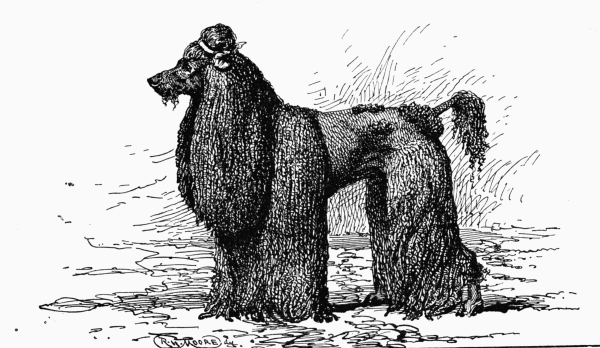
are the Irish and the English Water Spaniels. The
former should be dark liver coloured, covered with
curls, except on the tail, which should be nearly bare
of hair, and on the head a considerable tuft of hair,
called the top-knot, hanging down over the eyes and
face, so as to almost hide the former. There is something
very comical, and quite "Hibernian," about the
look of this breed, and they always appear to be open
for any amount of fun, but they are also grand workers,
and for duck-shooting, and retrieving in general,
they are above the average in achievements, as they are
above most of their fellows in size. The English
Variety is also a capital all-round useful dog, generally
roan or dark coloured in ground, with sometimes spots
or markings on head and body, also covered with curls,
and looks best with tail moderately docked. He gives
you the idea of a "business dog," and is very lively and
ready for work of almost any sporting kind, and can
stand a deal of it. Another of the family I am very
partial to and have sometimes met with and kept as a
companion, is the Clumber. I think this is the most
aristocratic-looking of the sporting varieties of the
breed, and should be a creamy white, with patches of
lemon or light orange-tan, about the head and body.
Either the tactics of the sportsmen of the present day
are too rapid, or for some other cause, but there certainly
are not so many of the breed to be seen now as
there were some fifteen or twenty years since, but I am
glad to see the present Duke of Newcastle is keeping
up the breed at Clumber, where it is supposed to have
been originally produced, and that there are still a few
kennels in the country, where they are breeding some
of these beautiful dogs, for I contend that a Clumber,
in good form and well-groomed (when his coat will
have quite a bloom on it), is one of the handsomest
dogs a sportsman can wish to accompany him, and
although his build and formation are not suited for a
high rate of speed, he can get over a good deal of
ground in the course of the day, and render some useful
service to his owner and his friends. In that celebrated
book, "The Master of the Game," preserved
in the British Museum, and attributed to a royal author,
being supposed to be written by a son of King
Edward III. (who died in 1402), the Spaniel is spoken
of as "Saynolfe," no doubt a term intended for "Spaynolfe,"
and is described as one of the hounds used for
hawking, and called a Spaynel, "because the nature
of him cometh from Spain, notwithstanding they are
to be found in other countries," and such hounds, the[Pg 72][Pg 71]
[Pg 74][Pg 73]author declares, have many good customs and evil.
He insists that a good hound for hawking should
have a large head and body, and that he should be of a
"fair hewe," white or tawne, and not too "jough,"
that is, hairy or rough, but, his tail should be "rough,"
or feathered; he goes on to describe the proper temperament,
as a sportsman of the present age would speak
of a modern Clumber, leaving out one of its greatest
merits, its silence, or muteness, in work, however excited,
so much to be desired. A great deal of sport
may be had over a brace of Clumbers, which are as
much as a sportsman can do with, particularly with a
Retriever to look after the "killed and wounded."
I have also, occasionally, seen a specimen of the Sussex
Spaniel, which are rare dogs for work, made a
house pet of. They should be rich copper colour, and
are very showy and distinguished looking in appearance,
strong and muscular in build, more active than
you would give them credit for, by their looks, and
possessed of much intelligence and affection for their
friends, good guards, and well able to take their own
parts in any row, seldom coming off worst, even with
larger antagonists. They have been brought to great
perfection of late years. I should say there are some
as good as any ever seen, to be met with at the present
day, and especially at the well known Bridford Kennels
in Devon. I think they are rather growing in public
favour, to the reverse being the case; I often see what
I may call "the Field Spaniel proper," the old glossy
black, kept as a companion; the very long backed, and
short-legged type, now in favour, don't strike one as
being able to stand so much hard work, in the covers,
as the more old fashioned sort, but they are, many of
them, very beautiful dogs, and of high quality, and,
what is also of importance to breeders, they command
very high prices. I heard of an instance, not very long
since, when a buyer was found for five or six specimens
of the Black Field Spaniel, at £1,100, and another gave
£400 for a single dog. I know all the three parties,
that is, the seller and the two buyers, in these transactions,
and believe them to be bonâ fide and true, in substance
and fact, so that Spaniel breeding evidently can
be made to pay. Although I sometimes see some of
the old liver and white, roan, blue and black Spaniels
about, I certainly think they are not so popular as
they were some years since. As a rule they are
tractable, good tempered, "born sportsmen," particularly
fond of a ramble amongst country lanes and
hedgerows, and capital companions for all, attaching
themselves readily to ladies and children, and making
themselves "at home" as members of the household,
though always ready for their own proper work, outside,
when called upon.
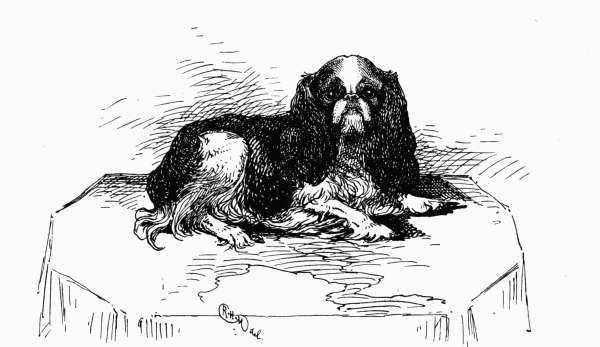
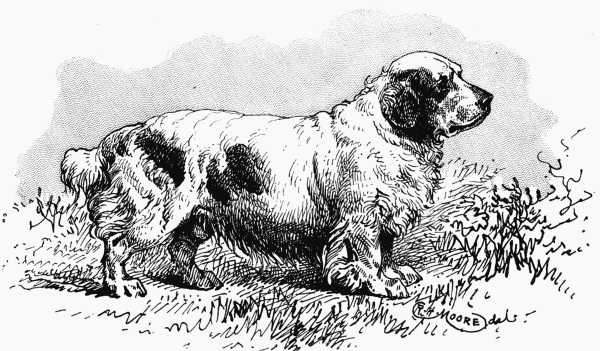 CLUMBER-SPANIEL, "SANDRINGHAM-BUSTLER". H. R. H. PRINCE of WALES. OWNER.
Sporting Spaniel Points.—I will here give the show
points of the several Sporting Spaniels, commencing
with the Clumber. The points of this breed are as
follows:—He should be long, low, and heavy, weight
varies, but averages about forty to forty-five pounds.
Colour, white, of a creamy shade, with orange or lemon
markings; actual liver colour, or the very pale lemon,
once made a point of, are now objected to by some[Pg 78][Pg 77]
breeders of the present day. Height should not be
over eighteen or twenty inches. Legs, both short and
strong, in fact, so much so that, with his deep, well-coated
body, he shows little "daylight" below him,
as he stands or walks. Head, large, long, coloured to
a line under the eyes, and showing a "blaze" up the
face. Eyes, rather small for size of head, sunken, pensive,
and thoughtful. Nose, dark flesh, or liver, coloured.
Ears, large and much feathered, below, where
the fleshy part of the ear ends. Neck, long, strong,
and muscular. Back, straight and long. Chest, wide,
also the shoulders, and substantial, likewise the forearm,
which is very heavy for his size. Hocks, and
hind quarters, large, bony, and very muscular. Loins,
not arched, but straight. Ribs, round and prominent,
back-ribs, in particular, very deep. Stern, set on low,
looks best "docked," as is usually the case, with a little
hair hanging at the fag end. Coat should be not too
full in quantity, but very straight, silky, shining, and
soft, in texture. The appearance and general character
being that of a high class, dignified specimen of
the sporting dog, well able to do all that can be reasonably
required of him, but with no idea of being dictated
to, hurried, or "put out of the way," by any one.
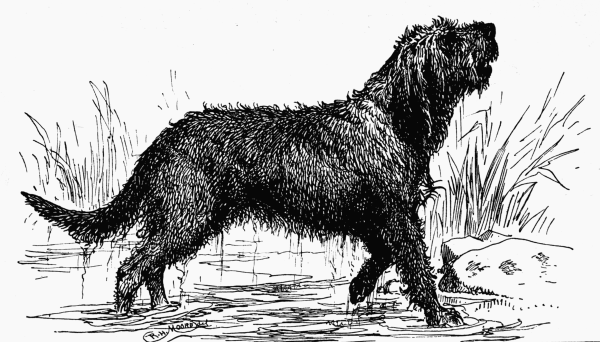
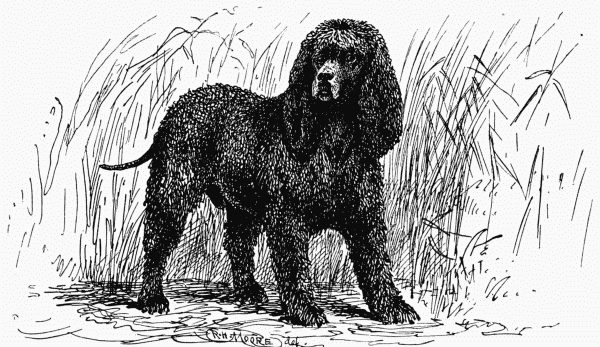 IRISH WATER SPANIEL. CH. "SHAUN". COL. THE HON. W. LE POER TRENCH. OWNER.
The Irish Water Spaniel.—The head of the Irish
Water Spaniel is rather large, forehead prominent, face
perfectly smooth from eyes down, ears from twenty-four
to twenty-six inches long from end to end; head
should be crowned with a well-defined top-knot, not
straggling across, like the common Water Dog, but
coming down in a peak on the forehead. The body
should be covered with small, crisp curls, which often
become draggled in the moulting season; the tail,
should be round and "rat-like," without feather, rather
short than the reverse, and as stiff as a ramrod. Colour,
pure puce-shaded liver, without any white.
Height, about from twenty-two to twenty-two and a
half inches, seldom more when pure bred.
English Water Spaniel.—The following description
of this breed, which is a very great favourite of mine,
and I regret to say seems to be growing more scarce,
year by year, is from the pen of my old friend, Mr. A.
W. Langdale, who was counted an authority on Spaniels
generally:—"Young breeders and judges should
have before them this fact, that Colour should be a secondary
matter with the English Water Spaniel, and the
latter should never pass over a liver and white dog, in
favour of a whole coloured liver, provided the liver and
white is a well-made specimen of his breed. The
weight, again, should not exceed forty pounds, and his
height nineteen inches, his ears may be fairly long, and
covered all over with curl; also the body, not the
close curl of his Irish brother, but one somewhat looser,
and more straggly; his head is broad and long, with
piercing eyes, his legs are well feathered behind, as well
as in front, and there is no doubt that the feather,
which in a ticked dog, comes out from each and every
liver spot in front of the forelegs, has much to do with
his power of endurance in water. They may be called
'natural retrievers,' as no dog is easier taught."
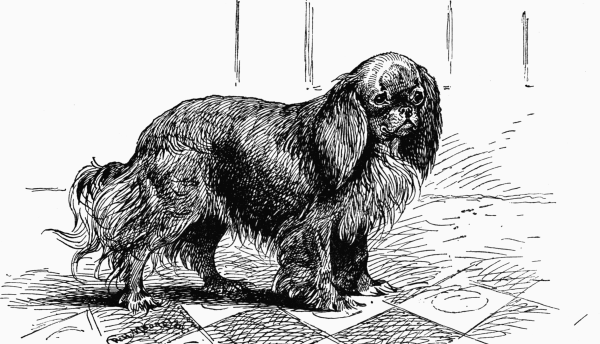
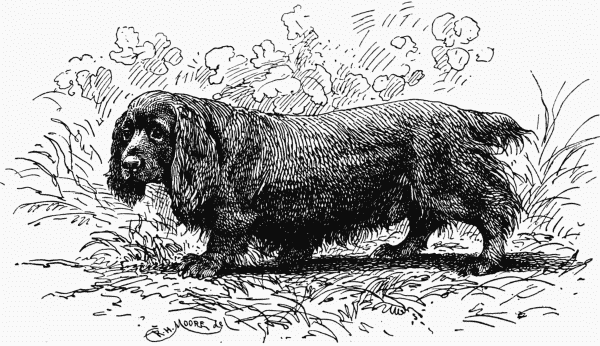 SUSSEX-SPANIEL CH. "BRIDFORD GIDDIE". MOSES WOOLLAND, OWNER.
The Sussex Spaniel.—He should be of a deep golden
liver colour, and should weigh about thirty-four
pounds. His head should be long and heavy, his eye
large, and languishing, his forehead projecting over the
eye, the muzzle square, the lips rather pendulous, his
mouth large, and his underjaw rather recedes from the
upper jaw. His ears should be large and well furnished
with silky hair, they should be small, or narrow,
where they spring from the head, and large, or lobe
shaped, at the base; they should be set low down, and
hang close to the cheeks. The nostrils should be large,
the nose large and liver-coloured. The neck should be
strong and muscular, with the crest a little arched.
The chest, should be wide, the shoulders well thrown
back, the body, long, and round. The legs should be
short and strong, well flewed to the foot, before and
behind. The feet, which are nearly always good in a
Spaniel, should be round, well arched, and abundantly
furnished with feather. The loin should be very
strong, the back ribs very deep and round; the tail,
docked to about nine inches, and well-feathered, should
be set low, and have a downward action. The proper
carriage of the tail marks the Spaniel's purity, as much
as anything. The coat should be waved, not curled,
and as already said, of a golden liver colour.
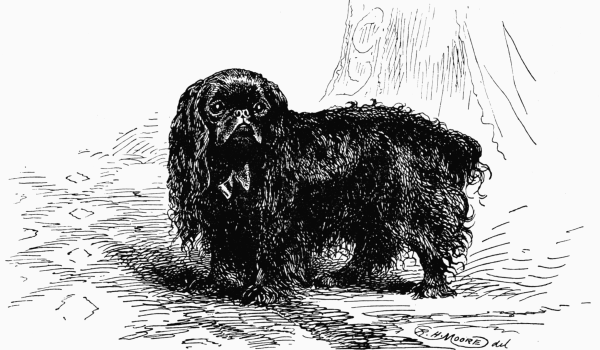
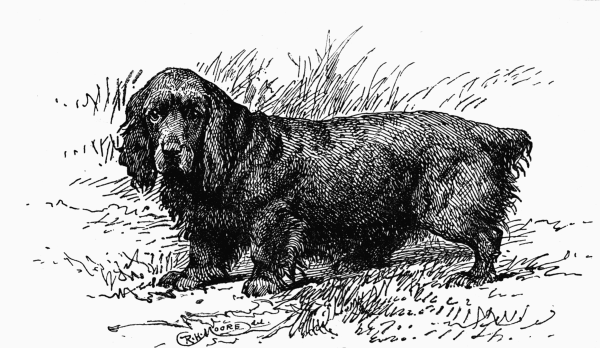 BLACK-SPANIEL. CH. "BRIDFORD-BRILLIANT". M. WOOLLAND. OWNER.
The Black Spaniel.—The following description of
the points required in this popular variety, are laid
down by my friend, Mr. T. Jacobs, of Newton Abbot,
who is, as far as I know, about the most successful
breeder and exhibitor of them, during the last twenty-five
years, he says:—"My standard is as follows:
Pleasing temper I always look to first, never breed from
a bad tempered sporting dog, every sportsman knows
what a nuisance they are. A long body, short legs,
with plenty of bone and feather, a perfectly smooth,
satin-like coat, with no inclination to wave, or curl,
moderately long. Ears, covered with long, silky hair,
not ringlets, well set, low down, and hung close to the
cheeks, small, or narrow, where they spring from the
head, and large and lobe shaped, at the base, well furnished
with hair on the inside leather. A long head,
not 'snipey,' or heavy, like the Clumber; dark, pleasing
eye, a yellow eye indicates bad temper, and should
be avoided. Level mouth, not 'pig-jawed,' or under
hung, but I prefer the former fault to the latter, which
prevails, I am sorry to see, in some of our present show
dogs. Breeders should avoid them as stock dogs. A
long neck, slightly arched, well clothed with muscle.
Strong across the loins. Ribs well sprung, and barrel-shaped.
Belly, well clothed with long hair and not
tucked up, like the Greyhound, a common fault. Broad
chest, well clothed with muscle and feather. Feet,
round and cat-like, with a plentiful supply of hair between
the toes. Many have argued with me, that
mating black with liver colour, would throw the black
puppies rusty, or bad black, but, being a pigeon breeder
for many years, and knowing that by mating duns and
blacks, you procure a better black than by breeding two
blacks together, I thought if this held good with Pigeons,
why should it not do with dogs? I therefore
mated my Spaniels, as before described, the result is,[Pg 84][Pg 83]
[Pg 86][Pg 85]I have never seen one bad black, and have bred more
than a dozen litters in that way."
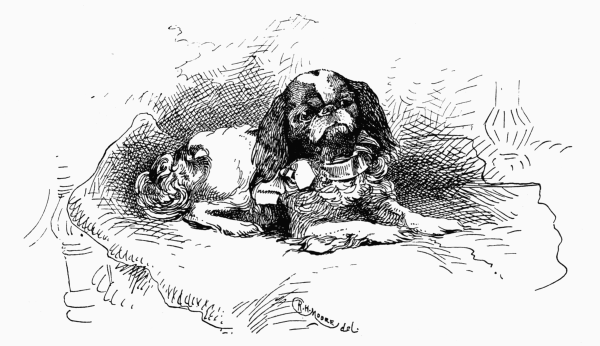
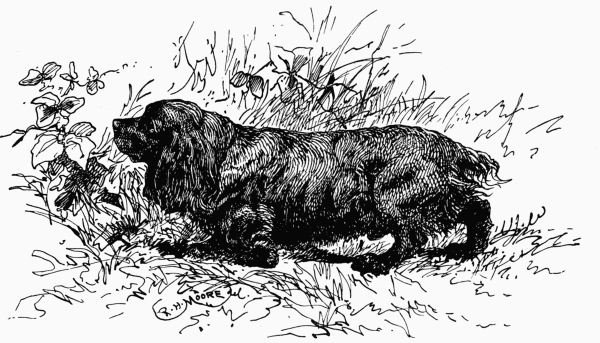 COCKER SPANIEL CH. "TED OBO" J. FARROW OWNER.
Some Other Sporting Spaniels.—The heads of small
Spaniels should resemble those of small Setters, and
have no tuft on them. The ears should be moderately
long, and lie close to the cheek. Very short ears indicate
a cross. The legs should be strong, well feathered
and short; the feet round; and each toe should
be protected with hair, a plentiful supply of which
on, and between the toes, is important. The chest
should be rather broad. The elbows, not so oblique
as in the Setter. The body, should be long, and
somewhat round, and barrel-like, with less depth of
the fore rib than in the Setter. The tail, should come
out on a line with the backbone. The colours may be
almost anything, black, black and white, liver, liver and
white, lemon, lemon and white, roan, blue, or grey
mottled.
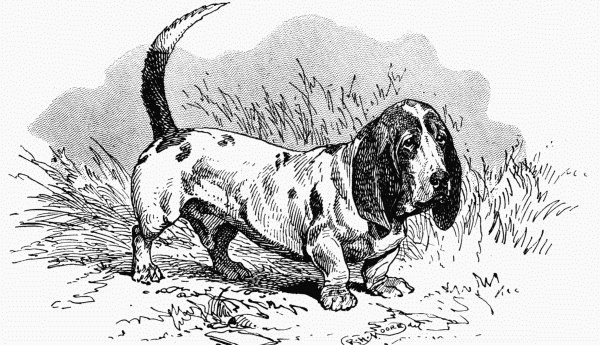 SMOOTH BASSET HOUND CH. "LOUIS LE BEAU" Mrs M. TOTTIE OWNER.
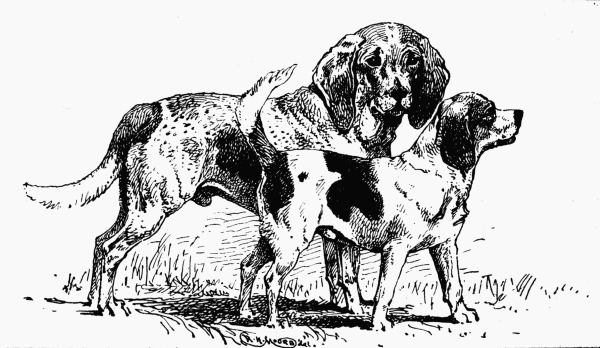
Bassets.—Amongst those breeds which have been
taken up a good deal as pets and companions in comparatively
recent years, have been the Bassets, both
Smooth and Rough-coated. This breed, which has been
in fewer hands than most, also enjoys the advantage
of royal patronage, both their Royal Highnesses the
Prince and Princess of Wales, being successful breeders
and exhibitors of them. They are heavy looking,
usually hound marked, in colour, that is, white with
black and light brown, and hound-tanned markings on
body, which is very long shaped on short, strong legs,
large, pendulous ears and head, and in expression much
like what we used to see in pictures of the "old English
Hound." They have a high-class and distinguished
look about them, and give you the impression
of character and breeding. They have not been used
extensively for sporting purposes in this country, to my
knowledge.
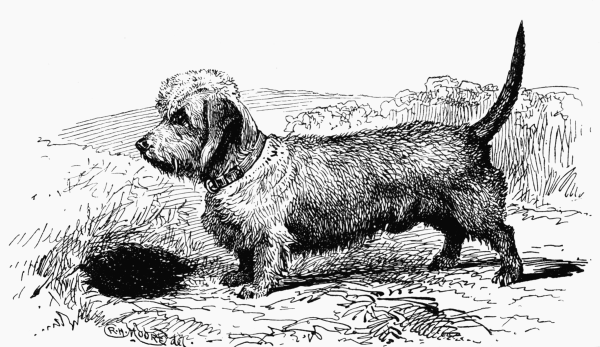
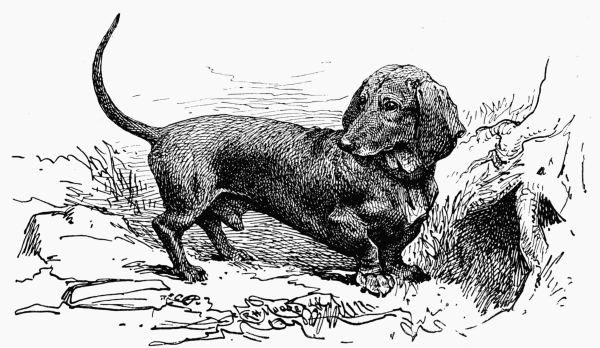 DACHSHUND CH. "WISEACRE". E. S. WOODIWISS, OWNER.
Dachshunds.—Another of the breeds I have seen
kept as pets, is the Dachshund, or Badger Dog, as the
name implies. I think they are rarely, or ever, used
for Badgers in this country, and for the safety of the
greater part of those I have seen here, I think it is
much better that is so, as any one familiar with the
Badger, or the "old Gentleman in Grey," as he is frequently
called, will know that he is a formidable opponent
to tackle, muscular, active, low to the ground,
with a very tough, harsh coat, and long, powerful
jaws, and weighing from over twenty to over
thirty pounds, so that it requires activity, strength and
indomitable pluck for a small dog to attempt to overcome
such an animal, possessing so many natural advantages.
I think Dachshunds are not so generally
kept as pets as they were some years since, but my experience
of them is favourable, having found them
amiable and docile in disposition, cleanly in habits, and
bright and lively in temperament. They are very long,
and low, in build, head and ears hound shaped, forelegs
curved with an outward turn, to facilitate digging
operations, tail carried rather gaily, coat fine in texture,
skin loose, colours most in favour, rich chestnut red,
black and tan, chocolate, and other shades of brown,[Pg 90][Pg 89]
[Pg 92][Pg 91]and of late, what is called "dappled," which seems to
be a ground of one shade of brown, splashed with irregular
blotches of another darker shade of same colour.
Of course there are constantly springing up
new patrons and patronesses for all kinds of dogs, but
I have noticed that almost every one of the persons
who were the most enthusiastic supporters, and breeders
of Dachshunds, when they were first brought forward,
many years since, have now ceased to keep them,
although they nearly all keep some other breeds, so
that, as in my own case, I think it is not one of the
varieties which takes a lasting hold on its votaries,
whether from the fact that it is essentially one of the
foreign made breeds, and the effect of the strong preference,
which now prevails for the encouragement of
everything of British and Colonial origin and manufacture,
I do not know, but I can call to mind at least
ten of the largest breeders of Dachshunds in this country,
who, I believe, have not at present one specimen
amongst the lot.
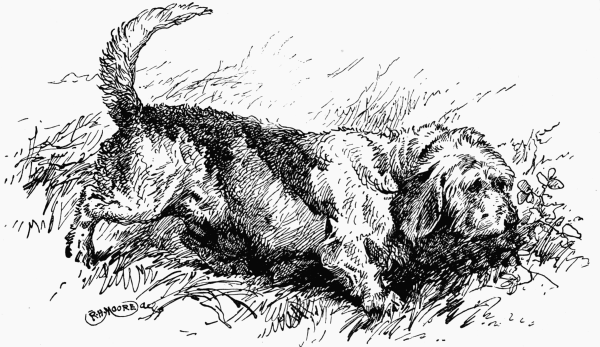 ROUGH BASSET. "BEAUTY" H. R. H. PRINCE of WALES, OWNER.
Points of the Basset Hound.—The following description
of the points desired in this breed by my
friend, the late lamented Sir Everett Millais, Bart., who
was quite an enthusiast in his support of it, may be interesting
to those of my readers who admire (and who,
that has seen them, can fail to do so?) these very
beautiful dogs:—"The Basset, for its size, has perhaps
more bone than nearly any other dog. The skull,
should be peaked, like that of the Bloodhound, with the
same dignity, and expression; nose, black, and well
flewed. For the size of the Hound, I think the teeth
are extremely small. However, as they are not intended
to destroy life, perhaps this is the reason. The
ears, should hang, like the Bloodhounds, and are like
the softest velvet. The eyes are deep brown, and brimful
of affection and intelligence. They are pretty
deeply set, and should show a considerable 'haw.' A
Basset, is one of those Hounds, incapable of having a
'wicked eye.' The neck, is long, but of great power,
and in the Basset à jambes torses, the flews extend very
nearly down to the chest. The chest, is more expansive
in the Basset, than even in the Bull Dog, and
should, in the Basset à jambes torses, be not more than
two inches from the ground. In the case of the Basset
à jambes demi-torses, and jambes droites, being generally
lighter, their chests do not of course come so
low. The shoulders, are of great power and terminate
in the crooked feet of the Basset, which appear to be a
mass of joints. The back and ribs, are strong, and the
former of great length, the stern, is gaily carried, like
that of Hounds in general, and when the Hound is on
the scent of game, this portion of his body gets extremely
animated, and tells me, in my own Hounds,
when they have struck a fresh, or cold, scent, and I even
know when the foremost Hound will give tongue! The
hindquarters, are very strong and muscular, the muscles
standing rigidly out, down to the hocks. The skin,
is soft in the smooth haired dogs, and like that of any
other Hound, but in the rough variety, it is identical
with that of the Otter Hound. Colour, of course, is
a matter of fancy, although I infinitely prefer the 'tricolour,' which has a tan head, and black and white
body."
Points of the Dachshund.—The following are set
down by my friend, Mr. A. O. Mudie, so well-known
as a successful breeder, exhibitor and judge of this
quaint-looking breed, and who has had a long experience
amongst them:—Head, long and narrow, peak
well developed. Jaw, strong, and level. Ears, set on
low, long, broad, and soft. Chest, deep, and narrow;
breastbone prominent. Forelegs, very short, and
strong in bone, well-crooked, but standing equally on
all parts of the foot. Skin, thick, and supple. Coat,
short and strong. Loins, well arched, strong and muscular.
Any colour. Long, low, and graceful, and not
cloddy."[Pg 96]
[Pg 97]
[Pg 98]
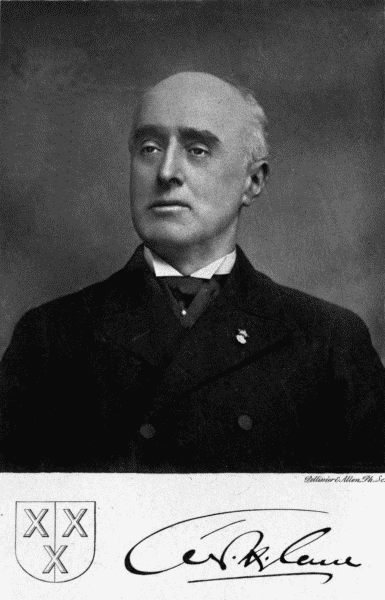 Pellissier & Allen, Ph. Sc.
Chas. H. Lane
Pellissier & Allen, Ph. Sc.
Chas. H. Lane
 A variety of dogs.