| Agriculture, Persons Engaged in | 114 |
| Agricultural Products of Mexico | 76 |
| Angora Hair Exported by Cape Colony, Value of | 46 |
| Area and Population of African Countries | 46 |
| Area and Population of Asiatic Countries | 36 |
| Area and Population of Central America | 174 |
| Area and Population of European Countries | 8 |
| Area and Population of German States | 18 |
| Area and Population of Mexico | 76 |
| Area and Population of Oceania | 59 |
| Area and Population of South American Countries | 181 |
| Area and Population of West Indies | 174 |
| Barley, Average Annual Product of | 82 |
| Boots and Shoes Manufactured, Value of | 86 |
| Butter Product, 1880, Value of | 172 |
| Cattle in Territories, Value of | 160 |
| Cheese Product, 1880, Value of | 92 |
| Cheese Product in Territories, 1880, Value of | 158 |
| Cloth Manufactured in the Southern States | 116 |
| Cocoa Exported by Venezuela, Value of | 181 |
| Coffee Exported by Brazil, Value of | 181 |
| Coffee Exported by Venezuela, Value of | 181 |
| Coffee Imported by Europe | 8 |
| Copper Ingots, Amount of, Produced in Southern States | 106 |
| Copper Ingots, Annual Product of | 156 |
| Corn Crop, 1870 to 1880, Increase in | 104 |
| Corn, Increase in Acreage of | 146 |
| Cotton Exported by Brazil, Value of | 181 |
| Cotton Manufactures per 1,000 Population, Capital Invested in | 88 |
| Crop Productions of Australasia | 59 |
| Diamonds Exported by Brazil, Value of | 181 |
| Diamonds Exported by Cape Colony, Value of | 46 |
| Exports of Africa | 46 |
| Exports of Belize | 174 |
| Exports of Cuba | 174 |
| Exports of Hawaiian Islands | 59 |
| Exports of Hayti | 174 |
| Exports of Jamaica | 174 |
| Exports of Mexico | 76 |
| Exports of Philippine Islands | 59 |
| Exports of Porto Rico | 174 |
|
Exports of Society Islands | 59 |
| Exports of South America | 181 |
| Farm Animals in Australasia, Number of | 62 |
| Farm Crops, Comparative Value of | 122 |
| Farm Crops, 1870 to 1880, Increase in | 164 |
| Farms of Five Hundred Acres or Over Occupied by Owners | 110 |
| Farm Products, Comparative Yearly | 112 |
| Farm products, 1882, Comparison of | 166 |
| Fishery Products, 1880, Value of | 170 |
| Flouring and Grist Mills, Capital Invested in | 142 |
| Glassware, 1880, Capital Invested in Manufacture of | 96 |
| Gold and Silver Deposited at Mints and Assay Offices, 1793 to 1883 | 168 |
| Gold Produced from Placer Fields in 1880 | 162 |
| Granite Quarries, Capital Invested in | 80 |
| Hardware, Capital Invested in Manufacture of | 90 |
| Hides Exported by Brazil, Value of | 181 |
| Hogs on Farms, Number of | 140 |
| Hops Produced in West in 1880, Pounds of | 138 |
| Imports of Belize | 174 |
| Imports of Society Islands | 59 |
| Indigo Exported by Colombia, Value of | 181 |
| Lace, Production of, Europe | 8 |
| Lakes of South America, Area of | 181 |
| Land, Total Cultivated, Uncultivated and Timber | 120 |
| Lead Ore Mined, Annual Value of | 124 |
| Limestone and Marble Quarries, 1880, Capital Invested in | 84 |
| Linen Production of Europe | 8 |
| Lumber Products, 1880, Value of | 136 |
| Mineral Productions of Europe | 8 |
| Molasses Produced in 1880, Gallons of | 118 |
| Mules, Value of | 126 |
| Orchard Products per 1,000 Population, Value of | 98 |
| Ostrich Feathers Exported by Cape Colony, Value of | 46 |
| Oyster Fisheries, 1880, Value of | 100 |
| Peanuts, Annual Amount of Crop | 102 |
| Plate Glass Manufacture, 1880 | 132 |
| Population, 1870 to 1880, Increase of | 148 |
| Rice Produced in 1880, Pounds of | 108 |
| Rivers of Africa, Length of | 46 |
| Rivers of Asia, Length of | 36 |
| Rivers of Europe, Length of | 8 |
| Rivers of South America, Length of | 181 |
| Rubber Exported by Brazil, Value of | 181 |
| Seal Fisheries, Annual Products of | 74 |
| Seas and Lakes of Asia, Areas of | 36 |
| Seas and Lakes of Europe, Areas of | 8 |
| Sheep in Territories, Comparative Number of | 154 |
| Silk Goods Manufactured, Value of | 94 |
| Silk Production of France | 8 |
| Silk Production of Italy | 8 |
| Silver Product of 1882 | 152 |
| Slaughtering and Meat Packing Products, 1880 | 134 |
| Sugar Exported by Brazil, Value of | 181 |
| Tea Imported by Great Britain | 8 |
| Tobacco Crop, 1882, Value of | 128 |
| Tobacco Exported by Brazil, Value of | 181 |
| Wheat and Corn, Amount Raised Yearly by Different Nations | 150 |
| Wheat Production 1870 to 1880, Increase in | 144 |
| Wool Product, in Pounds, 1880 | 130 |
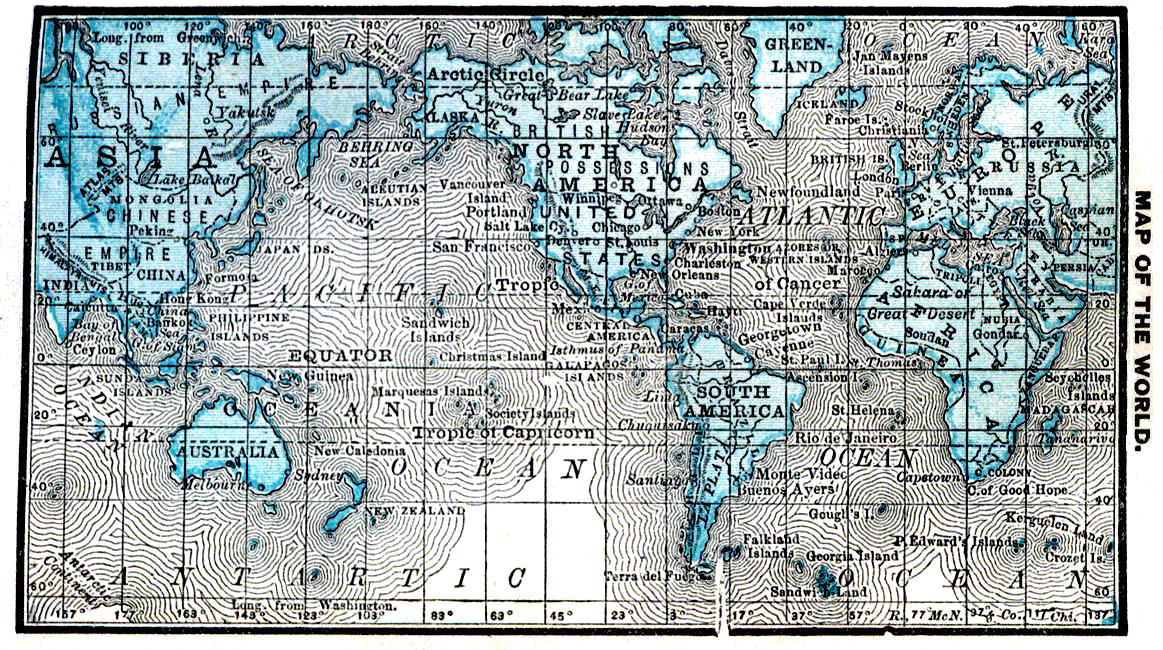
EUROPE.
Northwestern portion of Old World and smallest of its grand divisions.
Extreme length northeast and southwest, 3500 miles extreme breadth, over
2,400 miles; coast line not less than 20,000 miles.
| Divisions. | Area,
Sq. Miles. | Population. | Capitals. | Population. |
| Andorra | 175 | 5,800 | Andorra | 1,000 |
| Austro-Hungary | 240,942 | 37,883,226 | Vienna | 1,103,857 |
| Belgium | 11,373 | 5,655,197 | Brussels | 389,782 |
| Bulgaria | 24,360 | 2,007,919 | Sophia | 20,501 |
| Denmark | 13,784 | 1,969,039 | Copenhagen | 273,323 |
| England and Wales | 58,186 | 25,974,439 | London | 4,766,661 |
| France | 204,177 | 37,672,048 | Paris | 2,269,023 |
| Germany | 212,028 | 45,234,061 | Berlin | 1,122,360 |
| Greece | 25,111 | 1,979,453 | Athens | 84,903 |
| Ireland | 32,531 | 5,174,836 | Dublin | 418,910 |
| Italy | 114,410 | 28,459,628 | Rome | 273,268 |
| Montenegro | 3,550 | 250,000 | Cetigne | 2,000 |
| Netherlands | 12,648 | 4,225,065 | The Hague | 127,931 |
| Norway | 122,869 | 1,806,900 | Christiania | 124,155 |
| Portugal | 36,510 | 4,306,554 | Lisbon | 246,343 |
| Rumania | 48,307 | 5,376,060 | Bukharest | 221,805 |
| Russia | 2,041,402 | 86,486,959 | St. Petersburg | 929,100 |
| San Marino | 32 | 7,816 | San Marino | 6,000 |
| Scotland | 29,820 | 3,735,573 | Edinburgh | 236,002 |
| Servia | 18,800 | 1,865,683 | Belgrade | 37,500 |
| Spain | 191,100 | 16,064,859 | Madrid | 397,816 |
| Sweden | 170,979 | 4,603,595 | Stockholm | 194,469 |
| Switzerland | 15,992 | 2,846,102 | Bern | 44,087 |
| Turkey | 63,850 | 4,490,000 | Constantinople | 600,000 |
| |
| | Miles. | | Miles. |
| Danube | 1,725 | Loire | 600 |
| Don | 1,300 | Oder | 550 |
| Dneiper | 1,230 | Petchora | 900 |
| Dwina | 700 | Rhine | 600 |
| Elbe | 737 | Vistula | 690 |
| Kama | 1,400 | Volga | 2,400 |
| |
| | Square Miles. | | Square Miles. |
| Azov | 14,000 | Geneva | 336 |
| Baltic | 154,570 | Ladoga | 5,190 |
| Black | 185,000 | Ogena | 3,400 |
| Constance | 200 | Wener | 3,120 |
| Enara | 685 | White | 4,500 |
| |
| Italy | 6,600,000 lbs. | France | 19,149,000 lbs. |
| | Produced. | Consumed. |
| Russia | 250,000 tons | 90,000 tons |
| Great Britain | 26,000 " | 130,000 " |
| France | 50,000 " | 70,000 " |
| Germany | 15,000 " | 35,000 " |
| Netherlands | 80,000 " | 65,000 " |
| Nottingham. | Persons employed, | 10,500. | Value products, | $29,782,980 |
| The Continent. | Persons employed, | 535,000. | Value products, | 28,128,370 |
| |
| Lead, Cornwall | 70,000 tons | Tin, Great Britain | 15,000 tons |
| Lead, Cordova | 30,000 " | Quicksilver, Spain | 1,000 " |
| Coffee imported, Europe | 270,000 tons |
| Tea " Great Britain | 140,000,000 lbs. |
GREAT BRITAIN.
The largest island of Europe, and forming, with Ireland and the
adjacent islands, the United Kingdom of Great Britain and Ireland. The
union of England and Ireland was effected January 1, 1800.
Area of the kingdom, 120,832 square miles. Pop., 35,241,482. The
divisions are: England, Scotland, Wales and Ireland. Capital, London;
pop., 4,766,661. Thirty-five cities have over 75,000 population. Climate
is variable but healthful. Average temperature, 50°. Rainfall, London, 25
inches; Glasgow, 21; and Dublin, 29.
Middle-class education is entirely unorganized; no complete,
trustworthy statistics are to be had. There were, in 1884, 69
universities and colleges, with 23,823 students. In 1881, there were
1,855 schools of science, with 66,000 students. Number of public
libraries, 202. The library of the British Museum has 32 miles of
shelves, filled with books. Number of daily papers, 169.
Productive area in England is 80 per cent.; in Ireland, 74 per cent.;
Scotland, 28.8 per cent.; Wales, 60 per cent. Leading crops in Great
Britain, wheat, barley and oats. Acreage, 1884: wheat, 2,676,477; barley,
2,159,485; oats, 2,892,576. In Ireland, oats and potatoes are most
important; acreage of former, 1,347,395; of latter, 798,942. Number of
acres of flax, 89,197. Orchards of Great Britain cover 180,000 acres, and
produce 85,000 tons of apples.
The most important minerals are coal and iron. In 1883, coal product
was 163,737,327 tons; value, $230,270,715. Iron ore, 17,383,046 tons;
value, $25,611,905. In 1883, 1,724,251 tons of pig iron were used in the
manufacture of Bessemer steel, 1,097,174 tons of it being made into steel
rails. Over 800 tons of steel are annually consumed in the manufacture of
pens, Birmingham alone using 500 tons; the average yearly production is
800,000,000.
The annual value of the fisheries is $50,000,000. Herring fishery
alone $10,000,000; salmon, $4,000,000; oysters and shell-fish,
$10,000,000. Value of the Scotch fisheries alone in 1884 was $16,431,210,
the herring fishery alone being $10,267,755. Total value of imports,
1884, $1,948,872,745; exports of home produce, $1,164,537,875; foreign
and colonial produce, $312,218,575. Value of corn and flour imported
1882, $338,111,835. Value of cotton manufactures exported was
$382,228,785.
There are 2,674 cotton factories, employing 482,903 persons. Total
number of all factories, 7,105; number of persons employed, 975,546, of
whom 110,585 are children under 13 years of age. Men employed, 38 per
cent.; women, 62 per cent. Amount of cotton imported, 1883, 1,734,333,552
lbs.; wool, 495,946,779 lbs.
Standing army in time of peace unlawful without the consent of
Parliament; annual appropriation of Commons for support of troops, based
on "estimates" made by the Cabinet. For 1884 and 1885, home and colonial
effectives and reserves, 644,753.
Previous to 1815 there was but little emigration from the United
Kingdom; in that year the number was 2,081; in 1830-34, 381,956; 1875,
173,809; 1882, 413,288; and in 1884, 304,074, of whom 203,539 came to the
United States.
First railway opened in 1825. In 1883, there were 18,681 miles of
railway; 13,215 belonging to England and Wales, 2,964 to Scotland, and
2,502 to Ireland. Number of postoffices, 1884, 15,951; and, in addition,
15,749 road and pillar boxes. There are 27,604 miles of telegraph lines,
and 140,498 miles of wire.
The colonies and dependencies of Great Britain have an estimated area
of 8,000,000 square miles. Of this vast extent of territory, over
3,500,000 square miles are in America, over 250,000 in Africa, over
1,000,000 in Asia, and 3,000,000 in Australasia.
BELGIUM.Bel´je-ŭm.
A kingdom of West Central Europe. Formerly united with Holland to form
the Netherlands. Independence achieved in 1830. Executive power is vested
in a King; legislative, in King, Senate and House of Representatives.
The most densely populated of the European countries, Belgium ranks
eighteenth in area, but ninth in population. Area, 11,373 square miles.
One-sixtieth of the territory artificially gained by means of dykes.
Length of canal and river system, 995 miles. Capital, Brussels.
Population, 389,782.
Agriculture chief industry. Only about one-eighth of territory
uncultivated. In 1882, population, 5,655,197; average density, 497 per
square mile; 1,160,149 freeholders held 88 per cent. of land.
This country is very rich in minerals. Over 17,500,000 tons of coal
are produced annually. Belgium is noted for its flax. The chief products
are wheat, rye, oats, barley, flax, hemp, tobacco. In 1880 there were
46,210 horses, 411,551 oxen, and 90,100 sheep.
Imports, 1882, $570,320,000; exports, $512,780,000. Manufactures are
important. About 190,000 persons employed in flax, hemp, woolen and
cotton manufactories. The lace of Brussels and the fire-arms of Liege are
among the finest in the world. The value of pig and wrought iron alone,
in 1882, was $34,473,260. Product of iron foundries about $3,000,000 per
annum; of quarries, $8,459,400.
Roman Catholicism professed by nearly the entire population. Education
is zealously promoted by the government; total sum spent, 1881,
$6,503,670. Four universities in the kingdom.
Total peace strength of the army, 1885, 47,872 men, with 9,000 horses
and 204 guns; war footing, 227,900 men, 13,800 horses, and 240 guns.
Of the 2,682 miles of railroad operated in 1883, 1,902 miles were
owned and managed by the government. Number miles telegraph in 1884,
3,713; postoffices, 869.
NETHERLANDS (HOLLAND).
A kingdom of Europe, established by Congress of Vienna, in 1815. Area,
12,648 square miles. Population, 4,225,065. Country protected by dykes
from the overflow of rivers and the inundations of the sea.
Constitution dated 1848. Law-making power resides in the
States-General, a parliament of two houses. Commercial centre, Amsterdam;
pop., 350,201. Capital, The Hague; pop., 127,931.
The soil is highly productive; fruit is grown extensively. In 1882
there were 5,046,210 acres of cultivated garden and pasture land. Number
of acres in cereals, 1,267,399; yield of grain, 130,470,000 bu. Horses,
270,900; cattle, 1,427,000; and sheep, 745,100.
Total exports, 1882, $313,330,000; imports, $414,330,000. Value of
butter exported to Great Britain alone, was $21,020,605. Holland's
merchant marine, 1884, consisted of 701 sailing vessels, of 251,500 tons,
and 96 steamers, of 123,400 tons.
In 1884, miles of railway, 1,320. Miles of state telegraph, 2,660;
miles of wire, 9,760. Number of postoffices, 1,281.
In 1884, regular army stationed in Holland numbered 65,007 officers
and men; navy composed of 157 vessels, with 9,462 officers and men.
Constitution secures religious freedom. Number of Protestants,
2,469,814; Roman Catholics, 1,439,137; Jews, 81,693.
Returns for 1882 gave 2,822 elementary public schools; 11,250
teachers; 1,143 private schools; total number of pupils, 557,932. There
are 4 universities, 1 polytechnic school, 5 Roman Catholic, and 3
Protestant seminaries. Total expense of schools, $5,921,515.
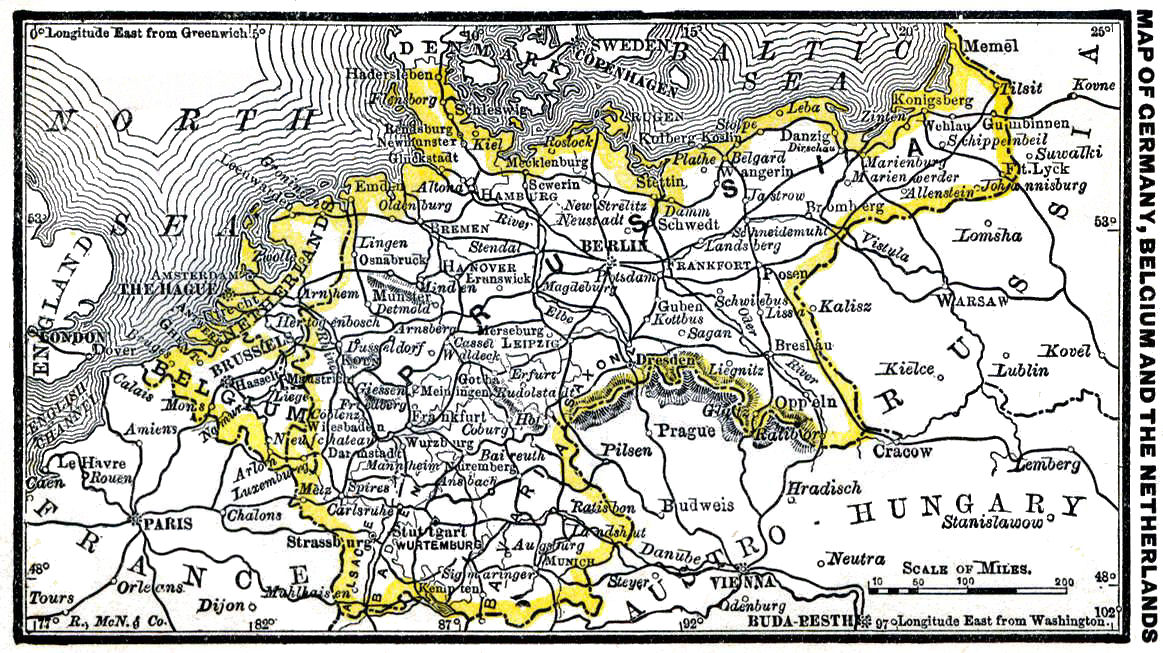
GERMANY.
The third country in size in Europe. A confederate empire, composed of
25 States, and the Reichsland of Alsace-Lorraine. Capital, Berlin.
Climate uniform. Mean temperature of whole country, 48°; of the valley
of the Rhine, 52°. Rainfall at Berlin, 24 inches.
About 63 per cent. of population is Protestant, and 36 per cent. Roman
Catholic. Number of churches, 37,720. Education is general and
compulsory. Number of elementary schools, 57,000; normal, 332; high,
1,100; technical high schools, 9; industrial and trade, 994.
Universities, 21, with 25,964 students, of whom 89 per cent. are German,
and 1 per cent. American. Number of public libraries, 594; number of
daily papers, 560. The book fair at Leipzig annually disposes of 8,000
tons of books, valued at $8,000,000.
Every German is liable to service in the army, and no substitution is
allowed. All Germans capable of bearing arms have to be in the standing
army seven years,—three years in active service, and four in army
of reserve; after which they form part of the Landwehr another five
years. Army on peace footing numbers 427,274 soldiers, and 18,118
officers. Total war strength of trained soldiers would be 2,650,000;
available force of all classes, 5,670,000.
Of the area, 94 per cent. is classed as productive. Leading products,
1882: corn, 16,435,620 tons; potatoes, 17,769,300 tons; beets, 874,654
tons; hay, 17,486,000 tons; 11,500 tons of hops, and over 35,000,000
gallons of wine. Value of farm animals, $1,486,000,000. The mineral
products of 1883 were valued at over $116,000,000. Value of imports,
1883, $822,724,000; exports, $833,750. There are 23,940 breweries,
producing annually 880,000,000 gallons of beer. The annual butter product
is 160,000 tons.
Number of miles of railway, 1884, 22,617, of which 19,230 miles belong
to the government. Length of telegraph lines, 47,637 miles; wires,
170,960 miles. Number of telegraph stations, 11,216. Number of
postoffices, 13,637.
| STATES. | Area,
Sq. Ml. | Pop. | Capitals. | Pop. |
| | | | | |
| Prussia | 137,066 | 27,279,111 | Berlin | 1,122,360 |
| Bavaria | 29,292 | 5,284,778 | Munich | 230,023 |
| Wurtemberg | 7,675 | 1,971,118 | Stuttgart | 117,303 |
| Saxony | 6,777 | 2,972,805 | Dresden | 808,512 |
| Baden | 5,851 | 1,570,254 | Carlsruhe | 49,998 |
| Mecklenburg-Schwerin | 4,834 | 577,055 | Schwerin | 30,146 |
| Hesse | 2,866 | 936,340 | Darmstadt | 48,153 |
| Oldenburg | 2,417 | 337,478 | Oldenburg | 20,575 |
| Brunswick | 1,526 | 349,367 | Brunswick | 75,038 |
| Saxe-Weimar | 1,421 | 309,577 | Weimar | 19,994 |
| Mecklenburg-Strelitz | 997 | 100,269 | New Strelitz | 9,407 |
| Saxe-Meiningen | 933 | 207,075 | Meiningen | 11,227 |
| Anhalt | 869 | 232,592 | Dessau | 23,266 |
| Saxe-Coburg-Gotha | 816 | 194,716 |
 |
Coburg
Gotha |
| 15,791
26,525 |
| Saxe-Altenburg | 509 | 155,036 | Altenburg | 26,241 |
| Waldeck | 466 | 56,522 | Arolsen | 2,477 |
| Lippe | 445 | 120,246 | Detmold | 8,053 |
| Schwarzburg-Rudolstadt | 340 | 80,296 | Rudolstadt | 8,747 |
| Schwarzburg-Sondershausen | 318 | 71,107 | Sondershansen | 6,110 |
| Reuss-Schleiz | 297 | 101,330 | Gera | 27,118 |
| Schaumburg-Lippe | 212 | 35,374 | Buckeburg | 5,088 |
| Reuss-Greiz | 148 | 50,782 | Greiz | 15,061 |
| Alsace-Lorraine | 5,580 | 1,566,670 | Strasburg | 104,471 |
SPAIN.
A kingdom of Southwestern Europe, forming, with Portugal, the Iberian
peninsula. Capital, Madrid; pop., 397,816. Thirty-one towns have over
50,000 pop.
Continental Spain has an area of 191,100 square miles. Population,
16,061,859. Number of Provinces, 49. Length of coast line, 1,370 miles.
Object of greatest interest, ruins of the Alhambra, at Granada. This is
the only state in Europe permitting slavery in its colonies.
Climate varies greatly. Average temperature at Madrid, 58°. Rainfall
in the Sierras averages from 25 to 35 inches; on the table lands of
Castile, 10 inches.
About 80 per cent. of the soil is classed as productive, though only
34 per cent. is under cultivation. The vine is the most important
culture, and large quantities of oranges, raisins, nuts and olives, are
grown and exported. Leading cereals: wheat, rye, barley and corn. The
wine product averages yearly 320,000,000 gallons; value, $95,000,000.
Average number of oranges exported, 960,000,000.
The mineral productions are of vast importance. The Cordova lead mines
are the richest in the world, and the mercury mines of Almaden are second
only to those of California. Average yearly lead product, 92,300 tons;
value, $8,000,000. Mercury, 1,090 tons; value, $1,199,000. Copper, 21,300
tons. Tin, iron and salt are abundant.
The national religion is the Roman Catholic. The school system is
inefficient, though measures tending toward improvement are being
introduced. At the last census (1877) 60 per cent. of the adult
population could not read. Number public schools, 1880, 29,828; number of
pupils, 1,769,456. Number of universities, 10; students, 15,732.
Number miles railway, 1884, 5,157, with 1,747 miles under
construction. Length of telegraph lines, 10,733 miles; number miles of
wire, 26,160. Number of postoffices, 2,699.
The colonial possessions of Spain have an area of 163,876 square
miles, and a population of 7,991,894. The most important are Cuba and the
Philippine Islands. Area of Cuba, 43,220 square miles; pop., 1,521,684.
Capital, Havana; pop., 25,000. Sugar, tobacco and cigars are principal
products; average yearly sugar production, 520,000 tons.
Available home and colonial troops, 400,000.
PORTUGAL.
Name derived from Portus Cale, the ancient name of Oporto. A kingdom
of Europe, occupying the western part of the Iberian peninsula.
Area, 36,510 square miles. Population, 4,306,554. Number of Provinces,
6. Length of coast line, 500 miles. Capital, Lisbon; pop., 246,343.
Oporto, centre of port wine trade; pop., 105,838.
Climate healthful. Mean temperature at Lisbon, 61°. Rainfall averages
27 inches at Lisbon, and 118 at Coimbra.
About 51 per cent. of soil is productive, and less than 23 per cent.
under tillage. Not sufficient grain raised for home consumption. Wine
product for 1882, 125,000,000 gallons; value, $28,500,000.
State religion, Roman Catholic. The average amount spent on public
education from 1875 to 1879 was $10,000; in 1884 the amount had risen to
$966,000. There is one university, established at Coimbra in 1290.
Number of miles of railway, 1884, 950; with 300 miles under
construction. Number of miles of telegraph lines, 2,920; number of miles
of wire, 7,084; number of telegraph offices, 226. Number of postoffices,
931.
FRANCE.
A country of Europe, the fourth in size. Named from a Germanic tribe,
the Franks, which invaded Gaul, A.D. 486. Area, including Corsica and
adjacent islands, 204,177 square miles. Climate one of the finest in
Europe. Average temperature ranges from 50° at Dunkirk to 62° at Toulon:
that of Paris is 51°. Rainfall: at Paris, 22 inches; at Bordeaux, 30
inches.
France has a coast line of 320 miles; the continental boundary line is
962 miles. Largest river, the Loire. The Alps on the east, and the
Pyrenees on the south, connect France with the most magnificent mountain
systems of Europe. The French portion of the Alps has a length of 280
miles.
The republic is divided into 87 Departments, Salary of President,
$120,000; length of term, 7 years. Paris, the capital and second city in
Europe; pop., 2,239,928. Lyons, the second city in size, and centre of
silk industry; pop., 376,613. Twenty-nine towns have a population of over
50,000; and 91, over 20,000.
Agricultural pop., census 1881, 18,249,209. Number of acres
cultivated, 67,000,000. In 1883, 37,039,040 acres were in cereals, of
which five-sevenths were wheat and oats; total production, 742,176,807
bu. Number of acres in orchards, 560,000; yearly production of cider,
220,000,000 gallons. Vineyards, 5,240,340 acres; annual average of wine
product, 720,000,000 gals.; value, $225,000,000. Champagne vintage
averages 20,000,000 bottles, 17,000,000 of which are exported; 1,204,145
acres under beet-root cultivation in 1883, yielding 32,230,312,000 lbs.
of sugar.
Commercially the country ranks with Great Britain. Entrances to and
clearances from her ports include annually over 60,000 vessels; total
capacity, 12,000,000 tons. Value of yearly imports, exclusive of coin and
bullion, $870,000,000; exports, $960,000,000; food imported, $308,000,000
annually. Value of exports, 1883, $912,340,000; imports, $1,277,340,000.
Value of silk exports was $93,402,000. There were 151,404 persons engaged
in silk culture. Number of pounds of raw silk produced, 19,149,587.
France makes yearly 26,000,000 pairs of gloves, of which 18,000,000 are
exported. There are 890 umbrella makers, who annually produce $5,900,000
worth. Value of fishery products, $21,445,450. Average production of
sardines, 980,000,000; oysters, 380,000,000. There are 83,572 men engaged
in the fisheries, with 22,345 vessels; total tonnage, 155,670.
About 79 per cent. of population Roman Catholic; less than 2 per cent.
Protestant. Number of elementary schools, 1884, 85,388; pupils,
6,111,236. Number of normal schools, 163. Public libraries, 505. The
Imperial Library at Paris has 18 miles of shelving filled with books.
Daily papers published, 128.
The reorganization of the French army has been going on since 1872,
and is nearly completed. Every Frenchman not declared unfit for military
service may be called upon from the age of twenty to that of forty years
to enter the active army or the reserves. Substitution or enlistment for
money prohibited. In 1884 the army consisted of 524,797 officers and men,
and 130,771 horses.
Railway system dates from 1840; number of miles, 1884, 17,000. Number
of miles telegraph lines, 46,932; offices, 7,523. Number of postoffices,
1884, 6,486.
The colonial possessions of France cover an area of 429,260 square
miles, with a total population of 9,300,000. Of the colonies, Algeria is
the largest and most important, having an area of 161,476 square miles,
and a population of 3,310,412. Algiers is the capital; population,
70,747. The colonies next in importance commercially are Tunis and Cochin
China.
SWITZERLAND.
The most mountainous country of Europe. Formerly a league of
semi-independent States, but since 1848 a federal republic. Number of
Cantons, 22. President elected for a term of 1 year, and not eligible for
two consecutive terms; salary, $3,000.
Area, 15,992 square miles. Pop., 2,846,102. The Alps extend nearly
through the length of the country; from many peaks 300 snow-capped
summits are visible. Rigi presents the finest view; Monte Rosa, the
Matterhorn (steepest in the world), Finsteraarhorn and Jungfrau range
from 13,700 to 15,200 ft. high. The Mer de Glace is the largest glacier
in the world.
The general climate is milder than that of other mountain countries in
the same latitude. Average temperature at Geneva, 52°. Average rainfall
at Geneva, 32 inches; at Zurich, 34 inches.
Bern is the capital; pop., 44,087. Geneva, seat of watch and jewelry
industry; pop., 68,320. Basel, centre of silk industry; pop., 61,399.
About 59 per cent. of the population is Protestant, and 41 per cent.
Roman Catholic. Education is compulsory. Number of public schools, 1882,
5,314; pupils, 516,425; school pop., 573,713. There are four
universities,—the one at Basel, founded in 1460; and those of Bern,
Zurich and Geneva, since 1832. The government maintains a polytechnic
school at Zurich, and a military academy at Thun. Number of public
libraries, 1,654.
The laws of the republic forbid the maintenance of a standing army
within its limits; but every Swiss is liable to serve in the defense of
his country.
Of the total area 17 per cent. is forest, 30 per cent. mountains,
lakes, glaciers and rivers; 51 per cent. under crops and grass. Of the
cultivable area only 16.5 per cent. is devoted to agriculture. Less than
1 per cent. is in vineyards. Rye, oats and potatoes are most important
crops. The dairy products are of most commercial importance.
Number engaged in agriculture and dairy farming, census 1880,
1,138,678. The average yearly production of cheese is 40,000 tons.
The manufacturing industry is one of importance. Latest reports give
yearly value of watch manufactures $16,000,000; St. Gallen embroideries,
$15,000,000; silk ribbon produced at Basel, $7,200,000; and the silk
industry at Zurich, $15,200,000. There are 399 cotton factories,
employing 38,500 people; 224 silk factories, with 23,500 people; 838
embroidery factories, with 17,200 people; 45 woolen factories, with 2,500
workers.
Number of miles of railway, January, 1883, 1,810. Telegraph system
very complete; with the exception of wires for railway service, it is
wholly under the control of the government. January, 1884, there were
4,270 miles of lines, and 10,346 of wire; number of offices, 1,271.
Number of postoffices, 807; boxes, 2,081.
ANDORRA.
One of the smallest republics in the world, lying between France and
Spain. Its independence dates from Charlemagne, in 790. France and the
Spanish Bishop of Urgel have jointly a nominal interest in its
government. A permanent delegate has charge of the interests of France in
the republic.
Area, 175 square miles. Population, 5,800. Climate healthful, but too
cold to produce grain. It possesses rich iron mines, and one of lead.
Inhabitants principally shepherds.
BULGARIA.Bŏŏl-gā´re-a.
A principality under the suzerainty of Turkey. Governed by a Prince
elected by the National Assembly, with popular legislature and
constitution. Area, 24,360 square miles. Population, 1881, 2,007,919.
Capital of principality, Sophia; pop., 20,501. Three towns of over 20,000
inhabitants; 20 of over 2,000.
Most of the territory belongs to the basin of the Danube; traversed by
many streams. Soil in general very productive; agriculture is the chief
pursuit of the inhabitants. Principal exports: grain, wool, skins and
timber. About 1,500,000 tons of corn are exported per year. Total imports
in 1882 valued at $8,312,700; exports, $6,844,395.
One line of railway, 140 miles in length, extends from Rustchuk to
Varna. In 1883 there were in Bulgaria 1,325 miles of state telegraph
lines. Military service is obligatory. Peace strength of the army, 17,670
men; war strength, 52,000.
SERVIA.Ser´ve-a.
The independence of this country from Turkey was established in 1878.
By the constitution adopted 1869, the executive power is vested in the
King and a Council of 8 ministers; the legislative, in the King and a
National Assembly. Area, 18,800 square miles. Population, 1,865,683.
Capital, Belgrade; population, 37,500.
The surface of the country is generally mountainous. Vegetation is
vigorous in all districts. The climate is mild in the lower and level
portions, but extremely rigorous in the mountainous districts. Of the
total area, one-third is under cultivation, corn and wheat being the
chief products. There are 1,750,000 persons engaged in agriculture.
Latest reports of livestock give: swine, 1,067,940; horses, 122,500;
cattle, 826,550; sheep, 3,620,750; goats, 725,700.
The imports are estimated at about $10,000,000, and the exports a
little below that amount. In 1884 there were 200 miles of railway. Number
miles of telegraph, 1,410. The state religion is the Orthodox Greek.
There is a university of 158 students. Other schools number about 650,
with about 45,000 pupils.
RUMANIA.Roo-mā´ne-a.
A kingdom of Europe, formerly a part of Turkey. Though under the
protection of Russia since 1830, it was nominally subject to Turkey until
1878. In 1881 it was raised to a kingdom. Constitution adopted 1866,
modified 1879 and 1884. Government vested in the King, an Executive
Council, Senate and Chamber of Deputies. Area, 48,307 square miles.
Estimated population, 5,376,000. Capital, Bukharest; population,
221,805.
The soil is fertile, and of the total population, 70 per cent. is
devoted to agriculture. Number of freehold proprietors, 654,000. Of the
area, 68 per cent. is productive; 29 per cent. under cultivation. Grain,
oil-seed and wine are the leading products. Average production of
cereals, 150,000 tons. Cattle and sheep are extensively reared. Total
value of exports, 1883, $44,130,055; imports, $71,981,435. Value of
leading exports: cereals, $34,511,400; animals, $2,328,490. Imports:
textiles, $23,530,315; metals, $14,632,880; skins and leather,
$8,748,370.
Education is free and compulsory. Number of primary schools, 2,743;
high schools, 54; normal, 8; universities, 2. The majority of the people
belong to the Orthodox Greek Church. In 1884 Rumania had 850 miles of
state railway; non-state lines numbered about 150 miles. There were about
3,000 miles of telegraph.
TURKEY (OTTOMAN EMPIRE).
The Ottoman Empire comprehends all countries over which Turkey has
supremacy. The area and population are known only through estimates, the
latest of which give the area as 2,406,492 square miles, and the
population as 42,209,359. The most important part, that in Europe, was in
1878 greatly reduced in area and population. The latest estimates give
the immediate possessions in Europe an area of 63,850 square miles, and a
population of 4,490,000. The laws of the empire are based on the precepts
of the Koran; the government is in the hands of the Sultan, whose will is
absolute, unless opposed to the teachings of the Mohammedan religion.
Capital, Constantinople; population, 600,000.
While military service is compulsory on all Mohammedans over eighteen
years of age, there are some exemptions, and substitution is allowed.
Non-Mohammedans are not liable, but must pay an exemption tax. Number of
men under arms, 150,000; actual military strength, about 430,000.
The total value of exports, 1882, was $50,828,895; imports,
$87,687,400. Principal exports: fruit, fresh and dried, $7,886,375; wool
and mohair, $4,330,020. In 1883, the mercantile navy consisted of 10
steamers, of 8,866 tons; and 391 sailing vessels, of 63,896 tons.
As the Koran encourages public education, public schools have long
been in existence in most Turkish towns. The Mohammedans are estimated to
number 16,000,000.
The first railroad was constructed in 1865, 45 miles being opened for
traffic that year. In 1882 the railroads numbered 1,076 miles, of which
904 were in Europe and 172 in Asia. In 1884 there were 14,617 miles of
telegraph and 26,060 miles of wire.
GREECE.Grēs.
A kingdom of Southeastern Europe. Area, including Thessaly, but
excluding the Albanian territory detached from Thessaly and Epirus, which
was added to Greece in 1881, 25,111 square miles. Total population,
1,979,453. Almost wholly mountainous,—an important element in the
political history of Greece.
Executive power vested in the King, and the responsible heads of 7
departments; legislative, in the Chamber of Representatives.
Athens, capital and largest city; pop., 84,903. Over 82 per cent. of
inhabitants belong to the Greek Orthodox church. Greece has one
university and 2,698 other schools, with 140,776 pupils.
Main pursuit of inhabitants is agriculture. Manufactures few. Of total
area, 41 per cent. is productive, and 6 per cent. is under cultivation.
Land largely owned by a few proprietors. New Provinces of Thessaly
unusually fertile; annual yield of wheat, 21,700,000 bushels; oats,
11,528,000. Old Provinces produce 34,000,000 bushels of wheat and
21,700,000 bushels of corn per year. Currant crop covers vast districts.
Latest reports give 97,176 horses, 279,445 horned cattle, 45,440 mules,
and 97,395 asses. Number of sheep in all the Provinces, 4,421,977; goats,
2,836,663; oxen, 200,000. For 1883, total imports, $27,267,400; exports,
mostly raisins, currants, and olive oil, $18,571,400. Chief resource,
maritime commerce.
Number of miles of railway now open for traffic, 107; projected
railways, 435 miles. Land and submarine telegraphs, 3,720 miles.
Postoffices, 213. Army: peace footing, 30,292 men; war footing, 250,500.
Commercial marine, at the end of 1884, numbered 74 steamers, of 33,318
tons; and 3,164 sailing vessels, of 239,361 tons.
ITALY.It´a-le.
A kingdom in the South of Europe. Consists of a peninsula, the islands
of Sicily, Sardinia, Elba, and about 66 smaller ones. Area, 114,410
square miles. Population, 28,459,628. Mean annual temperature: at Milan,
55°; at Rome, 59°; at Naples, 61°. Climate most unhealthy in Europe; due
to miasma generated in lagoons and marshes. Has many famous and
picturesque lakes.
Government is a constitutional monarchy. Executive power vested in
King and responsible ministers: legislative rests conjointly with the
King and a Parliament, composed of a Senate, appointed for life; and a
Chamber of 508 Deputies, elected by the people for five years. Suffrage
universal; freedom of the press unrestricted. Famous rivers are the Po,
Arno and Tiber.
Italy abounds in historic and populous cities. Rome, the capital, has
pop. of 273,268; Naples, the largest, 463,172; Milan, 295,543; Palermo,
205,712; Genoa, 138,081; Florence, 134,992; Venice, 129,445; 31 cities of
over 30,000 inhabitants.
Agriculture chief industry, though in a primitive condition; 87 per
cent. of total area productive; 12 per cent. under forest, 36 per cent.
cultivated; 28,000,000 acres in crops. Acreage of wheat, 12,000,000;
annual yield, 140,000,000 bushels. Vineyards occupy about 5,000,000
acres; olive groves, 2,200,000. About 1,225,000 acres are devoted to
chestnut culture. Italy ranks next to France in wine production; average
yield per annum, 605,000,000 gallons; average annual value of all
agricultural products for last 5 years, $640,000,000.
Number of cattle in 1881, 4,783,232; sheep, 8,596,108; goats,
2,016,307. In 1883, exported 127,003 cattle; sheep, 273,939; swine,
38,668. Wool product insufficient for home consumption; import, in 1883,
20,987,500 lbs.
Mining is an important interest in Italy. Value of iron and steel
mined annually, $4,250,000. Sulphur is the chief mineral product; value,
in 1882, $9,328,505. Quarries employ 20,000 men. In 1883, total weight of
cocoon harvest, 92,886,200 lbs.; value, $26,491,665.
Leading imports, 1883: raw cotton, $18,173,400; coal, $13,166,200;
tobacco, $2,321,800; sugar, $10,633,200. Exports for same year: raw silk,
$49,712,400; olive oil, $20,156,600; wine in casks, $15,668,200; fruit,
$8,685,800. Total imports, 1883, $257,241,023; exports, $236,321,513. In
same year, 111,296 vessels, of 18,465,381 tons, entered Italian ports;
cleared the same, 110,554 vessels, of 18,367,948 tons.
Length of railway, in 1883, 5,651 miles; about 1,410 miles the
property of the state. In 1879, Italian Parliament passed bills for
construction of 3,739 miles, to complete the railway system; cost,
$200,000,000. Number of postoffices in 1883, 3,497. Miles of telegraph,
17,258; about two-thirds owned by the government; telegraph offices, not
including railway and private, 1,747; number of telegrams, 6,454,942.
There is a universal liability to military service. Total war force,
2,119,250: permanent army, 750,765 strong; mobile militia, 341,250;
territorial militia, 1,021,954; reserve, 5,281. Navy, 1884, consisted of
89 steamers, manned with 15,055 officers and men.
Roman Catholicism is the prevailing creed; not more than 124,000
Protestants and Jews in the kingdom. The present Roman Pontiff, or Pope
Leo XIII., is regarded as about the 263d Pope from St. Peter.
Recent improvements in education have been made. There are 17 state
universities, 4 free universities, 11 superior colleges, and 219 special
schools. Number of primary public schools, 41,423; sum allowed for
expenses, $6,485,505.
AUSTRO-HUNGARY.Aws´trŏ Hŭng´ga-re.
A monarchy of Europe. Ranks next to Russia in size. Much of the
territory is mountainous, the Carpathians extending over about 800 miles.
Four-fifths of the area of Austria is 600 feet above sea-level.
Mean annual temperature ranges from about 48° in the north to 59° in
the south. Average temperature at Vienna, 50°; highest, 94°; lowest, 2°.
Rainfall: on Hungarian plains, 22 inches; in Alpine regions, 60
inches.
Austria, a German monarchy, and Hungary, a Magyar kingdom, together
form a bipartite state. Each has its own Parliament, ministers and
government; they are connected by a common ruler, Congress, army and
navy. The legislative power of Congress is limited to war and foreign
affairs.
Area of Austro-Hungary, 240,942 square miles; area of Turkish
Provinces controlled by the monarchy, 24,247 square miles. Population,
including military, 37,883,226; in Austria, 10,819,737 males and
11,324,507 females; in Hungary, 7,702,810 males and 7,939,192 females. In
Austria, 6,000,000 people engaged in agriculture, 2,117,098 in
manufacturing, and 177,870 in mining. Farm population of Hungary,
2,848,868; miners, 25,905; manufacturers, 766,416; traders, 177295
Vienna, the capital, has a population of 1,103,857. Budapest, 360,551.
Ninety-four per cent. of whole area is productive. Number of acres under
crops, fallow and grass, 67,608,070. Total production of cereals,
586,029,352 bushels; potatoes, 365,574,706 bushels; wines, 178,425,280
gallons. Total number of horses, 3,282,790; cattle, 13,181,620; sheep,
13,093,463.
Value of exports, 1883, $374,960,255. Chief exports: grain and flour,
$60,389,350; textiles, $55,516,850; animals, $48,519,015; fuel,
$38,979,570; sugar, $35,086,975.
Railway mileage, 1884, 12,820. In 1883 there were 32,684 miles of
telegraph line in operation. Commercial marine, 1884, consisted of 9,174
vessels, with a combined capacity of 321,402 tons.
Army, in war, 1,072,300 strong; during peace, 291,078. Military
service compulsory on all males over 20 years of age.
The Roman Catholic is the state religion; 67.6 per cent. of
inhabitants are Catholics; other creeds are tolerated.
MONTENEGRO.Mon`tā-nā´gro.
A small state of Europe; independence recently admitted by Turkey.
Area, 3,550 square miles. Population, 1879, 250,000. The land surface is
composed of a series of elevated ridges, with high mountain peaks.
Agriculture chief occupation. Main products, maize, potatoes, sumac,
sardines, smoked mutton, hides, skins and furs. Total yearly imports
amount to $100,000; exports, $1,000,000.
Constitution dates from 1852; government is a limited monarchy;
executive power rests with the reigning Prince; legislative, with a State
Council. Suffrage is extended to male citizens who are bearing or who
have borne arms. There is no standing army; but all male inhabitants are
trained for the service. The state could raise an armed force of 21,850
men.
Public schools are supported by the government; education is
compulsory. Capital, Cetigne; pop., 2,000. Podgoritza has 4,000
inhabitants; and Dulcigno, 3,000.
Miles of telegraph, 280; number of offices, 15.
SWEDEN.Swe´den.
This kingdom, united with Norway, forms the Scandinavian peninsula.
The government is vested in a King, a Council of State and a Parliament.
Area, 170,979 square miles. Population, 4,603,595. Capital, Stockholm;
population, 194,469. The armed forces number 172,260 officers and men.
The Royal navy consists of 66 vessels, with 4,068 men.
The country has numerous lakes and rivers. In the north it is cold and
sterile; but the climate, on the whole, is milder than that of other
countries in the same latitude, and south of latitude 59° the country is
generally fertile. About 7 per cent. of the land area is cultivated, and
5 per cent. is natural meadows. Agricultural population, 2,309,790.
Emigrants in 1883 numbered 29,490, of whom four-fifths came to the United
States.
Value of imports, 1882, $63,840,000; exports, $70,524,000. Chief
exports: timber, $32,482,290; metals, $11,861,580. Mining is one of the
chief industries. In 1883 there were exported 34,319 tons of iron ore,
52,126 tons of bar iron, 3,602 pounds of silver, 945 tons of copper and
54,423 tons of zinc ore. Mining population numbered 410371
The state religion is Lutheran Protestant. The census of 1880 returned
4,544,434 persons of that faith, with 2,408 churches. There are 2
universities, with 2,540 students. Education is free and compulsory. The
total number of schools is about 9,800; pupils, 660,000; expenditures,
$2,718,390.
The commercial navy numbers 3,356 sailing vessels, of 439,932 tons,
and 785 steamers, of 87,524 tons. Number of miles of railway, 1883,
4,000, of which 1,437 miles belong to the state; telegraph, 5,347
miles.
NORWAY.Nor´wā.
In 1814 united with Sweden into a joint kingdom. Area, 122,869 square
miles. Population, 1,806,900. Government an hereditary constitutional
monarchy; executive power in the hands of the King and Council of State;
legislative rests with Storthing, or Great Court. Capital, Christiania;
pop., 1884, 124,155.
Norway is an agricultural and pastoral country; but, owing to the
light character of the soil, the products are insufficient for home
consumption, and one-fourth of the total imports is grain.
Principal imports are metals, minerals, textile manufactures and corn;
total value in 1883, $44,810,000. Chief exports are timber and fish;
value of all exports, 1883, $32,261,000. Fisheries employ 120,000 people
and 25,000 boats, three-fourths employed in the cod fisheries; total
product, 1883, $6,757,500. Merchant marine, 7,913 vessels; tonnage,
1,530,004; largest in the world, considering population.
Army raised by conscription and enlistment; war footing, 68,800
officers and men. Armed force to exceed 18,000 unlawful without the
consent of Storthing. Navy, 31 sailing vessels and 40 steamers, with 152
guns, manned by a force of 915.
Miles of railway, 1884, 971; 929 miles controlled by the state. Miles
of telegraph, 5,629; length of wire, 10,075. Number of postoffices,
1032
Protestants are in the majority; unlimited religious liberty,
Jesuitism excepted; none but Lutherans eligible to high offices.
Compulsory education prevails; primary schools, 6,617; 17 public high
schools, 1 university; total number of students, 284,035.
DENMARK.Den´mark.
A constitutional kingdom in Europe. Area, 13,784 square miles.
Population, 1,969,039. Almost entirely insular. Temperature at
Copenhagen, 47°. Country low and level.
Constitution, dating back to 1849, and modified in 1855, '63, '66,
vests executive authority in the King and his responsible ministers;
legislative, in the Senate and House of Commons. King must belong to
Evangelical Lutheran church. The franchise is extended to all males over
30, who are not recipients of charity.
Pop. of Copenhagen, the capital, 1880, 273,323; Aarhuus, 24,831;
Adense, 20,804. In 1882, 11,614 emigrants left Denmark; vast majority of
them for the United States. Relatively, Denmark ranks among the first
states of Europe in point of agriculture. In 1880, 75 per cent. of area
productive; area under cereals, 1882, 2,681,691 acres; product,
86,706,937 bushels. Cattle rearing increasing in importance. In 1881,
value of cattle, $7,350,395; number of horses, 347,561; sheep, 1,548,613;
swine, 527,417.
There were exported 84,586 cattle, 72,487 sheep, 2,230,000 lbs. of
wool, and 253,294 hogs. Total value of exports in 1882, $52,225,300.
Total imports, $70,297,280. Army is recruited by conscription; it
embraces 36,469 men, with a reserve of 14,000. In 1884, navy consisted of
40 steamers. Miles of railway, 1,106; 932 miles operated by the state.
Miles of government telegraph, 2,283.
Education compulsory; number of schools supported by the state,
2,940.
RUSSIA.Rŭsh´e-a.
The Russian Empire comprises one-seventh of the total land area of the
globe. The area and population are known only through estimates, the
latest of which give the total area as 8,520,637 square miles, and the
population as 102,682,124. Area of European Russia, 2,041,402 square
miles; population, 86,486,959. Asiatic Russia: area, 6,479,235 square
miles; population, 16,195,165. The government of Russia is an absolute
hereditary monarchy; the whole legislative, executive and judicial power
being vested in the Emperor. Capital, St. Petersburg; population,
929,100.
The established religion of the empire is the Greco-Russian, which
numbers 63,835,000 members, 636 cathedrals and 41,807 churches. The mass
of the population is uneducated. European Russia has about 375 high
schools, 61 normal and 22,770 primary schools; pupils number more than
1,220,000. The empire has 8 universities, with 10,700 students.
Of European Russia, 63 per cent. of the area is productive; 21 per
cent. is cultivated. Chief products, cereals; the crop of 1883, exclusive
of Finland, was 1,671,012 tons; potatoes, 447,875 tons; tobacco,
119,200,000 lbs. Large areas are covered with forests; value of timber
exported 1881, $49,200,000. Value of total exports of Russian Empire,
$308,898,000; imports, $283,396,000. Minerals are abundant; the mining
population numbers 392,304.
The total strength of the Russian army on a peace footing is 729,770
men and 27,468 officers; war footing, 1,876,358 men and 41,551 officers.
The navy numbers 358 vessels, of 349,730 tons.
In 1883, European Russia had 15,274 miles of railway, of which 13,670
miles belonged to the state. Number of miles of telegraph, 65,726.
Postoffices, 4,586. The commercial navy, in 1883, consisted of 187
steamers, of 138,291 tons, and 2,155 sailing vessels, of 477,072 tons.
ASIA.
Largest continental division of the globe, and oldest known in
history. Area, 17,241,538 square miles. Extends from Arctic Ocean to
equator, and through 165 degrees longitude; coast line nearly 40,000
miles.
| Divisions. | Area,
Sq. Miles | Population. | Capitals. | Pop. |
| Afghanistan | 278,000 | 2,500,000 | Kabul | 60,000 |
| Arabia | 1,000,000 | 6,000,000 | Mecca | 40,000 |
| Beloochistan | 140,000 | 1,000,000 | Kelat | 10,000 |
| British India | 874,220 | 198,755,993 | Calcutta | 871,504 |
| Ceylon | 25,364 | 2,822,009 | Colombo | 111,942 |
| China | 1,537,590 | 350,000,000 | Pekin | 500,000 |
| Chinese Empire | 4,419,150 | 371,180,000 | " | 500,000 |
| Corea | 82,000 | 16,227,885 | Seoul | 199,127 |
| India, Native | 509,284 | 55,150,456 | Governed by Chiefs | |
| Japan | 148,456 | 36,700,118 | Tokio | 823,557 |
| Manchooria | 362,310 | 12,000,000 | Saghalinoola | |
| Mongolia | 288,000 | 2,000,000 | Governed by Chiefs | |
| Nepaul | 53,000 | 3,000,000 | Khatmandu | 50,000 |
| Persia | 610,000 | 7,653,600 | Teheran | 100,000 |
| Russia | 6,479,235 | 16,195,165 | St. Petersburg | 927,467 |
| Siam | 280,564 | 5,750,000 | Bangkok | 600,000 |
| Syria | 146,070 | 2,750,000 | Damascus | 150,000 |
| Thibet | 651,500 | 6,000,000 | Lassa and Tishoo-Loomboo | |
| Turkey | 729,350 | 16,172,981 | Constantinople | 600,000 |
| |
| | Miles. | | Miles. |
| Amoo-Daria | 900 | Hong-kiang | 800 |
| Amoor | 2,600 | Irtysh | 1,700 |
| Brahmapootra | 2,300 | Lena | 2,700 |
| Cambodia | 2,000 | Saghalien | 514 |
| Euphrates | 1,750 | Tigris | 800 |
| Ganges | 1,600 | Ural | 1,000 |
| Hoang-ho | 2,800 | Yang-tse-kiang | 3,320 |
| Indus | 1,850 | Yenisei | 3,400 |
| Irrawaddy | 1,200 | | |
| |
| | Square
Miles. | | Square
Miles. |
| Alakton-kul | 1,300 | Palter | 1,600 |
| Aral | 24,500 | Po-yang | 2,800 |
| Baikal | 12,500 | Tingri-noor | 2,800 |
| Balkash | 8,600 | Tong-Lung | 3,000 |
| Caspian | 180,000 | Van | 2,000 |
| Dead Sea | 400 | Zaisang | 1,300 |
| Gennesaret | 90 | Zurrah | 4,000 |
| Koko-nor | 2,040 | | |
| JAPAN. | Zipangu.
"Sunrise Kingdom." |
An empire composed of islands lying east of Asia. Supposed to have
been founded 660 B.C. Area, 148,456 square miles. Pop., 36,700,118. The
population is divided into classes, as follows: Imperial family, 39;
kwazokii, or nobles, 3,204; shizoku, or knights, 1,931,824; common
people, 34,765,051. Tokio, formerly known as Jeddo, or Yedo, is the
capital; pop., 823,557.
The government is an absolute monarchy. The title of the sovereign is
Supreme Lord, or Emperor (Mikado).
Agriculture is followed to a great extent. The chief annual
agricultural products are: rice, 155,629,409 bu.; wheat, 62,049,940 bu.;
beans, 10,795,717 bu. The annual value of silk production is $20,500,000.
The principal manufactures are silk and cotton goods, japanned ware,
porcelain and bronze. The value of the exports, 1883, was $35,609,000; of
imports, $28,548,000.
A law went into effect in 1874, by which the government gives nine
bushels of rice annually to each person over seventy or under fifteen
years of age unable to work, and to foundlings until they reach the age
of thirteen. Latest reports place the number of paupers at 10,050, and
expenditures at $88,975.
School attendance is compulsory. There are 30,275 schools in the
empire, of which 71 are normal, 98 are technical, and 2 are universities;
also, a military college and military school, with 1,200 students. Latest
reports give 82,213 teachers and 2,703,343 pupils. School age is from 6
to 14. Total number of school age, 5,750,946. Public libraries, 21.
Shintoism is the ancient religious faith; but Buddhism is the religion of
nearly all the common people.
The first railroad in the empire was opened June, 1875; it extended
from Hiogo to Osaka, twenty-five miles. At the end of June, 1884, there
were 236 miles of railway in the empire. There are 4,880 miles of
telegraph, with 13,144 miles of wire. Postoffices were first established
in 1871, and now number about 5,200.
CHINESE EMPIRE.
An immense empire of Eastern Asia; in territorial extent, the second
in the world; in population, the largest. Area, 4,419,150 square miles.
Pop., 371,180,000.
Longest rivers: Yang-tse-kiang, 3,320 miles; with basin, 950,000 sq.
miles. Hoang-ho, 2,800 miles; with basin, 715,000 sq. miles.
Capital Pekin; pop., 500,000. Twenty-three cities have more than
100,000 population; and 66, more than 50,000.
The state religion has no outward ceremonial, except a few symbolical
rites observed at New Year. It consists in the study of the teachings of
Confucius and Lao-tse. The majority of the people are Buddhists.
Education is almost universal, there being few adults unable to read and
write. The Chinese have had newspapers at least ten centuries.
Value of imports, 1883, $103,071,415; exports, $98,349,895. The chief
imports were: opium, valued at $35,510,260; and cotton goods, valued at
$30,888,465. Chief exports: tea,—value, $45,077,135; and silk,
chiefly raw, $33,537,990. The coal fields of China are among the first in
the world; about 3,000,000 tons are mined each year. The mines at
Kai-p'ing, in 1883, produced 600 tons per day.
In June, 1876, a railway of twenty miles, between Shanghai and
Woosung, was opened for traffic; but the following year it was purchased
by the Chinese authorities, and closed. There are 20,000 Imperial roads
in the empire. In 1884 there were 3,089 miles of telegraph line, with
5,482 miles of wire.
ANAM.An`nam´.
An empire of Indo-China under the protectorate of France. Area,
198,043 square miles. Population, 12,000,000. Drained by many rivers. In
January, temperature 41° throughout the north; in southern part of Cochin
China, mean annual temperature is 83°. The elephant, panther and tiger
found in the forests of Anam.
Inhabitants essentially agricultural. Country rich in metals.
Government is an absolute monarchy. Social equality exists among
citizens. Buddhism and doctrines of Confucius are dominant. Hue is the
capital; pop., 100,000.
BURMA.Bur´mah.
As a result of the late war with Great Britain, Burma was on Jan. 1,
1886, declared a part of the British Empire. The government is now
administered by the Governor General of India, though the country is not
yet incorporated with the Indian Empire. The late government was a
despotism, dependent on the will of the King. The area is 190,500 square
miles. Population estimated to be about 3,000,000. Capital, Mandalay;
population, 70,000. Bhamo, on the Chinese frontier, is an important town.
Education is in the hands of the priests, but is very general. Buddhism
is the prevailing religion.
The country is not so fertile as British Burma; but wheat, corn, rice,
pulse, indigo, cotton, tobacco, and a large variety of fruits are grown.
The forests produce valuable timber trees in great variety. Minerals
abound, but are not generally worked. Petroleum, however, is quite
largely produced. Burma possessing no seacoast, the foreign trade is
inconsiderable.
SIAM.Sī-am´.
A kingdom of Southeastern Asia, divided into 41 Provinces. The
government is an absolute monarchy. Area and population are but
imperfectly known; foreign estimates place the former at 280,564 square
miles, and the population at about 5,750,000. Prevailing religion,
Buddhism. Siam has no public debt. Capital, Bangkok; population, 600,000.
There is a small standing army, and a general armament of the people in
form of a militia.
Though much of the land is fertile, it is badly cultivated. Chief
products, rice, gums, teak, sandalwood, rosewood, spices and fruits.
Foreign commerce centres at Bangkok. Total value of exports from there in
1883, $8,525,655; imports, $4,783,570. Commercial marine numbers 44
sailing vessels and 1 steam vessel. In 1883, 884 vessels, of 185,612
tons, cleared the port of Bangkok.
MALAY.Ma-lā´.
A peninsula of Asia; the southernmost point of the continent.
Area about 70,000 square miles. Estimated population, 650,000. Less
known of the interior than of any other point in Asia. Surface very
uneven. Climate is moist and hot: temperature on the Makran coast and in
Persian Gulf, 110°; and at times, 125°. Out of 365 days, 190 are rainy;
rainfall from 100 to 130 inches.
Politically, Malay consists of the Straits Settlements of Great
Britain, 6 Provinces of Siam, and a number of small Malay States, either
tributary to or in treaty with the above powers. The Straits Settlements
comprise the Islands of Singapore and Penang and the territories of
Malacca and Province of Wellesley. Area, 1,445 square miles; pop.,
423,384.
COREA.Ko-ree´a.
A kingdom of Eastern Asia. Area estimated at 82,000 square miles.
Population, 16,227,885. Climate variable, on account of the unevenness of
the country; the thermometer at times registers 15° below zero.
The history of Corea dates back to 1120, when the Chinese gained
possession of it. Seems first to have been subjugated by the Tartars.
Japanese ruled it between 1692 and 1698, when it reverted to China. The
country pays an annual tribute of 800 ounces of silver to the Chinese
Emperor. The King of Corea is an absolute despot. Capital, Seoul; pop.,
199,127.
Minerals are said to abound in the peninsula; but the low state of
civilization in the country will not admit of their development. The
country is mountainous, and the cultivable portion small; principal crops
are rice, millet, beans and jute.
Value of imports, 1881, $1,944,735; exports, $1,882,650. Principal
exports, ginseng, hides, rice and silk. Wheeled vehicles are unknown, and
there are no bridges over the many streams. Doctrine of Confucius the
established creed.
HONG KONG.
A colony of Great Britain, formerly a part of China. It consists of
the Island of Hong Kong, ceded to Great Britain in 1841, and the opposite
peninsula of Kow-loon, ceded to Great Britain, 1861. The government is
administered by a Governor, aided by an Executive Council. There is also
a Legislative Council. The chief city is Victoria. In 1883 the government
sustained 87 schools, with 5,597 pupils. The total population of Hong
Kong is 160,420, of whom but 7,990 are white persons.
Hong Kong forms the centre of trade for many different kinds of goods.
Its commerce is virtually a part of that of China, and is chiefly carried
on with Great Britain, the United States and Germany. Of the exports and
imports only mercantile estimates are known; these place the former at
about $10,000,000, and the latter at $20,000,000. The tea and silk trade
of China is largely in the hands of Hong Kong firms. In 1882, 28,668
vessels, of 4,976,233 tons, entered the ports of Hong Kong.
ARABIA.A-ra´be-a.
A peninsula of Asia. Area, 1,000,000 square miles; length, 1,200
miles; breadth, 900 miles. Sandy desert comprises most of the country;
fertile regions are shores of the Red Sea and Persian Gulf. Seacoast,
1,200 miles in length. Heat intense: rainfall light.
Population variously estimated from 8,500,000 to 15,000,000. Claims
descent from Ishmael; nomadic habits; Mohammedans in belief.
The pearl fisheries, which are of great commercial importance, begin
at the Bahrein Islands, and extend southeast along the Persian Gulf, a
distance of nearly 200 miles. The yearly produce is estimated to be
worth, over $1,250,000.
Coffee, probably indigenous, chief article of export. Wheat, barley,
beans, millet, dates and lentils form food of the natives. Rivers
unimportant.
Arabia was never subject to one sovereign. Inhabitants broken up into
petty tribes, each ruled by its own chief.
INDIA.In´de-a.
An empire of Asia, divided into British territory and feudatory
states, acknowledging sovereignty of Great Britain. Richest and most
populous dependency of the English Crown. Area, 1,383,504 square miles.
Population, 253,906,449.
Government is entrusted to Secretary of State for India; he is aided
by a Council of 15 members. Executive authority vested in Governor
General, appointed by the British Crown, and a Council of 7 members.
Salary of Governor General, $125,000 per year.
Population dense. The density varies from 441 per square mile to 43;
the average for all India being 184. Agriculture backward. Means of
transportation poor but improving. Eight famines have visited India, and
decimated the population of various Provinces. Soil is productive; rice,
corn, millet, barley and wheat are grown; cotton, indigo, opium and sugar
cane are largely exported.
Large quantities of bullion are imported for the manufacture of
ornaments. In 1884, imports of gold, $27,347,280; silver, $37,042,530.
Leading imports, 1883-84: cotton manufactures, $125,584,245; metals,
$25,909,250; machinery, $8,955,740. Chief exports: raw cotton,
$71,806,605; opium, $56,472,300; seeds, $50,450,990; wheat, $44,399,155;
rice, $41,816,400. Total imports, 1884, $318,007,480; exports,
$445,006,975.
Capital, Calcutta; population, 871,504; 60 towns of over 50,000
inhabitants. Over 19 dialects and languages spoken in the empire.
Number vessels entered Indian ports, 1884, 5,812; cleared, 5,850;
number steamships entered by Suez Canal, 1,091; number vessels engaged in
interportal trade, 103,503. Miles of railway, 1854, 21; in 1885 there
were 10,832; unfinished, 1,823. Miles of telegraph, 21,740; messages,
1,799,179.
Education progressing. Schools, 109,212; scholars, 2,790,783;
universities, 3; governmental schools, 15,845; commission of
investigation appointed in 1883.
European and native army, 190,476 men. Native states have an army of
349,835 men; 4,237 guns.
CEYLON.See-lon´.
An island situated in the Indian Ocean, southeast of India. Area,
25,364 square miles; length, 260 miles; average breadth, 100 miles.
Climate much pleasanter than that of Southern India. Ceylon was first
settled in 1505; formed into a separate colony in 1798; fell under
British rule in 1815.
By the constitution of 1831 and 1833, government is administered by a
Governor, with an Executive Council and a Legislative Council. Minerals
abound; precious stones are often found; pearl fisheries of western coast
are famous. Bread-fruit, cinnamon, pepper, rice, cotton and tobacco are
among the chief products of the soil.
Principal exports in 1883: coffee (the least since 1853), valued at
$6,338,155; tea, $430,000; cinchona bark, $2,105,000; cocoanut oil,
$2,030,000. Total exports in 1883, $16,654,500; imports, $22,643,335.
There were 164 miles of railway open for traffic in 1884; 16 miles in
course of construction. Miles of telegraph were 989.
Estimated population, 1884, 2,822,009; 1,698,070 Buddhists, 493,630
Hindoos, 197,775 Mohammedans, and 147,977 Christians. The Europeans
numbered about 5,000, of whom 4,000 were English. There were 1,703
schools, with nominal attendance of 102,109 pupils.
Colombo is the capital; pop., 111,942.
PERSIA.Per´she-a.
A kingdom of Western Asia. Area, 610,000 square miles. Population,
7,653,600. Temperature ranges from 10° to 110°; winters severe in central
territory; summers hot and dry.
The government is an unlimited despotism. The Koran is law, the Shah
being looked upon as the vicegerent of the prophet. Persia has no
national debt. Persian army numbers 105,500 men on war basis; peace
footing, 30,000.
Soil, in some of the extensive valleys, very fertile. Wheat and other
cereals, cotton, sugar, rice, tobacco and opium yield well; silk is an
important product of the country. Fruit trees and vegetables flourish.
Mineral resources undeveloped. Diamonds have been taken from mines in
Khorasan for centuries. Pearl fisheries of the Persian Gulf the most
extensive in the world.
Commerce centres at Tabriz. Bushire and Lingah principal ports.
Imports, by Lingah and Bushire, in 1883, $5,724,665. Exports, by same
ports, $3,071,705; opium, $1,403,415; grain and pulse, $342,250. System
of telegraph in the hands of Europeans; miles of line, 3,647; of wire,
5,947; offices, 78. Mail service from Julfa to Tabriz and Teheran, thence
to Resht, established in 1877.
Capital, Teheran; pop., 100,000. Of total population, 1,963,800 live
in cities, 1,909,800 are nomadic tribes, 3,780,000 inhabit country
districts and villages. Education among the upper classes advanced; many
colleges are sustained by government.
AFGHANISTAN.Af-gan`is-tan´.
Name given to plateau on northwest frontier of India. Estimated area,
278,000 square miles. Temperature at Ghazni, 10° to 15° below zero; at
Kandahar, heat in summer reaches 120°. No other country of equal area has
such diversities of climate. Distinguished for the mountain passes,
through which India has been frequently invaded.
Government is a despotism. Capital, Kabul. Population, 2,500,000,
consisting of numerous warlike clans. The Amir is a military dictator,
with a yearly revenue of $2,000,000, and a subsidy of $600,000 from
India. Two-thirds of inhabitants Mohammedans.
Agricultural and pastoral pursuits the chief industries of the people;
wheat the most important crop; rice, barley and millet grown. On
terraces, 6,000 and 7,000 feet high, all the vegetables and fruits of
Europe grow; in the south, sugar cane and date palm.
BELUCHISTAN.Bel-oo`chis-tan´.
A country of Asia lying east of Persia. Area, 140,000 square miles.
Population, 1,000,000. Climate diverse; in higher parts, extremely cold;
in valleys, heat is oppressive. Deficiency of water throughout the whole
country. Surface rugged and barren.
The soil is unproductive, but has been cultivated until it supplies
the natives with necessaries. Fruits and vegetables flourish near the
towns.
The only exports are horses, grain and dates. Imports: Indian silk,
cotton goods, rice, sugar, spices, and dye stuffs in small
quantities.
The government is a despotism. Khan has unlimited power over life,
person and property; resides at Kelat, the capital, a city with a
population of 10,000. Inhabitants divided into many tribes, ruled by
chiefs.
AFRICA.
A large insular continent lying south of Europe, from which it is
separated by the Mediterranean. Area, 11,512,480 square miles; extreme
length, 4,330 miles; extreme breadth, 4,000 miles; coast line, only about
16,000 miles, there being few indentations, and a lack of good
harbors.
| Name. | Area,
Sq. Mls. | Population. | Capitals. | Pop. |
| Abyssinia | 200,000 | 3,000,000 | Gondar | 7,000 |
| Algeria | 161,476 | 3,310,412 | Algiers | 70,747 |
| Cape Colony | 229,815 | 1,027,168 | Cape Town | 33,239 |
| Congo Free State | 1,056,200 | 27,000,000 | | |
| Egypt | 394,240 | 6,806,381 | Cairo | 368,108 |
| Liberia | 14,300 | 1,068,000 | Monrovia | 3,000 |
| Madagascar | 228,500 | 3,500,000 | Tananarivo | 100,000 |
| Morocco | 219,000 | 5,000,000 | Marocco | 50,000 |
| Mozambique | 38,000 | ? 300,000 | Mozambique | ? 35,000 |
| Natal | 21,150 | 416,219 | Pietermaritzburg | 14,231 |
| Nubia | ? 35,000 | ? 400,000 | Dongola | |
| Orange River Free State | 70,000 | 133,518 | Bloemfontein | 2,567 |
| Transvaal | 114,360 | 750,000 | Pretoria | 4,440 |
| Tunis | 42,000 | 2,100,000 | Tunis | 120,000 |
| Zanzibar | 625 | 300,000 | Zanzibar | 90,000 |
| |
| | Miles. | | Miles. |
| Congo | 2,400 | Orange | 1,600 |
| Niger | 2,900 | Senegal | 1,000 |
| Nile | 5,100 | Zambesi | 1,800 |
| |
| Cape Colony: | | Madeira: |
| Ostrich Feathers | $4,656,900 | Wine | $525,740 |
| Angora Hair | 1,359,020 | Sugar | 165,800 |
| Diamonds | 13,712,350 | Bananas | 9,680 |
| Copper | 2,270,565 | Pineapples | 2,110 |
| Marocco: | | Sierra Leone: |
| Almonds | $394,000 | Cola Nuts | 819,175 lbs. |
| Cattle | 393,880 | Gum Copal | 452,196 " |
| Dates | 27,480 | Palm Oil | 250,730 gals. |
| Eggs | 156,210 | Palm Kernels | 21,624,681 lbs. |
| Gums | 244,885 | Ginger | 1,277,635 " |
| Shoes | 527,420 | Rubber | 1,084,219 " |
| Liberia: | | Egypt: |
| Ivory | 1,116 lbs. | Cotton | $37,328,905 |
| Coffee | 250,136 " | Rice | 606,785 |
| Rubber | 133,119 " | Sugar | 1,971,590 |
| Palm Oil | 1,100,222 gals. | Cottonseed | 8,482,670 |
MAROCCO.Ma-rok´ko.
An empire of Africa, formerly the largest of the Barbary States. Area,
219,000 square miles. Population, 5,000,000. Atlas Mountains cross the
country; rivers few and small. Atlantic coast line, 750 miles long;
Mediterranean, 250 miles.
The Sultan's authority is supreme in spiritual and temporal matters.
Estimated yearly revenue of Sultan, $2,500,000. Marocco has three
capitals: Fez (pop., 80,000) is the chief; Marocco, the old metropolis
(pop., 50,000); and Mequinez (pop., 56,000).
Both climate and soil are well suited to the production of wheat,
barley, corn and other grains; agriculture is neglected for pastoral
pursuits. Marocco supposed to be rich in minerals.
Foreigners control the maritime trade; Tangier is the main port; seven
others open to foreign commerce. Import of cotton, 1882, valued at
$3,401,130; sugar, $1,390,240; rice, flour, etc., $1,462,090. Exports,
1882: wool, $1,116,850; shoes, $527,420; almonds, $394,000; cattle,
$393,880. In 1882, 1,050 vessels, of 314,794 tons, entered, and 1,047, of
315,559 tons, cleared, the ports of Marocco.
ALGERIA.Al-jee´re-a.
Situated in North Africa; the most important French colonial
possession. Area, about 161,476 square miles. Coast line, 550 miles.
Climate variable; mean annual temperature at Algiers, 66.5°.
Government of settled districts administered by a Governor General;
others under military rule. Civil government divided into three
departments, each of which sends 2 Deputies and 1 Senator to the French
Chambers. Algiers the capital; pop., 1881, 70,747. Total population of
Algeria, 1881, 3,310,412; French, 233,937.
Agriculture the principal industry; in 1881, 2,328,636 thus engaged.
In 1882, 40,000,000 acres in farms; 5,460,000 under cereals; wheat
product, 559,500 tons; barley, 790,000; number of acres devoted to vine
culture, 99,000. Olive oil manufactured in 1880, 574,000 gals. Yield of
tobacco, from 20,000 acres, 9,490,000 lbs. In 1882 there were 1,027,913
cattle, 5,142,321 sheep, 3,056,660 goats.
Imports, 1883, $47,639,790; exports, $33,788,880. In 1883, 4,803
vessels, of 1,954,423 tons, entered Algerian ports. Number miles railway,
993. Miles of line of telegraph in 1882, 3,645. In 1881 there were 619
students in the higher schools; number of secondary schools, 16; pupils,
3,561; 916 infant and primary schools, with 79,201 pupils.
TUNIS.Tu´niss.
A kingdom or regency of Africa, formerly one of the Barbary States;
since 1881 under the protectorate of France. The government is
practically administered by a Minister Resident and two Secretaries. The
area of the country is about 42,000 square miles, and the population is
estimated to number 2,100,000. Capital, Tunis; population variously
estimated from 100,000 to 120,000.
There are twelve ports open to foreign trade. The imports average
$5,500,000 per annum, and the exports $6,500,000. The principal articles
of export are wheat, barley, esparto grass (used in making paper), olive
oil, dates, wool and skins. Principal imports, manufactured goods,
liquors, sugar and flour.
In 1883, 3,768 vessels, of 1,524,429 tons, entered Tunisian ports; of
these 1,222, of 1,018,538 tons, were French. Tunis has about 200 miles of
railway, and 2,500 miles of telegraph.
EGYPT.E´jipt.
A dependency of Turkey, situated in North Africa. Estimated area,
394,240 square miles. Population, 6,806,381. Territory covered by sandy
deserts, except where the annual inundations of the Nile render it
fertile. Rain falls once in three or four years. The agricultural
population forms 61 per cent. of the total.
Egypt is a Province of the Ottoman Empire; yet it is independent at
the same time, and its sovereignty is dependent on the will of stronger
powers, England being dominant. Absolute executive power is in the hands
of the Khedive, under the supervision of England. Provincial Councils and
a Legislative Council advise with the Khedive on matters purely local.
Cairo, capital; pop., 368,106.
Under the Pharaohs, Egypt was an agricultural country. It is
distinguished for the prominent part it played in ancient history, its
ruins, and situation with reference to the Suez Canal.
Commerce extensive, consists largely of goods in transit; carries on a
large trade with Central Africa. In 1883, imports, $42,984,880; exports,
$61,549,425. Principal export, cotton; value, 1883, $37,328,905.
The railway system, 1884, consisted of a single line, 1,276 miles
long. Miles of government telegraph, 1884, 2,767. Eastern telegraph
company have a line to Cairo, 455 miles in length.
Population of chief towns, 1882: Alexandria, 208,755; Damietta,
34,046; Tantah, 33,735; Mansourah, 26,784; Zagazig, 19,046; Rosetta,
16,671; Port Said, 16,560; Suez, 10,913.
The Nile is the only river in Egypt. The Suez Canal connects the
Mediterranean with the Red Sea; opened for navigation, November, 1869;
length, 100 miles; number of vessels passed through in 1883, 3,307, of
8,106,001 tons; gross receipts, $13,227,530; net profits, $7,172,700. In
1883, postoffice carried 9,587,000 letters.
NUBIA.Nu´be-a.
A country of Eastern Africa. From 1821 to 1884 Nubia was under the
dominion of Egypt. Since the southern boundary of Egypt can not yet be
regarded as fixed, it is impossible to give trustworthy statistics of the
area and population of Nubia. The fertile part of the country lies
chiefly in the valley of the Nile. The climate is hot and dry, but
generally healthful. Chief products are barley, cotton, indigo, durrah,
dates, tobacco, senna and coffee. An extensive transit trade is carried
on with Egypt and interior Africa, in gold dust, ostrich feathers and
senna. The entire valley contains the remains of ancient buildings, the
most numerous lying below Dongola.
| ABYSSINIA, |
(Ab-is-sin´e-a.)
or |
HABESH. |
An isolated country of Eastern Africa, consisting of three divisions,
Amhara, Tigre and Shoa. Tigre and Amhara constitute one kingdom, and Shoa
another; they are all divided into a great number of smaller provinces.
Gondar, in Amhara, is the capital of all Ethiopia. Capital of Shoa,
Ankobar; of Tigre, Adowa. Area about 200,000 square miles. Population
about 3,000,000. Drained by numerous rivers emptying into the Nile.
Lowland soil grows wheat, cotton, maize, rice, sugar cane and flax. No
foreign trade except exportation of small quantities of ivory, musk,
coffee and gold dust; manufactures limited. Inhabitants a mixture of many
races, warlike and uncivilized.
MADAGASCAR.Mad`a-gas´kar.
The largest African island; the third largest in the world. Area,
228,500 square miles. Population, 3,500,000. Near the centre of island,
within an arc of 90 miles, there are 100 extinct volcanoes. Mean yearly
temperature about 77°.
Government is an absolute monarchy, limited by powerful customs. The
island has been swayed by the dynasty of the Hovas since 1810. Since the
treaty of Tamatave, March 17, 1886, the country has been under the
protectorate of France. Commercial and diplomatic relations established
between the island and United States, Great Britain and France, in this
century, previous to 1868. Capital, Tananarivo; population estimated at
100,000.
Soil generally fertile; forests of valuable timber abound. Chief
products are rice, sugar, silk, cotton, bananas, potatoes, India rubber.
Stock raising and agriculture are the main industries. Chief exports are
cattle, hides, coffee, lard, sugar, vanilla, wax, gum, rice and seeds;
principal imports are metal goods, rum and cotton goods. Silver
five-franc piece the only legal coin; franc is cut into pieces for
smaller coins. Tamatave principal port; pop., 6,000; number of ships
entering her harbor during last six months of 1882, 116. In the same time
the value of imports at Tamatave from the United States was $207,410;
value of exports to United States, $257,485.
Standing army, 20,000. Three-fourths of people Pagans. Christianity
the state religion. Education is compulsory; 1,167 schools, with 150,906
pupils, in Imerina, the chief Province.
MOZAMBIQUE.Mo-zam-beek´.
A colonial possession of Portugal on the east coast of Africa. Area,
38,000 square miles. A few settlements and military posts exercise feeble
authority over the inhabitants. The climate is genial, and the soil
capable of producing wheat, maize, tobacco, cotton and sugar cane. The
chief towns are: St. Sebastian (pop., 1,510), Ibo (pop. about 2,000),
Sofala (pop. 2,000), and St. Thiajo Major. The forests abound in valuable
timber trees; pearl fisheries are important, and the mineral deposits are
of exceptional value. The gold mines of Mauica are supposed to be the
richest in East Africa. Ivory is obtained in large quantities for the
Indian market; annual value about $350,000. Other exports are India
rubber, gums, oil, beeswax and corn. Shipping trade is carried on by
about 400 vessels. The capital is Mozambique.
ZANZIBAR.Zan`ze-bar´.
An empire of Eastern Africa, consisting of the Island of Zanzibar, and
settlements along the coast from Cape Delgado as far as 3° north
latitude. The limits of the Sultan's dominions inland are not known; but,
beyond a few travel routes, his authority extends but a little way from
the coast. The island has an area of 625 square miles, and a population
variously estimated from 150,000 to 300,000. Population of the town of
Zanzibar, 90,000; of Bagamoyo, on the opposite mainland, 10,000.
The religion of the country is Mohammedanism. Christian missions are
established on the island and far into the mainland. Value of imports,
1882, $4,000,000; exports, $5,000,000. The exports are ivory, cloves,
India rubber and gum. In 1882, 85 vessels, of 89,773 tons, entered the
ports. The imports are chiefly cotton cloths, rice, cereals, kerosene oil
and guns.
CAPE COLONY.
A colony in South Africa, originally founded by the Dutch, in 1652.
Since 1806 controlled by Great Britain. Climate generally dry and
salubrious. At Cape of Good Hope, mean annual temperature is placed at
about 62°. Average rainfall per year, 24 inches. Total area of Cape
Colony, 229,815 square miles. Estimated population, 1,027,168. Capital,
Cape Town; pop., 33,239.
The government is administered by a Governor, an Executive and a
Legislative Council and House of Assembly. Colonists are employed in
agricultural and pastoral pursuits. Ostrich breeding is successfully
carried on. Sheep farms often comprise from 8,000 to 15,000 acres and
upward. Total cultivated area in 1875, 580,000 acres. Vines occupied
18,000 acres, yielding 4,484,665 gallons of wine. The colony had, in
1875, 1,111,713 head of cattle, 10,976,663 sheep, and 3,065,202 goats.
The principal exports from the colony in 1883 were: wool, valued at
$8,015,700; ostrich feathers, $4,656,900; grease wool, $1,948,025; hides
and skins, $2,180,250; copper ore, $2,270,565; Angora hair, $1,359,020;
diamonds, $13,712,350. Total exports in 1883 valued at $22,044,490; total
imports, $32,351,955.
Vast majority of the population members of Dutch Reformed church, the
Episcopalian ranking next in number. Cape Colony has 1 university and 5
colleges; education not compulsory; 71 per cent. of children who have
attained school age are in school.
Army in 1883 consisted of 1,614 officers and men. By a law of 1878,
every able-bodied colonist between 18 and 50 years is liable to military
service beyond, as well as within, colonial limits. In 1884 the total
length of government railway was 1,213 miles; telegraph, 4,031 miles.
ORANGE RIVER FREE STATE.
An independent republic of South Africa. Founded by Boers from Cape
Colony, in 1836; constitution proclaimed 1854. Area, 70,000 square miles.
Population, 133,518: colored or native, 72,496; whites, 61,022. Annual
amount devoted to education, $1,000,000. Capital, Bloemfontein; pop.,
2,567.
Law-making power vested in a popular Assembly of 55 members;
executive, in President, elected for 5 years. Climate salubrious.
Agricultural and pastoral pursuits the chief industries. In 1881 there
were 6,000 farms; total number of acres, 23,592,400; cultivated, 114,916;
number of horses, 131,594; 5,056,301 merino sheep, 673,924 goats;
ostriches, 2,253. There are many rich coal mines. Diamonds and other
precious stones are found. Miles of telegraph in operation, 559
NATAL.Na-tal´.
Previous to 1856, Natal formed part of Cape Colony; in that year it
was erected into a separate colony under Great Britain. The government is
administered by a Governor, an Executive Council, and a Legislative
Council. Estimated area, 21,150 square miles. Pop., 1881, 416,210; white,
28,463; native, 329,253; coolies, 20,196. Principal town, Durban; pop.,
16,630. Capital, Pietermaritzburg; pop., 14,231.
Value of imports, 1883, $8,755,535; exports, $4,158,735. Principal
exports: hides, $255,040; ostrich feathers, $72,530; unrefined sugar,
$610,420; wool, $2,595,805. Principal imports are manufactured goods and
flour. In 1883, 328 vessels, of 232,097 tons, entered, and 326, of
231,892 tons, cleared, the ports. There are 105 miles of railway built,
and 120 under construction.
TRANSVAAL.Trans-val´.
A South African republic founded by Boers who left Cape Colony in 1835
for Natal, quitted the latter country on its annexation to Great Britain,
and settled in the territory north of the Vaal river. Recognized as an
independent state in 1852. Executive authority is in the hands of a
President, assisted by a Council of 4 members; legislative vested in a
Volksraad of 44 members. Area of republic, 114,360 square miles.
Population estimated, 1884, at 50,000 whites, of whom 40,000 are Dutch,
and about 700,000 natives. Chief city, Pretoria; population, 4,440.
The country is favorable for agriculture and stock raising. Chief
crop, wheat; sugar, coffee and cotton are grown. Cattle, sheep and
ostriches are reared. There is a great deal of mineral wealth, which has
been but little developed. The yearly exports are valued at $3,000,000,
and are principally grain, cattle, hides, wool, ostrich feathers, butter,
ivory, gold and other minerals.
LIBERIA.Li-bee´re-a.
A republic of South Africa, founded in 1820 as a colony by the
American Colonization Society in behalf of liberated slaves from the
United States. Liberia was declared an independent state in 1847. The
government is modeled after that of the United States. The republic has
600 miles of coast line, and extends inland about 100 miles; area, 14,300
square miles. The population is wholly African, and numbers 18,000
Americo-Liberians and 1,050,000 aborigines. Capital, Monrovia;
population, 3,000. The Liberians have established churches and schools,
and possess a number of printing presses. The climate, which is still
fatal to Europeans, has been much improved by systematic drainage.
The country is well watered, and the natural resources are very great.
Cotton and coffee are both indigenous, the former yielding two crops per
year. The oil palm is abundant, palm oil, ivory, India rubber and nuts
being the chief exports.
CONGO FREE STATE.
The Act defining and constituting the Congo Free State was signed by
the International Congo Conference at Berlin, February 26, 1885. The area
of the State is estimated at 1,056,200 square miles, with a population of
27,000,000. While the Congo state is under the sovereignty of the King of
Belgium, the latter country or government has no power or responsibility
in relation to it. The state is divided into four Provinces,—the
Lower Congo, the Upper Congo, Livingstone Falls and the Pool, and the
district between the Pool and Equator. The government is in the hands of
an Administrator General, under whom are a number of white subordinates,
chiefs of Provinces and other officials.
Free commerce, in its widest sense, has been established in the basin
of the Congo, and for a distance of 360 miles along the Atlantic. In this
territory, no import duties can be levied for twenty years, and the
Powers reserve the right to decide if freedom of entry shall be
maintained beyond that period. The principal articles for export are said
to be palm oil, ivory, rubber, gum copal, ground nuts, orchilla weed and
cam-wood; principal imports are textiles, spirits, tobacco, guns and
powder.
OCEANIA.
A fifth division of the globe, comprising island groups and the large
islands of the Pacific. The divisions are Australasia, Malaysia and
Polynesia.
Australasia extends from equator to 47° south latitude, and from 112°
to about 170° east longitude. It includes Australia, Papua, New Zealand
and Tasmania.
Malaysia comprises the islands and groups lying just off the coast of
Southeastern Asia, and contains the large islands of Luzon, Mindanao,
Celebes, Java, Sumatra and Borneo.
Polynesia includes Islands and island groups between Philippines and
100° west longitude. Among the most important groups are Caroline,
Feejee, Friendly, Gilbert, Hawaiian, Marshall and Society Islands.
| | Area Sq.
Miles. | Pop. | Capital. | Pop. |
| New South Wales | 316,320 | 840,614 | Sydney | 220,427 |
| New Zealand | 105,342 | 532,000 | Wellington | 20,563 |
| Queensland | 668,224 | 36,695 | Brisbane | 36,109 |
| South Australia | 903,690 | 293,509 | Adelaide | 38,479 |
| Tasmania | 26,375 | 122,479 | Hobart | 21,118 |
| Victoria | 87,884 | 915,948 | Melbourne | 291,464 |
| West Australia | 975,920 | 29,708 | Perth | 5,044 |
| Total Australasia | 3,083,755 | 2,770,953 | | |
| Hawaiian Islands | 6,667 | 57,985 | Honolulu | 7,000 |
| Borneo | 12,745 | 2,183,974 |
|
Brunai
Banjarmasin |
| 20,000
30,000 |
| Celebes | 71,791 | 2,000,000 | Macassar | 20,000 |
| Java | 50,848 | 20,259,450 | Batavia | 99,109 |
| Mindanao | 36,000 | 732,802 | Selangan | 10,000 |
| Luzon | 37,505 | 4,450,191 | Manila | 160,000 |
| Sumatra | 177,000 | 3,000,000 |
|
Acheen
Padang |
| 45,000
10,000 |
| |
| Wheat | 81,763,098 bu. | Other cereals | 889,789 bu. |
| Oats | 16,430,205 " | Potatoes | 346,834 tons. |
| Barley | 1,928,595 " | Hay | 862,602 " |
| Maize | 5,611,903 " | Wine | 1,496,175 gals. |
| Gold produced 1881 | $30,510,709 |
| Coin and bullion exported 1882 | 38,480,960 |
| Aggregate imports, 1882 | 310,698,578 |
| Aggregate exports, 1882 | 246,407,125 |
| |
| Coffee | $959,346 | Liquid Indigo | $8,256 |
| Cordage | 137,031 | Rice | 7,791 |
| Hemp | 8,889,872 | Sugar | 12,403,993 |
| Indigo | 138,958 | Sapan-wood | 58,230 |
| IMPORTS. | EXPORTS. |
| General Merchandise | $702,475 | Gen. Mdse. (re-exp'rt'd) | $358,604 |
Cotton, copra, mother-of-pearl
shell and other produce
|
| Cotton, copra, mother-of-pearl shell, etc.
| 516,583 |
| 367,975 | Fire Wood & cocoanuts. | 1,041 |
| Total | $1,070,450 | Total | $876,228 |
| |
| Sugar | 114,107,155 lbs. | Rice | 11,619,000 lbs. |
| Molasses | 193,997 gals. | Coffee | 16,057 lbs. |
| Paddy | 1,368,705 lbs. | Bananas | 44,902 bunches. |
NETHERLANDS INDIES.
The Netherlands Indies are by far the most important colonial
possessions of the Netherlands. They cover all the Dutch possessions in
the East Indies, and include Java, Madura, Banca, Sumatra, Bingtang,
Billiton, Celebes, the Moluccas, Lombok Bali, and many smaller islands
and parts of New Guinea, Borneo and Timor. Area of the colonies estimated
at 636,329 square miles; population, 27,784,959. The superior
administration is in the hands of a Governor General, assisted by a
Council of 5 members.
The most important colony is Java, which politically includes the
neighboring island of Madura. Total area, 50,848 square miles;
population, 20,259,450. Java is governed under what is termed the culture
system, which was established in 1832.
The strength of the total army in 1883 was 30,421 men, of whom 15,032
were Europeans, and 15,389 natives. There is a military academy near
Batavia, and attached to every battalion is a school for soldiers. The
navy, royal and colonial, consisted of 79 vessels and 5,029 men.
By far the larger part of the commerce of Dutch India is with the
Netherlands. The average value of the total imports for three years was
$62,500,000: exports, $75,000,000. About two-thirds of the imports were
from the Netherlands, and three-fourths of the exports were sent to that
country. The principal exports are sugar, coffee, rice, indigo and
tobacco. Latest reports give value of coffee exported, $13,086,790;
sugar, $19,625,470; indigo, $1,245,170; spices, $1,021,720; tobacco,
$6,457,680.
The Netherlands Indies had, in 1882, 3,682 miles of telegraph, with 84
offices. Number of postoffices, 221. Java has now about 750 miles of
railway.
HAWAII (SANDWICH ISLANDS).Ha-wi´ee.
A kingdom of Oceania, consisting of a group of 15 islands, of which 8
are inhabited. The government is a limited monarchy. Hawaii is the
largest island; but Honolulu, the capital, is situated on the island of
Oahu. Population of Honolulu, 7,000. Area of the islands, 6,667 square
miles. At the last census, the population numbered 57,985: male, 34,103;
female, 23,882; native, 44,088; Chinese, 5,916; white, 4,561, of whom
1,276 were Americans, 883 English, 436 Portuguese, 272 Germans, 81
French; half-caste, 3,420.
To a great extent the islands are mountainous, and there are numerous
volcanoes, several of which are active. The volcano of Mauna Loa, on the
Island of Hawaii, is one of the highest active volcanoes in the world.
The soil is exceedingly fertile and productive. Chief products, sugar and
rice; but coffee, hides, bone, whale oil and wool are exported in
considerable quantities. Value of exports, 1883, $8,121,200; imports,
$5,624,240.
In 1883, 267 vessels, of 183,316 tons, entered, and 263 vessels, of
189,494 tons, cleared the ports. Of the former, 195 vessels were
American. The islands own 64 vessels, of 15,588 tons. The islands of
Hawaii and Maui are provided with telegraphs, and have about 32 miles of
railway. Almost every house in Honolulu has its telephone.
There are numerous schools in the islands; the annual sum devoted to
public instruction is $95,850. The King is a member of the Church of
England; but all forms of religion are permitted and protected.
AUSTRALASIA.Aws-tral-ā´she-a.
Under this bead are grouped all the Australian colonies belonging to
Great Britain. They are seven in number, and geographically are comprised
in the continent of Australia and the islands of Tasmania and New Zealand
and part of New Guinea. Total area, 3,075,135 square miles. Population,
1883, 3,091,897.
Each colony has a Governor, appointed by the Crown, in whom is vested
the executive power. The legislative power of each is vested in a
Parliament of two houses.
Minerals abound in all the colonies. The most extensive coal mines are
those of New South Wales, the product of which in 1884 was 2,521,457
tons; value, $6,009,705. Gold product of the colony, 1883, 122,256
ounces; value, $1,705,620. Coal product of New Zealand, 1883, 421,764
tons. Gold discovered 1857. Value of total exports to March, 1884,
$203,535,370. In Queensland, tin, copper, lead and coal are mined. Value
of tin raised, 1883, $2,940,060. Gold discovered 1858. Product, 1882,
230,090 oz.; value, $4,148,275. The chief mineral of South Australia is
copper, but valuable iron ores also exist. Value of copper and copper
ore, 1883, $1,876,625. Tasmania is rich in iron, tin and coal. Value of
tin exported, 1883, $1,882,230. Amount of gold produced, 46,577 oz.;
value, $882,210. In 1851 gold was discovered in Victoria. Total product
to 1883, 52,214,150 oz.; value, $1,044,283,000. Principal minerals of
Western Australia are copper, lead and coal.
Principal agricultural products of the colonies: Wheat product of New
South Wales, 1884, 4,345,437 bushels; corn, 4,538,604 bushels; sugar,
35,220,640 lbs.; wine, 589,604 gallons. New Zealand—Wheat,
9,827,136 bushels; oats, 9,231,339 bushels. Leading grain crop of
Queensland, corn. Yield of sugar, 1883, 73,534,000 lbs.; cotton, 70,020
lbs. South Australia—Wheat, 14,649,230 bushels; wine, 430,520
gallons. Principal products of Tasmania, grain, hops and fruit; value of
green and preserved fruits exported 1883, $881,120. Wheat product of
Victoria, 1884, 15,570,245 bushels; oats, 4,717,624 bushels; barley,
1,069,803 bushels; potatoes, 161,088 tons; hay, 433,143 tons.
The following table shows the number of farm animals in the colonies
in 1884:
| Colonies. | Sheep. | Cattle. | Horses. | Pigs. |
| New South Wales | 34,000,000 | 1,646,753 | 326,964 | 189,050 |
| New Zealand | 14,056,266 | 698,637 | 161,736 | 200,083 |
| Queensland | 9,308,911 | 4,266,172 | 253,116 | 51,796 |
| South Australia | 6,677,067 | 319,620 | 184,360 | |
| Tasmania | 1,831,069 | 130,525 | 26,840 | 55,774 |
| Victoria | 10,739,021 | 1,297,546 | 286,779 | 233,525 |
| Western Australia | 1,547,061 | 71,102 | 37,111 | |
Value of total exports and imports of the colonies, 1883: New South
Wales—Exports, $99,430,090; imports, $104,800,785. New
Zealand—Exports, $35,479,995; imports, $39,870,190.
Queensland—Exports, $26,383,040; imports, $31,166,755. South
Australia—Exports, $24,417,305; imports, $31,550,275.
Tasmania—Exports, $8,657,995; imports, $9,163,185.
Victoria—Exports, $81,994,315; imports, $88,719,230. Western
Australia—Exports, $2,235,050; imports, $2,584,230.
In 1883, New South Wales had 1,320 miles of railway, and 597 under
construction; New Zealand, 1,486 miles; Queensland, 1,038 miles, and 454
under construction; South Australia, 990.75 miles, and 225 under
construction; Tasmania, 167 miles, and 207 under construction; Victoria,
1,562 miles, and 130 under construction; Western Australia, 55 miles, and
68 under construction.
NORTH AMERICA.
Northern and largest division of Western Continent, separated from
South America by Gulf of Mexico, and connected with it by Isthmus of
Panama.
Area, 8,918,346 square miles; extends from Arctic Ocean to about 8°
north latitude; extreme width, over 3,000 miles. Eastern coast line to
southern extremity of Mexico, about 13,000 miles; western, about 11,000
miles. Has remarkable lake and river systems: the latter includes the
Mississippi and its tributaries, whose combined navigable length is about
40,000 miles, and it is estimated that the great lakes contain a third of
all fresh waters on the globe. The political divisions are Greenland,
Iceland, Dominion of Canada, Newfoundland, United States, Central America
and Mexico.
Extent in latitude results in great variety of climate, while the Gulf
of Mexico and surrounding oceans furnish to most localities abundant
moisture.
Ottawa, capital of Dominion of Canada, and great lumber depot; pop.,
27,412; St. Johns, capital of Newfoundland, and easternmost seaport of
North America; pop., 22,583. Number lighthouses in United States, Canada
and Spanish America, 1,127.
Record of great fires: New York, 1835; loss $29,199,000. San
Francisco, 1851; loss, 2,500 blocks. Chicago, 1871; loss, $160,594,500.
Boston, 1872; loss, $72,997,500.
Rich soil and excellent tillage combine to produce abundant food
supply for home consumption and foreign export. Tobacco, cotton, woods,
dye-stuffs, grain, flour, meat, eggs and butter are among the supplies
exported. Value of grain crops, United States and Canada, $1,114,428,500.
Annual import of fruit in United States since 1871, 6 lbs. per
inhabitant.
Canada has 900,000,000 acres forest; income, $58,398,000. United
States, 560,000,000 acres; income, $374,720,500. Mexico and Central
America are rich in mahogany and dye-stuffs. Number acres forest felled
daily by United States wood-cutters, 10,000; annual consumption of
firewood, United States and Canada, 1,550,000,000 cubic feet; number
saw-mills, 1882, 15,740.
Nearly every variety of minerals abundant; iron widely diffused.
Copper especially plentiful in region of great lakes; gold and silver in
mountain regions of both sides of continent; lead abundant in central
United States; quicksilver, in California and Mexico, coal fields
numerous, and supply almost inexhaustible; salt also widely distributed.
Annual consumption of coal in United States and Canada, 72,000,000 tons;
gold production, 1830-1880, United States and Spanish America, 4,262
tons.
Lakes and rivers well stocked with fish; coast fisheries productive
and profitable, especially on banks of Newfoundland, and along coasts of
Washington and Oregon. Newfoundland has a world-wide reputation for cod
fisheries, and seal fisheries rank next in importance. Average annual
catch of cod, about 1,500,000 quintals; number seals taken yearly, about
600,000; of herring, about 175,000 bbls. Value fisheries of United States
and Canada, $16,546,100,000.
Population, over 60,000,000, Mexico numbering 10,046,872, and Canada,
4,324,810.
Greenland and Iceland are Danish colonies. Canada and Newfoundland
belong to Great Britain. Executive power of Canada vested in the Governor
General, a representative of the Queen; legislative power exercised by a
Senate and House of Commons, each Province having its own Lieutenant
Governor and legislature. Public affairs of Newfoundland managed by
governor, executive council, and legislative assembly.
ONTARIO.On-tā´re-o.
The most populous Province of the Dominion of Canada; established in
1867. Previous to 1791 formed part of the Province of Quebec; from 1791
to 1840 known as Upper Canada; in 1840 reunited with Quebec, under the
name of Canada.
Area, census of 1881, 101,733 square miles. Total land occupied,
19,259,909 acres; improved, 11,294,109 acres, of which 8,370,266 acres
were under crops; 2,619,038 acres in pasture, and 304,805 acres in
gardens and orchards.
Temperature at Toronto: winter, 4.8° to 62.5°; summer, 38.7° to 92.7°;
mean temperature, 44.16°. Rainfall at Toronto, 28.43 inches.
The surface of the country is diversified by numerous lakes and
rivers. The agricultural resources are very great, and the mineral wealth
varied and rich.
Public affairs are administered by a Lieutenant Governor, assisted by
an Executive Council of 6, and a House of Assembly of 89 members.
Capital, Toronto; pop. 86,415. Ottawa, the capital of the Dominion; pop.,
27,412. Ontario sends 24 members to the Dominion Senate.
Agricultural products, 1881: wheat, 27,406,091 bushels; barley,
14,279,841 bushels; oats, 40,209,929 bushels; rye, 1,598,871 bushels;
peas and beans, 9,434,872 bushels; buckwheat, 841,649 bushels; corn,
8,096,782 bushels; potatoes, 18,994,559 bushels; turnips, 33,856,721
bushels; other root crops, 6,479,222 bushels; hay, 2,038,659 tons; grass
and clover seed, 173,219 bushels; flaxseed, 38,208 bushels; tobacco,
160,251 pounds; hops, 615,967 pounds.
Latest reported orchard products: apples, 11,400,517 bushels; grapes,
3,697,555 pounds; other fruits, 644,707 bushels.
Amount of butter produced on farms, 54,862,365 pounds; cheese,
1,701,721 pounds; wool, 6,013,216 pounds; cloth, flannel and linen,
1,440,199 yards. Maple sugar produced 1881, 4,169,706 pounds; honey,
1,197,628 pounds; flax and hemp, 1,073,197 pounds. Value of fur product,
$129,578.
Number of farm animals in the Province, 1881: horses, 590,298; oxen,
23,263; milch cows and other cattle, 1,678,904; sheep, 1,359,178; swine,
700,922.
Latest reported timber product: white pine, 12,262,570 cu. ft.; red
pine, 1,848,927 cu. ft.; oak, 5,448,263 cu. ft.; tamarack 1,515,360 cu.
ft.; walnut, 741,431 cu. ft.; birch and maple, 612,760 cu. ft.; elm,
2,925,382 cu. ft.; all other timber, 26,577,869 cu. ft.; number of pine
logs, 14,945,670; other logs, 7,621,610.
The Province has 259 steam vessels, with a tonnage of 44,550; and 289
sailing vessels, with a tonnage of 55,058. There are 5 vessels with 14
men, and 1,129 boats with 2,101 men and 928,008 fathoms of nets engaged
in the 681 fisheries. Product for 1881: herring, 15,605 barrels;
whitefish, 38,301 barrels; trout, 55,497 barrels; other fish, 18,817
barrels; fish oil, 1,629 gallons.
Population of the Province, 1881, 1,923,228; male, 976,461; female,
946767
Number of churches, 5,075: of which 2,375 are Methodist, 852
Presbyterian, 680 Church of England, 389 Baptist, and 367 Roman Catholic.
There are 21 hospitals, and 22 orphanages. Number of colleges and
universities, 17; boarding schools, 44.
There is an excellent system of free schools under the control of a
Minister of Education and a Chief Superintendent. School pop., 405,857.
Number of high schools, public and private, 410; public elementary
schools, 5,313. Number miles of railway in the Province, 5223
QUEBEC.Kwe-bek´.
One of the most important of the Canadian Provinces. Earliest
settlement made by Europeans, in 1541; first permanent settlement made by
the French on the present site of the city of Quebec, 1608. Country
occupied by the French until 1759, when, through the victory of Gen.
Wolfe, it fell into the hands of the English.
Area, census of 1881, 188,688 square miles. Total amount of land
occupied, 12,625,877 acres; improved, 6,410,264 acres, of which 4,147,984
were under crop, 2,207,422 in pasture, and 54,858 in gardens and
orchards. Population, 1,359,027: male, 678,175; female, 680,852.
While the climate is similar to that of Ontario, it is colder in
winter, and warmer in summer. At Montreal the winters are very severe,
the temperature often ranging from zero to 10° and even 30° below it, and
in summer it is frequently 90° in the shade.
Public affairs are administered by a Lieutenant Governor, assisted by
an Executive Council, a Legislative Council of 24 members, and a
Legislative Assembly of 65 members. The Province sends 24 members to the
Dominion Senate. Quebec is the capital; population, 62,446. Montreal the
commercial metropolis of the Province, and also of the Dominion;
population, 140,747.
The surface of the country is varied, consisting of extensive forests,
large rivers, lakes and prairies, and bold, rocky heights. The Province
abounds in numerous minerals.
Agricultural products for 1881: wheat, 2,019,004 bushels; barley,
1,751,539 bushels; oats, 19,990,205 bushels; rye, 430,242 bushels; peas
and beans, 4,170,456 bushels; buckwheat, 2,041,670 bushels; corn, 888,169
bushels; potatoes, 14,873,287 bushels; turnips, 1,572,476 bushels; hay,
1,612,104 tons; grass and clover seed, 119,306 bushels; tobacco,
2,356,581 pounds; hops, 218,542 pounds.
This Province produces three times as much maple sugar as all the
others combined; total amount produced 1881, 15,687,835 pounds; amount of
honey produced, 559,024 pounds; apples, 777,557 bushels; grapes, 158,031
pounds. Value of fur product, $163,310. Butter produced on farms, 1881,
30,630,397 pounds; cheese, 559,278 pounds; wool, 2,730,544 pounds; cloth
and flannel, 2,958,180 yards; flax and hemp, 865,310 pounds; linen,
1,120,301 yards.
Farm animals in the Province, 1881: horses, 273,852; oxen, 49,237;
milch cows and other cattle, 900,096; sheep, 889,833; swine, 329,199.
Public instruction is under a Superintendent of Education. School
pop., 209,623. Number of elementary public schools, 4,404; pupils,
170,858; colleges, 44; academies, 246; special schools, 18; normal, 3;
model, 333.
The forests are extensive, and the lumbering and shipbuilding
interests are large. Timber product, 1881: pine, 5,495,183 cu. ft.; oak,
59,587 cu. ft.; tamarack, 2,707,745 cu. ft.; birch and maple, 2,784,395
cu. ft.; all other timber, 14,612,669 cu. ft. Number of logs produced,
13,582,407; masts and spars, 104,248.
There are in the Province 293 steam vessels; tonnage, 132,097: 757
sailing vessels; tonnage, 110,356. The fisheries furnish employment to
14,744 men; there are 146 vessels and 6,761 boats engaged in this
industry. Products of the fisheries, 1881: cod, 462,388 quintals;
herring, 130,354 barrels; mackerel, 10,725 barrels; sardines, 4,360
barrels; canned lobsters, 517,734 pounds; all other fish, 101,861
barrels; fish oil, 263,374 barrels.
The prevailing religion is Roman Catholic. The number adhering to that
faith is 1,170,718, or about seven-eighths of the entire population.
Number of churches in the Province, 1,280, of which 712 are Roman
Catholic. Number of hospitals, 29; orphanages, 11. There are 1,911 miles
of railway.
NOVA SCOTIA.No´va Sko´she-a.
A Province of the Dominion of Canada, created in 1784; became part of
the Dominion, 1867. Area, 20,907 square miles. Population, 1881, 440,572.
Executive authority vested in Lieutenant Governor and Executive Council;
legislative, in Legislative Council and House of Assembly.
Capital, Halifax; pop., 36,100. Capital of Cape Breton Island, Sydney.
Soil generally fertile. Principal products are wheat, rye, oats, barley,
potatoes and Indian corn. Grain product, 1880, 5,570,444 bushels;
potatoes, 6,961,016 bushels; hay, 414,046 tons. Timber product, 1881,
3,144,323 cubic feet. Fisheries employ 755 vessels, 13,214 boats and
26,900 men; latest reports give 715,781 quintals of cod, haddock and
hake; other fish, 301,756 barrels; lobsters, 3,841,467 lbs.; fish oil,
275,352 gallons.
There is a good system of common schools, organized In 1864. Annual
expenditure for educational purposes, about $700,000. Miles of railway,
500; many short canals.
NEW BRUNSWICK.
Settled by French, 1639, and formed with Nova Scotia part of Arcadia.
First British settlers came from Scotland, 1764. Province created 1784;
became part of the Dominion, 1867.
Government vested in a Lieutenant Governor, an Executive, a
Legislative Council and a House of Assembly. Area, 27,174 square miles.
Population, 321,233. Capital, Fredericton; pop., 6,218.
Climate subject to extremes; temperature in winter, 30°; in summer,
95°. Soil exceedingly fertile. In 1881, acres in crops, 849,678; in
pasture, 392,169. Products: grain, 5,490,896 bushels; potatoes,
6,961,016; hay, 414,046 tons. In 1881, wool product, 760,531 pounds. The
number of horses in 1881 was 52,975; oxen, 8,812; horned cattle, 203,748;
sheep, 221,163; swine, 53,087.
There is a good system of non-sectarian free schools in the Province.
Telegraphic and railway communication throughout the Province. Number
miles of railway, 1,148.
PRINCE EDWARD ISLAND.
A Province of the Dominion of Canada, in the Gulf of St. Lawrence.
First settled by the French, who ceded it to Great Britain in 1758.
Province created 1768; admitted into the Dominion, 1873. Area, 27,174
square miles. Total land occupied, 1,126,653 acres; improved, 596,731
acres; under crops, 467,211 acres.
Climate milder than that of the adjoining continent. All ordinary
cereals may be cultivated. Grain product, 1881: 4,301,110 bu.; potatoes,
6,042,191 bu.; turnips, 1,198,407 bu.; butter, 1,688,690 pounds; cheese,
196,273 pounds. Farm animals, 328,734.
Population, 108,891: male, 54,729; female, 54,162. Capital,
Charlottetown; population, 11,485.
The government is vested in a Lieutenant Governor, an Executive and a
Legislative Council and a House of Assembly.
The fisheries are very valuable. Products, 1881: cod, 18,736 quintals;
herring, 21,501 bbls; mackerel, 91,792 bbls; canned lobsters, 3,275,316
lbs; oysters, 175,408 bbls; fish oil, 8,139 gals.
The Province owns 11 steam vessels, and 224 sailing vessels, with a
tonnage of 45,237. Timber product, 1881, 910,200 cu. ft.
Number of churches, 231. Free school system introduced 1853. School
population, 22,711. Number of district schools, 355; grammar, 15; high,
46; colleges, 3. Number of miles of railway, 200.
MANITOBA.Man-i-to´ba.
A Province of the Dominion of Canada, formerly known as the Red River
Settlement, and also Assiniboia; admitted into the Confederation in 1870.
Area, 123,200 square miles. Population, 65,954. The climate is healthful
and cold; average summer temperature, 65°; winter, 3° below zero.
Government is in the hands of a Lieutenant Governor, appointed by the
Governor General of the Dominion, with an Executive Council of 6 members
and a Legislative Assembly. Manitoba sends 3 Senators to the Dominion
Senate. Capital, Winnipeg; pop., 7,985.
Surface level. Land occupied, 2,384,337 acres; improved, 250,416
acres; under crops, 230,264 acres. Principal crop, wheat; latest reported
product, 1,033,673 bu.; oats, 1,270,268 bu.; barley, 253,604 bu. Farm
animals, 1881: horses, 16,739; oxen, 12,269; milch cows and other cattle,
48,012. Butter made on farms, 957,152 lbs.; cheese, 19,613 lbs. Timber
produced, 895,445 cu. ft.
The Canadian Pacific Railway has 670 miles in the Province. There are
4 colleges and 5 boarding schools. No. of churches, 88.
NORTHWEST TERRITORIES.
This large possession was purchased by the Dominion from the Hudson's
Bay Company in 1870. In 1882 a portion of it was subdivided into four
districts: Assiniboia, 95,000 square miles; Saskatchewan, 114,000 square
miles; Alberta, 100,000 square miles; Athabasca, 122,000 square
miles.
Area of the Territories, 2,665,252 square miles. Total land occupied,
314,107 acres, of which 28,833 acres are improved. Furs from this country
are found in every market of the world; value of the product for 1881,
$428,177. Timber product, 109,873 cu. ft.
The country is well watered by numerous large lakes and rivers. There
are at least 600,000 square miles fitted for agriculture. One of the most
fertile belts is the Saskatchewan, through a portion of which the
Canadian Pacific Railway passes.
Public affairs in the hands of a Lieutenant Governor and Council.
Capital, Regina. Number of churches, 44. School population, 578.
Population, census of 1881, 56,446: male, 28,113; female, 28,333.
BRITISH COLUMBIA.Ko-lŭm´be-a´.
Colony established 1858; admitted into the Dominion, 1871. Area,
including Vancouver's Island, 341,305 square miles. Population, 49,459.
Climate milder than that of same latitude on the Atlantic coast. Country
traversed by Rocky and Cascade Mountains. Loftiest peak, Mount Browne,
16,000 feet high. Government consists of a Lieutenant Governor, an
Executive Council, and a Legislative Assembly, elected by the people.
Capital, Victoria; pop., 5,925.
Amount of land occupied, 441,255 acres; improved, 184,885 acres. Grain
product, 1881, 559,220 bu.; potatoes, 556,193 bu.; hops, 24,899 lbs. Farm
animals, 151,202. Butter made on farms, 343,387 lbs.; cheese, 33,252.
Value of fur product, $153,442. Timber product, 2,427,882 cu. ft. There
are 406 fisheries. Salmon product, 50,105 bbls.; other fish, 12,767 bbls.
Fish oil 237,492 gals.
The mineral wealth of the Province is very great, the chief source
being coal. On the mainland and Vancouver's Island large deposits of
bituminous coal are found, and on Queen Charlotte's Island a fine grade
of anthracite. Gold is found in various localities. In ten years the
yield in the Province exceeded $22,000,000.
ALASKA.A-las´-ka.
At the time of its discovery by the Russians, it was called by the
natives Alayeska, which has changed through Alaksa and Alashka to its
present form. Largest possession of United States; discovered by Vitus
Behring, 1741; purchased from Russia, 1867.
Area, 531,409 square miles: Arctic division, 125,245; Yukon, 176,515;
Kuskokvim, 114,975; Aleutian, 14,610; Kadiak, 70,884; Southeastern,
28,980. Extreme length, north and south, 1,100 miles; extreme breadth,
800 miles. Yukon, the great highway through the country, navigable in
summer about 700 miles; coast line, exclusive of smaller indentations,
over 4,000 miles.
Climate of Pacific coast much modified by the Pacific gulf stream and
the long days of summer: mean annual temperature of Yukon country, about
25°; at Sitka, about 44°; winter temperature at latter place about that
of Washington, D.C. Rainfall copious, and foggy weather common on coasts
and islands; Sitka one of rainiest places in the world outside the
tropics, the annual precipitation being 65 to 90 inches, and number rainy
days 200 to 285.
Sitka is seat of Bishop of Greek church, and headquarters of the
Governor, who assumed official control, December, 1884. Pop., 995: white,
163; creole, 219; Thlinket, 613. Other settlements next in importance are
Fort St. Nicholas, Cook's Inlet and Fort St. Michael, Norton's Sound.
Harbors at Port Clarence, Michaelooski and Captain's Harbor.
| Salaries Territor'l Officers. |
| Governor | $3,000 |
| District Judge | 3,000 |
| Clerk of Dist. Court & ex-officio Sec. & Treas. | 2,500 |
| Dist. Attorney | 2,500 |
| Marshal and Surveyor General | 2,600 |
| Col. of Customs | 2,500
& fees |
| 3 Deputy Colls. | 1,500 |
| 1 Deputy Col. | 1,200 |
| 2 Inspectors, per day | 3 |
|
|
Number persons employed in fisheries, 6,130; capital invested,
$447,000; value of products, $2,661,640; value of seal fisheries,
$2,096,500; value general fisheries, $564,640.
Total pop., 33,426; white, 430; creole, 1,756; Innuit, 17,617; Aleut,
2,145; Tinneh, 3,927; Thlinket, 6,763; Hyda, 788.
Aleutian and Sitka districts are the agricultural regions. Most
fertile land near Cook's Inlet; good oats, barley and root crops are
raised here without much difficulty. Rich grass land in the valley of
Yukon, but extreme dampness and want of summer heat prevent the ripening
of grain. Timber abundant on mainland; yellow cedar the best, being of
great value for boat-building. Edible berries are plentiful.
A fine quality of white marble is found on Lynn Channel; coal, amber
and lignite on Aleutian Islands, the best coal being on Cook's Inlet.
Gold, silver, copper, cinnabar and iron are found; sulphur is abundant in
volcanic districts.
Noted for its fur-bearing animals, the chief of which are beaver,
ermine, fox, marten, otter, squirrel and wolf. The main source of revenue
is the fur seal, the taking of which is regulated by law. The United
States receives a revenue from the company to which the monopoly of the
trade is granted. The walrus is of value in furnishing ivory and oil.
Whales, cod, herring and halibut abound, and various species of salmon
are found.
MEXICO.
A large republic, forming southwestern boundary of the United States.
Area, 743,948 square miles; northern frontier, 1,400 miles; southern
frontier, 345 miles; seacoast, 6,086 miles. Number of States, 27; Federal
District, 1; Territories, 2.
| Name. | Area,
Sq. Mls. | Population. | Capitals. | Pop. |
| Aguascalientes | 2,895 | 139,800 | Aguascalientes | 39,000 |
| Campeche | 25,832 | 90,413 | Campeche | 12,600 |
| Chiapas | 16,048 | 200,000 | San Cristobal | 15,000 |
| Chihuahua | 83,746 | 245,657 | Chihuahua | 20,006 |
| Coahuila | 50,890 | 144,594 | Saltillo | 24,000 |
| Colima | 3,743 | 65,827 | Colima | 31,744 |
| Durango | 42,510 | 200,000 | Durango | 28,000 |
| Guanajuato | 11,411 | 898,072 | Guanajuato | 73,500 |
| Guerrero | 24,550 | 325,000 | Chilpancingo | 3,300 |
| Hidalgo | 8,163 | 500,000 | Pachuca | 25,000 |
| Jalisco | 39,168 | 934,850 | Guadalajara | 93,875 |
| Mexico | 7,838 | 710,579 | Toluca | 13,500 |
| Michoacan | 25,689 | 784,108 | Morelia | 25,000 |
| Morelos | 1,776 | 160,300 | Cuernavaca | 16,000 |
| Nuevo Leon | 23,635 | 210,000 | Monterey | 50,000 |
| Oaxaca | 33,591 | 754,468 | Oaxaca | 26,708 |
| Puebla | 12,021 | 784,466 | Puebla | 78,000 |
| Querétaro | 3,207 | 203,290 | Querétaro | 36,000 |
| San Luis Potosi | 27,500 | 650,000 | San Luis Potosi | 56,800 |
| Sinaloa | 36,198 | 201,918 | Culiacan | 9,000 |
| Sonora | 79,021 | 141,000 | Ures | 5,000 |
| Tabasco | 11,851 | 104,759 | San Juan Bautista | 12,000 |
| Tamaulipas | 30,225 | 141,000 | Victoria | 8,000 |
| Tlaxcala | 1,620 | 138,988 | Tlaxcala | 18,000 |
| Vera Cruz | 26,232 | 595,780 | Jalapa | 12,000 |
| Yucatan | 29,567 | 450,000 | Merida | 61,000 |
| Zacatecas | 22,998 | 470,000 | Zacatecas | 16,500 |
| Federal District | 461 | 439,769 | Mexico | 350,000 |
| Lower California | 61,562 | 30,000 | La Paz | 4,000 |
| Tepic | | | Tepic | 9,000 |
| |
| Coffee | $1,193 | Brazil Wood | $54,450 |
| Eagle Dollars | 176,123 | Silver Coin and Bullion | 69,541 |
| Gold Bullion | 79,640 | Silver Ore | 55,446 |
| Fruit | 60,681 | Cattle Hides | 127,847 |
Number cattle ranches, 20,574; value, $501,249,500. Number cattle in
Northern Mexico,—area, 300,000 square miles,—1,500,000;
goats, 2,500,000; horses, 1,000,000; sheep, 1,000,000.
| |
| Cotton | $6,429,454 | Wheat | $16,970,789 |
| Pulque | 8,769,700 | Corn | 109,169,429 |
| | | Total Ag. Prod. | $172,721,803 |
UNITED STATES.
A republic occupying the central portion of North America, together
with Alaska, in extreme northwest.
Area land surface, 3,547,000 square miles; greatest length, east and
west, about 2,800 miles; average breadth, about 1,200 miles; British
American boundary, 3,540 miles; Mexican, 1,550 miles; coast line,
exclusive of land indentations, 5,715 miles; lake shore line, 3,450
miles. Number States, 38; Territories, 10.
New York ranks first in population; Pennsylvania, second; Ohio, third;
Illinois, fourth. New York City, metropolis of republic; Philadelphia
ranks second; Brooklyn, third; Chicago, fourth. Washington, capital;
population, 147,293.
Railway mileage, 1830, 23, having increased to 126,718, January, 1886.
Increase, 1885, 3,214
| Salt Industry. | Breweries. |
| Capital | $8,225,740 | Number | 2,741 |
| Bushels | 29,800,298 | Quantity Brewed | 513,192,120 gals. |
| Value | $4,817,636 | Consumption per head | 10¼ gals. |
| Imported Merchandise. | Immigrants. |
| Gums | $4,400,166 | Professional occupations | 2,284 |
| Tea | 13,636,053 | Skilled | 55,061 |
| Breadstuffs | 6,704,543 | Miscellaneous | 184,195 |
| Laces, etc. | 10,012,894 | Occupations not stated | 31,665 |
| Manuf. of Silk | 36,673,646 | Without occupation | 245,387 |
| Wines | 5,660,833 | Total | 518,592 |
| |
| Whale Fisheries | $1,517,353 | Breadstuffs exported | $162,544,715 |
| Other Fisheries | 4,731,043 | Cotton and manuf. of, |
| Total | $6,248,396 | exported | 208,900,415 |
| | | Coal, exported | 5,031,959 |
| Total value of dutiable merchandise imported | $457,813,509 |
| Total value merchandise imported free from duty | 209,884,184 |
| | IMPORTS. | EXPORTS. |
| Merchandise | $667,697,693 | $740,513,609 |
| Coin and Bullion | 37,426,262 | 67,133,383 |
| | DOMESTIC EXPORTS. | FOREIGN EXPORTS. |
| Merchandise | $724,964,852 | $15,548,757 |
| Coin and Bullion | 50,225,635 | 16,907,748 |
Commerce of Pacific Coast.
| | IMPORTS. | | EXPORTS. |
| Europe | $5,156,311 | | $31,225,433 |
| Asia, Australasia and Oceanica | 18,766,855 | | 4,166,516 |
| Hawaiian Islands | 7,925,925 | | 3,109,697 |
| Mexico, Central and South America | 2,738,444 | | 3,321,938 |
| British Columbia | 1,283,931 | | 2,502,954 |
| All other | 1,308,064 | | 2,059,746 |
| Totals | $37,179,530 | | $46,386,284 |
| —— |
| Total value of products of industry | $10,000,000,000 |
| Average annual coal production | 77,908,874 tons. |
| Average annual value exports domestic merchandise | $794,060,103 |
| Average annual value imports domestic merchandise | 635,227,511 |
| Average annual value exports of cotton | 12,322,428 |
| Average annual value imports cotton manufactures | 32,285,660 |
| MAINE. | Mān.
"Pine Tree State." |
Settled by the English at Bristol, 1624; admitted 1820.
Area, 33,040 square miles; extreme length, 300 miles; extreme breadth,
210 miles; shore line over 2,400 miles, including islands; the Penobscot,
Androscoggin, Saco, St. Croix, Aroostook and St. John are the most
important streams. Number counties, 16.
Temperature of Portland: winter, 23° to 38°; summer, 63° to 69°.
Rainfall at Brunswick, 45 inches.
Portland, the metropolis and principal seaport; pop., 31,413. Augusta,
the capital; pop., 8,665. Bangor, a port of entry and lumber centre;
pop., 16,856. Biddeford, an important manufacturing town; pop, 12,651.
Lewiston, principal seat cotton manufactures; pop., 19,083.
Number farms, 64,309; average value per acre, cleared land, $12.87;
woodland, $12.66. Hay the most valuable crop, yielding l,214,033 tons in
1883; corn crop, 1884, 1,062,000 bu.: wheat, 629,400 bu.; oats, 2,428,000
bu.; latest reported dairy products, 3,720,783 gallons milk, 14,109,966
lbs. butter and 1,945,095 lbs. cheese.
Lumbering one of chief industries, forests covering over 10,000,000
acres; number saw-mills, 848; total products, $7,933,868.
Fisheries give employment to 11,071 persons, and produce an income of
$3,614,178, including oyster fisheries, valued at $37,500.
| Salaries of State Officers. |
| Governor | $2,000 |
| Sec'y of State | 1,200 |
| Treasurer | 1,600 |
| Attorney Gen. | 1,000 |
| Adjutant Gen. | 900 |
| Sup. Com. Schls | 1,000 |
| Sec. Bd. of Agr. | 600 |
| State Librarian | 600 |
| Chief Justice | 3,000 |
| 7 Asso. Justices | 3,000 |
Senators,
Representatives |  |
| $150;
mileage,
20 cents. |
| District Judge | 3,500 |
| Col. Int. Rev. | 2,500 |
| Col. Customs | 6,000 |
| Surveyor Cus. | 4,500 |
| Pension Agt. | 4,000 |
|
|
| Presidential P. O. |
| Auburn | $2,200 |
| Augusta | 3,100 |
| Bangor | 2,700 |
| Bath | 2,200 |
| Belfast | 1,800 |
| Biddeford | 2,200 |
| Brunswick | 1,700 |
| Calais | 1,600 |
| Eastport | 1,500 |
| Ellsworth | 1,500 |
| Gardiner | 1,800 |
| Hallowell | 1,600 |
| Lewiston | 2,500 |
| Portland | 3,300 |
| Rockland | 2,100 |
| Saco | 1,700 |
| Skowhegan | 1,700 |
| Waterville | 2,000 |
| 19 P.O. | 1,500 to 1,000 |
|
Valuable slate quarries from the Kennebec to the Penobscot; granite is
obtained in blocks of immense size; latest reported product, 2,203,670
cubic feet; value, $1,175,286. Ranks fifth in buckwheat and copper;
eighth in hops and potatoes.
The State has 379 shipbuilding establishments; number new vessels
built, 88; boats, 970; total value, $2,909,846.
Pop., 648,936: male, 324,058; female, 324,878; native, 590,053;
foreign, 58,883; white, 646,852; colored, 1,451; Chinese, 8; Indians,
625.
State elections, second Monday in September; congressional and
presidential, Tuesday after first Monday in November; number Senators,
31; Representatives, 151; sessions biennial, in odd-numbered years,
meeting first Wednesday in January; limit of session, none; terms of
Senators and Representatives, 2 years each.
Number electoral votes, 6; number voters, 187,323; paupers and Indians
not taxed excluded from voting.
Number colleges, 3; system of common, high and normal schools
excellent; of 519,669 persons 10 years old and upward, 3.5 per cent. are
unable to read; school age, 4-21.
Legal interest rate, 6; by contract, any rate.
| NEW HAMPSHIRE. | Nū Hamp´shir.
"Granite State." |
One of the thirteen original States; settled by English Puritans at
Dover and Portsmouth, 1623.
Area, 9,335 square miles; length, 180 miles; average breadth, 45
miles; seacoast, 18 miles; best harbor at Portsmouth. Number counties,
10.
Average temperature at Concord, 46°; Hanover,43°; Manchester, 49°;
Portsmouth, 46°. Rainfall at Hanover, 40 inches.
Manchester, chief city and manufacturing town, pop., 32,630. Pop.
Nashua, 13,397; Concord, 13,843; Dover, 11,687; Portsmouth, 9690
Number farms, 32,181; average value per acre, cleared land, $15;
woodland, $32. Hay the most valuable crop, yielding nearly 600,000 tons
by last report; corn crop, 1884, 1,286,000 bu., 33 bu. to the acre;
wheat, 170,700 bu., 14.6 bu. to the acre; oats, 993,000 bu., 32.4 bu. to
the acre.
| Salaries of State Officers. |
| Governor | $1,000 |
| Sec. State | $800 & fees |
| Treasurer | 1,800 |
| Attorney Gen. | 2,200 |
| Supt. Pub. Ins. | 2,000 |
| 3 R. R. Commission'rs | 2,000 to 2,500 |
| Adjutant Gen. | 1,000 |
| Sec. Bd. Agr. | 1,000 |
| Librarian | 800 |
| Chief Justice | 2,900 |
| 6 Asso. Justices | 2,700 |
Senators,
Representatives | |
| $3 a day
and mileage. |
| District Judge | 3,500 |
| Pension Agent | 4,000 |
| Col. Int. Rev. | 1,125 |
|
|
| Presidential P. O. |
| Claremont | $1,800 |
| Concord | 2,700 |
| Dover | 2,300 |
| Exeter | 1,600 |
| Franklin Falls | 1,400 |
| Great Falls | 1,700 |
| Hanover | 1,500 |
| Keene | 2,300 |
| Laconia | 1,700 |
| Lancaster | 1,500 |
| Lebanon | 1,700 |
| Littleton | 1,600 |
| Manchester | 2,300 |
| Milford | 1,400 |
| Nashua | 2,500 |
| Plymouth | 1,500 |
| Portsmouth | 2,400 |
| Rochester | 1,600 |
| 14 P.O. | $1,300 to 1,000 |
|
Ranks third in manufacture of cotton goods, value, $18,228,573; value
woolen goods, $8,113,839; worsted goods, $2,694,232; sawed lumber,
$3,842,012; leather, $4,477,350; paper, $1,731,170; boots and shoes,
$7,230,804; flouring and grist mill products, $2,542,784; hosiery and
knit goods, $2,362,779.
Mica is quarried at Grafton, and is very valuable; soapstone is found
at Haverhill, Keene and Francestown; granite of fine quality is quarried
at Plymouth, Troy, Roxbury, Concord and elsewhere.
Population, 346,991: male, 170,526; female, 176,465; native, 300,697;
foreign, 46,294; white, 346,229; colored, 685; Chinese, 14; Indians,
63.
State, congressional and presidential elections, Tuesday after first
Monday in November; number Senators, 24; Representatives, 321; sessions
of legislature biennial, in odd-numbered years, meeting first Wednesday
in June; limit of session, none; terms of Senators and Representatives, 2
years each.
Number electoral votes, 4; number voters, 105,138. Paupers are
excluded from voting.
Dartmouth College, at Hanover, founded 1769; compulsory education law;
common schools excellent; school age, 5-15.
Mount Washington, highest point east of the Mississippi excepting two
or three peaks in North Carolina; a three-mile railroad extends to the
summit.
No asylum for deaf, dumb or blind.
Legal interest, 6; usury forfeits thrice the excess.
| VERMONT. | Ver-mont´.
"Green Mountain State." |
First settled by Massachusetts emigrants near Brattleboro, 1724;
admitted 1791,—the first State to join the original thirteen.
Area, 9,565 square miles, a little larger than New Hampshire; length,
150 miles; breadth, 35 to 50 miles. Lake Champlain frontage, over 100
miles; Burlington the chief harbor. Number counties, 14.
Temperature at Burlington: winter, 18° to 33°; summer, 66° to 71°;
rainfall, 34 inches. Death rate, only 1.07 per cent. per annum.
Burlington, seat of Vermont lumber trade; pop., 11,365. Montpelier,
capital. Rutland, famous for its marble works; pop., 12,149. Pop. of
Bennington, 6,333; of Saint Albans, 7,193.
First railroad, 1849, from Bellows Falls to Burlington by way of
Rutland; present mileage, 937.
Number farms, 35,522. Average value per acre, cleared land, $15.28;
woodland, $17.73. Corn crop, 1884, 1,998,700 bushels; wheat, 364,500
bushels; oats, 3,625,000 bushels. Latest report for hay, 1,148,100 tons;
potatoes, 4,708,550 bushels; cheese, 6,121,130 lbs.; butter, 25,245,826
lbs.
| Salaries State Officers. |
| Governor | $1,000 |
| Lieut. Gov. | $6 a day. |
| Sec'y of State | 1,700 |
| Treasurer | 1,700 |
| Auditor | 2,000 |
| Insp. Finances | 500 |
| R. R. Com'r | 500 |
| Adjutant Gen. | 750 |
| Supt. Pub. Inst'n | 1,400 |
| Chief Justice | 2,500 |
| 6 Asso. Justices | 2,500 |
Senators,
Representatives | |
| $3 a day. |
| Dist. Judge | 3,500 |
| Col. Int. Rev. | 2,650 |
| Col. of Customs | 1,000 & fees |
|
|
| Presidential P. O. |
| Barre | $1,400 |
| Bellows Falls | 1,800 |
| Bennington | 1,700 |
| Bradford | 1,600 |
| Brandon | 1,500 |
| Brattleboro | 2,400 |
| Burlington | 2,600 |
| Fair Haven | 1,400 |
| Middlebury | 1,700 |
| Montpelier | 2,300 |
| Poultney | 1,400 |
| Rutland | 2,500 |
| St. Albans | 2,100 |
| St. Johnsbury | 2,200 |
| Springfield | 1,500 |
| Vergennes | 1,600 |
| West Randolph | 1,500 |
| Woodstock | 1,500 |
| 11 P. O. | $1,400 to 1,000 |
|
Mineral wealth of great value; manganese, copper pyrites, iron ore,
and gold deposits have been found. Black, white, red and variegated
marbles are abundant; annual value marble, over $3,000,000, and of slate,
about $1,000,000.
Number different industries, 2,874, giving employment to 17,540
persons. Number butter and cheese establishments, 85; flour and grist,
227; furniture, 56; leather tanning, 53; lumber sawing, 688; marble and
stone work, 69; wares of tin, sheet-iron and copper, 95.
Ranks fourth in copper, and seventh in hops and buckwheat.
Population: 332,286; male, 166,887; female, 165,399; native, 291,327;
foreign, 40,959; white, 331,218; colored, 1,057: Indians, 11.
State elections biennial, first Tuesday in September; congressional
and presidential, Tuesday after first Monday in November; number
Senators, 30; Representatives, 240; sessions of legislature biennial, in
even-numbered years, meeting first Wednesday in October; limit of
session, none; terms or Senators and Representatives, 2 years each.
Number electoral votes, 4; number voters, 95,621. Bribers excluded
from voting.
Number colleges, 2; school population, 99,463: school age, 5-20.
Legal interest rate, 6; usury forfeits excess of interest.
| MASSACHUSETTS. | Măs-sa-chū´sets.
"Old Bay State." |
One of the thirteen original States; first permanent settlement made
by English Puritans, at Plymouth, 1620.
Area, 8,315 square miles; length, northeast and southwest, 160 miles;
breadth, 47 to 100 miles. Number counties, 14.
Temperature at Boston: winter, 27° to 38°; summer, 66° to 71°;
rainfall, 45 inches.
Boston, capital and metropolis; pop., 390,406. Lowell, Lawrence and
Fall River famous for cotton manufactures; pops., 64,051, 38,845 and
56,863. Worcester, great railroad and manufacturing centre; pop., 68,383.
Cambridge, seat of Harvard College, the oldest in America, pop., 59,660.
Lynn, famous for manufacture of boots and shoes; pop., 45,861. New
Bedford, greatest whaling port in the world; pop., 33,393. Springfield
contains greatest arsenal in the United States; pop., 37,577.
Number of farms, 38,406; average value per acre, cleared land, $85;
woodland, $43.25. Hay, the most valuable crop; wheat, 1884, 19,000
bushels; oats, 717,000; corn, 1,941,300 bu. Ranks first in cotton, woolen
and worsted goods, and in cod and mackerel fisheries, owning over half of
the fishing vessels of the United States; second in wealth and commerce;
third in manufactures and in printing and publishing; fourth in silk
goods; fifth in soap; sixth in iron and steel; ninth in agricultural
implements.
| Salaries of State Officers. |
| Governor | $5,000 |
| Lt. Governor | 2,000 |
| Sec'y of State | 3,000 |
| Treasurer | 4,000 |
| Auditor | 2,500 |
| Attorney Gen. | 4,000 |
| Chief Justice | 6,500 |
| 6 Asso. Justices | 6,000 |
| District Judge | 4,000 |
| Senators, Representatives | $650 per year. |
| Pension Ag't | 4,000 |
| 3 Collectors Int. Rev. | 3,000 to 4,500 |
| Coll. of Customs, Boston | 8,000 |
| Naval Officer | 5,000 |
|
|
| Presidential P. O. |
| Boston | $6,000 |
| Brockton | 2,500 |
| Fall River | 2,800 |
| Fitchburg | 2,600 |
| Gloucester | 2,500 |
| Haverhill | 2,600 |
| Holyoke | 2,700 |
| Lawrence | 2,700 |
| Lowell | 3,200 |
| Lynn | 3,100 |
| New Bedford | 3,000 |
| Northampton | 2,500 |
| Pittsfield | 2,700 |
| Salem | 2,700 |
| Springfield | 3,200 |
| Taunton | 2,600 |
| Worcester | 3,300 |
| 101 Offices | 2,400 to 1,000 |
|
Population 1,941,465; male, 932,429; female, 1,009,036; native,
1,459,982; foreign, 481,483; white, 1,920,498; colored, 20,361; Chinese,
229; Japanese, 8; Indians, 369.
State, congressional and presidential elections, Tuesday after first
Monday in November. Number Senators, 40; Representatives, 240; sessions
annual, meeting first Wednesday in January; limit of session, none; terms
of Senators and Representatives, one year each. Number electoral votes,
14; number voters, 544,192; native white, 353,347; foreign white,
184,439; colored, 6,406; Paupers, persons under guardians, non-taxpayers,
and men unable to read and write excluded from voting.
Number quarries, 113; ports of entry, 9; customs districts, 11. First
American newspaper, Boston, 1690; first freight railroad in United
States, Quincy; first American library at Harvard College.
Number colleges, 7; education compulsory; schools excellent; school
age, 5-15.
Legal interest rate, 6; by contract, any rate.
| RHODE ISLAND. | Rōd I´land.
"Little Rhody." |
One of the thirteen original States and smallest in the Union;
supposed temporary settlement by Icelanders as early as 1000; settled by
Roger Williams at Providence, 1636; last of the thirteen colonies to
ratify the Constitution, which it did in 1790.
Area, 1,250 square miles; extreme length, north and south, 47 miles;
extreme width, 40 miles. Good harbors at Providence, Bristol, Warren and
Newport, the latter one of the finest in the world. Number counties,
5.
Temperature at Newport: Winter, 29° to 43°; summer, 64° to 71°:
rainfall, 43 inches.
United States customs districts at Newport, Providence, Bristol and
Warren; two capitals, Providence and Newport; populations, 117,628 and
19,552. Population of Lincoln, 17,269; of Pawtucket, 22,894; of Warwick,
13,284; of Woonsocket, 16,145.
Number farms, 6,216. Hay the most valuable crop; yield of 1883, 81,708
tons; potato crop, 845,185 bushels; corn crop, 1884, 890,000 bushels;
oats, 161,000 bushels. Latest reported dairy products: milk, 3,831,706
gallons; butter, 1,007,103 lbs.; cheese, 67,171 lbs.
| Salaries of State Officers. |
| Governor | $1,000 |
| Lieut. Gov | 500 |
| Sec'y of State | 2,500 |
| Gen. Treasurer | 2,500 |
State Auditor
Ins. Com'r | |
| 2,500 |
| Railroad Com'r | 500 |
| Attorney Gen | 2,500 |
| Adjutant Gen | 600 |
| Com. Pub. Schls | 2,500 |
| Chief Justice | 4,500 |
| 4 Asso. Justices | 4,000 |
Senators,
Representatives | |
| $1 pr. day
mileage 8 cents. |
| District Judge | $3,500 |
| Apr. of Cust'ms | 3,000 |
| Clerk | 1,200 |
| 3 Collectors | Fees. |
|
|
| 4 Dep. Colls. | $1,000 to 2,000 |
| Col. Int. Rev | 2,750 |
| 5 Dep. Colls. | 1,200 to 1,400 |
| Supt. Life Saving Ser. | 1,800 |
| Asst. Supt. | 1,000 |
| 36 Keepers | 700 |
| Presidential P. O. |
| Bristol | $1,700 |
| Central Falls | 1,700 |
| E. Greenwich | 1,600 |
| Lonsdale | 1,300 |
| Newport | 2,700 |
| Olneyville | 1,700 |
| Pawtucket | 2,600 |
| Providence | 3,500 |
| Warren | 1,300 |
| Westerly | 2,100 |
| Woonsocket | 2,300 |
|
Outranks, in proportion to its size, all other States in value of
manufactures. Number looms, 30,274; spindles, 1,649,295, using 161,694
bales of cotton, and giving employment to 22,228 persons. Ranks second in
cotton, flax and linen goods.
Value of cotton goods manufactured, $24,609,461; woolen goods,
$15,410,450; worsted goods, $6,177,754; boots and shoes, rubber,
$1,455,420; dyeing and finishing textiles, $6,874,254; foundry and
machine-shop products, $6,281,707; jewelry, $5,650,133.
Population. 303,816; male, 146,135; female, 157,681; native, 222,697;
foreign, 81,119; white, 296,585; colored, 7,127; Chinese, 27; Indians,
77.
State elections, first Wednesday in April; congressional, and
presidential, Tuesday after first Monday in November; number Senators,
36; Representatives, 72; sessions annual; meeting last Tuesday in May, at
Newport, and an adjourned session annually at Providence; limit of
session, none; terms of Senators and Representatives, 1 year each.
Number electoral votes, 4; number voters, 84,460; persons without
property to the value of $134 excluded from voting.
Number colleges. 1; Brown's University, at Providence, founded 1764;
common school system excellent; school age, 5-15.
Legal interest rate, 6; by contract, any rate.
| CONNECTICUT | Kon-net´e-kut.
"Nutmeg State." |
Name of Indian origin, signifying Long River.
One of the thirteen original States; first permanent settlement made
by English at Hartford, 1635.
Area, 4,990 square miles; average length, 86 miles; average breadth,
55 miles; seacoast, over 100 miles. Principal river valleys: Thames,
Connecticut and Housatonic. Most important harbors: Bridgeport, New
Haven, New London, Saybrook and Stonington. Number counties, 8.
Temperature at New Haven: winter, 27° to 40°; summer, 68° to 74°:
rainfall, 44 inches.
Hartford the capital, and noted for banking and insurance business;
population, 42,015. New Haven, "City of Elms," the metropolis, and noted
for educational institutions; population, 62,882. Bridgeport, noted for
manufacture of fire-arms and sewing machines; population, 27,343.
Waterbury, an important manufacturing city; population, 17,806.
Fairfield, Middletown, New Haven, New London and Stonington are ports of
entry.
Number farms, 30,598. Average value per acre, cleared land, $29;
woodland, $24.50. Corn crop of 1884, 1,767,790 bu.; wheat, 86,200 bu.;
oats, 1,112,000 bu. Latest reported dairy products: milk, 12,289,893
gals.; butter, 8,292,360 lbs.; cheese, 1,028,015 lbs.
| Salaries of State Officers. |
| Governor | $4,000 |
| Lieut. Gov. | 500 |
| Sec'y of State | 1,500 |
| Treasurer | 1,500 |
| Comptroller | 1,500 |
| Sec. State Bd. Ed. | 3,000 |
| Adjutant Gen. | 1,200 |
| Ins. Com'r. | 3,500 |
| 3 R. R. Com'rs. | 3,000 |
| Chief Justice | 4,500 |
| 4 Asso. Justices | 4,000 |
Senators,
Representatives | |
| $300 and
mileage |
| District Judge | 3,500 |
| 2 Colls. In. Rev. | 3,000 |
| 13 Deputy Collectors | 800 to 1,775 |
| Stmpd. En. Agt. | 2,500 |
|
|
| Presidential P. O. |
| Ansonia | $2,100 |
| Birmingham | 2,200 |
| Bridgeport | 3,100 |
| Bristol | 1,900 |
| Danbury | 2,400 |
| Hartford | 3,400 |
| Meriden | 2,700 |
| Middletown | 2,600 |
| New Britain | 2,500 |
| New Haven | 3,400 |
| New London | 2,600 |
| Norwalk | 2,000 |
| Norwich | 2,700 |
| South Norwich | 2,000 |
| Stamford | 2,400 |
| Waterbury | 2,700 |
| Willimantic | 2,100 |
| 38 Offices | 1,800 to 1,000 |
|
Number different industries, 4,488. Capital invested in manufacture:
rubber goods, $1,681,600; carpets, other than rag, $3,085,000; clocks,
$1,816,400; cotton goods, $21,104,200; woolen goods, $7,907,452; sewing
machines and attachments, $6,490,650.
Ranks first in clocks, third in silk goods, fourth in cotton goods,
eighth in tobacco.
Population, 622,700: male, 305,782; female, 316,918; native, 492,708;
foreign, 129,992; white, 610,769; colored, 11,547; Chinese, 123;
Japanese, 6; Indians, 255.
State elections, annual, at same date as congressional and
presidential; number Senators, 21; Representatives, 249; meeting of
legislature, Wednesday after first Monday in January; limit, none; term
of Senators, 2 years; of Representatives, 1 year.
Number electoral votes, 6; number voters, 177,291. Convicts and those
unable to read are excluded from voting.
Number colleges, 3, having about 160,000 volumes in libraries; Yale
College, at New Haven, founded, 1701. School age, 4-16.
Legal interest rate, 6; no penalty for usury, but more than 6 per
cent. can not be collected by law.
NEW YORK."Empire or Excelsior State."
One of the thirteen original States; named in honor of the Duke of
York to whom the patent was granted; first settled by Dutch, on Manhattan
Island, 1614.
Area, 49,170 square miles; extreme length, east and west, 412 miles;
extreme breadth, 311 miles; two-thirds of boundaries formed by navigable
rivers; total water frontage, 880 miles. Number counties, 60. Temperature
at Albany: winter, 22° to 36°; summer, 67° to 73°. Rainfall at Buffalo,
34 inches, and at Penn Yan, 28 inches.
New York City, chief commercial point of United States, ranking 1st in
exports and imports; pop., 1,206,299,—greater by nearly
three-fifths than that of the Territories. Brooklyn is 2d in size; pop.
566,663. Buffalo, "Queen City of the Lakes," is, next to Chicago, most
important shipping point for grain on the lakes; pop., 155,134.
Rochester, noted for manufactures and extensive nurseries; pop., 89,366.
Syracuse has extensive salt works; pop., 51,792. Albany, the capital;
pop., 90,758; customs districts, 10.
First railroad, from Albany to Schenectady, 1831; present railroad
mileage, 7,349; artificial waterways, 907 miles.
Number farms, 241,058; average value per acre, cleared land, $58.48;
woodland, $40.88
| Salaries of State Officers. |
| Gov'r | $10,000 and house |
| Lieut. Gov. | 5,000 |
| Sec'y of State | 5,000 |
| Treasurer | 5,000 |
| Comptroller | 6,000 |
| Attorney Gen. | 5,000 |
| Chief Justice | 7,500 |
Senators &
Representatives | |
| 1,500
m'l'ge 10 cts. |
| 3 Dist. Judges | 4,000 |
| Pension Agt. | 4,000 |
| Pos. Stamp Agt. | 2,500 |
| D. Supt. R'y Ser. | 2,500 |
| 12 Colls. Int. Revenue | 2,750 to 4,500 |
| Col. Customs New York | 12,000 |
| Supt. Assay O. | 4,500 |
|
|
| Presidential P. O. |
| Albany | $3,500 |
| Auburn | 2,900 |
| Binghamton | 3,000 |
| Brooklyn | 3,800 |
| Buffalo | 3,800 |
| Elmira | 3,000 |
| Lockport | 2,700 |
| Newburgh | 2,700 |
| New York | 8,000 |
| Oswego | 2,700 |
| Poughkeepsie | 2,900 |
| Rochester | 3,600 |
| Saratoga Spr. | 2,700 |
| Syracuse | 3,400 |
| Troy | 3,300 |
| Utica | 3,200 |
| Watertown | 2,700 |
| 204 Post Offices | 2,600 to 1,000 |
|
Corn crop, 1884, 22,674,300 bu.; wheat, 12,729,000 bu. Latest reported
dairy products: milk, 231,965,533 gallons; butter, 116,119,847 lbs.;
cheese, 117,085,442 lbs. Ranks first in value of manufactures, soap,
printing and publishing, hops, hay, potatoes, buckwheat and milch cows;
second in salt, silk goods, malt and distilled liquors, miles railway and
barley; third in agricultural implements, iron ore, iron and steel, oats
and rye.
Population, 5,082,871: male, 2,505,322; female, 2,577,549; native,
3,871,492; foreign, 1,211,379; white, 5,016,022; colored, 65,104;
Chinese, 909; Indians, 819. Governor and State officers elected
quadrennially, and legislature every two years; State, congressional and
presidential elections, Tuesday after first Monday in November; number
Senators, 32; Representatives, 128; sessions of legislature annual,
meeting first Tuesday in January; limit of session, none; term of
Senators, 2 years; of Representatives, 1 year.
Number electoral votes, 36; number voters, 1,408,751; native white,
852,094; foreign white, 536,598. Election betters or bribers, and
convicts, excluded from voting.
Number of colleges, 28; school pop., 1,681,101; school age, 5-21.
Legal interest rate, 6; usury forfeits principal and interest.
| NEW JERSEY. | Jer´zee.
"Jersey Blue." |
Named in honor of a grantee, Sir George Carteret, at one time Governor
of the Island of Jersey. One of the thirteen original States, settled by
Dutch, at Bergen, 1620. Area, 7,815 square miles; extreme length, 157
mls.; breadth, 37 to 70 mls.; frontage on Atlantic and Delaware Bay,
about 120 miles each. Number counties, 21.
Temperature at Atlantic City: winter, 32° to 42°; summer, 66° to 73°.
Rainfall at Newark, 45 inches.
Newark, Perth Amboy, Great Egg Harbor, Tuckerton, Bridgeton and
Lumberton are ports of entry. Newark, metropolis; population, 152,988.
Jersey City, a suburb of New York; population, 153,513. Trenton, capital;
pop. 34,386. Paterson, manufacturing city; pop., 63,273. Extensive zinc
works at Newark and Jersey City. Pop. Elizabeth, 32,119; Hoboken, 37,721;
Camden, 52,884.
Number farms, 34,307. Average value per acre, cleared land, $82.52;
woodland, $56.82. Number engaged in agriculture, 59,214.
Hay the most valuable crop; potato yield, 1883, 4,275,857 bu.; wheat,
1884, 2,022,000 bu.; corn 10,992,032 bu.; cranberry growing a specialty,
Burlington, Ocean and Atlantic counties being especially adapted to this
industry. Central region a vast market garden.
| Salaries of State Officers. |
| Governor | $5,000 |
| Sec'y of State | 6,000 |
| Treasurer | 4,000 |
| Comptroller | 4,000 |
| Attorney Gen. | 7,000 |
| Supt. Pub. Inst. | 3,000 |
| Adjutant Gen. | 1,200 |
| Librarian | 1,500 |
| Chief Justice | 7,500 |
| 8 Asso. Justic's | 7,000 |
| Chancellor | 10,000 |
Senators,
Representatives | |
| 500 a year |
| District Judge | 3,500 |
| Supt. Life Saving Service | 1,800 |
| 39 Keepers | 700 |
| 3 Collectors Int. Rev. | $2,375 to 4,500 |
|
|
| Presidential P. O. |
| Asbury Park | $2,300 |
| Atlantic City | 2,400 |
| Bridgeton | 2,100 |
| Camden | 2,800 |
| Elizabeth | 2,700 |
| Hoboken | 2,400 |
| Jersey City | 3,200 |
| Morristown | 2,400 |
| Newark | 3,400 |
| New Brunswick | 2,500 |
| Orange | 2,300 |
| Paterson | 2,800 |
| Plainfield | 2,500 |
| Rahway | 2,200 |
| Trenton | 3,100 |
| Washington | 3,100 |
| 46 P.O., | 2,000 to 1,100 |
|
Latest reports give, for cotton used, 20,569 bales; 108 factories for
silk and silk goods, and number hands employed, 12,549; 2,234 hands
employed in jewelry factories; number of flour and grist mills, 481;
brick and tile factories, 107.
Latest figures received for iron ore, 757,372; value sea fisheries,
$1,115,154; oysters sold, $2,080,625; marl dug in 1882, 1,080,000
tons.
Ranks first in fertilizing marl, zinc and silk goods; fourth in iron
ore; fifth in iron and steel; sixth in buckwheat and soap; seventh in
rye.
Population, 1,131,116: male, 559,922; female, 571,194; native,
909,416; foreign, 221,700: white, 1,092,017; colored, 38,853; Chinese,
172; Indians, 74.
State elections annual; same date as congressional and presidential;
number of Senators 21, of Representatives, 60; meeting of legislature, 2d
Tuesday in January; limit of session, none; term of Senators, 3 years; of
Representatives, 1 year. Number electoral votes, 9; number voters,
300,635. Paupers, idiots, insane and convicts excluded from voting.
Number colleges, 4; number enrolled in public schools, 209,526; school
age, 5-18.
Legal interest rate, 6; usury forfeits entire interest.
| PENNSYLVANIA. | Pen-sil-va´ne-ah.
"Keystone State." |
Named in honor of William Penn, the grantee. One of the thirteen
original States. First permanent settlement made by Swedes at Chester,
1638.
Area, 45,215 square miles; extreme length, 303 miles; greatest
breadth, 176 miles. Largest rivers, Delaware, Susquehanna, Alleghany
Monongahela, Ohio. Number counties, 67. Temp. at Philadelphia: winter,
31° to 42°; summer, 70° to 75°: rainfall, 44 in.
Philadelphia founded 1682; chief city of State, and second in U. S.;
contains U. S. mint and navy yard; pop., 846,984. Pittsburg, extensive
manufacturing city; pop., 156,389. Harrisburg is capital; pop., 30,762.
Philadelphia, Pittsburg and Erie are ports of entry.
Number farms, 156,357, averaging about 100 acres each. Average value
per acre, cleared land, $45.75; woodland, $29.75. Corn crop, 1884,
43,466,000 bushels; wheat, 20,820,000 bushels; annual value butter, milk
and cheese, over $35,000,000.
Manufacture of pig iron the great industry; total production in U. S.,
1880, 4,295,414 tons, of which Penn. produced 2,083,121 tons. Number
manufacturing establishments, 10,381; flour and grist, 2,873; iron and
steel, 321; sawed lumber, 2,826; paper, 78; woolen goods, 324.
| Salaries of State Officers. |
| Governor | $10,000 |
| Lieut. Gov. | 3,000 |
| Sec'y of State | 4,000 |
| Treasurer | 5,000 |
| Auditor Gen. | 3,000 |
| Attorney Gen. | 3,500 |
| Chief Justice | 8,500 |
| 6 Asso. Justices | 8,000 |
Senators,
Representatives | |
| $1,000 for 100 days.
$10 per d.
Mileage 5 cents. |
| 2 Dist. Judges | 4,000 |
| 2 Pension Agts. | 4,000 |
| 10 Colls. Int. Revenue | 4,500 to 2,375 |
| Col. Customs, Philadelp'ia | 8,000 |
|
|
| Presidential P. O. |
| Alleghany | $2,900 |
| Allentown | 2,600 |
| Altoona | 2,500 |
| Bradford | 2,700 |
| Easton | 2,600 |
| Erie | 3,000 |
| Harrisburg | 3,100 |
| Lancaster | 2,900 |
| Meadville | 2,500 |
| Philadelphia | 6,000 |
| Pittsburg | 3,800 |
| Reading | 3,000 |
| Scranton | 2,900 |
| Titusville | 2,500 |
| Wilkesbarre | 2,700 |
| Williamsport | 2,800 |
| York | 2,700 |
| 149 Offices. | 2,400 to 1,000 |
|
Anthracite coal field central division; bituminous in west and
southwest. Produces all the anthracite and more than half the bituminous
coal of the United States.
Ranks first in rye, iron and steel, petroleum and coal; second in
buckwheat, potatoes and printing and publishing; third in milch cows,
hay, soap and miles railway; fourth in oats and tobacco; fifth in silk
goods, malt and distilled liquors; sixth in salt, copper, and
agricultural implements; eighth in horses and sheep.
Population, 4,282,891: male, 2,136,655; female, 2,146,236; native,
3,695,062; foreign, 587,829; white, 4,197,016; colored, 85,535; Chinese,
148; Japanese, 8; Indians, 184.
State elections annual, same date as congressional and presidential;
number Senators, 50; of Representatives, 201; sessions biennial, meeting
first Tuesday in January; limit of session, 150 days; term of Senators, 4
years; of Representatives, 2 years. Number electoral votes, 30; number
voters, 1,094,284. Non-taxpayers and political bribers excluded from
voting.
Number colleges, 26; enrolled in public schools, 945,345; school age,
6-21.
Legal interest rate, 6; usury forfeits excess of interest.
| DELAWARE. | Del´a-war.
"The Diamond State." |
One of the thirteen original States; named in honor of Lord Delaware,
Governor of Virginia, who entered the bay, 1610. First permanent
settlement made by Swedes, near present city of Wilmington, 1638. First
to ratify Federal constitution, 1787.
Area, 2,050 square miles; extreme length, 96 miles; breadth, about 36
miles on south, and 10 miles on north. Number counties, 8. Temperature at
Delaware breakwater: winter, 30° to 38°; summer, 69° to 74°: rainfall,
about 50 inches.
Wilmington, metropolis, and has important coasting trade; population,
42,478. Dover is capital. Breakwater protecting Delaware Bay at Cape
Henlopen greatest work of its kind in America, cost the United States
$2,127,400, and was over 40 years in course of construction.
Number farms, 6,658, of which 5,041 are occupied by owners. Average
value per acre, cleared land, $19; woodland, $15.
Corn crop of 1884, 3,975,000 bushels; wheat, 1,007,000 bushels;
peaches, berries and garden products find ready market. Value peach crop,
over $1,500,000 annually. The growing of sweet potatoes a valuable
industry.
| Salaries of State Officers. |
| Governor | $2,000 |
| Secy' of State | 1,000 |
| Treasurer | 1,450 |
| Auditor | 700 |
| Adjutant Gen. | 200 |
| Attorney Gen. | 2,000 |
| Supt. Pub. Ins. | 1,500 |
| State Librarian | 450 |
| Chief Justice | 2,500 |
| Chancellor | 2,500 |
| 3 Asso. Justices | 2,200 |
Senators,
Representatives | |
| $3 pr. day
and mileage. |
| District Judge | 3,500 |
| Dist. Att. | $200 & fees |
| Col. Inter. Rev. | 2,875 |
|
|
| 6 Deputy Collectors | $900 to 1,600 |
| Clerk | 1,000 |
| Collector of Customs | 500 & fees |
| 2 Deputy Collectors | 500 to 1600 |
| 5 Boatmen | 300 |
| Presidential P. O. |
| Dover | $1,700 |
| Middletown | 1,300 |
| Milford | 1,400 |
| Newark | 1,200 |
| Newcastle | 1,100 |
| Smyrna | 1,400 |
| Wilmington | 3,100 |
|
Number different industries, 746; flour and grist mills, 81; canning
and preserving, 33; shipbuilding, 18; lumber sawing, 86.
Canning and preserving fruits and vegetables an important industry;
capital invested, $396,379; value of products, $634,940.
Capital invested in fisheries, $268,231; persons employed, 1,979.
Value products general fisheries, $309,029: menhaden, $941; oysters,
$687,725: total, $997,695.
Value manufactured cotton goods, $1,057,257; iron and steel,
$2,347,177; iron pipe, wrought, $2,000,000; leather, dressed skins,
$1,886,597; shipbuilding, $2,162,503. Products of all manufacturing and
mechanical industries, $20,514,438.
Pop., 146,608: male, 74,108; female, 72,500; native, 137,140; foreign,
9,468; white, 120,166; colored, 26,442; slaves, 1860, 1,798.
State, congressional and presidential elections, Tuesday after first
Monday in November; number Senators, 9; Representatives, 21; sessions of
legislature biennial, in odd-numbered years, meeting first Tuesday in
January; limit of session, 21 days; term of Senators, 4 years; of
Representatives, 2 years. Number electoral votes, 3; number voters,
38,298. Idiots, insane, paupers and criminals excluded from voting.
Colleges at Newark and Wilmington; school age: 6-21.
Legal interest rate, 6; usury forfeits the principal.
MARYLAND.Mā´re-land.
One of the thirteen original States; named in honor of Maria, wife of
Charles II., King of England; first permanent settlement made by English
Roman Catholics at St. Mary's, 1634.
Area, 12,210 square miles; greatest length, east and west, 196 miles;
seacoast, 83 miles, or, including the tidewater region of Chesapeake Bay,
411 miles, and, with shores of islands, 509 miles. Number counties, 23.
Temperature at Baltimore: winter, 33° to 41°; summer, 73° to 79°;
rainfall, 41 inches.
Baltimore, the metropolis; laid out 1730; port of entry and commercial
centre; has regular lines European steamers; pop., 332,313. Annapolis,
capital; contains United States Naval Academy; pop. 5,744. Cumberland,
depot of western mining region; pop., 10,693.
Number farms, 1860, 25,494; 1880, 40,517. Average value per acre
cleared land, $24.65; woodland, $35.50.
Value principal orchard products,—peaches, pears, plums and
apples,—nearly $2,000,000; canned and preserved fruits and
vegetables, over $2,000,000; oyster fisheries, nearly $5,000,000.
Wheat crop, 1884, 8,260,000 bu.; corn, 15,237,000 bu.; oats, 1,980,000
bu.; buckwheat, 1883, 117,800 bu.; tobacco, 31,570,793 lbs.
| Salaries of State Officers. |
| Governor | $4,500 |
| Sec'y of State | 2,000 |
| Treasurer | 2,500 |
| Comptroller | 2,500 |
| Attorney Gen. | 3,000 |
| Chief Justice | 3,500 |
| 7 Asso. Justices | 3,500 |
| District Judge | 4,000 |
Senators,
Repres'ntatives | |
| $5 pr. day
and mileage. |
| 2 Colls. Int. Revenue | 2,625 to 4,500 |
| Col. of Customs | 7,000 |
| 2 Colls. | 250 and 1,200 fees. |
| Auditor | 2,500 |
| Naval Officer | 5,000 |
| Surveyor | 4,500 |
|
|
| Presidential P. O. |
| Annapolis | $2,400 |
| Baltimore | 5,000 |
| Bel Air | 1,200 |
| Cambridge | 1,400 |
| Centreville | 1,300 |
| Chestertown | 1,300 |
| Cumberland | 2,300 |
| Easton | 1,700 |
| Elkton | 1,500 |
| Ellicott City | 1,300 |
| Emmittsburgh | 1,300 |
| Frederick | 2,200 |
| Frostburgh | 1,300 |
| Hagerstown | 2,300 |
| Havre de Grace | 1,300 |
| Port Deposit | 1,100 |
| Salisbury | 1,400 |
| Towson | 1,100 |
| Westminster | 1,500 |
|
Number manufacturing establishments, 6,787; capital invested
$58,742,384; hands employed, 74,945; bales cotton used, 46,947; pig iron
produced, 61,437 tons; flour and grist mills, 546; tons coal mined,
2,227,844.
Ranks fourth in coal, seventh in tobacco, eighth in copper, ninth in
iron ore. Copper is found in Frederick and Carroll counties; iron ore, in
Alleghany, Anne Arundel, Carroll, Baltimore, Frederick and Prince
George's counties.
Population, 934,943: male, 462,187; female, 472,756; native, 852,137;
foreign, 82,806 white, 724,693; colored, 210,230; Chinese, 5; Indians,
15. Slaves, 1860, 87,189.
State, congressional and presidential elections, Tuesday after first
Monday in November; number Senators, 26; Representatives, 91; sessions
biennial, in even-numbered years; meeting of legislature, first Wednesday
in January; limit of session, 90 days; term of Senators, 4 years; of
Representatives, 2 years.
Number electoral votes, 8; number voters, 232,106; native white,
144,586; foreign white, 38,936; colored, 48,584. Insane, convicts and
bribers excluded from voting.
Number colleges, 11; school population, 319,201; school age, 5-20.
Legal interest rate, 6; usury forfeits excess of interest.
| VIRGINIA. | Ver-jin´e-ah.
"Old Dominion." |
Named in honor of Elizabeth, the Virgin Queen. One of the thirteen
original States. Settled by English at Jamestown, 1607. Slavery
introduced 1619. Seceded May, 1861; re-admitted Jan., 1870.
Area, 42,450 square miles; greatest length, east and west, 440 miles;
greatest breadth, 190 miles. Coast line, about 120 miles, or tidal
frontage, 1,500 miles. Number counties, 100. Temperature at Norfolk:
winter, 40° to 48°; summer, 75° to 80°. Rainfall at White Sulphur Spring,
38 inches.
Richmond, capital and metropolis; pop., 63,600. Pop. of Norfolk
21,966; of Petersburg, 21,656. Hampton Roads is one of the best harbors
on Atlantic coast. Seven ports of entry.
Number farms, 118,517; 51 per cent. of laborers are engaged in
agriculture. Average value per acre, cleared lands, $9.42; woodland,
$7.48.
Marble quarried on Potomac. Number sandstone quarries, 10;
shipbuilding establishments, 65; saw-mills, 907; sawed lumber,
$3,434,163; flour and grist mills, 1,385; value products, $12,210,272;
foundry and machine-shop, $1,361,231; iron and steel, $2,585,999; cotton
goods, $1,040,962; leather tanned, $1,011,830; slaughtering and meat
packing, $1,054,500. Total number industries, 5,710; capital invested,
$26,968,990; value products, $51,780,992.
| Salaries of State Officers. |
| Governor | $5,000 |
| Lieut. Gov. | 900 |
| Sec'y of State | 2,000 |
| Treasurer | 2,000 |
| Auditor | 3,000 |
| Sec. Auditor | 2,000 |
| Attorney Gen. | 2,500 |
| Supt. Pub. Ins. | 2,500 |
| Adjutant. Gen. | 600 |
| Com'r of Agr. | 1,500 |
| Supt. of Land O. | 1,300 |
| Pres. Sup. Ct. | 3,250 |
| 4 J'dg's Sup. Ct. | 3,000 |
| 2 Dist. Judges | 3,500 |
| Senators, Representatives | $540 per year. |
| 5 Colls. Int. Revenue | 3,000 to 4,500 |
|
|
| Presidential P. O. |
| Abingdon | $1,500 |
| Alexandria | 2,400 |
| Charlottesville | 1,900 |
| Danville | 2,400 |
| Freder'cksb'gh | 1,800 |
| Hampton | 1,600 |
| Harrisonbu'gh | 1,600 |
| Lexington | 1,600 |
| Liberty | 1,600 |
| Lynchburgh | 2,800 |
| Norfolk | 3,100 |
| Petersburgh | 2,600 |
| Portsmouth | 1,900 |
| Richmond | 3,400 |
| Roanoke | 2,100 |
| Staunton | 2,400 |
| Winchester | 1,900 |
| 5 Post Offices | 1,500 |
| 10 P.O. | $1,400 to 1,000 |
|
Gold produced, 1882, $15,000; latest reported iron ore product,
182,326 tons; zinc, 10,448 tons; lead, 11,200 tons.
Ranks first in peanuts, second in tobacco, eighth in salt and iron
ore.
Population, 1,512,565; male, 745,589; female, 766,976; native,
1,497,869; foreign, 14,696; white, 880,858; colored, 631,616; Chinese, 6;
Indians, 85; slaves, 1860, 490,865.
State, congressional and presidential elections, Tuesday after first
Monday in November; number Senators, 40; Representatives, 100; sessions
of legislature biennial, in odd-numbered years, meeting first Wednesday
in December; limit of session, 90 days; term of Senators, 4 years; of
Representatives, 2 years.
Number electoral votes, 12; number voters, 334,505; colored, 128,257;
native white, 198,277; foreign white, 7,971. Lunatics, idiots, convicts,
duelists, United States army, and non-taxpayers of capitation tax
excluded from voting.
Number colleges, 7; school population, 555,807; school age, 5-21.
Legal interest, 6; by contract, 8: usury forfeits excess over 6 per
cent.
| WEST VIRGINIA. | Ver-jin´e-ah.
"Pan-Handle State." |
Composed of northern and western counties of the original State of
Virginia; denounced passage of secession ordinance. April 22d, 1861;
became a State, 1863.
Area, 24,780 square miles; greatest length north and south, about 240
miles; greatest breadth, 160 miles. Big Sandy, Great and Little Kanawha,
Guyandotte and Monongahela are navigable rivers. Number counties, 54.
Temperature at Morgantown: winter, 34° to 42°; summer, 70° to 75°.
Rainfall at Romney, 45 inches.
Charleston, capital; pop. 4,192. Wheeling metropolis, principal seat
of manufactures, and port of delivery; pop. 30,737. Parkersburg, port of
delivery; pop. 6,582. Pop. of Martinsburg, 6,335.
Number farms, 1870, 39,778; 1880, 62,674. Average value per acre
cleared land, $21.05; woodland, $9.39. A rich agricultural tract, 61 per
cent. of laborers engaged in agriculture; staples are tobacco, wheat and
corn, the last being the most valuable crop; number bu. grown 1884, being
11,900,000; wheat, 3,318,000; oats, 2,212,000; tobacco, 1883, 1,952,872
lbs.
On farms, Jan., 1884: Sheep, 671,226; swine, 424,626: annual wool
clip, 2,000,000 lbs. The yield of butter, 1880, was 9,315,895 lbs; of
fruit, over $1,000,000. Wine made 1880, 71,026 gallons; total value
lumber products, $2,431,857.
| Salaries of State Officers. |
| Governor | $2,700 |
| Secretary of State | 1,000 and fees. |
| Treasurer | 1,400 |
| Auditor | 2,000 and fees. |
| Supt. of Free Schools | 1,500 |
| Attorney Gen. | 1,000 |
| Presiding Jdg. Supm. Court | 2,250 |
| Asso. Judges | 2,250 |
Senators,
Representatives | |
| $4 per d.
mileage 10 cents. |
| District Judge | 3,500 |
| 2 Colls. Int. R. | 2,875 |
| 30 Deputy Colls. | $700 to 1,600 |
|
|
| Presidential P. O. |
| Charleston | $2,100 |
| Charlestown | 1,500 |
| Clarksburg | 1,600 |
| Fairmont | 1,200 |
| Grafton | 1,400 |
| Huntington | 1,700 |
| Lewisburgh | 1,000 |
| Martinsburgh | 1,800 |
| Morgantown | 1,000 |
| Moundsville | 1,200 |
| Parkersburg | 2,300 |
| Piedmont | 1,300 |
| Pt. Pleasant | 1,000 |
| Wellsburgh | 1,300 |
| Weston | 1,200 |
| Wheeling | 3,000 |
|
Iron ore yields 50 to 80 per cent. pure metal, latest amount reported,
61,216 tons; coal, 1,792,570 tons; salt, 2,679,438 bu.; petroleum is
extensively produced in Ritchie, Pleasants, Wood and Wirt counties. Ranks
fifth in salt and coal; eighth in buckwheat, iron and steel.
Population, 618,457; male, 314,495; female, 303,962; native, 600,192;
foreign, 18,265; white, 592,537; colored, 25,886; Indians, 29; 40 per
cent. increase in pop. 1870 to 1880; number slaves, 1860, 18,371.
Governor and State officers elected quadrennially, and legislature every
two years; State elections, second Tuesday in October; congressional and
presidential, Tuesday after the first Monday in November; number
Senators, 26; Representatives, 65; sessions biennial, in odd-numbered
years; limit of session, 45 days; term of Senators, 4 years; of
Representatives, 2 years. Number electoral votes, 6; number voters,
139,161; native white, 123,569; foreign white, 9,208; colored, 6,384.
Insane, paupers and convicts excluded from voting.
Flourishing free school system; school population, 216,605; school
age, 6-21.
Legal interest, 6; by contract, 6; usury forfeits excess of interest.
NORTH CAROLINA."Old North State," "Tar State."
One of the thirteen original States; discovered by Lord Raleigh, 1584;
settled by English at Albemarle, 1650; seceded May, 1861, re-admitted
June, 1868.
Area, 52,250 square miles; length, 450 miles; breadth, 185 miles;
coast line, over 400 miles; area dismal swamp, 150,000 acres; number
counties, 96.
Temperature at Wilmington: winter, 46° to 51°; summer, 76° to 80°.
Frost seldom occurs before November. Rainfall at Gaston, 43 inches.
Deaths by consumption, 1.5 per 1,000 of population.
Wilmington, principal seaport and chief city; pop., 13,446; Raleigh,
capital, and contains the State institutions; pop., 7,790 Charlotte
contains assay office; pop., 4,473; pop. New Bern, 5,849.
Farms in 1860, 75,203, increased to 157,609 in 1880; average value per
acre, cleared land, $9.77; woodland, $5.53.
Agriculture the leading industry; corn the most valuable crop; tobacco
the leading product; value orchard products over $900,000. Latest reports
give 4,576,148 bu. sweet potatoes; 5,609,191 lbs. rice; value tar and
turpentine products, $1,758,488; tobacco crop, 1883, 29,048,213 lbs.;
wheat crop, 1884, 4,650,000 bu.; oats, 4,632,000 bu.; corn, 31,499,000
bu.
| Salaries of State Officers. |
| Governor | $3,000 |
| Sec'y of State | 2,000 |
| Treasurer | 3,000 |
| Auditor | 1,500 |
| Attorney Gen. | 2,000 |
| Supt. Pub. Inst. | 1,500 |
| Adjutant Gen. | 600 |
| Com'r of Agr. | 1,200 |
| State Librarian | 750 |
| Chief Justice | 2,500 |
| 2 Asso. Justices | 2,500 |
Senators,
Representatives | |
| $4 a day
mileage 10 c. |
| 4 Collectors Int. Rev. | 2,500 to 3,750 |
| 64 Deputy Collectors | 300 to 1,700 |
| 2 Dist. Judges | 3,500 |
|
|
| Presidential P. O. |
| Asheville | $1,900 |
| Charlotte | 2,400 |
| Durham | 1,600 |
| Elizabeth City | 1,200 |
| Fayetteville | 1,600 |
| Goldsborough | 1,800 |
| Greensborough | 1,800 |
| New Berne | 1,900 |
| Oxford | 1,200 |
| Raleigh | 2,600 |
| Reidsville | 1,200 |
| Salisbury | 1,500 |
| Statesville | 1,400 |
| Tarborough | 1,500 |
| Wilmington | 2,600 |
| Wilson | 1,400 |
| Winston | 1,800 |
| 10 P.O. | 1,200 to 1,000 |
|
Ranks first in tar and turpentine, second in copper, third in peanuts
and tobacco, fourth in rice, ninth in cotton.
Number of different industries, 3,802; flour and grist mills, 1,313;
saw mills, 776; latest reported value oyster fisheries, $60,000; number
boats engaged in general fisheries, about 3,000; copper mined, 1,640,000
lbs.
State, congressional and presidential elections, Tuesday after first
Monday in November; number Senators, 50; Representatives, 120; sessions
biennial, in odd-numbered years, meeting Wednesday after first Monday in
January; limit of session, 60 days; terms of Senator and Representatives,
two years each. Number electoral votes, 11; number voters, 294,750;
native white, 187,637; foreign white, 2,095; colored, 105,018. Convicts
are excluded from voting.
Population, 1,399,750: male, 687,908; female, 711,842; natives,
1,396,008; foreign, 3,742; white, 867,242: colored, 531,278; Indians,
1,230. Slaves, 1860, 331,059.
Public school system adopted 1840; at present over 2,000 public
schools in operation; school age, 6-21.
Legal interest rate, 6; by contract, 8; usury forfeits interest.
| SOUTH CAROLINA. | South Kar-o-lī´na.
"Palmetto State." |
Named in honor of Charles II. of England, by whom the province was
created in 1663. One of the thirteen original States. First permanent
settlement made by English at Port Royal, 1670. Famous nullification
troubles occurred 1832-33; led by J. C. Calhoun, and opposed vigorously
by Pres. Jackson, during which his famous expression "by the Eternal" was
first used. Seceded November, 1860; re-admitted June, 1868.
Area, 30,170 square miles; extreme length, 275 miles; greatest
breadth, 210 miles; coast line, 200 miles. Largest rivers, Savannah,
Great Pee Dee, Santee and Edisto. Number counties, 84.
Temperature at Charleston: summer, 79° to 83°; winter, 50° to 54°;
rainfall, 43 inches; frosts seldom occur. Aiken, noted winter resort for
consumptives. Deaths, consumption, 1.5 per 1,000 population.
Charleston, largest city; laid out 1680; population, 49,984; port of
entry; seat of a Catholic bishop. United States customs districts at
Beaufort, Charleston and Georgetown.
First railroad to use American locomotives, the South Carolina, built
1830-33; number miles railroad January 1, 1886, 1,693.
Number farms, 1860, 33,171; 1870, 51,889; 1880, 93,864. Average value
per acre, cleared land, $6.24; woodland, $8.64.
| Salaries of State Officers. |
| Governor | $3,500 |
| Lieut. Gov. | 1,000 |
| Sec'y of State. | 2,100 |
| Treasurer | 2,100 |
| Compt'ller Gen. | 2,100 |
| Attorney Gen. | 2,100 |
| Supt. Pub. Inst. | 2,100 |
| Com'r Agricult. | 2,100 |
| Adj & Insp. Gen. | 1,500 |
| Chief Justice | 4,000 |
| Asso. Justices | 3,500 |
| Clerk of Supreme |
| Court | 1,000 |
Senators,
Representatives | |
| $5 pr. day
mileage 10 cents. |
| District Judge | 3,500 |
| Col. Int. Rev. | 3,250 |
|
|
| Presidential P. O. |
| Aiken | $1,600 |
| Anderson C.H. | 1,400 |
| Beaufort | 1,400 |
| Camden | 1,300 |
| Charleston | 3,200 |
| Chester C.H. | 1,400 |
| Columbia | 2,500 |
| Florence | 1,200 |
| Georgetown | 1,100 |
| Greenville C.H. | 2,000 |
| Marion | 1,100 |
| Newberry C.H. | 1,500 |
| Orangeb'h C.H. | 1,300 |
| Rock Hill | 1,000 |
| Spart'nb'h C.H. | 1,800 |
| Sumter C.H. | 1,600 |
| Union | 1,000 |
| Winnsborough | 1,200 |
| Yorkville | 1,000 |
|
Number of flour and grist mills, 720; value of lumber products,
$2,031,507; tar and turpentine, $1,893,206; oyster fishery, $20,000; sea,
river and lake fisheries, $192,482. Ranks first in phosphates;
production, 332,077 tons; value, $1,992,462.
Gold mines in Abbeville, Edgefield and Union counties; first mint
deposits, $3,500 in 1827; aggregate to June 30, 1883, $1,468,854. White
and variegated marbles found in Spartanburgh and Laurens counties.
Population 995,577: male, 490,408; female, 505,169; native, 987,891;
foreign, 7,686; white, 391,105; colored, 604,332; Chinese, 9; Indians,
131. Number persons per square mile, 33. Slaves, 1860, 402,406.
State, congressional and presidential elections, Tuesday after first
Monday in November; State Senators, 35; Representatives, 124; sessions
annual, meeting fourth Tuesday in November; limit of session, none; term
of Senators, 4 years; of Representatives, 2 years.
Number electoral votes, 9; number voters, 205,789; colored, 118,889;
native white, 82,910; foreign white, 3,990. Insane, inmates of asylums,
alms-houses and prisons, U. S. army and duelists excluded from
voting.
Number colleges, 9; school population, 262,279; school age, 6-16.
Legal interest rate, 7; by contract, any rate.
| GEORGIA. | Jor´je-a.
"Empire State of the South." |
Farthest south and latest settled of the thirteen original States;
named in honor of George II., King of England; settled by English at
Savannah, 1753; seceded Jan., 1861; re-admitted Dec. 1870.
Area 59,475 square miles; extreme length, 320 miles; extreme breadth,
254 miles; coast line, 480 miles; number harbors, 3. Savannah, Ogeechee,
Altamaha, Satilla, St. Mary's, Flint, Chattahoochee and Upper Coosa are
navigable rivers. Number counties, 137.
Temperature at Augusta: winter, 46° to 52°; summer, 79° to 83°.
Rainfall at Savannah, 48 inches.
Savannah, Brunswick and St. Mary's are ports of entry. Savannah, chief
seaport; pop., 27,891. Columbus contains largest cotton mill in the
South; pop., 10,123. Atlanta is capital; pop., 37,409. Andersonville,
seat of largest rebel prison during the Rebellion.
Number farms, 1860, 62,003; 1880, 138,626. Average value per acre,
cleared land, $6.93; woodland, $5.45. 72 per cent. of laborers engaged in
agriculture; rural income, $155 per individual.
| Salaries of State Officers. |
| Governor | $3,000 |
| Sec'y of State | 2,000 |
| Treasurer | 2,000 |
| Compt'ller Gen. | 2,000 |
| Attorney Gen. | 2,000 |
| Com'r Agricult. | 2,500 |
| Chief Justice | 2,500 |
| Asso. Justices | 2,500 |
Senators,
Representatives | |
| $4 pr. day
and mileage. |
| 3 Dist. Judges | 3,500 |
| D. Supt. R'y Ser. | 2,500 |
| Collectors Inter. Rev. | 2,500 to 3,125 |
| 24 Deputy Collectors | 300 to 1,700 |
| Customs Surveyor | 1,000 & fees. |
|
|
| Presidential P. O. |
| Albany | $1,600 |
| Americus | 1,600 |
| Athens | 1,900 |
| Atlanta | 3,300 |
| Augusta | 2,800 |
| Brunswick | 1,700 |
| Columbus | 2,500 |
| Cuthbert | 1,500 |
| Dalton | 1,400 |
| Gainesville | 1,500 |
| Griffin | 1,600 |
| Macon | 2,700 |
| Madison | 1,500 |
| Marietta | 1,500 |
| Rome | 2,300 |
| Savannah | 3,200 |
| Thomasville | 1,600 |
| 13 Offices | 1,400 to 1,000 |
|
Sheep on farms, Jan., 1884, 543,415. Corn crop, 1884, 30,925,000 bu.;
wheat, 3,130,000; oats, 6,270.000 bu.; cotton, 760,000 bales. Latest
reported rice crop, 25,369,687 lbs.; sweet potatoes, 4,397,778 bu.;
tobacco, 228,590 lbs; wool, 1,289,560 pounds. Ranks second in rice and
sweet potatoes, third in cotton and molasses, fourth in sugar, seventh in
mules, tenth in hogs.
Gold production, 1793-1883, $8,043,250. Latest mining reports give
100,000 tons coal and 91,416 tons iron ore.
Population, 1,542,180: male, 762,981; female, 779,199; native,
1,531,616; foreign, 10,564; white, 816,906; colored, 725,133; Chinese,
17; Indians, 124. State elections, first Wednesday in October;
congressional and presidential, Tuesday after first Monday in November;
number Senators, 44; Representatives, 175; sessions biennial, in
even-numbered years, meeting first Wednesday in November; limit of
session, 40 days, unless extended by special vote; terms of Senators and
Representatives, 2 years each.
Number electoral votes, 12; number voters, 321,438; colored, 143,471;
native white, 172,044; foreign white, 5,923. Idiots, insane, criminals
and non-taxpayers excluded from voting.
Number colleges, 7; State University at Athens, organized 1801; public
schools excellent; school age, 6-18.
No State license law governing commercial travelers; but Atlanta,
Athens, Augusta and Savannah exact a tax.
Legal interest, 7; by contract, 8; usury forfeits excess of interest.
| FLORIDA. | Flor´e-dah
"Peninsula State." |
Discoverer landed on Easter Sunday, or "Flowery Easter;" hence the
name.
Settled by Spaniards at St. Augustine, 1565; organized as a Territory,
1822; admitted as a State, 1845; seceded 1861; re-admitted 1868
Area, 58,680 square miles; coastline, 1,146 miles, 472 being on the
Atlantic; length, north and south, 350 miles; length, east and west, 340
miles; mean width of peninsula, 100 miles; greatest elevation, 250 feet.
Number counties, 39.
Temperature at Jacksonville: winter, 55° to 61°; summer, 80° to 83°.
Rainfall at Fort Myers, 57 inches.
Key West, the metropolis, and has good harbor and naval station pop.,
9,890. Jacksonville, an important commercial point; pop., 7,650. St.
Augustine, oldest town in United States. Tallahassee, the capital. Pop.
Pensacola, 6,845.
Number farms, 23,438; owned by State, 15,000,000 acres; value per
acre, cleared land, $9.48; woodland, $3.03; swamp, $1; school lands,
$1.25.
| Salaries of State Officers. |
| Governor | $3,500 |
| Lieut. Gov. | 500 |
| Sec'y of State | 2,000 |
| Treasurer | 2,000 |
| Comptroller | 2,000 |
| Attorney Gen. | 2,000 |
| Supt. Pub. Ins. | 2,000 |
| Adjutant Gen. | 2,000 |
| Land Com'r. | 1,200 |
| Chief Justice | 3,500 |
| 2 Asso. Justices | 3,000 |
Senators,
Representatives | |
| $6 a day
and 10c a mile. |
| 2 Dist. Judges | 3,500 |
| Col. Int. Rev. | 3,000 |
| Surveyor Gen. | 1,800 |
| Chief Clerk | 1,600 |
| Draftsman | 1,200 |
| 38 Lighthouse Keepers | 370 to 820 |
|
|
| Presidential P. O. |
| Cedar Keys | $1,300 |
| De Land | 1,300 |
| Eustis | 1,000 |
| Fernandina | 1,600 |
| Gainesville | 1,600 |
| Jacksonville | 2,800 |
| Key West | 1,600 |
| Ocala | 1,500 |
| Orlando | 1,500 |
| Palatka | 1,800 |
| Pensacola | 2,200 |
| St. Augustine | 1,700 |
| Sanford | 1,600 |
| Tallahassee | 1,700 |
| Tampa | 1,400 |
|
Corn most valuable crop, returns of 1884, 3,837,200 bushels; oats,
494,000 bu.; cotton, 60,000 bales; latest reported tobacco, 24,239
pounds; rice, 1,294,677 pounds; peaches, 89,028 bushels; sugar, 1,273
hogsheads; honey, 210,357 pounds; molasses, 1,029,868 gallons. Over
3,000,000 orange trees planted since 1870, and millions of oranges
exported yearly.
Latest reported fisheries, $78,408; lumber products, $3,060,291;
oysters, 20,000 bushels.
Ranks third in sugar and molasses, sixth in rice, tenth in cotton.
Population, 269,493: male, 136,444; female, 133,049; native, 259,584;
foreign, 9,909; white, 142,605; colored, 126,690; Indians, 180; slaves,
1860, 61,745.
State, congressional and presidential elections, Tuesday after first
Monday in November; number Senators, 32; Representatives, 76; sessions of
legislature biennial, in odd-numbered years, meeting Tuesday after first
Monday in January; limit of session, 60 days; term of Senators, 4 years;
of Representatives, 2 years.
Number electoral votes, 4; number voters, 61,699; colored, 27,489;
native white, 30,351; foreign white, 3,859. Idiots, insane, criminals,
betters on elections and duelists excluded from voting.
School population, 88,677; enrolled in public schools, 39,315 school
age, 4-21.—Legal interest rate, 8; by contract, any rate.
ALABAMA.Al-a-bah´mah.
Name derived from an Indian word signifying, "Here we rest."
Settled near Mobile Bay by French, 1702; admitted as a State, 1819;
seceded 1861; re-admitted 1868.
Area, 52,250 square miles, same as North Carolina; length, 330 miles;
average breadth, 154 miles; seacoast, about 60 miles. Inland steam
navigation about 1,500 miles; Mobile the only seaport. Number counties,
66.
Temperature at Augusta: winter, 46° to 52°; summer, 79° to 83°.
Rainfall at Huntsville, 55 inches. July the hottest month. Fruit trees
blossom February 1st to March 1st.
Montgomery, capital; pop., 16,713. Huntsville, the northern trade
centre; pop., 4,977. Selma, an important railroad centre; pop., 7,529.
Mobile, metropolis; pop., 29,132.
Number farms, 135,864. Average value per acre, cleared land, $6.53;
woodland, $4.08. Sugar product, 94 hogsheads; molasses, 795,199 gallons;
tobacco crop, 1882, 475,456 lbs.; hay, 10,882 acres, or 12,513 tons;
oats, 1884, 405,830 acres, or 5,015,000 bu.; corn, 30,197,000 bu.;
cotton, 661,000 bales.
Number industries, 2,070; flour and grist mills, 807; saw mills, 354.
Total capital invested, $9,668,008; value products, $13,565,504.
| Salaries of State Officers. |
| Governor | $3,000 |
| Sec'y of State | 1,800 |
| Treasurer | 2,150 |
| Auditor | 1,800 |
| Attorney Gen. | 1,500 |
| Supt. Pub. Inst. | 2,250 |
| Librarian | 1,500 |
| 3 R. R. Commissioners | 2,000 to 3,500 |
| Chief Justice | 3,000 |
| 2 Asso. Justices | 3,000 |
Senators,
Representatives | |
| $4 pr. day
and 20c mileage. |
| 3 Dist. Judges | 3,500 |
| 2 Colls. Int. Rev. | 2,500 |
| 16 Colls. Int. Revenue | 1,000 to 1,400 |
|
|
| Presidential P. O. |
| Anniston | $1,400 |
| Birmingham | 2,500 |
| Eufaula | 1,800 |
| Florence | 1,200 |
| Gadsden | 1,300 |
| Greenville | 1,400 |
| Huntsville | 1,800 |
| Marion | 1,500 |
| Mobile | 3,100 |
| Montgomery | 2,700 |
| Opelika | 1,500 |
| Selma | 2,500 |
| Talladega | 1,500 |
| Troy | 1,300 |
| Tuscaloosa | 1,700 |
| Union Springs | 1,400 |
| Uniontown | 1,100 |
| 6 Postoffices | 1,000 |
|
Mineral region in northeast corner, extending southwest, about 160
miles, with average width of about 80 miles; contains three distinct coal
fields, area over 5,000 square miles, and beds, 1 to 8 feet thick;
limestone, sandstone, and iron ore near the coal.
Ranks fourth in cotton, fifth in mules and molasses, sixth in sugar,
seventh in rice and iron ore.
Population, 1,262,505: male, 622,629; female, 639,876; native,
1,252,771; foreign, 9,734; white, 662,185; colored, 600,107; Indians,
218; slaves, 1860, 435,080.
State elections biennial, first Monday in August; congressional and
presidential, Tuesday after first Monday in November; number Senators,
33; Representatives, 100; sessions of legislature biennial, in
even-numbered years, meeting Tuesday after second Monday in November;
limit of session, 50 days; term of Senators, 4 years; of Representatives,
2 years.
Number of electoral votes, 10; number of voters, 262,737; colored,
118,423; native white, 136,058; foreign white, 8,256. Indians, idiots and
persons convicted of crime excluded from voting.
Number colleges, 4; school population, 401,002; school age, 7-21.
Legal interest rate, 8; usury forfeits entire interest.
| MISSISSIPPI. | Mis´sis-sip´pi.
"The Bayou State." |
Name of Indian origin, signifying "Father of Waters."
First permanent settlement at Natchez, 1716; admitted 1817; seceded
1861; re-admitted 1870.
Area, 46,810 square miles; extreme length, 332 miles; extreme breadth,
189 miles; mean breadth, 142 miles; gulf frontage, including
irregularities and islands, 287 miles; harbors at Pascagonia, Biloxi,
Mississippi City and Shieldsborough. Number counties, 74.
Temperature at Vicksburg: winter, 47° to 56°; summer, 80° to 83°.
Rainfall, Natchez, 54 inches.
Jackson, the capital; pop., 5,204. Natchez, an important shipping
point; pop., 7,058. Vicksburg, an extensive cotton market; pop.,
11,814.
Railroad mileage, 1844, 26; Jan. 1, 1886, 1,947.
Number farms, 101,772. Average value per acre: cleared land, $7.88;
woodland, $3.78.
Latest reports give 3,501 acres in rice; sugar cane, 4,555 acres;
tobacco, 1,595 acres; corn, 1,889,600 acres; cotton, 847,000 bales; sweet
potatoes, 3,610,660 bu.; wine, 209,845 gals.; molasses, 536,625 gals.;
bales cotton used, 6,411; looms, 704; spindles, 26,172.
| Salaries of State Officers. |
| Governor | $4,000 |
| Lieut. Gov. | 800 |
| Sec'y of State | 2,500 |
| Treasurer | 2,500 |
| Auditor | 2,500 |
| Atty. General | 2,500 |
| Supt. Pub. Edu. | 2,000 |
| Com'r Agricult. | 1,000 |
| Land Com'r. | 1,000 |
| Adjutant Gen. | 500 |
| Librarian | 800 |
| Chief Justice | 3,500 |
| 2 Asso. Justices | 3,500 |
Senators,
Representatives | |
| $400 a year |
| 3 Dist. Judges | 3,500 |
| Col. Int. Rev. | 2,750 |
|
|
| Presidential P. O. |
| Aberdeen $1,500 |
| Brookhaven 1,300 |
| Canton 1,500 |
| Columbus 1,800 |
| Corinth 1,500 |
| Greenville 1,600 |
| Grenada 1,400 |
| Holly Springs 1,500 |
| Jackson 2,300 |
| Kosciusko 1,200 |
| Meridian 2,100 |
| Natchez 2,100 |
| Okolona 1,300 |
| Oxford 1,600 |
| Vicksburgh 2,500 |
| West Point 1,300 |
| Winona 1,200 |
| Yazoo City 1,400 |
| 5 P.O. $1,100 and 1,000 |
|
Forest area very large; pine, oak, chestnut, walnut and magnolia trees
grow on uplands and bluffs, and long-leafed pine on islands and in sandy
regions of the south; cotton lands mostly in Yazoo and Mississippi
bottoms.
Ranks second in cotton, fifth in rice, sixth in mules and molasses,
seventh in sugar.
Population, 1,131,597: male, 567,177; female, 564,420; native,
1,122,388; foreign, 9,209; white, 479,398; colored, 650,291; Chinese, 51;
Indians, 1,857; slaves, 1860, 436,631.
Governor and State officers elected quadrennially, and legislature
every two years; State, congressional and presidential elections, Tuesday
after first Monday in Nov.; sessions of legislature biennial, in
even-numbered years, meeting Tuesday after first Monday in January; limit
of session, none; number Senators, 37; Representatives, 120; term of
Senators, 4 years; of Representatives, 2 years.
Number electoral votes, 9; number voters, 238,532; colored, 130,278;
native white, 102,580; foreign white, 5,674. Idiots, insane and criminals
excluded from voting.
Number colleges, 8; school population, 444,131; school age, 5-21.
Legal interest, 6; by contract, 10; usury forfeits excess of int.
| LOUISIANA. | Loo-ee-ze-ah´na.
"Creole State." |
Named in honor of Louis XIV., King of France, when Louisiana was first
colonized; first permanent settlement made by French at New Orleans,
1718: admitted 1812; seceded January, 1861; re-admitted June, 1868.
Area, 48,720 square miles; greatest length, east and west, 300 miles;
breadth, 240 miles; coast line, 1,256 miles; internal water
communication, 2,500 miles; number counties, 58.
Temperature at New Orleans: winter, 53° to 61°; summer, 81° to 83°;
rainfall, 51 inches.
New Orleans, metropolis, port of entry and largest cotton market in
the world; pop., 216,090; capital until 1847, and again from 1868 to
1881. Baton Rouge, capital; pop., 7,197. Pop. Shreveport, 8,009. Morgan
City, port of entry. State institution for insane at Jackson; for deaf
mutes and blind, Baton Rouge.
Number farms, 1860, 17,328; 1870, 28,481; 1880, 48,292. Average value
per acre, cleared land, $14.36; woodland, $3.53; 57 per cent. of laborers
are engaged in agriculture; rural income, per capita, $209. Latest
statistics give 312,000 bu. salt; 1,318,110 bu. sweet potatoes; 175,000
acres sugar cane; 122,982 hhds. sugar; 11,696,248 gals. molasses;
23,188,311 lbs. rice; corn crop, 1884, 11,007,000 bu.; acreage of oats,
35,119, producing 404,000 bu.; cotton, 995,000 bales.
| Salaries of State Officers. |
| Governor | $4,000 |
| Lieut. Gov. | $8 pr day |
| Treasurer | 2,000 |
| Sec'y of State | 1,800 |
| Auditor | 2,500 |
| Attorney Gen. | 3,000 |
| Adjutant Gen. | 2,000 |
| Supt. Pub. Inst. | 2,000 |
| Com'r of Agr. and Immig. | 2,000 |
| Chief Justice | 5,000 |
| 4 Asso. Justices | 5,000 |
Senators,
Representatives | |
| $4 pr day
and mileage |
| 2 District Judges | 3,500 to 4,500 |
| Col. of Customs, N. O. | 7,000 |
| Col. Inter. Rev. | 3,875 |
| Surveyor Gen. | 1,800 |
|
|
| Chf. Draftsman | $1,500 |
| Supt. of Mint | 3,500 |
| Chief Clerk | 2,000 |
| Cashier | 2,000 |
| Presidential P. O. |
| Alexandria | $1,300 |
| Baton Rouge | 1,700 |
| Donaldsonville | 1,400 |
| Franklin | 1,100 |
| Lake Charles | 1,300 |
| Monroe | 1,400 |
| New Iberia | 1,500 |
| New Orleans | 3,700 |
| Opelousas | 1,100 |
| Plaquemine | 1,200 |
| Shreveport | 2,200 |
| Thibodeaux | 1,300 |
|
Ranks first in sugar and molasses, third in rice, seventh in cotton,
ninth in salt. Total number industries, 1,553; capital invested,
$11,462,468; value products, $24,205,183.
Population, 939,946: male, 468,754; female, 471,192; native, 885,800;
foreign, 54,146; white, 454,954; colored, 483,655; Chinese, 489; Indians,
848; slaves, 1860, 331,726. Legislature and State officers elected
quadrennially; members Congress, biennially. State elections, Tuesday
after third Monday in April; number Senators, 36; Representatives, 98;
sessions biennial, in even-numbered years, meeting second Monday in May;
limit of session, 60 days; terms of Senators and Representatives, 4 years
each.
Number electoral votes, 8; number voters, 216,787; colored, 107,977;
native white, 81,777; foreign white, 27,033. Idiots, insane and criminals
excluded from voting.
Sugar cane first cultivated in the United States, near New Orleans,
1751, and first sugar mill used 1758.
Exports, 1882, $90,238,503; imports, $10,611,353; duties collected,
$2,046,804; railroad mileage, Jan. 1, 1886, 1,397.
Legal interest, 5; by contract, 8; usury forfeits entire interest.
| TEXAS. | Tex´as.
"Lone Star State." |
Origin of name not definitely known; supposed by some have been name
of Indian tribe.
First settlement by French on the Lavaca, 1685; admitted 1845; seceded
February, 1861; re-admitted 1868.
Area, 265,780 square miles; extreme length, 825 miles; extreme
breadth, 740 miles; coastline, 400 miles; number counties 230.
Temperature at Galveston: winter, 53° to 63°; summer, 82° to 84°.
Rainfall at Fort Brown, 33 inches.
Brownsville, El Paso, Indianola and Galveston are ports of entry.
Houston, important railroad centre; pop., 16,513. Galveston, metropolis,
has best harbor, and is chief shipping point; pop., 22,248. Austin, the
capital; pop., 11,013. San Antonio, oldest town; pop., 20,550. Pop.
Dallas, 10,358.
Number farms, 174,184; average value per acre, cleared land, $8.98;
woodland, $4.
Cotton most valuable crop; acreage, 1883, 3,034,922; crop, 1,118,000
bales. Latest reported products, 4,951 hhds. sugar, 13,000 bbls.
molasses, 1,460,079 bu. sweet potatoes, 5,560,600 bu. wheat, 60,290,000
bu. corn, 35,528 gals. wine, 13,899,320 lbs. butter, 50,600 bu. salt,
3,600 tons iron ore; coal area, 6,000 square miles.
| Salaries of State Officers. |
| Governor | $4,000 |
| Lieut. Gov. | $5 a day |
| Sec'y of State | 2,000 |
| Treasurer | 2,500 |
| Attorney Gen. | 2,000 |
| Adjutant Gen. | 2,000 |
| Land Com. | 2,500 |
| Railroad Com. | 3,000 |
| Chief Justice | 3,500 |
| 2 Asso. Justices | 3,500 |
Senators,
Representatives | |
| $5 a day
and mileage. |
| 3 Dist. Judges | 3,500 |
| Colls. Inter. Revenue | 2,500 to 2,750 |
| 17 Deputy Collectors | 300 to 1,850 |
|
|
| Presidential P. O. |
| Austin | $3,000 |
| Brenham | 1,900 |
| Corsicana | 1,900 |
| Dallas | 3,000 |
| Denison City | 2,200 |
| El Paso | 2,100 |
| Fort Worth | 2,700 |
| Gainesville | 1,900 |
| Galveston | 3,200 |
| Houston | 3,000 |
| Laredo | 2,000 |
| Marshall | 2,000 |
| Palestine | 2,400 |
| San Antonio | 2,800 |
| Sherman | 2,300 |
| Waco | 2,500 |
| 54 Offices | 1,900 to 1,100 |
| 7 Offices | 1,000 |
|
Cotton picking, July to December; corn planting, middle of February;
grain harvest, May; corn harvest, July.
Ranks first in cattle and cotton; second in sugar, sheep, mules and
horses; sixth in miles railway; seventh in milch cows; eighth in rice and
hogs.
Value flouring and grist mill products, $7,617,177; sawed lumber,
$3,673,449; total number industries, 2,996; capital invested, $9,245,561;
value products, $20,719,928.
Pop., 1,591,749: male, 837,840; female, 753,909; native, 1,477,133;
foreign, 114,616; white, 1,197,237; colored, 393,384; Chinese, 136;
Indians, 992.
State, congressional and presidential elections, Tuesday after first
Monday in November; number Senators, 31; Representatives, 106; sessions
of legislature biennial, in odd-numbered years, meeting second Tuesday in
January; limit of session, 60 days; term of Senators, 4 years; of
Representatives, 2 years.
Number electoral votes, 13; number voters, 380,376. U. S. army,
lunatics, idiots, paupers and convicts excluded from voting.
Number colleges, 10; school pop., 295,344; school age, 8-14.
Legal interest, 8; by contract, 12; usury forfeits entire interest.
| ARKANSAS. | Ar´kan-saw.
"Bear State." |
Name of Indian origin, signifying "Smoky Water," with prefix from
French meaning "Bow."
Settled at Arkansas Post by French, 1685; became a Territory, 1819;
admitted as a State, 1836; seceded March 4, 1861; re-admitted 1868
Area, 53,850 square miles; length, north and south, 240 miles;
breadth, from 170 to 250 miles; Mississippi river frontage, about 400
miles. Number counties, 75.
Temperature at Little Bock: winter, 42° to 51°; summer, 79° to 82°.
Rainfall, at Fort Smith, 40 in.; and at Washington, 55 in.
Hot Springs, in Garland county, famous for valuable medicinal springs;
temperature of water, over 140°. Little Rock, the capital and metropolis;
population, 13,138.
Number farms, 94,433. Average value per acre, cleared land, $11.78;
woodland, $3.48.
Corn crop, 1884, 32,465,000 bushels; wheat, 1,885,000 bushels; cotton,
513,000 bales. Latest reported tobacco crop, 1,952,872 pounds; oats,
3,542,000 bushels; sweet potatoes, 881,260 bushels. Ranks sixth in
cotton, and ninth in mules.
| Salaries of State Officers. |
| Governor | $3,500 |
| Sec'y of State | 1,800 |
| Treasurer | 2,250 |
| Auditor | 2,250 |
| Attorney Gen. | 1,500 |
| Supt. Pub. Inst'n | 1,600 |
| Land Com'r. | 1,800 |
| Chief Justice | 3,000 |
| 2 Asso. Justices | 3,000 |
Senators,
Representatives | |
| $6 a day. |
| 2 Dist. Judges | 3,500 |
| Dist. Atty. | $200 & fees |
| 2 Asst. Dist. Attys. | $1,200, 1,000 |
| Col. Int. Rev. | 2,750 |
| 10 Deputy Collectors | 1,200 to 1,500 |
|
|
| Presidential P. O. |
| Arkadelphia | $1,200 |
| Batesville | 2,200 |
| Camden | 1,200 |
| Dardanelle | 1,000 |
| Eureka Springs | 1,700 |
| Fayetteville | 1,500 |
| Forest City | 1,000 |
| Fort Smith | 2,000 |
| Helena | 1,800 |
| Hope | 1,400 |
| Hot Springs | 2,400 |
| Jonesborough | 1,100 |
| Little Rock | 2,800 |
| Newport | 1,400 |
| Pine Bluff | 1,800 |
| Prescott | 1,100 |
| Texarkana | 2,000 |
| Van Buren | 1,300 |
|
Number different industries, 2,070; for tar and turpentine, 26; sawing
lumber, 354; flour and grist, 807.
Coal along Arkansas river; iron ores in Ozark Mountains; salt springs
near Ouachita; oilstone near Hot Springs; kaolin in Pulaski county.
Population, 802,525; male, 416,279; female, 386,246; native, 792,175;
foreign, 10,350; white, 591,531; colored, 210,666; Chinese, 133; Indians,
195; slaves, 1860, 111,115.
State elections biennial, in even-numbered years, meeting first Monday
in September; congressional and presidential elections, Tuesday after
first Monday in November; number Senators, 31; Representatives, 94;
sessions of legislature biennial, in odd-numbered years, meeting second
Monday in January; limit of session, 60 days; term of Senators, 4 years;
of Representatives, 2 years.
Number electoral votes, 7; number voters, 182,977; native white,
129,675; foreign white, 6,475; colored, 46,827. Idiots, Indians, and
persons convicted of crime excluded from voting.
Number colleges, 5; school population, 289,617; school age, 6-21.
Legal interest rate, 6; by contract, 10; usury forfeits principal and
interest.
| MISSOURI. | Mis-soo´ree.
"The Pennsylvania of the West." |
Name signifies "Mud River," and was taken from that of the river of
same name. First settled at Ste. Genevieve by the French in 1755;
organized as a Territory, 1812; admitted 1821.
Area, 69,415 square miles, nearly that of combined ares of New England
States; length, north and south, 275 miles; average breadth, 245 miles;
Mississippi river frontage, nearly 500 miles; number counties, 115.
Temperature at St. Louis: winter, 30° to 43°; summer, 75° to 80°;
rainfall, 42 inches.
St. Louis, largest city west of the Mississippi, port of entry and
great commercial and manufacturing point; pop., 350,518. Capital,
Jefferson City; pop., 5,271. Pop. St. Joseph, 32,431; of Kansas
City,—Chicago of the West,—55,787.
Number farms, 215,575; average value per acre, cleared land, $14.52;
woodland, $8.25.
Corn crop, 1884, 197,850,000 bu.; wheat, 27,500,000 bu.; oats,
30,774,000 bu.; potatoes, 1883, 6,535,570 bu.; tobacco, 10,540,000
lbs.
| Salaries of State Officers. |
| Governor | $5,000 |
| Sec'y of State | 3,000 |
| Treasurer | 3,000 |
| Auditor | 3,000 |
| Attorney Gen. | 3,000 |
| Adjutant Gen. | 2,000 |
| Supt. Pub. Sch'ls | 3,000 |
| Register Lands | 3,000 |
| 3 Railr'd Com'rs | 3,000 |
| Supt. Ins. Dep't. | 4,000 |
| Chief Justice | 4,500 |
Senators,
Representatives | |
| $5 a day &
mileage and $30 |
| 2 Dist. Judges | 3,500 |
| 5 Collectors Int. Rev. | 2,250 to 4,500 |
| Surveyor of Cust. St. L. | 5,000 |
|
|
| Presidential P. O. |
| Carthage | $2,300 |
| Chillicothe | 1,800 |
| Clinton | 1,800 |
| Columbia | 1,900 |
| Hannibal | 2,500 |
| Jefferson City | 2,100 |
| Joplin | 1,800 |
| Kansas City | 3,600 |
| Louisiana | 1,800 |
| Maryville | 1,800 |
| Mexico | 1,900 |
| Moberly | 1,900 |
| Nevada | 1,300 |
| Saint Joseph | 3,200 |
| Saint Louis | 6,000 |
| Sedalia | 2,600 |
| Springfield | 2,400 |
| Warrensburgh | 1,800 |
| 60 P.O. | 1,700 to 1,000 |
|
Latest reports give 548,990 tons coal; iron ore, 388,197 tons, value
at $1,674,875; marble and limestone, 4,419,300 cubic feet. Lead is found
in southwest, centre and southeast, having area of over 5,000 square
miles.
Latest reported stock on farms; horses, 701,702; milch cow, 674,565;
cattle other than cows and oxen, 1,410,507; sheep, 1,439,880; swine,
4,087,566. Hogs packed winter 1881-82, 804,239.
Ranks first in mules; third in oxen, hogs, corn and copper; sixth in
iron ore, milch cows and horses; seventh in oats; eighth in wheat and
tobacco; ninth in railroad mileage, sheep and potatoes.
Population, 2,168,380; male, 1,127,187; females 1,041,193; native,
1,966,802; foreign, 211,578; white, 2,022,826; colored, 145,350; Chinese,
91; Indians, 113.
Governor and State officers elected quadrennially, and legislature
every two years. State, congressional and presidential elections, Tuesday
after 1st Monday in November; number Senators, 34; Representatives, 141;
sessions of legislature biennial, in odd-numbered years, meeting
Wednesday after January 1st; limit of session 70 days; term of Senators,
4 years; Representatives, 2 years. Number electoral votes, 16; number
voters, 541,207. U. S. army and inmates of asylums, poorhouses and
prisons, excluded from voting.
Number colleges, 17; school population, 741,632; school age, 6-20.
Legal interest rate, 6; by contract, 10; usury forfeits entire
interest.
| TENNESSEE. | Tĕn-nê-see´.
"Big Bend State." |
Name derived from "Tannassee," Indian name for Little Tennessee river.
First permanent settlement, 1756, on Tennessee river about 30 miles from
present site of Knoxville; first Anglo-American settlement west of the
Alleghanies and south of Pennsylvania; admitted 1845; seceded February,
1861; re-admitted 1868.
Area, 42,050 square miles, nearly that of Virginia; greatest length
east and west, 432 miles; greatest breadth, 109 miles. Number of
counties, 96.
Temperature at Nashville: winter, 37° to 48°; summer, 75° to 81°.
Rainfall at Memphis, 45 inches.
Nashville, capital and metropolis, also most wealthy and prosperous
city; population, 43,350. Memphis, principal grain and cotton market
between St. Louis and New Orleans; pop., 33,592. Population Chattanooga,
12,898; of Jackson, 8,377; of Knoxville. 9,693.
First railroad; a portion of the Nashville & Chattanooga, between
Nashville and Bridgeport, 1853; mileage, Jan. 1, 1886, 2,178.
Number farms, 165,650. Value per acre, cleared land, $13; woodland,
$7.28. Corn crop of 1884, 65,723,000 bu.; wheat, 9,320,000 bu.; cotton,
314,000 bales; potatoes, 1883, 2,404,647 bu.
| Salaries of State Officers. |
| Governor | $4,000 |
| Secretary of State | 1,800 & fees |
| Treasurer | 2,750 |
| Comptroller | 2,750 |
| Attorney Gen. | 3,000 |
| Supt. Pub. Inst'n. | 1,800 |
| Adjutant Gen. | 1,200 |
| Com'r Agr. | 3,000 |
| 3 RR. Comm'rs | 2,000 |
| Librarian | 1,000 |
| Chief Justice | 4,000 |
Senators,
Representatives | |
| $4 a day &
16c. a mile. |
| 3 Dist. Judges | 3,500 |
| Pension Agent | 4,000 |
| 3 Colls. Int. Rev. | 4,375 to 2,250 |
|
|
| Presidential P. O. |
| Bristol | $1,700 |
| Brownsville | 1,300 |
| Chattanooga | 2,800 |
| Clarksville | 2,000 |
| Columbia | 1,800 |
| Dyersburgh | 1,000 |
| Gallatin | 1,400 |
| Jackson | 1,900 |
| Jonesborough | 1,000 |
| Knoxville | 2,900 |
| Lebanon | 1,500 |
| Memphis | 3,300 |
| Murfr'sborough | 1,600 |
| Nashville | 3,300 |
| Pulaski | 1,500 |
| Shelbyville | 1,400 |
| Union City | 1,500 |
| 6 Post Offices | 1,200 |
| 4 Post Offices | 1,100 |
|
Most valuable minerals are iron, copper and coal; area coal fields,
over 5,000 square miles; product of pig iron, 70,873 tons; copper region
in southwest, producing, from 1870 to 1880, nearly 13,000,000 lbs. ingot
copper; excellent marbles and limestones, $131,700 being invested in
quarries.
Ranks second in peanuts, average yield being 40 bu. per acre; third in
mules; sixth in tobacco, yield being 707 lbs. per acre; seventh in
copper; seventh in hogs; ninth in corn and cotton. Hemp, broom corn and
flax are also valuable products.
Population, 1,542,359: male, 769,277; female, 773,082; native,
1,525,657; foreign, 16,702; white, 1,138,831; colored, 403,151; Chinese,
25; Indians, 352. Slaves, 1860, 275,719.
State, congressional and presidential elections, Tuesday after first
Monday in November; number Senators, 33; Representatives, 99; sessions
biennial, in odd-numbered years, meeting first Monday in January; limit
of session, 75 days; terms of Senators and Representatives, 2 years each.
Number electoral votes, 12; number voters, 571,244; native white,
240,939; foreign white, 250,055; colored, 80,250. Non-payers of poll-tax
excluded from voting.
Legal interest rate, 6; by contract, any rate; usury forfeits excess
of interest and $100 fine.
KENTUCKY."Corn Cracker State."
Name signifies "Dark and Bloody Ground," the country being the ancient
hunting grounds of the Indians.
Earliest explorations made by John Finley and others, 1767; Daniel
Boone established himself there, 1769, admitted as a State, 1792. Area,
40,400 square miles; greatest length, 350 miles; greatest breadth, 178
miles; river frontage, 812 miles; navigable waters, about 4,000 miles.
Number counties, 118.
Temperature at Louisville: winter, 34° to 44°; summer, 75° to 80°.
Rainfall at Springdale, 49 inches.
Louisville, the commercial emporium of the State, has large tobacco
warehouses and pork-packing establishments; population, 123,758.
Frankfort, the capital: population, 6,958. Population of Covington,
29,720. Lexington, former capital, founded 1776; population, 16,666.
Newport connected with Covington by suspension bridge; population,
20,433. Louisville and Paducah, ports of entry.
Number farms, 166,453. Average value per acre, cleared land, $18.86;
woodland, $12.82.
Ranks high as an agricultural State. Corn crop, 1884, 71,880,800 bu.;
wheat, 13,425,000 bu.; oats, 7,865,000 bu.; tobacco, 1882, 198,905,994
lbs.
| Salaries of State Officers. |
| Governor | $5,000 |
| Sec'y of State | 1,600 |
| Treasurer | 2,400 |
| Auditor | 2,600 |
| Atty. Gen. | $500 & fees |
| Reg. Ld. Office | 2,400 |
| Com'r of Agr. | 2,000 |
| Ins. Com'r. | 4,000 |
| 3 R. R. Com'rs | 2,000 |
| Chief Justice | 5,000 |
| 3 Asso. Justices | 5,000 |
Senators,
Representatives | |
| $5 pr. day
mileage 15 cents. |
| District Judge | 3,500 |
| Pension Agent | 4,000 |
| 6 Cols. Int. Rev. | 4,600 |
| 60 Deputy Collectors | 300 to 2,000 |
|
|
| Presidential P. O. |
| Bowling Green | $1,800 |
| Covington | 2,600 |
| Danville | 1,800 |
| Frankfort | 2,300 |
| Georgetown | 1,600 |
| Henderson | 1,800 |
| Hopkinsville | 1,800 |
| Lexington | 2,700 |
| Louisville | 3,700 |
| Maysville | 2,000 |
| Mt. Sterling | 1,700 |
| Newport | 2,100 |
| Owensborough | 2,000 |
| Paducah | 2,300 |
| Paris | 1,800 |
| Richmond | 1,600 |
| Shelbyville | 1,600 |
| 22 Offices | 1,500 to 1,000 |
|
Has a world-wide reputation for thoroughbred horses and cattle. Latest
reports give for stock on farms, horses, 370,028; milch cows, 304,720;
cattle other than cows and oxen, 505,746; sheep, 980,166; swine,
1,954,919. Ranks first in tobacco; fourth in malt and distilled liquors;
sixth in hogs; seventh in corn; eighth in rye, coal and mules.
Population, 1,648,690; male, 832,590; female, 816,100; native,
1,589,173; foreign, 59,517; white, 1,377,179; colored, 271,451; Chinese,
10; Indians, 50; slaves, 1860, 225,483.
State elections biennial, first Monday in August, in odd-numbered
years; congressional and presidential elections, Tuesday after first
Monday in November; number Senators, 38; Representatives, 100; sessions
of legislature biennial, in even-numbered years, meeting last day of
December; limit of session, 60 days, unless extended by vote; term of
Senators, 4 years; of Representatives, 2 years.
Number electoral votes, 13; number voters, 376,221. Bribers, robbers
and forgers excluded from voting.
Number colleges, 15; public school system framed, 1838; school age,
6-20.
Legal int., 6; by contract, 10; usury forfeits excess over 10 per
cent.
| OHIO. | O-hi´o.
"Buckeye State." |
Name of Indian origin, signifying "Beautiful River."
First permanent settlement at Marietta, 1788; admitted as a State,
1802.
Area, 41,060 square miles; greatest length east and west, 225 miles:
extreme breadth, 200 miles; Ohio river frontage, 430 miles; lake
frontage, 230 miles; number counties, 88.
Temperature at Cleveland: winter, 27° to 38°; summer, 68° to 72° At
Cincinnati: winter, 34° to 45°; summer, 74° to 79°. Rainfall at
Cleveland, 38 inches.
Cincinnati, "Queen City of the West," founded 1789, the metropolis;
pop., 255,139. Cleveland has one of the best harbors on the lake; pop.,
160,146. Columbus, capital and great railroad center; pop., 51,647.
Chillicothe, capital, 1800 to 1810; Zanesville, 1810 to 1812;
Chillicothe, 1812 to 1816; Columbus, 1816. Toledo, Sandusky, Cleveland
and Cincinnati ports of entry.
Number farms, 247,189, of which 199,562 are occupied by owners;
average value per acre, cleared land, $47.53; woodland, $41.37 wheat
crop, 1884, 41,186,000 bu.; corn, 85,393,000 bu.; Oats, 23,419,000 bu.;
potatoes, 1883, 16,452,315 bu.; tobacco, 29,947,536 lbs. Average value
corn, 1881, 41 cents; wheat, 75 cents; oats, 29 cents.
| Salaries of State Officers. |
| Governor | $4,000 |
| Sec'y of State | 3,000 |
| Treasurer | 3,000 |
| Auditor | 3,000 |
| Attorney Gen. | 2,000 |
| School Comm'r. | 2,000 |
| Supt. Ins. Dep't | 1,800 |
| Railroad Com'r | 2,000 |
| Sec'y Board Ag. | 1,800 |
| Com. Lab. Stati. | 2,000 |
| Chief Justice | 3,500 |
Senators,
Representatives | |
| $600 a y'r
and 12c. mileage. |
| 2 District Judges | 3,500, 4,000 |
| Pension Agt. | 4,000 |
| 8 Collectors Int. Rev. | 2,500 to 4,500 |
|
|
| Presidential P. O. |
| Akron | $2,800 |
| Canton | 2,700 |
| Chillicothe | 2,400 |
| Cincinnati | 6,000 |
| Cleveland | 3,700 |
| Columbus | 3,400 |
| Dayton | 3,200 |
| Delaware | 2,400 |
| Hamilton | 2,400 |
| Lima | 2,400 |
| Mansfield | 2,700 |
| Newark | 2,400 |
| Portsmouth | 2,400 |
| Sandusky | 2,500 |
| Springfield | 3,100 |
| Steubenville | 2,400 |
| Toledo | 3,400 |
| Youngstown | 2,600 |
| Zanesville | 2,700 |
| 118 P.O. | 2,300 to 1,000 |
|
Latest reported dairy products give: milk, 46,801,537 gallons; butter,
67,869,604 lbs.; cheese, 19,978,436 lbs. Pork packing extensively carried
on; hogs packed winter 1881-82, 618,348.
Ranks first in agricultural implements and wool; second in petroleum,
iron and steel; third in wheat, sheep, coal, malt and distilled liquors;
fourth in printing and publishing, salt, miles railway and soap; fifth in
milch cows, hogs, horses, hay, tobacco and iron ore.
Population, 3,198,062; male, 1,613,931; female, 1,584,126; natives
2,803,119; foreign, 394,943; white, 3,117,920; colored, 79,900; Chinese,
109; Indians, 130.
State and congressional elections, Tuesday after first Monday in
November; number Senators, 33; Representatives, 105; sessions biennial,
but "adjourned sessions" practically amount to annual meetings; time,
first Monday in January; limit of session, none; terms of Senators and
Representatives, 2 years each.
Number electoral votes, 23; number voters, 826,577; insane and idiots
excluded from voting.
Number colleges, 35; school population, 1,081,321; school age,
6-21.
Legal interest rate, 6; by contract, 8; usury forfeits excess above 6
per cent.
| INDIANA. | In-de-ah´nah.
"Hoosier State." |
First settled by Canadian voyagers at Vincennes, 1702; organized as a
Territory, 1800; admitted 1816.
Area, 36,350 square miles; extreme length, 276 miles; average breadth,
140 miles; shore line on Lake Michigan, 40 miles. Michigan City the lake
port. Number counties, 92.
Temperature at Indianapolis: winter, 29° to 41°; summer, 73° to 78°.
Rainfall at Richmond, 43 inches.
Indianapolis is the capital and most flourishing city, and contains
deaf and dumb, blind, and insane asylums; pop., 75,056. Terre Haute,
extensive iron, whisky and pork market; pop., 26,042 Evansville,
commercial centre of the southwest; pop., 29,280. Fort Wayne, emporium of
the northeast; pop., 26,880.
Number farms, 194,013; average value, per acre, cleared land, $30.46;
woodland, $26.90. Corn the most valuable crop; yield of 1884, 104,757,000
bu.; wheat, 31,270,000 bu.; oats, 78,650,000 bu. Dairy interest large and
increasing; also the business of pork packing. Latest reports give
37,659,029 lbs. butter, and 1,521,275 lbs. cheese. Number hogs packed,
winter 1881-82, 349,261.
Coal fields, about 6,500 square miles, extending from Warren county
south to the Ohio; varieties are coking coal, Indiana block and
cannel.
| Salaries of State Officers. |
| Governor | $5,000 |
| Lieut. Gov. | $8 a day |
| Sec'y of State | 2,000 |
| Treasurer | 3,000 |
| Auditor | 1,500 |
| Attorney Gen. | 2,500 |
| Supt. Pub. Inst. | 2,500 |
| Sec. Bd. of Agr. | 1,200 |
| Librarian | 1,200 |
| 5 Judges. | 4,000 |
Senators,
Representatives | |
| $6 a day and
20c. per mile. |
| District Judge | 3,500 |
| Pension Agent | 4,000 |
| 6 Colls. Int. Rev. | 2,375 to 4,500 |
| Surveyor Customs | $1,000 & fees |
|
|
| Presidential P. O. |
| Crawfordsville | $2,100 |
| Elkhart | 2,400 |
| Evansville | 2,900 |
| Fort Wayne | 2,900 |
| Goshen | 2,200 |
| Indianapolis | 3,500 |
| La Fayette | 2,700 |
| La Porte | 2,200 |
| Logansport | 2,400 |
| Madison | 2,000 |
| New Albany | 2,300 |
| Peru | 2,000 |
| Richmond | 2,700 |
| South Bend | 2,600 |
| Terre Haute | 2,800 |
| Valparaiso | 2,200 |
| Vincennes | 2,200 |
| 36 Offices | 1,900 to 1,500 |
| 40 Offices | 1,400 to 1,000 |
|
Ranks second in wheat; fourth in corn, hogs and agricultural
implements; sixth in coal; seventh in horses, oxen and other cattle, malt
and distilled liquors, and miles of railway; ninth in hay and milch
cows.
Pop., 1,978,301: male, 1,010,361; female, 967,940; native, 1,834,123;
foreign, 144,178; white, 1,938,798; colored, 39,228; Chinese, 29;
Indians, 246.
State, congressional and presidential elections. Tuesday after first
Monday in November; number Senators, 50; Representatives, 100; sessions
of legislature biennial, in odd-numbered years, meeting Thursday after
first Monday in January; limit of session, 60 days; term of Senators, 4
years; of Representatives, 2 years.
Number electoral votes, 15; number voters, 498,437. Fraudulent voters
and bribers excluded from voting.
Number colleges, 15; State University at Bloomington; medical school
at Indianapolis; university at Notre Dame; flourishing common-school
system; school population, 708,596; school age, 6-21.
Legal interest rate, 6; by contract, 8; usury forfeits excess of
interest.
| ILLINOIS | Il-lin-oí
"Prairie or Sucker State." |
From a tribe of Indians, signifying "a superior class of men."
First permanent settlement by French at Kaskaskia, 1682; organized as
a Territory, 1809; admitted as a State, 1818.
Area, 56,650 square miles; greatest length, 385 miles; greatest
breadth, 218 miles; highest land, 1,150 feet. Number of counties, 102.
Has 4,000 miles navigable streams. Temperature at Chicago: winter, 25° to
37°; Summer, 68° to 73°. At Cairo: winter, 35° to 54°; summer, 76° to
80°. Rainfall at Peoria, 35 inches.
Kaskaskia, first capital, which was removed to Vandalia, 1818; and to
Springfield, 1836. Chicago, "Garden City of the West;" pop., 503,185.
Peoria ranks second; pop., 29,259. Quincy, third; pop., 27,268.
Springfield, capital; pop., 19,743.
Number of farms, 255,741, of which 175,497 are occupied by owners.
Value per acre, cleared land, $33.03; woodland, $23.68; 8,151,463 acres
in corn, 1884, producing 244,544,000 bu.; wheat, 2,790,900 acres,
producing 32,374,000 bu.; oats, 2,990,983 acres, producing 98,153,000
bu.
| Salaries of State Officers. |
| Governor | $6,000 |
| Sec'y of State | 3,500 |
| Treasurer | 3,500 |
| Auditor | 3,500 |
| Attorney Gen. | 3,500 |
| Chief Justice | 5,000 |
Senators,
Representatives | |
| $5 pr. day,
mileage 10c. & $50 |
| 2 Dist. Judges | 4,000, 3,500 |
| Pension Agent | 4,000 |
| 8 Colls. Int. Rev. | 2,125 to 4,500 |
| Col. of Customs | 7,000 |
| Auditor | 2,200 |
| Appraiser | 3,000 |
| Examiner | 2,000 |
|
|
| Presidential P. O. |
| Aurora | $2,500 |
| Bloomington | 2,900 |
| Cairo | 2,400 |
| Chicago | 6,000 |
| Decatur | 2,700 |
| Elgin | 3,200 |
| Freeport | 2,600 |
| Galesburgh | 2,600 |
| Jacksonville | 2,500 |
| Joliet | 2,600 |
| Moline | 2,500 |
| Ottawa | 2,400 |
| Peoria | 3,200 |
| Quincy | 3,000 |
| Rockford | 3,000 |
| Rock Island | 2,500 |
| Springfield | 2,800 |
| 173 Offices | 2,400 to 1,000 |
|
First recorded coal mine in America located near Ottawa, 1669. Coal
area, over three-fourths of entire State; estimated to contain
one-seventh of all known coal in North America; product, 1882, 9,000,000
tons.
Superior quality limestone on Fox and Desplaines rivers; lead most
important mineral; Galena in centre of richest diggings of the Northwest.
Rich salt wells in Saline and Gallatin counties, 75 gallons brine making
50 pounds salt.
Ranks first in corn, wheat, oats, meat packing, lumber traffic, malt
and distilled liquors and miles railway; second in rye, coal,
agricultural implements, soap and hogs; fourth in hay, potatoes, iron and
steel, mules, milch cows and other cattle.
Population, 3,077,871: male, 1,586,523; female, 1,491,348; native,
2,494,295; foreign, 583,576; white, 3,031,151; colored, 46,368; Chinese,
209; Japanese, 3; Indians, 140.
State, congressional and presidential elections, Tuesday after first
Monday in November; number Senators, 51; Representatives, 153; sessions
biennial, in odd-numbered years, meeting first Monday in January; limit
of session, none; term of Senators, 4 years; Representatives, 2 years.
Number electoral votes, 22; number voters, 796,847; convicts are excluded
from voting.
School system excellent; number colleges, 28: school age, 6-21.
Legal interest, 6; by contract, 8; usury forfeits entire interest.
| MICHIGAN. | Mish´e-gan
"Wolverine or Lake State." |
Name of Indian origin, signifying Lake country.
First white settlement within limits of State, Sault Ste. Marie, 1668;
organized as Territory, 1805; admitted 1837.
Area, 58,915 square miles; length of lower peninsula, from north to
south, 277 miles; greatest breadth, 259 miles. Length of upper peninsula,
east to west, 318 miles; width, 30 to 164 miles. Length lake shoreline,
1,620 miles. Number counties, 82.
Temperature at Detroit, winter, 24° to 36°; summer, 67° to 72°:
rainfall, 30 inches.
Detroit the metropolis; pop., 133,269. Grand Rapids, manufacturing
city; pop., 41,934. Lansing, the capital; pop., 9,776. Pop. Bay City,
29,413; East Saginaw, 29,100; Jackson, 19,136; Muskegon, 17,845; Saginaw,
13,767. Detroit, Marquette, Port Huron and Grand Haven are ports of
entry.
Number farms, 154,008. Value per acre, cleared land, $34.39; woodland,
$20.27. Corn crop, 1884, 26,022,000 bu.; wheat, 29,772,000 bu.; oats,
19,990,000 bu. Fruit raising an important industry.
Copper mines in Houghton, Ontonagon, and Keweenaw counties; valuable
iron ores in Marquette and Delta counties; coal in Shiawassee, Eaton,
Ingham and Jackson counties. Salt manufactured in year ending November
30, 1884, 3,252,175 barrels.
| Salaries of State Officers. |
| Governor | $1,000 |
| Lieut. Gov. | $3 a day |
| Sec'y of State | 800 |
| Treasurer | 1,000 |
| Auditor Gen. | 2,000 |
| Supt. Pub. Inst'n | 1,000 |
| Adjutant Gen. | 1,000 |
| Secy Bd. Agr. | 1,500 |
| Insur. Com'r. | 2,000 |
| R. R. Com'r. | 2,500 |
| Immig. Com'r. | 2,000 |
| Chief Justice | 4,000 |
Senators,
Representatives | |
| $3 a day and
10c per mile |
| Representatives | |
| 2 Dist. Judges | 3,500 |
| Pension Agt. | 4,000 |
| 4 Colls. Int. Revenue | 3,875 to 2,625 |
|
|
| Presidential P. O. |
| Adrian | $2,400 |
| Ann Arbor | 2,600 |
| Battle Creek | 2,600 |
| Bay City | 2,700 |
| Big Rapids | 2,300 |
| Detroit | 3,700 |
| East Saginaw | 2,700 |
| Flint | 2,400 |
| Grand Rapids | 3,200 |
| Jackson | 2,700 |
| Kalamazoo | 2,700 |
| Lansing | 2,700 |
| Marshall | 2,300 |
| Muskegon | 2,500 |
| Port Huron | 2,400 |
| Saginaw | 2,300 |
| 52 P.O. | $2,200 to 1,500 |
| 38 P.O. | 1,400 to 1,100 |
| 9 P.O. | 1,000 |
|
Ranks first in copper, lumber and salt; second in iron ore; third in
buckwheat; fifth in sheep, hops and potatoes; sixth in wheat and barley;
seventh in agricultural implements; eighth in miles railway; ninth in
oats.
Grand Haven, Au Sable and Detroit are centres of valuable fishing
interests; principal catch is trout and whitefish.
Population, 1,843,369: male, 958,551; female, 884,818; native,
1,419,395; foreign, 423,974; white, 1,817,562; colored, 17,548; Indians,
8,259.
State, congressional and presidential elections, Tuesday after first
Monday in November; number Senators, 32; Representatives, 100; sessions
of legislature biennial, in odd-numbered years, meeting first Wednesday
in January; limit of session, none; terms of Senators and
Representatives, 2 years each.
Number electoral votes, 13; number voters, 467,687. Duelists are
excluded from voting.
Number colleges, 9; efficient public schools; school age, 5-20.
Legal interest, 7; by contract, 10; usury forfeits excess of interest.
| WISCONSIN. | Wĭs-kŏn´sĭn.
"Badger State." |
From river of same name; an Indian word signifying "Wild-rushing
River." First settled by French, at Green Bay, 1669; organized as a
Territory, 1836; first Territorial legislature at Belmont, Sept. 1, 1836;
admitted as a State, 1847.
Area, 56,040 square miles; greatest length, 300 miles; greatest
breadth, 260 miles; Mississippi river navigable throughout southwest
boundary; excellent harbors in Lake Superior on north, and Lake Michigan
on east. Port Washington, one of the finest natural harbors in tie world.
Number counties, 67. Temperature at Milwaukee; winter, 19°to 31°; summer,
63° to 70°; rainfall, 30 inches.
Milwaukee, port of entry, great pork packing and beer brewing centre;
also grain and wheat market: pop., 158,509. Madison, capital; pop.,
12,064. Population Eau Claire, 21,668; Fond du Lac, 12,726.
Number farms, 102,904; average value per acre, cleared land, $26.27;
woodland, $19.55. Wheat most valuable crop; cultivation of flax
increasing; many acres devoted to culture of cranberries; buckwheat crop,
1883, 177,792 bu.; hay, 2,354,835 tons; corn, 1884, 26,200,000 bu.; oats,
45,940,000 bu.; wheat, 20,083,000 bu. Latest reported dairy products:
milk, 25,156,977 gals.; butter, 33,739,055 lbs.; cheese, 19,088,405
lbs.
| Salaries of State Officers. |
| Governor | $5,000 |
| Sec'y of State | 5,000 |
| Treasurer | 5,000 |
| Attorney Gen. | 3,000 |
| Railr'd Com'r. | 3,000 |
| Chief Justice | 5,000 |
| 4 Asso. Justices | 5,000 |
| 2 Dist. Judges | 3,500 |
Senators,
Representatives | |
| $500 per y'r,
mileage 10c. |
| Pension Agent | 4,000 |
| Indian Agent | 1,500 |
| 4 Colls. Int. Revenue | 4,500 to 2,750 |
| 23 Deputy Collect'rs | 1,800 to 300 |
| Collect'r of Customs | 1,000 & fees. |
|
|
| Presidential P. O. |
| Appleton | $2,400 |
| Beloit | 2,300 |
| Chippewa Falls | 2,100 |
| Eau Claire | 2,600 |
| Fond du Lac | 2,500 |
| Green Bay | 2,200 |
| Janesville | 2,500 |
| La Crosse | 2,600 |
| Madison | 2,700 |
| Milwaukee | 3,600 |
| Oshkosh | 2,600 |
| Racine | 2,700 |
| Sheboygan | 2,100 |
| Watertown | 2,000 |
| Waukesha | 2,000 |
| Wausau | 2,000 |
| Whitewater | 1,900 |
| 66 Offices | 1,800 to 1,000 |
|
Extensive lead mines in Grant, Lafayette and Iowa counties; native
copper in the north, in Crawford and Iowa counties. Milwaukee clay famous
for making cream-colored brick. Iron ores in Dodge, Sauk, Jackson and
Ashland counties.
Ranks second in hops, third in barley and potatoes, fourth in rye and
buckwheat, fifth in oats and agricultural implements, seventh, in iron
and steel, eighth in hay and milch cows, and ninth in copper.
Population, 1,563,423: male, 811,051; female, 752,372: native,
1,069,433; foreign, 493,990: white, 1,555,152; colored, 5,576; Indians,
2695
State, congressional and presidential elections, Tuesday after first
Monday in November; number Senators, 33; Representatives, 100; sessions
biennial, in odd-numbered years, meeting second Wednesday in January;
limit of session, none; term of Senators, 4 years; of Representatives, 2
years. Number electoral votes, 11; number voters, 340,482; insane,
idiots, convicts, bribers, betters and dualists excluded from voting.
Number colleges, 7; number public schools, 6,588; school population,
495,233; school age, 4-20.
Legal interest, 7; by contract, 10; usury forfeits entire interest.
| IOWA | Ī´o-wah.
"Hawkeye State." |
Name is of Indian origin, and means "The Beautiful land."
Part of the Louisiana purchase; merged into Missouri Territory, 1812;
into Michigan, 1834; into Wisconsin, 1836. First white settlement at
Dubuque, 1788. Admitted as a State, 1846.
Area, 56,025 square miles, about that of Illinois; extent north and
south, 208 miles; east and west, about 300 miles. Principal rivers within
State: Des Moines, Iowa and Little Sioux. Number counties, 99.
Temperature at Davenport: winter, 21° to 37°; summer, 70° to 76°.
Rainfall at Mascutine, 43 inches.
Des Moines, metropolis and capital: pop., 32,469. Pop. of Dubuque,
26,330; of Davenport, 23,830; of Burlington, 23,459; of Council Bluffs,
21,557. Keokuk, Burlington and Dubuque are United States ports of
delivery.
Number farms, 185,351; average value per acre, cleared land, $27.36;
woodland, $39.36. Corn crop, 1884, 252,600,000 bu.; wheat, 31,270,000
bu.; oats, 78,650,000 bu.; potatoes, 1883, 13,216,868 bu.; barley,
4,638,348 bu.; sorgham syrup, 2,640,000 gals.
Dairy interest growing in importance, creamery and factory products
bringing high prices. There were 60,940,553 lbs. of butter and 3,378,924
lbs. cheese made in 1880.
| Salaries of State Officers. |
| Governor | $3,000 |
| Lieut. Gov. | 1,100 |
| Sec'y of State | 2,200 |
| Treasurer | 2,200 |
| Auditor | 2,200 |
| Attorney Gen. | $1,500 and $5 a day |
| Supt. Pub. Inst. | 2,200 |
| 3 R. R. Comm'rs | 3,000 |
| Librarian | 1,500 |
| Chief Justice | 4,000 |
| 4 Asso. Justices | 4,000 |
| Senators, Representatives | $550 per year |
| 2 Dist. Judges | 3,500 |
| Pension Agent | 4,000 |
| 4 Colls. Int. Rev. | 2,500 to 4,500 |
|
|
| Presidential P. O. |
| Burlington | $3,000 |
| Cedar Rapids | 2,900 |
| Clinton | 2,400 |
| Council Bluffs | 2,800 |
| Creston | 2,300 |
| Davenport | 2,900 |
| Des Moines | 3,300 |
| Dubuque | 3,000 |
| Iowa City | 2,400 |
| Keokuk | 2,600 |
| Le Mars | 2,100 |
| Marshalltown | 2,500 |
| Muscatine | 2,400 |
| Oakalsosa | 2,400 |
| Ottumwa | 2,500 |
| Sioux City | 2,700 |
| Waterloo | 2,400 |
| 63 Offices, | 2,000 to 1,500 |
| 52 Offices, | 1,400 to 1,000 |
|
Manufacturing establishments are numerous, including canning
factories, stove and other foundries, engine-building, paper and woolen
mills, lumber and saw mills, etc.
Ranks first in hogs; second in milch cows, oxen and other cattle,
corn, hay and oats; third in horses; fifth in barley and miles of
railway: sixth in potatoes and rye; seventh in wheat and coal.
Pop., 1,753,980: male, 911,759; female, 842,221: native, 1,443,576;
foreign, 310,404: white, 1,753,980; colored, 9,310; Chinese, 33; Indians,
466
State elections annual, Tuesday after second Monday In October,
excepting years of presidential elections, when State congressional and
presidential elections occur together; number Senators, 50;
Representatives, 100; sessions of legislature biennial, in even-numbered
years, meeting second Monday in January; limit of session, none; term of
Senators, 4 yrs.; of Representatives, 2 yrs.
Number electoral votes, 13; number voters, 416,658. Idiots, insane and
criminals excluded from voting.
Number colleges, 19: school pop., 604,739; school age, 5-21.
Legal interest rate, 6; by contract, 10; usury forfeits 10 per cent.
per year on amount. State has adopted prohibition.
| MINNESOTA. | Min´ne-sōta.
"Gopher State." |
Named from the river; term of Indian origin, signifying "whitish or
sky-colored water."
Explored by Hennepin and La Salle, 1680; Fort Snelling built 1819;
organized as a Territory, 1849; admitted 1858.
Area, 83,365 square miles, extreme length, 380 miles; breadth near
north line, 337 miles; near middle, 183 miles; and on the south line, 262
miles. Number counties, 80.
Temperature at St. Paul: winter, 11° to 30°; summer, 67° to 74°.
Rainfall at Fort Snelling, 25 inches.
Pembina, port of entry on Red river. St. Paul, port of delivery and
capital; population, 148,074. Minneapolis, metropolis and great
commercial centre for lumber, wheat and flour; population, 147,810. Land
offices at Taylor's Falls, Fergus Falls, Worthington, Redwood Falls,
Benson and Duluth.
Number farms, 140,000; value per acre, cleared land, $20; woodland,
$15. Total acreage of the State, 53,353,600; in farms, 16,000,000; in
forests, 1,800,000.
| Salaries of State Officers. |
| Governor | $3,800 |
| Lieut. Gov. | 600 |
| Sec'y of State | 1,800 |
| Treasurer | 3,500 |
| Auditor | 3,000 |
| Attorney Gen. | 2,500 |
| Supt. Pub. Ins. | 2,500 |
| Adjutant Gen. | 1,500 |
| Pub. Examiner | 3,000 |
| Ins. Comm'r | 2,000 |
| Com. Statistics | 2,000 |
| R. R. Commis'nr | 3,000 |
| State Librarian | 2,000 |
| Chief Justice | 4,500 |
Senators,
Representatives | |
| $5 a day and
15c. mileage. |
| Dist. Judge | 3,500 |
|
|
| Presidential P. O. |
| Brainerd | $2,000 |
| Crookston | 1,800 |
| Duluth | 2,500 |
| Faribault | 2,100 |
| Fergus Falls | 2,000 |
| Mankato | 2,200 |
| Minneapolis | 3,500 |
| Morehead | 1,800 |
| Northfield | 1,800 |
| Red Wing | 2,300 |
| Rochester | 2,200 |
| Saint Cloud | 1,900 |
| Saint Paul | 3,500 |
| Stillwater | 2,400 |
| Winona | 2,500 |
| 9 P.O. | 1,700 to 1,500 |
| 14 " | 1,400 to 1,200 |
| 10 " | 1,100 |
| 4 " | 1,000 |
|
Wheat the staple, and milling the great industry, giving employment to
nearly 4,000 people. Capital invested in flour and grist mills,
$21,000,000; value of products, $45,000,000. Corn crop, 1884, 28,630,000
bu., valued at $7,797,900; wheat, 50,117,481 bu., valued at $25,000,000;
oats, 36,100,000 bu., valued at $7,220,000. Average value of corn, 1884,
33 cents; of wheat, 50 cents; of oats, 20 cents.
Ranks fourth in wheat and barley, sixth in hay, eighth in oats.
Dairy interest increasing in value; production of butter and cheese
becoming one of great industries; latest reports give 19,223,835 lbs.
butter; cheese, 975,329 lbs.
Population, 1,118,486: male, 605,551; female, 512,935: native,
733,320; foreign, 381,340: white, 1,115,358; colored, 1,814; Chinese, 99:
Indians, 1,215.
State, congressional and presidential elections, Tuesday after first
Monday in November; number Senators, 47; Representatives, 103; sessions
of legislature biennial, in odd-numbered years, meeting Tuesday after
first Monday in January; limit of session, 60 days; term of Senators, 4
years; of Representatives, 2 years.
Number electoral votes, 7; number voters, 306,435; idiots, insane and
convicts excluded from voting.
Number colleges, 5; school population, 400,000; school age, 5-21.
Legal interest rate, 7; by contract, 10; usury forfeits excess over 10
per cent.
DAKOTA.Da-kō´ta.
So called from a tribe of Indians of the same name.
First permanent white settlements made by Lord Selkirk at Pembina,
1812; organized as a Territory, 1861; first legislature at Yankton,
March, 1862.
Area, 149,100 square miles; average length, 450 miles; breadth, 350
miles; ranks in size next to Texas and California. General elevation,
1,000 to 2,500 feet; Red river frontage, about 250 miles; the Missouri
navigable throughout the Territory. Number counties, 136.
Temperature at Bismarck: winter, 4° to 27°; summer, 63° to 71°.
Climate dry, and cold not so penetrating as in moister regions further
east. Rainfall at Fort Randall, 17 inches; 73 per cent. of year's rain
falls in spring and summer.
Fargo, the metropolis of Northern Dakota, an enterprising city, does a
large business; has gas, electric lights, and street railway. Bismarck,
capital, rapidly developing into an important business centre. Yankton,
chief town of the south. Land offices at Fargo, Bismarck, Huron,
Deadwood, Yankton, Mitchell, Aberdeen, Watertown and Grand Forks. Railway
mileage, 1870, 65; 1884, 2,494. The Northern Pacific has a mileage of
375, crossing the northern central portion from Fargo through Bismarck in
an almost direct westerly line through the Territory.
| Salaries of State Officers. |
| Governor | $2,600 |
| Secr'y of Terri'y | 1,800 |
| Treasurer | 2,000 |
| Auditor | 1,000 |
| Supt. Pub. Inst. | 1,500 |
| Chief Justice | 3,000 |
| 5 Asso. Justices | 3,000 |
Senators,
Representatives | |
| $4 a day;
mileage, 20c. |
| 10 Indian Agents | 1,000 to 2,200 |
| Surveyor Gen. | 2,500 |
| Chief Clerk. | 1,800 |
| Chf. Draftsman | 1,500 |
| Assistant" | 1,200 |
| Col. Int. Rev. | 2,750 |
| 4 Dep. Colls. | 1,600 |
|
|
| Presidential P. O. |
| Aberdeen | $1,900 |
| Bismarck | 2,200 |
| Deadwood | 1,800 |
| Fargo | 2,700 |
| Grafton | 1,600 |
| Grand Forks | 2,300 |
| Huron | 2,300 |
| Jamestown | 2,000 |
| Mitchell | 1,700 |
| Pierre | 1,800 |
| Sioux Falls | 2,200 |
| Wahpeton | 1,600 |
| Watertown | 1,700 |
| Yankton | 1,900 |
| 5 Post Offices | 1,500 |
| 5"" | 1,400 |
| 3"" | 1,300 |
| 16"" | 1,200 to 1,000 |
|
Finest wheat-growing country on the continent; corn crop, 1884,
13,950,000 bu.; oats, 11,812,000; wheat, 22,330,000 bu.; 2,800,000 bu.
reported as freighted over Northern Pacific in four months of 1883, 76
per cent. being of best grade. Oats yield 50 to 75 bu. per acre; potatoes
yield well and are of great size. Nutritious grasses at all seasons and
abundant water offer remarkable advantages for stock raising; wool
growing an important industry; climate especially favorable for sheep.
Ranks fourth in gold, and ninth in silver; latest reported gold product,
$4,123,081; mineral wealth centred in Black Hills; coal found in workable
quantities west of the Missouri.
Population, 135,177 in 1880, with sufficient increase since then to
entitle her to admission as a State: male, 82,296; female, 52,881;
native, 83,382; foreign, 51,795; white, 133,147; colored, 401; Chinese,
238; Indians, 1,391.
Territorial, congressional and presidential elections, Tuesday after
first Monday in November; number Senators, 12; Representatives, 24;
sessions biennial, in odd-numbered years, meeting 2d Tuesday in January;
limit session, 60 days; terms of Senators and Representatives, 2 years
each. Number voters, census 1880, 51,003.
Legal interest rate, 7; by contract, 12; usury forfeits excess.
NEBRASKA.Ne-bras´ka.
Name first applied to the river, and is of Indian origin, signifying
Shallow Water. Organized as a Territory, 1854; admitted 1867.
Area, 76,855 square miles; width, north and south, about 210 miles;
greatest length in centre, about 420 miles. Platte, the principal river,
extending through the State east and west. Number counties, 80.
Temperature at Omaha: winter, 20° to 34°; summer, 72° to 78°.
Rainfall, Fort Kearney, 25 inches.
Omaha, U. S. port of delivery, principal city and commercial centre;
population, 61,835. Lincoln, a thriving city, containing State
University; population, 1870, 2,441, and 1885, 20,004. Population
Plattsmouth, 5,796; of Nebraska City, 5,597.
Number farms, 63,387. Average value per acre, cleared land, $8.93;
woodland, $25.85.
Corn crop, 1884, 122,100,000 bushels; wheat, 28,325,000 bushels; oats,
21,630,000 bushels. Rye, buckwheat, barley, flax and hemp yield abundant
crops. Apples, pears, plums, grapes and berries are plentiful. Ranks
eighth in corn and barley, and ninth in rye.
| Salaries of State Officers. |
| Governor | $2,500 |
| Lieut. Gov. | $6 a day |
| Sec'y of State | 2,000 |
| Aud'r Pub. Ac'ts | 2,500 |
| Attorney Gen. | 2,000 |
| Supt. Pub. Ins. | 2,000 |
| Sec'y Bd. Agr. | 1,000 |
| Com'r Pub. L'ds | 2,000 |
| Chief Justice | 2,500 |
Senators,
Representatives | |
| $3 a day;
mileage, 10 cents. |
| District Judge | 3,500 |
| Col. Int. Rev. | 4,500 |
| Surveyor Gen. | 2,000 |
| 3 Indian Agents | 1,200 to 1,600 |
|
|
| Presidential P. O. |
| Beatrice | $2,100 |
| Columbus | 1,700 |
| Crete | 1,700 |
| Falls City | 1,600 |
| Fremont | 2,200 |
| Grand Island | 1,900 |
| Hastings | 2,100 |
| Kearney | 2,000 |
| Lincoln | 2,900 |
| Nebraska City | 2,100 |
| Norfolk | 1,300 |
| Omaha | 3,300 |
| Plattsmouth | 1,800 |
| Seward | 1,700 |
| Tecumseh | 1,600 |
| Wahoo | 1,600 |
| York | 1,700 |
| 10 P.O. | $1,500 & 1,400 |
| 24 P.O. | 1,200 to 1,000 |
|
Herd law excellent, and grazing land good. Cattle raising the great
industry of the State, next to agriculture.
Manufacturing establishments show a wonderful increase of from 670 in
1870 to 1,403 in 1880. Capital invested, $4,881,150; number hands
employed, 4,773.
Homesteads obtained under timber claims or by pre-emptions; cash
expense of first, $18 to $36; of second, $14. U.S. land offices at Dakota
City, Norfolk, Grand Island, Lincoln, Beatrice, Bloomington and North
Platte.
Population, 452,402: male, 249,241; female, 203,161; native, 354,988;
foreign, 97,414; white, 449,764; colored, 2,385; Chinese, 18; Indians,
235.
State, congressional and presidential elections, Tuesday after first
Monday in November; number Senators, 33; Representatives, 100; sessions
biennial, in odd-numbered years, meeting first Tuesday in January; limit
of session, 40 days; terms of Senators and Representatives, 2 years each.
Number electoral votes, 5; number voters, 129,042. U.S. army, idiots and
convicts excluded from voting.
Number colleges, 9; school population, 135,511; school age, 5-21.
Legal interest, 7; by contract, 10; usury forfeits interest and
cost.
Railroad mileage, 1865, 122; 1885, 2,891.
| KANSAS. | Kăn´zas.
"Garden of the West." |
From Kansas river. Indian name, signifying "Smoky Water". Visited by
Spaniards, 1541, and by French, 1719. Part of Louisiana purchase, and
afterward of Indian Territory. Organized as a Territory, 1854. Admitted
as a State, January, 1861.
Area, 82,080 square miles. Length, 400 miles; breadth, 200 miles.
Geographical centre of United States, exclusive of Alaska. Missouri river
frontage, 150 miles; largest rivers, Solomon, Neosho, Saline, Arkansas,
Republican and Kansas. Number counties, 100.
Temperature at Leavenworth: summer, 74° to 79°; winter, 25° to 35°:
rainfall, 81 inches.
Metropolis, Leavenworth; population, 29,268. Capital, Topeka;
population, 23,499. State University at Lawrence; State asylums for
insane and feeble-minded at Topeka and Osawatomie; institution for
education of the blind, Wyandotte; for deaf-mutes, Olathe.
First railroad built, 1865; length, 40 miles. Railroad mileage, 1875,
2,150; Jan. 1, 1886, 4,888.
Number farms, 1860, 10,400; 1880, 138,561. Average value per acre,
cultivated land, $11.82; woodland, $19.12. Peculiarly adapted for stock
raising. Gain, per cent., in horses, for ten years, 138; cows, 149;
mules, 1,040; other cattle, 203; sheep, 210; hogs, 132.
| Salaries of State Officers. |
| Governor | $3,000 |
| Secretary of State | 2,000 |
| Treasurer | 2,500 |
| Auditor | 2,000 |
| Attorney Gen. | 1,500 |
| Supt. Pub. Inst. | 2,000 |
| Sec. Bd. of Agr. | 2,000 |
| Insurance Com. | 2,500 |
| 3 R. R. Coms. | 3,000 |
| State Librarian | 1,500 |
| Chief Justice | 3,000 |
| 2 Asso. Justices | 3,000 |
Senators,
Representatives | |
| $3 pr. day
mileage 15 cents. |
| District Judge | 3,500 |
| Pension Agent | 4,000 |
| Col. Int. Rev. | 2,750 |
| 9 Deputy Collectors | $1,650 to 400 |
| Indian Agent | 1,000 |
|
|
| Presidential P. O. |
| Atchison | $2,700 |
| Emporia | 2,500 |
| Fort Scott | 2,400 |
| Lawrence | 2,600 |
| Leavenworth | 2,800 |
| Newton | 2,000 |
| Ottawa | 2,100 |
| Parsons | 2,100 |
| Salina | 2,000 |
| Topeka | 3,100 |
| Wellington | 2,000 |
| Wichita | 2,400 |
| Winfield | 2,100 |
| Wyandotte | 2,400 |
| 78 Offices | 1,900 to 1,000 |
|
Latest reported crop: castor beans, 765,143 bu.; cotton, 33,589 lbs.;
flax, 622,256 bu.; hemp, 557,879 bu.; corn, 1884, 168,500,000 bu.; wheat,
34,990,000 bu.; oats, 27,419,000 bu.
Number hands employed in manufactories, 1860, 1,735; in 1870, 6,844;
in 1880, 12,064. Net value of manufactured products increased 67 per
cent. in first period, 95 per cent. in second.
Ranks fifth in cattle, corn and rye; seventh in hay, and ninth in
hogs, horses, wheat and coal. Coal area, 17,500 square miles.
Population, 996,096: male, 536,667; female, 459,429; native, 886,010;
foreign, 110,086; white, 952,155; colored, 43,107; Chinese, 19; Indians,
815. State, congressional and presidential elections, Tuesday after first
Monday in Nov.; Senators, 40; Representatives, 125; sessions biennial,
meeting second Tuesday in January in odd-numbered years; limit of
session, 50 days; term of Senators, 4 years; of Representatives, 2
years.
Number electoral votes, 9; number voters, 265,714. Idiots, insane,
convicts and rebels excluded from voting.
Number colleges, 8; number schoolhouses, over 5,000; school
attendance, 69 per cent. of school population; school age, 5-21.
Legal interest, 7; by contract, 12; usury forfeits excess of interest.
INDIAN TERRITORY.
Portion of great Louisiana purchase set apart for home of peaceable
Indian tribes; organized 1834.
Cut down to form States and Territories, leaving but 64,690 square
miles, or 41,401,600 acres; nearly 26,000,000 acres being Indian
reservations.
Length east and west on the north, 470 miles; breadth west of 100th
meridian, 35 miles, and east of that line, about 210 miles. Reservations
of Cherokees, 5,000,000 acres in north and northeast; Seminoles, 200,000
in east central; Creeks, 3,215,495 in east; Chickasaws, 4,377,600 in
south; the Oklahoma country near centre. Principal rivers, Arkansas and
Red. Number nations, agencies and reservations, 22.
Temperature at Fort Gibson: winter, 35° to 48°: summer, 77° to 82°.
Rainfall in extreme northwest, 20 inches, and at Fort Gibson, 36
inches.
Most important town, and capital of Cherokees, Tahlequah. Railroad
mileage, 372. Capital of Chickasaws, Tishomingo; of Choctaws, Tushkahoma;
of Creeks, Muscogee; of Osages, Pawhuska; of Seminoles, Seminole Agency;
of Pawnees, Pawnee Agency; of Kiowas and Comanches, Kiowa and Comanche
Agency.
| Indian Agencies. |
| ARAPAHOE. |
| Agent | $900 |
| CHEYENNE. |
| Agent | $2,200 |
| Physician | 1,200 |
| KAW. |
| Superintend't | $1,600 |
| Physician | 1,200 |
| KIOWA AND COMANCHE. |
| Agent | $1,000 |
| Physician | 1,000 |
| OAKLAND. |
| Superintend't. | $1,000 |
| 8 Teachers | 600 |
|
|
| OSAGE. |
| Agent | $1,600 |
| Physician | 1,200 |
| OTOE. |
| Agent | $1,500 |
| Physician | 1,000 |
| PAWNEE. |
| Clerk | $1,200 |
| Physician | 1,000 |
| PONCA. |
| Superinden't | $1,200 |
| Clerk | 720 |
| QUAPAW. |
| Agent | $1,500 |
| Physician | 1,200 |
| SAC AND FOX. |
| Agent | $1,200 |
| 2 Physicians | 1,000 |
|
Corn, wheat, tobacco, cotton and potatoes yield luxuriantly. Number
horses, January, 1883, 125 per cent. of previous year; mules, 110 per
cent.; hogs, 80 per cent.; milch cows, 85 per cent.; number sheep,
55,000, at average value of $2; oxen and other cattle, January, 1884,
520,000, valued at $8,840,000.
Stringent laws to protect from encroachments by whites. They can hold
land only by marrying into one of the tribes. Recent official reports
give Indian population about 80,000: Cherokees, 20,000; Choctaws, 16,500;
Creeks, 14,500; Chickasaws, 7,000; Seminoles, 2,500; Osages, 2,390;
Cheyennes, 3,298; Arapahoes, 2,676; Kiowas, 1,120; Pawnees, 1,438;
Comanches, 1,475.
No Territorial government has as yet been organized, owing to
differences in the views of Congress and the tribes. For each agency, a
deputy is appointed by the President to represent the United States, but
each tribe manages its own internal affairs. Most of the tribes governed
by chiefs.
Of first five tribes, 33,650 can read, and have 16,200 houses, 195
schools, and 6,250 pupils. Expended from tribal funds for educational
purposes, $156,856; from government appropriations for freedmen, $3,500.
| COLORADO. | Kol-o-rah´do.
"Centennial State." |
Part of Louisiana purchase of 1803. First explored by Vasquez Coronado
under the Spanish, 1540. First expedition sent out by United States
Government, under Major Pike, 1806; a second under command of Col. S.H.
Long, 1820, and in 1842-44, Gen. John C. Fremont made his celebrated trip
across the Rocky Mountains. First settlements made by miners, 1858-9;
formed from parts of Kansas, Nebraska, Utah and New Mexico; organized as
a Territory, February, 1851; admitted August 1, 1876.
Area, 103,925 square miles; length, 380 miles; breadth, 280 miles;
principal rivers, North and South Platte, Arkansas, Snake, White and
Green. Number counties, 40. Temperature at Denver: winter, 25° to 37°;
summer, 72° to 74°. Rainfall of the State from 15 to 20 inches, falling
mostly between May and July.
Five United States land districts, with offices at Denver, Pueblo,
Fairplay, Lake City and Central City. Denver, capital and metropolis, and
contains assay office; pop., 54,308; Leadville, 10,925; Silver Cliffs,
900; Colorado Springs, 4,563. State University at Boulder; Agricultural
College at Fort Collins; School of Mines at Golden City.
Richest State in the Union in mineral productions, ranking first in
silver, and fourth in gold.
| Salaries of State Officers. |
| Governor | $5,000 |
| Lieut. Gov. | 1,000 |
| Sec'y of State | 3,000 |
| Treasurer | 3,000 |
| Auditor | 2,500 |
| Attorney Gen. | 2,000 |
| Chief Justice | 5,000 |
| 2 Asso. Justices | 5,000 |
Senators,
Representatives | |
| $4 pr. day
mileage 15 cents. |
| District Judge | 3,500 |
| Col. Int. Rev. | 2,875 |
| Surveyor Gen. | 2,500 |
| Ute Indian Agt. | 1,400 |
| DENVER MINT. |
| Assay'r in Chg. | $2,500 |
|
|
| Presidential P. O. |
| Boulder | $1,900 |
| Canon City | 1,600 |
| Central City | 1,700 |
| Colorado Spgs. | 2,400 |
| Denver | 3,400 |
| Durango | 1,700 |
| Fort Collins | 1,700 |
| Georgetown | 1,700 |
| Golden | 1,600 |
| Greeley | 1,800 |
| Gunnison | 1,900 |
| Leadville | 2,800 |
| Pueblo | 2,400 |
| Salida | 1,600 |
| Silverton | 1,800 |
| South Pueblo | 2,200 |
| Trinidad | 1,800 |
| 17 Offices | 1,600 to 1,000 |
|
Corn crop, 1884, 710,000 bushels; wheat, 2,348,000 bushels; oats,
1,516,000 bushels; 1,209,000 bushels produced 1883, the yield being 29.3
bushels per acre; hay, 114,505 tons, valued at $1,545,818. Cattle raising
a safe and profitable business; sheep husbandry still more profitable;
latest reported estimate gives 815,674 cattle, 1,248,360 sheep and 12,342
swine.
Population, 243,910: male, 144,781; female, 99,129: native, 192,568;
foreign, 51,342: white, 239,585; colored, 3,262; Chinese, 861; Indians,
202.
State, congressional and presidential elections, Tuesday after first
Monday in November; number Senators, 26: Representatives, 49; sessions
biennial, in odd-numbered years, meeting first Monday in January; limit
of session, 40 days; term of Senators, 4 years; of Representatives, 2
years.
Number electoral votes, 3; number voters, 93,608; native white,
65,215; foreign white, 26,873; colored, 1,520. Persons in prison excluded
from voting.
Not a mile of railroad in use in 1870; mileage, January 1, 1886,
2,857. Number colleges, 3; school population, 40,208; school age,
6-21.
Legal Interest rate, 10; by contract, any rate.
NEW MEXICO.
Named in honor of one of the gods of the Aztecs, the ancient
inhabitants of Mexico.
Colonized by Spaniards, 1582; Santa Fé being oldest town in United
States, next to St. Augustine; organized 1850.
Area, 122,580 square miles; length eastern boundary, 345 miles;
western, 390 miles; average breadth north of 32°, 335 miles; altitude,
3,000 to 4,000 feet. Number counties, 13.
Temperature at Santa Fé, winter, 27° to 37°; summer, 66° to 70°.
Rainfall, Fort Marcy, 17 inches.
Santa Fé is capital and principal city; pop., 6,635. Las Vegas, Silver
City and Albuquerque are growing in importance.
But 8 miles railroad in operation in 1878, having increased to 1,140,
January 1, 1884.
Crops abundant wherever water can be obtained, and corn will ripen
almost anywhere; 6,060 square miles irrigable land; number farms, 5,053;
corn crop, 1884, 950,000 bu.; wheat, 930,000 bu.; oats, 252,000 bu. Total
acreage of the Territory, 78,451,200; in farms, 631,131; in forests,
219,224; unoccupied, 77,820,069; proportion woodland area in the farm
lands, 35 per cent. Average value corn, 1884, 68 cents; wheat, 90 cents;
oats, 40 cents.
| Salaries Territor'l Officers. |
| Governor | $2,600 |
| Secretary | 1,800 |
| Treasurer | 1,000 |
| Auditor | 1,000 |
| Com'r Immig'n | 900 |
| Librarian | 600 |
| Chief Justice | 3,000 |
| 2 Asso. Justices | 3,000 |
Senators,
Representatives | |
| $4 a day &
20c. mileage. |
| Col. Int. Rev. | 2,500 |
| 2 Dep Colls. Int. Rev. | 1,200 to 1,700 |
| Surveyor Gen. | 2,500 |
| Translator and Chief Clerk | 2,000 |
| 2 Spec'l Draftsmen | $1,500 |
| Clerk | 1,500 |
| Messenger | 500 |
|
|
| Indian Agents |
| Jicarilla | $1,200 |
| Mescalero | 1,500 |
| Navajo | 1,500 |
| Pueblo | 2,000 |
| Presidential P. O. |
| Albuquerque | $2,300 |
| Deming | 1,500 |
| Las Vegas | 2,100 |
| Raton | 1,200 |
| Santa Fe | 2,000 |
| Silver City | 1,800 |
| Socorro | 1,600 |
|
Grazing interest extensive and valuable. Recent reports give mules,
10,183; sheep, 4,435,200, valued at $7,539,840; hogs, 23,353, valued at
$187,758.
Mineral wealth is rapidly developing. Gold is found in Grant, Lincoln,
Colfax and Bernalillo counties; rich copper mines on the San Pedro Grant,
in Bernalillo county, and in the Pinos Altos region. Zinc, quicksilver,
lead, manganese, and large deposits of coal have been found. Gold
production, 1882, was $150,000; silver, $1,800,000.
Population, 119,565: male, 64,496; female, 55,069; native, 111,514;
foreign, 8,051; white, 108,721; colored, 1,015; Chinese, 57; Indians,
9772
Territorial and congressional elections, Tuesday after first Monday in
November; number Senators, 12; Representatives, 24; sessions of
legislature biennial, in even-numbered years, meeting first Monday in
January; limit of session, 60 days; terms of Senators and
Representatives, 2 years each. Voting population, 34,076; native white,
26,423; foreign white, 4,558; colored, 3,095.
School population, 20,255; school age, 7-18.
Legal interest rate, 6; by contract, 12.
ARIZONA.Ar-ĭ-zō´na.
First visited by Spanish explorers as early as 1526; set off from New
Mexico and became a Territory, 1863.
Area, 113,020 square miles; greatest length, 375 miles; greatest
breadth, 340 miles. Country drained by Colorado and Gila, with their
tributaries; number counties, 11.
Temperature at Prescott: winter, 34° to 42°; summer, 71° to 73°.
Rainfall at Fort Defiance, 14 inches.
Tucson, the largest town: population, 7,007. Prescott, the capital.
Railroad mileage, 865; Southern Pacific crosses from east to west near
southern boundary, and Atlantic & Pacific north of the central
portion, making ready communication with East and West.
Crop reports, 1883: wheat, 222,200 bu.; barley, 330,775 bu.; potatoes,
52,936 bu.: hay, 10,710 tons; corn acreage, 1884, 2,850, producing 60,300
bu. Soil fertile in river bottoms and among valleys of Middle and Eastern
Arizona, corn planting following wheat or barley harvest, giving two
crops yearly; oranges and other fruits and potatoes produce well wherever
there is water; principal portion of irrigable land lies in valley of
Gila and its northern branches; rich and abundant grasses, together with
mild climate, make much of the Territory well adapted to stock raising;
valuable timber on the mountains and along the streams.
| Salaries Territorial Officers. |
| Governor | $2,600 |
| Secretary | 1,800 |
| Treasurer | 1,000 |
| Auditor | 1,000 |
| Supt. Pub. Inst. | 2,000 |
| Librarian | 600 |
| Chief Justice | 3,000 |
| 2 Asso. Justices | 3,000 |
Senators,
Representatives | |
| $4 a day and
20c. mileage. |
| 3 Dist. Judges. | 3,000 |
| Col. Int. Rev. | 2,250 |
| 2 Deputy Collectors | 1,600 to 1,700 |
| Clerk | 1,100 |
|
|
| Surveyor Gen. | $2,500 |
| Chief Clerk | 2,400 |
| Land Clerk | 1,600 |
| Land Copyist | 1,200 |
| Spanish Trans'r | 2,500 |
| Indian Agents. |
| Colorado River | $1,500 |
| Pima & Maricopa | 1,800 |
| San Carlos | 2,000 |
| Presidential P. O. |
| Clifton | $1,000 |
| Globe | 1,100 |
| Phœnix | 1,500 |
| Prescott | 1,800 |
| Tombstone | 1,900 |
| Tucson | 2,300 |
|
Abundant mineral wealth, which can now be developed with profit, owing
to completion of railways; nearly all mountain ranges contain gold,
silver, copper and lead; gold production, 1882, $1,065,000; silver,
$7,500,000.
Ranks second in silver, and ninth in gold.
Superior quality of lime found near Prescott and Tucson; beds of
gypsum in San Pedro valley; remarkable deposits of pure, transparent salt
near Callville.
Population, 40,440: male, 28,202; female, 12,238; native, 24,391;
foreign, 16,049; white, 35,160; colored, 155; Chinese, 1,630; Indians,
3493
Territorial and congressional elections, Tuesday after first Monday in
November; number Senators, 12; Representatives, 24; sessions of
legislature biennial, in even-numbered years, meeting first Monday in
January; limit of session, 60 days; terms of Senators and
Representatives, 2 years each. Voting population, 20,398; native white,
9,790; foreign white, 8,256; colored, 2,352.
School population, 10,283; school age, 6-21.
Legal interest rate, 10; by contract, any rate; no penalty for usury.
UTAH.Yoo´tah.
Settled by Mormons under the leadership of Brigham Young, Salt Lake,
1847. Territorial government formed 1850.
Area, 84,900 square miles, very nearly same as Idaho; average length,
350 miles; breadth, 260 miles. Largest rivers, Grand and Green, together
with the Colorado, which they unite to form. Number counties, 24.
Temperature at Salt Lake City: winter, 29° to 40°; summer, 69° to 77°:
rainfall, 24 inches.
Salt Lake City, capital and metropolis; pop., 20,768. Ogden, at
junction of Union and Central Pacific, pop., 6,069. Railroad mileage,
1,134; Union and Central Pacific through the north.
Number farms, 9,452; land under cultivation, over 400,000 acres; value
farm products, $10,000,000. Valleys of the Cache, Salt Lake, Jordan,
Sevier and Rio Virgin, are irrigable, and produce fine crops of cereals
and vegetables. Wheat crop of 1884, 1,675,000 bushels.
Annual income from stock raising, about $2,000,000, though grazing
interest perhaps not so important as in neighboring States and
Territories.
| Salaries of Territorial Officers. |
| Governor | $2,600 |
| Secretary | 1,800 |
| Treasurer | 600 |
| Auditor | 1,500 |
| Supt. Pub. Ins. | 1,500 |
| Librarian | 250 |
| Chief Justice | 3,000 |
| 2 Asso. Justices | 3,000 |
Senators,
Representatives | |
| $4 a day
mileage 20 cents. |
| Dist. Attorney | 250 & fees. |
| 11. U.S. Commissioners | Fees. |
| Col. Int. Rev. | 2,500 |
| 2 Dep'y Collectors | 1,600 to 1,800 |
|
|
| Surveyor Gen. | $2,500 |
| Chief Clerk | 1,800 |
| Chief Draftsman | 1,500 |
| Indian Agents |
| Ouray | $1,500 |
| Clerk | 1,000 |
| Uintah Valley | 1,500 |
| Clerk | 1,000 |
| Presidential P. O. |
| Logan | $1,200 |
| Ogden City | 2,400 |
| Park City | 1,500 |
| Provo City | 1,100 |
| Salt Lake City | 2,900 |
|
Gold, copper and silver found in Wahsatch Mountains, the metal found
being mostly silver. Gold production, 1882, $190,000; silver,
$6,800,000.
Production coal, 1882, 250,000 tons; principal source of supply in
valley of Weber river.
Ranks third in silver, and seventh in salt, an inexhaustible supply of
the latter being furnished by the lake.
Population, 143,963: male, 74,509; female, 69,454; native, 99,969;
foreign, 43,994; white, 142,423; colored, 232; Chinese, 501; Indians,
807
Territorial elections annual, first Monday in August; congressional
elections, Tuesday after first Monday in November; number Senators, 12;
Representatives, 24; sessions of legislature, biennial, in odd-numbered
years, meeting second Monday in January; limit of session, 60 days; terms
of Senators and Representatives, 2 years each.
Voting population, 32,773: native white, 13,795; foreign white,
18,283; colored, 695.
School population, 43,303; school age, 6-18; number colleges, 1.
Legal Interest rate, 10; by contract, any rate.
WYOMING.Wī-ō´ming.
First settlements, trading posts of Forts Laramie and Bridger;
organized 1869.
Area, 97,890 square miles; very nearly a rectangle, and about the same
area as Oregon; length, 350 miles; breadth, 275 miles. Largest rivers,
Green, Snake, Big Horn, Powder, Big Cheyenne and North Platte. Number
counties, 9. Temperature at Cheyenne: winter, 23° to 33°; summer, 63° to
69°. Rainfall at Fort Laramie, 15 inches.
Cheyenne is the capital and principal distributing point. Railroad
mileage, 625; Union Pacific runs through extreme south from east to west,
and connects Cheyenne with Denver.
Wheat, rye, oats and barley flourish, but frosts too frequent for
corn. Big Horn country, in northwest, has area 15,000 square miles; fine
agricultural country; water plentiful; game and fur-bearing animals
numerous, rendering it one of most desirable hunting grounds of America.
Grazing interest important, and increasing rapidly, more than half the
area being rich grazing land. Mountains covered with forests of coniferæ,
which will prove very useful for lumber.
| Salaries of Territorial Officers. |
| Governor | $2,600 |
| Secretary | 1,800 |
| Treas., | $800 and com. |
| Auditor | 1,000 |
| Supt. Pub. Inst. | 400 |
| Librarian | 400 |
| Chief Justice | 3,000 |
| 2 Asso. Justices | 3,000 |
Senators,
Representatives | |
| $4 a day and
20c. mileage. |
| Col. Int. Rev. | 2,000 |
| 2 Dept. Colls. Inter. Rev. | 1,400 to 1,500 |
| Surveyor Gen. | 2,500 |
| Chief Clerk | 2,000 |
| Chief Draftsman | 1,800 |
|
|
| 8 Asst. Draftsmen | $1,400 |
| 6 Asst. Draftsmen | 1,200 |
| 2 Transcribing Clerks | 1,400 |
| 6 Transcribing Clerks | 1,200 |
| Messenger | 600 |
| Supt. Yellowstone Nat. Pk. | 2,000 |
| 10 Assistants | 900 |
| Presidential P. O. |
| Cheyenne City | $2,400 |
| Evanston | 1,500 |
| Laramie City | 1,800 |
| Rawlins | 1,400 |
|
Mineral resources extensive; iron ore abundant; copper, lead, plumbago
and petroleum found; gold, in the Sweetwater country and near Laramie
City; valuable deposits of soda in valley of the Sweetwater. Coal
abundant and of good quality at Evanston, Carbon, Rock Springs and other
points; these deposits extensively worked, and furnish nearly all the
coal used by the railroads and by settlements hundreds of miles east and
west.
But little attention has as yet been given to mechanical and
manufacturing industries. Capital, as last reported, $364,673, of which
$212,603 is invested in manufacture of iron and steel. Value of products
of the latter is $491,345; total value of products, $898,494. Number
hands employed, 391.
Population, 20,789: male, 14,152; female, 6,637; native, 14,939;
foreign, 5,850; white, 19,437; colored, 298; Chinese, 914; Indians,
140.
Territorial and congressional elections, Tuesday after first Monday in
November; number Senators, 12; Representatives, 24; sessions of
legislature biennial, in even-numbered years, meeting second Tuesday in
January; limit of session, 60 days; terms of Senators and
Representatives, 2 years each. Voting population, 10,180; native white,
6,042; foreign white, 3,199; colored, 939.
Good school system started; school pop., 4,112; school age, 7-21.
Legal interest rate, 12; by contract, any rate.
MONTANA.Mŏn-ta´nah.
Formerly a part of Idaho; became a Territory, 1864; received about
2,000 square miles from Dakota, 1873.
Area, 146,080 square miles; length, east and west, 460 to 540 miles;
average breadth, 275 miles. Drained by the Missouri and its tributaries
and the tributaries of the Colorado. Number of counties, 14
Temperature at Virginia City, winter, 17° to 30°; summer, 55° to 65°:
rainfall seldom exceeds 12 inches per annum.
Three U.S. districts; court held twice a year at Helena, twice at
Virginia City, and three times at Deer Lodge. Helena, the capital and
most important town. Railroad mileage, 1,032; Northern Pacific extends
through the Territory from east to west.
Immense areas cultivable land; cereal productions, 1882, were
1,857,540 bu., of which 1,100,000 were oats; potatoes yielded 300,000
bu., and hay 93,000 tons. Wheat crop in 1884, 1,372,000 bu.; oats,
1,740,000 bu. Some varieties of corn grown in portions of Territory, but
generally too cold.
Grazing interest of value; estimated area valuable grazing land,
100,000 square miles; great extent of plains and mountain valleys yet
untouched by herdsmen. Latest returns give 686,839 cattle, 465,750 sheep,
and 17,544 swine.
| Salaries Territorial Officers. |
| Governor | $2,600 |
| Secretary | 1,800 |
| Treasurer | 1,500 |
| Auditor | 1,500 |
| Supt. Public Instruction | 1,200 |
| Chief Justice | 3,000 |
| 2 Asso. Justices | 3,000 |
Senators,
Representatives | |
| $4 pr. day and
20 c. mileage. |
| Surveyor Gen. | 2,500 |
| Chief Clerk | 1,800 |
| Chf. Draftsman | 1,600 |
| Col. Int. Rev | 2,500 |
| 5 Deputy Colls. Internal Rev. | 1,600 |
| Assayer | 2,500 |
| Melter | 2,250 |
|
|
| Indian Agents. |
| Blackfeet | $1,800 |
| Crow | 2,000 |
| Flathead | 1,500 |
| Presidential P. O. |
| Billings | $1,500 |
| Bozeman | 1,800 |
| Butte City | 2,500 |
| Deer Lodge City | 1,500 |
| Dillon | 1,400 |
| Fort Benton | 1,600 |
| Glendive | 1,100 |
| Helena | 2,500 |
| Livingston | 1,600 |
| Miles City | 1,600 |
| Missoula | 1,700 |
| Virginia City | 1,000 |
|
One of richest mining countries in the world; mineral wealth almost
inexhaustible. Product for 1879 was $3,629,000, of which ⅔ was
gold and ⅓ silver; product, 1880, was $3,822,379, of which
⅔ was silver and ⅓ gold; production, 1882, $6,920,000, of
which ⅔ was silver and ⅓ gold.
Manufacturing interests mainly smelting works, and flour and lumber
mills. Ranks fifth in silver and in gold.
Population, 39,139; male, 28,177; female, 10,982; native, 27,638;
foreign, 11,521; white, 35,385; colored, 346; Chinese, 1,765; Indians,
1663
Territorial and congressional elections, Tuesday after first Monday in
November; number Senators, 12; Representatives, 24; sessions of
legislature, biennial, in odd-numbered years, meeting second Monday in
January; limit of session, 60 days; terms of Senators and
Representatives, 2 years each. Voting population, 21,544; native white,
12,162; foreign white, 7,474; colored, 1,908.
School population, 10,482; school age, 4-21; graded schools in Deer
Lodge City, Virginia City and Helena.
Legal interest rate, 10; by contract, any rate.
IDAHO.Ī´dah-ho
White population previous to 1850, mainly trappers, prospectors and
missionaries; permanent settlement began with discovery of gold, 1860;
organized as Territory, 1863.
Area, 84,800 square miles; length in west, 485 miles, and on Wyoming
boundary, 140 miles; width, 45 miles in north, and nearly 300 miles in
south. Drainage mainly by Salmon and Snake rivers and their tributaries.
Number counties, 15.
Temperature at Boisé City: winter, 30° to 40°; summer, 68° to 75°.
Boisé City, the capital, and contains national bank and penitentiary.
Florence and Silver City are flourishing mining towns. Railroad mileage,
777; Northern Pacific crosses northern part.
Extreme north well timbered and much fertile land; extreme southeast
populated almost entirely by Mormons, chiefly farmers; 4,480,000 acres
suitable for agriculture, and 5,000,000 for grazing, most of the ranges
being as yet unoccupied. Latest reports give, cattle, 220,612; sheep,
187,500; swine, 24,780.
Cash value per acre of corn in 1883, $18; wheat, $13.77; rye, $11.79;
oats, $21.31; barley, $21.30; potatoes, $73.44; hay, $10.40.
| Salaries Territorial Officers. |
| Governor | $2,600 |
| Secretary | 1,800 |
| Treasurer | 1,000 |
| Auditor | 1,800 |
| Librarian | 250 |
| Chief Justice | 3,000 |
| 2 Asso. Justices | 3,000 |
Senators,
Representatives | |
| $4 a day and
20c. mileage. |
| 2 Dist. Attorneys | 250 & fees |
| Col. Int. Rev. | 2,250 |
| 3 Dep. Collectors | 1,400 to 1,600 |
| Assayer | 2,000 |
| Asst. Assayer | 1,440 |
|
|
| Clerk | $1,000 |
| Asst. Melter | 1,200 |
| Surveyor Gen'l | 2,500 |
| Chief Clerk | 1,800 |
| Draftsman | 1,500 |
| Messenger | 600 |
| Indian Agents. |
| Fort Hall | $1,500 |
| Lemhi | 1,100 |
| Nez Perces | 1,600 |
| Presidential P. O. |
| Bellevue | $1,200 |
| Boise City | 1,800 |
| Hailey | 1,200 |
| Ketchum | 1,000 |
| Lewiston | 1,200 |
|
Most of the gold is found in Idaho, Boisé and Alturas counties;
silver, in Owyhee county; some of the mines being very rich. Gold
production, 1883, $1,500,000; silver, $2,000,000. Wood River District on
southern slope of Salmon River Mountains, at headwaters of Wood or Malade
river, gives promise of valuable mining operations. Coal in vicinity of
Boisé City. Ranks sixth in gold and silver.
Manufactures, chiefly production of flour and lumber, and smelting of
ores.
Population, 32,610: males, 21,818; female, 10,792; native, 22,636;
foreign, 9,974; white, 29,013; colored, 53; Chinese, 3,379; Indians,
165
Territorial and congressional elections, Tuesday after first Monday in
November; number Senators, 12; Representatives, 24; sessions of
legislature biennial, in even-numbered years, meeting second Monday in
December; limit of session, 60 days; terms of Senators and
Representatives, 2 years each.
Voting population, 14,795; native white, 7,331; foreign white, 4,385;
colored, 3,126.
School population, 9,650; school age, 521.
Legal interest rate, 10; by contract, 18; usury forfeits three times
excess of interest.
| NEVADA. | Ne-vah´dah.
"Sage Hen State." |
Name of Spanish derivation, signifying "Snow-covered."
First white settlements in Washoe and Carson valleys, 1848; organized
as a Territory from Utah, 1861; admitted, 1864.
Area, 110,700 square miles; extreme length, 485 miles; length western
boundary, 210 miles; extreme breadth, 310 miles. Humboldt the longest
river; its valley, extending east and west, determined course of Central
Pacific. Number counties, 15.
Temperature at Winnemucca: winter, 30° to 38°; summer, 66° to 73°.
Virginia City, metropolis and chief commercial centre; population,
10,917. Carson City, capital, and contains a branch mint; population,
4,229. Railroad mileage, 948; Central Pacific extends through the State,
east and west. Waters of rivers usually fresh, and abound in fish.
Number farms, 1,404; many valleys easily cultivated, and crop yield
good. Corn, 1884, 830 acres; wheat, 5,515 acres; oats, 7,858 acres. Area
grazing land, 7,508,060 acres. Reported January 1, 1884, 40,732 horses
and mules; 385,350 sheep, valued at $793,821; 13,200 hogs, valued at
$110,880.
| Salaries of State Officers. |
| Governor | $5,000 |
| Lieut. Gov. | 3,000 |
| Sec'y of State | 3,000 |
| Treasurer | 3,000 |
| Comptroller | 3,000 |
| Attorney Gen. | 3,000 |
| Supt. Pub. Inst. | 2,400 |
| Chief Justice | 6,000 |
| 2 Asso. Justices | 6,000 |
Senators,
Representatives | |
| $8 a day and
40c. a mile. |
| District Judge | 3,500 |
| Surveyor Gen. | 3,000 |
| Chief Clerk | 2,000 |
| Draftsman | 1,500 |
| Col. Int. Rev. | 2,375 |
|
|
| 4 Deputy Collectors | $1,850 to 1,950 |
| Supt. of Mint | 3,000 |
| Melt. & Refiner | 2,500 |
| Coiner | 2,500 |
| Assayer | 2,500 |
| Cashier | 2,000 |
| Weigh. Clerk | 2,000 |
| Reg. Deposits | 1,800 |
| 2 Indian Agts. | 1,800 |
| Presidential P. O. |
| Austin | $1,400 |
| Carson City | 1,800 |
| Elko | 1,200 |
| Eureka | 1,700 |
| Gold Hill | 1,000 |
| Reno | 1,800 |
| Tuscarora | 1,200 |
| Virginia City | 2,000 |
| Winnemucca | 1,200 |
|
Mineral resources of enormous value; Comstock lode supposed to be
richest silver mine in the world; Eureka one of the most productive.
Amount of gold produced, 1882, $2,000,000; silver, $6,750,000. Rich lead
and copper ores; also zinc, platinum, tin and nickel have been found.
Extensive deposits of borax in Churchill and Esmeralda counties.
Ranks second in gold, and fourth in silver.
Population, 62,266; male, 42,019; female, 20,247; native, 36,613;
foreign, 25,653; white, 53,556; colored, 488; Chinese, 5,416; Indians,
2803
Governor and State officers elected quadrennially, and legislature
every 2 years; State, presidential and congressional elections Tuesday
after first Monday in November; number Senators, 20; Representatives, 40;
sessions of legislature biennial, in odd-numbered years, meeting first
Monday in January; limit of session, 60 days; term of Senators, 4 years;
of Representatives, 2 years. Voting population, 31,255; native white,
11,442; foreign white, 14,191; colored, 5,622. Idiots, insane and
convicts excluded from voting.
Number colleges, 1; school population, 10,483; school age, 6-18.
Legal Interest rate, 10; by contract, any rate.
| CALIFORNIA. | Kal-e-for´ne-ah.
"The Golden State." |
Name of Spanish origin, signifying "Hot Furnace."
First settlement by Spaniards at San Diego, 1768; admitted 1850.
Area, 158,360 square miles, the second largest State; extreme length,
770 miles; extreme breadth, 330 miles; least breadth, 150 miles;
coastline, over 700 miles; San Francisco Bay, best harbor on western
coast. Number counties, 52.
Temperature at San Francisco: winter, 50° to 55°; summer, 58° to 69°.
Rainfall, Sacramento, 20 inches.
San Francisco, metropolis and only port of entry. Regular line of
steamers to Australia, Panama, Mexico, China and Japan; pop., 233,959.
Sacramento, capital; pop., 21,420. Population Oakland, 34,555; San José,
12,567; Stockton, 10,282; Los Angeles, 11,183; U.S. navy yard at San
Pablo Bay.
Number farms, 35,934. Average value per acre, cleared land, $27.16;
woodland, $8.55.
One of the richest agricultural tracts in the Union; rich soil and
favorable climate, often insuring two crops per year on same field; wheat
the most valuable crop; crop of 1884, 44,320,000 bu.; corn, 8,800,000
bu.; oats, 2,149,000 bu.
| Salaries of State Officers. |
| Governor | $6,000 |
| Sec'y of State | 3,000 |
| Treasurer | 3,000 |
| Comptroller | 3,000 |
| Supt. Pub. Inst. | 3,000 |
| Attorney Gen. | 3,000 |
| Surveyor Gen. | 3,000 |
| State Librarian | 3,000 |
| District Judge | 5,000 |
Senators,
Representatives | |
| $8 a day,
mileage 10c.
& $25 |
| 2 Colls. Int. Revenue | 3,125 to 4,500 |
| Col. Customs San Francisco | 7,000 |
| Pension Agent | 4,000 |
| Supt. Mint | 4,500 |
| Assayer | 3,000 |
| M'lt'r & Refinr. | 3,000 |
|
|
| Presidential P. O. |
| Chico | $1,800 |
| Fresno City | 1,900 |
| Los Angeles | 3,000 |
| Marysville | 1,900 |
| Napa City | 2,000 |
| Oakland | 3,100 |
| Petaluma | 1,900 |
| Red Bluff | 1,800 |
| Sacramento | 3,000 |
| San Bernardino | 1,800 |
| San Diego | 1,800 |
| San Francisco | 5,000 |
| San Jose | 2,700 |
| Santa Barbara | 1,900 |
| Santa Cruz | 1,900 |
| Santa Rosa | 1,900 |
| Stockton | 2,500 |
| 40 P. O. | 1,700 to 1000 |
|
Ranks very high as a fruit-growing state; fruits of temperate
climates, about 4,000,000 trees; sub-tropical fruits and nuts, 250,000
trees; grape region north to 41°, with an average breadth of 100 miles,
and contains over 21,000,000 vines.
Fine sheep-raising country. Cashmere goats have been introduced and
are doing well.
Ranks first in barley, grape culture, sheep, gold and quicksilver;
third in hops; fifth in wheat and salt; seventh in silk goods; eighth in
soap and silver.
Population, 864,694: male, 518,176; female, 346,518; native, 571,820;
foreign, 292,874; white, 767,181; colored, 6,018; Chinese, 75,132;
Japanese, 86; Indians, 16,277.
Governor and State officers elected quadrennially, and legislature
every two years; number Senators, 40; Representatives, 80; sessions of
legislature biennial, in odd-numbered years, meeting first Monday after
January 1st; limit of session, 60 days; term of Senators, 4 years; of
Representatives, 2 years.
Number electoral votes, 8; number white voters, 262,583. Idiots,
Indians, convicts and Chinese excluded from voting.
School population, 216,330; school age, 5-17.
Legal interest rate, 7; by contract, any rate.
OREGON.Or´e-gon.
Name derived from Spanish word signifying "Wild Thyme," so called on
account of the abundance of the herb found by early explorers. Credit of
discovery generally given to Captain Gray, of Boston, 1792; Fur Company's
trading post at Astoria, 1811; organized as a Territory, 1848; admitted
1859.
Area, 96,030 square miles; average length, 360 miles; breadth, 260
miles; coast line, 300 miles; Columbia river frontage, 300 miles. Number
counties, 27. Temperature at Portland: winter, 38° to 46° summer, 62° to
68°: rainfall at Dalles, 22 inches, and at Fort Hoskins, 67 inches.
Portland, Astoria and Coos Bay are ports of entry; Oregon City,
Roseburgh and La Grande are land offices. Portland, the metropolis;
population, 33,400. Salem is capital.
Number farms, 16,217; about 25,000,000 acres arable land, and same of
grazing land; forest, 10,000,000 acres. Average value per acre, cleared
land, $21.71; woodland, $4.50.
Wheat the staple; noted for superiority of its flour and for weight,
often reaching 65 pounds per bu. Wheat crop, 1884, 15,462,000 bu.; oats,
5,470,000 bu.
| Salaries of State Officers. |
| Governor | $1,500 |
Sec. of State,
Aud. & Comp. | |
| 1,500 |
| Treasurer | 800 |
| Supt. of Pub. In. | 1,500 |
| State Librarian | 500 |
| Chief Justice | 2,000 |
| 2 Asso. Justices | 2,000 |
Senators,
Representatives | |
| $3 a day and
15c. per mile. |
| District Judge | 3,500 |
| District Attorney | 200 & fees. |
| Col. Int. Rev. | 2,500 |
| Col. Customs, Astoria | 3,000 |
| Appraiser | 3,000 |
| Surveyor Gen. | 2,500 |
|
|
| Chief Clerk | $1,800 |
| Draftsman | 1,500 |
| 5 Indian Agents | 1,000 to 1,800 |
| Presidential P. O. |
| Albany | $1,500 |
| Ashland | 1,000 |
| Astoria | 1,900 |
| Baker City | 1,400 |
| Corvallis | 1,300 |
| East Portland | 1,500 |
| Eugene City | 1,400 |
| Jacksonville | 1,200 |
| Oregon City | 1,200 |
| Pendleton | 1,600 |
| Portland | 3,200 |
| Roseburgh | 1,100 |
| Salem | 2,100 |
| The Dalles | 1,700 |
|
Cattle raising ranks 2d only to agriculture; wool is of fine
quality.
Extremely rich in minerals; gold found in Jackson, Josephine, Baker
and Grant counties; copper, in Josephine, Douglas and Jackson counties;
iron ore, throughout the State; coal, along Coast Range.
Principal exports are wheat, flour, lumber and canned salmon. Over
10,000,000 feet lumber out annually, and over 600,000 cases salmon
packed.
Population, 174,768: male, 103,381; female, 71,387; native, 144,265;
foreign, 30,503; white, 163,075; colored, 487; Chinese, 9,510; Indians,
1694
Governor and State officers elected quadrennially, and legislature
every two years; number of Senators, 30; Representatives, 60; sessions of
legislature biennial, in odd-numbered years, meeting first Monday in
January; limit of session, 40 days; term of Senators, 4 years; of
Representatives, 2 years.
Number of electoral votes, 3; voting population, 59,629. U.S. army,
idiots, insane, convicts, and Chinese excluded from voting.
Number of colleges, 7; school population, 65,216; school age,
4-20.
Legal interest rate, 8; by contract, 10; usury forfeits principal and
interest.
WASHINGTON.Wŏsh-ing-ton.
First settlement of white Americans at Tumwater, 1845, though trading
posts had before been established by fur traders; organized 1853
Area, 69,180 square miles, nearly same as Missouri; greatest length,
340 miles; greatest breadth, 240 miles; Pacific coast line, about 180
miles. Number counties, 33.
Temperature at Olympia: winter, 37° to 44°; summer, 59° to 62°.
Rainfall, Ft. Colville, 10 inches; at Ft. Vancouver, 39 inches, and at
Neah Bay, 123 inches.
Olympia is the capital, and Walla Walla and Seattle the largest towns.
Harbors of Puget Sound numerous and excellent. Railroad mileage, 716;
Northern Pacific from Wallula Junction to Idaho line, and from Kalama to
New Tacoma, which is connected by railway with Seattle.
About 25 per cent. of area well fitted for agriculture; cereals all
thrive, but generally too cold for corn; wheat crop, 1884, 4,118,000
bushels; oats, 2,623,000. Fruits of temperate zone, excepting peaches,
attain perfection. Considerable attention paid to hop culture, latest
reports giving 703,277 pounds; also 1,003,530 bushels potatoes.
| Salaries Territorial Officers. |
| Governor | $2,600 |
| Secretary | 1,800 |
| Treasurer | 1,200 |
| Auditor | 1,200 |
| Supt. Pub. Ins'n. | 1,000 |
| Librarian | 400 |
| Chief Justice | 3,000 |
| 3 Assoc. Justices | 3,000 |
Senators,
Representatives | |
| $4 a day and
20c mileage |
| Surveyor Gen. | 2,500 |
| Chief Clerk | 1,800 |
| Chief Drftsm'n | 1,700 |
| Col. of Customs | $1,000 & fees |
| Col. Int. Rev. | 2,250 |
| 3 Dep. Colls. Int. Rev. | 1,200 to 1,600 |
|
|
| Indian Agents. |
| Colville | $1,500 |
| Neah Bay | 1,000 |
| Nisqually | 1,200 |
| Quiniaielt | 1,000 |
| Skokomish | 1,200 |
| Tulalip | 1,000 |
| Yakama | 2,000 |
| Presidential P. O. |
| Cheney | $1,100 |
| Colfax | 1,500 |
| Dayton | 1,500 |
| Olympia | 1,600 |
| Port Townsend | 1,200 |
| Seattle | 2,500 |
| Spokane Falls | 1,700 |
| Sprague | 1,200 |
| Tacoma | 1,600 |
| Vancouver | 1,200 |
| Walla Walla | 2,300 |
|
Grazing interest valuable and rapidly increasing; grazing region east
of Cascade Range, the bunch grass furnishing an inexhaustible food
supply.
Coal mined at Bellingham Bay and Seattle; area coal-bearing strata,
20,000 square miles. Gold-bearing quartz and silver lodes exist in
Cascade and Coast ranges; copper, cinnabar, lead and other minerals are
found.
Lumber resources almost inexhaustible; amount lumber cut annually,
250,000,000 to 300,000,000 feet, 150,000,000 being exported.
Population, 75,116: male, 45,973; female, 29,143; native, 59,313;
foreign, 15,803; white, 67,199; colored, 325; Chinese, 3,186; Indians,
4,405.
Territorial and congressional elections, Tuesday after first Monday
day in November; number Senators, 12; Representatives, 24; sessions of
legislature biennial, in odd-numbered years, meeting first Monday in
October; terms of Senators and Representatives, 2 years each; limit of
session, 60 days. Voting population, 27,670; native white, 15,858;
foreign white, 8,393; colored, 3,419.
Number colleges, 2; school population, 23,890; school age, 4-21.
Legal interest rate, 10; by contract, any rate.
CENTRAL AMERICA AND WEST INDIES.
Central America is an irregular mass of land in southern part of North
America, and lies about midway between the two great continental masses
of the New World. It includes the republics of Guatemala, Honduras, San
Salvador, Nicaragua and Costa Rica, together with British Honduras.
The West Indies, an extensive system of islands lying southeast of
North America, contain the large islands of Cuba, Hayti, Jamaica and
Porto Rico, and are arranged mostly in three groups; viz., Greater
Antilles, Lesser Antilles and the Bahamas.
| | Area,
Sq. Miles | Pop. | Capital. | Pop. |
| British Honduras | 7,562 | 27,452 | Belize | 5,767 |
| Costa Rica | 26,040 | 190,000 | San Jose | 20,000 |
| Guatemala | 41,830 | 1,278,311 | New Guatemala | 55,728 |
| Honduras | 39,600 | 458,000 | Tegucigalpa | 12,000 |
| Nicaragua | 49,500 | 400,000 | Managua | 12,000 |
| San Salvador | 7,225 | 554,785 | San Salvador | 18,500 |
| Cuba | 43,220 | 1,521,684 | Havana | 25,000 |
| Hayti |
|
Hayti
San Domingo |
| 10,204 | 572,000 | Port-au-Prince | 35,000 |
| 18,045 | 400,000 | San Domingo | 10,000 |
| Jamaica | 4,362 | 585,536 | Kingston | 38,566 |
| Porto Rico | 3,550 | 754,313 | San Juan | 27,000 |
| Statement of Exports and Imports at Belize for the year ending Dec. 31, 1882. |
| EXPORTS. |
IMPORTS. |
| Bananas | $10,980 | Boots and Shoes | $13,918 |
| Cocoanuts | 25,132 | Butter | 14,783 |
| Sarsaparilla | 14,278 | Cotton Goods | 190,436 |
| Logwood | 306,072 | Beef and Pork | 59,405 |
| Mahogany | 215,807 | Hardware and Cutlery | 38,234 |
| Rubber | 18,064 | Flour | 71,200 |
| Raw Sugar | 218,913 | Fancy Goods | 24,844 |
| Exports of Cuba, 1882-83. |
| Baracoa—1883. |
| Cocoanuts, hundreds | 9,083,305 |
| Bananas, bunches, hundred | 628,916 |
| Value | $671,925 |
| Cocoanut Oil | 98,930 |
| Santa Cruz—1882. |
Sagua and Cardenas—1882. |
| Mah'any and cedar logs | $166,577 | Sugar | $17,484,884 |
| Palm Leaf | 8,453 | Molasses | 3,941,522 |
| Mahogany Crutches | 1,490 | Melada | 262,233 |
| Exports of Porto Rico, 1882-83 |
| Mayaguez—1883. |
Aquadilla and Arecibo—1882. |
| Sugar | $1,141,784 | Sugar | $1,409,972 |
| Coffee | 1,566,327 | Coffee | 567,073 |
| Molasses | 326,690 | Tobacco | 104,173 |
| Exports of Hayti, 1883. |
| Coffee | $57,341,162 | Orange Peels | $459,917 |
| Logwood | 264,135,490 | Crude Sugar | 561,479 |
| Cocoa | 2,735,555 | Mahogany | 245,999 |
| Cotton | 1,619,891 | Lignum-vitæ | 1,062,000 |
| Exports of Jamaica, 1881-82. |
| Sugar | 38,392 hhds. | Oranges | $163,928 |
| Rum | 22,742 puncheons | Coffee | 649,848 |
| Bananas | $481,838 | Dye-woods | 501,415 |
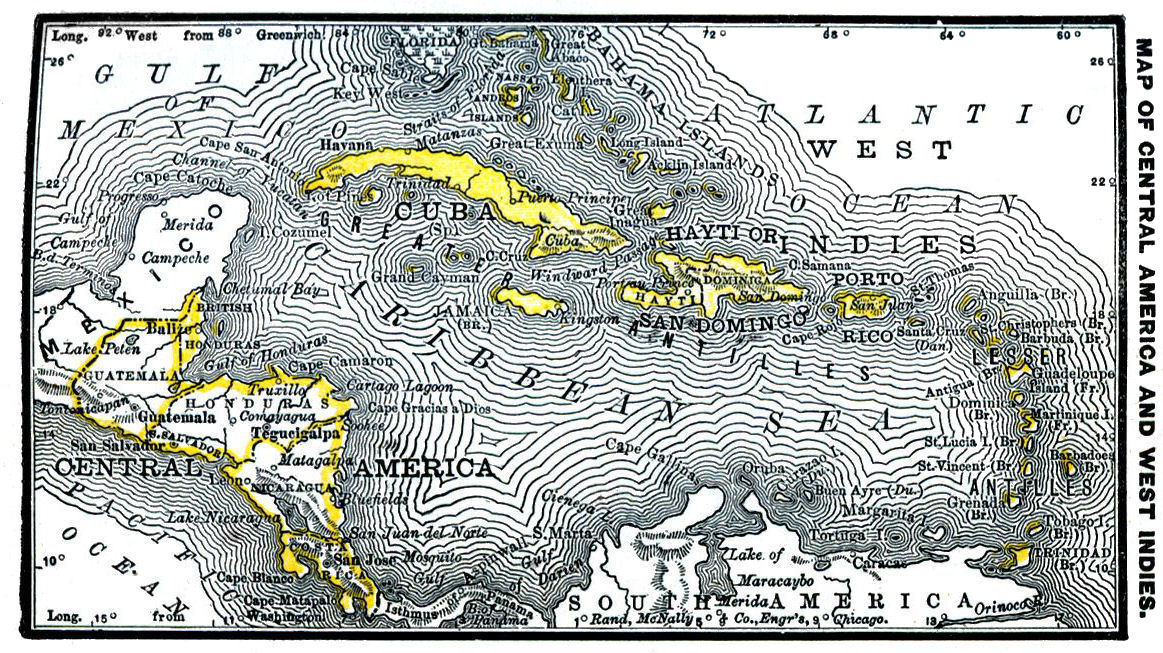
COSTA RICA.Kos´ta Ree´ka.
The most southern republic of Central America. Area, 26,040 square
miles. Population, 190,000. There are many volcanic peaks: Turrialba,
12,500 feet high; Chiriqui, 11,265 feet high; Los Votos, 9,840 feet
high.
The chief executive, the President, elected for a term of 4 years, is
assisted by 5 ministers. Legislative power is vested in a Congress of
Deputies, chosen for 4 years. Capital, San José; pop., 20,000.
The principal products of the soil are coffee, sugar, maize, cocoa,
sarsaparilla and fruits. The principal export is coffee. Value of
exports, 1883, $2,431,625; of which coffee amounted to $2,000,590.
Imports chiefly manufactures from England, $2,081,805. Revenue for fiscal
year of 1885, $2,867,170, mainly derived from customs duties and the
monopoly on spirits; expenditure, $2,961,110. In 1884, $841,440 were
expended for public works. There are about 104 miles of railway:
telegraph, 451 miles.
The state religion is the Roman Catholic; constitution guarantees
religious liberty. There are 341 national schools and 584 private
schools; total number of pupils, 13,924.
NICARAGUA.Nik-ar-a´gwa.
Largest of the Central American states. Area, 49,500 square miles.
Population, 400,000. Fifty-five per cent, of inhabitants are Indians.
Climate is healthy; mean annual temperature about 80°; rainfall about 100
inches. Constitution adopted 1858. Presidential term, 4 years.
Legislative power rests with a Senate and a House of Representatives.
Capital, Managua; population, 12,000.
Through want of peace and industry the great natural resources are
undeveloped. Lead, iron, zinc, antimony, tin, quicksilver and gold are
found. The vegetable products are cotton, coffee, indigo, rice, tobacco
and corn. There are about 400,000 cattle in the country. Leading exports
in 1882: coffee, $659,550; India rubber, $638,010; gold, $150,000.
Imports for the same year, $1,477,340; exports, $1,895,760.
Army, 703 regulars and 9,600 militiamen. Number of schools, 178;
pupils, 8,330. Vessels entered, 1882, 213; tonnage, 256,000. Telegraph,
1882, 800 miles; railway, 83 miles.
SAN SALVADOR.Săl-vă-dōr´.
In area the smallest, in population the second, of the Central
American republics. It extends along the Pacific coast 170 miles. Average
breadth, 43 miles; area, 7,225 square miles. Population, 554785
Constitution adopted 1864; amended 1883. Government administered by a
President, elected for 4 years, and a ministry of 4 members. The
legislative power is vested in a Senate and House of Representatives.
Capital, San Salvador; population, 18,500.
The temperature varies greatly; but the climate is generally
considered healthful. This is the most advanced and best cultivated of
the republics. Principal agricultural products, indigo, coffee, sugar and
balsam. Minerals are not abundant, though there are some rich veins of
silver. Value of silver ores, 1882, $700,000.
Latest reports give value of imports as $2,327,765; exports,
$5,638,080. Value of coffee exported, $3,416,100; indigo, $1,812,590;
sugar, $93,230. In the same year 265 vessels entered the ports.
The army consists of 1,200 men and 2,500 militia.
GUATEMALA.Gaw-te-mah´la.
The most populous of the five Central American republics. Area, 41,830
square miles. Population, 1884, 1,278,311. Climate healthful; snow never
falls; frequent violent earthquakes occur. Watered by numerous
rivers.
Constitution adopted 1859; amended 1879. President is chief executive;
legislative power in the hands of National Assembly; President and
members of Assembly elected for 6 years; suffrage universal. Capital, New
Guatemala; pop., 55,728.
The soil is fertile; cotton, sugar cane, coffee and tobacco are grown.
Roads are poor. Coffee crop, 1884, over 42,000,000 lbs. Sugar, wool and
fruit trade recently developed. In 1882, number of land-owners 5,334.
Imports, 1884, valued at $2,630,100; exports, $3,716,340. Miles of
railway, 105. Miles of telegraph, 2,880; 1,100 miles controlled by the
state.
Army consists of 2,180 men, rank and file; 33,000 militiamen. There is
no navy.
In 1882, sum spent on education, $434,753; state contributed $323,860;
in 1883 there were 844 primary government schools; number night schools,
48; pupils attending all schools, 42,021.
HONDURAS.Hon-doo´ras.
Republic established November 5, 1838. Area, 39,600 square miles.
Population, 458,000. Capital, Tegucigalpa; pop., 12,000. Numerous
mountains; between them fertile valleys. Coast line on the Pacific, 40
miles: Atlantic, 400 miles. Many excellent harbors; many rivers, some of
them navigable.
Government consists of President, 6 ministers, and an Assembly of 37
Representatives. Finances badly disordered; foreign debt, $26,125,106;
interest unpaid, $24,308,846. Standing army, 830 men; militia, 31,500.
Navy, 2 steam corvettes, with 8 guns.
The products are mahogany, fruit, cotton, cattle, coffee, tobacco,
indigo, India rubber and rosewood. Exports from Truxillo, 1883, $804,550;
26,000 head of cattle; mahogany valued at $88,000; hides and deer skins,
$40,000. Total exports, 1883, $2,193,149; imports, $1,749,146.
Railway, 29 miles. Telegraph, 1,800 miles; offices, 23; messages,
107,730. Universities, 2; several colleges; 573 schools, with attendance
of 20,518.
BRITISH HONDURAS.Hon-doo´ras.
A British Colony in Central America. Area, 7,562 square miles.
Population, 27,452. Coast low and swampy; land gradually rises; on the
inland boundary are hills of from 800 to 1,000 feet high; mountains 4,000
feet high. Sixteen rivers descend from elevated lands. Climate hot and
damp; temperature, 1878-79, 75°; rainfall 105.49 inches, unusually
heavy.
Government in the hands of Lieutenant Governor, an executive and a
Legislative Council. Capital, Belize; pop., 5,767. Soil fertile. Sugar
cane is grown; fruits flourish; the staple products, however, are the
natural woods of the colony. Annual export of mahogany, 3,000,000 feet;
logwood, 15,000 tons; estimated value of fruit exports, $100,000. Total
imports, 1883, $1,344,865; exports, $1,514,345. Large trade with
neighboring republics.
JAMAICA.Ja-mā´ka.
An island of the West Indies; formally ceded to Great Britain, in
1670, by the treaty of Madrid; most valuable possession of the British
Crown in the West Indies. Area, including the Turks and Caicos Islands,
annexed in 1873, 4,362 square miles. Population, 585,536. Surface
mountainous. There is a great variety of climate. Temperature in
lowlands, 95° at night, 85° in the day; in highlands, 40° to 50°.
Produces most of the tropical staples; the rosewood, mahogany and ebony
of the island are well known.
Latest reports give 121,457 acres under crops; 120,264 in guinea
grass, and 318,549 in pasture. Principal exports: coffee, 9,572,714 lbs.;
ginger, 908,603 lbs.; pimento, 6,195,109 lbs.; 29,000 hhds. of sugar;
18,115 puncheons of rum, and 35,157 tons of logwood. Value of fruit
exported in same year, $197,255. Total value of imports, 1889,
$6,609,810; exports, $7,745,290.
Governor is assisted by a Privy Council and Legislative Council.
Kingston, the chief city and port, is the capital; pop., 38,566.
Miles of railway, 25; 60 miles in process of construction. Telegraph
stations and post offices in every town and village.
SAN DOMINGO.San Do-meeng´go.
A republic occupying the eastern and larger portion of the island of
Hayti. Area, 18,045 square miles. Country first settled by Spaniards
under Columbus in 1492. Republic founded 1844. President elected for a
term of 4 years; legislative power in the hands of a National Congress.
Capital, San Domingo, founded 1494; population, 10000
The country is very fertile. Principal products, sugar, molasses,
tobacco, cotton, coffee, cacao, fruits, mahogany and live stock. The
production of sugar and molasses is largely on the increase. Latest
reports give $5,000,000 capital invested in sugar factories; amount of
product, 10,000 tons.
Value of imports, 1883, $3,142,100; exports, $2,129,265. At the two
most important ports, San Domingo and Puerto Plata, there entered, in
1883, 297 vessels, of 192,042 tons.
HAYTI.Hā´tee.
A republic, occupying the west part of the Island of Hayti. Area,
10,204 square miles. Population, 572,000. Capital, Port au Prince; pop.,
35,000. Nine-tenths of total population are negroes. Essentially
mountainous. In plains, temperature rises to 96° and 100°; on high lands,
ranges between 60° and 76°. Constitution was adopted 1867. President is
elected for 4 years; National Assembly consists of Senate and House of
Commons. Mountains cultivable almost to their summits; covered with
valuable timber. Agriculture is backward, though the soil is probably the
most fertile in the West Indies. Business of the country transacted by
foreigners.
Finances badly deranged; foreign debt, $6,409,970; no interest paid on
debt for years. Revenue, $4,500,000; expenditures, $7,000,000.
Three-fourths of revenue derived from duties on imports and exports.
Imports, 1881, $7,283,620; exports, $6,240,460. In same year, 792 vessels
entered, and 768 vessels cleared, the ports of Hayti.
By a law of 1878, army consists of 6,828 men; the Guard of the
Government, 650 men.
Language of the country, French; religion, Roman Catholic.
CUBA.Kū´ba.
A Spanish colony in the West Indies. Area, 43,220 square miles.
Population, 1,521,684; 50 per cent. of the inhabitants are blacks and
enfranchised slaves. The greatest length of the island is 760 miles;
width varies from 20 to 135 miles; coast line about 2,000 miles. Surface
is broken by a mountain chain running through its centre from east to
west; average altitude of summit is between 5,000 and 6,000 feet. Pico de
Turquino, 7,670 feet, is the highest peak. There are over 260 rivers, all
valueless for navigation purposes, except the Canto. Mineral springs
abound.
But little attention has been paid to the development of the mineral
wealth. Gold was obtained by the early colonists, but for two centuries
comparatively none has been found. There are extensive copper mines, and
coal is abundant. Copperas and alum have also been obtained.
Rainfall at Havana: in the wet season, 27.8 inches; dry season, 12.7
inches. Average temperature: at Havana, 77°; at Santiago de Cuba, 80°.
Yellow fever and earthquakes are frequent.
Thirteen million acres of Cuban territory are uncleared forests;
7,000,000 wild and uncultivated. Principal woods grown and exported are
mahogany, rosewood, Cuban ebony, and cedar.
Tobacco and sugar raising principal occupation of the people. Many
sugar plantations comprise 10,000 acres each.
Two crops of Indian corn grown per year; rice, cotton, cacao and
indigo also produced; most tropical fruits are abundant. Sugar product
averages 520,000 tons per year; molasses, 79,365 hogsheads. Total value
of agricultural products over $90,000,000. United States receives 80 per
cent. of Cuban sugar. No manufactures deserving mention.
Latest reports give exports of cigars 225,000,000 per annum; leaf
tobacco, 13,500,000 pounds. There are about 900 miles of railway. Marine
cable connects Cuba with Florida.
Roman Catholicism is the only religion tolerated. Education
compulsory; school attendance, 34,813.
Havana is the capital; Pop., 25,000. Government administered by a
Captain General, appointed by the Spanish Crown. The island is now
represented in the Spanish Cortes, Madrid.
PORTO RICO.Pōr´to Ree´ko.
The smallest of the Greater Antilles. Area, including dependencies,
3,550 square miles. Population, 754,313. Rectangular in shape; length,
100 miles; breadth, 40 miles. A range of mountains extends across the
island from east to west; highest peak, 3,678 feet.
The island is very fertile; its principal products are sugar cane,
coffee, tobacco, cotton, rice and Indian corn. In proportion to its area,
it produces more sugar than any other West India island.
Government is administered under a constitution granted by the Spanish
Cortes, 1869. Slavery was abolished in 1873. Capital, San Juan; pop.
about 27,000. Climate warm; more healthful than that of the other
Antilles. Destructive hurricanes are frequent. The natural productions
are very numerous; medicinal plants and many valuable woods, as mahogany,
ebony, logwood, and cedar, abound in the forests. Business in the hands
of foreigners. Imports, 1871, $17,500,000; exports $15,500,000. Export of
sugar, 111,084 tons; molasses, 7,590,915 gallons.
Telegraphic cable connects Porto Rico with other West Indies;
telegraph lines connect the principal towns; there are no railroads.
SOUTH AMERICA.
A vast, compact, triangular peninsula, forming southern portion of
Western Continent. Area, 6,827,230 square miles; extreme length, 4,550
miles; extreme breadth, about 3,300 miles. Number political divisions,
11.
| Divisions. | Area,
Sq. Miles. | Population. | Capitals. | Pop. |
| Argentine Republic | 1,125,086 | 3,026,000 | Buenos Ayres | 295,000 |
| Bolivia | 842,729 | 2,300,000 | La Paz | 76,372 |
| Brazil | 3,288,963 | 9,883,622 | Rio de Janeiro | 274,972 |
| Chili | 256,399 | 2,271,949 | Santiago | 200,000 |
| Colombia | 504,773 | 4,000,000 | Bogota | 100,000 |
| Ecuador | 248,370 | 946,033 | Quito | 80,000 |
| Guiana, British | 76,000 | 248,110 | Georgetown | 36,562 |
| Guiana, French | 48,000 | 36,760 | Cayenne | 10,000 |
| Guiana, Dutch | 46,060 | 68,255 | Paramaribo | 27,416 |
| Paraguay | 91,970 | 346,048 | Asuncion | 16,000 |
| Peru | 503,718 | 2,699,945 | Lima | 101,488 |
| Uruguay | 73,538 | 438,245 | Montevideo | 115,500 |
| Venezuela | 632,695 | 2,121,988 | Caracas | 55,638 |
| |
| Maracaybo, area | 4,900 sq. miles. | Titicaca, area | 4,000 sq. miles. |
| |
| | Miles. | | Miles. |
| Amazon | 3,750 | Parana | 2,000 |
| Caroni | 400 | Pilcomayo | 1,000 |
| Canca | 600 | Purus | 2,000 |
| Guaviare | 450 | San Francisco | 1,550 |
| Madeira | 2,000 | Tocantins | 1,000 |
| Magdalena | 900 | Uruguay | 800 |
| Meta | 500 | Xingu | 1,300 |
| |
| Cotton: | | Diamonds: |
| Brazil | $4,063,650 | Brazil | $370,316 |
| Colombia | 32,560 | |
| Venezuela | 36,449 | Tobacco: |
| | | Brazil | 5,344,500 |
| | | Paraguay | 658,650 |
| Sugar: | | Venezuela | 58,778 |
| Brazil | 16,250,000 | |
| Peru | 2,354,095 | Rubber: |
| | | Brazil | 5,965,000 |
| | | Ecuador | 428,800 |
| Coffee: | | |
| Brazil | 52,720,000 | Hides: |
| Columbia | 2,396,337 | Brazil | 4,040,750 |
| Venezuela | 9,930,430 | Colombia | 1,000,608 |
| British Guiana | 3,019 | Venezuela | 395,915 |
| | | British Guiana | 11,703 |
| | | |
| Cocoa: | | Indigo: |
| Colombia | 15,575 | Columbia | 8,360 |
| Venezuela | 1,602,443 | Venezuela | 23,290 |
| Ecuador | 2,768,670 | |
UNITED STATES OF COLOMBIA.
A federal republic in the northwestern part of South America, composed
of 9 States. Area, 504,773 square miles. The country is traversed by
three ranges of the Andes Mountains. There are numerous large, navigable
rivers, tributaries of the Orinoco and Amazon.
The constitution was adopted in 1863. Government in the hands of a
President, elected for 2 years, a ministry of 7 members, and a Congress
composed of a Senate and House of Representatives. Capital, Bogota;
population, 100,000. Strength of the Federal Army determined by Congress.
Peace footing for 1882-83, 4,000 men.
The climate varies according to the elevation: the coast lands are
usually hot and sickly: but the high table lands, as a rule, possess a
genial climate; that of Bogota is unusually fine.
The mineral wealth of Colombia is very great; one-sixth of the exports
consist of precious metals. Agriculture and stock raising are the leading
pursuits. Value of imports, 1883, $11,504,028; exports, $14,857,170.
Two-thirds of the exports consist of cinchona and coffee. The transit
trade through the ports of Panama and Aspinwall is of far greater
importance than the direct commerce; its value is estimated as not less
than $85,000,000 per annum.
There are many native products, among which are fine woods, cacao,
India rubber, ipecac, calisaya bark, cochineal, sarsaparilla and logwood.
These, and tobacco, cinchona, coffee, sugar, indigo, rice, cotton, hides,
ores and Panama hats, form the chief exports.
In 1883, 1,513 vessels, of 709,175 tons, entered the ports of
Colombia. Number of miles of railway in the republic, 140. It is expected
that the ship canal across the Isthmus of Panama will be opened in 1888.
The company have a subscribed capital of $125,000,000.
VENEZUELA.Vĕn´ez-wee´la.
A republic of South America, formed in 1830. The republic was, in
1881, subdivided into 8 States, 1 Federal District, 8 Territories and 2
national settlements. Area, according to an official statement of 1884,
632,695 square miles; population, 2,121,988. The Andes Mountains cross
the northern part from west to east; the Orinoco and other important
rivers pass through the southern part.
Executive power is in the hands of a President, who exercises his
authority through a ministry of 6 and a Federal Council of 16 members;
legislative, in a Congress of two Houses, the Senate and House of
Representatives. Vice-President chosen by the Council. Capital, Carácas;
population, 55,638. Chief towns, Valencia (population, 36,145) and
Barquisimeto (population, 28,918). Army: peace footing, 2,545 officers
and men; war footing, 350,000.
Mineral resources very great. Venezuela gold fields among the richest
in the world; iron and copper abundant. Value of mineral products, 1884,
§4,452,050; gold, $3,243,380. Latest reports give value of imports as
$17,253,130; exports, $19,720,225.
Agriculture the most important industry. Number engaged in it, 1884,
375,820; number of acres cultivated, 852,500. Coffee the most important
product; total value of product, 1884, $11,255,000; value, of sugar
product, $7,686,000; corn, $6,000,000; cocoa, $2,998,000. Latest reports
give number of cattle as 2,926,733; goats and sheep, 3,490,563; horses,
291,603; mules, 906,467; swine, 976,600.
State religion, Roman Catholic; all others tolerated. In 1883 the
government spent $500,000 in public instruction. Number universities, 2;
colleges, 33; normal schools, 5; other schools, 1,794. Number of miles of
railway, 1884, 102; telegraphs, 1,145 miles.
BRITISH GUIANA.Ghe-a´na.
A territory in northeast part of South America. First settled by the
Dutch, 1580. Acquired by the British in 1803; formally ceded in 1814.
Estimated area, 76,000 square miles. Population, 248,110. Crossed by two
great mountain systems. Contains many rivers; largest, Essequibo, 600
miles long, noted for magnificent cataracts. Thermometer rises to 90° in
warm weather; falls to 75° in winter season; mean annual average at
Georgetown, 81°. Rainfall per year, about 72 inches.
Vegetation is luxuriant. Large sections are covered with valuable
forests, which furnish exhaustless supplies of timber, largely used for
shipbuilding. Number sugar plantations, 120; coffee estates, 12. Sugar
forms 92 per cent. of exports; latest reports give 111,156 hhds. Rum
exported, 32,531 puncheons; rum issued for home consumption, 330,392
gals. Export of molasses, 17,084 casks; timber export, 464,436 cubic
feet. Total imports, 1882, $10,498,160; exports, $16,043,155.
Government administered by a Governor appointed by British Crown, and
a Court of Policy.
Georgetown the capital; pop., 36,562. Number of schools sanctioned by
Board of Education, 177; Church of England, 81.
DUTCH GUIANA.Ghe-a´na.
Lies east of British Guiana, often called Surinam from the river of
that name. Coast line, 220 miles. Dutch first visited the country about
1580; but the first settlement in Surinam was made by an Englishman, in
1630. Area, 46,060 square miles. Population, 68,255; 54,602 negroes.
Local government consists of a Governor and Colonial Assembly.
Capital, Paramaribo; population, 27,416.
Mean annual temperature, 80.4°; coldest month mercury falls to 78°;
warmest, mercury rises to 99°. Rainfall, 99 inches; at Paramaribo the
average of eight years was 101 inches.
Large tracts of territory covered with primeval forests. Great staple
of Guiana is sugar; average yearly export, about 10,645 tons. First cocoa
sent to Amsterdam, 1733; the average yearly production is now more than
13,000 tons. Cotton and coffee rank next. Gold-mining is a growing
industry. Latest reported value of exports, $1,151,070; imports,
$1,316,355.
FRENCH GUIANA.Ghe-a´na.
East of Dutch Guiana. Area, 48,000 square miles. Population, 36,760.
Coast line low and swampy. Large portion of the territory is covered with
dense forests. Rainy season from November to June. Rainfall at Cayenne,
10 feet per year; heavier in the interior. Temperature: in summer, 86°;
winter, mean, 79°, and seldom sinks so low as 70°. In this century there
have been three earthquakes.
Administration in the hands of Governor and Military Commandant.
Capital, Cayenne; pop., 10,000.
Coffee, introduced in 1716, is extensively grown. Guiana cocoa,
bread-fruit, arrow-root, bananas, yams, oil, and date palm are among the
products; but the principal source of food is manioc. Contains valuable
gold deposits. French criminal penitentiaries located in this country.
BRAZIL.Bra-zil´.
This is the largest of the South American countries, and the only
empire in the New World. Contains many rivers. Amazon, the longest,
drains 800,000 square miles of Brazilian territory. Temperature in the
valley of the Amazon ranges from 68° to 85°, while at Rio Janeiro the
average is 75°. Area, 3,288,963. Population, 9,883,622. Capital, Rio de
Janeiro; pop., 274,972.
Executive power is vested in the Emperor, ministers and Secretaries of
State; legislative authority rests with the Senate and and Chamber of
Deputies. The empire is divided into 20 Provinces.
Country rich in minerals and precious stones. Total value of diamond
washings for the first 100 years was about $20,000,000. Diamond mines are
now owned by private individuals. Manufactures in late years improved by
the introduction of American machinery.
During the last 16 years the increase in exports has been 20 per
cent.; in imports, 22 per cent. The value of coffee exported in 1882-83
was $52,720,000; sugar, $16,250,000; raw cotton, $4,063,650; tobacco,
$5,344,500; India rubber, $5,965,000. Total imports, 1882-83,
$111,434,300; exports, $134,945,100. In 1883, 2,989 vessels, of 2,367,296
tons, entered, and 2,522, of 2,095,237 tons, cleared, Brazilian
ports.
Number miles railway, January, 1884, 3,500; 1,500 in process of
construction. Telegraph system under the control of the government; miles
of wire in 1883, 4,900. Army, on peace footing, 13,500 strong; in time of
war, 32,000. Naval force consists of 35 steam vessels, with 123 guns and
5,704 seamen.
Established religion, Roman Catholic. Clergy are supported by the
state. Compulsory education exists in several Provinces; 84 per cent. of
population is illiterate. Total number of schools, 5,685.
BOLIVIA.Bo-liv´e-a.
A republic of South America, named in honor of Simon Bolivar; formed,
in 1825, from provinces of Upper Peru; ceded all coast territory to Chili
in 1880. Area, 842,729 square miles. Population, 2,300,000. Surface
broken by two mountain ranges. Highest peak, Sahama, 22,350 feet; many
volcanoes. Lake Titicaca is the largest inland body of water in South
America; area, 4,000 square miles; Madeira river, with tributaries,
navigable for 3,000 miles in Bolivia; La Paz chief city; pop., 76,372.
Capital, Sucre or Chuquisaca.
President elected for 4 years. Legislative power rests with a Congress
of 2 chambers,—Senate and House of Representatives. Universal
suffrage prevails; Vice-President is appointed by President.
The climate embraces all degrees of heat and cold. The products of two
zones are found in Bolivia. Ebony, rosewood, mahogany, cinchona, and
other valuable trees abound. Manufactures limited to coarse cotton cloth,
hats, cordage, leather and alpaca. Tin, copper, gold, and vast quantities
of India rubber of the finest quality abound. Silver mines almost
inexhaustible; annual yield of the Cerro de Potosi mines, $2,250,000.
Two-thirds of exports are silver. Imports average $6,150,000; exports,
$9,000,000.
Standing army, 2,421 men; generals and other officers, 1,021;
two-thirds of revenue goes to support the army.
Roman Catholic the prevailing religion; other creeds tolerated; 4
universities. In 1884 but 12,000 pupils and students at schools and
colleges. Three railroads open for traffic.
ECUADOR.Ek-wa-dōr´.
A republic of South America, constituted 1830; situated on the
equator, from which it takes its name. Extremely mountainous; traversed
from north to south by three ranges of the Andes. Most lofty peaks:
Cotopaxi, 18,880 feet; Chimborazo, 21,424; Cayambe, 19,831. Climate, on
the coast, hot; on the high table lands, cold and bleak; valleys are free
from extremes of temperature. Area, 248,370 square miles. Population,
946,033. Quito, the capital, has 80,000 inhabitants; Guayaquil, the
principal seaport, 26,000. Quito is the highest inhabited city, being
9,500 feet above sea-level.
Ecuador was formed from the American Free State, founded by Simon
Bolivar. Executive power rests with a President, elected for 4 years;
legislative, with a Congress of two houses. President and Vice-President
are nominated by 900 chosen electors. Vice-president is President of the
Council of State. Hereditary rights or privileges prohibited by law.
Belief in the Roman Catholic church, qualification for suffrage.
The soil of Ecuador will grow the products of every zone. There is a
copious growth of the cinchona tree, sarsaparilla, vanilla, copaiba,
balsam of Tolu, etc. Many fibrous plants, suitable for the manufacture of
paper and cordage, are found in profusion. The immense mineral wealth is
untouched; agriculture is neglected; manufactures are insignificant. The
roads afford no facilities for commerce, being mostly mule tracks. Miles
of railway number but 75.
Export of cocoa, 1883 valued at $3,372,200; India rubber, $428,800.
Total value of exports, $4,923,300; imports, about $6,000,000. In 1883,
151 vessels, of 155,283 tons, entered, and 160 vessels, of 158,970 tons,
cleared the port of Guayaquil.
Only 7.5 per cent. of population can read or write. In 1884, standing
army fixed at 1,600 men.
PERU.Pe-roo´.
A republic of South America. Area, previous to the war with Chili,
503,718 square miles. Population, 2,699,945. Since the war about 70,000
square miles of Peruvian territory are occupied by Chili. Traversed by
two systems of the Andes Mountains; highest point is the volcano of
Misti, 20,300 feet above sea-level. Temperature at Callao about 60°; Lima
about 70°.
Independence declared in 1821. The government is administered by the
President, Senate and House of Representatives. The Peruvian constitution
is planned after that of the United States. Lima, the capital, has a
population of about 100,000.
The chief occupations are sheep raising, agriculture and mining;
manufactures unimportant. Mountain valleys are very fertile; mountains
are rich in minerals. Between 1853 and 1872, 8,000,000 tons of guano were
taken from the Chincha Islands. Latest reliable reports give: imports,
$24,000,000; exports (exclusive of guano and nitre), $31,000,000.
Principal exports are guano, nitrate of soda, wool, sugar, silver and
cinchona.
State finances deranged by the late war with Chili; foreign debt
$164,765,000; arrears in interest, $65,954,970. Railway system projected
in 1852; miles of line, 1878, 2,030. Telegraph lines, 1878, 1,382 miles.
The merchant marine, 1877, consisted of 147 vessels, with a combined
capacity of 49,860 tons. Army and navy almost annihilated in the war with
Chili; army now consists of 13,200 men; navy, of 18 steam vessels, with
66 guns.
ARGENTINE REPUBLIC.Ar´jen-tine.
A republic of South America. Total area, 1,125,086 square miles. Total
population, 1882, 3,026,000. Foreigners: Italians, 123,641; French,
55,432; Spaniards, 59,022; Germans, 8,616; English, 17,950. Population of
Buenos Ayres, the capital, was, in 1882, 295,000; Rosario has a
population of 32,204; Cordova, 39,651; ten towns have over 10,000
inhabitants. Population rapidly increasing from immigration. In 1877
immigrants numbered 28,708; 1880. 41,615: 1882, 59,843; during first nine
months of 1883, 73,210. The country is divided into 14 Provinces.
Executive power is vested in a President, elected for a term of 6 years;
legislative power is vested in a Congress, composed of a Senate and House
of Deputies. President and Vice-President must be Roman Catholics.
Constitution almost identical with that of the United States.
Public revenue derived from heavy customs duties. Income for 1884,
$32,400,000; Import does, $21,115,000; export dues, $3,010,000; total
expenditure, $32,460,000. Annual exports: wool, $28,250,000; hides,
$14,000,000; sheep skins, $4,250,000; tallow, $6,000,000; live animals,
$1,750,000; maize, $2,100,000.
The area devoted to agriculture is yearly increasing. In 1882 the
confederation possessed 14,206,499 horned cattle, 72,683,045 sheep,
4,856,808 horses. Total value of live stock, $210,000,000. In 1882 the
wheat product of the province of Santa Fé was 2,250,000 bushels.
Miles of railway, 2,500, and 651 miles are being constructed. In 1884
there were 9,800 miles of telegraph line, 8,060 miles owned by the
state.
Many navigable rivers afford excellent facilities for transportation.
The Uruguay river is navigable for 200 miles; the Rio Negro, for 500; and
the Colorado, for 150.
There are universities at Buenos Ayres and Cordova; professors, 66;
students, 923: there are also 28 middle class and normal schools, and
1,985 primary.
The army in 1884 consisted of 7,812 officers and men; militia and
National Guard, 350,000. Service in National Guard compulsory; regular
army supplied by recruitment.
URUGUAY.Oo-roo-gwī´.
This South American republic formed a Brazilian Province until 1825.
Independence recognized by treaty of Montevideo, 1828; constitution
proclaimed 1831. Area estimated at 73,538 square miles. Population,
438,245. Government in the hands of a President, elected for four years,
assisted by 5 ministers, and a Parliament composed of two houses.
Capital, Montevideo; population, 115,500.
The country forms a vast rolling plain, abounding in natural pastures.
The chief industry is the rearing of cattle and sheep. It is estimated
that 35,000,000 acres are used for pastoral purposes, on which are
6,711,778 cattle and 20,000,000 sheep. Chief agricultural products, wheat
and Indian corn. Climate is generally humid, but temperate and
healthful.
Revenue derived from customs duties. Commerce active. Value of
imports, 1833, $21,634,475; exports, $26,831,555. Principal articles of
export, cattle, hides, tallow, and dried and preserved meats.
Permanent army numbers 3,494 men, besides an armed police force of
3,200, and a national guard of 20,000 men. State religion, Roman
Catholic. Number of children in all schools, 40,000. Miles of railway,
1884, 271; of telegraph, 1,405.
CHILI.Chil´lee.
A republic of South America. Area, 256,399 square miles. Population,
2,271,949. This country is long and narrow, embracing extremes of
temperature. Mean annual temperature at Santiago, 55°; at Valparaiso,
58°. Spring begins in September; winter, in June. Lakes and rivers are
few; both are fed by the snow melting in the Andes; they are worthless
for navigation, but valuable for irrigation purposes. Surface is
mountainous; mean elevation of Andes, 11,830 feet; Aconcagua, the highest
peak, 22,420 feet.
Chili is divided into 18 Provinces and 4 Territories. The constitution
of 1833 vests the legislative power in a Senate and a Chamber of
Deputies. Executive power rests with a President, a Council of State, and
a Cabinet of 5 ministers. Capital, Santiago; pop., 200,000. The potato is
indigenous. Olive trees, mulberries and vines flourish. Cedar is the most
important tree in Chili. Fruit is plentiful. This republic is rich in
gold and silver, and especially in copper. Wheat the most important
cereal product; value of wheat exported in 1882, $6,649,345. Value of
chief exports in 1883: iodine, $2,987,490; bar copper, $14,339,460;
silver, $4,624,110. Revenue for 1884, $49,900,000, one-half of which was
derived from customs duties and monopolies; expenditure, $46,536,550.
Total exports in 1883 were valued at $79,732,550; imports,
$54,447,060.
The Chilian commercial marine consisted, 1883, of 131 vessels, of
53,071 tons. In 1882, 1,482, of 1,367,849 tons, entered, and 1,428, of
1,431,028 tons, cleared, the various ports of Chili.
One of the first states in South America to construct railways; length
of line in 1883, 1,378 miles, of which 600 miles belonged to the state;
cost of state lines, $42,141,686. In 1883 there were 6,840 miles of
telegraph line, property of the state. By a law of 1884 the strength of
the army can not exceed 12,410; at the same date the National Guard
numbered 51,826, of whom 17,408 were on duty. Navy consists of over 20
war vessels.
State religion is the Roman Catholic; all creeds are protected; clergy
is subsidized by the state; civil marriage is acknowledged by law.
Besides the National Institute at Santiago, there are many colleges of
different kinds; many agricultural and other special schools. There were,
in 1883, 5,042 students attending universities and colleges. The
attendance at the 724 public primary schools was 60541
PARAGUAY.Pa-ra-gwā´.
A republic of South America, entirely inland. Area 91,970 square
miles. Population, 346,048. Became independent in 1811; was ruled by Dr.
Francis for 25 years. The government is entrusted to a President and
Congress. Capital, Asuncion; pop., 16,000.
Soil and forests are very great sources of wealth. Manufactures are
few and crude. The country is well watered by numerous streams and lakes.
Three crops of tobacco per year are grown; home consumption, 15,000,000
lbs.; export, about 7,500,000 lbs. Sugar cane yields well; in 1882 there
were 37,500,000 pounds of sugar produced. Maize returns one hundred and
forty fold; rice, two hundred and fifty fold. Maté, or Paraguayan tea,
the most important product. Imports, 1881, $1,278,000; exports,
$1,928,500. The state owes Brazil and allies $236,000,000; Foreign debt,
$17,315,000.
Army numbers 607 men, lately reduced in order to diminish expenses.
Railway, 45 miles; telegraph, 45 miles.


