LECTURES DELIVERED IN THE CATHEDRAL
CHURCH OF BRISTOL IN 1907 AND 1908
BY THE
RIGHT REV. G. F. BROWNE D.D., D.C.L., F.S.A.
BISHOP OF BRISTOL
FORMERLY DISNEY PROFESSOR OF ART AND ARCHAEOLOGY
IN THE UNIVERSITY OF CAMBRIDGE
WITH ILLUSTRATIONS
PUBLISHED UNDER THE DIRECTION OF THE TRACT COMMITTEE.
LONDON: SOCIETY FOR PROMOTING CHRISTIAN KNOWLEDGE.
NORTHUMBERLAND AVENUE, W.C.; 43, QUEEN VICTORIA STREET, E.C.
BRIGHTON: 129, North Street. New York: E. S. Gorham.
1908
PREFACE
No attempt has been made to correct the various
forms of many of the proper names so as to make
the spelling uniform. It is true to the period to
leave the curious variations as Alcuin and others
wrote them. In the case of Pope Hadrian, the
name has been written Hadrian and Adrian indiscriminately
in the text.
While Alcuin’s style is lucid, his habit of dictating
letters hurriedly, and sending them off
without revision if he had a headache, has left its
mark on the letters as we have them. It has
seemed better to leave the difficulties in the English
as he left them in the Latin.
The edition used, and the numbering of the
Epistles adopted, is that of Wattenbach and
Dümmler, Monumenta Alcuiniana, Berlin 1873,
being the sixth volume of the Bibliotheca Rerum
Germanicarum.
CONTENTS
PAGE
CHAPTER I
The authorship of the anonymous Life of Alcuin.—Alcuin’s
Life of his relative Willibrord.—Willibrord
at Ripon.—Alchfrith and Wilfrith.—Alcuin’s conversion.—His
studies under Ecgbert and Albert at
the Cathedral School of York.—Ecgbert’s method of
teaching.—Alcuin becomes assistant master of the
School.—Is ordained deacon.—Becomes head master.—Joins
Karl
Alcuin finally leaves England.—The Adoptionist
heresy.—Alcuin’s retirement to Tours.—His knowledge
of secrets.—Karl and the three kings his sons.—Fire
at St. Martin’s, Tours.—References to the life
of St. Martin.—Alcuin’s writings.—His interview
with the devil.—His last days
The large bulk of Alcuin’s letters and other writings.—The
main dates of his life.—Bede’s advice to Ecgbert.—Careless
lives of bishops.—No parochial system.—Inadequacy
of the bishops’ oversight.—Great monasteries
to be used as sees for new bishoprics, and evil
monasteries to be suppressed.—Election of abbats
and hereditary descent.—Evils of pilgrimages.—Daily
Eucharists
The school of York.—Alcuin’s poem on the Bishops
and Saints of the Church of York.—The destruction
of the Britons by the Saxons.—Description of
Wilfrith II, Ecgbert, Albert, of York.—Balther and
Eata.—Church building in York.—The Library of
York
The affairs of Mercia.—Tripartite division of England.—The
creation of a third archbishopric, at Lichfield.—Offa
and Karl.—Alcuin’s letter to Athelhard of
Canterbury; to Beornwin of Mercia.—Karl’s letter
to Offa, a commercial treaty.—Alcuin’s letter to
Offa.—Offa’s death
Grant to Malmesbury by Ecgfrith of Mercia.—Alcuin’s
letters to Mercia.—Kenulf and Leo III restore
Canterbury to its primatial position.—Gifts of money
to the Pope.—Alcuin’s letters to the restored archbishop.—His
letter to Karl on the archbishop’s
proposed visit.—Letters of Karl to Offa (on a question
of discipline) and Athelhard (in favour of Mercian
exiles)
List of the ten kings of Northumbria of Alcuin’s
time.—Destruction of Lindisfarne, Wearmouth, and
Jarrow, by the Danes.—Letters of Alcuin on the
subject to King Ethelred, the Bishop and monks of
Lindisfarne, and the monks of Wearmouth and
Jarrow.—His letter to the Bishop and monks of
Hexham
Alcuin’s letters to King Eardulf and the banished
intruder Osbald.—His letters to King Ethelred and
Ethelred’s mother.—The Irish claim that Alcuin
studied at Clonmacnoise.—Mayo of the Saxons
Alcuin’s letter to all the prelates of England.—To the
Bishops of Elmham and Dunwich.—His letters on
the election to the archbishopric of York.—To the
new archbishop, and the monks whom he sent to
advise him.—His urgency that bishops should read
Pope Gregory’s Pastoral Care
Summary of Alcuin’s work in France.—Adoptionism,
Alcuin’s seven books against Felix and three against
Elipandus.—Alcuin’s advice that a treatise of Felix
be sent to the Pope and three others.—Alcuin’s
name dragged into the controversy on Transubstantiation.—Image-worship.—The
four Libri Carolini
and the Council of Frankfurt.—The bearing of the
Libri Carolini on the doctrine of Transubstantiation
Karl and Rome.—His visits to that city.—The offences
and troubles of Leo III.—The coronation of Charlemagne.—The
Pope’s adoration of the Emperor.—Alcuin’s
famous letter to Karl prior to his coronation.—Two
great Roman forgeries, the Donation of
Constantine and the Letter of St. Peter to the Franks
Alcuin retires to the Abbey and School of Tours.—Sends
to York for more advanced books.—Begs for
old wine from Orleans.—Karl calls Tours a smoky
place.—Fees charged to the students.—History and
remains of the Abbey Church of St. Martin.—The
tombs of St. Martin and six other Saints.—The Public
Library of Tours.—A famous Book of the Gospels.—St. Martin’s
secularised.—Martinensian bishops
Further details of the Public Library of Tours.—Marmoutier.—The
Royal Abbey of Cormery.—Licence of
Hadrian I to St. Martin’s to elect bishops.—Details
of the Chapter of the Cathedral Church of Tours
Great dispute on right of sanctuary.—Letters of Alcuin
on the subject to his representatives at court and to
a bishop.—The emperor’s severe letter to St. Martin’s.—Alcuin’s
reply.—Verses of the bishop of Orleans
on Charlemagne, Luitgard, and Alcuin
Alcuin’s letters to Charlemagne’s sons.—Recension of
the Bible.—The “Alcuin Bible” at the British Museum.—Other
supposed “Alcuin Bibles.”—Anglo-Saxon
Forms of Coronation used at the coronations
of French kings
Examples of Alcuin’s style in his letters, allusive, jocose,
playful.—The perils of the Alps.—The vision of Drithelme.—Letters
to Arno.—Bacchus and Cupid
Grammatical questions submitted to Alcuin by Karl.—Alcuin
and Eginhart.—Eginhart’s description of
Charlemagne.—Alcuin’s interest in missions.—The
premature exaction of tithes.—Charlemagne’s
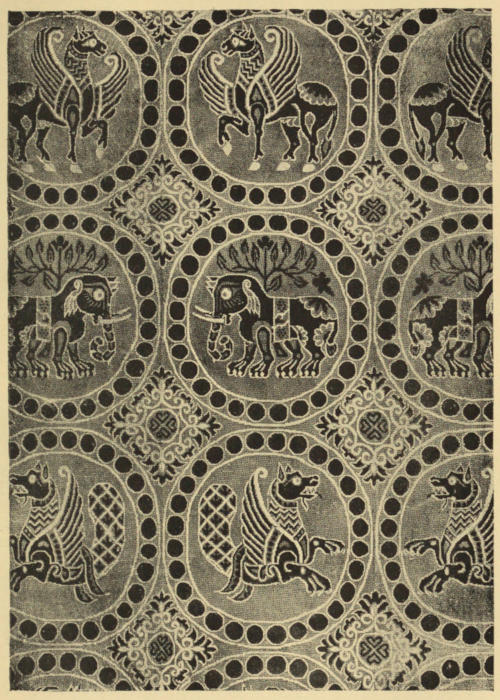
elephant Abulabaz.—Figures of elephants in silk
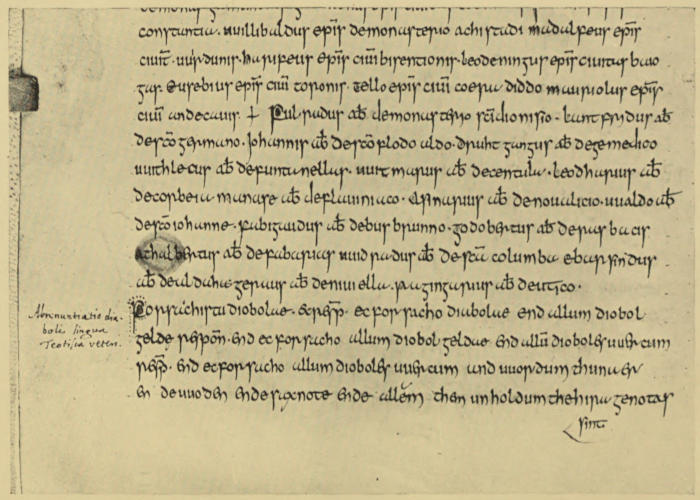
stuffs.—Earliest examples of French and German.—Boniface’s
Abrenuntiatio Diaboli.—Early Saxon.—The
earliest examples of Anglo-Saxon prose and verse
Alcuin’s latest days.—His letters mention his ill health.—His
appeals for the prayers of friends, and of
strangers.—An affectionate letter to Charlemagne.—The
death scene
The authorship of the anonymous Life of Alcuin.—Alcuin’s
Life of his relative Willibrord.—Willibrord at
Ripon.—Alchfrith and Wilfrith.—Alcuin’s conversion.—His
studies under Ecgbert and Albert at the Cathedral
School of York.—Ecgbert’s method of teaching.—Alcuin
becomes assistant master of the School.—Is ordained
deacon.—Becomes head master.—Joins Karl.
The only Life of Alcuin which we possess,
coming from early times, was written by a monk
who does not give his name, at the command
of an abbat whose name, as also that of his abbey,
is not mentioned by the writer. We have, however,
this clue, that the writer learned his facts
from a favourite disciple and priest of Alcuin
himself, by name Sigulf. Sigulf received from
Alcuin the pet name of Vetulus, “little old
fellow,” in accordance with the custom of the
literary and friendly circle of which Alcuin was
the centre. Alcuin himself was Flaccus; Karl
the King of the Franks, and afterwards Emperor,
was David; and so on. We learn further that
the abbat who assigned to the anonymous monk
the task of writing the Life was himself a disciple
of Sigulf. Sigulf succeeded Alcuin as Abbat of
Ferrières; and when he retired on account of old
age, he was in turn succeeded by two of his pupils
whom he had brought up as his sons, Adalbert
and Aldric. The Life was written after the death
of Benedict of Aniane, that is, after the year 823.
Adalbert had before that date been succeeded by
Aldric, and Aldric became Archbishop of Sens
in the end of 829. The Life was probably written
between 823 and 829 by a monk of Ferrières, by
order of Aldric. Alcuin had died in 804. The
writer of the Life had never even seen Alcuin;
he was in all probability not a monk of Tours.
That is the view of the German editor Wattenbach
as to the authorship and dedication of
the Life. That learned man appears to have given
inadequate weight to the writer’s manner of citing
Aldric as a witness to the truth of a quaint story
told in the Life. This is the story, as nearly as
possible in the monk’s words:—
“The man of the Lord [Alcuin himself] had read
in his youth the books of the ancient philosophers
and the romances[1] of Vergil,[2] but he would not
in his old age have them read to him or allow
others to read them. The divine poets, he was
wont to say, were sufficient for them, they did not
need to be polluted with the luxurious flow of
Vergil’s verse. Against this precept the little old
fellow Sigulf tried to act secretly, and for this he
was put to the blush publicly. Calling to him
two youths whom he was bringing up as sons,
Adalbert and Aldric, he bade them read Vergil
with him in complete secrecy, ordering them by
no means to let any one know, lest it come to the
ears of Father Albinus [Alcuin]. But Albinus
called him in an ordinary way to come to him,
and then said: ‘Where do you come from, you
Vergilian? Why have you planned, contrary to
my wish and advice, to read Vergil?’ Sigulf
threw himself at his feet, confessed that he had
acted most foolishly, and declared himself penitent.
The pious father administered a scolding to him,
and then accepted the amends he made, warning
him never to do such a thing again. Abbat
Aldric, a man worthy of God, who still survives,
testifies that neither he nor Adalbert had told any
one about it; they had been absolutely silent, as
Sigulf had enjoined.”
It seems practically impossible to suppose that
the monk would have put it in this way, if Aldric
had been the abbat to whom he dedicated the Life,
or indeed the abbat of his own monastery. It is
clear that the Life was written while Aldric was
still an abbat, that is between 823 and 829; and
it seems most probable that it was written by
a monk of some other monastery for his own
abbat. Nothing of importance, however, turns
upon this discussion. It is a rather curious fact,
considering the severity of Alcuin’s objection to
Vergil being read in his monastery, that the
beautiful copy of Vergil at Berne, of very early
ninth-century date, belonged to St. Martin of
Tours from Carolingian times, and was written
there.[3]
Not unnaturally, the Life, written in and for
a French monastery, does not give details of the
Northumbrian origin of Alcuin. It makes only
the statement usual in such biographies, that he
sprang from a noble Anglian family. Curiously
enough, we get such further details as we have
from a Life of St. Willibrord written by Alcuin
himself at the request of Archbishop Beornrad of
Sens, who was Abbat of Epternach, a monastery
of Willibrord’s, from 777 to 797.
“There was,” he writes, “in the province of
Northumbria, a father of a family, by race Saxon,
by name Wilgils, who lived a religious life with
his wife and all his house. He had given up the
secular life and entered upon the life of a monk;
and when spiritual fervour increased in him he
lived solitary on the promontory which is girt by
the ocean and the river Humber (Spurn Point)[4].
Here he lived long in fasting and prayer in a little
oratory dedicated to St. Andrew[5] the Apostle;
he worked miracles; his name became celebrated.
Crowds of people consulted him; he comforted
them with the most sweet admonitions of the
Word of God. His fame became known to the
king and great men of the realm, and they conferred
upon him some small neighbouring properties,
so that he might build a church. There
he collected a congregation of servants of God,
moderate in size, but honourable. There, after long
labours, he received his crown from God; and there
his body lies buried. His descendants to this day
hold the property by the title of his sanctity. Of
them I am the least in merit and the last in order.
I, who write this book of the history of the most
holy father and greatest teacher Willibrord, succeeded
to the government of that small cell by
legitimate degrees of descent.”
Inasmuch as the book is dedicated to Beornrad
by the humble Levite (that is, deacon) Alcuin, we
learn the very interesting fact that Alcuin, born
in 735, came by hereditary right into possession
of the property got together by Wilgils, whose son
Willibrord was born in 657. The dates make it
practically almost certain that Wilgils was born
a pagan. Alcuin informs us that he only entered
upon marriage because it was fated that he should
be the father of one who should be for the profit
of many peoples. If Willibrord was, as Alcuin’s
words mean, the only child of Wilgils, we must
suppose that Alcuin was the great-great-great-nephew
of Wilgils, allowing twenty-five years for
a generation in those short-lived times.
Alcuin three times insists on the lawful hereditary
descent of the ownership and government of
a monastery. A second case is in his preface to
this Life of Willibrord. The body of the saint,
he says, “rests in a certain small maritime cell,
over which I, though unworthy, preside by God’s
gift in lawful succession.” A third case occurs
also in this Life. “There is,” he says, “in the
city of Trèves a monastery[6] of nuns, which in the
times of the blessed Willibrord was visited by
a very severe plague. Many of the handmaids
of the Lord were dying of it; others were lying
on their beds enfeebled by a long attack; the rest
were in a state of terror, as fearing the presence
of death. Now there is near that same city the
monastery of that holy man, which is called
Aefternac,[7] in which up to this day the saint rests
in the body, while his descendants are known
to hold the monastery by legitimate paternal
descent, and by the piety of most pious kings.
When the women of the above-named monastery
heard that he was coming to this monastery of
his, they sent messengers begging him to hasten
to them.” He went, as the blessed Peter went to
raise Tabitha; celebrated a mass for the sick;
blessed water, and had the houses sprinkled with
it; and sent it to the sick sisters to drink. Needless
to say, they all recovered.
In two of these cases, the two in which Alcuin
speaks of his own property, he uses the word succession,
“by legitimate succession” in the one case,
legitima successione, “through legitimate successions”
in the other case, per legitimas successiones,
the former no doubt referring to the succession
from his immediate predecessor, the latter referring
to the four, or five, steps in the descent from
Wilgils to Alcuin. In the case of the monastery
of Epternach he defines it from the other end,
“from the legitimate handing-down,” traditione
ex legitima, the piety of the most pious kings being
called in to confirm the handing-down.
It is remarkable that Alcuin should thus go out
of his way to insist upon the lawfulness of the
hereditary descent of monasteries, when he knew
well that his venerated predecessor Bede, following
the positive principle of the founder of Anglian
monasticism in Northumbria, Benedict Biscop,
attributed great evils to such hereditary succession
to the property and governance of monasteries.
We shall see something of this when we come
to the consideration of Bede’s famous letter to
Ecgbert, written in or about the year of Alcuin’s
birth.
It is probably not necessary to suppose that
Alcuin intends to draw a distinction between the
constitutional practice in Northumbria and that
in the lands ruled by Karl, though it is a marked
fact that he mentions the intervention of kings in
the latter case and twice does not mention it in
the former. Bede says so much about the bribes—or
fees—paid to Northumbrian kings and bishops
for ratification of first grants by their signatures,
that we can hardly suppose there were no fees to
pay on succession. We cannot press such a point
as this in Alcuin’s Life of Willibrord, for he tells
Beornrad in his Preface that he has been busy with
other things all day long, and has only been able
to dictate this book in the retirement of the night;
and he urges that the work should be mercifully
judged because he has not had leisure to polish it.
The grammar of this dictated work needs a certain
amount of correction; Alcuin did not always
remember with what construction he had begun
a sentence. In these days of dictated letters he
has the sympathy of many in this respect.
Alcuin’s young relative Willibrord was sent away
to Ripon, as soon as he was weaned, to the charge
of the brethren there. Alchfrith, the sub-King of
Deira under his father Oswy, had driven out the
Irish monks whom he had at one time patronised at
Ripon, and had given their possessions to Wilfrith.
Under the influence of that remarkable man the
little child came, still, in Alcuin’s phrase, only an
infantulus. His father’s purpose in sending him to
Ripon was twofold. He was to be educated in
religious study and sacred letters, in a place where
his tender age might be strengthened by vigorous
discipline, where he would see nothing that was not
honourable, hear nothing that was not holy. At
Ripon he remained till he was twenty years of age,
and then he passed across to Ireland, to complete
his studies under Ecgbert, the great creator of
missionaries. With Ecgbert he spent twelve years.
Now in the thirty-two years covered by that
short narration, from 657 to 689, events of the
utmost moment had occurred in Northumbria, and
had mainly centered round Ripon. At the most
critical juncture of these events Bede becomes
suddenly silent. Alfred’s Anglo-Saxon version of
Bede goes further, and omits the bulk of what
Bede does say. A few words from Alcuin would
have been of priceless value, and he, writing in
France to a Frank, could have no national or ecclesiastical
reason for silence on points which Bede
and Alfred let alone. The whole of the variance
between Oswy and his son and sub-King Alchfrith,
on which Bede is determinedly silent, the only hint
of which is preserved to us solely by the noble
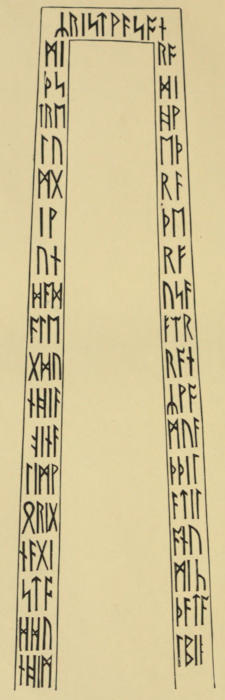
runes on the Bewcastle Cross, erected in 670 and
still standing, which bid men pray for the “high
sin” of Alchfrith’s soul[8]; the whole secret of the
variance between Oswy and Wilfrith; of Oswy’s
refusal to recognize Wilfrith’s consecration at Paris—with
unrivalled magnificence of pomp—to the
episcopal See of York; all this, and more, is included
in the first thirteen years of Willibrord’s
life at Ripon, and Ripon was the pivot of it all.
Alcuin has no scintilla of a hint of anything unusual,
not even when he mentions Ecgbert, the
Northumbrian teacher, dwelling in Ireland, of
whom we know from another source that he fled
from Northumbria to safety in Ireland when Alchfrith
and Wilfrith lost their power, and Alchfrith
presumably lost his life. It is quite possible that
if the head of the Bewcastle Cross were ever
found[9] the runes on it might tell us just what we
want to know. The illustration of this portion of
the Cross given in Gough’s edition of Camden’s
Britannia[10] was drawn in 1607, at which time
English scholars could not read runic letters, and
naturally could not copy them with perfect accuracy.
Still, it is evident that the runes stand for rikaes
dryhtnaes, apparently meaning ‘of the kingdom’s
lord’, the copyist having failed to notice the mark
of modification in the rune for u, which turned it
into y.
Turning now to Alcuin himself, a remarkable
story is told in the Life, evidently and avowedly
on his authority. When he was still a small boy,
parvulus, he was regular in attendance at church at
the canonical hours of the day, but very seldom
appeared there at night. What the monastery was
in which he passed his earliest years we are not
told; but inasmuch as no break or change is
mentioned between the story to which we now
turn and the description of his more advanced
studies, which certainly indicates the Archiepiscopal
School of York, we must understand that York was
the scene of this occurrence.
“When he was eleven years of age, it happened
one night that he and a tonsured rustic, one of the
menial monks, that is, were sleeping on separate
pallets in one cell. The rustic did not like being
alone in the night, and as none of the rustics could
accommodate him, he had begged that one of the
young students might be sent to sleep in the cell.
The boy Albinus was sent, who was fonder of
Vergil than of Psalms. At cock-crow the warden
struck the bell for nocturns, and the brethren got
up for the appointed service. This rustic, however,
only turned round onto his other side, as careless
of such matters, and went on snoring. At the
moment when the invitatory psalm was as usual
being sung, with the antiphon, the rustic’s cell was
suddenly filled with horrid spirits, who surrounded
his bed, and said to him, ‘You sleep well, brother.’
That roused him, and they asked, ‘Why are you
snoring here by yourself, while the brethren are
keeping watch in the church?’ He then received
a useful flogging, so that by his amendment a warning
might be given to all, and they might sing, ‘I
will remember the years of the right hand of the
Most Highest,’[11] while their eyes prevented the
night watches. During the flogging of the rustic,
the noble boy trembled lest the same should happen
to him; and, as he related afterwards, cried from
the very bottom of his heart, ‘O Lord Jesus, if Thou
dost now deliver me from the cruel hands of these
evil spirits, and I do not hereafter prove to be eager
for the night watches of Thy Church and the ministry
of praise, and if I any longer love Vergil more
than the chanting of psalms, may I receive a flogging
such as this. Only, I earnestly pray, deliver
me, O Lord, now.’ That the lesson might be the
more deeply impressed upon his mind, as soon as by
the Lord’s command the flogging of the rustic
ceased, the evil spirits cast their eyes about here
and there, and saw the body and head of the boy
most carefully wrapped up in the bedclothes, scarce
taking breath. The leader of the spirits asked,
‘Who is this other asleep in the cell?’ ‘It is the
boy Albinus,’ they told him, ‘hid away in his bed.’
When the boy found that he was discovered, he burst
into showers of tears; and the more he had suppressed
his cries before, the louder he cried now.
They had all the will to deal unmercifully with
him, but they had not the power. They discussed
what they should do with him; but the sentence
of the Lord compelled them to help him to keep
the vow which he had made in his terror. Accordingly
they said, imprudently for their purpose, but
prudently for the purpose of the Lord, ‘We will
not chastise this one with severe blows, because he
is young; we will only punish him by cutting
with a knife the hard part of his feet.’ They took
the covering off his feet. Albinus instantly protected
himself with the sign of the Cross. Then
he chanted with all intentness the twelfth psalm,
‘In the Lord put I my trust’; and then the rustic,
half dead, the boy going before him with agile
step, fled into the basilica to the protection of the
saints.”
A cynical reader might suggest that the disciplinary
officers of the School of York resorted in
those early times to unusual methods of making an
impression on a careless boy.
The Life proceeds to inform us that Alcuin was
trained under the prelate Hechbert, whom we know
as Ecgbert, Bishop and later Archbishop of York,
732 to 766. That learned man was a disciple of
Bede. He had under his tuition a flock of the
sons of nobles, some of whom studied grammar,
others the liberal arts, others the divine scriptures.[12]
They studied the doctrine set forth by “the holy
apostle of the English, Gregory; by Augustine,
his disciple; by holy Benedict[13]; also by Cuthbert
and Theodore, who followed in all things [a word
is omitted here, presumably the footsteps[14]] of their
first father and apostle[15]; and by the man most
loved of the Lord, Bede the presbyter, Hechbert’s
own preceptor.”
Then follows a very lifelike description of an
ordinary day’s work, when no inevitable expedition
came in the way, nor any high solemnity or great
festival of the saints. “From dawn of day to the
sixth hour, and very often to the ninth hour,
Ecgbert lay on his couch and opened to his disciples
such of the secrets of scripture as suited each.
Then he rose, and betook himself to most secret
prayer, offering first to the Lord fat burnt-offerings
with the incense of rams, and afterward, following
the example of the blessed Job, lest by chance his
sons should slip into the pit of benediction,[16] offering
the Body of Christ and the Blood for all. By
this time the vesper hour was coming near, and,
except in Lent, all through the year, winter and
summer, he took with his disciples a meal, slight
but fittingly prepared, not sparing the tongue of
the reader, that both kinds of food might bring
refreshment. Then you might see the youths
piercing one another with shafts prepared, discussing
in private what afterwards they are to
shoot forth in proper order in public. Does it not
seem to you that of this too it might be said,[17] “As
an eagle provoketh her young ones to fly, fluttereth
over them, spreadeth abroad her wings, taketh
them, beareth them on her wings”?
“Twice in the day did this father of the poor,
this great lover and helper of Christ, pour out
most secret prayer, watered from the most pure
fountain of tears, both knees bent on the ground,
hands long raised to heaven in the form of the
Cross; once, namely, before taking food, and again
before celebrating Compline with all his flock.
Which ended, no one of his disciples ever dared
commit his limbs to his bed without the master’s
blessing laid upon his head.
“He loved all his disciples, but of all he loved
Alcuin the most, for Alcuin more closely than any
of them followed his example in act and deed.
There were two special virtues in Alcuin—one, that
he never did anything which he was not quite clear
that his master’s approval covered; the other, that
whatever devices and temptations the enemy
brought to his mind, he told them all straight out
to his master without any sense of shame. Thus
it came to pass that any stimulus of lust which
he ever felt was most gloriously conquered by this
wonderful method, dashing the children of Babylon
against the stones, bruising the head of the serpent
with the heel. He was careful that against him
the words of Christ should not be spoken—‘Every
one that doeth evil hateth the light, neither cometh
to the light, lest his deeds should be reproved’; but
rather that his lot should be with them of whom it
is added—‘But he that doeth truth cometh to the
light, that his deeds may be made manifest that
they are wrought in God.’ O true monk without
the monk’s vow! how very seldom is thy example
followed by one whose vow binds him to it[18].”
In the chapter from which these details are
taken the author three times uses the name
“Albinus” for his hero, in place of “Alchuinus”
with which he began the chapter. Throughout
the Life he much more often calls him Albin than
Alcuin. We must probably understand that he
was known from his boyhood by both names; and
it is evident that Albin would be more easy to
pronounce than Alcuin, and would not unnaturally
be more generally used. On the other hand, it
is quite possible that he himself elected to call
himself Albin.
If Alcuin took the name Albinus from any
English source, the source is not far to seek. The
English nation owes to the original Albinus the
first suggestion to Bede that he should write the
Church History of the English race. Bede tells
us this in the Preface to his great work; and we
have it still more directly expressed in a letter
from him to Albinus in which he speaks of the
History as ad quam me scribendam iamdudum instigaveras,
and of Albinus as semper amantissimus in
Christo pater optimus. He was Abbat of St. Peter
and St. Paul, Canterbury, a pupil of Theodore and
Hadrian, the latter of whom he succeeded. He
greatly helped Bede by sending him full details
of the conversion of Kent, “as he had learned the
same from written records and from the oral tradition
of his predecessors.” Bede sent to him the
completed copy of the History, that he might have
it transcribed, and informs us that Albinus had no
small knowledge of Greek, and knew Latin as well
as his native tongue, English. Alcuin may well
have taken his name of Albinus from one with
whom he had so much in common, who died only
two or three years before Alcuin’s birth.
If, on the other hand, Alcuin took the name from
some foreign source, again we have not far to seek.
In Karl’s first year as King of the Franks he gave
a confirmatory charter to “the Monastery of St.
Albinus, which is built near to the walls of Angers”.
The Tour St. Aubin and the Rue St. Aubin are
still to be found at Angers, at the extreme south-east
corner of the ancient city. Little is known of
this martyr Albinus, and in consequence the Acts
of our St. Alban have been transferred to him. At
Angers, as at Alcuin’s own Tours, there are remains
of a great church of St. Martin; and, as was in
early times the case at Tours, the Cathedral is
dedicated to St. Maurice. It is possible that Alcuin
took his name of Albinus from this local source,
but it does not seem at all probable.
Alcuin’s supremacy in wisdom and other virtues
caused jealousy among his fellow disciples. This
went so far that they could not look at him with
unclouded eye or address him with pleasant words.
He consulted his master, who by this time was
Elcbert (Archbishop of York, 767-78), known to
Alcuin as Aelbert, and to us as Albert. The master
advised him to try the effect of heaping coals of
fire on their heads. He followed this advice, taking
care that they should never hear from him a contrary
word, and very often yielding to them when
their arguments were unsound. This course of conduct
he pursued until a complete change took place,
and they all rejoiced to acknowledge in him the
second master of their studies, next under Albert.
The Life relates at this point an interesting
episode, in the description of which we may seem
to hear Alcuin himself speaking to us:—
“Alcuin was reading the Gospel of St. John
before the master, in company of his fellow disciples.
He came to a part of the Gospel which only the
pure in heart can comprehend—that part, namely,
from where John says that he lay on the Lord’s
breast, down to the point at which he relates that
Jesus went with His disciples across the brook
Cedron.[19] Inebriated with the mystical reading
of the Gospel, suddenly, as he sat before the
master’s couch, his spirit was carried away in
ecstasy, and by those same who once in a ray of
sunlight showed before the eyes of the most holy
father Benedict the whole world, collected as it
were in an enclosure, the whole world was now
set before the eyes of Alcuin. And as he looked
intently at what he saw, he saw the whole of the
enclosure surrounded by a circle of blood. While
he was held by this marvellous vision, his fellow
disciples gazed at him in wonder, for the blood
seemed to have left his face. They tried to rouse
him, as one asleep; the noise they made attracted
the attention of Albert, who looked at him for
some time in silence, and then said, ‘Go on reading,
my sons, do not disturb him; if he rests awhile
he will be able to follow me more effectively when
I expound the passage.’ When the reading was
completed, and Albin came to himself again, the
father told them all to go except Alcuin. When
they were gone, he said, ‘What hast thou seen?
I beg thee, do not hide it.’ Alcuin wished to keep
secret what he had seen, fearing to fall into the
pitfall of elation; so he said, ‘Why, my lord
father?’ The blessed man said again, ‘Do not,
my son, do not hide it from me. It is not from
vain curiosity that I require this of you, but for
your own good.’ Alcuin saw that he could not
keep it secret, and he told, humbly, how he had
seen the whole world. Then the father said to
him, ‘See, my son, see that thou tellest not this
vision to any but that one whom after my decease
thou shalt hold to be the most faithful to thy
person. And charge him to keep it secret up to
the time of thy death.’ Acting on this counsel,
he told it only to Sigulf[20] during his lifetime. If
any one desires to know how the whole world could
be seen in one enclosure, he may turn to the book
of Dialogues of the holy Gregory[21]; and in the
meantime he may know that it was not the heaven
and the earth that were contracted into a small
space, but the mind of the seer that was dilated,
so that when rapt in the Lord he could without
difficulty see everything that was under God.
Perhaps some one inquiring further may ask why
under this figure of an enclosure, or why surrounded
by blood? He may know that the Blood of
Christ surrounds the fold of the holy Church, so
that from the rising of the sun to the setting
thereof those who are redeemed by His Passion
can say the words which, without doubt, dominated
the mind of Albin when he read before the master:
‘O give thanks unto the Lord, for He is gracious,
and His mercy endureth for ever.’[22] The whole
world, then, is seen in one enclosure surrounded by
the Blood of Christ; for all that the holy fathers
have done and have written figuratively since the
beginning of the world is unlocked by the Passion
of Christ alone, who is the lion of the tribe of
Juda, the root of David. But if by the encircled
enclosure any should wish to be understood the life
of his own carnal crimes surrounded by blood, thus
shown to him that it may be trodden under foot
by him, let that interpretation be left to his own
judgement.”
Alcuin had been tonsured in early years. He
was ordained deacon at York on the day of the
Purification of the holy Mary, in or about the year
768. Elcbert, who had been for some time in bad
health, felt that his death was drawing nigh, and
he gave to Alcuin a sketch of the course of life
which he wished him to pursue. The writer gives
us a report of his actual words, stating that “they
are now known”; this means, presumably, that
here also Alcuin had communicated them to
Sigulf, to be made public only after his death.
They run thus:—“My will is that you go to
Rome, and on the way back visit France.[23] For
I know that you will do much good there. Christ
will be the leader of your journey, guiding you
and controlling you on your arrival, that you may
demolish that most nefarious heresy which will
attempt to set forth Christ as adoptive man, and
that you may be the firmest defender and the
clearest preacher of the faith in the Holy Trinity.[24]
You will persevere in the land of your peregrination,
illumining the souls of many.”
The holy father, Bishop Elcbert, after blessing
him with the benedictions of his predecessor above
named, migrated to God on the eighth day of
November, 780. “The pious Albinus mourned
with tears, as for his mother, and would not take
comfort. Endowed in hereditary right with the
holy benedictions of the fathers,[25] he took pains to
multiply exceedingly the talent of his lord.[26] He
taught many in Britain, and not few later in
France. It was now that he associated with him
a man dear to God, remarkable for the nobility of
mind and of body, Sigulf, the presbyter, Warden
of the Church of the City of York, to remain with
him perpetually.[27] Sigulf had gone as a boy to
France with his uncle Autbert the presbyter, and
by him had been taken to Rome to learn the
ecclesiastical order; he had then been sent to the
city of Metz to learn chanting. There he worked
hard for some time, in great poverty, but with
much profit. After the holy man, his uncle,
migrated to the Lord, he came back to his own
land.” We can almost see and hear Sigulf getting
these little facts about himself and his uncle incorporated
in the Life of Alcuin.
“When the Almighty God willed to glorify
France with spiritual riches, as already with earthly
riches, granting to the land a King after His own
heart, a man of faith, fortitude, love of wisdom,
and ineffable beauty of body, namely Karl, most
illustrious in these respects, He put it into the
mind of Albinus that he should fulfil the counsel
and command of his father Albert, by going to
Rome and then visiting France.
“By the command of Eanbald I, the Archbishop
of York, the successor of Elcbert, he went to Rome
to obtain the pallium for the archbishop from the
Apostolic—that is, Hadrian I. On his way back
with the pallium he met King Karl in the city of
Parma.[28] The king addressed him with great
persuasiveness and many prayers, begging that
after completing his embassage he would come
and join him in France. The king had become
acquainted with him some years before, for Alcuin
had been sent on a legation to him by the archbishop
of the time.”
We may interrupt our author’s narrative at this
point to state that the fact and the date of this
former visit to Karl are recorded in the Life of
Hadrian I, as also the further fact, not here hinted
at, that Karl on that occasion sent Alcuin on to
Rome. “In the year 773 Karl sent to Hadrian
an embassy, consisting of the most holy bishop
George,[29] the religious abbat Uulfhard,[30] and the
king’s favourite counsellor Albinus.”
We may now return to the author of the Life.
He tells us, to quote his own words, that when
Karl begged Alcuin to come to him, Alcuin
desired to do what would be useful, and therefore
asked permission of his own king, Alfwald,
and of his archbishop, Eanbald I, to leave his
mastership of the School of York. He obtained
permission, but on condition that he should in time
come back to them. Under Christ’s guidance he
came to Karl. Karl embraced him as his father,[31]
by whom he had been introduced to the liberal
arts, in the study of which he could be somewhat
cooled, but in his fervour he could never be too
completely saturated with them. After Alcuin
had spent some little time with him, he gave him
two monasteries, that of Bethlehem, otherwise
called Ferrières,[32] and that of St. Lupus[33] of Troyes.
CHAPTER II
Alcuin finally leaves England.—The Adoptionist heresy.—Alcuin’s
retirement to Tours.—His knowledge of secrets.—Karl
and the three kings his sons.—Fire at St. Martin’s,
Tours.—References to the life of St. Martin.—Alcuin’s
writings.—His interview with the devil.—His last days.
At length Alcuin felt that he ought not, without
the authority of his own king and bishop, to
desert the place in which he had been educated,
tonsured, and ordained deacon. He asked leave
of the great king to return to his fatherland.
Karl received his request in a flattering manner.
We may suppose that Alcuin retained an accurate
recollection of the pleasant words and of his own
answer, and reported them eventually to Sigulf,
probably with a feeling that he had made a
Yorkshire rejoinder to the king’s rather pointed
balance-sheet. On a formal occasion such as this,
they probably addressed each other as scholars,
in the Latin tongue, so that in reading the Life
we seem to hear them speaking the actual words
reported. The manner of address we may take
to be correctly represented.
“Karl. Illustrious master,—of earthly riches
we have enough, wherewith it is our joy to honour
thee. With thy riches, long desired by us and
scarce anywhere found, we pray thee illumine us
in the wealth of thy piety.
“Alcuin. My lord king,—I am not inclined
to oppose thy will, when it shall have been confirmed
by the authority of the canons. Endowed
in my paternal country with no small heritage,
I am delighted to fling it away and stand here
a pauper, so that I may be of use to thee. Thy
part is only this,—to obtain for me the permission
of my own king and bishop.”
Karl was at last persuaded to let him go; but
he was not satisfied until it was settled that when
Alcuin came back again he would stay with him
always.
Some years after he came back to Karl a second
time, he was placed at the head of the Monastery
of St. Martin of Tours. In a godly manner he
ruled this with his other monasteries. He corrected
the lives of those under him as far as he
could. Some were untamed when they came under
his rule, but he so bestirred himself that they
became reasonable, of honest morals, and seekers
after truth. That is the author’s statement. We
shall hear more on the subject in the course of our
study.
“Meantime the heresy hateful to God, which
flourished in the parts of Spain, asserting that the
Son of God is adoptive according to the flesh,
is brought to the ears of Karl. The great king,
in all things catholic, looked into this, and strove
with all his might that the seed of the devil
should be destroyed, and the tares completely
eradicated from the wheat of God. Summoning
to him Albinus his instructor from Tours, and the
wretched Felix the constructor of this heresy from
the parts of Spain, he collected a great synod of
bishops in the imperial palace of Aix. Seated
himself in the midst, he ordered Felix, who was
most unwilling, to dispute in argument with the
most learned Albinus on the nature of the Son
of God according to the flesh. What silence
reigned among the bishops! How clear and unanswerable,
with the authority of Karl, was the
master’s confession and defence of the faith!
Felix tried to hide himself in all sorts of obscurities;
Albinus pierced him with more and more
darts, at such length that he ‘went through almost
all the cities of Israel[34] till the Son of Man should
come’. Little else was done from the second to
the seventh day of the week. At length his stupidity
was laid bare to all. The heresy was confuted
by the whole of the bishops with apostolic
authority. To himself alone his folly was foully
hidden, up to the point when he read with lamentable
voice the words of Cyril the martyr, turned
against him by Albinus: That nature which was
corrupted by the devil is exalted above the angels
by the triumph of Christ, and is set down at the
right hand of the Father. When he read this
sentence, he at last testified by voice and by excessive
weeping that he had found himself out,
that he had acted impiously. Any one who thirsts
to know this more perfectly should read the
master’s letters to Felix and Elipantus, and theirs
to him. He will then at once learn what he
desires to know.
“By permission of Christ,” the biographer continues,
“I have up to this point written a little
about the early part of the Life of Albinus, facts
that I have supposed to be not known to all.
I have not thought of inserting in this little work
facts about him which all know. From this point
I shall attempt to trace to his last days my shaken
reed of a pen, though it be with contemptible
roughness.
“When he felt himself affected by old age, and
increasingly by one infirmity,[35] he informed King
Karl that he wished to retire from the world, as
he had long had it in mind to do. He asked leave
to live the monastic life, in accordance with the
Rule of St. Benedict, at St. Boniface of Fulda,[36]
and to distribute among his disciples the monasteries
which had been granted to him, if that
might be done. But the king, terrible and pious,
with all regard for Alcuin’s request, denied the one
part, while he received the other gladly. He
begged that he would reside at Tours, in perfect
quiet and in the greatest honour, and would not
refuse to continue the spiritual care of Karl himself
and of all the holy Church committed to him;
the secular burdens which he had borne, the king,
at his request, most willingly portioned out among
his disciples. Albinus acted as the most wise king
had asked, seeking what would be useful, not to
himself but to many; and at Tours he awaited his
last day. His manner of life was not inferior to
the monastic life which he had desired. He
abounded in fastings, in prayers, in mortification
of the flesh, in almsgivings, in much celebration
of psalms and masses,[37] and in the other virtues
with which it is possible for human nature to be
adorned. When he had fasted till evening, there
very frequently was sent from heaven to his mouth
such sweetness as no human speech could utter;
whatever he then willed, he could dictate most
rapidly without any effort, so that he could say,—I
have loved, Lord, Thy commandments above gold
and precious stone; how sweet are thy words
unto my mouth, yea, sweeter than honey and the
honeycomb. In his youth he had not loved the
study of the Psalms so much as another kind of
reading; in his old age he could never have too
much of them. As has been described in the case
of his master,[38] he poured forth most secret prayer
during the day, with long extension of his hands
in the form of a cross, and with much groaning,
for he very rarely found tears. This practice he
passed on to his disciples, of whom the most noble
was Sigulf, ‘the little old fellow,’ and the magnanimous
Withso[39]; after them, Fredegisus[40] and
his companions. In his latest days there clung to
him assiduously Raganard and Waldramn, who
still survive; Adalbert of blessed memory, who
was with him as much as he could, being at that
time the son of Sigulf, afterwards a venerated
father as Abbat of Ferrières; and many others,
the names of all of whom I trust that Christ
knows. These with all circumspection earnestly
studied to do nothing in his presence with which
he could find fault, and very often in his absence
too. For they knew that he was in close communion
with God, and was enlightened by His
Spirit; and though with his bodily eyes he could
no longer see clearly, from old age and infirmity,
they feared that nothing which they did escaped
his knowledge.
“Filled as he was with the Spirit, he foretold
to some their future, as he did to Raganard about
Osulf.[41] This Raganard had in his sleep a horrible
vision, which it is better not to describe. He told
it the next day to the father, in fear lest it referred
to himself. The father knew that it referred not
to Raganard but to Osulf. With great grief he
spoke thus: ‘O Osulf, thou wretched one, how oft
have I warned thee, how oft corrected! Much
labour did I devote to thine uncle, that he should
reform and begin to walk in the way of the commandments
of God; and I told him that if he did
not he would be smitten with the plague of leprosy;
which thing happened to him. And to thee, my
son, I predict of Osulf, of whom is this vision, that
neither in this land, nor in the land of his birth,
shall he die.’ The prediction was true; he died
in Lombardy.
“This same Raganard, unknown to everybody,
tried himself by vigils of too long duration and by
an excess of abstinence; by this intemperance he
fell into a most dangerous fever. Father Albinus
came to visit him, and sent out of the house all
except Sigulf. Then he rebuked Raganard thus:
‘Why hast thou tried to act so intemperately,
without advice of any? I knew that thou didst
wish to act thus, and therefore it was that I ordered
thee to sleep in the dwelling in which I sleep.
But thou didst immediately, when all were asleep,
secretly light a candle, conceal it in a lantern, and
going to that place didst watch through the whole
night.’ And then all that he did there secretly,
known to God alone, he told him of, and added:—‘When
thou didst go with me to the refectory,
and I bade thee drink wine, in the most crafty
way thou didst say—I have drunk sufficiently, my
lord father, with my uncle. But when thou didst
come to thy uncle, and he too bade thee drink
wine, thou didst say thou hadst drunk with me.
Thy will was to delude us, and thou art deceived.
When thou hast risen up from the fever, take thou
care never to attempt anything of this kind again.’
“When Raganard heard this, he turned red,
and was in great fear, knowing that he was
caught. In wonder that his secret deeds could
not escape the knowledge of Albinus, he asked
how was this made known. To this day he bears
witness that no man knew it before it was revealed;
God alone. He repented, and for the rest of
Alcuin’s life he never attempted anything of the
kind without his advice and command.
“It very often happened that when messengers
were coming to Alcuin from the king and other
friends, while they were yet a long way off, he
would tell of their coming and of the cause of their
coming, what they brought with them, what they
wished to take back. Certain disciples, when they
heard him speak thus, set it down to the folly of
an old man, till it was proved to be true. Benedict[42],
the man of the Lord, who beyond all monks was
bound in intimacy with Alcuin, used often to come
to him from the parts of Gothia, to obtain advice
for himself and his monks. On one occasion Benedict
wished to come secretly, unknown to any one at
Tours, so that Alcuin should not know till he stood
in the doorway. When he was by no means near
Tours, Albinus summoned an attendant, and said
to him, ‘Hasten to meet Benedict in such and such
a place, and tell him to come to me quickly.’ The
messenger did as he was told, and on the third day
arrived at the place, found Benedict there, and
delivered his message. Astonished that his plan
was discovered, Benedict went with all haste to
Tours. When they had joyously kissed one another,
Benedict, the reverend father, began suppliantly,
‘Lord father, who foretold to thee my arrival?’
He answered, ‘No man told me by word of mouth.’
Benedict asked again, ‘Who then, my lord? Perhaps
thou hast heard in a letter from some one?’
He replied, ‘Of a truth, not in a letter.’ Again
Benedict asked, ‘If neither from the words of any
man, nor from any man’s letter, thou knewest this
beforehand, pray, my father, in what way didst
thou know it?—tell me.’ Albinus said, ‘Do not
interrogate me further on this.’ There the matter
ended. When the venerable man Benedict was
minded to return, he asked Albinus to tell him in
what special words he prayed, when he prayed for
himself. Albinus said, ‘This is what I ask of
Christ:—Lord, grant me to understand my sins,
and to make true confession, and to do fitting
penance; and grant unto me remission of my sins.’
The godly man Benedict said, ‘Let us add, my
father, to this thy prayer, one word, namely this,
after remission, save me.’ Albinus rejoiced, and
said, ‘Let it be so, most reverent son, let it be so.’
Benedict then asked another question, would he
tell him what were the words that silently moved
his lips when he saw the Cross and bent before it?
Albinus answered, ‘Thy Cross we adore, O Lord;
Thy glorious Passion we recall. Have mercy on
us, Thou Who didst die for us.’ Albinus then saw
him on his way for a short distance, and sent him
back rejoicing to his own place and people.”
The biographer next sets before us a remarkable
picture of the four most important personages of
the time.
“The great king and powerful emperor Karl,
wishing to offer prayer and to have some mutually
desired conversation with Alcuin, paid a visit to
the tomb of the holy Martin at Tours, with his
sons Charles, Pepin, and Louis. The emperor
took Alcuin by the hand, and said to him privately,
‘My lord master, which of these sons of mine does
it seem to thee that I shall have as my successor
in this honour to which God has raised me, all
unworthy?’ Alcuin turned his face towards
Louis, the youngest of the three, and the most
remarkable for his humility, on account of which
he was regarded by many as of little account, and
said, ‘In the humble Louis thou shalt have an
illustrious successor.’ The emperor alone heard
what he said. But when, later on, sitting on the
spot where he wished to be buried, Alcuin saw
these same three kings[43] enter the Church of
St. Stephen for prayer, with head erect, and Louis
with head bent, he said to those who stood by—‘Do
you see that Louis is more humble than his
brothers? You will most certainly see him the
most exalted successor of his father.’ When with
his own hand he administered to them the Communion
of the Body of Christ and the Blood, the
same Louis, most noted above all for humility, bent
before the holy father and kissed his hand.[44] The
man of the Lord said to Sigulf who stood by,
‘Whosoever exalteth himself shall be abased, and
he that humbleth himself shall be exalted.
Certainly the Frankish land shall rejoice to have
this man emperor after his father.’ That this
has taken place, the biographer adds, we both see
and rejoice.[45] They who seemed to be cedars are
cast down, and the fruitful olive tree in the house
of God is exalted.[46]
“The father Alcuin had with great care instructed
Karl in liberal arts and in divine scripture,
so that he became the most learned of all kings
of the Franks who have been since the coming of
Christ. He taught him, also, which of the Psalms
he should sing throughout his whole life for
various occasions; for times of penitence, with
litany and entreaties and prayers; for times of
special prayer; of praising God; of any tribulation;
and for his being moved to exercise himself
in divine praise. Any one who wishes to know
all this may read it in the little book which he
wrote to Karl on the principles of prayer.”[47]
At this point in his narrative the biographer
relates the scrape into which “the little old fellow”
got in connexion with his secret study of Vergil,
already described on page 2. As a further instance
of Alcuin’s remarkable knowledge of what was
going on, he adds the interesting little story about
a present of wine to Cormery which will be found
on p. 223. Then comes the following amusing
account, with its revelation of a dislike of Karl’s
favourites the foreigners, a dislike which Eginhard
thus frankly reports in his vivid picture of the
great King,[48] “He loved foreigners, and took great
pains to attract them to him and to maintain them,
so much so that the multitude of them not unreasonably
seemed a heavy burden, not to the
palace only but to the kingdom. His greatness of
mind, however, was such, that he was not troubled
by a burden of this kind; indeed even great inconveniences
he regarded as compensated by the
praise won by liberality and by the reward of good
report.”
This is the story. The presbyter Aigulf[49], an
Anglo-Saxon[50] himself too, came to Tours to visit
the father. When he was standing at the door of
Alcuin’s dwelling, there happened to be four of the
brethren of Tours talking together. When they
saw him, they said one to another, not imagining
that he knew anything of their language, “Here’s
a Briton, or a Scot[51], come to see that other Briton
inside. O God, deliver this monastery from these
Britons! Like bees coming back to the mother-bee,
these all come to this man of ours!” What
would we not give to have this in the words in
which they spoke it, instead of in the author’s
Latin. The presbyter went into Alcuin’s dwelling,
and, after other matters, told him what he had
heard. “Do you know which they are?” Alcuin
asked. “Indeed I do not. I could not for shame
look at them when they said that.” Alcuin said,
“I am sure I know who they are.” He called in
some of the brethren by name, and said, “These
are they.” Greatly grieved by their folly, Alcuin
yet spared them, saying, “May Christ, the Son of
God, spare them.” Then he gave them each a cup
of wine to drink, and without severity sent them
away. Aigulf afterwards made diligent inquiry,
and found that they were the right men. We of
to-day may remark that Alcuin evidently knew the
characters of his pupils; but his ideas of discipline
differed from ours. We should not have let them
know that we had heard personal remarks of that
kind; and we should not have given them glasses
of wine. We may remember the words of Archbishop
Temple to Bishop Creighton, when the
Bishop had received the late Mr. John Kensit for
an interview at Fulham, and had given him tea.
“It was all right to receive the man; but you
shouldn’t ha’ given him tea.”
As we have seen, the biographer on the whole
confines himself to those parts of Alcuin’s Life
which were not of common knowledge. But there
was one story of sufficient importance in his judgement
to be related at length, although it was well
known. We may well take the same view, and be
grateful to our author for having departed from
his self-imposed limitations.
“I ought not”, he writes, “to pass over in
silence one fact which many know. The Keeper
of the Sepulchre of St. Martin, who provided the
wax and all the vestments which pertained to the
basilica itself, entering with a lighted candle the
sacristy where they were kept, fixed the candle on a
spike, and when he left he forgot to take it with him.
He locked the door and went away. The burning
candle fell upon some wax and sent a great flame
which set fire to the vestments hanging on the pegs;
and the vestments sent the flame up to the roof.[52]
When the warden saw this, he fled with the key
to another monastery.[53] People rushed from all
sides; they beat at the door, but all their efforts
failed to burst it open. The clerks threw out of
the windows any valuables they had in their abode.
The Church of St. Martin was denuded of some
vestments, and no one expected anything but the
burning of the whole monastery. The roof was
all stripped of lead. Albinus came; he was now
blind. He asked what was being done. One of
his disciples, his ‘little old fellow’, said, ‘Come
away, father, or you will be killed by the lead
they are throwing down or burned to death.’
When Albinus was willing to go, Vetulus said to
him, ‘My lord father, go to the sepulchre of the
lord Martin, and intercede for us.’ Albinus did as
was suggested, and when he got to the place, he
stretched himself on the ground in the form of
a cross, and uttered groans heavenward. As soon
as Albinus cast himself on the ground, in some
wonderful and incredible way the whole fire was
put out, as completely as if extinguished by a great
river. When the clerks saw this, they rushed in
joyous stupefaction to the spot where Albinus lay
prostrate before the sepulchre of St. Martin, in the
form of a cross, praying to God for them. They
raised him from the ground, blessing God who
through the prayers of Albinus had saved the
whole monastery of Saint Martin from being
consumed by fire. These be thy worthy examples,
holy Martin, who once when thou wouldest escape
the fire couldest not; turned to God in prayer
thou hast extinguished this fire that threatened
us. Lofty of a truth is the faith that by its
ardour can extinguish globes of fire. Nor is it
a matter of wonder that the elements leave their
proper force at the prayers and commands of
Albinus, since he rests in the heart of Him who
loves them that love Him, and permits them not
to be singed by the flame when they walk in fire.
Thee in these we adore, Thee we glorify, Thee we
laud, who, as Thou hast deigned to make promises
to Thy servants who keep Thy commandments,
hast shown them forth most clearly by Thy works
in Thine own Albinus. Thou hast said, O Christ
Jesus, whatsoever ye shall ask of Me in My name,
that will I do, that the Father may be glorified in
the Son.”
It will have been noticed that this passage from
the Life attributes to St. Martin a failure to prevent
the progress of a fire. The reference appears at
first sight to be to the eleventh chapter of the
Life of St. Martin by Sulpicius Severus[54], written
some four hundred years before the fire here
described, and published in the lifetime of St.
Martin, whom Severus had visited at Tours for
the special purpose of learning the facts of his
life.
“In a certain town, Martin set fire to a very
ancient and famous pagan shrine. A house was
attached to the walls of the temple, and the wind
blew the globes of fire on to this house. When
Martin saw this, he climbed rapidly to the roof
of the house, and faced the flames. Then you
would see the flame turn back in a marvellous
manner against the force of the wind, the two
elements fighting the one against the other.
Thus by the virtue of Martin the fire operated
only where it was bidden.”
This is the only account in the Life of St.
Martin to which the remark in the text could apply.
But, as a matter of fact, the occasion referred to
was quite different from this. The little story is
an interesting example of the keenness of criticism
in those very early times, and of the need of immediate
corrections.
The contemporary readers of the Life were
well aware of the fact that Martin himself was
once half-burned. Knowing this, they fastened
on the passage quoted, and spoke in a depreciatory
way of Martin. They asked how could he be so
great as to prevent houses being burned, if he was
not great enough to prevent himself from being
set on fire and nearly burned to death. These
depreciatory remarks came to the ears of Sulpicius,
and the very next day[55], he sat down and wrote
a letter to the presbyter Eusebius, to tell the actual
facts of the other story with which unfavourable
comparison has been made. The facts were as
follows:—
The saint was visiting his diocese in midwinter.
A bed had been prepared for him in a vestry,
which was warmed by a fire below the floor. The
pavement was rough and dilapidated. They had
made for the saint a specially soft and comfortable
bed of straw, but his practice was to sleep on the
bare ground. Not being able to endure the
blandient comfort of the straw, he threw it away
and slept on the ground. By midnight the fire
below had got at the straw through the crevices
in the pavement, and Martin awoke to find the
vestry full of fire. Then came, as he told
Sulpicius, the temptation of the devil. Martin
tried to escape, instead of turning to prayer. He
rushed to the door and struggled with the bolt, in
vain. The flames caught his dress and set it on
fire. He fell down, and then remembered to pray.
The flames felt the change and spared him. The
monks, who had heard the fire crackling and roaring,
burst open the door and looked for his dead
body; they found him safe and sound. He confessed
to Sulpicius, not without groaning, that the
devil had for the time overcome him. In these
modern times, to lie down on the floor is a common
precaution against being smothered by the smoke
in a burning room.
This Life of St. Martin is very interesting reading.
It is too tempting to give the substance of
the chapter previous to the one given above.
The saint was at his usual work of destroying a
very ancient temple. When he had accomplished
this, he set to work to fell a pine-tree which stood
near. The chief priest and the pagan crowd drew
the line at that, and would not allow it. Martin
told them there was nothing worthy of worship in
a piece of wood; it was dedicated to a demon and
it must come down. Thereupon a crafty pagan,
seeing his way to getting rid of this objectionable
destroyer of temples, and regarding the sacred tree
as well lost for such a gain, proposed a bargain.
“If you have sufficient confidence in your God
whom you say you serve, we will ourselves cut
down the tree, and it shall fall upon you; if your
Lord is with you, as you say, you will escape with
your life.” The bargain was struck on both sides.
The tree leaned in a certain direction, so that
there was no doubt where it would fall. Martin
was tied by the rustics in the right place, and
they began to cut with their axes. The tree
began to nod, leaned more and more to the precise
spot they had selected. At last they had cut deep
enough; the crash of the rending trunk was
heard; the monks turned pale; the saint raised
his hand and made the sign of the cross; at the
moment a whirlwind came and blew the tree far
to one side.
We must now return to the life of St. Martin’s
faithful follower, Alcuin.
“This also must be mentioned to the praise of
the Lord, that very frequently many infirm people,
when they came to Albinus and received his benediction
with faith, recovered bodily health. On
a certain occasion, as is reported by some of the
chief authorities, a poor man came, having his
eyesight obstructed by a grievous dimness. He
reached the door of the outer dwelling of Albinus,
and begged that water be given him with which
his eyes might be bathed; for he said it had been
revealed to him that if he could wash his eyes with
some of it he would recover his sight.[56] Unknown to
Albinus, some of the water in which he had washed
his own face and eyes was secretly given to the
poor man who begged for water. The poor man
bathed his eyes with the water, in full faith; the
dimness disappeared, and he recovered his clearness
of sight. We, too, are enlightened by thy sweat,
father, and the sins of our souls are washed by thy
pious doctrine. Thou, too, didst scarce see anything
with thy bodily sight, but wast always
engaged in lightening the eyes of others; and those
whom thou couldest not enlighten in bodily presence
thou didst in absence instruct by letters, writing
many things profitable to the whole church.
“For at the request of Karl he wrote a most
useful book on the Holy Trinity; also on rhetoric,
dialectic, and music. He wrote to Gundrad on the
nature of the soul. At the most honourable request
of the ladies Gisla and Rotruda, he composed a
remarkable book on the Gospel of St. John, partly
his own and partly taken from the holy Augustine.
He wrote also on four Epistles of Paul, to the
Ephesians, to Titus, to Philemon, and to the
Hebrews;[57] to Fredegisus on the Psalms;[58] to
Count Wido[59] homilies on the principal vices and
virtues; to his own Sigulf very useful notes on
Genesis; on the Proverbs of Solomon, on Ecclesiastes,
on the Song of Songs clearly, briefly, indescribably.
Under the names Frank and Saxon[60]
he wrote a most able book on grammar in the form
of question and answer. He collected two volumes
of homilies from many works of the Fathers. He
wrote on orthography. On the 118th Psalm (our
119th) he wrote with a pen of gold. There are
many other writings in which any one who reads
and studies them attentively will find no small
edification, as in the letters which he wrote to
many persons. In these and like works he spent
the remainder of his days, living on earth the life
of heaven. Preparing himself in his latest days
for the coming of the Son of Man, that he might
go in with Him to the wedding, he washed every
night his couch with tears,[61] always fortifying himself
with the intercessions of the saints, whose
solemnities he regularly celebrated, lest he should
be pierced by any darts of the ancient enemy, who
never could steal into his dwelling so secretly as
not to be at once detected by him and driven out
by the sign of the Cross.
“On a certain night, when he desired to pour
forth prayer in secret after his wont, with chanting
of Psalms, he was oppressed by very heavy sleep.
But he rose from his couch, and put on his cape;
and when again he was oppressed with sleep, he
took off all his clothes except his shirt and drawers.
The sleepiness continuing, he took a censer, and
going to the place where fire was kept burning,
he filled it with live coal and put incense on it,
and a sweet odour filled the chamber. In that
hour the devil presented himself to him in bodily
form, as it were a large man, very black and
misshapen and bearded, hurling at him darts of
blasphemy. ‘Why dost thou act the hypocrite,
Alcuin?’[62] he asked. ‘Why dost thou attempt to
appear just before men, when thou art a deceiver
and a great dissimulator? Dost thou suppose that
for these feignings of thine Christ can hold thee
to be acceptable?’ But the soldier of Christ,
invincible, standing with David in the tower[63]
builded for an armoury, wherein there hang a
thousand bucklers, all shields of mighty men, said
with a heavenly voice, ‘The Lord is my light and
my salvation; whom then shall I fear? He is
the strength of my life; of whom then shall I be
afraid? Hear my crying, O Lord; incline thine
ear to my calling, my King and my God, for unto
Thee do I make my prayer.’ With these and
other verses of the Psalms the enemy was at
length put to flight; Albinus completed his prayer
and went to rest.[64] At that time only one of his
disciples, Waltdramn by name, who is still alive,
was watching with him; he saw all this from
a place of concealment, a witness of this thing
that took place.”
St. Martin himself once had a meeting with the
devil[65]. There came into his cell a purple light,
and one stood in the midst thereof clad in a royal
robe, having on his head a diadem of gold and
precious stones, his shoes overlaid with gold, his
countenance serene, his face full of joy, looking
like anything but the devil. The devil spoke first.
“Know, Martin, whom you behold. I am Christ.
I am about to descend from heaven to the world.
I willed first to manifest myself to thee.” Martin
held his tongue. “Why dost thou doubt, Martin,
whom thou seest? I am Christ.” Then the Spirit
revealed that this was the devil, not God, and he
answered, “The Lord Jesus did not predict that
He would come again resplendent with purple and
diadem. I will not believe that Christ has come,
except in the form in which He suffered, bearing
the stigmata of the Cross.” Thereupon the apparition
vanished like smoke, leaving so very bad
a smell that there was no doubt it was the devil.
“This account I had from the mouth of Martin
himself,” Sulpicius adds.
“The father used a little wine, in accordance
with the apostle’s precept, not for the pleasure of
the palate, but by reason of his bodily weakness.[66]
In every kind of way he avoided idleness; either
he read, or he wrote, or he taught his disciples, or
he gave himself to prayer and the chanting of
Psalms, yielding only to unavoidable necessities
of the body. He was a father to the poor, more
humble than the humble, an inviter to piety of
the rich, lofty to the proud, a discerner of all, and
a marvellous comforter. He celebrated every day
many solemnities of masses[67] with honourable diligence,
having proper masses deputed for each day
of the week. Moreover, on the Lord’s day, never
at any time after the light of dawn began to
appear did he allow himself to slumber, but swiftly
preparing himself as deacon with his own priest
Sigulf he performed the solemnities of special
masses till the third hour, and then with very
great reverence he went to the public mass. His
disciples, when they were in other places, especially
when they assisted ad opus Dei, carefully studied
that no cause of blame be seen in them by him.
“The time had come when Albinus had a desire
to depart and be with Christ. He prayed with all
his will that if it might be, he should pass from
the world on the day on which the Holy Spirit
was seen to come upon the apostles in tongues of
fire, and filled their hearts. Saying for himself
the vesper office, in the place which he had chosen
as his resting-place after death, namely, near
the Church of St. Martin, he sang through the
evangelic hymn of the holy Mary with this antiphon[68],
‘O Key of David, and sceptre of the house
of Israel, who openest and none shutteth, shuttest
and none openeth, come and lead forth from the
house of his prison this fettered one, sitting in
darkness and the shadow of death.’ Then he said
the Lord’s Prayer. Then several Psalms—Like
as the hart desireth the water-brooks. O how
amiable are Thy dwellings, Thou Lord of hosts.
Blessed are they that dwell in Thy house. Unto
Thee lift I up mine eyes. One thing I have
desired of the Lord. Unto Thee, O Lord, will
I lift up my soul.
“He spent the season of Lent, according to his
custom, in the most worthy manner, with all
contrition of flesh and spirit and purifying of habit.
Every night he visited the basilicas of the saints
which are within the monastery of St. Martin,[69]
washing himself clean of his sins with heavy groans.
When the solemnity of the Resurrection of the
Lord was accomplished, on the night of the
Ascension he fell on his bed, oppressed with languor
even unto death, and could not speak. On the
third day before his departure he sang with exultant
voice his favourite antiphon, ‘O key of
David,’ and recited the verses mentioned above.
On the day of Pentecost, the matin office having
been performed, at the very hour at which he had
been accustomed to attend masses, at opening dawn,
the holy soul of Albinus is[70] released from the body,
and by the ministry of the celestial deacons, having
with them the first martyr Stephen and the archdeacon
Laurence, with an army of angels, he is
led to Christ, whom he loved, whom he sought;
and in the bliss of heaven he has for ever the
fruition of the glory of Him whom in this world
he so faithfully served.”
The Annals of Pettau enable us to fill in some
details of Alcuin’s death. Pettau was not far
from Salzburg, and therefore the monastery was
likely to be well informed. Arno of Salzburg,
Alcuin’s great admiration and his devoted personal
friend, would see to it that in his neighbourhood
all ecclesiastics knew the details. The seizure on
the occasion of his falling on his bed was a paralytic
stroke. It occurred, according to the Annals
from which we are quoting, on the fifth day of the
week on the eighth of the Ides of May, that is,
on May 8; but in that year, 804, Ascension Day
fell on May 9, so that for the eighth of the Ides
we must read the seventh of the Ides. The seizure
took place at vesper tide, after sunset. He lived
on till May 19, Whitsunday, on which day he died,
just as the day broke.
“On that night,” to return to the Life, “above
the church of the holy Martin there was seen an
inestimable clearness of splendour, so that to persons
at a distance it seemed that the whole was on fire.
By some, that splendour was seen through the
whole night, to others it appeared three times in
the night. Joseph the Archbishop of Tours testified
that he and his companions saw this throughout
the night. Many that are still sound in body
testify the same. To more persons, however, this
brightness appeared in the same manner, not on
that but on a former night, namely, on the night
of the first Sunday after the Ascension.
“At that same hour there was displayed to a
certain hermit in Italy the army of the heavenly
deacons, sounding forth the ineffable praises of
Christ in the air; in the midst of whom Alchuin[71]
stood, clothed with a most splendid dalmatic,
entering with them into heaven to minister with
perennial joy to the Eternal Pontiff. This hermit
on that same day of Pentecost told what he had
seen to one of the brethren of Tours, who was
making his accustomed way to visit the thresholds
of the Apostles.[72] The hermit asked him these
questions,—‘Who is that Abbat that lives at
Tours, in the monastery of the holy Martin? By
what name is he called? And was he well in
body when you left?’ The brother replied, ‘He
is called Alchuin, and he is the best teacher in all
France. When I started on my way hither,
I left him well.’ The solitary made rejoinder, with
tears, that he was indeed enjoying the very happiest
health; and he told him what he had seen at day-break
that day. When the brother got back to
Tours, he related what he had heard.
“Father Sigulf, with certain others, washed the
body of the father with all honour, and placed it
on a bier. Now Sigulf had at the time a great
pain in the head, but being by faith sound in mind,
he found a ready cure for his head. Raising his
eyes above the couch of the master, he saw the
comb[73] with which he was wont to comb his head.
Taking it in his hands he said, ‘I believe, Lord
Jesus, that if I combed my head with this my
master’s comb, my head would at once be cured by
his merits.’ The moment he drew the comb
across his head, that part of the head which it
touched was immediately cured, and thus by
combing his head all round he lost the pain completely.
Another of his disciples, Eangist by
name, was grievously afflicted with immense pain
in his teeth. By Sigulf’s advice he touched his
teeth with the comb, and forthwith, because he
did it in faith, he received a cure by the merits of
Alchuin.
“When Joseph, the bishop of the city of Tours,
a man good and beloved of God, heard that the
blessed Alchuin was dead, he came to the spot
immediately with his clerks, and washing Alchuin’s
eyes with his tears, he kissed him frequently. He
advised, moreover, using wise counsel, that he should
not be buried outside, in the place where the father
himself had willed, but with all possible honour
within the basilica of the holy Martin, that the
bodies of those whose souls are united in heaven
should on earth lie in one home. And thus it was
done. Above his tomb was placed, as he had
directed, a title which he had dictated in his lifetime,
engraved on a plate of bronze let into the
wall.”[74]
The simple epitaph, apart from the title, ran
thus:—
“Here doth rest the lord Alchuuin the Abbat,
who died in peace on the fourteenth of the Kalends
of June. When you read, O all ye who pass by,
pray for him and say, The Lord grant unto him
eternal rest.”
CHAPTER III
The large bulk of Alcuin’s letters and other writings.—The
main dates of his life.—Bede’s advice to Ecgbert.—Careless
lives of bishops.—No parochial system.—Inadequacy
of the bishops’ oversight.—Great monasteries to be used as
sees for new bishoprics, and evil monasteries to be suppressed.—Election
of abbats and hereditary descent.—Evils
of pilgrimages.—Daily Eucharists.
We in the diocese of Bristol have a special
right to study and to make much of the letters
of Alcuin. Our own great historian, William of
Malmesbury, had in the library of Malmesbury
from the year 1100 and onwards an important
collection of these letters, from which he quotes
frequently in support of the historical statements
which he makes. More than that, we know of
some of the letters of Alcuin only from the quotations
from them thus made by William in this
diocese some 800 years ago. This is specially
stated by Abbat Froben, of Ratisbon, who edited
the letters of Alcuin 140 years ago.
The letters of Alcuin are addressed to an emperor,
to kings, queens, popes, patriarchs, archbishops,
dukes, and others; so that of Alcuin’s
political importance there can be no question. As
to his learning, William of Malmesbury pays him
the great compliment of naming him along with
our own Aldhelm and with Bede. “Of all the
Angles,” he says,[75] “of whom I have read, Alcuin
was, next to the holy Aldhelm and Bede, certainly
the most learned.”
Alcuin was born in Northumbria in or about
the year 735. He left England to live in France
in 782, returned for a time in 792, and left finally
in 793. He died in 804. We can thus see how
he stands in regard of date to those with whom
we have dealt in former lectures. Aldhelm and
Wilfrith died in 709, only about a quarter of a
century before Alcuin’s birth. Bede died, according
to the usual statement[76], in 735, the year of
Alcuin’s birth. Boniface was martyred in Holland
in 755, when Alcuin was twenty years old.
As in the case of Gregory and of Boniface, who
have been the subjects of the last two courses of
lectures, the letters of Alcuin are the most important—or
among the most important—sources of
information for the history of the times. The
letters are 236 in number, and they fill 373
columns of close small print in the large volumes
of Migne’s series. The letters of Boniface are
not half so numerous, and they occupy considerably
less than one-third of the space in the same
print.
The letters of Alcuin, great as is their number
and reach, form but a small part of his writings.
His collected works are six times as large as his
letters. His commentaries and treatises on the
Holy Scriptures are much more lengthy than his
collected letters, more than two-thirds as long
again. His dogmatic writings are not far from
half as long again as his letters. His book on
Sacraments and kindred subjects is about two-thirds
as long as his letters. His biographies of
saints, his poems, his treatises on teaching and
learning, are all together nearly as long as the
letters; and there is almost the same bulk of
works which are attributed to him on evidence of
a less conclusive character.
Put briefly, this was his life. He was a boy at
my own school, the Cathedral School of York,
a school which had the credit of educating, 800
years later, another boy who made a mark on
history, Guy Fawkes. The head master in Alcuin’s
time was Ecgbert, Archbishop of York and brother
of the reigning king of Northumbria; and the
second master was Albert, Ecgbert’s cousin, and
eventually his successor in the chief mastership
and in the archbishopric. Alcuin succeeded to
the practical part of the mastership on Ecgbert’s
death in 766, the new archbishop, Albert, retaining
the government of the school and the chief part of
the religious teaching. In 778 Alcuin became in
all respects the head master of the school, and in
the end of 780 Albert died, leaving to Alcuin the
great collection of books which formed the famous
library of York.
Alcuin had for some years travelled much on
the continent of Europe, and he was well acquainted
with its principal scholars. They were
relatively few in number, learning having sunk
very low on the continent, while in Northumbria
it had been and still was at a very high level.
Alcuin had also made acquaintance with Karl, not
yet known as Karl der Grosse, Carolus Magnus,
Charlemagne, the son of Pepin, king as yet of
the Franks, emperor in the year 800, a man about
seven years younger than Alcuin. On a visit to
the continent in 781 he again met Karl, who proposed
to him that he should enter his service as
master of the school of his palace, and practically
minister of education for all parts of the vast
empire over which Karl ruled. In 782 he joined
Karl, having obtained leave of absence from the
Northumbrian king Alfweald, Archbishop Ecgbert’s
great-nephew, and from the new archbishop,
Eanbald I. From that time onwards he was
Karl’s right-hand man, in matters theological
as well as educational; and in some matters of
supreme political importance too. The leave of
absence lasted some nine or ten years; at the end
of that time Alcuin came back for a short time,
but he soon after terminated his official connexion
with York, and spent the rest of his life in the
dominions of Karl.
Archbishop Ecgbert, Alcuin’s master, had been
a friend of the venerable Bede. The only occasion
on which we know that Bede left his cloister was
that of a visit to Ecgbert at York, shortly before
Bede’s death, if he died in 735. We have it from
Bede himself that he had promised another visit to
York in the following year, but was too ill to carry
out his promise. Failing the opportunity of long
conversations on the state of the Province of York,
which corresponded to the bishoprics of York, Lindisfarne,
Hexham, and Whithern, Bede set down his
thoughts on parchment or tablets, and sent them
to his friend. This Letter of Bede to Ecgbert is
by very far the most important document of those
times which has come down to us; both because of
the remarkable mass of information contained in it,
which we get from no other source, and because of
the large and broad views of ecclesiastical policy
which it sets forth. It was no doubt the advice
and warnings of Bede that led Ecgbert to create
the educational conditions which developed the intellect
of the most intellectual man of his times,
the subject of these lectures. Inasmuch as it seems
probable—indeed, is practically certain—that the
distressful state of Northumbria was the final cause
of Alcuin’s abandonment of his native land, it will
be well to summarize the main points of Bede’s
dirge. We should bear in mind the fact that we
are reading a description by an ecclesiastic, a man
keenly devoted to the monastic life; and that the
date is that of the year of Alcuin’s birth. It tells
us, therefore, something of the setting in which
Alcuin found himself in early boyhood.
Ecgbert had only become Bishop of York in the
year of Bede’s visit to him, 734. York was not as
yet an Archbishopric; it was raised to that dignity
in Ecgbert’s time. Some writers call Paulinus Archbishop,
because a pall was sent to him by Gregory;
but the pall did not reach England till after Paulinus
had run away from York.
Bede thinks it necessary to urge Ecgbert very
earnestly to be careful in his talk. He does not
suppose that Ecgbert sins in this respect, but it is
matter of common report that some bishops do;
that they have no men of religion or continence
with them, but rather such as indulge in laughter
and jests, in revellings, drunkenness, and other
pleasures of loose life; men who feast daily in rich
banquets, and neglect to feed their minds on the
heavenly sacrifice.
There were in 735 sixteen bishops’ sees in England,
held in the south by Tatuin of Canterbury,
Ingwald of London, Daniel of Winchester, Aldwin
of Lichfield, Alwig of Lindsey, Forthere of Sherborn,
Ethelfrith of Elmham[77], Wilfrid of Worcester,
Wahlstod of Hereford, Sigga of Selsey, Eadulf of
Rochester; and in the north by Ecgbert of York,
Ethelwold of Lindisfarne, Frithobert of Hexham,
and Frithwald of Whithern. We may, probably,
narrow Bede’s censure to Lindisfarne and Hexham,
if he really did, as some assume, refer to his own
parts. As a Northumbrian myself, I think that
a long-headed man like Bede, a Northumbrian by
birth, more probably referred to bishops of the parts
which we now know as the Southern Province.
Alcuin’s letters, however, show that in his time
there was much that needed improvement in the
case of northern bishops as well as southern.
A bishop in those days had to do the main part
of the teaching, and preaching, and ministering the
Sacraments, throughout the diocese. Bede points
out that Ecgbert’s diocese was much too large for
one man to cover it properly with ministrations. He
must, therefore, ordain priests, and appoint teachers
to preach the Word of God in each of the villages;
to celebrate the heavenly mysteries; and especially
to attend to sacred baptism[78]. The persons so appointed
must make it their essential business to
root deep in the memory of the people that Catholic
Faith which is contained in the Apostles’ Creed,
and in like manner the Lord’s Prayer. Those of
the people who do not know Latin are to say the
Creed and the Lord’s Prayer over and over again in
their native tongue; and this rule is not for the
laity only, but also for clergy and monks who do
not know Latin. For this purpose, Bede says he
has often given translations of these two into English
to uneducated priests; for St. Ambrose declared
that all the faithful should say the Creed every
morning, and the English practice was to chant
the Lord’s Prayer very often. How much we of
to-day would give for just one copy of Bede’s Creed
and Lord’s Prayer in English![79]
Ecgbert’s position in the sight of God, Bede
says, will be very serious if he neglects to do as he
advises, especially if he takes temporal gifts or payments
from those to whom he does not give heavenly
gifts. This last point Bede presses home with
affectionate earnestness upon the “most beloved
Prelate”. “We have heard it reported,” he says,
“that there are many villages and dwellings, on
inaccessible hills and in deep forests, where for
many years no bishop has been seen, no bishop has
ministered; and yet no single person has been free
from the payment of tribute to the bishop; and
that although not only has he never come to confirm
those who have been baptized, but there has
been no teacher to instruct them in the faith or
show them the difference between good and evil.
And if we believe and confess,” he continues, “that
in the laying on of hands the Holy Spirit is received,
it is clear that that gift is absent from those who
have not been confirmed. When a bishop has, from
love of money, taken nominally under his government
a larger part of the population than he can
by any means visit with his ministrations in one
whole year, the peril is great for himself, and great
for those to whom he claims to be overseer while
he is unable to oversee them.”
Ecgbert has, Bede tells him, a most ready coadjutor
in the King of Northumbria, Ceolwulf,
Ecgbert’s near relative, his first cousin, whom
Ecgbert’s brother succeeded. The [arch]bishop
should advise the King to place the ecclesiastical
arrangements of the Northumbrian nation on a
better footing. This would best be done by the
appointment of more bishops. Pope Gregory had
bidden Augustine to arrange for twelve bishops in
the Northern Province, the Bishop of York to
receive the pall as Metropolitan. Ecgbert should
aim at that number. It may here be noted that
in this year of grace 1908 there are still only nine
diocesan bishops in the Northern Province, besides
the archbishop, and five of these nine have been
created in the lifetime of some of us. Bristol
knows to its heavy cost that Ripon was the first
of the five.
But Bede points out, and here we come to very
interesting matter, that the negligence of some
former kings, and the foolish gifts of others, had
left it very difficult to find a suitable see for a new
bishop. The monasteries were in possession everywhere.
It may be remarked in passing that all
over the Christian parts of the world monasteries
existed, even in those early times, in very large
numbers. We know the names, and the dates or
periods of foundation, of no less than 1481 founded
before the year 814, in various parts of the world;
and the actual number was very much larger than
that, from what we know of the facts, especially
in the East. In the time of Henry VIII, besides
the monasteries which had been suppressed by
Wolsey, Fisher, and others, as also the large
number of alien priories suppressed at an earlier
date, and besides all the ecclesiastical foundations
called hospitals and colleges, more than 600
monasteries remained in this land to be suppressed.
There being, then, no lands left to endow
bishoprics, there was, in Bede’s opinion, only one
remedy; that was, the summoning of a Greater
Council, at which an edict should be issued, by
pontifical and royal consent, fixing upon some
great monastery for a new episcopal seat. To
conciliate the abbat and monks, the election of the
bishop-abbat should be left to them. If it should
prove necessary to provide more property still for
the bishop, Bede pointed out that there were
many establishments calling themselves monasteries
which were not worthy of the name. He
would like to see some of these transferred by
synodical authority for the further maintenance of
the newly-created see, so that money which now
went in luxury, vanity, and intemperance in meat
and drink, might be used to further the cause of
chastity, temperance, and piety. Here in Bristol,
with Gloucester close at hand, we need no reminder
of the closeness of the parallel between Bede’s
advice in 735 to King Ceolwulf and the actual
course taken in 1535 by King Henry, and carried
to completion by him in 1540-2, in the foundation
of six new bishoprics on the spoils of as many
great monasteries. Nor need it be pointed out
that Bede’s proposal to suppress small and ill-conditioned
monasteries was a forecast of the
original proposal of Henry VIII.
Bede then proceeds to speak with extreme
severity of false monasteries. It appears that
men bribed kings to make them grants of lands—professedly
for monasteries—in hereditary possession,
and paid moneys to bishops, abbats, and
secular authorities, to ratify the grants by their
signatures; and then they made them the dwellings
of licentiousness and excess of all kinds.
The men’s wives set up corresponding establishments.
Bede urged the annulment of all grants
thus misused: again we seem to hear a note prophetic
of eight hundred years later. To so great
a pitch had this gone, that there were no lands
left for grants to discharged soldiers, sons of nobles,
and others. Thus it came to pass that such men
either went beyond sea and abandoned their own
country, for which they ought to fight, or else
they lived as they could at home, not able to
marry, and living unseemly lives. If this was
allowed to go on, the land would be unable to
defend itself against the inroads of the barbarians.
Bede’s prophecy to that effect came crushingly
true in Alcuin’s time, not fifty years after it was
written. And here again we have a remarkable
forecast of Henry VIII’s avowed purpose in the
suppression of monasteries, that he must have
means to defend his land against invasion. Thus
the three arguments of Henry VIII, namely, that
lands and money were needed for more soldiers
and sailors, that lands and money were needed for
more bishoprics, and that many of the religious
houses did not deserve that name, were carefully
set out by one whom we may call a High-Church
ecclesiastic, eight hundred years before Henry.
On two of the points mentioned by Bede in
connexion with monasteries, it may be well to say
a little more by way of illustration. The two
points are, the hereditary descent of monasteries,
and the principle on which the election of the
abbat should proceed. To take the second first,—Bede
is very precise on this point. He says that
when a monastery is to be taken as the seat of
a bishop, licence should be given to the monks to
elect one of themselves to fill the double office of
abbat and bishop, and to rule the monastery in the
one character and the adjacent diocese in the other.
We should have thought it would have been better
to leave them free to elect some prominent churchman
from the outside, than to limit their choice to
one of themselves. And the exception for which
arrangement was made points in the same direction
of limitation. If they have not the right man in
their own monastery, at least they must choose one
from their own family, or order, to preside over
them, in accordance with the decrees of the Canons.
This strictness was traditional in Northumbria.
The great founder of monastic institutions in the
Northern Church, Benedict Biscop, who founded
Monk Wearmouth in 674 and Jarrow in 685, was
very decided about it. He would not have an
abbat brought in from another monastery. The
duty of the brethren, he said, when speaking to his
monks on his own imminent decease, was, in
accordance with the rule of Abbat Benedict the
Great, and in accordance with the statutes of
their own monastery of Wearmouth—which he
had himself drawn up after consideration of the
various rules on the Continent from the statutes
of the seventeen monasteries which he liked best
of all that he had seen—to inquire carefully who
of themselves was best fitted for the post, and,
after due election, have him confirmed as abbat by
the benediction of the bishop. There is a great
deal to be said in favour of this course, and there
is a great deal to be said for more freedom of
election. The case which comes nearest to it in
our English life of to-day is that of the election of
the Master of a College in one of the two Universities.
In Cambridge the election—in two
cases the appointment—is in every case open, in
the sense that it is not confined to the Fellows of
the College, and in very recent times there have
been several cases of the election of a prominent
man from another College, to the great advantage
of the College thus electing.
The other point is of much wider importance,
namely, the hereditary descent of monasteries and
of their headship. Our Northumbrian abbat
Benedict was very decided here also. The brethren
must not elect his successor on account of his birth.
There must be no claim of next of kin. He was
specially anxious that his own brother after the
flesh should not be elected to succeed him. He
would rather his monastery became a wilderness
than have this man as his successor, for they all
knew that he did not walk in the way of truth.
Benedict evidently feared that a practice of hereditary
succession to ecclesiastical office might spring
up. No doubt he had seen at least the beginning
of this in foreign parts. It was no visionary fear,
for in times rather later we have examples of
ecclesiastical benefices, and even bishoprics, going
from father to son, and that in days of supposed
celibacy. We have plenty of examples of monasteries
descending from mother to daughter later
on in England; and in Bede’s own time he mentions
without adverse remark that the Abbess of
Wetadun (Watton, in East Yorkshire) persuaded
Bishop John of Hexham to cure of an illness her
daughter, whom she proposed to make abbess in
her stead. Alcuin himself, as we have seen,[80] tells
us quite as a matter of ordinary occurrence, not
calling for any remark, that he himself succeeded
hereditarily to the first monastery which he ruled,
situated on Spurn Point, the southern promontory
of Yorkshire. We cannot doubt that the evils
naturally arising, in some cases at least, from
hereditary succession to spiritual positions, had
much to do with the intemperate suppression of
the secular clergy and the enforcement of clerical
celibacy. In considering the question as it concerned
the times of Alcuin, we must bear in mind
that we are dealing with times very long before
the development of the idea of feudal succession.
It is interesting to note that the earliest manuscripts
of the Rule of St. Benedict which are
known to exist do not definitely lay down the
precise rule that the person elected to an abbacy
must be a member of the abbey or at least of the
same order. The Rule was first printed in 1659
by a monk of Monte Cassino; and this print was
carefully collated throughout with a manuscript of
the thirteenth century at Fort Augustus for the
edition published by Burns and Oates in 1886.
Chapter 64 is as follows, taking the translation
annexed to the Latin in that edition, though it
does not in all cases give quite the force of the
original.
“In the appointing[81] of an abbot, let this principle
always be observed, that he be made abbot whom
all the brethren with one consent in the fear of
God, or even a small part of the community with
more wholesome counsel, shall elect. Let him who
is to be appointed be chosen for the merit of his
life and the wisdom of his doctrine, even though
he should be the last of the community. But if
all the brethren with one accord (which God forbid)
should elect a man willing to acquiesce in their
evil habits, and these in some way come to the
knowledge of the bishop to whose diocese that
place belongs, or of the abbots or neighbouring
Christians, let them not suffer the consent of these
wicked men to prevail, but appoint[82] a worthy
steward over the house of God, knowing that for
this they shall receive a good reward, if they do
it with a pure intention and for the love of God,
as, on the other hand, they will sin if they
neglect it.”
We hear a good deal in our early history of
kings and great men renouncing the world and
entering the cloister. Bede shows us the darker
side of this practice. Ever since king Aldfrith
died, he says, some thirty years before, there has
not been one chief minister of state who has not
provided himself while in office with a so-called
monastery of this false kind, and his wife with
another. The layman then is tonsured, and becomes
not a monk but an abbat, knowing nothing
of the monastic rule. And the bishops, who ought
to restrain them by regular discipline, or else expel
them from Holy Church, are eager to confirm the
unrighteous decrees for the sake of the fees they
receive for their signatures. Against this poison
of covetousness Bede inveighs bitterly; and then
he declares that if he were to treat in like manner
of drunkenness, gluttony, sensuality, and like evils,
his letter would extend to an immense length.
It may be well to mention here another religious
practice which had two sides to it, the practice of
going on pilgrimage. Anglo-Saxon men and
women had a passion for visiting the tombs of the
two princes of the Apostles, Peter, whose connexion
with Rome is so shadowy up to the time of his
death there, and Paul, their own Apostle, the
teacher of the Gentiles, whose connexion with
Rome is so solid a fact in the New Testament and
in Church history. Bede tells us that in his times
many of the English, noble and ignoble, laymen
and clerics, men and women, did this. As a result
of the relaxed discipline of mixed travel, a complaint
came to England, soon after, that the promiscuous
journeyings on pilgrimage led to much
immorality, so that there was scarcely a town on
the route in which there were not English women
leading immoral lives.
There is one striking passage in Bede’s unique
letter which shows us how great were the demands
of the early Church upon the religious observances
of the lay people; while it shows with equal clearness
the inadequacy of the response made by the
English of the time. The passage will complete
our knowledge of the state of religion among our
Anglian forefathers towards the end of Bede’s life.
It refers to the bishop’s work among the people of
the world, outside the monastic institutions. The
bishop must furnish them with competent teachers,
who shall show them how to fortify themselves
and all they have against the continual plots of
unclean spirits, by the frequent use of the sign of
the Cross, and by frequent joining in Holy Communion.
“It is salutary,” he says to Ecgbert, “for
all classes of Christians to participate daily in the
Body and Blood of the Lord, as you well know is
done by the Church of Christ throughout Italy,
Gaul, Africa, Greece, and the whole of the East.
This religious exercise, this devoted sanctification,
has, through the neglect of the teachers, been so
long abandoned by almost all the lay persons of
the province of Northumbria, that even the more
religious among them only communicate at Christmas,
Epiphany, and Easter. And yet,” he continues,
“there are innumerable persons, innocent
and of most chaste conversation, boys and girls,
young men and virgins, old men and old women,
who without any controversy could communicate
on every Lord’s Day, and indeed on the birthdays
of the holy apostles and martyrs, as you have seen
done in the holy Roman and Apostolic Church.”
The Church History of early times has a great
deal of practical teaching for the church people of
to-day.
If the life of religious people in the monasteries
and in the world was thus tainted and slack, we
can imagine what the ordinary secular life was
likely to be. There was terrible force in Bede’s
suggestion that a nation so rotten could never
withstand a hostile attack of any importance.
Archbishop Ecgbert certainly did all that he could
to bring things into order; and he wisely determined
that the very best thing he could do to pull
things round was to get hold of the youth of the
nation, and train them with the utmost care in
the way that they should go. This leads us on
to the rise or revival of the Cathedral School of
York.
CHAPTER IV
The school of York.—Alcuin’s poem on the Bishops and
Saints of the Church of York.—The destruction of the
Britons by the Saxons.—Description of Wilfrith II, Ecgbert,
Albert, of York.—Balther and Eata.—Church building in
York.—The Library of York.
It is usual to reckon the year 735 as the beginning
of the great School of York, and Archbishop—or
rather, as he then was, Bishop—Ecgbert as
its originator. But it seems clear that we must
carry its beginnings further back, and count as its
originator a man who filled a much larger place in
the world than even Ecgbert, archbishop as he became,
and brother of the king as he was. When
Wilfrith, the first Englishman to appeal to Rome,
was put into the see of York by Theodore of Canterbury
in 669, his chaplain and biographer, Stephen
Eddi, tells of four principal works which, between
that year and 678, his chief accomplished. The
first was the restoration of the Cathedral Church of
York, which had fallen into decay during the time
when Lindisfarne was the seat of the Bishop of
Northumbria. The second was the building of a
noble church at Ripon for the people of the kingdom
of Elmete, which Edwin, the first Christian
king of Northumbria, had conquered from the
Romano-Britons; corresponding to the West Riding
of Yorkshire and parts of Lancashire, a portion of
the great British kingdom of Rheged, at the court
of which the bard Taliessin had sung. The fourth
was the building of a still more noble church at
Hexham, to be the ecclesiastical centre of the
northern part of Northumbria, replacing Lindisfarne
in that character. And the third in order
was the establishment of a School, no doubt at
York, as that was his episcopal seat, and he himself
was the chief teacher. The world credits
William of Wickham with the invention of the
idea of a public school in the modern sense of the
word; but seven hundred[83] years before him Wilfrith
had grasped the idea and put it into practice at
York. This is what his chaplain tells us. The
secular chiefs, the noblemen, sent their sons to him
to be so taught that when the time of choice came
they would be found fit to serve God in the ministry,
if that was their choice, or to serve the king
in arms if they preferred that career. We must
certainly reckon the year 676, or thereabouts, as
the date of foundation of the school at York, Wilfrith
as its founder, and its principle that of the
modern public school, which is supposed to give an
education so liberal that whatever career its alumnus
prefers he will be found fitted for it. The first
scholars of the school of York entered, some of
them, the ministry, as learned clerks; others, the
army, as fit to be soldiers. It was still so when
I went to that school sixty-four years ago. The
school is older than Winchester by seven hundred
years, and older than Eton by seven hundred and
sixty-five.[84] Bede’s strong appeal to Ecgbert led
to the revival of the school after the natural decay
from which good institutions suffer in times of
ecclesiastical and civil disorder, and we date the
continuous life of the school from him. It was an
interesting coincidence, that men saw in the year
735 the revival of the school and the birth of its
most famous pupil, assistant master, and head
master. We may now turn to that man, whose
early lot was cast in a state of society, lay and
clerical, such as that described in scathing terms
by Bede; and who was the first-fruits of the
remedy which Bede had suggested. As a link
between Bede and Alcuin we may have in mind
a pretty little story about Bede which we find in
a letter of Alcuin’s some fifty or sixty years after
Bede’s death.
Ep. 274. Before A.D. 793.
Alcuin is writing to the monks of Wearmouth.
He tells them how well he remembers what he
saw at Wearmouth long years ago, and how much
he was pleased with everything he saw. He
encourages them to continue in the right way by
reminding them of the virtues of their founders.
“It is certain,” he writes, “that your founders very
often visit the place of your dwelling. They rejoice
with all whom they find keeping their statutes
and living right lives; and they cease not to intercede
for such with the pious judge. Nor is it
doubtful that visitations of angels frequent holy
places; for it is reported that our master and
your patron the blessed Bede said, ‘I know that
angels visit the canonical hours and the congregations
of the brethren. What if they should
not find me among the brethren? Would they
not have to say, Where is Bede? Why does
he not come with the brethren to the appointed
prayers?’”
To us in England, and especially to those of us
who are North-countrymen, nothing that Alcuin
wrote has a higher interest than his poem in Latin
hexameters on the Bishops and Saints of the
Church of York. By the Church of York Alcuin
evidently meant the Church of Northumbria,
although his account of the prelates dwells chiefly
on the archbishops of his time. Considering his
long sojourn in France, it was fitting that the
manuscript of this famous poem should be discovered
at a monastery near Reims, the monastery
of St. Theodoric, or Thierry according to the later
spelling. A great part of the poem is in the main
a versification of Bede’s prose history of the conversion
of the North to Christianity, and an adaptation
of Bede’s metrical life of St. Cuthbert. On
this account the French transcriber from the
original omitted about 1100 of the 1657 lines
of which the poem consists, and only about 550
lines were originally printed by Mabillon in the
Acta Sanctorum. When our own Gale was preparing
to publish it, he got the missing verses
both from the St. Theodoric MS. and also from
a MS. at Reims itself. Both manuscripts disappeared
long ago, probably in the devastations
of the French Revolution[85].
The poem describes the importance of York in
the time of the Roman occupation of Britain, the
residence, as Alcuin tells us, of the dukes of
Britain, and of sovereigns of Rome. York was,
in fact, the imperial city; it shared with Trèves
the honour of being the only imperial cities north
of the Alps. He speaks eloquently of its beautiful
surroundings, its flowery fields, its noble edifices,
its fertility, its charm as a home. This part of
the poem inclines the reader to settle in favour of
York the uncertainty as to the place of Alcuin’s
birth. One graphic touch, and the use of a special
Latin name for the river Ouse which flows through
the middle of the city, goes to the heart of those
who in their youth have fished in that river—
Hanc piscosa suis undis interluit Usa.
He goes on to speak of the persistent inroads of
the Picts after the withdrawal of the Roman troops.
Inasmuch as the sixth legion was quartered at
York, and all of the other three legions in Britain
were withdrawn before the sixth, it may be claimed
that York was the last place effectively occupied
by the Roman troops. This indeed is in itself
probable, since York was in the best position for
checking the attempts of the Picts to reach the
central and southern parts of Britain. He describes
how the leaders of the Britons sent large bribes to
a warlike race, to bring them over to protect the
land, a race, he says, called from their hardness
Saxi, as though Saxons meant stones.[86] The eventual
conquest of the Britons by the Saxons
evidently had Alcuin’s full sympathy. The Britons
were lazy; worse than that, they were wicked;
for their sins they were rightly driven out, and
a better race entered into possession of their cities.
We would give a great deal to have had from
Alcuin a few words of tradition about some details
of the occupation of York by the Angles, and of
the fate of the British inhabitants. Alcuin’s words
would suggest that their fate was a cruel one,
but we do not know anything of it from any source
whatsoever. One of his remarks strikes us as
curious, considering that the Britons were Christians
and their conquerors were pagan: the expulsion,
he says, was the work of God, that a race might
enter into possession who should keep the precepts
of the Lord. Clearly Alcuin held a brief for his
ancestors of some five generations before his birth.
He writes also in a rather lordly way of the
kingdom of Kent, as though Northumbria was
the really important province in the time of King
Edwin, as indeed it unquestionably was. Edwin
was the most prominent personage in England, the
Bretwalda, at the time of the conversion of Northumbria.
All that Alcuin says of Edwin’s young
wife Ethelburga, and of the kingdom of Kent
whence she came, is this: “He took from the
southern parts a faithful wife, of excellent disposition,
of illustrious origin, endowed with all the
virtues of the holy faith.” We shall have, at
a later stage, to remark upon the silence with
which Wessex also was treated by Alcuin.
It is quite true that the facts of the greater part
of the poem are taken from Bede. But it is of
much interest to note the selection which Alcuin
made. Of the kings, he writes of Edwin, Oswald,
Oswy, Ecgfrith, and Aldfrith, omitting mention of
the sub-kings, several of whom were connected
with constitutional difficulties. Of the bishops, he
writes of Paulinus, Wilfrith, Cuthbert, Bosa, and
John, mentioning Aidan only incidentally, but with
the epithet “most holy”. He avoids all controversial
topics in writing of Wilfrith. There is just
one word of reference to Wilfrith’s many disturbances,
in connexion with the only mention Alcuin
makes here of Rome: Wilfrith, he says, was
journeying to Rome, compulsus, being driven to go
there. It is worthy of remark that of the hundred
and sixty-eight lines which Alcuin gives to his
account of Wilfrith, he devotes nine to Wilfrith’s
vision, in which the name of the Blessed Virgin
played so large a part. It was Wilfrith’s chaplain,
Eddi, who recorded this, not Bede, who is very
reticent about Wilfrith. Michael appeared to Wilfrith
at a crisis in a serious illness, and announced
that he was sent by the Almighty to inform him
that he would recover. The message went on to
explain that this was due to the merits and prayers
of the holy mother Mary, who from the celestial
throne had heard with open ears the groans, the
tears (sic)[87], and the vows of the companions of
Wilfrith, and had begged for him life and health.
Stephen Eddi gives a highly characteristic ending
to the message, which Alcuin omits. “Remember,”
the archangel said, “that in honour of St. Peter
and St. Andrew thou hast built churches; but to
the holy Mary, ever Virgin, who intercedes for
thee, thou hast reared none. This thou must
amend, by dedicating a church to her honour.”
The church which he had built for St. Peter was
at Ripon, that for St. Andrew was at Hexham;
we have still in each case the confessio, or crypt
for relics, which he built under those churches. In
obedience to the vision, Wilfrith now built a church
of St. Mary by the side of the church of St. Andrew
at Hexham. This present generation has seen
a noble restoration and completion of the abbey
church of Hexham.[88]
It is scarcely necessary to remark upon this
grouping together of churches dedicated to various
saints. At Malmesbury, under St. Aldhelm, there
were six churches on the hill in one group, St.
Andrew, St. Laurence, St. Mary, St. Michael,
St. Peter and St. Paul, and the little Irish basilica
of Maildulf.
Alcuin mentions also the missionary zeal of the
Northumbrian church, beginning with the early
Ecgbert, who on the expulsion of Wilfrith left
Ripon, and lived for the rest of his life in Ireland
as a trainer of missionaries. Besides him, Alcuin
names as English missionaries Wibert, Wilbrord,
the two Hewalds, Suidbert, and Wira.
So far Alcuin copied Bede and Eddi. In the last
442 lines of his poem he gives us information which
we do not find elsewhere, dealing in some detail
with Bishop Wilfrith II and Archbishops Ecgbert,
Albert, and Eanbald, of York. Wilfrith II resigned
the bishopric of York in the year of Alcuin’s birth,
after holding it for fourteen years. A delightful
account of him had been handed down to Alcuin’s
time. He was to all acceptable, venerable, honourable,
lovable. He took great pains in improving
and beautifying the ornaments of his church, covering
altar and crosses with silver plates, gilded.
Other churches in the city he beautified in like
manner. He was zealous in multiplying the congregations;
following the precepts of the Lord;
careful in doctrine; bright in example. Liberal
with hand and mouth, he fed the minds of the
studious and the bodies of the needy. In the
end he retired and spent his latest years in contemplation.
Of Ecgbert, the succeeding bishop, Alcuin writes
in terms of the highest praise. He was evidently
more of a ruler than the second Wilfrith had been,
and could be very severe with evil men. He had
a love for beautiful things, and added much to the
treasures of the church, special mention being made
of silk hangings with foreign patterns woven in.
It was to him that Bede wrote the striking letter
which we have analysed above. He was of the
royal house of Northumbria, and one of his brothers
succeeded to the throne while Ecgbert was archbishop.
The bishop had taken Bede’s advice, had
sought and obtained from Rome the pallium, as
the sign of metropolitical position. Curiously
enough, Alcuin makes no reference to this, the
most important ecclesiastical step of the time,
another silence on his part which may have hid
feelings he did not wish to express. He does
mention the pall, but only as a matter of course,
in comparing the two brothers, the prelate and
the king; the one, he says, bore on his shoulder
the palls sent by the Apostolic, the other on his
head the diadems of his ancestors. He draws
a charming picture of the two brothers working
together for the country’s good, each in his own
sphere,
The times were happy then for this our race,
When king and prelate in lawful concord wielded
The one the church’s laws, the other the nation’s affairs.
We have seen how slight a reference Alcuin
makes to the fact of the pall from Rome. He
appears to have held a very moderate view of its
importance to the end of his life. His letter to
the Pope, Leo III, in the year 797, conveying
a request that the pall might be granted to the
newly-consecrated Archbishop of York, Eanbald II,
is an important document. After referring to his
letter of the previous year, congratulating Leo on
his accession, he proceeds as follows, curiously
enough not mentioning by name the archbishop
or his city or diocese. He is writing from his
home in France.
Ep. 82.
“And now as regards these messengers—who
have come from my own fatherland and my own
city, to solicit the dignity of the sacred pall, in
canonical manner and in accordance with the
apostolic precept of the blessed Gregory who
brought us to Christ—I humbly pray your pious
excellency that you receive benignantly the requests
of ecclesiastical necessity. For in those
parts the authority of the sacred pall is very
necessary, to keep down the perversity of wicked
men and to preserve the authority of holy church.”
That is a remarkably limited statement of the
need for the pall, when we remember the tremendous
claims made for it in later times. And
it is the more remarkable because Alcuin is
evidently making the most persuasive appeal he
could construct; he would certainly state the case
in its strongest terms when addressing the one
man with whom it finally rested to say yes or no.
He seems to say clearly that to have the pall was
bonum et utile for the archbishop, for the purposes
which he names; he says nothing, because apparently
he knows nothing, of its affecting, one
way or another, the archbishop’s plenary right, in
virtue of his election and consecration, to consecrate
bishops, ordain priests, and rule his province
and his diocese.
Alcuin digresses from the series of archbishops
to deal with the saints of the Church of York, of
times near to and coinciding with his own. Of
the former, he naturally takes Bede, and he takes
no other. To Bede he gives only thirty-one lines,
but he does not stint his praise. Six of the thirty-one
lines are devoted to Bede’s abbat, Ceolfrith, who
took from Wearmouth as a present to the Pope
the famous Codex Amiatinus, now at Florence,[89]
and died and was buried at Langres. From
Alcuin’s poem we learn that Ceolfrith’s body was
eventually brought back to Northumbria, and this
enables us to accept William of Malmesbury’s
statement that King Edmund, on an expedition to
the north, obtained the relics of Ceolfrith among
many others, and had them safely buried at
Glastonbury.
Of the saints who lived on to the time of
Alcuin’s own manhood he takes two, and we
are rather surprised at his selection. The one is
Balther, the occupant of the Bass Rock, known
later as Baldred of the Bass; the other is the
anchorite Eata. Both, indeed, were anchorites,
the one at Tyningham and on the Bass, the other
at Cric, which is said to be Crayke in the East
Riding of Yorkshire. Baldred died in 756, and
Eata in 767. At Thornhill, in the West Riding
of Yorkshire, there is a sepulchral monument, one
of three with inscriptions in early Anglian runes,
in memory of one Eata, who is described as Inne,
which some have guessed to mean a hermit.[90] On
the strength of this guess they have claimed that
Thornhill was the place of burial of Alcuin’s Eata.
To Balther Alcuin gives more than twice as many
lines as to Bede; to us this seems a remarkably
disproportionate treatment. There is a considerable
amount of uncertainty about Balther, and
Alcuin’s lines leave the uncertainty without solution.
The events which he connects with the
anchorite Balther, as one of the saints of the
Northumbrian Church, are really connected with
an earlier Balther, of the time of St. Kentigern,
a saint of the ancient British Church of Cumbria.
The death of this Balther is placed in 608; and
in any case he was before the first formation of
the Christian Church among the Northumbrian
Angles. Simeon of Durham puts the death of
Balther in 756, and this fits in well with Alcuin’s
statements; but we may most probably suppose
that there was an earlier Balther and a later, and
that the legendary events of the life of the earlier
have been transferred to the life of the later.
Alcuin certainly understood that his Balther was
Balther of the Bass.
It is when Alcuin comes to Archbishop Albert
that he really lets himself go. Ecgbert had in
fact established the eminence of the great School
of York, and had himself acted as its chief governor
and its religious teacher. But Alcuin does not
even refer to that in his account of Ecgbert. The
praise of the school goes all to the credit of
Ecgbert’s cousin, his successor in the mastership
and eventually in the archbishopric, Albert. Eight
lines of laudatory epithets Alcuin bestows upon
Albert, before proceeding to detail; his laudation
fitly culminates in what all ages have regarded as
high praise, non ore loquax sed strenuus actu—not
a great talker, but a strenuous doer.
In 766 Albert became archbishop. Like his
immediate predecessors, he did much to beautify
churches in the city. In this work Alcuin was
one of his two right-hand men; and yet each
detail which Alcuin gives is puzzling. He tells
us that at the spot where the great warrior Edwin
the king received the water of baptism, the prelate
constructed a grand altar, which he covered
with silver, precious stones, and gold, and dedicated
under the name of St. Paul, the teacher of
the world, whom the learned archbishop specially
loved. There is a difficulty here. While it is certain
that the church of stone of larger dimensions
which Edwin and Paulinus began, to include the
wooden oratory of St. Peter the place of Edwin’s
baptism, was the church which Oswald completed
and the first Wilfrith restored, as the Cathedral
Church of York, there was no altar of St. Paul
in the Cathedral Church in the middle ages. We
should naturally have supposed that an altar so
splendid as that which Albert constructed, at a
spot so uniquely remarkable in the Christian history
of Northumbria, would have been sedulously
retained throughout all changes. The explanation
may well be that not the size only but the level
of the surface of the site has been greatly increased
in the course of 1200 years. The herring-bone
work of the walls of the early Anglian
Church of York was found deep down below the
surface when excavations were made after the fire
of 1829, and at a later period in connexion with
the hydraulic apparatus for the organ. Probably
the altar of St. Paul, and the place of baptism,
were down at that level, and were buried in the
ruins of one fire after another, many feet below
the present surface of the Minster Yard. My old
friend Canon Raine, who edited the three volumes
of the Historians of the Church of York, writing of
the present crypt in his introduction to the first
volume,[91] says, “In another peculiar place is the
actual site, if I mistake not, of the font in which
Edwin became a Christian.” Canon Raine was
secretive in connexion with antiquarian discoveries,
and from inquiries which I have made it is to be
feared that the secret of this site died with him.
All we can say is, that where that site was, there
was this splendid altar[92] of St. Paul, mundi doctoris.
A more doubtful point is raised by Alcuin’s
description of the building of a new and marvellous
basilica, begun, completed, and consecrated,
by Albert. Two of his pupils, Eanbald and Alcuin,
were his ministers in the building, which was consecrated
only ten days before his death. It was
very lofty, supported on solid columns, with curved
arches; the roofs and windows were fine; it was
surrounded by many porches, porticoes, which were
in fact side chapels; it contained many chambers
under various roofs, in which were thirty altars
with sundry kinds of ornament. Alcuin describes
this immediately after describing the construction
of the altar of St. Paul in what must have been
the old Cathedral Church; but he does not say
that the new church was on the old site, or that
it replaced the Cathedral Church. Still, a church
of that magnitude can only have been the chief
church of the city. Simeon of Durham throws
light upon the point by stating as the reason for
building this new basilica, that the monasterium
of York—that is, the Minster, as it has always
been called[93]—was burned[94] on Monday, May 23,
741; and the Saxon Chronicle has the entry[95], “This
year York was burned.” The balance of argument
on this disputed point is that Albert did really
build a new Cathedral Church in place of one that
was burned while Alcuin was a boy. The investigations
which have taken place show that in
Anglo-Saxon times a basilica of really important
dimensions was in existence, much larger than
Edwin’s little oratory or Oswald’s stone building,
and all points to its being the “marvellous basilica”
which Eanbald and Alcuin built by order of Albert.
Alcuin makes several statements about church-building
in York. In lines 195-198, he tells us
that King Edwin caused a small building to be
hurriedly erected, in which he and his could receive
the sacred water of baptism. We should naturally
suppose that it was by the side of water. In lines
219-222 he tells us that Paulinus built ample
churches in his cities. Among them he names that
of York, supported on solid columns; it remains,
he says, noble and beautiful, on the spot where
Edwin was laved in the sacred wave. In lines
1221-1228 he tells us first that Wilfrith II greatly
adorned “the church”, evidently meaning his
cathedral church, and then that he adorned with
great gifts other churches in the city of York. In
lines 1487-1505 he tells us that Albert took great
care in the ornamentation of churches, and especially
that at the spot of Edwin’s baptism he made a grand
altar, which he covered with silver and gems and
gold, and dedicated it under the name of Saint Paul
whom he greatly loved. He made also, still it
would seem at the same spot, another altar, covered
with pure silver and precious stones, and dedicated
it to the Martyrs and the Cross. As we have seen,
there was no altar dedicated to St. Paul in the
mediaeval Minster of York; but there was not
an altar only but a small church—which remained
as a parish church till very recent years—dedicated
to Saint Crux. The parish of St. Crux is now
absorbed in All Saints. Lastly, in lines 1506-1519
he describes the building of the great new basilica
which Eanbald and himself built under the orders
of Archbishop Albert. The conclusion appears to
be that the new basilica—which probably became
the cathedral church—did not stand on the site of
Paulinus’s church, but was erected close by that
specially sacred spot; and that both Paulinus’s
stone oratory, beautified by Wilfrith II, with its
added altars to St. Paul and St. Crux, and also the
new and great basilica of Albert, are now absorbed
in the vast area of the Minster of York.
Eanbald succeeded Albert in the archbishopric,
and Alcuin succeeded Albert in the mastership of
the School of York and in the ownership of the
great library which for three generations had been
got together at York. Alcuin tells us that it contained
all Latin literature, all that Greece had
handed on to the Romans, all that the Hebrew
people had received from on high, all that Africa
with clear-flowing light had given. Passing from
the general to the particular, Alcuin names the
authors whose works the library of York possessed.
What we would give for even five or six of those
priceless manuscripts! Of the Christian Fathers,
he records a rather mixed list. They had Jerome,
Hilary, Ambrose, Augustine, Athanasius, Orosius,
Gregory the Great, Pope Leo, Basil, Fulgentius,
Cassiodorus, and John Chrysostom. They had the
works of the learned men of the English Church,
our own Aldhelm of Malmesbury, and Bede; with
them he names Victorinus and Boethius, and the
old historians, Pompeius and Pliny, the acute Aristotle
and the great rhetorician Tully. They had the
poets, too, Sedulius, Juvencus, Alcimus[96], Clemens,
Prosper, Paulinus, Arator, Fortunatus, Lactantius.
They had also Virgil, Statius, and Lucan. They
were rich in grammarians: Probus, Focas, Donatus,
Priscian, Servius, Euticius, Pompeius, Comminianus.
You will find, he says, in the library very many
more masters, famous in study, art, and language,
who have written very many volumes, but whose
names it would be too long to recite in a poem.
It may perhaps be a fair guess that he had used
up all the names which he could conveniently get
into dactyls and spondees for hexameter verse.
Two years after handing over to Alcuin the
possession of this great library, and to Eanbald
the archbishopric itself, Albert died. We may
here remind ourselves of outstanding facts and
dates. Alcuin, born in 735, had as a young man
held the office of teacher in the School of York for
some years. In 766 he had been promoted to
a position which so far as teaching was concerned
was practically that of Head Master. In 778 he
became in the fullest sense the master of the
school. In 780 he inherited the great collection of
books which had been brought together by successive
archbishops. In 782 he was called away to
become the teacher of the School of the Palace of
Karl, and director of the studies of the empire,
still continuing to hold the office of master in
name. In 792 he left England for the last time,
and his official connexion with the school of York
came to an end. He gave twenty years of his
older life to the service of the Franks, and died
in 804.
CHAPTER V
The affairs of Mercia.—Tripartite division of England.—The
creation of a third archbishopric, at Lichfield.—Offa
and Karl.—Alcuin’s letter to Athelhard of Canterbury; to
Beornwin of Mercia.—Karl’s letter to Offa, a commercial
treaty.—Alcuin’s letter to Offa.—Offa’s death.
Although Alcuin was a Northumbrian, and his
interests were naturally with that kingdom, he
was at one time of his life more intimately concerned
with the affairs of Mercia. It seems, on
the whole, best to deal first with that part, as it
can be to a certain extent isolated from his correspondence
with Northumbria, and from his life and
work among the Franks. The special events in
Mercian history with which he was concerned are
in themselves of great interest. They are—(1) the
personal and official dealings between Karl and
the Mercian king, and (2) the creation and the
extinction of a third metropolitical province in
England, the archbishopric of Lichfield.
We have to accustom ourselves to the fact that
the Heptarchy, that is, the division of England
into seven independent kingdoms with seven independent
kings, no longer existed in Alcuin’s time.
The land was divided into three kingdoms, Northumbria,
Mercia, and Wessex. The rivers Thames
and Humber were, roughly speaking, the lines
dividing the whole land into three. Kent, to which
we probably attach too much importance by reason
of its being the first Christian kingdom, and of its
having in its Archbishop the chief ecclesiastic of
the whole land, was a conquered kingdom, the
property at one time of Wessex, at another of
Mercia. The South Saxons, our Sussex, had kings
and dukes fitfully, and the territory was included
in Wessex. The East Saxons, our Essex, had
kings nominally, but belonged usually to Mercia.
East Anglia was in a somewhat similar position,
but held out for independence with much pertinacity
and success till long after Alcuin’s time. The year
828, a quarter of a century after Alcuin’s death, saw
the final defeat of Mercia by Ecgbert of Wessex,
who had spent fifteen years in exile at the Court
of Charlemagne in Alcuin’s time, from 787 to 802,
when he succeeded to the vacant throne of Wessex
by a very remote claim, as great-great-grand-nephew
of the famous king Ina. No doubt he
learned in those strenuous years, under the tutelage
of Karl, the lessons of war which brought him into
dominance here, another link between Karl and
England which passes almost entirely unrecognized.
The year 829 saw the peaceful submission of the
great men of Northumbria to Ecgbert, at Dore,
in Derbyshire, and their recognition of him as their
overlord. The mistake of supposing that Ecgbert
thus became sole king of England as a single kingdom
is now exploded; but he was, roughly speaking,
master of the whole, and as time went on the petty
kings and kinglets disappeared. The time which
this process occupied was not short. The thirty-first
king of Northumbria was reigning in Ecgbert’s
time, when his thegns made submission to Ecgbert;
but fifteen more kings reigned in Northumbria, till
Eadred expelled the last of them in 954. In like
manner, we have the coins of some kings of East
Anglia, and mention of other kings, as late as 905.
That is a digression into times a hundred and
a hundred and fifty years after Alcuin. In his time,
as has been said, the Heptarchy had for practical
purposes been consolidated into three main kingdoms,
Wessex, Mercia, and Northumbria.
This tri-partite arrangement of the seven kingdoms
led to one of the most curious episodes of
Alcuin’s time, and, indeed, of English history.
Offa, the ambitious king of Mercia, who reigned
from 757 to 796, saw that there were two archbishoprics
in England, one of which, Canterbury,
was centred in a conquered kingdom; while the
other, York, had only been created some twenty
years before he began to reign. Bede had advised
that the bishopric of York should be raised to an
archbishopric, with Northumbria as its province,
and on application made to the Pope the thing had
been done. Each of the two archbishops, as Offa
saw, received special recognition from the Pope in
the grant of the pallium; a costly luxury, no doubt,
but a luxury of honour and dignity, worth a good
deal of money—which it certainly cost. There was
no Emperor of the West in those days, some fourteen
years before the elevation of Karl to an imperial
throne; and the Pope was, by the mystery of his
ecclesiastical position, and in the glamour of pagan
Rome, the greatest personage in the then chaotic
world of Western Europe.
Quite apart from the possession of the pallium,
the constitutional position of an English archbishop
was very great. In our days it is sometimes
asked about a wealthy man, how much is he
worth. In Anglo-Saxon times that question had
a direct meaning and a direct answer. Men of
all the higher grades at least had their money
value, a very considerable value, which any one
who put an end to any of them must pay. While
the luxury of killing a bishop was as costly as
killing an ealdorman, that is, an earl, an archbishop
was as dear as a prince of the blood.
The bishop or earl was worth 8000 thrimsas,
the thrimsa being probably threepence, say five
shillings of our money, or £2000 in all; that was
what had to be paid for the luxury of killing
a bishop; the archbishop or royal prince rose to
15000 thrimsas, nearly twice as much, say £3750
of our money; it does not sound quite enough to
our modern ears. The king was put at £7500.
For drawing a weapon in the presence of a bishop
or an ealdorman, the fine was 100 shillings, say
£100 of our money; in the case of an archbishop
it was 150 shillings, half as much again. In the
laws of Ina, for violence done to the dwelling and
seat of jurisdiction of a bishop, the fine was 80
shillings, in the case of an archbishop 120, the
same as in the case of the king. This was not
the only point in which the archbishop was on the
same level as the king; his mere word, without
oath, was—as the king’s—incontrovertible. A
bishop’s oath was equivalent to the oaths of 240
ordinary tax payers. In the case of the archbishop
of Canterbury at the times of which we are speaking,
there was added the fact that the royal family
of Kent had retired to Reculver and left the archbishop
supreme in the capital city, as the bishops
of Rome had been left in Rome by the departure
of the emperors to Constantinople. In Archbishop
Jaenbert’s time the royal family of Kent practically
came to an end, as a regnant family, at the battle
of Otford, near Sevenoaks, in the year 774, when
Mercia conquered Kent. Archbishop Jaenbert of
Canterbury is said to have proposed that he should
become the temporal sovereign of Kent, as well as
its ecclesiastical ruler, after the then recent fashion
of the bishop of Rome, and to have offered to do
homage to Karl, king of the Franks, for the kingdom.
If that was so, we can well understand the
determination of the conquering and powerful
Offa to abate the archbishop’s position and his
pride.
Kent was but an outside annex of the Mercian
kingdom proper. It had been subject to other
kingdoms; it might be so subject again. The
Lichfield bishopric was the real ecclesiastical centre
of Offa’s kingdom, and he determined to have an
archbishop of Lichfield, and to have him duly
recognized by the Pope. A visit of two legates of
the Pope, accompanied by a representative of the
King of the Franks, in the year 785, gave the
opportunity.[97] Offa had already punished Jaenbert
by taking away all manors belonging to the See
of Canterbury in Mercian territories; and he now
proposed that the jurisdiction of Canterbury should
be limited to Kent, Sussex, and Wessex, and that
all the land of England between the Thames and
the Humber should become a third metropolitical
province, under the archiepiscopal rule of the
bishop of Lichfield. The synod at which this
proposal was made is described in the Saxon
Chronicle as geflitfullic, quarrelsome-like; but in
the end, Offa’s proposal was accepted. Pope Adrian
gave his sanction and the pall. William of
Malmesbury, with his usual skill and his wide
experience, gives the explanation of this papal
acquiescence in so violent a revolution in ecclesiastical
matters: Offa, he says, obtained the papal
licence by the gift of endless money, pecunia infinita,
to the Apostolic See; which See, he adds, never
fails one who gives money. That was the judgement
of a historian after 250 years’ additional
experience of the secret of Roman sanction. The
Pope of the time, it should be said, was a man of
much distinction, Adrian or Hadrian I, a friend
of Offa and of Karl. We shall have a good deal
to say about the grants of Karl, and of Pepin his
father, to the papacy, in another lecture.
There is a letter extant[98] from Pope Adrian I to
Karl, written before the creation of the Mercian
archbishopric, in which the Pope says he has heard
from Karl of a report that Offa had proposed to
persuade him to eject Adrian from the Papacy,
and put in his place some one of the Frankish
race. The Pope professes to feel that this is
absolutely false; and yet he says so much about it
that it is quite clear he was anxious. Karl had
told him that Offa had not made any such proposal
to him, and had not had any thought in his mind
except that he hoped Adrian would continue to
govern the Church all through his time. The
Pope adds that neither had he until that time
heard of anything of the kind; and he does not
believe that even a pagan would think of such
a thing. Having said all this, in Latin much
more cumbrous than Alcuin’s charmingly clear
style, he enters upon a long declaration of his
personal courage and confidence whatever happened.
“If God be with us, who shall be against us.”
We must, I think, take it that there had been
some hitch in negotiations between Offa and
Adrian, and that Offa, with the outspoken vigour
of a Mercian Angle, had in fact gone far beyond
Henry VIII’s greatest threats, and had declared to
his counsellors that if Adrian was not more pliable,
he and Karl would make some one Pope who would
have first regard to the wishes of the Angles and
the Franks.
Ep. 43. 787-796.
Now it was Alcuin who had brought together
Karl and Offa in the first instance, and had brought
about their alliance. And on a later occasion when
they quarrelled he made them friends again. We
do not know what active part, if any, Alcuin took
in the matter decided at the quarrelsome-like synod.
But we have plenty of evidence that he highly
approved of the reversal of Hadrian’s act by his
successor Leo III, with the assent, and indeed on
the request, of Offa’s successor Kenulf. He corresponded
with Offa in a very friendly manner, as
indeed Offa’s general conduct well deserved. Here
is a letter from him, in response to a request from
the king that he would send him a teacher.
“Always desirous faithfully to do what you wish,
I have sent to you this my best loved pupil, as you
have requested. I pray you have him in honour
until if God will I come to you. Do not let him
wander about idle, do not let him take to drink.
Provide him with pupils, and let your preceptors
see that he teaches diligently. I know that he
has learned well. I hope he will do well, for the
success of my pupils is my reward with God.
“I am greatly pleased that you are so intent
upon encouraging study, that the light of wisdom,
in many places now extinct, may shine in your
kingdom. You are the glory of Britain, the
trumpet of defiance, the sword against hostile
forces, the shield against the enemies.”
It is only fair to Offa to say that this was not
mere flattery. It is clear that in the eyes of Karl
and Alcuin, Offa was the one leading man in the
whole of England, the most powerful Englishman
of his time, and of all the kings and princes the
most worthy.
To Athelhard, the archbishop of Canterbury,[99]
who succeeded Jaenbert, Lichfield still being the
chief archbishopric, Alcuin wrote a remarkable
letter, considering the humiliation of the archbishopric:—
Ep. 28. A.D. 793.
“Be a preacher; not a flatterer. It is better to
fear God than man, to please God than to fawn
upon men. What is a flatterer but a fawning
enemy? He destroys both,—himself and his
hearer.
“You have received the pastoral rod and the
staff of fraternal consolation; the one to rule, the
other to console; that those who mourn may find
in you consolation, those who resist may feel correction.
The judge’s power is to kill; thine, to
make alive....
“Remember that the bishop[100] is the messenger
of God most high, and the holy law is to be
sought at his mouth, as we read in the prophet
Malachi.[101] A watchman[102] is set at the highest
place; whence the name episcopus, he being the
chief watchman,[103] who ought by prudent counsel
to foresee for the whole army of Christ what must
be avoided and what must be done. These, that
is the bishops[104], are the lights of the holy church
of God, the leaders of the flock of Christ. It is
their duty actively to raise the standard of the
holy cross in the front rank, and to stand intrepid
against every attack of the hostile force. These
are they who have received the talents, our King
the God Christ having gone with triumph of glory
to His Father’s abode; and when He comes again
in the great day of judgement they shall render an
account....
“Admonish most diligently your fellow-bishops[105]
to labour instantly in the word of life, that they
may appear before the judge eternal, glorious with
multifold gain. Be of one mind in piety, constant
in equity. Let no terror of human dignity
separate you, no blandishments of flattery divide
you; but join together in unity in firm ranks of
the fortress of God. Thus will your concord strike
terror into those who seek to speak against the
Truth; as Solomon says,[106] ‘When brother is helped
by brother, the city is secure.’
“Ye are the light of all Britain, the salt of the
earth, a city set on a hill, a candle high on
a candlestick....
“Our ancestors, though pagans, first as pagans
possessed this land by their valour in war, by the
dispensation of God. How great, then, is the
reproach, if we, Christians, lose what they, pagans,
acquired. I say this on account of the blow which
has lately fallen upon a part of our island, a land
which has for nearly 350 years been inhabited by
our forefathers. It is read in the book of Gildas[107],
the wisest of the Britons, that those same Britons,
because of the rapine and avarice of the princes,
the iniquity and injustice of the judges, the sloth
and laxity of the bishops, and the wicked habits of
the people, lost their fatherland. Let us take care
that those vices do not become the custom with us
in these times of ours.... Do you, who along
with the Apostles have received from Christ the
key of the kingdom of heaven, the power of
binding and loosing, open with assiduous prayer
the gates of heaven to the people of God. Be
not silent, lest the sins of the people be imputed
to you: for of you will God require the souls
which you have received to rule. Let your reward
be multiplied by the salvation of those in your
charge. Comfort those who are cast down,
strengthen the humble, bring back to the way of
truth those who wander, instruct the ignorant,
exhort the learned, and confirm all by the good
examples of your own life. Chastise with the
pastoral rod those who are contumacious and resist
the truth; support the others with the staff of
consolation. And, if you are unanimous, who will
be able to stand against you?”
Ep. 14. A.D. 790.
Alcuin could be exceedingly outspoken in his
letters, as we have seen. But he could also be
very cautious, even—perhaps we should say especially—in
a matter on which he felt deeply. In
a letter to the Irish teacher Colcu he remarks
that he did not know what he might have to do
next. The reason was that something of a dissension,
diabolically inflamed, had arisen between
Karl and Offa, the Mercian king, and had gone so
far that each forbade entry to the other’s merchants.
“Some tell me,” he says, “that I am to
be sent to those parts to make peace.”
The reason for the quarrel was a curious one.
Karl had proposed that his son Charles should
marry one of Offa’s daughters. Offa had made
a supplementary proposal that his son Ecgfrith
should marry Karl’s daughter Bertha. This is said
to have been considered presumptuous by Karl, and
he showed his annoyance by breaking off the
friendly relations which had existed between
them.
It would appear that Alcuin’s attitude was suspected
by the Mercian king to be unfavourable to
the English view of the quarrel, and the presbyter
Beornwin, to whom Alcuin had written a letter
not known to have survived, was set to write to
him a fishing letter, in which it would seem that
he suggested unfriendliness on Alcuin’s part.
Alcuin’s reply is a non-committal document.
Ep. 15. A.D. 790.
“I have received the sweet letters of your
love...
“Would that I were worthy to preach peace, not
to sow discord; to carry the standard of Christ,
not the arms of the devil. I should never have
written to you if I had been unwilling to be at
peace with you and to remain firm as we began in
Christ.
“Of a truth I have never been unfaithful to
King Offa, or to the Anglian nation. As to the
utmost of my power I shall faithfully keep the
friends whom God has given me in France, so
I shall those whom I have left in my own country....
“As time or opportunity affords, my very dear
brother, urge ever the will of God upon all persons:
on the king, persuasively; on the bishops, with
due honour; on the chief men, with confidence;
on all, with truth. It is ours to sow; it is God’s
to fructify.
“And let no suspicion of any dissension between
us remain. Let us not be of those of whom it is
said: I am not come to send peace but a sword.
Let us be of those to whom it is said: My peace
I give unto you, My peace I leave with you.
“I have written a very short letter, for a few
words to a wise man suffice.”
The dissension was rather one-sided, for it appears
that Offa continued to write friendly letters to
Karl. In the end, Karl replied in a more than
friendly letter, which is on many accounts well
worth reproducing entire. It is the earliest extant
commercial treaty with an English kingdom.
The date is 796, four years before he became
emperor.
Ep. 57. A.D. 796.
“Charles, by the grace of God King of the
Franks and Lombards and Patricius of the
Romans, to his dearest brother the venerated Offa,
King of the Mercians, wishes present prosperity
and eternal beatitude in Christ. To keep with inmost
affection of heart the concord of holy love
and the laws of friendship and peace federated in
unity, among royal dignities and the great personages
of the world, is wont to be profitable to many.
And if we are bidden by our Lord’s precept to
loose the tangles of enmity, how much more ought
we to be careful to bind the chains of love. We
therefore, my most loved brother, mindful of the
ancient pact between us, have addressed to your
reverence these letters, that our treaty, fixed firm
in the root of faith, may flourish in the fruit of
love. We have read over the epistles of your
brotherliness, which at various times have been
brought to us by the hands of your messengers, and
we desire to answer adequately the several suggestions
of your authority.” It is clear that there
were a good many of Offa’s letters unanswered.
“First, we give thanks to Almighty God for the
sincerity of catholic faith which we find laudably
expressed in your pages; recognizing that you are
not only very strong in protection of your fatherland,
but also most devoted in defence of the holy
faith.
“With regard to pilgrims, who for the love of
God and the health of their souls desire to visit
the thresholds of the blessed Apostles, as has been
customary”—here again we see the reason of the
reputation of Rome—“we give leave for them to
go on their way peaceably without any disturbance,
carrying with them such things as are necessary.
But we have ascertained that traders seeking gain,
not serving religion, have fraudulently joined themselves
to bands of pilgrims. If such are found
among the pilgrims, they must pay at the proper
places the fixed toll; the rest will go in peace, free
from toll.
“You have written to us also about merchants.
We will and command that they have protection
and patronage in our realm, lawfully, according to
the ancient custom of trading. And if in any
place they suffer from unjust oppression, they may
appeal to us or our judges, and we will see that
pious justice is done. And so for our merchants;
if they suffer any injustice in your realm, let them
appeal to the judgement of your equity. Thus no
disturbance can arise among our merchants.”
Karl evidently felt that the next point was the
most difficult of all to handle successfully. He
had given shelter and countenance to Mercians who
had fled from Offa, and sought protection at his
court. Ecgbert, who afterwards conquered Mercia,
was among the exiles from Wessex.
“With regard to the presbyter Odberht, who on
his return from Rome desires to live abroad for the
love of God, not coming to us to accuse you, we
make known to your love that we have sent him to
Rome along with other exiles who in fear of death
have fled to the wings of our protection. We have
done this in order that in the presence of the lord
apostolic and of your illustrious archbishop—in
accordance, as your notes make known to us, with
their vow—their cause may be heard and judged,
so that equitable judgement may effect what pious
intercession could not do. What could be safer for
us than that the investigation of apostolic authority
should discriminate in a case where the opinion of
others differs?”
This is a typical example of the use made of
a pope when monarchs disagreed.
“With regard to the black stones which your
reverence earnestly solicited to have sent to you,
let a messenger come and point out what kind they
are that your mind desires. Wherever they may
be found, we will gladly order them to be given,
and their conveyance to be aided.” [108]
Then comes in very skilfully a complaint that
the Mercians have been exporting to France cloaks
of inadequate length.
“But, as you have intimated your desire as to
the length of the stones, our people make demand
about the length of cloaks, that you will order
them to be made to the pattern of those which in
former times used to come to us.
“Further, we make known to your love that we
have forwarded to each of the episcopal sees in
your kingdom, and that of king Æthelred [of
Northumbria, again no mention of Wessex], a gift
from our collection of dalmatics and palls, in alms
for the lord apostolic Adrian[109], our father, your
loving friend, praying you to order intercession for
his soul, not in doubt that his blessed soul is at
rest, but to show faith and love towards a friend
to us most dear. So the blessed Augustine has
taught that pious intercessions of the church should
be made for all, asserting that to intercede for a
good man is profitable to him that intercedes.”
That is a remarkable way of putting it.
“From the treasure of secular things which the
Lord Jesus of gratuitous pity has granted to us,
we have sent something to each of the metropolitan
cities. To thy love, for joy and giving of thanks
to Almighty God, we have sent a Hunnish belt and
sword and two silk palls, that everywhere among
a Christian people the divine clemency may be
preached, and the name of our Lord Jesus Christ
may be for ever glorified.”
The Hunnish belt and sword and silk robes
were part of the great spoil which Karl took in
the year 795 when he conquered the Huns,
destroyed their army, and put their prince to
flight. The spoil included fifteen wagons loaded
with gold and silver, and palls of white silk, each
wagon drawn by four oxen. Karl divided the
plunder between the churches and the poor.[110]
The gifts of Karl to the king and bishops of
Northumbria were withdrawn under sad conditions,
to which we must return in the next lecture. This
is what Alcuin wrote to Offa, immediately after
Karl’s letter was written:—
Ep. 58. A.D. 796.
“Your reverend love should know that the lord
King Charles has often spoken to me of you in
a loving and trusting manner. You have in him
an entirely most faithful friend. Thus he sent
messengers to Rome for the judgement of the lord
apostolic and Ethelhard the archbishop. To your
love he sent gifts worthy. To the several episcopal
sees he sent gifts in alms for himself and the lord
apostolic, that you might order prayers to be
offered for them. Do you act faithfully, as you
are wont to do with all your friends.
“In like manner he sent gifts to King Æthelred
and his episcopal sees. But, alas for the grief!
when the gifts and the letters were in the hands of
the messengers, the sad news came from those who
had returned from Scotia[111] by way of you, that the
nation had revolted and the king [Æthelred] was
killed. King Charles withdrew his gifts, so greatly
was he enraged against the nation—‘that perfidious
and perverse nation,’ as he called them, ‘murderers
of their own lords,’ holding them to be worse than
pagans. Indeed, if I had not interceded for them,
whatever good thing he could have taken away
from them, whatever bad thing he could have
contrived for them, he would have done it.
“I was prepared to come to you with the king’s
gifts, and to go back to my fatherland.” This was
from three to four years later than his latest visit
to our shores. “But it seemed to me better, for the
sake of peace for my nation, to remain abroad.
I did not know what I could do among them,
where no one is safe, and no wholesome counsel is
of any avail. Look at the very holiest places
devastated by pagans, the altars fouled by perjuries,
the monasteries violated by adulteries, the
earth stained with the blood of lords and princes.
What else could I do but groan with the prophet,[112]
‘Woe to the sinful nation, a people laden with
iniquity, a seed of evildoers; they have forsaken
the Lord, and blasphemed the holy Saviour of the
world in their wickedness.’ And if it be true, as
we read in the letter of your dignity, that the
iniquity had its rise among the eldermen, where is
safety and fidelity to be hoped for if the turbid
torrent of unfaithfulness flowed forth from the
very place where the purest fount of truth and
faith was wont to spring?
“But do thou, O most wise ruler of the people
of God, most diligently bring thy nation away
from perverse habits, and make them learned in
the precepts of God, lest by reason of the sins of
the people the land which God has given us be
destroyed. Be to the Church of Christ as a father,
to the priests of God as a brother, to all the people
pious and fair; in conversation and in word
moderate and peaceable; in the praise of God
always devout; that the divine clemency may keep
thee in long prosperity, and may of the grace of
its goodness deign to exalt, dilate, and crown to all
eternity, with the benefaction of perpetual pity, thy
kingdom—nay, all the English.
“I pray you direct the several Churches of your
reverence to intercede for me. Into my unworthy
hands the government of the Church of St. Martin
has come. I have taken it not voluntarily but under
pressure, by the advice of many.”
Offa died in the year in which this letter was
written, and his death brought great changes in
Mercia. Excellent as Offa had in most ways been,
we have evidence that the Mercian people were by
no means worthy of the fine old Mercian king.
In reading the letter which contains this evidence,
we shall see that Offa had a murderous side of his
character. In those rude days, chaos could not be
dealt with under its worse conditions by men who
could not at a crisis strike with unmitigated
severity.
CHAPTER VI
Grant to Malmesbury by Ecgfrith of Mercia.—Alcuin’s
letters to Mercia.—Kenulf and Leo III restore Canterbury
to its primatial position.—Gifts of money to the Pope.—Alcuin’s
letters to the restored archbishop.—His letter to
Karl on the archbishop’s proposed visit. Letters of Karl to
Offa (on a question of discipline) and Athelhard (in favour
of Mercian exiles).
Before proceeding to examine Alcuin’s letter to
a Mercian nobleman on the death of Offa and his
son Ecgfrith, it should be remarked that we of
the diocese of Bristol must not allow the mention
of this poor young king Ecgfrith to pass without
our acknowledgement for a deed of justice done.
When Offa defeated the West Saxon king at
Bensington, he took possession of a good deal of
the border land, including two tracts of land
which King Cadwalla of Wessex had given to
Malmesbury, namely Tetbury in Gloucestershire
and Purton in Wilts. William of Malmesbury
naturally reports the iniquity of Offa in thus
pillaging the abbey which was the home of
William’s life and studies. Offa gave Tetbury
to the Bishop of Worcester. Purton was the
subject of a deed by Ecgfrith during his reign
of a few months. The deed has remarkable
interest for us in this diocese, in that it is doubly
dated; first as in the seven hundred and ninety-sixth
year from the Incarnation, and next, with
a very interesting recognition of our own Aldhelm,
due to the fact that the theft had been from
Aldhelm’s own Malmesbury, “in the eighty-seventh
year from the passing of father Aldhelm.”
The deed restores land of thirty-five families at
Piritune, on the east side of Braden Wood, to the
abbat and brethren of Malmesbury, for the repose
of the soul of his father Offa who had taken it
from them, and in order that the memory of
Ecgfrith might always be preserved in their
prayers. As a sort of unimportant afterthought
he adds that the abbat and brethren have given
him two thousand shillings of pure silver, probably
as many pounds of our money. The deed was
signed by Athelhard of Canterbury, not by Lichfield.
The reason no doubt is that Tetbury and
Purton are south of the Thames, and so outside
the Province of Lichfield and within the diminished
Province of Canterbury.
When the death of Offa’s son, the youthful
Ecgfrith, king of Mercia, occurred in this same
year 796 in which year his father Offa had died,[113]
and a distant cousin Kenulf succeeded, Alcuin, as
has been said, wrote a very serious letter to one
of the chief officers of Mercia.
Ep. 79. A.D. 797.
“These are times of tribulation everywhere in
the land; faith is failing; truth is dumb; malice
increases; and arrogance adds to your miseries.
Men are not content to follow in the steps of our
early fathers, in dress, or food, or honest ways.
Some most foolish man thinks out something
unsuited to human nature, and hateful to God;
and straightway almost the whole of the people
set themselves busily to follow this above all.
“That most noble youth [Ecgfrith] is dead;
not, as I think, because of his own sins alone,
but also because the vengeance of his father’s
bloodshedding has reached the son. For you
know best of all how much blood the father shed
that the kingdom might be safe for the son. It
proved to be the destruction, not the confirmation,
of his reign.
“Admonish the more diligently your new king
[Kenulf], yes, and the king of Northumbria [Ardwulf]
too, that they keep in touch with the divine
piety, avoiding adulteries; that they do not
neglect their early wives[114] for the sake of adulteries
with women of the nobility, but under the fear of
God have their own wives, or by consent live in
chastity. I fear that Ardwulf, the king of my
part of the country, will soon[115] have to lose the
kingdom because of the insult which he has offered
to God in sending away his own wife, and, it is
said, living openly with a concubine. It seems
that the prosperity of the English is nearly at an
end; unless indeed by assiduous prayers, and
honest ways, and humble life, and chaste conversation,
and keeping the faith, they win from God
to keep the land which God of His free gift gave
to our forefathers.”
With this letter we may fitly compare the letter
which Alcuin wrote to the king himself, Kenulf,
who had thus unexpectedly succeeded. It begins
in a complimentary manner, but it is a very faithful
letter. It carefully recognizes the inconsistencies
of Offa’s life, inconsistencies which appear to have
characterized the best rulers in those times, very
rude and violent times, when one occasion and
another seemed to demand ruthless treatment.
Ep. 80. A.D. 797.
“To the most excellent Coenulf, King of the
Mercians, the humble levite Albinus wishes health.
“Your goodness, moderation, and nobility of
conduct, are a great joy to me. They are befitting
to the royal dignity, which excels all others in
honour, and ought to excel also in perfectness of
conduct, in fairness of justice, in holiness of piety.
The royal clemency should go beyond that of ordinary
men, as we read in ancient histories, and in
holy Scripture where it is said[116]—Mercy and truth
exalt a throne; and in the Psalms it is said[117] of
Almighty God—All the paths of the Lord are
mercy and truth. The more a man shines forth in
works of truth and mercy, the more has he in him
of the image of the divine.
“Have always in mind Him who raised thee
from a poor position and set thee as a ruler over
the princes of His people. Know that thou art
rather a shepherd, and a dispenser of the gifts of
God, than a lord and an exactor.
“Have always in mind the very best features of
the reign of your most noble predecessor Offa; his
modest conversation; his zeal in correcting the life
of a Christian people. Whatever good arrangements
he made in the kingdom to thee by God
given, let your devotion most diligently carry out;
but if in any respect he acted with greed, or
cruelty, know that this you must by all means
avoid. For it is not without cause that that most
noble son of his survived his father for so short
a time. The deserts of a father are often visited
on a son.
“Have prudent counsellors who fear God; love
justice; seek peace with friends; show faith and
holiness in pious manner of life.
“For the English race is vexed with tribulations
by reason of its many sins. The goodness of kings,
the preaching of the priests of Christ, the religious
life of the people, can raise it to the height of its
ancient honour; so that a blessed progeny of our
fathers may deserve to possess perpetual happiness,
stability of the kingdom, and fortitude against any
foe; that the Church of Christ, as ordained by
holy fathers, may grow and prosper. Always have
in honour, most illustrious ruler, the priests of
Christ; for the more reverently you are disposed to
the servants of Christ, and the preachers of the
word of God, the more will Christ, the King pious
and true, exalt and confirm your honour, on the
intercession of His saints.”
When Kenulf, this distant cousin of Ecgfrith,
came to the throne, he looked into the matter of
the archbishopric of Lichfield, and he took a view
adverse to Offa’s action. He wrote to Pope
Leo III a letter,[118] in which he put the points very
clearly. His bishops and learned men had told
him that the division of the Province of Canterbury
into two provinces was contrary to the canons and
apostolical statutes of the most blessed Gregory, who
had ordered that there should be twelve bishops
under the archbishop of the southern province,
seated at London. On the death of Augustine of
Canterbury, it had seemed good to all the wise men
of the race, the Witangemote, that not London but
Canterbury should be the seat of the Primacy,
where Augustine’s body lay. King Offa, by
reason of his enmity with the venerable archbishop
Jaenbert and the people of Kent, set to work to
divide the province into two. The most pious
Adrian, at the request of the said king, had done
what no one before had presumed to do, had raised
the Mercian prelate to the dignity of the pallium.
Kenulf did not blame either of them; but he hoped
that the Pope would look into the matter and make
a benign and just response. He had sent an
embassy on the part of himself and the bishops in
the previous year by Wada the Abbat; but Wada,
after accepting the charge, had indolently—nay
foolishly—withdrawn. He now sent by the hands
of a presbyter, Birine, and two of his officers,
Fildas and Cheolberth, a small present, out of his
love for the Pope, namely, 120 mancuses,[119] some forty
to fifty pounds, say not far off £1000 of our time.
Pope Leo addressed his reply to king Kenulf,
his most loved bishops, and most glorious dukes.
It was a difficult letter to write, for Kenulf had
been very frank about the uncanonical action of
Hadrian the Pope. Leo answered this part of
Kenulf’s letter by stating that his predecessor had
acted as he had done (1) because Offa had declared
it to be the universal wish, the petition of all, that
the archbishopric should be divided into two;
(2) because of the great extension of the Mercian
kingdom; (3) for very many causes and advantages.
He, Leo, now authorized the departure from Pope
Gregory’s order in so far as this, that he recognized
Canterbury, not London, as the chief seat of archiepiscopal
authority. He declared that Canterbury
was the primatial see, and must continue and be
viewed as such. I cannot find in his letter a
definite declaration that he annuls the act of his
predecessor, but that is the effect of the letter; nor
does he declare that Lichfield is no longer an
archbishopric. Kenulf, as we have seen, had sent
him, out of his affection for him, a gift of 120
mancuses. But he reminded the king that Offa
had bound his successors to maintain the gift to
the Pope, in each year, of as many mancuses as
there are days in the year, namely, he says,
365, as alms to the poor, and as an endowment
for keeping in order the lamps [in the churches].
This is much more likely than the shadowy gifts
of Ina, king of Wessex, to have been the origin
of Peter’s Pence, a sum of money collected in
England, at first fitfully and eventually year by
year, and sent out to the Pope. The money was
collected in the parishes of each diocese down
to the time of the Reformation. It is a regular
item in the churchwardens’ accounts of the earlier
years of Henry VIII. Only a fixed amount of the
whole sum collected was sent to the Pope, the
balance being used for repairs in the several dioceses.
We have a list prepared by a representative of
a late mediaeval Pope giving £190 6s. 8d. as
the amount received by him for the year, corresponding
roughly to a normal 300 marks a year.
Offa’s money for the Pope went of course from
Mercia. When Wessex became predominant,
Ethelwulf, the son of Ecgbert and father of
Alfred, made large gifts to Rome, and left by will
300 mancuses, 100 in honour of St. Peter, specially
for filling with oil all the lamps of his apostolic
church on Easter Eve and at cock crow, 100 in
honour of St. Paul, in the same terms and for the
same purpose in respect of the basilica of St. Paul,
and 100 for the Pope himself. King Alfred also
sent presents to Rome. From 883 to 890 there
are four records of gifts from Wessex. After 890
we have no such record in Alfred’s reign; and in
Alfred’s will there is no mention of the spiritual
head of the Church of the West.
We learn from our own great historian, William
of Malmesbury, that Kenulf wrote two later letters
to Leo on this subject, and he gives us Leo’s reply.[120]
Athelhard, the Pope says, has come to the holy
churches of the blessed apostles Peter and Paul, to
fulfil his vow of prayer and to inform the Pope of
his ecclesiastical mission. He tells the king that
by the authority of St. Peter, the chief of the
apostles, whose office though unworthily he fills,
he gives to Athelhard such prelatical authority that
if any in the province, whether kings, princes, or
people, transgress the commands of the Lord, he
shall excommunicate them till they repent. Concerning
the jurisdiction which the archbishops of
Canterbury had held, as well over bishops as over
monasteries, of which they had been unjustly
deprived, the Pope had made full inquiry, and now
placed all ordinations and confirmations on their
ancient footing, and restored them to him entire.
Thus did Pope Leo III condemn the injustice of
Pope Hadrian I. We had better have managed
our own affairs, instead of paying to foreigners
infinite sums of money to mismanage them.
Before we leave this strange episode of the
creation of an archbishopric of Lichfield, it is of
special local interest to us in Bristol, and to the
deanery of Stapleton, that the chief Mercian prelate,
Higbert of Lichfield, signed deeds relating
to Westbury upon Trym and Aust on Severn,
above the archbishop of Canterbury. This was
in 794. Offa the king signed first, Ecgferth, the
king’s young son, second, and then Hygeberht;
Ethelhard of Canterbury coming fifth in one and
fourth in the other. The first deed gave from
the king to his officer Ethelmund, in 794, four
cassates of land at the place called Westbury, in
the province of the Huiccians, near the river called
Avon, free of all public charges except the three
which were common to all, namely, for the king’s
military expeditions, for the building of bridges,
and for the fortification of strongholds.[121] The other
deed restores to the see of Worcester (Wegrin) the
land of five families at Aust, which the duke
Bynna had taken without right, it being the property
of the see of Worcester. To make all safe,
six dukes made the sign of the cross at the foot
of this deed, which is, as we all know, the origin
of the modern phrase ‘signing’ a deed or a letter.
The dukes included Bynna himself.
Ep. 85. A.D. 797.
Alcuin wrote a very wise letter to Athelhard
of Canterbury on the occasion of the restoration
of the primacy. He advised that penance should
be done. Athelhard and all the people should
keep a fast, he for having left his see, they for
having accepted error. There should be diligent
prayers, and alms, and solemn masses, everywhere,
that God might wipe out what any of them had
done wrong. The archbishop was specially urged
to bring back study into the house of God, that
is, the conventual home of the monks and the
archbishop, with its centre, the cathedral church.
There should be young men reading, and a chorus
of singers, and the study of books, in order that
the dignity of that holy see might be renewed,
and they might deserve to have the privilege of
electing to the primacy.
“The unity of the Church, which has been in
part cut asunder, not as it seems for any reasonable
cause but from grasping at power, should, if it
can be done, be restored in peaceful ways; the
rent should be stitched up again. You should
take counsel with all your bishops, and with your
brother of York, on this principle, that the pious
father Higbert of Lichfield be not deprived of his
pall during his lifetime, but the consecration of
bishops must come back to the holy and primal
see. Let your most holy wisdom see to it that
loving concord exist among the chief shepherds of
the churches of Christ.”
Ep. 171. A.D. 801.
With regard to the remark of Alcuin that
Athelhard should do penance for having left his
see, it may be explained that Alcuin had in vain
advised Athelhard not to leave England on the
restoration of the primacy to Canterbury. Athelhard
persisted in visiting Rome, and informed
Alcuin that he had commenced the journey.
Alcuin thereupon wrote this:—“Return, return,
holy father, as soon as your pious embassy is
finished, to your lost sheep. As there are two
eyes in the body, so I believe and desire that you
two, Canterbury and York, give light throughout
the breadth of all Britain. Do not deprive your
country of its right eye.”
Then Alcuin gives a very significant hint that
the ways of the clergy of England are not good
enough for France, and they had better not let
Charlemagne see anything of that kind.
“If you come to the lord king, warn your companions,
and especially the clergy, that they acquit
themselves in an honourable manner, in all holy
religion, in dress, and in ecclesiastical order; so
that wherever you go you leave always an
example of all goodness. Forbid them to wear in
the presence of the lord king ornaments of gold
or robes of silk; let them go humbly clad, after
the manner of servants of God. And through
every district you must pass with peace and honest
conversation, for you know the manner and custom
of this Frankish race.”
Nothing could make more clear the commanding
position held by Alcuin than this exceedingly
free counsel from a deacon to the Primate of
England. We may quote portions of yet another
letter giving the same impression.
Ep. 190. A.D. 802.
In a letter to Athelhard after his safe return to
England and a favourable reception which he had
reported to Alcuin, Alcuin congratulated the archbishop
on the restoration to its ancient dignity of
the most holy see of the first teacher of our race.
By divine favour, the members now once more
cohered in unity with the proper head, and natural
peace shone forth between the two chief prelates
of Britain, and one will of piety and concord was
vigorous under the two cities of metropolitans.
“And now,” he writes, “now that you have received
the power to correct and the liberty to
preach, fear not, speak out! The silence of the
bishop is the ruin of the people.”
It is an interesting fact that we have a letter
which Alcuin wrote to Karl, introducing to him
this same archbishop on the very journey of which
he so decidedly disapproved.
Ep. 172. A.D. 801.
“To the most greatly desired lord David the
king, Flaccus his pensioner wishes eternal health
in Christ.
“The sweetness of your affection, and the assurance
of your approved piety, very often urge me
to address letters to your authority, and by the
office of syllables to trace out that which bodily
frailty prevents my will from accomplishing. But
novel circumstances compel me now to write once
more, that the paper may bring the affection of the
heart, and may pour into the ears of your piety
the prayers which never have been in vain in the
presence of your pity. Nor do I believe that my
prayers for your stableness and safety are vain
in the sight of God, for the divine grace gladly
receives the tears which flow forth from the fount
of love[122].
“I have been informed that certain of the friends
of your Flaccus, Edelard to wit, Metropolitan of
the See of Dorobernia and Pontiff of the primatial
see in Britain, and Ceilmund[123] of the kingdom of
the Mercians, formerly minister of king Offa, and
Torhcmund[124] the faithful servant of king Edilred,
a man approved in faith, strenuous in arms, who
has boldly avenged the blood of his lord, desire to
approach your piety[125]. All of these have been very
faithful to me, and have aided me on my journey;
they have also aided my boys as they went about
hither and thither. I pray your best clemency to
receive them with your wonted kindness, for they
have been close friends to me. I have often known
bishops religious and devoted in Christ’s service,
and men strong and faithful in secular dignity, to
be laudable to your equity; for there is no doubt
that all the best men, approved by their own conscience,
love good men, being taught by the example
of the omnipotent God who is the highest
good. And it is most certain that every creature
that has reason has by His goodness whatever of
good it has, the Very Truth saying, ‘I am the
light of the world. He that followeth me walketh
not in darkness but shall have the light of life.’
John viii. 12.”
Before we leave Mercian affairs and the relations
between Karl and Offa, it may be of interest
to give a letter[126] from Karl to Offa which will
serve to show the extreme care he took in order
to maintain ecclesiastical discipline, and the
severity of that discipline. That a man with all
the affairs of immense dominions on his hands
should have made time to produce such a letter
on such a point seems very worthy of note.
Karl’s statement of his titles shows that this is
an early letter.
“Karl, by the grace of God king of the Franks
and Defender of the Holy Church of God, to his
loved brother and friend Offa greeting.
“That priest who is a Scot[127] has been living
among us for some time, in the diocese of Hildebold,
Bishop[128] of Cologne. He has now been
accused of eating meat in Lent. Our priests
refuse to judge him, because they have not received
full evidence from the accusers. They
have, however, not allowed him to continue to
reside there, on account of this evil report, lest the
honour in which the priesthood is held should be
diminished among ignorant folk, or others should
be tempted by this rumour to violate the holy
fast. Our priests are of opinion that he should
be sent to the judgement of his own bishop, where
his oath was taken.
“We pray your providence to order that he
transfer himself as soon as conveniently may be
to his own land, that he may be judged in the
place from which he came forth. For there also
it must be that the purity in manners and firmness
in faith and honesty of conversation of the Holy
Church of God are diligently kept according to
canonical sanction, like a dove perfect and unspotted,
whose wings are as of silver and the
hinder parts should shine as gold.
“Life, health, and prosperity be given to thee
and thy faithful ones by the God Christ for ever.”
A letter which Karl wrote to Athelhard of Canterbury
begging him to intercede for some exiles,
sets forth his style and title very differently[129],
evidently at a later date.
It bears very directly upon one of the complaints
which, as we have seen, Offa had made in letters
to Karl; namely, the shelter afforded at Karl’s
court to fugitives from Mercia.
“Karl, by the grace of God king of the Franks
and Lombards and Patrician of the Romans, to
Athilhard the archbishop and Ceolwulf his brother
bishop, eternal beatitude.
“In reliance on that friendship which we formed
in speech when we met, we have sent to your piety
these unhappy exiles from their fatherland; praying
that you would deign to intercede for them
with my dearest brother king Offa, that they may
be allowed to live in their own land in peace,
without any unjust oppression. For their lord
Umhrinsgstan[130] is dead. It appeared to us that he
would have been faithful to his own lord if he had
been allowed to remain in his own land; but, as he
used to say, he fled to us to escape the danger of
death, always ready to purge himself of any unfaithfulness.
That reconciliation might ensue we
kept him with us for a while, not from any
unfriendliness.
“If you are able to obtain peace for these his
fellow tribesmen, let them remain in their fatherland.
But if my brother gives a hard reply about
them, send them back to me uninjured. It is
better to live abroad than to perish, to serve in
a foreign land than to die at home. I have confidence
in the goodness of my brother, if you plead
strenuously with him for them, that he will receive
them benignantly for the love that is between us,
or rather for the love of Christ, who said, Forgive
and it shall be forgiven you.
“May the divine piety keep thy holiness, interceding
for us, safe for ever.”
It was a skilful stroke of business on Karl’s part
to send the men over to the charge of the archbishop,
which amounted to putting them in
sanctuary. If he had kept them in France and
written to beg that they might be allowed to
return, it would have been much easier for Offa
to say no. And if he had sent them direct to
Offa in the first instance, they would probably
never have got out of his clutches at all.
CHAPTER VII
List of the ten kings of Northumbria of Alcuin’s time.—Destruction
of Lindisfarne, Wearmouth, and Jarrow, by the
Danes.—Letters of Alcuin on the subject to King Ethelred,
the Bishop and monks of Lindisfarne, and the monks of
Wearmouth and Jarrow.—His letter to the Bishop and
monks of Hexham.
We must now turn to Alcuin’s native kingdom
of Northumbria, over whose evil fortunes he grieved
so greatly in the home of his adoption.
I do not know how better some idea can be
formed of the political chaos to which Northumbria
was reduced in the time of Alcuin than by reading
a list of the kings of that time. It is a most
bewildering list.
All went well so long as Eadbert, the brother of
Archbishop Ecgbert, reigned. He was the king of
Alcuin’s infancy and boyhood and earliest manhood.
His reign lasted from 737 to 758, when he
retired into a monastery. He was the 21st king,
beginning with Ida who created the kingdom in
547. He was succeeded by (22) Oswulf his son,
who was within a year slain by his household
officers, July 24, 759, and was succeeded on
August 4 by (23) Ethelwald, of whose parentage
we do not know anything. In 765 he was deprived
by a national assembly, and (24) Alchred
was placed on the throne, a fifth cousin of the
murdered Oswulf, and therefore of the royal line.
In 774 he was banished, and went in exile to the
king of the Picts, being succeeded by (25) Ethelred,
the son of his deprived predecessor Ethelwald.
Ethelred reigned from 774 to 779, when in consequence
of cruel murders ordered by him he was
driven out, and (26) Alfwold, son of (22) Oswulf,
and therefore of the old royal line, succeeded.
Alfwold was murdered in 788, and was succeeded
by (27) Osred, the son of (24) Alchred, sixth
cousin of his predecessor, and therefore of the royal
line. After a year he was deposed and tonsured,
and was eventually put to death in 792 by (25)
Ethelred, who had recovered the throne lost by his
expulsion in 779. He was killed in 796 in a
faction fight, after he had put to death the last
two males, so far as we know, of the royal line of
Eadbert, Ælf and Ælfwine, sons of (26) Alfwold.
Simeon of Durham tells us (A.D. 791) that they
were persuaded by false promises to leave sanctuary
in the Cathedral Church of York; were taken by
violence out of the city; and miserably put to
death by Ethelred in Wonwaldrenute. He was
succeeded by (28) Osbald, of unknown parentage,
but a patrician of Northumbria; he only reigned
twenty-seven days, fled to the king of the Picts,
and died an abbat three years later, in 799. He
was succeeded by (29) Eardulf, a patrician of the
blood royal,[131] who had been left for dead by
(25) Ethelred, but had recovered when laid out
for burial by the monks of Ripon. He had the
fullest recognition as king; was consecrated at
the great altar of St. Paul in York Minster on
May 26, 796, by Archbishop Eanbald. In his
reign Alcuin died. In 806 he was driven out
by (30) Elfwald, of unknown parentage, but by
the help of the Emperor Charlemagne he was
restored in 808. He died in 810, and was succeeded
by his son (31) Eanred, who was the last
king but one of the royal house, and the last independent
king of Northumbria, dying in 840,
and being succeeded by his son (32) Ethelred II,
expelled in 844, restored in the same year, and
killed sine prole in 848.
This, as has been said, is a most bewildering list.
It is, however, convenient to have it stated at
length, inasmuch as several of these kings are
named in a noteworthy manner in the letters of
Alcuin. To emphasize the view that Alcuin took
of the state of Northumbria, the list just given
may be summarized thus, it being borne in mind
that every king who reigned in Alcuin’s time after
Eadbert’s death in 758 is included in the summary.
Oswulf, murdered 759; Ethelwald, deprived 765;
Alchred, banished 774; Ethelred, expelled 779;
Alfwold, murdered 788; Osred, deposed 789;
Ethelred, killed by his own people, 796; Osbald,
expelled 797; Eardulf, expelled 806.
The Venerable Bede had said in his letter to
Archbishop Ecgbert in 735 that unless some very
great change for the better was made in all walks
of life in Northumbria, that country would find its
men quite unable to defend it successfully if an
invasion took place. We have seen that so far as
the reigning persons were concerned, the change
was for the worse; we have now to see how
bitterly true Bede’s prophecy, or rather his calculation
of the necessary consequences, proved to
be. We are taken in thought to the year 793, not
quite sixty years after Bede’s letter. One excellent
reign had lasted twenty-one years, the next eight
reigns averaged four and a half years, and all
ended in violence.
Higbald, the eleventh Bishop of Lindisfarne,
780-803, takes us back nearly to the best times of
that specially Holy Isle. Ethelwold, 724-40,
his next predecessor but one, was the bishop under
whom King Ceolwulf, to whom Bede dedicated
his famous work the Ecclesiastical History of the
English Race, became a monk. It was this king-monk
that taught the monks of Lindisfarne to
drink wine and ale instead of the milk and water
prescribed by their Scotic founder, Aidan. His
head was preserved in St. Cuthbert’s coffin. Ethelwold’s
immediate predecessor was Eadfrith, 698-721,
who wrote that glorious Evangeliarium which
is a chief pride of England, the Lindisfarne Gospels.
To Bishop Eadfrith and his monks Bede dedicated
his Life of St. Cuthbert, between whom and Eadfrith
only one bishop had intervened. The entry at the
end of the Lindisfarne Gospels connects Ethelwold
and Eadfrith with the production and binding of
that noble specimen of the earliest Anglian work.
Put into modern English it runs thus:—
“Eadfrith, bishop of the church of Lindisfarne,
he wrote this book at first, for God and St. Cuthbert
and all the saints that are in the island, and Ethelwald,
the bishop of Lindisfarne island, he made it
firm outside and bound it as well as he could.”
The entry proceeds to tell that Billfrith, the
anchorite, wrought in smith’s work the ornaments
that were on the outside with gold and gems and
silver overlaid, a treasure without deceit. And
Aldred, the presbyter, unworthy and most miserable,
glossed it in English, and made himself at home
with the three parts, the Matthew part for God
and St. Cuthbert, the Mark part for the bishop—unfortunately
it is not said for which of the
bishops, the Luke part for the brotherhood. Only
one bishop came between Ethelwold, who bound
this priceless treasure, and Higbald, to whom we
now turn.
The Saxon Chronicle has under the year 787
this entry:—“In this year King Beorhtric [of
Wessex] took to wife Eadburg, daughter of King
Offa. In his days came three ships of the Northmen
from Haurthaland [on the west coast of
Norway]. And the sheriff rode to meet them
there, and would force them to the king’s residence,
for he knew not what they were. And there they
slew him. These were the first ships of Danish
men that sought the land of the English race.”
They soon came again, this time not to the
coast of Wessex, but to the coast easiest of access
from their own land. In 793 this is the entry in
the Saxon Chronicle:—
“In this year dire forewarnings came over the
land of Northumbria and pitifully frightened the
people, violent whirlwinds and lightnings, and
fiery dragons were seen flying in the air. These
tokens mickle hunger soon followed, and a little
after that, in this same year, on the sixth of the
ides of January [January 8] the harrying of
heathen men pitifully destroyed God’s church in
Lindisfarne through rapine and manslaughter.”
In the next year, 794, it is said:—
“The heathen ravaged among the Northumbrians,
and plundered Ecgferth’s minster at
Donmouth [Wearmouth]; and there one of their
leaders was slain, and also some of their ships were
wrecked by a tempest, and many of them were
there drowned, and some came to shore alive and
men soon slew them off at the river mouth.”
Wattenbach and Dümmler make the ruin of
Lindisfarne take place not on January 8 but on
June 8. The Saxon Chronicle has Ianr. in both of
the MSS. which name the month. There is only
one other entry in the year 793, and it follows
this,—“And Sicga [who had murdered King
Alfuold] died[132] on the 8th of the Kalends of
March,” that is, February 22. It is clear that
these two events took place at the end of 793, the
years at that time ending with March, and
January, not June, was the month of ruin.
The twin monasteries of Wearmouth and Jarrow
are described as Ecgferth’s minster, because King
Ecgfrith of Northumbria, 670-85, gave land to
Benet Biscop to found a monastery at the mouth
of the Don, now called the Wear, and some years
later another portion of land for the twin
monastery of St. Paul, Jarrow. Later in Biscop’s
life he purchased two additional pieces of land
from the next king, Aldfrith, giving for the first
two royal robes, or palls, made all of silk, worked
in an incomparable manner, which he had bought
in Rome. For the second, a much larger piece,
he gave to the king a manuscript collection of
geographical writings, of beautiful workmanship.
We in the south-west must always remember that
Benedict Bishop first brought his vast ecclesiastical
treasures to the court of Wessex, but finding his
royal patron dead went up north with them. But
for the death of the King of Wessex, we should
have had Wearmouth and Jarrow here as well as
Malmesbury, Bede as well as Aldhelm, and it may
be Alcuin too.
We have letters of Alcuin to King Ethelred, to
Higbald the Bishop of Lindisfarne, and to the
monks of the twin monastery of Monkwearmouth
and Jarrow, on this catastrophe. The letter to
Ethelred comes first:—
Ep. 22. A.D. 793.
“To my most loved lord King Ethelred and all
his chief men the humble levite Alchuine sends
greeting.
“Mindful of your most sweet affection, my
brothers and fathers and lords honourable in
Christ; deeply desiring that the divine mercy may
preserve to us in long-lived prosperity the fatherland
which that mercy long ago gave to us with
gratuitous freedom; I therefore, comrades most
dear, whether present, if God allow it, by my
words, or absent by my writings under the
guidance of the divine spirit, do not cease from
admonishing you, and by frequent repetition to
convey to your ears, you who are citizens of the
same fatherland, those things which are known
to pertain to the safety of this earthly realm and
to the blessedness of the heavenly home; so that
things many times heard may grow into your
minds with good result. For what is love to
a friend if it keeps silence on matters useful to
the friend? To what does a man owe fidelity if
not to his country? To whom does a man owe
prosperity if not to its citizens? By a double
relationship we are fellow-citizens of one city in
Christ, that is as sons of Mother Church and of
one native country. Let not therefore your
humanity shrink from accepting benignly what
my devotion seeks to offer for the safety of our
land. Think not that I am charging faults
against you: take it that I aim at warding off
penalties.”
We should here bear in mind that Ethelred had
fourteen years before this been expelled for cruel
murders, and that he was now in the first year of
his restored reign and had already sent away his
first wife and taken another, a scandal so great in
those days—bad as they were—that the Saxon
Chronicle with remarkable particularity gives the
month and the day of the gross offence,
September 29. He afterwards murdered the two
surviving members of the royal house.
Alcuin’s letter to the king proceeds:—
“It is now nearly 350 years that we and our
fathers have dwelt in this most fair land, and
never before has such a horror appeared in Britain
as we now have suffered at the hands of pagans.
And it was not supposed that such an attack from
the sea was possible.[133] Behold, the church of the
holy Cuthbert is deluged with the blood of the
priests of God, is spoiled of all its ornaments;
the place more venerable than any other in Britain
is given as a prey to pagan races. From the spot
where, after the departure of the holy Paulinus
from York, the Christian religion took its beginning
amongst us, from that spot misery
and calamity have begun. Who does not fear?
Who does not mourn this as if his fatherland itself
was captured?”
We should note Alcuin’s recognition of the fact
that the restoration of Christianity in Northumbria
was due not to persons of the Anglo-Saxon race
and Church, but to Aidan and his monks of the
Irish race and Church.
“My brethren, give your most attentive consideration,
your most diligent investigation, to this
question,—is this most unaccustomed, most unheard-of
evil, brought upon us by some unheard-of
evil custom? I do not say that there was not
among the people of old the sin of fornication.
But since the days of King Alfwold[134] fornications,
adulteries, incests, have inundated the land to such
an extent that these sins are unblushingly perpetrated
even among the handmaids dedicated to
God. What shall I say of avarice, rapine, and
judicial violence, when it is clearer than the light
how these crimes have increased, and a despoiled
people are the evidence of it. He who reads the
Holy Scriptures, and revolves ancient history, and
considers the working of the world, will find that
for sins of this nature kings lose kingdoms, and
peoples lose their father-land. He will find that
when men in power have unjustly seized the
property of others, they have justly lost their own....
“Consider the manner of dress, the manner of
wearing the hair, the luxurious habits of princes
and of people. Look at the way in which the
pagan manner of trimming the beard and cutting
the hair is imitated. Do you not fear those whom
you thus copy? Look at the immoderate use of
clothes, beyond any necessity of human nature.
This superfluity of the princes is the poverty of
the people. Some are loaded with garments, while
others perish with cold. Some flow over with
luxuries and feasts like the rich man in purple,
while Lazarus at the gate dies of hunger. Where
is brotherly love? Where is that pity which we
are bidden have for the wretched? The satiety
of the rich man is the hunger of the poor. That
Scripture saying is to be dreaded, ‘He shall have
judgement without mercy that hath shewed no
mercy’[135]; and we have the words of the blessed
Peter the Apostle[136], ‘The time is come that judgement
must begin at the house of God.’ Judgement
has begun, and with terrible force, at the house of
God where rest so many lights of the whole of
Britain. What is to be expected for other places,
if the divine judgement has not spared this most
holy place? It is not for the sins of only those
who dwelled there that this has been sent.
“Would that the penalty that has come upon
them could bring others to amend their lives.
Would that the many would fear what the few
have suffered, and each would say in his heart,
groaning and trembling, ‘if such men, if fathers so
holy, did not save their own habitation, the place
of their own repose, who shall save mine?’ Save
your country by assiduous prayers to God, by
works of justice and of mercy. Be moderate in
dress and in food. There is no better defence of
a country than the equity and piety of princes,
and the prayers of the servants of God.”
This is the letter which Alcuin wrote to the
Bishop and monks of Lindisfarne:—
Ep. 24. A.D. 793.
“To the best sons in Christ of the most blessed
father the holy bishop Cuthbert, Higbald the
bishop and the whole body of the Church of
Lindisfarne, the deacon Alchuine sends greeting
with heavenly benediction in Christ.
“When I was with you, your friendly love was
wont to give me much joy. And now that I am
absent the calamity of your affliction greatly
saddens me every day. The pagans have contaminated
the sanctuaries of God, and have poured
out the blood of saints round about the altar; have
laid waste the house of our hope, have trampled
upon the bodies of saints in the temple of God like
dung in the street. What can I say but groan
forth along with you before the altar of Christ,
Spare, O Lord, spare thy people; give not thine
heritage to the Gentiles, lest the pagans say
‘Where is the God of the Christians?’
“What assurance is there for the churches of
Britain if the holy Cuthbert, with so great a
number of saints, does not defend his own Church?
Either this is the beginning of greater affliction,
or else the sins of the dwellers there have called it
upon them. It has not happened by chance; it is
the sign that calamity was greatly deserved.
“But now, ye that survive, stand like men,
fight bravely, defend the camp of God. Remember
Judas Machabeus, how he purged the Temple of
God, and freed the people from a foreign yoke.
If anything in your manner of life needs correction,
pray correct it speedily. Call back to you
your patrons, who have left you for a time. It
was not that their influence with God’s mercy
failed; but, we know not why, they did not speak.
Do not boast yourselves in the vanity of raiment;
that is matter not of boasting but of disgrace for
priests and servants of God. Do not blur the
words of your prayers with drunkenness. Do
not go forth after pleasures of the flesh and
greediness of the world; but remain firmly in the
service of God and in the discipline of the life by
rule; that the most holy fathers whose sons you
are may not cease to be your protectors. Go in
their footsteps, and abide secure in their prayers.
Be not degenerate sons of such ancestry. Never
will they cease from your defence, if they see you
follow their example.
“Be not utterly cast down in mind by this
calamity. God chastens every son whom he
receives; and He has chastened you the more
because he loves you more. Jerusalem, the city
loved of God, and the Temple of God, perished in
the flames of the Chaldeans. Rome, with her
coronal of holy Apostles and innumerable martyrs,
has been broken up by a pagan visitation; but by
God’s pity has quickly recovered. Nearly the
whole of Europe has been laid waste by the sword
and the fire of Goths and of Huns; but now, by
God’s mercy, as the sky is adorned with stars, so
the land of Europe shines bright with churches,
and in them the divine offices of the religion of
Christ flourish and increase.
“And thou, holy father, leader of the people
of God, shepherd of the holy flock, physician of
souls, light set upon a candlestick, be the form
of all goodness to them that see you, the herald
of salvation to all that hear you. Let your company
be honest in character, an example to others
unto life, not to destruction. Let thy banquets
be with sobriety, not with drunkenness. Let thy
dress be suited to thy condition. Be not conformed
unto men of the world in any vain thing.
The empty adornment of dress, and the useless
care for it, is for thee a reproach before men and
a sin before God. It is better to adorn with good
habits the soul that is to live for ever, than to
dress up in delicate garments the body that soon
will decay in the dust. Let Christ be clothed and
fed in the person of the poor man, that so with
Christ you may reign. The ransom of a man is
true riches. If we love gold, we should send it
before us to heaven, where it will be of service
to us. What we love, we have; then let us love
that which is eternal, not that which is perishable.
Let us aim at the praise of God, not of men. Let
us do what did the holy men whom we laud.
Let us follow their footsteps on earth, that we
may be worthy to be partakers in their glory in
the heavens.
“May the protection of the divine pity keep
you from all adversity, and set you with your
fathers in the glory of the kingdom of heaven.
When our lord, King Karl, comes home, his
enemies by God’s mercy subdued, we will arrange
to go to him, God helping us. If we are able
then to help your holiness, either in the matter
of the youths who have been carried captive by
the pagans, or in any other need of yours, we will
take diligent care to carry it through.”
Alcuin soon after wrote another letter to the
bishop and monks of Lindisfarne, and yet another
to Cudrad, probably Cuthred, a presbyter of
Lindisfarne, who had been carried off by the
Northmen and then rescued. In these letters he
urges them to bear in mind that prayers are more
valuable as a defence than collections of arrows
and weapons, and heaps of stones for hurling at
an enemy. From this it would appear that the
monastery at Lindisfarne was being fortified.
To the monks of Wearmouth and Jarrow, whose
geographical situation rendered them very liable
to a raid by the pirate northmen, he wrote a very
long and interesting letter, some extracts from
which may here be given.
Ep. 27. A.D. 793.
“Keep most diligently the regular life [the life
by rule] which your most holy fathers, [the abbats]
Benedict[137] [Biscop] and Ceolfrid,[138] decreed for you.
“Let the Rule of Saint Benedict [of Nursia, the
abbat of Monte Cassino] be very often read in
the assembly of the brethren, and expounded in the
vulgar tongue that all may understand.
“Consider whom you have as your defence
against the pagans who have appeared in your
maritime parts. Set not your hope on arms, but
on God. Trust not to carnal flight, but in the
prayer of your forefathers. Who does not fear
the terrible fate which has befallen the church of
the holy Cuthbert? You, also, dwell on the sea,
from which this pest first comes.
“Bear in mind the nobleness of your fathers,
and be not degenerate sons. Look at the treasures
of your library, the beauty of your churches, the
fairness of your buildings. How happy the man
who, from those most fair dwellings, passes to the
joys of the kingdom of heaven.
“Accustom the boys to the praise of the heavenly
King, not to digging out the earths of foxes, not
to coursing the swift hare. How impious it is to
leave the worship of Christ and follow the trace of
the fox. Let them learn the sacred Scriptures, that
when they are grown up they may teach others.
He who does not learn in youth does not teach in
age. Remember Bede the presbyter, the most
noble teacher of our age, what a love he had for
learning as a boy; what honour he has now among
men; what glory of reward with God. Quicken
slumbering minds with his example. Attend
lectures; open your books; study the text; understand
its meaning; that you may both feed yourselves
and feed others with the food of the spiritual
life.
“Avoid private feasting and secret drinking as
a pitfall of hell. Solomon says that stolen waters
are sweet, and bread eaten in secret is pleasant, but
the guests are in the depth of hell; he means
that at such feasts there are demons present. Do
not lose eternal joys for sloth of mind or fleshly
delights.”
As we have seen, the same destruction that had
come upon Lindisfarne came very soon after upon
Wearmouth and Jarrow. Bede little knew how
close home the blow which he forecast would strike.
We should have felt that something was wanting
if no letter had been preserved from Alcuin
to the bishop and monks of Hexham. Hexham
was the see of one of Bede’s most highly valued
correspondents, Acca. Of the very small number
of letters written by Bede which have come down
to us, only fourteen in all, eight are addressed to
Acca. They are in the main formal treatises on
several parts of the Old and New Testaments, including
a treatise on the Temple of Solomon which
was probably suggested by the remarkable illustration
of the Tabernacle in the Codex Amiatinus. The
Church of St. Andrew, Hexham, built by Wilfrith,
and St. Peter, Ripon, also built by him, were in
Wilfrith’s time the two finest churches north of the
Alps. We have the description of them by Wilfrith’s
chaplain, Stephen Eddi.[139] Almost the whole of
one of the two exquisite sculptured crosses which
were placed at the head and foot of Acca’s grave
is still in existence. The magnificent restoration
of the Abbey Church of Hexham in this year of
grace, 1908, is one of the greatest ecclesiastical
works of the young twentieth century.
Ep. 88. Before Oct. 16, 797.
“To the shepherd of chief dignity Aedilberit[140]
the bishop, and to all the congregation of the
servants of God in the Church of St. Andrew [of
Hexham], Alchuini, the humble client of your
love in Christ, wishes health.
“Earnestly desirous of spiritual friendship, I am
at pains to address to your sanctity the poor letters
of my littleness, both that I may renew the pact
of our ancient intimacy and that I may commend
myself to your most sacred prayers. And if according
to the Apostle the prayer of one just man
availeth much, how much more the prayers of
a most holy congregation in Christ, the intercessions
of whose peaceful concord daily at the
canonical hours are believed to reach heaven, while
the secret prayer of each single one beyond doubt
reaches to the ears of the omnipotent God.
Wherefore with all humility of entreaty, so far
as my request may avail with your piety, I commend
myself both to the united prayer of all and
to the individual prayer of each; that by the
prayers of your sanctity, freed from the chain of
my sins, I may with you, my dearest friends, enter
the gates of life.
“O most noble progeny of holy fathers, successors
of their honour and their venerable life,
and inhabiters of their most beautiful places, follow
the footsteps of your fathers; that from these
most beautiful habitations you may attain by the
gift of God to a portion in the eternal blessedness
of those that begat you, to the beauty of the
kingdom of heaven.
“Learn to know God and to obey His precepts,
Himself saying to you ‘If thou wilt enter into life,
keep the Commandments.’ Therefore the reading
of the Holy Scriptures is necessary, for in them
each may learn what he must follow and what
avoid. Let the light of learning dwell among
you, and give light through you to other churches,
that the praise of you may sound forth in the
mouth of all, and your reward may remain eternal
in the heavens. Each man shall receive the reward
of his own work. Teach diligently the boys and
the young men the knowledge of books in the way
of the Lord, that they may become worthy to
succeed to your honour, and may be your intercessors.
For the prayers of the living are profitable
to the dying, whether to the pardon of sin or to
the increase of glory. He who sows not does not
reap; he who learns not does not teach. And
such a house as yours without teachers cannot be,
or can scarcely be, safe. Great is alms-doing, to
feed the poor with food for the body; but greater
is it to satisfy the hungry soul with spiritual
doctrine. As the provident shepherd takes care to
supply his flock with all that is best, so the good
teacher ought with all pains to procure for those
under him the pastures of eternal life. For the
increase of the flock is the glory of the shepherd,
and the multitude of the wise is the safety of the
world. I am aware that you, most holy fathers,
fully know all this, and accomplish it; but the
love of him that dictates this has dragged the
words from his mouth, believing that you are willing
to read with pious humility that which I dictate
with devoted soberness in the love of God. Again
and again I beseech you that you deign to have
my name in memory among those of your friends.
“May the God Christ Himself hearken to your
kindliness interceding for the whole Church of
God, and grant that we may attain unto the glory
of eternal beatitude, my dearest brothers.”
CHAPTER VIII
Alcuin’s letters to King Eardulf and the banished intruder
Osbald.—His letters to King Ethelred and Ethelred’s mother.—The
Irish claim that Alcuin studied at Clonmacnoise.—Mayo
of the Saxons.
Alcuin had grievous anxieties about the manner
of life of the kings of his native province, and the
continual revolutions and disputed successions.
Things got worse as he grew into older age—old
age as it was then counted.
In the previous chapter we have seen a letter of
his to Ethelred, the King of Northumbria, under
date 793. He wrote another letter to him in that
same year, which he addressed in the following
affectionate form:—“To my most excellent son
Ethelred the king, to my most sweet friends
Osbald the patrician and Osbert the duke, to all
the friends of my brotherly love, Alchuin the levite
desires eternal beatitude.”
In the year 796 Ethelred, as we have seen, was
killed in a faction fight, after putting to death the
last two males of the royal line of Eadbert, the
brother of Archbishop Ecgbert, and was succeeded
by “my most sweet friend Osbald the patrician”,
who, however, only reigned twenty-seven days,
and had not time to strike any coins with his
name and effigy. Eardulf, a man of considerable
position, succeeded. He was in a very full manner
recognized as king, being consecrated, as Simeon
of Durham tells us (A.D. 796), “in the Church of
St. Peter, at the altar of the blessed apostle Paul,
where the race of the Angles first received the
grace of baptism.” On this altar, see page 81.
It is an interesting fact that we have two letters
of Alcuin, written, the one to (28) Osbald on his
banishment, the other to (29) Eardulf on his succession
to the throne from which Osbald had been
banished. It can very seldom have happened that
a man has had to write two letters under such
conditions.
Ep. 65. A.D. 796.
“To the illustrious man Eardwulf the King,
Alchuine[141] the deacon sends greeting.
“Mindful of the old friendship to which we are
pledged, and rejoicing greatly in thy venerated
salutation, I am at pains to address thy laudable
person with a letter on a few points touching the
prosperity of the kingdom conferred on thee by
God, and the salvation of thy soul, and the manner
in which the honour put into thy hands by the
gift of God may remain stable.
“Thou knowest very well from what dangers
the divine mercy has freed thee,[142] and how easily,
when it would, it has brought thee to the kingdom.
Be always grateful, and mindful of such very great
gifts of God to thee; that as far as thou canst the
will of God thou wilt do with thy whole heart;
and be obedient to the servants of God who keep
thee warned of His Commandments. Know of a
surety that none other can preserve thy life than
He who hath freed thee from present death; and
none can protect and keep thee in that honour of
thine but He who of His free pity hath granted
that dignity to thee. Keep diligently in thy mind
mercy and justice, for, as Solomon says, and, more
than that, God allows, in mercy and justice shall
the throne of a kingdom be established.
“Consider most intently for what sins thy predecessors
have lost their kingdom and their life,
and take exceeding care that thou do not the like,
lest the same judgement fall on thee. The perjuries
of some God has condemned; the adulteries
of others He has punished; the avarice and deceits
of others He has avenged; the injustice of others
has displeased Him. God is no respecter of persons,
and those who do such things shall not possess the
kingdom of God. Instruct first thyself in all
goodness and soberness, and afterwards the people
over whom thou art set, in all modesty of life and
of raiment, in all truth of faith and of judgements,
in keeping the Commandments of God and in
probity of morals. So wilt thou both stablish thy
kingdom, and save thy people, and rescue them
from the wrath of God, which by sure signs has
long been hanging over them.
“Never would so much blood of nobles and of
rulers be poured forth in your nation, never would
the pagans lay waste holy places, never would such
injustice and arrogance prevail among the people,
if it were not that the manifest vengeance of God
hangs over the inhabiters of the land. Do thou,
preserved as I believe for better times, kept to set
thy country right, do thou, by God’s grace aiding
thee, work out with full intent, in God’s will, the
safety of thine own soul and the prosperity of the
country and the people committed to thy charge;
so that out of the setting-right of those subject to
thy rule, thy kingdom here on earth may be
stablished, and the glory of the kingdom to come
be granted to thee and thy descendants.
“Let this letter, I pray you, be kept with you,
and very often read, for the sake of thy welfare
and of my love, that the omnipotent God may
deign to preserve thee in the increase of His holy
church for the welfare of our race, flourishing long
time in thy kingdom and advancing in all that is
good.”
That letter finished, Alcuin proceeded next to
write to the expelled usurper Osbald. He did
not mince matters; he dealt, as people say, very
faithfully with him.
Ep. 66. A.D. 796.
“To my loved friend Osbald,[143] Alchuine the
deacon sends greeting.
“I am displeased with thee, that thou didst
not obey me when I urged thee in my letter of
more than two years ago to abandon the lay life
and serve God according to thy vow. And now
a worse, a more disastrous fate has come upon thy
life. Turn again, turn again and fulfil thy vow.
Seek an opportunity for entering upon the service
of God, lest thou perish with those infamous men,
if indeed thou art innocent of the blood of thy
lord.[144] But if thou art guilty, by consent or
design, confess thy sin; be reconciled with God,
and leave the company of the murderers. The
love of God and of the saints is better for thee
than that of evil-doers.
“Add not sin to sin by devastating thy country,
by shedding blood. Think how much blood of
kings, princes, and people has been shed by thee
and thy kinsmen. Unhappy generation, from
which so many evils have happened to the land.
Set thyself free, I beseech thee by God, that thou
perish not eternally. While there is time, run,
hasten, hurry, to the mercy of God, who is ready
to receive the penitent and to comfort them that
turn to Him; lest a day come when thou wouldest
and canst not. Do not incur the shame of giving
up what thou hast begun. There is more shame
in your soul perishing eternally than in deserting
in the present impious men. Better still if you
can convert some of them from the wickedness
they have committed: do your best, that you may
have the reward of your own repentance and of
other’s repentance too. This is the love that
covereth a multitude of sins; do this, and live
happily and fare well in peace.
“I beg that you will have this letter frequently
read in your presence, that you may be mindful
of yourself in God, and may know what care I
have, distant though I am, of your welfare.
“If you can at all influence for good the
people[145] among whom you are in exile, do not
neglect the opportunity, that you may by God’s
grace the earlier reach your own recovery.”
The murder of Ethelred gave rise to this letter.
Alcuin had been very faithful in his advice to
Ethelred, as the following letter well shows. It
is very carefully composed, and a great anxiety
breathes in every balanced phrase.
Ep. 42. 790-795.
“To the most beloved lord Aedelred the king
Alchuine the deacon sends greeting.
“The intimacy of love urges me to write an
intimate letter to thee alone.[146] Because I shall
always love thee I shall never cease to admonish
thee, in order that, being subdued to the will of
God thou mayest be made worthy of His protection,
and the nobility of the royal dignity may
be made honourable by nobility of conduct.
“No man is free or noble who is the slave of
sin. The Lord says,[147] ‘Whosoever committeth sin
is the slave of sin.’ It becometh not thee, seated
on the throne of the kingdom, to live like common
men. Anger should not be lord over thee, but
reason. Pity should make thee loveable, not
cruelty hateful. Truth should proceed from thy
mouth, not falsehood. Be to thine own self
conscious of chasteness, not of lust; of self-control,
not of riotous living; of sobriety, not of
drunkenness. Be not notable in any sin, but
laudable in every good work. Be large in giving,
not greedy in taking. Let justice embellish all
thine actions. Be the type of honour to all that
see thee. Do not, do not, take other men’s goods
by force lest thou lose thine own. Fear God who
has said ‘with what judgement ye judge ye shall
be judged.’ Love the God Christ and obey His
commands, that His mercy may preserve in blessing
to thee, and to thy sons and followers, the
kingdom which He has willed that thou shouldest
hold, and may deign to grant the glory of future
beatitude.
“May the omnipotent God cause to flourish in
felicity of reign, in dignity of life, in length of
prosperity, thee, my most beloved son.”
We have letters written by Alcuin to Etheldryth
the mother of king Ethelred, queen of Ethelwold
Moll, king of Northumbria 759 to 765, who married
her at Catterick in 762. In her widowhood she
became an abbess, ruling over a mixed monastery
of men and women, as is shown by the following
letter, written before Ethelred’s violent death:—
Ep. 50. A.D. 793-796.
“To the most loved sister in Christ the Mother
Aedilthyde the humble levite Alchuine sends
greeting.
“When I gratefully received the gifts of your
benignity, and gladly heard the salutation of your
love, I confess that I was made glad by a great
sweetness. For I knew that faithful love remained
constant in your breast, which neither distance by
land nor the stormy wave of tidal sea could stop
from flying to me with beneficent munificence,
even as it is said, ‘Many waters cannot quench
love, neither can the floods drown it.’[148]
“That thou mayest be worthy to hear in the
day of judgement the voice of God saying, ‘Well
done, thou good and faithful servant,’ instruct with
instant care those that are under thee, admonish
them by word, perfect them by example, for their
safety is thy reward. Be not silent for fear of
man, but for love of God speak, convince, rebuke,
beseech. Them that sin openly chastise before all,[149]
that the rest may fear. Some admonish in the
spirit of gentleness, others seize in the pastoral
staff, diligently thinking out the remedy which
best suits each. Sweet potions cure some; bitter,
others. Honour the old women and the old men
as mothers and fathers; love the youthful as
brothers and sisters; teach the little ones as sons
and daughters; have care for all in Christ, that
in Christ you may have reward for all.
“Let thy vigils and prayers be frequent; let
psalms be in thy mouth, not vain talk on thy
tongue; the love of God in thy heart, not worldly
ambition in thy mind; for all that is loved in the
world passes away, all that is esteemed in Christ
remains. Whether we will or no, we shall be
eternal. We should study with all intentness
faithfully there to live where we are always to
remain.
“Honour frequently with divine praise and alms
to the poor the festivals of saints, that you may
be worthy of their intercession and partakers of
their bliss. Let thy discourses be laudable for
their truth; thy conduct loveable for its sobriety
and modesty; thy hands honourable for their free
giving. Let the whole round of your life be an
example in all goodness to others, that the dignity
of your person be praised by all, be loved by many,
and the name of God through thee be praised; as the
Truth Itself saith, ‘Let your light so shine before
men that they may see your good works and
glorify your Father which is in heaven.’”
The line which Alcuin takes in attempting to
console Etheldryth after the violent death of a son
who had lived a violent life, was a remarkable one.
Ep. 62.
“I cannot in bodily presence address by word of
mouth your most sweet affection, because we live
so far apart. I therefore do by the ministry of
a letter that which is denied to my tongue. With
all the power of my heart, I desire that you go
forward in every good thing, most dear mother,
and be made worthy to be counted in the number
of them of whom, in the gospel, our Lord Jesus
Christ made answer, ‘Whosoever shall do the will
of my Father which is in heaven, the same is my
mother and my brother.’[150] How ‘mother,’ unless
He is daily generated by holy love in the bowels of
a perfect heart? See what a Son a pious mother
can have—that same God, King, Redeemer, in all
tribulations Consoler.
“Many are the tribulations of the just, but more
are the consolations of Christ. By what event of
secular misery should one be beaten who possesses
in his breast the source of all consolation, that is,
Christ indwelling. Nay, rather should such an
one rejoice in tribulations, because of the hope of
eternal beatitude, as the Apostle says, ‘By much
tribulation we must enter into the kingdom of
God,’ and, ‘The Lord chasteneth every son whom
He receiveth’; and of the Apostles He saith, ‘They
departed from the presence of the council, rejoicing
that they were counted worthy to suffer shame for
His name.’
“Let your love know that your spiritual Son
the Lord Jesus is not mortal. He lives, He lives,
on the right hand of God He lives and reigns.
“Be not broken down by the death of your son
after the flesh, the departure of his body, but
labour every hour, every moment, that his soul
may live in happiness with Christ. Let the hope
of His goodness be your consolation, for many are
the mercies of God. He has left thee thy son’s
survivor that through thy intercessions and alms
He may have mercy on him too. It may be that
he died in his sins, but in the divine pity it may
be wrought that he live; for the robber who in
his wickedness hanged with Christ was saved in
the mercy of Christ. Mourn not for him whom
you can not recall. If he is with God, mourn him
not as lost, but be glad that he has gone before
you into rest. If there are two friends, the death
of the first to die is happier than the death of the
other, for he has one to intercede for him daily
with brotherly love, and to wash with tears the
errors of his earlier life. And doubt not that the
care of pious solicitude which you have for his
soul is profitable. It profits thee and him. Thee,
that thou dost it in faith and love; him, that
either his pain is lightened or his bliss is increased.
Great and inestimable is the pity of our Lord
Jesus Christ, who would have all men be saved
and none perish.”
Our next episode takes us back to York, where
one of Alcuin’s own pupils was elected to the archbishopric.
It may be well to mention here, and to
dispose of, a curious question which has been raised
in connexion with Alcuin’s studies in the time of
his youth, pursued as we believe only at York.
Ep. 14. A.D. 790.
Alcuin is claimed by the Irish as one of the
many English youths who were brought up in
Irish monasteries, and they name Clonmacnoise as
the place of study. Dr. John Healy, the learned
Roman Bishop of Clonfert, writes thus[151]:—“There
is fortunately a letter of his still preserved, which
shows quite clearly that he was a student of
Clonmacnoise, and a pupil of Colgu, and which
also exhibits the affectionate veneration that he
retained through life for his Alma Mater at
Clonmacnoise.” But the letter does not bear that
interpretation, and, indeed, the learned bishop has
to read Hibernia instead of Britannia in the only
place where the island of Colgu’s home is named,
or to understand an implied contrast between
Britain and Ireland which would be too obscure
in a perfectly simple matter. “I have sent to
your love”, Alcuin says, “some oil, which now
scarcely exists in Britain, that you may supply it
where the bishops need it, for the furtherance of
the honour of God.[152] I have sent also to the
brethren, of the alms of King Karl[153]—I beseech
you, pray for him—fifty sicles[154], and of my own
alms fifty sicles; to the brethren of Baldhuninga
to the south, thirty sicles of the alms of the king
and thirty of my own alms, and twenty sicles of
the alms of the father of the family of Areida and
twenty of my own alms; and to each of the
anchorites three sicles of pure gold, that they may
pray for me and for the lord King Charles.”
There is nothing here that points to Ireland
except the name of the person to whom the letter
is addressed, Colcu, whom Alcuin speaks of as
“the blessed master and pious father”. The name
Baldhuninga is very Northumbrian, the home of
the family of Baldhun. The mention of anchorites
has been supposed to look like Ireland, but we
must remember that Alcuin himself, in singing
the praises of the saints of the Church of York,
tells of the life of only two persons of his own
time other than kings and archbishops, and they
were anchorites.[155] The gift of money from the
father-of-the-family of Areida clearly comes from
some one in Gaul who is very closely associated
with Alcuin himself. It so happens that the
Abbey of Tours had a small cell dedicated to
St. Aredius, and the suggestion may be hazarded
that the little family of monks there sent through
their prior the twenty sicles which Alcuin doubled.
It is evident that Colcu had conferred benefits on
those in whom Alcuin was specially interested, and
we may suppose that on some visit to Alcuin he
had delivered a course of lectures by which the
monks of St. Aredius had profited. He was
probably a professor (his actual title was lector,
a name still kept up for a public lecturer at the
University of Cambridge) at the School of York.
There was a famous Reader in Theology of the
same name, or as much the same as any one can
expect in early Erse, Colgan or Colgu, who lived
and lectured at Clonmacnoise and died there in
794, four years after Alcuin wrote this letter at
the beginning of the year 790. It is of course
tempting to suppose that this famous Irishman,
the first Ferlegind or Lector recorded in the Irish
Annals, was the Colcu to whom Alcuin wrote, the
Colcu of whom Alcuin in a letter written at the
end of this same year 790 said that he was with
him and was well. That letter was addressed to
one of Alcuin’s pupils, Joseph, whose master the
letter says Colcu had been. On the whole, we
must take it that our Colcu was too closely
associated with Alcuin’s teaching and with Northumbria
to be the Colgu of whom Bishop Healy
says that though he was a Munster-man by birth
he seems to have lived and died at Clonmacnoise.
But it is another puzzling coincidence that Simeon
of Durham records the death of Colcu, evidently
as of one who had worked in the parts of which
he was commissioned to write, in the year of the
death of Colgu of Clonmacnoise, 794: “Colcu,
presbyter and lector, migrated from this light to
the Lord.”
Ep. 217. A.D. 792-804.
We have a letter of Alcuin’s addressed to “the
most noble sons of holy church who throughout
the breadth of the Hibernian island are seen to
serve Christ the God in the religious life and in
the study of wisdom”. In this letter Alcuin fully
recognizes that in the old time most learned
masters used to come from Hibernia to Britain,
Gaul, and Italy, and did excellent work among
the churches. But beyond that, the letter, which
is far from a short one, is so completely vague
that it is impossible to imagine that Alcuin had
studied in Ireland, or had had the help, in England
or in France, of one of the most famous of Irish
teachers from one of the most famous of their
seats of religion and learning.
Ep. 276.
The same impression is given by Alcuin’s letter
to the monks of Mayo, of whom he naturally
knew more. When the Conference of Whitby
went against the Scotic practices, Bishop Colman
retired, first to Iona, then to Inisbofin, and then
to the place in Ireland now called Mayo, where he
settled the thirty Anglo-Saxon monks who had
accompanied him, leaving the Scotic monks, formerly
of Lindisfarne, in Inisbofin, “the island of
the white heifer.” Bede tells us that Mayo was
kept supplied by English monks, so that it was
called Mayo of the Saxons. Curiously enough
they kept up the practice of having a bishop at
their head in succession to their first head, Bishop
Colman of Lindisfarne. There were bishops of
Mayo down to 1559. In Alcuin’s time Mayo was
still a Saxon monastery. The Irish Annals of the
Four Masters mention a Bishop Aedan of Mayo,
in 768; but his real name was English, Edwin,
not Irish, Aedan, as we learn from Simeon of
Durham. Alcuin must certainly have mentioned
his own visit to Ireland in his letter to the monks
of Mayo, if such a visit had ever taken place. The
letter was written late in his life. He tells them
that when he lived in Northumbria he used to hear
of them from brethren who visited England. He
reminds them that for the love of Christ they had
chosen to leave their own country, and live in a
land foreign to them, and be oppressed by nefarious
men. He urged them to keep zealously the regular
life, as established by their holy predecessors; and
to devote themselves to study, for a great light of
knowledge had come forth from them, and had
lighted many places in Northumbria. The lord
bishop they must hold as a father in all reverence
and love, and he must rule them and their life with
all fear in the sight of God.
The story of the migration from Lindisfarne to
Mayo, as told by Bede (H. E. iv. 4), is so quaintly
Irish in its main part, that it may fairly be told
here in Bede’s words. After stating that Colman
took with him all the Scotic monks of Lindisfarne,
and thirty Saxons, and went first to Iona, he proceeds
thus:—
“Then he went away to a small island some
distance off the west coast of Hibernia, called in
the Scotic tongue Inis-bofin, that is, the Isle of
the White Heifer. There he built a monastery,
and in it he placed the monks of both nations
whom he had brought with him. They could not
agree among themselves; for the Scots left the
monastery when the summer came and harvest had
to be gathered in, and roamed about through
places with which they were acquainted. When
winter came they returned to the monastery, and
claimed to live on what the English had stored.
Colman felt that he must find some remedy.
Looking about near and far he found a place on
the main land suitable for the construction of a
monastery, called in the Scots tongue Mageo.
He bought a small portion of the land from the
earl to whom it belonged, on which to build, on
condition that the monks placed there should offer
prayers to God for him who had allowed it to be
purchased. With the help of the earl and all the
neighbours he built the monastery and placed the
English monks in it, leaving the Scots on
Inisbofin. The monastery is to this day held by
English monks. It has grown large from small
beginnings, and is commonly called Mageo[156]. All
has been brought into good order, and it contains
an excellent body of monks, collected from the
province of the Angles. They live by the labour
of their own hands in great continence and
simplicity, after the example of their venerable
fathers, under the Rule and under a canonical
abbat.”
Bede appears to have not known anything of
a bishop-abbat of Mayo.
It is clear that the bishop-abbat acted as a
diocesan bishop in the neighbourhood of Mayo.
In the year 1209 the Irish Annals record the
death of Cele O’Duffy, Bishop of Magh Eo of the
Saxons, the name Magh Eo, or Mageo, meaning
the Plain of Yews. In 1236 Mayo of the Saxons
was pillaged by a Burke, who “left neither rick
nor basket of corn in the church-enclosure of Mayo,
or in the yard of the church of St. Michael the
Archangel; and he carried away eighty baskets
out of the churches themselves”. It was for protection
in such raids that the round towers were
built adjoining the churches. In 1478 the death
of Higgins, Bishop of Mayo of the Saxons, is
recorded. The see was about that time annexed to
Tuam so completely that the Canons of Mayo
ceased to have the status of Canons of a Cathedral
Church. Alcuin used the form Mugeo, not Mageo,
and Simeon of Durham calls it “Migensis ecclesia”.
This last form explains the signature—or rather the
“subscription”—of one of six bishops present at
a Council under King Alfwold of Northumbria in
786, “Ego Aldulfus Myiensis ecclesiae episcopus
devota voluntate subscripsi[157].”
CHAPTER IX
Alcuin’s letter to all the prelates of England.—To the
Bishops of Elmham and Dunwich.—His letters on the
election to the archbishopric of York.—To the new archbishop,
and the monks whom he sent to advise him.—His
urgency that Bishops should read Pope Gregory’s Pastoral
Care.
Alcuin, as we have seen, felt himself entitled to
write frankly to persons in the most exalted and
important positions, though only an abbat. To
individual bishops and archbishops he wrote very
frankly, though only a deacon. In his correspondence
with kings and bishops and other persons in
his native land, we get the impression that he felt
himself to be in a much larger sphere of operations,
able to take a much larger view of affairs, than
from the nature of the case they could be or do.
Here is a letter which may be taken as a good
illustration of this remark:—
Ep. 61. A.D. 796.
“To the most holy in Christ and in all honour
to be by us beloved, the pontiffs of Britain our
most sweet native land, the humble levite Alchuin,
a son of the holy church of York, greeting in the
love of Christ.
“Having great confidence in your goodness, my
reverend fathers, and in the acceptableness to God
of your prayers, and having a convenient opportunity
for commending myself to your charity as
a body, I do not neglect the occasion of time and
messenger. I offer myself to your holiness, suppliantly
praying each one of you to take me as his
son for the love and affection of God, and to intercede
along with his fellow-warriors for the safety
of my soul. For I also, according to the ability of
my littleness, am a devoted interceder for your
honour and success.
“Let your affection know that the lord Charles
the king greatly desires the supplications of your
holiness to the Lord, alike for himself and the
stability of his realm and for the spread of the
Christian name, and for the soul of the most
reverend father Adrian the Pope, for faithfulness
of friendship towards a dead friend is most highly
approved.
“One who intercedes for such a friend no doubt
greatly enhances his own merits with God. The
aforesaid lord king for the furtherance of this his
petition has sent to your holiness some small gifts
of blessing.[158] I pray you to accept with gladness
what he has sent and to do faithfully what he asks
of you; that the faith of your goodness may meet
with a great reward from God, and the religion of
humbleness may be widely praised among men.
“O my most holy fathers and shepherds, O most
clear light of the whole of Britain, feed the flock
of Christ, which is with you, by assiduous preaching
of the Gospel and good example of holy life.
Preach with truth, correct with vigour, exhort
with persuasion. Stand with your loins girt in
the army of Christ, and your lights burning, that
your light may shine before all who are in the
house of God, that they may see your good works
and glorify our Father which is in Heaven. The
time of labour here is exceeding short, the time
of reward is the longest eternity. What is happier
than to pass from this present misery to eternal
bliss. See to it diligently that the land which
our ancestors received by the gift of God may by
celestial benediction be preserved to our descendants.
The increase of the flock is the reward of the shepherd,
the safety of the people the praise of the
priest. Let all intemperance and injustice be prohibited,
all honesty and sobriety be taught, that
in every walk of life the God Christ be honoured,
and His blessed grace keep you in every part to
the praise and glory of His name for ever.
“That you may be sure this comes from us, we
have sub-sealed it with our seal.
“The blessing of God the Father in the grace
and love of Christ and in the consolation of the
Holy Spirit be with you and keep you in all good,
my lords most holy, my fathers most worthy of
honour, mindful of us for ever. Amen.”
That is a remarkable conclusion to a letter from
a deacon in France to the Archbishops and Bishops
of all England.
The following letter is written in a slightly
humbler style. It was probably written towards
the end of his life.
Ep. 230. A.D. 798-804.
“To the most holy and venerable fathers the
Bishops Alchard [Elmham, 786-811] and Tifred
[Dunwich, 798-816] Alchuin the levite sends
greeting.
“I pray your most pious goodness that you take
not this letter from so small a man to be presumptuous.
It is in reliance on your regard that
I have dared to write. Christian humility should
despise none, but should receive benignantly all in
the pious bosom of love. This love I trust will
abundantly show itself forth in you by the Holy
Spirit, that, as the Truth saith in the Gospel, out
of your belly may be seen to flow rivers of living
water, that is, of sacred doctrine.
“It is yours to preach to all the word of God,
to all to shine clear in the house of God, that all
may recognize through you the light of truth and
may be led through the pastures of perpetual
beatitude. Your mouth must be the trumpet of
the God Christ, for the tongues of your authority
are the keys of heaven, having power to open
and to shut; to open to the penitent, to shut
against those that resist the truth. Wherefore
make yourselves by your good lives worthy of such
excellence; knowing that assiduity in preaching is
the praise of bishops. The episcopal honour is
no secular play. The Christian bishop must exercise
himself with great diligence in the commands
of God, that by example and word together he
may educate a Christian people.
“The venerable brother the abbat Lull[159] has
spoken to me in praise of your good conversation.
It is on this account that I have cared to commend
myself as a suppliant to your sanctity, that you
may order some slight memorial of my name to
be made throughout your churches. Not for my
own merits but for the love of Christ I have presumed
to make this earnest request. Pray grant
it, as I trust in your good piety.
“May the Lord God increase you by the grace
of merits, and make you to advance in all holiness
and in preaching the word of God, my most dear
and longed-for fathers.”
We saw in the previous chapter something of
the anxiety which Alcuin felt when he marked
the misdeeds of Northumbrian kings. There was
another source of anxiety which troubled him in
his thoughts of his native land, in the year 795.
The old Archbishop of York, Eanbald I (780-796)
could evidently not last much longer, and Alcuin
feared that the general decadence had reached the
ecclesiastics of York, and that some improper
appointment might be secured by simoniacal
methods.
To the old Archbishop himself he wrote an
affectionate letter, as follows:—
Ep. 36. A.D. 795.
“To my lord best loved of all health eternal in
Christ.
“I confess myself greatly rejoiced to hear from
Eanbald[160], of your household, of the soundness of
your prosperity, so greatly desired by me. The
love and faith which began long ago to dwell in
my breast will never be able to leave me. The
nearer the time of heavenly reward comes, the
more careful should he be who is the first to leave
the world that he has left in the world a friend.
The sharpness of fever, and the delay of the king
[Karl] in Saxony, has prevented my coming to
you as I have desired to do. May the divine
clemency grant to me to see thy face in joy before
I die. If I come, I earnestly hope that I shall
find you still in that honourable place of dignity
in which you were when I left. And if some
other dignity has been preferred by you,[161] I hope
that you will not by any means allow violence to
be done to the Church of Christ, and that the
brethren may be left free to elect as your successor
the best man, in the fear and by the grace
of God most high. For in the sacred canons
a terrible anathema is uttered against those who
do any violence to the Church of Christ. You
have always loved our [ecclesiastical] family of
York and have done them very many kindnesses.
We now need your help more than ever; and
when our time of eternal rest has come, you will
have us as perpetual intercessors in your behalf.
“May the divine clemency grant to thee prosperous
and happy days in this life, and glory
eternal with His saints, my dearest lord and
father.”
Eanbald contemplated abdication in the end of
795, and Alcuin wrote the following anxious letter
to the brethren of York, on whom the choice of
a new archbishop would fall:—
Ep. 37. A.D. 795.
“To my best-loved friends, greeting.
“I beg of you, by the faith of love, that you
act faithfully and wisely in the election of a
pontiff, if the election must take place before
I come. Again and again I call upon you, in the
name of our Lord Jesus Christ, that you by no
means allow any one to obtain the bishopric by
the heresy of simony; for if that takes place, it
is the complete perdition of the race. This
simoniacal heresy is that worst of heresies which
the holy Peter condemned with an eternal
anathema [Acts viii. 14, 20, seq.]. He who sells
a bishopric gains gold and loses the kingdom of
God.
“Up to this time, the holy Church of York has
remained untainted in its elections. See that it
be not tainted in your day. If, which be far
distant, it loses its ecclesiastical reputation, I fear
that you will lose the eternal kingdom. Judas
sold the spouse, that is, Christ. And he that sells
Christ’s spouse, that is, the Church, is guilty of
the same crime; for Christ and the Church are
one body, as saith the Apostle[162]. He who sells
the Church must of necessity be outside the
Church; and he who is outside the Church, where
will he be but with the devil in eternal destruction.
Fear not, hate not, him who speaks
to you the truth; for to this which I say, the
books sent forth by the Holy Spirit testify. My
desire is that you be without stain in the sight of
God; that you reign felicitously in this present
world, and rejoice for ever with Christ. Live and
be strong and happy in Christ.”
Eanbald I did not abdicate. He died on
August 10, 796, and the electors immediately
proceeded to the election, their choice falling upon
Eanbald II. The election was so hasty that
Eanbald II was consecrated five days after the
Archbishop’s death.
This is Alcuin’s letter to the new Archbishop:—
Ep. 72. A.D. 796.
“To his best-loved son in Christ, Eanbald the
Archbishop, his in all things devoted father
Albinus sends greeting.
“Laud and honour to the Lord God omnipotent
who hath preserved my days in prosperity, so that
I can rejoice in the exaltation of my dearest son;
and have been allowed, though the lowliest servant
of the Church, to train up one of my pupils to
be regarded as worthy to become a dispenser of
the mysteries of Christ and to labour in my stead
in the Church where I was nourished and instructed;
and to preside over those treasures of
wisdom of which my beloved master Helbrecht
left me his heir. I must pray with all intentness
the divine clemency that he may be my survivor
in this life as he was my solace alway in the time
of his obedience; not that I wish for my own
death but that I desire that his life should be
prolonged. For not sons to fathers but fathers
to sons should leave an heritage.[163]
“See, my dearest son, by God’s favour you
have all that man could hope for, and more than
all that our small desert dared hope for. Now,
then, act as a man and a strong man. The work
of God which is put into your hands do to the
full, for the profit of your own soul and the welfare
of many souls. Let not your tongue cease from
preaching; nor your foot from going about among
the flock committed to you; nor your hand from
labouring that alms be given and the holy Church
of God be everywhere exalted. Be the outward
expression of the well-being of all. In thee let
there be the example of most holy manner of life;
in thee let there be the solace of the miserable;
in thee the strengthening of the doubting; in
thee the rigour of discipline; in thee the confidence
of truth; in thee the hope of every good.
Let not the pomp of the world lift thee up; nor
luxury of food enervate thee; nor the vanity of
vestures make thee soft; nor the tongues of
flatterers deceive thee; nor the gainsaying of detractors
disturb thee; nor troubles break thee;
nor joys lift thee up. Be not a reed shaken by
the wind; be not a flower falling with the gale;
be not a tottering wall; be not a house built upon
the sand; but be the temple of the living God,
built on the firm rock, whose indweller be the very
Spirit, the Paraclete.
“How many days do you suppose you have to
live? Put it in your mind at fifty years. Even
that has its end; and you cannot expect to live so
long as that. Let the weakness of your body make
you strong in soul; be with the Apostle,—‘when
I am weak, then am I strong.’ Let the affliction of
your body be the gain of your soul. Show yourself
gentle and humble to the better; hard and rigid
to the proud; all things to all men that you may
gain all. Have in your hands honey and wormwood;
let each man eat which he chooses. Let
him who would live on pious preaching have the
honey; let him who needs hard invective drink of
the wormwood, but so that he may hope for the
honey of pardon to follow, if the blush and confusion
of penitence go before.”
Alcuin would have been an excellent man to have
as preacher at the consecration of a bishop.
In a letter which quickly followed, Alcuin begged
Eanbald to read frequently the above letter, and
expressed the hope that if there was anything in it
which could be regarded as less than quite affectionate,
the Archbishop would feel sure that it was
unintentional. One thing, and only one, he wished
to add:—
Ep. 73. A.D. 796.
“Do not allow the nobleness of mind which I so
well know to be in you, and the integrity of faithfulness
which is your wont to all, by any advice of
friends, by any ambition of secular desires, to be
corrupted or changed. Not every friend is fit to
be an adviser; the Scripture[164] says, Let thy friends
be many, thine adviser one only. Do not allow
your goodness to be clouded by the wickedness of
others.”
In yet another letter he finds a good deal to
add:—
Ep. 74. A.D. 796.
“If there is joy over a rise, there is fear for
a fall: the loftier the position, the more dangerous
the fall. According to your appellation be the chief
overseer not only of the flock committed unto thee,
but also of thyself, that in a few days of labour you
may earn a great reward of bliss.
“These are dangerous times in Britain. The
death of kings[165] is a signal of misery. Discord is
the road to prison. The things which you have
very often heard our master Archbishop Albert predict
are hastening to come true.
“Be not covetous of gold and of silver but of
gain of souls. Me remember daily in prayers and
alms, thyself always in keeping of the commandments
of God. If storms threaten on every side,
steer manfully the ship of Christ, that in time you
may arrive with your sailors at the port of prosperity.
Let your tongue never be silent from the
word of holy preaching, your hand never be benumbed
from good work.
“Let not your mind become soft in adulation of
princes or slow in correction of those under you.
Let not the flatteries of the world deceive you, the
transient honours uplift, the favour of the people
subvert you. Be a very firm pillar in the house of
God, not a reed shaken with the wind. Be a candle
set on a candlestick, not hid under a bushel. Be to
all a way of salvation, not an artery of perdition,
that by thee very many may be corrected and saved,
and with thee may attain unto eternal life.
“Wherever you go, let the Pastoral treatise of
the blessed Gregory go with you. Read it, re-read
it, very often, and see in it yourself and your work,
that you may always have before your eyes how
you ought to live, how you ought to teach. It is
a mirror of a bishop’s life, and a specific against all
the wounds of the devil’s fraud.”
Ep. 173. A.D. 801.
Late in Alcuin’s life, he became very anxious
about the conduct of this favourite pupil, Archbishop
Eanbald II. Five years after the election
he wrote two letters on the subject, one direct to
the Archbishop, and one to two monks whom he
sent to visit and advise him. To Eanbald he writes
as to one in tribulation, the king Eardulf being set
against him. “But”, he says, “I think that a part
of your tribulation arises from yourself. It may be
that you shelter the enemies of the king, or protect
their possessions. If you suffer justly, why be
troubled? If unjustly, why not call to mind the
Saints? As the apostle James says[166]—‘Ye have
heard of the tribulations of Job, and have seen the
end of the Lord.’”
In this letter he goes no further into detail, remarking
at its close that the Cuckoo will say more.
The Cuckoo was one of his messengers, Cuculus,
whom he calls in his playful way the bird of spring,
the name being the Latin word for a cuckoo. To
the Cuckoo, then, and the presbyter Calvin, he
sends a letter of instructions.
Ep. 174. A.D. 801.
“I have heard of the tribulations of my dearest
son Simeon [that is, Eanbald]. You are to exhort
him to act faithfully and be not pusillanimous in
trials. His predecessors suffered such; and not
they only but all the Saints. John Baptist, we
read, was slain for testifying to the truth. Let the
archbishop see to it that there is in him no cause of
trial other than his preaching the truth. I fear
that he is suffering for his acquisitions of lands, or
his support of the enemies of the king. Let what
he has suffice him; let him not grasp at what
belongs to others, which often turns out to be very
dangerous.
“And why is there in his following such a large
number of soldiers? He appears to keep them from
pity for their condition. But it is harmful to the
inhabitants of the monasteries which receive him
and his. He has, as I hear, far more than his
predecessors had. And his soldiers have under them
far more of a lower class than is necessary. My
master [Archbishop Albert] allowed none of his
followers to have more than one such under him,
except the rulers of his household, and they were
only allowed two. It is imprudent charity to help
a few, and they perhaps criminals, and to harm
many and they good men. Let him not blame me
for suggesting this, but amend his conduct.”
Ep. 149.
Alcuin had in the previous year, 800, written
a letter to the Cuckoo’s colleague, Calvinus, in
which he was very urgent that Eanbald II should
have the best spiritual advice. He entreats Calvinus
to warn him of perils, and to strengthen him in all
good ways. In giving advice to the archbishop, he
bids Calvinus “consider sagaciously time, place, and
person; at what time, in what place, to what person,
what should be said by the archbishop; all which
can be best learned in the book of the blessed
Gregory on the Pastoral Care”.
Alcuin frequently presses upon his correspondents
the value of a careful study of Pope Gregory’s
treatise on Pastoral Care. It was this book that
King Alfred selected to have translated into English
for the benefit of the clergy of England.
Inasmuch as Alfred was born only fifty years after
the death of Alcuin, there is no great improbability
in the idea that Alcuin’s influence in regard of this
book survived to Alfred’s time. The fact that it is
chiefly on English bishops that he urges its frequent
study may point in this direction. It was, however,
not always the English bishops who received
this advice.
Ep. 71. A.D. 796.
To Arno, Bishop of Salzburg, Alcuin wrote a
long and very valuable letter of advice as to the
manner in which the Huns whom Karl was conquering
should be brought to the faith. He speaks
strongly of the necessity of adapting the teaching
and discipline to the character of each individual,
as also of each race.
“There be some infirmities which are better
treated by sweet potions than by bitter; others
better by bitter than by sweet. Whence a teacher
of the people of God, while he ought to shine
clear with all the lights of virtues in the house of
God, should specially excel in the utmost sagacity
of discretion. He should know what treatment best
suits the sex, the age, the aim, even the occasion,
of each person. All which the blessed Gregory, the
most lucid doctor, in his book on the Pastoral Care
has most diligently investigated, has adapted to
various persons, has driven home by examples, has
made sure by the authority of the divine scriptures.
To the study of which book I refer you, most holy
prelate; beseeching you to have it very frequently
in your hands as a manual, to keep it in your
heart.”
To Higbald of Lindisfarne he writes:—
Ep. 81. A.D. 797.
“Read very often, I beseech you, the book of
the blessed Gregory, who brought the Gospel to
us, on the Pastoral Care, that in it you may learn
the peril of the episcopal office and may not forget
the reward of him who serves the office well. Let
that book be very often in your hands, let its
points be firmly fixed in your memory, that you
may know how a man should attain to the office
of a bishop, and, having attained, with what
circumspection he should guide himself, how
exemplary his life should be, how earnest his
preaching. The author of the book has also given
the most discreet advice as to the different ways
of dealing with persons of different characters.”
CHAPTER X
Summary of Alcuin’s work in France.—Adoptionism,
Alcuin’s seven books against Felix and three against
Elipandus.—Alcuin’s advice that a treatise of Felix be sent
to the Pope and three others.—Alcuin’s name dragged into
the controversy on Transubstantiation.—Image-worship.—The
four Libri Carolini and the Council of Frankfurt.—The
bearing of the Libri Carolini on the doctrine of Transubstantiation.
Having seen something in detail of the earnestness
and faithfulness of Alcuin’s exhortations to
the kings and bishops of his native land of England,
and having learned from them to how sad a state
things had fallen, especially in Northumbria once
the nursery of saints, we must now turn to Alcuin’s
work on the continent of Europe.
It may be well to state again the leading dates.
Ethelbert, or Albert, master of the School of
York and afterwards archbishop, took Alcuin with
him as a tonsured youth on one of his visits to
France and Rome, and on that occasion he appears
to have studied for a short time in French monasteries.
The first letter of his that has come down
to us is a letter to the abbat of St. Martin at Tours,
where he was destined to spend the latest years of
his life, about a fugitive monk whom he had rescued;
it was written some eight years before he
first settled in France. On his return from this
journey he was ordained deacon by Albert, probably
in 768, when he would be about thirty-five
years of age. He was sent again to Italy by
Albert, on a mission to Karl, the king of the
Franks, and it would appear that Karl noticed him
favourably. All this time he was working hard
as master of the School of York. In 780 the new
archbishop of York sent him late in the year to
Rome for the pallium, and on his way back he
again met Karl, at Parma, and Karl asked him to
settle in France. He obtained leave of absence
from York, and joined Karl in 782. His definite
work was to govern the school at which the youths
at the court of Karl, including Karl’s own sons,
were taught; the king himself often being present
as a learner. He then planned for Karl a number
of schools in various parts of the country, all based
on the model of the Palace school, which he had
organized on the plan of the School of York. Then
he took in hand the correction of the service-books,
which had become seriously debased by ignorant
copyists; his liturgical work produced such an
effect that the service-books of the Middle Ages
owed more to Gallican than to Roman influences.
Tradition tells us that Alcuin himself wrote the
Office for Trinity Sunday, at that time not fixed as
now to a particular day. He found that the Holy
Scriptures themselves had become debased by the
same process of ignorant copying of manuscripts,
and in his later years he was set by Karl to take
seriously in hand the revision of the Scriptures.
From 790 to 792 he had lived in Northumbria;
but the aggression of heresy in Karl’s dominions
had called him away again, and he had never returned.
He was about fifty-eight years old when
he finally left England, and he died in 804, at the
age of sixty-nine.
The tendency towards attempting to define and
explain the method in which Almighty power conducts
its operations was a marked tendency of
Alcuin’s time. He combated it, on sound principles.
The whole matter, for example, of the union of the
two natures in Christ, he reminded his readers,
was supernatural; therefore, it could not be fitly
measured by human analogies. To deny the perfect
union of the two perfect natures in one Person
was to impugn the Divine omnipotence; to claim
to understand and to define the method and manner
of the union was to impugn the infiniteness of the
mystery.
It was to this tendency to inquire into and seek
to fathom divine mysteries that the controversy
about transubstantiation was due. That controversy
came into being a full generation after the
death of Alcuin; and one of the most prominent
opponents of any approach to a materialistic view
of the manner of the Real Presence was a pupil of
Alcuin’s, Rabanus Maurus, Archbishop of Mainz.
The heresy which reached such dimensions as to
call Alcuin back from England to France was the
heresy known as Adoptionism. It became prominent
in the same manner, from the same tendency
to pry into the divine secrets of operation,
as did the theory of transubstantiation. The point
was, how exactly did the human nature of the Son
come into union with the divine nature? The
answer given by Felix, Bishop of Urgel in Catalonia,
was this—by adoption. Hence he and his
followers were called Adoptionists.
The term Adoption had been applied to the Incarnation
by some early Fathers, and indeed in the
Spanish Liturgy, which Felix naturally used. It
was used probably as equivalent to assumption—He
took upon Him—that is, assumed—our flesh.
This use of the word Adoption in their liturgy led
Felix and his followers to take a large step beyond
the equivalence to assumption. They carried it to
its full meaning in ordinary affairs, and declared
that the divine nature of the Second Person of the
Trinity adopted the human nature into sonship, as
Son. The so-called Athanasian Creed has in our
English form, “by taking the manhood into God.”
In the original Latin the word “assumption” is
used, assumptione humanitatis in Deum.[167]
Catalonia was at that time a part of Karl’s dominions,
and therefore he could operate upon Felix.
But Elipandus, who supported Felix, was bishop
of Toledo and primate of Spain under the Mohammedan
dominion, and thus was beyond the reach
of Karl. He was a man who, in his letters at least,
used very abusive language.
The Adoptionists held that it was a confusion
of the two natures in Christ to say that Christ
was proper and real Son of God not only in his
Godhead but in His whole Person. The highest
that could befall humanity, they maintained, was
to be adopted into sonship with God; therefore
Christ’s humanity is adopted into sonship. This
adoption had three stages they said; the first at
the moment of conception, the second at His
baptism, the final stage at His resurrection. The
Adoptionists professed to deny that they were
Nestorians, that is, that they divided Christ into
two Persons; but it was urged against them that
if they did not divide Christ into two persons,
their theory did, when it was pressed to its necessary
consequence. That is the history of the
origin of many of the heresies.
Various measures had been taken against the
heresy of the Adoptionists, both by Karl and by
the Pope, Adrian. In course of time Karl sent
the treatise of Felix to Alcuin, who was at the
time in England, and Alcuin returned to France,
never again to visit his native country. Simeon
of Durham tells us that the English bishops made
him their representative for the refutation of Felix.
As such, probably, in part, but also by the special
wish of Karl, he attended the Council of Frankfort
in 794, and though only a deacon, argued against
Felix. Felix was condemned. Alcuin’s argument
was at Karl’s request or command developed into
a treatise in seven books; and he wrote also a
treatise in three books against Elipandus.
We have these ten books. They fill 220 very
closely printed columns in Migne’s series. The
books against Felix are among the best and most
independent of Alcuin’s dogmatic work.
This by no means ended the matter. In the
year 798 Karl sent to Alcuin a treatise by Felix,
which he desired Alcuin to refute. Alcuin’s reply
has been the subject of so much controversy that
it will be well to give it as literally as possible.
The point is, the place assigned to the Pope as
a judge of doctrine. I only quote that part of the
very long letter.
Ep. 100. July, 798.
“I beseech you, if it please your piety, that
a copy of the treatise be sent to the apostolic lord
[that is of course the Pope] and another to Paulinus
the patriarch [of Aquileia]; similarly to Richbon
[of Trèves] and Theodulf [of Orleans] bishops,
doctors, and ministers; that they may (singuli)
severally answer for themselves.[168] Your Flaccus
[Alcuin] labours with you in giving account of
the catholic faith. Allow him sufficient time to
consider with his pupils, quietly and carefully, the
opinions of the Fathers, what each has said on
such views as this subverter has set forth in his
book. Then, at a time appointed by you, let the
answers of the above several persons (singulorum)
be brought to you. And whatever of opinion or
of meaning in that book is found to be contrary
to the catholic faith, let it be overthrown by
catholic quotations. And if the writings of all
[of the above] sound forth equally and concordantly
in profession or defence of the catholic faith, it
will be clear that one spirit speaks through the
voice and heart of all; but if anything diverse
is found in the words or the writings (dictis vel
scriptis) of any one of them, let it be judged which
is most in accord with sacred scripture and the
catholic fathers, and give the palm to him who
is most firm in the divine evidences.”
It seems to be perfectly clear that Alcuin’s plan
was that he and his students should draw up a
chain of passages from the Fathers, such as that
which at an earlier stage he had himself sent to
Felix;[169] that in this way they should spend the
time till Karl had got answers by letter, or by the
mouth of a messenger, or even at a personal interview,
from each of the four, Pope, patriarch, and
two bishops; and then that all the answers should
be tested by the passages extracted from the
writings of the Fathers. There is not the slightest
sign of Pope Hadrian having a preponderant voice,
or a voice on a doctrinal question more authoritative
than that of the learned Bishop of Orleans. But
if, as the Roman controversialist endeavours to
maintain, the Pope was not included in the curious
competition, and only the three others were to be
counted, that is worse still for the position of the
Pope; for Alcuin and Karl were to settle the
matter without paying any attention to the Pope,
indeed without considering anything that he might
say. The Roman controversialist has to play tricks
with the punctuation and with the Latin to separate
off the Pope from the patriarch. There was no
punctuation[170] in the letter, we must suppose; those
who wrote in Latin as good as Alcuin’s could make
a sentence clear in its meaning without commas
and semicolons; and if the passage is read without
stops the Pope is included, as he is also with any
punctuation other than that of the Roman controversialist.
But, as I have said, if he was included
with the other three he was given a full chance of
making his opinion felt on equal terms with that
of each of the others; if he was not included, the
verdict was to be final without him.
Ep. 11. July, 786.
Alcuin is drawn by the Romans into the controversy
on Transubstantiation, which, as we have
seen, had not commenced in his time. In a letter
to Paulinus, the Patriarch of Aquileia, dated about
787, he requests his correspondent not to forget
him in his prayers. “Store up my name in some
treasure-house of your memory, and bring it out at
that fitting time when you have consecrated the
bread and wine into the substance of the body and
blood of Christ.” If that expression had been used
after the long controversy on the subject, it would
have been very much more important than at most
it is. But it comes nearly fifty years before the
controversy was raised by Paschasius Radbert of
Corbie in his treatise De Corpore et Sanguine Domini
(A.D. 831). Paschasius wrote that after consecration
“there is nothing but the Body and Blood of
the Lord”, a material statement which Ratramn
at once controverted. It was Ratramn’s treatise,
denying the carnal presence and maintaining a
spiritual view, that had a dominant influence on
Ridley and Cranmer. The more subtle refinement
of the schoolmen of later times, which we know as
transubstantiation, avoids the blunt materialism of
Paschasius by distinguishing between an essential
and a non-essential element of an existence such as
that of bread; giving to the essence which cannot
be apprehended by the senses the name of substance,
and to the non-essential the name of accident. The
change effected by consecration did not, in their
view, affect the non-essential, the accident, the
part that can be perceived by the senses; it affected
only that which can not be so perceived, the essential,
the substance. But all this is very far beyond
any point which had been reached in Alcuin’s time,
or was reached for some long time after him. From
him we do not hear anything of substance and
accident, of essential and non-essential. He presumably
used the expression quoted as a simple and
strong statement of his belief in a very real presence,
which he and the men of his time unquestionably
held, but did not attempt to define.
We have an interesting opportunity of realizing
the true feeling of leading personages of Alcuin’s
time in this matter of the Presence in the Eucharist,
just where we might not have expected to find it,
namely, in the controversy on the use of images,
of which we must now see something. The Holy
Eucharist is used as an illustration in this controversy.
The Synod of Constantinople, which decided
that the images of the Saviour must be destroyed,
declared that the Eucharist is the only true image
of the Saviour; meaning that the union of the
divine grace with the earthly elements represents
that union of Godhead and manhood in His Person
which images failed to convey, inasmuch as images
of the Lord could only set forth His humanity.
The objection was raised by the opposition Council
of Nicaea that none of the Fathers had applied the
term imago to that which is His Body and His
Blood; but otherwise they did not raise objection
to the force of the comparison. If the modern
Roman doctrine had been held by either side in the
controversy, it must have shown itself in a declaration
that a comparison was impossible, on the
ground that the consecrated elements actually are,
by a change of substance, that which an image
can never be, namely, the very Body and Blood of
Christ. The controversialists of the time would
certainly have brought out, in one form or another,
this vital point, if they had held it or even had
only heard of it.
The controversy about images is so entirely a part
of general Church History, that our mention of it
must be only in relation to the part which Alcuin
played in it. In the year 754 a Council at Constantinople
had decreed the abolition of images, and
this decree was carried out with terrible cruelty
towards those who defended the images. In the
year 787 a Council was held at Nicaea to re-establish
the use of images of the Saviour and the Blessed
Virgin, of angels and of saints, whether in painting
or in mosaic or in any other suitable material, as
objects of reverence, not as objects of that worship
which is due to God alone. This decision restored
peace between the East, which had previously condemned
images, and the West, which had retained
their use. The Pope, Adrian, sent the decrees to
Karl, no doubt expecting that he would accept
them. It was never quite safe to expect that Karl
would do what he was expected to do.
The subject was not a new one among the
Franks. They had held a mixed assembly of clergy
and laity under Karl’s father in 767. There were
present representatives of the then Pope, Paul I,
and the iconoclast Emperor Constantine; and it is
supposed that the decision, which is not recorded,
was in accordance with the national feeling. That
national feeling was guided by abhorrence of the
abominations of the idol-worship of the pagans by
whom they were surrounded. Karl himself strongly
shared this feeling. He sent the decrees, which the
Pope had sent to him, to Alcuin, who, as we have
seen, was then in England. Alcuin made remarks
on them in a letter, out of which grew a treatise in
four books called the Libri Carolini, the chief author
of which was Alcuin, who was no doubt assisted by
other ecclesiastics. Probably Karl himself kept his
hand upon the work up to the time of its publication.
The general line of the treatise is that images
are useful for ornament and historical remembrance,
and therefore they must not be destroyed; but worship
of them must not be required. We must bear
in mind that the word image means any kind of
representation, the Nicaean Council of 787, as we
have seen, specifying paintings and mosaics. One
of the points on which these Caroline Books condemn
the iconoclasts is, that they do not distinguish
between images and idols; but this is a less grave
mistake, the Caroline Books declare, than that committed
by the Nicaean Council, in confusing the use
of images with the worship of them. The former
error is attributed to ignorance; the latter—it was
a severe remark considering that the Pope had forwarded
the decrees—is attributed to wickedness.
It may be well, in this connexion, to recall the fact
that the imago, the image of our Lord, which was
carried in procession by Augustine and his monks
at their interview with Ethelbert of Kent, was not
an idol, but a painting on a tablet[171]. We of the
Church of England keep this meaning of imago,
in the allowance of paintings and mosaics in our
churches, quite separate from the idea of an idol,
which we disallow.
Adrian made a long but feeble reply to the
Caroline Books. The great Frankish Council of
Frankfort, in 794, which had the double character
of an imperial diet and an ecclesiastical synod, and
was presided over by Karl in person, held in strong
terms the views of the Caroline Books; indeed, it
appears to be far from certain that they were published
before the Council was held. Alcuin, though
he had not proceeded beyond deacons’ orders, was
admitted to the Council on account of his learning.
The Council spoke with contempt of the Greek
synod; showed no regard to the Roman view;
refused both adoration and service of all kinds to
images. It was a tremendously independent blow
to the Pope as an arbiter of faith and morals. But
Karl was much too important a person in the eyes
of the Pope to be quarrelled with, and Adrian remained
on excellent terms with him. Adrian died
in 796, when his successor Leo sent the keys of the
Confessio of St. Peter and the standard of the City
of Rome to Karl, and begged him to send some of
his chief men to Rome, to bind the people of Rome
by oath to subjection and fidelity to the Pope.
These Caroline Books are so important in their
unexpected bearing on the current belief on the
nature of the real Presence in the Holy Eucharist,
that we must look into their phrases with some
little care.
In the second book of the four Libri Carolini
Karl deals with the question of the adoration of
images. In the twenty-seventh chapter he argues
against the temerity and absurdity of those who
presumed to compare, as of equal importance,
images and the Body and Blood of the Lord.
He quotes these absurd persons as saying that
“as the Body and Blood of the Lord passes across
from the fruits of the earth to a remarkable
mystery, so images pass across to the veneration
of the persons whom they represent”. No one of
Karl’s arguments against this parallel or equivalence
gives the slightest indication of a belief or
idea on his part that in consecration there is a
change of substance. He says, “The sacrament
of the Body and Blood of the Lord is effected by
the hand of the priest and the invocation of the
divine name to the commemoration of His passion
and to the grant to us of our salvation by the
same mediator between God and men”; whereas
images are completely made by skilled workmen,
&c. For the consecration, the vested priest,
mingling the prayers of the people standing round
with his own prayers, with groaning of spirit
makes memorial of the Lord’s Passion, of His
resurrection from the dead, and of His most
glorious ascension into Heaven, and entreats that
these may be borne to the sublime altar of God
by the hands of an angel and into the sight of
His Majesty; the painter of images merely looks
out a suitable place to execute his works, and
paints them that they may look beautiful. Thus
any one who attempts to compare on equal terms
images and the Body and Blood of the Lord
strays very far from the path of truth, of reason,
and of discrimination. The commemoration of
His most sacred Passion is not in the works of
artificers, but in consecration of His Body and
Blood. That elect vessel Paul the Apostle says
that the Sacrament of the Lord’s Body and Blood
is not to be put on an equality with all sacraments,
but is to be set before almost all sacraments,
when he says, He that eats and drinks unworthily
eats and drinks his own damnation. Nothing of
that kind is said of those who will not adore
images. Karl sums up the discussion by stating
concisely ten points of vital difference between the
Lord’s Supper and images. For our present
purpose we need only take the ten points as they
relate to the former. Our purpose is to consider
how far the points stated can indicate a belief
in the doctrine of transubstantiation, and how far
they square better with that reticent doctrine of
a Real Presence which is consistent with the
formularies and the services of our own most truly
Catholic Church of England. These are the ten
points: The Sacrament of the Lord’s Body and
Blood (1) is effected by the invisible operation of
the Spirit of God; (2) is consecrated by the priest
by the invocation of the divine name; (3) is
carried by angel hands to the sublime altar of
God: (4) by it sins are remitted; (5) it has no
growth or diminution of power; (6) it is confirmed
by new antiquity and ancient newness; (7)
it is the life and the refreshment of souls; (8) it
leads by eating thereof to the entrance of the
heavenly kingdom; (9) it cannot be abolished
from the Church by persecution: (10) without
reception of it no one is saved.
CHAPTER XI
Karl and Rome.—His visits to that city.—The offences and
troubles of Leo III.—The coronation of Charlemagne.—The
Pope’s adoration of the Emperor.—Alcuin’s famous letter to
Karl prior to his coronation.—Two great Roman forgeries,
the Donation of Constantine and the Letter of St. Peter to
the Franks.
We must now turn to the connexion of Karl
with Rome, and especially to Alcuin’s advice to
him in the matter of declaring himself or being
declared emperor. It is a highly noteworthy fact
that the Englishman Boniface was the most
trusted counsellor of Charlemagne’s father Pepin
at the time when it was proposed to raise him
from Mayor of the Palace to King of the Franks,
and that Alcuin the Englishman was the most
trusted counsellor of Charlemagne himself, when
it was under consideration that he should be raised
or should raise himself from King of the Franks
to Emperor of the West.
In 773 Pope Adrian had invited Karl to come
to Italy and rid him of the oppressions of the
Lombards. The Pope’s messenger could not get
through by land, by reason of the Lombard power,
and he went by sea. Karl agreed to do as the
Pope asked. He went with all his force to
Geneva. There he divided his army into two
parts, sending his uncle Bernard with one portion
by the Mons Jovis (the great St. Bernard, called
the Mount of Jove because of the statue of Jupiter
Peninus placed at its summit) and himself went
by the Mont Cenis. The two parts joined at
Clusae on the south side, between Susa and Turin,
and proceeded to the siege of Pavia, the Lombard
capital. Karl spent his Easter at Rome, and on
his return to Pavia took the city and captured the
king with his family and treasure.
At this visit he was received at Rome with the
highest honours. In return, he confirmed and
enlarged the donation of Pepin his father, adding,
it is said, large parts of Italy—indeed, almost the
whole peninsula. He laid the deed of gift on the
tomb of the Apostle Peter.
Karl visited Rome again in 781, and it is this
visit that from one point of view most concerns us,
for it most concerned the course of Alcuin’s life.
Karl had been to Rome again in the year 787,
to visit Pope Adrian and settle terms with the
Duchy of Beneventum. He had purposed to
devastate the duchy, its bishoprics, and its monasteries;
but in council with his bishops and chief
men he determined to accept hostages, including
the two sons of the hostile Duke, who did not
himself dare to see the angry face of Karl. Karl
completed his visit by adoring the tombs of the
blessed Apostles, and paying there his vows; another
sign that the great object of visits to Rome
was to visit the tombs of the twin princes of the
Apostles, Peter and Paul. He then returned to
France and rejoined his wife Fastrada, his sons
and daughters, and his court, at Worms.
The all-important visit to Rome came at the
end of the year 800. Pope Leo III, elected in
795, had been seized in the spring of 799 by his
opponents, among whom two nephews of the late
Pope, Adrian, played a leading part, and an attempt
had been made to put out his eyes and cut out his
tongue. He recovered[172] and escaped, and was called—or
fled—to Karl at Paderborn. Leo had on his
consecration sent to Karl, as the Patrician, the
standard of Rome, the keys of Rome, and even the
keys of the tomb of St. Peter, in recognition of his
supremacy, the Eastern Emperor Constantine VI
being disregarded. Karl was therefore doubly
bound to take cognisance of the Pope’s case. There
were very grave charges against Leo. Alcuin
names[173] adultery and perjury; but he writes very
strongly against subjecting Leo to trial on these
charges. He has read, he says, that by a canon of
the blessed Silvester there must be not less than
seventy-two adverse witnesses of blameless life if
a pontiff was to be brought to trial. He has read
in other canons that the Apostolic See judges, is
not judged. What pastor, he asks, in the Church
of Christ can be immune, if he who is the head of
all the churches is overthrown by malefactors?
We may compare with this the reasons which
another member of the trilogy of Anglo-Saxon
ecclesiastics and scholars, St. Aldhelm, gave at
Rome against condemning the Pope of his time,
Sergius, for alleged immoral practices. The reasons
were three. First, it was a wretchedly base thing
to suspect their own pontiff of crimes. Next,
what influence could the Roman pontiff have with
the Britons and other nations across the seas, if he
was attacked by his own citizens? Lastly, it did
not seem likely, it could not be true, that one who
remembered that he was set over the whole world
would entangle himself in such a sin as this.
Unhappily, for long periods in the history of the
Papacy, it not only was likely, it was undoubtedly
and overtly true.
Leo was received by Karl with great honour,
and was sent back to Rome to resume his high
office. Karl followed him[174] towards the end of the
next year, 800, and was received by him at the
twelfth milestone from Rome “with the greatest
humility and the greatest honour”. This was on
November 23. The next day Leo with great
pomp received Karl on the steps of the basilica of
St. Peter, made an oration to him, and led him
into the church. Seven days later, on December 1,
Karl convoked an assembly, and expounded to
them his reasons for coming to Rome, the first and
most difficult being the need of a judicial inquiry
into the charges against the Pope. It turned out
that no witness appeared to substantiate the
charges; but that seems to have been regarded
as insufficient, and a formal abjuration was made
by Leo. The Pope, Eginhart[175] says, in the presence
of all the people, in the basilica of the blessed
Peter the Apostle, carrying in his hands the Gospel,
ascended the ambo, and invoking the name of the
Holy Trinity, purged himself by oath from the
crimes laid against him[176].
On the most sacred day of the Nativity of the
Lord, Karl attended Mass at St. Peter’s. As he
rose from prayer before the Confessio[177] of the
Apostle, Leo placed on his head a crown, the whole
Roman people acclaiming—“To Charles Augustus,
crowned by God the great and pacific Emperor of
the Romans, life and victory!” After which the
Pope adored him, that is, prostrated himself before
the emperor and kissed his feet, as had been the
custom with the former emperors. The title of
Patrician was abandoned, and Charlemagne became
Imperator and Augustus.
This is not the occasion for discussing the
debated question whether the Pope acted on an
impulse of gratitude, or was guided by a desire
to interpose the most powerful personage in the
West between Rome and the Emperor of the East;
or the equally debated question whether Karl was
an active and understanding receiver of the new
burden of honour and responsibility; or the question
what sort of right the Pope had to take such
a step. To my mind the most pointed question is
whether the Pope skilfully forestalled Charles by
suddenly crowning him, in order to prevent his
making himself emperor and crowning himself.
But we cannot pass by without a word of comment
the remarkable fact that the Pope performed
the barbaric, Byzantine, humiliating, ceremony of
prostration before the emperor and kissing his feet
in adoration, as earlier Popes had had to do to
earlier emperors. It is this same barbaric custom
of what is technically called adoration, that the
Popes, who used to perform it to their imperial
superiors, have now for some centuries expected
others to perform to them—the kissing of the
Pope’s toe as it is called by some, of the Pope’s
foot by others. The state of the foot of the great
bronze figure of St. Peter in his church at Rome
certainly renders the former the more accurate
phrase.
It is clear that Karl had for many months been
carefully considering the question of assuming the
imperial crown in asserted succession to the Emperors
of the West, who had come to an end three
centuries and a half before.
Ep. 114.
This is the letter which Alcuin wrote to Karl
at this most critical point in the history of Europe,
a letter which has been described as the most
important of all which Alcuin is known to have
written. His remark that Karl’s position was
higher and his power for good greater than that
of the Emperor of the East and that of the Pope,
has been understood to mean that Karl would do
well to restore in his own person the Empire of
the West, so as to be supreme in title as well as in
fact. The date is May 799.
“To the peace-making Lord David the king,
Flaccus Albinus greeting.
“We give thanks to thy goodness, most clement,
most sweet David, that thou hast deigned to have
in mind our littleness, and to note down for us
that which thy faithful servant hath told us by
word of mouth. And not for this only do we give
continual thanks to thy piety, but for all the boons
which thou hast conferred upon me from the day
on which my littleness became known to thee.
Thou didst begin with the very best for me, thou
hast gone on to better still. Wherefore with continual
prayers I pray the mercy of our Lord Jesus
Christ, that having granted thee all that is best in
earthly felicity, He may deign to grant to thee
eternally the far realms of everlasting beatitude.
“If I were present with thee I would urge very
many things on thy venerable dignity, if opportunity
were afforded for thee to hear and for me
to speak. For the pen of love is often wont to
stir the deep things of my heart, to treat of the
prosperity of thy excellency, the stability of the
kingdom to thee by God given, and the profit of
the holy Church of Christ. The Church is perturbed
by the multiform wickedness of evil men,
and stained by the nefarious attempts of the vilest,
not of ignoble persons only, but of some also among
the greatest and highest. This is matter for deep
fear.
“Up to this time, there have been three loftiest
persons in the world. One, the apostolical sublimity,
which is wont to rule by vicarial office the
see of the blessed Peter, chief of the Apostles.
What has been done against him who has been
the ruler of that see, thy venerated goodness has
taken care to make known to me. Another, the
imperial dignity and secular power of the second
Rome. How impiously the governor of that empire
has been deposed, not by those of another race, but
by his own people and fellow citizens, is becoming
known everywhere. [This was Constantine VI,
Emperor of the East, who had been affianced to
Karl’s daughter Rotrudis some eighteen years
before, but had been forced by his mother Irene to
break the contract. In 797, two years before
Alcuin’s letter, Irene had deposed him and put
out his eyes; she was now reigning alone.] The
third is the royal dignity, in which the dispensation
of our Lord Jesus Christ has placed thee,
more excelling in power than the other dignities
named, more clear in wisdom, more sublime in
dignity of reign. Lo, on thee alone the whole
safety of the churches of Christ has fallen and
rests. Thou art the punisher of crimes, thou the
guide of the erring, thou the consoler of them that
mourn, thou the exalter of good men.
“Is it not the case that in the see of Rome,
where the greatest piety of religion once shone
clear, the very worst examples of impiety have
burst forth into view? They themselves, blinded
in their own hearts, have blinded their own Head.
There is not seen there fear of God, or wisdom,
or love: what good thing can be there if nothing
of these three is found there? If there had been
fear of God they would not have dared, if there
had been wisdom they would never have wished,
if there had been love they would by no means
have done, what they have done. These are the
perilous times, foretold of old by the very Truth,
because the love of many grows cold.
“The care of the head must never be neglected;
it is a less evil that the feet suffer than the head.
“Let peace be made with those wicked Saxons,
if that can be done. Let threats be to some extent
relaxed, so that men may not be hardened and
driven away, but may be kept in hope until by
wholesome counsel they be brought back to peace.
Hold on to what has been won from them, lest if
they are allowed to gain a little, the larger part be
lost. Keep safe your own sheep-fold, that the
ravening wolf devour not it. Let such labour be
spent on outside affairs that no loss be suffered in
your own affairs. Some time ago I spoke to your
piety about the exaction of tithes: that it is decidedly
better to abstain from the exaction, even
for a considerable time, until the faith has got its
roots fixed in the hearts, if indeed that Saxon land
be held worthy of the choice of God. Those who
have gone away were the best Christians, as is
well known; and those who remained have continued
in the dregs of wickedness. For by reason
of the sins of the people, Babylon has become the
habitation of devils, as it is said in the prophets.
“None of these things can have been overlooked
by thy wisdom; for we know how well learned
thou art in the sacred scriptures and in secular
histories. From all of these full knowledge has
been given to thee by God, that by thee the holy
Church of God among a Christian people may be
ruled, exalted, and preserved. What reward may
be given by God to thy best devotion, who is able
to say? For eye hath not seen, nor ear heard,
neither have entered into the heart of man, the
things which God hath prepared for them that
love him.”
Alcuin ends his letter with a pair of hexameters
and some elegiacs, both because Karl was interested
in his versification, and—we may suppose—because
high-flown compliments, from which Karl was
not averse, come better in so-called poetry than
in prose.
“From lofty heaven may Christ in mercy mild
Thee rule, exalt, defend, adorn, and love.
The holy stars of the sky, the grasses of the green earth,
All things together cry, May David prosper alway.
The earth and the sky and the sea, the men and the birds and the beasts,
Cry with concordant voice, Father be it well with thee.”
As we are dealing with the relations of the
Papacy with the Franks, it may be well to say
here something that ought to be said about the
demands of the Popes for money and territories.
The two demands which may on the whole be
called the most monstrous of all the long series,
were made, the one probably, the other certainly,
in Alcuin’s time: one by Hadrian, to influence
Karl, the other by one of his predecessors to influence
Karl’s father, Pepin.
A ridiculous document was produced by the
Popes, probably about the middle of this eighth
century, with which we are dealing. It was called
the Imperial Edict of Donation. Its alleged author
was Constantine the Great. It professed to give
to Silvester, the Bishop of Rome in Constantine’s
time, and to his successors, the Imperial Palace
(that is, the Lateran) and the City of Rome; all
the provinces, districts, and cities of the whole of
Italy; and, in the Latin copy of the forgery, all
islands. The islands are absent from the Greek
copy of the forgery. It was on the strength of this
forged donation of islands that a later Hadrian,
the one English Pope, Hadrian IV, professed to be
the owner of Ireland, and gave it to our king
Henry II just four centuries after the time with
which we are dealing. Muratori was of opinion
that this audacious forgery was concocted between
755 and 766, that is, when Alcuin was from twenty
to thirty years of age, and while Offa was king of
Mercia. In 774, when Karl had conquered the
Lombards, he went to Rome, as we have seen;
ratified the donation of his father Pepin, of which
we must next speak, and laid the deed of donation
on the altar or on the tomb of St. Peter in the
ancient basilica of St. Peter. The original deed
of Karl’s donation has, so far as is known, long
since perished; its terms are at best only vaguely
known. It is said to have comprehended the whole
of Italy, the exarchate of Ravenna, from Istria to
the frontiers of Naples, and the island of Corsica.
Karl, then, ratified the forged Donation of Constantine,
at that time a quite recent forgery. The
whole story, however, is very vague, and historians
differ considerably in the deductions which they
draw from the inadequate records. They differ
almost more widely as to the date at which the
document was first brought forward, the dates
ranging from 760 to 1105. Of the fact of the
forgery there is no question; it cannot be denied,
and so far as I know no one of the Romans now
is bold enough to deny that it is a forgery. There
is one point in the forgery which has an important
bearing on a very important question, namely, the
true basis of the reputation of the city of Rome
as the chief ecclesiastical centre of the Church of
the West. Constantine is made to declare, in this
forged donation, that it was by the merits of St.
Peter and St. Paul that he emerged from the font
at baptism cleansed of his sins. More than that,
he is made to declare that he makes this enormous
donation to the blessed chiefs of the Apostles,
Peter and Paul, and through them to Silvester, the
Bishop of Rome. Either, then, at the time of the
forgery it was completely recognized as a fact that
the Popes claimed their sovereignty on the twin
authority, in the twin name, by the twin princeship,
of Peter and Paul; or it was completely
recognized at the time of the forgery that in the
earliest times, and notably in the time of Constantine
the Great, whose baptism took place in
the year 337, Rome did base its claims to pre-eminence
on its possession of the relics of St. Peter
and St. Paul, and on the twin supremacy of those
two princes of the Apostles, and, therefore, that it
might stand the test of the touchstone of history,
it was essential to use the twin names of Peter and
Paul; if it had been Peter alone, it would have been
detected as a forgery. See Appendix D.
When we come to the document which was produced
for the purpose of influencing Pepin, Karl’s
father, we pass out of the atmosphere of vagueness,
and find ourselves face to face with a scandalous,
an impious, fact. Pope Stephen II[178], who held the
Papacy from 752 to 757, was reduced to extremities
by the arms of the Lombard kings of North Italy.
He went in person to Pepin, king of the Franks,
to entreat him to come over and succour the city
of Rome and the domain of St. Peter. To show
how difficult it is to be sure about facts of history
when the chroniclers have a partisan bias, it may
be mentioned that the Italian chronicler states that
Pepin went to meet Stephen, and on meeting him
dismounted from his horse, prostrated himself on
the ground before the Pope, and then walked to
the royal residence by the side of the Pope’s palfrey.
The Frankish chroniclers say that the Pope and his
clergy, with ashes on their heads and sackcloth on
their bodies, prostrated themselves as suppliants at
the feet of Pepin, and would not rise till he had
promised his aid against the Lombards.
The king lodged Stephen in the monastery of
St. Denys for the winter, and well on into the
next summer. There Stephen was attacked by an
illness so dangerous that his recovery was regarded
as a miracle, due to the intercessions of St. Dionys,
St. Peter, and St. Paul; where again we notice the
twinship of St. Peter and St. Paul as regards the
protection of the Pope, with the local saint added.
After the return of the Pope to Rome, he was besieged
by the Lombard king, who vowed not to
leave him a scrap of territory the size of the palm
of his hand. The Pope sent to Pepin a letter of
entreaty and threat. The king, he said, hazarded
eternal condemnation. He had vowed to secure to
St. Peter the vast donation to which reference has
been made, and St. Peter had promised to him
eternal life. If the king was not faithful to his
word, the Saint kept firmly the donation, as it
were the sign manual of the king, and this he
would produce against him at the day of judgement.[179]
The envoys came late in the year, and the
king could not conduct an army into Italy in the
winter. In February, 755, or a little earlier,
Stephen wrote another letter, with a literally awe-full
account of the horrors of the siege, which had
then lasted fifty-five days. He conjured Pepin to
come and help, “by God and his holy Mother, by
the powers of the heavens, by the apostles Peter and
Paul, and by the last day.” The collocation and
the order of these adjurations is significant. Still
Pepin did not come. The Pope then resorted to
the blasphemous proceeding which it has seemed
necessary to describe. We may suppose that the
Pope’s metaphorical statement—that St. Peter had
Pepin’s sign manual to a document which would be
produced against him at the day of judgement—had
suggested to the harassed mind of the Pope
the idea that an immediate letter from St. Peter
himself would be more effective than the threat to
produce signatures at the day of judgement; and
that if the letter was addressed to the Franks at
large, and not as the former letter to Pepin and
his sons, the whole nation would be terrified into
prompt action. However that may have been, a
letter[180] was written with the heading: “Peter,
called to be an Apostle by Jesus Christ the Son of
the living God ... and [after a long paragraph]
Stephen the prelate of the catholic and apostolic
Roman Church, ... to the most excellent kings
Pepin, Charles, and Carloman, with all the bishops,
abbats, priests, and all monks; all judges, dukes,
counts, military officers, and the whole people of
the Franks.” The letter begins with the words
“Ego Petrus Apostolus”, I, Peter the Apostle. In
it St. Peter adjures those whom he addresses to
rescue Rome from the Lombards, making a special
appeal that his own body, which suffered torture
for the Lord Jesus Christ, may be preserved from
desecration. “With me,” he proceeds, “the Mother
of God likewise adjures you, and admonishes and
commands you, she as well as the thrones and
dominions and all the host of heaven, to save the
beloved city of Rome from the detested Lombards.
If ye hasten, I, Peter the Apostle, promise you my
protection in this life and the next; I will prepare
for you the most glorious mansions in heaven;
I will bestow upon you the everlasting joys of
paradise. Make common cause with my people of
Rome, and I will grant whatsoever ye may pray
for. I conjure you not to yield up this city to be
lacerated and tormented by the Lombards, lest
your own souls be lacerated and tormented in hell
with the devil and his pestilential angels. Of all
nations under heaven, the Franks are highest in
the esteem of St. Peter; to me you owe all your
victories. Obey, and obey speedily, and, by my
suffrage, our Lord Jesus Christ will give you in
this life length of days, security, victory; in the
life to come, will multiply His blessings upon you,
among His saints and angels.” That little summary
is only about a twelfth part of the length of
the letter itself.
The letter brought Pepin with a great host; he
overcame the Lombard king; and he bestowed on
the Pope as a donation, by right—it would appear—of
conquest, not only what are called the States of
the Church, but also—and that in the teeth of the
ambassador of Constantine Copronymus, the Emperor
of Constantinople, who demanded its restoration
to the Eastern Empire—the whole exarchate of
Ravenna. Thus it was that the Pope became a
temporal sovereign over vast portions of Italy.
St. Peter’s letter was probably the most important
letter never written.
CHAPTER XII
Alcuin retires to the Abbey and School of Tours.—Sends
to York for more advanced books.—Begs for old wine from
Orleans.—Karl calls Tours a smoky place.—Fees charged
to the students.—History and remains of the Abbey Church
of St. Martin.—The tombs of St. Martin and six other
Saints.—The Public Library of Tours.—A famous Book of
the Gospels.—St. Martin’s secularised.—Martinensian
bishops.
As time went on, Alcuin felt that he must withdraw
from the varied and heavy work which he
was accustomed to do at the court, whether at
Aachen or elsewhere, and must retire to work
quietly at one of his abbeys. He obtained the
king’s leave[181]. In 796 he wrote to inform Karl
that he had, in accordance with the king’s wish,
opened the school at Tours; that he must send to
York for books; and that he hoped the king would
order the palace youths to continue to attend the
palace school which he had now left.
Ep. 78. A.D. 796.
“I, your Flaccus, in accordance with your desire
and good pleasure, am busy with ministering, under
the roof of the holy Martin, to some the honey[182] of
the holy Scriptures; others I seek to inebriate
with the old wine of ancient disciplines; others
I shall begin to nourish with the apples of grammatical
subtlety; some I purpose to illumine with
the order of the stars, as the painter nobly adorns
the roof of the house of God. I become very many
things to very many men, that I may educate very
many to the profit of the holy Church of God and
the honour of your imperial realm, that no grace
of Almighty God in me be unemployed, and no
part of thy bounty be without fruit.
“But I, your poor servant, need some of the more
abstruse books of scholastic learning which I had
in my own land by the devoted labour of my
master[183], and to some extent of myself. I say
this to your excellency that you may be pleased
to allow me to send some of our young men to
pick out what I need, and bring to France the
flowers of Britain; that not in York only there
may be a garden enclosed[184], but in Tours also the
scions of paradise may bear fruit; that the south
wind may come and blow through the gardens by
the river Loire, and the spices thereof may flow
out. I take as a parable of the acquisition of
wisdom the exhortation of Isaiah[185], ‘Ho, every
one that thirsteth, come ye to the waters, and he
that hath no money; come ye, buy and eat; yea,
come, buy wine and milk without money[186] and without
price.’ Your most noble mind knows well
that there is nothing loftier that can be acquired
for a happy life, nothing more joyous as an exercise,
nothing stronger against vices, nothing more
laudable in all dignity. As the philosophers have
told us, there is nothing more necessary for the
ruling of a people, no better guide of the life to
the very best principles, than the glory of wisdom,
the praise of discipline, the efficacy of learning.
To the earnest study and daily exercise of wisdom,
exhort, O king, the youths of your excellency’s
palace, that they may so advance while in the
bloom of youth that they may be held worthy to
bring to honour their grey hairs, and by wisdom
may attain to perpetual happiness. To sow the
seeds of wisdom in these parts, I, so far as my
poor intellect enables me, shall not be found slack.
In the morning of life, in the vigour of study,
I sowed in Britain; now, my blood running cold,
as in the evening of life, I cease not to sow in
France. To me, shattered in body, an expression
of the holy Jerome, in his letter to Nepotianus,
is a solace: ‘Almost all the powers of the body
are changed in old men. Wisdom alone continues
to increase; all the rest decrease.’ And a little
further on he says, ‘The old age of those that
have trained their youth in honourable arts, and
have meditated in the law of God day and night,
grows more learned with age, more expert with
use, more wise with the process of time; it gathers
the very sweetest fruits of former studies.’”
The brethren of St. Martin of Tours had not
a high character for propriety of conduct. There
are many evidences of this. It is interesting to
know that the earliest letter of Alcuin to which
we can reasonably assign a date is a letter appealing
for a lapsed brother of this same abbey of St.
Martin of Tours, over which Alcuin was now
called to preside as an old man. The abbat to
whom Alcuin addressed this letter was Wulfhard,
of whom the life of Hadrian I, as printed by
Muratori (iii. 1, 184, Rer. Ital. Script.), states that
he was sent along with Albinus, that is, Alcuin, to
Hadrian, by Karl in 773.[187] The letter was probably
written in 774.
Ep. 1. A.D. 774.
“To the pious father Uulfhard the abbat
Albinus the humble levite wishes health.
“I found this poor lamb wandering through the
rough places of neglect. Moved by pity, I brought
him by sedulous admonition to the home of our
discipline, binding up his wounds, pouring in wine
and oil. To your piety, gentlest of fathers, I send
him back, beseeching you to receive him for the
love of Him who, amid the joy of the angels, has
brought back on His own shoulders into the home
of His delights all of us, who were wandering
among the precipices of sins. Do not in austerity
repel from thee one whom Christ has for pity
gathered back to Himself, nay, has met penitent,
has run to and embraced, has brought back to
the house of feasting. And if any envious man
advise you to reject him, let such an one fear lest
he himself be rejected by Him who has said,
‘With what measure ye mete, it shall be measured
to you again.’... And though he have sinned
ten times, have not we sinned an hundred times;
and though he owe an hundred pence, do we not
owe ten thousand talents?...”
Alcuin had a high regard for the wines of the
Loire, and he particularly liked them old. The
best wine of that time would appear to have been
grown about the city of Orleans, and to have
been kept under the charge of the Bishop of
Orleans as the chief owner of the terraced lands
on which the vines grew.[188] Here is a frolicsome
letter about a present of wine from Orleans. It is
full of quotations from the Song of Songs applied
to local conditions, for the most part rather obscure.
When he comes to his concluding words, there is
no obscurity in his request that if wine is coming,
good old wine may be sent.
Ep. 153. A.D. 796-800.
“To Theodulf, bishop of Orleans.
“To the great pontiff and father of vineyards,
Teodulf[189], Albinus sends greeting.
“We read in the Chronicles[190] that in the time
of David, the king most loved of God, Zabdi was
over the wine-cellars of the vineyards. Now, by
the mercy of God, a second David [Karl] rules
over a better people, and under him a nobler
Zabdi [Theodulf] is over the wine-cellars of the
vineyards. The king has brought him into the
house of wine and set over him the banner of love,
that students may stay him with flowers and fill
him full of the apples of them that languish with
love,[191] that is, love of that which maketh glad the
heart of man.
“Now even though there be a lack of that which
strengthens, namely bread, there is perhaps no lack
of that which maketh glad, namely wine, in the
cellars of Orleans; for our hope is set on a thriving
vineyard and not on a fig-tree dried up. Wherefore
Jonathan, the counsellor of David, a man of
letters,[192] sends unto Zabdi, saying: Let us get up
early: let us see how well the vineyard of Sorech
thrives: to them that chant the treaders’ cry
therein the streams of the cellarer are dispersed
abroad. But now that the storehouse is opened
with the key of love, let this verse be sung by the
ruler of the vineyard in the towers of Orleans:[193]
Eat with me, my friends; drink, and drink
abundantly: come ye and take wine and milk
without price. My throat is as the best wine
meet for the drinking of my beloved, to be tasted
by his lips. I am my beloved’s and my beloved
is mine.
“It must not be replied—I have put off my
coat, how shall I put it on? I have washed my
feet, how shall I defile them?[194] I cannot rise and
give to thee.[195] If by chance the three loaves are
not at hand, which were lacking in the store-houses
of Gibeon,[196] by the blessing of Christ the
seven water-pots are full of the best wine, which
has been kept till now. Who does not know that
some of this wine, according to the command of
the Virgin’s Son,[197] is to be borne to the ruler of the
feast of the city of Tours? But remember this:
You must not put new wine into old skins. No
one, having drunk old wine, straightway desireth
new; for he saith—The old is better.
“Blessed is he that speaks to an attentive ear.”
Tours was not in Alcuin’s time the bright place
which it is now. When Karl endeavoured to persuade
Alcuin to accompany him to Rome in 779,
Alcuin begged that he might be excused. The
journey was long, and he wished to remain at
Tours. It is evident that Karl in his reply spoke
of the splendours of Rome and contrasted them
with “the smoky dwellings” of Tours.
This is what Alcuin had said to the king:—
Ep. 118. A.D. 799.
“Now about that long and laborious undertaking
of going to Rome. I cannot in any way
think that this poor little body of my frailty—weak
and shattered with daily pains—could accomplish
the journey. I should have earnestly
desired to do it, if I had had the strength. I therefore
entreat the most clement benevolence of your
paternity that you leave me to aid your journey by
the faithful and earnest prayers of myself and of
those who with me serve God at St. Martin’s.”
Karl’s answer we have not got. Alcuin’s rejoinder
to it contains this passage:—
Ep. 119. A.D. 799.
“With regard to that with which it is your will
to upbraid me, that I prefer the houses of Tours,
sordid with smoke, to the gilded citadels of the
Romans, I know that your prudence has read that
elogium of Solomon’s, ‘it is better to dwell in
a corner of the house-top, than with a brawling
woman in a wide house’.[198]
“And, if I may be pardoned for saying it, the
sword hurts the eyes more than smoke does. For
Tours, content in its smoky houses, by the gift of
God through the providence of your goodness
dwells in peace. But Rome, which is given up to
fraternal strife, ceases not to hold the implanted
venom of dissension, and now compels the power
of your venerated dignity to hasten from the sweet
dwellings of Germany to restrain this pernicious
plague.”
From the foundation of the School of Tours,
the students paid fees. The great endowments of
the abbey, much enlarged by Karl in 774 when he
granted to Abbat Wulfhard a large amount of
property in the neighbourhood of Pavia, do not
appear to have been applied to the maintenance of
the School. A change was made about forty years
after Alcuin, and then the education of the school
was given free. We learn that after Alcuin’s
death the school continued to flourish under Abbats
Wulfhard II, Fridugisus, and Adalard, the masters
of the school receiving stipends from the fees of
the students. This “mercantile” arrangement was
hateful to Abbat Adalard, and the change came in
his time, and by his order; but it was not financed
from the regular income of the abbey. The master
at the time was Amalric, who afterwards became
Archbishop of Tours, dying in 855. He gave to
the abbey from his own private property certain
funds for the payment of the teachers, and in
August, 841, it was decreed that the schooling
should be free. Amalric had many students under
his tuition who rose to important positions, of
whom Paul the Archbishop of Rouen, and Joseph
the Chancellor of Aquitaine, are specially mentioned.
He was a good example of the “school master
bishops” with whom the Church of England was
well stocked a generation ago.
Plate I
The Abbey Church of St. Martin of Tours, before the pillage. To face p. 210.
Plate II
St. Martin’s, Tours; the Horloge. To face p. 211.
The church of St. Martin, so magnificent in
the times of the historian Archbishop Gregory of
Tours (573-94), became more and more magnificent
after several destructions by fire. It had
reached its greatest splendour when it was pillaged
by the Huguenots. Tours claims to have originated
the name of those destructive people, who in the
beginning used to steal out for secret meetings at
night beyond the walls of the city, flitting about
like the local bogey le roi Hugon.[199] And Tours possesses
to this day in the name of one of its streets
a reminiscence of the early hunting down of the
Huguenots as a highly enjoyable form of the chasse
aux renards. When their time came, they wreaked
a savage revenge, and practically destroyed the
noble Abbey Church. A reproduction of its
appearance in the perfection of symmetry has been
prepared from plans and drawings, and is shown in
Plate I. The only remains left by the Revolution
and by the necessity for new streets are the south-west
tower, called of St. Martin,[200] or of the Horloge,
and a tower of the north transept, called of
Charlemagne.[201] They are of 12th-century foundation,
but the latter has a capital of earlier date
still clinging to it. Louis XI had surrounded the
shrine of St. Martin with a rich and very massive
gallery of solid silver, but his needy successor
Francis was beforehand with the Huguenots and
coined it into crown pieces.
The tombs of St. Martin and the Saints who lay
near him were destroyed by the Huguenots, and
their relics were burned. Portions were saved, and
in the new basilica of St. Martin, close to the site
of the old basilica, there is a noble crypt with
a reproduction of the massive tomb of St. Martin.[202]
On the wall is an inscription to the following
effect:
Nomina corporum sanctorum quæ hic sepulta erant circa
tumulum Beati Martini.
SS. Briccius, Spanus, Perpetuus, Gregorius Tur., Eustochius,
Eufronius, quorum venerabiles reliquiæ in capsis
existentes ab hæreticis impiissime in dicta ecclesia fuerunt
combustæ anno 1562.
Eustochius
Briccius
Perpetuus
MARTINUS
Spanus martyr
Gregorius
Eufronius
Sic erant corpora horum in ecclesia B. Martini Tur.
ordinata.
The Rue des Halles runs right through the site
of the old basilica. The new basilica lies at right
angles to the old one, its axis lying north and
south, an arrangement which places the modern
confessio, with its reproduction of the old tomb,
practically on the site of the old confessio.
The connexion of St. Martin with Tours came
about in this way. He was born about 316, a
native of Lower Hungary; had a taste for the
monastic life; was compelled by edict to become
a soldier; served for three years up to the age of
eighteen; went to visit Hilary at Poitiers; after
some years came again to Hilary, and founded the
monastery of Lugugé, near Poitiers, said to have
been the first monastic institution in Gaul. His
reputation stood so high that in 371 he was elected
by the populace to the bishopric of Tours, much
against his will. He built the monastery of Marmoutier,
Maius Monasterium, about two miles to
the north-east of the walls of Tours, where a large
number of students received an education in such
learning as then was known. His time was mostly
spent in conversion of the pagans in his diocese.
At the age of eighty, in 396, he was called to
Condate to settle an ecclesiastical dispute, was
seized with fever, and died. It was just at that
time that his great admirer, Ninian, was finishing
his stone church at Whithern, in Galloway, and to
Martin he dedicated it. From that time, and
owing to the connexion between Britain and Gaul,
dedications to St. Martin were frequent, as is instanced
by the old British church of St. Martin at
Canterbury.
Plate III
St. Martin’s, Tours; the Tour Charlemagne, with the dome of the new
St. Martin’s on the left. To face p. 212.
Plate IV
The modern reproduction of the Tomb of St. Martin. To face p. 213.
When Martin died, the people of Poitiers flocked
to Condate to claim the body of their former abbat.
But the people of Tours asserted their better claim,
and carried him off in a ship to Tours. The body of
the saint was landed from the ship on the south
bank of the Loire, and deposited in a small oratory;
the spot was called the Station of the Body of
St. Martin. It was moved thence to a more central
spot, and miracles began to be wrought at its
new abode. Briccius, his successor in the bishopric,
built a church over it in the eleventh year after the
Saint’s death. Perpetuus removed this church and
built a more magnificent structure. The rich gifts
of kings and others made the church of Perpetuus
very beautiful. St. Odo, in a sermon on its destruction
by fire, described it as lined with various
coloured marbles; in one place the walls were red
with Protonis marble, in another white with Parian,
in another green with Prasine. This church was
burned by Willicharius. Chlotaire I rebuilt it. The
Normans burned it again in 853 and 903, and soon
after the year 1000 it was rebuilt by Hervey the
Treasurer in the form in which it existed to the
time of the Revolution. The Calvinists pillaged
it, as has been said above. At the destruction in
the time of the Revolution the various parts of the
church were sold to speculators, and under the First
Empire all disappeared except the two towers which
now remain. The Cathedral church in the old
Roman city, the eastern part of the present city,
was burned in the wars between Louis VII of
France and our Henry II, who was Lord of Tours
and Count of Anjou.
In 1861 a rock-hewn tomb was found under
a house which was known to stand on the site of
the high altar of the Abbey church. A subterranean
chapel was built over the tomb, and adorned
with red granite. This is now the Confessio of the
new basilica of St. Martin.
There had only been two bishops of Tours before
Martin. The first, Gatian, died in 301. He had
officiated secretly[203] in the remarkable cave, across
the front of which the ancient church of St. Radegonde
now stands, with its inscriptions.
Sca Radegundis Gemma Galliæ Pretiosissima, Ora pro
nobis. S. R. Regina Galliæ. Scus Gatianus
Turonum Primus Episcopus huius Parochiæ Fundator
Primo Sæculo.
Lidorius succeeded Gatian after a lapse of thirty-seven
years, and built a small basilica for his bishop’s
stool.
Martin had, during his bishopric, brought from
St. Maurice, in the valley of the Rhone, some relics
of that saint, which he deposited in a chapel built
by Lidorius, to which also he removed from the
cemetery the remains of Gatian. This was the
origin of the Cathedral church of Tours, and we
are thus enabled to see why its primary dedication
was to St. Maurice, and its second and permanent
dedication is to St. Gatian.
The public library at Tours, which is now on
the quay facing the Loire, and not at the place, as
indicated by the guide-books, where the Mairie
stands, has a remarkably interesting collection of
manuscripts. Two of the finest of them are undoubtedly
of Charlemagne’s time. One of these,
Tours No. 22 (St. Martin No. 247) is a beautiful
Book of the Gospels, written all in gold on very
white parchment, in remarkably perfect condition.
The gold employed must have been singularly pure.
There are 277 leaves each with double columns of
25 lines, and in all 289 leaves; the size is 12⅖ by
9⅕ inches. The initial letters are quite simple, and
in exceedingly good taste. The other, Tours No.
23 (St. Martin No. 174), is also a Book of the
Gospels, with 193 leaves, 11⅗ by 9⅕ inches. It
has so-called Hibernian initial letters, purple, with
interlacements, and birds’ heads with the characteristic
eyes and beaks. It is much more probably
Anglian than Hibernian, and we may attribute it
to the scriptorium of the school of York, or to that
of St. Martin of Tours as a copy from a York
manuscript. The present librarian assigns it to
the writing school of Marmoutier, across the Loire,
which he thinks was the chief writing school of
Tours in Alcuin’s time. That opinion is founded
on a remark in connexion with the first establishment
of Marmoutier, to which reference will be
made below;[204] the English student may well attribute
the MS. to St. Martin’s itself, produced, as
a copy, under Alcuin’s own eye, especially as it has
always appeared in the catalogue of St. Martin’s
and not in that of Marmoutier, and is now classed
as a St. Martin’s MS.
The Evangeliarium first mentioned, in gold letters
on white parchment, is a book of historic fame.
It is the book on which the kings of France down
to Louis XIV, in 1650, took their oath of fidelity
and protection to St. Martin of Tours, when admitted
as abbat and first canon of the collegiate
church. The book was bound with great magnificence
of gold and gems; and when the Huguenots,
under the Prince of Condé, sacked the place, they
carried off the rich binding, but fortunately left the
manuscript itself quite uninjured. The oath of the
kings is written on the reverse of folio 277, in a
style closely copied from the manuscript itself, probably
in the eleventh or twelfth century, all in
small gold capital letters, with a point after every
word. The entry runs as follows;—
Hoc est iuramentum regis Francie quod facere tenetur
dum primo recipitur in abbatem et canonicum huius
ecclesie beati Martini Turonensis.
Ego N. annuente Domino Francorum rex Abbas et
canonicus huius ecclesie Beati Martini Turonensis iuro
Deo et Beato Martino me de cetero protectorem et defensorem
fore huius Ecclesie in omnibus necessitatibus et
utilitatibus suis custodiendo et conservando possessiones
honores iura privilegia libertates franchisias et immunitates
eiusdem Ecclesie quantum divino fultus adiutorio secundum
posse meum recta et pura fide sic me Deus adiuvet et hec
sancta verba.
The first king who held the secular abbacy of
St. Martin of Tours was Charles the Bald, Charlemagne’s
grandson, who became king of France
(Neustria) in 843, about thirty years after Charlemagne’s
death. There were ecclesiastical abbats
till the year 845, when the Count Vivian became
the first lay abbat. After Charles the Bald it is
probable that the kings held the abbacy. Hugh
Capet (987-996) united the title of Abbat of St.
Martin to that of King of France. The fifteen
kings from Louis VII in 1137 to Louis XIV in
1630 took the oath on this book on admission to
the abbacy.
The status of the abbat and of the brethren of
St. Martin was long in uncertainty. Charlemagne
refers to the vague status of the brethren in his
letter of rebuke to them, which is given on p. 237;
they called themselves canons, or monks, as best
suited the necessities of an occasion. Probably
there had been a time when the monastery included
both secular and regular inmates. It is uncertain
also whether the brethren elected the bishop (or
archbishop) of Tours, and, indeed, whether they had
not a bishop of their own. Hadrian I, addressing
the abbat Itherius, who was the first founder of
Cormery as a place of residence for regular monks
of St. Benedict, writes thus[205] of St. Martin’s—“we
decree that it be lawful to have a bishop there as
has been from ancient times up to now, by whose
preaching the people who come from various parts
with devoted mind to the holy thresholds of the
said confessor of Christ may receive remedial help
from the Creator of souls.” Urban II, in 1096, at
the Council of Tours, recognized this, and “united
the Martinensian bishopric to the Apostolic See”,
a very honourable extinction. We have the names
of eight abbats before Itherius. The seventh
of them, Wicterbus, was bishop and abbat; the
eighth, the immediate predecessor of Itherius, Wulfhard
I, was abbat only. It is supposed that the
appointment of Alcuin, one of the secular clergy
and in deacon’s orders, was a decided step in the
secularization of the Abbey, and that his policy was
in the same direction. It may be suggested that
already in the time of Itherius that abbat was
conscious of a secularizing tendency, and on that
account founded Cormery; and that Alcuin found
the existence of the regular abbey at Cormery
a convenient outlet for the remnant of regular
brethren at St. Martin’s, and handed St. Martin’s
over to his successor, Wulfhard II, as a purely
secular foundation. The step to a lay abbacy was
then not a long one.
CHAPTER XIII
Further details of the Public Library of Tours.—Marmoutier.—The
Royal Abbey of Cormery.—Licence of Hadrian
I to St. Martin’s to elect bishops.—Details of the
Chapter of the Cathedral Church of Tours.
The Public Library of Tours, as we have seen,
has a very large and interesting collection of
manuscripts, which have come mainly from three
sources, the libraries, namely, of (1) the Cathedral
church of Tours, (2) the Monastery known as
Marmoutier, and (3) the Collegiate church of
St. Martin. Twenty-one other churches and
foundations in the neighbourhood contributed
manuscripts, besides such collections as the expelled
nobles possessed. In 1791 the libraries of the old
churches were collected into one depot, the French
Church having been organized as a civil institution
in that year and monastic vows made illegal. In
1793 the Conseil Général of the Indre-et-Loire
ordered that “les livres et manuscrits provenant
des maisons religieuses et des émigrés seront placés
au ci-devant Évêché, à l’effet de quoi le citoyen
Suzor sera averti de l’évacuer au plus tard le 15
mars prochain”. The third floor of the Évêché
was used for housing the manuscripts, &c., and by
a most fortunate appointment a true lover of the
old things was made librarian. This was Dom
Jean Joseph Abrassart, ex-religious of Marmoutier.
He succeeded in saving a very large proportion of
the ancient manuscripts known to be in existence
in the neighbourhood, especially those at Marmoutier.
The library of the Cathedral church at Tours
dated from the time of St. Perpetuus, the sixth
bishop, who left to his Cathedral church all his
manuscripts except the copy of the Gospels written
by the hand of St. Hilary of Poitiers (353-68)
whom St. Martin had visited.[206] Perpetuus was
Bishop of Tours from 460 to 494. Ruinart, whose
edition of Gregory of Tours Migne took as the
original of his edition, notes that he had seen in
the Cathedral library at Tours a book in Saxon
characters which had been supposed to be the work
of Hilary’s own hand; but he found that it contained
matter much later than Hilary’s time, and
that the author had appended an inscription stating
himself to be Holaindus by name. A catalogue of
the Cathedral library was made in 1706 by the
Chanoine Victor d’Avanne, at which time the
library contained 461 manuscripts. The Chanoine
complained that many other manuscripts had been
borrowed by savants and not returned; he names as
culprits Auguste de Thou, André Duchesne, Maan,
and Michel de Marolls. Of the 461 manuscripts
catalogued, the Public Library now has 309.
The library of Marmoutier was founded by
St. Martin himself with the abbey: so at least the
phrase is understood to mean, “except writing
(or scripture) no art was exercised there.” Dom
Gérou, librarian of Marmoutier, made a catalogue
of the manuscripts in his charge, and Chalmel’s
copy of that catalogue is now in the library of
Tours. There were, in 1754, 360 manuscripts, and
there are now 263 of them in the library. Many of
these are of value. Marmoutier was always rich
in Latin manuscripts. In 1716 a great collection
made by the Lesdiguières family was bought at
Toulouse; these were chiefly French, and thus
it comes about that the library of Tours now
possesses some of the very first rank of the most
ancient monuments of French literature.
Sulpicius Severus, who made a special visit to
St. Martin at Tours, gives us an exact description
of the site of this monastery, founded by Martin
in or about 372, at a distance of two miles from
the city, on its north-east side. He describes it as
bounded on the north by a range of precipitous
rock, and on the south by a portion of the stream
of the river Loire, here divided. In those times
it was only accessible by one narrow way.
Martin’s own cell was of wood, but many of the
eighty brethren excavated cells for themselves in
the rock, the nature of which lends itself to such
excavation. The range of cliff is honeycombed to
this day for stables, wagon-sheds, &c.; indeed,
excavations of this character are a feature of the
district, observable from Poitiers to many miles on
the Orleans side of Tours. This abbey, like that of
St. Martin, gradually became secularized, and it,
like St. Martin’s, was ruled by Count Vivian forty
years after Alcuin’s death. The names of many of
its abbats before Alcuin’s time are known, but it is
only from the year 814 that a continuous series is
recorded. A photograph of some remains of the
abbey is given in Plate V.
The library of the Collegiate church of St. Martin
was founded by Alcuin, who borrowed books from
England, mainly from York, and had them copied;
probably some of the borrowed books remained at
Tours, for Northumbria was in too disturbed a state
to look after manuscripts lent to France. In 1739
Bernard de Montfaucon published an inventory
of this library, which then contained 272 manuscripts.
Of these the library of Tours now possesses
140. The twenty-one other sources referred to above
have provided 96 manuscripts, and the library has,
besides, 159 which cannot be traced to their source.
This makes nearly 1,000 manuscripts in all from these
sources. The twenty-one sources referred to, and
the number of manuscripts each has provided, are as
follows: The Augustins of Tours 16; les Carmes
11; les Capucins 1; les Dames du Calvaire 3:
l’Oratoire 19; les Récollets 1; le Grand Séminaire
St. Julien 3; St. Pierre le Puellier 2; l’Union
Chrétienne 3; la Visitation 2; Aigues Vives 1;
Amboise 3; St. Florentin d’Amboise 1; l’Abbaye
de Beaumont 4; Bois-Rayer 1; Cormery 5; Notre-Dame
de Loches 2; la Chartreuse du Liget 5; les
Augustines de Beaulieu-lès-Loches 1; les Religieuses
Hospitalières de Loches 1; les Minimes
du Plessis-lès-Tours 11. What endless treasures
England would now have possessed if municipal
authorities had taken such care as this of the
monastic libraries in the time of Henry VIII.
Plate V
Some remains of Marmoutier. To face p. 222.
In translating the life of Alcuin, we omitted
one of the examples of Alcuin’s insight into the
ways of men which the anonymous author gives.
It relates to Cormery, some miles up the river
Indre, one of the places from which manuscripts
were brought into the library of Tours. The trick
played was as clever in itself as the detection of
it was. It got over the difficulty of the vessels
being found to be partly empty, and the difficulty
that, if they were filled up with water, the taster
of the monastery would detect the fraud at once.
This is the passage in the Life:—
“To the brothers of Cormery, whom he greatly
loved, the father had ordered a hundred measures
of wine to be given. When the wine was to be
taken to the monastery, he ordered the stewards
of the monastery, through Sigulf, a monk of
Abbat Benedict, that they should detain the conveyors
of the wine, until in their presence the
wine should be poured from the vessels in which
they had brought it into others; because some of
them had stealthily taken out some of the wine,
and, in order that the vessels might be full when
they reached the monastery, had put into them
river-sand. That this had been done, the fathers
proved most conclusively.”
The monastery of St. Paul at Cormery has
a special interest for students of Alcuin. William
of Malmesbury makes mention of it in the famous
passage in which he so highly praises Alcuin.[207]
After quoting Alcuin’s request[208] to Karl that he
may have sent over from his library of York some
of the manuscripts which he describes as the flowers
of Britain, “that the garden of paradise may not
be confined to York, but some of its scions may
be transplanted to Tours,” William proceeds thus:
“This is that same Alcuin who, as I have said,
was sent into France to treat of peace, and during
his abode with Charles, captivated either by the
pleasantness of the country or the kindness of the
king, settled there; and being held in high estimation,
he taught the king, during his leisure from
the cares of state, a thorough knowledge of logic,
rhetoric, and astronomy. Alcuin was, of all the
Angles of whom I have read, next to St. Aldhelm
and Bede, certainly the most learned, and has given
proof of his talents in a variety of compositions.
He lies buried in France, at the church of St. Paul
of Cormery[209], which monastery Charles the Great
built at his suggestion; on which account, even
at the present day (about 1130 A.D.), the subsistence
of four monks is distributed in alms for the soul of
our Alcuin in that church.”
We have the documents which relate to the
foundation of St. Paul of Cormery, and they do
not quite carry out William’s statement. Itherius,
the predecessor of Alcuin at St. Martin’s of Tours,
had acquired land at Cormery for the residence of
monks, and in 791 had issued a precept for the
construction of a monastery. Much discussion has
centred round this fact, to which further reference
is made in another part of this book.[210] In the year
800, Karl issued two interesting documents[211], both
dated from St. Martin’s at Tours, one signed by
the king himself, the other certified by Genesius,
acting as deputy for the chancellor Hercambold.
The first of these documents has interesting features,
and in it we find the reason for the abbey
being called, down to the Revolution, l’Abbaye
Royale de Cormery, and having as its armorial
bearings the crowned eagle of the empire impaling
the lilies of France ancient. It is addressed to “all
the faithful men of St. Martin at that time serving
in the holy place where that precious confessor of
Christ rests in the body, and to all who shall follow
them. Our beloved master Albinus has with pious
devotion begged of us that he may be allowed to
settle monks in the cell of St. Paul, which in rustic
speech is called Cormery, there to live the regular
life according to the statutes of the holy Benedict.
This place his predecessor Abbat Itherius had
acquired; he had built it, and handed it over to
St. Martin. We have thought it right to give our
assent to his pious devotion, and have caused it to
be confirmed by our letters under the seal of our
authority, in order that no severance may ever take
place. For if divine piety has given to our parents
and to us the power over the whole monastery of
St. Martin, and the right to give it to whom we
will, how much more have we the power of assigning
to God the aforesaid place. It is not lawful for
any one to contemn the donation or confirmation of
royal benignity, especially in an order so pious
and wholesome as this. Therefore we entirely
order that this our donation stand to all time fixed
and inviolate, and that this place be never taken
away from the possession of St. Martin, but that
there monks shall live under the full rule of
St. Benedict and have protection and help from
the abbats of the monastery of St. Martin. If
any abbat in time to come should disregard this
our precept, let him know that he shall render an
account of his presumption to our Lord Jesus
Christ in the day of His great advent. So also
shall any who diminishes aught of the things
which Abbat Itherius of blessed memory acquired,
of the property of St. Martin which he gave to
the church of St. Paul, or of the things which the
said Abbat Albinus has given, at whose request we
have caused write these letters, or anything which
any one may have given in alms for his soul. That
this may stand the more firm, we have determined
to subscribe it with our own hand and have caused
it to be sealed with our ring.”
The other document, addressed to all bishops,
counts, officers, &c., grants licence to the monks,
“at the request of our most beloved and faithful
the venerable Abbat Albinus”, to have two ships
coming and going with necessary things on the
rivers Loire, Sarthe, and Vienne, free from toll.
This was ordered to be sealed with Karl’s ring.
The navigation of the Indre, being their own river,
was no doubt free to them without grant.
Plate VI
Capital found at Cormery. To face p. 227.
Ithier governed St. Martin’s at Tours from 770
to 791. Soon after 791 he died, and was buried in
a grave at the entrance of the nave of the abbatial
church of Cormery, on the north side. The place
can still be pointed out. Fridugisus, the Nathanael
of Alcuin’s letters, who was designated by Alcuin
as his immediate successor, became abbat of St.
Martin’s after Wulfhard II. He built a stone
church, the west front of which still stands in considerable
part, with the eleventh-century Romanesque
tower, most of which still stands, applied to
it, the east wall of the tower being the west front
of Fridugisus. Plate VI shows a capital which
has recently been found, evidently of the time of
Fridugisus. Considerable parts of the later Gothic
walls still stand. They are carefully tended by
M. Octave Bobeau, the local correspondent of the
Minister of Public Education, whose apartments
are in the refectory of the abbey. The curé of
Cormery, M. l’abbé Jaillet, is a most obliging guide
to the ruins, as also to his own very fine cruciform
parish church. In these most recent days “his
own” is a misdescription. The inventories have
been taken, and Monsieur le Maire is the master of
the parish church and its services. The large house
of the abbats of Cormery is now a dwelling-house
in connexion with the communal school. An early
engraving in a French account of Touraine shows
that the western tower was crowned with a gallery
and spire, not unlike that shown in the illustration
of Marmoutier, Plate V.
Some commentators suppose that the “other
monastery”, which Alcuin informs Arno he has built
some eight miles from the city, was this monastery
of Cormery. But the distance named is not easily
reconciled with the geographical facts, and Alcuin
could not properly have stated that he was the
founder of Cormery.
Cormery provided a home for the severer side of
the monastic life, St. Martin’s and Marmoutier
remaining secular. Cormery being a considerable
distance away, a Benedictine abbey, of St. Julien,
was established in the eastern part of Tours, in the
tenth century, by Archbishop Théotolon, and a
Romanesque abbey-church was built, the square
tower of which still remains; the church in its
present state has some ancient paintings, and
deserves a visit. Being within the limits of the
ancient Roman town, it would naturally be under
the jurisdiction of the archbishop.
This will be a convenient point at which to
give further details[212] of the remarkable licence of
Hadrian for a permanent bishopric of the western
part of the present city, at that time a district
separate from the ancient city, in which latter was
the stool of the archbishop of Tours.
The licence of Hadrian I, allowing the abbat
and brethren of St. Martin’s to elect and to have
their own bishop, is printed (from Baluz) in Gallia
Christiana, vol. xiv, p. 7 of the Instrumenta relating
to Tours. The date is 786. The licence is
addressed to Abbat Autherius, that is, Itherius. It
sets forth that by royal and papal privileges the
Abbey of St. Martin of Tours was in all respects
independent of the episcopal authority of the bishop
of Tours;[213] whatsoever in the flock of St. Martin
needed arranging, ruling, or correcting, was a
matter for the abbat, provost, dean, and other
most approved men. Hadrian declares that they
may have a bishop of their own, as had been the
custom from ancient times until most recent times,
because of the great numbers of persons who flocked
from all parts to visit the shrine and needed instruction
in the faith. The person elected by the
abbat and the flock shall be ordained by the neighbouring
bishops. The metropolitan bishop—that
is, the archbishop of Tours—shall not enter the
church for any exercise of his episcopal office, such
as ordinations, or making the chrism, nor shall he
have power to summon any of the priests of the
monastery to appear before him. The abbey bishop
must not be impleaded without the assent of the
abbat. He is to have the pastoral care of the
neighbouring districts held by the abbey, and is to
amend and correct in canonical manner and due
order with the consent of his abbat. If the abbat
does not choose to settle any matter of dispute
which may arise between the St. Martin’s bishop
and the bishops of the neighbourhood, the matter
must come direct to the apostolic see.
That is a very remarkable document. We are
not without indications of other unusual customs
in the province of Tours.
The Archbishop of Tours had eventually eleven
suffragans, Le Mans, Angers, Rennes, Nantes,
Vannes, Cornouaille, Léon, Tréquier, St. Brieuc,
St. Malo, Dol. Some of these bishoprics trace
their origin to refugees from Britain in the middle
of the sixth century. A marked feature of the
Archbishopric was the existence and permanence
of the office of Archpresbyter. The Chapter of
Tours itself, in its most complete form, consisted
of Dean, Archdeacon of Tours, Treasurer, Praecentor,
Chancellor, two other Archdeacons, the
Archpresbyter of Tours, and fifty or more Canons.
The Princeps Archipresbyter preached on the
greater Sundays, as the Ecclesiastes Theologus did
on other Sundays. At Le Mans, before Alcuin’s
time at Tours, there were two Archpresbyters,
each in management of half of the diocese; in
the eleventh century there were three; in 1200,
eight. In 1230 Maurice replaced them by seven
Archdeacons, who had under them a number of
rural deans, decani rusticanis negotiis, an office into
which the Archpresbyters, once so important, subsided.
Archdeacons of Le Mans are first named in
the will of St. Bertramn, in 623. At Angers the
chief Archdeacon had under him four Archpresbyters;
the second Archdeacon had one Archpresbyter
and two Rural Deans; the third Archdeacon
had three Rural Deans. At Angers the
Archbishop of Tours acted in 1334 much as the
Archbishop acted at St. Martin’s at Tours in or
before Alcuin’s time; he freed the Chapter from
episcopal control and himself confirmed the Deans[214].
CHAPTER XIV
Great dispute on right of sanctuary.—Letters of Alcuin
on the subject to his representatives at court and to a bishop.—The
emperor’s severe letter to St. Martin’s.—Alcuin’s
reply.—Verses of the bishop of Orleans on Charlemagne,
Luitgard, and Alcuin.
In the year 801, or early in 802, a question of
sanctuary arose on which Alcuin and Charlemagne
took opposite views. The Emperor was imperious
in his dealing with the matter.
Ep. 179.
Two of Alcuin’s pupils, Candidus and Nathanael,
held offices in the court of the Emperor at Aachen.
Nathanael was the pupil to whom Alcuin wrote
a well-known letter about the temptations and
occupations of the court, his warnings against the
temptations being conveyed under cover of figurative
language. “Let not the crowned doves come
to thy windows, that flit about in the chambers
of the palace; let not wild horses break in at the
door of thy chamber; do not occupy thyself with
dancing bears.” To Candidus and Nathanael he
wrote, in evident anxiety, to tell them what had
happened, and to bid them put it before the
Emperor in a favourable light. This is what he
says.
Ep. 180. A.D. 801-2.
“The venerable father Theudulfus the Bishop
[of Orleans] has a dispute with some of your
brethren of St. Martin’s about a certain fugitive
culprit. This culprit, after suffering very many
kinds of punishment, suddenly escaped from confinement,
fled to the church of St. Martin a chief
confessor of Christ, confessed his sins, begged
for reconciliation, appealed to Caesar, and demanded
to go to his most holy presence. We gave him up
to the messengers of the said bishop. They knew,
it is said, that preparations had been made to waylay
them; they dismissed him as he stood before
the doors of the church, and went their way.
Thereupon there came a large number of the men
of the said venerated bishop, in a hostile manner
as we have ascertained. Eight principal men
entered the church on the Lord’s day with our
own bishop [Joseph, the Archbishop of Tours].
These were not the ‘eight principal men’ who are
read of in the prophet[215] as wasting the land of
Nimrod with swords and lances; they came to
carry off the culprit, to profane the sanctity of the
house of God, to belittle the honour of the holy
confessor of Christ, Martin; indeed they rushed
into the sanctuary within the gates of the altar.
The brethren drove them out before the front of
the altar. If they deny this, they say what is
absolutely false. No one of them at that time
bowed the head before the altar of God.
“The report spread that a hostile force had
come from Orleans [a distance of seventy miles]
to violate the rights of St. Martin, for they were
known to be Orleans men. The pensioners rushed
together from every part of the city to the defence
of their own defender. Tumult and fear grew
rapidly all over. Our brethren rescued the men
of the aforesaid bishop from the hands of the
crowd, lest they should be evil intreated, and
drove the people out of the church.
“Now I know that the above-named pontiff
will bring many accusations against our brethren;
will exaggerate what was done; will say that things
were done which were not done; for we have it in
his letters.
“I therefore charge you, my dearest sons, that
you cast yourselves at the feet of my lord David
the most just and serene emperor. Beg of him
that when the bishop comes to complain, an opportunity
of defence may be afforded, and of disputing
with him whether it is just that an accused person
should be taken by force from a church and subjected
to the very punishments from which he
has fled; whether it is right that one who has
appealed to Caesar should not be brought to Caesar;
whether it is lawful to spoil of all his goods, even
to a boot-lace, one who is penitent and has confessed
his sins; whether that saying of the
Scripture[216] is well observed, Mercy rejoiceth against
judgment.”
Alcuin then criticises the letter of the Bishop of
Orleans, which has not been preserved. In the
course of the criticism he says two rather clever
things.
“The venerable father says that an accused
sinner ought not to be received in the church. But
if sinners are not to enter the church, how are you
to have a priest to say mass in the church, or who
will there be to respond except some quite newly
baptised person? For does not St. John say, If
we say that we have no sin we deceive ourselves,
and the truth is not in us. Again, we find that in
the venerable bishop’s letter the accused man is
called a devil, not a man. Think what the Apostle
says, Judge not before the time.”
Alcuin then proceeds to quote the canons on
fugitives, and to describe the arrangements made
in all parts for men to take sanctuary. He ends
with a powerful appeal to the Emperor to bear in
mind the danger of allowing any supreme dignity
to be made light of.
Ep. 181. A fragment.
In another letter, written at the same time, and
in great part in the same words, to a bishop not
named, Alcuin adds something to what he has
said in the letter to his pupils. The man, he says,
had certainly committed many sins and done very
impious wickedness. But he had the evidence of
two priests, Christian of St. Benedict of Tours
and Adalbert of St. Martin, that he had made
confession to them before he was seized and bound
and tortured. Probably Alcuin thought that would
not appeal very forcibly to the mind of the
Emperor, and that the impiousness of the man
would do more harm to his cause than the fact
of confession would do good. The man was given
up by the brethren of St. Martin not that he
might be taken off to Orleans, but that he might
be taken before the Archbishop of Tours by the
messengers of the Bishop of Orleans, a matter
very different from what it appeared to be in
Alcuin’s letter to his representatives at Court.
The attempt to carry off the fugitive was very
unscrupulous, for the man was within the altar
rails and was actually lying prostrate in supplication
and appeal before the sepulchre of St. Martin.
Alcuin thought it best to send the fugitive far
out of the way. We do not know what he had
done, or who he was; but we may gather that his
name was something like Kalb from the words
which Alcuin applies to him in sending him to
Salzburg, to the safe keeping of Arno the Archbishop.
Ep. 183. A.D. 801-2.
“I have sent to you this animal, the calf of my
hand, that you may help him and keep him out of
the hands of his enemies. Help him as much as
you can, for the venerable bishop, that is Theodulfus,
is greatly enraged against us. I have put
into the mouth of this youth, the calf being an
animal unnaturally rational, what he must moo in
the ears of your holiness.”
Now let us hear the voice of the emperor, by no
means the moo of a calf. We learn from his letter
what on other grounds we should have imagined,
namely, that the culprit was a cleric. Well might
the bishop of Orleans rage against the Abbat of
St. Martin.
Ep. 182.
“In the name of the Father and of the Son and
of the Holy Ghost. Charles &c.[217] to the Venerable
Master Albinus and the whole congregation of the
monastery of St. Martin.
“The day before your letter reached our presence,
a letter was brought to us from Bishop
Theodulf [of Orleans], containing complaint of
dishonour done to his men, or rather to the bishop
of the city [of Tours], and in contempt of the
order of our empire. Which order we caused
write under the authority of our name for the
rendering up of a certain cleric, escaped from the
bishop’s custody, and in hiding in the basilica of
St. Martin, a copy of which you have sent to us.
In it we think that we did not decree anything
unjustly, as you have thought we did.
“We have had both letters read to us again,
yours [that is, Alcuin’s] and Theodulf’s. Your
letter appears to us to be much harsher than
Theodulf’s, and to have been written in anger,
without any seasoning of charity towards him; in
defence of the fugitive, and in accusation against
the bishop. Under cover of a concealed name it
maintains that the accused person could and should
be allowed to bring an accusation, whereas both
divine and human law forbids to allow a criminous
person to accuse another. For this he was defended
and protected by you, under pretext of the authority
of our name; as though one who had been accused
and judged in sight of the people of his own city
of Orleans should have an opportunity of bringing
an accusation by appeal to the emperor, after the
example of the blessed Paul the Apostle. But
Paul, when accused by his own nation before the
princes of Judaea, but not as yet judged, appealed
to Caesar, and by the princes he was sent to Caesar
to be judged. That does not at all coincide with
the present case. For this cleric of evil repute was
accused, and judged, and sent to prison, and thence
escaped, and contrary to law entered the basilica,
which he ought not to have entered till after he
had done penance, and still—it is said—ceases not
to live perversely; this man you say has appealed
to Caesar in the same manner as Paul. But he
certainly is not coming to Caesar as Paul did.
“We have given orders to Bishop Theodulf, by
whom he was judged and sent to prison, and from
whose custody he escaped, that he be brought back;
and the bishop must bring him to our audience,
whether he speaks truth or falsehood; for it consists
not with our dignity that for such a man as
this there should be any change of our original
order.
“We greatly wonder that to you alone it should
seem fit to go against our authoritative sanction
and decree, when it is quite clear, both from ancient
custom and from the constitution, that the decrees
of enactments ought to be unalterable, and
that to no one is it permitted to disregard their
edicts and statutes. And herein we can not sufficiently
marvel that you have preferred to yield to
the entreaties of that wretch, rather than to our
authoritative commands.
“Now you yourselves, who are called the congregation
of this monastery and the servants of
God, yea the true God, know how your life is now
frequently evil spoken of by many, and not without
cause. You declare yourselves sometimes to
be monks, sometimes canons, sometimes neither.
And we, acting for your good and to remove your
evil repute, looked out a suitable master and rector
for you and invited him to come from a distant
province. He by his words and admonitions, and—for
that he is a religious man—by his example
of good conversation, could have amended the
manner of your life. But—ah, the grief of it—all
has turned out the other way. The devil has
found you as his ministers for sowing discord
exactly in the wrong place, namely, between wise
men and doctors of the church. And those who
ought to correct and chastise sinners you drive into
the sin of envy and wrath. But they, by God’s
mercy, will not lend an ear to your evil suggestions.
“And you, who stand out as contemners of our
command, whether you be called canons or monks,[218]
know that at our pleasure, as our present messenger
will indicate to you, you must appear before us;
and although a letter sent to us here excuses you
of actual sedition, you must come and wipe out
your unjust crime by condign amends.”
Alcuin’s reply was more than twice as long.
Ep. 184.
“To the lord most excellent, and of all honour
most worthy, Charles, king, emperor, and most
victorious most great most good and most serene
Augustus, Albinus his servitor wishes the welfare
of present prosperity, and of future beatitude, eternal
in Christ the Lord God.
“On the first face of this letter I see that thanks
from my whole heart must be given by me to our
Lord God for your safety and welfare, not to me
only but to all Christians most necessary. Next,
with prostrate body, contrite heart, tearful voice,
mercy must be begged of the piety of your goodness
for the brethren of St. Martin, to whose service
your goodness delegated me however little worthy.
I call God as the witness of my conscience that
never have I understood the brethren to be such as
I hear that they are called by some who are more
ready to accuse than to save. As far as can be
seen and known, they worthily perform the office
in the churches of Christ, and I most truly bear
witness that never any where have I seen other
men celebrating more perfectly or more diligently,
in daily course interceding for your safety and the
stability of the Christian empire. Of their life and
conversation you can learn from a perfect man, an
incorrupt judge, and a faithful messenger, Wido
[Count of the shore of Britany]. He has looked
into all their affairs and knows what they have
done and how they have lived.
“I have not been slow to admonish them concerning
the strictness of the monastic life, as they
themselves will testify, if any one will accept their
testimony. And I do not know what faults they
have committed against their accusers, that they
should pursue them with such hatred.
“It is a matter of wonder why they[219] wish to
push themselves, contrary to the edict of the law,
into another’s harvest. The illustrious doctor forbids
this where he says[220] Who art thou that judgest
another man’s servant? To his own master he
standeth or falleth. Yea he shall stand, for God is
able to make him stand. For the city of Tours
has a pastor [Joseph, the Archbishop], in his life
elect, in preaching devout, who knows how best to
give to the family of Christ their portion of meat.
Let each shepherd watch over his own flock, that
no member of it lack the grace of God; that when
the shepherd of all shall come He may find them
worthy of eternal reward.
“With regard to the concourse and tumult which
arose in the church of St. Martin, or without in the
atrium, I testify in the sight of Him that knows
the heart of each that it took place without any
incitement or foreknowledge or even wish of mine.
And I confess that never was I in greater trouble
for other men’s offences than then. Nor, as far as
I have been able to understand or to hear, was any
thing done by design of the brethren. I have not
even been able to learn that they wished it; and
there can be no doubt that no one who fears God
and cares for his own salvation, should—I will not
say do such a thing but—even think of it.
“Did not the venerable man Teotbert, sent by
your authority, spend nineteen days among them
for the purpose of this enquiry? Whom he would,
he flogged; whom he would, he put in chains;
whom he would, he put on oath; whom he pleased,
he summoned to your presence.
“In vain have I so long time served my Lord
Jesus Christ if His mercy and providence have so
forsaken me that I should fall into this impious
wickedness in the days of my old age....
“The true cause of this tumult, as far as I have
been able to understand, I am not ashamed to lay
before your excellency, sparing no one, so that I may
produce testimony to the truth.
“It appears to me that in the doing of this
impious deed no one has offended more gravely
than the guard of this wretch, from whose negligence
so many evils came. If I may say so to
those who hear this letter read, I think it would be
more just that he by whose negligence the accused
man escaped from his bonds should suffer the same
bonds, than that the fugitive to the protection of
Christ our God and of His saints, should be sent
back from the church into the same bonds. I will
not put this on my own opinion, I am supported
by the word of God who bade[221] the prophet say to
the king of Israel who had let go out of his hand
the king of Syria, Thus saith the Lord, Because
thou hast let go a man worthy of death, thy life
shall be for his life.
“In the second place, I take it that the men were
the cause of the tumult who came armed in larger
number than was necessary from Orleans to Tours;
especially because the report ran through the populace
that they had come to carry off with violence
a man who had fled to the protection of the Church
of Christ and St. Martin. For all men everywhere
take it ill that their holy ones are dishonoured.
Perhaps, too, the miserable man had called upon
the rustics who came to his dwelling in their cups
to defend the church of St. Martin and not allow
him to be snatched from it.
“There was a third cause of the tumult. Our
holy father and pontiff [Archbishop Joseph] inopportunely,
the people being present, entered the
church along with the men who were supposed to
have come to drag away the man. He may have
done this in the simplicity of his heart, not imagining
that any harm could come.[222] When the ignorant
people, always doing thoughtlessly inconvenient
things, saw this, they cried out, they took to their
clubs; some energetic men ran out when they
heard the bells sound. They were rung by unskilled
hands; your own judges ascertained that,
and our accusers themselves allowed that it was so,
for in their presence the holy Gospel was brought;
there was laid upon it the wood of the holy Cross;
they made such of the brethren as they chose,
swear by that. When the brethren heard the
bells, they rushed out of the refectory to learn
why they were being rung. As I am informed,
they did what they could to allay the tumult;
only some youths, who were found and sent to your
presence, were the offenders in the concourse.
From them it can be learned what they did; they
have sworn that they acted on the prompting of
no man, only on the impulse of their own folly.
Not one of the servants of St. Martin was there,
except a man called Amalgarius, who was with me
at the moment. Him I sent at once with the
other brethren to appease the tumult, and to extricate
the men of the venerable bishop from the
hands of the people, so that no harm should be
done them. As soon as the tumult was appeased,
they were brought into the monastery, where they
were safe. These men were so burning with wrath
against me that they turned a kindness I had
ordered to be done to them into evil, saying that
it was in insult that I had sent them some food.[223]
This was absolutely false. They did not know
that I was imbued with the Lord’s command, Do
good unto them that hate you.
“Let your holy piety, most pious lord, consider
these facts and recognize the truth. Be favourable
to thy servants in the love of God omnipotent and
in the honour of the holy Martin your intercessor,
who always has been honoured in the kingdom and
by the kings of the Franks.
“We are wont to say in confessing our sins,
If thou, Lord, wilt be extreme to mark what is
done amiss, O Lord, who may abide it? And to
thee we may say, forasmuch as we know thee
to be a member of that same Head, if thou wilt
be extreme to mark what is done amiss, who,
lord, may abide it? Above all, because the
special virtue, goodness, and praise of emperors
has always been their clemency towards their subjects;
in so much that the most noble emperor
Titus said that no one should leave the presence
of the emperor sad. Rejoice the minds of thy
servants by the highest gift of thy mercy; let
mercy rejoice against judgement. Men who have
been guilty of the greatest crimes of perfidy against
your authority you have been able to pardon with
laudable piety; overlook our infelicity, in accordance
with the most pious nobility of your most
holy disposition, which I have always known to
abound in a marvellous degree in the mind of
your wisdom. We read how David, the ancestor
of Christ, was praised in the greatness of his
mercy and the justness of his judgements. In like
manner we know that your blessedness is, by the
gift of Christ, always worthy of all laudation and
praise for these two great merits.
“May the omnipotent God the Father, by His
only Son our Lord Jesus Christ, illumine, fill, and
rejoice the heart of your blessedness with all
blessing and wisdom in the Spirit the Comforter,
and deign to grant to your most noble offspring,
for the welfare of a Christian people, perpetual
prosperity, most dearly loved lord, best and most
august father of the fatherland.”
We know no more than this. There appears to
be no possibility of carrying the investigation
further. Reading between the lines we seem to
see signs of ecclesiastical tension between the archbishop,
seated at his cathedral church of St. Gatian,
and Abbat Alcuin of St. Martin’s. Until the time
of Alcuin’s penultimate predecessor, the abbat of
St. Martin’s had been the archbishop of Tours,
and, as we have seen, there are curious references
to a claim of St. Martin’s to have bishops of its
own. This may have caused tension, beyond that
which was not very improbable under the ordinary
conditions.
Theodulf of Orleans was an old friend of Alcuin,
and an admirer. He gives to Alcuin a large place
in his description of the court of Charlemagne.
Theodulf was a laudatory poet, and his poem was
very properly meant to please those whom he
described. Of the king himself he says—
O face, face more shining than gold thrice refined,
Happy he who always is with thee.
The head illustrious, the chin, the neck so beautiful,
The hands of gold, that banish poverty.
The breast, the legs, the feet, all laudable,[224]
All shining forth in beauty and in strength.
The latest wife of the king, Luitgard, has eight
pretty lines devoted to her, after an inauspicious
opening address to “the fair virago, Luitgard”.
This dates the poem before 801, in which year
Luitgard died at Tours. The tower of St. Martin’s,
now called the tower of Charlemagne, was raised
over her tomb.[225]
Alcuin was evidently a very prominent figure at
court, keeping things alive by his knowledge and
wit and subtleties.
And Flaccus too is there, the glory of our poets,
Who pours forth many things in lyric foot.
An able sophist, a poet, too, melodious,
Able in mind and able in practice alike.
He brings forth pious lessons from Holy Writ,
And solves the puzzles of numbers with favouring jest.
He puts an easy question now, and then a hard;
Of this world now, then of the world above.
The king alone, of many that fain would,
Can solve the skilful puzzles Flaccus sets.
There was evidently no standing ill-feeling
against the Abbat of St. Martin’s on the part of
the Bishop of Orleans.
CHAPTER XV
Alcuin’s letters to Charlemagne’s sons.—Recension of the
Bible.—The “Alcuin Bible” at the British Museum.—Other
supposed “Alcuin Bibles”.—Anglo-Saxon Forms of Coronation
used at the coronations of French kings.
There is in the Bibliothèque Nationale in Paris
a letter headed “In nomine Dei summi incipit
scriptum Albini magistri ad Karolum imperatorem”.
It is, however, held to be uncertain whether the
letter is addressed to the emperor or to his son
Charles, who died some three years before his
father. The internal evidence appears to be decidedly
against its having been addressed to the
emperor. Alcuin could not have denied himself
the pleasure of referring to the emperor when he
mentions king David as the authority for his
advice, and we have no letter of Alcuin to the
emperor so completely free from honorific titles
and phrases, with nothing but the simple vos
throughout. It is to be said on the other hand
that the author of the Life of the blessed Alchuin
the Abbat, with which we dealt fully in Chapters I
and II, refers[226] to a libellus which Alcuin wrote for
Charlemagne, setting forth the psalms which he
was to use according as penitence, tribulation, or
joy, was his theme.
The interest of the letter in question fortunately
lies in its advice, not in the person to whom the
advice is given. This is the letter, with its ordinary
heading:—
Ep. 244.
“Alcuin dedicates to Charles the Emperor a
breviary[227] of prayer to God.
“The blessed David, the great king and servant
of God most high, gave us the rule of singing,
how man should pour forth prayers to God at
certain stated hours. ‘Seven times a day,’ he
says, ‘do I praise Thee,’—that is, at the first hour
of the day, the second, third, sixth, ninth, the
evening hour, and the twelfth. David the king,
then, gave praise to God at these seven hours.
The holy Daniel, the prophet, at the third, sixth,
and ninth hour of the day, went into his chamber
to pray to the Lord, and with hands stretched
upward to Heaven entreated God for himself and
for the people of Israel. The same David said[228]
further, ‘I will make mention of Thy righteousness
only.’ And again, ‘At midnight I will rise to
give thanks unto thee,’ that is, at the hour of
night. And again he says, ‘I have thought upon
Thy name in the night season,’ that is, at cock-crow.
And, ‘Have I not remembered Thee in
my bed, and thought upon Thee when I was
waking?’ Here are three courses of the office
during the night, and seven by day, making the
ten courses which we sing, following the number
of the ten laws of Moses. But you have asked me
to write to you in a net form the order in which
a layman in active life should pray to God at the
stated hours. You live after a Christian fashion,
and you desire to do Christian deeds; you are not
ignorant how prayer should be made to the Lord;
but at your request I will briefly state my opinion.
When you have risen from your bed, say first ‘O
Lord Jesu Christ, son of the living God, in Thy
name will I lift up my hands, make haste to deliver
me.’ Say this thrice, with the psalm ‘Ponder
my words, O Lord, consider my meditation. O
hearken thou unto the voice of my calling, my
king and my God, for unto Thee will I make my
prayer. My voice shalt thou hear betimes, O Lord,
early in the morning will I direct my prayer unto
Thee.’ Then, ‘Our Father,’ and the prayers,
‘Vouchsafe O Lord to keep us this day,’ ‘Perfect
my steps,’ ‘Praised be the Lord daily,’ ‘Direct
and sanctify,’ ‘O Lord let Thy mercy lighten
upon us.’ Then, rising, begin the verse ‘Thou
shalt open my lips, O Lord’. When that is ended,
with the Gloria, begin the psalm ‘Lord how are
they increased’. Then follows ‘God be merciful
unto me’. Then ‘O come, let us sing unto the
Lord’. Then psalms, as many as you will.”
We have two letters of Alcuin which were certainly
written to Charles the king, the eldest son
of Charlemagne. The first was written in 801 to
congratulate Charles on his anointment as king by
Leo III on the same day (Christmas Day, 800)
that saw his father crowned as emperor.
Ep. 162.
“I have heard from the lord apostolic [Leo III]
that with the consent of the most excellent Lord
David [Charlemagne] the title of king and the
crown of kingly dignity have been conferred upon
you. I greatly rejoice in the honour both of the
title and of the power. I pray that your dignity
and nobleness may be for the safety of many
peoples, nations, and churches of Christ; may be
glorious in the world and terrible to the adversaries
of the Christian religion; may be vigorous and
strong through a long season of prosperity; and
with the blessing of God may always follow after
better things, ascend to higher, and grow even
unto the perfect day of eternal blessedness.
“Do justice, my best-loved son, and mercy,
among Christian people, for it is these, as Solomon
testifies, that exalt the throne of a kingdom and
render the kingly power laudable and pleasing to
God. Have as counsellors men good, pious, prudent,
and god-fearing; men in whom truth reigns, not
covetousness, for the gift blindeth the wise and
perverteth the words of the righteous.[229] Never
allow the dishonesty of others to sully the name
of your dignity, nor permit others to do with
wicked mind in covetousness that which you would
not yourself do; the fault of the subject is often
imputed to the ruler. Let not the impious will of
some, under the name of thy beatitude, fill their
money-bags with the mammon of unrighteousness.
“Good examples are not far to seek. In the
home in which you were brought up you have the
best examples of all goodness. You may have
perfect confidence that you will by the gift of God
attain to the blessing of that most excellent and
in all honour most noble father of thine, ruler and
emperor of a Christian people, if you strive to
imitate the manner of his nobility and piety and
complete discretion; and will most fully obtain
the mercy of God, which is better than all the
glory of the world.
“Wheresoever your way may lead, may the
footsteps of piety ever follow thee, that you may
have praise of men and eternal reward with God.”
Alcuin must needs end a congratulatory letter
to a royalty with hexameter and pentameter:—
Prosperous even for ever be thou great hope of the nations.
Be to thee Christ as love, light, way, and safety, and life.
The next letter to King Charles was probably
later. It seems to indicate some anxiety on the
part of Alcuin, and, indeed, Charles was not as fine
a character as his brother Louis, who is mentioned
in this letter. Alcuin would appear to have kept
a copy of the former letter, and to have made
a good deal of it do service a second time.
Ep. 245.
“I rejoice, my dearest son, in the devotion of
your good will which Osulf your attendant has
narrated to me, whether as regards the largeness
of your alms-giving, or as regards the gentleness
of your rule. Know of a surety that all this is
greatly pleasing to God, and deserves at the hand
of His mercy perpetual blessing. Do thou, my
son, my dearest son, always to the utmost of your
power work for the honour of God Almighty in
all goodness and piety; following the example of
your most excellent father in all honesty and
sobriety, that the divine clemency of Christ the
God may grant to thee to possess his blessing by
right of inheritance.
“Be a pious hearer of the wretched, and judge
their cause with the utmost justness. Do not
permit the judges who are under you to judge
for presents and gifts; for gifts, it is said in Holy
Scripture, blind the hearts of the wise, and subvert
the words of the just. Hold in honour the servants
of Christ, those who are true servants of God, for
some come in sheeps’ clothing but inwardly are
ravening wolves. The Truth says, By their fruits
ye shall know them. Have as counsellors wise
men, who fear God; not flatterers, for a flatterer,
as it is said, is a bland enemy and often seduces
those who consent unto him. Be prudent in
thought and cautious in speech; always setting
your hope on God, for He never faileth them
whose hope is set on Him.
“Would that it were allowed me more frequently
to address a letter of advice to thy
benignity, as the most noble youth Louis your
brother has asked me to do frequently for him.
This I have done, and, if God will, I shall continue
to do; he reads my letters with great humility.
“My greatest joy is when I hear—as, indeed,
it is right that I should hear—of a good manner
of life on your part. For this is the gift of God,
the prosperity of a kingdom, that the rulers of
a Christian people live most strict lives, and have
their conversation among men in a way pleasing
to God. Thus a blessing from heaven is certain
to come on the nation and kingdom, which may
God vouchsafe to grant eternally to your nobility.
“May you flourish, grow, and be strong, advancing
in all that is good and prosperous, to the
exaltation of His Holy Church, my dearest son.”
We have only one of Alcuin’s letters to King
Pepin, who died young, leaving a son Bernard
who became king on his father’s death.
Ep. 77.
“To the most noble and beloved son Pippin
Albinus sends greeting in the love of Christ.
“We give thanks to thy benevolence and to the
piety of the lord King who has piously consented
to our petition concerning the redemption of captives.
I know that in such works of piety you
earn blessing and a long and prosperous reign.
“And do thou, most excellent youth, study to
adorn nobility of birth by nobility of conduct.
Strive with all thy power to fulfil the will and
the honour of the omnipotent God, that His ineffable
piety may exalt the throne of thy kingdom
and extend its bounds, and subject the nations to
thy power. Be liberal to the wretched, good to
foreigners, devout in the service of Christ, treating
honourably His servants and His churches
that their sedulous prayer may aid thee. Be clean
in conversation, chaste in body. Rejoice with the
wife of thy youth and let not other women have
any part in thee, that the blessing granted unto
thee may lead to a long posterity of descendants.
“Be strong against adversaries, faithful to
friends, humble to Christians, terrible to pagans,
affable to the wretched, provident in council. Use
the advice of the old men, the service of the
young. Let equity be the judgement in thy
kingdom. Let the praise of God everywhere
resound at the fitting hours, and especially in the
presence of thy piety. This kind of devotion to
the offices of the church will render thee loveable to
God and honoured among men. Let thoughts of
sobriety be in your heart, words of truth in your
mouth, examples of honour in your conduct, that
the divine clemency may in all ways exalt and
preserve thee.
“I pray you let this letter go with you as a
testimony of my love. Though it be not worthy
to be hung at the girdle of thy veneration, yet let
its admonition be worthy to be stored in the mind
of thy wisdom.”
We must now say something on the part which
Alcuin played in connexion with the revision of
the manuscripts of the Bible.
Alcuin is credited with a revision of the whole
of the Latin Bible, both the Old Testament and the
New. We have a letter of his in which he states in
precise terms that he had been commissioned by
Karl to correct the corrupted text. The letter is
addressed to Gisla, Abbess of Chelles, Karl’s sister,
and Rotruda, Karl’s daughter, whom he addresses
as Columba, the Dove.
Ep. 136. A.D. 800.
“I have sent for the solace of your sanctity
a small book, written in short sections, that you
may use it during these days[230] for your holy
devotion. In such study you best spend these
most holy days, and especially in the Gospel of the
blessed John, wherein are the deeper mysteries of
divinity, and the most holy words of our Lord
Jesus Christ which He spoke on that night when
He willed to be betrayed for the salvation of the
world.
“I might have sent you an exposition of the
whole Gospel, if I had not been occupied, by the
command of the lord king, in the emendation of
the Old and the New Testament. But if life last
and God help, I will, when occasion serves, finish
the task now begun, and dedicate the completed
work to your name.”
Ep. 137.
Gisla and Rotruda sent him a delightfully
affectionate and bright letter in reply. They liken
Alcuin to Jerome sending the Scriptures from his
cave in Bethlehem to Rome; and in begging him
to send the rest of the commentary on St. John
they remind him that the shallow Loire is crossed
with less danger than the Tuscan Sea, and that
a messenger gets more easily from Tours to Paris
than from Bethlehem to Rome.
It is certain from the dedicatory verses of
Alcuin’s which have been preserved, that at least
four complete copies of the whole Bible had been
corrected by him or under his direction, and sent
to the emperor. Of these, not one is known to
be still in existence. Of one of them Alcuin
makes definite mention in the following letter:—
Ep. 205. A.D. 801-3.
“To the most desired and entirely loveable
David the king Albinus wishes present prosperity
and eternal beatitude in Christ.
“I have long deliberated upon the question what
could the devotion of my mind think of as worthy
to be given towards the splendour of your imperial
power and the increase of your most rich treasury.
I feared lest the poor intelligence of my mind
should remain torpid in empty idleness, while
others were offering various rich gifts, and the
messenger of my littleness should come before the
presence of your beatitude with empty hands.
I have at length, by the inspiration of the Holy
Spirit, found something which it is fitting that
I should send and it may be agreeable to your
prudence to receive.
“In the most sacred solicitude of your piety
it is clear beyond doubt what the Holy Spirit
works through you for the safety of the whole
Church, and how earnestly all faithful people
should pray that your empire be extended to full
glory, and be loved at home by all God’s people,
and terrible abroad to all the enemies of His Son.
To my questioning and desiring mind, nothing
seemed more worthy of your most peace-giving
honour than a present of the divine books, which
by the dictation of the Holy Spirit and the ministration
of Christ God have been written by the
pen of divine grace for the salvation of the whole
race of man. These, brought together into the
sanctity of one most clear body, and diligently
emended, I have sent to your most lofty authority
by this dearest son of ours and faithful servant of
yours, that with full hands he may with most joyous
service stand before your dignity. He has been
ill for a long time, but now that by God’s mercy
he has to some extent recovered, he has with the
greatest satisfaction hastened to approach your piety.
“The small gifts of my tears I send by faithful
promise in prayer to St. Martin for the ardently
desired prosperity of your authority. Let my
messenger serve the most pious lord as is fitting;
I will pray for the most loved lord as the visitation
of the Holy Spirit shall deign to illumine my
heart. If the devotion of my mind could have
found anything better, I would with ready will
offer it towards the increase of your honour.”
The messenger was Nathanael, that is, Fredegisus.
We learn this from Letter 206, which
commences “Albinus greets Nathanael”, and after
addressing him as though he were the real Nathanael
who was seen under the fig-tree by Jesus, proceeds
thus:—
Ep. 206.
“Salute Lucia my sister and Columba our daughter.[231]
Pray them to be mindful of my old age in
sacred prayers and of their own salvation in good
works. And hide not from them the beauty of
your wisdom, but irrigate the flower-beds of good
will in them. What is more beautiful than the
flowers of wisdom, which never fade? What is
richer than the wealth of knowledge, which is
never exhausted? To this exhort them. Let them
live day and night in meditation on the law of God,
that they may find Him of whom Moses in the
law wrote, and the prophets. Bid them hold Him
and not let Him go till they are led into the
chambers of the Kings glory to be supported by
flowers of eternal blessedness, the Bridegroom’s
left hand of present prosperity under their head,
and the right hand of eternal bliss embracing
them.[232]
“Convey the letter of my littleness, with the
most holy gift of divine Scripture and peaceful
words of salutation, to my lord David. To him we
owe as many thanks and praises for all his goodness
to me and to my sons as this Book has syllables;
to him may God give as many blessings as in this
Book there are letters.”
The natural supposition is that Alcuin brought—or
had sent—from York accurate copies of the
Scriptures, from which he corrected the faulty
manuscripts of France and Germany, to use modern
names. Errors were due, probably, at least as
much to mispronunciation on the part of the person
who dictated to the writers, or to mis-hearing on
their part, as to carelessness in transcribing. We
have to remember that the practice was for one monk
to read out word by word the sentence which the
writers in the scriptorium were to take down, so
that in this way twenty or thirty—it is said as
many as two hundred—copies of a poem or a book
could be written at the same time. This practice
gave many opportunities for error.
We have at the British Museum a magnificent
Bible, one of the largest manuscripts in existence,
called Alcuin’s Bible. It contains 449 sheets of
very fine parchment, 20 by 14½ inches. It was
purchased for the Museum in 1836 for £750, the
price asked at first being £12,000, reduced to
£6,500 as “an immense sacrifice”. The story of
its acquisition, and the question of its date and its
connexion with Alcuin, were stated and discussed
by Sir F. Madden in the Gentleman’s Magazine for
1836, pages 358 to 363, 468 to 477, 580 to 587.
That able archaeologist believed it to be of Alcuin’s
own time, and, indeed, to be the very copy which
Alcuin presented to Charlemagne in 801, on the
completion of the recension which Karl had entrusted
to him. The evidence in favour of this
view is found on the last page of the MS., in some
elegiac verses composed by Alcuin. The verses
begin with an appeal from the book itself to its
readers that it may be called a Pandect, and not
a Bibliotheca,[233] and after eight more verses, in which
it is called a Codex, they end as follows:—
Mercedes habeat, Christo donante, per aevum
Is Carolus qui iam scribere iussit eum.
Haec dator aeternus cunctorum, Christe, bonorum
Munera de donis accipe sancta tuis,
Quae Pater Albinus, devoto pectore supplex,
Nominis ad laudes obtulit ecce tui;
Quem tua perpetuis conservet dextra diebus,
Ut felix tecum vivat in arce poli.
Pro me quisque legas versus orare memento,
Alchuine dicor ego. Tu sine fine vale.
“May Charles, who bade this book be written,
receive eternal rewards. May the giver of all good
accept this offering of His own gifts, which Father
Albinus has made, whom may Thy hand preserve
to live with Thee. Thou who readest these verses,
remember to pray for me; my name is Alchuine;
mayest thou for ever fare well.”
That these verses were written in the great
Pandect of Alcuin’s recension, which Alcuin presented
to Charlemagne, we may take to be certain.
But we may also take it as certain that they would
be written also in copies made from that special
Pandect; and it has been decided by the most
competent modern critics that the Bible in the
Museum was not written till a generation had
passed away after Alcuin’s death.
That the verses were entered in other copies also
is certain. The Fathers of the Oratory della Vallicella
at Rome had a copy of this recension, which
was believed to be written by Alcuin’s own hand
and presented to Charlemagne. In it there is a long
copy of verses, including those in the Museum
Bible, but with curious alterations and additions,
which make it probable that the Vallicella Bible
was written for Charlemagne’s grandson, Charles
le Chauve. Quae Pater Albinus devoto pectore supplex
is altered into Quae tibi devoto Carolus rex
pectore supplex, and verses are added, stating that
the Bible was written for a new church which
Charles had just built. The alteration cuts out the
personal note of Alcuin, and the addition cuts out
Charlemagne and points to another Charles. This
is far from being the only case in which confusion
is caused by the fact that Charlemagne was himself
for many years Charles the king; that his oldest
son was Charles the king; that his grandson was
Charles the king; as also two great grandsons,
a great great grandson, and even two generations
further still.
Others besides Alcuin and the royal family were
interested in the various versions of Scripture. For
example, his contemporary Theodulf, the learned
bishop of Orleans, sent to his own daughter Gisla
a psalter, radiant with silver and gold, with both
the earlier and the later versions of Jerome.
Our use of the word Graduale for the book containing
the words and the music sung by the choir
at the service of the Mass is an evidence of the
large part played by the Gallican Church in the
arrangement and improvement of the early mediaeval
service books. Rome spoke of the Antiphonale
Missarum and Antiphonale Horarum, while Gaul
spoke of the Graduale for Mass Music and
Antiphonale for the Music of the Hours. Under
Alcuin’s guiding hand, the influence of Charlemagne
and his times upon the services was wide and deep.
In the document described as Ep. 31, A.D. 794,
Karl has a good deal to say about the success of
his own efforts to put down irregular methods of
singing the services, and to bring all into general
accord with the Roman method.[234] Alcuin’s work
re-acted upon the Roman use itself, and is understood
to have been the operating cause of the mark
left upon it.
Ep. 72. A.D. 796.
Alcuin had strong opinions as to the best
manner of singing the services. In a letter to
Eanbald II, he writes thus, for the benefit of the
Church of York:—“Let the clergy chant with
moderated voice, striving to please God rather
than men. An immoderate exaltation of voice is
a sign of boastfulness. And let them not be
above learning the Roman Orders of Service, that
they may have eternal benediction from the
blessed Peter, chief of the Apostles, whom Our
Lord Jesus Christ made the head of His elect
flock.”
Alcuin was versed in secular music also. We
learn from Ep. 100 that Karl had asked him to
write peaceful and soothing songs, both words and
music, for soldiers to sing when engaged in the
horrors of war, and that he complied with the
request.
We have some very interesting evidences of the
borrowing of Anglo-Saxon manuscripts for use in
France, and of the influence of Anglo-Saxon forms
on French services. There are two Anglo-Saxon
forms for the coronation of a king. One of these
is found in the Pontifical of Ecgbert, the Bishop
and later the Archbishop of York, to which a date
of about 745 may be given. It is merely the
supplement to the Mass on the occasion of a coronation,
and accordingly it does not give the details
of the ceremony. The other is a later form, and
it gives at length the details of the ceremony, one
of the longest prayers describing the king as raised
to the royal throne of the Angles and Saxons.
But, curiously enough, we learn the most interesting
parts of the ceremony of crowning an Anglo-Saxon
king, not from this manuscript, but from
three manuscripts of the form for the coronation
of a king of the French. The first of these to be
mentioned is a manuscript form of an Abbat of
Corbie. In it we find the prayer for “This thy
servant whom with suppliant devotion we elect
equally to the kingdom of the whole of Albion,
that is to say, of the Franks ... That he may
nourish and teach the Church of the whole of
Albion, with the peoples committed to his charge”.
Here it would appear that a marginal note had
been added to the Anglo-Saxon form at the first
mention of “Albion”, “that is to say, of the
Franks,” and has afterwards been incorporated in
one place and not in the other. The “elect
equally” indicates that the form was used for an
Anglo-Saxon king who claimed to be king of the
whole land, while yet the old division into three
main nations was fresh in mind.[235] It is a further
evidence in favour of this being an Anglo-Saxon
form, that the only saint mentioned besides the
Blessed Virgin and St. Peter is “Holy Gregory,
Apostolic of the Angles”. In the preparation of
the Sens Order, to be mentioned later, this flaw
had been discovered, and St. Denys and St. Remy
put in the place of St. Gregory.
In a manuscript in the National Library of
Paris, we have a second Order for the Coronation
of a King of the Franks, which is indubitably an
Anglo-Saxon Order. The following phrases occur:
“This thy servant whom with suppliant devotion
we elect equally ... That the sceptre desert not
the royal throne, that is to say, of the Saxons,
Mercians, and Northumbrians (Nordanchimbrorum) ...
That supported by the due subjection of
both of these peoples...”
In a third Order for the Coronation of French
Kings, from the Pontifical of the illustrious
Church of Sens, we find the prayer “that the
sceptre desert not the royal throne, that is to say,
of the Saxons, Mercians, and Northumbrians
(Nordan Cymbrorum)”, and “that the king, supported
by the due subjection of both these
peoples....”
It may be added that the French Benedictional
of Archbishop Robert, now at Rouen, has the
form “Angles and Saxons”. So late as 1364
Charles V of France was crowned with a form
which named the throne as that of the Saxons,
Mercians, and Northchimbrians; while at the
same time the peers of Guienne swore to protect
him against the king of England, his people, and
allies.[236]
CHAPTER XVI
Examples of Alcuin’s style in his letters, allusive, jocose,
playful.—The perils of the Alps.—The vision of Drithelme.—Letters
to Arno.—Bacchus and Cupid.
A letter written by Alcuin in September, 799,
may be taken as an extreme example of his
allusive style. A good deal of interpretation is
needed before the letter can be understood; it is
a collection of riddles.
Ep. 121. A.D. 799.
The opening sentence runs thus: “The first
letter to the first, and the fifteenth to the sixth.
The number consecrated in steps to the number
perfect in the works of God.”
The first letter is A, and thus the first words
mean A(lcuin) to A(dalhard), Abbat of Corbie,
or Arno, Archbishop of Salzburg; but inasmuch
as A is described in the letter as gallus monasticus,
and Arno was Aquila, we must understand that
the Abbat of Corbie is meant. No other known
A satisfies the conditions. The fifteenth letter is
P, the sixth is F, and therefore we have P(ater)
F(ilio), the father to the son. The Psalms of Degrees
are fifteen, the day of completion of the
works of God in creation was the sixth, and therefore
the concluding words are only a repetition
of “father to son”.
“Why does that brother come with empty
hands? In his tongue he brought a Hail! to
my ears; in his hands he brought nothing to my
eyes. Thou who art seated at a dividing of the
ways [Corbie], why hast thou demanded nothing
certain of him who dwelleth in Maresa? The
crows fly about the roofs of the houses and cry
out; and the dove, nourished on the pavements
of the church, is silent. I should have trusted
that dove had he said anything about the eagle
[Leo III] which lately deserted the roofs of the
citadel of Rome to drink at the fountains of
the Saxon land [the Pope had come to Paderborn]
to see the lion [Karl]; or if our blackbird, flying
between them, had demanded of the monastic
cock [Adalhard] who rouses the brethren to their
matin watch, that by means of him the sparrow
[Alcuin] sitting alone upon the house top might
know what is the convention between the lion
and the eagle; and if the youth of the eagle, as
the psalmist prophesies, is renewed[237] to pristine gladness;
and if new dwellings grow up in the marshes
of perfidy that were cleansed[238]; and if the lion, in
pursuit of the ibex, meditates crossing the heights
of the Alps.
“The sparrow hath his ears open. But I see
that the proverbial wolf [this is said to mean the
devil] in the fable[239] has taken away the cock’s
voice; lest it happen that if he crowed, the apostolic
denial[240] should be renewed in the city of his
former power, and the last error be worse than
the first.
“Why has love sinned, which has not seen Vale
[fare thee well] written, while I hear that the
partridges [messengers], running across the fields,
have come to the dwelling [Corbie] of the cock.
Perfect love driveth away fear. Perfect love with
the sparkling pupils of the eyes sees everything,
and with the clear intuition of piety will always
find a fixed rule of wholesome counsel. It would
seem that the cock is turned into a cuckoo, which
is silent when the sun ascends into the summer
constellation of the crab, while the nest-making
sparrow at every season alike twitters on the smoky
roofs.[241]
“That sparrow now in this September month
flies to revisit his beloved nest[242], that he may feed
his young[243], gaping with hungry beaks, with little
grains of piety: desiring that some time on the
banks of this river Loire, rich in fish, he may hear
the voice of the cock sounding forth the Vale, and
that he who with flapping of his wings rouses himself
to matutinal melodies may come and exhort
the sparrow in the midst of his young.”
At this point the letter changes its character,
and we need not follow it further.
Ep. 16. A.D. 790.
Thus Alcuin could write a jocose letter, even
quoting Scripture in that vein. Let us see
another. He was detained in Britain at the end
of the year 790 by an unexpected event, of which
mention has already more than once been made.
Ethelred, the king of Northumbria, had been deposed
and kept in prison till the end of 790.
Alcuin wrote to his pupil Joseph, in Gaul, to tell
him that Ethelred had passed from prison to throne,
from misery to majesty; and things were so unsettled
that he did not like to leave for France.
He was evidently not well supplied with money,
food, or clothing. He begged Joseph to send him
what was necessary for the sea voyage; also five
pounds weight of silver which he had sent to his
charge, and another five from his possessions in
France; three garments, of goat-skin and of wool
for the use of his attendants, lay and clerical, and
of linen for his own use; also black and red cloaks
of goat skin, if he could find such, and many pigments
of sulphur and colours for pictures. Then he
turns to the question of meat and drink. Quoting
2 Kings iv. 40, he exclaims, “‘O, thou man of
God, there is death in the pot’, for [again quoting,
from 1 Sam. ix. 7, and putting wine in place of
bread] the wine ‘is spent in our vessels’: and
[he adds] the acid beer of these parts makes havoc
in our stomachs.”
Here is another example of his playfulness and
lightness of touch.
Ep. 9. A.D. 783-6.
“To the most illustrious man Flavius Damoeta
Albinus sends abundant greeting of perpetual
peace.”
Ep. 12.
Ep. 101.
This was Riculfus, Archbishop of Mainz,
whom in another letter he addresses as the great
fisherman, probably because of piscatorial rights
which he naturally had as a riparian proprietor.
Alcuin himself—we may note—was a fisherman.
He writes to Arno in 798, from Tours, that he
does not know in which of two places he will be
the next month, but whichever it was it would
find him fishing. “I know not whether I shall play
the diver on the banks of the Meuse and catch
fish, or float on the waters of the Loire and catch
salmon.” There are salmon now both in the Meuse
and in the Loire; but the phrases in Alcuin’s letter
seem to point to bottom-fishing on the Meuse and
surface-fishing on the Loire. Alcuin learned to fish
on the Ouse at York, of which he writes, as we
have seen above[244], “Hanc piscosa suis undis interluit
Usa.” We must return to Letter 9.
“I greatly rejoice in your welfare, and am much
delighted with your loving present, sending you as
many thanks as I have counted teeth in your gift.
It is a wonderful animal, with two heads, and with
sixty teeth, not of elephantine size but of the
beauty of ivory. I am not terrified by the horror
of this beast, but delighted by its appearance; I
have no fear of its biting me with gnashing teeth.
I am pleased with its fawning caresses, which
smooth the hair of my head. I see not ferocity
in its teeth; I see only the love of the sender.”
Carmen ccxix, ed. Quercet.
Alcuin afterwards made this ivory comb the
subject of a poetic riddle:—
A beast has sudden come to this my house,
A beast of wonder, who two heads has got,
And yet the beast has only one jaw-bone.
Twice three times ten of horrid teeth it has.
Its food grows always on this body of mine,
Not flesh, not fruit. It eats not with its teeth,
Drinks not. Its open mouth shows no decay.
Tell me, Damoeta dear, what beast is this?
We can imagine the beauty of this ivory comb,
with one row of sixty teeth,[245] the solid piece at the
top being ornamented with a lion’s head at each
end looking outwards. A hundred years later, the
comb, if made in Northumbria, might have had
a ridged top, with two bears’ heads, the muzzles
looking inwards. It was, no doubt, this beautiful
comb that played a large part in the miracles
wrought by Alcuin after his death, as described at
page 49.
Considering the frequent passings to and fro
across the Alps in Alcuin’s time by Karl, and,
indeed, by Alcuin himself, and the coming and
going between Salzburg, Arno’s see, and Gaul,
we should have expected more reference to the
hardships of the way than we find in the letters
of Alcuin.
In writing to Remedius or Remigius, the Bishop
of Chur, or Coire, a place very well known now,
he makes no reference to any difficulty in reaching
the city. It was, as we know, a place of considerable
importance, and it possesses to this day
some very interesting Carolingian charters. The
only local allusion which Alcuin makes in his
various letters to Remedius informs us of the
heavy tolls charged by those who held the passes,
a matter about which our King Canute spoke so
strongly to the Pope.
Ep. 213.
“By this letter I commend to your fatherly
protection this merchant of ours, who is conveying
merchandise to Italy. Let him have safe passage
over the roads of your land in going and in
returning. And in the defiles of the mountains
let him not be troubled by your officers of custom,
but by the freedom of your charity let him have
free passage.”
The inconsiderable references which we do find
to the difficulties of the way come chiefly in the
addresses of his letters. Thus he addresses a letter
to Arno, Archbishop of Salzburg, in these words:—
Ep. 91.
“To the eagle that flies across the Alps; goes
swiftly over the plains; stalks through the cities;
a humble inhabitant of the earth sends greeting.”
Ep. 129.
“To Paulinus, Patriarch of Aquileia.
“Four friends send greeting across the waters of
the Alps in a ship laden with love.”
Ep. 200.
“To Peter, Archbishop of Milan.
“O that I had the wings of an eagle, that I
might fly across the heights of the Alps swifter
than the winds.”
In his Life of Willibrord,[246] cap. xxxii, he says:—
“The Alps of St. Maurice are exalted more
felicitously by the blood of the Theban saints than
by the height of their snows.”
Ep. 151.
To Arno.
“To my father, of most sweet love, the eagle
prelate, a swan from across the sea sends wishes
for perpetual health with the pen-feathers of holy
affection.”
Ep. 134.
To Arno.
“To the eagle, of all the birds of the Alpine
heights most dear, Albinus sends greeting.”
Ep. 126.
To Arno.
“A love which neither the cold of the Alps nor
the heat of Italy can overthrow.”
Ep. 101.
To Arno.
“I long to hear when the eagle, flying high,
transcends the summits of the Alps, and, wearied
with flight, composes its wings in the parts of
Rhetia.”
It will have been noticed that most of these are
addressed to the Tyrol. It may be remarked that
there are traditions of the presence of Karl in the
far east of the Alps, especially in a valley about
twenty miles due west of the city of Trent.
Mr. D. W. Freshfield has printed[247] the long Latin
inscription which gives an explanation of frescoes
in the Church of San Stefano in Val Rendena,
showing Karl and a Pope baptizing heathen. The
inscription credits the district with having been
full, in Karl’s time, of castles held by pagan lords
or by Jews, who were converted or slain.
We have an interesting evidence of the sufferings
endured in crossing the Alps in the later
Anglo-Saxon times. It is well known that persons
who granted charters of lands, under conditions,
invoked desperate penalties on the heads of any
who should attempt to alienate the lands or trifle
with the conditions. In the reigns of Athelstane
and Eadmund, under dates ranging from A.D. 938
to 946, a West Saxon scribe produced and employed
frequently a new form and idea of curse.
He made the royal and archiepiscopal signatories
indulge in the pious and fervent wish that any
one who endeavoured to violate the gift set forth
in the charter might suffer from the cold blasts
of the ice-fields and the pennine host of malignant
spirits[248].
William of Malmesbury relates[249] the death of
an Archbishop of Canterbury from cold in the
passage of the Alps. When Odo died in 959,
Aelfsin, the Bishop of Winchester, bought the
archbishopric and behaved with mad violence. He
stamped on the grave of Odo, addressing him as
“worst of old men”, taunting him that he had got
his desire (which Odo had always opposed), namely,
the succession to the archbishopric. That night
the departed Odo appeared to him in a dream and
warned him of a speedy end. Aelfsin disregarded
the warning, and set off to Rome for the pallium.
On the way across the Alps he was overcome with
cold. His feet were frost-bitten, and there was no
remedy but to put them into the warm carcasses
of disembowelled horses, these feet with which he
had done violence to the grave of Odo. Even so
he could not get warm, and he was frozen to death.
His death made way for Dunstan, and he is not
reckoned among the archbishops.
The misery of extreme cold was a familiar fact
to the Northumbrians after the experiences of
Benedict Biscop and others in crossing the Alps.
It is brought out in a very graphic way in the
description which Bede gives of the trance of one
Drithelme[250], who had appeared to be dead for six
hours. Among other remarkable visions of the
other world, he came in his trance to a valley, on
one side of which was piercing cold, and on the
other unquenchable fire. The unhappy souls, tortured
in the biting cold, leaped madly across for
warmth into the flames. Then, scorched in the
fearful heat, they sprang back again for coolness
into the torturing cold. In that continual alternation
of tortures their time was spent. Drithelme
was wont ever after, in beating down his animal
passions, to stand up to his neck in the river, even
in winter with broken masses of ice dashing
against him. And when one called to him from
the bank, “I wonder, brother Drithelme, that you
endure such cold,” he would reply, “I, at least,
have seen worse cold than this.”
Here is a peep behind the scenes in connexion
with the morals of a Pope, and an example of
wisdom in burning letters that ought not to see
the light. Alcuin is writing to Arno.
Ep. 127. A.D. 799.
“You were the third cause of my [proposed]
journey. The first was that of the churches of
Christ. The second was that of the lord king,
because mourning in tears I left him; my desire
being to inscribe on my soul a perpetual memory of
the joy of his presence. The third was the longing
to see the most sweet face of your dearness.
But I am prevented from accomplishing that which
I have strongly wished to accomplish. It will come
to pass through your holy prayers, if it do but please
Him without whom nothing good can be done.
“Your former letter[251], which reached us under
your name, contained some complaints about the
manner of life of the apostolic[252] and about the
danger you were in when with him by reason of
the Romans. Your clerk Baldric, as I suppose,
brought it, bringing also a cope stitched together
in the Roman fashion, a vestment of linen and
wool. As I did not wish that your letter should
fall into other hands, Candidus alone read it with
me; and then I put it in the fire, lest any scandal
should arise through carelessness on the part of the
keeper of my papers....
“I would gladly write more, but the runner has
your orders to get back quickly.”
Nothing could exceed the affectionateness of
Alcuin’s letters to Arno, the Archbishop of Salzburg,
to whose care in preserving the letters
addressed to him we owe so much. Arno’s name
recalled to Alcuin’s mind the early days when he
saw hovering in the Yorkshire skies the great
eagles that gave their Anglian name of earn (arn)
to Arncliffe and other places. He always thought
of him as the Arn, addressed him as the Aquila,
the eagle.
Ep. 108. A.D. 798.
“To the Eagle, most noble of birds, the Goose,
with strident voice, sends greeting.
“When I heard of you as winging your way
from transalpine hills to your nest of sweetest
quiet, a great repose shone suddenly forth upon
my mind anxious on your account. My mind flew
back, as from crashing storms, to a haven of placid
peace. For love is wont to be joyful in prosperity
and oppressed in adversity. Thus it is that the
voice of the bride, bewailing the absence of the
longed-for spouse, cries ‘I am wounded with love’.[253]
For both are true: your love wounds, and it heals.
One part of the wound inflicted by love remains an
open sore, your longed-for face has not yet beamed
upon the eyes of your lover. The anxiety of not
knowing that you were well has been removed
from my mind, but the hunger of the eyes is not
yet appeased by the sight of your countenance.
This Sorrow we trust may very soon be taken
away, by the ministry of that grace which has
deigned to remove the anxiety of mind by the
arrival of your letters; and then he who desires
both health and vision will be full of joy in the
arrival of yourself.
“You have written to me of the religious life
and justness of the lord apostolic[254], what great and
unjust trials he suffers at the hands of the children
of discord. I confess that I glow with great joy
that the father of the churches sets himself about
the service of God with pious and faithful mind,
without guile. No wonder that justice suffers persecution
in his person at the hands of evil men,
when in our Chief, the fount of all goodness and
justice, the God Christ, justice suffered persecution
even unto death.”
After referring sympathetically to Arno’s complaints
that his life has been a very unquiet one
of late, by reason of much travelling, Alcuin continues:—
“There is one journey upon which I wish that
you would enter. Would that I could see you
praying in the venerable temple of blessed Martin
our protector, that thy supplication and ours might
restore my strength, that by Christ’s mercy the
pious consolation of love might advance us both on
the way of perpetual beatitude. How this may
come about, let your providence consider. If the
opportunity of the present year does not grant to
us our will, by reason of the hindrance of affairs,
may we meet in quiet times and at a quiet season,
after Easter of next year, at St. Amand[255]. The
frequent infirmity of my poor little body would
make a long journey very fatiguing to me in the
storms of winter.”
Arno could himself write a genial and affectionate
letter. One of his letters to the Cuckoo[256] has been
preserved:—
Ep. 287.
“Kartula dic: Cuculus valeat per saecula nostra.
To the very dear bird the Cuckoo the Eagle sends
greeting.
“Be mindful of thyself and of me. Do what
I have enjoined, accomplish what you have promised.
Be gentle and true to our father [Alcuin],
obedient and devoted to God. Love Him who
has raised thee from the mire and set thee to stand
before princes. Stand like a man against your
adversary; go higher, never lower; advance, never
fall back....
“I have dipped my pen in love to write this letter.
Rise, rise, most pleasing bird. The winter is passing
away; the rains have gone; the flowers are
showing on the earth; the time of song has come.
Let your friends—that is, the angelic dignities—hear
your voice. Your voice is sweet to them, may
your appearance be fair in the eyes of the Lord thy
God, who desires your presence.”
The Cuckoo’s enemy, against whom he was to
fight manfully, was drink. He was evidently a
very sweet and sympathetic singer at the frequent
feasts,[257] and was not sufficiently careful in respect
of strong drink. Alcuin’s Carmen 277 mourns in
forty-eight lines the absence of the Cuckoo, gone
they did not know where. Some of the lines are
significant: “Ah me! if Bacchus has sunk him in
that pestiferous vortex!” And again: “Alas! that
impious Bacchus, I suppose, is entertaining him,
Bacchus who desires to subvert all hearts. Weep
for the Cuckoo, weep all for the Cuckoo. He left
us in triumph, in tears he will return. Would that
we had the Cuckoo, even in tears; for then with
the Cuckoo we could weep.”
Though himself a judge of wine, with a decided
preference for good and ripe wine, Alcuin was
a determined advocate for strict temperance. Total
abstinence was not his idea of temperance. Of
another temptation of the physical senses he says
surprisingly little; indeed, he hardly ever refers to
it. In Carmen 260, To his brothers of York, a poem
with a charming description of spring in its opening
verses, he gives to the younger brethren a very
direct warning on both of these physical temptations[258]:—
“Let not the tipsy Bacchus cast his fetters upon
you, nor, noxious, wipe out the lessons engraved on
your minds. Nor let that wicked Cretan boy, armed
with piercing darts, drive you from the citadel of
safety.”
The conversion of Arno into Aquila was very
natural to a Yorkshireman. In several cases we
can only guess at the Teutonic names which Alcuin
translated into Latin; for example, Gallicellulus
(Ep. 260). In two cases, at least, he translates
into Greek. Cambridge men who remember with
much affection their private tutor in Mathematics,
William Walton, will remember his skill in thus
rendering names; his Prosgennades still survives,
known to the world as Atkinson. With Alcuin,
Hechstan becomes Altapetra. The abbess Adaula
evidently had a Teutonic name. Anthropos was his
friend Monna. Stratocles had some such name as
Heribercht. Epistle 282 is addressed, very near
the end of his life, “to my best-loved friends in
Christ, brother and son, Anthropos and Stratocles,
the humble levite Alchuine sends greeting.” Epistle
283, of the same late date, is addressed “to my
dearest son Altapetra, the levite Albinus sends
greeting”. In the course of this letter to Hechstan,
Alcuin sends greetings and requests for prayers to
two friends whose names would not fall very easily
into Latin, Scaest and Baegnod, the latter a common
Anglo-Saxon name, usually in the form
Beagnoth, with the final d aspirated. It occurs
in runes on a knife in the British Museum, and is
found in Kent and Wessex.
CHAPTER XVII
Grammatical questions submitted to Alcuin by Karl.—Alcuin
and Eginhart.—Eginhart’s description of Charlemagne.—Alcuin’s
interest in missions.—The premature
exaction of tithes.—Charlemagne’s elephant Abulabaz.—Figures
of elephants in silk stuffs.—Earliest examples of
French and German.—Boniface’s Abrenuntiatio Diaboli.—Early
Saxon.—The earliest examples of Anglo-Saxon prose
and verse.
In many of Alcuin’s letters we find answers or
allusions to questions addressed to him by Karl.
In Epistle 253 Alcuin writes twelve paragraphs to
the emperor in answer to twelve questions. In
Epistle 252 he writes to Homer (Angilbert), who
has been commanded by the emperor to consult
him on the gender of the word rubus and on the
difference in meaning of despicere and dispicere.
In regard to rubus, he sums up a long list of
authorities on both sides by the correct remark
that a bramble must not be counted as a tree, and
therefore rubus follows the ordinary rule of words
ending in us and is masculine. On the difference
between despicere and dispicere he has much to
write, and in the course of his letter he makes
free use of quotations from the Greek. From
Epistle 254 we find that Charlemagne had inquired,
through Candidus, as to the distinction
between aeternum and sempiternum; perpetuum and
inmortale; saeculum, aevum, and tempus. In Epistle
240, a very long letter, he writes to the emperor
in reply to his inquiry as to the force of a question
put by the Greek master—an Athenian sophist—about
the price of human salvation.
Considering the large part which the annalist
Eginhart played in the administrative work of
Charlemagne’s reign, as secretary to the king and
emperor, it is remarkable that we find only one
reference to him in Alcuin’s letters. This one
reference is affectionate in tone, and gives no reason
at all for supposing that Alcuin was jealous of the
quick and skilful secretary. The reference occurs
in Ep. 112, A.D. 799, a letter addressed to Karl
by Alcuin. The letter itself is of so interesting
a character that the opportunity of giving it in its
entirety should not be lost. From its contents we
gather that Alcuin had sent to Karl a treatise
which he had hastily dictated and had not read
over and corrected. Karl had noted errors in the
writing and punctuation, and had sent it back to
be corrected, a charming piece of discipline which
raises Karl higher than ever in our appreciative
regard.
Ep. 112. A.D. 799.
“To the most pious and excellent lord king
David, Flaccus wounded[259] with the pen of love
sends greeting.
“We give thanks to your venerable piety that
you have caused to be read to the ears of your
wisdom the booklet sent to you in accordance with
the injunction of your command; and that you
have had errors in it noted, and have sent it back
for correction. It would, however, have been
better corrected by yourself, because in any work
the judgement of another is most frequently of
more value than that of the actual author.
“You have done somewhat less than the full
office of love demanded, in that you have not in
like manner noted opinions not learnedly set forth
or catholically worked out. I have a suspicion
that your letter indicates that not all which is
written in my booklet has your approval. For
you have directed a defence of the work to be sent
to your excellency, whereas my poor words could
have no defender or emender better than yourself.
The authority of him who commands should defend
the work of him who obeys.
“That the booklet does not run so scholarly in
letter and punctuation as the order and rule of the
art of grammar demands is no unusual effect of
rapidity of thought, while the mind of the reader
forestalls the action of the eyes. Wearied with a
bad headache I cannot examine the words which
flow by a sudden rush from my mouth as I dictate;
and one who is not willing to impute to himself
the negligence of another should not impute negligence
to another.
“The account of the disputation of Felix with
a Saracen I have not seen, nor can we find it
here; indeed I never heard of it before. But in
the course of very diligent inquiry whether any
of our people have heard of its existence, I have
been told that it might be found with Laidrad the
Bishop of Lyon. I have at once sent a messenger
to the said bishop in order that if it can be found
there it may be sent as quickly as possible to your
presence.
“When I went as a young man to Rome, and
spent some days in the royal city of Pavia, a certain
Jew, Lullus by name, had a disputation with Master
Peter, and I heard in the same city that there was
a written record of the controversy. This was
the same Peter who with such clearness taught
grammar in your palace[260]. Perhaps our Homer[261]
has heard something about it from him.
“I have sent to your excellency some modes of
expression, supported by examples or verses from
venerable fathers, and also some figures of arithmetical
subtlety for your amusement, on the blank
part of the paper which you have sent to us; in
order that what offered itself to our eye naked
may come back to you clothed. It seemed right
that paper which came to us ennobled by your seal
should receive honour from our letters. And if
any of the said forms of expression are inadequately
supported by examples, Beselel[262] your familiar—yea
and ours too—will be able to add others. He
can also make out the arithmetical puzzles.
“The major and minor distinctions of punctuation
add greatly to the beauty of sentences; but
the use of them has been almost lost by the rusticity
of our scribes. Now that the beauty of all
wisdom and the ornament of salutary learning is
beginning to be renewed by the exertions of your
nobility, so there is good hope that the use of punctuation
is to be restored in the hands of scribes.
“I for my part, though little proficient, fight
daily against rusticity at Tours. Let your authority
teach the palace youths to produce in the
most elegant manner whatsoever your most lucid
eloquence shall have dictated, that documents which
circulate in the name of the king may bear on
their face the nobility of the royal wisdom.”
That appears to be the only case in which
Eginhart is spoken of by Alcuin. Curiously
enough, it appears that Alcuin is only once spoken
of by Eginhart. We might have expected some
mention of Alcuin in Eginhart’s statement of Karl’s
fondness for foreigners[263]. The remarkable passage in
which Eginhart mentions Alcuin forms chapter 25
of the Vita Caroli Magni, coming in the course of
this fine description of a man clearly worthy to be
called Great:—
“In eloquence he was copious and exuberant;
whatever he wished to express he could express
in the clearest manner. Nor was he content to
speak only in his native tongue; he worked hard
at learning foreign tongues. Latin he had learned
so well that he was wont to pray in that tongue
equally with his own. Greek he understood better
than he spoke. He was so able in speech that he
appeared as a teacher. He cultivated most studiously
the liberal arts, and exceedingly respected
and greatly honoured those who taught them. In
learning grammar he heard the aged Peter of Pisa,
a deacon. In other studies he had as his preceptor
Albinus, whose cognomen was Alcuin, also a deacon,
of the Saxon race, from Britain, a man most learned.
With him he spent much time and labour on
rhetoric and dialectic, and especially on the study
of astronomy. He learned the art of computation,
and with much sagacity he scrutinized most closely
the courses of the stars. He made efforts, too, to
become a scribe, for which purpose he used to have
tablets and specimens carried about under the
pillows of his bed, that he might practise his hand
in writing when he had any spare time; but he
did not make much way with a task begun so late
in his life.”
Ep. 13. A.D. 789.
It would have been strange if Alcuin had not
taken special interest in the spread of Christianity
among the pagan races on the eastern borders of
the kingdom of Karl. Our West-Saxon Boniface
had made such a mark, by himself and by his Malmesbury
monks Lull and Burchardt and others,
and his Wimborne nuns and magistrae, that Alcuin
found familiar names in many parts of the eastern
and north-eastern fringe, and made many inquiries
about the progress of the work. In one of the
earliest of his letters which have been preserved,
he addresses an abbat who had gone to visit the
Bishop of Bremen. “Salute a thousand times my
best loved bishop Uilhaed. It sorely grieves me
that I have parted from him. Would that I could
see him.” This was our own Northumbrian Angle
Willehad, born in 730, five years before Alcuin,
and no doubt his school-fellow. He had narrowly
escaped martyrdom, and had bent before the storm;
but he returned to the scene of his dangerous
labours, and Karl caused him to be consecrated
at Worms first bishop of Bremen on July 13, 787.
He built his cathedral church at Bremen, and consecrated
it on November 1, 789; on November 8
he died of fever at Blexen, close by. In this letter
Alcuin charges the abbat—
“Inform me by letter how far the Saxons fall
in with your preaching, and if there is any hope of
the conversion of the Danes, and if the Wilts and
Vionuds[264], whom the king has recently[265] acquired,
accept the faith of Christ, and what is going on in
those parts, and what the lord king intends to do
about the Huns[266].”
In a letter to Colcu[267], in the beginning of the
next year, he says:—
Ep. 14. A.D. 790.
“Let your dilection know that by the mercy of
God the holy Church in the parts of Europe has
peace, advances, grows. The Old Saxons and the
Frisians have been converted to the faith of Christ
at the instance of Karl, some by rewards, some by
threats. Last year the said king with a great host
attacked the Sclaves, whom we called Vionuds, and
brought them into subjection.
“Further, the dukes and tribunes of the same
most Christian king have taken from the Saracens
a large part of Spain, with a coast line three
hundred miles in length. But—ah the grief!—those
same accursed Saracens are dominant over the
whole of Africa and the greatest part of Asia.”
To Higbald of Lindisfarne, in the letter given
at page 132, he writes:—
Ep. 24. A.D. 793.
“Almost the whole of Europe was destroyed by
the fire and the sword of the Goths or the Huns.
But now, by the mercy of God, as the sky shines
bright with stars so Europe shines with the ornament
of churches, and in them the offices of the
Christian religion flourish and increase.”
Writing to his most intimate friend Arno, Archbishop
of Salzburg, who was about to accompany
an army against the Avars, Alcuin warns him
against the premature imposition of tithes:—
Ep. 64. post Mai. 796.
“Be a preacher of piety, not an exactor of tithes;
for the freshly converted soul is to be fed with the
milk of apostolical piety until it grows, strengthens,
and becomes strong enough to receive solid food.
Tithes, it is said, have subverted the faith of the
Saxons. Why should we place on the neck of
the ignorant a yoke which neither we nor our
brethren have been able to bear?”
Again, writing to Karl after the subjugation of
the Huns, Alcuin says this:—
Ep. 67. post Aug. 796.
“Now let your most wise and God-pleasing piety
provide for the new people pious preachers, of honest
life, learned in sacred science, imbued with evangelical
precepts, intent in their preaching on the
examples of the holy Apostles, who were wont to
minister milk—that is, gentle precepts—to their
hearers who were beginners in the faith....
“These things being thus considered, let your
most holy piety take into wise consideration whether
it is well to impose upon an ignorant race, at the
beginning of the faith, the yoke of tithes, so that
they shall be fully exacted from house to house. It
is worth considering whether the Apostles, taught
by the God Christ Himself, and sent to preach to
the world, required the exaction of tithes or anywhere
demanded them. We know that the tithing
of our substance is a very good thing; but it is
better to sacrifice the tithe than to lose the faith.
And indeed we, born and brought up and taught
in the Catholic faith, scarce consent to tithe to the
full our substance; how much does feeble faith not
consent to the gift of tithe, and the infant will,
and the covetous mind. But when faith has become
strong, and the practice of Christianity is
confirmed, then, as to perfect men, may stronger
precepts be given, from which the mind, become
solid in the Christian religion, may not recoil.”
He then proceeds to urge that the adults of the
conquered Huns shall not be baptized until they
have first been carefully taught, “lest the ablution
of sacred baptism of the body profit nothing.” On
this subject of the baptism of the Huns a long
report is found in a tenth-century collection of
Alcuin’s letters, written by Paulinus the Patriarch
of Aquileia, describing a discussion which took
place at a meeting of bishops, or in the College
of Bishops, summoned by King Pippin in the
summer of this year 796.
Ep. 69.
In the autumn of 796, Alcuin again writes on
the subject of tithes, this time addressing his
friend[268] Megenfrid, the treasurer of the palace,
and dealing not with the Huns, but with the
Saxons. Alcuin writes to him as to one of the
principal advisers of Karl, enters fully into the oft
repeated argument about milk and strong meat,
and arrives thus at his point.
“If the yoke easy and the burden light of Christ
had been preached to this most hard race, the
Saxons, as carefully as the rendering of tithes
was required, and the legal penalties for the very
smallest faults, it may be that they would not have
abhorred the sacraments of baptism. As to those
who are sent to teach them, sint praedicatores non
praedatores, let them preach, not prey.”
Ep. 71.
In another letter of that autumn, he sends full
advice to Arno, the bishop of Salzburg, as to the
manner of teaching the faith to the Huns. In
the course of this letter he reminds Arno that the
wretched race of the Saxons has repeatedly lost the
sacrament of baptism, because it never had in heart
the foundation of the faith.
In the year 801 the news reached Charlemagne
that one Isaac the Jew, whom he had sent four
years before to the King of Persia, was returning,
bringing with him an elephant and many other
presents. He had got as far as Fez. Special
arrangements were made for bringing the elephant
across the sea, and he arrived at Spezzia in
October, wintering at Vercelli because the Alps
were already covered with snow. Eginhart thought
the arrival of the elephant at Aix-la-Chapelle to
be of sufficient importance to have the precise day
named, the only event thus honoured in a year
rather full of events. It was the twentieth of
July; and the elephant’s name was Abulabaz.
Under the year 810, another year full of important
events, Eginhart records that Charlemagne
heard of a sudden and successful raid of Northmen
upon the Frisians; he set off in great haste, summoned
all his forces from all parts, crossed the
Rhine at Lippenheim, and waited there a few days
for the troops to assemble. He had taken his
favourite animal with him. While he was waiting,
the elephant died suddenly. See Appendix E.
The strange form of an elephant made it a
frequent subject for the ornamentation of silk and
woollen robes. We hear of silk pallia thus adorned
in Charlemagne’s lifetime, and it is probable that
in a stuff of this kind his body was clothed in the
grave at Aachen. Alcuin’s great predecessor in
learning, Aldhelm, had a chasuble of scarlet silk,
wrought with black scrolls containing the representations
of peacocks,[269] and this chasuble was preserved
at Malmesbury in the time of William of
Malmesbury, about 1140. The silk robes in which
the body of St. Cuthbert was wrapped were ornamented
with large circular spaces containing men
on horseback with hawk and hound, and an island
with trees, fishes, and eider ducks.
Plate VII
Elephant from the tomb of Charlemagne. To face p. 290
Plate VIII
The fringe of the robe from the Tomb of Charlemagne. To face p. 291.
Plate VII shows one medallion of a piece of
silk found on the body of Charlemagne when the
grave was opened in the time of the present
German Emperor. It is certainly not of Charlemagne’s
time. But it seems a fairly safe guess
to suppose that his well-known regard for his
favourite beast Abulabaz, who died only four years
before him, caused his son to have the body
wrapped in one of the robes decorated with
elephants which we know that he possessed; and
that either in the year 1000, when Otho III
opened the tomb, or in 1166, under Barbarossa,
when Charlemagne was canonized, this piece of
silk replaced the decayed robe originally buried
there. We know of the two elephant-robes referred
to from Anastasius[270], who gives an enormous
list of the art works in gold and silver and silk
and cloth of gold which were wrought for Leo III,
Charlemagne’s contemporary. One item is “two
robes of Syrian purple, with borders of cloth of
gold wrought with elephants”. These robes Leo
gave to Charlemagne.
We can all but give the exact date of this remarkable
Byzantine beast. The inscription breaks
off exactly where the date came. The Greek inscription
worked in the stuff (Plate VIII) sets forth
that it was made “under Michael the great
chamberlain and controller of the privy purse of
the emperor, when Peter was the manager of
Zeuxippos”, i. e. the Byzantine court factory
in Negropont. Then comes the tantalizing Indictionos
(? B), and the date is lost.
Dreger, in his Europäische Weberei und Stickerei,[271]
gives some early examples of elephants in art.
His Figure 37b shows an archaic silver relief of
an elephant with a castle containing armed men.
His Figure 37a shows a silk stuff of the seventh
or eighth century, of Asiatic manufacture, with
circular medallions containing elephants, griffins
and winged horses, hippogryffs; and he remarks
that “the elephant is one of the most holy beasts
of Buddhism”. This silk stuff is shown in our
Plate IX from a photograph of the original. A
comparison of these elephants with the elephant
shown in Plate VIII makes it fairly clear that the
Charlemagne stuff is later than the other, while
in all of the details of the beast itself, ears, three
toes, eye, trunk, they are exactly the same. Each
has a tree behind the elephant; but while the
Charlemagne tree is a piece of stiff conventional
work, the other is a natural tree with leaves and
fruit, much resembling the vegetable ornamentation
of some early Egyptian stuffs. Another feature
pointing in the same direction is the thirty-two conventional
patterns on the circular enclosing border.
These in the earlier piece are twenty-eight plain
disks.
There is an example of sculptured elephants
something like this one, but much more like the
real beast, especially about the feet. The elephants
are the legs of the ivory chair[272] of Urso, at
Canossa; he was Bishop of Bari and Canossa
1078-89.
Something should be said about the language
spoken by the people of France and Germany in
the times with which we are dealing, the reference
to a rustic tongue being not infrequent.
In the Council convened by Charlemagne at Tours
in the year 813, equally representing Eastern France
and Western France, Austrasia and Neustria, Germany
and the Galliae, the bishops in the Transalpine
Empire were enjoined to be diligent in
preaching, and to take care that their discourses
should be rendered either into Romana Rustica or
into Theotisc or Deutsch, that all might understand.
It may be of interest to give the earliest specimens
we have of these native languages. Philologically,
these examples are of the very highest importance.
Plate IX
Silk stuff of the seventh or eighth century. To face p. 292.
In 841, after the dreadful battle of Fontenai near
Vézelay in Burgundy, where Charles-le-Chauve and
Louis-le-Germanique combined against their brother
Lothar and their nephew Pepin and defeated them,
they held a Congress at Strassburg to confirm their
alliance.
Louis and Charles each made announcement in
Latin of the purpose of their agreement, and of
their intention to take in public an oath each to
other. That done, Louis, as the elder, first took
the oath. Being the ruler of the German portion
of the empire, he took the oath in the language of
the Franks, the Romance tongue, Rustica Romana,
in order that the adherents of Charles might hear
and understand his undertaking. These were the
words of his oath, probably read by a chancellor,
for the Latin account[273] says haec se servaturum testatus
est:—
“Pro Deo amur et pro christian poblo et nostro
commun salvament, dist di[274] in avant, in quant
Deus savir et podir me dunat[275], si salvarai eo cist
meon fradre Karlo, et in aiudha et in cadhuna[276]
cosa, si cum om[277] per dreit[278] son fradra salvar dist,
in o quid il mi altresi fazet[279]; et ab Ludher nul
plaid numquam prindrai, qui meon vol[280] cist meon
fradre Karle in damno sit.”
Then Charles said the same in the language of
the Germans, the Teudisc or Deutsch tongue. The
Latin account uses a different phrase here, haec
eadem verba testatus est.
“In Godes minna ind in thes christianes folches
ind unser bedhero gehaltnissi, fon thesemo dage
frammordes, so fram so mir Got geuuizci indi mahd
furgibit, so haldi thesan minan bruodher, soso man
mit rehtu sinan bruodher scal, in thiu, thaz er mig
so sama duo; indi mit Ludheren in nohheiniu
thing ne gegango, the minan uuillon imo ce scadhen
uuerdhen.”
The peoples then swore an oath, each in their
own, not the other’s, tongue. The Frank people
swore in the Romance language:—
“Si Lodhuvigs sagrament, que son fradre Karlo
iurat, conservat, et Karlus meos sendra de suo part
non los tanit, si io returnar non l’int pois: ne io
ne neuls, cui eo returnar int pois, in nulla aiudha
contra Lodhuuuig nun li iv er.”
The others then swore in the Teudisc language:—
“Oba Karl then eid, then er sinemo bruodher
Ludhuuuige gesuor, geleistit, indi Ludhuuuige min
herro then er imo gesuor forbrihchit, ob ih inan es
iruuenden ne mag: noh ih no thero nohhein, then
ih es iruuenden mag, uuidhar Karle imo ce
follusti ne uuirdhit.”
Plate X
The abrenuntiatio diaboli of Archbishop Boniface. To face p. 295.
An example of language nearly a hundred years
earlier than this is found in the renunciation of the
devil and the declaration of belief in God which
our own Boniface required of his converts from
paganism. The form is found attached to the
decrees of a Council[281] held by Boniface, probably in
the year 743. It exists in a Vatican manuscript
(Vat. Palat, nro. 577, fol. 6, 7), which Pertz and
other scholars believe to be of contemporary date.
The form is of such extreme interest that I have
had that part of it which is at the foot of folio 6
photographed, by the kind help of a friend in the
Vatican Library; see figure 10, the four lowest
lines.
This is the form:—
“Forsachistu diobolae? Ec forsacho diabolae.
End allum diobolgelde? End ec forsacho allum
diobolgeldae.
End allum dioboles uuercum? End ec forsacho
allum dioboles uuercum and uuordum thunaer ende
uuoden ende saxnote ende allum them unholdum
the hira genotas sint.
Gelobistu in Got alamehtigen fadaer? Ec gelobo
in Got alamechtigen fadaer.
Gelobistu in Crist Godes suno? Ec gelobo in Crist
Godes suno.
Gelobistu in halogen Gast? Ec gelobo in halogen
Gast.”
An isolated piece of early “Saxon” is found
in one of the letters contained in vol. iii of the
Epistolae of the Monumenta Germaniae Historica,
the volume containing Epistolae Meròwingici et
Karolini Aevi (Berlin, 1892). The letter is No. 146
of the “letters of Boniface and Lull”. It is
written by a poor and humble monk to a personage
described as reverentissimus atque sanctissimus, who
would appear to have had the reputation of not
carrying out his purposes. The proverb looks like
the eighth century; Brandl thinks that it is pre-Christian.
The dialect is probably Northumbrian,
varied by a West-Saxon or a German scribe.
“I hear of thee that thou proposest to make
a journey: I exhort thee not to fail. Do what
thou hast begun. Remember the Saxon saying
Oft daedlata dôme foreldit
Sigisitha gahuem suuyltit thi âna”.
That is, Often the tardy man (deed-late) loses
glory, some victory; thus he dies solitary.
The suggested date of the letter is A.D. 757-786.
Mention was made on page 57 of the inscriptions
which exist on the great shaft of a cross in the
churchyard of Bewcastle in Cumberland. These
inscriptions are the earliest extant pieces of English
prose. They give the names of the King of
Mercia, Wulfhere, his queen and her sister, with
the date “first year of Ecgfrith King of this
realm”, that is, A.D. 670. We have another inscription
dated in Ecgfrith’s reign, that, namely,
on the dedication stone of the basilica of St. Paul
at Jarrow, “in the 15th year of King Ecgfrith
and the fourth year of Abbat Ceolfrid”, so that
the manner of dating the Bewcastle cross was that
usual at the time; the Jarrow inscription is in
Latin[282]. Plate XI shows a facsimile of all except
the two top lines (which were beyond my reach)
of the main inscription on the Bewcastle cross,
a copy of which is given in a note on page 57.
The runes on Plate XI begin with the gar of
Wothgar, the second of the three persons who “set
up this slender token of victory in memory of
Alchfrith once King and son of Oswy”, the half-brother
of King Ecgfrith; mention has been made
of him on page 9.
Plate XI
Runes incised on the Bewcastle Cross. To face p. 296.
Plate XII
Runes incised on the Ruthwell Cross. To face p. 297.
The earliest pieces of English verse in existence
in their original form are found on the Cross at
Ruthwell in Dumfriesshire, a monument of equal
magnificence with the Bewcastle Cross, and probably
about fourteen years later. King Ecgfrith
was slain by the Picts in 685, and the Angles
were never dominant in the south-west of Scotland
after his death. Plate XII shows a portion of the
many runes on this great monument, which is
described at pages 235-254 of my little book on
Theodore and Wilfrith. Reading across the top and
down the right side the runes are as follows:—
Krist wæs on rodi hwethræ ther fusæ fearran
kwomu æththilæ til anum ic thæt al bih[eald].
Christ was on the cross, and there hastening from
far came they to the noble prince. I that all
beh[eld].
Beginning at the top again and reading down
the left side, we have:—
Mith strelum giwundad alegdun hiæ hinæ limwoerignæ
gistoddun him (æt his licæs heafdum).
With missiles wounded, they laid Him down limb-weary,
they stood at His body’s head.
CHAPTER XVIII
Alcuin’s latest days.—His letters mention his ill health.—His
appeals for the prayers of friends, and of strangers.—An
affectionate letter to Charlemagne.—The death scene.
Ep. 147. June 26, 800.
Alcuin’s health began to break in the later part
of the year 800, or early in 801. In June, 800, he
wrote a letter to Arno of Salzburg which shows
that he had in the first days of the month travelled
with Karl from Tours to Aix by way of Orleans
and Paris, and after a debate with Felix the
Adoptionist had returned to Tours. We do not
find in this long letter any mention of failing
health. Indeed, he overflows with affectionateness,
a feeling always displayed in his letters to Arno.
“I am sending to your dearness three little gifts;
a tent to protect your venerated head from the
rain[283], a bed-cover to keep warm your sacred breast,
and a glass in which your bread may be dipped at
table, that whenever they are used they may bring
to your sanctity a recollection of my name.”
In this letter he describes his debate with Felix.
“I have had a great dispute with the heretic
Felix in presence of the lord king and holy fathers.
He was obdurate; would recognize the authority of
no one who took an opposite view; held himself to
be wiser than all in this, that he was more foolish
than all. But the divine clemency touched his
heart; he confessed that he had of late been carried
away by a false opinion; he professed that he held
firmly the Catholic faith. We could not see into his
mind, and we left the cause to the Judge of secret
things. We handed him over to Laidrad [the
Bishop of Lyon (798-814)] our dearest son, who is
to keep him and see whether it is true that he
believes, and whether he will write letters condemning
the heresy which he has preached. The
king had intended to send him to Archbishop Riculf
[of Maintz] to be kept and chastised; and his presbyter,
who is worse than his master, was to be sent
to you and your providence. But now that they
say they are converted to the Catholic faith, they
have been handed over to Laidrad, who is to test
their sincerity.”
Ep. 189. May, 802.
On May 24, 801, Alcuin received a letter from
Arno, Archbishop of Salzburg, at nine o’clock in
the morning, and the messenger told him he must
leave again at three in the afternoon. In the
course of the six hours he dictated fourteen paragraphs
in reply. One of these concerned his health.
“My Candidus has been able to tell you all about
my weakness. It is therefore superfluous to write
on the subject, except to say that all bodily fitness
has left me, and pleasures of the world have fled
far away.”
The interesting remark in this letter that the
messenger from Salzburg to Tours, a distance of
some six hundred miles, must go back in six hours
is not the only interesting detail. We learn, also,
that many letters were lost in the difficulties of the
journey. The eyes of the Sassenach of to-day, who
rides some forty miles in a Scottish mail-cart in
Sutherland, and sees the letters shied out into kailyards
and steadings, are opened to the possibilities
of loss in primitive methods of letter-carrying. The
admirable arrangements of the early Roman empire,
for conveyance of men and things, had been thrown
into chaos long before Alcuin’s time, and special
messengers, or “runners”, were used by important
people for the transmission of letters.
Ep. 189. May, 802.
“To Arno. My devotedness is greatly grieved
by the unfaithfulness of those whom I have trusted
with letters to you. Last year I sent to you on
your return from Italy two letters, and I also sent
to you other two to meet you on your arrival at
the palace [Aachen]. I do not know that any of
them reached your presence.”
Ep. 193.
Alcuin wrote to the Emperor Charles in 802, or
possibly in 803, begging that he might be allowed
to stay quietly at St. Martin’s, Tours. “I am so
very weak in body that I am unequal to any more
travelling or labour. To speak truth, all the fitness
and strength of my body has left me; it has
gone, and day by day will be further away; I fear
it will never come back to me in this world.”
Ep. 194.
Again, writing to Arno in 802 or 803, he tells
him how he longs to see him at St. Martin’s, “not
for the sake of your black hair, but for your most
sweet eyes and lovable talk.” Though bidden to
the palace, where he would have met him, his poor
little body was too weak for the journey: he could
not go.
Ep. 196. A.D. 802-3.
Ep. 198. A.D. 802-3.
In another letter to Arno he writes: “I have
been summoned to my lord David [Charlemagne],
but my bodily weakness prevented my going: the
will of God detained me.” We have his letter of
excuse to the emperor. He begins with the
simile of the aged soldier, unable not only to bear
the weight of armour, but even to support his own
body. Then he proceeds: “To speak simply, let
not the mind of my lord be inflamed against me
for my delay; I am not strong enough to come.
A more favourable opportunity may occur.”
Ep. 230.
He became more than ever pressing in his entreaties
that his friends would pray for him. In
seeking for the prayers of others we find him
turning to a part of England of which we do not
appear to have any other mention in his letters,
namely, Norfolk and Suffolk, called then the
dioceses of Elmham and Dunwich (see page 159).
In like manner, and for a like purpose, he wrote to
the brethren of Candida Casa, i. e. Whithorn in
Galloway, the following letter:—
Ep. 271. A.D. 804.
“I pray the unanimity of your piety to have my
name in memory. Deign to intercede for my
littleness in the church of your most holy father
Nynia the bishop.
“He shone bright with many virtues, as has
recently been related to me by a skilful poem which
our faithful disciples the scholars of the church of
York have sent. In that poem I have discerned in
that which I have read there both the skill of the
writer and the holiness of him who wrought the
miracles. Wherefore, I pray you, by your holy
intercessions to commend me to his prayers, that
by the most holy prayers of the same your father,
and by the assiduous intercessions of your love,
I may receive pardon for my sins, by the mercy of
the God Christ, and may come to the communion
of saints who have bravely conquered the labours
of the world, and have received the crown of perpetual
praise.
“I send to the body of our holy father Nyniga
(sic) a robe of whole silk, that my name may be
remembered, and that I may merit to have always
the pious intercession both of him and of you.
“May Christ’s right hand protect and rule you,
brothers.”
Here is a very touching letter, which sets clearly
before our eyes the dear affectionate old man—old
as men then counted age—beaten at last by bodily
weakness, while his heart was as loving as ever.
It is addressed to “the most longed for lord David,
most worthy of all honour.”
Ep. 170. A.D. 801, early autumn.
“Day by day, with hungry intentness of heart,
my ears hanging on the words of messengers, I
wondered anxiously what they could tell me of
my most sweet lord David: when he would come
home; when he would return to his own land. At
last, though late, the wished-for voice sounded in
the ears of my desire: ‘He will soon come. He has
already crossed the Alps, he whose presence thou
hast desired, O Albinus, with such fervour of
mind.’ And then I cried over and over again with
tearful voice: ‘O Lord Jesu, why dost thou not
give me the wings of an eagle? Why dost thou
not grant me the translation of the prophet
Abacuc[284] for one day, or even one hour, that I
might embrace and kiss the steps of him my
dearest one, and—above all that can be loved in
this world—see the most clear eyes of my sweetest
one, and hear his most joyous words. And why
dost thou, mine enemy of fever, oppress me at this
inopportune time, and not permit me to have my
wonted alacrity of body, so that, though tardily,
that might be accomplished which promptly it
cannot do.’”
The dates and the story of his final illness and
his death are found, as we have seen (Ch. II), in
the life written about twenty years later by a
pupil of Alcuin’s favourite priest Sigulf, and more
concisely in the Annals of Pettau, a monastery
not far from Salzburg, and therefore likely to be
well-informed. Some of the touching facts should
be repeated here.
Early in 804 he was evidently failing. He
prayed earnestly that he might die on the day
on which the Holy Spirit came upon the Apostles
in tongues of fire. All through Lent he was able
to move about, night after night, to the several
basilicas of saints which were included in the
monastery of St. Martin, cleansing himself from
his sins with much groaning. He kept the
solemnity of the Lord’s Resurrection; but on the
night of the Ascension he fell upon his couch,
oppressed by languor even unto death, and unable
to speak. The Annals of Pettau tell us that this
was a paralytic stroke, and that it fell on Thursday,
May 8, in the evening, after sunset. On the third
day before his death he recovered the power of
speech, and with a voice of exultation sang
through his favourite antiphon, O clavis David,
based upon Isaiah xxii. 22: “The key of the house
of David I will lay upon his shoulder; so he shall
open and none shall shut, he shall shut and none
shall open.” Then he repeated a number of verses
from several psalms: “Like as the hart desireth
the waterbrooks.” “O how amiable are Thy dwellings,
Thou Lord of hosts; blessed are they that
dwell in Thy house.” “Unto Thee do I lift up
mine eyes.” “One thing I have desired of the
Lord.” “Unto Thee, O Lord, will I lift up my
soul.” And others of like kind. On the day of
Pentecost, matins having been said, at full dawn,
just at the hour at which he was wont to enter
the church for Mass, the holy soul of Alcuin was
released from the flesh. He had prayed months
before that he might die on Whit Sunday; on
Whit Sunday he died.
It would appear that when Alcuin was not
allowed by Charlemagne to retire to Fulda, as he
had wished to do, an impulse of affectionate responsibility
brought him to pour himself out in
advice and help to those with whom he had hoped
to spend his last days. This is his letter to the
monks of Fulda.
Ep. 186. A.D. 801-2.
“To the most holy, and by us with all love to
be cherished, the brethren of the holy Boniface[285],
our father and protector, the humble levite Alchuin
wishes eternal beatitude in Christ.
“I am mindful of your most sweet love, with
which you most benignantly received me long
ago with all joy. Greatly as I then was glad in
your presence, so greatly is my mind now tortured
in your absence, desiring to see you whom it
loves, to have present you whom it esteems.
Since this is denied to the eyes of the flesh, let
love be made perpetual by spiritual presence; love
which can come to an end has never been true
love.
“Let us therefore aim at that which is never to
have an end, where is blessed eternity and eternal
blessedness. That ye may deserve to attain to
this, let no labour affright you, no blandishments
of this life keep you back. Let there always burn
in your hearts the love of Him that appeared as
their companion on the way to the two apostles,
who, when He was removed from their carnal
eyes, said ‘Did not our hearts burn within us,
while He talked with us by the way, and while
He opened to us the Scriptures?’ In the writings
of the holy fathers let us seek Him whom they,
not yet learned in the Scriptures, understood.
Now all is open; now He has opened the meaning
of Whom it was said ‘Then opened He their
understanding, that they might understand the
Scriptures.’ Now the gospel truth shines forth
in all the world; now the enigmas of the prophets
are clearer than the sun in the churches of Christ.
This light of truth follow ye with your whole soul
and understand Christ; in it love Christ, follow
Christ; that cleaving to His most sacred footsteps
ye may merit to have in His most holy presence
life eternal.
“Be mindful of the apostolic mandate,[286] ‘My
brethren, be ye stedfast, unmovable; always in
the work of the Lord; forasmuch as ye know that
your labour is not in vain in the Lord.’ Be
stedfast in your own place and in the devotion of
your purpose. Leave not your most holy father.
Stand about his sepulchre, that he may offer your
prayers to Almighty God. Desire not the vanities
of the world, but love celestial blessings. ‘And,’
as the teacher of the Gentiles says,[287] ‘be not conformed
to this world, but be ye transformed by
the renewing of your mind.’ It is a base thing
for a monk to lose the spiritual warfare and to
immerse himself in the affairs of the world.
“Let there be no murmurings among you, no
hatreds, no envyings, no evil speakings.[288] Judge
not one another. Let everything be done in
humility and concord, in obedience to those set
over you, not to the eye only but from the heart,
as in the presence of God. Let your obedience,
your love, your humility be known to all, that
very many may be taught by your good examples
and may advance in the salvation of their souls.
“If the venerable father Bouulf,[289] my most loved
friend, is unable by reason of his weakness to
observe the full hardness of the life by rule, judge
ye not him, but obey him from your heart and
love him as a father, for he will have to give
account of your souls. He labours for you in
wanderings and journeyings, that you may live
quiet and keep the life by rule and have what is
necessary for your bodies. Do you act as very
dear sons. Fear God, love God, and have care of
your most holy father in your prayers, that he
may live in long prosperity with you, and that
he with you and you with him may merit to have
everlasting life.
“Warn, instruct, teach your young men in all
holy discipline and Catholic doctrine; that they
may be held worthy to stand in the place of you
and to send up prayers for you wherever you may
remain. Warn them about chastity of body,
about confession of their sins, about study and
manual labour without murmur, and about all
things which seem necessary at their age. And
let them become subject to their elders and masters
in good humility, in most pious religion. And
do you who are older afford to them good
examples, so that they may learn not from your
words only but by the religion of your life. Let
them not be given to luxury, not slaves to drink,
not despisers, not following empty games; but let
them learn to be good servants in the house of
God, that by the intercession of holy Boniface
their father they may deserve to receive from the
God Christ blessing and favour.
“And as to myself, I pray you have me in perpetual
recollection with yourselves in your holy
prayers. For the time is at hand which no man
can escape. Let each one prepare himself, that
he may appear in the presence of his God not
naked but clothed with good practices.
“I have sent a pall for the body of the holy
Boniface our father, on whose holy intercession for
my sins I place great reliance; that I, a sinner,
may even merit pardon in that day, when your
holiness shall receive the crown of eternal blessedness.
“To you, O most holy presbyters, I have sent
a little collection of words for the Mass, for use on
various days on which any one desires to offer
prayers to God, whether in honour of the Holy
Trinity[290], or in love of wisdom, or in tears of penitence,
or in perfect love, or asking for angelic
support, or in address to any one of all the saints;
or if any one wish to offer prayers for his own sins,
or for any living friend, or for many friends, or for
brothers departing this life; or, especially, when
one wishes to invoke the intercessions of blessed
Mary, mother of God, ever virgin; or when any
desires to chant and invoke by his prayers the most
pious presence of the most holy Boniface your
father. All these things we have been at the pains
to send to you by the intuition of love, praying
your humility to receive benignantly that which
with the fullest love we send you. Let each make
of it such use as each pleases; and blame me not
in this office of love. Let each be fully persuaded
in his own mind[291] and do always such things as
are pleasing to God and all saints, that with them
they may be found worthy to enjoy the perpetual
vision of our Lord Jesus Christ.
“May the Lord God hearken to your holy
blessedness mindful of me in all holy supplication,
and deign to grant unto you present felicity and
future beatitude, my most loved brothers.
“I beg that you make known to me by letter
from your blessedness, if this letter reaches you,
and what it pleases your prudence to do. What it
is mine to do I have done, fulfilling the office of
affection in the love and honour of our Lord Jesus
Christ.”
We have the report which the legates George
and Theophylact sent to Pope Hadrian on their
mission. No reference is made in it to the matter
of the Archbishopric of Lichfield. Iaenbricht is
still the sole southern archbishop, and Higbert of
Lichfield is only bishop.
Ep. 10. A.D. 786.
“Your holy prayers favouring us, we set sail
with joyous countenance obeying your commands.
But the tempter hindered us with a contrary wind.
He who stills the waves hearkened unto your deprecatory
entreaty, calmed the blue strait, led us
across to a safe haven, and brought us to the shore
of the English unharmed, but afflicted with many
dangers.
“We were received first by Iaenberht, Archbishop
of the holy church of Dorovernia,[292] whose
other name is Cantia, where the holy Augustine
rests in the body; dwelling there we gave him
the necessary information.
“Going on thence, we arrived at the dwelling
of Offa, King of the Mercians. With great joy,
for reverence of the blessed Peter and honour of
your apostolate, he received both us and the
messages sent from the highest see. Then Offa
the King of the Mercians, and Cynewulf the King
of the West Saxons, came together in a council
to which we delivered your holy writings; and
they forthwith promised that they would correct
the vices named.[293] Then, after counsel held with
the said kings, pontiffs, and elders of the land,
considering that that corner of the world stretches
far and wide, we gave permission to Theophylact,
the venerable bishop, to go to the King of the
Mercians[294] and the parts of Britain.
“I for my part, taking with me the companion
whom your most excellent King Karl sent with
us out of reverence to your apostolate, Wighod,
abbat and presbyter, went on to the country of the
Northanymbrians, to Aelfuald the King, and the
Archbishop of the holy church of the city of York,
Eanbald. The King was living far off in the
north, and the said Archbishop sent his messengers
to the King, who at once with all joy fixed a day
for a council,[295] to which the chief men of the
district came, ecclesiastical and secular. It was
related in our hearing that other vices,[296] and by
no means the least, needed correction. For, as
you know, from the time of the holy pontiff
Augustine no Roman priest[297] [or bishop] has been
sent there except ourselves. We wrote a Capitular
of the several matters, and brought them to their
hearing, discussing each in order. They, with all
humility of subjection and with clear will, honoured
both your admonition and our insignificance,
and pledged themselves to obey in all things.
Then we handed to them your letters to be read,
charging them to keep the sacred decrees in themselves
and in those dependent on them.
“These are the chapters which we delivered to
them to be kept.[298]
“1. Of keeping the faith of the Nicene Council.
“2. Of Baptism, the Creed, the Lord’s Prayer.
“3. Of two Councils to be held every year.
“4. Of the service and vesture of Canons and
Monks.
“5. Of the elections of Abbats and Abbesses.
“6. Of ordaining Priests and Deacons.
“7. Of the Canonical Hours.
“8. Of the rights of churches granted by the
See of Rome.
“9. That ecclesiastics do not take food secretly.
“10. That priests do not perform sacred rites
with bare legs[299]; of the offerings of the faithful;
that chalice and paten for sacrificing to God be
not made from ox-horn, because they are bloody;
that bishops in their councils judge not secular
matters.
“11. Let kings and princes study justice, obey
bishops, venerate the church, employ prudent
counsellors.
“12. That in the ordination of kings no one
permit the assent of evil men to prevail; kings
must be lawfully elected by the priesthood and
the elders of the people, and be not born of
adultery or incest; let honour be paid by all to
kings; let no one be a detractor of a king; let no
one dare to conspire for the death of a king,
because he is the anointed of the Lord; if any one
have part in such wickedness, if he be a bishop
or of priestly order let him be thrust out from it,
and every one who has assented to such sacrilege
shall perish in the eternal fetters of anathema.
For by examples among yourselves it has frequently
been proved that those who have been
the cause of the death of sovereigns have soon
lost their life, being outside the protection of
divine and human law.
“13. That powerful and rich men decree just
judgements.
“14. Of the forbidding of fraud, violence,
rapine; that unjust tribute be not imposed on
churches; of keeping peace.
“15. Unlawful and incestuous unions are forbidden
to all, alike with the handmaids of God
and other illicit persons and with those in affinity
and kindred and with other men’s wives.
“16. Lawful heirship is by decree refused to
the children of harlots.
“17. Of tithes to be given; of usury to be forbidden;
of just measures and equal weights to be
established.
“18. Of vows to be fulfilled.
“19. We have added that each faithful
Christian must take example from Catholic men;
and if anything has remained of the rites of pagans
it must be plucked out, contemned, cast away.
“For God made man fair in form and appearance;
but the pagans with diabolical instinct have
inflicted most horrible scars,[300] as Prudentius says:
He tainted the innocent ground[301] with sordid spots,
for he evidently does injury to God, who fouls and
defiles His creature. Without doubt a man would
receive a rich reward who underwent for God this
injury of staining. But to one who does it from
gentile superstition it profiteth nothing, as circumcision
to the Jews without belief of heart.
“Further, you wear your clothes after the manner
of the gentiles whom by God’s help your fathers
drove out of the land by arms. It is a wonderful
and astonishing thing that you imitate the fashion
of those whose life you always hate.
“You have the evil habit of maiming your horses:
you slit their nostrils, you fasten their ears together
and make them deaf, you cut off their tails; and
though you could have them entirely unblemished,
you will not have that, but make them odious to
every one.
“We have heard also that when you go to law
with one another you cast lots after the fashion of
the gentiles. This is counted as completely sacrilegious
in these days.
“Further, many of you eat horses, which no
Christian in eastern lands does. This you must
give up. Strive earnestly that all your things be
done decently and in order.
“20. Of sins to be confessed and penance to be
done.
“These decrees, most blessed Pope Hadrian, we
propounded in a public council in presence of King
Aelfuuald, Archbishop Eanbald, and all the bishops
and abbats of that region, also of the ealdormen,
dukes, and people of the land. And they, as we
said above, with all devotion of mind vowed that
they would in all things keep them according to
the utmost of their power, the divine clemency
aiding them. And they confirmed them in our
hand (in your stead) with the sign of the holy cross.
And afterwards they wrote on the paper of this page
with careful pen, affixing the mark of the holy cross.
“I Aelfuualdus king of the Transhumbrane
race, consenting, have subscribed with the sign of
the holy cross.
“I Dilberch[302] prelate[303] of the church of Hexham
joyfully have subscribed with the sign of the holy
cross.
“I Eanbald by the grace of God archbishop of
the holy church of York have subscribed to the
pious and catholic force of this document with
the sign of the holy cross.
“I Hyguuald bishop of the church of Lindisfarne
obediently have subscribed with the sign of
the holy cross.
“I Aedilberch bishop of Whithern[304] suppliant
have subscribed with the sign of the holy cross.
“I Aldulf bishop of the church of Mayo[305] have
subscribed with devoted will.
“I Aetheluuin[306] bishop have subscribed by delegates.
“I Sigha the patrician with placid mind have
subscribed with the sign of the holy cross.[307]
“To these most salutary admonitions we too,
presbyters and deacons of churches and abbats of
monasteries, judges, chief men, and nobles, unanimously
consent and have subscribed.
“I duke Alrich have subscribed with the sign of
the holy cross.
“I duke Siguulf have subscribed with the sign
of the holy cross.
“I abbat Aldberich[308] have subscribed with the
sign of the holy cross.
“I abbat Erhart have subscribed with the sign
of the holy cross.
“All this having been accomplished, and the
benediction pronounced, we set out again, taking
with us illustrious representatives of the king and
the archbishop, the readers Maluin[309] to wit and
Pyttel. We travelled together, and they brought
the above decrees to a council of the Mercians, at
which the glorious King Offa was present, with the
senators of the kingdom, the Archbishop Iaenbercht[2]
of the holy Dorovernian Church, and the other
bishops of those parts. In presence of the council
the several chapters were read out in a clear voice,
and lucidly expounded both in Latin and in Teuton
so that all could understand. Then all with one
voice and with eager mind, grateful for the admonitions
of your apostolate, promised, that they
would according to their ability with most ready
will keep in all respects these statutes, the divine
favour supporting them. Moreover, as at the
northern council, the king and his chief men, the
archbishop and his colleagues, confirmed them in
our hand (in the stead of your lordship) with
the sign of the holy cross, and again ratified this
present document with the sacred sign.
“I Ieanbrecht[310], archbishop of the holy church of
Dorovernum, suppliant have subscribed with the
sign of the holy cross.
“I Offa king of the Mercians, consenting to
these statutes, with ready will have subscribed
with the sign of the holy cross.
“I Hugibrecht[311] bishop of the church of Lichtenfelse
have subscribed with the sign of the holy cross.
“I Ceoluulf bishop of the Lindisfaras[312] have subscribed.
“I Unuuona bishop of the Legorenses[313] have
subscribed.
Sed obsecro si vestrae placeat pietati ut exemplarium
illius libelli domno dirigatur apostolico
aliud quoque Paulino patriarchae similiter Richobono
et Teudolfo episcopis doctoribus et magistris
ut singuli pro se respondeant Flaccus vero tuus
tecum laborat in reddenda ratione catholicae fidei
tantum detur ei spatium ut quiete et diligenter
liceat illi cum pueris suis considerare sensus quid
unusquisque diceret de sententiis quas posuit
prefatus subversor in suo libello et tempore
praefinito a vobis ferantur vestrae auctoritati
singulorum responsa et quidquid in isto libello vel
sententiarum vel sensuum contra catholicam fidem
inveniatur omnia catholicis exemplis destruantur
et si aequaliter et concorditer cunctorum in professione
vel defensione catholicae fidei resonant
scripta intelligi potest quod per omnium ora et
corda unus loquitur spiritus sin autem diversum
aliquid inveniatur in dictis vel scriptis cuiuslibet
videatur quis maiore auctoritate sanctarum scripturarum
vel catholicorum patrum innitatur et huic
laudis palma tribuatur qui divinis magis inhaereat
testimoniis.
The following are the passages of the Donation
which touch the question of the joint patronage of
St. Peter and St. Paul in the Church of Rome.
The edition from which they are taken is thus
described on the title-page:—
Constantini M. Imp. Donatio Sylvestro Papae
Rom. inscripta: non ut a Gratiano truncatim, sed
integre edita: cum versione Graeca duplici, Theodori
Balsamonis, Patriarchae Antiocheni, et Matthaei
Blastaris, I(uris) C(anonici) Graeci.
Typis Gotthardi Voegelini
(1610).
The first page of the Latin Edict is not represented
in the Greek Thespisma. It ends with the
words: “Postquam docente beato Silvestro trina
me mersione verbi salutis purificatum et ab omni
leprae squalore mundatum beneficiis beati Petri et
Pauli Apostolorum cognovi.”
Iustum quippe est, ut ibi lex sancta caput
teneat principatus, ubi sanctarum legum institutor
salvator noster beatum Petrum Apostolatus obtinere
praecepit cathedram, ubi et crucis patibulum
sustinens beatae mortis poculum sumpsit suique
magistri et domini imitator apparuit: et ibi gentes
pro Christi nominis confessione colla flectant, ubi
eorum doctor beatus Paulus Apostolus pro Christo
extenso collo martyris coronatus est: illic usque
in finem quaerant doctorem, ubi sancti doctoris
corpus quiescit; the Greek has τὂν διδάσκαλον
ὅπου τὰ τῶν ἁγίων λείψανα ἀναπαύονται.
Construximus itaque ecclesias beatorum Petri
et Pauli Apostolorum, quas argento et auro locupletavimus:
ubi sacratissima eorum corpora cum
magno honore recondentes, et thecas ipsorum ex
electro (cui nulla fortitudo praevalet elementorum)
construximus, et crucem ex auro purissimo et
gemmis pretiosis per singulas eorum thecas posuimus
et clavis aureis confiximus.
Pro quo concedimus ipsis sanctis Apostolis dominis
meis, beatissimo Petro et Paulo, et per eos
etiam beato Silvestro patri nostro summo Pontifici
et universali urbis Romae Papae et omnibus eius
successoribus Pontificibus, qui usque in finem
mundi in sede beati Petri erunt sessuri, atque
de praesenti concedimus palatium imperii nostri
Lateranense, quod omnibus praefertur atque praecellit
palatiis.
Si quis autem (quod non credimus) temerator
aut contemptor extiterit, aeternis condemnationibus
subiaceat innodatus, et sanctos Dei principes Apostolorum
Petrum et Paulum, sibi in praesenti et
in futura vita sentiat contrarios, atque in inferno
inferiori concrematus cum diabolo et omnibus deficiat
impiis.
The learned editor makes an interesting comment
on the recognition by Constantine of the
par utriusque meritum, the equal merit of the two
apostles Peter and Paul. The fate of Paul, he
says, resembles that of Pollux. The two brothers,
Castor and Pollux, had a Temple in common in
the Forum, but it came to be called the Temple of
Castor alone.
In using such a document as this, the temptation
to alter words must have been very great.
As an example of such change, the words which
follow on our first quotation may be cited—“utile
iudicavimus una cum omnibus satrapis et
universo senatu, optimatibus etiam et cuncto
populo Romani gloriae imperii subiacente.” For
gloriae Gratian reads ecclesiae. The Greek version
has τῆς ῥωμαικῆς δόξης.
On a phrase of the Donation—“eligentes nobis
ipsum principem Apostolorum vel eius vicarios
firmos apud Deum esse patronos”—the editor
quotes a remarkable passage from Aimoin[323] v. 2,
which it is specially fitting to reproduce here,
since it relates to Charlemagne and his sons:
“Post non multum tempus incidit ei desiderium
dominam quondam orbis videre Romam, principis
Apostolorum atque doctoris gentium adire limina,
seque suamque prolem eis commendare; ut talibus
nitens suffragatoribus, quibus coeli terraeque potestas
attributa est, ipse quoque subiectis consulere,
perduellionumque [si emersissent[324]] proterviam
proterere posset. Ratus etiam non mediocre sibi
subsidium conferri, si a Vicario eorum cum benedictione
sacerdotali tam ipse quam et filii eius
regalia sumerent insignia.”
Ep. 33. A.D. 794.
In a letter to Karl of the highest importance,
Hadrian I uses a remarkable phrase in describing
Karl’s regard for the Church of Rome. He speaks
of his faith and love towards the church of the
blessed chiefs of the apostles Peter and Paul,—quantum
erga beatorum principum apostolorum Petri
et Pauli ecclesiam fidem geritis et amorem. In the
same letter he employs an argument which—while
it would naturally have force with Karl—appears to
assign to national churches other than that of Rome
a remarkable position of independence. “If,” he
says, “everywhere canonical churches possess their
dioceses intact, how much more should the holy
catholic and apostolic Roman church, which is the
head of all the churches of God,—Si enim ubique
Christianorum ecclesiae canonicae intactas suas
possident dioeceses, quanto amplius sancta catholica
et apostolica Romana ecclesia, quae est caput
omnium Dei ecclesiarum....”
Eginhart gives the name of Charlemagne’s
elephant as Abulabaz. This probably represents
AbuʾlʿAbbás, the elephant being in that case named
after his royal donor, the first Abbasid Caliph,
who was none other than our old friend of many
tales of adventure, Harun al Raschid. His caliphate
lasted from 786 to 809, and thus coincided
with the most brilliant period of Charlemagne’s
reign as king and emperor. His policy was to
remain on most friendly terms with Charlemagne,
while sending to Irene’s supplanter at Constantinople,
Nicephorus, communications of the following
character:—
“Harun al Raschid, Commander of the Faithful,
to Nicephorus, the Roman dog.
“I have read thy letter, O thou son of an unbelieving
mother. Thou shalt not hear, but behold
my reply!”
Eginhart tells us under the year 807 of noble
presents sent by the Saracen king of the Persians
to Charlemagne. They included a pavilion and
court tents, all, including the ropes, of linen of
divers colours; palls of silk many and precious;
scents, unguents, and balsam; two great candelabra
of brass (orichalc) of marvellous size and height;
and above all a wonderful clock made of brass
(orichalc). The principle of this remarkable machine
was that of the water clock. At each complete
hour little balls of brass were set free, which fell
on to a cymbal below with a tinkling sound, while
at the same time twelve knights on horseback
opened windows and pushed out, closing windows
which had been open.
[3] The following inscription is found in this book:—“Hunc
Vergilii codicem obtulit Berno gregis beati Martini levita
devota mente Deo et eidem beato Martino perpetualiter
habendum ea quidem ratione ut perlegat ipsum Albertus
consobrinus ipsius et diebus vitae suae sub pretextu sancti
Martini habeat et post suum obitum iterum sancto reddatur
Martino.”
[4] It appears to be impossible to identify the site of the
cell of Wilgils. The local idea is that Kilnsea may be the
place. But then the local idea is that Kilnsea means “the
cell by the sea”.
[5] The church of St. Andrew in Rome was the first church
which Wilfrith in his youth visited on his first appearance
in that city. It was on the altar of that church that he
first saw a magnificent copy of the Gospels, which so fired
his enthusiasm that he had a similar copy made, written in
letters of gold on purple parchment and adorned with gems,
for his church at Ripon. His great church at Hexham, the
finest church north of the Alps, he dedicated to St. Andrew,
and the dedication thus became a favourite one in Northumbria.
See my Theodore and Wilfrith, p. 17.
[20] Sigulf, as we have seen, told the writer the facts of
Alcuin’s life which he recorded.
[21] Dial. ii. 85. Benedict there narrates that he saw the
whole world collected into one ray of the sun, in which the
soul of Germanus, bishop of Capua, ascended to the heavens.
[23]Francia, both here and in Alcuin’s Letter 35, where he
writes as if with these words in his mind: “I came to
France, under pressure of ecclesiastical need, and to confirm
the reason of the Catholic Faith.”
[24] There is a tradition that Alcuin wrote the Office for the
Mass on Trinity Sunday. See Appendix A.
[25] The “hereditary right” seems to indicate that by these
“benedictions” the library of York is meant, of which more
will be said later on.
[27] The perpetual presence of Sigulf was needed for the
celebration of masses, Alcuin remaining a deacon. There is
a curious mention of Alcuin’s part in the administration of
Holy Communion, and of the action of the young King Louis
when receiving at his hand; see p. 32.
[28] We can date this meeting fairly closely by the fact that
Karl granted a privilegium to Parma on March 15, 781.
[29] The bishop George whom we know as intimately concerned
with the affairs of Hadrian I and with British
interests was Bishop of Ostia. If this is he, we shall hear
of him again in connexion with the Archbishopric of
Lichfield.
[30] Abbat of St. Martin of Tours, a curiously early connexion
of Alcuin with his future home. To him Alcuin
addressed the earliest letter of his which is extant; see
p. 205.
[31] Alcuin was about seven years older than Karl. They
were at this time about forty-six and thirty-nine years of age.
[33] Alcuin makes mention of his residence here during the
autumn of 798 in his correspondence with Gisla, Karl’s
sister; see p. 253. The Museum of Troyes is housed in the
old buildings of the Abbey of St. Loup.
[39] Called Witto by Alcuin (ep. 107), and Candidus (106) as
the Latin rendering of the Teutonic name.
[40] To Fredegisus Alcuin wrote letters on the three kinds
of visions (257) and on the Trinity (258). He is understood
to be the “Nathanael” of other letters. Of Fredegisus,
Theodulfus, the Bishop of Orleans, wrote to Karl:
Stet levita decus Fredegis sociatus Osulfo,
Gnarus uterque artis, doctus uterque bene.
He was a master in the school of the Palace and afterwards
Archdeacon. He became Abbat of Cormery, and eventually
of Tours.
[41] See the mention of him in previous note. Osulf was
a household officer of the young King Charles, see p. 250.
The last words of Alcuin’s interpretation of the vision
suggest that he was an Englishman, one of the youths
whom Alcuin brought from York as his assistant masters.
[42] This was Benedict, the Abbat of Aniane in Languedoc.
That region is here spoken of as Gothia, because the Goths
had settled about Toulouse in the fifth century. The fact
that Benedict used often to come to consult Alcuin is an
interesting illustration of the disregard of distance in those
days. As the crows fly, Toulouse is some 270 miles from
Tours, and the journey was a long and arduous one.
[43] The three sons of Karl were all of them kings (practically
sub-kings) of one part or another of his vast domains.
The great partition of the empire was not arranged by
Charlemagne till after Alcuin’s death.
[44] It will be borne in mind that Alcuin was only in
deacon’s orders.
[45] This is one of the various indications of date which
enable us to calculate the time at which the biography was
written.
[46] Charles and Pepin died before their father, and Louis
became sole emperor and ruler of all that Charlemagne had
held.
[47] With regard to some possible confusion here between
Karl and his eldest son Charles, see p. 246.
[49] It is frequently impossible to calculate a man’s nationality
from his name in the century with which we are dealing,
and it is unsafe to guess at it. Aigulf, for instance,
was the name of the Gothic Count of Maguelone, the cup-bearer
of Karl’s son, Pepin of Aquitaine, and father of
Benedict of Aniane.
[51] “Venit iste Britto vel Scotto.” The Scot in those days
was the Irishman. We may imagine that “Scotto” was
formed derisively to match “Britto”. But it should be
remembered that in Alcuin’s dialogue on grammar the disputants
are Saxo and Franco, a very similar formation.
[52] It is of at least local interest to remark that the latest
of many burnings of York Minster, Alcuin’s old abode, was
caused very much in the same way. Carpenters had been
at work, in the bell-chamber of the south-west tower, and
left a candle burning on the table where they had been
planing wood. The candle burned low and fell over on to
some shavings, to which it set fire, and thence the flame
grew and grew till it burst out, and the great fire of May 20,
1840, was the result. This present writer was a boy of six
at the time, and from his bedroom window saw it all, from
the beginning, through the sounding boards of the chamber.
He was eventually carried off in a blanket, as the tower
would have fallen into his father’s house if it had come
down. The house, it may be added, was the house in which
Guy Fawkes was born. See also p. 82.
[53] The word monasterium has so many meanings that
we cannot be sure what precisely is here meant. It may
possibly mean the maius monasterium, Marmoutier, see
p. 221.
[54] The historian here quoted, a contemporary of St. Martin,
must not be confused with Sulpicius, Archbishop of Bourges,
A.D. 584, surnamed Severus to distinguish him from a
second Sulpicius Archbishop of Bourges, surnamed Pius,
who died A.D. 644.
[55] “Hesterna die indicatur mihi,” &c. We fortunately
have the letter. It is Epistle I of the collected works of
Sulpicius.
[56] It may be that we have here an early hint of a practice
of which we have record in later times. The water which
had been used for washing the tomb of St. Martin was held
to have healing properties in the later middle ages.
[57] Believed at that time to have been written by St. Paul.
[58] In our editions, Arno and not Fredegisus was the
recipient of this treatise.
[60] “Franci et Saxonis,” the author says. But in the disputatious
dialogue they are called Saxo and Franco. Saxo
addresses Franco as O Franco! but on one occasion he slips
into the vocative France: “En habes, France, de adverbio
satis.” Fr. “Non satis; pausemus tamen ad horam.” Saxo.
“Pausemus.” The dialogue is much of the same kind as
that found in Aldhelm’s works a hundred years earlier
between Magister and Discipulus. See my St. Aldhelm, ch.
xii.
[61] We have seen from the author that he could very seldom
shed tears, p. 27.
[62] There is a delicate touch in putting into the devil’s
mouth the literal name and not the intimate name.
[64] A cynic might remark that Alcuin did not answer the
clever question of the enemy. He could not deny that he
was elaborately deceiving his attendants.
[66] Theodulf of Orleans makes a little apology to Karl for
Alcuin’s use of wine and beer (not English beer! see p. 267):
Aut si, Bacche, tui aut Cerealis pocla liquoris
Porgere praecipiat, fors et utrumque volet;
Quo melius doceat, melius sua fistula cantet,
Si doctrinalis pectoris antra riget.
If he bids bring forth cups of thy liquor, O Bacchus, or cups
of the liquor of corn, and perhaps takes both; it is that he
may teach the better, the better may sing his stave, if he
moistens the recesses of his instructive breast.
[67] “Celebrabat omni die missarum solemnia multa.”
[70] The biographer here passes in a telling manner to the
present tense.
[71] Again the use of Alcuin’s baptismal name at a critical
point.
[72] This is one of the endless number of cases in which it is
made quite clear that the original attraction to Rome was
not the asserted bishopric of Peter, but the fact of the tombs
of Peter and Paul. The cult of these two chiefs, princes of
the Apostles, was the source of the reputation of Rome. See
Appendix D.
[76] The mention of Ascension Day in the account of Bede’s
death is in the judgement of some scholars more easily reconciled
with the incidence of Ascension Day in the year 742.
[77] The see of Dunwich appears to have been vacant then.
[78] All this tells against the now exploded belief that
Theodore established the parochial system. His paroichia
was the diocese.
[79] The earliest pieces of English now extant in the original
form are the inscriptions in Anglian runes on the cross
erected in 670 in the churchyard of Bewcastle, in memory
of the sub-king Alchfrith (see p. 9). The main inscription
runs thus: + This sigbecn thun setton hwaetred wothgar
olwfwolthu aft alkfrithu ean küning eac oswiung + gebid
heo sinna sowhula. + This token of victory Hwaetred
Wothgar Olwfwolthu caused make in memory of Alcfrith
once king and son of Oswy. + Pray for the high sin of his
soul. See also p. 296.
[83] He was Bishop of Winchester A.D. 1367 to 1398; Wilfrith
was Bishop of York A.D. 669 to 678.
[84] Eton was founded, in a very small way, in 1440.
[85] As to the treatment of ancient ecclesiastical MSS. in
one part of France at the time of the Revolution, see pages
219, &c.
[86] It is now maintained that ‘Saxon’ is formed from saxa,
stones, but for a different reason, being taken as describing
‘armed men’ in the stone age.
[87] It is so, also, in Eddi’s prose account, “pro lachrymis
ad aures Dei pervenientibus.”
[93] “Monasterium” is used in the middle ages for a parish
church in the country. “Minster” has always been a
special Yorkshire word, “York Minster,” “Ripon Minster,”
“Beverley Minster.” The unique inscription at the side of
the sun-dial at Kirkdale Church, dated as in the days of
Tostig the Earl, sets forth that “Orm Gamal-suna bohte
Sanctus Gregorius minster”.
[94] The writer of this cannot refrain from mentioning a
curious coincidence of dates and experience between himself
and his schoolfellow and head master Alcuin. York Minster
was burned on May 23, 741, when Alcuin was six years old.
The cathedral school being within the precincts, Alcuin
would have to be removed to a place of safety. York
Minster was burned on May 20, 1840, curiously near to
being the eleven-hundredth anniversary of the burning on
May 23, 741, and the present writer, then aged six, was
carried from his bed in the minster precincts to a place of
safety in Castlegate.
[95] An. DCC.XLI. Her forbarn Eoferwic. This entry is found
in the two MSS. of the Chronicle known as Cotton. Tib. B. 1
and Bodl. Laud. 636. These two MSS. have special information
about Northumbrian affairs. They differ in the spelling
of proper names, but in this case they take the same spelling
of the Anglian name of York, which appears in five different
forms in the Chronicle.
[96] Before Froben this was read Alcuinus, clearly an impossible
reading in a list drawn up by Alcuin himself, and
at a time when his chief effort of versification could not be
in the library.
[103] “Super-speculator.” Isidore explains in his Etymologies
that bishops are called “episcopi” by the Greeks and
“speculatores” by the Latins, because they are set on high
in the church.
[104] “Sacerdotes.” That Alcuin is speaking of bishops, not
of priests in general, is clear from his verses at the end of
the letter, where he repeats his phrases “terrae sal”,
“lumina inundi”, and adds “Bis sex signa poli”, the twelve
stars of the sky, namely the bishops of the Southern
Province. These were, not counting Athelhard himself,
Higbert of Lichfield, Kenwalch or Eadbald of London,
Kinbert of Winchester, Unwona of Leicester, Ceolwulf of
Lindsey, Denefrith of Sherborne, Aelhun of Dunwich,
Alheard of Elmham, Heathred of Worcester, Ceolmund of
Hereford, Wiothun of Selsey, Weremund of Rochester.
[106] Prov. xviii. 19. The Vulgate and the Septuagint versions
give the force of the passage in Alcuin’s sense. The
Authorised Version gives, “A brother offended is harder to
be won than a strong city.” The Revised Version agrees
exactly with the A.V.
[108] It may be supposed that Offa was engaged in building an
abbey church at St. Albans. William of Malmesbury says of
the church built by Offa in honour of St Alban (Gesta Regum,
i. 4): “The relics of St. Alban, at that time buried in
obscurity, he had reverently taken up and placed in a shrine
decorated to the fullest extent of royal munificence with
gold and jewels; a church of most beautiful workmanship
was there erected, and a society of monks assembled.” The
black stones may have been wanted for pavements.
[109] Pope Hadrian I. He died December 27, 795, having
held the Papacy for twenty-three years, with great distinction,
at a most important time in its history.
[113] Offa died July 26, 796, and Ecgfrith died in the middle
of December in the same year, after a reign of 141 days.
[114] In each of these two cases the new king was, in this
year 796, most unexpectedly raised to the throne from a
comparatively poor position, in which he had married
a wife of his own position. Alcuin fears that they will be
tempted to cast off the early wife and take some lady more
fitted for a throne.
[115] This prophecy was not fulfilled. It was not till nine
years after the date of this letter that Eardwulf was expelled
from the kingdom.
[121] Haddan and Stubbs, Councils, iii. 483. The names stand
as follows: “+ Ego Offa Rex Dei dono propriam donationis
libertatem signo sanctæ crucis confirmo. + Ego Ecgferth,
filius Regis, consensi. + Signum Hygeberhti Archiepiscopi.
+ Signum Ceolulfi Episcopi. + Signum Æthelheardi Archiepiscopi.”
Followed by eight bishops and three abbats.
[122] It has already been noted that Alcuin found it very
difficult to shed tears.
[123] “Ceolmund the duke,” “Ceolmund the minister,”
often appears in the Mercian documents of the time.
[124] Simeon of Durham, under the year 779, has the entry,
Duke Aldred, the slayer of King Ethelred, was slain by
Duke Thorhtmund in revenge for his lord.
[125] This amounts to an official representation of the three
great powers, the West Saxons, the Mercians, and the
Northumbrians.
[138] He resigned in 716, and took from the library of Wearmouth
the Codex Amiatinus as a present to the Pope.
This huge and noble codex is now in the Laurenziana, in
Florence. See my Lessons from Early English Church History,
pp. 72-75.
[139] See my Theodore and Wilfrith, pp. 106, 124, and for Acca’s
Cross, pp. 257-61.
[140] Bishop of Whithern (Candentis-Casae, Ep. 20, usually
Candidae Casae), 777-789; of Hexham, 789-797.
[141] Writing to an Englishman, Alcuin gives his Anglian
name in its Anglian spelling and without a Latin termination.
[142] See p. 123. The full story is given by Simeon of
Durham under the year 790, meaning 791: “In the second
year of Ethelred (i. e. of his restored sovereignty) Duke
Eardulf was captured and taken to Ripon, and was ordered
by the said king to be put to death outside the gate of the
monastery. The brethren carried the body to the church
with Gregorian chants, and placed it in a shed outside the
door. He was found after midnight in the church, alive.”
[143] In April, 796, the Patrician Osbald was made king by
certain leading men of the nation. But after twenty-seven
days he was deserted by the whole of the royal family and
the chief men, and was put to flight and banished from the
kingdom. He escaped with a few followers to the Isle of
Lindisfarne, and thence went by sea with some of the
brethren to the king of the Picts. Sim. Dur. 795.
[144] Slain at Cobre (Corbridge has been suggested), April 18,
796.
[152] No doubt oil specially pure, and vegetable; we may
safely say olive oil, for purposes of chrism. Theodore of
Canterbury informs us (Theodore and Wilfrith, S.P.C.K.
p. 180) that “according to the Greeks a presbyter can ...
make the oil for exorcism and the chrism for the sick, if
necessary; but according to the Romans only a bishop can
do so”. Hence the mention of bishops in the letter of
Alcuin. See also page 245, note 2.
[153] In this case Alcuin writes Karli regis; in other cases he
uses the full form Carolus, which comes from rolling the
r in Karlus.
[154] Shekels. On the argument that the didrachma was the
shekel in the New Testament the sicle may be put at
1s. 7½d., but that gives no idea of its purchasing power then,
which was probably nearer £1. It will be seen that in
a later sentence sicles of pure gold are specified.
[158] The passage is incomplete, but this is the sense of it.
[159] This is not Lull of Malmesbury, who was so great a help
to Boniface; he died an archbishop in 787.
[160] A presbyter, who succeeded his namesake in the archbishopric.
[161] We cannot imagine another dignity open to an aged
Archbishop of York to be preferred to that which he already
held. But it is evident that Alcuin referred to his retirement
upon an abbacy, which would set him comparatively
free from calls for exertion.
[165] Ethelred of Northumbria was killed and Offa of Mercia
died in this year 796.
[166] James v. 11. Our version would have suited the occasion
better than the Vulgate, “Ye have heard of the patience of
Job.”
[167] In the older MSS. in Deo, which has a subtle unintentional
bearing on the controversy with which we are
dealing; unintentional if, as seems certain, we possess MSS.
of the Athanasian symbol of a date earlier than the beginning
of the heresy of Felix.
[168] The punctuation is that of Wattenbach and Dümmler.
Migne puts a full stop after the Pope and another after the
Patriarch: this would seem to make singuli refer to two
persons only, the two bishops. The Roman controversialist
makes a different punctuation, putting a full stop after the
Pope and running the three others together. The whole
passage ought to be read in the Latin without any
punctuation. See Appendix C, p. 319.
[176] The actual words are given by Baronius, but with
a vague reference to his authority. They are given at
length by Milman, Hist. of Lat. Christianity, ii. 205.
[177] The ordinary word for the crypt or other receptacle of
the body of a saint.
[178] Stephen I was Pope 252 to 257. Another Stephen was
elected on March 14, 752, but died before his consecration.
On March 26, 752, the Stephen here spoken of was elected.
He is thus more properly called Stephen II than Stephen III;
and Stephen IV, who appears in Karl’s time, should be
called Stephen III. Many writers, however, call them
Stephen III and Stephen IV.
[187] There are great difficulties in the way of accepting this
statement of a mission by Karl in 773. The passage
calls Albinus deliciosus ipsius regis, and is quoted by Ducange
as an evidence of the use of the word. It appears
to imply a more intimate acquaintance than at that early
date there can have been.
[188] In modern times, better wine is grown near Tours than
near Orleans. The wines of Vouvray, for example, beyond
Marmoutier, are much esteemed. A waiter at Tours concedes
that wine is still grown at Orleans, mais pas de spécialité
comme ici.
[189] The spellings of ordinary names are varied in those times
almost at will, and it is interesting to note how often the
letter h plays a part in the variation.
[191] Song of Songs, ii. 4. Alcuin takes on the whole the
Vulgate version. It will be seen by reference to the text and
margin of the Authorised and the Revised Versions that there
is much variety in the rendering of the Hebrew, especially
as regards the word here rendered “flowers”. The Septuagint
gives a sixth meaning, “perfumes” or “unguents”.
[192] 1 Chron. xxvii. 32. Alcuin makes here an unusually
bold use of Scripture, first in taking to himself the description
of David’s uncle, Jonathan, and then in putting
into his mouth a cento of phrases from Judges xvi. 4,
Jer. xlviii. 33, Prov. v. 16.
[193] This song is built up from Song of Solomon vii. 12,
v. 1, 2, vii. 9, vi. 3, and Isa lv. 1.
[205] For further extracts from Hadrian’s decree, see p. 228.
[206] His last testament is printed by Migne in the Appendix
to the works of Gregory of Tours, columns 1148-51.
“Simul et omnes libros meos praeter Evangeliorum librum
quem scripsit Hilarius quondam Pictavensis sacerdos quem
tibi Eufronio fratri et consacerdoti dilectissimo cum prefata
theca do lego volo statuo.” This theca was one of silver,
containing relics of saints, which he used to carry about
with him. Another theca, gilt, was in his chest, with two
chalices of gold and a gold cross made by Mabuin; these he
left to his church.
[213] It may be helpful to remember that the abbey was
originally outside the ancient Roman city, and its district
was called Martinopolis. The ancient Gallican bishoprics
were bishoprics of cities rather than of dioceses in our wide
sense of the word. This may conceivably have a bearing on
the curious question raised by Hadrian.
[214] See my Constitution of French Chapters, Proceedings of
St. Paul’s Ecclesiological Society, Vol. III, 1895.
[217] We know from other sources that this “&c.” meant
Most Serene Augustus, crowned by God, great peace-making
Emperor, Governor of the Roman Empire, by the mercy of
God King of the Franks and of the Lombards.
[218] The emperor irresistibly reminds us of the Eton master
and the boy who complained that his name was not that
called for punishment:—
[222] This refers, no doubt, to the immunity of St. Martin’s
from the intervention of the Archbishop.
[223]Eulogias. Wattenbach and Dümmler gloss this cibos.
From its original meaning of the consecrated wafer it came
to mean the pain benit, then any present, and then a salutation.
There is no clue to its special meaning here.
[224] The character of the Latin verse may be gathered from
the closing words of this hexameter, est non laudabile cui nil.
[225] In another poem Theodulf begs Queen Luitgard to send
him some oil of balsam, to enable him to compose and consecrate
cream for chrism. We must suppose that Luitgard
had some special connexion with ports to which balsams
were brought.
[227] That is, a summary, epitome; not as yet a service-book.
[228] Ps. lxx. 14. The Vulgate, which Alcuin quotes, has
more point for his present purpose, adiiciam super omnem
laudem tuam, “I will add Thy praise above all praise.”
[229] Exod. xxiii. 8. Alcuin reads corda sapientium where the
Vulgate has prudentes.
[230] The letter was written in Lent. Easter day in 800 was
April 19.
[231] These were Gisla, Charlemagne’s sister, and Rodtruda,
his daughter; see also p. 253.
[232] Adapted from chapters i and ii of Solomon’s Song.
A pandect was the whole Bible, Old and New Testament, as
its name, “containing everything,” implies. A bibliotheca,
like our word “library,” meant both a room or case where
books were stored, and also the collection of books in the
place; hence it might be used for the pandect, on the
ground that it was a collection of all the books of the Bible.
[236] See my Anglo-Saxon Coronation Forms, and the use of the
word Protestant in the Coronation Oath, S. P. C. K.
[237] That is, if the Pope has recovered from the attempt to
blind him and cut out his tongue.
[238] Presumably, if new charges are made against the Pope.
[239] A reference to Pliny’s Natural History, where wolves
are credited with this power; see also Virgil, Ecl. ix. 53, 54.
[240] A reference to Leo’s denial of the charges against him
at Paderborn, and also to St. Peter’s denial. We must credit
Alcuin with having seen that he would be taken to mean
that one was as true as the other. The denial was renewed
at Rome, see p. 189.
[245] It is a curious coincidence that the ivory comb found in
St. Cuthbert’s coffin, provided by Westone after the Norman
Conquest, had—as nearly as we can count—sixty teeth,
sixteen large and forty-four small. Alcuin’s comb may have
had the same double row of teeth, with a knob in the shape
of a lion’s head projecting from the ends of the central ivory.
[246]Monumenta Alcuiniana, Wattenbach and Dümmler, p. 63.
[247]Italian Alps, Longmans, 1875, Appendix D, pp. 371-3.
[248] Kemble, Cod. Dipl. ii. 208-62. Coolidge, Swiss Travel, 160.
“Perpessus sit gelidis glacierum (and glaciarum) flatibus, et
pennino exercitu malignorum spirituum.”
[249]Gesta Pontificum, Rolls series, pp. 25, 26, 265.
[250] See my Lessons from Early English Church History, pp. 45, 46.
[255] There were two monasteries with this dedication. One
of these, Iuvavense, was at Salzburg, and probably it is the one
to which reference is made.
[257] It is probable that he was called Cuckoo from the refrain
of some favourite song of his. The Teutonic name for the
“bird of spring” was not a likely personal name, any more
than cuckoo is with us.
[259] Here, and in Ep. 108, to Arno, Alcuin combines two
phrases from the Song of Solomon, v. 7 and 8: “The watchmen
have wounded me,” “I am sick of love.” In the letter
to Arno he appears to quote the actual words of a text in
his possession: vulnerata karitate ego sum; in the present letter
he writes caritatis calamo vulneratus sum. The Vulgate has
vulneraverunt me—amore langueo. See p. 275.
[260] Eginhart in his life of Karl (ch. 25) states that the king
studied grammar under Peter of Pisa, an aged deacon.
[265] Eginhard tells us under this year 789 that Karl crossed
the Rhine at Cologne with a great army, pushed through
Saxony as far as the Elbe, and brought the Wiltzi to terms.
That, he says, is their name in the Frank tongue. In their
own tongue they are Welatabi.
[266] The Huns, or Avars, had in the previous year invaded
Italy and Bavaria.
[294] This would indicate that the aula at which they had
met the king and held the council was one of Offa’s outlying
manors, and not his central royal residence.
[295] Supposed, on slight reasoning, to have been held at
Corbridge, see p. 216.
[297]Sacerdos. It is uncertain to how late a date sacerdos is
to be rendered bishop.
[298] Wattenbach and Dümmler give only the headings of
the chapters, as here. The chapters themselves will be found
in Haddan and Stubbs, iii. 448-58.
[299] There are many injunctions that priests and others
serving at the altar must wear drawers. There is quite
a large literature on the subject of these garments (femoralia),
in which such of the early fathers as are given to symbolism
find symbolic meanings. They were an essential part of the
dress of the Levitical priesthood (Exod. xxviii. 42, 43).
[300] Probably referring to the practice of tattooing.
[301] Prudentius (Dipt. i. 3) has “Adam” not “humum”.
[302] This was Tilbert, Bishop of Hexham (Augustald) 781-789.
There is no reason of seniority or priority that should make
him sign above the Archbishop. If, as is probable, the
Council was held at Corbridge, in his diocese, he might sign
first as bishop of the place.
[303]Praesul. In the other signatures episcopus is used.
[304]Candens-casa, usually Candida-casa, so named from its
being the first church built of white stone in that region.
[305]Myensis. see p. 156. Aldulf was consecrated in 786, the
year of this Council, by Eanbald, Tilberht, and Hygbald, at
Corbridge. It is on this account that the Germans think
the Council was held at Corbridge. Hexham would equally
meet the case, and better meets the suggestion of a previous
note.
[307] It is rather quaint that Sigha should have chosen placido
mente as the phrase to describe his manner of assent to No. 12
above, for two years later he killed King Aelfwald, and he
eventually died by his own hand.
AUGUSTINE AND HIS COMPANIONS. Small post 8vo, cloth
boards, 2s.
THE CHRISTIAN CHURCH IN THESE ISLANDS BEFORE
THE COMING OF AUGUSTINE. Small post 8vo, cloth boards, 1s. 6d.
THE CONVERSION OF THE HEPTARCHY. Small post 8vo,
cloth boards, 2s. 6d.
THE VENERABLE BEDE. Fcap. 8vo, cloth boards, 2s.
LESSONS FROM EARLY ENGLISH CHURCH HISTORY.
Small post 8vo, cloth boards, 1s. 6d.
ANGLICAN ORDERS. Paper cover, 3d.
ON WHAT ARE MODERN PAPAL CLAIMS FOUNDED?
Paper cover, 3d.
THE CONTINUITY OF THE HOLY CATHOLIC CHURCH
IN ENGLAND. Paper cover, 4d.
ANGLO-SAXON CORONATION FORMS AND THE WORD
PROTESTANT IN THE CORONATION OATH. Paper cover, 3d.
THE CONTINUITY OF POSSESSION at the REFORMATION.
Paper cover, 3d.
THE ELECTION, CONFIRMATION, AND HOMAGE OF
BISHOPS OF THE CHURCH OF ENGLAND. Paper cover, 3d.
GLASTONBURY. An Address given on August 3, 1897, in the
Ruined Choir of the Abbey. Paper cover, 3d.
ST. ALDHELM. His Life and Times. Small post 8vo, cloth
boards, 5s.
THE ST. AUGUSTINE COMMEMORATION. Paper cover, 3d.
THEODORE AND WILFRITH. Small post 8vo, cloth boards,
3s. 6d.
WHAT IS THE CATHOLIC CHURCH IN ENGLAND? Paper
cover, 3d.
WHAT IS MAN? 1d.
SOCIETY FOR PROMOTING CHRISTIAN KNOWLEDGE.
LONDON: NORTHUMBERLAND AVENUE, W.C.
PUBLICATIONS OF THE Society for Promoting Christian Knowledge. — CHURCH HYMNS. — WORDS ONLY. — WORDS AND MUSIC. — CONVERSION OF THE WEST. — DIOCESAN HISTORIES. — THE HOME LIBRARY. — EARLY CHRONICLERS OF EUROPE. — THE FATHERS FOR ENGLISH READERS. — CHIEF ANCIENT PHILOSOPHIES. — NON-CHRISTIAN RELIGIOUS SYSTEMS. — MISCELLANEOUS PUBLICATIONS.
NEW EDITION. Containing 658 Hymns.
Edition A. Long Primer, demy 18mo.
In various bindings from 1s. to 4s. 6d.
Edition B. Small Pica, small post 8vo.
In various bindings from 1s. 6d. to 4s. 6d.
Edition C. Pearl, medium 32mo.
Paper cover, 1d.; limp cloth, cut flush, 2d.
Edition D. Diamond, medium 32mo.
Limp cloth, cut flush, 4d.
Edition E. Nonpareil 8vo.
In various bindings from 2s. 4d. to 5s. 6d.
Edition F. Long Primer, Imperial 16mo.
In various bindings from 4s. 6d. to 9s.
Fcap. 8vo, cloth boards, 2s. each.
THE ENGLISH. By the late Rev. G. F. Maclear, D.D. With Two Maps.
THE NORTHMEN. By the above author. With Map.
THE SLAVS. By the above author. With Map.
THE CONTINENTAL TEUTONS. By the late Very Rev. Charles
Merivale, D.D., D.C.L., Dean of Ely. With Map.
This Series furnishes a library of English Ecclesiastical History.
Fcap. 8vo, with Map, cloth boards.
BATH AND WELLS. By the Rev. W. Hunt. 2s. 6d.
CANTERBURY. By the late Rev. R. C. Jenkins. 3s. 6d.
CARLISLE. By the late Richard S. Ferguson. 2s. 6d.
CHESTER. By the Rev. Canon Morris, D.D. 3s.
CHICHESTER. By the Rev. W. R. W. Stephens, M.A. 2s. 6d.
DURHAM. By the Rev. J. L. Low. 2s. 6d.
HEREFORD. By the late Rev. Canon Phillott. 3s.
LICHFIELD. By the Rev. W. Beresford. 2s. 6d.
LINCOLN. By the late Rev. Canon E. Venables, and the late
Venerable Archdeacon Perry. 4s.
LLANDAFF. By the Rev. E. J. Newell, M.A. 3s. 6d.
NORWICH. By the Rev. A. Jessopp, D.D. 2s. 6d.
OXFORD. By the Rev. E. Marshall, M.A. 2s. 6d.
PETERBOROUGH. By the Rev. G. A. Poole, M.A. 2s. 6d.
ROCHESTER. By the Rev. A. J. Pearman, M.A. 4s.
SALISBURY. By the Rev. W. H. Jones. 2s. 6d.
SODOR AND MAN. By A. W. Moore, M.A. 3s.
ST. ASAPH. By the Venerable Archdeacon Thomas. 2s.
ST. DAVID’S. By the Rev. Canon Bevan. 2s. 6d.
WINCHESTER. By the Rev. W. Benham, B.D. 3s.
WORCESTER. By the Rev. I. Gregory Smith, M.A., and the
Rev. Phipps Onslow, M.A. 3s. 6d.
YORK. By the Rev. Canon Ornsby, M.A. 3s. 6d.
Crown 8vo, cloth boards, 2s. 6d. each.
BLACK AND WHITE. Mission Stories. By the late H. A.
Forde.
CHARLEMAGNE. By the late Rev. E. L. Cutts, D.D. With
Map.
CONSTANTINE THE GREAT. The Union of the Church and
State. By the late Rev. E. L. Cutts, D.D.
JOHN HUS. The Commencement of Resistance to Papal Authority
on the part of the Inferior Clergy. By the Rev. A. H.
Wratislaw.
JUDÆA AND HER RULERS, from Nebuchadnezzar to Vespasian.
By M. Bramston. With Map.
MAZARIN. By the late Gustave Masson.
MITSLAV; or, the Conversion of Pomerania. By the late Right
Rev. R. Milman, D.D. With Map.
NARCISSUS: a Tale of Early Christian Times. By the Right
Rev. W. Boyd Carpenter, Bishop of Ripon.
RICHELIEU. By the late Gustave Masson.
SKETCHES OF THE WOMEN OF CHRISTENDOM. Dedicated to
the Women of India. By the late Mrs. Rundle Charles.
THE CHURCH IN ROMAN GAUL. By the Rev. R. Travers
Smith. With Map.
THE CHURCHMAN’S LIFE OF WESLEY. By R. Denny Urlin,
Esq., F.S.S.
THE INNER LIFE, as Revealed in the Correspondence of Celebrated
Christians. Edited by the late Rev. T. Erskine.
THE LIFE OF THE SOUL IN THE WORLD: its Nature, Needs,
Dangers, Sorrows, Aids, and Joys. By the Rev. F. C. Woodhouse,
M.A.
THE NORTH-AFRICAN CHURCH. By the late Rev. Julius
Lloyd, M.A. With Map.
Crown 8vo, cloth boards. 4s. each.
ENGLAND. By James Gairdner.
FRANCE. By the late Gustave Masson, B.A., Univ. Gallic.
ITALY. By Ugo Balzani.
Fcap. 8vo, cloth boards, 2s. each.
BONIFACE. By the Rev. Canon Gregory Smith, M.A. (1s. 6d.)
CLEMENT OF ALEXANDRIA. By the Rev. F. R. Montgomery
Hitchcock, B.D. (3s.)
LEO THE GREAT. By the Right Rev. Charles Gore, D.D.
GREGORY THE GREAT. By the late Rev. J. Barmby, B.D.
SAINT AMBROSE: his Life, Times, and Teaching. By the Rev.
R. Thornton, D.D.
SAINT ATHANASIUS: his Life and Times, By the Rev. R.
Wheler Bush. (2s. 6d.)
SAINT AUGUSTINE. By the late Rev. E. L. Cutts, D.D.
SAINT BASIL THE GREAT. By the Rev. R. T. Smith, B.D.
SAINT BERNARD, ABBOT OF CLAIRVAUX, A.D. 1091-1153.
By the Rev. S. J. Eales, M.A., D.C.L. (2s. 6d.)
SAINT HILARY OF POITIERS AND SAINT MARTIN OF TOURS.
By the Rev. Gibson Cazenove, D.D.
SAINT JEROME. By the late Rev. E. L. Cutts, D.D.
SAINT JOHN OF DAMASCUS. By the Rev. J. H. Lupton, M.A.
SAINT PATRICK: his Life and Teaching. By the Rev. E. J.
Newell, M.A. (2s. 6d.)
SYNESIUS OF CYRENE, Philosopher and Bishop. By Alice
Gardner.
THE APOSTOLIC FATHERS. By the Rev. Canon Scott Holland.
THE DEFENDERS OF THE FAITH; or, the Christian Apologists
of the Second and Third Centuries. By the Rev. F.
Watson, D.D.
THE VENERABLE BEDE. By the Right Rev. G. F. Browne.
Fcap. 8vo, cloth boards, 2s. 6d. each.
PLATONISM. By the Rev. Thomas B. Strong, M.A. (3s.)
NEOPLATONISM. By the Rev. C. Bigg, D.D. (3s.)
EPICUREANISM. By the late William Wallace, M.A.
STOICISM. By the Rev. W. W. Capes, Fellow of Hertford College.
ARISTOTELIANISM.The Ethics of Aristotle. By the Rev.
I. Gregory Smith, M.A., Hon. LL.D. The Logical
Treatises, the Metaphysics, the Psychology, the Politics. By
the Rev. W. Grundy, M.A.
These Manuals furnish in a brief and popular form an accurate
account of the great Non-Christian Religious Systems of the
World.
Fcap. 8vo, cloth boards, 2s. 6d. each.
BUDDHISM: being a Sketch of the Life and Teachings of Gautama,
the Buddha. By T. W. Rhys Davids, M.A., Ph.D. A
new and revised edition. With Map.
BUDDHISM IN CHINA. By the late Rev. S. Beal. With Map.
CONFUCIANISM AND TAOUISM. By Professor Robert K.
Douglas, of the British Museum. With Map.
HINDUISM. By the late Sir M. Monier Williams, M.A.,
D.C.L. A new and revised edition. With Map.
ISLAM AND ITS FOUNDER. By J. W. H. Stobart. With Map.
ISLAM AS A MISSIONARY RELIGION. By C. R. Haines. (2s.)
STUDIES OF NON-CHRISTIAN RELIGIONS. By Eliot
Howard.
THE CORÂN: its Composition and Teaching, and the Testimony
it bears to the Holy Scriptures. By Sir William Muir,
K.C.S.I., LL.D., D.C.L., Ph. D. A new and revised edition.
THE HISTORICAL DEVELOPMENT OF THE QURÁN. By the
Rev. Edward Sell, D.D., M.R.A.S.
THE RELIGION OF THE CRESCENT; or, Islam: its Strength,
its Weakness, its Origin, its Influence. By the Rev. W. St.
Clair-Tisdall, M.A., C.M.S. (4s.)
AIDS TO PRAYER. By the Rev. Daniel Moore. Printed in
red and black. Post 8vo, cloth boards, 1s. 6d.
ALONE WITH GOD; or, Helps to Thought and Prayer, for the use
of the Sick. By the Rev. F. Bourdillon. Series I. and II.,
12mo, cloth boards, each 1s.
BEING OF GOD, SIX ADDRESSES ON THE. By the late
Right Rev. C. J. Ellicott, D.D. Small post 8vo, cloth
boards, 1s. 6d.
BIBLE PLACES; or, The Topography of the Holy Land. By
H. B. Tristram. New Edition, brought up to date. With
Map and numerous Woodcuts. Crown 8vo, half bound, 5s.
CALLED TO BE SAINTS. The Minor Festivals Devotionally
Studied. By the late Christina G. Rossetti, Author of
“Seek and Find.” Post 8vo, cloth boards, 3s. 6d.
CHRISTIANS UNDER THE CRESCENT IN ASIA. By the late
Rev. E. L. Cutts, D.D., Author of “Turning-Points of
Church History,” etc. With numerous Illustrations. Crown
8vo, cloth boards, 5s.
COMMUNICANT’S DAILY HELP, THE. Being Thoughts for
Daily Prayer and Hints for Daily Life. By the late Rev. W.
Abbott. 18mo, limp cloth, 6d.
DAILY READINGS FOR A YEAR. By Elizabeth Spooner.
Crown 8vo, cloth boards, 2s.
DEVOTIONAL (A) LIFE OF OUR LORD. By the late Rev. E. L.
Cutts, D.D., Author of “Pastoral Counsels,” etc. Post 8vo,
cloth boards, 5s.
GOSPELS, THE FOUR. Arranged in the Form of an English
Harmony, from the Text of the Authorized Version. By the
late Rev. J. M. Fuller, M.A. With Analytical Table of
Contents and Four Maps. Cloth boards, 1s.
GREAT TRUTHS AND HOLY LIVES. By Lady Hammick. Post
8vo, cloth boards, 1s. 6d.
HOLY COMMUNION: PREPARATION AND COMPANION. By
the late Bishop W. W. How. 18mo. Cloth boards, 6d.;
limp roan, 1s. 6d.; and in various other bindings.
DITTO, with Collects, Epistles, and Gospels, in one vol.
18mo. Cloth boards, red edges, 1s.; limp roan, 1s. 10d.; and
in various other bindings.
HOLY COMMUNION FOR ENGLISH CHURCHMEN, A PLAIN
MANUAL OF. By the late Rev. E. Burbidge. 18mo. Limp
cloth, 6d.; limp roan, 1s. 2d.
DITTO, with Collects, Epistles, Gospels, and Hymns, in one
vol. 18mo. Cloth boards, 8d.; paste grain roan, 1s. 6d.
LAND OF ISRAEL, THE. A Journal of Travel in Palestine,
undertaken with special reference to its Physical Character.
By the Rev. Canon Tristram. With two Maps and numerous
Illustrations. Large post 8vo, cloth boards, 10s. 6d.
LECTURES ON THE HISTORICAL AND DOGMATICAL POSITION
OF THE CHURCH OF ENGLAND. By the Rev. W.
Baker, D.D. Post 8vo, cloth boards, 1s. 6d.
LESSER LIGHTS: or, Some of the Minor Characters of Scripture
traced. Series I. and II. By the Rev. F. Bourdillon.
Post 8vo, cloth boards, 2s. 6d. each. Series III. 2s.
OUR OWN BOOK. Very Plain Reading for People in Humble
Life. By the Rev. F. Bourdillon, M.A. Post 8vo, cloth
boards, 1s.
PALEY’S EVIDENCES. A New Edition, with Notes, Appendix,
and Preface by Rev. E. A. Litton. Post 8vo, cloth, 4s.
PALEY’S HORÆ PAULINÆ. A New Edition, with Notes,
Appendix, and Preface. By the Rev. J. S. Howson, D.D.,
Dean of Chester. Post 8vo, cloth boards, 3s.
PARABLES OF THE OLD TESTAMENT (THE). By the Right
Rev. A. Barry, D.D. Demy 8vo, cloth boards, 4s.
PEACE WITH GOD. A Manual for the Sick. By the late Rev.
E. Burbidge, M.A. Post 8vo, cloth boards, 1s. 6d.
PLAIN WORDS ON CHRISTIAN LIVING. By the late Dean
Vaughan. Small post 8vo. Cloth boards, 2s.
PLAIN WORDS FOR CHRIST. Being a Series of Readings for
Working Men. By the late Rev. R. G. Dutton. Post 8vo,
cloth boards, 1s.
PRAYER OF CHRISTENDOM (THE GREAT). By the late Mrs.
Rundle Charles. Post 8vo, cloth boards, 1s.
READINGS ON THE FIRST LESSONS FOR SUNDAYS AND
CHIEF HOLY DAYS. According to the New Table. By
the late Rev. Peter Young. Crown 8vo, in two volumes, 5s.
RELIGION FOR EVERY DAY. Lectures for Men. By the Right
Rev. A. Barry, D.D., Fcap. 8vo, cloth boards, 1s.
SEEK AND FIND. A Double Series of Short Studies of the
Benedicite. By the late Christina G. Rossetti. Post 8vo,
cloth boards, 2s. 6d.
SERVANTS OF SCRIPTURE (THE). By the late Rev. John W.
Burgon, B.D. Post 8vo, cloth boards, 1s.
SOME CHIEF TRUTHS OF RELIGION. By the late Rev. E. L.
Cutts, D.D. Crown 8vo, cloth boards, 2s. 6d.
SPIRITUAL COUNSELS; or, Helps and Hindrances to Holy
Living. By the late Rev. R. G. Dutton. Post 8vo, cloth
boards, 1s.
THOUGHTS FOR MEN AND WOMEN.The Lord’s Prayer.
By Emily C. Orr. Post 8vo, limp cloth, 1s.
THOUGHTS FOR WORKING DAYS. Original and Selected.
By Emily C. Orr. Post 8vo, limp cloth, 1s.
TIME FLIES: A READING DIARY. By the late Christina
G. Rossetti. Post 8vo, cloth boards, 3s. 6d.
TRUE VINE (THE). By the late Mrs. Rundle Charles.
Printed in red and black. Post 8vo, cloth boards, 1s.
TURNING-POINTS OF ENGLISH CHURCH HISTORY. By the
late Rev. E. L. Cutts, D.D. Crown 8vo, cloth boards,
3s. 6d.
TURNING-POINTS OF GENERAL CHURCH HISTORY. By the
late Rev. E. L. Cutts, D.D., Author of “Pastoral Counsels,”
etc. Crown 8vo, cloth boards, 3s. 6d.
WITHIN THE VEIL.Studies in the Epistle to the
Hebrews. By the late Mrs. Rundle Charles. Post 8vo,
cloth boards, 1s.
LONDON: NORTHUMBERLAND AVENUE, W.C. 43, Queen Victoria Street, E.C. BRIGHTON: 109, North Street.