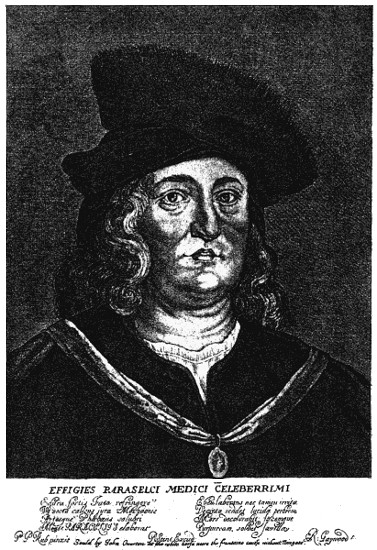
§ 46. That erratic genius, Paracelsus—or, to give
him his correct name, Philip (?) Aureole (?) Theophrast
Bombast von Hohenheim—whose
portrait forms the frontispiece to
the present work—was born at Einsiedeln
in Switzerland in 1493. He studied the alchemistic
and medical arts under his father, who was a physician,
and continued his studies later at the University
of Basle. He also gave some time to the study of
magic and the occult sciences under the famous
Trithemius of Spanheim. Paracelsus, however, found
the merely theoretical “book learning” of the
university curriculum unsatisfactory and betook himself
to the mines, where he might study the nature of
metals at first hand. He then spent several years in
travelling, visiting some of the chief countries of
Europe. At last he returned to Basle, the chair of
Medical Science of his old university being bestowed
upon him. The works of Isaac of Holland had inspired
him with the desire to improve upon the medical
science of his day, and in his lectures (which were,
contrary to the usual custom, delivered not in Latin,
but in the German language) he denounced in violent
terms the teachings of Galen and Avicenna, who
were until then the accredited authorities on medical
matters. His use of the German tongue, his coarseness
in criticism and his intense self-esteem, combined
with the fact that he did lay bare many of the medical
follies and frauds of his day, brought him into very
general dislike with the rest of the physicians, and
the municipal authorities siding with the aggrieved
apothecaries and physicians, whose methods Paracelsus
had exposed, he fled from Basle and resumed his
former roving life. He was, so we are told, a man of
very intemperate habits, being seldom sober (a statement
seriously open to doubt); but on the other
hand, he certainly accomplished a very large number
of most remarkable cures, and, judging from his
writings, he was inspired by lofty and noble ideals
and a fervent belief in the Christian religion. He
died in 1541.
Paracelsus combined in himself such opposite
characteristics that it is a matter of difficulty to
criticise him aright. As says Professor Ferguson: “It
is most difficult . . . to ascertain what his true
character really was, to appreciate aright this man of
fervid imagination, of powerful and persistent conviction,
of unbated honesty and love of truth, of keen
insight into the errors (as he thought them) of his
time, of a merciless will to lay bare these errors and
to reform the abuses to which they gave rise, who in
an instant offends by his boasting, his grossness, his
want of self-respect. It is a problem how to reconcile
his ignorance, his weakness, his superstition, his crude
notions, his erroneous observations, his ridiculous
inferences and theories, with his grasp of method, his
lofty views of the true scope of medicine, his lucid
statements, his incisive and epigrammatic criticisms of
men and motives.”[62] It is also a problem of considerable
difficulty to determine which of the many
books attributed to him are really his genuine works,
and consequently what his views on certain points
exactly were.
§ 47. Paracelsus was the first to recognise the
desirability of investigating the physical universe
with a motive other than alchemistic.
He taught that “the object of chemistry
is not to make gold, but to prepare
medicines,” and founded the school of Iatro-chemistry
or Medical Chemistry. This synthesis of chemistry
with medicine was of very great benefit to each
science; new possibilities of chemical investigation
were opened up now that the aim was not purely
alchemistic. Paracelsus’s central theory was that of
the analogy between man, the microcosm, and the
world or macrocosm. He regarded all the actions
that go on in the human body as of a chemical nature,
and he thought that illness was the result of a disproportion
in the body between the quantities of the
three great principles—sulphur, mercury, and salt—which
he regarded as constituting all things; for
example, he considered an excess of sulphur as the
cause of fever, since sulphur was the fiery principle, &c.
The basis of the iatro-chemical doctrines, namely, that
the healthy human body is a particular combination of
chemical substances: illness the result of some change
in this combination, and hence curable only by chemical
medicines, expresses a certain truth, and is undoubtedly
a great improvement upon the ideas of
the ancients. But in the elaboration of his medical
doctrines Paracelsus fell a prey to exaggeration and
the fantastic, and many of his theories appear to be
highly ridiculous. This extravagance is also very
pronounced in the alchemistic works attributed to
him; for example, the belief in the artificial creation
of minute living creatures resembling men (called
“homunculi”)—a belief of the utmost absurdity, if we
are to understand it literally. On the other hand, his
writings do contain much true teaching of a mystical
nature; his doctrine of the correspondence of man
with the universe considered as a whole, for
example, certainly being radically true, though
fantastically stated and developed by Paracelsus
himself.
§ 48. Between the pupils of Paracelsus and the
older school of medicine, as might well be supposed, a
battle royal was waged for a considerable
time, which ultimately concluded, if not
with a full vindication of Paracelsus’s
teaching, yet with the acceptance of the fundamental
iatro-chemical doctrines. Henceforward it is necessary
to distinguish between the chemists and the alchemists—to
distinguish those who pursued chemical studies
with the object of discovering and preparing useful
medicines, and later those who pursued such studies
for their own sake, from those whose object was the
transmutation of the “base” metals into gold, whether
from purely selfish motives, or with the desire to
demonstrate on the physical plane the validity of the
doctrines of Mysticism. However, during the following
century or two we find, very often, the chemist
and the alchemist united in one and the same person.
Men such as Glauber and Boyle, whose names will
ever be remembered by chemists, did not doubt the
possibility of performing the magnum opus. In the
present chapter, however, we shall confine our attention
for the most part to those men who may be
regarded, for one reason or another, particularly as
alchemists. And the alchemists of the period we are
now considering present a very great diversity. On
the one hand, we have men of much chemical knowledge
and skill such as Libavius and van Helmont, on
the other hand we have those who stand equally as
high as exponents of mystic wisdom—men such as
Jacob Boehme and, to a less extent, Thomas Vaughan.
We have those, who, although they did not enrich the
science of Chemistry with any new discoveries, were,
nevertheless, regarded as masters of the Hermetic
Art; and, finally, we have alchemists of the Edward
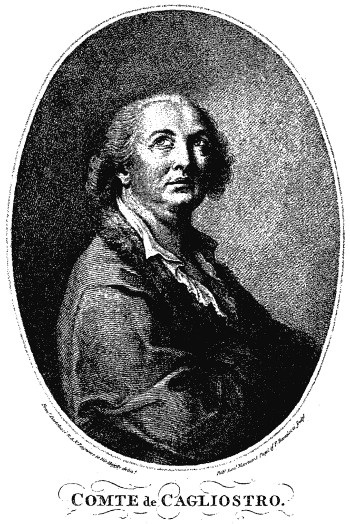
Kelley and “Cagliostro” type, whose main object
was their own enrichment at their neighbours’ expense.
Before, however, proceeding to an account of the lives
and teachings of these men, there is one curious matter—perhaps
the most remarkable of all historical curiosities—that
calls for some brief consideration. We
refer to the “far-famed” Rosicrucian Society.
§ 49. The exoteric history of the Rosicrucian
Society commences with the year 1614. In that
year there was published at Cassel in Germany
a pamphlet entitled The Discovery of the Fraternity
of the Meritorious Order of the Rosy Cross, addressed to
the Learned in General and the Governors of Europe.
After a discussion of the momentous question of the
general reformation of the world, which
was to be accomplished through the
medium of a secret confederacy of the
wisest and most philanthropic men, the
pamphlet proceeds to inform its readers that such
an association is in existence, founded over one
hundred years ago by the famous C.R.C., grand
initiate in the mysteries of Alchemy, whose history
(which is clearly of a fabulous or symbolical nature) is
given. The book concludes by inviting the wise men
of the time to join the Fraternity, directing those who
wished to do so to indicate their desire by the publication
of printed letters, which should come into the
hands of the Brotherhood. As might well be expected,
the pamphlet was the cause of considerable interest and
excitement, but although many letters were printed,
apparently none of them were vouchsafed a reply.
The following year a further pamphlet appeared, The
Confession of the Rosicrucian Fraternity, addressed to
the Learned in Europe, and in 1616, The Chymical
Nuptials of Christian Rosencreutz. This latter book
is a remarkable allegorical romance, describing how an
old man, a lifelong student of the alchemistic Art, was
present at the accomplishment of the magnum opus in
the year 1459. An enormous amount of controversy
took place; it was plain to some that the
Society had deluded them, whilst others hotly maintained
its claims; but after about four years had passed,
the excitement had subsided, and the subject ceased,
for the time being, to arouse any particular interest.
Some writers, even in recent times, more gifted for
romance than for historical research, have seen in the
Rosicrucian Society a secret confederacy of immense
antiquity and of stupendous powers, consisting of the
great initiates of all ages, supposed to be in possession
of the arch secrets of alchemistic art. It is
abundantly evident, however, that it was nothing of
the sort. It is clear from an examination of the
pamphlets already mentioned that they are animated
by Lutheran ideals; and it is of interest to note that
Luther’s seal contained both the cross and the rose—whence
the term “Rosicrucian.” The generally
accepted theory regards the pamphlets as a sort of
elaborate hoax perpetrated by Valentine Andreä, a
young and benevolent Lutheran divine; but more, however,
than a mere hoax. As the late Mr. R. A. Vaughan
wrote: “. . . this Andreä writes the Discovery of the
Rosicrucian Brotherhood, a jeu-d’esprit with a serious
purpose, just as an experiment to see whether something
cannot be done by combined effort to remedy the
defect and abuses—social, educational, and religious,
so lamented by all good men. He thought there were
many Andreäs scattered throughout Europe—how
powerful would be their united systematic action! . . .
He hoped that the few nobler minds whom he desired
to organize would see through the veil of fiction in
which he had invested his proposal; that he might
communicate personally with some such, if they should
appear; or that his book might lead them to form
among themselves a practical philanthropic confederacy,
answering to the serious purpose he had
embodied in his fiction.”[63] His scheme was a
failure, and on seeing its result, Andreä, not daring
to reveal himself as the author of the pamphlets, did
his best to put a stop to the folly by writing several
works in criticism of the Society and its claims. Mr.
A. E. Waite, however, whose work on the subject
should be consulted for further information, rejects
this theory, and suggests that the Rosicrucian Society
was probably identical with the Militia Crucifera
Evangelica, a secret society founded in Nuremburg by
the Lutheran alchemist and mystic, Simon Studion.[64]
§ 50. We must now turn our attention to the lives
and teachings of the alchemists of the period under
consideration, treating them, as far as
possible, in chronological order; whence
the first alchemist to come under our
notice is Thomas Charnock.
Thomas Charnock was born at Faversham (Kent),
either in the year 1524 or in 1526. After some
travels over England he settled at Oxford, carrying
on experiments in Alchemy. In 1557 he wrote his
Breviary of Philosophy. This work is almost entirely
autobiographical, describing Charnock’s alchemistic
experiences. He tells us that he was initiated into
the mysteries of the Hermetic Art by a certain James
S. of Salisbury; he also had another master, an old
blind man, who on his death-bed instructed Charnock.
Unfortunately, however, Thomas was doomed to
failure in his experiments. On the first attempt his
apparatus caught fire and his work was destroyed.
His next experiments were ruined by the negligence
of a servant. His final misfortune shall be described
in his own words. He had started the work for a
third time, and had spent much money on his fire,
hoping to be shortly rewarded. . . .
“Then a Gentleman that oughte me great mallice
Caused me to be prest to goe serve at Callys:
When I saw there was no other boote,
But that I must goe spight of my heart roote;
In my fury I tooke a Hatchet in my hand,
And brake all my Worke whereas it did stand.”[65]
Thomas Charnock married in 1562 a Miss Agnes
Norden. He died in 1581. It is, perhaps, unnecessary
to say that his name does not appear in the
history of Chemistry.
§ 51. Andreas Libavius was born at Halle in
Germany in 1540, where he studied medicine and
practiced for a short time as a physician.
He accepted the fundamental iatro-chemical
doctrines, at the same time,
however, criticising certain of the more
extravagant views expressed by Paracelsus. He was
a firm believer in the transmutation of the metals,
but his own activities were chiefly directed to the
preparation of new and better medicines. He
enriched the science of Chemistry by many valuable
discoveries, and tin tetra-chloride, which he was the first
to prepare, is still known by the name of spiritus
fumans Libavii. Libavius was a man possessed of
keen powers of observation; and his work on
Chemistry, which contains a full account of the
knowledge of the science of his time, may be
regarded as the first text-book of Chemistry. It
was held in high esteem for a considerable time,
being reprinted on several occasions.
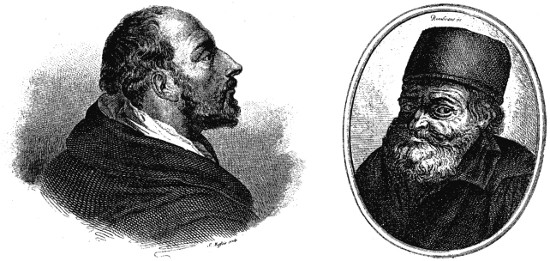
PLATE 9.
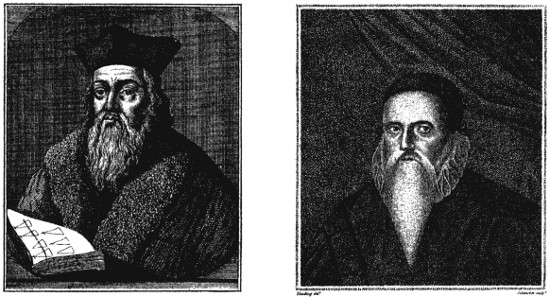
PORTRAIT OF EDWARD KELLEY.
PORTRAIT OF JOHN DEE.
To face page 68]
§ 52. Edward Kelley or Kelly (see plate 9) was
born at Worcester on August 1, 1555. His life
is so obscured by various traditions
that it is very difficult to arrive at the
truth concerning it. The latest, and
probably the best, account will be found
in Miss Charlotte Fell Smith’s John
Dee (1909). Edward Kelley, according to some
accounts, was brought up as an apothecary.[66] He is
also said to have entered Oxford University under
the pseudonym of Talbot.[67] Later, he practised as a
notary in London. He is said to have committed a
forgery, for which he had his ears cropped; but
another account, which supposes him to have avoided
this penalty by making his escape to Wales, is not
improbable. Other crimes of which he is accused are
coining and necromancy. He was probably not guilty
of all these crimes, but that he was undoubtedly a
charlatan and profligate the sequel will make plain.
We are told that about the time of his alleged
escape to Wales, whilst in the neighbourhood of
Glastonbury Abbey, he became possessed, by a lucky
chance, of a manuscript by St. Dunstan setting forth
the grand secrets of Alchemy, together with some of
the two transmuting tinctures, both white and red,[68]
which had been discovered in a tomb near by. His
friendship with John Dee, or Dr. Dee as he is
generally called, commenced in 1582. Now, John
Dee (see plate 9) was undoubtedly a mathematician
of considerable erudition. He was also an astrologer,
and was much interested in experiments in “crystal-gazing,”
for which purpose he employed a speculum of
polished cannel-coal, and by means of which he believed
that he had communication with the inhabitants of
spiritual spheres. It appears that Kelley, who probably
did possess some mediumistic powers, the results
of which he augmented by means of fraud, interested
himself in these experiments, and not only became the
doctor’s “scryer,” but also gulled him into the belief
that he was in the possession of the arch-secrets of
Alchemy. In 1583, Kelley and his learned dupe left
England together with their wives and a Polish
nobleman, staying firstly at Cracovia and afterwards
at Prague, where it is not unlikely that the Emperor
Rudolph II. knighted Kelley. As instances of the
belief which the doctor had in Kelley’s powers as
an alchemist, we may note that in his Private Diary
under the date December 19, 1586, Dee records that
Kelley performed a transmutation for the benefit of
one Edward Garland and his brother Francis;[69] and
under the date May 10, 1588, we find the following
recorded: “E.K. did open the great secret to me,
God be thanked!”[70] That he was not always without
doubts as to Kelley’s honesty, however, is evident
from other entries in his Diary. In 1587 occurred an
event which must be recorded to the partners’ lasting
shame. To cap his former impositions, Kelley informed
the doctor that by the orders of a spirit which
had appeared to him in the crystal, they were to share
“their two wives in common”; to which arrangement,
after some further persuasion, Dee consented.
Kelley’s profligacy and violent temper, however, had
already been the cause of some disagreement between
him and the doctor, and this incident leading to a
further quarrel, the erstwhile friends parted. In 1589,
the Emperor Rudolph imprisoned Kelley, the price
of his freedom being the transmutative secret, or a
substantial quantity of gold, at least, prepared by its
aid. He was, however, released in 1593; but died in
1595; according to one account, as the result of an
accident incurred while attempting to escape from a
second imprisonment. Dee merely records that he
received news to the effect that Kelley “was
slayne.”
It was during his incarceration that he wrote an
alchemistic work entitled The Stone of the Philosophers,
which consists largely of quotations from
older alchemistic writings. His other works on
Alchemy were probably written at an earlier period.[71]
§ 53. Henry Khunrath was born in Saxony in the
second half of the sixteenth century. He was a
follower of Paracelsus, and travelled
about Germany, practising as a physician.
“This German alchemist,” says Mr.
A. E. Waite, “. . . is claimed as a hierophant
of the psychic side of the magnum opus, and
. . . was undoubtedly aware of the larger issues, of
Hermetic theorems”; he describes Khunrath’s chief
work, Amphitheatrum Sapientiæ Æternæ, &c., as
“purely mystical and magical.”[72]
§ 54. The date and birthplace of Alexander
Sethon, a Scottish alchemist, do not appear to have
been recorded, but Michael Sendivogius
was probably born in Moravia about
1566. Sethon, we are told, was in possession
of the arch-secrets of Alchemy. He
visited Holland in 1602, proceeded after
a time to Italy, and passed through Basle
to Germany; meanwhile he is said to have performed
many transmutations. Ultimately arriving at Dresden,
however, he fell into the clutches of the young Elector,
Christian II., who, in order to extort his secret, cast
him into prison, and put him to the torture, but
without avail. Now, it so happened that Sendivogius,
who was in quest of the Philosopher’s Stone, was
staying at Dresden, and hearing of Sethon’s imprisonment
obtained permission to visit him. Sendivogius
offered to effect Sethon’s escape in return for assistance
in his alchemistic pursuits, to which arrangement
the Scottish alchemist willingly agreed. After
some considerable outlay of money in bribery, Sendivogius’s
plan of escape was successfully carried out,
and Sethon found himself a free man; but he refused
to betray the high secrets of Hermetic philosophy to
his rescuer. However, before his death, which occurred
shortly afterwards, he presented him with an
ounce of the transmutative powder. Sendivogius soon
used up this powder, we are told, in effecting transmutations
and cures, and, being fond of expensive
living, he married Sethon’s widow, in the hope that
she was in the possession of the transmutative secret.
In this, however, he was disappointed; she knew
nothing of the matter, but she had the manuscript of
an alchemistic work written by her late husband.
Shortly afterwards Sendivogius printed at Prague a
book entitled The New Chemical Light under the name
of “Cosmopolita,” which is said to be this work of
Sethon’s but which Sendivogius claimed for his own
by the insertion of his name on the title-page, in the
form of an anagram. The tract On Sulphur which was
printed at the end of later editions, however, is said
to have been the genuine work of the Moravian.
Whilst his powder lasted, Sendivogius travelled about,
performing, we are told, many transmutations. He
was twice imprisoned in order to extort the secrets of
Alchemy from him, on one occasion escaping, and on
the other occasion obtaining his release from the
Emperor Rudolph. Afterwards, he appears to have
degenerated into an impostor, but this is said to
have been a finesse to hide his true character as an
alchemistic adept. He died in 1646.[73]
The New Chemical Light was held in great
esteem by the alchemists. The first part treats at
length of the generation of the metals and also of
the Philosopher’s Stone, and claims to be based on
practical experience. The seed of Nature, we are
told, is one, but various products result on account of
the different conditions of development. An imaginary
conversation between Mercury, an Alchemist and
Nature which is appended, is not without a touch of
humour. Says the Alchemist, in despair, “Now I
see that I know nothing; only I must not say so.
For I should lose the good opinion of my neighbours,
and they would no longer entrust me with money for
my experiments. I must therefore go on saying that
I know everything; for there are many that expect
me to do great things for them. . . . There are many
countries, and many greedy persons who will suffer
themselves to be gulled by my promises of mountains
of gold. Thus day will follow day, and in the meantime
the King or the donkey will die, or I myself.”[74]
The second part treats of the Elements and Principles
(see §§ 17 and 19).
PLATE 10.
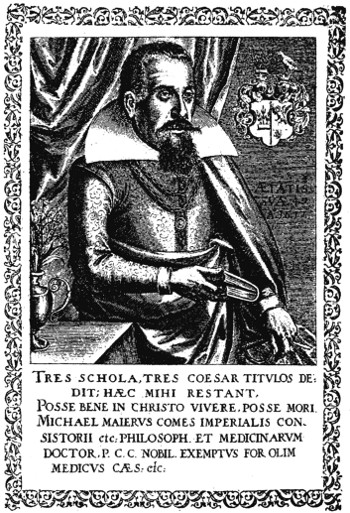
[by J. Brunn]
PORTRAIT OF
MICHAEL MAIER.
To face page 72
§ 55. Michael Maier (see plate 10) was born at
Rendsberg (in Holstein) about 1568. He studied
medicine assiduously, becoming a most
successful physician, and he was ennobled
by Rudolf II. Later on, however,
he took up the subject of Alchemy,
and is said to have ruined his health and wasted his
fortune in the pursuit of the alchemistic ignis fatuus—the
Stone of the Philosophers—travelling about
Germany and elsewhere in order to have converse
with those who were regarded as adepts in the
Art. He took a prominent part in the famous Rosicrucian
controversy (see § 49), defending the claims
of the alleged society in several tracts. He is said,
on the one hand, to have been admitted as a member
of the fraternity; and on the other hand, to have
himself founded a similar institution. A full account
of his views will be found in the Rev. J. B. Craven’s
Count Michael Maier: Life and Writings (1910).
He was a very learned man, but his works are somewhat
obscure and abound in fanciful allegories. He
read an alchemistic meaning into the ancient fables
concerning the Egyptian and Greek gods and heroes.
Like most alchemists, he held the supposed virtues of
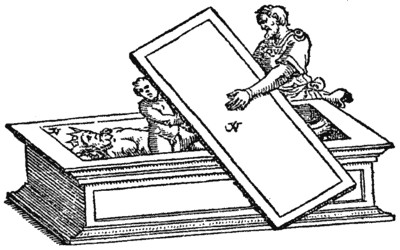
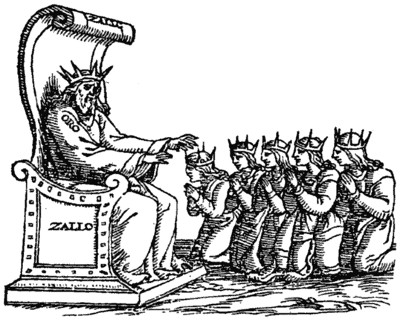
mercury in high esteem. In his Lusus Serius: or,
Serious Passe-time, for example, he supposes a Parliament
of the various creatures of the world to meet, in
order that Man might choose the noblest of them
as king over all the rest. The calf, the sheep, the
goose, the oyster, the bee, the silkworm, flax and
mercury are the chosen representatives, each of
which discourses in turn. It will be unnecessary to
state that Mercury wins the day. Thus does Maier
eulogise it: “Thou art the miracle, splendour and
light of the world. Thou art the glory, ornament,
and supporter of the Earth. Thou art the Asyle,
Anchor, and tye of the Universe. Next to the minde
of Man, God Created nothing more Noble, more
Glorious, or more Profitable.”[75] His Subtle Allegory
concerning the Secrets of Alchemy, very useful to
possess and pleasant to read, will be found in the
Hermetic Museum, together with his Golden Tripod,
consisting of translations of “Valentine’s” “Practica”
and Twelve Keys, Norton’s Ordinal and Cremer’s
spurious Testament.
Plate 11.
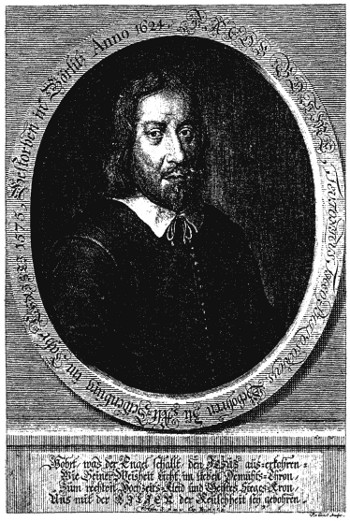
PORTRAIT OF
JACOB BOEHME.
To face page 74]
§ 56. Jacob Boehme, or Behmen (see plate 11),
was born at Alt Seidenberg, a village near Görlitz,
in 1575. His parents being poor, the
education he received was of a very
rudimentary nature, and when his schooling
days were over, Jacob was apprenticed to a
shoemaker. His religious nature caused him often to
admonish his fellow-apprentices, which behaviour ultimately
caused him to be dismissed. He travelled
about as a journeyman shoemaker, returning, however,
to Görlitz in 1594, where he married and settled in
business. He claims to have experienced a wonderful
vision in 1598, and to have had a similar vision two
years later. In these visions, the first of which lasted
for several days, he believed that he saw into the
inmost secrets of nature; but what at first appeared
dim and vague became clear and coherent in a third
vision, which he tells us was vouchsafed to him in
1610. It was then that he wrote his first book, the
Aurora, which he composed for himself only, in order
that he should not forget the mysteries disclosed to
him. At a later period he produced a large number
of treatises of a mystical-religious nature, having spent
the intervening years in improving his early education.
These books aroused the ire of the narrow-minded
ecclesiastical authorities of the town, and Jacob suffered
considerable persecution in consequence. He visited
Dresden in 1624, and in the same year was there
taken ill with a fever. Returning to Görlitz, he
expired in a condition of ecstasy.
Jacob Boehme was an alchemist of a purely transcendental
order. He had, it appears, acquired
some knowledge of Chemistry during his apprentice
days, and he employed the language of Alchemy in
the elaboration of his system of mystical philosophy.
With this lofty mystical-religious system we cannot
here deal; Boehme is, indeed, often accounted the
greatest of true Christian mystics; but although conscious
of his superiority over many minor lights, we
think this title is due to Emanuel Swedenborg. The
question of the validity of his visions is also one
which lies beyond the scope of the present work;[76]
we must confine our attention to Boehme as an
alchemist. The Philosopher’s Stone, in Boehme’s
terminology, is the Spirit of Christ which must
“tincture” the individual soul. In one place he
says, “The Phylosophers Stone is a very dark disesteemed
Stone, of a Gray colour, but therein lyeth
the highest Tincture.”[77] In the transcendental sense,
this is reminiscent of the words of Isaiah: “He hath
no form nor comeliness; and when we see him, there
is no beauty that we should desire him. . . . He was
despised and we esteemed him not,” &c.[78]
§ 57. John Baptist van Helmont (see plate 12)
was born in Brussels in 1577. He devoted himself
to the study of medicine, at first following Galen, but
afterwards accepting in part the teachings of Paracelsus;
and he helped to a large extent in the overthrow
of the old medical doctrines. His purely
chemical researches were also of great
value to the science. He was a man
of profound knowledge, of a religious
temperament, and he possessed a marked
liking for the mystical. He was inspired
by the writings of Thomas à Kempis to
imitate Christ in all things, and he practised medicine,
therefore, as a work of benevolence, asking no fee for
his services. At the same time, moreover, he was a
firm believer in the powers of the Philosopher’s Stone,
claiming to have himself successfully performed the
transmutation of the metals on more than one occasion,
though unacquainted with the composition of the
medicine employed (see § 62). Many of his theoretical
views are highly fantastical. He lived a life devoted
to scientific research, and died in 1644.
PLATE 12.
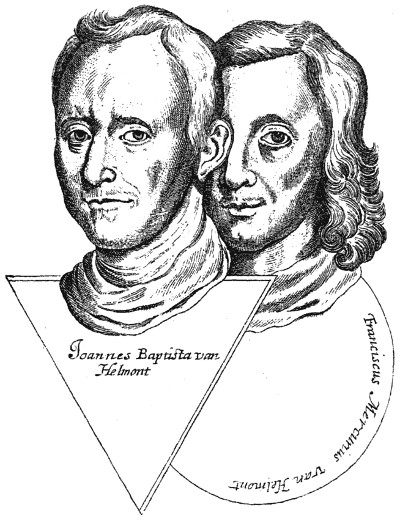
PORTRAITS OF
J. B. AND F. M. VAN HELMONT.
(From the Frontispiece to J. B. van Helmont’s Oriatrike).
To face page 76]
Van Helmont regarded water as the primary
element out of which all things are produced. He
denied that fire was an element or anything material
at all, and he did not accept the sulphur-mercury-salt
theory. To him is due the word “gas”—before
his time various gases were looked upon as mere
varieties of air—and he also made a distinction
between gases (which could not be condensed)[79] and
vapours (which give liquids on cooling). In particular
he investigated the gas that is now known as carbon-dioxide
(carbonic anhydride), which he termed gas
sylvestre; but he lacked suitable apparatus for the
collection of gases, and hence was led in many cases
to erroneous conclusions.
Francis Mercurius van Helmont (see plate 12),
the son of John Baptist, born in 1618, gained the reputation
of having also achieved the magnum opus, since
he appeared to live very luxuriously upon a limited
income. He was a skilled chemist and physician, but
held many queer theories, metempsychosis included.
§ 58. Johann Rudolf Glauber was born at Karlstadt
in 1604. Of his life little is known. He appears
to have travelled about Germany a good
deal, afterwards visiting Amsterdam,
where he died in 1668. He was of a
very patriotic nature, and a most ardent
investigator in the realm of Chemistry. He accepted
the main iatro-chemical doctrines, but gave most of
his attention to applied Chemistry. He enriched the
science with many important discoveries; and crystallised
sodium sulphate is still called “Glauber’s Salt.”
Glauber, himself, attributed remarkable medicinal
powers to this compound. He was a firm believer in
the claims of Alchemy, and held many fantastic ideas.
§ 59. Thomas Vaughan, who wrote under the
name of “Eugenius Philalethes,” was born at
Newton in Brecknockshire in 1622. He was educated
at Jesus College, Oxford, graduating
as a Bachelor of Arts, and being
made a fellow of his college. He
appears also to have taken holy orders
and to have had the living of St.
Bridget’s (Brecknockshire) conferred on him.[80]
During the civil wars he bore arms for the king,
but his allegiance to the Royalist cause led to his
being accused of “drunkenness, swearing, incontinency
and bearing arms for the King”; and he
appears to have been deprived of his living. He
retired to Oxford and gave himself up to study and
chemical research. He is to be regarded as an
alchemist of the transcendental order. His views as
to the nature of the true Philosopher’s Stone may be
gathered from the following quotation: “This,
reader,” he says, speaking of the mystical illumination,
“is the Christian Philosopher’s Stone, a Stone
so often inculcated in Scripture. This is the Rock in
the wildernesse, because in great obscurity, and few
there are that know the right way unto it. This is
the Stone of Fire in Ezekiel; this is the Stone with
Seven Eyes upon it in Zacharie, and this is the White
Stone with the New Name in the Revelation. But
in the Gospel, where Christ himself speakes, who was
born to discover mysteries and communicate Heaven
to Earth, it is more clearly described.”[81] At the same
time he appears to have carried out experiments in
physical Alchemy, and is said to have met with his
death in 1666 through accidentally inhaling the fumes
of some mercury with which he was experimenting.
Thomas Vaughan was an ardent disciple of
Cornelius Agrippa, the sixteenth-century theosophist.
He held the peripatetic philosophy in very slight
esteem. He was a man devoted to God, though
probably guilty of some youthful follies, full of love
towards his wife, and with an intense desire for the
solution of the great problems of Nature. Amongst
his chief works, which are by no means wanting in
flashes of mystic wisdom, may be mentioned Anthroposophia
Theomagica, Anima Magica Abscondita (which
were published together), and Magia Adamica; or,
the Antiquitie of Magic. With regard to his views
as expressed in the first two of these books, a
controversy ensued between Vaughan and Henry
Moore, which was marked by considerable acrimony.
§ 60. The use of the pseudonym “Philalethes” has
not been confined to one alchemist. The cosmopolitan
adept who wrote under the name
of “Eirenæus Philalethes,” has been
confused, on the one hand, with Thomas
Vaughan, on the other hand with George
Starkey (?-1665). He has also been
identified with Dr. Robert Child
(1613-1654); but his real identity remains shrouded
in mystery.[82] George Starkey (or Stirk), the son
of George Stirk, minister of the Church of England
in Bermuda, graduated at Harvard in 1646 and
practised medicine in the United States of America
from 1647 to 1650. In 1651 he came to England
and practised medicine in London. He died of the
plague in 1665. In 1654-5 he published The
Marrow of Alchemy, by “Eirenæus Philoponos
Philalethes,” which some think he had stolen from
his Hermetic Master. Other works by “Eirenæus
Philalethes” appeared after Starkey’s death and
became immensely popular. The Open Entrance
to the Closed Palace of the King (the most famous
of these) and the Three Treatises of the same
author will be found in The Hermetic Museum.
Some of his views have already been noted (see
§§ 1 and 22). On certain points he differed from
the majority of the alchemists. He denied that fire
was an element, and, also, that bodies are formed by
mixture of the elements. According to him there is
one principle in the metals, namely, mercury, which
arises from the aqueous element, and is termed
“metalically differentiated water, i.e., it is water
passed into that stage of development, in which it can
no longer produce anything but mineral substances.”[83]
Philalethes’s views as to “metallic seed” are also of
considerable interest. Of the seed of gold, which he
regarded as the seed, also, of all other metals, he says:
“The seed of animals and vegetables is something
separate, and may be cut out, or otherwise separately
exhibited; but metallic seed is diffused throughout
the metal, and contained in all its smallest parts;
neither can it be discerned from its body: its extraction
is therefore a task which may well tax the
ingenuity of the most experienced philosopher. . . .”[84]
Well might this have been said of the electron of
modern scientific theory.