“Did you want to see me, Dale,” inquired
Andy.
“Yes, I do, and bad,” responded Dale Billings.
“See here, you’ve won a big race. You’re rich.
If it hadn’t been for me and Gus Talbot, you
wouldn’t be.”
“How is that?” inquired Andy.
“We figured along the line, didn’t we? If I’d
gone to work for old Talbot when I had a
chance, you’d have been out and wouldn’t have
learned about automobiles and machinery and
such, and couldn’t have run an airship and won
the race.”
This was queer reasoning. Andy had to
smile. He couldn’t feel any way but pleasant
and happy with the great airship prize his, however,
and he said:
“Well, let that go. What are you driving at,
Dale?”
184
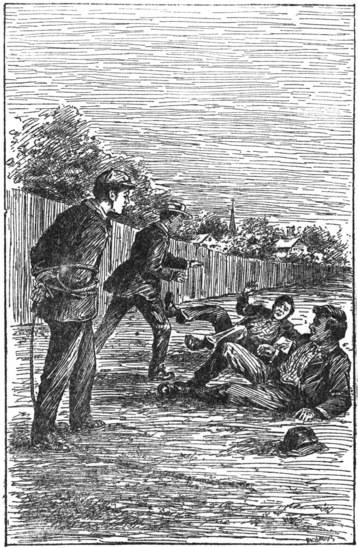
“We’re in hard luck, me and Gus.”
“You look it,” said Andy.
“We haven’t got a cent, we don’t dare to go
back home. Gus is sick in an old shed down
the tracks, and we haven’t had a mouthful to
eat since yesterday morning. There’s no friends
here we know but you. I’m just desperate. Loan
me two dollars, Andy.”
“Why certainly,” answered Andy.
“I mean five—yes, if you’ll loan us ten dollars
till we get work and on our feet, we’ll pay it back.”
“All right,” agreed Andy, “only you’ll have to
come up to our camp for it. You know where
it is—Parks’ camp.”
“Yes, I know.”
“I want to have a talk with you. You can
depend on the money, Dale.”
A thought ran through the mind of the young
aviator that by kindness he might make some impression
on the two outcasts. As he summed up
the meanness and audacity of his recent capture,
however, Andy secretly confessed that it would
be a hard undertaking.
First thing of all, our hero took a bath and
got himself in better shape generally. Mr. Parks
and a group of his friends occupied the main sitting
room. Andy had left Dale in one of the
smaller apartments of the old shack. As he went
thither he passed Scipio, arrayed in white apron
185
and natty cap and warbling a plantation ditty as
he brandished knife and carver gaily.
“Getting sech a dinnah, Andy, chile,” he
chuckled. “Ah give you a feast you nebber
forgit.”
“Now then, Silas,” said Andy, entering the
room where he had left the farmer boy, “I’ve got
time to shake your hand good and hearty, and
glad to do it.”
“And I’m glad you’re not too proud to do it,”
replied Silas.
“You’ve done a big thing for me, Silas,” went
on Andy.
“Think so?”
“Where would the race be if you had not come
along in the nick of time and set me free?”
“I was mightily surprised to see you in that
queer fix,” said Silas, “and I didn’t know what
had happened when you started on a rush for the
airship.”
“Well, you understand now,” said Andy.
“Now then, Silas, what can I do for you?”
“Do, how?”
“I want to acknowledge your usefulness in some
way. There must be something you want or
need.”
“You mean you’d like to give me some little
memento for trying to help you along?”
“That’s it.”
186
“But I’m glad to do it for nothing.”
“Never mind. Come, speak out, Silas. A
bicycle, a nice new watch and chain?”
“Why, see here,” said Silas, after a moment’s
deep thought, “if it’s the same to you, I’d like
ten dollars and seventeen cents.”
Andy smiled. “For something special?” he
inquired.
“Why, yes. You see I want to go to school
this winter and learn shorthand. The term is
eighteen dollars, and I’ve only saved up seven
dollars and eighty-three cents.”
“I’ll do better than that for you, Silas,” said
Andy, “and I’m glad to find you so ambitious.
How is your father?”
“All right, I guess, though I haven’t seen him
for nigh onto a month.”
“Why, how’s that?”
“I’ve been staying at the Collins farm.”
“You have?” exclaimed Andy, at once interested.
“Yes. Just came up from there yesterday.
There hasn’t been much doing, and won’t be until
the folks get their new house built. I was on
their hands, though, and I’m staying around visiting
relatives.”
“How do you mean you was on their hands,
Silas?” inquired Andy.
187
“Why, dad got talking with Mr. Collins after
we’d got rid of the geese. There’s a good
academy at Wade, and Mr. Collins was going
into sheep in a big way. He offered me quite
a good job and the chance to go to school in the
winter, and I took it.”
“But Mr. Collins’ house burned down,” said
Andy.
“What, did you hear of that?” asked Silas in
surprise.
“Yes,” nodded Andy.
“Well, that put things in bad shape for the
family, but they are coming back soon, and in
the meantime I tend to the sheep in the pasture
lot. Lucky they had moved the old shed over
there for storm shelter before the house and
barns burned down.”
“What shed?” asked Andy, with a quick start.
“The one that stood under the old elm tree.
Don’t you remember? Why, it was the shed you
changed your clothes in.”
“What!” shouted Andy, jumping to his feet
in intense excitement; “that shed wasn’t burned
down?”
“Ain’t I telling you? They moved it over to
the pasture on skids two weeks before the fire.”
“And it is there now?”
“Yes—but don’t!”
188
Andy felt like making a rush at once at the
great hopeful news Silas had told. The latter
had grabbed his arm.
“Don’t what?”
“Bolt. You’re going to make a dash like you
did this morning.”
“No, Silas,” said Andy, trying to be calm.
“You can’t imagine what great news you have
brought me.”
“I don’t see how.”
“We must go to the Collins farm at once, Silas,
that old shed had a shelf up over the side
window?”
“Remember that, do you? So do I.”
“It had a lot of rubbish on it.”
“I noticed that.”
“Has it ever been disturbed?”
“Not that I know of. You see, Mr. Collins
was arranging to have the old barracks patched
up by a carpenter from Wade, when the fire came
along.”
“Silas,” said Andy, “I threw my old clothes up
on that shelf. If they are still there, I shall be
able to find an old leather pocketbook in them that
contains a paper upon which depends a fortune.”
“You don’t say so?” remarked Silas, in open-mouthed
wonderment “What queer things you
happen across!”
“A gentleman named Webb is very, very anxious to recover
189
that pocketbook. I want you to
go at once with me and see if the clothes are still
there,” and Andy briefly recited the story of the
lost pocketbook and the details of his recent visit
to the Collins farm.
He was consulting a railroad timetable to determine
when the next train left Montrose, when
Scipio rushed into the room.
“Andy, boy,” he spoke quickly, “yo’ told a boy
to told me dat he was to be let come to see yo’?”
“What kind of a boy, Scipio?” inquired Andy.
Scipio described Dale Billings, and as he did
so passed some personal comments on his
“’spicious” appearance.
“Yes, that’s right, Scipio,” said Andy.
“Den somefin’s wrong,” declared the perturbed
cook. “When he come, I say Mistah Nelson very
much preoccupied with another gemman, and he
must wait. He sot down on dat chair just outside
the door hyar.”
“Go on, Scipio.”
“I keep my eye on him. Dat boy,” announced
Scipio, “remind me of mean, low-down people,
I meet afore in my ’sperience. Bimeby I watch
him bend towards de door. He seemed listening.
Den I saw him start and draw closer to de door.
Den all of a sudden he make a rush out of de
place. I run to de gate. Den anoder sneaking-looking
boy meet him. Dey talk fast, berry much
190
excited. Den dey make a run towards the railroad
tracks as if dey was in a turrible hurry.”
“Dale Billings and Gus Talbot!” exclaimed
Andy, on fire with the intelligence imparted by his
loyal, dusky friend. “Silas, they have got our
secret. They are after the old leather pocketbook
on the Collins farm. We must get there first!”
Andy directed Silas to wait where he was.
Then he ran to the room where Mr. Parks was
engaged with his friends. Appearing at the doorway
he attracted the attention of the aeronaut and
beckoned to him.
“What is it, Andy?” inquired Parks, coming
outside. “You look excited.”
“I am,” admitted Andy, and then very briefly,
but clearly, he explained his urgency.
“I say, you mustn’t let any grass grow under
your feet!” exclaimed Parks. “I reckon you’ve
got it right—that sneaking fellow you was trying
to help is off on the track of the old shed you
tell about. There’s the Racing Star—no, that
won’t do, but—I’ve got it, Andy. Wait here a
minute.”
John Parks flashed in among his friends and
then flashed out again. Now he was accompanied
by a well-dressed portly gentleman whom Andy
had seen about the aviation grounds, and whom he
knew to be one of the principals in getting up
the race.
191
The aeronaut was busy talking fast and urgently
to this person, who nodded to Andy and
said:
“That’s all right Do you know how to run
an automobile?” to Andy.
“Why, that was his old business,” explained
Parks.
“I’ll risk anybody getting ahead of you, then.
My machine is just outside the camp.”
“Come on, Silas,” hailed Andy as they passed
on towards the gate.
Andy found a magnificent six-cylinder automobile
just outside the camp. He thanked its owner
heartily for allowing its use, beckoned Silas to
the rear seat, and waved adieu to his employer
with the cheery words:
“I’ll be back inside of two hours, Mr. Parks.”
“Say,” bolted out Silas, holding on with both
hands as they crossed the railroad tracks and
struck a winding country road due north, “isn’t—isn’t
this going pretty fast?”
“Oh, this is just starting up,” declared Andy.
“I never rode in one of these before,” said
Silas. “Those sneaks won’t get much ahead of
this, I’m thinking.”
Andy thought this, too. There was not the
least doubt in his mind that Dale Billings and Gus
Talbot were already on the trail of the old leather
pocketbook. All they could do, however, was to
192
steal their way on some slow freight train. Still,
they might induce someone to go for them or with
them by faster travel. They might get an automobile,
even if they had to steal one. Andy felt
that it was pretty hopeless trying to make Dale
or Gus respectable. He had intended, in the
liberality of his heart, to put them on their feet.
Here, the first thing, Dale was acting the part
of a sneak and a thief.
It felt good to Andy to get back to his old
business once more. Once out on a clear, level
road, he made the machine fairly hum. Various
ejaculations back of him told that his unexperienced
passenger was having spasms. In considerably
less than an hour the machine reached
Wade. They were soon at the site of the Collins
farmhouse.
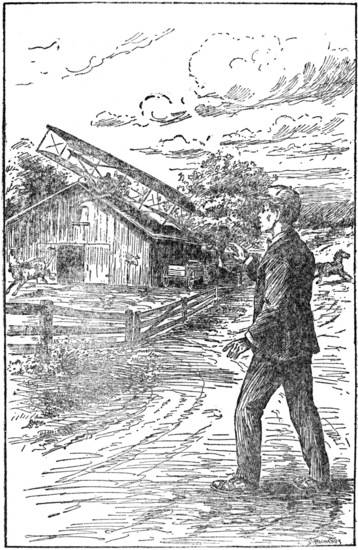
“There’s the old shed, see?” spoke Silas, as
Andy directed the machine across the fields.
“Yes, I see,” said Andy, “and it’s a sight for
sore eyes.”
He halted the machine and jumped out as they
reached the fence of a pasture lot containing several
flocks of sheep. In one corner of it stood the
old shed. Silas was worked up to quite as high a
pitch of suspense and expectation as Andy himself.
“There’s the shelf!” he cried, as Andy passed
through the doorway.
193
“Yes, but—my old clothes are not here.”
“Oh, don’t say that!” almost choked out Silas.
“It is true,” said Andy, getting down from the
keg he was standing on. “Here’s a lot of old
truck, wagon hardware and hoops and a grindstone,
but the clothes are gone.”
Silas uttered a dismal groan.
“Oh, I’m a hoodoo!” he declared, banging his
head first on one side and then on the other.
“Here I’ve made you all this trouble, all for
nothing. But, say,” added the farmer eagerly,
“some one must have taken those clothes. We
may trace them down. And say, some one has
been in this shed since I left it yesterday.”
“Why do you think so?”
“Someone has slept here. See, the floor is covered
with straw. Some tramp, I suppose. It
rained last night, and he came in here for shelter.
Oh, whoop! whoopee!”
At first Andy thought his companion had taken
leave of his senses. With a Comanche-like yell
Silas had made a spring. Then a method to his
apparent madness was disclosed.
Andy saw him pull a wadded mass out of a
hole formerly used to admit a stove pipe. Andy
gasped with gladness and hope.
“My clothes,” he said, “sure enough!”
“Don’t you see?” said the jubilant Silas, dancing
194
a joyful hornpipe. “It rained. The tramp who
stayed here stuffed up the hole to shut out the
rain. Say, sure your clothes?”
“Yes,” said Andy, searching them.
“And the pocketbook?”
“Here it is,” cried our hero in a strained tone
that trembled. “Yes, the pocketbook is here all
right.”
“Hurrah!” yelled Silas Pierce at the top of his
voice.