Airplane Boys Discover the Secrets of Cuzco — CONTENTS
Airplane Boys
Discover the Secrets
of Cuzo
BY
E. J. CRAINE
THE WORLD SYNDICATE PUBLISHING CO.
CLEVELAND, O. NEW YORK, N. Y.
Copyright, 1930 by
THE WORLD SYNDICATE PUBLISHING COMPANY
Printed in the United States of America
by
THE COMMERCIAL BOOKBINDING CO.
CLEVELAND, O.
In this third book about the Airplane Boys, they
get a marvelous new plane, which they name the
“Lark” and which takes them to new adventures
and serves them to good purpose in many a narrow
escape.
“Humph! I wonder where in the name of
pulverized pups that young Slick-and-Slippery
took himself. He sure knew how to
cover his trail up good and pronto.” It
wasn’t the unseasonable weather that made
Bob Caldwell shiver slightly as he glanced
ahead at the deserted ranch which was rolling
toward him. It was the recollection of
that day, only a few months ago, when he
had taken Sergeant Bradshaw and Allen
Ruhel, the Canadian Royal Mounties, to
identify the outlaws.
Staring at the empty ranch buildings, the
boy experienced an uncanny feeling; it
seemed to him that in the weeks which had
elapsed since the Gordons, Senior and Junior,
had been forced to vacate so hurriedly
and abandon their schemes, that the huge
property had become amazingly desolate.
Drawing swiftly nearer he saw doors swinging
disconsolately in the wind, and although
he knew perfectly well that no such sound
could reach his ears, he thought that even
the strips of forest wailed dismally over
their condition.
“Anyway,” he remarked with relief, “the
old man is safely in prison, and I reckon
that Arthur had aplenty of Texas, so we
don’t have to worry about his turning up
here again.” Curiosity prompted him to take
the glasses and examine the vicinity more
closely. The rambly old-fashioned house in
which the father and son had made their
home for three years, swayed slightly. Many
of its windows were broken, sections of the
roof sagged, and one corner of the veranda
was separated from its supporting pillar. A
small shed in the back had fallen in, the
bunkhouse entrance was blocked with debris,
the corral fences leaned wearily, and
the tall cottonwood trees that had been decorative
during the summer, were stripped of
their biggest branches.
“Guess they didn’t do any more repairing
than they had to while they lived there or
it wouldn’t be tumbling apart now,” he suggested
as an explanation. His eyes rested
for a moment on the twisted bole of a
gnarled oak and he thought he saw something
move swiftly around its base, but he
decided that it was probably a wild animal
that had taken shelter there because of an
instinctive confidence that its haunts would
not be molested.
Caldwell had witnessed the ignominious
capture of the older man and the unceremonious
retreat of Arthur Junior, who had
fled the country without stopping to lock the
place or make provisions for the hundreds
of head of stock which roamed the range.
Humane ranchers had driven the cattle to
shelter, and Bob knew that the sheriff or
some of his assistants occasionally patroled
the property on watch for signs of the return
of young Gordon or any of his associates,
but so far the place had been shunned
by members of the gang as if it were plague
stricken.
“At that, some of them might make it a
hang-out as soon as they think people have
forgotten or are too busy to keep an eye on
it.” He noted the rugged cliffs which rose
like irregular saw-teeth and curved around
sharply, like a protecting elbow. “From the
ground the place isn’t easy to reach without
being observed. Well, what a nice little
scare-cat I’m getting to be,” he upbraided
himself as he resolutely put the glasses into
their case and turned his attention to the
business of flying.
Bob Caldwell was the younger member of
the Flying Buddies and he was returning
from a hop in Her Highness to Crofton
where he had done errands for his mother
and picked up the mail for the three adjoining
ranches above the Gordon’s on Cap
Rock; his own, the Cross-Bar on the Pearl
River; the K-A which was the Austin’s and
his home; and Don Haurea’s of the Box-Z.
The recollection of the stirring events and
the eerie atmosphere about the lonely ranch
made him turn the plane’s nose toward the
blue dome of northwestern Texas until its
magnitude and beauty enabled him to dismiss
the sense of impending danger.
“We are all as safe as if we were in
church,” he grinned cheerfully, then, as the
altitude meter read twenty thousand feet,
he leveled off, and shot north. At the boy’s
right stretched the seemingly endless miles
of level plain under an almost unbroken
expanse of pure white, while at his left below
the great ledge lay miles and miles of
sharp hills, narrow valleys, and in the distance
the Pearl River bottom. Presently he
saw the timber line bounding the south of
the K-A.
“Good old ranch,” he chuckled. “And Jim,
the blithering highbrow, is all healed up,
thank goodness. He sure has deserted us for
Don Haurea’s laboratories.” The boy gave
the machine an affectionate tap but he felt
no resentment over the new interests of his
step-brother for he too was culling valuable
information from that same source, only
Bob was applying everything he learned to
the immediate development of the Cross-Bar
ranch. “She’ll be some producer by the time
I’m twenty-one.” That happy date was five
years off and he whistled gaily as his mind
tried to visualize the achievements possible
to accomplish during those years.
By this time Her Highness was soaring
smoothly above the plain, and in the distance,
so far north that he looked like an
animated exclamation point as he skied on
the surface of the frozen snow, Caldwell
recognized the familiar figure of Jim Austin,
his Flying Buddy and step-brother.
Austin’s bright red mackinaw and flapping
scarf stood out a cheery patch of color
against the whiteness that surrounded him,
and by the swing of his body Caldwell knew
that the older boy was making an effort to
beat him home. With an exuberant whoop,
the young pilot waggled Her Highness’
wings to let the challenger know that she
accepted the dare, but she was a good sport,
and although the distance she had to cover
was four times as far as the skier’s, she
proceeded to make her handicap greater, by
executing a wide circle, zooming, banking
and spiraling. Bob was having a perfectly
gorgeous time in the sky, and although he
looked forward to joining
his
Flying Buddy,
he hated to come down. But as he sped
along, he saw that Jim stood a fine chance
of making good, so after treating himself to
a final climb, he leveled off again, then with
the throttle wide open, he started to dive.
Jim was so close now that Bob could see
him quite plainly, and he watched for his
brother to pause and admire the spectacle of
the rushing plane as it cut through space at
topmost speed. Suddenly Jim did stop, stare
up, then he waved his arms. At first Bob interpreted
the motions as a signal of recognized
defeat, but after an instant the pilot
realized that his step-brother was trying to
make himself understood and he seemed
rather frantic about it. He glanced swiftly
about to be sure that another plane was not
in the vicinity, and discovering none, he took
a swift look at Her Highness. As far as he
could see the little bus was O.K. and he
wondered if she had dropped her landing
gear, but just then his eyes rested on the
mirror which reflected the rear, and he gave
a startled gasp of incredulous amazement.
There was a thick trail of smoke belching
along the fuselage and to the boy’s horror
he saw tongues of flame bursting almost to
the forward cock-pit where he sat.
Mechanically he kicked the rubber,
jammed the stick, fought with the controls,
brought the nose up and reduced the speed.
All the while his mind was busy in an effort
to account for the fire, but he could find no
explanation. Going more slowly the smoke
no longer shot back, but began to hover forward,
swirled about the cock-pit and
smudged his glasses. Groping and straining
at the safety strap, he shut off the motor,
but it was evident that whatever caused the
blaze was in the back, yet he knew there
was nothing in the construction of the machine
that could ignite in the rear.
According to the meter he was still seven
thousand feet up, so he made a desperate
effort to save the beloved plane but nothing
he tried helped matters at all, and finally,
with a sigh of regret, he released the strap,
his fingers moved over the parachute buckles,
then stopping to pick up the bag of mail
and his glasses, he climbed over the rim of
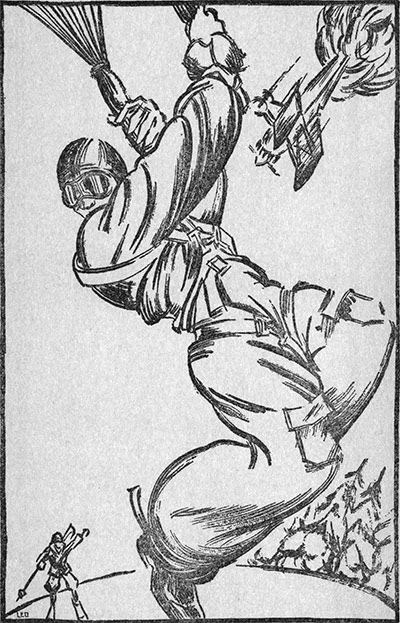
the cock-pit. One last glance back when the
machine was two thousand feet up, the boy
jumped, dropped like a plummet until he
was clear, then he pulled the release and in
a moment the chute blossomed above him
and he began to drift easily. As the plane
dropped swiftly past him it seemed to the
boy as if all the joy of life was carried down
to destruction in the crackling machine. He
clenched his fists inside his fur mittens,
gritted his teeth, then because he simply
couldn’t bear to witness the complete annihilation
of Her Highness, he closed his eyes
and paid no attention to his own landing.
“Spill some of it, Buddy!” Jim called
sharply. Bob glanced about, saw that he was
drifting toward the jagged tips of underbrush
protruding above the snow, so spilled
enough air to drop him more directly. He
could hear his step-brother’s racing skis as
the older boy hurried to meet him. Then Jim
caught him by the coat and helped the landing.
“All right?” he asked anxiously peering
into Caldwell’s face.
“Sure.” Bob was down now, and the pair
of them hastened to get him freed from the
chute.
“What happened to you? Who did you
meet?” Jim asked quickly.
“I don’t know what happened and I didn’t
meet anyone,” Bob answered emphatically.
“Is there any chance of saving her?”
“No!” Silently they stood together as the
hungry flames, like a pack of ravenous
wolves, consumed the helpless plane.
“Gee,” Bob said finally then sank down
and buried his head on his arm, while his
body shook in a brave effort to keep back the
sobs.
“Don’t take it so hard, Buddy,” Jim
urged, but he wasn’t feeling any too good
himself.
“Gosh, I—I couldn’t feel worse if it was
one of the h—horses, or t—the dog. She—gosh,
she was a dandy bird, Jim—nobody
could ever have more fun than she gave us—it
was more like having a good pal that you
could always rely on, than just a machine,”
Bob choked.
“I know it, old man. I’d mighty like to find
out what started her cooking. Have any engine
trouble?” Jim asked.
“Not a bit. She ran like velvet, was going
great when I was diving. It wasn’t until I
saw you doing a wind-mill with your arms
that I thought of grief, then I had an idea
it might be the landing gear I’d dropped and
you wanted me to look out. I didn’t find anything
wrong until I saw the smoke in the reflection
mirror.”
“Come on over and we’ll see if we can discover
anything.” They made their way in
stunned silence, threw snow over the flames,
and carefully examined all that was left of
the little bus, but she was too far gone, or
they were too inexperienced to locate treachery.
“When we get home, let’s look over the
plans. Maybe we can find a spot—some place
where it might have been weak—” Bob proposed.
“I don’t believe we will, but it won’t do
any harm. Who did you see when you were
in Crofton?”
“Bill, he was going home to lunch, the
storekeepers and the postmaster. Just the
usual crowd,” Bob answered.
“Where did you leave Her Highness while
you did the errands?”
“In the freight yard where we always
park. There wasn’t anyone hanging around
and the gate was closed. I had to climb over.
Did that because I didn’t want to call Bill
back to open it,” Bob answered, then he
added, ruefully, “You’ll think I’m a rotten
pilot to let a thing like that happen—gosh—”
“Aw go on, you’re a corking good pilot.
I’ve got a hunch that some sneak, maybe
some of those fellows that were in that jam
at Don Haurea’s last summer fixed it up so
she’d burn slow and then get going good
while you were in the air,” Jim explained.
“But how could anyone do that?” Bob demanded.
“You may investigate me, Buddy. Were
any kids hanging around when you took
off?”
“No. No one paid any attention to me.
They don’t any more. It isn’t like it used to
be. The people see one of us drop down five
or six times a week, so the novelty has worn
off. Why even Bill doesn’t come out any
more and he used to run to meet us if we
landed within sight of the place,” Bob reminded
his step-brother.
“That’s so,” Jim nodded. “What you got
in the bag?”
“Mail and stuff.”
“We better get home. You get on the back
of the ski and we’ll slide, Buddy slide! It’s
lucky we learned to do these things double.
Someone at the house may have seen you
drop and be worried to bits. Come along,
Old Timer,” Jim urged. He went for the bag,
tightened the straps of the ski, then Bob
planted himself behind his step-brother, the
bag in one hand and the other on the older
boy’s shoulder, they got into step, and presently
they were making good speed toward
home. Jim was right in thinking that the
blazing plane had been sighted, for they had
not turned into the ranch road when they
heard the jingle of bells as a team came
dashing around the curve, the elder Austin
standing in the bob-sled.
“What happened?” he shouted. “We saw
Bob—”
“I’m all right, Dad,” Bob assured him,
“but Her Highness went up in smoke,
gosh—”
“So long as you didn’t go up with her, old
man. Hop in here,” Mr. Austin urged.
“Want to come with us, Jim?”
“I might as well,” Jim accepted. Presently
the team dashed to the house, and on the
long veranda, Mrs. Austin was waiting. She
had taken only time enough to throw a
heavy blanket shawl over her head, and
when she saw the Flying Buddies, her eyes
were filled with tears.
“Boys—”
“We’re top hole, both of us, Mom,” Bob
called cheerily.
“I—I watched that plane—the smoke
coming from the tail long before you started
to dive—oh Bob—”
“Now, you knew I was wearing my trusty
chute over me union suit,” he teased, but he
put his arms around her and held her tight.
“Your union suit, how long since you—”
“Go on. Doesn’t a flying suit look like a
step-in or a union suit?” Bob grinned as he
led his mother into the house. The chore-boy
took charge of the prancing team so Jim and
his father followed.
“We have been lucky that the boys have
not had an accident before, Mother, and
really the danger, no matter what happens,
isn’t very great when they have first-class
chutes ready at a moment’s notice to land
them safely. They both know enough to jump
and keep out of difficulty,” Mr. Austin remarked
quietly.
“To be sure, and me trusty side-kick was
on the job with the elongated feet to bring
me over the snow in fine style,” Bob laughed.
They were in the living room now, both of
them peeled down to ordinary clothes, and
stood before her, a pair of fine looking tow-heads.
“What started the fire?” Mrs. Austin was
not to be put off.
“As your devoted step-son so aptly puts
it, you may investigate both of us, but I expect
it was an exposed wire somewhere,”
Bob answered, casually.
“Did you look to see?” she persisted.
“We did, but Her Highness was too hot
to do much examining, and my breadbasket
too empty for me to want to linger so far
away from the commissary department,
namely, the eats—is dinner almost ready?”
“It’ll be served in a few minutes. You
hurry and get cleaned,” she urged, for the
present need made her forget the past danger,
which was exactly what her son was
endeavoring to achieve.
During the evening meal the subject of
the wrecked plane was studiously avoided
but not because the boys did not feel the loss
of Her Highness very deeply. Through their
minds flashed snatches of memory that
made it mighty difficult to laugh and joke
with Mrs. Austin, but they kept the pretense
up courageously. However, later that evening
Jim and his father were in the ranchman’s
office alone for a few minutes, then
the boy’s shoulders slumped as he stared
through the window toward the starry sky.
“It’s too bad, old chap,” Dad remarked
thoughtfully. “Any idea how it happened?
I don’t like to say much before Bob’s
mother.”
“I don’t understand it, Dad. From what
Bob says, she was working first class, every
part of her, right up to the minute that he
discovered she was ablaze. If a single part
had gone wrong she would have showed it
by the indicators or in the reaction of the
controls. I do not believe that the Kid would
have missed anything. Lots of times he’s
quicker to locate pending grief than I am,”
the boy replied softly.
“Have you any suspicions?”
“Not one. He said, that as far as he knows
while she was parked in Crofton, no one
came near her, and she flew like a charm all
the way.”
“Sure there isn’t some technical solution
to the mystery?”
“If there is, I don’t know it. I thought of
writing to the manufacturers, and stating
the facts, and see if they have any suggestions,”
Jim answered.
“Could someone have put something inflammable
somewhere around the tail assembly,
something arranged to burn slowly?”
the man suggested.
“I’ve thought of that, Dad. But there isn’t
anyone in the state, outside of jail, who
would be revengeful enough to do it. The
men who were given the shortest sentences
in that trial after the attack at Don Haurea’s
last summer still have over a year to
serve—none of them—that I know of—have
been pardoned.”
“If any of them were I am sure the sheriff
would have told us,” Mr. Austin volunteered.
“Yes, he would. It’s a cinch, Dad, that not
more than one or two of that whole gang
who were sent to prison know enough about
airplanes and flying to set a trap that would
go off like that. An amateur would have
started the fire and let her go any old way.
If the thing was a piece of treachery it was
managed by an air man who didn’t take any
chance of his plot being discovered too soon.
I can’t figure out that anyone is guilty of
such a mean trick, but I don’t know how
else it could have been done.” With a sigh
he turned back to the room and sat by his
father’s desk.
“You are going to miss it a great deal.”
“Like fury. Dad, I want to get a job piloting,
and save up for a new machine. Somehow,
I can’t see how we can get along without
a plane.”
“I will not agree to your giving up your
studies, old man. The more you learn while
you have the opportunity, the better off you
will be later. I’m quite sure that mother will
feel the same way about Bob. She has been
most happy lately because of his interest in
books.” The boy’s face drew down, but he
tried to accept the verdict manfully. After a
moment, he drew a deep breath.
“All right, Dad,” he agreed. His father
smiled.
“Since you two came home this afternoon
I have been doing some thinking on the subject.
While we had Her Highness, we accepted
her rather as a matter of course. One
of you would go, at a moment’s notice on an
errand which ordinarily would take several
times the time it took to go by air.”
“Yes,” Jim nodded his head but he wasn’t
following very closely. He was thinking that
it would probably be months before he and
his Flying Buddy went roaring into the sky
again. It wasn’t easy to be cheerful.
“This winter has started out as if it is going
to be a very hard one,” the man went on
quietly.
“Yes, sir. It’s been a long time since we
had so much snow,” Jim replied.
“Years. In fact, I don’t recall one like it
since I was a boy, but seasons are always
doing the unexpected.”
“Sure,” Jim replied as his father paused.
“To a stock man that means loss in straying
cattle and horses. Young stock get lost,
sometimes it takes cowboys weeks to locate
them, and often only a few can be saved.
That’s according to the old method. I’m going
to miss getting the mail every day too.
It’s quite a novelty reading the newspapers
when they are not weeks old, especially in
winter,” he rambled on.
“I’m sorry,” Jim said earnestly.
“We all are. It seems to me, Jim, that
Bob’s idea of doing things in as advanced
a method as possible is the greatest money
saver we can invest in, so I think that for
the present I shall purchase a new plane. It
will not be quite such a splendid model as
Her Highness, but it will help us out for
the time being—”
“Dad!” Jim stared at his father, then he
added weakly, “Even one of the cheaper
ones cost quite a lot.”
“Don’t you think it will be a good investment?”
“Ha, ha,” Jim laughed. “Why Dad, I think
it will be corking. We’ll save a lot of the
stock and I’ll fly for your paper as soon as
it’s off the press,” he promised eagerly.
“Then we—.”
“May we come in?” That was Mrs. Austin
and she was followed by Bob, who dutifully
held the door for her.
“You are always welcome.”
“I say, Jim, Mom says that Dad got Her
Highness, so she wants to get us a new
crate—”
“My dear, the boy told me he was going to
get a job piloting for the winter—that would
never do, and I should like to—you know,
it’s been rather delightful—”
“Reading your newspaper before it gets
old,” Jim interrupted with a wide grin.
“That’s the same tune Dad sang to me, and
he’s going to get a plane for the ranches—”
“Now—my dear—”
“It’s all settled, my dear,” Mr. Austin assured
her. “We were just discussing the details,
and we like our plan so well we do
hope that you will not do anything to spoil
it.” The two boys looked at the grown-ups,
and chuckled.
“Tell you what, Jim, when the bus arrives
let’s teach them to be a pair of flyers.”
“I believe it would be very interesting,”
Mrs. Austin said quickly, but her husband
looked grave.
“You’ll both be safe as in church,” Jim
laughed heartily, then he and Bob executed
an Indian dance about the parents until
those worthies begged them to desist.
II. TRACKS IN THE SNOW
The four days which followed the demise
of Her Highness were sad ones and the
whole family on the K-A ranch missed the
convenience the little plane had afforded
them. It seemed to the buddies that doing
everything without the machine was far
slower than they had ever realized, but they
were both too busy to waste time in regret
over the loss of their capable assistant. Then
the morning of the fourth day brought the
steady roar of an airplane as it beat its way
swiftly down Cap Rock, lighting and sliding
on a pair of runners until its pilot succeeded
in bringing it to a halt.
“This the K-A?” he called to the choreboy
who was racing to meet him.
“Yes, sir. Can you take the buggy around
this way? Some horses are being hazed up
the trail, they’ll be here any minute, and
they may get scared of the machine,” he explained
and his youthful eyes were eagerly
taking in the lines of the new arrival.
“All right, old man, where had I better
park?”
“Close to those trees, off the road.” The
pilot lost no time in following directions
and it was well that he did for he had barely
left the vicinity when a bunch of young
broncs came crashing through the woods,
sending the snow flying in a thick screen all
around them.
“Ki-yi. Ki-yi.” The air was filled with the
musical cry, and the pilot, as soon as he
again stopped his plane, climbed on top of
it to watch the performance. He saw the
broncs rear, kick, plunge and circle as they
were being driven steadily forward, and the
man could hear the creak of saddles, the
jingle of bridles and crack of quirts as the
cowboys dashed hither and yon to keep their
charges from rushing off toward the enormous
cliff which rose in a hundred-foot wall
a quarter of a mile ahead. One young bay
succeeded in breaking away. The pilot saw
it thundering toward him; its eyes flaming,
nostrils wide, and foam flecked about its
mouth. The man was too startled and fascinated
to realize his danger, then he heard
another call.
“Ki—ki—ki.” A cowboy, looking for all
the world as if he belonged in a wonderful
tale of old-time west came racing after the
truant, his pinto apparently requiring no
guiding, and his hands busy with a long rope
which was singing over his head. An instant
later the cow-pony cut in front of the plane,
the rope flashed out, its loop opened and
dropped over the bay’s thrashing hoofs. As
if the whole affair were one complete piece
of perfect co-operation, the pinto braced its
fore feet, the cowboy pulled back, and the
runaway bay was secured.
“Bravo, bravo—what a circus!” The pilot
yelled as lustily as a small boy in peanut
row at a wild-west show, and then the cowboy
glanced over his shoulder.
“Oh, hello,” he shouted. His eyes lighted
happily at sight of the plane, but he couldn’t
say anything more for the bronc was making
a frantic effort to get free of the lariat
and required his undivided attention. In a
minute he was being hazed along with the
bunch and finally all of them were milling
around the huge corral, while the riders
went about their various tasks. That accomplished,
the pilot saw the pinto and its rider
say something to another rider on another
pinto, then the pair turned their horses’
heads toward the plane.
“By George,” the pilot exclaimed enthusiastically.
“I didn’t suppose a man could see
anything like that these days. It’s simply
great!”
“Oh, that’s nothing,” Bob answered. “The
snow made the range a hard feeding ground,
so we are bringing the stock in.”
“Keep them here all the rest of the
winter?”
“Only a few that look as if they need extra
care. We’ll give the others a week
around here, then turn them loose,” Bob answered.
“It depends some on the weather,” Jim
added, and then the pilot recognized the
young fellow who had turned back the unruly
bay. “Glad you got here so quickly with
the new plane.”
“I’m glad that I didn’t miss the show. My
name’s Kramer and I hope I get permission
to hang around here a few days. If the fellow
who is to pilot this machine is a crackerjack,
my vacation is spoiled, but if he doesn’t
know much about flying I can send word to
the firm that I must stay to teach him.”
“Guess you’re here for a run,” Bob told
him, “and you better get your message off as
soon as you can. I’m the lad who has to fork
the bird, and my side kick here. We both
have a lot to learn. Last time I tried to do
sky-riding I brought the machine down in
flames.”
“Gee, that was tough luck,” Kramer said
sympathetically. “I’ll like staying around
and you can be sure I’ll do all I can to instruct
you so nothing of the kind will happen
again. You’re a pretty good sport, really,
because very often when a man has an experience
like that he gets air-shy—is off flying
for the rest of his life.”
“We’ll appreciate your help. I watched
the kid come down and it was no party. The
bus looked like a Fourth of July rocket
shooting the wrong way,” Jim announced.
Then followed instructions and Kramer
sized up his prospective students with real
interest.
“You know, even if you did have an accident
you look to me like the type who could
be top-notch pilots if you don’t get discouraged,
and after all, you are both young. In
a few years, flying will be as ordinary as automobiles
then you’ll be glad you took it up
and stuck to it,” he told them earnestly.
“This looks like quite an air bucker,” Bob
remarked as soberly as a judge. He urged
the reluctant Tut close and his eyes traveled
quickly over Her Highness’ successor.
“It’s a great machine. Perhaps you know
that it’s a Pitcairn mailwing. They are used
a lot as mail carriers, but airmen have become
interested in them for sport use. It’s
seven-cylinder, two hundred and twenty-five
horse power. My boss said that Mr. Austin
told him over the telephone that he wants a
good serviceable plane for practical purposes.
You could not get anything better
than this. It’s got two cock-pits, that can be
covered in bad weather and as soon as you
learn more about flying, if it’s storming, you
can shut yourselves up snug as a bug in a
rug, and fly—”
“Flipping Flapjacks, you mean without
looking at the ground?” Bob interrupted incredulously.
“Sure—positively,” Kramer answered emphatically.
“Here comes Dad,” Jim declared. “He’s
the air-minded member of the family. When
the other crate cracked up he got right in
touch with your firm and ordered another.
Said the K-A couldn’t get along without
one. It’s a wonder to me he didn’t order a
herd of them.”
“That goes to show you how really progressive
he is. Why most men of his generation—a
lot of them, anyway, think flying is
all nonsense—”
“This is Mr. Kramer, Dad. We just told
him we hope he can stay a while and give us
instructions in flying.” Mr. Austin glanced
questioningly at his son.
“Yes,” Bob added. “Kramer never saw a
real ranch, except from the sky. He sat here
and almost let the broncs jump over him. He
likes horses.” Then Mr. Austin understood
what was in the Flying Buddies’ minds so
he nodded approval.
“It will give us a great deal of pleasure
to have him stay as long as he can, and I
am sure that your mother and I shall feel
much more comfortable if we are confident
that you have had thorough instructions. It
seems to me that you boys are a little slow
in bringing Mr. Kramer to the house. He
has had a long trip, perhaps a hard one, and
sitting here is cold work—”
“Oh, I was just telling them some things
about the machine. My boss said that if this
plane doesn’t suit you, we’ll send another
model, sir, but from what you told him over
the telephone, he thought this would be the
best for your purpose,” Kramer said respectfully.
“The men of your firm must know a good
machine,” Mr. Austin smiled.
“Absolutely—but the customer has to be
satisfied. I don’t mind telling you that we all
feel kind of cocky over a telephone order—”
“What’s the telephone for?” the older man
asked.
“Oh, sure thing, it’s to save time and all
that, but there aren’t many people who will
buy a plane on short notice, why they want
to see them all, read about them, listen to a
man talk his head off, be taken up—”
“But my dear young man—it seems to me
that when one wants a plane that is a great
waste of energy to say nothing of time. Come
in and meet Mrs. Austin and get rested.”
“I’ll take you up any time you can go,”
Kramer offered.
“After lunch,” Jim answered.
After lunch the Sky Buddies listened with
strained attention while Kramer conscientiously
taught them the operation of the Pitcairn.
The instructor carefully went from
the propeller to the tail telling the name of
every part and explaining each function in
detail, while the boys listened with anxious
frowns quite as if it were so much Greek to
them. Finally Bob sighed heavily.
“One thing I like about a plane,” he announced.
“You’ll soon learn to like the whole bus,”
Kramer smiled, “but what appeals to you
particularly?”
“The tail. Dogs and horses have them and
they are real understandable parts,” the boy
replied soberly.
“Yes,” Jim added, “but a dog or a horse
doesn’t have to have anyone work his tail
for him. He manages his own rudder.”
“I expect you know dogs and horses better
than I do airplanes,” Kramer laughed goodnaturedly.
“Perhaps, while I’m here, you’ll
give me a few lessons in managing them.”
“Sure,” Jim agreed heartily. “We’ll dress
you up in a pair of slip-ins, and show you
how to fork a bucker.”
“Guess I’d rather watch someone more experienced
do that. I say, if you want to go
anywhere, we might take a hop. Perhaps the
first time up, I’d better do the piloting, but
you can learn a lot—”
“Mom wants some pink crochet cotton.
Let’s go to Crofton,” Bob proposed, then added
quickly, “You take Jim in with you first.
I’d kind of like to sit in the back with nothing
to do.”
“That’s all right with me—”
“Why the heck can’t you let me take
things easy?” Jim urged.
“Go on, you learn first. I have to get over
being air-shy. Don’t want my insides doing
a tail spin till they get kind of used to it.”
“It’s a good idea,” Kramer put in. “Sit in
the back until we get to Crofton. It will restore
your confidence. Perhaps on the return
trip you can ride in front.”
“Wall—” Jim drawled. “Sure that’s pink
crochet cotton?”
“Absolutely, I wrote it down.” Bob fished
about in his pocket and found a scrap of
wrapping paper. “Here it is. One skein of
blue twist.”
“You were almost right, Buddy,” Kramer
laughed heartily. “Anything else she wants
while we are there?”
“The mail,” Jim answered.
“And the newspapers,” Bob grinned.
“Fine. Let’s go.”
Presently the Pitcairn was soaring splendidly
into the air, and in the front Jim eyed
the controls. His fingers itched to take hold
of them, but he braced himself and hooked
his hands under his safety belt, while Kramer
cheerfully did his piloting so the student
could see every operation and analyze its
purpose. Once in the air it wasn’t so simple
keeping up the pretense of ignorance and
twice Austin nearly gave himself away, but
Kramer was so absorbed in his task that the
slips were unnoticed. However, he did feel
that he was making great progress with this
youngster, but he rather anticipated a more
difficult time when he took Bob in hand.
There wasn’t a single mishap during the
trip, and finally, when they reached the little
town, the pilot began to look about for
the best place to land. With the blanket of
snow on the ground visibility was hard, and
Kramer circled over several sites before he
finally turned to the boy.
“I’m looking for a place to come down,”
he announced through the tube.
“The cattle pen by the freight yard. It’s
been trampled,” Jim suggested and pointed
to the triangular runway. It was smaller
than Kramer wished and built on a steep
incline, but he didn’t want the new owner to
think the plane wouldn’t do all that was expected
of her, so he started the descent and
at last landed perfectly. Austin hid a smile
of appreciation at the accomplishment, and
nodded indifferently.
“I’ll get the yellow yarn—”
“Blue twist,” Kramer corrected quickly.
“Sure. You come along so I won’t get it
wrong, and you can wire your firm from
here, unless you did it at the house,” Bob
proposed.
“It slipped my mind,” Kramer admitted.
“I’ll wait here,” Jim decided. He slid low
in the cock-pit as soon as the pair were out
of sight, and his mind was busy with the
idea that someone—perhaps the lad who
was responsible for the loss of Her Highness,
might come nosing around. He wanted
to give whoever it was plenty of opportunity
to get close in case he was again in the vicinity.
Austin kept perfectly quiet, his head
well below the rim of the cock-pit.
He heard the jingle of bells as small
sleighs slid by, the shout of neighborly greetings,
an occasional automobile and the distant
whine of a buzz-saw as it bit into huge
logs, cutting them into cordwood. The boy
was beginning to believe that his vigilance
was to go unrewarded when he heard the
thud of a pair of boots dropping with someone
into the cattle enclosure; then came the
cautious approach. They were coming to the
plane, that was evident, and Jim got ready.
Watching, with every muscle keyed to
spring, he waited. There was a moment’s
hesitation, whoever it was stopped under
the wing, then a second later a hand rested
within a few inches of his face. He swung
up with all his strength, caught the wrist
firmly and yanked. At that there was a
scraping, then the business end of a six-shooter
was pointed into his face, and simultaneously
he leaped up with a yell.
“What—” He stopped short and stared in
startled amazement.
“Oh, that you, Austin?” The gun was
slipped back to its holster.
“Sure, Sheriff.” Jim was too astounded to
say anything more.
“I calculated I’d find you here, and I’m
right glad you dropped in to town today because
I’m going to ask you to help me.”
“I’ll do anything I can,” Jim assured him.
“Wall, it’s this way. You know we’ve been
keeping the Gordon place under observation.
Got a deputy there most of the time.
Maybe he’s getting nutty, I don’t know, he’s
alone and there’s a sort of sameness to this
here snow. He reported a couple of days ago
that he thought someone was hanging out
up there but he hasn’t been able to fetch up
with whoever it is and he ain’t seen no
tracks. I ain’t had a minute to go and look
myself, and I ain’t got no one to send right
now. He put in a call ’bout noon time. Said
he’s seen some tracks, they look like a
bear’s.”
“There are no bears out this time of year,”
Jim reminded him.
“I told him the old fellows has crawled in
and pulled their holes after ’em, but he says
it’s a big bear track plain as can be and it’s
round the ranch house.”
“What can we do for you?”
“Wish you’d stop on your way home and
see what the heck’s eatin’ the feller. It’s
Carl Summers—reckon you know him.”
“Yes, sure I know Carl,” Jim replied.
“He’s needin’ a job, and I’se needin’ a
watchman, sort of, so I swore him in. He
rigged up a contraption—taps the wire and
that’s the way he reports every day to me,”
the sheriff explained.
“Couldn’t he follow the tracks and see
where they lead?” Jim asked.
“That’s the goldurnest part of it. They
only lead ’round in a circle. Ain’t no entrance
or exit, as it were. He can’t find no
place where they start or stop.”
“That is odd. What do you want us to
do?”
“See what Carl has to show you and hear
what he has to say. If he seems kind o’ sick,
take him to your house en fetch the doctor,
or if he’s all right, you get in touch with me.
If you take him home, ask your pa if he can
spare a man to kind o’ keep his eye on the
place for a couple o’ days till I can get someone
else. I got a bee in my bonnet that young
Gordon will land back there one o’ these
days, and I’m aimin’ to catch him when he
does.”
“We’ll be glad to stop and have a talk
with him. I can telephone you from there if
it’s anything serious,” Jim agreed.
“That’s fine. I knew I’d find you here
soon’s I saw Bob swinging up the street.
Watched you the other day when the kid
came down and you were loafing here—” He
broke off suddenly, and frowned. “Why the
name o’ hen’s teeth did you make such a
grab at me? Boy, you might o’ got a whole
round of lead in you and I’d had a fierce
time apologizing to your folks.”
“I was watching for a sneak—”
“Think you caught him?”
“Oh, no, I know I haven’t—but say, what
did you mean when you said that you saw
me in the cock-pit the other day?” Jim
asked.
“Saw you from my window up there. That
is, I happened to look out and discovered the
plane parked in the freight yard and you
fussing away in the back seat.”
“I didn’t come with Bob the other day,”
Jim told him.
“You didn’t come—why I saw you as
plain—”
“My face?” Jim was excited. He hoped the
sheriff could describe the fellow who was responsible
for the loss of Her Highness.
“Wall no, can’t say that I did. Saw the top
of that helmet and as I know there are only
two Flyin’ Buddies in these parts, I reckoned
it was you,” the man answered, and
Austin was most disappointed.
“It wasn’t, and great guns I wish you’d
come over then,” he said with a sigh. He
went on and explained about the burning
of the plane and the sheriff scowled.
“Thunderation, that ain’t lookin’ too
good.” He took off his hat and scratched his
head. “You-all got a hunch that plane’s death—as
it were—wasn’t due to no natural
causes?”
“That’s the way it looks.”
“All them guys that might be sore on you
because of last summer at the Don’s place is
working off their grudge in jail—that is—let
me see, Gordon got away—the young feller
I mean, en the chauffeur chap. Humph.
Maybe Carl ain’t so loony. You can shoot?”
“Of course.”
“Maybe it’s mighty important that someone
get up there to Carl fast as he can get.
You take a set o’ irons—I’ll get ’em—one
for you and one for Bob—”
“There’s another chap with us—name’s
Kramer—he came with the new plane. I
don’t know if he can shoot or not—”
“I’ll get three.” The man hurried off and
while he was gone, Bob and the instructor
returned with an arm full of mail.
“Get that red—”
“Blue,” Kramer corrected with a laugh.
“We have to do an errand for the sheriff.”
By the time the officer had returned, Jim
had given his companions details of what
was required and they both looked rather
sober at the task before them.
“You boys know that Gordon—if you see
him don’t take no chances. I’m gettin’ a gang
together, and we’ll follow pronto—fast as
the automobile can bring us.”
“We could take you along now,” Kramer
suggested.
“I can’t leave the office for half an hour.
Got something needs my attention here and
it’s almost as important as gettin’ Gordon.
Do you swear to do your duty as officers of
the law and upholders of the Constitution of
the United States? That ain’t real regular,
but you know what it means.”
“I do,” came from three throats. Then
they climbed into the cock-pits.
III. PIGEON JUTE
“Hit her up, loop the sun,” Bob called as
he climbed into the rear cock-pit. Kramer let
the motor run for a moment, then managed
to smile at her performance.
“That’s a motor what motes,” he announced.
Soon they took off and they looked
most war-like with the sheriff’s artillery
added to their equipment. Through the
minds of the Sky Buddies raced a varied assortment
of possibilities regarding what
they would find when they came down on
the Gordon ranch. Jim rather wished that
Bob was not along for if either young Arthur
or any of his former associates were
there no one would anticipate how much
trouble awaited them. Although there was
only a few months difference in their ages,
Austin felt years older and was anxious that
the younger boy be kept out of danger. He recalled
the scheme the two Gordons had concocted
and nearly brought to perfection at
Don Haurea’s ranch a few months ago.
While Caldwell had not been hurt physically
the horror of what he had witnessed had almost
taken the fun out of him.
In the back seat Bob too was thinking of
that day. Through his brain flashed the vision
of his step-brother lying wounded and
bleeding on the steps of the Bar-Z ranch
house. It wasn’t a picture a fellow could
shake off easily and he was wishing that
Jim was not going to be in this, whatever
was ahead of them. To be sure, under the
splendid care of the medical men and surgeons
of the Don’s people, his Buddy had
healed and recovered with remarkable
speed, but just the same being a target was
a hazardous business and one couldn’t expect
to get off so easily very often. He whistled
softly and determined that he would
keep his eyes open and if possible shove Austin
into the background. The plan looked
good to the boy, and then he thought of
something which seemed even better. When
they came down he’d suggest that his step-brother
fly on home and explain the matter
to his father who could get a number of the
men on the K-A together and join the deputies
at the lower ranch. That was a great
idea, and an even better one was to propose
that Jim get in touch with Don Haurea.
From this highly capable man’s laboratories
something very effective could be accomplished.
Bob had no thought of what the
Box-Z owner would do, but since the difficulties
of the summer he too had paid a visit
to the subterranean department and had
seen the workings of the super-television-radio.
It was an awe-inspiring place and the
young fellow knew that the proposal of getting
in touch with its head would appeal
strongly to his step-brother.
By this time the rugged peaks of lower
Cap Rock were rolling swiftly toward them,
and presently the buddies from their separate
points of observation were examining
the ranch through the glasses. Finally Jim
located Carl Summers sitting on a projecting
ledge from which he could keep a watchful
eye on his territory. It struck the boy
that the young deputy appeared very unconcerned.
He had expected to discover Carl
crouched in some out-of-the-way corner
where he could not be taken by surprise, and
surrounded with a battery of artillery.
Touching Kramer on the shoulder, Jim
pointed out the ledge where he had landed
with Her Highness the day Lilly Boome and
Ollie had inveigled him to give them a lift
from Laville. Three minutes later the Pitcairn
lighted perfectly on the strip of table
rock, and Bob, eager to put his plan into operation,
called:
“I say, Jim, I’ve got an idea!”
“Take off your hat and let your head cool,”
Jim advised. The younger boy got out of the
cock-pit with all possible speed and was
standing by the forward door before it could
be opened. Austin grinned at him cheerfully.
“I don’t need to, you nut. Listen, Old Timer,
you fly on to the K-A and tell Dad what’s
doing, then telephone Don Haurea. I bet a
thin dime against the State of Texas that
he’ll be able to do something worth while
from his place—”
“But your brother can’t fly well enough
yet!” Kramer interrupted.
“Say, you sent that wire to your firm,
didn’t you, that you are going to stay here?”
Bob demanded.
“Yes, but what’s that got to do with it?”
“Nothing much, old man, but the Buddy
and I know a lot more than you would suspect
about airplanes. We’ll give you a demonstration
when we’re not too busy. It’s this
way, we thought you looked like a deserving
lad, and we were sorry for anyone who never
got real close to a good horse, so, when you
said that your firm would give you permission
to stay a while, we wanted to help you—we’re
a pair of regular little helpfuls—ask
our folks.”
“I’ll tell the world you are. Think I’m going
to hang around here to teach you something
you know? I’m not lying to my firm—”
“Gosh,” Bob’s face flushed. “That’s right,
I didn’t think of it—you couldn’t do that—”
then he grinned—“but, look here, if you do
like Texas and horses and dogs—and us—I’ll
bet you could sell a couple of planes to
some of the ranchers. We’ll introduce you
around—”
“I’ll bet the sheriff would buy one,” Jim
added. Then the frown disappeared from
Kramer’s face and he too grinned.
“Now you are talking. I’ll get in touch
with the firm and see what my boss thinks.
Much obliged, Buddy, for the tip, and much
obliged too for the desire to give me a good
time.” He held out his hand and Caldwell
gripped it firmly in his own.
“Now that’s settled,” Jim put in—“the
sheriff said that Summers has an instrument
here and he has tapped the telephone
wires. Your idea of getting in touch with
Dad and the Don is great, I’ll do it by
phone.”
“Oh—yes, sure you can do that.” Bob’s
face fell and he sighed as he saw how quickly
his perfectly good plan to get Austin away
from the danger zone vanished into thin air.
“Sure, you can do that and it will save time,
too.”
“Hello there!” Carl Summers, who was a
stocky little Texan, came swinging carelessly
up the winding trail, his face
wreathed in smiles.
“Hello yourself. We were at Crofton and
the sheriff asked us to drop in and see how
things are,” Jim explained.
“That’s fine. For a couple of days I sure
have been doing some tall figuring without
getting an answer. Guess I was sort of
hipped with the snow and the emptiness of
this place, but I wasn’t all goofy,” he said.
“Did you find anything?” Jim asked. He
and Kramer were out of the cock-pit ready
to listen to the story, whatever it was.
“Yes, a spell ago. I’ve been feeling that I
wasn’t alone on this ranch and it got me
worried, not because I was afraid, but because
I couldn’t come up with anyone. The
first time was at night, I was asleep in a
bunk I fixed myself in the old root house,
that dugout, and I awoke thinking I heard
prowlers. I couldn’t find anything, but dozens
of times since then I was sure I was being
trailed; then I found those bear tracks
and I know bears are enjoying a siesta this
time of year, but they were tracks and they
went around in a circle. It didn’t make me
feel too good trying to figure what made
’em.”
“It must have made you anxious,” Kramer
remarked.
“Surely did, brother. I reported to the
sheriff and he promised to get someone here
as fast as he could, and he told me to keep
watch. Now, you two know bear tracks, just
for fun come and look at this set and see if
you can tell what made them and where the
animal came from or went,” he proposed.
“Lead on, McDuff,” Kramer invited.
“You got my name wrong, buddy, it’s
Summers—”
“I know, but that’s just a quotation,”
Kramer hastened to explain.
“He wants you to show us,” Bob added.
“Oh, I see, he’s from Missouri. Well, come
along.”
“Do we need the battery?” Kramer asked.
He didn’t like toting a gun and seeing the
two in the boys’ belts made him feel uncomfortable.
“We’ve got them on, and we might as well
keep them,” Jim answered cautiously.
“Bring it with you, it will make you feel
more as if you are in the woolly west,” Bob
put in quickly. Both he and Jim were sure
that leaving them behind would be foolish,
and although all thought of danger had been
effectively dispelled by Summers, they were
not taking needless chances, at least until
the ranch guardian had absolutely convinced
them.
Carl made his way back down the slippery
trail while the three followed single
file. The descent was about a hundred feet
and at the bottom they started to walk easily
on the thick crust across a couple of acres
of open space, then they reached the back of
a row of sheds which had been used for machinery,
tools, and also a smithy and general
catch-all. Summers removed a loose board so
they went through, and then proceeded by a
winding way past the numerous ranch buildings
until they came to the further end
where the deserted home had been erected.
There were a few scrub trees around it, their
branches poking up through the snow, and
here and there were layers of soft snow that
had not frozen because it had been jarred
from the branches or blown from near-by
roofs.
“Here you are.” Summers stopped at the
edge of a clear spot on the far side of the
house, which was less exposed than the
front, and protected from the colder winds
by the elbow of the cliff. The three looked
down quickly, and sure enough, they saw a
set of tracks that must have been made by
some large animal. It looked as if the beast
had made the circuit twice, for most of the
imprints were irregular, but many of them
were distinct enough to show their form.
“I pass, what’s the joke?” Kramer asked.
“They do look a little like a bear,” Bob
hesitated, and a moment later Jim turned to
their guide.
“Is it someone who has his feet wound
up?” he asked.
“You go to the head, that’s it,” Carl
grinned. “Reckon if I hadn’t been so blamed
scary I’d a thought of it myself.”
“Whose tracks are they?” Bob demanded.
“And why do they go around in a circle?”
inquired Jim.
“Come along and see the rest of the exhibit,”
Carl invited.
They followed him to the root cellar,
which, as they approached, looked like a
long high mound of snow. At the further
side, they saw the entrance, a short steep incline,
with a heavy, old fashioned cellar
door that fitted into a frame which was level
with the ground. This opening was thrown
back, so the three stepped down, Carl pulled
another heavy door, and instantly the odor
of a miscellaneous collection of vegetables
which had been stored there for years, came
to their nostrils. Coming, as they did, from
the glaring white of the world outside, everything
looked pitch black, but in a moment
their eyes were adjusted to the change and
they saw a long room with a sloping roof.
Two lighted lanterns were suspended from
the huge beams overhead. A rough attempt
had been made at furnishing. There was an
army cot in one corner, some bright blankets
draped the walls, and the earth floor was
almost concealed under a collection of
dressed hides. A couple of home-made chairs
and a table completed the items.
“Some palatial house. Where did you get
this stuff?” Bob asked.
“Mostly from the bunkhouse,” Carl answered.
“What’s beyond that?” Kramer wanted
to know. He nodded toward the further end
where he saw a partition of wide planks.
“Just another hole. I went in to see. These
root houses used to be divided off. When I
was a kid I played here one day, and explored
this place. My dad said that the first
hole was small, but every year a new section
was added to hold more, and some of them
were used in hot weather to keep things
cool,” Summers explained.
“Great idea—”
“Who’s this?” Kramer asked, as he
jumped back quickly.
“Pigeon Jute. You boys know him,” Carl
chuckled. A tall slender Indian, wrapped in
a grey blanket, had risen from the cot and
stood staring at them gravely.
“Why sure we know him,” Jim laughed.
“Haven’t seen you for a long time, Jute.
How’re the pigeons?”
“Heap good,” the Indian grunted.
“When I first knew him he was trying to
get a breed of birds that would be world
beaters on long distance,” Jim explained.
“How did you make out, Jute?” Bob asked
goodnaturedly, but the Indian merely
grunted and shrugged.
“Real loquacious, isn’t he?” Kramer remarked
softly, but he did feel as if he were
getting a taste of the ancient west he had
read of when he was a youngster.
“He’s all right. When I was a little kid he
used to do things for my mother and he
made enough bows and arrows to destroy an
army,” Bob declared. He was genuinely glad
to see his old friend.
“I suppose you made the tracks,” Jim
laughed. “You thought you would have some
fun with Carl so you hopped out of a tree,
or started them by jumping from where the
ice is clean.”
“Jumped!” came the brief explanation.
“So that finishes the mystery,” Bob sighed
with relief.
“Surely does. He showed up today and
wanted something to eat. I was as glad to
see him as if he were a bouquet of spring
flowers,” Carl assured them.
“I should have wanted to punch his jaw,”
Kramer laughed.
“You wouldn’t if you hadn’t seen a human
being for two weeks, besides, I’ve got a sense
of humor,” Summers answered.
“We’ve brightened your day a lot, old
man, but we’ve got to breeze along. Does the
sheriff know what the answer is?” Jim
asked.
“Yes. I just caught him when he was
ready to start up here, so he called off the
Reserves and went back to work. Much
obliged to you all for dropping in and I hope
you do it again.”
“Maybe it’s just as well if we stay on our
side of the line a while longer, but you have
skis, slide up and pay us a visit when things
get too dull. You ought to rig up a radio;
that would keep you in touch with a lot of
fun,” Jim suggested.
“I’ve been building one, want to see it?”
“We’d better not linger any longer, it’s
getting late,” Bob urged. Now that the mystery
was solved he began to feel that he and
Jim couldn’t get away from the place any
too quickly, besides the short day was coming
to a close and it would soon be dark.
The Indian followed them outside, and
strolled off unceremoniously.
“He’s got some traps set in the cliffs,”
Carl explained. They watched the tall grey
figure striding over the snow almost as
swiftly as if he were on snowshoes, and soon
he was lost from sight. He stepped so lightly
that he didn’t leave an imprint.
“How do you like being a ranch nurse?”
Bob asked, just to make conversation as
they hurried along.
“It hasn’t been so inter—” He stopped
short in his answer, and for an instant the
four of them stood in startled silence. To
their strained ears came an unmistakable
rumble.
“Is it a plane?” Jim asked softly, but he
knew it wasn’t. The words were hardly out
of his mouth before the rumble grew into a
thunderous roar, the earth under their feet
rocked as if it had a convulsion; there was
a terrific boom, followed in quick succession
by three more violent explosions which
threw all four of them on their faces. Kramer
struck an icy spot and slid twenty feet.
The land behind them ripped open, a sheet
of flame and smoke belched forth, carrying
huge rocks, hunks of earth and ice which
flew high, wide and handsome, then began
to shower as far as the cliffs.
“Come on,” Bob gasped. He caught Jim’s
collar and the two struggled to their feet.
Carl was lying motionless some distance
away, and Kramer was rolling as hard as
he could roll toward the row of sheds.
“We’ll get Summers,” Jim snapped. Bending
low, the Buddies raced to the prostrate
guardian of the ranch, each grabbed him
and then hauled him along with them toward
safety. One lump of debris struck
Bob’s hand a hard crack, forcing him to let
go, but Jim dragged harder and after a
breathless stampede, the three at last
reached the open door of the shed where
Kramer was picking himself up gingerly.
“Don’t go in there,” Jim shouted. “It may
come down.” He thought it was safer to
trust themselves to the rain of missiles than
to a building which might also be destroyed
and crush them under its weight. By that
time Carl was gaining consciousness and he
jerked himself to his feet.
“What’s the mat—”
“Can you walk, old man? We’ve got to
get out of here,” Jim urged.
“Sure.” Carl took a hasty glance over his
shoulder and the sight of the yawning root
house, to say nothing of the hail of frozen
earth that filled the air, fairly put wings to
his feet and he ran as fast as they could
carry him. The others followed, but keeping
their footing was a difficult matter for most
of the time they were sliding, and several
times Carl sprawled in a frantic effort to
stay upright. Then Bob noticed that the direction
they were taking would fetch them
up quite a distance beyond the trail they
must climb in order to reach the plane on
the cliff.
“Buddy, Buddy,” he panted. “We’re out of
the course.” Jim heard, dug his heels to act
as a brake, and skidded around. Glancing
ahead he realized they could never scale the
wall. He made a megaphone of his hands
and bellowed.
“Summers!” But the deputy was going too
strong to stop at once, so they panted after
him until finally they managed to get him to
listen. “We have to get to the trail.”
“Oh, yes, sure!” He seemed too dazed to
understand what they really meant, so they
each caught him by the arms and struggled
to get in the right direction. For a moment
they completely lost sight of Kramer, then
suddenly they heard him shout.
“Hey—stop—” They heard his gun snap
and the crack of a bullet as it struck the
rocks. Then sputtered a half dozen shots in
quick succession, and the three paused uncertainly.
“He’s attacked,” Jim shouted. “Come
along.” They ran faster and presently they
could see across to the trail. The air man
was holding his right arm to one side, but
he pointed with the other. The boys’ eyes
followed where he indicated, and in a moment
they caught a glimpse of a fleeting
figure leaping up the rocks of the cliff. Once,
when the fellow came to an open spot, he
stopped and leveled his gun, but by that time
Summers’ brain began to work. He fired
three shots as fast as he could pull the trigger,
and they struck dangerously close to the
man on the trail. With a curse he leaped
back into the shelter of a huge rock.
“Drop,” Bob shouted, but they kept on
running and were surprised that the fellow
did not fire again. He might have used all
his ammunition or his gun jammed. Then,
suddenly above the commotion and confusion,
they heard another sound.
“Suffering cats,” Bob gasped.
“Sacred Cod—the plane—” Jim started
to race in pursuit, and although he ran as
he had never run before, he barely reached
the trail before the plane moved. Bob, who
could see it best, stopped to stare, and there
in the cock-pit sat Arthur Gordon. He waved
impudently as the machine lifted, and in
less than a second he was soaring with a
thundering roar of the engine into the sky.
IV “THANKS FOR THE BUGGY RIDE”
As the three boys stood staring in the
gathering gloom at the plane that was taking
young Arthur Gordon to safety, something
dropped at Jim’s feet and mechanically
he picked it up. It was a note weighted
with a hunk of ice. “Thanks for the buggy
ride. A. G. Jr.” He read it aloud, then gave
a little grunt of disgust.
“Great boy, that. He’s as lovable as a
meat ax,” Bob remarked. A prolonged silence
followed as the group glanced anxiously
about them. The explosion had spent itself,
the air was cleared but the ground was
covered as far as they could see with the debris
that had been thrown up. Kramer, who
had fallen, struggled to his feet, staggered
forward, but by that time the sound of the
stolen plane died away in the distance.
“We’d better see how badly you are hurt,”
Jim announced practically.
“Oh, I’ll be all right.”
“We’ll make sure. Bob’s a whiz at first
aid, his mother taught him. Have you got
any bandaging or stuff like that, Carl?”
“Had a kit,” Summers replied ruefully as
his eyes rested on his destroyed quarters,
“but I calculate there isn’t much of anything
left.”
“Who do you suppose started that thing?”
Kramer asked weakly. He wavered a bit and
Caldwell sprang to support him. “Was it the
Indian?”
“I don’t know, but I imagine it was the
lad who stole the plane,” Bob answered.
“Come along to the bunk house. Wish one of
you fellows would make a fire. There’s an
old stove in there. Rustle around and find
a kettle or something so I can heat some
water.” They prepared to obey the commanding
officer and presently they had
Kramer on one of the bunks, but there
wasn’t any sort of cover to put over him.
Jim ran out and gathered an arm full of
wood, there was plenty of that scattered
around, and it didn’t take him long to get
things ready. Carl found an old pail, but it
leaked, so he filled it with clean snow and
rummaged further.
“Who’s got a match?” Jim asked. “I
haven’t.”
“Neither have I,” Bob added.
“I had some in the roothouse—”
“Feel around in my pockets, Buddy. I
guess you’ll find a few in a folder.” The
folder was located but there were only two
left.
“Here’s the whole stock.” Bob handed it
to his step-brother, who promptly whittled
a good collection of shavings to make doubly
sure he got his fire. When he struck the
first one it crackled like a firecracker and
was useless. The four watched as the boy
cautiously scratched the last one. After several
futile attempts it lighted successfully,
a piece of shaving caught, flickered an instant
then blazed up and lighted other bits.
They sighed with relief at the performance.
“What next, Doctor?” Jim grinned.
“See if you can find some kind of pail or
pot, to heat some water in. How many snivel
dusters have you got? My patient is bleeding.”
Two clean handkerchiefs were produced,
then leaving the patient and his attendant,
Carl and Jim started to forage for
a container. After a five minute search they
found a pot which was serviceable, then they
filled it with snow and took it in to melt.
“Couldn’t you get any water?” Bob demanded.
“No,” Jim answered.
Kramer was partly stripped and the boy
found that he had been shot in the shoulder.
“Don’t know how bad it is, but I can tie it
up for a little while, then we have to find a
way to get out. See what you can do.” He
went back to his task, and the two assistants
watched his capable fingers making a
temporary dressing for the wound.
“It’s getting pretty dark. Let’s take some
dry wood for torches, then investigate,” Jim
proposed. He selected one of the longest
pieces from the pile on the floor, lighted the
end, and again the two sallied forth.
“Great guns, Jim, suppose we all had
been in that place when that thing went off.
We’d have been scattered over the landscape.”
“In small chunks,” Jim supplemented.
“The sheriff told us that you tapped the
wires and reported to him. Suppose we do
that now. We can call K-A, his office and get
a doctor here, or something like that. I
didn’t do any extra gabbing about Kramer,
but I know Bob, and I have a hunch that the
chap has been hurt pretty seriously and
needs help quick.”
“A part of the instrument is in the shed,
we can get it and try, but I did the tapping
in my dugout and that’s blown to blazes,”
Carl answered. They were making their way
to the shed, and Jim frowned at the information.
“There’s a telephone, or several of them
in the house—”
“Sure, but the root-house was between
that and Crofton so if the wires are broken
we are out of luck unless we can find an
end.” A few minutes later Carl found the
instrument, and the pair went on to the
scene of the disaster. They picked up several
sections of dry wood to use when they
needed more torches. Holding the light high
the boys stopped at what had once been the
entrance to Summers’ quarters but now it
looked more like a hole that had been shelled
with a big gun. From one end to the other
they couldn’t see a thing that wasn’t badly
broken, or wedged so tightly it was immovable.
The iron cot was a twisted mass of
metal, some of the larger sections of planking
stuck up out of the accumulation of
earth which had dropped back, and near by
they discovered a piece of ski too short to be
of any use.
“You hold the light and I’ll feel around,”
Jim suggested. “Where abouts was the place
you tapped?”
“On the right side of the door. A long time
ago someone who owned the ranch had all
the wires put in cables underground. It’s a
great way to have them but if you don’t
know how they are placed it’s some job to
locate them,” Carl explained.
“Yes, I know. The only telegraph poles go
along the back of the K-A, so they won’t help
us. Can you get into the house?”
“Sure, I’ve got the keys—no I haven’t. I
left them here on the shelf in a jar this
morning. Thought I wouldn’t take a chance
on losing them and they are kind of awkward
to carry around,” Carl answered.
“Whoever set this off surely got us where
they want us.”
“We’d better break in somehow. You are
an officer of the law, so you have a right to
do that in an emergency. Come along and
we’ll see how things are inside. My family
will be throwing fits about now, especially
if the bang of that blow-up carried so far,”
Jim urged. They hurried toward the old
ranch house and presently were standing on
the long, low veranda. Their first try was to
find out if there were any of the windows
which had been left unfastened, but they
were all nailed tightly.
“Here goes.” Carl smashed one of the
larger panes with a piece of the torch wood
they carried, then he ripped out the cross
sections, and in a few minutes they were
standing in what had been the family living
room. Considering the haste the owners had
been forced to make when they took their
departure, the place was almost bare.
“How do you account for this?” Jim asked
in surprise.
“Can’t really. I’ve never been in here, not
since I came up to keep watch. The sheriff
told me not to unless it was necessary. He
said the house had been locked just as they
found it and not to disturb anything,” answered
Carl. “Expect Arthur Gordon has
been hanging around and got away with the
stuff. Great Scott, I’m some watchman.”
The same depleted state existed everywhere
they investigated and as they walked
from room to room their footsteps echoed
hollowly. Carefully they both watched for
telephone instruments and at last they
found one in the long hall which went from
one end of the building to the other but after
examining it they learned that it was merely
a house phone that was not used for outside
purposes at all.
“That’s that! I know there was a phone in
this room,” Jim declared suddenly making
his way back to the living room. He remembered
the day he had been in Don Haurea’s
laboratory and had sat before the television-radio
watching and listening to the two
Gordons. That time the phone had rung and
the young man talked over it. Without the
furnishings it was not easy to locate where
the instrument had stood, so they lighted a
second torch and painstakingly examined
the floor.
“Isn’t that a hole?” Carl pointed to the
floor and sure enough they found an opening
large enough to permit wires or a cable
to go through, but there wasn’t even an inch
of one left.
“It must go into the cellar,” Jim announced.
He stood a moment to get the position,
then they searched for the trap door
through which they followed the stone steps
down to the cave-like basement. It too had
been systematically cleaned out. There
wasn’t a useful thing in the place. It took a
few minutes to find the hole that went into
the living room above, but there was nothing
left of the telephone.
“Wonder why in heck he ripped them up!”
Carl exploded. “What did he expect to do
with them?”
“Search me,” answered Jim. “I say, this
place surely is spooky.”
“Let’s get out,” urged Carl. “Think it’s
all right to leave Bob and Kramer alone?”
he added.
“We’re here, so we’d better have another
look for some wires,” Jim insisted. “We’ve
simply got to get into connection with somebody
soon.” Later they found the place
where the cable went through the masonry
but everything had been ripped away, and
there was no possible means of getting at
the connections that had once been there.
“We’re dished at this end. If I had been
above the house I’d have discovered that
these things were out of commission. Perhaps
that’s why Gordon blew up the root-house,”
volunteered the deputy.
“Think he did it?” asked Jim softly. The
mystery of the place was beginning to get
on his nerves. An almost overwhelming
sense of helplessness was taking possession
of him, but he struggled to combat it.
“Who else would? I don’t believe it was
Jute. I’ve known him since I was a kid. He
gave me my first pair of pigeons—they were
beauties,” Carl answered.
“How did he happen to come around
here?”
“I don’t know that, but I think he was
following his traps and discovered I was
guarding the place. He thought he’d have a
little fun with me, so he made the tracks,
but he just walked in on me this morning. I
sure was glad to see him, and he laughed
when I told him how he got my nanny with
his trick. If he had done any mischief around
the place he would have sneaked off and no
one would have been the wiser. Let’s go and
see if the doc and Kramer are all right.”
“Yes, then we’ll get to work on the dugout.
We ought to be able to get connected
with some wires there unless they are buried
too tightly under that mound. I saw some
tools in the shed, we can dig and chop.”
They were glad to get out of the house and
later when they reached the “hospital” Bob
greeted them cheerfully.
“My patient is comfortable,” he announced
with a grin. “Able to do anything?”
“Not yet, but we’ll try something else. Got
plenty of wood? We may be gone an hour or
so,” explained Jim.
“Lots. I discovered a box full, so we’ll be
comfortable.” Kramer was lying on the bed,
but his eyes were closed and he did not
move.
“Asleep?” Summers wanted to know.
“Yes, just dozed off. If you find anything
to eat, bring it along.”
“Sure pop. I say, Bob, are those guns you
have, loaded?” Jim asked.
“To the gills,” the young fellow replied.
“Well, you keep them handy—”
“Shoot first and apologize afterwards,”
Carl advised.
“The door is a good solid one and it has a
bar across,” Bob told them so they realized
that his labors had not made him forget to
be cautious.
“So long. Meet you in the olive grove.”
The two went out again and in the shed they
found a couple of hatchets, a spade, and a
short handled pick, which they took with
them to the hole and immediately set to
work to locate a weak spot in the mass.
Necessity made them search thoroughly and
at last they were rewarded by discovering
a place where some of the beams had only
a few inches of covering, which Jim industriously
shoveled out of the way while Carl
held the torch.
“Here she comes,” Austin exclaimed with
satisfaction. Summers stuck the light in the
ground, the two hauled on the boards and
presently had a good sized opening.
“It lets us in toward where the door was,”
Carl announced and he let himself down.
“I say, Old Timer, you light another torch;
we’d better each have one so we can see our
way and not stumble over each other.”
“Rip snorting idea. Gosh all fishhooks,
I’m hungry.”
“There is some grub. You look at the far
end, you’ll find a sort of cache I made near
the partition. I’ll see if I can get at the
wires.” They started on the task but the
debris cluttered the root-house so they were
forced to proceed slowly, and several times
they helped each other lift pieces of logs and
rocks out of the way. Finally they were busy
at their respective ends, Carl looking for
exposed wires, and Jim trying to find some
food that had escaped destruction. He had
to do more chopping and hammering and,
after several minutes he succeeded in clearing
a wide section of the partition, but he
didn’t locate the cache, so he went to work
again, stopping once to kindle a fresh torch,
and with its bright light he discovered that
he had come through the dug-out to the second
cellar.
“Having any luck?” Carl shouted.
“Not much,” he answered. “How about
you?”
“I think I’ll have it in a minute,” replied
Carl and he began to chop away, while Jim
at the opposite end stepped into one of the
older sections. Like the front of the place
this too was wrecked, but not quite so badly
as there had not been such a variety of
things to scatter. However, one side was inaccessible,
and although Jim saw nothing of
special note on the other, he decided to examine
it anyway. One thing which attracted
his attention was a quantity of paper which
looked as if some big books had been torn to
bits, and some of their pages burned. Curious,
Austin picked up some pieces, wondering
from where they had come, then he found
out, for right in front of him was an opening.
Beyond the boy was a very small room
which seemed to be lined with some sort of
masonry. It was about seven feet square,
and had projections which might have been
used for shelves and seats. On the floor was
more of the paper, like that which he had
picked up outside, but in the poor light the
boy could not be sure if it was blank or not.
“A queer joint,” he muttered, but a closer
examination revealed nothing more, and
there was no explanation as to why the
small room was there or for what it had
been used. The torch was beginning to burn
close to his hand, so he made his way out.
They could explore it later.
“Hey, Jim, I got it. Whoopee!”
“Good work.” Jim stuffed a few bits of the
paper into his pocket and hurried to see
what Summers had accomplished. He found
that the deputy had unearthed a wire, had
attached his instrument, and was listening
for a response to his call. At last it came,
then after a moment’s delay, Carl began to
put in his message.
“I say, Sheriff, Arthur Gordon, the young
fellow, was here. He got away in the Austin’s
airplane—” There was a pause. “He
blew up the place, but we’re all right, except
Kramer, he was shot—” Another pause
then Carl looked at Jim. “He wants to know
how much gas was in the plane, how far it
could go.” Austin frowned and thought
hard, then he remembered that as he sat in
the cock-pit with the pilot he had calculated
that there wasn’t enough to carry them more
than about sixty miles.
“Not much unless there was a reserve
tank, and I don’t believe there was,” he answered.
“We can find out for sure from
Kramer, if he is able to talk.”
“Only a little.” Then followed a series of
quick questions and answers, and finally
Carl disconnected with a sigh of relief.
“They discovered at Crofton that they can’t
get the ranches up Cap Rock on the telephone
and some line men are out looking
for the trouble. Your father sent a message
through from the Haurea place, sent it to
the north station, and it was relayed back.
They wanted to know what had happened
to us.”
“I suppose our folks are on their way
down,” Jim remarked, and he was mighty
glad.
“Sure thing. The sheriff is going to broadcast
about Gordon and have every plane
watched. Too bad it wasn’t earlier in the
day, but the landing field will turn on the
search lights. It isn’t a dark night and if
he has to come down for gas he’ll run the
risk of getting picked up.” Carl put the instrument
in the spacious pockets and they
felt he had done a good job.
“I didn’t find a blame thing to eat, but I
guess we can survive until someone comes.
Say, Summers, I opened a queer hole, come
and look at it,” Jim urged, so he led the way
back to the paper-strewn section. They
crawled through the opening and Carl
stared in puzzled wonder.
“Great guns, I never saw a place like this
before.” He tapped about the wall, but made
no further discovery.
“What do you suppose it is?”
“Tell you what it might be—a hiding
place. Before the blow-up, I looked behind
those boards and even went into the second
division. It was just another place for storing
potatoes, or something like that—canned
fruit perhaps,” Carl answered.
“What was this metal room used for?
Bob’s mother has a closet for preserves in
the cellar at the K-A and she has one on the
Cross-Bar, but they’re just built-in places to
keep things at an even heat, or cool, nothing
like this,” Jim explained.
“Sure, I know, my mother has one. Tell
you what, this is an old ranch, was settled
by some of the first cowmen when the country
was pretty wild. It might be that the
owner had this in case of a raid, a place big
enough to keep his wife and children, something
like that—he might have wanted to
keep them safe from Indians—”
“It looks to me as if this is about five or
six feet below the surface of the ground and
quite a few people could stay here but not
for long,” Jim remarked.
“It would protect anyone who got in, from
being butchered, or in case the ranch houses
were burned,” Carl suggested.
“Perhaps that was it, but I don’t see why
all the paper,” Jim argued.
“Neither do I unless they had books, accounts
and that sort of thing. Some of the
descendants could have used it as a safe-deposit,
but I haven’t got another guess.
Come on and see how Bob and Kramer are.”
They didn’t wait to do more than throw
a few pieces of plank over the openings, and
then with new torches they made their way
to the bunk house, which was pitch dark.
Jim caught Carl’s arm and instinctively the
two stepped as softly as the hard snow
would permit. When they reached the door,
Austin listened, but not a sound came from
inside. He tapped softly, his heart hammering
against his ribs, with dread lest some
thing had happened to his Flying Buddy
and Kramer. He wished heartily that they
hadn’t lingered so long.
“Knock again,” Carl whispered and Jim
did. There was a soft movement from inside,
the bar was lifted carefully, and finally
the door moved, but only wide enough to permit
the barrel of a gun to be poked through.
“Hands up or I’ll blow you up—”
“Buddy—Bob—”
“Oh, why the heck did you come sneaking
around like a pair of coyotes? I heard a
dozen things since you left. Come on in. Get
anything to eat?” The two entered and the
younger boy turned up the wick of a small
lantern. “Gosh, I thought you fellows had
been buried.”
“No, but we got word to the sheriff,” Carl
explained. “How’s Kramer?”
“Crazy in the head. He’s been muttering
and twisting around until I had to tie him
down.” Just then they heard the welcome
honk of an automobile, and two minutes
later, Mr. Austin and Don Haurea were at
the door. “When do we eat?” the substitute
doctor demanded.
“Right away, my boy. Your mother knew
that you would be hungry—”
“God bless her, she knows we always are,”
Caldwell grinned, and the rest of the party
laughed heartily.
V IN THE “LAB.”
“Humph, now I feel as if I am alive!” Bob
had just swallowed the last bite of a delicious
fried-chicken sandwich, and he blinked
contentedly about the room. They were all
in the bunkhouse at the Gordon’s. Zargo,
who had accompanied Mr. Austin and Don
Haurea, had relieved young Caldwell of his
patient, so the Flying Buddies and Carl
Summers could give their undivided attention
to the basket of food the rescuing party
had brought with them. At that moment
Kramer moved, opened his eyes and stared
at the dark man bending over him.
“You are doing well, sir,” Zargo said
quietly. There was something very reassuring
in the manner of the Box-Z’s overseer,
and although the man from the north had
never set eyes on him before, the dozen questions
that popped into his brain on returning
to consciousness began to arrange themselves
in an orderly array instead of a confused
mass.
“Guess you are a doctor,” he said.
“I know a little,” Zargo admitted.
“I say, Kramer, was there an extra tank
of gas in that bus?” Jim asked. “We have
been trying to calculate where it would have
to come down.”
“Gas? Oh, no, I left the extra ones at your
ranch before we went to Crofton. Thought I
shouldn’t need them,” he replied.
“Then that chap couldn’t get more than
about fifty miles?”
“It would depend upon how he flew. He’ll
get about sixty or sixty-five; if he conserves
it,” answered Kramer.
“Great, then he would have to come down
in Texas. Feel like eating something? There
is a little left but believe me it has taken
great self-restraint on our parts to save anything.”
“He may have a little, then more before
we leave,” Zargo decided, so they arranged
a roll of blankets to raise Kramer’s head,
and he was ready to eat.
“I can feed him, Old Man,” Bob offered.
“Don Haurea wants to go up the cliff to
where the plane took off. When you come
back we’ll go home. It’s been a nice large
night and a good time was had by all.”
“That is an excellent suggestion,” Don
Haurea smiled at the irrepressible young
fellow. “We shall leave the officer with you,”
he added and turned to Carl Summers.
“You are both armed, I do not anticipate
further attacks, but it is always well to—as
the Boy Scouts say—to be prepared.”
“Yes, sir,” Carl agreed, but he wasn’t especially
keen about being left behind, for
although he had caught occasional glimpses
of the owner of the Box-Z this was the first
time he had come into close contact with the
man who was something of a mystery to his
neighbors, and more so to the natives of
Crofton, so the deputy greatly regretted not
being a member of the investigating party.
“You are a good soldier,” said the tall
man, who was, on close acquaintance, proving
so very unformidable.
“Thank you, sir.” Carl was immediately
eager to take his part in upholding the law
and guarding the wounded. The rest of the
party got into great coats, wrapped mufflers
about their necks, and pulled fur caps over
their ears. The three men had strong flashlights,
and presently they stepped out into
the night anxious to explore the vicinity as
quickly as possible. Their first journey was
to the scene of the explosion, which interested
Don Haurea very little, and finally
they made their way to the trail where they
began the steep climb to the ledge.
They had to exercise care, for the explosion
had loosened huge chunks of rock and
ice and as they proceeded Jim was amazed
that the plane had not been damaged. At
last they reached the spot, but as far as the
boy could see there was nothing gained by
the trip. However, Don Haurea made his
way close to the steep cliff, which rose almost
straight as a wall with several broken
sections. Carefully the man investigated all
of them and a moment after he disappeared
into the last one, they heard him call sharply
to his servant, who responded immediately,
the Austins following close on his heels. To
their utter astonishment they saw something
huddled in a heap against a rock and
as the lights turned fully upon it, they whistled.
“It—why Dad, it’s Jute—Pigeon Jute. I’d
forgotten him.” Zargo was bending over the
Indian, his capable fingers moving swiftly,
then he said something to the Don, and an
instant later picked the man up in his arms.
“He was shot,” Don Haurea explained
briefly. “We will get him where it is warm
and see if we can help him.”
“Shall I go ahead with a light?” Jim
asked softly.
“It would be a good plan,” the Don answered,
so the boy led the way down the
treacherous trail. Zargo might have been
carrying an infant for all the effort it took,
and finally they were again in the bunkhouse.
Bob was too amazed for even the
mildest of exclamations, but he jumped in
and arranged a bunk.
“We found him near where the plane
was,” Mr. Austin explained. Then they
waited silently while Zargo examined the
Indian, and after what seemed hours, he
looked up.
“In a moment he will return to consciousness,”
he announced, and he was right.
Pigeon Jute opened his dark eyes, looked
from one to the other, then tried to raise
himself. Don Haurea spoke to him in his
own language and the Indian’s eyes lighted.
After a minute, he spoke a few sentences,
and when he was finished the Don nodded.
“He says that for some time he has been
selling—or delivering long distance flying
pigeons to Arthur Gordon. He was in the
north at the time of the trouble at the Box-Z,
so did not hear of it until a few days ago
after he had delivered several carriers to
a ranch outside of Crofton. When he learned
of the difficulty he started to find young
Gordon to collect his money. He trailed him
to the ranch, but could not locate him until
this morning. When you boys left the dugout
Jute started up the trail. He was behind
the cliffs when the place blew up and was
coming back to see if you were hurt when he
saw Gordon leap into the plane. He tried
to prevent it, but was shot for his pains.”
“Jute can speak English!” Jim remarked.
“Yes, but not so well as his own tongue,
which is less effort while he is so weak,” Don
Haurea replied.
“Whistling Pigs,” exclaimed Bob, “reckon
that’s why Gordon did not favor us with any
more lead.”
“Undoubtedly it is,” Don Haurea agreed.
“What was Gordon going to do, or doing
with carrier pigeons?” Jim wanted to know.
“Are they kept on that ranch?”
“Merely shipped from there. The man told
Jute they had sold the place and were waiting
for the last birds he brought down.”
“Shipped by rail?”
“Truck, and probably that truck will not
appear in the neighborhood again. From the
plane, Gordon no doubt dropped a warning,
or several of them, and every trace will be
obliterated at once.”
“Tough luck,” Jim muttered.
“How many of the wounded can be
moved?” Mr. Austin asked practically.
“Both of them,” was the decision. “I shall
take Jute to the Box-Z.”
“Kramer is booked for the K-A,” Jim
grinned.
“Boy, you’ll have a vacation as is a vacation,”
Bob promised. “You can do a Caesar;
wire your firm that you came, you saw, and
you conquered—”
“Were conquered,” Kramer corrected.
“I’ve had a grand trimming—”
“Well, don’t broadcast it, why shouldn’t
you have some glory!”
They lost no time in getting the two
wounded men into the limousines and although
Mr. Austin urged Carl to come to
the ranch, the deputy decided to wait for instructions
from the sheriff, so at last they
drove off, leaving the young fellow alone, but
this time there was no anxiety regarding
his safety. Seated beside his father, Jim’s
eyes stared ahead and his mind was busy.
He felt it was a beastly shame that the new
plane should have been lost before they had
had it twenty-four hours, and although they
had made the trip for the mail and newspapers,
the bag was now no-one-knew where and
the family was deprived of its second investment.
The boy was feeling too blue over the
theft to discuss the matter so he resolutely
tried to put it out of his mind. He thought
of young Gordon, with his limited supply of
gas, but he had absolutely no hope that the
outlaw would be captured. In the first place,
it had been hours from the time the machine
took off from the cliff before the sheriff could
send the alarm, and by that time Gordon
would have made good his escape. There
were dozens of ways by which he might replenish
the fuel supply and go on to the
Mexican border, or almost any place. To be
sure, a description of the machine would be
sent forth but that did not help matters
much.
Finally the two cars reached the point in
the road where the Austins turned into their
own ranch house. As he sped by, Don Haurea
waved to the occupants in the other car.
Then Jim wondered how it was the Indian
had been discovered. He recalled the man’s
interest in the cliff, his investigating each
crevice, and the finding of Jute. Then another
query popped into his mind.
“I say, Dad, is Jute an American Indian?”
“Yes, full-blooded. What made you ask?”
“Just wondered how Don Haurea knew
his language,” Jim answered.
“I have heard that as a boy, the Don was
always interested in the various tribes and
made a point of learning all he could about
them. Here we are—and, oh what a shame—”
He broke off quickly when he saw the
house lighted from top to bottom and knew
that Mrs. Austin had not gone to bed, although
it was nearly morning. Before they
drove to the door, it was thrown open.
“The doctor came from Crofton and is
waiting,” Mrs. Austin called, and a moment
later the medical man came to help his
patient into the house. Over the eastern rim
of the mountains the first faint streaks of
dawn were breaking before the buddies were
ready for bed.
“Kind of rotten about the bus,” Bob said
softly.
“All of that,” Jim replied. They turned
in to catch up on some of their lost sleep and
it was noon before either of them opened
his eyes again. The pair joined the family
for a “brunch,” which was the name Bob
gave to a combination breakfast and lunch.
As they lingered over the meal, the telephone
rang and Jim went to answer.
“Yes, this is the K-A.” There was a slight
pause, then, “yes, wait,” “Oh, Galloping
Snails, that’s great, Sheriff! Will you hold
the wire a moment please? I say, Dad they
found the plane—”
“They did, that is splendid—”
“Did they get Gordon?” Bob demanded.
“No, not a trace of him. Dad, they have
got the plane near an aviation field. It’s
smashed up some, but not bad, just a few
little things—”
“Can they fix it?” Mr. Austin asked.
“Yes, easily, so she’ll be all hunkie-dorie.”
“Ask them to do it, and if they have a
pilot, have him fetch it home as soon as it
is ready. We are certainly fortunate.”
“All right, Sheriff. Thanks a lot for calling
us.” Jim hung up the receiver, and everyone
was eager to hear the details.
“I suppose Gordon came down in the night
and sneaked off,” Bob suggested.
“They haven’t any idea of what happened
to him. One of the airmen saw the plane
roaring along and he rode beside her just
for companionship. When he looked for the
pilot, Gordon, the cock-pit was empty. The
fellow thought he was seeing things. Then
in a couple of minutes our engine conked,
stopped, and began to go down, but she spun
around in grand style, going forward, and
finally she dropped in a nice smooth section
of the plain. The mail-man followed, but she
was absolutely empty when he investigated.
There was a bag of things on the floor, everything
seemed just as it should be, but there
wasn’t a trace of the fellow who started off
in her,” Jim explained.
“Isn’t that rather amazing?” Mrs. Austin
inquired.
“It surely is, Mom. I say, Buddie, was the
parachute there?”
“Two; one on the front seat and one on
the back.”
“The third one was gone. Gosh, Gordon
must have hopped overboard when he saw
he couldn’t get very far. Did his exit before
anyone could start a search for him. She’s
one grand little bus—intelligent animal, to
make her own landing all by her lonesome.
That ought to make Kramer feel pretty
cocky—some talking point for his advertising
department.”
“Better run up and tell him. He was feeling
badly last night over the loss, and now
that the machine will—”
“Be coming home to roost,” Bob grinned.
“I’ll break the good news to him gently.” He
raced upstairs to tell the salesman, who was
delighted and no end set up over the achievement
of the machine. While they were discussing
the matter, the Box-Z limousine
drove up, and Jim went to admit the caller.
He discovered that it was Zargo.
“I had to be in this direction and Don
Haurea asked me to stop and see if you
wish to return with me.”
“Thanks a lot. I’ll be ready in a jiffy. How
is Jute?”
“Doing very well, thank you. And Mr.
Kramer—”
“Top of the world,” Jim replied.
“That is good news.” The boy hurried into
the house.
“Oh, Bob, going to the Don’s this afternoon?
Zargo is outside!”
“Guess not, Old Timer. I’ll linger around
and keep Kramer from getting rusty, but
you ooze along.” Ten minutes later, Jim was
in the big car, which was a particularly powerful,
smooth-running machine, and now it
ate up the miles as it rushed over the road
that wound along the edge of Cap Rock.
“Dad told me that when he was a boy this
was the stage-coach road. The drivers used
to go lickity-split—mostly split—and when
the passengers got out most of them would
be black and blue from the bumps,” Jim remarked.
“Those days are not so far distant,” Zargo
replied. “Your father’s generation has seen
many changes.”
“Yes, sir, from covered wagons to airplanes.
Besides that there have been the
cables, radio, submarines, automobiles and
television. When you come to think of it
they have had to do some mental jumping
to grasp it all. The inventors and discoverers
in these days are everlastingly lucky they
were not born earlier, during the time when
the mob pitch-forked everything that was
different and called any kind of progress
heresy. Great guns, I never can understand
why those old ducks were so opposed to people
using their own brains. What a lot of
good men and women they cooked when half
the world had to believe what a couple of
fellows dictated. Zargo, do you believe there
is a hell?”
“What is your definition of hell?” the man
asked.
“That’s a hot one. A bad place where bad
people go when they are dead. Where they
have to atone for their sins,” Jim answered.
“And what would you classify as sin?”
“You sure are not going to commit yourself,”
the boy chuckled. “Well, I don’t believe
God punishes people for their ignorance,
but if he does, there’s an army—an
everlasting big one—of people who have
been powerful enough. I mean held high
positions, inflicted torture and suffering on
their fellow men, who tried to show the
world how everybody could know more—like
Galileo, and a lot of fellows. I’d call
destroying men like that a sin.”
“You would turn a great many—say
standard saints, into sinners.”
“Sure, why not? If they were incapable
of rightly classifying their fellows, they just
naturally over-estimated their own importance.”
“I should say you have given the matter
a good deal of thought.”
“Well, I have some,” the boy flushed. “You
know, when you are flying, way up in the
sky—through the heavens, no matter what
they were doing, it does set a chap’s thinking
machine to working. Gosh, I’ll be glad
when we get our new plane fixed. When they
fetch it home, Bob and I are going to take
it to bed with us so nothing can happen to
it—wow, here we are.”
The car went purring along the drive
under the snow laden willows whose long
branches rustled and murmured as the
breeze stirred them. It stopped before the
door, which was promptly opened by the
man servant, and a minute later, Don Haurea
was welcoming his pupil, who lost no
time in divesting himself of outer garments.
“Your step-brother, I take it, is engaged
in entertaining Mr. Kramer.”
“Yes, sir. He’s still got some things he
wants to read, and I guess he thought if he
stayed at home, it would be a little easier on
Mom, and Bob sort of likes to take care of
sick things. It tickles him pink if he can doctor
a chicken, especially if it gets well,” Jim
laughed, then added earnestly, “Bob’s a
great buddie.”
“He certainly is,” the man agreed
promptly.
“I say, Don Haurea, did you know that
Pigeon Jute was up there in those rocks?
I’ve been wondering all night.”
“Suppose we go to the laboratory and see.
It is nearing the hour when I have a few
minutes with my son—”
“That’s so, I’d like to say hello to Yncicea,
haven’t done it for a week. Does he celebrate
Christmas, I mean the way we do?”
“With the rest of the world he enjoys a
holiday,” the man nodded.
“I’m glad, because a year without a Christmas
would be sort of—well lonesome.”
The two went leisurely into the long,
cheery living room, to the panel in the wall
which was now a familiar object to Jim, but
he recalled that first day the Don had
opened the way to the little elevator, which
had been installed during the days of the
present owner’s grandfather. Without waiting,
the boy pressed the tiny knot, and as
he did so, his mind leaped back to the summer
day when the Gordons and Burnam had
led a crazy mob to the ranch, and an airplane
machine gunner viciously fired his
deadly rounds into the house in an attempt
to destroy its occupants. The whole scheme
had failed because Jim had managed, despite
wounds, to press his bleeding hands
against a small button on one of the pillars
on the veranda, releasing an invisible wall
of electricity which caught the invaders. Today
the door slid smoothly, the pair stepped
inside and immediately began to descend to
the beautifully built under-ground work and
experimental laboratories. Presently they
were in the long tiled hall, the boy went at
once to his own closet where he changed to
the close-fitting white suit and soft sandals.
“This sure is a comfortable outfit,” he
grinned. The Don was ready too, so they
hurried along to the turn, and finally they
were admitted to the outer room, which was
exactly as it was on the boy’s first visit, only
now the attendant smiled his recognition,
and they passed inside. Here was a large
class of scientific men; as before, some of
them glanced up from what they were doing,
while others were too absorbed to note the
late arrivals. Austin nodded or spoke a soft
greeting as he passed on into the Don’s own
department, and soon they seated themselves
on a long bench before a sort of desk
with a high frame at the back. Eagerly the
young fellow looked up at the man, who
nodded, and then Jim’s fingers moved expertly
across the dial until at last he sat
back and waited.
Over the screen in front of him passed a
slight movement which might have been
water, but Austin knew that it was a film
composition rolling past and in a moment
he made out blurred objects which gradually
shaped themselves into a back-ground of
blue sky, with a rushing stream in the foreground.
Shrubs and trees stood out in stately
order, then a winding path which led over
moss-grown rocks to a wide terrace above.
Then something moved and Jim could not
contain himself a moment longer as the boy
he had first seen in Vermont, stepped out
from the garden.
“Yncicea,” he called.
“Jim, Old Scout,” came the laughing response.
“In Texas you are to have a white
Christmas.”
“We surely are,” Jim laughed. “Bob’s
mother is crazy about it, says it’s exactly
like when she was a girl in Vermont—you
know—”
“When she lived on the farm, by the
waters of Lake Champlain.”
“Right you are. Well, it’s great to see you,
and your father wants to speak to you. So
long, Old Man.”
“So long, Jim, Old Scout; here’s to the
membrane on your proboscis.”
“Aw, go on, that’s no way to say—skin on
your nose,” Jim laughed.
“My son has not proved to be a very good
student of slang,” the Don chuckled, then,
for several minutes the two spoke in that
strange language which Jim had not been
able to attribute to any race. Finally the
father and son were finished, then the man
moved to the further end of the room. Again
the two sat down before a dial board, but
this time the screen was more like a moving
picture.
“Will this be yesterday—last night, I
mean?” the boy asked.
“Yes, and perhaps it will answer your
question.”
VI OUT OF THE SKY
Young Austin waited eagerly for the
photo record of certain observations made
every day in the laboratory. In a moment the
film had rolled to the beginning of the picture
and after a few preliminary scenes
passed, Jim saw the buildings of the Gordon
ranch appear, one after the other. There
were the barns, corrals, bunkhouse, the ancient
home and the root house a short distance
away. Beyond, the cliff rose in ragged
ridges to the strip of table land which the
boy knew so well. He saw Carl Summers, the
deputy, gun on his arm, and snowshoes on
his feet, moving cautiously as he made his
rounds of the place in search of a sign of
the return of Arthur. The picture passed
from the young chap to other sections, lingered
an instant on Pigeon Jute following
the deputy, and at last it revealed the outlaw
emerging stealthily from a long,
tumbled-down building. Through the open
door could be seen a pile of furniture, and
as they watched, Gordon returned to the
room where he fell to work piling the stuff
into a deep hole at the further end. That
done, the young man covered it with burlap,
earth, and finally snow so that it looked as if
it had been undisturbed and that the drifts
had come down through the broken sections
of the roof.
“What do you know about that!” The boy
exclaimed in astonishment, but Don Haurea
was occupied with something at the further
end of the room and made no reply. Keenly
interested, Jim continued his observation,
and at last he followed Gordon into the old
root-house where Summers had made his
headquarters. The sheriff’s assistant was
nowhere near the spot, and Gordon gave it
an indifferent inspection. He hurried to the
end, moved the partition, and quickly
stepped inside. He went at once to the wall,
which was later blown out, removed a section
cleverly covered with dirt, and then
stepped hastily into the strange vault-like
room, where he pulled out numerous record
books, ran his fingers through them as if in
search for something, which he did not find.
He examined the wall, then proceeded to
tear the papers.
At this point the picture changed and Jim
found himself watching a group of men who
were apparently in some part of Don Haurea’s
laboratory. They too were interested in
observing Arthur Gordon’s actions, but that
part of the record moved to another point
in the laboratory, where two men were busy
before a huge piece of machinery, with a
complicated looking set of dials and wheels.
One of the men who had been watching Gordon
came close to them. He seemed to be giving
some directions, and Jim saw a pointer
set, other wheels turned, then a small tube
of liquid was poured into a grooved opening,
and the men waited. Again the scene
changed and Austin saw the new airplane
land on the cliff, and he watched with interest
every move which he knew the four of
them had made right up to the minute when
they left the dug-out with Carl and Jute
running on ahead. Their own part in what
followed was cut off; the picture showed the
men in the laboratory and as they stood before
the mysterious machine they were observing
the inside of the dug-out.
Gordon was coming stealthily out of the
small armoured room. He stopped to listen
at every step, then he heard an odd whirring
and jumped forward as if he recognized
the sound as a warning, or as if he had
stepped on a powerful spring. He leaped
furiously to the partition, sprang out, raced
through the room, his hand pressed over his
face, then came the rumble, the place shook,
the further end boomed and heaved convulsively,
while the young fellow ran for his
life until he reached the cliff, tore madly toward
the plane, stopping barely an instant
to fire at Kramer. In a moment he was jumping
into the cock-pit, but Jute caught his
ankle. With an oath, Gordon kicked out and
fired, started the engine and the plane
leaped into the air. The Indian was in a
heap on the snow but he crawled painfully
between the crevices.
“Oh, now I know why you examined those
crevices.” The Don had joined him and he
nodded quietly.
“I thought the Indian would have a camp
in the woods somewhere and would get to it,
but I decided to make sure before we left
last night.”
“Then the place was exploded from here?”
“Yes. Gordon was ready to leave and he
had a bomb which he was setting. He intended
it to go off while Summers was alone
so the young fellow would be blown to
pieces. Unfortunately we had to wait until
you boys and Mr. Kramer were a safe distance
away, then when we disturbed the
bomb, it made a slight noise, which Gordon
recognized, so he ran for his life and managed
to save it. He rigged up the explosive
earlier in the day and was going to start it
while Carl was making his rounds, so we decided
to let the destructive thing be his own
undoing; it seemed the surest way of getting
him.”
“Did you tell the sheriff he was there?”
Jim asked.
“No. In order to do that we should have
to explain how we knew the fellow was there
and it isn’t wise to reveal to the layman
something he cannot understand. We did
hope to trap Gordon in such a way that he
could be captured, but when he showed the
determination to kill young Summers, we
had to act quickly,” the Don explained, then
added, “I am very glad that your airplane
has been found.”
“So am I. We miss the bird no end.”
“Well, now you understand exactly what
took place, shall we turn our attention to
aeronautics?”
“Yes, sir, and I’d like to watch those chemical
experiments.”
“Very good.” Presently the boy was seated
in his own corner of the great laboratory, a
huge book on the table before him, and a collection
of shiny instruments and test-tubes
waiting for use. He glanced at the array
affectionately, gave his head a little shake
as he thought how much he wanted to accomplish,
then he set grimly to work, forgetting
everything else in the world. It wasn’t until
Don Haurea touched him on the shoulder to
remind him that the hours had passed, that
he glanced away from his work.
“Zargo will run you home,” he offered.
“Thank you, sir.”
The next two days were uneventful, although
they were full of suppressed excitement
because they were the last before
Christmas, and on every huge ranch great
preparations were going forward for the
holiday. Kramer improved rapidly, and so
did Jute, and at last the great date arrived.
Homes were decorated with greens, extra
bells were attached to harnesses, and cooks
were putting the last touches on feasts
which were to be spread in homes and bunkhouses.
The repaired plane had arrived from
the shop early Christmas Eve, and the Flying
Buddies went gleefully off to Crofton for
newspapers and mail, to say nothing of
packages which had accumulated at the post
office. They came back as laden as a pair of
Santa Clauses, and the entire evening was
spent in preparations for the next day. No
word had come from the sheriff, so the boys
knew that young Gordon had made good his
escape. Not even a trace of the parachute
had been discovered.
Every man working at the Cross-Bar and
the K-A was at headquarters for the festival,
and because of the tenderfoot guest, a
special party was being arranged—a real
wild-west affair with rodeo exhibitions such
as only real wild west men can put on successfully.
The Austin family, even if there
were no little members, were up betimes,
and Mom insisted that breakfast be eaten
before presents were opened. Everybody was
in high spirits, and the air was filled with
shouted greetings which lingered in the
clear atmosphere. The meal was barely finished
when from somewhere came the familiar
drone of a racing motor. The Flying
Buddies glanced at each other, then by one
impulse ran out to see who might be arriving
by airplane. It took only a moment to
locate the tiny speck in the blue which they
watched as interestedly as if they were a
pair of small boys. Cap Rock was too far
west for them ever to see the air-mail-men,
and pilots flew their planes over that section
very rarely.
“Gosh, she’s a bird,” Bob exclaimed.
“Looks as if she’s pure silver,” Jim added,
and in the bright sunshine the plane did
look exactly like that, highly polished. She
was rapidly getting nearer, but as yet they
could not make out her pilot. However, they
did not think much about that for the machine
was two thousand feet up and the man
was probably protecting himself from the
cold. Without diminishing her speed she
came straight toward them and in a moment
they decided that she was going to pass over,
but to their surprise she executed a wide
graceful curve, dipped as if she were making
a salute, banked, zoomed swiftly, curved
again, dived and began to descend in narrowing
spirals.
“She’s decorated like a Christmas tree,”
Bob laughed. “Somebody’s coming to our
party.”
“Somebody is a lucky guy if he owns that
machine,” Jim gasped in admiration. The
motor had stopped and the beautiful plane
was dropping lightly into the clear space
only a few feet away from the house. With
one impulse the boys leaped across the veranda,
slid over the frozen snow, and stopped
at the same moment the plane did. Then they
stared at the stranger, and at length, stared
at each other.
“There isn’t anyone in her,” exclaimed
Jim incredulously. They were standing by
the fuselage, the cock-pit had a special transparent
cover, but no one was seated before
the controls.
“See in the back.” There were two cock-pits,
the machine was a four-passenger, or
three-passenger beside the pilot, and the
Flying Buddies walked around her, but the
back was as empty as the front. They even
glanced at the rigging expecting to discover
someone hanging on, but not a soul did they
see.
“Tell you what, bet somebody lost her.
Remember, that’s the way our plane came
down, or it came something like that,” Bob
declared.
“Sure. Well, we can soon find out about
her. Gosh, isn’t she a beauty, Buddy!”
“Boys, bring your guest inside,” Mom
called from the veranda. “You haven’t your
big coats on.”
“Be with you in a minute,” Bob answered.
“By George, she looks as if she might have
been made for Lindbergh.” It took them only
a moment to find a pair of small latches on
the outside of the cock-pit cover, but before
they lifted it, Bob exclaimed.
“I say, if anyone jumped out of this he
was mighty particular to close the roof after
him.”
“That’s so, but perhaps it snaps shut.”
They lifted the cover, much as they would
lift the hood of an automobile, and they
saw that the main section folded into a long
narrow space. Everything about the plane
was brand new. The seats were heavy shiny
brown leather with lighter shade trimmings.
In front of the pilot’s seat the control board
looked, at first glance, like any other machine’s,
but on closer inspection they found
it was equipped with several extra dials and
indicators. On each side of the cock-pit were
a pair of long slender glasses. There was a
radio, for receiving and transmitting, speaking
tube, hamper for the traveler’s convenience.
The mirror was the shape of a globe
and it had a reflector to cut off any part, or
act as a protection for the whole sphere. It
looked to the boys as if the altitude meter
registered not only the height above the sea
level, but it would automatically change according
to the nature of the territory over
which it would fly.
“Why, Buddy!!!” Jim discovered a long
white envelope hanging on one of the parachute
buckles and he detached it carefully.
“Does it give the chap’s name?”
“I’ll—why Buddy!” That was all Austin
could say and he held out the envelope,
which he had turned over. “Look!” Caldwell
stared, and read mechanically.
“‘Merry Christmas to the Flying Buddies’—Flying?—Why
Jim, that’s—great guns—it
can’t be our—Say, what’s inside that envelope?”
Jim was already opening it. He
took out a folded sheet of heavy paper that
looked like some sort of parchment. Swiftly
he scanned the lines, then he jumped ten
feet into the air and gave a whoop which
bounded and rebounded like a ball. Bob
caught the sheet from his hand and read.
“Flying Buddies: Christmas
Gentlemen:
I hope to find a place in your hearts and
that I shall be permitted to serve you
through many happy excursions above the
world. No man of your race has ever ridden
in such a plane, but I am built so that you
will miss none of the pleasure of good piloting.
If you will be seated and replace the
cover, it will be my pleasure to show you
something extra in joy-rides.
I have no name, so I can only sign myself,
at your service!”
“Come a-hopping, Buddy,” Jim shouted.
He jumped into the cock-pit, but Bob hesitated.
“What is it?” he demanded.
“You haven’t a coat on.”
“The cabin is as warm as toast. Hustle,
me brave lad, you are retarding progress,
which is sinful.” Bob took the second seat,
which was adjusted exactly the right size
and shape, and Jim swiftly closed the cover.
The motor began to purr gently, like a dozen
contented lion cubs, and the plane lifted,
spiraling in close circles until it reached
a thousand feet, then the nose was turned
north and she shot forward at a speed of
nearly two hundred miles an hour. Austin
was busily examining the paraphernalia on
the board before his eyes, while Bob was
simply too puzzled to do anything more than
sit back and wonder if he was experiencing
some sort of fantastic dream. In ten minutes
the machine was dropping lightly in the
Haurea front yard, where the Flying Buddies
saw Zargo and the Don waiting for
them.
“You did not fear to accept the invitation,”
Don Haurea smiled as Jim shoved the
cover from over the cock-pit.
“Not so that you could notice it,” Jim declared.
“Wow, what a bird.”
“Glad you like it.”
“Who wouldn’t! Golly, Don Haurea, it’s
a wonderful present, but it’s pretty steep—”
“Don’t you like it?”
“Crazy about it.”
“My son and I both feel that the several
services you Flying Buddies have rendered
us certainly warrant some token—”
“Token, great heavens, Don Haurea—oh,
but she’s a beauty. How did you send her
over and bring her back?” Bob demanded.
“A very simple little instrument. You will
notice one of the dials is a little different
color from the other controls. It is now set,
in time as it were, with a section of our
plant here, and was controlled from the laboratory.
You have demonstrated that part;
we will show you the ordinary method of
plane piloting in a very few minutes. One
thing I shall ask is that you do not mention
the fact that she is equipped to operate from
a central power-control. There are five stations
in the world from which she can be
directed, and in an emergency, even though
she ran out of gas she could be kept up. I’d
suggest that you keep the dial turned to the
lowest notch, that will tune-in whenever you
are flying, and in case of accident it may
save you some trouble.”
“Jinks,” Bob whistled.
“May I ask where the power control comes
from? but I suppose it comes from here,”
Jim said.
“It did for today’s demonstration. There
are five stations in the world; four beside
this one of mine. One is in South America,
one in India, one in China, and the other in
England.”
“I suppose there are more planes like this
one,” remarked Jim.
“A few.”
“Well, jinks—I don’t know how to thank
you.”
“Just the same, we do think it’s mighty
good of you—”
“That’s all that is necessary. Now, I must
go inside. Zargo will tell you how she works,
then I expect, although I regret that you
cannot pay me a visit this morning, that you
would better get back, for you are A.W.O.L.,
and Mrs. Austin will be anxious.”
“She sure will, and Jim, they are waiting
to open the packages,” Bob reminded his
step-brother.
“We’ll hustle.” It took Zargo only a few
minutes to point out the different parts and
explain their use. At last the two were again
closed in the snug little cabin and Jim was
in the pilot’s seat. He had no difficulty getting
home, but when they dropped down by
their own house, the elder Austins were
looking for them.
“See what Santa Claus brought us,” Bob
shouted. Then the gift had to be admired,
and although the two grown-ups thought it
was a pretty extravagant one, they could not
protest against its acceptance.
“It looks to me as if I shall certainly have
to learn to fly if the other plane is neglected
for I expect that you boys will scorn my
purchase,” Mr. Austin told them.
“We do not scorn your purchase, Dad, but
learning to fly isn’t a half bad idea. While
Mr. Kramer is here, why not have him give
you lessons? He’ll be glad to.”
“And Mom, too,” Bob added.
“That is an excellent idea,” Mrs. Austin
agreed heartily. “I have read of women
doing remarkably well and I should like to
try.”
“Hurrah for you,” the boys shouted.
“We still have unopened packages,” she
reminded them, so they trooped into the
house, and presently were having a gala
time as gifts were distributed by Bob, who
was rather glad that he was the youngest
member of the family, therefore entitled to
that privilege.
After the feast early in the afternoon,
they wrapped Mr. Kramer warmly in
blankets so he couldn’t possibly take cold,
then he was seated on the fence of the corral
from which vantage point he could have a
first class view of the rodeo put on by the
men of the K-A and the Cross-Bar ranches.
Jim brought him some peanuts, so it would
seem like a real circus, and the young man
from the north announced when the last
horse had made his bow, that it was the
best he had ever witnessed.
“Seeing a horse do stunts like that makes
me admire them no end, but it also makes
me feel that I am more at home in a plane.
They do not buck and snort—”
“They don’t,” Bob interrupted. “I say,
where did you learn to fly? In a kindergarten?
The ones Buddy and I were taken up in
did more kinds of fan-fishing, and jumping
than any bronc.”
“Well, of course they do put you through
a course of stunts,” Kramer grinned.
“And you have to do that for Dad and
Mom,” Jim announced.
“I shall be very glad to do so.”
VII PARTS UNKNOWN
During the two weeks which followed, the
elder Austins, under the able tutelage of
Mr. Kramer, and the additional assistance
of their sons, became remarkably proficient
in flying the ranch plane, also, the Sky Buddies
became thoroughly acquainted with the
“Lark,” which was the name of their own
super-machine. Then the salesman removed
himself to Crofton, where his firm had a new
plane waiting for him and he expected to
demonstrate it for prospective purchasers.
Already the sheriff was watching its performance
with keen interest and it looked
as if that worthy might become the possessor
of one of the birds. Although the boys
spent a good deal of time in the air,
neither of them neglected his studies with
Don Haurea, and Caldwell could hardly
wait until spring came in order to put some
of his information into practice. One afternoon,
Mr. Austin came out of his office with
a letter which had come in the morning’s
mail.
“Oh, Jim.”
“Yes, sir.” The boy hurried to learn what
was wanted, and presently they were seated
at the big desk.
“I may go to South America,” the man
announced thoughtfully.
“Golly, what a trip that will be, Dad,”
the boy exclaimed. “Be gone long, sir?”
“I do not know. It’s a matter of business
and I was rather hoping that my part of
it could be transacted from here, but I have
received a confidential letter in which one
of my associates urges me to come personally
and look after my interests,” he answered
thoughtfully.
“Taking Mom?”
“I do not believe I had better. I have no
idea the sort of places I shall be compelled
to visit and I do not want to take her where
she may not be comfortable. There is always
a risk. If it were earlier in the winter, I
should not hesitate, but it is a long trip, will
take weeks, and while I can rely upon my
men to look after things here, I do not see
how I can get back before very late spring,”
he said, as if he were thinking the matter
over instead of discussing it.
“Why don’t you go by airplane?” the boy
asked. “Goodness, Dad, no sense in wasting
weeks.”
“Humph. That is a good suggestion, but
I do not know that the air service will help
me. Although, come to think of it, I read
recently that they are running trips to the
southern part of Chile—perhaps I can get
some information on the—”
“I say, Dad, what’s the matter with you?
We have two planes right here on the ranch.
Furthermore, you can fly yours—”
“After a fashion. I should not think of
attempting anything so—”
“No, of course not. I was just thinking
that you could help out some of the time.
You aren’t like a tenderfoot in the air. We’ll
take you in the “Lark”—and it will be a
grand lark—”
“Well, I don’t know about that,” his
father hesitated.
“Didn’t we go traipsing all over the
United States and Canada?”
“You did, and got into all sort of things,”
Mr. Austin chuckled. “This would have to
be a very serious trip, few stop-overs, and
return home just as soon as I conclude my
business. I don’t know about taking you
away from your studies.”
“We can take a couple of books along with
the luggage. Now, Dad, don’t be a kill joy.
This business deal is important, isn’t it?”
“Very important to all of us,” the man
admitted.
“All right, then, let’s all of us get at it
as fast as we can. Nothing can beat the
“Lark”, and with two pilots—why Dad,
Henry Ford hasn’t a thing on you,” the boy
urged.
“I guess I’d better talk the matter over
with Mother.”
Such a project could not be undertaken
without very serious consideration and
preparation. When the idea was presented
to Mrs. Austin, she, too, hesitated about
letting the Flying Buddies pilot such a trip,
but she did understand the importance of
her husband’s arriving at Cuzco in Peru just
as quickly as possible, and that the shortest
time by boat was eighteen days. Usually it
took longer; depending upon the weather
conditions. Added to that must be the time
necessary to get to the nearest port, securing
reservations at a season of the year
when ships sailing to southern points were
booked up full before leaving the north. By
airplane it would take at least two weeks
less, which was a big item. Bob added his
voice to the plea that he and Jim be permitted
to go.
“Goodness, Mother, didn’t we go all over
the country, find our way and come back
without so much as a broken wire?”
“Yes, you did, but you got into so many
adventures. Of course you didn’t have anything
serious happen to you, but you were
in your own country, or Canada, which is
almost the same, and you did not have to
travel over long stretches of water,” she
persisted.
“It’s just as safe over water as land, Mom.
We’d stop at some port to be sure that
everything was ship-shape before we started
to cross, and it can be made in several hops,
not all at a clip, as Lindbergh did. His
mother didn’t object, so you be a good sport,
please.”
“His mother must have had some awful
hours. I’m sure that every minute of them
seemed like a life time,” she sighed in sympathy.
“Perhaps they did, but we’ll be just as
cautious as Lindy was. We’ll have everything
in proper order, and take good care to
keep it that way,” Bob assured her. “Besides,
if Dad can get there ahead of time,
and those fellows are planning to put something
over on him, we’ll get him there early
and he can give them the laugh. Then, we’ll
be home in time to start things this spring.”
“It won’t be like when we went alone,”
Jim added. “Dad will be along and he will
see that we do not go butting into any mischief.”
“Well—” She looked at her husband.
“What do you think about it?”
“The more I think about it the more it
appeals to me, my dear, but I do not want
to influence you unduly. As Jim says, I shall
be along, it’s a business trip, no sky-larking
adventure, and I rather feel that our Flying
Buddies will be thoroughly reliable.
They must both realize that it is a serious
undertaking—”
“Sure, Dad, we do; we aren’t kids any
more, we’re grown up—” The two real
grown-ups smiled at this, and although they
did not dispute the argument, neither of
them could agree that seventeen and sixteen
were exactly mature.
“Well, probably—since we have planes
and pilots it is wisdom to make use of them
and not delay needlessly,” Mrs. Austin finally
announced.
“Atta girl!” Bob shouted. He picked her
up in his arms and swung her off the floor
just to prove how big he really was.
“Robert!” His mother protested, so he sat
her down again.
“Gosh, Mom, you haven’t called me that
since I put the cat in the frying pan,” he
grinned.
“Did it jump into the fire?” Jim drawled.
“It did, and after Mom got through with
me, I felt as if I had been sitting in it. Wow,
she did wave a wicked palm! It makes me
warm to think of it,” he laughed.
“Dismiss such unpleasant memories.
Come on, I’m going to the Bar-Z. Probably
Don Haurea can give me some valuable information
about air-currents and other
jams.”
“Flap along by yourself, Old Timer. I’m
going to the Cross-Bar to look at my new
hotbeds. I want to be sure I have them in
order to leave, and I’ll get one of the boys
to look after them.”
“Shall I take you along in the “Lark”?”
“No, thanks. Dad isn’t using the freighter,
so I’ll take that, and carry some pots back,”
Bob answered. The “Freighter” was the
name the Flying Buddies had named the
ranch plane.
“I think it isn’t very respectful to call the
plane Dad and I use a freighter—are we
the freight?” his mother demanded with assumed
indignation.
“Nope,” he answered quickly, “but she’s
a slow-boat compared to the “Lark”, Mom,
and before we leave, I’ll clean her up spick
and span for you.”
A bit later the two boys took off from
the open corral, and the difference in the
two machines was immediately evident. The
“Lark” rose, like the bird from which her
name was borrowed, while the other plane
went into the air at a more gradual ascent,
and by the time Bob had reached sufficient
altitude to set his course, Jim was becoming
a speck in the distance. It did not take
him long to reach Don Haurea’s and leaving
the bus with one of the men. He proceeded to
the laboratory where he knew he would find
the Don busy at work.
“Good afternoon, my boy, something I can
do for you?”
“I expect you can, sir. Fact is, Dad has to
go to Peru, place in the southern part called
Cuzco—”
“Cuzco?”
“Yes sir, do you know it?”
“Rather.”
“Well, we persuaded him, Buddy and I
did, to let us take him in the “Lark”, and I
thought I’d ask you about—well, the best
route, and the sort of air we are likely to
hit, or get hit by.”
“How do you expect to go?”
“Haven’t had time to consider it much,
but I thought of going to Southern California
and down that way, or shooting
across Mexico,” Jim told him. The Don
pressed a button and one of the men appeared.
“Bring me the atlas, if you please.” Presently
an enormous book, its pages of fine
quality paper, and the cover of light wood,
which held the sheets together with clamps,
was opened before them. The maps were the
best the boy had ever seen and as he examined
them he saw that land, water and air
were all carefully charted so one could tell
the depths of the sea, the proprieties of its
surface, whether it was rugged or comparatively
smooth, the direction of tides and
under-water streams, also the force of the
various winds and their usual course. Each
section of the world was recorded in the
most complete detail, and air currents
marked clearly.
“Golly, what a set of maps,” he exclaimed
in wonder.
“They are exceptionally fine and were
compiled after years of the most careful
study. Now, let me see, going directly across
Mexico would seem like the better course,
but I advise you to go to Miami, over the
Keys, to Havana, to Belize in British Honduras
(you’ll have no trouble finding people
with whom you can talk), then to Panama,
across and down the coast line to Lima.
Cuzco is inland.”
“That sounds like a good route.” Jim examined
the map carefully. “It gives us
plenty of places to come down.”
“Yes. A part of the way the N. Y. R. B. A.
air lines have mail and passenger service.”
“That’s the New York, Rio and Buenos
Aires line!”
“Yes. I’ll have one of the boys make you
an itinerary so that you can be over the
water during the daytime unless you get in
too big a hurry. May I ask why you are
going?”
“Dad and some friends of his are interested
in a project down there with some
other business associates. One of his friends
wrote confidentially that my father better
be on the ground. He’s making quite an investment,”
Jim explained.
“I see. I take it you expect to go and return
as soon as possible.”
“Yes, sir.”
“Well, this route will really be the better
one, and with two pilots you can stay in the
air as long as you like. I have been in Peru,
and don’t forget to take light clothing. It
is very hot, unless you get back into the
mountains. Cuzco is two hundred miles
from Lima and is more temperate than
places west of the Andes.”
“Thank you.”
“Now, you better leave the “Lark” here
until you are ready to start. Our men will
put her in order for you, and I’ll see that she
has one or two extra conveniences. She is
built to withstand acids—”
“Oh, we don’t expect to get into any trouble,”
Jim laughed.
“Of course not, but if your father is planning
to give his associates, some of them,
a surprise, you want to be prepared. Men of
this age are frequently particularly vicious
if their financial plans are threatened. This
is something you want to remember, and so,
do not take any chances.” The Don spoke so
earnestly that Jim was sobered.
“It’s kind of a wild country down there
isn’t it?”
“Parts of it, certainly.”
“Not very thickly settled.”
“It isn’t always the isolated spots where
the greatest evil is committed. Be on your
guard all of the time. I do not mean for you
to be stupidly fearful, but be precautious.”
“I understand. Thank you, Don Haurea,
and you bet I’ll be glad to have all the trimmings
that the “Lark” will carry.”
“All right. You might study these maps
while you are here, and later I’ll send Zargo
home with you, unless you will dine with
me. I have not had young company for some
weeks.”
“I’ll be glad to stay, but jinks, I’m in
working clothes.”
“Never mind that. Is the plane here?”
“Yes, sir.”
“I’ll have the boys set to work on her at
once. When do you expect to leave?”
“Not for a couple of days anyway. I know
that Dad can’t start before that.”
“Fine. Now, I’ll get back to my observations.”
“I thought I could take some lessons with
me,” Jim remarked.
“We’ll have some prepared.”
Jim bent over the maps, made a memorandum
of the route the Don had suggested,
a rough sketch on which he marked various
items of importance, and when the man
came to tell him it was time to go to dinner,
the boy could hardly believe it. Half an hour
later they were seated in the cheery living
room, and the meal was being served.
Through the first course they discussed this
and that, then suddenly Jim remembered
that Don Haurea had said he had been in
Peru.
“It must be an interesting country, down
there, sir. Did you like it when you were in
Peru?”
“Very much indeed.”
“We studied its history in school, and I
read some extra books about the Conquistadores.
Most of the writers soft peddled the
old duffers, but I got a hunch they were a
pretty hot lot. Pizzaro and his brothers—they
were half brothers. Only one of them
got back to Spain, and he spent twenty years
in prison. The Marquis Francisco was assassinated,
one brother was killed by the
Indians, and the other was hanged. Rather
a come-down from being chief moguls, but I
wasn’t a bit sorry for them, they were a—”
Jim saw Don Haurea’s face flush and was
filled with dismay lest he had said something
personal.
“South America, particularly Peru, has
stood for hundreds of years as a monument
to those men, whose ignorance, cruelty and
avarice caused them to commit crimes which
constitute one of the greatest blots in the
history of the world,” the Don said. His eyes
rested on his plate, then he looked up with
his usual pleasant smile. “No doubt you have
guessed that my regard for the ‘Marquis’ as
they called him, his brothers and also partner,
Almagro, is not very high. They were
all low born men, except Hernando Pizzaro,
who was the legitimate son of his father, and
as you say, the only one to return to Spain
alive. It must have been galling to him to return
to his native land and be treated as a
criminal; he had sailed away as a great
hero, had known the riches of kings, but he
died in comparative poverty.”
“He had it coming to him,” Jim declared.
He was no end relieved that he had not embarrassed
his host, and he did wonder a bit
why Don Haurea, who was usually so perfectly
calm and self possessed, should feel
so deeply about the fate of Peru and her
neighbors. “I thought it was too bad Spain
didn’t take a tumble to herself sooner, she
might have saved something from the
wreck.”
“She might have.”
“Buddy and I were talking about those
countries, those old ones. Spain had all
South America, Central America, Mexico,
part of the United States, Portugal, and
goodness knows what else, and now she’s one
of the least significant countries in the
world, almost. Alfonso, he’s not half bad and
of course he can’t help what his predecessors
did, but I should think it would make him
want to bite nails when he thinks, if he dares
to, what his country might have done in all
these years.”
“Probably the history of his heritage does
not constitute his happiest reading,” the
Don answered.
“Some of those chaps had brains enough
to see that the system was a blamed poor
one, but they couldn’t do much until the
worst was over.”
“A few of the men who went or were sent
out were the finest of their time, or any time.
They were keen enough to see that their
country must lose instead of gain by the
ruthless oppression of a race which was intellectually
superior to their own. The destruction
of public works as great as any in
Spain, and the wrecking of a government
under which men lived more happily than
any country before or since; could only react
like a boomerang against them. At the
time the Pizarros invaded Peru, there was
no poverty among the people of the Yncas;
there hadn’t been a beggar in the land in
hundreds of years; every man, woman and
child was trained as few were trained in
the old world. There were no rats, comparatively
little disease, the travelers on the
great roads were guests at the depots—inns—the
Spaniards called them, and there was
no oppression. The poor were cared for;
everyone, from the greatest to the least,
worked, did his share and had plenty. They
worshipped the Sun—it was their God—and
they had ceremonies in their beautiful
temples—but the conquerors called them
heathen, destroyed the wonderful works of
art—destroyed them so effectively that the
world still wonders how the work was done.
The great buildings were razed, the gold
ripped off. One man’s share was a huge gold
sun, several feet in diameter, of the purest
quality, and he lost it with a throw of the
dice.”
“Jinks, I never read that,” Jim gasped.
“Wow.”
“It is quite true. The gold and silver workers
had made marvelous vases, all sorts of
pieces of service and statuary. When you
are in Cuzco you can see the remains of a
temple. How the stones were brought to that
spot, put together, and worked, still is one
of the world’s mysteries. Depots were built
in every province; a whole army on the
march could be supplied at a moment’s
notice, and if disaster over-took one section
of the land, it could be re-supplied very
quickly from another. Runners traveled the
road from one end to the other, men who
were swift of foot, and news was passed
back and forth in an incredibly short time.”
“It must have been lovely. I read somewhere
that the roads were much more marvelous
than the ones built by the early Romans,”
Jim said.
“They were. They went over desert and
Mountains, were wide and smooth, with
beautiful shade trees and seats. The land
was irrigated by a system which is still a
mystery. In years, ten or fifteen millions of
people were butchered without rhyme or
reason, vast flocks of llamas were almost
wiped off the face of the earth, the highways
were hacked to pieces, and the guide posts
set across the deserts were burned for firewood.”
“The Ynca gave them a room full of gold
as a ransom.”
“And they strangled him in spite of their
promise to set him free. He was not a particularly
good man, but he was better than
his captors. During the weeks of his captivity
he learned Spanish. He could read, write
and speak it, could play chess well, and
cards. Several men who surrounded him
realized that he had a fine mind. A few like
Ferdinand De Soto, were greatly opposed
to his death, but they were sent off to another
part of the country, and while they
were gone charges were trumped up against
the Ynca. They killed him because they were
afraid. Had those men gone to the land,
expressed a desire to trade with the Ynca’s
people, sent Christian missionaries if they
wanted to, they would have been kindly received,
welcomed, and the Spaniards could
have made themselves richer than their
wildest dreams. The world in general would
have been better and Spain might now be a
great country instead of a backward, poverty-stricken
one. When you are in Cuzco
you will see Lake Titicaca, one of the highest
in the world. It is about half as big as
Lake Champlain and very beautiful. I am
sure that you will enjoy seeing the country;
the Andes are marvelous.”
“They must be. But, jinks, I guess I’ll feel
a bit as you do, Don Haurea. It was a rotten
shame those people got such a raw deal,”
the boy said earnestly.
“Don’t let what I have told you prejudice
you or spoil your trip. Remember, the whole
land is free now, and it was through the
leadership of some of the descendants of the
Yncas that the different sections managed,
one by one, to shake off the yoke. You’ll have
a marvelous experience, and remember that
when you are flying safe and high, those
sixteenth century men traveled horseback
or on foot through leagues of unbroken forests.”
“I will,” Jim promised.
VIII AN OFFICER’S PLEA
Two mornings after the decision to fly to
Peru had been made, the Flying Buddies
were at Don Haurea’s early, but it was not
bright, for it was bitter cold, and more snow
was falling, or rather being driven every
which way so the air was almost as thick as
milk. The boys had beaten their way up
against the north wind in the “Freighter”
and were now listening while the Don explained
the changes which had been installed
in the “Lark”. A long roll of waterproof
chart was on a tall spool at the left
side of the control board and at the other
side were small hooks so that it could be
stretched across and observed without obstructing
the view of the dials and keys. The
knob which tuned-in with the central control
power was turned half on.
“I did that so that I can keep in touch
with you and any time you need help we will
be able to give it to you promptly. However,
we shall not interfere unless you are in difficulties,
and when you are, just sit back and
let things alone unless you see a light across
the radio.”
“All right. You can talk to us and we can
talk with you over the radio, but no one else
can pick us up—what we say, I mean, unless
we tune down into the broadcasting belt,”
Bob remarked in order to impress it upon
his own mind.
“Exactly. The little shutter thing like a
camera will throw a light two hundred feet
ahead of you; but it will not light up the
plane in case you do not wish to reveal yourselves.
The cabins are warm, and there is a
heating system which will dispel ice—prevent
it from forming on the wings and
weighing you down. You can take moving
pictures by releasing this spring, then setting
the pointer in the proper direction. The
glasses we have attached above your goggles
on your helmets will be more convenient to
handle than heavy field ones. They have very
rare lenses so leave the flap over them except
when you are using them alone.”
“It sure beats me how we are to get so
much power with so little weight and extra
luggage,” Bob frowned. “I can’t get that
through my head.”
“I know a little about it,” Jim put in. “We
gather up energy as we go along and store
all we need.”
“That’s the idea. Here are a pair of caps—they
are really gas masks. Slip them over
your heads, helmets and all. They are soft
now, but the warmth from your faces will
give them body and if anyone should attempt
to put you to sleep when you want to keep
awake, you will be quite safe. Keep them in
your pockets and put them on at the slightest
provocation. Your parachutes are of
dark material instead of light, and will open
all around you, like life-belts. You can use
them on sea and land. There are two extra
ones in case of an emergency or if you should
lose one.”
“Good gracious. It’s well Mom isn’t here,
she’d think we are planning to get into something
awful.”
“We don’t expect to, but we may as well
be on the safe side. We can scoot along three
hundred miles an hour if we have to, but
you think we’d better not do that because it
would attract attention,” said Jim.
“Yes. Of course your trip is unheralded,
but if anyone noticed the hour you left one
point, compared it with the time you reach
the next, the “Lark” would immediately become
the center of observation. You have a
good supply of fuel, dining service if you
decide to take your meals in the air, communication
with the rear cock-pit; and the
man who wants to sleep, if he isn’t in the
pilot’s seat, can shove his chair out, tip it
back and make himself quite comfortable.
I’d suggest that when you get to the warmer
temperatures that you fly low so the change
from cold to hot will not be too sudden and
extreme. That is likely to be very debilitating.
I see that you are both wearing the
emerald rings my son gave you.”
“Oh sure, why, we’d feel undressed without
them,” Bob laughed.
“That’s well. Keep them on, they may be
of service. Now, that is all. I trust that you
will have a pleasant trip and that you’ll return
in good time. We shall look forward
to seeing the “Lark” come soaring up the
Cap in a very few weeks. Good luck to you
all.”
“Thank you, Don Haurea. I guess we’ll
hop along. I was just thinking, no one knows
about our starting, so we might put on speed
from here to Miami and save some hours,”
Jim proposed.
“A good idea. So long.”
“So long.” The Flying Buddies hopped
into the front cock-pit, adjusted the shelter
and themselves. Jim sat before the controls,
and Bob was beside him.
“I can see where I have a good nap,” he
yawned as he slid his seat forward and
lowered the back to a comfortable angle.
The engine was roaring, so was the north
wind, but no one paid any attention to that.
The “Lark” rose swiftly, then, with the gale
at her tail she made record time to the K-A
where Mr. Austin was already dressed in
flying clothes, with suit case and hamper
beside him. It did not take long for him to
get into his place, while his wife looked on
anxiously.
“Zargo will bring the “Freighter” home
this morning, Mom,” Bob told her.
“All right, dear, thank you. This is awful
weather—”
“We’ll be out of it into a summer land in
a few hours,” Jim laughed.
“Don’t stay away any longer than you
have to,” she urged, and she smiled bravely,
although she didn’t feel one bit comfortable
about seeing her men folk flying away from
her.
“Not a minute,” they promised. “We’ll
send you wireless messages every day, and
postcards with the place where we stopped
marked by a cross. Be good, Mom.”
Presently they were again climbing into
the storm and as soon as they had altitude
enough, Jim leveled off, set the course south
by southeast, and opened her wide. The
“Lark” split through the air like a shot and
an hour later had left behind her all sign of
winter weather. The two boys were intensely
interested in the performance of the plane
and as the speed was recorded, they glanced
at each other with exclamations of enthusiasm.
Before noon the peninsula of Florida
was stretched out beneath them, the waters
rolling on either side; at one o’clock they
glided down to a landing at a private airdrome
the Don had recommended. A mechanic
came to greet them, and he eyed the
plane with unconcealed admiration.
“Some bird!”
“We think so. Don Haurea suggested that
we stop here. We want to go and have lunch,
replace the gas we have used, and start off
in a couple of hours,” Jim explained. At the
mention of the Don’s name, the man looked
at them more closely.
“My boss isn’t here but I know that
friends of Don Haurea are to be given the
works. I’ll be glad to do anything I can for
you,” he answered.
“Thank you.”
“Roll her up and I’ll lock her in that small
hangar for you. I’ll give you a key and in
case I’m not here when you return just help
yourself. There is a filling tank in the
house.”
“That is very courteous.” They exchanged
introductions, a few words of general interest,
and when the “Lark” was housed, Mr.
Austin joined them. His face wore a frown.
“Didn’t we make rather good time, Jim?”
he wanted to know.
“Rather,” Jim grinned, but he made no
further explanation then.
“When do we eat?” Bob demanded. “To
quote Yncicea, my esophagus feels as if my
pharynx was severed.”
“We’d better take you right to the nearest
hospital,” Mr. Austin laughed. “I’d say
you must be suffering.”
“Right you are, but it’s a restaurant I
need,” Bob declared.
“There is a very good hotel, any number
of them in fact, but one I think is pretty
good about a mile from here. I’m sending
one of our men up that way in the car. If you
care to go along he’ll give you a lift.”
“That is very kind, thank you so much,”
Mr. Austin accepted. It did not take long to
get the “Lark” stored and locked in, then
the party went with the chauffeur for the
drive into the lovely city. The hotel looked
most attractive, and the travelers decided
it was exactly what they were looking for.
Presently they were seated in an out-of-door
dining room, and when they had given their
orders Mr. Austin again broached the subject
of their speed.
“Didn’t we make the trip in rather short
order?” he asked.
“Yes, we did, Dad. Don Haurea fixed
the “Lark” so that she has extra capacity,
but we are not broadcasting the fact. Besides
that, we flew high and almost
straight.”
“And we didn’t meet a bump,” Bob added.
“Holy smoke, winter underwear isn’t so
good in Miami.” He began to squirm and the
others watched with sympathetic amusement.
“Suppose we buy some lighter things
while we are here,” Dad proposed.
“Corking idea,” Bob agreed. “You can’t
get them too light for me.”
“You fellows go shopping when we finish
lunch, and I’ll go back to the drome. I want
to have a look at the “Lark” and fill her up,”
Jim told them.
“Come to think of it, didn’t Mom put
lighter suits in the bag?”
“Yes, but just suits. She said we might
need to buy extra ones and we may as well
do it while we are here,” Mr. Austin told
them.
By that time the waiter appeared and the
three gave their undivided attention to the
meal, which was a particularly tasty one.
There were a great many people in the place
and they looked as if they hailed from all
parts of the world. The helmets of the three
Texans attracted some attention to their
table and a few of the people smiled in a
friendly fashion as if flyers were everybody’s
comrades. When they were about half
finished a party of two gentlemen and a
young lady took the nearest places. The girl
looked as if she were mighty disappointed
over something and Jim heard her remarks.
“I think it’s a shame my brother could
not be here,” she said.
“It sure is, Lillian, but the Marines down
below us haven’t been given any leave for
several weeks. They have to keep right on
the job while things look nasty,” one of the
men explained.
“Yes, of course, but I did hope Phil could
make it. It’s been months since he could get
away.”
“He’ll get extra time later. Be a good
sport and try to get along with just us.
We’re really not half bad companions if
you’ll give us a chance,” the man said
gravely.
“You are both perfect dears. I’ve been so
disgruntled that it’s a wonder you haven’t
wanted to drop me into the Gulf. I’ll try and
make amends.” She laughed gayly and her
companions joined in heartily. After that
the three seemed to have a very jolly time,
and Jim forgot all about them. He was
thinking of Don Haurea and his warning
for them to be on the alert, and that was
one reason he was anxious to get back to
the drome and into the air as quickly as
he could.
“I’d better reserve a room,” Mr. Austin
suggested.
“Let’s go on, Dad. We can make Havana
before dark,” Jim said quickly.
“That’s rather a long stretch of flying,
my boy. I thought we would rest here, and
go on in the morning.”
“Bob got a nap on the way, so he can relieve
me, and the quicker we get off, the
better. I don’t want to hang around here if
we do not have to.”
“I’m sure that I don’t,” his father admitted.
“It’s unanimous. Let’s hurry and get
something that feels like no shirt, and be
on our way,” Bob urged. There was no
objection to this, so they paid their bill, Jim
got a taxi to take him back to the drome,
while his father and Caldwell took another
to expedite their shopping tour.
In due time young Austin was unlocking
the hangar, and he gave the “Lark” a careful
examination, then replenished the fuel
supply, tried out the engine, and finally
rolled the plane down the runway. One of
the mechanics offered his assistance, which
the boy declined for he didn’t really need
help and he didn’t want an outsider to play
nursemaid to his bus. Everything was in
apple pie order when a taxi drove up with
Mr. Austin and Bob, and Jim noticed a
third man, who was in the uniform of an
officer of the Marines.
“We got a dozen sets of cob-webs, Old
Timer,” Bob called.
“I’ll change into mine right away.” The
two were coming toward him, and Mr. Austin
handed a small package to his son.
“I have the extra suits in another bundle
to put with the luggage. Jim, we met Lieutenant
Morrow of the Marines. He is in a
very unfortunate predicament, my son, and
wants us to give him a lift across to Havana
so he can join his company. He has been on
leave, but he missed the N. Y. R. B. A. air
line, and he cannot get a boat. It is very important
that he join his company tonight,”
Mr. Austin explained as he introduced them.
“Didn’t know there were any Marines in
Havana,” Jim remarked as he greeted the
officer.
“There aren’t, but I can get a lift from
there without any trouble,” Lieutenant Morrow
explained. “You see, I got five-day’s
leave because my wife was sick. She’s been
in a bad way and I stayed with her until the
last minute. I wanted to be with her every
minute that I could. Then the train I took
to get here was delayed,” Morrow said. His
face wore an anxious expression, and his
eyes looked as if he had lost a week’s sleep,
but Jim hesitated.
“He asked us if we were flying to Cuba
and told us the trouble he’s in. It is serious,
you know Jim, if he doesn’t join his company
when he’s supposed to. I told him that you
have been doing the piloting and I do not
know how much weight we are carrying,”
Bob explained. Jim could see that both his
Buddy and his father were anxious to accommodate
the stranded Marine and he
frowned.
“Mighty sorry, old man, not to be able to
help you out. I’d do it in a minute, but our
plane is not very big and I’ve just tanked
up to the last ounce we’ll carry,” he said
with emphasis. Bob looked at him, but Jim
busied himself about the machine.
“Can’t you dump out the extra stuff?”
Morrow urged. He had fully expected to be
taken and he showed his resentment. “I’m
an officer of our Federal Government and
you are in duty bound to assist me. I can
order you to do so—”
“How do you get that way, Old Man?” Jim
demanded, whirling on him quickly. “Am I
responsible because you over-stay your
leave? Florida has any number of air planes
and you’ll have no trouble getting one to
take you across if you need to go. Get in,
Bob and Dad.” He snapped out the last
words so sharply, that his two companions
complied without question, and it wasn’t
until they were in their seats that it occurred
to them that they had treated a
United States officer rather sharply, but
the “Lark” was already thundering into the
sky. She climbed to ten thousand feet, then
leveled off, and her nose was turned south.
“Come on, old man, change seats with
me,” Bob insisted.
“All right,” Jim agreed, then he spoke into
the tube. “O.K. back there, Dad?”
“Yes I am, my son, but I do not understand
why you chose to be so uncivil to that
officer.”
“I wasn’t until he began to shave-tail me,
and besides, if we dropped down on one of
the islands tonight and found you nicely
strangled back there, your wife would never
let us take you out again. We’re not taking
any chances,” he answered.
“Have you any reason to believe the man
was misrepresenting himself?”
“A frail one. While we were at lunch I
heard a pretty girl almost cry because her
brother, who is a Marine, hadn’t been able
to get leave in weeks, and another thing, I
bet a gold tooth that the boat service from
Miami to Cuba is better than the train
service from New York to Chicago,” he answered.
“I’m going to change my togs.”
“You surely have a mind in the making,
oh my step-brother. I was so busy feeling
sorry for the poor goop that I didn’t use my
think machine at all,” Bob remarked ruefully.
“Well, use it now, old fellow. In a few
minutes Neptune will be under us and he’s
a jealous God. Fly high, wide and handsome,”
Jim chuckled.
Bob turned his entire attention to flying,
while Jim managed to maneuver out of his
heavy clothes and get into the lighter garments.
It was pretty close quarters, but it
was accomplished at last, and Austin settled
himself in his seat, took a look at the parachute,
adjusted that and the safety strap,
then he had time to observe the vast expanse
of ocean rolling in endless white-tipped billows beneath them. The plane was singing
along smoothly, there were only a few
clouds in the blue dome above, but the wind
was strong. Austin scrutinized the chart,
did some calculating, and finally made a decision.
“I say, Buddy,” he spoke into the tube and
Bob took the other end.
“What say?”
“If the esteemed Lieutenant Morrow was
on mischief bent he will manage somehow to
get word ahead of our coming. By the way,
how did you happen to run into him?”
“We were just coming out of the store
and he spoke to us. Said he could tell that
we were traveling by plane because we had
on the helmets, and he wanted to know if we
could carry an extra passenger. He told us
his tale of woe and finished up by saying
that he was desperate to get back to his company
because the Marines are busy lads
right now, besides it would go hard with him
if he didn’t put in an appearance on schedule,”
Bob explained.
“I see. Well, you know Dad hopes to forestall
any crookedness that may be afoot
when he lands in Cuzco. It’s a big deal they
are putting over, the parents are involved
heavily financially, and if a few of those lads
who are in a hurry to get things cleaned up
found out that Dad is flying to the scene of
the massacre-to-be they might try to clip our
wings; do something to keep him away until
it’s too late,” Jim announced.
“Yes, that’s clear, but who the heck knew
we started?”
“Search me, but if Morrow was trying to
put one over on us between Miami and Cuba,
he’ll let his boss know that we didn’t fall so
well for his sob stuff. They’ll work fast, do
something else.”
“Do you believe Morrow was not on the
level really?”
“I don’t know whether to believe it or not,
but it’s just as well not to give him a
chance.”
“The more I think of him, the fishier he
gets. Got a plan to upset his apple cart in
Havana?” Bob inquired.
“Yes.”
“Shoot. What is it?”
“We won’t land there.”
“Go right on to Cuzco?”
“Not so foolish as that. Dad wouldn’t
stand for it. We’ll give our island of Cuba
so much space that the inhabitants won’t
even see a speck of us, and we’ll make our
landing on Jamaica. There’s a port called
Montego and I’m sure the inhabitants will
be delighted to see a couple of little boys
who are trying to get along in the world.”
Bob glanced at the map, did some mental
figuring, and nodded his approval.
“We may as well keep our rear seat from
knowing what our front seats are doing,”
he grinned.
“You get brighter by the minute, old
man.”
“It’s the company I keep. I’d be much
better if you weren’t such a poor skate,” Bob
retorted.
“Grab your parachute, man, you are going
to be dropped into yon briny.”
“Unhand me. I say, let’s eat in the air.
We’ll announce that later to Dad. Gosh, he’ll
think we’re bum pilots not being able to see
Cuba,” Bob chuckled.
“Perhaps he’ll take a nap, and I’ll tell
him you were piloting,” Jim announced
cheerfully. “Anyway, he’ll be glad we are
nearer.”
“Sure. It’s over five hundred miles by a
straight line, and we may hit a fog, or a bad
wind. Those islands down there are the
Keys. See how high you have to get to be
out of sight of them.” Bob zoomed a thousand
feet higher and the tiny dots were lost
from their sight.
“That means that an inhabitant, if he has
no glasses, can’t see us,” Jim remarked.
“Yes, but Cuba is three or four hundred
miles long and a hundred wide. If we fly
straight across it that will take at least
twenty minutes, at top speed. Lucky there
are no indicators in the passenger seat. You
have to remember that Dad’s a pilot too,”
Bob reminded his buddy.
“I don’t believe he’d object if he knew.
I’ll tell him.” Jim took up the tube and
spoke to his father. “I say Dad, we can make
Montego in Jamaica easily before dark.
Suppose we do that, then tomorrow we
won’t have such a long hop.”
“Hump. I should be glad to cover the additional
miles if you are sure that it isn’t
going to be too much for you boys and the
“Lark”. We do not want to be fool-hardy,”
he answered.
“It’ll be easy, and the weather is great.
We may as well take advantage of it as long
as we can,” Jim explained.
“If you are all right when we fly over
Cuba, why, go on by all means.”
“Good. We’ll make a raid on Mom’s
baskets for supper.”
“I’m glad he knows,” said Bob, and Jim
nodded his agreement.
After that, Austin spent some time observing
the ocean rolling by under them,
then he got one of his books from under the
seat and prepared to do some studying, but
he kept the tube in his hand so that his step-brother
might call on him without delay. In
a few minutes he was so absorbed in what
he was learning that he completely forgot
he was not at his desk at home or at the
laboratory at Don Haurea’s. Some time
later Bob nudged him, and Jim glanced up.
“Cuba?”
“Must be. I’ve seen a couple of planes
floating around. There’s a big fellow over
there,” Bob remarked and Jim looked in the
direction indicated. The long island racing
toward them looked remarkably beautiful,
and the boy could see numerous boats of all
sizes on the water, besides quite a few
planes that seemed to be soaring about lazily
in the sky as if their owners were merely
having a good time.
“Better go higher,” Jim suggested. Bob
turned the “Lark’s” nose into the air,
zoomed up swiftly, and raced forward. She
was not traveling at the extra speed, so that
would not call special attention to her, but
while they were still some distance from the
island, they saw one plane detach itself from
the rest, and start out as if it intended to
meet them. It soared swiftly toward them,
and Jim watched it thoughtfully, while Bob
tried to figure out whether it was merely a
friendly advance or someone who was interested
in looking them over. He decided not
to give the fellow a chance, so he zoomed
swiftly up, swerved his course slightly, and
sped forward well out of the observer’s
range of vision. By that time they were nearing
Havana, could see the activity of the
lovely city, and again Bob climbed, then racing
into a cloud bank he put on full speed.
Jim watched the other plane, which circled
wide before it followed toward the land.
“That guy was looking for us, Buddy, but
he doesn’t know if it’s us, or isn’t us,” Jim
remarked grimly.
“Did I give him the slip?”
“I think so. Can we keep in these clouds?”
“They looked deep when I was watching
them,” Bob replied grimly.
IX THE STOWAWAY
The “Lark” soared so high and swiftly
over Cuba that it would have taken a racer
to have caught even a second glimpse of her,
and although it made the trip less simple
both boys were glad that the thick atmosphere
was not dispelled south of the island.
Caldwell grimly made his calculations for
their course and Austin checked up on them.
“Methinks this flight is not going to be
all baby talk, Buddy,” Jim announced.
“Bet my new shirt against a set of red
flannels that we hit some hot spots that
won’t be all Peruvian weather,” Bob added.
“Wish we didn’t have to stop this side of
Belize, but I reckon we better. We’re not doing
a Lindbergh.” Just then the light flashed
and Jim took up the speaking tube. “Are
you there!”
“Certainly. I observe we are leaving Havana
in our rear.”
“That’s good, we reared right over it and
lost the reception committee, if one was out
looking for us.”
“It’s pretty foggy, my boy.”
“We don’t need to worry about that because
we don’t have to come down. We’ll
probably hit some breaks in it before sunset.
How do you like the trip? I forgot to suggest
that you bring anything to read,” Jim
laughed, and his father chuckled.
“Mother was more thoughtful. She put in
a couple of books—mystery stories, and I
have read half of one of them,” Mr. Austin
answered.
“Great stuff. Maybe we can get some
ideas. Got everything you need so that you
can eat when the spirit moves?”
“Plenty.”
“Because if you haven’t, there’s a trolley
line from the two cock-pits. Just slide up the
round disk and you’ll find an opening big
enough to send a club sandwich through.”
“I investigated the disk some hours ago,
and I judge it opens behind the passenger
seat in front.”
“It does. I’ll leave the door open so you
need not be afraid when it gets dark. Got
your sky-light up?”
“No. I find it very comfortable with it
down. So long.”
“Everything O.K.?” Bob inquired.
“Top hole. He didn’t say anything about
noticing the plane. He’s been reading a
mystery story your mother provided.”
“That’s just like Mom,” Bob laughed. Assured
that all was well, Jim went back to
his studies, and an hour later he looked up
at his step-brother, whose expression was a
bit tense.
“Let’s swap places, old fellow,” Jim proposed.
“Don’t care if I do.” They made the
change, and as soon as they were in their
places, the younger boy began to investigate
the hamper. “Shall I give you a hand out?”
“Sure thing.” The fog was considerably
more thick than when the plane had dived
into it, and as far as Austin could see, there
wasn’t a break in any direction. He switched
on the lights by the control board, but the
tiny cabin was bright enough he decided.
“Can you spare a knee?”
“One.” Jim moved his leg and Bob spread
a napkin, balanced a wooden plate on it,
and proceeded to fill it with bread, butter,
pickles, cold roast beef, and a bottle of milk.
“Go easy,” Jim ordered, so the milk was
given a safer place on the floor. Although it
was early by their watches and also the
clock in front of them, they gauged their actions
entirely on their stomachs, and attacked
the food with keen appetites. When
they had eaten all they could, Bob repacked
the hamper, then slid his chair forward and
prepared to take a nap.
“Better put a coat over you,” Jim suggested.
He pulled out his own jacket and
threw it over his Flying Buddy.
“I say, Jim. Wonder if we hadn’t better
stick by the plane all night?”
“You mean keep on watch?”
“Yes. We’d be in a dandy fix if we found
it with the propeller gone in the morning.”
“Let’s see what sort of place we can park
it in,” Jim suggested. He had been wondering
uneasily about the town in which they
expected to spend the night, and he felt
reasonably sure there would be no airdrome,
or a garage sufficiently large to admit the
plane. On thinking it over, he decided that
the island was probably thinly settled, and
in that case there must be some sort of barn
or open shed. After that, Bob settled back
comfortably, his mouth dropped open, and
if the engine had not been roaring so melodiously,
the boy’s snores would have been audible.
“He sure can go to sleep without much
trouble,” Jim grinned, but he knew that Bob
had been so excited the night before that he
had slept little, and he had been up two
hours earlier than anyone on the K-A that
morning. The time passed quickly, and at
last the young pilot managed to get above
the fog and see the great sun, which was
almost setting. He drove along the top of
the ceiling for a while, then dived through,
and a few miles ahead he made out the dim
edge of an island.
“That’s Jamaica. It must be,” he told himself.
Then he picked up the tube to speak to
his father in the back. “How goes it?”
“Fine.”
“We’ll land down here.”
“All right. I shall certainly be glad to
stretch my legs.”
“I say, are we in Peru?” Bob poked up
his head.
“We passed that hours ago,” Jim laughed.
“Gee, I had a heck of a dream.”
“Don’t tell it before breakfast, it’s bad
luck.”
Jim circled the “Lark” above the island
and selected an open space back of the town
which he was sure was Montego. The Jamaica
Island lay half hidden in the midst, and
the three air travelers sat tensely wondering
what the next few minutes would have
in store for them. Swiftly the plane glided
down and at last lighted near a group of
low buildings that might belong to a small
piece of farm land. None of them thought it
strange that it should be a boy who would
come racing inquisitively, for there isn’t a
youngster on the face of the earth who could
resist the force which compels him to run to
a descending machine.
“Hello, Bud,” Jim called experimentally.
“Hello,” the little fellow drawled, and
the three were delighted that the salutation
was understood.
“May we leave our plane here, and get
lodgings for the night?” was the next query.
“Pop’s coming.” Sure enough, a tall
weather-beaten man came leisurely to greet
them, and the boy shouted eagerly, “They
want to stay the night.”
“They kin set in the shed,” the man answered.
“Thank you. We’ll be glad to pay,” Mr.
Austin explained.
“Doesn’t cost me anything,” the man
shrugged indifferently.
“It is worth something to us.”
“Satisfy yourself. You can get something
to eat in the house, but we can’t sleep you.
There’s grass in the shed.” With that cordial
reception, he strolled off, his son at his heels,
and Jim taxied the plane into the long open
shed, which might have been built for cows,
but had apparently stood unused for months
or years. The Flying Buddies surveyed the
place while Mr. Austin made his way to the
house to arrange for food. He found a woman
with a sick child in her arms, so instead
of asking her to prepare a meal, he
bought a few supplies which he carried back
to the Buddies.
“I didn’t get much,” he announced.
“We can fix a bunk with the grass,” Jim
told him. “There’s plenty of it and it’s clean.
We thought we’d sleep down here by the
plane, but there’s a more comfortable—”
“Let’s stay together,” the man proposed.
“How about gas?”
“We don’t have to have it but I may as
well see if we can get some in the town. I’ll
take a walk down and find out. It isn’t more
than a mile and it’s still light enough so that
I can find my way,” Jim told him.
“Very well. I take it that you think the
“Lark” should not be left without a guard.”
“Yes, we do, Dad.”
“I’ll stay with Bob. We can walk around
a bit. If we feel like eating there is plenty in
the hamper if I didn’t get enough from the
woman. Have a snack with us before you
go?”
“Guess not. I’ll trot along.”
Jim started across the sandy open space
and soon came to a rough winding road that
led toward the town. Walking briskly he
wished they might stay over a day and get
acquainted with that section of the famous
island, but perhaps they could do that on
the return trip when the business and its
dangers were concluded. The boy had gone
about half the distance when he overtook a
lumbering cart hauled by two young steers,
and this struck him as odd. In Canada he
had seen ox teams plodding along and had
thought them mighty interesting, but the
idea of making beasts of burden out of cattle
such as ran wild over the vast plains of
Texas was a strange sight. As he neared
Montego, with its narrow streets and low
buildings, he noticed a few people glance
after him curiously. Here and there he
passed groups of children, ranging in color
from fairest little tow-heads, to the blackest
and kinkiest. Further along he met an hilarious
band dancing mischievously around a
hunch-back, who seemed even more dwarfed
than his crippledness warranted.
“It’s good luck to rub his back,” cried one
of the tormentors.
“It will make our cow well,” put in another
as he skipped about the victim in an
effort to touch the deformity.
“He keeps witches in his house.” Jim eyed
the gang resentfully as he drew closer and
had made up his mind to interfere, but was
saved from participating in the brawl by a
tall, military-looking man who suddenly
stepped into the midst of the children;
brandishing a cane swiftly to right and left.
“Begone, you vagabonds,” he shouted, and
the youngsters scattered every which way,
leaving the crippled dwarf and his rescuer
standing alone. Then the man spoke sharply
to the hunch-back, who promptly dodged out
of sight quite as quickly as if he too expected
a blow from the heavy stick. The big fellow
looked none too prepossessing, so Austin
turned down a near-by lane, and in a few
minutes he found himself in what there was
of the business section of Montego.
Jim searched about for a sign of a gas-station,
but discovered none, then he
watched for a garage, either public or private,
and at last he came to a small one,
where a negro was sleeping contentedly in
a backless chair tilted precariously against
the wall. The boy glanced into the tumbled
building, but there was no sign of filling
equipment, and as he stepped by the attendant,
the chap opened his eyes a narrow slit.
“I want to buy some gas,” Jim told him.
“Yas—”
“Have you got any here?”
“Yas—”
“I’d like to buy some.”
“Ebbeyket—” the man drawled, and from
the depths of somewhere a second man appeared.
He stood a moment eyeing Jim, but
the man at the door had resumed his nap.
“I want to buy some gas,” Jim explained.
“Yasss—”
“Right away.”
The chap yawned, then turned about, and
without taking the trouble to make any sort
of sign, he shuffled off deeper into the building.
Jim followed and hoped the process of
purchasing gas was not going to be too complicated.
The colored man led the way to
the rear, and there, in the dirt floor, Jim
saw a deep hole into which one descended
by rather a steep incline. The leader of the
expedition showed no disposition to go any
further.
“Is it down there?”
“Yes.” He sat down as if the effort was
too much for him.
“How can I get it?” Jim wanted to know.
He felt like shaking the fellow, but stuffed
his hands into his pockets instead.
“Get it?” Austin couldn’t tell whether it
was an answer or another question, but he
decided to see if he were expected to serve
himself, so he started down the narrow incline
and in a moment stood before a
tumbled door. Through the cave-like opening
he saw an odd collection of goods and
junk, but in the middle was a familiar metal
tank which rested on a pair of saw horses.
There was a faucet at one end, and the boy
looked around for some sort of container.
The only things he could see were some tall
empty buckets.
“Haven’t you got a covered can?” he
called, but the man who had been his escort
did not reply, so in exasperation, the boy
proceeded to fill one of the pails. He wondered
how he would get the stuff to the
“Lark,” and sincerely hoped that if he had
to carry it he wouldn’t pass any careless
smokers. It took the tiny stream quite a
while to fill the pail but finally, when Austin
had as much as he wanted, he lugged it
up the incline, where he found the colored
man curled comfortably on a pile of burlap.
He shook the fellow vigorously and finally
had him awake.
“Can I get this hauled up the road?” he
demanded. The chap shrugged, so the boy
went to look for some sort of vehicle and
was rewarded by the sight of a team of
steers sauntering past the building. “Hey,
will you haul some gas up the road for me?”
The queer team stopped at the sound of the
voice, and the driver turned himself almost
all the way around. Jim repeated his question
and the man shifted a cud from one side
of his mouth to the other.
“I’m through,” he remarked indifferently,
and the team proceeded on its way, while
Jim looked for some other conveyance. He
had to go up the street to find one, and as
he hurried along he saw the hunchback the
children had been tormenting, striding as
fast as his short legs would permit, beside
the tall man who had scattered the gang.
They were an odd pair, and after Austin ran
by, the man called quickly, “Looking for
someone?”
Jim turned, and the chap smiled cordially.
“I’m getting some gas and want to have
it taken to my plane,” he explained. “I can’t
seem to find anyone who isn’t asleep.” As he
spoke, the dwarf faded out of the picture
but Jim didn’t give him a thought.
“Where is it, the gas, I mean?” the
stranger inquired politely.
“In that barn, or whatever it is,” Jim
answered.
“And your plane?”
“About a mile up the road. We came down
back of the town on a sort of farm where we
are spending the night.”
“I have a small car, I’ll fetch it up to you
in about an hour, if that will be time enough.
I am driving that way,” he offered.
“Thank you very much. I’ll appreciate it
no end,” Jim said heartily and wondered
why he had thought the man unpleasant.
“It will be no trouble at all. I’m glad to
help you out.” The chap strode off as if determined
not to listen to more thanks, and
Jim shook his head.
“I certainly should like to know more
about this place. I must have hit it at an odd
time, for they are a queer bunch.” He went
back to the barn, managed to get the doorman
to settle the account, and chuckled
when the attendant seemed to think that tomorrow
would do nicely for the final transaction
of the business. Darkness was settling
slowly and gently over the land, and
Austin started for the camp. He noticed that
there wasn’t a sign of a star and his trained
weather sense warned him that rain was in
the air. By the time he reached the point
where he had to turn across the field, or
whatever it was, it was quite dark, but he
saw his Flying Buddy’s flash illuminating
the shed, and his father’s cigar as the man
hurried to meet him.
“You were gone quite a while, my boy.”
“I guess it takes quite a while to get anything
done in Montego, Dad,” he laughed,
and recounted his experiences to the amusement
of his audience.
“At any rate, the man with the car is on
the job promptly,” Bob announced, as the
automobile came tumbling toward them.
“We greatly appreciate—”
“Glad to be able to help you out. I’m on
my way to Kingston, and in a hurry.” There
was something about the brief phrases which
did not invite further discussion, so the gas
was unloaded quickly and the car dashed off
into the darkness.
“Let’s get to roost and be on our way at
crack of dawn,” Bob suggested.
“Suits me,” Jim agreed. It had been a
long day and he was ready to rest, so he
helped the younger boy put the final touches
on their bed.
“I’m going to read a little while. You turn
in now,” said Bob.
“Thought you were going to bed.”
“Did intend to, but I guess I’ll keep my
eyes open.”
“Well, all right. You sit with your foot on
me and give me a kick if anything goes
wrong,” Jim directed.
“What’s the matter with my sitting the
first watch?” Dad proposed.
“Everything. If things aren’t all right, I’ll
call you later.”
“Very well.” In a few minutes both Jim
and his father were sound asleep, while
Caldwell doubled up with a book, but he
didn’t read very attentively. The hours
slipped by. Before midnight the world
seemed to be enveloped in a mist which was
growing thicker, and a bit later, the rain
came down in an uncertain sprinkle which
gradually grew in strength and courage
until it was a downpour. Quietly Bob got
rubber blankets, spread one over the sleepers,
and wrapped himself in the other. He
left his light on, and presently he too was
fast asleep. When he opened his eyes the
smell of toasting bacon assailed his nostrils
and the sight of Jim busy over a camp fire
made him sit up quickly.
“Gosh, is it morning?” It was still raining,
but the camp was fairly dry, and the
breakfast promised to fill a deep cavity.
“It’s early, but we’re going to start as
soon as we can. How late did you sit up?”
Jim asked.
“About twelve. Everything all right?”
“Sure. Dad waked about half past twelve
and didn’t go to sleep again. Then he called
me and we decided to let you have a few
extra snoozes.”
“Thanks.” They did not linger over the
preparations to get away, and as Mr. Austin
had settled with the farmer, there was nothing
to detain them, so about the time the sun
should have been squinting over the horizon
if the weather had been clear, they were in
their cock-pits. With the covering in place,
they were dry and comfortable, and in the
rear, Mr. Austin had tipped his seat to an
angle so that he could catch up lost sleep.
The “Lark” ran out over the spongy ground,
lifted heavily, then went soaring into the
air, her motor roaring full blast.
“Well, we got away from there without
any trouble,” Bob announced with satisfaction
as he watched Jim busy with the controls.
“Yes. Reckon we gave that lad at Havana
the slip good and proper,” he nodded. “Perhaps
we were nuts about what he was after,
but it was not a bad idea to keep on the safe
side. Wow, this is thick.”
“All right back there?” Bob called
through the tube.
“Quite snug, thank you.”
Austin kept the plane climbing steadily
until the altitude meter registered twenty
thousand feet, then he leveled off for the air
was less dense near the ceiling, set his
course for Belize, and settled down for the
long run to British Honduras. Presently
they were soaring through clear skies, but
the fog rolled in thick waves and billows
beneath them.
“I say, Buddy, change places with me and
you can get at those lessons again. I got in
some extra licks last night on my stuff,”
Bob proposed.
“Very well.” Presently they had changed
places and Austin got out his book and note
papers. The plane was sailing smoothly and
although the fog reached almost up to them
at times, the job of piloting was comparatively
easy and the boy thought, with an
amused smile, of Don Haurea and his men
back in the laboratory. When he returned
home he would see records of the flight, and
furthermore, he would probably be able to
tell just how dangerous Lieutenant Morrow
had been and exactly why that plane in
Havana had shown so much interest in their
arrival at Cuba. In a short while the boy
was completely absorbed in what he was
reading and it wasn’t until Bob pressed his
foot vigorously that his attention was called
back to the present.
“I say, there’s something rotten about the
“Lark”. She’s been flying rather heavy, and—what
in the name of Sampson’s donkey is
that smell?” Jim glanced at the board and
at the same time sniffed cautiously. There
was a faint, unfamiliar odor about the tiny
cabin, but it was more like the heavy fragrance
of too many flowers than anything
decaying.
“It’s queer. I’ll lift the roof.” He dropped
his work under the seat, unlatched the covering
and swung it back. “We haven’t
needed that thing, and might have put it up
when we got out of the rain.”
“Yes. Suppose that smell is from tropical
plants?”
“Good heavens, how could it be?” Austin
picked up the tube to speak with his father,
if the man were awake, and as he did so his
eyes fell on the reflection globe in which he
could see the rear of the plane. The end of
the tube dropped from his hand, his lower
jaw sagged, and he choked in horror. Bob
looked at him quickly.
“What is it, old man?”
“Good God, look.” He pointed to the mirror,
but the range of Bob’s vision was different,
so he turned his head. What he saw left
him perfectly speechless. All unconscious
that he was being observed, some one was
crawling out of the rear cock-pit. Someone
who looked more like a monkey than a man,
and as he clung to the rim, he secured the
transparent cover of the cock-pit.
“What is it?” Bob finally gasped.
“The dwarf, Buddy, we didn’t get off as
easily as we thought.”
“That smell must have come through the
opening—Jim—your—” But the boy did not
finish the sentence.
X THE FIGHT IN THE AIR
“My father!” The Sky Buddy’s faces
paled. “He’s been doped back there.”
Without a second’s hesitation Jim loosened
his safety belt, and glanced about for
something heavy, but there wasn’t a weapon
available, so he sprang over the cock-pit,
while Bob fought to keep the plane steady.
Cold chills of horror were racing up and
down his spine, but he kept to his task grimly,
twisting around so that he could keep
Jim in sight. He did not know who the dwarf
was, for in his account of the evening before,
his step-brother had said nothing of the pitiful
little cripple, but as Caldwell got a look
at the sinister figure crouched more like a
beast than a human he felt nothing but
loathing for the fellow. Vaguely he wondered
how the stowaway had gotten there,
and what deadly drug had been released in
the rear cock-pit.
The force of the wind nearly drove Austin
backwards, but he braced himself to keep
his balance and clutching the strut, hauled
himself along the fuselage. By that time the
dwarf had seen the boy coming and with an
evil leer, crouched to wait. With a quick
lunge Jim reached the rim of the rear cock-pit
and glanced through the transparent
roofing. He saw his father, not asleep, but
slouched low in his seat, his head dropped
forward, his hands hanging limp in utter
helplessness. With a choking sob the boy
dropped, his fingers grabbed the outside
latch, and he tugged frantically to lift the
cover. For the time being he thought only of
getting air to his father; perhaps it was not
too late, but every second was precious.
With strong fingers Jim managed to shove
the latch loose, but before he could do more
than that, the dwarf sprang on his back, his
long arms entwining around the boy’s neck,
his legs gripping Jim’s thighs. Vainly he
tried to shake off the burden, or twist him
around, but if the body of the dwarf was
crippled, his limbs were amazingly powerful,
and the arms as long as a very tall
man’s. Desperately Jim clawed at the hands,
and after seconds of futile effort, he managed
to get a grip on the dwarf’s thumb and
bent it down until he thought the fellow
would let it be broken, but at last the assailant
was forced to release his hold.
With a quick shake, Austin got free, but
only for a moment. He had backed onto the
roof of the cabin, and tried to smash it in
with his heel, but the material, although
frail looking, was a composition made in the
Haurea’s laboratories and it resisted all his
effort as if it were heavy steel. The dwarf
sprang again, but Jim ducked under his legs,
whirled as he came up, only to meet another
furious onslaught, which toppled him backwards.
He barely managed to save himself
by catching hold of the strut, and the pair
swung out over the rolling fog. The “Lark”
banked quickly, enabling Jim to get a foothold,
and it rode on its side until he was
once more standing upright.
Above the roar of the engine, Jim could
hear the dwarf bellow in his face, and his
hands clawed at the boy’s throat. The fellow
did not seem to mind whether he remained
on the plane or fell off of it, but he was determined
to drag Jim with him if he went
down. His great fists began to hammer the
boy’s face and body, but try as he would,
Austin was unable to get in an effective
blow or do more than defend himself feebly.
He realized that Bob at the controls was
watching every move, that he made the
“Lark” sway, tip, and slant in every direction,
but he realized that his Flying Buddy
could do little to help him.
Finally a particularly vicious smash sent
Jim reeling, his head toward the forward
cock-pit, the dwarf on top of him. He caught
his victim by the collar and twisted his fingers
tightly in the cloth, then his eyes rested
on Bob.
“Turn around and go back, or I’ll kill
him,” he shrieked.
“All right. Let go of him and I’ll turn
around,” Bob answered coolly.
“You turn,” the fellow roared and his
great hand twisted more tightly.
“You win.” Caldwell leaned forward over
the board, one hand went like a flash downward
as the “Lark” began the curve to return.
The dwarf glanced out to be sure that
the order was being obeyed, then Bob swung
up his shoe in his hand, but before he could
do anything Jim renewed his struggles and
the pair slid over the side into space.
Quick as a flash, Bob tipped the plane’s
nose downward and followed into the swirling
fog. The two dropped swiftly, but in a
moment Caldwell saw Austin kick himself
free from the clutching arms, sprawl out as
he hauled on his parachute, and after a
breathless moment, its dark folds opened
around the boy’s body. Then Bob remembered
that the Don had said that in an
emergency it would act as a life saver. With
the engine racing, the “Lark” cut through
the air, dove between the two, partly righted
itself and leveled out below Jim. Caldwell
stood up as he calculated the distance, and
a moment later he felt a thud on the top of
the wings as Austin landed, then the pilot
reduced the speed until it was barely enough
to sustain the plane in the air.
It seemed to the boy as if months passed
before he saw Jim’s legs slip over the edge
of the wing. He watched tensely as his flying
buddy climbed painfully down to the
fuselage, hung on to the supporting strut,
then, the instant he had regained his balance,
he hauled the folds of the parachute
out of his way and crawled toward the rear
cock-pit. In a moment he had the lid up and
dropped in beside his father.
“Wow!” Bob glanced at the indicators.
They were a thousand up, so he banked
around and began to climb as fast as the
“Lark” could carry him. He set his lips
tightly as he recalled the last he had seen
of the dwarf tumbling through the fog toward
the ocean below. The fellow had no
parachute and the boy wondered why he
hadn’t taken the precaution to equip himself
with one of those in the rear cabin, but
it was a mystery he could not answer.
Painstakingly Bob studied the map and calculated
the course. He had made up his
mind to carry on until Jim could let him
know how things were in the rear. They were
above the fog again, and miles ahead the
boy could see the blue waters of the Carribbean
Sea stretched beyond the rim of mist.
Just then he noticed the light flash over the
radio and he picked up the speaking tube.
Although he was mighty anxious to hear
what his step-brother had to tell him, he
dreaded to listen for he was sure that something
terrible had happened to his step-father.
“Hello, Old Timer,” he tried to call cheerily,
but his voice shook.
“Hello yourself. Thanks for the wing-ride.
All right up there?”
“Sure thing. Are you battered much?”
Bob asked.
“Some, but not enough to put me out,” Jim
told him.
“How is Dad?”
“Doing fine. Guess when we opened our
roof it drove fresh air through that communication
tube and that kept him from smothering.
Soon as I got this lid open, he came
to.”
“Oh gosh, I’m glad. Has he told you what
happened?”
“He doesn’t know. He said that he went
to sleep and was dreaming of being choked,
and he roused a bit. The air was stinging
and his head got full of pains. He tried to
signal to us but became unconscious before
he could reach the set,” Austin explained
tensely.
“Do you suppose that kid hid himself
back there?”
“Yes. Folded himself in among the luggage.
None of us thought to look about
either cabin, and when we were up, and Dad
asleep, the dwarf let out enough of the stuff
he carried to make Dad dopey. Then he
crawled out, smashed the tube and closed
the place tight. We had that hole in front
open, so it drove some air in; churned it
around and we got the stench. That wasn’t
a kid, it was a man, and whoop, Boy, he did
fling a wicked arm. Could you see what happened
to him?”
“He didn’t have a chute on and while I
was trying to get under you, he fell on
through the fog,” Bob answered.
“Perhaps some fishing boat or vessel will
pick him up. Dad says that we must report
what happened when we get to Belize.”
“Wonder who in blazes he was.”
“So do I. I saw him in Montego last night.
Funny thing about it, Buddy. Some kids
were tormenting him and that lad who
brought us the gas chased them off. Later I
saw the two of them together, but I didn’t
think anything about it. Looks serious, Old
Timer.”
“Sure does. Gosh, I suppose that pig-foot
brought him out and told him to stowaway
in the plane.”
“Expect that’s the answer. The dwarf
wouldn’t have any reason to pick on us. I’ve
got some of the tube and perhaps we can
have the stuff analyzed and find out what
it is,” Jim volunteered.
“He ordered me to turn back. I was going
to give him a clip over the head with my
shoe, when you slid off taking him with you.
Glad you didn’t keep such company long.”
“I’m right particular about who takes me
swimming in the Carribbean.”
“Wonder why he didn’t get into the extra
chute,” Bob remarked.
“So do I, but I guess he was hiding under
it. After this we shake the “Lark” out before
we leave. Got anything to eat?”
“Sure. Shall I send some through to you?”
“No. There’s enough. After a while I’ll
crawl forward and relieve you, Old Timer.
Much obliged for the cooperation.”
“Always glad to oblige. I say, it seems
queer to me that a man should take such a
chance. If you saw them together, the fellow
should have known you’d connect him with
the slaughter.”
“Maybe, Bob, but I expect he planned
we’d all go merrily down to Davie’s locker
and it wouldn’t make a particle of difference
what we had seen or suspected. I didn’t
get the details of the plot from my late opponent
but if I ever meet him again, you bet
I will. So long.” The tube was hung up and
Bob, with a mighty thankful heart attended
to his job. He managed to get something to
eat out of the hamper, and occasionally he’d
wave an arm to his fellow travelers. Presently
Mr. Austin was sitting up straight, apparently
none the worse for his experience,
and he smiled cheerily to his step-son.
Half an hour later the plane was sailing
swiftly through clear skies, and before noon
the rugged outline of the long coast of the
Central American countries rose mistily
out of the depths. It was a welcome sight
to the flyers, and when the sun was almost
straight above their heads, beating furiously,
Bob started to glide to land and in a
little while he had dropped onto a British
field. Several English soldiers started toward
them, and an officer came forward to
speak to them.
“What’s this, a non-stop flight?” the man
smiled.
“No, sir. We’ve made a couple of stops
since we left Texas.”
“My name’s Seaman. Anything I can do
for you?”
“Mine’s Austin.” He introduced himself
and the Flying Buddies explained briefly
why they had dropped out of the sky.
“Won’t you join us for lunch?” Seaman
invited cordially. “We’re always delighted
to have visitors.”
“Thank you. We shall be happy to join
you. There is something which I must report
and no doubt you can tell me just where to
do it.”
“It will give me great pleasure.” The officer
led the way to the barracks and his own
quarters. “Make yourselves as comfortable
as the heat will permit.” The three washed
up, and then, seated under a whizzing fan,
Mr. Austin told him about the stowaway.
The man’s eyes were raised incredulously,
but there was no doubting the story.
“You say that you are on a business trip;
to Peru?”
“Yes. An important one.”
“No doubt someone, or group, is interested
in seeing that you don’t get there,”
Seaman suggested.
“That must be the solution, but it is very
mystifying for we did not decide to fly down
until two days before we started, and only
a few close friends and the family knew
how we were making the trip,” Mr. Austin
told him.
“You are quite safe here, and we’ll do
anything we can for you. I’ll make a report
of your story, have it written this afternoon,
and if you’ll sign it before you leave, it
will be on record in case anything should
come up later. If that dwarf is picked up by
a boat he may claim that he was thrown out
of the plane and make things unpleasant in
that way. I’ll give you a copy of the papers
with our signatures, and you can keep it on
you to use if need be.”
“I have a part of the tube,” Jim explained.
“Leave a few drops of the stuff here and
we’ll analyze it. See if our chemists can
recognize the drug. There are hundreds of
varieties picked up in the jungles every once
in a while, but I never happened to hear of
one acting as this did. You’re lucky to be
here.”
“We certainly do appreciate your assistance,”
Mr. Austin said warmly.
“I’ll have a guard posted by your plane
while it is here so there will be no possible
chance for a recurrence of what happened
this morning, and when you are ready to refuel
you can supervise the business yourselves.
We have some good mechanics if you
need any work done,” he offered further.
“We’ll give the bird an examination and
be mighty glad to have your man’s help if
anything has to be done,” Jim told him.
Seaman touched a button and in a moment
an orderly appeared. He stopped just inside
the door, saluted briskly.
“Send in the clerk, and give orders that
the American plane is to be carefully
watched—strictly. No one, other than the
guard, to go near it, except the flyers, of
course.”
“Very well, sir.” The man touched his
cap again, wheeled and went out briskly.
The officer turned again to his guests.
“Did you mention a ranch, the K-A?”
“That’s ours,” Bob said quickly. “The K-A
and the Cross-Bar; they’re great ranches.”
“I do not doubt it. I have a friend, an old
school pal who is one of the Royal Mounted
Police Chiefs stationed in Quebec. A few
weeks ago I received a letter from him and
he told me that he had been in Texas on
some official business. As I recall it, he said
he stayed at the K-A, and he mentioned some
rather wild experiences at another place—”
“The Box-Z,” Jim laughed.
“That’s it. Chap’s name is Allen Ruhel.”
“He stopped with us. We met him first in
the Province of Quebec, and another chap,
named Bradshaw. We had some great times
in Canada, near the line, and we told them
if they came to Texas we’d pin horseshoes
on them, but they didn’t stay long enough,”
Bob announced.
“By George, then you are the Flying Buddies
he spoke of. Said most disrespectfully
that a couple of “American kids” had done
a lot to locate the hangout of a border gang.
He’s particularly grateful to you because it
proved to his department that planes can be
of the greatest assistance in the work to be
done, and he’s getting some extra ones in
his service,” Seaman smiled. “You did him
quite a good turn.”
“Howling Nightingales, they did us a
few,” Bob declared.
“Being pals, Allen and I pass on bits of
information which may come in handy in
our work. He told me that there was a grand
round-up of criminals at that ranch in
Texas, but he also said that two men, the
son of one of the leaders and their chauffeur
managed to escape the net. Do you happen
to know if the man has been captured?”
“He wasn’t a couple of days ago. That’s
Arthur Gordon. The sheriff at Crofton had
the old ranch guarded by a young deputy.
We had to stop there one day before Christmas,
and discovered that Gordon was there,
but he saw us first,” Jim explained.
“Which means that he got in some dirty
work and made his get away.”
“He surely did.” Bob told the story briefly,
not leaving out anything and with casual
references to Don Haurea, and Seaman was
greatly interested.
“He’s a bad boy all right-o. What do you
suppose he wanted with carrier pigeons?”
“He must use them to send communication
to some long distance point.”
“Yes, of course. It will be well to remember
that he has a supply and notify the authorities
to be on the watch for them. A
plane can trail one easily if it is once
spotted. It seems strange that Gordon abandoned
your airplane.”
“That occurred to us, but we’re glad he
did,” Bob grinned.
“Who wouldn’t be!”
“Probably the young fellow had another
means of leaving the State or the country.
He may even have had a plane of his own,
and of course he would know that a description
of your machine would be well broadcasted.
He didn’t have gas enough to get
very far, so he dropped out where he knew
he would find friends and either hid until
the matter blew over somewhat, or left immediately,”
Mr. Austin volunteered.
“Very true.” Just then the clerk appeared
with pad and pencil, and Seaman dictated
briefly the story of the dwarf’s attempt to
suffocate the air travelers and his probable
fate. The clerk took it on the typewriter, and
when it was finished the Texans and the two
Britishers signed it in triplicate.
“You keep this copy in your possession.”
Seaman handed one sheet to Mr. Austin,
who put it with his papers in his pocket.
“Thank you very much.”
“Now, we may as well have lunch.” He
led the way to the mess hall where a number
of officers were assembled, introduced
his companions, and the three sat down at
one of the small tables. The meal was a
lively affair, the men joked back and forth,
some of the older ones told stories, and
when they had finished, the two grown-ups
lighted cigars.
“You do not have such a dull time,” Mr.
Austin remarked.
“No, indeed,” Seaman smiled, then he
added gravely, “I have a suggestion to make.
By air it’s in the neighborhood of three
thousand miles to Cuzco from here. Lay to
quietly today, get your crate in order, and
start tomorrow morning about three o’clock,
then make it a non-stop. That will put the
kibosh on any plan to get you between here
and your destination. It is possible that I’ll
get some word by wireless if the dwarf is
picked up, but from what you say of your
position at the time, the fellow was a bit
out of the track of usual travel. However,
boats do go roaming about all over the sea,
and one might have been on the spot.”
“I thought he might have planned to drop
off where someone was waiting for him,”
Jim suggested.
“That’s possible. Also, he may have been
sure that he could force you to turn back
to Jamaica. That would explain the fact
that he was not prepared for a fall into the
sea. Too bad his backer didn’t take the drop
with him. You say you have some reliable
friends who are associated with you in this
business. I might get a message through to
expect you tomorrow afternoon some time
if you care to have me.”
“I think it is an excellent plan,” Mr. Austin
answered. “How about it, boys?”
“Suits me,” Jim answered.
“I haven’t a single amendment to offer,”
Bob added.
“Very well. Then make yourselves at
home, get all the rest you can before you
start. I’m mighty glad you dropped in on
me, and when I write Allen, I shall take
pleasure in telling him that I have met
The Flying Buddies.”
XI AT CUZCO
As far as Seaman could learn no wireless
message was picked up regarding the fate
of the dwarf, but the officer promised the
Texans that he would notify them if he got
any information.
“I doubt very much if the fellow is alive
but some people are born lucky; you never
can tell what they will come through. A decent
man hitting the water from that distance
would have the life knocked right out
of him and sink like lead to the bottom. We
have your description of the pair, so I’ll
send out some quiet inquiries. I’d like to
pick up that man who hauled your gas for
you at Montego.”
“Hope you do,” Jim said earnestly.
“We may. It’s amazing how that sort of
riffraff drifts about. Well, now, you fellows
turn in. The guard will call you in time to
start, and if you are ever in the neighborhood
again, pay us another call.”
“Sure, we will. Perhaps when we’re coming
back we’ll have time to spend a day and
see this part of the world. It sure looks interesting;
something like the level parts of
Texas,” said Bob.
“You are a confirmed Texan,” Seaman
smiled as he withdrew, and presently the
weary travelers had drifted off into the land
of dreams, and not even the heat disturbed
them. When the guard finally knocked softly
at the door to let them know it was time to
get up, the air was chilly, and they yawned
vigorously.
“Captain Seaman said to tell you that our
chemist couldn’t find out what was in that
broken tube. He applied all the tests we
have, but it’s something he doesn’t know
anything about,” the man explained.
“Thank you very much.”
“He sealed the rest in a container because
he thought you might like to keep it, or send
it to another analyst.” The soldier produced
a tube and Jim took it thoughtfully.
“Could you send it by air mail for us from
here?”
“Yes sir, certainly.”
“I’m going to send it to the Don, Dad.
Perhaps he can have it analyzed by some
one.”
“That’s a good plan. Anyway, it will be
well to preserve it.”
Jim took a few minutes to get the tube
ready to mail, then dressed quickly, and
joined his father and buddy, who were already
being served a good breakfast in the
great empty mess-hall. Before they had finished,
Captain Seaman appeared in his pajamas
and bathrobe.
“Rest well?” he asked.
“Never better. Sorry to get you out at
such an ungodly hour.”
“That’s all right. I thought I’d like to see
you off safely so I told the guard to call me.”
He sat down and chatted with them until
they had finished, then went to the “Lark”
about which a sentry marched in perfect
military fashion and very businesslike. He
saluted the captain, seemed relieved at the
sight of the travelers, and stood respectfully
while the party prepared to leave.
“We owe you a great deal, Captain Seaman,”
Mr. Austin declared holding out his
hand.
“Glad we could do anything for you.”
The three climbed into their places, Jim
at the controls, and in a moment the engine
was roaring. Except for the camp lights, the
night was pitch black but they all knew that
the dawn would be breaking before very
long. The travelers and the soldiers waved
farewells, then the “Lark” gave a gay little
hop, and raced into the air. She seemed to
realize that she had a great deal to do before
she came down again, so she set to work
with a good will. Jim climbed her thirty
thousand feet before he leveled out, set his
course, and shot forward like a star through
the blackness. Twice Bob called through the
speaking tube to the passenger in the rear,
and Mr. Austin assured them he was quite
safe and comfortable.
“I find that by sitting low my hands
come close to the bulb, my boy, so that I can
signal you the instant I scent danger, and
as long as I can catch an occasional glimpse
of your heads I am assured that all is well
up front,” he told them.
“Corking idea. Do you see that morning
star? Isn’t she a beauty?”
“She certainly is magnificent, but she will
not shine very much longer for I believe that
I see a sign of light in the distance.” After
that chat they flew in silence, then Bob set
himself to studying, while Jim continued to
keep to his task of piloting. It seemed to him
that Captain Seaman’s suggestion to continue
the trip without a break was a very
sensible one, and as he considered the matter
he thought that Panama, where they had
intended to make a stop might have proved
another unlucky spot for them. There was
no doubt now that someone was making a
strenuous effort to prevent them from reaching
Cuzco, and whoever was organizing the
movement against them would have given
Belize small consideration.
An hour later daylight was well on its
way and the morning was glorious. The sun
rose like a brilliant ball of color which reflected
in numberless dancing shades on the
vast expanse of water that was so much
greater in proportion than the bits of land
it surrounded. The “Lark” was going at top
speed and never did the boys see the world
roll under them so swiftly. It hardly seemed
possible that an airplane could fly so fast,
but the miles were clicking off on the indicator
and the wind screamed sharply as they
cut through it. Austin wondered if anything
would happen that would necessitate carrying
them along by the force of the central
power and then he recalled that Don Haurea
had said that one of the stations was in
South America. The “Lark” must even now
be in touch with it and the boy wished he
had remembered to ask exactly where it
was located. Staring ahead toward the distant
land to which he was going he thought
again of those ancient Spaniards and he
tried to visualize the years that had passed,
if the intellect of those adventurers would
have been as highly developed as their brute
courage. Into his mind came the recollection
of the bitterness in the voice of the dignified
Don when he spoke of the Pizarros, then
through it flashed a vague idea. He wondered
if the Haureas were descendants of
those Yncas. It made him gasp.
Almost immediately came the recollection
of that day in Vermont when he and Bob
had gone to the little island in Lake Champlain
to find Corso and his young nephew.
How they had found the boy garbed in the
exquisite robes of royalty, and how they had
listened as Yncicea had told them of the
ancient race which had preserved itself
through the centuries. The youngster looked
every inch a prince as he made his explanation
simply, the chest of precious jewels at
his feet. As a token of appreciation the Flying
Buddies had each received two very valuable
emeralds beside the rings they wore
on their fingers.
“What a blue-ribbon turnip I’ve been.
Yncicea is Don Haurea’s son. Ynca—that’s
part of the title of the children of The Sun.
Great Scott, of course—they are descendants
of the Yncas—the real ones. Well, gosh, I’m
glad of it. It’ll take more than a bunch of
ignoramuses to ride rough shod over them
again. Gee, I wonder how many there are
now; some tribe, I’ll bet—”
“Talking in your sleep?” Bob demanded.
He had happened to look up and saw Jim’s
lips moving.
“I just had a great idea.”
“Cherish it, Old Timer, you may never
get another,” Bob taunted.
“I shall,” Jim chuckled. Caldwell returned
to his notes while Jim’s mind was filled with
the wildest fancies. He was mighty glad
that Her Highness had come down on the
Box-Z that day when they were out of gas.
It seemed as if it must have occurred years
instead of months ago. So much had happened;
so much that was thrilling; and so
much that was perfectly fascinating. The
possibilities for the future had opened out
swiftly, there seemed to be no limit to what
could be accomplished. Toward the middle
of the morning Bob looked up again.
“Remember when we ate?”
“Haven’t the faintest recollection,” Jim
admitted. The younger boy put away his
work and attacked the hamper. He called to
Mr. Austin, who declared that all was well
with him.
“I have a book, a sandwich, a piece of cake
and a bottle of coffee right this minute,” he
announced.
“You’re getting ahead of us,” Bob
laughed. Presently he had eaten all he
wanted, then he turned to Jim. “Now, bring
that idea of yours over here and don’t eat
so much, you’ll crowd it out.”
“Don’t you worry, I hog-tied it,” Jim retorted.
They changed seats and Austin
looked into the basket. “You ate it all,” he
bellowed.
“Did not, there’s half a chicken and all
the trimmings,” Bob grinned. “Maybe so
much brain work has affected your eyesight.”
Austin produced the chicken and
trimmings and set to work on them, then,
after a chat with his father, he got at his
books. The “Lark” soared along steadily,
smooth as silk. They were over the Andes
now and as Caldwell glanced at them his
mouth opened in awe and wonder. He hoped
hard that the business which was bringing
them would not be concluded too quickly for
he longed to fly over those long jagged
ridges, to explore their dark forests and
follow some of those rushing streams that
glistened in the valleys. Far away the boy
could see the edge of the Pacific Ocean. Occasionally
he caught a glimpse of a great
ship, then he saw numberless small boats
bobbing on the waves. Although he scanned
the air for a plane no one seemed to be flying,
and he wondered at that, for he was
sure that pilots would be crazy about the
land. Along the coast were numerous towns,
inland they were more scattered, and they
seemed to be perched on the mountain sides.
Further south began the deserts, arid and
barren, their hot shifting sands looking exactly
like set waves.
“We ought to be almost there, Buddy,”
Jim remarked as he looked up from his
work and glanced at the chart. “That must be
Lima beyond us. Suppose you shoot over
east a bit.”
“All right.” Bob changed the course and
turned the plane’s nose in toward the mountains.
“Want to change?”
“Don’t care if I do. The sun has been
kind of glaring.” They shifted places again
and Caldwell heaved a sigh of relief.
“Why didn’t you tell me that you were
getting fagged?”
“Didn’t think of it. This surely is some
country.” They drove on swiftly, and finally
Mr. Austin flashed the signal.
“My friend’s home is east of the city. He
wrote me that one of his neighbors has a
plane, so there must be a landing space
near by.”
“We’ll look for it, Dad.” By that time the
mountain city and the great lake Titicaca
came into view. Bob pulled down his cap
glasses and did some close observing, and
finally he pointed out a place which should
be convenient for landing. It was after two
o’clock when they brought the “Lark” down
on a broad field which looked as if it were
a part of a plantation. They waited a few
minutes to glance around, and presently
a young man came striding toward them.
“May I serve you gentlemen?” he asked
politely.
“Are we near the Pedro De Castro place?”
Mr. Austin inquired.
“You are on it, sir. The house is on the
terrace. You can taxi your plane quite close.
The avenues are wide enough so that you
can drive over them easily.”
“Thank you very much.” Jim started the
last lap of the trip, and he wondered if anything
could possibly happen now to prevent
the proper promotion of the business to be
settled. They had barely swung around toward
the house, when he saw a tall man
come quickly from the veranda and hurry
to meet them.
“Gentlemen, gentlemen, this is a pleasure.
I received word that you were on your way
but I calculated that you could not possibly
reach here before evening. You must have
a very good plane and pilot.” He was a
dark-eyed and pleasant faced chap and he
went at once to the rear cock-pit where he
and Mr. Austin shook hands cordially.
“Alight at once. It is an inactive time of day.
Do come and make yourselves comfortable.”
“You must meet the boys. My son Jim and
Bob Caldwell.”
“Did I not meet this one years ago, and
do I not remember his tow-head, but he has
forgotten me I am sure. Run your bus in
the shade, boys, and come into the house.
You can care for it later.” He shook hands
all round, and the boys grinned uneasily,
but soon they were inside, where they were
introduced to Carlos, dark-eyed like his father,
but his hair was brown and he was
nearly sixteen years old.
“I wish you would tell me at once about
this business, Peter. I am anxious to know
what has been happening,” Mr. Austin
urged.
“Come into the gardens. May I bring my
son? He is getting to be a man and he must
begin to learn things.”
“By all means. I’ve been shifting responsibilities
on the shoulders of my boys and
while they do not know much about this project,
I should be glad to have them sit in.
We old fellows never know when we may
have to leave the reins in younger hands
and I think it wrong not to let them have as
much experience as possible.” They made
their way to a beautiful portico which reminded
the Sky Buddies of Don Haurea’s
home, only this was much more pretentious.
Comfortable seats were placed, and when
they were settled a servant came with cool
drinks in iced glasses.
“You were wise to come, Austin. I felt
sure that I could depend upon your co-operation,
and now that you are here we can
conclude the matter without delay,” De Castro
told them.
“That is good. What has been going
wrong?”
“More than we thought. You know that
much of the management has been left in
the hands of Vaca Alonzo and his brother,
Silvester. While the work was being developed
they both devoted themselves to it tirelessly,
then I noticed a change in Silvester,
he seemed less open and responsive. He is
the older man. One or two others in the company
mentioned several slight discrepancies,
so we started a quiet investigation. We
found that they are maneuvering to gain
control of the business. Several outsiders
have been admitted, one at a time, unobtrusively,
and these men have been making an
effort to increase their stock. You understand
the sort of thing that can be—as you
say in the United States—put over, when
the heads of an organization are not alert?”
“Yes, indeed,” Mr. Austin answered.
“Well, you are here, two other men will
arrive later, one is already on his way from
Lima. At the regular meeting tonight we
will out-vote them, and under the circumstances
I am in favor of changing officers,
giving the Alonzos less influence. It is good
that you arrived so promptly for we had
planned to seek an adjournment tonight, but
that will not be necessary. We can conclude
the matter immediately, and it is possible
that we can rid ourselves of the undesirable
element.”
“I am certainly in favor of that,” Mr. Austin
declared. “Now, I should like to ask you
something. Are the Alonzos very widely connected?”
“Why yes, they are, I should say. They
have interests in several enterprises. That
is one reason why we wanted them to join
with us. While they were not what you
would call enormously wealthy, they have
been very successful in the past two years.
May I ask why you inquire?”
“Your letter by air mail reached me in
good time and we started within the week,
as you know. We have made the trip in excellent
time and as far as we can tell you,
only our immediate families were aware we
were coming here to Cuzco. I did not even
send you a message because it occurred to
me that someone might investigate your
mail.”
“When I did not hear from you, I felt
positive that you were coming,” De Castro
smiled.
“That’s what I expected you to do. Texas,
our part of it, has been under a blanket of
snow for several weeks, so we have seen
little of our neighbors, and I doubt if any
of them know that we are not at home,” Mr.
Austin explained carefully.
“Yes, it is well to be cautious; there is
much at stake.”
“To shorten the story, one attempt was
made on my life, possibly two, but the one
came very nearly being accomplished. I wondered
if the Alonzos are sufficiently powerful
to have an organization which could be
responsible for those attempts.”
“Humph. Well, I believe they are. And,
since you mention it, two of our important
directors were mysteriously ill at the time
of the last meeting. They recovered in a day
or so, but their medical men are still at a
loss to know what was the matter with them.
They have been taking every precaution
since, in fact, they have had themselves and
their homes strictly guarded,” De Castro
announced, then added, “But there is no one
they suspect, and as far as I know, there
seems to have been no way to connect their
illness with the Alonzos.”
“But the fact that the men were ill is in
itself suspicious.”
“I should say that it is, very. May I ask
what happened on your way here, and how
you escaped?”
“I escaped because of my son’s promptness
in acting, and Bob’s co-operation.” Mr.
Austin went on to tell the story since the
arrival at Miami where the supposed Marine
tried so hard to be taken to Havana, and
the discovering of the dwarf after he had
attempted to drug the flyers. The De Castros
listened tensely during the recital, and at its
close, the older man got to his feet and paced
up and down in his agitation.
“Barbarous, simply barbarous. The assassins.
You say the chemist was unable to
classify the drug?”
“He didn’t know it. We sent the tube north
and hope to get it analyzed, but he had no
idea what it contained.”
“Great guns, you boys must have had a
wild time fighting that dwarf,” Carlos exclaimed.
“Jim did the fighting. I was frozen to the
controls,” Bob answered.
“Sure he was, but I’d have gone into the
briny with a bumped head if he hadn’t kept
the “Lark” doing stunts. When we did slide
off, he dove down under me so that I dropped
on top of the wings. They sure did look good
to me,” Jim declared.
“You didn’t look around for the dwarf?”
“As soon as a chute opens a man begins
to fall slowly, and if he has his wits about
him, he can guide himself in any direction.
I knew that when Jim saw the plane coming
under him, he’d make for it even if I didn’t
get in exactly the right position. We were in
a fog, and the dwarf just went tumbling on,
going faster and faster. He was out of sight
before I had picked up Buddy, then we were
getting pretty low, so I began to climb. I
didn’t know anything about what the water
was like, so I didn’t dare go down. I might
have landed on it half a mile from where
the dwarf dropped,” Bob told them simply.
“And with the force the fellow would keep
dropping.”
“Yes.”
“Well, my boys, you tell it as if it were a
mere incident, but I know those were anxious
moments for you all—ah, here are our
two associates. Now, I am sure that we shall
have things in our own hands and that all
will be well after the meeting. Carlos, do
take the boys where they can rest, and tomorrow
perhaps you can show them something
of our land. We think it very marvelous.”
“I say, maybe they’d like to fly to Amy-Ran.
That’s mighty interesting and I’ve always
wanted to get there in a plane. It’s an
old Indian place, I won’t tell you anything
about it, you can see for yourself. No one
ever goes near it much, but there’s an Indian
woman, no one knows how old she is, who
lives near by,” Carlos told them.
“That surely sounds as if it would be
worth seeing,” the Buddies agreed heartily.
“Suppose you’ll be staying over tomorrow,
Dad?”
“I believe that I may have to,” Mr. Austin
answered.
“Stay over the day! Indeed you are, you
shall stay several days,” De Castro announced
emphatically.
XII AMY-RAN FASTNESS
The meeting that evening at De Castro’s
became, before its close, what the Flying
Buddies and Carlos termed a “hot session.”
It was held in one of the huge cool rooms
and the three young fellows stationed themselves
on a balcony which gave them an excellent
view without revealing their presence.
The Alonzos and their faction arrived
promptly, were greeted with great politeness
by a young man secretary, and took
their places around the heavy table with expressions
of grave importance. To Jim, the
younger man seemed to squirm a bit uneasily
in his chair but every other face registered
imperturbability. However, there were
hastily exchanged glances when a second
group of three men entered, but their appearance
seemed to cause no special alarm.
Courteous pleasantries were passed back
and forth as all were seated. Eight men
were assembled, there was no show of impatience,
but an occasional glance toward
the door through which they expected the
elder De Castro to enter. The secretary had
arranged a neat pile of notes and books at
the head of the table, where was the only
empty chair. Then the portieres, rustled
slightly, the tall Peruvian stepped forward,
with Mr. Austin and two other gentlemen
beside him.
As if they had suddenly discovered something
extremely hot on their seats, the Alonzos
sprang to their feet, but they promptly
recovered their poise and concealed their
chagrin with effusive welcomes. Soon the
meeting was called to order, more chairs
brought in, and preliminaries started.
“Looks like a disarmament conference,”
Bob whispered, and his buddy nodded assent.
The Texans were watching with cool
interest, but Carlos was quivering with excitement.
“They may try to do harm to my father,”
he said softly.
“We’ll keep an eye on them,” Jim promised
firmly. He realized that Carlos was
more familiar with the details of the business
and that his anxiety was probably
warranted. They watched the meeting proceed,
could see the strained tension as more
and more important matters were brought
up, and finally heard the younger Alonzo
burst out angrily.
“He is declaring that there is an attempt
to—what you call—deposit two crosses on
him.” Jim frowned, then smothered a
chuckle as he understood the boy meant
“double cross.”
“Perhaps he’ll find, before the evening is
over, that he’s been branded with a flock of
crosses,” Austin answered.
“Let us hope so.” After that there was a
heated discussion. De Castro and his side
remained calm, and finally, when a vote was
taken, it was discovered that two of the
opposition had changed their tactics and
were uniting themselves with the stronger,
safer side. That infuriated both Alonzos and
three of their men, but when they saw that
four servants who entered unostentatiously
with trays and glasses, were powerfully
built fellows, they lowered their voices and
sat back in their seats.
“They understand now they are in for a
revelation of their hands,” and Bob guessed
that meant a “show-down.” Carlos was correct.
Because of the presence of Mr. Austin
and the other two, detailed questions were
taken up, books examined with great care,
and matters gone into very thoroughly.
There was an attempt to hedge, a postponement
proposed, but Jim’s father quietly announced
that he wished the business concluded
at once. He was ably backed, so they
went on, and finally, the election of officers
began. At the count it was found that the
Alonzos were out of power. That started a
violent harangue, accusations true and
false, and so many pairs of fists hammered
the great table that it jumped as if spooks
were under it. Politeness was thrown to the
winds, and it was hard for the three boys on
the balcony to keep quiet. They longed to
leap in and take a part in the fray, but restrained
themselves manfully, for Mr. Austin
had told Jim that they must not interfere
unless there was actual danger. At last
it was over, the meeting was closed, and
five of the assembly left the place with faces
which were black with anger, and feet that
stamped heavily all the way down the terrace
to their waiting cars. Then Carlos
threw open the door, and the fathers smiled
at their sons’ eagerness.
“You got away with it, didn’t you, Dad!”
“We did, my boy. I almost forgot that you
were out there. What do you think of business
meetings?”
“This one looked to me like a warm party.
Do you believe that those fellows are responsible
for the attacks on you?”
“Yes, I do. Before they knew that I was
here, they telephoned Mr. De Castro urging
that everything be taken up tonight. That
pleased us greatly, and when we came into
the room, the pair of them looked at me as
if they thought I were a ghost. They thought
they had everything their own way and it
maddened them to be taken so by surprise,”
he answered.
“We turned on them the surprise elements
of the meeting,” Mr. De Castro smiled, then
added, “You boys are not aware that it is
nearly morning and time young heads were
on pillows.”
“I’m happy that it is over, my father, but
I am sure that you will need to be cautious.
The Alonzos are not going to take kindly to
their defeat,” Carlos declared solemnly. He
kissed his father quite naturally, to the surprise
of the Texas boys, then Jim remembered
that these people were more demonstrative
than in northern countries. Not to
be outdone he kissed his own father, and Mr.
Austin accepted the salute, then turned and
embraced Bob.
“Frolicking frogs, but I’m glad you could
get here,” Caldwell declared, and didn’t
even flush at the demonstration.
“I am particularly grateful to you two
for getting me here. Now, as Peter says, it
is time heads, both young and not so young,
were on pillows,” Mr. Austin told them.
“Shall we stay over tomorrow?” Jim
wanted to know.
“I think probably it will be necessary for
me to stay several days, my boy. Things we
took up tonight need to be carried through
and I should not care to leave all the responsibility
to my friends.”
“That is splendid. We shall pay the visit
to Amy-Ran,” Carlos declared with delight.
“It will be a pleasure to show you something
which is magnificent.” It did not take long
for the household to quiet down for the balance
of the night. Before they finally turned
in, Bob was frowning seriously.
“I say, Buddy, Carlos seemed to think
that his father may have a mess on his hands
with those fellows. They must be just as sore
at Dad,” he said finally.
“Reckon they are, but I heard Dad and
Mr. De Castro discussing that this afternoon
and they agreed that if the Alonzos
failed to put through their scheme they will
be mighty careful. They are influential men,
that is, I mean prominent in a number of
ways, and if it came out that they tried to
put over something underhanded, they
would all be ruined. There is plenty of evidence
against them so that anything that
went wrong could be pinned on them hard
and fast,” Jim explained.
“I see. Then they’ll be more likely to do,
their utmost to see that nothing serious
happens,” Bob remarked.
“Exactly. Dad and Mr. De Castro have
them where they want them. They are hog-tied
good and plenty.”
“Fine. Good-night.” The Flying Buddies
went to sleep with contented minds, satisfied
that the job they had undertaken was
well done. It was late when they awoke, but
the household was stirring quietly, and the
De Castro family were radiant over the successful
outcome of the meeting. As soon as
they could get on their way, the three boys
set out for Amy-Ran, young Carlos in the
seat with Jim and Bob in the rear cock-pit
where he crowed over his step-brother because
he could observe without interruption
the world over which they would
travel.
“You’ll have to pilot the return trip,” Jim
declared.
“Suits me,” the young fellow laughed.
Carlos had a map of the country and pointed
out the section of the mountains to which
they were going, and presently the “Lark”
was soaring gracefully over the city. The
course was set and the Texans both thrilled
with wonder at the beauty of the Andes
rolling under them. It took half an hour to
reach the point and Carlos shouted they had
gone far enough, then Jim circled again,
picked out a flat stretch of high table land
and glided down. The plane lighted easily,
the three climbed out, and the Sky Buddies
gasped in awe at the magnificence of their
surroundings, while young De Castro smiled
with gratification at their admiration.
“This is almost inaccessible from below,”
he announced. “Only a few white people
have ever been able to get up here.”
The place where they stood was about
half an acre wide, seemed to be of solid rock,
which ended abruptly a few rods ahead, and
as they had landed, Bob had noticed that
the sides were perpendicular and seemed to
drop in jagged formation at least a thousand
feet. From the elevation they got a
gorgeous view of sharp cliffs, lower hills,
the plain, and finally the sea stretching into
the horizon. Behind them was a small lake,
which lay like a glittering blue jewel in a
deep bowl. The plateau was in the shape of
an S, and after they had stood staring some
time at the scene, Carlos touched Jim’s arm.
“We shall leave the plane here and I’ll
show you something more astounding than
this.”
“Hadn’t we better block the bird?” Bob
suggested, but there were neither logs nor
rocks available.
“I’ll raise the wheels and let her rest on
the floats. They clutch the surface like a
tire and if it should blow up much we’ll have
to get away quickly,” Jim decided. Presently
that was accomplished, then Carlos led them
cautiously along the narrow S until at last
they were near the further end where they
paused again.
“Gee, look at these sentinels. Don’t they
look like something built up here,” Bob exclaimed
as he saw a giant rim of smooth
stones which rose like a wall close by them.
“They were brought here, but no one
knows how,” Carlos told them.
“How do you know they were brought
here?” Bob demanded.
“When you examine them you can see that
the rock is much different from any around
this part of the country, and also you can
see that they were set in, like a foundation.
There is a story that the conquerors who
came here found an unfinished temple. The
stones are fine quality, such as the ancient
temples to the Sun God were made of, but
these were so firmly planted and high up,
that they could not be hauled down or destroyed.
Where they could, the conquerors
wrecked the temples and used the stones in
their own buildings but some of the walls of
the temple of Lake Titicaca are still standing.
There isn’t a crack in them where they
were joined,” Carlos replied.
“Must be a great piece of work,” Bob remarked.
“It is and no one knows how it was done.
So many of the Indians were killed that
their amazing skill was lost in a few years.”
“Some of them were fine jewelers—they
knew a lot of things—I’ve read about Lake
Titicaca and the temple there,” Jim said
quietly.
“There is a difference of opinion as to
whether that was the emerald temple, or
this place here. Once when I was a little fellow
I came up with some other boys, but we
didn’t hang around very long. We had to do
some dangerous climbing, throw ropes ahead
and haul ourselves that way. The land hereabouts
belongs to what is left of one of the
tribes and cannot be taken away from them,
but as far as I have ever heard, only one
very old Indian woman is ever around. A
funny thing happened the time I came, I was
scared out of my wits, and I went along that
wall pressed as close as I could get because
I was sure that I’d fall. I felt one of the
stones move and it slid open. When I
reached my companions I told them about it
and we all came back but I couldn’t find the
place. They laughed at me, of course, but
just the same I’m positive it moved.”
“Remember where it was?” Jim asked.
“Perhaps we can move it,” Bob added.
Carlos led the way he had taken as a youngster
but although they pressed hard all the
way, every section remained firm and unmoved
as the mountains themselves.
“Everybody has told me that it was my
terrified fancy and I suppose it was, but
I’m not gifted with a very lively imagination,”
Carlos said.
“When it was open what did it look like?”
Bob inquired.
“It only opened a little way and all I could
see was a flat place beyond with some
flowers. I raced off to get the other boys,
then couldn’t find it. Come along further
and see the different parts.” He led the way
and soon they were walking through a series
of unfinished sections, some roofed and
others open to the sky. The stone of the
mountain formed the natural flooring, but
here and there were huge inlaid pieces which
still bore strange markings. On some of the
stones were designs so weather-beaten that
they could not be made out, and quite a number
of them were highly colored. Suddenly
they heard a soft sound behind them, and
whirling quickly they were confronted by a
very tall woman whose dark face was as
wrinkled as a black walnut, and whose
hands rested on the gnarled head of a heavy
stick. She stood perfectly quiet, her eyes
traveling from the top of Carlos’ head to
the tips of his toes, then she turned her
gaze on the two Texans. Bob felt the hair
on his back chill as if he were leaning
against a block of ice, but Jim had no fear
under the close scrutiny.
“Put forward your hands, all of you,” she
ordered, and they obeyed. The two emerald
rings on the fingers of the Flying Buddies
gleamed in the sunlight. She glanced from
one to the other, then into their faces. “Go
in peace,” she said, then turned about and
disappeared behind a partition. Carlos
whistled softly.
“Guess we’d better not stay around,” he
remarked firmly. Jim and Bob exchanged
glances.
“I do not believe that she will mind our
looking at the place if we are careful not
to disturb anything,” Bob suggested because
by that time he was sure there was nothing
to be afraid of and he very much wanted to
inspect the marvelous monument that stood
so sturdily as a reminder of its clever
builders.
“We’ll be mighty careful,” Jim added, but
as they walked forth, Carlos was no longer
leading. He was perfectly contented to follow,
and although he glanced hither and yon,
they did not see the ancient guardian again.
It took some little time to tour the whole
place and finally they came to the end where
they stopped to catch their breaths.
“Whew, it’s like something one reads
about,” Bob declared softly. “This high
ledge dropping straight down to goodness
knows where, and this wild S-plateau
studded with spires of the Andes. No wonder
the original owners have been allowed
to remain in possession. A white man
couldn’t do a blame thing with the place.”
“I suppose that tourists and mountain
climbers come up occasionally,” Jim added.
“Very few. Some years ago there was a
half-breed guide who used to bring people.
He had rigged a sort of basket and ropes
out of fibre, very strong, but two parties
were killed because the stuff rubbed on the
sharp rocks and broke. The last time, the
guide himself took a header into the canyon,
and since then everybody gives Amy-Ran a
wide birth. As it does not belong to the
province of Peru, the government forbade
travelers visiting it. Only once in a while a
few boys will climb up, but I remember when
I came it was even harder to get down than
up, and I had no inclination to make a second
attempt. When I saw the plane I
thought it would be an experience for you
to come, and besides I wanted to try that
wall again,” said Carlos.
“Glad you brought us,” Jim assured him.
“Satisfied about the opening?” asked Bob.
“Sure. I must have been scared. I suppose
I passed one of the ordinary openings, and
imagined I felt the stone move behind me.
Want to—” he paused abruptly as a sharp
hissing sound reached his ears, and an instant
later a long rope was coiled about
him, dragging him to the ground.
The Flying Buddies recognized the sound
and jumped aside in time to get beyond the
reach of the lariat, and whirled about. The
rope was fastened around a low stone, and
two men, one large and burly, while the
other was smaller, leaped at them with vicious
snarls. They dodged aside as fast as
their feet could take them, but after a moment
the bigger man had Bob clutched about
the waist while in another second Jim and
the other fellow were struggling fiercely.
Carlos rolled and struggled with his bonds,
but he was helpless. Caldwell’s assailant
made short work of the young fellow. One
sharp jab on his jaw and he was stretched
out unconscious, then the big chap sprang to
the assistance of Jim’s opponent. He dodged
in swiftly, his great fist coming down like
a sledge hammer, but Austin was able to
duck so the blow grazed his shoulder. With
all the strength and speed he could muster,
Jim leaped back. He was conscious that the
edge of the great cliff was within a few
inches of his feet and that a misstep would
send him into the abyss below. Crouching
he kept his eyes on the two who leered wickedly
as they came on, inch by inch, but as
they drew close, Jim sprang forward and
lighted on his feet a yard beyond them.
Then he dared to glance over his shoulder
quickly, and backed toward the great wall
of the ancient temple.
By that time Carlos was yelling at the
top of his lungs, and Austin wondered
vaguely why he did it. The sound of his voice
echoed and re-echoed eerily through the ancient
temple and seemed to die off in a moan
among the cliffs of the Andes. Vainly the
boy looked for a weapon, a rock or a club,
but the winds of the ages had swept the spot
clean, and he had only his bare hands with
which to defend himself. The two had
whirled and were coming upon him again,
then suddenly the smalled man paused.
“Come on, give the bunch of them the
works. They got it coming to them, the
blasted butt-ins,” he snarled. “Shut that
howling trap,” he indicated to Carlos whose
throat must have ached with his efforts.
“All right, Boss. I was in favor of doing
that right along,” the big fellow sneered and
quite calmly the pair drew guns from their
pockets. As the small man got his ready,
something dropped from his holster. It
looked like a piece of torn paper, but the
chap did not know that he had dropped it.
Austin had his back to the longest section
of the wall, the other two boys were a short
distance away.
“This guy won’t know what hit him,” the
big fellow growled maliciously.
“Shut the other one up first,” came the
order.
“Say, what have we done to you fellows?”
Jim demanded.
“If you don’t know, we ain’t taking time
to enlighten you, see,” the big fellow snarled.
Their guns were raised deliberately, and although
Jim thought of running, he was sure
it would not help matters. He faced the two
men and his fists clenched.
“You are a pair of cowards,” he taunted
them. “Go on and shoot.”
“Blast you, I will.” The gun was pressed
close to his chest and the boy saw the man’s
fingers grip over the trigger. He held his
breath for the explosion, but none came.
There was an odd little click repeated four
times, then the fellow stared at the weapon.
In a second it flashed on Jim’s mind that
the gun must be empty. He gave a short
laugh, jumped forward so hard that he
knocked the fellow on his back, his head
struck the rock and he lay still, but as he
fell his gun flew from his hand, struck the
stone wall, and there was a violent explosion,
followed by a shriek from his companion
who seemed to have found his own weapon
equally useless. He dropped in a heap, blood
spurting from his side and arm. The turn of
events were so startling that Jim could only
stand staring in wonder, then his eyes fell
on Bob and Carlos, who had been startled
into silence.
“I’ll get you loose and you can help me
with Buddy,” Austin said mechanically. He
cut the rope that bound De Castro, and the
two turned their attention to Caldwell, who
moaned slightly, and moved his arm.
“He’s not dead,” Jim shouted.
“No. Let me help him.” The voice was
calm, and a tall man stooped over the prostrated
young fellow. Jim watched anxiously
and a moment later Bob was being raised
to his feet. “Feel better?”
“Sure—I feel all right—I say, Corso, how
in the name of perforated parachutes did
you get here,” the boy bellowed.
“We found a way,” the man laughed.
“We wished to explore this so famous
Amy-Ran,” came a second voice and Jim
whirled.
“Yncicea—you here and Corso—Gosh but
we are lucky, and gee, it’s great to see you
close again.”
“Yes, Jim Scout, you are lucky. Our apologies
for not being more prompt to assist
you,” the youngster grinned.
“What did you do to their guns?” Jim demanded
softly.
“That is something I have not learned
yet, Jim Scout, but when you are in the laboratory
again, ask my esteemed father. You
have been having some troublesome adventures,”
he added so softly that Carlos could
not overhear. “You may introduce us to your
companion as friends from Vermont.”
“All right.” It was done in a moment, and
Carlos thought the “tourists” had merely
happened along at a timely moment, heard
his yells and hastened to their assistance.
He thanked them with great politeness, and
urged them to pay a visit to his home. It
did not occur to him to inquire how they got
there and they made no attempt to enlighten
him.
“Gee, I wish we were staying on while you
are here,” Bob said cordially. “But we probably
have to start Dad home day after tomorrow.”
“We are leaving, tonight,” Corso told
them. Just then they heard an angry snarl,
turned quickly in time to see the small man
lower himself over the edge of the cliff and
disappear from sight. The other chap had
not moved, and now Corso went to him but
there was nothing he could do.
“I saw that fellow drop this,” Jim picked
up the piece of paper. It was the same sort
that he had found in the old room dug from
the root cellar at the Gordon’s ranch, and
he whistled as he examined the piece. There
were a number of dim lines, like some old-time
diagram, and only a part of one word—“an”
was left. Quietly the boy handed it to
Corso. The man looked at it, then smiled.
“This is the part he should not have lost,”
he announced as he tucked it into his pocket.
“Thank you.”
“Think he’ll get down?” Bob asked.
“He may and we will do nothing to injure
him while he is trying,” Corso told them.
“We should throw a rock down on him,”
Carlos declared hotly. “I wonder who the
fellow is.”
“I believe that he is the last of a gang
which was apprehended in Texas a few
months ago. At that time he escaped—”
“Well, he’ll dash his brains out going
down that cliff without a rope,” Carlos declared.
“I know what it means to get to the
bottom.”
“Expect we better spread our little wings
and fly, my brother,” Bob proposed.
“We’ve lingered here quite a while,” Jim
agreed. “Hope we meet you again, Yncicea
and you too, Corso.”
“It will be a pleasure.” The Flying Buddies
were anxious to get away before Carlos
became too inquisitive about their touring
friends, so the three hurried along the wild-S
and finally reached the “Lark.” They piled
into the cock-pits, waved to the two who
were still standing by the ancient rocks of
Amy-Ran, then the motor roared, the plane
lifted, circled, leveled out, and started back
to the plantation.
“Is it what you would call the completion
of a—”
“The end of a perfect day,” Bob laughed
gayly, then added, “Only it isn’t the end, it’s
only the middle.” Soon the outlines of Cuzco
began to roll toward them, and selecting the
broad drive of the De Castro plantation, the
Sky Buddy began to bring the “Lark” down.
He gave a happy sigh as she touched the
ground, then, his eyes turned toward the
north.
“It’ll be great to get home,” he said to
Jim, who had leaped out of the rear cock-pit
and was standing under the shelter of
the broad wing.
“You bet,” Austin nodded.
THE END
Transcriber’s Note:
Spelling and variations in hyphenation have been retained as
they appear in the original publication. Punctuation has been
standardised. Changes have been made as follows:
Page 14
forward to joining His Flying Buddy changed to
forward to joining his Flying Buddy
Page 30
demise of her Highness were sad ones changed to
demise of Her Highness were sad ones
Page 44
no entrance er exit changed to
no entrance or exit