Descriptionsof the aërial Scenes are illustrated
with ENGRAVINGS, by the best Masters: two of which arecoloured.
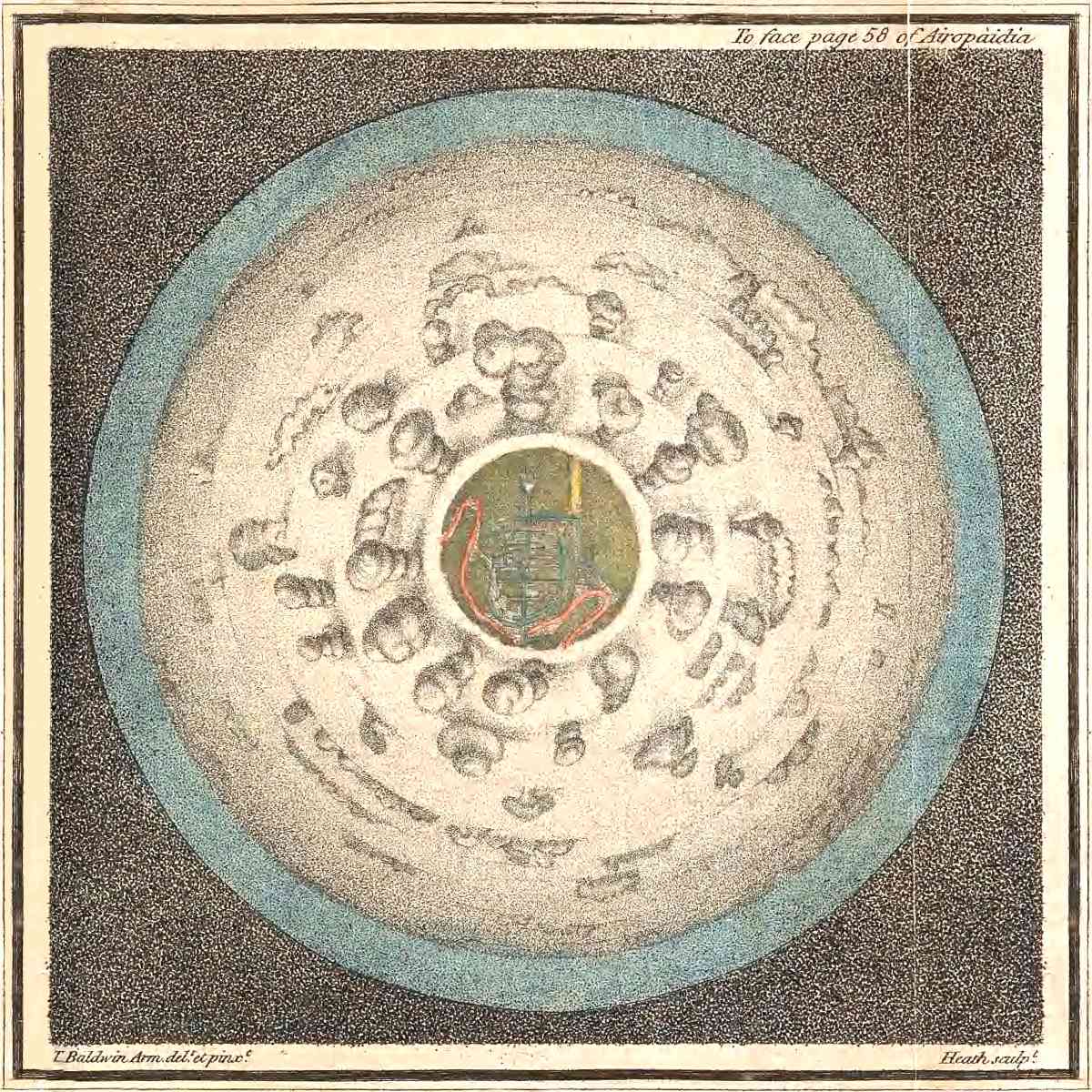
The one, a circular View from the Balloon at its greatest
Elevation; the City of Chester appearing in the Center.
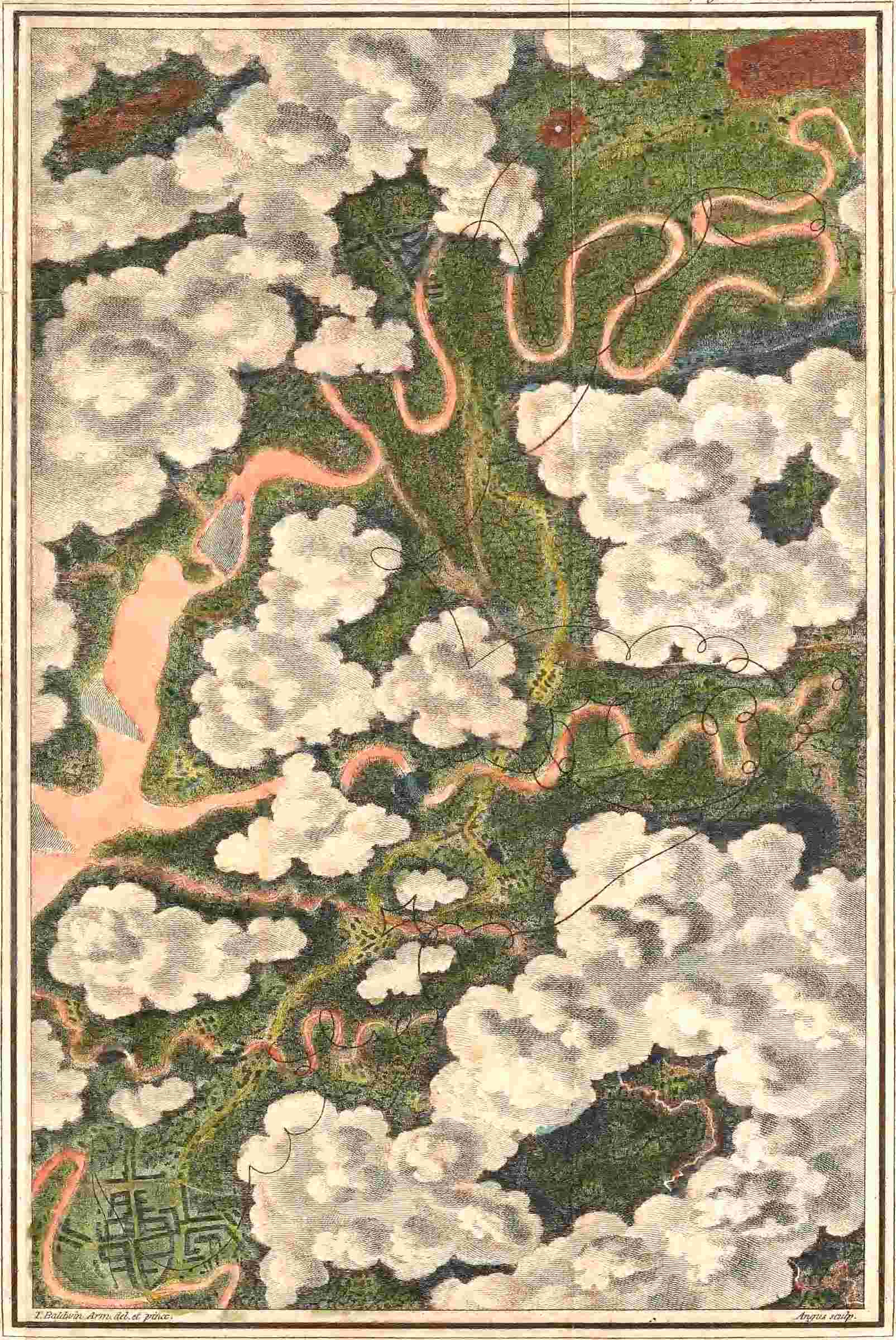
The other, a Specimen of Balloon Geography: being a Prospect
from above the Clouds, of the Country between Chester,
and Warrington in Lancashire, with the Track of the Balloon
in the Air.
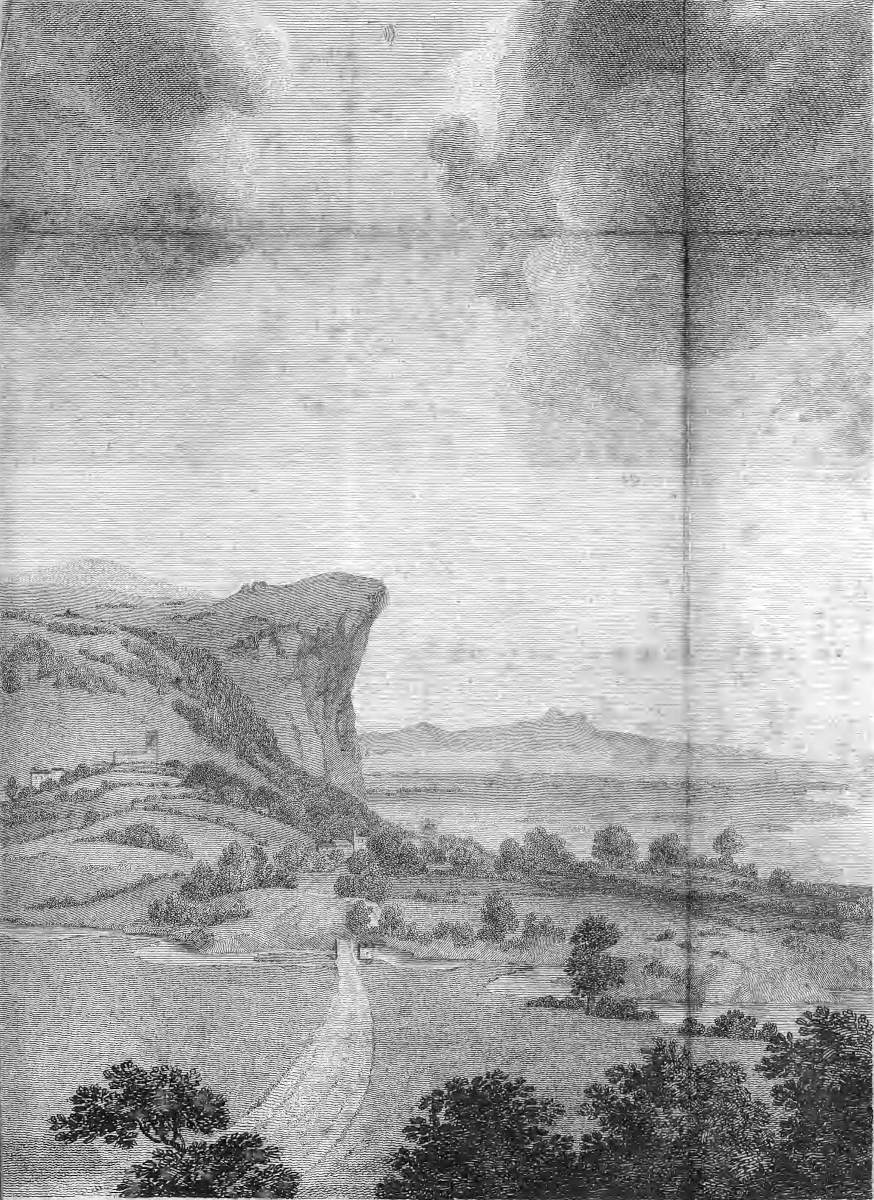
A third represents the Balloon over Helsbye-Hill in Cheshire,
with a beautiful View of the adjacent Country.
containing
the NARRATIVE of a BALLOON EXCURSION
from chester, the eighth of September, 1785,
taken from minutes made during the Voyage: HINTS on the IMPROVEMENT of BALLOONS,
and MODE of INFLATION by STEAM: MEANS to prevent their DESCENT over WATER:
occasional ENQUIRIES
into the STATE of the ATMOSPHERE,
favouring their DIRECTION:
with various philosophical
OBSERVATIONS and CONJECTURES.
to which is subjoined,
MENSURATION of HEIGHTS by the BAROMETER, MADE PLAIN:
with extensive TABLES.
The whole serving as an introduction to AËRIAL NAVIGATION: with a copious INDEX.
By THOMAS BALDWIN, Esq. A. M.
- - - - - Addita navigiis sunt
Multa.Lucretius De Rerum Nat. L. 5, V. 335.
Nihil perfectum simul ac inceptum.
Usus uni rei deditus, et naturam et artem sæpe vincit.Cicero.
CHESTER:
Printed for the Author, by J. Fletcher; and sold by W. Lowndes, No. 77,
Fleet-street, London; J. Poole, Chester; and other Booksellers.
1786.
Price, in Boards, 7s. 6d.
TO THE PRINCIPAL INHABITANTS OF CHESTER:
For their polite attention on the Day of Ascent, and
Preservation of order during the inflation: on
which, the Success of aërial Experiments so much depends, and
throu’ the Want of which, so many have already failed; for the
kind Anxiety manifested during his Absence; and for their friendly
congratulations, on his safe Return; the following Account
of the Balloon-Excursion, written at their Request, is, by their
Permission, with all Gratitude, Esteem and Respect,
dedicated, by their most obliged, and most obedient Servant the AIRONAUT.
TABLE OF CONTENTS — AN ACCOUNT OF THE PLATES; WITH DIRECTIONS FOR PLACING THEM. — 1st. An Account of the Plates. — 2d. Directions for placing them. — Literal and other Errors proper to be examined, and corrected with the Pen, before the Book is read.
1. (a) A Circular View from the Balloon at its greatest
Elevation, (Page 58.) The Spectator is supposed to be in
the Car of the Balloon, suspended above the Center of the
View: looking down on the Amphitheatre or white Floor
of Clouds, and seeing the City of Chester, as it appeared
throu’ the Opening: which discovers the Landscape below,
limited, by surrounding Vapour, to something less than two Miles
in Diameter.
The Breadth of the blue Margin defines the
apparent Height of the Spectator in the Balloon (viz. 4 Miles)
above the white Floor of Clouds, as he hangs in the
Center, and looks horizontally round, into the azure Sky.
2. (b) The Balloon over Helsbye-Hill in Cheshire, at half
past II. on Thursday the 8th of September, 1785. (Page 78.)
It is seen in the South-west-Quarter.
The View was taken in a high Field, at the End of
Sutton-Causeway.
Helsbye-Hill, tho’ upwards of 600 Feet high, appeared from the
Car of the Balloon, to be on the same Level with the Grounds
below.
3. (c) A Balloon-Prospect from above the Clouds, (Page 154,) or Chromatic View of the Country between Chester,
Warrington and Rixton-Moss in Lancashire: shewing the whole Extent of
the aërial Voyage; with the meandering Track of the Balloon
throu’ the Air.
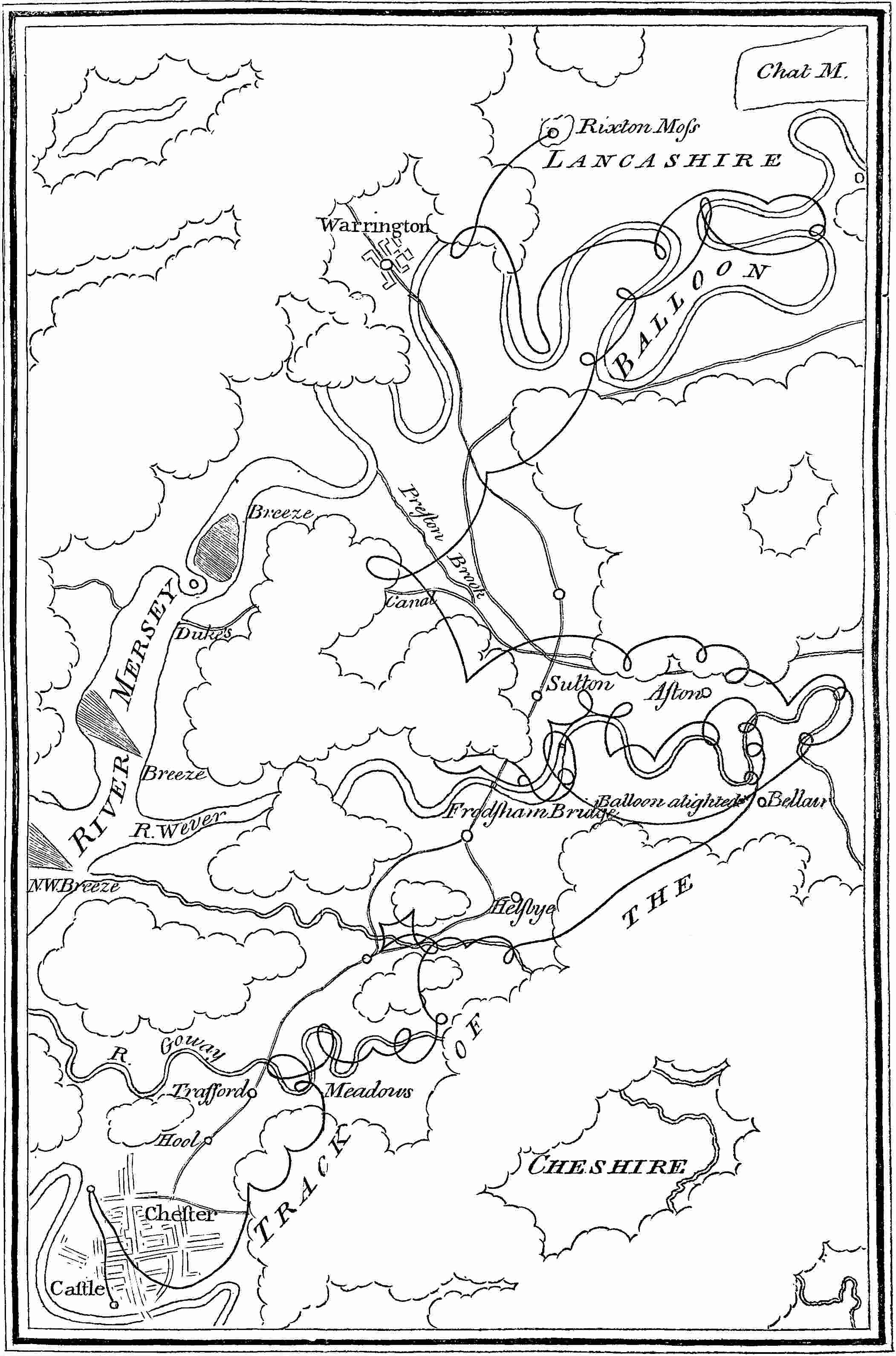
4. The Explanatory Print (d), (Page 155:) which
elucidates the former by giving the Names of the principal Places
mentioned in the Excursion.
N. B. The Circular View is seen to the best Advantage, when
placed flat on a Table or Chair, and rather in the Shade:
the Eye looking directly down upon the Picture.
Whoever will be at the Trouble of viewing distinct Parts of the
Balloon-Prospect, throu’ a very small Opening, made by rolling
a Sheet of Paper into the Form of a hollow Tube, and applying it close
to either Eye, at the same Time shutting the other; or by looking
throu’ the Hand, held a little open, and close to the Eye; may form a
very accurate Idea of the Manner, in which the Prospect below
was represented gradually in Succession, to the Aironaut; whose
Sight was bounded by a Circularity of Vapour, as in Section 79, 221.
Place the Top of the circular view, even with
the Top of the Page.
The Plate will then lye over at the Bottom, and at the right
Side of the Page.
Fold the Bottom up into the Book, even with the Margin: and the
right Side in like Manner.
Observe to place the Bottom of each of the other Plates, even
with the Bottom of the Page.
The Plate will then lye over at the Top, and at the right
Side of the Page.
Fold the Top down, into the Book, even with the Margin:
and the right Side, in like Manner.
The circular View, to face Page 58.
The Balloon over Helsbye-Hill, to face Page 78.
The Balloon Prospect, to face Page 154.
The explanatory Print, to be placed on Page 155: and, when
unfolded, to be seen along with the Balloon-Prospect.
Note [6]—Cube of the Velocity, &c. write (as in
some Copies) Square of the Velocity, &c. the Resistence will be as 3✕3=9.—See Chambers’s Dictionary,
under resistence.
23.
Section 21. Blot out [Signs] of Currents.
26.
Before All Things being thus prepared, insert
[Section] viz. 25.
35.
Line 13.—I o’Clock, write I. o’Clock.
54.
Section 52.—an Extent above them of 77 Miles, write
an Extent of 102 Miles. See the Occasion of this
Mistake in Note [18] Calculation SECOND, which
makes the Answer 102 Miles, 1 Quarter, 320 Yards; and
the Ans. to the
PROBLEM being 102 1307 ——————————
gives the Prospect 13 Yards
less than that over the Clouds.
84.
Line 4.—great Turnpike-Road, write great public Road.
84.
Note [26]After See Moore’s Practical Navigator,
insert See Page 98 [34].
Line 5.—from a vertical Situation only, to be seen, write
to be seen from a vertical Situation only:.
174.
Line 1.—excessine Diminution write excessive Diminution.
177.
Line 9.—contain write contains.
202.
The Sections 259, 260, 261, are repeated.
234.
Line 6.—a Yard, write two Yards.
236.
Line 3. After the Words in Danger of breaking; add the
Bottom of the Balloon must be opened, or the upper
Valve drawn. And erase the Remainder of the Sentence.
237.
Line 4.—which is a Sign that the Balloon descends, write (which is a Sign that the Balloon descends).
242.
Line 21.—supercede, write supersede.
263.
Line 5.—commonly: ascend, write commonly ascend:.
266.
Line 21.—their Passage write its Passage.
271.
Line 14.—each 4 Feet write each 4 Inches.
278.
Lines 15 and 18.—third Tables and third Table, write fourth Tables and fourth Table.
283.
Note [119].—more than the three first Decimals write more than the four first Decimals.
288.
Line 5. After .0000076, insert which, being divided by .1, gives a Cypher less.
Line 23.—there will remain the greater Height, write
there will remain, secondly; (see Section 367) the greater Height.
303.
Line 6.—(viz. the 8,) write (viz. the .8,).
309.
Line 10. Marginal Note.—7th Step in Section 366. write 7th Step in Section 368.
310.
After Line 23, insertAir-Thermom. 56°.
311.
Line 1.—By the Practice of the first Example, write Practice of the second Example.
312.
Line 29. After The Answer, &c. insert, made by rejecting a Cypher,.
317.
Before the last Line but two, insertend of the first stage.
318.
Line 23.—the 2d Tenth, write the 1st Tenth.
319.
Line 13.—, gives 7. write, gives 97.
322.
last Line but two.—and the remaining Feet write the remaining Feet.
CHAPTER I.
AIROPAIDIA:
Introduction.
Section 1. THE Public have, for a considerable Time, been entertained
with Accounts of aërial Voyages.
Such Accounts are, in many Respects, vague and unsatisfactory: by no
Means adequate to the Expectations and Wishes, which have been formed
by those, who have not yet penetrated the profound Heights of the
Atmosphere.
Mistakes to be noticed, as Examples of Avoidance.
2. The Voyagers have, now and then, been pretty accurate in Regard
to Time Place Distance and Velocity: Circumstances highly worthy of
Remark, in order to estimate the Improvement already made in this
wonderful Discovery, and point out its Use: but neither ought the
several Occasions of Failure in the Experiments to be omitted;
as they will be found to arise more from a Want of Prudence and
Foresight in the Managers, than from any Defect in the Machine, or the
Principle on which it acts. Such Failure ought therefore to throw an
additional Light and Credit on the Art: and give a Spur to Ingenuity,
which, it is not to be doubted, will continue to drive forwards with
the same rapid Success; nor rest, till the Art itself is brought to
the highest Degree of Perfection; till airostatic Ships make the
Circuit of the Globe: a Navigation which, from its Novelty and
Importance, deserves to be considered in a separate Treatise.
Aërial Voyagers defective in their Descriptions.
3. Balloon-Voyagers have likewise been particularly defective in
their Descriptions of aërial Scenes and Prospects: those Scenes of
majestic Grandeur which the unnumbered Volumes of encircling Clouds,
in most fantastic Forms and various Hues, beyond Conception glowing
and transparent, portray to a Spectator placed as in a Center of
the Blue Serene above them: contemplating at the same Instant, and
apparently at some Miles Distance immediately below, a most
exquisite and ever-varying Miniature of the little Works of Man,
heightened by the supreme Pencil of Nature, inimitably elegant, and in
her highest Colouring.
Such are the Scenes which, Ballooners all allow, constitute the true
Sublime and Beautiful: inspire Ideas of rational Humiliation to a
thinking Mind, and raise the most careless Mortal to an unknown Degree
of enthusiastic Rapture and Pleasure.
Every Beholder is a Judge of the Scenery around him: and no one, it
is presumed, ever ascended into the Atmosphere on a mild Day,
with a sound and well ballasted Balloon, that did not wish to taste the
Luxury of a second Voyage.
Disappointment shoud excite the Ardor of the Scientific.
4. Yet notwithstanding, as Ignorance is known to be the Parent of
Fear, the Bulk of Mankind, which are by far the greater Number, will
long continue to entertain absurd Apprehensions concerning it; to
oppose and ridicule the Invention; as they will oppose every other
Discovery, which they have neither Talents Inclination or
Leisure to understand.
This Reflexion shoud, on the contrary, rather excite than check the
Ardor of the Skilful and Scientific, to cherish and promote the Art.
In the History of Airostation, each Event is yet new and
uncompared. Every Circumstance ought therefore to be
carefully recorded: since it woud be unfair to fix Bounds to Science;
or argue, that such Inferences, as shall demonstrate the great Utility
of the Invention, may not be drawn from Circumstances which Inattention
might pronounce to be most trifling and minute.
The Reader cautioned.
5. The Reader is requested to observe that, this Account being
addressed to the Generality, and not to the Curious and Philosophic
only; many Circumstances are added, which woud otherwise have been
considered as superfluous: and some it was thought proper to repeat, in
order to connect the Thread of the Narration, without the Necessity of
frequent Reference to the Sections.
Squalls of Wind the Day preceding the Ascent.
6. An Agreement having been made with Mr. Lunardi, that he shoud
resign his Balloon to Mr. Baldwin on Wednesday the 7th of September;
an Advertisement to that Purpose appeared in the Chester Paper: and
on Wednesday Morning, a great Number of Spectators assembled in the
Castle-yard of the City of Chester: where many waited till half past
IV in the Afternoon; Mr. Lunardi declaring that, on Account of the
Violence and Unsteadiness of the Wind which blew from the South and
South-West, it was dangerous to attempt the Inflation of his Balloon;
and Mr. Baldwin continuing to assert that, if it coud be filled, he
was willing to go up.
The Weather was then moderate: but Mr. Baldwin, thinking the
Hour too late to begin the Inflation, which, judging from the two
former Inflations, coud not probably have been completed till after
Sunset; made a Proposal to Mr. Lunardi, that he shoud postpone
the Exhibition till the next[1]Day. The latter,
after some Reluctance, arising from a Fear lest the Public shoud disapprove his
Conduct, politely complied with his Request, on Mr. Baldwin’s saying
that he woud take the Blame on himself.
CHAPTER II. — Preparations for the Voyage.
Cannon first fired at IX.
Section 7.ON Thursday the 8th of September 1785, at IX in the Morning,
one of the Cannons (a Six-pounder) was first fired in the Castle-yard,
to inform the City and Neighbourhood, that the necessary Preparations
were making to inflate the Balloon.
Till VIII that Morning, the Air had been hazy: but was then clear,
bright and calm below, with an upper Tier of light Clouds in the
Zenith moving from South-West by West, and dense ones rising in the
Horizon.
At X, the Inflation began with a small Balloon.
8. At X o’Clock, the Process began with the Inflation of an airostatic
Globe eighteen Feet in Circumference, of Silk Tiffany, made the latter
End of the Year 1783, and decorated with Painting, Mottoes and Devices:
in the Performance of which little Work, Mr. Baldwin was (in the
modern Phrase) the sole Projector, Architect Workman and Chymist.
An airostatic Globe liberated as Pioneer to the great one.
9. The Airostat was presently liberated by the Hands of Mr. Lunardi;
and continuing to turn gently the same Way round its own Axis, afforded
a beautiful Spectacle to the Beholders: remaining in Sight about half
an Hour. It was intended to serve as a Sort of Pioneer, to delineate
the Track of the great Balloon.
Its Fate.
10. It fell at some Miles Distance, ’tis said unfortunately on a Hedge,
and was presently torn to Pieces by the Eagerness and Avarice of the
Pursuers, who expected and undeservedly obtained the Reward promised in
the Letter appended to it.
Second Cannon at XII.
11. At XII the Cannon fired a second Time, to announce that the Process
was in a proper Degree of Forwardness.
At this Time Mr. Baldwin went, with some Friends, to take an early
Dinner: he also recapitulated the Articles, to be certain that Nothing
was omitted.
Inventory for the Voyage.
12. The following Inventory, with which he ascended, may be of Use to
future Aironauts; to whom only it is addressed.
The Cable and Grapple are considered as Part of the Balloon. (See
Section 13.)
12. Article 1. A portable Barometer,[2] with a common
Syphon or
Bulb, (purchased at Lausanne.)
12. 2. Martin’s Thermometer,[3] with Farenheit’s
Scale[4] for the
Degrees of Temperature.
12. 3. Mariner’s Compass in a double Box, to be used when the
Sun is intercepted from the View by Clouds, in order to discover
whether the Balloon turns round.
12. 4. Down, or small Feathers, to be loose in the Pocket, and
thrown out, when enshrined in Clouds; or at any other Time, to shew
the Rise or Fall of the Balloon.
12. 5. An Asses’ Skin Patent Pocket-book; as Wet spoils Paper.
12. 6. Two red Lead Pencils: each Pencil ready pointed at
both Ends, to save Time and Trouble: preferable to Ink, which may
be spilt or frozen.
The Strokes with red Lead are not so easily obliterated, as
when made with a black Lead Pencil.
12. 7. A small sharp Knife pointed, and ready open, or which will
open easily. A Pair of Scissars.
12. 8. A wicker Bottle of Brandy and Water, only three Parts
full, half and half: such Bottles are more secure: and such Mixture
will not soon freeze. The cochuc or elastic Bottle is still better.
A Cork-screw.
12. 9. Compact Provisions, which do not soil the Fingers or
Pocket-book, as Confectionaries, Fruit, Biscuit, Bread.
12. 10. A boarded Map of the Country over which the Aironaut
may be supposed to pass: the Back serving as a Table.
12. 11. Two Needles with large Eyes: the raw Silk put
through, and tyed on a Knot at the Ends to prevent the Needles from
being lost: to be ready at the Instant wanted, to sew up any Holes
within Reach, in the Balloon; the Holes being first tyed up with
Twine.
The Needles to be stuck into Parchment, containing a small Hank of
raw Silk: the Needle Silk run round the Parchment, to keep
the Hank dry.
The whole Hank to be tyed by one End to the Side of the Car; when
above all Clouds, to shew, by the Divergency of the Threads, the
Electricity of the Air.
12. 12. A few Yards of Dutch Twine, loose in the Pocket, to tye the
Neck of the Balloon in descending.
12. 13. For easy Experiments; 1st, Dutch Twine, half a Mile long,
on a Reel, or Pulley, or two Lengths on different Reels: also
to each Reel a Flag, made of white Linen, a Yard square; and
stretched by a slender Lath; one Side of the Flag being bound and
stitched round it: also a Piece of Twine, two Yards long, is to be
fastened by its Ends to the Ends of the Lath: a Loop is to be made
in the Middle of the Twine: and to the Loop is to be applied round
the Middle of the Lath another Piece of Twine, which will prevent
the Lath from being bent; and will keep the Flag always stretched.
By this Apparatus, Observers from below may be enabled to estimate
the Height of the Balloon, as will be shewn in its proper Place.
12. 14. 2dly, To try the Density of the Air, at different Heights,
above the freezing Point with Water; below it, with
Brandy.
In a Basket take two Pint-bottles, one full of Water, the other
of Brandy; and six or eight empty ones: also a small Metal
Tunning-dish.
Let one End of a String be tyed round the Neck of each Bottle: and
the other End sealed to the Top of a large Cork much tapered, to
enter the Mouth easily. Round each Neck, tye a Parchment Label,
large enough to contain in abbreviated Characters the Number of
the Bottle; Time of Observation, Heights of the Barometer and
Thermometer, while on the Ground.
When an Experiment is made in the Air; pour off a full Bottle into
an empty one: put the Cork into the emptied Bottle, and mark again
the Time, Barometer and Thermometer: which are to be compared
with an Eudiometer below, to discover the Rarity and Purity of the
Atmosphere.
12. 15. A third white Linen Flag, made as above, and tyed to the
upper Hoop of the Balloon, so as to hang in Sight, will give Notice
of a Change in the Wind.
12. 16. A Yard of thin Ribbon, two Inches broad, tyed to the lower
Hoop, will mark the Rise and Fall Of the Balloon.
(12. 17. A Magnet and Iron Filings in a thin Pewter Dish with a
Cover; Also
The Prism and large Telescope were left, as too heavy.) And the
Sextant or Quadrant coud not be procured in Time. They woud, have
been of little Use, as no Horizon of the round Earth was seen
during the Excursion: and it is presumed, that the circular Horizon
is seldom visible, when the Balloon is at any considerable Height;
the Accumulation of Vapour between the Eye and Horizon preventing
it: tho’ such Vapour remains invisible to Spectators from below.
12. 18. Eight Bladders, each above half blown, and differently
coloured for Ornament, tyed round the upper Part of the Car,
Breast high when the Aironaut stands upright: in Case the Balloon
fall into Water.
12. 19. Speaking Trumpet: also a live Pigeon, in a small Basket of
Matting.
12. 20. Pepper, Salt, Ginger; to try the Effects of Tastes, which
have been said to become insipid on the Peak of Teneriffe.
CHAPTER III. — ADDRESSED TO AIRONAUTS. — SIGNS TO BE OBSERVED, WHEN IN THE AIR. — 2dly. To prevent too precipitate a Fall . — SIGNS WHEREBY TO JUDGE WHETHER THE BALLOON IS RISING OR FALLING. — SIGNS OF RISING. — SIGNS OF DESCENT. — SIGNS OF PROGRESSIVE HORIZONTAL MOTION. — SIGNS OF NEW AND SUDDEN HORIZONTAL CURRENTS.
New Kind of Cable and Reel recommended.
Section 13. THE following Anchor and Cable, for greater Safety and some
particular Uses, are recommended as an Improvement.
A strong Iron double Grapple, moving on a Swivel, fastened to a
Rope,[5]
half a Mile, or better a Mile long: and, if not all; a Part of
which at least, at the Distance and for the Length of ten Yards from
the Grapple, shoud be of Silk, as a non Conductor: also other ten
Yards, at its upper End, counting from the Reel or Pulley to which the
Silk shoud be tyed.
The Reel or Pulley being at least eighteen Inches in Diameter, and
fixed vertically in the Center of the upper Hoop, seven Feet above the
Bottom of the Car; by Means of three or four Iron Rods fastened in
the Bottom of the Car, and meeting together above the Reel: the Rods
so strong as to prevent the Shock which otherwise the Aironaut woud
receive in alighting on the Ground.
The Reel shoud have one, or two Iron Winches or Handles, one at each
End of the Reel; with moveable Handles of Wood round them. The Reel
may be furnished with sudden Checks; or gradual Clamps, as in a Mil, to
retard the Velocity.
Cautions against two Extremes.
14. The two Extremes to be avoided are, too lofty an Ascent: and too
precipitate a Fall.
1st. Too lofty an Ascent.
The former is to be apprehended when Balloon has swelled considerably,
and strains as if ready to burst; from the Shape of an inverted Cone,
or Children’s Top, changed to that of an oblate Spheroid, or Turnep.
It is therefore necessary to look up at the Balloon from Time to Time:
and either open the Mouth, or as it is sometimes called the Neck,
for an Instant; or draw the Valve; which is done by pulling a
Cord fixed at the Top of the Machine and running thro’ it to the Hand,
till the Balloon only appears full without straining.
These Operations are to be occasionally repeated during the
Ascent.
If it is required to rise still higher; gradually throw out Ballast,
and repeat the Operations.
The proposed Quantity of Ballast being thrown out, the Balloon will
have acquired its utmost Height, and become stationary, i. e. neither
rise nor fall.
The self Descent of the Balloon is only in Proportion, as the
inflammable Air or Gass escapes thro’ imperceptible Holes in the Silk
or Seams.
2ndly. Caution against too precipitate a Fall.
15. 1st. Tye, or compress the Mouth of the Balloon, for a Moment; which
must always be opened, on observing that the Balloon is again risen
to so great a Height as to strain, or be distended as above
mentioned.
2d. In descending, throw out Ballast, when the Balloon is within a
Quarter of a Mile of the Ground, but not before, i. e. at 26 Inches
by the Barometer: and, if the Fall is precipitate, not less than 25
Pounds Averdupoise, Pound by Pound, or at once, if there should be
Occasion.
3d. In Case of Accident, as the Escape of Gass; or if the Balloon
be not furnished with an Equatorial Hoop; prepare to throw
out all the Ballast at the above Height, but not before; as the more
forcible the Fall,[6] the greater the Resistance
from the Air: cut away Ends of Cords; tear off Ornaments: part with Shoes,
Cloaths. All which must be made loose and ready to throw
out, at the Moment the Balloon begins to descend. Before the Landing,
particular Care must be taken, that the Weight of the Aironaut be
sustained, by grasping the Hands round the opposite Sides of
the upper Hoop; so that the Feet may not touch the Bottom of the Car.
The Knees shoud likewise be bent. Repeating the above, at each Rebound
of the Balloon, if any; the Aironaut will alight in the gentlest
Manner: and probably the Balloon may act as a Parashute or Umbrella,
which alone will, at all Times, ensure an easy Descent.
Signs of Ascent or Descent.
16. 1. When the Aironaut perceives a Pressure upwards against the Soles
of his Feet.
2. When some Objects, on the Surface of the Earth immediately below,
diminish, and others disappear.
3. When an upper Cloud approaches or involves the Balloon.
4. When a lower Cloud leaves the Balloon.
5. When Rain Snow or Hail beat violently against the Top of
the Balloon.
6. When Feathers, Balloon-Flag, or Ribbon seem to be drawn forcibly
downwards.
7. When Objects on Earth, or among Clouds below the Balloon, rise and
present themselves beyond those, which, the moment before, were
thought most distant.
8. When the Balloon appears broader and shorter; also fuller at the
Bottom; being more distended than at the first Ascent.
Signs of Descent.
17. 1. When the Aironaut perceives the Bottom of the Car withdrawing
itself from the Pressure against the Soles of his Feet.
2. When Objects on Earth, and surrounding Prospects encrease in
Magnitude and Number.
3. When a lower Cloud approaches or involves the Balloon.
4. When an upper Cloud leaves the Balloon.
5. When Weather beats against the Bottom of the Car or Balloon.
6. When Feathers, Balloon-Flag, or Ribbon appear to be drawn upwards.
7. When the most distant Objects set, and disappear.
8. When the Balloon seems taller; and its lower Hemisphere less
distended, tho’ continuing tight.
Signs of progressive Motion deceitful.
18. These are equivocal and deceitful.
When the Aironaut has lost Sight of the Earth by intervening Clouds;
the Balloon seems at Rest, and only the lower Clouds appear to move:
whereas the contrary may be true, the Clouds may rest, and only the
Balloon move.
In this Case, Attention must be paid to the half Mile white Flag, whose
Situation and Motion must be observed, with respect to the Balloon,
and to the Earth before the Cloud intervened. If the Flag retains
its Situation with Respect to the Balloon, it may be inferred that no
Change in the Direction has happened: if its Situation alters, the
Sun or Compass is to be observed: and an Estimate made of the new
Current of Air by which the Balloon is affected: its Velocity, Sound,
Temperature, &c.
To descend when lost.
19. But to acquire a Certainty of course, it will be proper to descend
below the Cloud: or move by Compass, Map, and a Knowledge of the
Country: or try the long Cable (Section 13.)
Signs of Wind horizontal.
20. It is likewise necessary to know the Signs of Wind, or
Currents of Air.
When the Feathers, Balloon-Flag, or Ribbon, compared with Sun or
Compass, take a new and sudden horizontal Direction.
21. of currents from above: properly named Waves
Torrents and Tide of Air.
Signs of depressing Torrents and Tide of Air.
They are very frequent, and require to be guarded against: are
sometimes or long Continuance, at other Times momentary: against the
first throw out Ballast at the Height of a Quarter of a Mile, but not
before, or as hereafter directed: when momentary, and above that
Height, Nothing is to be apprehended: the Balloon will appear broader
and recover its Form.
CHAPTER IV. — PREPARATIONS FOR ASCENT.
Preparations for Ascent.
Section 22. BEFORE half past I, Mr. Lunardi had inflated his Balloon
in the finest Manner; and having, with the most obliging and spirited
Attention, made such Preparations, and taken such Precautions, as
he thought were necessary to ensure the Success of the Expedition; sent to
inform Mr. Baldwin (who continued purposely absent, that he might not
disturb or precipitate the Process; but that every Circumstance shoud
be conducted with Deliberation and without Hurry) that all Things were
ready for his Departure.
The Public reminded of the Necessity of preserving order
during the Inflation of Balloons.
23. And Mr. Baldwin takes this Opportunity of returning his best Thanks
to his Friends and the Public, on the Day of Ascent, for keeping
the small Circle clear, by strictly adhering to the Words
of the Advertisement, which declared, “that in order to prevent an
interruption of the Process in the Inflation of the Balloon, no Persons
were to be admitted within the circle, except those
Gentlemen who politely undertook in turn to hold the Lines which detained the
Balloon.”
Lead Weights placed at first in the Car, to prevent any
Fatigue in holding the Lines, and the Necessity of weighing, unless at
the Time of Ascent, to determine the Power of Levity.
24. It may be proper to mention that Mr. Baldwin being resolved to
prevent the disagreeable Circumstances of being weighed in the
Presence of Thousand spectators, at a Time when it is uncertain whether
the Balloon has acquired a sufficient Degree of Levity to raise
his own Weight, together with the Instruments, Provisions, Ballast, and
other Articles, all which are known or easily calculated; finding some
Days before, his own Weight, and having calculated the rest as under[7];
he ordered his Servant, on the Day of the Excursion,
to bring Lead Weights equal to the Sum total, with an overplus Weight of
10lb. for Levity of Ascent, and place them gradually in the Car,
attached for that Purpose to the Balloon, soon after the Inflation
began. By which Means the Gentlemen who held the Cords were quite at
Ease: nor was there Occasion to tye the Lines during the Inflation, to
Posts fixed in the Circumference of the Circle; nor consequently to
cut them afterwards.
But it will be seen that Mr. Lunardi inflated the Balloon in a superior
Manner.
25. All Things being thus prepared, Mr. Baldwin stepped into the Car:
and finding, that, besides his own Weight, the Provisions, Articles,
Ballast, &c. the Balloon woud support an additional Weight, and
still rise with superior Levity; Mr. Lunardi put in 12lb. of
additional Ballast, and guessed the encreased Levity at 10lb.
more.
Additional
Ballast
12
Levity
10
——
22
Added to the
234
——
Make the Sum
256lb.
All which added to the Weight of the Balloon, by Information
only, as follows:
Balloon varnished
113
Netting and Cords
18
Car and Hoops
24
Mended and added Parts
5
Grapple and Cable
4
——
164
With the
256
Make the total Levity of the Gass to produce an Equilibrium, equal to
420lb.
The Weight of a Quantity of Air equal in Bulk to the Balloon, being
secluded; and the Gass substituted in its Room.
Weight of Articles.
26. The Calculation of the Weight of Articles was, as follows:
Preparations against extreme Cold. A Winter Dress.
Flannel or woollen Socks
0
–
14
Cap
Gloves
Drawers
Under Stockings
——— Waistcoat
3.
Brandy, Water, Flask, and Refreshments
1
–
8
4.
Barometer (portable)
0
–
121⁄2
5.
Thermometer
0
–
3
6.
Dial-Compass (a Mariner’s Compass in a double Box, will traverse better)
0
–
31⁄2
7.
Two white Flags, with Dutch Twine on two Reels furnished with Swivels
0
–
4
8.
Asses Skin Pocket Book, Blank Cards, Pencils, Knife and Scissars
0
–
41⁄2
9.
Map of Cheshire boarded, the superfluous Parts cut away
0
–
3
10.
Speaking Trumpet
0
–
81⁄2
11.
Mr. Lunardi’s Flag
3
–
8
12.
Basket and eight Pint Bottles labelled, one full of Brandy, another of Water
8
–
3
—————
20
–
0
Weight of Ballast.
27. The Ballast consisted of three Bags of dry Sand, and two red grit
Stones, taken while in the Car, additional.
1st Bag tyed up weighed
12lb.
2d Ditto
12
3d untyed Ditto
20
1st red Grit
7
2d red Grit
5
——
In all
56lb.
CHAPTER V. — ASCENT WITH 20lb. OF LEVITY.
Ascent at 40M. past I, with 20lb. of levity.
Section 28.AT 40 Minutes past I, the Balloon having a Levity which not
less than 20 Pounds Weight woud counterpoise, Mr. Baldwin was liberated
by the Hands of Mr. Lunardi, who suffered no one to approach the Car:
and he ascended, amidst Acclamations mixed with Tears of Delight and
Apprehension, the Misgivings of Humanity, and other usual Sensations
of Surprize, which, in a brilliant and numerous Assembly, will long
continue to accompany a Spectacle so novel interesting and awful, as
that of seeing a Fellow Mortal separated in a Moment from the Earth,
and rushing to the Skies.
Employments of the Aironaut.
29. The Balloon well inflated, tower’d aloft in an upright and
perpendicular Direction, with a quick Motion, and an accelerated
Velocity.
The Aironaut having stood up, for a Minute or two, waving his Hat in
the left, and saluting the Spectators with Mr. Lunardi’s coloured Flag
in the right Hand; put on his Hat, and having fastened the Flag-Staff
horizontally among the Lines of the Balloon, immediately betook himself
to different Employments, before he woud indulge in looking over the
Brink of the Car; lest the Novelty of the Prospect shoud call off his
Attention from Things of Moment.
Sensation of rising described.
30. The Force of Ascent was, from the first, plainly palpable:
the Sensation being that of a strong Pressure from the Bottom of the
Car, upwards against the Soles of the Feet.
Caution against the vitriolic Acid Liquor.
31. His first Point being to guard against a Deluge of acidulous
Liquor, which, he was told, had fallen, to the Quantity of three
Quarts, on the Head and Shoulders of a former Aironaut, from the
Trunk or Bottom of the Balloon, which ended in a wide circular Opening
of eighteen Inches Diameter; he found that when the Weight either of
himself, or of the Ballast, was not exactly in the Center of the Car;
the Opening of the Balloon woud, without any Trouble, hang so as to
lie on the Outside of the Car: but he did not perceive more than a few
Drops issue from the Mouth: which happened a few Minutes after he arose.
Attitude, and farther Employments.
32. This Difficulty vanishing; he changed his erect into an inclined
Posture between sitting and kneeling; sometimes with the right Knee
near the Bottom and Center of the Car: and having both Hands quite
free, the Balloon being subject to no sensible Motion; he
reconnoitred all the Lines and Cords: coiled the Rope or Cable to which
the Anchor or grappling Iron was fixed: tyed fast its proper End to
the upper Hoop: observed and felt the superior Thickness of the
Cord leading to the Valve: coiled it, in order that it might be free to act:
placed the untyed Bag of Ballast near the Outside of the Car: also the
tyed Bags at proper Distances to preserve the Equilibrium: unwrapped
one of the white Flags, tyed it to the String on one of the Reels, and
just threw it an Inch or two over the Side of the Car: then placed his
Watch, open Knife, Scissars, Thermometer and Compass on his
right Hand: the Barometer being swung above in Sight towards the left.
Change of Attitude, and Observation of the reddish Vapour.
33. He then stood on his Feet, with a Design to look down: but his
Attention was drawn to the Opening of the Balloon, which began to
breathe out by Intervals a visible reddish Vapour; in Form like
that which is seen at the Top of a Brewery, only that the under Surface
was not jagged but smooth, altho’ wavy and uneven. The Particles which
composed it were so large as to be distinctly visible: and appeared,
as if endued with a very strong repelling Power, from the great and
seemingly equal Distances, of about half a Quarter of an Inch, from
each other.
It was observed by a scientific Spectator from below, that the Parts
of the Balloon, which reflected the Sun’s Rays, appeared of a bright
Copper-Colour: but the reddish Vapour issuing from its Mouth put
on the Form of a lambent Flame. A similar Appearance had been observed
by him, in a former Ascent of the same Balloon, the Neck or Mouth being
then likewise open; and also by others, who declared they saw the
Balloon on Fire.
The Change of the red into Flame-Colour, when seen at a great
Distance, may it not be owing to this, that the direct Rays, being
mingled with those which are intercepted between the Eye and the
Object, became in Part absorbed, and in Part refracted; and
therefore
coud not reach the Sight?
The Gass not offensive.
34. This gentle Evaporation of inflammable Air, or Gass, continued:
disappearing at the Distance of four and five Inches below the Opening:
nor did it offend the Smell; not descending within its Influence.
Attention to the Balloon, and Dimensions of the Car and Hoops.
35. He then looked upwards at the Balloon, and perceived that it was
considerably swelled in its Dimensions: and that the Distention had
raised the Bottom-Opening of the Balloon half way between the two
Hoops: i. e. from his Hip to his Shoulder, as he stood upright. The
Height from the Bottom of the Car (which was a thin circular Board four
Feet and a half, Diameter, placed on a strong Netting, and covered with
green Bays) to its Top or the lower Hoop, was three Feet; with the
Netting continued round between the lower and upper Hoop.
Stationary, and Notes made.
36. He was aware that the Swelling of the Balloon, and copious Vapour
then issuing from it, denoted the Moment when it began to lose its
ascensional or elevating Power; and that its accelerated Motion was
diminishing.
He therefore looked at his Barometer and Watch, which was 53 Minutes
past I.[9]; took up his Pencil, and on a Card (marked
before he left
the Earth, as follows:
Chester-Castle-Yard. Thursday, the 8th of Sept. 1785, I. o’Clock,
Barometer 298⁄10, Therm: 65 in the Shade towards the North;) he wrote
“Rose at 40 Minutes past I.” He then looked again at the Barometer,
which continued falling for some Minutes, and fluctuating up and down
within the Space of an Inch or more. It first began to rest at 231⁄4,
and a little after at 231⁄2. Having looked again at his Watch, he put
down “57 Minutes past I. became stationary: Barometer 231⁄4: Therm:
still 65, sometimes lying in the Shade, and sometimes exposed to the
Sun: the Balloon turning round frequently thro’ East to South.”
Fluctuation of Barometer.
37. The Fluctuation of the Barometer, he imagined to arise from
continued Exertions of the Gass within the Balloon, opposed by the
atmospheric Air, which varying in Density and Temperature woud give an
unequal Resistance to the Balloon: and both Gass and Air being elastic,
the Power of Ascent would act by Intervals, and communicate its
Pulsations to the Quicksilver in the Tube. His own irregular Motions in
the Car would increase the Fluctuation.
The Compass traversed, but was useless.
38. The Compass likewise traversed backwards and forwards, pointing due
North, and unaffected by the Turns of the Balloon: but was useless, as
the Sun shone bright the whole Time of the Excursion.[10]
Aironaut first looked down at Leisure.
39. Thing’s taking a favourable Turn, he flood up, but with Knees a
little bent, more easily to conform to accidental Motions, as Sailors
when they walk the Deck: and took a full Gaze before, and below him.
Scenes below described.
But what Scenes of Grandeur and Beauty!
A Tear of pure Delight flashed in his Eye! of pure and exquisite
Delight and Rapture; to look down on the unexpected Change already
wrought in the Works of Art and Nature, contrasted to a Span by the
new perspective, diminished almost beyond the Bounds of
Credibility.
Yet so far were the Objects from losing their Beauty, that
each was brought up in a new Manner to the Eye, and
distinguished by a Strength of Colouring, a Neatness and Elegance of
Boundary, above Description charming!
The endless Variety of Objects, minute, distinct and separate, tho’
apparently on the same Plain or Level, at once linking the Eye without
a Change of its Position, astonished and enchanted. Their Beauty
was unparalelled. The Imagination itself was more than gratified; it was overwhelmed.
The gay Scene was Fairy-Land, and Chester Lilliput.
He tried his Voice, and shouted for Joy. His Voice was unknown to
himself, shrill and feeble.
There was no Echo.
Let down the white Flag, 2 Furlongs, equal to half the
Length of the Twine on one Reel.
40. He then returned to an Employment which, tho’ irksome, he imagined
would contribute to the Amusement and Information of Spectators below,
if it coud be completed while he continued in Sight;Its Uses. as it woud furnish
them with Ideas of Height and Distance, altogether new and interesting,
as will be seen in their proper Place: and unwound half the
Reel; the white Flag hanging out to the Length of 440 Yards or a
Quarter of a Mile.
The Reel defective.
41. The circular Motion of the Balloon was communicated to the Loop
in the Middle of one Side of the Lath or Reel, round which from End
to End the Twine was wrapped, and by which it hung on his Finger, and
pressed it to a Degree of Pain.[11]
The Employment again suspended.
The Work was again suspended.
He coud not long withstand the Temptation of indulging his Eye with a
View of the glorious and enchanting Prospect.
The Beautiful preferred to the Sublime, in Prospects.
42. But the Beautiful among the Objects below was still more attractive
than the Sublime among those around.
Inverted Firmament what.
On looking down South by West, the Balloon often turning gently to the
right and left, and giving the Aironaut an Opportunity of enjoying the
circular View without a Change of Attitude; innumerable Rays of Light
darted on the Eye as it glanced along the Ground: which, tho’ of a
gay green Colour, appeared like an inverted Firmament glittering with Stars
of the first Magnitude.
43. This splendid Appearance was owing to the Rays of the Sun reflected
from certain Pits or Ponds of Water, of which there is one at least in
most Fields or Inclosures throughout the County: but particularly in
the low Grounds of Leach-Eye and Dodleston.
Broad Turnpike Road a narrow Foot Path.
The Object that next drew his Attention, while ascending, was
the Overley Turnpike-Road, which is remarkably wide, (resembling the
Emilian Way across the Atrian Fens, between Bononia and Ferràra in
Italy) raised over Saltney Marsh, leading to North-Wales and Holyhead:
composed of Sea-Sand cast up above high Water Mark. This appeared like
a narrow Foot-Path well trodden, of a white Colour, and strait
as if drawn by a Line.
River Dee red.
44. Nothing however raised his Curiosity more than the Change in Colour
of the River Dee, Avon ddû, (i. e. Thee) which in the
British Language signifies the black River, from the Appearance
of its Waters, when seen from an Eminence running in their deep Channel
between the Mountains of Wales; but which glides by Chester with a
Silver Stream. This River,—Thanks to the cool Climate; not like the
green Mincius of Virgil!—had now acquired the unvaried Colour of
red Lead. Nor coud he discover even the Appearance of Water; but
merely that of a broad red Line, twining in Meanders infinitely
more serpentine than are expressed in Maps.
Cause of the Change conjectured.
Whether the Change arose from the Transparency of its Waters, when
seen at the Height which was apparently 7 Miles, as will be
noticed hereafter, though the Barometer made it scarcely a Mile
and Half, is uncertain. He was at first inclined to think, that the
Rays, having suffered a double Refraction, were reflected to the Eye,
from the reddish Sand which forms their Bottom, tho’, at the Depth of 7
Yards at an Average, above the Cause-Way, or artificial Cascade
near Chester Bridge: or possibly the Water of Rivers when seen at a
certain Distance, may act as Water composing Clouds when view’d from
below, at a certain Height and Angle; reflecting only the red
Rays: the rest being refracted, or absorbed.
The Colours of Objects shone more brilliant and lively at that amazing
Height, than if seen on a Level with themselves.
Nor did the Eye seem to want the Aid of Glasses: as every Thing, that
coud be seen at all, was seen distinct.
The City of Chester blue.
45.The Redness of the River Dee was curiously contrasted by a
Change equally novel but more pleasing, in the Colour of the City of
Chester, when seen directly from above, on a Scale not larger than
the Plan of it, in Burdett’s Map.
The Town was entirely blue.
The highest Buildings had no apparent Height: their Summits were
reduced to the common Level of the Ground. Nor was the Cathedral
distinguished; nor any Tower or Spire discerned.
The Whole had a beautiful and rich Look; not like a Model, but a
coloured Map.
The Roofs of all the Houses appeared, as if covered with Lead,
in the most elegant Taste.
Strangers may wish to be informed, that in most of the Northern
Counties, the Buildings are covered with blue Stones called
Slates[12] found in the
Mountains; instead of artificial red Tiles, as in London, and the South of England.
CHAPTER VI. — BALLOON VERGING TO THE SEA.
Sympathy of the Spectators, on seeing the Aironaut verging
towards the Sea.
Section 46. BEFORE a farther Description of aërial Scenes is attempted,
it woud be improper not to mention a Circumstance which happened on the
first Ascent of the Balloon: and too strongly called forth the tender
sympathetic Feelings, by raising, in the Minds of the Spectators,
alarming Apprehensions for the Safety of the Aironaut, on seeing
the Balloon move gently towards the Sea.
They were however, in a great Measure, soon relieved from their
Anxiety: for, by rising into another Current, he escaped the Danger:
skirting the Coasts of the River Mersey; which coud not be seen from
the Balloon at the Distance of little more than a League, tho’ the
Sun was supposed to shine the whole Time on the Water.
The upper Current was, in Fact, rendered visible to the aërial
Traveller, for more than two Hours before, and at the Time of his
Ascent; by lofty Clouds of the second Stratum, flying in a safe Direction.
CHAPTER VII. — OBJECTION REMOVED.
Aërial Scenes continued.
Section 47.A Few Seconds of Time before the Balloon had attained
its greatest Height; the Velocity of Ascent being every Instant
retarded by the Escape of Gass thro’ the Opening;—the remarkable
Stillness which prevailed in so elevated a State of the Atmosphere,
apparently many Miles above all visible Vapour, far beyond the
Sight of every living Creature, and where the human Voice was no longer
heard from below; the larger Objects, with which the Surface of the
distant Earth was covered, as Rivers Woods Inclosures, diminishing to
the View, yet encreasing in their Beauty;—coud not but make a lively
Impression on the Mind of the Aironaut.
The striking Contrast and Novelty of his Situation filled him with
unusual and pleasing Sensations.
He had just left, for the first Time, his native Earth, where he had
continued for a while the central Object to some thousand
Spectators; whose Eyes, he knew, were still turned towards him; that he
was still the Subject of their Conversation: yet no human Figure met
his Sight; no human Sound vibrated on his Ear.
An universal Silence reigned! an empyrèan Calm! unknown to Mortals
upon Earth.
The Sky was painted with a purer, and more transparent Azure. The Sun
shone hot, and with a brighter Lustre. His Beams were white
and sparkling: not surrounded with Haze or Vapour: but too fierce for the
human Eye to look upon a second Time with Pleasure.[13]
Objects which filled the Mind of the Aironaut with Wonder
and Delight.
48. A Chearful Serenity filled the Breast of the Aironaut.
In an erect Posture, and with the utmost Composure he gazed
around: reflecting with Wonder and Delight on a Situation, where the
Beautiful and Sublime were seen united, in a Manner
perfectly novel and engaging.
Novel situation illustrated by a familiar Comparison.
If it be allowed, for the Sake of Illustration, to compare great
Things with small; he found himself suspended in the central
Concave of an unmeasurable Crater Bowl or Bason; and considerably
above the Rim or Margin, so as to peep fairly over it: for by looking
straight before him, while the Balloon continued gently turning
on its vertical Axis, he coud see quite round into the Blue.
The Earth was the Miniature-Picture[14] painted
on the Bottom of the Bowl, on the Inside. The Sides of the Bowl next the Bottom
were rather obscure: as the Objects, on the Surface of the Earth not
immediately under the Eye, being foreshortened, were indistinct,
either on Account of their immense Distance, or by mere Accumulation of
Vapours, and mixed with Haze and Cloudiness.
The Comparison carried on.
From thence to the Top of the Bowl, was fantastically grouped, spotted,
and dash’d with Clouds dense and luminous, in the strangest and most
grotesque Forms; still smaller and more numerous, as the Eye was more
extended: The Rim or Margin ending, not in a fringed Border; but in a
plain smooth Line; to represent the amazing Distance, at which, the
upper Surfaces of Clouds in Perspective lost all their rugged
mountainous and fringed Shapes; and terminated even and smooth: making
a perfect horizontal Ring in the Heavens, somewhat below the Eye of
the Observer. The whole formed a glorious Concave: and the
Imagination was lost in the surrounding distant Azure.[15]
Apparent Altitude of the Balloon when stationary.
The apparent Heights proportioned to the
barometric Height.
49. Considering more attentively the Dimensions of this vast
Amphitheatre; as he long continued apparently in the same
Spot, and seemed to himself a mere Atom floating invariably in
the Center of the empty Space; yet as a sole thinking Being there,
whose Mind was bent on estimating the Extent of his View, so accurately
defined by the circular Horizon of dense accumulated Vapour; and
judging, as of other Distances, by the natural Eye alone;
pointing downwards on Objects which were only distinguishable when
immediately below it, frequently no more than the Circuit of a Mile
on the Earth’s Surface, the vertical Boundary of the profound
Abyss; all else being obscured by Haze, or removed from Sight by
Volumes of intervening Cloud; he coud not divest himself of the Idea,
but that the apparent Depth below him was at least seven
Miles: three from the Earth to the upper Surface of the superior
Clouds,[16] and four above them.[17]
Improbability of a concave Appearance of the Clouds
and Earth, lessened, by a familiar Illustration.
50. Some may find a Difficulty in conceiving, how the whole Prospect of
Clouds and Earth together coud put on a concave Appearance: both
of which were in Reality convex, with Respect to the Situation
of the Observer in the Car.
A familiar Illustration may help to remove the Objection.
Imagine a Person placed in the Center of a Plain, or Carpet; extended
every Way beyond the Reach of the Eye. If in that Situation he was
gradually elevated; the distant Parts of the Carpet woud
seem to rise with him: and those Figures of the Pattern woud
alone be distinguished, that lay immediately below the Eye: the more
remote becoming dim and faint. The whole would put on the Form of a
concave Bowl; as soon as he had risen to so great a Height, as plainly
to perceive the Figures of the surrounding Pattern more and more
foreshortened, in Proportion to their Distance from the Center of the Carpet.
CHAPTER VIII.
Section 51. THE Perspective of the Clouds was entirely new; and
remarkable both for Beauty and Grandeur.
The lowest Bed of Vapour that first put on the Appearance of
Cloud was of a pure white; in detached Fleeces; encreasing as
they rose. They presently coalesced, and were aggrandized into
a Seaof Cotton, but more white; and dazling:
tufted here and there by the light Play of Air, and gentle Breezes in
every Direction: but where undisturbed, the Whole became an
extended Firmament or white Floor of thin Cloud, thro’ whose Intervals
the Sun must shine with fiercer Gleam. The upper Surface was quite
even: not blended with the Air above, but defined and separated with
the utmost Exactness; being condensed by the Coolness, and checked in
their Ascent, by the Levity of the superior Regions.
Thro’ this white Floor uprose in splendid Majesty and awful
Grandeur, at great and unequal Distances, a vast Assemblage of
Thunder-Clouds: each Congeries consisting of whole Acres in the
densest Form.
Circular Boundary of the celestial Prospect from the
Balloon above the clouds.
52. Their conglomerate and fringed Tops rising, at different Distances,
in circular Order, one above the other, to the Number of thirty:
till they became imperceptible from their remote Situation: the Eye
commanding an Extent of 102 Miles.[18]
Their Form was, as if Pieces of Ordnance were discharged
perpendicularly upwards into the Air: and that the Smoke had
consolidated, at the Instant of Explosion, into Masses of Snow or Hail:
had penetrated thro’ the upper Surface or white Floor of common
Clouds, and there remained visible, and at Rest.
Some indeed had not wholly lost their Motion: continuing still to
be lifted up. Others ponderous and sleepy, nodded, by mere Weight,
their monstrous Heads. It seemed as if they had persisted in mounting
upwards, till they coud rise no higher: their lower Parts pressing
perpendicularly against the upper, which gradually swelled them out
on all Sides. By partial and temporary Movements of the Air,
some broad unwieldy Caps lost the vertical Direction of their
Columns. The Columns likewise underwent a similar and gradual Change:
rolling from their Pedestals or spiral Bases; and, at Times, assuming
every organized Shape that Fancy coud suggest.
Opinion of Philosophers.
53. The imperceptibly slow yet perpetual Changes they underwent,
strongly called to Remembrance, the Opinion of the great
Berkeley,[19]
as well as of the ancient Philosophers, that AIR GIVES FORM TO THINGS:
scarcely a Breath of which seemed, however, to disturb their general Order.
The Constitution of these enormous Masses was such as to reflect
some of the Sun’s Rays, and to transmit others in a
Variety of Colouring.
The Colours of the Thunder Clouds.
54. The Parts next the Sun were of a snowy Whiteness. Then of
a bright luminous Yellow melting into a dusky Sulphur:
afterwards of a Purple. The Rays being now shorn; a Degree of
Opacity and Transmission took Place throu’ half the Substance of the
Cloud, which seemed of a transparent Blue like the Onyx.
Delightful Tints visible only from the Balloon.
55. These delightful Tints must be ever eclipsed to a Spectator
on the Surface of the Earth, looking upwards throu’ the gross
Atmosphere that surrounds it; but highly interesting to one who
is suspended in a ratified and unencumbered Medium of the etherial
Regions, where the Eye darts without Resistance above Clouds, and all
visible Vapour.
T. Baldwin Arm. delt. et pinxt.
Heath sculpt.
A view from theBalloonat its Greatest elevation see Page IIII. a. Publish’d May 1st. 1786, by T. Baldwin Chester.
Note: the Print, representing a circular View from the Balloon at
its greatest Elevation, is taken from a Scene described in the above Chapter.
CHAPTER IX. — OTHER AËRIAL SCENES DESCRIBED.
Balloon Shadow traced on the Clouds.
Section 56. DURING the Time that the Balloon from being stationary
at 231⁄4 (corresponding to the Height of about a Mile and a half)
began to decline, which it must have done with a brisk Motion,
imperceptible to the Aironaut at the Time, tho’ since recognized, on
Account of the great Opening at the Bottom; he traced its Shadow
over the Tops of Volumes of Clouds below. It was at first small: in
Size and Shape like an Egg: but soon encreased to the Magnitude of
the Sun’s Disk; and woud have made a solar Eclipse to a Spectator
looking from the Cloud: still growing larger, as the Balloon descended,
or Clouds arose. But his Attention was presently called to another
equally novel, but more captivating Appearance; that of an Iris
encircling the whole Shadow, at some Distance round it. The
Colours were remarkably brilliant.
This celestial Phantom attended the Aironaut for a few Minutes:
conforming, as a Vessel at Sea, to the Change of Surface;
now plainly visible, now indistinct and disappearing; as it passed
throu’ the luminous or shadowy Wave of Clouds
apparently at Rest.
The Iris, a Frame to the pictured Land, vanishes.
57. The Clouds, in which this Phenomenon continued, were of the
superior or second Stratum in Height, as in fair Weather; rare; of
a transparent Blue and purest White, alternate. At the
End of four Minutes they dispersed, so as to admit an unexpected Sight
of the pictured Land thro’ them, and thro’ the Place of
the Balloon-Shadow; whose Form first vanishing, the Iris
remained, for a few Seconds, complete, and in resplendent Beauty.
58. Írides, of the same Kind, tho’ of less vivid Colours, are
seen round the Moon, in a mild Evening; as thin light Clouds move
slowly under it.[20]
Sun hottest when the Balloon was stationary.
59. The Sun shone brighter and fiercer, when the Balloon was at its
greatest Height: the Heat piercing throu’ his Cloths, (which
were of a dark Colour;) while the Aironaut stood with his
Face from the Light.
Lunardi’s Flag thrown out, at the Height of a Mile.
The Mouth remaining open, it continued to descend, as appeared by
the Barometer which had risen nearly to 24 Inches: at which Instant Mr.
Lunardi’s coloured Flag was thrown out, for the Information of
a Friend; and that Spectators below might judge what was nearly the
perpendicular Height of a Mile in the Air, according to Halley’s Table.
The Flag was seen to descend for 3 Minutes.
60. The Flag was seen by the Aironaut descend for three Minutes: at
which Time it became invisible. It fell, not perpendicularly;
but in large Spirals, and by Jerks; darting first on one Side, then on
the other. The Resistance of the Air made it act as a Parashute. The
Flag was instantly pursued, and taken up in a Field one Mile distant
from Chester. The Descent of the Balloon must have been retarded, being
four Pounds and a half lighter.
The Dove turned out.
61. The Pigeon was then taken out of the Basket of Matting: Thermometer
54; Barometer 253⁄10. It trembled much. Being turned loose, it
looked frequently up at the Car; but flew downwards in cylindrical Gyrations
eight or ten Yards in Diameter, according to the Turn of its Head to
the right, which seemed to rest in an oblique Attitude: the Wings and
Tail continuing extended as much as possible, but without Motion,
during its Descent. The Bird was out of Sight in a few Minutes: but
continued, as the Owner observed, full half an Hour, in the Air.
CHAPTER X.
4th Cannon heard.
Section 62.AT 10 Minutes and a half past II. o’Clock, the fourth or
last Cannon, a Six-pounder (to announce, by preconcerted Agreement,
that the Balloon began to be invisible to Spectators in Castle-Yard,
Chester) was distinctly heard by the Aironaut; but had no Effect on
the Balloon: did not agitate it in the least: the contrary of which was
expected.
For the same Cannon, discharged the third Time at the Distance of 30
Yards from the Balloon, when it had risen a few Feet from the Ground;
affected it so strongly, that the Aironaut was then only
obliged to keep himself upright, by holding the Cords with his Hands.
Balloon first invisible to the Inhabitants of Chester.
63. At 17 Minutes past II. was heard the Sound of a Number of Voices,
which it was then imagined came from Chester, as the farewel Salute
after the last Cannon: but it was afterwards known that the Balloon did
not become wholly invisible, till that Shout.
Distance of the Balloon calculated.
64. From an Observation made by a Spectator in the Castle-Yard, just
half an Hour intervened between the Discharge of the third, and of
the last Cannon; as therefore the Report was half a Minute, or 30
Seconds[21] longer in reaching the Balloon; the
Distance of the Balloon at the Time of the Report was nearly six Miles and a half.
Chester seen as a small Model.
64. The single thin white Cloud of the first or lowest Order in Height
that rendered Chester invisible to the Aironaut, was observed several
Minutes before, apparently to pass under the Balloon, retire
from it, to approach, and expected to invelope, the blue City
of Chester: which for a long Time had been kept in View, and seen
obliquely, under the common Perspective, with a small
Degree of Elevation above the Level of the Ground: suggesting to his
Mind the curious and complete Model of Paris, exhibited some Years
ago on a small Table, in many Towns of Europe.
The Sight doubly deceived in the Distance.
The Cloud appeared, four Miles Distance at least from the Aironaut;
below; and as if touching the City. The contrary Supposition, it seems,
took Place, among the Inhabitants there: who thought, a Cloud, a Mile
above them, had surrounded and inveloped the Balloon.
Condiments tasted as usual.
65. The Pepper Salt and Ginger were tasted, and found to retain their
usual Pungency: contrary to what Travellers have reported to happen on
the Peak of Teneriffe.
Silk electric.
The small Hank of yellow raw Silk tyed to the upper Hoop, and hanging
down from it, appeared rough, as if electric: and, tho’ drawn
thro’ the Hand, continued furred as before.
White Flag wholly hung out from the Car.
66. It was now thought a proper Time to finish the original Work of
unwinding the remaining Part of the half Mile of Twine: which proved
equally tedious, as at the first; and took up a considerable Time.
When completed, the white Flag was extended exactly half a Mile
from the Car.
Cattle discovered from the Balloon.
67. Perceiving that the Balloon was descending very briskly, by
the Appearance of Cattle in the Corner of a Field;Ballast thrown out, first, one of
the two solid Weights was cast down: then the other.
Time in falling estimated.
A Return of Sound to the Balloon, from the lighter which weighed five
Pounds, was heard in 130 Countings of a Watch, which made 120 of the
same full Beats in a Minute.
Before the Weight became invisible; it appeared to move a good
Deal out of the Perpendicular: owing either to an under Current; or to
a Deception of Sight, respecting the horizontal Motion of the Balloon
in a different Direction, during the Descent of the Stone.
The other must have fallen in soft Grass, or otherwise: as it was not
heard.
CHAPTER XI.
Section 68.AT 28 Minutes past II. the solid Weights before mentioned
were thrown out.
At 29 Minutes the Barometer had fallen to 25 Inches.
Balloon reascending.
A Handful of Feathers were sent adrift, which fell quick: demonstrating
likewise the Ascent of the Balloon, a second Time: but, tho’ 12
Pounds lighter, it did not seem to regain its original Height: judging
merely from this Circumstance, that no more Gass escaped
visibly from the Mouth.
Apparent Size and Situation of the white Flag.
69. It is somewhat remarkable, that, on repeated Enquiries from
unprejudiced Persons, the white Flag, when suspended from the
Car above 440 Yards, appeared 4 Yards long: and when at the end of
the half Mile Twine, seemed about 8 Yards long, to Spectators
from below, in different Places: that sometimes it appeared before,
and sometimes behind the Balloon: while to the Observer in the Car,
it seemed regularly to follow the Balloon: unless when a new
Motion was impressed upon the latter: at which Time the white
Flag was situated almost under the Car: or when the Balloon changed its
Direction; the Flag being then not always discoverable.
When seen edgewise or foreshortened; it woud
appear to be nearer the Car than it really was.
Effect of the white Flag on the Balloon.
70. As there was a Peculiarity attending the Situation of the half
Mile Flag, which may prove of singular Use in Airostation; it ought
not to be passed over in Silence.
The half Mile Flag hanging loosely from the Car; not perpendicularly
under, but following it, frequently at an Angle of about 45
Degrees; shews that the Flag met a Resistance from the Air, unfelt by the
Balloon: which out strip’d it, in Proportion to the greater
Surface which the Balloon exposed to the Wind.
Taking also into the Account, that the Balloon remained in Equilibrio;
while the Flag was subject to the Force of Gravity: which Force was
restrained from Exertion, otherwise than as a Vis Inertiæ, to
keep it always in a perpendicular Situation.
The Resistance of the Air, acting in an horizontal Direction against
the Vis Inertiæ of the Flag, must have a Tendency to drive it
back: which being ineffectual; the Flag must consequently rise;
and in rising will retard the Balloon.
A Power may therefore be communicated to a Balloon, in the Direction
of the Wind, which shall retard its Progress throu’ the Air: a
Subject which seems capable of farther Prosecution.
CHAPTER XII.
Beautiful Effects of the white Vapour on the
Prospects below.
Section 71.FROM 28 Minutes after II, till the Balloon had passed
over the Forest of Delamere, and the steep Crag of
Helsbye-Hill; thin light semi-transparent Vapours, which
seemed to be collecting at a vast Depth below; moving slowly in
all Directions; rising to great Heights, falling, melting away, and
again condensing;—(the Land, one while covered with a whiteVeil; then caught thro’ Openings for a few Seconds;
the Objects appearing more distinct and coloured, from being
seen in detached Groupes and single Pictures framed and
enshrined in fleecy Vapour; now again discovered
by a Glance of the Eye, and then repeatedly escaping from
the Sight;)—wonderfully heightened the Grandeur, Gaiety and
inimitable Beauty of the ever varying Prospects.
An Illustration taken from Scenes abroad.
72. Appearances of a similar Kind are frequent in the noble and
venerable Structures appropriated for divine Worship abroad:
whose Walls are decorated with the finest Paintings; the
Subjects solemn and engaging; suited to inspire a chearful Devotion.
While the inferior Clerics perfume the Garments of the Priests
officiating and offering Incense before the high Altar; which
is ornamented with full-Length Portraits in the richest
Drapery, of Persons whether male or female, reputed of sound Morals
and exemplary Piety; accompanied by Guardian Saints and happy
Angels;—Columns of white Smoke, wafted from Silver
Censers, rise to a certain Height in slow majestic Movement,
before the Eyes of the kneeling Suppliants, who are instantly
shut out from the enchanting View; till the Clouds
dispersing, shew by Intervals, a Glympse of the celestial
Prospect, and of the higher Orders of Beings, who look
down with Complacency upon them; and seem actuallydescending throu’ Openings of the Clouds which appear
at Rest.
CHAPTER XIII.
2d Balloon-Iris.
Section 73.AT 33 Minutes after II, the Balloon-Shadow was again
the Center of a brilliant Iris, painted at some Distance round
it on Clouds below.
74. One of the Pint-Bottles for light Air was prepared (as in Article 14,
of Section 12;)Bottle filled with light Air. and dropped from the Car.
The Water it contained was poured down, to observe the
Effects
of Air and Light on the Drops.
The Air did not at that Height oppose a Resistance sufficient
to break the Stream into small Drops. Nor did they seem to
coalesce: remaining, while they continued in Sight, of the same Size;
some very large, others less so; and at the same relative
Distance, as when they first left the Bottle.
The Colours seemed stronger than usual.
It may be here observed that none of the Bottles were returned;
tho’ found, and a Reward promised.
The Country People, as soon as they saw a Bottle; imagining it must
contain some Liquor, immediately contrived to open it: by which
Procedure, the Intention of the Experiment was frustrated.
The Bottles, which are dangerous Companions even without
Liquor, shoud, notwithstanding, be left in the Car: at least till
the Time of landing the Balloon.
Burton and Flint seen at the first rising.
75. While the Balloon was first rising; a gentle Motion of the
lower Current of Air carried it immediately towards the Sea. (Section 46.)
At which Time, the Aironaut by a Glance discovered the Mouth of
the River Dee, four and five Miles wide, yawning before him:
the Prospect extending to the Sea, as far as the Smoke from
the Lead-Works near a Place called Flint on the Welch Coast; and to
Burton-Head on the Wirral Side; distant ten Miles from Chester.
He has since been informed; that the Balloon seemed to rest,
for a few Minutes, in the Air: and then return slowly over
Chester.
Balloon in a quiescent Bed of Air.
It is therefore more than probable, that as the Balloon continued to
ascend; it was becalmed in a quiescent Stratum or Bed
of the Atmosphere, which existed for a certain Depth or Thickness,
between the lower and upper Current: and that the Direction of the
Balloon was changed; the Instant it arrived within the Influence of the
upper Current.
Of rowing the Balloon to any Point of the Compass.
Consequently, with a proper Apparatus to ascend and descend at
Will, without Loss of Gass or Ballast; the Balloon woud have
remained suspended invariably at the same Height, and
vertically over the same Spot of Earth: or, with propulsive
Machinery; might, on the same Level, have been rowed to any
Point of the Compass.
The Balloon, influenced on its Approach towards
Water.
76. In passing onlyacross Trafford Meadows, three
Miles from Chester; the Balloon lost its usual progressive Motion over
the Country: for more than a Quarter of an Hour, following the Course
of the River Goway to the West North-West, and towards the Sea, as at
Chester: turning gently backwards and forwards round its own Axis,
near the Villages of Great and Little Barrow: and making Curves over
the Meadows, whose Breadth at those Places was about a Mile.
Its Progress marked.
The Balloon then returned into its former Direction: inclining,
again, towards a Brook and Meadow near Alvanley: passed Eastward
a little to the left of Manley (white) Mill: crossed the Forest
of Delamere, and Crag of Helsbye, (about twice the Height of Shooter’s
Hill, near London;) whose lofty Summit was apparently reduced to
a common Level with the Valley made by the River Wever, and with the
adjacent Sea Marsh. Nor coud it have been distinguished by a Stranger,
as an Eminence.
Hills and Vallies on a Level.
Indeed, the Wood near Kingsley, which grows on a sloping Ground,
skirting the Hill, and from the Sun, put on a dusky
Hue; and the Tops of the Trees a darker Green: this Difference
of Colour, conveyed the faint Resemblance of a rising
Slope. A real Knowledge of the
Country probably
contributed to aid the Imagination in this Distinction.
Note: the Print representing a View of the Balloon over Helsbye
Crag, refers to a Scene in the above Chapter.
CHAPTER XIV.
39 Minutes past II, Frodsham Town and Bridge seen.
Section 77.AT 39 Minutes after II, Thermometer 60, Barometer 233⁄4,
corresponding to the Height of a little more than a Mile.[22]the
Vapours dispersing, discovered the Town of Frodsham, and Bridge
over the Wever distant from the Town one Mile: the Balloon still
continuing at a vast Height; having risen imperceptibly from the Time
that the Ballast was thrown down.
From a Conversation held the next Morning at Frodsham, with some
intelligent Persons who had descried it gliding gently throu’ the
Air; the Balloon appeared so extremely minùte, that it was
thought impossible to be the one expected the same Day to rise
at Chester with an Aironaut.
R. Newton
design et pinx.
T. Baldwin Arm.
Stothard delin. Sharp sculps.
The BALLOON over HELSBYE HILL in CHESHIRE see page IIII b. Published May 1st. 1786, by T. Baldwin Chester.
To use their own Expression, “it coud not have been larger than
a Bladder, if they had seen it on the Ground.”Half Mile white
Flag like a Feather. The same Persons
observed the white Flag, like a Feather about 8 Yards
Distance from the Balloon.
A second Air Bottle was thrown down.
Course of the Balloon traced to shew the Manner in which it
was affected by the Water.
78. The Town of Kingsley being to the East; Frodsham-Bridge half a
Mile to the West; the Conflux of the Rivers Wever, and the wide
Mersey falling into the Sea one Mile farther Westward; the Balloon
proceeding in its usual Course over the Country in the upper
Current; began to be impeded, on its vertical Approach
across the Meadows to the Wever; was actually stopped; and
being entangled by the River, evidently changed its
former Direction: imitating, if possible, its Meanders; or
at least making Gyrations in Circles of different Diameters, at the
same Time turning different Ways round its Axis: describing Curves,
something similar to that of the Moon round the Earth in her Orbit; or
of Saturn, Jupiter, and Mars, as those Curves are delineated
in the Prints of Long’s Astronomy:[23] the
Course of the River being its changeable Center.
79. It is to be observed, that if the Balloon had continued to pursue
its former Course; no Danger was to be apprehended of its
falling on the Sea, or on the broad Branch of the River Mersey towards
Warrington.
On the contrary, it must have gone into the Heart of the adjoining
County, and passed near Manchester.
It is likewise worthy of remark; that unless a Fragment of light
Vapour intervened for a few Seconds; the Country immediately below
the Observer was continually illuminated by the Sun’s Rays: tho’
none but the larger Objects were distinguishable at the Bottom of the
profound Abyss, more than two Miles in Diameter at one View:
that being the utmost Boundary of the circular Prospect below.
80. The Sea tho’ known to be near by the Dashing of
its WavesCircularity of Prospect below, bounded by Vapour. upon the Shore, which were plainly heard, was totally
eclipsed: as if by Haze or Vapour, which began to be accumulated only
at a certain Height below the Balloon; yet in such a Manner
as not to prevent the solar Rays from penetrating throu’, and
shining bright upon the Water.
81. There was now sufficient Leisure to trace the incredible Variety of
most beautiful Curves, into which the Stream had worked the Bed
of the River Wever in a Course of Time, and in the Compass
of a few Miles: an Appearance which demonstrates the Incorrectness of
Maps.
Some actual Clouds presented themselves in detached Groupes over
the Land: and the Land itself shone plainer throu’ the
Intervals, than in Places near which no Clouds appeared.
82. On reconnoitring the scattered Town of Frodsham, which like
Chester was of a lightBlue; the Balloon moving by
Intervals round its Axis, the Prospect seemed to open on a
sudden; and the Aironaut coud discover theSight of Warrington. Town of Warrington:
the Plan of which was small, neat, but of a darker Blue,
inclining to Grey: the Slates[24] there used
being almost peculiar to the County of Lancaster.
83. From this Enlargement of the Prospect over Land, he imagined
that the Balloon was either gently descending; or that it
appeared throu’ the clear Intervals of actual Clouds
below him.
84. He had Time however to make the following Remarks. Cattle, if
grazing in the Meadows, were not distinguishable; or at least were
not distinguished. It was in vain to look for Sheaves of Corn, or
Hattocks on the Ground: possibly from a Sameness of Colour like
the growing Stalks, and Field: or protruding
but a small Degree of Elevation; tho’ the Shadow
even at twelve o’Clock[25] was something longer than
the perpendicular Height of each Object.[26] Noises of Carriages along the great public Road; especially Waggons and
Carts heavily laden; (the Gratings of whose Wheels
against the Stones seemed uncommonly harsh;)Pleasurable Circumstance peculiar to the Balloon. were
discriminately heard, tho’ not discoverable by the Eye. Numbers
of human Voices were almost continually huzzaeing: except
while stationary at the first Rise; when all around
was wrapt in the Sublimity of Silence; which afforded a
pleasurable Contrast;—diffusing a delicious Calm.
A third Bottle of Air was thrown out.
CHAPTER XV.
Balloon over Aston-House, at 4 Minutes past III, and near a
Mile high.
Section 85.AT 4 Minutes past III, the Balloon remained
vertically over the River, and over the elegant Mansion called
Aston.
Wind below.
86. A Wind was heard below for a few Seconds: and the Air felt
a little cool. Thermometer 55, or Temperate: Barometer 251⁄2,
corresponding to the Height of near a Mile.[27]
The Balloon going to Sea, determined the Aironaut to
descend, in Hopes of finding a Sea-Breeze in Time.
87. The Balloon continuing its eccentric Movements from Side to
Side across the Meadows; yet still gliding down the
River, in a North-West by North Direction, almost at right Angles to that
which it before had held; consequently towards the
Sea, and in a Line which continued must pass throu’ the Center of
the Channel: some Step it was necessary to take, and soon.
By throwing out Ballast, the Balloon woud instantly rise: but it
woud probably, as before, rise into a Calm, and
therefore descend nearly in the same Line: which woud merely
protract the Time till the Balloon had reached the Center of the
Channel: where, having no Resource, the Ballast being then expended;
there might be some Risque in waiting for a Vessel, tho’ the Balloon
woud not for several Hours, have lost its levitating
Power, so as to have sunk with the Aironaut. To him however it
immediately occurred, that there might be an under Current
of Air, as usual in the Middle of the Day, blowing from Sea to
Land: and, that if the Balloon was made to descend quickly into
the Sea-Breeze; it might, in a few Minutes, be carried so far
within the Country, as to be soon beyond the Influence of the
Sea and River: and then, by throwing out some
Pounds of Ballast, woud return into the upper Current, and
pursue a safe Course towards Manchester; or even towards Prescot
and Liverpool, if an easterly Wind prevailed above.
88. In Consequence of these Expectations; he looked downwards
towards the Sea, then wholly invisible; tho’ the
Murmuring of its Waves was more plainly heard.
Smoke blown to Land by a Sea-Breeze.
Thick Smokes were distinguished issuing from different
Places along the Marsh near the Coast: and apparently skirting
the Ground, as if impelled by a brisk Wind from the Sea.
89. No Time was to be lost.
The Balloon having reached the Cascade; and continuing to move
more
regularly along the Course of the River, past the Bridge, and
proceeded to Rock-Savage.
The Balloon still going to Sea, the Mouth was opened.
90. The Neck or Mouth which remained shut, by its own Pressure
against the Outside of the upper Hoop, as it lay over it; was
instantly brought within the Hoop, and set wide open in a
perpendicular Situation.
Not more than a Couple of Minutes had elapsed before Sounds were more
audible and louder.
Cattle and Corn in the Fields became visible.
Ballast in Hand ready to throw out.
91. The Observer very deliberately stooping to put down his Card
and Pencil; with his left Hand grasping the Hoop of the
Car, and with his Right holding a Sand-Bag, to throw over as he
approached the Earth; found that the Balloon was influenced
by an under Current blowing from the Sea: and marked his
Progress by the half Mile white Flag; whose Stretcher having
acquired a Position parallel to the Plane of the Horizon, placed
the Flag in an excellent Point of View: the Balloon towing it
apparently with a slow Motion, over the distant Tops of
the dark-green Trees.
CHAPTER XVI. — BALLOON DESCENDING.
Air chilly. Therm. 55; Barom. 261⁄2.
Section 92. NO sooner had the Balloon descended within the
Influence of the Sea Breeze, than it became instantlycondensed by a certain chilliness which then
began to prevail.
Balloon in the under Current.
93. This Height has since been considered as the Level
of fleecy Vapour, Scud, or lowest Stratum of Clouds,
in bright and warm Weather.[28]
No visible Clouds were presented near the Spectator. On
the contrary, they seemed to shrink back to the Distance of a
Mile round the Eye; and then immediately appear above it,
the Balloon continuing to descend. Nor did any circular Horizon of
the Earth shew itself; till the Balloon had reached below this Level:
viz. Barom. 261⁄2, Thermom. 55. i. e. Temperate.
Prospects were most extensive and beautiful at this Altitude:
which the Barometer estimates at full half a Mile.[29]
Looking again at the Barometer, scarce a Minute afterwards; it had
risen to 27.
Sudden Effect of cool moist Air on the Balloon.
94. The Condensation by Chill and Moisture, and quick Contraction of
its Dimensions acted like a Charm on the Balloon.
In a Moment; as if dropped from the Clouds, the Sea suddenly
presented itself.[30] It seemed near, and of a red
Colour. Circular Landscapes of the distant Countries
filled the Eye.
Almost the whole Extent of the Channel was a perfect Calm: and rather
dazled the Sight. But from the Peninsula of Hale to that of
Runcorn, and upwards, a partialBreeze from the
North-West ruffled the Surface (which was there of a dark
and menacing Complexion;) and seemed in its Course to have reached
and influenced the Balloon: whose Descent proving more
rapid than was expected; the Sand-Bag tyed up, weighing 12 Pounds, was
opened, and the Sand dispersed.
Ballast thrown down, 12lb. and 12lb.
95. The Aironaut continuing as before to stand upright in the
Car, and having resumed his Card and Pencil; Thermometer again
at 55°, on finding the Descent not sufficiently retarded,
wrote swiftly, “no more remarks, mind the ship:” meaning the
Balloon: and briskly stooping for the second Bag of Sand, weighing
likewise 12 Pounds, dispersed it by Handfulls in the same
Manner.
Descent at first rapid.
96. The circular Mouth of the Balloon continuing wide open, at about
18 Inches Diameter; so much cool and moist Air rushed
in during the Descent; that, tho’ its Momentum or acquired Motion was
retarded by Dispersion of the Ballast, it had not yet recovered
an actual levity: being too near the Ground before the second
Bag was discharged.
Presuming however that 24 Pounds Weight of Ballast thrown
out, was sufficient to break the Fall, tho’ in a cool moist
condensing Atmosphere of pure defloguisticated Air; the
Event of landing was waited for.
A depressing Torrent of Air on the Balloon.
It has been since imagined that a heavydepressing torrent of cool Air took Place from the
North-West at a certain Height over the Water, and assisted the
Descent of the Balloon.
The Balloon descended with a rushing Noise.
97. In order to judge with what Rapidity the Balloon descended, when
so low as to be within the Influence of the under
Current, while the cool moist Air rushed in at the Bottom,
and most probably pressed out the Gass; the following Intelligence has been
communicated by a Person of Veracity.
Anecdote shewing the Rapidity of Descent, at first.
As two credible Farmers were working, with their Servants, in the
harvest; on hearing a hollow, rushing Sound in the Air, which
they took to be a Whirl-wind, or distant Thunder, and
which seemed every Moment to encrease and approach them; they all
retreated under a large Oak. While there, they first perceived the
swift Descent of the Balloon. Two, who were afraid of Thunder, then
began to take Courage, boldly exclaiming they shoud never fear Thunder
again, since the Falling of a Balloon coud be attended with so
terrible a Noise.
CHAPTER XVII. — BALLOON STILL DESCENDING.
Section 98. THE Car, gliding over Trees in the farther
Hedge-Row of a Grass Field, glanced on the Ground.
Caution on Landing.
The Aironaut, being prepared for the Event, supported a
Part of the Weight of his Body by his Hands, grasping the
upper Hoop.
The Balloon stooping, and declining from the North-West Breeze,
drew the upper Hoop out of the Perpendicular: by which Means,
the Bottom of that Division of the Barometer-Frame which contained the
Tube, pressed against the Bottom of the Car on the Ground, was
separated from the remaining Half of the Frame, and fell on the
Grass.
The Balloon, then rising with an elastic Bound, elevated the Car
a few Yards, and descended to the Ground, but more gently
than before: rose again; and the Aironaut perceiving that the progressive
Motion of the Breeze was bringing the Balloon near a third
Hedge; took up his Knife, (which lay by him ready open for Use)
and cut away the remaining Half of the Barometer-Frame;
threw out the Basket with the Bottles,More Ballast parted
with, viz. seven Pounds. and Tunning Dish;
the Speaking Trumpet; the Woollen Gloves, the remaining
half Mile of Twine on the Reel.[31]
The Car cleared the Hedge, and slightly for an
Instant touched Ground, the third Time.
Farmers offering their Assistance.
99. During these Operations; the Aironaut had observed different
Persons in Motion towards him, who proved to be several
Farmers and Labourers who had run themselves out of Breath to
overtake the Balloon.
One asked the Aironaut, whether he intended to alight; and was
answered, “Not for any Time.”
Proof of the gentle Descent.
100. The Car alighted each Time so smoothly, that neither the
Watch nor Thermometer that lay near each other on the
green Bays at the Bottom, were displaced. Nor was the Glass
Tube containing the Quicksilver, separated from the Division of the
Frame in which it was originally fixed: but the whole was brought back,
a few Days after, in a perfect State: except a small Hole, made in
Consequence of the inverted Situation of the Mercury in Vacuo,
which fell against the Top of the exhausted Tube.
Balloon landed near Frodsham.
The Car first landed at 28 Minutes past III, in a Field
belonging to a Farm called Bellair, in the Township of Kingsley, near
two Miles East by South from the Town of Frodsham, and twelve from
Chester.
END OF THE FIRST PART.
CHAPTER XVIII. — RE-ASCENT OF THE BALLOON.
AIROPAIDIA.
THE SECOND PART OF AN AËRIAL EXCURSION
FROM CHESTER THE EIGHTH OF SEPT. 1785.
Section 101. BELLAIR-Meadow: half past III o’Clock:[32] Thermom. at 55:
bright Sun: few Clouds in Sight.
Balloon rapidly re-ascending.
The Balloon being now 31 Pound lighter; taking a Direction
from the Sea-Breeze into the Country, and again towards
Aston-Hall[33]; mounted up like a Sky-Rocket, with accelerating
Velocity: its upper Parts nodding from Side to Side, as if to
shake off the resisting Column of Air immediately above it.
The Neck tyed.
Drawing the Valve, while Mouth of the Balloon is
open, shewn to be dangerous.
102. There being no proper Opportunity of closing the Mouth
of the Balloon on its near Approach to the Sea, or
during the Swiftness of its Descent; tho’ there had been
frequent Inclination to attempt it; this little but
essential Work was instantly resolved upon. And the more
so, as the Mouth had continued open from the first: and as
Mr. Lunardi did not happen to mention this Circumstance: the
Utility of which, tho’ too late to be put in Practice, had, but
a few Minutes before, very plainly suggested itself. His Directions
were, to open the Valve in order to descend: which woud
possibly have encreased the Rapidity of Descent: and, by
introducing a thorou’ Air upwards, while the Motion of
the Balloon was in a contrary Direcion, might have
occasioned a dangerous Rupture of the lower Parts of the Balloon,
which actually took Place in a preceding Excursion.
The Balloon drawn sideways.
103. The Balloon, tho’ rising quick, seemed not to be
wholly disengaged from the Ground, but to have received a Check; and
to lean a little out of the Perpendicular: particularly the
Car, which was evidently drawn a different Way from the
Balloon.
The half Mile white Flag impeding the Balloon.
On perceiving that the half Mile white Flag, fastened to the
upper Hoop of the Car, sensibly impeded the Elevation of the
Machine, by trailing along the Ground, (the Balloon being yet
within the Influence of the Sea-Breeze, or lower Current of
Air;) the Question was, whether it woud not be imprudent to suffer the
Balloon to rise near half a Mile, before the white Flag; was
disentangled and free to follow it.
For as neither the Twine, nor the lower Cords of
the Balloon were of Silk; the Twine having lain on the Trees or
moist Ground, might become a conductor from the Earth
to any Stratum of Air that had less or more than what
is called its natural Quantity[35] of the electric Fluid.
Twine cut, lest it shoud prove a Conductor of
Electricity.
Adding to the above, a Wish to rise higher the second
Time than the first; stooping for the Scissars, the String was
cut: reserving a Remainder to tye the Neck of the Balloon;
which was immediately done by gathering the Parts of the Balloon
into the Hand, wrapping a Couple of Yards loosely round, and tying
them on a slip or bow Knot: one End of which was
purposely left hanging three Feet downwards, to untye
instantly on Occasion.
Additional Levity of one Pound.
This additional Levity of nearly one Pound, gave the whole
Quantity of Ballast thrown over in a few Minutes, nearly
32 Pounds.
Remarks on the Balloon.
104. The intelligent Farmer who stood near the Balloon, when it
alighted at Bellair, had observed it for some Time before near
the Sea, and marked its Return, as coming apparently from
Overton.
At first, which was more than five Minutes before it came to the
Ground, it seemed to him as if it coud not have been larger than
a Bladder.
He saw it reascend, first sideways, then upright; moving from
the Sea.
Afterward it rose rapidly, and rather towards the Sea and
Warrington, distant twelve Miles.
Apparent Size of the Balloon, when seen from
below.
He watched it for a Quarter of an Hour: and caught it by Intervals,
near and above a Cloud in the blue Sky, at so great a Height
that it looked like a Lark: and at last: so small that
the People who stood near him coud none of them regain a Sight,
when they had once lost it.
105. The remaining white Flag was unfolded, and tyed to one
of the Balloon-Cords attached to the upper Hoop, at a proper
Distance to play freely in the Wind: and, notwithstanding all
that has been said to the contrary, shewed instantaneously
and plainly the corresponding Changes made by the Wind in different
Directions.
And, as the Breeze was accompanied with a Sensation of Coolness
against the Face of the Aironaut, looking towards that Quarter from
whence the Wind came, as indicated by the Flag; (which Quarter was
not in a Line with the Path of the Balloon;) the Flag must have shewn
that the Change was made by the Air in its peculiar
progressive Direction, and not by its Resistance or Progress in
the Track of the Balloon.
Balloon moving in a Direction different from
that of the Air.
106. It is probable that the Momentum of the Balloon, acquired
by its centrifugal or accelerating Force upwards, might have kept
it in one Direction, while it continued to rise throu’
different Currents.
CHAPTER XIX. — BALLOON STILL RE-ASCENDING.
Balloon vertical over Aston, for 8 Minutes.
Section 107. THE Balloon being now wholly unconfined,
continued to rise with great Rapidity: crossed the
Meadow in the Sea-Breeze, and remained as before, for 6 or 8
Minutes,—by Intervals gently turning on its Axis—almost wholly
vertical over Aston-Hall, but rather more to the Eastward
of it.
The Country still exhibited bright gay and extensive
Prospects.
108. Three Sail of Vessels appeared in the
Channel: and four more were sailing down the River
Wever, apparently just under the Balloon, diminishing to mere
Cockle-Shells, or like Boats which have no Rigging.
Shouts continued.
Corn and Cattle were visible in the Fields and Meadows.
Aston, tho’ a large and elegant Mansion, appeared like a
House which Children build with Cards.
Chilliness felt at the same Height in re-ascending.
109. A Chilliness in the Air was again perceived in rising, as
he imagined, to the same Height at which he felt it in
descending, indicated by the Thermometer at 55°. (Sect. 92.)
He then found himself inclined to taste the Brandy and Water,
ready mixed by his Order, and to eat a Biscuit: but on putting the
Liquor to his Lips; thought it too strong, so drank none, nor
eat any Thing.
110. The three Sail, and the Channel disappeared.
River red.
The River put on a deep red Colour, like the Dee. Its Meanders
seemed to encrease; as its Width diminished to a
broad Line. Its Water was lost to the Sight.
Corn and Cattle were no longer distinguishable.
The House at Aston was yet a beautiful tho’ minute Object: the Balloon
moving several Times round it; as if loth to quit that and the
River.
The Cascade was become a white Line: and the fine Bridge
below, a yellow Straw crossing the broad red Streak.
Of the four Vessels in the Wever, not an Atom visible.
The Shouting entirely ceased.
Rocks Woods and Meads reduced to a coloured Plain of
the mellowest Tints.
111. The blue scattered Houses, wide public Road called
Sutton-Causeway over Frodsham Marsh, the Meadows Fields and Woods, the
lofty Hills, Helsbye Crag and Halton-Tower, were reduced
to one common Level; and diminished to the Size and Semblance
of a coloured Map, but it was the superb and finished
Colouring of Nature.
Balloon higher than at the first Ascent.
112. Ceasing to look down on the smooth Lawnsbelow, which were now of the richest and fullest
Patterns, seen as throu’ the small or inverted End of a
common Perspective-Glass, and spun, as it were, to a fine
Thread; Pleasure and Delight, tho’ of another Kind, fill’d
the Imagination of the Beholder: who, raising his Eyes on a Level with
himself, so as to look straight before him; found that the
Balloon had already, and almost beyond his own Belief, soared to
so amazing a Height in the Atmosphere, as to raise him far above
the Rim of the immense Bowl or Crater; and that it was still
stealing with Rapidity upwards.
Contemplation of the Prospect.
113. During the Contemplation of this magnificent Prospect, a
perfect Calm took Place, and soothing Silence reigned.
And thus; for a while detached, far detached from Earth,
and all terrestrial Thoughts; wrapt in the mild Azure
of the etherial Regions; suspended in the Center of a vast
and almost endless Concave; come, as a mereVisitor,
from another Planet; surrounded with the stupendous Works
of Nature, yet above them;—the glorious Sun
except, which enlivened all, and shone
with pure celestial
Lustre;—a peaceful Serenity of Mind succeeded; an
enviable EUROIA.[36] An Idea
of which it is not in the Power
of Language to convey, or to describe.
CHAPTER XX.
Breathed freely. Thermometer 60.
Section 114. REspiration at so great an Altitude was perfectly free and
easy: forced Trials being made for Information on that
Point: a Sensation of Levity seemed rather to be communicated by
the Air to the Lungs: but this might be the Effect of the Imagination.
It was however a curious Circumstance to find the Breath
not visible; the Thermometer rising again to 60. Nor
did the Pulse seem to be quicker than usual, in this elevated
tho’ inactive Situation.
Thunder-Clouds as before.
115. The Perspective of a vast Series of Thunder-Clouds of a
sulphúreous and metallic Tinge, placing themselves in
Ranks, each beyond the other, in bright and tremendous Order,
and a Sort of Battle-Array, beyond Conception grand
yet beautiful; coud not pass under him without Notice.
The immense circular and visible Distance of the nebulous
Horizon, extended now 102 Miles at the least round
the Eye, as already mentioned (Sect. 52); was a grand Source of the
Sublime.Fairy Landscapes striking. Nor did the contracted View of the Landscape below fail, in
Turn, to regain an Attention to its indiscriminate yet
pleasing Scenery.
116. On a sudden he was called back to himself.
Bladders crackling.
Several of the Bladders, which were tyed round the Car, in
Case the Balloon shoud alight on the Sea, and were dry
on the Outside, began at the same Instant to crackle; being
greatly distended by the Air within. When pressed with the Hands
and Fingers, they felt extremely hard, and ready to burst.
Balloon bloated.
On looking upwards at the Balloon, it appeared greatly
inflated: the external Pressure of the surrounding Air being much
lessened, in so elevated and rarified a State of the Atmosphere.
Balloon quilted by internal Pressure.
117. The Balloon pressed in an unusual Manner throu’ the
Meshes of the Net, quite round.
Balloon shorter and broader.
118. The Shape was much altered by this Distention of the Sides: and
its perpendicular Diameter shorter than before.
Neck 8 Feet above the Car.
119. The Neck or Mouth, which was tyed, had actually
risen upwards, and was then near eight Feet
above the Bottom of the Car.
Neck cut off in a former Excursion.
120. It was not known till afterwards, that Mr. Lunardi on his
second aërial Voyage from Liverpool, had been obliged to cut off the
lower Part of the Neck, weighing upwards of two
Pounds and a half, in order to lighten his Descent near
Tarporley in Cheshire; and that he had not Silk sufficient to
repair the Loss.
CHAPTER XXI.
An Attempt to reach the Twine by climbing on the Car.
Section 121. IN vain did the Aironaut strive to reach the Neck
of the Balloon, from the Car. Attempting to put his Feet on
the opposite Sides of the lower Hoop, by grasping the
upper with his Hands; he coud not in that Situation
raise himself so high as before; nor let go his Hold with
either Hand.
He then stepped down into the Car. The Agitation of
which, brought within the Reach of his Hand, the loose
End of the Twine (purposely tyed on a Bow or Slip Knot)
that had stuck to one of the Side-Cords, and held the Center of
the Neck rather out of the Perpendicular.
CHAPTER XXII. — BALLOON AT ITS GREATEST HEIGHT.
Mouth of the Balloon opened.
Section 122. BEing cautious how he suffered the lightest
Gass to escape throu’ the Top of the Balloon, which must have
happened in drawing down the String of the Valve; yet apprehending
the Possibility of an immediate Rupture at its present
greatest Elevation;—glancing his Eyes around to take a
farewel View;—he pulled the Twine, that tyed the
Neck.
Balloon shrunk to its usual Shape.
123. Instant Relief was given to the Balloon: which shrunk
into the Shape which it had assumed in the former Ascent, when the
Gass began to issue in visible Vapour, the Neck likewise
lowering itself to the Height of his Shoulders, as in Section 35.
Mouth opened at 41 Minutes past III.
124. On stooping he found the Time 41 Minutes after III, and the
Thermometer 57.
No visible Vapour escaped.
Nor was he surprised that no visible Vapour escaped; as he
had imagined that much common Air had been pressed into the
Mouth of the Balloon: and which, being heavier than Gass,
woud go out first.
Why the Valve at the Top is not to be opened.
On that Ground he was confirmed in his Resolution not to open
the Valve at the top, which always emits the lightest Gass.
The Neck being made Air-tight, the Balloon
rose again.
125. As soon however as the Neck of the Balloon reached his Shoulder,
he gathered the Silk in his Hand, and held it Air-tight
tho’ untyed, to prevent Evaporation of much real Gass: presuming
that if any Levity remained; the Balloon woud presently rise
again, and swell.
And he was pleased to find the Event answer his Expectations.
CHAPTER XXIII. — AIR WARMER ABOVE THAN BELOW.
Section 126. IT was a Matter both of Surprize and Pleasure to observe
that the Thermometer had risen again to 60, when the Balloon
had soared above the Sea-Breeze; as the Aironaut had expected to
feel the extreme Rigour of Winter; and had made Preparations against
intense Cold.
Nor did he find any Difficulty in Respiration during the
Excursion; which may possibly be accounted for from the Warmth
of the Air.
The Breath not visible during the Excursion.
That the Breath[37] was not visible at
any one Time, and
particularly while the Balloon was elevated above the
under Current, might it not be owing to the uncommon dryness of
the Air, which woud dissipate the Vapour at the Instant of
Exposure?
Encreased Shadows seem to raise the Objects.
127. It was remarked, some little Time before, and during
the last Glance of the Prospect taken at the highest
Elevation, that the House at Aston was still visible, and the dark
colouredLine forming its diminutive Shadow
seemed thicker in Proportion to the Plan, than when
the Mansion was first seen before the Re-ascent. And it had
a sensible Effect in apparently raising it above the
common Level.
Prospects below noted.
128. The Circuit of the Land-Abyss below was also greatly
contracted: and a Haziness inclining to a dark Green
seemed to cover the outward Verge round the Lawn.
The red River Wever only appeared.
The Channel and broad Branch of the River Mersey towards
Warrington, had long since vanished.
The Lawn itself, which composed the Ground-View, was full of
innumerable Enclosures almostclose to each
other; with much Wood:—dwindling to the Down View like the Pattern of a Turkey-Carpet.Pattern of an elegant
Turkey-Carpet: which, according to Principles of Mahommedan Faith,
tho’ wrought in gay and vivid Colours, is made to
exhibit no exact[38]Resemblance to the Works either of
Art or Nature.
The Earth glowing with primary Colours only.
129. The Colours, of which the Ground Work was principally
formed (except white; also the roughened Sea, which
alone was black; and Shadows, which constantly
gave a transparentviolet) were four simple
and primary ones, viz. red, yellow,
green, and blue: all which seemed to glow,
tho’ in a less Degree, like the Colours of the Prism.
This unmixed Coloration of Objects, to be seen from a vertical Situation
only, to be seen without Refraction, is a new singular
and pleasing Phenomenon.
Cromátic view of the Earth, an Appearance peculiar to
the Balloon.
130. A View, taken above the Level of the Clouds, may, from this
Circumstance, without Impropriety, be called a chromatic view
or the Earth: of which, the Print is an Example: delineating
the Extent of the aërial Excursion; and placed at the End of the
second Part, including the Re-ascent.
CHAPTER XXIV. — BALLOON ABOVE THE INFLUENCE OF WATER.
Balloon above the Influence of the Waters and Sea-Breeze.
Section 131. THE Balloon pursued its former gentle Course in
the upper Current of Air moving from the South West, and
Aston House: and had risen above the Influence of the Waters
and Sea-Breeze.
Balloon repeatedly swelling.
132. In Consequence of having held tight the Neck of the
Balloon, the Gass within began again to expand, and the
Machine became more bloated than when stationary at the
first Ascent: the Bottom of the Balloon being drawn up to the Height of
his Hand, when the Arm was stretched, and himself on Tip-toe.
The Valve first tried.
133. Tho’ the late Descent, at the last Opening of the
Balloon, had been rapid; which was known chiefly by the Want
of Reaction from the Bottom of the Car against the Soles of the
Feet; yet being still far above all Clouds; fearless of the
Currents, Rocks, and Shoals, to which all
maritimeNavigation is subject; he took the Opportunity
of trying the upper Valve; purposely to know the Effect. So
retaining the Bottom of the Balloon in his right Hand, he
drew the Valve Cord with his left.
Immediately he heard it click: which proved that it was quite
open, and in good Order.
The Valve answered.
134. He tried the Valve three Times smartly, and deliberately.
The Escape of the inflammable Air or Gass was like the growling
Sound made in a Mill by the Grinding of the Mill-stones, but by no
Means so loud.
CHAPTER XXV. — THIRD BALLOON-IRIS
Balloon-shadow.
Section 135. THE successive Operations of untying the Neck,
and repeated Trials of the Valve, brought the Observer so low,
that he coud trace the Image of the Balloon on the upper
Surface of light silvery Clouds beneath him.
Third Balloon-Iris.
136. Iris, a bright celestial Nymph, his former
Attendant, deck’d in gay Attire as usual for the Bow, made her
third Appearance: instantly encircling the Balloon.
Nor was her Iris remained.Stay so short as before; as if to recompense the
Aironaut for the lost The Earth disappeared.Sight of Earth and all terrestrial
Objects, which then began to disappear.
137. In less than a Minute after the Deflation; the Neck
of the Balloon continuing to be held tight in the Hand; the Balloon
quickly encreased in Bulk, and soared aloft, as before.
Balloon alternately rising and falling.
138. It continued rising as long as the Hand coud reach
to hold the Neck tight: and, on loosing it an Instant,
made a rapid Descent: on Account of the Gass which escaped,
and of the atmospheric Air which rushed in by the same
Opening at the Bottom.
The Play of fast and loose repeated.
139. The alternate Play of fast and loose, was frequently and
successfully repeated: the Balloon always rising till it swelled
out of the Reach of the Hand: at which Time it was let go: and
the Neck (as well as the Balloon) descending; was presently caught
in the Hand, and made Air-tight as before.
Manouvres seen at the Distance of 15 Miles.
140. These Manouvres were performed, at a Height far above
the Level of all Clouds, and in Sight of Numbers of People:
some of whom were at least 15 Miles distance: yet coud plainly, from
an Eminence called Hoole-Mill Field, a Couple of Miles from
Chester, discover the Balloon at an amazing Height, darting up and
down several Times; or as they expressed themselves, “quivering and
warping in the Air.”
CHAPTER XXVI. — SENSATIONS ACCOMPANYING THE BALLOON.
Situation safe and pleasant.
Section 141. THE alternate Elevation and Descent of the Balloon
gave sufficient Leisure to reflect on the security and
pleasure of his Situation, thus
wafted on the
Pinions, and merging in the Ocean of Air.
Indeed the whole Excursion was a Continued Scene of Pleasure.
The Eye and the Imagination were beyond Measure delighted.
142. If there had been any Thing to wish for, it was the living
Pencil of Angelica,[39] or
some other celebrated Painter:
in order to gratify the World with the bright Miniatures and
Colouring of so much variegated Beauty.
143. As it woud be difficult, if not impossible, by mere
Description, to convey an adequate Idea of the different
Sensations experienced while in the Car; (for Pleasure is
itself unspeakable;) yet the Fancy may possibly, without Censure, be a
Moment indulged, in its Allusions to such familiar Subjects as
approach nearest to them: so as not to leave the public
Mind wholly in the Dark, with Respect to the above Points of
natural and general Curiosity.
The Swing a favourite Amusement.
144. Most young People, whenever they have Opportunity, amuse
themselves on the slack rope, or Swing: the Pleasure
encreases in Proportion to the Loftiness of Ascent they
are able to acquire.
The Mogul enjoys the Air without Fatigue, by Means of the
Swing.
145. In the East, where the Heat of the Climate forbids robust
Exercises; the Swing is considered as a princely Diversion: and
of which the Mogul himself condescends to partake. He
is swung by Slaves: and thus enjoys the pure Air without
Fatigue.
The Balloon and Swing compared.
146. The Ascent of the Balloon is not unlike what is felt, in the
ascending half of the Swing: and the Descent is attended with
that agreeable Sensation known to those who sink throu’ the
descending half.
A favourite Diversion among the Russians.
147. A Diversion similar to the above is peculiar to the North of
Europe, practised by the Russians, particularly the Inhabitants of
Zarsko Zelo; and accompanied with a Sensation so delightful,
that they seek itArtificial Declivity of waved Ice. in the open Air, amidst the utmost
Severity of the Frost. It is a Sort of Boat or Car,
in which they glide, for a considerable Distance, down an
artificial Declivity of waved and polished Ice:
being drawn up by Servants; they launch precipitately forwards, and
down again as before.
Amusements of Gestation in common with the Balloon.
148. Sledges drawn swiftly over the undulated Surface of
a snowy Country, a favourite Diversion in many Parts of Germany,
in Lapland, and Siberia: Skaiting on level Ice; the Motion of
a Vessel on smooth Water; of a fleet Horse; also of
Wheel-Carriages rolling over even Gravel, or a grassy
Plain, are each a Luxury of the same Kind; and grateful
to the Nerves.
Vertical Flying-Coach.
149. There is yet another Amusement, which is said to be of
German Extraction, still frequent in the North of England,
called the verticalFlying-Coach.[40]
Two Persons are required to turn the Machine (when full): which moves
like the four Sails of a Windmill: a Seat being placed at the End of
each Sail.
150. The Pleasure communicated to the Nerves during the
Descent, is to some Constitutions so exquisite, as to be full
as much as the human Frame can support: others are affected by it in a
gentler Manner.
These different Diversions, flowing from the same Principle in
common with the Balloon, viz. that of being carried with a gentle
Motion, are one or other suited to all Ranks and Ages.
151. The Pleasure of the double Slack Ropes, when seated in the Car
appended between them, is perhaps in itself superior to that of
most others.
152. The vertical Flying-Coach[41] compleats
the Circle,
of which the Slack Rope describes but the lower Half.
Balloon and Vertical Flying-Coach compared.
153. The Sensations communicated by the Motion of the Balloon, come
nearest those of the vertical flying Coach, tho’ more gentle,
and if possible, more pleasing.
No Sickness or Giddiness in the Balloon.
At Sea, the most experienced Mariner is sometimes sick or
giddy.
154. Nothing of the Kind happens in the Balloon: where an infinite
Variety charms the Imagination.
The Spirits raised.
155. The Spirits are raised by the Purity of the Air[43], and
rest in a chearful Composure.
The Greatest Height conveys no Fear of falling.
156. Even when stationary above the Clouds, the Height
conveys with it no Danger of falling: any more than
when in a Vessel at Sea, (as off the West-India Islands, for
Example) the Fish are seen gliding over the clear white
rocky Bottom, at the Depth of twenty Fathom: as the Aironaut seems
perfectly unconnected with the Earth, and unconcerned about it.
The Depth below the Clouds gives no Idea of Distance.
157. Nor does the Depth below the Clouds give an Idea of
Distance. On the contrary, the smooth chequered Lawns
which form the Surface of the Earth, are presented to the Eye, as on
a Level with the Clouds themselves: at leastcome up to their undersides, and appear so much
a Part of them; that the Clouds occupy the Place
of Earth: and the Aironaut seems able to descend from the
Car upon the Clouds, and to walk from Side to Side over
the empty Space, as over a Sheet of transparent Ice,
across a River, whose Depth is equal to the small but
indefinite Thickness of the Clouds.
158. It is from frequentexperience only that the
Diminution of Objects presuppose their Distance.
CHAPTER XXVII — USEFUL CONCLUSIONS.
Change in the Form of the Balloon while descending:
with Conclusions drawn from the Change.
Section 159. IT was remarkable that, the lower Parts of the Balloon
regularly adopted a similar Form at each Descent: not unlike
a Ship’s Bottom; looking up, at the Head or Prow, while on
the Stocks: the Neck of the Balloon forming a beautiful
central Pillar; in Shape like that of a Speaking Trumpet inverted.
Time of Descent discovered by the Form of the Balloon.
And hence may be derived a Piece of useful Information:
as the precise Time of descending is discovered by bare
Inspection of the Machine.
Balloon adopting the Form of an elliptic Solid.
160. Another Conclusion seems likewise deducible from the above, that
if the Balloon is so burdened, as to descend while it
retains the Form of an elliptic solid;[44] it will descend more
rapidly, than if it contained less Gass: the Force of Descent in both
Cases being supposed the same.
For if the Diminution of Gass be so great as not to fill
the upper Hemisphere of the Balloon; the Resistance of the
atmospheric Air below woud probably give it the
Appearance of a Concave or Umbrella, which woud greatly
check the Descent: viz. in Proportion to the Square of the
Number of Feet of which the Surface was composed.
An equatorial Hoop prefered to a Parashute.
161. Hence also the evident Utility of an equatorial hoop
for Balloons: in Preference to a Parashute, which woud be only an
Incumbrance.
CHAPTER XXVIII.
An uncommon Sound in the Air.
Section 162.AT 40 Minutes past III, when the Balloon was
apparently some Miles above the Level and Summit of the Clouds;
a sudden and uncommon Sound was heard for three or four
Seconds only.
A Sort of hollow Wind seemed issuing from a Plain of Clouds
in the North-East Quarter, greatly below the Balloon: which as
suddenly ceased.
An unusual Motion communicated to the Balloon.
The Instant the Sound was heard; a gentle Motion was impressed
on the Balloon, as if by a Hand touching it near the
Top.
163. Clouds to the North-East appeared, for the first Time, in
rapid Motion towards the Balloon.
They sailed directly under it: filled up the Chasm, and
drew a white Veil over all terrestrial Objects.
164. It has been since imagined, that a fresh Wind
descended from the South-West QuarterConjecture in the Cause of the Motion. in the upper Current,
and was heard in the North-East, being ecchoed from the upper Tier of
Clouds below: and that the Balloon, finding less Resistance
than the range of Clouds, soon overtook and passed them:
particularly as the lower Part of the white Flag vibrated only
in the usual Direction.
165. The encreased progressive Motion of the Balloon was
not perceived (Section 18): being considered as at Rest,
and the apparent Motion referred to the Clouds.
CHAPTER XXIX.
Section 166. IN a few Minutes, a Side-Break throu’ the Clouds
discovered a long ill-formed narrow Line or Ditch, something less
than a Foot in Breadth, extending several Ways: and which from
its Proximity to Places that were known, and coming into View; viz. the
Country about Norton and Halton-Castle;A narrow Ditch the Duke of Bridgewater’s Canal. proved to be the Duke of
Bridgewater’s Canal.
Suddenly came in Sight the spaciousopen
of the Mersey above Runcorn Gap: which appeared of a A Glympse of Runcorn Gap.ruddy
Colour, and very near: as if the Balloon had again felt
the Influence of the River.
Balloon-Geography first suggested for Maps.
167. A new System, that of Balloon-Geography here suggested
itself: in which the Essentials of Proportion and
Bearings woud be far more accurate, than by the present
Method, both for Maps and Charts, viz. To make Drawings
by sight, from the Car of a Balloon with a Camera
Obscura, aided by a Micrometer applied to the under Side of the
transparent Glass.
The Season proper for such an aironautic Expedition, would be
anycalm bright
Day:Air presumed to be warm with South-West Wind long continued. the Wind having blown from the
South West Quarter, for some Days before, which is frequently
the Case: the Air, at such Conjuncture probably remaining
warm, to the Height of a Mile or more, unless in the very
Midst of Winter.
168. And particularly for Charts, which in a maritime Country
are most useful:Balloon Geography for Charts. as Balloons have an extraordinary Predilection
to become stationary over Channels and Rivers; altho’ a very
strong Gale of Wind, shoud continue the whole Time to
blow in an horizontal Course directly under the Balloon.
Of which Event the Writer of this Account was an Eye-Witness,Balloon
in a Calm with a strong Wind below. in
the Case of Mr. Lunardi: who was detained above 20 Minutes over
the broad Bend of the River Mersey, near Ince, in Cheshire, the
Day he landed between Tarporley and Beeston-Castle, ascending
from the New Fort at Liverpool. He quitted his Station by the
Escape of Gass, and descended into the Stream of Wind, which continued
as violent as before.
CHAPTER XXX.
Section 169. THE Summer Scenes of Fairy-Land below, being soon
eclipsed by the quick Intervention of a Range of
Clouds; the sudden Contrast of which was highly pleasing to
the Imagination; a Prospect of mid winter instantaneously
succeeded.
The Center filled up in an Instant.
170. The Earth’s Surface throu’ an immeasurable Crater of Vapour
accumulated round the Aironaut, who was suspended, and seemed fixed
in the Center above it, no longer existed. And, if it will not
be allowed, that a new Earth, and a newsky
appeared; at least, let the Imagery and Resemblance of what was
really seen, be taken from that earth, which in Fact did not appear.
A world of Clouds, greater than the
one below, became, for the first Time the sole Object
that engrossed the Sight. (See Section 144.)
View of the Clouds taken from above them.
171. The Balloon was apparently raised some Miles above the
Surface of a concave shallow Plate, or Shell, or
rather an immense Plain, which was in general smooth and well
defined: but the dense tonìtruous Masses, rising here and
there above the Rest, greatly resembled steep and rugged
mountains seen in Perspective, at different Distances from 5 and
10 to at least a hundred Miles.[45]
An unvaried deep cerùlean and pellucid Azure, without a Cloud above,
enclosed the novel earth: whose Surface, whether Valley,
Plain, or mountainin Appearance; seemed as if covered
to a prodigious Depth, by successive Falls of Snow, driven and polished
by the Winds and Frost, and dazzling to the Sight: the Sun still
shining above all, with white, unremitting and invigorating
Rays.[47]
CHAPTER XXXI.
Brilliant Colouring of dense Clouds.
Section 172.A Thunder Cloud in most grotesque Form;—of superior
Magnitude, Density, and brightness—a
celestial Colouring;Aironaut lost in the blue Fields of Air, by the
Intervention of Clouds below him: which prevented all farther
Knowledge of his Situation, and also a Sight of the Earth itself.and whose Shade was itself a
Colour of semi-transparent and transcendent Blue and
Violet-Purple;—remaining for several Minutes, exactly
under the Balloon, tempted the Aironaut to descend into it;
and, if possible, investigate its Structure and Composition.
Blanchard, he knew, had passed throu’ many without Danger:
any Fears that might otherwise have been entertained on that Head
were therefore groundless: particularly as Gass, i. e. inflammable
Air and the electric Fluid (supposing an electric
Atmosphere had surrounded the Thunder Cloud) mutually repel
each other. He however declined the Trial: among other Reasons which
then offered; that the temporary and apparent Rest of both
Balloon and Clouds portended his Situation to be over the Center of
some Water: so that if Gass had been let out in order to
descend; enough might not have remained to make
Choice of a proper Place to land.
173. Some Minutes after; on the Retreat of the Clouds, or
progressive Motion of the Balloon; he found himself suspended
over the most enchanting Meanders of a Rivulet.
Where he coud not tell.
CHAPTER XXXII.
The Aironaut was lost, tho’ in Sight of a Country well known
when below.
Section 174. HE thought himself again over the Wever.
At 47 Minutes past III, over a red Rivulet.
At 47 Minutes after III, the Prospect beneath opened, just wide
enough to shew, that he was suspended in the open Space over the Center
of some Rivulet.
The Map of the Country which had been so carefully studied, was
now consulted for the first Time, but coud not bring to his
Recollection any Traces of the extraordinary Curves which then met his
Eye.
They bore not the least Resemblance to any Part of the River Mersey.
No River like that below him had ever presented itself.
Its Doublings were so various and fantastic as to exceed
the Limits of Credibility.
The Neck of the Balloon tyed some Time before to
prevent the Descent.
175. He was still stationary, at an immense Height, without the
least Inclination to descend: having some Time before
taken the Precaution to tye again the Neck of the Balloon, as
soon as he had perceived it did not inflate, as at first, to any
dangerous Degree.
No Towns, no Houses appeared. No public Roads were discoverable.
No Voices were heard.[48]
The Country beyond the Rivulet began to disclose itself: but was quite
new to him at that Altitude, and seemed as if
almost covered with Wood.
176. His Watch shewed the Time of the Day, and the Sun alone
sufficiently indicated the Point of the Compass.
The white Flag manifested no Change in the Wind.
But whether he was near Liverpool, Wigan, or Manchester, he coud not
discover.
The Country below unknown to the Aironaut,
when in the Balloon.
177. He was entirely lost in the blue Fields of Air;
far above the Summits of the Clouds; tho’ the Balloon was in Sight of
the Earth, and of Numbers who were gazing at it.
178. The Colour of the new Rivulet was full as red, as
any he had seen before.
He thought it might be an insignificant Brook, which tho’
curiously
curved, was too small to be inserted in the Map.
Still he continued over it: turning and returning gently in
small Curves.
179. He presently passed Northward of the Rivulet over
a woody Country, in which he coud discover no Variety of
Colouring either in the Ground Work or Enclosures; the whole
having a dark green Cast.
Unusual Objects below.
An Appearance of a very distant and remote Plain then presented
itself; the Size of a moderate Carpet: of a ruddy Colour;
and surrounded by a green Border. Being an unusual Object it
continued to engage his Attention.
180. Not far from the first, another of the same Kind, of a more dusky
Cast, but less and somewhat nearer, that is more under
him, then attracted his Notice.
He wished to decipher them, but in vain.
The Prospects opened, which demonstrated his Descent, owing
to the Loss of Gass.
181. The Sun shone bright on both: and in a very few Minutes,
the circular Prospects encreased: which was now become
a regular and undeniable Signal that the Balloon had begun to
descend. (Section 17.)
The latter Plain appeared, at the first, about the Size of a
common Handkerchief.
The Balloon continued to descend.
The same Spot perpetually varying to the Eye of the
Aironaut.
182. In a Couple of Minutes, the Plain appeared intersected
closely every Way, like the Coat of a ripening
Melon. Descending a little lower; it seemed covered with a
Net, the Meshes of which were distinct. And lower
still; it extended itself greatly on all Sides: (at which
Time a certain Degree of Chilliness prevailed:) and was then
again mistaken, and looked upon as a dryHeath,
deeply overrun with Shrubs of the same Name.
Ballast thrown out gradually.
183. The Descent of the Balloon being rather quicker than was
expected, or desired; it was deemed expedient to have Recourse to
the last Bag of Sand, which lay open, and weighed 20 Pounds.
It was accordingly thrown out, a Handful at a Time.
The remaining Ballast thrown out at once, in all
20lb. weight.
But that Method not seeming sufficient to check the
Descent, when at the Height of 150 or 200 Yards; all the Sand
was poured out, and the Bag thrown down.
Gentle Landing of the Balloon.
This had the desired Effect: and the Balloon continuing to descend with
a Motion uniformly retarded, alighted, as the downof a Thistle, in the gentlest Manner, without anyRebound.
Anchor and Cable not made use of.
184. There being scarcely a Breath of Air abroad, the Aironaut
made no Use of his Anchor and Cable: but continued as from the first,
standingupright in the Car; which, having moved a
Yard or two only along the Ground, rested in a perpendicular Situation.
The Balloon, suspended over him like a vast Umbrella,
levitatedvertically in the grandest Manner.
185. He was alone when he alighted: but, in a few
Minutes, found himself surrounded by the Country-People, who had waded
above Ancle-deep, and came running from all Parts, to see the
wonder, and contribute their Assistance.
Landed at 53 Minutes past III. Thermometer 59.
186. He landed exactly, at 7 Minutes before IV: Thermometer 59:
but where he coud not tell.
The first Question was “Pray where am I?” And the Answer;—in
Lancashire.
On asking the nearest Distance to a Turnpike-Road; the People said he
was within two Fields of one, and offered to conduct him thither.
He accepted their Offer, and shared his Liquor among them.
CHAPTER XXXIII.
Section 187. THE Balloon alighted near the Middle of a
moss; called rixton-moss, a Place he had never before
heard of.
Rixton-Moss, its Magnitude.
It was a large Tract of unenclosed wet Land, above four Miles
long and above two broad, intersected by Ditches or Water Courses,
which divide the Moss into Fields of a moderate Size. The whole
is surrounded by tall Forest Trees.
This was the lesser of the two dusky Plains, which appeared
about the Size of a Handkerchief, and which he wished to decipher, but
in vain.
188. Rixton-Moss is situated five Miles North North East of Warrington,
and a little to the left of the Turnpike Road leading from thence to
Manchester, and 25 from Chester.
189. He has since been informed that the other Plain, about the Size
of a moderate Carpet,Chat-Moss in Lancashire. was no less a Place than chat
moss, a vast Tract of barren wet Land, many
Miles in Extent.
The Rivulet seen when above, was the River
Mersey near Warrington.
190. Curiosity tempted him to make particular Enquiry concerning
the Rivulet over which he hung, admiring the Beauty of
its serpentine Meanders; and, from a Description given of his
Manouvres over Lymm, situated to the East of Warrington, and
from a peculiar Curve, appearing in the Form of a true Lover’s
Knot, when over the Gunpowder Water-Mills, he was convinced the
Rivulet coud have been no other than the broad Branch of
the River Mersey.
The Excursion performed in two Hours and a Quarter.
191. The aërial excursion was performed in two Hours, and a
Quarter, within two Minutes.
The Distance of the Balloon-Course, if traced along the Ground, 30
Miles. Section 130.
192. In comparing the Dates at Bellair and Rixton-Moss; it is certain
that the Balloon,Balloon, unknown to the Aironaut, going at the Rate of 30
Miles an Hour. excluding the Force of Ascent, must have
moved forwards, during some Part of the Re-ascent, at least at
the Rate of 30 Miles an Hour: tho’ the Aironaut, for the most Part,
imagined he was gliding throu’ a serene Atmosphere.
Probably the progressive Motion was encreased, from the Time the
unusual Sound was heard, in Section 162.
Note: The Print, representing a chromatic View above the
Level of the Clouds, of the Country from Chester to
Rixton-Moss, is to front the left Page, at the End of
this Chapter.
END OF THE RE-ASCENT.
CHAPTER XXXIV. — THE SEQUEL. — Rixton-Moss, Lancashire , IV. o’Clock P.M.
Flights with the Balloon for three Hours longer.
Section 193. THE Sequel contains an Account of several Flights
made, in Presence of the Aironaut, by different Persons, during
three Hours, in the Car of the Balloon, viz. from the Time he
alighted, till aftersunset.
T. Baldwin Arm. del. et pinx.
Angus sculp.
ABalloon Prospectfrom above theCloudssee page IIII c. Publish’d May 1st. 1766, by T.Baldwin Chester.
The Afternoon being fine, the Sun bright, and the Air
calm; finding the Country People remarkably civilized and kind;
and having dispatched a Messenger on Foot to return in a Post Chaise
from Warrington; the Aironaut was resolved to gratify the Curiosity of
his numerous Followers, and give the young People a Taste for Balloons,
by treating them successively with an Airing.
194. Indeed it was no inconvenient Method of removing and conducting
the Machine: and possibly different Positions of the Balloon
might furnish a useful Hint.
The Aironaut indulged the People of the Country with
Flights in the Balloon.
Having asked aloud who chose to ride, several answered in the
Affirmative. So having pitched upon a young Fellow of less Weight
than himself; bid him get up, between the Cords, over the Hoop, into the
Car; stand near the Middle, and hold an opposite Cord in each Hand.
He obeyed with the greatest Alacrity: and seemed to be a noisy bold Adventurer.
The Aironaut first quitted the Car; but continued to
conduct the Balloon.
195. The Aironaut then got out; and having suffered the Balloon
to rise; fastened the End of the Cable to central Meshes of
the Net, at the Bottom of the Car: ordering the strongest and tallest
Man to hold the Cable, and let it go by Degrees till the Anchor or
grappling Iron alone remained in his Hand.
Behaviour of different Adventurers.
The Balloon now rising above the Height of the Trees, and giving
the Adventurer a new and extensive Prospect of the Country; he became
silent; pale; his Countenance the Picture
of Distress; looking down as if for Help.
The Conductor repeatedly bid him take Courage. But, in vain.
By lowering the Car within the Height of the Trees, he seemed to
recover from his Dismay.
CHAPTER XXXV.
Section 196. THE Route of the Balloon being now throu’ a flat
woody Country, with tall Trees growing in the Hedge Rows;
a Difficulty occurred, how to conduct the Cable, when the Balloon was
above or between the Trees, without entangling: which
gave the Conductor much Trouble, as he was frequently obliged to walk
round a Field, the Balloon being held in the Center, before he coud
espy a proper Opening.
March of the Balloon.
The Procession marched slowly forward: and the young Man was
carried among his Peers in Triumph through the Air, across
the Turnpike-Road, into the Middle of an open Grass Field, where he
descended; took a Companion less heavy, and left the Car.
This Stripling was a good Deal surprised the Instant he rose above the
Trees; but ventured to look around: and appeared on the whole
much delighted.
197. A great Concourse of People were now collected.
Accidental Carriages halted: joined the Cavalcade, and partook of the
Diversion: the greater Part following the Balloon throu’ the
open Fields adjoining the Road.
Caution to prevent the Escape of the Balloon.
The Conductor generally preferring the beaten Track; yet
suspecting the Balloon with its Adventurer in the Car, might
designedly be suffered to escape, took the Precaution to
have the Grapple held by nearest Relations to the Person in the Car.
198. The Gass evaporating; a smart young Fellow, who seemed ready for
the Jaunt, stepped in: on which the former resigned his Place. But
he was no sooner raised a few Yards above his Companions, than the
florid Colour forsook his Cheeks; he trembled; bent
himself double with Fright; and the Balloon was obliged to be
hauled down.
A Venus in the Car of the Balloon.
199. A fond Mother then requested that her Child, a fine blooming Girl,
might ascend: boasting of her Courage, and comparing it with that of
the Person who had none.
The Venus smiled, and mounted her Car with great Spirit.
Politeness of the neighbouring Gentlemen.
200. Some Ladies and Gentlemen of the Neighbourhood who had watched
the Balloon, while it hung at an immense Height over Lymm, and the
Gunpowder Works on the River Mersey, came, in their Evening Walk,
to meet it: joined the Procession; gave the Aironaut polite
Invitations to their Houses, and shewed him every possible
Civility.
Effect of Air in Motion on the Surface of the
Balloon.
201. The Resistance made by the Surface of the Balloon,
against the least Breath of Air moving horizontally,
was frequently tried by occasionally holding the Grapple:
and it was a decided Point, that the least Motion of the Air
was sufficient, together with the Action of Levitation, to
prevent the Person, who held the Grapple when the Cable was extended,
from transporting the Balloon against the Current: nay it was with
Difficulty he coud remain in the same Place: the Balloon
sometimes pulling him forwards, and almost off his Feet.
Effect of calm Air on the Surface of the Balloon.
202. When the Air was perfectly calm, which frequently happened
while the Balloon migrated with different Passengers, as the Evening
was the finest in the World, and the Country flat and woody in the
Hedge-Rows; it was with Difficulty that the Conductor coud draw
the Balloon after him, faster than the Rate of a moderate
Walk: viz. three Miles an Hour.
CHAPTER XXXVI. — CHAPTER XXXVII. — OF THE WEATHER, IN THE VICINITY OF CHESTER, ABOUT THE TIME OF THE EXCURSION.
Sun set at 34 Minutes past VI.
Section 203. THE Sun set at 34 Minutes past VI. and, tho’ it was
then near that Time, the Post-Chaise was not arrived.
204. On Enquiry for a dry smooth Meadow, he was recommended to proceed
a little farther, to a Place on the Road within three Miles of
Warrington.
205. Having by this Time gratified the Curiosity of the Country in
admitting Boys and Girls to the Age of six or seven Years, into the
Car; and being arrived after Sun-set at the Place appointed, viz.
Milton’s Croft-Green; he ordered the Balloon to be laid on
its Side along the Ground: having removed the Car, and opened the Mouth;
the inflammable Air or Gass, was soon pressed out by Means of a long
Pole rolled across it by two Men, standing one at each End
of the Pole: beginning at the Top or upper Valve, which was held down
close to the Ground; and ending at the Mouth or Neck.
It was then rolled up, put into the Car; and the whole Apparatus placed
on the Top of the Chaise which arrived the Moment wanted.
Balloon put up at 53 Minutes past VI.
206. The Operation was completed at 53 Minutes past VI: the Conductor
having accompanied the Balloon on Foot exactly three Hours.
Balloon in the Air five Hours and a Quarter.
207. The Balloon had therefore continued floating in the Air,
with different Persons, in the whole, for the Space of five Hours and a
Quarter.
The Conductor, promising to accept the very polite Invitation
offered him by Mr. Stanton, a Gentleman who is principally concerned in
the Gunpowder-Works upon the Mersey; called at his House, and partook
of some Refreshments.
He then drove to Warrington, where he was met by a Person whom
Curiosity had inspired to follow the Balloon on Foot from
Chester, as long as he coud keep it in View.
208. Mr. Lunardi likewise with great Civility dispatched his Servant
to assist the Aironaut in the Care of the Balloon; but he did
not arrive in Time; not reaching Warrington till VIII. at Night: having
lost Sight of the Balloon about Daresbury, four Miles from
Warrington.
209. Nor was it visible to any, at least very few, of the Inhabitants
of that Town, which was equally hidden from the Aironaut: who,
then ignorant of his Situation, must have remained a
considerable Time suspended above the Clouds; which concealed both the
Town and River.
He saw Warrington but twice when above: for a short Time, at a
great Distance, and a mediate Altitude.
210. The following Day he returned to Chester: was met by the
Militia-Music, and ushered with loud Huzzaes into his native City.
On his safe Arrival; besides the private and sincere Congratulations
of his Relations and Friends; the Bells rang: his Flags were carried
in Procession, and every public Demonstration of Joy was shewn on the
Occasion.
TO THE INHABITANTS OF CHESTER THANKS.
END OF THE EXCURSION THROU’ THE AIR.
AIROPAIDIA.
OBSERVATIONS, HINTS, and CONJECTURES, on the SUBJECT of the BALLOON and EXCURSION
FROM CHESTER THE EIGHTH OF SEPT. 1785.
Section 211. FOR more than ten Days before the Balloon-Voyage,
the Wind had blown (interruptedly on Account of the Sea-Breeze)
from South and South by West.
Monday the 5th of September:
A Conjunction of the Planet Mercury and the Moon, at one in
the Afternoon.
Tuesday the 6th:
A violent Hurricane in the South of England, at London, Portsmouth, &c.
The same Day at Chester North-North-West, and distant from London
182 Miles; South-Breeze; Rain most of the Day. Thermometer at Noon
in the Shade, 62: and 14 Divisions colder each Night, than the
following Day, at an Average of five Years. Barometer, below
Much Rain, viz. at 28 Inches 9⁄10ths.
Wednesday the 7th:
Violent Squalls from South and South-West, with hazy Air, till half
past IV in the Afternoon. Thermom. 58; Barom. Changeable, viz. 291⁄2.
Thursday the 8th, which was the Day of the Excursion:
Much bright Sun. (On Enquiry) calm below till half past III in
the Afternoon, then West Sea-Breeze: South-West Breeze above
till half past IV. Calm bright Evening.
Also the upper Stratum of Clouds thin and white, in quick
Motion, when seen from below till Noon: at which Time the Sky
was almost cloudless: and, from above the upper Stratum, were
seen, interspersed, Multitudes of detached Thunder-Clouds in large
Masses, rising at Intervals, in the Middle of the upper Surfaces
of white Clouds, and stretching above them.
Friday and Saturday moderate: South and South-West Breeze.
Sunday the 11th. The Planet Mercury stationary.
Cloudy Morn. South-West Breeze. Thermom. at 60 at Noon. Barom.
above, Changeable, viz. at 291⁄2. Much thunder and
Rain in the Afternoon.
212. Quere, Had the Thunder-Clouds on Thursday, tho’ not
remarked by any from below, yet visible to a great Extent from
the Balloon above them,—any Connexion with the Thunder
that happened three Days after?
Weather, to be prognosticated, by Sight, from the
Balloon
Answer: It appears to the Observer, that the Thunder was
gradually collecting in the Air from Thursday till
Sunday: and if so; will not Balloons, when more frequent,
prognosticate the Weather, by Sight, better than any other known
Methods?
CHAPTER XXXVIII. — ON CERTAIN APPEARANCES AT DIFFERENT ALTITUDES OF THE BALLOON.
Of the highest visible Clouds which are always white.
Section 213. THE highest visible white Clouds, often seen in
detached Streaks, during the finest and also in the worst Weather, (if
not intercepted by lower Clouds) and which, when melting away, are
known in some Counties by the common Appellation of Horse-Tails; and,
suspended over Great-Britain, are frequently marbled or dappled
by the Wind; putting on the Appearance of white Waves, like Sea-Sands
ruffled and left by a rapid Tide;—had been disturbed, separated, and
almost melted down by the Storm the Day preceding the Excursion.
Two of them only were still visible in Streaks, near the Sun’s
Place, at the first Ascent. They seemed without Motion, and
became afterwards invisible.
Saussure, the celebrated Professor of Philosophy at Geneva, is very
exact in his Definition, Description, and Height of these Appearances:
and thinks it probable, their Situation may be “at least
fifteen English Miles above the Surface of the Earth.”
“Car quand je considere ces fines Pommelures, &c.” “For when I consider
these delicate Dapplings, which, in a Series of fair Weather, begin to
cover the azure Vault of Heaven with a white and transparent Gauze, and
which portend Rain a long Time before it happens; I am led to believe
they occupy a very elevated Situation in the Atmosphere” (Essais sur
l’Hygrometrie, P. 271.)
It seems however that Crosbie, in his Excursion from Dublin
on the 25th of January 1785, pierced throu’ and soared above these
fine Webs, at the Height of 16 Inches by the Barometer in a
frosty Air.
Of the Chilliness perceived at a certain Height.
214. It has been already noted, that at a certain Height, a Kind of
chilliness was perceived, not ascertainable by the Thermometer.
The Sensation was suddenly impressed four Times, in ascending
and descending to and from the same Height, viz. about 26 and 27
Inches, equivalent to between 500 and 1000 Yards above the Surface of
the Earth at the first Ascent.
From the Uniformity of Effect at the same Height; the Sensation may be
ascribed to the same Cause, viz. the Level of the first or lower Tier
of Clouds: altho’ the Aironaut did not pass throu’ any visible
Cloud or Vapour, during the Excursion. See Section 93.
Remarkable Appearances of Earth and Clouds.
215. At the same Height likewise, tho’ the Observations have not been
set down at large; the Appearances of the Earth and Clouds were very remarkable.
During the Ascent of the Balloon, between the Altitudes of 26 and
27 Inches; the circular Prospects of the subjàcent Earth
instantly contracted, and, during the Descent, about the same
Height, instantly enlarged themselves to the Eye of the Aironaut.
216. At the same Height mentioned before, the circular Prospects
of the Clouds appeared on the same horizontal Plane with the Eye: tho’
at the Distance of a Mile. See Section 49.
In this Situation, the Observer endeavoured to discover the
Thickness of the Stratum of Clouds: but was always baffled by a
Deception of Sight worth recording.
The Strata were plainly composed of three or more Heights of
Clouds, sailing at great Intervals, one above the other: all
which regularly vanished, as he approached their respective
Levels: as if instantly thrown into the Circumference of a
Circle, whose Radius was a Mile.
During the Ascent, in passing their supposed Level, the Clouds
instantly appeared far below him: and during the Descent,
as far above.
217. Quere: Is it not from the same Cause, that all Vapour is
generally invisible to a certain Height and Distance from the Eye?
It being incontrovertible that more Vapours rise about noon,
than at any other Hour, particularly at Sea, while the Sun
continues to shine; which, notwithstanding, are wholly invisible,
till arrived at a certain Height?
Visibility of Vapours by mere Distance.
And hence the Visibility of Vapours by mere Distance, which
contains a sufficient Number of Particles to intercept and refract the
Light, without Cold, Condensation, or actual Accumulation: viz.
by Refrangibility of those primary Rays of Light, which Air and Vapour
united are most apt to reflect or transmit.
Mons. Saussure has proved by his Horse-Hair comparàble Hygrometer,
that “the Air shews Signs of greatest Humidity an Hour after
Sunrise, and of least Humidity, between three and four in the
Afternoon.” But the Air being then also the hottest, will
dissolve or evaporate the greatest Quantity of Vapours, and
raise them above the Hygrometer (which by its Heat will
not retain, but on the contrary repel and dissipate them) to
great Heights in the Atmosphere.
See “Essais sur l’Hygrometrie, C. 6, P. 315.”
218. In general then:
Is not the Cause of the above Deceptions, not an
Absence, but a Transparency of Vapour to a certain
Distance: (just as the Zenith appearscloudless,
when the Air is overcast around;) beyond which Distance, the
Number and relative Proximity of Particles with Respect to the
Eye, is such, as to intercept the Rays of Light: when only, they
put on the Colour of Air, and Form of Vapour and Cloud?
And hence the probable Reason, why nocircular Horizon
of the Earth’s Surface was presented during the Excursion, Section
79: and why it seldom has or can present itself to Aironauts or
Mountaineers, at any considerable Height above the Region
or Level of Clouds, even tho’ Clouds do not appear in the Air,
either to themselves, or to Spectators below.
This Point seems capable of Illustration by Analogy, from the
Impossibility of encreasing the Magnitude, and at the same Time,
Distinctness of distant Objects, seen throu’ a common
Telescope; on Account of the Quantity of Vapours between them
and the Eye Whichvapours may be magnified till
the Object appears confused and obscure; and even at last become
substituted in the Place of the Object, under the Form of Opacity and Cloudiness.
219. The greater the Height of the Balloon, the more
contracted was the Circle of Vapour below it; and the more
limited the Prospect of the Earth’s Surface below the Vapour.
220. It seemed probable that the Sun shone as bright on the
Countries around the Observer, as on Objects immediately below him:
which Objects coud not have been illuminated by the Sun’s Rays, darting
throu’ the apparent and contractedopening
under him; as the Rays which shone on the Balloon, fell beyond the
Opening, obliquely on Clouds which caught the Shadow of
the Balloon.
221. The extreme Rarity or Tenuity of the Vapours was
evident from the progressive Course of the Balloon, which
was always in the Center of a circular Opening, limiting
the lower Prospects; except when the Spectator lost all Sight of
the Earth, by dense, watry, intervening Clouds.
Novel Situation peculiar to the Balloon, again described.
This august central Situation, always changing yet still the
same, had the most striking Effect on the Senses and Imagination.
Yet, however pleasing the Recollection of this glorious
appearance; however strongly impressed, accurately
described, or richly painted; it must fall infinitely short of the
original sensation. Unity and Sameness were there contrasted
with perpetual Variety: Beauty of Colouring; Minuteness, and
consummate Arrangement;—with Magnificence and Splendor:
actual Immensity;—with apparent Limitation:—all which
were distinctly conveyed to the Mind, at the same
Instant, throu’ the Intervention of the Organs of Sight: and, to
complete the Scene, was added the Charm of novelty.
CHAPTER XXXIX. — CONJECTURES ON THE CAUSES OF THE CIRCULAR TRANSPARENCY TO A CERTAIN DISTANCE BELOW THE BALLOON, AND OF THE RED LIGHT FROM THE SEA AND RIVERS, WHEN SEEN ABOVE THE LEVEL OF THE SUPERIOR CLOUDS.
On the circular Transparency.
Section 222.QUERE: As Red is the heaviest and Blue the lightest
Colour; and as red Rays blended at a certain Angle with
blue Rays, produce Opacity: further; as red is the
predominant Colour reflected from Water, while in the Form of
dense Cloud, for Instance at the Rising and Setting of the Sun;
and blue the Colour always reflected from the light Medium
of Air or Sky; Does not this Mixture of least and most refrangible
Rays, which, when aided with the intermediate primary ones, causes
a Transparency near and round the Eye of a Spectator placed
either on Earth or among the Clouds; produce, at a greater Distance and
different Angle, such a Degree of Opacity, as actually to give the Idea
of Clouds surrounding him at a Distance?
The latter Part at least is true, that Vapour and Air, which are
naturally qualified to transmitred and
blue, rather than any other Light, will, at a certain Angle,
when blended, produce an opacity. (See the Letter
sent by Newton from Cambridge to Dr. Derham, in order to be
presented to the Royal Society,—in “Miscellanea Curiosa, Vol. 1, Page 109.”)
On the red Light from the Sea and Rivers.
Quere: May not the Rivers below act as a Prism; as Clouds, about
Sun-set or Sun-rise, do to a Spectator on Earth, and reflect only the
primary Colour red, the heaviest and least refrangible Ray?
It being also considered that Refraction cannot change the primary
Colour: nor are Rays, in the Direction from below to the Zenith,
refracted; tho’ seen from a rarer into a denser Medium.
Possibly, a Pencil of Rays, in coming up from the River below may
be stripped or drained by the double Absorption of the Atmosphere
and River, and the Colour red only, suffered to reach the
Eye: “being the last to quit its Basis the Water.” (See Morgan’s
Observations on the Light of Bodies, &c. &c. Phil. Trans. for the Year
1785, Part 1, Vol. 75, Chap. 91.)
CHAPTER XXXX. — ON THE EXCESSIVE DIMINUTION OF OBJECTS ON THE SURFACE OF THE EARTH, TO A SPECTATOR SITUATED ABOVE THE REGION OF CLOUD, AT THE BAROMETRIC HEIGHT OF NEAR A MILE AND HALF, PERPENDICULAR.
Recapitulation of the Scenery below.
Section 223. THE Earth’s Surface was presented to the Eye throu’ a
circular Opening as already described.
This Opening discovered a Plain, smooth and level as a Die: a
Sort of shining Carpet, enriched with an endless Variety of
Figures depicted without Shadow, as on a Map: what was really
Shadow forming a separate Colour, and not considered at the Time, as
Shadow. The Objects were distinctly marked, and perfectly known
to be Miniatures of the Face of Nature.
All was Colouring: no Outline: yet each Appearance curiously
defined by a striking Contrast of simple Colours, which served to
distinguish the respective Boundaries with most exact Precision, and
inconceivable Elegance.
Red Rivers, yellow Roads, Enclosures yellow
and lightgreen, Woods and Hedges darkgreen, were the only Objects clearly distinguishable, and
their Colouring extremely vivid. The Sun’s Rays reflected from the
Surface of the Sea, and other Waters, dazzled the Sight.
All living Creatures were invisible.
224. The Area of each Inclosure, computed to contain a certain Number
of Acres, was seen from above under the Form of a Miniature Picture of
a certain Magnitude or visible Extension, perpetually diminishing, as
the Eye recedes to a greater Distance.
And the Case is similar, whether the Miniature be seen from
above, or along the Ground.
The Miniature also lessens as the Distance encreases, according to a
certain Proportion so exactly;[49] That,
1. If the Distance and Magnitude of a tangible Object be
known by Mensuration; a Judgment is formed, and Laws laid down, for its
corresponding Miniature on the Eye.
2. If the Miniature be seen, and Distance known by
Mensuration; the Mind forms a Judgment of its tangible Magnitude.
3. And lastly, if the Miniature be seen, and Magnitude of
a tangible Object is known by Mensuration; the Mind makes an Effort, to
the Estimation of its Distance from the Eye.
These are some, among many Modes of Comparison, by which the
Mind acquires a tolerable Degree of Proficiency, in estimating
Distances of familiar Objects, known from the Appearance
of their respective Miniatures on the Fund or Bottom of the Eye.
And so far most Theories agree.
But such ocular Test is only true, while the Comparison is made
in nearly the same Medium.
For an Object, if seen at the same Distance along the Ground,
will appear less as it rises above it; and least in the Zenith; as
the Sun and Moon, at Setting or Rising, appear large and oval;
but at their greatest Elevation, are small and round:
because being seen, when passed out of a Medium impregnated with
Vapours, which in some Measure intercept the Rays of Light: for the
fainter[50] a distant Object
appears, the greater it is apprehended to be.[51]
Possibly indeed an Object at the same Distance, if brighter at one
Time than another, will contract the Pupil in Proportion to its
Brightness: which may have the same Effect, as if the Object had made
a smaller Miniature on the Retina; and will regularly strike
the Mind with an Idea of Magnitude, only equal to its
corresponding Contraction; i. e. less, when the Object is bright,
and greater when faint.
225. If a like Reasoning be applied to the Ascent of Balloons; and it
be said that they do not rise so high as is imagined, because
their Magnitude is diminished, merely from being elevated into a Portion of
the Atmosphere least impregnated with Vapours; it will follow,
that to a Spectator in the Balloon; known Objects on the Surface of
the Earth below,—being seen from a rarer into a denser Medium, also
into one which contains a great Quantity of Vapours;—shoud appear
larger, than when seen along the Ground, at a Distance equal
to its Height in the Balloon: all which is contrary to Matter of
Fact: particularly if the Barometer gives a proper Estimate of the
Height, of which there is little Doubt: a proper Allowance being made,
in certain Cases, on Account of the Refraction: for, as before
mentioned, (Section 44) Objects seen from the Balloon at a Mile and
Half barometric Height, continued, with invariable Uniformity,
to suggest the Idea of at least seven Miles.
226. By a general Comparison of Enclosures, and of separate Buildings
when they coud be distinguished from the Balloon above the Region of
Cloud, with the most distant Extremities, (on the horizontal Level) of
Fields or Houses situated along the Sides of Hills or Mountains, at a
known Distance by Miles, making Allowance for their being seen in a
straight Line;—the latter seemed at least five Times larger than
the former: supposing them at equal Distances.
To give an Instance. Supposing the most distant Extremities of a known
Building or Enclosure, situated on the Side of a Hill or Mountain,
presented a Miniature of a familiar Magnitude to the Eye of the
Spectator on the Ground, at the known Distance of a Mile and
Half; the same Object when seen from the Balloon at the same barometric
Height, appeared full five Times less.
This Comparison was made by Memory, the Morning after the Excursion,
tho’ suggested while in the Balloon, from the wonderful Minuteness of
all Objects then presented to the Eye.
The Author being likewise familiarized to judge of Heights; having
been on several of the chief Mountains in Europe: also, of comparative
Distances, from his Situation near a large City, in a populous,
enclosed Country; on a high Plain, within View of the Sea, Mountains,
Hills, Enclosures, Buildings, and Objects whose Magnitude and Distances
were known.
227. The Balloon itself, a Globe twenty-five Feet in Diameter, was seen
in the Air on the Day of Ascent, at the Distance of 19 Miles.
The Magnitude of Objects seen from the Balloon compared with
those of the Sun or Moon near the Meridian, when seen from below.
228. The Reason already given, for the Solution of the famous Question
concerning the apparent Magnitude of the horizontal Moon, seems no
less applicable to Objects on the Earth’s Surface, when seen from the
Balloon: which Diminution of Objects below confirms the
Defect of Dr. Smith’s Hypothesis.
For, as they appeared extremely bright; being shone on by the
Sun, and seen throu’ the Air in a perpendicular Line, containing the
least possible Quantity of Vapour; the Brightness must have exceeded
that of the same Objects, when seen along the Ground: and consequently
the Miniatures of the former must have been less than the latter, and
also their respective Distances seem greater.
CHAPTER XXXXI. — CONJECTURES ON THE CAUSES WHICH INFLUENCE THE DESCENT OF BALLOONS IN THEIR PASSAGE OVER WATER.
Recapitulation of Facts.
1.COnjectures concerning the regular Tendency of the Balloon to
descend on its Approach towards water.
2. Its greatest Descent, when in the Zenith, over the Middle of
Rivers.
3. Recovery and Re-ascent to the former Level, as it
recedes from them.
Section 229. Article 1. On the first Ascent in the Castle-Yard,
Chester, the Balloon gently moved towards the River Dee, and the Sea.
And woud probably have gone out to Sea, if the ascensive Power had not
presently raised it above the Influence of the Water; into an upper
Current of Air, which was visible at that Time, and for two Hours
before the Ascent, by the Motion of superior Clouds in a safe Direction
towards the Land.
229. 2. The Balloon was affected in passing across the River
Goway, and Trafford Meadows, which are a Mile wide: first moving
Westward, and again towards the Sea; making several Curves: then
resting and lingering between Great and Little Barrow: as the
Aironaut was well informed by Persons of Veracity, who
observed it: his Attention being engaged at that Time by other Objects.
229. 3. A proportionable Effect was observed in crossing a small
Brook near Alvanley.
229. 4. The River Wever and its broad Meadows above Frodsham-Bridge
actually stopped the farther Progress of the Balloon: tho’ its Course
was merelyacross the River.
The Deviation was gently tho’ invariably towards the
sea: and, if not timely prevented, the Balloon must
have fallen in the Middle of the Channel.
229. 5. The same Case woud have happened on the Re-ascent at Bellair;
if the levitating Force had not as at first, overcome
the Influence of the waters, and lifted the Balloon into the
same upper Current, which continued to move in its former safe
Direction.
229. 6. Different Branches of the Duke of Bridgewater’s Canal near
Preston-Brook might possibly affect it in a small Degree: and,
tho’ Clouds a little afterwards, secluded the Aironaut from a Sight of
the Earth; yet the Balloon was known to hang, for some Time, over the
Mersey near Warrington.
229. 7. The Balloon descended and alighted on the Middle of a large
Tract of wet Moss Ground.
The Writer saw Sadler’s Balloon rise at Manchester, the 11th May, 1785,
and descend near Blencow-Bridge, at the Conflux of two Rivers.
The above Facts give sufficient Indications of the constant Tendency
which Balloons have, to descend on Water.
CHAPTER XXXXII.
Section 230. THREE Causes seem generally to concur in producing the
Effect of Descent, over Water.
1. The Water itself.
2. The Air above it.
3. Change of Temperature,
Section 231. Article 1. So long as Gass escapes from the Balloon;
it will be instantly and reciprocally attracted, throu’
the Crevices, by the Moisture contained in the Air,
particularly over Rivers: its specific Gravity within the
Balloon, woud be encreased,[52] and consequently the
Balloon itself rendered less buoyant:
The Gass woud, on the contrary, be repelled by electric Air:
which woud lessen its Tendency to escape, throu’ the Pores of the Silk.
But it is presumed that Air-tight Balloons will be little
affected by external Moisture.
231. 2. Moist Air over Water being generally cooler than over the
adjacent Land, will, so long as the Gass continues at its former
Temperature, assist and raise the Balloon thus moving into a
denser Stratum: but no sooner is the Balloon contracted by the
external Cold, than it descends into a Medium of Air, whose specific
Gravity is proportionable to the contracted Bulk of the Balloon, and
rests when equal to it.
231. 3. Water is also a Conductor of Electricity, tho’ a feeble
one: and there is moreover a strong chemical Affinity between
water, inflammable Air, Gasses, Floguiston, and
Electricity.[53]
231. 4. Water will therefore conduct the Gass to itself: i. e.
will draw the Balloon downwards, and with accelerating Velocity;
as the Attraction is stronger, the nearer the Water.
231. 5. But if the Air over the Water be warmer than that over Land;
then the Balloon, moving into a warmer Medium, as over the Sea in
frosty Weather, most undoubtedly descends: till the included Gass has
received the additional Encrease of Temperature from that of the Air,
at which Time it will have a Tendency to re-ascend, and will rest
suspended in Equilibrio, as in the former Case.
The above Causes however may be considered, as trivial.
The first may be avoided by making the Balloon Air-tight:
and the second easily guarded against by throwing out a little
Ballast.
The only formidable one, if any, is
the depression of the atmosphere.
This it will be necessary to consider with some Degree of Attention.
CHAPTER XXXXIII.
Section 232. WHOEVER consults Antiquity,[54] or is
acquainted with modern Mèteorism, will ascent to the Truth of the Facts there recited,
viz. That the Storms of dispersion called Prester-John,
and Ox-Eye over Table Bay at the Cape of Good-Hope (not to
mention those of collection, as Whirlwinds[55]
and Waterspouts;) descend on Sea and Land from the
middle Regions of the Air, often perpendicularlydownwards: and then blow violently from a Center, to all
Parts of the Compass at once: a necessary Consequence of their beating
forcibly upon the Land or Water.
The Ancients maintained that the Origin, of Wind was a mere
Depression and Percussion from the Cold of the middle
Region: and it shoud be remarked that their Observations were
made on the Continent, and in warm Climates.
Now what is seen to Excess in the hottest and coldest
Climates;[56] most probably takes Place, in a less
Degree, in temperate ones.
Therefore, on a Change of Weather, the upper Atmosphere
descends: whether its Effects are Cold, as in Winter;
Warmth, as in Spring; Wind or Wet; at the proper
Seasons of the Year.
233. The Balloon, with which Dicker Junior ascended at Bristol, April
19, 1784, on a windy Day, proved the Truth of the Conjecture:
for tho’ the Aironaut threw out most of his Ballast; yet after each
Ascent and Recovery, he was repeatedly darted downwardseven with the Ground.[57]
234. A similar Event happened to Crosbie, in his Passage over the Sea
from Dublin to England; for, tho’ he too discharged his Ballast, the
Wind kept him down and even with the Water.
The Weather at that Time seems to have been an Εκνέφιας, Procella,
Percussion, Squall, or Tornado, i. e. a Storm of depression,
and dispersion.
235. The Eknèfiai Winds come from cool Points on each Side the North.
Bacon also observes that all boisterous Winds, as Procella,
Typho, and Turbo, have the evident Direction of a Precipice, or
Projection downwards, more than other Winds: they seem to rush
down like a Torrent or Cascade: and are then reverberated or beat back
from the Earth, in all Directions.
Stubble, Corn, or Hay in the Meadows are raised, and spread around
in the Form of an extended canopy, (inverted Cone,
elliptic Solid, and hyperbolic Curve.) See “Bacon’s
Historia Ventorum”, Pag. 43, ad Articulum 10.[58]
236. If then it be allowed to reason from that Analogy which took Place
in most of the Cases already mentioned; the gentler Depression.
of Balloons over Water in milder Weather, may be owing to a
Cause somewhat similar, tho’ not so evidently an immediate Object of
the Senses, viz. an actual tho’ invisible Descent of Air upon the Water.
237. Blanchard in his Passage over the Sea from Dover to Bologne in
France, when near the Middle of the Channel, suffered an unexpected
Depression, and at the same Time was nearly becalmed.
A calm also took Place on the Irish Sea: which must have
prevented Crosbie from landing,—without Wings, or some
propulsive Machinery, connected with the Balloon.
238. Lunardi rose from Liverpool when the Wind blew
boisterously: yet was becalmed twenty Minutes over the
broad Turn of the Mersey near Ince, when above the Level of the
Wind: and, descending into the same Stream of Wind, was hurried along
towards Beeston-Castle in Cheshire.
CHAPTER XXXXIV. — OBJECTION TO THE THEORY REMOVED.
Depressing Columns of Air known to the Egyptians.
Section 239. THE Existence of depressing Columns of Air was well known
to a People more ancient than either Romans or Greeks.
240. The sultry Climate of Egypt, whose Situation is that of an
extensive Meadow watered by a broad River, and enclosed by
Mountains to the East and West; consequently not subject to general
horizontal Currents of Air, except along the Line of its Meridian,—is
the Country, wherein Columns of cool Air descending on
the Water, woud be soon observed.
And they, in Fact, were almost the only People who applied the
Observation to common Life: having, according to Herodotus, as well
as later Writers, built lofty Structures open at the top. By
which Means the cool Air rushing downwards greatly refreshed
the Inhabitants.
The ancient Pantheon, at present called All Saints Church, now standing
at Rome; built in the lowest Situation of a Street named the Piazza di
Navona is on this Construction: and the Hint probably taken from an
Egyptian Model.
241. In all inland Countries, whose Lakes are frequently
surrounded by Mountains, as Bala-Pool in North-Wales; those of Westmoreland
and Cumberland; the Lake of Geneva in Swisserland;—the Air rushes
forcibly on the Surface of the Water in descending Torrents:
this the Writer has frequently observed.[59]
(In other Languages, the Words applicable to Wind on a Lake, or the
Ocean, signify Descent: as, Καταβαινω, and Επικειμαι· also the Northerly
or descending Wind corresponded to the Εκνὲφιας while the
Southerly or ascending Wind answered to the Απογη.)
All this, which may be allowed to take Place in bad Weather,
may perhaps be excepted to, in fine, and still more so, in the
finest Weather.
As the slightest Change is first observable on the Surface of Water,
whether on Lakes or the Ocean, the Descent of Air in the finest
Weather is familiar to Mariners by the Appellation of light
airs, playing in Eddies: and particularly in the variable
Latitudes; i. e. between 32 and 42: to these the Writer can also
witness: as well as on small and large inland Lakes, by partial
Dimplings and Rufflings of the Surface.
242. It may be objected to the above Theory, that the Wind plainly
blows in an horizontal Direction, as may be seen from the Motion of
Clouds and Trees.
To which it may be answered, that if Clouds are not beside the
Question; as it is not asserted that a single Column of Air presses
from so great a Height to the Earth; (tho’ it be the Case in Squalls;)
yet it is extremely difficult to determine whether Clouds move in a
Direction exactly parallel to the Plane of the Horizon: and it is much
more probable that they are in a perpetual Change, encreasing or
melting; rising or falling, according to the Pressure and
specific Gravity of the Medium in which they float; its Tendency
to Moisture or Driness, Cold or Heat; also the different Combinations
and Decompositions, with Respect to which, the Atmosphere is in
perpetual Variation.
The Motion of Trees, if carefully attended to, seldom shew Effects of a
regular horizontal Current.
And since the more powerful the Wind; the more evident
and accurate may be the Observation; it will be found, that the
first general Effect is an oblique Depression, succeeded by
a Recovery or instant Exaltation: then a momentary Pause, or actual
Retreat of the Wind; and in a few Seconds, a Return of the depressing
Torrent.
But the strongest, and, at the same Time, an irrefragable Proof,
is by Appeal to Men of Science in the Navy, or to
skilful Pilots, who are conversant with Winds and Waves; who have
weathered Storms off Cape Hatteras in Latitude 36; (where probably
the Wind is perpetual;) or have made an East-India Voyage:—whether,
if a Gale blew in an horizontal Direction only; the Ocean
coud produce such an Inequality of Surface: or whether when the
Sea runs mountainshigh; the tremendous Surges
must not arise from the violent Action of Winds repeated at
Intervals, sometimes descending perpendicularly; but oftener in
forcible elastic Torrents of oblique depression, and instant
Resilition?
CHAPTER XXXXV.
A gentle Depression of Air over moist Places
in fair Weather.
Section 243.INtimations of depressing Columns in moderate Weather,
are the sluggish Clouds, which often make their first
Appearance, and remain longest, nay almost continually, over and
along great Rivers, and Chains of Mountains, both during a Calm,
or from whatever Point the Wind blows.
And hence the greater Quantity, Violence, and Continuance of Wind and
Rain, which then descend:[60] also of the
greater Purity
of the Air during such Descent.
244. As, therefore, it is plain that atmospheric Air descendsfrequently, both in bad and fine Weather; if a Cause
can be assigned so general, as to make it probable, that such
depression does almost continually take Place:—tho’ at present
the Effect is only evident to the Senses, by actual Experiment in
the Passage of Balloons throu’ such Columns;—it will be sufficient
to put Balloonists on their Guard against the Effects of such
Depression.
245. In order to investigate the Theory of Depression; it may not be
unacceptable, particularly to those who have not had Leisure to peruse
the Experiments on Air, by Dr. Priestley, or the Collection on the same
Subject by Cavallo;—just to extract a few short Quotations, on the
chemical Affinities of Air and Water.
246. Article 1. “Water, as Rain, imbibes only the pure Air of the upper
Regions, leaving the lighter and floguisticated Air to ascend.”[61]
246. 2. Felìcè Fontana says, “Common Air receives an Encrease of Bulk
and Elasticity from being shaken in Water.”[62]
246. 3. Air absorbs Water, and Water absorbs Air:[63]
and the
Absorption of Air by Water is promoted by Agitation: it also absorbs
twice as much defloguisticated Air, as common Air:[64] the whole
Bulk of the Air absorbed being equal to one-twelfth of the Bulk of the
Water: yet the Bulk of the Water seems but little encreased: the
Air being contained within the Interstices of the Water.
247. The following is a pretty and an easy Experiment, to shew how the
absorption of water by air takes Place, under the immediate
Inspection of the Observer.
Admitting the Sun’s Light into a Room, throu’ one Window only; pour a
Pint of boiling Water into a large Bason: hold the Bason, which
will not be half full, next the Light, in such a Manner, that the
Sun
may shine on the Water and Bason; yet the Eyes be shaded by the Top of
the Window Frame.
Incline the Side of the Bason towards the Light, so that the Water may
rise even with the Top.
The Eye being placed just above the upper Side of the Bason, farthest
from the Light; look on the Water.
You may then observe the Surface of the Water next the Light, refract
the Sun’s Rays, and produce the primary Colours, particularly the
red and green: which tho’ transient,
continue to be seen in Succession; as Vapours rise
above the Surface of the Water. Their first Ascent is plainly
discoverable: remaining above its Surface, in the Form of small
Dust, gently agitated, not separately but as a whole.
Nor do they seem to rise into Steam, till assisted by the Action, and
Contact of dry Air, which like dry Spunges, licks
off and absorbs the small Dust already accumulated by the Force of
the Heat from below, and then becomes visible under the Appearance of
Steam, flying off in distinct hollow Vesicles.
The more still the Air of the Room, the more slowly will the
Spunges of Air come in Contact with the Body of small Dust.—Besides the
small Dust already mentioned; the Heat will detach solid Globules of
Water; which will remain floating on the Surface of the Body of Water:
till the dry Air descends and transports them with it; the Air at the
same Instant dissolving the solid Globules into hollow Vesicles.
But the most extraordinary Phenomenon, and which cannot be mistaken,
is, that as soon as a Spunge of Air has dipped into the Surface
of
Water, and received its Lading; the Vesicles continue to accumulate,
till another fresh Spunge descends in a similar Form, which may be
traced upon the Surface of the Water, and seen in its Shadow, or rather
in Beams of Light at the Bottom of the Bason, at the Instant it has
flown off with its Burden: for that Part of the Surface of the Water
transmits new Rays of Light, on Removal of the Vapour carried away by
the Dip and Play of Air.
248. The Removal of the Vapour, likewise exhibits a curious Appearance
on the Surface of the Water: which seems as if divided into irregular
Parcels detached from each other; like the reticular Daplings visible
on the under Side of Clouds elevated to the highest Stratum of the
Atmosphere, and there evaporating or dissolving.
249. So powerful is the Attraction between Air and Water; that, while
the Steam is rising above and round the Sides of the Bason; Waves
of fresh Air, by Intervals, press the exterior Parts of the Steam
inwards, in order to get at the Surface by descending into the
Bason.
This Operation is best discovered, when the Bason is held even.
And the whole Process may be observed more distinctly, if the Bason
is raised and fixed on a Frame, near the Height of the Eye of the
Observer, standing upright: who will then be able to trace minutely
the exact Form of the Steam, and Insinuation of the Waves of Air into
the Center of each Curl, or rising Curvature: an Appearance, similar
to which, may be seen in Water flowing from a small Orifice
in a close Vessel; the fresh Air forcibly entering in an opposite
Direction; forming a visible Cavity and Curvature in the Center of the
Stream. See Halley’s Experiments on Evaporation in the open Air, and in
a close Room, in Lowthorp’s Abridgement of the Phil. Trans. Vol. 2, P.
108.
Having once remarked the foregoing Process at Leisure; the same
may be seen over any open Vessel of Water just warm enough to emit
visible Steam: but the Air shoud be as still and calm as
possible: the Steam never rising from all Parts of the Surface at once;
but a depressing Spunge of Air always descends to the Surface, the
Instant a Lamina of Vapour has been detached.
Such is the regular and invariable Process of Evaporation.
The same Process may be distinctly traced over the Surface of a Piece
of Water or River, the Air being perfectly calm, in a gentle Frost,
at Sunrise, particularly in Autumn, while the Water retains a Warmth
superior to that of the Air.
250. Hence it follows that as much light[65]
and warm
Air as is raised with the Steam by Evaporation from the Surface
of any Water; so much heavy and cool Air is
instantaneously, constantly, and forcibly depressed
upon its Surface, in order to supply the Vacancy, restore the
Equilibrium, and continue the Evaporation.[66]
251. Now, besides the mutual Affinity that Water has to almost all
Kinds of Air, and to Floguiston; added to its Power of Absorption; and
as the sea, particularly in Summer, also rivers and
dampmeadows are generally cooler than the Lands
and Countries bordering on them; Currents of damp cool Air press
forwards to supply the Defect or Vacancy caused by Heat, Rarefaction
and Elevation of dry warm Air, which is necessarily, and almost
constantly rising into the Atmosphere, from heated Lands, Plains, and
gentle Eminences long shone on by the Sun.
252. Consequently the pure, cool, defloguisticated Atmosphere, is
almost continually descending from above; sometimes imperceptibly,
often forcibly, on the Surface of the Sea, the Channels of
Rivers, Meadows, and all wet Land. Which Depression acts, in Proportion to its
Strength, on the Balloon; and always with a sensible Effect: for, being
in Equilibrio with the Air at all stationary Heights; the least
Depression of the Atmosphere makes the Balloon descend, considerably.
253. This Reasoning is, in many Cases, applicable to the Air, and
consequently the Weather and Cold of Mountains.
Nor can it otherways be accounted for, why the Snow is perpetual,
and the Cold so intense, on Mountains under the Equinoctial, and
between the Tropics: but which admits an easy Solution on the above
Hypothesis.[67]
CHAPTER XXXXVI.
Section 254. THE Subject of depressing torrents requires an
accurate Investigation: as it will serve to point out the proper
Time of Day or Night, when an Aironaut ought so to calculate his Voyage, as
to arrive over the Middle of the Channel, or Arm of the Sea, at some
particular Hour: in order to wait for a Sea Breeze which may waft him
to the other Side.
A Point not difficult to be ascertained.
Also, this Idea of depression, if properly considered and
digested; may prove a sufficient Foundation on which to establish a new
Theory of the Weather, so ill determined at present, from its
aggregate Weight or Elasticity only, as indicated by the
Barometer.
255. If a Conjecture may be formed on a Subject, material in itself,
yet of which so little is actually known; woud not the proper
Time of undertaking a Voyage over the Channel be such, that
the Aironaut shoud find himself three Parts of the Way across, by
nineo’Clock in the Morning?
256. In warmer Climates, where the Seasons are more regular; the
Land-Breeze blows to Sea from Midnight till X. in the Morning:
at which Time, the Sea-Breeze blows to Land; continues till V.
or VI. in the Evening; and is succeeded by a calm, which lasts
till Midnight.
Whence it follows, that during the Time of the Sea-Breeze, there is
a constant Tendency towards a gulph of air, along the
Middle of the Channel: the Equilibrium of which is as constantly
supplied by a Depression of the upper and in general cooler
Strata of Air; and therefore a dangerous Time for the Passage of Balloons.
On the contrary, during the Night, and till ten in the Morning,
there is an Accumulation of Air, along the Middle of
the Channel: which consequently is a proper Time to ensure a
safe Passage; by the Assistance of wings, or some
propulsive Machinery.
Of the horizontally calm mediocèanal depressing Current.
257. The Deficiency or Vacuity being supplied from the etherial
Regions; it might be taken for granted, that such Ether must be
considerably lighter than the adjacent common Air on an equal
Level, and therefore proportionably dangerous for the Passage of Balloons.
But if it be considered that such Air, acting as a wedge,
or more probably in the Form of an hyperbòlic Solid,[68] to fill up
the Vacuity, descends with Rapidity from a colder Atmosphere
impregnated with aqueous Vapours invisible from below;
and that both the Air and Vapour have reciprocal Affinities and
Attractions, electric and mechanical, with the Body of Water beneath
them; and are often rendered still cooler by its constant Agitation
and Evaporation; also, that the Supply being immediate and
cotemporary, with the double tide of air flowing from the
middle over the opposite Shores;—there possibly may be
little or no Difference between the aggregate or barometric
Gravity of such Columns, and those which are formed by the
Sea-Breeze on either Side of them: therefore the Descent of Balloons
is owing, among other Causes, to an almost perpendicular actual
Depression of the superincumbent Atmosphere.[69]
Following up the Idea of a Sea-Breeze, blowing, at a Medium, for 20
Miles over Land; altho’ the Stratum of the lower current of
Air, or Sea Breeze, may not exceed half a mile in depth,
measuring from the Ground upwards; nearly equal to 26 Inches of the
Barometer above, the Thermometer also above being at 55,
i. e. Temperate:—yet this Observation may prove of essential
Service, while the upper current of Air, i. e. the general Wind
blows towards the Sea, (which will be found to take Place more
frequently than is, at present, imagined;) or while the Balloon
is influenced that Way; as was the Case with Sadler and his Companion
when over the Nore: who, on his accidental and sudden Descent,
fortunately found Safety in the sea-breeze.
Which Breeze was sought for, and made Use of by the Author, when in the
Balloon, near Frodsham, in Cheshire.
For, as the Sea-Breeze is pretty general, Aironauts shoud not be too
apprehensive: as they have it in their Power, by proper Management,
to drop into the Breeze—for either shore: if they are
provided with a Machinery to waft themselves across the intermediate
depressing or accumulatingmediocèanal column of
air: which Space, between the two Shores, is, as before
hinted, frequently becalmed.
258. Further: as the above Theory of a mediocèanal Depression
seems to receive additional Confirmation from each Balloon
Experiment; Lunardi descending on the 5th of October last, when
near the Middle of the Bay of Edinburgh or Firth of Forth;—it may be
found prudent, to keep the Balloon continually rising, till the
Aironaut is one-third of the Passage over.
258. 2. For if the general Wind in the upper Current be not strong;
the Aironaut may expect to be becalmed, with Respect to the
horizontal Direction of the Current, the Instant he finds, by the Rise
of the Barometer, that the Balloon descends; i. e. when it is
acted upon by the depressing Column: in which Case, the higher
he has soared, the safer: as he will have more Room and greater
Latitude for Exertion by Means of the Machinery: which Machinery
will be greatly aided by the Force of the descending Column or
Gravity; and will act on a similar Principle with the Ferry-Boats over
the River Po in Italy; which are a Sort of horizontal Pendulum. For the
Aironauts will continue to descend, at the same Time that their
Wings furnish the Means of a progressive Motion.
Therefore, before the Time that the Balloon has reached the Surface
of the Water; they will have crossed the depressing Column; and find
themselves wafted gently by the new Sea-Breeze setting in
towards the opposite Shore.
259. If the Aironaut rises up to Sea with a Wind blowing from
the Land on each of the opposite Sides of the Channel, and
arrives above the Middle of the Channel, while the same Wind remains; it is
probable that the Balloon will continue to rise higher as he proceeds
towards the Middle, where the mediocèanal accumulation
has for some Hours taken Place; and therefore he need not be under any
Apprehension of falling: but, as before, it being probable he will also
be becalmed; the Necessity of propulsive Machinery is equally
urgent, in order to pass the Center of the Accumulation: after
which, the Balloon will ride Home to the opposite Shore in the new
Sea-Breeze, by that Time, just beginning to set in.
260. With the Assistance of propulsive Machinery, it is imagined the
Aironaut may be enabled in a few Minutes to force throu’ the calm
mediocèanal Accumulation, or Depression: after which, he will have
little Occasion to make Use of it.
261. Sunrise is, probably, the safest Time of all,
to ascend towards the Sea, with an Air-tight Balloon: arriving
with the Assistance of the Wings, throu’ the calm mediocèanal
Accumulation: and there waiting till the new Sea-Breeze sets in
to the opposite Shore.
CHAPTER XXXXVII.
Difficulties, proposed by Mons. Sauffure stated; and their
Solution attempted.
Section 259. IT may be observed here, that the two Difficulties
proposed by Sauffure, are, in a great Measure, removed; in admitting
the Doctrine of mediocèanal Depression, and consequent alternate
Accumulation,
In a distinct Chapter, treating of the Variation of the Barometer,
which he allows has Need of farther Explanation; he asks (Page 308)
what Reasons can be assigned, why the East Winds, which are
cold and dry, make the Barometer descend, in England
and Holland: yet, the West Winds, which are moist and
temperate, make it rise?
The East Winds here blow chiefly in Spring.
Now it is universally agreed, that the Sea, is sooner heated by the Sun
than the Land: and on Account of the marine Acid exhaled,[70] is also
less cold,[71] during that Season, in the same
Latitude.
In Spring, therefore, the great Atlantic or Western Ocean, being
less cold than England, Holland, and Eastwards; the Air pendent
over the most extensive Tract of dry and cool Land in the World,
rushes Westwards to supply the Equilibrium of warm light Air
rising upwards, and causing a temporary mediocèanal Accumulation: which
(altho’ the specific Gravity of the cold Air is greater) must produce
an actual Deficiency in the aggregate Weight of the Atmosphere over
England and Holland: consequently the Barometer falls.
Again: the West Winds which blow at other Seasons; if, in Winter;
are not frequent, except about Noon after frosty Nights which have
equalized the Air for the Transmission of vigorous Sunshine: and shoud
be looked upon as (what they are really observed to be) low
partial Sea-Breezes, or eddyCurrents, insinuating
themselves near the Surface, and setting Eastwards frequently against
the upper and more general Winds; and therefore produce a temporary
Accumulation.
If, in Summer; the Supply of cool Air to the heated Land, being made
not only from the Northern Ocean, and lofty Mediterrànean
Mountains; but also from the Atlantic Breezes; the latter,
tho’ moist and temperate, must also tend towards an Accumulation
of the Atmosphere over England and Holland: and therefore the Barometer
rises.
CHAPTER XXXXVIII.
Facts and Observations tending to confirm the Doctrine of
Accumulation and depression.
Section 260. BEFORE the Subject of mediocèanal Accumulation and
Depression of Air, is wholly quitted; it may be well mention and
compare a few Facts and Observations, which will elucidate the
Doctrine; and in their Turn, receive Light from it.
261. If, in the Middle of a hot sunny Day, Vapours lighter
than the Air, were to rise from the Ocean, (which they will continue
to do, in hollow Vesicles or Bladders, till the Expansion breaks the
Bubble, at which Time the Water woud fall to the Earth, if not drank
up by the Attraction of dry Spunges of Air;) there woud be a
constant Wind blowing from Land to Sea, to fill up the Chasm:
but at such Time, the Land is more heated than the Sea: therefore
hot Air and Vapour arise from both; and the Breeze, on the contrary,
blows from Sea to Land; consequently if the Vacuities were not
continually supplied from the etherial Regions, and from the
Ocean, all Animals woud actually die, for Want of Air, as in a hot
close Room.
Such Supply is therefore constantly made, by Depression of the
Atmosphere, and Absorption of the Water.
262. What happens on a great Scale, above the Ocean, as before
hinted; probably, happens on a smaller, over Channels or Arms of
the Sea: and on a still smaller; over and along Rivers, Brooks, wet
Meadows, and damp Grounds.
263. In the variable Latitudes on the Atlantic Ocean; cool fresh
Air is supplied from above, by descending Vortices of Wind and Showers:
i. e. Storms of collection.[72]
264. It may be remarked, in Confirmation of the above Doctrine,
that triangular or Latteen Sails are used, and more useful, in a
Mediterranean Sea, surrounded by high Lands, from which the Wind
suddenly descends in Squalls; than in the open Atlantic, where the Wind
is more equal.
264. 2. Perhaps there cannot be a better Account of the depressing
Torrent of Air, than that which Bacon has given, in describing the
Motion of Wind on the Sails of Ships, in a Squall.
“All Wind acting on the Sails of a Vessel, tends to depress or sink it.
Wherefore in strong Gales, they first haul down the Yards, and
take in the Topsails: afterwards all the Sails: cut away the Masts:
throw the Lading overboard, the Guns, &c. to lighten the Vessel, and
keep her above Water.”[73]
CHAPTER XXXXIX.
Torrents of Air on Etna, and Teneriffe.
Section 265. WITH Respect to Mountains: on reading what Travellers have
written, particularly Ullòa;[74] they seem to answer
the Intention of supplying cool Air to the surrounding Plains, or Continents; by
Depression and Condensation: and also, if on Islands; to the Sea itself.
266. Brydone, in his Tour throu’ Sicily and Malta, in 1773;[75] giving an Account of his Ascent to the Top of Etna, says, that at the Foot of
the Crater, the Snow was frozen hard and solid:[76] and
that the Crater
was so hot; it was impossible to descend into it.
Further: “that the Smoke rolled down from the Sides, like a Torrent:
till of equal Gravity with the Air, when it shot off horizontally;
forming a long Track, according to the Direction of the Wind:
which there rose to a violent Degree: so that it was with
Difficulty he coud settle the Barometer for an Observation.”
He also adds “that Clouds began to gather round the
Mountain; but were dispelled by the Wind.”
Now from the foregoing Theory is it not probable to suppose, that
a Torrent of Air rushed continually down from the etherial
Regions, not only to supply the Fire of the Crater; but also the
Vacuity caused by the perpetual Elevation of Vapours and heated Air
from below: the Torrent likewise depressing into the Track with
itself, the Volumes of Smoke which were seen to roll directly down the
Sides of the Mountain: that this descending Torrent of Air, in its
Progress, dispelled the Clouds forming round the Sides of the Mountain,
by the Ascent of warm Vapours condensing, as they rose, on their
Approach to the cold Mountain: the Smoke shooting horizontally,
from that Height only, at which an horizontal Current
of Air began to take Place? For it can hardly be imagined that the
Air at the Top of Etna, found to be “electrical,” and which
must have been replete with a Mixture of Floguiston, inflammable Air,
Gasses, and other aërial Fluids highly rarefied, heated, dry,
(and consequently lighter,) at the Instant of rising out of the
glowing Cauldron, became so condensed as to fall like Water, without
partaking of the Motion of a violent Wind, supposed to blow in
an horizontal Direction.
267. Glas, in his Account of Teneriffe,[77] reports,
that the Clouds are generally half as high as the Peak, above the Sea,[78] i. e. according to him, near the Height of a Mile and Half: “below
which Clouds, the North Easterly Windsgenerally
prevail: and, at the same Time, above them, we find a fresh
WesterlyGale: which I believe to be the Case in every
Part of the World when thetrade wind blows.”
In Page 253, he says, that in ascending above the Level of the Clouds,
he found the Air sharp, cold and piercing: and the Wind blew strong
from South West, and West South West: so that the Wind blew towards the
Mountain from three different Points at least, viz. the Trade Wind,
from North East below the Clouds; just above them, from South
West: and still higher, a fresh Gale, from West.
“The Air on the Top of the Pike was thin, cold, piercing; and of a dry
parching Nature, like the South Easterly Winds which I have felt in the
great Desert of Africa, or the Levanters in the Mediterranean: or even
not unlike those dry easterly Winds which are frequent in the Northern
Parts of Europe, in clear Weather, in the Months of March or April,”
Page 257.
This dry Wind answers to the Eknèfiai (before mentioned) i. e. Wind
descendingfrom the clouds.
Glas further observes (Page 250) that the Clouds, in fine Weather,
descend gradually towards Evening, and rest on the Woods till Morning:
when they re-ascend, and remain suspended above them, till the
succeeding Evening.
Here then a nocturnal Depression of the Atmosphere is obvious. But
this Appearance will not prove that the Air does not descend below
the Level of the Clouds: for, tho’ the Clouds descend with the Air;
Vapour-Air, of which they are composed, becomes transparent both
by Dissolution, in a warmer Stratum, and Proximity to the Earth, as
before mentioned.
Conclusion drawn from the above, applicable to Balloons.
268. From the Variety of Winds experienced at different Heights, not
only on Teneriffe, but in different Places; it is plain, that if
Balloons can be made durable and Air-tight; they may be wasted between
the Tropics by an East or West Current at Pleasure: and also
throu’out the Globe; the Occasion being made, in some Respect, subservient to the
Time.[79]
CHAPTER L. — CORROBORATING PROOFS OF A DEPRESSION.
Sect. 268. Art. 1. THE Author is well informed, that, during an
Engagement at Sea;—in ten Minutes after the Action has
commenced;—tho’ it blew a Gale before; (that is, tho’ it blew
violently;) the Agitation of the Air, arising from the Explosion
of the great Guns, and small Arms, woud counteract the Wind, and
produce a dead Calm.
268. 2. Quere: does not the new elastic Air, produced from the
Nitre,[80] give an instantaneous Compression and
Dilatation to the incumbent atmospheric Air, round the Place of Action, while
the lighter floguisticated Air passes throu’ it, raising, and
affecting to its highest Limit, the whole Atmosphere. And
does not the Effect of a sudden Calm, suppose the Wind to descend
from above with a Kind of saltatory Motion, instantly
counteracted by the new elastic Air?—For if the Wind be supposed
to blow sideways or horizontally, to any considerable Height
above the Water, woud not the fresh lateral Air glide away,
and prevent the Continuance of the Calm?
269. When a Squall happens, or only Rain falls; Air will rush
from all Sides, and from above, to supply the Vacancy of the
fallen Cloud and Vapour.
The Air immediately above must fall: the lateral Air gravitating
towards other Places. Hence Cold, and a bright Sky after Rain.
270. The Theory of Accumulation may account for the frequent
warm Rains in Winter, and during the Night.
For the preceding diurnal Accumulation over the Sea, may
circulate during the Night, at a great Altitude, to restore
the Equilibrium and Loss of cold Land Air sent by a low
or Ground-Wind to Sea, during the Day-Time: particularly, as
the Accumulation over the Sea, during Winter, is almost
continual.
271. The Wind would more frequently be perceived to
descend and rebound upwards, (Trials of which might be
made by holding an Umbrella, extended at right Angles with its Axis,
upright in the Hand;) if the same Opportunity offered, of opposing as
great a Surface to it in a perpendicular, as is every Day done, in an
horizontal Direction: for in walking, the whole Height of the Body, and
half its Surface, is opposed horizontally to the Wind: but the Head
only, which is covered, is opposed to the perpendicular Pressure.
272. As every Circumstance in the Order of Nature is so admirably
contrived that each apparent Inconvenience rectifies itself; in
heavy Winds continuing to blow from a cold Point; the
Construction of the Atmosphere is such, that the warm light Air
from the opposite Points will necessarily rise up and flow over the
cold Stratum, and by their Tendency to an Equilibrium, will produce an
Air less cold, before the same Wind is exhausted.
273. On the one Hand; it is probable, that, as cold Winds are heavy;
the Eknèfiai Winds are covered with frequent Waves of the Apogay, or
light warm Air rolling over them, frequently from the opposite Points.
274. On the other Hand, as the Apogay Winds are naturally light
and warm, it is improbable that they shoud be frequently
covered with Waves of cold heavy Air, rolling over them from
Eknèfiai Points.
It may therefore be reasonably concluded, that the Eknèfiai Winds, when
approaching or opposed to the Apogay, shoud be considered as Ground
Winds, (i. e. Winds blowing next the Surface of the Earth, tho’ they
be supposed at the same Time to descend) which receive the Apogay above
them: and that the Apogay being warm light and moist, (which
last will have the same Effect, as if they were more elastic;)[81]
being also more turbulent, and endued with greater Velocity, press back
the Eknèfiai from the Surface of the Earth, and upwards; and at the
same Time flow above them.
By which means the Eknèfiai partake of their Qualities;—become less
cold, less heavy, and less dry.[82]
CHAPTER LI.
Section 275. IF then this Reasoning be allowed; aërial Travellers will
not be subject, when, at a considerable Height, even in Winter, to
great Degrees of Cold, supposing that the Air does not actually freeze
the Waters below; and the Apogay or Southerly Winds have continued for
a few Days.
On the Contrary; Aironauts may expect Cold, encreasing with their
Ascent, even in Summer, tho’ warm below; supposing the Eknèfiai
or Northerly Winds to have continued but for a Day before the Ascent:
they may possibly, indeed by soaring higher, rise into the regular
Stratum of the warm Apogay floating above them.
276. From what has been said, there seems a Degree of Probability, that
the Air for a Number of Miles, above warm cultivated Plains
shoud differ materially in its Temperature, from Air above Mountains,
or even on a Level with their Summits.
That the former Air, in moderate Weather, shoud continue warm and
rarefied: while the latter is cool and condensed.
For the same Reason the Air over the Sea, on the Hours of Accumulation;
i. e. during the Night, in Summer, and frequently in Winter, shoud
be found warm and rarefied: especially during a Continuance
of the Apogay Winds.
277. It is likewise probable that the Atmosphere will be found
respirable at much greater Heights, than is at present
imagined: during the Continuance of the Eknèfiai Winds; and also, on
Account of the defloguisticated Air,[83] which
is drier and less elastic in Proportion to its Rarity.[84]
278. The Height of 10 Miles seems not too great to limit human
Respiration, shoud any Attempt be made, to soar with a Balloon in a
mild Atmosphere; and particularly between the Tropics.[85]
But an Objection woud be found in the Size of a Balloon sufficiently
capacious to contain nearly 6 Times the Bulk to which the Gass woud
necessarily expand itself, at the Height of 10 Miles.
First Cause of Limitation, in the Ascent of Balloons.
Second Cause of Limitation in the Ascent of Balloons.
279. It seems most likely that the primary Cause that will affect the
Ascent of Balloons is the Difficulty of encreasing the Dimension of the
Balloon: the Second, is from the excessive Cold; if the Wind blows from
any Points of the North.
Supposing the Construction of the Atmosphere to be as represented by
different Authors, (which, by the Way, is scarcely credible) ten Miles
will perhaps be the utmost attainable Height.
280. There is a Circumstance relative to the Motion of the Air, which
has not been sufficiently attended to: and bears some Analogy with that
of a Thorough Air.
This Circumstance may not improperly be called the Reception and
Dispersion of Air.
In cold Climates, it is an Object of Dread: in warm ones, a most
desirable Piece of Luxury.
A gentle Undulation of the Air is perceived in Peru, and other hot
Climates, by Persons sitting in Arbours sheltered from the Sun.
The surrounding Air is instantly contracted by
Condensation, during the Absence of the Sun’s Rays, and
therefore occupies a less Space: fresh Air is
received, and as instantly dispersed by Expansion
towards those Parts, which are the warmest, i. e. where there is
least Resistance: so that a gentle Breeze is constantly kept up,
probably by a Depression from above.[86]
281. Analagous to this, are those Winds which generally rise
early and die away at Sunset: the nocturnal Condensation of
the Air being sufficient for the reception: as Air suffers
some Compression without Tumult.
To demonstrate the Changes owing also to remote and invisible Causes
least suspected; Boyle somewhere speaks of an Instrument he made, which
was so nicely contrived, that he coud tell, while sitting in his own
Apartment, whenever any detached Cloud passed beneath the Sun’s Disk.
The Principle on which it acted seems to have been that of a Reception
and Dispersion of Air that took Place within theshadow
proceeding from the Cloud.
282. An oblique Argument supporting the Doctrine of Depression,
asserted to take Place, in fair Weather, is that Wind drys up
the Moisture from the Ground more than the Sun: and that March
which is the windiest, is also the most drying, tho’
not the hottest Month.
Bacon, in his Enquiry into Motions and Undulations of the Air, uses a
Metaphor, which tho’ somewhat facetious, is strictly philosophical.[87]
“For whenwindsleadthe dance, it
woud be agreeable to know thefigure.”[88]
And it is probable, that they really press the Earth with a saltatory
progressive undulating Motion, descending in elastic Steps of
sudden Compression; and rising with quick alternate ones, of
Dilatation and Expansion.
Dicker’s Balloon gave Proof of this.
283. Lastly: the chillof Air which always takes
Place over water, and moist Grounds, even in the
finest weather, strongly favours the Reception and
Dispersion of it, to the surrounding and more heated
Lands: (which can only be supplied, as before mentioned, by Torrents
of fresh Air gradually descending from the etherial or middle
Region of the Atmosphere;) and seems to produce the same Effect, viz.
a constant Breeze, with that of the Arbor, Shade, or Shelter from the
Sun: also with that of the Shadow from the Cloud passing
under his Disk, which affected a complete Thermometer and Hygrometer.
284. On a Change of Weather from Frost to Thaw, the Colour of the
upper Airfirst alters from a clear and deep, to
a dull and faint Blue, or to a muddy Haze, not distinguishable
into Clouds, but visible above them; a vivid Brightness still
remaining, for many Hours, to about 500 Yards above the Surface of the Earth.
Or, soft warm Showers fall gently, without Wind, or any apparent
Change in its Direction.
All which seem to favour the Accumulation and Descent of warm
Air, by Waves of the Apogay rolling over the Eknèfiai Winds.
CHAPTER LII.
Proper Days in the Month for the Ascent of Balloons.
Section 285.AS the safest Hour of the Day has been already
pointed out, for the Ascent of those Aironauts, who propose to cross a
Channel, or Arm of the Sea, in a Balloon Air-tight or nearly so:
it may not be useless to throw out a few Hints on the properest Days in
each Month, for the Ascent of Balloons.
286. It will perhaps be found true, that the more frequent Winds are
generated near the Surface of the Earth: but that Storms are
generated from above. Cold, Heat, Drought, and Moisture produce the
more frequent and diurnal Winds: but the Conjunctions and Operations of
the Moon and Planets contribute to the Production of Storms and other
Inequalities of the Atmosphere: more especially the Moon: at the
New and Full. These Attractions first affect the superior Parts
of the Atmosphere.[89]
287. “We are sure in the calmest Weather, to have some Breeze at Noon,
and at full Tide.” Therefore, both are improper Times for Balloons to
be at Sea: the Time of low Water and Midnight woud be best in those, if
equal in other Respects.
Changes of Weather as to Wind or Calm happen about the New and Full
Moon.[90]
288. Varieties of Tide produced by the united or divided Forces of the
Sun and Moon, occasion similar Changes in the Atmosphere nearly at the
same Time.
For Instance, at the Time of the New Moon or Conjunction, i. e. when
the Earth, Moon, and Sun, are nearly in a Line; the Moon being
between them: also at the Time of the Full Moon; i. e. when the Moon,
Earth, and Sun are nearly in a Line; and the Earth between them,
which is called the Opposition.[91]
In the first Case, the Moon and Sun attract the Atmosphere of the Earth
conjointly, or with united Force: in the second Case; the Earth being
between them, they act in Opposition to each other, still nearly in the
same Line.
At these Times, the springTides are at the
highest i. e. once every Fortnight; and in the two interval Weeks
are the neap or lowest Tides: for a like Reason.
Because, in the latter Case, a Line supposed to be drawn from the Moon
to the Earth, and another from the Earth to the Sun, woud form nearly a
right Angle: or in other Words; because the Moon and Sun woud attract
the Earth at right Angles to each other, or in a lateral Direction:—the
Moon woud draw one Way and the Sun another:—their Forces woud be divided.
Now it is a Fact, that the Ocean is raised considerably twice every
twenty-five Hours, by the Attraction of the Moon, when she comes to
the Meridian. So that the Surface of the Sea, instead of putting
on the Form of a Sphere, or Globe, will be changed into an oval
Figure, whose longest Diameter being produced, woud pass throu’ the
Moon.
In like Manner a similar Elevation must take Place, as often as the Sun
is in the Meridian; either above or below the Horizon.
Moreover, this Elevation is greatest on the New and Full Moon,
because the Moon and Sun do then conspire in their Attractions: and
least in the Quarters: as they will then draw different Ways;
the Difference of their Actions only producing an Effect.
Lastly, the Intumescence will be of a middle Degree, at the
Times between the Quarters, and New and Full Moon.
289. As in the Ocean, so in the Air above it; a Tide of Air must roll
along the Atmosphere, throu’ the whole Extent of it; and rise upwards
twice in about 24 Hours.
And since the Height of the Atmosphere is computed by Halley at 45
Miles, and the Depth of the Ocean at an Average, but half a Mile; the
Air will more easily and quickly obey the Attraction of the Moon and
Sun, than the Tide of the Ocean: and, as it revolves in a Sphere which
is about 100 Times larger than that of the Ocean, the Agitation and the
Velocity of its Tide, will be something greater, in Proportion to its
Elasticity, and inferior Density to the Water of the Ocean.[92]
290. The Weight of the Air must now be considered.
The Weight of the Atmosphere in England does not exceed 311⁄2 Inches
of Mercury in the Barometer: nor does the least Weight fall short
of 281⁄2: the greatest Difference in the Weights may be taken at 2
Inches: dividing 30 (nearly equal to the whole Weight) by 2, the Answer
is 15. So that the under Parts of the Atmosphere being pressed upon by
about a fifteenth Part less Weight at one Time, than at another; the
specific Gravity of the Air will sometimes be a fifteenth Part
lighter.
But the Height of the Atmosphere being estimated at 45 Miles, which is
equipoised by about 30 Inches; when equipoised by a fifteenth Part less
Weight; (that is, dividing 45 Miles by 15; which amounts to the same as
if a fifteenth Part of the whole Height was taken away; the Answer is
3 Miles;) shews that the Atmosphere is 3 Miles higher at one Time than
at another, over certain Places; indicated by the Barometer at those
Places.
Such an Accumulation of Air, arising only from Pressure or specific
Gravity in one Part of the Atmosphere, and not in another; by its
Tendency to an Equilibrium; and when to this Tendency is added
its elastic Force;—must be productive of winds,
descending Torrents, Inundations of Air, or Storms, near the
Surface of the Earth: and nearly such a Difference in the Barometer
has been known to happen in a few Hours.
Such Accumulation, however, is not properly the Tide of Air.
291. At the New and Full Moon, the united Attractions of the Moon and
Sun raise the Spring Tides in the Ocean to the average Height of 10
Feet and a half.[93]
And in the Moon’s Quarters, the Moon drawing one Way, while the Sun
draws another, viz. at a right Angle, made by Lines from the Sun and
Moon to the Earth’s Center; the average Height of the Neap Tides in the
Ocean will be 6 Feet 7 Inches.
The same Attraction which raises Water 10 Feet and a half, will raise
Air, whose Density is 800 Times less, to almost one third of that to
which the whole Pressure of the Atmosphere can raise Fluids:[94] Now it
has been before seen, that the Pressure of the Atmosphere raised the
Air 45 Miles: so that the Air is raised by the united Actions of the
Moon and Sun, at the New and Full Moon, to one-third Part of 45; i. e.
to 15 Miles. And for the same Reason, the Air is raised at the Moon’s
Quarters to 10 Miles:[95] the Difference between which
is 5 Miles.
There is consequently a real Tide of Air five Miles higher
at each New and Full Moon, than at her Quarters: which Tide rolls
with incredible Velocity along the Verge or highest Limit of the
Atmosphere; and is generally productive of Wind below.
292. The Elasticity of the Air must likewise be brought into the
Account, as contributing greatly to its Motion: the Spring of Air
always increasing as the Pressure encreases.
Considerable Changes must therefore ensue in the inferior Parts of the
Atmosphere.
For as the Effect of the Moon’s Attraction is to diminish the Weight
of the Atmosphere (tho’ its Quantity be increased) by elevating the
Column of Air in the Line of her Meridian; the Rarefaction of the Air
is therefore encreased, first at the Top of the Atmosphere;
afterwards it gradually descends to the Bottom, or Surface of the
Earth: so that the incumbent Weight being diminished, the Air beneath
will be greatly expanded.
At whatever Height therefore any Quantity of Vapour or superior
Cloud rested, while the Moon was in her Quarter; it woud
gradually descend at the Approach of the next New or Full: at
which Times it woud remain suspended at a Height, where an Expansion
took Place equivalent to the former Expansion, at the Moon’s Quarter:
and, if the Height during the Moon’s Quarter was only equal to
that of common Clouds; such Vapour woud, at the New and Full Moon,
descend in Mist, Rain, Snow, or Wind.
293. Little Reliance is to be placed, in these Northern
Climates, on the aggregate Weight (or elastic Power) of the Air,
indicated by the Height of the Barometer, near the Times of the New
and Full Moons: tho’, in general, it will descend about those
Times.
These Things being so; it woud be improvident to undertake an aërial
Excursion, either three Days before, or three Days after the Day,
either of the New, or Full Moon: the Ascent shoud be forborne every
other Week; at least till the ArtProper Days for Ascent. is a little more advanced.
The two remaining alternate Weeks in each Month, viz. when the Moon is
in the Quarters, and the Tide of Air flowing throu’ the Atmosphere, is
checked, counterbalanced, and equalized, by the lateral Attractions
of the Moon and Sun, acting at right Angles, i. e. on different Parts
of the Air, pendent on the Earth’s Surface;—more settled and regular
Weather may be naturally expected; and particularly freer from the
Extremes of Wind and Cold.
Moreover, as the Almanack, and Ephèmeris[96] may be
always consulted;
the Day fixed on shoud not be marked with Conjunctions of
the Planets.[97] The Inequality of their united
Attractions greatly
deranges the Equilibrium of the upper Parts of the Atmosphere;
producing sudden Squalls and Gusts of Wind: which, tho’ of short
Continuance, perhaps a few Hours, are inauspicious to the successful
Inflation and Ascent of a Balloon, during the Infancy of the Science.
(See Section 211.)
CHAPTER LIII. — ON THE MEANS OF SUSTAINING A BALLOON ABOVE THE SURFACE OF THE WATER, BY A TEMPORARY LOSS OF BALLAST: AND OF RECOVERING THE BALLAST. — A GENERAL OBSERVATION.
Sect. 294. Art. 1.THE two Inconveniencies arising from a
Discharge of Ballast, while the Balloon is under the
Pressure of a mediocèanal Column of Air, are,
1. First, lest the Balloon shoud rise too high; for by opening
the Valve in order to descend; Gass escapes: which is an actual
Loss: and the Balloon is rendered incapable of supporting its
Burden at the same Height, as before.
2. The present Impossibility of resuming the Ballast, in order to
descend, or check the Elevation, on approaching either
Shore, or at any other Time.
294. 2. These Inconveniencies are to be remedied by the following
Methods.
If Sand be the Ballast fixed on; put as much of it into a
Bladder by Means of a Tin Funnel, as, when less than half
blown, it will contain, without sinking below the Surface of
freshWater.
Prepare the intended Weight of Ballast, in Bladders, after the
same Manner.
Also to each Bladder with Ballast, tye another Bladder
without Ballast, half blown.
Tye fast each Set of Bladders, so prepared, with a leathern
Thong; the Ends of which may be left a few Inches to spare.
The Grapple may remain in the Car.
294. 3. When the Balloon begins to descend over Water; lower out
the Cable, by Degrees.
Tye a Pair of Bladders, one of which contains Ballast, very tight,
round the End of the Cable.
Then a second Pair, at such a Distance that the intermediate Part of
the Cable, will float.
Repeat this Process, till the proper Effect is obtained; or the whole
Ballast is discharged.
294. 4. The Car and Balloon may be hauled or wound down
to the Surface of the Water: and the Ballast resumed, as the Balloon
approaches the Shore.
294. 5. If it be found necessary, the Ballast may be discharged
by cutting the thongs, gradually: or the
cable, at once.
294. 6. If the Wind be contrary, and the Weather
moderate; the Tide, or Stream may, by Calculation and
Foresight, be made to serve the Purpose of the Aironaut, in
towing the Ballast which floats on its Surface: and thus checking, or
gently drawing the Balloon after it.
294. 7. In such Cases, the Aironaut woud do well in applying his
propulsive Machinery.
294. 8. To prevent the car of the Balloon from being drawn out
of the Perpendicular, a Circumstance not infrequent; it is necessary
to have some Contrivance, by which the Cable shall run throu’ a
moveable Pulley, on a Swivel, in the Center above the Car; and
that the Aironaut shall be able instantly, by a Screw, or otherways,
to fasten the Pulley and Cable so tight, that the Stress shall remain
on the Center above the Car, however forcibly the Cable may be
stretched.
CHAPTER LIIII. — ANOTHER METHOD OF SUSTAINING A BALLOON OVER WATER, WITHOUT LOSS OF GASS, OR OF BALLAST.
Section 295. Let the Ballast consist of that Kind of Rope (wound on
a Reel) that is either by Nature or Art, specifically lighter
than fresh Water: as a hollow cylindrical Rope of Silk, in
which Corks are thrust: the Silk to be dipped into elastic Varnish, to
prevent the Absorption of Water into the Pores: or a common Rope well
varnished; or covered over with a cylindric Case of varnished Silk,
might answer the same Intention, if Corks or Bladders were tyed at
proper Distances: in which Case, the Rope might, at the first Ascent of
the Balloon, hang from the Center above the Car, at its full Extent,
suppose a Mile or a Mile and half in Length, without the Encumbrance of a Reel.
If Bladders are used; those that hang near the Car shoud not be more
than half blown.
By the above Expedient; as soon as the Balloon began to decline,
from Evaporation of Gass, or Depression of the Atmosphere, and
the lowest Part of the Rope touched the Water; the Balloon woud continue
to levitate, in Proportion to the Quantity of Rope sustained on the
Surface of the Water.
The Aironaut woud move less swift indeed, but more conveniently;
as he woud not be obliged to rise above the Wind: but be able to
lower, and raise himself at Pleasure: first, by
pulling up a Part of the Rope into the Car; and having there made it
fast;
Secondly, by cutting away, as he saw Occasion, the loose End,
and Folds of the Rope so drawn into the Car with him.
CHAPTER LV. — ON THE NECESSITY OF ASCERTAINING THE PROPER MODES OF DIRECTION, BY DIFFERENT AND FREQUENT EXPERIMENTS.
On the Necessity of frequent Experiments, in different Modes
of Direction.
Section 296. THE Necessity of making frequent Experiments, in order
to prove how far the Balloon is capable of Direction, by different
Combinations of the mechanical Powers, is so apparent; that no Balloon
shoud rise a second Time, without the Application of Machinery to that End.
Each Candidate for Fame, as Proprietor of a Balloon for public
Exhibition, ought to vie in his Pretensions to a Superiority of
Manouvres.
Their respective Performances woud appear in the public Papers; and
Decisions be made to the Advantage of the Art.
For it is probable, that by such Comparison chiefly;—the
comparison of experimental Blunders and
Mistakes, and not by an Union of Theory and Practice,
cemented by liberal Patronage, the Balloon can arrive to any
Degree of Perfection, in a Country, which is the Scene of
perpetual Contention: where the Sum of Life seems devoted
but to party; and where the precious Time of the
great is sunk in Luxury, and their exalted Talents lost
in the Labyrinth of Politics.
Precautions to secure a Landing.
297. To strive against the Stream is proverbially impossible:
and it woud be literally so, to attempt by any Kind of Machinery to
force the large Surface of a Balloon, with any Degree of Velocity,
against a Stream ofair. (Section 201.)
Ships, which have the Aid of an Element 800 Times denser than
the air, are obliged to wait in Port, till the Wind
is favourable. But neither is this considered as an Argument against
maritime Navigation: nor does the Perfection of the
Balloon require its Ascent in a Storm: tho’ the Preference due to the
Balloon, on such Occasion, woud be decisive in its Favour: as the
latter woud presently surmount the Wind, and lie to, in the
calm Air above it.
Sect. 298. Art. 1. By Wings, or some propulsive Machinery, acting
forcibly in a Direction required, and with Ease to the Operator;
twouseful Manouvres may be attempted, and will
frequently be found successful.
First Manouvre: to secure the Landing in windy
Weather.
298. Art. 2. First, To retard the Course of the Balloon
during its Descent; in such a Manner, as to prevent the Wind from
damaging the Machine, or snapping the Cable:
and thus to land with Safety, and at the smallest Distancebeyond the Place assigned.
Preparatory Apparatus: and Signal-Rope.
298. 3. A silken, or other light Rope is to be provided:
and to run throu’ a snatch Block fastened to a rudder,
or to the car, as in Crosbie’s Balloon.[98]
Which Rope alone woud lessen immediate and unforeseen Danger, by
using the Balloon as a Sail, if it actually alighted on the Water.
298. Art. 4. The same Rope being a Mile, or a Mile and
Half in Length; the Whole, or a Part of it, might
be suffered to run off the Wheel, and, falling on the Surface
below, in misty Weather, woud serve as a Signal to
determine whether the Aironaut was over Land, or Water.
Also by winding up his Wheel, he might, if the Weather was moderate,
bring himself down to the Grapple, which might be so contrived
as to run down the Rope, and remain at the Bottom, by Means of a
Knot, or other Check.
He might also loose his Grapple, and rise again: or when
down; pull the Valve-Cord, and land.
298. 5. With a second short Cable, snatch Block and Grapple,
he woud be able to moor the Balloon, from which, he might, by
procuring the Country People to load the Car with fresh Ballast equal
in Weight to himself;—get out, and even leave the Balloon in their Care.
The Precaution of knowing whether he was over a fresh Water-Lake,
(for he might hear the Sea) might be useful in misty and low cloudy
Weather by Day, or during the Night; without expending Gass in the
exploratory Descent.
298. 6. To facilitate the landing, the Signal-Rope may be
used to the greatest Advantage, particularly in windy Weather; by
lowering out a Part, or the Whole, whether a Mile, or Mile
and half, so that the Grapple may take Effect on the Ground, at the
Distance of its Length by Estimation, short of the Place
where the Balloon is intended to land.
As soon as the Grapple holds; it is in the Option of the
Aironaut, to tye Parcels of his Ballast loosely round the Cable,
to run downwards along with it.
(For which Purpose, Iron-Rings with Spring-Swivels, which
open by Pressure of the Fingers, and shut of
themselves, might answer better than the leathern Thongs, as the
former might be put, in an Instant, round the Cable, and woud
run down quicker.)
These Parcels of Ballast are to be sent down, in Succession, till the
Balloon has acquired such Degrees of false levity, as will
be sufficient to counteract that Tendency which the Wind will have to
depress the Car of the Balloon forcibly on the Surface, so long
as it is connected with the Grapple on the Ground.
298. 7. When this Point is effected, the Balloon will remain suspended
in the Air; and being acted upon by the Wind, will be pressed into a
Direction approaching to an horizontal Line, in Proportion to the
encreasing Power of the Wind.
And here the Necessity of having the Cable fastened to a Center above
the Car, in order to retain its Perpendicularity, is most evident.
The Aironaut, in this Situation, may venture to wind up the Cable
gradually, and descend, to the Grapple.
298. 8. Secondly: When the different Currents of Air, have been
tried by Descent and Ascent of the Pioneer-Balloon,[99]
and found to be all unfavourable; the Aironaut is to rise still
higher, into a Calm, pursue his Course horizontally in the blue
serene, by propulsive Machinery: estimating the Velocity, by the
evident Resistance of the half Mile white Flag described in
Section 12, 13. and 12, 15. hanging at a proper Distance below,
and of that which hangs loosely at the Side of the Car, to shew a
Change in the Direction of the Wind, (then made by a Resistance of
the Air): or he may judge o£ the Velocity and Direction, by the
Flight of a Feather, repeatedly let loose at certain
Intervals of Time.
CHAPTER LVI. — NEW MODE OF ASCENT, TO DETERMINE THE INSTANT THE BALLOON IS ARRIVED AT ANY GIVEN HEIGHT: TO MEASURE THE HEIGHTS: AND TO ESTIMATE THE DENSITIES OF THE AIR AT THE GIVEN HEIGHTS. ALSO, A METHOD OF ASCENDING TO A FIXED BAROMETRIC HEIGHT: THERE TO REMAIN SUSPENDED IN EQUILIBRIO.
Section 299. PREVIOUS to the Ascent, provide a Cord, which shall have
sufficient Strength to support twice its own Weight, when so great a
Quantity of it is coiled together, as, if extended, woud measure
half a Mile or a Mile.
Weigh the whole Coil, or any Number of Yards, so as to obtain
the whole Weight.
Mark the whole Length of the Cord, with different coloured
Worsted, or otherways, at the Distance of every eight Yards: as a
sounding Line.
Note the Marks in a Pocket-Book.
These Things being done; give the Balloon, by inflation,
a Power of Levity at least equal to the known Weight of the
Cord: which may be easily obtained by throwing into the Car, already
ballasted and prepared, a Weight equal to the Aironaut,
together with that of the Cord.
The Cord must also, previous to the Ascent, be rolled upon a Reel,
(made fast in the Ground) whose Diameter shoud be two Feet:
each Turn of the Wheel may be called two Yards.
A Barometer with an attached Thermometer fixed in the same Frame, also
a second or detached Thermometer placed at the Distance of a Yard from
the Frame, shoud remain upon the Ground during the Inflation.
The same Apparatus of Barometer with attached and detached Thermometer,
shoud be suspended in the Car.
The Instant the Balloon ascends, an Observer below is to note in a
Book the Point at which the Quicksilver stands in each of the
three Tubes of the lower Apparatus, also the Time of Ascent:
the Aironaut the same.
The Rope is, previous to the Ascent, to be tyed to a Center above the
Car: and as soon as the Balloon has elevated the Car 100 Yards; the
Observations, as before, are to be set down below, and by the Aironaut:
and repeated at the Height of each 100 Yards: a Drum to beat; during
the Time each Observation below is noting down; and
the Balloon not suffered to rise, till the Drum has ceased. By such
repeated Notice, and Silence; the Aironaut will know the
exact Height, at which the Balloon is checked in its Elevation:
and the exact Time during which its Elevation is impeded.
This Process is to continue, till the Rope is raised to its full Length.
At which Instant a double-barrel Gun is to be fired: the exact
Time noted below: and the Time of hearing the Sound noted above.
These Notes are to be compared at the Aironaut’s arrival on Earth.
300. For such nice Experiments the Aironaut shoud ascend half an
Hour before sunrise, or Sunset: and the Day chosen by
the foregoing Rules.
The Air must be quite calm: but it is not necessary that it
shoud be free from Clouds or Mist.
When the Rope is at its full Extent, the Operator below is
to shorten it, by winding down the Balloon, 100 Yards: the Signals
below, being repeated, till the Balloon is arrived within 100
Yards of the Ground.
To estimate the Densities at different Heights.
301. While one Observer below is writing down the Observation to
be made the Instant the Balloon has risen exactly 100 Yards; another
Operator is to weigh, by Hand, with Spring Steel-Yards, the Force of
Levity already acquired, which is to be noted down by a third Bystander.
This Process is to be repeated at every 100 Yards.
The Levity, it is true, will encrease as the Balloon rises, (probably
in a geometric Progression;)[100] yet the Cord, by
rising with the Balloon, will greatly check it: if, however, it prove insufficient for
that Purpose, and, lest the Cord shoud be in Danger of breaking;
the Bottom of the Balloon must be opened, or the upper Valve drawn.
If the Cord, Rope, or Balancer, be sufficiently
strong; there will be no Necessity for the Aironaut to throw out
Ballast occasionally; nor for the Observations in the former Part
of this Section: the Densities will likewise be more easily
determined, by the Weights; which shew the Encrease
of Levity and Expansion of the Balloon, at each of the given
Heights: Allowance being made for the Weight of the Balance
Rope, raised by the Balloon.
Method of ascending to a fixed barometric Height:
there to remain suspended in Equilibrio.
302. The Aironaut, may, at any Height, marked by looking at the
Barometer, when at 24 Inches for Example, or as soon as he finds his
Balloon sufficiently expanded, pull up the Rope over a Pulley; or, wind
it upon a Reel of two Feet Diameter, within the Car; and continue
to do so; till he finds that the Barometer begins to rise,
(which is a Sign that the Balloon descends), by the additional
Weight of the Balancer just brought into the Car: on which,
by preconcerted Agreement, he may throw out a white Flag,
prepared to hang a Yard below the Car.
On Sight of the Flag, the Person at the Reel below is to cut the
Rope: which Rope, or a Part of it, is to be drawn into the Car.
The Balloon will rise no higher; but remain in Equilibrio in the
Air, at that Height.
CHAPTER LVII. — ON BAL LOONS. THEIR DEFECTS AND FARTHER IMPROVEMENTS.
Section 303. These Defects are best known from the History: a Detail
of which is given to the World in an entertaining, elegant, and
scientific Manner, by a celebrated Writer on other Subjects, Mons.
Faujas de Saint Fond, in two Volumes, 12mo. for the two last Years,
illustrated with Engravings by the best Masters.
And he promises a Continuation, or annual Register of Experiments and
Improvements.
The Title of the Book is, “Description des Experiences de la Machine
aërostatique, &c. &c.”
304. Mr. Cavallo has favoured the British Nation with a cursory
tho’ clear Account of the same, in his “History of Airostation:”
a Continuation of which it were to be wished he woud likewise publish
annually.
305. It might contribute greatly to the Improvement of the Art; if
Mr. Faujas woud give Engravings on a large Scale, of the different
Machinery, already used or invented to direct the Balloon, with their
Proportions: particularly the moulinet of Blanchard: as
well as that lately tried by Messrs. Auban and Vallet; whose Machinery
is still more distinguished and effectual.
306. The Titles and Sizes of all useful Books written on the Subject,
also the Places where they are to be had, might likewise be inserted,
at the End of each annual Volume.
307. The principal Defects of the British Balloons are, in
1. The Construction.
2. Production of Gass.
3. Mode of Direction, and
4. Security of landing.
First, Defects of the Construction are both in the Form, and
Composition.
The Form ought to be that of a right[101]Cylinder,[102] by which the Capacity is
doubled without encreasing the Resistance: ending above and below, each in a
Hemisphere. A cylindrical Trunk, 2 Feet in Diameter, being added to
convey the Gass into the Balloon; and suffer it to escape,
when too much expanded in the etherial Regions.
It shoud also be furnished with a Valve, at the Bottom, of equal
Diameter with the Trunk: keeping itself Air-tight; and opening outwards
by a given Resistance, (as that of ten Pounds Troy,) from the
inside Gass.
There must be an upper Valve as usual: occasionally to promote a
swift Descent.
308. The Form will likewise continue to be defective, till an interior
Balloon for common Air is adopted, according to the Plan laid down by
the ingenious Mons. Meunier, lately appointed by the French Academy
of Sciences at Paris, one of the Commissioners for the Improvement of
Airostation.
The Use of which interior Balloon by Compression of the surrounding
Gass in the external Balloon, prevents, it is said, the Loss of Ballast
and of Gass: two very considerable Advantages.
For the actual Sum total of Gass not being diminished; the Balloon will
continue longer in the Air, before an Escape of Gass, throu’ the Pores
of the Silk, makes it descend.
There will, on the same Account, be less Occasion to take in
meer Ballast, for the Purpose of throwing it overboard,
to prevent the Descent.
Therefore an equal Weight of Articles necessary to remain in the Car,
may be substituted in Place of the Ballast.
309. Art. 1. And, since it is next to impossible, the Atmosphere
shoud continue for 24 Hours together, of the same Density, Weight,
and Temperature; or, in short, without Motion;—the Aironaut
will have a Power of seeking, at different Heights, for that
Current of Air, or Wind, which suits him best: or, in a very
few Minutes, to rise above all Currents; become stationary, and lie
to in the serene, waiting for a Wind: which, as
before mentioned, he may readily find, by lowering out a Mile of Twine,
and his white Flag: attending to it, with a small perspective
Glass, or Magnifier.
309. 2. Another most material Advantage is to be able, in a
high Wind, to chuse the Spot on which he proposes to alight: or
wait for a favourable Opportunity to descend.
To ascertain the Height of the Balloon by a Quadrant.
310. To compute the Height and Distance of the Balloon, by Means of a
white Flag, or other visible Object, suspended from the
Car, at a certain Distance below it.
Let the Observer take the Altitude of the Car with a Quadrant: and also
the Altitude of the Object or Flag.
Then by a Case in plain Trigonometry; if the Altitude of the Car be by
the Quadrant 59° = HAC, the Altitude of the Object 55° = HAO, and the
Length of the Line veered out be 200 Yards, or otherwise = CO.
Then the Complement of HAO = AOH = 35°; and the Complement of the Angle
HAC = ACH = 31°; and the Supplement of OAC + ACO = AOC = 145°.
Then, CAO 4° : CO 200 :: AOC 145° : AC; and Radius : AC :: CAH 59° : CH
1409 Yards, the Height of the Balloon taken at the Time.
Next, Radius : AC :: ACH 31° : AH 846 Yards, which is the horizontal
Distance of the Place on the Earth from the Observer, over which the
Balloon was then suspended.
This Method finds the Height truer than the Barometer, and with fewer
Circumstances of Confusion.
And if the Balloon Art coud be perfected, so as to make them stationary
at any Height; this Circumstance woud afford excellent Opportunities of
proving the Heights by the Barometer: besides which, the Distance also
has been obtained: a Point not before attempted.[103]
CHAPTER LVIII. — OF THE AIR-BOTTLE BALLOON.
Section 311.TILL the Particulars of Meunier’s Invention are made
public,[104] an additional Air-tight Balloon,
or Air Bottle, at least 15 Feet in Diameter, of a globular Form, appended
below the Car, and furnished with a Condenser, to be worked
by pulling upwards, or, as the Bellows of an Organ, by the
alternate Motion of the Feet of the Aironaut, standing upright in the
Car, may be used instead of the interior Balloon; to keep the great
Balloon at a given Height: and consequently prevent
the Aironaut from rising too high: to atchieve which Purpose,
during the first Ascent; a Rope or Balancer may be used, a
Mile and half long, fastened to the Car, and rising with the Balloon,
(to check its Power of Ascent,) till an Equilibrium is
produced: at which Instant, on Sight of the white Flag from
the Car, the Balance-Rope is to be cut, by the Operator below.
(Section 302.)
If the Aironaut perceives by the Rise of the Barometer, that the
Balloon descends; he may throw out a little Ballast, (perhaps a
Pound or two), and then wind up his Balancer, or suffer it to remain at
any Length, at his Option.
312. By keeping the Balloon at a given Height only; no Gass
is expended in preventing the necessary Tendency of Balloons to a
perpetual Elevation: also, during the self Descent of the Balloon; by
opening the Air-Bottle, the Aironaut will supersede the Necessity of
throwing out Ballast, for a Re-ascent.
313. The Air-Bottle-Balloon shoud be covered by a strong light
Net, of a Dimension rather less than the Bottle, which will hinder it
from bursting: the Resistence of the condensed Air within, being
then chiefly on the Net, and but little on the Bottle.
The Net may be made of Silk and Cotton Thread; lest the Meshes, by the
Pressure of the Knots, shoud eat into the Bottle.
CHAPTER LIX. — SUPERIORITY OF THE AIR-BOTTLE TO AN INTERIOR BALLOON.
Section 314. THE Air-Bottle can be attended with no Sort of Danger.
For, if it burst; the only Effect is to raise the Balloon: which is
made to descend, at Pleasure, by opening either the lower or
upper Valve.
Whereas an interior Balloon condensed with common Air, presses
against the surrounding exterior Gass: and the Gass, against the
inside of the great Balloon, when the latter is in an
elevated and rarefied Atmosphere; which Atmosphere, in Proportion to
its Height, makes less Resistance to the Outside of the
great Balloon: and thereby encreases its Tendency to a Rupture.
By the Application of the Air-Bottle, which will be to a Balloon, what
an Air-Bladder, or Swim is to a Fish; a concomitant Advantage is
derivable.
For the common Balloon and Air-Bottle, which may be called a double
balloon, will, in their present imperfect State, be able to
remain a Day, or perhaps a Couple of Days in the Air: there being no
Loss of Gass: unless by Evaporation, throu’ the Pores of the Silk.
And this Advantage of a double Balloon may be effected with
little expence (except that of a complete Net) to the
different Proprietors, who may make alternate Voyages, with the
Balloons thus united: one being inflated with Gass; the
other occasionally with three or more Atmospheres of common Air
condensed.
CHAPTER LX. — HINTS FOR THE DIRECTION OF THE BALLOON.
Sect. 315. Art. 1. IN the London Chronicle, from the 20th to the 22d
of August, 1785, is a Letter from Bury, containing an Account of Mr.
Poole’s Balloon, with the following Circumstance, viz. “It was found
necessary, before the Balloon was liberated, to cut away the Wings,
intended to act as Sails, which had been constructed by an ingenious
Piedmontese, patronized by lord orford, and which it was
supposed, woud have contributed to facilitate the Direction of
the Balloon, but were found greatly to retard the Celerity
of its Motion.”
Now if any Credit can be given to Newspaper Accounts, (that of the
Beccles Balloon being an entire Fable,) it is to be lamented that the
Wings were cut away for the Reason assigned: as it seems the only one
that could properly be offered for applying them.
315. 2. Balloons already rise like a Rocket, and press forward
almost with the Celerity of the Wind: it is therefore evident, that
these Celerities must be greatly retarded, in order to
facilitate the Direction: and consequently that the Wings bid
fair to have answered the Intention of their ingenious Projector. And
why precipitately cut them away, before the Balloon was left to the
Pleasure of the Winds? since no regular or safe Manouvres ought to have
been attempted, till that Time.
There appears to have been much the same Reason for rejecting the
Piedmontese Wings, that there was for condemning the use of a
Parashute, to which a Dog being appended was killed in the Descent:
because the Parashute was not let loose at a sufficient Height, nor was
it properly distended.
315. 3. It seems, that as the Wings had greatlyimpeded
the Balloon; a certain Addition to them might have nearlystopped it in the Air.
For the Balloon having once acquired an uniform Motion, by encreasing
the Surface of the resisting Body, or Wings, the Balloon maybe retarded
to a certain Point. But the Resistence encreasing woud raise the
resisting[105] Body above its Power of Action, and
therefore, in Fact,
lessen it; by which Means the Balloon woud continue to be propelled in
the Direction of the Wind, with a Force equal to that Diminution.
Suppose, for Instance, that, instead of the half Mile Flag, which
evidently checked the progressive Motion of the Balloon (Section 70) a
larger square Surface, of varnished Silk, or a triangular Latteen Sail
(like the Αρτεμων of Le Roi[106]) was substituted, and kept stretched,
by a hollow Cane, or Yard.[107]
315. 4. Also, that by Means of a Fan or small Oar, acting as a Rudder,
to be folded and taken back into the Car at Pleasure, the Balloon was
compelled to move with a given Side foremost; that the Sail was let
down below the Car, by strong silken Cords fastened to each Angle;
and lastly, that leaden Weights, (each weighing an Ounce Averdupoise
when widely perforated, and put throu’ the Ends of each Cord before
it is fastened to the Car), be let down to each Angle; occasionally
encreasing the Weights (or Sail) in Proportion to the Wind; which
relative Weights (or Sail) will best be determined by repeated
Experiments; will not such an Apparatus or Anemometer-Sail, acting as a
Vis Inertiæ nearly at right Angles against the Force of the Wind, check
the Balloon; till the encreasing Resistence raising the Sail upwards
towards the Horizon diminishes its Power of Action? With this Sail
therefore, which requires little Attention; and with the Assistance of
Wings moved by Levers, pressed alternately downwards as the Bellows
of an Organ, by the Feet of the Aironaut and mere Weight of his Body,
standing upright near the Center of the Car; the Balloon may probably
be, in some Respect, subject to Direction, and move obliquely against
the Wind, or with Force in a Calm.
The Balloon and Anemòmeter-Sail, like the Earth and Moon will
turn on their common Center of Gravity.
315. 5. It is possible to erect a light hollow Mast throu’ the Car, and
throu’ the Balloon, by Means of a cylindrical Tube of varnished Silk,
extending from Top to Bottom, in order to sustain the Balloon in an
upright Situation, and make it keep Pace with the Car, when the latter
is propelled by the Wings. The Mast shoud be covered with soft Cotton,
to lessen the Roughness of the Friction. It may also contain within it,
another slenderer hollow Mast, after the Manner of a Cane Fish-Rod;
either to be lowered out, and placed horizontally across or below the
Car, to serve as a Guard for the Bottom of the Anemòmeter-Sail; or to
be let down to any Depth occasionally: and other Sails connected, by
the usual wooden Rings, and kept tight by Cords running throu’ Blocks
fastened to any Part of the equatorial Hoop, as used at first,
by the gallant Admiral of the Airblanchard, and
afterwards too precipitately rejected; since, in Case of a Rupture of
Gass throu’ the upper Hemisphere of the Balloon; the equatorial Hoop
preserves the Parashute complete: and for Want of which Hoop, young
Arnold had certainly lost his Life, if the Water of the Thames had not
broke his Fall.
During the Descent of the Balloon, the Sails are to be taken in, and
the lower Mast projected into its Socket.
315. 6. Different Trials may be repeatedly made: the Effects of
which, whether evidently useful or apparently otherwise,
being carefully recorded and regularly published in
Detail, may afford Data for the Prosecution of further Discoveries, and
lay the Foundation for a rational Superstructure of airostatic
Navigation.
On the Manner in which the Wind, Anemòmeter, and propulsive
Machinery will probably operate on the Balloon.
Sect. 316. Art. 1. By adding Weights, and encreasing the Surface of
Anemòmeter-Sails; the Vis Inertiæ will become so powerful in the
Direction of the resisting Medium of the Air; that the Wind in the
opposite Direction will force the Balloon out of its Vertical, and
incline it to the Horizon. The Car will be a Fulcrum Axis or Center of
Motion: on an imaginary Point of which, as on a Pivot, the Balloon and
Sails will turn opposite Ways, balancing each other in every Situation.
316. 2. The Balloon must therefore be brought back into the Vertical by
a counter Exertion of the Wings: to which the Vis Inertiæ must always
be made to bear a just Proportion.
The Declination of the Balloon is the only Inconvenience foreseen to
result from an Anemòmeter too large, or too heavily laden: and it is
instantly remedied by slacking the Sail.
One Thing still remains to be mentioned.
317. Balloons durably Air-tight, and terminating in a
Hemisphere above, (Section 307); ought to have their Dimensions
such, that there shoud be no Occasion for more than their upper
Hemisphere to be inflated. Under which Form, they may with Ease and
Safety be pitched as Tents on the Ground; by Cords fastened at equal
Distances to the equatorial Hoop; and on Occasion by the Aironaut
himself, while in the Car: who may be provided with Iron Ring
Stakes barbed, and fastened or ready to be fastened to each Balloon-Cord: and,
as soon as the Balloon is moored by the Anchor, Grapple, and snatch
Block, (Section 298, 3) with a light Axe drive down the Stakes round
the Car, and regulate them when he alights from it, on the Ground.
CHAPTER LXI. — HINT FOR A VANE-SAIL TO PREVENT THE BALLOON FROM TURNING ROUND, WHILE THE WIND CONTINUES STEADY.
Hint for a Vane-Sail.
Section 318.TO the Block-Pulley in the equatorial Hoop, hoist a Sail,
whose Shape is as follows.
From the equatorial Hoop, let fall a Perpendicular: and from the lowest
circular Point in the Circumference of the Balloon, draw a Tangent, or
horizontal Line, till it meet the former: these Lines, together with
that Part of the Circumference intercepted between them, in the Points
where they touch the Circle, forms a Space, which is the Shape sought.
The Sail may be kept steady by a hollow Cane or Bowsprit thrust out
from the Car, and made fast with the usual Tackling.
319. Hint for an Umbrella-Pendulum or Valve-Swing, to project the
Balloon in a Calm in the ethereal Regions, above the Station of
Clouds; where the Resistence from the Air is much less than at
the Surface of the Earth.
Hint for a Valve-Swing to project the Balloon in a
calm and elevated Atmosphere.
Let the Car of the Balloon be perforated so as to admit a light Gordon
Mast, or Pole 18 or 20 Feet long, perpendicularly throu’ it. (315, 3.)
At the Distance of five Feet from the upper End of the Pole, a light
hollow cylindric Tube of Iron, one Foot long, as a Bolt, shoud be put
throu’ it, at right Angles: so as to play smoothly in two Iron Bends,
fixed in the Car; one Bend so far moveable, as to rise with a Hinge to
admit the End of the Bolt; the other Part of the Bend to be perforated:
throu’ which a hollow Staple is to be fastened, with a spring Cotterel
chained: this Apparatus will prevent the Pole from turning round.
Two light Frames of Wood, of a parallelogrammic Form, each twelve Feet
by six, and covered with varnished Silk, are to be hooked, one on each
of the opposite Sides of the Pole, from its lower End upwards; the
Frames to be moveable in such a Manner, that on pressing the Pole one
Way on the Axis or Bolt, the Frames shall lie close; but on recovering
the Pressure, the Frames shall expand and open, so as to form an obtuse
Angle with each other, or to lie almost in the same Plane, when the
Recovery is made briskly, and with a Degree of Strength.
A Handle of Wood, the same Size with the Bolt, may be fastened throu’
the Substance of the Pole near its upper End.
The Operator is to stand in the Car, and work the Pole backwards and
forwards, which will give a progressive Motion to the Balloon in
a Calm.
This Method may possibly prove more effectual than the Umbrella-Wheels,
on an horizontal Axis, of Mons. Carra;[108] as the
Umbrella-Pendulum is easily unrigged, removed, and brought into the Car, in Case of a
Whirlwind; by Means of a circular Rope fastened to the Axis or
Bolt, one End being in the Car, and the other put throu’ the Aperture
at the Bottom, and brought up from the Outside again into the Car.
The Umbrella-Pendulum may be made to turn round horizontally on the
Bolt; the Ends of the Bolt being fastened under a circular hinged
Socket, or Groove, of Iron.
CHAPTER LXII. — DEFECTS, IN THE COMPOSITION FOR BALLOONS, REMEDIED. ALSO ON THE COCHUC-VARNISH.
Section 320. BALLOONS are defective in the Composition for the
Varnish; which, till lately, was incapable of rendering the Balloon
completely and durably Air-tight.
321. It was sometime ago reported at Paris, that Mr. Dutourny
de Villiere had undertaken to construct a Balloon so truly
impèrmeable, that he woud warrant the Duration of it, for
several Weeks in the Air.
And it is since known that this Desideratum of the Art
has been effected, in the Composition for the celebrated Balloon of
Messrs. Auban and Vallet, first made subject to Direction.
322. Mr. Berniard, a French Chymist, has made curious tho’ unsuccessful
Experiments, in order to melt the cochuc or elastic Bottle; as may be
seen in the 17th Volume of the “Journal de Physique.”
Mr. Faujas and others made similar Trials.
323. The Writer, unacquainted with what had then been done
in this Matter, coud not help remarking the striking Properties of
the Cochuc in its present Form, to answer every Intention
of the best Varnish, if its Price was lower;—viz. compact,
pliant, unadhesive, and unalterable by Weather;—if
it coud be dissolved, and afterwards made to recover its present
unadhesive Form: an Art in which the East and West-Indians are
still our Masters.
He has, however, after expensive Trials and Combinations, been able to
reduce it into a limpid Liquor.
As it may prove a useful Ingredient for Air-tight Varnish; the
Secret he now discovers to the World: and it is merely this.
324. “Take any Quantity of the Cochuc, as two Ounces Averdupois: cut it
into small Bits, with a Pair of Scissars.
Put a strong Iron-Ladle (such as Plumbers or Glaziers melt their
Lead in) over a common Pit-Coal or other Fire.
The Fire must be gentle, glowing, and without Smoke.
When the Ladle is hot, much below a redHeat; put a
single Bit into the Ladle.
If black Smoke issues, it will presently flame, and
disappear: or it will evaporate without Flame: the Ladle is then
too hot.
When the Ladle is less hot, put in a second Bit, which will produce a
whiteSmoke.
This whiteSmoke will continue during the Operation,
and evaporate the Cochuc: therefore no Time is to be lost: but little
Bits are to be put in, a few at a Time, till the whole are melted. It
shoud be continually and gently stirred with an Iron or Brass Spoon.
The Instant the Smoke changes from white to black, take
off the Ladle; or the whole will break out into a violent Flame, and be
spoiled or lost.
(Care must be taken that no Water be added: a few Drops only of
which, woud—on Account of its superior specific Gravity, for the
Cochuc swims in Water—make it boil over furiously, with great Noise.)
At this Period of the Process; two Pounds, or one Quart of the
best drying-oil, (or even of raw Linseed-Oil, which,
together with a few Drops of Neat’s-Foot-Oil, must have stood a Month,
or not so long, on a Lump of Quick-Lime, to make it more or less
drying)—being poured off the Lime-Lees; is to be put into the melted Cochuc, and stirred till hot: and the whole poured into a glazed
Vessel, throu’ a coarse Gauze, or fine Sieve.
When settled and clear, which will be in a few Minutes; it is fit for
Use, either hot or cold.
The Silk shoud be stretched all Ways horizontally, by Pins or
Tenter-Hooks, on Frames; which Frames, the greater they are in Length,
the better: and the Varnish poured on cold, in hot
Weather; and hot, in cold Weather.
It is perhaps best, always to lay it on, when cold.
The Art of laying it on properly, consists in making no
intestine Motion in the Varnish, which woud create minute Bubbles.
Therefore Brushes of every Kind are improper.
Each Bubble breaks in drying, and forms a small Hole, throu’ which the
Air will transpire.
CHAPTER LXIII. — ON VARNISHES, CONTINUED.
Section 325. TO those, who are unacquainted with the Principles of
Chemistry, or the Books which teach it; and yet are desirous to make
Experiments, which may throw fresh Light on this curious and useful
Art, when applied to Varnishes for Umbrellas or Balloons; the following
detached Notes are recommended: which were communicated to the Author
by different Artists; each eminent in his Profession.
326. To make copal Varnish.
Procure some bluish Flemish alcaline Ashes, (an Ounce suppose): pound
them very fine, and lay them before the Fire, till they become
hot and dry.
Put them, while hot and dry, into Oil of Turpentine, (a Pint or Pound
for Instance): or, into the same Quantity of Spirits of Wine.
For by Means of the Alcaly,[109] all the Water
invisibly contained in
the Oil or Spirits will be absorbed, and leave the Oil or Spirits,
alcohol, that is, quite pure, and highly rectified: which
Process is called alcalizing the Turpentine, or Spirits.
Put the Turpentine or Spirits so alcalized, into a Copper Vessel, with
half an Ounce of yellow copalfinely pounded and sifted.
Stir it, and the Copal will soon melt.
N. B. If you alcalize the Spirit of Turpentine, when the Copal is
dissolving, add a little Spirit of Wine: and if you alcalize the
Spirit of Wine, when the Copal is dissolving, add a little Spirit of
Turpentine.
The sediment of the Varnish will dry on the Silk, in a few
Hours.
The thicker the Varnish, the sooner it dries.
To make thin Varnish.
327. Article 1. To make an excellent thin Varnish.
To one Quart of cold raw Linseed-Oil poured off from the Lees
made by a Lump of unslacked Lime on which the Oil has stood, ten
or eight Days, at the least, in order to communicate a drying Quality:
(or on brown Umber burnt and pounded, which will have the
like
Effect:)—add half an Ounce of Litharge.
Boil them for half an Hour.
Then add half an Ounce of the Copal Varnish.
327. 2. While the Ingredients are on the Fire, in a Copper Vessel; put
in one Ounce of Chio Turpentine, or common Rezin: and a few Drops of
neat’s-foot-oil: and stir the whole with a Knife, or any clean
Thing.
When cold, it is ready for Use.
327. 3. The Neat’s-Foot-Oil prevents the Varnish from being sticky, or
adhèsive: and may be put into the Linseed-Oil, at the same Time with
the Lime, or burnt Umber.
327. 4. To make the above Varnish transparent, or white;
use Mastic and Copal: to make it brown, use Seed or Shell-Lac,
and browner still, use pounded burnt Umber.
327. 5. Rezin, or Chio Turpentine may be added, till the
Varnish has obtained the desired Thickness.
327. 6. It must likewise be observed, that Litharge rots the
Silk: therefore Trials must be made without the Use of Litharge.
327. 7. The longer the raw Linseed-Oil remains on the unslacked
Lime, or Umber, the sooner will the Oil dry, after it is used.
If some Months; so much the better. Such Varnish will set, i. e.
will not run, but keep its Place on the Silk, in four Hours.
The Silk may then be turned, and varnished on the other Side.
328. on gum mastic, sandarac, seed-lac, shell-lac, and copal.
328. 1. Gum Mastic dissolves, without pounding, by
adding a few Drops of Oil of Vitriol: so do Gum Sandarac, and
Gum Copal, when finely pounded and sifted.
328. 2. Gum Sandarac, and Gum Mastic are great Driers of
themselves: and may be substituted for Litharge.
328. 3. The Mastic dissolved in the Oil of Vitriol, gives a
sweet Smell to the Varnish.
328. 4. Sandarac will soon grow dusk in the Fire: it melts into
a transparent Liquor.
328. 5. Sandarac, Seed-Lac, and Shell-Lac, must be finely pounded and
sifted, before they are used.
329. The Author having examined different Kinds of varnished Silks,
in different Places, does, from their Excellence, recommend those
made by Fawkner, Umbrella-Maker, Alport-Street, Manchester; a
Person wholly unknown to him, but from the Merit of the Work: which
consists not only in the Varnish itself; but in the peculiar Method
of applying it, which the Author is not at Liberty to make
public.
Fawkner can warrant his Silk Air-tight; soft and
unadhesive; durable, and unalterable by that Excess of
Heat and Cold, to which the Balloon is, at the same Time, subject; viz.
internally, to the hot depredating and caustic Fumes, rising
with the Gass: and externally, to the Sun, Wet,
Frost, and Drought.
CHAPTER LXIV. — HINTS ON IMPROVEMENT OF THE MACHINERY.
Section 330. IN order to make Improvements of the Balloon still more
rapid and general; the Society for the Encouragement of Arts, who have
given no particular Encouragement, in Imitation of that at Lyons, to
the much-wished-for Art of directing the Balloon;—might offer a Premium
for different Inventions of a propulsive Machinery, the Models
of which are to be made at the Expence of the Society, within a certain
limited Sum: and, without condemning what cannot be known unless by
repeated Trials,—give Encouragement for such Trials: the Models to
remain with the Society for public Exhibition.
331. Also, Figures and Explanations of such Machinery as have been
tried, viz. the Fly or Moulinet of Blanchard; and of those which have
not succeeded for Want of Trial; might be sent by the Inventors,
in order to perpetuate the Invention, either to the Society of
Arts; or to the Editors of creditable Magazines, who woud be glad
of such ingenious Acquisitions, as it woud be a Means of procuring
Purchasers, and circulate the Knowledge of this gigantic Infant Science.
Improvement woud then go on apace, and in a Chain: each Labourer
forging and finishing his respective Link.
Whereas at present every one is obliged to find his own Materials, sink
the Foundation, raise and finish the Building. And hence so little Work
is done, worthy the Inspection of a skilful Architect.
CHAPTER LXV. — ON THE UTILITY OF BALLOONS: AN INTRODUCTORY CHAPTER.
Sect. 332. Art. 1.IT seems a favourite Question, among those who
take a Pleasure in objecting to every Thing they neither do nor will
understand, to ask, “Of what Use can these Balloons be made?” and
without waiting for an Answer, to say—“they pick the Pockets of the
Public, risque the Lives of the Incautious, encourage Mobbing and
Sharpers, and terrify all the World.” These trite Reasonings are all
very true, but little to the Purpose: the Effects above described being
merely those arising from Novelty. If, says one in an inferior Station;
“they coud convert Balloons into common Stage Waggons; Goods might be
carried with the greater Expedition:” or, “into Stage Coaches,” says
another: or, “into Mail Coaches” says Palmer; “it woud be certainly
very clever, as I have the Patent:”—“or into comfortable Carriages to
step in out of the window, at a Moment’s Notice; that woud
be something,” cries a Nobleman: “it woud save one a Couple
of Sets of Horses, and woud eat Nothing: one might ride one’s own
Balloon Matches, from one’s Window to Newmarket, and from Newmarket to
town; dress for Court as we do, and make Nothing
of it.”
Such are the different Ideas annexed by different Ranks of Men, to the
Word utility when applied to Balloons.
332. 2. For once let the feeble Voice of a French Philosopher be heard,
the Abbée Bertholon: who may perhaps assert that all this is not
impossible.
A Series of Experiments only can determine: and let the following
Remarks serve as an Introduction to his Opinions.
332. 3. It is certain that the Progress already made in the Improvement
of Balloons, since their Invention only three Years ago, is far
superior to the Acquirements in every other Art.
The Antients knew, that excited Amber attracted Straws, and certain
other light Substances: but medical Electricity, and a Preservative
from Lightening, were notwithstanding reserved for the Moderns.
They likewise attended to some striking Effects of the natural
Loadstone: but were totally unacquainted with the artificial Magnet,
and the amazing Powers conferrable by it in the Disorders of the
Imagination: nor did they know the Polarity of its Needle, or
Application of it in the Compass.
They had not combined Nitre and Sulphur with Charcoal: much less had
they changed the Mode of War into Science, by establishing Founderies
for Cannon, and the Study of Tactics. Yet some Nations with a
Knowledge of the Moderns, as the Chinese, have not improved, even in
the Construction of their Vessels, according to the European Manner;
continuing still in practical Ignorance.
Nor have other Indians improved in Proportion to the
Opportunities of
Instruction in several Arts.
Those of America, for Example, who continue to hunt, fish, and scalp:
neglecting the Plough, and other Arts of Property and Peace.
332. 4. And thus it has been with the British Nation on the Subject of
Airostation.
Cavendish, Priestley, and others, had produced inflammable Air,
weighed, and found it lighter than common Air: and all that had seen a
bright Fire might conclude, if they reasoned at all, that hot Air was
lighter than cold.
Yet if Montgolfier had not made, on a large scale the
Application of hot Air, in a Bag open at the Bottom, and properly
poised; Charles and Roberts woud probably not have thought of applying
the Gass of Cavendish: and Mankind woud not yet have soared into
the etherial Regions.
332. 5. In this the French are still before the English, and will
continue so to be, without a laudable and unlooked-for Emulation in the
latter. That the former admire Liberty, Montesquieu’s “Spirit of Laws”
may determine; but they are not addicted to Politics. Their
Nobility are endowed with a liberal and enterprizing Spirit. They join
and patronize Men of Genius and Talents in the Cultivation of the Arts,
and Improvement of every Kind of experimental Knowledge. Their Pleasure
consists in a national Ambition to excel.
They have Leisure, and are sober.
Half that Time which Men of Fortune in France dedicate to Taste,
Invention, and Refinement; Britons spend among the Beasts and
Birds: the other half, at the Bottle, and in political Cabals.
Present Profit is almost the sole Motive for Excellence in
Great-Britain: and Experiments[110] not made with
that View, are seldom
repeated; are overlooked and forgotten.
CHAPTER LXVI. — ON THE UTILITY OF BALLOONS.
Section 333. THE Balloon opens a new and unlimited Field for
Philosophical Discoveries.
334. The many curious and interesting Conjectures which Mons. de Luc
(before the Invention of Balloons) throws out, in the Course of 4 large
Volumes, on the Subject and Qualities of the Atmosphere; may now be
determined by actual Trial.
335. The Abbée Bertholon wrote in 1784: and has particularly mentioned
the following Points, as capable of ample Investigation, and.
Discussion.
Sect. 336. Art. 1. The Temperature of the Air at different Heights.
Which will determine whether the Atmosphere be practically
Navigable, at all Times and Places.
336. 2. The dissolvent Power of the Air by Means of an Atmometer
for Evaporation.
Probably the Height may be determined, to which Clouds commonly ascend
in order to find the proper horizontal Level, in which Balloons can
move with the greatest Ease, Safety, and Expedition.
336. 3. Variations of the Barometer.
This will ascertain the exact Height, without Mensuration.
336. 4. Thedensitiesat different Heights.
A principal Object in de Luc’s abstruse and scientific Researches: not
only useful but necessary to determine the Laws of Refraction; without
which, Astronomy, and consequently navigation, must remain
defective.
336. 5. The different Effects of Tastes and Odors, at different
Heights: Experiments on Plants and Animals: also ofsound.[111]
These may produce new and salutary Effects on the human Body: and
determine how far a Change from hot, putrid, and impure, to cool pure
Air, impregnated with the invigorating aërial Acid, may contribute,
without the Aid of Drugs, to the Recovery of the Sick, and Invalid: or
promote Longevity.
336. 6. The Direction and Velocity of the Wind.
The different Currents and their different Heights, the Limitation of
each Stratum of Wind, together with their different Temperatures
at the same Time, will point out the proper Paths for the Balloon to move
in, at all Times, and possibly without the Necessity of accurate
Direction: the Mode of Ascent and Descent being already known,
and proper Instructions given for a secure Landing.
336. 7. Electricity of the Air, meteors.
This may lead to the Birth Place of Lightening, and Methods how to
avoid its Effects in the Air. Tho’ it be already known, that little
Danger is to be apprehended, on Account of the mutual Repellency
between the electric Fluid, inflammable Gass, and oiled Silk.
The Irides, the Coronaes, Haloes, and other Phenomena of Colours: the
Generation and Solution of which may be investigated on the Spot.
336. 8. Geography may become a new Science.
336. 9. Use of the Balloon for Signals in the calm Air, above
Molestation; above Winds still blowing below: to discover the Positions
of an Army, or Navy.[112]
336. 10. To throw principal Men into a Town: and convey others out
of it.
336. 11. With the Montgolfier Balloon, to try Experiments on Light, and
Fire: to transport great Weights: raise them out of the Water: draw up
Piles, raise Trees, Vessels, &c.
336. 12. The Parashute to secure a Man from too precipitate a Fall, is
to be 5 Yards in Diameter, when extended: the Man,—weighing 140 Pounds,
and the Parashute weighing 10 Pounds, with a Surface of 150 square
Feet,—woud, in that Case, feel no greater Shock than if he had
fallen from the Height of six Feet.
336. 13. Compass and its Variations: also the different Branches in Astronomy.
His Hints on the Direction of the Machine are ingenious.
337. 1. Wheels furnished with Wings.
337. 2. Imitations of the Form and Motions of Fish.[113]
337. 3. Vessels to condense Air, as the Bladders of Fish.
337. 4. Wind-Guns, Wind-Fountains.
337. 5. Elopile and Vapour Steam.
337. 6. Contrary Currents at different Heights: Proof of.
337. 7. New Hints for Balloons to be raised by Steam.
337. 8. Mons. Gouan’s Invention to go three hundred miles a day in
a calm.
338. The general Use to which Balloons seem capable of being applied,
with the Assistance of propulsive Machinery, in the Calm which exists
above the Level of a contrary Wind; is
that of a common Vehicle, not subject to the Inconvenience of Roads and Inns, between
distant Places and Countries, for Passengers, properly accommodated in
a Boat-shaped covered Car, furnished with Provisions, and occasional
Siberian Cloathing: the Car to be surrounded with, and resting on
Bladders, one fourth blown, and having each a few Drops of Water
within, to keep them moist and elastic;—to prevent an accidental
Shock in alighting on Land; and from sinking, if on Water.
Such a Conveyance (the Balloon being once made Air-tight, and
furnished with an Air-Bottle to ascend and descend without
Loss of Gass) is ready at all Seasons and Times: both Night and
Day: for, as the Aironauts will enjoy continual Sunshine without a
Cloud, from his Rising to his Setting: so, during the Night, the Light
of the stars, always intercepted in its Passage to the Earth
by Clouds or thick Vapours, will be greatly augmented, when above both:
besides the probable Increase of Light reflected from the upper
Fields of white Clouds shone on continually by the different Planets
and Constellations: all which will afford an Illumination equal, if
not greater, than that of a cloudless frosty Night, when the Ground is
covered with Snow.
And such Light will be sufficient to read or write by: also to examine
the Barometer,[114] in order to know the
Height and Level
of the Balloon above the Surface of the Earth; and the compass
for Direction.
If Aironauts propose to ascend by Night, and in the Moon’s Quarters;
observing likewise the Precautions already given; it may be proper also
to consult and take with them the Ephèmeris, in order to know the Time
when the Moon rises, and also when she is at the highest, i. e. in the
South, or has remained about half her Time above the Horizon.
The plainest Points, on which not only the Success of an Excursion, but
the Lives of Aironauts may depend, are too frequently neglected, as
unimportant and trivial.
CHAPTER LXVII. — THE PROCESS OF INFLATION.
Process of Inflation on the Day of Ascent, viz. on Thursday
the 8th Sept. 1785.
Sect. 339. Art. 1.THREE cylindric wooden Vessels were sunk more than
half their Depth into the Ground: two of them, each, 5 Feet Diameter,
and 5 Feet high: the third, 8 Feet in Diameter, and 8 Feet high.
An oblong Hole, 4 Inches by 3, was made in each Vessel: and each Hole
was furnished with a solid wooden Plug (made tapering) 6 Inches in
Length: throu’ these the Vitriol was poured.
Besides which, there was an oblong Opening in each Vessel, large enough
to admit a Workman, to distribute the Iron equally over the Bottom, and
to pour in Buckets of Water: which Openings were well stopped, as
soon as the Iron and Water were poured in.
As the vitriolic Acid is corrosive, burning the Skin or Cloaths;
the following Precautions were taken.
An occasional moveable Tub was provided, 3 Feet high, and 3 wide: in
the Center of whose Bottom was an oblong Aperture, equal to that in
each of the Vessels: a corresponding Tin Tube, 6 Inches long, and
narrowing to the Bottom, was nailed by its Border on the Inside of the
occasional Tub; so as to go easily into any of the oblong Holes.
A Bottle of Vitriol being brought in its Basket by two Men, and made
to rest on the Top of one of the fermenting Vessels; a third Assistant
held the occasional Tub in his Hands, with the Plug-Staff fastened in
the Aperture of the Tin Tube; and the Instant a fourth Person opened
the Hole in the fermenting Vessel; the Assistant placed the Tin Tube in
the Hole, keeping the Plug tight, to prevent the Escape of Gass.
The Bottle of Vitriol was then immediately poured into the occasional
Tub: and the Bottle being removed, the Plug-Staff was taken out, and
the Vitriol suffered to run into the fermenting Vessel: the Assistant
watching for the Instant when the Vitriol was run out, in order to
force in the Plug-Staff again, and prevent the Escape of Gass:
after which, the Tub was rinced with a few Quarts of Water, let also
into the Vessel.
The same Tub was then removed: the oblong Hole in the fermenting
Vessel instantly covered; and, by driving down the solid wooden Plug,
continued Air-tight; by Means of moist Clay, and a little Water,
kept purposely on the Tops of each Vessel, to discover by the Bubbles,
whether Gass escaped.
20 Hundred Weight of Iron-Turnings.
In these Vessels, early on the Morning of the Inflation, were
distributed 20 Hundred Weight, at 120lb. Averdupoise to the Hundred,
consisting of cast Iron-Filings, and of a Mixture of Cannon-Borings.
The Borings were bright and fresh when thrown into the Water: and any
Bits of Wood that swam, were skimmed off.
Rusty Iron emits Gass, that is heavier than common Air, and
therefore is improper.
16 Bottles of Vitriol.
At the same Time, 16 Bottles of concentrated vitriolic Acid, or as it
is improperly called Oil of Vitriol, were brought in their Packages
near the Place, to be ready for Use: each Bottle at an Average
containing 112 Pounds Averdupoise, of Vitriol: each full Bottle and
Package together weighing from 136 to 148 Pounds.
4 Pints of Water to a Pound Averdupoise of Acid.
339. 2. To the Iron in each Vessel, was then poured a Quantity of
Water, which was measured in the Proportion of about 4 to 1: i. e. 4
Pints of Water to one Pound, of the vitriolic Acid.
The Height of Water and Iron in each Vessel, being then gaged, was
about 14 Inches.
In a Line with the two smaller Vessels, and between them, was fixed
another wooden Vessel or Cistern, filled with Water.
Improvements suggested.
(N. B. Fresh Water ought to have flowed continually into it, and to
have run over the Top of the Cistern: for the same Quantity being
once saturated, can no longer absorb the alcaline and fixed Air
to be separated from the Gass before the latter enters the Balloon.)
In the Cistern was fixed a Stage, consisting of 4 long Feet, (reaching
to the Bottom of the Cistern,) nailed at their upper Ends to the Inside
of an inverted Tub or Funnel, so placed over the Center of the Cistern,
that 3 Inches of the lower Part of the Rim of the Funnel were under the
Surface of the Cistern-Water: the Funnel was cylindric, 3 Feet
across, and 2 Feet high.
An Open was cut, 1 Foot Diameter, in the Bottom of the inverted
Funnel: on the Circumference of which was nailed a Tin-Cylinder or
common Conductor, 2 Feet high: and at a certain Angle, as most
convenient, was soldered a cylindric Arm, of equal Diameter, and 1 Foot
long; having a Lip, Ring or Rim, on its outward circular Edge.
Round this Rim was fastened a varnished Linen Tube, of equal Diameter
with the Cylinder.
At a small Distance, about a Yard from the Cistern, stood a slender
Stillage, 3 Feet high; on which was supported a detached Tin-Cylinder
or Connecter, 1 Foot long and 1 Foot Diameter, made with a Rim at
each End: in the Center of whose lower Side was soldered, at right
Angles, another Tin-Cylinder or Evacuatory, 6 Inches long and 6 wide:
its Use is to let out any Water, that the Heat of the Mixture might
cause to boil and rise up out of the fermenting Vessels: and thus be
evacuated, without entering the Balloon: or, if condensed in the
Balloon, might run out by the same Orifice.
The opposite End of the varnished Linen Tube was fastened round one End
of the detached Cylinder on the Stillage: and round the other, was tyed
the Neck or Bottom-Opening of the Balloon.
Each of the 2 smaller fermenting Vessels was furnished with a cylindric
Tin-Tube; each Tube 4 Inches and a half Diameter, nailed on the Outside
of a circular Opening in the Top or Head of each Vessel; communicating
by additional rectangular Bends under the Funnel and Water in the
Cistern: the great fermenting Vessel had 2 Tubes, each 4 Inches and a
half Diameter; communicating with the Funnel.
Improvements suggested.
340. The Process woud have been more complete, if the fermenting
Vessels had been sunk till their Tops were even with the Ground: and
plaistered round their Outsides with soft moist Clay, six Inches thick,
to keep them Air-tight.
Also, if the common Conductor had been only 1 Foot high: its horizontal
or rectangular Arm only 6 Inches long: the Linen Trunk but 3 Feet,
joining the Connecter on the Stillage 1 Foot high, to communicate with
the Neck of the Balloon; which Neck shoud be 3 Yards in Length, and its
circular Opening 1 Foot, at least in Diameter.
CHAPTER LXVIII.
Inflation began about X. in the Morning.
Section 341.THE Process of inflating the Balloon began about X. in the
Morning, by pouring 4 Bottles of Vitriol, immediately one after the
other, into the occasional Tub, properly placed over one of the smaller
fermenting Vessels: the Tub being instantly rinced with a few Quarts of
Water, which was suffered to fall into the same Vessel.
The oblong Hole was left purposely open for a Minute, till the strong
Smell of the Gass was perceived above the Orifice: i. e. till the Gass
had pressed out all the common Air that remained floating over the
Surface of the Mixture in the fermenting Vessel: which Smell being
plainly perceived, the solid Plug was immediately
driven down.
And presently the Gass was known to press forward with an elastic
Force throu’ the Tin Conductor, by the Motion it communicated to the
Surface of the Water in the Cistern: thence upwards throu’ the common
Conductor: at its Departure from both of which throu’ the Linen Trunk,
and Neck into the Balloon, the Gass makes a guggling obtuse Sound by
quick Intervals according to the Quantity of Gass protruded.
And as the Intervals encreased, a Judgment was formed, that the
Operation began to be less vigorous: and consequently that it became
necessary, either to renew it by an Addition of more Vitriol and Water
in the same Vessel, or to set the other small Vessel in Fermentation,
the latter of which Mr. Lunardi preferred: this happened about
half an Hour after the Vitriol was poured into the first Vessel.
342. After the second half Hour, eight Bottles were poured, by four at
a Time, into the great Vessel.
And at one o’Clock, the Balloon, without any farther Trouble was
beautifully inflated.
No Iron Rods were used to stir up the Borings or Filings at the Bottom
of the Vessels: the Vitriol being found so heavy as to penetrate them
as fast as the Iron, contiguous to the Vitriol, had parted with its Gass.
At each of the two former Inflations, a similar Accident happened which
may be imputed to the same Cause.
343. During the first Inflation, the solid oblong wooden Plug fell into
one of the fermenting Vessels: the hot Vapour, forcibly issuing from
the Orifice, was condensed in the Form of a white Smoke; which
being mistaken by the Company, a Cry was immediately heard of Fire,
Fire: on which the Workmen retreated. Mr. Lunardi incautiously thrust
his Arm into the Orifice to extract the Plug: at the same Time being
much burnt, and failing in the Attempt; the Gass continued to escape,
till a new Plug was prepared.
344. During the second Inflation, one of the Plugs being driven too
forcibly; it was with Difficulty extricated, by the Strokes of a Hammer
against the Sides of it, which tended at the same Time to displace the
Boards forming the Top or Head of the Vessel: and, a little afterwards,
occasioned it to burst, unexpectedly inwards,[115]
rendering the Vessel useless for the Purpose of Inflation.
Observation. Therefore instead of the solid oblong wooden Plug,
a circular Hole, 4 Inches Diameter shoud be drilled in each Vessel:
and a corresponding solid wooden Plug 8 Inches long, 5 Diameter at the
upper Part, and tapering to near 3 at the Bottom, shoud be prepared by
the Turner.
In the upper Part of the Solid shoud be turned an inside Screw, to
which an outside Screw of the circular Plug-Staff, made of Oak, Ash, or
other heavy Wood, 4 Feet long, and 4 Inches Diameter, shoud be adapted:
the Worm of the Screw to be 5 Inches long.
A wooden Peg of Ash, about a Quarter of an Inch Diameter, may be put
throu’ a Hole near the Top of the Staff, as a Handle.
A Lever of such a Length and Weight will probably answer every
Intention, as no sudden Blows will be required to fasten or extract it.
The occasional Tub, Tube, Plug, and Staff, shoud be fashioned after
this Model.
345. The Price of the Iron and Vitriol for Inflation.
2000lb. of Iron Filings or Borings[116]
delivered on the Spot, at 6s. a Hundred,
£. 6
0
0
16 Bottles of Vitriol, at an Average 38s. a Bottle
30
8
0
Concomitant Expences,
3
12
0
———
£. Total
40
0
0
Observation 1. A great Saving might be made by conducting the
Process in a different Manner.
The Author making two Journies to Manchester, purposely to observe the
Process by Mr. Sadler; found that his Balloon was inflated in two Hours
each Time; by Means only of the two smaller identical fermenting
Vessels which Mr. Lunardi afterwards purchased; but the Levity procured
by the former, tho’ he also expended 16 Bottles, was by no Means so
great as that gained with the Assistance of the great Vessel.
It has likewise been remarked by the Author, who has made several
Experiments to this End, that the Vessels always continued in
Fermentation and Ebullition, with a quick Pulsation, for at
least 24, and commonly during 48 Hours, after the Inflation was
completed.
And, that not more than the Depth of half an Inch of Filings had
been calcined during the Operation: the rest being perfectly
bright, and untouched by the Acid.
Observation. 2. If therefore one Inch in Depth of Filings, be
spread over the Bottom of each of the smaller Vessels only;
the proper Quantity of Water poured in; and not more than two
Bottles of Acid used at once, in each Vessel; also, as soon as the
Fermentation begins to decline; other two Bottles, and a proportionable
Supply of Water be added; if suffered to work double, triple, or
quadruple the Time;—the Inflation will be as great, if not greater, for
Instance, in six Hours with eight Bottles, and two small Tubs,
as it woud in three Hours, with 16 Bottles, in the same Vessels.
The small conducting Tin Tubes ought instead of four and a half, to be
nine Inches Diameter: by which Means there will be no violent Pressure
of Gass to endanger the Bursting of the Vessels: particularly if the
Gass is not suffered to descend; but, on the contrary, according to
Instructions already given, either to rise, or move, in an horizontal
Direction, past the Evàcuatory, into the Balloon.
346. The Workmen may begin the Operation at twelve at Night, or at six
in the Morning: and the Time previously fixed for the Exhibition, may
be eight or ten Hours after the Operation has commenced.
The Necessity of a Current of fresh Water, throu’ a Pipe of at least
half Inch Bore, the larger the better, to supply the overflowing
Cistern, cannot be too much insisted on: as the Levity of the
Gass almost wholly depends upon so trivial a Circumstance, as that of
having a plentiful Supply of cold fresh and soft Water.
347. Observation 3. Supposing the Balloon air-tight,
near half the Expence is thus saved in the Inflation.
Besides the greater Probability of calm Weather for the
Inflation, if completed before X. in the Morning, more Time is given to
remedy Accidents, and rectify Mistakes: the Warmth of the Air likewise
encreases.
But above all; if an upper Current carry the Balloon to Sea, the
Aironaut may, (as before mentioned) drop into the Sea-Breeze, which
will waft him safe back till IV. in the Afternoon, or even later.
CHAPTER LXIX. — MENSURATION OF HEIGHTS.
Rules for calculating Heights by Means of the Barometer and
Thermometers.
Section 348.RULES for calculating the Height of Mountains, when
applied to those elevated Stations in the Atmosphere attainable
only by Means of the Balloon, will henceforward become more useful,
and be more frequently practised: as the Lives of Aironauts may
depend on a Knowledge of their Height above the Earth; which,
not being determinable by Sight, in all Weathers,
or at all Times, must be referred to the Barometer and
Thermometers, they carry up with them.
De Luc, Horseley, Maskelyne, Shuckburgh, and Roy, have each written
ably on the Subject, in the Transactions: tho’ few have
either Leisure or Inclination to follow them.
Sir George Shuckburgh has made successful Attempts to smooth the Way,
by Examples and Tables, yet is still too concise for actual Learners,
and the Generality of those who will have Spirit enough to go before
the Calculators in exploring the Atmosphere; but cannot dedicate
sufficient Leisure to overtake them in their Studies.
Each may therefore assist the other.
349. Whoever is at the Trouble of comparing the Observations made by
Shuckburgh, with the Directions here given, will find that the latter
contains the Essentials of the former, with this material
Difference, that the Investigation moves here by Steps, which are
all pointed out to the Learner; and not by Strides.
Each Step is self evident: and, by carrying Conviction to the Mind, is
just what the Mind itself woud make use of, in the Attainment of any
distant Truth.
To do every Justice to Sir George, the Merit of whose Performance wants
no Eulogium; his three Precepts are copied; tho’ rather as a Memorandum
for those who understand the Methods; than as plain Directions for such
as are yet to learn them.
It will be found likewise, that the first, second, and fourth Tables
are greatly enlarged: being calculated for those extreme
Temperatures, and Heights, which the Balloon only can attempt
to reach: and the fourth Table, for greater Dispatch in computing the
Expansion of the Air.
The Foundation and Construction of each Table, is also methodically
traced and elucidated.
CHAPTER LXX. — METHODS TO ASCERTAIN THE TRUE HEIGHT.
Section 350.METHODS to be pursued on taking and comparing Heights, in
order to ascertain the true Height of any Station in the Atmosphere, by
the Barometer and Thermometers.
For this Purpose it is necessary, 1st, to provide a Barometer,
(whose Bulb or Cistern is large enough to contain all the
Quicksilver in the Tube;)—into the Frame of which, a Thermometer, on
Farenheit’s Scale, is to be fixed or attached.
The Use of the attached Thermometer is to point out the
Temperature of the Barometer.
2d. A second or detached Thermometer is also to be provided.[117]
This is to be hung in the Shade at the Distance of a Yard (or two) from
the other:—to shew the general Temperature of the Air at the
same Time and Place: and may be called the Air Thermometer.
A proper Person, on the Ground, having a good Watch, with Pen Ink and
Paper at Hand, is to attend the Instruments below every ten
Minutes, (or at any other preconcerted Intervals of Time,)
putting down,
1st. The Time of each Observation.
2d. The Point at which the Quicksilver stands in the Barometer.
3d. The Degree of Temperature of the attached Thermometer.
4th, and lastly, the Degree of Temperature of the detached or
Air-Thermometer.
This Employment is to be carefully attended to; during the Time, that
similar Observations, by preconcerted Agreement, are
making, with three other similar Instruments, on the Top of the
Mountain, or any elevated Station in the Atmosphere, by Means of
the
Balloon; and to be written with a red Lead Pencil, in a
Patent Asses Skin Pocket Book.
The Instruments to be compared on Return from the Mountain,
or upper Station.
Each single Observation, made with one Set of Instruments below,
is to be compared with each single corresponding Observation, made with
the other Set above.
And two Observations are said to correspond, when both are made
nearly at the same Time, the one below, and the
other above.
351. Take Shuckburgh’s first Example, (Ph. Tr. for 1777, 2d Part, Page
577.) viz.
“Let the Point at which the Quicksilver stands in the Barometer, on
the Ground, be 29 Inches 4 tenths: the attached Thermometer 50 Degrees
of Temperature, and the Air Thermometer, or general Temperature of the
Air 45°: at the same Time, that at the Top of the Mountain, or other
elevated Station in the Atmosphere, the Barometer stands at 25 Inches
19 Tenths, the attached Thermometer at 46°, and the Air Thermometer at
39° and 1⁄2: required the upper Height in English Feet.”
Rules for the Work: and Practice of the first Example.
352. The Work is divided into three Stages.
The End proposed in this first Stage is to bring the colder Barometer,
to the same Expansion or Temperature with the
other.
353. 1st. Step. First, write down the Observation made on the Ground,
or at the Bottom of the Mountain, thus:
355. 3d Step. Subtract the colder attached Thermometer, from
the other attached Thermometer, thus: 46 colder from 50 warmer, and
there remains 4° warmer, viz. the Number of Degrees of Temperature
to which the colder Barometer must be expanded, before
it becomes equal in Temperature to the warmer Barometer: each
Barometer being always supposed equal in Temperature with its
attached Thermometer.
356. 4th Step. Give the colder Barometer the same
Temperature with the warmer: or, which amounts to the same, give
the colder Barometer that Expansion which is communicated
by the Addition of 4 Degrees of Temperature.
Both Barometers will then have the same Temperature, or
Expansion, viz. an Expansion equal to the warmer Barometer.
This is to be done by referring to the first Table, for the Application
of which there are separate Instructions: see the Explanation of the
first Table.[118]
CHAPTER LXXI. — USE AND PRACTICE OF THE FIRST TABLE, IN THE FIRST EXAMPLE. — The use . — The 4th Step, applied in the first Example. — The practice . — The 5th Step, applied in the first Example.
Section 357. TO find the Expansion of Quicksilver, and of the
barometric Tube in which it is contained: or, in other Words, to find
the Point to which the Quicksilver will rise in the Tube, (in Parts of
an Inch) with a given additional Temperature, on Farenheit’s Scale.
The Question in the first Example is, (Ph. Tr. for 1777, Page 578;)
To find the Expansion that arises, with the Addition of 4
Degrees of Heat, on the colder Barometer resting at
Inches 25 .19 Tenths, in order to give it an Expansion equal to
that of another Barometer, 4 Degrees warmer than the former: the
Temperature of each Barometer, being indicated by its respective
attached Thermometer.
N. B. During the Application of the first Table, the Investigation
moves forward two Steps only, viz. the 4th and 5th.
358. The Order to be observed in finding the Expansion of
the
Quicksilver, with 4 Degrees on Inches 25 .19 Tenths of the Barometer.
1st. Find the Expansion, With 4° on 25 Inches only.
Then in order to obtain with 4° on .19, begin
2d. With 4° on 1 Inch above 25 Inches, i. e. on the 26th Inch.
3d. With 4° on .1, i. e. one Tenth of an Inch above 25 Inches: and
lastly,
4th. With 4° on .19, Tenths above 25 Inches.
359. 1st. In the first Table, with 4 Degrees on the left
Hand vertical Column, and with 25 Inches, along the upper Range; at the
Point of Meeting, is the Answer .0101[119] viz. the
Expansion, or Rise of the Quicksilver standing at 25 Inches, and receiving an additional
Heat of 4°: the Answer .0101 being the Expression for the ten thousand
one hundredth Part of an Inch, (viz. in Height, by Expansion.)
360. Add this Number, .0101, Part of an Inch, or Rise by Expansion, to
the Barometer resting at Inches 25, .19 Tenths, Units under Units, &c.
thus: .0101.
361. 2d. Now, in order to obtain the Expansion with 4 Degrees,
on .19 Tenths i. e. the nine hundred and tenth Part of an Inch of
Quicksilver in the Tube (above 25 Inches,) it must be considered, where
it ought to be found in the first Table.
Tenths of 1 Inch, above 25 Inches, it must be observed, are at some
intermediate Point between 25 and 26 Inches; that is, above 25, yet not
so high as 26, or more than 25, yet less than 26.
Therefore, to find the Expansion with 4 Degrees, on
1 Inch above 25, i. e. on the 26th Inch; look in the Table, first,
with 4 Degrees on 25 Inches: then with 4 Degrees on 26
Inches. The respective Numbers are .0101 and .0105.
And by taking the Expansion with 4° on 25 Inches, from the
Expansion, with 4° on 26 Inches, thus;
Expansion
.0101 on 25 Inches,
.0105 on 26 Inches,
——
The Remainder
.0004 is the Expansion with 4° on 1 Inch, above 25, i. e. on the 26th Inch.
362. 3d. To find the Expansion, with 4° on .1 above 25 Inches; add
a Cypher and decimal Point to the former Answer, which then becomes
.00004, viz. the Expansion, with 4° on one Tenth, above 25 Inches.
363. 4th. Lastly, to obtain the Expansion with 4°, on
.19, above 25 Inches, say: If one Tenth of an Inch, above 25 Inches,
gives this Expansion viz. .00004, what Expansion will nineteen Tenths
above 25, give? answer .19 Tenths more; thus:
If .1:
.00004
::.19?
.19
———
00036
0004
———
.00076;
then, in order to have
as many decimal Places in the Product as are contained both
in the Multiplicand and Multiplier, add a Cypher and Point to the left, and
the Product becomes .0000076 which, being divided by .1, gives a Cypher less.
viz. the Expansion with 4° on .19 above 25 Inches.
THE FIRST TABLE:
shewing the expansion with HEAT
on inches of the BAROMETER.
degrees of the THERMOMETER, from 1 to 40, on farenheit’s scale.
9
10
11
12
13
14
15
16
1
.00091
.00102
.00112
.00122
.00132
.00142
.00152
.00162
2
.00182
.00204
.00224
.00244
.00264
.00284
.00304
.00324
3
.00273
.00306
.00336
.00366
.00396
.00426
.00456
.00486
4
.00364
.00408
.00448
.00488
.00528
.00568
.00608
.00648
5
.00455
.00510
.00560
.00610
.00660
.00710
.00760
.00810
6
.00546
.00612
.00672
.00732
.00792
.00852
.00912
.00972
7
.00637
.00714
.00784
.00854
.00924
.00994
.01064
.01134
8
.00728
.00816
.00896
.00976
.01056
.01136
.01216
.01296
9
.00819
.00918
.01008
.01098
.01188
.01278
.01368
.01458
10
.00910
.01020
.01120
.01220
.01320
.01420
.01520
.01620
11
.01001
.01122
.01232
.01342
.01452
.01562
.01672
.01782
12
.01092
.01224
.01344
.01464
.01584
.01704
.01824
.01944
13
.01183
.01326
.01456
.01586
.01716
.01846
.01976
.02106
14
.01274
.01428
.01568
.01708
.01848
.01988
.02128
.02268
15
.01365
.01530
.01680
.01830
.01980
.02130
.02280
.02430
16
.01456
.01632
.01792
.01952
.02112
.02272
.02432
.02592
17
.01547
.01734
.01904
.02074
.02244
.02414
.02584
.02754
18
.01638
.01836
.02016
.02196
.02376
.02556
.02736
.02916
19
.01729
.01938
.02128
.02318
.02508
.02698
.02888
.03078
20
.01820
.02040
.02240
.02440
.02640
.02840
.03040
.03240
21
.01911
.02142
.02352
.02562
.02772
.02982
.03192
.03402
22
.02002
.02244
.02464
.02684
.02904
.03124
.03344
.03564
23
.02093
.02346
.02576
.02806
.03036
.03266
.03496
.03726
24
.02184
.02448
.02688
.02928
.03168
.03408
.03648
.03888
25
.02275
.02550
.02800
.03050
.03300
.03550
.03800
.04050
26
.02366
.02652
.02912
.03172
.03432
.03692
.03952
.04212
27
.02457
.02754
.03024
.03294
.03564
.03834
.04104
.04374
28
.02548
.02856
.03136
.03416
.03696
.03976
.04256
.04536
29
.02639
.02958
.03248
.03538
.03828
.04118
.04408
.04698
30
.02730
.03060
.03360
.03660
.03960
.04260
.04560
.04860
31
.02821
.03162
.03472
.03782
.04092
.04402
.04712
.05022
32
.02912
.03264
.03584
.03904
.04224
.04544
.04864
.05184
33
.03003
.03366
.03696
.04026
.04356
.04686
.05016
.05346
34
.03094
.03468
.03808
.04148
.04488
.04828
.05168
.05508
35
.03185
.03570
.03920
.04270
.04620
.04970
.05320
.05670
36
.03276
.03672
.04032
.04392
.04752
.05112
.05472
.05832
37
.03367
.03774
.04144
.04514
.04884
.05254
.05624
.05994
38
.03458
.03876
.04256
.04636
.05016
.05396
.05776
.06156
39
.03549
.03978
.04368
.04758
.05148
.05538
.05928
.06318
40
.03640
.04080
.04480
.04880
.05280
.05680
.06080
.06480
THE FIRST TABLE CONTINUED:
shewing the expansion with HEAT
on inches of the BAROMETER.
degrees of the THERMOMETER, from 1 to 40, on farenheit’s scale.
17
18
19
20
21
22
23
24
1
.00172
.00182
.00192
.00203
.00213
.00223
.00233
.00243
2
.00344
.00364
.00384
.00406
.00426
.00446
.00466
.00486
3
.00516
.00546
.00576
.00609
.00639
.00669
.00699
.00729
4
.00688
.00728
.00768
.00812
.00852
.00892
.00932
.00972
5
.00860
.00910
.00960
.01015
.01065
.01115
.01165
.01215
6
.01032
.01092
.01152
.01218
.01278
.01338
.01398
.01458
7
.01204
.01274
.01344
.01421
.01491
.01561
.01631
.01701
8
.01376
.01456
.01536
.01624
.01704
.01784
.01864
.01944
9
.01548
.01638
.01728
.01827
.01917
.02007
.02097
.02187
10
.01720
.01820
.01920
.02030
.02130
.02230
.02330
.02430
11
.01892
.02002
.02112
.02233
.02343
.02453
.02563
.02673
12
.02064
.02184
.02304
.02436
.02556
.02676
.02796
.02916
13
.02236
.02366
.02496
.02639
.02769
.02899
.03029
.03159
14
.02408
.02548
.02688
.02842
.02982
.03122
.03262
.03402
15
.02580
.02730
.02880
.03045
.03195
.03345
.03495
.03645
16
.02752
.02912
.03072
.03248
.03408
.03568
.03728
.03888
17
.02924
.03094
.03264
.03451
.03621
.03791
.03961
.04131
18
.03096
.03276
.03456
.03654
.03834
.04014
.04194
.04374
19
.03268
.03458
.03648
.03857
.04047
.04237
.04427
.04617
20
.03440
.03640
.03840
.04060
.04260
.04460
.04660
.04860
21
.03612
.03822
.04032
.04263
.04473
.04683
.04893
.05103
22
.03784
.04004
.04224
.04466
.04686
.04906
.05126
.05346
23
.03956
.04186
.04416
.04669
.04899
.05129
.05359
.05589
24
.04128
.04368
.04608
.04872
.05112
.05352
.05592
.05832
25
.04300
.04550
.04800
.05075
.05325
.05575
.05825
.06075
26
.04472
.04732
.04992
.05278
.05538
.05798
.06058
.06318
27
.04644
.04914
.05184
.05481
.05751
.06021
.06291
.06561
28
.04816
.05096
.05376
.05684
.05964
.06244
.06524
.06804
29
.04988
.05278
.05568
.05887
.06177
.06467
.06757
.07047
30
.05160
.05460
.05760
.06090
.06390
.06690
.06990
.07290
31
.05332
.05642
.05952
.06293
.06603
.06913
.07223
.07533
32
.05504
.05824
.06144
.06496
.06816
.07139
.07456
.07776
33
.05676
.06006
.06336
.06699
.07029
.07359
.07689
.08019
34
.05848
.06188
.06528
.06902
.07242
.07582
.07922
.08262
35
.06020
.06350
.06720
.07105
.07455
.07805
.08155
.08505
36
.06192
.06534
.06912
.07308
.07668
.08028
.08388
.08748
37
.06364
.06716
.07104
.07511
.07881
.08251
.08621
.08991
38
.06536
.06892
.07296
.07714
.08094
.08474
.08854
.09234
39
.06708
.07078
.07488
.07917
.08307
.08697
.09087
.09477
40
.06880
.07260
.07680
.08120
.08520
.08920
.09320
.09720
THE FIRST TABLE CONCLUDED:
shewing the expansion with HEAT
on inches of the BAROMETER.
degrees of the THERMOMETER, from 1 to 40, on farenheit’s scale.
25
26
27
28
29
30
31
32
1
.00253
.00263
.00274
.00284
.00294
.00304
.00314
.00324
2
.00506
.00526
.00548
.00568
.00588
.00608
.00628
.00648
3
.00759
.00789
.00822
.00852
.00882
.00912
.00942
.00972
4
.01012
.01052
.01096
.01136
.01176
.01216
.01256
.01296
5
.01265
.01315
.01370
.01420
.01470
.01520
.01570
.01620
6
.01518
.01578
.01644
.01704
.01764
.01824
.01884
.01944
7
.01771
.01841
.01918
.01988
.02058
.02128
.02198
.02268
8
.02024
.02104
.02192
.02272
.02352
.02432
.02512
.0259?
9
.02277
.02367
.02466
.02556
.02646
.02736
.02826
.02916
10
.02530
.02630
.02740
.02840
.02940
.03040
.03140
.03240
11
.02783
.02893
.03014
.03124
.03234
.03344
.03454
.03564
12
.03036
.03156
.03288
.03408
.03528
.03648
.03768
.03888
13
.03289
.03419
.03562
.03692
.03822
.03952
.04082
.04212
14
.03542
.03682
.03836
.03976
.04116
.04256
.04396
.04536
15
.03795
.03945
.04110
.04260
.04410
.04560
.04710
.04860
16
.04048
.04208
.04384
.04544
.04704
.04864
.05024
.05184
17
.04301
.04471
.04658
.04828
.04998
.05168
.05338
.05508
18
.04554
.04734
.04932
.05112
.05292
.05472
.05652
.05832
19
.04807
.04997
.05206
.05396
.05586
.05776
.05966
.06156
20
.05060
.05260
.05480
.05680
.05880
.06080
.06280
.06480
21
.05313
.05523
.05754
.05964
.06174
.06384
.06594
.06804
22
.05566
.05786
.06028
.06248
.06468
.06688
.06908
.07128
23
.05819
.06049
.06302
.06532
.06762
.06992
.07222
.07452
24
.06072
.06312
.06576
.06816
.07056
.07296
.07536
.07776
25
.06325
.06575
.06850
.07100
.07350
.07600
.07850
.08100
26
.06578
.06838
.07124
.07384
.07644
.07904
.08164
.08424
27
.06831
.07101
.07398
.07668
.07938
.08208
.08478
.08748
28
.07084
.07364
.07672
.07952
.08232
.08512
.0879
.09072
29
.07337
.07627
.07946
.08236
.08526
.08816
.09106
.09396
30
.07590
.07890
.08220
.08520
.08820
.09120
.09420
.09720
31
.07843
.08153
.08494
.08804
.09114
.09424
.09734
.10044
32
.08096
.08416
.08768
.09088
.09408
.09728
.10048
.10368
33
.08349
.08679
.09042
.09372
.09702
.10032
.10362
.10692
34
.08602
.08942
.09316
.09656
.09996
.10336
.10676
.11016
35
.08855
.09205
.09590
.09940
.10290
.10640
.10990
.11340
36
.09108
.09468
.09864
.10224
.10584
.10944
.11314
.11664
37
.09361
.09731
.10138
.10508
.10878
.11248
.11618
.11988
38
.09614
.09994
.10412
.10792
.11172
.11552
.11932
.12312
39
.09867
.10257
.10686
.11076
.11466
.11866
.12246
.12636
40
.10120
.10520
.10960
.11360
.11760
.12160
.12560
.12960
364. Add this, to the former Expansion, thus:
Inches 25.19 Tenths
with 4° on 25
.0101 Expansion
with 4° on .19
.0000076 Expansion
——————
The Answer is 25.2|001076,
viz. the Point at which the Quicksilver woud
stand, in the coldest Barometer, when equally expanded, i. e. of
the same Temperature with the warmer. Reject all but the first Decimal
as too minute: this is seen by a Line drawn between the first and
second Decimal.
Practice will shew how far to proceed, without computing the decimal
Parts of an Inch, to more than 4 Places; but it is always more exact,
to follow minutely the above Rules.
CHAPTER LXXII.
Section 365. HAVING therefore understood the Foundation, Construction,
and Use of the first Table; in the present Case, having also added the
decimal Parts of an Inch just found, for the Expansion,—to the Inches
and Tenths, expressing the colder Barometer; which will then have
the same Expansion, or Temperature with the warmer, thus;
Inches.
25.19
colder Barometer:
.0101
Expansion on the same, in Parts of an Inch with 4° of Temperature, (rejecting
all but the first Decimal as too minute,)
————
25.2|001
added; this Sum will express the Point at which the Quicksilver in the colder Barometer
woud stand, when equally expanded, i. e. in the same Temperature, with the warmer.
366. 6th Step. Place both Barometers, now of equal Temperature
with the warmer, together, first, the upper Barometer; and under
it the lower, thus:
Inches 25. 2 Tenths. 29. 4
END OF THE FIRST STAGE.
367. The Ends proposed in the second Stage of the Work, (the
colder Barometer being now brought to the same Expansion
or Temperature with the warmer,) are two: First, to find, (by the
Application of the second Table) the Heights, in Feet and Tenths, in
the Atmosphere, corresponding to the Points at which the Quicksilver
stands in both Barometers, which have now the same Temperature, viz.
that of the warmer equal to 50°: on a Supposition that they were both
exposed to the Temperature of 31°.24, on Farenheit’s Scale, which is
about the Standard or freezing Point, for which sole Purpose the
2d Table is calculated.
N. B. The Second Stage includes two Steps only, viz. the 7th and 8th.
368. 7th Step. The Barometers being placed in one View, as before
directed, thus:
Upper Barometer, Inches 25 .2 Tenths.
Lower Barometer, Inches 29 .4; find, with the Temperature of 31°.24,
the corresponding Heights in the Atmosphere.
This is to be done by referring to the 2d Table, for the Application
of which there are separate Instructions: See the Explanation of the
second Table.[120]
CHAPTER LXXIII. — USE AND PRACTICE OF THE SECOND TABLE IN THE FIRST EXAMPLE. — The use . — The practice . The 7th Step applied in the first Example. — THE SECOND TABLE. — THE THIRD TABLE, OR TABLE FOR TENTHS:
Section 369. TO find the Heights, in Feet and Tenths, in the
Atmosphere, corresponding to the Points at which the Quicksilver
stands in both Barometers, which have now the same
Temperature, viz. that of the warmer Barometer, on a
Supposition that they were both exposed to the Standard-Temperature of
31°.24, on Farenheit’s Scale.
370. Look at the first Column, in the second Table, for
25.2, and the Answer is 6225.0 in the second Column; and for
29.4, and the Answer is 2208.2. The Answers are the Heights, in Feet
and Tenths, in the Atmosphere, at which the Quicksilver stands in
both Barometers, with the Temperature of 31°.24: corresponding to
their respective Points, for which sole Purpose this Table is
calculated.
371. 8th Step. Having placed the Barometers and their corresponding
Heights in the Atmosphere, shewn by the second Table, at one View:
subtract the lesser from the whole Height, and there will remain, secondly; (see Section 367) the
greater Height, viz. the Height corresponding to the Barometer in the
elevated Station, above the Height corresponding to the Barometer, on
the Ground, (both being at the Temperature of 31°.24) thus:
Feet.
Inches 25.2 correspond to
6225.0
Inches 29.4 correspond to
2208.2; subtract:
———
and the Remainder is
4016.8
viz. a Number in Feet and Tenths corresponding to the Height of the
upper above the lower Barometer, both being in the Temperature of
31°.34.
The 1st Column shews the Quicksilver in the barometric Tube
standing at each Inch from 1 to 10, and at each Tenth from 10 to 32
Inches.
The 2d Column shews the Height of the barometric Tube, above the
imaginary Level at 32 Inches,—with the Temperature of
31.24;—in Feet and Tenths, answering to Inches and Tenths of the
Barometer in the first Column.
The 3d Column shews the Height in Feet and Tenths, answering to a
Tenth of an Inch on the Barometer, being the difference
between each two adjoining Heights in the 2d Column.
Inch.
Feet.
Differ- ence.
Inch.
Feet.
Diff.
Inch.
Feet.
Diff.
1
90309.0
18061.8
16.8
16790.4
154.6
24.5
6959.0
106.1
2
72247.2
10565.4
.9
16635.8
153.7
.6
6852.9
105.7
3
61681.8
7496.4
17.0
16482.1
152.9
.7
6747.2
105.3
4
54185.4
5814.6
.1
16329.2
151.9
.8
6641.9
104.9
5
48370.8
4750.9
.2
16177.3
151.1
.9
6537.0
104.4
6
43619.9
4016.8
.3
16026.2
150.2
25.0
6432.6
104.0
7
39603.1
3479.5
.4
15876.0
149.3
.1
6328.6
103.6
8
36123.6
3069.2
.5
15726.7
148.5
.2
6225.0
103.2
9
33054.4
2745.4
.6
15578.2
147.6
.3
6121.8
102.8
10.0
30309.0
259.6
.7
15430.6
146.8
.4
6019.0
102.4
.1
30049.4
256.4
.8
15283.8
146.0
.5
5916.6
102.0
.2
29793.0
254.3
.9
15137.8
145.2
.6
5814.6
101.6
.3
29538.7
251.8
18.0
14992.6
144.3
.7
5713.0
101.2
.4
29286.9
249.3
.1
14848.3
143.6
.8
5611.8
100.8
.5
29037.6
247.0
.2
14704.7
142.8
.9
5511.0
100.6
.6
28790.6
244.7
.3
14561.9
142.0
26.0
5410.4
99.8
.7
28545.9
242.4
.4
14419.9
141.2
.1
5310.6
99.7
.8
28303.5
240.2
.5
14278.7
140.5
.2
5210.9
99.3
.9
28063.3
237.9
.6
14138.2
139.7
.3
5111.6
98.8
11.0
27825.4
235.8
.7
13998.5
139.0
.4
5012.8
98.6
.1
27589.6
233.7
.8
13859.5
138.2
.5
4914.2
98.1
.2
27355.9
231.6
.9
13721.3
137.5
.6
4816.1
97.8
.3
27124.3
229.6
19.0
13583.8
136.8
.7
4718.3
97.4
.4
26894.7
227.6
.1
13447.0
136.1
.8
4620.9
97.0
.5
26667.1
225.6
.2
13310.9
135.3
.9
4523.9
96.7
.6
26441.5
223.7
.3
13175.6
134.5
27.0
4427.2
96.4
.7
26217.8
221.7
.4
13041.1
134.2
.1
4330.8
95.9
.8
25996.1
220.0
.5
12906.9
133.3
.2
4234.9
95.7
.9
25776.1
218.0
.6
12773.6
132.6
.3
4139.2
95.2
12.0
25558.1
216.3
.7
12641.0
131.9
.4
4044.0
95.0
.1
25341.8
214.4
.8
12509.1
131.3
.5
3949.0
94.5
.2
25127.4
212.7
.9
12377.8
130.6
.6
3854.5
94.3
.3
24914.7
211.0
20.0
12247.2
130.0
.7
3760.2
93.9
.4
24703.7
209.3
.1
12117.2
129.3
.8
3666.3
93.6
.5
24494.4
207.7
.2
11987.9
128.7
.9
3572.7
93.2
.6
24286.7
206.0
.3
11859.2
128.0
28.0
3479.5
92.9
.7
24080.7
204.3
.4
11731.2
127.4
.1
3386.6
92.6
.8
23876.4
202.8
.5
11603.8
126.8
.2
3294.0
92.2
.9
23673.6
201.2
.6
11477.0
126.2
.3
3201.8
91.9
13.0
23472.4
199.7
.7
11350.8
125.6
.4
3109.9
91.6
.1
23272.7
198.2
.8
11225.2
125.0
.5
3018.3
91.3
.2
23074.5
196.6
.9
11100.2
124.4
.6
2927.0
90.9
.3
22877.9
195.2
21.0
10975.8
123.7
.7
2836.1
90.7
.4
22682.7
193.7
.1
10852.1
123.3
.8
2745.4
90.3
.5
22489.0
192.4
.2
10728.8
122.6
.9
2655.1
90.0
.6
22296.6
191.0
.3
10606.2
122.0
29.0
2565.1
89.7
.7
22105.6
189.4
.4
10484.2
121.5
.1
2475.4
89.4
.8
21916.2
188.1
.5
10362.7
120.9
.2
2386.0
89.1
.9
21728.1
186.8
.6
10241.8
120.4
.3
2296.9
88.7
14.0
21541.3
185.5
.7
10121.4
119.8
.4
2208.2
88.5
.1
21355.8
184.1
.8
10001.6
119.2
.5
2119.7
88.2
.2
21171.7
182.9
.9
9882.4
118.8
.6
2031.5
87.9
.3
20988.8
181.6
22.0
9763.6
118.1
.7
1943.6
87.6
.4
20807.2
180.3
.1
9645.5
117.7
.8
1856.0
87.3
.5
20626.9
179.0
.2
9527.8
117.1
.9
1768.7
87.0
.6
20447.9
178.0
.3
9410.7
116.6
30.0
1681.7
86.7
.7
20269.9
176.7
.4
9294.1
116.0
.1
1595.0
86.4
.8
20093.2
175.4
.5
9178.1
115.6
.2
1508.6
86.2
.9
19917.8
174.3
.6
9062.5
115.1
.3
1422.4
85.8
15.0
19743.5
173.1
.7
8947.4
114.5
.4
1236.6
85.6
.1
19570.4
172.0
.8
8832.9
114.0
.5
1251.0
85.3
.2
19398.4
170.9
.9
8718.9
113.6
.6
1165.7
85.0
.3
19227.5
169.8
23.0
8605.3
113.0
.7
1080.7
84.7
.4
19057.7
168.6
.1
8492.3
112.6
.8
996.0
84.5
.5
18889.1
167.6
.2
8379.7
112.1
.9
911.5
84.2
.6
18721.5
166.5
.3
8267.6
111.6
31.0
827.3
83.9
.7
18555.0
165.4
.4
8156.0
111.1
.1
743.4
83.7
.8
18389.6
164.1
.5
8044.9
110.6
.2
659.7
83.4
.9
18225.5
163.7
.6
7934.3
110.2
.3
576.3
83.1
16.0
18061.8
162.4
.7
7824.1
109.7
.4
493.2
82.8
.1
17899.4
161.3
.8
7714.4
109.3
31.5
410.4
82.6
.2
17738.1
160.4
.9
7605.1
108.8
.6
327.8
82.4
.3
17577.7
159.3
24.0
7496.3
108.3
.7
245.4
82.0
.4
17418.4
158.4
.1
7388.0
107.9
.8
163.4
81.8
.5
17260.0
157.5
.2
7280.1
107.5
.9
81.6
81.6
.6
17102.5
156.5
.3
7172.6
107.0
32.0
00.0
.7
16946.0
155.6
.4
7065.6
106.6
372. Now apply the third Table, or Table for Tenths, if
necessary; including two more Steps, viz. the 9th and 10th: which,
being useless, in the first Example, are, for the present, omitted.
373. An Explanation of the third Table, or Table for Tenths, is,
however, for the Sake of Order, here subjoined.[122]
Serving to compleat the 2d Table, on Expansion of the Barometer,
with the Temperature of 31°.24.
1. The upper horizontal Figures shew the Number of Parts into which
the Tenth of an Inch has been divided.
2. The Figures in the left vertical Column express the Height in
feet, (above the imaginary Level, at 32 Inches of the
Barometer,) or Expansion corresponding to a single Tenth of an Inch
of Quicksilver.
3. The feet in the Place of Meeting are called
tenths: thus, 90 Feet are 9 Tenths of 100 Feet.
Feet.
Parts into which the Tenth of an Inch is divided.
1⁄10
2⁄10
3⁄10
4⁄10
5⁄10
6⁄10
7⁄10
8⁄10
9⁄10
81
8
16
24
32
40
49
57
65
73
82
8
16
25
33
41
49
57
66
74
83
8
17
25
33
41
50
58
66
75
84
8
17
25
34
42
50
59
67
76
85
8
17
25
34
42
51
59
68
76
86
9
17
26
34
43
52
60
69
77
87
9
17
26
35
43
52
61
70
78
88
9
18
26
35
44
53
62
70
79
89
9
18
27
36
44
53
62
71
80
90
9
18
27
36
45
54
63
72
81
91
9
18
27
36
45
55
64
73
82
92
9
18
28
37
46
55
64
74
83
93
9
19
28
37
46
56
65
74
84
94
9
19
28
38
47
56
66
75
85
95
9
19
28
38
47
57
66
76
85
96
10
19
29
38
48
58
67
77
86
97
10
19
29
39
48
58
68
78
87
98
10
20
29
39
49
59
69
78
88
99
10
20
30
40
49
59
69
79
89
100
10
20
30
40
50
60
70
80
90
101
10
20
30
40
50
61
71
81
91
102
10
20
31
41
51
61
71
82
92
103
10
21
31
41
51
62
72
82
93
104
10
21
31
42
52
62
73
83
94
105
10
21
31
42
52
63
73
84
94
106
11
21
32
42
53
64
74
85
95
107
11
21
32
43
53
64
75
86
96
108
11
22
32
43
54
65
76
86
97
109
11
22
33
44
54
65
76
87
98
110
11
22
33
44
55
66
77
88
99
111
11
22
33
44
55
67
78
89
100
112
11
22
34
45
56
67
78
90
101
113
11
23
34
45
56
68
79
90
102
114
11
23
34
46
57
68
80
91
103
115
11
23
34
46
57
69
80
92
103
116
12
23
35
46
58
70
81
93
104
117
12
23
35
47
58
70
82
94
105
118
12
24
35
47
59
71
83
94
106
119
12
24
36
48
59
71
83
95
107
120
12
24
36
48
60
72
84
96
108
121
12
24
36
48
60
73
85
97
109
122
12
24
37
49
61
73
85
98
110
123
12
25
37
49
61
74
86
98
111
124
12
25
37
50
62
74
87
99
112
125
12
25
37
50
62
75
87
100
112
126
13
25
38
50
63
76
88
101
113
127
13
25
38
51
63
76
89
102
114
128
13
26
38
51
64
77
90
102
113
129
13
26
39
52
64
77
90
103
116
130
13
26
39
52
65
78
91
104
117
END OF THE SECOND STAGE.
374. The Ends proposed in the third and last Stage of the Work, are,
first, to add the general Temperatures of the Air, or detached
Air-Thermometers, at each Place of Observation above and
below, into one Sum.
Secondly, to divide that Sum: each Moiety of which is called the
mean Temperature of the Air.
Thirdly, to apply that Moiety to each Barometer, (both of which
have been already brought to the Standard-Temperature of 31°.
24;) in order to prove whether the Moiety (or Quantity of Heat
assigned to each Barometer by the general Temperature of
the Air) exceeded, fell short of, or equalled the
Standard-Temperature of the Barometers, by the 2d Table.
And fourthly, from the Moiety or mean Temperature of the Air, to find
the true Height of the upper Barometer: which Temperature resolves
itself into three Cases.
375. 1st. If the Moiety or mean Temperature of the Air is greater than
the Standard Temperature, viz. that to which the Barometers are now
brought; find the Expansion of Air corresponding to such Excess
of Temperature by the fourth Table, which Height by Expansion, being
added to the Height already found in the 2d Table, shews the true
Height, viz. of the upper Barometer.
N. B. The 3d and last Stage includes two Steps only, viz, 11th and 12th.
376. 11th Step. The detached Air-Thermometer above was
391⁄2
Degrees.
The detached Air-Thermometer below was
45
1st. Add them, for the whole Heat.
2)841⁄2
2d. For mean Temperature of the Air-Thermometers, or a Moiety of
the Heat, divide by 2.
421⁄4
3d. Deduct the Standard-Temperature of
311⁄4
——
from either Moiety, and the Remainder
11
is the 11 Degrees of Heat, more than the Standard[123]
for each Barometer.
For 42°1⁄4, and 42°1⁄4, equal to 84°1⁄2, was the whole Height of
the Air at both Places of Observation in the upper and lower Stations;
of which whole Height the detached or Air-Thermometer above
received 39°1⁄2, and the detached or Air-Thermometer below,
received 45°.
377. 12th Step. Find the Height corresponding to the Expansion of Air,
with Excess of Heat or Temperature above the Standard-Temperature of
the Barometers: and add it (as in the first Example) to the Height of
the upper Barometer, corresponding to the Standard-Temperature already
found in the second Table, and the Sum is the true Height
of the upper Barometer.
This is to be done by referring to the 4th Table, shewing Expansion
of Air with Heat; for the Application of which there are separate
Instructions: see the Explanation of the 4th Table.[124]
378. The Expansion of Air, in the first Example, is found by the 4th
Table to be Feet 107.3 Tenths higher than the 4016.8, viz. the
Remainder from the 2d Table (Section 371); which Numbers added give
4124.1 Feet: viz. the true Height of the upper Station required.
CHAPTER LXXIIII. — USE AND PRACTICE OF THE FOURTH TABLE, IN THE FIRST EXAMPLE. — The use . — The practice . The 12th Step applied in the first Example. — THE FOURTH TABLE,
Section 379. TO shew in Feet, and Tenths, what is the Expansion of Air
on each thousand Feet, from 1000 to 9000 Feet, with each Degree
of Temperature from 1 to 100 Degrees, on Farenheit’s Scale.
380. For the Expansion of Air with 11 Degrees of Heat on 4016.8 Feet,
look in the fourth Table, with 11 in the left Hand vertical
Column of Temperature, and (first) on 4000 Feet, along the upper
Line: the Place of Meeting gives the Expansion of the Air, with
11 Degrees on 4000 Feet: viz. 106.92.[126]
Next; look with 11 Degrees, and (as there is a Cypher only in
the Place of Hundreds) on 10, (viz. of the 16 Feet) call
the 10, a 1000; the Place of Meeting, or Answer is 26.73:
Thirdly; with 11, on 6, (viz. of the 16,) calling it
6000; the Answer is 160.38:
Fourthly; with 11, on 8, (viz. the .8,) and the Answer is
213.84.
381. Having added the respective Expansions together, thus;
with 11°, on
4016.8
Feet. Tenths.
with 11° on
4000
=
106.92
106.92
10
=
26.73
.2673
6
=
160.38
.16038
.8
=
213.84
.021384
—————
Expansion
107.369064;
shewing the expansion with HEAT, from 1 to 100 degrees, on each
THOUSAND FEET in the atmosphere, from 1000 to 9000 feet.
degrees of the THERMOMETER, from 1 to 50, on farenheit’s scale.
1000
2000
3000
4000
5000
6000
7000
8000
9000
1
2.43
4.86
7.29
9.72
12.15
14.58
17.01
19.44
21.87
2
4.86
9.72
14.58
19.44
24.30
29.16
34.02
38.88
43.74
3
7.29
14.58
21.87
29.16
36.45
43.74
51.03
58.32
65.61
4
9.72
19.44
29.16
38.88
48.60
58.32
68.04
77.76
87.48
5
12.15
24.30
36.45
48.60
60.75
72.90
85.05
97.20
109.35
6
14.58
29.16
43.74
58.32
72.90
87.49
102.06
116.64
131.22
7
17.01
34.02
51.03
68.04
85.05
102.06
119.07
136.08
153.09
8
19.44
38.88
58.32
77.76
97.20
116.64
136.08
155.52
174.96
9
21.87
43.74
65.61
87.48
109.35
131.22
153.09
174.96
196.83
10
24.30
48.60
72.90
97.20
121.50
145.80
170.10
194.40
218.70
11
26.73
53.46
80.19
106.92
133.65
160.38
187.11
213.84
240.57
12
29.16
58.32
87.48
116.64
145.80
174.96
204.12
233.28
262.44
13
31.59
63.18
94.77
126.36
157.95
189.54
221.13
252.72
284.31
14
34.02
68.04
102.06
136.08
170.10
204.12
238.14
272.16
306.18
15
36.45
72.90
109.35
145.80
182.25
218.70
255.15
291.60
328.05
16
38.88
77.76
116.64
155.52
194.40
233.28
272.16
311.04
349.92
17
41.31
82.62
123.93
165.24
206.55
247.86
289.17
330.48
371.79
18
43.74
87.48
131.22
174.96
218.70
262.44
306.18
349.92
393.66
19
46.17
92.34
138.51
184.68
230.85
277.02
323.19
369.36
415.53
20
48.60
97.20
145.80
194.40
243.00
291.60
340.20
388.80
437.40
21
51.03
102.06
153.09
204.12
255.15
306.18
357.21
408.24
459.27
22
53.46
106.92
160.38
213.84
267.30
320.76
374.22
427.68
481.14
23
55.89
111.78
167.67
223.56
279.45
335.34
391.23
447.12
503.01
24
58.32
116.64
174.96
233.28
291.60
349.92
408.24
466.56
524.88
25
60.75
121.50
182.25
243.00
303.75
364.50
425.25
486.00
546.75
26
63.18
126.36
189.54
252.72
315.90
379.08
442.26
505.44
568.62
27
65.61
131.22
196.83
262.44
328.05
393.66
459.27
524.88
590.49
28
68.04
136.08
204.12
272.16
340.20
408.24
476.28
544.32
612.36
29
70.47
140.94
211.41
281.88
352.35
422.82
493.29
563.76
634.23
30
72.90
145.80
218.70
291.60
364.50
437.40
510.30
583.20
656.10
31
75.33
150.66
225.99
301.32
376.65
451.98
527.31
602.64
677.97
32
77.76
155.52
233.28
311.04
388.80
466.56
544.32
622.08
699.84
33
80.19
160.38
240.57
320.76
400.95
481.14
561.33
641.52
721.71
34
82.62
165.24
247.86
330.48
413.10
495.72
578.34
660.96
743.58
35
85.05
170.10
255.15
340.20
425.25
510.30
595.35
680.40
765.45
36
87.48
174.96
262.44
349.92
437.40
524.88
612.36
699.84
787.32
37
89.91
179.82
269.73
359.64
449.55
539.46
629.37
719.28
809.19
38
92.34
184.68
277.02
369.36
461.70
554.04
646.38
738.72
831.06
39
94.77
189.54
284.31
379.08
473.85
568.62
663.39
758.16
852.93
40
97.20
194.40
291.60
388.80
486.00
583.20
680.40
777.60
874.80
41
99.63
199.26
298.89
398.52
498.15
597.78
697.41
797.04
896.67
42
102.06
204.12
306.18
408.24
510.30
612.36
714.42
816.48
918.54
43
104.49
208.98
313.47
417.96
522.45
626.94
731.43
835.92
940.41
44
106.92
213.84
320.76
427.68
534.60
641.52
748.44
855.36
962.28
45
109.35
218.70
328.05
437.40
546.75
656.10
765.45
874.80
984.15
46
111.78
223.56
335.34
447.12
558.90
670.68
782.46
894.24
1006.02
47
114.21
228.42
342.63
456.84
571.05
685.26
799.47
913.68
1027.89
48
116.64
233.28
349.92
466.56
583.20
699.84
816.48
933.12
1049.76
49
119.07
238.14
357.21
476.28
595.35
714.42
833.49
952.56
1071.63
50
121.50
243.00
364.50
486.00
607.50
729.00
850.5
972.00
1093.5
51
123.93
247.86
371.79
495.72
619.65
743.58
867.51
991.44
1115.37
52
126.36
252.72
379.08
505.44
631.80
758.16
884.52
1010.88
1137.24
53
128.79
257.58
386.37
515.16
643.95
772.74
901.53
1030.32
1159.11
54
131.22
262.44
393.66
524.88
656.10
787.32
918.54
1049.76
1180.98
55
133.65
267.30
400.95
534.60
668.25
801.90
935.55
1069.20
1202.85
56
136.08
272.16
408.24
544.32
680.40
816.48
952.56
1088.64
1224.72
57
138.51
277.02
415.53
554.04
692.55
831.06
969.57
1108.08
1246.59
58
140.94
281.88
422.82
563.76
704.70
845.64
986.58
1127.52
1268.46
59
143.37
286.74
430.11
573.48
716.85
860.22
1003.59
1146.96
1290.33
60
145.80
291.60
437.40
583.20
729.00
874.80
1020.60
1166.40
1312.20
61
148.23
296.46
444.69
592.92
741.15
889.38
1037.61
1185.84
1334.07
62
150.66
301.32
451.98
602.64
743.30
903.96
1054.62
1205.28
1355.94
63
153.09
306.18
459.27
612.36
755.45
918.54
1071.63
1224.72
1377.81
64
155.52
311.04
466.56
622.08
767.60
933.12
1088.64
1244.16
1399.68
65
157.95
315.90
473.85
631.80
779.75
947.70
1105.65
1263.60
1421.55
66
160.38
320.76
481.14
641.52
791.90
962.28
1122.66
1283.04
1443.42
67
162.81
325.62
488.43
651.24
814.05
976.86
1139.67
1302.48
1465.29
68
165.24
330.48
495.72
660.96
826.20
991.44
1156.68
1321.92
1487.16
69
167.67
335.34
503.01
670.68
838.35
1006.02
1173.69
1341.36
1509.03
70
170.10
340.20
510.30
680.40
850.50
1020.60
1190.70
1360.80
1530.90
71
172.53
345.06
517.59
690.12
862.65
1035.18
1207.71
1380.24
1552.77
72
174.96
349.92
524.88
699.84
874.80
1049.76
1224.72
1399.68
1574.64
73
177.39
354.78
532.17
709.56
886.95
1064.34
1241.73
1419.12
1596.51
74
179.82
359.64
539.46
719.28
899.10
1078.92
1258.74
1438.56
1618.38
75
182.25
364.50
546.75
729.00
911.25
1093.50
1275.75
1458.00
1640.25
76
184.68
369.36
554.04
738.72
923.40
1108.08
1292.76
1477.44
1662.12
77
187.11
374.22
561.33
748.44
935.55
1122.66
1309.77
1496.88
1683.99
78
189.54
379.08
568.62
758.16
947.70
1137.24
1326.78
1516.32
1705.86
79
191.97
383.94
575.91
767.88
959.85
1151.82
1343.79
1535.76
1727.73
80
194.40
388.80
583.20
777.60
972.00
1166.40
1360.80
1555.20
1749.60
81
196.83
393.66
590.49
787.32
984.15
1180.98
1377.81
1574.64
1771.47
82
199.26
398.52
597.78
797.04
996.30
1195.56
1394.82
1594.08
1793.34
83
201.69
403.38
605.07
806.76
1008.45
1210.14
1411.83
1613.52
1815.21
84
204.12
408.24
612.36
816.48
1020.60
1224.72
1428.84
1632.96
1837.08
85
206.55
413.10
619.65
826.20
1032.75
1239.30
1445.85
1652.40
1858.95
86
208.98
417.96
626.94
835.92
1044.90
1253.88
1462.86
1671.84
1880.82
87
211.41
422.82
634.23
845.64
1057.05
1268.46
1479.87
1691.28
1902.69
88
213.84
427.68
641.52
855.36
1069.20
1283.04
1496.88
1710.72
1924.56
89
216.27
432.54
648.81
865.08
1081.35
1297.62
1513.89
1730.16
1946.43
90
218.70
437.40
656.10
874.80
1093.50
1312.20
1530.90
1749.60
1968.30
91
221.13
442.26
663.39
884.52
1105.65
1326.78
1547.91
1769.04
1990.17
92
223.56
447.12
670.68
894.24
1117.80
1341.36
1564.92
1788.48
2012.04
93
225.99
451.98
677.97
903.96
1129.95
1355.94
1581.93
1807.92
2033.91
94
228.42
456.84
685.26
913.68
1142.10
1370.52
1598.94
1827.36
2055.78
95
230.85
461.70
692.55
923.40
1154.25
1385.10
1615.95
1846.80
2077.65
96
233.28
466.56
699.84
933.12
1166.40
1399.68
1632.96
1866.24
2099.52
97
235.71
471.42
707.13
942.84
1178.55
1414.26
1649.97
1885.68
2121.39
98
238.14
476.28
714.42
952.56
1190.70
1428.84
1666.98
1905.12
2143.26
99
240.57
481.14
721.71
962.28
1212.85
1443.42
1683.99
1924.56
2165.13
100
243.00
486.00
729.00
972.00
1215.00
1458.00
1701.00
1944.00
2187.00
382. The decimal Points in the Answer must be changed, thus:
1. For the Place of Thousands in the Question, (viz. 4000,) the
Answer must remain, viz. 106.92, as in the Table, which is calculated
for the Place of Thousands.
2. For the Place of Hundreds, in the Question, (viz. which in
the present Case was a Cypher;) if there had been a Figure or Figures
in the Place of hundreds; then the decimal Point in the Answer must
have been removed over one Figure or Place to the left.
3. For the Place of Tens, in the Question, (viz. 10 Feet,) the
decimal Point in the Answer, must be removed over two Figures,
or Places, to the left.
4. For the Place of Units, in the Question, (viz. 6) the decimal
Point in the Answer, must be removed over three Figures, or
Places, to the left.
5. For the Place of a Decimal, in the Question, (viz. .8) the
decimal Point, in the Answer, must be removed over four Figures,
or Places to the left, by adding a Cypher: and for the Place of each
further Decimal in the Question;—one Place more in the Answer,
by the further occasional Addition of a Cypher, thus: on
Feet 4000,
the Ans. 106.92
is still 106.92
10
26.73
becomes .2673
6
160.38
.16038
.8
213.84
.021384
—————
107.369064
383. Which Sum, by rejecting all but the first Decimal, in the
Answer,
is Feet 107.3 Tenths equal to the Expansion of Air, with 11° of
Heat, on 4016.8 Feet, the Height of the upper Barometer, with
the Temperature of 31°.24, according to the 2d Table.
END OF THE LAST STAGE.
Rule copied.
384. The rule underneath, consisting of 3 Precepts
only, is laid down by Sir George Shuckburgh, in the Transactions
for 1777, Page 574, in order to ascertain the Height of Mountains, &c.
(See Section 349).[127]
1st. Step, in Section 353.
385. Recapitulation for each Step of the Work, in the first Example;
referring to the Sections.
Attached Thermometer 46°, Air Thermometer, 29°1⁄2.
From 50°
subtract
46
——
and there remains 4
Degrees of Temperature to be added to the colder Barometer.
4th Step, in Section 356.
By Means of the first Table, find the Expansion of the colder
Barometer, with Degrees of Heat, viz. 4° on Inches 25, .19,
gradually, thus:
5th Step, in Section 364.
6th Step, in Section 366.
with 4° on 25.
= .0101
with 4° on .19
= .0000076
—————————
25.2|
Upper Barometer, Inches 25, .2 Tenths.
Lower Barometer, 29, .4
End of the first Stage.
7th Step, in Section 368.
By Means of the 2d Table, find the corresponding Heights in the Air, at
31°. 24.
8th Step, in Section 371.
25, .2
Answer
6225.0
29, .4
2208.0
———
The Remainder is
4016.8
Height in Feet, &c.
9th and 10th Steps, in Section 373.
The 3d Table, or Table for Heights in the Atmosphere
corresponding to the Tenth of an Inch on the Barometer,
including the 9th and 10th Steps, is useless in this first Example.
End of the Second Stage.
11th Step, in Section 376.
Detached Air-Thermometer, above,
291⁄2
Ditto below,
45°
——
Whole Heat
2)841⁄2
Half Heat or mean Temperature
431⁄4
Deduct Standard
311⁄4
———
Moiety above Standard
11°
12th step, in Section 377.
By Means of the 4th Table, find the Expansion of Air, with 11° on
4106.8
Feet
viz.
107.3
———
which added to the same Height gives
4124.1
for the
true Height, in English Feet, of the Mountain, or upper Station, sought.
End of the last Stage.
CHAPTER LXXV. — PRACTICE OF THE SECOND EXAMPLE: — With a distinct View of the Work. (Ph. Tr. for 1777, Page 579.)
Section 386. THE Point at which the Quicksilver stood in the Tube of
the Barometer on the Mountain, or in the Car of the Balloon, being
Inches 24.178 Tenths; its attached Thermometer, Degrees 57.2
Tenths, and its Air-Thermometer 56°; while the Barometer on the Ground
stood at Inches 28, .1318 Tenths; its attached Thermometer,
Degrees 61, .8 Tenths, and its Air-Thermometer 63°, .9; what is the
Height of the upper Station?
1st. Step.
387. 1st. Step. Set down the Observation on the Ground, thus:
Below, Barometer, Inches 28, .1318 Tenths,
Attached Thermometer, Degrees 61, .8 Tenths.
Air-Thermometer, 63°, .9.
2d. Step.
388. 2d. Step. Set down the Observation, on the Mountain, or in the
Car, thus:
Above, Barometer, Inches 24, .178 Tenths.
Attached Thermometer, Degrees 57, .2 Tenths.
Air-Thermom. 56°.
3d. Step.
389. 3d. Step. From the warmer attached Thermometer, subtract
the colder, thus:
61°, .8
57, .2
———
4, .6
390. 4th. Step. Give the colder Barometer the same
Expansion, viz. 4°, .6 with the warmer, by the first Table.
CHAPTER LXXVI. — PRACTICE OF THE FIRST TABLE IN THE SECOND EXAMPLE.
4th Step applied in the 2d Example.
4th Step applied.
Section 391.THE Order to be observed in finding the Expansion
with 4°.6, i. e. with 4 Degrees, .6 Tenths of Heat, on 24.178,
i. e. 24 Inches, .178 Tenths of the coldest Barometer.
Find the Expansion required, thus:
Case the 1st.
1st. Part. With 4° on 24 Inches.
2d. Part. With 4° on .178 Tenths of an Inch above 24 Inches.
Case the 2d.
1st. Part. With .6 Tenths of a Degree, on 24 Inches.
2d. Part. With .6 Tenths of a Degree, on .178 Tenths
above 24 Inches.
specifically, thus:
1st. Part of Case the 1st. To find the Expansion,
With 4° on 24 Inches.
2d. Part of Case the 1st.
With 4°, on .178 Tenths of an Inch above 24 Inches; begin
thus:
With 4°, on 24 Inches: then,
With 4°, on 25: then,
With 4°, on 1 Inch above 24, i. e. on the 25th
Inch: then,
With 4°, on .1 Tenth above 24: then,
With 4°, on .178 Tenths above 24.
1st Part of Case the 2d. To find the Expansion,
With .6 above 4° on 24; begin thus:
With 4° on 24 Inches: then,
With 5° on 24: then,
With 1° above 4°, on 24, i. e. the 5th°: then,
With .1 Tenth above 4°, on 24: then
With .6 Tenths above 4°, on 24.
2d Part of Case the 2d. To find the Expansion,
With .6 Tenths above 4° of Heat on .178 Tenths above 24
Inches: to be done thus:
Theexpansionwith 4°, on .178 Tenths above 24
Inches, being once found; divideitby 4: and the
Quotient is the Expansion with 1° above 4°, on .178 Tenths of an Inch
above 24 Inches.
Then for the Expansion with .1 Tenth above 4°, on .178 Tenths above
24 Inches; add a Cypher and decimal Point to the left of the same
Quotient.
Then for the Expansion with .6; multiply that Sum into .6, and add a
Cypher and decimal Point.
The Answer is thepartof an Inch, to which .6
Tenths of a Degree above 4° of Heat, on .178 Tenths of an Inch above 24
Inches, raises the Barometer.
It is true, thepartis so minute as to be rejected:
yet the Mode of Proceeding, in order to investigate the Expansion with
Precision, is proper to be retained.
392. practice of the first Part of Case the 1st.
For the Expansion with 4°, on 24 Inches; look, in
the first Table, (Sect. 363) and in the left vertical Column, with
4 Degrees of the Thermometer; and along the upper horizontal Line,
on 24 Inches of Quicksilver in the Tube of the Barometer: the
Point of Meeting gives the Expansion .0097;[128]
which, preparatory to Addition,
is to be placed under the 24, .178 thus, .0097
practice of the 2d Part of Case the first.
393. In order to obtain the Expansion, with 4°, of Heat
on .178 Tenths of an Inch above 24 Inches of the Barometer; let
it be considered where it ought to be found in the Table: for, Tenths
of 1 Inch above 24 Inches, are at some intermediate Point between 24
and 25; that is, above 24, yet not so high as 25: or more than 24, yet
less than 25.
Look therefore in the Table, with 4 Degrees of Heat, on
24 Inches; then with 4° on 25 Inches: and the respective
Numbers are .0097 and .0101.
And by taking the Expansion with 4° on 24 Inches, from 4°
on 25; the Remainder will be the Expansion with 4° on 1 Inch above 24
Inches, viz. on the 25th Inch, thus:
With 4° on
25 =
.0101
from;
24 =
.0097
subtract:
——
.0004
:
This therefore is the Expansion with 4°, on 1 Inch above
24 Inches.
Then with 4°, on .1 Tenth of an Inch above 24 Inches.
The Answer is the same as the former, viz. .0004, with the Addition
of a Cypher and decimal Point to the left, thus; .0004 becomes .00004,
viz. the Expansion with 4°, on .1 Tenth of an Inch above
24 Inches.
Then for the Expansion with 4°, on .178 Tenths, say,
If the Expansion with 4°, on .1 Tenth above 24 Inches
gives .00004 Part of an Inch, what will the Expansion with 4°,
on .178 give?
Thus; .1 : .00004 :: .178?
Multiply the two last Terms, thus:
.00004
.178
————
00032
00028
00004
————
0000712:
and, as in Multiplication of Decimals, the Product must have as many
decimal Places, as are in the Factors; a Cypher must be added to the
left Hand, thus: .00000712: but having divided that Product by the
first Term .1, viz. a Decimal, the Answer is a Cypher less; viz.
.0000712.
This Answer is the Expansion with 4°, on .178 Tenths of
an Inch above 24 Inches: prepare it for Addition, as the former,
24.178
.0097
.0000712
practice of the first Part of Case the 2d.
394. For the Expansion of .6 Tenths of a Degree of Heat, (more than the
4 Degrees) on 24 Inches of the coldest Barometer; it shoud
be considered where such Tenths can lie in the Table.
Now .6 Tenths of 1 Degree, (more than the 4°) are at some intermediate
Point of the Thermometer between 1 and 2 Degrees: above 1; yet not so
high as 2: or more than 1; yet less than 2.
Therefore .6 Tenths of 1 Degree above 4 Degrees, are somewhere between
the 4th and 5th Degree: above 4; yet not so high as 5: or more than 4;
yet less than 5.
Look in the Table (Section 363); first with 4 Degrees of Heat,
on 24 Inches, and then with 5 Degrees of Heat on
24 Inches; and the respective Numbers are .0097 and .0121: and by
taking the Expansion with 4 Degrees on 24 Inches, from
the Expansion with 5 Degrees on the same 24 Inches; the
Remainder will be the Expansion with 1 Degree above 4° on
24 Inches: viz.
with
5° = .0121
on 24 Inches, as in whole Numbers.
4° = .0097
——
Remainder, .0024
This therefore is the Expansion with 1 Degree of Heat, above 4,
viz. with the 5th Degree, on 24 Inches of the Barometer.
Then say, if 1 Degree of the Thermometer (above 4, viz. the 5th Degree)
gives by Expansion, a certain additional Height, or Part of an Inch,
viz. .0024, on 24 Inches of the Barometer; what Height will 6
Degrees give? Answer 6 Times more.
Multiply the 2d and 3d Terms, and divide by the first, thus;
1 :
.0024
:: 6?
6
——
.0144
is the Expansion, or Height, in Parts of an Inch, for 6 Degrees.
And farther, to proportion for the Decimal; say as .1 Tenth of a Degree
gives a certain Tenth of the former .0024, in additional Height, viz.
.00024; what Height will .6 Tenths give? Answer, .00144.
Prepare this Height for Addition to the Numbers already found.
practice of the 2d Part of Case the 2d.
395. To find the Expansion of .6 above 4° on .178 above 24 Inches.
The Expansion with 4° on .178 is already found to
be .0000712: divide it by 4, and the Answer is .0000178, viz. the
Expansion with 1° on .178 above 24 Inches:
And, for the Expansion with .1 Tenth; the Answer, with the Addition of
a Cypher and decimal Point to the left, becomes .00000178.
Lastly, for the Expansion with .6, say,
If .1 : .00000178 :: .6?
Multiply the 2d and 3d Terms, and divide by first:
.00000178
.6
—————
.000001068.
The Answer is a Decimal less, viz. .00001068; i. e. the Decimal of an
Inch, to which .6 Tenths of a Degree above 4 Degrees of Heat, on .178
Tenths of an Inch above 24 Inches, raises the Barometer: which, after
all, is so inconsiderable, that it may be fairly rejected.
Yet the Rules by which these Deductions are made, may be useful in
other Cases.
Prepare for Addition, as before.
The Decimals, in the Answers, may be omitted, when they exceed four
Places.
5th Step.
396. 5th Step. To proceed with the second Example.
Place the different Expansions now found, above each other, Units,
Tens, &c. under Units, Tens, &c. preparatory to Addition, thus;
For the Expansion with 4°, .6 on 24, .178:
1st. with
4°,
on
24,
.0097
2d. with
.6
on
24,
.00144
3d. with
4°,
on
.178
.0000712
4th. with
.6
on
.178
.00001068
—————
The Expansions with 4°,.6 added =
.01122188
To the Sum add the Height of the colder Barometer
24.178
———
24.1892|
The Answer is Height of the colder Barometer, now equal in
Temperature to the warmer: (rejecting all but the four first
Decimals.)
6th Step.
397. 6th Step. Place the Barometers now of the same Temperature,
i. e. equal to the warmer, in one View, thus:
1st. the upper Barometer,
24.1892
2d. the lower Barometer,
28.1328
The 7th Step applied in the second Example.
7th Step.
398. Find the Height, in Feet, in the 2d Column of the 2d Table,
corresponding to Inches and Tenths of the upper barometric Tube,
in the 1st. Column of the same Table, thus: (Sect. 371.)
The Barometer standing at 24.1892; it must be considered where, in the
2d Column of the 2d Table, a Height corresponding to such Inches
and Tenths can lie: and the Answer is, somewhere above 24 Inches
.1 Tenth, but not so high as 24 Inches .2 Tenths: 24 Inches .1892
Tenths, being more than 24 Inches .1 Tenth, but less than
24 Inches .2 Tenths.
First then, look in the 1st Column for Inches 24, .1 Tenth; and the
corresponding Height in Feet is 7388.0: but the Height for 24, .2, in
the 2d Column, beneath the former Number, is only 7280.1.
8th Step.
399. 8th Step. Subtract the latter from the former and the Remainder
is 107.9, the same as in the 3d Column: viz. the Height, in Feet and
Tenths, corresponding to one Tenth only, namely, the ist Tenth above
Inches 24, .1 Tenth: with the Temperature of 31.24 of Farenheit, for
which sole Purpose the 2d Table is calculated.
A new Question then arises, viz. what are the Heights in Feet
and Tenths, corresponding to the remaining Tenths or Decimals of an
Inch above
Inches 24,
.1 Tenth,
viz.
.08
.009
.0002?
which is to be resolved, by Application of the 3d Table, or Table for
Tenths, which see, (Section 373.)
9th Step.
400. 9th Step applied in the 2d. Example.
First for the upper Barometer.
Look in the Table for Tenths, in the left vertical Column with 107,
(rejecting the .9, as too minute;) and along the horizontal Line at the
top, with 8: and find the Answer gradually, thus:
1st. With 107, and 8, (as a whole Number,) answering to .08: which, in
the Place of Meeting, gives 86 Feet.
2d. With 107, and 9, (as a whole Number,) answering to .009: which, in
the Place of Meeting, gives 97.
3d. With 107, and 2, (as a whole Number,) answering to 0002: which, in
the Place of Meeting, gives 21.
Place them in View, and add, and bring them back again into Decimals,
thus:
With 107
and 8,
answering
to .08
giving
86. Feet
and 9,
to .009
9.7
and 2,
to .0002
.21
———
95.9|1
(Next: with the 9, if required; which was before rejected:) but
there being no .9 Tenths in the left Vertical, call it 90, and allow
for it in each Answer by moving the decimal Point two Places to the
left, thus:
with 90,
and 8,
answering
to .08
giving
72 = .72
and 9,
to .009
81 = .081
and 2,
to .0002
18 = .0018
———
To
.8|00|28
Add the former Sum
95.9|
———
Total =
96.7)
Which 95.9 is the Height in Feet and Tenths corresponding to
.0892 Decimals of an Inch above Inches 24 .1 Tenth: and 24 .1 gave Feet
7388.0 in Height; therefore an additional Height, of so
many Tenths of an Inch of Quicksilver in the Tube of the Barometer,
must give in Feet, a less Height of the Barometer elevated above
the imaginary Level indicated at 32 Inches.
10th. Step.
401. 10th. Step. Subtract the Height in Feet, corresponding to
the Expansion on .0892 Tenths of an Inch, (less than
Inches 24.2 Tenths, of the upper barometric Tube,) from the
Height, in Feet, corresponding to the Expansion on Inches
24.1 Tenth of the same barometric Tube, continuing at the Standard
Heat,[129]
viz.
7388.0
95.9
———
The Remainder
7292.1
gives the real, viz. the less Height of the upper
Barometer, at 24.1892 with the Standard Temperature.
Repeat the same Process, viz. the 9th. and 10th. Steps, for the
lower Barometer, thus:
For the lower Barometer in the 2d. Example.
First, Find the Height, in Feet, of the lower Barometer,
standing at Inches 28.1318 Tenths, in the 2d. Column of the 2d. Table,
corresponding to Inches and Tenths of the Quicksilver in the barometric
Tube, in the first Column of the same Table, thus:
The lower Barometer standing at 28.1318; it must be considered, where
in the 2d. Column of the 2d. Table, a Height corresponding to such
Inches and Tenths can lye: and the Answer is, somewhere above 28
Inches, .1 Tenth, but not so high as 28 Inches .2 Tenths: 28.1318
Tenths being more than 28 Inches .1 Tenth, yet less than 28 Inches .2
Tenths.
First, then, look, in the first Column for
28.1,
and the corresponding Height, in Feet, is
3386.6:
but the Height for 28.2, is only
3294.0:
———
subtracting the less from the greater; the Remainder is
92.6,
the same as in the 3d. Column, viz. the Height, in Feet and Tenths,
corresponding to one Tenth only above 28.1.
Having therefore found that Feet 92.6 Tenths, are the Height,
corresponding to one Tenth only above Inches 28.1 Tenth, of the lower
Barometer, with the Temperature of freezing; for which sole
Purpose, the 2d Table is calculated;—a new Question arises, viz. what
are the Heights, in Feet and Tenths, corresponding to the remaining
Decimals above 28.1, viz.
.03
.001
.0008; to be resolved by Application of the third Table, or Table for Tenths,
which see, (in Section 373.)
Look in the 3d. Table, with 92, (omitting the .6 as too minute) and with
3
answering to
.03,
which gives
28 =
Feet
28.
1
to
.001,
9 =
.9
8
to
.0008,
74 =
.74
——
29.6|4
Which 29.6 is the Height in Feet and Tenths corresponding to
.0318 Tenths above Inches 28.1 Tenth: and Inches 28.1 Tenth gave
Feet 3386.6 Tenths in Height: therefore an additional Height of
so many Tenths or Decimals of an Inch of Quicksilver in the Tube of the
Barometer, must give in Feet, a less Height of the lower
Barometer, elevated above the imaginary Level indicated by the
Quicksilver resting in the Tube at 32 Inches.[130]
402. Therefore subtract the Height, in Feet, corresponding to
the Expansion on .0318 Tenths of an Inch (less than
Inches 28.2 Tenths of the lower barometric Tube,) from the
Height, in Feet, corresponding to the Expansion on 28.1 Tenth of
the same Barometer, viz.
3386.6
29.6
———
and the Remainder -
3357.0,
gives the real Height in Feet of the lower Barometer, at 28.1318
when above the imaginary Level, and with the Temperature of
freezing by the second Table.
403. Then, by taking the Number of Feet and Tenths above the
imaginary Level, (indicated by the Quicksilver, in both Tubes, resting
at 32 Inches) answering to the Expansion on Inches and Tenths
of the lower Tube, from the Number of Feet, &c. by the former
Process, answering to that of the upper Tube; viz.
upper
7292.1
lower
3357.0
———
and the remaining Feet
3935.1
Tenth is the Height, by which the Station of the upper
Barometer exceeds the Station of the lower; both being
at the Temperature of 31°.24 on Farenheit’s Scale. See Section 371.
END OF THE SECOND STAGE
11th Step.
Section 404. 11th Step.
(See the Practice in the 1st Example, Sect. 376.)
Air-Thermom. above was
56°.
Air-Thermom. below was
63.9
———
Whole Heat
119.9
(0 adding a Cypher)
Half Heat
59.95
Standard-Heat
31.24
which deduct; and there remains each Moiety, above the Standard-Heat.
———
28.71
12th Step.
405. 12th Step. (See the Practice in the first Example, Section 377.)
By the fourth Table, find the Expansion of Air, with 28.71,
(more than the Standard-Temperature) on Feet 3935, .1 Tenth,
gradually, thus:
Note: 1st. The decimal Point in the Answer corresponding to the Place
of Thousands, in the Question, is to remain, as taken from the
Table calculated for thousand Feet, thus: 204.1.
2d. For Hundreds in the Question, remove the decimal Point
one Place in the Answer, thus: 612.3 becomes 61.23:
3d. For Tens, two Places, thus: 204.1 becomes 2.041:
4th. For Units, three Places, thus: 340.1 becomes .3401:
5th. And for each Decimal, a Place more, by adding Cyphers to
the left, if wanted, thus: 68.0 becomes .00680.
407. Place the plain and decimated Answers, in one View, and add the
latter together, thus:
204.1 =
the same
204.1
612.3 =
becomes
61.23
204.1 =
2.041
340.1 =
.3401
68.0 =
.00680
—————
viz. Expansion of Air with 28° on 3935.1
267.7|179
408.
Second, with .71° on Feet 3000 =
517.5
900 as 9000 =
1552.7
30 3000 =
517.5
5 5000 =
862.6
.1 1000 =
172.5
In order to decimate these Answers, it must be observed that the
Expansion was not with 71 Degrees, but with .71 Tenths
of a Degree of Heat; therefore the decimal Point corresponding to 3000
Feet in the Question, must in the Answer be removed two Places
to the left, thus: 517.5
becomes
5.175:
for the 100, three Places: for the 10, four Places: and so on.
1.5527
.05175
.008626
.0001725
—————
6.7|882485
The Expansion with .71 being found, viz. Feet 6.7 Tenths; add it to the Expansion on
28 Feet already found, viz.
267.7
———
274.4
Answer.
Which Height in Feet and Tenths, corresponding to the
Expansion of Air with 28°.71 Tenths of a Degree of Heat more
than the Standard 31°.24, being added to the Height in Feet
and Tenths, corresponding to the Expansion on Inches of the
Quicksilver in the upper Barometer, with the Standard-Heat,
already found, viz.
3935.1
gives the real Height of the Mountain, or upper Station, sought.
274.4
———
4209.5
END OF THE THIRD STAGE.
The second Example briefly stated: referring to the Sections.
Section, 391.
409. Below: Barometer 28.1318.
Attached Thermometer 61°.8; Air ditto 63.9.
Above: Barom. 24.178.
Attached Thermometer 57°.2; Air ditto 56°. Degrees of Heat, viz. 4°.6
to be added to
the colder Barometer at Inches
24.178
Tenths,
by the first Table, viz.
.0112
Parts of an Inch of the Quicksilver in the Barometer, raised by 4°.6 of Heat.
———
The Sum
24.1892
is the point, in Inches and Tenths of an Inch, at which the
upper Barometer now rests, being of equal Heat with the
lower.
End of the first Stage.
Section, 399.
By the 2d. Table, find the Height, in Feet and Tenths,
corresponding to the saidpoint when at the
Standard-Heat; gradually, thus: the Height corresponding to Feet
24.1 is 7388.0: then with the Difference 107.9, (rejecting the .9).
Section, 400.
Find the Height by the 3d. Table corresponding to
.08
86.0
= Feet 95.9 Tenths.
.009
9.7
.0002
.2
Which Height subtract from
7388.0
95.9
———
And there remains, in Feet,
7292.1
The Height corresponding to Inches 24.1892 Tenths of the upper
Barometer, with the Standard Temperature of 31.24; for which sole
Purpose the 2d. Table is calculated.
Repeat the last Process with the lower Barometer, resting at
28.1318, gradually, thus:
Section, 401.
By the 2d. Table, find the Height corresponding to 28.1, which
is 3386.61; then with the Difference 92.6 (rejecting the .6) find the
corresponding Height, by the 3d. Table for the remaining Tenths
or Decimals of an Inch, above 28.1, viz.
.03
28.0
= Feet 29.6 Tenths.
.001
.9
.0008
.7
Section 402.
Which Height subtract from
3386.6
29.6
———
And there remains,
3357.0
viz. the Height in Feet corresponding to Inches 28.1318 Tenths of the
lower Barometer, with the Standard Temperature of 31.24, for which sole
Purpose the 2d. Table is calculated.
Section 403.
Subtract the Height in Feet, corresponding to Inches of
Quicksilver in the upper Barometer,
viz.
7292.1
from ditto in lower Barometer,
viz.
3357.0
and there remains the Height in Feet
———
of the upper Barometer at the Standard-Temperature
viz.
3935.1
of 31.24.
End of the second Stage.
Section, 404.
On which Number of Feet, viz.
3935.1,
by the
4th Table, find the Height, with
28°.71
of Heat:
With 28°.
on Feet 3935.1 =
267.7
and
With.71
on the same =
6.7
———
Sum
274.4
: which
Height, more than the Standard-Heat, being added to
to the colder
Barometer; to give it an equal Temperature: which is to be done
by the 1st Table, thus:
Section, 356.
To find the Expansion with 4° of Heat, on the
colder Barometer; (which, as before, is the upper
Barometer) standing at Inches 29, .5218 Tenths.
First, with 4° on 29 Inches =
.0117:
2d, with 4° on .5218 Tenths above 29 Inches:
In order to obtain which, begin
with 4° on 29 =
.0117
then with 4° on 30 =
.0121
Subtract for the Expansion with
——
4° on 1 Inch above 29, and there remains
.0004.
Section 362.
Then for the Expansion with 4° on .1 Tenth of an Inch
above 29 Inches; add a Cypher and decimal Point,
Section 363.
viz.
.00004
:
Then for the Expansion on
.5128,
multiply
the two last Terms, and divide
———
the Product by the first Term .1: the Answer is
.0002
|0872
Add the Expansion with 4° on 29 Inches, just found,
.0117
to the Inches of the colder Barometer, viz.
29.5218
———
Answer; Inches
29.5337
Tenths of
the colder Barometer, are now expanded equally with
the warmer: (rejecting the Decimals as in Section 395.)
Place the Barometers, thus:
Upper Barometer,
29.5337
Lower Barometer,
30.0168
End of the first Stage.
Section 371.
411. By the 2d Table, and in the 2d Column, find the
Height of each Barometer, with the Standard-Heat,
in Feet and Tenths, corresponding to the Inches and nearest
Tenth above and below the Point required: and
First of the upper, at
29.5337:
The Inches and nearest Tenth is above Feet.
29.5, corresp. to
2119.7
Difference between .5 and .6 above 29 Inches.
and below 29.6, cor. to
2031.5
———
88|.2
Section 373.
412. By the 3d Table, with the Difference 88
Feet, find the Expansion on the remaining Decimals, above 29.5,
viz. on .0337, thus:
on
03
= 26
decimated
26.
003
= 26
2.6
0007
= 62
.62
——
Feet
29.22
From the Height corresponding to
29.5
viz. Feet
2119.7
Tenths,
subtract the
29.22,
i. e. Height cor. to
.0338
and there
————
————
remains
2090.4|8,
the Height cor. to
29.5338
with Expansion of the Standard-Heat.
413. Repeat the 4 last Steps for the lower Barometer, at 30.0168.
1st. The Inches and nearest Tenth is above
30. corresp. to Feet
1681.7
Difference of .1 above 30 Inches.
and below 30.1 cor.
1595.0
———
86|.7
2d. Then with 86 Feet, find the Expansion on the remaining
Decimals, above 30,
viz. .0168, thus: on
01
=
9
9.
006
=
52
5.2
0008
=
69
.69
———
Feet
14.89
414. (3d.) From the Height corresponding to
30 Inches, viz. Feet
1681.7
Tenths,
subtract the Height
14.89
corresp. to .0168,
————
and there remains
1666.8|1,
the Height corresp.
to 30.0168, with Expansion of the Standard-Heat.
4th. From the upper Height, at
2090.48
Subtract the lower Height, at
1666.81
———
And there remains the Height
423.67
in Feet
and Tenths of the upper Barometer, with the Standard Temperature.
End of the second Stage.
Section 374.
415.
Detached Therm. above
57°
Detached ditto, below
60.2
——
Whole Heat
117.2
Half Heat
58.6
(0 adding a Cypher)
Standard Heat
31.24
———
which being deducted, leaves
27°.36,
viz. Degrees
of Heat more than the Standard, for each Barometer.
Section 380.
416. By the 4th Table, find the Expansion of Air, with 27°.36, on Feet
423.67 Tenths.
Section 406.
First, with 27°, on 423.67, thus:
viz. on 400
as 4000 = 262.4
decimated
26.24
20
as 2000 = 131.2
1.312
3
as 3000 = 196.8
.1968
.6
as 6000 = 393.6
.03936
.07
as 7000 = 459.2
.004592
—————
Expansion =
27.692752
Section 407.
Second, with .36 on the same, thus:
on 400
as 4000 = 349.9
decimated
.3499
20
as 2000 = 174.9
.01749
3
as 3000 = 262.4
.002624
.6
as 6000 = 524.8
.0005248
.07
as 7000 = 612.3
.00006123
—————
Expansion =
.37050003
Add the former
27.692752
—————
Height in Feet
28.06325203
417. Which Height for Expansion of Air, with more than the
Standard Heat, being added[133] to the Height, for Expansion
of the Barometer, with the Standard-Heat, gives the true Height
of the upper Barometer, at the given Heat.
For Expansion of Air above Standard Heat,
Height in Feet
28.0
For Expansion of Barometer,
with Standard: Height in Feet
423.6
———
418. True Height of the upper Barometer
451.6
Lower Barometer 1 Foot above the Water
1.0
Height of the Top of the Cross above the Gallery
50.0
———
Height of the Top of the Cross above the Tyber
502.6
Height of the same, measured the same Day geometrically, was Feet
502.9
End of the last Stage.
CHAPTER LXXVIII. — PRACTICE OF THE FOURTH EXAMPLE, [134] FOR MEASURING SMALL HEIGHTS.
By this Example, small Heights are easily measured.
Section 419.
Attached Therm. below,
71°.0
Attached Therm. above,
70 .5
——
Subtract, and there remains
.5
Tenths of a Degree of Heat to be added to the colder Barometer (which
in the present Case is the upper, but might possibly have been
otherwise) by the 1st Table.
First, with 0°.5 on 29 Inches. To obtain which,
begin
with 1°.0 on 29 Inches
= .002:
with 0°.1 above 1°, on 29
= .0002: then
with 0°.5 above 1°, on 29
= .001.
Prepare it for Addition to the colder Barometer.
colder Barometer
29.985
Expansion with .5 above 1°, on 29
.001
———
29.986
Secondly, with .5 Tenths above 1°, on .985 Tenths
above 29 Inches. To obtain which, (having already found the Height from
Expansion with .5 above 1°, on 29 Inches, to be .001;)
since the Expansion on .985 Tenths above 29 Inches, is somewhere above
29, yet below 30 Inches; find the Expansion with .5 above
1°, on 30 Inches, thus:
first, with 1°,
on 30 = .003
2d. with 0°.1 above 1°,
on 30 = .0003
3d. with 0°.5 above 1°,
on 30 = .0015
Subtract the Expansion with .5 Tenths above 1°, on 29
Inches, from the Expansion with .5 Tenths above 1°, on 30
Inches:
viz. on 30 =
.0015
on 29 =
.001
——
The Answer is
.0005,
the Height from Expansion, with .5 Tenths above 1°, on 1
Inch above 29, i. e. on the 30th Inch: Then, if 1 Inch above 29 gives .0005;
.1 gives
.00005:
and
985
———
multiplied
00025
as whole
00040
Numbers,
00045
————
give
.0004|925
add the former Number
29.986
and, for the three remaining Decimals, may be substituted 1 Decimal
in the fourth Place
1
———
colder Barometer of equal Heat
with the warmer
29.9865
420. When the Quicksilver in each Barometer indicates the same
Number of Inches, differing but one or two Tenths
at the most; (which will frequently be the Case, in levelling flat
Countries, or measuring small Heights;—instead of the usual Method,
(to find the Height of each Barometer separately, with the
Standard-Heat, by the 2d Column of the 2d Table, as in Section
411;)—it will be more convenient,
1st. To subtract the lower Barometer from the upper. Then,
2dly. By the 3d Column of the same Table, find thedifference, (viz. of one or two Tenths at the
most) below the Inches and nearest Tenth of the lower
Barometer.
And lastly, with thatdifference, find by
the 3d Table, the Height at the Standard-Heat, corresponding to
the remaining Decimals above the upper Barometer.
421. (1st.) From the lower Barom. viz.
30.082
Subtract the upper
29.9865
———
Remaining Decimals above the upper
.0955
2d. Find, by the 2d Table, the Height corresponding to the
Inches, and nearest Tenth above and below the
Point at which the Quicksilver rests in the lower Barometer.
The Inches and nearest Tenth is
above 30 Inches, correspond. to Feet
1681.7
and below 30.1, corresponding to
1595.0
———
86.7
which is the difference of .1 below
30.1.
Lastly. Find, by the 3d Table, with the
difference, viz. 86 Feet, on the remaining Decimals,
for the Height, in Feet, corresponding to the Standard-Heat.
viz.
.09
77
=
77. Feet.
.005
43
=
4.3
.0005
43
=
.43
———
Answer, Height in Feet
81.73
corresponding to .0955 above Inches 29.9865 Tenths of an Inch,
of
Quicksilver in the upper Barometer thus brought to the Standard-Heat.
422. Prepare for Expansion of Air from Excess above Standard-Heat, on
the same Number of Feet:
Detached Thermom. above
76°.
Detached Thermom. below
68.0
———
Whole Heat
144.0
Half Heat
72.0
(0 adding a Cypher)
Standard-Heat
31.24
which deduct, and there remains
———
40.76:
with which, by the 4th Table, find the Expansion of Air on Feet 81.73:
First, with 40°, on 81.73, thus:
on 80.
as 8000
777.6 =
7.776
1.
as 1000
97.2 =
.0972
.7
as 7000
680.4 =
.06804
.03
as 3000
291.6 =
.002916
————
7.944156
Second, with .76 on 81.73, thus:
on 80.
as 8000
1477.4 =
.14774
1.
as 1000
184.6 =
.001846
.7
as 7000
1292.7 =
.0012927
.03
as 3000
554.0 =
.0000554
————
Expansion
.1509341
add the former Expansion
7.944156
————
Sum of the Expansions, viz. Height in Feet
from Excess of Heat above Standard, with 40°.76 on 81.73,
8.0950901
added to the Height at the Standard-Heat, in Feet
81.73
————
gives, in Feet and Tenths, the true Height of the Tarpeian Rock
89.8|2.
CHAPTER LXXIX. — A CALCULATION TO ASCERTAIN THE HEIGHT OF THE BALLOON ON THE DAY OF ASCENT: ONE BAROMETER AND ONE THERMOMETER ONLY, BEING TAKEN UP INTO THE CAR.
Section 423. THE Question is stated from Section 36: and the Mode of
Operation taken from the Recapitulation of the second Example,
Section 409.
There being no attached Thermometers; the first Table is
useless: the Barometer below is therefore supposed to be of the same
Temperature as when above; the detached Thermometer remaining at the
same Degree, viz. 65°.
State the Barometer, thus: when below, at
29.8
when above, at
23.25.
End of the first Stage.
424. Find the Height (at the Standard-Heat) corresponding to the Inches
and nearest Tenth above and below 23.25: i. e. above 23.2, and
below 23.3: by the 2d Table.
Now 23.2 corresponds to 8379.7: and the Difference of .1 above, i. e.
to 23.3, is in Feet = 112|.1: by the 3d Column of the same Table.
With this Difference, consult the 3d Table: i. e. with 112, (omitting
the .1 as too minute) on the remaining Decimals above 23.2, viz. on
05, as on 5, or 5⁄10; and the Answer is 56 Feet: which Number being
subtracted from 8379.7, the Remainder 8323.7, is the Height in Feet of
the Barometer in the Car, at the Standard-Heat.
Repeat the last Process for the Barometer on the Ground.
Now 29.8, by the 2d Table, corresponds to 1856.0; and there being
no Parts or Decimals more minute than a Tenth, viz. .8, there is no
Occasion for the 3d Table.
Subtract the Barometer in the Car, from the same when on the Ground;
and, by the 2d Table,
upper Barom.
23.25,
corresp. to
8323.7,
and the
lower Barom.
29.8,
to
1856.0:
the
Remainder is the Height in Feet
———
of the
Barometer in the Car
viz.
6467.7,
with the Standard-Heat.
End of the second Stage.
425. Detached Therm. above, at
65°
Detached Therm. when below, at
65
——
Whole Heat
130
Half Heat
65.
(00 adding Cyphers)
Standard-Heat
31.24
——
which deduct, and there remains
33.76
Degrees
more than the Standard-Heat, for each Barometer.
Then for the Expansion of Air, with such Heat more than the Standard,
consult the 4th Table: viz. with 33°.76 on Inches
6467.7, the Height of the Barometer in the Car with the Standard-Heat, thus:
426. First, with 33°, on 6467.7
on
6000 as 6000 = 481.1,
decimated
481.1
400 as 4000 = 320.7
32.07
60 as 6000 = 481.1
4.811
7 as 7000 = 561.3
.5613
.07 as 7000 = 561.3
.05613
————
Expansion =
518.59843
427. Second, with .76 on 6467.7:
on, as before,
6000 = 1108.
decim.
11.08
4000 = 738.7
.7387
6000 = 1108.
.1108
7000 = 1292.7
.012927
7000 = 1292.7
.0012927
—————
Expansion =
11.9437197
Add the former
518.59843
—————
Total Expansion =
530.5|542197
viz. Height by Expansion in Feet, with more than the Standard-Heat,
add to Height in Feet at the Standard-Heat
6467.7
428. The true Height, in Feet and Tenths, of the Barometer in the Car
6998.2
Feet in a Yard 3)
———
Yards in a Mile 1760)
2332.2
Feet.
1760
(1 Mile.
———
Yards in a Quarter of a Mile 440)
572
(1 Qr.
440
——
32
Yards.
The Height of the Balloon 1 Mile, 1 Quarter, 32 Yards, and 2 Feet.
End of the last Stage, and of the Mensuration of Heights.
N. B. A thermometric sliding Rule, for the Expansion of
Quicksilver, and of Air, may possibly, from the foregoing Tables, be
so contrived and adapted to the Barometer, as to tell the Height by
Inspection, while in the Car of the Balloon.
CHAPTER LXXX. — HINTS, ON THE CHEAPEST METHOD OF INFLATING BALLOONS, WITH DESCRIPTIONS OF DIFFERENT MODELS FOR A GASS-STEAM-ENGINE. — I. — II. — III. — IIII. — V. — VI.
Section 429. THE Expence attending the Inflation of Balloons is
a solid Objection to their frequent Use.
A Check is thereby given to every Improvement that might otherwise be
expected from a Repetition of Experiments.
It is, in short, the chief Difficulty under which the aironautic
art at present labours.
This Difficulty, however, if once overcome, (and of which there is
little Doubt) will probably bring those extraordinary Machines, into
general Estimation.
What now costs fifty Pounds, may then be done for five:
abating the Expence of the preparatory Engine.
Mons. Lavoisier, by the Application of Steam to Iron Filings enclosed
in a Copper Retort, has generated inflammable Air, or light
Gass:[136]
and Dr. Priestley, by converting a Gun-Barrel into a Steam-Engine, has
produced a Gass 13 Times lighter than common Air;[137] whereas by the present expensive Method, with Metal and Acid, the Gass for Inflation
is seldom more than six Times lighter.
What has hitherto been atchieved on a small Scale, is here meant to be
extended.
As no Particulars are made public, or at least, have yet come to
the Author’s Knowledge, relative to the Construction of such a
Gass-Steam-Engine, as may, with Safety and Effect, be applied to the
Inflation of Balloons; the following Descriptions of different Models
may deserve some Notice:—may possibly excite the Attention of the
ingenious; and put them on contriving easier Means to obtain the
same End.
430. Let there be an Iron Hot-hearth, one Yard square, and
two Inches thick. Let it be set on a Common Brick Stove,
built as near the Ground as possible, (or even below it) in the open
Air. Its Chimney to consist of malleable Iron, flat at the Top, and
strong enough to support a Tea-Kettle or Boiler to produce Steam: and
extending at least one Yard from the End of the Hearth horizontally,
before it turns up. It may rise three or four Yards high, slanting
farther from the Hearth: the Form a hollow Cylinder: with a Turn-Cap at
the Top, two Feet long, set on at right Angles; for the
Management of the Smoke.
Supposing then the Fire-Place to face the West; the Chimney may project
Eastward. The North Side is to be appropriated to the Iron-Borings or
Turnings; and on the South Side is to be deposited the Dross or Calx.
A Muffle or Mould of malleable Iron is to be screwed and luted over
the hot Hearth. The four Sides of the Muffle next the Hearth are to
have horizontal Lips or Rims projecting half an Inch: and Screws are
to be driven, throu’ Holes drilled at proper Distances, into the
Hearth. The Sides are to rise upright a Couple of Inches: closing, as
they rise, in the Form of a hollow Cylinder, one Foot in Diameter,
and perhaps a Yard above the Hearth: which is now converted into a
Gass-Steam-Engine.
It is proposed to strew over the Hot-hearth a thin Layer of
Borings, one Tenth of an Inch thick; to which Layer when red
hot, the boiling Steam is to be applied. The extricated Gass is to
be conveyed from the Top of the Cylinder, by Means of an extended
Trunk of Tin, and varnished Linen, into a Tub of cold Water kept
continually flowing over, into which a few Lumps of quick Lime
are thrown: and from thence the Gass is to rise into the Balloon.
431. The Iron, whether Filings or Turnings, proper for Inflation,
must be bright; wholly free from Chips, Bits of Wood, and all
heterogeneous Particles: but particularly RUST, and GREASE: less
than a cubic Inch of the latter, woud spoil a Ton of the brightest, and
otherwise the best prepared Materials. (Section 339.)
A Day or two only, before a Balloon is inflated; the proper
Quantity of bright Iron shoud be heated red hot in
Charcoal, and suffered to go cold.
For Want of this simple Preparation of the Iron, the Gass has proved
defective in Point of levity: altho’ the Balloon appeared fully
inflated.
This Misfortune happened at Birmingham, and other Places.
432. The Desideratum is, quickly to apply, and
remove the Borings, keeping the Machine nearly Air-tight.
For, it is now well known, that the Gass will explode, if
one-third Part of common Air be introduced: or, if less; it may
unite with the Gass, and detract from its Levity.
433. The following Particulars may likewise be considered as an
Improvement.
1. To lay a Plate of Iron, Brass, or Copper, over the Hearth; which,
if made of cast Iron, will be apt to crack, in Contact with
the Steam; and will also unite with and concrete the Iron Turnings or
Gun-Borings into a solid Mass, that woud be separated with Difficulty.
2. To make the Dross-Pit in the Form of a hollow Wedge, narrow at the
Top: screwing and luting it to the South Side of the Hearth. It shoud
hold the Dross arising from a Ton of Borings; which will be sufficient
for the Inflation of a Balloon, to carry one Person.
3. On the North Side is to be erected a Platform of Brick, a Yard
square, floored with a Plate of Iron: the inside Surface to be
even with the Bottom of the Hearth.
4. The Ton of Borings is to be placed on the Floor, and covered
with another Muffle, secured and luted to the Side of the Hearth:
having a Communication of two Inches high, and one Yard wide, with the
Bottom of the Hearth: as the Dross-Pit has.
5. A Brass or Copper Rake is to remain within the two Muffles: to
press forward the Borings, spread them over the Hearth; stir them
frequently;—by turning the Instrument, scrape them into the Dross-Pit;
and apply fresh from the Deposit.
6. To perform these manual Operations within the Machine kept
Air-tight; it will be necessary, at the exterior End of the Muffle, to
fasten a strong leathern Case, made very wide and pliant, and two Yards
long: into which the End of the Rake-Handle is to be inserted.
434. The Mode of Operation.
The Borings being spread on the Hearth, and red hot; the Steam
Pipe is to be opened, and instantly shut. The Gass being
suddenly extricated; the Pipe is to be opened, and shut again
as before: the Borings pushed into the Dross-Pit, and a fresh Supply
spread. This Process to be renewed, till the Inflation is completed.
If it be thought necessary to prevent the Steam from communicating with
the whole Depôt of Borings, and so evolve too much Gass; a little Brass
Door with Hinges of the same, might be made to hang from the Top of
the Communication between the two Muffles: which Door opening inwards,
and hanging vertically, woud by the Pressure of the Gass, stop up
the Open: and yet, if made strong, not prevent the Operations of the
Rake, at proper Times.
435. The Machine woud be less complex, with one large Muffle, somewhat
longer North and South than the Hearth; furnished with leathern Case
and Rake. Put in the Borings at one End: keep the Steam-Pipe always
open; with a Hand at the Rake; pushing away the Dross, and
pressing forwards fresh Borings.
436. Further: it has since occurred, that a Machine in the Form of
a gun-barrel, extended in all its Dimensions, will
probably answer every Intention.
And of this Kind are the hollow cylindrical Tubes, of different
Lengths, and about a Foot in Diameter,[138] which are
cast, for the Conveyance of Steam, from the Boiler of a Steam-Engine.
Such a one, (previously lined with a Cylinder of Copper, or malleable
Iron, to prevent the Adhesion of the Borings, when reduced to a Calx
by the Admission of Steam;) might be placed horizontally over a Stove,
(with or without a Chimney) and surrounded with red hot Coals.
The Ton of Borings might be deposited at one End of the Tube; and, by
Means of the Air-tight flexible leathern Case, be pressed with a Rake,
gradually into the Fire, and beyond it when calcined.
Care must be taken to make the Apparatus nearly Air-tight.
The Steam shoud pass into the Tube, from below: and the Gass
be conducted towards the Balloon throu’ another Iron Cylinder, nearly
equal in Diameter and at right Angles with the first; lying also in an
horizontal Direction; along the Ground.
The Tubes might be forged or cast, so as to form but one
rectangular Piece.
The further End of the second Tube shoud communicate with a
third, made of Tin, and bent downwards about a Foot; thence at
right Angles, for six Inches: then to rise up, also at right Angles,
the Length of six Inches more.
The Tin Tube is to descend into a Cistern of cold Water, made to flow
over continually, by a fresh Supply; and into which, a few Lumps of
Quicklime shoud be thrown.
The Gass, which will press upwards throu’ the Water, is to be received
into an inverted Funnel, and thence (as in Section 339, Art. 2.)
conveyed to the Balloon.
437. The following Alterations woud supersede the Use of the Rake, and
leathern Cases: the latter of which, by any accidental Crack or
Flaw in the Leather, might admit a sufficient Quantity of common Air to
produce an Explosion.
The cylindric Form of the Copper, or malleable Iron (to be used as a
Lining for the Tube) is to be changed, into that of a half Cylinder, or
inverted Muffle: and to be perforated with small Holes.
This Muffle is to be nearly filled with a Ton of Iron Borings:
(the Ends to be made up, to prevent the Borings from falling out into
the Tube;) the Muffle itself is to be supported by a Cradle[139] of
the same Form, made of strong Copper Wire,[140] like the
openIron-Wire-Fenders: and the whole is to be thrust
into the Tube.
The Length of the Muffle depends on the Quantity of Borings that are
intended to be used.
The Ends of the Tube shoud not be made so strong as the Tube itself:
that, if an Explosion happens, they may give way first,
and prevent a Rupture of the Tube: not that any Danger is to be
apprehended, that such an Event will take Place, so long as the
Steam-Pipe is attended to, by a proper Person: the above Caution being
only given, to prevent a Possibility of Rupture.
Each End shoud be cast, or forged with a hollow Handle; and shoud screw
into the Tube.
The Length of the Tube shoud be such, that the Person who attends the
Steam-Pipe, shoud feel no Inconvenience from the Heat of the Fire.
Nine Feet woud therefore be a proper Length: the conducting Tube the
same.
Within six Inches from each End of the Tube which holds the Borings, a
Hole, half an Inch in Diameter shoud be drilled across the Middle of
the Tube, in an horizontal Direction.
Into these, an Iron Axis is to be fitted, (so as to take out
occasionally) and pass throu’ the Tube: each End of the Axis is
to project outwards a Couple of Inches, and to be made square,
for the Socket of a strong Iron Winch or Handle.
Each Axis to be furnished with a strong Chain, of equal Length with
the Tube; one End of which Chain is to be riveted, or otherwise
fixed, to the Middle of the Axis; and the other, to be fastened
occasionally to one Extremity of the Cradle and Muffle: the
second Axis and Chain in like Manner, to the other Extremity.
The Muffle is to be placed in the Cradle: both are then to be thrust
into the Tube, and fastened to the Chain at the farther Axis: in which
Position the Muffle may be filled with Borings, and gradually drawn
into the Tube; till the same End has reached the Center of the Fire.
The nearer End is then to be hooked by the nearer Chain, already
wrapped round the nearer Axis: and the light Iron Caps to be screwed on
each End of the Tube.
438. The Boiler for Steam may be fixed on any Part of the Tube near
the Fire, and near the opposite Axis; so that one Person may attend
both the Steam-Pipe, and Axis. The Steam to be conveyed throu’ a small
Orifice made in the Bottom of the Tube, between the same Axis and the
Fire.
439. As soon as the Materials, above the Center of the Fire, are
supposed to be red hot, the Steam-Pipe is to be opened for a
Moment and shut again. The extricated Gass will be instantly
heard, rushing throu’ the Vessel of cold Water; and as
instantly seen to swell the varnished Linen-Trunk as it passes
into the Balloon.
The Steam-Pipe is to be regulated by these infallible Signals: and the
Process continued, till that Quantity of Borings, that was in the
Center of the Fire, and consequently red hot, is supposed to be
calcined.
At which Time, the Handles are to be applied to the Axis, and the
Cradle and Muffle drawn 5 or 6 Inches forward into the Fire.
When drawn too far; Recourse must be had to the second Axis.
440. If great Expedition is required, two or three Conductors from the
same Tube may be used: and, at the Distance of six or seven Feet from
the Fire, Tin-Conductors may be added; taking Care that they are
made, applied, and continued Air-tight.
THE END.
An alphabetical index of the contents :
Referring to the sections and notes, but not
to the Pages.
A.
Absorption of Water by Air, Experiment to prove the, 247
- - of the Atmosphere, while they encrease in an arithmetical Progression, the Densities are said to encrease in geometrical Progression: the Meaning of such Terms, 301, a.
Hemisphere upper only, of a Balloon to be inflated, 315
- - for Expansion with Heat, from 1 to 40 Degrees, on Inches of the Barometer, from 9 to 32 Inches, 363
- - the 2nd, shewing the Variations of the Barometer, at each Inch and Tenth of the Quicksilver, from 1 to 32 Inches, the Air being at the freezing Point, 371
- - the 3d, for easy Calculations, from the 2d Table, 373
- - the 4th, shewing the Expansion with Heat, from 1 to 100 Degrees, on any Number of Feet in the Air, 381
[1]Ποιησον δ᾽ Αιθρην, δος δ᾽ Οφθαλμοῖσιν ιδεσθαι·
Ἐν δε Φαει και ολεσσον, επει νυ τοι ευαδεν οὑτως. Homer’s Iliad, Book 17, Line 646.
[2] Phil. Trans. Vol. LXVII, for 1777, Part II, Page 513,
containing Sir G. Shuckburgh’s Rules for the Mensuration of Heights
with the Barometer. Also Vol. LXVIII, for 1778, Part II, Page 681:
[4] It were to be wished that the Divisions of the
Thermometer by Farenheit were become general throughout Europe, in preference to
those by Reaumur yet retained abroad; which Divisions of Reaumur
are not sufficiently minute to mark the least sensible Change in the
Temperature, are subject to frequent Mistakes, and the Inconvenience
of adding in the Notation, the Words above or below
the Cypher, zero, or Point of Congelation: besides their being in
Conversation not easily compared with those of Farenheit; each Degree
of the latter having to that of the former nearly the Proportion of 18
to 11: since Farenheit from the freezing Point upwards to boiling Water
has 212 − 32 = 180°, and Reaumur to the same Height, 110° Divisions:
Mr. Saussure says as 4 to 9; in which there is an evident Oversight:
see his curious and philosophic Investigation of the Atmosphere in
“Essais fur L’Hygrometrie.” 4to. A Neuchatel, 1783.
Frequent Mention being made of the Thermometer graduated according to
Farenheit’s Scale, in different Parts of the following Account; it may
not be amiss to shew the corresponding Points according to Reaumur,
taken from “Thermometre universel de Comparaison, extrait du Journal de
Physique de M. L’Abbé Rozier.”
Farenheit.
Reaumur.
54
13 & 4-9ths above the Cypher.
55
14 ditto, nearly.
57
15 2-9ths ditto, nearly.
59
16 4-9ths ditto, nearly.
60
17 1-9th ditto.
65
20 1-9th ditto, nearly.
[5] The Strength of the Rope, or Cable, if its Length
does not exceed 10 or 12 Yards, ought to be such as to support a weight,
greater than the Weight of the Balloon and it’s Appendages, for the
Resistance made by the Grapple against the Balloon acted on by the
Wind is immediate: The Rope ought therefore to be made of Indian-Gut,
as most elastic, or Silk, as lightest. But if the Rope be half a Mile,
or a Mile long; the Resistance is gradual: the Balloon descending for
some Minutes; and having an open Space to move in through the Air: the
Rope or Cable acting as a Radius, and the Levity of the Balloon and
Opposition of the circumambient Air preventing it from falling with any Violence.
The shorter Cable may be used at the Height of 10 Yards; in aid of the
longer, to prevent it from rising; or to moor it, by winding the Reel,
and hauling down the Balloon close to the Ground.
[6] The Resistance being as the Square of the Velocity;
therefore if the Velocity be increased 3 Times, the Resistance will be
as 3 × 3 = 9, i. e. will be increased 9 Times.
[8] Ancient Warriors among the Arabs, Spaniards,
Romans, Gauls, and Germans, being frequently obliged to pass deep Rivers,
never undertook a Campaign without them. For the above Anecdote, and
many curious Experiments on Air, see Sam. Reyheri, Dissertatio de
Aëre, tertium edita. Kiliæ. 1673.
[9] Equal Time with a Regulator corrected by an
Observation.
[10] Being a Dial-Compass, the Dipping of the Needle
was frequently checked by the Glass at the Top. A Mariner’s Compass is the best.
The Loop shoud have been furnished with a Swivel: or the Lath
or Reel shoud have been a Kind of Pulley, a Foot in Diameter, and two
Inches wide. The Hook of which having also a Swivel might have been
held in the Hand: and thus the Twine woud have run off in a short Time
with the greatest Readiness; the Swivel conforming to the circular
Motion of the Balloon.
[12]Slate (according to
Cronstedt) is the Whetstoneof fine Particles, composed of Glimmer,
Quartz; and, in some Species, of a martial argillaceous Earth, See
“Essay on Mineralogy” by Mendes Da Costa, Sect. 264.
Method of discovering Haze round the Sun, in bright Weather.
To know whether the Air is hazy, tho’ the Sun continues shining.
The Method taken for that Purpose was by placing the Hand so as to
cover his Disk or Body, and then observe the Glory blazing round
him; which may, in general, be seen to issue in great Abundance, in
Rays of a golden Colour: occasioned by a Haziness or Vapour
which pervades the lower Regions of the Air, most frequently
in the hottest and calmest Weather, and in the hottest Climates. The
Accumulation of these Vapours, before they are formed into Clouds, are
often so great as to intercept the Sun’s Rays, or dye them the Colour
of Blood: an Appearance frequent in Virginia, and also throughout the
torrid Zone.
In the Campania of Rome, for Instance, the Italians have a
peculiar Name for such Kind of Weather, when the Sun is neither
visible nor invisible: Il Sole si vede, e’ non si vede.
By Degrees the Hand is to be removed so as just to have a Glance of the
Sun’s Limb. And it frequently happens that the Air is exceedingly hazy;
tho’ not a Cloud appears above the Horizon.
[14] Esse in Imaginibus
quâpropter Causa videtur Cernendi, neque posse sine his Res ulla videri. Lucretius de Rerum Natura. L. 4. V. 238.
[15] Notwithstanding what has been said; this, to the
great and to the sordid Vulgar, woud still appear a solitary, helpless,
and deplorable Situation. But such are not captivated with the golden
Lines of Epictetus, (Chap. 13. Line 3. see Mrs. Carter’s
Translation.)
“ΠΑΝΤΑ ΘΕΩΝ μεστα και ΔΑΙΜΟΝΩΝ·—Βλεπων τον ΗΛΙΟΝ και Σεληνην, και
Ἀστρα, και ΓΗΣ απολαυων και ΘΑΛΑΣΣΗΣ, ἐρημος εστιν ου μαλλον ἠ και
ἀβοηθητος·” Nor are they practically influenced by the better
Words of a much finer Writer: “The Earth is full,” &c. &c. And “If I
take the Wings of the Morning,” &c. &c.
[16] There being, at first, no Clouds, as usual, to
occupy the Place of the lowest Stratum.
[17] It has been said that the apparent Height
from the Balloon to the Ground was 7 Miles, viz. 4 to the Summit of the Clouds,
and 3 below: and the barometric Height was about a Mile and
half, viz. 2332 Yards, a Calculation of which will be given.
If then we divide that Height or Distance into 2 such Parts, that the
greater shall be to the less as 4 to 3; we obtain the Length of each
Part; i. e. the barometric Height from the Balloon to the Summit of the
Clouds, and thence to the Earth; which is done thus:
Suppose the whole Distance to be any Line, as A. B. to be divided in C.
Then, as 7 is the whole Line, and 4 the greater Part; say, as the whole
7 is to the greater Part 4, so is the whole Distance to a fourth Term
proportional, which will be equal to the greater Distance sought:
Whole Distance in Yards.
Greater Distance in Yards.
Thus 7, : 4 ::
2332
: 13324⁄7 Ans.
4
———
7)9328
2332 the whole.
13324⁄7
13324⁄7 being the greater Distance found; take the greater from the
whole, and then will remain the lesser Distance wanted, viz. 9993⁄7:
the 13324⁄7 = the greater Distance, and 9993⁄7 = the lesser Distance:
and adding the Fractions 4⁄7 3⁄7 = 1 to the 999; we have 1332 Yards for
the greater Distance, or Height of the Balloon above the Summit of the
superior Clouds: and 1000 Yards for the less Distance, or Height from
the Earth to the Summit of the superior Clouds.
Note. The Line A. B. here selected is the famous Measure
of (half) amathematicalRhinland and RomanFoot, according to Snellius. (See Geographia
Generalis of Varenius, published by Newton. Lib. 1. Cap.
2. De variis Mensuris.)
To find the circular Boundary of the celestial Prospect over the
Tops of the superior Clouds, from the Balloon at the Height of near
a Mile and half above the Surface of the Earth, viz. 2332 Yards. The
Height from the Earth to the upper Surface or Floor of Clouds being
1000 Yards; and the Height above the Floor to the Balloon being 1332
Yards.
On the Curvature of the Earth and Clouds, and Elevation of the Eye
above their circular Horizon.
Rule. To the Earth’s Diameter, equal to 7940 geographical Miles, add
the Height of the Eye above its Surface: multiply the Sum by
that Height: then the square Root of the Product gives the Distance
at which an Object on the Surface of the Earth can be seen by an Eye
so elevated. Note the Diameter of the Earth, in Feet, is 41798117,
according to Newton. (See Practical Navigator, by J. Moore, 7th Ed.
Page 251.)
FIRST.
Double 1000 Yards, the Height from the Earth to the Clouds for an
Addition to the Diameter of the Earth, whose Surface is now considered,
as extended to the concentric Floor of Cloud.
1000
1000
——
2000
SECOND.
13932702(1⁄3)
Diameter of the Earth in Yards.
2000
Addition to the Diameter.
————
13934702
Sum, to which add
1332
the Height of the Eye or of the
————
Balloon above the Floor of Cloud.
13936034
Sum, which multiply into
1332
the Height of the Eye above the
————
Floor.
27872068
41808102
41808102
13936034
——————
Extract the
. . . . .
1760) Yards in a Mile.
Square Root
18562797288
(136245 (77 Miles.
1
12320
—
———
23) 85
13045
69
12320
——
———
266) 1662
Yards 440) 725
(1 Quarter of a Mile.
1596
440
——
——
2722) 6679
285
Yards.
5444
———
Ans. 77
Miles, 1 Qu. 285 Yards.
27244) 123572
108976
———
272485) 1459688
1362425
————
97263
Circular Boundary of the terrestrial Prospect from
the Balloon on a clear Day.
PROBLEM.
To find the circular Boundary of the terrestrial Prospect, on a
clear Day, from the Balloon at the Height of near a Mile and half, viz.
2332 Yards: the Earth’s Diameter being
[20] Ullòa in his voyage to South-America relates,
that in passing over the Deserts, Írides are frequently seen
by Travellers round their own Heads as the Center of the
Iris; and visible only to themselves. But what Analogy the
Balloon Iris bears to them, Time and future Experiments may
discover. See his “Voyage to South America, Vol. 1. Pa. 442.”
To find the Length of the Shadow from a Person of
middle Stature, (five Feet and a half High) viz. at XII o’Clock,
on the 8th Day of September, 1785, at Chester, whose North Latitude is
53° 12′; (and 3° 11′ West Longitude from London.)
FIRST,
To find the Sun’s Altitude at XII.
From
90°. 00′′
Subtract
The Latitude
53. 12
———
The Remain.
36. 48
is the Complement of Latitude, to which add (from the Tables)
Sun’s N. Decl.
5. 29
———
The Remain.
42. 17
is the Sun’s Altitude (viz. at XII.)
SECOND,
For the Shadow say,
As the Sine of the Sun’s Altitude 42° 17′
To the Person’s Height, viz. 66 Inches,
So is the Co-Sine of the Sun’s Altitude,
To the Length of the Shadow.
For the Sine of the Sun’s Altitude 42° 17′ in the Table
of artificial Sines, is the Logarithm 9.82788, which, subtracted
from the arithmetic Complement, viz. 9.99999 (supposing
the last Figure a 10) becomes,
.17212
Then for the Person’s Height, viz. 66 Inches:
in the Table of Logarithms is the corresponding Number,
1.81254
And for the Co-Sine (had by subtracting the Altitude
42.17 from 90.00) viz. 47.43: among the artificial
Sines is the Logarithm,
9.86913
————
The above Sums added, are
11.86079
which logarithmic Number (deducting the Initial 1 as useless)
viz. 1.86079, in the Table of Logarithms, corresponds to 72.57, equal
to 72 Inches, for the Length of the Shadow at XII.
Reducing then the Numbers 66 and 72, to the lowest Denomination,
thus 6)66⁄72 = 11⁄12 the Proportion which the Length of the
Shadow bears to the Height of the Object is
thereby obtained: that is
[26] If the Length of the Shadow be divided
into 12 Parts, the Height of the Object would be 11 of those Parts.
See Moore’s Practical Navigator.
PROBLEM.
An easy Way to find the Proportion which the Length
of the Shadow bears to the Height of an Object is, at any
time when the sun shines, to fix a Plummet Line and frameupright in the Ground; measure the Length of its
Shadow, and compare it with the Height of the
frame.
[28] i. e. When the Barometer below is at 30
Inches, and Thermometer below at 60° viz. about 1000 Yards high in
fine Weather, and 500 in changeable.
[29] Being 1083 Yards, i. e. half a Mile, and 203 Yards.
[30] It was High Water at Chester and
Frodsham-Bridge, at 38 Minutes past I.
[31] Articles parted with, to check the first
Descent at Bellair, near Frodsham: and to ascend the second Time.
To check the first Descent.
Pounds.
Ounces.
Ballast, at twice:
24
0
To clear Trees and Hedges, and re-ascend:
Barometer and Frame,
0
121⁄2
Basket with Tunning Dish and Bottles (except the Flask with Brandy and Water)
4
10
Half Mile of Twine on the Reel
1
0
Speaking Trumpet
0
81⁄2
Woollen Gloves
0
1
—————
31
0
24
0
—————
Remains for Re-ascent
7
0
[32] The Sun’s Azimuth from the North Point
Westward, being 118.26′: its Supplement to 180° is 61°.34′ South westerly: i. e.
South West by West, half West nearly.
[33] The Length of the Shadows being more than
double the Height of the Objects: see [34].
[34] To find the Length of the Shadow at half past
III.
This is the Case of an oblique spheric Triangle, wherein are two Sides
and one Angle between them given, to find the Sun’s Azimuth, and the Sun’s Co-Alt.
Side
84.
31
Sum of Sides
121.
19
Side
36.
48
Diff. of Sides
47.
43
(31⁄2 Hour) Angle contained
52.
30
Half ditto
26.
15
Co.
63.
45
Half Sum of Sides
60.
39
29.
22
Half Difference ditto
23.
51
66.
9
THE FIRST PREPARATIVE PROPORTION.
As Sine of 1⁄2 Sum of Sides
60.
39
0.05966
Co-Ar.
To Sine of 1⁄2 Difference of Sides
23.
51
9.60675
So Co-Tangent 1⁄2 contained Angle
63.
45
10.30703
———
————
To T. of 1⁄2 Diff. of the other two Angles
43.
15
9.97344
SECOND PREPARATIVE PROPORTION.
As Co-Sine 1⁄2 Sum of Sides
29.
21
0.30968
Co-Ar.
To Co-Sine 1⁄2 Diff.
66.
9
9.96123
So Co-Tangent 1⁄2 contained Angle
63.
45
10.30703
————
To T. 1⁄2 Sum of other Angles
75.
11
10.57794
Half Diff. before found
43.
15
———
Sum, is greater Angle
118.
26
= Sun’s Azim.
Diff. is lesser Angle
31.
56
= S’s right Asc.
Then by first Axiom in Trigonometry, to know the Sun’s Altitude say,
As Sine Sun’s right Asc.
31.
56
0.27659
To Sine Co-Lat.
36.
48
9.77744
So Sine of the contained Angle
52.
30
9.89947
————
To Co-Sine of the Sun’s Alt.
63.
57
9.95350
from
90.
———
Sun’s Alt.
26.
3
Having Sun’s Alt. to find the Shadow,
As Sine Sun’s Alt.
26.
3
0.35738
Co-Ar.
To Person’s Height,
66
Inches,
1.81954
So Co-Sine of the Sun’s Alt.
63.
57
9.95350
————
To Length of Shadow,
135
Inches,
2.13042
Then 6(66⁄135 = 11⁄22 − | − 3⁄6 or 1⁄2, i. e. as 22 to 45: supposing
the Length of the Shadow divided into 45 Parts; the Height of
the Object woud be 22 of those Parts; or not quite half the
Length of the Shadow, at half past III.
An Account of the Breath being visible at Sea, when
the Thermometer was at 61.
The Breath is said to become visible at Sea or Land at any
Temperature of the Thermometer not exceeding 60°: tho’, in
Latitude 41°, and Westward of the Azores Islands, being in Sight of the
Peak of st. george, (which probably equals, if not exceeds,
the Height of Teneriffe) the Observer has seen his own Breath,
and that of the Sailors on Deck, when the Thermometer in
the Shade was at 61: the Air (in January) being then
remarkably damp.
[38] This Assertion may seem to contradict what was
said in Section 44: When—“every Thing, that coud be seen at all, was seen
distinct:” but it only proves that the Balloon had attained a
greater Altitude during the Re-ascent, and that the shadows
were much lengthened, as the Evening advanced.
[40] It consists of a Frame, made by placing two
strong Posts, moveable at Pleasure, each nine or ten Feet high, upright in the
Ground, at the Distance of two Yards: the Posts being well secured by
broad Pedestals, to keep them firm: a strong horizontal Iron Axis goes
throu’ the Top of the Posts; and throu’ the Centers of four Arms or
Levers at their Junction.
Between the four corresponding Ends of each two Arms, (which Arms are
also strengthened by Beams from one to the other), are fixed four Seats
or Boxes, well secured, each holding three or four Persons, and moving
on Iron Pivots, near the Top of the Boxes, so as always to preserve the
vertical Equilibrium.
Why not recommend the Use of that Machine to Invalids? who woud find
Refreshment in the open Air: as its Rotation communicates
a gentle Motion to the System,[42] without the
least Fatigue; rather encreasing the Animal Spirits.
[42] Particularly the Stomach and Diaphragm. See
“Berdoe’s Enquiry.”
[43] Talis Aër qualis Spiritus. See “Health’s
Improvement,” by Dr. Moffet, Chapter 3, Of Air, Page 79.
[44] Or Solid of leastresistance, see Chambers’s Dictionary, with the Supplement.
[45] It will be found, that, on comparing the
two Calculations in Section 52, Note Note [18], corrected; the
circular Distance from the Eye, above the Clouds, was 102 Miles,
1 Quarter, 320 Yards: while that above the Earth, seen from the
same elevated Situation, (supposing the Day to have been clear
for such a View,) was 102 Miles, 1 Quarter, 307 Yards: whose Difference
is only 13 Yards: that is, the Distance above the Clouds to
the nebulous Horizon, was rather more extensive, than
that above the Earth to the terrestrial Horizon.
It may not, to some Readers, be deemed either unentertaining, or
foreign to the Subject; if the Distance of the Prospect from the
Balloon at its greatest barometric Altitude, viz. 2332 Yards,
or a Mile and Half within 33 Yards, be compared with the Distance
which may be seen from the Summit of the principal Mountains in
different Parts of the Globe.
1. Cotopàzy, a Mountain in the Province of Quito, in America, and under
the equinoctial Line, is said by Ullòa (Vol. 1. Page 422) to be
3126 Toizes or Fathom, i. e. 6252 Yards, or 3 Miles and a Half and 92
Yards in Height.
2. White Mountain, called by the French Mount Blanc, near Geneva, is
considered by Sir G. Shuckburgh (Phil. Trans. Vol. 67, Part 2d, Page
598, for the Year 1777) as the highest Land in Europe, Asia, or Africa
(known to Europeans) and calculated by him at 5220 Yards, or 3 Miles
within 60 Yards above the Level of the Mediterranean Sea.
Mons. Bourit just returned from his last Tour, see his “Description de
Glacieres” in 1773, makes the White Mountain but 5102 Yards in Height,
(which is 30 Yards lower than Teneriffe) including the 410 Yards for
the Level of the Lake of Geneva above the Mediterranean.
3. The Peak of Teneriffe in the Canary Islands, which, in
approaching towards it, Authors agree, may be seen at the Distance
of 120 Miles at Sea, if the Weather is clear; (Modern History, Vol.
14th, Page 451;) and, in returning from it, is discoverable at
the Distance of 150 Miles, according to Glas’s History of the Canaries
(Page 234);—has been estimated by Dr. Heberden in Madeira (Guide to the
Lakes, Page 187) at 5132 Yards, or 3 Miles within 148 Yards.
Glas remarks farther, that in sailing from Teneriffe, the Peak, at the
Distance of 150 Miles is very little darker than the azure Sky,
on Account of the great Quantity of Vapour intercepted between the Eye
and the Mountain: and not because it ceased to be an Object too
small for the Sight; or was in Fact, below the Horizon, and only raised
by Refraction of the Vapour.
With Respect to the Peak of St. George, situated in the Island
called Pico, one of the Azòres; the Writer of this Account
asserts, from the Mouth of an able and experienced Officer in his
em some Weeks off those Islands; that the latter has frequently observed
the Peak, at the Distance of 120 Miles, and coud then distinguish a
third Part of its Height down the Mountain. Section 126,
Note [37]), see also [46] below.
4. Etna is 3877 Yards above the Mediterranean: (according to Brydone’s
Tour throu’ Sicily and Malta, Vol. 1. Page 211) or 2 Miles and 357 Yards.
5. Blue Ridge, the highest Mountain in the Island of Jamaica, is,
according to Dr. Clark, who measured it in November last, 3080 Yards,
or 1 Mile and three Quarters, above the Level of the Ocean.
The distance to be seen is considered as terminating
the Radius of a Circle, whose Center is the eye of the
Observer, on each Mountain.
Height of the Mountains.
distanceto beseenfrom them in Miles.
Cotopàzy 3 Miles and a Half and 92 Yards, (for the Process, see Section 52, Note [18]
1671⁄2 and 405 Yards.
White Mountain 3 Miles within 60 Yards.
1531⁄4 and 13 Yards.
Peak of Teneriffe 3 Miles within 148 Yards.
152 within 72 Yards.
Mount Etna 2 Miles and 357 Yards.
132 and 127 Yards.
Blue Ridge 1 Mile and 3 Quarters.
1173⁄4 and 30 Yards.
Balloon 1 Mile and half within 33 Yards.
1021⁄4 and 307
As it is well known that Objects of the greatest Magnitude
appear but as blue air at even a less Distance than
100 Miles; to which add the Difficulty of Journies, and Ascent to
the Summit of these astonishing Mounds of Earth; and all this for
the Sake, not of a complete down prospect, subject to a
perpetual Variety, but merely an imperfect Side-View: the
pleasure and ease of attaining still more
stupendous Heights at any Place and Time, by Means of the
balloon, are strikingly in Favor of that Invention. And,
notwithstanding the confessed Merit of Dr. Black’s Project with the
Farciminàlis of a Calf, and Mr. Cavallo’s Soap Bubbles with
inflammable Air; (see his History of Aerostation, Page 34;) if the
Emperor had been alive who offered a Reward for the Invention of
a NEW PLEASURE; the first Prize had been due to the
Brothers Montgolfier, and a second to the Brothers Roberts.
[46] As therefore it may be supposed that the Peak of
St. George, in receding from it, woud vanish at the Distance
of 150 Miles; its Height may easily be ascertained geometrically thus:
See the Figure annexed.
Let M be the Summit of the Mountain: and let the Line M T drawn to the
Circumference of the Circle at T, be the evanescent Distance of
the Mountain in the Horizon, viz. 150 Miles.
Join T C, viz. a Line drawn from the Tangent to the Center of
the Circle, which Line will therefore represent the Semidiameter of the
Earth, viz. 3958 Miles, according to Newton.
Draw a Line from C to M, which will pass throu’ some Point of the
Circumference as H, the Base of the Mountain.
Then, in the Triangle M T C, as the Angle at T is a right Angle
(Euclid’s Elements, Book 3, Proposition 18;) and the Sides M T, and T
C, containing the right Angle, are known; the third Side
C M is readily found: (being a Corollary to the 47th Prop. 1st Book
Euclid:) viz. having the two Sides of a right Angle Triangle given to
find the third. Therefore
RULE.
Multiply the Sides containing the right Angle, each into itself:
viz. 150 and 3958: add the Products into one Sum: from which extract
the square Root; equal to the Length in Miles, of the
third Side required.
From the third Side, subtract that Part, viz. C H, which is
equal to the Semidiameter T C already found: and the Remainder H M is
the Height of the Mountain.
Thus:
150
Miles.
3958
Miles in the Semidiameter of
150
3958
the Earth
——
———
7500
31664
15
19790
———
35622
22500
11874
Square of the
————
greatest visible
15665764
Square of the Semidiameter
Distance.
add 22500
of the Earth.
————
Extract the sq. Root,
15688264
(3960.84 Square Root.
9
3958 subtract.
—
——
69) 668
Rem. 2.84 Answer in Miles.
621
——
786) 478.2
471 6
———
79208) 6664.00
continued to 2 Decimals.
6336 64
————
792164) 32736.00
ditto.
31686 56
————
104944
To find the .84 Part of a Mile; multiply
1760
Yards in a Mile,
Decimal Parts of a Mile to be reduced
.84
into Yards.
——
7040
14080
———
1760)1478.40
(0
Subtract
1478
——
282
Answer: the Height of the Mountain is 2 Miles 282 Yards.
[47] Rays flowing from the Sun seem to be red orange
or yellow, according to the Quantity of Vapours floating in
the Atmosphere, which absorbs the most refrangible ones: and the fewer
the Vapours the more does the Sun’s Light approach to a perfect and
intense white, according to the Doctrine of Newton: which
seems to receive Confirmation from the Purity of the Solar Light, when
seen above Clouds and Vapours, in the Balloon: where the
Sun shines not so much with a golden as with a sparklingsilver Light.
[48]Sounds immediately
under the Balloon, seemed, as
if originated near the Ear, and louder than they would
have been heard, at the Distance of some Yards only, when on a
Level with themselves: augmenting rather than decreasing, during the
Ascent of the Balloon, till it arrived to a Height indicated by
the Barometer at 27 Inches. Presently afterwards, the Balloon still
rising; the Sounds died away: much sooner indeed than was expected.
The like was observed in descending from a State of perfect
Tranquillity and Silence: Sounds from below, when about
the same Height, suddenly rushing on the Ear.
It must be considered that by this Time, the shadows
were much encreased; tho’ at half past II, they were more than
double in Length to the Height of each Object.
The Trees woud therefore spread a shadeacross the Road.
The tops of the Houses likewise, being Part of them
in the Shade; and either thatched with Straw, or covered with
Slates of a dusky Hue; woud prevent their throwing off
any striking Colour.
Possibly the Encrease of Shade alone, might give the Face
of the Country below, a dark-green Cast.
It is certain that the Height of the Balloon must have been very great,
to prevent the Sight of public and Turnpike-Roads, above
which it frequently passed, and which had been plainly
seen before the Re-ascent.
For suppose the Road but 5 Yards wide, which is less than the
Truth; if it be allowed that an Object may be distinguished by a
sharp-sighted Person, when its Distance from the Eye
does not exceed 5156 Times the Diameter of the Object; i. e.
when the Object does not subtend a less Angle at the Eye than
30 Seconds of a Circle, (Smith’s Optics, Article 97) which is
the smallest visible Point, and equal to the 8000th Part of an
Inch on the Retina;—by multiplying 5 Yards, viz. the Diameter of
the public Road, into 5156 (or, in round Numbers, into 5000) Times its
Distance from the Eye in the Balloon; the Product is 25000 Yards: which
Product being divided by 1760, the Number of Yards in a Mile, amounts
to 14 Miles, and 360 Yards.
Supposing farther, that a common Eye can only see an
Object at half that Distance; the Height woud then be 7
Miles.
The Improbability, therefore, (on Account of the Warmth
of the Air at that Height, viz. 60°;) of having soared to so
great an Altitude, seems to point out, that the shadows must
have contributed a principal Share, in preventing a Sight of the
public and Turnpike Roads.
[49] The magnitude of an
Object decreases, as the squares of its Distance from the Eye increase.
At whatever Distance, for Example, the Eye can see any Object clearly;
as at the Distance of a Foot, or a Yard, if the Object be removed to
twice that Distance; it will appear 4 Times smaller than it did
before: 2 multiplied into 2, equals 4, which is the Square of 2: in the
same Manner, if the Object be removed to thrice the Distance from the
Eye, it will appear 9 Times as small, as at the first Distance: for 3
into 3 gives 9, the Square of 3: and so of any farther Distance.
[50] See “Berkeley’s New Theory of Vision, Section 67.”
[51] Dr. Smith having Recourse to intervening
Objects; the Writer cannot assent to the Validity of his Argument, illustrated
by a well-known Figure, to solve the Appearance of the horizontal
Moon. See “Priestley’s History of Light and Colours, Page 712.”
[53]Cavallo’s Treatise on Air, Page 576. Vitriolic
Acid Air, Alkaline Air, and other elastic Fluids, are instantly absorbed
by Water; (Page 673.) Inflammable Air, and fixed Air, are
likewise absorbed by water. (Page 434).
[54]
Nam fit, ut interdum tanquam demissâ Columnâ
In Mare de Cœlo descendat.—Lucr. L. 6. V. 425. Una Eurus Notusque ruunt, creberque Procellis
Africus. Also Omnia Ventorum concurrere Prælia vidi.
Virgil.
[55]Franklin’s Account of Whirlwinds and
Waterspouts, in his Miscellaneous Tracts. Lowthorp’s Abridgement of Phil. Trans. Vol. 2.
Page 103. Varenius Geogr. Gen. C. 21, Pag. 265. A clear Account of the
Effects of a depression is to be met with in “the History of
Jamaica, in 3 vols. vol. 3. Page 800, on Trade and Land Winds.”
[56] Mons. Maupertius has found, that the extreme
Cold at Tornea, in the northern Regions beyond the Artic Circle, came directly
from above: see “La Figure de la Terre,” Page 59. Il semble que
le vent souffle—de tous Côtés à la Fois; et il lance la Neige
avec une telle Impetuosité, qu’en un Moment tous les Chemins font
perdus. “It seems that the Wind blows from all Points of the Compass at
once,” &c.
[57] The Doctrine of smokey Chimnies distinctly
treated of under the Article smoke, in the Encyclopædia Britannica, may
receive some Improvement, from Circumstances which ascertain the sudden
Descent, Elevation, and quick Depression of Columns or rather
Torrents of Air, viz. by widening the Tubes, and covering their Tops.
[58]It is thought more candid, and will to
many be more satisfactory; to make occasional References to different
Authors who have treated distinctly on a Subject, and leave the Reader
to draw his own Conclusions by applying to their express
Words;—than, either to insert abundant Quotations; or weave
their Thoughts into the Texture of the Work: which must encrease
its Bulk, without producing any Thing either new or instructive.
[59]Once, particularly, in the Month of January, at
Lausanne: Farenheit’s Thermometer at 7 only: the Country covered with Snow; and
a North Wind beating violently on the Lake, which continued
liquid without Ice: owing, perhaps, in Part, to subterranean
Heat, and Exhalations.
[60]The Depression and Reverberation of the Wind
near Rivers, and its Descent from Mountains, a Point to be discussed, may
furnish a Hint and Reason, why Rain falls more in one Place, than
in another not far distant: and why in the same Place it falls in
different Quantities, at different Heights, irregularly.
[65] It is light in Consequence of its
Warmth, when compared with the cooler condensed Air above it.
[66] In the same Manner that Curls and Streams of Air
descended into the Bason over the rising Steam,
and interrupted the Regularity of its Elevation; in the
larger Towns, during Winter (the Weather being moderate)
the Pressure of Air on all Sides, from without, produces a constant
Breeze towards the Center of the Town: as may be discovered, not only
by the Smoke in its Deviation from the Perpendicular, as it issues from
the Chimneys; but by all who are inclined to make the Trial; for, on
leaving the Town, they will meet the Breeze.
In calm Weather, during Summer, the contrary Event happens: but more
particularly in hot Climates. For the Country being hotter
than the Town; a Depression of the Atmosphere takes Place, and
scatters the Smoke on all Sides round the Town.
The Cities in Italy, and other hot Climates, on Account of the
Buildings, and desirable Narrowness of the Streets, form
one contiguous Shelter, Arbor, or grand
Parasol: For which Reason, the Nobility leave the Country,
and reside in the Towns during Summer: there finding a Coolness and
Refreshment unknown on the scorching Plains.
A Reception and Dispersion of Air takes Place; as will
presently be mentioned.
The same ocular Proof and Process in the Evaporation of Steam,
accounts at once, for a curious Phenomenon constantly observable
on all Waters; viz. a narrowsmoothirregular
Surface of considerable Length, nearly in the Direction of the
Wind, yet unaffected by it: all which is probably nothing more
than rising Volumes of elastic invisible Steam;
resisting the two nearest descending Waves of
air; and preventing them from approaching the Surface
of Water, over which the Steam is compressed; and there
producing a temporarycalm.
[67]Phil. Trans. for 1777, Page 470. Thibet in Lat.
31, cold with Snow and Frost.
See Ullòa’s Voyage to South-America, Book 6, Chapter 7; where he
describes the snowy Mountains, under the Equator.
As the Weather, near the Equinoctial, is more regular, its Changes
closely following those of the Moon; and also the Winds and Hurricanes
more violent; the Truth of the foregoing Theory will receive the
strongest Confirmation by tracing the Effects of depressing
torrents of air, in the Island of Jamaica, extracted from the
Author already mentioned.
“The cool Vapour rushes from the Mountains towards the hot dry
Air, which hovers over the Savannahs or Vallies.
The Rain falls heaviest in the Mountains. Vol. 3, Page 600.
The Land-Wind after Rain, proceeds from that Quarter whence the
Rain has fallen heaviest; and seems to rush from above.
In Spain and North-America, the Wind rushes down. Page 601.
When the Land is most heated, the Sea-Breeze blows almost
all Night. Page 602.
The Barometer subsides from 1 Inch to 11⁄2 at the full Moon, or
just after it.
Wind blows from the Mountains all round the Island: and still a
Sea-Breeze over the Mountains: to the Low-Lands, none, 604.
(In Jamaica likewise the Wind blows off the Island every way at
once, so that no Ship can any where come in by Night, or go out but
early in the Morning, before the Sea-Breeze sets in. See Abr. Phil. Tr.
Vol. 3, P. 548.)
Mountain Air rushes down in a continual Current to every Part of the
Coast, the Stream descending incessantly throu’ the Night: while heavy
cold Air descends to the Mountain Tops, 604.
With a West Wind below there is an East Scud above, 605.
Mountainscloudy, low Landssunny. 606.
In allthe River-Courses of Jamaica, there is a sensible
Current of Air. Rain never comes without some Wind: and the Showers
almost invariably follow the very Meanders of the larger Rivers, 608.
Rain always cools: the Thermometer falling, after a Shower, from 6 to 8
Degrees, 610.
(And Iron rusts least in rainy Weather: [the Air being then
driest,] descending from the upper Regions. Abr. Ph.
Tr. V. 3, P. 546.)”
It is said also that “in Jamaica the Clouds gather, and shape
according to the Mountains: so that old Seamen will tell you
each Island towards Evening, by the Shape of the Cloud
over it.”
The Sea-Breeze, being counterpoised by Descent of the
etherial Air, produces a calm.
The same Author likewise says, that “the Clouds begin to gather
about 2 or 3 o’Clock in the Afternoon at the Mountains, and
do not embody first in the Air, and after settle there, but
settle first and embody there: the rest of the Sky being
clear till Sun-set. So that they do not pass near the
Earth in a Body, and only stop where they meet with Parts
of the Earth elevated above the rest; but precipitatefrom a very great Height, and in Particles of an exceeding
rarified Nature; so as not to obscure the Air or Sky at all:
that great Variety of beautiful Colours in the Canopy of Heaven being
raised to a much greater Distance [he means Height] in Jamaica than it
is here.” Abr. Ph. Tr. V. 3, P. 557.
(Prognostics of Weather, at certain Periods of the Moon, are mentioned
by Captain Langford. Lowthorp’s Abr. Phil. Trans. Vol. 2, Page 105.)
[68]The Depression of a Torrent of Air in the
Form of an hyperbolic Solid, contracting as it descends to
the Earth, in Proportion as its Density encreases; may furnish
a Hint towards the Solution of a Difficulty how to account for the
Augmentation of vesiculous Vapours into large solid Drops, frequent
during Summer-Showers.
[69]Mons. Saussure’s valuable “Essais sur
L’Hygrometrie,” throw new Light on the Doctrine of Rarefaction and Condensation not
unfavourable to the Hypothesis here advanced. Page 260.
[70]Ice, when exposed to marine acid Air, is
dissolved by it, as fast as if it touched a red hot Iron. See Cavallo’s Treatise on Air,
Page 727. Also Priestley’s Experiments and Observations, Vol. 1, Page 148.
[71]“The water remains
transparent or colourless, tho’ saturated with marine acid Air, and by a very gentle
Degree of Heat, the Gass may be again expelled from it, as it is
expelled from Spirit of Salt.”
This Observation is applicable to the Transparency of Vapours, in the
Air, tho’ mixed with the marine Acid exhaled from the Sea: for when
the acid or Sea Air is mixed with Alkaline or Land Air, they instantly
combine; lose their Elasticity, and form a white visible
Substance or Cloud. Cavallo, Page 728. Priestley’s Exp. and Obs.
Vol. 2, Page 293.
[72]On the Descent of Air in Thunder-Gusts,
see “Chalmer’s Account of the Weather in South-Carolina, Vol. 1, Page 1, to 39.”
[78]As the superior Clouds, during the Balloon
Excursion, did not much exceed the Height of 1000 Yards; supposing then the Clouds at
an equal Height above the Sea, near Teneriffe; one ought to conclude,
either, that the Peak was not so high as Glas represents it; or, that
the Level of the Clouds was less than half the Height of the Mountain.
[79]See “Royal Astronomer, by R. Heath, Page 321, on
Trade Winds and Monsoons.”
[80]One Pound of Nitre only, producing by mere Heat,
6 cubic Feet of Air. “Cavallo, Page 332, and 811, Experiments on Gun-Powder.”
[81] “See Recherches surles Modifications de
l’Atmosphere. No. 715.” Ph. Trans. Part 2, for 1777. Col. Roy’s Experiments, Sect. 2d,
Page 689, 744, 753, 764.
[82]The different Phenomena of the Aurora
Borealis may be owing to the Ascent and Motion of the Apogay, in the middle
Region, over the Stratum of Eknèfiai or Ground-Winds.
The Effects of Tides in the Air yet to be mentioned, must not,
however, be wholly excluded.
The Aurora Borealis is seen in Spring, Autumn, and
Winter: sometimes culminating, sometimes moving in
Streams and Waves in the superior Regions of the
Atmosphere: when culminating; as if rising out of Clouds in the North.
This Appearance may be owing to warm moist Air perpetually generating
between the Tropics, and rolling over the cold dry Stratum of
Eknèfiai Winds, which cut off its Communication with the Earth: till
accumulating over the Poles, it enlightens the Atmosphere, converting a
six Month’s Night into Day; and returns to the Surface silently:
or in Lightning, whenever it is communicated to the Earth, throu’
Vapour descending by its own specific Gravity; or along with
depressing Torrents of Air, known to be accompanied by frequent
flashes.
When the Vapour is condensed in its Descent, by passing throu’
a Stratum of the Eknèfiai Winds; it becomes overcharged with
the electric Matter, surrounding and adhering to it; and
deposits the Overplus in Lightning, on its Approach to other
Clouds, or to the Earth.
It is visible in the Form of a Vapour, when the Vapour to which it
adheres, becomes overcharged with electric Matter, by Descent into
a cool Eknèfiai Stratum below: there forming a luminous and
transparent Atmosphere: the Particles of Light and Vapour being
repelled to great Distances from each other at so rare a Height.
It culminates above the Vapour, because less heavy than the
circumambient Air: and may be subject to the Attraction of other
Planets.
The Aurora Borealis is also seen to issue in Streams and Waves of
Light, with inexpressible Velocity, on its Return to the South, in a
lower Stratum, as it passes throu’ Interstices, between the
Vesicles of warm Vapour, raised and dispersed by the turbulent Apogay
Winds, in the middle Region.
During Summer, the middle Region becomes blended with the lower, throu’
Defect of Cold: and the electric Matter is supposed to be communicated
to the Earth, silently, and continually; but by Lightning, when a lower
and colder Atmosphere condenses and overcharges the Vapour, and cuts
off the Communication.
It cannot be seen but in escaping from Vesicle to Vesicle: nor, during
Summer, after Sunset, on Account of the Twilight.
[83]Air is not unfit for Respiration, by having lost
its vital Principle, but because it has imbibed Floguiston,
which cannot easily be separated from it, but by Agitation in
Water. Cavallo, on Air, Pages 479, 670.
[84] For if Moisture be one Cause, which keeps the
Particles of Air at greater Distances from each other; this Cause decreases at
great Altitudes.
If also the Elasticity decreases in Proportion, not only to the
Height, but the Driness; its Particles must, on both Accounts, approach
each other, at great Altitudes: tho’, from the Altitude only; they woud
separate according to the Rule, viz. that the Rarity of the Air is
proportionable to the Relaxation of the Force compressing it.
So that at the Height of 8 or 10 Miles, a Quantity of Air taken
from the Surface of the Earth, woud occupy 6 Times its former
Space: supposing the Air both below and above to be of the same
Kind, as well as of the same mean Temperature of 55, on the
Thermometer. See “Martin’s Philosophical Grammar, Page 178.”
[85]Chalmer describing a Whirlwind, which is a
Storm of collection and Ascent of hot Air, &c. by
Rarefaction, says, “as the Wind ceased, presently after the Whirlwind
passed, the branches and Leaves of various Sorts of Trees,
which had been carried into the Air, continued to fall for
half an hour; and, in their Descent, appeared like Flocks of
Birds of different Sizes.”
This Circumstance proves that Columns of hot Air must have
been raised in a Body, in Succession, to so considerable a Height, that
Branches of Trees carried up by them, took half an Hour
in falling.
[86] It may be from this Principle, that in the East,
Liquids are kept cool by being hung in the Shade, in the open
Air, suspended in wet Cloths: there being a continual Breeze and
Succession of cool drySpunges (as it were) of Air, in
Contact with the wetted Cloths, whose Moisture will thus be more
quickly evaporated.
[92]Air at a Medium is 800 Times rarer than
Water: so that if 800 Times the Quantity of Air naturally contained in a
Vessel whose Dimensions are those of a cubic Foot, were pressed into
it by a Syringe or Condenser, the Air woud differ nothing from
Water in Density.
[93] See Wilson on Climate, Chap. 15. Pages 46, 54.
[95] By reducing 10 Feet 6 Inches, and 6 Feet 7
Inches, into Inches, and dividing by common Divisors, as 3 and 2; it is found that
10 Feet 6 Inches, will be to 6 Feet 7 Inches, as 3 to 2 nearly: that
is, as 15 Miles to 10 Miles.
[96]White’s Ephèmeris, Page 38, for the Speculum
Phenomenorum, or Mirror of the Heavens.
[97]See the Book which gives an Account of Walker’s
Eidouranion.
The intelligent Reader will easily distinguish the Effects,
attributed to the Planets, viz. their mutual Attractions, owing to
natural Causes only;—from the futile Ravings of judicial Astrology.
[99]To find the Direction of an upper Current,
without the Inconvenience of rising above the Level which the Aironaut has fixed on.
This the Abbé Bertholon has hinted at, by Means of a smaller Balloon.
The Dimensions of which, must however be so large; that, allowing for
the Evaporation of Gass, it will just rise with the Weight of a
Quantity of Cord, a Mile and half, for Instance, in Length: and have
sufficient Room left within, to admit of the Expansion of Gass without
Rupture.
The Pioneer-Balloon may be taken up, empty, and filled with
Gass necessarily escaping from the mouth of the great
Balloon, when stationary: and may be sent up with a Cord, fastened
to the Center above the Car of the great Balloon, to reconnoitre
the superior Currents: or it may be only filled in Part;
and made to descend, and discover the lower
Currents.
See “Des Avantages de Ballons, &c. Page 72.”
[100] As the Heights of the Atmosphere
encrease in an arithmetical Progression; the Densities are said to encrease in
a geometrical Progression: which is a mathematical and pedantic
Mode of Expression.
For arithmetical Progression here means no more than the
Height of 1, 2, 3, 4, 5, 6, &c. &c. Yards, Fathoms, Roods, or any other
equal Interval.
If then at the Height of one Yard, the Balloon has acquired (suppose)
the Levity of 1 Pound; then, if this Levity encreases in geometrical
Progression; (as twice 1 is 2,) it will, at the Height of 2 Yards, have
encreased to 2 Pounds: and, as twice 2 is 4;) it will, at the Height
of 3 Yards, have encreased to 4 Pounds: and, as (as twice 4 is 8;)
it will, at the Height of 4 Yards, have encreased to 8 Pounds: and,
(as twice 8 is 16;) it will, at the Height of 5 Yards, have encreased
to 16: and, (as twice 16 is 32;) the Levity will, at the Height of 6
Yards, have encreased to 32 Pounds; and so on, doubling the
preceding Number; at the Height of each Yard, Fathom, Rood, Mile, &c.
&c.
[101]Whiston’s Tacquet’s Euclid, Book XI.
Definition of a right Cylinder, Art. 3, Page 166.
[102]Archimedes’s Theorems. Proposition 33, 34; at
the End of Whiston’s Euclid, Page 42.
[103]Inferred in the Chester Chronicle, Sept. 30,
1785.
[104]The Writer not having yet been able to
procure it from the London Booksellers.
[105]See Chambers’s Dictionary under the Article
resistence.
[107]See “Gordon’s Principles of Naval
Architecture.”
Also the Balzaes and Guaraes, in Ullòa’s Voyage to America, Book 4,
Chapter 9, Vol. 1, Page 183.
[108]Mons. Carra proposed to ascend with two
Balloons. One, a seventh Part less than the other, is to be connected by a Rope, throu’
a Pulley fixed in the equatorial Hoop of the great Balloon, to a Reel
in the Center of the Car: in descending, the Reel is to be unwound: the
great Balloon and Car will therefore descend, while the small Balloon
remains in the Air. The Scheme is certainly practicable. See the Cut in
the London Magazine for June, 1784.
Bacon says that Objects are more visible in an East Wind,
and Sounds more audible in a West Wind; being heard at a
greater Distance. “Historia Ventorum, P. 37, Art. 31.”
[112]See Le Roi’s Uses of the airostatic Globe
at Sea, in his “Navires des Anciens, Page 225.”
[113]The natural Figure of the
Dìodon-Globe-Fish, a coloured Print of which is given in
“Martyn’s new and elegant Dictionary of natural History:” where it is
described as follows: “The Form of the Body is usually oblong: but when
the Creature is alarmed, it possesses the Power of inflating its
Belly to a globular Shape of great Size;”—seems to furnish a Hint for
the proper Figure of a Balloon, when the Art is more improved.
The Balloon, as far as it is meant to resemble the upper Part of the
Fish, is to be made stiff, with Pasteboard or Papier-mâchè
varnished; for, being strong, and in a permanent Form, it is more
capable of continuing Air-tight: the lower Parts being flaccid,
will be inflated, as the Balloon rises, and deflated during the Descent.
Rowers, and propulsive Machinery, are to be fixed within the Fish, in
Place of the Fins: and Goods of greater Weight placed in a
covered Car below: the Air-Bottle-Balloon being fixed between both.
[114]And by Kunckel’s or Canton’s
Phosphorus, See “Priestley’s History of light. Pages 585, 370.”
[115]This was owing to the cool Air rushing in to
supply the Tendency to a Vacuum by the Expansion of hot Steam, with the extricated Gass.
The Accident proves that no Danger is to be dreaded from
expansion of the Gass.
[116]From Bersham-Forge near
Wrexham, where there is always a sufficient Quantity.
[117]The detached Thermometer might be
protected from the Sun, by being swung a few Inches below the Car of the
Balloon by means of an Opening made purposely throu’ the Center
of the Car.
(Ph. Tr. for 1777, Part 2d, Page 567.)—It was found by
Experiment that the Decimal
.000262
was the Expansion on 30 Inches of Quicksilver, with
each Degree of Temperature from freezing to boiling
Water: also, the Decimal
.000042
was the Expansion on 30 Inches of the Glass Tube
(containing the Quicksilver), with each Degree of
———
Temperature: therefore by Addition,
.000304
or by taking only 4 Decimals,
.0003
is the Expansion on 30 Inches of Quicksilver, and the Glass Tube
containing it, with each Degree of Temperature.
Construction of the first Table.
Thus any vertical Number, shewing the Expansion, may be readily
formed, by doubling, first, the Number immediately
under each Inch for the Expansion below it: and afterwards, by
adding the Number immediately under each Inch, to the Expansion last
found.
Note: The vertical Columns, below each Inch of Quicksilver shew the
Expansion on that Inch, with corresponding Degrees of
Temperature indicated by the Thermometer in the Column to the left
Hand. Example: to find the Expansion on 30 Inches of Quicksilver
with 1 Degree of Temperature: the Answer in the Table is .003:
i. e. such Expansion raises the Quicksilver the 3000th Part of an Inch.
[119] There is seldom Occasion to take more than
the four first Decimals out of the Table, the Remainder being of little value.
This Table is calculated from Briggs’s Logarithms: each Number, in the
second Column, being nothing more than the Logarithm—corresponding
to the Point, (in the first Column,) at which the Quicksilver
stands in the barometric Tube,—subtracted from the Logarithm of 32
Inches multiplied by 6.
Construction of the second Table.
This Table consists of three vertical Columns only: tho’ here
tripled, for the greater Convenience of Inspection.
The first or left Hand Column shews, in Inches and Tenths (from ten
Inches) the Gradations of the Quicksilver in the barometric Tube,
beginning as low as one Inch above the Surface in the Cistern, and
proceeding throu’ all the intermediate Points, to the unusual Extent
of 32 Inches:[121] supposing likewise that the
Tube is elevated in the Atmosphere, so that the contained Quicksilver, when exposed to the
Temperature of 31°.24 of Farenheit, rests at each Point in the Table.
The second vertical Column gives the different Heights in Feet and
Tenths, to which the barometric Tube must be raised above its Level at
32 Inches, in order that the contained Quicksilver, if exposed to the
Temperature of 31°.24 of Farenheit, may stand at each Point indicated
in the first Column.
The third vertical Column, gives, likewise in Feet and Tenths, the
difference between each two adjoining Heights in the second
Column, corresponding to a single Tenth (of Quicksilver): which single
Tenth is the Difference between each two adjoining Tenths of an Inch in
the first Column.
For Example: Suppose the Quicksilver in the barometric Tube, in the
first Column, stands at
Inches
16.1
answering to
19570.4
Height in Feet in the Atmosphere.
And again at
16.2
answering to
19398.4
———
Difference of .1 in Feet: remaining
= 172.0
which sixteen Inches two Tenths, is a single Tenth more than sixteen
Inches one Tenth, and will therefore answer to a less Height in
the Atmosphere by that single Tenth; considering that the lower the
Quicksilver falls in the Tube, the higher must the Barometer itself
be raised in the Atmosphere, in order that the Quicksilver may rest
at the lower Points of the Tube. If therefore a less Height in
the Atmosphere be required which shall answer to one Tenth more than
16 Inches two Tenths; subtract the Height answering to 16.2 from the
Height answering to 16.1, i. e. subtract the less Height from the
greater, and the Remainder gives that less Height in the
third Column, answering to the Height of one Tenth more than 16 Inches
2 Tenths, of the Barometer.
[121]The Barometer, (to which the Scale of
Heights is applied, in the 2d Column of the 2d Table) is supposed to be sunk
within the Surface of the Earth, till the Quicksilver rests at 32
Inches, as appears from the last Article in the table, viz. 32 Inches,
0.00 Feet. 32 Inches is therefore the Foundation of the Table, and
corresponds, according to Shuckburgh, to 1647 Feet, under the Surface
of the Sea, at low Water.
This Depth then being the imaginary Level pointed out by the
Quicksilver, at the unusual Extent of 32 Inches; each
interior Inch and Tenth of Quicksilver will correspond to a
superior Elevation of the Instrument, in Feet and Tenths above that
Level, and will include the Mensuration of the deepest Mines.
For the mean Pressure of the Barometer, at low Water, from
132 Observations in Italy and England, is 30.04 Inches: the Temperature
of the Barometer being at 55°, i. e. Temperate, and that of the Air at
62°.
The Height, in Feet, corresponding to the Expansion on the Tenth
of an inch of Quicksilver with the Temperature of 31°.24 (as in the 3d
Column of the 2d Table) are reduced by this Table into a ten Times less
Number of Feet; and the Tenth of an Inch (of Quicksilver) is also again
divided into ten more Parts: in order to shew, in a ten Times
less Number of such Feet, the Expansion corresponding to any of
those Parts into which the Tenth of an Inch (of Quicksilver) has
been divided.
Construction and Use of the Table for Tenths.
1. The Figures in the left vertical Column shew the Height in
Feet, (from 81 to 130) corresponding to a single Tenth of an
Inch of Quicksilver, viz. to the higher of two adjoining Tenths, as in
the 3d Column of the 2d Table.
2. The Figures, along the upper horizontal Line, shew the Number of
Parts into which the Tenth of an Inch has been divided.
3. The Figures, at the Point of Meeting, express, in a ten Times less
Number, of the Feet in the left vertical Column, the Expansion
corresponding to any of those Parts, into which the Tenth of an Inch
(of Quicksilver) has been divided.
Thus: 90 is a Number of Feet called 9 Tenths of 100: but the
Tenths are Feet, and not Tenths of a Foot.
[123] The Standard Temperature was 31°.24, which
not being exactly 1 Quarter, another Decimal is added, (for Ease in Computation,)
by which 31.24 becomes 31.25, i. e. by dividing one Degree of Heat into
100 Parts, and taking 25 of those Parts, or dividing the 100 by 25, the
Answer is 4, i. e. 1⁄4 of the whole 100: or (31)1⁄4.
(Ph. Tr. for 1777, Part 2d, Pages 564, and 566,)—From the Mean
of a Series of Experiments with a Manòmeter, or Instrument to measure
the Rarity and Density of the Atmosphere, depending on the
Action of Heat and Cold, it was found, that when the Portion
of a Tube containing Air (at the Temperature of freezing by
Farenheit, and Pressure of 301⁄2 Inches[125]
by a common Barometer) was divided into 1000 Parts; the Volume of Air within it,
encreased nearly in a certain Proportion, as each Degree of
Temperature encreased; viz. at a Mean, 2.43, or simply (by rejecting
the 2d Decimal as too minute) 2.4: that is, a 1000 Parts of Air became
by Expansion with one Degree of the Thermometer, equal to 1002.43: i. e.
the Portion of Air occupying 1000 Parts, did, with the Addition of one
Degree of Heat, occupy 1002.43 Parts: that is (by rejecting the 2d
Decimal 3 as too minute) occupied two Parts and 4 Tenths more than the thousand.
Construction of the fourth Table.
Supposing therefore that the Portion of the Tube containing Air, was
one Foot in Length of Height, divided also into a thousand Parts; one
Degree of Heat would encrease or expand it two Parts and four Tenths
more than the thousand Parts into which the Foot was divided.
CAUTION.
The fourth Table properly consists of only nine horizontal Columns
of thousands, in Breadth; which Columns are extended in Length to one
hundred Lines, corresponding to 100 Degrees of Heat.
The Table is here divided, in order that it may conform to the Size
of the Pages: by which Means the Formation of each vertical Number by
the following Rule, (which renders the Table self-evident) might
without this Caution, have been attended with some Difficulty.
The vertical Columns below the Figures expressing each thousand,
shew the Expansion of Air on each respective thousand,
with the corresponding Degrees of Temperature indicated by the
Thermometer in the vertical Column to the left Hand.
Example the first: to find the Expansion of Air on one thousand
Feet, with one Degree of Temperature; the Answer in the Table
is 2.4, or 2.43: i. e. 2 Feet and 4 Tenths of a Foot, rejecting the 2d
Decimal as too minute.
Example the second: to find the Expansion on 8 thousand Feet,
with 99 Degrees of Heat: the Answer is 1924.56: and so of the Rest.
Thus any of the vertical Numbers shewing the Expansion,
may be readily formed, by doubling, first, the
Number immediately under each thousand in the horizontal Line, for
the nine first thousands, (of which the Breadth of the Table properly
consists, exclusive of the thermometric Column) for the Expansion
below it: and, afterwards, for each Expansion immediately below
the former, by adding, to the Expansion last found, the Number
immediately under its respective thousand.
First Example: to find the vertical Number for the Expansion under the
first thousand, viz. 1000, with 2 Degrees of Heat: the Number
under 1000 is 2.43: double this: and the Answer is 4.86.
Second Example: suppose the Expansion last found be that
on one thousand Feet with 24 Degrees of Heat; viz. 58.32:
and the Expansion on the same thousand, with one Degree
of Heat more, viz. on 25 Degrees, be required; add the Expansion
on one thousand Feet, with 24 Degrees, viz.
58.32
to the Expansion on the same 1000, with 1 Degree, viz.
2.43
———
and the Answer is, by Addition,
60.75
Third Example: supposing the Expansion last found to be the
Expansion on 9000 Feet with 99 Degrees of Heat, which in
the Table is 2165.1.
It is required to find the Expansion on the same 9000 Feet, with
100 Degrees of Heat; add to the Expansion last found,
viz.
2165.13,
the Expansion on the same 9000 Feet,
viz.
21.87
with one Degree of Heat, and
———
2187.00
is the Answer by Addition.
Any vertical Number shewing the Expansion may likewise be
found, first, by multiplying the first Figure, or Number, of the
given thousand Feet (in the horizontal Line,) into the Answer or
Expansion on the first thousand Feet, with one Degree of Heat:
for Example;
To find the Expansion on 9000 Feet with one Degree of Heat.
The Expansion on 1000 Feet, with 1 Degree of Heat (from whence, all
the other Expansions are derived) being 2.43; multiply that Number
by 9, the first Figure of the given thousand Feet, and the Answer or
Expansion with 1 Degree of Heat, is 21.87: hence all the Answers or
Expansions, immediately under the horizontal Line of thousands,
are formed.
Then 2dly, any other vertical Number or Expansion may be formed
by multiplying the Expansion immediately under the given
thousand Feet in the horizontal Line, into the given Number
of Degrees: for Example;
To find the Expansion on 9000 Feet, with 50 Degrees.
The Expansion with one Degree on 9000, is 21.87: therefore the
Expansion with 50°, is 50 Times more, viz. 1093.50, and so of the
Rest.
These different Methods serve to prove the Answers, and to elucidate
the Table.
[125]These Experiments were made with the
Manòmeter when the Atmosphere was half an Inch heavier than in the Experiments to
prove the Expansion of Quicksilver, the Barometer then standing
at 30 Inches only.
[126] There is seldom Occasion to take more
than the first Decimal out of the Table.
“Precept the 1st. With the Difference of the two Thermometers that
give the Heat of the Barometer (and which for Distinction sake, are
called the attached Thermometers) enter Table I, with the Degrees
of Heat in the Column on the left Hand, and with the Height of the
Barometer in Inches, in the horizontal Line at the Top; in the common
Point of Meeting of the two Lines will be found the Correction for the
Expansion of the Quicksilver by Heat, expressed in decimal Parts of
an English Inch; which added to the coldest Barometer, or subtracted
from the hottest, will give the Height of the two Barometers, such as
would have obtained, had both Instruments been exposed to the same
Temperature.
“Precept the 2d. With these corrected Heights of the Barometers
enter Table II, and take out respectively the Numbers corresponding to
the nearest Tenth of an Inch; and if the Barometers, corrected as in
the first Precept, are found to stand at an even Tenth, without any
further Fraction, the Difference of these two tabular Numbers (found by
subtracting the less from the greater) will give the approximate Height
in English Feet. But if, as will commonly happen, the correct Height of
the Barometers should not be at an even Tenth, write out the Difference
for one entire Tenth, found in the Column adjoining, intitled
Differences; and with this Number enter Table III, of proportional
Parts in the first vertical Column to the left Hand, or in the 11th
Column; and, with the next Decimal, following the Tenths of an Inch in
the Height of the Barometer (viz. the hundredths) enter the horizontal
Line at the Top, the Point of meeting will give a certain Number of
Feet, which write down by itself; do the same by the next decimal
Figure in the Height of theBarometer (viz. the thousandths of
an Inch,) with this Difference, striking off the last Cypher to the
right Hand for a Fraction; add together the two Numbers thus found
in the Table of proportional Parts, and their Sum subduct from the
tabular Numbers, just found in Table II; the Differences of the tabular
Numbers, so diminished, will give the approximate Height in English
Feet.
“Precept the 3d. Add together the Degrees of the two detached or
Air Thermometers, and divide their Sum by 2, the Quotient will be
an intermediate Heat, and must be taken for the mean Temperature of
the vertical Column of Air intercepted between the two Places of
Observation: if this Temperature should be 31°1⁄4 on the Thermometer,
then will the approximate Height before found be the true Height; but
if not, take its Difference from 31°1⁄4, and with this Difference seek
the Correction in Table IV, for the Expansion of Air, with the Number
of Degrees in the vertical Column on the left Hand, and the approximate
Height to the nearest thousand Feet in the horizontal Line at the Top;
for the hundred Feet strike off one Cypher to the right Hand; for the
Tens strike off two; for the Units three: the Sum of these several
Numbers added to the approximate Height, if the Temperature be greater
than 31°1⁄4, subtracted if less, will give the correct Height in
English Feet. An Example or two will make this quite plain.”
[128] There is no Occasion to take more than four
Decimals out of the Table.
[132]The question: In
the upper Gallery of the Dome of St. Peter’s Church at Rome, and 50 Feet below the Top of the Cross,
the Barometer, from a Mean of several Observations, stood at Inches
29.5218 Tenths: the attached Thermometer being at Degrees 56.6 Tenths;
and the Air-Thermometer at 57 Degrees: at the same Time that another,
placed on the Banks of the River Tyber, one Foot above the Surface of
the Water, stood at 30.0168, the attached Thermometer at 60°.6, and the
Air-Thermometer at 60°.2: what, was the Height of the Building above
the Level of the River?
[133] See Section 375. 2dly. If the Moiety,
Half-Heat, or mean Temperature of the Air, is equal to the
Standard-Temperature, to which the two Barometers are brought, by the
2d Table; the fourth Table, for Expansion of Air, is needless:
the Height already found, in the 2d Table, being the true Height
of the upper Station.
3dly. If the Moiety, Half-Heat, or mean Temperature of the Air,
is less than the Standard-Temperature of 31°.24; subtract the
mean Temperature from 31.24; and with the Remainder find the Expansion,
as usual, by the 4th Table: subtract the Sum, (which is a corresponding
Height in Feet and Tenths) from the Height in Feet and Tenths of the
upper Barometer, at the Standard-Temperature, in the
2d Table: and the Remainder will be the true Height of the
Mountain or upper Station. Section 384, Note a.
[134]The question: Near
the Convent of St. Clare, in a Street called La Strada dei Specchi, at Rome, the lower
Barometer stood at 30.082, its attached Thermometer 71 Degrees, and
detached ditto at 68 Degrees: on the Tarpeian Rock, or West-End of
the famous Hill called The Capitol, the upper Barometer was at
29.985, its attached Thermometer 70°.5, and detached ditto 76°: what
was the Height of the Eminence?
[136] The Writer has not hitherto been so fortunate
as to meet with the original Memoir, containing the Particulars of this curious
Experiment by Mons. Lavoisier.
[137]Dr. Priestley’s Experiments and Observations
relating to Air and Water. Ph. Tr. for 1785, Vol. 75, Part 1, Page 279.
[139]By Means of the Cradle, both are more
easily moved: the Muffle is prevented from adhering to the Tube; and Steam is
admitted to the Borings.
[140]Copper sustaining a red Heat, better
than Iron; the latter of which, calcines with Steam, or, in cooling.
Transcriber’s Notes:
New original cover art included with this eBook is granted to the public domain.
Table of contents added.
Obvious typographical errors have been silently corrected.
Archaic language and spelling is left as-is, except “AERIAL” was
printed with dots above the ‘A’ and ‘E’, this was assumed to be a
typesetter's limitation and replaced with “AËRIAL", to match the lower case usage.
Errata have been applied, as much as I understood them.