Larger versions of most illustrations may be seen by right-clicking them
and selecting an option to view them separately, or by double-tapping and/or
stretching them.
New original cover art included with this eBook is granted
to the public domain. It includes an illustration taken
from the original book.
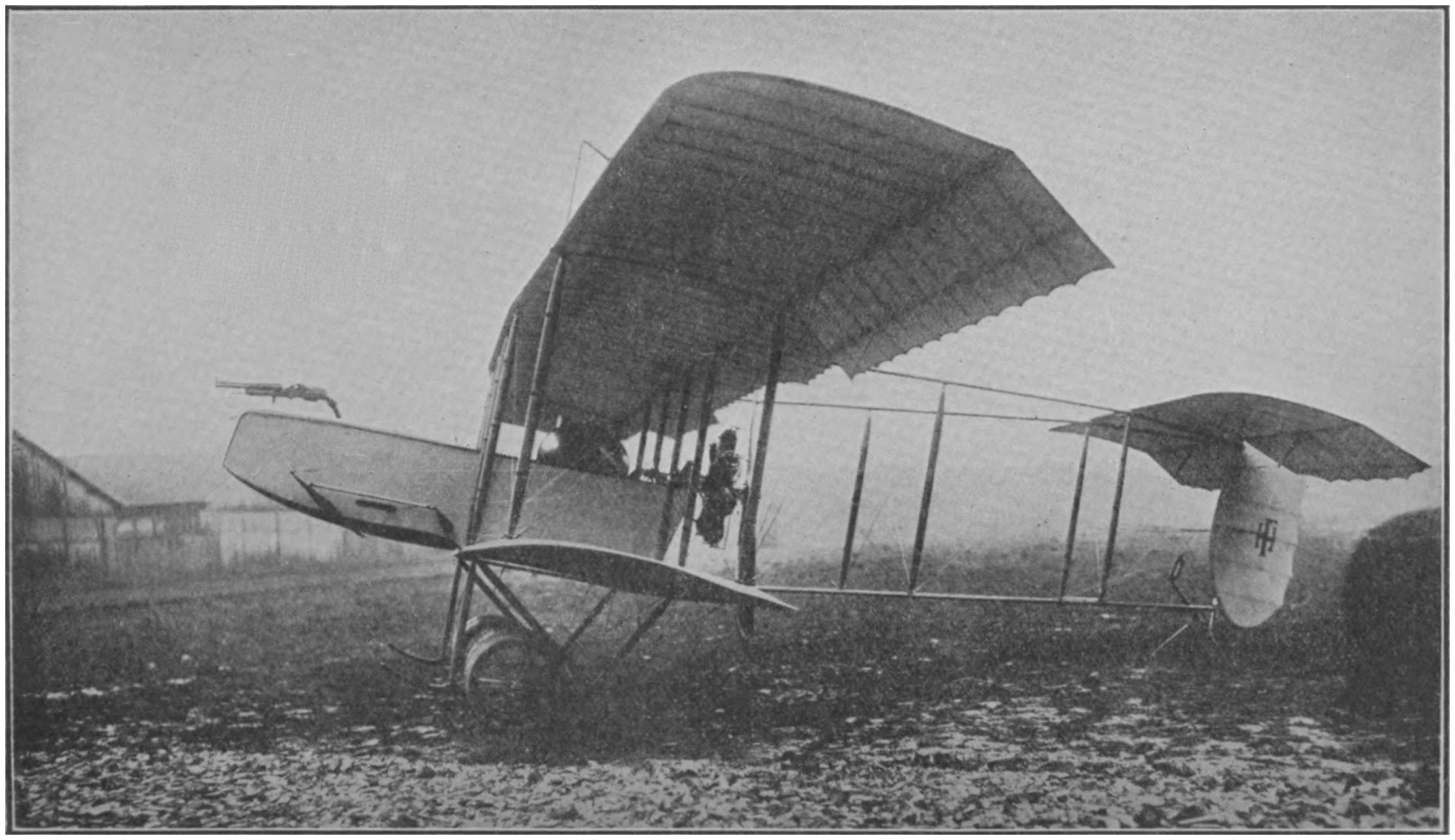
showing gun mounted in position, Gnome motor, ailerons on upper plane, rudders at rear (see Chapter VII.).
AIRCRAFT in WAR
By ERIC STUART BRUCE, M.A. Oxon. Fellow of the Royal Meteorological Society; late Honorary Secretary and Member of Council Aëronautical Society of Great Britain; Vice-President of the Aërial League of the British Empire; Membre d’Honneur of the Aëro Club of France
Illustrated
HODDER AND STOUGHTON
LONDON NEW YORK TORONTO MCMXIV
TO MY WIFE,
who during the eight years of my Honorary Secretaryship
of the Aëronautical Society of Great Britain incessantly
and most materially aided me in my efforts to secure the
united interest of the British nation in the mastery of the
air, I dedicate this little volume.
When years ago we read in Tennyson’s “Locksley
Hall” the following lines:—
Heard the heavens fill with shouting, and there rained a ghastly dew
From the nations’ airy navies grappling in the central blue—
we little dreamt that not very far from the
beginning of the twentieth century the fancy
of the poet would become the fact of reality;
that in the great European war in which the
nation is so strenuously engaged, “the wonder
that would be” would come to pass.
Though happily, at present, in these isles the
din of war is unheard, yet a semi-darkened London
and bright searchlights playing on the skies
tell the tale of prudent foresight against the
advent of the enemy’s airfleet. From the battlefields
there daily come the reports of actual
battles in the air, sometimes betwixt aëroplane
and aëroplane, sometimes between the lighter
and heavier than air craft. Often such encounters
are death-grip duels. Such conflicts of the
air are the direct consequence of the great and
important use of both airship and aëroplane
as aërial scouts. These are the eyes of encountering
armies. To destroy as far as possible this
penetrating vision of the enemy and restore to
him the fog of war is the untiring aim of either
side.
During those first anxious days of the present
war the public anxiously awaited news of the
doings of the Royal Flying Corps, as well as those
of the aviators of our Allies. Expectation was
satisfied in the reading of Sir John French’s
report to Lord Kitchener, dated September 7th,
1914. Speaking of the use of the aëroplane in
the war he says:—
I wish particularly to bring to your Lordship’s
notice the admirable work done by the Royal Flying
Corps under Sir David Henderson. Their skill,
energy, and perseverance have been beyond all
praise. They have furnished me with the most
complete and accurate information, which has been
of inestimable value in the conduct of the operations.
Fired at constantly both by friend and foe, and not
hesitating to fly in every kind of weather, they have
remained undaunted throughout.
Further, by actually fighting in the air, they
have succeeded in destroying five of the enemy’s
machines.
For those brave heroes of the air our hearts
beat with fervid admiration. In accomplishing
their all-important tasks they have not only to
fear disaster from shot and shell of the enemy,
but from the mistaken fire of their comrades
and the very forces of nature. These latter,
owing to the imperfections of the flying machines,
do not entirely spare them; the Royal Flying
Corps, in order to become competent to perform
the work it is now doing for King and country,
has had in manœuvres at home to pay a high
price in the sacrifice of human life.
It may, indeed, be reasonably thought that
the knowledge of the vast utility of aircraft
in the present conflict will dispel the last remnant
of prejudice in this country against the development
of aërial navigation, and the grudging of
a liberal national expenditure on the service of
the air. It was, perhaps, this ignoring of practical
utility, so vigorously combated by the pioneers
in this country, that caused Great Britain to
be the last of the Great Powers to seriously take
up aircraft for military and naval use. Our
delay had been a wonder to many, since theoretically
in the past this nation had been to the
fore. Nearly half a century ago it led the way
of the air by being the first country in the world
to found a society for the encouragement of
aërial navigation—the Aëronautical Society of
Great Britain. It is no exaggeration to say that
many of the great principles of human flight
were formulated and discussed at the earlier
meetings of that society. The late Mr. Wilbur
Wright, when he came to this country to receive
the gold medal of the society, in his speech testified
to the substantial help he had received from
the study of the transactions of the oldest aëronautical
society in the world. As the pioneer
in laying the foundations of aërial science, this
country is not without honour amongst the
nations.
CHAPTER I THE EARLIER AËRIAL SCOUTS
Patriotism has been the most powerful factor
in developing aërial navigation. Montgolfier
experimented with his paper balloons filled with
heated air in the desire that his invention might
be of use to France in her wars, and throughout
the history of both balloons and flying machines
we find that it has been the desire to employ
them as instruments of war that has most fostered
their progress.
Very soon after Charles invented the gas
balloon the latter was pressed into military
service for the very same purpose of reconnaissance
for which airships and aëroplanes are
now being used. At the time of the French
revolutionary war an aëronautical school was
founded at Meudon under the control of Guyton
de Morveau, Coutelle, and Conté, and a company
was formed called Aërostiers.
Captive balloons were used by the armies of
the Sambre and Meuse, of the Rhine and Moselle.
Just before the battle of Fleurus, 1794, two
ascents were made, and the victory of the French
was attributed to observations made by Coutelle.
At that time several ascents were made from
Liége with a spherical balloon and one of cylindrical
shape. This latter appears to have anticipated
the well-known German kite-balloon.
There is a tradition that in those early days
of the balloon the French were possessed of a
varnish which satisfactorily held the hydrogen
gas, but that the secret was lost—a grave loss
indeed, if the tradition has truth in it. The
secret was never refound. A really gas-proof
varnish is unknown.
In the course of the American Civil War of
1861 captive balloons were again employed with
important results.
During the Franco-Prussian War of 1870
three captive balloons were installed in Paris,
the “Nadar” on the Place St. Pierre; the
“Neptune,” manned by Wilfred de Fonvielle,
at the gasworks at Vaugirard; and the “Celeste”
on the Boulevard des Italiens.
Thus long before the advent of airships and
flying machines the use of altitude for military
reconnaissance was realised. A great disadvantage
of the captive balloon was its stationary
nature. It was not prudent to ascend in it
very close to the enemy, as there was not the
same chance of escape as when the aërial observer
is in mobile aircraft.
Though rifle fire has over and over again
failed to bring down a captive balloon owing
to the upward pressure of the hydrogen gas, still,
artillery fire has been known to have very destructive
effect.
Undoubtedly, the best use that has been
made of the captive balloon was in the Boer
War. The British observation balloon equipment,
which under the unceasing labours of
Colonel Templer had reached a state of considerable
perfection, then proved to be highly
efficient. But in the light of modern aëronautical
progress its doings were merely the foreshadowings
of the achievements the aviators
in the present war are daily carrying out.
Perhaps the most important feature of the
balloons in the South African War was the
material of which they were made—gold-beaters’
skin. We are all more or less familiar with this
substance, for we use it as a plaster when we
cut our fingers. We should scarcely think that
so apparently fragile a substance was strong
enough to form the envelope of a balloon. It
is, however, an admirable substance for the
purpose on account of its lightness and capacity
of holding the gas, and the desideratum of
strength can be obtained by combining layer
and layer of the substance to any desired thickness.
By the use of gold-beaters’ skin it became
possible to have much smaller balloons for a
given lifting power than when varnished cambric
or silk was employed. If made of the latter
materials a captive observation balloon had to
be at least 18,000 cubic feet to be of any service.
Gold-beaters’ skin reduced the volume to 10,000
cubic feet, or even less.
The only disadvantage of gold-beaters’ skin
for the envelope of balloons and airships appears
to be its very great expense. This, in the case
of a large airship, is formidable. It should be
mentioned, however, that it has sometimes been
used for the separate gas compartments which,
as will be seen, are a feature of the Zeppelin
airship.
As regards the actual achievements of the
balloon in South Africa, one section did excellent
work at Ladysmith. In the words of Colonel
Templer, “it not only located all the Boer
guns and their positions, but it also withdrew
all the Boer fire on to the balloon. Several
balloons were absolutely destroyed by shell
fire.”
One of the balloons was burst at a height of
1,600 feet, and came down with a very quick
run, but the staff officer in the car was unhurt.
At Ladysmith, by means of the balloon, the
British artillery fire was made decisive and
accurate.
With General Buller at Colenso, and up
the Tugela River, Captain Philips’ balloon
section was very useful. Splendid work was done
at Spion Kop. There the whole position was
located and made out to be impregnable. It has
been said that the British Army was then saved
from falling into a death trap by the aërial reconnaissance.
Captain Jones’ section went up
with Lord Methuen on Modder River. His
observations continued every day. It was considered
there was not a single day that they
were not of the utmost importance.
Again, Lord Kitchener and Lord Roberts
used balloons. From the information they obtained
from them they were enabled to march
on to Paardeburg. At the latter place itself
they were able to locate the whole position.
Another section went to Kimberley and on to
Mafeking. A very important observation was
made at Fourteen Streams. There a balloon
was used continuously for thirteen days without
the gas being replenished. By its means the
Boers were prevented from relieving Fourteen
Streams.
It has been pointed out by Colonel Templer
that one of the great difficulties connected with
the use of the comparatively small balloons in
the South African War was the heights the armies
went over.
On the march to Pretoria there were hills 6,000
feet above the sea, and to make an observation from
these hills it was necessary to go up 1,500 or 2,000
feet, so that the barometrical height was hard work
on the buoyancy of the balloon, because the barometrical
height then became 8,000 feet—the 6,000 feet
altitude above the sea-level, and the 2,000 feet it
was necessary to go over the hills—that was about
all our balloons would do.
That was a disadvantage of the captive balloons
which would not have been felt if the observers
had been on aëroplanes!
Certainly, the excellent gas retaining power
of gold-beaters’ skin was well put to the test in
the South African War. The thirteen days’
work with one charge of gas mentioned above
was a fair trial for a balloon of such comparatively
small size; but Captain H. B. Jones
gave a still more striking experience of the value
of gold-beaters’ skin as a gas-holder. Speaking
of the Bristol war balloon of 11,500 cubic feet
capacity, he says:—
It was used at the engagements at Vet River and
Land River, and arrived at Kroonstad on May 12th.
The balloon was kept in a sheltered place near the
river till we marched again, on May 22nd, and was
not emptied till after we had crossed into the Transvaal
at Vereeniging on May 27th. To keep a balloon
going for thirteen days at one station is a good test;
but in our case the Bristol was filled for twenty-two
days, and did a march of 165 miles with the division.
The system of filling the balloons from steel
cylinders in which the hydrogen gas had been
compressed, so well exemplified in the Boer
War, was a great improvement on the older
methods of manufacturing the gas on the spot.
Speed in filling balloons is a desideratum for
their use in war. By the cylinder method, owing
to the great pressure under which the gas escapes
from the cylinder, the inflation of the observation
balloons became a question of minutes
instead of hours. The necessity of speed applies
to the inflation of airships also.
Although the present volume is designed
rather to speak of the aëronautical appliances
of the present than those of the past, the above-mentioned
facts concerning aërial reconnaissance
in the Boer War have been included, as
the value of the air scouts at the time was hardly
known and appreciated by the general public,
whose mind in those days was not constantly
being directed to aërial matters as it is at the
present time. The knowledge of what just a
few well-contrived and well-utilised balloons
could then do in the way of aërial scouting
must lead to the thought how the Boer War
might have been shortened had we then possessed
the squadrons of fast-flying aëroplanes
that are taking part in the present war. To
know, indeed, what a very few aërial observers
could do may enhance our estimation of the
possibilities of the squadrons of the flying machines
of the British and allied armies in the
present war as they dart in search of information
over the lines of the enemy.
In the course of some articles on the subject
of the new arm of war, which contain many
apt statements, Mr. F. W. Lanchester gives the
opinion that the number of aërial machines
engaged in the war is a negligible quantity. We
might, indeed, well say the more the better,
provided they are on the Allies’ side; but no
aëronaut or aviator will allow the number is
negligible. The writer compares the supposed
number of aëroplanes the Germans possess with
the cost equivalent of scouting cavalry. The
comparison is not a happy one, on account of
the tremendous advantage of altitude and, consequently,
long range of vision possessed by the
aërial scout. We have seen that in the Boer
War one observer at Spion Kop from his height
and super-sight saved the situation, and rescued
our army from possible crushing disaster.
What might not even one shrewd British
observer in a swift-moving modern aërial craft
accomplish at a critical moment in the present
conflict?
CHAPTER II THE DEVELOPMENT OF THE AIRSHIP
Before free balloons were successfully motor
driven and steered, stern necessity had pressed
them into the service of war. During the siege
of Paris, in 1870, when the Parisians were cut
off from all means of escape, there were only a
few balloons in Paris; but the successful escape
of some aëronauts in them was considered encouraging
enough to establish an aërial highway
involving a more wholesale manufacture of
balloons than had been accomplished before.
The disused railway stations were converted
into balloon factories and training schools for
aëronauts. In four months sixty-six balloons
left Paris, fifty-four being adapted to the administration
of post and telegraph; 160 persons
were carried over the Prussian lines; three
million letters reached their destination; 360
pigeons were taken up, of which only fifty-seven
came back, but these brought 100,000 messages,
by means of microphotographical despatches.
In these a film 38 by 50 mm. contained
2,500 messages. The pigeons usually
carried eighteen films, with 40,000 messages.
At this time the French Government attempted
to produce a navigable balloon, and employed
Dupuy de Lôme on the task of designing and
building it. This was to be driven by hand
power, the screw being driven by eight labourers.
The balloon was actually made and tested.
Considering the h.p. was 0.8, it is needless to
say it was not successful.
It was during the siege of Paris that Krupp
constructed the first special gun for attacking
balloons, a relict which has been preserved at
Berlin.
If such was the utility of balloons that merely
drifted at the mercy of the aërial currents they
encountered, it was not to be wondered at that,
soon after the Franco-Prussian War, new attempts
were made to make them navigable. Though
the term airship might reasonably be applied
to all the forms of navigable aircraft still in this
country, it has been applied in a less wide sense
to those machines that are lighter than air. In
these pages the term will be used in this connection.
The effort to navigate balloons almost dates
back to the invention of the balloon itself. It
was, indeed, early realised that the spherical
shape of the ordinary balloons that drift with
the winds would be unsuitable for a craft that
would have to travel against the wind. In
1784 Meusnier designed an elongated airship,
in which the brothers Robert actually ascended.
It is noticeable that in this early design of
Meusnier was the now well-known ballonet, or
inner balloon, which forms an essential feature of
modern non-rigid and semi-rigid airships for preserving
the rigidity of the outer envelope and
facilitating ascent or descent.
If we except the effort of Dupuy de Lôme,
the next remarkable attempt at airship construction
was in 1852, when the Parisian Giffard
made his steam-driven elongated balloon, with
which he made two experiments. These merely
proved that successful navigation against a wind
would require much larger motive power than
his Lilliputian steam-engine of 3 h.p. Giffard,
however, was the pioneer of the airship driven
by other than hand power. The following are
the dimensions, etc., of what will ever be an
historic balloon:—
Length
44 metres
Diameter
12.00 metres
Cubic capacity
2,500 cubic metres
Horse power
3.0
Estimated speed per hour
6.71 miles
The experiments of Krebs and Renard in 1885
were noteworthy. They were the first in which
direct return journeys were made to the place
whence the balloon started.
These experiments showed the importance
of the military factor in the development of
aërial navigation. Krebs and Renard were the
officers in charge of the French Military Aëronautical
Department at Meudon, and they applied
national funds to the construction of an airship.
It was the development of the electrical industry
and the production of electric motors at that time
which stimulated the experiments. The brothers
Tissandier had, in 1883, propelled an elongated
balloon against a wind of some three metres a
second by means of an electric bichromate battery
which supplied the power to an electric motor.
It was thought that those experiments had been
sufficiently successful for further trial of the
powers of electricity.
Renard made profound and exhaustive researches
into the science of the navigable balloon.
To him we are, indeed, indebted for the elucidation
of the underlying principles that have made
military airships possible.
The navigable balloon “La France” was
dissymmetrical, being made very much in the shape
of a fish or bird. Its master diameter was near
the front, and the diameters diminished gradually
to a point at the back.
The following were the dimensions of the
envelope:—
Length
50.40 metres
Diameter
8.40 metres
Length in diameters
6.00 metres
The airship was remarkably steady on account
of the minute precautions taken to counteract
the instability produced by a somewhat excessive
length. Any device which modifies pitching
at the same time lessens the loss of speed resulting
from the resistance of the air when the ship is
moving at an angle. A direct means of reducing
pitching is the dissymmetrical form given to
the envelope by placing the master diameter
near the front. The resistance of the air falls
on the front surface, which in this dissymmetric
form of envelope is much shortened, while the
compensating surface at the back is augmented.
Many experts are of opinion that in this form
of envelope Krebs and Renard came nearer
perfection than any other navigable balloon
constructor.
Like the brothers Tissandier, they used an
electric battery and motor to drive their screw,
their motive power being 9 h.p.
It was claimed that out of seven journeys,
the airship returned five times to the place whence
it started. As an example of these journeys,
on September 22nd, 1885, a journey was made
from Meudon to Paris and back again. On this
day the wind was blowing at a velocity of about
3.50 metres a second—what we should call a
calm. Few, perhaps, who saw the small naval
airship, the “Beta,” manœuvring over London
this autumn realised that a navigable balloon,
not so very much unlike it in form, was speeding
its way over Paris as long ago as 1885. The
advent of the first at all practical military airship
was forgotten because the experiments, comparatively
successful as they were, suddenly ceased.
They came to an end because it was found that
though electricity as a motive power could afford
an airship demonstration, it was unfitted for
serious and prolonged use.
One industry has often to wait for another—the
world had to wait for the missing link in aërial
navigation. That was the light petroleum motor.
With its coming came the era of airships and
aëroplanes.
CHAPTER III TYPES OF MODERN AIRSHIPS — I. Rigid Type. — II. Semi-rigid. — III. Non-rigid.
With the new century came the modern military
airship—to stay, at any rate, until the heavier-than-air
principle of aërial navigation has so
developed as to absorb those features of utility
the airship has and the aëroplane has not.
During the fourteen years which have seen
the construction of practical airships, three
distinct types have been evolved—(i.) rigid, (ii.)
non-rigid, (iii.) semi-rigid. In considering the
airships of Great Britain, France, and Germany,
I propose to class them together as to types
rather than under nationalities.
Each type has its own peculiar advantages.
The choice of type must depend upon the circumstances
under which it is proposed to be
employed.
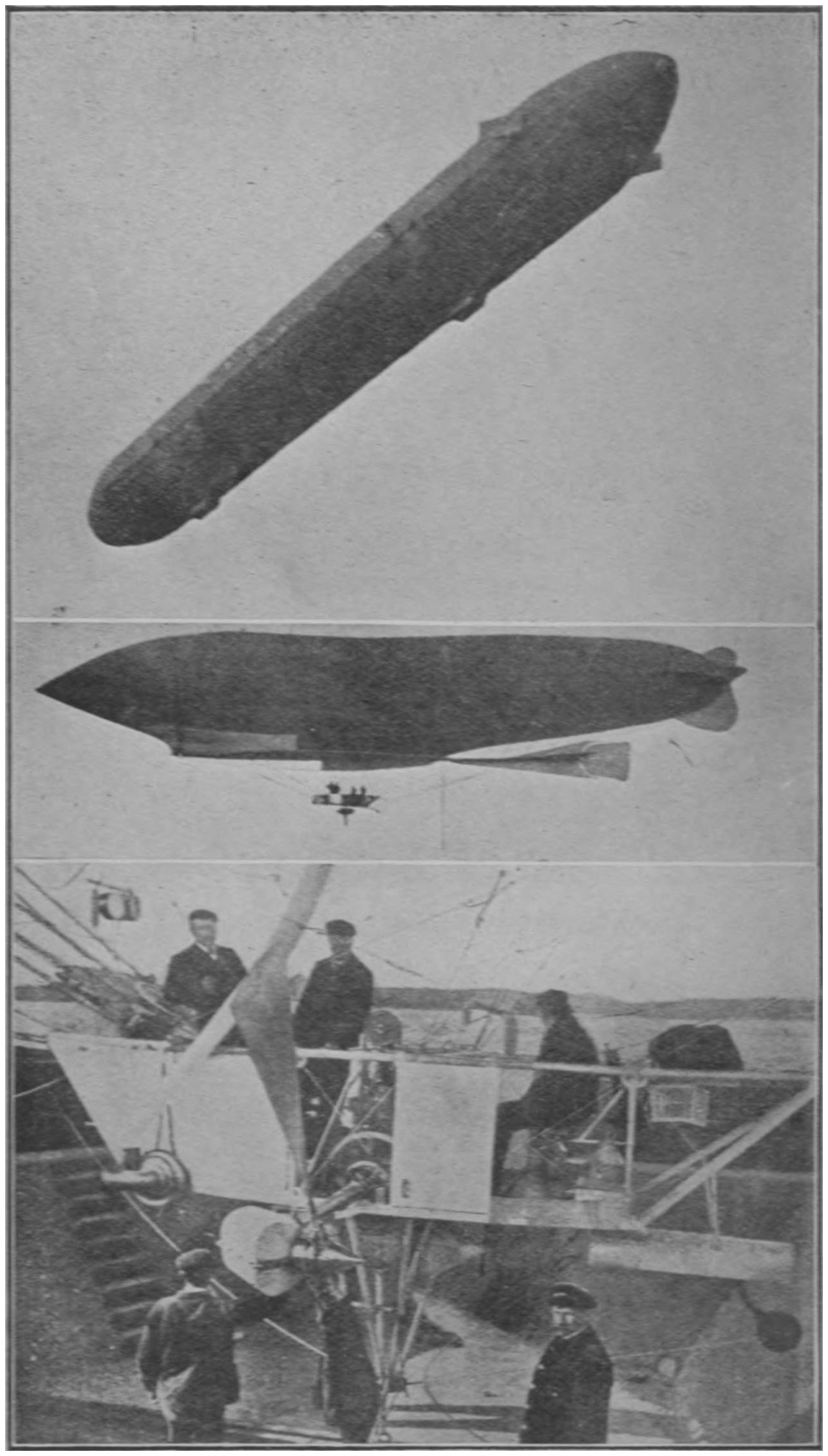
Top: SNAPSHOT OF ZEPPELIN IN MID-AIR.
Centre: MILITARY LEBAUDY AIRSHIP, showing fixed vertical and horizontal
fins at the rear of gas-bag, vertical rudder, and car suspended from rigid
steel floor underneath gas-bag.
Bottom: CAR OF A LEBAUDY AIRSHIP, showing one of the propellers.
(i.) Zeppelin (German).—There are not many
examples of the rigid type. The most important
is undoubtedly the Zeppelin. This form of
airship before the present war had elicited the
interest of the aëronautical world for the long-distance
records it had established. Indeed, no
little sympathy had been extended to Count
Zeppelin for his perseverance in the face of the
gravest difficulties. Now the Zeppelin has accumulated
notoriety instead of fame as having
been the means of carrying on a form of warfare
repugnant to the British nation, and condemned
by the Hague Convention. Imagine some seventeen
huge bicycle wheels made of aluminium,
with their aluminium spokes complete, and
these gigantic wheels to be united by longitudinal
pieces of aluminium, and in this way
seventeen sections to be formed, each of which
contains a separate balloon, and it is easy to
grasp the construction of the Zeppelin airship.
It consists of a number of drum-shaped gas-bags,
all in a row, held together by a framework
of aluminium. They form a number of
safety compartments. The bursting of one does
not materially matter—the great airship should
still remain in the air. The dimensions of individual
Zeppelins have varied to some extent.
The largest that has been built (“Sachsen,”
1913) had a cubic capacity of 21,000 cubic
metres (742,000 cubic feet), and a length of
150 metres (492 feet). The aluminium framework
containing the balloons has an outer covering
of cloth. On each side of the frame of the
airship are placed two pairs of propellers. In
the original airship of 1900 these were four-bladed,
and made of aluminium. They were
small, being only 44 inches in diameter, but
they revolved at a very high speed. In the
later airships the screws have been considerably
modified in detail, size, and shape. For instance,
in the Zeppelin which descended accidentally
at Lunéville, in France, it was found that the
back pair of the propellers on each side were
four-bladed, the front pair two-bladed. The
screws are driven by motors placed in the two
aluminium cars beneath the airship. These cars
are connected by a covered gangway, which
also serves as a track for a movable balance
weight, by means of which a considerable change
of balance can be effected. The motive power
in the first Zeppelin was only two Daimler
motors of 16 horse power each. With this low
power little success was attained, but gradually
the motive power has been increased. We find
that in the naval Zeppelin, L 3, 1914. The
motive power is three Maybach motors, giving
total h.p. 650, whereas in the types building the
total h.p. is 800.
The stability of these aërial monsters is attained
by the use of large projecting fins. Horizontal
steering is effected by a large central rudder
and pairs of double vertical planes riveted
between the fixed horizontal stability planes.
For vertical steering there are sixteen planes
provided in sets of four on each side of the
front and rear ends of the balloons. These can
be independently inclined upwards or downwards.
When the forward ones are inclined
upwards and the after planes downwards, the
reaction of the air on the planes as the airship
is driven forwards causes the front part to rise
and the rear part to sink, and the airship is
propelled in an inclined direction to a higher
level. The favourite housing place for the
Zeppelin airships has in the past been on Lake
Constance, near Friedrichshafen, so that they
could be taken out under protection from the
direction of the wind. It is also much safer
for large airships to make their descent over
the surface of water. It has been estimated
that the most powerful Zeppelins have a speed
of some fifty miles an hour.
When on April 3rd, 1913, Z 16, in the course
of a journey from Friedrichshafen, was forced
to descend on French soil at Lunéville, excellent
opportunity was afforded the French of a close
inspection of its details.
The following were the exact dimensions, etc.:—
Length
140 metres
Diameter
15 metres
Cubic capacity
20,000 metres
Motive power three Maybach motors, 170 h.p. each
510 h.p.
Speed
22 metres per sec.
Height attainable
2,200 metres
Useful carrying power
7,000 kilos.
On the top of the ship was a platform, on which
a mitrailleuse could be mounted.
It was only a few weeks before the present
war that the new Zeppelin, L Z 24, attained a
new world’s record of altitude and duration of
flight. The height attained was 3,125 metres.
The voyage without a break lasted thirty-four
hours fifty-nine minutes. On May 22nd, 1914,
it left Friedrichshafen at 7.16 a.m. Bâle was
reached at 10 a.m. At 6 p.m. it passed Frankfort,
at 9 Metz, at 10.30 Bingen, at 2 a.m. Brême.
At 4 a.m. it arrived above Heligoland, from
whence it made for Potsdam, where it was
hailed 9.20 a.m. At 5.15 p.m. it landed at Johannisthal.
That journey certainly showed the long-range
powers of the latest Zeppelins. If, as will be
seen, it is comparatively easy for a few well-directed
aëroplanes to wreck them in mid-air,
still they have ceased to be military or naval
playthings.
(ii.) Schutte-Lanz (German).—The Schutte-Lanz
rigid airship is an attempt to secure the
advantages of the rigid type without the fragilities
of the Zeppelin. The framework, which
contains the separate gas compartments, is
made of fir wood. The gas-bags are claimed
to be very strong. These are filled, excepting
two, which remain empty when there is only
sea-level pressure; when, however, the gas expands,
it flows into the latter. These become
full when an altitude of some 2,000 metres is
reached. A centrifugal pump is employed for
distributing the gas.
The volume of this airship is 26,000 cubic
metres (918,000 cubic feet). It will be seen,
therefore, that this mammoth airship in size
surpasses even the largest Zeppelins.
(i.) Lebaudy (French).—This airship is a crossbreed
between the rigid and non-rigid systems.
By this method of construction a considerable
amount of support can be imparted to the gas-bag,
though it does not dispense with the services
of the ballonet, as does the entirely rigid
type. To the genius of M. Julliot, Messrs. Lebaudy
Brothers’ engineer, we are indebted for the
introduction of this excellent type. It no
doubt forms an exceedingly serviceable military
airship. In the Lebaudy original airship the
underside of the balloon consisted of a flat, rigid,
oval floor made of steel tubes; to these the
stability planes were attached, and the car with
its engine and propellers was suspended. This
secured a more even distribution of weight over
the balloon. The gas-bag was dissymmetrical in
form. Though not exactly resembling that excellent
pattern, “La France,” it partook of the important
quality of having the master diameter
near the front. The car was a steel frame,
covered with canvas, and in the form of a boat.
The screw propellers were placed on either side
of the car.
In 1909, as the British Government at that
time possessed only very small airships, the
nation raised a sum of money by subscription
to present the Government with one of efficient
size. The military authorities compiled a list
of somewhat severe tests which, in their opinion,
they thought an airship should be able to perform
before acceptance. At the request of the
Advisory Committee, of which Lord Roberts
was chairman, the writer went to France in an
honorary capacity to select the type of airship
to be adopted. There was at that time only
one firm of airship makers in France who were
willing to undertake the formidable task of
making an airship that would come up to the
requirements of the British Government—the
brothers Lebaudy, whose engineer and airship
designer was M. Julliot.
The semi-rigid airship which M. Julliot designed
and executed was without doubt a chef
d’œuvre of its kind. The rigid tests it had to
undergo necessitated a modification of some of
the details that were conspicuous in the airships
the constructor had previously built.
In this airship the girder-built underframe
was not directly attached to the balloon, but
suspended a little way beneath it.
The gas envelope had a cubic capacity of
353,165.8 cubic feet; the length was 337¾ feet.
There were two Panhard-Levasseur motors of
135 h.p. each.
On October 26th, 1910, this airship made an
historic and record flight over the Channel from
Moisson to Aldershot in five hours twenty-eight
minutes, at a speed of some thirty-eight miles
an hour, sometimes against a wind of twenty-five
miles an hour. Unfortunately, owing to a
miscalculation by those responsible, the shed
which had to receive the new airship on its
arrival was made too small to house it safely.
While the airship was being brought into the
shed its envelope was torn and placed hors de
combat.
Since this airship was made the Lebaudy
brothers have ventured to still further increase
the size of their semi-rigid airships.
(ii.) Gross (German).—This airship may be
described as being more or less a German reproduction
of the Lebaudy type. It forms part
of the German airfleet. A considerable number
have been made of various sizes (for dimensions,
etc., see table, German Airships, Chapter IV.,
page 38).
This type is dependent for its maintenance
of form on the pressure of the gas inside the
envelope. It is all-important that the envelope
of a navigable balloon should not lose its shape—that
it should be kept distended with sufficient
tautness, so that it may be driven through the
air with considerable velocity. On this account
the non-rigid type depends entirely on the
ballonet system, which consists of having one
or more small balloons inside the outer envelope,
into which air can be pumped by means of a
mechanically driven fan or ventilator to compensate
for the loss of gas from any cause. The
ballonets occupy about a quarter of the whole
volume of the envelope. Such a type is exceedingly
well suited for the smaller-sized airships,
destined rather for field use than long-range offensive
service. Such airships are quickly inflated and
deflated. They are also easily transported. Even
the Lebaudy or Gross semi-rigid types, though
not so clumsy or difficult of transport as the
Zeppelins, require more wagon service than the
absolutely non-rigid.
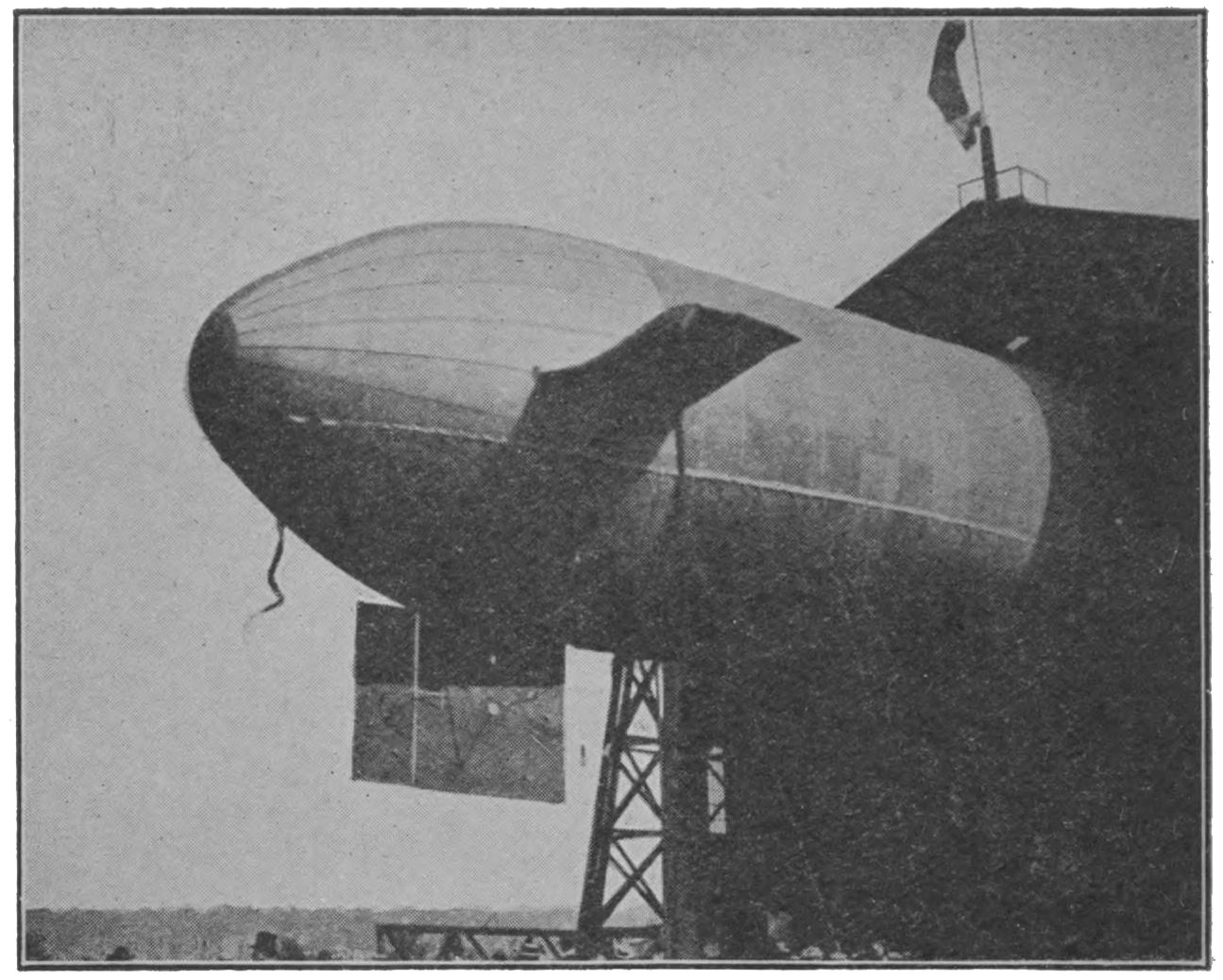
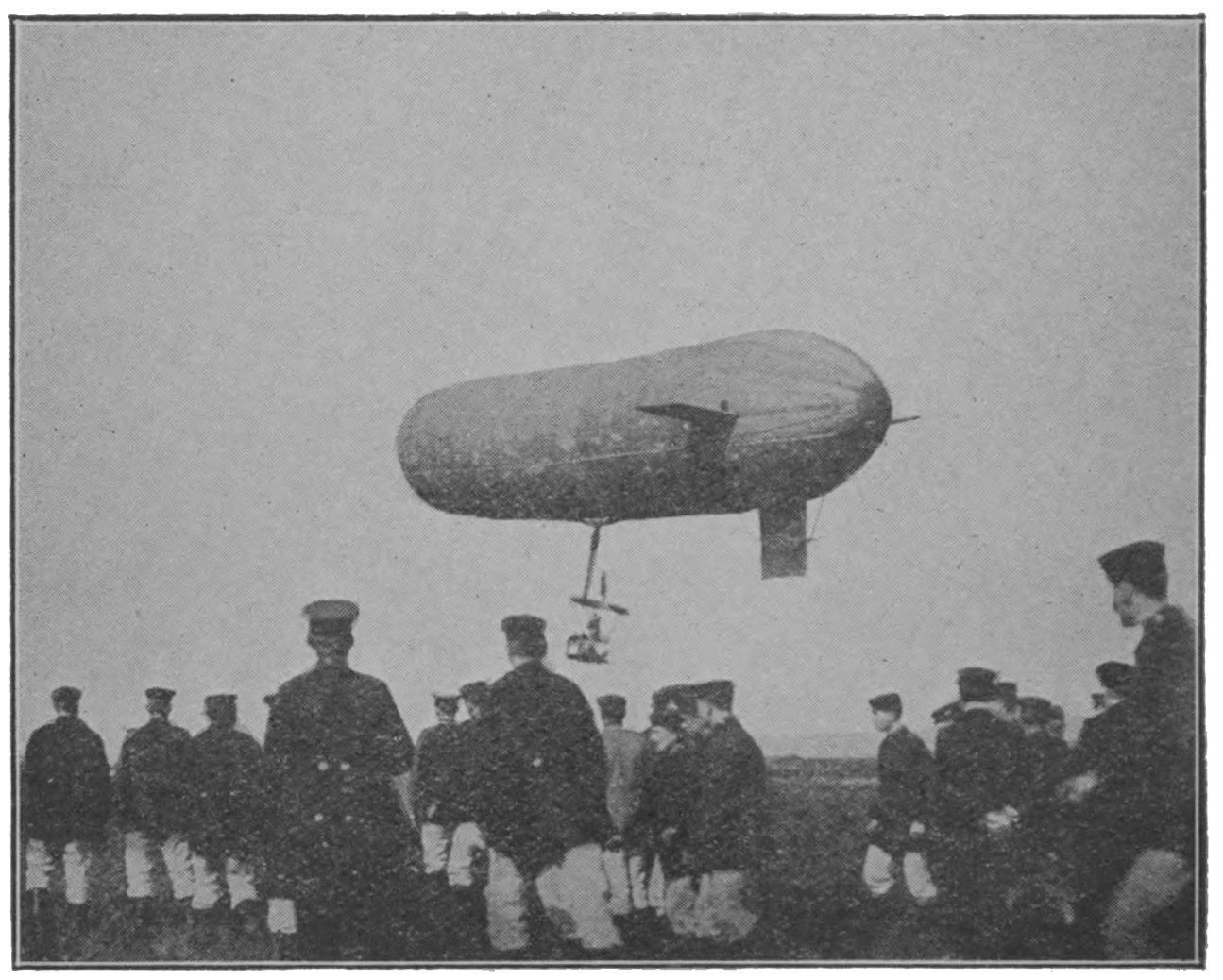
PARSIFAL AIRSHIP LEAVING ITS HANGAR.
PARSIFAL AIRSHIP,
showing one of the fixed horizontal planes, steering rudder, and car.
The British Government have evolved several
non-rigid airships of moderate dimensions which
have been exceedingly useful as ballons d’instruction.
For obvious reasons it is not desirable
that particulars concerning them should be
published at the present crisis.
(i.) Parsifal (German).—Very numerous
examples of non-rigid airships could be cited,
but it will suffice now to mention two, the German
Parsifal and the French Clement-Bayard.
The Parsifal is the only type that the
German nation has allowed to be supplied to
foreign countries. For instance, our Navy possesses
one. It has also been supplied to Austria,
Italy, Russia, and Japan. On account of its
portability it is perhaps the most generally useful
type of airship that has been designed, if we
exclude long-range service. It has been exceptionally
free from accidents on account of its
subtleness. The originator of the Parsifal
seems to have thoroughly grasped the sound
idea that to attain success in navigating a subtle
medium like air the machine should be correspondingly
subtle—as, indeed, are the animal
exponents of flight.
In the Parsifal the exclusion of the element
of rigidity has been carefully studied. All that
is rigid about it is the car and motor, and this
can be conveyed in one cart.
The size of the Parsifals has been advisedly
limited. The majority of them are not
more than a third of the cubic capacity of the
Zeppelins. A distinctive feature is the distance
of the car from the gas-bag. This in the first
types constructed was nine metres, though in
more modern forms the figure is less. Owing
to the distance of the car from the main body
the attaching cords are distributed with equal
tension over the whole length of the envelope.
In the Parsifal airships there are two ballonets,
one at the front and one at the back of the
gas-bag. They are not only used for keeping the
envelope rigidly expanded, but also to facilitate
rising and falling, air being admitted into the one
and expelled from the other, as the case may be.
Another distinctive feature is the four-bladed
propellers. These have fabric surfaces, and are
weighted with lead. When at rest the blades
are limp, but in revolving, owing to centrifugal
force, they become endowed with the necessary
rigidity. The dimensions of the Parsifals vary
considerably, the smallest made had a capacity
of 3,200 cubic metres (1908), the largest more
recent ones have a capacity of 11,000 cubic
metres. A very useful size is the P L 8 (1913),
station Cologne, of which the dimensions are:—
Length
77 metres
Diameter
15.50 metres
Volume
8,250 cubic metres
Total lift
5½ tons
Motors
300 h.p. (Daimler 150 h.p. each)
Speed
41 miles per hour
(ii.) Clement-Bayard.—It is a question whether
it is advisable to extend the non-rigid system
to the amount that has been latterly done in
the case of such a construction as the Clement-Bayard.
This type of French airship is familiar
to many in this country, as it was the first
airship to cross the Channel from France to
England.
The cubic capacity of this airship was 6,300
cubic metres. A feature was the comparatively
large size of the ballonet used. To realise how
the Clement-Bayards have grown since this
type of airship came to this country, see table,
French Military Airships, page 34.
Astra-Torres Type.—The Astra-Torres airships
may be said to form a rather special subdivision
of the non-rigid class, for, though there is no
rigid metal in its construction, an unbendableness
of keel is assured by panels of cloth so
placed horizontally as to be kept rigid by the
pressure of the air in a ballonet. Thus the
virtue of rigidity is attained without the extra
weight generally appertaining thereto, and a
greater speed with economy of weight and size.
The British naval authorities possess one of
these airships. For dimensions, etc., of the
latest Astra-Torres airships, see table, French
Military Airships, page 34.
It will have been seen from the above short
descriptions of distinctive types of airships
Germany is the only nation which makes a very
marked feature of retaining the rigid form. It
is true France has evolved one form of rigid,
the Spiess, in which the framework is made of
wood, but she undoubtedly has a preference for
the semi-rigid and non-rigid types. The rigid
type has not found much favour in Great Britain.
Reckoning from the year 1911, France appears
to have nineteen military dirigibles, and she
may have one or two older ones in repair. Some
of these are building; and as in France there
are many eminent aëronautical factories, there
are always also a number of private airships
built, or in building, of various sizes and various
types. These firms have enormous private airship
hangars, and every convenience for making,
filling, and storing. The number of military
hangars in France is seven, at the following
towns: Epinal, Maubeuge, Belfort, Rheims,
Toul, and Verdun, where there are two.
In the spring of 1913 the Italian military
dirigible fleet consisted of two units of Series M—M1
and M2—dirigibles of 12,000 cubic metres,
and three units building of Series M—M3, M4,
and M5.
These dirigibles of the M series were found
in practice to be the most successful; they
attained a speed of 70 kilometres per hour, and
a height of 2,000 metres; they are all semi-rigid.
The Italian Government is ambitious of
rivalling in its aëronautical fleet that of Germany,
and decided in that year, 1913, on a new series—Series
G. These were to be of 24,000 cubic
metres, and to travel at a speed of 100 kilometres
the hour.
At the present moment Italy is building some
very large airships, some even bigger than the
Zeppelin, and she practises ascents diligently
with those she has. One of the new airships
building for the Italian navy is a Parsifal of
18,000 cubic metres.
Great attention is paid in Russia to aëronautics.
The Russians have no national types of
dirigibles or aëroplanes yet developed; but they
manufacture in their own country.
They have thirteen dirigibles (one is rumoured
to be destroyed), semi-rigid and non-rigid,
amongst them a Lebaudy made in 1910,
Parsifals of 1911 and 1913, an Astra of 1913.
The Parsifal of 1913 has a speed of 43–68
m.p.h. (km.).
Formerly Austria-Hungary led the way in
aëronautics amongst the nations of the Triple
Alliance. Germany particularly looked to her
for flying machines, and the first Etrichs were
hers; but military aëronautics in Austria-Hungary
are now at a low ebb.
The decline is ascribed to monopoly and
centralisation. At the present moment Austria
has one dirigible, in a feeble condition, and
about ten aëroplanes of foreign make. Two
German houses, the Albatross and D.F.W., have
quite lately opened branches in Austria.
The dual monarchy began well; in 1909 she
had a small Parsifal, in 1910 a Lebaudy, in
1911 the Körting. These three perished in accidents.
Her own system, the Boemches, presented
to her by a national subscription, failed in speed;
but though she has no dirigibles to inhabit them
she has three good hangars!
Belgium has three airships, all non-rigid—two
Godards and one Astra. Although not of
very late construction, all three have innovations
and interesting features. The Astra is private
property.
[Topical Press.
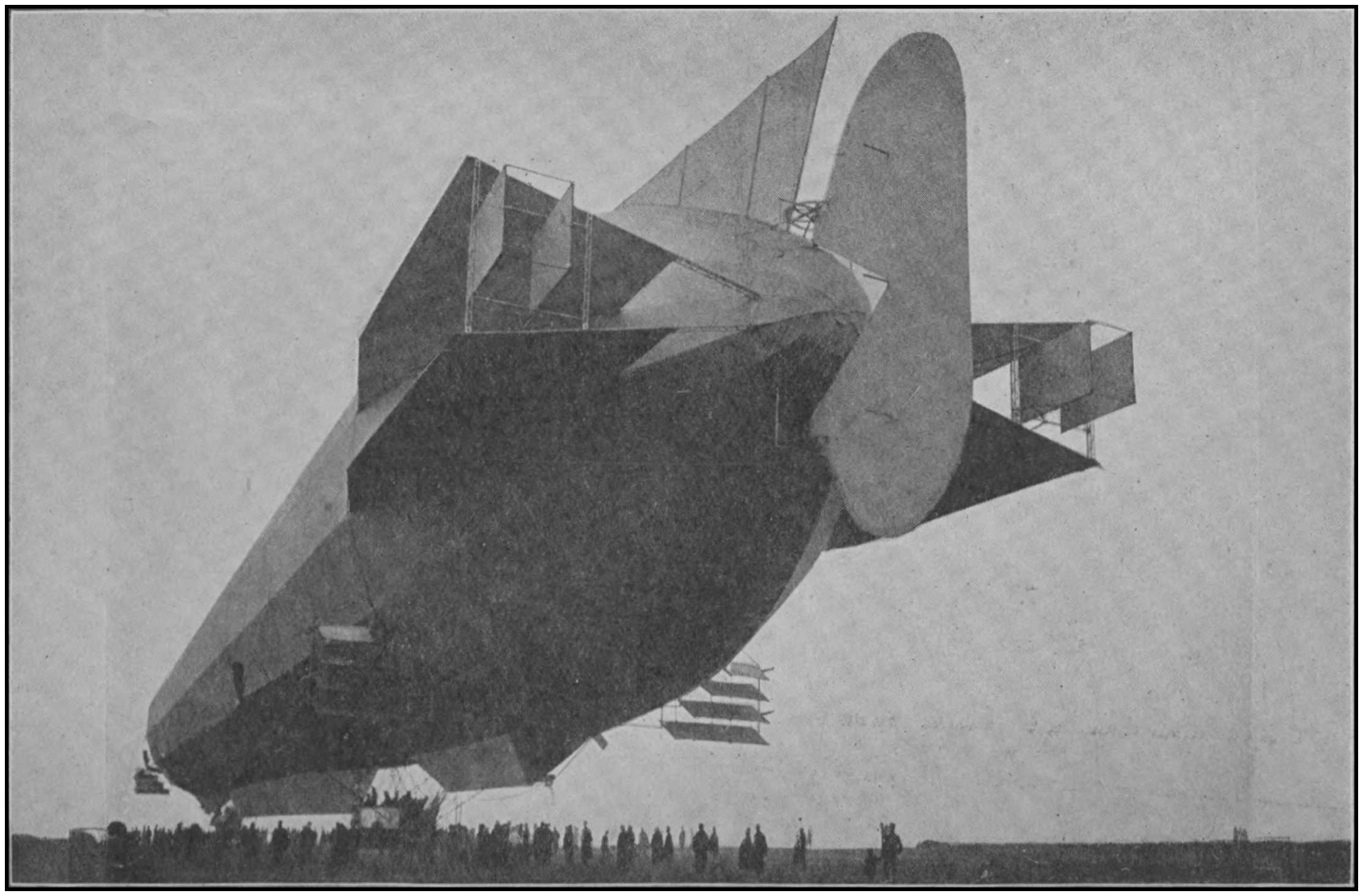
ZEPPELIN AIRSHIP AT COLOGNE,
showing at the rear large vertical rudder, and two pairs of vertical rudders for horizontal steering, the horizontal planes at the sides
for vertical steering, two of the four propellers at side of airship, car beneath airship.
CHAPTER IV THE GERMAN AIRSHIP FLEET
Many reports have been current concerning the
exact dimensions of the airship fleet that Germany
can put into action. It has been said that she
has been extremely active since the beginning
of the present war in adding fresh units to the
forces she had available when the war broke out.
It has also been rumoured that she is making a
new type of Zeppelin—one much smaller, and
which will have greater speed than the larger
type.
German Airships in the Spring of 1913.
Type.
Volume m.
Motive power.
No.
Type.
h.p. per Motor.
Max. Speed. m/s
Zeppelin
17,700
3
Maybach
150
21
Zeppelin
18,700
3
—
150
21.1
Zeppelin
18,700
3
—
150
22
Zeppelin
18,700
3
—
150
22
Zeppelin
22,000
3
—
150
—
Zeppelin
20,000
3
—
170
—
Zeppelin
18,700
3
—
170
—
Zeppelin
—
—
—
—
—
Parsifal
4,000
1
Daimler
85
14
Parsifal
7,500
2
N.A.G.
110
15
Parsifal
8,000
2
Maybach
180
18.8
Parsifal
10,000
2
Koerting
200
18.5
Parsifal
8,000
2
N.A.G.
110
16
Parsifal
10,000
4
Maybach
180
—
Siemens-Schückert
15,000
4
Daimler
125
19.8
Schutte-Lanz
19,500
2
Daimler
270
20
(1) Gross-Basenach
5,200
2
Koerting
75
12.5
(2) —
5,200
—
—
75
12.5
(1) and (2) as in 1911; since then they have been
renovated, and no doubt their speed and volume are
much greater.
We must accept with some reserve the reports
that are current in this respect, and it may be
pointed out that in accounts of the doings of
Zeppelin airships in the papers it can be reasonably
doubted whether all the Zeppelins mentioned
are in reality Zeppelins. Probably some
are the smaller types, such as the Gross or
Parsifal. The word Zeppelin seems to have
become synonymous with a German airship, and
the wounded soldiers or prisoners who are responsible
for many of the stories told would not be
likely to have complete knowledge of the distinctions
between classes of airships.
Though what Germany is exactly doing in
way of new manufacture must remain in much
fog, still we can form some opinion as to her
preparedness with aircraft on the lighter-than-air
principle from our knowledge of what she
possessed last year.
The table on the opposite page will show that
her fleet of airships, including those under construction,
was then by no means negligible.
A nation possessing such a fleet of large airships
as Germany does must be provided with
sheds (hangars) for their reception in all parts
of the country, and by the table that is appended
it will be seen that in this way last year Germany
was very amply provided.
I am indebted to the Aérophile for the following
list of German hangars for dirigibles, with
dates of construction and names of owners:—
Place and Date of Construction.
Proprietors.
Observations.
Aix-la-Chapelle
—
Designed for 1914
Allenstein
—
Designed for 1914
Baden—Baden-Dos (1910)
—
—
Berlin—Biesdorf (1909)
Siemens and Schückert
—
Berlin—Reinickendorf
—
—
Berlin—Johannisthal (1910)
Aëronautical Sport Society
—
Berlin—Johannisthal (1911)
—
—
Berlin—Tegel (1905)
Prussian Army
—
Berlin—Tegel (1907)
Prussian Army
—
Berlin—Tegel (1908–10)
Prussian Army
—
Bitterfeld (1908)
Luffahrtzeug Society
—
Bitterfeld (1909)
Luffahrtzeug Society
—
Braunschweig
Airship Harbour Society of Brunswick
Designed for 1914
Cologne
—
—
Cologne—Leichlingen
Rheinwerke Motorluftschiff Society
—
Cologne—Nippes
Clouth
—
Cuxhaven
German Navy
Designed for 1914
Dresden
City of Dresden
Will only hold one balloon
Düsseldorf (1910)
City of Düsseldorf
—
Cologne—Bickendorf (1909)
Prussian Army
—
Frankfurt am Main (1911)
Delay
—
Friedrichshafen (1908)
Zeppelin Society
—
Friedrichshafen—Manzell (1900)
Workshops of the Zeppelin Society
—
Gotha (1910)
Town of Gotha
—
Graudenz
—
Designed for 1914
Hannover
—
Designed for 1914
Hamburg—Fuhlsbüttel (1911)
Hamburg Airship Harbour Society
—
Hamburg—Hansa
—
—
Kiel (1910)
Union for Motor-Airship Travel
—
Königsberg-in-Preussen (1911)
Prussian Army
—
Leehr
—
Designed for 1914
Leipzig
Leipziger Luftschiffland Flugplatz Gesellschaft
—
Liegnitz (1913)
Prussian Army
In construction
Mannheim—Schwetzinger
—
—
Mannheim—Rheinau (1909)
Luftschiffbau Schütte u. Lanz
—
Metz (1909)
Prussian Army
—
Potsdam, near Berlin (1911)
Zeppelin Society —
—
Posen
—
Constructing
Schneidemühl
—
Building
Strasbourg
Prussian Army
—
Thorn (1912)
—
—
Trèves
—
Building
Waune (1912)
Rhenish-Westphalien Flying and Sports Club
—
Such monster airships as the Zeppelin call
for a large proportion of pure hydrogen.
This is, indeed, manufactured on a large scale
in Germany. It is produced in quantities by
the electro-chemical works at Bitterfeld, Griesheim,
and at Friedrichshafen, specially for the
needs of the Zeppelins at the latter place. There
are also works for the production of very pure
hydrogen by electrolysis at Bitterfeld, Griesheim,
Gersthofen, and Dresden.
In the particular way Germany means to
use her lighter-than-air fleet in the present war
time will show. If, however, there have not yet
been attempts at any combination of action,
individual Zeppelins have already played the
rôle of dreadnoughts of the air. Though their
powers have been no doubt exaggerated, they
have been the terror of some Belgian cities.
Early in the morning of August 25th a Zeppelin
airship visited Antwerp, and drifting silently
with the wind steered over the temporary Royal
palace. There it discharged six highly explosive
bombs. Not one found its intended mark,
though all fell near the palace. One appears
to have been very near hitting the tower of the
cathedral. Though the bombs failed to attain
the object sought, no less than six or seven
persons were victims to the outrage. One struck
a private house, killed a woman, and injured
two girls, killed two civic guards, and wounded
another. One bomb fell in the courtyard of
the hospital of St. Elizabeth, tore a hole in the
ground, smashed the windows, and riddled the
walls.
The Zeppelin repeated its visit early in the
morning of September 2nd, but this time with
less deadly result. The bombs only wounded
the victims. The experiences of the first visit
had given effective warning against a repetition
of aërial invasion. The city had been darkened,
and the airship was attacked from the forts
and the high points of the city as soon as it
made its appearance. The crew of the airship
seem to have been struck with panic when it
failed to find its bearings over the darkened
city.
It appears they suddenly dropped all their
bombs as ballast and rose quickly out of harm’s
way. The bombs used on this occasion were
not of the same type as those used on the previous
attempt on the city. The latter were of
high explosive power designed to destroy buildings.
The former were covered by thin envelopes,
and held together by mushroom-shaped rivets.
They were filled with iron bolts and nuts, and
were evidently designed for the destruction of
human life. It is stated that this is a type of
bomb which has never been used by artillery,
being made on the same model as that used
by the notorious French robber, Bonnet.
In reference to airship raids over cities, it has
been suggested in America that the air in their
immediate neighbourhood should be mined.
This could be done by having a number of
captive balloons or kites, the mines on which
could be discharged electrically from the ground.
For future wars there will no doubt be devised
some form of travelling aërial torpedoes for
destroying the intruding airships. Such torpedoes
would, however, have to be capable of
guidance. As has been pointed out by Mr.
W. F. Reid, in 1884, at the siege of Venice, the
Austrians used free balloons for the purpose
of dropping bombs upon the town. The bombs
were attached to the balloons in such a way
that after the burning of a certain length of
safety fuse, the connection was severed, and the
bomb fell. The length of fuse was calculated
according to the speed of the wind; but, unfortunately,
when the balloons rose, they entered
an upper air-current travelling in a different
direction from that below, and many of the
bombs burst in the Austrian lines, whence they
had started. Thus it would not be expedient
to let loose ordinary unmanned balloons loaded
with timed explosives, even if the direction of
the wind seemed favourable, for their meeting
an approaching airship fleet, as an upper current
might bring them back over the city, where they
might do mischief.
It is, however, quite conceivable that in the
future aërial torpedoes may be devised in the
shape of unmanned balloons or aëroplanes controlled
by wireless waves of electricity. Those
who saw the striking experiment of steering a
small navigable balloon in a large hall entirely
by wireless electric waves must have realised the
possibilities which may thus be opened out in
the future.
* * * * *
While writing, the news has come that another
Zeppelin has dropped three bombs on Ostend,
the casualty list being one dog. Two unexploded
projectiles were found on a field near
Waeragheim. These were probably thrown from
the same airship. They show how constantly
missile throwing from a moving airship may
fail to come near the mark. There is no doubt
that to hit particular objects aimed at from airships
is by no means an easy matter. Success
would seem to require considerable training in
this particular method of warfare. The late
Colonel Moedebeck, in his well-known pocket-book
of aëronautics, makes the following remarks
on the throwing of balloon missiles:—
We may assume that, if handled skilfully, the
object aimed at will be hit very exactly. We must
distinguish between the throw when the airship
is at rest and that when it is in motion. In throwing
out while at rest, which is only possible when the
airship can travel against the wind, the following
points must be considered:—
(a) The height of the object.—This may be
accurately determined from the contour lines
on the map, or from a determination of its normal
barometric height. Both must be done before
starting.
(b) The height of the airship above the object.—The
barometric height is read and reduced to
normal conditions. The difference in heights
as found from (b) and (a) gives the height above
the object.
(c) The velocity of the wind.—May be read on
an anemometer in the airship, or determined
beforehand by captive balloons.
(d) The time of fall.—Given by the law of
gravitation from the determination under (b).
The height of fall = h = gt²/2.
Whence the time of fall t = √(2h/g).
(e) The resistance of the air. R = (γ/g)Fv².
(f) The leeway.—The longer the fall, and the
lighter and larger the falling body, the
stronger is the drift. For known missiles, the
drift for different heights and wind velocities
may be determined practically.
(g) Unsteadiness of the airship.—The irregularity
of the pressure of the wind, and its constant
variation in direction, renders it impossible
for the airship to remain perfectly steady.
The elements stated under (b) and (f) must be
rapidly determined, and suitable tables have been
prepared for this purpose. The irregularity of the
wind and the peculiarities of the airship mentioned
under (g) render a preliminary trial necessary. The
drift also is determined by this method, before the
large air-torpedo is cast out.
The air-torpedo must be brought by sight vertically
over the object by steering the airship, the value
of the mean drift previously determined being
allowed for.
In throwing out a missile while actually travelling,
the velocity of the airship must be taken into account,
as well as the elements (a) to (g) given above, since
this velocity is also possessed by the body thrown
out.
The determination of the proper point is now
greatly increased in difficulty. Its position is a
function of the relative height of the airship above
the object, of the velocity, and of the drift, and allowance
must be made for all these factors. For this
purpose, motion, either with or against the wind,
is the simplest. On account of the point on the earth
over which the missile must be thrown out not being
in general well marked, it is necessary to use also
angles of sight.
The problem before the aëronaut is, then, as
follows:—For a given height, velocity, and drift
to find the necessary angle of depression at which
the missile must be thrown out in order that it
may fall on to the object.
The casting out of the missile against the object
while travelling is governed, therefore, by the same
rules as those governing the discharge of a torpedo
from a torpedo-boat.
CHAPTER V ADVANTAGES AND DISADVANTAGES OF AIRSHIPS
The chief advantages of aircraft that are lighter
than air over those that are heavier than air in
warfare are:—
1. Their speed can be variable.
2. They can hover over a particular point.
3. They can be noiseless by cutting off motive
power and drifting for a while with the wind.
4. They can from their possible size have
long range of action.
5. They can carry considerable weights.
6. They are endowed with sustaining power
and stability.
1. Their speed can be variable.
This advantage becomes apparent in cases
where they are used both for scouting and
offensive purposes.
In a later chapter it will be pointed out that
though the aëroplane scout has often to make
dashes over the enemy, and it would be thought
that from his swift movements his impressions
might be vague, still, in practice, most satisfactory
work has been undoubtedly accomplished.
Many, however, will maintain that there are
circumstances when it may be advisable for
observers to proceed at variable speeds. When
at a safe height it may be an advantage for the
observers to take their time and leisurely survey
the country, observe, and take photographs.
The airship can stealthily travel over camp
and fortress and steal secret after secret of the
enemy.
2. They can hover over a particular point.
The fact that the maintenance of the airship
in the air does not depend upon a certain speed
being maintained, as is the case with the heavier-than-air
machine, endows it with the property
of being able to hover in fairly calm weather.
The hovering power is certainly an advantage
for such offensive operations as dropping bombs.
3. They can be noiseless.
At night it may often be possible to approach
over a fortress, camp or city quite noiselessly
at a low altitude by shutting off the motive
power and navigating by means of the natural
forces alone.
4. They can from their possible size have long
range of action.
From their size and the amount of fuel they
can carry it is possible for them to travel for
long distances.
This quality renders them specially fitted for
naval purposes, though possibly in the not very
distant future more highly developed hydroplanes
will run them very close.
5. They can carry considerable weights.
The weights large airships can carry is an
advantage in offensive operations. It enables
larger stores of bombs to be carried than is at
present possible with aëroplanes. Then several
persons can be carried long distances in the
larger airships.
6. They are endowed with sustaining power
and stability.
As the envelopes of airships are filled with a
gas which lifts and sustains, the great disadvantage
of instability which is the bugbear of
aëroplanists is absent. If engines break down or
stop, it does not necessarily mean that the airship
must immediately descend. It can often
remain in the air while the machinery is being
repaired.
But in spite of these advantages airships
have very numerous counterbalancing disadvantages,
so marked, indeed, that it seems a question
whether, if the world decided to entirely
use aëroplanes in their place, it would be much
the loser.
The principal disadvantages would seem to be:
1. The resistance of the gas-bag.
2. Danger of fire from close combination of
petroleum motor and gas-containing envelope.
3. Danger of fire from self-electrification of
surface.
4. Difficulties in the way of applying the
propulsive screws in the most effective position.
5. Difficulties of making gas envelope gas-proof.
6. Great cost of airships.
7. The great amount of personnel needed for
the manipulation of large airships.
8. Great liability of being destroyed by
aëroplanes in war.
9. Insufficient power of quickly rising.
1. The resistance of the gas-bag.
From a mechanical point of view it is in
opposition to science to attempt aërial navigation
by pushing such a large resisting surface
as the envelope of an airship against the air.
In navigating an airship against the wind, as the
latter increases speed is diminished, until a
limit is reached when the motive power will be
unavailing. Thus there are weather limitations
to the airship. Not that the aëroplane is unaffected
by the weather. That also has its
limits; but recent practice has shown that the
proportion of days when aëroplanes can fly is
considerably larger than those on which airships
can venture forth from their sheds.
This disadvantage of the resistance of surface
was very manifest in the earlier experiments
with navigable balloons, when only feeble motive
power was available. For instance, in Count
Zeppelin’s experiments in 1900, his two motors
of 16 h.p. could not combat a greater wind force
than about three metres a second. Then
airships could indeed only be called toys. It
has only been possible to make them partially
successful concerns by enormously increasing
motive power. At the h.p. figures with which
the latest made large airships have been endowed,
the wind limit is much lower than in
the case of the heavier-than-air constructions.
Though now airships can encounter moderate
winds, they are still fair-weather instruments.
For the great records of distance established by
Count Zeppelin favourable meteorological conditions
have been wisely selected. It was M.
Santos Dumont who first led the way in making
airships something beyond toys. He, in his
picturesque and world-alluring experiments, first
dared to encounter winds which in force exceeded
what would be called calm weather. It is
exceedingly difficult to ascertain what are the
exact wind forces overcome by a body moving
in air. The measurements have to be taken
from a point independent of the moving body.
We generally find this one important figure
omitted in accounts of airship voyages. M.
Santos Dumont’s experiments gave especially
favourable opportunity for ascertaining correct
records of the wind forces overcome. Since
M. Santos Dumont so frequently rounded the
Eiffel Tower close to the storey where the meteorological
instruments were placed, the writer
obtained from the authorities of the Eiffel Tower
a record of the wind forces registered on all the
days of his experiments. A comparison of
those records with those of M. Santos Dumont’s
journeys made it possible to approximately
ascertain the highest wind forces he combated
on his journeys round the tower; these were
about five metres a second. M. Santos Dumont,
however, appears to have claimed six metres a
second for his highest wind record.
The brothers Lebaudy in their earlier experiments
about doubled the record of Santos Dumont
in this respect. As time has gone on greater
advance has been made, though the limit is
still represented by moderate wind.
There is, perhaps, some consolation in this
thought for those who fear raids of an inimical
airship fleet. The proverbial windy nature of
our favoured islands is perhaps even more protection
than darkened cities and artillery shot,
though it is well indeed not to neglect the two
latter precautions.
Meteorologically speaking, to make a raid
with bulky airships from a distance over these
islands would be a very risky undertaking,
fraught with the greatest danger to the occupants
of the airships. It must be remembered
that, chiefly owing to the weather, the history
of the Zeppelin may well be called the history
of disaster. For the very reason of its fragility
over and over again it has been the victim of
tempest and flame.
The use of aluminium for the framework of
the Zeppelins has been largely responsible for
Count Zeppelin’s repeated weather misfortunes.
There has been a fascination about this brittle
metal aluminium for aëronautical work on
account of its lightness. Its employment for
aircraft construction, except for trivial purposes,
is, however, a fallacy. That most practical
aëronautical engineer, M. Julliot, in working
out his semi-rigid constructions, has never
fallen into the snare of aluminium allurement,
wisely using steel instead. Considering the aluminium
framework of the first Zeppelin constructed
was fairly wrecked by the trifling
accident of its falling down from the ceiling of
the shed to the floor, it is a wonder that this
species of metal has been retained, to be crumpled
up almost like paper in the many accidents that
have occurred.
2. Danger of fire from close combination of
petroleum motor and gas-containing envelope.
In airships of all three types—rigid, semi-rigid,
and non-rigid—this danger is constantly
present. There have been examples of airship
conflagrations in mid-air, but the greatest danger
of conflagrations is in descending when the airships
have been overtaken by strong and gusty
winds. As has before been stated, fire has been
the great destroyer of the Zeppelins.
The nearer the car containing the motors is
placed to the gas envelope, the greater the fire
risk becomes. The Parsifal airship, in which
the car is suspended a considerable distance
from the gas-bag, should in this respect be the
safest of all the types of airships yet constructed.
3. Danger of fire from self-electrification of
surface.
This appears to be a great danger in the case
of airships whose gas-bags are made with india-rubber
surfaces. No less than two Zeppelins
have been destroyed from this cause. In the
case of the explosion of the gas in a Zeppelin
of 1908, when it burst from its anchorage at
Echterdingen, the destruction of the airship
appears to have been caused by electric sparks
produced by the friction of the material of
which the gas-bag compartments were made.
Colonel Moedebeck, in the Aëronautical Journal
of October, 1908, gave an expert opinion as to
the cause of this accident:—
The balloon material, which is india-rubber coated,
has the peculiar property of becoming electrified in
dry air. When rolled up or creased in any way it
rustles, and gives out electric sparks, the latter being
(as shown by the experiments undertaken by Professor
Bonsteim and Captain Dele for the Berlin
Aëronautical Society) clearly visible in the dark.
Now, the lower parts of the material of which the
gas-cells are composed would, owing to the height
to which the airship had ascended (1,100 m.) and the
release of gas from the valves, become creased or
folded upon each other, and the rubbing thus produced
would be quite sufficient to generate the electric
sparks above referred to. Under ordinary circumstances,
when the space between the gas-cells and
the outer envelope of the airship is full of atmospheric
air, continually renewed, as when it is in full flight,
these sparks would be harmless enough, but when
the ship is at anchor, as at Echterdingen, this is not
necessarily the case.
We know that the carefully made tissue of the
Continental Caoutchouc Company resists the penetration
of hydrogen very strongly, but some may
have leaked through into the space between the cells
and the outer envelope, while it seems very probable
that when the mechanics opened the valves, and the
long axis of the balloon became inclined, more
hydrogen entered this space and an explosive mixture
was formed.
According to the description given by eye-witnesses,
the explosion took place after the forepart of the
vessel (dragging its anchor) struck the ground.
The shock thus caused would have been transmitted
to the creased and wrinkled gas-cells, and the tearing
of the material, already in an electrified condition,
might easily have generated sufficient sparks to
detonate the explosive mixture.
Again, in 1912, there was a repetition of this
kind of disaster in the case of the destruction
of another Zeppelin, the “Schwaben.” In this
case the framework of the airship had got broken,
being battered about in landing in an adverse
wind. The india-rubber-coated bags were rubbed
against each other, with the production of electric
sparks. These either set fire to the gas issuing
from one of the gas-bags or exploded the mixture
of air and gas contained in the space between
the gas-bags and outer covering of the airship.
Perhaps it was on account of this accident that
gold-beaters’ skin has sometimes been used for
the gas containers of the Zeppelin airships.
4. Difficulties in the way of applying the propulsive
screws in the most effective position.
Most airships are exceedingly defective in
this respect, the screws being applied to the
propulsion of the car and not to the whole system.
The result is that the cumbersome gas-bag lags
behind. Certainly, one of the best points in a
Zeppelin was the attachment of the screws to
the airship framework above the cars, thus
securing more advantageous position. This, however,
only amounted to something like half
measures. In the case of the ill-fated airship
“La Paix,” the Brazilian aëronaut Severo undoubtedly
aimed at the ideal, though the experiment
cost him his life. He devised the ingenious
system of combining balloon and car in one
symmetrical melon-shaped body, through the
centre of which passed longitudinally the shaft
which revolved the propelling screws at either
end. The screws were therefore in the position
in which to propel the whole system and not the
car only. This, however, necessitated the introduction
of a very small space between the car
and balloon proper. By reason of this very small
space the presence of the petroleum motor in
the car could not fail to be dangerous, and was
the cause of the fiery end of Severo’s balloon
and the death of the inventor and engineer.
On the morning of the ill-fated May 11th, 1902,
Severo and Sachet ascended in “La Paix.” A
few moments after the ascent the balloon exploded,
in the words of an eye-witness, like a crash of
thunder, and the occupants were precipitated
to the ground.
In spite of the engineering advantages of
Severo’s system no one has dared to revive the
plan.
It has, however, been pointed out by the
writer—and the suggestion elicited the keen
interest of the late Professor Langley—that if
electricity could be used as the motive power
in an airship the Severo system could be reasonably
revived. Then the electric motors could
be inside the gas-bag. There, electric sparks
and electric heating could do no harm. For it
is only the borderland that is the place of danger,
where there are oxygen atoms to combine with
the hydrogen atoms. In the case of a balloon
filled with gas it is surprising to what short distance
the danger zone extends. In the case of
the writer’s electric signalling balloons, on one
occasion the ladder framework which supported
the incandescent lamps was being hauled up
into the balloon. Through some fault in the
connections there was sparking at the framework
just as it had passed over the dangerous borderland.
The sparks went on with safety. An
inch or two lower and there would have been
an explosion!
But on account of the weight of the battery
the practical application of electricity for propelling
navigable balloons seems to be as far off
as it was in the days of “La France,” and in
airships we have to continue placing the screws
in the wrong place.
5. Difficulties of making gas envelope gas-proof.
The absence of the knowledge how to obtain
a really gas-proof envelope is, no doubt, one of
the greatest difficulties of airship construction.
As has already been pointed out, the gas-holding
quality of gold-beaters’ skin is remarkable. Its
cost, however, is fairly prohibitive in the case
of large airships. A material which is a combination
of india-rubber and cotton surfaces
is now generally used for large airships, but this
has undoubted disadvantages. India-rubber is a
substance which time, low temperature, and certain
climatic conditions deteriorate. All those
who have worked with india-rubber experimental
ballon-sondes (sounding balloons) can testify
to its perishing qualities. Very much can be
accomplished with a brand-new airship. Turned
out of a factory it will retain its gas-holding
qualities for a short time excellently. The lapse
of time reveals deterioration and leakiness.
Considering the extreme importance of a
varnish that will retain pure hydrogen for a
reasonable time, it is a matter of surprise that
chemists should have almost entirely neglected
its production. Mr. W. F. Reid alone of British
chemists seems to have given any serious thought
to the question. In a paper which Mr. Reid
read before the Aëronautical Society of Great
Britain, he made some exceedingly important
suggestions in the way of obtaining balloon and
airship varnishes. In case this little volume
should fall into the hands of any chemists who
may like to devote their powers of original
research to the production of one missing link
in airship construction, the following quotation
from Mr. Reid’s remarks are appended below.
Varnishes may be divided into two classes—those
in which the film solidifies or “dries” by absorption
of oxygen from the air, and those in which the varnish
“sets” by the evaporation of a volatile solvent
in which the solid ingredients have been dissolved.
To the first class belong the drying oils, chiefly
linseed oil, for, although there are a number of
“drying” oils, but two or three of them are used
commercially in the manufacture of varnishes.
When exposed to the air, especially in warm weather,
linseed oil absorbs oxygen and forms an elastic
translucent mass termed by Mulder “linoxyn.”
This linoxyn has completely lost its oily nature,
does not soil the fingers, and is, next to india-rubber,
one of the most elastic substances known. It
possesses but little tensile strength, however, and
can be crumbled between the fingers. It forms
the basis of all linseed oil paint films, and is largely
used in the manufacture of linoleum. Linoxyn,
however, is not, as Mulder supposed, the final product
of the oxidation of linseed oil. When exposed
to the air it is still further oxidised, and then forms a
sticky, viscid mass, of the consistency of treacle
and of an acid reaction. This latter property is
of importance because it is due to it that fabrics
impregnated with linseed oil so soon become rotten.
In order to hasten the oxidation of linseed oil it is
usually heated with a small quantity of a lead or
manganese compound, and is then ready for use.
No method of preparation can prevent the super-oxidation
of linseed oil, but experience has indicated
two ways of diminishing the evil effects so far as
paints and varnishes are concerned. The first is
to mix the oil with substances of a basic character
or with which the acid product of oxidation can
combine. In the case of paints, white lead or zinc
oxide are chiefly used for this purpose. The other
method consists in mixing with the oil a gum resin
which renders the film harder and prevents liquefaction.
Such a mixture of linseed oil and Kauri
gum forms an elastic, tough mass, which is much
more durable than the linoxyn alone, and also
possesses greater tensile strength. During oxidation
the linseed oil absorbs about 12 per cent. of its
weight of oxygen, and when the area exposed is
very large in proportion to the weight of the oil
the temperature may rise until the mass catches
fire. At a high temperature the super-oxidation
of the oil takes place more rapidly than in the winter,
and I have seen fabrics that had only been impregnated
with an oil varnish for a month cemented together
in one sticky mass, and, of course, completely ruined.
When the linseed oil is thickened by the addition
of a gum resin, it is too thick for direct application,
and is thinned down with a solvent, usually turpentine
or a mixture of this with light petroleum. Many
resins and gum resins are used in the manufacture
of varnishes in conjunction with linseed oil, but none
of them can deprive the oil of the defect referred
to, and if used in too large a proportion they become
too brittle for balloon purposes. Both scientific
investigation and practical experience show that
any varnish containing linseed oil must be looked
upon with suspicion by the aëronaut, in spite of the
glowing testimonials some manufacturers are always
ready to give their own goods.
When we consider those varnishes which are solutions
and which do not depend upon oxidation for
their drying properties we enter upon a very wide
field.
Practically any substance that is soluble in a neutral
solvent and leaves an impermeable film on drying
is included in this class. One of the simplest examples
is gelatine in its various forms, with water as a
solvent. Until recently glue or gelatine would have
been useless for our purpose on account of its ready
solubility in water, but now that we are able to render
it insoluble by means of chromic acid or formaldehyde
it comes within the limits of practical applicability.
A fabric may be rendered almost impermeable to
gas when coated on the inside with insoluble gelatine,
and on the outside with a waterproof varnish. Animal
membranes are far less permeable to gases than
fabrics coated with varnishes of the usual kinds. A
balloon of gold-beaters’ skin, if carefully constructed,
will retain hydrogen gas for a long time, and if treated
with gelatine that is afterwards rendered insoluble
it becomes practically impermeable. Fabrics treated
with linseed oil varnish, on the other hand, allow gas
to pass with comparative ease. This is not a question
of porosity or “pinholes,” as is sometimes imagined,
but a property inherent to the material. Hydrogen
or coal gas is absorbed on the one side of the film and
given off on the other in the same way as carbonic
oxide will pass through cast iron. An inert gas,
such as nitrogen, does not appear to diffuse in this
way, even when there is a considerable difference
in pressure between the two sides of the film. Such
a varnished fabric transmits hydrogen readily, but
retains nitrogen, and is perfectly watertight. In
filling up the interstices of a fabric composed of
cellulose the most obvious substance to use would be
cellulose itself, but until recently solutions of this
kind were difficult to obtain. Toy balloons have
long been made of collodion, and are fairly satisfactory,
but a cotton fabric impregnated with pure
collodion becomes hard and even brittle. Celluloid
solution, which is collodion with camphor and a small
quantity of castor oil, is more flexible, but, probably
on account of the camphor, is more permeable to
hydrogen than collodion. A variety of collodion
known as flexile collodion is a solution of collodion
cotton with a slight addition of castor oil, and is much
to be preferred to any of the preceding forms. In
using it great care must be taken to exclude moisture,
as the presence of this renders the film opaque, in
which case it is always more or less porous. A
substance allied to collodion is velvril material,
composed of collodion cotton and nitrated castor
oil. It is tough and flexible, even in thick films,
and gives a good coating to paper or cotton fabric.
Unless very carefully prepared, however, acid
products may be generated from the decomposition
of the nitro-compounds present, in which case the
strength of the fabric would suffer. Another form
of cellulose in solution is viscous, which forms a good
coating when applied in a very thin layer, but makes
the fabric harsh and brittle if used in excess. The
solutions of this substance do not keep well and are
liable to spontaneous decomposition.
The difference in flexibility between thin and thick
films of the same materials is very considerable.
Given an elastic, supple cement, such as is afforded
by concentrated solutions of some of the above-mentioned
substances, it is quite possible to cement
a tough, close-grained paper to a cotton fabric of
open mesh, and the compound material thus produced
is much more easily rendered impermeable
than the fine cotton fabric now used. An extremely
tough paper made from silk, a recent invention of
T. Oishi, a Japanese manufacturer, would be specially
useful for such a purpose....
It will be noticed that the texture is very compact
and free from pores, as might, indeed, be expected
on account of the fineness of the silk fibres of which
it is composed. It must not be forgotten that cotton
fibres are tubes, and gas may pass through them even
when they are embedded in an impermeable film.
Silk fibres, on the other hand, are solid, as well as
stronger than cotton.
Another way in which a tough, flexible cement
may be utilised is to cement a metal foil to a textile
fabric. Aluminium foil, for instance, cemented to
cotton by means of flexile collodion, gives a completely
impermeable fabric of much greater suppleness
than the sheet aluminium hitherto used for
balloons.
Fine aluminium flakes dusted upon the freshly
varnished surface adds greatly to the impermeability
of the fabric, and the same may be said of coarsely
powdered mica.
It may be noted in this connection that an
impermeable varnish does not only apply to
balloon and airship construction, but will also
have its use for impregnating the planes of the
heavier-than-air machines.
6. Great cost of airships.
The cost of airships compared with that of
aëroplanes certainly favours the extended use
of the latter in war. It is easy to spend £50,000
on a very large airship. Supposing the cost of
an aëroplane seating two persons is £1,000, it is
a question from an economic point of view
whether the possession of fifty aëroplanes is not
far better military value for the money expended
on the solitary airship. But in the case of the
latter it is not only initial expense that has to
be considered, but cost of housing, maintenance,
and hydrogen gas. These items are very
considerable. The upkeep of one large airship
very much exceeds that incurred with fifty
aëroplanes.
7. The great amount of personnel needed for the
manipulation of large airships.
It is no exaggeration to say that the ground
manipulation of large airships necessitates the
attendance of quite an army. In the case of a
Zeppelin the exigencies of wind may call for
the assistance of 300 trained sappers on landing.
This is the reason why it is so advisable to have
the resting-places of large airships on water.
In the case of rigid airships a slight bump on
the earth may do considerable damage. Colonel
Moedebeck has laid especial stress on the advisability
of water landing.
In practice it is never possible, even by working
the motor against the wind, to avoid a certain
amount of bumping, since the aërostatical equilibrium
is not easily judged and allowed for, especially in
strong winds. On this account the safer water landing
is always preferable.
An airship can be anchored more easily with the
point against the wind on water. It is quite impossible
to anchor on land when assistance is not forthcoming
to hold down the airship. On water, also, the airship
will give a little to side winds and to alterations in
the direction of the wind, without overturning.
On land this danger is not excluded, even with
rigid airships. Of course, a watertight and seaworthy
car is a necessary condition for landing on
water.
The landing requires great attention, and rapid,
decisive handling and management on the part of
the aëronaut.
In the opinion of the same expert airship
travelling on a large scale would not be possible
without the publication of special charts, which
would furnish information concerning natural
airship harbours, and their relation to various
winds, and also of the various airship sheds
which may be erected. He states it would be
highly dangerous to undertake airship voyages
without the existence of suitable stations against
storms, and where gas supplies, driving material,
and ballast could be renewed.
8. Great liability of being destroyed by aëroplanes
in war.
This is no doubt one of the greatest dangers
the airship has to face in war. The aëroplane
is the airship’s deadliest enemy. So terrible to
the airship is this hornet of the air that the
former has no chance of making an attack. It
must ever remain on the defensive. The speed
and quickly rising power of modern aëroplanes
settles this question. When the aëroplane is
advancing the airship cannot escape. Nor can
it now any longer rise to safe altitude, for the
nimbler heavier-than-air machines can easily
outdo it.
The only salvation of the attacked airship is
its mitrailleuse gun fixed on the platform at
its topmost part, but the chance of hitting
the swiftly advancing aëroplane is fairly remote.
There are more ways than one in which the
fatal attack of aëroplane v. airship can be made.
The airman can, indeed, ram the gas-bags by
hurling himself and machine against it. Then
destruction would be swift and sure, with the
probable loss of the airman’s own life. Better
tactics would be to fly above, and drop suitable
weapons on the fragile gas-bag; a few sharp
and jagged stones would probably suffice. Sharp
darts of steel would be all-effective. So easy,
indeed, would it be for one aëroplane skilfully
handled to end the existence of the largest airship
that one cannot refrain from asking the
question whether on this account alone it can
survive as the instrument of war?
9. Insufficient power of quickly rising.
This is a point which wants the attention of
the aëronautical engineer. The old-fashioned
spherical balloons were made to rise and fall
by the alternate sacrifice of gas and ballast.
Thus the very life-blood of the balloon became
quickly exhausted. It was obvious that when
airships supplanted balloons the former must
be supplied with a less exhausting process of
vertical movement.
As has already been mentioned, when treating
of the Zeppelin airship, for the purpose of rising
horizontal planes are now fitted to airships.
Some engineers have thought these should be
supplemented by a mechanical device, so that
the speed of rising might be augmented. The
late Baron de Bradsky provided his airship with
a horizontal screw placed beneath the car. But
one horizontal screw beneath an airship tends to
twist it round—to convert it into an aërial top.
To avoid this effect it would be necessary to have
two horizontal screws rotating in opposite directions.
This precaution was absent in de Bradsky’s
construction, and it kept on twisting round,
with the disastrous effect that the steel wires
which held the car to the balloon snapped, with
tragic results. But the idea of the horizontal
screw is worth reviving. It has been a cherished
plan of M. Julliot to include the principle in his
designs, but on account of extra weight he has,
I believe, hitherto not tried the interesting
experiment.
The colour of most of the airships is a disadvantage,
though this is a matter so easy of
alteration that it has not been included in the list
of disadvantages.
In military airships, and, it may be added,
aëroplanes also, the colour should be a neutral
tint that is as invisible as possible against the
sky. Most of the airships have been made a
glaring yellow, so that the india-rubber in the
envelopes may be better preserved from the action
of light. This protection may have to be sacrificed
to the overpowering advantages of invisibility
in the case of naval and military airships.
CHAPTER VI THE ADVENT OF THE AËROPLANE
The year of 1908 will be memorable in aëronautical
science for its demonstration of the possibility
of mechanical flight. Day after day in
France and America was then seen the spectacle
of men flying in the air, with a grace equal to
that of the soaring bird. This was done with a
machine not raised by the buoyancy of a gas,
but with one that was heavier than the medium
in which it travels, and whose sustentation and
direction was accomplished by dexterity and skill.
The experiments of the brothers Wright were
new triumphs of man, new examples of the old
truths that a difficulty is a thing to be overcome,
and that the impossibility of to-day may be the
achievement of to-morrow. This progress in
human flight was not the result of any new
discovery; it was the sequence of a long series
of experiments; nor was it one nation only that
forged the links that connected past researches
to the successful issues of the present century.
It is, however, not without honour to the
British nation that one of the fundamental
principles of the biplane was proposed and elucidated
by a Briton in 1866. I refer to the important
principle of superposed surfaces advanced
in that year by the late F. H. Wenham. He
pointed out that the lifting power of such a surface
can be most economically obtained by placing
a number of small surfaces above each other.
Wenham built flying machines on this principle
with appliances for the use of his own muscular
power. He obtained valuable results as to the
driving power of his superposed surfaces, but
he did not accomplish flight.
In 1872, H. von Helmholtz emphasised the
improbability that man would ever be able to
drive a flying machine by his own muscular
exertion. After his statements there came a
period of stagnation in the attempts to navigate
the air by bodies heavier than air.
It is difficult to say how much aëronautical
science owes to two illustrious names—Sir Hiram
Maxim and the late Professor Langley. The
two eminent men took up the subject of flight
about the same time in the last decade of the last
century, and applied to it all the scientific knowledge
of the time. The flying machine had come
to be associated in the public mind with foolhardiness
and failure. In the discussion following
Sir Hiram Maxim’s paper, “Experiments in
Aëronautics,” read before the Society of Arts
on November 28th, 1894, he said, “At the time
I took up this subject it was almost considered
a disgrace for anyone to think of it; it was quite
out of the question practically.” But these two
scientific men stepped into the breach, rescued
aëronautics from a fallen position, and fired in
its cause the enthusiasm of men of light and
leading.
Sir Hiram Maxim built the largest flying
machine that had been constructed. It spread
4,000 square feet of supporting surface, and
weighed 8,000 lb. The screw propellers were
no less than 17 feet 11 inches in diameter, the
width of the blade at the tip being 5 feet. The
boiler was of 363 h.p. The machine ran on
wheels on a railway line, and was restrained
from premature flight by two wooden rails
placed on each side above the wheels. On one
occasion, however, the machine burst through the
wooden rails and flew for 300 feet.
In 1896 Langley’s tandem-surfaced model
aërodrome had luck with the aërial currents,
and flew for more than three-quarters of a mile
over the Potomac River. This machine had
70 square feet supporting surface, weighed 72 lb.,
and had an engine of 1 h.p., weighing 7 lb. It
is well known how, in later years, Langley exaggerated
his model into a machine which carried
a man, and how twice, when it was put to the
test over water, at the very moment of being
launched, it caught in the launching ways and
was pulled into the water. It is interesting to
note that the American aviator, Mr. Curtiss,
has lately unearthed the Langley flying machine,
and flown on it. Thus to Langley has come a
posthumous aëronautical honour.
Lilienthal, in Germany, in considering equilibrium,
experimented with what are called gliding
machines—aëroplanes which are launched from
some hillside against the wind, and depend
upon gravity for their motive power. In this
way the art of balancing could be practised
on motorless gliders. With Lilienthal commenced
the age of systematic experimental
flight; he made the discovery of the driving
forward of arched surfaces against the wind;
he made some 2,000 glides, and sometimes from
a height of 30 metres he glided 300 metres. The
underlying principle of maintaining equilibrium
in the air has been recognised to be that the
centre of pressure should at all times be on the
same vertical line as the centre of gravity due
to the weight of the apparatus. Lilienthal sought
to keep his balance by altering the position of
his centre of gravity by movements of his body.
One day he was upset by a side gust and was
killed. Pilcher, in England, took up his work.
With his soaring machines he made some hundred
glides, but he also made one too many. One
day, in 1899, in attempting to soar from level
ground by being towed by horses, his machine
broke, and he fell to the ground. He died
shortly afterwards, a British martyr of the air.
Mr. Octave Chanute’s experiments in 1896–1902
formed important links in flight development.
He first introduced the vital principle
of making the surfaces movable instead of the
aviator, and he made use of superposed surfaces.
Though his work was a stage in the
development of the flying machine, it was reserved
to two other geniuses, the brothers Wright,
to bring flight to a point of progress where prejudiced
critics would be for ever silenced.
The brothers Wright first carried out laboratory
experiments; they then, in 1900, first
began to experiment with gliding machines at
Kitty Hawk, North Carolina. With the comparatively
small surfaces (15.3 square metres)
they used in that year, they endeavoured to
raise the machine by the wind like a kite; but
finding that it often blew too strongly for such
a system to be practical, in 1901 they abandoned
the idea and resorted to gliding flight.
These machines of 1901 had two superposed
surfaces, 1.73 metres apart, each being 6.7 metres
from tip to tip, 2.13 metres wide, and arched
1-19th. The total supporting surface was 27
square metres. They dispensed with the tail
which previous experimenters had considered
necessary. Instead, they introduced into their
machine two vital principles, upon which not
only the success of their preliminary gliding
experiments depended, but also their later ones
with their motor-driven aëroplanes—(1) the
hinged horizontal rudder in front for controlling
the vertical movements of the machine; (2)
the warping or flexing of one wing or the other
for steering to right or left.
Later, a vertical rudder was also added for
horizontal steering. The combined movements
of these devices maintained equilibrium. The
importance of the system of torsion of the
main carrying surfaces cannot be overestimated.
We have only to look to nature for its raison
d’être, and observe a flight of seagulls over the
sea: how varied are the flexings of nature’s
aëroplanes in their wondrous manœuvrings to
maintain and recover equilibrium! Since the
appearance of the Wright motor-driven aëroplane,
the principle of moving either the main
surface or attachments to the main surface has
been very generally adopted in other types of
flying machines. A feature of these early experiments
was the placing of the operator prone
upon the gliding machine, instead of in an upright
position, to secure greater safety in alighting,
and to diminish the resistance. This, however,
was only a temporary expedient while
the Wrights were feeling their way. In the
motor-driven aëroplanes the navigator and his
companion were comfortably seated. After the
experiments of 1901, the Wrights carried on
laboratory researches to determine the amount
and direction of the pressures produced by the
wind upon planes and arched surfaces exposed
at various angles of incidence. They discovered
that the tables of the air pressures which had
been in use were incorrect. Upon the results
of these experiments they produced, in 1902, a
new and larger machine. This had 28.44 square
metres of sustaining surfaces—about twice the
area that previous experimenters had dared
to handle. The machine was first flown as a
kite, so that it might be ascertained whether
it would soar in a wind having an upward trend
of a trifle over seven degrees; and this trend
was found on the slope of a hill over which the
current was flowing. Experiment showed that
the machine soared under these circumstances
whenever the wind was of sufficient force to keep
the angle of incidence between four and eight
degrees. Hundreds of successful glides were made
along the full length of this slope, the longest
being 22½ feet, and the time 26 seconds. A motor
and screw propellers were then applied in place
of gravity, in 1903, and four flights made, the
first lasting 12 seconds, and the last 59 seconds,
when 260 metres were covered at a height of
two metres.
In 1904, several hundred flights were made,
some being circular. All this work was carried
on in a secluded spot and unpublished. In
December, 1905, the world was startled by the
news that the brothers Wright had flown for 24¼
miles in half an hour, at a speed of 38 miles
an hour. More than this at the time the brothers
would not say, and for three years the world
thirsted for the fuller knowledge only revealed
in 1908. In the interval some went so far as
to distrust the statements of the brothers Wright;
but those who, like myself, had had the privilege
of correspondence with them from their
first experiments felt the fullest confidence that
every statement they had made was fact.
I have somewhat dwelt on the preliminary
experiments of the brothers Wright with their
gliding structures as indicating the rapidity of
progress attained when sound scientific method
is combined with practical experiment. Too
often in the past there has been a tendency
amongst the workers in science to keep theory
and practice apart. They are, however, interdependent.
Each has a corrective influence on
the other.
To the labours of the Wright brothers we
certainly owe the advent of the mobile and truly
efficient military air scout. It is their efforts
that have revolutionised warfare. In the present
war we see only the beginnings of what
will one day be; but they are none the less truly
prophetic.
It was the enthusiastic Captain Ferber, who
later became a victim to his ardour for aërial
achievement, who realised what the brothers
Wright had accomplished for military aëronautics.
The latter having entered into communications
with the French Government respecting
the sale of their machines, Captain Ferber was
deputed by the French Government to go to
America and report on their claims. As the
brothers Wright at that time so carefully guarded
the secrecy of their details, he was not allowed
to see the machine when he arrived, and had
to be content with the mere hearsay of certain
persons at Ohio, who had witnessed their flights.
But he had sufficient faith in the brothers Wright
to recommend the French Government to buy
their invention.
The negotiations, however, fell through at
the time, but in 1908 Wilbur Wright came to
France to carry on experiments at Le Mans,
while his brother, Mr. Orville Wright, went to
Fort Myers in America.
In Wilbur Wright’s machine at Le Mans, the
two superposed slightly concave surfaces were
about 12.50 metres long and 2 metres wide.
They were separated by a distance of 1.80 metres.
At a distance of 3 metres from the main supporting
surfaces was the horizontal rudder for
controlling the vertical motions; this was
composed of two oval superposed planes. At
2.50 metres in front of the main supporting
surfaces was the vertical rudder, composed of
two vertical planes.
The 25 h.p. motor was placed on the lower
aëro-surface; this weighed ninety kilogrammes.
At the left of the motor were the two seats,
side by side, for the aëronaut and his companion.
The two wooden propellers at the back
of the machine were 2.50 metres in diameter.
They revolved at the rate of 450 revolutions per
minute.
The area of the sustaining surfaces was fifty
square metres. The weight of the whole machine
(with aviator) was about 450 kilogrammes.
Levers under the control of the aviator regulated
the various functions of the machine, the
flexing of the carrying surfaces, the movements
of the horizontal rudders, the vertical rudder,
etc.
Soon after the experiments at Le Mans had
commenced there came the news of the accident
to Mr. Orville Wright’s machine in America,
in which the latter’s leg was broken and Lieutenant
Selfridge was killed. This was a critical
moment for aëronautical science. I can myself
bear witness to its depressing effect on an illustrious
aëronautical assemblage, for I was myself
present at Wilbur Wright’s aëroplane shed when
the telegram came bearing the sad news. The
sacrifice of one life at that moment seemed to
counterbalance the advantages gained by the
triumph of the brothers Wright. Even Wilbur
Wright himself seemed to half repent he had
conquered the air! He exclaimed, “It seems
all my fault.” It was, indeed, then little thought
what the future toll of the air would have to be.
Fortunately for aëronautical progress, two
days afterwards Wilbur Wright recovered his
nerve, and made the convincing flight of 1 hour
31 minutes 25 4-5th seconds.
From that day onwards there has been an
increasing flow of progress in the mastery of
the air.
CHAPTER VII TYPES OF AËROPLANES — The Farman Biplane. — The Blériot Monoplane. — The Antoinette Monoplane. — Weight-Lifting Machines. — The Breguet Biplane. — The Short Double-Engined Aëroplane. — The Vendôme Monoplane. — Breguet-Bristol Biplane. — The Destroyer Nieuport Monoplane. — Armoured Clement-Bayard Monoplane. — Sykorsky’s Giant Aëroplane.
France has indeed been the breeding-place
for types of aëroplanes. From France have the
nations of late been largely gathering them—save
Germany. She has preferred to evolve
her own distinctive types. Even before Wilbur
Wright appeared with his machine at Le Mans
and the details were known, hearsay of his
doings had fired the French imagination to do
what he had done. In ignorance of the vital
principle of movable surfaces that the Wrights
had evolved, there came into existence the unbending,
rigid type that was not destined to
survive.
The first of these was the bird of prey of M.
Santos Dumont. Rudely simple was it in its
construction. Two box kites formed the supporting
surface. In the centre was the motor, with
the screw behind. To attain flight the machine
was run upon wheels along the ground until a
certain speed was reached, when the machine rose
into the air. With this the inventor did not do
much more than make aërial jumps; but rude as
it was it contained one feature which has since
been retained in all aëroplanes. In this one respect
it was an advance—and a very necessary one—upon
the Wright machine. That feature was
the attachment of wheels to the machine that
has been mentioned above. This was, indeed,
an important step in the evolution of the aërial
scout. Had it been necessary to continue using
the external starting catapults that were a feature
of the early experiments of the Wrights, the
application of the aëroplane to warfare would
have been somewhat limited.
The well-known Voisin machine was another
outcome of this period, but, imperfect as it was,
it brought Mr. Henry Farman into fame, for
on it he was the first man in Europe to fly any
distance worthy of mention.
Discontented with the Voisin machine, Mr.
Henry Farman constructed one of his own design.
Though it appeared at an early stage of aëroplane
development, it still remains one of the
most efficient types of biplanes. It has been
used enormously in France, and armoured
Farmans play an important part in the great
war that is proceeding.
Mr. Farman quickly realised that for maintaining
lateral stability the vertical planes fitted
between the main planes of the Voisin type
were a very poor substitute for the wing-warping
method of the brothers Wright. He, however,
produced the movement of the main surfaces
in an original manner. He hinged small
flaps to the rear extremities of the main planes.
These he called “ailerons.” They produce
much the same effect as the wing-warping method
of the brothers Wright. When the biplane
tilted sideways, the flaps were drawn down on
the side that was depressed. The pressure of
the air on the flaps forced the aëroplane back
on an even keel. In the normal condition the
flaps flew out straight in the wind on a level
with the main planes. Another noticeable feature
of Mr. Farman’s machine was the production
of the first light and efficient landing chassis.
This was a combination of wooden skids and
bicycle wheels. Below the biplane, on wooden
uprights, he fitted two long wooden skids. On
either side of each skid he placed two little
pneumatic tyred bicycle wheels, connected by
a short axle. These were held in position on
the skid by stout rubber bands passing over
the axle.
In a general way the wheels raised the skids
from the ground, but if the ascent was abrupt
the wheels were forced against the rubber bands
and the skids came in contact with the ground.
With the abatement of the force of the shock
the wheels came again into play.
Simplification of the chassis is becoming
evident in the latest forms of all military aëroplanes,
the reduction of weight in this portion
of the apparatus being important.
To Mr. Farman belongs the credit of having
first applied to his aëroplane the now famous
Gnome motor, in which seven or more cylinders
revolve. It can truly be said that the influence
of this motor on facilitating flight generally,
and very particularly military aviation, has
been nothing short of prodigious. The aëroplane,
like the airship, had to wait for the light
petroleum motor. Its advent made flight possible,
but achievement in flight would have been
comparatively small had it not been for the
welcome appearance of a motor specially adapted
to the purpose.
The early forms of aëroplane engines in which
the cylinders were fixed had proved to be quite
unreliable owing to the high speeds at which
the engines had to work. Overheating, loss of
power, and stopping were frequent occurrences.
The water-cooling and air-cooling systems introduced
were equally inefficient. The very fact
that the cylinders of the Gnome motor revolved
effected the desideratum of automatic cooling,
and also gave a smooth, even thrust to the
propeller.
If the aëroplanes in the present war were
flying over the enemy’s lines with old-fashioned
engines, they would be dropping down into
hostile hands as quickly as dying flies from the
ceiling on the first winter days.
After the introduction of the Gnome motor,
it was quickly realised that the speeds secured
by its use gave the aëroplane a stability that
was absent in the more slowly moving machines.
Winds that were the bugbear of the aëroplanists
could then be combated, and the aëroplane
ceased to be the fine-weather machine. Heights
could then be climbed that a little while before
were undreamt of. It is said that there are
some disadvantages in the case of revolving
cylinders—that they have been known to produce
a gyroscopic effect that has upset the
machine. This, however, is a somewhat doubtful
point. It may be urged that the greater
silence of motors with fixed cylinders is an
advantage in war. This may sometimes be so,
and it is quite possible that for offensive aëroplanes
a special type of motor may be in the
future evolved.
To return to the other features of the Farman
machine. The plan he adopted in his racing
machines of making the upper plane larger than
the lower one was a valuable step in speed-producing
machines.
The records won by Mr. Farman with his
machines alone testify to its efficiency. Often
he has held the world’s records of distance,
duration, and height, wrestling, indeed, for
these with the Blériot monoplane.
In 1911 Mr. Farman began to make types
of biplanes specially designed for military use,
and in which he studied how he could best give
the observing officer an unobstructed view of
the ground beneath him. He placed both pilot
and observer in seats projecting in front of the
main planes. He also made a new departure
in placing his upper plane in advance of the
lower one. He claimed that this facilitates
climbing and descent. He has, however,
quite lately evolved a newer type of scouting
machine.
In this the lower plane is only one-third the
span of the upper one. The nacelle is not
mounted on the lower plane, as in the ordinary
types of his machine, but, instead, strung from
the main spars of the top one. The usual chassis
is absent. There is a single running wheel
mounted at each end of the lower plane, which
is brought very close to the ground. The upper
and lower planes are separated by four pairs of
struts. The tail is similar to that used on the
ordinary type.
The following are the dimensions of one of
the latest 1914 types of one-seated Farman
machines:—
Length
3.75 metres
Span
11.50 metres
Area
26 sq. metres
Weight (total)
290 kgs.
„ (useful)
175 kgs.
Motor
80 h.p. Gnome
Speed
110 km. per hour
The following are the details of one of his high-power
hydroplanes (1914):—
Length
8.80 metres
Span
18.08 metres
Area
50 sq. metres
Weight (total)
605 kgs.
„ (useful)
275 kgs.
Maximum speed
105 km. per hour
[Topical Press.
A BLÉRIOT MONOPLANE IN FLIGHT,
showing one of the two wings attached to the tubular body of machine, chassis, stabilising plane, and rudder at rear.
At the same time that Mr. Henry Farman
was making his first flights on his biplanes, M.
Blériot was experimenting with monoplanes.
His first attempts were disastrous. Time after
time he was dashed to the ground. But he
persevered, and produced a machine which by
its performance staggered the aëronautical
world.
When he was first experimenting most people
thought that it was in superposed surfaces that
success alone lay. They forgot the researches
of Langley. These had showed that support
depended on two factors—speed and surface;
that when speed is increased a less supporting
surface will suffice. The success of Blériot took
the world by surprise. If I were asked to name
the men who have done most to further practical
aëronautical development, I should unhesitatingly
say: 1, the brothers Wright; 2, Blériot; 3, Pégoud.
The first have been already dealt with. I will
speak of the two latter together.
Of the work of both there has been one underlying
characteristic—simplicity. The former has
produced a machine stripped indeed of encumbering
complexities, in which the restriction of
accessories to what is absolutely necessary is
carried to a fine art; the latter with that very
machine has performed experiments in the air
that the most sanguine enthusiast of a few years
back would have deemed far beyond the region
of the possible. In his graceful air diving,
looping the loop, and flying upside down, he
gave the world a great object-lesson of the
materiality of air. He showed the air can give
the aviator as much support as the water can
to a fancy swimmer. He showed that if the
aëroplane is an unstable thing, the human brain
can supply the stability; that in human flight,
like the bird and its wings, the machine
and individual can be in closest touch. No
one has stripped the air of its terrors as
has M. Pégoud. In the yielding air there is
indeed safety! It is the ground the aviator has
to fear!
I have spoken of the simplicity of the Blériot
monoplane. In the machine with which M.
Blériot flew over the Channel in 1909, stretched
like the wings of a bird on either side of a tubular
wooden frame partly covered with canvas and
tapering to the rear, are placed the two supporting
planes, rounded at the ends. At the
front end is placed the motor (in the original
type a three-cylindered engine, now replaced
by the Gnome motor), geared direct to a 6 feet
6 inches wooden propeller, and on a level with
the rear end of the planes. Immediately behind
the engine is the petrol tank, and behind that
the aviator’s seat. Near the rear end of the
frame and underneath it is the fixed tail, with
two movable elevating tips. How simple is the
working of this monoplane! Moving a lever
backwards and forwards actuates the tips of
the fixed tail at the back of the machine, and
causes it to rise or fall. Moving the same lever
from side to side warps the rear surfaces of the
supporting planes. The act of pushing from
side to side a bar on which the aviator’s feet
rest puts the rudder into action and steers the
machine.
The triumphs of the Blériot monoplane would
fill many pages. It was the first machine to
fly over an expanse of water—the Channel.
Later, it carried M. Prior from London to Paris
without a stop, traversing 250 miles in three
hours 56 minutes, beating the performances of
the fleetest express trains by three hours. If
it no longer for the moment holds the record
of height, which it has so often done, it carried
M. Garros up to a height of 5,000 metres. When
his engine broke down at that prodigious height,
by its superb gliding powers it brought him
safely to earth!
It has flown over the Alpine peaks! It carried
the first aëroplane post—1,750 letters and cards—from
Hendon to Windsor in seventeen minutes!
In 1911 Blériot No. XI. flew with ten persons
on board.
Its past records have indeed fitted it to be
a military machine. It is doubtlessly destined
to play an important rôle in the present war
in the hands of the French aviators. Especially
suitable is this type for the one-seated military
machine. Often it may be desirable to employ
a two-seated machine to carry pilot and observer;
but there is often, too, a use for the single-seated
type of machine flying at a rate of some
eighty miles an hour. The work of these observers
is to make swift dashes over the enemy’s lines,
make a speedy reconnaissance of the enemy’s
position, and return at once to headquarters with
what information has been obtained.
The following are the dimensions, etc., of the
1914 type of armoured Blériot monoplanes:—
Length
6.15 metres
Span
10.10 metres
Area
19 sq. metres
Motor
80 h.p. Gnome
Speed
100 km. per hour
There is another monoplane that will figure
in the history of aëronautics—the Antoinette
monoplane. This was the first flying machine
to fly in a wind. Up to the time that Mr. Latham
went to the flying meeting at Blackpool, which
took place almost immediately after the famous
Rheims meeting, aviators had only dared to fly
in calm weather. On the flying grounds there
used to be tiny flags on posts. When the flags
hung down limply that was the time for flying.
When they moved about, even languidly, that was
the time to put the aëroplane to rest in its shed.
Aviators then underestimated the capabilities
of their own machines.
When the aviators came to England the
island breezes kept the little flags vigorously
moving about. The aviators were consternated.
The public was disappointed. It began to regard
flight as a calm-weather business. Aëroplanes
could not face one breath of wind! Of what
practical use would they ever be!
Latham at that time had his Antoinette monoplane
at Blackpool. It consisted of large and
strongly built wings, giving a surface of about
575 square feet, set at a dihedral angle. The
motor was some 60 h.p. At the back of
the body of the machine were fixed horizontal
and vertical fins. There were hinged horizontal
planes at the end of the tail for elevating or
lowering the machine. “Ailerons” were used on
the main surface for controlling lateral stability.
One day, at Blackpool, Latham went up in a very
high wind, and remained in the air for a considerable
time. How much of the stability of
his machine was due to his dexterity, or how
much to the machine, it is difficult to say. Probably
the fact that the wings were set at a
dihedral angle had much to do with it. He
also had a much larger horse power than his
contemporaries, which no doubt contributed to
his success. Anyhow, by the Antoinette monoplane
flight was redeemed from the reproach
that it was merely a pastime for ideal weather
conditions. From that time aviators have sought
the winds as well as the calms. Now aircraft
can fly in winds of forty-eight or even fifty miles
an hour! This step of Latham gave a great
impetus towards the military adoption of the
aëroplane. The military and naval mind tends
to despise what is only of use in the most favourable
conditions. It had put aside the airship
till it could combat moderate winds. It did the
same with the aëroplane.
The Wright, Farman, and Blériot machines
may be described as the parent types from which
have sprung the large variety which at the
present time are at the disposal of the aviator.
Amongst the various types which have sprung
from the parent forms we search in vain for
any underlying new principles, if we except the
Dunne machine. There is, however, in the
various types plenty of variety of constructional
detail. Perhaps the two most important features
of modern aëroplane work are (1), the gradual substitution
of steel in place of wood, and the general
strengthening of aëroplane construction; (2), the
armouring of vital parts of aëroplanes for the
exigencies of warfare. Of this latter innovation
mention will be made later. Regarding the
various types of machines now available, it must
suffice in this chapter to especially mention a
few which have features of special interest for
the purpose of warlike operations.
The success of the operations of the British
aëroplanists in the war is evidence of the efficiency
of the apparatus being used. The British
military aëronautical authorities have evolved a
very useful form of aëroplane. In present circumstances,
however, detailed description of this
must be omitted.
i. The Cody Biplane.—The Cody type was quite
an experimental machine. It should not, however,
be without notice, as it was an early effort
towards the production of weight-lifting machines.
These, in the future, will have to be evolved if
the aëroplane is to take a large part in offensive
operations. Scouting and offensive work call
for different types of machines. The Cody
biplane had the largest supporting surface that
has been made, excepting that of Sir Hiram
Maxim’s flying machine. The two main surfaces
were 52 feet in length, 7 feet 6 inches wide.
They had a supporting surface of 775 square
feet. But this was small compared with the
Maxim giant, which spread 4,000 square feet
of surface. In the Cody machine the front
elevators, which bore some of the load, alone
represented 150 square feet. The two vertical
rudders were at equal distances fore and aft
of the main supporting surfaces. A distinctive
feature was the elevator. This was in two
separate parts, each of which could be moved
independently of the other. Cody adopted the
method of the brothers Wright for attaining
lateral stability and steering—warping the main
surfaces.
There were vertical and horizontal rudders
operated by a single steering wheel. Cody used
generally an 80 h.p. engine, but in some of his
experiments he went up to 130 h.p. A peculiarity
of the screws was their greater width at
the base than at the tips. The weight of the
machine was about one ton. Though it was
such a large machine some attempts were made
to give it portability. The two ends of the
main decks, each 16 feet long, were removable.
The girder supporting the elevator could also
be detached, as the rear rudder frame was made
to fold back against the body. With this machine
Cody flew at excellent speeds, averaging fifty
miles an hour. On one occasion he was credited
with seventy miles an hour.
It was the Cody machine which won the first
prizes which were open to the world at the
military trials in 1912. Of all the earlier practical
fliers in this country no one perhaps did so
much to popularise flight as Cody. His pluck
and perseverance, despite the constant disasters
that were his lot, gained British appreciation,
and all recognised that if he was not a man of
letters he was one of intuition. His well-known
man-lifting kite, unequalled indeed for the purpose
for which it was designed, was an example
of the illuminating flashes that were wont to
cross his brain. It was not the product of calculation,
but the happy thought.
ii. Maurice Farman Biplane.—A type of
weight-carrying machine that has survived is
that designed by Mr. Henry Farman’s brother, Mr.
Maurice Farman. This machine has extensions
to its main surfaces, which enable it to carry a
considerable weight. It has been found capable
of remaining in the air a very long time, which
is an important consideration for war use, especially
when the aëroplane is on the offensive.
It is capable of flying at a very low speed. A
disadvantage is that it requires very skilful
piloting, especially when used in high winds.
Very conspicuous in the Paris Salon exhibitions
has been the Breguet biplane. This is one of
very advanced type; it is a military machine
par excellence. Simplicity and portability throughout
are its distinguishing features, and these are
the essence of a machine designed for war.
One might almost call it a combination of monoplane
and biplane construction. There is the
familiar tapering of the framework, with controlling
planes at the end, such as in the Blériot,
but two superposed planes, instead of the bird-like
projecting wings of the Blériot, are above
and below the body of the machine. Steel enters
largely into the design. There is a maximum
of supporting struts between the main surfaces.
These are constructed with thin metal ribs, and
are therefore flexible, an exceedingly important
feature, rendering the machine exceptionally
stable in high and gusty winds. For portability
the main surfaces can be taken out of
position in a few minutes. By the excellent
method of hinging the planes to the body of the
machine the former may be turned back and
folded up beside the body of the machine. The
aëroplane can therefore be described as a folding-up
one. It can therefore travel on the road like
a motor-car, instead of having to be packed up
and conveyed in a wagon. This method of
road conveyance would be impracticable with a
machine with its wings outspread.
How many times have engines failed during
flight on both monoplanes and biplanes! How
many tragedies have thus been enacted! Time
and experience indeed have mitigated this type
of aërial disaster. The improvement in engines
has been one cause of salvation in this respect,
the practice of vol-planing the other. But
even now from the seat of war comes the news
of engines that fail and machines that drop into the
realm of the enemy. The old proverb of having two
strings to one’s bow should apply to aëronautics.
The desideratum, indeed, is the duplication of
such a vital part as the motor. Considerations
of weight have been the hindrance to engine
duplication. Mr. Short has given very special
attention to this matter, and has designed what
appears to be an excellent machine, undoubtedly
of military value. The biplane is supplied with
two Gnome motors. One drives the screws in
the front of the machine, and placed a considerable
distance apart. The other drives a single
screw behind the planes. In the ordinary way
both engines run at moderate speed, but if one
fails the acceleration of the speed of the other
will keep the machine flying.
A monoplane which has repute in France for
strength, general aptitude, and convenience is
the Vendôme type. It has been especially
commended by experts on account of the quickness
with which it can be put together and dismantled.
The only criticism to which it has
been exposed is, perhaps, that it is a little too
strong for requisite lightness, and that a modification
of the metallic portions might reduce
weight without sacrifice of efficiency. This
machine throughout is made of hickory wood.
This is one of the newest machines France has
at her disposal. It is a happy combination of
British and French make, due to the collaboration
of two firms, the Bristol Company and La
Société Breguet.
The result of the combination is said to be
eminently satisfactory. A distinguishing feature
of this machine is rapid dismantlement. There
are two pairs of wings. These are identical,
interchangeable, and connected in each case by
a flexible partition, which permits of the wings
being laterally straightened up. The area of
this interesting machine is 39 square metres;
length, 8.90 metres; span, 11.50 metres.
During this year, even before the outbreak
of war, the aëroplane had been well armoured
and armed. A striking example of an armoured
air-scouting machine is the Nieuport monoplane.
This type has obtained brilliant result. Equipped
with pilot, bombs, and armament it has flown at
the rate of 145 kilometres an hour, risen at the
rate of 500 metres in 3 minutes 45 seconds, made
its departure and landed within an enclosure of
150 square metres.
This monoplane has 24 square metres of surface,
and weighs more than 1,000 kgs. The
armoury is carried out by a cuirass of steel or
nickel plates, which cover the vital front parts
and the place where the pilot sits.
This new type is exceedingly well armoured,
the protective caps covering the motor and the
middle of the machine.
The following are the dimensions, etc.:—
Length
5.60 metres
Span
9.50 metres
Area
18 sq. metres
Motor
100 h.p. Gnome
Weight
415 kgs.
Speed
150 km. per hour
On June 6th last the French military aviators
with their armoured and armed aëroplanes were
reviewed at Villacoublay by General Joffre and
General Bernard, the director of military aëronautics.
Amongst the types of aëroplanes present
was the Dorand biplane, having two Gnome
motors driving separate screws, armoured in its
vital parts, and armed with a Hotchkiss mitrailleuse.
This was mounted on a pivot, and could
be fired in almost every direction. There were,
too, the Morane-Saulnier, Blériot-Gouin, Nieuport,
and Breguet-Bristol types.
M. Raymond, in his speech before the Senate
in February last, said that Germany was in
possession of armoured aëroplanes, but that
France had none. The June review at Villacoublay
showed what vast strides in military aëroplane
construction the French had made in a
few months.
The French military aëroplanes consist of Farman
types, and many other leading French forms.
In 1913 there were about 500 French military
aëroplanes and a few naval hydroplanes.
France manufactures a great number of aëroplanes,
of late years about 1,000 per year.
These include Government machines, those
of private owners and export machines. There
are at least twenty-nine French flying grounds,
many of them flying schools and trial grounds of
the leading French airship and aëroplane makers.
In 1913 Italy appears to have had about a
hundred military aëroplanes, including those on
order, Blériots, Bristol (monoplanes), Farmans,
Nieuports, and others. She had six or eight
naval aëroplanes. She is well provided with
military flying schools and other flying grounds,
nearly all fitted with hangars.
There are military airship hangars at Rome,
Milan, Verona, Venice, and Bracciano.
Belgium has a military school of aviation
near Antwerp, and in 1913 she had as many as
twenty-four military aëroplanes—H. Farman,
80 h.p. Gnome. There are in Belgium about
half a dozen flying grounds, and as many aërial
societies or clubs.
As already stated, Germany, in the first
instance, looked to Austria-Hungary for her
aëroplanes, and the Etrich was an Austrian
machine. In late years, however, Austria’s
aëroplanes were mainly Lohners; the Government
favoured this make and discouraged others,
consequently enterprise and invention languished.
After the accident to the Aspern the Lohner
was condemned as of too feeble a resistance,
and meanwhile discouragement had effaced all
the other systems.
Aëroplanes are used both in the Russian
army and navy. Those of the navy are hydro-aëroplanes,
or capable of being so arranged. In
number, the Russian navy has about a dozen.
Of military aëroplanes Russia has probably
from 250 to about 300, many of them of modern
type, and built in Russia, the principal types
being Rumpler, Albatross, Aviatik, Nieuport,
Farman, Bristol and Deperdussin.
Bulgaria has a number of aëroplanes, mainly
Blériots and Bristols.
A very remarkable type of aëroplane is the
giant biplane invented by the Russian aviator
Sykorsky. It doubtless marks the beginning of
a new era in the construction of machines on
the heavier-than-air principle. Most aviators
have shirked the use of a machine that could
carry a large number of persons. It would seem
that Russia is destined to take the lead in this
class of machine, which may before long put the
lighter-than-air Zeppelins entirely out of date.
The machine of Sykorsky is not, indeed, a
mere project, but a reality, for at Petrograd
on February 25th, it flew for eighteen minutes
with sixteen passengers on board. They represented
a weight of 1,300 kilogrammes. The
height attained in this flight was 300 metres.
On February 27th the machine flew from Petrograd
to Tsarskoe Selo and back again, taking nine
persons, in two hours six minutes, at a height of
1,000 metres. The performance constituted a
triple record of distance, height, and duration
of flight with nine persons on board.
The following are the dimensions, etc.:—
Length
20 metres
Span
37 metres
Surface
182 sq. metres
Distance between planes
2.80 metres
Motive power
4 Argus motors (100 h.p. each)
Weight of motors
220 kgs.
Weight of machine without passengers
3,500 kgs.
Weight with 16 passengers
4,800 kgs.
The motors are placed in groups of two on each
side of the body of the machine. Each pair
works a screw and each individual motor can be
put into action and stopped separately. The
body of the machine contains a chamber for the
pilots three square metres in size, a passenger
salon of five square metres, and two other
chambers of three and two square metres respectively.
The whole are lit by four windows on
each side. The rooms can be artificially lighted
by electricity and warmed by motor gas. There
are, indeed, future possibilities for such a machine
in war!
I have mentioned that the type of aëroplane
devised by Lieutenant Dunne is characterised by
a distinctive principle of its own. The claim is
made that it is automatically stable. It has,
however, rather a claim to “inherent stability”
than “automatic stability,” if we accept the
terms as Professor Bryan has defined them.
The following details appeared in the “Aëronautical
Journal”:—
The salient features of the machine are the backward
slope of the planes, which, in plan view, form
an angle with the apex in the direction of flight,
and the absence of a tail or supplementary planes
of any description. The following are its chief
dimensions:—Span, 46 feet; length (fore and aft),
from apex to rear wing tip, 20 feet 4½ inches; length
of body, 19 feet; surface, 500 square feet; weight
(including pilot and six gallons of petrol), 1,700 lb.;
engine, four-cylinder 50–60 h.p. Green, 1,100 r.p.m.,
driving twin propellers placed one on either side of
the body in the rear.
The weight in flight being 1,700 lb., the aëroplane
carries a load of about 3 lb. per square foot. The
speed in flight averages about 40 m.p.h.
The chord of the surfaces is even throughout—6
feet; the vertical distance between the surfaces
is also constant at 6 feet; at either extremity a
vertical curtain is placed between the surfaces to
prevent leakage of air sideways. The surfaces slope
back from the apex at an angle of 58° on either side,
the rear wing tips, therefore, actually being in the
rear of the aft end of the body, and the entire outer
extremities of the wings lying back well behind the
centre of gravity.
The curve or camber of the planes is not uniform,
and, briefly, it may be said that each wing may be
viewed as a portion of the surface of a cone with the
apex to the rear. A consequence of this is that the
angle of incidence of each wing gradually decreases
from the root to the tip; so much so, that while
the angle at the root is positive, that at the tip is
distinctly negative, the difference in the respective
angles being 45°. Apart from this, an interesting
feature is the extreme downward bend of the trailing
edges over a short distance where the two surfaces
meet in the centre; this arrangement has been adopted
chiefly to enable the aëroplane to right itself naturally
in the event of its having assumed a vertical position
in the air. A further interesting consideration is
that this machine is the only one that could safely
be forced backwards. It may be added, briefly,
that the loss in efficiency arising from the negative
angle of the wing-tips is compensated by the backward
slope and angle of the surfaces, which naturally
causes the flow of air to be depleted outwardly
beneath the planes, and even induces a certain amount
of compression beneath the outer ends. The body
is entirely covered in; the pilot’s seat is in the prow;
the motor further to the rear. The centre of gravity
is well forward, and about six inches above the lower
plane. The propellers are carried on a transverse
girder, and are chain-driven in the same direction—contra-clockwise
viewed from the rear. The centre
of the boss is situated 1 foot 2 inches above the lower
plane, and 4 feet from the central axis of the machine.
The propellers, designed by Capt. Carden, are of
solid wood, 7 feet in diameter, 7 feet 6 inches pitch,
each weighing 21 lb. The chassis comprises two
main wheels, with a small wheel-and-skid fore and
aft. The system of controls is extremely simple.
The trailing edge of each extremity of the upper
plane forms a hinged flap, measuring 7 feet 2 inches
by 1 foot 9 inches. These are independently controlled
by two levers, one on either hand of the pilot
a couple of mirrors allow the pilot to ascertain the
working of the steering-flaps when in flight. The
throttle control is fixed to the right-hand lever.
On several occasions, while flying on this
machine, the pilot used both hands for writing
and making notes, leaving the machine uncontrolled,
and came down with his hands raised
above his head.
Germany has many forms of aëroplanes, and
these will be treated of in the next chapter.
AVIONS ALLEMANDS
TIREZ
sur ces Appareils
MONOPLAN TAUBE TAUBE
MONOPLAN GOTHA GOTHA
MONOPLAN RUMPLER RUMPLER
BIPLAN ALBATROS ALBATROS
ZEPPELIN
A DIAGRAM ISSUED BY THE FRENCH WAR OFFICE FOR THE
GUIDANCE OF THE MEN IN THE TRENCHES.
It gives a silhouette of some Aëroplanes and an Airship in the German service,
and bears the injunction—“German Aëroplanes—fire on these machines.”
CHAPTER VIII GERMANY’S AËROPLANE EQUIPMENT — The Etrich Monoplane. — The Aviatik Biplane. — The Rumpler Monoplane. — The Rumpler Biplane. — The Albatross.
The history of Germany’s developments in aërial
navigation on the heavier-than-air principle
during the last few years is the history of preparation
for war. France was, indeed, the first
nation to realise that though there was a war
use for the aircraft on the lighter-than-air principle
there would, in time, be no comparison between
the advantages of aëroplanes over airships.
Directly aërodrome performances were replaced
by cross-country flights that gave opportunities
for the attainment of those records in
distance, height, and speed which have made the
aëroplane the marvel of the twentieth century,
France vigorously attacked the problem of turning
out machines specially adapted for military
purposes. In 1910, France held the position
of being the only nation who possessed military
aëroplanes to any great extent, having no less
than thirty-five. It may be noted that in that
year the British Government only possessed seven.
It was in October, 1911, that the magnificent
tests carried out at Rheims taught the world
the importance of the aëroplane as an arm of
war. It was those tests which woke up this
country to the fact that it was ignoring the greatest
military arm of the future. It was those tests
that made Germany, ever on the alert to increase
and intensify her war weapons, determined
to leave nothing undone to set herself in the van
of progress! Germany, therefore, set to study
the aëroplane especially from the military
point of view, and determined to build aëroplanes
which should embody simplicity, strength, high
speed, and weight-carrying capacity. Early in
1911 Germany could boast of the possession of
nearly fifty military aëroplanes, and from that
time forth she has been rapidly increasing the
number. The number of aëroplanes in Germany
now available is variously estimated; it is stated
she has 500 quite modern military aëroplanes,
a number of older ones, and about 100 privately
owned; others assert, however, that Germany
now has as many as 1,500 in the country.
In Sir John French’s report, mentioned in the
introductory chapter, he tells us that our own
Flying Corps in the present war were exposed to
the shot of friend as well as of foe. As the
German aëroplanes have a more or less distinctive
appearance, it seems probable that these
peculiar shapes were not well known to our troops
at the beginning of the war. Such a knowledge
would protect the aëroplanes of the Allies from
being mistaken for those of the enemy. The
shape of a bird has been very generally adopted
for the German flying machines. The monoplanes
are specially given the form of a bird flying
with wings stretched out and tail distended, the
ends of the back portion of the wings projecting
beyond the central part.
The biplane frequently presents in front an
arrow-like appearance, and the upper plane is
bird-shaped. It will certainly be incumbent
upon us to ascertain, for the future development
of flying machines, how far the adoption of this
natural bird-shape influences speed, etc. The
tables on the opposite page will give some idea of
the aëroplane equipment the Germans possessed
at the beginning of the war.
Regarding the various types of German aëroplanes,
it must suffice to enumerate a selection.
This was the forerunner of the German monoplanes,
and very representative of German type.
These machines were first made in Austria, and
are excellent examples of strong, simple, efficient
military aircraft. The wing-shaped supporting
planes have upturned wing tips at the back,
which are flexed up and down for the purpose
of lateral stability; the back portion of the
tail plane is movable, and can be flexed for
elevating.
Regarding the other types of German machines,
Germany appears to have gone through three
stages of construction: 1. The stage in which
the types evolved were chiefly copies of various
well-known French machines. 2. That in which
a characteristic German type was produced, the
Taube (dove), a type which possessed many
excellent qualities, but also several defects.
Some German Biplanes.
Make and Type.
Span.
Length in metres.
Area in metres².
Engine and h.p.
Speed by the hour in kilometres.
L.V.G., 1913
14·9 m.
9 m.
44 m.
Argus or Mercèdes 100 h.p.
100 km.
Otto
14·9 m.
10·8 m.
—
100 h.p.
100 km.
Albatross
14·4 m.
9·2 m.
—
Argus or Mercèdes 100 h.p.
110 km.
Rumpler Taube
13 m.
8·5 m.
38 m.
Mercèdes 100 h.p.
—
Aviatik
16 m.
10·8 m.
43 m.
Argus or Mercèdes 100 h.p.
100 km.
Some German Monoplanes.
Make and Type.
Span.
Length in metres.
Area in metres².
Engine and h.p.
Speed by the hour in kilometres.
Rumpler Taube, 1913–14
14 m.
10·2 m.
35 m.
Mercèdes 100 h.p.
120 km.
Kondor
14 m.
9·8 m.
—
Mercèdes 100 h.p.
120 km.
Albatross (Hirth Type)
14·6 m.
10 m.
35 m.
Mercèdes 100 h.p.
105 km.
Etrich Taube
14·3 m.
9·85 m.
38 m.
Argus or Mercèdes 100 h.p.
105 km.
Gotha Taube
14·4 m.
10·2 m.
—
Argus or Mercèdes 100 h.p.
100 km.
3. That in which the indifferent qualities of the
characteristic type were removed.
Of the first type may be mentioned the
Euler, which is a modification of the Voisin; the
Otto, which embodies the H. Farman principles;
the D.F.W. (Deutsche Flüggen Werk); some of
these are practically H. and M. Farman biplanes.
They also include a rapid type, called Mars
biplanes, in which the main surfaces are shaped
like those of the famous Nieuport machine.
Amongst the more distinctive machines are
This is one of the most noticeable of German
machines. A special feature is the space
provided in the front part of the fuselage,
which gives the observer every opportunity
of free movement for scouting, writing, photographing,
and throwing bombs. The vital
parts and front are well fortified with a
metallic “capot,” and the rest of the fuselage
is also armoured. The rapid erection and dismantling
of this machine has been especially
well planned. The supporting surface consists
of two planes of unequal dimensions, the upper
one being the larger. Each is divided into
two sections fixed independently on the fuselage.
The planes are coated with a liquid to render
them incombustible. The longitudinal stability
is assured by a fixed plane prolonged by a rudder
for controlling the vertical movements. Two
large “ailerons” at the back of the upper planes
are provided for lateral stability.
[Topical Press.
A RUMPLER MONOPLANE (A TAUBE),
showing the distinctive bird shape so affected by the German monoplane makers.
Steering is effected by a vertical rudder placed
between the two portions of the horizontal
plane rudder. The dimensions of one type of
the Aviatik can be seen in the table of types of
German aëroplanes.
In this, as in all the Taube flying machines,
the wings are in the shape of a dove or pigeon.
The end of the wings are flexible. The stability
of the apparatus is assured both by the shape
of the wings and their flexibility. It is at once
a combination of the inherent stability type
and that depending on the warping of surfaces;
the advisability of blending the principles is
one practice alone can decide. In some of the
Rumpler monoplanes, instead of the ends of
the wings being flexible, there are “ailerons”
attached.
This biplane with the Aviatik is remarkable
for the amount of space provided for pilot and
observer. The fuselage is protected in front
with aluminium. The upper plane is not made
to join in the centre, as in most German machines;
instead, there is a short immovable central
plane, which is permanently attached to the
fuselage by four tubes; to the ends of this
central plane, on either side, the other planes
are fixed.
This is a successful and much used German
type, made at Johannisthal, near Berlin; about
two hundred of these machines were made in
1913. The German Government have a great
number of Albatross biplanes and monoplanes
(Taube), and also several Albatross waterplanes.
There appear to be four improved Albatross
types for this year, two of them biplanes, one
waterplane, and one monoplane (Taube), all
with Mercèdes 100 h.p. motors, capable of
attaining a maximum speed of 65 to 68 m.p.h.
The biplane types are just over 26 feet in length,
while the waterplane and monoplane average
29¼ feet.
The Germans have not favoured rotary engines
and have almost exclusively adopted those with
stationary cylinders, but an exception has been
made in the case of the Sommer arrow-shaped
biplane.
Another feature of German machines is that
they are all, with one exception, double seated,
the extra swiftly dashing scouting monoplane
does not seem to appeal to the German. We
find, however, one exception to the rule: the
Argo type of monoplane is a one-seated machine.
It has a span of 9 metres, surface of 15 square
metres, and speed of 130 kilometres per hour.
A feature of aviation in Germany during the
last few years of peace has been the night flights.
For these, they have made special provision in the
shape of aërial lighthouses, scattered all over
the country. Some of these are electrically
lighted, others by acetylene; some are “Morse”
fires; some are fixed, others revolve, and the nature
of the light has a distinct meaning, such as “near
is a high tower to be avoided,” and so on. Germany
is alone amongst the nations in her appreciation
of the necessity of aërial lighthouses.
Round Berlin there are six such stations at,
respectively: Nauen, Döberitz, Tegel, Reinickendorf,
Linderberg, and Johannisthal; and there
are also aërial lighthouses at the following
places:—Königsberg, Posen, Liegnitz, Dresden,
Belgern, Eilvese, Gotha, Weimar, Schleissheim,
Strasbourg, Grosser-Feldberg, Berncastel-Cues,
Metz, and Bonn.
Besides building aircraft on the lighter-than-air
principle, Germany has not been idle in their
use during the last few years of peace. She has
German military flying schools, seventeen in
number. They are as follows, arranged alphabetically:—Darmstadt,
Döberitz, Freiburg,
Germersheim, Graudenz, Hannover, Güterbog,
Köln (Cologne), Königsberg, Metz, München-Oberschleissheim,
München-Oberwiesenfeld,
Posen, Saarbrücken, Schneidemühl, Strasbourg,
and Zeithain.
There are three naval flying schools, at Kiel,
Danzig, and Wilhelmshaven, and about three
dozen seaplanes, mainly biplanes—Rumpler, Albatross,
Curtiss, etc.
There are also in Germany no less than eighty-eight
civilian aëronautical bodies, many of whom
possess flying grounds, and there must be at
least between thirty and forty of these private
flying grounds, in addition to those of the military
schools.
M. Raoul Volens, in his lucid articles, has
pointed out how Germany, who was in 1911 so
much behind France, has been able to produce
by 1914 an equipment that rivals hers. He
points out that in the Imperial manœuvres of
1911 it was with difficulty that Germany could
produce eight aëroplanes; in 1912 she produced
eight squadrons; at the end of that year 230
certificates had been granted to pilots by the
German Aëro Club; in 1913 the number was
600; in 1912 the number of flying machine
manufacturing firms was twenty; there were
fifty in 1913. The number of flights made in
Germany in 1911 was 7,489; in 1912, 17,651;
in 1913 it was 36,817.
In 1911, the total duration of flights was
821 hours 41 minutes; in 1912, 1,966 hours
3 minutes; in 1913, 4,096 hours 48 minutes.
The progress made appears to have been
largely due to the efforts of the German National
Aërial League, which collected 7,234,506 marks,
to be spent on aëronautical development in a
few months’ time. The Council of the League
made a very practical plan for acquiring a large
number of pilots, and at the same time developing
the most efficient class of machine possible.
They left the training of the pilots to the manufacturers,
giving them grants for each qualified
pilot they had trained.
They also adopted the plan of giving premiums
to pilots who accomplished certain practical
flights of the nature of what would be
required in war. For instance, if a pilot flew
for an hour without a drop, he received 1,000
marks; if he made the flight outside an aërodrome,
and was accompanied by a passenger,
he received an additional prize of 500 marks;
for a flight of over six hours, a monthly sum of
2,000 marks was given to a pilot who flew the
longest distance without descending for as long
as he held the record.
Regarding the development of aëronautics in
Germany, it is interesting to note that just
before the present war broke out two world
records, those of height and duration of flight,
were won by Germans; up to this year they
had been held by France. These were the last
victories of peace! On July 14th last Herr
Oelerich rose from Leipzig-Lindenthal at 3.45 in
the morning on a D.F.W. biplane, military type,
furnished with a Mercèdes motor of 100 h.p., and
attained an altitude of 8,150 metres.
On July 10th last, Rheinold Boehm rose
from the Johannisthal Aërodrome at 5.54 a.m.
on an Albatross biplane of military type, furnished
with a Mercèdes motor of 75 h.p. He flew round
about Berlin. During the night-time the aërial
lighthouses indicated to him his whereabouts.
He did not touch the earth till 6.12 p.m.,
having been in the air for twenty-four hours
and twelve minutes. It is curious to note in
what regular progress the records of duration
had been won this year. On February 4th the
German Langer flew continuously for 14 hours
7 minutes. On February 7th the German
Langer had flown for 16 hours 20 minutes.
On April 8th the Frenchman Poulet had flown
for 16 hours 28 minutes. On June 22nd and
23rd the German Basser wrested the record
away from Poulet, and accomplished 18 hours
12 minutes. Then the German Landmann on
June 27th and 28th beat his countryman with
the record of 21 hours 50 minutes. Then came
the final exploit of Boehm, which has been recorded
above.
CHAPTER IX THE FIRST USE OF THE AËROPLANE IN WAR—TRIPOLI—THE BALKANS
Manœuvres in peace were the first practical
test of the value of aëroplanes in war. The
French proved their efficiency in their manœuvres
in Picardy as long ago as 1910. The
result of their use was a surprise for the military
authorities themselves. Before the test it had
been considered that an observer in an airship
which could hover over the lines of the enemy
or over a fortification would have a good chance
of being able to bring back to headquarters
useful details of what they had seen; but it
had been thought by many military experts
that the aëroplanist from his forced, rapid movement
would not be able to form a mental picture
of what actually passed his eyes, that if the
retina had recorded the fleeting image on the
brain, there would be confusion. The success
of the aviator was an example of the truism
that experience often does not coincide with
preconceived opinion, for the reason that some
unknown factor exists, and is only brought to
light by the special circumstances of the case.
Of all people, the aviator is one who constantly
practises sharpness and concentration of sense;
his eye and brain have a perpetual habit of
harmonious and close-bound working; time to
him has an enhanced value; none, like he, has
ever learnt the exigencies of the minutes. His
whole system becomes acclimatised to the constant
maintenance of the equilibrium of his
powers, for he has realised that for any negligence
he will pay the death penalty. Is it
wonder then that the glance of the practised
aviator over the far-stretching regions beneath
him becomes super-sight? So is it that the
best aërial observer is often one who combines
in himself the varied occupation of engineer,
pilot, and scout, and who in his swift machine,
arrow-like, darts above the enemy.
In the case of the military machines at the
French manœuvres above mentioned, the work
of pilot and observer was often divided; and
it was found that the observer generally required
some familiarity with flight before acquiring the
requisite sharpness of vision.
Generally speaking, in the manœuvres, the
information brought back was clear, defined,
decisive. The intelligence brought back by
cavalry scouts has sometimes been a puzzle to
the generals in command—hints suggesting to
them probabilities, perhaps, rather than accumulated
certainties. But the air scouts brought
such definite statements as these: “Have seen
infantry hidden in a wood,” “A squadron with
machine guns are marching towards ——,”
“Seen a company digging trenches at ——,”
“The enemy are in full retreat,” etc.
The value of the new arm was manifest in
this country in the very first manœuvres in
which aëroplanes were used; by its use the
plans made were all rapidly discovered and
rendered useless! Plans made on the old principle
of fighting in the dark, each side ignorant
of the operations of the other, fell through once
and for all; and it became recognised that the
coming of the aëroplane meant the revolution of
the methods of conducting war.
But if from the experience of manœuvres the
value of aëroplane reconnaissance was patent
to expert military authority, the public generally
did not realise the value of the new arm until
it had been tried in something beyond mimic
warfare. This occurred in the Italian war
operations in Tripoli. In this war the need of
reconnaissance was great; operations had to
be carried on in a difficult country, and with an
enemy that adopted “tricky” forms of warfare.
To Italy belongs the credit of being the first
nation to put aëroplanes to the test in war, both
for reconnaissance and offensive purposes. The
types of aëroplanes used in this war were chiefly
Blériot and Nieuport monoplanes; one Etrich
monoplane was also included.
Very valuable information was acquired on
several occasions by the air scouts, who flew
over wide tracts of desert, marking the position
of Turks and Arabs, and ascertaining their
movements preparatory to making attacks on
Italian positions. The aëroplanes were fired
upon by the enemy, and sometimes the wings
of an aëroplane were riddled by shot without
resulting accident, proving that the riddling of
the wings, so long as sufficient supporting surface
remains, is not the greatest evil to be feared.
On one occasion Lieutenant Rossi, while making
a reconnaissance, nearly fell into the hands of
the Arabs. The motor suddenly stopped, and his
machine was rapidly falling; the motor, however,
recovered just in time for the aviator to
remain in the air, and he was able to return to
Tripoli.
Regarding the offensive use of aëroplanes in
this war, it was related that Lieutenant Gavotti
threw from his machine upon an Arab camp
a bomb made of picrate of potash; he was
at the time 700 feet above the oasis of Aïn-zara,
when he discovered beneath two masses
of Arabs, numbering each about 1,500 men. He
took out the bomb from a bag at his side with
one hand, while with the other he manœuvred
the machine, and as he passed over a group of
Arabs he dropped the bomb. He could follow
its course for a moment or two while he was
passing over the bright green verdure of
the oasis, but it was speedily lost to sight, while
the noise of the motor prevented his hearing
the explosion below. He saw, however, a cloud
of smoke and the Arabs flying in all directions.
This was the first instance on record of
bomb throwing from aircraft. Gavotti was
himself of opinion that in bomb throwing the
operation should be carried out with the aid of
two aëroplanes; the one in advance should
throw the bomb, the one following observe the
result. The one in advance would have to fly
at a lower level so as to drop the bomb; the
observer following would fly much higher. The
dropping of the bomb in this case produced
excellent moral effects. When, on a later occasion,
the aviators revisited the same spot, there
was no trace of Arab encampments. On another
occasion Captain Moizo threw two bombs into
the Turkish camp near Aïn-zara, which also had
the effect of putting the Turks to flight.
A troublesome feature of flight over sandy
deserts is found to be the intrusion of sand into
the valves and bearings of the engines; but if
aëroplanes can be armoured against shot, doubtless
a sufficiently light and effective means of
protecting the engines against sand can be
devised.
Use of aëroplanes was also made in the
Balkan war; and it may be noted that before
that war broke out Germans went to instruct
the Turks in bomb throwing from aircraft. Bulgaria
had a hastily formed aviation corps, and
it showed itself useful.
It is, however, in the present European war
that the large-scale use of aëroplanes is being
daily more and more manifested.
CHAPTER X THE NEW ARM IN ARMAGEDDON
The question has been often asked why we
were so long in this country in grasping the
necessity of keeping pace with other countries
by having a national flying corps? In an
introductory chapter I have stated that a want
of public interest was the cause of British dilatoriness
in aëronautical matters; but there was
also another very potent reason—a meteorological
one. From the weather point of view,
the conditions for practising flight in this country
cannot be compared with those obtaining on
the Continent. Our insular position affords an
uncertainty of wind force that in the earlier
days of the aëroplane would have been fatal to
progress had the pioneers chosen this isle for
their experiments. Even while the aëroplanes
were only calm-weather machines, and even
when they first essayed flight in moderate winds,
there was an undoubted instinct in the minds
of an eminently practical nation that the loss
of life consequent upon a systematic military
use would be hardly justifiable. So the nation
waited for a certain stage of progress in flying
machines before launching them into the winds
and gusts for serious military work. When they
were first used in this country, the nature of our
climate proved exceedingly disastrous and swelled
the casualty lists of peace. Those who have
survived have had a hard and exceptionally
strenuous training in the ways of the air, ever
having had to be on the alert against the ever-present
threatening blasts which tend to upset
the stability of flying machines. But is it not the
exceptionally hard training that the military
aviators in this country have had to undergo
that has produced the exceedingly able and
successful Flying Corps that is struggling for
King and country in the present campaign?
It has been seen how they have been commended
in the first report of Sir John French. Their
efforts have also met with the greatest appreciation
of the French. General Joffre in his report
specially dwelt on the regular and valuable
reconnaissance of the British Royal Flying
Corps. In Sir John French’s report, dated
September 11th, the following passage appears:—
Quite one of the features of the campaign, on our
side, has been the success attained by the Royal
Flying Corps. In regard to the collection of information
it is impossible either to award too much praise
to our aviators for the way they have carried out
their duties or to overestimate the value of the
intelligence collected, more especially during the
recent advance.
In due course certain examples of what has been
effected may be specified, and the far-reaching nature
of the results fully explained, but that time has not
yet arrived. That the services of our Flying Corps,
which has really been on trial, are fully appreciated
by our Allies is shown by the following message
from the Commander-in-Chief of the French armies,
received on the night of September 9th by Field-Marshal
Sir John French:—
“Please express most particularly to Marshal
French my thanks for services rendered on every day
by the English Flying Corps. The precision, exactitude,
and regularity of the news brought in by its
members are evidence of their perfect organisation,
and also of the perfect training of pilots and
observers.”
To give a rough idea of the amount of work carried
out, it is sufficient to mention that, during a period
of twenty days up to September 10th, a daily average
of more than nine reconnaissance flights of over 100
miles each has been maintained.
The constant object of our aviators has been to
effect the accurate location of the enemy’s forces,
and incidentally—since the operations cover so large
an area—of our own units. Nevertheless, the tactics
adopted for dealing with hostile aircraft are to attack
them instantly with one or more British machines.
This has been so far successful that in five cases
German pilots or observers have been shot in the air
and their machines brought to the ground.
As a consequence, the British Flying Corps has
succeeded in establishing an individual ascendancy
which is as serviceable to us as it is damaging to the
enemy. How far it is due to this cause it is not
possible at present to ascertain definitely, but the
fact remains that the enemy have recently become
much less enterprising in their flights. Something
in the direction of the mastery of the air has already
been gained.
The Royal Flying Corps has already won the
distinction of the Legion d’Honneur.
The principal uses of the new arm in war may
be said to be:—
1. Reconnaissance.
2. Directing and correcting artillery fire.
3. Offensive operations.
4. Rapid despatch carrying to a distance.
5. Distributing handbills to cities.
6. Photography.
7. Locating submarines, mines, etc.
1. Reconnaissance.
As a particular example of the value of reconnaissance
in the present war one may well refer
to that mentioned in Sir John French’s first
report. He says, “When the news of the retirement
of the French and the heavy German
threatening on my front reached me, I endeavoured
to confirm it by aëroplane reconnaissance,
and as a result of this I determined to effect a
retirement to the Maubeuge position at daybreak
on the 24th.”
It is undoubtedly expedient to train aërial
observers to make reconnaissance at high altitudes.
This has been the method employed
by Great Britain and France. During the present
war we hear of the British and French
machines flying at 6,000 feet, where they are
fairly safe from gun-fire. The Germans often
appear to fly considerably lower. This probably
accounts for the loss of so many German
machines from gun-fire. It has been stated
that at the time of writing British aviators have
already brought down seventeen machines. But
there have been instances of the aëroplanes of
the Allies also making reconnaissance at lower
levels. One very remarkable case of an aviator
persisting in his reconnoitring task in spite of
the fire of the enemy has been reported in the
daily papers. The French aviator, M. Poiret,
who is in the Russian service, said that
during the recent Russian-German fighting he
reconnoitered over the enemy’s positions, with a
captain of the General Staff as observer, at a height
of 1,200 metres. He was for twenty minutes under
rifle and shell fire. Ten bullets and two fragments
of shell hit his aëroplane. Nevertheless, he retained
his control of the machine. The captain was shot
through the heel, the bullet coming out of his calf,
notwithstanding which he continued taking notes.
The aëroplane returned safely.
In making reconnaissance over the enemy’s
lines it is well for the aviator to be practised
in the art of making vol-planés. On more than
one occasion in the present war the engine has
failed while the aviator has been flying over
the enemy. A well-directed vol-plané has brought
him down within friendly soil. This gliding by
means of gravity without the motor working in
times of peace may have been thought to be a
foolhardy practice, merely done for the sake of
sensation. But the sensation of a few years
back is the necessity of to-day! The vol-plané
has become one of the most useful features of
aëroplaning. A machine that is fitted with
wireless telegraphy equipment undoubtedly possesses
a great advantage for reconnoitring. It
is especially useful when a heavy attack on an
enemy is in progress. By its means a continuous
stream of intelligence can be supplied
to headquarters. The French have been particularly
active in the development of wireless
messages from aëroplanes, and have devised
extremely portable forms of apparatus. It will
be of great interest to hear accurate information
in regard to their practical use in the present
war.
Aëroplane reconnaissance in naval operations
is almost equally as important as its use on land.
This will be one of the principal uses of the
hydroplane, which can either travel on the
surface of water or rise in the air. In the present
war two seaplanes were recorded as scouting
near Antivari on September 8th, 1914. It is
also said that the Germans gave information
to the Heligoland forts by biplanes concerning
the fight in Heligoland Bight.
2. Directing and correcting artillery fire.
Very many reports of the use of the
aëroplane in this respect have come to hand
during the present war. The Germans appear
to be very keen on this particular use. Stories
told by wounded soldiers graphically describe
how with the appearance of the enemy’s aëroplane
there comes accurate and deadly fire.
The Germans appear to have several simple
and ingenious means of indicating the instructions
of the aërial observer in this respect. An
interesting contribution to our knowledge has
been supplied by Bombardier Smith, who was
wounded by a bomb dropped from a German
aëroplane. Writing to the Times he describes
how the Germans have special bombs for range-finding.
Those bombs have proved a great success in the
war, as they find the enemy’s ranges very accurately.
The bomb when dropped leaves a thick, black,
smoky line to enable their gunners to take the exact
range. We were in a good position but suffered loss.
The enemy could not find us until the aëroplane
came on the scene. Then we had it rather hot.
The gunners had to leave the guns, but later saved
them all after being reinforced by other guns.
Another method the Germans adopt is to
drop a silver ball. Almost as the ball
drops from the range-finding aëroplane, the
shrapnel shell bursts over the lines of the
opponent.
They also sometimes pull up and down a little
disc suspended beneath the aëroplane. A still
further variety of signalling is accomplished by
the use of lamps that are visible in daylight.
Almost every method of signalling can be used
for the purpose, such as flag signalling; wireless
signals are no doubt especially effective.
I will quote from a recent article by Mr.
F. W. Lanchester in “Engineering” as to the
German use of the aëroplane in this respect:—
The value of aëroplane work will be relatively
greater the longer the range; in fact, it may in future
be found possible to employ heavy artillery of long
range under conditions in which without the help
of the aëroplane it would be comparatively useless.
As an illustration, there is nothing to-day to prevent
a long-range battery, well served by its aëroplanes,
from effectively shelling an enemy without knowing
in the least the character of its objective—i.e., whether
an infantry force or position, a body of cavalry, or
the enemy’s guns. In the present war the aëroplane
appears to have been utilised by the German army,
as a matter of regular routine, as an auxiliary to
the artillery in the manner indicated. It has been
reported again and again that the appearance of an
aëroplane overhead has been the immediate prelude
to the bursting of shrapnel, frequently the very first
shell being so accurately placed as to indicate that
the method of signalling, and, in fact, the whole
performance, must have been well thought out
and equally well rehearsed.
3. Offensive operations.
This use might be well subdivided into legitimate
and illegitimate offensive operations. There
has been, unfortunately, ample example of the
use of both airships and aëroplanes for purposes
that are illegitimate and barbaric in the present
war. To use the advantage of travelling in the
air at altitudes for the purpose of the wanton
destruction of harmless citizens, and, further,
to destroy in cities the amassed wealth of art
that only centuries, not years, produce, is an
unrighteous use of the science of aërial navigation.
Before the war it was condemned by
the Hague Convention. Since, it has met with
the denouncement of all civilised nations—save
the one that has perpetrated the outrages. In
the case of the aëroplane raid made into Germany
by our own British naval airmen, one party of
aviators went to Cologne to try to attack the
airship halls there. The city was enveloped with
an opaque fog, and it was hopeless to try to locate
the position of the airship sheds. Though the
British aviators circled over the town for an
hour and a half they refrained from discharging
any bombs, rather than run the risk of destroying
civilian life or property. An example,
indeed, of the legitimate offensive use of the
aëroplane was the attempt to destroy or put
out of action the very kind of aircraft which
had been so wantonly used over Paris, Antwerp,
Ostend, and other cities.
Perhaps the most important offensive use of
the aëroplane is for fighting airship and aëroplane.
Mention has already been made about
the deadly character of the aëroplane when it
encounters an airship. When it meets an aëroplane
the chances are more evenly balanced.
Success will depend chiefly upon the speed of
the respective aëroplanes, their climbing power,
their armouring, and the guns with which they are
armed. Speed and climbing power are perhaps the
greatest protective factors. Several stories have
already been told of the pursuit of German aëroplanes
by those of the Allies. The climbing power
of the machines of the latter has often been the
cause of victory. It is the well-directed shot
from above to which the airman is exposed
that has ended the career of airman and machine.
At the beginning of the present chapter it
was pointed out that the British and French
aëroplanes generally fly at about 6,000 feet,
which is a height fairly safe from gun-fire. While
speaking of the offensive work of aëroplanes, a
few more words about the attack on them
by gun-fire may not be out of place. As Mr.
Lanchester has pointed out, an aëroplane is liable
to attack by rifle, machine-gun, and shell
fire. Ordinary field artillery fire can be put out
of the question in the use of so rapidly moving
a target as an aëroplane in flight. He has estimated
that an aëroplane is absolutely safe from
rifle or small-bore machine-gun fire at 7,000 feet,
and it would be difficult to hit it a thousand
feet lower.
Not only would the velocity become so reduced
as to render a “hit” capable of but little mischief,
but the time of flight of the bullet, rising vertically
to this altitude, would be about eight or nine seconds,
and the distance moved by the aëroplane 1,000 feet,
more or less. Therefore, it would be necessary to
fire into quite a different part of the heavens from
that in which the aëroplane was seen.
The vertical range of aircraft artillery is much
higher. In the case of a one-pounder having
the same velocity the range would be over
12,000 feet; but it is a question of luck whether
the aëroplane would be hit. The great difficulty
is the angle of “lead” which must be given to
allow for the velocity of flight.
This angle is only constant so long as the velocity
of the projectile is constant, assuming (as fairly
represents the conditions) the flight speed not to
vary; at extreme heights the velocity of the projectile
has fallen so low that a very slight error in
range-finding will be fatal to accuracy.
In regard to aëroplane artillery, Mr. W. F.
Reid has collected some interesting details of
the guns that Krupp has devised for the purpose
of hitting aëroplanes.
The 7.5 cm. gun of this firm has seats for five men
and storage for sixty-two shells. It is mounted on
a car which weighs 4,300 kilos., the weight of the gun
alone being 1,065 kilos. Each projectile weighs
5.5 kilos. (12 lb. 2 oz.), and the horizontal range is
given as 9 km. The vertical range is 6,300 metres.
A lighter gun of 6.5 cm. gauge weighs, with car,
875 kilos., the gun weighing 352 kilos. Each projectile
weighs 4 kilos. (8 lb. 13 oz.), and the extreme
horizontal range is stated to be 8,650 metres (9,450
yards). The height of fire obtainable is 5,700 metres
(18,700 feet). The initial velocity of the projectile
is 620 metres (2,034 feet) per second. A coiled spring
balances the weight of the gun when pointed above
the horizontal.
For naval purposes Krupp has constructed a
10.5 cm. gun weighing 3,000 kilos, with carriage.
The projectile weighs 18 kilos. (40 lb.). The muzzle
velocity is 2,100 feet per second, and the shells
discharge a train of smoke to facilitate aiming.
Ehrhardt, in Düsseldorf, has also built a special
gun for use against aërial craft. Its bore is 5 cm.,
and its barrel is 30 calibres long, while the length
of the Krupp barrels is 35 calibres. The weight of
the Ehrhardt gun alone is 400 kilos.; with car,
ammunition, and five men the weight is 3,200 kilos.
With regard to the difficult subject of armouring
aëroplanes, I should like again to quote from
Mr. Lanchester:—
It is manifestly not possible for an aëroplane to
perform all the duties required of it in connection
with tactical operations at high altitude[B], and whenever
it descends below 5,000 feet or thereabouts,
it is liable to attack from beneath; in fact, at such
moderate altitudes it must be considered as being
under fire—mainly from machine-gun and rifle—the
whole time it is over or within range of the enemy’s
lines. Protection from the rifle bullet may be obtained
in either of two ways: the most vital portions
of the machine, including the motor, the pilot, and
gunner, can only be effectively protected by armour-plate;
the remainder of the machine, including the
wing members, the tail members, and portions of
the fuselage not protected by armour, also the controls,
struts, and the propeller, can be so constructed
as to be transparent to rifle fire—that is to say, all
these parts should be so designed that bullets will
pass through without doing more than local injury
and without serious effect on the strength or flying
power of the machine as a whole; in certain cases
components will require to be duplicated in order
to realise this intention. It is important to understand
clearly that any intermediate course is fatal.
Either the bullet must be definitely resisted and
stopped, or it must be let through with the least
possible resistance; it is for the designer to decide
in respect of each component which policy he will
adopt. The thickness of the armour required will
depend very much upon the minimum altitude at
which, in the presence of the enemy, it is desired
to fly; also upon the particular type of rifle and
ammunition brought to bear. There is a great deal
of difference in penetrative power, for example,
between the round-nosed and pointed bullets used in
an otherwise identical cartridge.
[B] For military purposes we may take the term “high
altitude” as defined by the effective vertical range of small-arm
fire, in other words, as denoting an altitude of 5,000 feet
or 6,000 feet or more.
If it were not for the consideration of the weight
of armour, there is no doubt that an altitude of about
1,000 feet would be found very well suited for most
of the ordinary tactical duties of the aëroplane.
At such an altitude, however, the thickness of steel
plate necessary becomes too serious an item for the
present-day machine, even allowing for the very
excellent and highly efficient bullet-proof-treated
steel that is now available; at the altitude in question,
the minimum thickness that will stop a 0.303 Mark
VI. round-nosed bullet is 3 mm. (⅛ in.), but, if attacked
by the modern pointed-nose Mauser, nothing short
of 5 mm. or 6 mm. is of avail. If we compromise
somewhat in the matter of altitude and prescribe
2,000 feet as the minimum height for which protection
is to be given, the figures become 2 mm. (about
145 W. gauge) for the 0.303 round-nosed bullet, and
for the pointed Mauser 3 mm. or slightly over;
at present it is not expected that it will pay to armour
a machine for the duties in question more heavily;
thus we may take 2,000 feet as representing the lower
altitude limit of ordinary military flying.... On this
question of armour it cannot be too strongly insisted
upon that anything less than the necessary thickness
definitely to stop the projectile is worse than useless;
a “mushroomed” bullet, possibly accompanied
by a few detached fragments of steel, is infinitely
more disagreeable and dangerous than a bullet that
has not been upset.
An aëroplane armoured in all its vitals with 3 mm.
steel, and otherwise designed on the lines indicated,
flying at not less than 2,000 feet altitude, will be
extremely difficult to bring down; so much so,
that unless its exposed structural members be
literally riddled and shattered by rifle and machine-gun,
or unless a gun of larger calibre be brought to
bear, it will be virtually impossible to effect its capture
by gun-fire alone.
4. Rapid despatch carrying to a distance.
Considering the advantages of the swift monoplane
for carrying despatches from one commander
to another, it would seem that in time
it must oust the despatch rider.
There is no obstacle to the despatch rider.
The difficulties and delays of hills, woods, and
rivers melt away before his ever onward course.
The despatch rider on horseback may have to face
the sudden appearance of the enemy, but if
the aëroplane despatch carrier does, he has only
to rise up out of his range of fire, and, still undisturbed,
he can make his way towards his
destination. There must surely already be many
instances of the use of the new arm in this way
in the present war. It has been reported that
the Germans used aëroplanes to send messages
to recall German troops stationed in the village
of Coutrai to reinforce those at Charleroi.
5. Distributing handbills to cities.
This is a use which has not been much taken
into account until the present war. It appears,
however, one that is destined to become very
general in war. It has been already used either
to excite terror or encouragement amongst the
population of a city either already besieged or
threatened with speedy investment. It has
been stated that when Liége was besieged the
French aviators distributed circulars over the
city to the effect that the citizens should keep
up their courage, as help would soon be forthcoming.
When the Germans were approaching
Paris the German aviators distributed pamphlets
urging the surrender of the Parisian capital.
Reports also came to hand that French aviators
flew over Alsace and Lorraine with pamphlets
to describe the violation by Germany of the
neutrality of Belgium and Luxemburg!
6. Photography.
The value of aëroplanes for this work in war
is self-evident, and various means for securing
good photographs from flying machines have
been devised. Some years ago the public was
made familiar with photographs at great altitudes
in the air by the beautiful specimens
taken by the late Rev. J. Bacon and the late
Mr. Percival Spencer from the cars of their
balloons. Since then Mr. G. Brewer has become
an adept in the art of aërial photography. The
clearness of detail in these photographs gives
sufficient evidence as to the value of aërial
photography in war.
Satisfactory photographs from balloons have
been taken from as great a height as 10,000 feet.
The success of aërial photography, however,
depends upon the amount of haze upon the
earth, which veils the plate from the actinic
power of the reflected light. In taking aërial
photographs from aëroplanes, owing to meteorological
conditions it may often be necessary in
war to take the photographs from lower and
more perilous positions. The value of the
photographs will, however, often be worth the
risk, as very complete aërial surveys of war
regions can be made from a series of photographs.
For taking photographs from aëroplanes special
and in some cases automatic cameras have been
designed.
The Germans use a camera fitted with a
special Telephoto lens.
In an apparatus of British make, designed
by Mr. Baker, the camera is suspended beneath
the aëroplane. The airman presses one button
to make an exposure, another when he wishes
to change the plate.
7. Locating submarines, mines, etc.
In the present war ample evidence has been
given of the deadly work that submarines,
torpedoes, and mines can perform. Some years
ago the late Rev. J. Bacon carried out experiments
from balloons to show that when the
surface of the sea is viewed from an altitude
the observer has a vision which penetrates to
some depth below the surface. At the time
the great advantage of such surveys in naval
war-time was pointed out.
Such aërial surveys form an important use
for both the smaller types of airships, aëroplanes,
and hydroplanes. When more records come to
hand than it is now possible to obtain in regard
to naval doings in the present war it will be
interesting to observe the amount of actual
work that has been done in detecting submarines
and the other hidden dangers in the sea.
CHAPTER XI PRESENT DEFICIENCIES AND FUTURE POSSIBILITIES OF THE MILITARY AËROPLANE — Transcriber’s Notes
In the portion of this handbook which especially
dealt with airships, certain advantages possessed
by them over aëroplanes were noted; several
of their disadvantages were also a matter of
comment. It was hinted that in the future it
might be possible to impart to aëroplanes also
those very advantages of which the airship can
still certainly make boast. Should this be done
by engineering skill—and it is well within the
limits of reasonable possibility—then it would
seem that the lighter-than-air machine must
entirely yield its claim as an adjunct of war to
the heavier-than-air principle. The free balloon
“mounting heavenwards,” as Carlyle said, “so
beautifully, so unguidably,” is now merely a
past reminiscence, and even so, too, will be the
mammoth motor-impelled gas envelopes. When
the din of war ceases, the still greater perfection
of the aëroplane should be the object of the
attention of British engineering skill. The endowment
of the aëroplane with certain qualities
in which it is still deficient appears to be merely
a matter of engineering detail based on principles
that have been already elucidated.
Since the brothers Wright made their epoch
motor flights which gave to man the attribute
of the bird, so long his envy, progress in flight
records has been largely made in the attempt
to win a money prize. In one sense the pilot
has progressed at a faster rate than has the
evolution of the machine. He has accomplished
heights, durations, and distances on machines
in which the margin of safety is indeed small.
It might be well if the next series of prizes should
be devoted to the further development of the
machine itself—prizes which would, in their turn,
stimulate the genius of the aëronautical engineer.
Four essential points in the future development
of flying machines are:—
1. Variable speed.
2. Immediate rising into the air.
3. Hovering in the air.
4. Stability.
1. Variable speed.
The aërial machine that cannot vary its speed,
so as to be able to go fast, at moderate
pace, or quite slow, must from one point of
view be in a crude state of development.
Yet aëroplanes are as yet in this stage of
growth.
More than one plan has been suggested for endowing
the aëroplane with the power of variable
speed, which would make its use in war still
greater. One of these plans is the extension and
reducing at will of the sustaining surfaces, so that
for high speeds the practical minimum of surface
may be utilised, for low speeds the practical
maximum. A machine to produce this result
has been already planned by Mr. C. F. Webb. It
was described at a meeting of the Aëronautical
Society of Great Britain in 1906. At the time
of the reading of the paper the world was hardly
ready to realise the importance of considering
this problem; at the present moment all military
aëronautical experts agree as to the advisability
of the production of a variable speed flying
machine, though they shirk the complexity of
structure the variable speed machine would
seem to necessitate. In Mr. Webb’s design is
a form of aëro-surface which, by special adaptation,
can vary its area in accordance with the
requirements of, and in proportion to, the constants,
speed, and weight, and thus automatically
adapt itself to the requirements of the varying
speed of the wind. In this machine the two
wings are situated on each side of the car
in such a way that the centre of support
of each is some distance above the centre
of the mass of the machine. Each wing is fan-curved
from front to rear, with the outermost
segment longer than the innermost. The fan
wings are opened or contracted by a hand-lever
arrangement, and besides the hand levers there
is an automatic pendulum mechanism which
regulates their area to the requirements of the
wind. Whether or no the inventor’s exact
arrangements may prove on trial to be successful
is a matter on which decisive opinion cannot be
given; but the principle of expanding and
diminishing surface is thoroughly sound, and is
worthy of lavish expenditure and experiment.
Other ways of attaining variable speed machines
have been suggested, though the method of a
variable surface would seem likely to carry the
regulation of speed to a greater nicety than do
the other plans. One of these projects is to
alter the angle of the incidence of the planes
while the machine is in flight; the angle would
have to be steep for slow speed, and gradually
flatten for increase of speed.
2. Immediate rising into the air.
It is undoubtedly a disadvantage of the aëroplane
that it has to run on the ground on wheels
to get the initial velocity necessary for flight.
In some of the earlier military experiments
with aëroplanes the machines were made to run
over ploughed fields, for it was recognised that
machines which could only rise when running
on smooth ground would be useless for military
work. But one can imagine that it may often
be expedient in military operations for machines
to rise from land so unequal that with the present
method flight would be impossible.
The perfect military aëroplane should be able
to rise in the air at any time and from any place.
The application of horizontal lifting screws
beneath the flying machine would make this a
possibility, though it would be necessary to
have two of such screws revolving in opposite
directions. It is indeed curious that so little
has been done in the way of such experiments.
It will be said that each added screw means
engine multiplication and complication; but
these difficulties are details of engineering that
are not unsolvable.
In the case of such large aëroplanes as the
Russian type that has been described, it would
seem specially feasible to attach the lifting
screws.
3. Hovering in the air.
One great advantage of the lifting screws
would be that by their use the machines could
hover in the air. Now, when the vertical
screw is stopped, the aëroplane must fall to
earth unless the aviator makes the “vol-plané.”
This necessity brings into strong relief the
present imperfection of the flying machine.
When horizontal screws are attached to a flying
machine we really have the essential feature of
sustentation, and the existence of the ordinary
supporting surface becomes superfluous. The
flying machine has, in fact, become of the “Hélicoptère”
type, though doubtless for some time
the supporting surface will be retained as a
means of additional security; in time it may
vanish altogether, and support as well as progression
depend upon revolving screws.
4. Stability.
It has been stated that the properly constructed
airship is stable when in the air; it
has not got to fear the more treacherous side
gust which over and over again has brought
the aëroplane to earth, and coupled its name
with tragedy. The vexed problem of the stability
and equilibrium of aëroplanes is the most important
that has yet to be solved; until this
is done it is not likely the airship will completely
disappear as an instrument of war. In speaking
of the remarkable exploits of Pégoud, it
was said that they were an object-lesson on
the materiality of the air, and we have yet to
learn how to use this materiality to the best
advantage, so as to afford us continual stability.
Until the problem is solved, man cannot be
said to have brought himself to the level of
the soaring bird; the latter, indeed, makes
good use of the very attributes of the wind
which at present tend to upset the aëroplanist—the
vertical component of the wind, its internal
work, i.e., its gustiness; its non-uniformity, i.e.,
its different velocities at different levels. Every
light, therefore, that can be thrown experimentally
or mathematically on the difficult
subject of equilibrium and stability should be
eagerly sought.
Professor G. H. Bryan’s mathematical researches
are indeed epoch-making, and their
study by the aëronautical engineer should be
prolific of practical result. He does much to
elucidate points of the problem of stability that
before had been imperfectly grasped. For instance,
take the case of his remarks as to distinction
between equilibrium and stability.
We say that the motion of a flying machine is
steady when the resultant velocity is constant in
direction and magnitude, and when the angle of
the machine to the horizontal is constant. If this
motion is slightly disturbed the machine may either
return after a time to the original motion, or it may
take up a new and altogether different mode of motion.
In the first case, the steady motion is said to be stable,
and in the second unstable.
It is evidently necessary for steady motion of any
kind that there should be equilibrium—i.e., that there
should be no forces acting on the machine (apart
from accidental disturbances) which tend to vary
the motion, and hence it follows that the number
of modes of steady motion of which a machine is
capable is, in general, limited, and that when an
unstable, steady motion is disturbed, the new mode
of motion taken up is entirely different from the old.
It is necessary to distinguish carefully between
equilibrium and stability, as the two are very often
confused together. Equilibrium is necessary to
secure the existence of a mode of steady motion,
but is not sufficient to ensure the stability of the
motion. The question of the stability of a rigid
body moving under the action of any forces has been
solved by Routh. In order to apply his results
to the stability of flying machines, it is necessary
to know the moment of inertia of the machine about
its centre of gravity, the resistance of the air on the
supporting surfaces as a function of the velocity
and angle of incidence, and also the point of application
of this force—i.e., the centre of pressure for
different angles of incidence. If these are known for
the surfaces constituting any machine, then the
problem of its stability for small oscillations can be
completely solved. Unfortunately, our knowledge
of these points is very unsatisfactory. Several
valuable series of experiments have been made to
determine the resistance on planes, but there is still
some doubt as to the position of the centre of pressure
at small angles of incidence, especially for oblong
planes, and very little indeed is known as to the
movement of the centre of pressure on concave
surfaces. Until experiments are made on this point
it will be impossible to solve the problem of stability
for machines supported on concave surfaces.
The subject of the stability of aëroplanes falls
under two heads:—
1. Automatic stability.
2. Inherent stability.
Attempts have been made to produce the first
by the aid of moving gyroscopes and pendulums
without much success, and Professor Bryan has
pointed out, apart from the fact that movable
parts are likely to get out of order, they also
increase the degree of the friction of the machine,
thus further adding to the number of conditions
that have to be satisfied for stability.
It would seem, therefore, that the desideratum
is inherent stability. Professor Bryan considers
that there is hope of attaining longitudinal and
lateral stability by the use of exhaustive mathematical
researches; these will result in the
fixing of independent auxiliary surfaces in aëroplanes
in such happy positions as will secure
stability in all conditions of atmosphere. Or
it may well be that through some unlooked-for
observation or simple experiment the answer
will come. In the shape of the aëroplane surfaces
alone may be the solution of the problem.
But if the aëroplane be still an imperfect instrument,
it is sufficiently developed to be
already one of the greatest factors of modern
warfare.
Printed by Hazell, Watson & Viney, Ld., London and Aylesbury.—1414573
Punctuation, hyphenation, and spelling were made
consistent when a predominant preference was found
in the original book; otherwise they were not changed.
Simple typographical errors were corrected; unbalanced
quotation marks were remedied when the change was
obvious, and otherwise left unbalanced.
Illustrations in this eBook have been positioned
between paragraphs and outside quotations. In versions
of this eBook that support hyperlinks, the page
references in the List of Illustrations lead to the
corresponding illustrations.
Page 2: “the battle of Fleurus, 1794”
was misprinted as “the battle of Fleurus, 1784”.
Page 86: “the longest being 22½ feet”
was printed that way.