BY GERALD C. DUDGEON,
C.B.E. LATELY CONSULTING AGRICULTURIST AND
DIRECTOR-GENERAL OF AGRICULTURE IN EGYPT; PREVIOUSLY
INSPECTOR OF AGRICULTURE FOR BRITISH WEST
AFRICA
WITH A PREFACE
BY WYNDHAM R. DUNSTAN, C.M.G., M.A., LL.D.,
F.R.S. DIRECTOR OF THE IMPERIAL INSTITUTE
SECOND EDITION
WITH MAPS AND
ILLUSTRATIONS
LONDON
JOHN MURRAY, ALBEMARLE STREET, W. 1922
All Rights
Reserved
PREFACE TO THE SECOND EDITION
Since the first edition of
this book appeared, British West Africa has experienced a serious
set-back in its development through the occurrence of the Great
European War. From that war, however, many lessons will have been
learnt, which will, it is hoped, make the course of progress in the
future more sure and perhaps more rapid.
The cultivation of cotton has now been shown to be successful
and profitable in Nigeria. In the Northern Provinces great progress
has been made in perfecting a cotton originally grown from
“American Upland” seed, whilst the Southern Provinces have produced
increasing quantities of an improved native cotton of the type of
“Middling American.” The future of cotton production in Nigeria is
now assured, and its further development chiefly depends on
effective action being taken on commercial lines.
The products of the oil palm and especially palm kernels have
been in increased demand for edible purposes, the war having led to
a far greater use of margarine and similar materials. The
perfection of processes for the better extraction of palm oil from
the fruits which had nearly reached success at the outbreak of war
now awaits completion, when a large additional source of edible oil
will be available. In the meantime the trial cultivation of this
palm in other countries has been attended with remarkable success,
the growth of the palm in plantations having been entirely
satisfactory and furnished yields of oil which exceed those given
by the wild palm in West Africa. The Dutch East Indies, where large
plantations have been made, and also British Malaya, where similar
enterprise has been shown, may before long be formidable rivals to
West Africa in the production of palm kernels and palm oil. The
neglect in West Africa of the wild trees, the imperfect methods
followed in extracting the palm oil, and the large number of palms
unutilised are questions which now need renewed attention, and in
fact the entire subject of the development of the palm-oil industry
in West Africa demands the most serious study in all its aspects if the industry is
not to be supplanted by the enterprise of other countries.
In this and other directions where the continuous acquisition of
new knowledge is requisite, it is satisfactory to learn that the
staffs of the Agricultural Departments in West Africa are to be
extended and better remunerated. In addition to this step, and
perhaps equally important, will be the increased interest and
activity of those merchants and manufacturers who utilise the raw
materials of the country, and to whom the commercial development of
West Africa has hitherto owed so much.
There are many other subjects which, it will be seen from the
new edition of this book, have come to the front since the first
edition appeared, and now need increased attention.
The only rubber tree which has survived as a producer in the
years of strenuous competition is Hevea brasiliensis, from
which Para rubber is obtained. Successful plantations of this tree
have been established both in the Southern Provinces of Nigeria and
in the Gold Coast, and from the former commercial rubber is now
being produced of quality equal to that of the rubber plantations
of the East.
The Gold Coast has become the chief cocoa producer of the world,
but it is clear that unremitting care and attention in connection
with the cultivation and the preparation of cocoa in that country
will be necessary if that supremacy is to be maintained.
In connection with the production of fibres, cinchona bark,
cinnamon, tobacco, and many other materials, there are promising
possibilities in various parts of West Africa, including those new
territories for which, as a result of the war, Great Britain is now
responsible. Above all, there is the dominant problem of the growth
of foodstuffs sufficient to maintain the native populations of
these countries.
Mr. Dudgeon, within the limits imposed in the production of a
revised but not greatly enlarged edition, has successfully brought
this Handbook up-to-date, and it is hoped that it will continue to
serve as a standard guide to all those who require general
information respecting the agricultural and forest products of West
Africa.
WYNDHAM R. DUNSTAN.
Imperial Institute, March 1921.
PREFACE TO THE FIRST EDITION
The present series of
Handbooks is intended to present a general account of the principal
commercial resources of the tropics, and has been written with
special reference to the resources of British West Africa. These
Handbooks will furnish a description of the occurrence, cultivation
and uses of those tropical materials, such as cotton and other
fibres, cocoa, rubber, oil-seeds, tobacco, etc., which are of
importance to the producer in the tropics, as well as to the
manufacturer and consumer in Europe.
Without attempting to include all the detailed information of a
systematic treatise on each of the subjects included, it is
believed that these Volumes will contain much information which
will be of value to the tropical agriculturist as well as to the
merchant and manufacturer. They will also be of importance to
Government Officials in tropical Colonies where the advancement of
the Country and the welfare of its inhabitants depend so largely on
the development of natural resources. In recent years those
candidates who are selected for administrative appointments under
the Colonial Office in British West Africa are required to pass
through a short course of instruction in tropical cultivation and
products, which is now arranged at the Imperial Institute. For
these prospective officials the present series of Handbooks will be
helpful in the study of a large and generally unfamiliar subject.
Similarly it is believed that the series will provide a valuable
aid to the teaching of commercial geography. It is hoped also that
the Handbooks will not be without interest for the student of
Imperial and national problems.
The increase in the productivity of the tropics, and especially
of the tropical regions within the British Empire, is important, not only for the
natives of those countries, and others who are actually engaged in
tropical enterprise, but for the merchant and manufacturer at home.
The preparation for general use of cotton and other fibres, of tea,
coffee and cocoa, of oils, of tobacco, and of numerous other
products exported from the tropics, provides the means of
employment and livelihood for a very large proportion of the
working population of this country, whilst every one at home is
interested in securing an adequate supply at a moderate cost of
these necessaries and luxuries of life.
The subjects of these Handbooks, treated as they will be, as far
as possible, in non-technical language, should therefore appeal to
a large class of readers.
The present Handbook deals with the Agricultural and Forest
Products of British West Africa and serves as an introduction to
this series. Mr. Dudgeon, who until lately was Inspector of
Agriculture in the West African Colonies and Protectorates, writes
with an unrivalled knowledge of his subject, and gives a
comprehensive account of the vegetable products of that country,
which will afford to the general reader some idea of the enormous
possibilities of this British territory now in the process of rapid
commercial development.
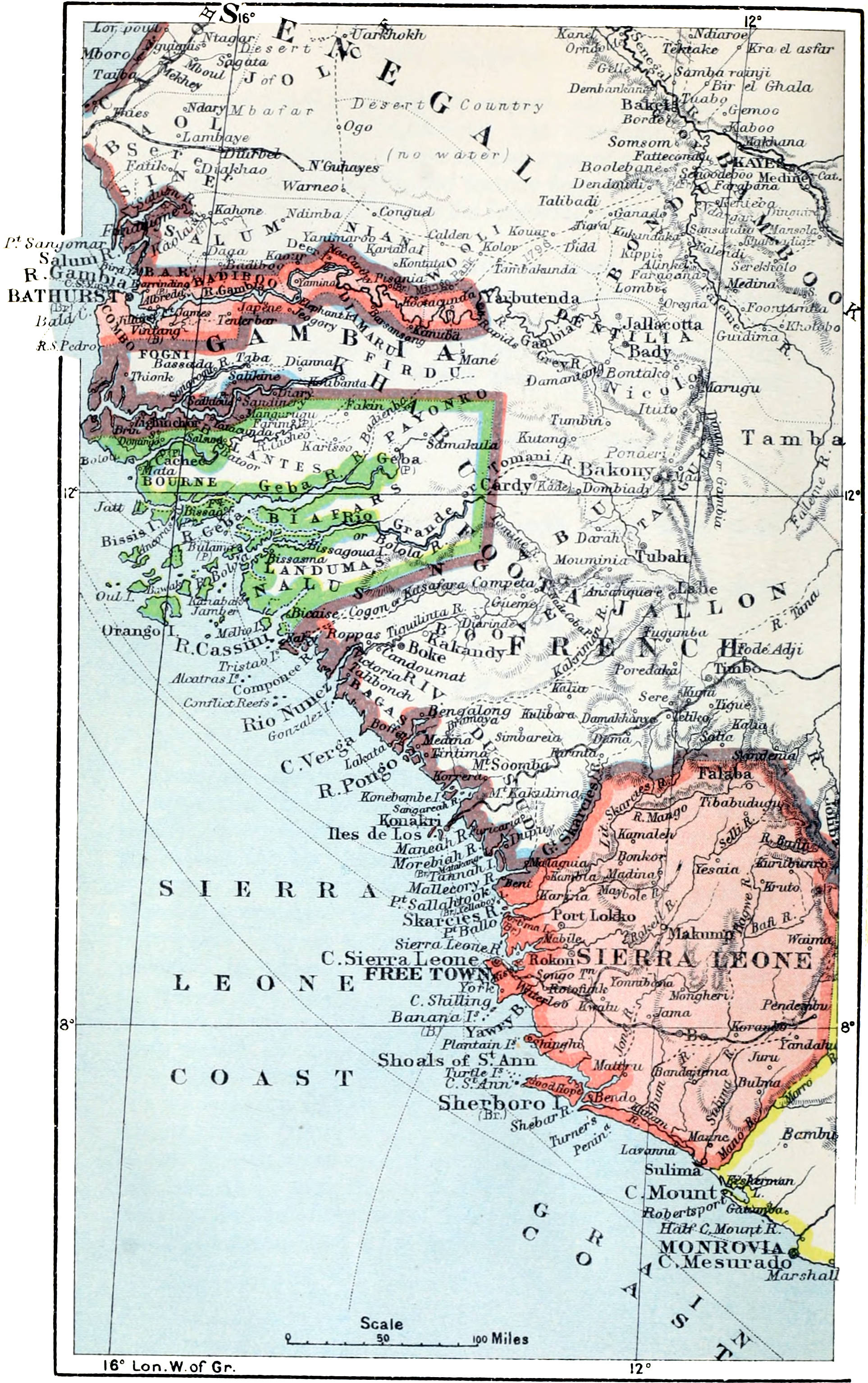
INTRODUCTORY REMARKS.Geographical Position.—The Gambia Colony and
Protectorate consists of a narrow tract of country following the
winding course of the river from which it takes its name, for a
distance of about 250 miles, and extending approximately four miles
from the river on both banks.
The whole country lies between 12° 10′ and 13° 15′ north
latitude and 13° 50′ and 16° 40′ west longitude. It is the most
northerly of the British West African possessions.
Area and Population.—The extent of
territory is said to be 3,619 square miles, much of which consists
of low-lying land intersected by creeks and rivers, which under
tidal influence are often densely afforested with mangroves.
According to the census of 1911 the Colony and Protectorate had
populations of 7,700 and 138,401 respectively, totalling 146,101.
The total of 90,404 given in the previous census is now admitted to
have been below the actual amount. A large migratory farming
community exists, coming annually from the adjoining countries, for
the purpose of raising groundnut crops. This in 1911 numbered
3,367. Many of these immigrants are reported to have remained and
established themselves permanently under the British flag.
Tribes.—The principal tribes
inhabiting the Gambia are the Mandingoes, Foulahs, Joloffs, and
Jolahs. The first-named are the most numerous, and are, generally
speaking, Mohammedans, although there are many “Sonninkis” or
spirit drinkers among them. The Foulahs are identical with the
Fulanis of the Gold Coast and Northern Nigeria, and are frequently
fair-skinned without
negroid features. They are said to be strictly Mohammedan, and to
have originated from the country near the source of the Senegal
river. The Joloffs occupy the northern bank of the Gambia river,
and extend well into Senegal. The Jolahs inhabit the province of
Fogni, and spread into the confines of French territory towards the
Casamance river. They are a curious race, given to living in small
family villages, and are said to be vindictive. They are of a lower
type than the three other tribes mentioned, and are jealous of
their rights.
Political Divisions.—The
Protectorate is divided into five districts, each under the control
of a Travelling Commissioner. These districts are named in
accordance with their positions: North Bank, South Bank, M‘Carthy
Island, Kommbo and Fogni, and Upper River.
Natural Conditions.—The climatic
conditions of the country are favourable to the breeding of cattle
and horses, although in the vicinity of the river and creeks two
species of tsetse fly are common. By carefully preventing animals
from straying into these infested tracts the spread of fly-borne
disease is held in check, and cases are comparatively rare.
During the dry season, which often occupies seven months in the
year, from November to May, the highest maximum and the lowest
minimum temperatures are recorded; the range being from 41° (lowest
minimum, March 1909) to 105° (highest maximum, March 1909 and April
1911). The rainfall, of which official records are kept at
Bathurst, varies considerably, as the following extract will serve
to show:
1901
45·31
inches
1910
44·00
inches
1902
29·42
„
1911
28·14
„
1903
57·13
„
1912
33·99
„
1904
38·02
„
1913
23·68
„
1905
66·07
„
1914
48·91
„
1906
64·36
„
1915
47·64
„
1907
34·00
„
1916
38·02
„
1908
43·54
„
1917
37·68
„
1909
56·59
„
1918
54·03
„
Soil.—The soil generally is of a
light sandy nature, becoming stiffer as the undulating regions of
the upper river are
approached. The low countries are subject to flood in the rainy
season, and are only favourable for rice cultivation.
Chief Crops.—The country is rather
sparsely populated, but, on the whole, the people are fair
cultivators and prepare their lands in a careful manner.
Practically the only crop grown for export is the groundnut,
monkey-nut, or earth-pea (Arachis hypogæa), which forms by
far the most important article of cultivation. Alternating this
with the staple food-crops of the country, namely, guinea-corn,
maize, millet, and cassava, a fairly useful form of rotation is
obtained.
Implements.—Cultivation among the
Mandingoes and Joloffs is performed by means of a large
wooden-bladed, iron-shod hoe, with which the loose earth ridges are
thrown up. A small iron hoe is used for keeping down weeds and
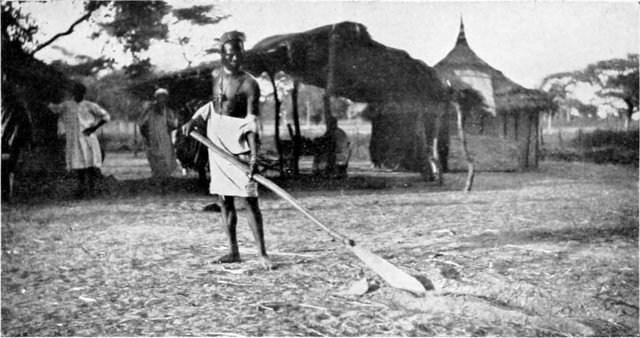
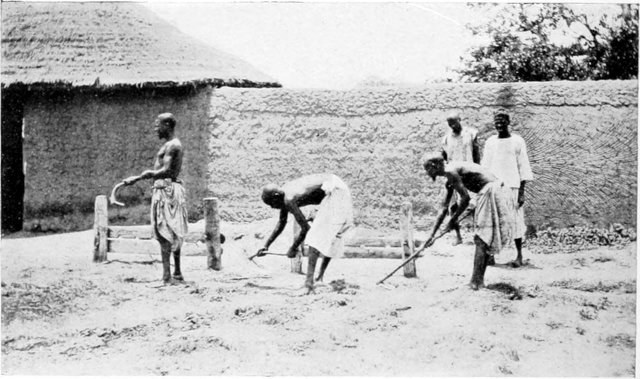
clearing. In the Jolah country a handplough is employed, consisting
of a flat blade attached to a pole, and pushed in front of the
operator, so as to throw up a shallow ridge. This is shown in the
picture which represents a native with the implement at Bullelai
(Fig. 1).
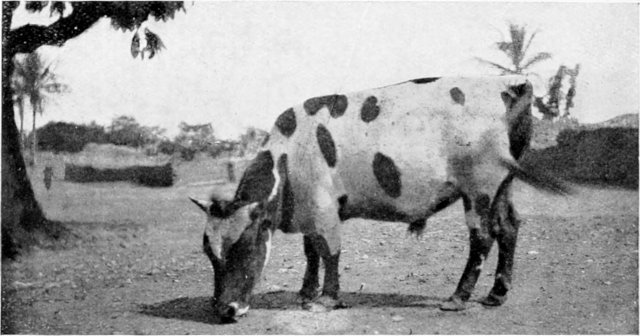
Ploughing.—Cattle are plentiful,
even to the extent of there being an insufficiency of fodder for
them in the dry season in some localities. They are chiefly kept
for the purpose of displaying the wealth of their owners, and are
not employed for any kind of farm work. Notwithstanding the
shortage of manual labour and the successful demonstrations made by
the Government, through the agency of the Roman Catholic Fathers at
the Abuko Agricultural School, to prove the value of substituting
animal draught for manual labour in tilling the land, the prejudice
on the part of the natives against the use of their cattle for
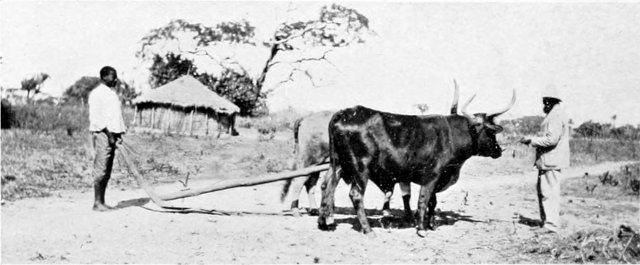
ploughing or cartage has not been overcome. A photograph is given
showing a native with a Canary Island plough drawn by
locally-trained bullocks (Fig. 2). Owing to the
failure attending the efforts to introduce ploughing and cattle
breeding at Abuko, where, for the latter purpose, some Ayrshire
bulls were provided, the Govermnent withdrew the provisional
subsidy in 1911.
Land Tenure.—Land ownership is
hereditary and descends from father to son among the Mandingoes
and Joloffs. No fees
are paid or presents given to chiefs when a transfer is made.
Europeans can rent land from Government in cases where it is not
held or claimed by a native. Grants are apparently issued for
various periods, but freehold rights are not given.
The rules regarding the itinerant, so-called “strange farmers,”
who annually visit the country to plant groundnuts, vary to some
extent in different parts of the Protectorate. Where hereditary
ruling chiefs exist, a tax of 4s. per head is paid to
them. In other places, half of this tax goes to Government,
one-quarter to the chief, and one-quarter to the farmer’s landlord.
The landowner generally gives the groundnut seed and food as well
as a piece of land to be cultivated. In payment for the seed and
food, it is a rule to give one-tenth of the crop. During the time
the strange farmer is in occupation he is expected to give one or
two days’ work each week on the landowner’s own farm.
Labour.—There is no fixed rate paid
by the Government for labour. All the work on a farm is done by the
owner and his own boys, but occasionally others come in to assist
from the neighbouring farms, but no payment is made—only a present
of kolas being usually given.
Agricultural Schools.—An
agricultural school, previously referred to, was started at Abuko,
near Lammin, under the Roman Catholic Fathers there, and a subsidy
was granted by the Government especially for the purpose of
educating the sons of large cultivators and chiefs in the use of
ploughs and other labour-saving implements. A stipulation was made
that the work should be inspected by a Government officer from time
to time.
In spite of this a fear was expressed at the outset that the
attendance at these schools would be disappointing, in view of the
fact that Mohammedan chiefs would be restrained by their mallams
from sending their children where there might be a risk of their
religious conversion. Although it had been specially laid down that
no religious teaching would be insisted upon, the fear proved
justified and the school never became a success, the attendance
being only of a few aliens. Since the closing of this school no
renewal of agricultural instruction seems to have been made.
Chief Exports.—The following table gives the
average amounts and values of the chief exports for 1900-10, and
the individual figures for the remaining years to 1918.
Year
Groundnuts tons and value
Rubber lbs. and value
Beeswax lbs. and value
Palm Kernels tons and value
1900-10 Av.
39,000 tons
46,000 lbs.
45,500 lbs.
255 tons
£250,000
£3,500
£2,000
£2,260
1911
47,931 tons
10,733 lbs.
33,871 lbs.
443 tons
£437,472
£836
£1,514
£4,758
1912
64,169 tons
4,335 lbs.
30,830 lbs.
445 tons
£502,069
£409
£1,164
£6,518
1913
67,404 tons
12,995 lbs.
31,518 lbs.
546 tons
£622,098
£1,027
£990
£9,026
1914
66,885 tons
3,548 lbs.
15,513 lbs.
495 tons
£650,461
£102
£473
£7,815
1915
96,152 tons
1,171 lbs.
9,563 lbs.
326 tons
£400,435
£31
£311
£5,457
1916
46,366 tons
355 lbs.
6,950 lbs.
669 tons
£506,098
£23
£104
£14,671
1917
74,300 tons
1,753 lbs.
3,962 lbs.
532 tons
£869,790
£187
£247
£7,994
1918
56,489 tons
564 lbs.
8,626 lbs.
644 tons
£800,319
£40
£501
£9,800
Note.—Cotton exports were 59,828
lbs. and 2,572 lbs. in 1904 and 1905 respectively. None has been
exported since.
GROUNDNUTS.—This commodity is by far
the most important exported product, and is alone subject to a duty
levied by the Administration.
Uses.—The undecorticated nuts are
shipped, chiefly, to the French ports and to Hamburg, for the
expression of an oil of excellent quality, of which they yield on
an average about 30 per cent., estimated on the weight of the raw
material. This is equivalent to about 44 per cent. of the weight of
the extracted kernels.
The mode of extraction in general employment in France is to
grind the kernels into a fine meal, from which the first quality of
oil is extracted by cold expression, yielding about 18 per cent.
The meal is then moistened with cold water, and at the second
expression 6 per cent. more is obtained. Both of these oils are
useful for alimentary purposes. A third expression is made from the
residue treated with hot water, and gives a further 6 per cent.,
which is chiefly employed for lighting purposes, lubricating and
soap-making. The fine oils are substituted for, or mixed with, the
olive-oils of commerce for salad oils, and enter into the manufacture of
oleo-margarine. After these expressions of oil have been made, the
meal is pressed into cakes and used for cattle-food and manurial
purposes.
Classification and Description of the
Groundnut Plant.—The groundnut belongs to the Sub-Order
Papilionaceæ, of the Order Leguminosæ, and is termed Arachis
hypogæa, Linn.
The plant cultivated in Senegal and the Gambia grows in a
spreading form, with branches of from 12 to 18 inches in length,
and possesses oval leaflets given off in double pairs. A large
number of conspicuous yellow flowers appear from the upper leaf
axils, but are not capable of fertilisation. Those springing from
the lower leaf axils nearest the ground are small and generally
hidden, but produce fruitful pods. After fertilisation the stems of
these flowers become elongated, and are directed downwards, forcing
the ovary into the ground, in which it commences to swell to the
mature size, frequently penetrating to a depth of two inches
beneath the surface.
The fruit is a pale straw-coloured, irregularly-cylindrical pod,
with the surface of the shell pitted and longitudinally ribbed. In
the Gambian variety, which is identical with the common Senegalese
kind, there are usually two kernels in each pod, but three or one
are also found.
The plant is of doubtful origin, but it is generally supposed
that it may have been introduced into Africa from Brazil (where the
genus Arachis is well represented) nearly four centuries
ago, by the Portuguese slave-traders.
About 1840 groundnuts began to attract the attention of European
manufacturers, on account of the value of the oil obtained from
them, and, in common with the Senegalese, the Gambian natives were
induced to undertake cultivation upon a large scale.
The nuts grown in the Gambia and in Saloum, in the French
territory adjoining on the north, are classed as of second quality;
those from Cayor and Rufisque holding the first, and those from the
Casamance and Portuguese Guinea the third, places.
The seeds are sown upon ridges with flattened tops, and the crop occupies the ground
for about four months—July to October—corresponding to the period
of heavy rainfall in the country. When the branches commence to
wither, the whole plant is carefully pulled up, so that the pods,
which are then mature, remain attached. The plants are then stacked
in the fields, and are often covered over with the leaves of the
fan-palm. The green parts dry into a hay, which, when the pods have
been beaten out, is used as horse-fodder. The advent of rain after
stacking often does great damage to the crop, but the occurrence is
so rare that it has been found difficult to induce the native to
take common precautions against it. During the last two years,
however, the Government have taken steps to enforce a regulation
with regard to this, and in consequence drains are now generally
cut around the stacks, and coverings of palm-leaves are left on
until the nuts are ready to be beaten out.
In the Jolah country raised platforms are constructed for
stacking this crop as well as others. After the nuts have been
beaten out from the dried plants, they are winnowed by allowing
them to fall from a slight elevation in a gentle breeze.
A good crop of nuts in the Gambia is estimated at about 44
bushels per acre, equivalent to over half a ton, but larger yields
are frequently obtained. The Government standard bushel is used
throughout the country, and may contain from 25 to 31 lbs. of
undecorticated nuts.
Experiments have been made from time to time, to establish a
three-kernel nut instead of the two-kernel one, but the results
obtained have not shown that any advantage could be gained in this
way. Other varieties of nuts have been introduced and cultivated,
but no extensive planting of new kinds has yet been found worth
adoption.
The plant seldom suffers from severe attacks of disease,
although a white fungus was prevalent in some localities in 1906.
This affection was termed “tio jarankaro” by the Mandingoes. In the
succeeding year it completely disappeared, and has not been
reported to have occurred since. The extermination of this disease
was doubtless in a large measure due to the careful way in
which the selection and
distribution of seed had been carried out. For several years the
Government has been accustomed to purchase a certain quantity of
the best nuts each season, and to distribute these at sowing time
to the cultivators, on credit. Without this precaution, in a season
when the prices for nuts were high, the thriftless native would be
induced to sell every nut, reserving nothing for sowing the next
year. The system adopted is greatly appreciated by the cultivators
and merchants alike, and has without doubt contributed largely to
the prosperity of the country. Seed is not only interchanged, in
this manner, with advantage between different districts, but fresh
seed is sometimes also provided from Senegal.
The immigrant or “strange farmers” are generally welcomed by the
land-owners, who usually manage to lease them the fields which
require the most cleaning. After the immigrant farmer has reaped
his groundnut crop, the field is left in a good state of tilth for
the owner to sow his guinea corn.
The occurrence of ruinous competition among merchants at
Bathurst induced them to form a “combine” to regulate the buying
price of nuts; the purchases being pooled and then divided
according to a fixed scale. A recent attempt to divert Gambian nuts
to Senegal ports for shipment, by the levy of an import tax at
Marseilles, was opposed by the French and British merchants alike,
and the fear that the produce might only be diverted to another
destination led to its abandonment. For further information
regarding the cultivation, varieties and uses of groundnuts, see
Bulletin of the Imperial Institute, vol. viii. (1910), pp.
153-72.
RUBBER.—A good quality of rubber is
produced in the Jolah country, in particular, from Landolphia
Heudelotii, an apocynaceous vine, which grows commonly in the
grass lands of Fogni.
The vine is tapped by women, who, after digging a hole near the
root of the plant, make a number of transverse cuts upon the
root-stem. The latex flows rapidly from such cuts, and is
coagulated by throwing salt water on the wound. The scrap rubber
which forms is collected the following day, and the pieces are
attached to one another, forming an open sponge-like ball of a
pinkish-white colour. Sand is often present in these balls owing to the fallen latex
being added to the rest.
In addition to the inhabitants themselves collecting rubber,
natives belonging to a tribe from Portuguese Guinea, called
“Manjagos,” travel through the country for the purpose; the rubber
which they obtain being sold in the French Colony to the south of
the Gambia. The “Manjagos” are said to make a semicircular cut upon
the thick vine-stems just above the ground, to induce the better
flow of latex. This, they maintain, is not a destructive method,
and that, as the root stock is uninjured, the plant continues to
yield latex for a long time. At one time the rubber vine must have
been plentiful, but the rush for it which occurred at the beginning
of the present century has had the effect of exterminating it,
except in the more inaccessible places. The export has declined and
is now insignificant. The plant is known to the Mandingoes as
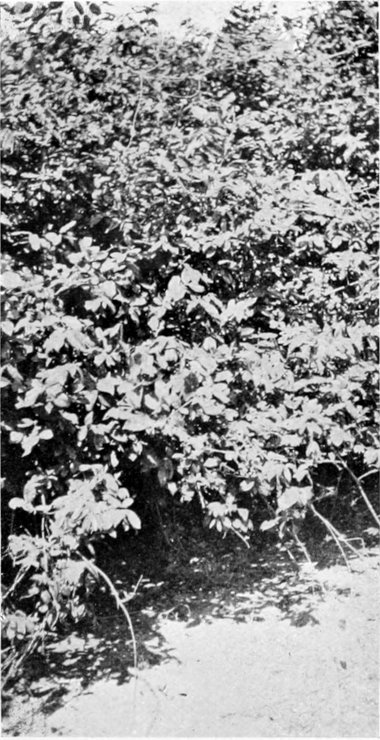
“Folio.” An illustration is given showing this plant at Kotoo
(Fig. 4).
Landolphia florida, Benth., is common in places similar
to those where the last-mentioned vine occurs, but the latex is not
used in any way to adulterate the good rubber, nor is inferior
“paste” rubber made from it, as in other places in West Africa.
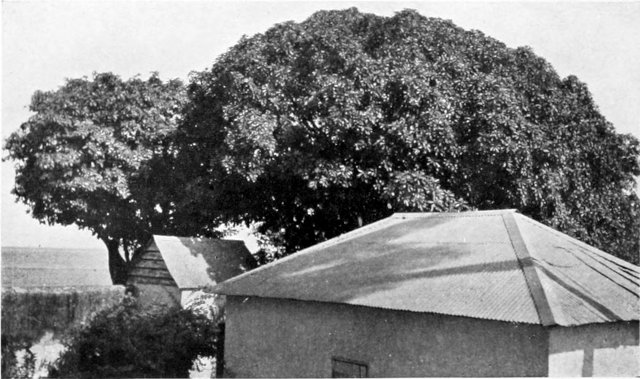
Ficus Vogelii, known as “Kobbo” (Mandingo), has recently
been used for extracting an inferior rubber, which has been shipped
in small quantities. This tree is found growing in Bathurst as well
as in many of the large towns, where it often attains a large size,
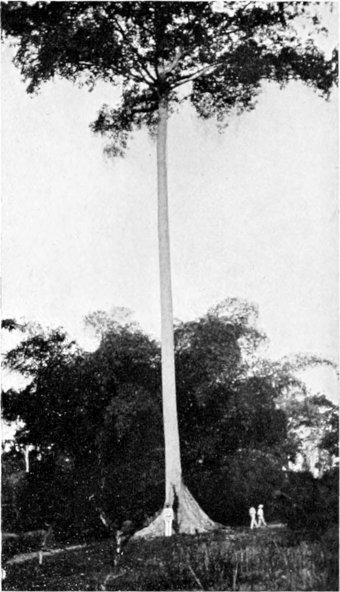
and affords an excellent shade for native markets, etc. A view of a
tree in Bathurst is shown (Fig. 3). Information
regarding the composition and value of the rubber of Ficus
Vogelii is given in the Bulletin of the Imperial
Institute, vol. vii. (1909), p. 260.
Some of the South American species of rubber trees have been
planted at different places, but for the most part the climatic
conditions have proved unsuitable for their establishment. An
exception to this is the Ceara rubber (Manihot Glaziovii),
large trees of which were to be seen in Bathurst and at Bakau, but
in the latter locality appear to have been cut down during recent
years. It is generally acknowledged that Ceara rubber has not proved successful in
plantations made in different parts of West Africa, for, although
rubber of the finest quality can be easily prepared from the latex,
the tree furnishes an extremely inconstant yield of latex. In the
Gambia the tree reproduces readily, and, as far as can be judged,
produces a latex capable of being coagulated into good rubber. As a
shade tree it is recommended to be grown along public roads, and it
might prove expedient in the country to make small experimental
plantations, in the manner adopted in Togoland and elsewhere. By
this system, tapping is continued for a few years, and whole blocks
of trees are cut out as they cease to yield latex—the seedlings
which have sprung up beneath these trees being permitted to take
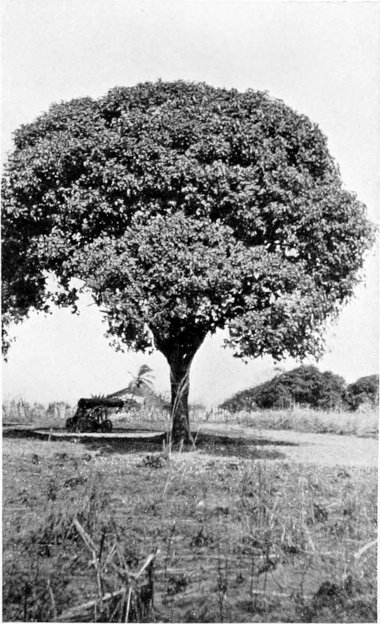
the place of the original trees. An illustration showing a Ceara
rubber tree at Bakau is given (Fig. 5).
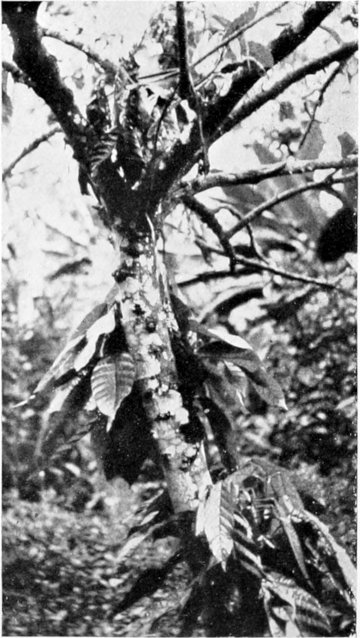
One specimen of Castilloa elastica, of which a photograph
is given (Fig. 6), is growing in the Kotoo farm,
about 12 miles from Bathurst. This tree has not, so far, proved
successful in West Africa, and the example photographed is
apparently in better condition than those grown in the Botanic
Gardens of the Gold Coast and Southern Nigeria.
Funtumia elastica, the Lagos silk rubber tree, does not
thrive in the Gambia, and the rainfall has been found to be
insufficiently distributed for the cultivation of the Para rubber
tree (Hevea brasiliensis).
The observed facts point to the conclusion that further
experimental trials of certain species of rubber trees in the
Gambia should be made.
BEESWAX.—It will be observed that a
large quantity of beeswax is annually exported, the quality of
which is high. The native bee is a small form of Apis
mellifera, var. Adansonii. It is found in a wild state
forming nests in hollow trees or rock cavities. The Mandingoes
collect the wild swarms and confine them in basket-hives,
cylindrical in form and sometimes plastered over with mud. These
are placed in high trees or in abandoned huts. The wax is sold in a
crude form to the Bathurst merchants, who boil it down and strain
it previous to shipment. The European market value of the cleaned
wax is from £5 to £6 per cwt. A detailed description of methods for the refining of
wild bees’ wax for export is published in the Bulletin of the
Imperial Institute, vol. viii. (1910), pp. 23-31.
PALM KERNELS.—The West African oil
palm, Elæis guineensis, is found commonly in some parts, but
the heads produced are small and carry small fruits, containing
little oil. This oil is used locally, and the kernels from the nuts
alone are shipped. The palm is chiefly valued for the production of
palm wine, which is tapped from the base of the fruiting stems into
funnelled gourds, hung beneath the holes. The tree is apparently
never felled for the purpose, and, by limiting the amount of wine
extracted, it survives for a long period.
COTTON.—The Mandingoes and Jolahs
cultivate cotton for making the yarn used in their native looms, in
which they weave the strips of cloth called “pagns.” These strips
are afterwards sewn together along their lateral edges and made
into gowns.
The native cotton plant varies somewhat in appearance. In
Kommbo, a long straggling form occurs, which is retained for two
seasons to produce cotton, but in the Jolah country a small annual
is most frequently seen. The former is grown as a mixed crop and
the latter in separate patches.
In quality, from the European spinner’s point of view, the
Mandingo cotton lint compares favourably with the commercial type
called “middling American” as far as length of staple is concerned,
although it is not so white, nor is there so much silkiness
apparent. It has been rightly remarked that the native variety, if
properly cultivated, would probably give a better result than would
be obtained from the introduction of American seed. The Jolah
cotton is short-stapled and woolly, though whiter than the
Mandingo. It would be more difficult to improve this kind
sufficiently to suit the European demand.
Egyptian cotton seed was tried in the Gambia about twenty years
ago, and the variety was at first considered suitable; the
cultivation was, however, not proceeded with, owing to local
difficulties.
The obstacles which hindered the development of cotton-growing
in the Gambia for export were the same as those experienced in Sierra Leone. The
local demand for raw cotton precluded it from being obtained at a
sufficiently low price to leave a margin of profit to exporters,
and in addition to this, labour was not sufficiently abundant, nor
were the natives familiar with labour-saving methods in
cultivation. Attempts to establish an interest in the matter
produced a fair amount of raw cotton in 1904, but since that year
the exported quantity rapidly diminished and has now ceased
altogether. For reports on the quality of the cotton produced in
the Gambia see Professor Dunstan’s British Cotton
Cultivation (Colonial Reports—Miscellaneous Series, Cd. 3997,
1908), p. 26, and Bull. Imp. Inst., 1921. Samples may be
seen in the Imperial Institute Collections.
GRAIN CROPS.—No grain is exported, as
owing to the work of the scanty population being so largely applied
to the cultivation of groundnuts, scarcely sufficient food-stuff is
grown for their own requirements. Guinea-corn (Sorghum
vulgare), the two most important varieties of which are known
as “Bassi” and “Kinto” in the Mandingo language, are commonly used
for food, but during recent years, owing to the repeated annual
attacks on the crop by Aphis sorghi, maize-growing was
substituted in some parts of the country. White maize seed was
obtained from Lagos, and yellow maize seed from the Canary Islands,
but the grain is not appreciated to the same extent as Guinea corn.
Pennisetum typhoideum, the large millet, of which the
commonest variety is known in Mandingo as “Sannio,” is alternated
with Guinea corn or maize, but is often badly affected by a “smut
fungus” (Ustilago sp.), which also attacks the “Kinto”
variety of Guinea corn. A small grass is often grown in the millet
fields, yielding a crop of fine seed which is made into flour for
the preparation of a kind of porridge. This is termed “Findi”
locally. Rice (Oryza sativa) is somewhat extensively grown
in the swamp lands, but the success of the crop is very largely
dependent on the distribution of the rainfall. Whole tracts of rice
fields are destroyed in some years, owing to excessive floods, as
no precautions are taken to guard against them. It is chiefly on
account of the uncertainty of the grain crops, that a large
quantity of rice has to be imported annually to supplement
that produced in the
country. These imports often amount to six or seven thousand
tons.
ROOT AND OTHER CROPS.—Sweet cassava
(Manihot palmata) is frequently planted as a terminal crop
in the crude rotation employed. This variety can be eaten without
previously washing or cooking. An illustration of a cassava field
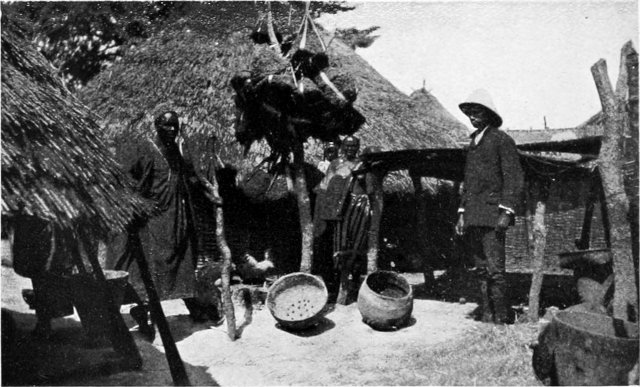
is given (Fig. 7). Two or three kinds of beans
are planted, though not extensively in spite of a good local demand
for them. Okra (Hibiscus esculentus), cultivated for the
edible fruit pods, indigo (Indigofera sp.) employed for
making the local blue dye, and tobacco (Nicotiana tabacum),
are planted near houses. A photograph is given exhibiting the
different utensils required for the preparation of indigo, and
cakes of the dried and fermented indigo stalks, in the form in
which they are preserved, are shown suspended in the illustration
(Fig. 8). The tobacco prepared is usually ground
into snuff, in which form it is used for chewing as well as for
smoking.
TANNING.—Goat-skins are tanned in the
manner similar to that employed by the Haussas; Acacia
arabica pods being used in the process. The people who perform
the work of preparing and working leather are termed “Korankos.”
Red and black inks, purchased from the European merchants, are used
for staining the leather, which is inferior to that produced in
Northern Nigeria (see p.
142).
FIBRES.—The country seems to be
plentifully supplied with fibre plants in a wild state, chiefly
belonging to different species of Hibiscus. These are of the
jute class, and are used throughout the country for making native
ropes. Indian jute (Corchorus capsularis) has been tried
experimentally at Kotoo, and excellent samples were obtained, but
the quantity of fibre per acre turned out to be small, and the
working proved to be too expensive.
The preparation of piassava, which had been abandoned for many
years, is said to have been taken up again by a British firm in
1915. The fibre is obtained from the leaf sheath of a palm
(Raphia vinifera) which grows plentifully along the banks of
the Gambia in places. For further information see Selected
Reports from the Imperial Institute, Pt. I., Fibres, and
Bull. Imp. Inst., 1915.
TIMBER.—There are no trees of
commercial importance, accessible for felling for export, although
Gambian mahogany (Khaya senegalensis) and Gambian rosewood
(Pterocarpus erinaceus) occur in many parts of the country.
In some remote districts the former tree is said to attain large
dimensions (Bulletin of the Imperial Institute, vol. viii.
(1910), p. 244).
TRADE.—The following extracts from the
Colonial Reports show the diversion of destination of Gambian
exports which has occurred in recent years. For this purpose
groundnuts are regarded as representing the whole of the trade, of
which they normally constitute about 90 per cent.
Percentages
of Exports from the Gambia
Destination
1911
1912
1913
1914
1915
1916
1917
Great Britain and British Possessions
6·30
9·00
6·72
9·92
39·45
53·56
79·56
France and French Possessions
84·80
76·00
59-10
79·34
48·60
36·58
20·35
Holland
3·20
9·00
6·03
—
—
4·20
—
Germany
—
3·64
24·56
6·80
—
—
—
Denmark
—
—
—
1·99
7·68
5·63
—
Spain
—
—
—
·35
4·24
—
—
Other countries
5·70
2·36
3·59
1·60
0·03
0·03
0·09
100
100
100
100
100
100
100
From the above it will be noted that Germany began to appear in
the market in 1912, and, in 1913, had taken nearly one-quarter of
the output. This is probably accounted for by the rapid growth of
the vegetable oil industry in Germany and the attempt on the part
of Hamburg crushers to capture the Gambia trade from Marseilles. It
will be seen that a proportionate decrease occurred in exports to
French ports coincident with the increased shipments to German
ports. The European war put Germany out of the market, and in 1914
France took nearly her normal share. In 1915 and 1916, however,
Great Britain felt the lack of imported vegetable oils to such an
extent that factories for their extraction sprang up in the
country; thus it is seen that in 1915 Great Britain took nearly 40
per cent. against France’s 48½ per cent., and in 1916, Great
Britain, for the first time in the last fifty years, took a larger
portion of the Gambian groundnut crop than France.
INTRODUCTORY REMARKS.Geographical Position.—The Colony and Protectorate
of Sierra Leone are bounded upon the north and west by French
Guinea, and upon the east by Liberia. The Colony is confined to the
hill country of the Sierra Leone Peninsula and Sherbro Island; the
remainder being Protectorate.
Area and Population.—The area of
the country according to the Blue Book of 1911 is 31,000 sq. miles.
The greater part is undulating, well watered and fairly fertile,
traversed by short ranges of mountains, mostly running north and
south. The population of the Colony, by the census taken in 1911,
was 75,572, and of the Protectorate 1,327,560.
Administrative Divisions.—The
country is divided into seven administrative districts, two of
which are in the Colony and five in the Protectorate. The latter
have been formed primarily in accordance with tribal settlements,
due to the expediency of recognising in each the native customary
law; the exception to this is the Railway district, in which other
considerations of greater importance are involved.
Natural Features.—Although the
country is largely of a slightly undulating type, in the north a
curious formation of hills exists, in the Koinadugu district; each
hill bearing a curiously-formed pinnacle of rock on its summit, and
presenting a most striking appearance. The valleys between these
hills contain some of the richest soil found in the country.
Farther north, above the 9th degree of latitude, the country is
composed chiefly of grass land interspersed with stunted trees.
Approaching the coast, secondary forest or scrub occurs, which is
constantly being cleared for farms; being so used for a year or two
and then allowed to revert to “bush” for long periods.
Natives.—The inhabitants of the Colony are chiefly
the descendants of liberated slaves from North America and the West
Indies, but a number were rescued by British war-vessels from slave
ships, and represent races from all parts of West Africa. The
language adopted by these people is a “pidgin English” of a
peculiar kind, and is easily understood after a few of the curious
idiomatic phrases have been learnt.
The most important tribes are the Mendis, Timanis, Limbas and
Sherbros. These are followed in number by the Konnohs, Port Lokkos,
Susus, Korankos, Bulloms, Krims, Yalunkas, Mandingoes, Gbemas,
Foulahs, Gallinas or Veis and Gpakas. The Mendis are the largest
tribe, and are entirely pagan; they cultivate in a wasteful manner
and are otherwise improvident. The Timanis are more intelligent and
careful, and the Veis, occupying the sea coast to the south, who
have recently adopted cocoa planting, are not only considered the
most intelligent, but, alone among West African natives, have a
written language.
Land Tenure.—The land in the Colony
is held by the Crown, and is granted on the authority of the
Governor. All grants made contain reservations with regard to roads
and other public requirements. The tenure of Crown lands is fee
simple, but occupation is also sanctioned under squatters’ licence
at a nominal rent, and the tenure is then in the nature of a
tenancy at will. Under Ordinance No. 14 of 1886, real and personal
property may be taken, acquired, held or disposed of by any alien
in a manner similar to that allowed to a British-born subject.
Fields or waste lands outside town or village limits in the
Sierra Leone Peninsula and Sherbro Island must be taken up in lots
of not less than 20, or more than 200, acres. Such lots are
disposed of at auction, at an upset price of 4s.
2d. per acre in the former, and 8s. in the latter
locality. Up to 1902 the question of land grants in the
Protectorate was unsettled, but arrangements may now be come to
with the chiefs for the lease of tracts of land for long periods on
an annual rental, agreed to between the applicant and the tribal
council; the title requiring the confirmation of the Government.
According to native law, it is generally recognised that the lands
of a chiefdom are not the property of the chief, but
are held in trust by
him for the tribe. A chief has no power to alienate any portion of
the land of a chiefdom, or to grant to any one perpetual rights to
any portion, but the lease of land by an arrangement with the
tribal council, and with the approval of Government, should be
satisfactory for all requirements with regard to legal title.
Labour.—Plantations worked by
chiefs at the instigation of Government are usually supplied with
labour by the chief, although monetary assistance in the form of
bonuses is occasionally given. Under such conditions experimental
plantations of fibre, rubber, kola, etc., have been made. There is
no fixed rate of pay for labourers, but the usual wage for an adult
man, when hired, is from 6d. to 1s. per day.
Cultivation.—Throughout the country
a shallow type of cultivation is common, and one in which the bush
stumps and roots are not removed. The seeds of a number of
different kinds of agricultural crops are generally mixed together
before being sown broadcast over the lightly scraped soil of the
burnt bush area.
The object of retaining the bush stumps and roots in the fields
is that, after two or three years of cultivation, the bush may be
easily reinstated, and again after ten or fifteen years, when cut
down and burnt, it furnishes a supply of wood ash for the
fertilisation of the field. This application of ash constitutes the
only form of artificial renovation which the soil ever
receives.
Recently experiments have been made in the presence of natives,
in order to show the advantages of deep cultivation. To effect
this, without the employment of ploughs, the fork kodalli hoe,
recommended by the writer, has been introduced and generally
adopted. The substantial increase in the production of their rice
fields obtained by the use of this implement made a fortunate
impression among the natives.
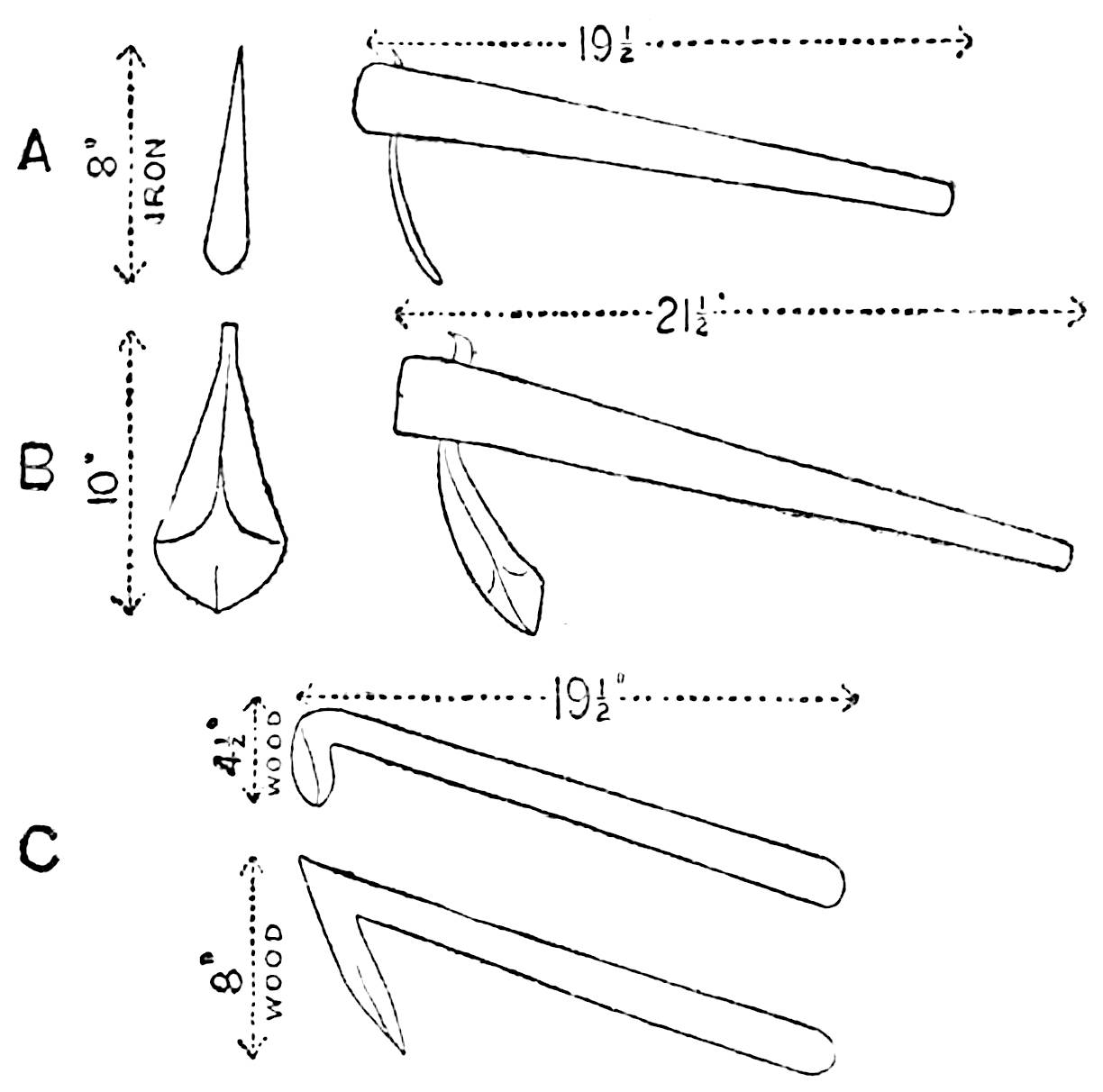
The native agricultural implements consist of a
straight-handled, narrow-bladed hoe called “kari” (Mendi), or
“katala” (Timani), and one formed from an angled stick with a
charred point, called “baowe” (Mendi), or “kalal” (Timani). This
last is used for drilling. In addition to these, a large
broad-bladed hoe, called “karu wai” (Mendi), or “katala kabana”
(Timani), is employed for cleaning out weeds and scraping the soil
surface; the latter
being the only cultivation the growing crop receives. These
implements are illustrated below.
A. “KARI” (MENDI), “KATALA” (TIMANI).
B. “KAKU WAI” (MENDI), “KATALA KABANA” (TIMANI),
C. “BAOWE” (MENDI), “KALAL” (TIMANI).
Agricultural Schools, etc.Chiefs’ Sons’ College.—In 1906 a college for the sons of
chiefs was established at Bo, and it was intended that, in addition
to the ordinary course of instruction, the rudiments of improved
agriculture should be taught. This was subsequently found to
interfere with the teaching of other subjects which were considered
more necessary, and was abandoned in consequence. The omission of
agricultural training from the course did not preclude the scholars
from cultivating small patches of vegetables for their own use,
upon ground allowed to them for the purpose.
Thomas Agricultural College.—In 1908 the erection of an
Agricultural College was commenced at Mabang, under the terms of
the will of Mr. Thomas, a native who bequeathed a large sum of
money to be devoted to this purpose. The College was expected to be
completed in June 1910, when a commencement of lectures and
general instruction
was to be made. Scholarships and some official control were
provided for by the terms of the trust, but the project was never
developed, and the buildings were not even completed.
Principal Crops.—The most important
food crop is rice, but two varieties of maize are also cultivated
for local consumption; one of these is quick maturing, and is
probably identical with the white variety which is exported from
Lagos, from which country it is said to have been introduced into
Sierra Leone. The other kind is of slower growth, and bears a
yellow grain. Yams, sweet potatoes, and cassava are grown,
especially where there is a heavy rainfall.
Forest Products.—Besides the
agricultural crops, the forests yield palm oil and kernels, and
kola nuts are planted for the much appreciated seed which their
pods contain. The latter nut is said to have a stimulating effect,
and to allay hunger and thirst when chewed. The nut is in such
great demand throughout Northern Africa that a large trade exists
between Sierra Leone and the coast countries to the north.
The more important exported products are accorded the foremost
positions in the following account.
OIL PALM.Localities and the Influence of
Position.—Elæis guineensis is found generally
throughout the country from the sea-board towards the interior,
diminishing in those districts where the climate becomes drier or
where rocky and mountainous tracts intervene. In places, owing,
doubtless, to the wasteful methods of treatment and the
carelessness in burning the “bush” for farms, extensive areas
without palms are occasionally met with, even where the soil and
climatic conditions are not unfavourable to their growth. In the
extreme north, where the rainfall diminishes, the tree is only
found in the vicinity of streams. The most suitable situation for
growth seems to be one in which the soil is generally rather moist,
although swampy, ill-drained land is not favourable. In those parts
of the country where a gravelly laterite appears as a surface soil
over a deep substratum of syenite, trees may often be met with in
considerable numbers, but it is observed that the trunks of such
trees do not acquire the same thickness as those growing in a damper and lighter
soil. It is probable, although no experiments have yet been made
affording direct evidence for the conclusion, that the fertility
and yield of fruits of the trees growing upon the flat lands are
greater than those established upon the higher undulating country
because they are subject to less wash and more natural irrigation.
It is also quite possible that the variety of palm fruit produced
in the former places will be found to furnish better commercial
results. No distinct varieties are, however, recognised by the
natives, although distinctive names are applied to the same fruit
in different stages of development.
The oil palm does not appear to be able to thrive in heavy
forest, and in a natural state occupies open valleys with low
undergrowth, but upon the clearance of primary forest it soon
becomes established.
The seeds or nuts, which are large and heavy, are distributed by
the agency of frugivorous birds and mammals. The grey parrot, for
example, may be observed extracting the ripe fruits from the heads
or picking them from the ground where they have fallen, and, after
conveying these to a convenient tree, carefully removing the oily
pericarp before dropping the nut in a new position. Monkeys
doubtless convey the fruits to even greater distances in their
cheek-pouches.
Owing to the presence of rocky and swampy strips of country in
the Protectorate, and the direction in which farm fires have been
carried by the prevailing winds, the distribution of palms has been
thought to assume the character of “belts,” defined by fairly
well-marked boundaries. When looked into more closely, however, the
distribution appears to be better described as consisting of dense
patches linked sometimes by almost unrecognisable chains of widely
scattered trees, and often broken into by short ranges of hills
which are completely destitute of palms.
The patches referred to may bear 500 palm trees to the acre, and
these may represent 80 to 100 per cent. of the total tree-growth on
the patch. The area of such a patch may be roughly estimated at
from ¼ acre to 15 sq. miles, or even more, but it should be added
that, where such extensive tracts as these occur, the difficulties
of transport and the scarcity of the population have constituted obstacles to
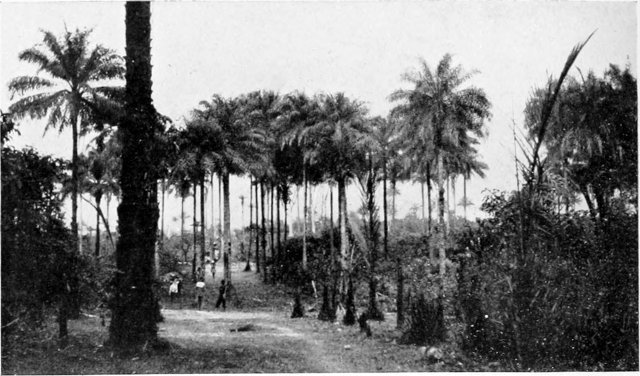
working, and to the means of preserving the trees. Oil palms near
Mafokoyia are shown in the picture (Fig.
10).
The appearance of a young tree is that of a thick stem throwing
out annulate series of long feathery leaf fronds, upon petioles,
which bear roughly-formed spines. As the tree increases in height
the lower petioles are shed, and the trunk assumes a narrower but
more regular form; indistinct rings being traceable, formed by the
bases of the fallen leaf stems. A mature tree will measure about
one foot in diameter at four feet from the ground, and at the
ground surface the diameter will be two and a half to nearly three
times as much. The male flowers are collected in the form of a
number of tassel-like pendants, springing from a common stalk, and
one such bunch is usually found above and upon each side of the
female inflorescence. Both sexes of flowers usually occur upon the
trees, but the natives recognise the existence of a non-fruiting
tree, and one which only produces male flowers. The number of fruit
heads and the weight of these vary according to the position, age,
and treatment of the tree. An idea may be given of the fruitfulness
of trees, from the accounts obtained from natives in different
parts of the country. The palm has two fruiting seasons, one during
the dry weather and another during the rainy season, the latter
being generally the lighter crop. It is estimated that a tree in
full bearing will yield from twelve to twenty fruiting heads in one
year, each of a fairly large size. A younger tree may only produce
four to eight heads, but usually of a larger size; and a tree of
only five or six years old may give about the same number of heads,
but of smaller dimensions. From very old trees small heads with
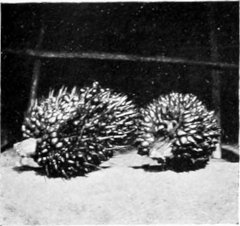
fruits of a diminished size are obtained. The weight of a
moderately large head will be about thirty pounds, and will contain
about twelve hundred fruits weighing roughly 23 lbs. An
illustration showing two fruiting heads is given (Fig. 9).
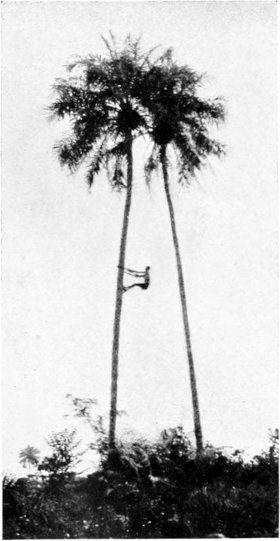
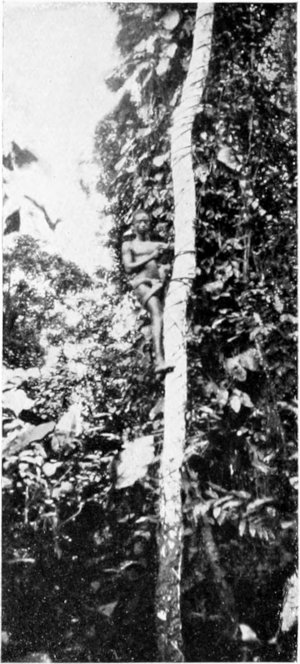
The ripe fruiting heads are gathered by a man using a climbing
sling, with which he encircles the tree and his waist, and by means
of a skilful manipulation of the part in contact with the trunk and
remote from the body, he proceeds to ascend the tree rapidly,
almost as though
walking up it. On reaching the crown, a number of dead leaves have
to be removed in order to get at the fruit stem. These are cut by
means of a “cutlass” or “machete,” which the climber carries, and
are thrown to the ground. Only one head ripens at a time upon each
tree, and the time occupied in climbing and cutting out the fruit
head is estimated at about eight minutes. A photograph showing a
native climbing a palm tree is reproduced (Fig.
11).
Both the Mendi and Timani races distinguish the fruit, at
different periods during the advance towards maturity, by special
names given with regard to the appearance. Identifications of the
same series of fruits by different individuals have shown that
these names are widely used.
Although it will be seen that in the Gold Coast and Nigeria the
natives recognise a number of different varieties of fruit, this
does not appear to be the case in Sierra Leone. The thin-shelled
forms, so well known to the natives of the former countries, appear
unknown, except around Sherbro, where there are a few trees
recognised as productive of this type of fruit. In the appearance
of the mature fruit, the presence or absence of black at the apex
seems to be of equally common occurrence, but no importance is
attached to this feature.
The Sierra Leone form appears to be at a disadvantage with
regard to the proportion of oily pericarp covering the nut, as well
as in the great thickness of its shell. Comparing it with the
varieties obtained in the Gold Coast, it is probably nearest to, if
not identical with, that called “Abe pa.”
When the percentage of oil extracted from the fruit of the
Sierra Leone trees is compared with that from other parts of West
Africa, it at once becomes apparent that the amount is small. The
results of three series of experiments, made in different parts of
the country, showed that the fibrous pericarp, which contains the
oil, constituted only about 30 per cent. of the whole, the nut
containing the kernel being large and approximating 70 per cent.
Palm oil extracted by native methods gave 1·201, 5·47, 5·637, and
8·326 per cent. respectively in four tests. If these results are
compared with the
extractions of oil from the several Gold Coast varieties, the
deficiency is very marked. Compare Bulletin of the Imperial
Institute, vol. vii. (1909), pp. 364-71.
A close examination of the local fruit shows that the outer
fibrous portion or pericarp, which alone contains the palm oil, is
very thin, whereas the hard shell surrounding the kernel is thick.
The kernel represents about 15 per cent. of the total weight of the
fruit, and is largely exported from the country for the extraction
of another kind of oil.
Small Export of Oil compared with
Kernels.—The proportionately larger weight of kernel than of
palm oil capable of extraction, accounts for the large quantities
of kernels exported compared with palm oil. As an example of this,
it may be mentioned that in the year 1906 Sierra Leone exported
only 12½ gallons of palm oil to each ton of kernels, whereas
Southern Nigeria figures for the same year showed 142 gallons of
oil per ton of kernels. Since this date, up to the beginning of the
war, a comparison of the annual exports of oil and kernels shows a
fluctuation between about 12 and 19 gallons of pericarp oil for
every ton of kernels; the latter still remaining disproportionately
high.
Proposal to introduce New
Varieties.—Since it has begun to be realised that the local
variety of palm is probably constantly inferior as an oil producer
to some of the varieties found farther to the south, it has been
suggested that some of the forms, with a thicker fibrous pericarp
and a thin-shelled kernel, should be introduced and planted upon an
extensive scale. It is assumed that by doing so, a better type
would become established. Experiments made in the Kamerun show,
however, that the progeny of palms having a thin-shelled fruit
(Lisombe) do not necessarily retain their important characters. Dr.
Strunk has suggested that, in the variety mentioned, the characters
are not fixed or susceptible of transmission, but the experiments
are not considered as yielding conclusive evidence, and it is
advisable that experimental plots should be planted with the more
useful forms in Sierra Leone and elsewhere, the seed being obtained
from artificially fertilised sources.
Improvements in the Local Manufacture.—During
recent years great efforts have been made by the Administration to
increase the exports of both palm oil and kernels by opening up the
previously rather inaccessible areas in which palm trees were found
growing almost untouched. The first step in this direction was the
extension of the Sierra Leone Railway line from Boia, a small
village just beyond the Headquarters District boundary, to
Mafokoyia, lying a short distance to the north. From here a road
was made eastwards towards Yonnibannah, passing through country
fairly well studded with oil palms. Later from Yonnibannah the
objective of the railway became Baga, a town on the Maybole river,
again to the north. At the present time this line has reached
Kamabai, at the foot of the Koinadugu mountains and to the west of
Bumban, passing the town of Makump on its way there. The whole of
this route has been chosen in order to make the oil palm regions
more accessible, and the increase in exports of both oil and
kernels between 1907 and 1913 is almost entirely attributable to
this development.
Not only was it desirable to open up new areas from which palm
fruits could be gathered, but, owing to the deficiency of pericarp
oil shipped from the country in comparison with palm kernels, it
was thought that, by the introduction of improved methods for
extracting the pericarp oil, more of this commodity might be
obtainable in the future.
The prospect of working a large area both experimentally and
commercially for oil extraction in situ, attracted Messrs.
Lever Brothers, who installed ample mechanical apparatus at
Yonnibannah in 1914. The Government had granted this firm a
concession to work several hundred square miles on the
understanding that the local traders and merchants were not thereby
to be debarred from buying the hand-prepared oil from the natives
as before. The scheme was intended to demonstrate the advantages of
mechanical means of extraction over those of hand power; and it was
thought that, by the introduction of these greater facilities for
dealing with the oil palm products, labour would be liberated and
would be employed to a greater extent in the less heavy and more
remunerative direction of plantation and field work. Messrs. Lever Brothers’ factory was
one designed to be equipped both from a mechanical and research
standpoint, and a special shunting yard on the railway was leased
to the firm by the Government to deal with the anticipated work.
The project seemed so promising that local firms were contemplating
following Messrs. Lever Brothers’ example in other localities. The
whole scheme was, however, abandoned after a short trial; Messrs.
Lever Brothers having probably discovered two facts in connection
with the oil palm industry in Sierra Leone which had been lost
sight of. The first is that the pericarp of the common type of palm
fruit found in Sierra Leone, as pointed out in the first edition of
this book, is very thin and therefore contains very little oil, and
that the shell of the nuts in this thin-pericarped fruit is
extremely thick. The common Sierra Leone kind is therefore of less
economic value both in respect to pericarp oil and kernel contents
than the common kind found in the Gold Coast, Nigeria and Kamerun.
The second point is that the Mendis and Timanis occupying this part
of the Protectorate are a lower type and generally poorer workers
by comparison with the Fanti tribes of the Gold Coast or the
Yorubas of Nigeria.
One explanation given for the failure of Messrs. Lever Brothers’
effort in Sierra Leone was that they did not offer a sufficiently
high price for the oil palm fruit heads to induce the natives to
collect and carry them to the factory. As the chiefs and villagers
saw that by selling the fruits to the factory the main occupation
of their wives (the preparation of palm oil and the cracking of
nuts for the extraction of palm kernels) would be taken away, they
were said to be averse to the establishment of a new condition of
enforced idleness, which would impose greater difficulties on them
of keeping their wives in order. The offer by the factory to return
the nuts for cracking in the villages, did not dispose of this
difficulty, as the villagers only saw in it an arrangement
involving them in extra transport. Messrs. Lever Brothers have now
transferred their work to the Belgian Congo, where, by reason of
the better type of palm fruit commonly obtainable, the conditions
are more satisfactory for the development of the mechanical
extraction of palm oil on a commercial scale, and where the
inhabitants are less
independent and more accustomed to co-operate with European
enterprise.
Export Figures.—The average annual
export of palm oil and kernels for the first nine years of the
century, and the annual total of the subsequent ten years are
given:
Palm oil
Palm kernels
Year
Gallons
Tons
1900-1908 Av.
303,790
26,630
1909
851,998
42,897
1910
645,339
43,031
1911
725,648
42,892
1912
728,509
50,751
1913
617,088
49,201
1914
436,144
35,915
1915
481,576
39,624
1916
557,751
45,316
1917
543,111
58,020
1918
260,442
40,816
RUBBER.—Until 1907 the African tree
rubber (Funtumia elastica) had not been recorded from any
part of the country, although its congener, F. africana, was
found everywhere. A number of trees of the first-named species have
been recently discovered in the Panguma and Gola forests, and have
been carefully examined. The latex, from trees tapped in the former
locality, yielded a good quality of rubber when boiled with three
volumes of water.
Native Method of Preparation.—The
tree is known to the Mendis as “Gboi-gboi,” and in order to obtain
the latex it is customary to fell the tree, afterwards ringing it
at intervals of about one foot. The latex, which flows, is
collected in leaf cups or other receptacles, and is heated in an
iron pot. When in a state of semi-coagulation, induced by heat, it
is poured upon plantain leaves, placed on the ground. Another
plantain leaf is then used to cover the mass, which is stamped out
with the feet into a rough sheet. The sheet is hung up to dry in a
hut, in which it obtains the benefit of the fumes from the wood
fires used by the occupants. The next process is to cut the sheet
into strips, which are subsequently wound into large oval balls and enter the
Freetown market under the name of “Manoh twist.”
Owing to the wasteful method of tapping the trees, the species
has been exterminated in many places, and the local Government have
had under consideration the formulation of an ordinance to prevent
the continuance of such destruction. As the existing trees are now
practically only found in the dense forests near the Liberian
frontier, and are probably widely scattered over a large area, it
will prove a difficult matter to enforce any regulations with
regard to collection.
Vine Rubber: Method of
Preparation.—Landolphia owariensis, var.
Jenje, is said to be the species of vine from which the
Sierra Leone “Red Nigger” rubber is obtained. The Mendi name for
the plant is “Djenje.” A very destructive method is usually
employed in the preparation of the rubber. The vine is cut down and
the roots dug out, both of which are cut into small pieces and
soaked in water for several weeks. The bark is then removed, and
the wood is pounded and washed repeatedly until a reddish mass of
rubber remains, which usually contains a large amount of woody
matter. This is sold in the form of balls. It is less common for
the native to tap the vine and to coagulate the latex upon the
wound with the addition of salt or lime juice, but this is
occasionally done, and balls of scrap rubber collected in this way
are sold in some localities.
Another vine (Clitandra laxiflora), which yields an
inferior rubber by means of boiling the latex, is termed “Jawe” by
the Mendis. This was at first considered to be Clitandra
Manni, but more recent investigation has proved that C.
Manni, although called by the same native name, produces a
latex incapable of coagulation.
The Quality of Indigenous Rubbers and the
Export.—The prices obtained for Sierra Leone rubbers compare
favourably with those of the other British West African countries.
Funtumia rubber, which is generally largely adulterated in the Gold
Coast and Nigeria, is apparently not so in Sierra Leone, when
prepared in the form of “Manoh twist.” The vine rubber, made from
the scrap, is also of good quality, and the root rubber is not
inferior to that shipped from the other countries. The trade of
Sierra Leone is, however, small, and it is probable
that the larger part
of that exported from Freetown is obtained from the adjoining
countries of Liberia and French Guinea. The export of rubber
declined since 1906, when it amounted to 107 tons, to only 6 tons
in 1913, while in 1916 and 1917 none was exported. The composition
and quality of Sierra Leone rubbers is given in the Bulletin of
the Imperial Institute, vol. iv. (1906), p. 29; vol. vi.
(1908), p. 24; vol. viii. (1910), p. 16; and vol. xii. (1914), p.
371.
Rubber Plantations.—No plantations
of Funtumia rubber have been made although small plots have been
planted with the South American Para tree (Hevea
brasiliensis) on an experimental scale at different times and
in various parts of the country and a mixed plantation of rubber,
cocoa, coffee and fruit has been made near Waterloo. Up to 1909, it
should be remarked, the work was in the hands of the Agricultural
Service, but from 1910, on the formation of the Forestry Department
as well as the reorganisation of an Agricultural Department, all
forest and plantation work was transferred to the first-named
Department. No plantation rubber has yet reached the commercial
stage, although further trials are still in progress, and much
experience has been gained.
A few Para trees were planted at the beginning of the present
century in the Botanic Gardens at Freetown, but the locality was
found unsuitable, and the trees grew slowly and yielded
unsatisfactorily. A small plantation was made at Moyamba by Madam
Yoko, the late chief of the Mendis, and was well looked after until
she died, since when it seems to have been somewhat neglected. At
Mano, the chief of the town made a good plantation in 1906, and, as
the locality was apparently well selected, the trees have shown
satisfactory growth. Small plots have been put out under Para at
the Roman Catholic Mission station at Serabu, at Segbwema,
Tinainahun and the Bo school, with variable success, in accordance
with the cultivation and care bestowed on the plants. Except in the
gravelly positions the tree succeeds well.
Landolphia owariensis and L. Heudelotii have been
planted in forested patches in different parts of the country, the
supervision of such planting having been entrusted to a native who
had seen similar work performed by the French authorities in the
neighbouring colony. Near Batkanu, a few plants can still be
seen.
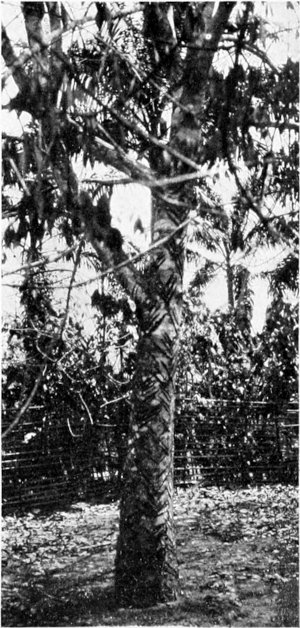
KOLA NUTS.—The importance of the kola nut in West
Africa is very high. Sierra Leone produces generally a better
quality, for local consumption and export, than other countries.
The kola trees (Kola acuminata and K. vera) do not,
however, occur in a wild state in the country, and the whole
produce is obtained from plantations, which are to be seen near
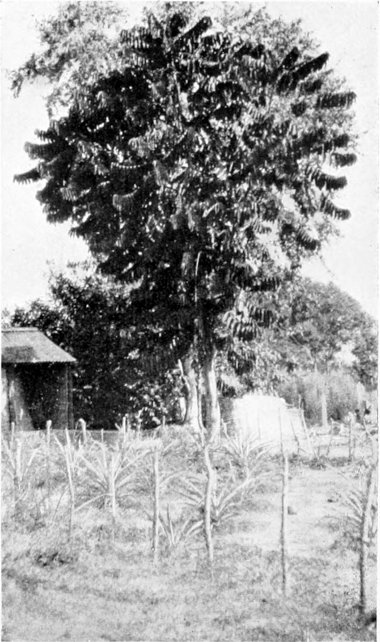
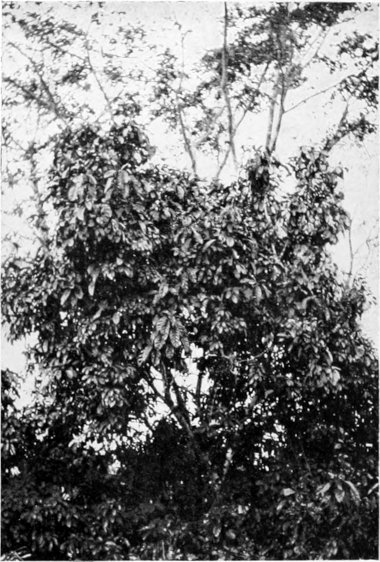
almost every village in the moist region. A photograph is given
showing a kola tree at Mano (Fig. 12). The
destination of the exported kola is chiefly Bathurst (Gambia),
Dakar (Senegal), Bissao (Portuguese Guinea), and to a small extent
Dahomey. The exports of this commodity in recent years are given
below as well as their average annual values per ton, which, as
will be seen, exhibit great fluctuation.
Tons
Valued at
Equal to £ per ton
1906
1,155
£104,084
£90
1907
1,374
£113,674
£83
1908
1,162
£108,895
£94
1909
1,320
£153,848
£116
1910
1,508
£191,878
£127
1911
1,597
£194,260
£121
1912
1,649
£276,473
£167
1913
1,865
£328,003
£176
1914
1,924
£279,185
£145
1915
2,041
£233,388
£119
1916
2,484
£302,720
£122
1917
1,702
£321,105
£188
1918
2,302
£397,726
£173
Kola nuts are second only to palm kernels in Sierra Leone in
importance as an export, although they are practically entirely
consigned to other coast ports; an insignificant amount of dried
kolas only being destined for Europe.
RED PEPPER.—Capsicum annuum and
C. frutescens are both grown among the multitude of plants,
the seeds of which are mixed and broadcasted in the farms; but
whereas most of the other plants are annuals, these are left in the
ground for two years or more, and yield almost continuous crops
during that period. The country of origin of these plants is
probably South America, but the date of their introduction is
unknown.
Beside the extensive local use of the pods, the export
statistics of 1909 show that 41 tons were shipped.
GINGER.—Zingiber officinale is not found in a
wild state in Africa, but has been widely introduced throughout the
tropical portions, although in Sierra Leone, alone among the West
African countries, has it reached the important position of an
export.
Owing to the defective methods of agriculture employed in the
Colony, where for the most part ginger is cultivated, the roots or
rhizomes do not attain a large size, and, in consequence, present
great difficulties in decortication.
The common native method of preparation is to rub the washed and
partially dried rhizomes in sand, and then to dry them more or less
completely in the sun. The effect of this treatment is to remove a
small portion of the outer skin from those prominences which come
into contact with the sandy surface more readily, the depressions
being left untouched. The native has found that the weight of the
prepared ginger is increased by the adhesion of sand, and therefore
prefers to employ this method to that of using a knife. The result
is a very inferior product.
During the last few years attempts have been made among the
ginger growers to deal directly with the European buyers, and a
Farmers’ Association was formed with this object in view.
Government assistance was obtained on the assurance that better
methods of cultivation and preparation would be adopted, and this
was done to a certain extent, but greater dependence seems to have
been placed upon the supposed advantage to be obtained from
shipping ginger of the usual inferior quality, without it passing
through the local merchants’ hands. The result was, that a small
quantity of selected ginger was sold at a good price, and a large
quantity of common grade obtained a lower price than
previously.
Recent experiments have shown that good results can be obtained
with ginger in Sierra Leone if care be taken to deep-hoe the ground
and then plant out the selected eyes from clean rhizomes. The
custom of attempting to grow a crop in hard laterite gravel without
proper cultivation is the chief cause of the malformed and small
rhizomes usually obtained in native cultivation. Under improved
conditions a crop of five tons per acre of good quality ginger has
been procured.
Export Trade.—The following amounts of ginger have
been shipped during the last decade:
Tons
Value
Tons
Value
1906
579
10,879
1913
2,048
35,468
1907
618
11,578
1914
1,213
15,639
1908
637
11,871
1915
567
8,091
1909
722
14,147
1916
971
25,814
1910
1,093
33,288
1917
1,136
25,863
1911
1,692
44,668
1918
1,576
39,306
1912
2,200
44,864
It is reported that, owing to the decline in price paid for
Sierra Leone ginger in 1913, about one-third of the crop was left
unharvested, and that the depreciation experienced was due to the
competition from other sources of a better marketed product. It
would be a pity if the promising opportunity of the country to
become established as a large producer of ginger were altogether
lost, owing to the want of a little care in cultivation and
preparation of the product for the market.
The plant is essentially suited to certain parts of the Colony
and Protectorate and is not subject to any serious diseases, the
only recorded one being a fungus which attacks the rhizomes and
causes yellowing of the leaves. This can be prevented from
spreading if the plants be removed and burned as soon as the signs
of attack are apparent on them.
FIBRES.Jute
Class.—In the last few years several fibre plants indigenous
to the country have been experimented with at the Imperial
Institute, in order to ascertain whether any were capable of being
exported for use as substitutes for Indian jute.
Honckenya ficifolia, known by the Timani name of
“Napunti,” a plant which occurs in great profusion in the swamps
and low lands, yields a fibre of excellent quality, but owing to
the difficulties experienced in the extraction of it, further
experiments are necessary to devise a means by which it can be
economically prepared. The analyses of the fibre from this plant
which have been made at the Imperial Institute (see Selected
Reports from the Imperial Institute, Part I. [Cd. 4588],
Fibres, p. 40) are very satisfactory, and this, combined with the
fact that the natural supply of the plant is very large in districts which are quite
useless for agricultural purposes, renders it important that the
methods of extraction should be more carefully studied.
Among the other fibres of this class which have shown promise,
Hibiscus quinquelobus, to which the Mendis give the name of
“Korwey,” is found in a wild state in variable profusion throughout
the country. Unlike the last, which produces erect stems growing
close together, this plant has stems of an almost scandent
character, growing under the shade of moderately large trees and
perforating the upper branches, so that the flowering stems are
often seen fifteen feet or more above the ground. Under cultivation
the experiments seemed to show that the elongated character of the
stems was not maintained, and this defect requires to be remedied
if the fibre is to be prepared upon a commercial scale. The
extraction is easily done by retting, and experimental shipments to
Europe of several tons have shown that the product is quite
marketable and is classed with, or a little below, medium jutes
(ibid. p. 39).
Recently experiments were carried out in the extraction of fibre
from Hibiscus esculentus, the “okra” of tropical countries.
A specimen of the fibre having been examined at the Imperial
Institute and favourably reported upon (ibid. p. 35), a
plantation was made at Kangahun, in order to endeavour to produce a
crop, which should have the additional advantage of yielding a
marketable supply of the vegetable okra pods before being cut down
and made into fibre. In order to do this, the seed was sown at
close intervals, thereby introducing a straight growth of stem, and
care was exercised not to permit the fruiting to continue long
enough for the stems to become coarse. The fibre was extracted in
the same manner as that of jute, except that the stems were
immersed in a solution of caustic soda before retting to remove the
thin outer bark. The marketed fibre from the first of these
experiments realised an unsatisfactory price, but it was estimated
that the crop of pods yielded £3 per acre.
Corchorus capsularis, one of the Indian jutes, was
introduced and planted out in 1906, but the existing native methods
of cultivation and the absence of manure rendered the conditions so
different from those obtained in India, that a successful result was not
brought about. Two species of Corchorus are found in the country,
and are used only as vegetables.
Ramie Fibre.—Plantations of Ramie
fibre or China grass were recently made in various parts of the
Protectorate, but although the plant grows well during the rainy
season, the long period of dry weather is detrimental to it.
Piassava.—This fibre is produced
from the sheath of the leaf stem of Raphia vinifera, the
wine palm, and is prepared at several places, especially in the
swampy districts near the coast. The method of extraction is merely
that of steeping and beating out, and the resulting fibre is, in
appearance, somewhat similar to fine whalebone. The largest amount
was exported in 1915, when the figure reached 1,283 tons. The price
in this year attained £61 per ton. The fibre is chiefly employed
for the manufacture of stiff brooms.
COTTON.—The native cotton of Sierra
Leone showed promise, at one time, of great development, but
insurmountable difficulties met the efforts of the British Cotton
Growing Association in their attempt to establish cotton growing
for export upon a large scale.
The native mode of growing cotton is in combination with a
number of other agricultural crops, the seeds of all being mixed
before being broadcasted in a field, which has been lightly tilled.
Cotton sown in this manner is permitted to yield crops for two
seasons, but the second crop is generally much inferior. Owing to
this irregular manner of planting, the amount of cotton available
for use is small, and is nearly all absorbed for the supply of the
native looms; being readily saleable in the weaving districts at
about 2d. per lb. of seed cotton, or about twice as much
as the British Cotton Growing Association were prepared to pay.
The inefficiency of the quality of the local cultivation, and
the disinclination on the part of the native to adopt better
methods, effectually prevented more cotton being grown, and the
British Cotton Growing Association were unable to obtain sufficient
material to keep their ginnery employed.
In connection with the cotton ginnery, erected at Moyamba, a
large plantation was made; the indigenous as well as many exotic varieties of the plant
being put in. The site, however, proved unsuitable, labour was
found to be expensive, and the climatic conditions were complained
of. In consequence of these adverse conditions, the Association
were reluctantly obliged to abandon the work. The export of cotton
was never significant and ceased altogether in 1909.
Indigenous Varieties.—Three
well-marked types of cotton are found throughout the country, and
are known by the native (Mendi) names of (1) Kwonde, (2) Fande Wa,
(3) Dhoole. The first of these has a white lint and a seed covered
with white wool. An examination of this at the Imperial Institute
showed that the lint from it was the most valuable of the three;
the staple measured about 1″, and was compared with very good
quality “Indian Broach.” Two samples, valued in 1907, were priced
at 5⅜d. and 5¾d. respectively, with good Broach
at 5⅜d., and Middling American at 6·18d. The
Fande Wa variety has a creamy lint and a green woolly seed. It was
said to be of good quality, but the colour was not so good as the
last, and the value was consequently lower. Dhoole is rather rarer
than the other two, and has a brick-red or brown lint and a bare
seed. Khaki or red cottons are not in demand upon an European
market, but locally they are somewhat sought after.
Native Weaving.—A native cloth
woven from the three different varieties of indigenous cottons is
frequently seen; the careful arrangement of the naturally coloured
yarns yielding a distinct pattern. More often, perhaps, only the
first two kinds are used, and the yarn made from them is dyed with
the local indigo. In width the native cloths are usually narrow,
and the strips are sewn together in order to form gowns, etc. A
photograph is given showing a native weaver at work at Pendembu
(Fig. 13). In a few localities wider cloths are
woven, but of no great length. These are often elaborately
designed, and command a high price among the natives, being
preferred to imported materials.
Exotic Cottons.—“Cambodia” and “Sea
Island” have been tried experimentally. The latter, though
withstanding the heavy rainfall well, was found to be very
susceptible to attacks of the local cotton stainer. There is still
no prospect of the revival of cotton exportation.
RICE.—Two forms of rice are grown in the
Protectorate; one under irrigation or in swampy ground, near
rivers, etc., and the other entirely without any conservance of
water, depending on the rainfall.
The use of rice is general throughout the country—in fact, it is
probably the most important food crop; and although, as mentioned
above, there are two forms, divided according to their mode of
cultivation, each form contains many varieties distinguished by
different native names.
In the Timani country and the vicinity of Port Lokko the finest
quality is grown, and the husking of this is said to be a prolonged
process of drying, without previously parboiling or soaking. This
rice only requires to be thoroughly dried before the husk will
separate on pounding.
In the Mendi country, the heads of rice at the harvesting are
cut and tied in small bunches to dry in the fields. The grain is
then beaten out, and the chaff winnowed on a tray or in a gentle
breeze. The next step is to parboil the grain while yet in the
husk, during which operation the interior swells up so as to split
the husk. The rice is then again thoroughly dried in the sun upon
mats, and finally lightly pounded in a wooden mortar in order to
separate the loosened husk, which is removed by winnowing. From the
time of harvesting until the rice is ready for sale, the work is
performed by women.
In spite of the fact that a very large quantity of rice is
grown, it frequently happens that in a good season much remains
unharvested, owing to the improvidence of the native. The price
just after harvesting may fall as low as 1s. 6d.
per bushel, but a few months later it may reach three times that
amount. It is customary for the Protectorate native to realise at
once upon his crop, without taking the precaution to lay in a store
for his future requirements. In consequence of this he is compelled
to buy back supplies for his own consumption at a very much
enhanced rate. The native at the Coast takes advantage of this
improvidence and profits considerably by it; buying up the cheap
product at harvesting and realising a handsome profit after a few
months.
In quality the local rice is excellent, but in appearance it is
somewhat reddish, only a few of the finer qualities being nearly white. The imported
rices are usually white, but are said to contain less nutriment
than the local kinds.
Rice has always constituted the staple food of the aboriginal
tribes of the Protectorate, for which reason its cultivation and
the weather conditions necessary for its successful production
locally are matters of great importance. No precaution is taken to
plant any other crop as a stand-by in the event of an unfavourable
rice season. In 1910 a disaster actually occurred, for the rainy
season of 1909 set in so early that it prevented many farms being
burned in time to sow rice. Most of the local varieties mature
their grain from three to five months after sowing, the earlier
producing approximately 15, and the later from 30 to 40 bushels,
per acre. Owing to the failure of the rice crop in 1910, the
commodity should not have been allowed to be exported in that year,
but the importance of this was lost sight of in view of the
remunerative trade in it which had become established with
different coast ports to which it was shipped. In the previous
edition of this volume a recommendation was made to foster the
export of surplus Sierra Leone rice to the Gold Coast, where it was
much appreciated, and doubtless this trade may yet become important
when existing restrictions are removed, and if it is found possible
to induce a larger number of the population in the Protectorate to
engage in pure agriculture, and grow crops in excess of their
immediate personal requirements.
The exports for the last nine years were as follows:
Bushels
Value £
1910
35,114
5,925
1911
22,621
4,716
1912
30,715
5,712
1913
21,548
3,991
1914
18,705
4,855
1915
19,600
7,228
1916
3,192
1,364
1917
1,022
697
1918
176
93
In 1915, owing to the falling off of imports, it was found
necessary to exercise control over the exports, but in spite of
this the amount exported was higher than in the previous year. In
1916 the urgency of the matter became even more pronounced and
exports were restricted.
The Agricultural
Department conducted several comparative trials with Indian and
local varieties of rice. The Indian rices were much smaller in size
of grain and were generally not considered so suitable as the local
kinds, with respect to which it was found that, with a sufficiency
of seed used in sowing and deep cultivation, excellent crops could
be secured. The native method of using less than half a bushel of
seed to sow an acre is accountable for much of the resultant crop
becoming full of weeds. Excellent results were obtained in sowing
1½ to 3 bushels per acre, when the weeds were choked out.
CAMWOOD.—This material, from which red
dye is got, is obtained from the leguminous tree Baphia
nitida. The use of it in European countries has somewhat
diminished during recent years, owing to the substitution for it of
artificial red colouring-matter, but a small quantity is still
exported, and is made use of for colouring sausage skins. The
amount of camwood exported in 1915 is given as 635 tons, valued at
£8,761.
COPAL.—The tree identified as
Copaifera Guibourtiana is tapped, in the Mendi country
especially, for copal. The method in general practice is to cut
small square patches of bark from the main trunk and branches in
the month of January, and to permit these to exude resin until
April, at which time the flow has ceased, and the resin hardened
sufficiently to be collected.
The tree has been recorded from a few localities in Sierra
Leone, but recently plantations have been made near Moyamba and
elsewhere. In the Kwalu district, where clusters of large trees
occur, much damage has been done by overtapping, and many dead
trees are to be seen.
The value of Sierra Leone copal is high, sometimes attaining
over two shillings a pound in the European markets. The quality is,
however, somewhat irregular, and the local grading is frequently
inefficient. Information as to the quality and value of Sierra
Leone copal in comparison with other varieties is given in
Selected Reports from the Imperial Institute, Part II.,
Gums and Resins [Cd. 4971], pp. 170-82.
About thirty tons were annually shipped to Europe for making
varnish, but owing to the destructive methods of collection, the
Government has prohibited trade for five years.
GROUNDNUTS.—Practically no trade at present exists in
this crop, but efforts are being made to reintroduce the
cultivation into Bullom, where at one time a large quantity was
grown for export.
The cultivation of groundnuts for local consumption is carried
on, but the ridge system of planting, which is in vogue in the
Gambia, is not adopted in Sierra Leone, and the groundnut stalks
are removed from the ground without the nuts attached to them. The
nuts in Sierra Leone are permitted to remain in the ground and
depreciate in quality through insufficient drying. The success of
groundnut cultivation depends largely upon the plant being grown on
a loose bed of friable soil, and, where such conditions exist, the
Gambian method should prove satisfactory.
Experiments show that the nuts should be decorticated before
sowing. The usual local method of sowing is to scatter the nuts
upon the unbroken ground and then cover with loose earth. Some
damage is done by rats, bushpig and termites, and in 1914 a fungoid
disease (Cercospora personata) appeared in Karene. The
Agricultural Department has obtained 12 cwts. to the acre in its
trials.
The variety of nut grown is apparently identical with that of
the Gambia, from which country the seed has probably been obtained
in the past.
COCOA.—Some years ago cocoa was
introduced into the Colony, but, although some of the Colonial
planters had received their training in the cocoa estates of
Fernando Po and San Thomé, no success attended their efforts in
Sierra Leone. The heavy rainfall, combined with the long period of
drought peculiar to the country, is detrimental to the industry.
More recently experiments have been conducted in the Protectorate,
where a lighter rainfall occurs; but here also the conditions are
not generally favourable, as the long period of dry weather is not
compensated for by humidity in the atmosphere.
Importance of Correct Climatic
Conditions.—Cocoa plantations, in order to be successful,
require atmospheric moisture fairly constantly throughout the year,
and will not thrive if exposed to excessive and prolonged drought,
or too much rain. Meteorological records taken at Bo, a place not
far distant from that where cocoa experiments were made, show that the conditions in
respect to distribution of rainfall, humidity and temperature are
unfavourable there. Many attempts have been made in other
localities, but only in Northern Sherbro has there been any
appreciable success. The soil in this locality is deep and is kept
in good tilth by the Gallinas. The price obtained locally for their
cocoa beans was, in 1913, from 3d. to 4d. per
lb.; in 1914 there was an increase in the number of plants put out,
as the price rose in that year to 6d. per lb. A sample of
native cocoa was submitted to the Imperial Institute for
examination and report in 1916, and was found to be incompletely
fermented with a rather harsh flavour. The trade valuation,
however, was equal to the standard price ruling for Accra beans at
the same time (cf. Bull. Imp. Inst., 1916, p. 589).
Although the outlook for Northern Sherbro is promising, cocoa
cannot attain much success in the country generally, on account of
unsuitable climatic conditions and general ineptitude of most of
the native tribes.
COFFEE.—A few years ago coffee was
grown in the Colony for export, the indigenous variety, Coffea
stenophylla as well as C. Liberica being planted. The
former bears a very small berry and yields an excellent,
strong-flavoured beverage. The latter is better known and has a
large berry. Throughout the hill villages of the Colony a great
number of trees are seen, but, owing to a fall in the price of the
product, most of the crop remains unpicked, although it should not
prove unremunerative even at the present prices to continue the
export.
INDIGO.—Species of Indigofera and a
scandent shrub, Lonchocarpus cyanescens, or “Gara” (Mendi),
are used for the extraction of the blue dyes commonly employed in
the country. The leaves of the latter plant are said to be in such
demand that a quantity is annually imported from Southern Nigeria.
A description of the method of dyeing with “Gara,” and an
explanation of the process, are given in the Bulletin of the
Imperial Institute, vol. v. (1907), p. 129.
FRUIT.—Some parts of the Colony seem
favourable for the cultivation of various tropical fruits, such as
bananas, oranges, mangoes, and pineapples, and it is possible that
the proximity of Sierra Leone to European ports might enable some
of these to be grown for export.
BEESWAX.—A small amount of beeswax is collected in
the Protectorate, and instruction has been given to the natives in
some localities with a view to the improvement of the methods
employed by them. The Government has arranged for the instruction
of some of the local officials while on leave in England in
practical bee-keeping.
The bee found in Sierra Leone is identical with the variety of
Apis mellifera found throughout West Africa, and is named
var. Adansonii. It is rather small, but produces an
excellent honey, which is much appreciated.
OIL SEEDS.—A tall tree bearing a large
flattened legume, known to the Mendi people as “Fai,” or “Fawe,”
has been sent for examination to the Imperial Institute on account
of the oil contained in the seed. This tree was identified as
Pentaclethra macrophylla, and, although common throughout
the forested zone, is not seen in profusion anywhere. The oil has
been tested, and is said to be capable of utilisation for the
manufacture of soap and candles, but not for alimentary purposes.
The difficulties in connection with the collection of the seed in
large quantities and the extraction of the kernel from the outer
horny shell, hinder the creation of a remunerative export
trade.
Another vegetable oil is that obtained from the fruit of
Pentadesma butyracea, a tree found in some parts of Bullom
and in the Port Lokko district. The fat extracted from the ripe
fruit is occasionally brought for sale to Freetown, where it is
known as Mandingo butter. It does not occur in sufficient
quantities to be commercially useful, although it yields an edible
oil.
Lophira alata, which is widely distributed throughout the
grass country in the north, and is replaced by a nearly allied
species, L. procera, in the forest zone, bears a seed which
contains a large percentage of oil, which can be used for soap
manufacture. The difficulty of decorticating the seeds and their
preservation during transport are disadvantages in the
establishment of an export trade.
Analyses of the fats or oils yielded by these and other West
African oil seeds, and information as to their quality, possible
uses and value will be found in Selected Reports from the
Imperial Institute, Pt. V., Oil Seeds (cf. also Bull. Imp.
Inst., 1912, 1913, 1915, 1917, 1918).
Progress in Agriculture.—In 1910 the Agricultural
Department was reorganised on a better basis than formerly, and the
purely forestry work, which had been previously carried on by the
Agricultural Superintendent, in addition to his other duties, was
then transferred to a Forestry Department formed in that year.
Briefly, the scheme of work laid down by the new Department of
Agriculture may be said to be on the following chief lines:
(i) The introduction of a cheap and effective organic manure,
and the demonstration of its value in such a manner as to induce
the people to use it on their land, and thereby to employ more
economical means for the production of food, etc.
(ii) The institution of a proper rotation of crops suitable for
each district or locality.
(iii) The demonstration to natives of the fact, that, by the
proper employment of manuring and crop rotation, they would be able
to farm the same piece of land for an indefinite number of years,
during which time it should increase rather than diminish in
fertility. By such demonstration it should be possible to put an
end to the wasteful and permanently destructive methods at present
employed of shifting cultivation.
The Agricultural Department has a piece of land on the
Experiment Farm at Njala, which has been under crops annually for
the past eight years, and the condition of it at present is said to
be a more fertile one, owing to the system of manuring and rotation
employed, than it was at the commencement of work. This is
mentioned here, as it is in contradiction to the well-worn native
excuse for changing the site of farms annually, i.e., that
it is essential for the maintenance of the fertility of land that
after a few years’ cultivation the “bush” be allowed to become
re-established so that, on burning, a sufficient amount of wood ash
may be obtained to renovate it.
(iv) To encourage the natives in the formation of permanent
plantations of fruit and other economic trees.
To these ends, in the first place, analyses of soils from
various parts of the country have been made by the Imperial
Institute. At the same time samples of the soil taken from
localities where kola, cocoa, rice and groundnuts were grown, have
been compared with that from uncleared “bush.” The result of the
examination, in the latter case, showed the soil had a deficiency
of lime and phosphoric acid. A special analysis was also made of
the soil of the Banana Islands, which was found to have an adequate
quantity of nitrogen but to be deficient in potash and phosphoric
acid.
With a view to producing a more satisfactory condition of soil
in some parts, different leguminous crops have been cultivated and
alternated with Sorghum millet (Guinea corn), maize and rice. Among
the species tried by the Agricultural Department are: soya beans
(Glycine soja), black gram (Phaseolus mungo), pigeon
peas (Cajanus indicus), Java beans (Phaseolus
lunatus), cowpeas (Vigna catjang), sword beans
(Canavalia ensiformis) and horse-beans (Dolichos
lablab). Yams and groundnuts have also been tried, and a yield
of 6 tons 3 cwts. per acre of the former crop was obtained at the
experimental farm at Njala in 1914.
Forestry.—On the formation of a
Forestry Department in 1910, a survey was at once proceeded with,
and active steps were taken to save from extinction the small
extent of forest remaining in the Colony and Protectorate. From the
survey it appeared that some 99 per cent. of the Protectorate
primary forest had already been destroyed by the wasteful methods
of farming generally practised. Intervals between the clearing of
the bush for farms was from nine to five years, the effect of which
was to entirely eliminate the primary forest areas. Where patches
still remain, however, many useful species of timber trees are
found. By the introduction of regular forest control and
reafforestation, it is hoped that conditions may be improved to
some extent, and economic trees especially preserved. Forest
legislation has already been introduced to insure the preservation
of copal trees.
GOLD COAST
Territory held by Great Britain
under Mandate is hatched in Red.
THE GOLD COAST, ASHANTI AND THE NORTHERN TERRITORIES — PART I.—GOLD COAST AND ASHANTI — PART II.—THE NORTHERN TERRITORIES
INTRODUCTORY REMARKS.Geographical Position.—The Gold Coast Colony, with
the dependencies of Ashanti and the Northern Territories, forms a
nearly oblong tract of country, bounded on the north by the 11th
parallel of north latitude and the French Sudan, on the south by
the Gulf of Guinea, on the east by Togoland, and on the west by the
Ivory Coast (French). The course of the Black Volta forms the
natural boundary on the north-west, and that of the Daka, continued
as the main Volta river, a large extent of the eastern, which,
however, is in course of realignment.
Area and Population.—The area of
the whole country is estimated at about 82,000 sq. miles, and the
population at upwards of 1,500,000.
Divisions.—The Colony proper forms
the most southern of the three divisions of which the country is
composed, and is bounded on the north by an irregular line dividing
it from Ashanti. This line commences upon the western frontier at a
point about 6° 40′ N. and 3° 7′ W., and runs to a point on the Ofin
river about 6° 30′ N. and 2° W., continuing southward along the
course of the Ofin to its junction with the Pra river, whence it
follows the last-named river in a north-easterly direction to near
Abetifi, and continues in an irregular line to the Volta, meeting
it below the junction of the Assuokoko stream. Ashanti is separated
from the Northern Territories by an irregular boundary-line from
east to west, on the south side of the Black and main Volta rivers.
It is almost entirely forested up to the boundaries of the largest
towns. A view of Kumassi, the capital, is given, showing the
proximity of the forest (Fig. 14).
From a climatic as
well as an agricultural standpoint the country is more conveniently
divided into two parts by a line which sharply defines the limits
of the region of dense forest from that of the grass lands with few
trees, which is characteristic of the country to the north. This
line is probably the northern limit of the tract of country subject
to a prolonged rainy season, and owing to the density of the forest
south of it seems to have constituted the extreme distance to which
the Mohammedan conquerors from the north were able to penetrate,
when attempting to subdue and convert the pagan tribes to their
south. The improved methods of agriculture found among the tribes
inhabiting the ultra-forest country of the Northern Territories may
be attributable to the teaching of these conquering people. On
account of the marked differences in the conditions and the
agricultural development of the forest and ultra-forest regions, it
appears to be more convenient to refer to the products from the
Northern Territories in a separate part, and this course has been
followed here.
Origin of Tribes.—Tradition among
the natives maintains that the two great tribes of Fanti and
Ashanti were originally from the same stock, and it is probable
that this was also the case with regard to the people of Tufel,
Denkera, Assin and Aquapim, who are said to speak a dialect of the
same language as that of the Fantis and Ashantis. Completely
different languages are, however, spoken by the Appolonias,
Ahantas, Agoonahs, Accras, and Adampes living near the coast, and
these are supposed to represent the remains of an earlier race.
The native belief is that the whole people were originally
composed of twelve families or tribes, and that each was called by
a separate name in some way indicating the occupation. According to
Bowdich, those calling themselves after animals of the forest
probably represented the families employing their time in hunting,
and those bearing such names as cornstalk (Abrotoo) and plantain
(Abbradi) applied themselves to agriculture. The name Agoonah,
implying “oil-palm locality,” seems to have been applied to all
those who were traders. Individuals are still said to assume these distinctive
names without regard to their usual tribal affinities.
The probable reason for the backward condition of agriculture in
the forest region is that a food supply was procurable from the
forest itself, and the continual intertribal warfare, in which the
people seemed to have been engaged, was opposed to the cultivation
of crops, which might become an incentive to a covetous attack.
More recently, since these conditions have become altered, through
the pacification of the country, some of the tribes, who were the
first to become settled, have adopted a form of cultivation which,
although wasteful, seems to be common among the forest people of
West Africa. By means of imperfect clearing of the ground before
cultivation, and superficial turning up of the soil, small crops of
grain (maize) and roots (yams and cassava) are raised, and the land
is usually left to revert to a state of weeds and “bush” after two
or three years’ use. This resembles the “Chena” system in Ceylon.
The tribes who have developed a better and more economical form of
working are those in whose districts the advent of cocoa planters
has so raised the value of land that they are compelled to utilise
the same plot more frequently for their annual crops. As an
indication of this, the best cultivated fields are those of the
Krobos, Akims, Krepes, and Kwahus, while the least advanced tribes
are the Ashantis.
Owing to the remunerative return from cocoa cultivation in parts
of the country, this commodity has attained the first place among
exported agricultural and forest products. In recent years,
moreover, development has been so rapid that the country is now the
largest producer of cocoa in the world. Among exports, rubber, palm
oil, palm kernels and timber follow it in order of importance.
COCOA.—As a preliminary to an account
of the cocoa industry in the Gold Coast, it may be considered
useful to refer briefly to the botanical position of the tree which
produces cocoa, as well as to the varieties which are cultivated. A
comparison of the methods employed in the Gold Coast with those
adopted elsewhere seems also necessary.
The tree is a native of Trinidad and the north-eastern part of
South America, and is botanically classified in the Natural Order
Sterculiaceæ, sub-Order Buettnerieæ, under the
name of Theobroma cacao of Linnæus.
In the West Indies, from which the cultivation has spread into
several tropical countries, three fairly well-marked varieties are
recognised as commercially useful, and these bear the local names
of “Criollo,” “Forastero,” and “Calabacillo.” The first of these is
said to be identical with that occurring at Caracas, in Venezuela,
and is usually called by the name of that place when exported from
South America. The Criollo variety is the source of some of
the highest-priced produce, but Forastero has some points in
its favour for general cultivation, the chief of which appears to
be greater hardiness. For this reason it seems to have become
easily established in the islands of San Thomé and Fernando Po,
where the sub-variety known as Amelonado is that of general
occurrence, and to have spread from there to the mainland of West
Africa. In Ceylon the Forastero variety is also much grown
in plantations. The third variety, Calabacillo, yields an
inferior product and does not appear to have been introduced into
the eastern hemisphere.[1]
Cocoa, as shipped from the plantations, is the dried bean or
seed, which has been removed from the fruit pod of the tree, and
may or may not have been fermented before drying. The properly
fermented seeds or beans find more favour in European markets than
those which have not undergone the process, but it is chiefly in an
imperfectly fermented condition that cocoa beans are exported from
the Gold Coast. Attempts are being made to alter this, so as to
produce a better quality.
Cocoa forms a very nutritious food, and beverage after
preparation by the manufacturer, entering the markets in a
manufactured form under the names of cocoa or chocolate. No native
manufacture is employed in the Gold Coast, although cocoa butter
has been extracted on a small scale at Odumase.
The following account is that which is generally accepted
regarding the first introduction of the tree into the Gold Coast. About the year
1879 a native trader, named Tete Quasshi, brought some of the seed
from Fernando Po and made a small plantation at Mampong, which is
situated about ten miles north of Aburi in the Volta River
District. The trees grew well, and the first crops of pods were
said to have been disposed of to other natives at £1 per pod.
Following the example of this trader, the Basel Mission Trading
Association imported more pods from Fernando Po, and for some time
they were able to dispose of them at a large profit. The variety
introduced was Forastero-Amelonado, and was found to thrive
extremely well under the local conditions prevalent in the
districts of the Volta River, Kwahu, and Eastern Akim.
The first shipment of cocoa from the Gold Coast was made in
1891, when 80 lbs., valued at £4, were exported. From that time
onward the annual exported quantity has increased somewhat
irregularly until the returns for 1919 show 176,155 tons, worth
more than £8,000,000.
No estimate can be given of the area at present under cocoa
cultivation, for the reason that a large number of the cultivators
only possess a few trees standing near their houses or scattered in
their farms. Where plantations exist they are usually small, and,
owing to the irregularity of the planting, no efficient idea of the
possible production could be obtained by measurement of the planted
area alone.
Since the settlement of the Ashantis into more peaceful modes of
living, and the adoption by them of agricultural work, cocoa
planting has rapidly spread through Ashanti-Akim, and new
plantations may be found even westward of Kumassi. From Axim also
there is an extension of cocoa-growing towards the north, and it
has recently been stated that the most promising land for the
cultivation of the tree is to be found to the west of the railway,
between Sekondi and Kumassi. The once proverbially truculent and
warlike Ashantis have recently, to a large extent, become peaceful
cocoa planters. Plantations are also found under European control,
often in combination with rubber or kola; but cocoa does not
combine with rubber as satisfactorily as coffee, which is more
frequently employed. Under “Rubber” some particulars of the
plantations, whose returns are available, are supplied.
In common with
many other cultivated plants, cocoa requires certain definite
combinations of climate and soil to ensure remunerative
cultivation, and unless these exist the introduction is not to be
recommended. With regard to climate, a considerable rainfall is
generally thought necessary, the intervals of dry weather not being
too prolonged. The drainage of the land should be good, for if the
water cannot drain away within a reasonably short time, the trees
will be adversely and often severely affected. Although it is
recognised that cocoa can sustain itself under conditions of
drought for a short time, districts subject to periodical absence
of rain for a month or more are unsuitable, and trees planted in
such places will generally die after a brief period. The annual
rainfall in the cocoa districts of Trinidad averages about 72
inches, but a much heavier fall is experienced in the plantations
of Ceylon. In neither of these countries, however, is there an
annual long period of complete drought, which is a feature common
in most parts of West Africa; and even when an interval without
rain occurs, the humidity of the atmosphere compensates for the
absence of it. Ceylon is visited by a double monsoon or rainy
season, which is also the case in a less marked degree in the Gold
Coast. The next requirement of importance is a soil of suitable
quality. It is generally considered best to select land which
possesses a moderate amount of loose clay mixed with sand, and, if
the surface be thickly covered with vegetable deposit, so much the
better. Steep hillsides, stiff, boggy, sandy, or rocky land are to
be avoided. The presence of low scrub on uncleared land is an
indication of poverty of soil, although the presence of heavy
forest does not necessarily guarantee the suitability of the
locality, as imperfectly drained land often bears a heavy forest
growth. Good natural drainage is essential, and is nearly always
found where the land slopes and the rock underlying the soil is
friable or deep. Natural drainage can often be improved by
artificial means. The last important condition necessary is the
selection of a position where shade and wind protection can be
obtained naturally to as great an extent as possible. Plantations
in valleys, sheltered by mountain spurs or by belts of high forest,
are suitable, and such formations are met with in many parts of the
Gold Coast and Ashanti. In these localities the climate as well as
the positions and soil obtainable are generally so well adapted for
the fruitful growth of cocoa that, even where the average annual
rainfall is as low as 41 inches (the average at Aburi), plantations
are proving successful, the regular distribution, humidity of the
atmosphere, and the natural shade constituting a compensation for
the shortage.
The native planter sows the seeds in small patches or in roughly
prepared beds in the vicinity of water, often in such proximity to
one another as to choke a number of the young plants. This form of
nursery is met with throughout the forests, and it is common to
find circular patches containing two or three hundred plants
adjoining a road. In addition to this, a large number of seedlings
are grown at, and distributed from, the Government Botanic Gardens.
Native plantations are for the most part formed of irregular lines
of trees, generally planted too closely. The evil effect of this
does not become apparent until the trees attain a large size, when
the excessive shade they afford to their fruit-bearing branches,
which in cocoa consist of the trunk and main structure, prevents
the fruit from forming and induces rot through want of evaporation
of moisture. The native planter is slow to recognise this, and
disinclined to remedy the matter by removing some of the trees. The
distance at which cocoa trees are planted by the native is roughly
from 7 to 10 feet apart, whereas that recommended for plantations
in the West Indies and Ceylon varies, with the quality of the soil
and the elevation, from 12 to 15 feet; the latter would be more
suitable for most of the Gold Coast plantations. The advantage
which the native planter sees in his method of planting is, that in
addition to getting a larger number of trees into a given space,
the density of their foliage soon becomes so great that weeds cease
to grow beneath, rendering cultivation unnecessary. Until such a
state has been arrived at, the cutting of weeds is an operation
which may have to be performed twice, or even three times, in the
year. This is the only form of cultivation given, no manure being
used or any breaking of the soil done. In the West Indies it is not
customary to disturb the surface soil, except in so far as it may
be necessary to apply manure or remove catch crops; but even in
these cases great
care is exercised, as it is found that the cocoa tree is to a large
extent a surface feeder, and spreads lateral fine roots at very
little depth below the surface. Shade is obtained naturally to a
large degree, but in the early years of the tree’s existence,
cassava and plantains are planted to afford it. The plantation of
Para rubber with cocoa has been recommended in such a manner that
each would occur alternately in a diagonal line. This does not
appear a very satisfactory plan, owing to the fact that Para rubber
trees in West Africa shed their leaves annually at about the time
that cocoa most needs shade. In the small patches of cocoa trees,
which constitute most of the native plantations, permanent and
sufficient shade is generally given by the surrounding forest
trees, and it is of small importance in such cases to consider the
plantation of permanent shade trees.
Pruning, in the West Indies, is
attended with the greatest amount of care, and is performed for the
purpose of producing a vigorous tree by the removal of all useless
wood, and of encouraging fruiting branches to increase their
production. In order to do the latter it is essential to remove any
superfluous number of primary branches, three or four being
considered sufficient for one tree. A similar regulation of growth
is required with regard to the secondary and tertiary branches. In
addition to this, care is given to retain the correct balance for
the tree, and, when cutting out branches, to avoid making jagged
cuts or slashes. The West African native does not prune with these
objects in view, but employs a “cutlass” or “machete” to cut out
those branches which seem to be giving too much shade or which have
become interlaced, regardless of their value to the tree or of the
wounds inflicted in the operation. Efforts have been made to teach
pruning at the Botanical Stations, but the demonstrations have not
been largely attended, and a great deal of damage continues to be
done through ignorance of the objects and effects of pruning. Many
of the older plantations, owing to bad treatment and too close
planting, are yielding an annually diminishing crop, but new ones
are springing up in increasing numbers each year, which is an
obvious indication that the industry is proving a profitable
one.
Insect Pests and Vegetable
Parasites.—Wounds, such as those described above, often render the tree
more susceptible to the attacks of insect pests; but, although it
has been stated that cocoa trees in the Gold Coast are seriously
affected in this way, such is not often the case. Beetles of the
Longicorn group are found damaging the tree to some extent
wherever it has been planted. Two species are recorded from the
West Indies: Steirastoma histrionica, White, from Trinidad,
and S. depressa, Linn., from Grenada. On the trees in the
Gold Coast Armatosterna buquetiana, White, and a Glenea
sp. have been found doing similar damage. These insects deposit
their eggs in crevices of the bark or on wounds, and the grubs
which emerge bore into the trunk, living and growing in size in the
interior of the wood until mature, when they change into pupæ, and
finally into beetles. The presence of these grubs is easily
detected by the quantity of fine particles of wood or “frass” which
are thrown out of the entrance hole; and, if a flexible wire be
inserted until it reaches and impales the grub, it will often
prevent the damage becoming serious. The nests of large red ants
(Œcophylla sp.), which feed upon the saccharine juices which
exude from the pods, may often be observed on cocoa trees, but as
the ants viciously bite any living thing which may venture upon the
tree, they are probably a safeguard against the depredations of
rats and squirrels that eat out the contents of the ripe fruit
while still on the tree.
In 1909 the writer drew attention to a black hemipterous insect
causing destruction to plantations in the Ashanti-Akim region,
where careless cultivation prevailed (cf. Bull. Entom.
Research, vol. i. pt. viii. 1910). This insect, known as the
“Black cocoa-bark bug” or “Sankonuabe,” was named Sahlbergella
theobroma, Distant, and subsists in all its stages upon the sap
of cocoa branches obtained through punctures made by its
proboscis.[2] The attacked trees are atrophied or killed
outright (Fig. 16). Spraying with petroleum-soap
emulsion has proved an effective remedy, but native planters do not
readily adopt it. Recently the insect has been found sapping the
silk cotton tree, and planters are warned against having this tree
in their plantations.
Another insect,
which belongs to the same Order as the last, and the genus
Helopeltis, has been observed puncturing the pods and
causing them to become black-spotted, distorted, and sometimes
killed by the attack. This is allied to H. Antonii, Sign.,
which punctures cocoa pods in the same manner in Ceylon. The insect
does not appear to be numerous at present, but should be sought on
damaged pods and killed at every opportunity, as some species of
the same genus have developed into the worst enemies of tea and
cinchona in other parts of the world.
Fungoid parasites appear to be rare in the Gold Coast, although
they have been observed commonly in other places in Africa. In some
of the damper parts of Ashanti a fungoid thread blight was observed
on cocoa, and was found to be common upon several forest shrubs in
the same places. This is perhaps Stilbum nanum, Massee; it
should be treated by means of scraping with a wooden knife combined
with spraying with Bordeaux mixture.
Harvesting and Preparing.—The
native cocoa grower collects the pods from his trees at the time
when he estimates he can gather the most, and, in consequence, many
over-ripe and under-ripe fruits are taken with the ripe. The effect
of this is to give an irregular product which can never possess the
attributes of a good cocoa. The pods are usually pulled off the
tree, a knife being seldom used; and in the action of pulling off,
the cushion, upon which the pod is borne, is often torn and
injured. As it is from this point, or near it, that the successive
crops of flowers and fruits proceed, the bearing power of the tree
is frequently diminished in this way. The use of a knife and the
necessity for frequent pickings, to ensure the pods being taken
when mature, are among the most important lessons which the native
planter should be taught. The pods after collection are thrown into
a heap upon the ground, and are often left without further
attention for two or three days, after which they are broken open
with the aid of a “cutlass,” and the contents are scooped out into
a basket. The result is a mixture of beans, in their surrounding
pulp, in different stages of maturity. The length of time that the
beans remain in the basket is generally only regulated by the
convenience of the collector. The next operation is to remove as
much of the pulp as
possible by washing in a stream, and this is more easily effected
with the over-ripe beans or with those which have been allowed to
“sweat” or ferment. After washing, the beans are spread thinly upon
mats, raised upon rough frames, in order to dry them in the sun. An
illustration is given showing this process (Fig.
17). Such is the crude and irregular method employed by the
natives of the Gold Coast, who until quite recently had little or
no knowledge of the advantages of fermentation. Owing to the small
quantities with which they worked at one time, it is probable that
the fermenting action in the pulp was seldom set up. During the
last few years attention has been given to this by the more
intelligent planters, and it is not uncommon to find that boxes and
barrels have been brought into use by them, and that fermentation
has been allowed to proceed for from four to ten days with
satisfactory results. Drying is still conducted in the manner
described above, and is often incomplete, but, to remedy the
defects of this, one of the European buying firms has erected a
drying machine, in which all the cocoa bought is thoroughly dried
before shipment.
The skilled cocoa planter of the West Indies and Ceylon is
careful to pick only those pods which are quite mature, and, in
order to do this, he is obliged to go over his plantation
frequently. Mature pods are those which have assumed a yellowish or
reddish colour, and considerable experience is necessary to judge
this with accuracy. The pods are removed by means of a cutting
instrument called a “cocoa hook,” with which care can be more
easily given to the preservation of the cushion. The pods are
placed in heaps and, in the case of small estates where one day’s
picking is insufficient to procure a fermentation, they are left
for, perhaps, two days until a sufficient quantity has been
obtained. Sorting, according to variety and degree of maturity, is
resorted to before opening, and, again, when cut open, care is
taken to separate such beans as are found over-ripe. This practice
is strictly adhered to in Ceylon, but is often disregarded in the
West Indies. No washing is done at this stage, but the beans, with
their pulp attached, are placed in barrels, boxes, or vats for the
purpose of fermentation, which is brought about by the
decomposition of the pulp, and is complete when the liquor, thus formed,
has impregnated the interior of the bean and changed the colour of
it from purple to rich chocolate brown. The shell becomes
toughened, and the remaining pulp is more easily removed after this
process has been undergone. Washing, if it is considered necessary,
is then proceeded with, and is generally done in Ceylon, though not
in the West Indies. Drying is chiefly done in the sun in the West
Indies, and the beans are spread thickly and turned constantly.
Drying houses, which have roofs capable of being slid over the
cocoa on the approach of rain, are used. In Ceylon hot air
distributed by centrifugal fans is the common method. Polishing,
which is often employed in the West Indies, is done by sifting
finely powdered red earth over the partly dried beans while they
are exposed to the sun, when, it is maintained, the earth assists
to remove the remaining pulp as well as to absorb the moisture, at
the same time giving the surfaces of the beans a polished exterior.
Annatto is said to be used instead of red earth in Venezuela, but
the addition of this is, presumably, with the object of colouring,
rather than polishing. “Dancing” is an operation designed to
prevent the development of mildew, and consists of treading the
beans with the bare feet.
Some of the large manufacturers in Europe have recommended that
the Gold Coast planters should ferment their produce, but should
not wash the beans after fermentation.
Markets.—Certain large cocoa-buying
centres are recognised, which, in the Volta River district, are
situated at the foot of the hilly country, in positions convenient
for transport to the ports of shipment. In addition to these,
however, a good deal of buying is proceeded with at smaller places
in the midst of the growing districts, but these probably represent
the localities for the transactions carried on by agents or
middlemen. Until the produce is actually in the hands of the
shippers, the conveyance of cocoa is almost entirely done by
head-loads of about 60 lbs. The head-load is the standard for
trading, and the local price quoted is always with reference to it.
It is customary for the buying shippers to send out their agents to
the cocoa districts to arrange for the purchase of the crops, and
it is always necessary that such purchases should be paid for in silver, no notes or
cheques being accepted. Owing to competition during the past few
years, the agents have often paid the grower a sum of money long
before his crop was ready for picking, in order to guarantee that
it may be bought by no one else. This has had the effect of making
the grower careless in the preparation of his crop, and has caused
the production of much bad material. The report that at another
town, often distant by many days’ journey, a higher price is being
paid than that obtained in a market close at hand, will frequently
induce a native to convey his head-loads to the distant market,
regardless of the fact that the extra shilling or so he may receive
does not appear to be sufficient compensation for the additional
labour and time expended. This points to the fact that the native
does not put the same value on his time and labour when he is
working for himself as he does when he is employed by others.
The buyers of cocoa pack it in bags for shipment, and these are
conveyed to the ports by motor lorries or placed inside large
casks, similar to those used for palm oil, and rolled along the
roads. Some of the shipments are conveyed in river steamers on the
Volta, and, more recently, owing to the growers having found a
better market for a short time at Kumassi, a considerable amount
was sent by rail from that place to Sekondi. In consequence of the
imperfect state of dryness in which the cocoa is often sold by the
planter, a great amount of care should be exercised before mixing
and packing. Sorting is not much practised, and some of the beans
often become attacked by mildew before reaching Europe, which
depreciates the value of the whole package. It is partly owing to
the disregard of the precautions of sorting and final drying that
the West African cocoa has earned such a bad name, and if more
shippers were to follow the example set by the one firm that has
erected a drying apparatus, it would do much to improve matters in
this direction. Cocoa is difficult to dry completely in the growing
districts by means of the sun, as the atmosphere in these
localities is often so humid that the beans absorb moisture when
removed from the sun’s rays, and it is for this reason especially
that the final drying should be done by the shippers. Transport
to the ports of
shipment from the growing districts will be facilitated by the
construction of a short railway, which it is contemplated making
from Accra, and until this is ready the carriage by head-loads,
cask-rolling, and motor lorries will probably continue. The
presence of the “tsetse” fly throughout the growing districts
prevents the possibility of draught cattle being used.
A system of pooling purchases was agreed upon some years ago by
a number of leading shippers, in accordance with which competition
among themselves was suppressed, and a fixed price was to be given
for all cocoa. This action was doubtless taken in order to prevent
ruinous competition, but had the effect of checking improvement in
the quality, as no encouragement was given to the planter to
prepare the cocoa with greater care. The few shippers who did not
join in this “combine” were enabled to obtain the better qualities
at a very slightly enhanced price. In 1906 the general quality of
Gold Coast cocoa had so deteriorated that the merchants were asked
by the Government for their assistance to improve it. This led to
an inquiry which revealed the state of affairs mentioned above. The
obvious remedy of paying a price according to quality did not find
favour with the combine, who appear to have argued that it would
not profit them to pay a higher price for the small variable lots
of improved produce which might result. It was stated by some of
the local merchants in Accra that Gold Coast cocoa was generally
suitable for sale in certain European markets, where it was adapted
for the manufacture of a cheap form of sweetmeat, and that, if the
quality were improved and the price raised in consequence, damage
would be done to a new and rapidly growing trade. The merchants
ultimately agreed to endeavour to improve the standard of quality,
and it was arranged that all the cocoa brought in to the markets at
Aimensa and Dodowa should be graded, with a view to regulating the
price according to grade. This plan fell through at the last
moment, as a test sample of picked cocoa was said to have been
priced at only 1s. 6d. per cwt. over ordinary
“Accra” in the European market. The fall in the value of the
residue was said to be uncompensated for by the small increase
mentioned.
Improvement of Quality.—Inquiries
conducted by the
Imperial Institute pointed to the fact that well-prepared Gold
Coast cocoa could obtain high prices in Europe. In 1907 a
consignment was sent to the Imperial Institute for examination and
report, and proved to be of good quality, and when subsequently
sold, it obtained a high price. This established confidence with
regard to the possibility of fine grades being prepared in the
country. During this year, owing to the action of the Fernando Po
and San Thomé growers, in withholding their crop, a greater demand
was created for Gold Coast cocoa, and the advent of large buyers,
working outside the “combine,” forced the local price to a high
figure. This did not assist in the improvement of the quality, as
the competition induced native buying agents to buy the produce in
almost any form, in consequence of which large quantities of
imperfectly dried stuff were obtained. On the market becoming
steadier, many of the more intelligent natives realised the
advantage of careful preparation, to which they are now turning
their attention.
Towards this latter result Messrs. Cadbury Bros., Ltd., rendered
great assistance. This firm sent representatives into the country,
who proved to the natives that they were willing to pay an enhanced
price for cocoa prepared in a manner suitable for their
requirements. A fair amount of cocoa was purchased by them, and
demonstrations were made in some places with regard to the proper
mode of fermentation. In addition to this a number of seedlings of
the Criollo variety were given to the Agricultural
Department for experimental work at the Aburi Botanic Station.
The Forastero-amelonado variety, a hardy but commercially
inferior kind, has been mainly employed in plantations, and
experiments have been carried on for some years at Aburi with
Pentagona, Caracas and Cundeamor besides
Criollo mentioned above. Such good results were obtained
with Cundeamor that, in 1913, keen competition was aroused
among planters to obtain seed. The years 1913 and 1914 are said to
have shown an improvement in the quality of the cocoa produced. The
attention of the Agricultural Department has been given to the
general instruction of the natives in improved methods of
cultivation and preparation, both by means of lectures and
demonstrations at the Botanic Stations and by the issue of pamphlets in English and
the Twi language. There was at first an insufficient staff for
instruction to be given except at the Botanic Stations, and only
those growers who lived in the vicinity were able to obtain benefit
from it. After holding several conferences with chiefs and planters
in the cocoa districts it became evident that the appointment of
European Travelling Instructors was necessary, and following this
the Government detailed certain officers for the work; the object
being that they should occupy a large portion of their time in
travelling through the country in order to give personal
instruction to the natives in correct methods of treating cocoa and
other agricultural products. Persons selected by chiefs are now
trained to act as instructors in planting in their own native
towns.
The preparation of a large quantity of cocoa of even quality is
so greatly dependent upon the similarity of the treatment and
conditions at a time when the material is undergoing fermentation
and drying, that it is almost imperative that a large quantity
should be prepared at one operation. This is an important
consideration in British West Africa, where native plantations
range in size from a few trees to about five acres in extent, the
average being perhaps about a hundred trees, or, roughly, one-tenth
of an acre. The production of each plantation is at present
prepared independently, and the result of one picking of pods, if
all mature, is often quite inadequate to yield sufficient for
fermentation purposes, it being recognised that a few
hundredweights of beans in their pulp are necessary for the
satisfactory accomplishment of the operation. The same difficulty
has presented itself in the West Indies with regard to the crops
picked by owners of small plantations, and arrangements are usually
made by some larger concern in the neighbourhood to purchase the
pods from them. The establishment of central fermenting and drying
houses, controlled by the shippers themselves, would perhaps get
over the difficulty on the Gold Coast and result in a superior
class of cocoa being produced. The planters would doubtless consent
to sell their pods, instead of performing the laborious work of
preparation themselves, and would probably be able to extend the
size of their individual plantations, which, by reason of their
inability to prepare more cocoa, single-handed, they have been unable,
hitherto, to do. The efforts of the Administration to improve the
preparation have been somewhat handicapped by the system employed
by some merchants of securing the crop for themselves, by money
advances, with but little regard to its preparation, and of pooling
the produce.
Cocoa planting has revolutionised the native system of land
titles. Where only annual crops were under consideration, a short,
temporary occupation with subsequent reversion to tribal ownership
seemed an adequate provision, but with the establishment of
permanent cocoa plantations the planter claimed perpetual and
undivided proprietorship.
Further information regarding Gold Coast cocoa will be found in
the Bulletin of the Imperial Institute, 1907, p. 361;
1912, pp. 240, 556; 1913, p. 154; 1914, p. 387; 1915, pp. 149, 645;
1916, p. 123; 1917, p. 117; 1919, pp. 49, 102; and Johnson’s
Cocoa, 1912.
Exports of Cocoa.—The exports of
cocoa from 1900 to 1919 are as follows:
Year
Tons
Year
Tons
Year
Tons
1900
536
1907
9,355
1914
52,888
1901
980
1908
12,743
1915
77,278
1902
2,396
1909
20,213
1916
72,162
1903
2,276
1910
22,631
1917
90,964
1904
5,112
1911
39,726
1918
66,342
1905
5,093
1912
38,647
1919
176,155
1906
8,975
1913
50,554
RUBBER.Indigenous Species.—The most important source of
rubber in the Gold Coast and Ashanti is the indigenous tree locally
called “Ofruntum”; a comparatively small amount is also derived
from some of the vines belonging to the same Natural Order, and
from one or more of the wild trees of the Ficus Order.
Reports on the quality and commercial value of some of the
principal kinds of rubber obtained in the Gold Coast are published
in the Bulletin of the Imperial Institute, vol. v. (1907),
p. 248.
Botanical Position of the “Ofruntum”
Tree.—The “Ofruntum,” or African rubber, is botanically
placed in the Natural Order Apocynaceæ, under the specific name of Funtumia elastica,
Stapf. Until recently it was referred to as Kicksia
africana, Benth. and others (a genus which is not known to
occur in West Africa), and it was also confused with a very nearly
allied species, occurring in the same localities, and now known as
Funtumia africana, Stapf. Owing to the great similarity
which these species of Funtumia bear to one another, it is
important that the differences between them should be recognised,
F. africana not furnishing any but very inferior rubber. The
most reliable method of testing the species which produces rubber,
is by rubbing a small quantity of latex between the finger and
thumb, when small particles of rubber should be quickly formed, the
latex of F. africana becoming only a sticky mass under the
operation. The leaf of F. elastica can usually be recognised
by the presence of a small pit at the origin of each secondary
nerve or vein on the under-surface, which feature is not
characteristic of the leaf of F. africana, although recently
individual trees have been found exhibiting this peculiarity. The
flower bud of F. elastica is typically much shorter than
that of F. africana, and the double seed pod of the former
species is shorter and more blunt than that of the latter.
Distribution of F.
elastica.—The Funtumia rubber tree occurs in a wild
state in the forests throughout the Gold Coast and Ashanti,
although it has been nearly exterminated in some parts. It appears
to be most plentiful in the dense forest regions of Northern
Ashanti.
Native Methods for
Preparing.—Funtumia rubber is exported under the names of
“Ashanti lump” and “Niggers,” which consist of much adulterated,
evil-smelling substances, for which a low price is procurable in
comparison with that paid for pure rubber. In certain years the
demand for this has been maintained, but the adequate supplies of
good rubber from elsewhere, and the rapid expansion of the cocoa
industry, have caused a diminution in the export of native-made
rubber, which has been replaced to a small extent by plantation
rubber.
The wild trees grow from 50 to 100 feet in height, and often
have a girth of three feet at four feet from the base; the trunk
being commonly without branches for a considerable height. The
native ascends the trunk by means of a sling passed round it, to
one end of which is a loop which fits over his right thigh and to
the other a stirrup
in which he keeps his left foot. By moving the rope up the tree the
ascent is quickly accomplished, and when stationary, both hands are
left free. The climber carries a gouge, or semi-cylindrically-faced
chisel, with which he cuts vertical as well as transverse oblique
grooves, forming a rough “herring-bone” pattern, which may be
continued for the whole length of the trunk, and even extend on to
the main branches. To make the cuts the tool is either used in one
hand or is held in the left and driven by blows on the end of the
handle, given with the palm of the right hand. The flow of latex
commences at once, and is directed down the vertical channel into a
calabash placed at the base of the tree, into which the latex is
guided by a lip of clay or a chip of wood. The illustration shows a
native in Ashanti tapping a tree (Fig. 18). The
quantity of latex procured at the one tapping varies; an
exceptionally large amount being about two quarts from a large
tree. The tree is not tapped again for several months and until the
wounds have healed. On the second tapping the same form of cuts is
made upon the opposite side of the tree, and the transverse
channels often intersect those made previously; besides this, owing
to the want of regulation in the depth of the cuts, the inner or
cambium layer of the bark may be so damaged that the intersecting
cuts may ring the tree and cause death. Few trees probably survive
the third or fourth tapping.
If the herring-bone cuts were made carefully upon the lower part
of the trunk, and attention given to their depth and direction, the
tree might be preserved for a longer period. An illustration given
shows the incorrect mode of tapping, where the transverse cuts are
opposite instead of alternate (Fig. 21).
Experiments seem to show that there is not the same “wound
response” in the case of Funtumia trees as is found in that of the
“Para” tree (Hevea brasiliensis); the paring of the wounds
some days after tapping yielding no flow of latex similar to that
procured in the first instance. On cutting the bark area between
the transverse channels, the latex cells appeared to be empty and
to indicate that a large area is drained on the first tapping.
Further investigation is necessary in order to compare the results
obtained from this tree with those of Hevea.
The latex of
Funtumia will remain in an uncoagulated state for a longer time
than that of Hevea, but it may become damaged by fermentation if a
quantity is kept in bulk for a lengthened period. The native does
not usually produce a pure Funtumia rubber, but mixes with the
latex the latices of several other plants, among which may be named
“Odum” (Chlorophora excelsa), “Osese” (Funtumia
africana), “Ofo,” “Okre,” “Sindru” (Conopharyngia crassa
and Alstonia sp.). Having mixed some of these latices with
that of the Funtumia, the whole is heated and poured into a hole in
the ground, which has been prepared to serve as a mould.
Coagulation and decomposition proceed together at a slow rate, and
finally produce a rubber containing a number of holes which serve
as receptacles for the liquefied decomposed constituents. The
rubber mass is black outwardly, but whitish within, and is more or
less sticky. It is said that the latex of Landolphia
owariensis, the vine from which “Krepi ball” rubber is made, is
sometimes mixed with the rest to hasten coagulation.
Improved Methods.—In 1906 attention
was drawn to the use of a plant called “Niama” in the Ivory Coast,
by which Funtumia rubber latex was coagulated by adding a hot
decoction of the leaves. This plant was subsequently found to be
Bauhinia reticulata, which bears the name of “Otakataka” in
the Gold Coast. Experiments with this afforded excellent results.
An examination of the plant made at the Imperial Institute proved
that the tannin contained in the leaves was responsible for the
coagulation of the latex, and that the infusion of any plant
containing tannin is equally effective. The obstacle to the general
use of B. reticulata for coagulation, is that the plant does
not occur in the same localities as the wild Funtumia tree.
Doubtless other tannin-yielding plants may be found in the rubber
forests which would answer the purpose equally well, among them the
pods of Acacia arabica. A simple method of coagulation,
which was demonstrated to the chiefs and rubber collectors in 1908,
is that of diluting the latex with about four or more times the
volume of water, straining and boiling it, when the rubber quickly
separates and can be collected from the surface of the water by
means of a stick and immediately pressed into a rough biscuit.
The rubber made in
the manner mentioned above has been valued at more than twice the
price obtained for the adulterated stuff, but it appears difficult
to persuade the local merchants to offer a higher price for it, and
it therefore suits the rubber collector better to make the inferior
quality. So long as this state of things continues, it is to be
feared that instruction in the improvement of quality will not lead
to the adoption of better methods.
In 1908 a Commission of Enquiry was appointed and made certain
recommendations for legislation for the protection of the industry.
Articles on Gold Coast rubber will be found in the Bulletin of
the Imperial Institute, vols. viii. (1910), x. (1912), xi.
(1913), xii. (1914), xii. (1915) and xv. (1917).
Plantations.—Large numbers of
Funtumia seedlings have been grown at and distributed from the
Government Botanic Gardens at Aburi, Tarkwa, and Kumassi, and some
of the Ashanti kings and chiefs, who have expressed a wish to
attempt to renovate their rubber forests, have obtained assistance
from the officers of the Agricultural Department, who have
conducted planting operations in the forests in the presence of
those interested. Plantations under European management and with
European capital are in progress in the vicinity of Axim and
Sekondi. Most of the recently made plantations are said to consist
more of Para than of Funtumia rubber trees, although in 1913 one of
these in the Dunkwa district of Ashanti was reported to contain
20,000 trees of the latter kind. The tree appears to thrive well
when planted closely, and straight trunks are soon formed.
Insect Pest.—At Aburi and elsewhere
the Funtumia tree is found to be attacked by the larva of a moth of
the family Pyralidæ, identified as Glyphodes
ocellata, Hampson, which denudes it of leaves. No severe damage
seems to be done by this pest, which has only been observed in
plantations, and was destroyed at Aburi by repeated applications of
lime and ashes.
Fungoid Pest.—A sooty fungoid
growth is sometimes seen upon the leaves, similar to that occurring
on orange trees in the country, and probably belongs to the genus
Meliola. It is destroyed by the application of sprays of
Bordeaux mixture.
Rubber Machinery.—A fully equipped
installation of
rubber-washing and crêpeing machinery was exhibited at the Kumassi
Agricultural Exhibition of 1908, and was subsequently taken over by
one of the leading mercantile firms at that place, where the local
rubber is now washed, crêped, and pressed before export. It might
prove advantageous to come to an arrangement with the rubber
collectors to bring the latex to Kumassi, where, under proper
supervision, it could be made into rubber of high quality. As the
latex will remain for a considerable time without alteration, it
should not be difficult to bring it in from places several days’
journey distant.
Vine Rubber.—Several species of
vines, belonging to the Natural Order Apocynaceæ, produce rubber in Africa, but the
only one of commercial importance occurring in the Gold Coast is
Landolphia owariensis, Pal. Beauv., from which “Krepi” or
“White ball” is obtained. Unless the plant is observed during the
flowering as well as the fruiting season, it is difficult to
distinguish it from some nearly allied, but useless, species of the
same genus, which are found commonly in the same localities.
The vine is found throughout the forest region of the Gold Coast
and Ashanti, climbing over and interlacing the main branches of
large forest trees; but an apparently terrestrial form of the same
species has recently been discovered in the ultra-forest region,
where the stunted habit in which it grows is probably occasioned by
the annual grass fires.
Under different atmospheric conditions the latex of L.
owariensis behaves differently. In the drier regions it
coagulates upon the wound almost immediately upon exposure to the
air, whereas in other and moister places it runs from the cut in
such a manner as to allow it to be collected in a vessel. The acid
juices of some of the local wild fruits are added to hasten
coagulation, when this is necessary, or the collector is said to
smear the fresh latex upon his naked body, until enough has been
coagulated to form a small ball, which serves as a nucleus for
winding on the strings of fresh latex as the new cuts are made.
There is a quantity of “scrap rubber” formed on the wedge-shaped
cuts which it is usual to make, and this is added to the ball,
which attains a diameter of three or four inches when complete. The
crushing of the root and stem for the manufacture of so-called “root-rubber” does not
appear to be practised in this country, although common elsewhere
in West Africa.
On account of the colour and form of this rubber, the name of
“White ball” is usually applied to it, although, from the fact that
the Krepi tribes, living on the east bank of the Volta river,
produce a large quantity of it, the name of “Krepi ball” is
frequently given.
White ball rubber is seldom adulterated by the addition of other
latices, as these would retard coagulation and interfere with the
preparation of it in the manner mentioned. For this reason the
rubber sold under this name usually obtains a higher price than
other rubber.
Landolphia owariensis presents many disadvantages for
cultivation in plantations, and the yield is small in proportion to
the space which the plant occupies. Several species of this and
allied genera are being grown experimentally at the Aburi Botanic
Gardens.
“Flake rubber” is a name given to a very inferior quality of
rubber which is produced upon a small scale in many parts of West
Africa, but it has not been determined from which species of vine
that exported from the Gold Coast is obtained. In Northern Nigeria
Carpodinus hirsutus, Hua, is said to be the source of the
exported rubber of this name.
Fig Rubber.—One or more species of
wild fig trees (Ficus sp.) are tapped for the production of
what is locally termed “Memeluku” rubber, and it is generally
supposed that F. Vogelii is that mostly employed. The trees
attain a large size, and the rubber is composed of the scrap,
collected from a large number of small cuts made on the trunk and
branches. This scrap rubber is pressed together into thick
biscuits. The rubber has usually little resiliency and breaks
easily; it is, in consequence, of small value.
Introduced Species.—Experiments
have been carried on for several years with “Para” rubber (Hevea
brasiliensis), “Ceara” (Manihot Glaziovii), and
Castilloa elastica, all indigenous to South America. The
last-named has been so badly attacked in the Botanic Stations by
boring beetle larvæ that it has shown no promise of success. Ceara
grows well, but for some reason the production of latex
from it is uncertain,
and this has caused little value to be attached to it in the Gold
Coast, although in the drier region of Togoland this species is
being planted. Para rubber seems to show much better results,
although, up to the present, no extensive experiments to ascertain
the yield of rubber have been made. Tapping two trees growing at
Aburi, Mr. Johnson obtained a larger quantity of latex than from
Funtumia elastica under the same conditions; and following
this an extensive area was planted with Hevea trees at the Tarkwa
Botanic Gardens, where the experiment appears to be proving
successful. Views are given of a tree at Aburi (Fig.
20). Large plantations of Hevea are being made near Tarkwa,
Axim and Sekondi as well as in the Kwahu district, where the tree
seems to thrive remarkably well. A few of these plantations made
returns in 1913 showing promise of success. At one, on the Offin
river, there were said to be 90,000 Para trees of different ages,
20,000 Funtumia and 6,000 coffee (C. robusta). At another
the yield of rubber from a number of mature trees gave an average
of 1·08 lb. of dry rubber per tree in eight months’ tapping, and a
third had 22,000 Para trees of which about 8,450 had been tapped
and yielded 10,565 lbs. of rubber, or 1¼ lb. per tree tapped.
Labour was reported plentiful and good. There are said to be many
more rubber plantations in the country from which returns had not
been received. Up to 1913 the Agricultural Department had
distributed 250,000 Para seedlings and 1,500,000 seeds.
Commenting on the fluctuation in the exported amounts of rubber,
His Excellency the Governor (Sir Hugh Clifford), in his message to
the Legislative Council in October 1918, explained the
recrudescence during 1916 and 1917 as due to the development of
rubber plantations under European control. It remains to be seen
whether the Gold Coast will be able to successfully compete in this
work with the Far East. Articles on Para rubber from the Gold Coast
are to be found in the Bulletin of the Imperial Institute,
vol. x. (1912), vol. xi. (1913), vol. xii. (1914), vol. xv. (1917)
and vol. xvii. (1919).
PALM OIL AND KERNELS.—Records are
available showing that the export of palm oil from West Africa has
continued for over one hundred years, but the quantity shipped from the Gold Coast
during the last fifteen years shows a rapid decrease from the
average of the twenty years previous.
The tree which yields the oil of commerce is known as Elæis
guineensis, Jacq., and is placed in the Tribe Cocoineæ of the Natural Order Palmæ, together with the genus Cocos, to
which the Coconut palm belongs. (Cf. Bull. Imp. Inst.,
1909, p. 357; 1920, p. 209.)
Habits of the Oil Palm.—The oil
palm occurs most plentifully in the moist regions near the coast,
although it will not thrive on land which is perpetually marshy.
The palm becomes scarcer when the dense forests of Ashanti are
reached, but it is not entirely absent until the ultra-forest tract
commences.
The tree often bears fruit when it has only attained the height
of ten feet, which it is said to do about the seventh year, but the
yield is supposed to increase annually until the tree is thirty or
more years old, often continuing for a much longer time. It is not
possible to give any positive assurance on this point, as
observations have not been recorded for any length of time.
Although the oil is principally obtained from wild trees, one
extensive plantation in the Krobo Hills has been successfully
carried on for many years by the chief of Odumassi. His trees are
planted at regular intervals and care is given to their upkeep and
cleanliness. Concessions have recently been granted to Europeans
for planting as well as exploiting the wild palms, and experimental
work in the mechanical extraction of pericarp and kernel oil have
given some promise. Two British companies that have erected
extraction plants in the Western Province have laid tram-lines
designed to keep them constantly supplied with the palm fruit.
Trees that have become old and practically barren are usually
tapped for the extraction of “palm wine,” being frequently cut down
for the purpose. In some parts of the country fruitful trees are
tapped while standing, and, as this necessitates the base of the
terminal shoot being cut into, the tree is generally killed in
consequence.
Two crops of fruiting heads are yielded by a tree in full
bearing each year, but the autumn crop is heavier than the earlier
one, and the aggregate weight of fruit yielded by a tree in one
year is generally estimated at 40 lbs.
The fruiting heads
consist of large bunches which hang from near the crown of the
tree, and each fruit is partly enveloped in a husk-like covering.
When removed from this it is found to be smooth, somewhat conical
or irregularly compressed, tapering towards an abrupt point. The
colour when fresh varies from orange-red to nearly white, with a
more or less broad black apex. In section it appears to be composed
of a thick fibrous layer over a hard, somewhat rounded stone, which
contains a whitish kernel. It is from the fibrous portion, which is
included in what is botanically termed the pericarp, that the oil
is obtained, but the kernel also contains another valuable oil, for
the extraction of which it is shipped to Europe to a large
extent.
Preparation of Palm Oil.—When the
ripe head has been cut from the tree, it is left upon the ground
for a few days in order that a shrinkage in the fruits may occur,
which renders them more easily dislodged from their husk-lined
places. The fruit also becomes slightly dull in colour. The heads
bearing the fruit are often beaten to remove the latter, or they
are individually broken out by hand. In order to facilitate the
extraction of the fruit kernels, the fruits are usually buried in
the ground in a pit lined with plantain leaves. Here they remain
for from three weeks to a month, during which time decomposition is
set up. The subsequent quality of the oil is dependent upon the
degree to which this is allowed to proceed, rancid and thick oils
resulting when it has been overdone. On the other hand, the higher
the state of decomposition the greater is the facility for
separating the fibrous pulp from the stones. On removing the fruits
from the ground they are placed in an open vat (Fig.
15) and pounded by a number of people using long poles, after
which they are covered up for several hours in order that the oil
may drain into the small well shown at the side. Several
consecutive poundings are applied, until the fibrous pulp is quite
separated and most of the oil has drained out, after which the
stones are combed out with the fingers, and the pulp is placed in a
bag and pressed on a horizontal bar until the oil flows from it
into a pit below. The oils from these extractions are boiled and
cleared, and the residual pulp is often placed in the boiling pot
so as to extract as much oil as possible. This is the
method employed at
the Krobo Plantations, but the operation varies slightly in
different districts.
Kernel Oil—The value of the kernel
for the extraction of oil was recognised at a much later date than
the pericarp, although, in a few places in the Gold Coast, oil had
probably been expressed from kernels for local consumption for some
time. Among the Krobos the medicine-men prevented the trade in
kernels from becoming established for several years, but they were
finally overruled by the chiefs. A large and increasing trade in
kernels continued for a number of years, but this has fallen off to
a small extent more recently. The shell of the variety of kernel
which appears to be the most common in this country is usually
thick, and the laborious work of cracking each stone individually
between two stones, in such a manner that the kernel is extracted
in an unbroken state, prevents a larger quantity being prepared for
sale, and results in much waste. Nut-cracking machines have been
brought into the country, and are said to prove successful to some
extent, but the native is not in a position to use machinery, and
most of the material shipped is extracted in the primitive method
mentioned. Cf. Bulletin of the Imperial Institute, vols.
vii., viii. and xv. (1909-17). Before the cracking can be
accomplished without breaking the interior, the kernel requires to
be exposed to the sun and thoroughly dried. Kernel oil prepared in
a native way is of two kinds, one which expressed without heat
being white, whilst that made from the roasted kernels is dark
brown. Both are made by pounding and grinding the kernel into fine
meal, the extraction of the one being effected by cold and the
other by boiling water.
In 1916 a Special Committee was appointed to consider the
position of the palm-kernel trade, chiefly with reference to the
protection of the newly-established British oil-crushing industry
against German competition; and it was considered advisable to
recommend the imposition of a differential export duty of £2 per
ton on all palm kernels from British West African ports. The
Colonies concerned imposed the duty at the rate mentioned and in
some instances have since supplemented it by a direct
revenue-producing tax.
Commercial Uses.—The chief
commercial uses of the oils are for the manufacture of soap, candles, and
glycerine, some qualities of palm oil being made use of in the
manufacture of tin plates. With improved methods the supply of palm
oil and kernels could be largely increased.
Varieties of Oil Palms.—In 1907
information was obtained from the Imperial Institute that a variety
of oil palm was being propagated in the Kameruns the fruit of which
contained a thin-shelled kernel and was called “Lisombe.” Further
investigation in the British West African countries led to the
discovery that a number of well-marked varieties of Elæis
guineensis were distinguished by the natives, and were called
by distinct names. Among these one possessed a thin-shelled kernel,
and, together with about eight others, has been under investigation
at the Imperial Institute, with the object of ascertaining their
respective merits. The thin-shelled “Lisombe” and the “Gamopale”
varieties from the Kameruns have recently been tried experimentally
in the Gold Coast, and the advantages they possess over the other
kinds have been clearly established. From the descriptions given
below of the more important varieties found on the Gold Coast, it
will be seen that particulars of the comparative weight of the
fruit crop and the quality of the oil yielded are required to
determine the relative values. In addition the proportions of
fruit- and kernel-oil of each as well as the facilities for
extracting the kernel must be considered.
A reference is given below to six varieties, which have been
fully examined at the Imperial Institute. The native names are
given, and the percentages have been calculated for comparison,
from the more elaborate figures which have been published
(Bulletin Imperial Institute, vol. vii. [1909], p. 366;
cf. also vol. xi. [1913], p. 208).
The characteristic variations of each variety are as
follows:—
1. “Abe-pa.” Fruit large, orange-red, with or without black tip,
pericarp thin, nut large with thick shell. This is the commonest
form in the country, and is probably identical with the variety
found in Sierra Leone.
2. “Abe-dam.” Fruit of irregular shape, fairly large, bright
red, pericarp slightly thicker than the last, nut large with a
thick shell. This is not uncommon.
3. “Abe-tuntum.” Fruit moderately large, dark
purplish-black,
pericarp very thin, and nut with thick shell. Uncommon.
4. “Abe-bobe.” Fruit usually rather small, red and black,
pericarp thick and soft, nut with a thin kernel (easily broken in
the teeth). Trees rather scarce. This is probably identical with
the “Lisombe” variety from the Kameruns.
5. “Intermediate form between 2 and 4.” Similar to the last but
with a thicker shell to the nut.
6. “Seedless kind.” A very rare kind, nearly corresponding with
the “Difumbe” variety from Angola, which, however, possesses a
kernel but no shell.
The following are the percentages based on the total weight of
the fruit, in each case taken as 100:—
Name
Pulp
Contg. oil
Fibre etc.
Nut
Contg. Kernel
Shell
1. “Abe-pa”
30
20·13
9·87
70
19·6
50·4
2. “Abe-dam”
37·5
24·03
13·14
62·5
16·87
45·63
3. “Abe-tuntum”
32·5
14·33
18·17
67·5
17·55
49·95
4. “Abe-bobe”
63
36·02
26·98
37
19·98
17·02
5. “Interm. 2 and 4”
51
30·34
20·66
49
20·58
28·42
6. “Seedless”
100
76·00
24·00
rarely a trace
Nos. 4 and 5 seem to be most valuable from a commercial
standpoint, although at present Nos. 1 and 2 are the most commonly
used, owing to the comparative scarcity of the first two mentioned.
No. 6 is chiefly interesting from a botanical aspect, and is
probably incapable of reproduction. The sacred palm known in the
Gold Coast as “Abe-ohene,” and identical with “Ope-Ifa” of Southern
Nigeria, belongs to a new species called E. Thompsonii,
Chev., but the fruits are not employed for the extraction of
oil.
OTHER OIL SEEDS.—Experiments were
conducted at the Imperial Institute in 1908 with the kernels of the
“Crabnut” (Carapa procera, D.C.). The kernels were found to
contain nearly 50 per cent. of oil, which was reported to be worth
about £20 10s. per ton, but the residual cake could not be
used for feeding purposes, owing to the presence in it of a bitter
constituent, and, on account of the rather low manurial value, was
estimated as worth only £2 per ton (Bulletin of the Imperial
Institute, vol. vi., 1908, p. 362).
The oil seemed to be well suited for soap-making,
but would not be
suitable for lubricating or for edible purposes. The nut does not
occur in such profusion as to warrant profitable exportation from
localities where the oil palm is found.
TIMBER.Mahogany.—The most valuable and commonly exported
timber is that known in the European and American markets as
“African Mahogany.” The value of that shipped from the Gold Coast
in 1913 was estimated at £366,000.
Several red woods are included under the name of Mahogany, but
the best quality is said to be obtained from Khaya
senegalensis, a large tree of the Natural Order Meliaceæ. This tree is known by the native
(Fanti) name of “Dubini.” In the same language the names
“Okumankra” and “Akwabohori” are applied to two trees which are
said to be exported as Mahogany, but of these the identity has not
yet been determined.
Other Timber-trees.—The “Odum” tree
(Chlorophora excelsa) produces a hard and useful wood, which
is much used in the forest region, but is not often shipped
(Fig. 19). In the dry country of the Northern
Territories Pseudocedrela Kotschyi may be found of value as
a red wood for decorative purposes.
Among the other trees which show evidence of yielding hard and
useful woods are “Ahedua” (Cyanothyrsus sp.), “Opapeh”
(Afzelia africana), and “Bako” (Mimusops sp.).
Information about the working-quality and suitability for export of
these and other Gold Coast timbers is given in the Bulletin of
the Imperial Institute, vol. viii., 1910. p. 232.
The largest, and consequently the most valuable, trees belonging
to the different species mentioned, are found in the western part
of the Gold Coast and Ashanti, and most of the mahogany logs are
shipped from Sekondi, Axim, and other places farther to the
westward. The Pra and Ankobra rivers are utilised to float down the
squared logs, which are then moored at the river mouths, to await
shipment. The export of logs is only limited by the facilities with
which they can be brought to a river or the railway, and large,
valuable trees are plentiful in many of the forests, although they
would be unprofitable to fell and trim in some cases, owing to
their remote situations and the difficulties connected with
conveyance.
KOLA.—Kola-nut is the name usually applied to the
fruit of a tree belonging to the Natural Order Sterculiaceæ, and the wild as well as the
cultivated forms found in the Gold Coast and Ashanti are, probably,
all referable to the species Kola acuminata, R. The fruits
or nuts are borne in large pods, each of which contains a variable
number. The nuts themselves are irregular in form, and have an
inconstant number of cotyledons, or seed divisions, varying from
two to five. Some confusion seems to have been caused owing to this
variation, as well as on account of the colour and shape of the
nuts. In some trees they are red, in others white, and others again
pink, and they may be elongate or nearly round. These, however, are
not reliable as distinguishing characters, since nuts of the three
colours have been found on the same tree, and even in the same pod.
Analyses and commercial valuations of several varieties of kola
nuts from the Gold Coast are published in Selected Reports from
the Imperial Institute, Part III., “Foodstuffs” (Colonial
Reports, Misc., Cd. 5137, 1910), pp. 259-61; vide also
Bull. Imp. Inst., vols. x. (1912) and xvii. (1919).
In the forests to the north of Kumassi large wild kola trees are
found, and the nuts are collected by the natives inhabiting the
villages in the vicinity, where they are sold at from 6d.
to 9d. a hundred. In other places the trees are planted,
commonly on the outskirts of villages, especially in Akim and
Kwahu.
Kola nuts are used in tropical Africa in the same manner as
betel nuts are in Asia. Their taste is somewhat bitter, and the
mastication of fresh nuts seems to increase the flow of saliva.
Chewing kola nuts is resorted to by the natives in order to allay
thirst, or even hunger, and for this reason they are in great
demand among the inhabitants of the Sudan, to which country they
are largely exported, being carried by men and donkeys in caravans,
which travel from the forest limits of Ashanti through the Northern
Territories. The donkeys, which are chiefly used to transport the
nuts, do not generally enter the forests, but the kola nuts are
packed in elongated head-loads, in bamboo or palm-stalk frames, in
which form they are carried to the place where the donkeys have
been left. The caravans bring shea-butter, guinea corn, cattle, and
skins, which they exchange for kola.
The weight of nuts
exported from the Gold Coast is about 50 per cent. above that of
Sierra Leone, but, in value, the latter are worth from three to
five times as much per ton. The fresh nuts are shipped to Lagos and
are transported far into the interior by Haussa traders.
COTTON.—No record is available to show
when the tribes of the forest country commenced to cultivate and
use cotton for local requirements. It has been stated that the
people of the kingdoms of the Western Sudan were acquainted with
the uses of the fibre, and have cultivated the plant, from a remote
period, and it is probable that contact with these people, during
their expeditions against the tribes to their south, led to the
adoption by the latter of cotton-growing upon the small scale in
which it still remains at present. Cruickshank, writing of the
Fantis in 1853, says: “They spin the thread from the cotton which
grows in the country, but they more commonly make use of the thread
out of English cloths, which they pick to pieces.” In speaking of
the Appolonians, a tribe inhabiting the coast region near Axim,
Cruickshank remarks that they “make fine grass cloths, which are
strong and durable.” In Ashanti, until recently, a cloth was
commonly made from the inner bark of a tree, generally supposed to
be Antiaris toxicaria var. africana, which was
produced by the removal of the woody portions by beating, leaving a
pliable material composed of the interlacing fibres. These
instances are cited to show that the value of cotton for
cultivation has not been recognised by some of the large and
dominant tribes in comparatively recent times. Since cotton
clothing has begun to be appreciated, the necessity of growing the
plant and weaving has been somewhat checked by the large imports of
finished material from Europe.
Throughout the forest region occasional plants of cotton may be
seen growing near villages, but the systematic cultivation of the
plant is only met with on the outer northern boundary of the dense
forest and in the Krepi country to the east of the Volta river. The
inhabitants of the northern forest boundary are a mixed people,
many of whom have probably been driven from the countries farther
north, where cotton is a recognised field crop, whence they have introduced the
cultivation. The adoption of cotton-growing by the Krepi tribes may
be due to similar reasons, although there appears to be no evidence
in support of this conjecture.
In the last-named places the seed is sown in rows on the tops of
ridges, on the sides of which maize plants may be also grown, but
it is not uncommon to find cotton plants growing alone. This is
especially the case on the northern limits of Ashanti. The large
varieties grown in these places are often left in the ground for a
second season and produce two crops, the last of which is said to
be inferior. No system of rotation has been observed, although it
is probable that the cotton is planted during the early years of
cultivation immediately following the yam crop, which is the
practice in some other West African countries.
Three distinct forms or varieties of cotton are cultivated in
the forest region. The first variety is usually referred to as
“Green seed,” and is the commonest one grown. The lint is
long-stapled and nearly white, but experiments seem to show that
this form does not yield heavily. The second form is recognised by
the seed being dark brown or black, without any fuzz, except a
small brown tuft at the apex, which has a sharp spike. The lint of
this kind is creamy white, and the plant is known as “Volta.” The
third form differs in having the dark brown seeds adjoining one
another, and forming a conical mass, from which it is difficult to
separate the individual seeds. At the point of connection each seed
bears a small light brown patch. This form is generally known to
the officers at the British Cotton Growing Association plantation
as “Kidney.” All these varieties are cultivated throughout the
forest country, and extend to some distance beyond; being replaced
in the drier parts of the Northern Territories by a small plant
with a white woolly seed. No cotton in a wild state has been seen
in the country, and isolated plants, found springing up in open
places surrounded by forest, are generally easily traceable to
formerly existing cultivation.
The “Green seed,” “Volta,” and “Kidney” cottons, which are grown
in the Gold Coast, are different in habit from the American and
Indian plants, although in form they are similar to Sea Island and Egyptian,
having, perhaps, arisen from the same original stock. The forms
mentioned as cultivated locally attain the height of from seven to
ten feet in nine months from the time of planting, and the stem
near the base is often thicker than a man’s wrist. The cotton bolls
continue to open for three months or more, and often as many as two
hundred bolls are produced on a single plant in one season. If left
for a second year the bolls are generally diminished in size. The
soil which appears most favourable for growth is a sandy loam
containing much humus.
From January to April the bolls ripen continuously, and the
cotton is placed in the sun as soon as it is picked, in order that
the “Seed bugs” may be driven out. In native markets small
quantities are usually exposed for sale in an unginned form
throughout the harvesting season. No gin seems to be in use in the
Gold Coast for native work, and the lint is pulled off the seeds by
hand when a supply is required for spinning.
The greatest damage is done by “Seed bugs” of three
species—Oxycarenus hyalinipennis, O. Dudgeoni, and
O. gossipinus—that infest the lint as soon as the bolls
open, and undergo their complete and rapid metamorphoses during the
period between the opening and the throwing out of the cotton,
feeding meanwhile upon the juices which they suck from the seeds.
The injury caused by the puncturing of the seed often renders it
unfertile. A “cotton stainer” is also common on the plants, and
damages the unopened bolls by puncturing, and the lint by a
yellowish stain which it makes. This insect is known as
Dysdercus nigrofasciatus, and it is at least four times as
large as any of the species of Oxycarenus, on which it may
possibly feed to some extent.
An attempt was evidently made, in the middle of the last
century, to establish the cultivation of cotton for export, and
Cruickshank mentions that an association had taken the matter up,
and that several of the native chiefs were beginning to give it
their attention about that time. Very little success seems to have
attended these efforts.
About 1903 the Government of the Gold Coast commenced the
plantation of an area in the Krepi country, at a place called Anum, and, under the
control of the Agricultural Department, this was transferred to a
better site soon afterwards, at a place named Labolabo on the east
bank of the Volta river. In addition to the extension of about two
hundred acres of land, which were planted with native and American
varieties of cotton, encouragement was given to the natives in the
vicinity to grow more, on the understanding that their crops would
be purchased from them at one penny per pound. Unfortunately no
arrangements had been made to store or gin a large quantity of seed
cotton, and the entire native crop could not be taken over when
brought in. This seems to have induced the native growers to convey
most of their cotton into Togoland, where they were able to dispose
of it at a fair price. Arrangements had to be made with a local
firm possessing a ginning machine, which was erected about sixty
miles lower down the Volta river, by which, on payment of a certain
rate, the seed cotton grown on the Labolabo plantation was ginned
and prepared for shipment. It was soon recognised that the expense
of transport of the seed cotton for this distance, and the price
charged for ginning, prevented the production of cotton for export
except at a heavy financial loss. The co-operation of the British
Cotton Growing Association was asked for, in order to supply gins
at Labolabo, and in 1906 three hand gins were sent from the Gold
Coast Exhibition, which had just been held. The machines were much
damaged in transit, and it was some time before the large stock of
seed cotton, which had accumulated, could be worked off. Soon after
this the Labolabo plantation was transferred entirely to the
British Cotton Growing Association, and an annual grant was made by
the Government to assist in the working. In 1907 a large
steam-power ginnery was put up, and the native farmers again began
to bring in their seed cotton for sale, but still a considerable
quantity was reported to be diverted to Togoland, where the price
offered was a fraction higher than that paid by the
Association.
The cotton bales are transported from the ginnery by means of
native canoes as far as Amedika, which is the highest point on the
Volta to which small steamers can ascend, but great risk is
entailed in descending the rapids between Labolabo and this place. The cost of
carriage by native canoe is arranged at twenty shillings a ton, and
the bales are pressed into a suitable form for conveyance.
American and other Exotic Cottons at
Labolabo.—A large number of different kinds of American
cottons have been tried at Labolabo, but most of them have proved
unsuccessful. Those which yielded a good crop for the first year
have generally been found to produce seed, which, owing to the
greater susceptibility of the plants to the attacks of insects,
refused to germinate in the following year. Some of the lint
produced was, apparently, of excellent quality and sold well, but
the necessity for the renewal of seed each year formed a serious
obstacle to the establishment of a new variety. The plants from
American seed are not so hardy as those from native seed, and the
necessity for greater care in cultivation renders them unsuitable
for use by the natives. Sea Island and various Egyptian cottons
have not proved successful. See British Cotton
Cultivation, by Professor Dunstan (“Colonial Reports,”
Miscellaneous, Cd. 3997, 1908, pp. 28-30), and the Bulletins of
the Imperial Institute, vols. vii., x., xi., xiii., xiv.
(1909-16).
Attempts at Hybridisation.—In the
early days of the plantation the Agricultural Department made
several experiments with a view to the establishment of a cross
between the native and the American plants, but the subsequent
changes in the management of the plantation resulted in the
disappearance of most of these; subsequently several others were
attempted in 1906 and 1907 by Mr. Fisher.
In all cases plants of the “Green seed” or the “Volta” native
forms were made use of as female parents, and the descendant plants
partook of the characters of the native forms in every way for the
first generation, but in later generations seem to have produced a
number of various types, from which it is now necessary to make a
careful selection. The quantity of lint yielded by the first
generation of plants, from the experiments made by Mr. Fisher in
1906, is said to have reached a higher figure, per acre, than that
of any other form grown on the plantation, and the quality was
satisfactory; but that of the second generation appeared to be
unequal in type, and
could scarcely be compared for quantity owing to the unfavourable
season. The American plants used for pollination in the 1906
crosses were those which have given the best results among the
exotic forms planted, and are called “Black Rattler” and
“Richmond.” Of the four crosses attempted in that year, that of
“Black Rattler” × “Volta” was said to have proved the most
successful in point of yield.
Small plots of native and American cottons have been planted at
Kumassi, and experimental plants at Aburi, but the conditions have
not been so favourable at these places as at Labolabo. At Obuassi,
in Ashanti, an attempt was also made, but the soil seemed too stiff
and the plants were not healthy. Land suitable for native cotton
farms seems to be that on the west bank of the Volta river, north
of the Labolabo plantation.
Valuations of Samples examined at the
Imperial Institute.—The following selection of specimens of
Gold Coast cottons examined and reported on at different times by
the Imperial Institute will give some indication of the relative
values:—
Place
Variety
Staple
Value
Standard at time of valuation “Middl.
Amer.”
Labolabo
Volta clean-seed
0·8-1·4
5-5½d.
5·05d.
„
Green-seed
1-1·4
5d.
5·05d.
„
Black Volta, small woolly seeded from N. Terr.
1-1·4
5½-6d.
6·43d.
„
Black Rattler
1·2-1·8
7d.
6·7d.
„
Native × Allens
1·2-1·6
6d.
„
„
Native × Russels
1·2-1·5
4½d.
„
„
Native × Peruvian
1·2-1·6
7d.
„
„
Native × Culpepper
1·1-1·5
6½-7d.
„
„
Volta × Black Rattler
1·1-1·5
5d.
„
„
Volta × Richmond
1·1-1·6
6-6½d.
„
„
Greenseed × Black Rattler
1-1·4
5d.
„
„
Greenseed × Richmond
1-1·4
7d.
„
Tamale, N. Terr., Native
0·7-1·0
5½d.
„
The cottons from native varieties crossed with American
represent the first generation only, as in no case were the
following generations found constant.
The large profits which have been made from cocoa in the forest
country have caused cotton-growing to be neglected, and it seems
improbable that large quantities of cotton will be exported from this region
during the next few years. In the same part of the country palm oil
and rubber are easily collected, and, besides being more
remunerative products, require comparatively small exertion in
preparation. An attempt to establish cotton cultivation upon a
commercial scale, among the industrious people of the Northern
Territories, was made by the British Cotton Growing Association,
but the immense distances of the inhabited tracts from a shipping
port and the consequent expense of transport, combined with the
uncertainty of the rainfall in these ultra-forest regions,
compelled the abandonment of the venture in 1916.
FIBRES.—Piassava fibre, which has
sometimes been called “vegetable whalebone,” is prepared from the
sheath of the lower parts of the leaf-stem of a tree belonging to
the Natural Order Palmæ, and
classified as Raphia vinifera, P. Beauv. This tree is found
growing in the vicinity of streams, and occurs commonly in the
forest regions near the coast.
The natives prepare the fibre, which is sold in the European
markets under the name of “Piassava,” by cutting the stem-sheaths
and steeping them in water for a considerable time until the
fibrous strands are easily separated by beating. After being
extracted in this manner they are dried in the sun. Only a small
quantity is exported from the country, but it is a more important
article of export from Sierra Leone and Liberia. As the specific
name denotes, wine is extracted from the tree, by tapping the
standing or felled tree, in the last case with the aid of fire.
On the estate of the African Plantations, Ltd., near Axim, a
fibre of excellent quality, commercially allied to jute, has been
prepared from the stems of a herbaceous plant, which was supposed
to be Triumfetta semitriloba, Linn., but which has since
been determined at Kew to be T. cordifolia var.
Hollandii, Sprague. The plant belongs to the same Natural
Order as Indian jute—namely, Tiliaceæ. A description of this fibre is given
in the Bulletin of the Imperial Institute, vol. vi.
(1908), p. 241.
This species has been observed commonly in a wild state in the
forests near Sekondi and Axim, but does not seem to be present in
the interior of Ashanti or in the country towards the Volta
river.
Experiments made
at the estate of the African Plantations, Ltd., are said to show
that the best fibre is obtained from stalks which have been retted
or steeped in water for five days, but it will probably be found
that the period required for the operation is dependent to a great
extent upon the age of the stalks used.
The fibre may be prepared by stripping the bark layers from the
soaked stalks and beating these upon the surface of the water until
the actual bark is removed, when the fibre may be dried in the sun;
being finally picked over to get rid of the small remaining bark
particles.
The plant exhibits some advantages for cultivation over jute, in
that it may be cropped twice in one year and treated as a
perennial. Collection of the wild growths would be unsatisfactory
for the production of the fibre upon a large scale, owing to the
time occupied in searching for the plants, but it seems probable
that the plant would repay planting, especially if some better
method of extraction were devised.
The composition, quality, and commercial value of a large number
of fibres obtained from plants indigenous to, or cultivated in, the
Gold Coast are discussed in Selected Reports from the Imperial
Institute, Part I., “Fibres” (Colonial Reports, Miscellaneous,
Cd. 4588, 1909), pp. 43, 51, 84, 89, 90, 115.
SILK.—A species of wild silkworm is
commonly distributed throughout the forests to the north of
Kumassi, and has been identified as Anaphe venata. The silk
cocoons of this species and those of Anaphe infracta are
used in Nigeria for spinning into yarn for weaving the “Saṉyaṉ”
cloths of that country, but no use is apparently made of them in
Ashanti. The worms live in small colonies, and form their cocoons
in a common envelope of silk, from which two or three somewhat
tubular processes project to enable the moths to emerge when the
time arrives. The food plant of the silkworm has not been
definitely ascertained, but, as the cocoons are found on a large
number of herbaceous plants as well as trees, it seems probable
that several plants are eaten by it. The quality of the silk is
said to be good, and the colour is usually a golden or light
brown.[3]
COPAL.—The tree which produces this
resin, often miscalled “gum,” which is commercially known
as “Accra copal,”
occurs throughout the forests of Ashanti and Akim, and has not yet
been specifically determined. Investigations have shown that it is
allied to Cyanothyrsus oblongus, Oliver, which yields the
“Ogea” resin of Lagos, and which belongs to the Natural Order
Leguminosæ. The flowers obtained
from the Ashanti trees are of a similar construction to those of
Cyanothyrsus.
Locally the resin is commonly used for torches and for the
preparation of a scented pigment called “Krobo,” which is used for
elaborating patterns upon the skin, being commonly employed by the
Akim people for this purpose. For export the chief value is for the
preparation of varnish.
The quantity exported reached 178 tons in 1907, after which it
declined, and now no longer reaches a significant figure. The
overwhelming interest attracted by cocoa has led to its
disappearance. Cf. Selected Reports Imperial Institute,
pt. ii., “Gums and Resins” (Col. Rep. Misc., Cd. 4971, 1909), pp.
172-5; Bull. Imp. Inst., vol. xii. (1914), p. 220.
The copal-yielding trees are generally of immense size, and the
resinous liquid may be observed exuding from the main trunk as well
as the branches, in such a way as to form elongated “tears” or
slabs, which harden on exposure to the air. When these become
brittle they are broken off by wind and fall to the ground. Often
the flow of resinous liquid seems to be so profuse that quantities
reach the ground and form what is termed “fossil copal,” owing to
the fact that it is dug from the ground beneath the trees.
There is evidence to show that in some instances the original
flow of the resinous liquid is caused by deep borings in the sap
wood made by insect larvæ (probably Coleoptera—beetles),
signs of which are commonly apparent on old trees, which yield the
most copal. Specimens of branches, which have been tunnelled by
these larvæ, have been collected, exhibiting all the cavities
filled with hardened resin.
Compared with the copal produced by Copaifera
Guibourtiana, a tree which is found in Sierra Leone, the
Ashanti product is much inferior, although the price paid renders
it sufficiently valuable for collection and export. Several
different types of the Accra copal are known, some of which appear
to be of less value than others, although apparently yielded by the same tree.
That which is deemed preferable is clear and pale yellow; milky
pieces should be sorted out, as they are valued at a lower figure.
Blocks have been obtained which weighed over twenty pounds. Sorting
is said to have been adopted by some of the local merchants, and as
high a price as 60s. per cwt. is reported to have been
obtained for sorted copal.
COPRA.—Some special attention has been
given to the extension of the copra industry on the coast, and it
will be observed that the average annual exports have nearly
doubled during the last eight years. The coconut (Cocos
nucifera) is found on the greater part of the coastline, and
the dried contents of the nut constitute the product known as
copra. (Cf. Oil Seeds and Feeding Cakes, Imp. Inst.
Monograph, 1915.) No use is apparently made of the fibrous covering
of the nuts, which is exported from other parts of the world under
the name of coir. Locally the nuts are cut down in an unripe
condition, and the “milk” from the interior is used as a drink.
DYES AND PIGMENTS.—Camwood is the
trade name applied to the wood of a tree known as Baphia
nitida, Afzelius, belonging to the Natural Order Leguminosæ. It has been suggested that the
bright red colouring-matter is produced by decomposition on
exposure to air, the material shipped from different places in West
Africa being apparently in this condition, but investigations in
other parts of West Africa show that the fresh wood is frequently
used in making the colouring-matter. A very small quantity is
exported from the Gold Coast, but the natives make some use of it
for staining different materials.
Indigo.—This is prepared from two
or three species of Indigofera, which are found growing near
villages, but the process of preparation in the Gold Coast does not
appear to have been recorded, though probably similar to that
employed in the other West African countries.
The resin from the copal tree, mentioned above, is crushed,
together with the bark of a tree called “Krobo,” in Akim
especially, and the balls formed from this mixture are rubbed down,
with the addition of a little water, into a fine sort of lather,
when a greenish-grey-coloured thin paste is procured. With this
designs are traced
upon the body and arms as an adornment for women, the resin
imparting to the mixture a pleasant odour.
FIELD CROPS.—The soil throughout a
large part of the forest country is very fertile, and no difficulty
is experienced in producing sufficient crops for local needs from a
small area of ground. The usual method is to cut down a piece of
forest, leaving those trees which are too large to be removed or
burnt, or which may yield one of the wild fruits which is
appreciated. The stumps and roots are not removed when only maize
(Zea mays) is intended to be grown, but are, to some extent,
when yams (Dioscorea sp.), or groundnuts (Arachis
hypogea), are to be cultivated. The cut “bush” is permitted to
dry in the sun for several weeks, when it is burned, and the ashes
are sometimes scattered over the land. For plantations of maize,
the soil is only turned up at the spots where the seed is to be put
in, and very little cultivation is given for the remainder of the
year, although weeding and earthing up are resorted to in a few
places. For the cultivation of yams or groundnuts, the larger roots
are dug out, and the whole field is dug with small hoes, the soil
being scraped together into small mounds, on the top of which the
yams or groundnuts are planted. In the case of the former, stakes
are also put in, upon which the yams are trained to grow. In
addition to this it is usual, in most places, to plant maize upon
the sides of the mounds, and okra (Hibiscus esculentus) and
peppers (Capsicum sp.) in various parts of the field. Guinea
corn (Sorghum vulgare) is rarely seen within the forest
limits. Between the mounds, at wide intervals, plantains (Musa
sapientum) are generally grown, and occupy the ground after all
the other crops have been removed. In the country near the coast,
as well as in the Volta district, cassava (Manihot
utilissima) is a common terminal crop, although it is not
frequently grown in Ashanti. The length of time during which the
land usually continues to yield a grain or root crop, of the kinds
above mentioned, seems limited to about three years. Koko yams
(Colocasia antiquorum) are planted in damp places near the
villages or beside streams, and, in the Volta district, sweet
potatoes (Ipomœa batatas) are cultivated to a small extent.
Small gourds (Cucurbitaceæ) are cultivated in the villages,
but are not common, and pineapples, paw-paws, guavas, oranges,
custard apples, sour-sops, and limes may be found growing in the
places near the older European settlements.
Plantains and yams seem to form the chief food of the people in
the interior, but maize is largely used by those near the coast,
who are better cultivators. Plantains are prepared by roasting or
by chopping up and boiling. In some parts, especially in the Krepi
country, the fruits are split and cut in pieces, after which they
are dried in the sun. They become hard and white in the process,
and can be kept for some time. Yams of several kinds are cut up
after peeling, and boiled with peppers or made up with palm oil,
when they form a favourite dish. They are sometimes pounded in a
wooden mortar and made into balls. Maize is ground on flat or
grooved stones by means of a stone hand-roller, after which the
flour is made into dough and baked, a little palm wine having been
added to make it rise. Cassava is treated in the same manner as
yams, but the former requires long soaking before cooking. Palm oil
or groundnut oil is generally used for cooking, and the pulp of the
palm fruit, after the oil has been removed, is eaten. A fermented
drink is made from maize, which is said to taste like weak beer,
but the chief intoxicant made locally is the fermented juice of the
oil and the fibre palms.
With the exception of cotton, which has been separately referred
to, groundnuts appear to have been the only field crop of
importance that has been exported. In 1908 a substantial figure was
reached, but has since declined.
Tribes.—The country which is
included under the Northern Territories is inhabited by a number of
tribes, now chiefly located in the northern half; the central
portion being liable to inundation at certain times, and therefore
almost unoccupied, and the southern being, perhaps, considered
unsafe owing to the proximity to the warlike Ashantis. The more
important tribes are the Mamprussis, under the king of Gambaga; the
Gonjas, under the king of Kombe; the Walas, under the king of Wa;
and two sections of
the Dagombas, under the chiefs of Savelugu and Karaga (formerly
under the king of Yendi, in German territory). The Lobis, Dagartis,
Grunshis, Kussassis, and several others were dispersed by Samory
and Barbetu in 1896 and 1898, and have now only nominal chiefs.
(See Colonial Reports—Annual, No. 566, “Northern
Territories of the Gold Coast,” 1907, p. 8.) The Moshis, whose
country extended into the northern limits of the Northern
Territories, were employed at one time as native levies, but since
they were disbanded they have interfered with the tribes on the
Gambaga-Kumassi road, in the Sapari Hills, and made trading by that
route unsafe. (See Colonial Reports, loc. cit., p.
10.) Steps have been taken to expel them from the country, and it
is hoped that the people living in the hills, who are said to be
good agriculturists, will now come into closer contact with
civilisation. The Dagombas are apparently the most industrious
tribe in the country, and they seem to be numerous.
Although there does not appear to be any actual record of the
invasion of the eastern part of the country by the Mohammedan
rulers of the Western Sudan, they are said to have overrun the
pagan countries between themselves and the region of dense forest
on several occasions. In 1483 the kingdom of Mossi (Moshi) was
conquered by Sonni Ali, King of Songhay, who was a native of the
Eastern Sudan, and had come from Egypt. Two years later he extended
his conquest through the mountain territory to the south and far
into the pagan belt. Sonni Ali was followed by Askia, who again
overran Mossi, in order to abolish paganism and establish the
Mohammedan faith. This occurred in about the year 1500, and
doubtless the people learnt to adopt the improved methods of
agriculture which the conquerors had introduced into the Western
Sudan from Egypt and the east. Many of the tribes have relapsed
completely into paganism, but amongst others there is a mixture of
Mohammedanism and paganism, which is evidence of the impression
made. More recently, Samodu Almami of Ouassoulou, generally known
as Samory, was driven from his kingdom in the Western Sudan by the
French, and overran the Northern Territories with his Sofa troops;
subduing Wa, Bole, and the whole of the western part of the country. It is, however,
unlikely that agriculture was further improved by his invasion, as
large tracts of country were devastated to feed his troops.
FIELD CROPS.—The soil is of a lighter
and more sandy nature than that generally found in the forest
region, but it is well adapted for the cultivation of many
different kinds of crops, notably Guinea corn, millet, groundnuts,
and cotton, while it is less satisfactory for yams. The latter are
consequently of smaller size.
Cotton.—The cotton grown by the
Dagombas is whiter than those found in the south, and the plants
are of small stature; the species has a wide-opening pale flower,
and has been grown at Labolabo from seed procured in the Northern
Territories. The cotton fields are planted with regular lines of
plants, and the ground appears to be exclusively used for the crop
during the season. The seed is sown upon ridges which have been
constructed from the high conical mounds, upon which the combined
crop of millet (Pennisetum spp.) or Guinea corn and yams
were grown in the previous year. Cultivation is performed by means
of a short-handled hoe, and the ridges are kept clear of weeds and
grass until the crop is ready. The seed-cotton is sold in the
markets, and is in good demand for the manufacture of native
cloths. No insect pests have been observed attacking the plants,
and it is probable that if an outside demand were established for
the produce a large quantity could be grown. It might be necessary
to introduce a better variety than that at present cultivated, as
this yields a rather coarse and short staple. If cotton from this
part of the country is to become an article of export, the
difficulties at present experienced in transport will first have to
be overcome; indeed, this applies to all the produce capable of
being grown in the country. The navigation of the Volta river and
the two main branches seems to suggest a means which might be
employed, for, although there are several rapids in the course from
Daboya and Bole to Labolabo, only one is impassable for canoes,
even in the dry season. This rapid is at Krachi where a short line
has been laid for transporting loaded canoes. The cost of the hire
of canoes for making the journey would probably be prohibitive, but
if the British Cotton Growing Association undertook the carriage by their own canoes
of the salt and stores required by the merchants who have commenced
business in Yeji and Tamale, the freight on these in the journey
upwards would probably be found to cover the cost of bringing
cotton down-stream, and the export trade in it could be developed
in this manner. The British Cotton Growing Association made an
effort to act upon the suggestion made here, but discontinued their
operations in July 1916, when they handed over their buildings, at
Tamale, to the Government, as it was shown that under the existing
conditions and with but one European representative to further its
interests, cotton-growing in the Northern Territories could not
hope to become a remunerative export business (Colonial Reports,
Northern Territories, G.C. 1916, No. 956). The irregularity of the
rainfall is a matter which must be borne in mind in any future
attempts to develop the industry here, but the possibilities of
providing artificial irrigation should not be overlooked, as large
tracts of flat land exist near the White Volta river capable of
becoming fertile under proper irrigation and drainage.
Other Field Crops.—Yams are grown as a
primary crop on mounds, and three different kinds are common,
probably referable to D. alata, D. sativa, and D.
colocasiæfolia, the last being what is termed the water yam and
the first the winged yam. Guinea corn is the most important food
grain grown, but millet is sometimes planted. A red species of
sorghum (S. guineensis, var. robustum) is cultivated
on a small scale for use in staining leather, but is not used for
food. Rice (Oryza sativa) is grown in the vicinity of the
large rivers, but is said to suffer damage from elephants and
hippopotami. The variety seems to be similar to the red rice grown
in the Gambia and Sierra Leone. Very little maize is planted, but
some is grown near Salaga. Cassava is only seen in the south near
the forest boundary, and groundnuts are not plentiful, owing,
perhaps, to the fact that cooking oil is obtainable from shea
butter trees, which are common in a wild state. Pigeon peas are
often planted round the borders of fields, and are left to yield
more than one crop. This pea is identical with one of the common
“Dhalls” of India (Cajanus indicus); the origin of the
introduction is obscure. Small beans are grown as well as
Indigofera
spp. Sweet potatoes, okra, capsicum-peppers, sorrel-hibiscus
(H. Sabdariffa), and the Fra-Fra potato (Plectranthus,
sp., “Tumuku” of the Haussas) are also grown.
Fibre.—Plants belonging to two
species of Hibiscus are used for the extraction of fibre for
the preparation of cordage, the cleaned fibre being similar to
jute. These plants grow, with perfectly straight stems, to eight or
ten feet in height, bearing short thin branches with axillary
flowers.
Tobacco.—The tobacco grown is used
for smoking or the manufacture of snuff in many parts of the
Northern Territories, and is prepared in a special manner. For
smoking tobacco the green leaves are pressed into small gourds
until a quantity of juice exudes, the mass being rolled in this
until it assumes an oval form, in which it is sold in the markets
before drying. For snuff it is ground up between heated stones
until the requisite fineness has been obtained, and is then mixed
with a small quantity of the powdered seeds of Monodora
myristica. The tobacco fields are usually confined to small
patches near houses, and wood ashes as well as sweepings are
applied as a top dressing. This appears to be the only crop to
which manure or fertiliser is given. The leaves always seem to be
stripped off the stems at one operation, whereby old and immature
leaves are mixed with mature.
GUMS.—Two species of Acacia
(A. arabica and A. Sieberiana) are found, especially
in the uninhabited tracts in the centre of the country, and the
last named appears to yield a large flow of gum, which, however, is
not collected. Examination of this at the Imperial Institute has
shown it to be about equal in quality to inferior Sudan grades;
A. arabica does not seem to yield gum with such frequency in
this locality as elsewhere. Burkea africana and
Pseudocedrela Kotschyi produce a quality of gum comparable
with “Talh” from the Sudan. (Cf. Selected Reports from the
Imperial Institute, Pt. II., Gums and Resins, pp. 153,
165-7.)
WOOD OIL.—By cutting deeply into the
base of a tree known as “Neou” (Dagomba), and “Kawa” (Haussa), a
rather copious flow of resinous liquid is induced, which, when
solidified, is a resin somewhat similar, but inferior, to copal.
The tree from which this is procured is botanically known as
Daniellia thurifera, Oliv., and the so-called “oil” obtained was at one time
shipped from Northern Nigeria under the name of African Balsam of
Copaiba. It is used in the Northern Territories for lighting
purposes, as well as medicinally. The tree yields a handsomely
grained timber. (Cf. Bull. Imp. Inst., 1915.)
SHEA BUTTER.—A tree known botanically
as Butyrospermum Parkii bears a fruit, from the kernel of
which this valuable vegetable fat is procured. The fat forms the
cooking oil of the ultra-forest country, taking the place of palm
oil in this respect. The mode of preparation in the Northern
Territories is, doubtless, similar to that employed in Northern
Nigeria. The prepared butter is one of the products carried by the
Haussa traders, who visit Ashanti for the purpose of purchasing
kola, and is much appreciated in Kumassi, where it obtains a high
price. A small quantity is carried down the Volta river by the
canoes which bring salt from Adda to Yeji and Daboya. An analysis
made at the Imperial Institute of Shea butter from the Northern
Territories showed that the material is in no way inferior to the
better-known “Shea butter” of Northern Nigeria. Cf. Bulletin of
the Imperial Institute, vol. vi. (1908), p. 370.
RUBBER.—Recently some species of
Landolphia were found growing in the district of Wa and
elsewhere, and, upon examination, one of these proved to be L.
owariensis, P. Beauv. This was at first thought to occur
plentifully, and to assume the underground habits of L.
Thollonii, one of the most important sources of root or rhizome
rubber in the Congo. Specimens, which were found growing near the
south bank of the Black Volta river, in grass land, exhibited a
trailing form of growth owing to the absence of supporting trees,
but, although the plants were probably dwarfed by the annual grass
fires, no development of root growth was observed in excess of that
ordinarily produced within the forests. The plant is now reported
to occur rather rarely in the Northern Territories; another nearly
allied, though useless, species having been mistaken for it.
DYES.—For dyeing the yarn made from
the native cotton, indigo is made from a species of
Indigofera, or from the young leaves of Lonchocarpus
cyanescens, but the process of preparation employed in this
country has not been carefully observed. It is, however,
probably similar to
that in common use in Sierra Leone, Northern Nigeria, and the
Gambia.
BEESWAX.—Bees are attracted to hive in
calabashes placed in trees, the honey and wax being taken from them
and sold in the markets. The bee belongs to a small variety of
Apis mellifera, known as var. Adansonii. A sample of
beeswax obtained at Tamale was examined at the Imperial Institute,
and proved to be of excellent quality and worth £6 15s.
per cwt. (Dec. 1908).
LEATHER.—Tanning of sheep and goats’
skins is done to a small extent, the same process as that described
for the preparation of Kano leather in Northern Nigeria being
followed. The Acacia pods used for the purpose are obtained
from trees often found planted in the middle of towns.
CATTLE AND POULTRY.—A large breed of
cattle with a dorsal hump exists in the Salaga district, and a
straight-backed smaller kind throughout the country to the north.
Although “tsetse” flies of three species are common on the stream
banks, the cattle seem to be healthy for the most part, and often
form part of a caravan travelling to the forest belt, where a good
price is said to be obtained for them from the Ashantis. They are
usually killed for food very soon after entering the forest, where
they can no longer be kept free from the attacks of the three
species of “tsetse” (Glossina morsitans, G. palpalis,
and G. pallidipes), all of which seem to attack them. Horses
are bred in some parts, but not to a large extent. Wire-haired
sheep and goats are seen everywhere, and can be obtained in many
places at a low price.
Fowls and Guinea-fowls are reared in several villages, and are
carried to the south for sale. Long open-work baskets are used, and
the fowls are usually conveyed as head-loads. Guinea-fowls,
purchasable for threepence each in some of the villages south of
Daboya, are sold at four or five shillings each near the coast. No
coops seem to be employed in the villages to confine the
guinea-fowls, which habitually roost upon the house-tops and which
may frequently be seen in the adjoining fields. They are scarcely
distinguishable from the wild birds which occur usually in the same
localities. There is, however, a marked tendency on the part of the
domesticated examples
to acquire white feathers upon the breast or wings to a greater or
lesser extent.
It should be recorded that a considerable local trade is carried
on in the country in the sale of a flour-like substance obtained
from the interior of the pods of Parkia filicoidea. This is
made up with the seeds of the plant into an edible paste, locally
termed “Dawadawa.”
EXPORTS.—Excluding cocoa, which is
treated separately in its place, the following table shows the
progress of the export trade between 1910 and 1919:—
Kola.
Copra.
Copal.
Year.
Lbs.
£
Tons.
£
Lbs.
£
1910
5,156,500
77,716
755
13,032
53,847
647
1911
5,791,931
93,099
779
13,257
80,042
1,110
1912
7,133,165
134,231
620
11,841
67,133
1,077
1913
7,024,868
144,705
629
14,292
38,205
555
1914
7,862,414
142,190
656
11,825
18,549
265
1915
8,267,100
139,163
770
12,821
28,888
405
1916
6,760,898
130,566
633
14,384
12,549
132
1917
11,985,645
239,134
735
19,916
2,306
24
1918
13,254,538
262,144
99
2,772
1,693
35
1919
16,319,972
350,249
984
30,091
13,748
174
Rubber.
Palm Oil.
Palm Kernels.
Lbs.
£
Galls.
£
Tons.
£
1910
3,223,265
358,876
2,044,868
161,388
14,182
185,058
1911
2,668,667
219,447
1,610,209
128,916
13,254
175,891
1912
1,990,699
168,729
1,444,432
112,885
14,628
205,365
1913
1,317,369
87,915
860,155
65,652
9,744
159,128
1914
654,133
21,631
495,763
37,646
5,633
88,671
1915
647,982
25,167
330,990
25,769
4,064
50,512
1916
2,215,973
78,865
450,360
38,299
5,857
85,899
1917
2,961,204
110,272
198,900
24,770
4,768
74,911
1918
1,391,097
57,006
670,867
83,689
8,933
152,922
1919
721,588
33,637
938,595
140,163
9,892
253,243
Groundnuts.
Lumber.
Cotton.
Tons.
£
Feet.
£
Lbs.
£
1907:
1910
14,938,749
148,122
11,421
263
197
1,815
1911
13,973,396
138,821
9,701
238
not given
1912
23,573,651
228,745
20,395
506
do.
1913
37,391,848
366,094
27,497
688
do.
1914
24,587,217
240,878
23,514
588
do.
1915
9,217,622
90,661
12,016
300
do.
1916
10,334,793
93,980
17,896
447
do.
1917
7,481,468
69,128
43,870
227
do.
1918
14,680,823
137,649
20,640
212
do.
1919
10,432,250
103,238
nil.
7
210
NIGERIA, SOUTHERN
PROVINCES
Territory held by Great Britain
under Mandate is hatched in Red.
INTRODUCTORY REMARKS.Administrative Divisions.—On January 1, 1914, the
countries, hitherto administered separately under the names of
Northern and Southern Nigeria, were amalgamated and placed under a
Governor-General. It is, nevertheless, convenient, from the point
of view of their agricultural and commercial interests, to deal
with them in this place separately. The inhabitants of the Northern
and Southern Provinces are to a very large extent dissimilar in
languages, religion and customs, and the climatic conditions, by
which distinct varieties of life are so much influenced, are so
suitably defined by the artificial boundary which, until recently,
divided Northern and Southern Nigeria, that little excuse need be
offered for the maintenance of old division in the discussion of
the subjects within the competence of this book. Following then the
plan adopted in the first edition, Southern Nigeria, referred to
now as the Southern Provinces, is being first dealt with and
treated, as far as possible, independently of Northern Nigeria, now
entitled the Northern Provinces, the separate account of which
follows.
Geographical Position.—Pending the
adjustment of the eastern frontier, occasioned by the outcome of
the recent war, the Southern Provinces of Nigeria extend from 2°
45′ E. to 10° 15′ E. long.: the Western Province reaching 9° 10′
N., and the Central and Eastern about 7° 15′ N. lat.
Area and Population.—The estimated
area of the country before adjustment was 94,000 sq. miles, and the
census of 1911 showed the population as 7,857,983.
Natural Divisions.—The Southern
Provinces are conveniently divided for agricultural considerations
into wet and dry zones. In the former the
rainfall ranges from about 90 inches at Bendi to 250 inches at
Opobo. In the latter zone the highest rainfall is reached in Lagos
Town, where about 75 inches are annually registered; the lowest
reading being that of 40 inches at Olokemeji. The densely forested area is
practically entirely within the wet zone; this also including a
tract of brackish-water forest (mangrove) and swamp. In the dry
zone grass-land and open “bush,” with trees peculiar to such
localities, occur, and it is in this portion of the country that
most of the agricultural people are found. The inhabitants of the
forested area in the wet zone give more attention to the collection
of forest products, such as palm oil and rubber, and only grow
sufficient grain and roots for their own consumption.
Inhabitants.—The tribes found in
the Western Province are chiefly Yorubas, and among these are some
of the most intelligent people in the country. In the Central
Province there are a large number of tribes speaking different
languages, but among these the Benis are perhaps of most
importance. The Ijoas, Ibos, Aros, and many other tribes inhabit
the Eastern Province, and are generally of a lower grade of
civilisation than the others mentioned. The country between the
northern part of the Cross river and the Niger is populated by
other pagan tribes, who seem to be careful cultivators, but very
little is known of them at present.
Cultivation.—The Yoruba race are
industrious cultivators, and show considerably more ambition than
most of the other West African peoples. The country in which they
live is particularly adapted to farming, and the climatic
conditions are suitable for the cultivation of cotton and fibrous
plants, in addition to the various grain crops. In some parts
cocoa, rubber, and kola are being cultivated, but these are not so
suitable under the prevailing conditions as they would be within
the wet zone—the Western Province, which these people inhabit,
being entirely within the dry region.
Although farming is so extensive, continuous cultivation is not
found, and the use of manure is practically unknown. The usual
practice is to farm a piece of land for a few years, and to permit
it then to return to a wild state for a long period. In their want
of knowledge concerning the value of manure and the application of
artificial irrigation, the Yoruba farmers are behind the Haussas of
Northern Nigeria, but are more careful than the Nupes of the same
country. The depth of the Yoruba cultivation is greater than that
of the northern Haussa, and this in some measure compensates for the
non-employment of manure, etc.
The people of the Central Province are generally less careful in
their farming methods; the Benis often planting their grain crops
in only partially cleared land. Farther to the north in the same
province a better system is noticeable among the Ishans, Ifons, and
the people of Agbede. During recent years, owing to the energetic
efforts of the Forestry Department, the cultivation and better
treatment of the indigenous rubber tree (Funtumia elastica)
have been extensively adopted, especially by the people in the
neighbourhood of Benin City, where the climate is well suited to
the species. In addition to rubber, cocoa and kola plantations
might prove successful in the same localities, but as yet no large
plantations of either exist.
In the Eastern Province farming is generally of poor quality
until the region of heavy rainfall is left, when extremely large
areas are met with, highly cultivated, with the earth thrown up
into loose mounds, often five or six feet in height, for the
purpose of growing yams, maize, pepper, okra, Guinea corn,
pumpkins, etc., all of which are found planted upon each mound; the
yams being carefully trained to climb along fibre strings towards
central poles.
Principal Crops.—The chief crops
grown in the Western Province are maize, cotton, cassava, yams,
sweet potatoes, groundnuts, and to a small extent Guinea corn,
sugar-cane, tobacco, Colocasia yams, peppers, okra, rice, eggplant,
and native beans.
Indigo is extracted from Lonchocarpus cyanescens, which
occurs in a wild state, and is preserved when making clearances for
farms. The Indigofera spp. are used to a smaller degree for
the same purpose. (See Sierra Leone Section, p. 39; also
Bulletin of the Imperial Institute, 1909, p. 319; 1918, p.
11; and 1919, p. 31.)
Fruits are not grown plentifully, and are generally left in an
uncultivated condition. The chief kinds are pineapples, bananas,
pawpaws, akee apple (Blighia sapida), oranges, and guavas.
There are several fruits and spices which are collected from the
forest strips, but, taken generally, the Western Province people
are not great fruit eaters. On the sea coast and for a
considerable distance
inland, coconut plantations are common, and, near Badagry, copra is
prepared from them for shipment.
The crops cultivated in the Central Province are similar to
those of the Western, but yams become more, and groundnuts less
prominent. Large quantities of palm oil are prepared, and rubber is
collected, the labour available for farm work being thereby
reduced.
The most important product of the Eastern Province is
undoubtedly palm oil, but fairly large quantities of yams and maize
are grown outside the forest zone and are transported by native
canoes to the coast ports, in the vicinity of which there is very
little cultivation.
With the exception of the oil palm, which is of general
occurrence throughout the country, the Lagos silk rubber tree
(Funtumia elastica) is of the most importance from a
commercial standpoint. Rubber vines of the genera Landolphia
and Carpodinus are also valuable wild plants, from which
some of the finest rubbers are at present extracted. Copal, known
as “Ogea” gum, and collected from a tree which has been determined
as Cyanothyrsus oblongus (syn. ogea), is exported in
varying quantity according to the market value. A fairly extensive
local trade is done in “chew-sticks” in the Western Province; the
sticks being cut from a tree which occurs in the grass country, and
is recognised as Anogeissus leiocarpus. The ash made from
the wood of the same tree is sold for use as a mordant in indigo
dyeing. Camwood is a red dye-wood prepared from at least three
different species of trees—Baphia nitida, Pterocarpus
tinctorius, and Pterocarpus sp.—and is almost entirely
used locally for staining the human skin or dyeing leather. Fibre
plants do not appear to be cultivated in any part of the country,
but occur to some extent in all the forested parts. Hibiscus
guineensis and Dombeya buettneri are usually employed
for native ropes, and the bark of Sterculia barteri is said
to be prepared for the same purpose.
OIL PALM.—A description of this tree
and information in connection with the principal characteristics
and mode of propagation have been given in the Sierra Leone portion
of this work, and it may merely be remarked that there is no
difference in a general way between trees grown in the two
localities. With regard to the form of fruit, however, that of Southern Nigeria is
separated into several kinds, varying in the relative proportion of
pericarp and kernel, and these will be referred to later.
The method of preparing palm oil varies to a large degree in the
different localities. The best quality of oil is that produced in
the Western Province. The oil, which on the market is classed as
“Lagos fine grade,” and obtains the highest price among West
African oils, is made from the fresh fruits boiled and pounded in
the manner described for the Sierra Leone oil, but the extracted
oil is further cleared by straining and boiling until a uniformly
clear and limpid product is obtained.
STRAINING OIL FROM THE FIBROUS PULP OF THE OIL PALM,
OSHOGBO.
An inferior quality is that made at Oshogbo and north of Ibadan
generally. The fruits, after having been boiled for about three
hours, have the fibrous pulp sufficiently loosened, so that the
whole is easily separated from the nuts by pounding in a wooden
mortar. The fibrous mass thus obtained is then put into a pit,
which is filled to a depth of about eighteen inches with cold
water, and the oil is expressed by women and young girls, who tread
it out with their feet. After leaving the water undisturbed for a
short time, the oil rises to the surface, from which it is skimmed,
or it may be precipitated, by the removal of a plug placed in the
side of the pit, into a vessel placed to receive it. The treading
process is repeated until most of the oil is extracted. The oil is
then separated from the water which it contains by boiling. The
fibrous pulp is next removed, strained in baskets, and is placed
upon rocks to dry in the sun, after which it is pressed into large
balls, which are sold in the local markets at 1d. each.
Much of this finds its way to Lagos Town, where it is sold for fuel
at the rate of 8d. for 8½ lb. In this connection it may be
mentioned that there appears to be no foundation for the statement
which has been made to the effect that this residual pulp is
exported in large quantities from Lagos for the further extraction
of oil by chemical means in Europe. An illustration is given
showing a girl straining fibrous pulp in an oil pit at Oshogbo
(Fig. 22).
In the Central and Eastern Provinces “hard” oil is the
commercial name applied to the kind which is generally made. At
Onitsha the natives may be seen bringing in this oil, which is of such a consistency
that even at an atmospheric temperature of 90° it remains in a
solid wax-like condition. The earthen vessels in which such oil is
conveyed to the factories, when accidentally dropped and broken, do
not necessarily occasion the loss of any oil. The thickened
condition is entirely due to the method of preparation, during
which important chemical changes occur, which appear to be
detrimental to the oil for some of its most important uses,
especially that of soap manufacture, while rendering it suitable
for employment for making candles. The important difference in the
preparation of this oil lies in the fact that instead of the fresh
fruits being used, the pericarp is separated from the nuts by means
of partial decomposition, induced by burying the fruits in the
ground for a period varying from three weeks to two months. The
semi-decomposed pericarp is then easily removed by pounding or
treading out in a canoe-shaped receptacle, after which the fibrous
mass is boiled, and the liquid oil is skimmed and allowed to set in
earthen jars, in which it is carried for sale to the factories.
The extraction of kernels from the nuts is one of the usual
occupations of the women and children of a village, when not
assisting in the preparation of oil. The nuts are spread in the sun
for about a week or more until a shrinkage of the kernel occurs,
which renders the nut-shell capable of being easily cracked without
damage to the interior. It is said that in the Jebu district, to
the north-east of Lagos, the local price paid for kernels ranges
from 4d. to 4½d. for a filled tin bowl having the
diameter of nine inches.
The primitive method of extracting kernels, by means of cracking
the nut-shell between stones and picking out the contents, has not
yet given way to the employment of the various machines which have
been introduced from time to time to supersede it.
A black oil is extracted at Oshogbo by roasting the kernels in
an earthen pot until black, and stirring meanwhile until the whole
mass becomes covered with exuded oil. A small quantity of cold
water is then sprinkled into the pot after removing it from the
fire, and the contents are pounded in a mortar until an oily meal
is produced. This is boiled, and, when the mixture is cool, the oil is skimmed from
the surface of the water which has been added for the boiling. This
oil is apparently only used locally.
The existing native social system, under which the male head of
a family receives almost exclusive consideration, is opposed to
native co-operation in any mechanical process, whereby a relief
from labour of his numerous dependants—wives, children, and aged or
infirm relatives—would be incurred at the expense of his enhanced
personal labour; he being the carrier and disposer of the produce
at the market. By the conveyance and sale of nuts instead of
kernels, a much smaller return in value would be obtained for the
same weight of material, i.e. a similar amount of personal
energy. The dependants, incapable of assisting in transporting,
would remain idle, unless some similar work could be found for
them. Up to a short distance from the delivery point (which would
determine itself) the nuts instead of the kernels would be brought
in for sale, and, limited by the capabilities of the available
palm-tree climbers, the family dependants would be able to prepare
larger quantities of pericarp oil; but the increased accumulation
of kernels would further decrease the radius from the selling
centre at which the carriers would be able to work.
If the entire fruit were to be bought up for mechanical
extraction of pericarp oil as well as kernels, the carrying labour
would be still further enhanced, and the work of the
oil-manufacturing communities would resolve itself into three
operations—viz. climbing trees, chopping out fruit, and
transporting—which would mean the exclusion from work of all but
the strong adults, or the reduction of workers by 30 to 50 per
cent. perhaps. The number of skilled palm-tree climbers is said to
be decreasing in many districts, and, owing to the sparsity of the
population in some localities, a very large proportion of the
annual yield of fruit remains unharvested.
The investigation of the several varieties of the oil palm of
the country is in progress at the Imperial Institute, and the
characters of the most important are now well known, and may be
compared here with the varieties from the Gold Coast, Sierra Leone,
Gambia, and Northern Nigeria. The typical form, which, although
subject to some
variation, possesses certain marked characteristics, may be said to
fall under the following general description:
Fruiting heads generally large. Fruit large, orange to scarlet
in colour, with a variable amount of purplish black suffusion at
the apex, which may extend over more than half of the fruit or may
be altogether absent. Pericarp thin, kernel large with a thick
shell. Names: “Ope yope” or “Ope pankora” (Yoruba), “Ok-poruk-pu”
(Ibo), “Udin” (Beni), “Ak-porro-jub” (Efik), “Irök-Eyop” (Ibibio),
“Abe pa” and perhaps “Abe dam” (Fanti, Gold Coast), “Tug bore”
(Mendi, Sierra Leone), “Tabel-tiloli” (Timani, Sierra Leone),
“Tengo” (Mandingo, Gambia), “Kabe-kalako” (Jolah, Gambia), “Neul”
(Joloff, Gambia), “Qua-qua” (Haussa, N. Nigeria), “Yi-ku-niche”
(Nupe, N. Nigeria). Only the typical form has as yet been observed
in Sierra Leone, Gambia, and Northern Nigeria.
The other particularly important variety is that commonly
referred to as the “soft-shelled” or
“thin-shelled” palm fruit, which has been recorded from
many localities in West Africa. The following description will
include the forms contained in this group:
Fruiting heads often large. Fruits large or small, generally the
latter, dark coloured. Pericarp thick, kernel rather small, with a
thin shell. Names: “Ope-Arunfo” (Yoruba), “Au-su-ku” (Ibo),
“Ivioronmila” (Beni), “Asoge-e-jub” (Efik), “Eduege Eyop” (Ibibio),
“Abe-bobe” (Fanti, Gold Coast).
The third kind is that frequently called the “Fetish”
or “King” palm nut. It is rare wherever it occurs, and is
scarcely worth consideration from an economic standpoint. The tree
which bears this fruit has been described under the distinct
specific name of Elæis Thompsoni, Chevalier.
Fruiting heads generally small. Fruits medium-sized, red with
black markings occasionally present. Pericarp moderately thick,
kernel and shell medium. The nuts, which possess four eyes, are not
used in the manufacture of commercial oil, but are employed in
connection with the worship of the deity Ifa (Dennett). Names: “Ope
Ifa” (Yoruba), “Ojuku” (Ibo), “Oged-udin” (Beni), “Affia-ko-jub”
(Efik), “Efiako-Eyop” (Ibibio), “Abe-ohene” (Fanti, Gold
Coast).
The above are
the three most marked forms of oil palm recognisable, although
other varieties are given special names by natives in different
parts of the country, distinctions being frequently made between
the fruit from trees which assume a tall growth and those which
remain stunted. (Cf. also Bull. Imp. Inst., 1909, p. 362;
and 1920, p. 223.)
As far as investigations have progressed, the advantage with
regard to yield of oil as well as quality is maintained by the
thin-shelled variety, the greater proportion of pericarp enabling a
larger amount of pericarp oil to be expressed, while the thin
kernel-covering facilitates the extraction of the kernel. Before
being able to definitely state that this variety is of the greatest
economic value, it is necessary that a comparison of the weight of
the annual crops from all varieties should be made.
The advisability of planting any particular variety of oil palm
would in the first place depend on the results obtained from the
complete investigation of all; but at the present time such a
project on a large scale is not likely to be practicable, as it is
generally acknowledged that only a comparatively small proportion
of the existing wild trees are at present utilised.
Experiments in the Kamerun, with different varieties of oil
palms, seemed to indicate that the thin-shelled character was not a
fixed one. In 1910 a forest officer in Nigeria was detailed to
study the distribution, cultivation and preparation of the oil, of
the most appreciated varieties, and a quantity of nuts of the
soft-shelled “Lisombe” kind from the Kamerun were distributed for
planting among the natives of the Eastern Province.
The export figures of this trade from 1910 to 1918 are tabulated
below. Up to the year 1914, those of Northern were separated from
those of Southern Nigeria. In this account, subsequent to that
year, the two sets of figures have been taken together. A quantity
of kernels is imported from Dahomey for re-export, amounting in
1910 to 21,120 tons. The figures indicate that the increase has
been irregular, and, during the last few years, has been influenced
by the war. In 1919 here, as in the other W. African Colonies, a
differential export tax of £2 per ton was imposed, with respect to
palm kernels.
Year
Palm oil in tons (280 galls. = 1 ton)
Palm kernels in tons
1910
76,850
172,998
1911
79,337
176,390
1912
76,994
184,624
1913
83,088
174,718
1914
72,531
162,452
1915
72,994
153,319
1916
67,422
161,439
1917
74,619
185,998
1918
86,425
205,167
1919
100,967
216,913
It is interesting to compare the amount of oil produced in
proportion to kernels collected, there being a marked difference in
this respect between the output of the Western Province (Lagos) and
the Central and Eastern Provinces. A previous series of thirteen
years’ exports from the former showed an average of 60·9 gallons of
oil to the ton of kernels; while for the latter a twelve-year
period at the same time gave 219·6 gallons of oil to the ton of
kernels. The mean for the whole was 140·25 gallons at that time,
but during the last seven years it has fallen to 125·7 gallons. In
1912 the first shipments of kernel oil and cake were made from
factories established under European control at Opobo and Lagos,
the amounts exported being 500 tons of oil and 635 tons of cake. In
the following year the value of both products turned out by these
factories is given as £161,000, and in 1914 as £72,000, when,
without any assigned reason, both factories were closed down.
Articles on the African palm-oil industry in the Southern
Provinces of Nigeria will be found in Bulletin of the Imperial
Institute, 1909, 1911, 1912, 1913, 1914, 1915, 1919.
An interesting article appears in the Bulletin of the
Imperial Institute, vol. xviii., No. 2 (1920), entitled “The
Cultivation of the African Oil Palm, with special reference to the
East Indies.” From this it appears that the tree thrives and yields
very satisfactorily, especially in Sumatra; the oil content of the
fruit and kernels being both high. Attention is drawn in this
article to the extension of the use of palm oil in Europe as an
edible fat, in addition to its present uses.
Other Oil Seeds.—Excluding the shea
nut tree, which
will be referred to later on, three trees have been considered of
sufficient importance for their seeds to be shipped to Europe in
order that their value may be determined. These are Pentaclethra
macrophylla (Cutlass bean), Irvingia Barteri (African
mango), and Lophira alata. Although the trials proved that
the oils of all might be valuable for the manufacture of soap and
candles, none of the trees occur in sufficient profusion to permit
a large export trade in the seeds being established. (See
Bulletin of the Imperial Institute, vol. v. [1907], pp.
10-14, and vol. vi. [1908], pp. 243, 354-80.)
RUBBER.—Following the progress made by
the Forestry Department in re-establishing the indigenous rubber
tree (Funtumia elastica) in places from which it had almost
disappeared, an excellent system of communal plantations was
established. This system, which has been largely adopted by the
chiefs, is one to encourage the village inhabitants to re-establish
rubber trees in their proximity; the planting and tapping and
preparation of the rubber being under the direction of the
Government officers. The resulting rubber is marketed by the
Government, who retain one-third of the sale price to cover the
cost of supervision, etc.; the remaining two-thirds being paid to
the village community. In this manner a large number of communal
plantations have now been established. In 1911 over 400 new
plantations of this kind were made; about 100,000 Funtumia plants
being put in. At the same time 129,000 Para rubber seeds and some
4,000 seedlings were distributed under the same scheme, while Ceara
plantations were made in the drier parts of the country. Licences
to collect wild rubber were simultaneously made compulsory.
The rubber produced on the Government plantation at Mamu Forest,
by the boiling method, proved very satisfactory. In 1910 such
rubber was sold at 6s. 6d. per lb., being only
6d. less than the best Para fetched at the same time.
Three hundred communal plantations yielded rubber in 1911 against
eighty-four in the previous year, the average yield per tree being
1·59 oz. against 1·406 oz. In 1912 communal rubber amounted to
3,031 lbs., which sold at about 3s. 4d. per lb.;
and in the same year Government plantation rubber was 3,501 lbs.,
which realised 3s. 10d. per lb.
The next rubber
plant of importance is the vine, Landolphia owariensis,
which is somewhat variable in the form of growth. The latex at
certain seasons coagulates almost instantaneously, but at other
times it runs freely, and can be collected for coagulation by heat,
the admixture of acid, alkali or alcohol, or by spontaneous
exposure. The scrap rubber, which is collected from that coagulated
upon the stem, is made into balls, and comes into the market under
the name of “first Niggers,” and commands a high price.
The native has discovered that a larger amount of rubber can be
obtained at one time if the roots and stems are cut and pounded up.
The result is a product known as “root rubber,” the collection of
which can be justified only where the plant, from which it is
obtained, develops an extensive rhizome or subterranean growth,
capable of being partially removed without killing the plant. Such
vines, although found in some other parts of Africa, do not occur
in Southern Nigeria, and the collection of so-called “root rubber”
from L. owariensis only leads to the complete destruction of
the plant, and should be discouraged. The small yield of latex from
this species after many years of growth, and the difficulties in
connection with the collection of the rubber, render its
cultivation in plantations unprofitable, although planting has been
attempted in the French and German Colonies.
Clitandra elastica is another vine said to yield a
copious supply of latex, capable of being coagulated by means of
heating after dilution with water. In appearance the vine is
somewhat similar to L. owariensis, but does not appear to be
common. The rubber produced from this species is reported to be of
excellent quality.
Carpodinus hirsutus, a common vine in the dry zone and on
the Niger river banks, furnishes a plentiful supply of latex of
inferior quality, and is made into “root” and “paste” rubber by
boiling; the latter being a sticky product of the consistency of
birdlime, and only saleable in Europe at a low price.
The latices of Landolphia Thompsonii and L.
senegalensis are used similarly. Both species are nearly allied
to L. florida, which is prepared elsewhere.
A number of latex-yielding plants are employed in the
adulteration of good rubber, among which the following may be mentioned as the
commonest: Funtumia africana, Conopharyngia sp.,
Alstonia congoensis, and Holarrhena Wulfsburgii. The
admixture of these is usually detected by the stickiness which they
impart to good rubber.
The introduction of licences for permission to collect wild
rubber and that of the communal plantation system, previously
referred to, have rendered the position more secure than
previously, and insured the preservation of the wild plants which
were threatened with extinction. This has moreover been effected in
the most economical manner.
The results of the tappings on the Para rubber plantations in
different parts of the country are of interest. In 1911 at Ebute
Metta, trees eighteen years old yielded 3 lbs. 5½ oz. per tree; at
Calabar six year old trees gave an average of 6 oz. per tree; while
at Sapele in the same year, five year old trees yielded from 14 oz.
to 1 lb. 6½ oz. per tree. In the following year the same trees at
Ebute Metta gave 7 lbs. 4¾ oz., while those at Sapele yielded from
1 lb. 4¾ oz. to 1 lb. 11¾ oz. In 1915 from two Para rubber estates
at Sapele 94,413 lbs. of dry rubber was harvested. (Cf. Bull.
Imp. Inst., 1910, 1912, 1913, 1918.)
Export of Rubber.—The Commercial
Intelligence Officer of Southern Nigeria, in his report on the
trade of the country for 1907, gives a table showing the rubber
exported from Southern Nigerian ports from 1900 to 1907; but as
these figures include large quantities of the product from Northern
Nigeria, shipped through Southern Nigerian ports, they do not
represent the output from the latter country alone. Until 1907
apparently no record of the Northern Nigerian rubber exported was
kept, but in the year mentioned 1,187,588 lbs., valued at £91,074,
were recorded as having passed the customs post of Northern Nigeria
at Ida, on the Niger. The amounts, in tons, exported from the
Southern Provinces alone were: 1907, 690; 1908, 545; 1909, 620; and
from the whole of Nigeria from that time: 1910, 1,180; 1911, 966;
1912, 705; 1913, 510; 1914, no figures; 1915, 248; 1916, 396; 1917,
392; 1918, 157; 1919, 398. The rubber production of the country is
to some extent controlled by the market price, which is at present
very low (1921).
COPAL.—Some quantity of a kind of copal resin is
collected from Cyanothyrsus oblongus (syn. C. ogea),
and is exported under the name of “Ogea gum.” The quality appears
to be similar to that obtained from the Gold Coast Cyanothyrsus
sp., and which is sold under the name of “Accra copal.” Both
are obtained in a fresh and a fossil state. Owing to the recent
fall in the price of ogea gum, the collection of it has diminished,
but there are said to be large quantities available which would be
collected as soon as a better demand occurred. (See articles on
“Copal Resins from British West Africa,” Bull. Imp. Inst.,
1908, p. 245; and 1914, p. 218.)
COCOA.—The good fortune which has
recently attended the planters in West Africa, owing to a sudden
demand for their cocoa, has encouraged them, especially to the
north and north-east of Lagos, to make more extensive plantations.
The climatic conditions in the Western Province, however, are not
favourable, and the repeated failures of trees, due to the
exhausting effect of the long dry seasons, give the plantations an
irregular appearance. The trees in the plantations made at Agege,
where many well-to-do planters have made farms, are stunted, and
planted in too close proximity, mostly without permanent shade
trees. In some instances the trees showed disease from the sapping
of the bark juices occasioned by a Capsid, the species of which is
as yet undetermined. The chief cause of their sterility and death
seems, however, to be the unfavourable climatic conditions. In the
direction of the Abeokuta-Ibadan boundary, better planting seems to
have been done and permanent shade trees preserved.
It is said that the Agege planters are dissatisfied with the
prices they obtain for their cocoa, which they maintain is properly
fermented and of better quality than that of their neighbours. An
association of the local planters was recently formed to ship their
own produce direct to the European markets. The Agege cocoa
generally, however, does not appear to be more carefully prepared
or of better quality than the other local kinds. Fermentation is
certainly practised in many places, and is becoming popular
throughout the Western Province, owing to the discovery that the
fermented pulp juice forms a beverage, which is said to be used as
a substitute for palm wine, but the beans are frequently improperly
dried.
In the Eastern
Province the climatic conditions appear to be more favourable for
the plant, and there are now a number of small plantations near
Eket, Old Calabar, and Itu. The product is still improperly
prepared and usually unfermented, but time and experience will
remedy this.
In the Central Province from 1915 some activity in cocoa
planting has occurred in the Benin district, but attention there is
still mainly devoted to rubber planting.
See also Bull. Imp. Inst., 1914, p. 213; 1915, p. 553;
and 1919, p. 289.
The exports of cocoa have been as follows:
Year
Lagos (W. Province)
S. Nigeria (C. & E. Provs.)
lbs.
value £
lbs.
value £
1890
13,657
322
No record
1891
15,254
332
„
1892
15,820
390
„
1893
18,027
488
46,977
655
1894
39,177
929
58,180
992
1895
48,187
832
1,520
1896
27,968
442
109,399
1,532
1897
101,186
1,528
101,214
1,393
1898
76,965
1,579
120,633
1,459
1899
157,708
3,411
142,235
2,548
1900
256,234
5,913
196,455
2,710
1901
229,952
5,042
230,726
3,139
1902
385,540
7,530
302,305
3,677
1903
341,461
6,705
288,614
3,653
1904
821,732
13,892
367,728
4,982
1905
896,350
10,889
388,479
6,019
1906
1,153,439
20,893
466,548
6,161
1907
Combined
2,089,225
47,840
1908
„
3,060,609
50,587
1909
„
5,019,417
71,917
1910
„
6,567,181
101,150
1911
„
9,858,774
164,664
1912
„
7,593,711
130,542
1913
„
8,111,920
157,480
1914
„
5,000
tons app.
171,751
1915
„
9,105
„
313,946
1916
„
8,956
„
393,101
1917
„
15,442
„
499,009
1918
„
10,219
„
235,870
1919
„
25,711
„
1,067,675
COTTON.—Reviewing the work which has been done in
inducing the agricultural population of the country to cultivate
cotton for export, by far the greatest prominence must be given to
the untiring efforts of the British Cotton Growing Association, who
are gradually surmounting all the obstacles which retarded their
progress. The condition of the industry, especially in the Western
Province, is extremely favourable, and shows signs of further
development.
In every Yoruba market sales of cotton are now conducted as a
part of the regular transactions of the day, and cotton from
distant villages filters through from market to market, increasing
in value as it approaches a ginnery, where the full price for it
may be ultimately claimed by the trader who has collected it.
On account of this system of passing from one market to another,
chiefly in the form of barter for other produce, it becomes nearly
impossible to accurately determine the origin of the supplies
brought to the ginneries; and, by reference to the records kept,
very large quantities of cotton often appear as having been sent
from towns which are little more than accumulating centres, and in
the vicinity of which there is little or no cotton grown.
Experience in the plantation of cotton under European control
has shown that without combining the work of a general trader,
farmer, and ginner with that of grower, such an attempt is not
likely to prove remunerative. The British Cotton Growing
Association have abandoned development upon these lines, directing
their attention solely towards buying, ginning and inducing the
native farmers to cultivate the plant in their ordinary field
rotations. Such plantations as still exist are now under the direct
control of the Government and are maintained for the purpose of
experimental work and for the propagation of improved types.
The local varieties of cotton may be roughly classed under five
heads, which are easily recognisable by the characters of the seed
and lint. These are:
1. Black, clean-seeded with a brown tuft or brown woolly and a
brick-red lint.—“Eponkon.”
2. Black, clean-seeded, with a creamy white lint.—Common Western
Province kind; rarer in the Central Province (Ishan).
3. Black,
adhering seeds, “kidney” kind, lint creamy.—Common Central
Province.
4. White or brownish woolly seeded, lint creamy.—Meko and Agbede
kinds.
5. Green woolly seeded, lint creamy.—Rather uncommon except at
Agege.
The characters of the above classes do not appear to be
sufficiently constant to render it easy to give each class a
specific position, although some of them are doubtless separable.
All native forms of plant are constantly of greater stature than
American, and in this particular resemble Egyptian kinds.
The red-linted form known as “Eponkon” is identical with the
“Dhoole” of Sierra Leone, and, although prolific, yields a cotton
which is of little value for export. The other four kinds are those
from which the Southern Nigerian output of exported cotton is
almost wholly obtained, and the price realised varies from
½d. under to 1d. or more over Middling American.
The finest cottons are those grown at Agege and Meko; the former
being supposed to be a hybrid with an American variety, and the
latter a constant local variety. Some of the shipments, from
Illushi, of cotton grown near Agbede appear to have been of equally
desirable quality.
A large number of specimens of cotton have been examined at the
Imperial Institute, and the length of fibre is generally found to
be over one inch in average, but the colour is yellowish, and there
is less lustre than is found in the American kinds. Although the
price obtained is often somewhat higher than that of the standard
Middling American grade, Manchester spinners do not regard West
African cotton as quite suitable for their ordinary requirements,
and it appears that the higher prices have only been paid for small
quantities which were capable of being used for special
purposes.
For the reason mentioned, efforts have been made to replace the
indigenous cottons by American kinds, or to hybridise the two, but
the results have not yet been successful, the tendency being to
produce an irregular mixed lint, which is commercially inferior.
American and Egyptian cottons seem to be less capable of
withstanding the attacks of the local insect pests, and
a large proportion
of the seed is rendered sterile by the cotton seed bug. Grown
experimentally on a small scale at Olokemeji, the following results
were obtained from several exotic and local cottons (American
Middling at 6·64d. per lb.):—
Variety
Yield per A.
lbs. Lint %
Staple average
Value
1.
Black Rattler
82·5
36·36
1·3 in.
6⅝—6¾d.
2.
Richmond
140
28·5
1·1 „
6⅝-6¾d.
3.
Eponkon
525
24·7
1·2 „
no demand
4.
Abassi
210
31
1·5 „
7⅛d.
5.
Ashmouni
300
33·3
1·3 „
6¾d.
6.
Jannovitch
120
33·3
1·0 „
6⅝-6¾d.
7.
Kidney
340
41
1·2 „
6¾d.
8.
Georgia
150
36·6
1·1 „
6⅝-6¾d.
9.
Ogudu
490
28·5
1·5 „
7d.
10.
Sea Island
60
33·3
1·4 „
6¾d.
11.
Allen’s Improved
195
30·7
1·6 „
7⅛d.
12.
Culpepper B. Boll.
150
33·3
1·2 „
6⅝-6¾d.
13.
Jannovitch
240
33·3
1·5 „
7d.
14.
Peruvian
400
17·5
1·2 „
6-6¾d.
15.
Abassi
320
34·4
1·4 „
7½d.
16.
Jones’ improved
82·5
36·36
1·4 „
6d.
17.
Russell’s B.B.
Crop entire failure
18.
Hawkins’ Extra Prolific
„ „ „
19.
Sunflower Box Staple
„ „ „
Of the above Nos. 1, 2, 8, 10, 11, 12, 14, 16, 17, 18, and 19
are American varieties, and were grown from seed supplied by the
British Cotton Growing Association; Nos. 4, 5, 6, 13 and 15 are
Egyptian; No. 9 is a Northern Nigerian variety from North Ilorin,
and Nos. 3 and 7 appear to be local kinds. These cottons are
referred to in Professor Dunstan’s Report (1907), “British Cotton
Cultivation.”
In addition to the susceptibility of the American varieties to
the attacks of the local insect pests, the seed produced from
plants grown in the country is often sterile. In the districts in
the vicinity of the British Cotton Growing Association’s ginneries
American and native cottons are often seen growing in the same
field, but as the time of reaching maturity differs in the various
forms, and the cotton is not easily kept separate in the native
methods of harvesting, a mixed crop is obtained. Experimenting at
the Moor Plantation at Ibadan, the British Cotton Growing
Association have obtained occasionally satisfactory results from
the American plots, as appeared to be the case in the 1908-9
season, when an American “Upland” variety is said to have
yielded 800 lbs. of
seed cotton per acre. In the previous year an indigenous variety
called “Meko” is recorded as having produced over 900 lbs. to the
acre. These results are largely dependent upon the season and the
time of sowing.
Artificial pollination of the female flowers of the local forms
with pollen taken from American kinds has not yet succeeded in
producing a permanent hybrid, although the result in the first
generation has frequently shown great promise. There is no doubt
that the establishment of a hybrid which would carry the lint of
the best American kind and retain the hardiness and
blight-resisting powers of the indigenous forms would be very
desirable, but such a type could only be evolved after careful
experiment and selection for a prolonged period. Such work may
probably be undertaken by the Agricultural Department in the
future. Until this can be scientifically taken up, the improvement
of the existing forms by a more gradual means should be attempted,
namely by a careful selection of seed and elimination of
undesirable forms of plants in the field.
Where cotton is planted by natives, the cultivation is usually
carefully carried out. Planting takes place in June, July, or
August, and the crop is harvested from January until April. For the
most part cotton is grown by the Yorubas as a separate crop,
although occasionally it may be found in conjunction with maize. No
manuring is carried on, but the crops are generally fair, except in
the proximity of the Niger, for an unexplained reason. No estimate
can be made of the yield per acre from native cotton fields, but
from 60 to 80 bolls are frequently found upon a single plant.
Before passing to other matters in connection with the condition
of the cotton plant in the country, and the appliances in use for
the preparation of the lint for export, it seems advisable to
emphasise the main points which require attention in the field. 1.
Improvement of the indigenous forms, by the careful selection of
seed at the ginneries, for distribution, and the subsequent
elimination of undesirable types of plant in the field. 2.
Demonstration to the native farmer of a useful method of
combination of cotton with the existing field crops, and especially
the advantage of introducing leguminous crops into the rotation with cotton. 3.
Special efforts to be made in those countries outside the oil palm
districts, where the natives have little else capable of being
produced for barter for imported material. Alter a series of
experimental trials it was decided in 1915 to encourage the
planting of Georgia cotton in the Western Province. In the year
mentioned this American variety had yielded 800 lbs. of seed cotton
per acre at Ibadan.
A number of insect pests of a more or less serious nature attack
the plant at different periods of growth. The American boll-worm
(Chloridea obsoleta) does some damage annually in the
Central Province (Ugboha, Agbede and Ishan); Earias
insulana, F., the Egyptian boll-worm; E. imbricata, an
allied species, and Diparopsis castanea Hamp., the Sudan
boll-worm, are common at Ibadan. The immature boll is often
punctured by a scarlet and brown bug, identified as Dysdercus
superstitiosus, Fabr., which enters the opened bolls also, and
exudes a yellowish liquid, which stains the lint. The opened boll
is also infested with three species of cotton-seed
bugs—Oxycarenus hyalinipennis, O. gossipinus, and
O. Dudgeoni—which do a large amount of damage in sapping the
juices from the seed and rendering it unproductive. The most
satisfactory method of dispersing this insect is to place the
seed-cotton in a hot sun for several hours. Both Oxycarenus
and Dysdercus may be trapped by placing piles of seed in the
field at intervals, and treating them with kerosene when the
insects have collected on them. A small caterpillar belonging to
the family Gelechiadæ[4] is often found in the boll
feeding on the seed, and a leaf-blistering blight, probably
Chlorita flavescens, appears to be common in several places.
A malady, chiefly on stems of exotic cottons, and known as
“black-arm” in Georgia, U.S.A., is seen occasionally. The affection
is not attributed to any animal or vegetable parasite.
The ginneries erected by the British Cotton Growing Association
are probably some of the best equipped in the world. The
Marlborough Ginnery at Ibadan (Fig. 23) has at
present the largest output, although the Jones Ginnery at Oshogbo
is larger, and is expected to receive a greater quantity of cotton for treatment
in the future. The third, which is working in the Western Province,
is the Churchill Ginnery at Lafenwa, near Abeokuta. Smaller
ginneries have been erected at Eruwa Road, Iwo, Oyo, and Agege in
the Western Province, but are at present unused. In the Central
Province the Illushi Ginnery on the Niger is capable of treating
all the cotton of the adjoining districts. A photograph of cotton
bales at Ibadan is reproduced (Fig. 23).
At Ibadan an oil mill has been erected in connection with the
Marlborough Ginnery, and the expression of oil from the seed is
regularly carried on. The seed cake which is turned out is found to
be of rather inferior quality for European consumption, as the
excess of woolly seed renders it undesirable for cattle food. A
very economical local use for this cake has recently been
discovered—namely the employment of it to generate gas to drive the
machinery of the ginnery. It has been found that 6 cwt. of
cotton-seed cake is sufficient to generate gas to drive the 30 h.p.
oil-mill engine for nine and a half hours. This discovery suggests
the possibility of doing without coal entirely at the ginneries,
which would mean a very large saving in the cost of production of
cotton.
The cotton ginned by the British Cotton Growing Association is
baled for the most part in rectangular oblong form, each bale
weighing approximately 400 lbs. The production of the country has
shown a rapid increase, especially in the earlier years, though
more recently one of the seasons proved a short one owing to
adverse climatic conditions.
Weight cwts.
Weight cwts.
Weight cwts.
1902
110
1908
20,485
1914
no figure given
1903
2,588
1909
44,937
1915
24,081
1904
10,255
1910
22,128
1916
66,555
1905
12,275
1911
19,984
1917
47,137
1906
24,071
1912
39,043
1918
13,214
1907
36,513
1913
56,796
1919
60,221
The exports of cotton-seed in 1912 and 1913 reached 4,058 tons
and 5,887 tons respectively. (“Cotton Varieties,” cf. Bull.
Imp. Inst., vol. xv. [1917]). Much is expected from this new
development.
MAIZE.—In the last few years the cultivation of a
short-season “white” maize has been taken up, especially among the
Yorubas, in the Western Province, although the variety is also
found in the fields farther to the east. (See Bulletin of the
Imperial Institute, vol. vii. [1909], pp. 145-8.)
Tons
Value £
Tons
Value £
1907
9,891
28,520
1913
11,841
40,349
1908
15,529
51,695
1914
—
5,803
1909
10,917
34,335
1915
272
941
1910
5,096
16,689
1916
981
5,064
1911
867
3,128
1917
876
4,367
1912
7,899
28,713
1918
405
3,696
A difficulty has arisen in connection with the preparation of
the crop for shipment; it having been found that very large
quantities arrive in Europe in a weevilly condition. Various
methods have been suggested to remedy this, including disinfection
with carbon bisulphide, but the use of this last is dangerous.
A restriction with regard to the time of buying the July—August
crop is recommended for adoption by the merchants, in order to
prevent immature, insufficiently dried corn being shipped. It is
insisted, however, in some quarters, that, until the holds of ships
are systematically cleaned out before loading, no amount of
precaution on shore will prevent shipments becoming weevilled
during the voyage. (See article on “The Cultivation and Marketing
of Maize” in the Bulletin of the Imperial Institute, vol.
vi. [1908], pp. 261-77.)
Experiments were carried out in 1911, 1912 and 1913 to determine
the most profitable time for sowing maize. The results were,
however, conflicting, and no definite recommendation could be made
owing to the irregularity of rainfall.
CASSAVA.—Among the more important
field crops, cassava has to be reckoned. Two well-marked forms
occur, which are readily recognised by the different characters of
their leaves, one having the leaflets digitate and pointed, and the
other digitate and spathulate, with the central leaflet shortened.
Cassava forms an important food in many parts of the country, and is
widely cultivated, especially in the Western Province. No tapioca
is prepared from the root in Southern Nigeria, such as is the case
in the West Indies and elsewhere.
YAMS.—In many parts of the country,
more especially in the Central and Eastern Provinces, the various
forms of yam (Dioscorea) are extensively cultivated alone or
with maize, but the presence of five or six other crops growing
upon the heightened yam mounds is not uncommon, in the Cross River
districts particularly. From the latter locality quantities of yams
are sent by river canoes to the large ports in the vicinity of
which cultivated land is often scarce.
The Koko yam (Colocasia antiquorum) is also common in the
wet zone.
GROUNDNUTS.—The cultivation of
groundnuts (Arachis hypogea), upon a more extensive scale
than at present, is to be recommended, as there are too few
leguminous crops grown in the local rotation. The colour of most of
the Southern Nigerian nuts is probably an obstacle to their ready
sale in Europe; the shell being usually a dirty greyish instead of
a light straw colour. The kernels are, however, satisfactory. It
would, perhaps, therefore be advantageous to ship decorticated
nuts, as is done in the Northern Provinces. Although new seed and
instructors have been brought recently from the Gambia, very little
more is grown than formerly.
The variety seen in the Western Province is a larger one than
that of the Gambia, and has generally two kernels. The market price
for groundnuts at Lapita near Oyo was 200 for 1d., which
will indicate the scarcity of the product.
SHEA NUTS AND BUTTER.—The export trade
in shea nuts (Butyrospermum Parkii) was expected to develop
with the extension of the railway through Ibadan and Ilorin to the
Northern Provinces, but the exported product still has its main
source from localities north of the Niger. The demand does not seem
sufficient to induce expansion to a great extent (Bull. Imp.
Inst., vol. vi. [1908]).
The butter or fat is much appreciated in the country for
culinary purposes, and has been found of value in Europe for soap
and candle-making, as well as for the manufacture of vegetable
butter.
KOLA.—Two species of kola (K. acuminata and
K. vera) are cultivated, the latter being the indigenous
Gold Coast form, the fruit of which is said to be especially valued
in the Haussa countries to the north. The local native names are,
respectively, “Obi abatta” and “Obi gbanja.” In general appearance
the trees are similar, except that the former has narrower and
smaller leaves. The “gbanja” form of nut is generally pink and
divisible into from two to three parts (cotyledons), whereas the
“abatta” form may vary in colour from deep crimson to white and be
separable into from three to five parts. The price paid for kolas
in Lagos is said to vary from 1s. 3d. to
5s. per hundred.
Although a considerable number of trees have been planted and
are bearing fruit in the Western Province, the demand for kolas for
native consumption is so great that there is a large import trade
from the Gold Coast.
The kola nut is chewed in much the same manner as the betel nut
in the East. It is greatly appreciated for its sustaining
qualities, and forms a token of friendship exchanged among
high-grade natives, as a preliminary to an important discussion of
any kind.
FIBRE.—Experiments have been made at
the Olokemeji Botanic Station with indigenous fibres, and a small
factory has been erected at Ilaro, where a machine capable of
extracting fibre is said to have been instituted. The reports upon
some of the local Hibiscus fibres have been satisfactory. These are
capable of utilisation as jute substitutes, and it may be possible
to grow them in the crop rotation of the country at some future
time for the purpose of export. (See Selected Reports from the
Imperial Institute, No. 1 “Fibres,” pp. 38, 52, 83, 89, and
114.)
Piassava (Raphia vinifera) fibre is prepared and shipped,
especially from Uwet in the Eastern Province, the export amounting
to 319 tons in 1910.
LEATHER.—A small trade in leather is
done among the Yorubas, and tanners may be met with chiefly in the
north of the Western Province. The process employed in the
preparation of the goat and sheep skins used is similar to that of
Northern Nigeria. (See Report on “Leather from Lagos,” Bulletin
of the Imperial Institute, vol. iv. [1906], p. 366, and
articles on “Native
Leather of West Africa,” Bulletin of the Imperial
Institute, vol. vi. [1908], pp. 175-81 and vol. viii. [1910],
pp. 402.)
TOBACCO.—Tobacco is produced near
Ibadan, and large quantities are sold in the King’s market of that
town. It is probable that the curing of the leaf is done completely
in the sun, as the prepared material is of a rather light colour
and has a mild flavour. The leaves are apparently rather mixed, and
old or immature examples are frequently included in the same
grade.
Experiments will be taken in hand with a view to the improvement
of the quality, but at present the local demand is so great that
there is little prospect of an export trade becoming established.
Recent work in Nyasa-land has shown that good pipe smoking tobacco,
suitable for consumption in England, can be produced in Africa.
SILK.—The preparation of a silk yarn,
carded and spun from the boiled cocoons of wild silkworms, is a
common occupation of some of the women of Ibadan. The identity of
the insects producing the silk has been determined to be Anaphe
infracta and A. venata, both of which form congregated
masses of cocoons. The yarn is of a brown colour, and is woven with
cotton into a cloth which is called locally “Saṉyaṉ.” It is much
valued by the natives on account of its durability. The silkworms
show some sign of becoming scarce owing to the utilisation of the
pupæ as food. (See Bulletin of the Imperial Institute,
1910, p. 150; 1916, p. 168; and 1920, p. 319.)
COCONUTS.—The preparation of copra is
carried on at Badagri, where a large coconut plantation exists.
Great alarm was recently caused to the proprietors through the
attack of a scale insect (Aspidiotus destructor), which
destroyed the leaves of a very large number of trees. The advent of
this pest was, however, quickly followed by the vast multiplication
of the numbers of a species of large ladybird beetle, which soon
checked the spread of the scale. The directions issued by the
Forestry Department with regard to the means of destroying the
infected leaves also assisted in the extermination of the
blight.
MAHOGANY AND EBONY.—Among the valuable
exported products from the country, mahogany and ebony must be
regarded as occupying an important place. The largest proportion of
the timbers exported to Europe and sold under the name of mahogany are
obtained in the Central Province, and are cut from trees belonging
to the genera Khaya, Pseudocedrela, and
Entandrophragma, of the Natural Order Meliaceæ. Mr. Thompson, Conservator of Forests,
remarks that a fair number of logs cut from a species of
Guarea, of the same Natural Order, have been shipped, and
have obtained good prices in Europe.
A red wood, called locally “Iroko” (Chlorophora excelsa),
which is in good demand in the country for making furniture, etc.,
has been shipped to Europe, but at present there is little demand
for it. A photograph of another timber tree (Terminalia
superba) is given (Fig. 24).
Mahogany cannot be relied upon as a product capable of permanent
exportation, as trees are only useful for felling in the vicinity
of creeks and rivers, whence the logs may be inexpensively
transported to the sea. The rate at which the available trees are
becoming worked out is much greater than that at which they can be
replaced by nature.
The export values for some recent years are as under:—
1910
£60,191
1915
£54,559
1911
£55,575
1916
£49,361
1912
£78,007
1917
£21,282
1913
£105,440
1918
£68,480
1914
£86,522
1919
£116,820
The ebony exported from the country is chiefly obtained in the
Cross River District of the Eastern Province, but during recent
years the trade in it has diminished, and it is said that immature
trees are frequently felled. The sources of ebony are two species
of trees belonging to the genus Diospyros. The value of
ebony exported during the two years 1909 and 1910 is stated to have
been £1,298 and £166 respectively.
Several other trees have recently been examined for export
value, most of them coming into the mahogany or red-wood class.
(See articles on “Timbers from Southern Nigeria,” Bull. Imp.
Inst., vol. vi. [1908], p. 144, vol. xviii. [1920], p. 199,
and note on next page.)
CATTLE.—The greater part of the moist
zone is almost devoid of cattle, partly owing to the prevalence of
“tsetse” fly, although mainly, perhaps, to the less advanced
condition of the inhabitants. As soon as the intermediate and dry-zone country is
entered, small herds are frequently seen. That the presence of
tsetse fly is not entirely accountable for the scarcity of cattle
in the forested region is shown by the occurrence of the peculiar
dwarfed variety with short legs, which is found in Ondo, Ilesha,
Ifon, Ishan, and even in the Bassa Province in Northern Nigeria, in
all of which districts “tsetse” flies of at least two species are
met with. (Glossina palpalis and G. pallidipes.) It
is stated by the natives that the dwarf cattle are immune from fly
disease, but that introduced animals succumb to it. The appearance
of these animals, an illustration of one of which is given,
reproduced from a photograph taken at Illara (Fig.
25), is remarkable. The prevailing colours are black and white,
black, and more rarely fawn-coloured. There is no dorsal hump, and
the forequarters are generally lower than the hind. A second
illustration, from a photograph taken at Owo (Fig.
26), gives an idea of the relative size of a full-grown animal
compared with that of a boy. Another peculiarity of the
above-mentioned districts is that the goats occurring there are
similarly short-legged and diminutive; there is also said to be a
stunted variety of horse, which is bred for use at Ondo. When the
open country is reached, two varieties of cattle are seen, one of
the Indian zebu type, with a large dorsal hump, the prevailing
colour of which is white, and another with a straight back. The
latter kind is seen as far south as Onitsha, on the east bank of
the Niger.
POTTERY.—Earthen pots are made in
several parts of the country, and are usually symmetrically formed,
although no wheel is used in their preparation. The large earthen
jars made at Abeokuta are used in the palm oil, native beer, and
indigo industries.
FOREST RESERVES.—These are now being
formed everywhere in order to replace the destruction of recent
years. The irregular rainfall renders natural regeneration very
poor, and artificial regeneration by means of planting by
leaseholders for trees cut down has proved unsatisfactory. In 1913
some villages in the Central Province started small mahogany
plantations, and trees for fuel are now being grown in several
districts. The value of such trees as Afzelia africana and
Triplochiton johnsoni has been recently demonstrated.
NIGERIA, NORTHERN
PROVINCES
Territory held by Great Britain
under Mandate is hatched in Red.
INTRODUCTORY REMARKS—Until 1914 the
Northern Provinces of Nigeria were separately administered under
the designation of Northern Nigeria, and were the largest as well
as the most recent of our West African Colonies. They lie between
7° 3′ and 13° 54′ north latitude, and 2° 50′ and 14° 5′ east
longitude, and are bounded on the north by the French Sudan, on the
east by the Kameruns and on the west by Dahomey and French Guinea.
The Southern Provinces of Nigeria almost completely adjoin the
southern boundary.
The estimate of the populations and areas of the thirteen
provinces given below is taken from the Colonial Office Report No.
821 for 1913:—
The total population is thus nearly double that of the
estimation of 1907-8. For convenience the Northern Provinces may in
places still be referred to in this work by the old title of
Northern Nigeria.
As will be seen below there is less variation in the rainfall of
the different provinces than is found elsewhere in West Africa. The
averages of the following centres for as many years as are available until 1913
are given for comparison:—
Av. inches.
Av. inches.
Naraguta
50·28
Knepp
40·80
Ilorin
49·75
Yola
38·64
Kontagora
47·77
Kano
33·65
Zaria
46·59
Maifoni
27·85
Baro
46·56
Sokoto
24·86
Lokoja
45·77
Kataguni
19·87
Zungeru
41·67
Geidam
15·14
Of the places mentioned the highest single year’s rainfall was
reached at Ilorin when 65·18 inches fell, and the lowest at Geidam
in 1913 when only 5·76 were recorded. There are localities where
the rainfall exceeds the highest given here and others where it is
undoubtedly much lower, but no records are available. The highest
shade temperatures have been at Dumjeri and Maifoni (North Bornu),
where 120° was attained, the lowest being at Kano, where it fell to
39°. In Kano and Zaria rain seldom falls between November 1 and the
end of March, but the distribution is more general in the
south.
Administration and Political
Divisions.—The administration of Northern Nigeria was taken
over by the Crown in 1900, having previously been carried on by the
Royal Niger Company. Protectorates were gradually assumed, and the
country placed upon a secure footing by the suppression of raiding,
which had constantly been carried on by the different Emirs,
chiefly upon the pagan tribes. The devastation caused by these
raids is still visible in the country to the south of Kontagora and
elsewhere, and the fear of the raiders kept the inhabitants within
or in close proximity to their walled towns, leaving large tracts
of fertile country unexploited. The work accomplished by Sir
Frederick Lugard, the first High Commissioner, was largely that of
pacification and reassurance of the people, and until this had been
completed, and facilities for transport provided, it could not be
expected that the country could make much progress from a
commercial standpoint.
The further opening up of the country by means of roads and
railways, and the assessment of land revenue upon lines completely
understood and recognised as fair by the natives, was effected by
Sir Percy Girouard, who succeeded Sir Frederick Lugard’s first
administration. Sir Frederick subsequently returned as
Governor-General of the amalgamated Nigeria.
Until April 1907 the country was divided into fourteen
provinces, one of which, Borgu, was absorbed in Kontagora at that
time, making the thirteen mentioned above. By a later
reconstruction the provincial limits of the two provinces of Bauchi
and Nupe were reformed, and the provinces reconstituted under the
names of the Central and Niger Provinces respectively. Groups of
provinces were then placed under First-class Residents. Photographs
are given of Kano and Zaria (Figs. 32 and
33).
Natural Divisions.—There is less
apparent possibility of defining limits to the natural conditions
of any part of the country than is found in the countries nearer
the coast. There is no afforested zone in Northern Nigeria,
although fairly densely wooded tracts occur in several places near
the larger rivers. It may be said that grass land studded with
well-separated trees is the condition of the country throughout,
the trees becoming more stunted towards the northern and desert
boundaries. To the north of the 11th degree of latitude, the
botanical aspect becomes different; more trees of the Mimosa group,
including the gum-bearing Acacias, becoming apparent. Cattle thrive
well in this region, where the “tsetse” fly has not yet been
observed.
Haussa Land, a term applied to the northern parts of the
country, alone among the British West African territories, may be
said to have been controlled by an ordered form of government from
early times, and to have had a recorded history. Unfortunately
these records were destroyed, wherever possible, by the Fulani
conquerors, who came from the source of the river Senegal and
overran the country at the beginning of the last century, and whose
object seemed to be to endeavour to eliminate from the minds of the
conquered people all recollection of their previous power. In spite
of strenuous efforts in this direction, a few documents have been
preserved, and these, combined with traditions, which have not had
time to become completely distorted, show that, in spite of severe
wars, famines, and other disturbing incidents, the Haussa has
maintained his characteristic traits.
The origin of
the Haussa race is still a matter of uncertainty, although there is
some reason to suppose that it came from the east, and gradually
penetrated the Western Sudan from the north. The Haussa language,
which is claimed to be more in use than any other native language
in West Africa, is said, by Lady Lugard, to be classed with Coptic
among the Hamitic languages.[6]
History has established the fact that there were seven divisions
or states in Haussa Land, the people of which, although regarded as
having come from a common stock, were almost perpetually at war
with one another. The mythical account of the formation of these
states relates that each had particular duties assigned to it;
those of Kano and Rano, to the north of Zaria, being specially
industrial. At the beginning of the sixteenth century, when the
Songhay kingdom was at the summit of its power, Kano and Gober,
among other Haussa towns, were specially referred to by Leo
Africanus on account of their cotton trade.[7]
Everywhere along the West Coast the name Haussa is associated
with the idea of trade; the itinerant nature of the race inducing
individuals to visit the remote parts of the pagan countries, thus
creating trade routes in all directions. The Haussa trader of the
present day does not necessarily bring goods from his own country
for trading, but buys in one market to sell or exchange in another.
It is by this means that many European manufactured goods penetrate
into localities where no European trader has yet set foot.
The Haussa is also regarded as a good soldier, and is largely
enlisted in the native regiments of West Africa under European
officers.
The Nupes, Yorubas, Gwaris, Yauris, and others were constantly
in contact with the Haussas, and to a small extent the Haussa
language is spoken by them. Nupe is regarded as an ancient kingdom,
occupying at one time a position of great importance. The Yorubas,
who inhabit nearly the whole of the Ilorin Province and the Western
Province of Southern Nigeria, trace their origin from the
Phœnicians of the tribe of Nimrod, and claim that all the pagan tribes of Haussa Land
are descended from them. The Gwaris, apparently, have no records,
but are a scattered race living among the rocky hills and caves in
the country lying to the south of Zaria.
Bornu was not evidently included in the Songhay kingdom or
associated with the Haussa states, the inhabitants belonging to a
distinct race with separate traditions. Their history in comparison
with that of the Haussas is of recent date. In 1808, after the
successful Fulani conquests of Zaria, Zanfara, Kano, Katsena, and
Bauchi, Bornu was overrun. Shortly after this a sheikh, from the
country extending eastwards from Lake Tchad, believing himself to
be inspired to liberate the country, raised a small army, drove out
the Fulani forces, and founded the present dynasty of Bornu. Some
years later he attempted to expel the Fulanis from the Bauchi
Province, but failed, and was compelled to come to terms.
The Haussas as well as the Bornuese are chiefly Mohammedans, but
it is only among the higher ranks of the other tribes that a
semblance of that religion has been adopted.
The tribes which had migrated from the East brought with them
the agricultural knowledge of the Eastern nations. Among the
noticeable evidences of this may be mentioned the “shaduf,” or
dipping beam, used for irrigation in Egypt, which is similarly
employed near Kano and Zaria. The absence of ploughs and the
non-employment of cattle are, however, difficult to account for, as
excellent cattle are common and thrive well in the most populous
parts of the country. Tillage of the soil is still done entirely by
hand, and, in those parts where the shallowest form exists, manure
is extensively used. Among the many crops grown which are common to
Oriental countries, as well as Northern Nigeria, are Guinea corn,
maize, cotton, groundnuts, millet, benniseed, artichokes, wheat,
and rice.
Agriculture shows the greatest development in the Province of
Kano, where the population is dense, especially in the vicinity of
the town from which the Province takes its name. The concentration
of a large population in this locality was doubtless occasioned by
the protection thus
obtained against local enemies; and, as the realisation of the
necessity for this becomes less each year, so will the inhabitants
spread out into the richer lands towards the south. At a radius of
thirty miles from Kano, it may be said that every available acre of
ground is cultivated. It may also be said that nearly all the
cultivation is continuous, and has been so for a long period, the
renovation of the soil being secured each year by manuring. The
mode of cultivation in these localities is for the most part
shallow, and in many places the crops grown subsist entirely upon
the manure applied. The Director of Agriculture, in the
Bulletin of the Imperial Institute, vol. xi. (1913), p.
626, refers to the lack of fertility in the soil and to the common
practice of cropping without a fallow for a number of years in
succession. He also mentions, among other matters of interest, the
recent expansion in cultivation of cowpeas and groundnuts; these
being respectively third and fourth in order of importance among
the cultivated crops.
Implements.—An illustration is
given showing the method of using the three important agricultural
implements employed by the Haussa cultivator (Fig.
27). The first of these is locally termed “Fatainya,” and is a
curved-handled hoe with a blade of variable width. It is used for
all operations of cultivation with the exception of turning up
broad ridges and drilling. The implement shown in the centre is
termed “Garma,” and is a broad, spade-like hoe, composed of an iron
W-shaped frame, with several strips of iron riveted on the face,
filling the interval between the arms. In the Zaria Province the
iron strips are generally omitted, and the implement is called
“Owya.” It is used for throwing up large spadefuls of soil in the
preparation of the broad ridges which are made for nearly all kinds
of crops. The last implement is the “Sangumi,” which is a thin rod
with a small blade placed near one end and at right angles to it;
its use is entirely for making drills for sowing seed.
All the fields for growing ordinary food crops, with the
exception of cassava, rice, and sugar-cane, are prepared in ridge
formation; the latter appearing to average about 8 in. high from
the original surface. The furrows from which the loose soil has been removed
increase the apparent height by the extent of their depth, and give
the appearance of a good form of tillage having been practised.
This is, however, seldom the case, as, except where irrigated crops
are being treated, the ground is left untilled beneath the
thrown-up soil. To compensate for the shallow state of the
cultivation, manure is applied in large quantity, all animal refuse
and ashes being carefully preserved, and often conveyed for long
distances to the fields by men or donkeys.
The above conditions apparently apply only to the Haussa race,
the pagan Gwaris and Bassas resorting to a much deeper form of
cultivation and employing no manure. The Nupes and Yorubas do not
know the use of manure for any crops except onions and tobacco, for
both of which wood ashes are the chief substance applied.
The crops of the country may be roughly divided into rainfall,
irrigated, and swamp kinds. The first are sown at the commencement
of the wet season, and are greatly affected by the distribution of
the rain, but include the most important sources of food. These are
Guinea corn, millet, maize, groundnuts, cassava, sweet potatoes,
etc. An inadequate or irregular rainy season often causes famine
conditions. The irrigated crops are yams, Colocasia, onions,
tobacco, peppers, rama-fibre, and wheat, the last being almost
confined to the country north of the 11th degree. Cassava and
sugar-cane are also frequently irrigated in the drier districts to
the north. Irrigation is performed in the northern localities by
means of the shaduf. The swamp crops are rice, Colocasia, and
sugar-cane. The first is grown upon a flat-dug surface, the second
upon high ridges made of swamp mud, and the third on low ridges
bordering the rice fields. The villages north of Kano are often
entirely built of the stalks of Guinea corn, and Fig. 31 represents a principal hut within such a
structure. The fencing of the fields in this locality is generally
made of the same material, but in the vicinity of Kano itself,
Euphorbia or thorn hedges are more common.
Near Rogo, fences and hedges are usually dispensed with, paths
forming the boundaries between fields.
The following table of value of exports shows the
progress in the
last five years before amalgamation with the Southern Provinces.
The subsequent years are given at the end of this chapter.
RUBBER.—The extent of the export of
this commodity from the Northern Provinces was less generally
recognised than that from the coast countries, for the reason that
the Northern Nigeria’s exports are necessarily shipped from
Southern Nigerian ports, and have been included in the statistical
figures of that country.
Until 1907 no separate statement was furnished indicating the
quantity of rubber actually originating from the Northern
Provinces; the whole produce leaving the country by the Southern
Nigerian ports made it difficult to ascertain this. The following
imperfect records show, however, that the production was of
significant extent:
1905.
The value of the rubber
exported by two of the leading firms in the Northern Provinces was
estimated at £101,207.
1906.
The amount exported in the
second half-year was given as 556,701 lbs., valued at £34,344. The
year’s exports were said to be 574 tons. Estimating the whole at
the same proportionate value as that given for the second half-year
we have:
1906.
1,283,520 lbs.
£79,185
1907.
1,187,588 lbs.
£91,074
The decrease in recent years is accounted for by the fall which
occurred in the price of rubber, but is probably partly due to the
extermination of the vines by the wasteful process of preparing
root rubber.
Sources.—The following are the
trees and plants which have been used for extracting rubber:—
1. Funtumia elastica.—This is only found in a wild state
in Southern Kabba and Bassa Provinces, and is recognised under the
Yoruba name of “Ire.” Small pieces of fairly well-prepared rubber
from this tree are occasionally brought in to Lokoja for sale.
2. Landolphia sp. (probably owariensis).—A clean
“red nigger” rubber is sold, and is probably obtained from this
species. It is generally of good quality, but not plentiful. It
appears to be collected as a scrap rubber, and is made up in small
irregular balls.
3. Landolphia sp.—“Root rubber,” termed locally
“Attifufu,” and called by the trade “Brown cluster” or “Brown
medium.” It is probable that several species of vines are used for
this, which is not necessarily prepared from the root alone, the
whole stem being pounded up. This seems to represent the commonest
form of Northern Nigerian rubber, the preparation of which was at
one time prohibited.
4. Landolphia florida or Thompsonii (?).—“Paste
rubber,” called locally “Ebo,” is prepared from the latex of these
vines by boiling with the admixture of “wood oil,” or the resinous
exudation of Daniellia thurifera, until it reaches the
consistency of bird-lime, when it is only capable of being handled
in water, in which state it is sold to the merchants, who
accumulate it in casks for shipment. It is inferior in quality, and
only capable of export for cheap manufactures.
5. Carpodinus hirsutus.—“Flake rubber,” called
“Aribedda,” is said to be the product of this vine, which grows
commonly in Bassa. It is without resiliency and somewhat resembles
the exudations of some of the species of Ficus.
6. Ficus platyphylla.—“Red Kano rubber,” or “Ballata,”
known to the Nupe people as “Ogbagba.” This is prepared by boiling,
without the addition of any foreign matter, and attains the
consistency of a hardened paste, similar to the “guttas” made from
the latex of the Shea-butter tree (Butyrospermum Parkii). It
is distinguished in the Kano Province by the name “Danko Gawi,” shea gutta being
known as “Danko Kadainya.”
7. Ficus trachyphylla.—This tree is called in Ilorin by
the Yoruba name “Oapottoa,” and yields a latex which is discoloured
pink by the sap of the tree with which it becomes mixed in tapping.
When boiled and allowed to cool, the product is a reddish hardened
substance, somewhat resembling guttapercha in appearance.
8. Ficus Vogelii.—Scrap rubber from this tree is said to
be collected. In appearance this rubber is often good, but the
shreds break up easily.
It will be seen from the above, that several of the so-called
rubbers are unlike the valuable kinds in appearance and
composition, and as such are, perhaps, incapable of being used in a
pure state and for the most important manufactures for which rubber
is employed. All kinds, however, seem to be marketable at a price
which is remunerative to the exporter, so that the trade has become
an extensive one.
Plantations.—It has been urged that
Para rubber (Hevea brasiliensis) might be grown upon a large
scale in the moist and well-watered areas, and Ceara (Manihot
Glaziovii) and Funtumia elastica in the drier districts;
but the country is not generally favourably adapted for growing the
first and last mentioned. Ceara rubber seems to thrive well in
climates similar to that of this country, and the rubber made from
it is of the finest quality, but in many tropical countries it has
shown great uncertainty in yield of latex, and often unaccountable
cessation of flow. This has caused it to be less favourably
regarded for plantation work. (Cf. Bull. Imp. Inst., 1913,
1916.)
Many parts of the country are suitable for Ceara cultivation,
thriving as it does in localities susceptible to long periods of
drought. In the German African Colonies the method of treating the
tree seems advantageous, in view of the uncertainty of the yield
after maturity is reached. In these places the plants are put out
in extensive plots each year, and, after they have reached full
growth, all the latex possible of extraction is taken out of them,
and the exhausted trees are cut out, permitting the area to become
renovated by the self-sown seedlings, which spring up in great
profusion. Thus, each year a plot becomes completely
renovated, without
great expense being incurred. If Ceara planting should be adopted
in Northern Nigeria, some such system as this might prove
remunerative.
In the Lokoja forest reserve, about a hundred acres of
Funtumia elastica were planted in 1906, but these have not
succeeded as well as was originally expected, owing, probably, to
want of moisture. A few Ceara and even Hevea plants, have been
grown at Zungeru and Baro, but, as yet, no plantations have been
made.
SHEA NUTS.—The shea nut is the seed or
kernel contained in the green fruit borne by Butyrospermum
Parkii, called locally “Kadainya.” The fruit, which ripens
about May, is of variable size, from that of a pigeon’s egg to as
large as a hen’s egg where only one nut is contained, but is nearly
twice the size where two nuts are present in the same fruit. The
fleshy rind is not more than one-sixth of an inch in thickness, is
sweet to the taste, and contains a white latex, which coagulates
into a product called “gutta-shea.” The natives in some places seem
to regard the fruit as a delicacy, and the roads and paths, in
districts where the tree is plentiful, are strewn with the nuts
which have been thrown away after the fruit portions have been
eaten. The nut is quite smooth, and is readily separated from the
fleshy part.
The butter, which is extracted by the natives, is appreciated
less than palm oil or groundnut oil for cooking, but is used as a
substitute. In Europe the kernels as well as the extracted “butter”
are employed, especially on the Continent, for the manufacture of
vegetable butter and in candle factories.
In some places the fruits are collected and put in heaps, until
the fleshy parts have decomposed and left the nuts clean, after
which the kernels are extracted, dried in earthen stoves, and
pounded or ground into a fine flour. This is then pounded again,
with the addition of a little water, previous to being mixed in hot
water to separate the fat. The latter rises to the surface and
solidifies on cooling, being melted again for clarification by
skimming previous to being poured into moulds made from plantain
leaves or maize-cob sheaths. In this form it is sold for export,
and is then known as “shea-butter.” An illustration is given
(Fig. 28) of some Shea nut collectors resting
beneath a Shea tree in the Ilorin Province.
SHEA-BUTTER TREE (BUTYROSPERMUM PARKII), WITH
NUT-COLLECTORS, ILORIN.
According to
results obtained at the Imperial Institute (Bulletin of the
Imperial Institute, 1908, p. 370; 1912, p. 290), the kernels
contain from 40 to 50 per cent. of fat, as well as a small quantity
of unsaponifiable matter resembling gutta-shea.
Where the nuts are very plentiful, and transport appears to be
easy, the collection is often neglected, and the reason given is
that there is some difficulty in removing the fruit from the nut,
which makes the occupation unremunerative. But it is noticeable
that the fleshy part quickly decomposes, and the clean nuts are
frequently seen beneath the trees themselves, although in this
situation the advent of heavy rain will often induce germination,
and so spoil the kernel. This difficulty is obviated if the fruits
are collected and placed under cover, being allowed to decompose
without too much moisture.
Throughout the Ilorin and Nupe Provinces the nuts are at present
collected for sale to the factories, but in size those grown in the
Zaria Province are larger, and are now quite accessible. In this
latter locality the double fruit, above referred to, appears to be
common. In the tract of country through which the Baro-Kano railway
now proceeds, after crossing the Kogin-Serikin-Pawa river, as far
Zaria, localities containing very large and prolific trees are
frequently met with, but the population is scanty, and collection
is scarcely made for export purposes. Trees growing in cultivated
areas are generally recognised as the property of the cultivator,
forest trees only being common property. Women are the chief
collectors of the nuts in the districts whence the supplies at
present come, and their inability to penetrate far into the forests
has sometimes been urged as a reason for larger quantities not
being brought in to the factories. Now that the railway is present,
it is probable that regular collectors will commence to exploit the
forests for some distance on each side of the line, and that people
from the more populous districts will be induced to visit them for
the same purpose.
No record is available to show the amount of nuts and butter
exported previous to 1905, but it must have been considerable, as
the High Commissioner in his annual report for 1905-6 says: “The
Shea nut export trade, which formerly constituted the staple of
Northern Nigeria, continues to decrease in an unaccountable way,
and is now an almost negligible amount.” Various reasons are given
to account for a partial or gradual decrease, the most important of
which is, that the people who used to rely on the collection of
sylvan produce for a livelihood, have found a more lucrative
employment in growing foodstuffs for the troops and Government
staff, or in working upon the Government roads and railways. But,
in spite of this, the value of Shea nuts and butter exported in
1907-8 reached a high figure, and placed these products second in
order of value among those exported during the year. The export of
Shea nuts in the two years following showed a further increase,
being 3,922 and 9,085 tons for 1908 and 1909 respectively. There is
a growing demand for Shea butter in Europe, and the supply is at
present inadequate.
PALM OIL AND KERNELS.—The oil palm
(Elæis guineensis) is almost absent from a large part of the
country, and is rarely seen north of Zungeru, being chiefly
confined to the vicinity of the rivers and the forests on the
boundaries of Southern Nigeria.
An insignificant amount of palm oil is exported, as the local
demand absorbs practically all that is produced, the kernels
remaining being alone exported.
Only one variety is recognised in the country, and is that with
a thin pericarp and thick-shelled kernel. It is similar to the form
termed “Abe-pa” in the Gold Coast. Among the Haussa-speaking races
the palm is called “Quaqua,” and in the Nupe language
“Yi-ku-niche.”
Extraction of the oil for local use is generally done by boiling
the fresh fruits, and a limpid product is obtained.
GROUNDNUTS.—The groundnut (Arachis
hypogea), called “Geda” by the Haussas, is seen in two forms in
Northern Nigeria, dependent, probably, on differences in soil and
climate in the localities in which they are grown.
The form seen commonly in the vicinity of Bida, from which most
of the exported nuts are procured, has a light-brown shell, and is
similar to the ordinary Gambian kind. The soil in which this is
grown is red, and, to some extent, this colour is imparted to the
shell. The nuts growing in the northern districts near Kano,
where the soil is
sandy and light, resemble the kind which is considered the finest
in the French Colonies, and is largely cultivated in Senegal. In
this the shell is pale straw-coloured. Large exports have been made
from Kano since railway facilities were provided.
Groundnuts are chiefly employed as a terminal crop in the
cultivation adopted by the Nupes and Yorubas, but in the Kano and
Zaria Provinces, where land is retained for long periods in
cultivation and renovated annually by manure, they are often the
first crop grown on opening new land, and are seldom planted
later.
From an interesting article contributed by Mr. Lamb, the
Director of Agriculture (Imperial Institute Bulletin, vol.
xi. [1913]), entitled “Agriculture in Haussaland,” it appears that
leguminous crops have recently been introduced more generally in
the rotation employed among the Haussa cultivators. The author
remarks that the cowpea (Vigna catjang) is now almost
invariably grown with cereals, and that there is such an increase
in groundnut cultivation that this has come into great prominence
as an exported crop. This condition has been brought about entirely
by the establishment of railway transport—a result which was
foretold in the first edition of this work.
All the nuts exported at the present time are in a decorticated
form, and the reason given for decortication is that there is a
large saving in weight in carriage thereby. It is, nevertheless,
generally admitted that in an undecorticated form the nuts are
better preserved in transit, and it often happens that the price
for undecorticated nuts is higher than for decorticated. It is,
however, recognised that if the appearance of the shell is rusty or
dirty, it should be removed before shipment, as this condition
adversely affects the market value. The demand for undecorticated
nuts is for confectionery, and is relatively small as compared with
the amount used, chiefly in France, for the expression of oil. The
weights of groundnuts exported in 1917 and 1918 were respectively
50,334 and 57,555 tons.
The Kano nuts appear to be of such a clean type that it might be
found more advantageous to ship them in an undecorticated state,
but this can be ascertained when transport has been facilitated sufficiently
to establish a continuous trade with a particular market.
The chief markets for the product were Marseilles and Hamburg,
where it was employed for the expression of oil, used principally
for admixture with, or as a substitute for, olive oil. Although
formerly almost entirely sent to the German port, they now come
mostly to England. (Cf. Bull. Imp. Inst., vol. xvi.
[1918].)
GUMS.—In the drier regions Acacia
trees of several species become plentiful, but many of these do not
seem to produce gum.
Some of the gum in the Sudan is said to be derived from A.
arabica, Willd., which is not uncommon in certain localities,
but is almost entirely unproductive in this country.
The tree known in Haussa as “Gawo,” identified as A.
Albida, Delile, is perhaps the commonest species near Kano, and
one which produces a small amount of reddish gum. None, however, is
apparently collected from the tree in the district.
The species from which most of the gum is collected in Bornu is
said to be identical with that called “Karu” in Kano, of which only
immature specimens have as yet been examined. This is probably
referable to A. Verek, Guill. & Perr., which is the most
important source of the Senegal product, and to which Bentham
refers A. Senegal, Willd.
In Kontagora a good quality of gum is obtained from a tree which
has been identified as A. Caffra, Willd. This tree does not
appear to occur plentifully here, but further investigation is
necessary with regard to it in the dry uninhabited regions where it
is found. An illustration of this tree is given (Fig. 29).
Another species which has been recorded by Barter from the
Niger, and is said by him to yield “a gum like gum-arabic,” is
A. mellifera, Bentham, and may be one of those from which
the present exported product is collected.
On examination of the trade specimens, it is noticeable that the
quality is inferior to most of the Sudan and Senegal kinds, owing,
mainly, to the want of cleaning or sorting previous to sale. It has
been suggested that an improvement in the quality might be
effected by sorting
the gum into different grades, cleaning it, and spreading it in the
sun to bleach. The quantity of gum exported in 1908 is given as
789,949 lbs., and that for 1909 as 894,287 lbs.
Investigations carried out recently at the Imperial Institute
show that Nigerian gum is little, if at all, inferior to Sudan gum,
except that its mucilage is not quite so strong. Gums of the better
class are mainly employed in confectionery, and for this purpose
the cleaner, lighter-coloured gums of Northern Nigeria are quite
suitable. (Bulletin of the Imperial Institute, 1908, pp.
29-60; 1910, pp. 352-65; and 1914, pp. 27-31.)
COTTON.—Three distinct forms of cotton
are found in cultivation in the Northern Provinces. The best of
these is that grown by the natives of the Bassa and Nassarawa
Provinces, and possesses lint of rather long staple and a good
colour, covering a clean seed. The seed-cotton from these Provinces
is brought into Lokoja for sale. This variety seems well suited to
the localities mentioned, but, although it has been tried in other
parts of the country, it does not seem to thrive so successfully.
In making a comparison of the lint for Liverpool market
requirements, the standard employed is “Moderately Rough Peruvian,”
which is a grade of higher price than “Middling American,” with
which most of the West African cottons are compared.
In Ilorin, a woolly-seeded tall cotton plant is commonly
cultivated, and, although yielding a fair quality of lint, it is
not equal to that mentioned above. A small proportion of the cotton
grown in the Ilorin Province finds its way to the Ogudu Ginnery of
the British Cotton Growing Association, on the Niger, but the main
crop is carried to various points on the Lagos Government Railway,
and is sold for delivery to the Southern Nigerian ginneries of the
Association. Small quantities of cotton belonging to this same
variety are grown in Nupe, Kabba, and Kontagora, but the low ground
of the Niger valley does not appear to be very suitable for
cotton-growing.
In Zaria, Kano, and Sokoto Provinces, where the climate is
drier, excellent conditions exist for the production of large
supplies of cotton, but the population requires to become more
distributed into the districts remote from the towns. In the
above-mentioned Provinces, cotton has existed from the earliest times,
and was long established as an important export to North Africa by
caravan. A small-bolled variety with a short stem takes the place
of the tall cottons of the Niger valley. The quality of the lint,
although fair, is of a shorter staple, and the plant is less
prolific.
In addition to the three kinds referred to, all of which are
grown as field crops, single plants of a fourth are sometimes seen
near villages, especially in the Bassa Province. This is the
crimson-flowered tree-cotton identified as Gossypium
arboreum, var. sanguineum, and is nowhere cultivated
upon a large scale. The lint is silky and fine, and the seed is
covered with green fuzz.
Exotic Cottons.—American and
Egyptian seed have been introduced in many localities, especially
in the Provinces of the Niger valley. Cotton grown from American
Upland seed in Bassa Province has been well reported upon, but the
deterioration of the quality of seed reproduced by this kind has
proved a serious drawback to establishment. It is generally
acknowledged that the indigenous cottons are hardier and more
prolific than the introduced varieties, and are better able to
withstand the attacks of the local insect pests. It is probable
that the climate of the Northern Provinces will be found more
suitable for the cultivation of American Upland cottons, as the
indigenous plant of that region more nearly approximates the latter
type.
Valuation of Cottons.—The following
table shows the value of different cottons grown in Northern
Nigeria and examined at the Imperial Institute. (See Professor
Dunstan’s “British Cotton Cultivation,” pp. 34-37.)
Locality.
Kind.
Length of Staple.
Value.
Standard value at time of test.
Bassa
American
·9-1·2 in.
7½d.
M.A. 6·39d.
„
„
1-1·3 „
5½-6d.
„
„
„
1-1·3 „
6¼d.
„
„
„
·8-1·2 „
6¼d.
„
„
„
1-1·3 „
6¼d.
„
„
„
·9-1·4 „
6d.
„
„
„
·9-1·3 „
6d.
„
„
„
·9-1·2 „
6-6¼d.
„
„
„
1·-1·3 „
6¼d.
„
„
Native
·9-1·3 „
6½-7d.
„
„
„
1-1·4 „
8½-9d.
M.R.P. 9·1d.
„
„
1-1·3 „
8d.
„
„
„
·9-1·4 „
8¼-8½d.
„
„
„
·8-1·2 „
7¾-8d.
„
„
„
1-1·3 „
8¼d.
„
„
„
1·2-1·5 „
8¼d.
„
„
„
1-1·3 „
8d.
„
„
„
·9-1·3 „
8½d.
„
„
„
1·1-1·6 „
8-8½d.
„
„
„
·9-1·3 „
6d.
M.A. 6·39d.
Zaria
Brazilian (?)
·9-1·2 „
4d.
„
„
Egyptian
·9-1·5 „
6d.
F.G.F.B. 10¹⁄₁₆d.
Yola
Native
·8-1·2 „
4½d.
M.A. 6·39d.
„
American
·9-1·3 „
6¼d.
„
Munchi
Native
1-1·5 „
8d.
M.R.P. 9·1d.
Ilorin
American
·9-1·3 „
6¼d.
M.A. 6·39d.
(M.A. indicates the price ruling at the time
of valuation for standard “Middling American,” M.R.P. that for
“Moderately Rough Peruvian,” and F.G.F.B. that for “Fully Good Fair
Brown Egyptian.”)
All the native cottons in the above table are from the Niger and
Benue River Provinces, but it is considered probable that large
quantities of the product, which are looked for for export, will be
obtained from the Kano and Zaria Provinces, and after the opening
of the Baro-Kano Railway, the capitals of these may become
important cotton-buying and ginning centres. Figs.
32 and 33 illustrate views of Kano and
Zaria.
In all the localities referred to, cotton is generally
cultivated as a sole crop, in succession to food crops, and is
planted upon shallow ridges from July to September, when the cotton
is ready for picking from December to March. Experiments have been
made at Baro and Zungeru to raise plants during the dry months by
irrigation, but as this causes the fruiting season to occur about
the time that the first rain and wind storms commence, the success
of this is very uncertain. The necessity for the application of
irrigation to this crop is not apparent except as an assistance in
lieu of rain when the season of rainfall is late. There is no
extreme drought throughout the year, such as is the case in Egypt,
where cotton is entirely an irrigated crop.
In the Ilorin district, in the vicinity of Shari, a somewhat
extensive area is seen under cotton, and the mode of planting is
similar to that applied on a smaller scale near Rabba, Jebba, Bida,
and Egga. A piece of land is usually selected for a cotton field
upon which Guinea corn and millet crops have been grown
continuously for a long period, and which has consequently become
rather exhausted.
This is often permitted to lie fallow for several years, after
which cotton is planted in drills on ridges or mounds in July or
August. No manure is applied. Generally about a dozen or more seeds
are put in each drill, and in this way it is estimated that about a
bushel and a half of seed per acre is required. Picking commences
in December, and lasts until February, as much as 500 lbs. of
seed-cotton per acre being frequently gathered.
In Kano, cotton is often grown in alternation with cassava, and
is a manured crop. Large fields are not seen, as the land is
chiefly required for food crops, especially in the vicinity of
towns, where the population is dense. General improvements in
cultivation, and the introduction of ploughing, would enable a much
larger area to be put under cultivation, and would permit of the
fertile tracts remote from the towns being employed largely for
cotton-growing.
The above account indicates the direction in which efforts
should be made to ensure the most fertile tract of Northern
Nigeria, where the population is also most industrious and dense,
becoming an important cotton-growing locality. It may be safely
said that the land, climate, and industrious population are
existent and suitable, but the population is congested, leaving
large fertile areas of land untouched. Transport difficulties have
up to the present prevented cultivation of products useful for
export, and the non-employment of cattle for ploughing has
restricted cultivation to the growth of crops entirely absorbed by
local necessity.
Improvement of Plant.—In addition
to these requirements, with regard to cultivation, a rather better
class of cotton is necessary in the Northern Provinces. The local
variety might perhaps be sufficiently improved under better
cultivation and seed selection, but such a process would be gradual
and require the undivided attention of an experienced European
officer, working in the districts. It has previously been suggested
that the introduction of one of the many Upland American kinds
might be advantageous; the local variety approaching that class of
plant more nearly than do the varieties occurring in the forest
regions farther to the south, where the American varieties have
been extensively
planted with somewhat variable results. One variety only should be
introduced, and this should possess cropping and lint records
suitable for European requirements. Georgia or Texas quick-maturing
kinds are indicated, but not the lowland kinds such as are grown in
the Mississippi valley.
The foregoing remarks apply to those regions only where it seems
possible that the quality of cotton which is in most general demand
in Lancashire can be extensively grown, but are not applicable to
the Niger Valley. As will be seen by a reference to the table of
valuations, a cotton exists in the Bassa and Nassarawa Provinces
which is comparable with a higher standard grade than Middling
American, the type to be produced in the north. Efforts should be
made to keep this latter variety free from the possibility of
admixture with exotic kinds, and it is therefore advisable that
improvement in this class should be confined to seed selection.
American cottons have already been introduced into Bassa, but the
value of the lint is lower than that of the indigenous kind.
With regard to the cotton grown in the Ilorin Province, the
common variety is similar to that of the adjoining country to the
south, and it is in this direction that the crop of the whole
Province will be sent in the future, as it has been arranged to
remove the Ogudu ginnery on the Niger, to which the northern Ilorin
cotton has hitherto been sent for sale. An illustration is given
showing the position of this ginnery upon the southern bank of the
Niger (Fig. 34).
The most important insect pests which attack the cotton plant in
Northern Nigeria are three species of Oxycarenus, or
cotton-seed bugs: Dysdercus superstitiosus, a cotton-lint
stainer, the American cotton boll-worm, Chloridea obsoleta,
and a species of Earias,[11] identical with or allied
to the Egyptian cotton boll-worm. The last mentioned has only been
recorded as yet from the Bornu Province, but the American boll-worm
is found at Lokoja and near the Niger in Nupe. The seed-bugs and
stainer are generally distributed. In no direction have these pests
assumed large proportions, but where they occur the following
remedies are recommended for application. The seed-bugs and stainer
can be attracted to traps of seed placed in piles upon the ground
between the lines of growing cotton, and the insects then destroyed
by petroleum or boiling water. In the case of the boll-worms,
trap-crops of maize and Hibiscus are recommended, as well as the
destruction of the moths after attraction to light at night. (See
Professor Dunstan’s “British Cotton Cultivation,” pp. 35-6.)
The British Cotton Growing Association commenced work in
Northern Nigeria by erecting a steam ginnery at Lokoja, followed by
others at Ogudu and Zaria. The natives of the Bassa Province were
induced to grow cotton upon a larger scale than before by the
favourable market established near them at Lokoja, but, although
the cotton brought in was generally of good quality, the supply
fell off after the first year or two, and in 1908 it almost ceased.
More recently there has been some return to cultivation, but the
people are difficult to get into touch with, and have few needs
which can be supplied by the traders, so that they have remained
somewhat inactive and shy.
The ginnery at Ogudu acted as an inducement to the people of
North Ilorin (Shari) to undertake cotton-growing upon an increased
scale, and as the inhabitants are chiefly of a more intelligent
class (Yorubas and Nupes) than the Bassa people, the cultivation of
cotton developed well.
The opening of the Baro-Kano Railway created some activity in
cotton growing, and satisfactory quantities were brought in to the
northern ginneries. The British Cotton Growing Association will
probably succeed well in the northern parts of the country where a
large rural population is to be found.
An example of the development of cotton cultivation in West
Africa, influenced by and following the opening of a railway, is
seen in the Western Province of Southern Nigeria and in Ilorin;
along almost the entire route of the line the agricultural
population have taken up the cultivation of the plant. This has
occurred even in those districts where other natural products were
available for utilisation to a remunerative degree. It is therefore
probable that the industrious population of the Northern Provinces,
who have no such advantages, owing to the absence of oil palms,
rubber, etc., would readily adopt cotton-growing upon a commercial
scale.
The Baro-Kano
Railway passes, however, through an extensive tract of thinly
populated country before reaching the localities from which a large
supply can be reasonably expected, and this may delay the actual
results. It would be inadvisable, in the meantime, to encourage
cotton cultivation in those districts which are still remote,
unless it were possible to buy the crops in advance of any
prospective railway extension.
The following statistical statement has been supplied by the
British Cotton Growing Association, showing the production in bales
from their ginneries, 1906-1909:
Year.
Lokoja.
Ogudu.
Total.
Weight of Bale.
Approx. lbs.
1906. Sept. 1st, 1905, to Aug. 31st, 1906
903
903
about 200 lbs.
180,600
1907. 16 months. Sept. 1st, 1906, to Dec. 12th,
1907
1,067
815
1,882
200 lbs. each
376,400
239
239
400 lbs. each
95,600
1908
84
147
231
400 lbs. each
92,400
1909. 8 months. To Aug. 31st, 1909
133
246
379
400 lbs. each
151,600
In 1908 the rainfall was deficient in a large part of the
country, and the cotton crop, among others, suffered in
consequence. A temporary check to cotton-growing in Ilorin province
occurred in 1909 due to the demand for labour for the railway
construction, and a subsequent one occasioned by the war; but in
spite of this, the increase of cotton in Nigeria is to be
attributed largely to developments in the Northern Provinces. Cf.
Bull. Imp. Inst., vol. x., p. 480, and vol. xi. pp. 70,
165 and 656.[12]
CAPSICUMS.—An increasing export trade
seems to be becoming established in red peppers and chillies
(Capsicum annuum and C. frutescens), plants which
thrive well in West Africa.
In the Ilorin and Nupe Provinces, the plants are usually grown
in the vicinity of houses, but in the Kano and Zaria districts they
are frequently met with in irrigated fields. From the latter
localities an almost unlimited supply could be obtained.
BENNISEED.—The oil seed which is exported under this
name is the product of Sesamum indicum, Linn., and is
identical with that known in India as “til” or “gingelly” seed.
Although the specific name seems to imply that the plant is a
native of India, there is evidence to show that it may have been
introduced into that country from Africa, where several species of
the genus occur in a wild state.
The seed is pale or dark brown in colour, and contains a large
proportion of oil, for the extraction of which it is exported. In
the East, the dark seeds are said to produce the better quality of
oil, but this does not appear to be recognised in Northern Nigeria,
and the crop grown there is composed of a mixture of the two
kinds.
The oil extracted from benniseed is clear yellow and without
smell, and is said to be capable of being preserved for a long time
without becoming rancid. For this reason it is highly appreciated
locally for alimentary purposes, and is said to be used in Europe
for making butter substitutes and for mixing with olive oil. The
seed cake furnishes a valuable cattle food and good manure.
Although liable to fluctuation in price on the European market,
dependent upon the extent of the supply of olive and groundnut
oils, the seed is always in demand, and for this reason it is
worthy of special attention for cultivation in the fertile and
populated tracts of Northern Nigeria.
A fair amount of benniseed is grown in the country, but the use
of it is so appreciated locally that only a small quantity is yet
shipped, most of this being apparently sent from Bauchi and Kabba,
although Kano and Zaria probably produce much more. The value
shipped from Nigeria rose from £5,225 in 1915 to £16,523 in
1916.
Benniseed is grown chiefly in separate fields, and is seldom
seen in those which have been employed for a long period under
Guinea corn or millet. It is a sole crop, and grown but once a year
in this country. In India, it may be remarked, the plant is
cultivated in both the spring (Rabi) and autumn (Kharif) rotations,
and it should be possible to do this in the agricultural parts of
Northern Nigeria where irrigation is employed.
KANO LEATHER.—A very large trade
exists in the tanned and dyed goat and sheep skins prepared
throughout the country, and generally known under the name
of Kano leather,
or, in Europe, “Morocco Leather.” It is said that from early times
caravans have annually conveyed numbers of these skins from the
Kano markets across the Sahara to the towns in North Africa, whence
they were exported to Trieste and other ports of the
Mediterranean.
During recent years the caravan trade has almost entirely
disappeared, but some quantity of skins now come to Liverpool by
way of the coast ports. The value of skins in Kano itself averages
about 5½d., but the cost of transport at present has made
it almost impracticable to export remuneratively, and a very small
trade exists in consequence.
By far the greater number of skins, which are tanned, are dyed a
bright red, yellow, or green colour, which seems to rather
depreciate them in the European markets for many uses to which they
might otherwise be put, undyed and even untanned skins being in
greater demand. (See Bulletin of the Imperial Institute,
vol. vi. [1908], p. 175; and vol. viii. [1910], p. 402.) It has
also been said that the tanning is often insufficiently done, and
the skins become blotched in consequence. It is noticeable that
Kano leather quickly becomes spotted in the damp coast regions, and
for this reason it is probable that no great direct European trade
will be established until better methods are introduced and more
rapid transport is arranged. There may, however, be a considerable
trade done in the untanned skins.
The best class of Kano or Niger leather is valued at a high
price for bookbinding.
In the country a fair amount of leather is manufactured for
saddlery and horse trappings, pillows, mattress covers, sword
scabbards, boots and hats, elaborate designs being often produced
by the skilful introduction of pieces of differently coloured
leather.
In preparing the leather the skin is stripped off the animal and
usually pegged out for drying in the sun, after which it is
immersed for two or three days in a liquid made by pounding the
pods and seeds of Acacia arabica (“Baggarua”), and soaking
them in water. The hides are then again pegged out and scraped in
order to remove the hair, and when dry the best attain a creamy
white colour, others being pale brownish. Palm oil or shea-butter
is then rubbed in on the smooth side of the skin, which is worked and rolled
until quite soft, after which a polish is obtained by drawing the
smooth surface rapidly over a wooden upright blade.
The finest and lightest skins are usually reserved for making
into yellow, green, or pale blue leather, and the rest are
converted into red, black, dark blue or dark yellow kinds. The red
dye is obtained from the stalks of a species of Sorghum,[13]
which is grown for this purpose, and to which the Haussas give the
name of “Karandeffi” or “Karantudi.” The dried stalks are pounded
up and placed in a calabash, to which a solution of “potash” is
added. A deep crimson liquid results, and in this the skin is
steeped until a sufficiency has been absorbed by it to render it
permanently deep red in colour. A pale yellow colour is imparted to
the skin by an infusion made from the root of a kind of turmeric,
which is pounded up for the purpose. A dark yellow is obtained from
the root of a tree called by the Yorubas “Agbesi.” A black pigment
is prepared from a mixture of honey and blacksmith’s slag; blue
from Lonchocarpus cyanescens, one of the indigo producers;
green or pale blue-green from brass filings mixed with lime juice,
common salt, and other ingredients. More recently green aniline dye
has been imported into the country, and has almost superseded the
use of brass filings in all the large leather-producing
districts.
FIBRES.—Owing to the demand for ropes
among the cattle-keepers of the northern districts and the canoemen
of the Niger and Benue valleys, it is not surprising to find that
the wild fibres are considered insufficient to supply so great a
necessity, and that in consequence a selected species is
extensively cultivated and prepared for sale in the markets.
“Rama” or “Ramo” is the name which is applied to such a plant in
the Haussa- and Yoruba-speaking countries respectively, but
although used exclusively for fibre made from plants belonging to
the genus Hibiscus, different species are indicated in various
districts. The plant to which the name “Rama” is given in Ilorin,
Nupe, Kontagora, Kano, and Zaria, is apparently the same as that
generally termed “Farin (white) Rama” in Bauchi and Muri, and has
been recognised as Hibiscus lunariifolius; that called
“Rama” in the northern territories of the Gold Coast is said to
belong to two species allied to H. Sabdariffa, and that
grown by the Yoruba people of the western province of Southern
Nigeria, and called by them “Ramo,” has been identified as H.
guineensis.
In the present instance only H. lunariifolius is referred
to, since this is the species cultivated throughout the
country.
Although in the other countries the allied plants are
cultivated, they are invariably grown upon a small scale, and are
only seen in small patches adjoining houses, or cultivated as a
mixed crop with peppers, okra, etc.; in Northern Nigeria fairly
extensive tracts are planted, and the crop is treated as carefully
as the food crops in the vicinity. In Ilorin, Kabba, and Bassa the
seeds are sown on ridges in drills a few inches apart, each drill
having four to six plants in it. The sowing in this locality is
done in the middle of May, and the crop is not irrigated, being
dependent upon the rainfall for development. The plants, when they
have reached the height of six or more inches, do not appear to be
adversely affected by a prolonged continuance of dry weather in the
Niger Valley, but this is perhaps accounted for by the humidity of
the atmosphere.
The conditions last referred to do not, however, apply to the
northern districts, and the importance with which the crop is
regarded is seen in the fact that it is worth while to irrigate it.
At Fogola the plants are also sown in drills on ridges, but the
drills are made at about one foot apart from one another, and ten
or more plants are left in each drill. The seed is sown in April
and irrigated until the rainy season commences in June.
The stalks are said to be cut after the plant has fruited, and
are described as being retted in a manner similar to that employed
for Indian jute. The unretted “ribbons” as well as the prepared
fibre are offered for sale in the local markets, the former being
employed in the rough state for twisting into rope used for
fastening roofing poles, etc. The prepared fibre produces an
excellent kind of rope, and is in appearance very similar to Bengal
jute, although it has slightly less lustre. Specimens of Northern
Nigerian rama fibre have been examined from time to time at the
Imperial Institute, and have been satisfactorily reported on. As a result the
fibre has been actually exported to Europe.
In the Selected Reports from the Imperial Institute,
Part I., “Fibres” (Colonial Reports—Miscellaneous [Cd. 4588], p.
38), a full account is given of the composition of a specimen of
the fibre received from Northern Nigeria. The character is said to
be similar to jute, but it is apparently rather harsh, and
therefore more suitable for use in rope-making than for spinning.
The valuation placed upon it was £12 per ton, with common jute at
£11—£12. A specimen of the brown ribbons was also examined and was
reported on, the valuation being placed at about £4 per ton, with a
remark that it would only be of use for paper manufacture.
During the last three years, since attention was first drawn to
the probable value of the fibre as a jute substitute, the natives
of Nupe and Muri have been urged to cultivate the plant and prepare
the fibre for export. This has been done to a small extent, and the
natives of the latter province are said to be willing to produce it
at the local price of one penny per pound. At the valuation
mentioned above it might scarcely prove remunerative to pay this
local price, but it should be taken into consideration that the
market price of jute was depressed at the time that the valuation
was obtained. It seems that the product may be usefully cultivated,
especially in the Niger Valley, where river transport is available,
and it is probable that a better price would be quoted if a larger
and regular supply could be relied on. The value of the fibre
shipped from the country in 1908 is estimated in the Government
returns at £1,382, and that for 1909 at £4,049.
Attention should be specially directed to the time of cutting
the stalks for retting, and these should be treated before becoming
too woody, when a much better product would result.
Experiments with Indian jute, as well as with certain Hibiscus
fibres in West Africa, have shown that if the stems are permitted
to become woody, the resulting fibre is harsh and coarse.
With regard to the probable production of fibre per acre, there
are at present no data, but it may be stated for comparison that a
good average yield of jute in India is taken as 2000 lbs. Carefully planted and
treated in the same way, it is probable that rama would give as
high a return, judging from the growth seen in the country. Jute in
India, it should be remembered, is a manured crop, but rama in West
Africa is only manured in the northern districts of Northern
Nigeria, being cultivated without any special care in the Niger
Valley.
WOOD OIL.—Following the order of value
shown in the list of exported products, wood oil appears next. This
is the oleo-resinous exudation obtained from Daniellia
thurifera, a tree belonging to the Natural Order Leguminosæ, and allied to some of the species
from which the West African copals are procured. This tree is
commonly found in the dry country, but occurs also in the damp
forests, where it frequently attains large dimensions. The wood oil
is collected in many parts of West Africa, and is used as a
substitute for “balsam of copaiba” in native medicine. The
concreted resin formed on the trunks of the trees by the borings of
coleopterous larvæ is used for burning as incense.
The native use of wood oil in place of “balsam of copaiba”
induced merchants trading upon the Niger to export it, and at one
time a fair quantity was sold in England. This export trade has
recently diminished to a large extent.
The substance is an oleo-resin, and when free from oil has a
similar appearance to copal. Upon examination of the resin, it has
been found to be dissimilar in properties from the various freshly
exuded resins which enter the market under the name of recent or
soft copal. (Bulletin of the Imperial Institute, vols. vi.
[1908] and xiii. [1915].)
The mode of collecting wood-oil is somewhat destructive, as, in
order to procure an excessive flow, a hollow is scooped out in the
main trunk and a fire is kindled in the hole thus made. The oil
commences to flow rapidly after the fire is extinguished, which it
is necessary that it should be before a large quantity of oil has
exuded, on account of the inflammability of the latter.
The application of fire to the trees does not appear to kill
them, but they are rendered liable to attacks of noxious insects,
and are often broken off by winds.
In addition to the local use of the oil for maladies for which
balsam of copaiba is generally employed, the rubber makers of Ilorin and Nupe add it
to the latex of Landolphia florida or L. Thompsonii
to make paste rubber. The two liquids are boiled together for some
time, until the mixture attains a consistency of birdlime. The
dried resin is here used for torches, and in the Egyptian Sudan for
incense.
KOLA.—Although a large quantity of
kola nuts is annually imported from Lagos and the Gold Coast, such
a great demand exists that the price of kola in Kano and Zaria is
very high. The kola tree is seldom seen in any part of the country
except on the west bank of the Kaduna river, where the famous
plantations of the Emir of Bida are situated. The kola nuts
produced from these plantations are said to be more appreciated
than any other, and, in order that the variety might not be grown
elsewhere, stringent measures are said to have been enforced by the
Emir, and the nuts were always exported to the north, where it was
impossible to grow the tree, and where a very remunerative price
was obtainable. This particular kind of kola nut is referred to as
“Laboji,” and is said to be white.
The cultivation of kola could be undertaken in the Kabba and
Bassa Provinces, especially in the moist valleys protected from
severe winds by high plateaux, such as are commonly found in these
localities.
In the export table of 1907 a small quantity of kola is shown,
but this probably represents the re-export of produce from the
south.
COTTON SEED.—The Lokoja Ginnery has
exported a small quantity of cotton seed each year, but the trade
is not a lucrative one, and the larger part of the cotton seed
which is turned out of the ginnery is valueless for shipment.
FOOD CROPS.—The products which have
been referred to above are those which have hitherto been exported
from the country, but by far the most important agricultural
products are those upon which the population itself subsists, and
in relation to which the exported products are merely in the
position of a surplus.
Before referring to the products regularly cultivated for food,
it is necessary to mention that the seasons, which in the temperate
zones are closely associated with a rise and fall in the
temperature and its effect upon vegetation, are in West Africa
determined to a much greater degree by the advent and cessation
of the rainy period. The year is therefore divided into two
seasons, roughly described as (1) that in which the conditions are
hot and dry, and (2) that in which they are cooler and wet. The
vegetation is so directly dependent upon the timely appearance of
the rainy season and its normal distribution, that a failure of
these conditions, even in a comparatively small degree, may have
serious consequences and perhaps produce famine. In no part of
British West Africa is a shortage or irregularity of the rainfall
so severely felt, nor does it affect such a large number of people,
as in the northern districts.
A table is given below showing the distribution of rain in Zaria
for five years, and of that in Kano for three years. In each of
these it will be seen that the fall in the year 1907 was far below
the average, and that during the most important months for the
growth of the staple grain crops—July, August, and September—there
was a severe shortage of rainfall. The effect of this in Kano was
to produce a condition of famine, which lasted for about six weeks.
In a congested locality, such as exists in the vicinity of the town
of Kano, the difficulty of importing sufficiently large supplies to
afford relief at such a period was great, on account of lack of
transport. The chief crop in this year, namely Guinea corn, was an
almost complete failure in many places, but the millet
Table showing
the Rainfall at Zaria for Five Years (1905 to 1909)
Month.
1905.
1906.
1907.
1908.
1909.
January
nil
nil
nil
nil
nil
February
nil
nil
nil
nil
·36
March
nil
nil
nil
·09
nil
April
·76
·85
2·20
1·84
3·56
May
5·90
9·50
3·69
1·91
5·79
June
7·24
5·95
7·05
6·94
6·51
July
7·19
14·49
3·75
7·42
13·11
August
15·04
16·39
4·46
14·36
16·62
September
13·28
9·90
6·33
12·08
6·61
October
1·40
3·93
2·32
·84
1·74
November
nil
·04
nil
nil
nil
December
nil
nil
nil
nil
1·50
Totals
50·81
61·05
29·80
45·48
55·80
(Pennisetum) crop, which is an early
one, and not dependent on the rainfall after June, had received a
normal amount of rain to that time, and was satisfactory; the
stored supplies, as well as a second sowing, of this grain to some
extent made up for the failure of the other.
The above table has been made out from the meteorological
reports obtained at Zaria town, and probably represents a fair
average of the rainfall conditions pertaining to the cultivated
country in the vicinity.
The more northern district, of which Kano is the centre, is
liable to smaller rainfall conditions than Zaria. A comparison can
be made by reference to the table given below.
Table showing
the Rainfall at Kano for Four Years (1906 to 1909)
Month.
1906.
1907.
1908.
1909.
January
nil
nil
nil
nil
February
nil
nil
nil
nil
March
nil
nil
·54
·09
April
·01
·10
·23
1·75
May
3·24
1·77
1·16
8·7
June
4·66
5·88
4·12
3·71
July
8·75
3·90
10·24
9·01
August
15·61
9·58
13·92
17·72
September
4·66
3·57
4·63
6·83
October
·87
·01
·02
·77
November
nil
nil
nil
nil
December
nil
nil
nil
·45
Totals
37·80
24·81
34·86
49·03
The remarks made above serve to emphasise two points in
connection with the densely populated districts of the north, the
first being the necessity of cultivating larger areas to permit of
surplus supplies being stored, and the second the requirement of
quick transport to enable supplies to be brought in from the Niger
valley in cases of urgent need. The first of these also indicates
the necessity for the improvement of agricultural methods by the
introduction of ploughing, the extension of irrigation and
dry-season crops, and the better distribution of the population.
The second—the supply of quick transport—is becoming rapidly
established, by means of the railway and improved roads.
The extension of
irrigated crops can only be made in the vicinity of the larger
rivers, or where good wells exist, and it may be found more
expedient, therefore, that the inhabitants of the Niger, Benue,
Kaduna, Gongola, and Gurara valleys should be urged to cultivate
rice and maize under these conditions. The use of the land for two
crops in each year would be made possible by the introduction of a
leguminous crop as an intermediate, being sown later but in the
same field with the irrigated crop, and being permitted to ripen,
after the grain has been harvested, upon the stubble. A leguminous
grain suitable for human food would be necessary in the river
valleys where cattle are scarce, but a cattle food could be grown
in the north where cattle are common, and where milk forms an
important article of human consumption.
GUINEA CORN (Sorghum
vulgare)—“Dawa” (Haussa), otherwise known as the Great or
Indian Millet “Juar” (Hindustani), “Dhura” (Egyptian)—forms the
most important food-grain of the inhabitants of the ultra-forest
region of West Africa.
A large number of different varieties are recognised in Northern
Nigeria, and are distinguished in the manner stated below. Most of
these have a grain which is commonly used for human food, but at
least two varieties are grown for other purposes.
The following list states the characters by which the various
kinds can be determined from the appearance of the seed and form of
the stem.
1. “Asidinono.”—Seed with white shell and black adherent
envelope.
2. “Farafara.”—Seed with white shell and red adherent
envelope.
3. “Boganderi.”—Seed with straw-coloured shell and red adherent
envelope.
4. “Janari.”—Seed with pink shell and red adherent envelope.
5. “Kaura-ferin-sosia.”—Seed with straw-coloured shell and
straw-coloured adherent envelope.
6. “Bokin-sosia.”—Seed with straw-coloured shell and black
adherent envelope.
7. “Makafo-dewayo.”—Seed with straw-coloured shell and pointed
straw-coloured adherent envelope, which scarcely opens.
8.
“Asidigero.”—Small pink-shelled seed with red adherent
envelope.
9. “Mazgua.”—Very large whitish seed with a straw-coloured
envelope.
10. “Karandeffi.”—Seed with red shell and red adherent envelope.
Never used for food, but employed in native medicine, as well as
for the production of the red dye used for leather (Bull. Imp.
Inst., vol. vi. [1908]).
11. “Takanda” or “Karantalaka.”—The seed has not been examined,
but the stem contains a large quantity of saccharine juice, and the
plant is grown entirely as a cattle food. Probably identical with
S. saccharum.
The first four kinds are regularly employed as food, and are
found growing as a mixed crop; although the white grains are more
appreciated and frequently predominate. Nos. 5 and 6 are not
considered so good for human food, but are largely employed for
feeding cattle and horses, for which latter purpose they are
greatly in demand. No. 7 is used for the same purpose as the last,
but is a rarity and of no special value. These seven kinds are
grown as six-months’ crops, and are harvested in October when the
rains cease. No. 8 is a three-months’ cropping kind, which in this
particular resembles “Gero” (Pennisetum typhoideum), as its
native name indicates. The grain is much smaller than the others,
and it is said to be cultivated to some extent in the Sokoto
Province. No. 9 is a variety which is said to be cultivated in
Bornu in the fertile depressions which retain moisture for long
periods, or by means of irrigation from the rivers. (See
Bulletin of the Imperial Institute, vol. iv. [1906], p.
226.)
Guinea corn is permitted to occupy the land for a number of
years successively, being often grown with “bulrush millet”
(Pennisetum typhoideum). In this case the millet occupies
the furrow whilst the Guinea corn is on the ridge, and this is
reversed when the soil from the ridge has been hoed into the furrow
and the previous ridge becomes the furrow. In many parts of the
northern districts it is customary to permit the Guinea corn
root-stocks to remain in the ground for two or three years, and to
fill in the vacancies only with new seed when the old plants die.
By this system it is found that the crops are better assured, as the old root-stocks
withstand a prolonged drought better than new plants. This custom,
if persisted in, would be a direct hindrance to the introduction of
ploughing.
Manure is applied regularly to this crop in the northern
districts, but never in the Niger valley. The method of applying
manure varies according to the condition of the crop. Where
entirely new plants are to be grown, a shallow bed is made upon the
top of the ridge or in the furrow, and the goat, sheep, and cow
manure mixed with ashes, and accumulated carefully in the villages,
is spread thinly upon the bed before the seed is sown. In other
places, where old root-stocks occur, handfuls of manure are applied
to the growing plants in May. This is sometimes adopted where young
plants only are growing. Manure is so necessary for the system of
cultivation adopted in the Kano and Zaria Provinces that every
scrap of material which is of manurial value is carefully
preserved, being carried to the fields by men and donkeys.
The heads are cut when ripe and tied in bundles to dry, after
which the grain is readily beaten out in wooden mortars or with
sticks. The flour made from the grain is ground between stones, and
is frequently eaten in the form of a thin porridge. Two varieties
of Nigerian Guinea corn have been examined at the Imperial
Institute and shown to be superior to Indian Guinea corn, though
not quite so good as the Syrian grain (Bulletin of the Imperial
Institute, vol. vii. [1909], p. 148.)
Smut-blights, Ustilago Reiliana and Tolyposporium
sp. (called in Haussa “domana”), attack the heads, and a
Capnodium sp. (called “derba”), the honeydew produced on the
leaves by Aphis sorghi (cf. Bull. Imp. Inst., vol.
xi. [1913]).
At certain stages, green Guinea corn is poisonous to cattle, and
for this reason goats, sheep, and cows are muzzled in the Kano and
Zaria Provinces. Local knowledge of this fact confirms what has
been observed elsewhere with regard to this species, and is
explained by investigations conducted at the Imperial Institute.
(Bulletin of the Imperial Institute, vol. i. [1903], and
vol. viii. [1910].)
BULRUSH MILLET.—This plant, which is supposed to be
of African origin and is usually called millet in West Africa,
belongs to that group of grasses of which the seeding head is in a
compact form and in appearance resembles the head of a bulrush,
from which the common name applied to it has been derived. The
botanical name is Pennisetum typhoideum, and the plant is
known in the country as “Gero” or “Giro” (Haussa), and in India as
“Bajra.” At least two varieties, a smooth and an awned form, are
grown as three-months’ crops, and are sown either alone or as
described before with Guinea corn. It is usual to plant millet seed
before the Guinea corn, generally about the middle of April, or as
soon as the first showers are experienced. The crop is then ready
for picking in June and July. If the rainfall by this time has been
deficient to such an extent that the Guinea-corn crop promises to
prove a failure, a second crop of millet is often put in, and, as
very much less rain is required for this crop than is necessary for
Guinea corn, the severe effects of a short rainfall are minimised.
The grain yielded by Pennisetum typhoideum would be classed
commercially as a millet, and a sample from Nigeria examined at the
Imperial Institute was valued at 22s. per quarter of 480
lb. (July 1908).
In addition to the two varieties mentioned which are employed as
three-months’ crops, there is another kind with a smooth
greyish-white large grain which is called “Maiwa” or “Dauro,” and
is cultivated in the same manner as Guinea corn; occupying the land
for from five to six months. The pagan Gwaris to the south of Zaria
grow this in large quantities, but it is uncommon north of
Zaria.
These grains are easily stored, and keep in good condition for a
long time. Flour is made from the grain by grinding, and both the
grain and leaves are used for cattle food.
From the malted grain of millet, and sometimes of Guinea corn,
an intoxicating beverage is made which is known as “Gir”
(Haussa).
A fine grass seed called “Acha” (Digitaria ternata) is
grown in the fields with millet, and attains a height of about two
and a half feet. It is used for making a sort of porridge. “Tomba” (Eleusine
coracana?) and “Iboru” are grown in a similar manner. The
composition, nutritive value and commercial value of several of
these food grains are fully dealt with in the Bulletin of the
Imperial Institute, vol. vii. [1909], p. 148.
BRITISH COTTON GROWING ASSOCIATION GINNERY, OGUDU, ILORIN.
MAIZE.—“Mussara” (Haussa) is the name
applied to this plant (Zea mays). The crop is more common in
the Niger valley among the Nupe and Yoruba people than in the
higher plateaux of Zaria and Kano. It is probable that maize
requires a larger rainfall than the grain crops which have been
mentioned above—which may account for the infrequency of its
cultivation in the dry country.
Among the Gwari pagans, inhabiting the country in the vicinity
of Minna, and the Nupe people to the south, fairly large quantities
of maize are grown and seem to represent the chief food crop. The
sowers drop only one seed, or at most two, into the drills, where
they would put five or six Guinea-corn seeds. The only variety
grown commonly has a bright yellow grain and is apparently a
three-months’ crop; being sown at the commencement and in the
middle of the rains, thus giving two crops in the year in some
localities. An illustration is given at Fig. 35
showing a view of the Gwari town at Minna.
WHEAT.—The cultivation of wheat is
confined to the drier parts of Northern Nigeria, where it is grown
as a rainfall as well as an irrigated crop.
In Zaria it is frequently sown in October, and occupies land
which may have been under rice cultivation just previously. Goat
manure is especially applied to wheat, and irrigation is carried
out from wells or by the employment of shadufs on the banks of
streams. This crop is harvested in January.
In Kano, wheat is more generally grown as a rainfall-crop in
similar situations, and is, in this case, sown in May, being
harvested in September.
The variety seems to be constant throughout the country, and
appears to have been established from very early times. The grain
is similar in appearance to the wheat seen in the Nile valley, and
may be Triticum compositum (Egyptian wheat). Specimens from
Kano and Zaria have been examined at the Imperial Institute,
and the analyses
made show about 11 per cent. of gluten including 5 to 6 per cent.
of gliadin, and the commercial experts consulted were of opinion
that an unlimited quantity of this type of wheat would be readily
saleable on the European market (Bulletin of the Imperial
Institute, vol. viii. [1910], p. 118.) The Kano wheat in
particular gave excellent results in milling and baking trials.
As a food, wheat is regarded with great favour in the country,
and is bought up chiefly by the wealthy classes for making a brown
flour. It makes an excellent bread, and is in demand among the
European residents for mixing with European tinned flour for
breadmaking.
In order to separate the grain from the ear, the dried corn is
threshed by the village women; thin sticks being used for the
purpose. The chaff is then winnowed in the wind. The Haussa name is
“Alkama.”
In addition to Zaria and Kano districts, the grain is said to be
plentiful and cheap in Sokoto and Bornu, but does not appear to be
grown south of the 11th degree.
RICE.—The cultivation of rice extends
over a much larger portion of the country than wheat. It is said to
be especially plentiful in the low-lying districts to the south of
Sokoto, where large tracts of swampy country exist, which are
annually planted with the crop. On the banks of the Kaduna river,
near Dakman and Dagomba, as well as in the valley of the Baku river
in the Nupe country, irrigated rice fields are common, and the
product from the Nupe Province is much appreciated by the
inhabitants of the middle Niger. The local name for rice is
“Shinkafa.”
Near Zaria and Kano comparatively little rice is cultivated, and
where seen is generally found in swampy places where other food
grains are not capable of being utilised. Rice in these localities
is one of the few unmanured crops, and is planted at the
commencement of the rainy season. The harvesting is done about
November or December, and the paddy or husk-rice is cleaned by
soaking the grain in hot water, drying in the sun and then pounding
in a wooden mortar. The chaff is winnowed, and a fairly clean rice
with a slight
reddish tint remains. All the rice appears to be of the same type,
and is held in high estimation for its nutritious quality. The
imported white rices, which occasionally enter the country, are
regarded with less favour than the local kind.
It is possible to develop the cultivation of the crop in the
valleys of all the large rivers, and it seems probable that, with
improved methods of irrigation, two crops might be grown
annually.
A sample of rice from Ilorin examined at the Imperial Institute
proved to be about equal in quality to average Bengal rice
(Bulletin of the Imperial Institute, vol. vii. [1909], p.
149), but it is improbable that it would at present prove
remunerative to export this rice to Europe. A good market might,
however, be found for it at the coast ports of Southern Nigeria,
where imported rice is in demand. It might be necessary, in order
to compete with the present trade, to grow and prepare a cleaner
(less red) variety, which would resemble more nearly the imported
kinds, and to this end the acclimatised American rice of Sierra
Leone might be tried (cf. Bull. Imp. Inst., vol. xv.
[1917]).
SUGAR-CANE.—The cultivation of
sugar-cane (Saccharum officinale) is confined to small
patches or strips of land on the edges of rice fields, where it may
be said to be under irrigation. The Haussa name is “Reke.” The
preparation of sugar does not appear to be known in the country,
and the sole use to which the plant is put, seems to be the
consumption of the green stalks by the inhabitants and their
cattle. The variety seen in Kano district appears to have a reddish
stalk, and cane is said to be a feature in the Maigana
district.
LEGUMINOUS PLANTS.—Several kinds of
small beans are grown, of which the most valuable appears to be
that known as “Wanki.” This is a white-skinned kind, similar to,
but about half the size of, the white haricot of Europe. The
cultivation of these beans is somewhat irregular; a few being
occasionally sown among the millet and Guinea-corn crops. They are
apparently never grown as a sole crop. A similar bean of a brown
colour is common in the Bassa Province, but the white bean is
generally distributed throughout the whole country.
The “Bambarra
groundnut” (Voandzeia subterranea) is grown in a similar
manner to the common groundnut (Arachis hypogea) which has
been referred to among the exported products. The cultivation is
similar, and the plant is seen occupying elevated ridges. The
Haussa name is “Paruru.”
An unidentified bean, which is called “Girigiri,” has been
described as being grown by the pagan Gwari tribes to the south of
Zaria, but apart from the fact that it is much larger than the
“Wanki” bean, nothing seems to be known about it.
Indian dhall (Cajanus indicus), frequently termed the
pigeon pea, has been introduced into many parts of the country,
with the object of inducing the native to grow a leguminous crop,
which would serve the dual purpose of providing a palatable food as
well as being beneficial to the soil, but in only a few localities
do the natives appear to make use of the peas for food. It has been
recommended to grow the plant upon land which has become somewhat
exhausted by the repeated growth of grain crops, and to permit the
peas to remain upon such land for two or three seasons, during
which time they will yield successive crops. The beneficial action
which such a plant exerts by nitrifying the soil, and the manurial
value of the leaves, which are shed in thick profusion, are
important reasons for its introduction, but the value will not be
fully appreciated until it has been adopted generally as a
food.
SOYA BEAN.—The Manchurian or soya bean
(Glycine hispida or soja), which has the additional
merit of yielding about 15 per cent. of a valuable oil, and which
is highly appreciated as another kind of dhall in India, is being
experimented with in various parts of British West Africa (see
Bulletin of the Imperial Institute, vol. viii. [1910], p.
40).
The recent expansion in the cultivation of leguminous crops is a
promising step.
CASSAVA.—Among the Haussas as well as
the Yorubas and Nupes, the cultivation of cassava (Manihot
utilissima) is extensively carried on. In Haussa cultivation it
is an unmanured plant, and is usually grown in separate fields
surrounded by mud walls, thorn hedges, or Guinea-corn matting. The
ground from which a crop of cassava has been harvested is rarely used for
Guinea corn; the succeeding crop being usually cotton, with the
application of manure. In the Nupe country, near Bida, cassava is
frequently employed as a shade crop for onions; in this case being
planted around the onion beds and obtaining the benefit of the high
state of cultivation, manuring and irrigation which is applied to
that crop. Cassava grown under these conditions is planted twenty
days later than the onions, and is pulled up a month later.
The pagan tribes of Zaria, and the other provinces where they
are in greater numbers, do not seem to plant cassava. The Haussa
name given to the plant is “Rogo.”
YAMS (Dioscorea sativa,
etc.).—These climbers are commonly grown in the moist valley of the
Niger and in the Yoruba country of Ilorin, but are rare and only an
irrigated crop in the more northern countries. Where they are seen,
they are planted from root eyes upon high mounds with ditches
dammed to retain the water between them, and, until the plant has
grown up as a trailer upon the ground, some feet in length, no
supports are put in. At this time, however, the straw covers, which
it is customary to place on the apex of the yam mounds, are removed
and an elaborate system of stakes, to the top of each of which
strings are tied and conducted to the ground near the growing
plant, are put in, and the plants to the number of four or more are
trained to grow towards the top of each stake.
The large white yam is chiefly grown, and is called in Haussa
“Doya.” Yams attain large dimensions in the damp localities, but
are small in the drier places.
Colocasia antiquorum, called by the Haussas “Kamu,” is
usually referred to as the koko yam and is rarely grown. A few may
be seen in the wet localities and near Zaria, where they are
planted in swamps upon high mounds or ridges.
SWEET POTATOES.—This crop is grown
everywhere, and is nearly always unmanured. It is said that it
forms the occupant of the land upon which Guinea corn and millet
are repeatedly grown in some parts of the Kano district in the
second and eighth year—i.e. twice in a period of eight years. In the year of
plantation, the ridges are said to be heightened. Near Bida very
high beds are made for it, resembling flat-topped mounds, with an
area of sixteen or more square feet. The Haussas apply the name
“Dankali” to the root, which is usually of the small white
variety.
Artichokes and small Root
Crops.—The Jerusalem artichoke (Helianthus tuberosus)
called “Gwaza,” as well as “Rizga” (Plectranthus sp.) and
“Tumuku” (probably Plectranthus sp.) are cultivated by the
people living to the south of Zaria Town.
“Gwaza” seems to be less planted than “Rizga,” the latter being
carefully grown upon selected ground which has been previously hoed
and levelled, the surface being covered over with branches of
Bauhinia reticulata and other forest plants until the stems
of the crop have reached a height of one foot or more. Single stems
spring from the root eyes which are planted. “Tumuku” resembles
“Gwaza” in appearance, but comes up in clusters of stems and is
planted upon mounds.
All the above roots are used in the manner in which the potato
is employed in Europe; cassava alone being pounded to make a kind
of dough ball, in addition to being eaten in chopped up and boiled
form.
Onions.—Two kinds of onions are
cultivated throughout the country: Allium cepa, the large
onion which is seen to perfection in the Kano markets, and
Allium ascalonicum which is usually termed the shallot, and
is cultivated to a larger extent in the localities where manure is
scarce.
The variety of large onion grown in Kano is pink upon the
outside, and for this reason, according to inquiries conducted by
the Imperial Institute, is said to be quite unsuitable for the
English market; the white Egyptian onion being preferred.
Cultivation.—The cultivation of
onions is, perhaps, more carefully carried out than that of any
other crop, and may be described from that seen at Lemu in Nupe.
The seed is sown closely in beds of soil which have previously been
enriched with manure, and the surface is covered with straw until
the young plants are a few inches in height. Transplanting into new
beds, which are strewn with cow and goat manure, is the next
operation, the
plants being put in at about 4-6 inches apart. The whole
cultivation is done during the dry season, and the beds are
irrigated by means of channels supplied with water raised from
streams or wells, in the north by shadufs, or in the Nupe country
by people conveying the water in calabashes.
The market price varies greatly in different districts, and is
immediately influenced by any reduced supply. There is said to be a
very good demand for the large onions in the Southern Nigerian
markets, and there should be no difficulty in getting them to
Lagos, as they have been brought from Kano to London in good
condition.
Minor Crops.—Okra (Hibiscus
esculentus), “Kubiewa,” a species of Solanum resembling a small
tomato called “Yalo,” the sorrel Hibiscus (H. Sabdariffa)
called “Yakwa,” a pumpkin called “Kubiwa,” and the aubergine
(Solanum melongena), are grown upon a small scale, and
chiefly in the vicinity of houses.
OTHER FIELD CROPS.Dye Plants.—Indigo is the chief dye used in the
country, and is prepared in the northern provinces from a species
of Indigofera, which has not been accurately determined.
In Ilorin and Kabba the plant used is Lonchocarpus
cyanescens, and the wild trees of this species may be seen
preserved in the cultivated fields.
Camwood, a name applied to the red wood obtained from several
species of Pterocarpus and from Baphia nitida, in
different parts of West Africa, is obtained chiefly from P.
erinaceus in Northern Nigeria, and is used by the natives for
staining the skin. It is preserved in the fields cleared for grain
cultivation.
Henna is obtained from Lawsonia inermis, which is
regularly planted as a sole crop in the northern provinces and
Kontagora. The use of it is generally to replace camwood as a red
dye where that tree is scarce.
Tobacco.—The cultivation of tobacco
(Nicotiana tabacum) is carried on in almost every part of
the country, but for native use is generally made into snuff or
into ropes, plaits, and targets, for sale in those places where it
is smoked. (Cf. Bull. Imp. Inst., vol. xv. [1917], p.
32.)
The crop is usually grown in the river valleys, and is irrigated
carefully. Manure in the form of house sweepings, ashes, and cattle-shed refuse
is always applied, and the crop consists of leaves of all sizes and
ages stripped from the plant at the same time.
The preparation of the tobacco usually consists in drying the
leaves spread upon mats or upon sand in the sun. When flaccid they
are twisted into ropes or plaits in the form in which they are
afterwards sold, or they are completely dried and pounded up. In
Ilorin an attempt has been made to prepare the leaves tied up in
flat bundles, and this method has more recently been tried at the
Baro prison farm, but the previous curing has generally proved
inefficient and requires more attention. It is unlikely that
tobacco fit for export will be produced except under expert
guidance.
MISCELLANEOUS.Beeswax.—Bees are kept in many of the large
villages, and are seen in hives placed in trees near the large
towns in Kano and Zaria especially. Honey is employed in the
country as a substitute for sugar. The wax is not greatly valued,
and is frequently thrown away, although it seems to be of fair
quality.
Locust Bean.—The tree which
furnishes the well-known locust bean (Parkia filicoidea) is
called “Dorowa” by the Haussas. The beans, which are produced in
clusters, contain a sweet-tasting yellow flour-like substance,
which is used for making a beverage. In this flour-like substance
the flattened seeds are placed, and these are greatly appreciated
for making into cakes, in the process of which they are boiled and
apparently decomposed. The empty pods of the bean are boiled and
used for making a strong cement used in flooring, etc. The pods
have been examined at the Imperial Institute, and appear to be
unsuitable for export as a feeding-stuff owing to their fibrous
nature (see Report by Professor Dunstan on “Cotton, Gum, and Other
Economic Products from Northern Nigeria” (Cd. 2778 [1905]), p. 21).
Fig. 30 shows a locust bean tree in Ilorin.
Date Palms (Phœnix
dactylifera) and the fruit of the Run palm (Borassus
flabellifer), “Giginia” (Haussa), are used for food and are
sometimes sold in the markets towards the south, being commonly
seen in Kano.
CATTLE.—Large numbers of cattle are
moved about through the country north of the 11th degree, where the
tsetse fly does not appear to occur. The “Cow Fulani” is the race whose work is
confined to the care of cattle and the sale of milk and butter.
These people have no fixed abode, but move with the cattle to
localities suitable to the season. An illustration is given of a
Cow Fulani woman selling milk at Gwari, a town south of Zaria
(Fig. 36). The cattle are large and humped
similar to the Indian Zebu type, although in some places the
straight-backed kind, which are common in the south, are seen.
SILK.—Four kinds of silkworm are
collected for the spinning of yarn used in the embroidery on the
Haussa gowns. The best of these is that which feeds upon the
Tamarind tree, “Tsamia,” and is termed “Tsamian tsamia.” The silk
cocoons are collected in Bauchi Province and are boiled in water
with wood ashes, and subsequently washed. The silk becomes nearly
white, and is carded and spun into yarn in the same manner as
cotton. The species of insect which produces this silk has not yet
been identified, but is almost certainly referable to the genus
Anaphe (cf. p.
117).
A second quality of silk is that called “Tsamian doka,” and is
obtained from the cocoon masses produced by the larvæ of Anaphe
Moloneyi, which are found in the same locality, feeding upon
the “Bokin doka” tree, which has been determined to be a species of
Macrolobium. Several hundred worms congregate together and
form a solid mass of pale brown tubular cocoons upon the bark of
the tree, covering the outer surface with a whitish envelope of
silk. This silk is treated in the same manner as the other, but,
after boiling and washing, does not become white. Two other
species, which are used for the same purpose, are called “Tsamian
fakali” and “Tsamian bauri,” and feed on another species of
Macrolobium and a Ficus respectively. They produce
inferior kinds of silk.
Much interest is attached to these Anaphe silks, which, in
recent years, have been developed in the German Colonies of East
Africa, especially, on a commercial scale. It is reported that,
just previous to the declaration of war, German agents in British
West Africa made endeavours to obtain as much of the wild silk as
possible from Nigeria. Plantations of a species of Bridelia,
the common food plant of Anaphe infracta, were made in
the late German
Colonies, and special machinery was in use there for the production
of a commercial silk.
The following figures give the values of the chief exported
products from Nigeria as a whole, from 1913 to 1919:—
Printed by Hazell, Watson & Viney, Ld.,
London and Aylesbury, England.
FOOTNOTES:
[1]Hinchley Hart, in Cacao, 1892, pp.
48-52, discusses the three varieties mentioned here, and shows that
intermediate forms exist which connect all three. The
Forastero class includes all the cocoas which have thick
skins and large pods with rather flat beans.
[2]S. singularis, a nearly allied insect,
is common in certain localities and does similar damage.
[3]Cf. Bull. Ent. Res., vol. i. (1911),
p. 83; Bull. Imp. Inst., vol. viii. (1910), p. 150; vol.
xiv. (1916), p. 174; vol. xviii. (1920), p. 319.
[4]This has since been identified with
Gelechia gossypiella, Sanders, an insect which subsequently
effected such enormous damage in Egypt.
[5]These names are substituted for Bauchi and
Nupe in the old system.
[6]Lady Lugard, A Tropical Dependency,
1905, p. 236 et seq.
[11]Identical with what is termed E.
biplaga at Ibadan, but probably a local form of E.
insulana.
[12]For the most recent information respecting
cotton cultivation here and elsewhere in West Africa, Professor
Dunstan’s Reports to the Brussels Congress of Tropical Agriculture
(1910) should be consulted.
[13]Since named S. guineensis var.
robustum, Stapf.
Transcriber's note:
pg 42 Changed: and
Protectorate, to: Protectorate.
pg 77 Changed:
decending the rapids to: descending