On the evening when Agnes and her grandmother returned
from the Convent, as they were standing after supper
looking over the garden parapet into the gorge, their
attention was caught by a man in an ecclesiastical habit,
slowly climbing the rocky pathway towards them.
"Isn't that Brother Antonio?" said Dame Elsie, leaning
forward to observe more narrowly. "Yes, to be sure
it is!"
"Oh, how glad I am!" exclaimed Agnes, springing up
with vivacity, and looking eagerly down the path by which
the stranger was approaching.
A few moments more of clambering, and the stranger met
the two women at the gate with a gesture of benediction.
He was apparently a little past the middle point of life,
and entering on its shady afternoon. He was tall and well
proportioned, and his features had the spare delicacy of the
Italian outline. The round brow, fully developed in all
the perceptive and æsthetic regions,—the keen eye, shadowed
by long, dark lashes,—the thin, flexible lips,—the
sunken cheek, where, on the slightest emotion, there fluttered
a brilliant flush of color,—all were signs telling of
the enthusiast in whom the nervous and spiritual predominated
over the animal.
At times, his eye had a dilating brightness, as if from
the flickering of some inward fire which was slowly consuming
the mortal part, and its expression was brilliant
even to the verge of insanity.
His dress was the simple, coarse, white stuff-gown of
the Dominican friars, over which he wore a darker traveling-garment
of coarse cloth, with a hood, from whose deep
shadows his bright mysterious eyes looked like jewels from
a cavern. At his side dangled a great rosary and cross
of black wood, and under his arm he carried a portfolio
secured with a leathern strap, which seemed stuffed to
bursting with papers.
Father Antonio, whom we have thus introduced to the
reader, was an itinerant preaching monk from the Convent
of San Marco in Florence, on a pastoral and artistic tour
through Italy.
Convents in the Middle Ages were the retreats of multitudes
of natures who did not wish to live in a state of
perpetual warfare and offense, and all the elegant arts flourished
under their protecting shadows. Ornamental gardening,
pharmacy, drawing, painting, carving in wood, illumination,
and calligraphy were not unfrequent occupations
of the holy fathers, and the convent has given to the
illustrious roll of Italian Art some of its most brilliant
names. No institution in modern Europe had a more established
reputation in all these respects than the Convent
of San Marco in Florence. In its best days, it was as near
an approach to an ideal community, associated to unite
religion, beauty, and utility, as ever has existed on earth.
It was a retreat from the commonplace prose of life into an
atmosphere at once devotional and poetic; and prayers and
sacred hymns consecrated the elegant labors of the chisel
and the pencil, no less than the more homely ones of the
still and the crucible. San Marco, far from being that
kind of sluggish lagoon often imagined in conventual life,
was rather a sheltered hotbed of ideas, fervid with intellectual
and moral energy, and before the age in every
radical movement. At this period, Savonarola, the poet
and prophet of the Italian religious world of his day, was
superior of this convent, pouring through all the members
of the order the fire of his own impassioned nature, and
seeking to lead them back to the fervors of more primitive
and evangelical ages, and in the reaction of a worldly and
corrupt Church was beginning to feel the power of that
current which at last drowned his eloquent voice in the
cold waters of martyrdom. Savonarola was an Italian
Luther,—differing from the great Northern Reformer as
the more ethereally strung and nervous Italian differs from
the bluff and burly German; and like Luther, he became
in his time the centre of every living thing in society about
him. He inspired the pencils of artists, guided the counsels
of statesmen, and, a poet himself, was an inspiration
to poets. Everywhere in Italy the monks of his order
were traveling, restoring the shrines, preaching against the
voluptuous and unworthy pictures with which sensual artists
had desecrated the churches, and calling the people
back by their exhortations to the purity of primitive Christianity.
Father Antonio was a younger brother of Elsie, and had
early become a member of the San Marco, enthusiastic not
less in religion than in Art. His intercourse with his sister
had few points of sympathy, Elsie being as decided a
utilitarian as any old Yankee female born in the granite
hills of New Hampshire, and pursuing with a hard and
sharp energy her narrow plan of life for Agnes. She
regarded her brother as a very properly religious person,
considering his calling, but was a little bored with his exuberant
devotion, and absolutely indifferent to his artistic
enthusiasm. Agnes, on the contrary, had from a child
attached herself to her uncle with all the energy of a sympathetic
nature, and his yearly visits had been looked forward
to on her part with intense expectation. To him
she could say a thousand things which she instinctively concealed
from her grandmother; and Elsie was well pleased
with the confidence, because it relieved her a little from
the vigilant guardianship that she otherwise held over the
girl. When Father Antonio was near, she had leisure now
and then for a little private gossip of her own, without the
constant care of supervising Agnes.
"Dear uncle, how glad I am to see you once more!"
was the eager salutation with which the young girl received
the monk, as he gained the little garden. "And you have
brought your pictures; oh, I know you have so many
pretty things to show me!"
"Well, well, child," said Elsie, "don't begin upon that
now. A little talk of bread and cheese will be more in
point. Come in, brother, and wash your feet, and let me
beat the dust out of your cloak, and give you something to
stay Nature; for you must be fasting."
"Thank you, sister," said the monk; "and as for you,
pretty one, never mind what she says. Uncle Antonio
will show his little Agnes everything by-and-by. A good
little thing it is, sister."
"Yes, yes,—good enough,—and too good," said Elsie,
bustling about; "roses can't help having thorns, I suppose."
"Only our ever-blessed Rose of Sharon, the dear mystical
Rose of Paradise, can boast of having no thorns," said
the monk, bowing and crossing himself devoutly.
Agnes clasped her hands on her bosom and bowed also,
while Elsie stopped with her knife in the middle of a loaf
of black bread, and crossed herself with somewhat of impatience,—like
a worldly-minded person of our day, who
is interrupted in the midst of an observation by a grace.
After the rites of hospitality had been duly observed, the
old dame seated herself contentedly in her door with her
distaff, resigned Agnes to the safe guardianship of her
uncle, and had a feeling of security in seeing them sitting
together on the parapet of the garden, with the portfolio
spread out between them,—the warm twilight glow of the
evening sky lighting up their figures as they bent in ardent
interest over its contents. The portfolio showed a fluttering
collection of sketches,—fruits, flowers, animals, insects,
faces, figures, shrines, buildings, trees,—all, in short, that
might strike the mind of a man to whose eye nothing on
the face of the earth is without beauty and significance.
"Oh, how beautiful!" said the girl, taking up one
sketch, in which a bunch of rosy cyclamen was painted
rising out of a bed of moss.
"Ah, that indeed, my dear!" said the artist. "Would
you had seen the place where I painted it! I stopped
there to recite my prayers one morning; 'twas by the side
of a beautiful cascade, and all the ground was covered with
these lovely cyclamens, and the air was musky with their
fragrance. Ah, the bright rose-colored leaves! I can get
no color like them, unless some angel would bring me some
from those sunset clouds yonder."
"And oh, dear uncle, what lovely primroses!" pursued
Agnes, taking up another paper.
"Yes, child; but you should have seen them when I
was coming down the south side of the Apennines; these
were everywhere so pale and sweet, they seemed like the
humility of our Most Blessed Mother in her lowly mortal
state. I am minded to make a border of primroses to the
leaf in the Breviary where is the 'Hail, Mary!'—for it
seems as if that flower doth ever say, 'Behold the handmaid
of the Lord!'"
"And what will you do with the cyclamen, uncle? does
not that mean something?"
"Yes, daughter," replied the monk, readily entering into
that symbolical strain which permeated all the heart and
mind of the religious of his day, "I can see a meaning in
it. For you see that the cyclamen puts forth its leaves
in early spring deeply engraven with mystical characters,
and loves cool shadows, and moist, dark places, but comes
at length to wear a royal crown of crimson; and it seems
to me like the saints who dwell in convents and other
prayerful places, and have the word of God graven in their
hearts in youth, till these blossom into fervent love, and
they are crowned with royal graces."
"Ah!" sighed Agnes, "how beautiful and how blessed
to be among such!"
"Thou sayest well, dear child. Blessed are the flowers
of God that grow in cool solitudes, and have never been
profaned by the hot sun and dust of this world!"
"I should like to be such a one," said Agnes. "I often
think, when I visit the sisters at the Convent, that I long
to be one of them."
"A pretty story!" said Dame Elsie, who had heard
the last words, "go into a convent and leave your poor
grandmother all alone, when she has toiled night and day
for so many years to get a dowry for you and find you a
worthy husband!"
"I don't want any husband in this world, grandmamma,"
said Agnes.
"What talk is this? Not want a good husband to take
care of you when your poor old grandmother is gone? Who
will provide for you?"
"He who took care of the blessed Saint Agnes, grandmamma."
"Saint Agnes, to be sure! That was a great many years
ago, and times have altered since then; in these days girls
must have husbands. Isn't it so, Brother Antonio?"
"But if the darling hath a vocation?" said the artist,
mildly.
"Vocation! I'll see to that! She sha'n't have a vocation!
Suppose I'm going to delve, and toil, and spin,
and wear myself to the bone, and have her slip through
my fingers at last with a vocation? No, indeed!"
"Indeed, dear grandmother, don't be angry!" said
Agnes. "I will do just as you say,—only I don't want
a husband."
"Well, well, my little heart,—one thing at a time;
you shan't have him till you say yes willingly," said
Elsie, in a mollified tone.
Agnes turned again to the portfolio and busied herself
with it, her eyes dilating as she ran over the sketches.
"Ah! what pretty, pretty bird is this?" she asked.
"Knowest thou not that bird, with his little red beak?"
said the artist. "When our dear Lord hung bleeding, and
no man pitied him, this bird, filled with tender love, tried
to draw out the nails with his poor little beak,—so much
better were the birds than we hard-hearted sinners!—hence
he hath honor in many pictures. See here,—I
shall put him into the office of the Sacred Heart, in a little
nest curiously built in a running vine of passion-flower.
See here, daughter,—I have a great commission to execute
a Breviary for our house, and our holy Father was
pleased to say that the spirit of the blessed Angelico had
in some little humble measure descended on me, and now
I am busy day and night; for not a twig rustles, not a
bird flies, nor a flower blossoms, but I begin to see therein
some hint of holy adornment to my blessed work."
"Oh, Uncle Antonio, how happy you must be!" said
Agnes, her large eyes filling with tears.
"Happy!—child, am I not?" said the monk, looking
up and crossing himself. "Holy Mother, am I not? Do
I not walk the earth in a dream of bliss, and see the footsteps
of my Most Blessed Lord and his dear Mother on
every rock and hill? I see the flowers rise up in clouds
to adore them. What am I, unworthy sinner, that such
grace is granted me? Often I fall on my face before the
humblest flower where my dear Lord hath written his
name, and confess I am unworthy the honor of copying his
sweet handiwork."
The artist spoke these words with his hands clasped and
his fervid eyes upraised, like a man in an ecstasy; nor can
our more prosaic English give an idea of the fluent naturalness
and grace with which such images melt into that lovely
tongue which seems made to be the natural language of
poetry and enthusiasm.
Agnes looked up to him with humble awe, as to some
celestial being; but there was a sympathetic glow in her
face, and she put her hands on her bosom, as her manner
often was when much moved, and, drawing a deep sigh,
said,—
"Would that such gifts were mine!"
"They are thine, sweet one," said the monk. "In
Christ's dear kingdom is no mine or thine, but all that
each hath is the property of others. I never rejoice so
much in my art as when I think of the communion of
saints, and that all that our Blessed Lord will work
through me is the property of the humblest soul in his
kingdom. When I see one flower rarer than another, or
a bird singing on a twig, I take note of the same, and say,
'This lovely work of God shall be for some shrine, or the
border of a missal, or the foreground of an altar-piece, and
thus shall his saints be comforted.'"
"But," said Agnes, fervently, "how little can a poor
young maiden do! Ah, I do so long to offer myself up in
some way to the dear Lord, who gave himself for us, and
for his Most Blessed Church!"
As Agnes spoke these words, her cheek, usually so clear
and pale, became suffused with a tremulous color, and her
dark eyes had a deep, divine expression; a moment after,
the color slowly faded, her head drooped, and her long,
dark lashes fell on her cheek, while her hands were folded
on her bosom. The eye of the monk was watching her
with an enkindled glance.
"Is she not the very presentment of our Blessed Lady
in the Annunciation?" said he to himself. "Surely, this
grace is upon her for this special purpose. My prayers are
answered."
"Daughter," he began, in a gentle tone, "a glorious work
has been done of late in Florence under the preaching of
our blessed Superior. Could you believe it, daughter, in
these times of backsliding and rebuke there have been
found painters base enough to paint the pictures of vile,
abandoned women in the character of our Blessed Lady;
yea, and princes have been found wicked enough to buy
them and put them up in churches, so that the people have
had the Mother of all Purity presented to them in the
guise of a vile harlot. Is it not dreadful?"
"How horrible!" said Agnes.
"Ah, but you should have seen the great procession
through Florence, when all the little children were inspired
by the heavenly preaching of our dear Master. These dear
little ones, carrying the blessed cross and singing the hymns
our Master had written for them, went from house to
house and church to church, demanding that everything
that was vile and base should be delivered up to the flames,—and
the people, beholding, thought that the angels had
indeed come down, and brought forth all their loose pictures
and vile books, such as Boccaccio's romances and
other defilements, and the children made a splendid bonfire
of them in the Grand Piazza, and so thousands of vile
things were consumed and scattered. And then our blessed
Master exhorted the artists to give their pencils to Christ
and his Mother, and to seek for her image among pious
and holy women living a veiled and secluded life, like that
our Lady lived before the blessed Annunciation. 'Think
you,' he said, 'that the blessed Angelico obtained the grace
to set forth our Lady in such heavenly wise by gazing
about the streets on mincing women tricked out in all the
world's bravery?—or did he not find her image in holy
solitudes, among modest and prayerful saints?'"
"Ah," said Agnes, drawing in her breath with an expression
of awe, "what mortal would dare to sit for the image
of our Lady!"
"Dear child, there be women whom the Lord crowns
with beauty when they know it not, and our dear Mother
sheds so much of her spirit into their hearts that it shines
out in their faces; and among such must the painter look.
Dear little child, be not ignorant that our Lord hath shed
this great grace on thee. I have received a light that thou
art to be the model for the 'Hail Mary!' in my Breviary."
"Oh, no, no, no! it cannot be!" said Agnes, covering
her face with her hands.
"My daughter, thou art very beautiful, and this beauty
was given thee not for thyself, but to be laid like a sweet
flower on the altar of thy Lord. Think how blessed, if,
through thee, the faithful be reminded of the modesty and
humility of Mary, so that their prayers become more fervent,—would
it not be a great grace?"
"Dear uncle," said Agnes, "I am Christ's child. If it
be as you say,—which I did not know,—give me some
days to pray and prepare my soul, that I may offer myself
in all humility."
During this conversation Elsie had left the garden and
gone a little way down the gorge, to have a few moments
of gossip with an old crony. The light of the evening sky
had gradually faded away, and the full moon was pouring
a shower of silver upon the orange-trees. As Agnes sat
on the parapet, with the moonlight streaming down on her
young, spiritual face, now tremulous with deep suppressed
emotion, the painter thought he had never seen any human
creature that looked nearer to his conception of a celestial
being.
They both sat awhile in that kind of quietude which
often falls between two who have stirred some deep fountain
of emotion. All was so still around them, that the
drip and trickle of the little stream which fell from the
garden wall into the dark abyss of the gorge could well be
heard as it pattered from one rocky point to another, with
a slender, lulling sound.
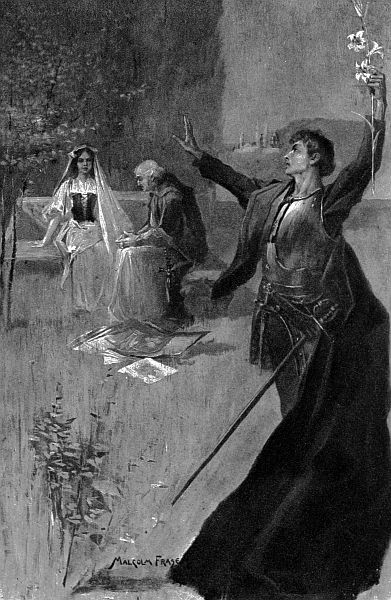
Suddenly the reveries of the two were disturbed by the
shadow of a figure which passed into the moonlight and
seemed to rise from the side of the gorge. A man enveloped
in a dark cloak with a peaked hood stepped across
the moss-grown garden parapet, stood a moment irresolute,
then the cloak dropped suddenly from him, and the cavalier
stood in the moonlight before Agnes. He bore in his
hand a tall stalk of white lily, with open blossoms and
buds and tender fluted green leaves, such as one sees in a
thousand pictures of the Annunciation. The moonlight
fell full upon his face, revealing his haughty yet beautiful
features, agitated by some profound emotion. The monk
and the girl were both too much surprised for a moment to
utter a sound; and when, after an instant, the monk made
a half-movement as if to address him, the cavalier raised
his right hand with a sudden authoritative gesture which
silenced him. Then turning toward Agnes, he kneeled,
and kissing the hem of her robe, and laying the lily in her
lap, "Holiest and dearest," he said, "oh, forget not to pray
for me!" He rose again in a moment, and, throwing his
cloak around him, sprang over the garden wall, and was
heard rapidly descending into the shadows of the gorge.
All this passed so quickly that it seemed to both the
spectators like a dream. The splendid man, with his jeweled
weapons, his haughty bearing, and air of easy command,
bowing with such solemn humility before the peasant-girl,
reminded the monk of the barbaric princes in the
wonderful legends he had read, who had been drawn by
some heavenly inspiration to come and render themselves
up to the teachings of holy virgins, chosen of the Lord, in
divine solitudes. In the poetical world in which he lived
all such marvels were possible. There were a thousand
precedents for them in that devout dreamland, "The Lives
of the Saints."
"My daughter," he said, after looking vainly down the
dark shadows upon the path of the stranger, "have you
ever seen this man before?"
"Yes, uncle; yesterday evening I saw him for the first
time, when sitting at my stand at the gate of the city. It
was at the Ave Maria; he came up there and asked my
prayers, and gave me a diamond ring for the shrine of
Saint Agnes, which I carried to the convent to-day."
"Behold, my dear daughter, the confirmation of what
I have just said to thee! It is evident that our Lady
hath endowed thee with the great grace of a beauty which
draws the soul upward towards the angels, instead of downward
to sensual things, like the beauty of worldly women.
What saith the blessed poet Dante of the beauty of the
holy Beatrice?—that it said to every man who looked on
her, 'Aspire!'2 Great is the grace, and thou must give
special praise therefor."
"I would," said Agnes, thoughtfully, "that I knew who
this stranger is, and what is his great trouble and need,—his
eyes are so full of sorrow. Giulietta said he was the
King's brother, and was called the Lord Adrian. What
sorrow can he have, or what need for the prayers of a poor
maid like me?"
"Perhaps the Lord hath pierced him with a longing
after the celestial beauty and heavenly purity of paradise,
and wounded him with a divine sorrow, as happened to
Saint Francis and to the blessed Saint Dominic," said the
monk. "Beauty is the Lord's arrow, wherewith he pierceth
to the inmost soul, with a divine longing and languishment
which find rest only in him. Hence thou seest the wounds
of love in saints are always painted by us with holy flames
ascending from them. Have good courage, sweet child,
and pray with fervor for this youth; for there be no prayers
sweeter before the throne of God than those of spotless
maidens. The Scripture saith, 'My beloved feedeth among
the lilies.'"
At this moment the sharp, decided tramp of Elsie was
heard reëntering the garden.
"Come, Agnes," she said, "it is time for you to begin
your prayers, or, the saints know, I shall not get you to
bed till midnight. I suppose prayers are a good thing,"
she added, seating herself wearily; "but if one must have
so many of them, one must get about them early. There's
reason in all things."
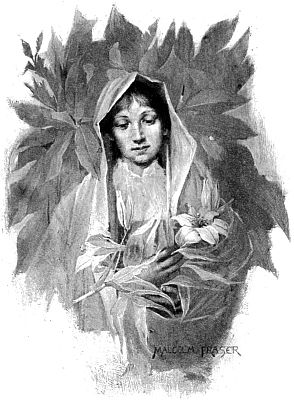
Agnes, who had been sitting abstractedly on the parapet,
with her head drooped over the lily-spray, now seemed to
collect herself. She rose up in a grave and thoughtful
manner, and, going forward to the shrine of the Madonna,
removed the flowers of the morning, and holding the vase
under the spout of the fountain, all feathered with waving
maiden-hair, filled it with fresh water, the drops falling
from it in a thousand little silver rings in the moonlight.
"I have a thought," said the monk to himself, drawing
from his girdle a pencil and hastily sketching by the moonlight.
What he drew was a fragile maiden form, sitting
with clasped hands on a mossy ruin, gazing on a spray of
white lilies which lay before her. He called it, The
Blessed Virgin pondering the Lily of the Annunciation.
"Hast thou ever reflected," he said to Agnes, "what
that lily might be like which the angel Gabriel brought to
our Lady?—for, trust me, it was no mortal flower, but
grew by the river of life. I have often meditated thereon,
that it was like unto living silver with a light in itself, like
the moon,—even as our Lord's garments in the Transfiguration,
which glistened like the snow. I have cast about
in myself by what device a painter might represent so marvelous
a flower."
"Now, brother Antonio," said Elsie, "if you begin to
talk to the child about such matters, our Lady alone knows
when we shall get to bed. I am sure I'm as good a Christian
as anybody; but, as I said, there's reason in all
things, and one cannot always be wondering and inquiring
into heavenly matters,—as to every feather in Saint Michael's
wings, and as to our Lady's girdle and shoestrings
and thimble and work-basket; and when one gets through
with our Lady, then one has it all to go over about her
mother, the blessed Saint Anne (may her name be ever
praised!). I mean no disrespect, but I am certain the
saints are reasonable folk and must see that poor folk must
live, and, in order to live, must think of something else
now and then besides them. That's my mind, brother."
"Well, well, sister," said the monk, placidly, "no doubt
you are right. There shall be no quarreling in the Lord's
vineyard; every one hath his manner and place, and you
follow the lead of the blessed Saint Martha, which is holy
and honorable."
"Honorable! I should think it might be!" said Elsie.
"I warrant me, if everything had been left to Saint Mary's
doings, our Blessed Lord and the Twelve Apostles might
have gone supperless. But it's Martha gets all the work,
and Mary all the praise."
"Quite right, quite right," said the monk, abstractedly,
while he stood out in the moonlight busily sketching the
fountain. By just such a fountain, he thought, our Lady
might have washed the clothes of the Blessed Babe. Doubtless
there was some such in the court of her dwelling, all
mossy, and with sweet waters forever singing a song of
praise therein.
Elsie was heard within the house meanwhile making
energetic commotion, rattling pots and pans, and producing
decided movements among the simple furniture of the
dwelling, probably with a view to preparing for the night's
repose of the guest.
Meanwhile Agnes, kneeling before the shrine, was going
through with great feeling and tenderness the various manuals
and movements of nightly devotion which her own
religious fervor and the zeal of her spiritual advisers had
enjoined upon her. Christianity, when it entered Italy,
came among a people every act of whose life was colored
and consecrated by symbolic and ritual acts of heathenism.
The only possible way to uproot this was in supplanting it
by Christian ritual and symbolism equally minute and pervading.
Besides, in those ages when the Christian preacher
was utterly destitute of all the help which the press now
gives in keeping under the eye of converts the great inspiring
truths of religion, it was one of the first offices of every
saint whose preaching stirred the heart of the people, to
devise symbolic forms, signs, and observances, by which
the mobile and fluid heart of the multitude might crystalize
into habits of devout remembrance. The rosary, the
crucifix, the shrine, the banner, the procession, were catechisms
and tracts invented for those who could not read,
wherein the substance of pages was condensed and gave
itself to the eye and the touch. Let us not, from the
height of our day, with the better appliances which a universal
press gives us, sneer at the homely rounds of the
ladder by which the first multitudes of the Lord's followers
climbed heavenward.
If there seemed somewhat mechanical in the number of
times which Agnes repeated the "Hail, Mary!"—in the
prescribed number of times she rose or bowed or crossed
herself or laid her forehead in low humility on the flags of
the pavement, it was redeemed by the earnest fervor which
inspired each action. However foreign to the habits of a
Northern mind or education such a mode of prayer may be,
these forms to her were all helpful and significant, her soul
was borne by them Godward,—and often, as she prayed,
it seemed to her that she could feel the dissolving of all
earthly things, and the pressing nearer and nearer of the
great cloud of witnesses who ever surround the humblest
member of Christ's mystical body.
"Sweet loving hearts around her beat,
Sweet helping hands are stirred,
And palpitates the veil between
With breathings almost heard."
Certain English writers, looking entirely from a worldly
and philosophical standpoint, are utterly at a loss to account
for the power which certain Italian women of obscure birth
came to exercise in the councils of nations merely by the
force of a mystical piety; but the Northern mind of Europe
is entirely unfitted to read and appreciate the psychological
religious phenomena of Southern races. The temperament
which in our modern days has been called the mediïstic,
and which with us is only exceptional, is more or less a
race-peculiarity of Southern climates, and gives that objectiveness
to the conception of spiritual things from which
grew up a whole ritual and a whole world of religious Art.
The Southern saints and religious artists were seers,—men
and women of that peculiar fineness and delicacy of
temperament which made them especially apt to receive
and project outward the truths of the spiritual life; they
were in that state of "divine madness" which is favorable
to the most intense conception of the poet and artist, and
something of this influence descended through all the channels
of the people.
When Agnes rose from prayer, she had a serene, exalted
expression, like one who walks with some unseen excellence
and meditates on some untold joy. As she was crossing
the court to come towards her uncle, her eye was attracted
by the sparkle of something on the ground, and, stooping,
she picked up a heart-shaped locket, curiously made of a
large amethyst, and fastened with a golden arrow. As she
pressed upon this, the locket opened and disclosed to her
view a folded paper. Her mood at this moment was so
calm and elevated that she received the incident with no
start or shiver of the nerves. To her it seemed a providential
token, which would probably bring to her some
further knowledge of this mysterious being who had been
so especially confided to her intercessions.
Agnes had learned of the Superior of the Convent the
art of reading writing, which would never have been the
birthright of the peasant-girl in her times, and the moon
had that dazzling clearness which revealed every letter.
She stood by the parapet, one hand lying in the white
blossoming alyssum which filled its marble crevices, while
she read and seriously pondered the contents of the paper.
TO AGNES
Sweet saint, sweet lady, may a sinful soul
Approach thee with an offering of love,
And lay at thy dear feet a weary heart
That loves thee, as it loveth God above?
If blessed Mary may without a stain
Receive the love of sinners most defiled,
If the fair saints that walk with her in white
Refuse not love from earth's most guilty child,
Shouldst thou, sweet lady, then that love deny
Which all-unworthy at thy feet is laid?
Ah, gentlest angel, be not more severe
Than the dear heavens unto a loving prayer!
Howe'er unworthily that prayer be said,
Let thine acceptance be like that on high!
There might have been times in Agnes's life when the
reception of this note would have astonished and perplexed
her; but the whole strain of thought and conversation this
evening had been in exalted and poetical regions, and the
soft stillness of the hour, the wonderful calmness and clearness
of the moonlight, all seemed in unison with the strange
incident that had occurred, and with the still stranger tenor
of the paper. The soft melancholy, half-religious tone of
it was in accordance with the whole undercurrent of her
life, and prevented that start of alarm which any homage
of a more worldly form might have excited. It is not to
be wondered at, therefore, that she read it many times with
pauses and intervals of deep thought, and then with a
movement of natural and girlish curiosity examined the rich
jewel which had enclosed it. At last, seeming to collect
her thoughts, she folded the paper and replaced it in its
sparkling casket, and, unlocking the door of the shrine,
laid the gem with its enclosure beneath the lily-spray, as
another offering to the Madonna. "Dear Mother," she
said, "if indeed it be so, may he rise from loving me to
loving thee and thy dear Son, who is Lord of all! Amen!"
Thus praying, she locked the door and turned thoughtfully
to her repose, leaving the monk pacing up and down in the
moonlit garden.
Meanwhile the cavalier was standing on the velvet mossy
bridge which spanned the stream at the bottom of the
gorge, watching the play of moonbeams on layer after layer
of tremulous silver foliage in the clefts of the black, rocky
walls on either side. The moon rode so high in the deep
violet-colored sky, that her beams came down almost vertically,
making green and translucent the leaves through
which they passed, and throwing strongly marked shadows
here and there on the flower-embroidered moss of the old
bridge. There was that solemn, plaintive stillness in the
air which makes the least sound—the hum of an insect's
wing, the cracking of a twig, the patter of falling water—so
distinct and impressive.
It needs not to be explained how the cavalier, following
the steps of Agnes and her grandmother at a distance, had
threaded the path by which they ascended to their little
sheltered nook,—how he had lingered within hearing of
Agnes's voice, and, moving among the surrounding rocks
and trees, and drawing nearer and nearer as evening shadows
drew on, had listened to the conversation, hoping that
some unexpected chance might gain him a moment's speech
with his enchantress.
The reader will have gathered from the preceding chapter
that the conception which Agnes had formed as to the
real position of her admirer from the reports of Giulietta
was false, and that in reality he was not Lord Adrian, the
brother of the King, but an outcast and landless representative
of one branch of an ancient and noble Roman family,
whose estates had been confiscated and whose relations had
been murdered, to satisfy the boundless rapacity of Cæsar
Borgia, the infamous favorite of the notorious Alexander
VI.
The natural temperament of Agostino Sarelli had been
rather that of the poet and artist than of the warrior. In
the beautiful gardens of his ancestral home it had been his
delight to muse over the pages of Dante; to sing to the
lute, and to write, in the facile flowing rhyme of his native
Italian, the fancies of the dreamland of his youth.
He was the younger brother of the family,—the favorite
son and companion of his mother, who, being of a tender
and religious nature, had brought him up in habits of
the most implicit reverence and devotion for the institutions
of his fathers.
The storm which swept over his house, and blasted all
his worldly prospects, blasted, too, and withered all those
religious hopes and beliefs by which alone sensitive and
affectionate natures can be healed of the wounds of adversity
without leaving distortion or scar. For his house had
been overthrown, his elder brother cruelly and treacherously
murdered, himself and his retainers robbed and cast
out, by a man who had the entire sanction and support of
the Head of the Christian Church, the Vicar of Christ on
Earth. So said the current belief of his times,—the faith
in which his sainted mother died; and the difficulty with
which a man breaks away from such ties is in exact proportion
to the refinement and elevation of his nature.
In the mind of our young nobleman there was a double
current. He was a Roman, and the traditions of his house
went back to the time of Mutius Scævola; and his old
nurse had often told him that grand story of how the
young hero stood with his right hand in the fire rather
than betray his honor. If the legends of Rome's ancient
heroes cause the pulses of colder climes and alien races to
throb with sympathetic heroism, what must their power be
to one who says, "These were my fathers"? Agostino
read Plutarch, and thought, "I, too, am a Roman!" and
then he looked on the power that held sway over the
Tarpeian Rock and the halls of the old "Sanctus Senatus,"
and asked himself, "By what right does it hold these?"
He knew full well that in the popular belief all those
hardy and virtuous old Romans whose deeds of heroism so
transported him were burning in hell for the crime of having
been born before Christ; and he asked himself, as he
looked on the horrible and unnatural luxury and vice which
defiled the Papal chair and ran riot through every ecclesiastical
order, whether such men, without faith, without conscience,
and without even decency, were indeed the only
authorized successors of Christ and his Apostles?
To us, of course, from our modern standpoint, the question
has an easy solution,—but not so in those days, when
the Christianity of the known world was in the Romish
church, and when the choice seemed to be between that
and infidelity. Not yet had Luther flared aloft the bold,
cheery torch which showed the faithful how to disentangle
Christianity from Ecclesiasticism. Luther in those days
was a star lying low in the gray horizon of a yet unawakened
dawn.
All through Italy at this time there was the restless
throbbing and pulsating, the aimless outreach of the popular
heart, which marks the decline of one cycle of religious
faith and calls for some great awakening and renewal.
Savonarola, the priest and prophet of this dumb desire, was
beginning to heave a great heart of conflict towards that
mighty struggle with the vices and immoralities of his time
in which he was yet to sink a martyr; and even now his
course was beginning to be obstructed by the full energy
of the whole aroused serpent brood which hissed and
knotted in the holy places of Rome.
Here, then, was our Agostino, with a nature intensely
fervent and poetic, every fibre of whose soul and nervous
system had been from childhood skillfully woven and intertwined
with the ritual and faith of his fathers, yearning
towards the grave of his mother, yearning towards the
legends of saints and angels with which she had lulled his
cradle slumbers and sanctified his childhood's pillow, and
yet burning with the indignation of a whole line of old
Roman ancestors against an injustice and oppression wrought
under the full approbation of the head of that religion.
Half his nature was all the while battling the other half.
Would he be Roman, or would he be Christian? All the
Roman in him said "No!" when he thought of submission
to the patent and open injustice and fiendish tyranny
which had disinherited him, slain his kindred, and held
its impure reign by torture and by blood. He looked on
the splendid snow-crowned mountains whose old silver
senate engirdles Rome with an eternal and silent majesty
of presence, and he thought how often in ancient times
they had been a shelter to free blood that would not endure
oppression; and so gathering to his banner the crushed
and scattered retainers of his father's house, and offering
refuge and protection to multitudes of others whom the
crimes and rapacities of the Borgias had stripped of possessions
and means of support, he fled to a fastness in the
mountains between Rome and Naples, and became an independent
chieftain, living by his sword.
The rapacity, cruelty, and misgovernment of the various
regular authorities of Italy at this time made brigandage a
respectable and honored institution in the eyes of the people,
though it was ostensibly banned both by Pope and
Prince. Besides, in the multitude of contending factions
which were every day wrangling for supremacy, it soon
became apparent, even to the ruling authorities, that a
band of fighting men under a gallant leader, advantageously
posted in the mountains and understanding all their passes,
was a power of no small importance to be employed on one
side or the other; and therefore it happened, that, though
nominally outlawed or excommunicated, they were secretly
protected on both sides, with a view to securing their assistance
in critical turns of affairs.
Among the common people of the towns and villages
their relations were of the most comfortable kind, their
depredations being chiefly confined to the rich and prosperous,
who, as they wrung their wealth out of the people,
were not considered particular objects of compassion when
the same kind of high-handed treatment was extended
toward themselves.
The most spirited and brave of the young peasantry, if
they wished to secure the smiles of the girls of their neighborhood,
and win hearts past redemption, found no surer
avenue to favor than in joining the brigands. The leaders
of these bands sometimes piqued themselves on elegant
tastes and accomplishments; and one of them is said to
have sent to the poet Tasso, in his misfortunes and exile,
an offer of honorable asylum and protection in his mountain
fortress.
Agostino Sarelli saw himself, in fact, a powerful chief,
and there were times when the splendid scenery of his
mountain fastness, its inspiring air, its wild eagle-like grandeur,
independence, and security, gave him a proud contentment,
and he looked at his sword and loved it as a
bride. But then again there were moods in which he felt
all that yearning and disquiet of soul which the man of
wide and tender moral organization must feel who has had
his faith shaken in the religion of his fathers. To such a
man the quarrel with his childhood's faith is a never-ending
anguish; especially is it so with a religion so objective,
so pictorial, and so interwoven with the whole physical and
nervous nature of man, as that which grew up and flowered
in modern Italy.
Agostino was like a man who lives in an eternal struggle
of self-justification,—his reason forever going over and
over with its plea before his regretful and never-satisfied
heart, which was drawn every hour of the day by some
chain of memory towards the faith whose visible administrators
he detested with the whole force of his moral being.
When the vesper-bell, with its plaintive call, rose amid
the purple shadows of the olive-silvered mountains,—when
the distant voices of chanting priest and choir reached him
solemnly from afar,—when he looked into a church with
its cloudy pictures of angels, and its window-panes flaming
with venerable forms of saints and martyrs,—it roused a
yearning anguish, a pain and conflict, which all the efforts
of his reason could not subdue. How to be a Christian
and yet defy the authorized Head of the Christian Church,
or how to be a Christian and recognize foul men of obscene
and rapacious deeds as Christ's representatives, was the inextricable
Gordian knot, which his sword could not divide.
He dared not approach the Sacrament, he dared not pray,
and sometimes he felt wild impulses to tread down in riotous
despair every fragment of a religious belief which
seemed to live in his heart only to torture him. He had
heard priests scoff over the wafer they consecrated,—he
had known them to mingle poison for rivals in the sacramental
wine,—and yet God had kept silence and not
struck them dead; and like the Psalmist of old he said,
"Verily, I have cleansed my heart in vain, and washed
my hands in innocency. Is there a God that judgeth in
the earth?"
The first time he saw Agnes bending like a flower in the
slanting evening sunbeams by the old gate of Sorrento,
while he stood looking down the kneeling street and striving
to hold his own soul in the sarcastic calm of utter
indifference, he felt himself struck to the heart by an influence
he could not define. The sight of that young face,
with its clear, beautiful lines, and its tender fervor, recalled
a thousand influences of the happiest and purest hours of
his life, and drew him with an attraction he vainly strove
to hide under an air of mocking gallantry.
When she looked him in the face with such grave, surprised
eyes of innocent confidence, and promised to pray
for him, he felt a remorseful tenderness as if he had
profaned a shrine. All that was passionate, poetic, and
romantic in his nature was awakened to blend itself in a
strange mingling of despairing sadness and of tender veneration
about this sweet image of perfect purity and faith.
Never does love strike so deep and immediate a root as in
a sorrowful and desolated nature; there it has nothing to
dispute the soil, and soon fills it with its interlacing fibres.
In this case it was not merely Agnes that he sighed for,
but she stood to him as the fair symbol of that life-peace,
that rest of soul which he had lost, it seemed to him, forever.
"Behold this pure, believing child," he said to himself,—"a
true member of that blessed Church to which thou
art a rebel! How peacefully this lamb walketh the old
ways trodden by saints and martyrs, while thou art an infidel
and unbeliever!" And then a stern voice within
him answered, "What then? Is the Holy Ghost indeed
alone dispensed through the medium of Alexander and his
scarlet crew of cardinals? Hath the power to bind and
loose in Christ's Church been indeed given to whoever can
buy it with the wages of robbery and oppression? Why
does every prayer and pious word of the faithful reproach
me? Why is God silent? Or is there any God? Oh,
Agnes, Agnes! dear lily! fair lamb! lead a sinner into the
green pastures where thou restest!"
So wrestled the strong nature, tempest-tossed in its
strength,—so slept the trustful, blessed in its trust,—then
in Italy, as now in all lands.