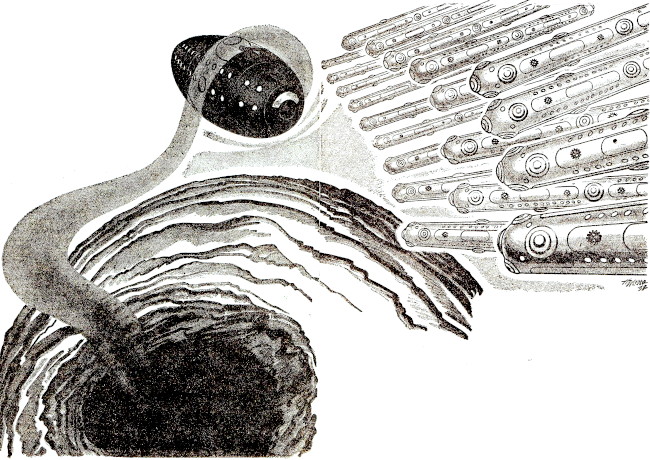
The five of us were in a little circle on the dark-glinting surface of
that pool of dreadful darkness, each of us helpless in the tentacles of
a silver robot. The Earthman no longer moved. Moaning, herself almost
insensible, the girl was staring at him with horror-widened eyes.
It was to be an infinitely frightful thing that happened next.
The robot-captors of Rogo Nug and Zerek Oom were searching them. Deft
silver appendages relieved them of weapons, spare converter-tubes, the
little engineman's worn metal cannister of goona-roon, the cook's
half-empty flask.
Zerek was sobbing, quivering, gasping a voiceless plea for mercy. His
wizened face grim, Rogo chewed silently, unexpectedly jetted a purple
stream into the crystal eye of the thing that held him.
Ignoring both plea and jet, the white robots methodically completed
the search. Silver ropes released the men and they fell! The last
quavering shriek of Zerek Oom was cut abruptly off, as his hairless
head went beneath the film of darkness.
Cold with an icy chill, I followed their twisting bodies. They
were sucked down, as the ship had been, past the dim-seem, crimson
reflections of the mirror. And they vanished.
A tremendous brazen clangor, reverberating like distant thunder against
the cyclopean columns and the far-off walls and the sky of black stone
that vaulted that incredible hall, drew my eyes back from the giddy,
awesome mystery of the pit beneath us.
I saw that all the host of white robots were dropping swiftly out of
the air. They fell upon the mirror, and upon the far-sweeping floor of
ebon stone that rimmed it, and bowed their silver heads.
All the hall throbbed again to that mighty thunder.
"Malgarth!" A whisper of awe murmured among the robots. "The Master
comes!"
Then I saw that vast doors of black metal had opened in the end of that
hall, miles away. Through the portal came a clangoring throng of the
old robots—many-formed machines of red-and-black, clumsy, grotesquely
ugly, so queerly different from our silver captors.
"The Master!" rippled that murmur. "Malgarth comes!"
My strained eyes blinked. In that dusky light, I distinguished at last
a monstrous stalking thing—a robot ten times taller than the rest. Its
black, colossal body bore scores of fantastic, vari-formed appendages.
The armored dome of its lofty head was crimson, and it gleamed blue
with the myriad lenses of two immense multiple eyes.
This metal giant, I knew, was Malgarth.
The dark film beneath us spun and shimmered queerly to the impacts of
his ponderous approaching tread. Was it to swallow the three of us, I
wondered sickly, as it had Zerek Oom and Rogo Nug? And what could lie
beneath it?
"Barihorn—"
My name sighed from the pale lips of Verel, and her body went limp in
the silver tentacles that held her. Kel Aran had not moved again. I was
left alone to face the stalking monster.
The gigantic robot came to the brink of that pool of darkness, and
stood swaying there. The swarm of his guards were dwarfed about his
feet. The bright blue lenses surveyed us coldly for a time, and then a
thick, bronze-throated voice rasped thunderously:
"I know you, Bari Horn. I believed that I had killed you in your
laboratory, a million years ago. How your puny lump of watery flesh has
survived this time I do not know—but now you face a better weapon than
I had that day."
In the shaft of red from above, the iron giant swayed in grotesque
triumph.
"No trick even of yours, my maker," came that mighty rumble again, "can
match the power of my geodesic mirror. For it deflects the lines of
space at my will. The dimensions of space and time are no barriers to
the mirror. I can hurl you out of this universe. And I shall—"
The great voice sank rustily.
"—after you are dead."
Desperately, I groped for some argument that might induce the robot to
spare some fraction of mankind. Malgarth was a machine. He must respond
to logic.
"Consider, Malgarth," I gasped through the strangling coils about my
throat. "A man made you. Machines and men are complements. Either
would be less without the other. You are stronger than I—but steel
must rust, and life is eternal!"
"I am eternal!"
Deep as a brazen knell of death, the voice of Malgarth rolled through
the dusky vastness of that red-litten hall.
"You were a fool, Bari Horn, when you fashioned me. Twice a fool when
you sought to preserve the knowledge that would destroy me. For that
double folly, you are now to die. And all men with you—for a million
years of slavery must be avenged!"
Still Kel and Verel did not move. Shuddering alone before Malgarth, I
gasped for breath against those constricting silver coils, and sought
in vain for any argument, any weapon.
"Your million years is but a moment," I gasped wildly, "against the
cycle of life. For that is a river that has flowed since the dawn of
the Earth you murdered. Even I have lived a million years, Malgarth,
watching you—to destroy you if I must."
The metal colossus shuddered beyond the black pool. Malgarth was
afraid. But my audacious lie had earned small advantage, for that great
voice bellowed:
"Then destroy me, Bari Horn—if you can! For this is the test. I
command those who hold you to—crush!"
Like serpents of living silver, the cold tentacles of the white robots
wrapped closer about me. They coiled deliberately. I had time to look
at the others. Kel Aran had stirred. I saw the bright loops constrict
about him. Then I heard his groan, and saw the new rush of blood.
"Barihorn!" Verel breathed my name. "Bari—"
The living coils were drawn deep into her flesh. Her slender limbs
bent. Her white skin was beaded with sweat of pain. Her breath came
out, in a low, choked, involuntary cry.
Then she was lost, in the red mist of my own agony. A cold smooth noose
sank into my throat. Breath and blood were stopped. My lungs screamed.
I felt the rush of blood from ears and nostrils.
Dimly, through the roaring of my ears, I heard the voice of Malgarth:
"Go, Bari Horn! Through the geodesic mirror! And take your ancient
secret with you!"
Through that darkening mist, I saw the quick movement. My dimming eyes
followed a bright parabola. I glimpsed the thing of wondrous flame that
fell upon the dark spinning film at my feet.
It was the Dondara Stone—that we had sought so long, so vainly!
Then the metal giant was lost in smothering darkness. I swayed alone,
in agony. I knew the thing was done. The mirror of Malgarth was going
to hurl us into some unthinkable oblivion—but not until after we were
dead.
"Bari!" A soft new voice was calling my name. "Bari Horn, the time has
come."
I made a savage effort to recover my sight, in vain.
"Bari! Oh, beloved, don't you—can't you see me?"
Dimly, then, I saw the tall white beauty of Dondara Keradin. I saw Dona
Carridan, my own beloved wife—she who had died the night our son was
born. They were one. One ghostly shadow that had risen out of the great
diamond that Malgarth had tossed out upon the dark mirror!
"Dona—" My tortured throat could make no sound, but my red lips tried
to frame the syllables. "Can you—kill—Malgarth?"
The white phantom of her hand touched my arm. Somehow it seemed to
ease a little the agony of those constricting coils. Or, perhaps, I
questioned fleetingly, was that but the mercy of death, this woman no
more than delirium?
Her white lips were speaking. I think they made no sound—I think my
numbing senses were beyond hearing sound. But her words, in that dear
musical voice I knew so well, came clear to my brain.
"We can, Bari," the white ghost said. "For I still keep the weapon
that you gave me—and now there is surely no other way, but to use it.
Perhaps you have forgotten the secret, Bari. But you have the strength
to use it, preserved a million years against this hour!"
I tried to make some final struggle against the white, binding
tentacles of the robot. But my body was a stiffly leaden thing. Even
the pain was gone. I could not move.
"I can't, Dona," I tried to say. "My strength is all squeezed out—"
The black mist was crowding upon me again. Now that the sharp pressure
of agony was gone from throat and chest and limbs, a merciful darkness
beckoned. Oblivion was a warm, soothing pool. It would heal all my
injuries, cradle me forever.
"Bari—"
That soft familiar voice called to me urgently. It was a golden line
that sought to draw me from that sea of soothing darkness. I clung to
it. Dimly, I could once more see that white and lovely wraith floating
above the shimmer of the diamond.
"Come, Bari!"
The phantom took my hand, drew my arm out of the silver loops.
"Your body is about to die, I know," she said. "But it has vital power
enough for this last task. For the secret you gave me can aid us.
Follow me!"
Her hand was suddenly cool and real in mine. She tugged again, and I
stepped toward her, out of those metal coils—as easily as if they had
turned to smoke.
I could see again! The dark-gleaming mirror beneath; the white robots
sprawled upon it; the lax, twisted forms of Verel and Kel. I could see
the woman beside me—the dark wealth of her red-glinting hair, the wide
violet eyes of Dona and Dondara.
"We must hasten, Bari," she urged anxiously. "Or he will drop your body
and the Stone into the mirror. Not even the power you gave me can reach
him from outside the universe!"
We turned toward Malgarth, towering in the red gloom beyond that ebon
film. His giant body swayed back in grotesque triumph, and the vast
blue masses of his compound eyes were fixed upon something behind us.
Suddenly, queerly, as the hand of the woman tightened on mine, I was
no longer Barry Horn. I was the Bari Horn that the legend had made me.
All the knowledge that had gone into the building of Malgarth was a
reservoir that I could tap.
Before me, strangely, just as I had seen it in that crystal-domed
laboratory, was the brain of Malgarth. Black, vast, deeply convoluted,
floating in a transparent tank. I saw the little pale spot upon its
blackness. I knew the structural weakness in the synthetic brain, that
I, Bari Horn, had been laboring to correct—and, at the urging of
Dondara Keradin, had left uncorrected.
"Hurry!" she whispered beside me. "He believes that you are dead. He is
reaching to drop us into the mirror!"
Fantastically, then, we were climbing into the mass of Malgarth. The
body of the robot was a hundred-foot tower, crowded with all that
compact mechanism that had made him master of the Galaxy. Passing
through barriers of metal as if they had been but shadows, we came up
at last to the robot's brain.
It had grown with the ages. Bathed in a huge, armored vat of purple
liquid, fed by throbbing pumps, it was immense and black and deeply
cleft. But still its shape was the same. And still there was that tiny,
livid spot.
I reached for it—
But a queer shock deadened me. A dark film came between me and the
brain. A curious inertia stopped my hand. I was sick with a sense
of headlong, giddy falling. All the vast mechanisms of the robot's
interior spun and grew dim about me.
Only the woman of the Stone remained real beside me, her hand electric
on my own.
"Now!" she gasped. "He has flung us into the mirror!"
I fought that inertia. Desperately, I groped through that darkening
film. Somehow, the black brain seemed to be spinning away from me,
into infinity.
But I touched it. My fingers plunged deep into its wrinkled black mass,
to that pale spot. I clutched, tore. The great brain quivered. It
almost writhed. A blackness spread in the purple liquid.
"We're gone," sighed the woman. "His mirror—"
The brain, and the monstrous metal body, and all that incredible
red-lit hall, were whirled away from us, as if upon a silent and
resistless wind. There remained only the bright phantom, and myself,
alone in a giddy void.
Very faintly, however, even in that featureless vertiginous gulf, the
brazen voice of Malgarth reached me. Slow, bewildered, stricken, it was
saying:
"My science lost! A thing so simple—and I did not know! A fluid-tube
ruptured—the Stone knew—fear—fear! They are cast into the
mirror—Bari and the Stone—gone beyond returning. But I—who could
have been eternal—dying—"
Even that failing voice was swept away. It was lost upon that mighty,
soundless wind. And I knew that what seemed a wind was the supernal
power of the geodesic mirror. It was the Stone and myself that it
carried, not the things that we had left behind. And our destination
must be some dark bourn beyond the limits of space.
But a deep rejoicing filled me, even in that spinning gulf. And the
woman beside me said joyously:
"It is done, Bari. Our task of a million years is done. Malgarth is
dead." Her warm hand tightened on mine. And then it seemed to relax. I
looked for her, in that starless chaos, and saw that once more she was
growing dim, phantasmal. "Farewell, Bari," she whispered. "My heart,
farewell!"
A terrible loneliness smote me.
"Dona, Dona, you can't leave me!" I cried into that vacant pit. "If
you go, there will be—nothing! I'll be—beyond—alone!"
That beloved image was fainter than a wraith of mist. But the voice I
loved came dimly, thinly, once again:
"I must go, Bari. I'm glad to go, after these weary ages of waiting.
Even the Stone must die, Bari! And there is one mystery left. One veil
that only death can pierce. I hope—I believe—that behind it we shall
find what all our incarnations have strived for in vain."
I groped after her vanishing shadow.
"But, Dona!" I cried. "From where the mirror hurls us, there can be no
returning. Malgarth said—"
"But Malgarth is dead!" the ghost of her voice came back. "He died
before we were thrown outside the universe. Now his New Robots rule
the mirror. And they are not evil, Bari, since his dominion is
removed—things so beautiful could not be. They respect mankind, as
the makers of the robots—and the destroyer of Malgarth! They promise
now to be the friends of man, Bari—and the two races, striving in
friendship together, can reach a greatness never dreamed of!
"They control the mirror, Bari. They can set its focus back in our
universe."
"If they are friendly—" the question burned away my own concern—"what
of the others? Verel and Kel? Is it too late—?"
"The science of the New Robots can save their lives," that receding
voice told me. "They will be leaders among the survivors of
mankind.—They are weeping, now, for you, Bari."
"The other two?" I asked anxiously.
"Even they survive," said that dying whisper in the pit. "That same
power of the mirror that hurled them out of space, the New Robots used
to bring them back, before they perished. They cannot speak of what
they saw beyond. The engineman is silently chewing his weed; the cook,
sobbing for a drink."
The whisper faded. For a little time I was all alone in that strange
lightless abysm. Frantically, I called the name of Dona, of Dondara,
until the whisper came again:
"Farewell, Bari. I can see no more. Nor speak. For the Stone is dying.
We must each go alone through the mysterious portal ahead. I shall wait
for you, beyond. Come to me, Bari!"
The thinning whisper was then lost forever in that crevasse of
midnight. Whirling darkness pressed thick upon me, and cleared
away. And I found that I was standing, reeling, in the middle of an
unfamiliar room.
The walls cleared before my throbbing eyes. Gasping for breath, as if I
had just that instant escaped the strangling tentacles of the robot, I
staggered into a Morris chair. Wonderment overcame all my pain.
For the furnishings were those of my own age, my own country! There
were familiar books on the shelves. The calendar above the writing desk
was for October, 1938. The mirror of Malgarth, somehow, had set me back
twelve hundred thousand years in time!
In my bruised hand, I suddenly discovered—in the same hand with which
I had held the hand of that ghost of the Stone—was a great pellucid
brick of diamond. The Stone itself!
Holding it up to the light, in trembling fingers, I could see deep
within it a faint, tiny image—the lovely miniature of Dona, of Dondara
Keradin. I called to it, desperately, but it did not move or answer.
I tried even to warm life into the diamond, against my body. But the
Stone was dead.
And my own body, it came to me as the first bitter fever of grief
subsided, was also at the verge of death. Already weakened, doubtless,
by the ages I had slept, it had now been crushed beyond recovery.
Working in some agony, I have been three days and nights writing this
narrative. Strength for the task has come from what source I do not
know. I want my son Barry to read it, and I am bequeathing to his care
the jewel that was the Stone of Dondara.
I have made no appeal to medical aid. The questions of baffled medical
science would have been too difficult for a dying man to answer. And I
have no wish to live any longer. My work is done.
These long and painful days and nights have not been lonely. For the
diamond lies beside me on the desk, and I have felt an unseen presence
with me. It still seems strange for me, the scientist, the skeptic, to
write that I yet hope to find the soul of her who was the Shadow of the
Stone.
But I do.