The cover image was created by the transcriber and is placed in the public domain.
By WHITELAW REID.
PUBLISHERS:
MOORE, WILSTACH & BALDWIN,
25 West Fourth Street, Cincinnati.
New York, 60 Walker Street.
LONDON:
SAMPSON LOW, SON & CO.
1866.
Entered according to Act of Congress, in the year 1866, by
MOORE, WILSTACH & BALDWIN,
In the Clerk’s Office of the District Court of the United States for the Southern District of Ohio.
PREFACE.
iii
With the exception of the unhealthy summer months, I spent the
greater part of the year following the close of the Rebellion, in traveling
through the late Rebel States, passing first around their entire
coast line; and, on subsequent trips, crossing by various routes
through the interior.
I have sought, in the following pages, to show something of the
condition in which the war left the South, the feelings of the late
insurgents, the situation and capacities of the liberated slaves,
and the openings offered, under the changed condition of affairs,
to capital and industry from without.
A couple of months, this spring, spent on the great cotton plantations
of the Mississippi Valley, enabled me to make a closer study
of the character of the average plantation negro than tourists have
ordinarily found practicable; and the concluding chapters are
mainly devoted to these observations.
A further word of explanation may be needed as to the part of
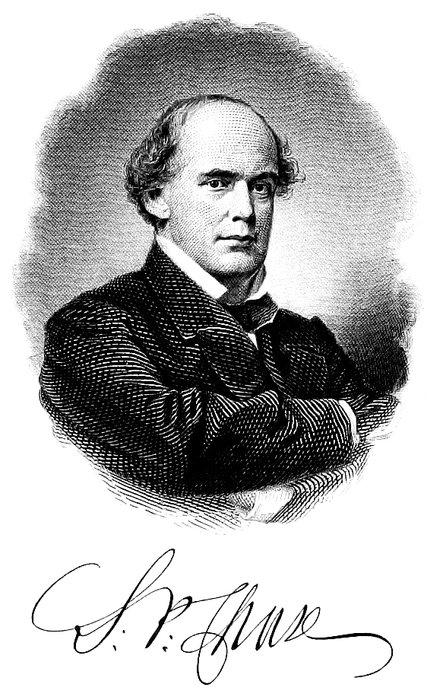
the volume describing the journey of Mr. Chief-Justice Chase.
After the inauguration of President Johnson, Mr. Chase determined
to visit the Southern cities, to learn as much as possible,
from actual observation, of the true condition of the country. The
Secretary of the Treasury was then about to send a revenue cutter
to the New Orleans station, and on board of her a special agent,
charged with the duty of examining the agencies, and carrying
ivinto effect the directions of the Department in the several
South Atlantic and Gulf ports. He tendered the use of this vessel
to the Chief-Justice, and orders were issued by the President
and the Secretaries of War and of the Navy, to the officers in the
naval, military, and civil services to afford him all facilities that
their respective duties would allow.
It was under these circumstances that the Chief-Justice made his
Southern journey. He had the best opportunities of information,
and communicated his views, from time to time, to the President.
As a member of the party on board the cutter, I thus enjoyed considerable,
though, in some respects, more limited opportunities of
observation.
A small portion of the material in the following pages has previously
appeared in the journal with which I was connected, but
it has all been rewritten.
The most interesting records of the great revolution
just ending have seemed to me to be those portraying
the spirit and bearing of the people throughout the
South, just before and at the outbreak of the war. Stories
of battles, and sieges, and retreats, are kaleidoscopic
repetitions of deeds with which all history is crowded;
but with what temper great communities plunged into
this war, which has overwhelmed them, for what fancied
causes, to what end, in what boundless self-confidence
and overwhelming contempt of their antagonists,
with what exuberance of frenzied joy at the prospect of
bloodshed, with what wild dreams of conquest, and
assurance of ill-defined but very grand honors, and orders,
and social dignities—all this, as faithfully set
down by the few who had opportunities to observe it,
constitutes the strangest and most absorbing contribution
to the literature of the Rebellion.
So I have thought that what men now most want to
know, is something of the temper and condition in which
these same communities come out from the struggle.
10By the side of the daguerreotypes of the South entering
upon the war, even the hastiest pencil sketch of the
South emerging from the war may possess an interest
and attraction of its own.
Therefore, when early in the month of April I was
invited to accompany a small party, bound on a voyage
of official inspection and observation, from Fortress
Monroe around the whole Atlantic and Gulf Coast to
New Orleans, and thence up the Mississippi, I congratulated
myself upon the opportunity thus afforded of seeing,
under the most favorable circumstances, the Southern
centers which had nursed and fed the rebellion.
Means of communication through the interior of the
South are so thoroughly destroyed, and Southern society
is so completely disorganized, that it is only in the cities
one can hope for any satisfactory view of the people.
Even there the overshadowing military authority, and
the absence of all accustomed or recognized modes of
expressing public sentiment, as through the press, the
bar, public meetings, the pulpit, or unrestrained social
intercourse, combine to render the task of observation
infinitely more difficult than at any previous period.
But all the more, on these accounts, the Southern
cities are the places to which we must first look for any
satisfactory idea of the Southern condition; and a trip
which embraces visits to Norfolk, Newbern, Beaufort,
Wilmington, Charleston, Port Royal, Savannah, Fernandina,
St. Augustine, Jacksonville, Key West, Mobile,
New Orleans, Baton Rouge, Natchez, Vicksburg,
and Memphis, with visits to plantations all along the
route, and occasional trips into the interior, ought not to
fail in furnishing a good view of the gradual beginnings
to crystallize again out of the chaos to which the war had
reduced one-third of the nation.
11The trip would have been begun some weeks earlier,
but for the deed of horror in Ford’s Theater. But, as
Secretary McCulloch well said, the wheels of Government
moved on without a perceptible jar; and the arrangements
of President Lincoln were only temporarily
delayed by the accession of President Johnson. An
ocean-going revenue cutter was ordered around from
New York to Fortress Monroe for the party, and early
on the morning of the first of May, the cutter “Northerner”
was announced as in readiness to convey us to
the Fortress.
In the afternoon an officer was good enough to bring
me the following:
Executive Mansion, Washington, May 1, 1865.
Permission is granted Whitelaw Reid, Esq., to proceed by sea to
New Orleans, Louisiana, and return by sea or inland to Washington,
District of Columbia, and to visit any port or place en route in
the lines of national military occupation.
[Signed,] ANDREW JOHNSON,
President of the United States.
I had not supposed a pass necessary; but as the rest
of the party went on official business, it had been thought
best to cover my case with a document, about the scope
and authority of which no question could be raised.
At that time passes to visit many of the Southern points
were still eagerly sought and procured with difficulty.
The War Department was the place to which, in general,
application was to be made, and the speculative
gentry who mostly wanted such favors, stood in wholesome
awe of the downright Secretary. A pass so nearly
unlimited as mine was an unheard of rarity, and before
the afternoon was over, two or three who had in some
way found out that I had it, were anxious to know if
“five hundred or even a thousand dollars would be any
inducement” to me to part with it!
12By nine in the evening the last of the little party had
entered the cozy cabin of the “Northerner.” There were
the usual good-byes to the friends who had driven down
to the Navy Yard wharf to see us off; playful injunctions
from young officers about laying in supplies of
cigars at Havana, and from fair ladies about bringing
back for them parrots and monkeys, pine apples and
bananas; some consultations among the officials of the
party; some final messages and instructions sent down
at the last moment by the Government: then fresh
good-byes; the plank was pulled in, and we steamed
out into the darkness.
Everybody compared supplies with everybody else;
it was found that there were books enough in the party
to set up a circulating library, and paper enough for
writing a three-volume novel; the latest dates of newspapers
had been laid in; the last issues of the magazines,
and even a fresh number of the old North American
were forthcoming; while Napoleon’s Cæsar, in all
the glory of tinted paper and superb letter-press, formed
the pièce de résistance that bade fair to master us all—as
Horace Greeley used maliciously to say the old National
Intelligencer mastered him, when he couldn’t get asleep
in any other way!
CHAPTER II. A School of Unadulterated Negroes—An Ancient Virginia Town under the Dispensation of Sutlers.
13
Our steamer for the voyage was to be the revenue
cutter “Wayanda,” a trim, beautifully-modeled, ocean-going
propeller, carrying six guns, and manned with
a capital crew. While Captain Merryman was making
his final preparation for a cruise, much longer than he
had expected when the telegraph hurried his vessel
around from New York, we retained the little “Northerner”
for a trip up to Norfolk—only delaying long
enough at the Fortress to drive out and see a great
negro school, established by General Butler.
The wharves were crowded by the usual curious
throng of idle spectators, laborers taking care of supplies,
soldiers on duty, and a very sparse sprinkling of
ladies. Rebel soldiers by scores were mixed in the
groups, or could be seen trudging along the sidewalks
toward the Commissary’s.
Everywhere were negroes—on the sidewalks—driving
the wagons—in the huts that lined the road. All
the slaves of the adjoining counties seem to have established
themselves at the Fortress. As we crossed the
long, narrow isthmus, contracting at last to an attenuated
causeway, which separates the Fortress from
the main land, and came out into the ancient village
of Hampton, the negro huts thickened into swarms,
and fairly covered the sites of the old aristocratic
14residences which the Rebels fired early in the war
when compelled to evacuate the place. Bricks, two
centuries old, imported by the early colonists from
Great Britain, for the mansions of the first families,
were built up into little outside chimneys for these
cabins of the Freedmen; and here and there one
noticed an antique Elizabethan chair, of like age and
origin, converted to the uses of a portly negress.
To our right, down on the water’s edge, rose a high,
narrow residence—the former home of John Tyler;
near it was another, somewhat less pretentious, as well
as less uncouth, which had formerly been occupied by
S. R. Mallory. Both find loyal and benevolent uses
now at the hands of the Government. Near them was
a long colonnade, with spacious piazzas, fronting a
many-windowed brick hospital, which one of our party
was observed closely scrutinizing. “Upon my word,”
he exclaimed, after a moment’s reflection, “that is the
old Chesapeake Female College, of which I have been,
from the foundation, one of the Trustees.” Pale-faced
men in blue occupied the chambers of the boarding-school
misses; and sentries, pacing to and fro, kept a
stricter guard than strictest duenna of boarding-school
ever achieved.
To our left extended a stretch of marshy meadows
and half-cultivated fields. In their midst was one
little field cultivated above all the rest. White boards,
with a trifle of modest lettering on each, dotted its surface,
and the grass grew greenest over long, carefully-smoothed
hillocks. A file of slow-paced soldiers, with
arms reversed, was entering the inclosure; behind them
followed an army wagon, with five rude pine boxes piled
upon it; beyond, quietly, and, as one loved to think,
even sadly, regarding the scene, was a group of paroled
15Rebel soldiers; while, as we turned, in passing, to catch
a last glimpse of the mourners in blue by the open
graves, there was seen away behind us, rippling in the
breeze above the fort, the old flag for which these dead
had died, and against which these Rebels had fought.
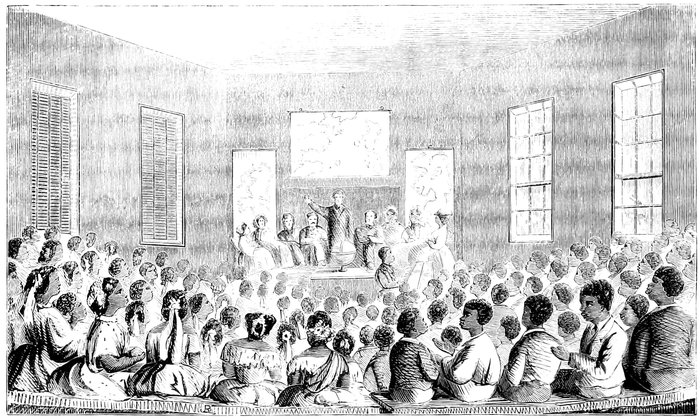
We found the school-house (a barn-like frame structure),
a little removed from the cluster of negro huts,
and took the school fairly by surprise. Passing up a
long hall, wide enough for double rows of desks, in the
center, with seats for about ten or twelve boys in each,
and an aisle on either side, with benches for the class
recitations against the walls, we came to an elevated
platform, from which led off, in opposite directions, two
other precisely similar halls. The fourth, completing
the cross, was designed for girls, and was yet unfinished.
Down these three long halls were ranged row after row
of cleanly-clad negro boys, from the ages of six and
seven up to sixteen or seventeen.
All seemed attentive; and though the teachers complained
that the sudden entrance of visitors always led
to more confusion than usual, there was certainly no
more than one would expect from any school of equal
extent anywhere, or under any management. The rolls
contained the names of three hundred and seventy-four
pupils, of whom about two hundred were present. The
Superintendent, who seemed an earnest, simple-minded
man, enthusiastically convinced that he had a “mission”
here, spoke of this as about the average attendance.
The parents, he said, were themselves so uncertain,
and so little accustomed, as yet, to habits of regularity,
that they could not well bring up this average to
a better point. It seemed to me surely not so far behind
16our ordinary public schools at the North as to suggest
any unfavorable contrasts.
These children had all been slaves, and nearly all had
accompanied their parents on their escape from the
plantations of the Peninsula, and of the upper counties
of North Carolina, to the Fortress. The parents had
generally been field hands, and one noticed among the
children very few faces not of pure African descent.
Such masses of little woolly heads, such rows of shining
ivories, and flat noses and blubber lips, I had never seen
collected before, unless in a state of filth utterly unbearable.
The teachers were all convalescent soldiers from
the hospitals, moving noiselessly about among the
benches in their hospital slippers and cheap calico
wrappers—as they themselves had often seen moving
about among their hospital cots the angels of mercy
from the North. Who shall say they were not doing as
beneficent a work, or that the little negroes might not
well follow them with as longing and affectionate a gaze?
Several classes were called up to exhibit their proficiency.
Doubtless the teachers selected their best scholars
for the test—I think even Northern schools sometimes
do that—but there can be little opportunity for
deception in the reading of an unlearned lesson in a
book, or in answers to questions in mental arithmetic,
propounded by the visitors themselves. It was strange
to see boys of fourteen or fifteen reading in the First
Reader; but stranger to observe how intelligently scholars
in the First Reader went about their work, and
with what comparative rapidity they learned. I passed
among the forms and conversed with a good many of
the soldier-teachers. They all united in saying that on
an average the raw negro boys admitted to the school
would learn their letters and be able to read well in the
17First Reader in three months; while some of them, who
were originally bright, and who were kept in regular
attendance, made considerably more rapid progress.
An advanced class, composed of the little negro
“monitors” who had been longest in the school, was
summoned to the platform to read a lesson in the Fourth
Reader. One or two of them read very badly; one or
two quite well, and with an evident understanding of
what was said. The best reader in the class was the
smallest boy, an ebony-faced urchin, whose head looked
as a six-pound round shot, coated with curled hair from
a mattress, might. The Superintendent exhibited his
manner of calling out the classes through the whole
school to recite, the military style in which the boys
were required to march to their places at the word of
command, and the general adherence to military forms,
even in such minutiæ as distributing slates, removing
the stools for the monitors, returning books to their
places, and the like.
Then came a little address from the Dominie of our
party, a former South Carolina lawyer and heavy slaveholder;
and we finally took our leave, the little urchins
eagerly handing up their slates, as we passed, to have
us see their penmanship; and laboriously tracing out, in
school-boy characters, their oddly-sounding names, to
show us how readily they could write.
This school is kept up at little or no expense to the
Government, save the original cost of erecting the
rough board structure in which it is held. The parents
of the children have been, to a considerable extent, employed
by the Government as laborers in the Quartermaster’s
Department; and, meantime, the convalescents
from the hospitals have prepared the sons, in some measure,
for the new order of things. Still there is more
18dependence on charity than could be desired, especially
among the parents. Negroes need to be taught—just as
slaves of any race or color would need to be taught—that
liberty means, not idleness, but merely work for
themselves instead of work for others; and that, in any
event, it means always work. To teach them this, do
not gather them in colonies at military posts, and feed
them on Government rations; but throw them in the
water and have them learn to swim by finding the necessity
of swimming. For the present, these collections
of negroes are an inevitable result of the war; and
that would be a barbarous Government indeed which
would not help in time of distress the men whose friendship
to it has brought them into distress; but it must
be the first care of the authorities to diminish the charity,
and leave the negroes, just as it would leave the white
men—to take care of themselves.
On arriving at Norfolk, we were met, at the shabby-looking
old wharf, by General Gordon, commanding the
post. Carriages were in waiting, and we were rapidly
whirled past the tumble-down warehouses, through
streets of stores from which every former proprietor
had gone, by the old English brick church, whence
the former pastor had departed, past elegant residences
of prominent rebels, in whose parlors sat the wives of
Yankee officers, and through whose superb gardens we
were invited to wander, and pluck at will great bending
bunches of flowers that, at Washington, were still scarce
in the hot-houses.
From the gardens we turned toward the country to
see the old line of fortifications (planned, curiously
enough, by a nephew of one of our party), by which the
Virginians, in the first months of the war, had been confident
19they could hold Norfolk forever against the Yankee
scum. Negro soldiers manned the lines the rebel
engineer had traced; but wild flowers covered the embankments,
and we plucked azalias of exquisite fragrance
from the crumbling embrasures. It was not less strange
that another member of our party, then foremost in the
Cabinet, had undertaken the search hereabouts for a
landing for our troops, after the officers had given it up;
and had actually chosen the point where they were safely
debarked, and whence they had turned these long lines,
and reduced Norfolk—“Merrimac” and all—without a
blow.
The wild flowers filled the moist evening air with
their perfume as we drove back through the negro quarter.
Every hut exhibited the tender tokens of mourning
for the good, dead President, which were missing on
many aristocratic residences. There were no evidences
of suffering or destitution among these people; and it
was not from their windows that the lowering glances
were turned upon the General, and the well-known features
of the anti-slavery leader by his side.
Norfolk ought to do, and will do a fine business—whenever
it has any country to do business for. It
must always be the great shipping point for the Virginia
and North Carolina coast; the heaviest vessels can lie
by its wharves, and between it and Hampton Roads is
room for the navies of the world. But, thus far, there
is scarcely any business, save what the army has
brought, and what the impoverished inhabitants who
remain are themselves able to support. Sutlers have
sat in the high places until they have amassed fortunes;
but the merchants whose deserted store rooms they are
occupying are paroled and ruined Rebel officers. No
trade comes or can come from the interior. The people
20have no produce to spare, and no money with which to
buy. And the very number of able-bodied men in the
country has been sadly reduced.[1]
Everything is controlled by the military authority;
and while there may be a genuine Union sentiment that
warranted the attempted elections of Congressmen, one
may still be permitted a quiet suspicion of the independent
and disinterested patriotism of the voters.
Just as we were pushing off, Mr. Chandler, a nervous,
restless, black-haired Virginian, came hobbling out from
his carriage. He was a claimant for a seat in the last
House, which was refused; and was the leader of the
Virginia delegation to the Baltimore Convention, whose
admission to that body his fluent and impassioned
rhetoric secured. Naturally he is a warm supporter of
the Pierpoint State Government, believes that “the loyal
men of the State constitute the State,” and doesn’t see
why the fact that they are few in numbers should prevent
their exercising all the powers of the State. Just
now he and the few really loyal men, like him, are
very bitter against the Rebels, whom they wish to have
excluded from any participation in the ready-made
State Government, which they hope soon to have transferred
from Alexandria to Richmond, and extended over
the State. But they frankly admit themselves to be in
a very small minority; and it remains to be seen how
long a minority, however loyal, can govern, in a republican
country.
1. Calculations, seemingly accurate, have placed the number of
dead and disabled Virginia soldiers at 105,000, or nearly one-tenth
of the entire free population of the State.
CHAPTER III. “Beauties of the Sea”—First Views of Cracker Unionism.
21
On our return to the Fortress, the “Wayanda” was
ready; there was a hurried transhipment in the dark;
not a little dismay at the straitened proportions of the
cabin; an assignment of state-rooms, which gave me
the D. D. of the party as chum; and so—amid the
Doctor’s loud groans and lamentations over confining
a rational human being in a straight jacket of a bed
like that—to sleep.
There was a very hasty toilette next morning, and a
very undignified rush for the fresh air on deck. We
had started in the night, were well out on the ocean, a
pretty heavy sea was running, and the mettlesome little
“Wayanda” was giving us a taste of her qualities.
Nothing could exceed the beauty of her plunges fore
and aft, and lurches from port to starboard; but the
party were sadly lacking in enthusiasm. Presently
breakfast was announced, and we all went below very
bravely and ranged ourselves about the table. Before
the meal was half over, the Captain and the Doctor’s
were left in solitary state to finish it alone. For
myself—although seasoned, as I had vainly imagined,
by some experiences in tolerably heavy storms—I freely
confess to the double enjoyment of the single cup of tea
I managed to swallow. “For,” said the Dominie, argumentatively,
“you have the pleasure of enjoying it first
as it goes down, and then a second time as it comes up.”
22To keep one another in countenance as we held our
uncertain positions on the rolling and plunging deck,
we combined to rehearse all the old jokes about sea
sickness. One gave a definition of it, which, like many
another indifferent thing, has been unwarrantably
fathered on the late President. “Sea sickness is a disorder
which for the first hour makes you afraid you’ll
die, but by the second hour makes you afraid you
won’t!” Another recited Artemus Ward’s groaning
lamentation over Point Judith, to the effect that he
“never before saw a place where it was so hard to
keep inside one’s clothes and outside one’s breakfast!”
“Sure, it isn’t say sick yez are,” pleasantly suggested
an Irish engineer, among the officers, who looked provokingly
happy amid all the pitching—“it isn’t say
sick yez are; but yez mighty sick of the say!” “O
si sic omnes!” punned the Chief Justice. How the rest
stood it I don’t know; but that was the last straw, and
drove one unfortunate of the party to his state-room,
and a basin and towel.
Toward evening the sea calmed down, and one after
another emerged on deck. The air was delightfully
bracing; the moon sent its broad streams of light,
shaking across the waters; the revolving light of Hatteras
shone out—guide and safeguard to a hundred eyes
besides our own—and so with calmest weather, and a
delicious beauty of scene that no words need be vainly
employed in efforts to describe, we spent half the night
in watching the passage of the ship by the most dangerous
part of the Atlantic coast. Next morning, at
breakfast, we were steaming under the guns of Port
Macon into the harbor where Butler and Porter rendezvoused
for Fort Fisher.
As a boat’s crew slowly pulled some of our party
23through the tortuous channel by which even the lightest
gigs have to approach the single landing of Beaufort,
the guns of the naval force began to thunder out a
salute for the Chief Justice. “How many guns does a
Chief Justice receive?” inquired one, as he counted the
successive discharges. “You’d a great deal better ask,”
reprovingly hinted the Doctor, “how many guns a
Baptist minister receives!” “Well, how many, Doctor!”
“Oh, just count these up, and then you’ll know!” With
which church-militant suggestion, we rounded to at a
crazy old wharf, climbed up a pair of rickety steps that
gave the Doctor premonitions of more immersion than
even he had bargained for, and stood in the town of
Beaufort, North Carolina. In front of us was the Custom
House—a square, one-story frame building, perched
upon six or eight posts—occupied now by a Deputy
Treasury Agent. A narrow strip of sand, plowed up
by a few cart wheels, and flanked by shabby-looking
old frame houses, extended along the water front, and
constituted the main business street of a place that,
however dilapidated and insignificant, must live in the
history of the struggle just ended. Near the water’s
edge was a small turpentine distillery, the only manufacturing
establishment of the place.
The landing of a boat’s crew, with an officer in charge
and a flag fluttering at the stern, seemed to be an event
in Beaufort, and we were soon surrounded by the notabilities.
A large, heavily and coarsely-built man, of unmistakable
North Carolina origin, with the inevitable
bilious look, ragged clothes and dirty shirt, was introduced,
with no little eclat, as “the Senator from this
District.” “Of what Senate?” some one inquired. “The
North Caroliner Senate, Sir,” “Umph, Rebel Senate of
24North Carolina,” growled the Captain, sotto voce; “you
make a devil of a fuss about your dignity! North Carolina
Rebel Senate be hanged! A New York constable
outranks you.” But the Senator didn’t hear; and his
manner showed plainly enough that no doubts of his
importance ever disturbed the serene workings of his
own mind. The Clerk of the Court, the Postmaster, the
doctor, the preacher and other functionaries were speedily
added to the group that gathered in the sand bank
called a pavement.
“How are your people feeling?” some one asked.
“Oh, well, sir; we all went out unwillingly, you know,”
responded the legislator, fresh from the meetings of the
Rebel Senate at Raleigh, “and most of us are very glad to
get back.” “Have you no violent Rebels yet?” “Yes, quite
a good many, among the young bloods; but even they
all feel as if they had been badly whipped, and want to
give in.” “Then they really feel themselves whipped?”
“Yes, you’ve subjugated us at last,” with a smile which
showed that the politician thought it not the worst kind
of a joke after all.
“And, of course, then you have only to submit to any
terms the conquerors may impose?” “No, sir—oh, ah—yes,
any terms that could be honorably offered to a
proud, high-minded people!” The rest of the dignitaries
nodded their heads approvingly at this becoming
intimation of the terms the “subjugated” State could be
induced to accept. It was easy to see that the old political
tricks were not forgotten, and that the first inch of
wrong concession would be expected to lead the way to
many an ell.
“What terms do you think would be right?” The
County Clerk, a functionary of near thirty years’ service,
took up the conversation, and promptly replied, “Let
25Governor Vance call together the North Caroliner Legislator.
We only lacked a few votes of a Union majority
in it before, and we’d be sure to have enough
now.” “What then?” “Why, the Legislater would,
of course, repeal the ordinance of secession, and order
a convention to amend the Constitution. I think that
convention would accept your constitutional amendment.”
“But can you trust your Governor Vance? Did not
he betray the Union party after his last election?”
“Yes, he sold us out clean and clear.”
“He did nothing of the sort. North Caroliner has not
got a purer patriot than Governor Vance.” And so they
fell to disputing among themselves.
I asked one of the party what this Legislature, if thus
called together, would do with the negroes?
“Take ’em under the control of the Legislater, as free
niggers always have been in this State. Let it have
authority to fix their wages, and prevent vagrancy. It
always got along with ’em well enough before.”
“Are you not mistaken about its always having had
this power?”
“What!” exclaimed the astonished functionary.
“Why, I was born and raised hyar, and lived hyar all
my life; Do you suppose I don’t know?”
“Apparently not, sir; for you seem to be ignorant of
the fact that free negroes in North Carolina were voters
from the formation of the State Government down to 1835.”
“It isn’t so, stranger.”
“Excuse me; but your own State records will show
it;[2] and, if I must say so, he is a very ignorant citizen
26to be talking about ways and means of reorganization,
who doesn’t know so simple and recent a fact in the
history of his State.”
The Cracker scratched his head in great bewilderment.
“Well, stranger, you don’t mean to say that the
Government at Washington is going to make us let niggers
vote?”
“I mean to say that it is at least possible.”
“Well, why not have the decency to let us have a vote
on it ourselves, and say whether we’ll let niggers vote?”
“In other words, you mean this: Less than a generation
ago you held a convention, which robbed certain
classes of your citizens of rights they had enjoyed,
undisputed, from the organization of your State down
to that hour. Now, you propose to let the robbers hold
27an election to decide whether they will return the stolen
property or not.”
“Stranger,” exclaimed another of the group, with
great emphasis, “is the Government at Washington,
because it has whipped us, going to make us let niggers
vote?”
“Possibly it will. At any rate a strong party favors it.”
“Then I wouldn’t live under the Government. I’d
emigrate, sir. Yes, sir, I’d leave this Government and
go north!”
And the man, true to his States’-Rights training,
seemed to imagine that going north was going under
another Government, and spoke of it as one might speak
of emigrating to China.
Meantime, the younger citizens of Beaufort (of Caucasian
descent) had found better amusement than talking
to the strangers in the sand bank of a street. One
of them wagered a quarter (fractional currency) that he
could whip another. The party thus challenged evinced
his faith in his own muscle by risking a corresponding
quarter on it. The set-to was at once arranged, in
the back-yard of the house in front of which we were
standing, and several side bets, ranging from five to as
high as fifteen cents, were speedily put up by spectators.
One of our party, who joined the crowd at the amusement,
reported that half-a-dozen rounds were fought—a
few “niggers” gravely looking on from the outskirts of the
throng—that several eyes were blacked, and both noses
bruised; that there was a fall, and a little choking and
eye-gouging, and a cry of “give it up;” that then the
belligerents rose and shook hands, and stakes were delivered,
and the victor was being challenged to another
trial, with a fresh hand, as we left the scene of combat;
and so closed our first visit to a North Carolina town.
2. North Carolina, by her Constitution of 1776, prescribed three
bases of suffrage:
1. All FREEMEN twenty-one years old, who have lived in the
county twelve months, and have had a freehold of fifty acres for
six months, may vote for a member of the Senate.
2. All FREEMEN, of like age and residence, who have paid public
taxes, may vote for members of the House of Commons for the
county.
3. The above two classes may, if residing or owning a freehold
in a town, vote for members of the House of Commons for such
town: provided, they shall not already have voted for a member
for the county, and vice versa.
By the Constitution, as amended in 1835, all freemen, twenty-one
years of age, living twelve months in the State, and owning a freehold
of fifty acres for six months, should vote, except that
“No free negro, free mulatto, or free person of mixed blood,
descended from negro ancestors to the fourth generation inclusive
(though one ancestor of each generation may have been a white person),
shall vote for members of the Senate or House of Commons.”
The last clause would seem to have looked to amalgamation as a
pretty steady practice, for such zealous abolition and negro-haters.
Under the Constitution of 1776, free negroes, having the requisite
qualifications, voted as freely as any other portion of the voting
population.
CHAPTER IV. Newbern and Beaufort—Black and White.
28
Shortly after our arrival in the harbor, the military
authorities had provided a special train for us—that is
to say, a train composed of a wheezy little locomotive
and an old mail agent’s car, with all the windows smashed
out and half the seats gone. By this means we were
enabled, an hour after our visit to Beaufort, to be whirling
over the military railroad from the little collection
of Government warehouses on the opposite side of the
harbor, called Morehead City, to Newbern.
The whole way led through the exhausted turpentine
forests of North-eastern North Carolina, which the turpentine
growers have for many years been abandoning
for the more productive forests of upper South Carolina.
Here and there were swamps which Yankee drainage
would soon convert into splendid corn land; and it is
possible that Yankee skill might make the exhausted
pineries very profitable; but, for the present, this country
is not likely to present such inducements as to attract
a large Northern emigration.
The poorer people seem to be quietly living in their
old places. Where the paroled rebel soldiers have returned,
they have sought their former homes, and evince
a very decided disposition to stay there. Throughout
this region there is, as we learned, comparatively little
destitution. The ocean is a near and never-failing
resource; and from Newbern and Beaufort (both of
29which have been in our possession during the greater
part of the war) supplies have gone through the lines
by a sort of insensible and invisible perspiration, which
it would be unkind, to the disinterested traders who follow
in the wake of an army, to call smuggling.
Passing the traces of the works thrown up at the
point where Burnside had his fight, we entered the
remarkable city of log cabins, outside the city limits,
which now really forms the most interesting part of the
ancient town of Newbern. Before the war, it had between
five and six thousand inhabitants; now, these
newly-built cabins on the outskirts, alone, contain over
ten thousand souls.[3] Yet, withal, there are few old
residents here. The city proper is, to a considerable
extent, deserted by its former inhabitants, and filled
by Union refugees from all parts of the State; while
these squares of crowded cabins contain solely Union
refugees—of another color, but not less loyal.
Within a few days back, however, men, whose faces
have not been seen in Newbern for nearly four years,
are beginning to appear again, with many an anxious
inquiry about property, which they think ought to have
been carefully preserved for them during their hostile
absence. Sometimes they have kept an aged mother, or
an aunt, or a widowed sister, in the property, to retain
a claim upon it; and in these cases they seem to find
little difficulty in quietly resuming possession. But,
in more instances, they are forced to see others in
an occupancy they can not conveniently dispute, and
30to learn of fortunes made from the property they abandoned.
The hotel keeper, for example, has returned. He
finds here a Yankee, who, seeing the house deserted
when we occupied the city, and being told by the officers
that they wanted a hotel, determined to keep it.
The Yankee has paid no rent; he has been at no
expense, and he has made a sum reckoned at over a
hundred thousand dollars, by his hotel keeping and a
little cotton planting which he was able to combine
with it. Naturally, he is in no haste to give up his rent-free
establishment, and the Rebel owner has the satisfaction
of contemplating the Yankee in possession, and
calculating the profits which might have gone into his
own pockets but for the frantic determination, four years
ago, never to submit to the tyrannical rule of the Illinois
gorilla. Returning merchants find sutlers behind
their counters, reckoning up gains such as the old business
men of Newbern never dreamed of; all branches of
trade are in the hands of Northern speculators, who followed
the army; half the residences are filled with
army officers, or occupied by Government civil officials,
or used for negro schools, or rented out as “abandoned
property.”
Yankee enterprise even made money out of what had
been thrown away long before the war. In the distillation
of turpentine a large residuum of the resin used to
be carted away as rubbish, not worth the cost of its
transportation to market. The mass thus thrown out
from some of the Newbern distilleries, had gradually
been buried under a covering of sand and dirt. A
couple of Yankee adventurers, digging for something
on the bank of the river, happened to strike down upon
this resin, quietly had it mined and shipped to a Northern
31market. I am afraid to tell how many thousands of
dollars they are said to have made by the lucky discovery.
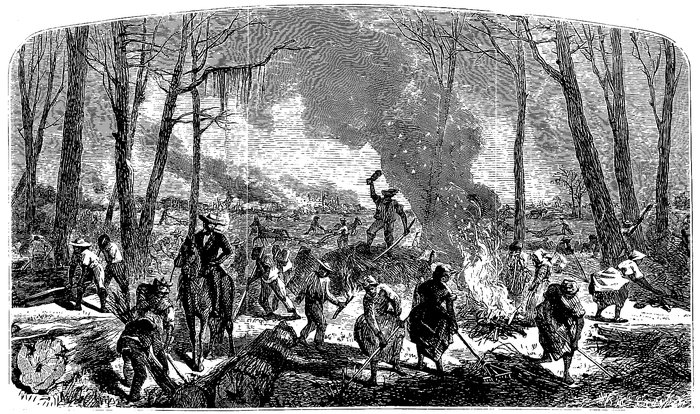
The negro quarter has been swelled to a size greater
than that of almost any city on the coast, by accessions
from all parts of the State. They came in entirely destitute.
The Government furnished them rations, and
gave the men axes, with which they cut down the pine
trees and erected their own cabins, arranging them regularly
in streets, and “policing” them as carefully as a
regiment of veteran soldiers would do. Every effort
was then made to give them work in the Quartermaster’s
Department, to keep them from being simply an expense
to the Government; but the close of the war necessarily
cuts off this source of employment, and the
General commanding is now looking with no little
uneasiness to the disposition to be made of this great
collection of negroes, for scarcely a tithe of whom can
the natural wants of the town itself supply employment.
Some have rented a large rice plantation in the vicinity—contrary
to the currently-received theory that no
human being, white or black, will work on rice grounds
except when driven to it—and they are doing exceedingly
well. Others could go further into the interior
and do the same, if they were sure of protection; but
till some understanding with the planters is reached,
and the status of the Rebel planters themselves is
defined, this is almost impracticable. Something, however,
must be done to disperse this unwholesome gathering
at Newbern, or the tumor, thus neglected, may do
serious injury.
A dispatch from General Sherman (on his way north
from Savannah, and forced by bad weather to put in at
32Beaufort) had reached Newbern, while we were there,
expressing a very earnest desire to see Chief Justice
Chase; and on the return of the party, General Sherman’s
vessel was lying at the wharf, opposite the railroad
terminus, awaiting us. Nervous and restless as ever,
the General looked changed (and improved) since the
old campaigns in the South-west. He was boiling over
with pride at the performances of his army through
the winter, and all the more indignant, by consequence,
at the insults and injustice he imagined himself
to have received, in consequence of his arrangement
with Johnston. “I fancied the country wanted
peace,” he exclaimed. “If they don’t, let them raise
more soldiers.”
The General complained, and, doubtless, with some
truth, if not justice, that the Government had never
distinctly explained to him what policy it desired to
have pursued. “I asked Mr. Lincoln explicitly, when
I went up to City Point, whether he wanted me to capture
Jeff. Davis, or let him escape, and in reply he told
me a story.”
That “story” may now have a historical value, and
I give it, therefore, as General Sherman said Mr. Lincoln
told it—only premising that it was a favorite story with
Mr. Lincoln, which he told many times, and in illustration
of many points of public policy.
“I’ll tell you, General,” Mr. Lincoln was said to have
begun, “I’ll tell you what I think about taking Jeff.
Davis. Out in Sangamon county there was an old temperance
lecturer, who was very strict in the doctrine
and practice of total abstinence. One day, after a long
ride in the hot sun, he stopped at the house of a friend,
who proposed making him a lemonade. As the mild
beverage was being mixed, the friend insinuatingly
33asked if he wouldn’t like just the least drop of something
stronger, to brace up his nerves after the exhausting
heat and exercise. ‘No,’ replied the lecturer, ‘I
couldn’t think of it; I am opposed to it on principle.
But,’ he added, with a longing glance at the black bottle
that stood conveniently at hand, ‘if you could manage
to put in a drop unbeknownst to me, I guess it
wouldn’t hurt me much!’ Now, General,” Mr. Lincoln
concluded, “I’m bound to oppose the escape of
Jeff. Davis; but if you could manage to let him slip
out unbeknownst-like, I guess it wouldn’t hurt me
much!”
“And that,” exclaimed General Sherman, “is all I
could get out of the Government as to what its policy
was, concerning the Rebel leaders, till Stanton assailed
me for Davis’ escape!”
A heavy gale blew on the coast all day Friday, Saturday
and Sunday, and neither General Sherman’s Captain
nor our own thought it wise to venture out. Meanwhile,
delegations of the Beaufort people came off in
little sail-boats to visit the “Wyanda,” bring us flowers
and strawberries, and talk politics. Since their last
demonstrations, a few days ago, they had toned down
their ideas a good deal; and the amount of their talk,
stripped of its circumlocution and hesitation, was simply
this: that they were very anxious to re-organize,
and would submit to anything the Government might
require to that end. They said less against negro suffrage
than before—frankly said it would be very obnoxious
to the prejudices of nearly the whole population,
but added, that if the Government insisted on it, they
would co-operate with the negroes in reorganization.
“But the poor, shiftless creatures will never be able to
34support themselves in freedom. We’ll have half of
them in poor-houses before a year!”[4] Nothing could
overcome this rooted idea, that the negro was worthless,
except under the lash. These people really believe
that, in submitting to the emancipation of the slaves,
they have virtually saddled themselves with an equal
number of idle paupers. Naturally, they believe that
to add a requirement that these paupers must share
35the management of public affairs with them is piling a
very Pelion upon the Ossa of their misfortunes.
My room-mate, the Doctor, appointed me a “deacon
for special service”—even he had absorbed military
ways of doing things from our neighbors—and I arranged
for his preaching in Beaufort, Sunday morning. The
people were more than glad to welcome him, and he had
a big congregation, with a sprinkling of black fringe
around its edges, to appreciate his really eloquent discourse;
while the trees that nodded at the pulpit windows
shook out strains of music, which the best-trained
choristers could never execute, from the swelling throats
of a whole army of mocking-birds. An old Ironsides-looking
man, who had occupied an elder’s seat beside
the pulpit, rose at the close, and said he little expected
to have ever seen a day like this. Everybody started
forward, anticipating a remonstrance against the strong
Unionism and anti-slavery of the Doctor’s sermon, but
instead there came a sweeping and enthusiastic indorsement
of everything that had been said. He saw a
better day at hand, the old man said, and rejoiced in
the brightness of its coming. How many an old man,
like him, may have been waiting through all these weary
years for the same glad day!
At other times there were fishing parties which caught
no fish, though General Sherman sent them over enough
fine ocean trout to enable them to make a splendid show
on their return; and riding parties that got no rides,
but trudged through the sand on foot, to the great
delectation of the artist who sketched, con amore, the
figures of gentlemen struggling up a sandy hill, eyes
and ears and mouth full, hands clapped on hat to secure
its tenure, and coat tails manifesting strong tendencies
36to secede bodily, while in the distance, small and indistinct,
could be perceived the ambulance that couldn’t be
made to go, and underneath was written the touching
inscription, “How Captain Merryman and Mr. R.
accepted Mrs. W.’s invitation, and took a ride on the
beach at Fort Macon.”
At last the gale subsided a little, and we got off.
Another salute was fired as we steamed out; the “Wayanda”
returned a single shot in acknowledgment, and
all too soon we were among the breakers, pitching and
writhing, fore and aft, starboard and larboard, diagonally
crosswise and backward, up to the sky and down,
till the waves poured over the deck, and the masts
seemed inclined to give the flags and streamers at their
tops a bath. But for some of us, at least, the seasickness
was gone. Io Triumphe!
3. The census of 1860 gave the population of Newbern at, whites,
2,360; blacks, 3,072; aggregate, 5,432. The Newbern people are
now setting forth, as a reason for inducing emigration, that the city
is the largest in the State, and has a population of between twenty
and thirty thousand. The increase is mainly made up of negroes.
4. And yet an official report, since published in the newspapers,
shows that out of three thousand whites in Beaufort last winter,
between twelve and fourteen hundred were applicants for the
charity of Government rations. Out of about an equal number of
negroes, less than four hundred were dependent on the Government!
The secret of the disparity was, that the negroes took work
when they could get it; the whites were “ladies and gentlemen,”
and wouldn’t work.
A Richmond letter, of June 30th, in the Boston Commonwealth,
testifies to the same feeling among the Virginians. Describing the
charities of the Sanitary Commission, it says:
“The most fastidious, though not too dainty to beg, were yet
ludicrously exacting and impatient. They assumed, in many ways,
the air of condescending patrons. ‘Do you expect me to go into
that dirty crowd?’ ‘Haven’t you some private way by which I
could enter?’ ‘I can never carry that can of soup in the world!’
they whined. The sick must suffer, unless a servant was at command
to ‘tote’ a little box of gelatine; and the family must wait
till some alien hand could take home the flour. The aristocratic
sometimes begged for work. Mr. Williams, of the Sanitary Commission,
when asked by a mother to furnish work for her daughters,
said: ‘If they will serve as nurses to the suffering men in your
own army hospitals, I will secure pay for them.’ ‘My daughters
go into a hospital!’ exclaimed the insulted mother. ‘They are
ladies, sir!’ ‘Our Northern ladies would rather work than beg,’
quietly remarked Mr. Williams. Another mother begged Mr. Chase,
of the Union Commission, to give her daughters ‘something to do.’
‘Anything by which they can earn something, for we have not a
penny in the world.’ ‘They shall help me measure flour,’ said
Mr. Chase. ‘My daughters are ladies, sir,’ replied the mother.”
CHAPTER V. Fort Fisher.
37
On the morning of the 8th of May we came in sight
of a long, low line of sand banks, dotted with curious
hillocks, between which the black muzzles of heavy
guns could be made out, and fringed with a perfect naval
chevaux-de-frise of wrecked blockade runners, whose broken
hulls and protruding machinery gave an ill-omened
look to the whole coast. As we were closely studying
the bleak aspect of this entrance to the great smuggling
entrepôt of the Southern Confederacy, the glasses began
to reveal an unexpected activity along the line of the
guns, which our signal shot for a pilot by no means
diminished. Our ship drew too much water to cross
the bar, excepting at high tide, and we were, consequently,
compelled to go over in the Captain’s gig to the
pilot boat—a proceeding that the rough sea made very
difficult and even dangerous. Leaving those who could
not venture the transhipment, to roll wearily among
the breakers till evening, we headed straight through
the narrow and difficult channel for Fort Fisher, and
learned that we had been mistaken for the Rebel pirate
“Stonewall,” and that the guns had been shotted ready
to open fire the moment we should show signs of a disposition
to run in.[5]
38Ah! that weary day at Fort Fisher! To see a fort
is naturally supposed to be not the most formidable of
undertakings; but to see Fort Fisher means a ride of
miles over the bleakest of sand bars; means the climbing
of great heaps of sand, under the hottest of suns;
means a scrambling over irregular chasms and precipices
of sand, where the explosions have destroyed at once
every semblance of fortification and every foot of solid
earth—means all this, prolonged for hours, under the
penalty of the consciousness that otherwise you would
be pretending to see Fort Fisher, when you were doing
nothing of the sort.
We began by climbing Battery Buchanan, near the
landing, and inside the main line of works. Trenches,
embrasures, casemate and barbette guns, bomb-proofs,
gabions, riflemen’s pits, all in sand that no rifle projectiles
could breach, and bombardment could only render
stronger, seemed to assure absolute impregnability to
this work alone, except against regular siege operations.
Yet it was but protection for one flank of the long line
before which Weitzel turned back, and which no soldiers
but ours would ever have stormed. To this battery
(so called, although a perfect and very strong fort in
itself) the Rebels made their last retreat, after that long,
hand-to-hand fight through the sea front of the fort,
which stretched far into the night, and seemed doubtful
to the last. But Battery Buchanan, though impregnable,
as a flank to the sea line, is itself commanded by
the last work of that sea line; and so when the Mound
39Battery fell into our hands, its guns had only to be
turned, and Buchanan fell almost without a struggle.
The Mound Battery is a vast heap of sand, uplifting
its guns and embrazures from a flat and desert beach
against the sky, and commanding perfectly the whole
northern entrance to the river. It contained one of the
finest specimens of heavy ordnance ever seen in this
country, the famous Armstrong rifle, presented by British
sympathizers to the Confederacy.
Imagine a long line of batteries, connected by traverses
in the sand, separated by huge hillocks of sand,
and fronted by deep trenches in the sand, stretching
away almost interminably along the coast toward the
North, and ending in another strong work, which was
supposed to protect that flank as perfectly as Buchanan
did the other; put in magazines and bomb-proofs, at
convenient points, and a very heavy armament; then
conceive muzzles of the guns knocked off, guns dismounted,
carriages shattered, the parapets plowed with
shells, a great crater in the sand where a magazine had
exploded, all shape and symmetry battered out of the
works, and only their rude strength remaining; and
you have Fort Fisher.
The ground was covered with showers of musket
balls. Behind every traverse could be found little
heaps of English-made cartridges, which the Rebel
sharpshooters had laid out for the convenience of rapid
firing, as they defended line after line of the successive
batteries, along which they were driven. Fragments
of shells lay everywhere over the works. Behind them
were great heaps of shells, bayonets, broken muskets,
and other fragments of iron, which were being dug out
and collected to be sold for old iron. Hundreds on hundreds
40of acres were under negro cultivation, producing
this valuable crop.
No man, I think, will ride along the coast line, which,
by an inconceivable amount of labor, has been converted
into one immense fort, without sympathizing
with the officers who refused to assault it, and marveling
at the seeming recklessness which success converted
into the splendid audacity of the final attack.[6]
The pilot boat was again placed at the disposal of our
party, after some hours spent at Fort Fisher, and we
ran over to Fort Caswell, one of the main defenses of
the other entrance. It was originally a regularly-built
brick fortification, with casemate and barbette guns,
salients, ditch and interior castle, pierced with loopholes,
for a last defense with musketry. Like Fort
Macon, at Beaufort (and like Sumter), this has been
converted into an infinitely stronger work, by having
earthen fortifications thrown up outside and against it.
The Rebels blew it up after the surrender of Fort
Fisher, and we shall probably be making appropriations,
every Congress, for the next dozen years to
rebuild it.
The labor here, as well as the vast amount involved
in the construction of Fort Fisher, was all performed
by slaves, impressed from time to time by the Rebel
authorities. Both works were completed—Wilmington
had grown rich on the profits of blockade-running;
41Nassau had risen to first-class commercial importance,
and the beach under these guns was strewn with the
wrecks, which spoke more loudly than could any balance
sheet, of the profits of a business that could afford
such losses—before our Congress had done disputing
whether the Constitution, and a due regard for the
rights of our Southern brethren, would permit us to use
negroes as teamsters!
5. The Stonewall seems indeed to have produced about this time an
excitement along the whole coast, amounting, in some places, to
panic. The naval officer at Key West, for example, issued orders
to extinguish the lights in the light-houses along the coast, lest the
Stonewall should run into some of the harbors and destroy the
shipping.
6. The joint Committee of Congress on the Conduct of the War,
after examining Generals Grant, Butler, Weitzel and Terry, and
Admiral Porter, as well as the Rebel commander of the Fort, and
after a careful inspection of the fortifications themselves, have, in
a report published since the above was written, reached substantially
the same conclusions. They attach no blame to any one for
the failure to attack, in the first movement upon the Fort.
CHAPTER VI. Wilmington—Unionism—Blockade Running—Destitution—Negro Talk—Land Sales.
42
General Hawley, commanding at Wilmington, had
come down to Fort Fisher, on hearing of the arrival of
our party, accompanied by General Abbott, General
Dodge, and a number of prominent citizens of North
Carolina. They were all transferred to our vessel,
and, with the tide in her favor, and under sail, the
“Wayanda” astonished us all by steaming up the river
at the rate of fourteen knots an hour. Captain Merryman,
however, insisted she could do as much any
time, only it wasn’t always convenient to get her
best speed out of her! And, of course, we were bound
to believe the Captain. Do we not make it a point of
patriotic duty to believe all the brilliant reports of the
running capacity displayed by our iron-clads and
double-enders?
Blockade runners had been sunk for miles up the
river, and in some places the hulls and machinery still
formed a partial obstruction to navigation. Torpedoes,
fished out by the navy, lay here and there along the
banks, and a few, it was said, were still in the channel,
unless, as was hoped, the tide had washed them away.
Among the North Carolinians accompanying General
Hawley, were a couple of gentlemen from Raleigh—Mr.
Moore, a leading lawyer there, and Mr. Pennington,
the editor of the Raleigh Progress—who had come
43down to Wilmington to see Chief Justice Chase.
Another gentleman in the company, introduced as
“Mr.” Baker—a tall, slender man, of graceful manners,
and evident culture and experience—had been through
nearly the whole war as Colonel of a North Carolina
Rebel regiment.
Strangely enough, Colonel Baker claimed to have
been a Union man all the time, from which some idea
may be had of the different phases Unionism in the South
has assumed. His father had been a Unionist of unquestioned
firmness; but the son, returning from Europe in
the midst of the secession enthusiasm, found the social
pressure of his circle too much to withstand. “I was
forced,” he naively said, “to raise a regiment in order
to retain my influence in the community!” And, with
equal naïveté, he added, that if he had not thus retained
his influence, he could now have been of no use in aiding
to compose these difficulties! He pointed out a fine
rice plantation on the bank of the river, which he had
owned, but about his title to which, now, he seemed to
have some doubts. He claimed, and other Wilmingtonians
agreed with him, that the rice grown here is
superior to that of South Carolina and Georgia, and that
its culture, in spite of the latitude, is quite as profitable.[7]
The gentlemen from Raleigh and Colonel Baker
seemed each to be a representative of a different phase
of North Carolina Unionism. The editor had always
opposed secession till it was accomplished. Then he
was compelled to go with the current, but as soon as
44the first fury was over, and the reaction began, he
became openly anti-Davis, and as much anti-war as he
dared. He was an enthusiastic admirer of General
Sherman; thought the censure by the Northern press,
of his arrangement with Johnston, very unjust; was
anxious now for the speediest possible restoration of civil
authority, and believed the people stood willing to acquiesce
in whatever basis of reorganization the President
would prescribe. If he had his way, he would have no
negro suffrage; even that would be preferable to remaining
unorganized, and would be accepted by the people,
though it would cause great dissatisfaction.
The lawyer, on the other hand, insisted that none
would revolt, with more loathing, from the bare idea of
negro suffrage, than the best Union men in the State,
who had suffered the most for their devotion to the
Government and opposition to the war. “It would not
even be satisfactory,” he insisted, “to leave the negroes,
like other non-voting classes, to take care of themselves.
To leave them absolutely without any control, save such
as the law extends to white people, also, would be unendurable.
Either you must take pity,” he exclaimed,
“on those of us who, for four years, have endured everything
for the sake of the old flag, and send the negroes
out of the country altogether, or you must place them
under the control of the Legislature.” “What policy
toward them would the Legislature be apt to adopt?”
“It ought to provide against vagrancy; adopt measures
to require them to fulfill their contracts for labor, and
authorize their sale, for a term of years, for breaches
of order.[8] Either do that, and so protect us against
45an intolerable nuisance, or colonize them out of the
country.”
The Colonel was not so emphatic in favor of this
virtual re-enslavement of the negroes, nor so peremptory
in his condemnation of negro suffrage; but he
thought it would be wise to conciliate as much as possible,
and to avoid deep-seated prejudices. It was easy
to see that he was looking to what would be the least
unpopular with the people of North Carolina; and,
indeed, I heard later in the evening, that he was not
unwilling to ask them to send him to Congress.
Clearly enough, few Union men in the South, who
have political aspirations, can be safely expected to
advocate justice, much less generosity, to the negro, or
severity to the Rebels. The latter are sure to be
voters—many of them now, after carelessly taking
oaths of allegiance—all of them some day; and politicians
are not likely to make haste in doing that which
they know to be odious to the men whose votes they
want.
At a dinner party at General Hawley’s, and subsequently
at a little party, later in the evening, we saw
46and heard a good deal of the feelings of the people.
The women are very polite to Yankee officers in particular,
but very bitter against Yankees in general. Negro
troops are their especial detestation; and for the monstrosity
of attempting to teach negroes to read and
write, they could find no words to express their scorn.
A young officer told me that he had been “cut” by some
ladies, with whom he had previously been on very cordial
terms, because they had seen him going into one of
the negro schools! The men of North Carolina may
be “subjugated,” but who shall subjugate the women?
Governor Vance has been very unpopular, and the
people seem to take kindly enough to the idea that his
authority will not be recognized. They say he was a
Union man in feeling and conviction, but that Jeff.
Davis, alarmed by the dissatisfaction in North Carolina,
sent for him about the time of his last election, and persuaded
him that he could be the next President of the
Confederacy! The Presidential idea was as baneful in
Rebeldom, as it has proved to so many Northern statesmen,
and Vance was destroyed.
Every Northern man in Wilmington lives in the very
best style the place affords, no matter how slender his
visible resources. I was the guest of a civil officer
whose salary can not be over two thousand dollars.
His home was a spacious three-story double structure,
that would have done no discredit to Fifth Avenue.
You approach it through a profusion of the rarest
shrubbery; it was in the most aristocratic quarter of the
city, was elegantly furnished, and filled with servants—all
on two thousand dollars a year, less the Government
tax. But this is modest and moderate. The officer
at least made the one house serve all his purposes.
47Another—a Colonel on duty here—is less easily satisfied.
He has no family, but he finds one of the largest
and best-furnished double houses in the town only sufficient
for his bachelor wants, as a private residence.
Another house, equally spacious and eligible, is required
for the uses of his office! And, in general, our people
seem to go upon the theory that, having conquered the
country, they are entitled to the best it has, and in duty
bound to use as much of it as possible.
These houses are generally such as were shut up by
their rich Rebel owners on the approach of our troops
below the city. The proprietors have retired to adjacent
country places, to be out of harm’s way till they
see how Rebels are to be treated, and already they are
making their calculations about returning in the fall,
with a coolness almost disconcerting to their self-appointed
tenants. Mrs. General Hawley tells a piquant
story of a visit from the wife of a runaway Rebel,
whose showy but uncomfortable house the General has
seized for quarters and private residence. The lady
made herself as agreeable as possible, spoke of the General’s
occupancy and her own absence, much as people
who had gone off to the sea-shore for the summer
might speak of renting their town house till their return;
intimating that she wouldn’t hurry the General commanding
for the world, and hoped that he would remain
with his family until it was entirely convenient to
remove, but suggested that she and her husband
thought they would probably return in a couple or
three months, when, of course, they supposed their house
would be ready for them! Confiscation seemed to have
no terrors for her; or, if it had, they were dexterously
concealed under an air of smiling and absolute
assurance.
48The loosest ideas prevail as to the execution of the
“abandoned-property” act of the Thirty-seventh Congress.
Deserted houses, not absolutely needed for military
purposes, can be rented for handsome sums, and to
whatever amounts can be thus realized the Government
has an equitable as well as legal claim. But here, and
report says everywhere throughout the South, are evidences
of the old clashing betwixt War and Treasury
Department officials; and between them, the revenue
the Government ought to derive from the abandoned
property, is sadly reduced.
The practice of regarding everything left in the
country as legitimate prize to the first officer who discovers
it, has led, in some cases, to performances little
creditable to the national uniform. What shall be
thought of the officer who, finding a fine law library,
straightway packed it up and sent it to his office in the
North? Or what shall be said of the taste of that other
officer who, finding in an old country residence a series
of family portraits, imagined that they would form
very pretty parlor ornaments anywhere, and sent the
entire set, embracing the ancestors of the haughty old
South Carolinian for generations back, to look down
from the walls of his Yankee residence?
One sees, at first, very little in the mere external
appearance of Wilmington to indicate the sufferings of
war. The city is finely built (for the South); the
streets are lined with noble avenues of trees; many of
the residences are surrounded with elegant shrubbery;
there is a bewildering wealth of flowers; the streets
are full, and many of the stores are open. Sutlers,
however, have taken the places of the old dealers; and
many of the inhabitants are inconceivably helpless and
49destitute. While I was riding over the city with Captain
Myers, a young Ohio artillerist, a formerly wealthy
citizen approached him to beg the favor of some means
of taking his family three or four miles into the country.
The officer could only offer the broken “Southron”
a pair of mules and an army wagon; and this shabby
outfit, which four years ago he would not have permitted
his body servant to use, he gratefully accepted
for his wife and daughter!
Struggling through the waste of sand which constitutes
the streets, could be seen other and more striking illustrations
of the workings of the war: a crazy cart, with
wheels on the eve of a general secession, drawn generally
by a single horse, to which a good meal of oats must
have been unknown for months, loaded with tables,
chairs, a bedstead, a stove and some frying-pans, and
driven by a sallow, lank, long-haired, wiry-bearded
representative of the poor white trash, who had probably
perched a sun-bonneted, toothless wife, and a brace
of tow-head children among the furniture; or a group,
too poor even for a cart, clothed in rags, bearing bundles
of rags, and, possibly, driving a half-starved cow.
These were refugees from the late theater of military
operations. They seemed hopeless, and, in some cases,
scarcely knew where they wanted to go.
Few of the old residents of Wilmington are believed
to have profited by the blockade running. It was
always considered a disreputable business, in which a
high-minded Rebel would not care to be thought concerned;
and so it fell chiefly into the hands of foreigners,
and particularly of Jews. A few prominent Richmond
people were believed to be deeply engaged in it—Trenholm,
Governor Smith, Benjamin and Jeff Davis are
all named—but wherever the profits went, they did
50not go to a general diffusion of property among the
Wilmingtonians themselves.
Jay Cooke was under the impression that there must be
a great deal of gold throughout the Southern cities, and
especially in this center of blockade running, that ought
to be available for the 7.30 loan; but the testimony here
goes to show that the wealthy people have most of their
gold abroad, and that they do not have a great deal of
it anywhere. Undoubtedly nothing would more tend
to tie these people to the Union than such a cord as a
United States bond, connecting their pockets with
national permanence and prosperity, but they seem now
hard enough pressed to buy the necessaries of life; and
money for investments in national securities, is not
likely to flow northward, for the simple reason that it
is not in the country.
Negroes are already beginning to congregate here
from the surrounding country. They do not wish to
trust their old masters on the plantations; and, without
any definite purpose or plan, they have a blind, but
touching instinct, that wherever the flag is floating it is
a good place for friendless negroes to go. Others are
hunting up children or wives, from whom they have
long been separated. Quite a number have been located
on plantations, and these are working better than could
be expected; but the uncertainty of their tenure of the
land, the constant return of the old proprietors, and the
general confusion and uncertainty as to the ownership
of real estate, under the confiscation and abandoned-property
laws, combine to unsettle both them and the
Superintendents of Freedmen, who are trying to care
for them.
The native negroes of Wilmington, however, are doing
51well. They are of a much higher order of intelligence
than those from the country; are generally in comfortable
circumstances, and already find time to look into
politics. They have a Union League formed among
themselves, the object of which is to stimulate to industry
and education, and to secure combined effort for suffrage,
without which they insist that they will soon be
practically enslaved again. A delegation of them waited
on Mr. Chase; and certainly looked as well and talked
as lucidly as any of the poor whites would have done.
There are a very few of the whites who encourage
them; but, in general, the bitterest prejudice against
these black Unionists, is still among those who have
been the only white Unionists—the often-described poor
white trash.
The Wilmington negroes have no faith in the ready
assent to the proposition that slavery is dead, which all
the old slaveholders give. They say—and the negro
refugees, all, and some of the whites bear them out in
it—that in the country slavery still practically exists.
The masters tell them that slavery is to be restored as
soon as the army is removed; that the Government is
already mustering the army out of service; that next
year, when the State is reorganized, the State authorities
will control slavery. Meantime, the negroes are
worked as hard as ever—in some cases a little harder—and
they have no more protection from the cruelty of
the whites than ever.[9]
52“I tell you, sah” said a very intelligent negro, who
had been reciting the present troubles of his people,
“we ain’t noways safe, ‘long as dem people makes de
laws we’s got to be governed by. We’s got to hab a
voice in de ‘pintin’ of de law-makers. Den we knows
our frens, and whose hans we’s safe in.”
The war, according to these negroes, had, in some
respects, made slavery harder for them than before.
They were naturally trusted less, and watched more.
Then, when provisions became scarce, their rations, on
the large plantations, were reduced. On one, for example,
the field hands got no meat at all, and their allowance
consisted of a peck of unsifted corn-meal and a
pint of molasses per week. On another, they got two
pounds of meat, a peck of meal, and a quart of molasses
per week. Before the war, they had double, as much
meat, and a peck and a-half of meal. Thus fed, they
were expected to begin work in the fields at daybreak,
and continue, with only the intermission of half an
hour at noon, till dark.
In some cases the negroes, understanding that they
are freed, have refused to work without a contract for
wages. Some of them have been promised their board,
and a quarter of the corn crop; others three dollars for
53a season’s work; others a dollar and a-half or two dollars
a month. But the town negroes, especially those
of the League, say they have but little faith that the
contracts will be kept.
Further conversation with the people led me to think
that, in the main, they might be divided into three
classes. One, embracing, I think, a majority of the
people, is thoroughly cowed by the crushing defeat, has
the profoundest respect for the power that has whipped
them so badly, and, under the belief of its necessity,
will submit to anything the Government may
require—negro suffrage, territorial pupilage—anything.
A smaller class are Union men, if they can have the
Union their way—if the negroes can be kept under, and
themselves put foremost. And another class are violent
and malignant Rebels, enraged at their defeat, and
hardly yet willing to submit to the inevitable.
The loss of life has been frightful. Half the families
are in mourning. I hear of a Danville regiment, twelve
hundred strong, of whom less than fifty survive. Not
less than eighty thousand arms-bearing men of the
State are believed to have been killed or disabled.
This, and the disorganization of the labor system, have
naturally left thousands of families through the State
utterly destitute. Mr. Pennington, the editor of the
Raleigh Progress, predicts great distress next winter.
In fact, the Government is already issuing rations to
thousands of destitute whites.
As yet, notwithstanding their poverty and destitution,
few of the large landowners have put their estates in
the market. No such feeling exists here, however, as
in Virginia, where the farmers are said to hold on with
54a death grip to their lands, and to consider it discreditable
to sell to a Yankee. Many of the most violent
Rebels here will sell at exceedingly low rates, in order to
get out of the country, where everything reminds them
of their mortifying defeat and disgrace. And of those
who remain, large numbers will be forced to sell part of
their lands, to get means for living comfortably on the
remainder.[10] The new blood, likely thus to be infused
55into North Carolina, will be its salvation; and the
capital which is now seeking openings for trade, will
presently find vastly more profitable returns from investments
in lands.
General Hawley, General Abbott and their wives, the
Collector, the Treasury Agent, a party of staff officers
and others, pursued us with kindness till our vessel had
absolutely pushed off from the almost deserted wharf,
which, four years ago, was crowded with the keels
of a thriving commerce, and even a year ago bustled
with scores of adventurous blockade runners. Trade,
indeed, follows the flag; but for trade you must have
money; and of this there is far too little in the
exhausted country to bring back business into its
old channels, as speedily as Northern speculators are
imagining.
Some of the officers and their wives came down with
56us in the river steamer, to the bar, whither the “Wayanda”
had returned to await us; and kindly good-byes
and fluttering handkerchiefs could still be heard
and seen after the vessels had each begun moving. At
the North we think little of loyalty; here loyal men,
and especially those in the service of the Government,
seem drawn toward each other, as are men who serve
under the same flag in a foreign country.
7. The farther north you can grow any grain, or other crop, and
mature it, the better it is—according to the theory of the North Carolina
planters. The rice crop is more profitable here, they claim,
than on the best plantations about Savannah.
8. In other words, call them freedmen, but indirectly make them
slaves again. The same idea seems to pervade the State, and,
indeed, the entire South. Colonel Boynton, a very intelligent
and trustworthy officer, writing from Danville, North Carolina,
on the 21st of June, said:
“The belief is by no means general here, that slavery is dead,
and a hope that, in some undefined way, they will yet control the
slaves, is in many minds, amounting with some to a conviction.
They look for its restoration through State action—not yet comprehending
that the doctrine of State sovereignty has been somewhat
shattered by the war. Here, as in Richmond, the people, instead
of grappling with the fact that the war has liberated the slaves,
are very busy proving the utter worthlessness of the negroes, and
treating them with additional cruelty and contempt—neither offering
them fair inducements to work, or working themselves.”
9. Numerous instances were told, while I was at Wilmington, but
the following case, related by Colonel Boynton, occurred farther in
the interior:
“Here in Salisbury, two prominent men are on trial by a military
court, for killing a negro, and one of the wealthiest, most
refined and respectable young ladies in all this section, is under
twenty thousand dollars bonds to appear and answer for shooting
a negro woman with her own hands. Miss Temple Neeley is considered
one of the belles of the State. The family is very wealthy,
aristocratic, and all that, and stands at the very top in this section.
Her mother was flogging a little negro child, when the mother of the
child interfered to protect it. Miss Neeley stepped up, and, drawing
a revolver from her pocket, shot the negro woman dead, firing
a second ball into the body. She was arrested, and will be tried
by a military court. The papers here are defending her, and trying
to stir up the old feeling toward the slaves, and excusing her
under the black laws of the State.”
10. On the 1st of August a single real estate firm in Raleigh advertised
no less than sixty-three different tracts of North Carolina lands
for sale at low rates, and on easy terms. Here are a couple of
specimens:
“We offer for sale one of the finest rice plantations in the State
of North Carolina, known as ‘Lyrias,’ and situated on the north-west
branch of Cape Fear river, three and a-half miles above Wilmington.
This plantation contains 275 acres, 250 of which are
cleared, and 25 are river swamp lands. There is also an upland
settlement attached, with a dwelling-house, all necessary outhouses,
comfortable quarters for fifty laborers, and an excellent well of
water.
“The rice lands, with the exception of about 20 acres, are of a
clay soil, of unsurpassed and inexhaustible fertility, and capable
of producing rice, corn, wheat, oats, peas and hay.
“It is every way susceptible of being also made a good stock farm,
for cattle and hogs, and an excellent market garden.
“The entire plantation is in good order. It has on it two commodious
barns, 100 by 40 and 75 by 60 feet, respectively. Also, a
steam engine of ten-horse power, together with a powerful pump, or
water elevator, worked by the engine, which throws out two thousand
gallons of water per minute. Also, a threshing machine, in a
building 25 by 85 feet.”
“All that really baronial estate, known as William S. Pettigrew’s
‘Magnolia Plantation,’ for sale cheap.—1,000 acres improved!—Over
600 acres in a high state of cultivation!—50, or over, bushels of
corn per acre!—Rich alluvial soils, suitable for farms and vegetable
gardens!—Only ten hours from Norfolk!—Water transportation
from the barn.—The far-famed ‘Scuppernong’ grape is a native
of this county, and grows in a luxuriant abundance unsurpassed
in any country. The residence, barns, out-buildings, groves, etc.,
etc., are very superior. Good well of water, etc., etc.
“This very large, and really magnificent estate, contains seven
thousand acres of those rich alluvial Scuppernong river lands;
one thousand acres already drained, and most of it in a high state
of cultivation, and the whole of the rest can be easily and effectually
drained; thus opening up large plantations scarcely surpassed
in fertility by the Mississippi bottoms, which they greatly
exceed in proximity to markets, having cheap and easy carriage,
almost, if not quite, from the barn door to Norfolk, Baltimore, Philadelphia,
New York, Boston and the whole world!
“Sea-going vessels can now come within a few miles of the barn
door, and by deepening one canal, this desirable result can be
obtained.”
CHAPTER VII. Charleston Harbor—Could Sumter have been Stormed—Negroes and Poor Whites.
57
We steamed into Charleston Harbor early in the
morning; and one by one, Sumter, Moultrie, Pinkney,
and at last the City of Desolation itself rose from the
smooth expanse of water, as the masts of ships rise from
the ocean when you approach them. Where, four years
ago, before the fatal attack on this now shapeless heap
of sand and mortar, the flags of all nations fluttered,
and the wharves were crowded with a commerce that
successfully rivaled Savannah, Mobile and every other
Southern city save New Orleans, and even aspired to
compete with New York in the Southern markets, only
transports and Quartermasters’ vessels were now to be
seen, with here and there a passenger steamer, plying
to and from New York for the accommodation of
Yankee officers and their wives! The harbor itself
was dotted with insignificant-looking iron clads, mingled
with an occasional old ship of the line, and, in
ampler supply, the modern “Yankee gunboats,” of
the double-ender type, which formed so potent a cause
for alarm in the councils of the privates in the Rebel
armies.
The elegant residences along the battery front
retained the aristocratic seclusion of their embowering
shrubbery, creepers and flowering plants; but even
through these gracious concealments which Nature cast
58over them, the scars from the Swamp Angel could
everywhere be seen. Pavements had been torn up
from the principal business streets, to build the batteries
that lined the shore; and great embankments,
crowned with Tredegar guns, shut out the prospect from
many an aristocratic window. The unfinished Custom
House was among the most conspicuous buildings, the
white marble blocks lying scattered about it, as they
were left by the workmen four years ago. “We’ll never
finish it,” the fervid revolutionists said, as they began
the war. “We’ve paid Yankee tariffs long enough;
now, hurrah for free trade with our friends of France
and Great Britain!” But the Custom House stands,
and next winter Mr. Fessenden will be reporting to the
Senate an item in the military appropriation bill for its
completion.
Admiral Dahlgren and Fleet Captain Bradford came
alongside in the Admiral’s gig, soon after our arrival;
and while our boatswain was piping his whistle as the
Admiral came over the ship’s side, the guns of the “Pawnee”
began a salute for the Chief Justice. The Treasury
Agent and some other officials soon followed, and the
Admiral took the party under his charge, transferred
us to a comfortable and speedy little harbor steamer,
and started toward that first goal of every man’s curiosity—Sumter.
The rebellion has left its marks on the pale, thoughtful
features of the Admiral, not less than upon the harbor
he has been assailing. The terrible death of noble young
Ulric Dahlgren, a martyr to the barbarism of slavery,
might well grave deep traces on a father’s face; but the
climate here, and the labors of the past have also been
very trying, and one can readily believe, what used to
be rather sarcastically urged by the Admiral’s enemies,
59that his health did not permit him to keep up in gunnery
with General Gillmore.
We passed a little sailing vessel manned by blacks.
The Admiral told us that they had brought it down one
of the rivers, the other day, and he had allowed them
to keep it. They earn a livelihood bringing wood to
the city. Recently there have been a number of outrages
perpetrated on the blacks inland, by their late
masters and some of the returning Rebel soldiers.
Greatly infuriated, the blacks came to him begging for
arms. “I have never before doubted their orderly disposition,”
he said, “and I am not sure that anybody
would remain orderly under those circumstances.”
The Charleston city negroes were represented as
unexpectedly intelligent. “Out of two hundred and
seventy-four laborers at work on the streets,” said one
of the city officials who had joined us, “one hundred
and seventy-four are negroes—the rest whites. Of the
negroes, over a hundred (or over four-sevenths) can
read, while scarcely one-seventh of the whites have
made the same advancement!”[11] Captain Bradford
gave a significant illustration of the progress of some
ideas among the less intelligent negroes of the country.
They had again and again asked him, he said, what
good it did them to make them free, unless they were
to own the land on which they had been working, and
which they had made productive and valuable. “Gib
us our own land and we take care ourselves; but widout
land, de ole massas can hire us or starve us, as dey
please.”
60A huge mass of iron was pointed out as we passed,
not unlike the plates of the famous “Merrimac,” or like
the gunboat “Benton,” on the Mississippi. It was one of
the Rebel iron clads, sunk just before the evacuation of
the city. They had injured it very little, and our
authorities are confident of making it one of the best
iron clads in the service. Enforced self-reliance, had,
indeed, gone far toward making the South a nation; for
here were fine engines, worthy of our most extensive
Northern shops, which had been manufactured in Georgia
within a year. Before the war, such an undertaking
as making engines for a great steamer, in the South, was
scarcely dreamed of. Near the iron clad lay some of
the cigar-shaped torpedo boats—an invention never
very successful, and now, let us hope, with its occupation,
wholly gone.
The obstructions in the harbor, which so long kept
the iron clads under Dupont and Dahlgren at bay, still
stretched in a long line, unbroken in parts, across from
Sumter toward the land on either side. Plenty of torpedoes
were supposed to be still in the harbor—Captain
Bradford himself had been blown up not long ago by
one of them, to the serious discomposure of his personal
61effects, in cabin and state-room, but without actual physical
injury.
But for two things, a stranger might have supposed
Sumter a mere pile of mortar, stones and sand, which
only culpable lack of enterprise left to block up the
harbor. From the center of the rubbish rose a flagstaff,
with the stars and stripes floating at the top;
and near the water’s edge, uninjured casements still
stood among the debris, with black muzzles peeping out,
as from the lower deck of an old ship of the line. Closer
inspection showed, also, some little howitzers and other
light pieces, placed on what was once the parapet.
The sun fairly parboiled us, and, coming into this
tropical heat so suddenly—for the night before, on the
deck of the “Wayanda,” at sea, we were wearing overcoats—it
was so oppressive as to produce a sickening
faintness on some of the party; but we patiently followed
everywhere, clambered over the shapeless sea
wall, inspected the sand gabions, worked our way into
the snugly-protected little out-looks for the sharpshooters,
ran down the inside of what had been the walls,
and dived into the subterranean regions where the casemate
guns stood all the time of the bombardment, uninjured,
but not deigning to waste their ammunition in
useless replies. The contracted but comparatively comfortable
quarters here remain almost as the Rebels left
them. A long, damp hall, with a few cots still standing
in it, was the place for the garrison, where they slept
in comparative indifference to the explosion of shells
overhead; a rather more airy hall still contained the old,
split-bottom arm-chairs, which the officers had collected;
on another side were the hospitals, and—ghastly sight—there,
on a shelf, were half a dozen coffins, which had
62been all ready for the reception of the next victims to
Gillmore’s shells!
Fresh from Fort Fisher, which had been stormed, it
was natural that one should look on Fort Sumter with
surprise, when told that it could not be stormed. The
officers say the garrison would have retreated to the
casemates, from whence they could have made the occupation
of the interior area of the fort impossible; but
surely the men who swarmed over that northern end of
Fort Fisher, and fought through the whole afternoon
and far into the night, from traverse to traverse, down
to the Mound battery, would have needed little time to
establish themselves here. They say, too, that the fire
from the Rebel works on Morris Island would have rendered
Sumter untenable, but that fire could not have
been more powerful than ours had been from James
Island. Yet the Rebels did not find Sumter untenable
on account of our fire. Whether an assault upon Sumter—necessarily
bloody beyond precedent—could have
been justified by the maxims of war, is a question; but
that such men as took Fort Fisher could have taken
Fort Sumter, if aided by a proper naval force, seems to
me clear.
It is said that the Rebels had a similar idea—long in
fact before Fort Fisher had been attacked. It was one
of the strange personal complications of this war, that
the regular Rebel officer who had command of Sumter
when our terrific bombardment began, had no faith in
its defensibility, and had been replaced by a young
nephew of the very Dominie of our party, who has been
walking with us over the ruins. The Doctor is as
glad as any of us that the fort is reduced, but his eye
kindled as Admiral Dahlgren gave the tribute of honest
63admiration to the splendid bravery and tenacity of his
Rebel nephew.
From Sumter we steamed off to Sullivan’s Island, and
in a few moments were clambering among the mazes of
the Rebel works. Here, four years ago, the first fortifications
of the war were thrown up. Here the dashing
young cavaliers, the haughty Southrons who scorned the
Yankee scum and were determined to have a country
and a history for themselves, rushed madly into the war
as into a picnic. Here the boats from Charleston
landed every day cases of champagne, pâtés innumerable,
casks of claret, thousands of Havana cigars, for the
use of the luxurious young Captains and Lieutenants,
and their friends among the privates. Here were the
first camps of the war, inscribed, as the newspapers of
those days tell us, with such names of companies as
“The Live Tigers,” “The Palmetto Guards,” “The
Marion Scorpions,” “The Yankee Smashers.” Here,
with feasting, and dancing, and love making, with music
improvised from the ball room, and enthusiasm fed to
madness by well-ripened old Madeira, the free-handed,
free-mannered young men who had ruled “society” at
Newport and Saratoga, and whose advent North had
always been waited for as the opening of the season,
dashed into revolution as they would into a waltz. Not
one of them doubted that, only a few months later, he
should make his accustomed visit to the Northern watering
places, and be received with the distinction due a
hero of Southern independence. Long before these
fortifications, thus begun, were abandoned, they saw
their enterprise in far different lights, and conducted it
in a far soberer and less luxurious way.
The works stretched along the sandy shore of Sullivan’s
Island almost as far as the eye can reach. They consist
64of huge embankments of sand, revetted with palmetto
logs, and were evidently planned throughout by a skillful
engineer. Coupling these with the works on the
other side of the harbor, and with Sumter, one readily
believes them to constitute the strongest system of harbor
defenses on the coast. Strolling around one of the
works, we came upon a little slab, near a palmetto tree,
under the shade of the embankment, “To Osceola,
Patriot and Warrior.” It is the grave of one of the
last of the Florida chieftains, who died here in confinement,
and for whom some white enemy, but admirer,
had done these last tender honors. Shall the latest
warriors of this island ever find similar admirers?
After our fatiguing trip, the Admiral spread out, on
our return to the flag-ship, a lunch of oranges, bananas,
pine-apples, and other tropical fruits, brought over from
Havana. At the end of his table hung the only Union
flag, or trace of anything resembling it, which the
naval officers have been able to find anywhere in South
Carolina or Georgia—a long, narrow strip of coarse
bunting, containing two stripes, red and white, and a
few stars in a ground of blue—taken from a deserted
cabin near Savannah.
New York papers, only five days old, had just arrived.
In the midst of the wonders which the war had wrought
here, it was scarcely surprising to see even the New
York Herald out vigorously for negro suffrage!
11. The ignorance of the poor whites in South Carolina is proverbial.
But, as a negro acutely pointed out, “Dey haven’t learned,
because dey don’t care; we, because dey wouldn’t let us.” A little
before the time of this visit, James Redpath, acting as Superintendent
of the schools, reported nine public day and five night schools,
under the superintendence of his bureau, with the following average
attendance:
At Normal School
620
At St. Philip School
1,100
At Morris Street School
822
At Ashley Street School
305
At King Street School (boys)
306
At Meeting Street School (boys)
256
At Chalmers Street School (girls)
161
At St. Michael’s School (boys)
160
Night Schools for adults contain
500
CHAPTER VIII. Charleston, Now and Four Years Ago.
65
In the afternoon, the General commanding the post
was waiting with carriages for the party, at the wharf,
when Admiral Dahlgren set us ashore. The wheels cut
deep into the sand, throwing it into our faces and filling
the carriage with it, till we began to realize what it
meant to have taken up the pavements to get stone for
the fortifications.
“Shall we go first to the statue of Calhoun?” asked
the General. “It is scarcely necessary—here is his
monument,” said some one (in imitation of the old
eulogium), pointing around the destroyed parts of the
city. Later in the ride we did pass an old statue to
William Pitt, which the English-loving cavaliers of
Carolina had erected in the old Colonial days. During
the Revolutionary war, a British ball broke off one of
its arms. When we entered the city it was found that
the other was also gone.
A foreigner, who visited Charleston in May, 1861,
spoke of these streets as “looking like Paris in the revolution—crowds
of armed men singing and promenading
the streets; the battle blood running through their
veins; that hot oxygen, which is called ‘the flush of
victory,’ on the cheek; restaurants full; reveling in bar
rooms, club rooms crowded, orgies and carousings in
taverns or private houses, in tap rooms, down narrow
66alleys, in the broad highways.” This is the anniversary
of that mad era; but the streets look widely different.
There are crowds of armed men in the streets, but
they move under the strictest discipline and their color
is black. No battle blood mantles the faces of the haggard
and listless Charlestonians one meets—it is rather
blood born of low diet and water gruel. For the flush
of victory we have utter despondency. The restaurants
are closed and the shutters are up; the occupants of the
club rooms are dead, or in prison, or in exile; there is
still carousing in taverns, but it is only by the flushed
and spendthrift Yankee officers who are willing to pay
seventy-five cents for a cobbler.
Of the leaders of those days, scarcely one remains to
receive the curses which, even in the midst of their
hatred of the Yankees, the people pour out upon the
men who converted their prosperity into desolation.
Then they were singing—
“With mortar, paixhan and petard,
We send Old Abe our Beauregard.”
But Beauregard is a prisoner, given leave, by “Old
Abe’s” parole, to humbly enter his home at New
Orleans, from which the loving wife, whom he deserted
for secession, has gone out forever. Huger is dead.
Barnwell Rhett is in exile, and the very journal by
which he fed and nurtured the germs of the Rebellion,
has passed absolutely out of existence—no new editor
daring to revive so ill-omened a thing as the Charleston
Mercury.[12] Governor Pickens, who announced in one
of his early proclamations that he was born insensible
67to fear, has lived to learn his mistake, and has vanished
into the dim unknown of “the interior.” Governor
Aiken, who, (like that political eunuch, Alexander H.
Stephens,) weakly yielded his convictions and eased his
conscience by blockade running, instead of fighting,
has, for some unknown reason, been arrested and sent
to Washington. Governor Manning, Porcher Miles,
Senator Chesnut, Barnwell, have all vanished into
thin air before the Ithuriel touch—nay, rather before
the mere approach of negro bayonets. The merchants,
too, whom Southern independence was to make the
cotton factors of the world, have disappeared. Their
direct line of steamers to Liverpool failed to get beyond
the blockading fleet, and long before the politicians had
given it up, these men were hopelessly ruined. Trenholm,
indeed, pushed a precarious but lucrative trade in
blockade running, and succeeded better in managing
his own funds than he did those of the Rebel Treasury
Department; but he is now an absconding member of
the Jeff. Davis Cabinet, and will be fortunate if he
escape arrest. Rose and Minor are gone.
One name, of all that were so prominent in Charleston
four years ago, should never be taken on loyal lips
save with reverent regard—that of Mr. Petigru. He
remained faithful to the last; but his eyes were not permitted
to see the old flag waving again, and his wife is
to-day in Charleston, living on Government rations!
She has stated her destitution frankly, however, to
General Gillmore, commanding the Department, and
some small part of the nation’s debt to her husband
will yet, it is hoped, be paid in the tenderest care for
herself.
“There are twenty thousand people here in Charleston,”
said the haughty representative of an ancient
68Carolinian name, “and only six families among them
all!” Judging from what one sees on the streets, one
could very readily believe the paradox which, in Carolina
lips, becomes no paradox at all. There are plenty
of resident Irish on the streets; the poorer class of
natives, too, begin to venture out; but, in the course of
the whole afternoon’s driving about the city, I did not
see a single one whom I should have supposed to belong
to a leading family. My companion had spent the
greater part of his life in Charleston, and, in his own
language, knew everybody in the town; but he failed to
see one whom he recognized as having ever held any
position in politics or society.
The extent of the damage by the bombardment has,
I imagine, been generally overrated at the North. The
lower part of the city was certainly not an eligible location
for a quiet residence; but it is an error to suppose
that most of the houses, or any considerable number of
them, have been destroyed. The shells generally failed
to explode, and the marks on the houses are rather scars
than serious breaches. Roofs are injured, walls are
weakened, windows destroyed and floors more or less
ripped up; but still the houses stand, and can, with
comparatively little outlay, be repaired. The General’s
headquarters are established in the midst of the bombarded
district; but the elegant house which he occupies
shows no mark whatever. Most of the other officers
who have taken houses are in the same quarter, and I
observe that they have the same passion, as at Wilmington,
for getting the very best establishments in a place.
The General drove us through the Arsenal grounds,
and past those of the Military Academy, where, of old,
the martial spirit of South Carolina had been fostered.
The drives and walks had been bordered with spherical
69case, round shot and shell; and here and there, at the
corners, little ornamental effects were produced by the
erection of small pillars, made of our long rifle projectiles,
flanked by a few broken bayonets. It was thus
the Charlestonians amused themselves during the progress
of the bombardment.
Passing through the shabby suburbs, which would
hardly comport with the dignity of a first-class Northern
village, we came out upon the track where, of yore,
all the beauty and fashion of Charleston was wont to
congregate—the Race Course. Of late years it has been
used for a different purpose. Here, without shelter,
without clothing, and with insufficient food, were confined
the Yankee prisoners; and in a little inclosure,
back of the judges’ stand, may be seen their uncounted
graves. Sympathizing hands have cleared away the
weeds, and placed over the entrance an inscription that
must bring shame to the cheek of every Southern man
who passes: “The Martyrs of the Race Course.” Near
it was an elegant cemetery, carefully tended, glorious
with superb live-oaks, and weeping with the long, pendent
trails of the silvery Spanish moss; but into this consecrated
ground no Yankee’s body could be borne.
Negro soldiers were strolling through it as we passed,
and some were reading from showy tombstones, to the
dusky groups around them, the virtues of the—masters
from whom they had run away to enlist!
Occasional vehicles were seen on the road, bringing
in black and white refugees. The country is in such
confusion that many seek the safe shelter of the cities,
solely from the blind instinct that where there is force
there must be protection. Such wagons and such horses
were surely never seen. Each rivaled the other in corners,
70in age, in protuberance, and shakiness, and general
disposition to tumble down and dissolve. They all bring
in saddening stories of destitution in the country. Still
I am inclined to think that these stories are exaggerated.
There is little evidence of actual suffering in
the country; and in the cities none who want have
any scruples in calling upon the hireling minions of
the tyrannical Washington Government for rations.
Next winter is the dead point of danger. There is a
smaller breadth of cereals sown in the South this year
than in any year since 1861, and by fall the stock on
hand is likely to be exhausted. Now the suffering is
only individual; then it promises to be too nearly
general.
On the other hand, the reports from the North-west,
or mountain region of the State, indicate little prospect
of suffering. “I tell you,” said a South Carolinian, from
Greenville, “the South could have continued the war
for ten years, if it had had your Northern gift of perseverance.
We were neither exhausted of men nor of
provisions; it was only that the flame of enthusiasm
had burnt out. I have myself traveled, within the past
month, through sections of South Carolina, from Greenville
to Columbia, and thence north-east and north-west,
so as to know accurately the condition of the crops in
one-half the State. There is no trouble about starvation.
The people are not suffering, except in such isolated
cases as you will always find, and there is a larger
breadth of grains planted than ever before. With
reasonable care there ought to be no starvation this
winter.”
There was a little party in the evening, in the fine old
mansion of a noted Charleston banker, but there were
71few South Carolinians there, excepting the house servants
who had remained to wait on the new occupants.
Admiral Dahlgren, Major-General Saxton, two or three
Brigadiers and Brevet Brigadiers, and their wives, made
up the bulk of the company; and the talk was of the
army and navy and the policy of the Government. A
gentleman was introduced as the editor of the Charleston
Courier, and I was not a little surprised to find that
redoubtable Rebel personage greeting me with the
warmth of an old acquaintance. He turned out to be a
former attaché of a leading New York paper, who had
often reported to me in Washington, when I had been
in temporary charge of its bureau there.
Persons writing from here in the spring of 1861, said
there was no feature of the feeling among the leaders
more marked than their scarcely disguised hostility to
the freedom of the press. I had been reading over
some of those letters, of four years ago, in the morning;
and it sounded curiously, like a continuation of the old
strain, to hear the editor’s lamentations over the impossibility
of making a newspaper where you could express
no opinions, and couldn’t always even print the news.
“Here, yesterday, for example, was a reconstruction
meeting. The call for it was sent to me. I published
that, and then sent phonographers to make a full report
of the proceedings. There was a big row; the whites
ordered out the negroes; then the latter got re-enforced,
and came back to maintain their ground, whereupon
the whites left. The speeches on both sides were racy;
there was a good deal of excitement. I had a splendid
report of the whole thing, and it was capital news. I
had it all in type, when an order came to make no allusion
whatever to the meeting. This morning everybody
72thinks the Courier is behind the times, because
it didn’t know anything about the reconstruction
meeting!”
After the party, the Dominie told me of his explorations
among his old friends in Charleston.
I ought, perhaps, before this, to have explained that
my genial room mate, whom I have been rather irreverently
terming the Dominie, is Rev. Dr. Fuller, of
Baltimore, now a noted Baptist clergyman, formerly a
leading South Carolina lawyer and planter. He still
owns large plantations on the sea islands, and, down to
the date of the emancipation proclamation, had on them
between two hundred and two hundred and fifty slaves,
who came to him by inheritance, and whom, under the
laws of South Carolina, he was unable either to educate
or emancipate. Governor Bradford said to him once:
“Mr. Lincoln’s emancipation idea has been an expensive
one to you, Doctor. It must have cost you over a
hundred and fifty thousand dollars.” “Yes, I presume
it did; but then, Governor, it took over a hundred and
fifty thousand pounds of iron off my conscience!” So
great had been the change since he held his public discussion
with President Wayland, on the rightfulness of,
and Scriptural warrant for, slavery!
All the Doctor’s connections were with the South, and
nearly all his relations, who have not been killed, are
living here. It was his nephew who held Fort Sumter
to the last; a near relative of his laid out the fortifications
at Fort Fisher; another was the Rebel engineer
at Norfolk. Last night he found a granddaughter,
of perhaps the most prominent member of the first
Congress, living on Government rations! Another,
equally destitute, bears a historic name, and is the
73granddaughter of one of Washington’s most confidential
friends and intimate advisers in the Revolutionary
war.
It has been naturally supposed that the bitterest drop
in all the bitter cup of humiliation for these haughty
South Carolinians, must be the necessity of accepting
alms from the Government they had been seeking to
overthrow. But the ingenious high priestesses of secession
regard the matter in no such light. The Dominie
found a number of them living solely on Government
rations. He hastened to offer them assistance. Their
Northern relatives had already repeatedly volunteered
similar offers, but they refused them all, and persisted
in living on the bacon and hard bread issued by the
United States Commissary. They explained that they
preferred to make “the Washington Government” support
them. It had robbed them of all they had, and now
the very least it could do was to pay their expenses.[13]
Every penny of cost to which they put it was so much
got back from the fortunes of which it had robbed
them, by waging this wicked war for their subjugation!
Doesn’t somebody think it a shame that these repentant
74South Carolinians should be treated with so little
magnanimity as the Government is displaying; and
that Northern Abolitionists should quit watching them
critically, and “mind their own business?” Already, a
few of the South Carolinians talk thus; and in a few
months, if freedom of expression is allowed them, we
shall see much of the old vituperation of the Government
and of the North.
12. A proposition has since been made to re-establish it, as an organ
of the freedmen—to be edited by negroes!
13. The same idea prevailed among some of the Richmond Rebels.
A Richmond letter to the Boston Commonwealth, dated 30th June,
describing the scenes at the points where rations were gratuitously
issued to the destitute, says:
“‘We are all beggars, now!’ I heard one of them say, apologetically.
But most of the high-born were coarse and imperious.
‘This is not begging,’ one of the most inveterate beggars said.
‘It is taking from the United States Government a very small portion
of what it owes us.’ ‘As long as the Yankees have taken
possession of Richmond, of course it’s their place to feed us,’ more
than one said. To the few who gave thanks, and to the many who
cursed, all the Commissions gave largely, for several weeks.”
CHAPTER IX. “Unionism”—Black and White, in Charleston and Through South Carolina.
75
A very few Union men could be seen. Perhaps it
would be more accurate to say, a few could be found
less treasonable than the majority of South Carolinians.
“To be frank with you,” said one of these men, a
sallow-faced country lawyer, from the mountain district,
“to be frank with you, we were all Rebels. The
North has never understood, and I doubt if it ever will
understand, the absolute unanimity with which, after
the war was begun, we all supported it. While there
was any use in it, we resisted secession; but after the
State seceded, our district, which was always strongly
Union, sent more and better volunteers to the war than
any other.”
“You mean, then, that after secession was accomplished,
the former Unionists became more violent
Rebels than the rest; and that, practically, not a soul
in the State remained true to the Union, except the
negroes?”
“Well, I suspect you’re a little mistaken about the
negroes. They’re very ignorant, and most of them
were, and are, governed by their masters’ notions.”
“What security have we, in restoring political power
to a community disposed toward us as yours was, and
still feeling as you now represent?”
76“Oh, our people are impulsive, and they are always
decided, one way or the other!”
“Suppose Representatives should be admitted to Congress,
and South Carolina should thus be clothed with
all her old power. You who, before secession, were the
Union men, will be the only voters now; but in two or
three years, of course, everybody will vote again. Will
not you original Union men be again outnumbered by
the original secessionists?”
“I don’t believe we ever were outnumbered. I don’t
believe there ever was a majority for secession in South
Carolina.”
“The poll books tell a different story.”
“Yes; but remember we had been fighting secession
for thirty years, and had got tired of it. Men said
these restless spirits will never be quiet until they have
tried secession. If we don’t let them try it now, they’ll
keep us in a constant turmoil until we do. It is bound
to come some time, and we may as well spare ourselves
further trouble and let it come now.”
“In other words, then, men said, let the Union be
destroyed, with whatever attendant horrors, rather
than one should be bothered to keep up this perpetual
struggle.”
“Well, not exactly that. You must remember there
was a tremendous pressure. I myself had my house
surrounded by a hundred and fifty armed men, one
night, before the election, because they thought I was a
Union man. There was no making head against the
current.”
“By your showing, then, the rebel element was resistless
before the passage of the secession ordinance, and
universal after it. As you frankly say, you were all
rebels. We have incurred an enormous debt in subduing
77you, and we know that there is a small party at the
North openly, and a larger one secretly, desirous of
repudiating that debt, in order to shake off the burden of
heavy taxation. Now, if South Carolina, and other
States occupying her position, are restored to power in
the nation, what security have we that all you rebels
would continue voting for heavy taxation to pay the
debt incurred in whipping you? Would there not be
very great danger of your uniting with this minority at
the North, and thus securing a national majority in favor
of repudiation?”
“Well, our attention has never been called to that
subject, and we were not aware that there was likely to
be any portion whatever of your people favorable to
repudiation. I can’t say, however, what our more violent
people would do. There has been very little comparison
of views; and all our efforts must first be given to
getting our civil authority and power restored, without
considering what questions may come up back of
that.”
“With what political party at the North, then, would
your people be more likely to affiliate?”
“Of course with the Democratic. We have understood
all along that it sympathized more with us than
any other; that it was more opposed to the war, more
disposed to leave us alone with our slaves, more ready
for favorable terms of peace.”
“And if any considerable portion of that party were
to propose lightening the taxes by repudiating (in
reduction of interest or otherwise) part of the debt
incurred in subduing you, you would be very apt to unite
with them?”
“I don’t know but we would; but I can’t say; for, as
78yet, we are giving no attention to anything excepting
reorganization!”
Recurring to his admissions concerning the bitterness
of the original secessionists, I asked: “What security
will we have, if political power should be fully restored
to South Carolina, that the secessionists may not regain
control of the State Government, and prove as pestilent
as ever, if not in the field, then in Congress, and in the
old expedients of obnoxious State legislation?”
“Oh, a barrel of cider never ferments twice.”
I asked about the popular feeling toward Jeff. Davis,
curious to see if the hatred to him, of which we have
heard at the North, really exists among any class in
South Carolina except the negroes. My Union man
replied: “There is a very general feeling of great kindness
to him, and great sympathy for his present misfortunes.
One party in the South assailed his administration
very bitterly; but the feeling was not, to any
extent, a personal one. He is greatly admired and
loved by our people.”
“Was the South exhausted of men when the rebellion
broke down? Was it really impossible to re-enforce
Lee’s army, and, if so, what citizens have you now for
re-organizing State government except the rebel soldiers,
unless, indeed, you reckon the negroes?”
“The South never was exhausted of men, sir; there
were plenty of them everywhere. Disaffection, weariness,
indisposition to the long strain of an effort that
took more than four years to accomplish its purpose;
that was what broke down the Confederacy. There
were plenty of men all the time, but they dodged the
conscripting officer, or deserted at the first chance they
got. Of course, our losses by death and disabling
79wounds have been terribly great; but the race of arms-bearing
men in South Carolina is not extinct.”[14]
On the afternoon of our last day’s stay in Charleston,
a meeting, in one of the negro churches, afforded me
the first opportunity of the trip to see large masses of
negroes together. It was called a week or two ago by
General Saxton, who stands in the light of a patron
saint to all these people; but it was doubtless swelled by
the hope that Chief Justice Chase, whom General Saxton
had earnestly invited, might consent to be present.
He had emphatically refused, the evening before, and
had forbidden any announcement of his name; but had
finally said that, if he could go unheralded, he would
like to see the negroes together.
The church is of the largest size, and belongs exclusively
to the negroes, who have their own negro pastor,
occupy pews in the body of the building, and send the
poor people to the galleries, very much after the fashion
of their white brethren. The pavement in front was
crowded, and the steps were almost impassable. A
white-wooled old deacon saw my difficulty in forcing
my way up the steaming aisle, and, crowding the
negroes and negresses aside with little ceremony, led
me to a seat almost under the pulpit, where I found,
perhaps, a dozen whites, all told. Among them was
Colonel Beecher—a brother of Henry Ward Beecher—and
at the table sat the inevitable reporter. If the
people of Timbuctoo were to have a great meeting to
consider the subject of their rights, and were to give
a week’s notice of it, I believe some gentleman with
a pocket full of sharpened lead pencils, and a phonographic
80red-ruled note-book under his arm, would come
walking up at the last moment and announce himself
as the special reporter for some enterprising American
journal.
A Major-General, in full uniform, occupied the desk
and was addressing the crammed audience of negroes
in a plain, nervous, forcible manner. It was an odd
sight, but General Saxton certainly adorns the pulpit.
Ladies would call him a handsome man; and his black
hair and luxurious English whiskers and mustache
would be their especial admiration. He looks—to judge
of his intellect by his face and head—narrow, but
intense; not very profound in seeing the right, but
energetic in doing it when seen; given to practice,
rather than theory; and, withal, good and true. He is
the first regular army officer who was found willing to
undertake this work of caring for and superintending
the freedmen; and he has done it faithfully, under all
manner of slights and obloquy from brother officers,
who thought his work unworthy of West Point. And
yet he undertook it, not from any special love of the
negro, but because he was ordered. “I would have
preferred being in the field,” he said simply, last night,
“but I was ordered to do this thing, and I have tried
to do it faithfully, till the Government gave me something
else to do. I was educated in its school and for
its service, and I thought it my business to do whatever
it required.” The Government has rarely been so fortunate
in selecting its agents for tasks that required
peculiar adaptability.
The audience was a study. Near the pulpit sat a
coal-black negro, in the full uniform of a Major of the
army, with an enormous regulation hat—be sure there
was no lack of flowing plume, or gilt cord and knots—disposed
81on the table beside him. At every emphatic
sentence in the General’s speech he shouted, “Hear,
hear,” and clapped his hands, with the unction and
gravity of an old parliamentarian. Near him were two
others in uniform, one a mulatto, the other scarcely more
than a quadroon, and both with very intelligent faces,
and very modest and graceful in their bearing. One
was a First Lieutenant, the other a Major.
Around them was a group of certainly the blackest
faces, with the flattest noses and the wooliest heads, I
ever saw—the mouths now and then broadening into a
grin or breaking out into that low, oily, chuckling gobble
of a laugh which no white man can ever imitate.
Beyond them ranged all colors and apparently all conditions.
Some, black and stalwart, were dressed like
quiet farm laborers, and had probably come in from the
country, or had been field hands before the war. Others,
lighter in color and slighter in build, were dressed
in broadcloth, with flashy scarfs and gaudy pins, containing
paste, or Cape May diamonds. Others looked
like the more intelligent class of city laborers; and
there were a few old patriarchs who might recollect the
days of Denmark Vesey. On the other side of the
church was a motley, but brilliant army of bright-colored
turbans, wound around wooly heads, and tawdry
bandanas, and hats of all the shapes that have prevailed
within the memory of this generation, and bonnets
of last year’s styles, with absolutely a few of the
coquettish little triangular bits of lace and flowers which
the New York milliners have this year decreed. Some
of them wore kid gloves, all were gaudily dressed, and,
a few, barring the questionable complexion, had the air
and bearing of ladies.
They were all enthusiastic, the women even more
82than the men. Some of the ancient negresses sat swaying
to and fro, with an air of happy resignation, only
broken now and then by an emphatic nod of the head,
and an exclamation, “Dat’s true, for shore.” The
younger ones laughed and giggled, and when the great
cheers went up, clapped with all their might, and looked
across to see how the young men were doing, and
whether their enthusiasm was observed. Ah, well!
Who is there who doesn’t want to know whether his
world, be it a big one or a little one, is noticing him?
But the noteworthy point in all this enthusiasm was,
that it was intelligent. Bulwer makes Richelieu relent
toward a young man who applauded his play at the
proper places. General Saxton had equal occasion to be
gratified with his auditors. On taking his seat, he was
followed by the gorgeous Major (who turned out to be
the same negro about whom Lord Brougham raised that
beautiful little diplomatic muddle with United States
Minister Dallas, at a meeting of the Royal Geographical
Society in London). The Major was not happy in his
remarks, and elicited very little applause, till, suddenly,
he was astounded by a thundering burst of it. He
began acknowledging the compliment, but the tumult
burst out louder than ever; and the orator finally discovered
that it was not for him, but for Major-General
Gillmore, commanding the department, who was
advancing up the aisle, escorting Chief Justice Chase.
Presently General Saxton introduced the Chief Justice,
and the whole audience rose and burst out into cheer
after cheer, that continued unintermittedly till we had
counted at least nine, and possibly one or two more.
The negroes may be very ignorant, but it is quite evident
that they know, or think they know, who their friends
are. The little “talk” that followed was like its author,
83simple, straightforward and weighty, till, at the close,
it rose into a strain of unaffected eloquence that almost
carried the excitable audience off their feet. “’Tisn’t
only what he says,” whispered an enthusiastic negro
behind me to his neighbor, “but it’s de man what says
it. He don’t talk for nuffin, and his words hab
weight.”[15]
After more tumultuous cheering, the audience called
for Gillmore, till the great artillerist absolutely blushed
in his embarrassment. His speeches for Charleston
were made from the muzzle of the Swamp Angel.
I spent the evening in the Charleston Courier office.
The old library remained, and Congressional Globes
and arguments on the divine right of slavery stood side
by side with Reports of the Confederate Congress, and
official accounts of battles, while on the wall was pasted
one of the most bombastic proclamations of the runaway
Governor. Several of the old attaches of the concern
remain, among them a phonographic reporter and the
cashier. The circulation of this most flourishing Southern
paper in the seaboard States, had dwindled down
to less than a thousand. “We wrote our reports,” said
84the phonographer, “on the backs of old grocery bills,
and in blank pages torn out of old account books.”
“We deserved all we got,” he continued, “but you ought
not to be hard on us now. The sun never shone on a
nobler or kinder-hearted people than the South Carolinians,
and this was always the nicest town to live in, in
the United States.”
Encountering a so-called South Carolina Unionist,
from the interior, I asked about the relations between
the negroes and their old masters. “In the main, the
niggers are working just as they used to, not having
made contracts of any sort, because there was no competent
officer accessible before whom the contracts could
be approved. A few have been hired by the day; and
some others have gone to work for a specified share in
the crops. In a great many cases the planters have told
them to work ahead, get their living out of the crops,
and what further share they were entitled to should be
determined when the officers to approve contracts came.
Then, if they couldn’t agree, they could separate.”
“Have there been no disturbances between the negroes
and their former masters, no refusals to recognize the
destruction of slavery?”
“In our part of the State, none. Elsewhere I have
heard of them. With us, the death of slavery is recognized,
and made a basis of action by everybody.
But we don’t believe that because the nigger is free he
ought to be saucy; and we don’t mean to have any
such nonsense as letting him vote. He’s helpless, and
ignorant, and dependent, and the old masters will still
control him.[16] I have never been a large slaveholder
85myself—for the last year or two I have had but twelve,
little and big. Every one of them stays with me, just
as before, excepting one, a carpenter. I told him he’d
better go off and shift for himself. He comes back, every
two or three nights, to tell me how he is getting along;
and the other day he told me he hadn’t been able to
collect anything for his work, and I gave him a quarter’s
provisions to get started with.”
“I had to give him,” he significantly added, “a sort
86of paper—not, of course, pretending to be legal—certifying
that he was working for himself, with my consent,
in order to enable him to get along without trouble.”
There was a world of meaning in the phrase, “To enable
him to get along without trouble,” though he was as
free as the man that gave the paper.
I asked what they would do with the negroes, if they
got permission to re-organize.
“Well, we want to have them industrious and orderly,
and will do all we can to bring it about.”
“Will you let any of them vote?”
“That question has not been discussed. Nobody could
stand up in the State who should advocate promiscuous
negro suffrage. It is possible that a few might be willing
to let the intelligent negroes vote—after some years,
at any rate, if not now.”
“I believe you let the sandhillers vote. Don’t you
know that these disfranchised negroes of Charleston are
infinitely their superiors, in education, industry, wealth
and good conduct?”
“Well, they’re pretty bad, it’s true—those sandhillers—but
there isn’t the same prejudice against them.”
The moon lit up, with a softened effulgence, all the
beauties, and hid all the scars of Charleston, as, late
at night, I walked, through its desolate streets, and by
its glorious shrubbery, to the landing, and hailed the
“Wayanda.” A boat shot out of the shadow for me;
and before I had joined the Doctor, below deck, the
anchor had been hoisted and the vessel was under way.
14. This man now holds an office under the National Government in
South Carolina.
15. This was Mr. Chase’s single “speech” during the entire trip.
Ten minutes, or less, of familiar and fatherly talk to helpless
negroes, advising them to industry, economy and good order, telling
them he thought they should vote, but didn’t know whether
the Government would agree with him, and advising that, if the
right of suffrage should be refused them, they should behave so
well, educate themselves so fast, and become so orderly and prosperous,
that the Government should see they deserved it; this was
what subsequently became, in certain Northern newspapers, “Chief-Justice
Chase’s endless stump speeches, and shameless intriguing
with old political leaders, in his electioneering tour through the
South.” The speech is given in full in the appendix (A).
16. The disposition to “control” the negroes after the old fashion,
subsequently developed itself in Eastern South Carolina, to
such an extent that the military commandant considered the following
order necessary:
“Headquarters Northern District, D. S., }
Charleston, S. C., June 24. }
“General Orders, No. 62.
“It has come to the knowledge of the district commander that,
in some of the contracts made between planters and freedmen, a
clause has been introduced establishing a system of peonage—the
freedman binding himself to work out any debt he may hereafter
incur to his employer. All contracts, made under authority from
these headquarters, will be understood as merely temporary arrangements,
to insure the cultivation of the ground for the present season.
Any contract made under the above authority, which contains provisions
tending to peonage, will be considered null. The officers
having charge of contracts, will examine them carefully; and
when they are found to contain such a clause, will notify the
planters that new contracts must be made, in which the objectionable
feature will be omitted. Contracts will be simply worded.
Whilst acknowledging the freedom of the colored man, such expressions
as ‘freed by the acts of the military forces of the United States’
will not be permitted. The attempt to introduce anything into the
contract which may have the appearance of an intention, at some
future day, to contest the question of the emancipation of the
negroes, will be reported to the commander of the sub-district, who
will examine into the antecedents of the person making the attempt,
and report upon the case to district headquarters.
“By command of
“Brevet Major-General John P. Hatch.”
CHAPTER X. Port Royal and Beaufort.
87
At daylight we were steaming into the broad sheet
of water which Dupont first made famous, and which
our sailors have since come to consider the finest harbor
on the Southern coast. Admiral Dahlgren had evidently
prepared the naval authorities for our arrival.
Within a few moments, the numerous vessels were
dressed in all their colors, the sailors manned the yards,
and a salute was fired from all the men of war in the
harbor. A few minutes later a deluge of naval officers
set in, till the quarter deck of the “Wayanda” overflowed
with the dignitaries, and the indefatigable boatswain
grew weary blowing his whistle as they came
over the ship’s side.
Everybody seemed possessed with the mania of speculation.
Even these naval gentlemen were infected
by it; and we saw no civilians or army officers who
were not profoundly versed in the rival claims of Hilton
Head, Bay Point and Beaufort. That a great city must
spring up hereabouts, has been laid down as an axiom.
This is the best harbor on the coast, while that of
Charleston is positively bad, and that of Savannah is
contracted, and not easy of access. Situated midway
between the two, the speculators insist that it ought to
fall legitimate heir to the trade of both. Besides, the
Carolina sea-coast must have a seaport, and Charleston
is so utterly ruined, they argue, and so odious to the
88nation that Northern trade and capital would discriminate
against it, in favor of its younger rival. And the
most flourishing part of South Carolina to-day is made
up of the sea islands, cultivated by the freedmen, all
whose trade already centers here. Therefore, for these
reasons, and many more, which your speculator will
set out in ample array before you, if you only listen, it
is necessary and fated that a great city should grow
up on the waters of Port Royal harbor.
But where?—that is the rub. Not at Hilton Head,
say some, for there are hurricanes there, every dozen
years or so, that blow everything flat, and even now, in
rough weather, shipping can hardly live at the wharf.
Not at Bay Point, rejoin the Hilton Head landholders,
for it is low and unhealthy. And not at Beaufort, some
ten or fifteen miles up Broad river from here, they both
agree, because it is so far off.
And so, while they make it quite clear that an
immense fortune is to be realized here by the purchase
of real estate, they leave one in the most provoking
uncertainty as to the precise point at which the fortune
is located. It is very clear that you can treble and
quadruple and quintuple your money here in two or
three years—if you don’t lose it all by investing in the
wrong place! But, alas, what good did it do Archimedes
to know that he could move the world, when he couldn’t
find the place to fix his lever?
Hilton Head has taken a start, however, and quite a
village of frame houses line the shore—wide, roomy
cottages, occupied by army officers, and mostly built for
them by the Government, under a liberal construction
of the regulations about providing the officers with
quarters, making up the street fronting on the water.
Back of these are warehouses and other Government
89buildings; and a row of two-story houses, ambitiously
entitled “Broadway” or some other high-sounding
name, by the occupants, has received, from the unfortunates
who are compelled to frequent it, the more
expressive designation of “Robbers’ Row.” It is the
street of the sutlers!
General Gillmore had arrived from Charleston in
advance, and he had carriages in waiting for us when
we landed. Captain James, of his staff, had provided
horses for those who preferred to ride, and the delights
of a gallop along the superb beach were not to be
overrated. The sun was intensely hot, and the horses
were in a lather, almost in a moment; but the Captain
said they were used to it, and that they really seemed to
stand as much fatigue and rough usage here as at the
North.
Half an hour’s ride brought us to an extraordinary
collection of cabins, arranged in long streets, and teeming
with little woolly-headed, big-stomached picaninnies,
in all stages of primitive costume. This was the
village of Mitchelville, so named in honor of General
Ormsby M. Mitchel, who died here shortly after he had
begun his work, but not until he had impressed the
grateful negroes with a firm belief in his friendship.
The population is made up entirely of freedmen, and is
regularly organized, with a Mayor and Common Council,
Marshal, Recorder and Treasurer—all black, and
all, except the Mayor and Treasurer, elected by the
negroes themselves.[17] The Common Council requires
90every child, between the ages of six and fifteen, to
attend school regularly, except in cases where their
services are absolutely necessary for the support of their
parents, of which the teacher is made the judge! General
91Mitchel was one of Cincinnati’s contributions to
the war. But is Cincinnati behind Mitchelsville?
As we passed up Broad river, in the afternoon, a
straggling collection of old two-story frame houses, with
faded paint and decayed boards, but with the inevitable
wide halls and spacious verandahs, rose among the
islands on the left. Of old, it was the very center of
the aristocratic country residences of the wealthier
South Carolinians; to-day, it is the capital, if I may so
call it, of a new community of South Carolinians, liberated
by the war, and settled on the famous sea-island
plantations.
“Here,” says some one, “secession was first plotted,”
and he points out houses which had been the residences
of the Barnwells and the Barnwell Rhetts. Near here,
another tells, is the plantation where the “South-Side
View” was taken; and there are negroes in the village
who tell of the rustic seat in the bough of a great live-oak
tree, where Dr. Nehemiah Adams wrote the book,
and of the appetizing claret cobblers they bore him to
92cheer him up, from time to time, in his work. Could
the good Doctor return now, he would scarcely find the
blacks so affectionately attentive, but he would be
pleased to see that the plantation is in a much higher
state of cultivation than when it elicited his eulogies.
General Saxton had carriages waiting for us at the
wharf, and, after a short drive through the sandy streets,
we were taken to see the dress-parade of a regiment of
negroes, commanded by a brother of General Howard.
The men marched from their camps, by companies, into
line with as steady a tramp and as soldierly a carriage
as the average of other troops, and, however lacking in
beauty the individual negro may be, the bitterest negro
hater would have been willing to admit a thousand of
them looked handsome. Yet these men were scarcely a
month from the plantations! They had made little
progress in the drill beyond the manual of arms and
the formation of the regimental line, but what they did
know, they knew thoroughly. They were all coal black,
and seemed larger and more muscular than the negro
troops raised farther north.
General Saxton has, within his present district, over
a hundred thousand negroes. He claims that all are
now absolutely self-sustaining, save those swept in the
wake of Sherman’s march. Even the rations issued to
these are charged to them, and the thrifty negroes make
all haste to quit leaning on the Government, lest their
debt should swell to too great proportions. Most of the
older-settled negroes, who were originally dependent on
Government support, have already repaid the advances
thus made them, and many have, besides, accumulated
what is, for them, a handsome competence.
The astonishment of our Doctor at the changes he
witnessed, among these scenes of his earlier life, is
93unbounded. His old slaves have been greeting him
very enthusiastically; and many a hand-kissing, or
worse, has “Massa Richard” had to endure; but he
sees among them manliness of bearing, and a sober
cheerfulness wholly novel to his experience of negro
character; and he begins to suspect that perhaps, after
all, there were characteristics of the negro nature which
all his former familiarity with it had not disclosed.
Withal, he says, that he never saw the slaves of Beaufort
so well clad, or seemingly so comfortable. General
Saxton rather proudly responds that the peasantry of
no country in the world is better behaved or more
prosperous.
17. The following are the main points of the military order under
which Mitchelville is organized:
“I. All lands now set apart for the colored population, near
Hilton Head, are declared to constitute a village, to be known as
the village of Mitchelville. Only freedmen and colored persons
residing or sojourning within the territorial limits of said village,
shall be deemed and considered inhabitants thereof.
“II. The village of Mitchelville shall be organized and governed
as follows: Said village shall be divided into districts, as
nearly equal in population as practicable, for the election of Councilmen,
sanitary and police regulations, and the general government
of the people residing therein.
“III. The government shall consist of a Supervisor and Treasurer,
to be appointed by, and hold office during the pleasure of the
Military Commander of the District, assisted by a Councilman
from each council district, to be elected by the people, who shall
also, at the same time, choose a Recorder and Marshal. The duties
of the Marshal and Recorder shall be defined by the Council of
Administration.
“IV. The Supervisor and Councilmen shall constitute the Council
of Administration, with the Recorder as Secretary.
“V. The Council of Administration shall have power:
“To pass such ordinances as it shall deem best, in relation to the
following subjects: To establish schools for the education of children
and other persons. To prevent and punish vagrancy, idleness
and crime. To punish licentiousness, drunkenness, offenses
against public decency and good order, and petty violation of the
rights of property and person. To require due observance of the
Lord’s Day. To collect fines and penalties. To punish offenses
against village ordinances. To settle and determine disputes concerning
claims for wages, personal property, and controversies
between debtor and creditor. To levy and collect taxes to defray
the expenses of the village government, and for the support of
schools. To lay out, regulate, and clean the streets. To establish
wholesome sanitary regulations for the prevention of disease. To
appoint officers, places and times for the holding of elections. To
compensate municipal officers, and to regulate all other matters
affecting the well-being of citizens, and good order of society.
“VIII. Hilton Head Island will be divided into School Districts,
to conform, as nearly as practicable, to the schools as established
by the Freedmen’s Association. In each District there shall be
elected one School Commissioner, who will be charged with supplying
the wants of the schools, under the direction of the teacher
thereof. Every child, between the ages of six and fifteen years,
residing within the limits of such School Districts, shall attend
school daily, while they are in session, excepting only in case of
sickness. Where children are of a suitable age to earn a livelihood,
and their services are required by their parents or guardians, and
on the written order of the teacher in such School District, may be
exempt from attendance, for such time as said order shall specify.
And the parents and guardians will be held responsible that said
children so attend school, under the penalty of being punished at
the discretion of the Council of Administration.”
CHAPTER XI. Among the Sea Islanders.
94
The most degraded slaves in the South, it has been
commonly testified by Southerners themselves, were to
be found in South Carolina and on the sugar plantations
of the South-west. Of the South Carolina slaves,
the most ignorant and debased, beyond all question,
were those on the sea islands about Port Royal. Engaged
in unhealthy work, to which none but the coarsest of
fiber were likely to be subjected, and steeped in the
normal ignorance of the rice swamp and the cotton field,
they were likewise isolated on their islands, and shut
out from that mysterious transmission of intelligence,
concerning their own interests, which seemed to permeate,
like a magnetic current, all large communities of
negroes.
They were mostly of the pure Congo type; there was
no mixture of white blood; intelligent mechanics and
“smart niggers” generally were too valuable to be sent
here; their masters were absent a great part of the year,
and they were left to the humanizing control of the
overseers; their provisions were, in many instances,
grown elsewhere and sent to them, so that there was
not even this diversion of a different culture from the
never-ending monotony of the cotton and rice fields.
They received, once a week, a peck of corn, and, once a
month, a quart of salt, and on this they lived. When the
95hardest work was required, they received a little molasses
and salt meat in addition; and, for a part of each year,
a bushel of sweet-potatoes was allowed each week, in
place of the corn. Whatever more than this they received,
they owed to the generosity of unusually kind masters.
They herded together in cabins, twelve by eighteen or
twenty feet, sometimes floored, but oftener floorless; they
got enough of the coarse negro cloth to make, by close
cutting, two suits a year, and at Christmas they had
three days to themselves. The other three hundred and
sixty-two were given to cotton and rice. Marriage was
unknown among them; breeding was enjoined as the
first of duties; purity, delicacy and education were alike
impossible. If any system of compulsory labor could
make brutes out of intelligent men, would not this do it?
If any system could fail to make brutish men more
brutish, surely it would not be this one!
When the “great confusion” (as they call the sudden
flight of their masters on Dupont’s arrival at Hilton
Head) came, the house servants, who, by contact with
the whites, had necessarily gained some intelligence,
were all taken off to the interior. This utterly debased
cotton and rice-planting community of Congoes was
left; and it is this community, almost unmixed, which
now cultivates the sea islands under the supervision of
General Saxton. There were some five thousand of
them here before the war. I am told that not five hundred
of the old stock are now missing from their accustomed
places.
The moral of what I have written is plain. If the
“negro-elevation” effort of the Abolitionists is to fail
anywhere, it would be likely to fail here. If it succeed
among these degraded people, it would be likely to succeed
anywhere. The experiment has been tried, amid
96constant uncertainties and discouragements, for three
years. The results, whatever they may be, are of the
first importance.
When Generals Gillmore and Saxton, therefore, proposed
to take our party through Lady’s and St. Helena
Islands, without any previous notice to the blacks; to
show us the crops, the villages, the negroes at church
and on their plantations, I prepared myself for any disappointment.
The morning was a beautiful one; and,
although the rays of the unclouded sun were intense, a
fresh breeze from the ocean made the trip by no means
uncomfortable. On steaming up to Beaufort we found
carriages, in waiting, on the opposite side, at the upper
end of Lady’s Island. Some little cabins, surrounded
by unfenced fields of cotton, remarkably free from
weeds, stood near the landing; and a few picaninnies
watched our debarkation, while their fathers, cleanly
clad and respectful, stood by the carriages.
The sandy road led off among the cotton fields down
the island. On either side were old wire fences, constructed
by the former proprietors, sometimes running
along fine avenues of trees, in the stems of which the
wires are deeply imbedded, and sometimes propped up on
crazy posts. Here and there could be seen frame houses,
containing three or four rooms, the old residences of the
overseers, or, indeed, sometimes of the planters themselves;
for Southern “mansions” were generally inferior,
in every particular, save high-sounding titles, to
Northern “cottages.” Rude pine-log cabins, sometimes
with the bark removed in a rough attempt at hewing,
dotted the fields. They were, occasionally, large enough
for two rooms, and were nearly always surrounded by
a few growing garden vegetables, separated in no way
97however, from the rows of cotton that extended up to
them.
Sometimes, for half a mile, the road passed through a
splendid avenue of live-oaks, the pendulous Spanish
moss, from the limbs, sweeping across our carriage tops,
while the whistle from the mocking-bird came from the
upper branches. Then the avenue faded away into a
thicket of dwarf live-oaks, trespassing for several
yards, each side of the road, upon the cotton fields,
and mingling presently with cotton-woods, bayonet
plants and other like species of the palmetto, yellow
pines and a clambering growth of grape-vines and
honeysuckles. Through this undergrowth could still
be seen the long rows of cotton stretching along on
either hand out of sight.
The fences by the roadside soon faded out, and for
miles scarcely any were to be seen. Little stakes, here
and there, would mark the boundaries of individual
possessions; but besides these, there would be no divisions
in fields of two or three hundred acres of cotton.
Then would come a tract, equally as large, lying fallow,
and covered with a luxurious growth of dewberries that
tempted more than one of our party to delay the progress
to church while we went “berrying.” In other
places great tracts were observed in which the furrows
of cotton, cultivated years ago, could still be plainly
traced, although the ground was now covered with a
dense growth of pines. Since the flight of the slaveholders,
however, some of this has been reclaimed; and
more land is now under cultivation, both on Lady’s
Island and on St. Helena, than when they fell into our
hands.
The cotton was still small, but the rich sandy loam
seemed to suit it well, and gentlemen familiar with the
98cotton culture, who accompanied us, said it could not
look better. The fields were beautifully clean—it is rare
that a Western corn field shows as careful culture—and
the women and old men, who now do most of the work
on these islands, had carefully hilled it up with the hoe,
till, in places, it could hardly be distinguished from the
ridges heaped for the sweet-potato plants about the
cabins. We did not pass a field, in our twelve miles
drive out and as many back (partly by a different road),
that would not bear a favorable comparison with the
average of Northern farming.[18] Since the Government
has been offering large bounties for volunteers, most of
the young men from these islands have gone into the
99army, filling up such regiments as that of Colonel
Howard, which we saw at Beaufort, and all this work
has, therefore, been done by the weaker and more infirm
classes of the population. General Saxton has not
encouraged it, but the negro women still work freely in
the fields. The withdrawal of the young men from the
islands has been, in some respects, an advantage. They
tell of such sights as the uncles and aunts, gathered in
to tie and whip some young scapegrace who persisted
in neglecting his crop, and whom they feared, they
would, therefore, have to support next winter. No
whipping is needed now; the crops are cultivated better
than before, and when young scapegrace comes back
from the army, he will be found to possess a manliness
that will scarcely require the further stimulus of the
lash.
A long, wooden bridge, spanning one of the little
estuaries that cut up these islands, led us across into St.
Helena. By this time the roads were alive with a gaily-dressed
throng of blacks, of both sexes and all ages,
wending their way, on foot, on horseback, in carts and
wagons, and even, in a few cases, in Northern trotting
buggies, to the Central Church. Noticing their cheerful,
contented air, their gay chat, their cleanly appearance
and repartie among themselves, their respectful and
cordial greetings to the passing Generals, and the manifest
tokens of prosperity evinced in modes of locomotion,
personal adornment and the like, one could clearly
believe General Saxton’s renewed declaration, that, in
all substantial respects, considering their peculiar difficulties,
they would contrast not discreditably with any
peasantry in the world.
As we turned off from the main road, which runs the
whole length of the island, and began to pass through
100the gates, which made a sort of private way among the
cotton fields to the church, the throng increased, till
the roads were alive with the church-going freedmen.
Every little group stopped as we came up; every old
negress gave us a droll bob of the head; the men touched
their hats, soldier fashion, or lifted them altogether
from their heads, and the young women made, in
many cases, not ungraceful courtesies. “Dere’s General
Saxby,” we could often hear energetically whispered
among the groups, and there was no mistaking the
pleased expression which the name summoned to every
countenance. “Are not negroes likely hereafter, as
heretofore, to be controlled by their old masters?” some
one asks. “We’s know our frens, massa,” was the
emphatic answer of a coal-black plantation hand, the
other day, when I put some such question to him.
Clearly, these people, on St. Helena, “know their friends.”
Presently a group of negroes, with many a respectful
scrape of the foot and tug at the hat, threw open the
last gate, and, under a refreshing canopy of trees, we
drove to the old country church, which, time out of
mind, has been the central worshipping place for both
whites and blacks of St. Helena. Overflowing all the
church-yard, flooding the road, through which our carriages
could hardly be driven, and backing up against
the grave-yard, were the negroes, gay with holiday
attire, many-colored kerchiefs, and the best their earnings
(and the sutler’s extortions) would permit them to
buy. The woods, back of the church, were filled with
carts and wagons; the horses were unharnessed, tied to
the trees and fed; their owners were gathered in groups
about the carts, discussing the condition of the cotton
crop, or the price Sam had paid for “dat new mar;”
101and how much “Aunt Sukie was gittin’ down to Bufor’
for dem dis year’s pullets.”
The interior of the plain, low brick church was
deserted, the deacons having decided that there was not
room for the throng in attendance—an event, as we
afterward learned, of almost weekly occurrence. Three
times in the week these people had filled the “praise
meetings” on their respective plantations, and already
there had been another such meeting on Sunday before
they started to church; yet, here was a great throng,
which the church could not contain, and still the roads,
for miles in each direction, swarmed with those yet
coming. We have been told that emancipated slaves
would be disorderly vagrants, and, doubtless, there is
ground for some apprehension, but this Sabbath scene
does not tend to increase it.
Within the church were traces of the slaveholding
era, as one finds in the Silurian stratification fossils
that tell the story of a past age. The doors were on
each side, near the middle of the building, and connected
by a broad aisle. Above this, toward the pulpit,
were the square, high-backed pews for the planters of
the island—when they chose to occupy them. Back of
the aisle were rude benches, which the poor whites, or,
in their absence, the negroes, were privileged to take;
and in the long galleries on either side (approached by
stairs that were built for the steps of giants), were
benches exclusively devoted to the negro population.
The pews still stand with open doors, nearest the pulpit;
but the men that filled them come no more. Some are
North, many fill unknown graves, or trenches on battle-fields,
the rest are in that unexplored region, whence
come no sounds but those of sorrow, “the interior.”
And to the right of the pulpit, in a shady little inclosure,
102still carefully preserved, are the moss-grown marble
monuments, which no filial hands come now to
garnish or adorn. The graves of their fathers have
passed under the guardianship of the alien race.
While our party stood looking about this scene of the
past, a white-wooled deacon came, with the politeness,
if not the grace, of an old-world master of ceremonies,
to summon us to one of the present. “De people is
gathered, sah, and was ready for de suvvices to begin.”
There was a not unnatural sensation as the Major-Generals,
the Chief Justice and the ladies of the party,
were led through the crowd to a little platform under the
live-oaks; but it was when Rev. Dr. Fuller—“ole massa
Richard”—made his appearance, that the wondering
stare brightened and eyes grew moist, and ancient
negresses could be heard vehemently whispering “Bress
de Lod, bress de Lod!” “Hebenly Marster!” “Gra-a-ate
King!” No word had been sent of our coming, and it
was but within the last half hour that the old slaves of
Dr. Fuller had heard that he was to address them. There
was no way of estimating the number of these “Fuller
slaves” in attendance—he had owned between two and
three hundred, but probably half of them were now at
Beaufort. Every adult negro in the assemblage, however,
seemed to know him.
The scene was a striking one. In front of us was the
old church; behind, the new school-house. Half a
dozen superb live-oaks spread their gnarled branches
over us, the silvery, pendulous streamers of Spanish
moss floating down and flecking with the sunlight the
upturned faces of the great congregation of negroes,
while the breezes made mournful music among the
leaves, and the mocking-birds sent back a livelier
refrain. The little valley between the platform and
103the church was densely packed with negroes, all standing,
and, as the Deacon told us, “eagah fur de Wud.”
They clustered, too, about the platform, leaned over the
railing, behind, and at the sides, and spread away in all
directions, among the carts and wagons, that formed a
sort of outer line of works, shutting in the scene. The
coats were of every color, and cut, and age. There
were a few straw hats on the heads of the younger
females, and cotton gloves, gaudy calico dresses and
crinolines were abundant; but the older ones clung to
the many-colored handkerchiefs, wound turban-wise
about the head, and affected gowns that clung closely
to their not graceful figures. Altogether they were
dressed as well as the average of day-laborers’ families
at the North would be, but in a taste that even such
Northern families would pronounce barbarous.
A quaint old African, clad in cotton checks, and bowed
with many years of cotton hoeing, stepped out on the
platform, when all the party had been seated. Leaning,
like a patriarch, on his cane, and gently swaying his
body to and fro over it, as if to keep time, he struck up,
in a shrill, cracked voice, a curiously monotonous melody,
in which, in a moment, the whole congregation were energetically
joining. For the first time I observed, what had
often been told me (though I had never before realized it),
that the language of these sea islanders (and I am told
that, to some extent, the same is true of the majority of
plantation hands in South Carolina), is an almost unintelligible
patois. Listening carefully to the swaying old
leader, I found it impossible, for a time, to make out his
meaning; and the vocal contortions to which the simplest
words seemed to subject him, was a study that would
have amazed a phonetic lecturer. The words were
104those of an old song, which our soldiers found them
singing shortly after the fall of Bay Point:
“Ma-a-a-assa Fullah a sittin’ on de tree ob life;
Ma-a-a-assa Fullah a sittin’ on de tree ob life,
Roll, Jordan, roll.
Ma-a-a-assa Fullah a sittin’ on de tree ob life,
Roll, Jordan, roll.
Ma-a-a-assa Fullah a sittin’ on de tree ob life,
Ro-o-oll, Jordan, roll,
Ro-o-oll, Jordan, roll,
Ro-o-oll, Jordan, roll.”
And so on, with repetitions that promised to be endless.
The grateful negroes had cherished the memory
of Dr. Fuller, who had abandoned his lucrative legal
practice to preach to them; and, long after his departure
to the North, had still kept his name green among
them, by thus associating it with their ideas of heaven.
But, as freedom came, and no Dr. Fuller with it, they
gradually forgot the old benefactor, and substituted the
name of the new one. To them, General Saxton was
law, and order, and right; he secured their plantations;
he got them rations till they were able to support themselves;
he decided disputes, defended privileges, maintained
quiet, and was the embodiment of justice; and
so it gradually came to pass that “General Saxby,” as,
with a ludicrous persistence, they still call him, took the
place of “Ma-a-a-assa Fullah” in the song. The presence
of the good Doctor recalled their old love, and
they gave him the first place; but they could not depose
their later favorite and greater benefactor; and so, after
interminable repetitions, we came to the second stanza:
“Gen-e-ul Sa-a-axby a sittin’ on de tree ob life,
Gen-e-ul Sa-a-axby a sittin’ on de tree ob life;
Roll, Jordan, roll.
105Gen-e-ul Sa-a-axby a sitiin’ on de tree ob life;
Roll, Jordan, roll;
Gen-e-ul Sa-a-axby a sittin’ on de tree ob life;
Ro-o-oll, Jordan, roll,
Ro-o-oll, Jordan, roll,
Ro-o-oll, Jordan, ro-o-oll!”
The patriarchal old African, swaying on his cane
before the congregation, threw the whole power of his
lungs into the harsh tones with which the concluding
“ro-o-o-oll” was given, and then followed the great feat
of the African reception to the visitors. Wherever we
had been, the negroes seemed to know something of Mr.
Chase. Their ideas were very vague, but they thought
that, in some way, he was a great, large friend of theirs,
who had done something or another for them, what,
they scarcely knew, and was to be held beside “Linkum”
in their esteem. So now, with a droll look of intelligence
toward the crowd, and particularly toward a
group of open-faced, enthusiastic young fellows, who
seemed to be the main dependence for promptly supplying
the volume of sound, the antique leader struck out
in harsher tones, and more indescribably bewildering
difficulties of pronunciation than ever:
“Me-is-ta-ah Che-a-ase a sittin’ on de tree ob life,
Me-is-ta-ah Che-a-ase a sittin’ on de tree ob life,
Roll, Jordan, roll;
Me-is-ta-ah Che-a-ase a sittin’ on de tree ob life,
Roll, Jordan, roll.
Me-is-ta-ah Che-a-ase a sittin’ on de tree ob life,
Roll, Jordan, roll,
Roll, Jordan, roll,
Ro-o-oll, Jordan, ro-o-oll.”
The chorus was sung with a vehemence that pierced
the ears, and swayed the leaflets of the live-oaks above
106our heads; while picaninnies crowed, and their mothers
smiled, and there was a general bustle in the crowd, and
all fixed beaming eyes—who has not admired the deep,
liquid ox-eye of the Southern negro?—upon the embarrassed
Chief Justice, whom they were establishing, in
all his avoirdupois, on the identical limb where Doctor
Fuller and General “Saxby” were already perched.
And then a plain, bald-headed, middle-aged, black
preacher, who had, doubtless, a few years back, been at
least “a twelve-hundred-dollar nigger,” came reverently
forward and commenced a prayer. The congregation
devoutly bowed their heads, a few interrupted with an
occasional “Amen,” or “Glory,” but the most kept
respectful silence. The prayer was simple, full of repetitions,
abounding in Scripture language, not always
appropriately used; and, on the whole, I was in doubt
whether either speaker or congregation understood all
of it. There was no mistaking the sincerity of the
devotion; but it seemed to be mainly emotional, rather
than intellectual, and might, therefore, well give rise to
inquiries as to what effect this abounding religion had
on the matter of stealing sweet-potatoes, or taking care
of their wives and children, during the week.[19]
107When Doctor Fuller came to speak to them, there
was less cause for doubt on this subject. They evidently
understood him, and undoubtedly meant to obey his
instructions. When, for example, he told them that at
the North their enemies were declaring that they would
be idle and dissolute, and asked if they were going thus
to bring shame upon those who had befriended them,
there was an emphasis of response, and an earnestness
in the looks men and women gave each other, that spoke
both for their understanding and their intentions. “I
know that new machinery will work a little roughly,”
said the Doctor, “I am not surprised that, at first, there
were some blunders and faults; but it is time you had
got over that. If a man who has been shut up for a
long time, in a dark room, is suddenly brought into the
light, it dazzles his eyes, and he is apt to stumble.
Well, then, what will you do? Put him back in the
dark again?” “No, no,” energetically exclaimed the
crowd, with many an earnest shake of the head. “What
then?” “Tell him what to do,” suggested some. “Lead
him a little while,” whispered others. “Give him more
light!” at last exclaimed the Doctor; and it was curious
to watch the pleased noddings of the woolly heads, the
shaking of the turbans, the sensation, exchange of
smiles, and other indications that the Doctor’s solution
of the difficulty was thoroughly understood, in its application
to their own condition.
108Mr. Chase followed, in a few words of calm advice, as
to the necessity of industry, economy, study and the
like. When he added that, for his own part, he believed,
too, that the best way to teach them to swim in the
ocean of suffrage, was to throw them in and let them
take care of themselves, the emphatic nods and smiles,
and cries of “yes,” “yees,” showed that the figure was
not thrown away upon them.
More singing followed, in which they were led by a
white teacher, from one of the schools, and the ordinary
hymns of the church were used. The great volumes of
sound rang like organ peals through the arches of the
oaks. Once the teacher asked to have the children
gathered in front of the platform, that they might sing
“My country, ’tis of thee, sweet land of liberty,” etc.
Mothers passed up their little four-year olds, decked
in all the cheap finery they could command; fathers
pressed forward and made room for sons and daughters,
whom they followed with eyes of paternal pride; and
there was a general smiling, and bustling, and eagerness
to show off the shiny-faced, large-eyed little creatures.
When they were once collected, it was just about as difficult
to keep them still as it would be to silence so many
parrots.
Presently one of the Northern ministers, who have
devoted themselves to working among these freedmen,
made them such a sermonizing talk as seems to be the
common mode of instruction. There was something too
much, perhaps, of glorification over the fact that at last
the slaves were free from the clutches of the wicked and
tyrannical slaveholders; but, in the main, the address
was judicious, and seemed to be in a vein to which the
negroes were accustomed. At the request of different
109members of the party, he asked several questions,
such as:
“You all seem to be better dressed than when your
masters ran away. Now tell us if you are able to afford
these clothes, and how you get them?”
“Yes,” “Bought ’em wid our own money,” “Bought
’em down to Hilton Head,” “Got ’em at Bufor,” and a
further medley of confused answers came back from the
open-eyed, open-mouthed crowd.
“You bought them? Well now, you know at the
North people think you are starving beggars, dependent
on the Government? Is it true? How many of you
support yourselves without any help from the Government?
All that do, hold up their right hands.”
In an instant every adult in the crowd held up a
hand, and not a few of the boys and girls, supposing it
to be some new play, held up their hands, too!
“Now, before your masters ran away, you all say that
your wives were not as attentive as they should be to
the wants of the household; that they required a great
deal of beating to make them do their work; that they
didn’t mend your clothes and cook your meals. Perhaps
freedom has made them worse. All who say it
has, hold up your right hands.”
There was a deal of sly chuckling among the men;
the women too, affected to make light of it, though some
bridled up their turbaned heads and stared defiance
across at the men. Not a hand, however, was raised;
and as the preacher announced the result, the women
laughed their oily gobble of a laugh.
“Well, now, I’d like to have the women tell me about
the men. Are they as good husbands as when they
were slaves? Do you live as well in your houses? Do
they work as well, and make you as comfortable?”
110There was a great giggling now; the ivories that
were displayed would have driven a dentist to distraction,
and many a stalwart black fellow, who had no
notion of being a dentist, did seem to be distracted.
But every woman’s hand was raised, and the good
preacher proceeded to announce the result and moralize
thereon.
“Then,” he said, “I am asked, by our distinguished
guest, to put a question that I’m afraid you’ll laugh at.
You know your old masters always said you were much
happier in a state of slavery than you would be in freedom,
and a good many people at the North don’t know
but it may be true. You’ve tried supporting yourselves
now for some time, and a good many of you have
found it pretty hard work sometimes. Now, I want as
many of you as are tired of it, and would rather go
back and have your old masters take care of you, to
hold up your right hands.”
It was fine to notice the start and frightened look,
and then the sudden change that came over their faces.
The preacher had warned them not to laugh, but they
did not look as if they wanted to laugh. They were
more disposed to get angry; and the “no, noes” were
sufficiently emphatic to satisfy the most devoted adherents
of the old system, who used to be constantly
declaring that “the slaves were the happiest people on
the face of the earth.”
But there remained a scene that showed how, if not
anxious to return to their old masters, they were still
sometimes glad to have their old masters return to
them. Dr. Fuller rose to pronounce the benediction,
and all reverently bowed their heads—the proud mothers
and their hopeful children, likely plantation hands,
111gray-headed and gray-bearded patriarchs, like one who
stood at my elbow, and, black though he was, looked so
like the busts we have of Homer, that I could hardly
realize him to be merely a “worn-out nigger”—bowed
all together before God, the freedmen and the Major-Generals,
the turbaned young women from the plantations,
and the flower of Northern schools and society,
the woolly-headed urchins, who could just remember
that they once “b’longed to” somebody, and the Chief
Justice of the United States.
The few words of blessing were soon said; and then
came a rush to the stand, “to speak to Massa Richard.”
Men and women pressed forward indiscriminately; the
good Doctor, in a moment, found both his hands busy,
and stood, like a patriarchal shepherd, amid his flock.
They pushed up against him, kissed his hands, passed
their fingers over his hair, crowded about, eager to get
a word of recognition. “Sure, you ’member me, Massa
Rich’d; I’m Tom.” “Laws, Massa Rich’d, I mind ye
when ye’s a little ’un.” “Don’t ye mind, Massa Rich’d,
when I used to gwine out gunnin’ wid ye?” “How’s
ye been dis long time?” “’Pears like we’s never gwine
to see ’ou any more; but, bress de Lord, you’m cum.”
“Oh, we’s gittin’ on cumf’able like; but ain’t ’ou gwine
to cum back and preach to us sometimes?” So the
string of interrogatories and salutations stretched out.
“I haven’t liked him much,” said an officer of our
cutter, standing near, whose rough-and-ready oaths had
sometimes provoked the rebuke of the Dominie, “but I
take back every harsh thought. I’d give all I’m worth,
or ever hope to be worth, in the world, to be loved by
as many people as love him.”
Leaving the crowd still thronging about the Doctor,
112we drove out beyond the church half a mile, to a village
of cabins, which the negroes have christened “Saxtonville.”
It contains a single street, but that is a mile
and a-half long. Each house is surrounded by its little
plat of potatoes and corn. Back of the house, stretching
off to the timber in the distance, is the narrow little
parallelogram of land, called the plantation, averaging
from thirty to forty acres, planted in cotton, and, in
nearly every case, in the highest possible state of cultivation.
Poultry swarmed about the cabins, but no
swine were to be seen, and no fences were needed to
divide one plantation from another.
Returning, we found the roads alive again with the
gaily-dressed groups of freedmen, going home from the
“meetin’,” and full of animated talk about the great
things they had seen and heard. There was constantly
the most deferential courtesy. The old women seemed
delighted if they could secure a recognition, and not a
man of the hundreds on the road passed without lifting,
or, at least, touching, his hat. Whenever we approached
a gate some negro near us would run ahead to open it;
but there was no servility in the air with which he did
it. He seemed rather, in bearing and attitude, to say,
“I’m a man, and just as good before the law as you
are; but I respect you, because you are all friends of
ours, and because you know more than I do.” These
people can never be made slaves again. They have
tasted too long of freedom to submit to be driven. But,
perhaps, their danger is in a not very dissimilar direction.
They are grateful and confiding; and they may
prove easily led.
An old negress, whom we passed after we had crossed
back to Lady’s Island, followed us wearily, on foot,
through the broiling sun, many miles, down to the landing.
113“I want to see Massa Richard—I used to b’long
to him,” was her only explanation. The dumb expression
of grief on her rude features, when she found him
gone, and realized that she had probably missed her
last chance of seeing him, haunts me yet.
Returning from St. Helena, Doctor Fuller was asked
what he thought of the experiment of free labor, as
exhibited among his former slaves, and how it contrasted
with the old order of things. “I never saw St.
Helena look so well,” was his instant reply. “I never saw
as much land there under cultivation—never saw the
same general evidences of prosperity, and never saw the
negroes themselves appearing so well or so contented.”
What has been said, from time, about the improved
condition of the emancipated Sea Islanders, has been
said by Northern men, with limited opportunities for
previous observation; but this, it must be noted, is the
testimony of an old planter, re-visiting the slaves emancipation
has taken from him, whose interests and prejudices
would alike make him a critic hard to please.
But, it should be added, that the islands about Beaufort
are in a better condition than those nearer the
encampments of our soldiers. Wherever poultry could
be profitably peddled in the camps, cotton has not been
grown, nor have the negroes crystalized, so readily, into
industrious and orderly communities. What has been
done on the more secluded of these sea islands, may be
taken as a fair evidence of what may be expected (when
not more than the average discouragements are encountered)
of the most ignorant and degraded of the Southern
slaves. With such negroes as we saw at Charleston,
the progress would be incomparably more rapid.
The question about the slaves being self-supporting,
114is a question no longer. On St. Helena, and wherever
else they have had the opportunity, the negroes have
bought the titles to their little farms—or “plantations,”
as they still ambitiously style them. They have erected
their own cabins, secured whatever cheap furniture they
contain, and clothed, themselves far better than their
masters ever clothed them. All who have been established
more than a year, have paid back to the Government
the rations drawn in their first destitution.
They have stocked their plantations, paying the highest
prices, and often bidding against white men, at
the auction sales of condemned Government property.
I saw one man who had paid three hundred dollars
in cash for a condemned Government horse, and
plenty who had paid prices ranging from a hundred and
fifty to two hundred dollars. A single horse only, is
needed to cultivate one of their little places; and the
instances have been rare in which, after a year or two
of work, the negro was not able to command enough
money to secure it. Their purchases at the trade stores
have been so liberal that the military authorities have
occasionally been compelled to interfere, to prevent
what they thought extravagance. Cloth they sometimes
buy, in their new-born thrift, by the piece, to
secure a lower price; flour they are able to get by the
barrel, as an industrious Northern mechanic does. In
the houses, chairs have made their appearance; dishes
and knives and forks are no longer the rarities they
were when our troops arrived. And, for whatever they
have thus bought, be sure they have paid twice or
thrice the New York price.
To some extent this prosperity is delusive; as for the
matter of that, the prosperity of the whole country,
during the same period, has been delusive. The soldiers
115paid them three or four prices for their vegetables, eggs
and poultry; and when their cotton was ready for market
it brought, in some cases, nearly ten times the old
price. Naturally they are prosperous. It is more
important to observe that they exhibit the industry
which deserves prosperity, and, in most cases, the thrift
which insures its continuance. Their money has been
spent for articles they needed for stocking their farms,
clothing their families, or, in some way, bettering their
condition. It has not always been spent economically,
but they may learn to make better bargains with the
Yankee traders, by-and-by; and, for the present, it is
sufficient to know that they have enough left to establish
a National Bank with their savings, and that in
this Bank one hundred and fifty thousand dollars worth of
United States bonds have been bought by the freedmen!
This last statement seemed to me utterly incredible;
but General Saxton vouches for it, and explains that
when the young negroes from the islands volunteered to
enter the military service, they each received (precisely
like other volunteers) three hundred dollars bounty, of
which, in nearly all cases, at least two hundred were, of
their own motion, given to their families, used in stocking
the farms, or invested in Government bonds.
Withal, they work less, and have more time for self-improvement,
or for society, than when slaves. It is
the common testimony, on those islands where white
men have bought the plantations, and employed the
negroes as laborers, that the old task, which the slave
worked at from sunrise to sunset, is now readily performed
by the freedman in six or seven hours. Still,
the exports from the sea islands will not be as great as
during the existence of slavery. Then, they were mere
machines, run with as little consumption as possible, to
116the single end of making money for their masters.
Now, as it was in the West Indies, emancipation has
enlarged the negro’s wants, and, instead of producing
solely to export, he now produces also to consume. Then
he ate with his fingers from the hominy pot, in the fire-place;
now he must have plates, knives and forks, with
a table on which to spread them. Then he wore the
scant summer and winter suits of negro cloth; now he
must have working suits and Sunday suits, and each
must be cut with some vague reference to prevailing
fashions, and made up by hands that, under the old
regime, would have been busy beside his own in the
cotton field.
These are undeniable evidences of progress in physical
well-being. When it comes to mental culture, less
can be said. Of the crowd at the St. Helena church,
not one in twenty of the adults can read, though they
have had three years of partial and interrupted opportunities.
But, on the other hand, not one in twenty of
the boys and girls was unable to read. They do not
seem so anxious themselves to get “white folks’ larnin”
as at Charleston and other points to the northward; but
every parent is painfully desirous that his children
should learn; and many of them are known to take
private lessons at home from their children. The latter
learn rapidly; they tell the same story everywhere here,
just as it has been told down the whole coast from
Fortress Monroe. Experienced teachers say they can
see no difference in the facility with which these and
ordinary white children at the North learn to read.
But this is comparatively valueless as a test of negro
intellectual capacity. Reading, writing, memorizing,
whatever is imitative, or may be learned by rote, will
be rapidly acquired; and no schools have yet advanced
117far enough to show what the average negro mind will
do when it grapples with higher branches that require
original thought.
Nearly thirty thousand negroes have been settled by
General Saxton, (as he informed us over his hospitable
dinner table, on our return from St. Helena,) on these
islands and adjacent plantations of the main land. Of
these, seventeen thousand are now self-supporting.
Between twelve and thirteen thousand of those who
have come in latest from the interior still draw rations,
but all do it with the distinct understanding that they
and their farms will be held responsible for the re-payment;
and the experience of the Government with the
others shows that this debt may be reckoned a safe and
short one. None have been forced to come, and the
locations upon the plantations have all been made to
the satisfaction of the negroes themselves.
General Saxton found a charming wife among the
bright Yankee teachers sent down to these schools, and
he has established himself in the house of a runaway
slaveholder, condemned by the Government authorities,
and legally sold to the highest bidder. Two thousand
dollars thus gave the General a home among these
people, and put him in possession of a fine, airy, large-windowed,
many-porched Southern residence, stripped
of furniture (which has been sold by the Treasury
Agent as abandoned property), and, like the lands on
which the negroes are located, with still a worrying
doubt about the security of the title. Rebels, who have
abandoned their houses, may, some of these days, return,
get pardon, and propose to take possession. Barnwell
Rhett’s house, for example, is next door; suppose he
should profess repentance, for the sake of getting back
his property, precisely what is there to prevent this
118fervently-loyal Major-General from having the prince
of all fire eaters for a neighbor? In Beaufort, as at
Hilton Head, there are wonderful efforts to create a
flame of speculation; but capital is timid, and looks
sharply to the guarantees of title deeds.
In the evening, there was another immense meeting
of negroes in the outskirts of Beaufort. It was again
found that no church would hold them, and so God’s
first temples—it must have been live-oak groves Bryant
thought of, when he wrote the well-known lines—were
again sought. Crowding through the throng that
obstructed all the approaches, and ascending the platform,
one was struck with the impressiveness of a scene
as peculiar as that in the morning on St. Helena, and
yet widely differing from it. Great live-oaks again
reared their stately pillars of gray, and spread their
glorious canopy of green, beside and above the platform;
negroes, old and young, again spread out in a sea
of black humanity before us; but for the rows of carts,
and the old meeting-house, and the moss-grown gravestones
that shut in the view on St. Helena, we had here
the serried ranks of two full regiments of negroes.
Black urchins clambered up into the live-oak boughs,
above our heads; black girls adjusted their scarfs, and
fidgeted about the front of the platform; white-wooled,
but black-faced, old men leaned against the railing; the
mass of the congregation in front were women, and, as
for the young men, they were clad in blue, and they
stood in ranks outside the rest.
The faces seemed somewhat more intelligent than
those on St. Helena. There were more house-servants,
and all had been brightened by the contact with business
in the town. A keen-eyed lady on the platform
119called my attention to the owner of a particularly showy
turban, and lo! beneath its dazzling colors looked forth,
in befitting black, the very face of Mrs. Gummidge, the
“lone, lorn creetur’” of David Copperfield’s early
acquaintance. To the very whimper of the mouth, and
watery expression of the eyes, and last particular of
desolate and disconsolate appearance, it was Mrs. Gummidge’s
self, as Dickens has made her immortal. But
this was not a common expression. Chubby-faced, glittering-eyed
youngsters, of the Topsy type, and comfortable,
good-natured Aunties, at peace with themselves and
the world, were the prevailing characters. Beaufort was
more stylish than St. Helena, and many a ludicrous
effort was made in willow crinoline, tawdry calico and
cotton gloves, to ape the high-born mulattoes whom the
traveled ones had seen in Charleston, and occasionally
at Hilton Head.
The sermonizing, singing and speech-making, need
hardly be described. Given the occasion and the circumstances,
and what weary reader of the papers can
not tell, to the very turn of the climax and the polish
of the peroration, the nature of the speeches? But it
was worthy of note that the orators found the audience
to their liking; and, on the point of intelligence, your
popular orator is exacting. “I have been in the habit
of addressing all sorts of people,” said Doctor Fuller,
“but never felt so intensely the inspiration of a deeply-sympathizing
audience.” Two or three humorous little
sallies were caught with a quickness and zest that
showed how understandingly they were following the
speaker; and, at times, the great audience—greater
than Cooper Institute could hold—was swaying to and
fro, now weeping, then laughing, in the agitation of a
common passion the orator had evoked. They seemed
120to know all about the Chief Justice, and clamored for
him, till, as he stood up for a moment, the thunder of
the cheers swayed the Spanish moss that hung in pendent
streamers above our heads, and made the leaves of
the live-oaks quiver as if a gale were blowing through
the branches. “If I had only known you were coming,”
whispered a superintendent, “we might have had
two or three marriages here, under the live-oaks, to conclude
the exercises of the day!”
But it was when the “exercises” were over, that the
real interest of the occasion was brought out. Not less
than a hundred of Doctor Fuller’s former slaves were
in the audience. The moment the benediction was pronounced,
they made a rush for the platform, and the
good Doctor found his path blocked up at the steps.
“Lod bress ye, Massa Rich’d; was afeard ’ud never see
ye agin.” “Don’t you know me, Massa Rich’d? I’m
Aunt Chloe.” “’Pears like ye wa’n’t never comin’, no
more!” And all the while a vigorous hand-shaking and
hand-kissing went on, the former master standing on
the steps, and looking benevolently down into upturned
faces that fairly shone with joy and excitement.
Presently one of the Aunties, whose happiness was
altogether too exuberant for words, struck up a wild
chant, and in a moment half a hundred voices had
joined her. She stood with clasped hands and beaming
face, balancing from one foot to the other in a sort
of measured dance, sometimes stopping a moment to
shout “glory,” and then resuming with yet more enthusiasm;
while the former slaves still kept crowding up,
feeling the Doctor’s hair, passing their hands over his
shoulders, clustering lingeringly about him, and joining
with deep-throated emphasis in the chant. Soon other
women had approached the swaying leader, two or
121three clasped hands, there was the same animal, half-hysteric
excitement, the same intoxication of the affections,
which we had witnessed in the morning on St.
Helena; while, meantime, a few middle-aged negroes,
who gave no other marks of excitement than a perfectly
gratified expression of countenance, quietly engaged the
Doctor in conversation, told him something of their life
since they had become freemen, their hardships and
their final prosperity. The women kept up the singing;
more and more negroes were joining the circle about
the former planter, as we pushed through and left them
to themselves. Long lines of soldiers were marching
away, their glistening bayonets setting the red rays of
the sinking sun to flickering in grotesque lights and
shades over the shouting and dancing slaves. Under
the trees on the outskirts stood a group of interested
spectators, officers, traders, agents of different departments
of the Government; a few ladies wonderingly
looked on; the breeze was fluttering the flags over the
platform; and the late slaves were still singing and
kissing their former master’s hand. It was our last
sight of Beaufort.
A lead-colored little steamer lay at the wharf to take
us down to Hilton Head; a short, heavy-set, modest-speaking,
substantial negro, a little past middle-age,
came to say that the vessel was ready, and awaited our
orders. It was the “Planter,” and the negro was her
Captain, Robert Small—lionized over much, but not
spoilt yet. The breeze over the island was delicious;
not a film of mist flecked the sky; and down to the very
meeting of sky and water, we caught the sparkle of
the stars, brilliant with all the effulgence of tropic
night.
18. I subsequently, however, saw several badly-neglected cotton
fields. The very intelligent correspondent of the Boston Advertiser
(Mr. Sidney Andrews,) writing from Beaufort, in July, likewise
found ill-tilled plantations. He says:
“Some of the cotton and corn fields, through which we passed,
were in a decidedly bad state of cultivation, others better, but
hardly any quite satisfactory, until we reached the plantation to
which our journey was directed. Then the appearance of the crops
suddenly changed; the fields were free from weeds, the cotton
plants healthy, and the corn fields promising a heavy yield. Everything
bespoke thrift and industry. We passed through a most
beautiful grove of live-oaks, with its graceful festoons of gray
moss—under the shadow of the trees a roomy log cabin, in which
a colored preacher was addressing an audience of devout negroes,
for it was Sunday—until, at last, we found the ‘mansion,’ surrounded
with live-oaks and magnolia trees. The estate had, before
the war, belonged to one of the wealthiest planters of that region,
who had gone to parts unknown as soon as the blue jackets
threatened their descent upon Beaufort. It struck me as singular
that a man of such wealth, as he was reputed to possess, should
have lived in a house so small and unpretending, as in the North
would be considered as belonging to a forty-acre farm; but such
was the case.”
19. The correspondent of the Boston Advertiser gives the following
Sea Island incident, which occurred in July:
“While we were conversing with the lessee, we observed a negro
woman, with two children, leaning against the railing of the Verandah.
Her countenance wore so sad a look that we asked for the
cause. The story was mournful enough. She had been sick.
Another woman had come into her house to attend to her work.
Her husband, Tony, had taken a fancy to the other woman. After
awhile, he had gone away and ‘married her.’ She had insisted
upon his remaining with her. He had done so, for some time, and
then gone off again to live with the other wife. Where was her
husband? ‘He was in the meeting-house, yonder, praying.’ Of
course, they had been slaves, had but recently left the ‘old plantation,’
where such things were little more than matters of course.
The vices of the negro are the vices of the slave. When ‘Tony’
will know what it is to be a freeman, he will know, also, that it
will not do to have two wives, and to go praying, while one of his
wives, with her and his children, are standing by the side of the
meeting-house, weeping over his inconstancy.”
CHAPTER XII. Business, Speculation and Progress Among the Sea Island Negroes.
122
Whatever may be the end of the wars for the “great
city,” which everybody assures us is to be built hereabouts—at
Hilton Head, or at Bay Point, or up the
river, at Beaufort—it is certain that, thus far, Hilton
Head has the start in business. Wading through the
sand here, one finds, at the distance of a square or two
from the landing, a row of ambitious-fronted one and
two-story frame houses, blooming out in the most
extravagant display of fancy-lettered signs. The sutlers
and keepers of trade stores, who do here abound,
style their street Merchants’ Row. The luckless staff
officers, who have made their purchases there, preferred
to call it “Robbers’ Row,” and there was the inherent
fitness in the title which makes names stick.
The counters in Robbers’ Row are piled with heavy
stocks of ready-made clothing, pieces of coarse goods,
hats and the like; and the show-cases are filled with
cheap jewelry, and the thousand knick-knacks which
captivate the negro eye. It was a busy season for the
negroes, but still a number were in the stores making
purchases. “There, my fine fellow, that fits you exactly.
Now, when you get one of those cheap cravats, and an
elegant hat, together with a pair of new boots, which
you must have, and this elegant pair of check pants to
match your coat, you’ll look like a gentleman, won’t he,
123Auntie?” The uncouth, coarse-limbed plantation black
eyed the trader suspiciously, however, and felt the coarse
check coat, with which he had been furnished, as if he
were afraid so fine a fabric would fall to pieces at his
touch. But “Auntie’s” pleasure in contemplating her
husband thus gorgeously arrayed, in something becoming
his style of beauty, was unbounded; and the reduction
in the family purse, that day wrought, must be set
to her account. Substitute straight hair for wool, and
change the complexion somewhat, and the scenes here
become reproductions of others, familiar long ago.
They, however, were witnessed far above the head of
navigation, on the Mississippi, at a lonely trading post,
among the Chippewas, kept by a thrifty half-breed. Of
the two races, the Sea-Island negroes evince decidedly
the superior judgment in selecting articles, with some
reference to their usefulness.
Of course, at all these stores, just as at the Indian
trading posts, the customers are swindled; but there is
the consolation that the swindle is regulated and limited
by law. A military order has been found necessary
to curtail the extravagant profits of the traders,
and protect the negroes; and, in most cases, they do not
now probably pay over two prices for what they buy.
Kid gloves, I found, were only five dollars a pair, and
a very good lady’s riding guantlet could be had for six
dollars. From these, the average scale of prices may
be guessed.
This, however, is only of late date. The prices that
were charged, and the profits realized, here in the
earlier months, and even years, of the occupation, seem
fabulous. One man, for example, has accumulated what
would be regarded a handsome fortune, even in New
York, who had to work his passage down here as a deck
124hand. He was a bankrupt merchant, honest, but penniless.
He believed the fall of these islands would open
a field for handsome trade, and came down, as a sailor,
to see for himself. Returning, he told his creditors
what he had seen; and they had faith enough in him
to make up for him a stock of goods, which he sold out
immediately, at such profit as to enable him to make
subsequent purchases on his own account. He has paid
off every dollar of his indebtedness, and is a wealthy
man. Numerous stories of the kind are told; and it
may be safely concluded that whoever would endure the
dirty work involved in following the army as trader,
has had almost unlimited opportunities before him.
Speculation now busies itself about something more
permanent. In spite of the fact that vessels find it
hard to ride at anchor near Hilton Head during a
storm, every effort is to be made to stimulate on its site
the growth of a city. A newspaper is already published,
which dilates on the magnificence of its future, and
rebukes everybody who doesn’t call the place Port
Royal (the name generally given to the great sheet of
water constituting at once its harbor, that of Bay Point,
and of one or two other places farther in), rather than
Hilton Head. An immense wooden hotel is up, and
nearly ready for the furniture, which is all stored here
in advance, ready for the shoal of visitors expected with
the return of cool weather. A railroad is projected
nearly due north to Branchville, a distance of seventy
to eighty miles, where it would connect with the whole
railroad system of the South, and make Beaufort and
Hilton Head absolutely independent of Charleston and
Savannah. “Charleston can never have the trade of
this coast again, you know; the North hates it too
much, and, in fact, the port never ought to be opened
125again; and if we can only get this railroad connection,
our harbor is so much finer than any other on the coast,
that we will inevitably have the greatest city south of
Baltimore.” Boston capitalists are said to stand ready
to advance the money for the railroad, but where, in
the absence of State Government, to get the authority
to build it, is the question; and General Gillmore tells
me he was appealed to, the other day, to know if he
couldn’t declare it a military necessity.
That these glowing anticipations of Port Royal greatness
will be realized, at least in part, is unquestionable.
The harbor is one of the very finest on the coast—incomparably
superior to either Charleston or Savannah.
The Sea Island soil produces the best cotton in the
world, and the negroes already have it in a state of more
thorough cultivation than was ever before known. The
increased wants of the freedmen will stimulate trade,
and small farmers will not be able, as the planters were
in old times, to go to Savannah or Charleston and buy
supplies at wholesale. Whatever the fortune of South
Carolina, the Sea Islands must henceforth be flourishing.
Whether negroes will not, by and by, prefer to trade
with persons of their own color, remains to be seen.
Real estate ventures must be further complicated, also,
with the probabilities that the whole sea-coast of South
Carolina (if not the entire State), will speedily become
one vast negro colony. Already, the only inhabitants
on the Sea Islands are negroes, and the same race is in
a majority for many miles inland. Compulsory colonization
has always been a failure; but is it not probable
that there will be a natural tendency of negroes to
places where flourishing negro communities are already
established, and the local government is mainly in their
own hands?
126Some of our party, who remained at Beaufort after
the meeting, gave amusing accounts of a negro wedding.
It seems that the good superintendent’s remark—if he
had only known we were coming he would have had
two or three weddings for us—was no idle boast.
Scarcely a Sunday passes without a marriage, and the
young volunteers, who imagine their monthly pay a
pretty good “start” for a family, are especially given
to matrimonial ventures.
Many of the Sea Islanders, while in slavery, came
well up to the description of Brigham Young, whom
Artemus Ward pronounced the “most married man”
he ever saw. But polygamy is a practice not permitted
by the beneficent Government to the poor negroes now—only
white people, in distant localities, can be indulged
in so doubtful a luxury—and herewith arises one of
General Saxton’s chief embarrassments. It would often
happen that, in the course of being transferred from one
plantation to another, a negro would have successively
three or four, or even half a dozen wives. Now that he
is restricted to one, which should it be? Moralists and
theorists would answer, “the first;” General Saxton,
with the instinct of a sound political economist, says
“the one that has the most children.” As for the rest,
they must hunt up other husbands.
The negroes really seem to appreciate the dignity and
solemnity of the marriage institution; and they have a
great anxiety to enter its bonds fashionably. At the
Beaufort wedding, just referred to, the bride wore a calico
dress whose colors were as glowing as her own was
swarthy; her hands were covered with white cotton
gloves; and as for her head, neck and shoulders, a true
history will be forever at a loss to tell how they were
clad, for over her head was cast, in flowing folds of
127portentous thickness, a gauzy sheet, supposed to represent
a white veil. It shrouded the features in unnatural
pallor; it suggested no hint of neck, and but the
remotest suspicion of shoulders, and it was only gathered
into terminal folds somewhere in the region of what
should have been the waist.
From beneath this effectual concealment, the bride
made haste to give her responses. The poor girl had
been cheated out of her marriage, a week before, by
some unexpected order to the regiment which claimed
the services of her soldier-intended, and she was determined
to have “de ting trou wid, dis time.” When the
minister asked if he would have this woman to be his
wife, she hastily exclaimed, “Oh! yes, massa, I’ll be his
wife;” and when the irrevocable words were said, the
huge veil disappeared with wondrous rapidity before
the ardor of the kiss. But they got, on their marriage
certificate, the signatures of a couple of witnesses which
the highest born in the land would be proud to possess.
It has been seen that, among the Sea Islanders, the
course of true love runs very much as it does elsewhere.
The course of justice seems to be sometimes as
tortuous. Take, for example, the story of a stolen hen
in Mitchelville, and what came of the theft.
Mitchelville, it must be remembered, is the negro village
on Hilton Head Island, regularly organized with
negro officers, and enjoying its Councilmen and Supervisor,
whom their constituents insist on styling Aldermen
and Mayor. The “Aldermen” are enjoined, among
other things, to settle disputes concerning claims for
personal property and the like. Before one of these
Aldermen came a disconsolate negress. Her hen had
been stolen, and Gawky Sam was the boy who did it.
The boy was summoned, the evidence heard, the case
128clearly made out, and two dollars fine imposed. But
here stepped in another Alderman, who, re-hearing the
case, added another dollar to the fine. Before the
money was paid, still another managed to get the case
before him, and he imposed a fine of five dollars. By
this time, the Supervisor (“Mayor”) heard the story,
and summoning all the parties before him, inquired:
“Uncle Ben, why did you fine de boy two dollars?”
“Well, sah, de case was clar; de hen was a mity fine,
fat un, and I reckon she worf about a dollar. Den, sir,
nobody oughtub be ’lowed to steal for less dan a dollah,
nohow. So I made him pay de wuf of de hen to the
owner, and a dollah for stealin beside.”
“Well, ’Cl’erklis (Anglice, Uncle Hercules), why did
you make de fine tree dollah?”
“Well, de hen war wuf a dollah, easy. Den de boy
ought to pay a dollah for stealin’, anyhow. But den,
sah, dat hen war a layin’ eggs, and if dat Gawky Sam
hadn’t done stole her, de eggs she’d a laid ’ud a been,
wuf’t least ’nuther dollah by this time!”
And the third Alderman, it was found, had proceeded
upon the same basis, but had reckoned the hen more
fertile of eggs, or allowed for her having a longer time
in which to produce them; and he had made the boy
pay for three dollars’ worth of eggs that the hen would
have laid for the owner, if she hadn’t been stolen!
What new versions of law and justice the Mayor
would have given, alas! were lost to the jurisprudence of
the Sea Islands, and the case came to an ignoble ending;
for Gawky Sam’s father had grown frightened at these
successive additions to the fine, and the hen had been
hastily carried back to the coop whence she was originally
stolen. The Mayor, accordingly, imposed a fine of
129a dollar for the crime of the theft, and peace reigned
again among the Aunties of Mitchelville.
Ludicrous as was the solemnity of these proceedings,
they were, nevertheless, of value, as showing inherent
ideas of justice. In the days of slavery every negro
believed it right to steal, for was he not stolen, bodily,
from himself? And from taking “Massa’s” property, it
was no very hard step to taking that of other people.
But with freedom have come better practices, and
already we are assured that theft is comparatively rare.
Whoever has read what I have written about the
cotton fields of St. Helena will need no assurance that
another cardinal sin of the slave, his laziness—“inborn
and ineradicable,” as we were always told by his masters—is
likewise disappearing under the stimulus of
freedom and necessity. Dishonesty and indolence, then,
were the creation of slavery, not the necessary and constitutional
faults of the negro character. May it not be
reasonably hoped that the other great sin of the slave,
his licentiousness, will yet be found to have its origin in
the same system, and its end in the responsibilities of
educated freedom?
Mrs. Stowe, in one of the most striking passages of
Uncle Tom’s Cabin, suggests a comparison between Eva
and Topsy, the one, the child of refined and educated
parents, and coming of a race in which refinement and
education had bettered the blood from generation to
generation; the other, born of ages of oppression, barbarism,
bestial ignorance and sin. The comparison
might be pushed to a conclusion Mrs. Stowe does not
draw. How can the brain, thus cramped and debased
from father to son, at one bound, rise to the hight of the
Anglo-Saxon mind, which these generations of culture
130have been broadening and strengthening? Enthusiasts
tell us that the negro mind is to-day as good as that of
the white; but I doubt if ten or fifteen years of education
on these Sea Islands will prove it. They seem to
me, in some cases, to have as much intellect as the whites;
but it is in the rough, is torpid, needs to be vitalized and
quickened, and brought under control. Things which
require no strong or complex intellectual effort—how to
read, how to manage their farms, or bargain for the sale
of watermelons—they learn quickly and well. An
average negro child will learn its letters, and read cleverly
in the First Reader, in three months. The average
of white children do little, if any, better. But the
negroes who are to make rapid progress in the higher
branches, or who are to be proficients in skilled labor,
have not yet been found abundantly on the Sea Islands.
So their moral faculties seem to me to be torpid, like
their minds. Their religion seems rather a paroxysm
of the affections than an intelligent conviction; and it
is only beginning to lay hold upon the realities of their
daily lives. Their affections, whether toward God or
toward their neighbors, are unquestionably lively, but
of doubtful depth. One sees, however, scarcely a trace
of revengeful feeling toward their old masters. If good
passions are shallow, so, too, are bad ones. Nor do I
see any element whatever out of which a negro insurrection
could now, or ever could have been, evolved.
The enterprise which risks present pains and dangers
for future good is not now a characteristic of the Sea-Island
negroes. If it come at all, it must come—as it
has not yet, to some of the most cultivated peoples in the
world—with the education and aspirations of comparative
freedom.
From Hilton Head to Savannah, an inner passage
among the Sea Islands is practicable for all vessels of
light draught. General Gillmore, who accompanied us
to Savannah with his staff, took our whole party on
board his headquarters boat, a spacious side-wheel river
steamer; and, about the middle of the afternoon we
pushed off from the Hilton Head wharf, and were soon
steaming rapidly along Scull Creek. On either side
was the lush vegetation and low, flat scenery of the
islands. Cultivated plantations were nearly always in
sight; but they were mainly given over to the negroes,
and but few of the former residences of the planters
could now be seen. A magnificent beach on our left
extended, apparently, half way from Fort Pulaski to
Hilton Head; and the staff officers talked appetizingly
of gallops along its entire length. During the whole
afternoon we did not see one white man on the plantations;
nor, probably, would we if we had searched them
carefully. They have all fled to the misty, undefined
“interior,” and abandoned the islands to the “niggers.”
It was something to be shown over Fort Pulaski, by
the one who had revolutionized gunnery in reducing it.
General Gillmore pointed out——by the way, I have
neglected to tell what the hero of Pulaski is like.
Fancy a fine, wholesome-looking, solid six-footer, with
132big head, broad, good-humored face, and a high forehead,
faintly elongated by a suspicion of baldness, curly
brown hair and beard, and a frank, open face, and you
have him. A quick-speaking, quick-moving, soldierly
man he is, an accomplished engineer, one of the finest
practical artillerists in the world, and, withal, a man
whose ideas are not limited by the range of his profession,
wherein he forms a notable contrast to some other
regular officers one might name.
The garrison of Pulaski—apparently a company,
with, I believe, a young artillery Captain in command
of the post—were on the look-out for the party, and a
salute was firing from the barbette guns of the fort
before our vessel had rounded to, at the rickety and
almost inaccessible wharf. The low, flat ground on
which the fort is situated, is grassy and firm as a well-kept
lawn; and as the sinking sun, lit up with sloping
rays the distant woods and the rippling river, gilded the
burst columbiad (which had been set upright over the
graves of the soldiers killed in the bombardment, and
with its terse inscription, constituted a monument as
beautiful as unique,) flashed from the bayonets of the
slow-pacing guard on the parapet wall, and brought
dimly out beyond the wood the spires of Savannah,
one could readily credit the declaration of an engineer
officer on General Gillmore’s staff, who had been stationed
there for a month or two, that it was the pleasantest
place he had found on the whole South Atlantic
coast. An hour’s conflict with the mosquitoes, however,
would be apt to cause a hasty retraction (and
retreat.)
The General led us first around the outer moat to
the face fronting Tybee Island, from which he had
bombarded it. The breaches have all been thoroughly
133repaired, but with a different-colored brick; and the
pock-marked appearance of the casemates sufficiently
attested the efficiency of the fire. Inside the fort there
was nothing to see, save that with mosquito-nets, instead
of doors and windows, with ample supplies of ice, and
by the aid of the thick walls of the fort, our Yankee
officers have learned to make garrison duty in the South
quite endurable. Beside Sumter and Fisher, Fort
Pulaski is contemptible; and the main interest now
attaching to the place is, that it taught us, as General
Gillmore tersely expresses it, “how any brick or stone
fort can be rapidly breached at 1,650 yards distance,”
and that, “with guns of my own selection, I would
undertake to breach a brick scarp at 2,000 yards.” The
fort is now stronger and better every way than when
seized by the Rebels; but, as a protection to the harbor
of Savannah, against an attack of iron-clads, or the
advance of an army, with rifled artillery, it is nearly
valueless. Like our other brick and stone forts on the
coast, however, it may be made the basis of a powerful
defense. Heap up earthworks on the outside, and, so
long as its garrison could be provisioned, it would be
impregnable.
A sunken vessel lay in the channel, off the fort, and
the narrowness Of the passage showed how utterly
impossible the fall of Pulaski had made blockade running
for Savannah. Realizing the fact, its defenders had
taken little pains to keep the river open; and their cribs
of logs, firmly bolted together and filled with stones to
obstruct the passage of our iron-clads up the stream,
had so nearly destroyed the navigation that, even at
the time of our visit, after weeks of work in removing
them, since the city fell into our hands, our Captain was
134afraid to attempt the passage in the dark, and we had
to lie at anchor, half a mile above Pulaski, all night.
Everybody was awakened, next morning, by the
announcement that Jeff. Davis was alongside. If the
officer who came hurrying through the cabin to tell it,
had said the Prince of Darkness was alongside, in the
bodily presence, no one would have been more surprised.
Admiral Dahlgren had told us of close watch kept along
the west coast of Florida for the fallen Chief, and General
Gillmore had, only the day before, been expressing
rather faint hopes that, possibly, the vigilance of the
land and naval forces in that distant quarter might be
rewarded with success. That, in the midst of these
expectations, Jeff. Davis should be quietly brought up
and lashed alongside our boat, before anybody but the
crew was awake, and while we were peacefully steaming
up to Savannah, was quite enough to move our special
wonder.
The Colonel in charge of the prisoner had been
directed to report to General Gillmore, and await
orders, which were promptly given. It was thought
best, under all the circumstances, that there should be
no other intercourse between the boats. The story of
the capture, in a semi-female disguise, was fully told by
the captor; and so, fresh from this final illustration of
the absolute collapse of the rebellion, we landed, in the
gray morning, at the Savannah wharves. To our left,
across a narrow and rather turbid stream, stretched
away to the sea a level marsh, flat as a Western prairie,
and green with the lush vegetation of the rice swamp;
on the right were rows of fine warehouses, that for four
years had known neither paint nor repairs; wharves,
through the broken planks of which a careless walker
might readily make an unwelcome plunge into not over-cleanly
135water; and, back of the warehouses, high stone
walls, up which, at infrequent intervals, rude staircases
conduct the pedestrian to the level of the city proper.
To the Northern reader, Savannah, Charleston, Wilmington,
Richmond, have always seemed important
names; and while never unconscious that none of them
were New York, or Boston, or even Baltimore, yet he
has nearly always associated with them the idea of large
population, fine architecture and general metropolitan
appearance. Nothing better illustrates the pretentious
policy of this latitude, which has been always successful
in being accepted at its own valuation. Savannah,
for example, which is a scattered, tolerably well-built
town of twenty thousand inhabitants, about the size of
Oswego or Utica, in New York, or Dayton or Columbus,
in Ohio, has aspired to be the “metropolis of the
South Atlantic coast” and by dint of their perpetual
boasts, Georgians had actually succeeded in making us
all regard it very nearly as we do Cincinnati, or Chicago,
or St. Louis. A Savannah shopkeeper was indignant,
beyond description, at a careless remark of mine.
I had asked the population of the place, and, on being
told, had answered wonderingly, “Why, that isn’t more
than a thousand ahead of Lynn, the little town in Massachusetts,
where they make shoes and send Henry
Wilson to the United States Senate.” The shopkeeper
swept off the counter the articles he had been showing
me, and, with an air of disdain, said he would like to
count profits on goods by the arithmetic Yankees used
in estimating the population of their nasty little manufacturing
holes.
But the people in general were exceedingly polite,
though one could now and then detect the sullen air
136which showed how hard it was to bear the presence of
the Yankees. It was evident that they felt conquered,
and stood in silent and submissive apprehension, awaiting
whatever course the victors might see fit to pursue,
and ready to acquiesce, with such grace as they might,
in whatever policy the Government should adopt.
Surely, now is the golden opportunity for a statesman
to shape and mold these Southern institutions as he
will. Shall it not be improved?
The little squares at the intersection of the principal
streets, with their glimpse of sward, their fountains,
live-oaks, magnolias and pride-of-India trees, make up,
in part, for the absence of the elegant residences, embowered
in luxurious shrubbery, which form so attractive a
feature of Charleston. One strolls from square to square,
seeing here children and their nurses playing under the
trees, and there groups of negroes idly enjoying the
shade; and scarcely realizes, till he sets foot again in
the unpaved streets, and sinks in the burning sand, that
he is in the heart of a “great Southern metropolis,” the
chief city of “the Empire State of the South.” A little
shopping for some members of our party showed that
the old merchants still had certain lines of goods in
abundance. Jewelry stores had large remnants of the
stocks laid in during the winter of 1860-’61; coarse dry
goods were plenty, and so were what, I believe, are
technically called “wet groceries.” Execrable soda water
gurgled at almost every corner; large and gay-looking
drug stores seemed to laugh at our impotent blockade
on calomel; and what the native traders could not supply
in the way of the fashions for the last four years, a
dozen sutlers’ establishments, already in full blast, were
ready to furnish. Rebel currency had wholly vanished;
and small pieces of gold and silver were gradually
137making their appearance, particularly in the hands of
persons from the interior.
The streets of Savannah present the most striking
contrast to those of Charleston. There, scarcely a white
inhabitant of the city was to be seen. The merchants,
the small shopkeepers, the restaurateurs were all gone,
and, where the soldiers had not taken possession, shutters,
barred and bolted, closed in their establishments.
Here, on the contrary, the town had been taken, inhabitants
and all. The difference is about that between
having a watch and a watch case. As a smart sailor
from the Wayanda said, “this town isn’t dead; it’s
wound up and running.” The stores were all open;
business of every sort progressed precisely as usual.
Save that the schools were filled with negroes, and the
rebel newspapers had been succeeded by loyal ones, and
guards in blue, instead of gray, stood here and there,
it was the rebel Savannah unchanged. The streets
were filled with the inhabitants, dressed somewhat
antiquely, but giving no signs of suffering; little knots
gathered in the public squares, or around the saloons
and shops, to discuss the news and their prospects; and
curious eyes followed us at every corner, as if to say,
“There go some more of the Yankees.” Every house
was occupied; the front windows were open as usual;
and the ladies seemed to have no particular prejudice
against being seen—old clothes and all.
Some of us went to the hotel, nearly opposite the
plain, square shaft erected in honor of Pulaski, and, as
an experiment, tried their breakfast. As an experiment
it was quite successful; as a breakfast, very poor; but
we had a dozen rebel officers as neighbors, and passed
salt and broke bread with them as indifferently as
though they were not yet wearing the very uniform and
138side arms that proclaimed their treason. The furniture
of the hotel had grown shabby with four years’
use; dishes had been broken and forks stolen, and
there had been no means of supplying the loss; even
napkins were scarce, but negro waiters were abundant,
and as polite as ever. The bar was doing a thriving
business; swarthy and ringleted cavaliers in gray were
pledging each other in bumpers of liquors altogether
too strong for the climate, and old acquaintances were
producing their hoarded rolls of greenbacks to “treat”
the returning braves. “Well, Colonel, you don’t come
back victorious, but I’m d——d glad to see you, any way.
Your old friends are proud of you. Come and have a
drink.” “Sorry about that ugly wound, Captain. A
hand is a bad thing to lose, but it wont hurt you among
the ladies of Savannah. There are plenty that you can
persuade to give you one. What’ll you drink?”
Whoever goes to Savannah must see the city cemetery.
There is nothing else to show; so we all made
the most of what there was, and drove heroically through
the sand to Bunoaventua. From a street of well-built
frame houses we plunged square off into the squalid
country. Elegant suburbs and fine country residences
seem a thing unknown. The shell road was once the
pride of Savannah, but its glory, too, was departed; and
our carriage wheels powdered us with sand, till, chameleon
like, we had taken the hue of our surroundings,
and seemed clad in Confederate gray. The few houses
to be seen were forlorn-looking shanties, belonging to
the poor white trash, with rotten steps and doors awry,
and foul passages and oozy back yards. Here and there
we met a creaking cart, drawn by an ox or a broken-down
horse, laden with rickety pine furniture, and guided by
139the lank, lantern-jawed, stubby-bearded, long-haired
owner. He was “toting” his goods in from some house
which Sherman’s “bummers” had burned or plundered.
If his “woman” trudged on foot behind him, be sure
she assuaged the fatigues of the journey with great
quids of tobacco and profuse expectoration; while the
ragged, frowzy children were kept busy with the vagaries
of the cow. The Yankee soldiers “had taken his
corn, and spiled his crop, and he’d heern that the Government
was a givin’ out rations in Savannah.”
But our drivers presently left the main road, for
one which led through sandy barrens, covered with a
stunted undergrowth, and seemed to be better in that
the sand was a little firmer. Here and there a brilliant
flower enlivened the barren scene; but the expected
profusion of glowing colors we had all been led to look
for about Savannah was wanting. At last, after a ride,
which, in the melting sun and abounding sand, entitled
one to a sight of something beautiful, we reached a
rustic gate, and decayed lodge by its side; and, passing
through, were at once in a scene for the possession of
which New York might well offer a large fraction of
what she has expended on her Central Park.
The finest live-oak trees I have yet seen in the South,
stretched away in long avenues on either hand, intersected
by cross avenues, and arched with interlacing
branches, till the roof over our heads seemed, in living
green, a graining, after the pattern of Gothic arches, in
some magnificent old cathedral. It is the finest material
in the country for the elaboration of the most beautiful
cemetery. But, as in most places in the South,
everything has stopped where nature stopped. One of
the Tatnalls, probably an ancestor of the Commodore
of our navy, of Chinese and Rebel note, long ago
140selected this site for his residence, builded his house,
and laid out the grounds in these stately avenues. The
house was burned down during some holiday rejoicings.
An idea that the place was unhealthy possessed the
owners, and, with a curious taste, what was too dangerous
for men to live in was straightway selected for dead
men to be buried in. We would hardly choose a malarious
bottom, or a Northern tamarack swamp for a
burying ground, beautiful as either might be, but what
matters it? After life’s fitful fever, the few interred
here sleep, doubtless, as sweetly beneath the gigantic
oaks in the solemn avenues, as if on breeziest upland
of mountain heather.
Even into this secluded gloom have come the traces
of our civil wars. The only large monument in the
cemetery is that bearing the simple inscription of
“Clinch,” and within it lie, I am told, the bones of the
father-in-law of “Sumter Anderson,” as in all our history
he is henceforth to be known. Some vandal has
broken down the marble slab that closed the tomb, and
exposed the coffins within.
This very barbarism, with the absence of the rows of
carefully-tended graves, and the headstones with affectionate
inscriptions that mark all other cemeteries,
increases the impressive gloom of the lonely place. The
sun struggles in vain to penetrate the Gothic arches
overhead. Here and again a stray beam struggles
through, only to light up with a ghostly silver radiance,
the long, downward-pointing spear point of the Tillandsia
or Spanish Moss. The coolness is marvelous; the
silence profound—or only broken by the gentle ripplings
of the little stream by which the farther side of
the cemetery is bounded. Everywhere the arches are
hung—draped, perhaps, I should better say—with the
141deathly festoons of the Spanish Moss, slowly stealing
sap and vigor—fit funeral work—from these giant oaks,
and fattening on their decay. Drive where you will,
the moss still flutters in your face, and waves over your
head, and, lit with the accidental ray from above, points
its warning, silvery light toward the graves beneath
your feet; while still it clings, in the embrace of death, to
the sturdy oaks on which it has fastened, and preaches
and practices destruction together. Noble and lusty
oaks are these; glorious in spreading boughs, and lofty
arches, and fluttering foliage, but dying in the soft
embrace of the parasite that clings and droops, and
makes yet more picturesque and beautiful in decay—dying,
even as Georgia was dying in the embrace of
another parasite, having a phase not less picturesque,
and a poisonous progress not less subtly gentle.
Some day, when Georgia has fully recovered, this
spot too, will feel the returning tide of her generous,
healthy blood. The rank undergrowth will be cleared
away, walks will be laid out among the tombs where
now are only tangled and serpent-infested paths; shafts
will rise up to the green arches to commemorate the
names of those most deserving in the State, and the
Tillandsia, still waving its witchery of silver, will then
seem only like myriad drooping plumes of white, forever
tremulously pendant over graves at which the
State is weeping.
CHAPTER XIV. White and Black Georgians—The Savannah Standard of Unionism.
142
The difference between Savannah and Port Royal
negroes is the difference between the child and the man.
Young men, fresh from Massachusetts common schools,
do not surpass raw Cornish miners more; average Yankees
do not surpass average Mexicans as much. Naturally,
in listening to the negro delegations that called
on Mr. Chase and General Gillmore, I heard the best
talkers they have; but there is a general air of intelligence
and independence among them, here, which comes
only of education and knowledge of the ways of the
world. Train the children of the present Port Royal
negroes steadily in common schools, and let them
mingle, till middle age, with their superiors in life,
learning to see for themselves and take care of their
own interests, and you will then have about what the
Savannah negroes are now. There are eight thousand
five hundred of them, who belong to the city proper;
and, of these, about a thousand have been free since
long before the war, while many of the rest, being sons
and daughters of their masters, or, otherwise, house
servants, have had advantages not possessed by ordinary
slaves. Besides these, there are large numbers here
who have escaped from their masters in the interior,
and these may always be set down as the most intelligent
and enterprising on their respective plantations.
143A delegation, headed by one or two preachers and a
school-teacher, called on Mr. Chase, by appointment
previously sought by one of their number. Some of
them were jet black; none of them were lighter than
mulattoes. The spokesman was a mulatto preacher, of
more than usually intelligent features, and with the
quiet bearing of a gentleman. The courtesy with which
they approached and addressed the Chief Justice could
hardly have been surpassed by any of the accomplished
counselors of the Supreme Court; indeed, politeness
seems to be a speciality of all negroes, and, among the
cultivated ones, it takes on a deferential grace which no
Anglo-Saxon may hope to exceed.
The spokesman said they had called partly to pay
their respects and express their gratitude to one whom
they recognized as foremost and most potential among
the living in their deliverance; but mainly to inquire
what the Government was likely to do with them, and
what they themselves ought to be doing to secure the
rights of which they thought they had been unjustly
deprived. Especially they desired to know what their
prospect was for being permitted to exercise, in common
with all other native freemen, the elective franchise.
“Suppose you were permitted to vote,” said the Chief
Justice, “what guarantee would the Government have
that you would know how to vote, or that your influence
would not be cast on the side of bad morals and bad
politics?”
“Oh, Mr. Judge,” ejaculated a little black fellow, “we
know who our friends are!”
“I am not so sure about that. You don’t know the
positions of many of the leading men here, and some
of them, by professing to be your friends, might easily
deceive you.”
144“No, sir; I ’sure you we knows our friends,” responded
the same coal-black speaker.
“Perhaps you in the cities may. I am not disposed,
myself, to doubt it. But here is a great mass of ignorant
field hands from the plantations. They are scattered
all over Georgia, and they don’t have the advantages
or the opportunities of learning which you have.
What is to prevent them from voting just as their old
masters may tell them?”
“Oh, we’ll tell them how to vote, sir; we have means
of reaching them; and they’ll follow us sooner than they
will their old masters or any white man.”
“Possibly; perhaps even probably. But neither they,
nor even you, are familiar with political history, the
organization of parties, the antecedents of parties or of
leaders; and you are very liable to be deceived. How do
we know that, in your ignorance, you will not be tricked
into voting the slavery ticket, under some pleasant and
deceptive name, rather than the freedom ticket?”
“Mr. Judge, we always knows who’s our friends and
who isn’t. We knows the difference between the Union
ticket and the Rebel ticket. We may not know all about
all the men that’s on it; but we knows the difference
between the Union and the Rebel parties. Yes, sir; we
knows that much better than you do! Because, sir, some
of our people stand behind these men at the table, and
hear ’em talk; we see ’em in the house and by the wayside;
and we know ’em from skin to core, better than
you do or can do, till you live among ’em as long, and
see as much of ’em as we have.”
“I have no doubt of your competency to take care of
yourselves in Savannah,” said the Chief Justice; “but
what your friends at the North are afraid of, is, that
your people in the interior will not know how to tell
145whom to vote for, for the present at least, and that in
their bewilderment they will vote just as their old masters
tell them they ought.”
“I tell you, Mr. Judge,” said the preacher, “we can
reach every colored man in the State; and they would
rather trust intelligent men of their own color than any
white man. They’ll vote the ticket we tell them is the
ticket of our friends; and, as fast as they can, they’ll
learn to read and judge for themselves.”
“Sir,” he continued, “the white population of Georgia
is five hundred thousand, and, of that number, fifty
thousand, or one in ten, can’t read and write. Give us
three years to work in, and, among our younger adults,
the proportion who can not read and write will be no
greater. But, sir, these whites don’t read and write
because they don’t want to; our people don’t, because
the law and public feeling were against it. The ignorant
whites had every chance to learn, but didn’t; we
had every chance to remain ignorant, and many of us
learned in spite of them.”
Another delegation consisted of blacks from the country,
wearing coarse negro clothes instead of broadcloth,
less graceful in their bearing, and less cultivated in
their talk. Their old masters were abusing them, were
whipping those who said they thought they were free,
and were doing all they could to retain them in a state
of actual, if not also nominal, slavery. Some were
endeavoring to earn a living by hauling wood to the
country towns, and they complained that their old
masters went with cunning stories to the military authorities
and contrived to have them stopped. Others had
tales of atrocities to tell, whippings and cutting off of
ears and the like, for the crimes of going where they
pleased and assuming to act as freemen. All the negroes
146knew that the North had triumphed in the war, and
that they were by consequence free; but the white
masters didn’t yet seem to understand it. Some of these
men appeared patient enough under their wrongs;
others bore themselves angrily, and were full of revengeful
thoughts. A slave insurrection is not probable;
but where whites and negroes are alike unarmed,
and the negroes are nearly or quite equal to the white
population, there may be such a thing as goading the
patient bearer of burdens into revolt. If so, let the
masters beware. On the levees of the Mississippi any
man can loose the floods of half a continent; but it takes
many men to confine them again.
Few of the negroes, and, indeed, few of the whites,
spoke of any settled arrangements between the late
slaves and the late masters, on the basis of the freedom
of the blacks, and their consequent right to wages.
Wherever any bargains had been made, they seemed to
be such as would virtually establish the Mexican peonage
instead of Southern slavery. Negroes were hired
at nominal monthly wages, “with board;” and whatever
debts they incurred in getting their clothing were
to be subsequently “worked out” at the same rates.
The result was, of course, certain to be that the masters
would encourage the negroes to run in debt; and, this
done, would hold them forever by a constantly strengthening
chain.[20]
I saw none of the negroes, either residing in Savannah
or from the country, who had any desire to be colonized
away from their present homes. Ask them if
147they would like to live by themselves, and they would
generally say “Yes” (as they did to Secretary Stanton);
but further inquiry would always develope the fact that
their idea of “living by themselves” was to have the
whites removed from what they consider their own country.
Admiral Dahlgren’s observation at Charleston
(that the negroes couldn’t see what good it did them to
make them free, unless they were to have the land to
which their slave labor had given all its value), is confirmed
here, as it was at Port Royal. The more intelligent
negroes generally think it would be better for their
people to be freed from contact with the whites; but their
idea of accomplishing it is, not to remove the blacks,
but to have the whites remove from them. They believe
in colonization; but it is in colonization on the lands they
have been working. From the bare idea of enforced,
or even voluntary, removal to other sections, they utterly
revolt.
No one, who saw or conversed with the leading Savannah
negroes, would doubt their entire capacity to support
themselves. They were all well-dressed, in clothes
bought by their own earnings; many of them were living
in large and well-furnished houses; some owned
their own residences, and not a few had quite handsome
incomes. In short, the negro has shown in Savannah,
just as in more northern cities, that in proportion as he
advanced in intelligence, he advanced also in the arts
of money getting, and gathered about him those substantial
evidences of prosperity which all governments
regard as the best guarantee for the good behavior of
the citizen.
The negroes have been holding meetings here, marked,
apparently, by more than their usual discretion, and,
148indeed, so wisely conducted as to elicit from one of the
Savannah papers this eulogium:
A more orderly, decorous audience never assembled within
the walls of an edifice, than these enthusiastic people, whose sincere
gratitude was depicted in every emotion. We rejoice that
these people understand, perfectly, that freedom does not mean idleness,
but perseverance and industry.
A correspondent of one of the newspapers is reminded,
by their bearing, of certain passages of Scripture, and
copies out, and the paper gravely quotes, in its editorial
columns, as follows:
For the Lord our God, He it is that brought us up, and our fathers,
out of the land of Egypt, from the house of bondage, and which
did those great signs in our sight, and preserved us in all the way
wherein we went, and among all the people through whom we
passed. (Joshua xxiv: 17.)
And when thy sons asketh thee, in time to come, saying, what
mean the testimonies, and the statues, and the judgments, which
the Lord our God hath commanded you?
Then thou shalt say unto the son: We were Pharaoh’s bondmen
in Egypt; and the Lord brought us out of Egypt with a mighty
hand.
And the Lord shewed signs and wonders, great and sore, upon
Egypt, upon Pharaoh, and upon all his household before our eyes.
And He brought us out from thence, that He might bring us in,
to give us the land which He sware unto our fathers. (Deut. vi:
20, 21, 22 and 23.)
The newspapers which make these Scriptural applications,
however, it must be remembered, are the productions
of the Northern editors who have come down
in the wake of the army, or of Southern journalists
who have stood ready to change with the tide.
This evening several of these gentlemen called on me,
on board the boat. One, of unkempt hair and clothes,
149and glittering eye, that even opium could have made
no brighter, and air at once of the gentleman and the
seedy Southerner, has already a wide Northern acquaintance.
Who has not read of “Doesticks,”—his
adventures at Niagara, and his multifarious encounters
with a single glass of ale? “Doesticks” turns up in
the flesh in Savannah; and Mr. Mortimer Thompson
assures us that he finds it pay down here very well, if it
“were not for this cursed blockhead of a Commanding
General!” Alas! how that ghost still stands in the way
of the enterprising journalist! Even Punch, with all
his gibes, is overawed before our conquering Northern
Mars; and Doesticks groans under the oppression of
the uniform of the “Commanding General.” His
circulation is good, he avers (and there lurks no fun,
for a wonder, beneath the word), every Rebel takes the
paper, because every Rebel wants to know the news
from the Yankees; and there is a better chance than
ever before, to spread Yankee notions among this people,
if it weren’t for that cursed Commanding General!
Advertising is good; Savannah merchants and Northern
sutlers compete for the trade of the army and the city;
news is plenty; there is no trouble about selling papers
and coining money; if it weren’t for the perpetual
interference of that blockhead of a Commanding General!
Northern men could succeed, even better as journalists
here than Southerners, because they have more
industry, know more about their business, and could
make better papers, if it weren’t for that Commanding
General! I believe, from a hint Gillmore has given,
that the Commanding General is about to be changed;
and, from the bottom of my heart, I congratulate Doesticks
on it.
Communication with the interior is yet very uncertain.
150The mails are all stopped; the railroads broken
up; the highways blockaded by sentries that imitate the
fly-trap—let you in but won’t let you out. There is no
scarcity of news here from the interior, but Savannah
is, as yet, a focus which receives all these diverse rays of
intelligence and reflects none back again. The town
is full of black and white refugees from all parts of
Georgia; both races are daily coming in large numbers,
some for supplies, some to find what the policy of the
Government is likely to be, some to go North. What
the negroes tell, in the way of trouble with their masters,
and petty persecutions that seem designed, since
their freedom can’t be taken away, to make freedom
very unpleasant for them, has already been partly
recited. The whites are, of course, discreetly silent on
such subjects, though I have heard one or two refer
rather significantly to the “uncommon amount of whipping
it takes now to keep the plantation niggers in
order.” But they are full of complaints of their own,
telling how lazy and worthless the negroes are, how
Sherman’s soldiers desolated the country, and how
unsettled every one feels.
There is apparently no apprehension among them of
guerrilla warfare; in fact, they scout at the idea. Question
them as to everything for which the war was
fought, the doctrine of secession, the rightfulness of
slavery, the wrongs of the South, and they are found as
full of the sentiments that made the rebellion as ever;
but every man has apparently schooled himself into
saying, with an air of utter frankness: “We’re whipped,
and we give it up. There will be no more fighting of
any sort; no guerrillas; no resistance to the Government;
and we all accept the death of slavery as inevitable.”
Ask them what should be done with them, now
151that they’re subdued, and they say: “We’re wholly in
the hands of the Government, but would like to have
our State Governments restored as soon as possible.”
Ask them what should be done with the negroes, now
that they’re free, and the bolder ones answer, “Put
them under the care of the State Legislature;” while
all seem to insist upon some sort of apprenticeship,
or other legal restriction that will practically keep them
as much slaves as ever. I have found no Georgian who,
now that his slaves can no longer be made to work for
him, expects to work for himself. In fact, working for
themselves does not seem to be, in any event, of success
or of failure, of loyalty or of rebellion, a part of their
philosophy of life. Work is for “niggers”—not for
white men.
Nor do they seem to entertain any idea of selling off
part of their lands, in order to get money to stock and
till properly the remainder. Some of them think selling
their lands, inherited from their fathers, would be
dishonorable; others affect to believe that nobody would
buy; while it is quite evident that, as long as they can
help it, none of them mean to sell.
“What would be the sense of my selling?” asked one.
“Suppose I did; what then could I do for a livelihood?
I don’t know how to do anything to make money, and
I wouldn’t go at it if I did. I’m no book-keeper or
counter-jumper. I never learned a trade; I have no
profession. I own these lands, and, if the niggers can
be made to work, they’ll support me; but there’s nothing
else that I know anything about, except managing
a plantation.”
By-and-by, however, necessity will begin to pinch
them more and more. Then, unless they succeed, in
some way, in cheating the Government and making
152emancipation a sham, many of them will throw their
lands into the market, rather than honestly attempt to
work them with free labor. When that time comes,
Northern capital will have such an opening as rarely
coffers twice in one capitalist’s lifetime.
A large number of leading citizens of Savannah, and
gentlemen gathered here from different parts of the
State, waited on the Chief Justice and General Gillmore
during our visit. One, a fine-looking old gentleman, of
rubicund visage and silvery hair, with two sons holding
high rank in the Rebel army, wanted to remonstrate
against the admission of the negroes to the public
schools. He was painfully polite, but, in spite of his
calmness, the deep feeling under which he labored could
not be wholly concealed. “Sir, we accept the death of
slavery; but, sir, surely there are some things that are
not tolerable. Our people have not been brought up to
associate with negroes. They don’t think it decent;
and the negroes will be none the better for being thrust
thus into the places of white men’s sons.”
Accompanying this old gentleman, and one or two of
the other Savannah magnates, was Mr. Charles Green,
a noted British merchant, of many years’ residence
here. Mr. Green is among the wealthiest inhabitants;
has made more money out of the war than any one
else, unless Savannah rumor greatly belies him; lives
in one of the finest houses; was the first man to greet
General Sherman and offer him the hospitalities of his
residence—in short, is at once a British and a Savannah
institution, and is, withal, a gentleman of culture and
refinement. His cordial courtesies had to be declined;
but it was interesting to see, in the short interview in
which he tendered them, how completely the old prejudices
153of the section retained their influence. Mr. Green
was Doctor Russell’s host during the much-abused Times’
correspondent’s stay in Savannah, and in those days it
does not appear that he differed very widely from other
secession-loving Britons in the South. But it is amazing
what difference success or failure makes in the
soundness of a principle!
Mingling freely with a crowd of fifteen or twenty gentlemen,
who called a little later, all Georgians, and all
but two or three residents of Savannah, I made some
effort, by comparison of their various views, to get at
the nature and standard of Savannah Unionism. Some
of them, indeed, made no profession of being Union
men, and said they only called to indicate their entire
disposition to submit, without opposition, to whatever
the Government might do, and to pay their respects to
the man whom they recognized as the ablest in our public
life, and, by virtue of his management of the finances,
their real conqueror. But the most were all desirous
of being considered now warm Union men. They were
all ready to submit to anything. They were helpless,
they said, but surely the Government would be magnanimous.
They knew slavery was gone; but the Government
ought not to permit the slaves to become vagabonds.
If they must have the negroes living among
them, they ought to have some power to make them
work. The Rebel soldiers and officers were always
spoken of with warm kindness; and it was evidently
only in exceptional cases that active service for the
Rebellion had made any of them think less of a returning
Rebel neighbor. They hoped civil government
would be re-established as soon as possible, and the military
restraints removed. Of course, confiscation would
be abandoned, now that all had submitted; and it would
154be very hard if the majority of the old voters were not
still permitted to vote. Judge Wayne, of the Supreme
Court of the United States, had returned within a few
days, and settled down in his old house, among his old
neighbors. They were glad to welcome him back, and
hoped his coming was a token of the kindly feeling of
the Judiciary toward them. They knew they would
not be betrayed in returning like repentant children,
and asking for protection in their rights.
This last phrase was reiterated so often that at last
I exclaimed to one of them: “But what rights have
you?”
“Our rights as a sovereign State under the Constitution.”
“Your people, then, do not realize that, having rebelled
from the Constitution, and abjured all rights under it,
they can not, with a very good grace, after failing to
destroy it, come back and demand the right to enjoy it.”
“Why, of course, the Constitution stands. We only
went out from under it. It would be strange, if, when
we come back under it, we should find its protecting
power gone.”
“You do not regard any of your rights, then, as
destroyed or imperiled by your rebellion?”
“Why should they be? The right to hold slaves has
been destroyed by the military authorities; but, unless
the Constitution is destroyed, we have all the powers
under it we ever had.”
And, in short, they consider that they have the absolute
right to State Governments, the old suffrage, and,
in a word, the old status on everything, slavery only
excepted. Yet, withal, there is a curious submissiveness
about them, whenever there is talk of the power of the
155conquerors. The simple truth is, they stand ready to
claim everything, if permitted, and to accept anything,
if required.
In the evening a stroll through the streets gave some
other phases of the city life. As has been said, the
place was full of returning rebel soldiers. At every
corner their friends, and particularly their female
acquaintances, were greeting them with a warmth that
seemed in nowise tempered by contempt for their lack
of success. Many a stalwart fellow, in coarse gray, was
fairly surrounded on the sidewalk by a bevy of his fair
friends; and if without an arm or a leg, so much the
better—the compliments would rain upon him till the
blushes would show upon his embrowned cheeks, and he
was fairly convinced that he had taken the most gallant
and manly course in the world.
Very pretty it was, nevertheless, if one could only
forget what these men had been doing, to see the warmth
of their welcome home; to watch little children clinging
to the knees of papas they had almost forgotten; to
observe wives promenading proudly with husbands they
had not seen for years; to notice the delighted gathering
of family groups around some chair in the piazza,
long vacant, but filled again by a crippled soldier, home
from the wars, with only his wounds and his glory for
his pay.
The bearing of the rebel soldiers was unexceptionable.
My companion was a staff officer, in undress
uniform, and without arms. At times, for squares, there
would be no sentry in sight; so that it was not the
mere vulgar fear of immediate arrest that made them
respectful. Occasionally I observed them look curiously
156and rather admiringly at the elegant texture and easy
fit of the uniform, so unlike their own; often they
straightened up to a thorough soldierly bearing, and
even sometimes respectfully saluted as they passed.
Indeed, nothing was more touching, in all that I saw
in Savannah, than the almost painful effort of the rebels,
from Generals down to privates, to conduct themselves
so as to evince respect for our soldiers, and to bring no
severer punishment upon the city than it had already
received. There was a brutal scene at the hotel, where
a drunken sergeant, with a pair of tailors’ shears,
insisted on cutting the buttons from the uniform of an elegant
gray-headed old Brigadier, who had just come in
from Johnston’s army; but he bore himself modestly and
very handsomely through it. His staff was composed of
fine-looking, stalwart fellows, evidently gentlemen, who
appeared intensely mortified at such treatment—wholly
unmerited, by the way, since they had no clothes save
their Rebel uniforms, and had, as yet, had no time to
procure others—but they avoided disturbance, and submitted
to what they might, with some propriety, and
with the general approval of our officers, have resented.
What these men may become, under a lax rein, can not
be said; but, supposing themselves under a tight rein,
they are now behaving, in the main, with very marked
propriety.
Half a dozen pretty women were keeping up a busy
chatter, all to themselves, in an ice-cream saloon, where
we sat down for a few moments. “I’m going North, in
a few days,” said one, “to buy some clothes.” “But,
Laura, you musn’t do that; you’ll have to take the oath
to get a pass; and, you know, you’re just as much of a
Rebel as ever you were.” “Yes, of course,” with a
157pretty shrug of the aforesaid Laura’s pretty shoulders,
“but, then, one must have clothes, you know!” Of old,
it was discovered that sermons might be found in running
brooks. May not Generals and higher authorities,
who believe in hard swearing as a means of grace,
take a lesson in statesmanship from an ice-cream
saloon?
20. General Carl Schurz, who subsequently examined these contracts
critically, said they substantially renewed the slavery of
the freedmen who entered into them
CHAPTER XV. Florida Towns and Country—A Florida Senator.
158
On our return from Savannah to Hilton Head, a few
hours were spent in sending letters home, and preparing
finally to cut loose from any Northern communications
till we should reach New Orleans. General Gillmore
decided to accompany the party through the whole of
his Department. There was a final plunge in the bracing
surf; a good-bye to the Dominie, who declared he
couldn’t stay longer away from his congregation, and
so went back on the “Arago;” a parting dinner, at
which we were regaled with the sayings, doings and
endurings of Jeff. Davis and party. It seems that the
Sea Island negroes heard of General Gillmore’s dispatch,
which mentioned Mr. Davis’ capture and coming, and
so were prepared for his arrival. They lined the
shore in vast numbers, and, as soon as his vessel had
approached within what they supposed to be hearing
distance, the affectionate creatures—otherwise known,
while in slavery, as the happiest people on the face of
the earth—of their own motion struck up the song—
“We’ll hang Jeff. Davis on a sour apple tree,”
with such a thunderous volume of sound, that there
was no possibility of Mr. Davis’ remaining ignorant of
their amiable intention toward the one whom they
159regarded as typifying the whole race of their kind and
benevolent masters.
When we had all mustered on deck, next morning,
the ancient town of Fernandina, Florida, was rising
from the water on our right, with the quaint old fort
beside it, and the new town in the distance. A medium-sized,
plain frame house was pointed out as the residence of
Senator Yulee, and, among the rambling, forsaken-looking
wooden buildings of the place, it really
had a Senatorial look. Fernandina, Florida, had always
sounded in the North like a name of consequence. I
find that it means a straggling village, which, in New
York or Ohio, might have a post-office, but certainly
could not aspire to the dignity of a county-seat.
But it has, according to the pilots and to the Coast
Survey, the best harbor on the whole Atlantic coast,
south of Fortress Monroe. There are over twenty feet
on the bar, and the anchorage is safe and ample. Whenever
the country back of it becomes anything, Fernandina
must be a considerable place.
Whether Florida should ever have been a State in the
Union, is a grave question but whether it should be
one now, is, as it seems to me, no question at all. The
total free population of the State, at the outbreak of the
war, was seventy-eight thousand—a little more than a
third as much as the city of Cincinnati, and only a few
thousand over the present population of Cleveland or
Albany. Giving such a constituency, scattered over a
peninsula of swamps and everglades, and outlying barren
islands, two Senators to balance the votes of Messrs.
Wade and Sherman, or Sumner and Wilson, or Morgan
and Harris, is very much like erecting Cleveland and
Albany into independent governments, and saying they
160shall exercise equal powers in Congress with the States
of Ohio and New York. Giving these Senators now,
when their constituents have nearly all been in the
Rebel army, and when, vehemently protesting against
negro suffrage, they shut out all possibility of loyal
votes, would be putting a reward on treason that we
can hardly afford to pay.
One fails to understand how contemptibly small is the
population scattered over this great expanse of territory,
till he looks at the sizes of the principal towns. I
have spoken of Fernandina as a village. Its population
is less than fourteen hundred, all told; its white
population less than eight hundred; and yet it is one
of the largest towns in the State! Here is a table of
the population of all the other “principal places:”
White.
Total.
Apalachicola
1,379
1,904
Jacksonville
1,133
2,118
Key West
2,241
2,832
Pensacola
1,789
2,876
St. Augustine
1,175
1,914
Tallahassee
997
1,932
The citizens of Fernandina had recently been having
an election for Mayor, and the old ways had been
destroyed by the participation of negroes in the election.
The violent Rebels of the place were all away
in the Rebel army; the loyalists were very glad to be
re-enforced by the negroes, and so they had been the
first in the United States to exercise the right of suffrage.
The Mayor elect, a M. Mot, was an enthusiastic
little Frenchman, devoted to the idea that Fernandina
might rival the olives of Seville, and that the olive oil
of Florida might yet be fully equal to that of old Spain.
He had not been sworn in, and so the Chief-Justice
161performed the ceremony in the little wooden building
at the water’s edge—used for the custom house—in the
presence of half a dozen witnesses. The little Frenchman
may not make a fortune from his olive oil, but he
enjoys the pre-eminence of being the first officer elected
in the United States by universal loyal suffrage, and of
having his election recognized by the highest judicial
authority of the nation. The chances of the olive, however,
seem to be also good. M. Mot came on board with
a little bottle of oil, which he displayed in great triumph.
“Bettare oleeve oil dare vas nevare.” And he seemed
quite right. The old inhabitants say that every few
years the frosts are likely to nip his olives; but we saw
orchards of them growing beautifully in the open air,
which had never been injured. If he should succeed,
he will have added no inconsiderable element to the
productive industry of Florida.
Fernandina has been held by our troops for a long
time, but for over a year the Rebels were just across the
Bay, and the pickets of the opposing forces were often
separated by only this narrow sheet of water. Mr.
Hallett Kilbourn, the Government purchasing agent,
has thus found his area greatly circumscribed. He
boasts that he has bought enough to pay the expenses
of his office, but beyond this his operations are not likely
to extend. Rebels are beginning to return, and disputes
as to property are already common. Men who find that
the Government, while they have been fighting to overthrow
it, has used their property, complain bitterly of
the injustice with which they are treated; and through
the very importunity of their complaints, they are not
unlikely to carry some of their claims.
A little negro school here, displayed the same rapid
progress in the lower branches which has been observed
162all along the coast. Here, too, the negroes seemed deficient
in love for the old masters, to whom we have
been told that they were so much attached; and when
informed of Jeff. Davis’ capture, spontaneously struck
up the same song as at Hilton Head—
“We’ll hang Jeff. Davis on a sour apple tree.”
Leaving Fernandina, and steaming up the St. Johns’
river, we saw something of the cracker “plantations.”
The native forests generally ran down to the water’s
edge, but here and there, little lawn-like inclosures,
extended back to clumps of trees, in the midst of which
shabby frame houses could be seen—the “mansions” of
the Floridian planters. Cultivated fields were rare, and
the country seemed rather used for grazing than for
any more strictly agricultural purposes. Pelicans were
seen occasionally in the water, quite near the boat, and
immense stories were told of the alligators one did not
see. Scarcely a white man appeared along the whole
route, and even the negroes were seen infrequently.
Starting from Fernandina at noon, we were at Jacksonville
an hour before sundown. A few brick warehouses
and stores make up the street fronting on the
water, and a huge billiard saloon seems as much of an
institution as the stores. Everywhere the sand was
almost bottomless, and walking, for even a square or
two, was exceedingly uncomfortable. A negro guard
paced along the wharf; negroes in uniform were scattered
about the streets, interspersed with a few Rebel
soldiers, and a very neatly-policed negro camp occupied
one of the vacant squares. These negroes are fine, stalwart
men, better in physique than those at Savannah,
and, in fact, rather superior to the lusty fellows at Port
Royal. They seemed to speak a worse patois than the
163Sea Islanders, and words of Spanish, in the mouths of
some of them, testified to their being genuine sons of
the soil, with a lineage running back in a straight line
to the days of the Spanish occupation. There was
scarcely a mulatto among them.
Within a few moments after our boat touched the
wharf, a Tax Commissioner of Florida, and a curious,
squatty military officer, with certainly the most extraordinary
squeaking voice ever heard on a parade ground,
came on board. The officer was General Israel Vogdes,
an old West Pointer, standing high in the technical points
of his profession, and more than fair in its practice. He
commanded the post, and proved as agreable in all other
respects as he was vocally atrocious. He had established
his headquarters in the best house in town; and
the staff whiled away their leisure hours in the runaway
Rebel’s billiard room, or over his books.
Here, in the evening, came ex-Senator Yulee—a
Hebrew, who, like Belmont, has changed his name.
When he represented the Territory of Florida in the
House, he was known as Mr. Levy. When Florida was
admitted as a State, and he had married into the family
of old “Duke Wickliffe,” of Kentucky, he turned up as
Senator, under the name of Yulee, and remained in that
body till, in 1861, he resigned to enter the Rebellion.
Now, with his property in Fernandina confiscated, his
office, influence, means of livelihood all gone, the ex-Senator
comes out of the Rebellion, and out of the interior,
where he has been hiding, to have an interview with
the Chief Justice, whom, as fellow-member of the Senate,
he had treated as “outside of any healthy political
organization.”
Mr. Yulee was, of course, polite and plausible, but it
164was amusing to see how ignorant he was that during
the last four years anything had happened! Slavery
was dead—that much was hastily admitted—but what
other change the causeless Rebellion could have, or
ought to have wrought, he didn’t see. That there was
any modification of the old order of things—that Southern
men were not to be heeded whenever they stamped
their feet—that every Rebel had not the same rights
under the Constitution with every loyal man—were
things which, in his seclusion in the interior, had never
occurred to him. He had been appointed a Commissioner
to see whether the Administration would not permit
the Governor and Legislature to resume control of
the State, and dispense with further military interference!
While we were at Hilton Head, General Gillmore
had issued an order overturning the effort of the
fugitive South Carolina Governor to continue his control
of his State; and Senator Yulee had just heard of
it. He was greatly disturbed, and begged Mr. Chase to
tell him whether it could be possible that the Administration
would sustain Gen. Gillmore, and thus, by refusing
to recognize the only constitutional authorities of
the State, plunge them all into anarchy again!
But worse horrors remained for the sanguine Senator
to encounter. He had not recovered from the shock
of learning that, instead of being again clothed with
the authority of the State, he and his fellow conspirators
stood a better chance of being dealt with for treason,
when the negro question came up. He was desirous
that the State officials should control the freedmen. It
was suggested that the freedmen, being in some sections
in the majority, and in all having the advantage of loyalty,
might better control the State officials. “Why,
they’ll all starve. They are shiftless, improvident, idle,
165and incapable of taking care of themselves.” The experiences
of Port Royal were recited. He was incredulous.
He didn’t know what the Port Royal negroes
were like; but it was exceedingly strange if any negroes
could save enough during the summer to support them
through the winter.
His desire to be polite, and to avoid committing himself
to any unpleasant declarations, made the ex-Senator
very cautious; and toward the close he seemed too
much surprised and bewildered, by what he heard, to
have much to say. He came down to Jacksonville,
seeing no reason why he should not run up to Tallahassee,
help the Governor engineer the State back into
the Union, and, through the elections, patch up some
policy for “taking care of the negroes,” and then prepare
to resume his seat in the United States Senate at
the beginning of the next session. He returns to the
country, assured that neither he nor the Governor will
be recognized as State officials, and somewhat alarmed
lest they may be recognized as traitors.[21]
Meanwhile, one of our party, who had been strolling
about the town, came in with a curious case. A returned
Rebel soldier had found a pretty little cracker girl,
scarcely fourteen years old, and not yet emancipated
from short dresses and pantalets, to whom he had
taken a violent liking, and whom, by promises of toys
and a new dress, he had induced clandestinely to marry
him. The poor girl’s mother was distressed, took the
girl away, and refused to recognize the marriage. The
166Rebel soldier came into town, found the girl and her
mother here, and seized upon the child, vowing that she
must straightway come home with him, or he would kill
her. The people of the town did not seem to think the
affair unusual, or requiring any attention; nobody was
going to interfere, and the fellow was about to force
away the child from her mother. Perhaps the incident
is as good an illustration of the Florida cracker stage
of civilization as could have been found.
General Vogdes procured horses, and a party, including
one of the Florida ladies, went out riding, just as
the sun was going down. The roads were bad; where
there was no sand, there were stumps and mud holes;
and the country, wherever we rode, was flat, uninteresting
and unimproved. Returning, we found the straggling
little town had put on new attractions. The trees
that belt all its streets had hidden the omnipresent
sand; the moonlight, glimmering through the foliage,
concealed all the shabbiness and doubled all the beauties
of the dilapidated, but shrubbery-embowered
houses; the air was delightfully balmy—more than
realizing all that has been said of the Florida climate;
and, in short, we kept riding about for an hour, by
moonlight. Then, how to get back was the question.
My companion lived in the town; surely she ought to
know its dozen streets, but she didn’t. “There’s our
house, just beyond that clump of trees!” We rode up,
and found it wasn’t. Protracted searching ensued; then,
“Oh, here it is; I know it by the piazza.” But when
we rode up, it was found the moonlight and shadows
had been deceptive. At last she heard a familiar voice:
“Beckie, is that you?” “Laws, missus, what you doin’
out heah. Thort sure yous gwine home an hour ago.”
167“Beckie, I’m not lost, but I can’t see in the shade, and
have just got turned around a little. Which way is our
house?” “Haw, haw,” in chorus from half a dozen
African females. “Laws, Missus, to think of yous a
gittin’ lost in Jacksonville! Why, chile, deres de house
right round de cohnah, whar it alius was!”
“Right round de cohnah” we started; but somehow
we didn’t get there. I’ve done a good deal of horseback
riding, in a good many out-of-the-way places; on
prairies where there wasn’t a landmark; in pine woods,
where there were so many I couldn’t see; through the
labyrinthine mazes of roads cut in the forests by the
several advancing brigade trains of a great army;
through unfamiliar swamps, without a road, under
heavy fire, where I was compelled to rely on my pocket
compass, to know how to get out from the sweep of the
batteries; but I never got lost before. That sensation
was reserved for enjoyment at the village of Jacksonville,
and within the corporate (and sandy) limits of
the same, in the State of Florida. We rode blindly
around, for about two hours, till General Vodges sent
out soldiers to look for us. When, at last, we cantered
up in grand style, we strenuously declared that the
evening was so charming we couldn’t think of coming
in sooner.
21. Senator Yulee was arrested, a few days after this interview
(under orders forwarded before the authorities knew anything of
his meeting with Mr. Chase), and was confined in Fort Pulaski, to
await the process of Floridian re-organisation, in which the Government
did not propose that he should share.
CHAPTER XVI. Orange Groves and an Ancient Village—The Oldest Town and Fort in the United States—Northern Speculations.
168
From Jacksonville, we steamed down the coast to St.
Augustine. “The oldest town in the United States,”
managed, in the good old times, to secure handsome
gratuities from the national authorities. A long granite
wall, splendidly built, by Government contractors,
lines the whole water face of the village, and gives
wharfage for a place of twenty, instead of a paltry two
thousand inhabitants. Toward the upper end of the
harbor stands the quaint Spanish fort, the oldest fortification
on our sea-coast, “bastioned on the square,” as
the engineers describe it, with Spanish inscription by
the old drawbridge,[22] and Spanish coat of arms over
169the gate, and rusty Spanish guns still standing on the
parapets; Spanish dungeons beneath, with rings to
which men were chained, and French inscriptions, penciled
more than a century ago, in solitary despair, on
the dungeon walls, and still telling their own story of
the sufferings of the times.
Climbing the old look-out tower of concrete shells,
which stands nearly perfect yet on the sea face of the fort,
one sees a collection of curious little antique houses, built
so closely together that the streets between them can
hardly be made out, a widening circle of orchard-like
spots of green in the midst of seemingly waste expanse, a
tumble-down collection of old grave stones, and beyond
all, the dark-green line of the forests. This is St. Augustine,
with its Spanish streets, and orange groves, and
relics of three hundred years of growth and decay.
Even to this quaint old Sleepy Hollow of the extreme
South the war has penetrated with its changes. On the
Plaza del Armas, where, of old, Spanish soldiers, in
cumbrous accouterments, had trained their firelocks,
and marched beneath the Red and Orange, with the
arms of Spain, and where, later, Spanish monks, to the
tolling of the bell, that still remains, had formed their
long processions, and solemnly moved out in stately
show, to pronounce the doom of God alike upon sacrilegious
invaders and the pagan infidels, who inhabited
the country; this very Plaza was surrounded by long
170rows of stalwart negroes, black as ebony, splendidly
armed, and drawn up in handsome regimental lines for
dress parade. There is an island, not far off the coast
of Florida, where the Spanish colors still float, and
where this spectacle of soldiers made from slaves might
prove suggestive.
When St. Augustine was laid out, the theory of those
days was that, without excessively narrow streets, it was
impossible to have a cool town in these low latitudes.
The narrower the streets, they argued, the more perfect
the draught through them; and so it comes that, from
the projecting second-story balconies on the one side, in
the main street of St. Augustine, you can almost step to
the similar balconies on the other side. In the street
itself there is no room for sidewalks, and I am not even
sure that carts can pass each other.[23] Behind each house
is a luxuriant garden; great masses of flowers hang
over the walls or depend from the trellises; and, through
the open doors, one gets glimpses of hammocks, swinging
under vine-clad trees, and huge, but airy, Sleepy-Hollow
chairs. Curious little piazzas jut into the narrow
streets, and dark Spanish faces, with coal-black brows
and liquid eyes, look out from the windows.
One such, a pretty Madame Oliveras, whose husband
has gone to the Rebel army, and concerning whose fate,
on his (now daily expected) return, his fond wife is
prettily anxious, displays a tempting array of palmetto
171work in her rag-carpeted little parlor—toy baskets,
hats, napkin rings, fans and the whole catalogue of palmetto
fancy work—drawing numerous greenbacks from
the Yankees, and evoking, in consequence, much warm
politeness from the grateful grass widow. There are
not many Rebels here, she thinks; but the fact that any
number of wives, like her, are expecting returning husbands,
“now that paroles have been given,” remains
unexplained. Of course the Government will never
think of interfering with their little plantations; surely,
they meant no harm, and knew no better than to fight
for their State, as they were told!
Passing through an old cemetery, where obelisks of
granite, without a word of inscription, have stood for
nearly three hundred years; where old tombs have
fallen to pieces in the lapse of time, and human bones
protrude amid the decaying masonry; while, over all,
the rich vegetation of the semi-tropical climate throws
a kindly concealing veil of beauty, we come out into
groves of exquisite fragrance. The ground is covered
with oranges, and the fruit is still clinging to the trees
in bunches that bend down and almost break the
branches. The oranges are of a size, and especially of a
flavor, never found at the North; and the deliciously
dreamy, luxuriously indolent retreats one finds amid
these orange groves, and in the pleasant cottages of the
owners, make St. Augustine seem a town of another
continent and century.
One of the orange groves was pointed out as that
purchased by Major John Hay, late the President’s private
secretary. It had been sold for unpaid taxes by
the Land Commissioner—the taxes having remained
unpaid for the sufficient reason that the owner was
172away in the Rebel army—and Major Hay had secured it
by an investment of some five hundred dollars. Last
year, as an enthusiastic Floridian explained, the orange
crop was worth two thousand five hundred dollars!
But, unfortunately for my dormant enthusiasm, Hay
had told me of his financial success in Florida before I
left Washington. “Incidental expenses” had required
him to advance another sum about equal to the original
purchase money, and while the orange crop might, for
all he knew, have been a very fine one, he had never
seen an orange or received a penny from it! The Floridian
pointed out beautiful little groves that were soon
to be sold, and dilated on their advantages; but the
party produced no purchasers.
There is great uncertainty, of course, about the titles
in these tax sales, and many people find it difficult to
regard the transactions as very creditable to the Government.
There is no doubt, however, that, if the titles
stand, investments made in the lands about St. Augustine
must be profitable. The exquisite climate will
always make the place a resort for debilitated people,
and particularly consumptives from the North; and
the orange crop, although occasionally injured by the
frost, is so nearly certain that, for those who can have
it properly attended to, it must, at the present prices for
investments, prove unusually profitable. At the rates
now ruling, the gross returns of a single year’s crop
will nearly pay for the land. Whoever purchases, however,
will here, as elsewhere through the South, have
to bear the odium among the returning Rebels, who will
soon make up again the bulk of the population, of having
taken advantage of their misfortunes and helplessness
to get possession of their property for nothing.
Under such circumstances, let the climate be never so
173delightful, and the profits never so inviting, a sensitive
man might still find residence in St. Augustine unpleasant.
The negroes here seem to have a vague idea that they
are free; but little change in their relations to their old
masters is perceptible. In the back country they remain,
as usual, on the little cracker plantations, and neither
masters nor negroes succeed in more than making a
rude living.
Little boys were “playing marbles” in the streets
with green oranges, as we returned to the wharf, and a
crowd of people, who had seen no other opportunity for
months to get North, were begging permission to go on
board our boat, and return with us to Fernandina.
22. “Reynando en Espana el Fernando Sexto y Siendo Govor y
Capo de Esa Cd Sato ango de la Florida y Sus Prova el mariscal
de Campo Dn Alonzo Ferndo Hereda Asi Concluio Este Castillo El
Anod 1756 Dirig endo Las obras el Cap Ingruro Dn Pedro de Brazos,
y Garay.”
“Don Ferdinand the Sixth, being King of Spain, and the Field
Marshal Don Alonzo Fernando Hereda being Governor and Captain
General of this place, St. Augustine, of Florida, and its provinces,
this fort was finished in the year 1766. The works were
directed by the Captain Engineer, Don Pedro Brazos y Garay.”
The Fort first erected was called San Juan de Pinos. The same
name attached to the present Fort at the commencement of its erection.
Subsequently it was called St. Mark; and finally, upon the acquisition
of Florida by the United States, Fort Marion. Don Juan Marquez
Cabera commenced the construction of the present Fort in 1681.
The Apalachian Indians were employed upon it for more than sixty
years. The first Fort was built by Don Pedro Melendez de Avila,
in 1565. In the same year, the foundation of St. Augustine was
laid. It is thus, by more than forty years, the oldest town in the
United Slates.
23. This is a specimen of Spanish sanitary precautions, but those
of Anglo-Saxon origin in the South were little better. Till within
a very recent period, Southern physicians have held that it was
unhealthy, in low latitudes, to pave the streets of a city, because
the dust and sand were needed to absorb the unhealthy moisture!
And to this day New Orleans is the only Southern city that can be
said to be paved at all.
CHAPTER XVII. Dungeness, and the “Greatest of the Lees”—Cultivation of the Olive—Criminations of the Officers.
174
When Nathaniel Greene, one of the best and most
trusted of Washington’s Generals, retired to civil life,
it was with an estate seriously embarrassed by his patriotic
sacrifices. During his brilliant campaign in the
Southern Department, the battles of the Cowpens, Guilford
Court-House and Eutaw Springs, destroyed the
British power in Georgia and the Carolinas. At its
close there was only left to Washington the easier task
of concentrating all his forces upon Cornwallis in
Virginia, and so ending the war. But in carrying on
this campaign, General Greene had been compelled to
exhaust his private means in his efforts to clothe and
feed his army. Congress voted him thanks and medals;
North and South Carolina and Georgia voted him waste
lands. He died in Georgia. Congress, enlarging its
bounty, then voted him a monument. The grateful
people whom he saved, had actually forgotten where
they buried him; the monument was never built; and
to this day “no man knoweth the place of his burial.”
His wife removed to one of the Georgia land grants,
a little island on the extreme Southern border of the
State, but a few miles from Fernandina. Here she
married again, builded, planted olive trees and died;
and when they came to put a head-stone to her grave,
they inscribed it to the memory of “Catharine Miller,”
175widow of the late Major-General Nathaniel Greene.
Poor Miller was never mentioned, and General Greene,
whose grave was not worth a head-stone, had a name
good enough to lend special honor to the monument of
his re-married and then wealthy wife.
Our last trip along the upper coast of Florida was to
steam over to this little island, given by Georgia to
Greene, and passed subsequently into the hands of
Rebels, who have now deserted it to the negroes.
Landing at a tumble-down dock, and climbing the
bluff, we came to a corn-field, cleanly cultivated by the
negroes, skirted a little wood, giving wide berth to a
black-snake in the path, and then, through some tangled
shrubbery, suddenly came out in front of what had
been intended for a fine mansion. It was built of shell
concrete, and but partly finished, when the family
deserted it at the approach of the national forces.
Since then the negroes have been too busy supporting
themselves to give much thought to house building, and
now the mansion of their “masters” is likely to remain
unbuilt forever.
But no neglect could destroy the magnificent shrubbery.
Beneath the few spreading live-oaks, were
superb oleanders, as large as Northern apple-trees, and
in full bloom. Great bayonet plants reminded us that
we were still in the spiteful land of the Palmetto.
Cactus reached above our heads, cloth of gold roses,
mimosa and a score of Southern flowering shrubs, to
which our Northern amateur florists could give no
names, made up a tangled mass of luxuriant loveliness
all about the house. Beyond these stretched the rows
of olive trees. “Here you can make beaucoup de l’argent,”
exclaims our enthusiastic little French Mayor
176of Fernandina; and straightway whips you out a bottle
of oil from his vest pocket to prove it. The happy
dreamer imagines olive oil the Philosopher’s stone, and
is sure that now, with these olive trees of Dungeness,
and the young ones he is planting at Fernandina, the
future of Florida is secure. And, indeed, so far as being
able to grow olives and make oil is concerned, it is.
The orchard here has received no attention since the
flight of the Rebel owners, but the olive crop this year,
in spite of the neglect, will be good, and the trees look
vigorous and hardy.
Through a wilderness of forest trees and dense undergrowth,
a blind path led to a little cleared eminence,
shut in by a wall of the same shell concrete—the family
grave-yard. Conspicuous among the dozen moss-covered
monuments is that of Mrs. General Greene, already
referred to. Near it is another, inscribed to the foremost
of Greene’s Generals, beside whose grave, we may
well stop thoughtfully and long:
“Sacred to the memory of
General Henry Lee,
of Virginia,
Obilt 25 Mar.
1818,
Ætat 63.”
It is the grave of Henry Lee—“Light-Horse Harry,”
of the Revolution—greatest of the partisan leaders of
those days, Governor of Virginia, inmate of Spottsylvania
jail, and noblest of the “Virginia Lees.” Four
years after the wife of his old commander had died here,
he returned from the West Indies, poverty stricken, neglected
and dying, sought this island, the former home of
his chief, and was buried in the burying ground of the
177Greenes. One gratefully remembers that the injuries
of which he is believed to have finally died, were received
in a gallant defense of the freedom of the press,
against the assault of a Baltimore mob upon a Liberal
newspaper office.
Long, coarse grass grows rank over these historic
graves; lizards play about the chinks of the dilapidated
tombs; the outer wall is partly broken down; but the
peaceful solitude of the graves is not disturbed, and the
spot is controlled, if by an alien, at least by a loyal
people.
While a few of us lingered beside the slab, above
the remains of “Legion Harry,” the rest of the party
had completed their explorations of the lonely little
island; and the boat was whistling loudly for our return.
The “last of the Lees” had done nothing to honor
the neglected grave of the greatest of them; but Yankee
hands still delayed the steamer to arrange lovingly
a chaplet of flowers on the rude tombstone.
At Fernandina there was talk among the traders of a
large quantity of resin, eighteen hundred barrels, some of
them said, which had been bought by a well-known
attaché of the State Department, and out of which, if their
stories were true, he was likely to make a fortune. He
had paid 42 cents a barrel for it, they said, and could sell
it in New York for twenty-five dollars. I fancy this
must be grossly exaggerated, although a Government
official was my informant; but these irregular bargains,
made by persons having special facilities, with the distressed
holders of produce in the interior, have often
disclosed marvelous profits, and the most unscrupulous
use, by the buyers, of the advantages of their positions.
To drive as hard bargains as the Yankees, is likely to be
178thought henceforth, in these regions, something more
than a good figure of speech.
On the other hand, there are constant dissentions
here, and charges against each other of improper practices
among the Government officers themselves. The
military men abuse the Treasury agents roundly, accuse
them of enormous speculations on their own account,
and the most unwarranted system of spying into the
operations of others.[24]
[24]The tax Commissioners, and other civil functionaries,
fare little better; while the military men, according
179to the stories of the civilians, believe the modern
substitute for glory to be—“loot.”
All accounts, both here, at Jacksonville and at St.
Augustine, agree that the country contains little more
than is needed for the sustenance of the inhabitants.
Trade may come by and by, when Florida begins to be
used again as a grand national sanatarium; but for a
year or two, the openings for business with the Floridians
are likely to require very little of the capital now
looking for Southern investments.
There was a parting tune from the band as we left
General Gillmore’s boat, kindly good-byes with General
and staff officers. Altogether the pleasantest party met,
thus far, on the trip. The “Wayanda” fired a gun as
she began hoisting her anchor, and we were off for a sail
of five hundred miles, along what used to be considered
the most dangerous coast of the United States.
24. An account in the Port Royal New South of an April-fool performance
at Fernandina (said to be a literal record of an actual
occurrence), is greatly gloated over by the military authorities, as
a specimen of what they call the meanness and imbecility of the
civil officials. It illustrates, at least, the state of feeling between
the services. The account sets forth that a Mr. Goodrich had
brought into Fernandina, from Nassau, a small schooner, in ballast.
The Collector had suspicions of intended contraband trade. He was
stimulated by pretended disclosures, to the point of bringing Mr.
Goodrich before the Provost Marshal for an examination. The
New South proceeds:
“Mr. Wells testified that Mr. Goodrich had, in a season of
friendly confidence, exhibited to him, at his house, a pipe of whisky,
which he admitted having brought on shore from his schooner, after
dark, and without the knowledge of the Collector of the Customs,
the said pipe of whisky being ignored in the vessel’s manifest; and
that Goodrich further disclosed that he had two more pipes in the
house, that would be brought into requisition when this was
exhausted.
“Mr. Goodrich admitted that he had no witnesses to examine, and
very little to say in his defense, but he would like to interrogate
the witnesses who had testified against him. Permission being
granted, the following conversation ensued:
“Mr. Goodrich—Do you swear positively, Mr. Wells, that you
saw the pipe of whisky?
“Mr. Wells—I do, solemnly.
“Collector—That’s conclusive—I don’t think it worth while to
waste time; I’ve decided to seize the vessel.
“Mr. Goodrich—I insist on my right. Were you permitted to
satisfy yourselves that the pipe contained whisky?
“Witnesses—We were.
“Collector—I think, Mr. Provost Marshal, this case is a clear one.
“Mr. Goodrich—I’ll make it clearer, sir. Gentlemen, would you
recognize that pipe of whisky if you saw it again, so as to be able
to swear to it?
“Witnesses—We should.
“Mr. Goodrich—(taking an old Briar Wood from his pocket).
Was that the pipe?
“Witnesses—(emphatically)—That’s the identical pipe.
“Collector—(with very long face and very large eyes)—What do
you say?
“Witnesses—That’s the pipe that Mr. Goodrich had whisky in.
“Collector—(rushing out of the office)—Go to ——. The rest of
the sentence was lost in the distance.”
CHAPTER XVIII. The Southern “Ultima Thule” of the United States.
180
Along the Florida coast there were occasional glimpses
of solitary light-houses and barren beaches; once we
got aground where there ought to have been deep water,
and were pleasantly assured that, if we had to take to
the land, we would be among the everglades, with no
chance of finding any inhabitants but moccasin snakes,
and possibly a stray Seminole; for the rest, we had
schools of porpoises plunging about our feet, the superb
phosphorescence of the waters, and fine fishing—each
haul of a dolphin or a Spanish mackerel from our stern
line creating as much sensation on deck as one would
have expected from the Stonewall. And so, with favoring
breezes and the most delicious weather, we coasted
among the keys, and finally steamed into the harbor of
Key West.
The United States District Attorney, pleasantly known
in Washington, where he occupied a responsible position
in the Treasury Department, during the dark days of
the war, as “Plantz, of Florida,” came aboard the
“Wayanda” as soon as she touched the wharf. He was
full of the glories of Florida, and the hopes of the
re-organizing State; but, in this climate, there were
things more important than politics. “It’s your sacred
duty, you know, to take care of your health in this
tropical country; and there’s nothing so good to begin
181with as our acclimatizing drink, which is the greatest
of all the institutions of Key West.” “Champerou,”
it appeared, was the name of this acclimatizer. Its concoction
appeared a miracle of the powers of combination.
Curacoa was taken as the base; Absinthe, Maraschino
and other liqueurs were added, with sugar and
eggs thrown in, till an analytical chemist would have
been hopelessly puzzled by the compound. But it proved
acclimatizing; and I observed that even the natives
still thought it wise to take prudent precautions—such
as a glass of Champerou—against the effects of the
climate.
As a coaling station at the entrance of the Gulf, and
the location of the United States civil officers for the
Southern District of Florida, Key West had attained
such importance before the war as to have attracted,
according to the census of 1860, a population of two
thousand eight hundred and thirty-two. Notwithstanding
the departure of many rebels, the town has
increased during the war to a population of about three
thousand five hundred. It is neatly built, and better
paved than most Southern places of like size. There is
a street of good-looking frame business houses; a large
hotel offers naval officers and others, who happen in
port, a variation from ship fare; and a club house, sustained
by the civil, military and naval services, supplies
many of the comforts that would hardly be expected
on this last desolate sand bank of Florida, and extreme
Southern possession of the United States. Yet it took
all the familiar sights and conveniences to enable one
to realize that it was an American town. Bananas were
for sale in the shops nearly four months earlier than we
expect at the North the unripe, leathery fruit, which is
all Northern people can get for the banana; limes, and
182sapadillos, and “sour sops,” were the common fruits of
the season; the houses were here and there hedged in,
not with arbor vitæ, or box, or even Cherokee rose, but
with great, branching, luxuriant cactus, as high as a
man’s head; for shade trees in the front yards, they had
the palm-like cocoa.
The Spanish Consul sent down his carriage, and the
supply of other vehicles in the little island was pretty
well exhausted in providing conveyances for the party.
Our drive took us around the whole island. Spots of
dark green constantly dotted the water near the beach—the
uninhabited “keys.” Some of them did not seem
to be more than half an acre in extent; others would
make nice little farms, but for snakes, and sharks, and
storms, in which the Atlantic Ocean and Gulf of Mexico
would combine in washing over the crops. The stunted
shrubbery (which, my fair companion in the ride told
me she had learned, after a year’s residence, to call the
“Forests of Key West”), was, apparently, no where
more than ten or twelve feet high. Wild cocoas were
abundant. Gigantic, and not attractive looking, cactus
covered the rocks, and forbade strolls out of the beaten
track. Tamarinds, hibiscus, sugar-apples, pawpaws,
(totally different from the Northern tree of that name,)
sapadillos, lime trees, buttonwoods, mastics, with lignum
vitæ, gum elemi and sal soda plant, made up a vegetation
as varied as it was novel to Northern eyes.
Old salt vats, where, before the war, the slaves, in the
rude, shiftless way which slavery perpetuated, made salt
enough for the consumption of Key West, by letting in
sea water and evaporating it, lined the coast for perhaps
a mile.
Elsewhere there was nothing but the dwarfed vegetation
183to be seen, till we came to what had been spoken
of at the outset as the main feature of the ride around
the island—“Old Sandie’s farm.” A rude fence separated
this from the surrounding waste land, but the soil
was equally stony, and apparently sterile; and it was
hard to see how any exertions could make it productive.
So everybody in Key West had always thought, and till
“Sandie” came the islanders didn’t grow their own vegetables.
The carriages drew up at a little hut with two rooms,
which was announced as “Sandie’s house,” and “Auntie”
(his wife), who came to the door, led us to a little, open
“lean-to,” which she called a piazza.
Presently there came hurrying up a stalwart negro,
with the physique of a prize fighter; body round as a
barrel, arms knotted, with muscles that might have
belonged to a race-horse’s leg, chest broad and deep,
with room inside for the play of an ox’s lungs. So
magnificent a physical development I have never seen,
before or since. The head was large, but the broad
forehead was very low. Above it rose the crisp, grizzled
wool, almost perpendicularly, for a hight quite as great
as that of the exposed part of the forehead; and the
bumps above the ears and at the back of the head were
of a corresponding magnitude. The face was unmistakably
African, glossy black, with widely-distended
nostrils, thick lips and a liquid but gleaming eye. This
was Sandie himself, an old man—“now in my sebenty-tree
yeah, sah,” he said—yet the strongest man on the
island, the richest of the negroes, the best farmer here,
and with a history as romantic as that of any Indian
whom song and story have combined to make famous.
He was a native of Maryland; had bought himself
for three thousand two hundred dollars from his master,
184and had earned and paid over the money; had removed
to Florida, and been engaged at work on a railroad,
where he had already accumulated what for him was a
handsome competence, when his little house burned
down, and his free papers were lost in the fire. A gang
of unprincipled vagabonds at once determined, there
being no accessible evidence of his freedom to be produced
against them, to seize him, sell him in the New
Orleans market and pocket the proceeds. He frustrated
their attempt by whipping the whole party of
six; then hearing that they were to be re-enforced and
were to try it again, he deliberately proceeded to the
public square, accompanied by his wife, cut the muscles
of his ankle joint, plunged a knife into the hip joint on
the other side, and then, sinking down on a wheel-barrow,
finished the work by chopping off with a hatchet
the fingers of his left hand! Meanwhile, an awe-struck
crowd of white men gathered around, but made no
attempt at interference. Finally, brandishing the bloody
knife, Sandie shouted to the crowd that if they persisted
in their effort to sell a free man into slavery after he had
once, at an extortionate price, bought himself out of it,
his right arm was yet strong, and he had one blow
reserved, after which they were welcome to sell him for
whatever he would bring.
That the essentials of this story are true, there is
unquestionable evidence. The fingers on his left hand
are mutilated, and the scars on the hip and ankle are
still fearfully distinct, while besides there are still white
eye-witnesses to testify to the main facts. Sandie’s
powerful constitution brought him through; he was
confined to bed six months; then he began to hobble
about a little, and at the end of the year was again
able to support himself.
185He showed us through what he proudly called his
plantation. Ripe sapadillos hung from the trees; and
a particularly large “sour-sop” was pointed out as specially
intended for our dinner. He had a little patch
of tobacco; green cocoanuts rested at the tops of the
palm-like stems, and tamarinds were abundant; the
African cayenne pepper berry was hanging on little
bushes, and one or two of the party, who had been
promiscuously experimenting on Sandie’s fruit, came
to grief when they reached it, and were heard complaining
that their “mouths were on fire.” Plucking
two or three berries of another kind, Sandie handed
them to the Chief Justice, “Take dem home and plant
’em in your garden, and you’ll hab you own coffee
aftah while.” “But coffee won’t grow, Sandie, where
I live.” “Don’t know bout dat, sah. Dat’s just what
dey told me heah; but you see it does. I didn’t know
no reason why it shouldn’t, and so I try. Now, you
just try, too!”
Finally, he asked for a picture of his guest, and the
Chief Justice handed him a one-dollar greenback. The
scene that followed was curious. Old Sandie, bareheaded
and with his shirt thrown loosely back from his
brawny bosom, stooped down, spread the bill out on
one knee, and gazed from it to Mr. Chase and back
to the bill again for some moments, in perfect silence.
“Now I knows you,” he broke out at last, “you’s Old
Greenback hisself. You mout come heah fifty yeah
from now and I’d know you just de same, and tell you
all about sittin’ in dis yeah piazza heah.”
In curious contrast with such impressions as Sandie’s
farm and story might leave, was the talk of another old
man, like Sandie, “in his sebenty-tree yeah,” and,
186like him, hale and hearty; but white, a native of
Connecticut, and, till the war, a slaveholder. He was
the harbor-master; and in the intervals of shouting
at the negroes to hurry up putting coal in the
“Wayanda,” he wiped his brow and denounced “the
niggers.” The ungrateful creatures he had owned, had
expected to live with him and work for themselves after
the emancipation, but he had told them that if, after his
care of them all their lives, they didn’t mean to work
for him now, they could just pack out of his house at
once. They were all saucy and worthless; wouldn’t
work a bit more than enough to keep soul and body
together; charged two or three prices always, and still
would rather steal than work any day; would dance all
night and be good for nothing next day; were fearfully
licentious; and, in short, were an unmitigated nuisance.
The island was over-populated with runaways, too, from
the main land, and before long there would be any
amount of suffering among them. Sandie was a great
liar and swindler, but managed—the black scoundrel—to
make a better appearance than the rest. It might,
perhaps, be true, that he had once bought himself and
gone through some of the subsequent persecutions he
was so fond of talking about; but, for his part, he had
his private doubts about the whole story. If these
worthless vagabonds were to be allowed to have a share
in the future government of the State, no man could
tell what a miserable future was before the whole
community.
On the other hand, Judge Boynton, the United States
District Judge, District Attorney Plantz, and numerous
other gentlemen, declared that there was no unnecessary
crowding of negroes from the main land; that they were
quite as industrious as could be expected, and that all
187who were on the island could find work at remunerative
prices. That they make money the village itself attests.
In driving about it, we passed dozens of new frame
houses, built and occupied by negroes, who had bought,
with their own earnings, the lots on which their dwellings
stood. As to the general character of the negroes,
the common testimony seemed to be that their behavior
would compare favorably with that of any other class
of the laboring population.
Key West is so directly dependent upon the Government,
that its public sentiment is hardly a fair reflex of
the feeling of the South Floridians. Yet, as it practically
manages the politics of the lower half of the
peninsula, it was worth notice that a large proportion
of the inhabitants seemed still to sympathize to a
marked extent with the fallen Rebels. All were looking
eagerly forward to reorganization, and it was plain that
the contest then would lie between the new-comers and
the old citizens. Ranking themselves among the former
were likely to be the “Conks”—i. e., natives of the
Bahama islands—who make a considerable part of the
business population. All regarded slavery as dead; the
old citizens thought the negroes ought to be put under
State control, and thus practically re-enslaved; the new-comers
wanted emancipation honestly carried out, and
were willing for negro suffrage.
There were all manner of courtesies by the military
and naval authorities, salutes from the fort, drives about
the spacious and airy barracks, calls from Consuls and
others, shells from Mr. Howe (the Collector of the
Port), beautiful pressed seaweeds, Florida crabtree
canes, dinners, fruits, etc. The visit was a delightful
one, but it wouldn’t bear repetition. It’s a very
188pleasant thing to stand on the southernmost point of
land on the continent over which the flag of the Union
floats, but once is enough. And so good-bye to “Plantz,
of Florida,” Judge Boynton and all the rest. May my
feet never again be turned to their homes, but may
their’s be often turned to mine! And every one of
them get honors and profits from Florida.
CHAPTER XIX. A Remarkable Negro Story—One of the Strange Possibilities of Slavery.
189
The story of “Uncle Sandie,” given in the preceding
Chapter, seemed to me one of the most remarkable exhibitions
ever made public of the results which inhere,
as possibilities, in the system of slavery. On a subsequent
visit to Key West, Sandie was persuaded to repeat
his account of his self-mutilation at length, and the
following phonographic report of it was taken down
from his lips. I have endeavored to preserve throughout
his exact language.
It is only needful to add that Sandie is at once one of
the wealthiest and one of the most respected citizens of
Key West. He has contributed largely to the erection
of a handsome church for the negro congregation, of
which he is the leading spirit; and in the management
of his private affairs, even the Rebel residents admit that
he displays singular prudence and skill. Since the war,
his remarkable history has attracted many visitors—among
whom were some of our most distinguished naval
officers—and brought him many attentions that might
readily have turned the head of a less judicious person;
but Sandie pursues his quiet way, modest as ever, and
still industrious and money-making.
When the following report of his story was made, he
appeared in the village in a faultless suit of broadcloth,
190with a well-brushed silk hat. But for his color, he
might have been thought a superbly-developed prizefighter,
transformed in some way into a quiet preacher.
The production of the note-book startled him a little,
but rubbing his head a moment, as if to recall the
dates, and standing, hat in hand, under the cocoas, he
began.
“I left Maryland on de 2d day of October, ’39. My
wife went wid me. She was free, and we came to Florida.
I got to work at Port Leon, on de railroad. Dere
I worked nine yeahs to buy myself. I got six hundred
dollahs, and de yeah’s findin’. Lily, my wife, got fifteen
dollahs a month. My massa charged me thirty-three
hundred and fifty dollahs for myself, which Lily had to
see paid.
“She made herself a slave to go wid me. After we
had paid de money, and got our papers—dat tuck us
nine yeahs—and we had sumfin over, de town cotch
fire and burnt my papers, and pretty smart money.
All de money was burnt, ’cept a little silver and gold.
Afterward, when dey found de papers was burnt, den
they come upon us to sell us to New Orleans. Dey come
one night after I’d been out fishin’.
“I was settin’ stripped off, washin’ my feet. Fifteen
men rapped at de do. I said, ‘Cum in,’ and tole ’em to
take a seat. Dey tole me a hog had been stole dat
mornin’, and dat I had bought one, and dey wanted me
to go up to de Squire’s, and tell him where I bought it.
I sed I had thirty-nine head Buckshire hogs, and didn’t
want no more hogs, so, of cose, I hadn’t got no more.
Den dey axed me if I was against goin’ to see de Squar,
and let him know I didn’t buy any. I tole him yes, I
wasn’t against dat, and started in my shirt sleeves, and
bare head, to go and see him.
191“Wen we got to de street whar it turned off to de
Squire’s, de fellows took me toward de jail. I tole ’em
dat wasn’t the way to de Squire’s, and dey said de
Squire would be at de Cou’t House, dat was near de jail.
“Den dey ax me ef I was aginst bein’ tied, and I
tole ’em no. Den dey brought out a new Manilla, good
tyin’ rope, and placed my hands behind me, tied my
hands, and lashed my arms wid de slack, clean up to de
arm-pits.” Den dey said, “Sandie, we got you fixed.”
I looked over my shoulder and said, ‘What you
about with your rascally tricks?’ Dey sed, “We gwine
to sell you to New Orleans; one-half goes to us, and one-half
to your guardian.” Dey sed dey’d take me to jail,
and de next mornin’ to de railroad, and would send me
to New Orleans.
“Sez I, ‘I ain’t gwine,’ and I wouldn’t move for ’em.
Den de man behind tuck a club and broke my head
heah (showing a deep scar about three inches long, on
the side of his head), and ax me again would I move. I
wouldn’t, and another at my side struck me till he
broke my head in another place (showing another scar
under the wool). De blood run down my face, and I
licked it in on each side wid my tongue.
“Den I gave an Injin yell, tell dey heerd me down at
——’s plantation, five miles off. Den I straightened up,
and stooped down and broke de cord into five pieces.
Den I cotch one man by de breast, and made an instrument
ob him, and swung him around and beat de oders
ober de head and breast wid his heels. I beat dem
down on de ground, and frowed him hard ober de
palins.
“Den I went back to de house and tole my wife. I
tole her not be accited, but just mind me. I axed her
for my box ob needles, wid de crooked needles and
192de lances. It was about nine o’clock wen I was in de
contuct. Dis was about ten.
“After she got dem, I axed her for de stickin’ plaster,
and she began to ’spicion, and sed I was mad. I tole her
not, as she tought, not mad dat way. Den I put de
needles and de stickin’ plaster into a box and went to
bed. Lily she cried all night. Next mornin’ was
Thursday. When I got up I call for her and for de box.
We went togedder, and to de public squar; and I gave
free yells, so dey cud be heard all ober town. Every
body gathered around de squar. Wen de people was all
standin’ roun’, but some little distance off, I tole ’em I
didn’t want dis (putting his hand on his right leg),
nor dis (left arm), nor dis (left leg), but did want dis
(right arm).
“Den I libitly run my knife froo de heelstrings and
cut em out; Den I stoop down on de wheel barrow, wid
my needles, and seew it up, and stuck de stickin’ plaster
on it.
“Den I tuck a knife and drove it into my right hip
heah (showing over the hip joint a very ugly scar,
nearly eight inches long), and dey sed I work de knife
back and forward four times, but I don’t know zactly
how many times. But I cut hole ten inches long, and
four inches deep, till my leg hung useless.
“My wife Lily she freaded de needles; and den held
de lookin’ glass, so I could see to make long stitches,
and sew it up, and stick on de stickin’ plaster.
“Den I set down, and chopped my hand as hard as I
cud wid de hatchet, and cut one finger clean off (holding
up the left hand, with the shockingly mutilated
fingers). Dat little finger I tuck up and put in my
mouf, and smoked it for a cigar, till de blood from it
run down my lips. Dat I sewed too, and den tole ’em
193if that wouldn’t do, I would cut open my belly, and
pull out de entrals before ’em. But dat I wouldn’t go
down to New Orleans for a slave agin, for I was free.
“Dey den tuck me—not de whites, dey not come
near me, afeared, but de brack people—and wheel me
home on de wheel-barrow, wid de utensils.
“I was down sick two months. After dat could go
about on crutches.
“My ole massa was Wm. Eggleston, of Cambridge,
Maryland. I waited on him. I never worked in de
field, not I, till I was thirty year old. Wen he die, my
young massa gave me my time for $83 a yeah. Dat
was about $40 more dan common people paid. I
couldn’t get along fast at dat in Maryland, but de Company
(the Railroad Company) offered me $600 and
findin’, if I’d cum to Florida, and work on de Railroad.
Dat look to me big as de moon. Lily and me made
nuff to buy ourselves in nine yeahs, and considerable
beside.”
CHAPTER XX. Among the Cubans—The Impending Downfall of Cuban Slavery.
194
The absence of certain officers compelled the officials
of our party to make a delay of nearly a week at Key
West, which we improved by steaming across to Cuba.
Looking back now over the delightful days spent in the
“Ever Faithful Isle,” I recall, out of all the pleasant
memories, one or two only of which it seems needful
here to speak. The bull fight in Havana, with which
the pious Spaniards closed their celebration of Ascension
Day; the witchery of dark-browned, liquid-eyed
Senoritas; the fashion and beauty of the evening fulldress
display on the volante-crowded drive around the
Plaza del Armas, and to the Captain-General’s country
palace; the mysteries of shopping before breakfast, with
clerks bringing out the goods into the street to your
volante; the delicious absurdity of doing business in
English or French with a shopkeeper who knows
nothing but Spanish; the tropical scenery of the interior,
the glorious palm groves, the lordly sugar plantations,
the miseries of the slaves and the profits of their masters—have
not all these been faithfully written down in
every book about Cuba for the last dozen years?
But, after a tour of many hundred miles among
emancipated slaves, it was a noteworthy sensation to
be plunged again into the midst of a system of slavery
as bad as the worst form which our nation ever suffered.
The slaves seemed spiritless, where the emancipated
195negro had only been purposeless. The one was
without hope, where the other had been disturbed only
by the vague universality of his hopes. Both were
polite, for courtesy seems native to the African disposition;
but the courtesy of the freedman was cheerful,
while that of the slave was only patient and submissive.
In Charleston and Savannah, however, we found the
negroes in their churches. In Havana they were congregated,
on a holiday, among the whites at the bull
fight, while the flag of “most christian” Spain floated
above this entertainment she had provided for her
humble subjects, and Spanish bayonets guarded the
entrance and preserved order throughout the assemblage.
Our emancipated negroes had everywhere been
striving for school-houses, and eagerly seizing every
opportunity for learning to read, while the aspiration
of every parent was that his children, at least, might
acquire ‘white folks’ larnin’; these Cuban slaves knew
so little about education that they seemed to have no
special desire for it.
And yet it was not easy to tell how much of this
apathy was reality, and how much of it was only cunning.
Unless intelligent Cubans are greatly deceived,
and, indeed, unless the keen-scented Spanish police are
themselves at fault, many of the negroes are beginning
to form secret societies among themselves, with a view
to organization for a struggle for freedom. Their masters
believe them to be well acquainted with the essential
facts in our own great conflict, and the whole slave
community is said to be fermenting with ideas engendered
by American emancipation. With slavery summarily
wiped out over an extent of adjacent country
196equal to a dozen Cubas, it is natural that they should
begin to look for their own day of jubilee.
Meanwhile, the elements of revolution exist among
the people far more conspicuously than in the days of
Lopez and the “fillibusteros.” The antagonism between
the Creoles and the Spaniards is greater than ever, and
betrays itself in many unexpected ways. At Matanzas
I was expressing, to a vivacious Creole lady, my surprise
at the numbers of well-dressed and apparently
respectable people who attended the bull fight in Havana,
and cheered the matadors in a frenzy of delight at the
brutal bloodshed. “You didn’t see a Cuban there,”
she exclaimed, “unless, perhaps, some ignorant negroes,
who, of course, can not be expected to be better than
their masters. Such gloating over cold-blooded barbarity
doesn’t belong to the Creoles; you find it only
among the native-born Spaniards.”
The same aversion came out again and again. This
municipal regulation ought to be amended. “But our
Spanish masters never learn anything.” That institution
is far behind similar ones in the United States.
“But how could you expect anything better while we
have to import officers from Old Spain to govern us?”
The Custom House rules are needlessly vexatious. “But
we shall manage things better when Creoles control
Cuba.” An adjacent sugar planter wouldn’t make so
bad a neighbor. “But then, you know, he is a Spaniard.”
A certain ball would be pleasant to attend, but the
Spaniards are to have the management of it; and
sundry young men are quietly “cut” by their fair Creole
friends for presuming to go.
Where a class, regarded with such feelings by the
people, is held in power by influences from without,
and exerted at a distance of thousands of miles, revolution
197is only a question of time. Some very intelligent
Creoles now profess to believe it comparatively near.
The downfall of our rebellion has given a fresh impulse
to liberal ideas, and stimulated the feeling of resistance
to the Spanish authorities. The swarms of secret societies
among the Creoles have sprung up anew. Even
on the north coast they are said to be abundant; but it
is among the wealthy and isolated young planters of the
south, removed from the embarrassments of commerce,
and with ample leisure for intrigues, that they
find their especial development. Here, the monotony
of plantation life is relieved by plots against the Spaniards;
and the possibility of growing sugar by free labor
is set over against the necessity for the present constant
importation of negroes from Africa, in defiance of the
remonstrances and active efforts of Christendom.
Heretofore the Spanish authorities have had a short
and simple method of quieting the rumors of rebellion.
Arms were deposited under guard at various points
throughout the island, and the significant declaration
was made, that Spain would rather lose slavery than
lose Cuba. Visions of armed negroes, drunk with their
new-found liberty, and eager to please those who had
conferred it by butchering their enemies, have crowded
before the eyes of the Creoles and paralyzed their plans.
But they have even an army of nearly two hundred
thousand slaves in the United States, as orderly, as well
disciplined, and, in the main, as efficient as any other
troops; and they have naturally concluded that such
allies are as available for their purposes as they were
for ours. Convinced that their hope of success lies,
therefore, in a hearty alliance with the slaves, they are
said to be ready for the abolition of slavery, and anxious
198to encourage and hold communication with the negro
secret societies.
Meantime the Spaniards, alive to the dangers which
our success has brought to all slaveholding countries,
and fully aware of the wishes, if not of the plottings of
the Creoles, are themselves looking to the slaves as
allies for the coming struggle. The Captain-General,
himself, declared within the week of our visit, that the
time could not now be far distant when Spain would
voluntarily decree the emancipation of her slaves.
The negroes thus stand between two chances of freedom.
An attempt at revolution, therefore, is certain to
insure their emancipation; and that side will probably
be successful, which secures their confidence, and thus
their aid. Whether a rising of the Creoles, such as
many of them now hope to bring about at some not
very distant period, would or would not be successful,
may admit of doubt; but it would seem that in either
event, slavery in Cuba—the cruelest system of slavery
now in existence—is henceforth doomed. Our Proclamation
of Emancipation bore wider blessings than they
knew who signed it. See appendix (D.)
All along the coast we had been hearing of the “Stonewall,”
and, truth to tell, there seemed to have been no
small panic about her.[25] She had recently been surrendered
to the Spanish authorities, and was lying in the
harbor of Havanna. Our party went on board and
inspected her. Captain Merryman gave it as his opinion
(and the Spanish naval authorities agreed with
199him), that a single one of our first-class wooden ships
of war could have sunk her. The Rebel game of brag
had been played in her case, even more conspicuously
than usual, and an abortion of wood and iron that could
neither sail, steam nor fight, and was only fit for decoying
unarmed and unsuspecting merchantmen under her
guns, had been magnified into an iron-clad, before which
our whole South-Atlantic squadron was to be swept
away!
Blunders in foreign languages are the common entertainment
of all travelers; but one of our party at
Matanzas achieved a success in this line, which may
fairly be considered uncommon. The Vice-Consul-General,
the Consul at Matanzas, and some Cuban
ladies, together with our own party, had gone out to
the Valley of the Yumuri. Altogether we had six or
seven volantes. Returning in the evening, mine happened
to be the last in the procession. My companion
had a theory of his own about the Spanish language,
to wit: that all you had to do to make a Spaniard
understand you was to add an “o” to every English
word. Seeing one of the gleaming bugs, which strangers
put in little cages, and carry off as curiosities, lit
on the shoulder of our volante driver, he conceived this
a good opportunity, and straightway shouted, “Catcho
buggo.” Some word, faintly resembling one or the
other of these, as we were afterward told, means, in
Spanish, “faster.” The poor Cuban, perched on the
back of the forward horse, eight or ten feet in front of
us, looked around in astonishment, only to be met by
the renewed exclamation, “Buggo, buggo, I say!”
Ahead of him were six volantes, filling up the narrow
road; we were at the top of a steep, stony hill, nearly
200two miles long; the road sides were precipitous, and
even the track was filled with obstructions; but behind
was the savage looking “Americano,” shouting, “Buggo,
buggo.” So with a crack of the whip over the horse
in the thills, and a cruel plunge of the spur into the
heaving flank of the free one, away we went, past the
nearest volante, and over the stones down the hill;
looking back to see how his passengers appreciated his
performance, the driver found one of them laughing
immoderately, and the other still screaming “Buggo,
buggo.” Greatly encouraged he gave the horses an
extra lash, and whirled by the next volante, and the
next, and the next. The example was contagious, the
rest whipped up, and meantime we dashed ahead,
careening over the sides of the hill, bounding off the
great stones in the track of the wheels, jolting and clattering
along at break-neck pace, past every volante;
past amazed muleteers, coming in with their burdens of
forage; past groups of countrymen, lassoing their young
cattle; past the sword-bearing farmers, riding out from
town to their country homes; past astonished negroes,
and stupidly staring coolies on the roadside; across the
bridge and into the narrow streets of the town; nearly
running over some of the stately Senoritas at the Plaza
del Armas, astounding the grave Spaniards, upsetting
coolies that loitered about the crossings, raising such a
racket as apparently Matanzas hadn’t seen for a twelve-month,
and finally drawing up, seven volantes in succession,
with unprecedented clatter, and whirl of dust,
at the door of the “Leon d’ Oro.”
The moment we stopped, my persistent companion
pounced upon the poor volante-driver, exclaiming
“Buggo, buggo, I say.”
201Of late, the cave near Matanzas has been much
talked of, and all American tourists are urgently advised
to visit it. They will find much that is beautiful,
and some lofty passages deserving to be called grand;
but whoever has seen our own great caves in the West
will be apt to come away from that of Matanzas disappointed.
25. A panic which absolutely led to the extinguishment of the lights
in sundry light-houses along the South-Atlantic coast, to prevent
the dreaded pirate from running in and destroying our fleets.
CHAPTER XXI. Scenes in Mobile—The Cotton Swindles.
202
Spring had ripened into fervid summer, as, after
days of exquisite sailing on the Gulf, we steamed past
the forts where Farragut added the latest laurels to our
navy. Our pilot proposed taking us directly up the
river, but presently the Wayanda’s keel plowed deep
into the oozy mud of the channel, and admonished us
that Mobile is an inland city, to which ocean-going
vessels may not always venture to ascend.
A boat’s crew was sent forward, and even it had a
perilous passage among the torpedoes which still lined
the channel. Meantime we surveyed the greenish mud
of the river from all its possible aspects, and through
the long hours of a hot morning were taught the force
of those early hopes which, in 1861, led the Mobilians
to believe that their torrid weather and abounding
mosquitoes would surely prevent the Yankees from
making any successful movement against the forts.
Here, through all that braggart spring, from day to
day, resounded the boasts of the young soldiers, who
still thought war a sport like horse-racing or dueling.[26]
203The first volunteer companies, eager for Yankee scalps,
and carrying pine coffins among their camp equipage,
in which, they had told their wives and sweethearts,
when they started, that they meant to bring back the
corpses of Lincoln and his Cabinet, were hurried here
to possess the forts, before “old Harvey Brown” should
send over some of his regulars from Fort Pickens. Here
Colonel Hardee experienced the difficulty of making
gallant Southerners conform to his own tactics; and
here, amid their champagne, the brave fellows murmured
at being kept ditch-digging, when they wanted
to be led at once against the cowardly Yankees. Here
John Forsyth, at once Peace Commissioner and professional
inflamer of the Southern heart, (now desirous
of renewing his old vocation,[27]) took Dr. Russell and
204other foreign visitors to show them model fortifications
and model soldiers. By and by there was need for
more serious work to the northward, and the young
volunteers, their champagne and patés ruthlessly thrown
out of the wagons, were taught on Virginia fields the
beginnings of real war.
At last a light side-wheeler came steaming down the
river for us, and presently we were joined by General
Gordon Granger, and the whole array of city officials,
representing the Yankee Government in the city.
Among them was a keen-looking, suspiciously-elegant
cotton agent, shirt and fingers ablaze with diamonds,
and face wreathed in smiles, to meet the gentlemen
whom he supposed all-powerful at the Treasury Department.
He was enamored of the South; thought it
would be best now not to irritate her, and especially
that there should be no more offensive abolitionism
than was absolutely necessary. He doubted very much
the policy of talking about negro suffrage, and was
sure he could do better for the Government in cotton
by conciliating the Southern character. Besides, the
negroes ought to be under some rigid control any way.
If left to absolute freedom, they would not work, and
the country would be ruined.
Secretary McCulloch once said: “I am sure I sent
some honest cotton agents South; but it sometimes
205seems very doubtful whether any of them remained
honest very long.” This man, who greeted us with
such bright smiles and smooth-spoken talk, has since
been fined two hundred thousand dollars and sentenced
to twenty years’ imprisonment for cotton stealing!
With attention about equally divided between the
dangers of our tortuous, torpedo-lined passage, and
the “thunders” of the salute to the Chief-Justice, we
finally reached the tumble-down wharves. Planks had
been torn up for squares along the levee to make fire-wood,
and the bare sleepers were rotting from exposure;
elsewhere the decayed planks rattled ominously
under carriage-wheels, and disclosed here and there
ugly holes that might prove dangerous to unwary
walkers. Half the warehouses and shops along the
levee seemed closed; a few transports only lay at the
landing, and anchored off in the stream were portions
of Farragut’s famous fleet; but of the commerce that
once made Mobilians dream of rivaling New Orleans,
scarcely an indication remained.
When one entered the city, however, save in the universal
torpor of business, and the presence of soldiers
at every corner, few traces of the war were to be seen.
The shrubbery was as glorious as ever—a little more
luxuriant indeed, since the pruning-shears had perforce
been idle for a year or two. Lovely country villas
still lined the shell-road, which was once the glory
of Mobile. There were hedges of Cherokee rose, and
arbors of Scuppernong grapes, groves of orange-trees,
and everywhere the glossy leaves of the magnolia,
gleaming and shimmering in the sunlight, as the wind
stirred them. A better hint that the war had wrought
its changes was to be gathered when one came to pay
206the bill for an hour’s drive. The craziest, ricketty vehicle,
with a single seat, cost ten dollars.
Everywhere the Rebel soldiers clustered on the corners,
or mingled in the throngs about the bar-rooms
and hotels. They still wore their uniforms, for the
best of reasons—they had no other clothes to wear;
but nothing could have been more unexceptionable
than their general conduct. “I tell you, sir,” exclaimed
one of our Generals, in a burst of enthusiasm, “I tell
you, they are behaving splendidly. In fact, sir, these
Rebel soldiers are an honor to the American name.”
“You’ve whipped us,” said one of their officers, with
whom I had been carrying on a desultory conversation,
“and you did the work thoroughly. I think too
much of the bravery of our army and of my own honor
to admit that we would have surrendered if we had
not been thoroughly whipped. Of course, then, we’ve
had enough of it. If we hadn’t, we’d have fought on.
As we had, we mean to d——n politics, try and get
some clothes, and go to making money.”
Nearly all the old inhabitants of Mobile were in the
city when it fell, and very few had yet procured the
means, even if they had the desire, to leave. Stores
that had been closed for months, or even years, were
being reopened, in the hope that the antiquated stocks
of goods might bring in some trifle in a currency no
longer worthless, to supply the wants of the family.
A large furniture store was pointed out, where the
owner had sold enough to supply himself with the immediate
necessaries of life, and had then closed again,
declaring that he wouldn’t sell another article till fall.
His explanation gives a curious glimpse into the condition
of the people. Everybody, he said, wanted to
buy, and nobody had any money. When they began
207to sell their lands or their cotton, and get money, he
was ready to resume business; but till then, it would
ruin him to have his store open. If he refused credit,
he would make all his old customers enemies; if he
gave credit, he would soon be bankrupt. To save himself
from destruction, there was absolutely no way but
to bolt his doors and put up his window-shutters!
Cotton was beginning to come out, but the enormous
frauds which have since made the very name of cotton
agent odious were then only in their infancy, and there
is no reason to suspect that at that time the Mobile
agent already referred to, who subsequently gained
such a disgraceful notoriety, contemplated any other
rascality than a swindle of the “Rebel holders,” that
should still seem technically honest in the showings to
the Government.
But the germ of all the difficulties had already made
its appearance. There were, as the officials believed,
in Mobile itself, six thousand bales, and in the adjacent
country not less than one hundred and twenty
thousand, which captured records showed to be the
property of the Rebel Government. Much of this was
soon in the hands of private parties, who professed to
have bought it from the Rebel authorities in good faith,
to have given adequate compensation for it, and therefore
to be now its legitimate owners. What was to be
done in such a case? Or again: Planters had subscribed
large amounts of cotton to the Rebel loan, under
the same species of coercion by public sentiment which
filled the Rebel ranks with men who had sturdily voted
against secession in all its stages. The authorities had
never removed the cotton; the former owners had been
compelled to take care of it; they had steadily kept
208possession of it all the time, and they now claimed this
possession to constitute ownership, arguing, plausibly
enough, that their compulsory contracts (by subscription)
with the Rebel Government had never been carried
out, and that now it ill became the United States
Government to undertake their enforcement. In other
ways, and by all manner of side issues, the subject had
become so inextricably complicated that the immediate
representative of the Treasury Department in our
party was at his wits’ ends.
Naturally, Mr. Chase’s opinion had great weight, and
it was freely given. He thought it wiser and better
for the department over which he had presided, and
which was now administered by one of his own most
trusted appointees, to wash its hands of the whole
business. Here was a quantity of cotton promised
under compulsion to the Rebel Government. They
never came to take it; in most cases it was never actually
in their possession; it was now in the hands of its
old owners. It would better comport with the dignity
of a great and successful nation to leave it among this
impoverished people, rather than enter into a confused
scramble against ready swearers and men who felt that
they were being cheated out of their all, in order to
gather up and auction off the beggarly effects of the
bankrupt Confederacy. In any event, the Government
would be apt to realize very little from the effort, and
it would lose far more in a wasted opportunity for diffusing
good feeling and promoting the revival of industry
than it would gain in cotton.
Weeks, indeed, before this, while the party was at
Key West, Mr. Chase had foreseen, from the indications
along the Atlantic coast, the troubles in store, and
had suggested what seemed to him the wisest policy
209for avoiding them. He would have had the President
issue a proclamation setting forth substantially:
1st. That all present holders of cotton sold or subscribed
to the Confederate Government, but never delivered,
should be recognized as its lawful owners, on
the ground that the consideration for the stipulated
transfer had failed.
2d. That a general amnesty should be accorded to
all persons willing in good faith to take the required
oaths, and aid in the re-establishment of civil government;
and that the Executive influence should be given
for the repeal of all confiscation laws.
3d. That this (which should be done, in order to
show the Rebels now returning to their allegiance, that
the Government was magnanimous, and not mercenary,
as well as to relieve the general distress, and aid
in the revival of industry and the return of prosperity,)
must be accompanied or preceded by the adoption
of fundamental laws in the States thus generously
dealt with, which should permit no distinction of rights
based merely on color; that thus the principal source
of trouble in the future might be avoided.
Time will show—indeed, most men will agree that it
has already shown—the wisdom and statesmanlike
sagacity of the views thus early presented to the consideration
of the President. That they would have
been gladly accepted by the South, every man who
saw the temper of the Rebel States in the May and
June following the surrender is well assured. How
much political embarrassment and pecuniary corruption
their adoption would have saved can only be told
by those who have probed to the depths the festering
corruption of the cotton agency system, and who can
210forecast the issues of the present Congressional and
Executive complications.
I speak advisedly in saying that every Rebel State
would have promptly reorganized under such conditions,
and that the majority in Congress would have as
promptly admitted their representatives.
But, so far as the political points were concerned,
they had already been adversely decided at Washington.
As to the question of cotton, Mr. Mellen, in whose
charge the entire matter was placed, without controverting
the views above suggested, was unable to accept
and act upon them. His instructions contemplated
making the most out of the captured cotton.
To give it away would at once be denounced as a corrupt
waste of great sums of the public money. It was
replied that this cotton was not the same as public
money or even public property now in hand; that it
was not actually captured; was scattered over hundreds
of miles of territory; was only known by uncertain
records to have been subscribed to the Rebel Government;
could not be found without protracted search,
nor without protracted examinations in each case,
which opened up boundless opportunities for bribery
and wholesale frauds; in short, that no effort could be
made to collect this cotton which would not end with
little profit and less credit to the Government.
Mr. Mellen earnestly desired to do the right thing.
Much abused as he has been, I have never seen an official
charged with such weighty responsibilities, and so liable
to slanderous accusations, whatever course he should
take, who seemed more earnestly and sincerely bent on
simply finding out his duty, and then doing it with his
whole mind and heart. But as to the general policy
of making the most out of the effects of the Rebel Government,
211whatever might be his own opinions, his instructions
left him no discretion.
The work of cotton seizure therefore began. Before
these records of Southern travel are finished, there
will be ample opportunity to tell how it ended.
Alabamians had as yet scarcely recovered from the
shock of the surrender, and few in the country adjacent
to Mobile had formed any definite plans for the
future. Some thought of going to Brazil; some wanted
to plunge into Mexican broils; a few wanted to get
away from the “sassy free niggers” by going North.
Scarcely any seemed to regard their chance of cultivating
their lands by free negro labor as hopeful, and
the most had a vague, uncertain idea that in some way
or another they would have to give up their lands.
Still there were scarcely any sales, and prices had
found no settled standard. Some would take one-tenth
of what used to be considered the value of their estates;
others would be satisfied to sell their plantations for
the cost of the buildings which stood upon them.
Nearly all were without faith in greenbacks. If they
sold at all, they must get something for their lands.
They didn’t want much, but what they did want must
be in gold.
There was general uncertainty, however, as to
whether they had any right to sell, or whether the
titles they might execute would be valid. They were
not willing to believe it possible that an attempt would
be made to enforce so absurd a piece of legislation as
the Yankee confiscation law, but still there was no
telling!
Communication with the interior was still very difficult.
They could reach Selma and Montgomery by
212a week’s steamboating, and the Tombigbee would take
them to Demopolis, but trips were rare; and though
Mobile was the necessary political and business heart
of the State, this heart’s circulation was yet so impaired,
that it neither strengthened nor was strengthened
thereby. What was said at Mobile, therefore, was not,
as formerly, the concentrated thought of the State,
gathered there through all its converging lines of approach,
but rather the thought of those who were accustomed
to speak for the State, at a period when
almost completely isolated from their constituents.
Railroads were not in running order, nor likely to
be for some months. The war had destroyed their
rolling stock. Some were left without cars; nearly all
without good locomotives. Bridges were burnt; rails
were torn up and twisted for miles and miles; the
companies themselves were utterly impoverished; and
unless they could get unlooked-for aid, most of them
would have to go into liquidation.
To the courtesies of a serenade, drives, rides, dinners,
and innumerable calls, the officials added a review
of the entire military force in and about Mobile, in
honor of the Chief Justice.
The Mobile men gathered about the corners, or sullenly
contemplated the pageant from their windows,
but scarcely a lady could be seen. They had neither
smiles nor glances, just then, for the garrison of the
conqueror. One needed indeed to be sanguine, as he
watched the scene, and especially as he studied the
bearing of the inhabitants, not to think of Warsaw.
General Granger, a fine, soldierly-looking person,
with face browned by many a campaign, and a history
through the war, from its very inception down to his
213last action, at the head of the land forces co-operating
with Farragut in the attack on Mobile, that makes soldiers
always ready to follow where he leads, took his
station, with the Chief Justice by his side, and a showy
staff surrounding them, at the crossing of the principal
streets. Regiment after regiment marched past,
whose banners, as they drooped low in salute, showed
names of nearly every battle in the war. One came
up with swinging, steady tramp, but with ranks sadly
thinned, though often recruited. Its tattered and
stained standards were crowned with the name of the
first great conflict of the West. In their young, fresh
beauty they had waved where Lyon fell.
Infantry, artillery, and cavalry streamed by, and
then came the sight which brought curses to the mouths
of nearly all the onlookers. The negro troops marched
very handsomely, and made, perhaps, the best appearance
of any regiments in the column; but every citizen
seemed to consider their appearance as a personal
insult to himself. That the “miserable runaway niggers”
behaved so handsomely only aggravated the
offense. “There’s my Tom,” muttered a plethoric old
citizen, while the natural red of his face inflamed to
purple. “How I’d like to cut the throat of the dirty,
impudent good-for-nothing!”
But no such voices reached the party surrounded by
the glittering staff. The subjugation was as yet too
fresh and real. One had to mingle with them to find
how sore they were at the degradation of being
guarded by these runaway slaves of theirs. To be
conquered by the Yankees was humiliating, but to
have their own negroes armed and set over them they
felt to be cruel and wanton insult. Yet they scarcely
dared still to speak of it above whispers, and their
214combination of rage and helplessness would have been
ludicrous, but for its dark suggestions of the future.
The review occurred early in the morning, and the
heat did not seem oppressive to us, quietly remaining
about the hotel; but a portion of our party who were
out riding found it intense, and in the course of the day
there were several deaths in the suburbs, chiefly among
Northern men, from sun-stroke. But the general testimony
of Northerners in Mobile is to the effect that
they find but little difference between people from the
different sections in their capacity for enduring the
heat. Only its long continuance, they say, and not its
intensity, makes the Southern summer dangerous to
Northern men.
General Andrews, three or four years ago a briefless
young lawyer in a remote Minnesota village—such have
been the rapid promotions the war has offered—showed
us through the portions of the city destroyed, only a
week or two before, by perhaps the most destructive
explosion that ever devastated any American city.
How it originated will be forever a mystery. Every
one who might explain it perished. There were large
quantities of ammunition stored near the upper end
of the landing, and in the heart of the cotton warehouses.
One of the concealed torpedoes left by the
Rebels may have been touched; Rebels may themselves
have stealthily arranged a system of wires to explode
it; a percussion shell may have been dropped; some
reckless dare-devil may have been smoking a cigar.
However it occurred, there was a sudden roar in the
midst of the busy throng of workmen and soldiers,
and one common, instantaneous destruction overwhelmed
them all.
Over four-fifths of the entire storage of the city was
215destroyed. A hundred mules were buried in a single
corral. Days afterward corpses of here and there a
hapless soldier began to be dug out by those who cared
to risk exposure to the scattered shells still hourly exploding.
Even when we drove down into the ruins we
heard now and again a dull, heavy thud, like the stroke
of some ponderous weight against the solid earth. It
was a shell buried far beneath the rubbish of fallen
houses, and fired by the heat that still smouldered
across whole squares.
Long before we reached the scene of complete destruction,
we came upon houses shattered, bottom stories
bereft of superstructure, door and window-frames
driven in, gable-ends standing up alone, without the
roofs they were raised to bear. The streets were filled
with the rubbish. Here was a little fragment of a
wall, twenty bricks, perhaps, lying sidewise as they
fell, still fastened by the unbroken mortar; there the
whole outer course of a gable-end dropped flat, and
paving the street. Other walls would still be standing;
but six or eight feet from the ground the outer course
of bricks had been abruptly started outward an inch
or more, and thence upward the wall imitated the direction—but
by no means, as we momentarily witnessed,
the security—of the leaning towers of Pisa.
All this passed, we came to the scene of actual explosion.
Here, for eight or ten squares, was one waste
of broken brick and mortar, still smouldering and
smoking, and still—horrible thought!—roasting beneath
this parched debris its human victims. Solid
warehouses, chimneys, cotton-presses, machinery, all
had been flattened as a whirlwind might flatten a
house of card-boards.
It was a sickening sequel to such a scene to listen, as
216we afterward did, to the descriptions by our surgeons
in the old United States hospital, of the condition in
which the Rebels had left it, filthy to the last degree,
full of neglected sick men, destitute of medicines, or,
indeed, of the commonest hospital comforts. Several
of the surviving victims of the explosion had been
brought here, who all seemed to attribute it to Rebel
torpedoes, fired by design.
Among the soldiers who filled the other wards, it was
curious to watch the recognition of the Chief Justice,
by his likeness on the one-dollar greenbacks. Finally
he entered into conversation with a soldier in one of
the outer hospital tents, who told him he was from
Ohio. “Ah, so am I.” “Are you? from what part?”
asked the soldier. “Don’t you know Mr. Chase, your
former Governor?” suggested General Andrews. “O
yes; but, Governor, you must remember we haven’t
seen any of them greenbacks o’ your’n for so long,
we’ve kinder forgot the look o’ your features!” It
seemed the paymaster had neglected him.
26. One of the best private libraries I have ever seen in the South
belongs to a wealthy young Kentuckian, who has had a handsome
catalogue of it printed. The books are classified for enumeration
under subjects. Under the head of “Sports” were set down, first
came others on the laws and usages of dueling! I was assured
that the classification was intentional, and in accordance with
Southern ideas.,
some works on gunning, fishing, cock-fighting, etc. Among these
27. He was subsequently permitted to renew it. Shortly afterward,
copying and indorsing the foolish falsehood that Chief-Justice
Chase had given it as his opinion, since his Southern tour, that the
negro race would speedily root out the whites throughout the Gulf
States, he thought it wise and in good taste to say:
“The Judge, before he made his recent tour through the South,
believed that every white man within these States was too lazy to
work, and, instead of going out in the morning to get the meat that
was desired for dinner, would seize a young negro and pitch it into
the dinner-pot, to be served up for the post-prandial meal. By diligent
inquiry he found out that this was not true; and so he agreed
to make a compromise between his prepossessions and the facts he
discovered in his journey. The result is announced in the telegraphic
report which we reprint above. We do not eat little negroes,
as he believed, but we are so lazy that he seems to be fearful
that, as we do not eat them, we are bound, from our demoralized condition,
to be presently eaten by them. Well, this is what he has been
teaching for many years—the right of the negro to eat the white
man.
“But why should a sensible man deal with such folly? The
expression of it shows with how little wisdom the world is governed,
and shows, moreover, how little wisdom there is in the
fanatical hosts of which Judge Chase is the most conspicuous member;
and yet this man was feted and caressed in his travels through
the South, by Southern men and Southern women.”
CHAPTER XXII. Mobile Loyalists and Reconstructionists—Black and White.
217
The political situation in Mobile, in the early days
of June, might be briefly summed up. They were
anxious for a re-establishment of civil government
that would release them from suspense about confiscation.
They expected severe punishment for their rebellion,
as far as civil rights were concerned, but were
disposed to put the best face possible upon affairs, ask
for a good deal, and take whatever they could get.
One day the Mayor called, together with his city
council—a group of fine-looking gentlemen, several of
them past middle age. The Mayor himself was a
Northern man, who, years ago, had removed to Alabama
and identified himself with her interests. Of
course, therefore, he joined in the war against the Yankees,
and professed no love for them now; but, say
what he might, he couldn’t help looking like the
shrewd Yankee he was. They were all “ready to accept
the new order of things.” That is, they knew
they had to submit, and they preferred, by putting
a good face on it, to continue in their offices. That
anybody wanted “acceptance of the new order of
things” to have a wider significance, I failed to discover.
The negroes were free; but to expect them to
work, or even to behave themselves, without coercive
measures, was preposterous. Slavery being destroyed,
218the Mobilians awaited the lead of the United States in
discovering some new mode of constraining service.
The idea of service without constraint never entered
their heads.
Among the callers was a fine, courteous, florid-faced
old gentleman, with gray locks carefully collected behind
into an antique queue, who began his talk about
“this unfortunate class of our population,” by going
back to the foundations of things. “You know they
are the descendants of Ham, sir, and that service in
some form is their heritage. It would be flying in
the face of Providence to attempt changing that.
Now, sir, there are foolish fellows among them, who,
since they have been made free, want to rise from that
sphere to which they have been appointed. Of course,
they’ll fail; we have no uneasiness on that score; but
we are the friends of these people, and we are sorry to
see them expose themselves to so much misery in
making attempts that we know from the outset must
be abortive. Isn’t it better to have the laws in some
way take the matter out of their hands and make them
work?”
I told the old gentleman of what we had seen at St.
Helena. He utterly refused to believe that free negroes
could be self-supporting. General Saxton had
helped them, and stood in the place of a master to
them. No negroes were going to work steadily and
successfully without the aid of Anglo-Saxon organization
and direction.
Negro suffrage seemed to all the most revolting of
possibilities. They were not willing to think their
conquerors could mean to inflict such degradation upon
a gallant people. In fact, they wouldn’t—no, they
219didn’t really think their population could he brought
to endure it!
Herein was observable a marked change of tone
since our visit to the cities on the Atlantic coast.
There they were just as vehement in their protestations
against negro suffrage, but they ended in entreaties
that the conquerors would spare the infliction
of such disgrace. Here came threats. Everywhere
else it was manifest that if the restoration of civil
authority depended on negro suffrage, then negro suffrage
would be accepted. Here, for the first time, we
were told the people would not stand it! The explanation
is simple. They were just beginning to get a
knowledge of the North Carolina proclamation, and to
imagine that the President was willing to concede to
them more power than they had dared to hope. It
was the old maxim illustrated once more. They had
been offered an inch; they were soon to be seen clamorous
for ells.
A “reconstruction meeting” was called for the evening
on which we left, and men were busy consulting on
plans to be pursued. The upshot of the whole matter
was that they meant to resist negro suffrage just as far
as they dared, and to seek a reconstruction that should
let them back with as few changes as possible.
All this was natural. It required small statesmanship
at Washington, or anywhere else, to comprehend
it. They were powerless; they wanted to make the
best arrangement they could, but were sure to take,
because they must take, any they were offered. Down
to the time when the terms of the North Carolina
proclamation came to be understood, we had found the
South like clay. The Washington potters could mold
it to their liking; it was only to be hoped they knew
220of what fashion republican vessels should be shaped.
But the moment they heard of that proclamation, the
late Rebels began to take courage on the question of
suffrage, and to suspect that they were not so helpless
as they had imagined. Even yet, however, the golden
moment was not wholly past.
Less bitterness was observed than might have been
expected. The most heated manifestations were those
of the returning Rebel soldiers against some who had
tempted them into the ranks. Here and there one
heard of a case in which returned soldiers had attacked
or even hung citizens for failures to keep their
promises about supporting the families of those who
had volunteered. Northerners in Mobile had an idea
that the presence of our soldiers alone prevented such
scenes in the city itself, and they professed, on what
authority I scarcely know, to enumerate at least twenty
cases of the kind in adjoining counties. But proofs
were not wanting of the spirit in which, to the very
last, the conflict against the Government had been
waged. One of our officers, whose duty led him to
search for a quantity of Rebel manuscripts, by lucky
accident discovered in time a torpedo planted among
them, and so arranged that his movement of the papers
would have been sure to explode it. The spirit
of unconquerable hate, after the battle was fought and
lost, could hardly go further.
“Where do you come from?” one of the party happened
to ask a negro who had been employed for some
trifling service. “From Charleston, sah. I b’longed
to Massa Legree, uncle to the great lawyer.” Massa
Legree had proved worthy of the name which an Abolition
pen has made immortal. He had sold this man
221into Alabama fifteen years ago, and the gray-wooled
fellow said that since then he had neither seen nor
heard from wife or child. “But I’s much ’bliged to
all the good gemmen and ladies as has helped us to
freedom. We’ll all s’port oursel’s now, and I’s hope
soon to hab money enough to go back and look for my
old ’oman and babies.” The poor man seemed to
have no comprehension of the fact that his babies of
fifteen years ago were scarcely to be considered babies
now.
He was right about their supporting themselves.
During the preceding month the military authorities
had issued rations to the destitute Mobilians, white
and black alike. To the master race no less than fifty-nine
thousand rations had been given away by the
Government they had been trying to subvert. Among
the negroes only eleven thousand and eighty (or less
than one-fifth as many,) had been needed. In June
the number of destitute negroes had decreased till they
were drawing only one-tenth as many rations daily as
were required by the whites. A stranger might have
concluded that it was the white race that was going to
prove unable to take care of itself, instead of the
emancipated slaves, over whose future, unless brightened
by some vision of compulsory labor, their late
loving masters grew so sad.
The explanation was a simple one. The negroes had
gone to work: it was the only way they knew for getting
bread, except when the morals of slavery had
taught them to steal, and for that there was now small
chance. The whites had nobody left to go to work for
them, and that was the only way to get bread they
knew.
Throughout the city the negroes found plenty of employments.
222In the country they were already talking
of clubbing together and working plantations. But
I heard of no movement of this kind that promised
success. They had been accustomed to obey a common
master; relieved from his control, each one now wanted
to set up for master on his own account, and “boss”
the rest. There was little doubt that they would make
enough to keep from starving; but there was no prospect
of their doing much more. Large cotton crops
were not to be expected from any plantation which negroes
controlled.
An evidence or two appeared of the “war of races”
which the mourners over dead Slavery were predicting.
Some negroes were heard of, at Montgomery,
who had come into the city with their ears cut off by
their former masters, in punishment for their assertion
of their freedom. Of course, such things were far
from general; but the fact that they ever occurred
gave point to the occasional croakings about negro
insurrections. “Negro insurrections,” forsooth! We
need new dictionaries to help us understand one another,
when knocking a man down for trying the playful
liberty of cutting your ears off becomes “insurrection!”
Mobile houses showed the straits to which the people
had been reduced. The pianos all jangled, and the
legs of the parlor-chairs were out of tune quite as
badly. Sofas had grown dangerous places for any but
the most slow-motioned and sedate. Missing bits of
veneering from the furniture illustrated the absence of
Yankee prepared glue. The glories of fine window-curtains
had departed. Carpets had in many cases gone
for army blankets.
223We saw curious rough earthen mugs, that looked as
if they had been dug out of Pompeii, where they had
been badly glazed by the heat of the lava. These
were specimens of home manufacture, to take the place
of broken glasses, and had been sold at several dollars
apiece, Confederate money. “It didn’t make much
difference what they asked; it was about as easy to pay
ten dollars of that stuff as one. But look out that
your own greenbacks don’t soon get in the same fix.”
A Rebel songster was a rare prize, presented by a Mobile
lady to one of our party. Its cover was of wall
paper, over which the title was printed; and the paper
for the body of the book was scarcely whiter.
Dinners were a sad trial to the old hospitable and
luxurious entertainers. They had fine wines left, but
champagne must be taken in plain tumblers, and
enough to go around the table of one size or shape
could hardly be mustered, even with energetic borrowing.
Sets of dishes—whatever, in fact, was breakable—had
undergone like disasters.
“But we’re all poor alike,” said a sprightly young
friend of Madame Le Vert’s. “It makes no difference
to us here. Nobody can do any better; so, what
is the use of being unhappy about it. I wear this
palmetto hat, for example, made in Mobile. It doesn’t
look like the elegant straws of the Northern milliner-shops;
but everybody has to wear palmetto, and so I’m
in the fashion. This silk may be very old-fashioned,
and I’m sure the style in which it’s made is; but how
were you going to do any better in Mobile? These
gloves are not Jouvin’s best, but find me any Mobile
lady that has them. And as for shoes, we’ve all
learned not to despise calf-skin, or even something a
good deal stronger.” And the little foot gave a stamp
224that certainly never came from a New York gaiter
boot.[28]
A wretched officer, who had been listening, had the
heartlessness to add: “And when we came here, a
dozen of you could sit in a church pew, where it is
now crowded with only four or five.” It was true;
even crinoline had been added to Mobile wardrobes
in less than a month. Most of the dresses still gave
ludicrous evidence that they had been made with reference
to less expansive underclothing.
225Madame Le Vert herself, with a few other Mobile
ladies, made up a pleasant party to accompany us down
the river to the forts, under whose guns the Wayanda
was lying. The noted little lady seemed to have gone
bravely through the war; though at its close she was
reduced to quite as great straits as the rest. She steered
discreetly clear of dangerous complications; scrupulously
said “Confederate” in place of “Rebel,” and
“Federal” in place of “Yankee,” and could hardly
consider her literary labors ended till she, too, had contributed
her book about the war.
All were bitter about the sudden collapse of the
Confederate currency. It had gone down until a dollar
was worth only four or five cents, but still it was
worth something, “and Heaven knows,” ejaculated a
lively young person, “there was enough of it, such as
it was.” But there was no time for such conversions
as were possible. There were opportunities for buying
real estate with it; Jew brokers were ready to buy up
currency and give gold; provisions might at least have
been secured with it. But hundreds of widows and
orphans still had nearly their whole possessions in Confederate
currency; while General Maury assured them
they need not be uneasy; that he could hold Mobile
against a six-months’ siege from the whole army and
navy of the United States. Till the last week, and
almost to the last day, the confidence of the most was
unshaken. Without a word of warning came the surrender,
and in an hour thousands were made penniless.
“You ask,” said one, “why so many white people
are drawing rations. You have the reason. Negroes
had nothing, and lost nothing. We had what passed
for money; your entrance turns it into waste paper in
our purses. Of course, therefore, we are destitute.”
226All this was plain; but the good Mobilians saw only
in part. The negroes had gone to work; the whites too
often were listlessly awaiting events, and talking of
selling their houses or lands to get bread. The fresh
tide of Northern enterprise will soon sweep rudely
enough against these broken remnants of the ancien
régime, and wash them under. The “old families”
seem, in many cases, exhausted of force and energy.
They had enough originally to gain position; they
have not enough left now to retain it; and it waits the
grasping hand of the coming parvenues. “New men”
will soon be the order of the day, in Mobile and in
many another center of Southern aristocracy.
28. Colonel Boynton, writing of his experiences in the interior rural
districts of North Carolina, three months later, found, in spite of
Wilmington blockade-running, a destitution far beyond that of
Mobile.
“Everything has been mended, and generally in the rudest
style. Window-glass has given way to thin boards, and these are
in use in railway coaches and in the cities. Furniture is marred
and broken, and none has been replaced for four years. Dishes
are cemented in various styles, and half the pitchers have tin handles.
A complete set of crockery is never seen, and in very few
families is there enough left to set a table in a manner approaching
gentility. A set of forks with whole tines is a curiosity.
Clocks and watches have nearly all stopped. Clothing, including
hats, bonnets, and ladies’ and children’s shoes, are nearly all homemade.
Hair-brushes and tooth-brushes have all worn out; combs
are broken, and are not yet replaced; pins, needles, thread, and a
thousand such articles, which seem indispensable to housekeeping,
are very scarce. Even in weaving on the looms, corn-cobs have
been substituted for spindles. Few have pocket-knives. In fact,
everything that has heretofore been an article of sale at the South
is wanting now. At the tables of those who were once esteemed
luxurious providers, you will find neither tea, coffee, sugar, nor
spices of any kind. Even candles, in some cases, have been replaced
by a cup of grease, in which a piece of cloth is plunged for
a wick. The problem which the South had to solve has been, not
how to be comfortable during the war, but how to live at all.”
CHAPTER XXIII. New Orleans and New Orleans Notabilities.
227
Crossing from Mobile to New Orleans was going
from the past of the South to its present. Till within
a few weeks, Mobile had been among the latest strongholds
of the rebellion; for some years New Orleans had
been held by the national authorities, and had been
changing under the operation of Northern influences.
Mobile showed us the last of the old South; New Orleans
the first of the new.
Before the Wayanda had reached the old battleground
where what we would now call a sharp skirmish
added the 8th of January to our public holidays,
and gave the country one of its most famous Presidents,
she was met by a tug containing a number of the officials,
and some of the prominent lawyers of the city,
come down to welcome the Chief Justice. Among them
were natives of the South, and gentlemen whose interests
were all wrapped up in New Orleans. But a day or two,
before the city papers had published Mr. Chase’s remarks
to the Charleston negroes, and much angry comment had
been excited by this “desecration of the judicial ermine”
and the sanction given to the claims of the negroes for
suffrage; yet nothing could have exceeded the cordiality
of his reception. His host was a young sugar-planter,
born here, and inheriting large estates and many slaves
from his father. Fortunately for the young man, much
228of his boyhood had been spent abroad, and when, at
the age of seventeen, the sudden death of his father recalled
him from St. Petersburg and made him a millionaire,
he was measurably free from the ideas which
slavery steadily instilled. When the Emancipation
Proclamation came, his plantations were in the exempted
parishes; but he was clear-sighted enough to
see the inevitable end, and sagacious enough to recognize
it as already practically accomplished. He gathered
his slaves together, told them that henceforth they
might consider themselves free, and proposed a bargain
for their services, if they were willing to remain at their
old places. They stipulated for rations, and an average
of between eight and ten dollars wages per month, which
was promptly paid. They have been working steadily
ever since, and Mr. May now states that, in spite of the
demoralizing effects of the war, to say nothing of the
actual ravages of guerrillas, his principal plantation
has been as profitable under the free-labor system as it
was formerly, when labor cost him nothing.
Like most of the wealthy sugar-planters, Mr. May
keeps up his town house, and, indeed, spends the greater
part of his time in the city, where, for a year or two
past, official duties have required his presence. At the
age of twenty-three, he holds the position of United
States Treasurer, appointed thereto mainly for the reason
that he was the most responsible loyal Southerner
then to be found in the city. Even he had served for
a season in the Rebel service—to have stayed out of it,
he says, would have been to have sacrificed his property—but
he contrived to get back as soon as New
Orleans fell, and was among the very first to present
himself before General Butler to take the oath of allegiance.
229We had been at his house scarcely an hour, and had
just gathered about the table, at lunch, when a compact,
little, big-chested, crop-headed, fiery-faced officer, in
Major-General’s uniform, was shown in. He was altogether
the most modest, bashful, and embarrassed little
fellow we had seen on the whole trip; conversing under
restraint, sitting uneasily on his chair, and flushing
redder than ever when a lady addressed him. They
tell a ludicrous story of his having taken a splendid
bouquet to the theater, one evening, to give to a lady
whom he knew he should see there. He held it nervously
through half the performance; started once or
twice from his box to pass around to the one which the
lady occupied, but speedily returned, bouquet still in
hand, his heart having each time failed him on the way.
Finally, summoning one of his staff officers, he directed
him to carry the bouquet over to Miss ——, with General
Sheridan’s compliments. Yet, as one looks at the
developments on the back of his head, it is easy to understand
the tremendous energy and intense love of
fighting for the sake of fighting, that have made “Phil.
Sheridan” the most famous cavalry officer of the war,
if not of the century.
He had but recently assumed command of the Gulf
Department, and had been busily occupied with the
affairs of Texas. He was by no means satisfied with
the situation in the Lone Star State. There had been
no real surrender. The officers had availed themselves
of the chance for paroles, and the men had gone off,
arms in their hands, half expecting a renewal of the
war, with the Mexican frontier as a base of operations,
and, at any rate, too far from being well whipped to
become very quiet or orderly citizens. He did not say
in terms that there had been bad faith on the part of
230Kirby Smith and the other Confederate officers, but it
was evident that he more than suspected it.
Some talk that followed of cotton speculations in
Texas, possible and proposed, disclosed pretty plainly
a fact which had often been hinted at and as often denied
in the newspapers. Either Kirby Smith, or some
person assuming to speak for him, had been in indirect
communication with our authorities on the subject of
closing out the war in the Trans-Mississippi Department,
by a big exportation of Confederate cotton on
private account. “I’ve known for a long time that he
was for sale,” said one, “but I have always doubted
whether he was worth the price proposed.”
Among the stream of callers that filled up the afternoon
was an old gentleman, whom, but for the half-modernized
clothes, one might have taken for Dr.
Franklin, as he is shown in the marble statue at the
Capitol. The countenance had the same strong cast;
the thin gray locks hung down, long, over the straight,
collarless Quaker coat in the same way; the broad-brimmed
hat, the cane, the general aspect of venerable
but hearty old age, were all as we have them in the
statue. This was Jacob Barker,[29] a Northern Quaker,
whose term of residence in New Orleans counts further
back than the lives of most of her citizens, and who
had, nevertheless, apparently passed the prime of a
prosperous business career before he emigrated to the
South. Mr. Barker is now between eighty and ninety
years of age. He has many ships carrying his trade to
231foreign and domestic ports. His children approach old
age around him, and yet he may be seen almost every
day, during business hours, behind the counter, in his
old-fashioned little bank on Camp Street, counting
money and waiting on customers, like a bank clerk of
twenty.
Long ago Mr. Barker sympathized with the generous
views of his sect on the sinfulness of slavery. It is even
of record that he joined a party once in New York harbor,
which steamed out in one of his own tug-boats to a
vessel about to sail for Charleston, and rescued a runaway
slave she was to carry back to his South Carolina
owner. How Southern business has molded Northern
consciences may be seen in the fact that, for a generation
past, Mr. Barker has been as Southern in his views
as the majority of the depositors in his bank; and, indeed,
it seems scarcely known in a Rebel community,
whose highest confidence he enjoys, that so devoted a
Southern politician is not, after all, a Southern man.
We were joined at dinner by three gentlemen who
might be taken as conspicuous representatives of the
Southern bar, as well as of diverse phases of Southern
Unionism. The eldest, a fine old gentleman, whose
youthful spirits and ruddy face perpetually contradict
the story of his thin gray hairs, is generally held to be
the finest civil lawyer here, which is equivalent to pronouncing
him the finest civil lawyer in the United
States.[30] As long ago as during the administration of
232General Jackson, his prominence was such that, when
it was plausibly argued that a vacancy on the Supreme
Bench ought to be so filled as to give that tribunal of
last resort at least one Judge learned in the civil law,
Mr. Roselius was at once suggested. New Orleans lawyers
still tell that he might have had the place if he
would; but that the emoluments of the bar are here too
great to be exchanged for the honorable beggary of the
Supreme Court.
The next was in every particular a contrast to this
genial, rosy-faced Nestor of the city bar. He was
tall, thin, sallow, cadaverous. His habitual expression
seemed saturnine; he had less to say; indulged in fewer
compliments; told fewer stories. This was Mr. Thos. J.
Durant, the leader of the Radical Free-State party in
the State, and an orator whom Northern men pronounce
not unworthy of mention in the same connection
with Wendell Phillips.
Judge Whittaker, the third of the party (reported to
be now an aspirant for the Supreme Bench, to fill the
vacancy caused by the death of Judge Catron), though
an emigrant to New Orleans from South Carolina,
looked rather like one of the free-and-easy Kentucky
lawyers in the mountain districts. His collar was
carelessly turned down; his tall, loose-jointed figure
matched well with his careless toilet, and his hearty
ways, and irregular features, lit up with a smile of Western
rather than Southern cordiality, all bespoke a different
origin.
These three men stand in the foremost rank of Louisiana
lawyers, and typify various grades of Louisiana
Unionism. Mr. Durant is an intense Radical. In Boston
he would be an Abolitionist of the Abolitionists.
He speaks at negro meetings, demands negro suffrage,
233unites with negroes in educational movements, champions
negroes in the courts. The resident Rebels hate
him with an intensity of hatred due only to one whom
they regard as an apostate; but all are glad to avail
themselves of his legal abilities, and he is daily compelled
to reject business he has no time for. Judge
Whittaker is far more cautious. He may be as innocent
as the dove; but, at any rate, under all his hearty,
warm manner there is a good deal of the wisdom of the
serpent. He was always a Union man, but he took pains
not to make himself personally offensive to the Rebels,
and was not disturbed by them during their control of
the city. Now that the Union cause has triumphed, he
would move very slowly. Negro suffrage may become
necessary, but he would wait and see. If there were
any possible way of avoiding it, he would avoid it.
Mr. Roselius is at once, through age and by temperament,
still more cautious. His conservative tendencies
led him to oppose secession; the same tendencies lead
him to want now a return as nearly as possible to the
old condition of affairs—the veritable status in quo ante
bellum. Slavery, of course, can not be restored, nor
would he desire it; but he would have the abolition of
slavery work just as few attendant changes as possible.
Above all, treat the returning Rebels well; dine them,
and wine them; tell them it’s high time they would quit
making fools of themselves, and that you’re glad to see
them back.
In the cool of the evening, Mr. May drove us out to
see the city. It recalls no other town in the South; reminds
one more of Havana than of any of them, and is
very much unlike even it. “A town where all their
drains are above ground; where a cellar would be a cistern;
234where the river is as high as the roofs of the houses,
and where, when you die, instead of burying you like
a Christian, they tuck you away on a shelf, and plaster
you in with lath and mortar—that’s New Orleans.”
Such was the description once given by an energetic
Yankee, and it conveys as accurate an idea as whole
pages might. He should have added that it is a town
where half the inhabitants think of Paris as their
home, and feel as much interest in the Tuilleries as the
White House; that of the other half, the most are cotton
factors or commercial men of some sort, with principles
not infrequently on sale with their goods; that
it is at once the most luxurious, the most unprincipled,
the most extravagant, and, to many, the most fascinating
city in the Union—the only place that, before the
war, could support the opera through an entire winter;
the only place where the theaters are open on Sunday
evening; where gambling is not concealed, and keeping
a mistress is not only in no sense discreditable, but
is even made legal. What Boston is to the North,
Charleston and Richmond are, in a diminished sense, to
the South; what New York is to the North, New Orleans
is, in an exaggerated sense, to the South.
The city itself showed no traces of war. Mounted
orderlies dashed along the streets; and in front of a few
palatial residences guards in uniform paced slowly to
and fro. But the superb shrubbery of the Garden District
had not suffered as had that of Charleston. The
spacious and airy wooden residences in the upper part
of the city never looked more attractive; below Canal
Street, the quaint, projecting roofs, and curious green-barred
doors and windows of the French quarter remained
as in the days when Napoleon sold out to the
United States, and the inhabitants woke up to find
235their allegiance transferred. Even the levee began to
be crowded again, and business seemed quite as active
as could have been expected in June.
In the evening our host took me down to the office
of the principal newspaper of the city. It has been
started since the national occupation, on the ruins of old
Rebel papers; is, in shape and size, a fac simile of leading
New York journals, is crowded with advertisements, and
is paying a net profit of eight to ten thousand dollars a
month. Yet, with such a start, its proprietors, though
strong Unionists, are afraid to take any decided political
stand. Its main rival, the Picayune, was already
appealing to the returning Rebels, and there was danger,
they thought, of their being “cut under.” It was
the old, sad story of making principles as little offensive
as possible, and softening them away, point by point, to
conciliate imperious patrons. “You call our course
hard names,” said one of the proprietors. “But look
at our condition. We have the largest circulation and
the business lead. The interior is just being opened up
to us, and we want to occupy this new field in advance
of any rival. If we denounce Rebels, or advocate negro
suffrage, we lose what we have here, and throw away,
at the same time, all chance of extending our circulation
in the country; for, the moment we say anything
particularly displeasing to the Rebels, the Picayune
stands ready for the chance, and steps into our business.
No, no. Our only chance is to make a good news paper,
and politically drift with the tide!”
29. Since elected Congressman from one of the New Orleans districts,
in the hope that his position and age might help to secure
the admission of himself and his colleagues. The House, however,
proved unimpressible, and he soon gave up an effort after such
barren honors, and returned.
30. Throughout the English-settled portion of the United States, the
British Common Law is the basis of all our jurisprudence. But
the French and Spanish settlements in Louisiana have left it the
legacy of the Civil Law, and so made the practice of law in its
courts a matter requiring special study, and presenting special
perplexities.
CHAPTER XXIV. The Beginning Reaction—Northern Emigrants and New Orleans Natives.
236
To be waked up in the morning by a negro, pushing
your musquito-bar aside to hand you a cup of coffee in
bed; to have him presently return with a glass of iced
Congress water, an orange, and the morning papers, and
to be notified that he’ll come back after awhile to tell
you when it is time to get up, are traces of the old style
of living in New Orleans, to which our host scrupulously
adhered. Slavery was doubtless very bad; but it did
one thing we shall never have so well done again—it
trained the best personal attendants to the last possibility
of perfection. Under their careful ministrations
the most industrious might be excused for an occasional
languid lapse into seductive indolence. No wonder
some ambitious young writer made the discovery, after
Banks’s discomfiture on the Red River, that New Orleans
has been the Capua of our Northern armies.
The morning papers began to present an altered
tone. A month ago they sang only the softest strains in
honor of the military management, laughed at the rags
of the Confederacy, and had no squeamishness in speaking
of Rebels and the rebellion. Now there were pleasant
notices of the returning Confederate braves; rejoicings
at the revival of the old appearance of things;
hints about Yankee innovations which would soon be
forced to disappear. The old papers, which had helped
237fan the flames of secession, and had only been permitted
to continue their publication, after the surrender of the
city, under the most comprehensive promises of good
behavior, went even further. Mr. Lincoln already began
to be referred to as a hard master, whose unconstitutional
courses a Southerner like Mr. Johnson could
not follow; and the demands of the “Radicals” (whom
a few weeks before they had been praising), were denounced
in terms quite equal to those of the old invectives
against the Abolitionists.
Everywhere one observed the same signs of reaction.
The returning Rebel soldiers seemed to have called into
active utterance all the hostility to Northerners that
for nearly four years had lain latent. Men quoted the
North Carolina proclamation, and thanked God that
there had suddenly been found some sort of a breakwater
against Northern fanaticism. There were whispers
that Governor Wells (who had been nominated
as Lieutenant-Governor on the ticket with Governor
Hahn, under the Banks military reorganization, and
who, on Hahn’s election as Senator, had succeeded to
the Governorship), was about going over to the planting
(that is, to the Rebel) party. He had got all he could
out of the Free-State party; as his old friends returned,
and as the North Carolina proclamation emboldened
him, he naturally drifted to the side where his sympathies
had always drawn him. But a day or two before,
this sallow-faced little official, who, but for the necessities
of the Banks reorganization, would never have
risen from the obscurity of his remote Red River plantation,[31]
had received a young Northern officer, settled in
238New Orleans, and an applicant for an office which he
thought he could fill. The Governor had already begun
the free appointment of Rebel officers, but a Northern
officer who had been wounded on the loyal side—to
the success of which side alone he owed his position—presented
a different sort of a case.
“The truth is, sir, that we’re very much obliged to
you for all you Northern gentlemen have done; but now
that you are successful, you had better go home. Louisiana
must be governed by Louisianians!”
The bubbling of the political caldron was at its
hight. General Banks had removed Mr. Kennedy, the
Mayor of the city. In turn, he had himself been superseded,
and now it was rumored that the representations
of his creature, the Governor, who had betrayed him,
having been listened to at Washington, his humiliation
was to be made complete by the restoration of Kennedy.
239Such was the reward already being reaped for the proscription
of Durant, Flanders, and the other genuine
Union men of the State, in the mongrel military reorganization.
Carondelet Street, during these days, presented a curious
scene. Sometimes it was impossible to approach
within a couple of squares of the Provost-Marshal’s
office, so great was the throng of returning Rebel soldiers,
applying for their paroles. It was a jolly, hand-shaking,
noisy, chattering crowd. Pushing about among
them could be seen women, sometimes evidently of
wealth and position, seeking for their brothers or husbands.
Nothing could exceed the warmth with which
they all greeted the ragged fellows in gray, and every
few moments one found his own eyes growing dim as
he watched the touching embrace of dear ones from
whom for four years they had been parted.[32] “Registered
240enemies,” too, were returning; there was a general
reunion and rejoicing, and amid it all, the men who had
been fleeing before Sheridan, or surrendering under
Lee, soon found it easy to forget how badly they had
been beaten, or how generously their treason had been
treated.
I do not think the Northern men who had come into
New Orleans since its surrender, and who now so largely
controlled its business, were doing much to promote a
healthier tone of public feeling. Most of them were
engrossed in trade. Scarcely any, officers or civilians,
would hesitate to join with the Southerners in talk
against the Abolitionists and the Sumnerites. Nearly
all of them fell readily enough into the current abuse of
niggers and nigger-lovers. And it seemed too prevalent
an idea that, in order to secure profitable business,
a man must either sink politics altogether, or fall into
the old habit of pandering to the prejudices of those
with whom he traded. Clearly, the days of Northern
flunkeyism had not entirely passed away.
New Orleans had proved a rich harvest-field to a
crowd of new men and miscellaneous adventurers from
the North. Hundreds had accumulated fortunes since
the occupation of the city. Here is a single case: A
gentleman, unfortunate in previous business ventures,
and without a thousand dollars in the world, came to
New Orleans, to see if something would turn up. The
sugar-planters had all ostentatiously proclaimed that the
Emancipation Proclamation had demoralized their labor
and ruined their business. Some, through spite, others
because they believed it, were absolutely abandoning
the cane as it stood in their fields, on the ground that
the negroes couldn’t be trusted to make the sugar.
241This gentleman saw his chance. First purchasing the
matured cane from the owners for a trifle, to be paid
out of the returns of the crop, he went to the negroes,
told them he was a Northern man, and would pay them
fairly for their work, if they would go ahead and make
the sugar. In this way he soon had a dozen or more
plantations running again; and in a few months, the
end of the sugar season brought him a hundred and
thirty thousand dollars net profit!
Subsequently the same man took to purchasing cotton,
on a system of what seemed utterly reckless speculation.
He would buy a hundred thousand dollars’
worth, ship it to New York, and check against his bills
of lading for its full value. This money he instantly
invested in another lot of cotton of equal amount,
which he likewise shipped and checked against; then
reinvesting, shipping again, checking again, still making
fresh purchases, each with the money thus procured,
and so building up his commercial house of
card-boards. It thus happened that he sometimes
used his hundred thousand dollars a dozen times over,
before the returns were half in from his earlier shipments.
So enormous became the ventures of this man,
who started two years before on nothing, that he had
on the ocean, exposed to the perils of ocean navigation,
at one time, seven hundred thousand dollars’ worth of
cotton!
Few of these Northerners had yet made permanent
investments in the South. Plantations had not begun
to come into the market. Southerners had hardly had
time to look about them and decide what to do. But
it was already evident that, provided they could make
titles which were good for anything, plenty of them
would soon be anxious to sell. Northern capital and
242energy were likely to have still finer openings within
a few months, than any that the confusion of a captured
city and the chaos of constantly shifting military
government had afforded.
Among the earliest callers, the day after our arrival,
were General Canby and General Banks. The former
is a plain, rather heavy-looking regular, giving you
the impression of a martinet, though officers of excellent
judgment speak highly of his abilities. He knows
nothing about politics, tries to confine himself to the
purely military duties of his department, and says
he told the Secretary of War he didn’t feel fit to undertake
the management of the complex questions
arising out of the political relations of his department.
General Banks was fully sensible of the treachery
which the person he had made Governor was contemplating;
still, he seemed to think that if his reorganized
government could only have been recognized by
Congress, the evils that were then upon the state
would have been in some way averted. Now he saw
no remedy but in negro suffrage, and for this he
was disposed to give hearty co-operation. He had
doubts as to whether the General Government would
have power to insist upon it; but, in some way or
another, not only justice to the loyal blacks, but
absolute safety to the loyal whites and to the nation,
required it.
A call by the members of the New Orleans bar in a
body, to pay their respects to the Chief Justice, gave
one an opportunity not often afforded to see the lawyers
of this leading city together. They were a fine-looking
body of men, mostly of marked Southern
accent and manner, very courteous, and, on the whole,
243impressing a stranger as of much more than ordinary
ability. Many of them were by no means as loyal as
they might be; and a few were in sore trouble about
the test oath, which prevented their practicing in the
United States Court.
In the evening we were taken to a fair held by the
Catholic negroes—mostly of the old Louisiana free-negro
stock. By one of the curious revenges of these
avenging times, the fair was held in the elegant residence
of no less a person than ex-Senator and ex-Minister
Pierre Soulé. He who had so often demonstrated
negro inferiority and the rightfulness of slavery
was now an exile, seeking a precarious livelihood by
the practice of the law in a foreign language, in the City
of Mexico; while the inferior negroes were selling ice-cream
from his tables and raffling fancy articles in his
spacious parlors, for the benefit of the slave children’s
schools!
Nowhere else in the world could that scene have
been witnessed. There were elegantly dressed ladies,
beautiful with a beauty beside which that of the North
is wax-work; with great, swimming, lustrous eyes, half-veiled
behind long, pendent lashes, and arched with
coal-black eyebrows; complexions no darker than
those of the Spanish senoritas one admires in Havana,
but transparent as that of the most beautiful Northern
blonde, with the rich blood coming and going, under
the olive skin, with every varying emotion; luxuriant
flowing tresses, graceful figures, accomplished manners—perfect
Georgian or Circassian beauties. Yet
every one of these was “only a nigger.” Many of
them had been educated in Paris, and more than one
Parisian wardrobe shimmered that evening under the
244radiance of Mr. Pierre Soulé’s chandeliers. Some of
them were wealthy; all were intelligent, and some
conversed in the foreign tongue in which they addressed
us, with a vivacity and grace not often surpassed
in Washington ball-rooms. But they were only
niggers. They might be presented to the Empress
Eugenie; they might aspire to the loftiest connections
in Europe; but they were not fit to appear in a white
man’s house in New Orleans, and the Chief Justice
was eternally disgraced (according to the talk of the
city next day), for having so forgotten dignity, and
even decency, as to enter a parlor filled with niggers
that were trying to play lady and gentleman!
These people were not always outcasts. Under the
great Napoleon they were citizens of the French Empire.
It was only when the flag of the free came to
cover them that they were disfranchised; only when
they were transferred to a republic that they lost their
political rights. Hitherto they have held themselves
aloof from the slaves, and particularly from the plantation
negroes; have plumed themselves upon their
French descent, and thus isolated from both races,
have transferred to Paris an allegiance that was rejected
at Washington.
“But now,” as one of them very frankly said during
the evening, “we see that our future is indissolubly
bound up with that of the negro race in this country;
and we have resolved to make common cause, and rise
or fall with them. We have no rights which we can
reckon safe while the same are denied to the fieldhands
on the sugar plantations.”
Among the negro men present were several who,
whether in complexion, clothes or conversation, would
never have been suspected in any mixed company at
245the North of being other than intelligent and polished
ornaments of the Anglo-Saxon race. Mingled with
these were others of darker hues, ranging down to
mulattoes, and even darker still; and among them were
several negro officers whose behavior Generals Butler
and Banks had highly praised. A group of beautiful
ladies, apparently white, was suddenly invaded by a
quaint old chocolate-colored dame, with high bandana
wound about her head, subscription-book in hand, and
the most extraordinary squeaking tones, calling for
the taking of shares in her raffle. She was the grandmother
of two of the young ladies! Madame Mottier,
a mulatto, or quadroon, in whose education I think
Boston had some hand, seemed to be the inspiring
divinity of the fair, to whom all looked for direction
or advice. She is teacher in a colored school.
By and by Mr. Pierre Soulé’s piano, under quadroon
fingers, began a march, and manly voices—albeit not
from Rebel throats—swelled the chorus. And so we
left them: negroes raffling fans and picture-frames and
sets of jewelry in the Soulé parlors; negroes selling
ice-cream in the Soulé dining-room; negroes at his
piano; negroes in his library; negroes swarming amid
his shrubbery; and yet as handsome, as elegantly
dressed, and in many respects almost as brilliant a
party as he himself ever gathered beneath his hospitable
roof.
Remembering how eagerly they had been buying
portraits of Mr. Lincoln, I could not fail to recall, as
we drove back, what I had seen in a picture gallery
during the day, where there were no obnoxious “niggers”
about. A picture of Lincoln hung side by side
with one of Wilkes Booth, and above the two was a
large, handsomely finished portrait of Robert E. Lee!
31. And who subsequently thought it in good taste for him, of all
men, to refer, in a public speech, to the Chief Justice of the United
States, as “the political adventurer who has recently been among
us!” A very intelligent correspondent (“V. H.”) of the Cincinnati
Commercial, writing from the Governor’s home, gives the following
account of him: “Governor Wells does not seem to have
much honor in his own parish. He was sheriff here once, and defaulter
to a large amount. His brother, Montford Wells, has since
been sued as one of the securities upon the forfeited bond. Montford
and Jeff., both brothers of J. Madison (the Governor), married
sisters—heiresses. The joint weddings—runaway matches—were
a ‘spree,’ the gay young couples chartering a steamboat, and with
a large party of merry guests, setting off from Alexandria, firing
a salute, as a note of defiance to the grim, gray old guardian, who
had presumed to threaten the course of true love (despite the adage,
about to run so smooth down Red River), with vain opposition.
Jeff.’s wife has been for some time in the Insane Asylum, and,
since the death of Jeff. himself, Montford has been trying to get
possession of the estate, in his wife’s name, and for the interest
of his insane sister-in-law. J. Madison (the Governor), however,
had interfered, as the representative of his brother Jeff. Why, I
can’t understand, for Montford is older than the Governor.”
32. Bankrupt in all but honor, the paroled soldiers of the Confederacy
can only tender to the ladies of New Orleans their undying
gratitude for the cordial welcome which has greeted their advent
in the city, and pray that God will bless the “ministering angels,”
who have lifted from their hearts the dark cloud of gloom and despondency,
and turned its “silver lining” outward, brightened
with their smiles. Congregated here only for a brief space, they
will soon be widely scattered, perhaps never to meet again. They
are returning home with blighted hopes and ruined fortunes; all
but honor, and the will which can never be conquered, lost in the
terrible struggle through which they have passed. Many of them
will be voluntary exiles from the fair Southern land which gave
them birth; but wherever their wandering fate may lead, they will
bear with them, among treasured relics of the past, a remembrance
ever more dear and sacred of the noble women of New Orleans,
who have had courage to believe that misfortune may exist without
guilt, and, refusing to worship the rising sun, have turned
aside from the prosperous and the powerful, to bestow their prayers,
their tears, and their smiles upon them.—N. O. Picayune, June 17.
CHAPTER XXV. Among the Negro Schools.
246
In the good old times, before the advent of Farragut
and Butler, the statutes of Louisiana declared teaching
slaves to read and write a “crime, having a tendency
to excite insubordination among the servile class, and
punishable by imprisonment at hard labor for not more
than twenty-one years, or by death, at the discretion
of the court.” When asked, therefore, to visit the negro
schools of New Orleans, I was not unduly sanguine in
my expectations. Reverend and Lieutenant Wheelock,
a keen, practical Yankee preacher, acting as secretary
to the “Board of Education for Freedmen,” instituted
by General Banks, was guide.
The first school-house to which we were conducted
was an old store-room, the second story of which had
been used as a hall for the Knights of the Golden Circle,
and still bore on its walls the symbols of that
hollowest and most insolent of Southern humbugs.
Rude partitions divided the store-room, and separated
the three different grades of the primary school.
In the first we were received by a coarse, ill-dressed,
rude-looking man, who evidently sprang from the poor
white trash. Ranged along the wall as we entered
were a dozen or more boys, reading as boys do read,
in the Third Reader—with many a pause and many a
247tracing of hard words with a great fore-finger that
blurs everything it touches. Among the class was a
bright, fair-haired boy, who would have been called
handsome anywhere. Seated behind the little desks
were some large, coarse girls, seemingly eighteen or
twenty years of age, conning their spelling-books.
The hot air was languidly stirred by the hot breeze
from the street windows, which brought in with it the
sound of boys at play on the pavement; and one did
not wonder at the noise and general inattention that
prevailed.
The next room was ruled by a woman as coarse and
slatternly as became the neighbor of the man whose
school we had just left. A little fellow made some
noise to displease her as we entered, and she bowled
him against the wall as one would bowl a ball down a
ten-pin alley. Children were at work mumbling over
charts hung against the wall, and professing, with
much noisy show of industry, to be spelling out simple
sentences. But their zeal did not prevent surreptitious
pinches, when the slatternly school-mistress’s back
was turned, nor a trade of “five alleys for a bright-colored
glass one,” on the sly. I think such scenes
are not unknown even in model Northern schools.
The teacher in the third room was as great a contrast
to the two we had just seen as was her school to
theirs. She was smart, bright, looking for all the
world like a Lowell factory girl of the better class; and
her pupils, though by no means quiet as lambs, were in
fine order. Their faces had evidently been washed systematically;
long labors had forced upon their comprehension
the advantages of clean aprons and pinafores;
and they appeared attentive and noisily anxious to
learn. This teacher seemed capable of giving an intelligent
248opinion as to the capacities of her scholars.
She had taught at the North, and she saw no difference
in the rapidity with which whites and blacks learned
to spell and read. There were dull scholars and bright
scholars everywhere. Some here were as dull as any
she ever saw; others were bright as the brightest.
And she called out a little coal-black creature, who
had been in school eight days, and was apparently not
more than as many years old. The eyes of the little
thing sparkled as she began to spell! Eight days ago
she had not known her letters. From spelling she went
to reading, and was soon found to have mastered every
sentence on the charts hung about the walls.
The more advanced scholars were found in the old
hall of the K. G. C., up stairs. Here, where once
schemes for taking Cuba, or perpetuating slavery in
the South, were discussed, forty or fifty boys and girls,
lately slaves, stood before the platform where the
knights had ranged themselves for initiation, and
peacefully recited their lesson in the Fourth Reader!
Where once the Knight Commander sat, stalked now a
loose-jointed, angular oddity from one of the Middle
States—narrow-headed, and with ideas in proportion,
which he seemed in nowise fitted to impart. Nigger
school-teaching was manifestly not the respectable
thing to do in New Orleans; and the Board seemed to
have been put to sad straits sometimes for teachers.
The reading was bunglingly done, but the teacher
didn’t read so very much better himself. On spelling
the class did better. In geography they had learned
by rote the answers to the common questions; and
they could point out with considerable accuracy, on the
outline maps, New Orleans and Louisiana, and the
Mississippi River and the Gulf of Mexico. But one
249woolly-headed urchin brought his teacher to grief and
wrath, by selecting Cuba as the proper location for
Iceland; matters were nowise improved by the further
transfer of Asia to the exact latitude and longitude of
San Francisco. Yet, with all the allowances, it was a
fair average school. Boys and girls, ranging in age
from twelve to twenty, read the Fourth Reader passably;
some of them had a fair conception of geography,
and they had even made an entrance on the mysteries
of grammar. Arithmetic seemed to be all plain sailing
till they reached long division. Here the process
became too complicated, and they were sure to blunder
in the multiplication of the divisor by the dividend,
or to add where they should subtract, or to bring down
the wrong figures at the wrong time. Was it the fault
of the stupid teacher? or was their previous progress
due to their imitative faculties, and did they fail now
simply because they had reached a point where reasoning
powers of their own were needed? It is the question
which touches the marrow of the whole discussion
about the average negro capacity; but the time has
been too short and the experiments have been too incomplete
as yet to furnish satisfactory data for its
solution.
The next school to which we were conducted was
kept by a middle-aged negro, in gold spectacles, and
with amusingly consequential air. His assistant—what
would not the Opposition journals have given for
such a fact during the late political campaign?—was
an English girl, young and lame, who seemed to have
gone to work here, “among the niggers,” very much
as she would have gone to work among the pots and
kettles, simply because a living was to be earned, and
this way to earn it happened to offer. The negro
250principal had a short, sharp way of dealing with his
pupils; and strap and ferule lay convenient for immediate
use beside the books upon his table. He explained
that many of his pupils were “contrabans,”
from the plantations, or negroes that had been “refugeed”
from the Red River country; and their experiences
in slavery had been such that they knew no
motive for obedience but the fear of punishment.
“Coax ’em and they’ll laugh at you; you’ve got to
knock ’em about, or they won’t think you’ve got any
power over ’em.” The theory seemed to have made a
pretty good school, whether by virtue of the ferule or
in spite of it.
The children were having their noon recess when
we entered, and the school-room was perfectly quiet.
At the sound of the bell they came trooping noisily to
the door, and in a few moments the black tide had overflowed
all the desks. A Fourth Reader class was called
up, which read well—quite as well as the average of
such classes anywhere. Now and then one noticed a
curious mouthing of the words and a quaint mispronunciation
that the forms of the ordinary negro dialect
would not account for. In these cases the children
were of French parentage, and were learning a language
as well as the art of reading. “The children
are taught exclusively in English,” the Board of Education
say sententiously in their report. “Bound by
the strong ligament of a common tongue, they will
never foster the subtle enmity to national unity that
lurks in diversity of speech.”
The exercises in arithmetic that followed disclosed
the same slower progress in this than in other branches,
which had already been observed in the schools previously
visited. A few questions of a miscellaneous
251nature showed that the scholars were by no means
destitute of general intelligence; and especially that
they had a very keen appreciation of the fact that they
had once been slaves, but were so no longer.
We were treated to a special performance before we
left—reserved for the closing of the school, except upon
grand occasions. An astonishing youth, with wool
growing down almost to his eyebrows, beneath which
gleamed cunning eyes that alone relieved the face from
an expression of utter stupidity, took his place in the
aisle in front of the teacher’s desk. The hum of the
school suddenly hushed, and all eyes were fastened on
the droll figure. The woolly head gave a bob forward,
while the body seemed to go through contortions
caused by some inward pain. As the head ducked
down the second time and came up with snapping eyes,
the opening of the song was ejected, and the shrill
voice was soon drowned in the roar that joined in from
the whole open-throated throng.
Such singing may never be heard elsewhere. The
nearest approach a Northern reader is ever likely to
make to it is when he hears the enthusiastic chorus at
some noisy camp-meeting about the time the “power”
is supposed to be “coming down, coming down.” The
song was nothing—a rhyming effort of the gold-spectacled
teacher himself, I believe, rudely setting forth
the joy of the slaves at the great deliverance, and ending
in a refrain of thanks and prayer for “Honest
Abe.” But the negroes, too, have learned to worship
the rising rather than the setting sun. “Honest Abe”
was very well in his way; but if the schools were to
be continued and the teachers paid, there would be
more present need of help from his successor. And
so the song had been already patched; and the refrain
252came thundering in for “Andie J.” After all, there
is a good deal of human nature in negroes!
Some rickety, tumble-down buildings on an out-of-the-way
corner had been secured for another school,
which we next visited. A motherly old negress here
had her brood of little ones gathered about her, learning
in concert the alphabet from the chart which she
held in her lap. Up the row and down it she led them
with the little pointer, which looked as if it might be
chosen a double duty to perform. Now one was singled
out to name a letter selected at random from
some other chart; then the pointer flitted from top to
bottom and back to middle of the alphabet, and the
shiny-faced urchins eagerly shouted the responses, or
winced as the pointer descended threateningly near
some naughty hand that was wandering into foreign
pockets.
In another room, a bright, lady-like young quadroon,
who was similarly occupied, smiled a pleasant greeting
as we entered. She had been at the fair at Pierre
Soulé’s. With ample means and a pleasant home, she
volunteered to do this work of duty to her race; and
the neat, orderly school-room, with the quiet ways and
clean faces of her little charge, not less than their
prompt answers, told her success.
In one of the rooms in this building a row of picaninnies,
ranging from four to fourteen, stood up to recite
in the First Reader. At their head, painfully
spelling his way through a sentence as we entered,
was an old man of sixty, with white wool and a
wrinkled face. He wore a pair of huge brass-rimmed
spectacles; but they would not stick on his bullet-shaped
head without further contrivance, and so he
had tied a bit of packing-cord into the ends of the
253brass temples, and around his head. I asked the old
man what he wanted to learn to read for.
“Reckon if it’s good for white folks, good for me
too.”
“But you’re so old, uncle, one would think you
wouldn’t care for such things any more.”
“Reckon if it’s good for chil’en, can’t be bad for old
folks.”
Subsequent talk showed that the old man had a
Bible, and wanted to learn to read it, and, further, that
he believed, as soon as he could read, he would be entitled
to vote. Precisely what good that would do him
he did not seem to understand; but he worked away
industriously over his well-thumbed First Reader, and
scarcely gave a second look to the visitors, at whom
the children were staring with all their eyes. It was
a trifling thing, doubtless, and the old man may have
been very silly to be thus setting himself to children’s
tasks, in the simplicity of his desire to learn what he
knew white folks had found good for them; but to me
there seemed nothing more touching or suggestive in
all the sights of New Orleans.
We saw no other old men in the schools, and few
young ones beyond the age of twenty; but the teachers
said the cases were quite numerous in which the more
intelligent scholars were instructing their parents at
home. In all such instances the parents were sure to
enforce regular attendance on the part of their children,
and the influence of the school became reflex,
first on the scholars, from them to the families, thence
back to the school again.
The few schools spoken of above may be taken as
a fair specimen of the system in operation in New
254Orleans in June, 1865. It was soon destined to give
way to the reaction of public feeling, which already
began to influence the affairs of the department. But
it had now been carried on for fourteen months. Few,
even of the most advanced, had, at the beginning, been
able to read the simplest sentence. Now there were
classes in geography, grammar, and arithmetic, and a
very fair proportion of the fourteen thousand seven
hundred and forty-one scholars could read quite intelligently.
The gate of knowledge had been opened to
them; there was little likelihood that hereafter a General
commanding would be able to stop the spread of
these dangerous arts of reading and writing, by an
official notification that the opening of schools for negro
children would be very hazardous and unwise.[33]
So rapid was the progress that, on the 1st of January,
1865, the scholars had advanced so far as to be
thus classified:
Writing on slates, 3,883; writing in copy-books, 1,108; studying
grammar, 283; studying geography, 1,338; studying practical
arithmetic, 1,223; studying mental arithmetic, 4,628; reading,
7,623; spelling, 8,301; learning the alphabet, 2,103.
And from the beginning of the experiment down to
the 1st of June, 1865, there had been a regular increase
of eleven hundred and fourteen scholars and fourteen
teachers per month. Two thousand new scholars had
come into the schools in May alone; in April there had
been fifteen hundred. The expense of this entire system
was about one-half what it cost to support a single
255regiment in the field. This expense was to be met by
a tax on the property within the lines of military occupation;
General Banks’s order explaining, for the
comfort of dissatisfied tax-payers, that henceforth labor
must be educated in the South in order to be valuable,
and that if they didn’t support the negro schools, they
would find it hard to secure negro labor.
Judging, both from personal observation and from
the testimony of the teachers and the Board of Education,
I should say that the negro pupils are as orderly
and as easily governed as any corresponding number
of white children, under similar circumstances. There
is, I think, a more earnest desire to learn, and a more
general opinion that it is a great favor to have the opportunity.
There is less destruction of books, less
whittling of school furniture, less disposition to set up
petty revolts against the teacher’s authority. The
progress in learning to read is exceptionally rapid. I
do not believe that in the best schools at the North
they learn the alphabet and First Reader quicker than
do the average of these slave children. The negroes
are not quicker-witted, but they are more anxious to
learn. In writing they make equally rapid progress,
and where the teachers are competent they do well in
geography. Arithmetic presents the first real obstacles,
and arouses painful inquiries as to the actual
mental capacity of this long-neglected race.
But, up to this point, the question of negro education
is no longer an experiment. In reading and writing I
do not hesitate to say that the average progress of the
children of plantation hands, as shown in every negro
school from Fortress Monroe around to New Orleans,
is fully equal to the average progress of white children
at the North.
256The experiment of high schools is about to be tried
among them, under the auspices of a voluntary organization,
mainly made up and sustained by themselves.
Its constitution was adopted a fortnight or more before
our visit, and such men as Thomas J. Durant were
uniting with the negroes in an effort to get the enterprise
properly started.
On the Sunday after our visit to these schools, we
were taken to see a Sunday-school, made up largely of
the same scholars, although conducted under the auspices
of Mr. Conway, a business-like preacher, in
charge of the Freedmen’s Bureau in the city. The
building into which we were conducted had been, in
former times, a medical college. Ranged upon the
seats, which arose, amphitheater-like, half-way to the
ceiling, sat row after row of closely-crowded, smiling,
black-faced, but bright-eyed, Sunday-school scholars,
as clean, as smiling, and as prettily dressed as one
would see almost anywhere in our Northern rural districts.
On the higher benches, where the larger scholars
sat, were a few young ladies, tastefully attired in
white. At that distance, one had difficulty in seeing
that their faces were not of the pure Anglo-Saxon
tinge; but, neat and pretty as they looked, they were
only niggers, and nigger Sunday-school teachers at
that.
A graduate of Amherst met us as we mounted the
platform once occupied by the demonstrator of anatomy.
He was a sober, sedate figure, in professional
black, and, with his dignified ways, might have been
taken for a Southern Doctor of Divinity, if you did
not look at his face. That was as black as his coat.
His son, a handsome, graceful young fellow (always
257barring the black face and the kinky wool), took his
seat at the piano. The sober representative of Amherst
rapped on the table, and tapped the little bell, till the
children slowly and gradually mastered the almost
irrepressible torrent of whispers and laughter. But
the bell-taps sounded clearer and clearer; silence at
last reigned. A hymn was read; the young negro at
the piano softly touched the keys for a moment, and
then the whole rich, joyous nature of the children
gushed into a volume of melody that rose and swelled
till the very air of the old lecture-room was vocal with
praise. It was like listening to the grand peals of
Plymouth Church itself.
There followed a little address, with, perhaps, a trifle
too much of talk about their liberty, and too little of
how it should be made profitable; too much about the
prejudices against them, and too little about the means
for an improvement which should conquer prejudices;
too much about the faults of their masters, and too little
about their own. But this seems to be the general
strain; and perhaps, after all, it may be necessary, in
some such way, to gain the confidence of the children
before you can instruct them. Occasional questions
kept alive the interest, and the lustily shouted answers
showed an intelligence that plainly took in the full
meaning of the speech.
“What great man freed you all, and was then taken
home?”
Surely, if the murdered President could but have been
present, beside his old associate, at that scene, he would
have thought the shouts that brought back his name
the sweetest praise the lips of mortals ever bore him.
“Are you really free now?”
“Yes, yes.”
258“What would you do if anybody should now try to
take your freedom away?”
It was fine to watch the play of surprise and apprehension
across the animated faces. “We’d fight,” exclaimed
a sturdy fellow, twelve or fourteen years old.
“We wouldn’t let them,” said many more. “The soldiers
would stop it,” murmured the most. That, alas!
seemed still the main hope of these submissive, long-enslaved
people. They had not reached—not even the
oldest of them—the conception of organized effort to
protect themselves. “The soldiers would stop it.”
That was all.
33. General Emory so admonished Rev. Thomas Conway, months
after our occupation of the city. The idea seemed to be, that the
Rebel population could not have their feelings agitated by efforts
to teach their negroes, without great danger of popular disturbances!
CHAPTER XXVI. Talks with the Citizens, White and Black.
259
One morning we were interrupted at lunch by a
message that Mr. Durant had called with the party
for whom he had made the engagement yesterday.
Remembering that Mr. Durant had promised to bring
around some of the “ancient freedmen,” as they were
called—that, is the free negroes of French descent—I
went out a few moments afterward to witness the interview.
A group of gentlemen stood about Mr. Chase
in the library, and one, a bald-headed, gray-bearded,
vivacious, youngish-old man was making an animated
little address.
I felt sure that here was a mistake. Imagining
that some other party had got into the library by accident—some
delegation of Rebel lawyers, perhaps, to
remonstrate against the test oath—I turned into the
parlors to hunt up Mr. Durant and his French negroes.
But they were nowhere to be found; and returning to
the library, I saw in the furthest corner Mr. Durant himself,
listening to the talk of the bald-headed old spokesman.
Even then it was hard to realize that these
quiet, well-bred gentlemen, scarcely one darker than
Mr. Durant himself—many of them several shades
whiter—were negroes, to be seen walking with whom
on the streets of New Orleans was social disgrace. Before
their call was concluded, old Mr. Jacob Barker was
260shown into the parlor. The eminently respectable
and conservative old banker looked more like a negro,
in point of complexion, than any one out of the twelve
or fifteen in Mr. Durant’s party.
Every man of them was well educated. All spoke
French fluently; the English of all was passable, of
some perfect. Some of them were comparatively
wealthy, and all were in easy circumstances. They
simply asked the Chief Justice to represent to the
President, in their behalf, that they paid heavy taxes
to support schools for the whites, and could get none
for themselves; that they paid heavy taxes to support
city and State governments, and were without voice in
either; and that they desired to ask whether this accorded
with Mr. Johnson’s well-known ideas of genuine
democracy? They had been citizens of an
Empire; when the Republic bought Louisiana they
were disfranchised. Now that the Republic was beginning
a new life, could it longer refuse them such
rights as the Empire had accorded? What answer
can legislators give who profess to believe the Declaration
of Independence, and who cheerfully confirm
a full-blooded Indian in a conspicuous position on the
staff of their Lieutenant General?
One pleasant afternoon, when the June sun was a
little less fervid than usual, and a moist breeze blew
across the lake, we drove up the levee, past elegant
country places, embowered in shrubbery and half concealed
from the road by luxuriant hedges of Cherokee
rose, to the residence of Mr. Roselius, to keep an engagement
for dinner. Our genial old host came running
out to greet us, hurrying like a boy down the
high steps, which, after the prevailing fashion in this
261moist climate, lead directly from the paved walk to
the second-story veranda. A dozen or more gentlemen
were in the parlor. Among them I remember
two or three noted New Orleans lawyers, one or two
sugar-planters who had been absent in Europe during
the war, and a Spanish officer, fresh from some one of
the perpetually recurring South American revolutions.
One noticed here, as at most of the formal dinner
parties given during our stay, and at my subsequent
visits to the city, the absence of all ladies save those
of the host’s household. Indeed, except in peculiar
cases like this, the prevailing idea of a dinner in New
Orleans seems to have for its leading feature copious
libations of a great many kinds of the choicest wines—to
be licensed by the earliest possible retiracy of the
hostess.
Among Mr. Roselius’s guests that evening was a
modest-looking little gentleman, of retiring manners,
and with apparently very little to say; though the
keen eyes and well-shaped head sufficiently showed
the silence to be no mask for poverty of intellect. It
was Mr. Paul Morphy, the foremost chess-player of
the world, now a lawyer, but, alas! by no means the
foremost young lawyer of this his native city. “If he
were only as good in his profession as he is at chess-playing!”
said one of the legal gentlemen, with a
shrug of his shoulders, as he spoke in an undertone
of the abilities of the elder Morphy, and the hopes
that had long been cherished of the son. They evidently
looked upon the young chess-player as a prosperous
banker does upon his only boy, who persists in
neglecting his desk in the bank parlor and becoming
a vagabond artist.
The gentlemen just returned from Europe expressed
262their astonishment at the fortunes that had been accumulated
by shrewd adventurers during their absence.
Men whom they had left the masters of Carondelet
Street, they found in a state of genteel beggary. New
names had arisen, unknown to their four-year old
memories of the city. “By the way, Mr. Durant,”
said one, “how does it happen that you haven’t profited
more by your chances—become Governor, or Senator,
say, if you didn’t care for any more money?”
“I should have blushed if Cato’s house had stood secure
And flourished in a civil war,”
was the ready and only response.
Political subjects were scarcely alluded to; but, after
the party had rejoined the ladies, or strolled out among
Mr. Roselius’s olive and orange-trees, it was easy to see
that the feeling of the Unionists was by no means
sanguine. Some insisted that the Rebels were certain
to resume control at the first election; others hoped
for better things, but frankly added that there was no
security save in the interference of Congress. “Let
this election go on,” said Mr. Durant, “and a Legislature
will be chosen which wouldn’t hesitate at sending
John Slidell and Judah P. Benjamin to the Senate
again! Perhaps policy would prevent the choice of
just those men; but the only change would be in the
substitution of persons with the same principles and
less ability. If you don’t get brilliant and artful
Rebels, the lack of genius will be made up by malignity.”
Remembering that this Legislature subsequently did
elect Mr. Randall Hunt, I have recalled with special
interest the impressions left by the conversation of that
263gentleman, one morning, when he came to breakfast
with the Chief Justice, to whom he is remotely related
by his marriage into the family of the late Justice
McLean, of the Supreme Court.
Mr. Hunt is in the prime of life, though his constitution
seems somewhat broken, and his nervousness is
extreme. He has been for years one of the leading
lawyers of New Orleans. The secessionists seem to
regard him as the foremost orator now left them. The
Unionists concede that he is a fine speaker, but describe
him as given to painfully elaborate rhetoric and ornate
delivery. I have been told by Governor Hahn that
Mr. Hunt was once asked by General Banks to give
up the Rebel cause, and unite in the Free-State movement.
It was intimated that, in return for his influence,
the Governorship of the State would await his
acceptance. Mr. Hunt took a day to consider the
matter; then replied that he had supported the Rebel
side, was thoroughly committed to it, had near and
dear relatives by his advice then out in the armies
fighting for it, and could not think of abandoning
them! Possibly a whisper of this bit of secret history
may have since helped in Mr. Hunt’s election as
United States Senator by the returned Rebels.
It was easy to see how earnest were his sympathies
with the men who had been fighting the Rebel battles.
With him, as with most of the better classes in the
South, this feeling is wholly unaffected by the utter
defeat of all their hopes. To them the Rebel soldiers
are still patriots, defeated, but not disgraced, in an ineffectual
struggle against mercenary invaders; martyrs
without the crown; heroes who have hazarded everything
for their native land, and who now deserve only
blessings from every true son of the State.
264Reconstruction seemed to him an easy task. “We
tried to leave the Union. You have defeated us in
our effort. What can there be, then, for us to do but to
return our Senators and Representatives to the Congress
from which we tried to withdraw forever? We
acknowledge the defeat, and are ready to send back our
Congressmen. That is what you have been fighting
for; what more can the General Government have to
do with the matter?”
The Amnesty Proclamation had just arrived. Like
nearly all other men of Southern sympathies, he thought
the exceptions very unwise, and needlessly irritating.
“You’ve determined to keep us in the Union. Isn’t
it more statesmanlike, then, to avoid adding to our popular
discontent? Is it better to have us a conquered
province, or an integral part of the nation—better to
have an Ireland on the Gulf, or a Scotland?”
The proposition for negro suffrage seemed to him
utterly loathsome. “Surely, sir,” said he to the Chief
Justice, “you do not know the negro. If you but understood
as we understand the condition of these people,
their ignorance, their degradation, you would
shrink back in horror from your own proposition.”
Mr. Hunt forgot that these once degraded creatures
had been rescued from their native barbarism, and, as
he and the other Southern orators have so often told us,
had been elevated and civilized by the Christianizing
influences of the system of slavery! If their degradation
was now so horrifying, these gentlemen must have
been formerly mistaken in regarding slavery as such a
Christian civilizer. If they were mistaken then, it is
among the possibilities that they may be mistaken now.
It is a continual source of surprise to observe how
these thorough-going Southern gentlemen speak constantly
265of their knowledge of the negro, as one might
speak of the most recondite theorems of the differential
calculus. “If you only knew these negroes as we do—but,
then, of course, you can’t. Why, we were born
among them!” To credit such persons, one must regard
the negro’s nature as something requiring very
profound study and long-protracted investigation. I
happened to mention to Mr. Hunt the story of “Old
Sandie” of Key West. He considered it a very surprising
story, “if credible.” “But then, if you understood,
from a lifetime’s experience, the character
and debasement of the negro, you would not be misled
by such exceptional cases.” I mentioned the prosperity
of the Sea Islanders, and their beginnings of
self-government. “You saw only the one side of the
picture. If you had been born among those people,
you would have talked in a very different way.”
Nothing short of this “being born among negroes”
is accepted as qualification for comprehending their
nature. And I have observed that the most strenuous
in insisting upon it are able editors, eloquent lawyers,
and successful business men, who were born in the
North, but have lived so long South that they suppose
their origin to be unknown.
Mr. Chase’s reply to the address of a negro delegation
appeared in the papers before we left the city.[34]
It very briefly expressed his own desire for negro suffrage,
and his trust that the conduct of the negroes
themselves would be such that, sooner or later, it would
be found impossible longer to refuse it. The letter
closed with a significant sentence, looking apparently
in the direction of the proposed policy which Mr.
266Horace Greeley afterward condensed into the terse
phrase, “Universal amnesty and universal suffrage.”
Not more than half the nominal Louisiana Unionists,
who had during the previous winter made up the two
or three factions of the Free-State party, would publicly
approve it. They thought negro suffrage might become
a necessity; but they still hoped something less
offensive would offer safety, and preferred to trust in
Congress and wait for something to turn up. Only
those who followed Mr. Durant accepted the naked
issue. They looked to it as the only salvation of the
Union cause; the only means for securing the rights
of the negro, or for protecting the credit of the Government.
The Rebels, meanwhile, considered Mr.
Johnson’s North Carolina proclamation as settling the
question in their favor, and already began to talk, in
tones subdued only by the presence of the military
authorities, about soon putting an end to the career of
nigger agitators in Louisiana.
It was noticeable that General Banks, who had just
been relieved, seemed to have gained no popularity by
his relaxation of Butler’s iron rule. The returning
Rebels appeared in no way grateful for any of the
concessions he was charged with having made to their
prejudices. The Unionists were in no way grateful for
his late conversion to negro suffrage. All described
his administration as vacillating. When Butler said a
thing, they knew precisely what to expect. He might
be severe, but they always knew where to find him.
Banks, they complained, had done too little for the
radical Unionists to command their confidence, and too
little for the reconstructing Rebels to command theirs.
Possibly a General who should have pleased any one
267of these parties would have disobeyed his instructions;
certainly he would have displeased the rest. But, at
the end, the man who marked out his own policy, and
inflexibly pursued it, was found commanding a certain
sort of respect. All classes, Rebel or Union, expressed
it for General Butler. General Banks was less fortunate.
The General was still occupying, with his hospitable
family, the elegant residence of an absent Rebel, in the
Garden District. General Sheridan was not less comfortably
quartered; and one who had heard of Sheridan
and his bold riders only from the newspapers, would
have been surprised at being led over velvet carpets,
through spacious saloons, to find them. “I’d a great
deal rather be allowed to take a good cavalry brigade
and cross the Rio Grande,” said the uneasy soldier.
“I’d ride, with such a force as that, from Matamoras to
Mexico.”
At last came the inevitable hour which forever
clouds our pleasantest experiences of travel—the hour
for parting. It was once or twice postponed, but the
advancing summer admonished us to make no more
delays. Mr. May insisted that we should not cease to
be his guests till he had shown us his sugar plantation,
and so a pleasant party was made up to accompany us.
Among them was Mr. B. F. Flanders, a gentleman
who, as the candidate of the Radical Free-State men
for Governor against the Banks ticket, had been generally
called the leader of that party. He is a man of
fine presence, with clear, handsome Grecian face. As
Special Agent of the Treasury Department, he has had
control of millions, yet, I think, no one ever accused
him of corruption, though many have pronounced his
rulings unjust, and even Secretary McCulloch once went
so far as to call him “a very mischievous officer.” Like
a large proportion of the prominent men in the South,
he has been there so long as to be generally considered
a native, although he originally came from the North.
A quarter of a century ago he was a young school-teacher,
attracted Southward by the larger salaries common
in that region. Before the outbreak of the war he
was Treasurer of the New Orleans and Opelousas Railroad.
Some time after the establishment of the Confederacy,
269New Orleans became too hot to hold him, and,
in common with Cuthbert Bullitt, who persisted in hoisting
the United States flag on Jeff. Davis’s day of thanksgiving,
and a number of other more or less prominent
politicians, he had to make his escape to the North.
Mr. Denison, a young Texas planter before the war
(and during Mr. Lincoln’s administration, and a part
of Mr. Johnson’s, Collector of the Port of New Orleans),
was another of the party. He, too, had been
compelled to abandon everything, and escape North,
by a painful and tedious journey through the mountains
of East Tennessee. He lost sixty or seventy
slaves by the war. “Several of them were preachers,
too; none of your common negro preachers, but orthodox
fellows, sound in doctrine, and good members of
the Baptist Church.” “Yes,” explained another, “Denison
owned six Baptist preachers, two blacksmiths, and
a first-rate carpenter among his gang.” The expression
was almost equal to that in Sherman’s famous dispatch
from Savannah, about the “mules, negroes, and horses”
he had brought out with him in his march to the sea.
Early in the morning the Wayanda landed us at the
noted “Dick Taylor plantation,” owned, before the
war, by the son of President Taylor, and now occupied
by negroes, under authority from the United States.
The work here did not seem to be progressing so well
as on the little farms of the Sea Islanders, and the
sugar-planters of the party shook their heads ominously
at the prospect. The negroes seemed to have no
one to give unity and direction to their efforts. Their
old master was gone, and each one now wanted to be
master, not only to himself, but, also, to several of the
rest. A couple of their head men even fell into a
270quarrel about the truthfulness of their respective statements
to the Chief Justice, while still in his presence.
The quarters were not clean; the fences had in some
places been taken for fire-wood, and the general aspect
of the place suggested neglect and decay.[35]
Near this was another plantation, abandoned by its
Rebel owners, and occupied by lessees from the United
States. The absence of responsible proprietors could
be everywhere read in the dilapidated buildings and
the general air of neglect. Still there was a fair crop
of cane and cotton, and the negroes seemed to be working
tolerably well for their Northern employers.
A sharp thunder-storm preceded us a few moments
in our visit to Mr. May’s plantation, and we found everything
in mud. The Rebels had carried off his carriages,
and there was nothing for it but to walk up the
bank, and through the sticky alluvial soil, to the beautiful
orange grove, in the midst of which we found
the wide, rambling, many-porched, one-story house,
flanked by the negro cabins and the sugar-house. The
guerrillas had repeatedly ravaged the place, and whatever
furniture they could not carry off, they took good
care to break. Still enough had been gathered together
to make half a dozen rooms quite comfortable. In the
first we entered, a sofa stood in the middle of the floor,
with slippers and dressing-gown lying beside it, hastily
abandoned at our approach. A little stand, holding
a lamp and a book about cotton culture, stood at its
head, and above both was hung a voluminous musquito-bar.
271It was the overseer’s place of retreat when he
wanted to read or write. Before we had been in the
house many minutes, we began to appreciate the necessity
for such fortifications.
Presently the negroes led up horses, and we started
for a gallop over the plantation. It was its third year
of profitable culture by free labor. The stock of cane
had nearly run out during the first and second years
of the war, and, from necessity, cotton had been largely
planted; although no one knew better than the proprietor
that sugar land was unfit for successful cotton
culture.
Coming out behind the negro quarters, we struck
the beaten road that ran beside the main ditch, down
the middle of the plantation, to the swamp at its further
side. On either hand ran off the lateral ditches,
and before us stretched a thousand acres of cultivated
land, without a tree or a fence, as level as a billiard-table,
and almost as green. The corn, of which only
enough was planted to furnish the “mules and negroes”
with food, was beginning to tassel, and, since
the rain, one almost fancied the low, crackling sounds
proceeding from it to arise from its lusty growth.
Most of it waved over the backs of our horses as we
rode among it.
Separated by only a shallow ditch from the corn
was the cotton, which, for lack of “plant-cane,” was
being grown on a part of the land. It grew in cleanly-worked
beds, that were not unlike a Northern sweet-potato
ridge, and was already ten to fifteen inches
high. Here and there were a few “blooms”—the first
of the season. They had expanded during the night,
were now of a delicate, creamy white, would next
day be a dull red, and by evening would fall, leaving
272the germ of the boll, the tiny throne of the coming
king.
Crossing other ditches, we came to the waving expanse
of sugar, now nearly three feet high, and growing
luxuriantly. A few negroes had come out with
their plows, since the rain, and were throwing up the
rich, fresh earth against the roots. No time was to be
lost, for other things grew as rapidly, in the steaming
moisture and under the genial heat, as the cane or cotton,
and woe to the planter if, by a day or two of
delay, he should be “caught in the grass.” The negroes
drove their mules along rapidly, but, save when
speaking to the animals, in perfect silence. There was
no conversation among themselves, as they passed or
walked side by side on adjacent rows. A few yards
away, one would scarcely know the “plow-gang” was
in the field. Cross a ditch, and you were in a solitude
of boundless wealth, without a trace or sound of the
men that made it, and might ride back and forth over
the plantation for miles, without finding them again.
Nearly all the negroes had formerly been Mr. May’s
slaves. “Did you belong to Mr. May before the war?”
I said to one stalwart fellow.
“Bress ye, yes. Who’d ye s’pose I b’long to? I
b’longed to Mass’r May, of co’se, and to his father
afore him.”
“Wouldn’t you rather belong to him now?”
“B’long to him now! I’s free, sah.”
“Yes, but don’t you think you would rather belong
to him still, and not have to take care of yourself?”
“No, sah. I’s free.”
“But now you have all the trouble of supporting
yourself, buying your own clothes, making your bargains,
getting your provisions, and the like. Don’t
273you think you would get along better if you still had
Mr. May to do all this for you?”
Wherein he was better off the man did not seem
clearly to understand, but this he knew, “We’s free.”
He and all the rest spoke warmly of Mr. May, and
whenever he appeared among them, the lifting of ragged
hats and brightening of black faces told that here,
at least, the old kindliness said to have existed between
master and slave had been genuine. But not one of
them could be got to say that he would rather be a
slave again. Nearly all the people had remained on
the place. Several times the guerrillas had driven
them away, but they always returned and took up their
quarters in the old cabins. They knew they were perfectly
free to go away if they wished; steamboats could
be hailed at almost any hour, and all had money to pay
their passage; elsewhere higher wages were reported.
But they looked upon “May Lawn” as their home, and
Mr. May as the man for whom they ought to work, and
no persuasion could change their minds.
The overseer was well enough satisfied with the new
order of things. You couldn’t drive a nigger quite so
hard, but, on the whole, they worked very well. But
the rascals were, if possible, greater thieves than ever.
It would be crazy to let them plant any cotton themselves,
as some of them wanted to do; and it would be
better if there were any way to prohibit their culture
of any grain or other product not needed for their own
consumption, in their gardens. If they had a crop of
ten bushels, you might be sure they would sell fifty,
and you would need better locks than any on this
plantation to keep them from getting the other forty
274out of your corn-cribs. If they raised no corn, anybody
to whom they offered to sell corn would know it
was stolen; but if they raised only a single bushel,
there was no check on them, and they would keep selling
your property whenever they got half a chance.
He had even heard of their stealing corn from the
troughs where the mules were eating, to sell it.
Mr. May promised a “bowl of mush and milk” for
dinner. When it was announced, it was found to consist
of a round of plantation delicacies, cooked by the
late slaves. Beef and mutton were not to be had on
the coast, and fish were not to be procured short of
Lake Pontchartrain; but turkeys, ducks, and chickens
were abundant, and these, with a profusion of vegetables,
showed that planters might live well if they would.
That in general they did not, before the war, has been
the common testimony of travelers, from Fred. Law
Olmsted down.
At sunset the Wayanda fired her parting salute for
the Chief Justice, and shortly afterward a blank shot
from her bow-gun brought too the W. R. Carter,[36] which
had been selected by General Canby for our trip up
the Mississippi. There were hurried good-byes, and as
the steamer pushed off again, the flaring torch gave us
a last glimpse of the faces of our New Orleans friends,
and revealed behind them a dusky group of the late
slaves, watching the departure of Mass’r May’s guests.
This was the first sugar plantation in the United
States cultivated by free labor by its old owner; and
the free-labor experiment—if, as the planters insist, it
is to be regarded as an experiment—has been tried on
275it for a longer consecutive period than on any other.
Its results may, therefore, be profitably studied, as a
fair index to the probable value of the system.
No man would be more apt to be a severer judge of
the experiment than the one who had lost the slaves
whom he now hired. I accordingly asked Mr. May to
give me in writing a statement of the workings of his
plantation, and of his opinions as to the possibility of
cultivating sugar by free labor. This was duly forwarded,
and I make some extracts from it here:
“The transcripts from my plantation books, which I send you
herewith, do not, in my judgment, give a fair idea of the workings
of the free-labor system. I had to contend not only with the complete
disorganization of the State, socially as well as politically,
but I was subjected, at various periods, to guerrilla raids. These
interrupted labor on the estate for days and weeks at a time, and
carried off quantities of provisions, live stock, plows, etc., all of
which had to be immediately replaced at great cost. The expenses
were thus largely increased, while the delays and neglect proportionately
diminished the value of the crop. Then, too, it is a sugar
plantation, and is not at all adapted to the culture of cotton, being
too near the mouth of the river, and being likewise much more liable
than ordinary cotton plantations to the ravages of the army-worm.
But, during the war the stock of seed-cane ran out, and I
had to put the greater part of the land in cotton. In spite of these
difficulties and interruptions, and enormous outlay, the estate has
never failed to return a handsome revenue. I feel certain that
within the next three years I shall reduce the expenses of the free-labor
system fully one-third, and, at the same time, increase the
returns in an equally large proportion.
“I pay my laborers what I think, even at the North, you would
call good wages for that sort of farm work. They get an average,
men and women, boys and girls, of twelve dollars a month
each, besides their lodging, food, and medical attendance. One-half
of these wages I pay them quarterly, the remainder at the
end of the year. Each laborer is paid according to his merits.
Some of my hands receive as much as twenty-five dollars a month;
276others as little as six dollars. This causes great emulation, and
consequently more work is performed; all of which results in favor
of both employer and employee. I think it wise policy for the
planter to give high wages, as he thus secures a better class of laborers,
who work not only industriously but cheerfully.
“I am satisfied, in my own mind, that one able-bodied American
negro of ordinary intelligence is worth at least two white emigrants.
He understands the business, and he has the advantage
of being acclimated. I am willing, therefore, to pay the negroes
one-third higher wages than any white laborers accessible to us.
You may think this extravagant; but during the unsettled state
of affairs for the last two years, I have had to try both, and I base
my opinion not on my prejudices, but on my experience.”
The statements in the last paragraph are widely at
variance with the ideas current among the late slaveholders.
Scarcely any believe that the negro can be
depended on for labor except in a state of slavery; and
the most, therefore, throughout the whole season following
the surrender, looked upon the sugar and cotton
culture as ruined, unless white laborers could be
brought in.
The following are the exhibits of the operation of
Mr. May’s plantation for the years 1863 and 1864, as
taken from his books. One thousand acres only of the
plantation were cultivated. One hundred and twenty
hands were engaged to do it, at an average of $144 per
year, with lodgings and food:
1863.
Plantation supply account
$20,315 00
Amount paid to field hands
18,472 25
Amount paid to physician
300 00
Amount paid to engineer
625 00
Amount paid to sugar-maker
600 00
Amount paid to carpenter
1,160 00
Amount paid to manager
1,800 00
Amount paid to sub-overseer
600 00
Total expenses
$43,872 25
277Receipts from sale of 360 hogsheads sugar
$51,480 00
Receipts from sale of 740 barrels molasses
17,020 00
Receipts from sale of 204 bales cotton
81,600 00
Receipts from sale of corn
2,743 00
Total receipts
$152,843 00
43,872 25
Net revenue
$108,970 75
1864
Plantation supply account
$18,475 00
Amount paid to field hands
17,265 10
Amount paid to physician
300 00
Amount paid to white workmen
1,785 20
Amount paid to manager
1,800 00
Amount paid to sub-overseer
600 00
Amount paid for repairing
1,420 00
Total expenses
$41,645 30
Receipts from sale of 190 hogsheads sugar
$28,500 00
Receipts from sale of 345 barrels molasses
7,590 00
Receipts from sale of 69 bales cotton
40,792 00
Receipts from sale of corn
822 00
Total receipts
$77,704 00
41,645 30
Net revenue
$36,058 70
Add net revenue of 1863
108,970 75
Profit for two years
$145,029 45
In the two years, during which all his neighbors allowed
their plantations to lie idle, because they knew
“free niggers never would make sugar or cotton,” Mr.
May thus realized a net profit of nearly one hundred
and fifty thousand dollars. But for the ravages of the
army-worm on his cotton in 1864, the profits for the
two years would have run well up toward a quarter of
a million.
Much of this success was due, of course, to the high
prices produced by the war. But if the prices for the
278products were high, so were those for every item of
the expenditures. It will be observed that the negroes
were fed and lodged, but not clothed. Mr. May estimated
the cost of food and lodging to be at least six
dollars a month. Add this to the monthly wages, and
we have two hundred and sixteen dollars as the actual
annual cost of each field-hand to the planter, under
the free-labor system. Before the war able-bodied
negroes were commanding from fifteen hundred to
three thousand dollars in the New Orleans market.
Counting only ten per cent. interest on the investment,
we find it nearly as cheap to hire the negroes, as it
was in the old days to own them and get their labor
for nothing. But, as yet, slaveholders will reply to all
such calculations, “Free niggers can never be depended
on to grow cotton.”
35. These negroes came out at the end of the year with enough
cotton and sugar—after paying for their own support—to divide
only a few dollars to each first-class hand. Even this result was
better than one would have anticipated in June.
36. Since lost, by explosion of her boilers, with fearful sacrifice
of life.
CHAPTER XXVIII. The “Jeff. Davis Cotton Plantation.”
279
A few negro soldiers were standing guard on the
river bank, one day, as our steamer touched to land our
party at the lower side of the great bend below Vicksburg,
for a visit to the adjacent cotton plantations. The
officers sent off for ambulances for us. While we were
awaiting their arrival, the relief guard came up, marching
with a precision and erect, soldierly bearing that
spoke well for their drill sergeants, and proved no small
source of astonishment to the party of paroled rebels
we had on board.
“A nigger’s just like a monkey,” growled one; “whatever
he sees a white man do he’ll imitate; and he’ll
study over it a cussed sight harder’n he will over his
work. But how one o’ them black devils with muskets
’d run ef a white man was to start after him with a
whip!” And with this he walked up to one of the
soldiers, saying, rather harshly: “Boy, le’ me see your
gun,” and offering to take hold of it. The soldier
stepped hastily back, and brought his weapon into position
for immediate use. “How the war has demoralized
the cussed brutes!” muttered the discomfited scion
of the master race, as he retired.
It was our first experience on the plantation of Mr.
Jefferson Davis. Nearly all the nine thousand acres
included in the bend of the river here had formerly belonged
280to Joseph Davis, brother to the President of the
late Confederacy. Jefferson was a soldier and a politician,
but no planter. He brought reputation and social
position to the family, but no money. His brother balanced
the account by giving him, from his own large
estate, a plantation of a thousand acres. Here, down
to the outbreak of the war, Mr. Davis was accustomed
to spend a portion of his time, his brother and the late
General Quitman being his only neighbors. Negro soldiers
were now doing duty on the landing whence his
cotton had been shipped, and “runaway niggers”
were tilling his fertile fields on their own account.
The outer levee was damaged by the unusually high
floods which had brought destruction to so many enterprising
planters from the North; and for some hundreds
of yards our ambulances cut deep into the rich
mud over which the Mississippi had been depositing
fresh alluvial soil. An inner levee had been hastily
heightened, and when we passed this, the sodden, desolate
aspect of the country changed. A few cabins, surrounded
by small inclosures, seemed to have been used
in the old times for trusty negroes sent to work or
watch at the landing. Beyond these, the road led us
through a broad field of cotton, unbroken by hill or
valley, fence or tree, save here and there a single cotton-wood,
whose position by the roadside had saved it.
The whole face of the country, almost as far as the eye
could reach, was plowed into what a Northern farmer
would have taken for low sweet-potato ridges. On the
tops of these ridges, in separate hills, grew the soft and
still tender cotton-stalks, beginning to be well covered
with the white and red flowers; for even cotton wore
the Rebel colors. The petals were soft and flabby, and
281the flower was like a miniature hollyhock. For these
“earliest blooms” planters keep eager watch, and to
have the first in a neighborhood is a distinction, prized
as a Northern farmer would prize a premium for the
best crop of wheat in a county.
Occasionally a few rows were found carefully tilled
and free from weeds; but in very many more, weeds
and cotton were struggling for the mastery, with the
emancipated negroes reveling in their first taste of
liberty, spectators rather than participants in the contest
on which their support depended. Doubtless the
plantation had looked better under Mr. Davis’ control,
indifferent planter as he was.
Presently a double row of common negro quarters
came in sight, and at their end a white frame house,
by no means palatial, but still considerably larger than
most of the residences to be found even on the premises
of wealthy planters. The road led us up to the
back door. “Massa allus meant to turn de road, and
bring it roun’ in front, under dem trees,” explained an
old negro. Entering at the back gate, and coming “roun’
in front,” we found a little lawn, on which a partially
abortive attempt had been made to grow shade-trees
and shrubbery. The house was a narrow one, having
but a single story, with a hall running through the
middle, and a couple of medium-sized rooms opening
into it on either side. Beyond these, on each hand, was
a wing, containing smaller rooms. In front was a veranda,
or, as Southerners all call it, a gallery, with pretentious
wooden columns; and at either wing was another
gallery, with more columns. Above the central
piazza was wrought, in sprigs of cedar, a soldier’s inscription,
drawn from nursery recollections: “The
house that Jeff. built;” and over the main door a few
282more sprigs of evergreen, prettily arranged, spelled out
the last word the master of the house would have
uttered to any of its recent visitors: “Welcome.” A
couple of Yankee school-mistresses were within, and
they were the teachers of the boys and girls of Mr.
Davis’ slaves, and of the runaways from plantations
in the interior, to whom the welcome was given. A
beautiful little quadroon girl, with clustering ringlets
and wondering face, stood in the doorway. She was
one of the children of the place, and was the offspring
of no Northern “miscegenation.”[37]
All the furniture belonging to the house had long
283ago been carried off. Respect for the rights of absent
property owners has nowhere been a very marked
characteristic of the movements of the Northern armies;
and articles from the “house of Jeff. Davis hisself,”
as one of the soldiers phrased it, were too tempting
to be long left unappropriated. Odd pieces of furniture
of the most incongruous styles had been gathered
up from adjacent plantations, completing as motley
an establishment as ever vexed the eye of Yankee
housekeeper. A few books lay scattered over the
shelves; tactics for Northern soldiers and spelling-books
for slaves lying among defenses of the divine
right of slavery and constitutional arguments in favor
of repudiation and secession.
To the right of the house was a garden full of neglected
shrubbery, from which, as we left, we plucked a
bouquet of June flowers. Swarms of woolly-headed
children lay about the doors and under the little projecting
roofs of the quarters; and old men and women
filled up the door-ways, to stare at us as we passed.
Some of them had “b’longed to Mass’r Jeff.,” others to
“Mass’r Joe;” others came from the interior. The
jail was pointed out, where “Mass’r Joe” used to confine
refractory slaves, and at which he used, on Sunday
mornings, to hold a court of plenary and summary
jurisdiction for the trial of prisoners. A band of iron,
four inches wide and half an inch thick, with a heavy
chain attached, was one of the relics found in the
house. It had been used for the most troublesome
slaves. During the day they had to wear it in the
fields; at night a padlock secured it to a staple in the
wall of the jail.
From the quarters we drove to the dilapidated old
284cotton-gin. The floors were partially torn up; boards
hung by single nails on the walls; doors were off their
hinges or gone. By one of the gin-stands were piled
up boxes marked “Enfield cartridges;” and in the
lint-room were stacks of muskets. Looking from its
window over the cotton-press, we saw in the adjacent
cotton-field a regiment of the faithful and affectionate
creatures, clad in the “blue on black,” at which Rebel
newspapers used to laugh, and presenting arms to a
former Senatorial colleague of the late proprietor.
They had for months protected the freedmen of this
entire region from the hostility of their old masters;
and but for their presence, the extensive mission schools
carried on at another part of the estates inclosed by
the bend, must have been abandoned.
Over a thousand scholars, mostly children, have been
enrolled at these schools, but the attendance was very
irregular. The teachers reported, with an enthusiasm
that may, perhaps, have warped their judgments a
little, that, wherever the attendance was regular, the
progress was as rapid as the average progress of white
children in the Northern public schools. This, however,
referred only to the primary branches. Too little
advancement had been made beyond these to warrant
any general opinion as to the average capacity likely
to be displayed.
The good missionaries, sent down by Northern
Churches, had been zealously laboring at the moral
condition of the negroes whom slavery had Christianized.
They made encouraging reports, but the facts
they mentioned scarcely warranted so cheerful a view
of the results of their labors. In the great collections
of negroes sent here in 1864, they found marriage
practically unknown. The grossest immorality universally
285prevailed. They had duly married the couples
who were living together, which some of them thought
a very valuable performance; but it did not appear that
the ceremony had yet produced much effect on the
habits of the people. They had preached to them and
prayed with them, and, as one of them said:
“Their interest in religious instructions is very encouraging.
As a people, they are much more easy of access on the subject of
religion than white people. When asked if they are pious, they
will readily give an answer of yes or no. All professors of religion
are free to tell their religious experience. There is no part
of religious worship they enjoy so much, and in which they spend
so much time, as in singing. In prayer they are generally very
earnest, often using expressions that indicate a deep sense of
unworthiness. One will often hear such expressions as these:
‘Heavenly Master, wilt thou be pleased to hear us?’ ‘O Jesus,
Master, if thou be pleased, do come along dis way by thy Holy
Spirit;’ ‘We know we are not heard for our much speaking.’ The
gratitude which they have often manifested to me for reading and
expounding to them the Scriptures has been a rich reward for my
labors.”
But the good man was compelled to admit that, when
these “professors of religion” came out of the prayer-meetings,
they had no hesitation in stealing whatever
little delicacies they could find for next morning’s
breakfast, or in appropriating somebody’s mule, and
making off before daylight for some other locality.
They would very humbly confess their sins on bended
knees, and straightway rise to tell some outrageous lie,
by which they hoped to get a little money. What reason
had anybody to hope that they believed the story
they told on their knees any more than the other?
Last year the negroes congregated on these plantations
cultivated their crops in their own way and on
286their own account. The military authorities selected
some seventy of the best, and allotted to each a tract
of thirty acres. Each was permitted to draw mules
and supplies, to be paid for at the end of the year, and
each hired as many negroes to assist him as he thought
he needed to cultivate the land. The officers say they
worked well, and would have made large profits, but
for the ravages of the army-worm. As it was, they
only gathered one hundred and thirty bales of cotton
from their entire plantation, or scarcely one-twelfth of
a good crop. White lessees, managing large places on
the river, suffered equally from the army-worm, but
saved a much larger proportion of cotton. Still, the
experiment was a success. The negroes paid back all
the advances made them by the Government, and
some of them had a balance of between five hundred
and a thousand dollars profits.[38]
These results, it is true, could not have been attained
287without Government encouragement and direction;
but surely no better way of dispensing charity was
ever devised than to make the destitute earn it for
themselves, and pay back the advances furnished
them. Nor was there anything in the operations of the
negro farmers last year, nor in their prospects when
we visited them in June, 1865, to warrant a doubt as to
their capacity for supporting themselves and managing
their own affairs, when once fairly started. Whether
they would furnish the country as great an amount of
cotton for export, as under the old system, is another
and a very different question.
We drove through miles of cotton and corn, rank
with the luxuriant growth of a soil marvelous for its
fertility. Then came a bad road along a broken levee,
through a cypress swamp, where amid the gloom of
trailing moss, hanging down almost to the edge of the
stagnant, scum-covered water, one could dimly make
out the great cypress-knees, and fancy them fit resting-places
for the snakes and alligators which are said
to constitute the only inhabitants. Finally our ambulances
could go no further over the narrow road, and
for a little distance we followed on foot the little path
beaten by the crowds of negroes constantly flocking to
the river. The luxuriant grass waved over and almost
concealed it; and here and there it was overgrown
with vines, so that every step crushed the juicy dewberries
under our feet. The steamboat had passed
around the bend, and lay awaiting us as we emerged
on its northern side.
37. “There was a colored woman at Davis’ Bend, when our forces
took possession of that place—afterward sent to Cincinnati—who
can be proved, by the testimony of hundreds, to have been the
kept mistress of Jeff. Davis; and she is universally reputed to be
the daughter of Joe Davis, the Rebel insurgent leader’s brother.
We know, also, of at least six persons, the offspring of white
Southern women by colored men. One of these children of white
women, after narrowly escaping death by drowning at the hands
of his maternal uncles, is now a Presiding Elder in the Methodist
Church. Another was once sold into slavery by his mother, for a
‘flitch of bacon.’
“Moreover, in the course of their official action during the past
year, my assistants have become cognizant of four marriages of
Southern white men to colored women. One of them was formerly
a negro-trader. His quadroon slave and mistress would not live
with him without marriage, because, as she said, she had now become
free, and it was no longer right to submit to that to which she
had been helplessly subjected in slavery. A chaplain, altogether
unwilling to assist at mixed marriages, was induced to perform
the ceremony in this instance, by the man’s saying that he had
‘married her in the sight of God five years ago!’”—Official Report
of Colonel John Eaton, General Superintendent Freedmen, Department
of the Tennessee and State of Arkansas, for 1864, to the Adjutant General
U. S. A.
38. In the Helena (Ark.) District, negro lessees, cultivating small
farms, were in numerous cases comparatively successful. Ten of
them, to whom land had been allotted by direction of Mr. Mellen,
realized from their crops an aggregate of $31,000. The following
were favorable specimens:
“Jerome Hubbard and George West leased sixty acres—planted
forty in cotton; their expenses were about $1,200; they sold their
crop for $8,000. Napoleon Bowman leased twenty-four acres; he
had some capital to begin with, and borrowed some; he employed
one hand; his expenses were less than $2,000; sold his crop for
$6,000—realizing over $4,000 clear profit. Robert Owens leased
seventeen acres; having nothing to start with, he borrowed his
capital; he earned by the season’s work enough to purchase a
good house, with a residue of $300. Samuel Beaden leased thirteen
and a half acres; expended about $600 in its cultivation, and
sold his crop for $4,000.”
They averaged, according to an official report, about $500 profit
on every ten acres cultivated.
CHAPTER XXIX. Vicksburg to Louisville.
288
Davis’s Bend presented no more striking illustration
of the changes of the war than a conversation on
our boat, after our return. A brother of General Wade
Hampton, the South Carolina Hotspur, was on board.
He saw no great objection to negro suffrage, so far as
the whites were concerned; and for himself, South
Carolinian and secessionist though he was, he was quite
willing to accept it. He only dreaded its effect on the
blacks themselves. Hitherto they had, in the main,
been modest and respectful, and mere freedom was
not likely to spoil them. But the deference to them
likely to be shown by partisans eager for their votes
would have a tendency to uplift and unbalance them.
Beyond this, no harm would be done the South by
negro suffrage. The old owners would cast the votes
of their people almost as absolutely and securely as
they cast their own. If Northern men expected in
this way to build up a Northern party in the South,
they were gravely mistaken. They would only be
multiplying the power of the old and natural leaders
of Southern politics by every vote given to a former
slave. Heretofore such men had served their masters
only in the fields; now they would do not less faithful
service at the polls. If the North could stand it,
the South could. For himself, he should make no
289special objection to negro suffrage as one of the terms
of reorganization, and if it came, he did not think the
South would have much cause to regret it.
Vicksburg, city of hills and caves, had already lost
most of the traces of the siege, that for a year blocked
the progress of our arms in the West, and concentrated
the gaze of the continent. Few of the houses showed
much serious damage. The hiding-holes dug in the
hill-sides, for security against the shells, had been filled
up again; stores had been reopened; ox-teams, bringing
in cotton, filled the streets; returned Rebel soldiers
were looking after their abandoned property,
and receiving the heartiest welcomes from their old
friends and neighbors.
Carriages were procured, and under the escort of
General Morgan L. Smith, the commanding officer, we
drove out through the formidable lines of breast-works
that run along the successive ridges back of the town,
to the spot where Generals Grant and Pemberton met
to agree upon the terms of surrender. All the way up
the Mississippi, we had been sympathetically quoting
General Butler’s expressions of delight, after his protracted
residence in the flat Southern country, at “seeing
hills again.” The Vicksburg hills were the first
we had seen for a month or more; and we saw quite
enough of them. A sudden storm came up; the roads
became almost as slippery as ice; the drivers, blinded
with the rain, guided their horses badly; and presently
one of the carriages was handsomely capsized in the
mud, and the other one came within an inch of a
similar fate. “Nebber ’n all my born life did so afore,
nor nebber will,” protested the chap-fallen driver.
From the crest above the unpretending little monument
290one could trace for miles along the tops of the
hills the successive lines of intrenchment, and mark the
spots where assault after assault illustrated the various
skill of the Generals, and the unvaried gallantry of the
soldiers they more than once led to needless slaughter.
Cotton already dotted every little spot of arable land
within the Rebel lines, and beyond them many a broad
field, enriched by Northern blood, was promising a rich
harvest to Northern lessees. One, a former Clerk of the
Ohio House of Representatives, rode up while we were
studying the positions which the respective armies had
occupied. He thought there was money down here,
and had buried a good deal of it, any way, in these
broken ridges.
Everybody was planting cotton; every little valley
bloomed with it, and up hill-sides, that further south
would have been called waste land, were everywhere to
be traced the long undulations of the cotton ridges. As
an official report about this time expressed it, “Visions
of fortunes were floating before all planters’ eyes. The
only trouble was scarcity of laborers. A quarter of a
million acres, more or less, were waiting to sprout fortunes
under every stroke of the hoe. All men seemed
mad. Guerrillas were a light matter; the army-worm
nothing. Cotton-seed, and land to scatter it on, and
blacks to gather in the golden fiber—and lo! Golconda!”
Worst of all, nearly every man was overreaching
his means. With capital to carry through a
plantation of five hundred acres, he would be attempting
a thousand. Negroes were consequently ill-paid;
rations were likely to be of the cheapest and scantiest.
If the negro, dissatisfied with this specimen of the
workings of free labor, broke his contract and ran
away, it was a proof that “free niggers would never
291make cotton without a system of peonage.” “We are
the only ones that understand the nigger,” said a few
of the more outspoken Mississippians, emboldened by
the growing impression that the President, as a Southern
man, was gradually coming over to their side.
“Wait till Johnson gets things a-going here, and we’ll
make a contract law that will make a nigger work.”[39]
Meantime, however, the Northerners were doing most
of the cotton-planting. Mississippians were quite sincere
in believing it impossible to grow cotton with
unrestricted free labor, and many of them, frightened
at the prospect of having to pay war taxes, and especially
at what the more timorous still thought the danger
of negro suffrage, were anxious to sell, for ten dollars
an acre, lands that before the war readily commanded
forty or fifty.
Memphis showed even more signs of the universal
reaction than Vicksburg. The old inhabitants were
more generally back, and a longer immunity from the
punishments they had at first dreaded made them
bolder. The newspapers were almost as unbridled as
in the old secession days in their denunciations of Parson
Brownlow, the East Tennessee Unionists, the test
oath, and the effort to exclude Rebel voters from the
polls. But on one point they had been utterly revolutionized.
The man whom most of all they used to
“decorate with their censure,”[40] “the drunken tailor
from the mountains,” “the po’ white demagogue,”
292was now the unfortunate subject of their warmest
eulogies.
Business had already shown signs of revival. For
the very best part of the cotton-growing region, Memphis,
since the completion of her railroad system, had
been the natural center and the only serious rival to
New Orleans. All this trade was likely to be renewed.
Business men were trying to resume, capital was everywhere
in demand, and the streets showed more of the
life and bustle of a Northern community than those of
any Southern city we had seen.
Returned Rebel soldiers swarmed everywhere, in the
parlors, at the liquor-shops, about the hotels, in the
theaters. A blue uniform attracted attention; the gray
flowed all about it in the unbroken stream of the
street. If there was any regulation preventing returned
Rebels from wearing the buttons and insignia
of their rank, it was utterly a dead letter.
At Bolivar, a single standing chimney, as seen from
our hurricane-deck, was all that marked the former
site of a once bustling town. It was the solitary monument
left to tell the tale of the ruin rebellion had
brought to that community.
Further up, Fort Pillow showed no signs of either
massacre or defense. In fact, one could see nothing but
a blank bluff, whence artillery might command a fine
range up or down the river.
One evening we landed just as a magnificent sunset
was casting an amethyst sparkle over the water, while
293great banks of orange and yellow were reflected from
above, and purple and scarlet, partly concealed by a
misty blue veil floating over them, spread across half
the sky. At a little distance beyond the wood-yard
stood a row of the rudest cabins, ranged after the
fashion of the negro quarters on a plantation. Entering
one, I found a block serving as a chair for a middle-aged
negress, who sat on it before the big fire, holding
a sick baby, with its little woolly head turned toward a
blaze that seemed hot enough to roast it. An old bedstead,
nailed together by pieces of rough boards and
covered with a tattered quilt, stood in one corner. In
the opposite one was a rough table, on which were the
fragments of a half-eaten, heavy, sodden “corn-pone.”
In the fire-place stood a skillet covered by a broken lid,
and on an old box were piled some broken dishes. I
have enumerated absolutely everything gathered here
to make comfortable the happy home of an American
freeman.
Returning to the landing, I learned from the negroes
standing about that they were refugees from cotton
plantations lower down the river, over which the
guerrillas “had been a raidin’, sah.” They had hired
here to a speculator, following in the wake, of our
army, to cut wood for the steamboats. He sold his
wood for four dollars a cord, cash; and out of this paid
nothing for the wood at all, and only promised to pay
them a dollar a cord for chopping it. At this rate they
could have made plenty of money, “but de trouble is,
sah, he done nebber pay us. He say grillas sunk de
steamboat him money come down on, and we’m got to
take goods fo’ ou’ pay. Den he sell us po’k not fit to
eat, at tree bits a pound, and de meanest co’n-meal you
ever see.” Further inquiry showed that they had
294bought brass rings at five or six dollars apiece, and
gaudy cotton handkerchiefs for the head at three dollars;
and, in short, had done their best to help the
speculator fleece them out of the last penny of their
earnings. It was a lonely, desolate-looking spot; the
simple creatures were afraid to go away for fear of
guerrillas, and here they were completely at his mercy.
Scores of such cases were to be found up and down the
river. Fortunes were made during the last year of the
war out of Mississippi wood-yards, and too often the
most successful were the readiest to cheat the poor
negroes out of their paltry share of the splendid profits.
At last our long journey approached its close. At
Cairo we met floods of Northern newspapers, and, for
the first time, became aware that a formidable party
was organizing at the North in favor of Southern reconstruction
only on the basis of some form of negro
suffrage. At Louisville a pleasant dinner party enabled
us to meet the last collection of men from the midst of
a Rebel community. At that time there was more loyalty
in Nashville than in Louisville, and about as much
in Charleston as in either. For the first and only time
on the trip, save while we were under the Spanish flag,
slaves waited on us at dinner. They were the last any
of us were ever to see on American soil.
39. They subsequently did. It was like the patent rat-trap. Nobody
could make a safer contrivance. Rats couldn’t possibly get
out of it. The only difficulty was that they declined to go in.
40. The happy phrase of Mr. Winter Davis in referring, in the
United States House of Representatives, to the vote of censure
passed by the Maryland Legislature for his first public act in co-operation
with the Republican party against the slaveholders’
policy.
CHAPTER XXX. General Aspects of the South at the Close of the War.
295
The months of May and June were the chaotic
period of the returning Rebel States. All men were
overwhelmed and prostrated under the sudden stroke
of a calamity which the fewest number had anticipated.
Many had believed the war hopeless, but nearly all had
thought their armies strong enough, and their statesmen
skillful enough, to extort from the North terms
that would soften away, if not conceal, the rugged features
of utter defeat. They expected the necessity of
a return to the Union, but they hoped to march back
with flying colors, with concessions granted and inducements
offered that would give them the semblance
of a victory. Studious encouragement had been given
from the Rebel Capital to such hopes; and outside of
Virginia there were scarcely a dozen men in a State
who comprehended the straits to which the Confederacy
was reduced in the winter of 1864–65, or were
prepared for the instantaneous collapse of the spring.
The first feelings were those of baffled rage. Men
who had fought four years for an idea, smarted with
actual anguish under the stroke which showed their
utter failure. Then followed a sense of bewilderment
and helplessness. Where they were, what rights they
had left, what position they occupied before the law,
what claim they had to their property, what hope they
296had for an improvement of their condition in the future—all
these were subjects of complete uncertainty.
Here was the opportunity for a statesman to grasp.
I speak advisedly, and after a careful review of our
whole experiences through the months of May and
June, in all the leading centers of Southern influence,
when I say that the National Government could at
that time have prescribed no conditions for the return of
the Rebel States which they would not have promptly
accepted. They expected nothing; were prepared for
the worst; would have been thankful for anything.
In North and South Carolina, Georgia, and Florida,
we found this state of feeling universally prevalent.
The people wanted civil government and a settlement.
They asked no terms, made no conditions. They were
defeated and helpless—they submitted. Would the
victors be pleased to tell them what was to be done?
Point out any way for a return to an established order
of things, and they would walk in it. They made no
hypocritical professions of new-born Unionism. They
had honestly believed in the right of secession. The
hatred of Yankees, which had originally aided the
conspirators in starting the movement, had grown and
strengthened with the war. Neither the constitutional
theory nor the personal hate of their lives could be
changed in a day, but both were alike impotent; and
having been forced to abandon the war, they longed
for the blessings which any peace on any terms might
be expected to bring in its train. With unchanged
faith in the constitutionality of their secession, they
were ready to abandon or ignore it, at the requirement
of the victors. Fully believing the debts of their
Rebel Government legal and just, they were prepared
297to repudiate them at a hint from Washington. Filled
with the hatred to the negroes, nearly always inspired
in any ruling class by the loss of accustomed power
over inferiors, they nevertheless yielded to the Freedmen’s
Bureau, and acquiesced in the necessity for according
civil rights to their slaves. They were stung
by the disgrace of being guarded by negro soldiers;
but they made no complaints, for they felt that they had
forfeited their right of complaint. They were shocked
at the suggestion of negro suffrage; but if the Government
required it, they were ready to submit.
The whole body politic was as wax. It needed but
a firm hand to apply the seal. Whatever device were
chosen, the community would at once be molded to its
impress. But if the plastic moment were suffered to
pass——!
So we found public feeling everywhere along the Atlantic
coast. So, by the common testimony of all, it
was found throughout the limits of the rebellion, down
to the period when the terms of the President’s North
Carolina proclamation came to be generally understood.
On the Gulf we caught the first responsive notes
given to that proclamation by the revived Southern temper.
By the time we reached New Orleans the change
was complete; the reaction had set in. Men now began
to talk of their rights, and to argue constitutional
points; as if traitors had rights, or treason were entitled
to constitutional protection. They had discovered
that, having laid down their arms, they were no longer
Rebels, and could no longer be punished; as the thief
who is forced to abandon his booty is no longer a thief,
and may laugh at penitentiaries. As Mr. Randall Hunt
dextrously put it, “We withdrew our Representatives
298from Congress, and tried to go out of the Union. You
went to war to keep us in. You have conquered; we
submit, and send back our Representatives. What
more do you want?” The President had lustily proclaimed
treason a crime, but the Southern people took
his actions in preference to his words, and were confirmed
in their own view that it was but a difference of
opinion on a constitutional point, in which, under the
circumstances, they were ready to yield.
Not less marked was the reaction on all points connected
with the negro. He was saucy and rude; disposed
to acts of violence; likely, by his stupid presumptions,
to provoke a war of races, which could only
end in his extermination. In all this the Freedmen’s
Bureau encouraged him, and thus became solely a fomenter
of mischief. The presence of negro troops
tended to demoralize the whole negro population. Negro
evidence would make courts of justice a mockery.
As to negro suffrage, none but the black-hearted Abolitionists
who had brought on this war, and were now
doing their best to provoke a second, would dream of
seriously asking the South to submit to so revolting a
humiliation.
The mistake of the last four or five years had been
the one against which Henry A. Wise had warned them
in the beginning. They ought to have fought for their
rights within the Union. That they must do now.
Throughout the war, the North believed in the existence
of a strong Union party at the South. Under the
peculiar circumstances of our trip, it would seem natural
that, if there was such a party, we should have
found traces of it. Individual Unionists there were,
of course; noble men, who braved every threat, and
299stood faithful to the last. But, speaking of a Union
party only as comprising numbers of men sufficient to
form an appreciable element in political or social movements,
I was ready, on our return, to affirm that, save
in East Tennessee and small portions of North Carolina,
there was no such party in the South. In many
of the States the opponents of secession had been in a
majority in 1860. But the movement once started,
blood once drawn, the honor of the States once involved,
secession swept everything before it. The avalanche
begins in a little snow-bank. Once set in motion, whatever
stands in the way serves only to swell its bulk and
augment its power.
Men who had voted against secession at the risk of
their lives, again and again told me that they were soon
forced to go with the current. The son of one had volunteered,
“and, of course, sir, my prayers and hopes
went with my boy and the cause in which he was engaged.”
The property of another was in danger,
and to save it he volunteered. At Bull Run his bosom
friend fell by a Yankee ball; from that moment
he “was a Rebel, heart and soul.” “My family, friends,
neighbors, old political leaders, all went with the State,”
said another. “I knew it was madness, but I could not
desert them, and I would not be a tory.”
Men like Governor Brown and Alex. H. Stephens
were thought at the North to be leaders of a Union
party. Whatever their private views, neither they nor
any other prominent men dared permit themselves to
be regarded in that light at home. “They were opponents
of the Administration, not of the war,” as a
Georgian very earnestly explained. “They opposed
Mr. Davis, not because he made war at all, but because
he did it with less vigor and skill than they demanded.”
300The belief was prevalent at the North, that, when
secession failed, the decimated and beggared people
would turn in bitter rage upon the leaders who had
brought them to such a pass. But from Fortress Monroe
and Key West to Cairo, I never heard one solitary
indication of such a feeling.
Many men criticised Mr. Davis’ conduct of the war
with severity; but wherever an expression was made
at all, it was one of sympathy for his fate, and of indignation
at the thought of awarding him any other punishment
than was allotted to the humblest follower in
the cause. “He was but our agent,” they said. “He
only did our bidding. Our fault with him was that he
didn’t do it as skillfully as we expected.”
General Lee was everywhere reverenced. The common
form of allusion to him was, “that great and good
man.” In Mobile, and throughout the Mississippi Valley,
General Jos. E. Johnston was an universal favorite.
Beauregard had an ovation when he returned. In New
Orleans, the bitterest complaint against the President’s
Amnesty Proclamation was, that under it they would
be compelled to select obscure persons, or new-comers,
for Representatives, “instead of our old and tried
leaders.”
But there were very distinct traces of State jealousy.
“Those d——d Hotspurs of Charleston were very keen
to get us into this scrape,” said a North Carolinian,
“and now, after sending us poor troops through the
war, they’re sneaking off to Mexico, instead of staying
with us to stand it out.” Tennesseeans were not general
favorites; and it was amusing to hear the contempt
showered upon the once petted Kentuckians. “Poor
braggadocio devils! After all their strut and swagger,
they didn’t know which side they were on, and stood,
like a pack of half-scared curs, growling at both.”
301Missouri, on the other hand, was often praised. Several
times I heard the statement, that “Missouri troops
were among the very best in the Confederate army.”
I have already said that we found no Union party in
the South, in the months immediately following the
close of the war. I should have excepted the negroes.
The prevalent stories of their fidelity to their masters
were preposterously false. Not one negro in a thousand
hoped for the success of the rebellion, or was without
some pretty distinct notion of his personal interests in
the issue. They often served or saved masters to whom
they were personally attached, even in the most critical
moments of danger, but this did not in the slightest
degree affect their desire for the triumph of the
Yankees.
The expectation was general, among the more intelligent,
that suffrage would be given them, and many
were beginning to assert their claim to lands. How
far they were qualified for giving their voice in public
affairs, we had no very satisfactory means of judging.
We saw mainly those in cities, or near the armies, and
in most cases these were the brighter and more intelligent.
In Charleston, Savannah, Mobile, and New
Orleans, the masses of resident negroes seemed to me
quite as orderly, respectable, and intelligent as many
of the voters in New York that help to elect mayors
like Mr. Fernando Wood.
But we were constantly told that the plantation
hands in the interior were a different order of beings.
We saw many plantation hands, as on the Sea Islands,
and at numerous other points, who were the superiors
in good-breeding, and not much the inferiors in education,
of many of the “poor whites;”[41] but these, we
302were always assured, were only the smart ones, who
knew enough to run away. Could we but see the stupid
residuum still in the interior, who constituted the
vast majority, we would form radically changed notions
as to their fitness for any right of a citizen, or, indeed,
for taking care of themselves at all. It was not till
some months later that I was to see this stupid residuum.
Till then, I may fitly leave its description in
the language of those who professed to know it best.
But of the great masses of negroes whom we did see
in May and June, two general statements may safely
be made:
They were as orderly, quiet, and industrious as any
other class of the population;[42] and,
303They were far more eager than any others to secure
the advantages of education for themselves, and especially
for their children.
41. I have several times spoken of this class. Lest it should be
thought that I am exaggerating their condition, let me quote the
description of a writer against whom no accusation of prejudice,
or lack of familiarity with the subject, can be brought. Mrs.
Fanny Kemble Butler says of the poor whites, on page 146 of her
Journal of a Residence on a Georgia Plantation, (to wit, that of
her husband):
“They are, I suppose, the most degraded race of human beings
claiming an Anglo-Saxon origin, that can be found on the face of the
earth—filthy, lazy, ignorant, brutal, proud, penniless savages,
without one of the nobler attributes that have been found occasionally
allied to the vices of savage nature. They own no slaves,
for they are, almost without exception, abjectly poor; they will not
work, for that, as they conceive, would reduce them to an equality
with the abhorred negroes; they squat, and steal, and starve on
the outskirts of the lowest of all civilized societies, and their countenances
bear witness to the squalor of their condition and the
degradation of their natures.”
Fortunately, this class is confined almost exclusively to the
Eastern slaveholding States.
42. This statement is literally true, but, without another, it might
convey a wrong impression. The negroes were everywhere found
quiet, respectful, and peaceable; they were the only class at work;
and in, perhaps, most respects, their outward conduct was that of
excellent citizens. But they would steal. Petty pilfering seemed
as natural to three-fourths of them as eating. Our officers and missionaries
thought they saw some reformation in this respect; but
there was still abundance of room for more.
CHAPTER XXXI. Mid-summer at the Capitol.
304
No party ever made a graver mistake than did the
one that had elected the Administration during the
summer after the assassination of Mr. Lincoln and the
surrender of the Rebel armies. Representatives, senators,
leading men of the party in other official stations
or in private life, abandoned their new President before
he was lost. Dissatisfied with the North Carolina
proclamation, they made little effort to convince the
President of the justice of their dissatisfaction. Whispering
to one another their fears that his Southern
prejudices would lead him over to the side of the returning
Rebels, they made little effort to retain him.
Occasionally some prominent Unionist came down to
Washington to see the President, found the ante-room
filled with pardon-seeking Rebels, and the city rife
with the old Rebel talk, became disgusted and hurried
back to the North.
All summer long the capital was filled with the late
leaders in Rebel councils, or on Rebel battle-fields.
They filled all avenues of approach to the White House.
They kept the Southern President surrounded by an
atmosphere of Southern geniality, Southern prejudices,
Southern aspirations. Mr. Johnson declared that
treason must be humbled—they convinced him that
they were humble. That traitors must be punished—they
305showed him how they had suffered. That only
loyal men should rule—they were all loyal now.
He had been a “poor white,” with all the hatred of
his class to the negroes. They showed him how the
“Radicals” wanted to make the negroes as good as the
white men. As a Tennessee politician, it had been
necessary for him to denounce the “Abolitionists and
fanatics of the North;” to declare, in the stereotyped
phrase of the stump, that he had equal hatred for the
Secessionists of South Carolina and the Abolitionists of
Massachusetts. They asked him if he was going to
let Massachusetts Abolitionists lead him now and control
his Administration, while his own native South
lay repentant and bleeding at his feet. He was ambitious,
proud of his elevation, but stung by the sneer
that after all he was only an accidental President.
They cunningly showed him how he could secure the
united support of the entire South and of the great
Democratic party of the North, with which all his own
early history was identified, for the next Presidency.
Such were the voices, day by day and week by week,
sounding in the President’s ears. He heard little else,
was given time to think little else. And meanwhile
the party that had elected him, simply—let him alone.
The history of our politics shows no graver blunder.
Every day the White House presented the same
scene. Passing through the ante-room to the public
staircase, one always encountered a throng of coarsely-dressed
bronzed Southerners, carrying heavy canes,
tobacco-ruminant, and full of political talk. The unfurnished
desolate-looking room in which visitors
gather, while waiting their turns for interviews with
the President, was always crowded. One day I saw
306there two or three Rebel Generals, as many members
of the Rebel Congress, and at least a score of less noted
leaders. In a corner, occupying the only chair which
the room contains, sat a former Secretary of War of
the Rebel Confederacy. Not far from him stood Henry
W. Hilliard, once United States Congressman from Alabama,
and subsequently prominent in the plots which
Andrew Johnson so sternly resisted for seducing Tennessee
into rebellion.
From nine o’clock until three the President sat in the
room adjacent, conversing with one or another as the
doorkeeper admitted them. Pardons were discussed,
policies of reorganization were canvassed. The pardon-seekers
were the counsellors on reorganization—there
were none others there with whom to consult.
Thus the weary day passed, with a steady stream of
Rebel callers. At three o’clock the doorkeeper’s hands
were full of cards not yet presented to the President,
and the ante-room was thronged; then the door was
thrown open, and the crowd rushed in as if scrambling
for seats in a railroad car. The President stood by
his desk; to his left, at another table, stood General
Mussey and Colonel Browning, his two private secretaries.
On the table in the center of the room lay a
pile of pardons, a foot high, watched by a young Major
in uniform.
“How the newspapers slandered the President,”
said a Congressman,[43] after witnessing such a scene.
“Treason is a crime and must be pardoned! That was
the rallying cry with which he assumed his office, and
the odious newspapers reported him wrong.”
A few Union soldiers had been waiting all day to
307see the President about pardons for desertion, restoration
of bounties, and the like. One after another approached,
presented his case, received a prompt and
generally a kindly answer and retired. A stooped, prematurely
old person, wearing several foreign decorations,
thin, with nervous face and weary expression,
wanted back pay for services as a hospital steward.
He gave his name as Geo. Gordon Di Luna Byron,
and claimed to be a son of the poet. Hospital-steward
Byron was persuaded to seek in the Quartermaster’s
Department for an investigation and decision of his
claims. Sundry gentlemen would be greatly obliged
if they could be handed their pardons now. The
President was not quite ready; they were made out
and lying on the table, but he wasn’t just prepared to
deliver them yet. “Were not the cases decided?”
“Oh, yes; it was all right; they would get their pardons
in due time.”
“They’re not quite enough humiliated yet,” whispered
an official on-looker.
Others had only called to thank the President for
his kindness concerning their pardons. They were
about to start home, and it would afford them the
greatest pleasure to co-operate in the work of reconstruction,
and especially to do all in their power in
support of the President’s policy.
The District Attorney of Tennessee wanted to know
what course to pursue about confiscations. He had
been endeavoring to discharge his duties under the
confiscation law, but before he had been able to get
through the proceedings in any case, the President’s
pardon had put a stop to it. He was told to call to-morrow.
So the crowd thinned out, one by one. By half-past
308five Mr. Johnson was alone with his secretaries—only
a few idlers still passing before the open door for a
stolen look at the Chief-Magistrate of the Republic.
At the other end of the avenue, in a large, pleasantly-furnished
suite of rooms in the basement of the
capitol, was a curious contrast. Whoever chose, whatever
the degree of his treachery, might go in to stare
at the President or ask for a pardon. At the rooms
of the Court of Claims, a poor, friendless, cowardly,
and cruel Swiss mercenary was on trial for his life for
cruelties to National prisoners, known to have been
fully reported to the Rebel officials the President was
pardoning.
Near one end of the connecting rooms stood a long
table, at the head of which, sat the small, nervous
figure of Major General Lew. Wallace, and around
which were grouped the members of his Military Commission.
Among them was General Thomas, the grey-headed
Adjutant General of the United States Army;
hearty and companionable, General Geary of Pennsylvania;
and General Fessenden, of Maine, still limping
from his wounds. Opposite General Wallace, at a
little cross-table, sat young, long-bearded, pleasant-faced
Colonel Chipman, the Judge Advocate of the
Commission. Near the latter, shrinking down upon
his chair, and mostly seeking to avoid the gaze of the
crowd, sat the cringing prisoner on trial for atrocities
almost without a parallel in the history of modern
warfare. He was badly dressed, in old, shabby-genteel
clothes, was slovenly, and seemed to have lost all care
for his appearance. He listened in a submissive, helpless
sort of way to the testimony. Occasionally something
seemed to touch him keenly and he would turn
309to his counsel and whisper earnestly; but for the most
part, he sat silent, bent-up, cowering, and apparently
wretched.
The proofs of his guilt were overwhelming. The
man not convinced by them would be the man to
doubt whether there was sufficient historical evidence
of our ever having had a war with Mexico. But there
were others, as guilty as he, guiltier indeed in that they
made him the tool to do deeds to which they would
not stoop themselves. They should have been seated
by his side, to make the trial other than a bitter
mockery of justice.
One hot August morning a couple of us, wearied
with such scenes, crossed the Long Bridge, (whose opposite
ends were guarded, at the outbreak of the war
by hostile sentries—Virginia stationing hers at the end
where the bridge touched her sovereignty, and General
Scott sending his to the other end to watch them), and
took the cars for Manassas Junction. The railroad
had just been turned over to its old owners by the
military authorities, and the cars, provided for the
accommodation of the Virginia travelers, still bore
the inscription “United States Military R. R.”
A motley throng of curiosity-hunters, speculators,
sight-seers, returning pardon-seekers, and Southern
politicians filled the cars. Among them were a very
few Southern women. The leaders of the Old Dominion
were not yet able to travel much.
Manassas Junction was being made over again. A
few frame shanties had been hastily thrown up. Two
of these did duty as “hotels;” nearly all contrived to
turn an honest penny by selling villainous liquors for
twice the Washington price. Workmen were nailing
310on roofs, and hammering at weather-boarding for
several more. “We’ll open out a store there next
week,” said an unmistakable Yankee, pointing to a
structure still standing in the naked simplicity of bare
sills, posts and rafters.
We stopped among the carpenters, while the tavern-keeper
was hitching up his horses to take us over to
Bull Run, and made some inquiries as to the localities.
“That’s the road to Manassus Gap,” said one, laying
down his hammer and nails, with the air of a man glad
of an opportunity to quit work and talk. “That’s
where we came marching up time o’ Bull Run.” He
went on to describe the route his division took. Supposing
him to be a Northerner we became utterly confused
in trying to square our recollections of the battle
with his descriptions. Finally it occurred to us to ask,
“Which side were you on?”
“The Virginia side, of co’se! What side’d ye ’spose
I’d be on?”
“He was one of Mosby’s guerrillas,” whispered a
Northern resident standing by.
He reckoned they’d be quiet enough now, ’s long ’s
they’d nothing else to do. They’d been overpowered,
but no Yankee could say they were ever whipped.
“Didn’t we whip you right straight along till you
called in the niggers and Dutch to help you? Make it
a fair fight and we’d have whipped you all the way
through. One of us could whip two o’ your men any
time in fair fight. It stands to reason. Didn’t we
whip you all along with only half as many men? Of
co’se one o’ our men had to be better’n two o’ your’n.”
By this time our ambulance drove up and we started
for the battle-fields. “They talk mighty big,” said
our Pennsylvania driver, who had heard the latter
311part of the conversation; “but in spite of all their
big talk, they do things that down in old Lancaster
we’d be mighty ’shamed of. Why, here the other
night a fellow comes into our tavern there to buy a
bottle of whisky. After he buys it, what does he do,
but call in two or three others that had helped him pay
for it, and borrow our glasses to take a drink out of
his bottle. Why couldn’t the stingy cuss ’ave bought
it by the drink like a gentleman, if he’d a know’d how
a gentleman did?”
The road led us away through a boundless common,
waving with golden rod and covered with luxuriant
grass. Every fence, for miles, was gone. Here and
there solitary chimneys marked the site of an old
“Virginia mansion,” and sometimes a little of the
shrubbery had been spared about the ruins, but there
were no other signs of human habitation. Neither
were there any signs of the conflicts which have made
the neighborhood memorable forever. Few trees were
standing to show the scars of shells; the country
seemed an absolute solitude; where once the roar of
battle had rent the air, we had only the chirping
notes of myriads of birds.
Coming out on the brow of a little knoll, near which,
in the hollow and across the brook was a double log-cabin,
we stood beside the “Bull Run Monument.” It
is a plain obelisk, built up of the sand-stone found in
the neighborhood, roughly-faced down and cemented
with coarse mortar. On its sides smooth places had
been obtained by daubing on a little square of plaster.
On these were painted the words “Erected, June 10,
1865, in honor of the Patriots who fell at Bull Run,
July 21, 1861.” On either hand stretched the rolling
country; below us murmured a little brook; away beyond
312the log-cabin at the bottom of the hill, a dark
forest line shut in the view. A few yards from the
monument stood half-a-dozen peach trees, loaded with
excellent fruit, with which the driver took care to fill
the lunch-basket.
Driving over to the extreme right of the Bull Run
ground, we came out into the edge of the woods on the
left of the field where the second Bull Run was fought.
An old school-house, without doors, windows, desks or
seats, had in some way been preserved. A few bullets
and fragments of shell could still be found under
the trees—there was nothing else to speak of battle,
or indeed, of the presence of man for years. Leaving
the ambulance here, we walked down through the
woods till we struck the railroad-cut, of which Stonewall
Jackson made such effective use. Here, too, a
few bullets and fragments of shell were to be found;
beyond was the long, rank grass covering what had
once been cultivated fields. Climbing the hill—with not
a few admonitions about the snakes that in the grass
do hide—we reached the Second Bull Run Monument,
erected by a Northern regiment at the same time with
the other, and almost its fac simile. The inscription
read:
“In memory of the
Patriots
Who fell at Groveton,
August 28th, 29th and 30th, 1862.”
Since the return of the Rebels, after Lee’s surrender,
another word had been carefully and conspicuously
interlined and the inscription read:
“In memory of the
Confederate Patriots,” etc.
313When the rebellion began arsenals and ammunition
were stolen; when it ended we had this more original
performance of stealing a monument.
On our return we stopped at the old log-cabin near
the center of the first Bull Run battle-field. Its inhabitants,
a blear-eyed, hard-drinking poor white and his
wife, the latter of whom seemed to be dividing her
time between her pipe and the wash-tub, had occupied
the house during the whole of both battles and during
the subsequent alternate possession of the field by
either side. Before the war he had made a living by
selling a little whisky; now he had nothing to depend
on but his “patch.” This, as it subsequently appeared,
was gratuitously cultivated for him by a curious old
misshapen negro who considered himself in some way
bound to the place.
The negro brought us some cider, of indescribable
taste. “How in the world did you make this, uncle?”
“Why, sah, I only had few rotten apples, but I’s got
plenty peaches. So I pounds up de apples and de
peaches togedder in a bary, wid a pessle. Den I puts
water in to make de juice come, cause it’s so dry. Den
I put away de juice, and gibs it to gemmen, and dey
always gibs me somefin den what makes me laugh.”
He thought the end of the world was coming, sure,
at the time of the first battle. Afterward, when the
second came, he wasn’t quite so much scared at first,
but ’fore it over he thought hisself dead nigger, shore.
Where were all his neighbors? Dey’d all done
gone, sence dey got so badly whipped, and nebber cum
back. Reckoned some on ’em lost mighty fine farms
heah by it.
Didn’t he think they were very foolish to fight that
way for nothing? He didn’t know, twan’t for him to
314say. Dey was old enough and ageable enough to know
best for demselves.
Thus the freedman. The Virginian of the ruling
class was even more cautious. “He hain’t nary a politic,”
explained our driver. “He’s been first one thing
and then the other, just accordin’ to which side happened
to be camped around; but he’s a poor sneakin’
nigger-driver at heart.”
We drove from end to end of the two battle-fields,
and found these to be its only inhabitants. In fifteen
miles of driving through what had once been a cultivated
country, we saw but a single fence.
At the railroad station, on our return, we found quite
a number of negroes. They had always lived here,
and wanted to live here still. They were willing to
work, but their old masters weren’t willing to hire
them. Didn’t we think that the Government ought
to give them lands?
CHAPTER XXXII. Richmond, after Six Months of Yankee Rule.
315
In my first visit to the Southern States, beginning in
the spring of 1865, and ending in mid-summer, there
were peculiar circumstances to be taken into account,
in drawing conclusions as to any of the questions which
the loyal portion of the nation was asking about the
South. Our party was constantly surrounded by men
desirous of impressing their own views. Southern politicians
were endeavoring to convince the Chief-Justice
of the returning loyalty of their people. Naturally,
they suppressed unfavorable facts and expressions. Intelligent
negroes were arguing the fitness of their people
for suffrage. Naturally, they did what they could
to hold the unfit ones away. Whoever approached the
Chief-Justice or his party, was likely to have some special
motive for doing so, either of courtesy or of interest.
Naturally, whatever did not comport with that
motive was glossed over, or kept out of sight.
The trip had thus shown us the leaders at their best.
I now wanted to see the people, at home and out of
company dress. The Secretary of the Treasury, and
other members of the Cabinet, had been kind enough
to furnish me with letters to the Provisional Governors
who had been appointed for all the Southern States;
but it was rather the governed than the governors who
might be expected to reveal the actual feeling and condition
316of the community. Acting on what a large mass
of his supporters thought a mistaken policy, the President
had inaugurated a system of reconstruction.
State governments had been set in motion; legislators
and congressmen were being elected. It was an opportune
time, before Congress met and the ardent Southern
sentiment was chilled by the fresh breezes from the
North, for a run among the reconstructed, avoiding
officials, whether Northern Generals, or Southern Governors,
candidates, or Freedmen’s Bureau Agents;
moving quietly among the people, and seeing in what
temper they were carrying on the work to which Mr.
Johnson had summoned them.
When I had been last in Richmond—a day or two
after the surrender—it was thought to be something of
a feat to make the trip in a couple of days. In November,
so rapidly had the broken ways been mended and
the crooked paths made straight, it was accomplished
in a night. The traveler southward left Washington at
nine in the evening, and was aroused up next morning
at five in Richmond.
The trip naturally inspires an appetite; but among
the morning papers I found the following further appetizer
from the Richmond Examiner, of Rebel memory:
“A special dispatch to the Baltimore Sun avers that ‘it is now
pretty clear that the President has at heart the admission of Southern
Congressmen, and will make it a measure of his Administration.
Those opposing it will be regarded as hostile to the most material
points of his policy.’ It would appear from this that the
President does not agree with the learned librarian of the House,[44]317nor with the clerk of the House, who, it is said, will not enter the
names of Southern Congressmen until after the organization, and
their admission is specially granted by the exclusive members who
are to participate. The President, if this be true, will have done
a good part in shifting the burden of the difficulty from the shoulders
of the Southern members to his own. The clerk and librarian
may now have the pleasure of a dispute with his Excellency, if
they will, instead of the luxury of looking solemn and severe at
some Southern gentlemen they would like to keep out in the cold
for a short time.”
Paragraphs like this served a special use. They
illustrated the temper in which pardoned Rebels, who
had sought the Attorney-General’s office[45] as their
“last ditch,” resumed their duties as loyal citizens.
“None so hard to please as a beggar.” These men abjured
all their rights under the Constitution, and did
their best to overthrow it. They were forced back.
Yesterday they cringed for pardon at the feet of “the
boorish and drunken tailor” they had denounced; to-day
they are harder to satisfy than ninety and nine
just men who have no need of repentance.
An ex-colonel of a Virginia regiment was exceedingly
anxious to argue his political principles. They
were talking, he heard, about keeping the Southern
members from participating in the organization of the
House, just to enable the Radicals to get all the officers.
But he didn’t believe they would dare to venture on so
grossly tyrannical a course. If it was proposed to conciliate
the South, they must no longer be subjected to such
iniquitous oppression. The whole war had been of the
same sort. The North had no business to begin its attack
in the first place—no justification for it under the
318sun. The South was only defending itself from Northern
violations of law. Didn’t Massachusetts, in her
Legislature, threaten to secede in 1812?[46] And wasn’t
there a clause in the Constitution about importing slaves
down to 1808, which was put in for her benefit, and at
her peremptory demand?
“As for your niggers, you’ve got ’em on your hands.
They won’t work, unless you force them to it, and
they’ll steal rather than starve. You even talk about
giving them suffrage! There are no words to express
the infamy of such a proposition. This is a white man’s
government, and must be kept so till the end of time.
It’s true, there are a great many ignorant whites voting
now; but so much the more need for stopping further
addition to the ignorant vote.” There ought to be educational
and property qualifications, he thought; but
on no account would he permit negroes to avail themselves
of these. Educated or ignorant, rich or poor,
the niggers must be kept down.
In Richmond, and, as it appeared, throughout the
South, there was a general reliance upon the President
to secure the immediate admission of their Senators
and Representatives. Whether all believed or not, all
at any rate claimed, that their Representatives had a
perfect right to participate in the organization of the
House. The President was to see to it that they were
admitted to this right. None of these former sticklers
for a strict construction of the Constitution, hesitated
for a moment at the suggestion that the President was
as powerless in the premises as themselves. “Hasn’t
319he the army?” they asked. In the better days such a
question would have been denounced as treasonable.
After their four years of arbitrary rule, it seemed to
them the most natural thing in the world.
Richmond was fallen from its high estate, but it was
a capital still. The brains, the pluck, and the pride of
the rebellion are there, and the Rebel capital still leads
the returning Rebel States. The Northern public
scarcely appreciated the amount of journalistic talent
concentrated there in the interest of the Rebel cause.
The newspapers of Richmond, throughout the war,
were in many respects the ablest on the continent.
Their writing was often turgid, but it was always effective;
and it shaped the public sentiment of the whole
Confederacy. Mr. Davis himself was not above writing
leaders for his organ, and Benjamin is reported to have
been a frequent contributor. In the midst of their destitution
they managed to keep up double the number of
average dailies that we had in Washington, and the
editorials of each were generally the productions of
educated thinkers, as well as red-hot partisans. Fortunately
or unfortunately, a share of the old ability and
fervor clings to the revived newspapers of Richmond,
and it is curious to see with what avidity the Virginians
gulp down the praises of their heroic dead, in
which they tend to indulge so freely, since it is no
longer so safe to extol the deeds of the pardoned or pardon-seeking
survivors.
Yet, with all the fervid zeal of the newspapers, I
doubt if the great mass of Virginians cared very much,
in November, for any active participation in political
movements. At the outset, they were disgusted with
their vulgar, drunken Governor. Then their ablest
320men were all ineligible to office, because steeped in the
rebellion; and they had the haughty pride of old families,
which revolts against encouraging the aspirations
of unknown or odious upstarts. And, besides, while they
made a great show of establishing civil government, the
galling consciousness remained that, whether they chose
it or not, they must walk in a certain path, or be suppressed
by the military. As the Enquirer itself said:
“As long as the civil authority is subordinate to the military,
there can not and ought not to be any politics or any principles
among a people so unhappily situated. A paper that is not as free
to censure as to approve, has no virtue in its support, and no importance
attaches to its utterances. Approbation is worthless
where censure is forbid. The politics of the Enquirer, therefore,
must be deferred until the return of those good times when a free
press is the bulwark of the State.”
Even the hated “Radicals” would be apt to indorse
so lucid a statement of so sound a principle. But they
might possibly make the argument prove more than
would be pleasing to Richmond. If there “ought not
to be any politics among a people so unhappily situated,”
neither ought there to be the farce of a form
without the substance of State Government.
Though not making exactly this deduction, many
Virginians were still ready for almost any political arrangement
that would secure them the quiet and established
order of civil government, and leave them to
the task of repairing their shattered private fortunes.
Even yet they had scarcely begun to comprehend the
policy of a plot for bringing the men who had just
been trying to overturn a government into the complete
control of it. Many were still ready to accept,
as final, whatever orders the Government might issue,
and to make haste to do their part in obeying them.
321“I tell you,” said a prominent man, “President Johnson
can name his Senators and they will be straightway
elected. He can say what he wants, and the Virginia
Legislature, so-called, will register his edicts in legislative
enactments. What we wish is to get settled, to
know where we are and what we can depend upon,
and then we want to go to work developing our material
resources. We’re all poor; we want to regain our
lost money, and we’ve got to let politics alone and go
to work to do it.”
Beneath all this lay, of course, never-abandoned
hopes of regaining political supremacy, after the social
authority that comes of wealth has been restored. But
the first want of Virginians was a settlement; something
fixed on which capital could rely. They talked
foolishly who said Virginia would not stand this, and
the proud Virginians would revolt from that. The
proud Virginians would stand anything, for the best
of reasons. They could not help themselves. Statesmen
might decide upon the course of statesmen for
such emergencies; and whether it was pleasant or unpleasant,
Virginia would submit, make the best of it,
and go to work to improve her condition.
Meantime it was at any rate considered politic to
keep the natural leaders of the community in the back
ground. A son of ex-President Tyler had published
the following significant warning:
“To the Editors of the Republic:
“Without assigning special reasons, I take the liberty, respectfully,
but most earnestly, to advise that no person who has held a
commission in the civil or military service of the late Confederate
Government, shall permit himself to be a candidate for the Legislature,
either Federal or State, at the ensuing elections.
“It is true, I believe, as a result of the recent struggle, that the
322entire people of Virginia have accepted the Union and the Government
of the United States in good faith. The institution of slavery,
too, has been extinguished. As matters now stand, I can not perceive
what possible danger to the safety of the Union or the peace
of the country could arise by allowing an absolute choice of Representatives
to the whole constituent body; but there are circumstances in
the present state of general and national politics which make it imperatively
necessary, in my opinion, that those citizens who were prominently
identified with the cause of the Confederacy should exercise a rigid
political abstinenceAT THIS TIME.
“Very respectfully,
“ROBERT TYLER.”
The English of all this was plain: Stand back, now,
gentlemen! Your patriotic course has made you a little
odious to the Yankees, and we must be careful about
offending them till we have got our State representation
in Congress again. You’re all right personally;
we’re proud of you, and you shall have plenty of offices
by and by, but just “at this time” it isn’t expedient to
embarrass our cause at Washington, by carrying your
conspicuous services in the war on our shoulders! Even
school-boys would scarcely be misled thus. They could
not forget their
“Timeo Danaos, et dona ferentes.”
“I was a Rebel,” said a conspicuous Southerner, “I
submit because I was whipped, and have a great
respect for the men that whipped me; but I shall have
less respect for them if they prove such simpletons as
to suppose that the Rebels of yesterday can to-day
become fit men to be intrusted with the reorganization
of a loyal government, by simply swearing an oath of
allegiance.”
Capital already began to come in from the North.
323One gentleman had purchased a large tract of woodland
on the James River, with the plan of selling the
wood on it in large quantities. Others were seeking to
avail themselves of the magnificent water-power afforded
by the James, just above the city. The business
men were anxious for the establishment of cotton factories,
and already saw, in imagination, the manufacture
of the great Southern staple transferred from
Northern to Southern hands. There was much talk
of mineral lands in the southwestern part of the State,
and real estate agencies were springing up, to aid in
bringing these lands into the market. The papers announced,
with many flourishes, that a Mr. Black, whom
they styled “a great Scotch capitalist,” had leased the
famous White House estate, on the lower James, and
was about to introduce upon it the Scotch tenantry
system.
It was already considered certain that the confiscation
law was to be a dead letter, and wealthy Rebels seemed
to have no fear of the loss of their estates. But there
were harassing confiscation suits, against which there
was great outcry. “Are we never to see the end of
those frightful lists of libeled property which the
marshal and clerk are advertising?” exclaimed one of
the papers. “Are costs to be piled, like Pelion upon
Ossa, upon the heads of the gentlemen of Richmond
and Petersburg, who have already been pardoned? A
distinguished gentleman of this city has heard from
President Johnson’s own lips, language of strong indignation
at the wholesale confiscation proceedings which
have been instituted against certain classes of our people.”
Here, as always, President Johnson’s will was to
be taken as the final expression and force of law.
An indignant correspondent of one of the newspapers[47]324brought heavy charges against the Government
and one of the United States Judges:
“Major Nutt’s farm, near Alexandria, and Dr. Bowen’s farm,
sold by decree of Judge John C. Underwood, are to be delivered up
to Judge Underwood, Governor Pierpont, and Mr. Downey, the purchasers
under the confiscation sale. It now appears that the principal
property sold under Judge Underwood’s decrees, in and
around Alexandria, was purchased by himself and those connected
with him in the high position he holds, at a fractional part of its
value only.
“Rumor says, and I have never heard it doubted, that Judge
Underwood, during the rebellion, obtained permission to raise a
regiment of negroes in Alexandria, which he succeeded in getting
at a low price, which regiment he turned over to one of the Northern
States, at a large advance, thereby realizing a large sum of
money, with which he has been buying up the property confiscated
by himself, under his own decree, in fee simple.”
The burnt district, comprising nearly all the business
portion of the city, south and east of the capitol, was
beginning to rise from its ruins. Between a fourth and
a third of it would soon be better than before the conflagration,
with which the Rebels signalized their abandonment
of the city. But business was greatly overdone
by Northern speculators who had rushed down
with heavy supplies of goods immediately after the
surrender. The first pressing necessities satisfied, the
Virginians were too poor to trade largely.
Thanks to Northern loans, in sums ranging as high
(in one or two cases, at least,) as a half-million dollars,
the railroads were rapidly getting into running order,
and old lines of travel were reopening. Already the
Virginia Central Railroad was open to Staunton, and
325the Orange and Alexandria through its whole length,
over a score or more of our battle-fields. Rival lines
of steamers for Baltimore swarmed in the James River.
Southward, Wilmington could be reached by rail, and
even Charleston, a few gaps being filled by stage
lines. South-westward, an unbroken line extended
through Chattanooga and Atlanta—historic names—to
Mobile.
As was entirely natural, a great deal of sullen bitterness
was displayed against the negro. Men did not
feel kindly that their old slaves should take time to
consider the question of hiring with them, and should
presume to haggle about wages. The least manifestation
of a disposition to assert obtrusively his independence,
brought the late slave into danger. Murders of
negroes were occasionally reported; and the late masters
made many wrathful promises to kill that were
never fulfilled. Half-a-dozen times, in the course of a
single day, I observed quarrels going on between negroes
and white men. The latter constantly used the
most violent and domineering language; the negroes
several times seemed disposed to resent it.
Their schools were well attended, and the same good
report of their progress was continually made. No man
could fail to observe that the poor negroes were making
much more earnest efforts to rise than the poor whites.
The restoration of confiscated property was again
leaving many of the freedmen houseless. During the
convulsions of the war they had left their old homes,
and the authorities had established them upon the confiscated
estates of absent Rebels. Pardoned, and resuming
possession of their property, it was not unnatural
326that their first step should be to eject the vagrant
negroes from their premises. The superintendent of
schools under the Freedmen’s Bureau estimated the entire
number of persons thus rendered houseless in Eastern
Virginia, at the beginning of winter, to be not less
than seventy thousand.
Small-pox was also making ravages among them.
They had not yet learned to take care of themselves;
the emancipation had removed them from the care of
their masters, and exposure, neglect, and disease were
rapidly thinning out the population on which the
wasted State had to rely for labor. The prevalent tone
of public feeling indicated indifference to this public
calamity. Virginians had not yet learned that their
interests in laborers did not end when they ceased to
own them; and many seemed to gloat over the facts,
as a proof of the wisdom of their own opinions, and of
the folly of their anti-slavery enemies. “This,” exclaimed
a newspaper, “is one of the practical results
of negro freedom—one of the curses that has fallen on
this unfortunate race, and one for which somebody must
be held responsible at the bar of God. Who that somebody
is, must be determined by a higher authority than
human, though many are disposed to believe that the
responsibility rests not on the people of the South.
But be that as it may, the ‘freedmen’ are dying by hundreds
and thousands. Where are the philanthropists of
the North? Where are the Christian Commissions of
Boston, and the Freedmen’s Aid Societies of Philadelphia?
Where are those who wanted an anti-slavery
God and an anti-slavery Bible? Yes! where are they,
when the negro is freed and is so sadly in need of their
kind (?) offices?”
327Where it could, the Government was still issuing rations
to these poor waifs of the war, but the suffering
was beyond any governmental control. Some of the
old masters did their best to care for former slaves; but
they were themselves impoverished and destitute. November
winds already blew sharply—what might be
expected before the winter was over?
44. The “learned librarian of the House” had simply published a statement of
the laws governing the organization of the House, showing the illegality of any
attempt to have the names of the so-called Southern members placed on the
roll, prior to the organization. This statement the Associated Press had chosen
to pronounce semi-official.
45. Applications for pardon were first presented to the Attorney-General.
46. “And don’t you know—supposing your statement true—that
she’d been soundly thrashed if she had attempted it?” interjected
a quiet gentleman who had been attentively listening.
CHAPTER XXXIII. Lynchburg—The Interior of Virginia.
328
The direct road from Richmond to Lynchburg was
not yet in running order again. “One of our fool
Generals burnt a big bridge near Lynchburg,” explained
a citizen, “when there wasn’t the slightest use
for it, and the bridge has not been rebuilt. Some of
our Generals thought if they couldn’t have everything
their own way, they must ruin everything. They
hadn’t sense enough to see that it was their own
friends they were ruining.” The trains from Richmond
to Gordonsville, however, and thence to Lynchburg
were running with unexpected regularity. But,
in at least one respect, Richmond was not to be moved
from the good old ways. The train started from the
middle of a street; and, in the absence of a depot, the
passengers rendezvoused at the shops on the corner
till they saw the cars coming along.
Of course, the desolation of Virginia, even in the
regions most exposed to the ravages of the war had
been overrated. I do not think the white people were
starving, or likely to starve, anywhere from Alexandria
to Gordonsville, Richmond, Fredericksburg, or
Lynchburg; and within these points Virginia had suffered
more than in all the rest of the State. A little
corn had been grown in the summer, and that little had
329been husbanded in a style at which a Western farmer
would stare in amazement. Every blade had been
stripped from the stalks, every top had been cut, and
in the center of every little inclosure a stack of blades,
thatched with tops, supplemented the lack of hay and
other forage for the cattle, while the abundant ears
furnished the great staple of diet for the classes most
likely to suffer. A few little patches of cotton whitened
inclosures near the houses, at rare intervals; but
the yield was light, and the cultivation had evidently
been bad. Between Richmond and Gordonsville
scarcely a dozen wheat-fields were seen. Great surface
drains had been furrowed out all over the fields,
as if the owners were afraid they had too much wheat
in, and wanted a considerable portion of it washed
away. Beyond Gordonsville, they became plentier,
and the crops had been put in in better style.
But in the main, between Richmond and Gordonsville,
as between Fredericksburg and Richmond, abandoned
fields alternated with pine forests, destroyed
depots, and ruined dwellings. Imaginative writers
have described the droves of wild beasts which they
represent as having taken possession of these desolated
regions; but the sportsman is likely to find nothing
more formidable than abundant coveys of quails. Our
train brought up from Richmond, and left at different
points along the road, numbers of the decayed Virginia
gentry, equipped with dogs and fowling pieces,
and eager for this result of the war, if not for others of
more consequence.
Hanover Junction presented little but standing chimneys
and the debris of destroyed buildings. Along
the road a pile of smoky brick and mortar seemed a
regularly recognized sign of what had once been a
330depot, and the train was sure to stop. Not a platform
or water-tank had been left, and the rude contrivances
hastily thrown up to get the road in running order
were, in many cases, for miles and miles the only improvements
visible. Young pines covered the old wheat-fields
and corn-fields. Traces of breast-works wound
off through the country in all directions. A coterie
of young officers were constantly exclaiming, “Here
we whipped the rebs.” “There’s a place where the
rebs got after us mighty sharp.” Gray-coated, heavy-bearded,
ragged-looking fellows listened in scowling
silence, or occasionally beguiled the way by reminding
each other how “Here the Yanks caught hell.”
At one or two points, where once had been considerable
towns, the train was besieged by an outgrowth of
the peculiar institution. A score or two of negro
women, bearing trays on which were rudely arrayed
what they called “snacks,” surrounded us, loudly announcing
the merits of their various preparations.
“Sad” biscuit and fried chicken; “sad” biscuit and
fried bacon; “sad” pie-crust, covering wild grapes,
constituted the main attractions; and, as a grey-coated
passenger sullenly remarked, “played the devil” with
the hen-roosts of the surrounding country. Doubtless
this petty traffic kept the wolf from many a negro’s
door through the winter.
The railroads had been supplied with rolling stock
bought mainly from the supplies of our United States
military railroads, or from Northern shops. One or
two cars, however, of the best among all the trains we
met, bore the marks of a Richmond firm. The tracks
were comparatively solid; but the rails were in the
worst possible condition. Looking from the rear platform,
one saw every few yards a rail bent outward till
331he wondered why it did not throw us off; while half
of them were crushed at the ends or worn off the face
till scarcely half an inch remained for the wheel to
touch. The roads hardly pretended to make over
twelve miles per hour, and even that was in many
places a very unsafe rate of speed. The conductors
were, of course, ex-Rebels, so were the engineers and
brakemen, and any complaint as to the running of
trains was very effectually silenced by a suggestion of
the improvement “since six months ago.” Gangs of
hands are at work on the roads, at distances of very
few miles. Negroes and Rebel soldiers worked harmoniously
side by side. “I tell you, sir,” said a Yankee
to a Virginian who didn’t approve of this social
equality, “a white man has got just the same right a
nigger has—to starve if he won’t work!”
Perched among its hills, and defended by nature’s
fortifications, Lynchburg had seen little of the immediate
horrors of war. Her sons had gone down to
death, but her fields had not been ravaged, her barns
had not been burned, her children had not been often
startled by the cry of the Yankees at the gates. Men
had consequently escaped, to some degree, the impoverishing
effects of the rebellion. Business seemed
quite brisk; the farmers of the surrounding country
were prosperous, and lands were not largely offered
for sale.
As our train approached the city, I fell into conversation
with a citizen. He rather guessed this little
town was in no fix for starving. Niggers might suffer,
and doubtless would, if they grew too saucy (pronounced
“sassy;”) but the people were all right.
“Half a million of specie in that little town, sah, when
332the wah ended. What do you think of that for a little
rookery among the mountains, sah?”
I suggested that very few tobacco fields were to be
seen along the road. “Plenty of tobacco stored, sah.
Didn’t raise much last year, because there wa’nt many
men at home to manage, but there’s plenty more
tobacco hid away in this country than people ever
dreamed of. Gold will bring it out, sah.”
“Greenbacks,” it seemed, did not yet have the same
magnetic power. Men who had been declaring for four
years that the United States Government was overthrown,
could not at once convince themselves that its
money was good. Whoever wanted to trade with the
Virginians in the rural districts, must prepare himself
with gold.
The town was swarming with representatives of
Northern capitalists, looking for investments. Baltimoreans
were also found frequently among them. The
most went further South, over the Virginia and Tennessee
road; but a few had ideas about the mineral resources
of these mountains. Many seemed to think it
necessary to adopt the coddling policy in their talk
with the Virginians. “My policy for settling up these
questions,” said a Yankee, “would be to banish all the
leaders, and tell the rest that they had been soundly
whipped, and, now, the best thing they could do would
be to go to work and repair their ruined fortunes.”
“But how could you punish those equally deserving
of punishment at the North, who were just as guilty in
bringing on the war?” The questioner was, not a pardoned
Rebel, but a speculative Northerner.
“The Lynchburg Post-office is in a church. The
Government, it seems, was not willing to pay the rent
333demanded for the building formerly used for postal purposes,
and the rent on churches was not exorbitant. A
route agent, whiling away his time while his mail was
made up, told how he had taken the oath, and so become
an employee of the Government again.
“I was an old route agent, you see, and I wanted to
go back to a nice berth. But I had been a magistrate
under the Confederacy, and I was required to swear
that I had never been. I went to see President Johnson.
There was an awful crowd in the lobby, but I cottoned to
Captain Slade, and played Yankee a little. Leaving out
part of my name, I wrote on a card simply ‘Frederick
Bruce,’ and made Slade promise to lay it before the
President without a word. In a moment I was called
in; but, as I approached the President, I thought I
could see, by the twinkle of his eye, that I wasn’t the
Frederick Bruce he had expected![48] Well, I told him
that I took a magistrate’s office under the Confederate
Government, to avoid having to go into the army. He
said the word ‘voluntary’ occurred at the beginning of
the oath, and its force ran through the whole of it, and
applied to every clause. ‘Now, sir,’ said the President,
‘it’s with your own conscience to say whether you took
that office voluntarily or not.’ Of course, I didn’t, for
I was compelled to do it in order to keep out of the
army, and so I told the President I would take the
oath at once, and he said, ‘all right.’”
The narration threw a flood of light on the style of
Unionists, with whose aid the Southern States were
being “reconstructed.” This map was one of the “stay-at-home”
Rebels. He made no secret of his entire
334sympathy with the Rebel cause, but he wanted to keep
out of the fight himself, and found it pleasanter to be a
Rebel magistrate than a Rebel soldier.
Not very many Virginians seemed disposed to abandon
the pleasant mountain homes about Lynchburg,
for the doubtful bliss of Mexico or Brazil. The discovery
had suddenly been made that there was a good
deal more danger of “nigger equality” in either than
in the United States, and the newspapers were dolorously
warning the dissatisfied, that, if they should go
to Brazil, they might happen to be brought before
courts where negro judges presided, or be required to
submit to laws enacted by the wisdom of negro legislators.
It was bad to be forced to tolerate the presence
of free negroes in the United States, but, really, it
began to look as if they could go nowhere else without
finding matters a great deal worse.
In the main, the negroes seemed to be doing well.
In the Lynchburg hotels they were paid twenty dollars
a month—five dollars more than they received for similar
services in Richmond. “Den, besides dat, we picks
up ’siderable from gemmen dat gibs us half-dollar for
toting deir trunk or blacking deir boots, as I’s shore
you’s gwine to do, sah.”[49] These, however, were only
the more intelligent. Through the country the negroes
were by no means earning such wages, and, in fact, the
most were earning none at all. They gained a precarious
335support by picking up occasional jobs, and by a
pretty general system of pilfering.
All had the idea that in January the lands of their
former masters were to be divided among them; and it
336was, therefore, almost impossible to make contracts
with them for labor on the farms through the ensuing
year. The inhabitants charged that this idea had been
sedulously spread among them by the Yankee soldiers,
and that they had been advised never to contract for
more than a month’s work at a time, until the division
of property came. Here is a specimen of the way in
which the Lynchburg papers treated the difficulty:
“The refusal of these people to make contracts for labor another
year completely deranges all the regular and matured plans of our
farmers. They know not what provision to make for feeding their
employees; what extent of soil to mark out for seed; what kind
of crops to cultivate, or what calculations to make upon their operations.
If they sow, they are not certain to what extent they can
reap; and if they attempt a variety of crops, (including tobacco,)
they have no assurance whatever that their labor will not forsake
them at the very moment that it is most indispensable.
“A friend in Amherst suggests that the powers that be should
issue an order to the effect that all who do not get homes, or show
they have a support within themselves, by the 1st day of January,
1866, will, on the 10th of said month, (nine days’ notice being
given,) be hired out to the highest bidder. Such an order would,
in his opinion, cause all except the most worthless to secure homes
before the 20th of December. These suggestions certainly seem to
us to have wisdom in them, and to meet the difficulties, to some extent,
337that now so seriously embarrass and retard agricultural pursuits;
and we respectfully commend them to the attention of the
proper authorities. One thing is certain, that if the negroes are
not made to enter into contracts, and to keep them when made, the
most ruinous consequences will result to our farming interests, and
provisions enough will not be made to feed our people another
year. Some fanatics and deluded persons, we know, will laugh at
this idea, and tell us that the South has never been so prosperous
in the past as she will be in the future under our present system
of labor. But taking the most favorable view of the subject, it is
still manifest to every one at all familiar with the real condition
of things, that freed negro labor never was and never can be made
productive—that is to say, accumulative or progressive; and that any
reliance upon the voluntary work of free negroes, beyond what is
absolutely necessary to their sustenance, is both vain and foolish.
And we predict now, with regret and pain, what the results will
certainly show, that there will henceforth be a steady and permanent
decline in all the productions of the South dependent upon
negro labor, as there has been in the French and British emancipation
islands; and that the negro himself will steadily lose all
the civilization which contact with his master has given him, and
finally relapse into his native barbarism.”
At the same time they were busy inducing these
people, who were steadily losing all civilization and
about to relapse into their native barbarism, to emigrate
to Liberia; by way, it should seem, of hastening
the process. One colony had already been sent off, and
the papers made much of an address, written by the
negro emigrants to their “best friends,” to wit, their old
masters,[50] wherein they were made to hint a conviction,
in substance the same with that so current in the bar-rooms,
that “Virginia is no place for free niggers.”
The people of Lynchburg were all Johnson men.
338That is, they believed the President disposed to exact
less of them than his party wanted, and they were
bound to praise the bridge that promised to carry them
safely over. Here, as elsewhere, “sound conservative
views” were greatly in demand; these “views” being
always found to have a relation, more or less intimate,
to the negro. “No man,” exclaimed one of the papers,
“can fail to see that our future is pregnant with the
most momentous issues, and that it will require the
union of all right-thinking men to save our country
from the blasting curse of a false and most destructive
radical sentiment pervading it.” To resist this destructive
radical sentiment, the union of all the old
parties was urged. They felt sure their members
would be promptly admitted, and thought it a very
great outrage that any opposition should be made to
their participation in the organization of the House.
48. His “playing Yankee” consisted in a clumsy attempt to make
the President believe that Sir Frederick Bruce, the new British
Minister, was waiting in the ante-room to see him.
49. “Intelligent contrabands” all seem to have the money-making
faculty well developed. Here is a table of the incomes of some
of the freedmen about Newbern, North Carolina, during the third
year of the war:
Three hundred and five persons, not employed by the Government,
but working at trades of their own, returned a total income
of $151,562, the average of all incomes being $496 92.
George Hargate, turpentine farmer
$3,000
Ned Huggins, tar and turpentine
3,150
E. H. Hill, missionary and trader
2,000
W. A. Ives, carpenter and grocer
2,400
George Gordon, turpentine
1,500
Adam Hymen, turpentine
1,300
Samuel Collins, dry goods and groceries
1,200
Benjamin Whitfield, grocery and eating-house
1,500
Hasty Chatwick, turpentine
1,000
Limber Lewis, staves, wood, and shingles
1,500
George Physic, grocer
1,500
Sylvester Mackey, undertaker
1,000
Charles Bryan, cartman
1,000
John H. Heath, shoemaker
1,000
William Long, lumberman
1,200
John Bryan, cotton farmer
1,100
Hogan Conedy, cooper and tar maker
1,000
Danzey Heath, grocer and baker
1,500
The average of the incomes of barbers was $675; the blacksmiths,
$468; masons, $402; carpenters, $510; grocers, $678; coopers,
$418, and of turpentine farmers, $446.
While the negroes at Newbern, by patient toil, were putting such
facts as these on record, the whole refugee white population was
drawing rations.
At Beaufort, of 1,592 blacks in the place, only 300 received help,
while, at the same time, 1,200 whites were supplied with rations.
The colony of Roanoke Island, in two years, made improvements
whose cost value at the lowest figures was $44,000; more than
would have bought the whole island before the war, with all the
improvements which the “master class” had put upon it in two
hundred years. In two years Sir Walter Raleigh’s colony, established
here, became utterly extinct.
The negroes in that region have generally preferred turpentine
farming, the work being lighter and the returns earlier, as the product
of the first dipping is ready for market before mid-summer.
From three thousand to ten thousand trees have thus been leased
to single individuals. Many have become rich, hundreds have
lived in ease, and considering the difficulties in the way, a remarkable
proportion supported themselves. The same opportunities
were open to the white refugees, and the result is seen in the report
of the number of rations issued in Newbern, the largest camp
for contrabands in the State, and the great city of refuge to the
whole State. Of 8,000 negroes in camp, only 3,000 drew rations,
while in the white camp every man, woman, and child was fed by
the Government.
50. That is to say, written for them, and by the old masters themselves.
CHAPTER XXXIV. Knoxville and the Mountaineers—Glimpses of Southern Ideas.
339
It was only the first week in November, but the
morning air was keen and frosty, as I made my hurried
preparations for leaving Lynchburg, on the East Tennessee
Railroad. The “hotel” served up tough beefsteaks
and gluey, blueish hot bread for breakfast. Everything
was astir, and the little city wore as cheerful
an air as though war had not been near its borders.
A crowd of passengers pressed into the gloomy-looking
depot. But three cars were provided, of which the last
was occupied by negroes and soldiers. Into the second
the railway officials carefully sorted the gentlemen, and
the one nearest the engine was reserved for the ladies.
In all, the glass windows had been broken by the soldiers
during the war, and the whole Confederacy was
unable to furnish glass large enough to repair them.
Smaller sash had been accordingly put in and filled
by seven-by-nine panes. There was a scramble for
seats, and many had to stand for fifty or sixty miles.
Icicles hung at the pump spouts and around the water-tanks
as the train started; and, for miles among the
mountains, the first ice of the season could be seen covering
the ponds and reflecting back the glowing tints
of the autumnal foliage.
From Lynchburg to the Tennessee line (at Bristol,)
was a distance of 204 miles, to which our prudent railroad
340managers devoted twenty-two hours, or an average
of a trifle over nine miles an hour! The crowded passengers
made loud complaints as they began to ascertain
the rate of progress; but a glance at the road from
the rear platform was enough to silence the growlers.
Crushed rails, occasional gaps where a stone was inserted
to prevent the car wheels from coming down to the
ties, sharp outward curves (the traces of the twists
Yankee raiders had given the rails,) shaky cross-ties
and fresh earth-ballasting, combined with curves around
mountain precipices, and rough pine trestle-work, where
once were substantial bridges, to give one fresh convictions
of the need of Accident Insurance Companies.
The officers had counted the bad rails, and reported that
in an hundred miles an aggregate of not less than sixteen
miles ought to be removed without one day’s delay.
A more beautiful route could scarcely be found.
Lovely little valleys peeped out among the hills, pretty
well cultivated, and dotted with houses that showed
comparatively little signs of destitution within. The
mountain sides were covered with forests, and the
abounding cattle found the sweetest blue grass everywhere.
Finer grazing lands for cattle or sheep could
scarcely be imagined. Some day Yankee enterprise
will utilize the magnificent water power, convert the
forest into gold mines, and find real gold mines in the
mountain chasms. The mineral wealth of this region
is unimagined. Shrewd geologists were already traversing
it in all directions; and with the next season
we shall have the launch of company after company
with “magnificent mining prospects.” The shrewdly
managed will be profitable to the shareholders; the
shrewd managers will find their profits always, whether
shareholders do or do not.
341Two heavy freight cars followed the last of the passenger
cars in our train. They were needed in addition
to the regular express car, to carry the accumulations
of a single day’s express matter at Lynchburg, in the
charge of a single company. Southerners were talking
largely about the patronage they would extend to General
Joe Johnston’s Express Company; but just then,
they seemed to be doing very well in the way of sustaining
its great rival. The express safes in our train
contained six hundred thousand dollars in gold. A
couple of hundred thousand, the agents said, was quite
frequently a single day’s consignment. Most of this
goes South to buy cotton—a little, also, to buy cotton
plantations.
All hands about these trains are Rebels, of course.
Our several conductors were full of pleasant reminiscences
about their narrow escapes from Yankee raiding
parties. “Right yeah I had a hard chase,” said one; “I
was within a mile of town when I heerd that the Yankees
was thar. I run back to the watch-tank and
waited. Pretty soon the Yanks heerd I was thar, unloadin’
soldiers, and off the fools went, without even
destroyin’ two cah-loads of ammunition that stood thar.
Nobody never tuck no train from me amongst them
all,” he continued, “except Stoneman, but he caught me
nice. Stoneman he got a whole train from me a’most
before I knowed he was thar. Smart General, that
Stoneman.”
Among our passengers were a number of Georgia
and Alabama cotton-planters, full of their complaints
about the “niggers and the Yanks.” A New Yorker,
going South to look at some mineral lands, said to give
fine indications of gold in paying quantities, sat near
342me and began a free and easy talk about the condition
of the negro, resources of the South, etc. He wasn’t in
favor of negro suffrage as a condition of re-admission
to Congress, but he thought the Southern States themselves
might, before long, come to see that an intelligent
negro would have as good a claim to the ballot as an
ignorant white man. “G—d d——n the infamous, dirty,
liver-hearted scoundrel,” exclaimed a low fellow in the
same seat with me, whom I had taken for an army
sutler, but who turned out to be a Georgia planter,
“the dirty Yankee says a nigger is as good as a white
man. The old Abolition sneak,” and so on, with epithets
far less dainty and moral. The Georgian had
made as great a mistake about me as I had about him.
He took me for a Southerner!
The conversation went on about the Southern prejudices
against conspicuous Northerners, like Greeley
and Beecher, and the New Yorker and myself soon
had half the eyes in the cars fixed on us. Presently a
deal of whispering, accompanied with sullen looks,
began. Half an hour afterward, a quiet, meek-looking
individual (who turned out to be a freedom-shrieker,
started in Massachusetts and graduated in Kansas,)
stepped beside me, as we were all on the platform
looking at the country, “Did you know those fellows
got very mad at your Abolitionism? That sallow,
long-haired Macon merchant wanted to have you
lynched, and swore roundly that tar and feathers would
be too good for you.” “How did it end?” I asked.
“Oh, a little Georgian said it was all true, and you and
the New Yorker ought to be lynched, but, that since
this d——d war, that thing was played out!” It may
be readily inferred that for the rest of the trip the few
343Northerners on board continued to talk Abolitionism
enough to have astonished Wendell Phillips himself.
Making a virtue of necessity, the Southerners, after
a time, became sociable. My Georgia neighbor told
me of his two splendid plantations, not far from Columbus,
one of four hundred and eighty acres, and the
other of eighteen hundred acres. He had gone North,
utterly down-hearted, and willing to sell out for a dollar
an acre in gold; but they had treated him well in
New York; there was less revengeful, bitter feeling
than he had expected; Yankees were coming down
to cultivate cotton beside him; and he was going to
watch them and profit by it. If they could make
money, growing cotton, he knew he could. If they
could make the niggers work he would adopt their
policy, and he knew he could do as well with niggers,
whenever he found out how to get the power to control
them, as any Yankee could.
I have conversed with dozens of planters, before and
since, whose talk all runs in the same channel. They
have no sort of conception of free labor. They do not
comprehend any law for controlling laborers, save the
law of force. When they speak of a policy of managing
free negro laborers, they mean a policy by which
they can compel them to work. “Why not depend on
the power of wages, if they work, or of want, if they
don’t, to settle the labor question?” I asked one.
“They’ll work just long enough to get a dollar, and
then they’ll desert you in the midst of the picking
season, till they’ve spent it all, and have become hungry
again.” “But Northern laborers are as anxious
to save money and get on in the world as capitalists
themselves.” “Northern laborers are like other men;
Southern laborers are nothing but niggers, and you
344can’t make anything else out of them. They’re not
controlled by the same motives as white men, and unless
you have power to compel them, they’ll only work
when they can’t beg or steal enough to keep from
starving.”
My Georgia planter, after first mistaking me for a
Southerner, next mistook me for a plantation seeker,
and earnestly advised me to go into the southwestern
portion of his State. “You can make an average of
half a bale to the acre on all the lands about there. I
grow a bale to the acre on my lands. Went home this
year after Lee surrendered, and I got my parole, ripped
up half the corn my niggers had planted, and put it in
cotton in May, and raised fifty bales, worth two hundred
and fifty dollars a bale. Such land as that you
can get at five dollars an acre. Then it’s far healthier
than the rich cotton lands in the west; and you have
the best society in the country. Within a few miles
of my plantation are half-a-dozen of the very first families
in Georgia—the very best society I ever saw!”
But he was anxious to sell, nevertheless. There was
no use talking about it, the niggers wouldn’t work unless
you had the power to compel them to it. Yankees
talked mighty big about money bringing them to industrious
habits; but, in a month’s trial before he left
home, he hadn’t been able to hire a nigger for next
year, or to hear of a neighbor who had hired one.
The black vagabonds all expected their masters’ lands
at Christmas, and the Yankees were putting them up to
it. He would take six dollars an acre now for his
lands. All through his section (Columbus, Georgia,)
lands could still be bought at from three to nine dollars,
although prices were now advancing a little. For
himself, he always made a bale to the acre; but then
345his were the best lands in the county. His neighbors
never averaged over half a bale.
Altogether his plantation was quite an advantageous
one. It was only twenty miles from town, and he
could get his letters down quite frequently. They
were sent in the care of his Columbus friends, and
any person from the neighborhood who happened to
be in town brought them out.
He had been in the war four years, and was heartily
glad that it was over. Still it was an utter surprise.
Neither the army nor the people had ever known to
what straits they were reduced; but if the Western
army had been equal to the Eastern, it would never
have happened. The Army of Virginia was an army
of gentlemen. There was no such material in that
Western army. All the troops in the world couldn’t
have taken Lookout Mountain from Bob Lee’s army.
“But you had three things too many for us, the Irish,
the niggers, and Jesus Christ. So we’re subjugated,
and cussed glad for leave to go to work and try to get
ahead a little again. But,” and he broke out into fearful
oaths against, “the scoundrels you hired with money,
to butcher our young men, and enslave the bravest
people on the face of the earth!”
By and by we came to a place for dinner. “That’s
the very best railroad eating-house I ever saw anywhere.”
Fortified by his recommendation, we all went
in. Not a thing was there on the table save sour bread
and tough steak, smothered in onions. But it excelled
in one thing—the bill was a dollar, and the money was
to be paid, not merely in advance of the meal, but before
you got a sight at the table.
Another Georgian subsequently entered into the conversation.
He hoped the Yankees would come down
346with their money and machinery, and have good luck
growing cotton, for their good luck would now be
good luck to everybody. “Yankees have always made
more money among us than we ever made ourselves.
There was ——, a Yankee, who came down to our
country without even a change of linen, the poorest
poor devil you ever see. He has married two of the
best plantations on Pearl River, and is now a millionaire.
Another fellow came down from New York, poor,
traded a little, made money one way and another, till
he got a start, and now he owns four of our best plantations.”
They agreed in exaggerating the difficulties of the
cotton cultivation. It was the very hardest of all crops,
they really reckoned. You had to begin your plowing
at New Years, and work right along, as close as you
could push things, with your whole force. By April
you had to plant, and, then, it was one perpetual rush to
keep ahead of the grass and weeds, till July. Then
you got your arrangements completed for picking;
went to work at it as early as you could, and were
kept driving till the last of December. Fact was, it
took thirteen months to make a good crop of cotton.
One hand, they supposed, ought to work twenty acres;
ten in cotton, and as many more in corn. Others tried
to work twenty-five acres with one hand, but they
didn’t do it very well. They only plowed three to
four inches deep, and were sure that if they stirred up
the ground deeper than that, it would be too loose for
the cotton to take a firm root!
But free niggers could never be depended upon for
such continuous and arduous work. The abolition of
slavery was the death-blow to the great cotton interest
of the United States. “I honestly believe,” exclaimed
347the young Georgia planter first named, “that in five
years the South will be a howling wilderness. The
great mass of our lands are fit for nothing else, and
you’ve destroyed the only labor with which we can
cultivate them in cotton.”
Near Wytheville, accident threw me into conversation
with a tall, raw-boned mountaineer, who might
have been good looking but for the vulgarity of dyeing
his moustache. He had been in the war for awhile,
and then had gone to speculating. “I’ve made a good
deal out of the war, and if the cussed thing hadn’t
collapsed quite so soon, I’d been a millionaire—in Confed!”
He was extravagant in his praises of Floyd,
and presently it transpired that he had commanded a
regiment on Floyd’s right, in one of the early affairs
of the war—“Carnifex Ferry,” in West Virginia. He
seemed delighted to learn that I had myself seen something
of that fight—from the other side—and was at
once full of inquiries and boasts. “I tell you, we got
off mighty smart. The men didn’t know we were retreating;
had been told they were only going to change
their position. You scoundrels got my flag and trunk
though. But what in thunder was that infernal racket
on your left, after dark, when you were drawing off?”
I explained the sad mistake by which a couple of our
regiments had fired into each other. “Well, do you
know, you scared us worse with that performance of
yours than anything else? We felt certain you were
going to sweep in on our right.” Curiously enough,
this precise maneuver had been urged upon General
Rosecrans by General (then Colonel) Smith, of the
Thirteenth Ohio, and but for the approach of night
348might have been executed. I gathered from the Rebel
Colonel that it would probably have been successful.
“But we came very near using up your Dutch General,
when you crossed the river and followed us up to
the mountain. Old Bob Lee came down and reinforced
us. All our arrangements were made for Floyd to
march around to your rear. We were about to start,
the guides were all ready, the route selected, and we
would have been in your rear before daylight, with
Bob Lee in your front; but Lee thought we were too
late starting, and made us stop till the next night. By
the next night, there was no Rosecrans there.”
At one or two points along the line were rows of boxcars,
run off on unused side-tracks, and filled with families
of refugees. Dirty, frowzy women, with half-clad,
tow-headed children, filled the doors, but over their
heads we could catch glimpses of filthy interiors that
not even negro cabins could equal. Doubtless the poor
whites of the South are far better material for voters
than intelligent negroes, for we have it on the best of
authority—their own—but for dirt, and for utter ignorance
of all the decencies of civilized life, no people in
America, of any color, can compare with them.[51] I
grieve to add that, in many regions in the South, they
349are almost the only Unionists. The intelligent people
hereabouts are loyal, but in States further South the
most loyal are too often the most ignorant.
“How do the negroes get along here?” I asked of
an ancient Tennessee matron, looking benevolently
down upon us through a pair of brass-mounted spectacles,
with an offer of “snacks” for a quarter. “What?
O, you mean the niggahs. They’s doin well enough,
fur’s I hear.” “Are any of them suffering, hereabouts?”
“Sufferin? No more’n other folks, I rekon.
Everybody gits along well enough heah.” “Do the
350negroes behave well?” “Well’s anybody else, I guess.
I don’t see much of ’em nor don’t want to, the nasty
black things.”
The scenery had changed somewhat as we neared
the chief town of East Tennessee. It was not quite so
hilly; and there were more evidences of careful farming.
Good wheat and corn-fields lined the road; and
one caught many a peep at picturesque mountain residences,
embowered in the abounding orchards. We had
passed out of one great zone of the war into another.
Sheridan, Grant, Lee, were all strange names, that suggested
remote operations. We were nearer the theater
on which Bragg, Johnson, Rosecrans, and Sherman had
been the actors. John Morgan’s name was a charm
to still the demon of mischief in naughty children.
“This is whar they both belong,” said a native, as we
were coming out from the dining-room at Greenville.
It was to President Johnson (whose home was in this
dilapidated little village,) that the reference had been
made. Who the other notability of the place was, no
one understood; till the native explained that he “meant
Andie Johnson and John Morgan, of co’se.”
Broken bridges had grown more and more frequent;
and the train crept slowly over long lines of trestle-work
which timid passengers fancied they could see swaying
beneath us. The road led across Strawberry Plains,
where Longstreet was driven back, and wound near
several of the forts.
I was once more doomed to be mistaken. We were
approaching Knoxville. A haggard-looking, rough-bearded
fellow leaned over and whispered in my ear,
“This isn’t a good country for you and me. They’re
all tories here, every d——d scoundrel of them. I’ve
351been chased off from my home because I had been in
the Confederate army. For three weeks I’ve dodged
about in the woods, and now I’m a going to get out
of this Yankee country. But you had better keep
mighty quiet; they’ll suspect you quicker’n me.” I advised
my confidential friend to get further South as fast
as possible, and the last I saw of him he was making a
rush, in Knoxville, for the Dalton and Atlanta cars.
Burnt houses and solitary chimneys over one whole
quarter of the city, showed that the heart of East Tennessee
loyalty had not been without its sufferings. The
best part, however, of the little city seemed to be saved.
Straggling up and down hill, stretching off to the precipitous
banks of the clear, sparkling river that skirts
it, with few pretensions to elegance in its stony streets
or old-fashioned architecture, but with a great deal of
homely substantial comfort, Knoxville is a very fit capital
for the mountain region of East Tennessee. It
seemed prosperous, and likely, under the new order of
things, to continue to prosper. Its people had not been
accustomed to depend for support upon their slaves;
they suffered the less, therefore, from the sudden disappearance
of slaves. Land-owners in the vicinity held
their property at enormous prices; the people had
plenty; and, in a rude way, they lived very comfortably.
For a time there had been a strong conflict between
Unionists and their former oppressors. Men
who had been driven from their homes or half-starved
in the mountains, or hunted for with dogs, were not
likely to be very gentle in their treatment of the men
who persecuted them; and one readily believed what
all observers said, that in no place through the South
had the bitterness of feeling, engendered by the war,
352been so intense, or the violence so bloody in its consequences.
Returned Rebels had not unfrequently been
notified that they must leave the country, under penalty
of being treated precisely as they had treated
Union men when they had the power. Sometimes they
were shot before such notification; sometimes after it;
when, in a foolhardy spirit, they remained to brave it
out.
But the prevailing tendency to violence was now
turned in a new direction. The niggers were presuming
to talk about getting the right to vote. The inborn
poor-white hatred of the negroes was all aflame at this,
and every man felt it his duty to help set back the upstart
niggers. Every few nights, I was told, a negro
was shot in some of the back streets, “nigger life’s
cheap now; nobody likes ’em enough to have any affair
of the sort investigated; and when a white man feels
aggrieved at anything a nigger’s done, he just shoots
him and puts an end to it.”
Doubtless there was in this a spice of exaggeration;
but it was manifest that East Tennessee radicalism,
however earnest on the question of punishing Rebels,
did not go to the extent of defending the negroes.
There was, I should judge, absolutely no public sentiment
in favor of negro suffrage, and scarcely any in
favor of negro education. The prejudices against them
were, with the most, intense; and if any way of driving
them out of the country can be found, it will be very
apt to be put in force. The freedmen have more hope
from Virginia Rebels than from East Tennessee Loyalists,
if the public sentiment of Knoxville may be
accepted as a test. In this, as in all their other
political feelings, the Mountaineers are fervidly in
earnest.
353A prophet is generally without honor in his own
country, and it is not surprising that there should be
other places in the United States where they have more
confidence in President Johnson than at Knoxville.
The people of Greenville are very proud of having
given a President to the country; but in Knoxville
they are inclined to reserve their praises. “What in
h—ll is he palavering with the Democrats for?” asked
one. Others could hardly be brought to express an
opinion about him; and I found very few except the
office-holders who were warmly and without reservation
his friends. “He’s pardoning cursed scoundrels
all the time, such as we’ve been shooting out here, on
sight.” “Why don’t he hang Jeff Davis, as he said in
the Senate he would?” “Well, he’s got to play his
hand out pretty soon, and we’ll see whether he’s going
to desert us.” Such are some of the voices I heard in
November among the East Tennesseeans. They didn’t
give Mr. Johnson up; in fact, they still wanted very
much to believe in him; but they had more faith in
Parson Brownlow. More hanging and fewer pardons
would, as they thought, better suit the existing wants
of the South.
The chief newspaper of the place is “Brownlow’s
Knoxville Whig and Rebel Ventilator.” Its name is a
pretty good index, at once to its contents, and to the
temper of the people among whom it is a favorite.
The Rev. Governor and Editor tersely summed up his
views of the political situation:
“The Southern leaders still have the devil in them, and presuming
upon the leniency of the President, they are losing sight of their real
positions. Louisiana is proposing to elect ex-Governor Allen, now
a refugee traitor in Mexico, to gubernatorial honors, on the ground
that he is endeared to the people because of his services rendered
354in the cause of the rebellion. In North Carolina, Georgia, and
Alabama, unpardoned Rebels are running for Congress, boasting
that they are still unpardoned and do not intend to change. We
are sorry to see this state of things, but it is just what we predicted
from the start. The war was closed out two years too soon. * *
The mild and benignant policy of the President has been abused;
is not at all appreciated by Rebel leaders, but is insultingly demanded
as their right! These Southern Rebels have their fate in
their own keeping, and they are nursing their wrath to keep it
warm. We feel confident that the President will not yield any
more ground to them, if indeed he does not withdraw from them
what he has conceded.”
On many accounts East Tennessee offers peculiar
advantages to the poorer classes of Northern emigrants,
who wish to avail themselves of the cheap prices of
lands in the South. There are few large planters;
small farms are easily purchased; the community is
made up of men not ashamed to labor for themselves,
and not disposed to sneer at the emigrant who fences
his own fields and does his own plowing. Lands about
Knoxville commanded high prices—fifty dollars per
acre and upwards—but through the greater part of the
country they could be bought, in November, at prices
ranging from two to ten dollars. The soil is a rich,
dark limestone, producing good crops of corn, oats,
wheat, hay and potatoes. Much of the country is admirably
adapted for grazing; and horses, mules, sheep,
cattle, and hogs are reared in great abundance. The
climate is delightful. Water-power is abundant; iron
and coal are found in almost every county; copper, zinc,
lead, and the famous Tennessee marble also abound.
Give East Tennessee her long-sought railroad connection
with Cincinnati and the North, and the emigration
thither from all the over-crowded localities of the Middle
States can not fail to be very large.
51. I have said nothing concerning these poor whites, which is not
mildness itself compared with the descriptions of other travelers.
Here is one of the latest, from the very intelligent Southern correspondent
of the Boston Advertiser, Mr. Sidney Andrews. Fortunately
the classes he describes are confined, almost exclusively,
to the south-eastern States:
“Whether the North Carolina ‘dirt-eater,’ or the South Carolina
‘sand-hiller,’ or the Georgia ‘cracker,’ is lowest in the scale of human
existence, would be difficult to say. The ordinary plantation
negro seemed to me, when I first saw him in any numbers, at the
very bottom of not only probabilities but also possibilities, so far
as they affect human relations; but these specimens of the white
race must be credited with having reached a yet lower depth of
squalid and beastly wretchedness. However poor or ignorant, or
unclean, or improvident he may be, I never yet found a negro who
had not at least a vague desire for a better condition, an undefined
longing for something called freedom, a shrewd instinct of self-preservation.
These three ideas—or, let me say, shadows of ideas—do
not make the creature a man, but they light him out of the
bounds of brutedom. The Georgia ‘cracker,’ as I have seen him
since leaving Milledgeville, seems to me to lack not only all that
the negro does, but also even the desire for a better condition, and
the vague longing for an enlargement of his liberties and his
rights. I walked out into the country, back of Albany and Andersonville,
when at those places, and into the country back of Fort
Valley this morning; and, on each occasion, I fell in with three or
four of these ‘cracker’ families. Such filthy poverty, such foul
ignorance, such idiotic imbecility, such bestial instincts, such groveling
desires, such mean longings; you would question my veracity
as a man if I were to paint the pictures I have seen! Moreover,
no trick of words can make plain the scene in and around one of
these habitations; no fertility of language can embody the simple
facts for a Northern mind; and the case is one in which even seeing
itself is scarcely believing. Time and effort will lead the
negro up to intelligent manhood, but I almost doubt if it will be
possible to ever lift this ‘white trash’ into respectability.”
CHAPTER XXXV. Atlanta—Georgia Phases of Rebel and Union Talk.
355
From Knoxville I went direct to Atlanta, Georgia,
the key of the great campaigns in the West, the memorable
surrender of which re-elected President Lincoln,
and proved the beginning of the end.
The city was adapting itself, with remarkable rapidity,
to the new order of things. “Sherman, his
mark,” was still written too plainly to be soon effaced,
in gaping windows and roofless houses, heaps of ruins
on the principal corners and traces of unsparing destruction
everywhere. The burnt district of Richmond
was hardly more thoroughly destroyed than the central
part of Atlanta; yet, with all the advantages of
proximity to the North, abundant capital, and an influx
of business and money from above the Potomac,
Richmond was not half so far rebuilt as Atlanta.
What is more remarkable, the men who were bringing
a city out of this desert of shattered brick—raising
warehouses from ruins, and hastily establishing stores
in houses half finished and unroofed—were not Yankees,
but pure Southerners. These people were taking lessons
from Chicago, and deserved to have, as they then
seemed likely to have, the foremost of the interior cities
of the Gulf States.
Not less than four thousand mechanics were at work;
and at least as many more would have been employed,
356if it had been possible to secure building material
enough to supply the enormous demand. A hundred
and fifty or two hundred stores were already opened;
and others found themselves unable to rent rooms for
their goods. The streets were blockaded with drays
and wagons. The four railroads were taxed to their
utmost capacity, without beginning to supply all the
demands upon them. The trade of the city was a third
greater than it had ever been, in its most prosperous
days before the war.
But the faces one saw on the streets or behind the
counters were not the faces of men with whom you
would choose to do business. “I have spent five days
here,” exclaimed a simple-hearted scientific man, as he
greeted me; “I have spent years among the Black Feet,
and have been pretty much over the world, but I never
saw such demoralized faces. The war has destroyed
their moral character. There isn’t one man in a score
here I would trust with my carpet-bag.” The geologist
was too severe, but the traces of the bad passions
and disregard of moral obligations which the war has
taught, are written almost as plainly on the faces as
are Sherman’s marks on the houses of Atlanta. More
tangible evidence of the war’s demoralization was to be
found in the alarming insecurity of property and even
of life. Passing about the dark, crooked streets of
Atlanta after night, unaccompanied and unarmed, was
worse than attempting a similar exploration of the
Five Points, in New York, ten years ago. Murders
were of frequent occurrence; and so common a thing
as garroting attracted very little attention.
The soil of the country, for many miles in all directions,
is poor, but prices of land in the immediate vicinity
were run up to fabulous rates. The people
357were infected with the mania of city building; and
landholders gravely explained to you how well their
plantations, miles distant, would cut up into corner lots.
Cotton is, of course, the only staple. It ought to be
raised in abundance, for the soil will produce nothing
else, but he would be a skillful cultivator who should
get an average of a third of a bale each from many
acres. Ten or twelve bushels of corn to the acre would
be a great crop. Indeed, throughout wide stretches in
the interior of the cotton-growing States, so worthless
was the soil for any other purpose, that the planters
used to buy their corn and pork for the mules and negroes,
and thus reserve all their arable land for the
undivided growth of cotton.
A few Union men are to be found in the region to
which Atlanta is the natural center. All complained
that it was worse for them, under the progressing reconstruction,
than for the original Rebels. “We are in
no sense upheld or encouraged by the Government;
public sentiment is against us because we opposed the
war; or, as they said, because we were tories; but,
when the Government triumphed, we were secure because
we were on the winning side. But you pardon
Howell Cobb and every other leading secessionist;
they at once become the natural leaders in an overwhelmingly
secessionist community; and we, through
mistaken kindness of our own Government, are worse
ostracized to-day, in the new order of things, than we
ever were during the war.”
The feeling among the Rebel portion of the community
against the course of the Convention was strong.
“They have repudiated the debt they incurred themselves.
If that Confederate debt isn’t honestly due,
358no debt in the world ever was. If we’ve got to repudiate
that, we may as well help the Democrats repudiate
the debt on the other side too. What’s fair for one
is fair for the other.”[52]
In spite of their new-found love for President Johnson,
they could not help grumbling a good deal at “this
Presidential interference with the rights of a State.”
They seemed utterly unable to comprehend that, after
they had once submitted, they could possibly labor
under any disabilities on account of their effort to overthrow
the Government. “Treason is a crime, and the
greatest of crimes,” vociferated the President. His
Southern friends seemed to regard this as only a little
joke. To interfere, for a moment, with the free action
of their Conventions and Legislatures, half made up
as yet of unpardoned Rebels, was monstrous. “What’s
the use o’ callin’ it a free country, ef you can’t do as
you please in your own Legislater?” asked one indignant
Georgian. “It’s a pretty note ef we’ve got to
take men as went agin the State through the wah to
make laws for it now. For my part, I hain’t got no
use for sich.”
The political phraseology of these Southern gentlemen
is at once peculiar and concise. Every desirable
thing, politically, is described as high-toned and conservative.
Everything dangerous to the settled order of
things, everything looking to an establishment of the
results of the war, or tending to an indorsement of the
political grounds on which the North suppressed the
359rebellion, is to be abhorred and avoided under the
name of radical. President Johnson was greatly praised,
“because he is conservative on the nigger.”
“Johnson knows niggers, I tell you,” said an Atlanta
worthy. “He’s not going to let any such cursed radicalism
as inspired Lincoln trouble him. If Johnson had
been President, we wouldn’t have been embarrassed by
any infernal Emancipation Proclamation.” So all good
conservatives were exhorted in all the papers to convince
the South of their desire to reconstruct the Union by
admitting at once the Southern Representatives and
Senators; and, above all, it was to be understood that
sound conservative men of all parties must unite in
the repeal of the odious radical oath. It absolutely
prevented Rebel office-holders from at once becoming
national law-makers.
Mr. Jas. F. Johnson aspired to represent the Senatorial
District in the General Assembly. He furnished
an excellent type of what passes among Georgians for a
respectable and proper Sort of Unionism. He stated
his position, in an advertisement in the public papers,
thus:
“As a member of the Georgia Convention, entertaining the views
I then did, I opposed the immediate secession of the State from the
Union, and used every effort in my power to prevent it, until I
became satisfied that a controlling majority of the Convention entertained
different views. I then yielded my opposition, believing
it to be the best interest of the State to be united in supporting
the action taken by a majority of the Convention. And since that
time, until the surrender of the Confederate armies, I did all in
my power, both in person and means, to sustain the resolution of
the Convention, and establish, if possible, the independence of the
Southern States.”
Another style of Unionism might be inferred from
360the phrase heard a dozen times every day: “I’ve taken
the oath,” or, “I’ve got my pardon; and I’m just as
big a Rebel now as ever I was.” “I’ve got just the
same rights now that any of the d——d Yankees have,”
added one, “and I mean to demand my rights. I’m
pardoned; there’s nothing against me, and I mean to
demand fair treatment.” He had Confederate cotton,
which he insisted should not be taken from him, since,
although he had subscribed it to the Rebel Government,
he had never made the actual delivery.
Between Atlanta and Knoxville one passes over the
track of the destroyer. Down to Dalton the damage
from the war has not been very great; but for the rest
of the route, solitary chimneys and the debris of burnt
buildings everywhere tell the old, old story. If the
country did not reveal it so plainly, it might still be
read in the faces of our passengers. Every one of them
was a record of some phase of the contest, of its squalor
and misery, of its demoralization, of its barbarism, or
of its ennoblement. Bright, fair faces that ought to have
adorned happy rural homes, grown coarse and brassy,
flaunted beside young officers. They were the transformation
of the camps—the results of its license and
lax morality. Trembling old refugees watched the conductor
as he counted their hard-earned gatherings, to
see if the little pile of fractional currency would be all
exhausted in paying their fare home. Aimless young
men in gray, ragged and filthy, seemed, with the downfall
of the rebellion they had fought for, to have lost
their object in life, and stared stupidly at the clothes
and comfortable air of officers and strangers from the
North. By the roadside, here and there, might be
seen—as I saw on a public corner, in the midst of all
361the bustle and whirl of Atlanta—a poor, half starved,
half naked white woman, gathering her little children
about her, and cowering in the gray dawn over the dull
embers by which, in dull wretchedness, she had watched
through the weary night.
And, as one looks over the scene, and takes in the
full sense of all this sad destruction, a Major from
Longstreet’s staff sits down to talk. “If you of the
North want now to conciliate and settle the South, you
must do one of three things: re-establish slavery; give
the old masters in some way power to compel the negroes
to work; or colonize them out of the country,
and help us to bring in white laborers!” A handsome
man he is; tall, bearded like the pard, brown with
campaigning, battered, clad in worn-out Confederate
gray, but with good army blue pantaloons, taken, doubtless,
from the body of some dead or captured soldier
of the Republic. Such waste and destruction all about
us; and still these insatiable men—these handsome tigers—want
more conciliation!
Some Southern merchants, from different points in
Alabama and Georgia, were returning from New York,
after making their purchases. They could not say too
much about the kindness with which they had been
met, and their disappointment at not finding the Yankees
all eager to drink their blood for desert after dinner.
But in a moment after such expressions they
would break out into the most fearful and blasphemous
invectives against some conspicuous Northerner, who
had the misfortune to differ from them as to the best
mode of re-establishing peace throughout the Rebel regions.
These people have discovered that they must
tolerate the opinions of others, but their intolerant
spirits have not yet been sufficiently disciplined to it;
362and so it happens that sometimes, now, their utter impotence
only serves to increase their malice. Must the
poor negroes prove the vent for this rage that dare not
reach to higher objects?
Manifestly the negroes themselves have no faith in
them. At one of the railroad eating-houses I happened
to ask a fine looking old “uncle” what wages he
received.
“Twenty dollahs a month, sah; but I’se gwine to
quit. ’Tain’t enuff, is it?”
“O yes, uncle, if they give you twenty dollars a
month and your boarding, you are getting fully as
much as you would get at the best places in the North
for this kind of work. In Richmond they are only
getting fifteen dollars.”
“You tink, den, sah, dat we oughtn’t fur to quit—dat
when dey pay us twenty dollahs dey ain’t a cheatin’
us?”
“By no means. Work straight ahead, and do the
best you can, as long as you can get such wages.”
“Well, den, sah, I’ll do as you say. I was afeared
of dese men cheatin’ me, because I knowed dey would
if dey could. But I’ll do jus as you say, sah. If you
say wuck on, I’ll do it.” And three or four of the servants
who had gathered about, nodded and grinned
their approval of the old man’s conclusions.
“That’s just the trouble,” exclaimed a young Alabamian,
to whom, a few hours later, I was narrating
the incident. “These fellows have all got to believe in
the Yankees, and to think that we, who have always
been their best friends, want to cheat them. It’s going
to ruin the South. Five years hence, I firmly believe,
the cotton-growing regions will be an utter waste,
unless you Yankees, who don’t know anything about
363cotton growing, come in, learn it, and get the niggers
to work for you. They won’t half work for us.”
“Won’t a fair day’s wages, in the long run, be sure to
bring a fair day’s work?”
“No. I tell you, the nigger never works except when
he is compelled to. It isn’t in his nature, and you
can’t put it in. He’ll work a day for you for good
wages, and then will go off and spend it; and you’ll
not get another lick out of him till he’s hungry, and
has got nothing to eat.”
“Possibly, at first. But remember, these people are
intoxicated with their first draught of freedom. Wait
a little while, and as they get settled, and see something
of the rewards of steady industry, they’ll be as eager
to accumulate and save, as any other class of laborers.”
“Not a bit of it. I tell you, niggers are niggers.
You’re talking about a different class of laborers altogether.
That’s always the way. You know, and every
Northern man knows, that we have been the best friends
the nigger ever had. Yet this is the way they treat us.
They’ll work for you a little while, and then they’ll
serve you in the same style.”
An old negro on the platform, at the very moment,
was droning out a curious commentary on the Alabamian’s
complaints: “One-half of dese niggers,” said he
to the brakeman, “one-half of dese niggers ought to be
killed, any how. Dey don’t do nuffin but hang roun’
and steal from dem dat work.” His old brass watch, it
seems, had been stolen, and he was scowling through
his brass-mounted goggles in the direction in which he
supposed the thief had gone.
I told the Alabamian of the persistent labors of the
Sea Island negroes. He utterly refused to believe that
I had not been deceived. Finally, the crucial test was
364mentioned—the balances to their credit in the National
Bank.[53] “Well, I don’t understand it. There were
never any such niggers around in our country.” And
with that he suddenly ended the talk.
52. Mr. Simmons said in the Georgia Convention: “Let us repudiate
only under the lash and the application of military power,
and then, as soon as we are an independent sovereignty, restored to
our equal rights and privileges in the Union, let us immediately
call another Convention and resume the debt.”
53. Some weeks before this, on the 17th of September, 1865, the
balances to the credit of the Sea Island negroes, in their National
Bank, amounted to $195,587 08.
CHAPTER XXXVI. Montgomery—The Lowest Phase of Negro Character—Politics and Business.
365
From Atlanta I took the railway for Montgomery,
Alabama. We had been traveling, thus far, in third-class
passenger cars. Now we came down to box
freight cars, around the sides of which a board bench
was placed for the accommodation of such passengers
as cared to sit down.
“’Ere’s your Cincinnati and Nashville papers, Gazette,
Commercial, Press, and Times! All about the
execution of Champ Ferguson!”
“Yes, and I wish it was all about the execution of
the scoundrels that tried him.”
The scene was a box-car on the West Point (Georgia)
Railroad; the speaker an Alabama planter, on his way
home from Atlanta.
I have been seeking to exhibit, as fairly as I could,
the actual talk and temper, not of the office-holders or
office-seekers, who are, of course, all things to all men,
but of the people one meets on the cars, in the hotels,
at the wayside, and on the plantations. The expression
above quoted, about Champ Ferguson, is but a specimen
of what was often heard among men proverbially
outspoken, and, then, more than ever disposed, in the
bitterness of their defeat, to let out all the gall that was
366in them. The Tennessee guerrilla had far more friends
and sympathizers throughout this region than had the
men who convicted him. The unjust detention of Mr.
Jefferson Davis was everywhere deplored. “By —,”
exclaimed an Alabamian to me to-day, with a horrible
oath, “are you going to hang Jeff. Davis? That’s what
I want to know. You might as well hang all the honorable
men in the South, for he was only their trusty
agent.” Even Wirz was covered with the broad mantle
of Southern charity. It was universally thought that
his trial had been grossly unfair; that Government
gave him no opportunity to get witnesses, and that he
was entirely innocent.[54] The report of his execution
had just arrived, and while some refused to believe it,
others took great delight in repeating the words of the
dispatch, as sweetened to suit the prevailing taste, by
some Southern news agent: “He died bravely, protesting
his innocence.”
I do not mean that these people are nursing a new
rebellion. For many years they will be the hardest
people in the civilized world to persuade into insurrection.
But they nurse the embers of the old one, and
367cherish its ashes. They are all Union men, in the
sense that they submit, (since they can’t help themselves,)
and want to make all they can out of their
submission. But to talk of any genuine Union sentiment,
any affection for the Union, any intention to go
one step further out of the old paths that led to the rebellion,
than they are forced out is preposterous. They
admit that they are whipped; but the honest ones make
no pretense of loving the power that whipped them.
It has been currently supposed at the North, that the
desolation wrought by the war, would lead to an intense
hatred of the leaders who brought it on. But this hatred
has taken another turn. Instead of hating their
own leaders they hate ours. They do not realize that
such men as Mason, Yancey, Davis, and Toombs led
them, for selfish purposes, into this sea of blood; they followed
these leaders willingly, believe in them still, and
insist that the North brought on the war by illegal encroachments,
which they were bound in honor to resist.
Such were the expressions I heard everywhere around
me, and, however little might be said for their loyalty,
their honesty and candor could not be doubted. The
men to suspect of dishonesty are not these who frankly,
admit that they are defeated and bound to submit, but
still insist that they were right in the start of the quarrel.
The men who make haste to adjure all the principles
they fought for, and to acknowledge their dead
brothers and sons to have been traitors, they are the
ones whose new-born “loyalty” is sown upon the sand.
When the nutriment of the offices is withdrawn, look
out for a withering.
One or two plantations between Atlanta and West
Point showed gangs of negroes at work clearing off
368the lands, and preparing for a cotton crop; but by far
the greater number seemed still abandoned. Since
leaving East Tennessee, I had not seen one white man
at work. The negroes, who were breaking up the cotton
lands, did it with little “bull-tongues,” such as
Northern farmers use to cultivate their corn. A good,
moldboard plow seemed unheard of.
At West Point, a village of cheap frame houses,
where we stopped for dinner, large piles of cotton bales
filled the public square. Even the primitive cultivation
we had seen, seemed to produce fair crops. Half
a bale to the acre was above the average yield. There
were few large plantations; and the population seemed
mainly composed of small farmers, cultivating from
one to four or five hundred acres.
At Opelika we reached the ultimate in the matter of
railroad traveling. The Macon train pushed out with
a couple of box cars, containing no seats, into which
were loaded passengers, baggage, freight, and fuel.
The locomotive bore only the battered remnants of
what had been a smoke-stack; the machinery was
rusty; the head-light was gone, and even the bell was
broken. On the Montgomery train we congratulated
ourselves on better fortune. We had ordinary box
freight cars, into which we climbed, ladies and gentlemen
alike, through the sliding doors at the side; but
in each car half-a-dozen pine board benches had been
arranged, across which the ladies scrambled to a corner,
free at once from dust, light, and ventilation, and
over which every one trampled in getting into or out
of the car.
With less fear of dust, and more love for fresh air
than my fellow travelers, I established myself in the
door. While we waited for the engine, a plantation
369negro, who seemed to belong to the lowest possible
grade, approached us. He was not idiotic, but he
seemed hopelessly and inconceivably stupid. No such
existence as his would be possible on a large plantation.
It is only where the attrition of social intercourse
is almost wholly removed that a human being
can possibly grow to manhood with so little advancement
beyond the condition of the brutes around him.
He was clad in the coarsest negro cloth, ragged,
dirty, ill-fitting. Head and feet were bare. I asked
him if he knew he was free.
“Ya-a-a-s, sah.”
“Well, are you ready to live with some good man,
and go to work to earn your living?”
“I reckon.”
“How much do you think you ought to have per
month?”
“Dunno.” And the stupid stare was broken by a
puzzled expression, as if this seemed a very hard and
a very serious question.
“Do you know how to raise cotton?”
“Ya-a-a-s, sah, I kin make cotton well’s any man.”
“How much can you make to the acre, on your
place?”
“Dunno.”
“How much did you make altogether this year?”
“’Bout bay an’ half, dis yeah; but we’s done hab
’bout eight bays over from las’ yeah.”
“What do you think of Andie Johnson?” interjected
an amused auditor of the conversation.
“Who him?”
“He’s President of the United States. Do you
know what that is?”
“Who him?”
370“Who?”
“Why, Pres’den’?”
Evidently he was not strong on politics; so we reverted
to something he might be expected to be more
familiar with.
“Did you ever see a bigger town than this?”
“N-n-no.”
“This is the biggest town in the world, isn’t it?”
“No; I’s heern dat C’lumbus is heap sight bigger.”
“Columbus is the biggest town you ever heard of, is
it?”
He scratched his head for some time at the unwonted
exercise it was getting, but finally concluded as how
he’d heern tell dat Mobile was bigger still.
“How much do you suppose you’d sell for?” This
was asked, because it was said in some places that the
ignorant negroes didn’t know they were free, and even
had no knowledge of the meaning of the word.
“I’s free. Ain’t wuf nuffin.”
“How much were you worth before the war?”
“Wen old massah died, him praisement said I wuf
fifteen hunder dollah.”
“When did your master die?”
“Dunno.”
“Was it a year ago?”
“Spec it was a yeah.”
“What did he die of?”
“He’m drunk and fell off him hoss.”
The public sentiment of the listening crowd seemed
to decide that inquiries had been pressed far enough in
that direction. I next fell back on something they were
all interested in.
“Would you work for five dollars a month?”
371He seemed a little puzzled, but thought he wouldn’t,
“harly.”
“Would you work for ten?”
“Spec I would, sah.”
“Would you stick at it, if a man hired you?”
“Ya-a-a-s. Ef I once ’mence, and git money, I’s
wuck on. Jis git me money an’ I wucks.”
I wrote this conversation down carefully at the time.
The negro may fairly be taken as a sample of the most
ignorant plantation hands, in the interior of the poorest
cotton-growing districts, and the conversation may
therefore have a certain value, as showing the lowest
degree of intelligence among the class on whom it is
proposed to confer the right of suffrage.
All the trains on which I had traveled for some days,
had contained numbers of Northerners going down to
look at the cotton lands. Many went prepared to buy;
all went either to buy or lease, if they found the
prospects as encouraging as they hoped. To all these,
the central belt of Alabama seemed a promising field.
Its lands are the richest east of Louisiana and west of
the South Carolina and Georgia Sea Islands; and the
country is entirely healthy, which is more than can be
said of either of the other regions. A bale to the acre
could be made on the first-class lands, and the Alabama
bale means a hundred pounds more than that of Louisiana
or the west. Nearly all the lands could, with careful
culture, be made to average half a bale. Then, within
easy railroad connection, is Mobile on the south, while
on the north, a twelve hours’ ride carries the debilitated
planter to the bracing breezes of the mountains.
In September and October these lands were selling at
five dollars an acre. In November I imagine that the
372average was very nearly ten, and it was constantly rising.
The papers were full of advertisements of plantations
for rent or sale. The great rush was from men of small
means at the North, who wanted from four hundred to
a thousand acres; but a few were looking for heavier
investments. Here are a couple of specimens of the
kind of lands offering:
“For Sale or Rent.—A plantation on the Alabama River,
containing fourteen hundred acres, one thousand of which are
cleared, under good fence and in fine order for a crop. It has a
three-story brick gin-house, a large brick stable and corn-crib, a
new, well-finished dwelling with four rooms on the floor, all covered
with tin roofs and built in the most substantial manner; nine
double tenement framed negro houses, with piazzas in front; a large
kitchen and smoke-house, a good blacksmith-shop, two never-failing
wells of excellent water, some seven or eight miles of Osage-orange
hedge. No plantation on the Alabama River lies better or is probably
more healthy. The quality of land about the average of
Alabama River. I think I risk nothing in saying it is the best
improved plantation in the State of Alabama.”
“For Sale or Rent.—My plantation, one mile above Montgomery,
immediately on the river, containing about 2,000 acres,
1,300 in cultivation. There is a steam grist-mill, which propels
two gins, on the place, and every other improvement which constitutes
a complete plantation. I will rent for a share in the crop.
This is well known as one of the very best cotton farms in the
State.”
When these plantations were rented, the owners
asked three to five dollars rent, payable 1st of January,
1867; or, if he furnished all the mules, corn, bacon, and
everything else except the labor, he would require one-half
the crop.
The old planters seemed utterly despondent about
raising cotton by free negro labor. A few thought of
373watching the Yankees and imitating their policy; but
the most of those who did not propose flying to Brazil,
were dreaming of imported white labor. The following
was one of their fine schemes:
“White Labor Agency.—Rates of Hire of White Laborers:
Men, per year
$150 00
Women, per year
100 00
Children, of 12 or 14 years of age, per year
50 00
House Servants, per month
15 00
Payable at the end of the year.
They contract for one year, to do the same work as the negro;
live in the same cabins, and on the same rations; clothe themselves
and pay their own doctor’s bills. Time lost by sickness deducted
from wages.
One in every six of Germans agree to speak English. Cost of
transportation, $15 per head, to accompany orders, but to be deducted
from wages.
An order will be forwarded to New York on Saturday, the 11th
instant.”
A “Planters’ Convention” was to be held in a couple
of weeks, to agree upon a policy for making the negroes
work. But they had no faith in it, unless they
could have power to seize upon every idle negro they
found, put a hoe in his hand, and vigorously apply the
lash. The local papers were calling out lustily to
“checkmate the Freedmen’s League.” This association,
it seemed, had “taken upon itself to fix the wages of
freedmen at ten dollars per month,” a rate higher than
had been heretofore ruling. “Teach the darkies,”
urged one of the papers, “that this leaguing is a game
that two can play at. If they assume to dictate, we
will oust them; and supply their places with better
laborers, whom we can import from the North;” and it
greatly encouraged itself herein, by its interpretation of
a recent speech by the President: “President Johnson,
374in his speech to the negroes, plainly intimated that
the Lincolnian idea of everything for the negro, and
everything by the negro, had no receptacle in his
brain.”
A pioneer company of planters, disgusted with “free
niggers,” the United States Government, the defeat,
and everything connected with the country, were
about to sail for Brazil, taking with them farming
utensils and provisions for six months. “The present
destination of the colony,” it was laconically explained
by the managers, “is the city of Para, on the Amazon;
its ultimate location on a tributary of that river, between
five and ten degrees south latitude. Length of
voyage two thousand miles; sailing time about three
weeks.”
Others were proposing to send agents North from
every county, to secure white emigrants. Public sentiment
was against the sale of lands to the Yankees;
“Get white laborers,” they urged, “and in a year
you’ll make enough to be able to hold on to your lands.”
Montgomery was the first capital of the Confederacy.
It has none of the characteristics of a capital, no collections
of able men, mainly occupied, officially or unofficially,
in public affairs; no tone of government and of
the world; it is simply a beautiful and well preserved
little inland Southern city; well built; sandy, of course,
like all Southern towns; regularly laid out, and, for a
wonder, well drained. The Southern taste for huge
columns and tawdry architectural display, is conspicuous;
but many of the private residences are elegant.
The residence of the President of the Confederacy, (at
the time when Montgomery was the capital,) is a large,
substantially built and commodious house; less pretentious
375in style than the most; and in every way more
desirable than the one subsequently presented to
the Confederate Government, with such a flourish of
trumpets, by the city of Richmond, for Mr. Davis’ occupancy.
Business seemed quite brisk; and very heavy stocks
of goods—far too heavy, one would think, for the impoverished
country—had been sent down on credit by
New York merchants.
Cotton filled the warehouses, and drays loaded with
it, crowded the streets, and the river bank, where it
was shipped for Mobile. Some of it was Government
cotton; more had belonged to the Rebel Government,
and had been stolen by private individuals. Such were
the results of the policy of meddling with this cotton at
all by Government agents. Infinite scandal and no
profits accrued. Thieves of Rebel cotton had been paying
seventy-five dollars a bale to have the cotton carried
by steamer to Mobile! There the gauntlet was to
be run again; but if successfully passed, the net profits
on each bale were still over a hundred dollars.
The newspapers found it difficult to realize that free
speech and a free press were at last established. The
Montgomery Mail thought these correspondents from
the North ought to be kept in their own section—they
did nothing but misrepresent and slander. Similar
suggestions occurred every day. The temper which
used to display itself in lynching gentlemen whose
writings were not satisfactory, now found this safer
outlet.
But they all indorsed President Johnson; the despot
of Tennessee, the tory who had deserted his section and
attempted to grind down his people; the drunken tailor
and demagogue, had suddenly become the pattern of
376all statesmanlike virtues. A new associate editor,
making his bow in the Montgomery Ledger, found it
necessary to say: “I believe him a true friend of the
ill-fated South, and lifting himself above the mad
waves of Black Republican fanaticisms, that are dashing
and breaking themselves around his elevated position,
I think that he is endeavoring to rise to the
patriotic duty of leading his country, out from its distracted
condition, into the calm sunshine of national
repose and prosperity.”
It was a curious exemplification of popular tastes,
that the newspapers surrendered their editorial columns
to elaborate disquisitions on the circus. The
citizens talked of it as people in the similar pretensions
at the North would of the opera; and for days before
its advent it seemed as if everybody was preparing
for its coming. But why not? Did not the leading
journal announce in double leaded type, in its leading
column, that “The circus has always been a favorite
amusement with the South, and the Southern taste
upon the subject has ever been so fastidious and demanded
so much, that it is a well known fact, that as
the term goes, a circus that would go down well on
the European continent and elsewhere, would be criticised
and ignored in the South?” And did it not
gratefully announce that “we have the pleasure to hail,
as an evidence of returning peace and prosperity, the
advent of a real circus, one of the old time establishments;
with all its concomitants to allure, please, and
give satisfaction?”
It even grew eloquent on the history of the performers,
thus:
“It is no small feature upon their escutcheon to know that the
377old Southern favorite, gentleman and actor, Mr. S. P. Stickney,
with his charming daughter and talented son, are on the list of
performers, and eliciting vast applause whenever they appear.
Some years ago a little boy came here with a circus company, about
whom nothing was particularly noticeable, save vivacity and
sprightliness of manner, and a rather large amount of good looks;
in fact, he was what the ladies call a sweet little boy. That little
boy is now the eminent clown and original jester, Jimmy Reynolds,
sharing the honors with Dr. Thayer; and if we mistake not, Doctor,
you must look to your laurels, or Jimmy will snatch the chaplet
from your brow. Jimmy is well aware of the prejudices of the
Southern people with regard to expression, and will take good care
they are not invaded.”
This opinion, it was to be understood, was one of
weight and moment; for the editor haughtily added:
“We claim to be sufficiently well acquainted with the principal
artists in the equestrian business to know those of merit, who have
visited the South, and whose names are a guarantee against any
aggression upon refinement and delicacy.”
And, finally, the timid were reassured on an important
point:
“An admirable arrangement has been perfected by which Freedmen
will be comfortably accommodated in a section of the pavilion,
fitted up expressly for them, and entirely distinct from the rest of
the audience, with a separate entrance. By all the indications, we
have no fear but that this great company will achieve a success
here commensurate with its merits.”
The Mayor of Atlanta, the editors, and sundry other
important personages, published a card in the papers of
that city about the circus, “commending the establishment
to public favor and generous patronage in its
tour throughout the State and the South.”
Mr. Gorsüch and other gentlemen who had been connected
378with the Rebel “Bureau of Niter and Mining,”
were busy with a great speculation by which they all
felt sure of retrieving their fortunes. They had organized
a monster oil company—on paper—and had already
leased over a quarter million acres of lands, in Central
and Northern Alabama, and adjacent parts of the
neighboring States. Some Northern geologists, who
had been exploring this region, were inclined to laugh
at them, but they were full of dreams about spouting
wells and flowing fortunes.
Some of them seemed, however, to imagine that the
gold regions west of the Coosa River, were likely to
prove more profitable. Hitherto they had paid but
little; but there was much talk about what scientific
work would do for them.
Some very worthy people of Montgomery were much
disposed to plume themselves on their Southern blood.
A Baptist preacher, who kept a book-store, (and had once
been known as editor of a series of school books,) was
a specimen. “I’ve got my pardon,” he began, warmed
into confidence by a trifling purchase, “and am all
right for the future. I’ve done well, too, by the war,
and my profits were mainly invested North. But I’m
tired of this crowd of Yankees that is pouring down
here. The more I see of them, the more I am convinced
that they are a totally different class of people,
and can never assimilate with us Southerners. What a
miserable picayune way of doing things by retail they
have, to be sure!” The worthy gentleman was asked
where he was born. “Well,” he admitted with a wry
face, “I was born in New Jersey, but then I’ve been
in the South from childhood, and am completely identified
with her!” Precisely similar was the reluctant
confession of a planter here, who had been exalting the
379virtues of pure Southern blood, and complaining of
Yankee meanness. He was born in northern New
York!
There was no indication whatever of the slightest
disposition to foment another war. “I’ve had enough
of fighting to last me my lifetime,” said a young man
who was hoping to resume work on his plantation.
“We’re all glad it’s over,” said a business man. “Still
we think we were right in the outset. We believe in
the right of secession as much as we ever did; but what
difference does that make? What’s the use of your
right to do a thing, if you know you’ll get soundly
whipped if you attempt it?”
54. About this time the New Orleans True Delta, (quite recently
the organ of General Banks,) spoke of “the gloating of the cold-blooded,
viperous, vindictive editor of the Chicago Republican,
over the hanging of Henry Wirz,” and “his atrocious wickedness
and unparalleled fiendish malignity, in endeavoring, to connect
Jefferson Davis’ and General Lee’s names with the alleged crimes
of Wirz.” At the same time the Epoque of the same city protested
against the execution of Wirz, and against brutal military commissions,
complained that a Confederate Major-General and Captain
Petit were both held for similar sacrifice; hoped that President
Johnson would stay such merciless and exciting proceedings,
and asked, supposing them guilty of all alleged against them, and
such guilt was to be punished, why Butler still lives?
CHAPTER XXXVII. Selma—Government Armories—Talks among the Negroes.
380
From Montgomery I went down the River to Selma,
Alabama.
Colonel McGee, of Illinois, commanding the post there,
had cut down a small oak which interfered with his
hanging out the large garrison flag in front of his headquarters.
The inhabitants complained bitterly about
the sacrifice of the oak. “I tell you, gentlemen,” responded
the Colonel, “not only trees but many brave
men have been cut down that that flag may float!”
Silenced, but not convinced, they took their revenge in
mutterings; and the fair ladies of the place walked out
into the sandy street to avoid passing under the Yankee
colors. The public journals and the politicians thought
it a great outrage that their representatives should not
be immediately admitted to Congress, on the presentation
of their certificates!
Selma is the center of the rich cotton-growing belt
of Alabama, and the lands there are probably unequaled
by any to the eastward, and by only the Mississippi
and Red River lands on the west. But this
temper of the inhabitants caused Northern investors
some anxiety. The better classes were, undoubtedly,
anxious that Northern capital and skill should be thrown
into cotton cultivation; and were ready to welcome
every respectable Northerner who came among them.
But the baser sort also abounded. With no pecuniary
381or political interests to risk, and still full of the feeling
that made the Selma ladies walk out of their way to
avoid Colonel McGee’s flag, there was reason to apprehend
petty outbreaks of malignity against Yankee incomers,
which had to be taken into account in any calculations
about the openings there for Northern enterprise.
All agree that the negroes would do more for the
Yankees than for anybody else. The disposition of
respectable Rebels was equally encouraging. They had
been fairly whipped in fight; they frankly acknowledged
it, and desired, above all things, to go to work
and repair their shattered fortunes. Capital and enterprise
they wanted among them, and would gladly
receive from any quarter. But officers shook their
heads if asked whether, when military protection was
removed, Northerners would be secure from annoyance
from the more vicious classes.
Lands were not so freely advertised for sale as about
Montgomery, but there was the same disposition either
to sell or rent. A treasury agent mentioned to a few
friends his purpose to go into the land agency business.
In a day or two he had twelve plantations put into his
hands, to be sold at fixed prices, ranging from seven to
fourteen dollars per acre. Before the war these lands
were valued at from fifty to a hundred dollars. A few
miles out from Selma was a large plantation, three
thousand two hundred acres in extent, one thousand
eight hundred acres cleared land, of the kind they
call cane-brake, or prairie, the very best for cotton in
Alabama. On this plantation were the entire stock and
equipment for its cultivation—sixty or seventy mules,
two hundred head of cattle, corn enough for next
year’s feeding, large droves of hogs, etc. The planter
was anxiously seeking for a buyer for land, stock, and
382everything, at sixty thousand dollars. Estimating the
grain and live stock at current rates, this would leave
the land at a valuation of ten dollars an acre. The
run from the North was mainly for smaller plantations
than this, and the prices on them had advanced considerably.
Two months earlier the average price of all
lands there was a third less.
The productiveness of all these lands seemed to be
systematically overstated. Throughout the rich cotton-growing
regions of Alabama, planters always assured
me that their prime lands would, with careful cultivation,
yield an average of a bale to the acre. But strict
inquiries as to results actually realized, failed to show
an average of more than two-thirds of a bale. Then
it cost from three to ten dollars per bale to get the crop
down to New Orleans.
Northern men were pressing in rapidly. Many
officers were in Selma in November, arranging for
pretty heavy operations; and soldiers who had gone
home, talked about returning to lease small plantations.
General McArthur, of Illinois, had leased five
in Central Alabama. Generals Charles and William
R. Woods, of Ohio, were getting some; so were Colonel
Gere, of Iowa, and a number of others. Their plan
was to rent at three to five dollars an acre, one-third
down and the remainder payable 1st January, 1867.
Then they hire, at liberal salaries, competent overseers
for each plantation. In this mode of operating, everything,
of course, depends on skillful management. I
should judge it a splendid opening for careless men to
lose money.
West of this region, on the Tombigbee, New Orleans
capitalists began to come in. A purchase of five thousand
acres, in one tract, had just been made by a New
383Orleans sugar-planter, in company with a former Tribune
correspondent. Another company, composed of
New Orleans gentlemen, proposed to run five or six
plantations; and others were beginning likewise to
extend their operations in this direction.
But these were the speculations of moneyed men.
The South had its speculations to offer for small farmers
as well as for capitalists. With reasonable prudence
and skill, they might hope to realize at least double
as much as could be expected from an investment of
the same amount of capital in farming at the North.
Scores of plantations, averaging from one to four hundred
acres of arable lands, could be bought or leased,
at prices not generally exceeding fifteen dollars per
acre for purchase, or four dollars for lease. Purchases
were made in cash; leases were paid either quarterly
or one-third down, and the rest at the end of the year’s
work.
A Northern farmer, himself working in the fields
with his hands, could probably make the crop on a
hundred acres with six hired negroes, depending upon
subsequently hiring a few more to help pick it out.
His account, then, would stand somehow thus:
100 acres yield, say 60 bales of 500 pounds each, at 25c
$7,500
Deduct hire of six negroes, at $15 per month
$1,080
Deduct food for same, say half as much
540
Deduct food for six mules, say
400
Deduct incidentals, say
300
2,320
$5,180
The farmer could afford, out of this, to pay four dollars
per acre for his lease, and still have a handsome
year’s earnings left.
384Selma bore rough marks of the Yankee General
Wilson, who passed through it on his raid, just before
the capture of Mr. Davis. A third or more of the city
was in ruins, and the large machine shops and founderies
of the Confederacy were thoroughly destroyed.
On a public corner, where a large cotton warehouse
had stood, was a broken safe, lying among the debris.
Some resident had taken the pains to label it, so that
the Yankee garrison might understand what it meant,
“Always safe, except in case of Wilson, U. S. A.” On
another side was a different inscription: “Business
Cards! Wilson & Co., U. S. A., General Burglars and
House and Safe Openers. Orders respectfully solicited.”
The third side bore the following: “Insured safe from
dangers of fire and dampness, Wilson and his Thieves
(sic) only excepted.”
Wilson’s work had been thoroughly done. The gun
foundery and machine shops which he had destroyed,
were only to be compared to great Government establishments
like those at West Point or Fort Pitt. A
confused mass of bricks and mortar covered the ground,
and from the debris rose fourteen tall chimneys, the
blackened monument of what had been. About a hundred
great guns were lying about in various stages
of manufacture. Wilson had carefully knocked off
the trunnions. Among them were the heaviest siege-guns,
iron field ten-pounders, guns with wrought iron
muzzles screwed on, Brooks’ guns, and other varieties.
One still lay on the lathe, where the workmen
had been turning it when Wilson and his raiders
came.
On the other side of the town were the ruins of an
extensive manufactory of small arms. Hundreds of
musket barrels lay among the bricks and mortar, besides
385shot-gun barrels innumerable, and great sheaves
of bayonets, fused together by the heat. But for the
utter collapse of the rebellion, at about the same time,
this destruction of these shops would have been justly
considered the weightiest among the crowding calamities
of the rebellion.
An accomplished Northern mineralogist,[55] who went
over the ruins with me, pronounced the iron ore, which,
had been used in making the great guns, nearly equal
to the Marquette ore from Lake Superior. He thought
it would average sixty-five to seventy-five per cent. of
pure iron, and possibly even higher. It had all been
brought from the mines near Talledega, where, also, a
number of founderies for the Confederate Government
had been established. The war had found these people
ignorant of their mineral resources, without machinery,
workmen, or materials. At its close they had developed
a mineral wealth which ages could not exhaust,
and had built up here, as I have said, a manufactory
of guns, great and small, with which only three or four
in the United States could be compared.
The burnt houses in the business part of the city
were being rapidly rebuilt. Negro carpenters and masons
seemed to have exclusive control of the work.
An old negro, who worked as hod-carrier, explained
that he was paid a dollar a day. “By de time I pays
ten dollars a month rent fo’ my house, an’ fifteen cents
a poun’ for beef or fresh po’k, or thirty cents fo’ bacon,
an’ den buys my clo’es, I doesn’t hab much leff. I’s
done tried it, an’ I knows brack man cant stan’ dat.”
He had been “refugeed” from Tuscumbia; now he
386could not get back. He had been doing his best to
save money enough, (forty dollars,[56]) but he couldn’t
seem to get ahead at all with it.
His people were all going to work well, he thought,
on cotton plantations where they were sure of good
pay. Of course, they would work better for the Yankees,
’cause dey freed ’em. There was no talk of insurrection
among them—had never heerd of sich a thing.
What should they rise for? There were no secret societies
among them.
On the other hand, the people had many complaints of
insubordination, so great that they were in actual fear
for the lives of their families! Some of the newspapers
thought “the scenes of bloodshed and massacre of St.
Domingo would be re-enacted in their midst, before the
close of the year.” “We speak advisedly,” continued
one frightened editor, “we have authentic information
of the speeches and conversation of the blacks, sufficient
to convince us of their purpose. They make no secret
of their movement. Tell us not that we are alarmists.
After due investigation and reflection upon this matter,
we have determined to talk plainly, without fear or favor,
and if our voice of warning is not heeded, we, at
least, will have the consoling reflection that we have
performed our duty.”
All this silly talk was, doubtless, utterly without
foundation. Negroes neglected to touch their hats to
overseers or former masters whom they disliked; and
straightway it was announced that they were growing
387too saucy for human endurance. They held meetings
and sung songs about their freedom, whereupon it was
conjectured that they were plotting for a rising against
the whites. They refused to be beaten; and, behold,
the grossest insubordination was existing among the
negroes.[57]
Near the ruins of the Selma armory was a village of
huts, filled with the lowest order of plantation negroes.
One or two were riding about on abandoned Government
horses; more were idly watching them. They
were “’joying their freedom.” A little round furnace
388stood some distance from the huts. At its mouth sat
an old negro, far gone with fever and greatly emaciated.
His story was a simple one. He had been sent here,
by his master, from Northern Alabama, to work for the
Government. Yankees had come along, and his paper
to go home (his transportation) done wuf nothing no
more. He begged a little, picked up a little, slept in
the furnace, and so got along. He might last through
the winter, but it was very doubtful. He was, apparently,
sixty or seventy years old, and there was not a
soul, black or white, to care for him.
389Most of the negroes congregated here had either been
sent to work in the Rebel shops, or had come since the
end of the war to “’joy their freedom.”
“You were just as free at home as here,” I said to
one who had patched up an abandoned tent, under
which he lived.
“But I’s want to be free man, cum when I please,
and nobody say nuffin to me, nor order me roun’.”
“De Lo’d tole we to come heah,” another said. “De
Lo’d him’ll take car’ ob us now.”
55. Professor of Mineralogy and Geology in the University of
Pennsylvania.
56. Negroes are required to travel in very bad cars, often in freight
cars, or on open platforms; but they are charged full first-class
fares. Now and then a negro objects, but is always silenced by a
short argument. “You’re free, aint you? Good as white folks,
aint ye! Then pay the same fare, and keep your mouth shut.”
One of our military commanders was recently visited by a doctor
living in one of the south-eastern counties of Georgia. The
doctor looked very much disturbed.
“General,” says he, “the negroes in my county are in a terrible
state of insubordination, and we may look for an outbreak every
moment. I come to implore your aid.”
The General, already accustomed to such alarming reports, takes
the matter with great coolness. “Doctor, I have heard of such
things before. Is not your imagination a little excited? What
reason should the negroes have to resort to violence?”
“General, you do not appreciate the dangers of the situation we
are placed in. Our lives are not safe. It is impossible to put up
with the demonstrations of insubordination on the part of the negroes.
If they do not cease, I shall have to remove my family into
the city. If we are not protected, we can not stay in the country.
I would rather give up my crop to the negroes than the lives of my
wife and children.”
“Now, Doctor, please go into particulars, and tell me what has
happened.”
“Well, General, formerly the slaves were obliged to retire to
their cabins before nine o’clock in the evening. After that hour
nobody was permitted outside. Now, when their work is done, they
roam about just as they please, and when I tell them to go to their
quarters, they do not mind me. Negroes from neighboring plantations
will sometimes come to visit them, and they have a sort of
meeting, and then they are cutting up sometimes until ten or eleven.
You see, General, this is alarming, and you must acknowledge that
we are not safe.”
“Well, Doctor, what are they doing when they have that sort of
a meeting? Tell me all you know.”
“Why, General, they are talking together, sometimes in whispers
and sometimes loudly. They are having their conspiracies,
I suppose. And then they are going on to sing and dance, and
make a noise.”
“Ah, now, Doctor,” says the imperturbable General, “you see this
is their year of jubilee. They must celebrate their freedom in
some way. What harm is there in singing or dancing? Our
Northern laborers sing and dance when they please, and nobody
thinks anything of it; we rather enjoy it with them.”
“Yes, that, is all well enough, General; but these are negroes, who
ought to be subordinate, and when I tell them to go to their quarters,
and they don’t do it, we can’t put up with it.”
“By the way, Doctor, have you made a contract with the negroes
on your plantation?”
“Yes.”
“Do they work well?”
“Pretty well, so far. My crops are in pretty good condition.”
“Do they steal much?”
“They steal some, but not very much.”
“Well, then, Doctor, what have you to complain about?”
“O, General,” says the Doctor, dolefully, “you do not appreciate
the dangers of our situation.”
“Now, Doctor, to cut the matter short, has a single act of violence
been perpetrated in your neighborhood by a negro against a
white man?”
“Yes, sir; and I will tell you of one that has happened right in
my family. I have a negro girl, eighteen years old, whom I raised.
For ten years she has been waiting upon my old mother-in-law,
who lives with me. A few days ago the old lady was dissatisfied
about something, and told the girl that she felt like giving her a
whipping? Now, what do you think? The negro girl actually informed
my old mother-in-law that she would not submit to a whipping,
but would resist. My old father-in-law then got mad, and
threatened her; and she told him the same thing. Now, this is an
intolerable state of things.”
CHAPTER XXXVIII. Mississippi Tavern Talks on National Politics—Scenes in the Interior.
390
From Selma to Mobile the best route is by the way of
Meridian, Mississippi. Meridian boasts numerous hotels.
Lusty porters, clad in Nature’s black and Rebellion’s
gray, lustily chant their respective praises. “If
a gemmen wants a gemmen’s accommodation he goes
to de Henrie House.” “’Ere ye are for de Snagsby
House; only place in town for a gemmen.” “All de
gemmen in town go to de Jones House.” I went, at a
venture, to the Snagsby. I am therefore well prepared
to recommend any of the others to subsequent travelers.
They cannot fare any worse, and they have a chance
that inheres in all things sublunary, of possible improvement.
What I saw of Meridian was this: A frame one-story
shanty, labeled, “Liquors for sale;” two straight
railway tracks in the midst of a wide expanse of mud;
a crowd of yelling negro porters; half-a-dozen houses
that may have been used for storing cotton and whisky;
the hotels aforesaid; some disconsolate looking negro
huts; and a few shabby residences that differed only
from the huts in the extent to which the disconsolate
appearance was made possible with them by the larger
scale of their construction. There may have been other
things in Meridian last November, but, if so, they were
buried in the mud.
391But I forget the Snagsby House. There being neither
carriage, nor omnibus, nor dray, one was forced to
wade through the mud, amid the encouragements of
the porter who “toted de trunk,” and the anathemas
of the half-dozen whose offers to “tote” it had been
disregarded. Emerging thus from the mud, one looked
upon the Snagsby as really inviting. Such is the
power of circumstances.
There were four rooms. One of them was the ladies’
reception room and parlor. It had only four beds.
The others had each two or three bedsteads, and about
eight beds spread on the bare floor. In each was a smoky
wood fire. In the passage way was the office, where
you paid your three dollars for supper, lodging, and
breakfast, in advance. And to the rear, in a separate
building, was the negro kitchen, in which, to do the
house justice, were served the best meals I have found
in the country towns of these States. It may be interesting
to know what a Mississippi hotel, in the interior,
is like; the above is a faithful statement.
Adversity breaks down reserve. We were all in the
Snagsby House together. And so we became social.
There was no candle in the room. It has been observed
that this increases sociability.
“You’re from Washington, I see from the register.
Is there much change there in the last five years?”
I mentioned a few of the more prominent improvements
the Yankees had wrought.
“What do they think there of Joe Johnston’s great
Express Company? Surely the Government won’t interfere
with it?”
“Possibly not. Indeed, I fancy neither the Government
nor the public think very much about it. But I
392have heard express men suggest that General Johnston
was not accustomed to close financial calculations, and
not likely, therefore, to make the best manager for a
struggling enterprise.”
“They were fools, then, who hadn’t sense enough to
understand General Johnston. He’s the ablest man in
the country, and everybody but a blockhead knows it.”
I looked around in some little surprise. The tone
indicated that the speaker did not mean to be personally
rude, though the language certainly grazed the
border of politeness. In the dim firelight I made out a
soldierly-looking personage with an empty coat sleeve.
When he went to the window, a moment later, some
one whispered, “That’s General Loring, a classmate of
Joe Johnston’s, and one of his Division Generals.”
The conversation that followed soon disclosed Major
A. D. Banks, an officer of Joe Johnston’s staff, (at one
time Postmaster of the House at Washington, and at
another, for a short period, editor of the Cincinnati
Enquirer,) as another member of a group that was
filled out by a Government cotton agent and half-a-dozen
Rebel planters.
The first important question with all these Southern
gentlemen was, “Will the Southern members get in?”
“Possibly, during the winter,” I replied, “on the reception
by the Government of adequate guarantees for
the future, but certainly not at the organization.”
“Why not at the organization?”
“Because, Mr. McPherson, the Clerk of the House,
construes the law governing his action in making up
the roll so as to preclude him from inserting their
names.”
“But the tremendous pressure we can bring to
bear,” suggested an old Washington stager, “can give
393him new ideas as to the possible construction of the
law.”
“Pressure is not likely to affect an honest man in a
conscientious interpretation of an explicit law.”
“Well, a bigger office might?” “I tell you,” continued
the same speaker, “the whole question turns on
what Mr. Johnson wants to do. I have reason to
believe that he means to side with us. If he does, he
can buy up Congress. There’s no use in you Yankees
talking. Johnson can force through Congress anything
he wants.”
“But why do you think him on your side? How
long has it been since, in the Senate, he was denouncing
you all as traitors?”
“We think him on our side because of what he has
done, and what we know him to be. Last spring, you
can form no conception of the utter, abject humiliation
of the Southern people. We were all prostrate, helpless,
and abased to the dust, but out of this abject condition
Mr. Johnson has partly lifted us. He has made
us feel that we have some standing ground, some chance
still to battle for our rights; and for this, there has now
sprung up throughout the whole South a warm feeling
of regard and gratitude. Johnson knows this. He
knows that if he continues in this way, he will be able
in 1868 to count on the South as a unit for his re-election.
There would be no thought of contest—he would
be nominated by acclamation. Now, he is a man of
strong will and boundless ambition. Of course he
wants to be re-elected. He doesn’t want to quit the
stage as an accidental President. And he knows perfectly
well that, with the South as a unit at his back,
his enormous patronage will enable him to carry New
York and Pennsylvania, and defy the whole Black Republican
394pack. Those States will be enough to elect
him. A blind man could see the game, and Andy
Johnson has got plenty of nerve to play it.”
Such are almost the very words in which were thus
frankly revealed the hopes of the Southern politicians.
Later in the evening and next morning, as my Yankee
proclivities began to attract more attention, my Rebel
acquaintances grew more cautious and reticent. “How
do you all feel toward Sherman, who ravaged your
country so mercilessly?” I asked one of them. “The
truth is, sir, the Southern people have been so soundly
thrashed that just now they’ve got d——d few opinions
of any kind. All we want now is to get back to civil
government and the making of our own laws!”
What struck me most, however, in the conversation
of all these gentlemen was the utter scorn with which
they treated any professions of principle. “A first
foreign mission would give McPherson new ideas of his
duty as clerk.” “Don’t tell me Southern members
won’t get in if Johnson decides that he wants them in.
Things have changed mightily if he can’t buy up enough
Congressmen to carry his ends.” “It’s as sure as fate,
that the Democratic party will carry the next Presidential
election. You say it died, in the late New
York struggle, for want of principles? Nonsense. It
can soon get together all the principles it wants to win
on. Remember its old stagers have been hungry eight
years, while the Black Republicans have been feeding
at the public crib?”
Their old prejudices against Northern public men
seemed unchanged by the war. Sumner they spoke of
with loathing. Chandler was a beast and a blackguard
in a breath. Seward had the ability but not the courage
395to be a first-class devil.[58] Chase was the greatest of
Yankee public men, and had subjugated the South by
keeping up the Yankee finances, but, d——n him, he
would some day get his reward, for taking a side he
knew to be wrong, in order to gratify his ambition.
Yet in the midst of all this talk, that called up so vividly
the Southern politician of five years ago, there
was one notable change. You could talk abolition as
safely in that Mississippi country-tavern as in Faneuil
Hall. Since entering the cotton States I had not seen,
on the whole trip, an indication of the slightest desire
to interfere with free speech. Off the lines of travel,
in remote quarters where neither railroads nor good
wagon-roads penetrate, I heard that the case was
different; but in all the out-of-the-way places I reached,
I felt just as safe as in Washington and just as free
to express my opinions.
But I saw cause for thankfulness, more than once,
that I was not a Government cotton agent. On the
road between Selma and Meridian, near Demopolis, it
was necessary to embark, for a short trip, on a steamboat
on the Tombigbee River. In the cabin, I entered,
a violent altercation was raging. A short, portly old
planter, florid-faced and white-bearded—the impersonation
of the fine old Southern gentleman, who could
finish half-a-dozen bottles of claret at a sitting, and
had been doing it, any time, for the last dozen years—was
berating a black-bearded, trim-built and very resolute
Yankee. The oaths were fearfully blasphemous,
but the substance of the old man’s complaint was that
he had delivered up to the agent a quantity of cotton
396which he had originally subscribed to the Rebel cotton
loan, and that, as he had subsequently learned, he was
entitled, by such voluntary surrender, to one-fourth of
the value of the cotton; which sum he accused the
agent of unjustly withholding. “But I’ll follow you,
sah,” he vociferated, shaking his fist in the very face
of the agent. “I’ll follow you to General Wood’s, aye,
and to Andy Johnson! I’ll follow you, sah, to hell and
Illinois, but you shan’t swindle me, sah.”
“You’ll follow me to Mobile, sir, if you want to;
that’s where I live, and you’ll never have any trouble
in finding me.”
The agent stood, trim, compact, cool as an icicle, evidently
ready for anything, and watching the fiery
planter, as a pugilist might watch for the instant to
strike. The stout old man, tremulous and hoarse with
passion, blustered up and shook his fist in angry gesticulation,
but the agent never moved a muscle. One
grew proud of him, and even the Southern crowd,
forming a ring about, evidently respected his bearing.
Two or three friends bustled up to the old planter,
twined their arms about his neck, and finally coaxed
him out of the throng. The agent then turned on his
heel and walked away. “Is he a gentleman, or is he a
Yankee?” I heard one of the passengers inquire. “He
is a scoundrel, of course,” said another, “for he’s a
Government cotton agent, and I wish the old man
had shot him, as his fellow was shot, the other day,
at Montgomery.” I subsequently learned that, only
a few weeks ago, a son of the white-bearded old planter
had shot a Northern soldier in some brawl at the
polls. Life is cheap here, and the Northern papers
report that the demand for pistols from the South is
brisk!
397The little quarrel with the cotton agent being over,
the planters on board fell to discussing the labor
question, as we slowly steamed down the Tombigbee.
“You’re all going crazy,” said a top-booted personage,
who turned out to be a Rebel mail contractor that had
recently transferred his allegiance to Governor Dennison.
“You’re crazier even than I thought you. First
you lost your slaves, and now you propose to give
away your plantations! Give them away, I say,”
he continued dogmatically. “Lands that are worth
sixty and eighty dollars an acre, you’re selling for
ten and twelve. Why, you can rent them for half of
that.”
“But what’s the use of lands when you can’t work
them?”
“We’ve got to change our whole system of labor,”
said another planter. “Let the Yankees take the niggers,
since they’re so fond of them. Why, I was talking,
down to Selma, the other day, with Jim Branson,
up from Haynesville. We figured up, I don’t know
how many millions of coolies there are in China, that
you can bring over for a song. It will take three of
’em to do the work of two niggers; but they’ll live on
next to nothing and clothe themselves, and you’ve only
got to pay ’em four dollars a month. That’s our game
now. And if it comes to voting, I reckon we can manage
that pretty well!”
But they all agreed that, unless the Yankees raised
it, there would be no cotton crop grown in these States
next year.
Dinner was announced, on the boat, and we all
went in, belligerent cotton agent and cotton-planter
among the friendliest. There were on the table water,
soggy corn-bread, raw onions, sweet-potatoes, and
398beans, and that was absolutely all. The bill was a
dollar. “At them licks a man must be made o’ money,
to stand it long.” Thus said a plethoric planter.
Between Selma and Demopolis we passed through
the garden lands of Alabama. A little cotton could
still be seen, standing in the fields. Fine houses appeared
occasionally along the road. The fences were
standing, cornstalks showed the extent of last year’s
cultivation, and not many traces of war were perceptible
in the face of the country.
After we returned to the cars, beyond the Tombigbee,
the appearance of the country was somewhat changed.
The cane-brake and prairie were exchanged for pine
barrens, and we had passed the most desirable cotton
lands.
A Georgian, emigrating to Texas, with his whole
family, had seats in our car. One of the children
grew noisy. “General,” said the father, reprovingly,
“General, if you don’t behave yourself I won’t call you
General Beauregard any longer. I’ll call you some
Yankee name.”
Cigars were freely smoked, it being taken for granted
that the ladies had no objections. Pistols and Bowie-knives
were shown, and one had a comparison of
views as to the proper mode of using these weapons to
the best advantage.
It was in a county not very far from here, that sundry
wise resolutions were adopted, as,
“Whereas, We have for four years most bravely and gallantly
contended for our rights with the United States; and,
“Whereas, We have been overpowered by numbers,
“Resolved, That we will, for the present, submit to the Constitution
of the United States, and all laws in accordance with the
same.”
399Somewhat similar seemed the view of all of our passengers
who had anything to say. “Mighty ha’d on
po’ Confeds. We’re the unde’dogs in the fight. We’re
subjugated. I wouldn’t fight no mo’ for the stars and
bars than for an old dish-rag.” “Nor for the stars and
stripes nuther,” exclaimed his companion, and the sentiment
elicited general approval.
58. Four months later they were speaking of him as “our great
Conservative Minister of State.”
CHAPTER XXXIX. Mobile Temper and Trade—Inducements of Alabama to Emigrants.
400
Between Meridian and Mobile, the railroad passes
only very small tracts of land that appear at all inviting
to Northern eyes. Much of the country is grown
up in pine. Possibly lumbermen might find it a good
location, but planters are likely to keep away from it.
All in all, however, Alabama offers better inducements
to the Northern emigrant than almost any of the
other Southern States. The feeling against Northerners
is not so bitter as through most of the South.
The climate of the northern half of the State is delightful,
and throughout the State it is more healthy
than at any point in the same latitude to the westward.
Northern, and a portion of Central Alabama,
are well adapted to the growth of Northern crops,
wheat, corn, oats, hay, or flax. Cotton can be grown
anywhere in the State; although the only first-class
cotton lands lie in the central belt. The mountain regions
are admirably adapted for stock-raising. Apples
may be well grown in the same localities. In the
southern sections, all the semi-tropical fruits flourish
in the greatest luxuriance. Worn-out and abandoned
lands, within easy distance of Mobile, may be bought
for trifling prices,[59] on which oranges, figs, bananas,
401peaches, apricots, plums, pears, strawberries, blackberries,
raspberries, and melons can be grown in perfection,
and with comparatively little labor. Fruit-growing
has hitherto been much neglected in Alabama,
but no branch of industry gives permanent offer of
better rewards. Off the coast the fisheries are almost
as productive as those of Newfoundland, and they
abound in rare and valuable fishes not now known to
any considerable extent in commerce.
It would be much better for Northern men, who seek
to avail themselves of these advantages, to go in small
colonies. They should not be too large, lest they grow
unwieldy. Half-a-dozen families, purchasing farms of
one or two hundred acres apiece, adjacent to each
other, may thus make up a little neighborhood of their
own, which can sustain its own school, and which will
be sure to form the nucleus for further accretions from
the North. A farm of a hundred acres can thus be
bought, in many localities, for five or six hundred dollars,
half or more of it on long credits. No emigrant
should be without half as much more, to put at once
into improvements for his family.
The Mobile and Ohio Railroad, down which I went
from Meridian to Mobile, seemed to be in better condition
at that time than any of the other Southern railroads,
and the cars ran heavily loaded. Even then
they were making the trip between the mouth of the
Ohio River and Mobile, in forty-eight hours. The
mails here, as elsewhere on the entire trip from Washington,
were carried with a degree of carelessness that
showed how little the gratuity of keeping up a mail
service for them was yet appreciated by the Southerners
themselves. Often no one was at the station to receive
402the mail. Sometimes it was handed to any
chance negro boy, with instructions to deliver it to the
postmaster. Occasionally it was thrown out on the
ground. The route-agents, on the other hand, were
not free from fault. Often, especially at night, they
went to sleep, carried mails past a dozen stations before
they waked again. But they were not always to be
blamed. One route-agent told me he had to make the
entire trip from Columbus to Mobile, two days and two
nights, without sleep! Enough agents had not yet
been appointed; and the few on duty were making an
effort to do the work of the full force.
The greatest embarrassment, however, was for lack of
postmasters. “’Twill be a long time ’fo’ you get any
postmaste’ heah, ’less you ’bolish that lyin’ oath,” said
a strapping fellow who received the mail at one place.
“He was not appointed postmaste’, but he tuck pape’s
and lette’s to ’commodate ’em. You mout git wimmen
for postmaste’s or niggahs; but you can’t git no white
men; cause they all went with their State. An’ mo’—ef
you fetch any d——d tories heah, that went agin their
State, and so kin take the oath, I tell ye, ’twill soon
be too hot to hold ’em. We haint got no use for sich.”
In the Spring of 1865, when I had last seen Mobile,
it was a city of ruins; warehouses ruined by “the
great explosion,” merchants ruined by the war, politicians
ruined by the abject defeat, women bankrupt in
heart and hope. Emerging from the chaotic interior,
in November, one rubbed his eyes, as he was whirled
through the bustling streets, to be assured that he was
not deceived by an unsubstantial vision. Warehouses
were rising, torpedoes had been removed from the harbor,
and a fleet of sail and steam vessels lined the
403repaired wharves. The main thoroughfares resounded
with the rush of business. The hotels were overflowing.
The “new blood of the South” was, of a truth, leaping
in right riotous pulsations through the veins of the last
captured city of the coast.
Everywhere, in the throng of cotton buyers, around
the reeking bars, at the public tables, in the crowded
places of amusement—two classes, crowded and commingled—Northern
speculators and Rebel soldiers.
These last come on you in every guise. Single rooms
at the hotel were out of the question, and I received a
jolly fellow, who looked as if he might be magnificent
in a charge—on the breakfast table—as my room mate.
He turned out to have been chief of staff to a conspicuous
Southern General. I fell into a conversation with
my neighbor at dinner, which soon drifted from requests
for the mustard into a discussion of the claims of Southern
“members” to seats in Congress. By and by
he casually admitted that he had been in the Rebel
service, which might interfere with his taking the
test oath!
Nothing could exceed the general cordiality. Formerly
a Southerner was moody, and resentful of approaches
from Yankee-speaking strangers, unless they
came properly introduced. Now he was as warm and
unrestrained without the introduction as he used to be
after it. That was about the most marked change one
noticed on the social surface. But there was no abatement
in the old ambitious pretensions. The North, we
were told, must have the Southern trade; and with that
trade it was to be corrupted. The North would be
politically a power divided against itself; the South
would be a unit, and it would rule again as it always
had ruled. “Which side will we take?” answered an
404adept in political shuffling, whose presence graced many
a caucus in Washington in the old times, “Why, the
side that bids the highest for us, of course. And you
need’nt be at any loss to know which side that is.
You’ve been whipping us right soundly. We acknowledge
the whipping, but we don’t kiss the hand that
gave it—not by a d——d sight! We’ll unite with the
opposition up North, and between us we’ll make a majority.
Then we’ll show you who’s going to govern
this country.”
The theory of reorganization, which prevailed during
the war, based itself upon the belief in the existence of
a Union party at the South. But there was no such
party. There were “reconstructionists” who believed,
from the day of the defeat at Gettysburg, that Southern
independence was hopeless, and therefore wished to end
the struggle on the best terms they could get; but
these men loved not the Union more, but Jeff. Davis
less. Now, when we sought for Union men to re-organize
civil government there were none to be found. It was
on precisely this point that the North failed, prior to
the meeting of Congress, to comprehend the situation.
Immediate reorganization meant restoration of civil
power to the defeated Rebels. No other reorganization
was possible. Many may say now that no other was
desirable; that a community must always of necessity
be controlled by its leading men. But in November
the North thought differently. It was eager for reorganization,
but determined that it should be effected only
by Union men. Such reorganization would have meant
merely that, instead of an honest government representing
the great majority of defeated Rebels, a handful
of aggrieved and vindictive refugees should be held up
by aid from without, to sway power in the forms of
405republicanism over a people who, but for the bayonet,
would submerge them in a week.
No such farce had been attempted in this region. In
Alabama and throughout the greater portion of the
Gulf States, the men who were taking the offices were
the men who had just been relieved of duty under their
Rebel commissions. The men who were to legislate
safely for the Freedmen were the men from whom the
national victory extorted freedom to the slave. The
men who were to legislate security to the national debt
were the men for whose subjugation that debt was
created. Whether these are or are not desirable things,
I do not here and now argue. But the fact is of importance
to men of all parties.
People innocently asked, What is the temper of these
re-organizing rebels? A remark quoted a moment ago,
was the universal answer. They wanted to make the
best for themselves of a bad bargain. They wanted to
get the best terms they could. They still believed
themselves the aggrieved party; held that the Abolitionists
began the war; thought themselves fully justified
in seceding; believed in the necessity of compulsory
labor, and would come just as near as we would let
them toward retaining it. There was the whole status
in a nutshell.
Mobile talked, however, rather of plantations and cotton
than of politics. Dozens of Northern men were on
the streets, buying cotton on speculation. Every steamboat
swelled the number of Yankees on the look-out for
plantations, and of planters anxious to sell or lease.
These planters were entirely honest in the idea which
lies at the bottom of their convulsive grasp on slavery.
They did not believe the negro would work without
406compulsion. Accordingly, they considered themselves
absolutely destitute of reliable labor, and were anxious
to be rid of their lands. The Yankees had
faith in Sambo and propose to back their faith with
abundant capital. If they succeed, their cotton fields
are better than Nevada mines. If they fail—but a
Yankee never fails in the long run.
59. Sometimes as low as two or three dollars per acre.
CHAPTER XL. Phases of Public Sentiment in New Orleans before Congress met.
407
“Memphis is a more disloyal town than New Orleans,”
said some one, during the winter, to General
Butler. The cock-eye twinkled as the General answered:
“I’m afraid, then, they never had the gospel
preached to them in its purity, in Memphis!”
That General Butler’s gospel was preached with all
plainness of speech and freedom of utterance, in New
Orleans, was a fact to which the whole city testified;
but still, if Memphis was worse, it was bad indeed.
“What about the Union party here?” I asked of
a conspicuous gentleman, the day after my arrival.
“There is no Union party, sir. We are all washed
under, and the most of us only live peaceable lives by
the sufferance of our Rebel neighbors.”
I was constrained to confess the remark nearly if not
quite just. Remove the military power, and the next
day such men as ex-Marshal Graham, Benjamin F.
Flanders, and Thomas J. Durant would live in New
Orleans by bare sufferance. One of the newspapers
soberly reproached Mr. Flanders with ingratitude to
“the people of New Orleans,” who only drove him
out of the city in 1861, when they might just as easily
have hung him for his unconcealed hostility to the
State! After this signal proof of personal kindness to
him, the newspaper continued: “Mr. Flanders had the
ingratitude to persist in stirring up strife in our midst,
408by presuming, contrary to the laws of the State and
the feeling of our citizens, to make speeches to assemblages
of negroes!”
A charge to the grand jury by a city judge, published
in the papers, menaced Flanders, Durant, and
others of the ablest men of New Orleans, with imprisonment,
for illegally addressing negro meetings! Was
it any wonder that the few Unionists grew cautious, or
that they complained of having been washed under by
the returning Rebel tide?
I do not use the word Rebel as a term of reproach—these
people themselves would hardly regard it in that
light—but simply as the best distinctive term by which
they can be accurately described to Northern readers.
It must not be understood that they still resisted the
United States authority—on the contrary, they were
profuse in their acknowledgments of being subdued; nor
that they plotted new rebellion, for they would shrink
from it as burnt children from the fire. But the great
mass of the adult white male population of New Orleans
(nine-tenths, indeed, of the white male population of
Louisiana) were in sympathy, or, by active efforts,
supporters of the rebellion. No reorganization was
possible on a white basis which should not leave these
men in full control of the civil government by an overwhelming
majority. He was blind, therefore, who
failed to see that any government then set in motion
by the votes of these Rebel Louisianans, must be composed
of Rebel officers, chosen because they were known
to be in full sympathy with their Rebel electors.
Of course, these Rebels and Rebel sympathizers, and
registered enemies, et id omne genus, all now professed
to be Union men. They were Unionists according to
their interpretation of Unionism. They meant by it
409that they accepted the fact of defeat, and the necessity
for giving up just so much of their old policy as that
defeat compelled them to give up—not a whit more.
Thus they abandoned the doctrine of secession.
Most of them honestly said that they still believed it a
constitutional right; but that having appealed to the
verdict of arms, instead of the verdict of the Supreme
Court, they were bound to acquiesce in the decision
which the trial by battle had given. So they abandoned
slavery. Three-fifths of them still insisted that
slavery was an institution beneficial to both races, if
not indeed indispensable to Southern prosperity; but
they appealed to war to sustain it, and they yielded to
the logic of accomplished facts in admitting that war
had destroyed it.
So much they gave up, because they realized that
they must. More they would have yielded in like manner,
if equally convinced that more must be yielded.
But all the concomitants and outgrowths of slavery and
State sovereignty, doctrines which lie at the foundation
of secession, and beliefs which reject the possibility of
free negro labor, or the prudence of conferring legal
rights upon free negroes, remained in full strength.
They were imbedded in constitutions, they were walled
about by the accretions of a century’s laws, they were
part and parcel of the accepted faith of the people.
They would be given up as was slavery—not otherwise.
Every step must be by compulsion.
What need, then, could there be to point out the further
danger, inseparable from this state of affairs, that,
being compelled to such reluctant abandonment of their
life-long policy, it would be equally hard to bring
them to tax themselves to pay for such compulsion?
In other words, that being whipped, and thus driven to
410give up the points in issue, they would be still less
ready to pay our bills for the whipping. Politicians,
whose status depended on the admission of the Louisiana
members to Congress, professed great readiness to
pay the National debt; but I did not hear one private
citizen make a similar expression. They did their best
in the rural districts to discredit the National currency;
till the military interfered, they did the same in some
of the city banks; and throughout the early part of
the winter, outside the moneyed centers, the notes of
the National banks were held at a discount of twenty
to fifty per cent.
The politics of all Louisianians, (except a body of
Union-men-from-the-first, less than five thousand in
number,) as full and freely expressed up to the time
when Congress refused to receive their members, might
be thus summed up:
They freely acknowledged that they had been badly
defeated.
They acknowledged, in consequence, the fact (not the
rightfulness) of the destruction of slavery.
In the same way, and with the same limitation, they
admitted the impossibility of secession.
These they regarded as all the concessions which they
ought to make, in order to be restored to their old relations
and powers in the Union. On the other hand,
They honestly disbelieved in the capacity of the late
slaves to support or to protect themselves. Therefore,
their tendencies were to the establishment of some sort
of enforced labor system; and to the refusal of any
right to the negroes to testify in courts,[60] or of relief
411from other civil disabilities, which made the gift of
freedom to them a mockery.
And, honestly believing themselves right in the outset
of the quarrel in which they had been worsted,
they were ready to array weighty influences in favor
of an ultimate repudiation of the National debt.
The question, therefore, for the Washington statesmen
to decide was a simple one. Should these positions
of the Rebels be taken as satisfactory, and should
they be thereupon restored to civil power? Or should
further guarantees be exacted, and reorganization delayed
until they were furnished?
In the one case, the work of the Provisional Governments
might be accepted. In the other, it was necessary
either to give suffrage to the negro, or to delay
reorganization till time had elapsed for passions to cool,
412and opinions, based on old facts, to conform to the
new ones.
Much of the above applies to the condition of the
Gulf States at large, in the beginning of the winter,
quite as well as to Louisiana alone. The case here was,
in fact, complicated by the hybrid nature of the attempted
reorganization. Elsewhere we had Provisional
Governments instituted under appointments
from President Johnson; here we had an organization
instigated by General Banks, sanctioned by President
Lincoln, and already sold out to the enemies of both.
While, to complete the chaos, the policy of the returned
Rebels, already advocated in most of the newspapers,
and freely talked in all political circles, was, to
have the Legislature call a new Convention, whose first
act should be to declare all the State offices vacant, in
order that citizens absent (in the Rebel armies or as
registered enemies) when the present ones were chosen,
might have a fair share in the voting!
“We’ll get Congress to sanction such a Convention,”
said a lawyer. “For that matter we can buy up Congress.
It doesn’t want to humiliate us, or, if it does,
we have money enough to control it.”
“When we get in,” continued the lawyer, diverging
into general politics, “we’ll put an end to this impudent
talk of you Yankees about regenerating the South
by Northern immigration. We’ll require you to spend
ten years in the State before you can vote.” “Of
course we don’t love the Union,” he went on. “We’re
not hypocrites enough to make any such professions.
I have no love for the flag. It never protected me; it
has robbed me and mine!” That man could be believed.
He honestly said what he plainly thought.
But how should we regard the office-seeking class, who,
413after four years’ war against the flag, had suddenly
been beaten into new-born but most ardent love for it?
One of the public journals, protesting against the
charge of treason, cited President Buchanan’s book, as
to the causes of the war, and exultantly exclaimed:
“Such will be the verdict of history. The triumphant party may
apply to the people of the South all the opprobrious epithets known
to the vocabulary of hate, but they can not efface historical records,
or rebut documentary testimony. The guilt of being the originators
of the late civil war lies at the door of the Abolitionists.
“The people of the South know very well where the guilt and
odium of causing the war rests. While they accept and abide by
the result as a finality, they do not now, nor will they ever, stand
before the world as culprits and felons. They may sorrow over
the war and its results, but they have no cause for shame or remorse.”
60. The New Orleans Daily South, of 19th November, 1865, said:
“Ethiopia has invaded the Mississippi Legislature. Some of the
members of that body, favoring Judge Sharkey’s transcendental
views on the subject of negro testimony, have been talking about
‘justice to the negro.’ The white man seems to be forgotten in the
recent gabble about the eternal negro.
“Negroes care nothing for ‘rights.’ They know intuitively that
their place is in the field; their proper instruments of self-preservation,
the shovel and the hoe; their Ultima Thule of happiness,
plenty to eat, a fiddle, and a breakdown.
“Sambo feels in his heart that he has no right to sit at white
man’s table; no right to testify against his betters. Unseduced by
wicked demagogues, he would never dream of these impossible
things.
“Let us trust that our Legislature will make short work of Ethiopia.
Every real white man is sick of the negro, and the ‘rights’
of the negro. Teach the negro that if he goes to work, keeps his
place, and behaves himself, he will be protected by our white laws;
if not, this Southern road will be ‘a hard one to travel,’ for the
whites must and shall rule to the end of time, even if the fate of
Ethiopia be annihilation.”
CHAPTER XLI. Cotton Speculations—Temper of the Mississippians.
414
Western men, seeking Southern speculations, mainly
centered in New Orleans during the winter. Competition
had already put up prices enormously. An army
officer had recently leased a cotton plantation, above
Miliken’s Bend, for seven dollars an acre! A few
months earlier he might have bought such plantations
at a similar figure; but in November he was able to
sell out his lease at an advance of three dollars an
acre! Within another month rents advanced to twelve
and fourteen dollars an acre, for good plantations, fronting
on the Mississippi. From Memphis down, wherever
the river plantations were above overflow, they commanded
prices that, compared with those of three
months before, seemed extravagantly high, although
they did not yet reach the average of prosperous times.
Two-thirds of these plantations were fairly roofed in
with mortgages, so that enforced sales were soon likely
to become abundant. Scores of planters were already
announcing their anxiety to borrow money on almost
any conceivable terms, to carry on operations for the
next year. Many sought to borrow on the security of
the consignment of their crops. Others offered still
higher inducements. Small planters from the interior
of Mississippi, proposed to a heavy capitalist, in considerable
numbers, to borrow severally ten to fifteen thousand
dollars, to mortgage their plantations as security
415for the loan, and give the consignment of one-half the
crop as interest for the year’s use of the money. Manifestly
all such men were making a desperate venture,
in the hope that a combination of good crops and high
prices might enable them to hold on to their lands, and
escape bankruptcy.
Everybody was overrun with “estimates,” presented
by sanguine planters, as proof of their ability to repay
the money they were borrowing. Here is a specimen
of this speculative figuring, made out by a Lake Providence
lessee, for his fifteen hundred acres of heavy,
rich cotton land:
Lease at $10 per acre
$15,000
Cost of 100 mules, at $200, (best mules are required for these heavy lands)
20,000
Wages of 150 negroes, at $15 per month
27,000
Cost of supporting them, say $7 per month
12,600
Cotton seed and incidentals
10,000
Total expenditures
$84,600
RECEIPTS.
1,500 bales, at 25c. per pound
$150,000
Deduct expenditures
84,600
Net receipts
$65,400
With all deductions from such estimates, and all omissions,
it was still manifest that, giving the two essentials
of a bale to the acre and twenty-five cents per pound for
it, and there could be little doubt about the lucrative results
to be reasonably expected from free-labor cotton
growing.
It was noticeable that planters from the Mississippi
Valley, from the Red River country, and from Texas,
were all much more hopeful of free negro labor than
416Georgians and Alabamians had been. Few apprehensions
were expressed as to the labor question, and the
only want concerning which much was said was the
want of capital.
General Beauregard had become the President of the
railroad connecting New Orleans with the capital of
the State of Mississippi. He may be an admirable
man for the post, but his road was a very bad one.
Between New Orleans and Jackson, one saw little
to admire in the pine flats that lined the railroad for
nearly its whole length. “The rossum heels live in
thar,” a newsboy on the train informed me. Lands
are cheap, and dear at the cheap rates. There are but
few places where a Northern man in his senses would
be disposed to make investments with a view to cultivating
cotton. For anything else the land is generally
regarded as worthless.
Scarcely a postmaster was yet to be found along the
route. The mails were handed out by the route-agents
to any one who happened to be standing about the station,
and they were delivered or not, as was convenient.
Nobody could be got to take the offices, because nobody
was able to take the oath. It had been proposed, by
some wise person, to remedy the difficulty by appointing
women. That would be “jumping from the frying-pan
into the fire,” indeed. Where the men were Rebels,
after the Mississippi pattern of earnestness, some new
word must be discovered to define the extent of the
hatred the women bore to the Yankee Government.
Such mild titles as “Rebel,” failed to meet the case.
Of old, travelers in the South were perpetually regaled
by the siren song of the affection between the
417negro and his master. “Free them all to-morrow, and
it would make no difference. They know instinctively
that their masters are their best friends. You could
no more make them fight against us than you could
make them fly.” On all hands one heard of this bond
of attachment between the races; was pointed to the
devotion of favorite servants; assured that no law was
necessary to hold them; reproached with the fanatical
prejudices of the North against color.
With the downfall of the rebellion there came a
change. He would be blind and deaf, who, after a
day’s stay anywhere in the interior of Mississippi,
failed to discern aright the drift of public opinion toward
the negro. The boasted confidence in the slave,
and the generous friendship for the helpless freedman
were all gone. There were, of course, many individual
exceptions, but the prevailing sentiment with which
the negro was regarded, was one of blind, baffled, revengeful
hatred. “Now, that you’ve got them ruined,
take the cursed scoundrels out of the country.” “D——n
their black souls, they’re the things that caused the best
blood of our sons to flow.” “The infernal sassy niggers
had better look out, or they’ll all get their throats
cut yet.” “We can drive the niggers out and import
coolies that will work better, at less expense, and relieve
us from this cursed nigger impudence.” “Let a
nigger dare to come into my office, without taking off
his hat, and he’ll get a club over it.” Such were the
voices I heard on every hand—in the hotels, on the
cars, in steamboat cabins, among returned soldiers,
grave planters, outspoken members of the “Legislature,”
from every party, and from men of all ages and
conditions. More or less, the same feeling had been
apparent in Tennessee, Georgia, Alabama, and Louisiana;
418but it was in Mississippi that I found its fullest
and freest expression. However these men may have
regarded the negro slave, they hated the negro freeman.
However kind they may have been to negro
property, they were virulently vindictive against a
property that escaped from their control.
With coarser illustrations of the universal feeling the
public prints have been crowded—stories of ear cuttings
and shootings, and the like. Doubtless many of these
stories were exaggerated; for even in Mississippi murder
is not practiced with as much safety as the other fine
arts; but no man could mingle in the community and
not be convinced that the feeling was there, and that
only prudence restrained its exercise. A railroad conductor
was possessed with some delusion about my
ability to help to his appointment as post-office agent, and
he accordingly exhausted all his arts to entertain. The
burden of his talk was “the blasted, imperdent nigger.”
“Just think, sah, down here, the other day, at ——,
a nigger sergeant ordered his men to shoot me. I
never heard of it till I’d got twenty miles away, or I’d a
raised a little speck of Jerusalem in that nigger camp.
What did he want me shot for, sah? Why this was the
way of it. I was writin’ on a platform car, where a
d——d nigger guard was a trampin’ back and forrard,
and says I, ‘Can’t you keep still thar, you nigger;
don’t you see you’re a shakin’ the car?’ The black
scoundrel never said a word, but kept on trampin’ his
beat. I spoke to him again, kinder sharp, but he didn’t
mind me no more nor if he’d never heerd me. Finally
I couldn’t stand it no longer, and broke out: ‘G—d
d——n your black heart, you dirty Yankee nigger, I’d
just like to cut your throat from ear to ear for your infernal
impudence.’ At that he walked off to the sergeant
419and kept a whisperin’ till I got ready to start.
But I heerd afterward that the cowardly nigger sergeant
told him to stand his ground and shoot me if I
interfered with him. Just think of the nigger impudence
we’ve got to bear, sah!”
In a crowded bar-room, among a group of cronies
who evidently looked on him as the oracle, swaggered
a “hotel-keeper,” whose guests were taken in and
fleeced, at a point on the railroad between Jackson and
New Orleans. He was boasting of his success with the
“cussed free niggers.” “We’ve got a Provo’ in our
town that settles their hash mighty quick. He’s a
downright high-toned man, that Provo’, if he is a Yankee.
I sent a nigger to him, the other day, who was
sassy when he came into my office, and said he wouldn’t
work for me unless he pleased. He tucked him up, guv
him twenty lashes, and rubbed him down right smart
with salt, for having no visible means of support. That
evening I saw Tom, and asked him whether he’d rather
come home. ‘Bress ye, yes, massa,’ says Tom. ‘But
Tom,’ I told him, ‘I’ll take that old paddle of mine with
the holes in it, and paddle you soundly, if I think you
deserve it.’ ‘Bress you, massa, Tom likes dat all do
time better dan dis.’ That’s a downright high-toned
officer, I tell ye, that Provo’ of our’n!”
“A nigger’s just as good as a white man now,” argumentatively
observed a bottle-nosed member of the
Legislature, “but I give my Sam t’other day to understand
that he wasn’t a d——d bit better. He came into
my room without taking off his hat. ‘Take off your
hat, you dirty black scoundrel, or I’ll cut your throat,’
I yelled at him. D——n him, he had the impudence to
stand up and say he was free, and he wouldn’t do it
420unless he pleased. I jumped at him with my knife, but
he run. Bimeby he came sneakin’ back, and said he
was sorry. ‘Sam,’ says I, ‘you’ve got just the same
rights as a white man now, but not a bit better. And
if you come into my room without takin’ off your hat
I’ll shoot you!’”
This Bowie-knife and pistol style of talk pervaded
all the conversations of these people about their late
affectionate bondsmen. Nothing less gunpowdery, it
seemed, would serve to express their feelings. I fancy,
however, that, as with all such talkers, there was a great
amount of throat-cutting in words to a very small percentage
of actual performance.[61] Nor must it be forgotten
that the provocations were not wholly on one
side. The negroes would be more than human, if suddenly
enfranchised, clothed in the army blue, and
taught to use the muskets in their hands, they should
421not strain the bounds of prudent freedom. They were
not always respectful in their bearing toward men who
talked of cutting their throats; and sometimes they had
an indiscreet way of pressing claims, which it had been
wiser for them to waive. “Get out of this car, you
black puppy,” shouted a young blood, who evidently
bemoaned the loss of the right to larrup his own nigger,
as a handsome negro sergeant, fully equipped, modestly
established himself in the corner of a first class car.
The negro stood his ground but made no reply. Presently
some one else ordered him to the negro car, quietly
explaining that no negroes were allowed in the ladies’ car.
“Ise paid my passage, same as de rest of ye. Ise goin’
on Government business, and Ise got as good right to
what I pays for as anybody else.” The logic might
have been hard to answer; but the conductor, who by
this time had been summoned, didn’t trouble himself
with logic. “I expect you’re on the Major General’s
business, cuffee, but if you don’t get out of here mighty
quick, bag and baggage, I’ll have you pitched off
the train.” As there was but one against a train full
of white men, he succumbed, though with an exceedingly
bad grace. I have heard of other cases, where
several soldiers were together, in which they stood
their ground.
Embittered feelings, of course, follow all such controversies.
The negro feels himself aggrieved by the
petty spites of the men who can no longer hold him enslaved;
the master feels himself outraged that one over
whom his power had been so absolute should “go to
putting on airs this way” in his very face. Against
the negro troops, who alone kept these smouldering elements
from breaking forth, the hatred of the community
422was especially intense.[62] Some timorous souls had
great fears of a negro outbreak at Christmas, and even
our officers believed that, in some cases, the negroes were
distributing arms, to be used to enforce their claims to
their masters’ lands. There was not a particle of
foundation for the fears. They got arms, indeed, but
what of it? Was not every man armed? Could you
brush closely against any ragged neighbor without being
bruised by his concealed revolver? People had not
got over regarding negroes as something other than
men; and when it appeared that they were imitating the
example of the whites, and preparing to protect themselves,
forsooth we had straightway cock and bull stories
of impending negro insurrections and a war of races!
423The heel of the destroyer had been on Jackson too;
and solitary chimneys and shattered ruins attested the
thoroughness with which the work was done. The
same recuperative power was not displayed, with which
the stranger was so impressed at Atlanta or Selma.
The Mississippians seemed more listless. In traveling
several hundred miles in the State, I did not see a
white man at work in the fields, or very many at work
anywhere or anyway. Cotton, however, continued to
come out—a satisfactory proof that the “niggers” had
still been able to do something. Piles of it were stored
near the railroad; and through the interior one noticed
an occasional wagon drawn by a couple of oxen, with,
perhaps, a mule in front, bringing a few bales to the
nearest station.
The “Legislature,” in session in Jackson, seemed to
me a body of more than average ability. Leading Mississippians,
however, even of the ultra type, denounced
it as impracticable. There could be no question of its
rebellious antecedents. Scarcely a dozen, probably not
half so many of its members, could be named who did
not in some way actively countenance or support the
war. But they were all Union men now; that is, as
one of them tersely stated it, “we are whipped, can’t
get out, and want now to get back on the very best
terms we can possibly make, and with the least possible
loss from our failure!”
The tone of the Mississippi papers, like the tone of
the Mississippi talk, was bitter. A Jackson journal
soundly berated anybody who should presume to insist
that the President required the admission of negro testimony
in the courts. Mississippi, at any rate, should
not be crawling to the President’s feet to ask what she
should do. She should walk erect, assert her rights,
424and demand their recognition! And a Vicksburg paper
spoke its views thus:
“If any radical was ever black enough to suppose the people of
Mississippi would endow negro schools, for their ilk to teach the
rising eboshin hatred of his former master, but his best friend,
then such chaps had better take to marching on with John Brown’s
soul; they will hardly reach the object of their desires short of the
locality where John is kicking and waiting. The State has not
opened them, nor has she the slightest idea of doing anything of
the kind.”
61. The following was, however, a well-authenticated, case:
“A physician and planter, near Greenville, Mississippi, called
a freedman in his employ to account for some work which he alleged
he had neglected to do as directed. The freedman said he
had received no such directions. The doctor told him if he dared
to dispute his word he would kill him on the spot. The negro replied
that he never had such directions. Thereupon the doctor,
without any other provocation being alleged, drew his revolver,
and the negro ran. After some little pursuit, and after discharging
several shots, he killed the negro dead in the field. The murdered
man’s wife interposed to save his life, when the doctor fired
several shots at her, and was only prevented from a double murder
by the efforts of his own mother, who, with difficulty, saved the
poor woman’s life.
“Colonel Thomas, Superintendent of Freedmen, caused the arrest
of the murderer. He was taken to Vicksburg and placed in
military custody.”
62. The official organ of the city of New Orleans thus editorially
explains this feeling:
“Our citizens, who had been accustomed to meet and treat the
negroes only as respectful servants, were mortified, pained, and
shocked to encounter them in towns and villages, and on the public
roads, by scores and hundreds and thousands, wearing Federal
uniforms, and bearing bright muskets and gleaming bayonets.
They often recognized among them those who had once been their
own servants. They were jostled from the sidewalks by dusky
guards marching four abreast. They were halted, in rude and
sullen tones by negro sentinels, in strong contrast with the kind
and fraternal hail of the old sentinels in threadbare gray or dilapidated
homespun. The ladies of villages so guarded, ceased to appear
on the streets, and it was with much reluctance that the citizens
of the surrounding country went to the towns on imperative
errands. All felt the quartering of negro guards among them to
be a deliberate, wanton, cruel act of insult and oppression. Their
hearts sickened under what they deemed an outrageous exercise
of tyranny. They would have received white troops, not indeed
with rejoicing, but with kindness, satisfaction, and respect; but
when they saw their own slaves freed, armed, and put on guard
over them, they treated all hope of Federal magnanimity or justice
as an idle dream.”
CHAPTER XLII. Memphis—Out from the Reconstructed.
425
Of the trip between Jackson, Mississippi, and Grand
Junction, Tennessee, I only remember a dismal night
of thumpings over broken rails, and lurches and contortions
of the cars, as if we were really trying in our
motion to imitate the course of the rails the Yankee
raiders had twisted. At one point all were waked up,
hurried out into the mud of a forlorn little village, and
informed that, some way or another, they must get
over the burnt bridge to the train half a mile on the
other side. Clambering over cotton bales into the cars
of the new train, we found everybody who preceded us
shivering with cold. The freight cars attached to the
train were loaded with cotton, it seemed; and orders
had been given to extinguish all fires in the passenger
cars, lest the sparks might set fire to it!
Finally, an hour or two before daybreak, the conductor
discharged his passengers in the mud at Grand
Junction, much as a cartman would shoot out his load
of rubbish. In the darkness no depot was to be seen;
and, at any rate, every passenger was compelled to
watch his baggage, as there was nobody to attend to
it. Fortunately some one had matches. A fire was
soon started on the ground, and the railroad company’s
pile of lumber was made to furnish fuel. Seated
around that fire on their trunks, in the cold night air,
426and half-blinded by the smoke, were ladies who, before
the war, had been among the wealthiest and haughtiest
in the South. Some of them were going to Texas to
hide their poverty. It was nearly three hours before
the train for Memphis took us up.
Memphis, in June, was full of returning Rebel soldiers.
Now it was full of Rebel business men, and the
city, like New Orleans, had passed completely over to
the control of the great majority of its citizens, who
throughout the war hoped and labored for the success
of the rebellion. It was rather to their credit that
they made no concealment of their sympathies. They
were outspoken in denunciation of Governor Brownlow,
and the entire State Government, which Mr. Johnson
himself had set in motion. The “Radicals of the
North” were as odious as in the old days of the war;
and the tone of the newspapers was as fierce as when
they were wandering from point to point in front of the
steadily advancing National armies.
Next to New Orleans, Memphis seemed to be doing
the heaviest business of any Southern city. The streets
were filled with drays, and the levee was crowded
with freight.
General Frank Blair, who engaged in cotton planting
on the opposite side of the river, was in town.
Many other adventurous cotton planters from the
North made Memphis their headquarters. None
seemed to suffer the slightest inconvenience from any
unfriendly disposition on the part of the people. On
the contrary all Northern men, bringing capital to
stock and conduct these great plantations which had
hitherto made the prosperity of Memphis, seemed to
be sure of a fervid welcome.
427Between Corinth and Stevenson lies as beautiful a
country as the South can anywhere show. Huntsville,
Decatur, Tuscumbia, and Florence are the principal
towns. Around them stretches a lovely valley, which
constitutes the chief charm of Northern Alabama. Far
enough South for the profitable cultivation of cotton,
it is still adapted to all the Northern grains. The people
have generally more education and refinement
than in other parts of the State; their public improvements
are better, and their country is every way
more attractive. It is not surprising that lands here
are commanding prices nearly as high as in Central
New York or Ohio. The people are rarely compelled
to sell; and there is a strong prejudice against either
Yankees or Tories, (that is, Southerners who went
against their State.) Western men seem to be more
welcome.
After a weary day’s riding through the wild mountainous
country along the Upper Tennessee, our train
shot in beneath the great overhanging cliff, and approached
Chattanooga at nightfall. Fires had been
raging through the pine forests.
A soldier at my side pointed out the famous localities,
Mission Ridge, Lookout Mountain and the rest. He
grew fervid as he told the story over again—how the
troops charged up precipitous ascents, where not even
Hooker had expected them to go; how they shouted,
and cheered, and struggled upward; how, from below,
long lines of blue, faintly gleaming as the light struck
their muskets, could be traced up the mountain side;
and at last the hight was gained, and the rush was
made, and the flag was seen floating over all. As he
spoke, the scene grew vividly upon one; and, looking
428from the darkened window, lo! the battle-lines, all
aflame, stretched up the mountain side, and the fire
fantastically wrought out again the story.
Was it so? The battle had been fought and won—from
this flame-covered Lookout Mountain to the Gulf.
Was the victory to be now thrown away, that later
times might witness the contest over again?
CHAPTER XLIII Congress Takes Charge of Reconstruction.
429
The Capital had been full of exciting rumors for a
fortnight, on the subject of the admission or the rejection
of the Southern Representatives and Senators;
and, finally, the action of the House Union Caucus had
been announced; but, still the Southern aspirants hoped
against hope.
At last came the decisive day. Floor and galleries,
lobbies, reception-rooms, passage-ways, and all manner
of approaches were crowded. The Diplomatic Gallery—so
called, because diplomats are never in it—beamed
with many new and many familiar faces. The
Reporters’ Gallery—so called, because the members of
the press are always crowded out of it on important
occasions—was crammed by persons who, for the nonce,
represented the Daily Old Dominion and the Idaho
Flagstaff of Freedom’s Banner. Elsewhere the “beauty
and fashion,” (as also the dirt and ill manners, for are
we not democratic?) of the Capital looked down upon
the busy floor, where members, pages, office-holders,
office-seekers, and a miscellaneous crowd, swarmed over
the new carpet and among the desks. Thus from ten
to twelve.
Then the quick-motioned, sanguine little Clerk, with
sharp rap, ends the hand-shaking, gossip, and laughter
430among the jovial members. A moment’s hasty hustling
into seats; the throng of privileged spectators settles
back into a dark ledge that walls in the outer row and
blockades the aisles; the confused chatter subsides into
a whispered murmur, and that, in turn, dies away.
“The hour having arrived for the assembling of the
Thirty-ninth Congress, the Clerk of the last House of
Representatives will proceed, in accordance with law,
to call the roll of Representatives elect. From the
State of Maine: John Lynch, Sidney Perham, James
G. Blair,” etc.
Members quietly respond, the busy subordinates at
the desk note responses, and everybody studies the appearance
of the House. There are enough old faces
to give it a familiar look, and yet there are strange
changes. The Administration side has, in more senses
than one, been filled too full. It has spilled over the main
aisle till half the Democratic seats are occupied with
its surplus, and the forlorn hope, that still flies the banner
of the dead party, is crowded into the extreme left.
James Brooks, however, smooth, plausible, and good-natured,
sturdily keeps his seat by the main isle.[63] Directly
in front of him, two or three desks nearer to the
vacant Speaker’s chair, (which neither is destined to
fill,) sits a medium-sized, handsome man-of-the-world-looking
gentleman, with English whiskers and moustache—Henry
J. Raymond. “Grim old Thad.,” with
wig browner and better curled than ever, occupies his
old seat in the center of the Administration side; and
directly behind him, greeting his friends with his left
hand, which the Rebels left uncrippled, is General
Schenck. Toward the extreme right is Governor Boutwell,
431in his old seat; and beside him is a small but
closely-knit and muscular figure, with the same closely-cropped
moustache and imperial as of old, the jaunty,
barrel-organ-voiced General Banks, ex-Speaker, ex-Governor,
etc. Next to him is a bearded, black son
of Anak, with a great hole in his forehead, which
looks as if a fragment of shell might once have been
there—General Bidwell, one of the new members from
California. Garfield is in his old place near the Clerk’s
desk, and just across the main aisle from him, on what
used to be the Democratic side, when there was a Democratic
party, is that most nervous and irritable-seeming
of all figures, the best-natured and crossest-looking
man in the House, John A. Bingham.[64] He has been
absent from Congress for a term, has filled arduous
posts and won high praises, and comes back, they say,
to take high place on the committees.
Away across, in the midst of the Democratic desks,
rises a head that might be called auburn, if the whiskers
were not brick-dust red. It is a brother-in-law of the
semi-Rebel Governor Seymour, of New York—one of
the ablest Republicans of the House in old times, defeated
two years ago, but sent back now, more radical
than ever—Roscoe Conkling. If he had been a little
better tempered the House, in the Thirty-seventh Congress,
would have placed him within the first five in
the lists of its most honored and trusted members.
Near him, one naturally looks to the desk of the candidate
opposed to President Johnson at the late election.
Alas! a West Virginia Unionist fills the seat of
George H. Pendleton. Back of him is the desk of the
432little joker of the Ohio delegation. But the little joker
played his tricks too often, and has been dismissed to a
second-rate claim agency business, while another West
Virginian occupies his seat in the House.
In the front row of desks on the Union side is a
clumsy figure of gigantic mould. The head matches
the body; and in old times (when such men as A. Lincoln
were his colleagues,) Long John Wentworth proved
that there was a good deal in it. His immediate predecessor
in the representation of Chicago, now sixth
Auditor, is in the lobby.
So one’s eye ranges over familiar faces or picks out
noted new ones, in this House which is to administer on
the effects of the great Rebellion, while the Clerk vociferates
the roll.
“Samuel McKee” has just been called, and the young
Kentuckian has answered; “Wm. E Niblack,” continues
the Clerk. He has skipped, on the printed roll,
from Kentucky to Indiana, omitting Tennessee. From
the very heart of the Massachusetts’ group rises the
“black snake of the mountains,” the long, black-haired,
black-faced, Indian-looking Horace Maynard. Every
man knows and honors the voice, but it can not be heard
now. He shakes his certificate of election from Parson
Brownlow and begins to speak. The sharp rap of the
Clerk’s gavel is followed by the curt sentence, “The
Clerk declines to be interrupted during the roll call.
William E. Niblack; Michael C. Kerr;” and so the
call goes steadily on. At last the member from Nevada
had answered; the territorial delegates had answered;
Mr. Maynard rose again. But “The Clerk can not be
interrupted while ascertaining whether a quorum is
present.” Then, reading from the count of the assistants,
433“One hundred and seventy-five members, being a
quorum, have answered to their names.” “Mr. Clerk,”
once more from Horace Maynard. “The Clerk can
not recognize as entitled to the floor any gentleman
whose name is not on the roll.” And a buzz of approbation
ran over the floor as the difficult point was thus
passed.
Then, as if poor Mr. Maynard’s evil genius were
directing things, who should get the floor but that readiest
and most unremitting of talkers on a bad side, Mr.
James Brooks. Mr. Morrill had moved to proceed to
the election of Speaker, but had made the mistake
which at once suggested how defective he was likely
to prove in the leadership of the House, to which rumor
already assigned him—had forgotten to call the previous
question.
Brooks never misses such an opening. He proposed
to amend the motion. He thought the roll ought first
to be completed. He couldn’t understand why a State
good enough to furnish the country a President wasn’t
good enough to furnish the House members. If Mr.
Maynard, of Tennessee, was to be kicked out by the
party in power, he hoped they would proceed to perform
the same operation on their Tennessee President.
And then he told how, in the years of the war, he had
heard the eloquent voice of this persecuted and rejected
Tennesseean ringing on the banks of the Hudson, on
the side of an imperiled country. But he forgot to
add (as his hearers did not forget to remember,) how
earnestly he had himself then taken—the other side!
And, as if determined to stab poor Maynard as dangerously
as possible, he even dragged up the Rebel
Virginians, (“Sandie” Stuart at their head,) placed
434them by the loyal East Tennesseean’s side and claimed
for them equal rights!
Long John Wentworth made his début by slowly rearing
aloft his ponderous hulk, and calling, like a stentor,
for order. The Clerk, handsomely and fairly, decided
the speaker in order. Long John sank down, and
Brooks improved his chance: “When the newly arrived
gentleman from Illinois becomes a little more familiar
with matters in the House, he will be a little
slower in undertaking to find me out of order.” Presently
he essayed a tilt against Thad. Stevens, but came
out from that, as most men do, badly beaten, with
House and galleries roaring at his discomfiture. Finally,
Brooks was ready to close and sought to yield
the floor to a Democrat; the Unionists were quick
enough, this time, and objected. Points of order were
raised, and old heads tried to entangle the Clerk; but
he was clear as a bell, and his rulings were prompt,
sharp, and decisive. The moment a Unionist fairly got
the floor, the previous question was moved, and the contest
was over. “If Maynard had spoken,” says Judge
Warmouth, the delegate from the “Territory of Louisiana,”
“I should have claimed the right to speak too.”
The stoop-shouldered, studious looking, thin-voiced
Mr. Morrill, rises. “I nominate for Speaker, Schuyler
Colfax, of Indiana.” Across the way a ponderous
Democrat: “I nominate James Brooks, of New York;”
and some person of bad taste titters, the laugh is infectious,
and breaks out all over the floor, and runs around
the galleries; while Brooks tries to look solemn for a moment,
then makes the best of it, and laughs with the rest.
Four members of diverse parties take their seats beside
the Clerk to count, and in a moment the call begins.
435“Sydenham E. Ancona.” “James Brooks” comes
back for the first response, and the ill-mannered
galleries laugh again. Then follows a running fire
of “Schuyler Colfax,” “Schuyler Colfax,” “Colfax,”
“Colfax,” with here and there a scattering shot for
“James Brooks.” A moment’s figuring; the tellers
rise; Mr. Morrill steps out in front of the Clerk’s desk.
“The tellers agree in their count. One hundred and
thirty-nine votes have been cast for Schuyler Colfax,
and thirty-five for James Brooks.” Laughter again,
while the Clerk repeats the figures of the result. Then,
“Hon. Schuyler Colfax, one of the Representatives
elect from the State of Indiana, having received a majority
of all the votes cast, is duly elected Speaker of
the House of Representatives of the Thirty-ninth Congress.
Mr. Morrill, of Vermont, and Mr. Brooks, of
New York, will act as a committee to conduct the
Speaker elect to the chair; and Mr. Washburn, of Illinois,
who has been for the longest time a member of the
House, will administer the oath of office.” And with
this the bright-faced little Pennsylvanian steps down.
The Speaker turns as he reaches the steps to the
chair, shakes hands again with the committee, and
leaving them, ascends to his place, unfolds his roll of
manuscript and reads his graceful little speech.
While he reads, one may move around and see who
make up the crowd standing about the outer row of
desks and filling the space back to the cloak-rooms.
Near the door the portly form and handsome face of
Secretary McCulloch are noticeable. The other Cabinet
officers seem not to be present. An amazing
shock of black, curly hair, of formidable length, surmounting
a boyish face, in which the queer incongruities
are completed by a pair of spectacles, can not be overlooked.
436Its owner moves about with some constraint;
naturally enough, for the Rebels shot away his leg at
Port Hudson, where he was one of the commanding
Generals, (Wisconsin sent him,) and the wooden one is
not quite perfect. Another spectacled hero, with fiery
whiskers, and an asserting nose with the blooded
race-horse thinness of nostril, is conspicuous—General
Carl Schurz, for the time chief Washington correspondent
of the New York Tribune; and, as all men know,
the most eloquent foreigner taking part in our American
politics. Half a score of Senators have come over;
the ubiquitous and good-looking Henry Wilson, prominent
among them.
But the Speaker elect closes; a ripple of applause
runs over the audience; the bluff, hearty, downright
Washburne is taking his place, book in hand, in the
little space in front of the Speaker:
“You, Schuyler Colfax, a member of the House of Representatives
of the United States, do solemnly swear that you have never voluntarily
borne arms against the United States since you have been a
citizen thereof; that you have voluntarily given no aid, countenance,
counsel, or encouragement to persons engaged in armed hostility
thereto; that you have neither sought, nor accepted, nor
attempted to exercise the functions of any office whatever, under
any authority or pretended authority in hostility to the United
States; that you have not yielded a voluntary support to any pretended
Government, authority, power, or constitution within the
United States, hostile or inimical thereto. And you do further
swear that, to the best of your knowledge and ability, you will
support and defend the Constitution of the United States against
all enemies, foreign and domestic; that you will bear true faith
and allegiance to the same; that you take this obligation freely,
without any mental reservation or purpose of evasion; and that
you will well and faithfully discharge the duties of the office on
which you are about to enter: So help you God.”
437It is the oath which the laws require and which the
higher obligations of public safety demand, and it is
the oath, facing which most of the Southern States have
sent none who could take it without perjury. Even
the venerable Jacob Barker would make a pretty figure
taking that oath—especially if he should happen to see
General Butler watching him while he swore!
Next comes the swearing of the members. State by
State, they gather in rows around the Clerk’s desk;
and the new Speaker descending from his chair, and
standing in the center of each group of uplifted hands,
reads over again the oath.
This scene of unavoidable confusion over, an unkinder
thing than even the oath is thrust before the Democrats.
Wilson, of Iowa, looking as honest as ever,
downright proposes to elect McPherson and the remaining
House officers by resolution. The Democrats
squirm and protest; but Wilson guards every point;
insists on the previous question, and carries the matter
through with a whirl. The Democrats stand up, on
the call, and their corporal’s guard contrasts so ludicrously
with the great crowd that rises from all parts
of the hall when the Union side is called, that the galleries
can’t refrain from another burst of laughter.
“We want at least the poor privilege of complimenting
our candidates for these offices by nominating and
voting for them” pleads one; but Wilson is inexorable,
and the Democrats are not permitted even to make a
nomination.
There remained one thing to do. The door had been
shut in the Rebel faces; it was still to be bolted. Thad.
Stevens getting the floor, sent a little paper to the
desk, with this:
438Resolved, By the Senate and House of Representatives in Congress
assembled, That a Joint Committee of fifteen members shall
be appointed, nine of whom shall be members of the House and
six of the Senate, who shall inquire into the condition of the States
which formed the so-called Confederate States of America, and report
whether any of them are entitled to be represented in either
House of Congress, with leave to report at any time, by bill or
otherwise; and until such report shall have been made and finally
acted upon by Congress, no member shall be received in either
House from any of these said so-called Confederate States; and all
papers relating to the representatives of the said States shall be
referred to said Committee without debate.
This is the last straw, and the burdened opposition determine
to fillibuster. They object, under the rules, to its
reception. Stevens grimly moves to suspend the rules.
They demand the yeas and nays, and get them; one
hundred and twenty-nine to their beggarly thirty-five.
They move to lay on the table, and demand the yeas and
nays again, with like uncomfortable fate. Ashley wants
to make a slight amendment, but members all around
shout, “No! no!” The Democrats abandon the hopeless
contest for their friends; and the resolution passes.
The galleries have thinned out, and the members
have become inattentive. One or two trifling matters
are offered; an effort is made to adjourn; the House
refuses; some notice of a bill is given; the effort to
adjourn is renewed; the House listlessly votes again;
the Speaker rises: “The House stands adjourned till
to-morrow at twelve o’clock.”
The organization is perfect, and the bars are put
up before disloyal representatives of lately rebellious
States—the day’s work is well done. All thanks to the
true men whose honest purpose insured its doing. And
so auspiciously opens the Thirty-ninth Congress.
63. Since ejected, on the score of alleged frauds in his election.
64. Representative of the Government, in the trial of the assassination
conspirators.
CHAPTER XLIV. Southern Feeling after the Meeting of Congress.
439
December broke the earliest hope of the revived
Southern temper. The preponderating Rebel element,
which reorganized the State Governments under Mr.
Johnson’s proclamations, first expected to take Congress
by a coup de main, organize the House through a
coalition with the Northern Democracy, and, having
thus attained the mastery of the situation, repeal the
war legislation and arrange matters to suit themselves.
Defeated in this by the incorruptible firmness of Mr.
McPherson, the Clerk, they next hoped by Executive
pressure, combined with Southern clamor, to force a
speedy admission of all Representatives from the rebellious
States who could take the prescribed oath.
These once in, the rest was easy. They were to combine
with the Northern Democracy and such weak
Republicans as Executive influence could control, repeal
the test oath, thus admit all the other Southern
applicants, and turn over the Government to a party
which, at the North, had opposed the war for the Union,
and at the South had sustained the war against it.
By the 1st of January all knew that the plot had
failed. A few days later, I left the Capital again for
the South.
Traveling wholly by land from Washington to New
440Orleans, taking the trip leisurely, with frequent stoppages
and constant intercourse with the people, I had
abundant opportunities for discovering at once the
marked change in the tone of public sentiment. In
November I had found it buoyant and defiant. In
January it was revengeful, but cowed.
Prominent public men were much more cautious in
their expressions. They talked less of their demands;
were more disposed to make elaborate arguments on
their rights. There were few boasts as to what the
South would do, or how heartily that true Southern
man, the President, would sustain them; there was
more tendency to complain that they had been whipped
for trying to go out, and that now the door was shut in
their faces when they tried to come in.
A very few, whom I should judge to have been Union
men through the war, or to have been so thoroughly
disgusted with the rebellion as to accept its defeat with
cheerfulness, professed their entire satisfaction with the
action of Congress. “It is none of our business to be
making a fuss or demanding anything,” said one of
these. “We’ve been guilty of a great crime; we have
reason to be thankful that we are treated as leniently
as we are, and it becomes us to keep quiet, and hope for
the best.”
Such were the expressions of two classes. Together,
they were but a small minority.
Everywhere, on the cars, in the hotels, on the streets,
at public meetings, in social intercourse with the people
at their homes, the great majority held very different
language.
A little east of Lynchburg, an officer in the national
uniform happened to pass through the cars. “There’s
one of the infernal villains,” exclaimed an old man in
441homespun behind me. “Well,” said his companion,
“perhaps it isn’t right to talk so, but how can we help
hating them? They’ve burned our houses and made us
paupers, and now they kick us out of the Capitol. May
be my sons may feel differently, by the time they’re as
old as I am, if they have to live with them, but I always
expect to hate the sight of a Yankee till my
dying day.” These were plain old Virginians from the
mountains, apparently farmers.
At Grand Junction, Tennessee, I whiled away half a
day in the bar-room of a dilapidated little frame house
called a hotel. A wood contractor from one of the interior
towns of Northern Mississippi was the leading
talker. For hisself, he’d rather be a pauper all his
days than do business with the dirty, mean, low-down
Yankees. Certainly four out of every five in the room
at any period during that half day, in some form or
another re-echoed the sentiment.
On the cars of the Mississippi Central Railroad, a
party of girls, attended by one or two rustic beaux,
going down to New Orleans to see the sights and have
their winter “society,” monopolized the conversation,
and did it in no whispered tones. The burden of all
their discourse, the staple subject that never failed
them—when questions as to how long Sam stayed the
other night when he came to see Sally, were fully exhausted—the
pièce de résistance to which they always
reverted, was the meanness, the ignorance, the hatefulness,
the cowardice of the detested Yankees. One had
to leave school because the dirty Yankees were too
near. Another’s “par” had lost all his house servants
because the sneaking Yankees had enticed them away.
Another knew that the Yankees were all cowards,
and would never have overpowered us if they hadn’t
442called in the Dutch, Irish, niggers, and all the rest of
their superiors in creation, to help them. “Didn’t my
brother Tom—you know, Lizzie, he’s as brave and
gallant a man as ever lived—didn’t he tell me hisself,
with his own lips, that he chased five of ’em, in full
uniforms, with swords in their hands, and plenty of
revolvers, full gallop, out of Holly Springs? His own
self, mind you, by hisself.” The presence of an officer
in uniform in the car, part of the day, only served to
increase the volubility and virulence with which these
Mississippi ladies delivered their utterances.
By and by one of the beaux, having run out of subjects
for talk with the ladies, took a seat beside me,
and produced the unfailing Mississippi substitute for an
introduction—a whisky bottle. “Try some, stranger;
don’t be afeard. Jist sample it. You’ll find it the rale
stuff.” “Didn’t that Yankee officer look sheepish just
now, when the gals was givin’ it to him so hot?” he
asked, after our acquaintance had progressed smoothly
for some time. This was a little too much for Northern
flesh and blood, and I informed him that I was a Yankee
myself.
“Stranger, you’re jokin’.” I insisted that it was a
solemn fact.
“Whar’d you come from?”
“From Washington City.”
“Well, who’d a thought it? But, stranger”——and
a prolonged stare followed.
“I say, stranger, take another drink,” and the uncorked
bottle of villainous whisky was thrust to my
lips. “I rather guess, stranger, you must be pretty
well used to hearin’ that sort o’ thing, if you’ve been
down heah long. The truth is, you don’t look like one
o’ them sort, and I don’t b’lieve y’ are one o’ the mean
443kind anyway; but we do all hate the Yankees like
pizen—thar’s no use tryin’ to hide it.”
I traveled one day through Northern Alabama and
Western Tennessee with a Texan, who had been North,
begging merchants to give him credit again, and help
him on his legs.
“I tell you, you don’t none o’ you know anything
about the meanness of the Yankees. I’ve been among
them—I understand ’em. Why, do you know, a little
thing a Texas store-keeper’d throw in ’thout thinking
to tell you of ’t, one o’ them New York fellers’ll make
you out a bill for, and ten to one he’ll reckon in the
interest till paid.”
In such a strain he entertained his listeners for
hours. By his account; Northern hotels were sponging
houses, as compared with similar establishments in
the South. Northern railroads were wholesale swindles,
the churches were like the circus, and a “high-toned
gentleman” was unknown. From this the talk
naturally digressed to life in Texas. We had vivid
accounts of little personal differences with the Bowie-knife;
precise instructions as to the best way to stand
to make your antagonist miss you in a duel, while you
got a good shot at him; and challenges to anybody to
name as charming a town to live in, under this Yankee-cursed
Government, as Galveston, Texas. Nobody
named one.
At last we came to an eating-house. “We’d better
hurry,” some one suggested. “Oh, there’ll be plenty
of room,” said the Texan. “There’s a lot of cowardly
Yankees in the front car. You don’t ketch them payin’
a dollar for dinner. They stole enough at the breakfast-table
to last till to-morrow mornin’.”
All this was, of course, the merest froth, thrown not
444without scum to the surface of the social agitation. A
civil engineer, holding a responsible position on a leading
Southern railroad, whom I encountered the next day,
expressed very clearly the prevailing views of the better
classes.
“What do they mean at Washington? They said the
war was to maintain the Union. They succeeded in it
and wouldn’t let us go out. What then? Why, they
next refuse to let us in.”
This man was a gentleman; he was intelligent,
familiar with political questions, apparently not bitter.
Yet, when I tried to explain to him the view at the
North, that every one who had in any way attempted to
overturn the Union was a traitor to it, not to be again
invested with civil rights till atonement for the treason
had been made, or, at least, till security was given
against its repetition, he seemed to regard it as something
monstrous, unheard of, not to be endured.
“It all resolves itself back into this: we honestly
thought we had a right to go out. You thought differently;
went to war about it, and established by numbers
what you could not by argument. We submit. We
accept the situation. Then, having refused to let us
out, you slam the door in our faces and won’t let us in.
During the war you maintained that we were not out,
and never could get out. The war over, you now maintain
that we are out, and must stay out till you subject
us to fresh humiliations.”
“I tell you,” he continued, with evident sincerity and
deep feeling, “no free people in the history of the
world were ever treated with such indignity. There
was some feeling, not of love for the Union, but of
readiness to be at least obedient, even though we could
not become affectionate children. They are destroying
445all this at Washington. Our people feel that you are
cruelly and wantonly trifling with us—yes, insulting
us; that, having conquered, you have not the magnanimity
of brave conquerors, but are bent upon heaping
humiliation on your unfortunate victims.”
“Do you mean that the people feel like making
armed resistance to the action of Congress?”
“Feel like it? Yes. Likely to do it? No. You
have us at your mercy. We are powerless, impotent.
You can work your will upon us; but men do not forget
things seared into their hearts. The time will come
when the Yankees will learn to regret their present
course.”
Of a hundred conversations with intelligent gentlemen
from different parts of the interior (not politicians),
this one gave the clearest statement of the
common feeling. I believe it to have been almost universal
in Mississippi, and to have been entertained by
a majority of the citizens in West Tennessee, and in
the interior of Georgia and Alabama.
The mistake made by Northern statesmen, through
the whole winter of 1860, was in not believing the
South to be in earnest. They thought the conventions
were political bluster; the secession itself a piece of
bravado. Perhaps there is danger of a similar mistake
again. To us, all this talk of defeated traitors about
the humiliation of not being immediately reinvested
with political rights in the Government they tried to
destroy, seems very absurd bluster. Perhaps their
politicians see it in the same light; but their people do
not. Very many in some of the States, certainly a majority,
actually smart under the exclusion of their representatives
as a studied, brutal insult to a beaten and
helpless enemy.
446A change in the feeling toward the negroes was also
manifest from the first day’s entrance within the cotton
region. In November nothing could exceed the hatred
which seemed everywhere felt to the freedmen. Now,
this feeling was curiously and almost ludicrously mingled
with an effort to conciliate them. Cotton was no
longer king, but the cotton-maker was. Men approached
the negro with an effort at kind manners;
described to him the comforts of their plantations, and
insinuatingly inquired if he wouldn’t like to enter into
contract for a year. The sable owner of muscle, his
woolly head greatly perplexed with this unwonted kindness,
held aloof, and seemed, as he respectfully listened
to the glowing inducements, to be wondering whether
the fly would make anything by his visit to the nicely-arranged
parlors of the Mississippi spiders.
The anxious planters argued and pleaded, and the
puzzled negroes—kept up their thinking, I suppose.
At any rate, very few contracts were yet made in many
parts of the interior, especially in Mississippi, though
by this time it was near the close of January, and the
season for beginning the year’s cotton work was rapidly
passing away. They were willing to contract on
the Mississippi River, and, to some extent, along railroads;
but they were very shy about venturing into the
interior at all, and, when they did, insisted on remaining
in sight of the towns. “I could have got plenty
of hands at Vicksburg,” complained a planter returning
from an unsuccessful trip for labor, “if I had only
been able to pick my plantation up and move it twelve
miles across the country to Holly Springs.” Another
came nearer success: “I could have got plenty right
at home, if my quarters had been at the other side of
my plantation, where it joins the corporation-line of
447the village; but the black rascals wouldn’t trust themselves
the width of my plantation away from town for
fear I would eat ’em up.”
An old Mississippian was returning from New Orleans
in a great rage: “Do you believe, sah, I even
demeaned myself so much as to go to a d——d nigger,
who called himself a labor agent, and offered him five
dollars a head for all the hands he could get me. He
promised ’em at once, and I was all right till I told him
they was to be sent to ——, Mississippi. To think of
it, sah! The black scoundrel told me flat he wouldn’t
send me a man. ‘Why not,’ says I; ‘I’ll give you
your money when they start.’ ‘I wouldn’t send you
a man ef you gave me a hundred dollars a head,’ said
the dirty, impudent black dog. And why? All because
the sassy scoundrel said he didn’t like our Mississippi
laws.”
I subsequently learned that these statements were
literally correct, and that many Mississippi planters
who had gone to New Orleans for laborers, found they
could engage plenty, but lost their hold on every man
as soon as they let him know that it was in Mississippi
he was wanted. Through the interior, planters were
complaining of the disappearance of the negroes. They
couldn’t imagine where the worthless things had suddenly
sunk to, until it occurred to some of them to
observe that this disappearance began shortly after
their reconstructed Legislature had embodied its wisdom
in laws on the negro question.
CHAPTER XLV. Political and Business Complications in the South-west.
448
New Orleans in January was a very different city
from New Orleans in November. Trade had swelled
to its old volume; the city was crowded beyond its
capacity; balls, theaters, the opera, crowded upon one
another, and all were insufficient to satisfy the wants
of this amusement-loving community.
But these changes were nothing, compared with that
in the tone of political affairs. Governor Wells had
accomplished another revolution on his axis. Lifted
into power by the Banks régime, he had congenially
betrayed it, in order to make interest with the returning
Rebels; had appointed them to office by scores;
had turned out the Unionists that elected him wherever
he could find Rebels to take their places; had
made over himself and his power without reserve.
They used him, and threw him aside; the betrayer
was in turn betrayed, and had nobody to pity him.
The Legislature had passed a bill authorizing a new
election for city officers in New Orleans, avowedly to
get rid of the Union appointees, and elect “men who
were the choice of the great majority of the people”—that
is, undisguised Rebels. The Governor, seeing
that the movement boded him no good, had broken
with the Rebels and vetoed the bill; and they had
449promptly passed it over his head.[65] The leader in this
movement was Mr. Kenner, an old Rebel politician,
and member of the Confederate Senate at Richmond,
recently pardoned by Mr. Johnson. Such was the return
he was making for the forgiveness for his treason
which he had begged and received.
Nevertheless, the general feeling was much less defiant
than in November. Then they had been sailing,
with favoring winds and under full headway, straight
into their old power in Congress and control of the
country’s legislation. The check had been sudden, and
they were not fully recovered from the shock. Business
interests, too, had come into play. Trade always
softens away angularities of prejudice, and too often
of principle also. Northerners having money to invest
in the South, men were very willing to forego manifestations
of Rebel spite toward them for the sake of
furthering their chances of a good bargain.
I was frequently a guest at the “Varieties Club,”
an organization composed almost exclusively of former
Rebels, and sharing with the “Boston” the favor of
what was considered the crême de la crême of New Orleans.
The “Varieties” differs from every other club
in this country, in the fact that it is the owner of the
favorite theater of the city, in which the best boxes
and orchestra chairs are always reserved for the use
of the members and their friends, free of charge.
450One evening I happened to enter just as some scene
was being enacted in which the hero is suddenly
pounced upon and disarmed by a couple of ruffians.
As he stood helpless between them, he interpolated a
sentence to suit the latitude, exclaiming, “Let me go,
let me go; I’ll take the oath!” The whole audience
burst out into uproarious laughter and cheering, which
for some little time delayed the action of the play. It
was manifest that they had a very clear apprehension
of the average value of oaths of loyalty.
The first night I was there, a Union Major General
was also one of the guests. Sitting at the same table
with him, drinking his whisky—if there are any
places in the country more remarkable for hard drinking
than the Varieties Club of New Orleans, I have
never seen them—and hob-nobbing in the most companionable
way, was an officer of the Rebel army who
had surrendered to him in Texas. A number of other
Rebel officers, some of high grades, members of the
Rebel Legislature, registered alien enemies, and a
crowd of resident Rebels, were passing through the
room. Nothing could exceed their genial courtesy, or
the “hospitality” (so called in the South) with which
they pressed their whisky.
The next day, I heard that, in the organization of a
new club, expressly intended to be established on a
loyal basis, the word “Union” had been stricken out
of the title by an overwhelming vote. “Do you know,”
said a resident Northerner, “I was very much in favor
of that myself? I am determined that I will have
nothing to do, down here, with any social organization
into which politics are permitted to enter!” In his
mind the use of the word “Union” as part of the title
of a club was the introduction of an offensive political
451distinction! A few days later, in the reading-room of
this new club, I noticed, conspicuously hung on the
walls, side by side, five portraits of General Sheridan
(the commander of the department), and of General
Robert E. Lee.
Mr. Flanders was very bitter in his denunciations
of what he called Northern toadyism. “With the
Northern men and the Northern capital we have here,
we could absolutely control this city. But we can’t
make use of our power, because of these miserable
toadies. They imagine it is necessary to truckle to
Southern men in order to get trade and acquire influence.
Poor fools! Can’t they see that the moment
Southern men get power, they’ll kick them all aside?
Even now they despise them.”
“Give us a couple of hundred Northern men, with
money and brains, who were not flunkies, and their
honest, straightforward talk would do wonders,” he
continued. “But the traders are nearly all flunkies.
Those who have gone on plantations are more manly,
but they are in positions where they have less influence.”
It was the old, old story.
He insisted that the abatement of Rebel violence,
then visible everywhere, was only a torpor, not a radical
change. They were discouraged now about their
chances. Let them get in again, and they would be
up and hissing at once.
Others made the same complaints about the tendency
to conciliate Southern prejudices. Begun in the praiseworthy
desire to exhibit the most generous consideration
to the vanquished, it had degenerated, they said,
into the very flunkyism of which Mr. Flanders complained.
“Here is General Herron,” exclaimed one.
“A better or manlier fellow we didn’t have in our
452army. He has settled down as a commission merchant
here; has plenty of capital, and ought to do well. But,
do you know that he can’t get as many favors, soldier
though he is, at the Quartermasters’ and Commissaries’
headquarters here, in the way of legitimate business,
as can any resident Rebel? Why? Because it’s the
thing to display distinguished consideration to these
fellows, in order to convince them that we’re willing
to forget the past, if they’ll only be good enough to
do the same. Of course, then, it’s all smooth sailing
in business intercourse; but, in the bottom of their
hearts, how they must despise us!”
At the residence of a friend, I met, one evening, Mr.
J. Ad. Rozier, a lawyer of considerable prominence,
whose record during the war might, I was informed,
be described as that of a conservative Rebel. He was
greatly delighted with the recent election of Alexander
H. Stephens to the Senate by the Legislature of
Georgia, because he “believed in brains.” There was
no abler or fairer man, he thought, in the whole South
than Mr. Stephens. He would be, as he had been
before, an honor to the South in the Senate of the
Union.
I couldn’t help suggesting that, according to the
appearances then, there wasn’t much chance for his
doing a great deal very soon either to honor or dishonor
the South in the Senate.
“Oh, he must get in soon. It won’t be possible to
refuse admission to such men. The position of the
Republicans is so utterly untenable that they must
soon find it out.”
The Republican party, he insisted, was not at all an
Administration party. “It is only coquetting with
453Mr. Johnson. Pretty soon it will turn against him
openly.”
I suggested that, as it had control of both houses, in
any event it made very little difference whether Mr.
Johnson agreed with it or not, so far as the present
question, the immediate admission of the Southern
Representatives, was concerned.
“Ah, but the present Congress doesn’t reflect the
real views of the Northern people. It was elected under
a war pressure, and it is proving itself utterly unfit
to deal with the issues which the peace has brought
forward. You may be right about the admission of
Southern members now; but the next Congress will
soon fix things.”
Nothing, he thought, could exceed the indignity with
which Congress had treated honorable Southern gentlemen
elected to it in good faith by Southern constituencies,
in refusing them the empty privilege of seats on
the floor. That was an extraordinary way to meet the
returning loyalty of the South. Perhaps it was honest
in thinking them not entitled to membership; but the
refusal of seats to men bearing certificates of election
was a gross and studied discourtesy which could not
be forgotten or forgiven.
Among men of Mr. Rozier’s class I found a general
disposition to restrict rather than extend the suffrage.
Negro suffrage, they argued, would only be another
step in a path which had already led to most of our
existing troubles. Too many voted now, instead of
too few. What business had any man to cast a vote
for the imposition of taxes who had no taxes to pay?
What right had any man to a share in shaping the
legislation of the country who had no settled interest
in the country? Or what sort of government could
454be expected from the votes of men too ignorant to know
anything about government? In short, no man ought
to vote unless he had landed property and was educated.
The gentlemen of the country should be the
ruling class of the country.
But this was only the talk of the clubs and the dinner-tables.
The mob who made up the Rebel vote and
the Rebel army, and who now furnish the substratum
for the universal Rebel feeling, heard nothing of such
sentiments. The discussion of them—like their principles
themselves—belonged exclusively to the “natural
governing classes,” and in a special degree to the
late slaveholders.
Still, no evils of republican institutions were likely
now to drive them out of the country. They had heard
enough from their Mexican explorers. Bad as the
nigger equality was here, they had discovered it to be
much worse there and in Brazil. But their whole
hearts were with the Imperialist party in Mexico.
Part of this came from the French sympathies of a
large portion of the population; another part was due
to a general preference for monarchical institutions.
The Monroe doctrine had come to be considered a
Yankee notion. The impression common at the North,
that war with France would help heal the wounds of
our own strife, was manifestly untrue, as to Louisiana.
It would there be regarded as another Yankee crusade.
It would probably meet no open resistance; but it
would unquestionably find no support, unless of the
coldest.
The great rush of Northerners seeking plantations
was already over. Along the Mississippi, and in other
favorable localities for cotton-planting, prices had gone
455up so largely that men who had only been tempted
South by the hope of ruinously low bargains, took
Northern exchange for their money and went home
again. Others, who had made investments in the interior
of Alabama and Mississippi, were greatly discouraged
by the temper of the people and by the scarcity
of laborers. Lands were being leased on the Mississippi,
from Natchez to Lake Providence, at rents ranging
from eight to as high as twenty-two dollars an
acre. The lessees, after paying these enormous prices,
had still in most cases to stock the places with everything,
erect fences, contend with a two to four years’
growth of Caco and Bermuda grass, and pay fifteen
dollars a month, with rations and medical attendance,
for laborers. And then, after incurring the expenses,
they had to take the risk of overflow, and face the
prospect of a steadily declining cotton market. With a
good year and good fortune, they were certain, after all
these outlays, of a large profit remaining; but the contingences
were so numerous and the risks so great, that
an investment in Mississippi bottom cotton plantations
seemed to many business men very much like an investment
(heretofore very well known on the Mississippi),
on the chances of turning up sevens or holding
aces.
The city was full of negroes. They felt their new
power, of which it was impossible that they should be
ignorant while the demands for their services were so
pressing; and they were very slow about making contracts
except on terms entirely satisfactory to themselves.
They had no doubt of their safety in the
cities; but they feared to trust themselves in the old
Rebel communities in the country.
For even the limited number of plantations which
456were being worked, the supply of labor was wholly
inadequate; nor would all the idle negroes in the cities
have made it up. There seemed no reason to doubt
that during the war there had been an actual and
very great disappearance of negroes. A few had gone
North; some, the rumor had it, were being carried to
Cuba; but disease and privation accounted for the
most. Their new-found freedom had soon liberated
them, in very many cases, from all services on earth.
65. Under authority of this bill they at once proceeded to elect
the old Rebel Mayor of the city, whom Butler had been compelled
to imprison for his outrageously rebellious conduct. The Union
offices were also filled, almost without an exception, by returned
Rebels. The significance of such an election could not be misunderstood,
save by the willfully blind. In effect it gave the Rebels
absolute control of the political machinery of the State.
CHAPTER XLVI. The Sugar and Rice Culture in Louisiana—Profits and Obstacles.
457
A New Orleans friend of mine had recently purchased
a fine sugar plantation, twenty-seven miles up
the river from the city. He was going up to see how
the season’s work was beginning, and I accepted his
invitation to spend a day or too looking into the details
of sugar culture.
Steaming up the lower Mississippi is about the
dreariest form of traveling. Within is the same round
of novel-reading, card-playing, eating ill-cooked meals,
and swilling bad liquors at the bar, under penalty of
offending every chance acquaintance who insists upon
extending the hospitalities of the occasion. Without,
you catch glimpses, occasionally, of the roofs of old Creole
houses peering above the levees. These, and the
stretches of reclaimed swamps on either hand, running
back to the cypress brakes which invariably shut in
the view, constitute the scenery.
But we left New Orleans at nearly sunset, and the
night was brilliant with starlight. Word had been
sent up the day before of our intended visit. As we
approached the plantation, a great fire was seen on the
levee, built to guide the pilot in making the landing.
Grouped about it were two or three negroes and a
couple of white men; the light from the burning logs
casting its fantastic shadows over them. The boat’s
458bow struck the bank, we leaped off and a couple
of negroes caught our traveling-bags. The boat rebounded
by its own elasticity, the off-wheel gave a
backward revolution, the captain shouted, “Good
night,” to us from the hurricane-deck, and the vessel
was already under headway, again up the stream, as
we turned to receive the greetings of the old Creole
overseer and the new proprietor’s agent.
From the landing, a wagon-road led across the levee
and behind it up the river for a few yards, till we
entered an old-fashioned garden, laid out in the stiff
Dutch flower-bed style, and stood in front of the
“mansion.” It was a fine old country house, built in
the French style, with only dining-room, pantry, ice-closets
and the like, back of the row of round brick-stuccoed
columns below. Stair-cases ascended at the
diagonal corners from the pavement to the second
story gallery, which encircled the building, and from
which glass doors opened into the parlors and bed-chambers.
The floors, posts, and in fact nearly all
parts of the wood-work were constructed of the best
red cypress, and looked as if they might yet last for
half-a-dozen generations. The lower story had a
tesselated marble pavement; and outside the lower
gallery a pavement of brick extended for a yard or
two out from the house on all sides. Even with these
precautions, the lower story was damp, and to live in
it (or to live in the lower story of any house on the
coast[66]) would, in the estimation of the inhabitants, be
almost certain death.
“Once it vas very fine house,” said the French overseer,
459with a shrug of his shoulders; “but des soldats;
dey vas so had as you see nevare. Dey pasture deir
horses on our flowers and stable dem on dis marble
pavement. I am désolée,” he continued, “to have
not ze power to entertain you as I should like, but
dey took all our liqueurs, and drank our champagnes—sacre—as
if dey tought is vas lager beer. Dey broke
all our dishes; and Monsieur Paine, he buried ze silver
to save it, and found it again nevare.”
Still, the old place disclosed unexpected treasures of
claret, which it gladdened the heart of the Creole to
see us taste; and the house servants succeeded in making
the spacious but half-furnished bed-chambers comparatively
comfortable.
Next morning, while the new proprietor was looking
into the arrangements made in accordance with his
orders, for stocking the place and beginning operations,
I busied myself with explorations. From the front
gallery, into which the glass-door of my bed-room
opened, I looked out upon a broad, brick pavement,
running through the garden to the public road which,
here, as for hundreds of miles up the Mississippi,
everywhere, skirts the levee. In the middle of it was
a brick column, three or four feet high, serving as a
pedestal for a leaden sun-dial, which had formerly been
set with accurate care in mortar on its top. During
the military occupation, the soldiers had amused themselves
by firing from the gallery at this dial, and one
too good shot had struck it fairly in the center leaving
its deep indentation, and breaking the whole dial loose
from its bed in the mortar.
460The garden had evidently taken much of the time
and no small share of the profits of the former proprietor.
Even yet, notwithstanding the destruction by
the troops and the neglect during the war, many
of the rarest shrubs and flowers were in luxuriant
growth. It was still January. I had left Washington
in the midst of a heavy snow storm, and the telegraph
brought accounts of continued cold weather; but in
this deserted garden we plucked bouquets of rare
flowers, growing in the open air, which scarcely a
green-house in Washington could have equalled. Fig
and banana trees were of course abundant. Oranges
had been served at breakfast which had been plucked
from the trees last fall; and, in the edge of the garden,
we now found others on which the oranges were still
hanging in spite of the winter’s frosts. Most of these
were wild; but several trees, bearing fruit that after
all its exposure was still pleasant to the taste, had escaped
the gathering of the soldiers and the after-gleaning
of the negroes. China trees, filled with mocking
birds, formed a short avenue in front of the house; and
in a corner of the garden was one of the rarities, which
the Creole overseer delighted to exhibit, a cork tree,
already quite large, which in a few years might furnish
all the corks they wanted for bottling their own
wines from the wood. The green-house was in utter
ruin. The soldiers had amused themselves by shattering
its glass-roof; and the shelves, on which the potted
plants had been placed, were rotted away and broken
down.
“Jim,” the sugar-maker, called me from the flowers
to see the sugar-house. He was a middle-aged, shrewd
looking negro, who had been sold here by one of the
461Virginia patriarchs at a very early day. He could remember
learning a trade in Virginia; “but I’s been
heah so long I dunno much ’bout de ole place. I’d
like to go back to see it, for pears like it was mity fine
place to live; but I wouldn’t stay dare now. Dis is
my home.”
To the right of the house stood the “quarters,” a
double row of dilapidated frame cabins, each containing
two rooms, with a porch in front, covered by the
projecting roof. Each room was supposed to furnish
accommodations for five adults. If they were all in
one family, very well; if not, two or three families must
go together. For these five persons there was, in the
single room, space for a couple of bedsteads, a little
table, two or three chests, and as many chairs. Each
had a fire-place, a door and a hole in the wall opposite,
closed by a wooden shutter, which they called a window.
“These quarters ought to be whitewashed,” said
the proprietor. “Wait till the niggers all get back and
they’ll do it themselves, and we’ll save that expense,”
replied the agent.
Beyond the quarters, in a large field well-set in Bermuda
grass, stood the sugar-house. Everything about
it seemed damp and soggy. We approached it over
ground yielding to our tread from the moisture, and
ascended to the door by a wooden stair case, covered
with a slimy growth of fungus, and half-rotted away.
Within stood a fine engine, which “Jim” exhibited
with pride. “Eberything dar, sah. Dem brasses you
see gone, I done locked up to keep de niggers from
stealing ’em. De pipes and de valves, all locked up
safe, sah. I ken set her a runnin in a day, sah, and
you don’t need to send to Orleans once for nuffin.”
Near the engine were the boiling pans, and in a long
462“L” of the building was the wide trough into which
the fluid was run off for cooling and crystallization.
Everything here seemed scrupulously neat, although
the fact that the negroes had worked the place by
themselves, last year would not generally have been
taken as a guaranty for cleanliness.
“Jim” was greatly disgusted with his last year’s
effort to make the niggers work. “I sposed, now we’s
all free, dey’d jump into de work keen, to make all de
money dey could. But it was juss no work at all. I
got so ’scouraged sometimes I’s ready to gib it all up,
and tell ’em to starve if dey wanted to. Why, sah,
after I’d ring de bell in the mornin’ ’twould be hour,
or hour ’n half ’fore a man’d get into de fiel’. Den
dey’d work along maybe an hour, maybe half hour
more; and den dey’d say Jim, aint it time to quit? I
say, ‘No, you lazy dog, taint ten o’clock,’ Den dey’d
say, ‘Jim, I’s mighty tired,’ and next thing I’d know,
dey’d be pokin’ off to de quarters. When I scold and
swear at ’em, dey say, ‘we’s free now, and we’s not
work unless we pleases.’ Sah, I got so sick of deir
wuflessness dat I sometimes almost wished it was old
slavery times again.”
“How did they live, Jim? If they wouldn’t work, I
don’t see what they had to live on.”
“Well, the trufe is, sah, dey stole eberyting dey
could lay deir han’s on.”
It ought to be added that the negroes all complained
that “Jim” was a hard task-master, and that he was
“harder on them than white folks.” His old master,
Mr. Payne, on the other hand, pronounced him invaluable;
said he was one of the most intelligent and
skillful slaves he ever saw, and declared his determination,
463if he ever went to planting again, to hunt “Jim”
up and hire him.
There were not more than half-a-dozen negro families
on the plantation at the time of our visit. The agent
of the new proprietor had been attempting, through
the past week, to hire them, but they had refused to
enter into any contract which he thought admissible.
They all wanted special privileges of one sort or another.
Many wanted considerable tracts of land set
off to them on the plantation, which they could cultivate
on their own account. Some thought they ought
to have two or three acres to plant in cotton. Nearly
all wanted to grow corn. “Let ’em have an acre of
either,” said the agent (and the Creole overseer fully
agreed with him), “and they would pick more than you
would get from any half-dozen acres you’ve got. Give
them the slightest opening for growing the same crops
you grow, and you’ve opened the flood-gates of unlimited
stealing. You have no sort of check on them.”
One fellow wanted permission to keep on the plantation
two horses, a mule, and a cow, besides hogs,
chickens, and goats innumerable. “How could he
feed them?” innocently asked the proprietor. “Feed
them? Out of your corn-crib, of course. You couldn’t
put a lock on it he wouldn’t pick the first dark night.
He would steal the corn you fed your mules with at
dinner, out of the very trough from which the mules
were eating it. Haven’t I caught them at such tricks,
again and again?”
The agent had accordingly set his face as a flint
against all these special claims preferred by the negroes.
He would give them the wages then customary
along the Coast (ten dollars a month, with clothing,
lodging, food and medical attendance), would give them
464Saturday afternoons and Sundays for themselves, would
give plenty of land for gardens, and mules and plows
to cultivate it; and that was all he would give. The
negroes might enter into contract on these terms or
leave. They didn’t want to do either. They wouldn’t
contract, but they made themselves comfortable in the
houses and evidently considered themselves at home,
contract or no contract. Thereupon the agent brought
matters to a crisis by telling them that he gave them
till Saturday morning to contract, if by that time they
had made no engagement they must shift for themselves.
Saturday morning came; and not more than
half-a-dozen besides the two drivers had signed the
contract.
“They thought, by standing out, they could force
me to terms about their mules and cotton. But I soon
undeceived them. I rigged up the carts, packed their
traps into them, and sent them bag and baggage off
the place. They went down to a sort of free-nigger
settlement a few miles below. Now they’re sneaking
back every day and asking leave to enter into
contract.”[67]
The Creole thought they worked so badly last year
that it didn’t make much difference whether they returned
or not.
“But dey’ll do better, sah, wid you. Dey wants a
white man to gib orders. Dey wouldn’t min’ me las’
yeah, ’cause I’s nigger like demselves. I tink dey do
better dis yeah.” Such was “Jim’s” view of the case.
“Jim” spoke English—such as it was. This he
owed to his Virginia birth. All the rest of the negroes
465spoke French exclusively. They had been quite
as successful in forming an unintelligible patois from
that, as other plantation negroes have been with their
English. Some of our party spoke French fluently,
but they could make nothing out of the talk of the
negroes. The Creole overseer gave his laughing explanation.
“It’s nigger French, zey speak, sare; of
course you can not it understand.” And with that he
broke into a volley of gibberish, the words coming like
chain-shot, in couples, to which the negroes at once
responded. “Jim,” in addressing them, made use of
the same mongrel French; he had learned it from his
long residence among them. Now and then one could
catch a pure French word; and the general sound was
similar to the French; but it had been so distorted, the
overseer told us, as to constitute a distinct dialect,
which must be learned by all who undertake the control
of the Coast negroes.
Exaggerate four-fold the peremptory style in which
military officers generally think it necessary to deliver
their commands, and project the words with a rapidity
which nobody but a Frenchman could conceive, and you
have the manner in which our Creole constantly spoke
to the negroes. The words came from his lips with a
rasping, spasmodic sort of energy, that really seemed
to infuse a little life in the slow-motioned creatures;
though I observed that most of the energy inspired by
his tones seemed to be expended in the quaint patois
of the replies. Directions to hitch up an enormous,
broad-tired, inconceivably clumsy sugar cart, required
an amount of shouting that would have sufficed for a
western barn-raising; and I feel sure that fully an
hour was spent by two able-bodied negroes in the process
of harnessing the mules to the shafts, tandem-fashion.
466A similar storm of “nigger French,” brought
us, in the process of time, a number of horses sufficient
for the party; and, under the guidance of an old head-negro,
pleasantly named “Voisin,” we set out for a ride
over the plantation.
Voisin was the plow-driver. Over every foot of the
twelve hundred acres he had maneuvered his gang of
plows, as a military officer would maneuver his battalion,
and he was ready to pour into the ear of the
proprietor all the traditions of the plantation; that this
land was too wet for cane and ought to be left in grass;
that all on this side of the leading ditch had been used
for corn from time immemorial; that the finest cane
always grew on this side of that levee by the cross-ditch;
that that back-land was too stiff for anything,
and he’d better not attempt to plow it if he didn’t
want to kill off his mules; that cotton ought not to be
grown at all; but, if it must be, this land nearest the
front levee was the best for it; and so on interminably.
When we rode out of the inclosures around the
quarters, sugar-house, and stables, we were in the one
field which comprised the entire plantation. From the
levee by the river bank it stretched in an unbroken
flatness, gradually descending, back to the cypress
swamp that bounded the arable land in the rear, and
shut in the view. The field was cut by two deep leading
ditches, one running down the middle to the swamp,
and the other leading from side to side of the place,
intersecting the first about midway between the river
and the swamp. Into each of these smaller ones
emptied, at distances of thirty to sixty yards, and
the entire field was thus intersected by a network of
open ditches; the water from all of which flowed back
467to the swamp until it met the obstruction of the back
levee.
To understand the object of this, and the nature of
the difficulties which the Louisiana sugar-planter has
encountered, it must be remembered that all this land
bordering on the river was originally a swamp. Successive
overflows naturally deposited the most of their
sediment near the river banks. Thus the land became
highest at the river, and the drainage, instead of inclining
in the natural direction, went backward to the
swamp. Thenceforward there was a double trouble
confronting the adventurous planter who sought to
utilize this amazingly fertile soil. The river in his
front was dangerous; but the swamp behind him was
worse. His levees might protect him from the Mississippi
itself; but crevasses, hundreds of miles above,
might overflow the back country, or the back streams
themselves might do it; and presently, while he was
watching the flood at his door, the water from the
swamp behind him was creeping up over his land and
ruining his prospects for the year.
There was no resource save to fight the water on all
sides. Each plantation was therefore protected by
front and back levees, and resembled in shape a huge
dish; which, but for the energy of its owners, would
become a lake. A fresh difficulty was then encountered.
The land, being below the surface of the water
on both sides of it, was kept constantly soaked by
infiltration. Ditches might drain this water back to
the swamp, but here the levee met them. A pumping
machine thus became necessary; and during the wet
season the water was to be fought with levees, before
and behind, and that which filtered in was to be
pumped out into the swamp.
468We found the back levee cut open, and water from
the ditches was flowing out through the gap. Voisin
explained that as soon as the water in the swamp began
to rise, the levee must be closed again, and the
pump put in operation.
To Northern eyes, the “swamp” began far enough
inside of the swamp levee. Voisin assured us that in
old times there was no better land on the plantation;
but, riding along the beaten road by the main ditch,
over which all the wood used for the engine and at the
house was drawn, and along which the cattle were daily
driven, our horses sank over their knees in the alluvial
mud. On either hand the water stood in small pools
over the entire surface of the “back cuts.” A New
Englander would have declared it fit for nothing but
cranberries. Some of the planters insisted that such
land was then in the very best condition for plowing—“it
turned over so much easier when it had water
standing on it!”
The supply of cypress in the swamp was inexhaustible.
Nothing prevented it from being far more profitable
than the sugar grown under such difficulties,
except the expense of hauling it out, to the river.
Sugar-planters generally make little or no account of
their swamp land. They reckon their “leveed” land,
fronting on the river, and give little attention to the
depth back into the swamp the surveyors may have
given them. Probably not half of them have ever seen
their back lines.
This plantation, only twenty-seven miles from New
Orleans, considered among the best on the west side of
the river, with its sugar-house and the expensive machinery
attached in a condition to be used, with residence
comparatively uninjured, quarters for all the
469hands, good levees, and some cane, sold at auction on
terms which represented a cash investment of about
fifty-five thousand dollars! I know cotton plantations,
further up, which rented, acre for acre, for over two-thirds
of this sum! The title was perfect, and there
was nothing to prevent the plantation from making as
high an average yield as it ever did, as soon as the
cane should be reset, unless the free labor system should
fail. Other places along the river have since sold at
higher figures; but I believe that any one who is willing
to devote two or three months to watching for an
opportunity, may make equally favorable purchases
any time within the next two years.
Extravagant living left nearly every planter enormously
in debt when the war came. Since then their
affairs have gone from bad to worse. Many are now
making desperate efforts to retrieve themselves, and
some will succeed. The sheriff will close out the rest,
and bargains await the watchful capitalists. “By gare,”
said the Creole, “le proprietuer of zis place, before Monsieur
Payne, lived as you vould nevare beleive. He
had over seexty slaves for house servants. Seex carriages
stood tere in ze carriage house, for ze use of ze
family, beside buggies, saddles horses, et tout cela!
He had four demoiselles; every one moost have tree
slaves to vait on her! And ze dinnares, and ze trips to
New Orleans! Den, sare, let me explain to you; ze
jardin himself cost ovare seexty tousand dollare.”
This family, of course, had gone to the insolvent’s
court. The next proprietor was caught by the war;
and now Mr. A. C. Graham was trying to revive the
neglected culture. He had bought a quantity of plant-cane
from the Dick Taylor place, lying immediately
below; had secured mules, by sharp bargaining, at a
470hundred and sixty-two dollars a head; and, if he
could only be sure of laborers, had a fair prospect for
a hundred and fifty hogsheads of sugar and twice as
many barrels of molasses in the fall. Some cotton had
to be planted, although there was small hope, in this
heavy sugar soil, of its doing much more than paying
expenses; and corn and hay enough would be grown
to make the plantation self-sustaining for next year’s
operations.
We rode over to the Dick Taylor place to look at
the plant-cane. This was cane which had been cut
from last year’s crop, and instead of being ground for
sugar, had been buried in “mattresses” for planting
in the spring.[68] We could see only a confused mass of
dry blades, not unlike the blades of Indian corn.
Voisin dug into the mattress and brought out fine large
canes, fresh and moist. They had been buried thus,
overlapping each other, with the ends of each layer in
the ground, and had been preserved through the winter
without injury from the frost.
Plows were already starting to prepare the land.
As soon as possible, these canes would be laid in the
furrows, two or three side by side, across the whole
field, and buried with the fresh earth. When the young
canes are sprouted up from the joints, they would be seen
stretching across the plantation like rows of Indian
corn. Then would begin the battle with the grass and
471weeds, to last without a day’s intermission until June or
July. In mid-summer the cane would be “laid by,” and
a three month’s interval would follow, corresponding to
the winter’s leisure of the Northern farmer. During
this time cypress would be cut and hauled for the engines,
the fences would be repaired, and every preparation
for sugar-boiling made in advance. Meantime
the luxuriant cane, arching from row to row, would by
its own shadow keep down all weeds and leave the
furrows clean to act as ditches in carrying off the flooding
summer rains.
Early in October an army of cutters would attack
the field, armed with a broad-hooked knife, with which
they would sever each stalk, close to the ground, strip
it of its blades, and cut off its top at the uppermost
joint. Some day Yankees will invent machinery to
do all this; but now, the unequal length of the stalks
and the necessity for cutting each one at the upper
joint to exclude the injurious juices of the top, are supposed
to require this slow labor-consuming process.
Great “broad-tread” carts, with a stout mule hitched
in the shafts and a pair of lighter ones in front, are
used to haul the cane to the mill. There the fires never
go out, and the mill never stops, day or night, for the
ensuing three months. The negroes are arranged in
sections to relieve each other; and every man on the
plantation is expected to do eighteen hours of work
daily. Abundant rations of whisky, presents of tobacco,
free draughts of the sweet syrup, and extra pay,
carry them through. The expressed juice is boiled in
vacuum-pans till nearly all the water is driven off;
then, when it is run out to cool, the sugar crystallizes,
(with the aid of lime and bone-black to purify it)
472and the residuum is drawn off in the shape of crude
molasses.
The machinery for all this is expensive. Sugar-mills,
with all the appurtenances, cost from twenty up to one
hundred and fifty thousand dollars; and the more
costly ones are by far the more economical. This
statement at once discloses the great difficulty of adapting
the free-labor system to the culture of sugar. A
freeman naturally looks forward to the time when he
can own the soil he cultivates. But for a negro, or for
a Northern farmer without capital, to attempt the
sugar culture on a small scale, would, as matters now
stand, be utter folly. Perhaps, in time, we shall have
large sugar-mills erected here as flour-mills are at the
North; every man’s growth of cane to be manufactured
for a fixed toll, or sold to the miller at current rates;
but till then, the growth of cane for sugar must be left
to men of capital.
Two hundred miles further north, the owners of
these amazingly fertile swamps may yet find more
formidable rivals than the Cubans. Every cotton-planter
requires large quantities of molasses for the
use of his negroes. Yankees will not grow cotton long
till they begin growing the sorghum to manufacture
their own molasses. And Yankees will not continue
many years manufacturing the base of sugar, without
forcing the secret of sorghum, and finding how to crystallize
its syrup into sugar. Already the negroes, who
have once tasted the sorghum molasses, insist on being
furnished with it in preference to that made from
cane. Demand will not long exist here, among the
new elements of this changing population, without creating
a supply.
473Meantime the sugar-culture along the coast must, at
any rate, revive slowly. Even if the capital were all
ready to be invested, so complete has been the neglect
of the plantations, that a full crop can not be made
short of three to four years. The crop of 1861 was
four hundred and forty-seven thousand nine hundred
and fifty-eight hogsheads, from twenty-four parishes of
Louisiana. In 1865 it had dwindled to six thousand
seven hundred fifty-five hogsheads. In 1861 there
were one thousand two hundred and ninety-one sugar-plantations
under cultivation in these parishes. There
are now one hundred and seventy-five. These figures
tell their own story.
On the Payne plantation, the negroes about the
quarters were pounding out rice in a little wooden
mortar. Large stacks of rice stood near the stables.
A little mill was pointed out as having been formerly
used to hull rice sufficient for the use of the hands;
and back toward the swamp, we were told, were excellent
rice lands; on which, in old times, fine crops had
always been made.
While the place was being slowly reset in cane, it
would doubtless be profitable to grow rice; but the negroes
were unwilling to undertake it. Here, as in the
rice lands of South Carolina and Georgia, there was
every prospect that free labor would prove absolutely
fatal to the culture. Men would not work in rice
swamps except under compulsion. There is a species
of rice, which grows like wheat, on uplands; but it
only yields about one-fourth of a crop. On good rice
lands the yield per acre varies from thirty-five to
fifty bushels. Exceptional crops have run up as high
as ninety bushels. With good cultivation on good soil,
474one might reasonably hope for an average of forty
bushels, or eighteen hundred pounds per acre—worth
(with rice ranging from nine and a half to twelve cents
per pound) about one hundred and eighty dollars.
This is much more lucrative than cotton at twenty-five
cents a pound; nearly as much so as cotton at fifty
cents.
It is a golden opening—but the free laborers decline
to step into it. Five years ago the rice crop of the
United States was about a quarter of a million casks.
Last year it was seven thousand!
66. The narrow belt of bottom land, reclaimed from the swamps
on either side of the Mississippi for sugar plantations, is called
“the Coast.” Above New Orleans, to the northern limit of sugar
culture, is the Upper Coast. Between New Orleans and the mouth
of the Mississippi is the Lower Coast.
67. About half of them, I believe, returned before the spring work
had been fairly begun. The rest sought new homes, and in general
fared no better than those who returned.
68. The sugar-cane is propagated from the stalks; the stalks from
one acre being enough to plant four. They will then remain productive
for three years; after which they must be replanted. In
the warmer climate and dryer soil of Cuba, they last for ten years.
Hence the advantage Cuban planters have in the sugar-culture.
In Louisiana it is only an exotic, and but for the protection of a
high tariff, would perish.
CHAPTER XLVII. A Cotton Plantation—Work, Workmen, Wages, Expenses and Returns.
475
A few days afterward I embarked again upon a Mississippi
packet, at New Orleans, to make a visit to some
noted cotton plantations near Natchez.
A good steamboat should make the trip in about
thirty hours; but the packets lengthen the time one-half
by their frequent stoppages. Every few miles we
ran into shore, the gang-plank was thrown out, and
half-a-dozen barrels of pork, or double as many of flour,
or a few bales of hay were rolled off. So wedded are
most of the old residents to their old ways of doing
business, that they see all these supplies steadily carried
past their doors by the “up-river boats,” but wait until
they reach New Orleans, pass through the hands of
their old commission merchant, and thus return with
double freights and double commissions, to be landed
at the very places they passed the week before. Ask
one why he does not buy above, and have the goods
shipped direct to his plantation, and he will reply that
Mr. So-and-so, in New Orleans, has sold all his cotton
or sugar, and purchased all his supplies for the last
ten or twenty years, and he doesn’t want to be bothered
making a change.
Among the passengers was a short, florid-faced, red-whiskered
gentleman, with an empty coat-sleeve, who
476seemed a general favorite. “Poor fellow,” said one, as
he passed near, “the war pretty much broke him, I
guess.”
“Broke him! well, now, you just go below and look
at the seventy-five mules he’s got on board, bought in
New Orleans for his plantations, at two hundred dollars
a head, cash, and see whether you think he’s
broke.”
“I’m mighty glad he’s got his property back,” said
another. “He owns three of the finest plantations in
Louisiana; and one good crop will put him all right
again, and let him go into politics if he wants to.”
All shared in the expressions of good will, and it was
evident that the red-faced, one-armed little gentleman
was a popular favorite. It was General Yorke, late of
the Rebel army, scarred with three wounds, and back
among those for whom he had unsuccessfully fought.
At Monocacy he led the final charge which swept back
Lew Wallace’s forces and opened the way for Ewell
and Breckinridge to the Capital. At Spottsylvania a
bullet struck him in the head; in another Virginia battle
he was wounded in the shoulder; from several he
came out with clothes riddled with bullets and all his
horses shot under him; at last, in the Wilderness, his
arm was carried away.
It was common at the North to regard such men as
the leading criminals of the rebellion, but I would
rather trust General Yorke in Congress, unpardoned
Rebel as he is, than a single one of the pardoned Congressmen
elect from Mississippi or Louisiana.
“You don’t know what you’re talking about,” he exclaimed,
impetuously, to some one who was haranguing
against the tyranny and cruelty of the government;
“I tell you, sir, you have got and I have got the most
477merciful government in the world. What’s the use of
our trying to disguise the facts? We attempted to destroy
the government and failed; any other would have
hung me for my share in the matter; and would have
had a perfect right to do it. I consider myself a standing
proof of the mercy of my government. It confiscated
my property, while I was gone, fighting against it.
I don’t complain; it did perfectly right. Since then
I’ve got my property back; a thing I had no right to
expect; and I’m very grateful for it. I only want a
chance to prove my gratitude. If we get into a war
about this Mexican business, I’ll try to show the government
how I appreciate its generosity to me.”
Very few of his hearers seemed to like the General’s
views—much as they all admired him personally. To
them it seemed a very great outrage that while he was
losing his arm under Lee, in the Wilderness, government
lessees should have been cultivating his splendid
cotton plantations, within the national lines, at Natchez.
What business had government to be interfering with
the rights of property?
Some one said the war wasn’t over yet. “Isn’t it?”
said the General. “Well, may be you havn’t had enough
of it. But I tell you, the men that did the fighting
have. What’s more, they are satisfied to quit and to
take things as they can get them. More still, I don’t
know of anybody that isn’t satisfied to quit, except the
stay-at-home sneaks that have never yet made a beginning.
You’re very full of fight now, all of a sudden,
when it isn’t needed. Why didn’t you show some of it
when we wanted you in the trenches at Richmond?”
Yet the General was as firm a believer in the right
of secession as ever: “I have my own views as to the
constitutionality and rightfulness of our course; I
478thought our cause just, and I did all I could to make it
successful. But we were beaten, badly beaten. Some
of those fellows that have been hanging around Natchez,
or making money out of army contracts, may not
be subjugated, but I am. And now, having submitted, I
do it in good faith. What difference does it make now
about our beliefs and our arguments in favor of secession?
All that has been settled against us in the court
to which we appealed; we have submitted to the verdict;
and, as honorable men, we have no right to revive
the controversy.”
The General assured me that his negroes were working
well; and that he had not experienced the slightest
difficulty in getting all the labor he wanted. “My people
all knew well enough that I had been a kind master
to them before the war; and you couldn’t have hired
any considerable number of them to leave me. Why,
when I came back here to White-Hall,[69] from the army,
it was a perfect jubilee. They picked me up and carried
me into the house on their shoulders, and God-blessed
me, and tanked de Lo’d for me, till I thought
they were never going to get through.”
All this, as I had subsequent occasion to learn from
numerous sources, was but a moderate statement of the
facts. His old slaves had unlimited faith in him; his
plantations had all the labor they needed; and the
work on them was as well advanced as on any along
the river.
At last our boat reached Natchez, having consumed
479over forty-eight hours in traveling the two-hundred and
seventy-five miles from New Orleans. High bluffs rose
above us, and perched upon them could be seen the
roofs and steeples of an important little inland town.
Between the river and bluff was crowded the most
miserable, straggling, shabby-looking village imaginable.
This was what is left of Natchez-under-the-hill.
Once fine rows of brick warehouses lined the banks;
but the steady encroachments of the river undermined
their foundations, and one after another disappeared.
Thirty or forty feet from the water’s edge a large deserted
building still stood, with one corner of the wall
washed away by the “last high water,” and the rest of
it tottering, to fall with the next. Negroes filled the
nasty little shops, where tobacco, whisky, sardines, calicoes,
and head-handkerchiefs were displayed. The
street was full of dirty idlers, and the whole appearance
of the place was unprepossessing in the extreme.
Up the river a saw-mill and lumber-yard shut in the
view.
Altogether, it was about the most unlikely place imaginable
in which to look for any display of art or
appreciation of natural beauties. But, the day after
my arrival, a citizen, to whom I had brought letters of
introduction, taught me how to find a rare gem in this
shabbiest of settings. Driving past the saw-mill, we
approached the residence of the sawyer, nestled close,
as it seemed, under the bluff, which, a few yards further
up, jutted out against the river. Passing from the
lumber-yard and the whisky shops, we entered, as my
enthusiastic companion said, “the garden of Eden.”
Hedges of the most beautiful flowering shrubs led up
to the airy, many-galleried house. Graveled walks led
off on either hand to pleasant summer-houses, covered
480with vines, and bordered with the rarest exotics.
Great mounds, covered with shrubs and flowers, stood
sentry on either side the gate. The air was heavy with
perfumes, and vocal with the music of the full-throated
little songsters that flitted about among the branches.
Citizens of Natchez boast that the sawyer’s garden is
the finest in the South. They might enlarge their boast,
by a little modification, and safely pronounce it the
most surprising one on the continent.
Natchez-on-the-hill, (to which passengers from the
boats ascend by a long carriage-way, cut out of the perpendicular
face of the bluff,) would be called, at the
North, a flourishing county-town; dusty, and by no
means specially attractive. But it is the aristocratic
center of the lower Mississippi Valley cotton-planting
interests. Before the war, it was regarded as a most desirable
residence, and wealthy Southerners sought plantations
within a range of thirty or forty miles up or
down the river, in order to be able to fix their own residences
at Natchez. Few resided on their plantations;
many owned several—in some cases as high as eight or
nine—the smallest rarely, if ever, falling below a thousand
acres in extent. These lands were all of the richest
alluvial soil; and, before the war, were worth, after
being cleared, from sixty to a hundred dollars per acre.
Recent sales had been made at about forty dollars,
but the leases were all disproportionately high. I
heard of cases in which thirty thousand dollars had
been paid in cash, and in advance, for one year’s lease
of fourteen hundred acres. This, however, was probably
the highest lease paid along the river. Fifteen
thousand dollars seemed a common rent for a thousand
acres of good land, with the use of agricultural implements,
gin, and saw and grist-mills. It was always,
481however, an important consideration that the former
slaves should all be on the plantation. Here, as elsewhere,
labor was the great desideratum. That secured,
speculators were ready to pay almost any price for the
use of the land.
Around Natchez is a beautiful rolling country, abounding
in park-like scenery. Showy, and, in some cases,
elegant residences crown the little knolls; and the
country, for several miles back into Mississippi, wears
an air of wealth and comfort. On the opposite side of
the river are “the swamps.” But the swamps are the
gold mines; it is only those who draw their support
from the rich, low lands of the neighboring parishes of
Louisiana who can afford the display that crowns the
hills about Natchez.
Buildings in Natchez, which the Government had
seized, were being restored to their former owners.
Business had revived. Northern men had established
themselves as commission merchants and dealers in
plantation supplies, and were infusing new energy into
the town. They said they had all the business they
could do, made no complaints of hostility from the people,
and said they believed it would be better for all
parties if the troops were removed. So far as they
were themselves concerned, at any rate, they professed
that they would not have the slightest apprehension.
Many of the small planters in the interior (hill
country) of Mississippi, who used Natchez as their
base of supplies, were anxious for assistance from capital,
from whatever source it might come. Some had
supplies enough to carry them through till their cotton
should be half made. Then they wanted to borrow
money enough to last till they could begin to receive
482returns from their crops, and were willing to pay such
extravagant rates as two and even two and a half per
cent. per month for it.
“Cotton square” was crowded with ox-teams from
these hill plantations. Each brought in two or three
bales of cotton, and returned with pork, meal, and molasses
to support the negroes. The planters themselves,
rough, hairy, wild-looking men, wearing homespun,
bargained in the shops, where they sold their cotton,
for Calhoun plows, harness, drills, and denims for the
“niggers,” and an occasional article for themselves.
The whole scene was primitive, and rude in the extreme;
yet these tobacco-chewing, muddy-footed men
from the hills were among the best customers the
Natchez merchants had. They were nearly all small
planters, working from six to thirty, or even forty
hands, raising from fifty to three hundred bales of cotton,
and handling more money in a year than half-a-dozen
Northern farmers, each of whom would have his
daily newspaper, a piano in the house, daughters at the
nearest “Female Seminary,” and sons at college.
A steam ferry-boat sets passengers, once an hour,
across the Mississippi, from Natchez-under-the-hill. A
pleasant drive for a few miles down the levee, (passing
but two plantations on the way—one to a mile of river
front is a small allowance here,) brought me to the
plantations I had come to visit. They lay beside each
other, and belonged to the same man; but each had its
separate set of quarters and gang of negroes, and the
work on each had always been kept distinct. The
levee formed the boundary of their arable land. Outside
this were two or three hundred acres, thickly set
483in Bermuda grass,[70] and fringed with a dense growth
of young willows. This was covered with water when
the Mississippi rose to its highest point, but at all other
seasons it furnished pasturage for the mules and other
stock of the plantations. A negro on each, enjoying
the title and dignity of “stock-minder,” was charged
with the duty of “carrying out,” daily, all the stock
not in use, and herding it on this open common.
A lane led down between an old gin-house on one
hand, and an old stable on the other, to the broad-porched,
many-windowed, one-story “mansion.” China
and pecan trees surrounded it. On one hand was a
garden, several acres in extent, to which the labors of two
negroes were steadily devoted; and on the other were
the quarters—a double-row of frame, one-story houses,
fronting each other, each with two rooms, and a projecting
roof, with posts, shutting in an earthen porch
floor. Down the middle of the street were two or three
brick cisterns; at the foot of it stood the church. Back
of each cabin was a little garden, jealously fenced off
from all the rest with the roughest of cypress pickets,
and carefully fastened with an enormous padlock.
“Niggers never trust one another about their gardens
or hen-houses,” explained the overseer.
Back of the house and quarters stretched a broad
expanse of level land, gently sloping down to the cypress
swamp, which, a mile and a half in the rear, shut
484in the view. Not a stump, tree, or fence broke the
smooth monotony of the surface; but half-a-dozen wide,
open ditches led straight to the swamp; and were
crossed at no less than seven places by back levees,
each a little higher than the one beyond it. The
lands were entirely above overflow from the Mississippi
in their front; but the back-water from the swamp,
when swelled by the overflows from crevasses above,
almost every year crept up on the land nearest the
swamp—coming sometimes before the planting had begun;
sometimes not till the first of June. Then began
the “fight with the water,” as the planters quaintly
called it. An effort was made to “catch it at the back
levee.” Failing in this, the negro forces retreated to
the next levee, a hundred and fifty yards further up;
closed the leading ditches, and went to work trying to
raise this levee to a hight sufficient to check the sluggish,
scarcely moving, muddy sheet of water that, inch
by inch, and day by day, crept nearer to it. The year
before they had failed here, and at every levee till they
came to the one nearest the river. On the two plantations,
out of twelve or fourteen hundred acres of cotton
land, they saved less than three hundred. The rest
was planted in the ooze, as the waters receded, late in
June; the negroes following close behind, men and
women knee-deep in the alluvial mud, drilling in the
cotton-seed, and covering it by rubbing along the row
the flat sides of their hoes. “Ten or twelve barrels of
whisky got it done,” the overseer explained. But the
crop, like all late ones in this region, was attacked by
the worms; the grass got ahead of the plows, and less
than a quarter of a bale to the acre was realized on
lands that had been made to produce a bale and a half.
Along the inner levee, at which the water had been
485finally “caught,” led a fine, beaten wagon-road down
to the quarters on the other plantation. These differed
in no way from those already described, except that
they were less regularly arranged. Instead of a “mansion,”
there was at the front only a double cabin, which
in old times served as the overseer’s house. Now both
plantations were managed by the same overseer; and at
this lower place were eighty-five field negroes, besides
children and old people, without a white man nearer to
them than at the house on the upper place, a mile off.
“They get along nearly as well as if they were watched,”
said the overseer. “We have about as much trouble at
the upper place as here.”
By the inner levee were, at points about three-quarters
of a mile apart, the ruins of the two steams-gins
that had once been the pride of the plantations. The
boilers were still in their places; and fragments of the
engines and machinery strewed the ground for many
yards in each direction. One was lost by the carelessness
of an unaccustomed negro engineer; the other
had been destroyed by the guerrillas. From this point,
for a distance of thirty miles down the river, nearly all
the steam-gins were burnt. The guerrillas were determined,
they said, that the Yankees, or men that
would stay at home and be friendly with the Yankees,
shouldn’t make money out of them. A few had been
rebuilt; but, in most cases, the planters were relying
upon clumsy horse-power arrangements for ginning
out the next crop.
We rode out to see the negroes at work. They were
back half-way between the river and the swamp. Two
gangs made up the working force on each plantation;
and each was under its own negro-driver, who rode
486about on his horse and occasionally gave sharp, abrupt
directions.
The plow-gang, containing fifteen plows, each drawn
by a pair of scrawny mules, with corn-husk collars,
gunny-bag back-bands, and bed-cord plow-lines, was
moving across the land, after a fashion which would
have broken the heart of a Northern farmer, at the rate
of about eighteen acres a day. They had been at work
since the middle of January, and would continue plowing,
without interruption, till the first of April, by
which time they hoped to reach the swamp. The land
was plowed in beds; each occupying about five feet.
Each plowman started down, what had been the “middle,”
between last year’s cotton rows; returning, he
threw another furrow up to meet the one he had
turned going down. Two more furrows were then
thrown on each side, and the bed was completed,
ready for planting. On one of the plantations, however,
they were only “four-furrowing” the land; i. e.,
throwing up two furrows on each side, but leaving the
middles still unbroken. “If we done gits behine, we’s
plant on dem beds, and knock de middles out afterwards;”
so the plow-driver answered my question
about his object for leaving part of the work undone.
Two or three women were plowing, and were said to be
among the best hands in the gang.
A quarter of a mile ahead of the plows a picturesque
sight presented itself. Fifty women and children, with
only a few weakly men among them, were scattered
along the old cotton rows, chopping up weeds, gathering
together the trash that covered the land, firing little
heaps of it, singing an occasional snatch of some
camp-meeting hymn, and keeping up an incessant chatter.
“Gib me some ’backey please;” was the first salutation
487as the overseer rode among them. These were
the “trash-gang.” After the cotton is planted, they
become the hoe-gang, following the plows, thinning out
the cotton, and cutting down the grass and weeds
which the plows can not reach. Most of them were
dressed in a stout blue cottonade; the skirts drawn
up till they scarcely reached below the knee, and
reefed in a loose bunch about the waist; heavy brogans
of incredible sizes on their feet, and gay-checkered
handkerchiefs wound about their heads. As evening
approached the work moved more slowly, and the
sharp remonstrances of the energetic driver grew
more frequent and personal. The moment the sun
disappeared every hoe was shouldered. Some took
up from the levee, where they had been lying through
the heat of the day, army blouses or stout men’s
overcoats and drew them on;[71] others gathered fragments
of bark or dry lightwood to kindle their evening
fires and balanced them nicely on their heads. In a
moment the whole noisy row was filing across the field
toward the quarters, joining the plow-gang, pleading for
rides on the mules, and looking as much like a caravan
crossing the desert as a party of weary farm-laborers.
The drivers were all comparatively intelligent men,
and they occupied positions of considerable responsibility.
Each plow-driver had charge of about thirty-five
mules, was required to see that these were properly
fed, to prescribe for them when sick, and to decide when
they were too tired to work and must be replaced by
fresh ones. It was his duty to have his plowmen out
488by sunrise, keep them steadily at work, to change
them from part to part of the land to find that in the
best condition for plowing at that particular time; to
have broken plows repaired at the plantation blacksmith
shop; and, in general, to get as much plowing
done and in as good style as possible. The “hoe-drivers”
had larger numbers under their command and
more troublesome material to deal with. “Dem women
done been a squabblin’ ’mong deirselves dis afternoon,
so I’s harly git any wuck at all out ob ’em.” “Dem
sucklers ain’t jus wuf nuffin at all. ’Bout eight o’clock
dey goes off to de quarters, to deir babies, an’ I don’
nebber see nuffin mo’ ob ’em till ’bout eleben. Den de
same way in afternoon, till I’s sick ob de hull lot.”
“De ’moody (Bermuda) mighty tough ’long heah, an’
I couldn’t make dem women put in deir hoes to suit
me.” “Fanny an’ Milly done got sick to-day; an’
Sallie’s heerd dat her husban’s mustered out ob de
army, an’ she gone up to Natchez to fine him.”
On each plantation, as soon as the people reached
the quarters, the hoe-drivers began giving out their
tickets. Each hand received a white ticket for a full
day’s work, or a red one for half a day. These they
preserved till the end of the month, when they were
paid only for the number presented. Under this arrangement
the overseer said he had very few sick people
on the plantations. Sometimes in fact they went
to the fields when really too sick to work, lest they
should lose their wages for the day. In unpleasant
weather too, when the ground was a little muddy,
or when a fine mist was falling, they were far less
anxious to quit work than formerly.
The tickets distributed, the women were soon busy
489in the quarters getting supper. Meantime the plow-gang
had gathered about the entrance to the overseer’s
part of the house. He’d done promised dem a drink
o’ whisky, if dey’d finish dat cut, an’ dey’d done it.
The whisky was soon forthcoming, well-watered. The
most drank it down at a gulp, from the glass into
which the overseer poured it; others, as their turns
came, passed up tin cups to receive their allowance,
and went off boasting about “de splennid toddy we’s
hab to-night.” Then came a little trade at the store.
Some wanted a pound or two of sugar; others a paper
of needles or a bar of soap, or “two bits worth o’
candy.” Some had money; other offered in payment
their tickets, just received; which were taken at their
face value. In an hour the trade was all over and the
quarters were as silent as a church-yard.
Next morning at four o’clock I was waked by the
shrill “Driber’s Horn.” In a couple of hours it was
blown again; and looking from the window, just as the
first rays of the sun came across the level field, I
saw the women filing out, and the plowmen slowly
strolling down to the stables, each with his harness in
his hand.[72] At twelve the horn blew again, and they
came in; at half-past one again, and from then until
sunset they were in the field.
The overseer said he “couldn’t get as many hours
of work out of ’em” as in old times; nor was he quite
sure that they worked as well during the shorter time
they were at it. Still he had never heard of gangs of
white laborers of equal size, in which better or more
490cheerful work was done. On the whole, he was perfectly
satisfied with the free-labor system; and, if the
water only kept away, was sure of making a hundred
thousand dollars net profit this year for the proprietors.
On the two plantations there were one hundred and
seventy-six laborers on the pay-roll. The first-class men
were paid fifteen dollars per month, first-class women
ten dollars, and drivers forty dollars. The wages for the
entire number averaged between ten and eleven dollars
per month. They were furnished a weekly ration, for
each laborer, consisting of
4
pounds mess pork.
1
peck corn-meal, or
8
pounds flour.
1
pint molasses.
2
ounces salt.
Each family, in addition, had its garden and poultry;
and they were always paid for Saturday afternoons,
but were given the time for their own work.
The expenses on these plantations for the year could
be quite accurately calculated. The items would stand
nearly or quite as follows:
491Economical management and the personal supervision
of an interested party might undoubtedly reduce
these expenses at least ten per cent., but under the
loose expenditures of overseers the calculation was
none too large. The amount would still be swelled by
at least twenty thousand dollars for rent, and two
thousand as wages of the overseer, so that the expenses
of conducting the plantations for a year might
be pretty accurately set down in round numbers at
seventy thousand dollars.
With a good season and without overflow, the yield
ought to be twelve hundred bales of cotton, worth, say,
a hundred dollars per bale. Taking all the risks,
therefore, and using this heavy capital, the proprietors
were likely, under the most favorable circumstances, to
have, at the end of the year, fifty thousand dollars and
sixty mules, as their net profit. On other plantations,
where they paid less exorbitant rents, they anticipated,
of course, larger returns.
69. The name of one of his plantations, only three miles from
Natchez, fronting on the Mississippi. It contains seventeen hundred
acres of open land, besides a pecan grove and an enormous
tract of cypress.
70. An admirable pasture grass, flourishing only in warm climates
and free from shade. It was first introduced into Louisiana as a
protection for the levees, its thick mat of roots preventing the
high water from washing away the base of the levee; but it spread
rapidly over the adjacent cotton lands, and thus became one of the
greatest pests to the planters, who find it almost impossible to
exterminate it.
71. Nearly all the women on plantations have a great fancy for
thus arraying themselves in their husband’s coats. Not a few also
adopt the pantaloons, half concealing them with the scant cotton
skirt.
72. They even steal one another’s corn-husk collars; and so every
plowman carries home his harness at night and locks it up in his
cabin.
73. The lost time would more than bring it down to this average.
74. They mostly took meal, of choice, and to simplify the calculation it alone is
counted.
CHAPTER XLVIII. Among the Cotton Plantations—Rations and Ways of Work.
492
A day or two after my visit to the plantations just
described, I started on a little horseback trip down the
river. I was furnished with letters to a planter, nineteen
or twenty miles down, and I supposed that the
distance might be easily made in three hours. I left
Natchez at two; but the delays at the ferry made it
three before I reached the Louisiana side of the river.
The February frosts had been keen, but the afternoon
was oppressively warm. For miles along the bank of
the river the horizon was blue and misty with the
columns of smoke from the trash-gangs on the plantations.
Here and there an ox-team was passed by the
roadside, hauling willow-poles from the river banks to
repair the fences. The negroes were at work on every
plantation—the plows near the road, the trash-gang
further back toward the swamp that everywhere shut in
the view. Houses appeared at but rare intervals, not
averaging one per mile. But few seemed to be more
than the mere lodgings for the overseers. There were
no poor whites in this country, from which the aristocratic
planters had driven them. Behind or beside each
house stretched the unvarying double row of quarters,
with the little mud-floored porches in front, and the
swarms of little picaninnies tumbling about in the sunshine.
Every one had accommodations for at least a
493hundred negroes. Coveys of quails and broods of pigeons
started up with a whir by the roadside; and, occasionally,
from the fields came faintly the shout of some
plowman to his team. Other sounds they were none—the
country seemed almost as silent as the unbroken
wilderness. Not a traveler was seen on the whole
road.
I had miscalculated the strength of my horse, and
nightfall found me six or seven miles from my destination.
For some time the road had been leading along the
top of a high levee, a little distance from the river. The
plantations were very low and partially covered with
water. Finally the levee led off directly into the cypress
swamp at a point where the land had been thought
too low to be worth clearing out. Briars grew over its
sides and occasionally stretched across the path; the
road was very rough, and to leave it, on either hand,
was to ride down the side of the levee into the swamp.
Finally the exhausted horse could carry me no further,
and I was compelled to dismount and plod slowly along
on foot. Now and then the whir of a covey of quails
sounded startling in the darkness—on either hand could
be heard the rush of ducks and geese in the water.
There were deer in the swamps, I had been told, and
likewise bears. The latter suggestion was scarcely a
pleasant one.
By and by the darkness became less profound on the
river side of the levee; and straining my eyes to make
out the dimly defined objects, I saw what seemed a two
thousand acre plantation, with a large set of negro
quarters outside the levee. Outside or inside, I was
determined to stop there. Starting down the side of
the levee I soon found that the ground was swampy.
Returning, and following along the beaten road, I presently
494came directly up to the river—stopped short, in
fact, within half-a-dozen feet of its brink. Turning up
the bank I started again for the quarters, now more
clearly seen. It was no slight disappointment to discover
that they were unoccupied! The plantation had
been thrown outside the levee, on account of a change
in the current of the river, had been abandoned for
years, and was under water every spring!
Groping my way tediously back to the road, I started
again down the river. Half an hour’s walk brought
me to a light, glimmering through the open windows
of some negro quarters. The blacks showed the way
to the house—further back from the levee—and here
explicit directions were given for the plantation I was
seeking. I had only to go down the river a couple of
miles further, then turn off through a gate, follow the
road across a little lake and along its bank for a quarter of
a mile. All went well till I crossed the lake. Then, near
where I supposed the house ought to be, bright lights
were shining, and a beaten path, through an open gate
led to them, and so I walked half across the plantation
to find that the trash-gang had been firing some dead
cypress trees, and that, instead of the house, I was near
the swamp!
It was after ten o’clock when at last, groping my way
among the negro quarters, I reached the double cabin,
fronting the street, where the overseer lived. No other
person was at home, but the welcome was a hearty
one. Fried bacon and corn-bread were speedily served
up for supper, and the fatigues of the journey forgotten
as the jovial overseer told his experiences in running
off slaves to Texas, when the Yankees came, and his
disgust, that after all his trouble, the whole work proved
useless.
495This plantation contained eight hundred acres of land
cleared for cotton, besides a thousand or twelve hundred
of timber-land, covered with hackberry, cypress, and
cotton-wood; a portion of which ran down to the river
bank and afforded an excellent site for a wood-yard.
Plenty of negroes could be hired to chop wood for a
dollar per cord. Half a dollar more would pay for its
delivery on the river bank, where steamboats bought
all they could get for five dollars per cord—thus affording
the proprietor of the wood-yard a net profit of
three dollars and a half on every cord.
Less than fifty hands had yet been hired on the plantation;
not as many by at least thirty, the overseer
said, as were absolutely needed to cultivate the eight
hundred acres; but with this inadequate force the work
on the plantation was further advanced than on any I
had seen. The most cordial good-feeling seemed to exist
between the negroes and the overseer. “Him allus good
man in de ole slavery times. He allus did jussice to us
niggers,” said one of them. For twenty years this man
had done nothing but oversee negroes. He boasted of
having made, one unusually good year, seventeen bales
to the hand. Here he expected to make about twelve or
thirteen—not less, if the high water did not interfere,
than a bale to every acre of the whole eight hundred.
The proprietors paid ten thousand dollars for the lease.
Twenty thousand dollars would probably pay the running
expenses, (including the hire of additional hands,
if they could be got,) and the net profit therefore ought
to be nearly or quite fifty thousand dollars in a favorable
year.
The laborers here went to the fields at daybreak.
About eight o’clock all stopped for breakfast, which
they had carried with them in their little tin buckets.
496Half an hour later they were at work again. At twelve
they went to the quarters for dinner; at half-past one
they resumed work, and at sunset they could be seen
filing back in long noisy rows across the plantation,
shouting, singing, and arranging for the evening dance.
They were divided into three gangs: the “hoes, log-rollers,
and plows.” The plantation had been neglected
for the last four years; briars grew everywhere, and
the ground was covered with logs. The whole scene,
when the laborers were at work, was one of the utmost
animation. The overseer kept the three gangs near
each other, the hoes ahead, pushing hard behind them
the log-rollers, and shouting constantly to the log-rollers
to keep out of their way the plowmen. The air was
filled with a dense smoke from the burning briars and
logs. Moving about among the fires, raking together
the trash, chopping the briars, now seizing a brand
from a burning heap, and dextrously firing half-a-dozen
new ones, then hurrying forward to catch up
with the gang, singing, laughing, teasing the log-rollers
to “cotch us if you kin,” were the short-skirted, black-faced
damsels, twenty or twenty-five in number, who
composed the trash-gang.
Before the little heaps were half burnt the log-rollers
were among them. A stout, black fellow, whisky bottle
in hand, gave directions. At least half the gang were
women, each armed, like the men, with a formidable
handspike. They were very proud of their distinction,
and wanted it understood that dey wasn’t none
ob you’ triflin’ hoe han’s; dey was log-rollers, dey was.
Selecting the log hardest to be moved, as the center for
a heap, the driver shouted, “Now, heah, hurry up dat
log dere, and put it on dis side heah!” A dozen handspikes
were thrust under the log, and every woman’s
497voice shouted, in shrill chorus, “Come up wid de log!
come up wid the log!” Sometimes the spikes were
thrust under, and the log was lifted bodily, the foreman
shouting, “Man agin man dere! gal agin gal! all
togedder wid you, if you ’spec any water out o’ dis
bottle!”
Sometimes, before these heaps were fired, the plows
were upon them, every plowman urging his mules
almost into a trot, and the driver occasionally shouting,
“Git out o’ de way, there, you lazy log-rollers, or we
plow right ober ye.” The land was a loose loam, turning
up like an ash-heap; and both negroes and mules
seemed to thrive on the hard work.
The overseer rarely left the field. With one leg lazily
thrown across the pummel of his saddle, he lounged in
his seat, occasionally addressing a mild suggestion to
one of the men, or saying to the driver that the other
gangs were pressing him pretty close. Then, riding
over to the next, he would quietly hint that the trash-gang
was getting ahead of them, or that the plows
would catch them soon, if they weren’t careful. All
treated him with the utmost respect. I am satisfied
that no Northern laborers, of the same degree of intelligence,
ever worked more faithfully, more cheerfully,
or with better results.
On the first of April, the overseer told me, he intended
to stop plowing and plant the land then prepared.
Then he should resume plowing, and keep on
plowing and planting till the whole eight hundred
acres were taken up. If he could finish it by the middle
of May he should feel sure of a good crop. Planting
ended, he should go over the land, throwing the
earth away from the young and tender cotton-plant,
with a moldboard plow. The hoes would follow the
498plows, carefully dressing up the rows, and thinning out
the cotton to one stalk for about every eighteen inches.
Then fresh scrapings, and plowings, and hoeings, continued,
without intermission, till perhaps the middle
of July. Then would follow a month of leisure, to be
spent making cotton baskets, repairing fences, and preparing
the gins. By the middle of August, the lower
bolls would be opening, and the pickers would take the
field. A couple of days later the gin would be started.
From that time until Christmas there would be one
constant hurry to pick and gin the crop as it bolled
out. Fifty bales a week were the capacity of the gin,
and the overseer expected to keep it driven to the
utmost. Every Saturday, the cotton baled through the
week would be hauled to the river bank and shipped
to New Orleans. By the last of August, returns would
be coming in from the crop, and from that time the
financial battle for the proprietors was over.
A day or two later I rode several miles further down
the river, to a plantation of two thousand five hundred
acres, one thousand two hundred of cleared land, which
had recently been purchased for fifty-six thousand dollars
by a Northern man. The house was a comfortable
two-story frame, with abundant porches and large
windows, looking directly out through the carefully
trimmed shrubbery, upon the Mississippi, which flowed
scarcely twenty yards from the door-step. At the
North, it would have been considered a very proper
residence for a substantial farmer owning a couple of
hundred acres. On the river-bank stood a curious
log structure, built from the fragments of two or three
old flat-boats. Here, with genuine Yankee thrift, the
new proprietor had established a store to catch the negro
499trade. Its business was done entirely for cash, and
its sales averaged over fifty dollars a day—all made at
an average profit of one hundred per. cent. Calicoes,
cottonades, denims, shoes, hats, brass jewelry, head
handkerchiefs, candy, tobacco, sardines, cheese, and
whisky were the great staples. The latter was always
watered down at least one-fourth, and the “fine”
was kept up by a liberal introduction of red pepper-pods.
The work here did not seem to be progressing so
well as at the plantation last visited. The negroes
were dissatisfied—why they seemed scarcely able to
explain. The new proprietor had not yet acquired
their confidence; he had perhaps been unfortunate in
not properly yielding on one or two points to their
prejudices, and his overseer, with whom he had quarreled,
was doing his best to foment the discontent.
This overseer, it seemed, had been assigned a room in
the house with the family. To the great disgust of a
daughter of the proprietor, he brought a negro women
with him. She couldn’t “stand such goings on under
her roof;” and, in the absence of her father, she
promptly notified the overseer “to turn out that nigger
or leave.” The overseer preferred the latter alternative,
moved out to the quarters with the woman, and
speedily had the negroes in such a dissatisfied state
that the proprietor discharged him, drove off a number
of the negroes, and went to Georgia for more. Near
Eufala he found a number who had formerly belonged
to the plantation. The most of them were getting
nothing but rations and lodging for their labor; six or
eight dollars per month were the highest wages any
received, and all were eager to go back to Louisiana,
provided they were sure they wouldn’t be taken to
500Cuba and sold. He had partially convinced them on
this point, and he hoped soon to have fifty or sixty
fresh laborers, who would enable him to snap his
fingers at the discharged overseer and the dissatisfied
laborers.
The owner of this plantation, on his discharge from
the army two years before, had come down to this
country not worth a hundred dollars. He opened a
wood-yard, got some fortunate wood contracts with the
government, accumulated a little money, and the next
year leased some plantations. His money was soon exhausted;
but, by the aid of dextrous manipulations of
his credit and unlimited bragging about the value of
his crop, he worried through. His profits were about
forty thousand dollars, out of which he owed ten thousand
dollars lease, and, perhaps, as much more in small
sums for supplies. His creditors, growing impatient,
sued him. This suited him exactly; the law’s delays
were all in his favor; and meantime he took the money
and bought this plantation; mortgaged it at once and
so borrowed enough to carry him through the year.
Thus he was in two years the owner of a property
which, before the war, had been valued at two hundred
thousand dollars; and with one good crop would be
entirely out of debt.
Next day I went to another plantation, not more
than a mile or two distant, to witness the Saturday
issue of rations. It was a small plantation, of six or
eight hundred acres cleared land; but the owner had,
as yet, only twenty-five negroes, and did not expect to
raise more than three or four hundred bales. He had
no overseer, went among the hands himself, supervised
their operations, and in his absence trusted mainly to
501the two or three negroes to whom the rest had been
accustomed to look up as leaders.
The little, one-story double cabin stood fronting the
double row of quarters. The street was thoroughly
cleaned, the quarters all looked neat, (for negro quarters,)
and the negroes themselves seemed in the finest
spirits. A group of them stood gathered about the
door of one of the cabins, which was used as a store-room,
with a motley collection of tin buckets, bread-bowls,
troughs, old candle-boxes, little bags, and the
like, in which to receive “de ’lowance.” One of the
negroes chopped up the rounds of mess pork, and
weighed out four pounds to each, carefully shaving off,
with a knife, till the scales were exactly balanced.
The meal was measured by the proprietor himself, who
had a pleasant word or a joke for every applicant as
she approached. Then a negro took a tin cup, and
baring his brawny arm to the elbow, dipped down into
the molasses barrel, bringing up cup, hand, and wrist
clammy with the black, viscous fluid, which was soon
daubed over clothes, barrels, and faces promiscuously.
Room was presently made for a wrinkled, white-wooled
old auntie, blear-eyed, trembling, and thin-voiced.
“Please, massa, can’t you gib me little piece
ob meat?” and she laughed a low, oily gobble of a
laugh, as though she thought her presuming to ask for
it rather funny. “Why, auntie, I thought you were so
old you didn’t eat any now?” “Bress ye, sah, I eats
lots, an’ wen de cotton come, sah, I picks some for ye.
Aint strong ’nuff to pick much, sah, but I picks little
for ye, close to de house.”
“Massa” handed her a piece of meat, and filled her
outstretched apron with flour; and the old woman
stepped back into the crowd, her face fairly aglow. A
502moment afterward, one of the girls said, as she took
her flour, “I wants meal dis time; had flour las’.”
“You g’long!” exclaimed the old woman with unwonted
animation, “if you can’t take what white folks gibs
you, go widout.”
“Heah, Lucy, you don’t want none.” Thus said the
sable meat-chopper to one of the women, young, and,
according to negro ideas, pretty. “Jus’ trus’ me wid
your’n, den. You’ll be shore I wouldn’ steal it, ef I
don’ wan’ none.” “Lo’d! might jus’ ’s well frow it
’way ’t once. Take you’ meat and g’long wid you!”
But the beauty stood her ground, pork in one hand,
and pail of meal balanced on her head, distributing
her dangerous glances around, in a manner manifestly
disconcerting to more than one of her admirers.
Nothing could exceed the general good humor.
“They’re always so,” said the owner. “If I had fifty
more such hands I’d make a fortune this year; but
they really seem to have disappeared from the country.”
Still he hoped to pick up a few more as the season
advanced.
CHAPTER XLIX. Plantation Negroes—Incidents and Characteristics.
503
The months of February and March, with a portion
of April, I spent mainly on Louisiana and Mississippi
plantations, seeking to gain some insight into the workings
of the free-labor system on these large estates, and
especially to study the various developments of the
plantation negro character. It has been popularly supposed
that the negroes in the cotton-growing regions
of the South-west were, from their isolation in the
swamps and their rarer contact with the whites, the
most ignorant, degraded, and unfit for freedom of their
race. They had escaped the careful observation given
to the character of the emancipated slaves along the
coast; and, as it seemed, offered therefore a comparatively
fresh and inviting field for study.
Whether these plantation negroes would do less or more
work now than in a state of slavery, I found to be an unsettled
point. Every old slaveholder, I might almost say
everybody in the old slaveholding communities, vehemently
argued that “niggers wouldn’t do more’n half
as much, now that the lash was no longer behind
them.” On the other hand, Northern experimenters
told different stories. Some were disgusted with the
slowness and stupidity of the negroes; others said all
they needed was prompt pay. Give them that, and they
504would work better than the average of uneducated white
laborers.
On three plantations, where I had the opportunity
of watching their performance critically at various
periods during a couple of months, I was convinced
that when they were employed in gangs, under the
supervision of an overseer who had the judgment to
handle them to advantage, they did as well as any laborers.
They seemed, by nature, gregarious. Put one
at some task by himself, and there was every probability
that he would go to sleep or go fishing. Even in
gangs, not half of them could be depended on for steady
work, except under the eye of the overseer or driver;
but, with his direction, they labored cheerfully and
steadily. Doubtless they worked more hours per day
while in slavery; but, they were perfectly willing now
to work as many hours as any employer ought to ask.
On many plantations they rose half an hour before
daybreak, when the horn first sounded. A few minutes
before sunrise, the horn sounded again, and they all
started for the fields. By sunrise the whole force,
nearly one hundred and seventy hands, were at work.
At noon they stopped for an hour and a half—then
worked till sunset. On others, the first bell rang at
four o’clock; at daybreak the second rang, and every
hand started for the fields—the wages of the tardy ones
being docked. They carried their corn-bread, boiled
pork, and greens in little tin buckets, and about eight
o’clock all stopped for breakfast. In half an hour the
drivers called them to work again, which continued till
twelve. Then came an hour and a half’s rest, then
work again till sundown.
I never saw hands more cheerful or contented than
some managed on this last plan were. They had a new
505plantation, cut out of the swamp, to cultivate. It had
eight hundred acres of arable land, nearly the whole
of it incumbered with fallen logs. The cypress trees
had been “deadened” in 1859 and 1860; during the
years of the war, they had fallen, until the place was
perfectly covered with them; and the task of rolling the
logs and preparing for the plow, was almost as great as
that of the original clearing. They had begun this
work about the middle of January, with only forty-two
hands, little and big. The working force was gradually
increased, till in April they had sixty-five. By the
first of April they had six hundred and seventy-five
acres bedded up and ready for planting. The old estimate
was, that each first-class hand should cultivate
ten acres. Here were hands, not first class, but men,
women, and children, who had under unusually unfavorable
circumstances, cleared off and prepared for planting,
an average of nearly thirteen acres to the hand.
And the overseer, an old Southern one, said he had no
doubt at all about being able to cultivate all the cotton
he could get planted.
I observed, however, that when he thought they
were not getting on fast enough, he always found it
necessary to offer some reward in addition to their regular
wages, to revive their drooping energies. One
day he would promise the plowmen all a drink of
whisky, provided they finished a certain “cut” by
evening. Then a plug or two of tobacco would be
given to the hand who did the best work through the
entire day. If they got all the land cleared off in time
for planting, they were to quit for a day, go off to the
lake across the swamp in a body and have a big fish-fry.
Still, the main motive, under the stimulus of
which pretty steady work was secured, was always that
506“at fust ob next month, Mass’r —— (the proprietor) will
be ’long wid greenbacks enuff to shingle a house for us.”
The house servants seem singularly worthless. The
praises of this class of Southern slaves have always
been loudly sung by their owners, but the good cooks
and rare housekeepers have certainly disappeared. On
one plantation which I visited, there resided at the
“big house” only the overseer and, for perhaps half of
each week, the young proprietor. To keep house for
these two men, required the united energies of four
able-bodied negresses. One cooked; another assisted
her; the third waited on the table and swept the rooms;
and the fourth milked the cows—two or three in number—and
made the butter! With all this muster of
servants, the two much waited-on white men lived no
better than the average of Northern day-laborers.
After the new planter had once secured their confidence,
nothing seemed more characteristic of the negroes
than their constant desire to screw a little higher
wages out of him; or, in one way or another, to make
him turn over to them his superabundant greenbacks.
All regarded him either as an adventurous swindler,
without any money at all, or as a Crœsus, made of
money. So long as they doubted his ability to pay
them, they were suspicious and watchful; captious as
to the quality of the flour and meal furnished them;
severely critical on the pork, and perfect almanacs as
to the approach of pay-day. The crisis passed, supplies
abundant, money promptly paid when due, the planter
then found himself under constant siege, perpetually
approached under covered ways, which infallibly led to
the citadel—his pocket.
507“Mass’r, I’se got my own ’pinion ob you,” I heard
one gray-wooled fellow say to his employer, with
scrape of foot, tug at cap, and every insinuating
means of expressing profoundest respect and regard;
“I doesn’t tink your’m de hardest mass’r in de world;
an’ all I wants is to hab you ’sidah my case. I’s all
’lone; I’s allus been good niggah. Rain or shine, me
an’ my hoss am at your service. We hauls de feed for
de mules to de lowah place ebery day; and on Saturdays
we hauls for Sundays too, kase I’s ’ligious, an’
wouldn’t work on Sundays no how. Now, mass’r, I
wants you to please ’sidah my case. Doesn’t you tink
dat for dat extra work on Saturday you ought to ’low
me anoder day’s wages?” and he tugged off his cap
again, and gave an extra scrape to the No. 14 shoe
which encased his foot.
The facts in his “case” were, that he was employed
to drive a wagon from the granary on one place, each
day, to the stables on the one below it, both being controlled
by one man, who, living at the upper place, preferred
to keep all his supplies under his own eye. The
old man never handled the grain; it was put in and
taken out by others, and his sole duty was to drive
this wagon from one place to the other once a day.
This work done, he was generally sent to the swamp
for a load of wood. But on Saturdays, in consideration
of his having two days’ supply of grain to haul,
he was given no other task. Now the shrewd old fellow
proposed to get extra pay for what he thus called
extra work.
A sickly young man, on one plantation which I visited
in April, had been hired to watch the stables at
night; mules not being safe even from the negroes on
the place, much less from those roaming about over the
508country. He could not make a “half hand” in the
fields, but, in the hope that good wages would make
him faithful, he was engaged at precisely the same rate
with the first-class hands, although his work was the
easiest, and, during the greater part of the year, the
pleasantest on the place. He seemed perfectly satisfied
for two or three months; then, suddenly, he discovered
that he was working Saturday and Sunday nights extra,
and for them must have extra pay. “Didn’t you
contract to watch those nights as well as the rest?”
“Yes.” “Didn’t you contract to do this work regularly
for fifteen dollars a month?” “Yes.” “Well,
what right have you to charge extra for these two
nights, after that bargain?” “Well, it’s been mighty
cold, sah, nights; but I wanted to watch to ’blige you;
but I’s sure you pay me extra for workin’ when de
oder hands don’t work!”
At one place a man who was unable to do field work,
had been hired to feed the mules. He made his bargain,
and was supposed to be entirely satisfied. At
first the mules were fed only at noon and in the evening.
After a while, orders were given to feed also in
the morning. Straightway Morton presented his claim
for extra pay for this extra duty. Soon afterward he
had another claim for extra work—throwing in corn to
the mules on Sunday! And yet the whole work of
this man consisted in putting corn and hay for thirty
mules in the troughs, both being delivered to him at
the door; and for this he was being paid the same
wages as the plowmen!
“We’s worked mighty hard for you;” thus said a stout,
pleasant-faced negress on an upper-coast plantation to
the proprietor, on the occasion of his long-expected
visit. “We’s cut down de briars, all de briars on de
509whole plantation for you, and dey was mighty high
an’ tough; an’ we’s all in rags, for de briars done tore
up all our coats,[75] an’ we want you to gib us new
ones.”
“But, girls, I’ve just paid you off. Now, you ought
to take that money and buy your own clothes; that’s
the way free laborers do up North, and the world
over.” “But we done tore our coats cuttin’ down you’
briars, and we’s all rags. Why, if anybody’d come
along heah you’d be ’shamed ob us, ’deed you would,
we looks so bad. An’ we all wants you to gib us new
coats. Den we fix up Sundays, an’ you be mighty
proud o’ yo’ niggers.” This last appeal was irresistible,
and the girls got their “coats,” at a cost to the planter
of about two hundred and fifty dollars.[76]
510The feeling among the negroes about education varied
considerably with the locality.
On the Fish Pond plantation a few soldiers, just discharged,
had recently been added to the working force.
The old hands, most of whom had belonged to the
owner of the plantation, and had rarely traveled a
dozen miles from its lines, were disposed to look with
critical eyes upon the new-comers. The latter, in turn,
were very eager to dazzle the “home niggers” with a
display of their acquirements.
“Don’t you know figgers?” inquired one of them,
rather pityingly, of the young head-driver; selecting
as the time for making his inquiry, an occasion
when a number of girls from another plantation were
making them a visit. The driver had not been at all
satisfied with the questioner’s performance in the field.
“No, I doesn’t pretend to nuffin’ more ’n I does know,
like some people dat’s lately come to dis plantation.
But I tell you, Dan, if I’d a had you heah fo’ yeah ago,
and you didn’t wuck no better’n you’m doin’ now, I’d
made figgers on you’ back! You miserable, good-for-nothin’
nigger, you done broke more barrers dan you’m
wuf already, an’ you ha’n’t wuck two days yet!”
“Wat’s de use ob niggers pretendin’ to lurnin?” he
continued, warming with his subject. “Dey’s men on
dis yeah plantation, old ’s I am, studyin’ ober spellin’-book,
an’ makin’ b’lieve’s if dey could larn. Wat’s
de use? Wat’ll dey be but niggers wen dey gits
through? Niggers good for nothin’ but to wuck in de
fiel’ an’ make cotton. Can’t make white folks ob you’-selves,
if you is free.”
“Dere’s dat new boy, Reuben,” chimed in one of the
others. “Massa Powell sent me to weigh out his ’lowance.
He brag so much ’bout readin’ an’ edication dat
511I try him. I put on tree poun’ po’k, an’ I say, ‘Reub,
kin you read?’ He say, ‘Lord bress ye, didn’t ye
know I’s edicated nigger?’ I say, ‘Well, den, read
dat figger, an’ tell me how much po’k you’m got dar.’
He scratch him head, an’ look at de figger all roun’,
an’ den he say, ‘Jus seben poun’ zacly.’ Den I say to
de po’ fool, ‘Take you’ seben poun’ an’ go ’long!’ Much
good his larnin’ did him! He los’ a poun’ ob po’k by
it, for I was a gwine to gib him fo’ poun’!”
I was surprised to find a good deal of this talk among
many of the plantation negroes. Wherever old Southern
overseers retained the control, and the place was
remote from the towns, there was at least an indifference
to education, strikingly in contrast with the feverish
anxiety for initiation into the mysteries of print,
everywhere strikingly manifest among the negroes in
cities and along the great lines of travel.
Elsewhere, however, I saw plantations where the
negroes asked the proprietors to reserve out of their
wages enough to hire a teacher for their children. All
were willing to consent to this; those without families
as well as the rest. They preferred a white teacher, if
possible, but were willing to take one of their own
color, if no white one could be obtained.
Even here, the proportion of young men and women
who could spell out simple sentences was not more
than one or two in a hundred. Men of middle age,
often of considerable intelligence, professed their utter
inability to learn the alphabet. “’Pears like taint no
use for we uns to be tryin’ to larn; but ou’ chil’n, dey
kin do better.”
On an extensive Mississippi River plantation, thirty
or forty miles below Natchez, which I visited two or
512three times in the months of February and March, I
was shown a negro who, in the old times, had been
considered the most vicious and dangerous slave in the
entire neighborhood. His owner, so the neighborhood
gossip ran, had once sent him over to Black River to
be killed; and, at another time, had himself been on
the point of shooting him, but had been persuaded by
his neighbors to try milder measures. Twice, last year,
the overseer had tried to shoot him, but each time the
cap on his revolver had snapped, and before he could
try again the negro had escaped behind the quarters.
“When I came here,” said the present overseer, himself
a Southern man, who had been an overseer all his
life, “I was warned against him, and told that I had
better drive him off the place; but I liked his looks and
thought I could make a good nigger out of him.”
The “boy” walked across the space in front of the
house, as he was speaking, and respectfully lifted his
hat to the overseer. He was a model of muscular
strength, and had a fine intelligent face; though there
were lines about it that spoke of high temper and a
very strong will of his own.
He had now been under the new overseer’s management
two months. There was no better hand on the
plantation. He had naturally taken the place of foreman
of the log-rolling gang; the negroes cheerfully
followed him as a leader, and he was doing splendid
work. There had not been the slightest trouble with
him; had never been need for the use of a single harsh
word to him. “I believe he’ll steal when he gets a
chance,” said the overseer; “but I’d like to see the
nigger on this or any other plantation that won’t do
that.” In fact, so handsomely had the vicious slave
behaved under the altered conditions of freedom and
513kindly confidence, that his wages had been voluntarily
increased one-third, and he had once or twice been sent
out as a trusty man to try and hire more hands for
the plantation.
“There’s a proof,” said the Northern proprietor who
had recently come into possession, “of the evil influences
of the old system. A man of any spirit was sure
to be driven into revolt by slavery, and then you had
a very dangerous nigger. Freedom makes a first-class
hand of him.”
The case seemed clear and convincing; and, for myself,
I was fully satisfied. During the next fortnight
I remember often referring to it, in conversations with
the old slaveholders, and always, as I thought, with
clinching effect. But they all shook their heads, and
said they knew that nigger too well to be hoaxed that
way.
The next time I visited the plantation there was a
manifest commotion among the hands, although they
were working steadily and well. “It’s all along o’ that
d——d reformed nigger of ours,” growled the overseer.
“I’ll never give in to the new-fangled notions again.
A nigger’s a nigger, and you only make a fool of
yourself when you try to make anything else out of
him!”
It seemed that, the previous Saturday, when the
overseer came to give out rations, he discovered that
the lock of his “smoke-house” had been tampered with,
and that nearly half a barrel of mess pork, (costing, at
that time, thirty-four dollars per barrel, delivered,) had
been stolen. A little investigation revealed the loss of
several gallons of whisky, and of sundry articles, from
the store-room. He said little about it, but quietly
made some inquiries; saying nothing, however, to or
514about the “reformed nigger.” But on Monday morning
the boy failed to go out to work with the rest.
Being asked the reason, he replied that “the niggers
had been lying on him, saying he had stolen pork and
whisky, and he wasn’t gwine to stay among no such
set; he was gwine to leab de plantation.” The overseer
told him that would be a breach of his contract; but
he said he didn’t care, and privately told some of the
hands that “he wasn’t afraid of the overseer nor of no
other d——d white man arrestin’ him!”
An hour or two later, the overseer, on riding out to
the plow-gang, found the fellow sitting there among
them with a loaded gun in his hand. One of the drivers
told him Philos had threatened to kill “two niggers on
dis plantation ’fore he leave.”
“I never carried arms in the field afore in my life,”
said the overseer, “but I rode straight back to the
house then, and buckled on a ‘Navy-six’ under my coat.
I ’spect, if that nigger had stayed there, holding up his
gun, and lookin’ so sassy, I’d a shot him when I got
back; but he suspected something, and put out. At
night, however, the scoundrel came back, and fired off
his gun back of the cabin where one of the drivers
lives. He’s got two guns and a pistol, and the niggers
is all afraid of him as death. One of the men he has
threatened to kill is his own brother-in-law. He’s
hangin’ ’round the place somewhar yet, tryin’, I suppose,
to sneak off his clothes, and get his wife and some
of the other niggers to go with him.”
I found, on careful inquiry, that the story was true
in all its details. My model reformed negro had back-slidden,
and proved a sad reprobate. He had been
stealing whisky for weeks, by means of a false key, and
had been selling it at nights and on Sundays, to the
515negroes at a wood yard, a few miles further down the
river. He was enraged at being found out, and particularly
at the negroes whom he suspected of having
informed on him.
It is very rarely, indeed, that one negro will expose
another. “They think it’s taking the part of the white
man against their own people,” explained a Mississippi
overseer. “If, by any chance, some house servant does
tell you of the thefts of a hand, it will only be after
exacting innumerable promises that you will never,
never, on any account, tell how you found it out.”
In the case of the backslider, a warrant was at once
procured for his arrest on the charge of theft. “The
officer told me there was another law, recently passed,
under which I could arrest and imprison him for carrying
weapons on the plantation without my consent.
He appointed me special constable to make the arrest,
and promised me that if the boy would agree to go to
work, after I’d had him shut up in jail three or four
days, he’d waive proceedings; let me take him out and
try him, and then arrest him again if he made any
trouble. Fact is, this officer’s very much like the old
provost marshal, last year. You just tell him exactly
what you want done, and he’ll be very apt to do just
about that thing.”
The remark may serve to illustrate how laws are
administered, amid the difficulties of the present chaotic
state of affairs, in most cases, when the subject race
is involved.
Hearing of the warrant, the boy ran away. In about
three weeks he returned, very defiant, and boasting
that no white man could arrest him. He had been to
the Bureau, and knew the law; he was armed, and
meant to go where he pleased. But he was promptly
516taken, without resistance, before a justice of the peace.
Three negro witnesses conclusively established his guilt,
and he was committed to jail to await a trial by court,
with every prospect of being sent to the penitentiary
for a year or two. Among the witnesses against him
was one of the men he had threatened to shoot. When
Philos was being locked up he called to this man and
said:
“Arthur, you know I’s allus hated you, and talked
’bout you; but you was right, when you tole me not to
git into no sich troubles as dis.”
“Philos,” ejaculated Arthur, precipitating his words
out in shotted volleys, “I allus tole you so. You said,
when you come back, dat you’d been to de Bureau—know’d
de law—dat no white man could arrest you.
I tole you den you didn’t know nuffin ’bout law—dat
no law ’lowed you to carry on mean.”
“Well, I t’ought I did know sumfin ’bout law, den,
but I shore, now, I don’t.”
“Dat’s so, Philos; but I tell ye, you’m got in a
mighty safe place now, whar you’m got nuffin in de
wo’ld to do but to study law! Reckon, Philos, by de
time you git out you’ll be mighty larned nigger ’bout
de law! Good-bye, Philos.”
“The worst thing about these niggers,” explained
the justice, “is that they seem to have no conception
of their responsibility. That boy, Philos, can’t see
why a word from his employer isn’t enough now to
release him, as it would have done while he was a
slave. He doesn’t comprehend the fact that he has
committed an offense against the State, as well as
against his master.”
“Tol’able well, myself, but I’m not well contented,”
517replied one of the best plowmen in the gang, on another
plantation, which I visited in March, to the inquiry of
the young Northern proprietor, as to how he was getting
along.
“Why, what’s the matter, Stephen?”
“Sah, I tell you de trufe, I don’t git enuff to eat.
Matter enuff, dat is, for a man as works hard all day
long.”
“But, Stephen, you get the same rations with the
rest, and the same that your employers gave you all
last year.”
“Shore, sah, but I nebber had enuff, den, nuther,
dough I nebber say nuffin to nobody ’bout it, kase I’s
not one de talkin’ kine.”
“Bress you, sah,” grinned the plow-driver, who had
been listening to the conversation, “he nebber had
’nuff in his life. He’m allus hungry. He ’s de power-fullest
eater I eber did see.”
“Dat’s fac’. I don’t brag on myself, but I kin eat a
heap. I’s good hand. I plows wid de bestest, and no
man nebber pass me. When I hire for man, I do best
I kin for him, and take de best care I kin ob his mule;
but it mighty hard not to hab enuff to eat.”
The difficulty of making an allowance in the weekly
issues of rations, for his inordinate appetite, without
making the other hands dissatisfied, was explained to
him.
“I’s got common sense. I kin see dat. But I don’t
want to work for a man and den have to buy what
I eat. To be shore, I got de money, and de chilen do
eat a heap; but you don’t make no ’lowance for dem,
and I don’t want to spend de money what I earn by
hard work buyin’ bread for dem.”
A promise of a drink of whisky pacified him. As
518we rode off the overseer burst out into a hearty laugh.
“Why, do you know now,” and his manner indicated
that he thought it a capital joke; “do you know—that
fellow’s just the biggest thief on these plantations!
Lor’ bless you, how he can steal! He not got enough
to eat! Well, hog meat must be mighty scarce in all the
nigger cabins around him when he hasn’t got enough!
Why, I had to discharge him last year for stealing.
It got so bad that the very niggers couldn’t stand it.
Even Uncle William’s piety was disturbed by him.
One Sunday morning Uncle William’s pig was gone,
and he couldn’t find hide nor hair of it. He knowed
where to hunt, and he pitched into Stephen’s cabin. I
got down there just then; and Uncle William was a
talkin’ at him, I tell you. There was some hair there,
which Uncle William declared come off his pig; and he
wanted to know what that hair was doin’ in Stephen’s
cabin, if Stephen hadn’t seen the pig! Nigger meetin’
was broke up, that day, with the row. So things kept
goin’ on till I had to discharge Stephen. He cried like
a baby, and begged to be took back, but I wouldn’t.
Then he went off. Three days later, back comes Stephen
with a first-rate mule. He cried and begged so that I
let him go to work again, and hired his mule. Three
days afterward, who do you think should come along,
but a nigger guard a huntin’ for Stephen. But that
nigger was too sharp for them. They got the mule;
but Stephen took for the tall cotton, and nobody saw
him for two days. Come to find out, he had gone back
into the country, when I turned him off, and had found
an old nigger woman on some little patch in the woods
plowin’ with a mule. He told her that was too hard
work for her, and that if she would go to the cabin
and get some dinner for him he’d plow for her. Soon as
519her back was turned, he mounts mule, cuts and runs.
Do you think, when I scolded him for it, the nigger
said he wouldn’t have stole the mule, but he was afraid
I wouldn’t let him come back, and he thought if he
brought me a nice mule I might be more favorable to
him! That’s the kind o’ niggers you believe, when
they tell you they don’t get enough to eat!” And
again the overseer enjoyed his hearty laugh.
A succession of rains kept me shut up on a Louisiana
cotton plantation for several days, early in April.
When Sunday came I accompanied the overseer down
to the negro church. It stood at the end of the street,
on either side of which were ranged the quarters. It
had originally been a double cabin, intended for a
couple of slave families, like the rest of the quarters;
but the middle partition had been knocked out; and
space enough was thus secured to accommodate a much
larger congregation than that which we found gathered.
But with frugal mind, the worthy overseer had
determined not to waste all this valuable room. A
couple of beds had accordingly been set up at one end
of the cabin, and a negro family with a sleepy-looking
baby and one or two grown daughters had this for
their home. As you entered you had your choice—you
could visit the family or go to church, as you preferred.[77]
At the other end stood the pulpit—a rough
platform, fronted by a contrivance which looked like
the first bungling effort of a carpenter’s apprentice at
the manufacture of a rough, pine mantle-piece. Four
or five benches in front served for pews; and on either
520side of the pulpit other benches were ranged, on which
gathered the fathers and mothers of this negro Israel.
Square holes in the walls, filled with swinging wooden
shutters, answered the purpose of windows. Above
were the joists, brown with the smoke of many a year,
festooned with cobwebs, hung with here and there a
string of red-peppers, or a poke of garden herbs “for
the ager,” and covered with a collection of carefully
preserved fishing rods. Against the weather-boarding,
which served also instead of ceiling or plastering, were
fastened pictures of Grant and Joe Johnson; and near
the pulpit was a rough, enlarged copy of Brady’s well-known
photograph of Mr. Lincoln, with “Tad” standing
at his knee, looking over an album. The imaginative
copyist however had added a meaningless face, with
hair smoothly gummed to the temples, which was supposed
to represent Mrs. Lincoln. Directly behind the
preacher’s head was nailed a New Orleans merchant’s
advertising almanac-card.
Services were just beginning as we entered. One
or two of the headmen bustled about to get chairs for
us; the rest continued their singing with less staring
and turning of heads than many a white congregation
exhibits over late comers. The women all wore comparatively
clean calico dresses; and the heads of all
were wrapped in the inevitable checkered and gay-colored
handkerchief. Even the preacher’s head was
bound up in a handkerchief, none too clean, and over
this his brass-rimmed spectacles were made secure by
means of a white cotton string.
The old fellow, (who was none other than the plantation
gardener,) was not one of those who fail to magnify
their office. He seemed pleased at the chance to
level his broadsides at two white men, and he certainly
521showed us no mercy. “White men might tink dey
could git ’long, because dey was rich; but dey’d find
demselves mistaken when damnation and hell-fire was
after dem. No, my breddering an’ sistering, black
an’ white, we must all be ’umble. ’Umbleness’ll tote
us a great many places, whar money won’t do us no
good. De Lo’d, who knows all our gwines in an’ coming
out, he’ll ’ceive us all at de las’, if we behave ou’selves
heah. Now, my breddering an’ sistering, white
an’ black, I stand heah for de Lo’d, to say to ebery one
ob you heah, be ’umble an’ behave you’selves on de
yearth, an’ you shall hab a crown ob light. Ebery one
ob you mus’ tote his cross on de yearth, eben as our
bressed Master toted his’n.”
This was about the average style of the sermon.
Part of it was delivered in a quiet, conversational tone;
at other times the preacher’s voice rose into a prolonged
and not unmusical cadence. He was really a good man,
and wherever any meaning lurked in his numberless
repetitions of cant phrases, picked up from the whites
to whom he had listened, it was always a good one.
The small audience sat silent and perfectly undemonstrative.
The preacher once or twice remarked that
there were so few present that he didn’t feel much like
exhorting; it was hardly worth while to go to much
trouble for so few; and finally, with a repetition of this
opinion, he told them “dey might sing some if dey
wanted to,” and took his seat. “D——n the old fellow,”
whispered the overseer, “he don’t do no retail
business, it seems. He wants to save souls by hullsale,
or else not at all!”
A young man, wearing the caped, light-blue army
overcoat, rose and started a quaint chant. The congregation
struck in and sung the line over. The young
522man chanted another line, and the congregation sang it
after him; another was chanted, then sung; then another,
and so on. It was exactly the old Scotch fashion
of “lining out,” except that instead of reading the
line which the congregation was to sing, the leader delivered
it in the oddest, most uncouth and sense-murdering
chant ever conceived. Presently several of the
older members joined the young man in the chant;
then united with the chorus in thundering over the
chanted line again. Meantime, a number of the women
began to show signs of an effort to get up hysteric excitement.
They drew up their persons to their full
hight, swayed back and forth, and right and left, then
gave a curious “ducking” motion to the head, bent
down, seemed to writhe in their efforts to rise; then
drew up and began again. Presently one came marching
over toward our side, with eyes nearly shut, an
absurdly-affected expression of the ugly black features,
grasped my hand with effusion, and squeezed it as if
it were a nut she wanted to crack. Then came a
squeaking “O-o-oh!” supposed to express unspeakable
delight; and she passed to the black man and brother
by my side, catching both his hands in the same vice,
and going through the same performance. Thus she
moved from one to another around the church, while
the singing grew fast and furious, and the sisters
twisted their bodies about hysterically as they sang,
and shouted “glory!” between the lines.
The prayers were made up in about equal proportions
of “Oh-a-o-ahs,” “O merciful Father,” “Ooh-ooh-oohs,”
profuse snuffling, and wiping of eyes and
nostrils, and ludicrously perverted repetitions of the
common forms of addressing the Deity, which they
had heard among the whites. Many of them seemed
523almost entirely destitute of any distinct, intelligible
meaning. The women furnished a running accompaniment,
entirely novel to me. One, a stout negress,
with lungs like a blacksmith’s bellows, set up a dismal
howl through her nose. The rest joined in, in different
keys, and the combination furnished a sort of chant,
without one word in it, or one effort to articulate a
word, which kept pace with, and sometimes drowned
out, the prayer.[78]
Singing and prayer alternated several times. The
demeanor of all was earnest; and, so far as the emotions
went, there could be no doubt of their sincerity.
Finally the preacher rose, announced that on “next
Sunday dere would be baptisin’, an’ all dat was ready
for de water mus’ be present. On de Sunday followin’
dere would be de funeral. Some forty or more had
died since de las’ one, and he mus’ hab deir names now
afore de funeral come off. Ef de water wasn’t too
high, he would hab it outside de levee, at de buryin’
groun’; but ef de water was ober dat, dey would try
an’ git ’mission of Mr. ——, (naming the overseer,) to
hab it in front ob de house, for der’d be a great crowd.”[79]524And with that, he reverently pronounced the benediction;
and a few struck up a lively hymn tune, while
the rest dispersed to the quarters.
It was very absurd; but, after all, who shall pronounce
it valueless? Perhaps they do rise from their
knees to steal—even white church members have been
known to do the same. Perhaps most of them are too
ignorant to comprehend religious matters—but it is on
white, not black, shoulders that the sin for their ignorance
rests. This very preacher had more than once
been dragged from the pulpit and given forty lashes for
presuming to repeat passages of the Bible, and talk
about them to the slaves.
75. The Yankee change of the good old English “gown” into “dress,”
has been outdone by the plantation negroes in Louisiana. Instead
of asking for “dresses,” they ask for “coats.” “What a splendid
coat dat ’ar calico’d make!”
76. In Charleston harbor, the spring previous, Admiral Dahlgren
showed our party the plantation book of a heavy coast planter.
He was a devout man, paying tithes and giving God thanks for the
good things of this life. At the end of a successful year’s operations
he humbly returned thanks to a bountiful Providence, (as it
was duly written down by himself,) for having been blessed to the
extent of a net profit of thirty thousand dollars. Thereupon, in
token of his gratitude, he ordered a distribution of money to every
slave he had—six and a fourth cents cash to each and everyone!
He had forbidden the slaves wandering about to other plantations;
but they wanted to sell their garden vegetables, and so he
established a domestic market. Everything was to be sold at the
house, at the fixed rates which he established. Eggs were to be
bought at one cent per dozen. Chickens were six and one-fourth
cents per dozen, except in the case of a favorite old man, who was
to be paid double price for all he had to sell.
77. Another church, which I found on a cotton plantation in Mississippi,
was located above the stable—the staircase leading up to
it on the outside, from the barn-yard.
78. This they call “mourning for their sins, as the angels mourn.”
The sounds were certainly the reverse of angelic. There are no
words in the “mourning;” it is simply a nasal, aggressive, persistent
boo-hoo, in chorus, by half the women present. Not a tear
is to be seen, and the girls often rise from their knees, and in
half an hour are begging the overseer for a drink of whisky.
79. When a dead person is interred, they call it simply the “buryin’.”
After thirty or forty deaths, they have a big meeting and
a funeral for the whole of them; thus distributing funeral honors,
as the overseer said the preacher did his salvation, “by hullsale.”
At this time the water was nearly over their burying ground,
which was outside the levee.
CHAPTER L. Further Illustrations of Plantation Negro Character.
525
I witnessed the monthly payments on several large
plantations. On one the negroes had never been paid
before; their masters having retained control of them
till the end of the war. They had been hired about the
middle of January, and had worked till the beginning
of March, without asking for money. The lessee rode
into the quarters and up to the overseer’s house, one day
at noon, and it was soon whispered among the negroes
that they were to be paid that night. Numbers of them,
however, had complicated store accounts, and it took
the lessee longer to interpret his overseer’s imperfect
book-keeping than had been expected. The night
passed without a word being said to the negroes about
payment; they never mentioned it, and next morning
were promptly in the fields before sunrise.
The following evening, however, they kept watching
about the overseer’s house; one and another making
some little errand that would excuse him for loitering
a few moments by the steps or on the long gallery, and
presently all understood that “we’s to be paid greenbacks,
shore enuff.”
Finally a table was placed in the door of one of the
rooms. The pay-roll, store-book, and some piles of
greenbacks and fractional currency were spread out
upon it, a couple of candles, fastened to the table by
smearing it with melted tallow and dipping the ends
526in it before it congealed, furnished all the light. A
hundred eager eyes watched the proceedings from the
doors of the quarters. At last the bell was tapped by
one of the drivers. In a moment or two the gallery
was covered by the “whole stock of the plantation,”
(as the overseer expressed it,) men, women and children.
They stood at respectful distance in a circle around
the table, and with wide-eyed curiosity awaited developments.
The lessee read from the pay-roll the contract,
and asked them if they understood it; all said
they did. Then he explained that, as they had only
worked a couple of weeks in January, he hadn’t
thought it worth while to go to the trouble of a payment
for so short a time. Accordingly they were now
to be paid for this part of January and for the whole
of February. But they were only to be paid half what
they had earned. The rest was to be reserved till the
end of the year as a security for their faithful fulfillment
of their contract. “That’s the security on one
side. Perhaps, as most of you haven’t known me very
long, you’d like to know what security you have, on
your side that, at the end of the year I’ll keep my part
of the contract and pay you this money?” They said
nothing, but looked as if they would like to know.
“Well you’re going to raise a big crop of cotton, aren’t
you?” “Yes, sah” with emphasis. “Well, the bigger
the crop the bigger your security. Every bale of that
cotton is yours, till you are paid for your work out of it,
and the Freedman’s Bureau will see that it pays you.”
Then he read over the long pay-roll, told each one
how many days he or she had worked, and how much
had been earned; how much of this was due now,
and how many dollars or cents were to be paid at the
end of the year. “Dat’s so,” occasionally interrupted
527one in a reflective manner. “I did miss five days, I’d
done forgot all ’bout it till you tole me.”
Next he read over the charges in the plantation store
against a number of them. Then began the payments.
Looking out from the lighted doorway into the darkness,
one could see the fringe of black faces lining the
gallery, their eyes shining as the light from the candles
struck upon them. Beyond was blackness and a confused
murmur of many whispers; within, the circle advanced
one and another to the table to receive the currency
rapidly counted out. The lessee carefully explained to
each how much there was, and that a similar sum was
still due; counted the money, note by note, folded it
up, and handed it over. The negro looked with a puzzled
air, took the money as if it were fragile glass, and
must be handled very carefully or it would be broken,
and went off very much with the air one always
imagines, the man must have worn who drew the elephant
in a raffle.
“Missah ——,” exclaimed one, “I done wuck mighty
hard fo’ you, chop briars and roll logs, and you haint
paid me nuffin at all.”
“Haven’t I? Didn’t you get two new dresses, three
rings, and a breastpin out of the store?”
“Well, but you don’ gib me no money.” And it took
not a little laborious explanation on the part of the
lessee, before the finery-loving young negress could be
made to understand that she couldn’t take up her wages
in the store and still draw them in money—couldn’t
both eat her cake and have it.
“Missah ——, how much does you pay me a month?”
“Ten dollars.”
“Well, you done gib me, you say, only dollah and
six bits.”
528“Yes, but you’ve been working only a few days.
Don’t you know, you’ve had the chills nearly all the
time?”
“Well, but you say you pay me ten dollah a month,
and you doesn’t do it. Aint you payin’ for de month?
An’ if you is, why don’t I git my ten dollah?”
Cases of this sort, however, were rare. Here was a
more common one:
“Missah —— doesn’t you pay me fifteen dollah a
monf?”
“Yes.”
“But you aint done gib me a bit o’ money.”
“No; but how much did you get out of the store,
Ben?”
“He didn’t git nuffin in de wo’ld ’cept stuff fo’ one
shirt an’ a pair o’ boots,” interposed his old mother.
“No, auntie, you’re mistaken; he got several things
for you. Don’t you remember having a box of sardines
for dinner, a week or two ago?”
The old woman ’peared like she did ’member dat.
“And haven’t you had cheese, three or four times?”
Nebber in de wo’ld but onct, she was shore, or most-ways,
more ’n twict.
“Now, auntie,” said the lessee, improving the occasion
after the fashion of the divines, “you have a right
to spend your earnings any way you please; you’re
free. It’s none of my business what you do with your
money. But if you would let me give you a little
advice, I’d tell you all not to waste your money on
fish, and candy, and rings, and breastpins, and fine
hats. If you will have them, we’ll sell them to you,
but you had better not buy so freely. Look how Ben.
has wasted his money!” And he proceeded to read the
following account:
529
Ben. Brown,
Dr.
To one pair Boots
$7 00
To one pair Mackerel
50
To one pair Sardines
50
To one pair One Ring
1 00
To one pair Shirting
2 00
To one pair Candy
50
To one pair Mackerel
1 00
To one pair Cheese
50
To one pair Two Rings
2 00
To one pair Breastpin and Ear-rings
6 00
To one pair Whisky
1 00
To one pair Whisky
50
To one pair Tobacco
50
To one pair One Ring
1 00
To one pair Two Rings
2 00
To one pair Mackerel
50
To one pair Whisky
50
To one pair Candy
50
To one pair Sardines
50
To one pair Candles
50
To one pair One Ring
1 00
To one pair Hat
2 50
To one pair Tobacco
50
To one pair One Skillet
1 50
To one pair Candy
50
Total
$34 50
As every item of this precious account was read, Ben.
nodded his head. Presently the people began to laugh,
and the reading ended in a roar. Ben., it seemed, had
a good many sweethearts, and the whole plantation
knew, better than his old mother did, where the wondrous
succession of brass rings had gone. To the girls
who wore them, the joke seemed particularly funny,
and Ben. got no sympathy in his discomfiture.
About two hundred dollars served to complete the
530entire payment for sixty-five hands. Half of them had
already been paid all, and more than all, that was due
them, from the store. In such cases, the lessee, while
giving the overseer strict instructions to credit them no
more, unless in cases of absolute need, was very careful
to conceal from them the entire amount of their indebtedness.
“There’s danger of their running off,” he
argued, “if they knew how deep they had got into us.”
One old woman asked for her full wages, saying she
wanted to go to another plantation to be nearer her
husband. “Don’t you know that you contracted with
me for a year?” “Don’t know nuffin about it. I
wants to go ’way.” “Haven’t you been well treated
here?” “Yes.” “Well, I’m keeping my part of the
contract, and you’ve got to keep yours. If you don’t,
I’ll send you to jail, that’s all.”
On another plantation the mode of dealing with the
negroes approached nearer the cash basis. Nearly all
were well supplied with clothes and other necessaries,
when hired, and there was, therefore, no necessity for
giving them credit in the plantation store. Tickets
were issued for each day’s work. If anything was
wanted before the end of the month, the tickets were
received for goods at their face value; but no goods
were sold without payment either in money or tickets.
The payment began in the evening as soon as the
day’s work was over. The proprietor took his place in
the overseer’s room. The people gathered on the gallery
and clustered about the door. As the names were
called, each one entered the room, producing from some
cavernous pocket-book or old stocking-foot a handful
of tickets. The overseer rapidly counted them, the
negro closely watching. Often it was insisted that
531there ought to be more. In every such case they
were at once counted over again, slowly and distinctly.
It rarely happened that this did not end
the dispute. Sometimes, however, fresh search in some
unexplored pocket, or a return to the quarters and examination
of the all-concealing bed-clothes, would produce
another ticket or two.
The number announced, the proprietor called off the
amount earned, and counted out one-half of it, while
the overseer wrote an informal due-bill for the other
half, and the next name was called, while the slow-motioned
negro was gathering up his change and
due-bill.
Outside could be heard the grumbling of those who
thought they ought to receive more, the chucklings of
the better satisfied, the speculations of the unpaid as to
how much they would get; and over all, the plans of
the women as to what they would buy wid de money,
fus’ time we’s go to Natchez. Sometimes one would be
absent when the name was called. The rest shouted it
in chorus, and presently the missing negro would come
running up, tickets in hand, crying, “Heah me!”
“Heah me!”
They seemed to have poor success in keeping the
money. At the very payment I have been describing,
an old blind carpenter, (who, strangely enough, really
earned ten dollars a month, in spite of his blindness,
making hoe-handles, plow-handles, and the like,) lost
his pocket-book. Next morning it was carefully placed
under his door, but the money was all gone, with the
exception of an old Confederate five-dollar bill, which
had been considerately left behind. The next day the
elder of a family of three girls took out her pocket-book,
containing the money of all three, from its hiding
532place in the bed, to buy some candy. She replaced it
at once, and went out of the cabin. On her return, a
few minutes later, the pocket-book was gone, and the
poor girls were twelve dollars poorer.
In general, the girls spent their money almost as soon
as they got it. Most of the men were more economical.
Some of them had a hundred or more dollars saved up.
The pay roll disclosed some quaint freaks of nomenclature.
“They’ve had the greatest time picking
names,” said the overseer. “No man thought he was
perfectly free unless he had changed his name and
taken a family name.” “Precious few of ’em,” he slily
added, “ever took that of their old masters.”
One boy was called “’Squire Johnson Brown.” It
seemed that his mother, “since dis time come,” (as they
always say when they mean since their emancipation,)
had chosen to call herself Brown; and, like a dutiful
son, he thought it would be no more than respectable
that his last name should be the same as his mother’s.
But there was a ’Squire Johnson over on Black River,
for whom he had a great regard; and, as he had a name
to take, he insisted on taking Squire Johnson’s. This,
however, was quite a minor performance compared
with that of another boy, whose name was duly written
down, “States Attorney Smith!”
Neither here nor at any point through the regions
of the great plantations did I discover any such knowledge
of their Northern benefactors as would naturally
be evinced in names. There were no Abraham Lincolns
among them; no Charles Summers; no Wendell
Phillips; or Owen Lovejoys. There were plenty
of Chases, but I could not find that any of them knew
they bore the same name with the Chief-Justice, or
had selected it with the slightest reference to him.
533An old man, white-headed, with shrunken eyes and
broken voice, came in. “If’t please you, sah, I hears
as you’s ou’ new mastah. I’s old nigger on plantation,
sah, an’ I’s come to ask you if you’d be so good
as to please be so kin’ to ole nigger as has allus worked
faithful all his days, as to git me a little piece o’ groun’
to plant co’n and punkins, to help keep me an’ ole
’oman?”
“O, yes, uncle, we’ll give you a garden.”
“But, sah, I’s got garden already, what ole mastah
gib me, long time ago, and I’s allus had. But, mastah,
you mus’ considah I’s got to buy my close now, an’ my
shoes, an’ my hat, an’ my ole ’oman’s close; an’ I wants
to make a little meat; an’ if you’d be so good as to
please let me hab patch of groun’ for co’n an’ punkins
besides.”
“How old are you, uncle?”
“Sebenty-five yeah, sah.”
“Have you no children who could support you?”
“You’s got ’em hired for you, sah. Dere’s John, an’
Ruthy, an’ Milly, an’ Jake. But dey’s got deir own fam’lies;
an’ when man gits ole dey don’t care so much.
Sometimes dey gib me piece o’ meat, and sometimes dey
say dey haint got none for me; den it comes pretty
hard on me an’ ole ’oman. You gibs me half ’lowance,
sah; ef’t wasn’t for dat, I spec we couldn’t lib ’t all.”
The South is full of such cases. In most instances,
to their credit be it said, the old masters give the worn-out
negroes a little land to cultivate and houses to live
in; but very often they have no ability to go further.
Sometimes the children support their aged parents;
sometimes, as here, they plead that they have their own
families to maintain, and seem to feel sure that, rather
than see them starve, the whites will take care of them.
534Northern lessees feel all their notions of conducting
business on business principles outraged at the idea of
having to support all the old negroes, in addition to
hiring the young ones; but, in the main, their feelings
get the better of their business habits. The instances
are very rare in which old and helpless negroes, deserted
by their children and by their former masters,
are driven off or left to starve by the new-comers. In
this case, the old man was allotted about an acre and a
half of land, was furnished a house, and supplied with
half rations; all of which was pure charity, as there
was no possible way in which he could make any return
to the hard-pressed lessee, who had already paid
an exorbitant rent (twenty-five dollars per acre) to the
old master for the land.
The wife of one of the head-drivers on a Louisiana
plantation, had been for some months confined to the
house, and most of the time to her bed, by a very curious
gangrenous disease, which had attacked one foot.
It became necessary, in the opinion of the physicians,
as well as of the old woman herself, and of her husband,
to amputate the entire foot. “It really is necessary
in this case,” explained the physician privately;
“But nine times out of ten, when these niggers will
come to you and beg you to cut off a leg or an arm,
there is no real need for any operation at all. They
have a great notion for having amputations performed;
and really, sir, I’m afraid that sometimes our young
physicians have been tempted by the fine chance for an
instructive operation, to gratify them when they should
not.”
In many parts of the South, the number of these
young physicians is somewhat startling. Young men
535who felt the desirability of having a profession, although
without either necessity or desire for practicing it, have
resorted to medicine, as at the North, under similar
circumstances, they would have adopted the law. Medicine
has been the aristocratic profession.
At the time appointed for the amputation, in the case
of the driver’s wife, a young gentleman came to see
the operation performed. He was the son of a South
Carolina rice-planter. For two years he had not heard
from his father, and he was very anxious to know
whether I had observed the condition of the old
homestead on Edisto, when among the Sea Islands, the
previous spring. Formerly, he had been a rice-planter
himself; but now he had to take up the practice of
his profession; and he had thus of late been led to
give his attention to some plan for organizing proper
medical care for the poor negroes, who now had no kind
masters, bound by self-interest, if not by affection, to
secure them the best possible attendance. In short—to
strip away his delicate circumlocution—he wanted
to get a contract on the plantations by which each
able-bodied negro would pay him fifty cents a month,
(making a net profit of say fifty dollars a month from
each plantation,) in return for which he would prescribe
for them when they needed anything. He
thought that if ten or fifteen plantations would give
him such a contract, he would be able to live by it.
I thought so too.
Like most South Carolinians he had no difficulty in
expressing his political views. As to secession, he supposed
it was settled by the argument of force. On
that, and on slavery, the only thing the Southern people
ought to do was simply to accept the situation.
But to whip them back into the Union, and then keep
536out their representatives till the Northern States had
prescribed a rule of suffrage for the South, which they
wouldn’t adopt themselves, was a subversion of republican
principles. “I’d stay forever without representation,
first, and let them govern us as territories. But
I tell you what our people will do; I say it with
shame; but even South Carolinians, of whom I am particularly
ashamed, will do it. They will all submit to
whatever is required. They’ll do whatever Congress
says they must; and so our only hope is in the noble
and unexpected stand Johnson is taking for us.
“After all,” he continued, after a moment’s thought,
“it’s very curious that we should be depending on such
a man. I’m glad of his stand, because he’s on our
side; but what a miserable demagogue he is and always
was!”
We waited and waited for the physician in charge of
the case, but he broke his engagement completely.
When two or three days afterward, he was seen and
asked about it, he explained that this young South
Carolinian had told him he had been called in as a consulting
physician in the case. “I thought it very
strange; and I’m very cautious about these consulting
physicians with whom I have no acquaintance. I lost
a life through one of them once. I always called that
death, killing by courtesy; and my conscience won’t
stand any more of it; so sir, I stayed away.”
“It seemed that he had once been summoned to amputate
the leg of a negro, injured by some accident at the
cotton-gin. He found another physician in charge,
who was expected to assist him. I asked the fellow to
control the circulation while I prepared for the operation,
which was to be performed not far from the
ankle. D——n the blockhead, sir; what do you suppose
537he did? Why, sir, he applied the tourniquet to the
femoral artery almost at the top of the thigh! But
what could I do? I did venture to ask him if he felt
quite sure that would stop the bleeding below the
knee, and he bristled up as if I had insulted him. To
have said any more would have been to have had a
duel on hands with the son of one of our first families,
and to have been ruined in the community whether I
fought him or not. So I had to go ahead and perform
the operation. The very first motion of the
knife deluged me with blood! The poor negro bled to
death, of course; and I called it killing by courtesy. I’ve
done with that sort of thing. I’ll perform that operation
out there, for it is sadly needed; but you must
keep that ‘consulting physician’ away. I have nothing
to do with consulting physicians about whom I know
nothing!”
I subsequently witnessed the operation. Three or
four negro women were in the room. The stolidity
with which they watched the carving and bleeding of
their sister’s person seemed amazing. Only once did
they manifest the slightest emotion—when the saw
began to grate on the bone. Yet they were kind
enough to the poor sufferer; though I could not resist
the impression that her life or death was a matter of
comparative indifference to them. “Niggers never care
for one another much,” said the overseer. Could he be
right? They often manifest abundance of emotion—is
it so abundant as to be without depth?
The husband, however, professed great joy. “I’s
tuck care o’ ’Manda dis long. She done cost me more ’n
tree hundred dollars, but I’s spend tree hundred more,
if dey’s needed. Nebber you cry ’Manda. I’ll watch
you long’s you live, and after you’s dead. I’s watch
538you long’s a bone’s leff.” He gave an account of the
origin of the disease:
“One night, she done been hollerin’ all de night
long. In de morning she git me look at her foot. Juss
as I look, she gib a big scream, and out of de little sore
on him bottom dere popped de last rattle from de end
ob a rattlesnake tail. Den I know what de matter.
Didn’t I, Mr. Smith?” appealing to the overseer.
“Didn’t I go straight to you an’ tell you some o’ dem
bad niggers been a conjurin’ wid de debbil on my wife?
Den I ax you for some whisky dat no man nebber mix
no water wid. You gib me some. Den I tuck dat rattlesnake
button out o’ my wife’s foot down to de ribber, an’
I conjure on him. Fust I say words ober him. Den I
sprinkle whisky, dat dere’s nebber been no water in,
ober him. Den I sprinkle some whisky in de ribber.
Den I frow him in after de whisky. Den I sprinkle
more whisky atop of him. An’ den I tuck good
drink o’ whisky, dat dere’s nebber been no water in,
myself.”
But the other negroes conjuring with “de debbil”
were too much for poor Charles, whisky and all; and
his wife’s foot had grown steadily worse. When I first
saw her, she was propped up in a chair, screaming every
minute or two as if she were in mortal agony, and employing
the alternate moments in gnawing at a huge
stick of peppermint candy which her husband had
brought her. After the operation was performed, she
seemed highly pleased, and there was every reason to
hope that she would recover.
“She not my wife berry long,” explained the driver,
with an appearance of actual pride in the announcement.
“She done been my sweetheart, long afore she
been my wife. I had two or tree chil’en by her while
539she my sweetheart. When my old wife die, de moder
of dese gals you see here, I tought dere was no use
foolin’ ’bout so much, so I sends to de corral where
’Manda was, an’ I done hab her ebber since.”
In all this he was but a type of the whole class of
plantation negroes in Louisiana. I have seen hundreds
of such cases. I do not think it too strong an expression
(judging from the evidences on every hand, and
from the concurrent testimony of all parties, Northerners,
Southerners, whites and blacks) to say that, among
the old plantation slaves of Louisiana and Mississippi,
virtue was absolutely unknown. Neither men nor
women had any comprehension of it; nor could I learn
that the highest standing in their churches made the
slightest difference. Yet who shall deny the Christianizing
influences of slavery? Have not doctors of
divinity attested it; and do we not know them, that
their testimony is true?
In the last days of March I was riding with a Northern
lessee of a fine plantation on the Mississippi, over
his back land. Sixteen double plows and a gang of
fifty hoes were rapidly diminishing the distance between
the land “bedded up, ready for cotton-planting,”
and the swamp at which their labors were to terminate.
The field resounded with the ringing snatches of song
from the merry women in the hoe-gang, and with the
cries of the plowmen: “Git up, Mule!” “You, Bully,
I say, whar you gwine to!” “Mule, didn’t I tell ye, las’
week, I’d thrash you if you sarve me dat trick agin!”
“Now, Mule, don’ you fool wid me any more!” “Git
up, Morgan, you heifer you!”
The fiery-red clouds which marked the sun’s place,
had sunk till they were casting their shadows through
540the swaying moss on the cypress in the swamp, and
the overseer was just riding over from the hoe-gang to
tell the plowmen to turn out for the night. A stout,
broad-faced woman, big enough and strong enough to
knock down almost any man on the plantation, came
stalking up to the proprietor, as he lounged in the saddle,
with his right leg thrown over his horse’s neck,
watching the last labors of the day:
“If you please, sah, I’s a good han’ as everybody
know, an’ I’ll go farder, an’ do cleaner dan any woman
on dis place; an’ I ax ob you juss one favor; an’
I want you, sah, fur to please fur to grant it; an’ I’ll
be mightily obleged to you.”
“What is it, Aunt Susan? I know you’re a good
hand—none better.”
“Dat’s so, sah. You set me to work by myself an’
you’ll be ’sprised. I’s do more wuck one day dan you
spec from any tree women you got on de plantation.
I allus good nigger, an’ I wucks faithful fur you allus.
An’ de favor what I ax of you, an’ I wan’ you to
please fur to grant it, is dat you let my daughter
Maria, heah, come home to me from your upper place,
an’ stay heah wid me, her mudder.”
“Why, auntie, she’s Jasper’s wife. You don’t want
to take her away from Jasper. He’s one of our drivers,
and one of the smartest men on the upper place.”
“Well, I dunno ’bout dat. I tought him smart too;
but Jasper done beat my Maria hisself, an’ dat wat I
don’ think he do right. But to-day de women up dere,
fur I tell you de trufe, dey all hate my Maria. You
don’ know dem niggers as I knows ’em. ’Fore God,
dere aint nuffin in dis wo’ld, as God is my helper, so
mean as a mean nigger. I know dem Scotland niggers.
Dey’s a mighty mean set; and dey’s all togedder
541’gainst my Maria. To-day at noon, you had Jasper
away, and dem women know’d it. So dey tole lie an’
sed Maria done tore up Flora’s dresses; an’ dey gits
around her, an’ double-teams on her an’ beats her
mos’ to death; an’ I wants you, sah, if you please, sah,
to let Maria come down from dat mean upper place,
an’ stay heah wid me.”
“What! and leave Jasper?”
“Dunno nuffin ’bout Jasper. Reckon if he care much
for her, he can come and see her’n; if he don’ nobody’ll
care. He can come or stay ’way, jus’ as he please.”
The girl, Maria, stoutly confirmed her mother’s story.
“Dey all done double-team on her, an’ beat her mos’
to deff. Ef Jasper’d been dere, dey wouldn’t ’ve done
it, but dey know’d Jasper was gone.” She was altogether
the prettiest girl on either of the plantations,
with regular and really quite expressive features, small
hands and feet, and a well-formed person. Withal, she
was as black as jet.
“De trufe is, sah, she won’ tell you, but I will. Jasper
done been runnin’ after oder women up dere too
much, an’ dat’s de reason dey hates Maria. Jasper’s
mammy, she’s agin Maria, an’ de pore chile haint a
fren on de whole mean place, an’ I wish you would
please let her come down an’ stay wid me. Dey try
to poison her las’ yeah, an’ now dey try beat her to
deff. But please let her come to her mammy, an’ I’s
take care ob her!” And she shook her mighty fist in
earnest of the way she meant to do it.
It was finally arranged that she should bring Maria
back to the upper place, (from which she had run away
after the quarrel at noon,) that Jasper should be called
in, and the affair arranged in any way they could agree
upon.
542So, by seven o’clock in the evening, up they came,
sure enough. Meantime it had been ascertained that
the girl had really slipped into the house of Flora
Aitch, of whom she was particularly jealous, and had
torn all her fine dresses. Flora was in high dudgeon,
swore she would strip dat Maria naked ’fore God an’
man but she’d have pay or revenge. Jasper, too, had
been consulted. He said Maria was lazy, and he had
been compelled to whip her several times; but he would
have got along well enough if it had not been for that
sneaking, meddling mother-in-law. Altogether, it was
very much such a complication as will break out sometimes
even in the social relations of the “master race.”
The proprietor was by this time pretty well broken
in. He had become used to a great many droll performances,
and divorcing a married couple seemed
about as easy to do as anything else.
“Well, are you all satisfied to quit? Jasper, what do
you say?”
“I says dey do jus’ as dey please. Dey didn’t ’suit
me fust, an’ I hab no’ting to do wid it last. M’ria’s
mammy done treat me like dog all de time. If she want
to take M’ria ’way, she can do it. I’s nuffin to say.”
“Maria, you said, out in the field, you loved Jasper
dearly. Do you want to leave him?”
“So I does lub Jasper. But I don’ wan’ dem women
to double-team on me, an’ beat me when he ’way.”
“But do you want to leave him, and go to live with
your mother again?”
“No use axin’ her,” interrupted Jasper angrily. “Ax
dat ’oman dere, her mudder. She got all de say, an’
done hab it ebber sence I had her daughter.”
“Yes, you mean t’ing; an’ you beat my chile, an’
run off from her arter oder women.”
543“Dat not true. I nebber done nuffin ob de sort, nebber;
but you done keep tellin’ pack lies on me all de
time.”
By this time both were talking at once, at the highest
pitch of their voices, and gesticulating with corresponding
violence. The poor girl stood between them, her
hands meekly clasped together, awaiting the result of the
quarrel. The overseer looked on with a contemptuous
smile, “he’d seen such rows among niggers all his
life;” and three or four women—with the curiosity said
to be occasionally evinced by some of their sex—had
slipped in the room to watch the contest.
The proprietor quietly waited for one or other of the
parties to get out of breath. Each had a decided disposition
to “get into the wool,” of the other, but the presence
of white folks prevented. At last Aunt Susan’s
tones could be made out amid the din:
“You went off wid Flora Aitch, you good-for-nothin’
nigger! I was dar, dough you didn’t know it! I seed
you! Den w’en you cum back to your wife, w’y didn’t
you make much ob her, an’ try to make up? But, no!
you goes to wuck an’ beats her!”
“Ob co’se I beats her, kase she need it; I allus will!
Who’d hab a wife ef he didn’t beat her w’en she didn’t
behave herself? But I allus treats M’ria well, an’ you
knows it, an’ so does my mammy.”
“I don’ care nuffin ’bout your beatin’ her w’en she
deserve it, but w’en you go off after oder women, you
no business to come back an’ beat her.”
And on that rock they split. Jasper maintained the
indefeasible right of a husband to flog his wife, and the
mother, while admitting the general principle, insisted
that there ought to be exceptions.
“Well, I’ll settle this very soon,” said the proprietor
544at last. “Aunt Susan, take Maria down with you. I
hold you responsible for making her work as much as
Jasper did.”
“T’ank you berry much, sah!” And out they went,
divorced by this summary process, and apparently all
the better friends for it.
But in the quarters there was soon fresh uproar.
They had gone to Jasper’s cabin to get Maria’s clothes,
and had here encountered Jasper’s “mammy.” The
two old women began storming at once, and the full
vocabulary of negro billingsgate rang through the entire
quarters. A crowd collected about the door, and
in a moment Flora Aitch appeared, rampant in her
demands for pay for her torn dresses, “afore dat sneakin’
gal carries her rags ’way from heah!” “Or I’ll
strip you,” she yelled at the open door, “’fore God! I’s
strip you naked’s soon’s you set your dirty foot outside.
I’s pound you! I’s cut you up! I’s eat you
blood-raw! I’s mad, I is, an’ I’s do anyt’ing, if you
don’ pay me for dem tore dresses!”
The calmer negresses approved the justice of Flora’s
complaint. “She ought to be made to pay for dem.”
“It ought to be tuck out ob her wages.” “If ’twas
my dresses she done tore, she wouldn’ git off so easy.”
Nobody seemed to think anything of Flora’s alleged
criminality with Jasper. Maria’s provocation to the
offense was as nothing. It was a mere matter-of-course;
“but dem tore dresses was a burnin’ shame.”
At last Maria’s effects were all bundled up, and she
her mother appeared at the door. Flora was by this
time quite composed, especially as she saw the overseer
near, and ready to prevent blows. “Dere she come, a
totin’ her rags. Leb her go. She done brought nuffin
but rags when she come heah, an’ she got nuffin but
545rags to take away, ’cept what Jasper fool enough to
gib her. But she pay me yet for dem tore dresses, or I
eat her blood.” It was hinted by some of the peaceably
disposed that the women might slip down the road,
between the two plantations, and waylay Maria. Accordingly
the overseer, followed rather sulkily by Jasper,
accompanied them down to the “line ditch.”
“Well, dat’s breakin’ up mighty easy,” said one of
the women. “Lo’d help me, I’d make more fuss ’fore
my husband should leave me. I’d hold on to him tight,
I would. I’d tear him coat all off ob him, any way,
’fore he git off.”
“Dat wouldn’t help you none. I’s smarter’n dat,”
said another. “I’d my man afore white man up to
Natchez; an’ I done got paper to hole him. Jus’ lef
him leab me if he dar’; I take dat paper to de provo’,
an’ he go to jail, or he come back an’ lib wid his wife,
me.” She had procured a marriage certificate. The
most laughed at her; said that wouldn’t keep a man,
if he wanted to go, and that the best thing was to get
somebody else.
“Tell Jasper come and see me,” said Maria to the
overseer, as they parted. “If he don’t, I’ll go back
an’ see him.”
“Dat won’t do her no good,” growled Jasper, when
he heard it. “I’s glad to git rid ob her, an’ she never
need come back to me. I won’t hab her no more.”
“Pshaw, they’ll be better friends than ever in a
month. Jasper will get another wife now, and have
Maria for his sweetheart.” Thus said the practical
overseer.
And so ended the new proprietor’s first divorce case.
It may serve to give an insight into some of “our domestic
relations.”
CHAPTER LI. Payments, Strikes, and other Illustrations of Plantation Negro Character.
546
On one of the “best-stocked” plantations that I visited
in Louisiana, I witnessed, in March, a “strike” of
the entire force. It was a curious illustration, at once
of the suspicions and the docility of the blacks.
The negroes had been hired by a Southern agent,
who had formerly acted as factor for the plantation.
These gentlemen are never likely to fail in magnifying
their offices; and in this particular case it happened
that the agent left very distinctly upon the minds of the
negroes the impression that he was hiring them on his
own account. “When, therefore, a month or two later,
the proprietor went out and assumed charge, they became
suspicious that there was something wrong. If
they had hired themselves to the old factor, they didn’t
see why this new man was ordering them around, unless,
indeed, he had bought them of the factor, which
looked to them too much like the old order of things.
Not one word of this, however, reached the ears of the
proprietor. Before him all was respectful obedience
and industry.”
It happened that some little difficulty occurred in
procuring the large amount of fractional currency
needed to pay them off; and pay-day came and passed
before it was obtained. The negroes had never mentioned
547payment to the proprietor. He asked the overseer,
who replied that probably they would never know
it was the beginning of a new month, unless he told
them, and that therefore it was best to say nothing
about the payment till the money came up from New
Orleans.
One afternoon, a day or two later, the proprietor
spent in the field with the laborers. Riding up among
the plow-gang, he dismounted, talked with the plowmen
about the best way of working, took hold of one
of the plows himself, and plowed for some little distance.
Everybody seemed cheerful. Going over to the
trash-gang, he found there the same state of feeling;
and after mingling with them till nearly sundown, he
returned to the house without the remotest suspicion
of any latent discontent; or, indeed, as he said afterward,
without having himself once thought of the deferred
payment.
Next morning the overseer came dashing up to the
house, before breakfast, with the alarming news that
“the hands were on a strike; declared that they didn’t
hire with the man who was now on the plantation, that
he hadn’t paid them, and they wouldn’t work for him.”
Not one, he said, would leave the quarters; and they
were complaining and plotting among themselves at a
great rate. The proprietor took the matter coolly, and
acted on a shrewd estimate of human nature. Fortunately
for him, the house was, in this case, some distance
from the quarters. Directing the overseer to
hurry off to the Freedman’s Bureau and bring down
the agent, he quietly resumed his easy chair and newspaper.
The mules had all been taken from the plowmen
as soon as they refused to work, and brought up
548to the house. They could not go to work, therefore,
without asking permission.
The negroes expected to see the proprietor down at
the quarters the moment he heard of their action. He
had peremptorily refused to give them an acre of land
apiece, to plant in cotton; and their plan was to refuse
now to work till he promised them this land, and satisfied
them about the payments. But hour after hour
passed, and no proprietor was seen. Growing uneasy,
they sent out scouts, who speedily returned with the
news that he was reading his paper on the front gallery,
just as if nothing had happened. Manifestly, he
was not alarmed, which greatly disappointed them;
and was waiting for something or somebody, which
might be cause of alarm to them. In short, instead of
being masters of the situation, they were suddenly
eager to get out of a scrape, the outlet from which began
to look very uncertain. By-and-by, they sent the
plow-driver up to the house to ask if they could have
the mules again. The proprietor told him “not just
at present;” and added that after a while he should go
down to the quarters. Meantime no person must on
any account go to work.
About twelve o’clock the overseer returned with the
agent of the Freedman’s Bureau, a one-armed soldier
from the Army of the Potomac. They rode down to
the quarters where the whole force was gathered, uneasily
waiting for developments. He asked what was
the matter.
“We’s not been paid di’s monf.”
“Did you ask for your pay?”
“N-n-no, sah.”
“Did you make any inquiry whatever about it, to
find out why you weren’t paid?”
549“N-n-no, sah.”
“Didn’t you have plenty of chance to ask? Wasn’t
Mr. —— out among you all yesterday afternoon? Why
didn’t you ask him whether it wasn’t time for your
payment?”
“Well, sah, we dono Missah ——; we hired ou’selves
to Missah ——, (naming the New Orleans factor,) and
we’s afeard we git no money. We nebber heern o’ dis
man.”
The agent read over their contract; and explained
to them how, being busy, the proprietor had simply
sent an agent to attend to the business for him. All
professed themselves satisfied at once, save one lank,
shriveled, oldish-young fellow, who said, in a very insolent
way, that “He’d done been cheated las’ yeah, and
he wanted his money now, straight down. He was as
good as any other man; but tree o’ four time now dis
yeah new man, wat pretended to be boss had passed
him in de fiel’ without ever lookin’ at him, much less
speakin’ to him fren’ly-like; and he was’n’ agoin’ to
stand no sich ways.” The agent sharply rebuked him
for such language; and finally told him that he had
already broken his contract, by refusing to work without
sufficient cause, and that if he gave a particle more
trouble, he would arrest him for breach of contract,
and throw him into jail. The rest seemed ashamed
of his manner. As it subsequently appeared, he had
been the leader in the whole matter. The plowmen
had gone to the stable in the morning, as usual, for their
mules. This fellow met them there, persuaded them
that they were going to be cheated out of their money,
and induced them to return to the quarters. Several
of them wanted to go to work; and took good care to
inform the proprietor that, “Dey didn’t want to quit,
550but dere was no use in deir wuckin’ by demselves, cause
de rest’d say dey was a turnin’ gin deir own color an’
a sidin’ wid de wite folks.”
By one o’clock, half an hour earlier than the required
time, every man, woman, and child of the working
force was in the field. Since then there has not
been the slightest trouble on the plantation.
In all such cases the Freedman’s Bureau seemed invaluable.
The negroes had confidence in its officers;
and, in general, obeyed them implicitly. I knew that
but for this very agent not less than a dozen heavy
planters would have been compelled to suspend operations.
All availed themselves of his services. Rebel
generals, and men whose families carefully stepped
aside into the street lest they should pass under the
United States flag, were equally ready to call on the
agent on the occasion of the slightest misunderstanding
with their negroes. His authority was never
disputed.
Some negroes on a plantation which I visited in
February, were determined to wheedle or extort permission
from the new lessee to plant cotton on their
own account. There were about forty men on the
plantation, each one of whom insisted upon at least an
acre of land for this purpose, besides his half acre for
a garden, and an acre more for corn and pumpkins.
One Saturday afternoon, when they were up in Natchez,
they met the lessee on the streets, and at once began
preferring their claims.
“Boys;” said he, “I have never thought of the matter
at all. I don’t know how much land I could spare
you; and I don’t know whether there would be objections
to your growing cotton for yourselves or not.
551I’ll look into the matter; and the first time I’m down
there will give you my conclusion about it.”
“No, sah; one time’s juss as good as anoder. You
can tell us now juss as well’s any time.”
“Can’t you wait till I look into the matter?”
“No: you can tell us juss as well now’s two weeks
later. Ob co’se you’m got de lan’ dar, an’ you can gib
it well’s not.”
“You won’t wait for an answer then?”
“No, sah; we wants it right off.”
They thought they were sure of it, and determined
to strike while the iron was hot.
“You must have an answer right off?”
“Yes, sah.”
“Very well. Here it is then. NO!” And without
another word he walked off and left them. His overseer
had been watching the affair. “If you’d a yielded
an inch to ’em then,” he said, “you’d a been pestered
and run over by ’em all season. ’S long’s they think
they can browbeat you into givin’ ’em things, they’ll
do it; an’ if you’d a let ’em plant cotton, every acre
they’d a had in would a brought three or four bales.
They’d a picked all over your fiel’ at night to get their
cotton out.”
One Sunday, a week or two later, the lessee was
passing about among the quarters. The men gathered
around him, and one of them introduced the cotton-planting
question again.
“Berry, wasn’t it you that spoke to me about this,
up in Natchez, the other day?”
“Yes, sah, you said you’d tink about it.”
“So I did; but you refused to let me. Didn’t you
tell me you must have an answer right off?”
552“Y-yas, sah; but may be, if you’d tink ’bout it, it’d
be better for us.”
“Didn’t you say though that you must have an answer
right off?”
“Y-yas, but”——
“Stop! Didn’t you get your answer right off?”
“Yas, but”——
“Stop! You got it. Well, I always keep my word.
If you had waited, I might have given a different answer;
but you wouldn’t wait so you got your answer;
and it is all the answer your going to get.”
Meantime the crowd was chuckling at the discomfiture
of Berry. It didn’t seem to concern them so much
that they were losing their case, as it amused them to
see how Berry had entrapped himself. Every time he
attempted to renew the discussion, the lessee stopped
him with the reminder that he had demanded an answer
in Natchez, and had got it; and each time the laughter
of the crowd at their own champion grew more uproarious.
While this was going on in the street between the
quarters, I stepped into one of the cabins. Stretched
out on a bench lay the corpse of an old man; for many
years the head driver on this very plantation. His head
was partially covered; the body was rudely wrapped
in cotton cloth; and over his stomach was placed a delf
saucer, full of coarse salt.
“Dat’s to keep him from swellin’ ’fore we bury him,”
explained the bereaved wife; who, with a house-full of
people looking on, was engaged in dressing herself for
the funeral. Her sick baby was in the hands of another
negress—its feverish and parched little head
absolutely inside the chimney, in which a great fire
553was blazing. The woman said they had made so much
noise last night, after the old man died, that the child
had got no sleep. “Reckon you’d make noise too, ef
you los’ you’ husban’. Husban’s ain’t picked up ebery
day. Dey’s plenty ob men you can hab, but taint
ebery day you can git a good husban’.”
In the afternoon they buried him. The rough board
coffin was lifted into a cart, to which one of the plantation
mules was attached. A great crowd, composed of
negroes from three or four plantations followed, singing
a hymn in mournful, minor chords that, rendered
in their wonderfully musical voices, seemed at a little
distance almost equal to the finest performance of the
“Dead March,” in Saul. The grave was in the plantation
burying-ground, in the common outside the levee.
It was only about four feet deep; yet it seemed half-full
of water. A lusty young fellow rolled up his pantaloons,
jumped down into the grave and vigorously
baled out for ten minutes. Even then the coffin sank
out of sight, and the little clods which each one hastened
to throw in upon it only fell, with a splash, into
the muddy water. “Dis is de length an’ breadth of
what we’s all a comin’ to,” began the old preacher; and
for a few moments he continued in the most sensible
strain I had heard from any one at any of their religious
exercises. Then came more singing, while the
grave was filled up; and then they all started back,
chatting and laughing as they went.
The passion for whisky is universal. I never saw
man, woman, or child, reckless young scapegrace, or
sanctimonious old preacher among them, who would
refuse it; and the most had no hesitancy in begging it
whenever they could. Many of them spent half their
earnings buying whisky. That sold on the plantation
554was always watered down at least one-fourth. Perhaps
it was owing to this fact, though it seemed rather an
evidence of unexpected powers of self-restraint, that so
few were to be seen intoxicated.
During the two or three months in which I was
among them, seeing scores and sometimes hundreds in
a day, I saw but one man absolutely drunk. He had
bought a quart of whisky, one Saturday night, at a low
liquor shop in Natchez. Next morning early he attacked
it, and in about an hour the whisky and he
were used up together. Hearing an unusual noise in the
quarters, I walked down that way and found the plow-driver
and the overseer both trying to quiet Horace.
He was unable to stand alone, but he contrived to do
a vast deal of shouting. The driver said, “Horace,
don’t make so much noise; don’t you see the overseer?”
He looked around, as if surprised at learning it.
“Boss, is dat you?”
“Yes.”
“Boss, I’s drunk; boss, I’s ’shamed o’ myself; but I’s
drunk! I ’sarve good w’ipping. Boss; boss, s-s-slap
me in de face, boss.”
The overseer did not seem much disposed to administer
the “slapping;” but Horace kept repeating, with
a drunken man’s persistency, “slap me in de face, boss;
please, boss.” Finally the overseer did give him a
ringing cuff on the ear. Horace jerked off his cap, and
ducked down his head with great respect, saying,
“T’ank you, boss.” Then, grinning his maudlin smile
on the overseer, he threw open his arms as if to embrace
him, and exclaimed, “Now, kiss me, boss!”
Next morning Horace was at work with the rest;
and, though he has bought many quarts of whisky, he
has never been drunk since.
555On one occasion I saw a novel example of the difficulties
that sometimes occur in the best regulated plantations.
On this one, there were no better plowmen
than Alfred and Moses. Each, however, had a young
and pretty (i. e. jet black and regularly-featured) wife.
The women were disposed to attract all the admiration
they could, and the boys grew very jealous. Several
times they gave their wives sound beatings; but this
didn’t seem to reach the root of the complaint. In their
turn the wives grew jealous, doubtless not without ample
cause, and not being able to beat their husbands,
they did the next best thing, and attacked their husbands’
“sweethearts.” In such encounters they came
out second best more than once.
Finally they resolved that “Dey was mighty mean
niggers on dis plantation, an’ we’s gwine to leave it.”
Accordingly next morning neither they nor their husbands
appeared in the field. The drivers promptly reported
the facts, and the overseer sent down to their
cabins to see what was the matter. Word was brought
back that they couldn’t get along wid de niggers, an’
they was gwine to leab. They were at once ordered to
come up and explain themselves; and, in a few moments,
all four made their appearance. They had no complaints
to make; they were well-fed and lodged,
promptly-paid, kindly treated.
“We likes you fus-rate, Missah, and we’s be glad to
stay wid you, but dese niggers is all de time a quarrelin’
an’ a fightin’ wid us; dey aint like folks at all;
dey’s mean, low-down niggers. We’s nebber been
used to ’sociate wid such; we wasn’ raised to it, an’
we can’t stand it no longer. We’s mighty sorry to leab
you; but we’s a gwine ’way.” Thus said the women.
The boys wanted to stay; but if their wives went they
556would have to go with them. “Don’t you know that
we entered into a contract at the first of the year?”
They said they did.
“Suppose I should refuse to keep my part of it? I
owe you now one-half your wages for the last three
months. Suppose I should tell you that some of the
white folks around here were very mean, and so I
wouldn’t pay you?”
They thought he’d nebber do nuffin o’ dat sort.
“Well, then; if I have to keep my side of the contract
you’ll have to keep yours. You bargained to
work here for a year. If you can prove that I have
ill-treated you, you can get off. If you can’t prove
that, you’ve got to go to work and keep at it through
the year, or go to jail.”
“Well, we’s go to jail, den. Dat aint nuffin bad. I
’spec eberbody goes to jail sometimes. I ’spec you been
dere you’self, lots o’ times, Missah ——.”
A house servant was called, furnished a revolver, and
told to take the four at once to the agent of the Freedman’s
Bureau. They repeated to him the same story.
They had no complaints to make; but “dey was mighty
mean niggers on dat plantation, an’ dey wouldn’t
wuck dere.” The agent talked to them a few moments;
then sent the two women off to jail. They went
singing camp-meeting tunes, bidding good-by to their
friends with great ostentation, and putting the bravest
possible face on it. But when they found that their
husbands were to occupy a separate cell, their courage
forsook them. Meantime their husbands were begging
permission to go back to work. After a good lecture
to them, the agent finally consented. Thereupon they
began begging to have their wives let out.
“We’s make ’em wuck. If dey don’t, we’s whip ’em
557good. You juss try us. Please, Missah Cap’en, please
do. We’s whip ’em mighty hard, an’ make ’em wuck.”
Finally, on these conditions, the women were released
and turned over to their husbands. Whether they have
been whipped much or not has not appeared; but it
is certain that they have given the planter no further
trouble.
The men all claim this privilege to beat their wives,
and the women freely concede it. In fact they seem to
have less affection for a man, unless he occasionally establishes
his superiority by whipping them. The men
actually believe that a woman loves her husband all
the better for an occasional beating; and certainly the
facts would seem to warrant their theory. I have
known cases in which the whole force was aroused at
night by the noise in some cabin, where a man was
beating his wife—she resisting, screaming, threatening,
and finally seizing a knife and rushing after him.
Next morning I have seen such couples as loving and
bright as though their honeymoon was just beginning.
Sometimes, however, their quarrels become serious.
I saw one case in which an overseer was aroused in the
night by a repentant husband, who said he’d been whipping
his wife a little and he was afeard he’d a most
done killed her. She was badly bruised, and for a
week or more she required medical attention. In another
case, on the same plantation, a man’s wife in a fit of
jealousy attacked his sweetheart. The latter proved
the stronger, and absolutely cut the wife’s head open
with a hoe, so that for weeks she was unable to go into
the field. But, in the main, they are surprisingly
orderly, and cases of serious violence among them are
quite rare.
CHAPTER LII. Labor Experiments and Prospects.
558
The officers of a negro regiment at Natchez spent the
month of March in mustering it out of the service.
First the muster-out rolls gave interminable delays;
then every body waited for the mustering officer; then
on the paymaster; and, meantime, the camp was inundated
by a flood of planters and speculators seeking to
contract for hands.
One Surgeon Dayton, late of our volunteer service,
son of the late United States Minister to France, had
leased a plantation over on Black River. He wanted
hands badly, but they wouldn’t leave the Mississippi
River. And the truth was, he didn’t blame them very
greatly. All his neighbors were the old set; mad at
him as a Northerner, and mad at the negroes as freedmen.
It wasn’t very pleasant for him and he supposed
it wouldn’t be very pleasant for the negroes. But,
nevertheless, he must have some hands if he could get
them; and he was trying to get an influential sergeant
who would be able to carry a dozen or two wherever
he went.
Colonel Wallace, late of an Illinois cavalry regiment,[80]
was another. He wanted hands for some plantation in
which he was interested, but he had about made up his
559mind that it would cost more than they were worth, to
get them.
“Fact is, gentlemen,” I heard an officer wearing the
United States uniform say to planters, asking about
the chances for hands, when the regiment was disbanded;
“Fact is, you had better make your bargains with us
than with the niggers. We control ’em; and we don’t
mean to take ’em to anybody’s plantation without
being paid for it.” And, in truth, quite a number of
officers were bargaining all the time with the negro-seeking
planters for their valuable influence. Some
insisted on a considerable share of the crop in return
for taking a specified number of negroes to the place.
Others preferred a fixed salary of two, three, or indeed,
as high as five or six thousand dollars a year, for their
services—not as overseers, for they knew absolutely
nothing of cotton culture—but simply in preserving
order on the plantations and retaining the confidence
of the negro.[81] After making their own bargain on
the most favorable terms they could secure, it became
their duty to persuade the negroes that this was the
identical place they had been looking for, all the time,
in their search for a good home.
In most cases they knew nothing whatever about
the homes which they thus recommended; had never
seen them, and had never heard of the proprietors
until they proved themselves adventurers by making
these extravagant offers. In other cases they knew
that these men were dishonest and unprincipled; and
560yet they encouraged their confiding subordinates to
bind themselves to such men for a year, in remote
regions, where there was little hope for protection from
the Freedman’s Bureau or from civil officers. “Why
didn’t you warn the sergeant against that man with
whom he has contracted?” said the colonel of the regiment,
one day to the adjutant. “You had yourself
found that the man didn’t keep his promises, and
couldn’t be depended on.” The adjutant blushed,
stammered, and explained: “I expect to stay in this
country myself, and I didn’t want to be making enemies
of such men!”
This flunkeyism of Northern men, who “expected to
stay in this country and didn’t want to make enemies,”
was manifest everywhere. For a genuine toady,
commend me to a Northern adventurer, or “runner,” in
the cotton-growing regions. Through the winter of
1865-’66, the South was full of them, looking for cotton-lands,
soliciting custom for Northern business houses,
collecting old debts. They never spoke of Rebels, but
with great caution called them Confederates. The
National armies became, in their mouths, “the Federals.”
They were always profound admirers of General
Lee, the “second Washington of Virginia;” they
grew enthusiastic over Stonewall Jackson; and, if it
became necessary to speak kindly of any Northern
officers, they always, with delicate appreciation of the
proprieties, selected McClellan. If they were found
out to be Northerners, they were anxious to have it
understood that, at any rate, they were not Yankees; and
were pretty sure to intimate that if they had any hatred
a little more intense than that which good Christians
ought to cherish toward the devil, it was evoked by
the doings or the presence of these Yankees aforesaid.
561Day after day, the camp of the negro regiment was
filled with Mississippi or Louisiana planters. It was
refreshing to see with what careful consideration and
scrupulous politeness they approached the “niggers.”
Here was no longer “hatred of the upstarts,” “war of
races,” “unconquerable antagonism.” The negro was
king. Men fawned upon him; took him to the sutler’s
shop and treated him; carried pockets full of tobacco
to bestow upon him; carefully explained to him the
varied delights of their respective plantations. Women
came too—with coach and coachman—drove into the
camp, went out among the negroes, and with sweet
smiles and honeyed words sought to persuade them that
such and such plantations would be the very home they
were looking for. Sambo listened, took the tobacco,
drank the whisky, grinned ample return for every
smile, and——cogitated. Scarcely an old planter got
a negro, unless by some bargain with the officers.
Half of them made no engagements at all; and, in a
week after their discharge, the streets of Natchez
were full of ragged, hungry negroes who had spent all
their money and lost all their clothes; and were anxious
to contract for a year’s work with the first planter who
came along.
Competition had driven the planters who needed
hands the worst to offering extravagant wages. Twenty
dollars per month, with rations, lodging, etc., was a
common offer; and some went as high as twenty-five.
Influential sergeants and corporals were offered thirty
and forty dollars a month, on condition that they
brought a certain number of men with them. In general,
the more remote the plantation, the more backward
the work upon it; and the less reliable the owner
or lessee, the higher were the offered wages. The negroes
562displayed very little judgment, at last, in making
their selections; and, as a rule, the men who made the
most big promises, which they never meant to keep,
got the most laborers.
About the same time the business of furnishing the
labor for sugar and cotton plantations had assumed
another phase in New Orleans. A regular system had
been organized early in the year, by which agents,
white or black, undertook to furnish negroes to the
planters who needed them, at so much a head. This
gradually degenerated until, in April, hundreds of negroes
were within call of these agents, ready to reenact
the rôle of the Northern bounty-jumpers. The
agent would hire them to a planter, receive his twenty-five
dollars a head, and turn them over. The planter
would start with them to his plantation. Sometimes
they escaped from the boat before it started; in other
cases they even went to the plantation, drew their rations
for a week, and then ran away. On their return
they shared the proceeds of the little operation with
the agent. In Vicksburg a similar process of swindling
was carried on, but on a smaller scale.
A Missouri cooper, who had managed to make enough
money on cotton during the war to secure a plantation,
boasted of his better success in securing labor: “I
jist went over to Montgomery, Alabama, and from there
to Selma. I takes my landlord aside, and persuades
him to jine me in a straight drink. Then I told him
I was after niggers, and asked him what he thought of
my chances. He tole me he had jist six men in the
house on the same business already. None of ’em had
had any luck, and they was a goin’ to Eufala by the
Shamrock. All right, my covey, thinks I. So I jist
563steps down to the Shamrock, bargained awhile with
the captain, and finally got the use of her yawl. He
wasn’t agoin’ to start till Tuesday mornin’ and that
was Sunday. I puts my nigger into the yawl, and we
pulled down stream all night. Monday mornin’ we
was in Eufala. I sends my nigger out to talk to the
people. They had nothin’ to do; Georgians wanted to
hire ’em for their board and clothes; and fifteen dollars
a month seemed enormous. Wednesday mornin’
the Shamrock got down, and as the Selma nigger-hunters
stepped off, I stepped on with sixty-five niggers.”
He said he had no trouble in getting as many as he
wanted, except from the apprehension of the negroes
throughout all that region, that any one who proposed
to take them away anywhere to labor, really meant to
run them over to Cuba and sell them. Several asked
him, confidentially, whether Cuba wasn’t just across
the Mississippi River. Even the white men entertained
no doubt of his being a negro smuggler. One
congratulated him on his remarkable luck, and “calculated
that lot would about make his fortune by the
time he got them over.”
I saw but one successful experiment with white
laborers on a cotton plantation. This was in one of
the northern parishes of Louisiana, where seventy or
eighty Germans, picked up from sponging-houses in
New York and elsewhere, had been engaged for the
year. At first they worked very badly. The overseer
treated them as he had been in the habit of treating
the slaves; and, degraded as these Germans were, they
would not submit to it. A new overseer was engaged;
and, after a time, matters seemed to go on measurably
564well. But it was still too early (about the middle of
April) to tell how they would succeed during the unhealthy
summer months. None of the neighboring
planters had any faith in the experiment. These Germans,
they said, were not by any means as good as the
niggers. If you sought Germans of a better class,
they wouldn’t contract with you, unless they saw a
chance to become, after a time, the owners of the soil
they cultivated.
Against this, and indeed against any subdivision of
the great river plantations, the feeling was very strong.
That a German should buy a hundred or two acres
from the edge of a large plantation, was a thing not
to be tolerated. Even sales of entire tracts to new-comers
were very unpopular. “Johnson has gone and
sold his plantation to a Yankee,” exclaimed one. “Is
it possible?” was the reply. “Why, I thought Johnson
was a better citizen than that. If he had to sell,
why didn’t he hunt up some Southern man who wanted
to buy?”
The negroes were all anxious to purchase land.
“What’s de use of being free,” said one, an old man of
sixty, who was begging permission to plant cotton;
“What’s de use of being free if you don’t own land
enough to be buried in? Might juss as well stay slave
all yo’ days.” “All I wants,” said another, explaining
what he was going to do with his money, of which he
had already saved four or five hundred dollars; “All I
wants is to git to own fo’ or five acres ob land, dat I
can build me a little house on and call my home.” In
many portions of the Mississippi Valley the feeling
against any ownership of the soil by the negroes is so
strong, that the man who should sell small tracts to
them would be in actual personal danger. Every
565effort will be made to prevent negroes from acquiring
lands; and even the renting of small tracts to them is
held to be unpatriotic and unworthy of a good citizen.
Through such difficulties is it that the subject-race is
called upon to prove, by its prosperity, its fitness for
freedom.
“I stops at your plantation de oder day, but I not
know tat you had goods of your own to sell mit your
niggers. I vill not interfere mit no man’s trade.”
The speaker was a Jew peddler, who also kept up a
little store in Natchez-under-the-hill. He had been
peddling down the river on the Louisiana side, and had
been driven away from the plantation, whose proprietor
he was addressing, by the overseer. Once before,
the owner said, the overseer had permitted him to stay
all night and trade with the negroes. He had sold, in
a few hours, goods to the amount of nearly two hundred
dollars, and had received payment in full in greenbacks,
from ragged-looking blacks who would never
have been suspected of having a penny. Nearly all
the negroes had money. Some saved it quite carefully.
On this very plantation he had field hands, working at
fifteen dollars a month, who had five or six hundred
dollars hid away in old stockings. Of course it wouldn’t
do to look too closely into the means by which they
had acquired it. During the war, and especially in the
confusion following the surrender, they had great opportunities
for trade, and their master’s property constituted
the stock from which they drew. He had one
man who had made several hundred dollars by killing
his hogs and selling the pork.
But, with the cunning that seemed natural to them,
they would rarely acknowledge the possession of
566money. “I have had boys come to me with the sorriest
stories of their necessities, to get an advance of a
few dollars on their month’s wages, when I knew that
they had as much money in their pockets as I had in
mine. The worst of it was, that what they had rightfully
belonged to me as much as that in my own
pocket-book.”
“Vat you tinks about de overflow?” asked the peddler,
with an anxious look at the river, which was then
rapidly rising.
“Why, what business is it of yours about the overflow?
So you can swindle my niggers, what do you
care about the overflow?”
“Vy, I wants you to make a pig crop. If tere’s an
overflow, tere’ll pe no monish in te country next fall,
and my trade ish gone. But if you makes pig crop,
monish ish plenty, and I does pig business.”
The planter subsequently explained, that this fellow
had sold common unbleached muslins and the cheapest
calicoes at from seventy-five cents to a dollar a yard;
and that on the trinkets and gew gaws, with which his
pack was liberally supplied, his profits were from five
to eight hundred per cent.[82] The negroes bought readily,
no matter what price he asked; and for the average
plantation hand, the more worthless the article,
the greater seemed, often, the desire to purchase it.
There could be no question of the zeal with which,
through the exciting spring months, the people in the
interior of the cotton States, supported the “President’s
Policy” of Reconstruction; but it was rarely a zeal
according to knowledge.
567“Just think of the infamous lengths those cursed
Radicals are going!” exclaimed a wealthy and by no
means illiterate or unpolished Mississippi cotton-planter
to me in April; “They’ve actually turned out Stockton,
of Missouri, from the Senate!”
“I thought it was some New Jersey senator,” I ventured
to suggest.
“Oh, no!” (with great positiveness of manner.) “You
got that into your head from having New Jersey and
the Stockton name associated. But there’s a Missouri
family of Stocktons, and its one of the finest in the
State. There never was a greater outrage than to turn
Stockton out, just to get a party majority.”
“But how can Mr. Stockton be from Missouri?
Haven’t they got Mr. Henderson and Gratz Brown
there already?”
“Well, what’s to hinder them from having three, I’d
like to know, except the infamous usurpation of these
Radicals?”
This gentleman owned five large plantations, had an
annual income of certainly not less than a hundred
thousand dollars before the war, and himself belonged
to one of “our first families.”
“Have you heard the news?” said a finely-educated
and really very skillful surgeon in one of the inland
towns to me one day. “Johnson isn’t going to put up
with your Radicals any longer. He is going to prorogue
Congress at once, to get rid of its meddlesome
interference with his policy!” “I have no doubt,” he
continued, in reply to some incredulous expression of
mine; “I have no doubt of it in the world. Why, you
can see yourself from Voorhees’ speech that, if he don’t,
they’re going to impeach him right off. Of course he
wouldn’t stand that, or wait for it!” Yet this believer
568in Voorhees had been educated in Europe, had traveled
nearly over the world, and had the hearing and manners
of an intelligent and accomplished gentleman.
“Johnson’ll be the next President, as sure as the
Mississippi runs down stream,” said a planter, waiting
in a bar-room for the ferry-boat. “Why?” “Because
he’s got the South with him, sure, to start on. Then
he’s got Seward with him, and Seward has had the
North in his breeches-pocket for the last six years. I’d
like to know how you are going to beat that combination!”
Sitting in a Natchez parlor, one day, conversing with
the hostess, we were interrupted by the entrance of a
smart, bright-looking negro girl, clothed in a fashionably-short
and fashionably-expanded skirt of common
striped bed-ticking. The child made its little courtesy
to the stranger, and timidly stole behind the chair and
clung to the skirts of “Missey.”
“This is our little Confederate nigger,” explained the
lady. “She is the only one I have been able to keep;
and I only have her because her parents haven’t yet
been able to coax her away. You see she wears her
old Confederate clothes. When we could get nothing
else we were forced to the necessity of ripping up our
mattresses to get material for dresses; and we are all
too poor yet to buy new things for their every-day
wear.
“Did you notice,” she continued, patting the woolly
head of the child as it lay with its face buried in her
lap, “that she called me ‘Missey,’ just now? All the
niggers have been trying to break her of that, but they
can’t. They tell her to call me Miss Lizzie, but she
says ‘she may be your Miss Lizzie, but she’s my
569Missey.’ The other day she made quite a scene in
church, by breaking away from the other servants and
shouting out, ‘I will sit with my Missey to-day!’ You
should have seen everybody’s head turning to see who
it was, in these sorrowful times, that was still fortunate
enough to be called Missey!”
On a Mississippi steamboat, one evening, I encountered
an intelligent, substantial-looking Arkansas
planter, hirsute, and clad in Confederate gray. The
buttons had been removed from his military coat; but I
soon discovered that the companion, with whom I was
passing an idle evening in talk about planting and politics,
was the Rebel General, E. C. Cahell.
He was giving the free-labor experiment a fair trial;
and risking upon it pretty nearly all he was worth.
He paid his first-class hands a dollar a day, and furnished
them lodgings. They supplied themselves with
clothing and provisions, which he sold—there being no
village, or even store, within six miles of his landing—at
a very slight advance on St. Louis prices, barely
enough to cover freight and waste. He felt that he
was paying very high wages; but he fixed upon this
plan in preference to paying them fifteen dollars a
month and rations, because a negro seemed to himself
to be getting more for his work. “A dollar a day”
was short and very easily understood; and the negroes
thought it had a big sound.
Thus far he had less trouble with his laborers than
he had anticipated. They worked well and seemed
contented; but he was by no means certain that his
hold upon them was secure enough to give him the
slightest guaranty of being able to gather what he was
planting. Now and then he found a troublesome negro;
570but, in the main, they had been unexpectedly open
to reason. “The mistake we have generally made in
the South has been that we have supposed nigger
nature was something different from human nature.
But I find that they are just as easily controlled, when
sufficient motives are presented, as any other class of
people would be.” He was getting along without the
aid of the Freedman’s Bureau; and, indeed, without aid
of any sort. He knew of no laws and of no officers; he
was off in the woods by himself; and his only resource
had been to try and do what was right, and then convince
the negroes that he had done so.
On one point he had been closely pressed. His negroes
all wanted to plant cotton on their own account,
and made a dead-set at him for an acre of land apiece
for that purpose. It would never do to tell them the
truth—that he was afraid to let them grow any, lest,
when picking-time came, they should steal from him to
add to their own crops—but he had approached the
delicate point diplomatically. “Of course, Jim, it
would be all right with you; but then you know there
are some of the boys here that will steal. They would
bring a bad name on the whole of you, and get you
all into trouble.” And, “nigger nature being very
much like human nature,” his argument had been successful,
and he had been relieved from the embarrassment.
He thought about three-fourths of the good cotton
land directly fronting on the Mississippi, so far as his
observation extended, was under cultivation and might
be relied upon, with a favorable season, for an average
crop. Back from the river, through Mississippi,
Arkansas, and West Tennessee, he doubted whether
one-fourth of the land was under cultivation.
571Two or three days later, in another steamboat trip, I
encountered a heavy planter, who came to this country
originally from Illinois. He owned a fine plantation in
Mississippi, fronting on the river, and with the cultivation
of this he had always been contented. But
this year he regarded as the golden opportunity. The
free-labor project had not yet settled down into a
steadily-working system. Half these old planters in
the interior believed the niggers wouldn’t work, and
were doing very little to find out. When all made the
discovery that they would work, cotton would come
down to nearly its old prices, and there would be no
great speculation in it. But this year, the men who
“went in” would make the money which the backward
ones ought to make, as well as their own. So he had
leased, right and left. He had three plantations near
his own, in Mississippi, and three more across the river,
in Louisiana. On all of them he had plenty of negroes.
At that time (3d April) he had a little over
seventeen hundred acres of cotton planted. With good
weather, in another week, he should have over four
thousand.
But this was the last year he would do anything of
the sort. He didn’t believe there would be so much
money in it another year; but, at any rate, he was kept
forever running up and down the river, from one place
to another, buying supplies and giving directions. He
had no peace, day or night; and he meant to make
enough this year to be able to retire and have some
comfort.
He was trying all the different plans of paying negroes,
and, next year, planters would be welcome to
his experience. On one place he gave them fifteen
572dollars per month,[83] with rations, lodging, and medical
attendance. On another he gave twelve dollars per
month, and furnished clothing also. On one he gave a
fifth of the crop, and supported the negroes; on another,
a fourth of the crop, and required them to furnish
a part of their own support. But on none would
he permit any of the hands to plant a stalk of cotton
on their own account. Nobody need tell him anything
about niggers. He had owned them long enough to
know all about them, and there wasn’t one in a hundred
he would trust to pick cotton for himself (the negro)
out of a patch adjacent to the cotton fields of his
employer.
He could as yet perceive no marked difference in the
work of his hands on the different plantations. None did
as much as under the old system, but all did more than
was expected. Much depended on the overseer. Where
the hands thought he understood his business, and
could tell when they were doing their duty, and was,
at the same time, disposed to treat them justly, there
was no trouble. But some of the old overseers made a
good deal of mischief on a plantation. They thought
they could knock and cuff niggers about as they used
to; and by the time they discovered their mistake, the
niggers were leaving, and keeping others from coming
in their places.
“One o’ my niggers left, the other day, without saying
a word to me about it. You couldn’t guess why.
573The cussed nigger had been lazy about mending a
plow which was badly needed in the field, and the nigger-driver
scolded him about it. He said he was a free
man, and wasn’t going to be insulted; so off he started.
There’s one consolation; he had only been paid half
his wages at the end of each month; and so there’s a
matter of twenty-five or thirty dollars which he lost
and I gained by his running away.”
This man had but an indifferent education; he had
seen little of society or the world; he knew nothing
thoroughly, save cotton and the negro. But, coming
down, raw, from Illinois, years ago, he had won the
good opinions of the heiress to a plantation, and had
married,——it rather than her, as an acquaintance expressed
it. How he was wealthy, and, with a fair season,
was sure of not less than five thousand bales of
cotton, worth, at only twenty-five cents per pound,
half a million dollars, as the profits of this year’s operations.
How he would spend his money when he got
it, it would be difficult to say. Horse-racing and hard
drinking were the amusements most congenial to his
class. Gambling was pleasant, but his business habits
had given him a wholesome dread of it; and, after all,
there seemed more probability that he would soon return
to cotton, and end his days in worship at its
kingly shrine.
80. Brother to General W. H. L. Wallace, whose death, while gallantly
leading his division at Pittsburg Landing, was so widely
lamented.
81. “I told a nigger officer,” said a very consequential planter in
the vicinity of Jackson, Mississippi, to me in November, 1865,
“that I’d give him thirty dollars a month just to stay on my plantation
and wear his uniform. The fellow did it, and I’m havin’ no
trouble with my niggers. They’re afraid of the shoulder-straps.”
82. I have myself seen earrings that cost fifty cents sold for six
dollars.
83. The rate of wages named is that given first-class men. First-class
women get, generally, about two-thirds as much. It is rarely
the case that over one-third of the men and women on a place can
be rated first-class. All the rest receive lower wages, in proportion
to their value.
CHAPTER LIII. Concluding Suggestions.
574
The President’s vetoes of the Freedman’s Bureau
Bill and the Civil Rights Bill, with his Twenty-second
of February speech and subsequent utterances, were
received throughout the South-Western Cotton States
with an exultation which drove the newspapers[84] to sad
straits. To do justice to the occasion, the leading journal
of New Orleans was forced to this:
“In the midst of a storm of passion, beating angrily and furiously
against the bulwark of States’ rights, when the ambitious and interested
partisans who have raised it, attempt madly to ride into
power over the ruins of a shattered Constitution; when the bellowing
thunder roars on all sides, and the play of the forked lightning
serves only to reveal the thick and impenetrable darkness
which shrouds our political heavens, no sublimer spectacle can be
presented than that of an American President, who, with serene
countenance and determined spirit, appears on the arena of bitter
and destructive strife, and says, in tones of power to the warring
elements: ‘Peace! be still!’ and instantly the storm is hushed.
The growling thunder, though its mutterings are still faintly
heard, dies out in the distance: The denunciations of defeated
partisans, and of fanatical bloodhounds, cease to spread their
alarms over the land. The conflicting winds retire to their mountain
cave. The clouds enveloping the concave above us break
asunder, and a rainbow of varied dyes, which spans the heavens,
gives full assurance of a bright and glorious day for our country.”
575The rural journals were less glitteringly general:
but they fairly represented the prevailing public sentiment.
One of the most outspoken said:[85]
“The old Tennesseean has shown his blood, and bearded the lion
in his lair, ‘The Douglass in his hall’—‘glory enough for one
day’—glorious old man, and let the earth ring his praise to the
heavens.
The South and the Government are in the same boat one more
time, thank the gods! ‘now blow ye winds and crack your
cheeks.’ If Black Republicanism wishes to find out whether the
South is loyal, there is now a beautiful opportunity. If they wish
to prove their false assertion, let them now attempt any seditious
move, and they will find every blast from Johnson’s ‘Bugle horn,
worth a thousand men;’ and before the notes shall die away in
the valleys of the South, a soldier from the South will wave the old
banner of the Stars and Stripes on the Northern hills; and though
we do not desire them to do this, we defy them to do so. We will
see then how they like the fit of their own cap.
States reduced to Territories? Indeed a little move in that direction
would be of service, we think, in bringing about a full restoration
of harmony between the sections. A little taste of their own
medicine.”
And the enthusiastic writer proceeded to declare, that
the fair regions held by the Radical vipers were once
more in the hands to which they properly belonged;
and that the vipers could, therefore, turn their envenomed
fangs upon each other, and with their forked
tongues hiss their slimy curses into their own hell-torn,
shrieking souls; while the South would, as a meteor
shot from the electric realms of air, once more sweep
across the skies of the glorious old Republic, and
spangle its history with the splendors of her truth, her
intellect, and her chivalry.
576In spite, however, of such strong writing, and the
stronger speaking everywhere prevalent, I was convinced
during my visits to New Orleans, and Vicksburg,
and the trip northward through the interior,
which ended my year’s experiences of Southern life,
that there was little probability of serious results.
Undoubtedly the South would sympathize with the
President in any movement against Congress; but it is
in no condition to give valuable co-operation. In 1866,
as in 1865, the work of reorganization is entirely in the
hands of the Government. The South will take—now
as at any time since the surrender—whatever it can get.
“I believe in States Rights, of co’se,” said an old
gentleman, at Jackson, Mississippi; “but I think my
faith is like that described in the Bible: ‘The evidence
of things not seen, the substance of things hoped for.’
The person that can see anything of States’ Rights
now-a-days, has younger eyes than mine.” The same
old man was very bitter against the “infamous scoundrel,”
who had written a recent article about the South
in the Atlantic Monthly. “There ought to be some
law to prevent such libels. You protect individuals
against them; why isn’t it more important to protect
whole communities?”
All complained of the changed front in the Senate on
the Civil Rights Bill. “What business had Dixon to
be absent?” exclaimed an officer of Lee’s staff. “What
if he was sick? If he had been dead, even, they ought
to have carried him there and voted him!”
The attitude of Congress was regarded with alarm.
Even the unreflecting masses were beginning to suspect
that flattery of the President and abuse of Congress
would not be sufficient to carry them through the difficulties
that beset their political progress.
577In most cases, the hostility to the Freedman’s Bureau
seemed to be general in its nature, not specific. Men
regarded it as tyrannical and humiliating that Government
hirelings should be sent among them to supervise
their relations with their old slaves; but, in practice,
they were very glad of the supervision. It was a degrading
system, they argued, but, so long as it existed,
the negroes could not be controlled except by the favor
of the Bureau agents, “and so, of co’se, we have to use
them.” When the agents were removed from this prevailing
respect for their powers, few opportunities were
lost to show them the estimation in which they were held.
A steamboat was lying at the New Orleans levee,
discharging a quantity of very miscellaneous freight.
Among it was what the captain called “a lot of nigger’s
plunder.” The entire worldly effects of a negro
family seemed to be on board with little confinement
from trunks or boxes. Half a dozen squalling chickens
were carried over the gang-plank by the old auntie,
in one hand, while in the other was held a squalling
picaninny. A bundle of very dirty and ragged bed-clothes,
tied up with the bed-cord, came next. There
was a bedstead, apparently made with an ax, and a
table, on which no other tool could by any chance have
been employed. A lot of broken dishes, pots, and kettles
followed. Then came an old bureau. The top
drawer was gone, the bottom drawer was gone, the
middle one had the knobs broken off, the frame remained
to show that a looking-glass had once surmounted
it, and two of the feet were broken off.
“By the powers, there’s the Freedman’s Bureau,”
exclaimed one of the group of Southern spectators
standing on the guards. An agent of the Freedman’s
Bureau, in uniform, was within hearing, and the taunting
578laugh that rang over the boat seemed especially
meant for his ears. To have resented, or noticed it,
in that crowd, would have been at least foolish, if not
worse. The agent was fortunate to escape with no
more pointed expression of the public opinion concerning
his office and duties.
Little change in the actual Unionism of the people
could be seen since the surrender. In the year that
had intervened, they had grown bolder, as they had
come to realize the lengths to which they might safely
go. They were “loyal” in May, 1865, in the sense of
enforced submission to the Government, and they are
loyal in the same sense in May, 1866. At neither time
has the loyalty of the most had any wider meaning.
But scarcely any dream of further opposition to the
Government. A “war within the Union,” for their
rights, seems now to be the universal policy—a war in
which they will act as a unit with whatever party at
the North favors the fewest possible changes from the
old order of things, and leaves them most at liberty to
regulate their domestic institutions in their own way.
Nothing but the prevalent sense of the insecurity attending
all Southern movements, during the political
and social chaos that followed the surrender, prevented
a large immigration from the North in the winter of
1865-’66. That the openings which the South presents
for Northern capital and industry are unsurpassed, has
been sufficiently illustrated. With a capital of a few
thousand dollars, and a personal supervision of his
work, a Northern farmer, devoting himself to cotton-growing,
may count with safety on a net profit of fifty
per cent, on his investment. With a good year and a
good location he may do much better. Through Tennessee
579and the same latitudes, east and west, he will
find a climate not very greatly different from his own,
and a soil adapted to Northern cereals as well as to the
Southern staple. The pine forests still embower untold
riches; the cypress swamps of the lower Mississippi
and its tributaries, only await the advent of Northern
lumbermen to be converted into gold-mines; the mineral
resources of Northern Georgia and Alabama, in
spite of the war’s developments, are yet as attractive
as those that are drawing emigration into the uninhabited
wilds across the Rocky Mountains. But capital and
labor—especially agricultural labor—demand security.
Along the great highways of travel in the South, I
judge investments by Northern men to be nearly as
safe as they could be anywhere. The great cotton
plantations bordering the Mississippi are largely in the
hands of Northern lessees; and few, if any of them
have experienced the slightest difficulty from any hostility
of the inhabitants. So, along the great lines of
railroad, and through regions not too remote from the
tide of travel and trade, there are no complaints. It
is chiefly in remote sections, far from railroads or mails,
and isolated among communities of intense Southern
prejudices, that Northern men have had trouble.
Whenever it is desirable to settle in such localities,
it should be done in small associations. A dozen families,
living near each other, would be abundantly able
to protect themselves almost anywhere in the cotton-growing
States.
Whoever contemplates going South, in time for the
operations of 1867, should not delay his first visit later
than November, 1866. Between October and January
last, the prices of lands through the South, either for
lease or sale, advanced fully fifty per cent. Upland
580cotton plantations can now be bought, in most localities,
in tracts of from one hundred up to five thousand acres,
for from eight to twenty dollars per acre; and the
richest Mississippi and Red River bottom plantations
do not command, in most cases, over forty dollars; the
price being generally reckoned only on the open land
prepared for the culture of cotton. But purchases
should be made and arrangements for labor perfected
before the New Year’s rush comes on.
I have sought to show something of the actual character
of the negroes, as learned from a closer and longer
experience than falls to the lot of most tourists. The
worst enemies to the enfranchised race, will at least
admit that ample prominence has been given to their
faults. I shall be glad if any satisfactory data have
been furnished for determining their place in the future
of the country.
They are not such material as, under ordinary circumstances,
one would now choose for the duties of
American citizenship. But wherever they have opportunity,
they are fitting themselves for it with a zeal and
rapidity never equalled by any similar class. Their
order and industry are the only guaranty for the speedy
return of prosperity to the South. Their devotion to
the Union may prove one of the strongest guarantees
for the speedy return of loyalty to the South. In any
event, there can be no question, in the pending reorganization,
as to the policy of seeking to ignore them.
The Nation can not longer afford it.
Better let them build who rear the house of nations,
Than that Fate should rock it to foundation stone;
Leave the Earth her storms, the stars their perturbations,
“Steadfast welfare stays whereJusticebinds her zone.”
84. It should be remembered, in any estimates of politics at the South, that
nearly all the leading Southern journals are still in the hands of the men who,
five years ago, in their columns wrote up the rebellion. And, while the men
who fought for the rebellion are entirely subdued, the men who wrote for it have
seven devils now for every one that formerly possessed them.
[The following is the speech made by Chief-Justice Chase to the
negroes at Charleston, under the circumstances narrated on
page 83:]
My Friends—In compliance with the request of General Saxton,
your friend and mine, I will say a few words.
He has kindly introduced me as a friend of freedom; and such,
since I have taken a man’s part in life, I have always been. It
has ever been my earnest desire to see every man, of every race
and every color, fully secured in the enjoyment of all natural
rights, and provided with every legitimate means for the defense
and maintenance of those rights.
No man, perhaps, has more deplored the war, from which the
country is now emerging, than myself. No one would have made
greater sacrifices to avert it. Earnestly desirous, as I always was,
of the enfranchisement of every slave in the land, I never dreamed
of seeking enfranchisement through war. I expected it through
peaceful measures. Never doubting that it would come sometime;
fully believing that by a wise and just administration of the National
Government, friendly to freedom, but in strict conformity
with the National Constitution, the time of its coming might be
hastened; I yet would gladly have put aside, if I could, the cup
of evil, of which our Nation has drunk so deeply. Not through
those seas of blood, and those vast gulfs of cost, would I have
willingly sought even the great good of universal emancipation.
But God, in His providence, permitted the madness of slavery-extension
and slavery-domination to attempt the dismemberment
of the Union by war. And when war came, there came also the
idea, gradually growing into settled conviction in the hearts of the
people, that slavery, having taken the sword, must perish by the
sword. It was quite natural, perhaps, that I, having thought
582much on the relations of the enslaved masses to the Republic,
should be among the first to recognize the fact that the colored people
of the South, whether bond or free, were the natural allies of
the Nation, [prolonged cheers,] in its struggle with rebellion, and
the duty of the National Government to assert their rights, and
welcome their aid. A very few months of experience and observation
satisfied me that if we would succeed in the struggle we must,
as a first and most necessary measure, strike the fetters from the
bondsmen. [Cheers.]
Such was my counsel in the Cabinet; and when our honored
President, whose martyrdom this Nation now mourns, in common
with all lovers of freedom throughout the world, after long forbearance,
made up his mind to declare all men in our land free, no
one was more ready with his sanction, or more hearty in his approval
than myself. [Cheers.]
So, too, when necessarily that other question arose: “Shall we
give arms to the black men?” I could not doubt or hesitate. The
argument was plain and irresistible: If we make them freemen,
and their defense is the defense of the Nation, whose right and
duty is it to bear arms, if not theirs? In this great struggle, now
for universal freedom not less than for perpetual Union, who ought
to take part, if not they? And how can we expect to succeed, if
we fail to avail ourselves of the natural helps created for us by the
very conditions of the war? When, therefore, the President, after
much consideration, resolved to summon black soldiers to battle
for the flag, I felt that it was a wise act, only too long delayed.
[Cheers.]
And now, who can say that the colored man has not done his
full part in the struggle? Who has made sacrifices which he has
not made? Who has endured hardships which he has not endured?
What ills have any suffered which he has not suffered?
If, then, he has contributed in just measure to the victory, shall
he not partake of its fruits? If Union and Freedom have been
secured through courage, and fortitude, and zeal, displayed by
black as well as white soldiers, shall not the former be benefited
in due measure as well as the latter? And since we all know that
natural rights can not be made secure except through political
rights, shall not the ballot—the freeman’s weapon in peace—replace
the bayonet—the freeman’s weapon in war?
583I believe the right of the black man to freedom, and security for
freedom, as a result of the war, to be incontestible. I assert it as
a simple matter of justice.
In my judgment, the safety of nations, as well as of individuals,
stands in justice. It is a true saying, that, “he who walketh uprightly
walketh surely.” The man or the nation that joins hands
with justice and truth, and relies steadfastly on God’s providence, is
sure to issue from every trial safely and triumphantly. Great struggles
may have to be gone through; great sacrifices made; great
dangers encountered; even great martyrdoms suffered. We have
experienced all these. Multitudes of martyrs have perished in this
war; the noblest of them all fell but lately by an assassin’s hand;
but our great cause has thus far triumphed. There may be still
perils ahead. Other martyrdoms may be needed. But over all, and
through all, the just cause will surely come out triumphant in the end;
for a just God is on the throne, and He wills the triumph of justice.
I have said that the battle is over and the victory won. The
armies of rebellion are disbanded; peace is coming, and with it
the duties of peace. What are these?
The condition of the country is peculiar. A great race, numbering
four millions of souls, has been suddenly enfranchised.
All men are now looking to see whether the prophecies of the enemies
of that race will be fulfilled or falsified.
The answer to that question, men and women of color, is with
you. Your enemies say that you will be disorderly, improvident,
lazy; that wages will not tempt you to work; that you will starve
rather than labor; that you will become drones and vagabonds.
And while your enemies scatter these predictions, many who are
not your enemies fear their fulfillment. It remains with you
whether they shall be fulfilled or not.
You need not feel much anxiety about what people say of you.
Feel rather that, under God, your salvation must come of yourselves.
If, caring little about men’s sayings, you go straight on
in the plain ways of duty; if by honesty, temperance, and industry,
by faithfulness in all employments and to all trusts, and by
readiness to work for fair wages, you prove yourselves useful men
and women; if out of economical savings from each week’s earnings
you lay up something for yourselves in a wet day; if, as cultivators
of the soil, as mechanics, as traders, in this employment
584or that employment, you do all in your power to increase the products
and the resources of your county and State; and if, whatever
you do, you make proofs of honesty, sobriety, and good will,
you will save yourselves and fulfill the best hopes of your friends.
God forbid that I shall have yet, before I die, to hang my head
and say—well, I expected a great deal of this people; that they
would bear freedom; that they would be honest, industrious, and
orderly; that they would make great progress in learning, in
trades, in arts, and, finally, run the race, side by side, with the
whites; but I find I was mistaken; they have allowed wretched
prejudices and evil passions to grow up among them; they have
neglected their opportunities and wasted their means; they have
cherished mean envy and low jealousy, where they should have
fostered noble emulation and generous rivalry in all good works;
they have failed because unwilling to take their lot cheerfully, and
persevere courageously in the work of self-improvement.
I may say, with the apostle, “I hope better things of you, though
I thus speak.” I know the heart of the working-man, for I have
known his experience. When a boy on a farm, in Ohio, where
then the unbroken forest lay close to our dwelling, I knew what
work was. In our rough log cabins we fared as hard and labored
as hard as you fare or labor. All we had to go upon—all the capital
we had—was good wills to work, patient endurance, and fair
opportunity for education, which every white in the country, thank
God, could have then; and every black boy, thank God again, can
have now. It was on this capital we went to work, and we came to
something; [loud cheers, and cries of “That you did!”] and you
may go to work on the same capital and come to something also,
if you will. I believe you will. You wont spend your time in
fretting because this or that white man has a better time than you
have, or more advantages; nor will you, I hope, take short cuts to
what looks like success, but nine times out of ten will turn out to
be failure.
I talk to you frankly and sincerely, as one who has always been
your friend. As a friend, I earnestly advise you to lay your
foundations well in morality, industry, education, and, above all,
religion. Go to work patiently, and labor diligently; if you are
soldiers, fight well; if preachers, preach faithfully; if carpenters,
shove the plane with might and main; if you till the ground,
585grow as much cotton as the land will yield; if hired, work honestly
for honest wages, until you can afford to hire laborers yourselves,
and then pay honest wages. If you act thus, nobody need
doubt your future. The result will gloriously surpass your hopes.
Now about the elective franchise. Major Delany has told you
that he heard me say, in the Capitol at Washington, that the black
man ought to have his vote. If he had happened to hear me twenty
years ago in Cincinnati, he would have heard me say the same
thing. [Cheers and prolonged applause.]
Matters have been working, since then, toward that result,
and have a much better look now than then. If all the people—all
the white people, I mean, for the colored people seem pretty well
agreed—felt as I do, that it is the interest of all that the rights
of all, in suffrage as in other matters, should be equal before the
law, you would not have to wait long for equal rights at the ballot-box;
no longer than it would take to pass the necessary law.
[Cheers.] But very many of the white people do not see things as
I do; and I do not know what the National Government proposes
to do. I am not now, as you know, in the Cabinet councils; nor
am I a politician; nor do I meddle with politics. I can only say
this: I believe there is not a member of the Administration who
would not be pleased to see suffrage universal; but I can not say,
for I do not know, that the Administration is prepared to say that
suffrage shall be universal.
What I do know is this; that if you are patient, and patiently
claim your rights, and show by your acts that you deserve to be
entrusted with suffrage, and inspire a confidence in the public
mind that you will use it honestly, and use it too on the side of
liberty, and order, and education, and improvement, you will not
have to wait very long. I can say this safely on general principles.
Common sense tells us that suffrage can not be denied long
to large masses of people, who ask it and are not disqualified for
its exercise. Believing in your future as I do, I feel sure you will
have it sometime; perhaps very soon; perhaps a good while hence.
If I had the power it would be very soon. It would, in my judgment,
be safe in your hands to-day; and the whole country would
be better off if suffrage were now universal.
But whatever may be the action of the white people here in
Charleston, or of the Government at Washington, be patient.
586That you will have suffrage in the end, is just as sure as it is that
you respect, yourselves and respect others, and do your best to
prove your worthiness of it. Misconduct of any kind will not
help you, but patience and perseverance in well-doing will help
you mightily. So, too, if the National Government, taking all
things into consideration, shall come to a conclusion different
from mine, and delay to enroll you as citizens and voters, your best
policy, in my judgment, is patience. I counsel no surrender of
principle—no abandonment of your just claims; but I counsel
patience. What good will fretting and worrying and complaining
do? If I were in your place I would just go to work for all
good objects, and show by my conduct that the Government, in
making a delay, had made a mistake. [Cheers.] If you do so and
the mistake is made, it will be the more speedily corrected.
Let me repeat, that I think it best for all men—white men, black
men, and brown men, if you make that distinction, that all men
of proper age and unconvicted of crime, should have the right of
suffrage. It is my firm conviction, that suffrage is not only the
best security for freedom, but the most potent agent of amelioration
and civilization. He who has that right will usually respect
himself more, be more respected, perform more, and more productive
work, and do more to increase the wealth and welfare of
the community, than he who has it not. Suffrage makes nations
great. Hence I am in favor of suffrage for all; but if the Government
shall think differently, or if circumstances delay its action,
I counsel calmness, patience, industry, self-respect, Respect for
others, and, with all these, firmness.
Such, in my judgment, is your duty. Ordinarily the simple performance
of duty is so blessed of God, that men who live in the
doing of it, are the best off, in all respects, even in this world.
But if these immediate rewards do not attend its performance, still,
if a man carries in his heart the consciousness of doing right, as in
the sight God, rendering to each his due, withholding from none
his right, contributing all he can to the general improvement, and
diffusing happiness to the extent of his power through the sphere
of which he is the center, he may go through life as happy as a king,
though he may never be a king, and go at last where no wrong
finds entrance, nor any error, because there reigns one God and one
Father, before whom all his children are equal. [Prolonged cheers.]
587
[The following is a letter from Rev. Richard Fuller, D. D., of
Baltimore, whose visit to his former slaves on St. Helena Island
has been described. Dr. Fuller’s high position in the Baptist
Church, and his prominence in former times as a defender of the
divinity of slavery, in the discussions with President Wayland,
give weight to his indorsement of the substantial accuracy of what
has been said, in the foregoing pages, as to the condition and
prospects of the Sea Island negroes. A few sentences of a purely
personal nature are omitted:]
“My Dear Sir:—I could add very little to your clear and full
statements concerning our visit to St. Helena, and the condition
in which we found the negroes. I can only repeat that the freedmen
at Port Royal, under General Saxton, seemed to me to present
a favorable solution of the question of free labor.
Against my convictions and apprehensions, I was brought to the
conclusion, that their former masters might cultivate their fields
profitably by these hired servants.
You are mistaken, however, as I think, in speaking of the slaves
on these islands as less advanced in intelligence, or morals than
the colored people in the interior.
My interest in these people makes me constantly solicitous about
their conduct. Never was there a problem more serious or difficult
than that which is now before the Nation, as to this race,
whose destiny has been confided to the wisdom and honor of our
Government. I can only pray that God will give our rulers His
aid and blessing in this critical and portentous crisis.
Most sincerely,
RICHARD FULLER.”
588
LETTER FROM CHIEF JUSTICE CHASE TO A COMMITTEE OF COLORED MEN IN NEW ORLEANS.
New Orleans, June 6, 1865.
Gentlemen—I should hardly feel at liberty to decline the invitation
you have tendered me, in behalf of the loyal colored Americans
of New Orleans, to speak to them on the subject of their rights and
duties as citizens, if I had not quite recently expressed my
views at Charleston, in an address, reported with substantial accuracy,
and already published in one of the most widely circulated
journals of this city. But it seems superfluous to repeat them
before another audience.
It is proper to say, however, that these views, having been
formed years since, on much reflection, and confirmed, in a new
and broader application, by the events of the civil war now happily
ended, are not likely to undergo, hereafter, any material
change.
That native freemen, of whatever complexion, are citizens of the
United States; that all men held as slaves in the States which
joined in the rebellion against the United States have become
freemen through executive and legislative acts during the war;
and that these freemen are now citizens, and consequently entitled
to the rights of citizens, are propositions which, in my judgment,
can not be successfully controverted.
And it is both natural and right that colored Americans, entitled
to the rights of citizens, should claim their exercise. They should
persist in this claim respectfully, but firmly, taking care to bring
no discredit upon it by their own action. Its justice is already
acknowledged by great numbers of their white fellow-citizens, and
these numbers constantly increase.
The peculiar conditions, however, under which these rights
arise, seem to impose on those who assert them peculiar duties, or
rather special obligations to the discharge of common duties.
They should strive for distinction by economy, by industry, by
sobriety, by patient perseverance in well-doing, by constant improvement
of religious instruction, and by the constant practice of
Christian virtues. In this way they will surely overcome unjust
hostility, and convince even the most prejudiced that the denial
589to them of any right which citizens may properly exercise is
equally unwise and wrong.
Our national experience has demonstrated that public order reposes
most securely on the broad base of universal suffrage. It
has proved, also, that universal suffrage is the surest guarantee
and most powerful stimulus of individual, social and political
progress. May it not prove, moreover, in that work of reorganization,
which now engages the thoughts of all patriotic men, that
universal suffrage is the best reconciler of the most comprehensive
lenity with the most perfect public security and the most speedy
and certain revival of general prosperity?
Very respectfully, yours,
S. P. CHASE.
Messrs. J. B. Roudanez, L. Goelis and L. Banks, Committee.
The Captain-General of Cuba, in a conversation with Chief-Justice
Chase, expressed the belief that Coolie labor would be
gradually substituted for slave labor, and that slavery itself would
come to an end in Cuba within ten years.
THE END.
591
PUBLICATIONS OF MOORE, WILSTACH & BALDWIN.
Any book in this list will be sent by mail for price annexed.
August, 1865.
THE LOGIC OF SIR WILLIAM HAMILTON, BART., Professor of Logic and Metaphysics in the University of Edinburgh. Reduced and prepared for use in Colleges and Schools, by Henry N. Day, D. D., LL. D., Author of the “Art of Elocution,” “Rhetorical Praxis,” etc. 1 vol. 12mo,
$1 25
RHETORICAL PRAXIS. The Principles of Rhetoric Exemplified and Applied in Copious Exercises for Systematic Practice, Chiefly in the Development of the Thought, By H. N. Day, D. D., LL. D., Author of “Elements of the Art of Rhetoric,” and formerly Professor of Rhetoric in “Western Reserve College.” 1 vol. 12mo,
1 12
THE ART OF ELOCUTION. Exemplified in a Systematic Course of Exercises. By H. N. Day, D. D., LL. D. Revised Edition. 1 vol. 12mo,
1 50
THE ART OF BOOK-KEEPING. Methodically Unfolded in its Principles, and Illustrated by Copious Exercises. By H. N. Day, D. D., LL. D. 1 vol. 12mo,
75
MOFFAT’S ÆSTHETICS. An Introduction to the Study of Æsthetics. By Rev. Jas. C. Moffat, D. D., late Professor of Greek in the College of New Jersey, now Professor of Ecclesiastical History in the Theological Seminary, Princeton. 1 vol. 12mo., muslin. 430 pages,
1 25
THE SCIENCE OF EDUCATION AND ART OF TEACHING. In two parts. By John Ogden, A. M. 1 vol. 12mo., muslin. 478 pages. Sixth Edition,
1 50
THE TEACHERS’ INDICATOR and Parents’ Manual. For School and the whole field of Education, from the Pens of some of the most distinguished men in the country. 1 vol. 12mo., muslin. 450 pages
1 25
THE WHEAT PLANT. Its Origin, Culture, Growth, Development, Composition, Varieties, Diseases, etc., together with a few remarks on Indian Corn, its Culture, etc. By John H. Klippart, Corresponding Secretary of the Ohio State Board of Agriculture; Member of the Academy of Natural Sciences, Cleveland; Honorary Mem. West. Acad. Natural Science, Cincinnati, etc. 1 vol. 12mo., muslin. Profusely Illustrated,
1 75
BUCHANAN (Robert) on Grape Culture, and Longworth (Nicholas) on the Strawberry. Sixth Edition. 1 vol. 12mo., muslin,
75
HOOPER’S (E. J.) WESTERN FRUIT BOOK. A Compendious Collection of Facts, from the Notes and Experience of Successful Fruit Culturists. Arranged for Practical use in Orchard and Garden. Third Edition, completely revised. 1 vol. 12mo., with Illustrations. Muslin,
1 50
KERN’S (G. M.) Practical Landscape Gardening. With reference to the Improvement of Rural Residences, giving the general principles of the Art, with full directions for Planting Shade Trees. Shrubbery and Flowers, and Laying out Grounds. Third Edition, with Twenty-two illustrative Engravings. 1 vol. 12mo.,
1 50
THE THREE GREAT TEMPTATIONS of Young Men. With several Lectures addressed to Business and Professional Men. By Samuel W. Fisher, D. D. Fifth Edition. 1 vol. 12mo., muslin,
1 25
592MOFFAT’S (Rev. Jas. O., D. D.) Life of Chalmers, (Rev. Thomas D. D., LL. D.) with Portrait on Steel. 1 vol. 12mo., muslin,
$1 25
HUGH MILLER’S Scenes and Legends of the North of Scotland. Fourth Edition. 1 vol. 12mo., muslin. 446 pp.,
1 50
MOFFAT’S (Rev. Robert) Missionary Labors and Scenes in Southern Africa. Twelfth Edition, with a Steel Portrait of the Author. 1 vol. 12mo., muslin, 409 pages,
1 25
RICE’S (Rev. N. L., D. D.) Romanism, the Enemy of Free Institutions and of Christianity. Third Edition. 12mo., muslin, 364 pages,
1 25
THE CHRISTIAN PROFESSION. A Series of Letters to a Friend, on the Nature, Duties, Necessities, Trials and Supports of the Christian Profession. By Joseph Claybaugh, D. D. Second Edition. 1 vol. 12mo., muslin, 216 pages,
75
CROTHERS’ (Rev. Samuel, D. D.) Life and Writings. By Rev. Andrew Ritchie, Author of “Sacramental Catechism.” 1 vol. 12mo., muslin, with Portrait,
75
HISTORY OF THE PURITANS, and Pilgrim Fathers. By Stowell and Wilson. 1 vol. 12mo., 508 pages,
1 25
POETRY OF THE VEGETABLE WORLD. A Popular Exposition of the Science of Botany, and its relation to Man. By M. J. Schleiden, M. D. Edited by Alphonso Wood, M. A. Illustrated with Engravings. Second Edition. 1 vol. 12mo., muslin. 356 pages,
1 50
THE COURSE OF CREATION. With a Glossary of Scientific Terms added to the American Edition. By John Anderson, D. D. With numerous Illustrations. Third Edition. 1 vol. 12mo., muslin, 384 pages,
1 50
FARR’S (Edward) ANCIENT HISTORY, Containing the History of the Egyptians, Assyrians, Chaldeans, Medes, Lydians, Carthagenians, Persians, Macedonians, the Seleucidæ in Syria, and the Parthians. From Authentic Sources, Ancient and Modern. 4 vols. 12mo. 1334 pages. Library Sheep, marble edges,
4 50
THE BLENNERHASSETT PAPERS. Embodying the Private Journal of Harman Blennerhassett, and the hitherto unpublished Correspondence of Burr, Alston, Comfort Tyler, Devereaux, Dayton, Adair, Miro, Emmett, Theodosia Burr Alston, Mrs. Blennerhassett, and others, their contemporaries; developing the purposes and aims of those engaged in the attempted Wilkinson and Burr Revolution; embracing, also, the first account of the “Spanish Association of Kentucky,” and a memoir of Blennerhassett. By William H. Safford. 1 vol. 8vo., muslin, 665 pages,
3 50
ROSECRANS’ CAMPAIGN WITH THE FOURTEENTH ARMY CORPS; or the Army of the Cumberland. A Narrative of Personal observations, with an Appendix, consisting of an Official Report of the Battle of Stone River. By W. D. Bickham. With a Topographical Sketch of the Battle-field. 1 vol. 12mo., 476 pages,
2 00
BAYARD TAYLOR’S CYCLOPEDIA OF MODERN TRAVEL. A Record of Adventure, Exploration, and Discovery for the past Sixty Years. Comprising Narratives of the most distinguished Travelers since the beginning of this century. Prepared and arranged by Bayard Taylor. 2 vols., royal 8vo. Neatly bound in dark leather, Embellished with five fine Portraits on steel, by Buttre, and Illustrated by over fifty Wood Engravings, by Orr, and thirteen authentic Maps, by Schonberg. Sold to Subscribers only.
593THE TRIALS FOR TREASON AT INDIANAPOLIS, Disclosing the Plans for Establishing a North-Western Confederacy. Being an Official Record of the Trials before the Military Commission convened by Special Orders No. 129, Headquarters District of Indiana; Brevet Major-General A. P. Hovey, Commander of the District. Brevet Brigadier General Silas Colgrove, President; H. L. Burnett, of the Department of the Ohio and Northern Department, Judge Advocate of the Commission. Containing the Testimony, Arguments, Finding and Sentence, in the case of Harrison H. Dodd; also of William A. Bowles, Andrew Humphreys, Horace Heffren, Lambdin P. Milligan, and Stephen Horsey. Developing the Origin, History, Extent, Names of Officers, etc., of the Secret Orders of Knights of the Golden Circle, the Circle of Honor, the Order of American Knights, and Order of the Sons of Liberty—their Organization, Rituals, Passwords, Grips, Oaths, Obligations and Penalties; their ostensible and real purposes. With accurate Illustrations of the Greek Fire Shells, Hand Grenades, Rockets and Infernal Machines of the Conspirators, introduced in Evidence on the Trials. To which is added the full Report of Judge Advocate General Holt on the Order of American Knights, alias the Sons of Liberty; a Western Conspiracy in aid of the Southern Rebellion. Edited by Benn Pitman, Recorder to the Military Commission. 1 vol. 8vo., with five Portraits. ☞Sold to Subscribers only.
MEDICAL BOOKS.
BEACH’S (Wooster, M. D.) THE AMERICAN PRACTICE, Condensed, or the Family Physician, being the Scientific System of Medicine on Vegetable Principles, designed for all Classes. In Nine Parts. This work embraces the character, causes, symptoms, and treatment of the Diseases of men, women and children of all climates. By W. Beach, M. D., member of the Medical Society of the City and County of New York; of the Medical and Physiological Society of Wetterau, Germany; of Leipsic, Saxony; of the Medical Society of Bamberg, Bavaria; member of the Royal College of Physicians and Surgeons of Berlin, Prussia, etc., etc. Illustrated with nearly Two Hundred Engravings. Fifty-fifth Edition, Revised. Complete in one volume, octavo, 873 pages. Sheep,
$5 00
BEACH’S (Wooster, M.D.) AMERICAN PRACTICE OF MEDICINE. Revised, Enlarged, and Improved; being a Practical Exposition of Pathology, Therapeutics, Surgery, Materia Medica and Pharmacy, on Reformed Principles; embracing the most useful portions of the former work, with corrections, additions, new remedies, and improvements; and exhibiting the results of the author’s investigations in Medicine in this country, and in a year’s tour in Europe. By W. Beach, M. D. Illustrated with Three Hundred Engravings, colored to life. In three vols., royal 8vo. Sheep,
36 00
BEACH’S (Wooster, M. D.) IMPROVED SYSTEM OF MIDWIFERY, Adapted to the Reformed Practice of Medicine. Illustrated by numerous Colored Plates. To which is annexed a Compendium of the Treatment of Female and Infantile Diseases, with remarks on Physiological and Moral Elevation. By W. Beach, M. D. New and Revised Edition. 1 vol. large quarto. Sheep,
8 00
KING’S American Eclectic Obstetrics. By John King, M. D., Professor of Obstetrics and the Diseases of Women and Children, in the “Eclectic Medical Institute of Cincinnati.” With Seventy Illustrations. 1 vol. royal 8vo. Sheep, 800 pages,
5 00
594THE AMERICAN DISPENSATORY. By John King, M. D., Professor of Obstetrics, and Diseases of Women and Children, in the “Eclectic Medical Institute, Cincinnati.” The Sixth Edition, Revised and Enlarged. Part I contains an account of a large number of medicinal plants indigenous to this country, many of which were for the first time presented to the profession in this work, giving their botanical descriptions, general chemical histories, therapeutical properties and uses, together with a large amount of information relative thereto, of practical value to the chemist, pharmaceutist and physician. Part II contains practical pharmacy, and a description of the various pharmaceutical compounds in use among Medical Reformers, especially of that class to which the author belongs, known as Eclectics. The various chemical and pharmaceutical processes described are mainly those of recent date, and such as have been found by ample experience to be the best; these are fully and clearly explained, so that every apothecary may be enabled to prepare, without difficulty, all or any of the more modern preparations of Reformers, whenever ordered. Part III is devoted to the various mineral medicines, their chemical histories, therapeutical virtues and uses, together with a vocabulary explaining the Latin words and abbreviations frequently met with in medical prescriptions; tables of doses; weights and measures; chemical composition of mineral waters; specific gravities; hydrometrical equivalents; solubility of salts, acids, bases, etc., etc., all of which are of much utility and indispensable to the chemist and pharmaceutist. The work contains a full and complete index, so arranged that any medicine, compound, or table, etc., may be promptly found without any delay or difficulty. 1 vol., royal 8vo., 1509 pages,
$10 00
KING’S Chart of Urinary Deposits. Paper,
50
GUNN’S NEW FAMILY PHYSICIAN; or, Home Book of Health, Forming a Complete Household Guide; giving many Valuable Suggestions for avoiding Disease and Prolonging Life, with plain directions in cases of emergency, and pointing out in familiar language the Causes, Symptoms, Treatment and Cure of Diseases incident to Men, Women and Children, with the simplest and best Remedies; presenting a Manual for nursing the Sick, and describing minutely the properties and uses of hundreds of well-known Medicinal Plants. By John C. Gunn, M. D., author of “Gunn’s Domestic Medicine.” With supplementary treatises on Anatomy, Physiology and Hygiene, on Domestic and Sanitary Economy, and on Physical Culture and Development. Hundredth Edition, Revised and Enlarged. Newly Illustrated and Re-stereotyped. 1 vol. royal octavo, 1218 pages. Sold to Subscribers only.
JONES. The American Eclectic Practice of Medicine. By I. G. Jones, M. D., late Professor of the Theory and Practice of Medicine, in the “Eclectic Medical Institute of Cincinnati,” etc., etc. Extended and Revised at the request of the author, by Wm. Sherwood, M. D., formerly Professor of General, Special and Pathological Anatomy, in the “Eclectic Medical Institute of Cincinnati,” etc. 2 vols. 8vo. Sheep, 1600 pages,
10 00
KOST’S Elements of Materia Medica and Therapeutics. Adapted to the American Eclectic or Reformed Practice, with numerous Illustrations. By J. Kost, M. D., Professor of Materia Medica, Therapeutics and Botany, in the American Medical College, Cincinnati, etc., etc. 1 vol. 8vo., 700 pages. Sheep,
5 00
595SCUDDER’S PRACTICAL TREATISE ON THE DISEASES OF WOMEN. By John M. Scudder, M. D., Professor of General, Special and Pathological Anatomy, in the “Eclectic Medical Institute of Cincinnati.” Illustrated by Colored Plates, and numerous Wood Engravings. With an Introduction by George W. Bickley, M. D., Professor of Physiology, Institutes of Medicine, and Medical Jurisprudence, in the “Eclectic Medical Institute of Cincinnati,” etc. And a paper on the Diseases of the Breasts, by Robert S. Newton, M. D., Professor of Surgery in the “Eclectic Medical Institute of Cincinnati,” etc. 1 vol. 8vo. Sheep,
4 00
KOST’S TREATISE ON THE PRACTICE OF MEDICINE. Adapted to the Reformed System, comprising a Materia Medica, with numerous Illustrations, by John Kost, M. D., author of “Elements of Materia Medica and Therapeutics.” 1 vol. 8vo. Sheep. 625 pages,
3 50
SYME’S Principles and Practice of Surgery. By James Syme, Professor of Clinical Surgery, University of Edinburgh, Surgeon to the Queen, etc. Edited, with Illustrations, by Robert S. Newton, M. D., Professor of Surgery in the “Eclectic Medical Institute of Cincinnati.” 1 vol. 8vo., 908 pages. Sheep
6 00
RENOUARD’S (Dr P. V., of Paris) HISTORY OF MEDICINE. From its Origin to the Nineteenth Century, with an Appendix containing a Philosophical and Historical Review of Medicine to the present time. Translated from the French by Cornelius G. Comegys, M. D., Professor of the Institutes of Medicine, in the “Ohio Medical College.” 1 vol. octavo, 719 pages. Sheep,
4 00
☞This work is without a rival in the language, and has been noticed in the highest terms of Praise by all the leading English Medical Journals, as well as by the American, and recommended by Drs. Jackson, Dunglison, and other Professors in Philadelphia and elsewhere.
MUSIC BOOKS, Etc.
JUST READY. HALLOWED SONGS. A collection of the most popular Hymns and Tunes, both old and new, designed for Prayer and Social Meetings, Revivals, Family Worship, and Sabbath Schools. By Theo. E. Perkins, Philip Phillips and Sylvester Main,
1 00
SPRING BLOSSOMS. A Collection of Music for Sunday Schools. With Rudiments. By Philip Phillips. 1 vol. 128 pages. Paper, sewed,
25
Bound,
30
ORIOLA; A New and Complete Hymn and Tone Book for Sabbath Schools. By William B. Bradbury, Author of “The Shawm,” “Jubilee,” “The School Carol,” “Golden Chain,” “Golden Shower,” etc. Thirtieth Edition, Enlarged. 272 pages,
60
ORIO. All the Sunday School Hymns from “Oriola, a complete Hymn and Tune Book for Sabbath Schools.” By Wm. B. Bradbury. 32mo., 277 pp.
25
THE HARP. A collection of choice Sacred Music; derived from the composition of about one hundred eminent German, Swiss, Italian, French, English, and other European Musicians; also, original tunes by German, English and American authors. Many of them having been arranged or composed expressly for this work. By Lowell Mason and T. B. Mason,
1 00
596THE MISSOURI HARMONY; or, a Collection of Psalms, Hymns, Tunes and Anthems, from Eminent Authors, with an Introduction to the Grounds and Rudiments of Music, in four parts. By Elden D. Carden. New Edition, revised, enlarged, and corrected by Charles Warren, Newly Stereotyped in Patent Notes,
80
THE SACRED MELODEON. Containing a great variety of approved Church Music, selected chiefly from the old Standard Authors, with many original compositions; on a New System of Notation, designed for the use of Churches, Singing Societies, and Academies. One Hundredth Edition. By A. S. Hayden,
1 10
IN PRESS.
AFTER THE WAR; Down the Coast and Up the Mississippi. By [“Agate”]
Whitelaw Reid, Special Correspondent of the Cincinnati Gazette. 1 handsome
volume, 12mo., of about 600 pages. Illustrated. When the tour of
inspection to the cities of the Southern Coast was decided on by Chief Justice
Chase and several officials of the Treasury Department, the Judge
complimented his friend, the Congressional Librarian, with an invitation
to accompany him on the trip. Duly provided with a pass from President
Johnson, Mr. Reid accompanied the party, on board the Government
Steamer Wayanda, and spent a month or more in the voyage to New Orleans,
and in visiting with the distinguished gentlemen the coast cities of the
rebellious States. Occurring immediately after the Rebel armies had been
disbanded, he became possessed of many facts, and witnessed many incidents
replete with interest, which he has here given to the public in his own
agreeable manner. As “Agate,” he is well known as one of the most
brilliant descriptive writers in the country.
THE ASSASSINATION OF PRESIDENT LINCOLN.
Now stereotyping and soon to be published by authority of the Secretary of War and the Judge Advocate General, the only authorized edition of
THE TRIAL OF THE CONSPIRATORS,
David E. Herold, Edward Spangler, Lewis Payne, Michael O’Laughlin,
Samuel Arnold, Mary E. Surratt, George A. Atzerodt, Samuel A. Mudd,
before a Military Commission, at Washington, specially convened by President
Johnson. President of the Commission, Major-General David Hunter;
Judge Advocate, Brigadier-General Joseph Holt, Judge Advocate
General; Special Judge Advocates, Hon. J. A. Bingham and Brevet Colonel
H. L. Burnett; Special Provost Marshal of the Commission, Major-General
Hartranft. Containing the Testimony, Documents introduced in
Evidence, Discussion of Points of Law, Arguments of Counsel for the
Accused, and the Reply of Special Judge Advocate, Hon. John A. Bingham;
also, the Findings and Sentences of the Accused; with Portraits,
on steel, engraved by Ritchie. Compiled and arranged byBenn Pitman, Recorder
to the Commission. 1 vol. royal octavo, double columns. This
Trial developed, not only the Plot and the details of the Assassination of
President Lincoln, but a series of crimes and plots to which the more
unscrupulous traitors resorted when the Rebellion gave token of failure
by a contest of arms on the battle-field.
TRANSCRIBER’S NOTE
Items VI and VII are missing in the list in the footnote on p. 90.
Silently corrected typographical errors.
Retained anachronistic and non-standard spellings as printed.