“Literature is likely to be an important means of elevating and purifying
the native. All Africans, from the lad that writes his Grammar exercise
to the postman that conveys a written message in a split wand, have a
liking for kalata (letters).”—Vol. II., p. 261.
AFRICANA; OR,
THE HEART OF HEATHEN AFRICA.
BY THE Rev. DUFF MACDONALD, M.A., B.D., LATE OF THE CHURCH OF SCOTLAND MISSION, BLANTYRE, EAST CENTRAL AFRICA.
Vol. I.—NATIVE CUSTOMS AND BELIEFS.
“The proper study of mankind is man.”
LONDON: SIMPKIN MARSHALL & CO.
EDINBURGH: JOHN MENZIES & CO.
ABERDEEN: A. BROWN & CO. 1882.
[All rights reserved.]
TO H. H. M. THIS WORK IS INSCRIBED
IN REMEMBRANCE OF
THE GREATEST TRIALS PATIENTLY ENDURED
FOR THE GOOD OF AFRICA.
PREFACE.
Heathen Africa is a wide world, but not so wide as
might at first sight appear. A large part of the continent
has been reached by Mahommedanism, and
Christian Missions are everywhere making bold inroads,
so that the portion of Africa left entirely to the light of
nature is less than is often supposed.
My main object is to contribute to a better understanding
of the African heathen, and the reader
acquainted with books on the “dark continent” will
perceive that the greater part of the information given
in these pages is entirely new. My knowledge was
gained while I worked in the African Mission field.
Unfortunately I arrived at the scene of my labours to
find that the Directors of the Mission had set up a
peculiar Civil Administration which, as might have
been expected, soon gave rise to great difficulties.
Hence, although I was labouring with increasing
success, and daily gaining the confidence of the natives,
I was suddenly recalled by the Directors.[1] Although
no longer privileged to labour in Africa, I have still
the deepest sympathy with its people, and am led to
publish these volumes in the hope of stimulating
Christians to more hearty endeavours in behalf of this
dark land.
A knowledge of these Africans is interesting for its
own sake. Besides, we cannot believe that God has
maintained such multitudes of human beings for so
many generations without our being able to learn
lessons from them.
It is only when one has had an opportunity of understanding
these races for himself, that he knows how
much they require the help of Christendom. While
from that dark land Christians hear the words, “Come
over and help us,” seldom do they realize how urgent
is the call. That call is associated with the shrieks of
the helpless slave who is sacrificed at the tomb of his
oppressor, with the last cries of a fond mother poisoned
by a superstitious son, and with the sighing of a wife
torn from the home of her affection and compelled to
drag out a miserable captivity among men whose hands
are red with the blood of her kindred. When labouring
in Africa, often have I been asked to explain why I
was “so long in coming” when I knew that its people
were living in darkness, and such a question every
Pioneer Missionary may expect to face. I cannot
express the feelings of many a heathen African more
touchingly and at the same time more truly than by
quoting the following which comes from Mr. Gill, a
Missionary in the South Sea Islands:—
“At one of the fellowship meetings which the native
Christians of the South Sea Islands had among themselves,
an old man rose and said, ‘I stand among you
to-day a solitary and lonely man. Once I had a wife:
dear she was to my heart; she is no more. Once I had
five noble sons; they are all gone. O that terrible
night, when my wife went out to the brushwood, never
to return, when my boys left my home to be slain by
our deadly enemies!’ He paused, and there was a
deep silence; the tears rolled down his cheeks. ‘These
things do not occur now,’ he again said; ‘Christianity
has put an end to these bloody wars. But there is one
thing I want to ask, Can it be that the Christian people
in England have had this Gospel of peace for many long
years, and never sent it to us until now? O that they
had sent it sooner! Had they sent it sooner, I should
not be to-day solitary, sad-hearted, mourning my murdered
wife and children. O that they had sent it
sooner!’”
As Missions to solitary stations among aboriginal
tribes require to be conducted in a careful and well-defined
manner, I have pointed out many difficulties
by which the success of such enterprises is liable to be
impaired.
With reference to the assumption of Civil Jurisdiction,
which brought one or two East African Missions
under public notice, I have said little except where any
incident illustrated Mission difficulties or African customs,
and on this subject I must refer the reader to
Missionary Magazines—in particular the Missionary
Review for 1882. But lest I should appear indifferent
on the matter, I may, without obtruding the subject,
introduce one or two remarks calculated to benefit the
youthful Missionary. Such a man is generally full of
zeal and enthusiasm, and the last thing in the world
that he fears is the danger of being confronted with
misrepresentation or doubtful diplomacy. But such a
danger is possible—it is one thing to go to the heat
as the servant of the Lord, and quite a different thing
to go as the agent of a Committee. While Mission
Directors incur some risk by setting up a Civil Jurisdiction,
the real danger falls upon the agents they employ.
If any of these agents say, “I am here commanded to
act as a judge or a chief, I am perfectly aware this is a
difficult task, but I am bound to do my best to obey,”
he soon finds he is greatly blamed: and, on the other
hand, when a man reasons, “My superiors have set up
a strange organisation here. But these men are the
great Leaders of the Church. They have been studying
Missionary methods before I was born. I have no
doubt they understand their plan. But I cannot
understand it: I must leave it entirely alone and
devote all my attention to Spiritual work,”—condemnation
as certainly follows.
Again, when an ordained Minister becomes a Missionary,
he is held to lay aside his ministerial status and
become the agent of a committee, while a Licentiate
who is set apart for work among the heathen is “ordained”
in the same sense as a beadle may be said to
be ordained—he may talk of “magnifying his office,”
but he holds it only during the pleasure of a committee
who, after he has performed his duties most diligently,
may with the greatest complacency, turn him forth to
starve!
Such are some of the difficulties that are thoughtlessly
thrown in the way of Mission work.
There is, however, a more pleasant side to contemplate.
I desire to say with emphasis:—“Savage tribes
are not difficult to get on with, Heathendom is not an
unpromising field,” and such is the experience, I think,
of all Missionaries as they go forward, believing that
“He shall have the heathen for His heritage, and the
uttermost parts of the earth for His possession!”
I have pleasure in acknowledging that for several of
the illustrations I am indebted to the courtesy of the
Rev. H. Rowley, the talented author of the Story of the
Universities’ Mission to Central Africa.
CONTENTS OF VOL. I.
N.B.—The figures and letters in brackets refer to the sections (and
not to the pages).
PAGE
INTRODUCTORY.
Novelty of the Subject. Effect of Christianity. Difficulty
and value of the investigation,
(1) Nature of man. (2)
Immortality. (3-6) The Gods, their Dwelling
Place, their Manifestations; Distinctions. (7,
8) Priests, Village Gods. (9,
10) Polytheism, Selection of Gods.
(11, 12)
Special Deities, Pathos of Native Theology. (13)
The Creation,
(29) Summary. (30)
Illness, Physician’s Responsibility. (31)
Death, Slaves caught to escort the deceased. (32-38)
Mourning Ceremonies. (39) Immolation of human
beings. (40) House of deceased taken down.
(41) Position of the deceased in the other
world. (42, 43)
Continuation and end of mourning,
Physical: Features, Figures, Powers of Endurance.
Moral: Truthfulness, Avarice. Intellectual: Native
Oratory. Effect of their circumstances on Character. Docility in
Religion,
INTRODUCTORY. — DIFFICULTIES. — IMPORTING EUROPEAN IDEAS. — NATIVE POLITENESS. — NATIVE IDIOMS. — DISTRACTING CIRCUMSTANCES. — ROMANTIC INFORMATION. — THE VALUE OF STUDYING NATIVE CUSTOMS AND BELIEFS. — I. IN THE SCIENCE OF THE HUMAN MIND. — II. IN ETHNOLOGY. — III. IN THE SCIENCE OF RELIGION.
There are no books, so far as we are aware, that aim at
giving a systematic account of the beliefs and customs
of any of the tribes in Eastern Central Africa. Indeed,
it is not long since these tribes have been known at all.
Those beliefs and customs are to a great extent Arcana
Africana, and form the main subject of this work.
Those that know how long it takes to become thoroughly
acquainted with new races of people will object
to a work like this appearing so soon. To this objection
we would reply that, after a Christian Mission has been
established for a few years in a district, the views of
the people around may become so modified, especially
on religion, that it is difficult to distinguish how much
is native and how much is imported. This is specially
true of these Africans. They rapidly throw aside everything
that is native, and grasp after the views and
customs introduced by the foreigner. Even as it was,
we often got answers that seemed to be an echo of our
teaching, but we made a point of rejecting every statement
of this kind. The reader may rest assured that
we have here put before him no religious belief that
was suggested or modified by Christian teaching.
Again, there are some that think it is not possible to
give an account of native beliefs and customs, because
they differ so much in different districts. The same
objection might be raised with reference to English
beliefs and customs. A man that wished to give an
account of the Religious beliefs of the people of England,
would find that he had undertaken a difficult
task, but such an account, so far from being impossible,
might be made not only perfectly accurate, but also
highly interesting and profitable.
So in the case of Native Law. We have seen the
natives settle their disputes in methods so many and so
different, that we might have said “There is no such
thing as Native Law”. Might not the very same
opinion be expressed with reference to English Law?
As we tried to reduce Native beliefs to an intelligible
form, we were often discouraged by finding that one man
would make a statement that his nearest neighbour
would contradict. But as years passed on, I discovered
that this accident was not so much the fault of the
African, or of his belief, as of the European that questioned
him. In many respects there is a greater fixity
of belief in Central Africa than in England, although it
may be freely admitted that these African customs are
subject to many modifications due to local ingenuity and
caprice. On the subject of Native Law the reader is ever
at liberty to read between the lines that our statements
may be often modified by a maxim which is but ill concealed
in Native Jurisprudence by the maxim, “that
might is right”.
There are enormous difficulties to overcome before
we can be sure that our statements are correct. We
once knew a man of good abilities try to get information
on a small section of native customs, and the
result was in wonderful disagreement with facts. We
were so tickled at the production that we went to
our friend’s informer and read over the expressions one
by one, half inclined to ask regarding each “Would you
be surprised to learn?” In most cases he was very
much surprised indeed! The causes of error are so
numerous and subtle as to deserve extended notice.
One cause of error is that we mix up what the
African tells us with our own ideas, which are European.
As a consequence of this, we put questions to
him that he cannot understand. Many of our questions
strike the African exactly as a question like the
following would strike a European, “If seventy miles
of the sea were burned, who would be the losers, the
Insurance Companies? or the Harbour Commissioners?
or ——?” If an African put this question to a European
the European would laugh at him; but if the
European put it to an African, the latter would be more
polite, and would think that the European was very ingenious
in finding out a supposition that would have
never occurred to himself; and although the African
knows that the difficulty could never arise in his own
country, yet he feels bound to believe that the poor
European is perplexed by it, and states what he thinks
would happen in Africa on such an extraordinary
occurrence: thus he gives an answer, which the ingenious
European carefully lays past.
For instance, a person that had never been out of
England would see nothing amiss in asking a Makua or
a Machinga, “If a dog were to tear your trousers and
your housemaid were to mend them, how much would
you give her in addition to her ordinary wages?”
Now the native will not say “We wear no trousers,”
“Women in our country never sew,” “No one receives
wages in our country for domestic service,” “Special
services are not defined, and if they were, the duties of a
housemaid would not be anything like what they are in
England”. Instead of making statements of this kind,
which would all be interesting to his questioner, the
African will take up the question as it stands, he will
consider that it is quite worthy of the genius of a European,
and will probably answer that the housemaid
would get “two fowls, one hoe, and a string of beads!”
And he may reply without the least hesitation; for if
he be a professional oracle-man, remember he has been
trained all his lifetime to answer hypothetical questions.
He would reason that if a man possessed trousers, and
servants, yea, a female that obtained wages and had
been taught to sew, he ought to give her some handsome
present for what she did beyond her ordinary duties, and
then our oracle would state what was his idea of a handsome
present. His answer is utterly misleading, but he
deserves credit for his polite attempt to humour the
European, who forthwith translates the answer into
pounds, shillings, and pence!
Another cause of error is found in
One evening I questioned a professional judge on a
point of native law; he replied by stating what was entirely
untrue; when I pointed this out he merely laughed
at the circumstance; he thought he had invented something
that would appear better to a foreigner. He
reminded me of a Scotch guide who kept telling what
was false, because the Southerns all liked to hear that
some “old king was killed beside the great big stane”.
Bishop Steere says—“In Africa they never say no, they
always say yes, certainly; but possibly you are no
nearer your object”. One must be careful never to
suggest an answer to a native; if the native and his
questioner are strangers to each other the former will
make it a point of etiquette to find out what answer the
stranger would like, and may by and by take occasion
to compliment him on his cleverness and the accuracy
of his knowledge! Statements made in answer
to direct questions are not to be relied on unless the
questioner has had years of experience in conversation
with natives, and knows the subject he converses about.
What is arrived at in an indirect manner is almost
always more valuable. I lay down these principles as
to native evidence with some confidence, as I have
tried them in hundreds of cases, especially in endeavours
to fix the exact meaning of native words. One
statement where the word occurred spontaneously was
worth ten statements contrived for the purpose of
eliminating the meaning.
In my first efforts to learn African languages I found
that a great deal of what was said to me, especially by
interpreters, was quite useless, simply because the poor
fellows were trying to adapt their language to a European
capacity!
When one attempts to obtain information through
interpreters, without knowing anything of their peculiar
idioms, he is liable to the strangest blunders.
Those that try to speak with him carry their African
idioms into English. Natives have great difficulty
in knowing the difference between before and after.
Boys that have been writing English essays for more
than a year, think nothing of writing deliberately about
what men did on the earth before they were created.
There is another idiom still more fitted to produce confusion,
and when an Englishman writes down in a multitude
of instances what is the reverse of the truth we are often
able to point out the cause. He puts to a native the
question, “He did not go, did he?” The native replies
“Yes,” where an Englishman would say “No”. Consequently
every question put in this form will be answered
in a manner that cannot fail to mislead. In
the same way natives confound the active and the passive
voice in verbs.
Even after one has become familiar with some of their
idioms he cannot trust to all the information that he
supposes himself to acquire. I had begun to hold conversations
with the natives, in their own tongue, about
six weeks after my arrival, and I well remember that I
often got information exactly similar to what Mr
Pickwick got from his cabman. When a native sees
a person noting down anything, he makes up his
mind to say something worth noting! So much
did I feel this that at one time I endeavoured to
keep my book out of sight. While they were unaccustomed
to it, it introduced into the conversation an
element that was very unnatural. One plan I took was
to have a pencil in my hand which I pretended to be
playing with. I thus got down some new words upon
my thumb-nail, and was beginning to congratulate myself
on the success of my stratagem. After I sat for about
ten minutes another man approached our group, when
my friends hailed him in these words, “Come here and
talk with the white man. He is writing on his fingers.
He has written three new things already!” After this
I saw that such a trick was quite useless. Not only
had they seen it all, but they could tell how many
words I had written. Great was the laughter that
followed, and the new comer examined the guilty thumb-nail!
I sometimes got romantic information that I was sorry
at a later date to have to put my pen through. Thus
with reference to the High Priest of a new government
(98), I gathered from one man that the first person seen
by the chief after his installation became the High Priest
of his government. I had carefully noted down that a
little boy playing in the village found his way to the house
of one important chief on the morning after his installation,
and was the first to see His Royal Highness; for
whom, as a matter of fact, he now officiates as sacrificer,
&c. Then, having taken up this meaning of the incident,
I was farther informed that the chief made a note of the
first five people that he saw in case of the death of any;
and my informer was eager to know who was the first
man that I saw after coming to Blantyre. Subsequent
information threw discredit on the beautiful story. But
the peculiar thing was that I found long afterwards
another native make the very same statements. This
referred me back to my old notes. All I could say about
it was that the word I had translated see meant also find,
that a boy might be over 50 years for anything that the
native word indicated, and that it was not clear from my
text whether the chief was seen by the boy or the boy
by the chief.
Much of what we have written was not made the
subject of special investigation, except where we found
any doubt arise or any verification necessary. Our
special object was to obtain such an accurate knowledge
of the language as would enable us to give a
good translation of the Bible. Most of the knowledge
gradually grew upon us as we mingled with the natives,
and for the purpose of translation attended closely to
every word that we heard.
Other parts, especially those that refer to religion,
were the subject of special inquiry. It is walking in the
dark for a missionary to endeavour to appeal either to
the feelings or to the reason of a people whose prejudices
and beliefs are unknown to him, and how he is to
convince them without appeals to their feelings or their
reason I cannot tell. I would have given much to
have had an account of those beliefs put into my own
hands when I left for Africa.
I have tried to make all my statements as accurate as
possible, but it would be too much to expect that in
such a difficult investigation I should have escaped
the influence of these many and subtle sources of error.
What is the use of minute investigations among
the ignorant heathen of Central Africa? We reply
that such investigations throw light on many points
that men of science consider to be of great importance.
To take a few instances:—
(A) THE SENSES.
Some speak as if men were made at first with the
power of perceiving only a few colours, for instance,
black and white, and that by and by they trained themselves
to perceive brown. One argument advanced in
favour of this view is that many native languages have
words for black and white, but no word for brown.
Now I knew several languages where the natives
called brown and black by the same word; but they
knew that there was a great difference between brown
and black. I found that they could discriminate every
shade of colour that I could discriminate myself.
(B) THE INTELLECT.
Many facts that I shall lay before the reader will seem
so strange that he may doubt whether these savages
have the same minds as Europeans, whether they
reason or think in the same way at all. It is true,
however, that after one places himself in their circumstances,
and tries to see and feel as they do, he will
understand all their strangeness; he will even see that
it would have been still more strange if their reasonings
and conclusions had been different.
(C) THE FEELINGS AND EMOTIONS.
Have we in Europe so developed ourselves as to
become possessors of emotions that are entirely wanting
in savage Africa?
We have what is called gratitude: have these
heathen? Without any hesitation I answer that they
have, and that even though we define gratitude as being
much more than “an acute sense of favours to come”.
Again we have pity. A stranger might think that
they were destitute of this. I have said to a boy,
“Don’t carry that fowl so, you give it pain”. At this
he would laugh. It would become the standing joke for
a day or two. Everyone would be told that the Englishman
said that “the fowl would be sore”. A whole
village would collect at the strange report and receive
the news with loud laughter. Yet all would admit that
it was a cruel thing to pain the fowl; but they did not
reflect that their method of carrying the fowl gave it
pain. They were used to their own way, and thought
no more of the matter than a butcher does of killing
an ox. At the same time they have fables in their
language, which show a desire to enter minutely into
the feelings of the lower animals. For instance, they
represent fowls as reasoning on their hard fate in being
killed for their master’s supper.
(D) MORAL PHILOSOPHY.
It has long been disputed whether men have a
“Conscience” that distinguishes between right and
wrong; or whether they merely look at certain actions
that please or profit them, and call these actions good
and the opposite actions bad.
Savages have been referred to on this subject. We
have found that they distinguish the good from the evil
in the same way as Europeans do, and usually agree
with our conclusions. They know the difference between
an injury of accident and one of intention.
As to the moral judgment, “A man ought to do
such a thing,” “It is his duty,” we find this lesson
is brought home to slaves or inferiors by positive law.
In others there are aspirations more akin to the exuberant
activities and bright dreams of youth. They would
rather ask, “How can we do best?” as did the Ancients
who talked of a summum bonum. As the spirit of the
world became older and sadder this view gave place, and
the idea of “duty” was more emphasised by moralists.
Spirited Africans savour more of the Golden Age of
Moral Science.
It is to be remembered that appeals to savage nations
form only a part of scientific investigations like the
above.
On looking at the many different races that inhabit
the earth, some say that they did not all spring from the
same stock, others that they did. If we say that they
are all of one family we should try to show how some
broke away from the rest, and at what time. Now let
us make a supposition to show how the customs of
races might come in here.
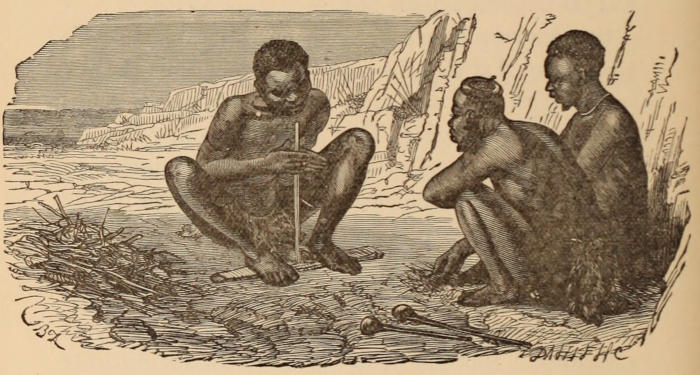
SOUTH AFRICAN MAKING FIRE.
In lighting a fire some tribes rub a stick along a
groove; other tribes have an improvement on this, they
produce fire by making a little notch or hole in one
stick, and whirling the other round very rapidly with
the point of it in the notch. Now we may hold that
before mankind discovered the second method, many
nations, like the South Sea Islanders, who knew only
the first, had broken up communication with the rest of
their kindred; but that the Africans who use the improved
method had likely been with the main body of
mankind till the time of this great improvement.
Again, take the case of cooking. Some tribes have no
pots. They boil water by throwing hot stones into a skin.
They must have separated very early from their more
cultivated brethren. Others waited till some one fell on
the plan of boiling water in a hollow stone. Others
waited on till it was discovered that clay could be
shaped into a kind of pot, and then carried this important
discovery to the land of their adoption. Boiling
with hot stones was the only way known to certain
American, Australian, and Polynesian tribes; some
tribes in Africa also used this method. The Esquimaux
had pot-stones. It seems to have been the daubing
of these with clay that first suggested pottery.
I have taken down traditions from African natives
that point to some recollection of the hollow stone, used
either by themselves or some other race; but the tribes
here treated of know the value of clay pots. Of course
they are far behind the Indians, who have metal pots.
With regard to the cause of disease there existed a
widespread belief (held by many tribes in America and
Australia, as also by these Africans) that disease came
from bones, horns, balls of hair or something of this kind.
The ancient Egyptians at a very early date considered
that disease was to a great extent caused by excess of
eating. The inference is that these tribes had not staid
long enough to benefit by this wisdom of the Egyptians.
Other peculiar customs are spread over many tribes,
and might be used in a similar manner. Many of these
are observances in family life. Among the Kaffirs a
son-in-law must not see the face of his mother-in-law.
This custom is found among South American tribes.
Sometimes a father has to fast after the birth of his
child, or take some such method of showing that he recognises
that he as well as the mother should take care
of the young stranger.
When races are found knowing nothing of the art of
writing, and making no attempt to use stone or bricks
for building, we feel that a wide gulf separates them
from the most ancient races of history. Of course it is
to be remembered that they might have once been aware
of such arts. Many Africans, as a matter of fact, have
seen Portuguese architecture for centuries without
adopting it.
A position has often been maintained that there is no
tribe without some knowledge of God. This bears on
investigations in the science of mind and on primitive
traditions and ethnology. We do not now dwell on
native religion, as it will claim special attention in
subsequent chapters.
Besides throwing light on many subjects like the
above, a knowledge of tribal beliefs and customs is of
vital importance to the missionary and also to the
trader. Indeed, any attempt to deal with people
without knowing their customs and beliefs is a mere
groping in the dark.
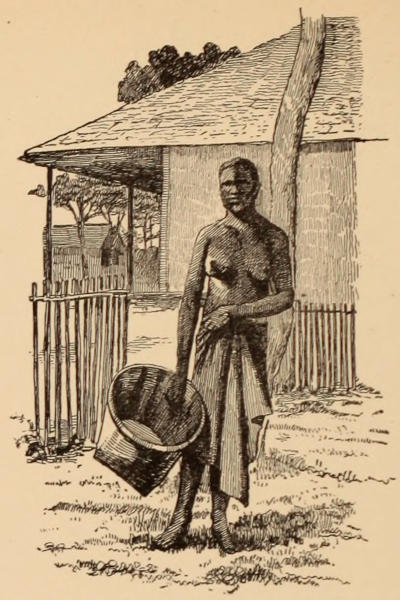
LIBERATED SLAVE-WOMAN, BLANTYRE.
(Photographed in ordinary Costume.)
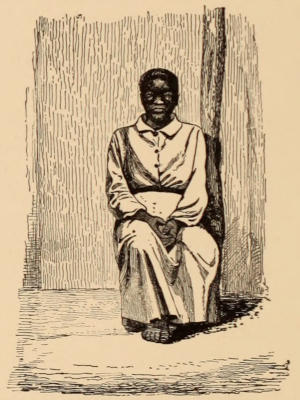
LIBERATED SLAVE-GIRL, BLANTYRE.
(Trained to Household Work.)
Chapter I. FIRST IMPRESSIONS. — A.—DRESS, TATOOS, ORNAMENTS, &C. — B.—WEAPONS. — C.—HOUSES. — D.—CLIMATE AND PRODUCTIONS. — E.—FOOD AND COOKING. — F.—WORK. — F².—RACES AND CHIEFS. — G.—TRAVELLING AND SALUTATIONS. — Native Roads. — Grass Fires. — Salutations. — The Inferior Position of Women.
The dress of the native is very scanty: sometimes
we see full-grown men and women whose wardrobe does
not consist of a square foot of cloth. We have even
seen the primitive fig-leaves not sewn together, but
simply taken down for use, along with the tip of the
branches on which they grew. One tribe, called the
Mangoni, is fond of wearing skins. Other tribes
towards the north of Lake Nyassa are still more
primitive in their dress, or rather want of dress. The
usual costume in the Blantyre district is a piece of
calico about two yards broad, and rather longer, which
is put round the middle of the body: the dress of a
man does not differ from that of a woman, except that
the latter may occasionally cover her breasts. The
breasts and arms are usually left quite bare. There
is no hat on the head, nor shoes on the feet. When we
tried to translate the words, “If any man sue thee
at the law and take away thy coat, let him have thy
cloak also,” we found a difficulty, for if a native were
stripped of one garment, he would generally be left in
a very helpless condition.
The chiefs, or principal men, dress as the rest of the
people, only they may have a few more folds of calico
about their loins. In certain families, as in the Abanda
family of the Wayao tribe, the chief of the district, or
of a village, wears a band of cloth round his temples as
a kind of crown. Before the arrival of the missionaries,
shirts, although very rare, were not entirely unknown,
and there existed a belief that while men might wear
them, they were not the proper thing for women.
Bark cloth (H) is extensively made and worn.
The tatoos (nembo) are sometimes dreadful inflictions,
and when the larger marks are made the children roar
as if they were distracted. The Angulu have marks like
“flies,” the Wayao tribal mark is above the nose, the
Anyasa make very large rude tatoos, which might be
described in those words that Henry Salt, the Abyssinian
traveller (1814), uses with reference to the Makua, a
tribe not far distant, and much spoken of by the
Wayao, under the name of Makuani. “The Makua
practise tatooing so rudely that they raise the marks
one-eighth of an inch above the surface.” He writes
also:—“They file their teeth to a point, so that the
whole set has the appearance of a coarse saw”. The
natives here are fond of knocking out a front tooth in
order to produce a beauty mark.
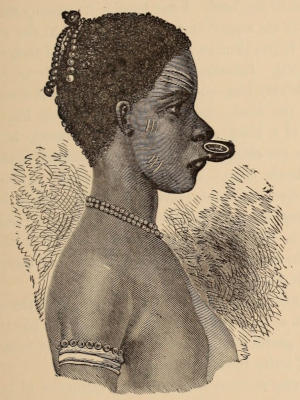
Ornaments are worn chiefly by the women in Africa
as elsewhere. Beads and bangles are in great request.
Many have armlets and anklets of brass or iron. The
most striking female ornament is the lip ring. Little
girls have first a small hole (lupelele) bored in the upper
lip, in this they place a stalk of grass, which prevents
the hole from filling up, next they insert a thicker
stalk of grass, then by means of bits of twigs, &c.,
the hole is made larger and larger, till it can receive
this ring. Hardly any female is without it. They say
it makes them look “pretty”; the bigger the ring, the
more they value themselves! At Zomba, a small hole
is bored on the side of the nose, and a tack (exactly
similar to those large headed tacks or “tackets” used in
the sole of a boot), is put in. This tack, chipini, is made
of lead; some of the ladies used to express much surprise
when I showed them that it would write on my book.
NATIVE WOMAN WITH BEADS, TATOOS AND LIP-RING.
Occasionally, a woman will wear an enormous wig
made of beads. The beads are so manipulated as to
present the appearance of having been “threaded” on
the hair of the head. Some females do actually thread
beads on the separate hairs of their head, but the usual
way is to put them on a cluster of strings, and then wear
like a wig. Sometimes they allow their hair to grow
till it is very long—it may be sticking up about 8 inches
above the head—and then it looks exactly like the
fleece of a black sheep. But this is unusual, as the
natives are obliged, for the sake of cleanliness, to shave
their heads often. The men have scarcely any beard
or whiskers. On the shaving of the head for a death
(40), not even the eyebrows are allowed to escape.
There is no end of capricious shaving, for instance,
they shave one side only, or the whole head except a
patch in the middle.
Charms (mbiji) are very often worn round the neck
by both sexes. These are little pieces of wood like what
fill the gourds of the Sorcerers (I). They are worn on
a small string in the same way as beads.
We may mention here that great quantities of beads
are worn round the loins in strings as thick as cart
ropes. When a person is from home and wishes to
buy anything, he falls back upon this portion of his
property which is really his “purse”. Besides this, a
native carries a bag (msaku), which may contain a box
with lime (swakala), which he uses in chewing tobacco:
a snuff box is also common. Ladies partake of these
“regales” to a less extent.
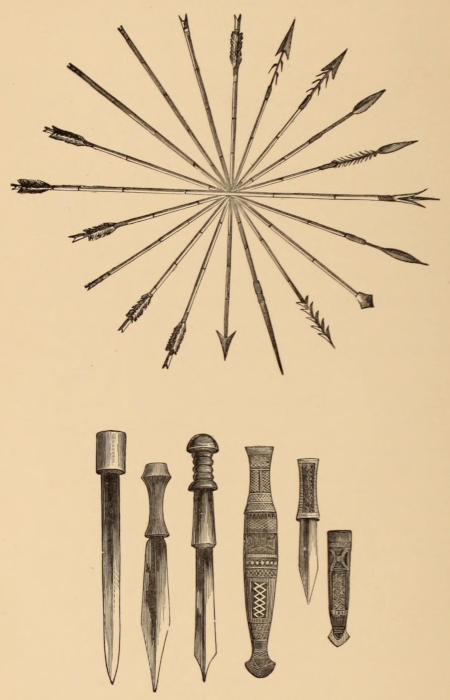
NATIVE KNIVES AND ARROWS.
The men go armed generally with guns. (The country
is full of flint muskets marked the “Tower,” and introduced
by the slave trade.) Often they carry their
bows with half-a-dozen arrows. They never go unarmed.
One chief used to be fond of carrying a large spear,
which served as a kind of staff. Most of them carry
knives as well. These weapons are necessary for protection
against beasts of prey and other enemies, and
may be used where game is seen. The Mangoni carry
a shield like the Zulus.
On coming down from the Lake region to the Portuguese
settlements at Quilimane, one of the first things
that strikes us is, that natives under the Portuguese
Government go about without carrying any deadly
weapon. On the hills round Blantyre, a man scarcely
sits down to sew his wives’ calico in his own village
without having his bow and arrows by his side.
They do not seem to be expert marksmen; but they
were able to send their arrows very much farther than I
could do, let me try never so hard. They were fond of
asking us to competitions of this nature. One time
Kumpama of Cherasulo challenged us to a shooting
match—his arrows against our guns! They allowed us,
however, to stand too far back, and the arrows of his
bowmen fell short of the target. Little boys are to be
seen using their arrows from their earliest years, and
they shoot small birds very cleverly.
They use the assagai, but more for thrusting than for
throwing. Apart from war, chances for its use occur
when they steal upon a buck before he awakes. A large
broad spear is used in killing fish.
Some carry knob-sticks, or staves of a similar nature.
They are useful for shaking the dew or rain off the long
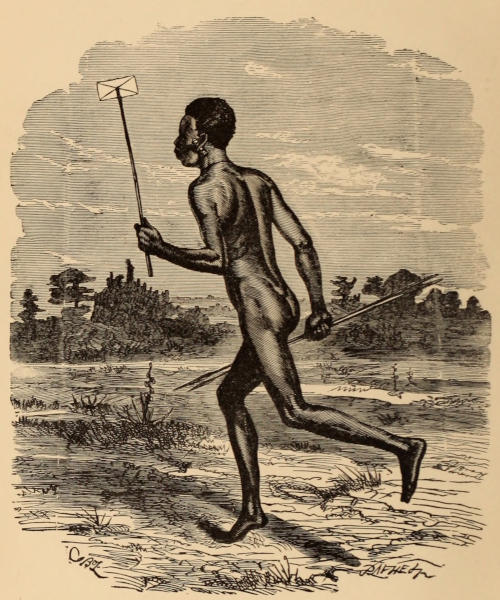
grass, as well as for defensive purposes. Little axes of
various kinds are carried in the hand; they may be
borne as credentials where a chief has to send by an
unknown messenger. The usual African axes are said
to resemble those used in Britain in the Roman period.
The houses, or huts (nyumba) in which they dwell,
are all round. It is misleading to say that they
dwell in them, as they scarcely enter them, except to
sleep, or when driven by bad weather. Sometimes the
women boil a pot inside the house, but often the
cooking is done outside; all the meals are eaten outside.
When the head of a house has any sewing to do, he
does it on a mat before his door, or in the village forum.
His wife does not sew, and most of her occupations (57)
are necessarily outdoor. “A house,” says the native,
“is made to sleep in.”
The walls form a circle—say about twelve feet in
diameter—and are made of strong posts, sometimes
close to each other, but generally with spaces between,
where bamboos and grass are brought into requisition.
The framework of the roof is placed upon the top of
the circle, and some thatch is thrown on. The floor
and walls are plastered with clay.
Two doors (mlango) are marked out before they
plaster, but one of these is generally shut up, and may
even be dispensed with. There are no windows. The
wall is not above 3 feet high, the roof projects so as to
form a small verandah in which a person may sit.
Sometimes there are apertures in the wall calculated to
let through the muzzle of a gun.
The houses being occupied chiefly during the night,
part of the floor is often raised for a bedstead. The bed
which is merely a mat made of bamboos or reeds, and is
not nearly so soft as an ordinary door-mat or hearth-rug,
is laid on this mound. By the side of the “bedstead”
are placed a few logs of wood which form a fire during
the night. The head of the house lies nearest to this
fire, while his partner is placed on his other side, as he
remarks, away from the fire. Blankets are unknown.
The cloth that covers the man during the day may
be drawn over him at night. Quite as often he lets it
remain round his loins. Occasionally it seems as if a
little flour had been spilt on the ground beside his head.
He will not speak of this to a stranger, but you are on
holy ground, and let me tell you in a whisper that it is
an offering to his gods.
Candles are not used, the logs that smoulder in the
fire give a little light. They burn beeswax occasionally,
and when light is required, a little dry grass may be
readily obtained. The native retires to rest soon after
dark, and is astir at the first streaks of dawn.
The fire is in the middle of the floor, and there are
no holes in the roof as in the old Highlands of Scotland.
The houses are without any chimney whatsoever, and
the smoke goes curling about in the roof and may
ultimately escape through the thatch or at the doors.
The roof is beautifully black and glossy inside, but outside
it has an ugly brown appearance.
A European finds it a most inconvenient thing at
first to enter a native hut, the smoke so fills his nose,
mouth, and eyes, but when he sits down to talk to an
invalid, the inconvenience is of course less than when
he stands upright; at best the atmosphere resembles a
London fog. In native huts it is sometimes difficult
for a man of ordinary stature to stand upright. The
doors of the houses are never over 3 feet high. What
pigmies the natives must be! We have heard a learned
professor arguing that the height of the doors in certain
very ancient houses proved that the human race was
not degenerating in stature, but this argument, true in
many cases, would not do here. If the native wants to
stand upright, he never thinks of trying to do so in his
doorway.
The roof of his house is generally made a store; he goes
up from the outside, removes part of the thatch, and puts
in his corn. Bags of beans are hung up round and round
on the pillars inside. Sometimes there are one or two
pots filled with beans, and hermetically sealed with clay
on the top to preserve such vegetables. There are no
fenders or fire-irons to be seen. Tables are unknown,
and chairs are hardly used at all, although men clever
at wood-work make very small chairs of various forms.
Implements of agriculture are stowed away in the house,
so are the cooking utensils, the man’s bow and arrows,
the sleeping mat already mentioned, and—our inventory
is complete! Some part of the house may be occupied
by live stock. The fowls are sometimes put up stairs
in the store, and sometimes in a corner so as not to
disturb the other members of the family! But laying-hens
(mkolo) and fowls with chickens have very special
privileges, and are not always confined to their corner!
Another item of importance to the inmates of a
native house is the rats. They swarm in all corners
after dark. They nibble at the maize that is stored in
the roof, and also at the feet of their lord and master
below. As we sit in conversation with a number
of natives we cannot help observing their feet. Very
generally they are all nibbled round the sides, and,
thick though the natives’ skin may be, we can see that
many bites have reached the quick flesh. When a person
dies in a house at night, if the death be unobserved, the
body may be terribly eaten by the rats before morning.
What is the meaning of tolerating these vermin?
Leave that to the natives themselves. A great feast
day will come. These rats will be caught in hundreds,
and either eaten on the spot or laid up as stored provisions.
Some natives set traps in the house even
during the close season, but this is not nearly so
profitable; for if one or two rats are caught during the
night, the others will eat them, and the fondest expectation
of “butcher meat” will be blasted.
After calling attention to the fowls and the rats, we
have done with the live stock. There are indeed
“smaller cattle,” but they are too numerous to be
specified. They are not a burden to the house itself,
but are generally borne by the other inmates. We have
often seen a native sit patiently while two or three
others kept searching among his hair. A favourite
remedy is to shave the head quite bare, and smear the
head and the whole body with certain vegetable oils.
The climate strikes us at first as being much too hot,
but after a while we feel it more comfortable. Then we
can nearly always anticipate the weather. It is quite
amusing to hear an arrival from England saying
“This is another fine day!” When we meet a man
at home, and have nothing to say, we nearly always
call his attention to the state of the weather. When
two natives meet each other the usual salutation is—“Where
are you going?” the weather being so uniform
that it may be taken for granted. The temperature in
the shade at the hill settlements was hardly ever over
105° or under 42°, 70° being about the average. On the
plains the heat was excessive.
The rainy season begins about October. We have
nearly six weeks of very hot weather about January
without much rain. By and by the sun returns overhead
again, and we have the latter rains. About April
the dry season sets in.
On the productions of the country we may remark
that there are fruits in almost endless variety in the bush,
but they are generally very small, and few of them
are so good that we care to taste them twice. The
masuku and mbembu are used very much by the natives.
Sugar cane, tobacco, india-rubber are all to be found
growing throughout the country. The natives chew the
stalks of the sugar cane, chew and smoke tobacco, and
relish the apple-like fruit found on the india-rubber
vine.
Thrifty housewives make various vegetable dishes
(maponda) of leaves and grasses that a European would
be inclined to despise. In the hot season that precedes
the rains sometimes food is very scarce, and then roots
and herbs still less savoury are called into use. Moreover,
there are certain edibles of this kind, which are
used only in years of famine. Before the arrival of the
missionaries such famines were exceedingly common,
but they were not all caused by the climate, many were
caused by war.
Nature is here so bountiful that, in ordinary circumstances,
food is no object. The only season associated
with hunger is a month or two immediately before
the rains. If the rains do not come early, the old
food may be quite finished. As soon as the rains
begin, vegetable life flourishes with such luxuriance
that the season of want is immediately forgotten.
Once or twice in travelling during the season when
everything is dried up, we have found a little boy
sitting weeping on account of “hunger,” and the expression
“hunger is painful” (sala kupoteka) reminds
us that most natives know the fact by experience.
Much of this is due to the tediousness of their cooking.
If a party arrive half starving at a village, it may be
several hours before anything can be cooked. The
people do not keep flour on hand, but mill it as it is required
for each meal; and as their meals are at 11
at noon and 6 at night, parties arriving in the interval
must tighten their belts. Native travellers could
easily sympathise with Esau when he sold his birthright.
The cooking is done by the women; but every
native is a born cook. When a buck is shot out
in the bush, even little boys will cook it at once. The
staple food at Blantyre is maize; among the Anyasa
millet; and at the mouth of the Shire, rice. Maize and
millet are ground into a fine flour (utandi, ufa), which
is made into a kind of porridge (ugali, nsima). This is
eaten without salt, but ought to be accompanied by
some relish, as beans or meat. This porridge takes
the place of bread in their meals, as the natives make
no bread. Another way of using maize or millet is
in the native beer (ukana, mowa), the only beverage
in common use except water, which they drink out of
the running streams. They drink stagnant water also.
Their method of drinking is peculiar, as they literally
throw the water into the mouth with their hands.
The natives have regularly only two meals a-day, but
they may eat maize stalks or sugar cane or other vegetables
from morning till night. There are often feasts,
as on the occasion of hoeing-matches (65), wakes, and
marriage settlements. Beer is used greatly in those
cases, and beer drinkings may be got up also without any
special occasion. Sometimes they last for several days,
the last day (lia kusasula) is specially distinguished for
cooking porridge and fowls. Such solid food is not expected
on the other days. There is also singing, dancing,
and drumming. The exercises generally continue the
whole night. The parties that do most to keep up the
interest in such dances are paid.
There are no live stock except the small species of
fowls and the rats that we have already mentioned.
Some natives keep ducks—Muscovy ducks, which do
not require a pond. Richer people, as village chiefs,
possess goats. The Magololo chiefs have sheep and a
few cows.
The Wayao have a superstition against cow’s milk,
goat’s milk, and dairy produce of every kind. (In the
same way young people will not eat eggs; it would
make them barren.) They eat hippopotami, elephants,
monkeys, moles, beetles, and even caterpillars. They
take kindly to meat that has begun to putrify. Yet
they make a distinction between what animals are to
be eaten and what are not. Any creature that will eat
the flesh of a deceased human being is unclean. It is
msawi (106). For instance, while some eat the raven
or kite (likungulu), others protest that it feeds about the
graves.
A person could travel far and wide and trust to
native hospitality. If we arrive at a village at the
time that the native is taking his meals we are
invited to partake. A great drawback is that a person
not brought up on native food will be unwilling to
risk his health by partaking of their fare. It cannot be
expected that the traveller will fare better than his host.
They soon begin to know people that do not eat freely
of native food, and from motives of politeness they are
slow in offering it. If we pass through a village its
inhabitants quietly ask some of our native retinue
whether there is any chance of our tasting the native
beer,[2] and if it be found that the beer will not be refused,
the poor creatures go and search for a cup (if they have
one in the whole village). They judged that, as we
were more familiar with cups than with calibashes, the
cup would be the more acceptable. The natives that
accompanied us on any journey were presented with
loads of the various fruits of the season. If one wish to
stay all night he will get a house to sleep in. Natives
receive hospitality quite freely, and are prepared when
their host comes to their home to treat him in the
same way. When a party from one chief goes to visit
another chief, one of their credentials is a present.
It is a breach of etiquette to eat alone if any one be
present. When a native is at food he shares it with
those around him, indeed he goes on dividing till he
has only a mouthful left for himself. Etiquette does
not bind us to partake of their food, but it is a sign
of friendship to do so as far as possible. The natives
have no spoons, and Englishmen would burn their
fingers severely in eating porridge in the fashionable
manner.
The natives go to work at sunrise, and continue until
the sun is overhead. After this their day’s work is
finished, and they partake of their first meal. One reason
why the morning meal is so late is that it would be
difficult to have it ready before the people go out
to work. In the afternoon the men sit down and
converse. Some do light work, as sewing, but a great
many remain quite idle. The women will be found
pounding maize. They are nearly as strong and tall as
the men, perhaps owing to the heavy work they do.
By sunset the second meal is ready.
They have little notion of the division of labour.
Natives have not arrived at such a pitch of education
that one of them would spend his days in making the
sixth part of a pin. The little girls from their earliest
years are initiated into all parts of the mysteries of
hoeing, reaping, milling, and cooking. The men are
equally ignorant of the advantages and disadvantages
of division of labour. Each man builds his own house,
and makes his own furniture. The only trade that can
maintain a special existence is working in iron—a trade
embracing mining, smelting, and forging. Even in
this case most natives know the secrets of the trade;
but to be specially successful they need to obtain a
charm.
Agricultural work is the great means of a livelihood.
It yields a great return, for every seed the natives sow
they expect to reap hundreds. A little before the rains
they begin to hoe their ground. They first clear all the
trees and wood, which they collect in heaps and burn on
the spot. They use no other manure. When they do
work for the English they say they hoe very slowly,
because they are told to hoe deep; but when they hoe
their own land they hoe fast, as a scratch on the surface
is considered sufficient. When the rains come they
plant. After the maize grows they set up the soil
round the stems as farmers do with potatoes.
Each house has generally what we might call a
garden; but the natives have no fancy for flowers. The
wild flowers in the wood they recognise as being very
pretty; but they laugh at any one that plucks them.
They fancy that a lover of flowers culls them for some
charms. The natives have no word for a garden
as distinct from a cultivated field or farm, but they have
often round their houses little beds of tobacco, great
quantities of manioc, and several other useful plants.
Indian hemp is also much cultivated, and is nearly
as bad as opium. Near Mazaro opium is cultivated by
a Portuguese Company.
As we pass out of Portuguese territory we find
ourselves in the country of a chief called Matekenya,
on the Lower Shire (Chiri). His people are the Achikunda.
When we reach the Ruwo or Ruo we are
perhaps about two days from Blantyre by land. Here
we come to what are called the Magololo, whose paramount
chief is Makukani, although many of the others, as
Katunga and Chiputula, seem to view themselves as
independent of him. Still they say that if he commands
they must all follow him to war. These men
though aliens, have established themselves as rulers
over the Anyasa. There is no Magololo tribe here.
Passing through these Anyasa we ascend to Blantyre,
where we find ourselves with a chief called Kapeni, who
rules another tribe called the Wayao (Yao), with whom
we are best acquainted.
Then about Zomba, which is other two days farther
on, we encounter the Machinga, who speak practically
the same language as the Wayao, and this language
carries us far beyond. Several great chiefs on the east
side of Lake Nyassa are Machinga. Again, when we
stand on the south side of Mount Zomba and look over
Lake Chirwa[3] (Shirwa) towards the rising sun we see
mountains that are peopled by the Angulu (or Walolo).
The tradition is that the Anyasa first inhabited the
land everywhere about Zomba; but that the Angulu,
who lived at one time on the other side of the river
Lujenda, began to fight the Machinga. The Machinga
then went and encountered the Wayao, who, in turn,
pressed on and drove from their home at Zomba the
Anyasa tribe, many of whom now live under the Magololo
on the Lower Shire[3] (Chiri), i.e., the Shire below
the cataracts.
The Anyasa are also called Anyanja, both words
in different languages of the district mean river- or
lake-people. The word Wayao (or Achawa) suggests
a derivation from the personal pronoun. Yao regularly
means “their” (ipanje yao means their property).
So the Awa of Achawa is identical with the personal
pronoun. I am inclined to interpret the name
as “The people that hold their own!” until I
find something more satisfactory. The Machinga are
really the same tribe, and are called the “fighting
branch of the Yao”. The derivation of their name is in
harmony with this view.
It is instructive to note the descriptions that these
tribes give of other tribes that live at a distance,
and are barely known to them. I had heard such
strange particulars about the Makua that I thought they
must be a peculiar people; now so they are, but
only just as the Wayao are peculiar. It was the old
story; every race considers itself perfection, and points
to a mote in the eye of a brother race. The language
of the Makua is quite similar to Machinga. I
travelled to London with a Makua with whom I had
little difficulty in conversing.
There are two great Wayao chiefs in the district of
Blantyre, who are called Kapeni and Kumpama, and
whose head quarters are at Mounts Sochi and Cherasulo
respectively. These are the two large territorial
chiefs. Mkanda of Cherasulo, was at first a headman
of Kumpama’s, but rebelled, and lives on the southern
side of that mountain; an easy day’s march from Blantyre.
Kumpama’s territory begins about six miles from
Blantyre at a stream called the Luunsu, and extends to
the Namasi, on which is the old site of the Magomero
Mission. The next great centre of population as we
march to the north-east is Zomba, one side of which
is owned by Chemlumbe, a Yao chief. The other side
belongs to Malemya, a more powerful man, who is
a Machinga. A little way beyond there is Mount
Chikala, where a still more powerful chief called
Kawinga resides; he is also a Machinga. If we look
towards the south from Zomba we see a great mountain,
Mlanje, this marks the domain of Matapwiri. When
we wish in Quilimane to ask for a man who speaks
Chiyao or Machinga, we ask for a person from Matapwiri’s
country. There a Matapwiri is used for a
simpleton—one that has not seen the world. It is with
this chief that the Yao of the coast are most associated,
as the slave gangs for Quilimane used to set out from
his village.
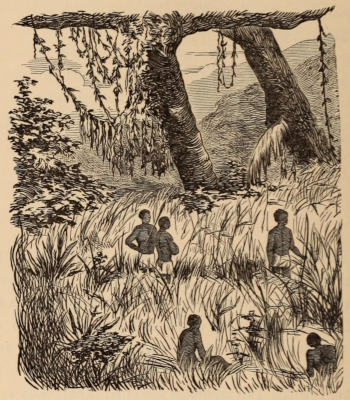
The native roads are never straight; at best they
glide along by an easy succession of curves. Sometimes
the amount of curvature is very annoying. The path is
little more than a foot broad. Each side is covered with
tall grass, which reaches over the traveller’s head. You
can only see four or five paces in front, and you
can never predict what course the path will take after
that. The causes of curvature are numerous. Here a
tree fell down long ago and lay across the path. While it
still lay every traveller went round the end of it, and
the original path was abandoned, and replaced by grass
that no traveller will care to interfere with. At another
place the path turned aside to go through a little
village; but the village has passed away years ago. At
another spot some one had hoed a field, and made the
road go round its border. There are cases too where the
path may have deviated to avoid marshes and difficult
crossings. On many roads we lose one mile in every
five. After the grass is burned, or in bad soil where
very little grass grows, one may have the pleasure of going
in a straight line; but where the grass is at all represented
no one can pass through it without the greatest exertion.
If a person leave a native path with the idea of taking a
short cut, he may get into a tangle of long grass and
bushes, where his progress will be not more than
one mile in four hours.
One of the best sights in Africa is a large grass fire.
No fireworks in Britain can for a moment compare with
this. Broad plains will keep burning for weeks. At
the mission on the side of Mount Zomba, which overlooked
a plain of several days’ journey, the sight of these
fires was very impressive. The trees in the country
suffer much.
The natives in saluting each other say “moni”—a
corruption of the English “morning”. So general did this
word become that we have heard people inclined to
fancy that there must really be a native word “moni!”
The native salutation is “mugonile?” “Have you
slept well?” Sometimes friends will ask each other
“Are you well?” “Is all well at your home?”
A party arriving at a village observes the greatest
formality. After getting an introduction to the chief of
the village he begins to explain the object of his visit.
The explanation is generally most tedious—it seems to
go from the creation downwards—every step being carefully
traced, whether in action or in motive, till the
moment of the arrival!
The natives have the greatest respect for the older
people. The title of father is given to such. If we ask
anything of a younger man about 30 years of age he will
say “I am only a child; ask the old men of gray hairs”.
All the English are saluted as father; even a white child
of a few months is saluted in the words, “moni, moni,
atati!” (morning, morning, father).
The women hold an inferior position. They are
viewed as beasts of burden, which do all the harder
work. When a woman meets any men on the path
the etiquette is for her to go off the path, to kneel
(tindiwala), and clap her hands to the “lords of creation”
as they pass. Even if a female possess male slaves of
her own she observes this custom when she meets them
on the public highway. A woman always kneels when
she has occasion to talk to a man. The custom very
rapidly disappeared in the region of the missionaries.
When we saw a woman go out of her way, carrying
perhaps half a hundred-weight on her head, with
the intention of kneeling down, and reflecting, as
she must, that with her load she might have difficulty
in getting up, we have often playfully shouted out,
“You are losing your way; this is the path,” and she
took it for granted that she might dispense with the
clumsy ceremony.
Chapter II. NATIVE ARTS AND LITERATURE. — H.—TRADES AND MANUFACTURES. — Work in Iron. — Wood-work and Basket-work. — Bark Cloth, &c. — I.—THE LEARNED PROFESSIONS. — The Physician. — The Sorcerer. — K.—MEDICINES AND CHARMS. — L.—TRADITIONAL LITERATURE. — Relation to Tales of Other Lands.
The chief method of obtaining a livelihood is by
cultivating the soil. Near a lake abounding with fishes,
the cultivation of the soil, though not abandoned, may
take a secondary place. In districts abounding with
game, the men as a rule hand over all agricultural work to
their wives and slaves. Fishing and hunting are looked
on as being more dignified occupations than hoeing.
Skilled labour is exemplified chiefly in their blacksmiths.
Still the smith does not live so exclusively by
his trade that he can neglect his farm, and in his operations
he has sometimes so many assistants that his
peculiar position is compromised.
Iron is found in many places. It is dug up and
brought to a furnace or small kiln (ng’aso) made of clay.
A charcoal fire is kept blazing by means of clay pipes or
hollow bamboos, which communicate with the bottom of
the kiln, and are used as the pipes of a bellows. For a
bellows they use a goat’s skin. Of iron they make hoes,
spears, arrow-heads, knives, &c. Their hoes have no
iron ring for fixing a handle. A hole is bored by means
of a heated iron (there are no drills) in the handle, and
the end of the hoe is inserted.
When a man wants a pocket handkerchief, it is to the
blacksmith that he must go. The pocket handkerchief
is made of iron and shaped somewhat like a spoon.
The point of it is turned up so as to enter the nostril,
and as the native has no pockets, it is hung round the
neck.
The worker-in-wood has hardly a distinct trade.
Nearly every man does his own wood-work. They make
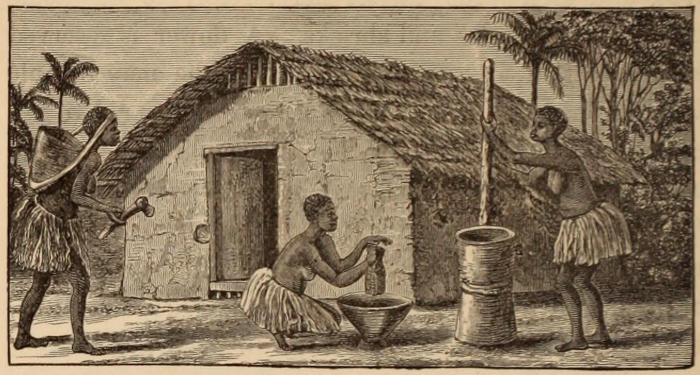
mortars by hollowing out part of the trunk of a tree with
a bent axe. The work takes about four days. Drums
are made in the same way—their ends are covered with
python skins. Certain drums are beaten on the breast;
the larger are not lifted from the ground. We have
heard the sound of some of those at five miles’ distance.
Chairs in imitation of animals are cut out of the trunk of
a tree; but the legs are easily broken, as they run
at right angles to the cleavage of the timber. Similarly
they make large birds, wooden pillows, and plates.
Many things are made of bamboos (milasi) and reeds
(matete). The tribes on the hills thus make beds and
baskets in endless variety. The beds are not clumsy.
One can easily “take them up and walk”. They are
mats made of thin slips of bamboo, which are sewn
together by a bamboo needle. They remind us of a
Venetian blind, only the slips lie side by side without
overlapping. They can be folded up in the form of a
cylinder and earned conveniently under the arm (but
the native carries his loads on his head). The borders
of their baskets are thin broad pieces of wood, which
are bent into a circular form, and sometimes curiously
carved. A similar ornamental device, simpler in pattern,
is seen on their clay pots. Good hats are made of the
mlasa.
They go and strip a tree of its bark, which they soften
in water, and beat with an ebony hammer till it forms a
cloth. This was the ordinary clothing of the people
before the missions. Now it is worn above other clothes
on a rainy day. It very soon tears. The work is very
tedious, much beating being required. One hears the
sound of the hammer long before he comes to the spot.
The piece of bark is laid on a large log; after being
well hammered, it becomes quite thin. The cloth thus
formed is much wider than the original piece of bark
had been.
Cotton grows plentifully. All the natives can make
thread of it. One of their most tedious occupations is to
make cloth. They do this in a very rude manner, and
only make small strips at a time. Each thread has to be
put separately in its place by the hand. Very few
natives have courage for this tedious manipulation; but
the cloth when made is strong and highly esteemed; it
resembles bath towels.
They dye the English calico that it may last longer,
but they preserve gaudy dresses without dyeing. A
root is used for soap where the European article cannot
be got.
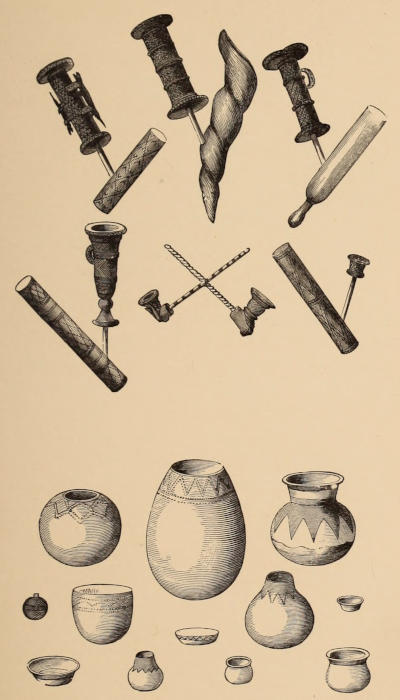
Their pots are all made of clay by the women. Some
of their clay vessels are a beautiful red. In their cooking
they use no metals; English pots and pans speak
to them of arts that are far beyond them. Their
food is boiled in a clay pot, which is propped up on
three stones. Another pot is turned down to serve
for a lid.
Men of considerable skill are called alupa or apalu,
and are believed to have strong medicine or charms.
If any one were to describe our English industries, he
could not dispose of the subject in a short paragraph.
But in Africa these industries do not strike us so much.
They are not such a large item in human life. We see
none of the working at high pressure that meets us
everywhere at home. There are no crowds of pale-faced
men and girls rushing along almost mechanically in
response to some factory bell. There are no poor clerks
cooped up in dingy counting-houses—no students with
aching heads, trying to dispense with sleep. There are
no careworn parents whose hard toil barely supports
their children. The African has about him an air of
stillness and repose that is in beautiful harmony with
the scenery around. His life is not a struggle for
existence. He does not care to work against time.
Ambition does not drag him behind its chariot wheels. If
we were to rank the Africans in classes, we should
put down most of them as “gentlemen in easy
circumstances”. Their circumstances are easy not because
their gratifications are many, but because their
wants are few.
The way in which their industries come before our
notice is like this. We take a walk in the country. By
the side of some brook we find a man or two digging for
iron ore. They are surrounded by companions with whom
they keep up a cheerful conversation. Some are ready
to assist in carrying the ore to the furnace. They
carry clay also, which is to be plastered on their kiln.
How are these loads to be transported? There are no
carts, no wheelbarrows, and no roads suitable for either.
Neither have they any boxes or baskets. What are they
to do? One lad darts into the bush and cuts a bundle
of wands; he then takes his knife and splits each wand
(if he be not content to use it whole), and there, he says,
is his basket. The white man replies, “Yes; these
wands might make a basket if you had anything to tie
them together”. Immediately the youth tears off strips
of bark, and exclaims, “Here’s the black man’s rope,”
and soon the load is tied up in the middle of his
basket.
As we pass along the stream we find indications
of agricultural work also, but on these we do not dwell,
as it is the more special trades we wish to illustrate.
Already we see women washing their grain at the stream
for we are advancing on little hamlets. Now we hear
the peculiar tap, tap, tap of the hammer on the bark-cloth,
as it mingles with the notes of the birds. Under
the trees we can descry a group of men splitting up
bamboos and smoothing the slips to form a bed. In a
shaded verandah we find an old woman or two moulding
some soft clay. It looks a shapeless mass, but it is “in
the hands of the potter”. Each worker has found some
ochre, for she is fond of ornamental tints. A potsherd
is by her, and she has calculated the precise form she
will give her vessel.
NATIVE PIPES AND POTTERY.
Soon we reach the village green. Here we find a
number of men sitting doing nothing. It may be that
one is sewing a cloth, while the others loll upon mats
and dreamily watch his hands. An ardent youth may
approach the group and astonish us by taking from
under his loin cloth a reel and some cotton, which he
proceeds to make into thread. There are in that dark
group all the elements of human nature that we find in
busier lands. But in African life there is nothing of the
bustle and hurry and scramble, nothing of the care and
worry, the headache and heartache, that are found in
England.
We cannot leave the group without asking ourselves,
“What has all our boasted civilisation done?” Are we
any happier than these rude natives? We shall see by
and by that they are not exempt from hardship and
injury. Their valleys and mountains witness many
a sorrowful scene. But after we have placed a policeman
in every corner, hardship and injury are still in our
midst. Does it not seem as if there were some bankruptcy
about human nature? For a hundred generations
we have tried all manner of experiments with
Governments and Institutions. We have moved them
backwards and forwards like pieces on a draught board.
In all this have we not been proving our bankruptcy?
We have been diligently trying the most improved
methods of book-keeping, but the result has only been to
chase the deficit out of one column into another. The
deficit is still there!
Yes. But above the clouds and storms we have the
blue vault of heaven. The pale factory girl, the over
wrought mechanic, the anxious student may all have a
peace that passeth understanding. As the missionary
is surrounded by the heathen, he feels that his message
to them has not so much to do with civilisation. They
are not disposed to trouble about mechanical improvements
in their unsettled land; but in their unsettled
land they are arrested by an expression like “Fear not
them that kill the body, and after that have nothing
that they can do”. Startling words to those that pass
their days in fear of them that kill the body! These are
surely whispers from some other world! Those dark
figures have often gazed upon “the heavens above and
the earth beneath” without making much of the vast
mystery. They are likely to make more of the Scripture
message. One of the oldest will turn on his mat
and quietly remark, “Father, if you are speaking the
truth, we are all living in darkness”.
What corresponds among the Africans to the clergymen,
doctors, and lawyers of modern England? It will
be found that in Africa these professions are not distinct,
just as in Mediæval England the monks did all
the teaching, healing, and advising. With reference
to worship we shall find that the chief of the country
and the chief of a village take prominent places.
The healing art is practised most purely by the
Msing’anga. Some of the methods are these:—Cupping
by means of a horn, whose end is stopped by bees wax.
The blood that fills the horn is thrown to the ground,
and the disease falls with it. Counter-irritation.—Sometimes
the physician will be content by making
a number of incisions chiefly along the legs; on other
occasions he will rub in vegetable ashes. Administration
of medicine, which consists chiefly of plants and
their roots; the Yao word for medicine means also
a tree. The natives extract arrows by cutting all round
the wound. They never amputate in order to heal,
but they are able to cut off limbs very neatly, and are
fond of practising the art on criminals and enemies.
But a great part of the treatment is by charms.
Even where the native knows a good cure he looks on it
as a charm, and his use of it is accompanied by much
senseless mummery. This will be understood when we
remember that diseases are supposed to be caused by
witchcraft.
This brings us to speak of a more terrible member of
the learned professions, viz., the sorcerer, diviner, or
witch-doctor (mchisango). The “cup wherewith he
divineth” is called chisango.
He is appealed to after the physician or herbalist has
failed. He is asked to tell what witch causes the disease.
He may find one, and the person that he accuses of
witchcraft goes with a present to the sick person, who
recovers immediately.
The diviner may be consulted on any matter. He is
the great adviser of the people in all their difficulties.
A person goes to him, and puts as many questions as he
likes, and receives answers. These conversations are
very interesting; but all that I have heard are so very
intricate that it is impossible to do justice to them in an
abridgment. “My female slave has gone away, what
am I to do?” The diviner tells what he is to do if
she have gone to Cherasulo, and what he is to do if she
have gone to another place. He mentions what will
happen if he goes to ask for her according to the individual
that he may ask, &c., &c. Part of the advice
may have reference to the spot where he will obtain a
medicine helpful in his negotiations.
While these diviners give their response they shake a
small gourd[4] filled with pebbles, and inspect pieces of
sticks, bones, claws, pottery, &c., which are in another
gourd. They often give sound advice, and they pretend
to get it by this inspection, as it might otherwise give
offence to their client.
Some of the diviners are the most intelligent men in
the country. They claim high fees. One time we
told a diviner very candidly our opinion of his art, insisting
that his advice was sound, and deserved to be
paid for, but that he knew as well as I that it did not
come from the withered-looking contents of the gourd,
but from his own judgment. The man took no offence,
and though he lived at some distance he made a point of
coming thereafter to our Sabbath meetings.
These men are the great agents in detecting and
trying witchcraft. In one respect they, and not the
chiefs, form the judicial tribunals of the land, although
they play into the hands of the chiefs or any rich man
that pays handsomely. After they have detected a
criminal he must be tried. The trial takes place by the
drinking of the poisoned cup—mwai. Consequently the
diviner had better be on good terms with the professional
“pounder of poison” (mpondela mwai), whose
duty it is to administer this poisoned draught to the
accused. This, in case of guilt, at once convicts and
punishes, the poison causes death. In case of innocence
the poison is vomited, and the accused is acquitted.
The witch-detective is at the head of the divining
profession, and is referred to in almost every case of
death, and sometimes in smaller cases, as where life was
in danger (107).
A great many trees are supposed to have virtues.
Each native knows this, and becomes to some extent his
own doctor. Pain in the stomach is treated by the bark
of the mbawa; headache by rubbing externally with
ashes of the msolo, as also by certain charms put
round the temples. The first thing a native does in headache
is to tie a string tightly round his brow. The
symptom of cold and shivering is treated by bathing in
“water of the mkako”. For ulcers they use the mlonde.
Ulcerated legs is one of the commonest maladies that
attack children. For a time English treatment of
these was brought into discredit, as the children
would carelessly tear off the dressings and bandages.
One native treatment was to tie on a broad leaf by strips
of bark (which serves as their thread), and leave it till
the sore had improved.
A common war medicine is to eat the heart of an
enemy.
Medicine to keep the hunter from danger and to
render him successful is much prized. Elephant medicine
they buy from each other at the highest prices they
can afford. They have many miscellaneous charms—some
tied about their bodies, others on their guns.
They have a very effectual arrow poison.
One time a leopard was killed by strychnia. A chief
and his Prime Minister came to Zomba Mission very
secretly to beg for this “medicine”; it was to be
sprinkled into the mortars where the flour of their
enemies was pounded. The experiment was trusted to
by its promoters as likely to be very successful, a point
which was not at all doubtful. Great was the disappointment
when the poison was refused.
The goats belonging to the Mission seemed to get
on very well, and Mr. Buchanan was beset with many
entreaties for a medicine to increase the goats of the
neighbouring chiefs.
When a fowl hatches, the egg shells that have been
forsaken by the young brood are carefully collected and
hung up in the house of their owner to preserve the
chickens from hawks and other dangers.
After they have planted their crops, the field is often
protected against theft by charms which they buy.
Pieces of string, either twisted from native cotton or
made of the bark of a tree, are thus used.
On one occasion Dr. Macklin was called to prescribe
for a woman. He asked to see her tongue. His quick
observation detected at the same time signs of excitement
and temper about her, and he advised her to try to
be agreeable with her husband and friends. It appears
the woman was a great scold; and the natives were
astonished to find that the Doctor could discover this by
looking at her tongue! That he had a great “charm”
was beyond all doubt.
These people have, of course, no writing. We met
with many that had never seen a book before. The
sight of pictures impressed them so much that their first
impulse was to run away supposing that the little
painted lion or leopard was dangerous. By and by some
one in the crowd discovers that this lion is quite thin!
He has looked at the back of the paper and found that
the body of the lion is not there! Some of the boldest,
after we assure them of safety, will even put their
hands upon him. The attitude of old and young is one
of utter, speechless amazement.
But these people are rich in a traditional literature.
It meets us in at least four distinct forms. 1. Ndawi or
conundrums. Some of them are quite short, as “the
house without a door,” for an egg. An incredible
number of these is in common circulation, and known to
most boys and girls. I noted down over 150 of them.
There are other conundrums in the form of a little
story.
2. Ndano, or tales. These are also called ndawi,
because many of them resemble the conundrums in
having a double meaning. Some of these, we might
almost say most of these, when complete have songs in
them, which are repeated every now and then at each
crisis in the tale. They are often recited in this form on
public occasions.
I got one old man that was as enthusiastic in his
recitals as the old Homerids are said to have been.
When I was writing to his dictation my private study
became a small theatre. In vain I reminded him that
the nursery was near! His voice was audible in the
outside, scores of yards from the house. School children
stopped their games, and came giggling about, and
demure old natives would turn off the public highway
and advance in amazement. Yet even so my old man
was not satisfied—his enthusiasm, he thought, fell short
of the occasion, and he introduced two young women
to sing responses to the chants. The natives do not
speak of “telling a tale,” but of “singing a tale”
(kwimba ndawi).
3. Nyimbo or Songs. These may be extemporised—music,
responses and all, on the shortest notice. But
there is a great collection of old songs, many of which
can be identified as being the songs of several tales (L.
2), even where they are used independently. Indeed
the singers could seldom point to the corresponding tale;
it was only when we happened to know the tale before
that we could claim the song for it. Still many songs
we believe to be quite independent. The music is a
simple chant. Those that are not reciting join in
responses. The language of the songs is more difficult
than that of the tales, and still more difficult is the
language of the catch-word literature (L. 4).
Many of their songs aim at being an echo of tuneful
nature around them. One beautiful chant imitates a
little brook as it goes murmuring down its stony
channel. The singers intentionally render this song in
a subdued voice. I could not find any corresponding
tale. It calls up to my mind the idea of a mother sitting
with a few children on the bank (chiko) of a small
stream as she has finished her hoeing, and rests for
a minute before going home. She warns the children
against the Likwanya or prickly bush that grows by
the stream. This strain sung so softly has a soothing
effect, and might well make the children sit down on the
bank, engrossed with the sound of the rippling stream
imitated in the music.
Sung in a company of little girls it is rendered thus—
1st Voice.
Likwanya likunyanya ku chiko.
Response.
Anyanyale.
1st Voice.
{
singing simultaneously.
}
Likwanya likunyanya ku chiko.
2nd Voice.
{
}
Anya-nya-nya-le e.
1st Voice.
{
simultaneous.
}
Anya-nya-nya-le e.
2nd Voice.
{
}
Likunyanya ku chiko.
1st Voice.
{
simultaneous.
}
Likunyanya ku chiko.
2nd Voice.
{
}
Anya-nya-nya-le e.
Response.
Anyanyale.
After this the girls that have sung the parts marked
1st voice and 2nd voice fall back on the response; and a
3rd and 4th voice take these parts. All the voices that
are not reciting join in the response.
Another song has reference to a large bird, the
ndututu. One voice designedly imitates its notes as it
converses with a few women; while another voice imitates
as distinctly the pounding of corn in which these
women are engaged.
4. The fourth form of their literature is in certain
catch-word compositions (chitagu), which have double
meanings. The following is a specimen when there are
two speakers or reciters:—
The First Says.
The Second Says.
Nda.
Nda kuluma.
Kuluma.
Kuluma mbale.
Mbale.
Mbale katete.
Katete.
Katete ngupe.
Ngupe.
Ngupe akane.
Kane.
Kane akongwe.
Kongwe.
Akongole chimanga.
Chimanga.
Chimanje macholo.
Macholo.
Gachole wandu.
Long tales are carried on in this way. One effect
sought after is to bring together words similar in form,
but differing in meaning, as if we were to catch up the
last word of our sentences thus:—
Come forward, shew thyself!
Elf dost thou call me, vile pretender?
In this form of literature we meet with plays upon
words—an unusual phenomenon in unwritten languages.
In the conundrums proper (L. 1) we met with only one
case of a play on words. We are asked, “What is the
girl that decks herself?” The word for “deck” happens
also to mean “shine,” and the answer is “the moon”.
Having now spoken of the forms in which this
literature has been handed down we shall say something
of its matter or contents.
A great part of it consists of fables regarding the
lower animals where the characteristics of these animals
are brought out. The rabbit is the clever hero of all
the tales, much as the fox is in European tales.
The hyena (litunu) is celebrated for its greediness. The
litunu is a large carrion eater, which stands, we think,
rather higher than the lion. In one tale the hyena is
always begging food from the lion. The lion makes a
buck climb a tree, so that its shadow is reflected in the
water; this reflection is pointed out to the hyena, who
at once casts himself into the river.
The following may stand for an example of their
tales:—There was once a hyena and a leopard. They
went a journey, and the hyena picked up a tortoise,
and told the leopard, saying, “See, I have picked
up my[5] tortoise”. The leopard said, “Give it me
that I may see it”. He gave it him, then the leopard
threw the tortoise away. One day they heard
that the tortoise was a doctor. Then the hyena
and the leopard arranged to go to the tortoise, and
beg medicine for hunting. They went, they found the
tortoise, and said, “We have come for medicine for
hunting”. The tortoise gave the leopard beautiful spots,
and the hyena ugly spots, because the hyena had wished
to eat the tortoise; then he gave them horns of medicine,
and said to them, “If you find meat that died of itself
you must not eat it”. Then the hyena and the leopard
went to hunt. On the path they found an animal that
had died of itself. The hyena said, “Leopard, my
friend, behold an animal that has died of itself”. But the
leopard said, “Come, let us go away”. The hyena said,
“Pshaw! we must not eat meat that died of itself?”
Then the leopard said to the hyena, “That doctor said
to us, should you find meat that died of itself, you must
not eat it”. The hyena said “Pshaw! not quite!” The
leopard went to the bush, but the hyena returned to
the doctor, and said, “Tortoise, I have found meat
that died of itself. Is it a transgression to look at it?”
The tortoise said, “No, it is not a transgression”.
The hyena went to his meat and gazed on it. Then
he went back again to the doctor and said, “I have
looked at it”. Then he said again, “Is it a transgression
to lick it?” The tortoise said “No”. The hyena
then went to his meat and licked it. Then he returned
again to the tortoise and said, “Is it a transgression to
remove it from the path?” The tortoise said “No”.
The hyena then went to his meat and removed it off the
path, and threw it far away. He returned again to the
tortoise and said to him, “I have removed it”. And
the tortoise said, “Very well”. The hyena asked again
saying, “Is eating it a transgression?” The tortoise
said, “You will not swallow it?” The hyena said “No”.
Then he went back to his meat and ate it, and came
back to the tortoise and said, “I have eaten that meat”.
But the tortoise said, “You have transgressed, hyena,
you will not be a hunter, but the leopard will be a good
hunter, I gave him a horn of medicine”. So the leopard
caught much meat, but the hyena did not know how to
catch meat. The tortoise had said, “Hyena, O chief,
your name is hyena”.
We may here note that the naming of the animals is
a subject on which they have many legends. The
names, too, in most of their legends about persons, are
significant, and accord with the moral of the story.
It must not be forgotten that all the natives’ names
have a meaning It is common for men and women
to bear the names of animals; thus we may have a
Mr. Cock, Mr. Lion, and so on. We almost think that
their children when hearing these stories for the first
time would think of “hyena,” “leopard,” &c., as being
people who bore these names.
Several stories relate to fowls and birds. Fowls
are stated to have been at first wild, and after a while
to have been domesticated. One fowl was visited
by a guinea-fowl. The latter was greatly astonished
that the housewife threw out food for them—that a
comfortable house was provided—and every kindness
shewn; but just as all these things were favourably
impressing the guinea-fowl the hungry husband returned
and said, “Kill that fowl as a relish for my porridge”.
Many such tales evince a wonderful sympathy for
animals. The natives are greatly distressed by the
visits of a large crow to their crops. Yet they have a
tale which makes them excuse the depredations. “Once
on a time a chief was puzzled over some case, and could
get no advice till a crow came and put matters quite
right. This crow was handsomely rewarded by a gift of
beans and other seeds. It proceeded to carry these
home, but dropped many on the way; now when the
crow rifles the native’s fields it is looking for some of
those lost seeds and their fruit.”
They have a great many tales embodying theories on
the creation of the world, to which we shall allude below
(13). The introduction of arts and manufactures is also
an important theme. We are told of a woman that found
people with plenty of corn, but no porridge. They
simply chewed their grain. This lady produced a
mortar and procured flour. Hollow stones they say
gave place to pots, in the same way as caves were
abandoned for houses. They speak of a time when they
hoed with wood. It was after they could use iron
knives that they dug down, and could put in their posts
as they do in their modern houses. The first clothing
was bark. Death was introduced by a woman who
taught two men to sleep; she held one’s nostrils, and he
never awoke. “Death and sleep,” the legend remarks,
“are one word.”
Monkeys were at one time human beings who quarrelled
with their friends, and went to stay in the bush.
Though the natives admit that the monkeys are their
cousins, they are not slow in pointing out where they
differ from men. We said to one woman who was
severely censuring the monkeys for eating her crop,
that she should give them some corn to see whether they
would not raise a crop for themselves. She replied
that monkeys would not leave their seed in the ground—they
would pick it up and eat it. It is not everyone
that would have fixed so promptly on such a characteristic
difference between men and monkeys. They
give many tales of experiments tried to make human
beings out of monkeys, specially in the case of women
that were barren and wanted a child; but, after the
most careful training, these “children” always rejoined
their own “kind”.
There are also many wonderful tales regarding people
that crossed lakes or rivers; but at the time we did not
note these so carefully, as we considered that it was
possible that our narrator might modify it in accordance
with teaching that he had heard from the Scriptures.
Since we arrived in England, however, we find that
Bishop Callaway has written down stories exactly
similar, and indeed hardly so circumstantial, which he
received from the Amazulu. On looking over his collection
we find several that correspond, chiefly as
regards the most striking feature of the story, with some
of ours. This shows what we had been convinced of
long before, that some of these traditions had been
recited at a period when the ancestors of the Amazulu
and of these Nyasa tribes were one people.
The following is an instance of the kind of resemblance:—In
one of the tales of Bishop Callaway a young
man tries to destroy the cubs of a leopard. He kills
them one by one; and the point by which the deception
was carried out was to hand the cubs to their mother
one by one. When only one cub was left he handed
this cub several times according to the number of children.
The leopard thought that the same cub handed
to her three times was three cubs. In a collection of
ours that was sent home in 1880, and since printed,
a “rabbit” or fox cheats a lioness by the same
peculiar strategy.
In the stories themselves there is little to give us any
note of time or antiquity. They are liable to modification
too in important particulars. Thus one man will
tell a wonderful story of what a hero effected by his gun.
He judges that a European would despise the hero if he
were armed only with a bow and arrows. But another
narrator of the same story may remark on his variation
that guns did not come till long after.
After we have had a tale written, we have, in order to
obtain explanations, asked the same man to repeat it,
and where he had given any expression that seemed to
vary from the more usual form of language, we have observed
that he kept as faithfully to such expressions as
if he had been reading from a book. We had little
doubt that, as he confessed, he had before him some
recital that had produced an impression in his early
years.
As to the amount of this species of literature it is
difficult to be certain. The number of conundrums (1)
we think does not much exceed 250. I find that I
have written out more than 100 tales (2), and I have
listened to at least 150 others which I did not write
out. I merely noted new words and points in grammar.
The traditional songs (3) may be as numerous as the
tales. Of the catch-word compositions (4), at least the
longer ones, I should not expect to find more than 50.
Before I left I had difficulty in finding new specimens
of 1, 2, and 4. Mr. Buchanan, in his study of the
language, was collecting specimens of native literature at
the same time, and we had begun to think that we had
nearly exhausted the field so far as the more pointed
tales were concerned. New reciters generally wished to
give us what we had already. Our contributors represented
a wide district. My list included Wayao,
Machinga, Anyasa, Angulu, Achipeta, Achikunda, and
Awisa. But the tales seemed to be common to all these
tribes. A Machinga was generally familiar even with
the tales of a native of Quilimane. Where this was not
so we considered the tale as merely local and of no
antiquity.
We have given translations of several tales in the
appendices.
ETHOLOGY.
Chapter III. BELIEFS ABOUT GOD. — ARTICLES 1-107. — 1.—THE NATURE OF MAN. — 2.—IMMORTALITY. — 3.—WHO THE GODS ARE. — 4.—WHERE THEY ARE FOUND. — 5.—HOW THE GODS GIVE EVIDENCE OF THEIR EXISTENCE. — 6.—DISTINCTIONS AFFECTING THE GODS. — 7.—THE PRIESTS. — 8.—VILLAGE GODS. — 9.—MONOTHEISM, POLYTHEISM, OR PANTHEISM? — 10.—NUMBER OF THE NATIVES’ GODS. — Key to their view of the Spirit World. — Nature of Offerings. — 11.—LOCAL DEITIES. — 12.—SUPERIOR DEITIES. — 13.—THE CREATION—COSMOLOGY.
The following statements on the Ethology or the
customs of these races are taken from the very words of
the natives themselves. Natives are generally quite
agreed as to what their customs are. Where they gave
different views I have noted both, after finding that
both had real authority. I do not think I have admitted
any point of importance without having heard
at least four natives on the subject. The statements
are translations, as far as possible, from the ipsissima
verba of the negroes.
An ancient philosopher was asked by his friends
when he was dying what they should do with him after
his death. “All very well,” was the reply, “if you can
catch me.” The Materialist tells us that there is nothing
to catch, that there is nothing that runs away from the
body at death, but the Spiritualist says, “You have
only the remains of the man there—only the instrument
that he used to work with”.
What is the position of these African tribes with
regard to this question? They are unanimous in saying
that there is something beyond the body which they call
spirit (lisoka) or pure spirit (lisokape). Every human
body at death is forsaken by this spirit; but the spirit
of a child that dies about four or five days’ of age gets
nothing of the usual attention (45).
“Do these spirits ever die?” Some I have heard
affirm that it is possible for a troublesome spirit to
be killed (5, 4). Others give this a direct denial.
Many like Kumpama of Cherasulo say, “You ask me
whether a man’s spirit ever dies. I cannot tell. I have
never been in the spirit world, but this I am certain of,
that spirits live for a very long time.” This is a good
specimen of cautious answers that the natives often give,
and it expresses the belief that they act on with reference
to departed spirits.
In all our translations of Scripture where we found
the word God we used Mulungu, but this word is
chiefly used by the natives as a general name for
spirit. The spirit of a deceased man is called his
Mulungu, and all the prayers and offerings of the living
are presented to such spirits of the dead. It is here that
we find the great centre of the native religion. The
spirits of the dead are the gods of the living.
Besides lisoka (1) and mulungu there is another word
for spirit, viz., msimu, which is much used in reference
to offerings.
Where are these gods found? At the grave? No.
The villagers shrink from yonder gloomy place that lies
far beyond their fields on the bleak mountain side. It
is only when they have to lay another sleeper beside his
forefathers that they will go there. Their god is not
the body in the grave, but the spirit, and they seek this
spirit at the place where their departed kinsman last
lived among them. It is the great tree at the verandah
(kwipenu) of the dead man’s house that is their temple,
and if no tree grow here they erect a little shade, and
there perform their simple rites. If this spot become
too public the offerings may be denied (40), and the
sanctuary will be removed to a carefully-selected spot
under some beautiful tree. Very frequently a man
presents an offering at the top of his own bed beside his
head. He wishes his god to come to him and whisper
in his ear as he sleeps.
These gods are not confined to one place. In answer
to prayer they can protect a man during a long journey,
and return with him in peace. When all the villagers
are driven from their homes by war these spirits have
power to go with them to a new village. The spirit of
an old chief may have a whole mountain for his residence,
but he dwells chiefly on the cloudy summit. There
he sits to receive the worship of his votaries, and to send
down the refreshing showers in answer to their prayers.
How do the natives know that these gods attend
to them? How do they judge that their deceased
ancestors can see them through the darkness of the
grave?
(1) They judge from the way in which prayers have
been answered. If they pray for a successful hunting
expedition and return laden with venison or ivory, they
know that it is their old relative that has done it, and
they give him a thank offering. If the hunting party
get nothing, they may say “the spirit has been sulky
with us” (akwete lupuso), and refuse the thank-offering.
(2) Besides this, their god appears to them in dreams.
They may see him as they knew him in days gone by.
When they dream of the living there is nothing wonderful
in that; but when they dream of the dead it is the
departed spirit come to visit them. Such a dream impresses
them very much. That being is altogether
different since he entered the spirit world. Now
he is a god with power to watch over them, and help
them, and control their destiny.
(3) The appearance of the gods in dreams is still too
hazy. Their craving for clearer manifestations of the
deity is satisfied through the prophetess (juakuweweta).
She may be the principal wife of the chief; in some cases
a woman without a husband will be set apart for the god.
The god comes to her with his commands at night.
She delivers the message in a kind of ecstacy. She
speaks (as her name implies) with the utterance of a
person raving with excitement. During the night of the
communication her ravings are heard sounding all over
the village in a high key.
The whole hamlet is wrapt in slumber, when all at
once the midnight stillness is broken by those mad
shrieks. The startled inhabitants think it is war—slavers
have come—their first impulse is to run away.
Their fear soon subsides. It is the prophetess. They
are anxious to hear what she has to say, and return to
bed again. Or there may be a great meeting in the
morning, when the prophetess appears—her head encircled
with bhang or Indian hemp, and her arms cut as
if for new tatoos.
Various gods reveal themselves thus in various
places, either local deities (11), like Mbona of Cholo, or
more ordinary gods (25-28).
(4) The gods may appear in animal forms. Some
spirits may appear for mischief. If a dead man
wants to frighten his wife he may persist in coming as a
serpent. The only remedy for this is to kill the
serpent, when some go so far as to say that this troublesome
spirit is dead, but others say that though the
trouble is ended the god is only reduced to a pure
spirit (lisokape).
It is usual to distinguish between the spirit and the
form it takes. A spirit often appears as a serpent.
When a man kills a serpent thus belonging to a spirit,
he goes and makes an apology to the offended god, saying,
“Please, please, I did not know that it was your serpent”.
The departed may assume the form of other animals.
A great hunter generally takes the form of a lion or
a leopard; and all witches (asawi) seem to like the form
of a hyena.
There is also a distinction between the spirit and
the spirit’s messenger. The spirit, it is said, will
not take the form of a bird, but will send a bird with
its message. We have this well illustrated in the legend
about Che Mlóngolo, which became so popular amongst
us at Blantyre. A little boy was allowed by his father
to accompany a caravan to the coast; he picked up
some curiosities, for which an Arab gave him exceedingly
beautiful cloth. His uncle coveted the cloth, abused
the boy very much, and ultimately killed him. A little
bird flew to his home at the village, and sang on
the trees to the women as they pounded their corn,
“Ti, ti, ti, diridya; Ti, ti, ti, diridya, they have slain
Che Mlóngolo because of his cloth”.
A certain amount of etiquette is observed in approaching
the gods. In no case can a little boy or girl
approach these deities, neither can any one that has not
been at the mysteries (52). The common qualification
is that a person has attained a certain age, about 12 or
14 years, and has a house of his own. Slaves seldom
pray, except when they have had a dream. Children
that have had a dream tell their mother, who approaches
the deity on their behalf. (A present for the god is
necessary, and the slave or child may not have it.)
Apart from the case of dreams and a few such private
matters, it is not usual for anyone to approach the gods
except the chief of the village. He is the recognised
high priest who presents prayers and offerings on behalf
of all that live in his village. If the chief is from home
his wife will act, and if both are absent, his younger
brother (mpwao). The natives worship not so much individually
as in villages or communities. Their religion
is more a public than a private matter.
When we went to Blantyre we were accompanied by
two small boys that had lived in Quilimane. One night
after we were in bed we were startled by a terrible
screaming. This was heard by a friend who lived
in another house at a short distance from ours, and
he came to us judging that we had among us at least
a leopard. But the screams were found to have a
different cause. The younger boy wished to carry into
practice our exhortations about prayer, and for this
purpose knelt down on his little mat or bed. The older
was more cumbered with much serving, like Martha. He
wanted to make his bed tidy, and without ceremony
threw the little worshipper off the mat, telling him that
it was not proper for him to pray, as he was not a white
man (msungu). The rudeness gave rise to fighting and
screaming. We mention the incident to show that the
bigger boy would hold that he belonged to the village of
the white man, and that the white man ought to
approach the gods on his behalf.
The chief of a village has another title to the priesthood.
It is his relatives that are the village gods.
Everyone that lives in the village recognises these gods;
but if anyone remove to another village he changes his
gods. He recognises now the gods of his new chief.
One wishing to pray to the god (or gods) of any village
naturally desires to have his prayers presented through
the village chief, because the latter is nearly related to
the village god, and may be expected to be better
listened to than a stranger.
On the subject of the village gods opinions differ.
Some say that every one in the village, whether a relative
of the chief or not, must worship the forefathers of
the chief. Others say that a person not related to the
chief must worship his own forefathers, otherwise their
spirits will bring trouble upon him. To reconcile these
authorities we may mention that nearly every one in the
village is related to its chief, or if not related is, in
courtesy, considered so. Any person not related to
the village chief would be polite enough on all public
occasions to recognise the village god: on occasions
of private prayer (which are not so numerous as in
Christendom) he would approach the spirits of his own
forefathers.
Besides, there might be a god of the land. The chief
Kapeni prays to his own relatives, and also to the old
gods of the place. His own relatives he approaches
himself, the other deities he may also approach himself,
but he often finds people more closely related, and consequently
more acceptable (7) to the old gods of the
land.
After we have settled that there is an object of
worship, there are still a great many different positions
to hold. We might be Pantheists, Polytheists, or
Monotheists.
The position of Pantheism is seldom indicated by
natives when describing their religion. We once thought
that the class of nouns (in the native language) that
Mulungu belongs to was an argument in favour of their
Pantheism. One class of native nouns is nearly co-extensive
with human beings, and Mulungu is not in
this class. But the argument at best is weak.
While Mulungu means a spirit, it may also be used as
a proper name. There are two classes of expressions
where it is used as a proper name. The first class
points to a kind of Pantheism. Mulungu is said to be
“the great spirit (msimu) of all men, a spirit formed by
adding all the departed spirits together”. These and
various other expressions of the same kind indicate
a grasping after a being who is the totality of all individual
existence, and are not unworthy of notice.
If they fell from the lips of civilised men instead of
savages they would be regarded as philosophy. Expressions
of this kind among the natives are partly traditional,
and partly dictated by the big thoughts of the moment.
The second class of expressions where we have Mulungu
used as a proper name certainly points to a personal
being. By the Wayao he is sometimes said to be
the same as Mtanga (12). At other times he is a
Being that possesses many powerful servants; but is
himself kept a good deal beyond the scene of earthly
affairs, like the gods of Epicurus. In the native hypotheses
about creation “the people of Mulungu” (wa ku
Mulungu) play a very important part. This Mulungu
in the spiritual world—the world beyond the grave—is
represented as assigning to spirits their various places.
He arranges them in rows or tiers.
After making an induction of all that we have heard
about Mulungu (carefully excluding, of course, every
statement that seemed to be in the least modified by
Christian teaching), we should say that their religion
in its worship was practically Polytheism. At the same
time the spirits are often asked to act as mediators with
some higher being. Beyond their Polytheism their
language contains a few expressions that remind us of
Pantheism, and a great many that speak to us of
Monotheism.
The derivation of the word Mulungu throws some
light on the subject. Henry Salt (1814) says that
among the Makuas it means “the sky”. We have heard
Yao expressions that would prepare us to accept this
interpretation; and the Yao word may be sometimes
used for rainbow (which is either Mulungu or ukunje wa
Mulungu): it is singular too that Chilungu means
earthquake. We think a more correct view lies in the
derivation stated by Bleek, which makes it originally
mean “great ancestor”.
We saw that every human being has a Mulungu
or spirit (2). This position every native will uphold,
except perhaps in the case of a young child who has not
reached six days of age, and has not been formally
introduced into the world or “taken out of the house”
(kopoka m’ nyumba) (44). If a child of six days has
been introduced into the world though only a day before
its death, its spirit is entitled to offerings, and receives
these offerings at least from its parents. When the
little child meets the parents beyond the grave it will
say, “You remembered me; I saw what you were
doing”.
The spirit of every deceased man and woman, with
the solitary exception of wizards and witches becomes
an object of religious homage.
The gods of the natives then are nearly as numerous
as their dead. It is impossible to worship all; a selection
must be made, and, as we have indicated, each
worshipper turns most naturally to the spirits of his own
departed relatives; but his gods are too many still, and in
farther selecting he turns to those that have lived
nearest his own time. Thus the chief of a village will
not trouble himself about his great-great-grandfather;
he will present his offering to his own immediate predecessor,
and say, “Oh, father, I do not know all your
relatives, you know them all, invite them to feast with
you”. The offering is not simply for himself, but for
himself and all his relatives. We ask him, “What if
they quarrel with the other relatives about their share
of the feast?” “Let them quarrel,” he replies, “I have
given them enough.”
We may think that the native chief in selecting
his predecessor alone, has left all the rest of the people
that once lived in his village without any homage.
Here we encounter an important native view that a
chief represents and is responsible for all his people. If
any one wish to treat with a native village it is with the
village chief that he must deal. If we give a present to
a village it is to the village chief that we must give it.
This does not prevent us from giving presents to any
other individual. So it is in the world beyond, which the
natives conceive to be peopled in the same way as this
world. There the old chief has his wives and slaves and
companions about him as of yore. To the natives death
is the time when they, in like manner, shall be literally
“gathered to their fathers”.
The man that makes an offering regards himself as
giving a present (mtuka) to a little village of the
departed which is headed by its chief. Those that are
best known to the offerer may get a present themselves,
but they will be expected to call the attention of
the chief when a public present arrives.
We have seen that people residing in a village
worship their deceased chief, but when their present
chief dies he will become the principal god;
more distant relatives give place to successors. But a
great chief that has been successful in his wars does not
pass out of memory so soon. He may become the god
of a mountain or a lake, and may receive homage as
a local deity long after his own descendants have been
driven from the spot. When there is a supplication for
rain the inhabitants of the country pray not so much to
their own forefathers as to the god of yonder mountain
on whose shoulders the great rain clouds repose.
(Smaller hills are seldom honoured with a deity.)
The god of Mount Sochi is Kangomba. One tradition
regarding him is this—When the Wayao were
driving the Wanyasa out of the country, Kangomba,
a Wanyasa chief, saw that defence was hopeless, and
entered a great cave on the mountain side. Out of this
cave he never returned; “he died unconquered in his
own land”. The Wayao made the old tribe retire
before them, but the chief Kangomba kept his place,
and the new comers are glad to invoke his aid to this
day. Their supplication for rain takes the form (Ku
Sochi, kwa Kangomba ula jijise) “Oh, Kangomba of
Sochi, send us rain”. The Wayao chief Kapeni often
asks some of the Wanyasa tribe that can trace connection
with Kangomba to help him in these offerings
and supplications (7).
Beyond and above the spirits of their fathers, and
chiefs localised on hills, the Wayao speak of others that
they consider superior. Only their home is more associated
with the country which the Yao left; so that
they too at one time may have been looked upon really
as local deities. Among these other beings are Mtanga
and Chitowe.
Mtanga some distinctly localise as the god of Mangochi,
the great hill that the Yao people left. I regret
much that I did not see this hill before leaving Africa,
as I have heard so much of it. To these people it is all
that the many-ridged Olympus was to the Greeks. The
voice of Mtanga, some hold, is still audible on Mangochi.
Others say that Mtanga was never a man, and that
Mtanga is another word for Mulungu. He was concerned
in the first introduction of men into the world (13).
He gets credit also for supplying people with seeds, and
making mountains and rivers. He is intimately associated
with a year of plenty. He is called Mchimwene juene
(very chief).
Chitowe (Siluwi) has not such a good character. He
is associated with famine. He is often represented as
having one leg, one arm, one side of his nose, and so on—the
other half of his body being supplied by beeswax.
He is invoked by the women on the day of initiating
(kuumbala) their fields. The women of a village form a
great procession when the new crop has begun to grow.
They chant a hymn to Chitowe, imploring him on
behalf of their crops. Chitowe may become a child
or a young woman. In this disguise he visits villages,
and tells whether the coming year will bring food
or famine. He receives their hospitality, but throws the
food over his shoulder without eating it. Chitowe is a
child or subject of Mtanga, and some speak of several
Chitowe who are messengers of Mtanga.
Mpambe is often invoked by the Anyasa at great
supplications for rain. This Mpambe in the Yao
language is “Njasi,” in English “Lightning”. The
Yao say that Mpambe is sent by Mtanga with rain.
This is a mythological expression of the fact that the
lightning in this quarter is always associated with rain.
This last example shows how natural it is for man to
deify the powers he sees around him. At first he is
greatly touched with all the emotions of “wonder, love,
and awe,” as he considers how much he is indebted to the
shower that makes his food grow. He is ready to fall
down and worship. What shall he worship? The
mountain whose lofty summit is clothed with the rain
cloud, or the lightning that springs from the cloud?
He goes over everything he can fairly associate with
the rain, and still he is not satisfied—he craves for
something that can understand him.
He looks back to the days of his youth. He remembers
a grandfather who told how he had fled from the
face of an oppressor, how he had built his home far up
near the mountain top, and there brought up his family
in safety. By and by as dangers passed away, this
ancestor moved farther down the mountain; gradually
he increased in power, and in his old age found himself
the chief of a clan. Yet he never forgot the days of
his adventure, and ever pointed proudly to the spot
where he had first found a shelter; and his children’s
children, as they listened to the old man’s tale, counted
the ground holy. The days come when they can see
the old man no more. “But does he not still exist?
Yea—did we not hear his words as we listened to
sounds that played about the mountain side? Did
we not see him, though it was but for a moment,
sitting beside his own home as he used to sit long ago?
He wore the very same dress. Did he not appear to us
in our dreams? There, too, we saw him moving beside
his old home. Yes, he is living on our mountain still.[6]
He is taking care of us. He knows when we need rain,
and he sends it. We must give him something; when
he had corn he always gave us. Now, the poor man
has no crop; but perhaps his needs are many. We will
give him food, we will give him slaves, and he will not
forget us.”
There is something full of pathos in the sight of
a man invoking his deceased relatives. He has got
into great difficulty. None of his friends can assist him,
they hardly sympathise with him. His thoughts turn to
days when he had no difficulty, to the bright period of
which, heathen that he is, he can say, “Heaven is about
us in our infancy”. He is so sure that if he only had
the grey-headed man that smiled on him then, all
his difficulties would vanish. That man could understand
him, and believe good of him as he did long ago.
Could he but reach him across the portals of the grave
all would be well. Thus, with great earnestness, the
native turns to the spirits of his fathers.
The existence of the world itself is accepted as a fact
not to be explained. But there are legends that explain
the introduction of the sun, moon, and stars, clouds and
rain; as also how mountains and rivers appeared on the
scene. Man, or at least the father of these central
tribes, sprang from a hole in a rock, from which the
lower animals came also. Around this hole there were
abundant footprints of all kinds of animals. It was
closed by the people of Mulungu, and is now in a desert
place ‘towards the north’ (kumpoto). Subsequent to
the appearance of man, many changes occurred specially
calculated for his benefit. Thus the mist was sent to
keep the sun from burning up the crops—an arrangement
that would readily commend itself to these philosophical
children of the tropics.
Their legends go on to state that the Wayao, Anyasa,
Angulu, Awisa and others sprang from a common stock,
and to explain how the tribes separated through one
going to one side of the country and another to another.
The chief cause of such separations is said to be war.
The Zulus and the English belong, they say, to a different
stock; where they came from the natives cannot tell.
They have a legend about Zulus (Mangoni) coming out
in great swarms near a large river; and another legend
about a black man crossing a bridge, as he looked round
he was greatly astonished to find that a white man
(msungu) was following him. The white men are represented
as having staid longer with the people of God
(Mulungu), and learned more than the black men.
With all due deference to the toothless old man who
told me that the Zulus are different from the Yao, I am
strongly of opinion that although their languages are
not mutually intelligible now, there was a time when
their forefathers played together by the same streams
and hills; but this time is more remote than his legend,
which only explained when the Wanyasa separated from
his tribe.
Chapter IV. ON WORSHIP AND OFFERINGS—OCCASIONS FOR WORSHIP. — STARTING ON A JOURNEY (ULENDO), WAR, OR HUNTING EXPEDITION. — 14.—PRAYERS AND OMENS. — 15.—CEREMONIES OBSERVED BY THE WIVES OF TRAVELLERS. — 16.—KICKING AGAINST THE STUMPS. — 17.—ILL-OMENED SNAKES. — 18.—THANKOFFERING. — PUBLIC REJOICING. — 19.—SICKNESS. — REJOICING ON HIS RETURN. — 20.—PUBLIC SUPPLICATION FOR RAIN. — THE NATURE OF THE OFFERINGS. GENERAL OFFERINGS. — 21.—THE NATIVE FLOUR. — 22.—NATIVE BEER. — 23.—THE EFFECTS OF NATIVE BEER. — 24.—BEER AS AN OFFERING. — 25.—SPECIAL OFFERINGS. — 26.—OFFERING OF A FOWL. — 27.—OFFERING OF A GOAT. — 28.—OFFERINGS OF HUMAN BEINGS.
“None shall appear before me empty.”—Exod. 23, 15.
When a man intends to set out on some expedition
he goes to the chief of his village, and tells him. The
chief presents an offering (mbepesi) to the spirit of his
predecessor. This offering consists of a little flour,
which he puts down very slowly at the top of his bed,
or he may go to the verandah of the house of his
deceased brother. As he puts down the offering he
recites the words, “My son has come, he goes a
journey, enlighten his eyes, preserve him on his journey,
escort this child, may he return with his head unscathed
(literally ‘green,’ wa uwisi). Please, please, let him
undertake the journey, and be very successful.”
If the flour do not fall so as to form a cone with a fine
point there is a bad omen, and the journey is deferred.
The remedy for this state of matters is to resort to the
oracle (chisango) (I). It is seldom, however, that a bad
omen is found at this stage, though some say it is
possible. The oracle will explain what is the cause of
the bad omen. Probably the man will be told to “try
again”. If the cone form beautifully on this occasion,
then it will be clear that the god wanted him merely to
delay for a day or two, and for some good reason; but
if the cone still refuse to form, resort is again had
to the oracle. The oracle sets to work, and finds that
some deceased relative has a hand in this obstruction.
This relative must be propitiated by an offering. Or it
maybe that a witch (msawi; Chinyasa, mfiti) is the cause
of the trouble; then it is the duty of the oracle to
declare who the witch is. This leads to a serious state
of matters, which will very probably end in the death of
this witch.
A person cannot go to hunt with any assurance of
safety till the witch has drunk the poisoned cup (mwai).
We were much affected by a case of this kind that
came under our notice. A village chief, Matope, was
led to believe that he was bewitched. First his principal
wife became seriously ill—the disease was consumption—she
was treated with the usual English remedies,
and Mrs MacDonald made a bed for her, which took the
place of the hard mat upon which the poor native lies
down to die. As the native fare is hard as the native
bed, and the poor invalid could not relish it, we sent
her some soup every day, as well as sugar of which she
was exceedingly fond. Ultimately the disease ran its
course, going through the same stages as the terrible
malady does in England. One day the husband came to
me and said, “There is mourning at our home”. The
simple words revealed at once that the wife of the village
chief was dead.
We fully expected that, notwithstanding our remonstrances,
some one would be accused of causing her
death through witchcraft; but perhaps owing to the
interest that we had taken in his wife all along, no one
was accused on this occasion. He had four wives
besides, and he soon supplied the place of the deceased
by buying another wife, who was “very good to
her children”.
Then a little after, the son of one of his other wives
having gone out at midnight, a leopard came upon him
and caught his foot just at the door of the house as he was
running in. The lad was badly bitten, and his mother
induced Matope to have resort to the usual methods of
detecting witchcraft; the result was that Matope’s own
mother was pronounced a witch. We were very sorry
for the poor woman. She lived in another village, over
the stream from her son’s hamlet. She had always
shown us the greatest kindness and hospitality. She
was fond of joking and fun, but this sentence made her
an object of dread and aversion. Every native now
shrunk from her, and her life became a burden. We
tried to do everything for her; we gave her presents;
invited her to come and see us, and cautioned her against
drinking the poisoned cup. We made the village chief
promise that it would not be administered. The result
was that there was some delay in drinking the ordeal.
We made every use of this respite by talking on the
matter with Kapeni, the chief of the country, who was
her brother, and who promised to use every influence on
her behalf. Her son, the village chief, was a very
successful hunter. During the delay he could not go to
hunt. The superstition was too strong for him. At the
same time his mother was anxious to break the spell
that bound him, she was so sure that she was innocent.
She drank the dangerous cup and died, and however
dearly the liberty was purchased, the hunter could now
go forth to his usual pursuit.
So much for the danger of being suspected of witchcraft,
a suspicion that might arise from flour not falling
in the form of a cone. But it is seldom that a bad omen
arises while the chief is in the mere act of putting down
the flour. After the flour is put down, and has formed
a shapely cone, he carefully covers it with a pot, and
leaves it all night. During the night he may have a
dream about the journey, and this will decide his course.
But if he is still undecided he visits his offering early in
the morning. Should he find that the cone of flour is
broken down on one side (mbali jimo jiwalwiche), that
it has not its proper point (lusonga), the omen is bad.
The flour is thrown away in the bush, the journey
is forbidden by the spirit, and cannot be thought of; and
the result is an appeal to the oracle (chisango). But if
the flour has preserved its conical form the omen is
good, the divinity has accepted the present and granted
the request. The village chief tells his man to go forth
with confidence.
The Wanyasa depend more upon the dream during
night than the appearance of the cone. Some of them
say, “Of course, the flour will form a cone if it is
put down carefully, and the cone will maintain its form
if the rats are kept away”. The Magololo chiefs would
not send their children to school until they dreamt.
When the chief has decided on the journey he gives
his man a thread (lupota), which is tied round some
part of his person, as a token that the god goes along
with the expedition. He may give an oil vessel (chisasi)
for a similar purpose. The man now takes the necessary
supply of food (inga) and fire-arms, bids his wives good-bye,
and sets forth on his journey.
The village chief may immediately call the wives that
are left behind, and advise each one to behave with
discretion during her husband’s absence, as otherwise
she may mar his domestic peace, or even cause his
death (82). These wives must observe certain customs
during their husbands’ absence. If at any time one of
them have a dream she must present a private offering.
(In describing the worship connected with a journey,
we have been assuming all along that the expedition is
of interest to the village chief. This is nearly always
the case, for one thing the chief wishes to pray that
his villager may be safely restored to him). Should a
man undertake a journey that is entirely private, then
he may perform the offering himself, or ask his wife
to do it for him. They would put down the flour, and
watch the formation of the cone as the chief does. All
the particulars connected with the success and failure of
omens are the same, and if they are relatives of the
chief the god invoked is the same. If they are not
related to the chief they may pray not to the god of the
village, but to the god of their own family.
While a woman’s husband is absent she goes without
anointing her head or washing her face. She must not
bathe, she scarcely washes her arms, she must not
cut her hair. Her oil vessel (chisasi) is kept full of oil
till his return, and may be hung up in the house or kept
by the side of her bed. This neglect commences,
according to some, as soon as her husband has gone.
Others allow the moon “to die”; they wait for the
new moon before they begin this species of mourning
(kuwindika). It continues till the husband return.
The expedition has started at last—surely all detention
from bad omens is at an end. By no means. In a
few days the leader of the expedition may appear at
the village with all his men. He has hurt his toe
on the stump of a tree (chisichi)! The natives, in
preparing their ground for cultivation, cut down nearly
all the trees. They do not cut close to the earth as an
English forester would do. They find it much easier
to cut the tree at a thinner part, and leave a stump.
Such stumps are all over the cultivated land, and are
often found on the footpaths. If a superstitious man
strike his foot on one of these at the beginning of an
important journey, he considers it to be ominous of evil.
When Julius Cæsar was landing in Africa with his
army, he stumbled and fell. This was an unhappy omen.
But his presence of mind gave it another turn. He
cried out, “Oh, Africa, I embrace thee”. The less
superstitious natives calm their fears by a similar
method. While some speak with bated breath of the
danger of picking up a buck that died of itself, others
say “We always pick them up and eat them, and are
very glad to have the chance”.
If a superstitious man kick against the stumps, there is
no hope for his expedition, he goes back, and the affair
is referred to the oracle in the usual way.
A man whose heart is set upon a journey is sometimes
wicked enough to disregard an unfavourable omen.
His men call his attention to it, and he says “Yes, it is
a very unlucky thing; we shall go to the oracle as soon
as we return!” This is an evasion nearly as bad as that
of the Roman General, who, when told by the soothsayer
that the sacred chickens would not eat, said that
he would make them drink, and kicked them overboard.
Whether the consequences to the native that treats the
omens in this off-hand manner are always as serious as
they were to the Roman we have not heard. The
native who has an unfavourable omen is not at ease
in his mind; but we think that these superstitions will
soon be overcome in the minds of future generations.
Some of the strongest superstitions are associated with
snakes. If a snake of bad omen, as a sato (python) or a
lukukuti, cross the path of a traveller, it is a sign that he
will meet with disaster on his journey, and at once he
returns to his home. But if the traveller is already on his
return journey he does not go back, but goes on to his
village expecting to find that everything has gone wrong
there. This omen generally betokens a death at the
village. If the snake is seen on the right hand, the
omen betokens that there is some danger on that side of
the road, and similarly if the snake is seen on the left.
Regarding this form of superstition, I once asked
a native that strongly professed his belief in it, whether
he would turn back on meeting a snake in his way if I
gave him a letter for Zomba, and told him that it had to
go on quickly. He said, “No; he would not turn back
when a white man sent him.” Why? “Because,” he
said, “you would laugh at me, and ask why I had not
brought the snake home for a specimen!”
When a sungula (rabbit) crosses the path it betokens
that the chief will die.
There is a great number of similar superstitions. But
it is noteworthy that there is no such superstition about
thunder as was among the Romans. To them thunder is
ever welcome, associated as it is with refreshing showers.
When the men have been gone some days the villagers
conclude that the journey is prospering—the god
is accompanying the party. If the chief want to send
out others before this party come back, he must send
another spirit with them, and there will be no difficulty
in finding several suitable escorts among the spirits of
his deceased relatives.
After the caravan has been gone for some time the
villagers begin to anticipate its return, and to talk of the
wealth that it will bring. It may be a hunting expedition,
or a journey to the coast to buy beads and cloth,
guns and powder, in exchange for ground nuts, slaves, or
ivory. As the caravan approaches the village, the news of
its arrival goes on before quick as lightning. All eyes
are turned toward the direction where the long absent
ones are expected to appear. Already some of the
villagers are rushing forth to meet them. The returning
party fires a salute; the guns of the village reply.
All are in ecstacies of joy. The women run out with
handfuls of flour, and sprinkle on the heads of the
returning heroes. The caravan goes on amid shouts of
joy, straight to the village chief, and deposits the goods
under his care.
The chief immediately makes an acknowledgement
to the spirit that escorted the party. He goes to one of
his wives and asks her for flour that he may present an
offering. He puts down part of this flour in the same
way as he did when the expedition started. Then he
wets the rest of the flour, and puts it down beside the
dry portion. This water-and-flour is supplementary to
the dry offering (mesi gakwe). As he presents it he says,
“Now we are happy, my children have come back, you
have given us much.” When he has finished he claps
his hands as a salutation to the spirit, and retires. This
expression of thanksgiving is generally made in a private
manner.
Now begins a season of public rejoicing. The whole
hamlet makes high holiday. The women may now
bathe, and cut their hair, and anoint their bodies
with oil. So may their returned husbands. During
their journey these men had refrained from using
salt. They were afraid to use it (82), for they said,
“Perhaps our wives are not behaving well in our home,
and we shall die”. Now the chief prepares a great
banquet, and calls a medicine man, who puts a charm
into the food; the travellers eat of this, and henceforth
they may use salt freely.
A large quantity of beer is brewed, and as soon as it
is ready the chief and all his visitors go to the verandah
of the house of the deceased chief, where all larger
offerings are presented. They carry flour and beer, and
perhaps some such offering as tobacco. The chief is the
first to invoke the spirit saying, “Please, please, Ching’ombe,”
or whatever the name may be, “here is beer
for you, drink it, we want to live well at our village, and
to drink in peace”. He will mention also the happy circumstances
connected with the expedition, and hint
mildly that when another expedition is necessary they
will look for a similar service from the spirit. The sister
of the deceased chief will also be an offerer, and any
others who may be closely related. They first put down
a little offering of flour, and then each takes a cup
of beer to pour on the ground as a libation. After the
others have presented their offerings the chief finishes
the worship by presenting all that is left.
Many guests may be invited. Any that happen to
arrive before the offering has been given will accompany
the party that goes to present it. All in the village may
be present at this offering. It is a kind of public
worship. Whatever may be the rank of his guests it is
the village chief himself that acts as high priest. Even
the chief of the whole country if present would only
stand and look on. As soon as the offering is finished,
the beer drinking begins. Great is the rejoicing in the
village.
If an expedition were unsuccessful, if, for instance,
some one died or goods were lost, instead of this rejoicing
there would be a mourning. The god would be
considered to have deceived them, and behaved very
badly.
After the expedition has been the occasion of a public
rejoicing, the god is acquitted of all blame. Yet,
strange to say, many successful expeditions of this kind—especially
when they have been to the coast with
slaves and ivory—are the most unfortunate things that
could happen to a district. Soon after the beer drinking
is over, the goods have to be divided, and in a large
proportion of cases so great contentions arise that the
chiefs kingdom is divided also.
Other occasions for approaching the gods occur in
cases of sickness (19) or famine (20). On these we
shall not dwell so long, as the foregoing principles
generally apply.
When a man is ill he puts down an offering to
his deceased father or mother, saying, “I wish to give
you a sacrifice; can you tell us what you want? and I will
bring it you”. He first gives this offering himself. He
may say, “I am very ill, I wish you to restore me;
perhaps a witch wants to kill me, restrain this”. Then
he looks for a good dream. An offering of flour is put
at the side of his pillow to tempt the spirit to come.
If the spirit come not, he tells the chief of his village,
who may give an offering in like manner, or he may go
at once to the sorcerer (mchisango) and say “We want
to see the spirit that has been invoked”. After making
inquiries, the sorcerer says the spirit wants such and
such; then the required offering is given. If the sick
man recover, the matter rests there. In cases that are
more serious, the sorcerer will tell him that bad spirits
(masoka) have got into his house, that some one has
bewitched the house and all his usual places of resort,
that he must have another house in the fields. There
are other manifest advantages attending this retreat
from the busy village.
A house in the fields is built and prepared perhaps
that very day. We have not known many cases where
the invalid ever returned. Sometimes a poor consumptive
patient, when removed to such a house, is drenched
with rain, as the thatch is not so good as on the other
house.
Great is the rejoicing on the invalid’s return to the
village, if ever he return again. Much beer is brewed.
The usual sacrifices are given to his god. The recovered
patient says, “Now I am happy, I have health; drink
you this beer”. Mats are spread out, he sits down upon
one, and the physician (msing’anga) is called to his side.
The physician pours beer on his patient, and after that,
water, and then begins to shave his head. The physician
does not present any offering to the village god;
but he gives a thank-offering at his own home to his own
gods. He returns thanks that “he found medicine for
yonder sick man”.
We have seen how the natives invoke the gods
when they pray for a prosperous expedition (14) and
for health (19). We shall now see what they do when
they pray for a good crop—which generally means, in
their country, praying for rain.
When there is no rain at the proper season there
ensues much distress. Famine is dreaded above all
other evils. After private offerings have all failed the
chief of the country calls a national meeting for supplication.
Much beer is brewed and offered to the spirit.
The chief addresses his own god; he calls on him to
look at the sad state of matters for himself, and think of
the evils that are impending. He requests him to hold
a meeting with all the other gods that have an interest
or influence in the matter. A council of the gods is
believed to be held, and if any god act as an obstructive
he is specially propitiated according to the direction of
the prophetess.
After the supplication there is a great dance in honour
of the god. The people throw up water towards the
heavens as a sign that it is water that is prayed for.
They also smear their bodies with mud or charcoal
to show that they want “washing”. If rain do
not come they must wash themselves in the rivers or
streams. If rain fall, they are soon washed in answer
to their prayers. When the good crop follows, they
present as a thanksgiving the first heads of maize and
some pumpkins. Before they begin to eat the maize
themselves some of the cobs are roasted and offered
under the prayer tree (4). In smaller crops, as beans,
there is no special offering.
In the South of Africa the power of rain-making
has been claimed completely by the rain-doctors. Even
here the sorcerers have a great power. Still the chief
maintains what we think must have been his prerogative
in the earliest times. Does this not shew that these
races are a stage nearer the primitive manners than in
the South where such a priesthood has been developed?
Dreams afford another occasion for offerings (41).
Of the ordinary offerings to the gods (which are just
the ordinary food of the people), flour is the commonest.
The natives eat it themselves in the form of porridge,
but they never present it thus to the spirits except
on the day of a person’s death, or by special request.
This offering, though common, is not made ready without
a great deal of trouble. The poor native woman
seems to be occupied at milling flour from morning to
night. The process is like this—First, she takes corn
from the cob, puts it into a mortar with some water,
and begins pounding to remove the husks (maseta).
These are separated by sifting (kupeta). She next puts
the husked grain (msokolo) again in the mortar, and
does as before. By this time all the husks are off.
After this the corn is steeped in water for some time,
when it is called mlowe. This she puts into a mortar
without water, and pounds again. When the third
pounding is finished, she resorts to another process of
sifting (kusenyenda) and obtains flour, which may be
broken down to any degree of fineness by repeated
pounding. Many harder portions (lusenga) need pounding
again.
This native flour is given to the spirits (misimu)
either quite dry or with a little water stirred into it.
It is not like English beer. It is really a thin gruel,
and serves for food as well as for drink. It is a very
wholesome beverage for the natives, and it is well that
they use it rather than other stimulants. The natives
have a great desire for wine or brandy (they apply the
Brazilian word Kachaso to everything of this kind).
We may illustrate how far this craving exists by mentioning
how often chiefs and headmen request Kachaso.
Sometimes we have prepared a little tincture of ginger,
and seen it greedily drunk. Mrs. MacDonald was one
day clearing out old bottles, a few of which contained
lime juice in the bottom, and it was sad to notice how
the persons that received these bottles were entreated
by others “to give them some of the brandy”. When a
person was thus entreated, even after he had tasted
the old rotten stuff, he said he had only a very little for
himself, and hastened away as if determined to enjoy it
alone! When we were on the Kwagwa River, a little
above Quillimane, much merchandise was brought, and
the first thing that was asked in payment was kachaso.
The boatmen between Quillimane and the Missions were
in danger of doing a great deal of harm in this way, as
they brought up rum and such stuff, and traded on their
own responsibility. Chiefs can procure kachaso readily
enough, especially from the slave traders. One time at
Blantyre there was hardly a drop of wine for a whole
year, but the chief of Sochi had obtained some, and sent
a messenger to us to ask for wine glasses! Another
chief that we had opened up intercourse with, sent us a
bottle of rum as a return present. Of course everyone
gives things that have thus passed through the hands of
the natives the cold shoulder, as it is not known what
they are made of!
The temptation to drunkenness is one of the most
terrible that the country can be exposed to. The natives
go down before this temptation at once. A great deal
of their drinking is an aping of the manners of Europeans
as seen on the coast. We think that the civilisation
of this race should be accomplished by total
abstainers if possible. People who tamper with the
natives by offering them brandy or by mixing wine
and rum that they may make them drunk for their
own amusement, are exceedingly thoughtless. In this
country, unfortunately, any one can sell as much liquor
as he likes without paying any license: and the effect of
drinking brandy or such stimulants is sometimes very
deplorable. One of the Magololo Chiefs or Headmen, as
reported to me, seemed to go quite mad when he received
a supply of brandy. He went about killing his people
for the purpose of amusement, much in the manner of
King Mtesa. On such occasions there used to be a
great rush of people to the Mission, representing that
their chief had drunk brandy, had killed very many of
their friends, and wanted to kill them. They implored
the protection of the Mission in the most earnest manner.
But the native beer does not produce such serious
consequences, although many fights and wars arise out
of it. One must drink a great deal before it intoxicates,
and by the time a man has consumed half
a barrel of gruel he will be more inclined to sleep
than to quarrel. Should he simply talk nonsense, his
more sober friends pay little attention to him. At a
great beer-drinking the guests may lie down and sleep
where they were drinking.
What do the natives think of the crime of drunkenness?
When asked, “Do you say a man has a bad
heart if he gets drunk on beer?” they reply “No; he
may not have a bad heart”. But on further questioning
they insist that such a man has certainly “a very
bad head!”
We have seen how the flour is used, both as an
offering and as a sort of oracle according to the way in
which it falls—according as it forms a cone or not.
The beer may be used in the same way, both as offering
and oracle. If when poured on the ground it sink into
one spot as it would do in sandy soil, then the deity
receives it, but if it spread over the ground there is a
bad omen. Beer-drinkings may be held on the conclusion
of favourable journeys and on many other occasions.
Besides there may be beer drinking without any special
reason, as when a man wants to treat his friends: but
even in this case there is an offering.
As soon as the beer is ready the man goes to the
village chief and carries some with him. The village
chief presents this offering to the village god. There is
no special prayer, except “I want that my beer may be
sweet”. After the village chief comes back from the
offering he drinks some of the beer himself, and declares
the feast open. Among others the custom is simply for
the brewer of beer himself to put down a little in his own
house, with a prayer to the spirit that his beer may
be sweet.
All the offerings are supposed to point to some wants
of the spirit. If a spirit were to come saying, “I want
calico,” his friends would “just say that he was mad,”
and would not give it. “Why should he want calico?
What would he do with it? There was calico buried
with him when he died, and he cannot need more
again.” But if the request is at all reasonable (as when
an old hunter asks animal food), it will be quickly
attended to, and personal taste carefully consulted. In
cases of this kind they may anticipate his wishes. When
a deceased smoker wants tobacco his worshippers put it
on a plate and set fire to it. If a spirit ask a house
they will build him one.
It is a general rule that these special offerings are in
answer to special requests, and such special requests are
made known either by the oracle (chisango), or by
dreams, or by the prophetess. The requests of a more
serious character, involving the sacrifice of human beings,
are made known chiefly through the prophetess (5, 3).
Near Lake Moere the people have idols that represent
a departed father or mother. They present them with
beer, flour, bhang, and light a fire for them to smoke by.—(Livingstone).
We shall now say a little about such special offerings
and the way of presenting them.
They generally kill the fowl by wringing its neck.
Some speak of cutting its throat, and making the blood
flow down. This is akin to an Arab method, but as the
natives practice their offerings this custom is neither
essential nor common. When the fowl is killed they
simply lay it down at the prayer tree (4). If it be taken
away during the night the spirit has accepted it. If it
be known to have been carried away by a leopard, the
leopard was commissioned by the spirit, or if the
deceased was a hunter he may himself have taken
the form of a leopard. The fowl may lie till the ants
eat it, and the offerers are quite satisfied. This fowl
may be given uncooked, or it may be either roasted or
boiled as indicated in the request made for it.
A goat may be offered in the same way, only it is not
likely that the whole animal will be given, unless the
offerer is very rich. One leg is usually sent to the spirit,
while the remainder is eaten by the villagers themselves.
In conversing with natives on these offerings, we have
often inquired whether the person that advises the
offering may not sometimes appropriate it, and thus
cheat the spirit for whom it was intended. We have
often thought that the bones of these offerings might
play a great part in the superstitions connected with
cannibalism and witchcraft (107). The same might be
said of the bones of human beings (28) that are thus
sacrificed; but the bones of the lower animals would do
as well for imposing on natives, who are not anatomists
enough to know the difference.
It is not considered necessary that these offerings be
taken away by the spirits. It is sufficient that they are
placed there, and that the spirits may come and lick
them.
Sometimes the prophetess will announce that the
spirit demands the offering of a man or a woman. As
soon as this intimation has been given all set upon the
victim that may have been indicated. If wanted for a
deity residing on a mountain, the victim is stripped, his
garments are cut up into narrow bands, with which the
legs and arms are secured. The victim is not killed, but
tied to a tree. If a beast of prey come during the
night and devour the unfortunate being the deity has
accepted the offering. Where wild animals are not
abundant a little house is built on the hill side, and the
person with his legs and arms securely fastened, is put
inside and left to die of hunger.
If the deity live beside a lake or river, the man or
woman, after being stripped, and having the legs and
arms securely fastened, is tied to a large stone and thrown
into the lake or river. The crocodiles may seize the
offering at once, but in any case death is the certain result,
as the stone prevents the victim from swimming.
The victims in such cases are usually slaves; but if a
freeman were to set fire to the grass or reeds beside
a lake, and cause a great conflagration close to the
chosen abode of the deity, he is liable to be offered
up to the god that is thus annoyed; but if he be the
owner of many slaves he can easily redeem himself, one
of his slaves will be offered instead, and something paid
to the prophetess to facilitate the transaction.
The vast immolations of human beings made at the
grave of a chief we shall consider under another heading
(32).
Chapter V. CEREMONIES CONNECTED WITH DEATH. — 29.—TRANSITION FROM THE SUPERNATURAL. — 30.—ILLNESS. — 31.—DEATH. — 32.—SLAVES ESCORT THE DECEASED. — 33.—WAILING AT THE DOOR. — 34.—THE UNDERTAKERS—THEIR DUTIES AT THE HOUSE. — 35.—PROLONGED WAILING. — 36.—DEATH IN WAR. — 37.—JOURNEY TO THE GRAVE. — 38.—DIGGING THE GRAVE. — 39.—OFFERINGS AT THE GRAVE. — 40.—TAKING DOWN THE HOUSE. — 41.—CANONISED. — 42.—CONTINUANCE OF MOURNING. — 43.—END OF MOURNING. — ENTERING ON INHERITANCE.
“Qualis vita Finis ita.”
We have now spoken of the gods—their nature and
number—their prophets and priests, the occasions of
their worship, and the nature of the offerings. This
finishes what we have to say on the supernatural.
Before descending to the natural, we shall cross the
dark border-land that lies between.
This border-land is Death (30-43). By and by we
shall reach what we may call the Natural (44 and seq.)
By the time we reach section 103 we shall have brought
before the reader many things that he may class as the
Unnatural.
To shew that there is nothing so very unusual among
these African tribes, let us remark that in that model
of ancient civilisation—the Roman Republic—prisoners
were slain at the tombs of heroes that fell in battle, and
slaves were sacrificed at the funerals of all rich people.
The advance of civilisation allowed such victims to kill
each other, when the custom gave rise to the exhibition
of gladiators.
We have seen already (19) that a sick man may
be removed from his village to a solitary hut in the
fields, and that he may return in good health; but very
often when a man leaves his village for this solitude
he never comes back. We have mentioned that the
diviner or oracle-man may be able to cope with the
witch who is the main cause of the man’s illness, but
very often the diviner fails entirely, and the disease
takes its course.
There is another man, the herbalist or physician
(jua sing’anga) that is often called in, and to whom we
have already alluded; he carries on his cures by the use
of charms, which in many cases are really medicines (I).
When a person is sick his friends go in search of a
physician.
They generally carry a present for him. He considers
for a little, and gives his answer which may be, “I
refuse to attend this patient; I cannot do you any good.
The witch that has taken him on hand has medicine more
powerful than mine.” On other occasions he is more
hopeful, and will try. He goes to the woods and the
fields and searches for medicines, and then comes with
them to his patient. If the patient recover the mediciner
gets a large fee, but if the patient die he gets nothing;
on the contrary, an unsuccessful physician may be
accused of murder, and we have known a great fine
paid for the crime. We only knew of one case of this
kind, and the victim was an English doctor. We do not
think the occurrence is at all so likely in purely native
cases. But in other parts of Africa a mediciner may
pay for the patient’s death with his own life.
All the natives soon become very disheartened when
they fall sick, chiefly owing to the fear that they have
become the prey of some cruel witch.
Every charm has failed, the attendants see that the
end is near, the sick man too is aware that he is leaving
this world. In civilised countries many a man toils for
fame. He would regard himself happy if he were sure
that he would be remembered after death. The dying
man before us has this fame ready made for him. He
knows that after his death he will be worshipped as a
god. Does this make his death bed happier? Do his
last thoughts turn with delight to the prospect? Alas,
no! The poor man would live longer if he could, and
the last desire he expresses is generally this, “You will
take care of my children when I am in the grave,” then
he enters on the dark journey alone.
Did we say he went forth alone? This shall not be,
if his friends can help it. His death must be concealed
for a few minutes. If he be a man of some property in
slaves, and belong to a certain family of the Wayao
tribe (say to the Abanda or the Amilansi), he will have
a great many slaves to accompany him. Some of the
attendants leave the dead man at once. If any of his
slaves are sitting outside the house they are told that
their master is better, that he is doing well; but
suddenly a capture begins, and many slaves of the
deceased are made fast in slave sticks. When their
master is buried they will be put in the grave along
with him.
This terrible custom does not prevail among all the
families of the Wayao tribe, but where it does, as many
as ten slaves may be killed to follow an important chief,
and rather fewer to accompany one who is not so rich.
Kapeni, a chief that belongs to the Abanda family, told
me that he was going to give up this custom now
because of the English; but not a few of the slave
refugees at Blantyre have run away from his dominions
to escape the dreadful fate. Though the chief were
opposed to the practice himself, he would not regularly
interfere between his people and their own slaves or
goods. It is said that the slaves must be caught before
they have taken part in the mourning. This furnishes
one escape for them. If they run away and stay till
the funeral rites are over, they will be comparatively
safe on their return. But they are liable to be sent
after their master (28) if he should ask for them.
The practice of sending messengers to the world
beyond the grave is found on the West Coast. A chief
summons a slave, delivers to him a message, and then
cuts off his head. If the chief forget anything that
he wanted to say, he sends another slave as a “postscript”.
If the man do not belong to the families that require
an “escort,” the mourning begins as soon as he is dead.
There is no stratagem practised for catching slaves. One
of his wives has likely been in attendance, and she will
raise the sad wail, which is heard afar off, and is easily
recognised. A great assembly of mourners is soon collected.
The mourning consists of plaintive chants,
drumming, and dancing. If powder be available a
great many guns are fired that people at a distance may
say, “there is a mourning in yonder village”. This is
called the “mourning at the door” of the house (ku
mlango), and continues until the deceased is buried,
which may be in one or two days. In the case of an
important person, the mourning at the door may be
continued for five or ten days, or even for a month.
In mourning the Wayao put flour on their heads, the
Achikunda, I have observed, doing this at what was
quite an ordinary dance, so far as I could see. The
Anyasa put strips of bark round their arms and various
parts of their body. If it be a chief that has died they
use strips of cloth instead. One time we tried to buy
some badges of mourning, made of plaited grass, but
were told that the wearers would not part with them.
They are worn till they fall off.
Soon after life is extinct the undertakers (awilo)
are sent for. They are generally two in number. As a
rule they are not relatives of the deceased, though from
the derivation of their name I think they may have been
so originally (kuwila, compare juakuwilwa, bereaved).
Some make it a point that the undertakers must not
have seen the deceased during his illness, but this is not
universally observed. In some families the slaves of the
deceased are the undertakers, and the slaves of a deceased
chief may invest his successor with the insignia of office.
The undertakers wash the body (mtembo) of the
deceased. For this purpose they use water from the
stream—the ordinary water used at the village (if the
deceased be a woman her body is first partially washed
by female attendants). They close the eyes; some
fail in this, and are considered unskilful. They dress
the body in calico, covering it all except the eyes
and the upper part of the face, which may be left
uncovered until they are on the point of carrying it
to the graveyard. They tie up the deceased in a mat,
the very mat which was his deathbed. The Wayao are
buried with the legs bent, the Wanyasa with the legs
straight. When all these ceremonies have been finished,
the undertakers come out of the house and wash their
hands, not in ordinary water but in water of medicine,
“because they handled a corpse”.
If the wailing is to continue for a long time they
procure the bark of a large tree and encase the body
therein. The body is then set in a position nearly
upright; a hole is dug in the floor of the house so that
the putrid matter may drop (kusulula) into it. Should
the body be in an advanced state of decomposition, they
burn Indian hemp (chamba), and carry beside it on the
way to the grave, this is done to neutralise the smell.
But in cases of prolonged mourning the deceased is
often buried in his own house.
If a man be killed in war, his friends, if they can
procure his body at all, do not “show it at the village,”
but bury it on the war path. If his enemies find the
body they disembowel it and cut off the head, taking
certain parts for charms. Enemies allow no burial, but
cast forth the mangled remains to the vultures and
other carrion eaters.
When a man is wounded in an engagement he is
carried back, not to his own dwelling—there are bad
spirits in it—but to a little hut made ready for him in
the bush (19) at some distance from the village.
If a person die through drinking mwai (and this constitutes
an enormous percentage of the older natives),
he is denied the ordinary rights of sepulture. Several
years ago the burning of witches was practised. At
present this would not be done unless the witch refused
the poisoned cup, which she is, on the contrary,
most eager to drink to show her innocence.
When the ‘mourning at the door’ is finished they
proceed to the grave. A large bamboo is passed along
the body, and projects beyond the coffin or mat (ugono),
both behind and before, and the body is carried shoulder
high. One of the undertakers carries at the head,
and the other at the feet. The undertakers have the
charge of carrying the body to the grave, although
others may assist, but there is not so much changing as
is seen in Scotch funerals. A large procession of men
and women now set forth to follow the deceased to his
last resting place. They have a drum with them, and
march to certain very plaintive and not unmelodious
chants.
Some of the men carry hoes to dig the grave, and
a small bowl or basket (chiselo) to throw out the earth.
They carry also an axe to prepare palisades for the sides
of the grave. The women follow in the rear, carrying
some porridge, with the usual relish (mboga), as also a
pot of beer. It is not every one that is allowed to
follow the funeral procession—a person that has not
been at the mysteries may not go. Thus a boy of six
years may have a brother or a playmate die, but he will
not be allowed to accompany the funeral party. No
one that is very closely related to the deceased will go
to the grave. A father will not go to the funeral of his
child, nor a husband to that of his wife; but, in cases of
poverty where there is difficulty in employing undertakers,
or if the death take place on a journey, the
nearest relatives have to be present at the funeral
rites; but in ordinary circumstances, if they follow the
remains at all, they turn back at the chikomo, that
is, the path that leads from the village to the main road.
A mother is allowed to go to the funeral of her child
only if it die in infancy. One reason why the chief
relative of the deceased does not go to the grave is that
he has to prosecute the witch that caused the death:
going to the grave would unfit him for the task.
The grave is not dug nor marked out at all, till the
funeral party arrive. On their arrival the body is laid
down on the ground under the shade of a large tree, and
the grave-digging begins. As hoes are the implements
used, the process takes a long time. It often begins
about noon, and is not concluded till night. No one enters
the grave except the undertakers. After a sufficient
depth has been reached they bring forward the body to
measure whether the size and shape of the grave will
exactly suit. After this measuring is completed the
body is again laid aside out of the hot rays of the sun.
By and by other men are at work with an axe cutting
pieces of trees to form a kind of palisade round the
inside of the grave. The shaping of these sticks takes a
long time. The structure when finished resembles the
piling used to keep the banks of a river from falling in
or being washed away. It forms the sides of a strong
wooden house which is erected over the body. When
these posts have been securely fixed two forked sticks
are driven into the ground, one at each end of the
grave. The body is then lowered, and the forked sticks
receive the projecting parts of the bamboo that carried
it to the grave. The body when lowered is suspended
between these forked sticks, and remains hanging without
touching the ground. Other logs are put above so
as to form the roof of this strong wooden house, and
afterwards the earth is filled in; only before filling it in
they have certain articles to bury with the deceased.
The wooden house is for the purpose of keeping away
the witch who caused the death, and who now wishes to
eat the flesh of her victim. It serves to keep away
carrion eaters of all kinds, for the witch may assume the
shape of a hyena.
Along with the deceased is buried a considerable part
of his property. We have already seen that his bed is
buried with him, so also are all his clothes. If he
possesses several tusks of ivory one tusk or more is
ground (siaga) to a powder between two stones and put
beside him. Beads are also ground down in the same
way. These precautions are taken to prevent the witch
from making any use of the ivory or beads.
If the deceased owned several slaves an enormous
hole is dug for a grave. The slaves that were caught
immediately on his death are now brought forward.
They may be either cast into the pit alive, or the undertakers
may cut all their throats. The body of their
master or their mistress is then laid down to rest above
theirs, and the grave is covered in.
After this the women come forward with the offerings
of food, and place at the head of the grave. The
dishes in which the food was brought are left behind.
The pot that held the drinking water of the deceased
and his drinking cup are also left with him. These,
too, might be coveted by the witch, but a hole is pierced
in the pot, and the drinking calabash is broken.
The man has now gone from the society of the living,
and he is expected to share the meal thus left at his
grave with those that have gone before him. The
funeral party breaks up; they do not want to visit the
grave of their friend again without a very good reason.
Any one found among the graves may be taken for a
cannibal (107). Their friend has become a citizen of a
different village. He is with all his relatives of the
past. He is entitled to offerings or presents, which may
come to him individually or through his chief. These
offerings in most cases he will share with others, just as
he used to do when alive (10).
“It is unclean. And he shall break down the house ... and he
shall carry them (the stones, timber, and mortar) forth out of the
city into an unclean place.”—Lev. xiv., 44, 45.
The day after the remains have been committed to
the grave the undertakers see to the destruction of the
house that was occupied by the dead man. The house
of the deceased is always taken down whether he died in
it or not. No one will live in that house on any consideration.
The spirit (Mulungu) of the deceased would
be very angry with the man who did so, and would say,
“This man is glad that I died that he might enter my
house”. If he possessed a great many houses it is the
house of his principal wife that he is most identified with.
Her house is taken down, and the houses of his other
wives are left.
The fabric is demolished very effectually. The foundations
are dug out of the ground. Any remains of
the deceased man’s food, the ashes of his fire, and the
thatch of the roof are carried away and burned at a cross
road (malekano) that the spirit of the deceased, or the
evil spirits that caused his death, may enter some of
these paths.
When the house is broken down, the parts of it not
carried away are buried, the place where it stood is
swept all over, fresh earth is put on, the spot is considered
sacred. All the children are warned that they must not
play on this ground. A pot is put down to receive
offerings of beer, and when any special offering is given
to the deceased it is usually presented here (4). If this
place become too public (as when children play near and
send dust into the pot), the pot will be placed under a
tree at a little distance from the village.
The man may be buried in his own dwelling. In this
case the house is not taken down, but is generally
covered with cloth, and the verandah becomes the place
for presenting offerings. His old house thus becomes a
kind of temple (chilisi cha nguo). There may be cases
also where the deceased is buried in the village, although
not in his own house. In such cases a new house will
be raised above the remains.
When the house is taken down the funeral rites
(mtembo) are finished.
An important feature in these observances is that the
relatives of the deceased have their heads shaved. There
are a great many absurd regulations that could not
be published, with reference to burying the hair. Some
of it is buried at the place where the house of the
deceased stood. A second shaving takes place after
their hair grows again (43).
When a chief or headman dies the village is often
entirely forsaken.
The deceased is now in the spirit world, and receives
offerings and adoration. He is addressed as “Our
great spirit that has gone before.” (Msimu wetu wokulungwa
ulongolele).
He has now a certain power over the lives and destinies
of his surviving relatives. If any one dream of
him it is at once concluded that the spirit is “up to
something”. Very likely he wants to have some of the
survivors for his companions. The dreamer hastens to
appease the spirit by an offering.
But the mourning, as distinct from the funeral rites,
is not yet finished. The surviving relatives do not wash
their faces or anoint their bodies with oil, neither do
they cut their hair until the great day of the second
shaving (43). Sometimes they eat no salt, use no
warm food, and drink no beer. Cases of this kind are
among the nearest approaches to fasting that we met
with in the country. If a friend come to see them he
will get his porridge warm, but the mourners wait until
theirs cool. On the day of the wailing at the door the
undertakers may give a dispensation from some of these
penalties by putting salt in a common mess of food. If
a man have been absent from this dispensation he must
follow customs like the above.
The duration of this mourning may be two months,
or even more. The chief of the country, especially if
related to the deceased (which he may well be if the
deceased was a man of great influence), may have a voice
in determining how long the mourning is to continue.
In more humble life the relative of most influence would
be consulted.
After two or three months have passed, there is a
great gathering. This is the day on which the mourning
is formally ended. Already you hear them beginning
to sing “Iya! iya! ungolele ukana;” to which the
response is, “O manja o,” while the undertakers respond,
“O Kangolele.” This is, in fact, quite a drinking
song, like “Willie brewed a peck o’ maut,” and shows
that the party are not to sit and mourn for ever. On this
day much beer is brought, and the deceased’s spirit is
especially remembered, and is considered to partake in
the festivities.
The undertakers come back. One of their duties is to
see to the second shaving of the heads of the dead man’s
relatives. They take off a little of the hair in the front
and a little on the back of the head (kukawa), and others
complete the shaving. The hair is buried again at the
house, where the deceased relative receives his offerings,
or in the bush.
On the day of the second shaving the successors of the
deceased enter upon their inheritance. They take possession
of the deceased man’s wives and whatever property
he may have. This day is a great marriage feast
in one aspect. Now the services of the undertakers
are at an end; they have been feasted sumptuously
throughout, and are now paid.
Chapter VI. CHILDHOOD AND YOUTH. — 44.—BIRTH. — 45.—THE INFANT. — 46.—NAMING. — 47.—NAMING EUROPEANS. — 48.—THE DESTINY OF THE CHILD. — 49.—INFANCY AND CHILDHOOD. — 50.—BOYHOOD. — 51.—AMUSEMENTS (1) TALES, AND CONUNDRUMS. — (4) TOPS. — (5) DRAUGHTS (NJOMBWA). — (6) SKIPPING ROPE (CHIWEWE).
When the time of a child’s birth draws near, the
mother does not stay in her house, or even in the
village. Accompanied by one or two female friends,
she goes forth to seek the retirement of the great forest.
As a rule she will soon be able to return, but if the
delivery be protracted it is usual to apply to a physician,
who sends a medicine to drink, which is viewed as a
charm. Though the native women are generally hardy,
it would not do to assume that they are entirely made
of iron. Many poor women suffer severely, and die in
the bush, the child being generally unborn.
On the birth of the child, one of the female friends
takes it and carries it to the village. The mother is
able to accompany on foot. In the case of a first-born
child, the party is met with considerable rejoicing, in
which the grandmother of the child takes a prominent
part, and raises the song, Ngwete chisukulu none
sechelele, “I have got a grandchild, let me rejoice”.
On arriving, mother and child are put into a house,
where they stay from three to six days. No one enters
their abode except the elder women (achakulungwa).
After this there is the ceremony of introducing the
child into the world—bringing out the little stranger to
public notice. The head of the mother is shaved, as
also the head of the child. The child is now named.
Both mother and child come out of the house, and
are received with rejoicing, at which the elder women
are present. The mother has received a medicine or
charm, in which the child has to be washed for a great
many months to come.
If the child should die before being brought out of
the house it receives no mourning. The relatives do not
shave their heads on account of it, nor do they present
offerings to its spirit. But if it has been brought out of
the house, even if it should survive but a very short
time, the usual mourning is held, and offerings are
presented to it, especially by the mother. Such a
denizen of the spirit world is supposed to be able to
affect the fortunes of the survivors; besides, it may be
very powerful in interceding with the older spirits (10).
Several African customs with reference to young children
remind us of the well-known superstition about
“Changelings”.
The child receives a name, which it retains until it
goes to the mysteries. The name is given by the relatives:
if a female child is betrothed she may be named
by her future husband. The name the child receives
may be determined by some circumstance connected
with its birth, as in the case of Jacob or Joseph, or such
Scripture names. Sometimes it is named after other
relatives of the family, as is the custom in Britain.
The person who receives a name at the mysteries
has some choice in determining what he will be called.
We knew a boy who assumed much at his own instance
the name of Kalikalanje, the hero about whom there
are so many native tales, reminding one of the class
of tales that Jack the Giant Killer belongs to. All the
names of the people are significant. Every name may
be assumed to have originally had some meaning, very
much as every effect has a cause.
One point where natives show a great deal of cleverness
is in giving names to white people. They never talk of
a white man by his own name, which is generally unsuited
to their pronunciation. They have an invention
of their own, and the new name is generally very happy.
It hits off some peculiarity in personal appearance, and,
over and above this, it aims at pointing to some mental
habit. After seeing a few efforts of their naming, we
almost become prepared for the theory that physical appearance
is a reflection of character.
Thus they meet with a man who is a miser, they
regard his miserliness for some time in silence; at last
they begin to take a look round him. They wish to
discover some of his physical peculiarities. He cuts
his hair very close. “Ah! we have it now,” and they call
him “The close shaver!” When an Englishman with
any marked peculiarity arrives among them he generally
creates a profound impression. The natives, like the
Greeks of old, are fond of hearing some new thing.
It is often very trying to one’s sense of the ludicrous
to go about the country with English companions and
hear the remarks and criticisms, while the new comers
are quite unconscious of what is being said, and feel
sure that they are complimented. If one do not make
progress in the native tongue, he may be in the country
for as long as five years without knowing his native
name, although it is a household word all over the
place, and no one speaking to the natives would ever
think of using anything else.
Some names, again, are general designations, not so
much of the individual as his work, and in this way they
may be modified, so that the original meaning is lost.
One man had besides his own proper name the name of
Kasisi or priest. This word means originally shaven, or
without hair (kabe sisi, or kalibe sisi). It was first
applied to the monks with reference to their shorn
heads. There is a rock that is seen on the Zambeze
at the Lupata mountains, which, at a distance, looks
exactly like a monk. The natives call this rock Kasisi.
A clergyman will get the name applied to him,
and that although there be no baldness in the case.
The word is used too of Makukani, who acts as the
priest of the Magololo, especially when rain is required.
But it was entirely unused in the native language
till the first man with a tonsure appeared on the
Zambeze. He would get it as a nickname, or rather as a
name (for they would not necessarily want to make fun
of him), and the word would linger after the monks disappeared,
and would be applied to any that resembled
them in other particulars.
Visitors sometimes throw a great deal of responsibility
on those that are in the country already. The latter
are asked to tell all about them, and if there be anything
peculiar the danger falls on the old settlers. It
is a rule in Africa that where a stranger pays a visit
and gets into trouble in his friend’s district, the whole
responsibility lies on his friend; the same rule is
generally applied when travellers are following a guide.
Though it may seem strange, yet the appearance of
many people is apt to be deemed “uncanny”. The
phenomenon of a person without an arm, of people able
to change the colour of their hair, or “to take out their
teeth and put them in again,” though easily turned to a
laugh among friendly natives, especially the young, is
nevertheless felt to demand explanation, and might
cause serious results among natives disposed to quarrel.
In civilised countries the destiny of the new arrival
is left to unfold itself gradually. No definite course is
chalked out. In the life of the civilised infant there is
consequently a great amount of uncertainty and plot
interest, especially with reference to marriage, as every
romance bears witness to. Here this is not the case.
Take the instance of a little girl. All the lovely day
dreams, all the pleasures of hope and pictures of
fancy are rudely set aside long before she has reached
sweet seventeen. While the child is yet unborn she may
be sought in marriage. This is often done. Very
usually the ardent suitor will wait until it is known
whether the child is to be a boy or a girl. Then
he begins at once to ask for her. He goes with his suit
to the Surety (Angoswe), whose name we intended to
translate “undertaker,” only the Awilo (34) usurped
that word. The Surety promises to attend to it, and
tells him to come back soon. When he returns in a day
or two, if he has not been forestalled, the Surety refers
him to the mother. The first comer is almost always
successful, especially if he bring a decent present, and
the infant is at once betrothed. When the mother’s
consent is given the future son-in-law offers the present
which he has taken with him, and promises to keep the
little girl supplied with clothes. Her clothing, of course,
is nothing but a scanty loin cloth. It is the acceptance
of this cloth and the wearing of it that is the great
token of betrothal.
The same word that is used for betrothing a girl is
also applied to the selecting of a piece of ground for
hoeing. A person who wants a new farm goes forth and
makes his selection. After doing so he takes bunches of
long grass and ties round the trees in that field. Everyone
that passes knows by the grass put upon the trees
that the field has been taken possession of. Anyone
that interfered with it would be liable to have an action
brought against him. In the same way the intending
husband points to the cloth that he has given to the
girl, and says, “She is mine”. If any one interfere with
her the intending husband may put him to death.
A boy may also be betrothed in his early days. His
guardians will try to secure a girl about his own age,
by arranging with other guardians that may have a
female child to dispose of.
If a girl have a husband betrothed to her she often
cooks food for him. But her claim on him is not of an
exclusive nature, as he may have more wives than one,
while the misfortune of an unhappy union is more
bitter to her, as she is excluded from others that she
might prefer.
In the Mission School at Zomba there were many
couples of twelve years and under, that were engaged to
each other. The boys could tell what girls they were
to marry, and the girls could also point out their
husbands. The marriages of the natives are generally
very happy. This result gives some countenance to
Dr. Johnson’s view that there would be more happiness
if all marriages were made by the Chancellor of the
Exchequer. The parents seem never to doubt that they
know the “minds” of their sons and daughters better
than they can do themselves. At the same time I
have seen many cases where the girl would have done
anything rather than marry the man that had been
assigned her.
While the mother goes about her ordinary pursuits
she carries her child upon her back. Native children
learn to walk and to talk much sooner than white children
do. They are put upon the ground at an early stage;
little supervision is exercised, and they are accustomed
to eat handfuls of mud. There seems to be no very
good food for young children, consequently they are
suckled for a long time. By and by they get a species
of thin porridge (likoko). No cradles are used; the
child sleeps on a mat. Very often it will be asleep on
its mother’s back as she is hard at work under the
tropical sun.
It is not common to see a mother beat her child; in
fact, there is very little occasion. There are no clothes
to soil, no house to spoil, no windows to smash, no
dishes to break, no spoons to lose; the child may play
with anything that it can find; it may go where it likes
without going into much danger, and without destroying
flower-beds or favourite plants!
As the child grows, his life is equally wild and free.
He has to pay no penalties to the requirements of polite
society, he has to go through no ordeal of being taught
to sit properly at table, to hold his knife and fork
properly, and such things—Simple child of nature, thou
hast neither table nor chair, knife nor fork!
He has no School Board to confine him, his time is all
his own; he goes forth to swim in the brooks, or play
in the woods. There is no clock in the hall that will
tell tales about his long stay; he watches the course of
the great clock in the face of the heavens, which he
learns to read with astonishing accuracy. As darkness
sets in he must go home (from danger of wild beasts),
and may be seen returning to the village. Perhaps he
carries a great bag full of beetles or of field-rats, which
are to serve as a relish (mboga) to his evening meal.
Possibly he is laden with wild fruits; in any case he
has the appearance of brightness and buoyancy that an
English child has when returning from a pic-nic. He
carries his little bow and arrows, and is accompanied by
two or three companions like himself.
Apprenticed to no trade, he is left to acquire what
he wishes at his own discretion. Still he has some
duties. A very common occupation is to watch the
baboons (majani), and keep them from eating the corn.
All this time the boy is picking up a great deal of information.
He hears the talk of his elders as he sits with
them at their meals, or when they are engaged in public
counsel; and by and by, for amusement in the first
instance, he will take to some little occupation himself.
Of course, in this country he can live and become rich
(as a native counts riches), without learning any trade.
Hoeing comes naturally to him, but his wives will hoe.
I was once walking along a native path with a little
boy, and when the conversation began to flag I proposed
a native riddle for him. He turned round with a very
peculiar look, and asked me if we recited riddles at our
home. “Yes,” was the reply, “and you do it too.”
Then he asked, “Do you do it at mid-day?” And by
and by, after smothering many conflicting thoughts and
some irresolution, he began to explain that the old people
said that “if boys recited riddles at mid-day, horns
would grow on their foreheads!” Tales and conundrums
are generally recited after sunset. While asleep,
as our companions thought, in a tent beside the camp
fires, we have often lain almost bursting with suppressed
laughter, as we listened to the tales and conundrums
that went round. Natives have plenty of such traditional
literature, which, accompanied by their shrewd
observations on men and manners, makes their society
highly interesting.
(2) A very simple method of amusement in the villages
is for the children to dance or skip along the roads,
singing simple songs and choruses (Cf. chilewe).
(3) The out-door games are numerous; (indoor games
will not be looked for when we remember the size
of the houses). One of the commonest is playing at
ball (kung’anda mpila). In the usual game there are
two sides: the players mix with each other, and the
object of each is to throw the ball so that it will always
be caught by one of the same side. If one of the other
side catch it, the ball changes owners, and the side that
originally had it must try to recover it. The side that
keeps the ball longest is victorious. It must be thrown
up as soon as it is received. Sometimes the time of
throwing is regulated by beating a drum.
They set up maize cobs (isonde), which represent
soldiers. The player on one side has the same number
of “soldiers” as his opponent. Each discharges tops
(njengo) upon the opposing army, and the man that first
demolishes those of his opponent is victorious. Another
amusement with tops is the same as in Britain, and consists
in merely trying how long they can make a top spin.
They often shout or sing something as it revolves.[7]
A game reminding us somewhat of draughts is very
common. Little holes are dug in the ground, the
players have a certain number of plums. The
object of one player is to take possession of all the
plums of his opponent. We have seen regular boards
used for this game about the size of a draught board, but
with little holes like those in a bagatelle board.
These holes are in four rows or lines (nyili). The
councillors of Malemya, the chief of Zomba, are very
fond of this amusement during their beer drinkings.
They tie a large bunch of African grass (like a bunch
of hay or straw) to the end of a rope. One man swings
this rapidly in a circle of which he is the centre. The
skipper stands within this circle, and must jump over
the rope each time it comes round. If he cannot clear
the rope in time it “ties his legs, and he falls and gets
laughed at”.
All these games are for the boys, but they do not
forget them when they grow up; in fact, the young
men seem to be the most zealous players. The girls
have not so much time for play; they are kept constantly
pounding at corn as soon as they are able to
lift the pestle.
(7) Both boys and girls have games, in which they
imitate the graver pursuits of their fathers and mothers
(kulinganila misingu jao). They build little houses,
where they go to dwell during the day. Girls in their
play often break down soft stones between harder ones,
after the fashion that women grind flour. Boys go
about with miniature bows and grass arrows (sugumbe).
Playing at war and stealing slaves is a common game.
In teaching young natives substraction, the illustration
found simplest was like this: given a village with 30
people, the slavers catch 11, how many are left?
Chapter VII. MYSTERIES. — 52.—“LITTLE-GO” FOR THE GIRLS. — “LITTLE-GO” FOR THE BOYS (NDAGALA). — 53.—THE “GREAT GO” (UNYAGO WA CHIMBANDI).
When a girl is very young, scarcely approaching the
age of puberty, she is taken to one mystery called
unyago wa chiputu. The Wanyasa girls are a little
older when they go to this ceremony. Girls until this
ceremony are called “uninitiated” (wesichana); after it
they are “initiated” (wali). The same terms are applicable
to boys and young men, although more commonly
applied to females. The girl may have been living with
her husband even before this mystery. In such cases
she gets a special charm at the ceremony. The mystery
is a very great occasion among these tribes. Long
before the time a great deal of food is prepared: the
women may be seen pounding maize for about five days
before. It begins at new moon, and continues for a
month or more. The children to be initiated stay in
booths away in the bush. Thousands of people collect
from all quarters. There is a great deal of dancing and
singing.
The girls are initiated by a female, who is called the
“cook of the mystery” (mtelesi wa unyago). Among
other things this “cook” gives an exhortation in which
they are told to be obedient and respectful to their
elders, and to avoid making any disturbance in the
village. Towards the close of the ceremony the little
girls are put under a roof, which they can carry on their
heads. Ten may be under this at the same time. A
great part of the exhortation has reference to the customs
of the tribe, especially with reference to marriage duties,
and advice is given in a great many absurd details.
Each little girl is told that she must be faithful to
her husband, otherwise he will kill her. Although the
adultress is liable to punishment by death, this threat
goes perhaps a little beyond the truth. But it is
considered prudent to impress the mind of the child by
warning her of the extreme danger that such conduct
might incur. The heads of the girls are shaved, and
their bodies anointed with an oil which contains various
charms. One hurtful superstition is that when the girl
is initiated she must find some man to be with her on
her return otherwise she will die. The same superstition
is implicitly believed with reference to the boys’ ceremonies.
It reminds us a little of what Herodotus
relates of certain Asiatics. When the girl comes back
to her home her name is changed, and must not be
again mentioned.
The ordinary fee for this initiation, payable by the
guardians of the girl to the “cook,” is about four
fathoms of cloth. This is a heavy fee—about a month’s
wages of a native workman.
The boys go through a similar ceremony. First there
is a dance (kwina) at a place cleared of the small trees
and bushes (lupanda). This dance lasts for two or three
days. After this they pass to the initiation (ndagala).
Here they stay in booths made of cut trees, grass, and
bamboos, for about a month and a-half. The ceremony
begins at new moon, and continues until next full
moon; but anyone may be initiated sooner if there be a
cause for speed. (The Anyasa do not make their males
go through this ceremony; but an Anyasa slave taken
by the Wayao is put through it even if he be an old
man and married.)
The candidates carry their beds with them. They
provide themselves with sticks like ramrods (mbininga),
which are thrown at any one that may intrude on their
retreat; and if a person should thus be seriously hurt
there is no redress. This reminds us of the
Odi profanum vulgus,
Et arceo
of Horace. When they leave the ceremony great care
is shown in destroying or disposing of these sticks:
some are put together at a “cross-road”.
The chief figure in this ceremony is a man called the
“rattler of the tails” (juakuchimula michila). Tails
are possessed of great power as charms. A chief who
goes to war seeks for such medicinal tails; the sick are
restored by them. A house in which ivory is to be
stored must first be swept by tails. Belief in their
virtues is not confined to one tribe. Pictures of the
Zulu witch-doctors represent these personages as fully
armed with tails, and there are many other instances in
Africa. The man that rattles the tails communicates to
the initiated all information with regard to the customs
of the tribe, and special observations connected with the
sexes. He delivers lectures and is said to give much
good advice. A person that has not gone through this
ceremony is laughed at as being uninitiated (mwisichana).
The lectures condemn selfishness, hence when
one man refuses to share with another a piece of meat
he is called mwisichana.
No one must call the initiated youth (wanachikopoko)
by his previous name. “What would happen if any
one were to forget this, and call the youth by his old
name?” “Why, he would kill you.” It is a terrible
way of teasing a Wayao to point to a little boy, and
ask if he remembers what was his name when he was
about the size of that boy. Some would not mention
their old name on any consideration.
There is another of these mysteries. It must be remembered
that the foregoing mysteries are great occasions
among the natives, and this one, though in some
respects less public and more a family matter is no less
so. When the “greater mystery” (unyago wokulu),
as the Anyasa call it, is to be held, a quiet and peaceful
village is converted into a scene resembling an old feeing
market or a penny wedding. The ceremony is held
when a young woman is with child for the first time;
it is attended only by women that have borne children
themselves. Other women are banished from the village,
and all the males except the husband of the young
woman, who must be present if he has not been initiated
before.
The day before the ceremony women may be seen
pounding corn for the occasion, as they have been doing
for several days. A preparation is made that might do
for a marriage feast. The young woman that is to be
the subject of the mystery is seated before the door
of her hut, and her head is smeared over with castor
oil. The “Cook” seems to superintend this operation,
although other women assist. They take the thinner
end of their razor (lukwangulo), and keep poking all
along her head while the girl sits quiet and gloomy.
That day her head is shaved. Next day there is the
mystery proper. The Surety (48) has gone to invite
other women. The “Cook” also invites her friends.
The young woman herself (achakongwe wene) invites
some. There is a very imposing gathering of matrons;
songs and dances of the usual indelicate character are
the order of the day. One of the most conspicuous
parties is to be seen with an enormous pumpkin tied
under her dress. The young woman is anointed with
oil and red ochre (ngama). The ceremony is finished
towards night and inside the house. The fee to the
“Cook” is two bushels of maize. This is the last of
these mysteries. The advice given to the young woman
(and her husband) is not deficient in quantity; but on
its quality we prefer to be silent. To the natives themselves
it appears ridiculous as soon as they become
critical.
We have met a Yao far from his own home, and once
or twice, in order to find out at what age he had been
carried off in slavery, we have asked whether he was at
the mysteries; the very mention of the subject nearly
put him beside himself with laughter. He looks back
to the matter as a comical experience of his life; but at
the same time he is rather ashamed, especially when he
thinks that a European knows about it. The following
from the Zulu tales of Bishop Callaway illustrates a
similar practice in the South of Africa:—“When young
men come to the Umgongo where the ceremonies of
puberty are being performed (for when a damsel is of
age it is then that the filthy custom is practised of all
the young people going there), the house is now a house
of sweethearts and damsels where all kind of evil will be
spoken; modesty is at an end at that time, and all fearful
things are mentioned, which ought not to be openly
mentioned, and which, if a man mentioned them by
name, he would be regarded as mad. There then all
become mad, for there is no one of authority to say,
‘Do not mention such things’.”
On this whole subject writers are divided. Some
say that the mysteries include circumcision after the
Jewish or Mahommedan custom. Others deny this.
The subject has its difficulties, as these rites are
supposed to be inviolably concealed by the initiated,
who often say that they would die if they revealed
them. Mr. Rowley, in his book on the “Universities
Mission,” makes the remark that the Wayao
circumcise. From one native I gathered that such was
the case; but on subsequent inquiry I could not verify
the statement. The Mahommedans, who are pressing
into the country, have, according to Senhor Nunes, a
missionary spirit about them, but even at Quilimane the
administration of circumcision is confined to their prosyletes.
The general character of the mysteries is as we
have described above. We may also point out that in
the initiation of males, figures of the whale (nyamgumi)
are made on the ground, and in the initiation of females,
figures of leopards, hyenas, and such animals as are seen
by those that never leave their homes. Flour is
sprinkled on the top of these figures; if it fall off soon,
there will be war in the country. Some of the advices
given to the Namaquas at similar ceremonies is that
they must not any longer suck goats!
At initiation the Bechuana girls are put under the
authority of a stern old woman, who sets them very
severe tasks in order to teach them to undergo pain and
fatigue. One of their duties is to hold a piece of hot
iron in their hands for some time. We have often been
astonished at the manner in which the natives about us
used to handle fire. It seemed to become quite harmless
in their fingers!
The boys in some Bechuana tribes have an ordeal still
more severe. A number of questions are asked, for
instance, “Will you herd the cattle well?” When the
boy says “I will,” he receives a stroke which inflicts a
deep gash in his back. Another question is put to him,
which is impressed on his memory by another terrible
blow. If he were to wince under these inflictions he
would fail to “pass”. The boys generally acquit themselves
marvellously. The cuts inflicted are said to be
from 12 to 18 inches long. Few Europeans would
survive the initiation.
Few things better shew the degradation of the African
heathen than the fact that instruction at the Mysteries
is the only kind of formal teaching to be found in his
country.
Chapter VIII. MARRIAGE. — 54.—WAYS OF PROCURING A WIFE. — 55.—RANKS AMONG WIVES. — Plurality of Free Wives. — 56.—ADULT MARRIAGE. — Day of entering the house. — 57.—WOMAN’S KINGDOM. — 58.—MARRIAGE CONTRACT ( chikulundine ). — 59.—SEPARATION. — Marriage with Slaves. — 60.—PECULIAR POSITION OF A FREE WIFE. — Family Relationships.
(1) We have already seen that a little girl may be
betrothed very early. After she is grown up, even
before she has attended the mysteries, she may go to
live with her husband.
(2) If a man succeed a relative that possessed five
wives, every one of these women passes over to him by
inheritance.
(3) If a man make a raid on a neighbouring village,
and carry off some girls, they will become his wives,
unless redeemed.
(4) Another way of procuring a wife is simply by
buying. Two skins of a buck is a fair price in the
Mangoni country. Similarly wives may be paid over in
settling debts.
(5) Young men are sometimes presented with wives
by the masters or guardians of the latter.
When a man’s wife dies he gives an offering to her
spirit (cf. 41), and goes to seek another to fill her place.
A wife whose husband is dead may not get another so
quickly lest he should die also (82). There is nothing
to prevent a man from marrying his sister-in-law; but
no man may marry his sister, a fact that is brought out
very distinctly in a common native conundrum, which
might be rendered, “What is the fruit that you must
not pluck, however sweet it may be?”
A couple may marry though they belong to different
tribes, and can hardly communicate except by signs.
As a rule a man has one wife that is free, while
the other three or four are slaves. If he be the
chief of a village his wife also gets the title of msyene
wa musi, or “possessor of the village”. His other wives
are not called slaves, but ladies of the harem (akusyeto),
although their status is really that of slaves.
The chief wife is generally the woman that was
married first. There may be exceptions. For instance,
if the principal wife be betrothed in infancy to a full
grown man, this man will take a female “to fill the
place of the betrothed infant”.
After being married for a year or two the husband
is almost expected to get junior wives. These the chief
wife, as a matter of courtesy, calls her younger sisters
(apwao).
We have seen instances, however, when a great strife
arose on the introduction of the other wives, and where
the chief wife would threaten a separation, and carry it
out too. But these were instances rather of self-will
than of conformity to the customs of the country. It is
an object of common aspiration to be possessed of five
wives.
The chief wife has the superintendence of the domestic
and agricultural establishment. She keeps the others at
their work, and has power to exercise discipline upon
them. The punishment she inflicts for laziness is to
banish junior wives from meals until hunger bring them
to their senses. When a junior wife is very obstreperous
her superior may put her in a slave stick. The
authority of the chief wife is not a matter to jest
with. I knew a case of a junior wife that had her
infant child promptly put upon the fire by this terrible
overseer.
When a man is severely pressed by some legal action
and has to pay heavy fines, he begins by selling off
his junior wives. When reduced to one wife he has
reached the highest point of distress. His free wife
he cannot sell, as she is under the protection of her
surety (60).
A man may procure more than one free wife, by
inheriting an elder brother. In this case he may often
become the possessor of another village, and thus his
free wives need not come into collision. His late
brother’s wife may live at her old home, at which her
new husband will dwell on stated occasions; at other
times he will live at his own village, where his other
free wife continues to reside.
It is not easy to explain in a short form all the
customs with reference to marriage. They are so
different from what we are familiar with that, to make
the description less tedious, we shall suppose a case of
adult marriage, which may easily happen, notwithstanding
the custom of betrothal, as a marriage here is
not necessarily a union for life.
A man sees a young woman who has apparently no
husband; he wishes this young woman to be his wife.
He may talk to her privately, and ask her sentiments.
If he be favourably received, he will tell his wishes to
his surety (48)—this may be his father or uncle, or elder
brother, or the chief of the village in which he lives.
This step is very prudent, seeing that at marriage the
man leaves his father and mother, leaves his own home
and country, and goes to stay with his wife.
The woman takes no steps whatever, she returns to
her home and says nothing—wonders whether the man
is in earnest; by and by her suitor, after receiving
the sanction of his surety, goes to the country of the
woman and asks formally for her hand. The woman’s
surety tells him to come back again, and meanwhile
communicates with the woman. Next time the suitor
comes, perhaps in a day or two, he engages his bride.
She is at once his wife.
The man immediately leaves his own village and
proceeds to build a house in the village of his wife.
As soon as he has finished the door, and perhaps before
the roof is on, she enters it and lives with him.
There is no ceremony on the day on which she enters
the house (lia kwinjila nyumba). The elders may be
present on this day, and a rich man may signalise it by
having some beer; but the rule is that what would be
the marriage day with Europeans, passes by without
receiving any distinction. The woman simply enters
the house that her husband has built at her father’s
home, and takes with her, pots, baskets, a bed, and
some flour to make their simple meal. The axe and hoe
belong rather to the man’s outfit, although the woman
will use them oftener than he. One of her first duties
is to plaster their house.
The wife has the chief part of the hoeing and cultivation
of the soil. The husband cuts down trees and
may also hoe with her if he have not many wives, in
which case he has less occasion to work. She has also to
go to the forest with her axe and cut firewood (ngwi).
The husband may go with her. It is interesting to
meet a couple returning from a journey for firewood.
The man goes first carrying his gun or bow and arrows,
while the woman carries the invariable bundle of firewood
on her head. Mrs. Macdonald used to amuse
such parties by taking the wife’s load and putting it on
the husband, telling him ‘this is the custom of our
country’. It is also the wife’s duty to go to the field
for the supply of beans, potatoes, or pumpkins.
One of the hardest parts of the woman’s work is the
pounding or milling of the corn. She breaks it down
in a mortar by means of a large pestle, which is a weight
in itself. The work is certainly hard and tedious, but
results in the formation of a very fine flour.
She looks to her husband to find her in clothing.
When her clothes are torn it is his duty to sew them,
and a very serious thing it is for a husband to neglect
this work. It may cause a separation. But he finds that
her wardrobe is not expensive. If he can get calico at 3d.
a-yard she will really cost little more than 2s. per annum.
No wonder that she expects her husband to show her
some little attention since she does so much for him. The
wife may be described as performing nearly the whole of
the ploughing and sowing, the whole of the reaping and
ingathering of the crop, the whole of the milling, the
whole of the brewing, and the whole of the cooking,
including the carrying of fire and water.
When a woman has cooked her husband’s meal she
does not sit down to enjoy it with him except they be
quite alone. If they sit down together and a male
stranger arrive she retires and takes her food apart, and
he may do the same when a female comes to visit them
(67).
We have seen that there is no marriage ceremony
on the day that they enter their house (56), but sometime
after, perhaps when they get the first produce of
their new field, there is a meeting to lay down certain
rules as to their behaviour in their new relationship
(kuwika chikulundine). The wife’s surety comes to
‘settle’ her (ne kuja angoswe kwatula alumbuwao).
The young wife ‘cooks’ (kuteleka) or brews a great
quantity of beer. Two pots are prepared for the
surety or sureties of her husband, and two others for
her own surety or sureties. Then there is a great feast
at which these personages are present to offer their
instructions. The sureties of the husband (angoswe wa
chilume) may kill a cock, while the sureties of the wife
(angoswe wa chikongwe) kill a laying hen. Very often a
part of such fowls is carefully carried to an old surety
that has not been able to come.
These marriage rules (chikulundine) prohibit the wife
from adultery, and bind both parties to resort to the
medicine man (mchisango) in case of sickness or misfortune.
In Deut. xxiv. 5, it is said, ‘When a man hath taken
a new wife he shall not go out to war, neither shall he
be chargeable with any business, but he shall be free at
home one year, and shall cheer up his wife whom he has
taken’. So certain Africans will not go on any warlike
expedition or act as undertakers (34) when they have a
young child.
The husband and wife may separate if they can show
some reason. The reasons for a separation are such as
these: (1) If the wife commit adultery, for one offence
she may get off with a reprimand, especially in the case
of a poor man; but the repetition of the offence
generally insures dismissal, if not death. If she be free,
she goes back to her surety, if she be a slave, she will
likely be sold.
(2) If either speak disrespectfully of the other’s
friends there may be a separation.
(3) If a woman’s children all die her husband may
leave her.
(4) Where the husband neglects to sew his wife’s
clothes, or where the wife will not hoe diligently, there
may be a divorce.
(5) In cases where they do not please each other, a
separation may be arranged.
When they separate, the wife takes away the few
domestic utensils which she brought with her, none of
which are used by the man. If he gave her, occasionally,
pieces of cloth to wear she does not pay them
back, because she was the “cook of his porridge for
him”.
In all separations, except for serious cases like adultery,
the one party gives the other a token (msimbo),
which may be cloth, arrow-heads, beads, or some such
current money. The one that begins the strife (juakutanda),
and is the cause of the separation, pays the other.
Very often a husband leaving his wife will give her
a male slave, while a wife leaving her husband will give
him a female slave.
If one of the parties be a slave to the other, the
marriage bond is not so readily dissolved. Slave spouses
must listen to the dictates of their partners, and where
there is practically only one will there can be no collision.
The free spouses when tired of their slave
partners, or offended by them, can dispose of them just
as in the case of other slaves.
We have known many cases of slave wives running
away from husbands, but we have not known instances
of slave husbands running away from free wives. We
might think that where the wives have the upper hand
in marriage relationships, there is not such a risk of
strife as in the ordinary arrangement; only the proportion
of free wives with slave husbands is small.
In no case can a woman, even if she possess many
male slaves, have more than one husband. If a wife with
a male slave marry a free husband, her male slave is
discarded; and if again she should fancy another man,
she must devise some reason for separating from this
new husband. There can easily be found cases where it
could be said to a woman, “thou hast had five husbands,”
although they would not be contemporaneous.
The husband on the other hand may have as many
wives as he can secure. Very generally the head of a
village, instead of appropriating for himself every
woman that he might have, gives over certain for his
younger brothers or male slaves. A Yao Chief is
content with ten to twenty wives. Some of the Magololo
have 170.
I have been often asked how a man can maintain the
scores, and even hundreds of wives that Africans are
allowed to have. The man finds no difficulty. The
more wives he has, the richer he is. It is his wives
that maintain him. They do all his ploughing, milling,
cooking, &c. (51). They may be viewed as superior
servants who combine all the capacities of male servants
and female servants in Britain—who do all his work
and ask no wages.
In the case of a free wife the husband is not responsible
for her debts, if he were so, it would go hard with
her, as she might be sold off to pay a “legal action”.
When a woman gets into trouble the accuser does not
go to the husband at all, but to the surety (48). Suppose
a woman is accused of theft, it is no matter for
her husband. The accuser goes with some evidence
before the surety. If the evidence be exceedingly little,
no notice is taken, but if the accuser has a chance of
incriminating the woman, the surety will call her, and
she must respond, whether the husband be willing or
not.
If she confess to the charge, her surety pays the fine.
If she deny the charge, she will appeal to the poisoned
cup (mwai). If she drink it and survive, she is innocent,
and receives a fine which is paid, not to the
husband, but to the surety. When the plaintiff has to
pay three slaves, the surety will retain two of them,
and out of kindness give one over to his relative whose
life has been endangered by the ordeal; thus the
accused woman has a kind of solatium. If she die, her
guilt is proved: the plaintiff is entitled to restitution of
the stolen goods or their value, and a fine as well. All
this is paid by the surety; the husband has nothing to
do in the matter except to observe the customary
mourning (33) when she dies, but of course the unfortunate
woman that dies of the poison is only entitled to
mangled funeral rites (107).
We may here mention the great difficulty we have at
first in understanding their relationships. The modern
European family is founded on marriage, but the time
was, even in Europe, when it was founded as much on
power. The single fact that families may be founded
on other grounds than marriage will give the ordinary
reader an idea of the difficulty. A native child sees
nothing wonderful in claiming to have two or three
fathers, and as many mothers. If a man have several
younger brothers their children are called his sons, so
are his own grandchildren. But the children of a sister
are called his nephews. This naming fits very well
with their system of inheritance (97). If a man have a
brother and a sister, he is called one thing by the brother,
but quite a different thing by the sister. Again, we
cannot give a literal translation of “Joseph and his
brethren”: we require to say “Joseph and his elder
brethren and his younger brother”.
Chapter IX. SOCIAL LIFE. — 61. MAN IN SOCIETY. — 62. FOUNDING A NATIVE VILLAGE. — 63. INCREASE OF VILLAGE. — 64. VILLAGE LIFE AND WORK. — 65. THE WORKERS. — 66. A DAY’S WORK AND A DAY’S FARE. — 67. COOKING AND MEALS IN COMMON.
Hitherto we have looked at the native as an individual
or as a member of a family and have spoken of his
birth, training, marriage, and death. Now we shall
view him as a member of society.
Rarely does a native live a hermit’s life. We did
know of men that forsook their relatives and lived alone,
but they were considered mad. Not unfrequently,
however, a man and his family live entirely by themselves,
independent of the rest of the world. Such
cases occur where invading tribes have overrun a
country and driven out its people. After the invaders
retire, the old inhabitants are afraid to go back, and an
enormous tract of country is left desolate. Still, in
some inaccessible nook there is often found a solitary
family—a remnant either of the invaders or of the
invaded. Usually the natives live in small villages
containing 10 or 12 huts, occasionally in larger villages
containing three times as many. They do not like to
pack themselves closely. In times of peace few villages
contain more than 100 people. Owing to the native
method of cultivation (64), the inhabitants of a large
village soon find themselves too distant from their
farms. On one small island in Lake Chirwa, people are
massed together to the number of 4000, but they subsist
by fishing, and are obliged to live there for protection
from slavers.
A man wishing to found a new settlement, first takes
steps to get out of the village he belongs to. He goes
to the village chief and says “I wish to leave you and
form a hamlet of my own”. Should the latter object,
he remarks, “Remember, I am not your slave”. In
times of peace it is inconvenient to crowd people together,
and the chief’s consent is readily obtained. In times
of war no one cares to form a small settlement which
might become an easy prey to the enemy. In a populous
district the founder of a new village makes arrangements
with his neighbours regarding the fields he is to
farm. Then he chooses the ground and betrothes it
(tomela). When ready to remove he takes his axe and
his grass-cutter and marches to the site of his new
home, accompanied by his family who are able to carry
all the furniture at one journey. In a single forenoon
they erect temporary dwellings for themselves. They
then begin to clear away the bush, the man cutting the
trees, and his wives doing the hoeing while the children
play beside them. The party find themselves in a
pleasant little world of their own where no one interferes.
Their method of manuring the ground by burning
the trees on it, makes sad havoc of the beautiful
woods. After the hoeing is well advanced they think
of erecting a house. During his wood-cutting the man
sets aside the trees that are suitable for building. He
also lays past some of the grass for thatching. When
the erection is finished it is carefully plastered by the
women, and then we have before us the house or hut
which is the chief material constituent of the native
village. Separate houses for fowls and bins for corn
may next be erected (C).
The single family may rapidly become a large state.
A man with three daughters, one of nine years, another
of five years, and another of five days will soon have
three able-bodied sons-in-law added to his village. The
girl of nine years likely has her husband already, who
now comes and builds a house at her father’s abode,
while his young wife tries to look as important as she
can. The girl of five years may also have crossed the
Rubicon, otherwise her husband, if a lad of sixteen
summers, will be counting the weary days of single
life, and looking forward to the time when he may go
to dwell with his bride. The girl of five days, if she
have not a presumptive husband already, will be given
to the first applicant, and he will in due time be added
to the colony. Since a husband, instead of taking his
wife from her home must leave his own abode and go
to dwell with her (56), daughters are the great hope
of a rising village. Sons do not cheer their father’s
heart in the same way; for their marriage removes them
from his settlement and adds nothing to his splendour
as a village chief. The sons-in-law have all separate
dwellings. However large the settlement may become,
the man that is first in the field is the chief or headman.
In course of time he adorns his position by acquiring
wealth. He may shoot some buck and get possession
of their skins. With these he goes to the Mangoni
country and buys slaves. An old person he obtains for
a single skin, but a young slave costs two; and women
cost much more than men. The female slaves thus
bought are his junior wives, and he keeps them busy
in hoeing the farm, and all such female duties. The
male slaves he employs in farming, building, making
baskets, sewing garments, and such masculine pursuits.
He keeps all these persons strictly at their duties, and
at the same time welcomes an opportunity of selling
them at a profit. The gain thus realised he lays out in
purchasing more people. If his daughters were unmarried,
he would give them slave-husbands. The
natives aim at “replenishing the earth and subduing
it”. As it is no expense for them to rear families, they
are all desirous to have many children.
Besides this increase of the village from the chief’s
own resources, there may be an accession of freemen.
After the settlement is begun, a man may come to its
founder and say, “I wish to live with you”. The village
chief gives him permission and calls him “younger
brother”. The new comer brings his family, builds a
house, and cultivates a farm in the same way as his chief.
A freeman may leave his present chief and take up
his abode with another, whose subject he becomes. His
former chief has no longer any authority over him whatsoever.
But a man often decamps by night taking with
him many slaves belonging to his fellow-citizens; he
then goes to some influential chief who may be only too
glad to give the fugitive ground, and to establish him
as a sub-chief. Freemen who thus leave are detested
by their former chief, who welcomes every opportunity
of shooting or capturing them.
To retain a runaway slave is to proclaim war with his
owner. A chief though not bound to catch a runaway
and hand him back, may do so in order to show friendship
to the slave’s master. A fugitive slave when
recaptured is treated unmercifully, hence he almost
chooses to die rather than to be sent back.
As we take a journey into the country we come on a
path quite new. Curiosity prompts us to follow it.
Our natives exclaim, “Oh, when did this new settlement
begin? How quickly it has sprung up.” We
quench our thirst at the beautiful stream, and then
advance towards the village green. The hamlet is
already large, but we find only two male slaves sitting
manufacturing a bed. “Where is the chief?” “He
has gone to drink beer at Masangano’s.” “Why did
you leave your old home?” “Chikumbu is killing
people, and we wanted to live nearer the Mission.”
“And where is little Mpakata that used to come to
school?” “His father sent him to watch the monkeys,
but he takes his book with him and reads.” “Where
are all the rest of the people?” “They have gone to
carry food from our old fields.” When villages are
small we find them in the forenoon entirely deserted,
and all the doors barred on the outside. In the first
year of a settlement the farm is just at the door. Each
year it moves farther off, for instead of hoeing the old
fields, the natives go beyond them, and without remorse
cut down more of the beautiful trees. Thus they advance
year by year till they reach the boundary of
another farmer. From him they get permission to go
right beyond his farm and hoe on the other side. The
new fields they plant with their corn and principal
crops; the old fields they think fit only for beans and
crops of small importance. When they have in this
way exhausted the soil in their neighbourhood, they
remove altogether, and build a new village in some
uncultivated spot.
The wives and slaves of a village chief do the greater
part of his hoeing (62). His sons-in-law are also
required to assist. Should a slave son-in-law refuse to
comply with this custom he is liable to be driven from
his wife: a free son-in-law would get off more easily.
It is not common for the man’s own sons to contribute
their aid, but they may do so out of kindness. The
freemen that settle with a man, and own him as their
chief, are under no obligation to do his farming; they
have fields of their own: but it is common for a farmer
to be assisted by all in his neighbourhood through what is
called a chijawo, which resembles a hoeing match, only
there is no competition. The farmer brews an enormous
quantity of beer. All his friends turn out with hoes,
and work hard till midday; after that they drink the
beer.
The natives rise at daybreak (6 A.M.) and go off to
their fields without any food. They work till noon, and
then come back to breakfast. Their day’s work in the
field is now over, and in the afternoon the village so
recently empty is full of inhabitants. The women are
occupied in preparing the second meal, while the men
may do some of their more artistic work (H), though
among tribes that have been hitherto hunted from their
homes every twenty or thirty years no high art is to be
expected. As the shades of evening gather round the
hamlet (6 P.M.) the villagers partake of their second
meal, and soon after retire to rest.
Though each family has a farm of its own, no family
eats its food apart from the others. All the inhabitants
of a small village take their meals in common. They
manage in the following way:—One night Mrs. Kumlomba
supplies all the flour, and takes her share of
pounding and cooking. Next night Mrs. Chipaliko
does the same, and next night Mrs. Chendombo. As
soon as the food is cooked, it is taken to their husbands
and all the other males of the village, who wait for it
in the forum. Part is reserved for the women themselves,
who along with the female children must eat
in a different place. A large village is divided into
several messes, one part of each mess consisting of the
males and the other part of the females.
Chapter X. GOVERNMENT AND ADMINISTRATION OF JUSTICE. — 68. VILLAGE POLITICS.—THE HEADMAN OR VILLAGE CHIEF. — 69. THE KING OR CHIEF OF THE COUNTRY. — 70. GOVERNMENT OF THE COUNTRY. — 71. HEADMEN. — 72. DUTIES OF HEADMEN TO THE CHIEF. — 73. COURTS OF JUSTICE. — 74. TRIALS. — 75. EVIDENCE. — 76. DISCOVERY AND GENERAL TREATMENT OF CRIME. — Caught in the Act. — SUMMARY. — Detection. — Proof. — Punishment.
The inhabitants of a native village live together on
well-understood principles, whatever may be said of
their practice. The village headman is their Governor,
or rather their “Father”. In describing how a new
settlement is founded (62) we supposed that a man
went forth alone, and was afterwards joined by others,
who were called his “younger brothers”. But often
the founder is from the first accompanied by several
friends. Now, all these “younger brothers” form a
kind of Parliament. The founder of the village, or in
other words the village headman, presides over this body,
but is not obliged to follow its instructions. Slaves cannot
be members of Parliament, neither have females any
voice in the council. So much is this last fact recognised,
that when a mother is asked whether the infant in her
arms is a boy or a girl, instead of saying “It is a girl,” she
will reply, “It belongs to the sex that does not speak!”—an
answer which strikes us as implying an unusual
definition of the female sex. A headman does not convene
his parliament except when he sees occasion. If
he think, for instance, that some of his people are
becoming too rich, he transfers their goods to himself
without making any fuss about the matter. But if he
wish to engage in war, he considers it necessary to
assemble his parliament. In the same way if he desire
to carry out any public work, as surrounding the village
with a stockade, he summons his people to consider the
proposal and assist in the undertaking. The headman,
however, cannot make his villagers hoe his farm for
him, or do any such private work (65). Neither does
he exact tribute from them—for who would tax his
“younger brothers?” Still he expects them not only
to stand by him in war, but to support his government
on all occasions, and to render special assistance in the
trial of judicial cases. After such cases have been
debated by his parliament, it becomes his duty to give
decision. He may pronounce a capital sentence, or
order as large a penalty as the fine of four slaves—especially
if he be a higher headman (72). But his judgment
may be complained of by any of his free subjects (only
such appeals are rare, unless by parties that want to
leave his village altogether). His decision may be
revised by some other headman, as the ruler of the village
from which his own settlement broke off (62); but
the ultimate appeal is to the chief of the country.
While the village headman settles all smaller disputes
without troubling his chief, he usually reports graver
cases. Where he has any difficulty in administering
justice he appeals to his chief for aid, and if such aid
were refused, he would have sufficient reason for rebelling.
The headman is called the “owner of the
village,” and when he dies his position is taken by his
heir (97).
The chief is called the “owner of the territory”
(msiene chilambo), and has supreme power over every
one that dwells within his dominions. It is true that
he does not personally interfere with all his subjects,
much less with their slaves, but he holds the headmen
accountable for the government of their respective villages.
He lives in what is called the “capital” (kumbala),
which is inhabited mainly by his wives and
slaves—a man’s greatness being always measured by
the number of these. If he have ten wives, he must
have ten huts for them; and he requires other huts for
his older children and his slaves. These items alone
make his village large, and he may have many people
besides. He maintains no special army, for every man
in the country is supposed to be a soldier. He rules
his own village in the same way as an ordinary headman
would do. He often gives considerable authority
to his principal slave, who may be as important a functionary
as Joseph was with his Egyptian master. In
and around his own village the chief of the country is a
terrible power, and his government is supported by the
most prompt and severe punishments. But in distant
parts of his dominions, where influential headmen live,
he may be little known, although as a matter of theory
he is supposed to settle all graver disputes even in
remote villages. When an appeal comes up from a
headman’s village, the chief generally decides it himself,
but he may refer it either to this headman again or to
some other headman in whom he has confidence. In a
dispute between the inhabitants of different villages, the
respective headmen represent their own subjects, and
the chief is appealed to. All his decisions are final.
Still the chief may often have less influence than powerful
headmen, and we have known cases where he simply
contented himself with grumbling when his headmen
acted contrary to his desire; and in many criminal trials
he is eclipsed by the sorcerers and pounders of poison.
The chief governs his whole territory on the same
principles as a headman governs a village (68). He
presides over a parliament composed of his headmen,
and he deals with this body in the same way as the
headmen themselves deal with their own village parliaments.
Order is maintained among the various classes
of his subjects as follows:—(1) Slaves are entirely under
their own master—they are his “goods”; (2) Freemen
are under their elder brother in the first instance, but
they may carry their cases to the headman of their
village, or even to the chief of the country; (3) Headmen
are under higher headmen and the chief. Where
a chief sees occasion to interfere with his subordinates,
he generally consults his own interest. He will say to
a headman, “I see that you have been behaving badly
to that subject of yours. You cannot get on with him;
he must leave you and come to dwell in my own village!”
The chief thus secures another servant.
Headmen are of various classes. Some are the chief’s
blood-relations and are called his ‘younger brothers’.
But just as in a village, there may be free-men not
related to the headman, so in the chief’s country there
may be headmen not related to the chief. They may
have come over with a large following from a hostile
chief, in which case they are called “settlers,” or
“refugees” (alambi). Or they may be men that have
gained the chief’s favour by their services, and been
sent to occupy new spots in his kingdom. Again,
when a large village increases, and sends forth smaller
hamlets, new headmen arise; but some of these may
carry all their trials to the mother village, and in this
case they are still the subjects of their “elder brother”.
When a person has acquired several villages (97), he
becomes a higher headman, intermediate between the
chief and the owner of a single village. Each headman
lives in the village he likes best, and leaves his
“brothers” to manage his other villages. But a headman
of great ambition often places “brothers” all around
him, decides their cases, and practically governs a small
kingdom of his own. If he live far from his chief,
one might suppose that he was quite independent.
When a quarrel arises between the chief of the country
and an important headman, the latter may rebel, and
found a new kingdom, thus depriving the old chief perhaps
of one-third of the villages in his dominion. On the
other hand, a headman may keep up the chief’s authority
in a district that the latter could not otherwise hold.
In all public transactions the headman represents his
village. He receives the chief’s orders and sees them
carried out. When he kills an elephant he sends one
of the tusks to the chief. Should he kill twenty
elephants he is not expected to give up twenty tusks—two
or three would be sufficient. If he shoot a large
buck he gives one haunch of venison. For all such
tribute he expects to receive a return present (generally
of a little powder). It is customary for him to invite
his chief to a beer-drinking, at least once a year, and
the latter accepts the invitation. He is expected to
attend the chief’s parliament, unless he is under an
elder brother, in which case he is not allowed to speak,
except when specially commissioned. Headmen are
expected to report all cases of war, but they often
attack enemies without telling their chief beforehand,
saying, “Let him hear of the enterprise when it succeeds”.
Yet this is dangerous unless they are sure of
success, and well acquainted with the chief’s private
sentiments. On reporting the attack they present the
chief with part of the booty. In times of war each
headman when summoned, must follow his chief’s flag,
otherwise his village is burned down, and all that fail
to escape are killed or enslaved.
Courts of justice are held in every village for trying
cases that occur among the villagers. These courts are
identical with the village parliament (68), and the
members discuss the cases, some taking one side and
some the other. The supreme court is regularly held
in the chief’s village, and tries graver cases. It is
identical with the supreme parliament of which the
village headmen are members. Although the village
headmen and the chiefs of the country preside over
these courts, yet in many trials their influence is less
than that of the sorcerer or the pounder of poison.
Since the natives neither divide their days into weeks
nor number the days of their “moons,” they have no
stated time for holding courts, they just call them as
occasion requires.
In a trial the accuser speaks first, and the accused
replies. Afterwards the various members of the
council (68, 70) give their views. Throughout the
speeches there are expressions of approval at the close
of each sentence, which serve to mark the punctuation.
One man keeps crying out, “Amao! Atati! Nangolo!”
“Mother! Father! Parent!”—words extolling the
wisdom and experience of the speaker.
The chief or headman on settling a fine does not
claim part of it. The whole is paid over to the aggrieved
persons, but if they thus obtain several slaves,
they will present the chief with one in consideration
of his services. The idea of friends paying each other
is not agreeable to the native mind. Professional men
such as sorcerers and physicians are paid, but transactions
between a superior and his younger brother take
the form of presents. The natives show here a beautiful
delicacy of feeling that we are apt to overlook, amidst
their obtrusive greed. An unsophisticated chief will give
a goat as a present, where he would scowl very much at
the idea of selling it, although it is true that he expects
the return present to be greater than the proper price.
The services of a judge are not such a hard task in this
country: as there are no newspapers the chief and his
companions feel the need of something to talk about.
Though witnesses are appealed to, it must not be
imagined that cases are decided by their testimony as
in England. Let a man be accused of theft, and though
six witnesses declare that they saw him steal, the case
may be as far from a settlement as if there had been
no witness at all. The accused cries, “I did not steal,
give me the poison (mwai) and it will prove my
innocence”. If his friends think him innocent they
support his demand, for an innocent man (they believe)
will vomit the poison, and thus become entitled to
receive a fine. But if they think him guilty they will
rather not appeal to the poison, for a guilty man will
die in great pain,[8] and his representatives must make
full restitution. The accusers of course, insist that the
goods should be given back at once. They do not
wish to run the risk of the ordeal, for if the thief
vomit, they must pay him a fine, besides losing their
goods. All the natives believe that mwai is infallible,
while they well know that the testimony of their
countrymen is not so. Were a judge to attempt to
decide a native case by ordinary evidence he would
produce the strangest results. The prosecutor would
come with hundreds of his friends prepared to swear
to anything that was wanted. The defendant would
come in like manner with all his friends ready to swear
against everything said by the opposite party. Even
though the alleged crime should be of the most secret
character, none of these persons would hesitate to swear
that he had been an eye-witness. To crown all, each
man would attend the trial, “armed to the teeth”.
But when cases are decided by the poisoned cup, the
natives feel that an element of quiet solemnity is
introduced. They see one of their fellow creatures
brought face to face with death. Here we encounter
the most deeply rooted faith that these tribes have.
If they believe in anything, it is in this ordeal. I
once asked Kumpama of Cherasulo, “What would you
do if a man stole ivory and vomited the mwai, but was
afterwards found selling the stolen ivory?” His reply
was, “If the man stole the ivory he would not vomit
the mwai, the mwai would kill him”. I have made
similar suppositions to many natives, and though I carefully
concealed my petitio principii, they at once pointed
out that I was supposing cases that could never occur.
Since evidence is of such small importance, how can
the natives ever discover criminals? They cannot use
the poisoned cup for mere discovery, because no freemen
can be compelled to drink it without a reason. They
encounter a peculiar difficulty here, but they have a
peculiar remedy. Their method may be explained by
showing how it works in the case of theft. When a
man finds his goods stolen and can get no trace of the
thief, he applies to the sorcerer. This personage takes
up the case, inspects the dry bones in his calabash, and
in a short time is able to declare the thief. The sorcerer
usually trusts to his calabash alone, but occasionally he
makes men lay hold of a stick which after a time begins
to move as if endowed with life, and ultimately carries
them off bodily and with great speed to the house of the
thief. When his divination is completed, the sorcerer
announces that he has “detected” (kamula) the thief
and then formally names him to the owner of the stolen
goods. The latter goes to the alleged thief, tells him
that he has been detected by the “oracle” and boldly
charges him with the crime. When the theft is proved
either by the thief’s confession, or by the ordeal (75),
the pursuer demands his goods and a fine besides, and
holds the headman of the thief’s village responsible. It
is always assumed, and generally correctly, not only
that the headman knows[9] of every theft committed by
his villagers, but that he has even received part of the
plunder. Where the accused party, in spite of the
verdict of the oracle denies the crime and survives the
poisoned cup, the result brings discredit on the sorcerer.
As the poison is the infallible test, the sorcerer is proved
to have “detected” the wrong party. He accordingly
loses his fee, and the pursuer is not likely to put confidence
in him again. Should the pursuer still hope to
recover his goods, he applies to another sorcerer, but
the latter must not “detect” the party that has just
been accused. A person cannot be asked to drink
poison twice for the same charge.
When a criminal is caught stealing in a man’s house,
the course of justice is more speedy. The owner may
kill him on the spot, and he has the sanction of the law
for doing so. The friends of the criminal cannot complain.
The thief deserved his doom for he was behaving
like a bewitcher—he had put himself beyond the pale
of human rights, and was in the position of a lion or a
leopard. This holds good whether the theft is by night
or by day, whether the criminal is killed in the house
or after a long pursuit. The thief is generally well
armed—a circumstance which makes his capture more
dangerous. But the injured party, for the purpose of
extorting a great ransom, often tries to secure the
criminal. On succeeding, he puts the captive in a slave-stick
and sends a message to the headman of his village,
who will be glad to pay several slaves in order to redeem
his “brother”. Should the headman refuse to pay the
ransom the unfortunate “brother” is left entirely in
the hands of the prosecutor, and is liable to be killed,
sold, or retained as a slave. When it is known to what
village the stolen “property” was taken, as in cases of
kidnapping, the injured party applies at once to the
headman of the guilty village, and if he can get no
satisfaction, there arises a state of war. The prosecutor
captures the very first inhabitants of the guilty
village that come into his power, and then he keeps
them in slave-sticks until compensation is made. Here
is a case where a lingering imprisonment falls on persons
that are entirely innocent, the only thing against them
being that they belong to a guilty village.
As native law is rather intricate, we give the following
summary of ordinary procedure in criminal cases.
The criminal (1) may be caught in the act, (2) may
be known to have the stolen goods in his possession,
(3) may be detected by the sorcerer, or (4) may be
convicted on the confession of himself, or (5) the statements
of his accomplices and others. This last case (5)
shows that, after all, the natives cannot exclude testimony,
and even in case (3) the sorcery must derive all
its value from ordinary evidence. The sorcerer has,
doubtless, many agents that are more useful than his
calabash, although it is for his interest to represent that
all other evidence is of little value as compared with his
own inspiration.
In cases (1), (2), (4), no trial is needed. In cases (3)
and (5) the mwai is appealed to.
The criminal is either killed or fined; imprisonment
is rather a preliminary step. In some cases, as in the
poison ordeal, a fine is demanded over and above the
death. For all fines the headman of the criminal’s
village is responsible, but he can repay himself either
from the criminal or his relatives. He may even pay
the criminal over to the injured party, but in this case
he loses a subject who may be related either to himself
or to some influential man in his village.
The demand of compensation over and above restitution
seems to spring from the constitution of human
nature. A little child deprived of a toy is not content
to threaten or revile (or whatever the infantile manifestation
of feeling may mean), while the toy is in the
hands of the aggressor. He pours out the same torrent
of hostile feeling after the toy has been restored. Besides,
there are cases in which mere restitution would
not be sufficient compensation for the injury sustained.
Chapter XI. PERSONAL RIGHTS AND OFFENCES AGAINST THEM. — 77. PERSONAL RIGHTS—SLAVERY. — 78. KILLING SLAVES OR WARDS. — 79. KILLING ENEMIES. — 80. PUNISHMENT OF MURDER. — 81. PUNISHMENT OF HOMICIDE. — 82. PUNISHMENT OF UNCHASTITY.
“For he (i.e., the slave) is his money”—Exodus xxi. 21. “If his
master have given him a wife, and she have born him sons and daughters,
the wife and her children shall be her master’s.”—Exodus xxi. 4.
I once heard a native remark in a village assembly,
“A fowl is a fowl, a goat is a goat,—well, what am I?”
It is often maintained that among savages no rights are
recognised except rights of property. But although
native jurisprudence deals mainly with questions of
property, here was a savage using as strong an argument
for personal rights as any philosopher could
employ.
There is a great difference between the treatment of
a free-man, and the treatment of the “thing” or “flesh”
called a slave. The following sections (78-102) apply
chiefly to freemen, and many points have no application
to slaves, for instance, the goods of a deceased slave (if
“goods” can be said to possess goods), do not go to his
brother but to his master.
The word for “free” (mlukosyo) literally means
“belonging to the tribe or family,” and shows how
slavery was originally viewed—the slaves did not belong
to the “family”. A freeman becomes a slave when
captured. He may be captured by an enemy or by one
that has a quarrel either with himself or with the village
that he belongs to. Freemen may be enslaved by relatives
or by superiors. Often a man will pay a debt by
giving up his own kindred to his prosecutor. Those
most liable to this treatment are his sisters, after that
his daughters, then his brothers, and then his father
and mother. In clearing off a heavy debt a native first
pays over his slaves, next his inferior wives, and then
his relatives in the above order. Sometimes one pawns
his relatives only, if he cannot redeem his pledges
promptly, he may find them sold. A freeman may
become a slave voluntarily, as when he is in want during
a time of scarcity. A man may also become the slave
of a master that possesses many females in order to get
a wife from him. A person may be a slave by birth.
If his parents be both slaves he belongs to their master.
When a female slave bears a child to a freeman, the
child belongs not to its father, but to its mother’s
master.
Slaves become free when redeemed or when their
master grants them liberty. Persons that have been
long in slavery may be redeemed by relatives. Some
say that a slave may redeem himself by presenting to
his master another slave whom he may have bought or
captured in war. Other native authorities, especially
the older men, deny this most strongly, and no doubt
correctly, as everything that a slave can possess belongs
really to his master. But the older views are now being
modified by contact with English Missionaries. Before
the arrival of the missions, slaves could obtain nothing
except from their master himself, who supplied them
with clothing; when the missions came they had an
opportunity of working for pay.
When a slave earns wages, his owner may no doubt
claim the whole of it, but some masters among the Yao
are said not to exercise this right to the full extent.
They allow the slave to retain a great part of his
earnings, so much so that he will occasionally remark,
“Ah! my master is poor to-day, I must give him some
cloth”. Such masters look with satisfaction on the
increasing hoards of their slaves in the same way as an
English employer delights to see his labourer in a condition
of comfort. They will even boast of the rich
slaves that they possess. Every owner of property
finds slavery the most profitable investment. One of
the slave’s duties is to procure other slaves (i.e., more
property) for his master. Each male slave is allowed
to build a house for himself. He may also get a wife
(59) who, however, may be taken from him again. He
is politely called his master’s “child” (mwanache), the
more offensive word “slave” (mkapolo) being seldom
used. Still the time, the talents, and the very lives of
slaves are entirely in their master’s hand. However
great a ransom they may offer, if the master refuse to
take it, no one in the country can legally set them free.
The master’s power is absolute. The only check that
he feels is this,—he says, “If I treat my slaves badly,
one day they will find me alone, take courage (mbilimo)
and kill me”. But a slave would think twice before
adopting such a desperate measure. If he murdered a
freeman he would run as fast as Moses ran to Midian,
and with as good reason.
If a master kill one of his slaves, no one can bring
a complaint against him. People that hear of the
matter merely say, “That man is very stupid to destroy
his own property”. The companions of the
deceased—his fellow slaves—may venture to plead,
“Why did you kill him, he did no adultery?” but the
master silences them, by pointing out that the deceased
was his “goods” (chipanje), or his “flesh”
(nyama). But after killing a slave, the master is afraid
of Chilope. This means that he will become emaciated,
lose his eyesight, and ultimately die a miserable death.
He therefore goes to his chief and gives him a certain
fee (in cloth or slaves or such legal tenders), and says,
“Get me a charm (luasi), because I have slain a man”.
When he has used this charm, which may be either
drunk or administered in a bath, the danger passes
away. In the same manner, if a man kill his younger
brother, or anyone under his charge, there is no case
against the murderer. For one thing, there is no prosecutor,
and moreover, relatives may be treated as slaves
(77). If a man have a fatal quarrel with his ward, he
finds it a sufficient excuse to say, “The deceased began
it”. But if his ward or even his slave be killed by
another party, the guardian at once becomes prosecutor,
and does not rest till he obtains the fullest compensation.
When an enemy is killed, there is a desire to secure
portions (ikawo) of his body (36), which is mutilated
accordingly. The parts[10] generally taken are the eyebrows,
nose, little finger or toe, and the pudenda. If
there be no danger of interruption, the man or woman
thus mutilated, will be also disembowelled and the heart
plucked out. The portions thus cut from a body, are
roasted or burned till quite reduced to ashes (sile).
They are then used as charms in various ways. The
savage makes tatoos (malaka) in his arm and rubs the
ashes into them. Or he cooks gruel (likoko) and stirs
the ashes into it. This dreadful mixture of flour and
flesh, must be lapped with the tongue, as it would be
“unlucky” to eat it with the hands. There are several
devices for facilitating the lapping process, such as
pouring the mixture from one dish to another and
licking the bottom of the emptied dish. Another way
of using this weird and awful charm, is as an amulet
(njilīsi)—the ashes are mixed with castor oil and sewed
up in a small bag, which is worn round the neck or
about the loins. I knew one headman whose great
success in war was attributed to the fact that he had
eaten “the whole body of a strong young man”. But
if he had not been protected by powerful charms, such
cannibalism might have been dangerous to him. The
person that eats a human being is believed to run a great
risk. Even the person that kills a human being, though
the victim be only a slave (78), must take certain steps
to quiet his conscience. In most cases the murderer tells
the chief of the country who procures a charm from
his medicine man. Of this charm the chief himself
also partakes that he may not be unlucky “because of
the blood that has been shed in his land”. If the
chief sent the person to kill the deceased, he now
presents him with a slave or some such reward. So
when a headman makes an attack and kills a party
on his own responsibility (72), the chief if approving
rewards all that went on the expedition. He also kills
a goat for them. At this feast they must not eat salt
until a charm is first put in the food. If the chief disapprove
of the attack, he exacts a heavy fine, which he
usually settles as follows:—When the injured parties
retaliate, and kill or capture some of the chief’s subjects,
he makes this headman pay the relatives for
their loss. So when the chief wants to dissuade a
headman from dangerous wars, he says to him, “Remember
you will have to pay for all the slain”.
If one man slay another, the friends of the deceased
are justified in killing the murderer on the spot (76).
But if they catch him alive they put him in a slave-stick,
till compensation be made by a heavy fine of
from 4 to 20 slaves. When the fine is paid the life
of the murderer is not demanded, but several of the
slaves obtained in compensation are killed to accompany
the deceased (39). The rest of them are retained: indeed,
the friends of the murdered man look not so
much to his sad fate as to the possibility of making
gain by it. If the murderer escape, some one connected
with him is captured, and a message is sent to
the friends in this form, “You have slain our brother,
we have caught yours, and we will send him after our
brother unless you pay a ransom”. The ransom is
expected to include some slaves to accompany the
deceased. The captive if not redeemed is entirely at
the disposal of the injured party and that for life or
death. The above applies to murders occurring among
parties friendly toward each other, and living perhaps
in the same village. But should a man go to another
village and commit murder, the act, if no explanation
be granted, is held to be a declaration of war. When
the injured village is strong, the other villagers will all
be killed or enslaved without delay. Where the village
is not so sure of its strength, its headman goes to
the chief of the country and presents him with a
slave, saying, “I desire your help, I want to punish
that other village”. If the chief has already failed
to bring the aggressors to reason, he receives the
present, promises help, and soon the guilty village is
annihilated.
The natives are aware of the difference between
murder and homicide, but the punishment of the two
crimes is often the same. A man enters a village, puts
down his gun which goes off and kills a person. The
gun is claimed by the friends of the deceased. It is
worth several slaves, and the owner may be as anxious
to redeem it as he would have been to redeem his
brother. When there is no gun to pledge, the homicide
is put in a slave-stick and retained just as in murder
(80), and the surviving relatives are equally anxious
to slay persons to accompany the deceased. Some
native authorities take a more lenient view of homicide.
Instead of seizing the party or his gun, they pronounce
him quite blameless, and go to the sorcerer to discover
the bewitcher who has been the real cause of the death.
They hold that it is this being that must bear the
whole of the responsibility. They use a simile here
that is borrowed from hunting customs. The hunter
that first wounds a buck claims it, even though it be
ultimately brought down by another man. The man
that brings the buck down is only the finder, as it
were, of another man’s game (juakupakanila): so the
homicide only found or brought down the victim that
the witch had already destroyed; he is not the cause
but the occasion of the death. Some insist that
although the homicide may protest his innocence and
affirm that he is the victim of some witch, he must
pay damages all the same. I once saw two men tried
for a disturbance committed while they were drunk.
The person that had supplied them with beer was also
brought up, and was afraid that he should be supposed
to have bewitched the beer. A still deeper terror
hovered over his speech, “Perhaps he himself and
his beer were both bewitched, and used as a cat’s paw
by some other person”.
We already mentioned (56) that a man may have an
opportunity of contracting a marriage with an adult
female and that he may ascertain her sentiments privately.
Long ago I was told by one qualified to speak
on African customs, that a native man would not pass
a solitary woman, and that her refusal of him would
be so contrary to custom that he might kill her. Of
course, this would apply only to females that are not
engaged. A girl with no claim upon her readily agrees
to marriage, and the man will marry her although he
have several wives already. But if a betrothed girl be
seduced, the crime is treated as adultery and may be
punished by death. Her intended husband has a right
to kill the guilty man. In cases of adultery the injured
husband may in like manner kill the seducer. As for
the woman, her first offence may be condoned, but
subsequent offences cause divorce or death. When a
wife has been guilty, her husband will die if he taste
any food that she has salted. As a consequence of this
superstition a wife is very liable to be accused of killing
her husband. When women are preparing their husband’s
food they may ask a little girl to put the salt in it.
With a faithless wife the husband cannot live until a
third party (mjinjila nyumba) has been with her. The
name of this party is concealed from the husband who,
from jealousy, might kill him. After the ceremony, the
husband and wife may live together again. Several of
these observances are explained and enjoined at the
mysteries (52). As adultery is a crime not easily
proven, the native appeal to the sorcerer, or the ordeal
in such charges has a peculiar significance—it always
leads to a definite decision.
Chapter XII. RIGHTS OF PROPERTY AND OFFENCES AGAINST THEM. — 83. PUBLIC PROPERTY. — 84. LAND. — 85. TIMBER. — 86. ROADS. — 87. MINERALS. — 88. BUILDING MATERIALS. — 89. STREAMS AND RIVERS. — 90. HUNTING. — 91. TRAVELLING. — 92. PRIVATE PROPERTY. — 93. BORROWING AND LENDING. — 94. PETTY THEFT. — 95. THEFT AND ROBBERY. — 96. MISCELLANEOUS CRIMES AND PENALTIES.
In Britain, the land belongs to a proprietor, so that
if another person go into the woods and cut a tree, he
is trespassing and damaging property, if he shoot a deer
he is a poacher. But among these Africans one may
cut as many trees as he wishes, and hunt as long as he
chooses. This is not because the land is common property.
In the Yao language the chief is expressly called
the “owner of the soil”. It is rather because trees are
so abundant and grow so fast that the natives are anxious
to keep them down. In the same way deer are plentiful,
and it is better to let man feast on them than to
leave them for the lion or the vulture. The natives
seem to be placed on certain spots for the purpose of
subduing the country and maintaining their right to
exist against the wild animals around them, and this
must have been so to a much greater extent at the time
when these tribes formed their ‘social contract’. Even
as it is, man looks a very puny object when placed
amidst the vastness of the African jungle. Human
beings are quite lost among the grass, not to mention
the trees and bushes. Hence “to catch a man among
the grass” is a proverbial expression which means to do
one an injury in secret.
NATIVES IN THE AFRICAN JUNGLE.
I shall make a few remarks, first on various kinds
of public property (84-91), and next on private property.
A man may hoe as much land as he pleases, and for
any purpose. He may make trenches for entrapping
deer, he may cut up the ground for great distances in
search of moles for his dinner, or he may begin to plant
and make a farm (62). He must never cultivate ground
that has been betrothed by another party. But as soon as
he hoes a field the ground is entirely his own. He hoes,
and plants, and builds, without paying any tax or rent.
It has been said with reference to various parts of
Africa, that the soil belongs to the tribe and that, according
to the native idea, no chief has a right to make grants
of land. But I found chiefs always willing to grant as
much land as they were asked for. It would be more
correct to say that these natives do not know what can
be the use of Perpetual property in land: when their
fields are farmed for two or three years, the soil yields
a poor return, and they find it necessary to go to
new ground.
One may cut wood wherever he chooses. I knew a
chief ask strangers to pay for trees that were cut to
make canoes; but he let his own subjects fell the largest
trees without demanding any tax.
At the time of the Mission’s arrival, the Blantyre
district was covered with a dense jungle, which contained
not only an impassable mass of young trees, but
also a sprinkling of old ones. About twenty years
before, the ground had been farmed over by natives
who had then cut down the timber for manure and
firewood, sparing only those larger trees, some of which
had been the prayer trees of their old villages.
Any person may hoe up a public road. Many a time
have I found it difficult to keep the path after a new
village had risen in its neighbourhood, although I had
been familiar with the king’s highway before. When
the owner of a farm puts a bunch of thorns on a path,
every bare-legged native understands the signal. Still
the road cannot be closed altogether, it will take a
graceful curve round the side of the new farm. Where
it passes through the centre of a large field the farmer
leaves it alone. It is so hard that he prefers to try his
hoe on the surrounding soil.
Where one has a right to hoe at all, he has a right to
all the minerals that he may find, but if he dig much
iron and make many hoes, he is expected to present
some to the chief of the country. No one in this
district knows about gold or silver. A piece of calico
is more valued than all the coins of the Bank of
England would be.
Grass, reeds, bamboos, and other materials used for
erecting huts may be cut anywhere. In the dry season
the country is covered with grass of from two to eight
feet high, according to the richness of the soil. This
mass of vegetation will make an enormous blaze. Some
set it on fire to catch deer or buffalo, others to catch
field-mice, and others for mere sport. Anyone may
burn the grass, but if the flames spread to a village or a
corn field, the fire-raiser is responsible for the consequences.
In this district one may draw water, bathe, or catch
fish anywhere. When a number of men have to cross
a stream at a place where they see women bathing, they
shout out “Travellers! Travellers!” (alendo). So when
a woman comes to a stream and sees a man approaching,
she will often turn back with her water-pot, saying,
“Perhaps he wants to bathe”. There are certain superstitions
also, and it is very common when walking along
a stream even in the morning (when no one bathes), to
see women emerge from a village and retreat as soon as
they observe men advancing. As to fishing, there is
no restriction, and the natives use the euphorbia tree
(mtutu) which kills fish much as lime would do.
Any resident or traveller has a right to hunt. On
shooting a large buck or an elephant, he is expected to
send the chief a present. But if he be far from the
chief’s principal village he seldom does so. A company
of native travellers who shoot a buffalo out in the bush
far from the abodes of men, will use the whole of it
themselves. Strangers may be imposed on by headmen,
who, although loud in making demands, have no
right to such a present. But their claiming it, shows
how much they regard themselves as being separate
kings. English hunters used to obtain a great amount
of ivory not far from Blantyre, much of it being shot
in No-man’s-land. The Mangoni first drove off the
Yao, and then receded themselves, leaving the country
unoccupied.
As a matter of theory, a person may travel in this
part of the country without asking permission, but
unless well acquainted with the chiefs and the people,
a foreigner will find it awkward to go without a guide.
It is easy, however, except in times of war, to get a
guide from one chief to the next. The right to travel
naturally implies the right to hunt; arms must be
carried for protection and may be used to obtain food.
Were a native to count over the items of his property
he would give a list like this:—(1) His chief
wife, whom, however, he cannot sell (60). (2) Inferior
wives (masulila) with their children. (3) Female
slaves not related to him (achambumba pa mlango pao),
who may be given as wives to his male slaves. (4)
Male slaves (achachanda), who, although valuable in
times of war, fetch lower prices than females. (5) His
money, i.e., cloth and beads (which except in the
neighbourhood of the Mission are small items of native
property): arrow-heads, hoes, and indeed most articles
are used in bartering. (6) Implements and weapons—axes,
hoes, mortars, baskets, guns, spears, &c. (7)
Houses, crops, fowls. In this list he may include his
sisters or other relatives, who are to a great extent at
his disposal (77). If rich, he may possess also a tusk
of ivory, or a few goats. When an attack is made a
native that saves his life has little to lose. The greater
part of his property can run with him and carry all
his moveables. Each wife takes a child on her back,
and a basket with all her goods on her head. The
houses are left, but the party can make a shelter in a
few minutes. The crop is the man’s greatest loss, the
roots and leaves of the jungle do not taste so well as
his porridge.
The natives are fond of borrowing from each other.
If a school-boy possess an unusual dress, it goes round
the whole of his companions. Often a native begs for
cloth, and when told that he has enough, he replies,
“All that I am wearing is borrowed”. Likely this
statement is false, but the custom of borrowing is so
common as to make the falsehood plausible. If a
woman at Quilimane lend a pot, she expects on its
return to receive something for the use of it, but the
more primitive natives about Blantyre lend “hoping
for nothing again,” in the shape of interest.
Many cases of pilfering dealt with by village headmen
we might call petty thefts. Natives possess so
little property that nearly all stealing from them comes
under this head. Plucking the ears of corn in a field
is not criminal. The person that takes a cob of maize
leaves the stalk so as to convey a well-known meaning
to the farmer, who as he looks at the signal is able to
say, “Oh! it is a poor man that has eaten because of
hunger,” or “It is my friend that has helped himself”.
But if the smallest article be taken by an enemy, a
disturbance arises. Natives are fairly honest among
each other. When one is plundered by a companion he
exclaims, “If you had stolen from a white man, then I
could have understood it, but to steal from a black
man——”. Several articles were once carried off from
the Mission Station. As a rule, when theft is mentioned,
the natives say stealing is “very bad,” “some
black men do not know how to steal, other black men
are very bad”. But one little fellow, on this occasion,
took a milder view of the matter and said to his
instructor, “Black man very poor, ma’am”. Among
the older natives, however, a tendency to extenuate is
seldom found, and often we see cases like that mentioned
by Livingstone, where a person had to drink mwai for
taking a few ears of corn. One circumstance that
makes even petty theft very heinous in the eyes of
the native is that the thief is identified with the Bewitchers
(106). He uses “medicine” like them, and
employs “horns” in the same way. He has a charm
(chitaka) that enables him to go to a sleeper at night
and ask, “Where are your hoes? Where are your
beads?” So complete is his power over his victims,
that he makes them answer all such questions without
waking, and so secure does he feel that he cooks porridge
and takes a meal before leaving the plundered
house. So much is thief-medicine believed in that few
venture to steal without seeking the proper charm.
Hence it is that a thief becomes an object of disgust,
and may lose his life for taking a few articles which he
might have got by simply asking the owner. The
native view about witches modifies the whole civil
code. Any offence may be brought under the terrible
crime of witchcraft. If a wife run away it is easy to
convince her husband that she would not have done so
but for powerful “witchery” used against her.
The following statement sent me by Mr. Buchanan of
Zomba will further illustrate the law of theft:—
After mentioning that “a man found stealing is in
the position of a baboon, hyæna, or hog, etc., and is as
liable to be shot down as any of these animals,” Mr.
Buchanan says, “Kasanda, one of my gaffers, had
charge of a gang of women who were carrying clay from
a swamp about a mile distant, and I allowed him a gun
partly because kidnapping was rife at the time, and
partly because he had seen an eland as he went to the
clay hole the previous day. When returning in the
evening he heard a crashing noise in a clump of sugar
cane just over the stream. Crossing as quickly and as
quietly as possible, he reached the spot unobserved, and
found a man tying up a large bundle of cane. He
challenged the thief, presented the gun, and had the
case been his own, or had he been serving a native
chief, he would most undoubtedly have given the rascal
its contents, but knowing that the English discouraged
such customs, and doubtful how I would look on such
an act, he allowed the man to escape. The following
day I sent for Kalimbuka, showed him the bundle of
cane, and stated what had happened. Several of his
counsellors accompanied him, and all were unanimous
in asserting that according to native law Kasanda had
committed an egregious blunder in not shooting the
thief dead. While strongly objecting to this mode of
procedure, I earnestly enquired if such was really the
law of the country, and found that it was. I remember
too that when Mr. Macdonald and I went to visit
Malemya, his prime minister told us of an instance in
which this law had been carried out to the bitter end.
A man from Chikala had stolen yams belonging to
Malemya’s people, the owners lay in wait, and the thief
returning a second time was shot dead. But when a
man detects a thief in his field during the day, and
knows the thief well, he need not shoot or capture him
unless he likes. He may march to the man’s village,
ask the chief to turn out his men, and then point out
the depredator, who, if not redeemed, becomes the lawful
property of the man who owned the stolen stuff (it
matters not what it be).”
All the above-mentioned classes of property (92)
are liable to be pilfered, and among these tribes it is
perhaps human beings that are oftenest stolen. We do
not now dwell on theft as we have taken it to illustrate
the general treatment of crime (76). When the injured
party demands redress, the refusal is a declaration
of war. Robbery with violence and bloodshed is a
declaration of war almost under any circumstances.
Besides direct breaches of the 6th, 7th, and 8th commandments
of the Decalogue, which are all punishable
by death, there are many other crimes recognised and
punished by native law. Burning a neighbour’s house,
setting fire to the bush and destroying his crops, and
trespassing so as to cause damage, are instances that
have suggested to the native the lex talionis. To the
question “What would you do if your neighbour
destroyed your crop?” comes the prompt reply, “I would
take his,” and many injuries or accidents that result
in the loss of property are settled accordingly. Abusing
another person—defamation of character—is also paid
back in kind, unless the stronger party give the other a
beating to the bargain. To be called a liar is rather a
compliment, but to be called a bewitcher is much
resented. When a woman charges another with adultery,
the fight is often furious; they bite and scratch
each other till they are covered with blood and the dust
or mud of the highway.
Fines may be paid in slaves or any other kind of
property except ivory. An offender may be bound over
to keep the peace. When convicted of some misdeed,
he presents his superior with a spear, saying, “Kill me
if I offend you again”. The token is common between
slaves and their masters. In reviewing native punishments
we find that almost every offence may be punished
by death, but when an offender is not redeemed, the
particular punishment is left to the headman of the
injured party. For instance, if a headman of Kumpama’s
go and say, “Chenyono has killed a subject of mine; I
have caught a subject of his and want to kill him,” the
chief’s answer will be, “He has done you wrong, do
according to your heart” (poli mtima wenu). The
punishment is thus inflicted not by the criminal’s own
chief but by the injured party, and it may fall, not on
the guilty person, but on one connected with him. It
is when a man transgresses against his own village-chief
that personal responsibility is brought home to him.
When he transgresses against another village, his own
chief pays for him. Of punishments inflicted for small
offences by superiors on their own wards, imprisonment in
a slave-stick is common, and may be inflicted by a husband
on his wives, or by the chief wife on her subordinates.
Beating is another punishment. When a slave is sent
to keep off the monkeys, and lets them eat the corn, he
will taste the rod: so will a child, or even a younger
brother. These beatings when inflicted are very severe,
but they are rarely needed, slaves being generally
obedient, and young people respectful. Justice is evaded
by running to the country of a hostile chief. It is common
(as it is prudent) for a fugitive to steal something
from his present chief as a gift to the man that receives
him.
Chapter XIII. INHERITANCE AND INTERNATIONAL LAW. — 97. INHERITANCE. — 98. SUCCESSION TO THE CHIEFTAINSHIP. — 99. INTERNATIONAL LAW. — 100. GENERAL REMARKS ON NATIVE LAW. — 101. WAR.
“... the wife of the dead shall not marry without unto a
stranger; her husband’s brother shall go in unto her and take her to
him to wife.”—Deut. xxv. 5.
When a man dies, part of his goods is buried with
him, part goes to pay the precentor at the wake, and
to feast the undertakers and friends. Besides these
and such like funeral expenses, there is the cost of the
legal investigation into the cause of death, and this
item if not repaid by damages from the bewitcher
(107), will be the most expensive piece of mourning.
The remainder of his property (92), including his
wives and children, passes on, without any government
tax, to his heir. The nearest heir is his eldest brother,
who obtains complete possession. This is no hardship to
younger brothers, who will succeed in their turn. Failing
a brother, there comes the eldest sister, not indeed herself
but her son, so that the next heir after a man’s
younger brother is his nephew (mwipwagwao). By
this custom a man’s own children are purposely set
aside. When we tell the natives about the English
law of succession, they say that it is “very stupid”.
They want to be sure that the heir really has the
family blood in his veins, and they cannot trust that
a man’s sons answer to this description. The same
laws of inheritance are found in various parts of Africa—as
for instance among the Ashanti on the Western
Coast. Any will that attempted to strike at this
custom would be at once set aside. Where writing
is unknown, written wills are impossible, but no will
would be recognised except perhaps in the case of some
trifling matters. If the rightful heir be a minor (i.e.,
a mere child), some one takes the inheritance till he
comes of age. The first-born always has the precedence,
the younger brother being nothing while the
elder is alive. We saw an amusing illustration of
this in the case of our own two children. On the
birth of the first, the relatives of the chief Kapeni
patronised him and even proposed a wife for him, while
all the natives called him little Kapeni. But the
second child they took no notice of, he was merely “the
younger brother of little Kapeni”. The heir pays any
debt that may be on the inheritance, he also takes the
risk of the “witchcraft” trial. If his predecessor died
by witchcraft, he receives a large fine from the bewitcher’s
estate, but if his predecessor died by the
poison (mwai), he pays a fine to the bewitched persons,
or their representatives. The great majority of the
natives are the victims of witchcraft one way or other.
They either die of witchcraft themselves (106), or are
poisoned because they bewitched some one else. On
the day of entering on his inheritance the heir marries
not only the inferior wives, but the chief wife of his
predecessor (43). Should she have property her sureties
look after her interest. A married woman, if free,
may have property—she may be a herbalist, or a
“cook” at the mysteries, or she may make money by
her flour and fowls. When a wife dies possessing
wealth, her husband to keep off the “surety” (48), asks
a younger sister to marry him, and take charge of
(kwachinga) the children. If he cannot succeed in
this, the goods may be divided, part going to the
husband and part to the sureties of the wife.
The order of this succession is the same as in ordinary
inheritance. The chief’s nearest heir is the
eldest of his brothers (97), who will be younger than
the chief himself, otherwise he would have had a prior
claim to the title. Next to younger brothers come
nephews, but not the sons of a brother, who are really
reckoned the sons of the chief (60). Occasionally
natives set aside this order of succession. The parties
concerned are—(1) The deceased man’s slaves. (2)
His wives and children, many of whom are also slaves.
(3) Headmen related to the chief. (4) Headmen not
related to the chief. The 3rd class are not impartial
judges, because some of them may be candidates for
the throne. The 4th class, however, often do much to
settle disputes. But strange to say, it is the slaves
and wives, the 1st and 2nd class, that raise the loudest
voice. They are a numerous and powerful body, and
may contain some of the old chief’s best fighters. On
the death of the former Malemya of Zomba, there
survived a younger brother Kumtaja, who, so far as
birth went, was the rightful heir; but there was also
a nephew called Kasabola. Kumtaja urged his claim,
but the slaves (achachanda) disliked him, and so did
many of the headmen (alambi). Moreover, all the
wives of the old chief desired Kasabola, and quoted
a saying of the deceased chief in his favour. The
Alambi said, “If Kumtaja enter Malemya’s village,
all that reside there will run away,” and accordingly
Kasabola was made “Malemya”. Still it is dangerous
to tamper with the law of the land. Kumtaja set up
an independent kingdom, taking to him such headmen
as would go; and had there been a division among the
wives or slaves, he might have claimed all that wished
to adhere to him.
At an installation there are several ceremonies, which,
however, vary among different tribes. The new chief first
gets a severe lecture, in which he is told that he must
be hospitable and not beat his people too much. Afterwards
he is formally installed in office (34). His
temples are girt with the brow-band (ndawila), which
he will henceforth wear on every formal occasion. He
is then called by his new name, and received with
songs of rejoicing. His assumption of the name is
much dwelt on. When old Kapeni of Sochi became
chief in the distant Yao country, before his tribe
migrated, the songs and the response, “Awo Kapeni
’wo” (that is Kapeni), produced an impression that is
fresh in the memory of his people to this day. The
chief may appoint a high priest (jua mbepesi) of his
government, who is also called his captain. It is the
duty of this man to carry the chief’s banner and lead
his army. The chief seldom goes to battle; “he stays
behind to supply powder and deal with deserters”.
Another duty of the high priest is to find out whether
war is to be successful, but if he fail to get a favourable
answer, the chief himself presents the offering, for just
as every headman is the priest of his village (7), so the
chief is the real high priest of the country. If the
army go forth and be thoroughly defeated after the
offerings declare victory to be certain, the people simply
say, “Our God has deceived us”. When the chief has
a beer-drinking, his priest or captain brings out the
beer to the guests, and tastes it to show that it is not
poisoned. In the case of English visitors, the Magololo
headmen taste all the food themselves, but at
Kapeni’s capital his priest generally performs the ceremony.
When there is a witch-dance at a place where
the chief cannot attend, the priest is sent to represent
him, and takes a prominent place in beating the drums.
Many ceremonies seen at a chief’s installation are observed
when any one succeeds to a village. Moreover,
since it is only certain families that have brow-bands, a
headman may wear the badge where his chief has no
right to do so. Headmen don it when presiding at
trials, or when they go to a beer-drinking in full dress!
Disputes between a master and his slave, between a
governor and his ward, between a headman and his
villager, or between a chief and his headman, are easily
settled by the power of the Superior. But disputes
between different villages are more puzzling. If a man
of Chingota’s kill a man of Matope’s in Chuma’s village,
the three headmen may be involved only, when all
belong to one chief, reference is ultimately made to him.
But when they belong to different chiefs the case is
rendered more dangerous, as their respective chiefs may
become parties. The following instances show how cases
between chiefs are settled. If a subject of Malemya be
killed in a village of Kapeni’s by men of Kumpama,[11]
Malemya expects Kapeni to catch the criminals and
hand them over to him; and Kapeni must do so, otherwise
he becomes a party to the crime. Kumpama sends
a message to Kapeni asking, “Where are those men of
mine that went to your territory?” and Kapeni refers
him both now and in all subsequent steps of the dispute
to Malemya. The chief of a country thus takes cognisance
of crimes committed in his land not by punishing
the guilty parties himself, but by handing them over
to the injured. Again, suppose that Malemya’s men
when carrying goods for Kapeni were plundered by
subjects of Kumpama, if the deed be done in Malemya’s
territory, Malemya takes the matter up, but if the
goods be once out of his territory, Kapeni becomes
prosecutor. In either case Kumpama is asked to surrender
the thieves, and is liable to punishment, either
because he is a party to the theft, or because he fails to
govern his kingdom in the proper way.
As law is a subject of great complexity in all countries,
it must not be supposed that we have settled every
question. In a native dispute difficulties may arise
regarding the form of prosecution, the form of evidence,
the proper court, the position and members of that
court, and in short at every step. These special difficulties
are settled according to the merits of each case:
and cannot be here solved without treating the subject
with a minuteness that would be too tedious for the
most ardent student of African customs.
As war may begin in Africa without any provocation
at all, trivial reasons are quite sufficient to produce
bloody feuds. Hence, quarrels that in civilised countries
would be mere law suits become occasions for war. A
chief declares war by killing or kidnapping some of his
enemies. He may either find them on a journey, or
send an expedition to their villages. Deeds of this kind
proclaim that a messenger sent to the aggressor will be
either slain or sent back mutilated, the two parties are
now declared enemies, and all friendly intercourse is at
an end. War may be declared on a travelling party by
simply calling out “ngondo” (war). The natives conduct
war by making a series of attacks in order to
plunder or to destroy by fire and sword. The Yao
chiefs say that they do not attack by night—“to attack
by night is a sneaking piece of conduct fit only for the
Anyasa and the Achipeta”. But they can explain with
great relish the method of night attack. A band of
men go to an enemy’s village when the people are all in
bed. They carry sticks finely sharpened at the point
(songa), and place them in the ground right before the
hut doors, and in such a way that a native coming
hastily out of the house in his usual dress will run one
of them into his body. After setting this trap, the
invaders apply fire to the various houses, and then look
on with loaded guns. Sometimes they tie up the doors
before setting the houses on fire, but unless their animosity
be very deadly, they will not burn all their foes.
It is more profitable to capture the women and children
for sale. The boldest of their enemies will be the first
to rush forth to investigate the disturbance, and once
they have impaled themselves on the sharp-pointed
sticks, their wives can easily be captured.
A war may end in various ways. One of the parties
may be entirely broken and driven from the country,
their wives and children becoming slaves. Or the
weaker may succeed in buying a peace. Two hostile
chiefs may continue beside each other for many years,
afraid to risk anything more serious than kidnapping.
Since the natives trust greatly to war medicine, a small
chief that long maintains his position against a stronger,
and occasionally gains a battle, is believed to have a
powerful “medicine,” and is feared accordingly. Native
wars frequently cause more deaths through famine than
through actual slaughter. All natives confess that war
is “bad,” but strangely enough each race values itself
upon its military powers. Even the Achipeta, although
they have been completely vanquished by the Mangoni,
will boast, “In our country we know nothing but war”.
Natives jump and swing their guns about by way of
making a war dance, but these evolutions being originally
adapted for their long spears, are unsuitable for guns.
The Mangoni, like the Zulus, have a special training for
war.
Native fights remind one of the days of Homer. A
good tongue is as essential as a good spear. So long as
a combatant has courage to demand his rights, the fact
that the enemy has “eaten” a number of his followers
is regarded as mere by-play.
Chapter XIV. A SLAVE GOVERNMENT. — 102. THE MAGOLOLO. — 103. GOVERNMENT OF SLAVES. — 104. PROOF AND PUNISHMENT. — Ordeals. — Crimes and Punishment.
As an illustration of a Slave Government, we shall
here insert a few remarks on the Magololo, who are half-a-dozen
men that came with Dr. Livingstone a journey
of “many moons” from the south of the Zambeze—from
the land, which on maps of Africa is marked Makololo.
Hitherto we have spoken of chiefs and headmen ruling
among free people. The native word for “free” means
“belonging to the tribe,” and implies that persons falling
into the power of another tribe lose their rights. The
Anyasa under the Magololo are in the hands of aliens,
by whom they are consequently treated as if they were
captives. When not promptly obeyed, a Magololo cries,
“All the Anyasa are my slaves”; hence although he
has many good points about him, his government is
severe, and he is more suspicious than the Yao chiefs
who rule their own kinsmen. “The Magololo,” according
to Mr. Rowley (277), “sprung all at once from a
condition little removed from bondage to that of lords
of the creation. When left by Dr. Livingstone, they
had little but their guns and ammunition. With guns
they knew themselves to be formidable. They hunted
the slavers far and near, released captives and took the
plunder. The women thus released they took for wives,
the men and boys they kept for slaves. They had no
sheep, goats, nor corn, but the Anyasa had, and as in
their own country, the possession of cattle by a neighbour
is a good casus belli, they were prepared to make
war on the Anyasa for their flocks and corn, if the
latter did not yield them without resistance. The
Anyasa yielded, and thus arose the bleating of sheep
and goats, the cackling of fowls and the well-stocked
houses of corn in the Magololo habitations.” “It was
a great mistake on the part of Dr. Livingstone to leave
the Makololo at Chibisa’s unprovided with everything
but arms. They were identified with the English—they
adopted our name in their raids.” The remark
that these men are identified with the English holds
true to this day. Chiputula, one of the Magololo, was
viewed by Matekenya as a “child” or “subject” of the
English, and Matekenya often put the question, “What
will the English do if I kill Chiputula?” The latter
used to be constantly entreating us to send messages to
Matekenya: and Dr. Macklin once brought up a “son”
of Matekenya to conclude a peace with Chiputula.
“Mangokwe talked of driving them out of the country,
but they would have driven like sheep five times the
number of Anyasa that Mangokwe could have brought
against them, and so he appeared to think ...”
(2nd edition, p. 278). “They had plundered the
country on all sides, and so great was the terror of
them that the Anyasa were afraid to come to us with
food. It was necessary, therefore, to take vigorous
measures, and catching one of them (in the act of
stealing), I laid hold of a stick and gave the fellow a
good thrashing.”
The writer describes how they continued amenable to
the authority of the English. When the Scotch Missions
settled in Central Africa, these Magololo readily sent their
sons first to the Free Church Mission, and subsequently
to Blantyre, which was nearer their home. This was
due to their previous acquaintance with the “English”.
Some Magololo children came to Blantyre about a
month after my arrival. But I wrought steadily in
school for three years afterwards, before Kapeni, the
Yao chief, sent his sons.
During the time of flight and famine, the beginning
of which is described by Mr. Rowley, some headmen of
the Anyasa fled towards Tete, but the most important
died. People died without any reason (lulele), there
was quite a dying (chaola) among the race. Then the
Magololo “got in their fingers” (kwinjila yala). They
took possession of the children of the deceased, they
killed others and took their families also. They had
no right to act in this way, but they relied on their
power, which increased every day till they could claim
all the Anyasa on the lower Chiri for their subjects.
These helpless people have suffered exceedingly from
war, and have been enslaved in all directions. Near
Blantyre many of them reside as slaves among the Yao.
At Zomba there is an important Anyasa headman who
although possessing several villages, is under a
Machinga chief. Even on Lake Nyassa (Nyasa) itself,
most of the unfortunate tribe are under Yao or
Machinga rulers. On an island in Chirwa many of
them are packed together to escape slavers (62).
In their normal state, the Anyasa have the same
customs as the Yao (1-102), but under the Magololo
they are governed like prisoners of war. In a Yao
village the people are ruled by a headman of their own
kindred (62), who has power to try all village cases.
Among the Magololo there are no such headmen, the
leading man in the village is merely a sort of overseer
or taskmaster, put there by the chief and possessing no
civil or criminal jurisdiction. While the Yao are not
compelled to hoe their chief’s fields, the Magololo
villagers cannot begin to cultivate for themselves till
they have first “finished the chief’s farm”. After
doing this, the overseers and the villagers under them
may begin to cultivate ground for their own sustenance.
At all times they may cut trees for their own fires.
When they make canoes these are not for themselves,
but for the chief. While the Yao have village parliaments,
the Magololo are autocrats, who keep their
people at arm’s length. A subject of the Magololo, on
killing a buck carries the whole animal to the capital.
He gets back two legs, and the chief keeps the rest.
The chief in like manner takes all the ivory, and gives
the poor hunter only a small present of cloth. While
among the Yao each woman has a surety (48), the
Magololo dispose of female children as masters dispose
of slaves (59, 92). They even try to make all the
children of their subjects live with themselves—a
measure which alienates the more respectable of their
people. By the Magololo all refugees are expressly
received as slaves even though they were free before.
The Magololo prepare mwai, call their people in great
numbers and command them to drink it. Several die
in one day, who were therefore bewitchers and deserved
their fate. I have seen so many who have drunk mwai
with the Magololo and recovered, that I am inclined to
think either that the poison is of a milder type, or that
it is not fairly administered. Although the Yao are not
compelled to drink it, except for strong reasons, among
them the chance of recovery is smaller.
Investigation by torture is one of the saddest things
that the Magololo practise. It is often employed in
cases of alleged adultery. When a Magololo suspects
his wives of this crime, he places a stone in a jar of
boiling water or oil, and orders them to fetch it up with
their bare arms. He then judges of their guilt by the
amount of injury they sustain. When a woman is thus
convicted, he makes her confess who seduced her. In
vain does the helpless creature protest that she is innocent.
Notwithstanding that her arm is severely scalded,
she is subjected to the most cruel torture by a kind of
“thumbscrew” (mbanilo) which is applied to her head.
A small tree (katela) is partly divided along the middle,
the skull of the poor woman is inserted as if it were a
wedge for splitting the tree still farther. Great pressure
is exerted by forcing the halves of the tree together with
the aid of pulleys. The instrument works like a gigantic
nut-cracker, and during its operation the chief and his
assistants look on with calm satisfaction, and suggest
the name of her seducer. When the woman, under this
torture, indicates that the man is guilty, he is put to
death without a trial. Should he plead that he knows
nothing of the crime, the chief takes no notice of his
protestation. Perhaps the woman herself is quite guiltless,
and has been convicted solely by the ordeal. The
Yao used to apply this method of torture (kuwana) to a
bewitcher in order to extort a confession. The bewitcher
was first proved guilty by the oracle, and then had his
head squeezed till he told where he had buried his horns.
But now the detective both proves the guilt and finds
the horns (107). Among the Yao at present this process
of torture is seldom applied to free people.
Even in serious cases the Magololo may refuse to
give any trial “because the accused was their slave”.
Petty theft, as of a fowl, is punished among the Magololo
by flogging with whips of elephant hide. There is
no formal trial. If the criminal says he has not stolen,
the chief says he is a liar, which, to do the chief justice,
is often the case. Cropping a thief’s ears, and cutting
off his fingers, are also practised. Few Yao take such
decided measures even with their slaves. For theft of
anything more valuable the punishment is death. A
man that steals a sheep or a goat is stabbed and thrown
into the river. On other occasions he is flogged to
death with whips of elephant hide. “But do they
always want to kill a thief when they flog him?” “No,
sometimes they stop before he is dead, and then the
man’s companions remark, ‘You have been very fortunate
to-day!’” At other times a thief is made a public
example, in which case he has his hands and his feet, or
one or more of these members, cut off, and is placed
in the forum for “two days”. After this he is killed
and thrown into the river. We asked, “But does not
the man bleed to death in a short time?” “Not always,”
was the reply, “but the place where he sat is covered
with his blood, and the chief kills a goat, which is disembowelled
on that spot”. The Yao do not often kill
or mutilate in this way except in cases where they can
get no compensation: but when they catch an enemy,
they cut off his hand and tell him to go home and show
how he has been received.
Adultery with their own wives the Magololo all
punish with death. But when the crime is only among
their people, their punishment is not uniform. Chiputula
inflicts capital punishment on all adulterers, remarking
that “next day they would interfere with his
own wives”. Makukani, when one of his men complains
against another, may order the accused to hand over his
wife for a week or more to the accuser.
When one of these chiefs wishes to make an example
of an adulterer, the method is as barbarous as can well
be conceived. The victim has his hand or some other
part of his body cut off, and he is then compelled to eat
it. I was unwilling to believe this, till I met men that
had been eye-witnesses on several occasions, and then
it appeared that the custom was notorious. We asked,
“Why do the criminals consent to eat part of their
bodies?” The reply was, “The chief persuades (nyenga)
or cheats them to do so. They think that if they eat,
he will allow them to live.” But in all such cases execution
soon follows.
The practices of the Magololo not only furnish an
illustration of how individual slaves and captives are
treated, but show how a strong government in a barbarous
land may “grind” its subjects. After a chief
has been successful in many wars, he begins to think
that both his slaves and his own kinsmen derive all life
and property from him, and hold these privileges during
his pleasure.
Chapter XV. WITCHCRAFT. — 105. THE POISONED CUP (MWAI.) — 106. WITCHCRAFT (USAWI.) — 107. THE WITCH-DETECTIVE (MAVUMBULA). — Midnight Feasts. — Death by mwai. — Divination.
The poison so often referred to in connection with
native trials is made from the bark of the mwai tree,
which grows plentifully throughout the country. The
dose is about two gills, and is prepared by a pounder of
poison (1). The accused, it is said, has a voice in the
selection of the pounder, but so implicitly is the ordeal
believed in that the natives think it is of little consequence
who “pounds” it; still most tribes seem to
have a milder concoction for trivial offences. The drug
may be taken by proxy—it may be administered to a
dog or a fowl or some animal representing the accused.
In this case the animal is tied by a string to the
criminal. If it survive, the accused is innocent, if it
die, he is guilty. This method of administering the
ordeal is more humane, and is allowed in smaller
offences. It is much used by the natives that live
near the coast. Indeed, the inhabitants of Quilimane
believe in the ordeal as implicitly as the tribes of the
interior, and although they have been in contact with
Europeans for centuries, they were accustomed when
called before a Portuguese judge to swear on the mwai
instead of the Bible.
We have now described so many native customs that
it is time to set our examination paper that the reader
may satisfy himself as to his progress in African lore.
We therefore propose the following question, “When
a man is killed by a wild beast, do the natives think he
died by the hand of God?” If the reader can answer
this, he has studied the subject with profit, and he
would be able to answer many similar questions. For
those who are doubtful we shall submit our own view.
In the first place, the question as Christians understand
it, is quite unintelligible to the native. We have reason
to believe that in the times of his philosophising, the
idea of a Supreme Being rises before his mind, but that
Being is to him “a God afar off” who takes nothing to
do with the ordinary course of events, and from whose
hand, therefore, death or misfortune never comes. We
must try then to interpret the question as the native
does (3), and we are thus led to enquire whether death
comes from the hand of the Departed Spirits. Now
undoubtedly these spirits have great power. Under their
auspices journeys are successful, by their assemblies
famine is averted, through their influence death is
driven away. Yet it is not so much their business
either to cause evil or to prevent it, as to indicate
whether evil be coming. The departed spirit may have
to answer a question like this, “If Saul come down, and
if I remain here, will the men of Keilah deliver me up?”
Now by giving a false answer, the spirit may bring
about the death of his worshippers. Yet it is not the
spirit that kills them—the real cause of all such mischief
in this lower world is the Bewitcher. When we remark
that the god is quite as much to blame, the natives
say, “There is no use of blaming the god. He did
not set the horns.” It is on the Bewitcher therefore
that all responsibility lies.
The word “Bewitcher” (msawi) carries with it two
ideas—the person so called (1) has power or knowledge
sufficient for the practice of occult arts, and (2) is addicted
to cannibalism. The second meaning is the more
prominent. Let a person eat a morsel of his deceased
friend, and though he be the feeblest and dullest-looking
creature in the world he is msawi This throws light
upon the native view of witchcraft. Witches kill a
victim for the purpose of eating him: not only so, but
every man that dies even what we call a natural death
is really killed by witches. These terrible beings visit
their victim when asleep (94) and instil a powerful
poison into his ears. They carry out their infernal
tricks chiefly by means of horns (misengo.) Of themselves
these horns may be harmless, being merely the
horns of small buck, and if a bewitcher were to die
after burying these weapons, they would have no evil
influence. But as a matter of fact, such horns are
always dangerous, for the witches hold a council beforehand
with regard to killing their victim and sharing his
flesh, and although the witch that buries the horns may
die, the survivors are able to carry on the plot to its
termination.
Hence when any native dies, his friends are certain
that he has been slain by witchcraft, and at once call in
the witch-detective, who will discover the guilty witches
and remove their dangerous horns.
Although a male detective has appeared in the past
history of these tribes, all the witch detectives that I
have seen were female. They are in one aspect the
most important personages in the country. At present
two reside at Lake Chirwa; they belong to the same
fraternity, one is called Chipembere (Rhinoceros), and
the other Tambala (Cock). Many speak as if the office
now belonged entirely to females. A native in ordinary
conversation often remarks, “If I have any misfortune
I will go to the woman,” and when pronouncing a
person guilty, the terrible functionary ends her speech
with the words, “Thus saith the woman”. The detective
when called to investigate a case of death,
appoints a day for the ceremony. She goes with a
strong guard of armed men, and although her meetings
are frequent, people crowd to them from great distances.
Her approach causes as much excitement as a public
execution would do in a quiet English town, with this
difference, that the assembled multitude cannot tell
who will be the victim. At sunrise the drums begin
to beat and are heard over the whole country side;
about three hours after, all the villages in the district
are deserted. Their inhabitants, men, women, and
children, are to be seen hurrying to the “witch dance”.
On arriving they sit in a circle, and leave a large space
in the centre for the “Woman”. She is waited for
with breathless anxiety. After a time wild screams
are heard, and there rushes before the spectators the
maddest-looking person conceivable. A stranger concludes
at once that one witch has been captured already
and is now driven before the detective. The wretch
looks as if she were haunted by all the Furies and
Demons of Pagan Mythology. Heir face, breast, and
arms are marked with patches of blood-red. Her
head is covered, not with short negro wool, but with
snaky tresses which hang down her back. Her loins
are girt with leopard skins. Her legs are overhung
with “rattles,” which sound at every step. In her
hand she grasps a scourge of tails, which she waves
wildly about her. Her eyes roll and stare in her fierce
frenzy. She is evidently surrounded by fiends, which
though invisible to others, are dreadful realities to her.
With them she maintains a desperate struggle, ever
trying to beat them off with her scourge. After wrestling
thus she utters shrieks of the most unearthly character,
and with a terrible bound dashes into the circle,
and we have before us the witch-detective herself. Once
in the middle of the crowd, she shouts and rants, sings
and dances, eats grass and chews branches for several
hours. Of her chants some are common in the district,
others in the Walolo language, contains a sound of the
letter r that the Yao cannot pronounce. She chaffs
them for their awkwardness, and notwithstanding the
grave nature of her ceremony, she succeeds in drawing
smiles from the multitude. In some of her chants she
boasts of her power. “Let the bewitcher become a
leopard or a carrion crow yet,” she cries, “there can
be no escape.” A large part of the crowd are in a
state of terrible suspense. Each person knows that
from three to five people will be “detected,” and what
if he be among the number? The first time I was at a
witch-dance I was not free from concern! The bewitchers,
however, will either be relatives of the deceased
or persons that have had a quarrel with him.
As the decisive moment arrives, the detective asks
the hand of every one in the crowd as she chants the
appropriate words:—
“Pasa manja Chipembere (Give Chipembere your hand).
Pasa manja Chipembere.”
Response.—“E, e, e, e, e, e, e.”
The instant she touches the hand of a bewitcher she
leaps back with a terrible start and utters a wild
scream. Another method of detecting is by smelling,
and this she brings into use at various stages of the
investigation. Soon after feeling the hands of the
spectators, she retires from the scene literally drenched
with sweat. She has found out the whole secret. But
the triumph of her art is not yet fully disclosed, and
soon she proceeds to reveal where the witches have
hid their horns. Taking a hoe and a pot of water, she
marches off for the purpose, followed by hundreds of
the crowd whose curiosity is most intense, and who
begin to share her savage manner. She goes to the
forum, to the stream that supplies the villagers with
water, and to their various houses. At a spot where
she wishes to dig she pours out water to soften the
ground. During her digging, she groans, shrieks, and
gesticulates, in the most frantic way. She succeeds in
finding the horns most readily. One set she digs up
at the stream, “they were placed there to bewitch the
water drunk by the deceased”. Another bunch she
finds under a tree in the village. She looks up, and
pointing to some fading branches at the top, she
exclaims, “No wonder that this tree has begun to
wither”. Every spectator is dumb with astonishment
and terror. No one will dare to touch these horns.
It would be fatal to do so. They were buried by the
bewitchers, and are the very means by which the
deceased was killed. All are greatly relieved when
these potent spells are removed by the “Woman,” who
will doubtless find them useful on another occasion.
The witch-detective always spends one night at the
village where she is employed. She is then permitted
to wander about at midnight, under the pretence of
going to watch the graves. Should she find any one
out of his house at that hour, she catches him and brings
forward this suspicious circumstance against him. To
be found at night by the witch-detective is one of the
most unfortunate things that could happen to any man.
Even if he has not been already recommended as a
victim, he is certain to be now among the guilty. While
the detective goes about at midnight among the houses,
she is supposed to be unknown to the witches. Sometimes
she begs for food, and the witches, thinking she
is one of their own fraternity, give her some human
flesh. This hospitality she ungratefully rewards, for
the flesh said to be thus procured she produces as evidence
against the person that gave it.
Besides horns, the detective may dig up arms, legs,
and other portions of human bodies in suspicious places
in or near the houses of the witches. The whole process
of unearthing is of a nature to satisfy a craving for
magic, and if more harmless, would be intensely
humorous. There is no saying what the witch-detective
may “find,” and she seems as much surprised at her
discovery as any of the spectators!
Any witch may join in eating a person that has been
killed by the agency of others; indeed, most of the
witches in the country are believed to come to a great
feast when one of their number has robbed the grave of
its prey. Here is a description of such midnight feasts
translated from the very words of a native:—“They
cook the body at night, when everyone is asleep, in a
pot with water and salt. They eat it with their porridge
as a relish in the same way as they would eat a
fowl. They go and bury the bones. They take the
head and singe off the hair, and go to the stream and
wash it with water and take out the brains and cook
them. They disembowel the body and eat all the
entrails after washing them at the stream.” If a body
is kept in a house until putrefaction has done its work,
“the witches are cheated of their meat”. This is one
reason why the body of a person of rank is kept in the
house for a long time after death. The witch-detective,
or rather the mwai, kills only the person who bewitched
the deceased and those that consented to his death beforehand.
Those that partook of the feast are not so guilty,
but they generally come with a present to the detective
and justify themselves by saying, “We only followed
the meat”. One of the exploits of witches, according
to Kapeni, is to make milk come down a straw in the
inside of a house. We mention this because it resembles
witch-stories in other lands. When witches are caught
by the detective, no one will speak to them. Generally
they are some helpless creatures whom a relative wishes
out of the way. They must soon drink the mwai, which
is certain to prove fatal to some of them. The credit of
the witch-detective would suffer if they all survived.
The person that dies by mwai, whether the crime be
theft, adultery, murder, or witchcraft, is denied the
ordinary funeral rights. The body is either cast into a
cave, or hung on a tree for the vultures. No coffin (34)
is allowed, and the ordinary grave-cloth is denied.
Much of the effects of the deceased goes to paying the
prosecutor, who has a large account with the witch-detective.
It may, however, be the prosecutor himself
that succeeds to the bewitcher’s inheritance. This
whole superstition casts a dark shadow over the closing
days of the poor native. If we pass over slaves (who
may be killed to escort their master) and young children,
we do not hesitate to say that in many districts one half
of the natives are killed by mwai. On every occasion
of what we call natural death, there is at once an investigation
by the witch-detective, and the result is that
at least one individual dies.
Towards the last year of my own residence in Africa
there occurred ten deaths of persons that I was well
acquainted with. Of these, four died by violence, three
by natural causes, and three by mwai. Of the three
that died by natural causes two were living with the
English, and their friends were not allowed to be
avenged on any bewitcher, so that we believe that the
proportion of deaths by mwai is really larger. We have
sometimes wondered that the chiefs did not check the
operations of the sorcerer, but the following from Lady
Barker will throw much light on their position. A
Kafir chief said, “You ask me to put down the witch-doctors,
but you forget the circumstances of my country.
You Englishmen have gaols, policemen and soldiers; I
have none of these things, and if I were to prohibit
‘smelling out’ there would be no check whatever upon
the criminal classes.”
On first finding myself face to face with the above
agency of heathenism, I began to reason against it. In my
first efforts I took very strong ground, not only denying
that witchcraft was possible, but asserting that I did
not believe in cannibalism. I even ventured to argue
that when these tribes spoke of “eating each other”
they “did not and could not mean” that a man literally
ate his fellows. But it is a dangerous thing to give a
native lessons in his own language, and I was soon convinced
that they “did not and could not mean” anything
else. But they were generally very fair in
controversy. They were unanimous in rejecting my
views about cannibalism—“was not human flesh as
sweet to the bewitcher as monkeys, beetles and caterpillars
were to other people?” But they were willing
to admit that the detective while prowling about at
midnight might busy herself in burying horns, and they
laughed heartily when I volunteered to unearth as
many horns as they wanted if they allowed me the
same privilege. I am not without hope that the deception
may soon come to an end, for the little boys and
girls that lived with us used latterly to get up a mock
witch-dance for their own amusement, and they acted
on hints most willingly given by the “white man,” and
implying that the witch-detective buried the horns
herself.
The following method of divining as described by Mr.
Buchanan may conclude this chapter:—
“A common custom amongst the Machinga is divination
(kupenda). Few will venture to go a distance of
ten miles without first assuring themselves that no
danger is to befall them on the way. Men going from
Zomba to Blantyre seldom forget to try the ‘Chipendo’
before starting. One mode of divining is by means of
the root of a small bush. This root is about the thickness
of a pencil, and three bits of it about two inches
long are usually employed. Most men carry these lots
or roots with them when on a journey, and carefully
preserve them when at home. A man wishing to know
whether he may proceed in safety takes these bits of
root and lays them carefully on the ground, placing the
third above the other two. He then declares his intention
of going to a certain place, and asks whether there
is any hindrance. After retiring a few paces he returns
to take his answer from the position in which the roots
are now lying. If they have remained as he placed
them his journey is to be prosperous, but if they have
been separated it is to be unsuccessful, and he will not
set out. Or the diviner may use only two roots—a
method often resorted to by a traveller who comes to
cross roads. He places his knife in a horizontal position,
and lays the two roots against the blade. The traveller
then stands pointing to one of the roads and says
‘Shall I take this one?’ and if the roots remain still
fixed he takes it, but if they fall to the ground he
chooses the other path. In the event of a man being
without a knife he may use the palm of his hand or the
side of a tree.
“Another and more complicated method consists in
boiling the roots and mixing the entrails of an adder
with the water.”
This use of the entrails is suggestive in an ethnological
point of view.
Chapter XVI. AFRICAN ETHNOLOGY. — EAST CENTRAL AFRICA. — SOUTH AFRICA. — WEST CENTRAL AFRICA. — NORTHERN CENTRAL AFRICA. — RACES OF ANTIQUITY.
In trying to settle whether tribes are of the same race
the Ethnologist turns his attention to such points as
(1) their language, (2) their customs and beliefs, and (3)
their physical characteristics. Though in this chapter
we refer only to the second of these particulars, we may
remark that on the evidence of language alone we can
decide that the Wayao, Walolo, Anyasa, Achikunda,
Machinga, Mangoni, Makua, and others in their neighbourhood,
are sprung from common ancestors, and that
all these tribes are of the same race as the majority of
the tribes found south of the Equator, which have been
grouped together as the Bantu.[12] The other important
inhabitants of South Africa besides the Bantu are the
Hottentots and Bushmen, who again have been often
classed together. The Hottentots and Bushmen seem
to have been first in the Continent. Then the Bantu
came into the middle of them, and split them into two
sections. One section (Hottentots and Bushmen) is
found in the South, the other section (represented by
tribes like the Akka) is found in the North. As to the
time when the Bantu established themselves in South
Africa there is little to guide us. It is said that the
Kafirs were forcing their way down by the West Coast
at the time when the Portuguese were settling on the
East Coast. It seems clear that Santos on one side of
Africa and Merolla on the other both mingled with this
great people.
African Ethnology is a vast subject, and in treating
it some have been led to maintain that there was once
a continent to the east of Africa, which has become
submerged. The traditions common among these African
tribes to the effect that the Bantu came from the North
tempt us to look northward along the map of Africa
with the view of discovering whence they came. On examining
the tribes of Northern Africa, we find that one
obstacle has been put before the Ethnologist by Mahommedanism,
which, pressing into the country by the
seventh century, changed the ancient tribal customs.
On the other hand, the customs of certain ancient races
like the Egyptians have been preserved by history.
Putting aside language for the present, we shall note
the customs of various African races. This besides
pointing to certain ethnological conclusions, will throw
light on the customs that have been laid before the
reader, and may increase the interest in those tribes.
Taking our stand in the Nyassa region, we shall, after
glancing at customs of Eastern Africa supplied by earlier
missionaries, look towards the South, the West, and the
North in succession; and then conclude the chapter
with notes on ancient races that might have had contact
with the African Bantu.
Santos[13] (1586) remarks: “The people bewail their
dead by dint of drumming, and desist from leaping
and dancing only when fatigue obliges them to cease
(33). They regard their king as the favourite of the
souls of the dead, and think that he learns from them
all that passes in his dominions (1). The Portuguese
delivered from their dreadful slavery a number of
women and children whom this wretch kept with a
number of men in pens for the purpose of killing and
eating them in succession (79, 106). They acknowledge
a God who, both in this world and in the world to come,
measures retribution for the good or evil done in this.”
[This looks, I fear, somewhat like reading our ideas into
their language. Still, natives might easily fancy that
the old chief to whom they go at death will treat his
subjects much as he did in this life.]
The Rev. H. Rowley, of the Magomero Mission, gives
an account of a public supplication for rain amongst the
Anyasa (20). In conducting war, “The Yao,” he says,
“left their camp before daybreak, marched direct to the
principal village, destroyed that, and fired the others
which lay in their line of march home. The difficulty was
to get messengers to the Yao.... When we asked
our own men to be the messengers, they put their hands
instinctively to their throats” (101).
In a case of accidental death “it was difficult to convince
one party that it was an accident, and both that
witchcraft had nothing to do with it” (86).
The Zulu and Kafir have customs so similar to the
Yao that I refer only to a few, some of which are quoted
on account of the difference.
They do not eat fowls, ducks, or eggs, lest they should
be barren (D). They conceal birth-names (52). A
man must not see the face of his mother-in-law. The
eldest son succeeds his father. They bury in a circular
hole, placing the body in a sitting posture. On returning
from a funeral they get a charm administered to
them. A spirit may come back as a snake (5). Their
Witch-doctors and Fetishmen are more set apart from
the people than those in Eastern Central Africa.
Feathers, claws, teeth, pieces of wood, &c., are charms.
Prophets smell a person to see whether he speaks the
truth. The witch is believed not to eat the body taken
from the grave, but to use it as a charm.
A recent account of one of the southern Bantu tribes,
the Amandebele, which was formed of 30 or 40 smaller
tribes, is given by Thomas, from which we take the
following customs:—
The first to “bleed” a field with his pick possesses it
(48). Soldiers going to war charm themselves before
and after the expedition (14, &c.). An invalid is removed
from the village to a field (19). At funerals
there is an offering of cattle, and the deceased is introduced
to his father, grandfather, and others. In cases
where the spirit of a deceased friend enters an invalid,
this spirit gets a sacrifice: sometimes the particular
animal wanted by the spirit is named. The dead may
be changed into elephants, buck, lions, snakes, &c.
Hence offerings are given to such animals.
Mr. Thomas carefully distinguishes two classes of
professional men that are often put together: one is the
class of diviners, each of whom is trained by an older
diviner. The other class is the common izinyanga, and
includes self-taught physicians and those doctors that
are priests as well as physicians (I). Witchcraft is carried
on and punished in ways similar to what we have described
(107), and yet with important points of difference.
Their traditions on cosmology state that when
men came out of the earth they found the animal and
vegetable kingdoms prepared for them, and that they
received the opposite messages of life and death. This
last statement refers to the chameleon legend common
among the Bantu (Appendix, Tale 15).
Merolla (1682) says:—“The people ate serpents.
They had an oath by which a person’s limbs were bound
tighter or looser to force out the truth. [In § 104, we
saw this principle applied to the head]. They did not
approve of marrying in facie ecclesiæ, for they must be
satisfied before marriage whether their wife will have
children, and whether she will prove diligent in her work
and obedient. When the fault proceeds from the wife’s
side, the present that was made by the husband is
restored; when the fault is on his side, he recovers
nothing (59). When the father receives the present he
complains not even if it should be small—for that would
look like selling his daughter; but he asks in public
beforehand how much the man will give. [This is more
like the Kafir custom than the Yao (48)]. Sometimes a
man leaves a concubine to his kinsman (54, 43). The
wife waits at table on her husband; after he is satisfied
he gives the rest of the food to her, and she shares it
with her children (67). Whilst children are young they
are bound with superstitious cords made by the wizards
(45). They are put down naked on the ground; when
they can move, a bell is tied to them, to show where
they have gone. The fields are planted round with
stakes, which being bound with bundles of herbs by the
wizards, will kill any thief (K). When they have private
quarrels, they do not decide them singly, but each
man gets as many friends as he can. The parties meet,
begin to argue quietly, proceed to invectives, and lastly
they fall to it ‘helter-skelter’. [We could give no better
account of many native trials in Eastern Africa.] On a
death, the kindred collect: hens are killed; they besprinkle
the house of the deceased with the blood, and
throw the carcases on the top of the house, to prevent
the soul of the dead from coming to give Zumbi to any
future inhabitants (40). The dead person is believed to
summon others out of this world (41). They weep over
the dead, if not naturally they hold Indian pepper to
their noses, which causes the tears to flow plentifully.
When they have howled and wept for some time, all of
a sudden they pass to mirth, feasting at the expense of
the person that is nearest akin to the deceased (43).
Many abominations take place after these feasts. The
Giaghi offer human sacrifices to the dead (28). Burial
places are in the fields, and have something placed over
them—e.g., horns or earthen pots (39). The poorer
people wrap their dead in straw mats. All are given to
‘idolatry’ and the eating of man’s flesh (106). If any
person whatsoever pass by where the guests are eating,
he or she thrusts into the ring and has an equal share
with the rest (D). Their wives work in the fields till
noon, and must get their husbands’ food ready, and
wait till he finish” (57).
Battel (1590—Angola and adjoining countries) writes:—“The
Gagas ate their captives, except those under
fourteen years of age. The women draw out two teeth
above and two below (A). A dead man has his hair
dressed, and is put on a seat in a vault dug in the
ground. Two of his wives are put by him with
their arms broken, then the vault is covered up. The
greatest part of his goods is buried with him (39).
Every month there is a meeting of his kindred, who
mourn and kill goats and pour the blood and palm-tree
wine on the grave. [The Yao have dances
every month, when the moon is full; on other occasions
there would be difficulty in lighting their great ball-room.]
They suffer no white man to be buried in the
land. The body is thrown into the sea about two miles
from the coast. [Unless where the English possess land,
or are well known, this custom can be traced in East
Africa. On Lake Nyassa, at least one English body had
difficulty in obtaining a grave. In the same way some
of the deceased Magomero missionaries were exhumed.
In keeping with this is the custom of carrying about
bodies for long distances, as in the case of Livingstone
and some Portuguese.] If a person denies a charge, he
drinks a root (Imbando), which kills him if he is guilty.
No one on any account dies but they kill another for
him. They believe that some one bewitched the deceased
(106). Many times 500 men and women come
to drink Imbando” (104).
Bosman (1700—Bosman’s Guinea) mentions 5 classes
of people: (1) kings, (2) chief men who take care of a
city or village, (3) those that have got riches, (4) the
common people, (5) slaves. [This exactly applies to
the Eastern tribes.] In their salutations the first question
is, “How did you sleep?” to which the reply is,
“Very well” (G). At Fida, if any visit his superior,
he falls on his knees, kisses the earth, claps his hands.
[Here we find kneeling and clapping the hands.] The
women suckle the infants for two or three years. Child-bearing
is not troublesome; here is no long lying-in nor
expensive gossiping or groaning feasts (44). The chief
handiwork is smithery. They have no notion of steel.
A hard stone is their anvil, and they have a pair of
tongs, a small pair of bellows, and three or more pipes
(H). When they begin a war, drive a bargain, travel,
or attempt anything of importance, their first business
is to consult their false god by means of their priest,
who may tell them to offer sheep, &c. [14. Another
resemblance to the Zulu and Kafirs. Among the simpler
Yao, a man may be his own priest.] Questions may be
put to the idol, which are answered in this way:—About
20 bits of leather are shuffled by the priest; if those
indicating success come much together, success is announced
(I). Public general religious exercises are
customary on account of great drought (20). They kill
a cock or a sheep to their god in words alone: for when
it is dead they immediately fall upon it, tearing it to
pieces with their fingers (27). Most of them believe
that after death they live in another world in the same
character as here; but they have no idea of future
rewards or punishments (10). They drive devils out of
villages (107). Children don’t inherit their father’s
goods (97). If a woman is with child for the first time,
rich offerings are made to the false god to obtain her
safe delivery (53). They call in medicine men when
sick, who prescribe offerings to deities. They have
medicaments of the roots, branches, and gum of trees,
and about 30 different herbs (I).
From various other writers on Western Central
Africa we gather the following facts:—
When a child is 7 days old, the parents make a
small feast, imagining that the infant is past its greatest
dangers; and in order to prevent evil spirits from doing
it any mischief, they strew all the ways with dressed
victuals to appease them (44).
If a man like a virgin, he tells the most considerable
among her relations, who goes to her house and asks
her of her relations, who, if she is not before promised,
seldom deny the request: then the bridegroom clothes
his future bride with a rich suit of clothes and ornaments
(48).
A man contracts with his wife when she is under age
(48), and afterwards carries her forcibly to his home
amidst her struggles and shrieks. A dower is reserved
for her, so that, in case of widowhood, she may be able
to buy a husband (59). When a present is paid to her
parents, the bride is led to her husband’s hut, and he
sends her for water, wood, and other necessaries. One
of the wives is the superior (55). Adultery is punished
by selling both offenders. The husband may turn off
an unfaithful wife at pleasure; he makes her take all her
children with her, unless he want to keep any himself
(59). Wives do all the hard work, do not eat with their
husbands, and are in great subjection. They name the
child by shaving its head and rubbing it with oil (46).
The women carry the children on their back as they go
about their ordinary work. Many writers “impute the
flat noses and pot bellies to this mode of carriage”. As
soon as a person dies the neighbours are collected by
loud cries and lamentations. They cry over the dead
for several days. They give the deceased about a
twelvemonth’s provisions, and make a point of securing
the body from carrion-eaters (38). The brothers, sisters,
and relations take possession of the goods of the dead
man, and leave little to his children (97). If the
deceased be a man, his wives shave their heads. [40,
43. All the Yao shave the head for any deceased
relative.] If they drink liquor belonging to a European
that they do not know, they ask him to drink first that
they may see that there is no poison (98). They use
no bread, but eat the flour of their various grains.
They use the Indian corn when green, roasting it on the
coals—or make flour by pounding in mortars. The
houses are like beehives, and have pointed roofs: persons
of quality have palisades round them. The domestic
utensils are only earthen pots, calabashes, and
baskets (C). They use bows, poisoned arrows and
assagais.
WOMAN OF WESTERN AFRICA POUNDING MEAL.
The Mahommedan negroes of the West Coast practise
circumcision in some place remote from a village
(52).
The above customs of the Western African are taken
from the older writers on the subject. After coming
into contact with Europeans the natives are apt to
change their more primitive manners. They are fond
of discarding round huts in favour of square. The
above illustration shows a basket very different from
the East African ones, all of which are carried on the
head.
The Bongo believe that evil and not good comes from
spirits. Old people procure roots in the forest glades at
night to destroy others. The Nubians, besides having
superstitions of their own, confirm them in all this.
Old women are compared to hyenas, and believed to
enter their bodies by night. The dead are put in a
crouching form—as prescribed in the law of Islam
(Schweinfurth). Among the Nyam-nyam no bodies are
rejected as unfit for food except those that died of a
cutaneous disease. The eldest son of a chief succeeds
his father. Chieftains rarely lead their armies (98). A
man that wishes a wife goes to a chief or sub-chief, who
endeavours to procure one (48). The women eat alone
in their own huts. The game “mungala” is played
sometimes on a board, sometimes with holes in the
ground (51, 5).
The Balonda (Livingstone) ratify friendship by partaking
of each other’s blood. They believe in a kind of
supreme deity. When they take a poison ordeal they
hold up their hands, as if to appeal to a great judge
above. [It will be observed that the last clause is an
inference.] They have idols, and a cross-road is considered
sacred (40).
The Wanyamwesi have also a ceremony of making
“blood-brothers”.
The Waganda have a stringent code of etiquette. A
man that makes any mistake in saluting the king is
executed at once. The account given by Speke of the
chief of Uganda shows what a terrible curse a strong
government may become (104). A powerful chief kills
scores of people in cold blood, till the thing becomes an
established custom, and ceases to be wondered at. Stanley’s
details are equally instructive. When a warlike
expedition is thought of, the sorcerer flays a child, and
lays its body on the path as the soldiers pass forth to
battle.
The Gani go quite naked, but instead of sitting on
the ground as most natives do, they carry a small stool.
In this district mothers wash their children and then
lick them dry with their tongues as cats do. Towels
are no part of native appliances.
Among the Obbo, when a man dies, his relatives take
off his hair and wear it in his memory.
The Djour country resembles the Yao in being
infested by the tsetse-fly, which kills cattle; consequently
the people, though with a taste for agriculture,
have nothing except goats.
In many tribes the women wear no clothing till marriage.
The birth of twins is often considered unlucky;
among the Ishogo the mother of twins is forbidden to
speak to any but relatives for six years.
The Apingi offered Du Chaillu a “tender and fat”
slave for his “evening meal”.
Among the Fans (Ba-Fan) the executed wizards (cf.107) are eaten, and cannibalism (according to Reade) is
made no secret.
Among Abyssinians (like the Gallas, Samali, &c.) we
find customs like the following:—
Children are circumcised the eighth day. The baptismal
name is concealed, to prevent an evil spirit from
taking possession of the party. They have civil marriages
which are readily dissolved. On a death the
relatives of the deceased shave their heads. There is
much “wailing,” for which professionals attend, and a
funeral banquet.
Lobo, the Abyssinian missionary, was cupped by a
native by three cups of horn about half-a-foot long (I).
The Gallas have a god called Wak. Their priests
divine by the fat of goats and intestines. It is honourable
to kill an alien, to kill a countryman is criminal.
On death the relatives feast on the cattle. Wood that
has been burning a little is put on the grave. If the
wood grow the man is happy in the world beyond
(Krapf).
The Arabs are found everywhere in Northern Africa,
and their customs are better known: still I shall note a
few for the sake of comparison.
Boys are named at the ceremony of circumcision.
This is about their seventh year among the Turks.
Some make it the 13th after the analogy of Ishmael
(compare 52). Whatever is touched by a corpse is
defiled (34). They pay visits to the graves of the dead;
pilgrimages are a great feature in their religion. There
are a few superstitions connected with the use of salt,
e.g., when an infant is named, some may be put into its
mouth. An assemblage of families all from a common
stock forms a tribe—the government is paternal (62).
It would be interesting to determine to which of the
ancient nations known to history these Bantu tribes
are most related. For light on this question we must
look at the great nations of antiquity that had most to
do with Africa.
The first race that we find in African history is the
Ancient Egyptians, whose country, Mizraim, is named
after one of the sons of Ham. Whether they pressed
farther south at an early date it is difficult to determine.
It would have been strange if they had not: they had
enterprise enough to build the pyramids. As dynasty
succeeded dynasty, many that were driven before invaders
in those barbarous times may have discovered
that the world was wide. It is agreed, however, that in
the 18th dynasty, about 1400 B.C., Sesostris found tribes
in Nubia, Abyssinia, Senaar, &c., and subdued them.
It is instructive to note that about 718 B.C. Egypt had
a dynasty of Ethiopian kings; and that about 600 B.C.
Necho, an Egyptian king, sent a Phenician fleet down
the Red Sea, which appeared in the Mediterranean three
years after—having sailed round Africa.
The next of the ancient races that may be mentioned
in connection with Africa is the Phenicians or Canaanites.
Before Homer’s time they had the commerce of
the Mediterranean. By the time of Solomon they were
making voyages down the Red Sea to a place called
Ophir, regarding which there have been many theories.
In connection with one of these, we quote the following
from Baines. Speaking of the long-sought ruins in the
land of Ophir, he says:—“They are extensive, and one
collection covers a considerable portion of a gentle rise,
while another, apparently a fort, stands upon a bold
granite hill. The walls are still thirty feet in height,
and are built of granite hewn into small blocks about
the size of our bricks, and put together without mortar.
The most remarkable of these walls is situated on the
very edge of a precipitous cliff, and is in perfect preservation
to the height of thirty feet. The walls are
about ten feet thick at the base, and seven or eight at
the top. In many places there remain beams of stone,
eight or ten feet in length, projecting from the walls, in
which they must be inserted to a depth of several feet,
for they can scarcely be stirred.” This explorer finds
Ophir in Southern Africa.
The Jews had contact with most of the nations of
antiquity, and it is said that the kings of Abyssinia
were descended from Solomon, through the Queen of
Sheba, who on her return was accompanied by many
Jews. It is also maintained that numbers of Jews
found refuge in Abyssinia at various periods. The
Abyssinians, as their name implies, are a mixed race.
Herodotus mentions a party of young men that travelled
through the desert and went on till they came
to a black people who lived by a large river which
flowed westwards.
On comparing the customs of the modern tribes of
Africa with those of the Ancient Egyptians, the Phenicians,
or the Jews, we find many points of difference.
Still there are points of similarity also. In describing
African manners we have already noted many agreements
with old Jewish customs. The customs of the
Canaanites need not detain us long. Even in the time
of the Patriarchs this race could make seals and graven
images, had silver money, and could dye purple. It
may be mentioned, however, that they believed themselves
to have sprung from slime; while the worship of
Ashtaroth involved the pollution of the young of both
sexes, and Moloch demanded sacrifices of children.
Divination was also practised.
It is interesting to note the following particulars
regarding Ancient Egypt:—
The civilisation of Egypt did not come down the Nile—the
black people from the land of Cush being represented
on Egyptian monuments as Pharoah’s servants.
The Egyptians are akin in customs to the Asiatics.
Some say the Egyptians and Indians are of the same
origin (cf. Prichard).
Weapons, Tools, &c.—The old Egyptians had bows,
shields, javelins, and slings. [The latter we have not
seen among Eastern Central African tribes, but their
hoes and wooden pillows resemble the Egyptian.] The
old Egyptians pounded in stone mortars with metal
pestles, and knew something of glass-blowing 3500
years ago—a trade which our African pupils considered
“too wonderful”. Young children were carried at
their mother’s breast, rarely at her back as in Central
Africa.
Offerings, &c.—The people inquired whether the
deceased deserved the rites of burial Weapons, &c.,
were buried with him (39). When mourning, they
abstained from “the bath, wine, delicacies of the table,
or rich clothing” (49). (The priests in their purifications
excluded salt from their meals, ... shaved
the head and the whole body every third day.) They
called on the deceased according to the degree of relationship,
as “O my father”. A dirge was chanted to the
sound of a tambourine. Mummies were kept in their
houses in order that relations might have their deceased
with them. (So the Romans gave funeral oblations to
their dead, flowers, libations, and victims.) The offerings
to the dead were similar to the ordinary oblations in
honour of the gods. Offerings were made to Osiris in
name of the deceased after the burial.
The first fruits of the lentils was placed on the altars
of the Egyptian gods (20). The offering of first fruits
was an offering of obligation. Offerings of wine (24), oil,
bread (21), salt, were offerings of devotion. Ears of new
corn were parched at the fire. There is some testimony
to the effect that human beings were sacrificed.
Mysteries.—Circumcision was practised from the
earliest times, and when it was administered instruction
was given in the mysteries. One part of the initiation
was to see the figure of the god (53).
Oracles were consulted on all important occasions
(14). Dreams were regarded with religious reverence
(15), and thus the gods told the proper remedies for
disease (Diodorus). But it was known that most diseases
proceed from “indigestion and excess of eating”.
Bodies were examined to find the causes of death (Pliny).
Women suspected of infidelity drank a cup of bitter
water to prove innocence or guilt (107). The king was
the chief of the church and of the state (7).
On studying tribal customs we find that much similarity
arises from the very constitution of human nature.
Circumstances also exert a great influence. Races are
so modified when they obtain cows, horses, or even the
rudiments of a calendar, that we are at once puzzled by
the difference between them and the rest of their clan.
Besides, we must ever remember the enormous influence
of the individual. A whole tribe like the Ovambo
derived the habit of squirting water in the face to prevent
witchcraft from one king. If a stray man settled
in Negroland with two or three wives 3000 years ago,
the descendents of this person would now count by
millions on millions! What are now large African
tribes evidently descended from an ancestor that lived
not so many centuries ago. The whole tribe naturally
follows and develops certain characteristics of this
ancestor, and as it keeps aloof from other tribes, it soon
has distinct peculiarities in speech and customs. Even
in England almost each county has certain peculiarities,
a fact which will illustrate to what a great extent such
developments may grow among tribes that have no
written literature, and no means of keeping up communication
with their neighbours. Often have I wondered,
as I gazed on these African mountains and valleys, what
tales they could tell, if they only found a tongue. Much,
I believe, may be yet learned by the study of native
legends and mythologies, which frequently condescend
on names; but after all, there are many secrets which
will remain undisclosed until those mountains and
valleys give up their dead.
Chapter XVII. AFRICAN PHILOLOGY. — A. THE VOCABULARY. — B. GRAMMAR.
“There is a notion that African languages are rude and imperfect.
They are no such thing.”—Bishop Steere.
What makes one language more perfect than another?
What is a philosophical language? We judge a language
by the way in which it fulfils its purpose: its
great purpose being to express thought. Every language
is a means of expressing thought by words. In
one tongue we express certain thoughts easily and conveniently,
which in another we have to express in a
cumbrous manner. Thus instead of saying “inapplicabilities,”
we might have to say “the-plural-condition-of-not-being-able-to-fold-one-thing-into-another”.
To
express thought words must be used in a particular way:
the words themselves are the vocabulary, the particular
way in which they are used is the grammar. In estimating
a language, we must consider (A) its vocabulary,
(B) its grammar.
1. The Number of Words.—(a) A language may
have too many words. In English, multitudes of words
have been taken from other tongues. Thus we have the
numeral one, and also unit (Latin) and monad (Greek).
Unless such words are necessary, there is a loss of simplicity,
which is felt by a foreigner trying to learn the
language; and which we could make apparent to ourselves
by introducing from three other languages three
additional words for one, with all their derivatives. So
long as such new words indicate different shades of
meaning, their presence shows fertility in thought; but
where they do not each indicate a separate and necessary
meaning, they encumber the language. As writing is
the chief means of giving permanency to unnecessary
words, we find that an unwritten language like Yao
is not thus burdened, and seldom uses two or three
words where one might do. There are, however, cases
of apparent excess. We have a word for his elder
brother, and quite a distinct word for his younger
brother. Many such cases, however, arise really from
deficiency—there is no word in the language for
brother. Again, we have words for my younger brother,
your younger brother, &c., but no word for younger
brother.
(b) A language may have too few words. I have
never seen Africans of the same tribe trying to talk with
each other and breaking down for want of vocables.
They have always language enough to express their
ideas. But they have often to use circumlocutions.
Instead of saying a pen they speak of a (thing) with
which to write or mark. It would be unfair to expect
the Yao to have a name for ice, any more than the
English have a name for anything they don’t know of,
but every language should have easy methods of forming
new words where they are wanted.
While sufficient for ordinary purposes, the words of a
language may be too few for exact translation. The
English vocabulary enables us to speak of: (1) Objects
(and actions) in the material world. (2) Relations between
these objects; such relations are numerous. (3)
Things and relations in the mental world, which are
named through analogies in the material world, for
material things are more readily named than mental.
(4) Besides there are the names of Science. In names
of the 1st kind, Yao is as full as English. In names of
the 2nd, 3rd, and 4th kinds, where a greater abstraction
is implied, it falls short. An African, while able to
perceive all such relations, &c., does not find it necessary
to name many of them. Even though he named all
that he observed, his names would be lost, for in the
absence of writing, few words acquire fixity except those
in general use. Take the word grey; present a grey
object to a Yao, and he calls it black or white, but as a
matter of fact, he knows perfectly that it is different
from either of these colours. In English we speak of a
man as being good, upright, straightforward, true, honest,
honourable, just, strict, religious, pious, holy, pleasant,
courteous, &c.; but in Yao there are not names for so
many shades of character, and one or two words must
do service for the whole list. We shall not wonder at
this if we consider how many of the above epithets have
been taken into the English language from other tongues.
A modern mission to our Saxon ancestors would have
found their vocabulary as poor as we find the African.
2. The Nature of the Words.—Where one language
has an easy word, another may express the same idea
(a) by a word dreadful to pronounce—“a vocable sufficient
to splinter the teeth of a crocodile”; or (b) by a
cumbrous combination of words.
(a) The Yao words are easy to pronounce, the rule
being that every consonant is followed by a vowel. But
they are longer than English words. If a Yao had to
say transubstantiations, he would say tiransubisitantiation(i)si.
Again, where we say “You believed him,”
he prefers to say “You-him-believed,” in one word.
(b) A language may have a cumbrous combination of
words. When the Romans had to work with their
numerical notation of IX. and XI., we can excuse them
for not making much of simple multiplication and division.
So when the Yao express 99 by makumi msanu
ni makumi mcheche kwisa msanu ni mcheche,[14] we may
expect that their numerical system will not care to go
any farther!
What parts of speech are first used? Interjections
like ah! and imitations of sounds like “crow” come
very soon. Now, when children utter the word “crow”
what is its nature? Is it a noun meaning the sound, or
is it a verb in reference to the production of the sound,
or is it too indefinite to be classed? When it does
become definite, it is certainly more like a noun or a
verb than anything else. The only other part of speech
that might come into competition is the adjective; but
if we look at what the adjective does in Grammar, we
see that it already implies the noun.
The noun and the verb are the parts of speech that
are most readily obtained,—that lie nearest to hand in
nature. But the nouns and verbs that we meet with
generally go far beyond the individual. Such a word
as house, though denoting a single object, could not
have been formed without abstraction. This position
is illustrated in any text-book on Logic under the Logical
notion. The word “house,” while denoting a special
object, implies that this object has certain characteristics.
Yet the degree of abstraction is greater for other parts
of speech. To take an illustration. We know that
“John built houses,” and that “John did not enter
these houses”. Now, we might state these two ideas
without anything farther; but most languages bring in
another idea, thus, “John built houses but he never
entered them”. The new idea marked by but arises
from contrasting the other two ideas, and could not
exist till both of them existed. So we cannot speak of
a good house till we know of a house, neither can we
speak of “building well,” or “building for a friend” till
we first know about “building”.
Thus, the more concrete words are the nouns and
verbs; adjectives and pronouns are less so, while
adverbs, prepositions, and conjunctions are very abstract,
and are often so few in many languages as to be classed
together as particles. The concrete words describe the
easier thoughts, the primary modifications of thought,
the abstract words describe secondary or more abstract
modifications of thought. Hence, as we might anticipate,
we find the Yao language well supplied with nouns,
verbs, and even pronouns, but as we go beyond these to
adjectives, the supply is less, and still less as we pass on
to adverbs, prepositions, and conjunctions. The scarcity
of prepositions and conjunctions often discourages the
European who studies the language. It is a great shock
to discover that the English words to and from are
represented by one and the same native word!
We shall now show how the Yao language deals (1)
with the principal parts of speech, (2) with the subordinate.
1. The chief thing to note regarding the principal
parts of speech is their inflexion. The fewer the inflexions,
the greater is the simplicity.
(a) Inflexion for Concord.—We have
In English.
In Latin.
good hill
bonus mons
good tree
bona arbor
good field
bonum arvum
The change in the adjective (like good-us, a, um) is
cumbrous, and is seldom necessary. A boy trying
Latin at school mistakes in saying bonus arbor, but he
has little chance of being misunderstood. Yao gives
ten concords of this kind with their plurals. This is a
severe infliction, although we can generally tell by inspection
what concord is required.
(b). Inflection for Government.—English nouns have
one inflexion for case, Latin nouns have six. The Yao
noun has no inflexion of the same kind, but it modifies
the verb so as to indicate its relation to the noun.
These modifications correspond in number (ten) with
the concords.
The advantage of many inflexions is that related
words are marked so clearly that they may be separated
from each other or have their order changed. The Yao
could speak of ten nouns and say that is hard, that is
soft, &c., without ambiguity, where our word that (which
never changes) is powerless. Again, in English we cannot
say “the sire the son addressed”. In Latin, sire
and son are so marked that the meaning is unmistakeable
in any order. But such advantage is small. So great
explicitness as inflected languages mark at every step,
is seldom necessary. The Yao, then, as compared with
English, takes too much trouble with the principal parts
of speech. Its process of fitting out nouns and verbs
(which affects also adjectives and particles), is too minute
and cumbrous.
2. Coming now to the more abstract and subordinate
parts of speech, we find that while the English language
has many of these, the Yao language has not; and to
make up for the want it throws more work on the principal
parts of speech. In English we say, “to build a
house for him”; the Yao modifies the verb “build”
till it means “build-for,” and dismisses the preposition.
In most of these cases the English language has an
advantage like that which arises from the principle of
division of labour in other matters.
We shall now sum up these results, and add a few
more in the following table:—
ENGLISH.
LATIN.
HEBREW.
YAO.
Syllables
May end with consonant
May end with consonant
Preference for open syllables except where accented
Natives find difficulty in pronouncing syllables ending with
a consonant: theirs all end with a vowel.
Place of Accent
Not uniform
Great uniformity (nearly always on the penult in Chinyasa).
Vowel Sounds
Numerous
Few.
Inflexions for Number in Nouns
At end (of words)
At end
At end
At beginning.
Dual Number
Traces of (both)
Traces of (ambo). Common in Greek
Used
No trace: e.g., a word like both is translated by
all (all the two).
Case Inflexion (Nouns or Prons.)
Only in pronouns
Highly developed
Traces found
Entirely absent.
Concord Inflex.
Only in pronouns
Much used
Used
Exceedingly numerous.
Character of the Concord
Pronouns are masc., fem., or neut.; but the distinction disappears
in the plural
Masc., fem., and neuter
Masc. and fem.
No trace of masculine or feminine inflexion even in pronouns: but
distinctions like (1) personal or personified, (2) impersonal; the
latter being subdivided into names of objects in nature, collective,
abstract, ampliative, diminutive, &c.
Rules for Applying this Concord
According to sex
Faintly indicated by the termination of the noun
Faintly indicated by the termination of the noun
Almost infallibly indicated by the beginning of the noun.
Number Inflexion in Verb
At end; rare
At end, almost superseded by the inflexion for person
At end and at beginning
At beginning.
Concord Inflexion in Verb
None
None (exc. when a verb is made up of participle and auxiliary)
Used
Used.
Inflexion for Person
Rare; at end
General; at end
Gen.; at beginning and end
General; at beginning.
Inflexion of Verb to Indicate its Object
None
None
Pronomenal suffixes
General, and used to distinguish definite and indefinite objects.
Inflexion for Moods and Tenses
At end. When words are put at the beginning they retain their
independent character, and are called auxiliaries
At end
At beginning and end
At beginning (and end).
Modifications of Action Generally
Few
Many
Not so many for moods & tenses, but modifications of action are
expressed often by modifications of verb instead of adv.
Numerous. Instead of an adverb not, there is a complicated
negative inflexion.
Use of Adverbs, Prepositions, & Other Particles
Large
Fewer prepositions than in English owing to case inflexions
More work is thrown on the principal parts of speech, and particles
are not much used.
Compound Words
Numerous
Numerous
Hardly any except in names; but derivative nouns can be formed
very readily.
We select Latin and Hebrew, because the one is of
the Aryan family of languages and the other of the
Semitic.
What is a family—and when are languages said to
belong to the same family?
Languages, like everything else, are classed with
reference to similarity. The similarity may be in grammar,
or in vocabulary, the former kind of agreement
being the more decisive. Let us take an example of
agreement in vocabulary. In the Aryan group of
languages the word for five is pantshan in Sanscrit,
pente in Greek, quinque in Latin, pump in Welsh, funf
in German, and fif in Anglo-Saxon. Agreements of this
kind go to prove that the languages belong to one great
family. Next we reach the conclusion that the races
that used them had a common ancestry who dwelt in
an old “Aryan home”. But can we prove that the
Semitic languages have any kinship to the Aryan?
Some try to do so by looking for coincidences in certain
words, as in the numerals. For instance, the Hebrew
for five is chimasha. Has this any relation to pantshan?
In looking at the Yao language we often find
certain coincidences. If the Yao had ever derived a
word for five from pantshan, they would have put a
vowel at the end, and further, they would have treated
the beginning of the word as being less important (just
as the Greeks treat the end of the words as of less importance).
Now, it is singular that the Yao word for
five is msano, the Swahili tano, the Chinyasa sanu,
and the Nyamwesi nhanu!
Resemblances of this kind, if numerous and not accidental,
would point us towards a time when all “the
earth was of one language and one speech”.
As we have already hinted, the Bantu family of
languages, to which the Yao belongs, fills nearly the
whole of Southern Africa. Besides the Bantu people
there are the Hottentots. As early as 1850 we find Dr.
W. H. J. Bleek writing, “The Hottentot language is to
me at this moment of greater interest than any other.
The facts have now so increased upon me and offer such
strong analogies, that there is no further doubt in my
own mind, that not only the Coptic but also the Semitic
and all other languages of Africa (as Berber, the Galla
dialect, &c., &c.), in which the distinction of the masculine
and feminine gender pervades the whole grammar
are of common origin”. Although the Yao is a genderless
language, much of its folk lore resembles the Hottentot.
Dr. Bleek has published 42 Hottentot tales. I
have heard amongst the Yao, tales corresponding to 16
or 18 of these.
Chapter XVIII. AFRICAN PHILOLOGY.—( Continued ).
Before stating the peculiarities of the Yao language, I
shall illustrate the subject by reference to the speech of
children. This form of illustration applies to unwritten
languages generally; and although not much alluded to
in books on Philology, it is, I venture to think, exceedingly
important, not only for the theory of language,
but for the guidance of persons that are confronted with
unwritten tongues. While children are learning to
speak, their slowness comes not entirely from the intellect,
but from want of command of the vocal organs.
On encountering a word that they cannot pronounce,
they frame a word of their own which they employ
instead. In imitating the word table, a child may say
dodo, a sound which at first sight seems to have no
relation to the word “table”. Yet the child employs
it uniformly, and often for more than a year. Such
imperfect imitations are not by accident: they follow
laws similar to those principles that operate in changing
the same original sound into the quinque of Latin, the
pump of Welsh, and the five of English.
Form of Words.—The syllable easiest for a child is
a single consonant followed by a vowel. For basket a
child says tase; for purse, he says tuse. Where two
consonants come together, as the sk and rs of these
words, the child throws out one of them. He also drops
the final t in basket, and obtains a syllable ending with
a vowel; and where no vowel exists he supplies one, as
in tuse for purse (purs).
Beginning of Syllables.—Some maintain that we cannot
begin a syllable without a consonant, or at least an
aspirate like what the Greeks wrote. Children seem to
be exceptions as they leave out a difficult consonant and
begin with a vowel—that becomes at as well as tat
but even in at there exists the kind of aspirate
contended for. In the Yao language syllables almost
always begin with a consonant. Here arises an important
principle of spelling. I should not like to
decide whether we ought to write Ya-o or Ya-wo. The
natives themselves had no writing till we taught them,
and on words like Yao, my best pupils were divided.
Some pronounced and spelt Yao, others Yawo. I
believe that the sound at first was Yawo, and etymology
in many cases bears out my conclusion. But in course
of time the original Yawo may be rendered Yao, as an
original honest has become onest.
End of Syllables.—It is not so easy to end a syllable
with a consonant. The child’s earlier syllables end with
vowels as papa. The difficulty of pulling up the voice
at once is seen in the utterance of certain words like
rock, especially by Scotchmen who often unconsciously
pronounce as if the word were rocka. All Yao syllables
end with a vowel.
Parts of Speech.—The language of childhood shows
that man observes things before he observes the relations
between them. Nouns and verbs come before the
other parts of speech, but when first employed they are
more like interjections. The imperative of the verb,
which is as near to an interjection as may be, forms a
large element in infantile speech: thus adjectives when
first used are in effect imperatives or interjections. The
expression Doto dad (doctor bad) is synonymous with
Doto, go-way (doctor, go away). Whether nouns or
verbs come first is hardly worth discussing, because it
is misleading to apply the distinction of parts of speech
at a stage where speech has no parts. But it may be
noted that what we call nouns are used by the child
like verbs: thus, No tair (chair) means “Do not put
me on the chair”.
The Meaning of Nouns.—Nouns at first denote individuals
like papa, mamma. But the child by and by
sums up in these words a great deal of meaning, and if
he were placed in a world where he saw no white woman
but his mother, the next female that appeared he would
call mamma. So if the only animal he is acquainted
with be a dog, he at first calls goats, sheep, or rabbits
all dogs.
Inflexion of Nouns.—A child sees no need of inflexions,
and forms his first sentences accordingly. He
says more man for more men, see more camel for see
more camels. After he feels the need of a plural, his
first impulse is to express it by old materials, and then
see more camel is used where the meaning undoubtedly
is see the camels or see camels. The possessive case is
similarly dispensed with: for John’s book we get John
boop. This has a strong relevancy in the explanation
of African tongues, where Kumlomba brother is used for
Kumlomba’s brother.
Adjectives are at first used exactly like nouns. We
tell a child it is hot in there, and he says hot in ’ere, and
immediately adds fire in ’ere, thus showing that he considers
hot as a substitute for the corresponding noun.
Moreover adjectives, on their first appearance, are often
used to make compound nouns in which the adjective
meaning is lost. The child says, Dem dood-doy for
James is a good boy. Dood-doy is really one word,
and is rather a noun than an adjective. This explains
why it is that in African tongues simple adjectives
are very few. In the Yao language, adjectives being
so unimportant, have no inflexion for comparison.
Articles are entirely dispensed with by children. Look
at the man, look at a man, are both rendered ook man.
Pronouns are not easily understood at first. A
child hears the words, Come, and I will bathe you:
by and by he asks for his bathe yow, bathe-you being
understood as a single word, which he construes as a
noun. It is long before he says I did it; he says James
did it instead. Also for my boot he says Dem toot
(James’ boot). Indeed, the interrogative pronoun who
seems to be understood before the personal pronouns.
Relative pronouns come very much later. Hence in
African tongues they are poorly represented. They
resemble conjunctions, and are introduced into the
vocabulary of childhood, we believe, even later than
they.
Verbs.—Children are fond of viewing a complex
phenomenon as an action. When we tell a child to
look at the men tying on a sail, we call forth the expression
tat tying on for that is a tying on. The subject
and object are thus ignored in comparison with the
action itself. So in African tongues the verb is of
overwhelming importance. Besides the imperative, one
part of the verb frequently used in childhood is the
participle: as James eating food for James is eating
his food. The eating is used as a noun or an infinitive.
The infinitive is largely used in Yao to express
action in general, and the indicative mood is formed
from it.
Adverbs are by children often used as imperatives, as
quick! (Adverbs of place as well as demonstrative
adjectives are soon used in company with vocal gestures.)
Negation is early expressed by putting no
before verbs or nouns, as, Doto no go, for the doctor did
not go, no home, for we will not go home.
Often adverbs make but one idea with the adjective
or verb that they are attached to, as go-away. The
same thing is seen in the case of prepositions. Put on
your coat is rendered tut on toat and even ton toat, pu
falling out and ton being used for a verb. So, put off
your coat is toff toat. This principle illustrates what
has been called applied verbs and causative verbs. A
neuter verb like put is made transitive by placing
another word like on after it, and this other word is
liable to become part of the verb, as if put on was the
transitive form of put. The principle is of the greatest
use in explaining African derivative verbs. Again,
children often omit prepositions. Look man, is used for
look at a man; man ’os for a man on a horse.
As regards conjunctions, simple people like children
are often content to express one idea or sentence at a
time. When they have to join two ideas or sentences
they put them side by side without any connecting
word. James and papa becomes in the infantile
language James, papa.
In the same way, connecting words like the logical
copula, are at first omitted, as Dem dad boy, for James
is a bad boy. The tendency to omit the copula, throws
light on the earlier use of adjectives. When the child
says bad-boy, the expression is to be taken as a single
word, and we may call it a noun. But often the
child sooner understands, boy bad, the equivalent to
him, of the boy is bad; which thought is ultimately
developed as it is written, though at first the child
views it as being the equivalent of boy, go away.
Unwritten languages are marked by a peculiar graphicness,
arising partly from the omission of connecting
words, and partly from other causes. The expression,
“if you be sufficiently warm, you will be sufficiently
braw (well-dressed),” is very weak, when compared with
the proverbial “warm enough, braw enough”. A
savage, or a child, would feel it very tame to say, “if
you do not cover your well, some one will walk into
it”. He would say, “cover your well, a man will go
into it, plump!” Instead of an intangible, “one cannot
say what one would think, if one fell into a well,”
the more natural language of childhood is, “I cannot
say what I would think, &c.,” or, “you cannot tell
what you would think, &c.” Instead of “he stabbed
him very deeply,” we have, “he put the knife into him
that length!”
The above remarks on the imitation of sounds and
speech by infants, besides illustrating an unwritten
language, will enable a reader, to whom the subject
really is new, to understand how languages that are
of the same family, may yet differ immensely. It
is to be remembered that different individuals imitate
differently. While some find it easier to throw
out consonants, others put them in, as some men find it
easy to say Amelia-r-an for Amelia Ann. Again,
children often modify their vowels to compensate for
some consonant they cannot pronounce. When a child
says tate, for blanket, the a is emphasised through an
effort to embrace the n. Some African races say
Nyansa, others Nyasa, with the a so modified that we
might write, Nyaasa, or Nyassa.
Like children beginning to speak, certain races have
few consonants, and are obliged to throw much work
upon them. Thus one tribe had to call Captain Cook,
the first Englishman that they met, Taptain Toot,
making the t do duty for the c (k).
When we think of the various ways in which a
language may be modified, we are much struck by
studying a work like Koelle’s Polyglotta Africana,
which points to striking affinities, traceable among
African tongues. Moreover, such works are liable to
be at first obscured through misleading data. Perplexity
is caused by words from languages that had
not been perfectly studied at the time. Thus where
there are two words for “woman,” the philologist may
hear only one, which instead of being the proper instrument
for tracing affinities, may be derived from another
word within the special dialect. Again in one language
an old word for “woman,” may have been superseded,
although some derivatives from it yet remain. As more
languages are gradually reduced, a rich harvest awaits
the philologist in Africa.
These illustrations from the speech of children, include
nearly all that will be expected from one giving
a general account of an African language. We are
aware of the danger of converting illustrations into
principles without stating their limitations: as did the
man who wanted to prove that all speech was but a
development of the utterances of the lower animals.
After making observations on two of his children, he
found his theory much confirmed; but when he tried
the third child, its first utterance was, “Don’t tease,
go away”. This wonderful sentence brought his theory
into discredit; but it is clear that I may claim this
child in confirmation of what I have adduced. Its
first utterance is made up of imperatives, and this on
our principles, is just what it ought to be!
It remains only to give a short account of points not
yet touched on.
Sounds. Vowels and consonants are much modified
for euphony. The consonant changes may be exemplified
in connection with the letter n, e.g., ku-n-lola
becomes kundola; and in ku-n-sosa the n is entirely
dropped, but the preceding vowel is lengthened, and
the word might be written kuusosa. In this way,
n-l
becomes
nd, n, l, or nil
n-f
”
f
n-m
”
m
n-n
”
n
n-s
”
s
n-u
”
u
n-ng
”
ng’
n-j
”
ny
n-k
”
ng
n-t
”
nd
n-w
”
mbw, &c., &c.
In African spelling, some advocate the disbanding of
j and ch in favour of tsh and dzh, but the changes of ch
and j after the letter n afford an argument against
writing these letters tsh and dzh in the Yao language.
Thus, for kunchondelela (kuntshondelela) we hear kunjondelela
(kundzhondelela), and not kundshondelela.
But such questions turn greatly on expediency.
Words.—An English word like loved, is found to
consist of two elements, a simpler word love, and the
ending d. If the simpler word love be not traced
farther back it is called a root. The other element d
indicates the modification of the root. In order to give
an account of such a word we have to explain (1) the
root, (2) the modification of it. The modification of it
by the addition of d is well explained when we have
found that d is for did.
But how do roots arise? A great many are imitations
of sounds in nature, others may be utterances which
were at first accidentally associated with certain objects.
Yao words we may explain in the following manner.
In the case of kulemba (to write, mark), we may suppose
that the root lemb or rather lembe expresses the
sound made by some scratching instrument. Hence we
have lemba the shortest form of the verb. From this
verbal root we may form ten nouns which express different
meanings and fall into ten classes. Strangely
enough these classes correspond to a great extent with
the classifications of the noun stated in some English
grammars (see Bain’s Grammar). They may be exemplified
as follows:—
1
{
Mlemba, a writer
}
(personal)
{
Ju-akulemba, one that writes
}
2
Ulembe, writing, marking (abstract)
3
Ndembile (nembo), a writing
4
Chilembo, a great mark (ampliative)
5
Lilembo, a mark
}
names of natural objects
6
Lulembo, a mark
}
7
Kalembo, a little mark (diminutive)
8
Kulemba, writing (verbal noun or infinitive)
9
Pakulembila, a place-for-writing-at, desk
10
Mukulembila, a-place-for-writing in, office
These ten classes of nouns may be formed in connection
with every verb. The 2nd class, besides embracing
abstract nouns includes the names of all trees that begin
with m; while the third class embraces the names of
birds and animals, especially such as appear in flocks;
as deer, sheep; and the words in this class have now no
plural though there is some evidence that they had a
plural formerly.
Sentences.—A noun in a sentence demands the concord
of adjectives, pronouns, and verbs. This is the
only important concord in the language. The absence
of gender is a great peculiarity. A native may make a
long speech about a person while his audience do not
know whether it is a man or a woman that is spoken
of. Again, when a native speaks of persons it may be
impossible to tell whether he means one person, or
several. Originally, the singular of the third person
was distinct from the plural, but by the use of a plural
of excellence one man is habitually spoken of as they.
This is a refinement of politeness.[15] In the same way
the English language employs you instead of thou:
these natives go farther on the same lines, throwing
away not only number, but person also. In England,
where the question is asked “where are you going” the
reply will be “I am going to your house”. The African
for the same meaning would reply “I am going to his
house”. Traces of the same refinement exist in England:
thus, instead of “What do you want” we may hear
“What does his Reverence want?”
The following will show the method of tense formation.
The present indicative, I love, may be analysed
into I-a-loving or I-to-love (person, preposition, and
verb). The perfect tense, indicating completed action,
is made up of the root meaning love, and an affix which
seems to be akin to a demonstrative pronoun, and signifies
that the action is there or at a distance now. One
future tense is formed from a participle with a negative,
so that I shall love = I-a-loving but-not-yet.
These are the three leading tenses, but the fertility
of tense forms is amazing—thus we have a tense for
“Why should I neglect to love?” Yao has a great
wealth of participles, which seem to be wanting entirely
in Chinyasa.
Derived verbs are numerous. From a word leka, to
leave, we have lechela (for lekela) leave for; lechesya
and lekasya (whose terminations remind one of the
Greek idso) with causative meanings; lekana (= leka
na; na = with) leave each other, or together; lekanya,
separate with causative lekanisya; as also lekwa and
lecheka with passive and neuter meanings.
In the study of these languages we are often reminded
that what are now to us familiar words, were really
formed with much difficulty, and we are not so ready
to laugh at the Etymologist who derived the Latin word
nihil for nothing from a bean, as if it originally meant
“not a single pea”! In some African dialects there is
great difficulty in getting a word to translate “nothing”.
Yet, after all, the English language has not much to
boast of here; some of these dialects can also furnish a
derivative word like no-thing.
Chapter XIX. ESTIMATE OF NATIVE CHARACTER.
“The savage is essentially cruel, not having the least regard for the
sufferings of others, and inflicting the most frightful tortures with calm
enjoyment. As for morality, as we understand the word, the true
savage has no conception of it, and the scenes which nightly take place
in savage lands, are of such a nature that travellers pass them over in
discreet silence. Honesty in its right sense is equally unknown, and so
is truthfulness, a successful theft, and an undetected falsehood, being
evidences of skill and ingenuity, and by no means a disgrace.”—T. G.
Wood’sNat. Hist. of Man.
In speaking of Native Character we begin with the
Physical side. The features, despite thick lips and
flat noses, are by no means unpleasant. The forehead
is well formed. At first all black faces seemed alike, but
this was because the blackness was then strange to us,
and not because the faces wanted variety: after returning
from a long stay among negroes, we felt the same
difficulty in distinguishing white faces.
Their figures are tall and graceful. Some of the
men are six feet high, while few can be called little.
The women, owing to their out-door work, are strikingly
tall and strong. After becoming accustomed to
their “want of dress,” one feels that natives are seen
to most advantage in their own costume. They don’t
look well in garments of the ordinary coat-and-trousers
description,—coloured shirts, or even white shirts with
red borders suit better.
Their powers of endurance are very great. Men
and women will carry sixty pounds on the head, and
walk at a brisk pace for two days’ journey of forty
miles. As they march thus under a burning sun,
their whole body is covered with beads of perspiration,
yet they do not succumb. In estimating the
value of certain Roman Generals, Livy was careful
to note, that they had the power of enduring hunger
for a long time. The Yao would have merited his
praise, for they possess this power in an extraordinary
degree. They will march for days without any “ostensible”
means of keeping themselves alive. On occasions
when we misjudged distances, and were obliged to pass
about 20 hours (mostly of great exertion) without food,
our anxiety about our companions, was met by the
polite assurance that “they had eaten”. They even
contrived to turn the sympathy the other way by saying,
“We are used to hunger, but the white man will
faint”. The white man might endure hunger nearly as
long, but the native has this advantage—when food
comes he has an enormous capacity for quantity, he is
a “dreadful eater,” while the white man can scarcely
taste a morsel. The natives can also endure the burning
thirst of this land. On a long day’s march, they
pass all the streams in the morning without drinking:
it is not till three or four o’clock in the afternoon that
they become thirsty. But the white man may drink
by the end of the first hour, and then he becomes
“demoralised” for the day. As he continues the hot
march his thirst increases but he cannot quench it.
He arrives at a clear rippling brook, hastily puts a
stone under his knees—a drinking jug is a mockery
now, he must get at the stream itself—still he is never
quite satisfied. He craves the drinking for its own
sake. After imbibing a great quantity of water, he is
grieved that he cannot go on drinking more, and no
sooner has he left one stream than he begins to long
for another. The unpleasant craving continues till the
sun begins to sink in the west. He may avoid the
torture by abstaining from drinking at first, only to
exercise this self-denial, it is almost imperative to shut
the eyes when passing a stream! Some natives suffer
in the same way, but they are chiefly boys.
When much exhausted the natives light a pipe, each
takes one or two whiffs and passes it on to his neighbour.
In a few minutes all are inspired with fresh
energy. In work that they do not like, they very soon
complain of fatigue, but in other cases, even when
asked to rest, they redouble their energies, while they
make the whole welkin ring with some wild song.
They are never so tired that the sight of game does
not rouse them to every energy necessary for pursuit.
The natives are vegetarians not of choice, but of
necessity. Few can procure much flesh, and they avoid
milk and eggs on superstitious grounds. They are,
therefore, in the opinion of some, deficient in muscle.
They certainly do not excel in doing work that
requires a dead strain, but this is due to want of
practice—they are not used to such work. At their
own homes they never require to raise heavy stones or
weights, and their naked legs and arms are out of
keeping with the task. Constant exposure of their
bodies to the elements, renders them very hardy. This
feature in the African has almost become proverbial.
“From constant usage, the soles of his feet are defended
by a thickened skin as insensible as the sole of
any boot. He will walk with uncommon unconcern over
sharp stones and thorns, which would lame a European
at the first step.”
Mr. Wood remarks that, “Their state of health
enables them to survive injuries which would be almost
instantly fatal to an ordinary civilised European,” and
mentions a wonderful case of two young girls that were
removed from a heap of corpses. “One had received
19 stabs with the assegai, and the other 21. They
survived their dreadful wounds, reaching womanhood,
though both crippled for life.” “The dreaded ‘stick’
of the Orientals, would lose its terrors to a Kaffir, who
would endure the bastinado with comparative impunity.”
The same writer speaks of a Hottentot wagon-driver
who fell under the wheels of his wagon. One of the
fore-wheels passed over his neck, and as the wagon was
loaded with some two tons of firewood, it might be
supposed he was killed on the spot. He was not only
alive, but had the presence of mind to roll out of the
way of the hind wheel. In answer to anxious inquiries,
he said he was not much hurt, except by some small
stones which had been forced into his skin, and which
he asked a gentleman to remove. In Africa we often
saw instances of endurance, which would make us
exclaim with Buffon, that civilised man does not know
his own powers.
Judged by a European standard, these natives would
not be commended for cleanliness. Their habit of
smearing the body with oil or grease, is very repugnant.
When a boy was cooking our dinner, he delighted
to put his fingers into the fat and smear
his whole body. “Kafirs,” says Mr. Wood, “are
charming savages, but it is always as well to keep to
the windward of them, at all events, until the nostrils
have become accustomed to their odour.” Judged by
an African standard, this habit would be highly approved;
for a European when obliged to dress like a
native, feels the necessity for his grease!
As they lie about on the ground their bodies and
scanty dresses become very dirty. In some districts
they bathe a great deal. Our pupils at Zomba availed
themselves of the beautiful stream daily. Bathing in
the morning is avoided; the streams are then cold,
especially on the hills. But when a traveller rests by a
brook at mid-day his native companions generally bathe.
Passing now to the Moral side of their character I
shall first point to their great want of truthfulness.
“Telling lies” is much practised and is seldom considered
a fault. The way in which it comes before the
European is like this. He enters the country with half-a-dozen
bath-towels expecting them to last for a long
time. In a few weeks the majority of them have disappeared.
He then begins to open his eyes, and in a
short time he sees his “boy” making off with the last
of them. I have been much amused at the earnestness
with which the new-comer will exclaim: “I actually
saw him take it and found it in his hands, and yet he
denied”! In such cases the denial of the native is
made all the stronger. What is wanting in probability
must be supplied by boldness. The negro often thinks
that he is flattered by being accused of falsehood. So,
when natives wish to pay a high compliment to a
European who has told them an interesting story, they
look into his face and say “O father, you are a great
liar!”
Avarice is strong in these people, and prompts to
much cheating. A native comes to the Mission store
to sell eggs. When asked if they are fresh, as a matter
of course he says they are. The storekeeper after trying
them in water declines to buy, and the native calmly
retires. He has been outwitted on this occasion and
that is all, he hopes to play a better game next. He
carries his eggs home, and carefully lays them past. A
few weeks after, learning that this storekeeper is absent,
he forthwith takes his eggs, hastens to the new storekeeper,
declares that they are fresh, and succeeds in
selling! In making a bargain the native has but one
principle, he tries to get as much as he can. As avarice
and selfishness are often too strong for the civilised
man, we must not expect too much from the savage.
Still, the natives have many motives against a wretched
greed. The teaching at their Mysteries condemns the
wretch who “concentres all on self”. Again, the members
of a community have their meals in common, and
when a stranger arrives at a village he is treated with
the greatest hospitality. One night I came upon a
village at the side of a wood, just as its two male inhabitants
were beginning their evening meal. I was
accompanied by twelve boys, two of whom were close
by me, and at once received an invitation to supper. I
expected that the men would be much puzzled when
they found out the real number of their guests. But
no. As soon as the other ten boys came out of the
wood, they invited them likewise, gladly giving up their
own meal to my party. Knowing that the hungry men
would have to wait till more food could be cooked, I
could not but admire their strict adherence to native
custom under such difficulty. It would have demoralised
them to offer payment, but I quietly sought an opportunity
of meeting their daughters and presenting them
with a quantity of beads. Still, it may be doubted
whether the natives on the whole are more generous
than Europeans. Their insecurity makes them lazy,
their laziness makes them poor, they have little to give,
and expect a large return for a small present. In our
first contact with the Portuguese after emerging from
the atmosphere of the native kings, we were received
with great hospitality, and, having been so long used to
the natives, I became concerned about repaying the
kindness, when one of our party said, “Why, you are
among Christians now, don’t think you are dealing with
some old chief who gives for the purpose of getting”.
Any novelty has a great attraction, though the emotion
of fear sometimes overpowers that of wonder. A white
man, sitting quietly after his day’s march with a crowd
of people round him, proceeds to light his candle. In
a few moments there is a terrible stampede. Shrieks
of terror drown the laughter of the traveller’s native
retinue. What can it mean? Why, he has struck a
match! As soon, however, as the first scare is over,
the crowd increases and comes nearer. When satisfied
that there is no danger, the old men ask to see more of
the wonderful little fire-stick; and by and by, all admire
it so much that if the traveller were to listen to their
entreaties, he would sit lighting matches all night.
When the Missionaries first came into the country, the
revolver produced a profound impression; it was looked
upon as a supernatural weapon, the idea being that its
possessor could fire without ever requiring to reload.
Certain powerful chiefs near Nyassa, on being shown
some revolver practice, at once put their hands to their
throats and said to the Missionaries, “You are the kings
of this country”. Such an impression as this, gives the
Missionary a breathing time till the natives become acquainted
with him. If they thought him quite defenceless
many would kill him at once, especially if he had
any goods. But apart from revolvers, the very appearance
of a white man at first inspires the native with fear. Nor
is this strange, for if a black man had shown himself in
any quiet English hamlet before its inhabitants knew
that negroes existed, there would have been a terrible
scare. So, when a white man appears in an African
village, natives that are unfamiliar with such specimens
of humanity take to their heels! But gradually their
fears subside, and they come to look at the man. They
examine his long hair, his hat, his umbrella, his boots
and his stockings, and when he goes away they follow
him, and he can see that they will soon become his
friends. The children are particularly drawn to the
stranger: while those who rank highest as sorcerers are
most influenced by superstitious fear.
The emotions of tenderness and sympathy are strong
among some, while others are as callous as can be conceived.
But few of them would say with Hobbes, that
“pity is a weakness, and that the best men have least
of it,” for on one occasion, where a mourner produced
a copious supply of tears by taking snuff, the others
administered a grave rebuke, telling him that, “his was
no true sorrow”. Usually their grief for their friends
is intense. In this respect (as throughout the whole
emotional side of their nature), they resemble children.
They are easily impressed, but they do not keep grief
longer than grief keeps them.
The humorous side of a subject has great attractions
for the natives. In cases where there is any disposition
to quarrel, one joke is worth ten arguments.
They are always polite enough to laugh at the Englishman’s
jokes, especially if he speak with a half serious
air. In any discussion, it is the humorous side that
they most appreciate. In the course of a conversation
with Kapeni and his people, about the custom
of killing slaves to accompany the dead, after trying
the arguments that most readily suggest themselves,
I pointed out that the slaves were big powerful men,
while the deceased was very weak, and that if a quarrel
took place beyond the grave, the deceased would have
no chance against them. They laughed immoderately
at this, and when reporting the discussion to their
friends, they dwelt chiefly on the idea that slaves
would be as good as their master “on the other side
of the grave,” and might avenge their death. In
conversation with each other they have a great capacity
for presenting the laughable side of events. It often
happens that a stranger regards the natives as beings
to be patronised and amused by; so much does he
consider himself superior to them. Now as might
almost be expected, they view the new-comer in the
very same light! Most of them humour him and
allow him to treat them as children, but all the same,
they amuse themselves at his expense after he is gone,
and, indeed, while he is present, if they know that he
cannot understand their speech. They are careful not
to laugh if there be any danger of giving offence. Once
at the close of an open air meeting, an Englishman
happened to get up on the trunk of a large tree, which
one often sees used for a seat in the native villages.
The log revolved, and the man fell heavily on the
ground. Yet the whole meeting looked as grave as if
the accident had been part of the programme.
Their anger though sometimes violent, soon exhausts
itself: but where the passion cannot be readily gratified,
it may settle into a lasting enmity. Many people,
especially headmen, will not visit a village two miles
distant on any account; rather than pass through it,
they will fetch a wide circuit, and that although their
children and dependents visit the place quite freely.
The negroes are very cruel, and sometimes take a
positive delight in inflicting the greatest tortures they
can devise. They reserve much of this for enemies from
whom they would expect the same treatment themselves.
Of their Intellectual powers I venture to speak
very highly. I knew a number of boys that came to
school at the ages of from twelve to fifteen, without
knowing a single letter, and in six weeks, they could,
after a little consideration, read any word in their
language. This they accomplished without any unnatural
cramming. There were many school children
whose progress I watched with great interest, and who,
I am certain, if they had enjoyed the usual training,
could have taken no mean place among the Cambridge
Wranglers.
The natives possess great powers of argument.
Though some are swayed by feeling and admit irrelevant
matter, others stick well to their subject, and
soon pull up a debater that changes his ground. In
public speeches they use a style more elaborate than
in ordinary conversation. Many English speeches are
so different from ordinary talk, that to one who only
knows English conversationally, they seem to be in
another language. So native speeches may be greatly
polished, and lose much of the bluntness of conversation.
Public speaking is much practised, as an important
meeting may last for days. Many of the
speakers have a tone of quietness and self-possession
that any orator might envy; others believe in loud
words and bold gestures. An excited native orator
presents an appearance never to be forgotten. I have
one before my mind just now. He stands near an ant-hill,
and at the close of each stirring sentence, he makes
a wild rush to the top. “Are we all to be killed,” he
cries, “by Chekakamila?” Having said this, he runs
up the hillock. Coming back he confronts his audience
and resumes at the pitch of his voice, “Is he to come
and catch our wives and children? We’ll go and kill
him! We’ll go and eat him!” The orator again runs
up the ant-hill. He continues in the same strain till
his hearers also begin to rush about and brandish their
weapons in frantic excitement.
Natives have the bump of locality. I once lost my
way when about nine miles distant from any dwelling.
I was accompanied by a little boy, who followed
wherever I led. After wandering for some time, I sat
down in despair, unable to tell the direction I wanted.
I asked the boy whether he knew the way, and to my
great surprise he said he did. Advancing to a small
knoll, the little fellow caught a glimpse of a distant
mountain. He looked at it carefully for a few moments,
and then marched off with confidence. For more than
an hour I followed in great anxiety, fearing that he
might be in the wrong direction. But whenever we
escaped from the denser parts of the jungle, he stopped
to gaze intently at some hill. This gave me confidence,
and when at last I found myself on a native path, I
could not sufficiently admire my youthful guide.
We often hear the expression “I don’t believe in a
nigger”. It is common to assert that negroes have no
redeeming quality. But much of this severe criticism
springs from prejudice. The African is physically
superior to most of the Indians that we see along the
Mozambique coast, and I am materialist enough to
hazard the opinion that this superiority will “mean
something” in the long run. As it is, these Africans
are not mere animals composed of greed and selfishness.
They often shew great bravery and devotedness. I
can point to one man who saved my life on three
separate occasions at the risk of his own. Every one
that tries to understand these negroes, will acknowledge
that the better natives have in their breasts all
the qualities that constitute the hero, and only want
favourable circumstances for their development. But
this is a great want. No doubt there are in Africa,
natural differences both among individuals and among
tribes. Mr. Rowley says, “Compare an ordinary Yao
with an ordinary Anyasa, and the former is at once
seen to be physically superior”. “A phrenologist
would say, that firmness and self-esteem predominated,
but that caution which prevails to a deformity among
the Anyasa was barely evidenced.” The difference
between the Yao of the hills, and the Anyasa of the
plains is so very great, that I could generally tell a
man’s tribe by his appearance. But admitting natural
differences to the fullest extent, we cannot ignore the
effect produced on the natives by their circumstances
and customs. The institution of slavery is demoralising
in the extreme. The master is a cruel tyrant, the slave
is a thief, a liar, and a miserable coward. The government
of the country has also a deplorable influence.
Where it is weak, it gives the people no protection,
where it is strong, it preys upon them. There is
nothing to keep the headman of a village from robbing
his people, and many a bitter complaint have I heard
on the subject. Speke has some instructive observations
on the African. “He works his wife, sells his
children, enslaves all he can lay hands on, and, unless
when fighting for the property of others, contents himself
with drinking, singing, and dancing. They store
up nothing beyond the necessities of next season, lest
their chiefs or neighbours should covet and take it from
them.” He adds, “If some government could be
formed for them, like ours in India, they would be
saved, but without it, I fear there is little chance. For
at present the African can neither help himself, nor be
helped by others, because his country is in such a
constant state of turmoil.” Owing to the unsettled
state of their land, they are victims of fear. The men
never go unarmed, the women and children never
venture far from home without a guard. A great proportion
of their villages are built far up the mountains,
for security against their neighbours. Hobbes says
that men are naturally distrustful of their fellows—witness
the barring of doors at night. Such distrust
is greater here, and well it may. It is not that they
fear for their property; that is too small to deserve
anxiety! They fear for dear life—though they lie
down quietly at night, they may awake to receive a
mortal wound, and see their wives and children carried
into slavery. One in this country finds a meaning in
prayers for protection, that he does not realise in a
civilised land. These circumstances of the native develop
also a peculiar kind of patience and servility.
He looks on injustice and hard treatment as something
to be expected at every step.
Superstition also has a dismal influence. Throughout
his whole life the native is haunted by the dread of
being bewitched. As he grows older the shadows become
darker—he has now escaped “the evil eye” so
long, that he is judged guilty of witchcraft himself, and
the few last days of his life are made unspeakably bitter.
What a dreadful cry comes from the old men or women
that are convicted by the witch-detective! Forsaken
by friends, disowned by relatives; and detested by
the whole community, they appeal with confidence to
the poison. Oh! how must the iron fetters of superstition
crush the very soul, when the victim finds
recovery hopeless, and knows that in a few hours his
dishonoured body will be cast forth to the vultures,
and that his name will go down to posterity covered
with infamy.
MUSICAL INSTRUMENT (WITH IRON KEYS).
The musical tastes of the natives may here be alluded
to. Many villages have in the forum a large piano
with wooden keys, while men often carry a smaller instrument
with iron keys. The native musical scale is
not the same as ours, and although there is a certain
method about the instruments, it is rare to find two of
them tuned exactly the same way.
Other traits of native character will appear when we
describe our life among them.
As a Missionary with the Bible in his hand looks on
the natives, he seriously ponders how the truth can,
humanly speaking, be most readily commended to them.
His first aim must be to reach their intellects. They
stand before him as a people that are entirely unbelievers,
and who cannot be blamed for being so. How
shall they believe without a preacher? It is well when
they state plainly that they disbelieve and point out their
reasons, but alas! they often assent to everything from
mere politeness. Still, they are well able to appreciate
the narrative parts of the Scriptures. Persons fond of
doctrine in its purest form think that the tales of Joseph
and his brethren, of Saul and David, are so much packing
in the sacred volume, but on coming into contact
with the strong unsophisticated intellect of the savage,
one becomes alive to the sublimity and power of this
part of Scripture. These natives readily understand
the Old Testament; familiar as they are with a state
of civilisation, where a “younger brother” may be sold
like Joseph, where a chief (like Saul) hunts a rival
among mountains and caves, and where a headman
thinks nothing of dividing a child to settle a dispute.
A person in Britain thinks it almost incredible that a
king could break promises like Pharoah; but to the
subjects of an African chief, the narrative of this is the
merest commonplace, while they feel that such falsehood
in the prince would rather call forth the applause of his
people so long as it seemed to be in their interest. Our
pupils had often to write about these Scripture subjects
in their own words. When they wrote on English
affairs their remarks were extremely ludicrous; but by
reading their Bible themes I have benefited as much as
by studying a commentary. Again, they can understand
and appreciate parables. They are all familiar
with this species of literature, since many of their own
tales have double meanings. The natives of course hold
no theory of the universe that excludes miracles. In
their own tales they have the miraculous and look for
some teaching in connection with it, a habit which they
may be taught to carry with them in using the Scripture
records. In my first effort at translating Jonah, my
little tutor thought there was some mistake and changed
my proposed version. He felt it would be more natural
for Jonah to “swallow the fish”. But it was a “great
fish!” Still the same answer came. “No, a very
great fish like a crocodile.” The dark countenance
turned fully round upon me, and the sharp eyes regarded
me with a strange quiet stare. He approved of my
original rendering, and wondered what I would venture
on next. Perhaps he thought I was “far gone” or
perhaps I had come near something he had heard before.
They have themselves a story of a man that was caught
by a crocodile and effected his escape while laid past till
the crocodile should be hungry. Their literature also
contains some stories regarding the division of the
waters of a river or lake, while one tale would pass for
an account of Jethro’s interview with Moses.
The Africans have a liking for ontological speculation.
Being ill one day, I asked one of our best students to
speak to the people, when, to my utter disappointment,
he dashed into an explanation of “three persons in one
God”; but what surprised me most of all was that the
people listened to him with the greatest attention. I
felt that there was here the working, of a mode of
thought that the Western mind has seldom sympathised
with. The discussion seemed to have such a practical
interest to them that I could not but think of the butchers
of Alexandria, who, during the early Church controversy,
when asked the price of mutton, would make
some remark about Trinity in Unity. Little did the
lecturer know what an amount of thought had been
bestowed on this subject, and yet he showed he had
been thinking himself, for every statement he made
had evidently passed through the crucible of his own
mind.
Our older pupils formed the habit of asking me about
everything in the Bible that they did not understand,
and I have watched them with breathless interest as they
read passages bearing on “Free-Will”. But they were
never “pulled up” by this subject, although I fancied
that one boy came very near the difficulty. They
would doubtless hold that God could foresee, much as
a wise man can. It was a subject where to them
“ignorance was bliss,” and I could not be so cruel as to
suggest the difficulties that encompass this antinomy
(as Kant calls it). Still, it might not have been such a
puzzle to these young lads, as they had not lived in a
country where will is evoked in a struggle with the elements.
Again, where the vast majority are entirely at
the disposal of guardians or slave-masters, a species of
resigned fatalism is apt to be developed. Once when
translating the sermon on the mount, “Be not anxious
for to-morrow; sufficient for the day is the evil thereof,”
I was admonished, “Don’t tell them that; their sin lies
the opposite way. They never think of to-morrow at
all!” Such is the fact, these creatures of God have
little or no anxiety. Like the bird of the air and the
beast of the forest, they “believe and live”.
END OF VOL. I.
APPENDIX.
Native Tales Literally Translated.
APPENDIX. — 1. PEOPLE. — 2. THE SUN. — 3. THE MOON. — 4. STARS. — 5. [27] CLOUDS. — 6. [27] WIND. — 7. RAIN OR LIGHTNING. — 8. THE BOW OF THE LIGHTNING. — 9. MOUNTAINS AND RIVERS. — 10. COOKING POTS AND MORTARS. — 11. HOES, KNIVES AND AXES. — 12. BASKETS. — 13. CLOTHING. — 14. DEATH. — 15. MORTALITY, [34] THE CHAMELEON (NALWII) AND THE SALAMANDER (MLALU). — 16. OFFERINGS. — 17. BOWS AND GUNS. — 18. CANNIBALISM. — 19. MEDICINE. — 20. FLEAS. — 21. FISHES. — 22. BIRDS. — 23. ELEPHANTS. — 24. LIONS. — 25. THE SERPENT. — 26. BABOONS. [41] — 27. OTHER ACCOUNTS. — 28. ANOTHER ACCOUNT OF MAN. — 29. NTEMBE, THE BROTHER OF THE “SPIRIT”. — 30. THE THREE WOMEN.
People came from kapilimtiya [an unsteady (soft)
stone][16]. There came forth two, a man and a woman,
and they married and had children. Then there was
seen another man who was sick, being a leper, who had
come from kapilimtiya. The sick man sent the woman
to draw water, then he opened a bag and took out
maize and millet. On this earth there was no grass,[17]
and he said, “You two may sleep in a cave”. The
sick man died, and the other man put an offering on the
ground[18] saying, “You have left us here, now give us
grass”. So grass grew and trees; and his children
grew and had children; hence the tribe of the Yao.
It came to pass that two men went to the hunting-field
and arrived at a cave. One said, “Here is heat!”
The other said, “Is this fire?” He said, “I don’t know,
come and help me to search”. They began to search in
the cave. One peered and saw the sun[19] in the cave.
Then he said, “Look! look!” his companion said,
“Come, let us run away”. The other said, “I will look,”
and he went into the cave and put away a stone, then
the sun burned him and he died. His companion said,
“Please, please, don’t burn me” (by this time the grass
was on fire). The stone being thus removed, the sun
went on high.
Out here there lived Machelenga, and he said, “I
want a firefly to make a lamp of”. A great man said,
“Come, I’ll shew you a good fire”. And he said, “It
is a good fire this”—it was just the moon. Then he
took the moon and put it in a pot. And he said, “My
children, don’t take off the cover of this, it contains my
fire. I go to the garden.”[20] So he went to the garden.
The children then went to fetch the fire, then there was
light with a brightness! And he said, “My fire has
come out, they have brought it out of the pot”: and
he said to them, “My children, where is the fire?”
And they said, “We—no”.[21] And he said, “Don’t
meddle with the place where I have put my fire”.
And they said, “We understand”. Another day he
said, “Good-bye,[22] let me go down to the garden,” and
he staid for the night at the garden.[23] One of the
children then took the moon, which burned him, and
flew away to settle right on the top of the hill.[24] The
father awoke and looked out and said, “Outside there is
light,” and he ran and said, “But now, see! is not my
fire gone? Seek ladders, take it thence.” So they
climbed the mountain; though they tried thus to go to
fetch it they failed. The child fell down a precipice.
The father next tried to climb, then the moon flew,
going up to the clouds, and he said, “Now it is gone,
it is settled in the clouds. Now my enemies will see
quite well, because you have taken out my fire.”
His wife said, “Your moon has killed my child for
me; I do not want to see the moon”. She went to
another country, she looked on high and the moon was
still there, and she was weary and said, “Dig a pit for
me,” and they dug a pit. Then the woman went in
and the man covered it over. The woman died in the
pit.
It came to pass that the children of Mkwilima[25] said,
“We will go to play,” and they arrived at the sands,
and found many stones, and they threw them at each
other. Their father said, “My children, do not strike
each other, stones will pain you”. Then a stone was
thrown, and one child was struck on the head and fell;
and the stone ran away and leapt forth and became
fixed on high. People looked, and behold! the stone
was visible, and Mkwilima said, “My children, there I
told you, behold the stone that killed your companion,
behold! now it is on high”. When the rain fell particles
of it kept floating filling the heavens everywhere.[26]
Mwangalika sent his son, and said, “In this country
there is sun now. Please, please go and burn with
fire.” Then the fire smoked, and Mwangalika said,
“Now I want the smoke to be clouds, that my children
may stay in the shade;” then it went on high.
A great man had a daughter, and she said, “Father,
in this country I am hot, I sweat”.
Then her father said, “Come here, my child, I have
pity, I will blow with my breath,” so he blew, and
thence came wind.
The lightning (rain, ula)[28] flashed and killed a man,
then it ran on high, and they said, “Please, please, rain
but you have killed people”. The rain said, “Now I
am sorry, I have done wrong, but I want to send water
that you may drink at the mourning”, and the people
said, “Yes, let us consent”. The water of the rain
then descended.
The bow of the lightning came from on high and
struck a hill, then came Mtanga, and said, “My bow for
killing meat”. The chief at that land said, “Let us
see you killing”. He picked up an arrow, threw on
high and killed four stars, and said, “I have killed this
meat, let me give you to eat”. He said, “Give me
that I may look at it”. He received it and looked, and
there was just a flash-flashing. He said, “The meat of
my shooting you cannot eat. That comes from on high.
But watch what I shall do in the eating of it.” He
boiled water, and filled a great pot, and picked up the
stars and put them in the pot and stirred them, and
then they actually found cooked flesh. He said, “Taste
it now”: when he ate it he found it sweet like honey.
He said, “Lend me, friend, the bow that I may
shoot”; but he was killed by his shooting. Mtanga (12)
then said, “My bow is dreadful”. When Mtanga went
away, it was not seen where he went, and he put up
his bow on high.
Mtanga came to the Yao country, and he said, “This
country is bad because it is without a hill”. The inhabitants
said, “What will you do?” and he said, “I will
press out mountains”. They said, “How will you press
them out?” He said, “I will press them out at night”.
They said, “Come, let us sleep in the houses”. At
night then passed Mtanga, and came to make a mountain
spring forth. Then he took away his leg when he
had pressed out one mountain, and went and pressed
out another.
In the morning when people arose, they found that
mountains were standing forth (in one place a mountain
sprung up, in another place a mountain sprung up).
He said, “When you thought of me, you supposed I
told a lie. I am from ‘God,’[29] Chitowe sent me. This
country I have now made right.”
He then said, “I will now press forth water, let us
dig a river,” then he brought down rain, and the water
flowed in the river.
In the beginning[30] this country was all a plain, and
Mtanga put it right: there was no water and he pressed
it forth.
Long ago ‘God’ said, “My children, I gave you
food”. He gave them also a piece of iron[31] ore. Then
he said, “Draw water, boil it on the fire”. Then he
said, “This is a cooking pot”. The iron ore was lost,
and ‘God’ sent Namawelenga, and he said, “Now I
want to dig clay,” and they manufactured cooking-pots.
People used to roast (their corn), and there came a
woman and she brought a short piece of wood. She
said, “I am hungry, I want porridge”. They refused
at the village, saying, “At our home, no; there is no
porridge”. She said, “There is maize”. They said,
“We have much maize”. Then she brought out her small
reed and said, “Give me maize”; and she put it in her
(piece of) wood and set to pounding. When she
pounded she said, “Well, this is called a mortar, now
pound and eat”.
People hoed with wood[32] and there came a certain
man who said, “I have pity, let me give you things-to-hoe-with”.
They said, “Give us”. He said, “Bring
fire,” and they brought fire, and he took iron ore and
put on the fire. They collected much fire, and pieces of
ore were melted, and they took a stone and beat it, and
it was smelted to make a hoe.
Knives and axes came together. People said, “We
sleep outside,” and there came a man and gave them;
he said, “With this axe cut trees, take the knife, dig
down, use it as a pick, and put in your posts”.[33]
He said, “Where do you put your food?” They
said, “We put it on the ground,” and he said, “But
seek for the mneche,” (a soft tree), and they sought for it
and prepared it (there were no bamboos then). He
said, “Take now your maize, put it in the baskets”.
When they found bamboos then they plaited them:
then were made things for holding their goods.
There were some that did not wear clothes, and a
certain man came and stript off bark, and the males
wore it. Then he produced a hammer from his bag,
and said, “Cut down a mjombo tree,” and he stript it.
Then he set to hammering, and beat out the juice, and
put the bark in the sun to dry. Then he took it and
said, “Try to put it on,” and the females clothed themselves.
Bark-cloth then abounded in this land.
This country was one where people did not die, and
there came a woman that could not walk. People
lived without sleep, and the woman said “sleep,” and
two persons slept, then she caught one by the nostrils,
and the other continued to breathe, and she said,
“Arise,” the one arose and the other died. She said,
“I am sorry, I have done wrong, I caught one by the
nostrils, he can not breathe, now mourn” (for him).
Then the people mourned, and continued three days.
Afterwards they said, “Carry him away, dig a grave
and bury him,” and they buried him.
People then discovered sleep; death and sleep are one
word; they are of one family.
The woman that could not walk wrought mischief.
The chameleon was sent to the graves to say, “When
people die they may return” (to their homes). He
went off and was passing along the road. Afterwards
the salamander was called to go to the graves, and say,
“When people die they must not return”. The salamander
ran and arrived quickly (while the chameleon
was still on the way), and said, “When people die they
must not return”. Next morning the chameleon appeared.
He said, “When people die, they may return”.
Those at the grave said, “No, the salamander came and
he told us the truth”. Then he (the chameleon) went
back to report at the village (from which he was sent),
and said, “The salamander was first. He gave the
order, ‘When people die they must not return’.” Those
at the village said, “How silly! You were stupid, O
chameleon, you should have made haste.”
A person hoed his field (lit. food), and there came a
blind man and said, “You do not eat your corn, what
prevents you?” He said, “The corn is without an
offering”.[35] The blind man said, “I can give the offering”.
Then he put his arm in his bag, and took out of
it flour, and the man that hoed said, “Do it yourself,
give an offering that you may see with your eyes”.
The blind man said, “Please, please, I want to see, help
me, O mother!” Then his blindness went away and he
saw. Then the man that hoed the garden said, “Now
you are able to see”. Then the farmer plucked five
maize cobs, and said, “Please, please, a blind man told
me about the offering, I now want that my maize may
be abundant”. So the Yao when their child dies say,
“Please, please, I give this offering for you which a
blind man gave us”; the sick then have health. In
this way the Yao continue (to exist).
There was a man with three children, one was mad,
and he bit, and his father caught him and put him in a
slave-stick. Then he said, “Father, I want you to cut
wood for me,” and he cut the wood. And he said,
“Father, now I want a nail” (the iron pin of the slave-stick),
and he brought a nail and gave him. In the
same way he brought strips of bark, and he (the son)
bent the wood with the cords. His father loosed him
and he ran to the bush and returned at night and
pierced his mother with the nail. She said, “My husband,
my son whom you loosed has pierced me—pierced
me with a bow” (something bent). These people then
sought bows, and carried pieces of iron, and sought that
madman; but he died in the bush. The people remained
with the bow.
Here there were no guns, then came the people of
Misiri[36] and gave to a man (who lived) long ago. The
gun came with the people of Misiri.
There was a certain man, Malyawandu,[37] and an appetite
for meat came (to him), and his wife cooked
porridge with vegetables for a relish. He said, “No, I
don’t want to eat vegetables”. So she killed a fowl for
him, but he refused and said, “Look for a knife for
me,” and he cut himself on the leg and roasted for himself
on the fire. And she said, “My husband eating
this meat alone!”[38] He said, “Delicious meat”. The
man then died of that wound. And the woman said,
“I will look at the flesh of my husband, I will eat it”.
Her children said, “Mother eating father!” and she
said, “Come! taste”. One child received it and ate,
and said, “Give me more”. It told its friends that
human flesh was delicious. Then they began to kill
each other.
At present they say, “We must not eat people”.
Those that eat people are cannibals (§ 106, 107).
A certain man was sick; he said, “I shall dig up
moles”. Then he found a root which was in a hole, he
struck it with the hoe, and took it away from the tree
and placed it so.[39] Then he killed two moles, and
another mole ran away. Then the sick man sat down
there to look, and it returned and carried the root and
chewed it and spat on the other moles that were dead
and they got life. The sick man then said, “Is this
medicine? Those dead moles have risen again.” The
mole said, “This is medicine, do you take it when you
are sick, chew it that you may have health”. Then he
went away to the village and chewed it and had health.
Then others said, “Give your friends that they may
have health”. Then medicine abounded in this land.
People died and went to the graves and became
‘Itowe,’ and ‘God’ came and said, “You Itowe come
all here,” and they came all round. Then he gave them
little bags, and said, “You go abroad with these and
give people”. They all received them. Some had a
bag of fleas, and others of seeds, &c., &c. When they
came abroad here then people refused the bag of fleas,
but wanted the bag of seeds. So they gave the seeds
and returned, but on the way they opened the other
bags and threw the fleas away.
There was a woman, and she took bark-cloth and tore
off a long strip and put on as a loin-cloth, and said,
“Now let us go to the stream and bathe”. (In the
waters there were no fishes.) The woman had untied
her loin-cloth, and she said, “Give me my loin-cloth to
wash”. As she was washing it the water took the loin-cloth
from her, and she said, “My companions, my
loin-cloth is lost”. Her companions said, “Sit down,
let us go to seek it, that you may wear your clothes”.
The woman then sat at the water naked; then she saw
it coming, it having become a fish. And she said, “I
have seen wonderful things; I saw my loin-cloth like
an animal”. Then they took it, and saw that it was a
fish, and they took a knife and opened it at the breast.
Then they found inside the eggs of fish (nat. idiom), and
threw them into the water, and they brought forth many
fishes.
There was a man that had two children, and they
said, “We want a bow”. Their father made them a
bow. And he said, “Don’t go throwing at each other”.
One stood like this, and took a grass wand, threw it
at his companion, and struck him in the eyes, and he
died. His father then ran, “My son, you have killed
your brother”; and he took the grass, and it said,
“Your son threw me; I have killed a man. Now I
don’t want to stay here below,” and it flew and lighted
on a tree, and became a bird. And this is the origin of
birds.
The elephants lived along with men, and the children
took them out to eat grass in the plain. Then an elephant
killed one child, and another ran saying, “Father,
father, an elephant has killed my companion”. His
father said, “Well, I want to go and kill it”. And he
carried his bow and arrows and went to shoot it, and he
shot it, and it died. The others then ran away, saying,
“We have done wrong; now our master is killing us”.
So they ran away to the bush, and people kept encountering
them and shooting them, saying, “You killed a
person at the village”. Hence there was enmity against
them.
The lion was a cat dwelling with people. Then it
sprung to catch a fowl The next day it sprang to
scratch the baby. Then its master said, “I will kill
you,” so it ran away to the bush. Whereupon it was
at enmity with people.
There was a man that hoed a garden and planted
cassava, and took bark-cloth and twisted, and took
thorns and put through this bark-cloth, and said, “Bark-cloth,
I place you in my garden; bite those that come
to steal”. So he went to hang the bark-cloth[40] in his
garden. Then came a thief and took hold of a cassava
plant, and the thorns pierced him, and that lad said,
“War”. It said, “My master left me in the garden,
saying, ‘If people steal cassava, bite them’.” The
person died. Then came the man and said, “Bark-cloth,
you have bitten a lad; you have a bad heart”.
Then it went away in the bush, and when it saw people
it bit them. Hence came the serpent.
A woman bare three children, but the children stole
from the owner of the country, and he killed two.
Then the woman ran away, and the other child went
away. Her friends said, “Cut your hair”.[42] She said,
“No, the chief killed my children”. And she said on
seeing the maize of others, “That maize is ours”. On
her running away hair grew on all her body. That fur
of the baboons was the hair of the head, those legs were
arms.
Some tell one way, others another way—telling and
telling.
Heavenly Bodies.—‘God’ made the stars and the
moon and the sun likewise. All things in this world
were made by ‘God’. The sun gave way to fierceness,
and said, “Let me shine and destroy people”. God
refused, and took rain and cooled down the sun.
Wind.—‘God’ placed a spinning-top on the summit
of a mountain, hence the wind.
Rain.—People who died became ‘God,’ and they
said, “Come, let us give our children rain”. Others
refused, and said, “Come, let us make pots and fill
them with water”. And they said, “Come, let us break
another pot; let us give our children rain”.[43]
Animals.—At first the lion was a man; a man died
and became a lion. So of the elephant.
At first there were not people but ‘God’ and beasts.
There was a Chameleon, and he wove his fish-trap;
when he had woven it, he went to snare in the river.
The day after he went to take it out, and he found
fishes therein. He took his fishes to the village to eat
them. Again in the morning he went early and found
that otters had entered the trap and eaten the fishes,
and he said: “To-day I have bad luck. I just found
that the otters had eaten my fishes. I do not know
whether to-morrow I shall find they have eaten them
again.” Then he departed to the village, empty, without
fishes, and he went to sleep. When it was dawn,
he went early again, and found man, male and female,
entered into the trap.
He said, “To-day have entered things that are unknown.
I wonder whether I should take them.”
Mlungu (‘God’) was staying down here, before he went
away to heaven. And he said, “Father, behold what I
have brought to-day”. And He (‘God’) said, “Place
them there, they will grow”. Man then grew, both
male and female. But his father said, “Gather the
people together, and call your master”. ‘God’ was
called, and he came and said, “Now, Chameleon, where
have you brought these from?” He said, “But they
entered my trap”. Then Mlungu said, “Wait till I
call my people,” and he went calling all the beasts of
the earth and all the birds. They assembled. When
they came, their Master said, “We have called you for
those curious beings that the Chameleon went to bring
in his trap”. All the beasts said, “We have heard”.
(They had not a word to say.)
“Now let us go to our home.” So the beasts all went
to their homes. And Mlungu said, “Now good-bye,
let me go home”.
The day after they actually saw these people (the
new creatures) making fire[44] (by friction). When they
made fire, they set it a blazing, and found a buffalo
and killed and roasted it on the fire, and it was cooked.
And they kept eating all the beasts in this way. Again
Mlungu came, saying, “Chameleon, I told you that you
introduced puzzling beings on the earth here. See now
my people are finished. Now how shall I act?” They
actually saw the bush at their verandah burning with
fire. Now the Chameleon ran away, and Mlungu ran
away. The Chameleon ran for a tree. Mlungu was on
the ground, and he said, “I cannot climb a tree”.
Then Mlungu set off and went to call the spider. The
spider went on high and returned again, and said, “I
have gone on high nicely,” and he said, “you now,
Mlungu, go on high”. Mlungu then went with the
spider on high. And he said, “When they die, let
them come on high here”.
(On this, the lightning when it came down destroyed
a tree because the Chameleon ran to a tree.)
And behold, men on dying go on high in order to be
slaves of ‘God,’ the reason being that they ate his
people here below.[45]
Ntembe came to the mysteries; and people said, “A
great one has come, let us go to see him”. They found
him sitting on a stone and he said, “Have these people
come”—(he spoke through his nose so). They said,
“Yes, we thought we should go and see the great
Ntembe the owner of this land”. He said, “You are
welcome, I have come myself, I have come to teach the
mysteries”. Then came a serpent and he twisted it
round his head, and when people passed they were
bitten and died. And people complained saying, “The
serpent will destroy us all”. ‘God’ came saying, “You
have a bad heart, you are killing (my) children”. He
said, “Take them away and dwell with them, I Ntembe
am here”. ‘God’ then took the children and went on
high with them, and they were happy. Ntembe then
became a mountain.[46]
There were three Women with their children, and
they went to the water. When they reached it, one of
them was cheated by her companions who said, “Throw
your child into the water, we have thrown our children
into the water”. But they had hidden their children
under a tree. So their companion threw her child into
the water, and a crocodile swallowed it (but did not kill
it). Then her companions began to laugh at her and
said, “You have thrown your child into the water! We
were only cheating you.” Then she wept and said,
“Why did you cheat me?” Her companions went to
the village to tell her mother, and said, “Your daughter
has thrown her child into the water”. When her
mother heard them she said, “Can it be true!” Her
companions said, “Yes”. So her mother wept in great
sorrow.
But her daughter climbed a tree and said, “I want
to go on high,” and the tree grew much and reached
upwards. She met many leopards and they asked the
girl and said, “Where are you going”? The girl said,
“I want my child; my companions cheated me and
said, ‘Throw your child into the water. We threw ours
into the water.’” The leopards said, “Indeed!” and
they showed her the way, saying, “You will come to
the Nsenzi who will show you the way again”. So the
girl went on and met the Nsenzi and they asked, “Girl,
where are you going”? The girl replied, “I want my
child, my companions cheated me saying, ‘Throw your
child in the water’”. Then the Nsenzi showed her the
way and said, “Go, there you will meet the Mazomba”
(large fishes?). The Mazomba said, “What do you
want, my girl”. The girl said, “I want (to know) the
way”. The Mazomba said, “Where to”? The girl
said, “The way to Mlungu (God)”. The Mazomba
said, “Well, be strong in your heart”. The girl said,
“Yes, Masters, I understand”.
Then she came to the village of Mulungu and Mulungu
asked the girl, “What do you want”? The girl said,
“Master! I want my child. My comrades cheated me
saying, ‘Throw your child into the water,’ I threw it in,
and a crocodile swallowed it”.
Then Mulungu called the crocodile and the crocodile
came. Mulungu[47] said, “Give up the child,” and it
delivered it up. The girl received the child and went
down[48] to her mother. When her mother saw that
her daughter brought the child she was much delighted
and gave her much cloth and a good house.
When her companions saw that she had fetched her
child they asked her, “How did you fetch your child?”
Their companion said, “I went to Mulungu”. When
her companions heard that she fetched it from Mulungu,
then they threw their children in the water, and also
climbed the tree, which grew quickly, quickly.
Then they met the Leopards. The Leopards asked,
“Where are you going”? But the girls were obstinate
and said, “We don’t want you to question us. No.”
The Leopards left them, and they went on and met
with the Nsenzi who said, “Well, where are you going”?
But the girls began to abuse them. They went on and
came to the Mazomba. The Mazomba said, “Well,
where are you going”? The girls said, “We don’t
want you to ask us”.
Then they came to Mulungu. Mulungu said, “What
do you want”? The girls said, “We have thrown our
children into the water.” But Mulungu said, “What
was the reason of that”? The girls hid (the matter)
and said, “Nothing”. But Mulungu said, “It is false.
You cheated your companion, saying, ‘Throw your
child into the water,’ and now you tell me a lie.”
Then Mulungu took a bottle of lightning, and said,
“Your children are in here”. The girls took the bottle,
and the bottle made a report like a gun. The girls
both (lit. all) died.
FOOTNOTES
[1] Since then the Church altered their decision, and practically
found that it was groundless.
[2] Livingstone says this is the most wholesome form in which they
use their corn owing to their rude cookery.
[3] Ch is the proper spelling, but sh has gained acceptance. The
Arabs cannot pronounce the ch; while the natives cannot pronounce
the sh.
[4] Stanley calls the sorcerer “the gourd-and-pebble man”.
[6] This principle in human nature is fully recognised in philosophy.
Butler in his ‘Analogy of Religion’ speaks of it as the principle of continuance,
remarking “that we believe a thing remains as we left it,
except where we have any reason to think it is changed”. Dr. Bain
recognises the same belief in our postulate that “nature is uniform,”
although he holds that the tendency in question gets its great value
from “experience.”
Beyond this there is a tendency to find a place, as we have assumed
above, for anything that has passed beyond our ken. We saw this in
the case of a little child that was separated from youthful playmates.
When asked “Where’s Nyama?” at first he pointed in a definite
direction. As the journey proceeded he became quite at a loss, and shook
his head over the question in sadness. Much farther on it was asked
whether Nyama was not in yonder steamer, and the suggestion gave
intense satisfaction, and ever after instead of shewing despair over the
question he would brighten up and say, “She is in another steamer”.
[7] East African Tales, by Rev. Duff Macdonald. (Blackwood) Page 9.
[8] When mwai is not vomited it is fatal, and the symptoms that
appear in such cases, are said to resemble those of dysentery.
[9] It is characteristic of Native Law that it throws all responsibility
on Superiors. In illustration of this principle I may mention an
application of it that occurs very naturally to these natives, and which
they have urged upon me again and again. When I spoke to them
of a day of judgment they remarked, “On that day we shall plead
that we are the white man’s sons, and you, father, will not forsake
your children”.
[10] Stanley in How I Found Livingstone, mentions that the natives
in Unyanyembe, on killing an enemy, eat “the skin of the forehead,
the lower part of the face, the forepart of the nose, the fat over the
stomach and abdomen, the genital organs, and a bit from each heel”.
Hence we see that African tribes, although living far apart, practice
similar forms of mutilation.
[11] These names happen to be real, but are used only as counters.
[12] The word for people is among some of these tribes antu, among
others wandu, among others abantu, &c., hence has arisen the word
Bantu.
[13] These statements do not occur consecutively in the authors
quoted.
[14] Tens five and tens four, to this comes five then four. The inflexion
of certain adjectives, and the negative inflexion of the verb,
are also felt cumbrous by a European.
[15] A certain kind of politeness comes natural to the African. Seldom
will he say anything to irritate a neighbour, knowing as he does,
that in a country where there is little law, a neighbour may kill him
without any scruple, and get absolution by paying over a few slaves.
[16] The Africans have a widespread tradition that man sprung in this
way from the earth. The world is viewed as a house with three
stories. The higher story, the region of the sky, is now occupied by
Mulungu, and the sun, moon, &c. We inhabit at present the second
story, but we came originally from “the first flat”. But all races
did not come at the same time. According to the Kafirs, the white
man staid till he cast off the skin of imperfection—much as a snake
casts its skin. When a man dies, “he is summoned by those that
are beneath”. This might be explained by saying that he joins the
dead who are buried beneath, but Bishop Callaway thinks that such
expressions intimate an old faith, now no longer understood, in a
Hades or Tartarus.
[17]i.e., to make a house, grass being a main constituent of a native
hut.
[18] They postulate that some one died before man could find any
being to pray to. This is in accordance with their theology.
[19] Of course they think the sun is not bigger than a plate.
[21] A good specimen of native truth. The narrator assumes that the
children will lie, and that the father will take it as a matter of course.
[22] The native good-bye is managed thus: The person that goes away
from his friend says “Stay,” while his friend replies “Go”. In their
intercourse this is not always a mere form. If a party with goods
have rested at a village whose chief is powerful, and covets their
goods, they are much relieved when he says “Go!”
[23] There are little huts in the fields where people stay to drive away
such animals as would destroy the crops.
[24] In this simple nursery tale Perspective is ignored, but this will
be excused by one who has observed how strikingly the moon rising
over a hill resembles a distant grass-fire.
[25] His name implies that he was clever. The 3rd story reminds
one of the Indian widow who refuses to survive her husband.
[26] Here the sky is likened to a great lake, and the stars are the
“golden sands” of “Afric’s sunny fountains”.
[27]V. and VI. seem pointless, except that the etymology and the
form of the native words are made to support the simple theories.
[28] Rain, lightning and thunder seem to be almost inseparably associated
in the minds of the native. If a peal of thunder is heard,
when we ask what it is, the reply is “rain”.
[29] Chitowe is generally represented as inferior in power to Mtanga.
This passage would lead us, therefore, to understand that Chitowe
called in Mtanga because he could not put the country right himself.
The Yao as they contrast their hilly district with the flat burning
plains around may well thank Mtanga.
[30] Native philosophers accept the existence of the world as an
ultimate fact.
[31] Does this point to the use of ‘the pot-stone’? The native
values his present methods as an advance on something more primitive.
[40] They have a custom of putting charms round their crops this
way (see K).
[41] All the African races seem to have similar stories about the
origin of monkeys.
[42] She would be expected to make herself bald in mourning for
her two sons.
[43] Compare the ancient expression, “Who can stay the bottles of
heaven.”—Job xxxvii. 38.
[44] Man is the only animal that can make fire. It is common to
set fire to the bush with the view of catching game.
[45] Mulungu is here said to have lived once on the earth, and to
have left it because of men. The Chameleon is introduced here as
well as in tale No. xv.
[46] Such metamorphoses are very common in native tales.
[47] The narrator pronounces sometimes Mlungu, sometimes Mulungu.
[48] Here as in xxviii. and xxix. ‘God’ is on high. He is reached
after a journey through a trilogy of Beasts, Birds, and Fishes. Compare
with this, one native view that the sky is a great lake.