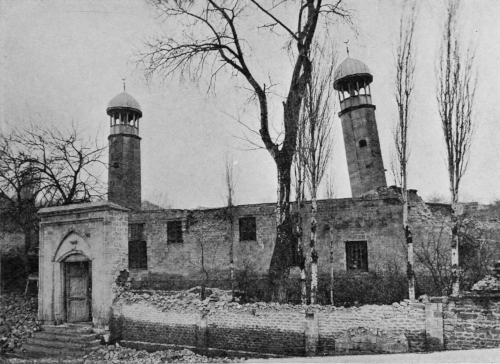
THROUGH FIVE REPUBLICS (OF
SOUTH AMERICA). A Critical Description
of Argentina, Brazil, Chile,
Uruguay, and Venezuela in 1905. By
Percy F. Martin, F.R.G.S. With 128
Illustrations and 3 Maps. In one vol.,
demy 8vo, price 21s. net.
GRANADA. Memories, Adventures,
Studies, and Impressions. By Leonard
Williams. Post 8vo, illustrated, price
7s. 6d. net.
IN THE COUNTRY OF JESUS. By
Matilde Serao. In one vol., crown 8vo,
illustrated, price 6s. net.
CARTHAGE OF THE PHŒNICIANS.
By Mabel Moore. With numerous
illustrations and coloured frontispiece.
One vol., crown 8vo, price 6s.
KOREA. By Angus Hamilton. With a
map and many illustrations. In one vol.,
demy 8vo, price 15s. net.
London: WILLIAM HEINEMANN
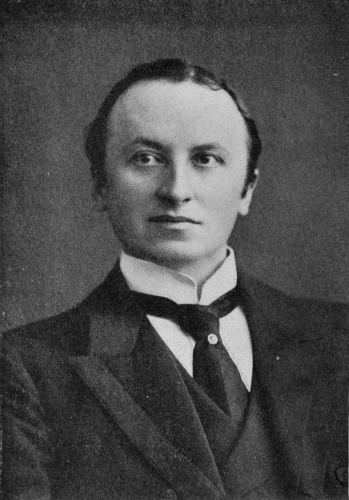
LORD CURZON OF KEDLESTON
ANGUS HAMILTON
AFGHANISTAN
BY
FELLOW OF THE ROYAL GEOGRAPHICAL SOCIETY
AUTHOR OF “KOREA,” “THE SIEGE OF
MAFEKING,” ETC.
WITH A MAP AND NUMEROUS
ILLUSTRATIONS
LONDON WILLIAM HEINEMANN 1906
Copyright 1906 by William Heinemann
All rights reserved
PREFACE
Since 1871, when Sir Charles MacGregor drew up a very exhaustive
précis of information on Afghanistan for the use of
the Government of India, no book dealing with our buffer
state in a general manner has been issued. The thirty-five
years which have intervened have not been without important
contributions to our knowledge of Afghanistan, but those
works which have appeared cannot altogether be described
as presenting a single comprehensive study of contemporary
conditions in the country. In 1886 Lieutenant A. C. Yate,
and in 1888 Major C. E. Yate, C.S.I., C.M.G., described in
two very interesting volumes the proceedings of the Afghan
Boundary Commission. Ten years elapsed before anything
of importance appeared, when, by a rare coincidence, two
books dealing with Afghanistan saw the light in 1895: Mr.
Stephen Wheeler’s admirable account of The Amir Abdur
Rahman, and that most entertaining and graphic volume,
My Residence at the Court of the Amir, by the late Amir’s
private physician, Dr. A. J. Gray. In 1900 Sultan Mahomed
Khan, Mir Munshi to Abdur Rahman, presented to the
public his remarkable production, The Life of Abdur
Rahman, as well as a treatise on The Constitution and Laws of
Afghanistan. In the following year, 1901, Colonel Sir Thomas
Holdich embodied in The Indian Borderland many graceful
descriptions of scenery and various centres in Afghanistan
while, in 1905, in a series of articles in the Wide World
Magazine, Mrs. Kate Daly, physician to Habib Ullah’s harem
and the Government of Afghanistan, illustrated with many
delightful touches a sojourn of Eight Years Among the
Afghans. These few works practically exhaust contemporary
literature on Afghanistan, and it is in an endeavour to
provide a more complete record of the subject than has
hitherto existed that the author of Korea has compiled this
little book. Mistakes are those of his own making; reflections
and criticisms arise from his own opinions; but, in
hoping that his critics may find something of value in the
results of two years’ toil, the author wishes to say that if
good qualities exist in it, they are attributable to the
encouragement and gracious assistance which he has received
and here wishes to acknowledge.
With a view to the careful preparation of this volume the
author, after returning to London from the war in Manchuria,
visited Central Asia, his travels terminating abruptly
in an attack of small-pox contracted from the natives, while
he was wandering in the region of the Pamirs. Descending
viâ Gilgit to India from the Taghdumbash, twelve months
have been spent in the labour of writing, in the examination
of a number of works, and in reference to those authorities
who are so justly distinguished for their knowledge of the
heart of Mid-Asia. In this direction it is perhaps of interest
to point out that in order to establish a standard of accuracy,
certain chapters have been submitted in page proof to
the criticism of this little group of Central Asian experts,
and their corrections embodied in its final form. The
author very warmly appreciates the help which has in this
way been given him, and to Colonel de la Poer Beresford
and Captain Charles Bancroft in connection with chaps. i.,
ii., iii.; to Colonel Sir Thomas Holdich, K.C.I.E., K.C.M.G.,
C.B., in chap. iv.; to Colonel C. E. Yate, C.S.I., C.M.G.,
in chaps. v. and vi.; to Colonel Sir Henry McMahon,
K.C.I.E., C.S.I., in chap. ix.; to Dr. A. J. Gray, Mrs. Kate
Daly, and Major Cleveland, I.M.S., in chaps. xiv. and xv.
he is very much indebted, as the indulgent manner in which
his inquiries have been received has materially assisted the
conclusion of his task.
In other quarters similar help has been given, and
the author desires to express his deep obligation to the
Secretary of State for India, Mr. Morley, to Mr. John E.
Ellis, Parliamentary Under-Secretary of State for India, to
Sir William Lee-Warner, and to Mr. Thomas, of the Political
Department, India Office, for the considerate way in which
services have been rendered him. The very pleasant hospitality
bestowed upon the author by Mr. George Macartney,
C.S.I., the representative of the Government of India in
Kashgar, Chinese Turkestan; by Mr. L. G. Fraser, the editor
of The Times of India; by Mr. C. F. Meyer, Standard Oil Company’s
Agent in Bombay; by Major Cleveland, in Poona;
and by Mr. Ivor Heron-Maxwell, late of Baku in that centre,
has provided him with many haunting memories which, in
a later volume, will be more suitably described. To Dr.
Chalmers Mitchell, Secretary of the Zoological Society of
London, and to Mr. J. Bryant Sowerby, Secretary of the
Royal Botanic Society, the author is indebted for assistance
in compiling the tables of species which illustrate chap.
xii.; while to the Librarian of the India Office, and to the
Librarian of the Royal Geographical Society, he would
express his grateful thanks.
As correspondent to The Pall Mall Gazette, and to The
Times of India from Central Asia, it is the pleasant duty of
the author to acknowledge the permission of Sir Douglas
Straight and Mr. L. G. Fraser to make use of certain articles
which, although entirely altered and greatly amplified since
their original appearance, were first presented in the respective
columns of these organs. These extracts, a few brief
paragraphs on various pages, are confined solely to the
first six chapters of the book. Acknowledgments are
also due to the proprietors of that esteemed Indian
journal The Pioneer, whose London staff permitted the
files of their well-known paper to be inspected; to the proprietors
of The Daily Graphic for permission to reproduce
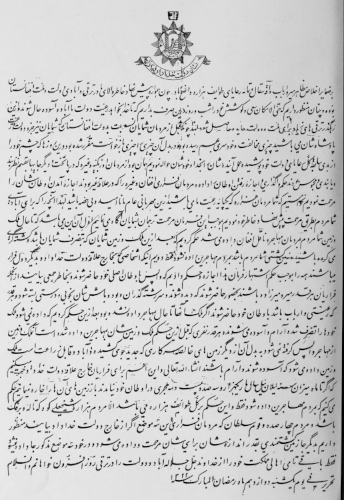
the block of the Amir’s proclamation, and accompanying
translation, appearing on pages 370, 371; to Messrs.
Macmillan for the right to reproduce their copper engraving
of Dr. A. J. Gray’s painting of the Amir Abdur Rahman; to
Baron Herbert de Reuter, Managing Director of Reuter’s
Telegram Company, for courteous assistance; to Mr. J. D.
Holmes, an Indian photographer of renown, whose unique
photographs of the Khyber Pass illustrate chaps. xvi. and
xvii.; to Lieutenant Stewart, whose photographs appear in
chap. ix.; to Lieutenant Olufsen for the right to reproduce
certain interesting photographs from that informative
work Through the Unknown Pamirs; to Colonel
Sir Thomas Holdich for authority to base upon his
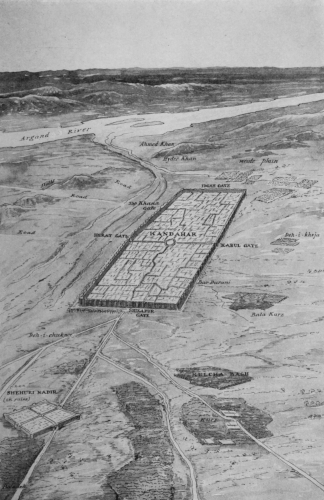
original sketches enlarged drawings of Herat and Kandahar,
by Mr. Percy Home; to Major Cleveland, I.M.S.,
to whose great credit very many of the illustrations
in this volume must be placed; to Major Molesworth
Sykes, H.B.M. Consul at Meshed, for photographs
appearing in chap. vii.; to Professor Victor Marsden,
of Moscow University, for general courtesies; to Captain
Charles Bancroft for assistance in translating extracts
from papers placed at the author’s disposal by his
Excellency Prince Khilkoff, Russian Minister of Railways;
to that well-known military novelist, Mr. Horace Wyndham,
who has been good enough to assist the author in the revision
of his proofs; and to Mr. Thomas Bumpus, of Messrs.
J. and E. Bumpus, Limited.
The final, but by no means the least gratifying, duty
now remains to be fulfilled. It is concerned with the
dedication of this volume which, by special permission,
is inscribed:
TO HIM
WHO,
BY THE SPLENDOUR OF HIS GIFTS
AND
THE WISDOM OF HIS RULE,
HAS LEFT
AN INDELIBLE AND MEMORABLE
IMPRESSION
UPON INDIA: LORD CURZON OF KEDLESTON,
G.C.S.I., G.C.I.E., P.C. ETC. ETC. ETC.
AUTHORITIES CONSULTED
The works consulted in the preparation of this volume,
including references to the Encyclopædia Britannica, embrace
most of the well-known writers on Asiatic Russia, Persia,
Afghanistan, and the Indian Frontier. Among those of less
recent date are the books of Bellew, Connelly, Elphinstone,
Ferrier, Lansdell, MacGregor, Marvin, Pottinger, Rawlinson,
Vambéry, Wood and Yule.
Contemporary authorities, to which the author is more
especially indebted, are as follows:
Bruce, R. I.
The Forward Policy and its Results.
Chirol, Valentine
The Middle Eastern Question.
Curzon, Lord
Russia in Central Asia.
” ”
Persia and the Persian Question.
” ”
The Pamirs and the Source of the Oxus.
Daly, Mrs. Kate
Eight Years among the Afghans.
Gray, Dr. A. J.
My Residence at the Court of the Amir.
Holdich, Colonel Sir T. H.
The Indian Borderland.
Keane, A. H.
Asia.
Lansdell, H.
Russia in Central Asia.
Olufsen, O.
Through the Unknown Pamirs.
Roberts, Field Marshal Lord
Forty-one Years in India.
Ronaldshay, Earl of
Sport and Politics under an Eastern Sky.
” ” ”
On the Outskirts of Empire in Asia.
Shoemaker, M. M.
The Heart of the Orient.
Skrine, F. H., and Ross, E. D.
The Heart of Asia.
Sultan Mahomed Khan
Laws and Constitution of Afghanistan.
” ” ”
The Life of Abdur Rahman, Amir of Afghanistan.
Thorburn, S. S.
The Punjab in Peace and War.
Yate, A. C.
England and Russia Face to Face.
Yate, C. E.
Kurasan and Seistan.
” ”
Northern Afghanistan.
Together with scientific papers, lectures and articles by:
Colonel de la Poer Beresford.
Major Cleveland.
Major-General Sir Edwin Collen.
Mrs. Kate Daly.
Major-General Sir Edmond Elles.
Sir Lepel Griffin.
Miss Lillias Hamilton.
Colonel Sir Thomas Holdich.
Colonel Sir Henry MacMahon.
And including all Parliamentary, Consular, and other
official publications, the files of The Times, Morning Post,
Standard, Daily Chronicle in England; and The Pioneer,
Times of India, and Indian Daily News in India; besides
the more prominent Continental organs.
By a coincidence of singular interest in Central Asian
affairs the completion of the Orenburg-Tashkent railway
occurred simultaneously with the evacuation of Lhassa
by the troops of the Tibetan Mission, the two events
measuring in a manner the character of the policies pursued
by the respective Governments of Great Britain and Russia
in Mid-Asia. Moreover, if consideration be given to them
and the relation of each to contemporary affairs appreciated,
it becomes no longer possible to question the causes
which have determined the superior position now held in
Asia by our great opponent. If this situation were the result
of some sudden cataclysm of nature by which Russia had
been violently projected from her territories in Europe across
the lone wastes of the Kirghiz steppe into and beyond the
region of the Pamirs or over the desert sands of the Kara
Kum to the southern valleys of the Murghab river, our
periodic lament at the mastery of Central Asia by Russia
would be more comprehensible. But, unfortunately, the
forward advance of Russia to the borders of Persia, along
the frontiers of Afghanistan to the north-eastern slopes of
the Hindu Kush, has been gradual; so gradual indeed
that as each successive step became accomplished we have
had time to register recognition of the fact in bursts
of indignant chatter, accompanied as is not unusual with
us by a frothy clamour of empty threats. Unluckily noisy
outcry has been mistaken for action; but from the moment
when Russia first moved into Trans-Caspian territory
there appears to have been nothing but vague realisation of
the acute possibilities with which the situation in Central
Asia from that hour became impressed. As time passed and
the several phases vanished our indifference and supineness
have increased, until no chapter in the history of our Imperial
affairs offers more melancholy reading than that which deals
with the period covering the “peaceful” penetration of Asia
by Russia.
In order to secure sufficient momentum for her descent
railways were needed; and, while the line so lately completed
between Orenburg and Tashkent is a more material factor
in the situation than hitherto has been recognised, the
laying of the permanent way between Samarkand and
Termes, Askhabad and Meshed, approximately gauges the
duration of the interval separating Russia from the day
when she will have rounded off her position in Mid-Asia.
Just now, therefore, and for ten years to come, strategic
requirements should alone be permitted to influence the
arrangement of our policy in High Asia. Commercial
developments within the vexed sphere of the Russian and
British territories in this region should be regulated by circumstances
which, actually inherent in our Asiatic position,
have been too long ignored. No question of sentiment, no
considerations of trade influenced the creation of railway
communication between Orenburg and Tashkent, the construction
of the Murghab Valley line or the extension of the
Trans-Caspian system from Samarkand to Osh. Strategy,
steely and calculating, required Mid-Russia to be linked with
Mid-Asia, the irresistible expansion of empire following not
so much the line of least resistance as the direction from
which it would be placed in position for the next move.
Continents have been crossed, kingdoms annihilated and
provinces absorbed by Russia in her steady, inimical
progression towards the heart of Central Asia; until there
is nothing so important nor so intimately associated with
our position in Afghanistan to-day as the intricate
perplexities which have emanated from this untoward
approach. From time to time attempts have been made to
effect an adjustment of the points at issue. The result
has been unsatisfactory since the patchwork application
of pen and paper has come, as a rule, in response
to some accomplished coup upon the part of our astute
opponent. Indeed, there is nothing in the result of any
of these compromises which can be said to do credit
to our knowledge of the existing situation. Indifference,
coupled with a really lamentable ignorance, distinguishes
the conditions, if not the atmosphere, under which these
rectifications of frontier and modifications of clauses in
previously accepted treaties have been carried out. But
now that we have witnessed the joining of the rails between
Orenburg and Tashkent let us put an end to our absurd
philandering; and, appraising properly the true position
of affairs, let us be content to regard all further extension
of the Russian railway system in Mid-Asia as the climax
of the situation. To do this we must understand the
points at issue; and to-day in Central Asia there are
many causes which of themselves are sufficient to direct
attention to them.
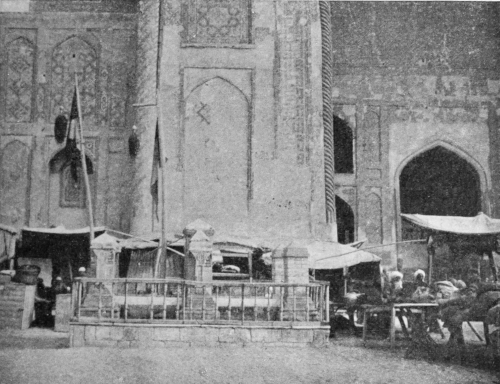
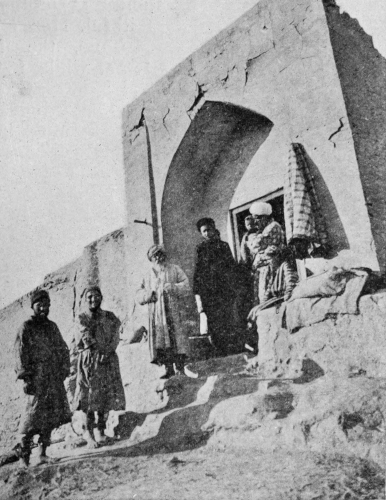
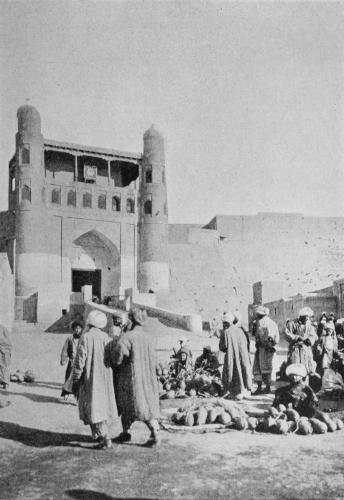
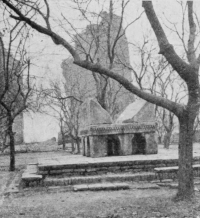
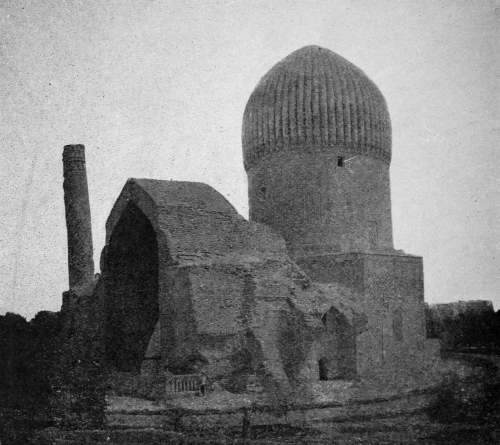
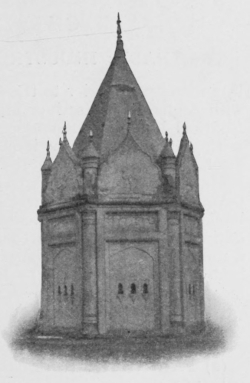
TOMB IN THE MARKET-PLACE, SAMARKAND
Years have passed since the delimitation of the Russo-Afghan
frontier and the definition of the Anglo-Russian
spheres of influence in the Pamirs were made. In the
interval, beginning with the acceptance of the findings of
the Pamir Boundary Commission of 1896, Russia ostensibly
has been engaged in evolving an especial position for
herself in North China and providing railway communication
between Port Arthur, Vladivostock and St.
Petersburg. In this direction, too, war has intervened,
coming as the culminating stroke to the policy of bold
aggression and niggardly compromise which distinguished
the diplomatic activities of Russia in Manchuria. Yet
throughout these ten years the energies of Russia in Mid-Asia
have not been dormant. Inaction ill becomes the
Colossus of the North and schemes, which were en l’air in
1896, have been pushed to completion, others of equal
enterprise taking their place. Roads now thread the high
valleys of the Pamirs; forts crown the ranges and the
military occupation of the region is established. Similarly,
means of access between the interior of the
Bokharan dominions and the Oxus have been formed;
caravan routes have been converted into trunk roads
and the services of the camel, as a mode of transport,
have been supplemented by the waggons of the railway and
military authorities.
The great importance attaching to the Orenburg-Tashkent
railway and its especial significance at this moment will be
appreciated more thoroughly when it is understood that
hitherto the work of maintaining touch between European
Russia and the military establishment of Russian Turkestan
devolved upon a flotilla of fourteen steamers in the Caspian
sea—an uncertain, treacherous water at best—and the long,
circuitous railway route viâ Moscow and the Caucasus.
This necessitated a break of twenty hours for the sea-passage
between Baku and Krasnovodsk before connection
with the Trans-Caspian railway could be secured. The
military forces in Askhabad, Merv, Osh and Tashkent—including,
one might add, the whole region lying between
the south-eastern slopes of the Pamirs, Chinese Turkestan,
the Russo-Afghan and the Russo-Persian frontiers—embracing
the several Turkestan Army Corps, were dependent
upon a single and interrupted line. Now, however,
under the provision of this supplementary and more direct
Orenburg-Tashkent route the entire military situation in
Central Asia has been dislocated in favour of whatever
future disposition Russia may see fit to adopt. All the
great depôts of Southern and Central Russia—Odessa,
Simpheropol, Kieff, Kharkoff and Moscow, in addition to
the Caucasian bases as a possible reserve of reinforcements—are
placed henceforth in immediate contact with Merv and
Tashkent, this latter place at once becoming the principal
military centre in these regions. Similarly, equal improvement
will be manifested in the position along the Persian
and Afghan borders, to which easy approach is now
obtained over the metals of this new work and for which
those military stations—Askhabad, Merv, Samarkand—standing
upon the Trans-Caspian railway, and Osh, now
serve as a line of advanced bases. It is, therefore, essential
to consider in detail this fresh state of affairs; and as
knowledge of the Orenburg-Tashkent railway is necessary
to the proper understanding of the position of Afghanistan,
the following study of that kingdom is prefaced with
a complete description of the Orenburg-Tashkent work,
together with the remaining sections of railway communication
between Orenburg and Kushkinski Post.
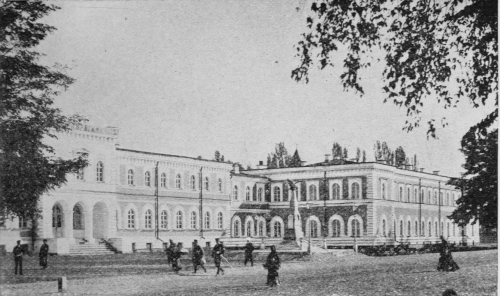
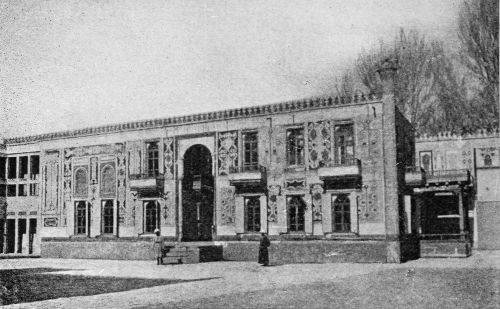
PALACE OF THE GOVERNOR, BAKU
The journey between St. Petersburg and Orenburg covers
1230 miles and between Orenburg and Tashkent 1174 miles,
the latter line having taken almost four years to lay.
Work began on the northern section in the autumn of 1900
and many miles of permanent way had been constructed
before, in the autumn of 1901, a start was made from the
south. The two sections were united in September of
1904; but the northern was not opened to general traffic
until July, nor the southern before November, 1905. Prior
to the railway communications were maintained by means
of tarantass along the post-road, which led from Aktiubinsk
across the Kirghiz steppes viâ Orsk to Irghiz and thence
through Kazalinsk to Perovski, where the road passed
through Turkestan to run viâ Chimkent to Tashkent—a
journey of nineteen days. In addition to the galloping
patyorka and troika—teams of five and three horses respectively—which
were wont to draw the vehicles along the
post-road and the more lumbering Bactrian camels, harnessed
three abreast and used in the stages across the Kara
Kum, long, picturesque processions of camels, bound for
Orenburg and carrying cotton and wool from Osh and
Andijan, silks from Samarkand and Khiva, tapestries from
Khokand, lambs’-wool, skins and carpets from Bokhara
and dried fruits from Tashkent, annually passed between
Tashkent and Orenburg from June to November.
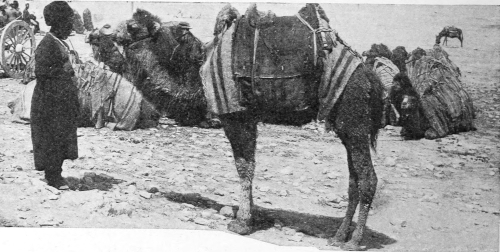
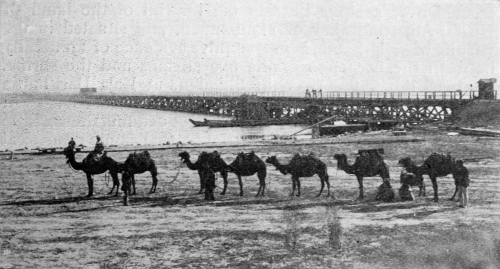
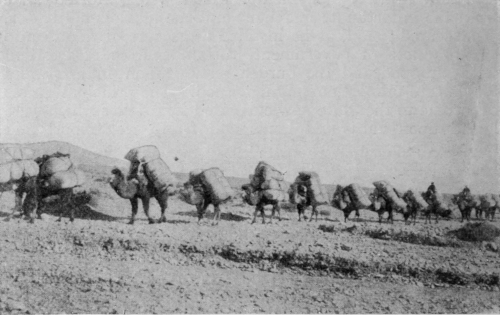
THE PICTURESQUE CAMEL
Of late years, the Trans-Caspian railway, begun by
Skobeleff in 1880 and gradually carried forward by
Annenkoff to Samarkand, has supplanted the once flourishing
traffic of the post-road, along which the passing of the
mails is now the sole movement. The new railway, too,
is destined to eliminate even these few links with the
past, although in the end it may revive the prosperity of
the towns which through lack of the former trade have
shrunk in size and diminished in importance. The line
does not exactly follow the postal route; but from
Orenburg, which is the terminus of the railway from
Samara on the Trans-Siberian system, it crosses the Ural
river to Iletsk on the Ilek, a tributary of the Ural. From
Iletsk the metals run viâ Aktiubinsk and Kazalinsk along
the Syr Daria valley viâ Perovski to Turkestan and thence
to the terminus at Tashkent.
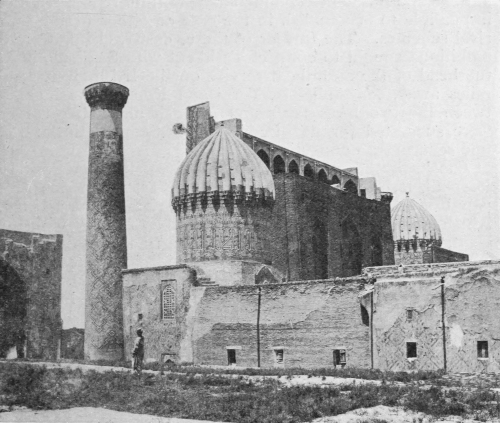
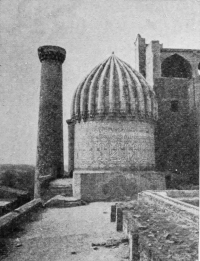
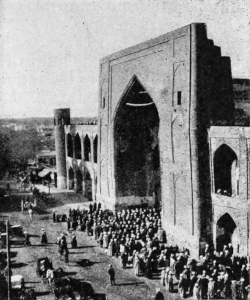
THE SHIR DAR MEDRESSE, SAMARKAND
Originally one of three suggested routes the Orenburg-Tashkent
road was the more desirable because the more
direct. Alternative schemes in favour of connecting the
Trans-Siberian with the Central Asian railway on one
hand and the Saratoff-Uralsk railway with the Central
Asian railway on the other were submitted to the commission
appointed to select the route. Prudence and sentiment,
as well as the absence of any physical difficulties in
the way of prompt construction, tempered the resolution of
the tribunal in favour of the old post-track. It was begun
at once and pushed to completion within four years—a feat
impossible to accomplish in the case of either of the two
rival schemes. The former of these, costly, elaborate and
ambitious, sought to connect Tashkent with Semipalatinsk,
the head of the steamboat service on the Irtish river, 2000
miles away, viâ Aulie-ata, Verni and Kopal. Passing between
the two lakes Issyk and Balkash alternative routes
were suggested for its direction from Semipalatinsk: the
one securing a connection with the Trans-Siberian system
at Omsk, the other seeking to pass along the post-road to
Barnaul, terminating at Obi where the Trans-Siberian railway
bridges the Obi river. The supporters of the scheme,
which aimed at uniting the Saratoff-Uralsk railway with the
Central Asian railway, proposed to carry the line beyond
Uralsk to Kungrad, a fishing village in close proximity to
the efflux of the Amu Daria and the Aral sea. From
Kungrad, passing east of Khiva, the line would have traversed
the Black Sands following a straight line and
breaking into the Central Asian system at Charjui, opposite
which, at Farab, a line to Termes viâ Kelif has
been projected; and where, too, an iron girder bridge,
resting on nineteen granite piers, spans the Amu Daria.
It is useless at this date to weigh the balance between
the several schemes; one of which, the Orenburg-Tashkent
route, has become an accomplished fact to provide, doubtless
in the near future, matter for immediate concern.
From Orenburg, of which the population is 80,000, the
line 4 versts[1] from the station crosses the Ural river by
an iron bridge, 160 sagenes[2] in length, running from there
south to Iletsk, formerly the fortress Iletskaya Zashchita
and at present a sub-district town of the Orenburg government
with a population of 12,000.
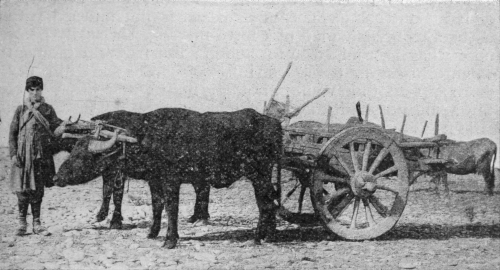
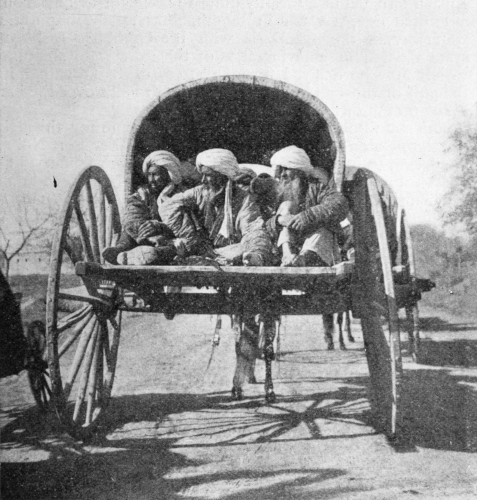
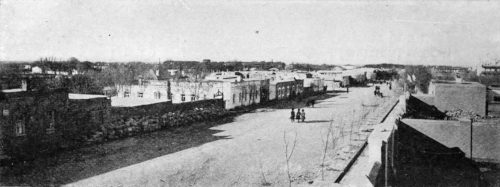
ON THE ROAD IN ASIA
From Iletsk a short branch line, rather more than three
versts in length, proceeds to the Iletsk salt mines. Running
eastwards and crossing the Ilek river from the right to the
left bank by an iron bridge 105 sagenes in length it reaches
Aktiubinsk, a district town in Turhai province. At this stage
the railway traverses the main watershed of the Ural, Temir,
Kubele and Embi rivers, arriving at the Kum Asu pass
across the Mugodjarski range. The passage of the line
through the mountains, extending 26 versts and a veritable
triumph of engineering, imposed a severe test upon the
constructive ability of the railway staff. Beyond the range
the line turns southward following the valleys of the
Bolshoi, Mali Karagandi and Kuljur rivers until, 600 versts
from Orenburg, it arrives at Lake Tchelkar. The line
now runs across the Bolshiye and Maliye Barsuki sands,
where there is abundance of underground fresh water, to the
northern extremity of the Sari Tchegonak inlet on the Aral
sea, where it descends to sea-level moving along the north-eastern
shore. The military depôt at Kazalinsk—sometimes
called Fort No. 1—now approaches. This point founded
in 1854 has lost its exclusive military character, ranking
merely among the district centres of the Syr Daria province.
Thirty-six versts from Kazalinsk, at the next station Mai
Libash situated in a locality quite suitable for colonisation,
a branch line, 4 versts in length, links up the important
waterway of the Syr Daria with the Orenburg-Tashkent
system, extending the facilities of the railway to shipping
which may be delayed through stress of bad weather in
the gulf or through inadequacy of the draught over the bar
at the mouth of the river.
The main line keeps to the Syr Daria, running through
the steppe along the post-road to Karmakchi or Fort No. 2.
On leaving Karmakchi it diverges from the post-road to
wind round a succession of lakes and marshes which lie at
a distance of 50 versts from the river. The railway continuing
its original direction now runs along the basins
of the Syr Daria and the Karauzyak, a tributary which
it crosses twice by small bridges, each constructed with two
spans 60 sagenes in length. The character of the country
from Karmakchi to Perovski, a distance of 138 versts, differs
considerably from the region preceding it. The low-lying
ground, broken by swamps, is everywhere covered with a
thick overgrowth of reeds; while the more elevated parts,
watered by ariks, are devoted to the cultivation of crops. The
town of Perovski is situated in flat country 1½ versts from
the station. From there to Djulek the line returns to the
post-road and some distance from the Syr Daria passes
between the river and the Ber Kazan lakes to Ber Kazan. At
Djulek, the name being adopted from a small adjacent
hamlet, it diverges from the post-road to run direct to
the village of Skobelevski, one of those curious peasant
settlements which located in the uttermost parts of Central
Asia preserve in their smallest detail every characteristic
of remote Russia. At such a place life savours so strongly
of the middle ages that one scarcely heeds the purely
modern significance which attaches to the Iron Horse.
Barely 30 versts from Skobelevski and situated close to the
Syr Daria there is the station of Tumen Arik, which gives
place to Turkestan, beyond which for 120 versts the line
runs parallel with the post-road. The station is 2½ versts to
the north of the town of Turkestan, one of the most
important towns in the Syr Daria province and only 40 versts
from the Syr Daria. The next station Ikan is associated
with the conquest of Turkestan, a famous battle having been
fought about the scene where the station buildings now stand.
Twenty versts to the north of the station, close to the post-road,
there is a memorial to Ural Cossacks who fell during
the fight. Otrar the following station is identified with the
tradition, derived from the existence of an enormous mound
standing amid the ruins of the old-time city of Otrar, that
Timur when his army crossed the Syr Daria ordered each
of his soldiers to throw a handful of earth upon the ground
at the point where the river was crossed in safety. Beyond
Otrar the line runs along the right bank of the Aris river,
crossing it at 1570 versts from Orenburg by a bridge
of 90 sagenes in three spans of 30 sagenes each. Aris
station is placed further along the river bank at a point
where at some future date branch lines between it and the
town of Verni, as well as to a junction with the Trans-Siberian
system, will be laid. After leaving it the railway,
still ascending, ultimately crosses the pass of Sari Agatch
in the Kizi Kurt range, 267 sagenes above the sea.
The descent from the pass leads to Djilgi valley where
the line crosses three bridges; passing over the Keless river
by a single span bridge of 25 sagenes, over the Bos-su arik
by a bridge of 18 sagenes, and over the Salar river by a
bridge of 12 sagenes. Seventy-two versts further the line
runs into its terminus at Tashkent which is now classed as
a station of the first degree, although commercially it stands
only sixth among the stations of the Central Asian railway
ranking with Andijan and yielding priority of place to
Krasnovodsk, Samarkand, Khokand, Askhabad and Bokhara.
It is proposed at Tashkent, which lies 1762 versts
from Orenburg, 1747 versts from Krasnovodsk and 905
versts from Merv and where it is evident that the needs
of the railway have been carefully studied, to double the
track between Orenburg and Tashkent. Large stocks of
spare rails and railway plant are held in reserve in sheds, one
important feature of this very efficient preparation being
the possession of 20 versts of light military railway. The
erection of engine-sheds, waggon-sheds, workshops, supply
stores and quarters for the staff has followed a most
elaborate scale, these buildings being arranged in three
groups around the station. The railway medical staff and
the subordinate traffic and traction officials occupy the first;
the chiefs of the traffic, telegraph and traction departments
are in possession of the second; the remaining employés
securing accommodation in the third set of buildings placed
at the end of the Station Square. Along the opposite
face are the spacious workshops where between five and six
hundred men find daily employment; in juxtaposition
with the general depôt are the railway hospital, where there
is accommodation for 10 beds, the main supply stores and
a naphtha reservoir with a capacity of 50,000 poods.[3]
The country in the neighbourhood of Tashkent as seen
from the railway presents the picture of a bountiful oasis.
For 20 versts there is no interruption to a scene of wonderful
fertility. Market gardens, smiling vineyards and
fruitful orchards, not to mention cotton-fields and corn-lands,
cover the landscape. This abundance in a measure
is due to careful irrigation and to the excellent system of conserving
water which has been introduced. In support of
this 113 specific works have been completed, each of which—and
the giant total includes water-pipes by the mile and
innumerable aqueducts—was a component part of that
scheme of irrigation by which life in Central Asia alone can
be made possible.
Although work upon the Orenburg-Tashkent line began
in 1900 immediately after the completion of the original
survey, wherever more careful examination has shown an
advantage to be possible alterations have been made. The
cost of construction, estimated at 70,000 roubles[4] per
verst, has been materially lessened by these means—a reduction
of 24 versts equally divided between the Orenburg
and Kazalinsk, Kazalinsk and Tashkent sections having been
effected. By comparison with the old post-road the railway
is much the shorter of the two lines of communication, the
advantage in its favour amounting to 134 versts on one section
of the road alone; the actual length between Tashkent
and Kazalinsk being by post-road 953¼ versts and by railway
819¼.
In its local administration the railway is divided into four
sections:
No. 1. From Orenburg to the Mugodjarski mountains
about 400 versts.
No. 2. From Mugodjarski mountains to the sands of
Bolshiye Barsuki, 400 to 560 versts.
No. 3. From the sands of Bolshiye Barsuki to Kazalinsk,
560 to 845 versts.
No. 4. From Kazalinsk to Tashkent, 845 to 1762 versts.
In the northern section the line is supplied everywhere
with fresh water—in the first instance from the Ural river
and then by the smaller rivers Donguz, Elshanka, Ilek,
Kulden, Kubele, Temir and Embi; Koss lake and finally
from wells.
Here are the Iletsk mines, famous for their rock salt.
They despatch annually to Orenburg more than 1,500,000
poods of salt. The deposits cover a field 4 versts in
extent with an unvarying thickness of more than 85
sagenes. The section now in working contains 100 milliard
poods of salt. The annual yield may be reckoned at
7,000,000 poods. At the present time considerably less than
this output is obtained, the high freight charges upon land-carried
goods and the insufficiency of the labour available
being responsible for the disproportion.
In another direction the Iletsk district is of importance;
the veterinary station Temir Utkul, through which pass large
herds of cattle on their way to Orenburg from the Ural
province, having been established there. In the course of
the year many thousands of cattle are examined by the
surgeons of the Veterinary Board—the existence of the
numerous cattle-sheds and the constant arrival of the droves
adding to the noise and bustle of Iletsk, if not exactly
increasing its gaiety. Further on, in the Aktiubinsk district
of the Turgai province and along the whole valley of the
Ilek river, where much of the land is under cultivation, wide
belts are given over to the pasturage of these travelling mobs
of cattle. Upon both banks of the river, too, there are
Kirghiz villages. The area of the Aktiubinsk district is:
Area.
Population.
40,000 sq. versts
120,000
From an agricultural point of view this locality, on
account of its paucity of population and fertile soil, is
regarded with high favour by the immigration authorities.
In the town of Aktiubinsk itself there is a yearly market of
cattle, corn, manufactures and agricultural implements.
This as a rule returns a quarter of a million roubles.
Now that the railway has been completed and opened to
passenger and commercial traffic, it is expected that it
will give an immediate impetus to this region and that it
will be possible to carry out a more careful examination of
its mining resources, of which at the present time there are
only indications. Copper has been traced along the Burt,
Burl, Khabd and Kutchuk Sai rivers; deposits of coal have
been found near the Maloi Khabd, Teress Butak and Yakshi
Kargach rivers; iron has been located by the Burt river and
naphtha on the Djus river; while there is reason to believe
that gold exists in the vicinity.
On the second section, the line derives its water from
springs in the Djaksi mountains, the basin of the Kuljur
river, the Khoja and Tchelkar lakes. It abounds with
Kirghiz villages but minerals do not play an important
part in it. A few seams of coal are believed to exist in
the ravine of the Alabass stream; and there are lodestone
mines in the Djaman mountains and in the Kin Asu
defile. Cattle-farming is more remunerative to the local
settlers than cereal production; as a consequence there
is very little cultivation. The district, which is 160 versts
in length, occupies:
Area.
Population.
127,300 sq. versts
85,000
On the third section, which extends from the sands of
Bolshiye Barsuki to Kazalinsk covering an area of 285
versts, the water-supply is obtained at first from shallow
surface wells; but 45 versts from Kazalinsk the railway
enters the Syr Daria valley, where water is abundant. The
southern areas of this belt alone possess any commercial
importance, owing to Kirghiz from the northern part
of the Irgiz district who, to the number of some 10,000
kibitkas, winter there. The northern part is largely the
continuation of a sparse steppe. The Kazalinsk district,
beyond which the Orenburg-Tashkent railway enters
Turkestan, is one of the least important divisions of the Syr
Daria province. It embraces:
Area.
Population.
59,550 sq. versts
140,598
Around Kazalinsk itself, however, there has been but little
agricultural activity. In the main, development is confined
to the fertile Agerskski valley and along the Kuban Daria,
a tributary of the Syr Daria. The return is meagre and
the population has not sufficient corn for its own needs.
Large quantities of grain are annually imported into the
neighbourhood from the Amu Daria district by boat across
the Aral sea or by camel caravan. Railway traffic in this
section nevertheless will not rely upon the carriage of cereal
produce—live stock, which until the advent of the railway
was sent to Orenburg by boat along the Syr Daria and then
by caravan-road to the city, representing the prospective
return which the district will bring to the line. The
population is composed of:
Males.
Females.
Total.
4478
4002
8480
Orthodox Russians
2205
Dissenters
1165
Jews
115
Mahommedans
4995
In the town there are:
Private houses
578
Orthodox church
1
Synagogue
1
Mosques
2
Schools
4
Native universities
2
The revenue of Kazalinsk is 21,880 roubles. The town
contains the residences of a district governor and an
inspector of fisheries, together with district military headquarters,
the administrative offices of the treasury and the
district court, besides a district hospital and a public
library. There are no hotels. In early days in the conquest
of Turkestan, when the Kazalinsk road served as the only line
of communication with European Russia, the town became
a busy mart for Orenburg, Tashkent, Khiva and Bokhara;
even now the Kirghiz in the district possess 770,000
head of cattle. Trade was obliterated by the advent of
the Central Asian railway; but it is hoped that now
the Orenburg-Tashkent line has been opened to traffic it
may revive.
The village of Karmakchi which is situated on the banks
of the Syr Daria is another point in this district. It
boasts only a small population, in all some 300 odd, an
Orthodox church, post and telegraph office, two schools,
hospital and military base office. Importance attaches
to the post as it is upon the high road along which is
conducted the winter trek of the Kirghiz.
The value of the annual export trade of the region is:
Exports.
Poods.
Roubles.
Wool
Sheep
} 200,000
⎫
2,000,000
Camel
⎪
Hides
150,000
⎬
Lard
150,000
⎭
Cattle
400,000
The value of the annual import trade amounts to:
Imports.
Merchandise.
Value.
110,000 poods
1,800,000 roubles.
With the opening of the line to traffic the transportation
of fish by the railway has shown a tendency to increase.
It is believed that the development of the fishing
industry throughout the Aral basin is only a matter of time.
At present the yearly catch of fish there reaches a total of
300,000 poods of which not less than one half is sent to
Orenburg, the trade realising about 1,000,000 roubles.
Hitherto little has been attempted. With the assistance of
the railway a speedy expansion of the trade is assured—the
interests of the fishing population and the general
welfare of the river traffic having been advanced through
the construction of a harbour upon the gulf of Sari
Cheganak, in connection with the railway and only 5 versts
distant. Aral sea, the station at this point, is 790 versts from
Orenburg.
The fourth and last division, from Kazalinsk to Tashkent,
runs along the valley of the Syr Daria. It is fully
supplied with good water and possesses a larger population
than either the second or the third sections. In it
the line traverses the following districts of the Syr Daria
province:
District.
Area.
Population.
Perovski
95,965
sq. versts
133,784
Chimkent
100,808
” ”
285,180
Tashkent
40,380
” ”
500,015
The Perovski district notwithstanding the good qualities
of its soil produces very little corn; its chief population
consists of nomadic Kirghiz who together own 990,000 head
of cattle, the export cattle trade for the district amounting
to 2,000,000 roubles annually. Small tracts of wheat and
millet are cultivated here and there with the aid of tchigirs,
native watering-pumps. The water is brought up from
the river by means of a wheel, along the rim of which
are fixed earthenware jugs or cylindrical vessels of sheet
iron. These vessels raise the water to the height of the bank,
whence it is very readily distributed. The best corn-lands are
situated in the Djulek sub-district; but the primitive methods
of agriculture existing amongst the nomads, in conjunction
with the deficiencies in the irrigation system, explain at
once the lack of cereal development in these areas.
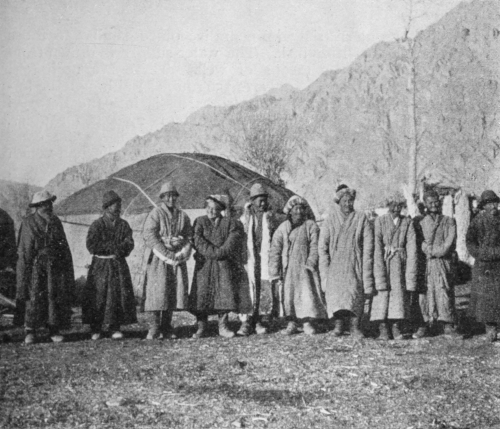
KIRGHIZ ELDERS
Perovski was taken by Count Perovski on July 28, 1853,
and in honour of the occasion by Imperial order the fortress
was renamed Fort Perovski. Close to the town there is
a memorial to the Russian soldiers who fell during that
engagement.
The present population comprises:
Males.
Females.
Total.
3197
1969
5166
Orthodox Russians
1050
Jews
130
Dissenters
210
Tartars
450
Sarts and Kirghiz
3326
The town contains:
Private houses
600
Orthodox church
1
Synagogue
1
Mosques
5
Schools
3
Military hospital
1
together with district administrative offices similar to those
established at Kazalinsk. The water-supply is drawn from
the Syr Daria by means of wells. There are no hotels.
The town revenue is only 12,350 roubles; although the importation
of various goods from Russia into the Perovski
district represents an annual sum of 2,900,000 roubles.
With the advent of the Central Asian railway the commercial
importance of Perovski, once a point through which
caravans destined for Orenburg or Tashkent passed, waned.
Now its trade is dependent upon the numerous Tartars
and Ural Cossacks who have settled there. The place is
unhealthy, and the settlement is affected by the malaria
arising from the marshes which surround it. In spring and
summer the lagoons swarm with myriads of mosquitoes
and horse-flies; so great is the plague that the Kirghiz
together with their flocks and herds after wintering along
the Syr Daria beat a hurried retreat into the steppe, driven
off by the tiresome insects. Many months elapse before
the nomads return; it is not until the cold weather has
set in that they appear in any numbers. Quite close to
Perovski there are two immigrant villages—Alexandrovski
and Novo Astrakhanski—erected in 1895, where the inhabitants
are occupied with cattle-farming and the sale of
hay in winter time to the Kirghiz. The district possesses
nothing save a pastoral population and a small settlement
of 200 souls at Djulek. This place, formerly a fortress
founded in 1861 and now half destroyed by the floods
of the Syr Daria, contains the administrative offices of the
commissioner of the section, with a postal and telegraphic
bureau and a native school. To the south of Djulek
there is Skobelevski, another small village founded by
immigrants in 1895 and containing some fifty-six houses.
It is watered by the Tchilli arik. Skobelevski is rapidly
developing into a trade-mart, the source of its good fortune
being contained in the advantageous position which it fills
in the steppe. Throughout this region, plots of land with
a good quality soil and well watered have been granted to
colonists.
The Chimkent district similarly possesses a rich and fertile
soil, derived in the main from its network of irrigating
canals. Its population is more numerous than other
adjacent settlements and it supports altogether seventeen
immigrant villages with a population of 5135. Chimkent
contains in itself all the features necessary to the development
of a wide belt of agriculture; but at the present time
the most extensive tracts of wheat land are along the systems
of the Aris, Aksu, Badam, Buraldai, Burdjar, Tchayan and
Bugun rivers. In the valley of the Arisi, along the middle
reaches, there are rice-fields; and in the country round
Chimkent the cotton industry has begun to develop. Experiments
are being tried in the cultivation of beetroot as
the soil and climatic conditions of the district are especially
favourable to its growth. The present quality of the Chimkent
beetroot is not inferior to that grown in the Kharkoff
Government; so that Chimkent may well become, in the near
future, the centre of a sugar-producing industry not only
for Turkestan but for the whole of Central Asia, which
so far has imported its sugar exclusively from European
Russia.
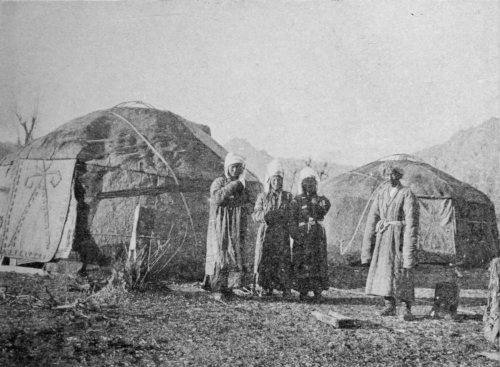
KIRGHIZ WOMEN
The district town of Chimkent, formerly a Khokand fortress
taken by the Russian forces under the command of
General Chernaieff September 22, 1864, lies upon the eastern
side of the railway. Its population comprises:
Males.
Females.
Total.
6887
5554
12,441
Orthodox Russians
768
Jews
150
Natives
11,523
There are in the
Russian Quarter.
Native Quarter.
Houses
105
Houses
1886
Orthodox churches
2
Schools
3
Mosques
34
Native schools
16
Government offices similar to those in other towns are also
found.
The town revenue is 11,760 roubles.
The trade returns of the Chimkent district amount to
5,000,000 roubles.
Exports.
Imports.
Wool
⎫
2,000,000 roubles
Manufactured goods
⎫
3,000,000 roubles
Hides
⎪
Iron
⎪
Lard
⎬
Agricultural Implements
⎬
Butter
⎪
Tea
⎪
Wheat
⎪
Sugar
⎭
Santonin
⎭
Through Chimkent passes a road from Tashkent to Verni.
In the northern part of the district the line runs close
to the ruins of the ancient town of Sauran and the fortress
of Vani Kurgan, from where it proceeds to Turkestan.
This was occupied in 1864 by the Russian forces under the
command of General Verevkin.
Turkestan is situated 40 versts to the east of the right
bank of the Syr Daria, at a height of 102 sagenes above sea
level. It is watered by canals diverted from springs and
small rivers which flow from the southern slopes of the
Kara mountains. The combined population of the place
comprises:
Males.
Females.
Total.
7624
6461
14,085
Orthodox Russians
441
Dissenters
31
Jews
460
Natives
13,153
The outward appearance of the town is extremely handsome.
There is much vegetation, many wide streets and
large open spaces.
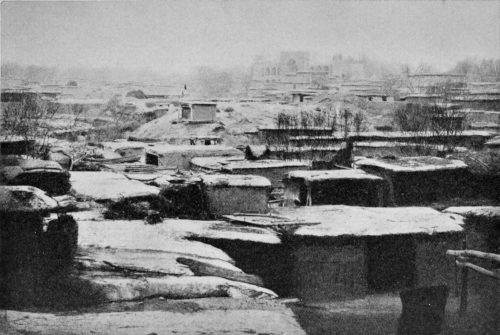
NATIVE QUARTER, TASHKENT
There are:
Russian Quarter.
Native Quarter.
Houses
73
Houses
2140
Orthodox churches
2
Schools
5
Synagogues
2
Native schools
22
Mosques
58
Medresse
1
Military hospital
1
together with the administrative bureau of the sectional
commissioner, besides district military headquarters, a district
court and a post and telegraph office.
In respect of trade Turkestan occupies a prominent place.
The great bulk of the raw products of the nomad cattle-farming
industry is brought to it for the purpose of
exchanging with articles of Russian manufacture. The
yearly returns of the bazaars amount to 4,000,000 roubles;
an increase upon this sum is expected now that in the
Karatavski mountains, which are close at hand, lead mines
have been discovered. The town revenue is 19,350 roubles.
The Tashkent district is more densely populated and possesses
a more productive soil than Chimkent. The mineral
resources, too, present greater promise while the trade
returns reach a total of 50,000,000 roubles a year. Merchandise
comes from Siberia into Orenburg and Tashkent;
while, in addition, there are the local products and those
from the interior of European Russia. The line serves, also,
as the shortest route between Tashkent and the rich corn
region at Chelyabinsk and Kurgan. Undoubtedly it will
assist to supply the whole of Turkestan with Siberian corn,
thereby setting free some of the land now under corn for
the cultivation of cotton. Further, it connects Tashkent
with the centre of the mining industry in the Ural mountains;
and dense streams of Russian colonisation and trade
pass by it into the heart of Central Asia.
The prosperity introduced both into Orenburg and Tashkent
by the creation of railway communication between these
two centres will exercise a very beneficial effect upon the
capacity of their markets. Already improvement has been
marked, the flow of fresh trade through these new channels
following closely upon the advance of the construction
parties. The period available for statistics does not
represent the effect of the new railway upon local trade.
The work of construction had not begun at the time the
returns, which are given below, were drawn up. At that
moment the commercial activity of Tashkent was shown by
the following table:
Table of Imports—1901
Manufactured goods
204,530
poods.
Iron and steel
68,501
”
Dried fruits
101,156
”
Raisins
49,233
”
Black tea
20,718
”
Green tea
6,061
”
Wine grapes
14,105
”
Kerosene
104,317
”
Naphtha refuse
23,402
”
Refined sugar
85,246
”
Sanded sugar
23,905
”
Salt
24,442
”
Military stores
112,506
”
Table of Exports—1901
Wheat
378,058
poods.
Rice
194,574
”
Skins and undressed hides
44,409
”
Hemp seed, flax seed, and grasses
19,784
”
Spirits
26,620
”
Undressed sheep-skins
57,899
”
Cotton
241,484
”
Military stores
108,794
”
The passenger traffic into Tashkent over the Central
Asian line was:
1901
Arrivals.
Departures.
48,515
47,213
During the few years which have elapsed since the figures
were compiled the Orenburg-Tashkent railway has been
opened, this happy accomplishment at once becoming a
factor of the greatest economic importance in the commerce
of Central Asia.
CHAPTER II — THE KHANATE OF BOKHARA, THE PROVINCE OF SAMARKAND, THE DISTRICTS OF TASHKENT AND MERV
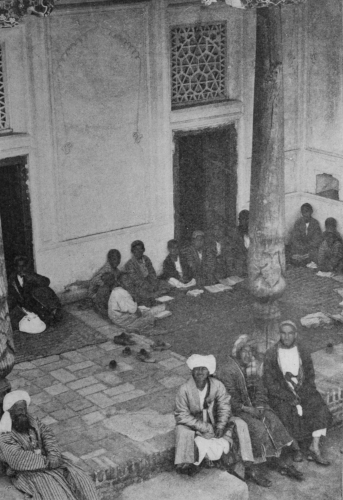
SHIR DAR, SAMARKAND
The Khanate of Bokhara, across
which lies the direct line of any
advance upon Afghanistan, is the
most important of the Russian
protected states in Central Asia.
It is situated in the basin of the
Amu Daria between the provinces
of Trans-Caspia on the west, of
Samarkand and Ferghana on the
north and east; while, in the south,
the course of the Oxus separates,
along 500 versts of the frontier, the
dominions of Bokhara from those
of Afghanistan.
The area occupied by Bokhara,
including the sub-territories Darwaz, Roshan and Shignan
situated upon the western slopes of the Pamirs, amounts to
80,000 square miles, over which in the western part certain
salt marshes and desolate stretches of sandy desert extend.
The eastern area is confined by the rugged chains of the
Alai and Trans-Alai systems, the Hissar mountains, the
immediate prolongation of the Alai range and crowned with
perpetual snow, attaining considerable altitude. This group
divides the basins of the Zerafshan and Kashka Daria
from the basin of the Amu Daria. The rivers of Bokhara
belong to the Amu Daria system, the Oxus flowing
for 490 versts through the Khanate itself. Constant
demands for purposes of irrigation are made upon its
waters as well as upon the waters of its many tributaries,
a fact which rapidly exhausts the lesser streams. In the
western portion of the Khanate the Zerafshan river is the
great artery; and although it possesses a direct stream only
214 versts in length it supplies a system of canals, the
aggregate length of which amounts to more than 1000
versts. These again are divided to supply a further
thousand channels, from which the water actually used for
irrigating the various settlements and fields is finally drawn.
The second most important river in the western part of the
Khanate is the Kashka Daria, which waters the vast oases of
Shakhri, Syabz and Karshine. In the eastern areas numerous
streams are fed by the snows and glaciers of the Alai
mountain system.
The western region of Bokhara possesses an extremely dry
climate which, while hot in summer, tends to emphasise
the severe cold of the winter months. Occasionally at that
time the Amu Daria freezes, when the ice remains about
the river for two or three weeks. The break-up of winter
is manifested by heavy rains which, falling in February,
continue until the middle of March when, after a short
month of spring, a hot sun burns up the vegetation. At
this period the nomadic tribes abandon the plains for the
mountains, large areas of the Khanate now presenting the
appearance of a sparsely populated desert in which the
sole vegetation is found along the banks of the rivers or
in oases watered by the canals. With the advent of autumn,
the steppe once more reflects the movements of these
people.
In its eastern part the altitude varies between 2500 and
8500 feet above sea-level. The climate, warm and mild in
summer, is of undue severity in winter, the period of
extreme cold lasting some four months. Snow, commencing
to fall in October, remains upon the ground until April, the
frosts always being severe. At such a season the winds,
blowing from the north-east, possess an unusual keenness
in contradistinction to the strong south-south-westerly
winds which, prevailing in summer, are the precursor to
burning sand-storms.
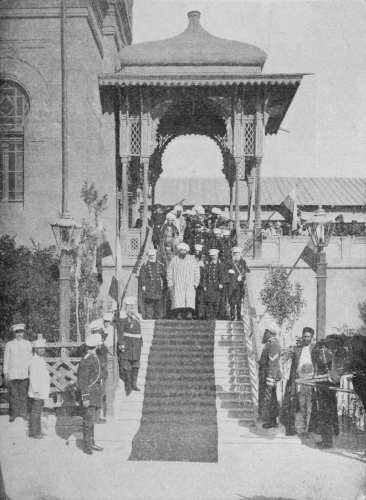
THE AMIR OF BOKHARA ON PALACE STEPS
The total population of the Khanate amounts approximately
to 2,500,000; the well-watered, flourishing oases
bear in some places as many as 4000 people to the square
mile. The steppe and mountainous regions are sparsely
populated. The most important inhabited centres of the
Khanate are as follows:
Distribution of Population.
Town.
Population.
Bokhara
100,000
Karshi
60,000
Shaar
10,000
Guzar
25,000
Kara Kul
5,000
Ziadin
8,000
Hissar
15,000
Shir Abad
20,000
Karki
10,000
Charjui
15,000
Kermine
12,000
Kelif
7,000
According to ethnographic distribution the population
falls into two divisions. To the first belong those of Turki
extraction and to the second the Iranian group. Amongst
those of Turki descent the Uzbegs take the most prominent
place, constituting not only a racial preponderance but
the ruling power in the Khanate. Among the remaining
constituents of the Turki division are the Turcomans
(chiefly Ersaris) and the Kirghiz. To the Iranian category
belong the Tajiks—the original inhabitants of the
country, even now constituting the principal section of
the population throughout its eastern and southern portions;
the Sarts, a conglomeration of Turki and Iranian
nationalities, comprise a considerable proportion of the
urban and rural population. In smaller numbers are
the various colonies of Jews, Afghans, Persians, Arabs,
Armenians, Hindus and others. With the exception of the
Jews and the Hindus the entire population is Mahommedan.
It will be seen that the population is represented by
sedentary, semi-nomadic and nomadic classes. The first,
constituting about 65 per cent. of the whole population,
is distributed principally in the plains, a considerable proportion
comprising Tajiks, Sarts, Jews, Persians, Afghans
and Hindus. The semi-nomadic population forms about
15 per cent., consisting partly of Uzbegs, Turcomans and
Tajiks dwelling in the hills. The nomads, who make up
20 per cent. of the population, live in the steppes of the
western portion of the Khanate, in Darwaz and along the
slopes of the Hissar mountains. They comprise Uzbegs,
Turcomans and Kirghiz.
The soil, in general adapted to agriculture, yields with
irrigation excellent harvests. The amount of cultivated
land in the Khanate is little in excess of 8000 square
miles; but, in order to make full use of the waters of the
Amu Daria, Surkan, Kafirnigan and Waksh rivers, a large
expenditure would be required, the present system of irrigation
being very inadequate. Apart from cotton which
is exported in the raw state to the value of several million
poods annually and the silk industry which, owing to
disease among the worms, has deteriorated, the chief
agricultural interest lies in the production of fruit, the
produce of the orchards forming a staple food during the
summer months. As a consequence, many different
varieties of grapes, peaches, apricots, melons, water-melons,
plums, apples, and pears are cultivated in the several
gardens and orchards. Cattle-farming is conducted extensively
in the valleys of the Hissar and Alai ranges
and in Darwaz; in Kara Kul, situated in the vast Urta
Chul steppe between the towns of Bokhara and Karsi, is
the home of the famous caracal sheep. Other industries
are the manufacture of leathern goods: shoes, saddles,
saddle-cloths, metal and pottery ware; while a staple
product, employed in the manufacture of felts, carpets and
the clothes of the people, is cotton wool.
The yearly budget of the Khanate amounts to 8,000,000
roubles, 1,005,000 roubles of which are spent upon the
army. The standing army, comprising Guards, battalions
of the line, cavalry regiments, a brigade of mounted rifles
and a small corps of artillerists, possesses a strength of
15,000 men with twenty guns. In addition there is a militia
liable for duty in case of necessity but, equally with its
more imposing sister service, of little practical utility.
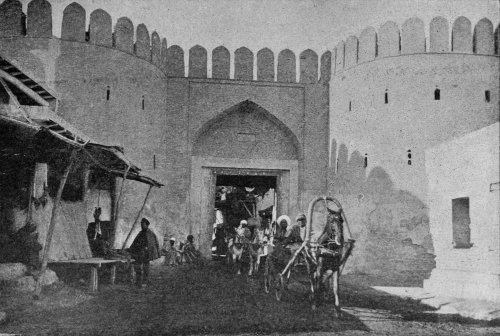
THE GATES OF BOKHARA
The city of Bokhara is surrounded by massive
walls which were built in the ninth century, 28 feet in
height, 14 feet in thickness at the base, with 131
towers and pierced at irregular intervals by eleven
gates. These ramparts contain, within a circuit of 7½
miles, an area of 1760 acres. The population numbers some
hundred thousand and the variety of types included in this
estimate is immense. The Tajiks, who predominate, are
well favoured in their appearance; they have clear, olive
complexions with black eyes and hair. Polite, hard-working
and intelligent, they possess considerable aptitude for
business. Against these excellent traits, however, must be
noted the fact that they are inclined to cowardice and dishonesty.
On this account they are regarded with contempt
by the Uzbegs, a race whose physical characteristics cause
them to resemble the rude warriors of the Osmanlis who
supplanted the Cross by the Crescent in the fifteenth
century. Independent in their bearing, the Uzbegs possess
high courage together with something of the inborn dignity
of the Turk; but they are distinguished from that nation
by a greater grossness of manner and less individuality.
Equally with the Kirghiz and the Turcomans, the Uzbegs
are divided in their classes between sedentary people and
nomads. Then, also, in this dædalus there is the Jewish
community, which is traditionally believed to have migrated
hither from Baghdad. The Jews in Bokhara are forbidden
to ride in the streets; while they must wear a distinctive
costume, the main features of which include a small black
cap, a dressing-gown of camel’s hair and a rope girdle.
They are relegated to a filthy ghetto; and, although they
may not be killed with impunity by a good believer, they
are subjected to such grinding persecution that their
numbers have been reduced in the course of half a century
to something less than 75 per cent. of the 10,000 who
originally composed the colony. The Jew in Bokhara
shares with the Hindu settler there the profits of money-lending
and the two classes are keen hands at a bargain.
In addition to the Hindus there are a few Mahommedan
merchants from Peshawar who are concerned in the tea
trade. Other races among the moving mass comprise
Afghans, Persians and Arabs, the variety of features shown
by a Bokharan crowd suggesting so many different quarters
as their place of origin that one would need to recite the
map of High Asia to describe them.
The town of Bokhara is supplied with water from the
Shari Rud canal, which, in turn, is fed by the Zerafshan
river. A considerable amount is stored locally in special
reservoirs, of which there are eighty-five. As their contents
are seldom changed the supply soon assumes a thick,
greenish consistency, the use of which is extremely detrimental
to the health of the inhabitants. The deficiency
of fresh water for drinking purposes, the oppressiveness
of the summer heat and the propinquity of numerous
cemeteries, together with the dust and dirt of the crowded
streets, make life in Bokhara almost intolerable. The city,
too, is a hot-bed of disease, malaria being specially prominent
at certain seasons. The filaria medinesis, a worm
of burrowing propensity, is endemic.
In Bokhara, as in most Eastern cities, the feminine
element is entirely excluded from the street. The emancipation
of women has not begun in the Middle East;
should any have to venture forth they are muffled up
so carefully that not even a suggestion of their personal
appearance can be gathered. Yet there is a certain charm
and mystery in the flitting of the veiled Beauty and one
would fain linger to speculate further, if such dallying
with fortune were not eminently injudicious. If there
is no revelation of the female form divine in the bazaar
there is, at least, a wonderful wealth of gorgeous colouring.
In time of festival the scene, welling up to break away in
endless ripples, suggests the myriad beauties of a rainbow
splintered into a million fragments.
There is relief, too, from the burning sunshine in the cool,
lofty passages: shady, thronged and tortuous they extend
in endless succession for mile after mile. The roof of the
bazaar is a rude contrivance of undressed beams upon
which there is a covering of beaten clay. Behind each
stall is an alcove in the wall serving as home and office to
the keen-visaged merchant who presides. In this little
recess, piled upon innumerable shelves, rammed into little
niches or strewn upon the floor, are the different articles
which his trade requires. Carpets and rugs of harmonious
hues, a wealth of parti-coloured shawls, innumerable lengths
of dress pieces, cutlery, trinkets, snuff-boxes, gorgeous
velvets and brilliant silks, the shimmer of satin and the
coarse tracing of gold-wire embroidery, are here all displayed
in prodigal confusion. As to the sources of supply,
a good deal of the merchandise is the produce of Russian
markets. For the rest, a certain proportion comes from
Germany and a small amount is imported from France.
England, it may be noted, is not represented at all.
The money-changers have a quarter to themselves, as
have also the metal-workers and the vendors of silks and
velvets. At every corner and odd twist of the passages
there are the sweet-sellers, the tea merchants and the
booths for food. China is the principal source of the tea
supply, but of late a certain amount has found its way
into Bokhara from the gardens of India and Ceylon. It
is before the steaming samovars that the crowd of
prospective purchasers is apt to be thickest. Beyond the
bazaar boundaries are the wonderful relics of a bygone
grandeur—imposing buildings and mosques, touched with
the glory of the sunlight and capacious enough to contain
within their courtyards 10,000 people at one time.
Although the chief interest of Bokhara centres in the
portion just described, its public buildings well repay
leisurely examination. The Registan, the market-place of
the north-west quarter, acts as a central zone. On one side
standing upon a vast artificial mound is the citadel or Ark,
its mighty walls forming a square of 450 yards, its parapet
crenellated and its corners set with towers. The building
dates from the era of the Samanides. In addition to the
Amir’s palace the walls of the Ark enclose the houses of
the chief ministers, the treasury, the State prison and
various offices. The entrance to the citadel, which is
defended by two imposing towers, is closed by massive
gates above which there is a clock. None save the highest
officials are permitted to enter the Ark; visitors, irrespective
of rank, are compelled to dismount at its doors and to
proceed on foot to the Amir’s quarters. Opposite the Ark
stands the largest mosque in Bokhara, the Medjidi Kalan
or Kok Gumbaz—the Mosque of the Green Cupola—which
the Amir attends every Friday when he is in residence.
THE PRISON, BOKHARA
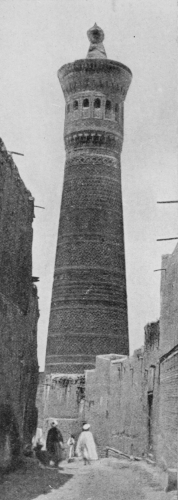
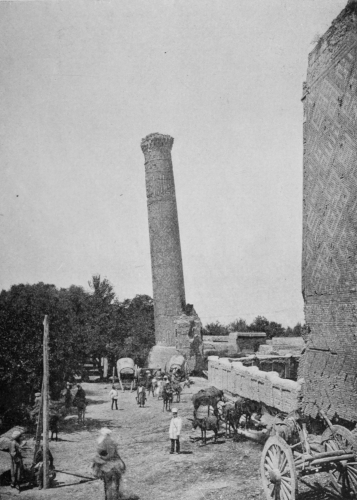
THE MINAR KALAN, BOKHARA
A smaller market-place, where transactions in cotton are
carried out, is surrounded by several imposing edifices
that rise with infinite grace
to the sky, besides countless
minarets of prayer
acting as landmarks to the
faithful. Here is the Great
Mosque, the Masjid-i-Jama,
while facing it is
the Medresse Mir-i-Arab.
This latter building ranks
first among the many
stately colleges of Bokhara.
Near at hand is
the Minar Kalan, 36 feet
at the base and tapering
to a height of over 200
feet. From a small platform
just below the lofty
pinnacle, miscreants were
hurled to destruction in
bygone days. With the
exception of these buildings
the city contains little
of antiquity.
For its size the native
quarter is a centre of the
greatest importance; and
its streets, although mean
and sinuous, are filled
by a crowd most typical
of Asia. Ten thousand
students receive instruction
in its schools. It
contains:
Streets
360
Caravansaries
50
Covered bazaars
50
Mosques
364
Native schools
138
Russian school
1
Russian hospital and dispensary
1
THE ARK, BOKHARA
The houses, which are set in small compounds approached
by narrow alleys, are composed of clay with low roofs and
without windows. A hole in the roof suffices for a chimney,
and the open door affords light.
Samarkand, the administrative centre of the province of
the same name and founded in 1871, is a close reproduction
of a large Indian cantonment. The streets are
wide, well paved, fringed with tall poplars and set with
shops which are kept by Europeans. For the Russians, as
the centre of the province and the location of army headquarters,
it has special importance. Although without any
architectural pretensions—the buildings are all one-storey
structures on account of frequent visitations from earthquakes—its
comparatively lofty position makes it an agreeable
station and one of the most attractive gathering-places
for Europeans in Asiatic Russia. The city is situated
upon the south-western slopes of the Chupan Ata range,
7 versts from the Zerafshan river. The close proximity of
the hills naturally influences its rainfall, which is greatest in
March and April. The period from June to September is
dry; and by February or March the trees are in bloom. By
a happy choice in construction it has been planned upon
exceptionally generous lines which, although imparting to
the outskirts a desolate aspect, have been the cause of
securing to the community a number of spacious squares,
around which are placed the barracks and certain parks.
The principal square, named after General Ivanoff, a former
Governor of the province, is Ivanovski Square. Another
interesting memento of the Russian conquest of Turkestan
is situated between the military quarter and the green
avenues of the Russian town, in a spot where the heroes
who fell in the defence of the citadel in 1868 were buried.
At the same place, too, a memorial has been erected to
Colonel Sokovnin and Staff-Captain Konevski, who were
killed in 1869.
The population of Samarkand at the census of 1897 was
54,900:
Males.
Females.
31,706
23,194
According to the statistics of 1901, which are the most
recently available, these figures had increased by a few
thousands; they were then 58,194:
Males.
Females.
36,621
21,573
Russians
10,621
Poles
315
Germans
378
Armenians
335
Jews
4,949
Sarts
40,184
Kirghiz
36
Afghans
186
Persians
237
Hindus
10
In the town itself there are:
Orthodox churches
4
Private houses
1,100
Clubs
2
Library
1
Schools
9
Hospital
1
Theatre
1
Museum
1
and various medical, charitable and other institutions.
The native quarter, which is separated from the Russian
town by the Abramovski Boulevard—so named in honour of
General Abramoff, another military Governor of the province—covers
an area of 4629 dessiatines. It was built by
Timur the Lame. The streets with few exceptions are
narrow, winding and unpaved; the houses are of baked mud,
mean and cramped, with flat earthen roofs and no windows.
In this division there are:
Shops
1,169
Caravansaries
28
Market-places
4
Squares
2
Medresses
14
Mosques
105
Jewish synagogue
1
Jewish prayer-houses
6
Mektebs
91
The value of Government property in the Russian and
native areas of the city is estimated at 4,077,681 roubles.
The city revenue approximates 147,616 roubles. The native
quarter is the great commercial centre of the province and
the trade returns for the city and its surrounding district
amount to 17,858,900 roubles out of 24,951,320 roubles for
the entire province. Of the squares the most celebrated is the
Registan, with a length of 35 sagenes and width of 30 sagenes.
It is bounded by three large mosques: the Tillah Kori—the
Gold Covered; Ulug Beg; and Shir Dar—the Lion Bearing.
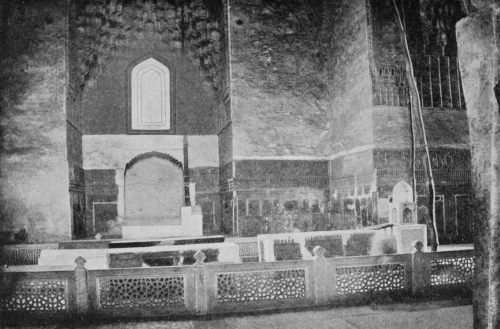
THE TOMB OF TAMERLANE, SAMARKAND
The Registan is the heart of ancient Samarkand. Prior to the
advent of the Russians pardon and punishment were dealt
from it to the people by their rulers, executions performed
and wars declared, as the authorities pleased. Even up to
the present day the Registan has preserved in some degree
its importance as a popular tribune. From it self-constituted
orators, holy men and politicians, expound their doctrines
before a people gathered together from the most distant
corners of the Continent of Asia. The Registan is only one
feature of this delightful city; for here, too, are the stately
ruins of the Bibi Khanum, tomb of the wife of Timur,
and the Gur Amir where Timur’s remains lie amid a scene
eloquent in its simple grandeur. Although, unfortunately,
this building has been spoilt by attempts at restoration,
its encrusted tiles are as beautiful as when they were
made, 400 years ago. Here, too, is the resting-place of the
Shah Zindeh; and in its Urda or ancient citadel, now a
weak, bastioned fort, is the Kok Tash—the coronation-stone
of the descendants of Timur. The charm of the Gur Amir
is supreme. Within its dome, before the horse-hair standard,
the sheer force of association and the infinite suggestion of
the spot make one feel the great presence of this renowned
soldier. Beneath the cupola there is a nephrite cenotaph;
perhaps, as Colonel C. E. de la Poer Beresford has said, the
largest block of green jade in the world.[5] Close to it other
tombs, lighter in colour, are erected to the memory of Ulug
Beg and Mir Sayid, Timur’s grandson and tutor. Around
these is a carved gypsum balustrade and in the crypt below,
under a simple brick-tomb, lies the vanquisher of Toktamish
Khan, of Sultan Bayazid, of Persia, the Caucasus and India—Timur
himself.
SAMARKAND—THE HOUR OF PRAYER
In its economic aspect Samarkand occupies a very
important position. Although scarcely serving as a mart
to the produce of British India and Afghanistan, it is nevertheless
a great emporium of trade. The roads, leading to
the town or from it, as the case may be, are an index of
its wide-reaching commercial influence. They run from
Samarkand to Karki on the Amu Daria; and to Tashkent
viâ Jizak; while Khojand, Khokand, Namangan, Andijan,
Margelan and Osh are all in direct communication with it.
Caravans from the east and north, from Persia and from
China, carts perched on two gigantic wheels or transport
bullocks laden with skins, even sheep carrying small packages—all
are impressed into service and seem to be
revolving in a constant stream round Samarkand. There
is a steady traffic and the numerous bazaars are the centre
of a brisk trade in skins and pelts. Unlike the bazaars of
Bokhara, along the sides of which the merchants have their
stalls, the passage-ways are open to the heavens. After the
wonderful picture of Asiatic life presented by Bokhara,
there are those who complain of a feeling of disappointment
at the more subdued current which flows through Samarkand.
Nevertheless the town has a charming setting. The
snow-peaks of the Hissar chain and the curtain of enchanting
fields and spreading vineyards, which hides the hideous
aspect of the Kara Kum, add to the pleasure which is
derived from the delicate mingling of the colours of the
street life. There is, indeed, a very special type found in
the bazaars of Bokhara
and Samarkand.
Dressed in
the choicest of silks,
so soft that it suggests
the rustle of
the wind through
the peach-trees
and dyed in tones
of yellow, green
and brown, in
shades of magenta
and purple, in a
note of blue reflecting
the sky or
touched with the
blush of a red rose, are men of fine stature. They move
with their long-skirted gowns clasped at the waist and
their silken trousers tucked into brown, untanned boots,
the seams of which are delicately embroidered. Every
individual reserves to himself a most exclusive manner,
representing the embodiment of dignity. There is such
an air of contentment about the gaily-clad crowd as it
passes from stall to stall; such perfect self-possession,
suggested humility and independence that the difference
in size between Bokhara and Samarkand goes unnoticed;
the atmosphere being no less pleasing, the picture
no less acceptable, in the smaller city than in the capital.
SAMARKAND—A BIRD’S-EYE VIEW
As the administrative focus of the Syr Daria province
Tashkent is the principal city of Russian Turkestan and the
seat of the Governor-General. The Russian quarter at once
recalls memories of other spheres of Central Asia. The streets
are wide and long. Dusty but much frequented, they
are bordered by high, white poplars set in double rows,
while upon each side there run the gurgling waters of
the irrigation canals. The city is laid out in a sector of a
circle, three great boulevards radiating from the cathedral,
a handsome, octagonal building in freestone. Surmounted
by the dome and golden cross, which mark in Russia all
Orthodox places of worship, it occupies the centre of
Konstantinovski Square. It contains the remains of General
von Kauffman, Governor-General of Russian Turkestan
between 1867 and 1882 and, incidentally, conqueror of
Khiva in 1873 and of Samarkand in 1868. He died May 4,
1882.
SOBORNAYA BOULEVARD IN TASHKENT
Tashkent, situated upon the slopes of the Tian Shan 172
sagenes above sea-level, lies in the midst of an extensive
oasis whose fertile acres are watered by the river Chirchik
and its tributaries. January is the coldest month, while July
is the hottest. The prevailing breezes are north and north-east;
but the characteristic peculiarity of the climate is the
absence of wind, which makes the high temperature in the
summer particularly oppressive. Spring weather begins in
March; the hot season, commencing in May, continues
until the middle of August. Speaking generally the place
possesses the attributes of the climate in the plains of Central
Asia while distinguished by its greater yearly rain-fall—384
millimètres—in consequence of the proximity of the
mountains. The drinking water question, an ever-attendant
difficulty in Central Asia, is no less acute in Tashkent,
constituting a serious drawback to conditions of life there.
An ample supply of water is available for irrigation, the
Chirchik river, as well as numerous wells and springs, being
diverted for this purpose.
The Russian quarter, founded in 1865 after the capture of
the native town from the Khan of Khokand upon June 15
by the Russian forces under General Chernaieff, is separated
from the native by the Angar canal. It is divided
into official and residential areas, and contains many large
streets. The Sobornaya, in which are situated the best shops,
is perhaps more animated than any other thoroughfare in
the town, while the Romanovski Street, which crosses the
official quarter, is devoted principally to the Government
offices. Three wide streets—the Gospitalnaya, Dukhovskaya,
and the Kailuski Prospekt—along which it is proposed to
erect business premises, also run from this quarter to the
station. The residential part is of much later construction;
its population is more scattered, the houses are surrounded
with dense gardens and the streets are wider. The houses
in each section are, for the most part, single storeyed. The
chief public works are the Alexandrovski Park, Konstantinovski
Square, Gorodskoi Garden and the gardens surrounding
the residence of the Governor-General. The
Turkestan Public Library, founded by General von Kauffman
with the object of furthering the education of the
country, now contains more than 40,000 volumes.
The following table shows the existing statistics of the
Russian quarter:
Military club
1
General club
1
Houses
3776
Schools
22
Orthodox churches
10
Protestant church
1
Synagogues
3
Sunnite mosques
17
The town revenues for 1902 were as follows:
Revenue.
427,572 roubles.
Expenditure.
Police
90,599
Local administration
67,867
General expenditure
269,106
Roubles
427,572
The permanent garrison is never less than 10,000 men.
Barracks and store-house accommodation for military supplies
abound in the place. Between the spacious station
and the Russian city, a distance of one verst, there are very
commodious infantry quarters. A long row of buildings,
somewhat more remote and erected upon slightly rising
ground, contains the lines of the Cossack establishment. The
climate of Tashkent is too unhealthy to be endured in the
hot weather. In summer the garrison moves to Chigman,
a defile 671 sagenes above sea-level, situated 80 or 90 versts
beyond the town on the river Chirchik, where there is a
sanatorium for the troops. The families of the officers
usually pass the season at the village of Troitzki, 25 versts
from Tashkent. Five versts from the city is Nikolski, the
first Russian settlement founded in the Syr Daria province.
Lying between it and the Russian town is the native quarter.
Recalling Andijan, Margelan, Khokand and Osh, it lacks
the animation of the streets of Bokhara and is destitute
of the architectural beauties of Samarkand. Surrounded
on three sides by gardens, the fourth side touches the
Russian town with which it is connected, as also with
the station, by means of a horse tramway. It is divided
into four parts called respectively Kukchinski, Sibzyarski,
Shaikhantaurski and Bish Agatchski. Each is separated
into districts, these sub-divisions totalling 206 in all.
The two quarters of Tashkent occupy to-day an area of 20
square versts. Forty years ago the site of the Russian settlement
covered no more ground than that required by the
village which contained the garrison. This original section
has now disappeared, becoming merged as time passed and
the colony expanded with the Fortress Esplanade, while
the population has similarly increased. In May 1871 the
combined figures of the native and Russian colony gave only
2701 inhabitants. In 1897 the census returns showed the
population to be:
Natives.
Russians.
131,414
25,000
Total
156,414
These figures, particularly in connection with the Russian
colony, exhibit a gradual increase throughout the period
intervening between the census of 1897 and that in 1901,
when the returns were as follows:
1901.
Russians.
Natives.
Men
16,416
Men
70,903
Women
16,926
Women
59,019
Total
33,342
Total
129,922
In greater detail the population of the native quarter was
composed as follows:
Russians
109
Persians
18
British Indian subjects
38
Jews
543
Tartars
420
Kirghiz
378
Sarts
128,406
Afghans
10
In the native area there were:
Houses (private)
17,164
Shops
45,000
Mosques
328
Mektebs
242
Medresses
24
Russian native schools
6
Although the importance of Merv, as a military district,
has increased since the Orenburg-Tashkent railway was
opened the numbers of the resident population continue
to decline. This proceeds from the unhealthy conditions
that obtain locally. Malaria, the most prevalent complaint,
runs a very level course throughout the year. Between
July and November it becomes exceptionally virulent;
and a recent Medical Commission returned the causes
of the sickness in Merv as due solely to the presence of
a specific organism which, passing from the soil into the
water, was absorbed by the inhabitants. So rife is the
disease that it is estimated that not one person escapes
its attacks in the course of the year. The highest sick-rate
occurs between the months of July and November,
when it is responsible for 80 per cent. of the “Daily
State” in the garrison and district hospitals. Merv malaria
generally attacks the liver and kidneys, rapidly affecting
the spleen. Every effort has been made to cope with
its ravages. Among the attempts was a scheme for
the introduction of a new system of irrigation and the
purification of the water system, to which the Minister of
War assigned 63,000 roubles. Hitherto the drinking-water,
derived from the Murghab, has been altogether unfit for
consumption. Apart from possible contamination in the
sources of the water-supply, there is no doubt that much
of the malaria in Merv arises from constant displacement
of soil in the oasis; similar conditions prevail,
usually for three or four years, in all tropical and semi-tropical
countries whenever agricultural or other development
requires the breaking of ground.
BAZAAR SCENE
Certain features encountered in Merv—such as groups
of chaffering natives, clusters of small, open shops, dusty
trees, open drains and sweltering heat—are strangely
reminiscent of India, but the absence of punkahs and
the high price of ice prove that the Russians in Central
Asia are indifferent to comfort. Even the hotels make no
attempt to relieve the effect of the temperature; while, in
general, the houses are built without verandahs and the
windows are unfitted with jalousies. Within the houses,
too, conditions are most trying, the policy of every one
being to admit the flies and exclude the air. Trade
manages to thrive; and a weekly market is held on
Mondays upon a plain to the east of the town. Thither
all roads converge; thronged with two-wheeled Persian
carts, ill-fed baggage horses burdened with goods, and
gurgling camels. Standing solitary and forlorn is the
patient ass whose lament is so eloquently described
by Mr. Shoemaker, where that author says:
Oh, my brother from that far western land where even a little
ass like me has some chance to sleep in quiet, blame me not, I
beseech you, that I weep. You have seen how dignified and self-contained
my brethren are in Egypt; but there we never carry
more than two of the heathen at the most, whereas here, you see,
it is always three and sometimes four; therefore I weep, oh my
brother, and will not be comforted.
Fair days in the town bazaars are held upon Sundays and
Thursdays, when the Hebrew, Persian and Armenian merchants
are surrounded by crowds of Tekkes from neighbouring
villages. Disposed for sale are the innumerable
commodities of the Middle East—rice from Meshed;
fruits from Samarkand; silk, sweetmeats and velvet from
Bokhara; cheap cutlery, trinkets, leather goods and samovars
from Russia; beautiful embroidery and shawls from the
stores of the wealthier merchants; carpets from Herat; sheepskins
from the country-side; plough-shares and knives from
local forges; and relics of Old Merv. Prices are high;
but the Turcomans make their purchases very willingly,
unconscious of the contrast between their present peaceful
demeanour and the attitude which distinguished them
when they were robbers of the countryside.
Apart from the garrison the population numbers less than
5000, including:
Races.
Total.
Russians
2297
Armenians
609
Sarts
167
Tartars
85
Khivans
36
Afghans
33
Germans
38
Persians
838
Jews
225
Gruzenes
63
Tekkes
33
Bokharans
56
Ersaris
41
Poles
30
The revenues derived from the native town amount to
42,000 roubles a year and the volume of business annually
turned over is a little short of 100,000 roubles. The prosperity
of the place is attested by the individual wealth of
merchants attending the bazaars. Many of these men live
in spacious houses, the majority of the natives frequenting
the bazaar being well-to-do and apparently contented.
Trade is brisk and, as the Russians have imposed but a
few taxes and the Turcomans are exempt from military
service, no particular difficulty attends the earning of the
daily wage.
BREAKING CAMP ON MANŒUVRES, TASHKENT
It is said occasionally that the disasters which attended
Russia in Manchuria have stimulated the ambitions and
desires of the Mahommedan population of Asiatic Russia
to throw off the yoke of Muscovite rule. Hence it is
possible that the reading of the existing situation in Central
Asia, which is here presented, may not be accepted. In
point of fact, the Mahommedan attitude towards Russian
rule in Mid-Asia has no relation whatever to the outcome
of the late war in Manchuria; nor was it influenced in
any way by the developments of that unfortunate struggle.
Contrary belief is based upon the impression that the
animus entertained against the Russians by the races of
British India, where it is now assumed by the ignorant
and very foolish that Russian arms would be at once
defeated in any Indo-Russian conflict, exists equally
among the Mahommedan population of Asiatic Russia.
The comfortable acceptance of this doctrine of Indian
superiority—one of the most amusing and dangerous
fallacies of public opinion—shows the need of more discriminating
criticism, upon the character of Russian administration
of native races in Central Asia, to distinguish
all shades of public and Indian opinion. The Russians
are no less careful of the several peoples that find refuge
under their rule than our own authorities, a fact which,
unfortunately, we are inclined to ignore in our estimate
of their present position through a conceit which inspires
Anglo-Indians to regard British administration of native
races as heaven-born. The opinion in reference to the
Russo-Japanese War is equally erroneous; because, while
it is known that our Indian subjects had recourse to all
reports upon it and thus were at liberty to arrive at
their preposterous conclusions, native opinion in Central
Asia knew almost nothing of its course, character and
result. Even if suspicions of the actual results were entertained,
the constant display of troops, which was made
in all Central Asiatic centres of importance during the progress
of the campaign, would have dispelled the belief that
the Russian military resources were straitened. Apart from
this fact, the public in Central Asia were supplied only with
those versions of the truth which were most acceptable—and
useful—to the Russian amour propre. It will be seen,
therefore, that wherever Mahommedan feeling may be
opposed in the Tsar’s Asiatic dominions to Russian domination,
such sentiment is spontaneous and as deeply
rooted or easily appeased as the circumstances, which may
have excited it, dictate. It is well to understand this phase
of the situation in Central Asia since, in itself, it is very
significant.
Merv, perhaps, is a case in point. On the surface the
aspect of affairs there is placid enough; but the Russians
in Central Asia have read so many effective lessons to their
subject races that at best opinion upon the possible chances
of an outbreak is a blind hazard. Doubtless religious and
racial prejudices are smouldering; yet, if there is any feeling
of discontent, it must arise from an animosity born of
pure fanaticism. Certainly the Russian rule in Mid-Asia
is tolerant—now that the lesson has been taught—and
there is neither religious nor educational interference.
Moreover trade, fostered by very careful protection,
prospers; and at least one secret of success in any Central
Asian system of government is to let well alone and appeal
to the vulgar through their pocket. This principle the
Russians support with admirable patience, taking precautions
at the same time that their benevolent administration
shall not be endangered by too much licence in
the matter of importing or possessing arms. A native
rising would be difficult upon this account alone; while
it should be remembered, too, that many years of leisured
ease have brought about considerable deterioration in the
instinctive passion for rape, bloodshed and plunder, which
distinguished, only a few years ago, the inhabitants of
these Central Asian Khanates.
Again, always pre-supposing the steady loyalty of the
great bulk of the European troops, Russia has not enrolled
any large number of native recruits in regions beyond the
Caspian Sea; although her policy in the Caucasus has not
been quite so exclusive. The success of any native insurrectionary
movement in Trans-Caspia would depend, therefore,
upon the precise amount of support that it received
from any disaffected sections of the Caucasian establishment
that might be incorporated with the Russo-European
army on service in the Khanates. No doubt the wide area
covered by the rebellion in the Caucasus will encourage the
Caucasian element in the Trans-Caspian army to be troublesome;
and, since the Caucasian races in a measure are akin
with the Central Asian peoples, mutual sympathy may give
rise to positive revolt in Central Asia. Between the European
soldiers and the native races, however, there is little
in common; and unless revolutionary agents from St.
Petersburg, Moscow or the larger centres of disturbance
contaminate the adherence of the men, there is really
nothing to cause them to listen to any seditious overtures
which might emanate from native sources. It is
very easy in Central Asia to remove the rails of the permanent
way or to interrupt telegraphic communication,
since the railway and the wires run for hundreds of miles
unguarded and at the mercy of any wandering, discontented
miscreant. Such instances of disaffection would
be sporadic. Difficulties of combination—if the great
distances separating Khiva, Merv, Bokhara and Tashkent
were ignored, which they cannot be if the position of
affairs is to be appraised properly—would alone prevent
any simultaneous co-operation; while whatever unanimity
might be disclosed by actively hostile parties of native
or European revolutionaries, the forces at the disposal
of the military authorities must enable them to suppress
the movement rapidly and at once.
Of course the agitation in European Russia cannot leave
Russians in Central Asia unaffected; continuation of the
widespread irruptions of disorder in European Russia
obviously imparts a new and most serious complexion
to affairs in Asiatic Russia. Moreover signs of unrest,
in consequence of interference by revolutionary agents
from St. Petersburg, have already been displayed. At
Askhabad the officers were locked in their quarters; at
Kushkinski Post 200 soldiers joined in a strike of railway
and telegraph officials. Further, at the instigation
of Sokoloff an engineer and Simonoff an engine-fitter,
a variety of farcical intentions were proclaimed, the main
outcome of this signal act of rebellion culminating in a
little temporary dislocation of the railway and telegraph
services and the arrest of the ringleaders. None the less,
the activity of these revolutionary agents does constitute
a possible menace to the peace of Mid-Asia; for, while the
native population recks little of the wiles of European
agitators and can be overawed by the authorities, the
situation, where it concerns the ultimate effect of the
revolutionary propaganda upon the Russo-European army,
rests upon the knees of the gods. There, unfortunately,
it must remain; emphasising the fact that, on account of
the means of checking the dissemination of revolutionary
heresies and the growth of the operations of the agitators
in Central Asia which the Russian authorities have at hand,
the chances are much against any violent or widespread
upheaval of the peace in these territories.
[5] Lecture before the Central Asian Society, December 1905.
CHAPTER III — FROM TASHKENT TO MERV
NATIVE QUARTER, TASHKENT
KORAN STAND, SAMARKAND
The first station beyond Tashkent,
travelling towards Merv, is
Kauffmanskaya, where begins
the practice of associating with
the scenes of their conquests
the names of officers who have
achieved distinction in Turkestan.
It is a pleasant custom and
serves to perpetuate history in a
manner which might be copied
with advantage in India. In this
instance General von Kauffman,
who became eventually an aide-de-camp
to the Tsar, was the first Governor-General of
Russian Turkestan.
Between Tashkent and Kauffmanskaya which, although
insignificant, is equipped with hospital accommodation for
six patients, the railway crosses by an iron bridge of 8
sagenes the Salar river, itself a tributary of the more important
Chirchik. The line then passes Zangi-ata and the
post station of Nialbash, crossing the Kur Kulduk arik by
an iron bridge 3 sagenes in length and running near
Vrevskaya through the Chirchik Valley, a region of special
interest to archæologists. Stari Tashkent or Old Tashkent,
rich in historical associations, is in this neighbourhood. It
was inhabited at one time by the Sakis who, in bygone centuries,
offered a stubborn resistance to Alexander of Macedon.
Now it is only an insignificant hamlet, mere flotsam
which has been thrown up and left by the advancing tide of
Russian conquest. Lying to the east of Stari Tashkent and
opposite Kirshul upon the left bank of the Chirchik river
are the ruins of Shuturket or Ushturket—the Town of
Camels; in the country between it and Binket, by which
name Tashkent is known among the natives, there are
other ruins.
After skirting Bodorodski and Kaunchi the station of Syr
Darinskaya, lying about 1 verst from the hill and lake of
Utch Tubeh, follows, the line crossing the Bos-su arik by a
second bridge of 5 sagenes. Until this point the general
direction has been south-west. Ten versts from Syr
Darinskaya station, at a point where it crosses the Syr
Daria by a four-span iron bridge 160 sagenes in length, the
railway runs by the ancient fortress and lake of Urumbai
and turns to the east to thread the hills which surround
Utch Tubeh lake.
The point now arrives where the train enters the region
distinguished by the Emperor Nicholas I. Canal, an extensive
system of irrigation from the waters of the Syr Daria. These
works, which the Ministry of Agriculture introduced,
have brought more than 100,000 acres of the Golodnaya
steppe under colonisation. It is due to the initiative and
generosity of the Grand Duke Nicholas Konstantinovitch
that the scheme was executed and its success is illustrated
by the fact that seven villages—Nikolaievski, Nadejdinski,
Verkhni, Nijni Volinski, Konnogvardeiski, Obyetovanni
and Romanovski—have been established upon the reclaimed
areas. In the main they are devoted to the cultivation of
the smaller crops, although one or two are given up to
the growing of cotton. The prosperity of the undertaking
entails elaborate precautions; in order that the works
should be unobstructed the head waters of the system are
watched continuously by relays of guards.
The Golodnaya zone of cultivation extends only a verst
or so beyond Golodnaya station; between this little oasis
and Chernaievo, the next station, there is a barren wilderness.
After leaving Golodnaya and crossing the Emperor
Nicholas I. Canal by an iron bridge, 8 sagenes in length,
the line proceeds north-east beyond the Syr Daria,
where it turns sharply to the east in order to make the
junction with the main line from Krasnovodsk to Andijan.
Owing to the lack of cultivation and the scarcity of population
no commercial importance can be ascribed to Chernaievo.
Attached to the little station is a small hospital
with a capacity of ten beds, while the railway workshops
employ a permanent staff of 100 workmen. The
depôt at this point,
on account of the
junction between
the line from Tashkent
and the extension
to Andijan,
is out of
proportion with
the requirements
of the neighbourhood.
Of course
here, as at every
station on the line,
there is a large
store of naphtha,
50,000 poods being
held against
emergency in the
naphtha reservoir.
PEASANTS FROM THE GOLODNAYA STEPPE
In relation to
Chernaievo, it
would be a pity to avoid mention of the distinguished
soldier who, subsequently Governor-General of Turkestan
and dying in disgrace in August of 1898, gave his name
to the place. Under happier circumstances Chernaieff
might have become the Clive of Central Asia. It was
he who, suffering defeat before Tashkent on October 2,
1854, and determining to remove so signal a stain from
the prestige of the Russian forces, repeated his attack
at a moment when he had received explicit orders from
Alexander II. to refrain from doing so. With the Imperial
despatches in his pocket he led his small forces to the onslaught
and it was only when victory had been secured that
he made himself acquainted with his instructions. The
reply he despatched to his august sovereign is as historical
as the famous signal which Nelson displayed at Trafalgar.
“Sire,” he wrote,[6] “Your Majesty’s order, forbidding me
to take Tashkent, has reached me only in the city itself
which I have taken and place at your Majesty’s feet.” The
Tsar was angry at the breach of discipline and, although he
accepted the fruits of General Chernaieff’s daring, he never
restored his officer to favour. Superseded by General
Romanovski and stung to the quick by this treatment, Chernaieff
retired from the service, a broken-hearted man.
Beyond Chernaievo, situated amid most arid surroundings
and in a locality where the water is salt, is Obrutchevo, so
called in honour of the former Chief of the General Staff,
General Obrutcheff. Nine versts further is Lomakino, which
derives its name from General Lomakin, an officer of repute
in the Turcoman Expedition of 1879. Between Lomakino
and Jizak the line enters the province of Samarkand.
Jizak station, named after a district town in the province
of Samarkand, is situated in the valley of the Sanzar river in
a locality which is both thickly populated and well cultivated.
At the workshops there is only a staff of nine workmen,
while the railway depôt possesses little more than engine
sheds and a naphtha reservoir of 10,000 poods. The water-supply
of the station is drawn from the Sanzar river.
Water for the consumption of the Russian quarter of the
town, which lies at the foot of the northern slope of the
Nura mountains, two versts from the railway, comes from
the Russki arik.
The district supplied by the station is small and in the
year under review there were:
Arrivals.
Departures.
6038
5612
Goods traffic reveals a steady demand for articles of
Russian manufacture, the combined bulk of this trade
being:
Imports.
Exports.
136,029 poods
500,142 poods.
The export trade was comprised as follows:
Wheat
392,854
poods.
Wheat flour
21,631
”
General
85,657
”
In consequence of the deficiency of fresh water Jizak is
an unhealthy town, more malaria prevailing in the locality
than in any other part of Turkestan, with the exception of
the Murghab and Kushk valleys. The Russian quarter,
which was formerly the Kluchevi fortress, possesses a number
of public gardens. There are only thirty-six private houses
in the settlement and these, in the main, are occupied by
officials. The public buildings include two schools, a
military hospital, a military Orthodox Church, the Chancellery
of the District Governor, the District Treasury and
other offices. The population at the last census was 17,000.
Mahommedans.
Russians.
16,614
386
Males.
Females.
9247
7753
The native quarter is of far greater commercial importance
than the Russian town and is situated 3 versts from it.
Indeed, the latter is almost solely a cantonment. The native
town possesses:
Houses
3000
Sunnite mosques
54
Shiite mosques
2
Native schools
22
The town revenue is 22,842 roubles and the value of
Government property rather less than 600,000 roubles.
There are no hotels in either quarter.
The native bazaars are supposed to be identical with the
town of Gaza through which the armies of Alexander passed
in the fourth century B.C. More recently the Russians
converted it into a strong military post. At the time when
it was assaulted by the Russian forces under General
Romanovski, upon October 18, 1856, it was regarded as one
of the most powerful fortresses in Central Asia. In those
days the town was surmounted by a triple wall, 4 sagenes in
thickness and 3½ sagenes in height. High towers defended
the interior walls, while upon the outer wall were mounted
fifty-three pieces of artillery. At that time the strength of the
garrison under the command of Alayar Khan was returned
at 10,000 men.
THE COLUMN OF TAMERLANE, SAMARKAND
A few versts before Jizak the line, running in a westerly
direction along the southern border of the Golodnaya
desert, crosses by an iron bridge, 8 sagenes in length, the
Sais Khaneh ravine. Beyond Jizak and after passing through
Milyautinskaya it enters the Ilyan Uta defile, through which
flows the Sanzar river. This defile is the only existing pass
in the Nuratinski range and contains the famous Gates of
Tamerlane. Beyond the gates there is the station of
Kuropatkino, named after General Kuropatkin who so long
presided over the destinies of Russia in Central Asia. From
here, the line proceeds to cross the eastern slope of the Nura
range; barely thirty versts further on it arrives at
Rostovtsevo which takes its name from a former Military
Governor of the Ferghana province, Count Rostovtseff.
Between Kuropatkino and this station the line crosses at the
foot of the ascent of the
Golun mountains a bridge,
5 sagenes in length, over
the Balungur arik. From
the slopes of the Golun
Tau the railway traverses
the watershed of the Zerafshan
and Sanzar rivers,
reaching at 10 versts from
Kuropatkino the highest
elevation on the whole line,
403 sagenes above sea-level.
From this point the
line then descends to Rostovtsevo
from where, after
a short run of 30 versts, it
arrives at Samarkand.
THE REGISTAN, SAMARKAND
With Rostovtsevo there
commences without doubt
the most interesting section
of the journey between Tashkent and Samarkand. The
market of Samarkand has spread its influence for many
miles along the line; and, as a consequence, there is a
welcome note of freshness in the scene. In addition
to the prosperity naturally suggested by the spectacle
of a flourishing oasis, the railway affords a fleeting inspection
of two important bridges. The first, an iron bridge
of seven spans and 56 sagenes in length, crosses the Zerafshan
river, leaving on the right the Ark of Tamerlane and
on the left a bold, lofty mountain crag. It rises from
two stone buttresses and is supported by six iron pillars. The
spans are 8 sagenes in length and composed of four sections,
the whole work reflecting the cantilever principle. It has
been adapted to traffic, vehicles passing along either side of
the permanent way. Beyond these landmarks the railway
picks its way down the rocky declivity of the Zerafshan
watershed towards the undulating, cultivated lands which
extend between Chupan Ata ridge and the second bridge,
which, thrown across the deep Obi Siab ravine 2 versts
outside Samarkand, possesses a length of 30 sagenes. It is
constructed in iron of three spans, supported by stone abutments
upon two stone buttresses.
The station of Samarkand, second in importance to
Krasnovodsk, is 1415 versts from Krasnovodsk and 332
versts from Tashkent. In the station square there are a
church, an hospital of twenty-five beds, two second-class
schools, workshops and railway yards affording daily
employment for 160 men. Like most stations of the first
class it acts as a medium of distribution to a wide area,
stimulating not only the industrial interests throughout the
province but imparting also an impetus to the agricultural
activities of the neighbourhood.
The table of traffic for this important point, illustrating
the volume of trade which passes through Samarkand, is as
follows:
Passengers.
Arrivals.
Departures.
47,774
47,159
Imports.
Manufactured goods
320,745
poods.
Iron and steel
72,521
”
Green tea
85,059
”
Black tea
35,066
”
Kerosene
110,497
”
Yarn and thread
41,625
”
Refined sugar
48,481
”
Sanded sugar
35,299
”
Military stores
93,372
”
Exports.
Wheat
173,835
poods.
Wheat flour
398,425
”
Rice
811,990
”
Raisins
784,011
”
Dried grapes
54,138
”
Spirits
19,650
”
Skins and hides
15,387
”
Undressed sheep-skins
21,703
”
Cotton
102,414
”
Manufactured goods
192,116
”
Djuma, the first station beyond Samarkand, is situated in
a level, densely populated country. Barely 30 miles distant
and with it equally a station of the fourth class, is
Nagornaya, which in turn gives place to Katta Kurgan.
This town, an important district centre in the Samarkand
province, lies close to the railway in the midst of much
luxuriant vegetation. Its altitude above sea-level is rather
more than 222 sagenes. The population numbers 10,219:
Mahommedans.
Jews.
Russians.
8689
1281
249
Its streets are very wide and charmingly planted with
high trees—poplars, acacias, willows and white ash—watered
by ariks supplied from the Narpai stream, itself a tributary
of the Zerafshan river. Quite the most prominent feature
is a large public garden surrounding the house of the
Governor, while in connection with the public buildings there
is a military church, a military hospital, a general hospital of
twenty-five beds and a Russian native school. There are, of
course, the usual district offices. Military headquarters occupies
a building to itself, a second affording domicile to the
base staff of the Eighth Turkestan Rifle Battalion.
The native bazaar, an imposing centre, contains:
Mosques (smaller)
38
Synagogues
1
Theological schools
2
Native schools
30
In the main bazaar there are some 300 shops, the business
transacted at them being concerned with the cotton industry
and the production of vegetable oils. There is no
hotel in either part of the town but there is an officers’
club in the Russian quarter. The general revenue from all
sources is about 38,000 roubles and the largest industrial
concern associated with the trade of the district is the
Turkestan Cotton Company, of which the annual trading
balance is considerably in excess of half a million roubles.
The development of cotton in the neighbourhood, to which
the Turcoman villages Mitana Pefshanba and Chardar devote
their energies, promises to become a highly valuable venture.
The goods traffic, indicated by the subjoined table, maintains
a steady volume.
Passengers.
Arrivals.
Departures.
12,790
12,220
Imports.
Cotton seed
210,123
poods.
Kerosene
10,703
”
Manufactured good
91,814
”
Exports.
Wheat
98,991
poods.
Wheat flour
185,052
”
Rice
17,224
”
Cotton seed
44,856
”
Cotton
178,718
”
General trade
180,678
”
THRONE ROOM—PALACE OF THE AMIR OF BOKHARA
A few versts beyond Katta Kurgan the line crosses the
border of the dominions of the Amir of Bokhara. The first
station beyond the frontier is Zirabulak, so called from
heights which frown down upon the railway from close at
hand. This little ridge of hills forms an interesting link
with the Russian conquest of Turkestan; it was here that
a column under General von Kauffman routed the Bokharan
forces on July 2, 1868. The battle practically decided
the Russian mastery of Central Asia, the peace concluded by
the Amir Sayid Mozaffar Eddin having been maintained
down to the present time. The rich vegetation distinguishing
the locality continues as far as the next station, Ziadin,
where the line enters a cultivated zone which is watered
from the Zerafshan and the Narpai streams. The town
possesses a native population of 8000, with a revenue of
rather less than 16,000 roubles. Traffic passing through the
neighbourhood is concerned chiefly with the importation
of goods from Russia and the export of cotton, statistics
returning the following movement:
Imports.
Manufactured goods
10,500 poods.
Exports.
Cotton
108,168 poods.
Beyond Ziadin, which is administered by an important Beg,
the line runs to Kermine, a station of the third class constructed
to meet the convenience of the present Amir of
Bokhara who, previous to ascending the throne, had been
the Beg of Kermine. The town, which has a population of
12,000, is dependent almost entirely upon the proceeds of
the cotton industry. The native fort, standing in the town,
has been converted into a Russian garrison, a battalion of
the Turkestan Rifles occupying the post.
The trade figures are:
Passengers.
Arrivals.
Departures.
10,008
8595
Imports.
Exports.
70,519 poods.
514,524 poods.
Melik, a small station occupying a position at the point
where the line from Tashkent meets the Zerafshan river
has, unfortunately, nothing with which to commend
itself. The surrounding steppe is destitute of vegetation
and only sparsely inhabited. At Kizil Steppe, which follows,
there is a depôt and workshops for a permanent staff
of eighteen men. It stands within easy proximity of the four
centres Cidj Duvan, Adiz Abad, Vaganzi and Bustan, where
there is a combined population of 20,000.
The trade passing through Kizil steppe for local centres is:
Passengers.
Arrivals.
Departures.
5780
6164
Imports.
Exports.
Goods 162,985 poods.
Cotton 248,720 poods.
The cultivation of cotton is the prominent characteristic
of this region and Kuyu Mazar, the next station, entirely
derives its prosperity from the industry. In its immediate
neighbourhood, moreover, there are several kishlaks devoted
to it. A little further on the line enters a region of sandy
clay which, continuing for some distance, finally gives
place to the areas of the fertile oasis that surrounds
Bokhara.
AMIR’S PALACE, BOKHARA
Kagan, the station for Bokhara, belongs to the first class.
It is situated 1182 versts from Krasnovodsk, 565 versts
from Tashkent and ranks third among the stations of the
Central Asian Railway, only yielding pride of place to
Krasnovodsk and Askhabad. The station is erected upon
ground specially granted by the Amir for the purpose,
the Russian settlement of New Bokhara also being placed
at this point. The native town of Bokhara, the capital of the
Khanate and connected with the main station by a branch
line, is 13 versts distant. It is the most important centre
in the Khanate and maintains commercial relations with
Moscow, Nijninovgorod, Lodz, Siberia, India, Persia and
Afghanistan, the annual value of its business running
into many millions of roubles. There are several banks
but only two of importance—the Russian Imperial Bank,
and the Russo-Chinese Bank. The residence of the
Russian Political Agent is in New Bokhara and the
Amir also has a place there, constructed in hybrid Byzantine
style.
The population of the Russian settlement, returned at
6000 inhabitants and drawn from various nationalities,
includes the following European and Asiatic elements:
Russians
378
Poles
40
Germans
24
Greeks.
8
Armenians
124
Hindus
33
Afghans
24
Sarts
681
Persians
252
Kirghiz
92
Jews
345
The remainder is made up of subjects of the Amir. The
Russian quarter also contains 130 brick bungalows, an
hospital with twenty beds, barracks for the 3rd and 4th
Companies of the Second Railway Battalion, numerous
shops and military go-downs.
The trade passing through Bokhara is very comprehensive.
It embraces cotton, skins, wool, cotton prints, sugar
and a large importation of Russian manufactures. The
bazaars of the native city show a very varied assortment of
silken fabrics, copper-ware, silver-work, carpets, leather and
weapons, attracting traders from India and Persia, besides
the Turcoman and Khivan districts.
The figures for the year under review are:
Passengers.
Arrivals.
Departures.
40,468
42,660
Imports.
Sugar (refined)
27,455
poods.
Sugar (sanded)
50,328
”
Kerosene
59,580
”
Naphtha
⎫
41,462
”
(crude)
⎬
(refuse)
⎭
Yarn and thread
13,998
”
Rice
346,940
”
Green tea
61,924
”
Black tea
21,711
”
Iron
17,628
”
Russian manufactures
154,272
”
Various goods
1,955,519
”
Exports.
Cotton
456,584
poods.
Wool
67,144
”
Skins
47,042
”
Fruits (dried)
111,104
”
Raisins
27,444
”
Wine grapes
14,408
”
Carpets
4,488
”
Caracal
32,621
”
Goods (various)
346,927
”
THE DERVISHES OF BOKHARA
The cultivated zone which lies around Bokhara and Kagan
does not extend for any considerable distance beyond the
immediate precincts of the capital of the Khanate. In
running towards Merv the railway passes through a region
where the water difficulty is perpetual. The waterless zone
may be said to begin with Murgak, where water from the
Zerafshan river is supplied in tanks by the railway. This
system is also adopted for the next station, Yakatut,
which although insignificant receives a comparatively
important volume of trade. Irrigation is not encouraged
and the water coming by the railway is very carefully distributed
to a population that, including the large village of
Yakatut and a few smaller hamlets, amounts in all to 3000
souls. The passenger traffic is small and the returns only
record the import and export movement:
Imports.
Cotton seed
51,675
poods.
Goods (various)
3,615
”
Exports.
Wine grapes.
9,555
poods.
Goods (various)
36,467
”
Kara Kul follows as the line runs towards the south and
10 versts distant from it there is the native town of the
same name. At one time the centre of a large and flourishing
oasis, the drifting sands from the Kara Kum have
encroached until it has been ruined and the total population
of the region reduced to 5000 people. The place is watered
by the Zerafshan, upon whose volume so much of the prosperity
of Bokhara depends. This river, which was called
by the ancients the Polytimaetus, takes its rise in the glaciers
of the Kara mountains, 270 miles east of Samarkand. Its
upper reaches resemble a succession of cataracts and it
is altogether too shallow for navigation. The average
width is 210 feet; more than 100 canals, some of which
are 140 feet broad, are supplied from this source of Bokhara’s
greatness. The capital of the Khanate is fed by one of
them, called the Shari Rud, and over 35 feet in width.
The river reaches its full volume during the winter and the
spring. Three versts before Kara Kul, at a point where the
stream breaks up into a series of small feeders, a wide
bridge, 15 sagenes in length, affords passage to the railway.
In spite of diminishing importance Kara Kul still attracts
and disperses a certain volume of trade, the movement
showing:
Passengers.
Arrivals.
Departures.
10,281
9442
Imports.
Exports.
305,749 poods.
190,445 poods.
the bulk of which is associated with the cotton factory of
M. Levine and a distillery controlled by a French syndicate,
the two properties being situated close to the station.
Beyond Kara Kul, as far as Khoja Davlet, there is a considerable
area of cultivation. With this station the agricultural
possibilities of the quarter, due in the main to
irrigation by the waters of the Oxus, come to an end and the
line begins to pass through the shifting sands of Sundukli.
From this point, too, the growth of the saxaoul is promoted
as a protection to the railway from the sand drifts. At
Farab station, where the growth and cultivation of sand
shrubs has been studied and where there is a special nursery
covering 5 dessiatines, some little success in this direction
has been attained. Unfortunately the moving sands
are the great and ever present menace to the prosperity
of this neighbourhood. In contrast with these outlying
edges of the district where there is nothing but a waste
of salt marshes and sand dunes, there is a wonderful
wealth of vegetation along the banks of the river. The
station workshops, where some eighty workmen are daily
employed, the small hospital, the railway buildings and the
technical school are embowered by trees of the most
luxuriant growth. None the less Farab, although associated
with the headquarters of the Oxus steamers, is too
close to Charjui to be of much importance.
The trade movement is:
Passengers.
Arrivals.
Departures.
13,045
15,441
Imports.
Iron and steel
357,778
poods.
Merchandise.
3,717
”
Exports.
Cotton
35,905
poods.
Goods (various)
28,322
”
Charjui, opposite to Farab at the crossing of the Oxus,
lies 1070 versts from Krasnovodsk and 677 versts from
Tashkent. The town is situated in the midst of a fertile
oasis lying along the banks of the Amu Daria. The Russian
settlement is close to the station, but 16 versts away there
is the native centre from which it derives its name. This
border stronghold surmounts a hill to the south of the
railway line, bearing in its rugged outline a faint resemblance
to Edinburgh Castle. The settlement, nestling
at its foot, contains the headquarters of the 17th
Turkestan Rifle Battalion. The local force amounts to
one battalion of Turkestan Rifles and one squadron of
Cossacks. The Russian quarter, built upon ground presented
by the Amir to the Russian Government, covers a wide area
upon the left bank of the stream and extends along both
sides of the railway. The point is of extreme interest, since
it is here that the original bridge over the Amu Daria was
constructed. The new work, a magnificent steel girder
affair only lately opened, takes the place of the earlier
wooden structure which, some 4600 yards in length, withstood
the effects of climate and the stream for many
years.
The trade and traffic of Charjui, one of the most active
stations on the Central Asian system, is as follows:
Passengers.
Arrivals.
Departures.
37,331
36,796
Imports.
Military stores
280,399
poods.
Refined sugar
63,534
”
Sanded sugar
20,043
”
Yarn and thread
26,320
”
Kerosene
95,303
”
Timber
325,390
”
Manufactures
45,661
”
Iron
34,287
”
Spirits
13,709
”
Wine grapes
13,681
”
Green tea
21,373
”
Rice
48,876
”
Wheat flour
117,593
”
Goods, various
714,175
”
Exports.
Raisins.
10,985
poods.
Skins
12,321
”
Manufactured goods
8,499
”
Carpets
11,073
”
Sheep skins
18,508
”
Caracal
3,805
”
Cotton seed
85,825
”
Cotton.
516,641
”
Wool
104,243
”
Goods (various)
191,584
”
The combined population of the town comprises 7569:
Russians.
Natives.
Men.
Women.
Men.
Women.
2247
1254
2651
1417
The Russian quarter contains:
Houses
469
Schools
3
General hospital
1
Military hospitals
2
Clubs
2
In addition to this there is an extensive botanical nursery,
similar to that which exists at Farab and devoted to the
same purpose. Equally with Farab it serves as headquarters
for the Amu Daria flotilla, which plies between
Patta Hissar on the south and Petro Alexandrovsk and
Khiva on the north. Traffic upon the river has increased
in proportion to the development of trade along the
Central Asian railway, the steamer and general communication
on the Amu Daria, taken in conjunction with the
caravan routes between Charjui and the outlying parts of
the Khanates of Bokhara and Khiva, combining to render
it a point of supreme importance.
THE KARA KUM—BLACK SANDS
As soon as the Oxus and Charjui have been left behind
only two stations remain before the frontier of the Trans-Caspian
province is reached. One of these two places,
Barkhani, a small station of the fifth class, serves, with
Charjui and Farab, for the experimental production of
desert shrubs. Between the Amu Daria and Barkhani the
spreading vegetation, which changes the banks of the Amu
Daria into verdant slopes, gives place to the Black Sands of
Bokhara, the famous Kara Kum Desert. Six versts beyond
the second place, Karaul Kuyu, the line crosses the Trans-Caspian
frontier, proceeding through the heart of the Kara
Kum. The first station in the desert is Repetek, where there
is a small depôt and workshops for a permanent staff of ten
men. The water here, as well as for the next two stations,
is brought from the Amu Daria at Charjui or from the
Murghab at Merv, according to the direction in which the
train may be travelling.
From Repetek the line enters the Merv district. Passing
Pesski, Uch Adja and Ravnina, the first and last of which
belong to the fourth degree and the remaining one to the
third degree of stations, the line runs into Annenkovo,
named after the famous constructor of the Trans-Caspian
railway, General Annenkoff. The station itself lies in a
hollow and 4 versts before the train reaches it there
begins that wonderful growth which Nature herself has
supplied to resist the encroachment of the Black Sands. It
is here that the desert shrub saxaoul, with its long penetrating
roots—the great stand-by of the Russians in their
fight against the sand—is encountered in its native state.
Although special nurseries have been established at many
stations for the cultivation of this shrub, the railway authorities
employ its roots for firewood, encouraging the Tekkes
in the surrounding districts to bring it into the yards. As
instances of the destruction with which this plant is assailed
nearly 46,000 poods of saxaoul root are supplied annually
to the railway authorities by the Tekkes at Ravnina, while
170,000 poods are brought to the authorities at Annenkovo
by the Tekke gatherers in that part, the activities of these
people creating a very serious prospect since the artificial
cultivation of the shrub in the nurseries does not keep pace
with its disappearance in the veldt.
MOSQUE AT BAIRAM ALI
Beyond Annenkovo there is Kurban Kala. One verst
further on this gives place to Bairam Ali, 108 sagenes
above sea-level. The station adjoins the gardens of the
Murghab Imperial Estate which, founded in 1887 by Imperial
enterprise, the Tsar having sanctioned the restoration of
certain irrigation works, has assisted in securing a full
measure of prosperity to these areas. Trim orchards and
broad roads surround the station where huge piles of
cotton may be seen awaiting transport, the evident prosperity
of this smiling oasis affording striking contrast with
the spectacle of Old Merv. Ruins, revealing a sombre vista
of broken walls and shattered houses, the relics of a city
which passed into decay in 1784, cover a space of 40
square versts. It is the name of the chief of that city
that is now perpetuated in the adjoining station, Bairam
Ali. As the strong ruler of the country-side, he had held
in check the robber tribes until he and his city were overthrown
in their turn by Amir Murad, the founder of the
Bokharan dynasty.
THE GUR AMIR
The country round Bairam Ali is level and the place
draws its water from the Murghab river. Its commercial
importance is progressing and, at present, there is a steady
volume of trade passing through it.
The official returns for Bairam Ali are:
Imports.
Iron and steel
51,850
poods.
Goods (various)
93,763
”
Exports.
Cotton
300,000
poods.
Dried fruits
⎫
43,761
”
Grape fruits
⎬
Rice
⎭
The section of the railway from Tashkent now terminates
at 905 versts from Tashkent and 842 versts from Krasnovodsk,
after crossing the Tokhtamish arik by an eight-span iron
girder bridge. This work rests upon iron piles, the length
of the spans being 15 sagenes each. The commercial
importance of Merv, in view of the rapid development of its
trade with the Murghab Valley and the surrounding oases
of Yulatan, Pendjeh and Tejend, imparts to the town an
economic significance little less than that which emanates
from its strategic aspect. The movement of trade, imported
for its own consumption or distributed over the neighbouring
markets, is:
Imports.
Exports.
2,170,013 poods
900,953 poods;
the passenger traffic being:
Arrivals.
Departures.
25,524
23,964
The station of Merv, as the junction from which commences
the Murghab branch line, is particularly well constructed.
There is a depôt with spacious repairing yards
and very commodious workshops, where 250 workmen are
daily employed. In addition there are extensive railway
go-downs and quarters for the employés of the company.
If these represent merely the requirements of the station, in
a more general way there is an hospital with several beds, a
building for the accommodation of emigrants and, in the
immediate precincts of the station, barracks for the 2nd
Trans-Caspian Railway Battalion. Close to the station,
which possesses special importance because of being the
only spot in a length of 200 versts up and down the line
where fresh water may be obtained, such water being derived
from the Murghab river, an iron bridge carries the
railway across the river. The spans of the bridge are 30
sagenes and a paved carriage-way is laid upon either
side of the metals. Beyond the bridge the road runs parallel
with the Central Asian railway until it reaches the Murghab
river. Down the banks of this stream it branches off
towards the Kushk and Murghab valleys, holding solitary
communion with the Murghab valley railway as far as the
junction of the Pendjeh-Tanur Sangi extension with the
line to Kushkinski Post.
THE MILITARY QUARTER, MERV
The appearance of Merv is monotonous. An absence of
tropical foliage, the conventional character of the bungalows
and the broad, empty streets compose an exterior which is
altogether desolate. The high temperature, which frequently
exceeds 100 degrees, crushes initiative and possibly it is due
to the glare of the sun and the thick dust which rises in
white clouds from the roads, that the thoroughfares are
deserted between sunrise and sunset. The Murghab river
divides the town into a commercial quarter, prominently
situated upon the right bank 133 sagenes above sea-level,
and a military settlement upon the opposite bank
but connected by a pontoon bridge. Within the military
quarter, there are the barracks and the general offices of
the Administration as well as a large garrison hospital and
a military club. The civil section of the town contains a
district hospital of fifteen beds and a casino, supported by
the Government. The native bazaar is remote.
[6] “The Heart of Asia.” F. H. Skrine and E. D. Ross.
CHAPTER IV — THE NORTHERN BORDER AND THE OXUS RIVER: ITS CHARACTER, TRIBUTARIES AND FORDS
THE AMU DARIA BRIDGE
The Amu Daria, the more modern rendering of the name
of the classic Oxus, serves along the north and north-east
of Afghanistan for a distance of 330 miles as the frontier
between Afghan territory and the dominions of the Amir of
Bokhara. Rising in the region of the Pamirs this river,
which is among the most historical in Asia, falls into the
Aral sea after traversing more than 1400 miles. The area
of its basin is estimated at 308,804 square kilomètres, while
for a space of 200 miles it flows through Bokharan territory,
after which, for a further 200 miles, it acts as the frontier
between the Syr Daria province and the Khanate of Khiva.
Contributing to the volume of its upper waters are
two principal streams, the Pamir and the Panja. The
latter is the name by which the Upper Oxus is known.
The word Panja, which is somewhat generic, is believed
to refer to five streams existing in this region. It is related
also to the names of the well-known Afghan forts of
Kala Panja and Kala Bar Panja. It denotes the five fingers.
It will be admitted that the existence of a sacred edifice
erected over a stone bearing the imprint of the hand of
Hazrat Ali, son-in-law of Mahommed, and situated in the
vicinity of Kala Panja, is presumptive evidence of an affinity
between the existence of the five streams and the shrine.
Further down the river, in Shignan, at Kala Bar Panja
which means “The fort over the Panja,” a fort has been
constructed above a similar mark to that defining the position
of Kala Panja. There is little doubt that some numerical
quantity is expressed in the nomenclature.
In this wilderness, which in winter is a world of snow and
ice, there is another river, the Ak-su, so that there are three
streams, the Pamir, Panja, and the Ak-su. This trio drains
the Pamirs, the Ak-su uniting with the Panja at Kala
Wamar, the others at Langar Kisht. The Pamir and the
Ak-su rise amid the Nicholas glaciers which drain into
Lake Victoria and Lake Chakmaktin; and, while neither of
these lakes can be identified positively as the sole source of
the Oxus nor the Pamir river be said to represent its origin,
rivers, glaciers and lakes are associated very closely with its
head-waters. The larger lake, known as Lake Victoria, and
discovered in 1838 by Wood, is situated on the Pamir river;
the smaller lake, Lake Chakmaktin, is on the Ak-su. The
Pamir Daria flows through the Great Pamir. It possesses
direct connection with the Oxus at Langar Kisht. The
Ak-su flows through the Little Pamir. Lake Chakmaktin,
lying on the Little Pamir, is situated 290 feet lower than
Lake Victoria, which is 13,390 feet above sea-level. Panja,
the third stream, rises in the congeries of glaciers which lie
immediately below the Wakh-jir Pass—indisputably separate
from the Nicholas glacier and without any connection with
the two lakes. The five rivers which make up the waters of
the Panja or Oxus are the Pamir, Panja, Ak-su or Murghab,
Shakh and Ghund. Many of these streams bear two, three,
or even five names, this engaging variety of description
springing from the fact that the several parts of the same
stream are differently described by the various natives—Afghans,
Chinese, Tajiks and Kirghiz—who frequent the
Pamir region. In some cases, too, explorers have added
names derived from imperfect interpretation of local
information, until it may be said that few rivers in the
world bear so many names as does the Oxus in its higher
reaches.
Photo, Olufsen
NEAR THE SOURCE OF THE OXUS
Photo, Olufsen
THE VALLEY OF THE OXUS
If we take the upper stream and follow it from its source
in the glaciers which lie below the Wakh-jir Pass, it will be
found that in its immediate descent from this field, but without
taking its name from the adjacent pass, the waters of the
Amu Daria in their higher reaches are styled the Panja.
This title extends along the Upper Oxus until, at Bozai
Gumbaz, it is joined by the first contribution from the
Nicholas glaciers. This affluent is described indifferently
by the name Burgutai, Little Pamir Daria and Kuntai-su; a
little before the meeting of the Burgutai with the Panja this
stream divides east and west, the eastern arm passing into
the channel of the Ak-su above Lake Chakmaktin so that
the Burgutai stream feeds equally the Ak-su and Ab-i-Panja
rivers. The Burgutai is narrow, shallow and inconstant;
from its start to its junction with the Panja it possesses a
course of only ten miles and is solely of interest as
indicating one of the tributaries which go to swell the
volume of the Oxus. Below Bozai Gumbaz the stream
which rises in the Wakh-jir glaciers bears the five names
Ab-i-Wakhan, Wakh-jir, Sarhad, Wakh-su and Ab-i-Panja,
the several variations of the name Panja.
The fall of the Panja from its source to its junction with
the Sarhad has been estimated at 1247 mètres in 75
kilomètres. It will be gathered, accordingly, that it is a
very rapid stream until it reaches the Sarhad. At Bozai
Gumbaz and for a short distance along the Wakhan valley,
the river slackens until, turning northwards beyond
Ishkashim, it recovers and tumbles swiftly forward. Before
leaving the Wakhan valley it receives, on the right
bank, the stream which flows through Lake Victoria and
is known incorrectly as Ab-i-Panja and correctly as Pamir
Daria. At one time, in consequence of Wood’s error, it
was confounded with the head-waters of the Oxus. Neither
in volume, length, nor through the possession of any
requisite characteristic can the Pamir Daria be accounted
the parent stream[7]. This river describes from its source
in the glacial fields of Mount Nicholas a fall of 153
mètres over the first 20 kilomètres of its course. From
Lake Victoria proper to Mazar-tepe, where the Khargosh
river flows into it, the Pamir Daria falls 285 mètres in
40 kilomètres. From Mazar-tepe to Langar Kisht, where
it unites with the waters of the Panja, Ab-i-Panja or
Ab-i-Wakhan, there is a further fall of 831 mètres in
60 kilomètres. From Langar Kisht to Rang the fall is
327 mètres in 100 kilomètres, the pace of the river in this
stretch of the Wakhan valley being comparatively sluggish.
From Rang, which is a little east of Ishkashim, to Khorok
in Shignan there is a perceptible increase in the current of
the river, its mean fall being 702 mètres in 100 kilomètres.
The Panja in its passage through the Wakhan valley
presents a number of interesting contrasts. In its higher
reaches at first a tumbling mountain torrent, it becomes between
Semut which is below Langar Kisht and Shirtar, a
slow, lifeless stream, so nerveless and placid that it ceases to
carry in its current the masses of suspended matter which
hitherto have been swept along with it. At Langar Kisht,
the junction of the Pamir Daria with the Panja, there is a
deposit of broken rocks and smooth water-borne stones
which have been brought down from the glaciers. The
wide area, covered by these quantities of débris and
detritus from the upper valleys, makes the banks and bed
of the river resemble a deserted beach, where human life
seldom enters and vegetation does not flourish. In places
where deposits of sand have been left by the stream, the
wind has whipped the loose surfaces into small dunes; in
other directions large tracts of this drift sand have been
covered by tamarisk; elsewhere there is no vegetation and
the tamarisk has not appeared. In mid-summer, when
the river diminishes and high winds blow through the
gorge, the scattered patches of sand left by the stream are
caught up by the gales and swept in clouds of fine dust
across the fields beyond.
Photo, Olufsen
BESIDE THE OXUS
Photo, Olufsen
THE WAKHAN VALLEY
In the wider valleys, such as those at Langar Kisht
and the Zung, the Panja divides into a number of arms.
These small channels contain dangerous quicksands. The
stream itself is black with mud, the river at this point being
charged with a fertilising matter which, where deposited,
is followed usually by a growth of luxuriant vegetation.
The Pamir Daria similarly breaks up, but its channels are
free from quicksand and the water carries little mud in
suspension.[8] Between Langar Kisht and Ptuk there is a
belt of vegetation. The banks are covered with grass;
there are many willows, white poplars, and here and
there impenetrable copses of camelthorn. Beyond Ptuk,
the beneficent character of the river changes and in the
valley between Semut and Shirtar the banks reflect a waste
of sand dunes and patches of drift sand. The mud deposits
of the main stream, too, appear to be exhausted at Ptuk,
where there is a large intake of glacial water from a number
of rapid streams which come down from the Hindu Kush.
As if the moraines discharged their stones and gravel
into these snow-fed
torrents there exists
at this point a stretch
of river-bed, desolate
and barren.
Photo, Olufsen
TYPE FROM WAKHAN
The mountains at
Langar Kisht and
Zung recede considerably
on either
side from the river
and thus give room
for a broad valley.
But they come together
immediately
west of Kala Panja
forming a narrow
ravine through which
the Panja can just
pass. Beyond this
gorge the valley expands
to a breadth
of several kilomètres
and the river divides
into arms dotted with little islands which are covered with
thorny copses. After this lake-like extension the river,
from the village of Shirtar down stream, consists of one
channel which, here and there, widens out, making space for
further inlets.
From Dersai to Nut the stream contracts to an average
breadth of 25 mètres and dashes with such suppressed
energy between the steep banks of its rocky bed that
the boom of the tumbling waters echoes throughout the
valley. From Dersai to Si Khanah the mountains run so
close together, north and south, that in most places there is
only room for the actual bed of the river, and it is only near
the mouths of the small hill-side streams that a few hundred
square yards of arable soil may be found. About 3
kilomètres west of Si Khanah there are a number of cataracts,
and immediately south of Rang the sands, brought
down by the stream, begin again to form into dunes. From
Nut to Samchan, in the province of Ishkashim, the river
valley becomes broader, the Panja dividing into several arms.
The banks here are covered with thick copses, the haunt of
the wild boar and the home of many birds; but in the province
of Gharan, a few kilomètres to the north of Samchan,
the valley of the Panja becomes a mere cleft in the mountains,
the river retaining this form until it receives the waters
of the Ghund at Charog. At Darband, on the boundary
between Gharan and Ishkashim and before the meeting of
the Ghund Daria with the Panja, the stream breaking down
a number of cataracts tears through its narrow mountain
passage and becomes a most imposing waterfall; indeed,
from Darband almost to Charog the stream of the Panja
rushing along its rocky bed is one vast foaming cataract
which, dashing against the mountains, crushes everything
that falls into its whirling eddies.
BRIDGE OVER THE UPPER OXUS
The bulk of the tributary streams of the Panja river is
found between Langar Kisht and Namagut, the presence of
the Hindu Kush glaciers being the source of an extensive
water-supply draining into the river. The length of these
streams seldom exceeds 15 kilomètres and the more
general course is one of 10 kilomètres. Their period of
greatest activity is at the time of the summer floods, when
the ice melts and the heavy snows are broken up. At such
a moment a large volume of water sweeps through their
shallow channels carrying with it huge boulders, masses of
ice, many tons of snow and running with too great force
to present facilities for fording. North from Ishkashim the
tributaries of the Panja diminish both in number and size.
The rivers flowing from the Badakshan mountains and
the streams from the southern valleys of the Pamirs are, save
in one or two important instances, flood-water and dependent
upon the break-up of the snows and ice. The most important
exception is the Bartang, which is known as
Murghab, Ak-tash and Ak-su. This river is certainly the
longest tributary of the Panja in Roshan district. In the
course of its descent from Lake Chakmaktin it receives no
less than eight tributaries, three of which approach it from
the north—the remaining five rising in small, separate
streams in the hilly ground to the south. The Bartang is not
the only river of importance which unites with the Panja
after the main stream has swung out from the Wakhan
valley towards the north. Two others, respectively the
Ghund Daria and the Shakh Daria, join their waters at Sazan
Bulak, flowing from that point under the name of Suchan
Daria to a junction with the Panja. The waters of the
Suchan Daria and the Panja meet at Charog, which lies on
the right bank of the Panja somewhat south and east of
Kala Bar Panja. This place, situated on the left bank, is the
capital of Shignan.
Communications through Wakhan and Gharan still preserve
their primitive character; but between Kala Panja and
Kala Bar Panja, on the Afghan side of the river, there is a
serviceable track which, if more a bridle path than suited
for the requirements of wheeled traffic, is none the less
superior to anything existing between these points on the
Russian bank. The Russians have not troubled to make a
clearance along the banks of the river, their principal
objective having been to connect their military depôts in
the Pamirs with the principal fords of the Upper Oxus
and to provide first-class communications between their
Pamir posts and their bases in Turkestan. The Afghan
line of communications on the banks of the river proceeds
from the energy and precautions taken by Abdur Rahman.
Although no longer preserved with the same care, it
nevertheless offers to the Afghan patrols a convenient road
by which the frontier may be inspected. At many points
along this riverside paths have been cleared of boulders,
streams have been
bridged and
ramps have been
constructed to
facilitate the passage
of the more
troublesome spurs.
Difficulties of
movement must
beset the traveller
in Wakhan at all
times, as progress
through the valleys
is dependent on
the season. During
the melting of
the snows, which
begins in May, the
rivers which draw
their waters from
the mountain system
of the Hindu
Kush or from
the Pamirs are
in flood, the period
of flood-water
prevailing until
the end of August.
From September
to March it is usually possible to proceed along the banks;
but, so soon as the snow begins to break up, the Panja in
its higher, no less than in its middle, reaches becomes
so swollen that the great volume of water passing through
the channel breaks its bounds and inundates the valley. At
such a time wide détours over the mountains have to be
made; from the end of October the streams freeze and
it becomes possible to use their frozen surfaces. Certain
difficulties attend this practice, as the rapidity of the current
interferes with the formation of the ice.
Photo, Olufsen
DIFFICULT “GOING”
The passage through the river valleys, particularly in the
higher reaches along the Russian border, is always arduous.
It is better to secure permission to go round than to
endure the labour of clambering up the many steep mountain
slopes where there is no path to guide one and very little
foothold. It is practically useless to take animal transport,
and coolies lightly laden are more reliable a means of
effecting the journey. Beyond Ishkashim, as far as the
junction of the Suchan Daria with the Panja, a distance
of 50 miles, the river valley is so broken and complex that
the road, where it exists at all, becomes a mere zigzag,
half a dozen inches in breadth. Rugged and lofty, it is
barely perceptible on the granite face of the mountain.
Frequently, no better footing than the surface roughness
of the rocks presents itself, Nature appearing to have gone
out of her way in order to raise obstacles against the passing
of the wayfarer.
At the junction of the Suchan Daria with the Panja, where
the valley widens, there is no longer confusion about the name
of the stream. It is now the Panja or Ab-i-Panja, and until
meeting with the Bartang-Murghab-Ak-su-Ak-tash at Kala
Wamar the valley preserves its open character. Beyond
the Bartang its dimensions contract once more and the
river tears a way for itself through mountain gorges. At
Kala Khum it bends to the west and, striking a little south
and then a little north-west, runs at right angles to the
general trend of the mountains towards the more open valleys
about Kulab. Kala Khum may be said to mark the most
northerly point of the river. The district surrounding it is
in distinct contrast with the desolation of the valleys along
the Upper Oxus. The cliffs are no less bold and the precipices
no less sheer than in Gharan and Wakhan; but owing
to the mildness of the climate of Darwaz a genial warmth
permeates the region, encouraging a generous growth of
vegetation. The wild vine, the red pomegranate, the apple,
pear and mulberry flourish and many varieties of vegetables
are freely cultivated.
From the point where the Bokharan province of Kulab
becomes separated by the Oxus river from the Afghan
districts of Rustak and Kataghan the channel of the stream
is contained no longer by the walls of the mountains.
Broad streams, from the Trans-Alai range in one direction
and the highlands of Karategin in another, join the Oxus,
the main river at once beginning to adopt an uncertain
channel. Numerous feeders appear on both banks at this
part of its course. The Kulab and Surkhab-Waksh-Kizil-su
join it in broad muddy streams from the Karategin
uplands, until the river, changing its character altogether,
divides itself into many channels where the hills fail to confine
it. In addition to the two tributaries just mentioned
as appearing on the right bank, there are three others, the
Kafirnahan, the Surkhan, and the Darban. These are contributed
from Bokhara; while, on the left bank, Badakshan
dismisses the Kokcha and the Kunduz-Ghori-Khanabad-Aksarai
to a meeting with the main stream. In earlier
times, when there were fewer settlements and the
demand for purposes of irrigation was not so great, the
Amu Daria possessed, both on the north and on the south,
other tributaries, the waters of which are now entirely
diverted to the fields. In these middle as also in the
upper reaches of the river but little of the main stream is
utilised by villagers, the inhabitants of the settlements
in the valleys threaded by the Oxus supplying their
agricultural necessities from the smaller streams. West of
Kunduz, for a distance of nearly 700 miles, the drainage
of the hills to the south of the river is lost in the plains of
Afghan Turkestan; but on the Bokharan side the extensive
canalisation, which is such a prominent feature, causes
many of the streams to be exhausted before they have had
opportunity to effect a junction with the Amu Daria. It is
not until near Pitniak that any important diversion of the
waters of the Oxus for cultivation is made. At that point
the great division of the stream for the requirements of the
Khivan oasis occurs, a general discharge of 125,000 cubic
feet per second being deflected in order to supply a system
of canals by which over 4000 square miles of fertile alluvial
land are kept in tillage.
The bed of the Oxus in its lower reaches is muddy.
Taking the course of the river as a whole, measurements
which have been made at a series of points demonstrate
that there are no less than 16,000,000 tons of sedimentary
matter constantly passing down to form the vast delta that
distinguishes its mouth, as well as to fertilise its banks or
any areas which, from time to time, may be submerged.
It is unnecessary to mention all the various channels through
which, below the fortress of Nukus, the stream flows.
The principal are the Ulkan Daria, the Taldik and the
Yani Su. These present the usual features of a delta; but
the triangular space contained within the Yani Su and the
Taldik, its extreme eastern and western channels, is not a
true delta, since it consists of an original formation through
which the river has cut its way to the Aral sea, and upon
which other matter has been deposited. Actual deltas,
however, have been developed about the mouths of the
Taldik and Yani Su, their existence constituting a bar to
vessels drawing over 4 feet of water.
VILLAGE ON THE LOWER OXUS
The tendency of the Oxus, like that of the great Siberian
rivers, is to press continually on its right or east bank.
The consequence of this deflection, which is due to the
rotation of the earth round its axis from west to east, is
that the stream has turned from the Kungrad channel eastwards
to the Taldik channel and thence to the Yani Su
which, at present, is receiving the main discharge. In former
times a far greater deviation took place. No less than
twice during its history has the Oxus oscillated between the
Caspian and the Aral seas. In the time of Strabo it was a
sort of eastern continuation of the Kura route from Georgia
across the Caspian and the Kara Kum to Charjui. Its
course across the desert is indicated by the Igdy and
other wells dotted over the plains in a line with its former
bed, which reached the Caspian in the depression between
the Great and Little Balkan hills. Later on Edrisi
found the Oxus flowing into the Aral. But in the
fourteenth century it was flowing into the Caspian—this
time along the Uzboi channel. The bed ran from
near Nukus westwards to the Sara Kamish Steppe and
thence southwards to the Igdy wells, along the original
course between the Balkans to the Caspian, close to
Mikhailovsk.
The navigation of the Oxus has been the subject of constant
inquiry from the time when, in 1875, the steamer
Petrovski, drawing 3½ feet of water, picked a passage for
itself as far as Nukus. Three years later another steamer,
the Samarkand, with a draught of 3 feet and of 24 horsepower,
made the journey from Petro Alexandrovsk to Kelif.
Between 1878 and 1880 further attempts were made to
demonstrate the navigability of this waterway; but between
1880 and 1887 there was so much conflict of opinion that
matters scarcely advanced beyond the experimental stage.
At that date the increasing importance of the interests of
Russia along the Afghan border made evident the advisability
of improving all possible lines of communication
with it. With this end in view, the Russian Government
equipped a small fleet of steamers for river service and
the navigation of the Oxus to-day is controlled by these
vessels, which are described as the Government Amu Daria
Flotilla. Between Patta Hissar on the middle reaches and
Khiva, Petro Alexandrovsk and Kungrad on the lower
reaches, these craft conduct a regular shipping business,
Farab and Charjui acting as the central depôt to the
service—Farab holding the headquarters of the company
and Charjui being the principal anchorage.
From Patta Hissar to Charjui the journey occupies
between seven and ten days, dependent upon the size of
the steamer and the character of the voyage. Sand banks
are a perpetual menace to rapid navigation, and the length
of time varies according to the immunity of the undertaking
from mishap. From Charjui to Kungrad the same
amount of time is usually required.
The ports of call between Patta Hissar and Charjui
are:
Patta Hissar
Shur Ob
Kuyu-Shur Ob
Chushka Gisar
Kuyu Kara-Mazar
Kelif
Charshangu
Ak Kum
Makri
Kundalem
Jishak
Karki
Bashir
Polvart
Burdalik
Narazim
Sakar Bazar
Charjui
Below Charjui the stations to Petro Alexandrovsk are:
Kavakli
Gugerdjeili
Ak Rabat
Sartarask
Uch Uchak
Itchkeyar
Meshekli
Pitniak
and Petro Alexandrovsk.
The boats are of old construction and only number
five in all. They are supplemented by a fleet of barges
of large and small capacity, the larger class carrying 12,000
poods, the smaller, of which there are two divisions,
carrying 5000 poods and 3000 poods each.
The two principal steamers, respectively the Tsar and
Tsaritsa, were the first to be launched and date back
to 1887. The three others, which are slower, smaller
and more akin to river tugs than passenger craft, are the
Samarkand, Bokhara and Kabul. Their cost was borne
by the Government and ran into several thousand pounds
apiece. All the vessels are paddle-boats and flat-bottomed.
The two larger ships are supposed to be able to make
sixteen knots per hour; their length is 150 feet, with 23
feet beam and engines of 500 horse-power.
Their draught, when laden, is rather less than 3 feet, while
they carry a crew of thirty hands and possess accommodation
for 300 men and 20 officers. They take any class of
cargo and passengers and are also utilised for towing
the freight barges of the military authorities up-stream to
the frontier stations at Karki, Kelif, Patta Hissar and
Termes. Navigation between Patta Hissar and Charjui
continues throughout the year unless prevented by the
freezing of the river; between Charjui and Kungrad the
continuity of the down river service is dependent upon
the sand banks, their sudden appearance and constant
change of position quite upsetting the ordinary schedule.
From April 1 to October 1, the steamers leave Charjui
twice a week—on Wednesdays for Karki and on Sundays
for Patta Hissar. During the remainder of the year they
leave once a week, on Sundays, for Patta Hissar. On the
journey from Patta Hissar to Karki, during the summer,
steamers leave on Saturdays and in the winter months
on Thursdays; for the journey from Karki to Patta
Hissar steamers leave in the summer months on Wednesdays
and in the winter months on Fridays. From Patta Hissar
to Charjui steamers run every Friday and Sunday in
summer and during the winter on Sundays.
In general, navigation on the lower Oxus is difficult.
Above Charjui the swiftness of the current, which averages
5 miles and, in some places, even 6 miles an hour,
impedes the up-stream progress of any but the more
powerful boats. Unfortunately, the narrowness of the
channel above Charjui and its extreme tortuousness makes
the employment of steamers of a class that would be really
serviceable against so strong a current quite unsuitable.
Again, the constant shifting of the proper channel in the
lower reaches, the liability of the river to sudden rises
between April and August and the irregular falls between
August and October—sometimes making within a few hours
a difference of 8 feet in the level of the stream—create
a further obstacle against the successful organisation of a
purely commercial service. The difficulty is much greater
down-stream where obstructions to navigation, owing to
the diminution of the current as the surface of the stream
increases, are more frequent.
In this respect it is interesting to study the fall of the river
from Kelif to Charjui, and from that point to the mouth.
[9]According to the Russian reckoning, between these two
points, a distance of 200 miles, there is a fall of 220 feet, the
altitude of the several stations along the bank being:
Kelif, 730 feet.
Karki, 640 feet.
Burdalik, 580 feet.
Narazim, 545 feet.
Charjui, 510 feet.
PETRO ALEXANDROVSK
From Charjui to the mouth of the river there is a fall of
only 167 feet in a distance of 500 miles. If the fall in the
river between Patta Hissar and Charjui be compared with
the width of the stream, the difficulty presented to navigation
through the current will be understood. There is a
breadth at Kelif of 540 yards which increases to 650 yards at
Charjui during the normal flow of the river; but for a considerable
distance from the bank the stream is shallow,
possessing a bare depth of 3 feet with an average of 10 feet
in the centre. At the time of flood these dimensions become
greatly increased and the Oxus from Farab to its mouth
is an imposing spectacle. In places it is fully a mile in width
and a very general measurement is 1000 mètres. The flood
channel is usually three-fourths wider than the ordinary
stream; in the extremely broad places the average
strength of the current per hour is 4 miles, falling as
low as 2½ miles per hour when the flood has subsided.
The water passing down is in the desert stretches of a
yellow hue. In those portions where rocks take the
place of sand it shows a grey tone, imparted by the
masses of granite, sand and mica which are held
in suspension. In spite of its curious colouring the
water is used extensively for drinking purposes without
apparent ill-effect. In taste it is slightly saline, but it does
not possess a sufficient quantity of salt to prevent freezing.
The temperature of the river in mid-summer is 73°. In
winter the stream above Kunduz freezes regularly, the
frozen surface becoming a passage-way between the
banks. Below Khiva a similar physical condition prevails,
caravans crossing the ice without risk. At Charjui the river
freezes over from bank to bank, but it is only at rare seasons
that the ice is of sufficient solidarity to support general
traffic. At Karki the surface of the river coats over, but
the ice itself is unsubstantial; at Kelif, where numerous
floes appear in the stream, the force of the current is
sufficient to prevent any general formation of ice.
NATIVE CHURCH AT KHIVA
The banks of the river about Kelif, for a distance of
50 miles above the ferry and particularly on the right
bank, reveal considerable agricultural activity. Further
along the left bank of the lower Oxus there is a zone,
5 miles in width, in which cultivation has been extensively
practised. Wheat and barley, the spreading willow
and the luscious mulberry-tree grow in profusion, imparting
to the scene an appearance of prosperity in odd
contrast with the dreary expanses distinguishing so much
of the country through which the river courses. Irrigation
is widely employed; water is drawn from the Oxus
in long canals, the heads of which are constantly being
destroyed by flood and renewed again as rapidly. The
scene in these attenuated strips of cultivation is bright
and there is a happy note of industry and peace. Small
villages, the houses neatly built of stone, stand scattered
about the landscape; single, substantial and very comfortable-looking
homesteads are numerous. Where cultivation
ceases, too, there is usually a narrow tract of jungle
between the reeds of the river-bed and the edge of the desert,
where admirable cover exists for wild animals and birds.
The passage of the stream by the steamers of the Oxus
flotilla is made only during daylight. From Charjui, where
there are excellent facilities, the hour of departure is eight
o’clock. If overtaken by darkness between the stages
the vessels tie up to the bank, resuming the journey
at dawn. In calm weather an average daily passage is 50
miles, although down stream a better run is generally
recorded. In the event of arriving in advance of the
scheduled time, the hour of departure is left to the discretion
of the captain. Regular halts are arranged at Patta Hissar,
where the steamers stay four hours, and at Karki where, on
the voyage to Patta Hissar, four hours are also spent. This
interval is reduced to two hours on the return journey and
also at Charjui; but elsewhere it is a matter of uncertainty,
the duration of the stop merely being governed by the time
occupied in loading and unloading the barges. Steamers, as
a rule, start punctually, particularly at Charjui, the vessels
leaving their moorings according to Askhabad time. This
is the standard on the Central Asian railway.
TEMPLE ON THE BANKS OF THE OXUS
The custom of granting passages at reduced rates to all
and sundry associated
with the
Government, observed
throughout
the railway
systems of Russia,
is adopted on the
steamers of the
Oxus flotilla.
There are three
classes of tariffs
and two standards
of accommodation:
(1) Officers and
doctors travelling
on duty;
(2) Children between
the ages of
five and ten years;
(3) Non-commissioned
officers,
soldiers, emigrants
with families and
prisoners.
These are all carried at a reduction of 50 per cent.
Soldiers are compelled to show a warrant attested by the
authority for the transport of troops by water; emigrants a
permit signed by the local civil authority and the guard in
charge of prisoners an order from the local police bureau,
before being supplied with tickets. All passengers are
entitled to one pood of baggage, free of charge; but for the
unloading and reloading of baggage or of cargo, passengers
must pay at the rate of one and a half kopecks per pood;
for the hire of boats for the transportation of such baggage
to the steamer or from the steamer to the shore at the rate
of one kopeck per pood. Animals of a domestic description,
such as sheep, camels, horses, cattle and dogs, bales of
merchandise and timber are carried by special arrangement
and under a special tariff. This can be supplied on demand
at the chief bureau of the flotilla at Charjui and Farab, at the
principal goods office of the company at Karki, by the
captains of steamers and the mates of barges. Steamers
are permitted to tow private vessels of any description
at the rate of half a kopeck per ton of their displacement
in addition to whatever other charges may be
contracted.
The accommodation is divided between the first and third
classes, the cabins being at the disposal of the first-class
passengers. Restrictions are not placed on the movements
of native passengers who, if they dared to pay for a
cabin, would be permitted to berth in the first saloon.
Meals are supplied on board by arrangement with the
purser; but, while there is no material difficulty attaching
to the journey up and down the river, permission to
travel by these steamers is very rarely accorded to
foreigners.
For the better comprehension of the terms which have
been mentioned the following table is given.
1
ton
=
62 poods
1
pood
=
36 lbs.
1
rouble
=
2 shillings
100
kopecks
=
1 rouble
In addition to the steamers of the flotilla there are 380
native-owned craft engaged in trading along the lower
and middle reaches of the stream. These vessels conduct
a very flourishing trade in various native commodities—fruit,
vegetables, wood, live stock, cotton goods and
such minor manufactures as may be required among the
native villages. The boats used in this traffic are of rough
native workmanship, capacious and damp, but in their
way serviceable enough.
Their dimensions are:
Length.
Beam.
Depth.
50 feet
18 feet
4 feet
Photo, Olufsen
THE SHRINE OF HAZRAT ALI
Each boat can accommodate 150 passengers, twenty mounted
men, and stow twenty tons of cargo—an estimate which
strains their capacity to its utmost limit. In design these
craft, flat-bottomed, with a draught of 18 inches and
2½ feet of gunwale above the water, are constructed of
square logs of willow or mulberry, 6 feet in length, peeled,
clipped into shape and clamped together with iron pins.
The craft trade principally on the lower reaches of the river
although there is nothing to prevent them, save the difficulty
of the task, from venturing further up-stream. In this respect
a few of the better class do manage to reach Patta
Hissar, whence large floats of timber are despatched to
Charjui. The existence of this trade at Patta Hissar is
characteristic of the middle reaches of the stream, where
white poplar, willows and mulberry trees grow in profusion.
The presence of the timber encourages native shipping to
tie up to the trees, the several little colonies of vessels
thus laid up imparting to the appearance of the river an
amount of life and animation not always borne out by
actual traffic.
VILLAGE ON THE MIDDLE OXUS
The contrivances used by ferries on the Oxus are in a
measure identical with those which may be noticed on the
Murghab and along the Helmund. Neither rafts nor inflated
skins are in any favour on the lower reaches, although
skins are employed by natives in the region of the Upper
Oxus, this method constituting the sole means by which
a passage of the river is effected. On the middle and
lower reaches there are rough boats, similar in design to the
trading craft but somewhat smaller in dimension. Rafts
are requisitioned only for the transportation of firewood.
Above Charjui, as far as a little east of the mouth of the
Kunduz river, a distance of nearly 300 miles, there are
fifteen ferries, four of which have been abandoned. Below
Charjui, from that point as far as Petro Alexandrovsk, there
are nine. The following are the stations between Kunduz
and Charjui:
Fords.
Sharwani
Takhb-i-Kuva
Ferries.
Karawal Tepe
Kakul Gusar
Kanda Gusar
Khisht Tepe
Mouth of Surkhab river
Mouth of Kafirnahan river
Kara’_Kaldar
Patta Hissar
Chushka Gisar
Kelif
Khwaja Sala
Karki
Burdalik
Narazim
Charjui.
Between Charjui and Petro Alexandrovsk they are:
Charjui
Ustik
Ili-jik
Kavakli
Guzhari Tozakar
Khandek-li
Sumpana Bi Baba
Kheradj
Petro Alexandrovsk.
These ferries are provided with two boats, stationed one
on either side of the river. The passage is accomplished by
punting or through the services of small horses trained to
tow the boat while swimming and attached by means of a
surcingle to an outrigger which projects beyond the gunwale.
Native shipping relies principally on man-haulage up
stream, supplemented by constant poling; down stream
the boats drift with the current.
It is characteristic of a large portion of the river that the
stream flows within double banks. The inner one is the
line of the water at ordinary seasons, while the outer one is
the limit of the river in flood. The distance between the
banks is as much as two miles in many places and the zone
thus formed is laid out in fields and gardens. Moreover, it
rarely happens that this interior space is altogether inundated
and a portion, therefore, is cultivated permanently.
Elsewhere the area available for development is measured by
the flood season. Where these intra-spaces occur considerable
length is added to the ferry passage. Sometimes
the river forms a series of separate channels until its waters
have united beyond the interruption. Such a point is met
with at Khwaja Sala, where in certain seasons the stream is
divided into three branches, the width of each channel being
295 yards, 113 yards and 415 yards. The average depth
there is 9 feet. At Kelif, 33 miles up stream, on the other
hand, these double banks do not appear, the river
flowing in a single and very narrow bed. The Kelif
ferry is of interest as a link in the affairs of Central Asia.
It was the point where Alexander crossed the Oxus in
B.C. 330; while, to-day, it is one of the most important
Customs stations on the Russo-Afghan border. At every
ferry station small posts of observation, formed of Bokharan
levies, have been established. During the prevalence
of plague in India and cholera in Afghanistan and Persia
orders were issued which closed all ferries against the
passage of caravans and travellers. Only at Charjui and
Karki was traffic permitted. Lately there has been some
relaxation in the execution of these regulations; but a number
of the minor ferries are still barred against any description of
communication from Afghanistan, India and Persia.
The river does not continue for many miles in the turbulent
spirit that distinguishes its appearance at Kelif; at Karki,
a few miles to the west, on account of a second channel
there is greater width. At Charjui the ferry is nearly
700 yards across at low water, with several branches formed
by sand banks. At the time of flood this distance becomes
double with a depth of 30 feet in mid-stream; the further
dimensions of the river down stream corresponding in proportion
with the level of the banks.
[7] “Pamirs and the Source of the Oxus.” G. N. Curzon.
The Russian Government
has shown
remarkable energy
during the past few
years in improving
its railway communications
in
Central Asian regions.
After the
Trans-Caspian line
had been finished
from the Caspian
Sea to Samarkand
there was a lull in
construction, but
presently an extension
was carried on
to Tashkent and
thence to Andijan.
By creating railway
communication
with Merv, Russia
met half-way the
difficulties of her station in Trans-Caspia. In the event
of any military crisis arising with Afghanistan 300 versts
of difficult country yet remained to be crossed before
concentration upon that frontier could be effected. At
a later date, a branch was run from Merv to Pendjeh,
by which this hiatus was at once repaired and Russia
secured to herself a position of commanding importance
across the road to Herat.
Surveys, carried out in the year 1894 in two directions,
from the station of Tejend and from Merv, demonstrated
that the Merv-Murghab route did not present any technical
difficulties. Shorter than the Tejend line by 65 versts and
more level, it traversed the well-populated Merv, Yulatan
and Pendjeh oases. Water was also plentiful. On the other
hand the line from Tejend crossed very difficult country;
while it doubled the distance, necessitating 700,000 cubic
sagenes’ additional excavation. Perhaps a more emphatic
objection arose from the inadequacy of water between Tejend
and Sarakhs, supplies in the Tejend district drying up
between September and January. As a consequence the line
was constructed from Merv to Kushkinski Post, on the
Afghan frontier, through the valleys of the Murghab and
Kushk rivers, just over 293 versts or 192 miles in length,
with a terminal depôt only 80 miles distant from Herat.
From motives of economy one station was allowed to every
50 versts, with sidings half-way between them; only two
engine sheds and workshops were provided, while all other
buildings were limited and none but the cheapest materials
employed. Bridges were made of wood instead of stone,
the rolling-stock sufficing for four trains in the twenty-four
hours. Railway and military telegraph wires were fixed to
the same posts and it was not intended to ballast the permanent
way. Construction was reduced by these precautions
to 8,408,000 roubles. After revision by a commission of
the General Staff this sum was increased by the cost of
ballasting the permanent way, 329,000 roubles; the total
expenditure upon the work finally amounting to 9,669,000
roubles or 33,000 roubles per verst.
Imperial ukase authorised construction on August 26,
1896, actual work beginning on April 27, 1897.
Colonel Ulyanin, of the Corps of Engineers, was appointed
Chief Constructor and the overseers were also engineer
officers, the majority of whom had already taken part in the
laying of the Krasnovodsk-Merv section of the Trans-Caspian
railway. The workmen consisted of Russians,
Persians, Bokharans, Sarts from the province of Samarkand,
Ersaris and Afghans from Maimana, the daily roll averaging
between 3500 and 5000. Of this number from 27 per cent. to
45 per cent. were Russians, who were paid from eighty-nine
kopecks to one rouble eighty kopecks per day. Native workmen
received no more than eighty kopecks daily; several hundred
of them worked for a monthly salary of between fifteen
and seventeen roubles. The prevalence of malaria in the
Kushk and Murghab valleys interrupted the building and
hundreds of instances of labourers breaking their contracts
occurred, the authorities being obliged to repair the shortage
by enlisting inexperienced men. In spite of this difficulty
work upon the permanent way was completed in November
1898, and the task of laying the rails, which began on
November 15, 1897, was finished on December 4, 1898.
Rails were laid at a rate varying between 1 and 2½
versts per day, the job being carried out by the newly
formed companies of the Railway Battalion. The cost per
verst fluctuated from 350 to 450 roubles. The difference
existing between the gauge of this railway and the standard
of the Russian railways has since been altered. At first
the line was of narrow gauge with rails weighing 18 lbs.
to the cubic foot, metals of a heavier type only being
laid for a distance of forty versts. The service of trains
from Merv to Kushkinski was opened on December 4, 1898.
At the present time, it comprises four daily local trains
and two bi-weekly expresses, “through” trains, which complete
the journey in eighteen hours at a speed of 11 miles
an hour.
Upon completion and after inspection by a commission,
control of the Murghab valley line reverted to
the Minister of Ways and Communications by whom the
original narrow gauge was adapted to the broad gauge of the
Russian system. Various other alterations and improvements
in the siding and hutting accommodation were also
carried out. In 1901-02 branch lines to Chahil Dukteran
and Tanur Sangi, skirting the left bank of the Murghab
and passing Maruchak on the Afghan bank, were constructed.
It is now proposed to double the entire track
between Merv and Kushkinski Post, these highly significant
changes making the railway available for any service the
military authorities might impose upon it. The line itself
is veiled in such close secrecy by the Russian authorities
that peculiar interest attaches to any particulars upon it,
and these notes, presented for the first time to the public,
convey an accurate and not unimportant description of
its character, from the junction at Merv to the terminus at
Chahil Dukteran.
A NOTABLE GATHERING
From Merv station, 118.01 sagenes above sea-level,
the railway runs at first in a south-easterly direction,
passing due south and south-west along the valleys of the
Murghab and Kushk rivers. The first station beyond Merv
is Talkhatan Baba, some 37 versts distant at an elevation of
127.06 sagenes. This place is situated in country which
is both sandy and flat, while barely 6 versts away is the
Murghab river, upon which the station is dependent for
its water-supply. Twenty versts further the line meets the
spreading prosperity of the Yulatan oasis, from which the
point derives its name. Yulatan station stands at a height
of 134.16 sagenes; and, although a pleasant freshness is
imparted by the oasis to its environment, the general
spectacle is very dreary, being broken only by the contours
of low dunes and undulating sand ridges. A small
village has been founded by the Russians on the banks of
the stream, the first colonists to establish themselves in
Yulatan appearing in 1885. An open square, surrounded by
little brick and stone buildings distinguishes the centre of
the settlement. Four wide streets, along the gutters of
which are planted tall trees, radiate from it; while the
population consists principally of Persians, Khivans, Sarts,
Armenians and Bokharan Jews. The percentage of Russians
is inconsiderable.
Yulatan contains the headquarters of the District Commissioner,
the Sixth Company of the 1st Trans-Caspian
Railway Battalion and two companies of the 1st Caucasian
Rifle Battalion. There are also a post and telegraph
office, a mixed primary school, an hospital with six beds, a
synagogue and a large public garden. The trade is in the
hands of Bokharan Jews and the market assembles upon
Mondays and Thursdays. In the district around the station
there is a Tekke population of 15,000, occupied, for the most
part, in the cotton industry. By reason of its trade this station
is the most important commercial centre on the line. In
1901, for which statistics have only just become available,
there were:
Passengers.
Arrivals.
Departures.
2108
2084
Imports.
Exports.
Merchandise
10,569
poods
Merchandise
30,161
poods.
Sugar
413
”
Wheat
2,109
”
Kerosene
602
”
Barley
3,581
”
Flour
856
”
Cotton
16,763
”
These figures have increased greatly in more recent years,
the bulk of the trade from the Yulatan oasis line now converging
upon this point.
The third station from Merv is Sultan-i-band, some 76
versts distant and at an altitude of 139.55 sagenes. A
slight change in the character of the country is here noticeable;
the flat, sandy, barren expanse which begins wherever
the Yulatan oasis leaves off giving place to dense reeds
and marshes. Water is not drawn from the Murghab
river at this station, the supply coming from the Khani
Yab canal. Originally the region was fertilised by the
Sultan-i-band; but that once magnificent work has fallen
into decay, and, although the surrounding country contains
a large Tekke population, there is very little industry. The
ruins of the Sultan-i-band lie in the immediate vicinity,—the
word “band” means “dam,”—this famous canal once
being connected very closely with the history of Old
Merv when the waters of the Murghab irrigated that oasis.
But to-day the commercial importance of the district is
insignificant and in the year under review only 3689 poods
of cotton were forwarded to Merv.
ON THE CENTRAL ASIAN RAILWAY.
The environment of the next station, Imam Baba, which
is 44 versts distant, reveals on account of the prevalence
of malaria a very desolate appearance. It is situated where
the sand-hills approach the banks of the Murghab river,
but the spot is desert and marshy. It rests 148.60 sagenes
above the sea, drawing its water from the Murghab river.
There is little local industry and the district owing to
the fever, is very scantily populated.
The fifth station from Merv is Sari Yazi, where a small
buffet denotes its importance. The mean gradient of the
line between Merv and this point is 0.0005 and the distance
is 157 versts. The depôt is situated in the Murghab valley,
bounded on the east by the Karabyl hills, a low-lying
ridge of sandy clay. It lies 155.57 sagenes high and
depends for its water upon the Murghab river. Sari Yazi
occupies an interesting region and is itself the site of an
important Turcoman fortress, now in ruins. Among the
valleys on the northern slopes of the Karabyl hills there are
the traces of numerous Tekke villages, whose men held the
region in subjection while the women cultivated the ground.
At the station there are railway yards and workshops;
attached to it is an hospital with fifteen beds and barracks
for one company of the Railway Battalion. In 1901 there
arrived:
Imports.
Exports.
Merchandise, 9188 poods.
Cotton and Merchandise, 2139 poods.
Tash Kepri, the sixth station from Merv and 197 versts
from that place, is situated in the broad valley of the
Murghab river at its confluence with the Kushk river. It
is at a height of 164.0 sagenes and the water-supply is
from the Murghab river. The place derives its name from
a handsome old brick bridge of nine arches, which spans
the Kushk river at a distance of three-quarters of a mile to
the south-west of Ak Tepe and connects the station with
the village. It is also described as Pul-i-Khisti. The
Karabyl hills, which bound the valley of the Murghab on
the east, here recede somewhat from the river and there is
a vestige of cultivation, the green plots imparting a welcome
note of relief to the general aspect of the scene. Close to
the station is a monument to the soldiers who fell during
the expedition of 1885, which was commanded by Lieut.-General
Komaroff. Among the trophies of the fight were
eight guns and the whole of the Afghan camp. The monument
was erected at the instance of the late Commander of
the Forces in the Trans-Caspian province, Lieut.-General
Kuropatkin, by those who took part in the fight together
with the troops in garrison in the district. The commercial
development of the Tash Kepri district is growing and,
conformably with the increase of trade with Afghanistan,
the station itself is becoming of greater importance. In
1901 there were:
Arrivals.
Departures.
1631
1710
Imports.
Exports.
33,632 poods
41,913 poods
SCHOOL CHILDREN
Almost upon the frontier and connected with it by
a carriage-road 22 versts in length, is Takhta Bazar,
the headquarters of the Harzagi section of the Pendjeh
Sariks who control the Kashan valley cultivation. It is
situated on the Murghab river and is the only settlement
of importance in the Pendjeh district. The population
comprises Jews, Persians, Bokharans, Armenians, Khivans,
Russians, Afghans and Tartars. There are, including
a native school under Russian supervision, fifty-seven
buildings, in the village of which at least one-half belongs to
the Jews. The Pendjeh Custom House, a frontier establishment
of the third class through which passes the trade
with Afghanistan, is situated near it. The trade statistics
of the year under notice are:
Exports.
Merchandise, 28,226 poods
Roubles, 128,124.
Imports.
Sheep, 86,630
⎬ Roubles, 297,836.
Cattle, 2,863
From Pendjeh the main line, taking a south-westerly
direction, runs through the narrow valley of the Kushk
river to Kushkinski Post. Since the completion of this
work a branch line has been carried through from Tash
Kepri a distance of 22 versts along the Murghab to
Tanur Sangi, affording a supplementary avenue of approach
for the purposes of concentration and the transport of
stores to points on the actual Russo-Afghan frontier.
From this extension a further line, 25 versts in length, has
been projected towards Torashekh from a little south-east
of Pendjeh up the Kashan valley. Ten miles south-east
of Tanur Sangi, at Bala Murghab and 30 miles south
of Torashekh, at Kala Nao the Afghans possess strong
frontier posts. Herat already lay so snugly in the grasp
of Russia that it might have been spared this little further
attention.
Kala-i-Mor, the station before Kushkinski Post, is situated
almost mid-way between Pendjeh and the terminus
at Kushk. It is 244 versts from Merv and 202 sagenes
above sea-level. The position of the station, bounded by
hills where wild boars are plentiful and snipe and pheasants
offer attractive sport, occupies a dreary and desolate scene.
There is little vegetation and considerable malaria; the
local springs are quite brackish as the result of extensive
deposits of salt in the sand. Fresh water is brought by
train to the station where a drinking-water reservoir has
been established. No trade exists at Kala-i-Mor, which
fails to attract a population.
HINDU TRADERS AT PENDJEH
Beyond Kala-i-Mor, at a distance of 259 versts from Merv,
the line crosses the Kushk river by a bridge with stone
abutments supported upon iron piles. Half-way to Kushkinski
Post station, near the railway siding, are the ruins of the
small fortress of Chemen-i-Bed.
While approaching
it the line passes the
Alexeieffski village, established
by Russian colonists
in 1892 and containing
forty-one families. This
village and the neighbouring
one of Poltavski,
founded in 1896 and where
there are thirty-five families,
are the most southern
settlements within the
Russian Empire. The
inhabitants exist almost
entirely by the exportation
of inconsiderable quantities
of wheat, hay and
straw to Kushkinski Post
for the purposes of the
garrison.
Kushkinski Post station,
306.4 sagenes above sea-level,
is 293 versts from
Merv. It possesses a fine
buffet. The military post,
situated near the frontier
in the broad valley of the Kushk river, is bounded by
the undulating slopes of the Bend Chengurek chain,
an off-shoot of the Paropamisus. With the completion
of the Murghab railway, Kushkinski Post immediately
attained special importance and, in 1900, it was declared
a fortress of the fourth rank. The hoisting of
the Imperial standard over the walls was carried out
in the presence of the late Minister of War, General
Kuropatkin. In the early days, before the lines of the
fortress had been planned, Kushkinski Post comprised
a number of detached works within which the various
arms were quartered. At that time, too, the officers’
accommodation, consisting of one-storey buildings roughly
constructed out of mud, was in the railway settlement
where, pending the completion of the main works, long
narrow sheds for the use of the troops had been erected.
Now improvement has followed upon preliminary chaos
and the men are comfortably housed in cool barracks
upon the upper slopes of the adjacent heights. The officers
are disposed with equal care and convenience elsewhere.
Public buildings likewise have improved upon their original
sites. The military hospital, the post and telegraph bureau
and the Custom House have taken up locations upon high
ground, their positions crowned, if not protected by forts
upon the crest of these very useful eminences. Kushkinski
Post, therefore, may be said to be a thriving settlement
where, if the hours are wearisome and the days charged
with ennui, there is always the prospect of a “dust up.”
Attempts have been made from time to time, by officers
stationed at Kushkinski Post, to become familiar with
the officers in command of the Afghan posts across the
frontier. More often these attempts at friendliness have
been rebuffed, the Afghan soldiery neither accepting
advances from the Russians nor making any overtures themselves.
Strained relations exist, as a rule, between military
posts on either side of any frontier, although, in regard to
the Russo-Afghan frontier, there was an occasion when
friendly conditions prevailed between the Russians and
the Afghans.[10] At that time the staff of the frontier regiment
on guard along the Afghan side of the border had accepted
an invitation to the mess at the Russian post. They arrived
in due course—appearing in all the full-dress grandeur of
second-hand railway uniforms! The officer commanding
the detachment exhibited on the collar of his tunic the
mystic words “Ticket Collector”; his subordinate, a subaltern,
was content with the less exalted label of “Guard.”
Out of courtesy to their guests the Russians suppressed
their merriment, receiving nevertheless the impression that
a portion of the subsidy, granted by the Government of
India to the Amir of Afghanistan, was taken out in the castoff
uniforms of British public companies. The facts were
that the Amir, through his Agent in India, had acquired a
large parcel of discarded clothing at one of the annual sales
of condemned stores in Northern India.
This exchange of courtesies on the frontier illustrates only
the pleasant side of service in this region. More serious
incidents occur. Occasionally in the heat of the chase,
when parties of Russian officers have crossed the frontier
in pursuit of their quarry they have been fired upon
by the Afghan patrols or ridden down by Afghan sowars.
Sporting trips around Kushkinski Post or in the valleys
of the Murghab are infrequent among the Russians, although
wild boar abound in the thick patches of reeds which hem
in the banks of the rivers; the tufts of grass, the hardy
scrub and the patches of bush also afford excellent cover
for partridges and pheasants. The scarcity of good water at
any distance from the railway is the great drawback to such
excursions, since the transport of water is both costly and
cumbersome. In cantonments goat-skins of the precious
fluid are brought for sale by water-sellers who come round,
earning a precarious livelihood by their industry.
This custom, which prevails throughout the East, was once
turned to account by an Afghan who was afterwards discovered
to be an Hazara sapper from the Kabul garrison.
Disguised as a water-seller he spent three weeks at
Kushkinski Post, conducting an exhaustive inspection of the
works and coming every night and morning to the fort
with his supplies of water. Chance, which in Asia plays no
less a part in the affairs of man than in Europe, threw
across his path a native who had visited Kabul some weeks
before with letters from the Governor-General of Turkestan.
The Afghan had been deputed by the Amir to attend to the
Turkestani. He had met and escorted him to the capital
and back again to the western boundary. As the Russian
had entered Afghanistan from the Kushkinski Post, along
the Hari Rud valley, he was conducted from the capital
to the frontier by the route he had first followed. At the
frontier he had dismissed his Afghan attendant, who promptly
proceeded to disguise himself as a water-carrier and to obtain
admission to the station. Here he busied himself daily
until, meeting of a sudden his late charge, recognition upon
the part of the Russian subject was immediate and the spy was
arrested in the act of escaping from the precincts of the fort.
Suspicion as to the man’s identity became assured when a
packet of notes was found, wrapped in a rubber sheath, at the
bottom of the goat-skin water-bag.
Until the advent of the railway the colony at Kushkinski
Post apart from the garrison, comprised a few Armenian
and Persian traders. With the prolongation of the line from
Merv the civilian population began to increase rapidly.
There is, of course, no hotel in the station; although the
officers of the garrison have established a small military club
wherein they mess together and where, when the bi-weekly
trains bring the supply of ice, there is usually an animated
gathering of desolated humanity. At the present time there
are in Kushkinski Post 123 buildings, of which some thirty
odd belong to private persons. Apart from the garrison the
civil population numbers fifty people.
NATIVE WATER-SELLERS
Kushkinski Post station consists of a handsome, spacious
structure in the white stone which is brought from quarries
in the basin of the Kushk. The railway buildings include
a depôt with workshops, eight bungalows for the heads
of the staff and special quarters for the employés. There
are also large barracks for the 6th Company of the 1st
Trans-Caspian Railway Battalion, who are not included
in the field state of the post. All buildings are lighted by
electricity and the workshops are furnished with electric
motors, while the water is drawn from springs on Gumesli
mountain.
Kushk region is malarial in consequence of the marshy
nature of the surrounding country. For some years past
measures have been undertaken with a view to draining
the swamps and regulating the running of the streams.
By these means it has been hoped to render more healthy
the general environment of the station, including the fortress
works, Kushkinski village and the district lying between the
Afghan frontier post of Kara Teppe and the Russian
Alexeieffski and Poltavski villages.
The specific disease which makes duty in the Murghab and
Kushk valleys peculiarly obnoxious is a low fever of an
endemic nature. Its pathological history is still undetermined
and, although investigations have been made into its
character and numerous experiments essayed, the malady is
usually fatal. In general, the patient is stricken suddenly
when the liver would appear immediately to be affected, the
skin becoming yellow and the sufferer lapsing into unconsciousness
within a few hours of the attack. Systematic study
of the disease has enabled the medical authorities to trace it
indirectly to the soil from which, just as in Africa and
any of the countries lying within the fever belt, germs
are released whenever it is disturbed. In this way the most
infectious points in the Kushk and Murghab valleys are those
lying within the cultivated areas, more especially around
those places where digging operations are of frequent
occurrence. As the order of life becomes more settled
and the necessity for any interference with the soil disappears,
it is anticipated that the extreme virulence of the
disease may diminish. At one time the soldiers of the
Railway Battalions were so susceptible to its ravages that its
course assumed the appearance of an epidemic.
No commercial importance belongs to Kushkinski Post
and it is solely the strategic considerations which attach to
it that give it so much value. In the hands of Russia and
commanding the trade routes into Afghanistan, as well as the
road to Herat, Kushkinski Post well might play a leading
part in the settlement of questions still outstanding between
Russia and Great Britain in respect of Afghanistan. Whether
the existence of the post will promote the development of
trade relations, which are now restricted by the Amir’s
Government and directed by the Afghan frontier authorities
through Khorassan, remains to be seen. Nothing can underestimate
its significance. The post, together with the whole
of this branch line, is a deliberate military measure against
Afghanistan, the boundaries of which kingdom can almost
be seen from the ramparts of the forts which crown the
crest of the hills.
KHORASSAN DERVISH
Eighteen versts to the south of the fortress, at Chahil
Dukteran, there is
the post of the
Russian Frontier
Guard and the
present terminus of
the Murghab Valley
railway. Beyond
may be noted the
solitary figures of
the Russian sentinels
keeping their
beat along the extensive
line of their
position; while
southward and
serving at the moment
for a caravan
route lies the road
to Herat. As an
interesting link in
the chain of evidence
which points
to the future use of
this road in another
way, there is the
existence of a large
store of light railway
plant prepared
for the purposes of
extending it into Afghanistan itself, whenever the troops of
Russia may require to be carried forward to the walls of
Herat through the passes of the Paropamisus, a little less
than 80 miles.
To Englishmen another, perhaps less direct and more
ficticious, interest attaches to this railway. A glance at the
map of the Eastern hemisphere will show that the shortest
practicable line of communication between London and
India lies through Russia and across Central Asia. The
direction would be viâ Calais, Berlin, Warsaw, Rostov-on-Don,
Petrovski, Baku, Krasnovodsk, Merv, Kushkinski,
Girishk and Kandahar. The whole of this distance has
now been covered by railway, with the exception of the span
of 195 miles across the Caspian Sea, between Baku and
Krasnovodsk and the gap of 500 miles which still separates
Kushkinski Post from New Chaman. If these sections were
bridged the journey from London to India might be very
considerably shortened, assuming that the present rate of
speed—32 miles an hour on the European and 25 on the
Asiatic lines—were maintained. The net saving in time, if
the railway were completed, would be seven days; while the
horrors of the Red Sea and the monsoon would be but bad
dreams to the Anglo-Indian traveller. The country between
Kushkinski Post and New Chaman presents no obstacle to
the engineer; the Paropamisus range could be crossed by
the Ardewan or the Chashma Sabz pass, neither of which is
more than 3400 feet above sea-level or 1000 feet higher than
that of the tableland on either side. From this point Herat,
the garden city of Afghanistan and the key of India, is distant
only 30 miles; thence the line would be carried by way of
Sabzawar, Farah, Girishk and Kandahar to New Chaman.
However if further railway construction in this region is
to take place, it will be in connection with the development
of plans which concern the requirements of potential strategy
rather than the humours of experimental fantasies. For
some time past there have been abundant signs that Russia
is proposing to find compensation in the Middle East for
the downfall of her prestige in Further Asia. Certainly there
is a field for her energies lying fallow in Central Asia. The
precise quarter where the furrows are waiting to be ploughed
is between the Central Asian railway and the frontiers of
Northern Persia and Northern Afghanistan. It is to-day
evident that sooner or later Russia will improve her communications
in this direction by adding to the Orenburg-Tashkent
system its natural complement—an extension to
Termes on the Oxus, where there is a Russian fortress—or
by imparting to her position on the Perso-Afghan border
that little requisite attention which it merits—a railway to
Meshed in Khorassan. Long since is it that these schemes
entered the domain of practical politics, the Russian military
position on the Middle Oxus requiring an alternative line of
communications to that offered by the Amu Daria, which,
when frozen in winter with the post-roads across the
mountains blocked by snow, wraps in dangerous isolation
the Russian garrisons at Termes, Kelif and elsewhere
along this section of the frontier. Preliminary surveys for
a railway were conducted in 1902, when the routes selected
followed from Samarkand the Shar-i-Sabz, Huzar, Shirabad
caravan highway to Termes; and, from Farab to Termes,
the trade route along the Oxus through Burdalik and Kelif.
Further extensions in this direction would provide railway
communication between Huzar and Karki by a bridge across
the river, by which Huzar would become as important a
railway junction as it is a caravan and trading centre. Still
more in the future is the strong probability that Karki will be
joined with the Afghan frontier at Imam Nasar, by following
the caravan route from the river, or with Pendjeh across
the fringe of the Kara Kum.
THE MURGHAB VALLEY RAILWAY
Equally determined has been the intention to open up
railway communication with the north, north-eastern frontier
of Persia, the original surveys taking place simultaneously
with the parties working towards the Oxus. For purposes
of the Persian railway two routes were also inspected in this
quarter, the Askhabad-Meshed line receiving the earliest
attention and warmest support. This scheme, after passing
through the defiles between Firuza, the summer resort of
Askhabad society, and Badjira, entered Persian territory at
Kettechinar; running up the Deregez valley and leaving the
Atrek waters near their source at Kuchan, it then broke into
the Keshef Rud valley, striking the caravan road to Meshed
between Durbadam and Imam Kuli. Great initial outlay
was made in connection with this railway. Its course had
been pegged out under the supervision of M. Stroieff, dragoman
of the Russian Consulate at Meshed, with the help of
the Ikram-ul-Mul late Karguzar of Kuchan, to whom 12,000
roubles were presented. Further, it was arranged to open
a branch of the Imperial Russian Bank at Meshed to assist
the financing of the work, the staff comprising an official
from St. Petersburg as manager-in-chief, an assistant
manager from Teheran, with Ali Askar Khan, the interpreter
of the State Bank at Askhabad. The outbreak of hostilities
in Manchuria imposed a temporary check upon the labours
of the construction parties, the reflection thus obtained
giving rise to the advantage of dropping a branch line
from Tejend station on the Central Asian railway viâ
Sarakhs, Daulatabad, Pul-i-Khatun to between Zulfikar
and Kala Kafir, wherever some future extension of the
Askhabad-Meshed line, following the Keshef Rud to its
meeting with the Hari Rud on the actual Perso-Afghan
frontier, may terminate. The Tejend Rud is the name
given to the lower waters of the Hari Rud which, flowing
by Herat, receives midway in its course the Keshef Rud
and thence runs close to Sarakhs, presenting to any line
running along the Had Rud valley an alternative approach
to the Afghan city.
That Herat and Meshed are the objectives of Russian
railway policy is obvious from a pamphlet issued in 1902 by
the Topographical Bureau in St. Petersburg and entitled
Railways Across Persia. In its pages a railway was projected
from Kara Kliss, a station midway between Tiflis and Erivan,
viâ Tabriz, Teheran, Shahrud to Meshed. The mileage,
cost, the number of sidings and names of stations were all
laid down. The principal stations in the first section—Kara
Kliss to Tabriz—were Erivan and Julfa. At this moment the
span from Kara Kliss to Julfa a distance of 135 miles is
completed, the first hundred miles—Kara Kliss to Erivan—being
open to traffic and the remaining thirty-five miles—Erivan
to Julfa—in working order. From Julfa a carriageway,
constructed under Russian auspices and in all essentials
a Russian military road, runs to Tabriz, so that Russian
schemes for broad gauge railways to Herat and Meshed are
at least removed from their incipient obscurity.
The river Murghab, which,
with the Kashan and the
Kushk streams, waters the
Merv oasis and then disappears
in the sands of the
Kara Kum desert, rises
in the mass of mountains
connecting the eastern
extremities of the Safed
Koh and Tir Band-i Turkestan
ranges. It flows
in a westerly direction
through the great valley
separating these mountain
chains and, after receiving
the waters of numerous
tributaries, turns towards
the north-west to pass the
Afghan fortress of Bala
Murghab and the post of
Karawal Khana. At this
latter point it receives the waters of the Kaisar affluent.
Continuing in a north-westerly direction it flows past Maruchak,
lying on the right bank, where a short distance below
it is joined by the Kashan stream. Pendjeh and Ak Tepe
are both situated upon the left bank. At Ak Tepe the Kushk
river, which rises in the Paropamisus range, unites with it
and from this point the Murghab runs in a due northerly
direction past Yulatan to Merv, thence running dry in the
desert.
Within Russian territory the Murghab river irrigates
exclusively the Merv district, and its length within the
Trans-Caspian province is about 400 versts. If its numerous
bends were taken into account the length of the stream
would be 850 versts. The Kushk river waters Russian territory
for a distance of 100 versts, from the Russo-Afghan
frontier to its confluence with the Murghab; the Kashan
for 60 versts. The width of the Murghab at the Kaushut-Khan-Band,
28 versts above the town of Merv, is about
23 sagenes; but at Merv itself it narrows to 12 sagenes.
Its mean depth is 7 feet. The rise of the water
begins in the middle of March and the fall finishes three
months later. Between June and the middle of October
the level of the river is determined by the rain-fall and
snow in the neighbouring mountains. About June, when
the river has fallen, the population experiences the want of
the water which is necessary for the autumn crop of cotton.
In years of drought, when the dearth of water is felt much
earlier—during the period of the ripening of the crops, in
fact—the population are obliged to abandon the greater
portion of their harvest.
The country through which these rivers flow is, in the
main, a mixture of desert waste and cultivated strip, with
rising uplands carpeted in spring by bright flowers and
hidden in winter by heavy snows. Roads meander along
the valleys, sometimes by means of rocks and boulders
crossing and recrossing the stream many times in short
stretches or, at others, wandering far away from the waterside
to traverse the broken spurs of hills. Where signs of
cultivation exist, there are indications that the population has
regained confidence in the Russian domination of the district.
Fields and irrigation canals have been cleaned and
restored; the sparkle of the little rills is reflected in the
brilliant sunshine.
TAMARISK SCRUB IN THE RIVER VALLEY
From the broad uplands of the watershed, from where to
the river bed below there is in general a tedious scramble
across a confusion of stones and brushwood, the tumbled
masses of the rounded slopes are seen to sink into long undulating
sweeps. Where the Kushk and Murghab valleys
become entangled, a line of sand cliffs disappears in one
direction into the haze of the Kara Kum and merges in
another with the Karabyl plateau. In the distance the river,
spreading itself over a labyrinth of canals, passes through
a rapid succession of changing scenes, until, in the broad
arid wastes of the Kara Kum, its waters are finally and
completely lost. South-west of Bala Murghab the valley
narrows to the dimensions and rugged outlines of a defile.
Through this the river rolls, tumbling with thunderous
clamour, towards Pendjeh oasis, where it acquires a breadth
of 1 to 3 miles. At Pul-i-Khisti, identical with Tash
Kepri and a little above the Russian settlement of Takhta
Bazaar, the stream is joined by the waters of the Kushk
rivulet, when it is not consumed in irrigation. From this
point the united rivers flow onward to the oases of Yulatan
and Merv, passing through a broad flat valley, 2 miles in
width, bounded on either side by sandstone heights. In this
stage the river is slow running, deep and difficult to cross,
and possessing but few fords. Its average breadth varies
between 40 and 70 yards and the most prominent feature
is its extreme sinuosity. Beyond Bala Murghab the
river valley is contained on the left bank by an undulating
chain of low hills, high rocky gorges enclosing the right.
At this point the sides are steep, with a possible height
of 24 feet and a surface growth of shrubs and willows.
A narrow, level strip, tufted with scattered grasses, lies
between the water’s edge and the hills on the left bank. The
river itself flows in a single channel, clinging rather closely
to the left of the valley. It possesses a mean breadth of
70 yards and a maximum current of 5 miles. The depth
of the ford is between 3 to 4 feet.
The valleys which debouch upon the river are quite
spacious and contain small plots of cultivated ground, with
here and there a village. Unfortunately, while the banks of
the river are fertile the valleys themselves are exceedingly
unhealthy—a low fever, pathologically identical in the
two districts of Murghab and Kushk, permeating them.
Although the great majority of the inhabitants avow
themselves immune from the disease, they are averse
to settling in the valleys. A feature of the river is the
abruptness with which the broad open spaces are changed
to narrow gorges of no remarkable height. This trait
in the character of an otherwise respectable inland river
compresses so great a volume of water into so small a
channel that its passage is attended with risk. It is not until
the spreading expanses of the Pendjeh, Yulatan and Merv
oases have exhausted it that the stream is crossed with convenience.
At Bala Murghab, where the current is very
strong and the depth uncertain, deep holes in the bottom
and masses of protruding rocks, added to the hidden dangers
from quicksands, make the task of fording an intricate proceeding.
There are two fords at this point, and a similar
number are in use at Maruchak, Karawal Khana and Pendjeh,
while the Russians have restored many stone bridges which
formerly existed in the Kushk valley near the junction of
the Murghab and Kushk rivers, at Maruchak and Bala
Murghab. The liability of the two rivers to sudden floods
renders all fords uncertain and insecure, particularly in the
lower stretches between Pendjeh and Merv. More often
than not necessity dictates the prudence of stripping
to the skin, when the native, a prayer to Allah on his
lips and his possessions strapped in a bundle on his head,
flounders through the water to arrive damp, disconsolate
and very scared on the opposite side. Nevertheless, the best
fords are found usually where the stream flows swiftly
through a narrow bed. At such a crossing there is a firm
bottom and foothold is readily secured.
Many contrivances are used to cross the rivers of High
Asia. Where the current is sluggish an inflated goatskin
is employed. This system is in vogue on the Oxus
and, in lesser degree, on the Helmund, where rafts of bushes
are preferred. Along the Murghab the indifferent nature
of the fords and the swiftness of the current in the narrow
channels of the river make the use of a boat, drawn along a
hawser, more suited to the needs of the occasion. Fords on
the Murghab are not so frequent as on the Oxus.
The Kushk Valley extends in Russian and Afghan
territory some 14 miles. It possesses an average breadth
of three-quarters of a mile. Its hills, low and rounded,
are a conglomerate of clay and red sand, but bare of
trees and with their faces dotted with mud-cabins. An
extensive system of irrigation is fed by the river
and there is much cultivation on the tops and sides of
the hills. The produce of the fields is only sufficient for
the immediate wants of the native settlers, although the
Russians hope, now a garrison has been established at
Kushkinski Post, that the demands of the troops will spur
the villagers to greater agricultural activity. In Afghan
territory the valley is the habitat of the Jamshidis, who,
quiet and tractable, reveal few wants and even fewer
interests. Excessive irrigation has done so much to spread
the fever that the population throughout the valley has been
dwindling gradually. There are now less than 4000 families
in the entire valley, years of peace and prosperity seeming
to accentuate the restlessness which underlies the nature
of all nomadic people. A weekly bazaar is held at
Kushkinski Post; similar gatherings taking place at Afghan
Kushk, Bala Murghab, Maruchak and in the Pendjeh
oasis at Takhta Bazaar. Salt, rice, soap, carpets and
horses are all brought to the markets, while the Russians
encourage the native merchants under their protection
to display stocks of Russian sugar, matches and cotton
prints. Silks from Meshed and Bokhara are also in evidence,
but nothing of any English or Indian origin.
French, American and German products are barred no
less rigorously, although German matches and French
sugar occasionally escape the specific ostracism which
applies to British manufactures.
In the Kushk valley the fertility of the land is dependent
upon the flooding of the river by the spring rains. As a
consequence an ever-present feeling of irritation exists
in the lower parts of the Kushk valley against the
Afghan villagers, who control the head waters of the
river and divert it to their own fields. This difficulty
prevails along the entire line of the frontier in this
region, the demarcation of the boundary between the
two races leaving the heads of the canals in Afghan
territory. There are many exceptions to the misfortune,
and, so far as possible, the division is arranged in a
spirit of mutual ownership, although the natives, on the
Russian side of the frontier, have no claim to compensation
if there should be an insufficient quantity. With
a river like the Kushk, which possesses an irregular
volume, the difficulty is much greater than in the case
of the Murghab or even the Hari Rud. Water means
to these primitive peoples life and existence; and, as cultivation
is only rendered possible by most assiduous irrigation,
the task of conserving the supply involves incessant
labour. Although agricultural activity prevails principally
in the Murghab and Kushk district there are a few
cultivated places in the Kashan valley. It would be
useless to make any comparison between the former
valleys and the Kashan. The Kashan valley contains
a small strip, level, well watered and about half a mile
in width, through which percolates a narrow stream.
In spite of its culturable soil the Kashan district is
not frequently inhabited, as in the extreme hot weather
the Kashan river is exhausted by the claims made upon
it for purposes of irrigation; below Robat-i-Kashan, except
during the spring floods, there is no trace of water. A
similar condition of affairs characterises its companion
stream the Kushk; at the point of union with the Murghab
it is frequently reduced to a mere trickle. None the less
during the spring rains each of these rivers is liable
to sudden floods. Prior to the advent of the railway at
Tanur Sangi there were but few settlements in the valley.
There was one at Karawal Khana on the right bank of
the Murghab and 12 miles south of Maruchak, while
the next of any consequence was at Bala Murghab,
upon the same bank and more than 20 miles away
from Maruchak. At the time when the Anglo-Russian
Commission was adjusting the line of the Russo-Afghan
frontier in this region, the absence of habitation and
human settlement of any kind was most marked. Time
has brought a change.
Tanur Sangi is now one of the termini of the Murghab
valley railway. Barracks for the troops who are occupying
the post have been built on the heights of the valley,
the dense vegetation has been burnt off and a system of
drainage applied to the neighbouring swamps. For the
moment the Maruchak district, extending equally within
Russian and Afghan territory, is pregnant with prospects
and the advent of the Russians there has been
followed by an influx of native settlers. Upon the
Afghan side of the river there are similar indications,
by reason of the arrival of the levies who garrison the
Afghan forts at Bala Murghab, Maruchak, Kala Nao and
elsewhere.
BOKHARAN TRADERS AT PENDJEH
The river is the dividing-point between Russian and
Afghan possessions at Maruchak for 15 miles. Still it
is interesting to note that the natural frontier between
Maruchak and Pendjeh is at the northern end of the
Maruchak valley, where the hills, closing in upon the
river on both sides, separate the Maruchak acres from
those of the Pendjeh oasis. Formerly, too, the Murghab
flowed down the northern end of the Maruchak valley,
washing the western face. It has now changed its course
and, sweeping from west to east, washes the eastern
aspect. This deviation had an important bearing upon
the findings of the Anglo-Russian Commission. Under
their correct and literal interpretation of the protocol the
Russians were debarred from exercising any claim over
the waters of canals employed for irrigation, provided their
heads were in Afghan territory. By the change in the
direction of the Murghab the head of the waters supplying
the Pendjeh oasis, which proceed from the Band-i-Nadir
canal on the left bank of the Murghab, was placed within
Afghan territory. A modification of the situation was
urged; finally the boundary was made to pass from
Zulfikar on the Hari Rud to the Kushk and from the head
of the canal in the Kashan valley to the head of the Band-i-Nadir
on the Murghab, due west of Maruchak instead
of to a point north of it. This re-adjustment permitted
control of the head waters of the Band-i-Nadir to revert to
Russia.
THE RUSSO-AFGHAN BOUNDARY
The Afghan fortress of Maruchak has experienced a varying
fortune, the vicissitudes of which once brought it to ruin
and caused its defences to be abandoned. Since then the
advance of the Russians has thrown it into prominence
again. Its walls have been restored, although it can
never serve any other purpose than that of a frontier
post of observation. The fortress is in the shape of a
square of which the outer walls, measuring some 600 yards,
rise 20 feet from the side of a moat. The main entrance
faces the river on the west. Other entrances of less importance
are placed at the north-east and south-east angles. In
the centre, rising from a circular mound some 40 feet in
height with a diameter of 250 yards, is an inner fortress.
Quarters for the troops have been constructed along the
eastern wall where there is now accommodation for
1000 men. Gun towers stand at the four corners of the
main wall and an infantry platform runs round the inner
face of the square, a few feet below the parapet. At an
angle of the inner fortress and slightly higher than the
fortress itself is the citadel, some 80 yards square, where
a last stand would be made. The walls and bastions of this
are about 15 feet high and gun platforms have been constructed
at the corners.
Bala Murghab, a sister fortress, is smaller than Maruchak
and lies about 46 miles south-east of Pendjeh. The principal
work consists of a fort 120 yards square, situated on
a mound itself 30 feet in height; the walls of the fort
rise a further 15 feet. An underground passage from
it leads to the river and there are quarters for 200 cavalry,
300 infantry and one battery of artillery, besides storehouses
and a magazine. The interior of the fort in its present size
does not afford accommodation for the existing garrison, all
of whom are Irregulars with the exception of the officers.
The larger proportion of the mounted men have their lines
outside the walls. On a mound, which hitherto has marked
the ruins of an ancient citadel, a more commodious fort has
been constructed. It stands at the bend of the river, covering
Robat-i-Ishmail and protecting the entrance to the
Mangan defile. Its dimensions provide for a square of 200
yards, with walls 25 feet in height and an inner defence
work standing some 50 feet higher.
MESHED TRADERS AT PENDJEH
Independent of the regular garrison at Herat, there is a
levy roll for the Bala Murghab district of 1000 mounted
and dismounted men. Two hundred of the former are
supposed always to be mustered as Bala Murghab finds
details for a number of outlying fatigues, including pickets
at the fords and certain mounted patrols. In the immediate
vicinity of the fort there is a settlement containing several
thousand families. It should be remembered that the
garrison at this point is comprised of Afghan Irregulars, who
still retain their old titles and organisation. Their company
strength is 100 and each company is quite independent of
the remaining ones. Five companies form the command of
a Sarhang, whose superior officer is a Sartip. Each company
commander is known as a Sad Bashi; and for every
ten men there is a Dah Bashi. In the regular Afghan army
the commissioned ranks are known by the English equivalent;
but in general the military organisation, whether
regular or irregular in men as in matériel, is hopeless.
No point in the Murghab region is more important than
the Pendjeh oasis as an agricultural colony. It is principally
confined to the limits of a single valley, some 25
miles in length and 2 miles in breadth. Dotted about its
spreading expanse there are a number of tiny settlements,
containing in all some eight to nine thousand households.
The areas under cultivation do not return sufficient grain
to support so large a population; there is, therefore, a
constant migration of Pendjeh Sariks to the adjacent valleys
of Kushk and Maruchak as well as to the more distant
oases of Yulatan and Tejend, where they have become ardent
agriculturists.
The settlers in the Pendjeh valley are divided into five
sections. Although united by tribal ties intercommunal
jealousies are responsible for continuous discord. The
richest and most influential section is that of the Soktis, who
occupy the land on the western bank of the Murghab
between Pendjeh, Kuhnah and Sari Yazi, a distance of
some 35 miles. The Harzagis settlement, lying on the
same bank, extends between Takhta Bazar and Maruchak;
between these two large settlements are the areas occupied
by the Khorassanlis. The two remaining sections, the
Bairach and the Alishah, share the opposite bank.
The occupation of the Pendjeh valley by the Sariks took
place about thirty years ago, when they were turned out of
Merv by certain of the Tekke tribes. At first the Soktis were
the sole possessors of the district; but, as other parties came
in detachments from Merv, the different sections, increasing
in numbers and in strength, were able to enforce upon
the earlier arrivals a general division of the valley. Under
existing arrangements the Pendjeh oasis has developed, the
advent of the railway having attracted the attention of the
Russians to its agricultural capacity. There must be now
some 75,000 acres under cultivation, the entire area owing
its fertility to the Murghab river, whose waters are confined
by the Band-i-Nadir.
The Yulatan oasis, which is inhabited by those Sarik
Turcomans who moved from the Pendjeh valley, similarly
possesses an unfailing supply of water from the huge dam,
Band-i-Kazakli. This is drawn from the Murghab river by
a canal and affords water to 125,000 acres, at a velocity
of 1500 feet per second. The depth of the canal is sufficient
to carry a camel off its legs. Near the site of the dam are
the ruins of the Sultan-i-band, a work far vaster than any
of the present day. It gave 28 feet head of water and
made the fields and gardens of Old Merv the most fertile
region upon the globe’s surface. The Sultan-i-band was
destroyed in 1784 by the Amir Murad of Bokhara, an act
which completely ruined the prosperity of Merv. Just a
century later the Tsar, to whose private estates the site of
Old Merv belongs, ordered the construction of an anicut
13 miles up stream. The work was carried out by
Colonel Kashtalinski, superintendent of the State domains
at Bairam Ali. It includes a dam which gives 14 feet
head of water and it is connected with a series of storage
basins, feeding a central canal 20 miles long. This in its
turn supplies 35 miles of secondary canals and 105 miles
of distributaries. The cost of these splendid operations
was about £105,000; an expenditure which was declared by
an eminent English authority on irrigation to be one-fifth
of what a similar work would entail in India. It is in contemplation
to restore the Sultan-i-band at an estimated cost
of £210,000, by which a further measure of prosperity will
be assured to the locality. The area thus irrigated amounts
to 15,000 acres; 5000 of which are under cotton, while 3675
grow wheat and barley. The whole is let out to Turcomans
and Bokharans. The mountains of cotton waiting for
transport by rail in the season are a standing proof of the
excellence of crops, which are said to return but little short
of one hundredfold. The demand for farms within this
fertile area is so great that the natives compete for the
privilege of holding one at a rent in kind amounting to a
quarter of the gross produce. In spite of prohibitions subletting
is very rife and one plot frequently supports several
families.
CHAPTER VII — HERAT AND THE WESTERN BORDER
The inception of the policy by which our relations with
Afghanistan are controlled at the present time is due to the
reflective intuition of Alexander Burnes[11] who, in 1831, when
attached to the Teheran Mission under Sir John Macdonald,
felt the necessity of combating the growing influence of
Russia in Afghanistan. Circumstances, emanating from the
presence of the Russian Mission under Prince Menzikoff at
Teheran in 1826, disclosed the policy of Russia towards
Persia and Afghanistan to be following two channels: the
one, real, immediate and acquisitive; the other, remote,
artificial and aiming at intimidation. The influence of these
two methods of approach was inimical alike to Persia and
Afghanistan, as also to the interests of India; to their
existence may be traced the causes of the Russo-Persian
War. The results of this campaign with Russia, in which
the Shah was engaged from 1826 to 1828, left Persia smarting
under its loss of prestige, broken up into a number of petty
principalities and ready to attempt armed incursions across
the frontier by way of restoring its good name. Khiva and
then Herat in turn were considered, selection finally
falling upon Herat as the object of attack. The expedition
was begun; but owing to the death of Abbas Mirza, the father
of the Prince Royal Mahomed Mirza who conducted the
expedition, it was withdrawn and for the time being further
action was deferred. In the meantime, affairs in Persia had
attracted the attention of India; and, as the weakness of the
Persian state increased, Russian diplomacy became more
active. Distinguished by a marked hostility to England, the
policy of Russia aimed at stirring up the tribes of Afghanistan.
With this end in view Russian advice counselled
Mahomed Mirza Shah to resume the operations against
Herat at the same time that a Russian Mission was despatched
to Kabul. The intimate association with the affairs of
Persia and Afghanistan, which distinguished the position of
Russia at this date, is interesting since it reveals how closely
our Afghan and our Persian policies were interwoven, the
one re-acting on the other with sympathetic consequence.
There is, also, equal evidence of the influence exercised
over India by the machinations of Russian diplomacy.
The existence of Russian influence at Kabul and behind
the Herat expedition of 1837-38 synchronised with the
formal enunciation of the policy by which, since 1838 down
to 1906, our relations with Afghanistan have been governed.
Indeed, no sooner was the Persian expedition of 1837-38
launched against Herat than the Government of India awoke
to the urgency of the situation. Lord Auckland, embodying
in more concrete shape the spirit of the idea put forward by
Alexander Burnes in 1831, proclaimed upon November 8,
1838, the necessity of establishing a permanent barrier
against schemes of aggression upon our north-west frontier.
A treaty of alliance was made with Ranjit Singh and Shah
Shujah and an expedition, ostensibly prepared for the relief
of Herat but not without the intention of checking the
growing influence of Russia in Persia and Afghanistan,
crossed the Indus under the leadership of General Keane.
Kandahar was occupied and Kabul entered in 1839, when
Shah Shujah was proclaimed. Unfortunately, owing to one
of those singular mistakes of judgment which, by their very
frequency, confirm the impression that our success in Asia
is more by good fortune than good management, Kabul was
evacuated in the winter of 1841-42 and the beneficial possibilities
of the occupation of Kabul dissipated in a disgraceful
and signally disastrous retirement.
In respect of Herat, Persian designs upon the fortress
were by no means crushed by the effect of the campaign—the
first Afghan War of 1838-1842. Within ten years—in
1851—disturbances, arising out of the death of the Khan of
Herat, caused the new ruler to throw himself once more
upon the support of Persia. This situation gave rise to the
Anglo-Persian Convention January 1853, by which the independence
of Herat and its continuation in Afghan hands
was assured. This step, although indicating the importance
which the Government of India attached to Herat and giving
direct confirmation to the pronouncement of Lord Auckland
in 1838, was not sufficient to secure immunity to the Herat
Khanate from Persian interference. Three years later—March
1856—the Government of Persia, taking advantage of a
rupture of relations with Great Britain which had occurred
in the previous December, despatched a force to Herat. The
occupation of the city which followed was short-lived, an
émeute occurring in which the Persian flag was replaced
by that of the British. Within a few months the espousers
of the English cause, receiving no encouragement from
the Imperial Government, hauled down their flag and
Herat passed once more into Persian hands. Surrendered
to Persia on October 25, 1856, it was evacuated finally and
restored to Afghanistan July 27, 1857, under pressure of the
expeditionary column which disembarked at Karachi in the
Persian Gulf on December 4, 1856.
This war, concluded by a treaty of peace signed in Paris
March 4, 1857, marks an important epoch in our history
with Afghanistan. It denoted the resumption of relations
which had been in abeyance since 1842, preparing the way
for that treaty of alliance which was signed at Peshawar with
Dost Mahommed on January 27, 1857. By this engagement
the assistance of the Afghans, in return for a monthly
subsidy during the continuation of the war of 1856, was
secured against the Persians. As events proved no such
help was required. Although hostilities ceased within six
weeks of the date of the agreement the monthly subsidy,
beginning in the autumn of 1856, was continued until September
30, 1858, the accidence of the Indian mutiny dictating
the prudence of preserving friendly relations with Kabul
until the very disquieting influences, which were then at work,
had been allayed. Relations with Afghanistan continued
until 1863 to follow a course more or less overshadowed
by the growing importance of Russian intrigue in Central
Asia.
While our activities in Persia and Afghanistan demonstrated
merely political expansion, a change of quite another
order was beginning to define the position of Russia in
Central Asia. From this it became evident that a severe test
would be imposed upon our trans-border policy. By successive
stages, Russian aggrandisement had subjugated the
several States which were lying between her territories and
the frontiers of Afghanistan when the principles of our policy
in regard to that country were announced in 1838. One by
one the Turcoman tribes were conquered until, by the
capture of Samarkand in 1868 and the submission of the
Amir of Bokhara, Russia gained direct approach to the
waters of the Oxus, with the right to furnish its bank with
armed posts. The moment was rapidly arriving against
which all the energies of Indo-Afghan policy in the past
should have been directed. In the interval, before the
Russian domination of Central Asia was complete, the aim
of British policy to bring about a strong Afghanistan had
seemed upon the point of realisation when, in 1863, Dost
Mahommed died.
None could foresee the developments of the future. The
activity of the Russians in Central Asia boded no good; and
with the death of Dost Mahommed it was recognised that
the resulting situation contained a challenge to the principles
of the policy by which, in years gone by, we had proposed
to guarantee the inviolability of Afghan territory. Indeed,
an attitude of non-intervention was no longer politic; but,
instead of seizing the opportunity presented by the death of
Dost Mahommed and occupying the territories of Afghanistan
for ourselves, we hesitated. Yet, if the passing visit of
a Russian mission to Kabul in 1838 had been accounted
sufficient warranty for the invasion of Afghanistan, how
much more the massing of Russian forces upon its northern
and north-western frontiers should have propelled us to a
renewed display of energy in 1863. Unfortunately for ourselves,
the logic of our position was destroyed irretrievably
by the train of hostile circumstance which our supineness
had set in motion. Whilst our politicians debated Russia
had acted; and Shir Ali, Khan of Herat and son of Dost
Mahommed, spurred by Russian promises and intrigues,
began a movement against Azim, Khan of Kabul. Varying
fortunes distinguished the efforts of the rival factions
between 1863-1868; but at length, in 1868, Shir Ali prevailed
and he became recognised as de facto ruler of Afghanistan.
For the moment the situation showed improvement, as Shir
Ali veered from Russia to India. Practical assistance, in the
shape of money and materials of war, was at once accorded
him by the Government of India, between whose supreme
chief, Lord Mayo, and himself as the ruler of Afghanistan a
conference was arranged at Umballa in March of 1869. The
outcome of this meeting, not by any means so definite as the
interests of a trans-border policy demanded, was held to be
sufficient to dispel the feelings of alarm which the prolonged
military activities of Russia in the Trans-Caspian region had
aroused. None the less, while the Russians were occupied
with the conquest of Khiva and Shir Ali had been disappointed
at the aloofness of the Indian Government, four
momentous years 1869-1873 were passing. Their close
revealed only the further and more complete estrangement
of the Amir of Kabul through the amazing ineptitude
with which the advisers of the Indian Government dealt
with his difficulties. Bitter, indifferent, and relying upon
the Russian promises of assistance of 1872, Shir Ali became
openly defiant, repudiating all suggestions for any formal
treaty of alliance, 1876-1877. At the same time, 1877, he
flatly declined to admit to Kabul any British officers as the
accredited representatives of the Government of India,
although in 1878 he himself received a Russian mission there.
With the failure of our own attempt (1878) to force a mission
upon him, the Second Afghan War, 1878-1880, began.
GANDAMAK BRIDGE, WHERE THE FAMOUS TREATY WAS SIGNED
Kandahar was occupied by Sir Donald Stewart, January 8,
1879; and, while a second force moved into position against
the capital, a third under Sir Frederick Roberts marched
against Paiwar Kotal. Shir Ali, flying before these operations,
died at Mazar-i-Sharif in February 1879, the first chapter of
the second war closing with the installation of his son Yakub
Khan on the Kabul throne and the despatch of the Cavagnari
mission to Kabul. The treaty of Gandamak, May 26,
1879, had barely put the seal upon certain rights, which might
have led ultimately to the definite establishment of British
authority in Afghanistan, when, in the following September,
the sudden massacre of the entire mission occurred. The
second phase of the Afghan War of 1878-1880 opened with
the operations of Sir Frederick Roberts. Defeating the
Afghans at Charasia, he entered Kabul in October causing
the overthrow of Yakub Khan and paving the way for the
eventual recognition of the late Amir Abdur Rahman as Amir
of Kabul. Throughout this occupation of Kabul the temper
of the surrounding tribes became slowly inflamed until,
in December 1879, a rebellion against the British was proclaimed.
The tribes rising, the forces in Kabul were placed
in jeopardy by the interruption of communications with
India. Action by Sir Donald Stewart, who had come up
with forces from Kandahar, stemmed the torrent, the
situation growing more complex when Abdur Rahman, who
had retired across the Oxus on his defeat by Shir Ali in
the war for succession, 1863-1868, reappeared in March
of 1880 to establish himself in north-western Afghanistan.
Both the Government of India and the bulk of the
population welcomed his return, and withdrawing the
territories of the Kandahar province from his rule he was
recognised as Amir of Afghanistan with certain reservations
in respect of foreign policy and dealings with Russia.
Unfortunately the disasters which hitherto had followed
British intervention in Afghanistan were to continue;
in July 1880, but a few months after the proclamation of
Abdur Rahman as the new Amir, the news of the defeat at
Maiwand of General Burrows was received. Ayub Khan,
Khan of Herat and youngest son of Shir Ali, marching upon
Kandahar and defeating the British force sent to check his
advance, had succeeded in investing the city. Sir Frederick
Roberts was now once more to come upon the scene.
Taking 10,000 men from Sir Donald Stewart’s garrison at
Kabul he set out to the relief of Kandahar, accomplishing
by a series of forced efforts an extraordinarily rapid march
of 313 miles and, on September 1, 1880, routing Ayub
Khan’s army. A little later, in 1881, British troops once
again retired to India from Afghanistan; but a sudden
attack by Ayub Khan’s adherents in July, 1881, secured the
re-capture of Kandahar, Ayub Khan remaining there until,
on September 22, he was totally vanquished by Abdur
Rahman, losing all his possessions and retreating to Persia,
from where subsequently he surrendered to the Government
of India.
PLAN OF HERAT
A STREET SHRINE.
During this long pre-occupation with Afghan affairs
Russia had made considerable improvement in her own
position in Central Asia, where but little more than the
final touches remained to be given. These appeared with
the seizure of
Merv in 1884 and
the completion of
the Central Asian
railway between
Krasnovodsk and
Samarkand 1800-1888.
The slow,
yet faltering, steps
with which Russia
had maintained
her advance towards
Afghanistan,
in contradiction
of all treaties,
in abuse of all
frontiers and in
contempt of our
own inaction, at
last forced home
upon the British
Government the
fruits of its own
miscalculations.
In 1884 along the
Afghan north-western
frontier
as also in 1896 on the Pamirs, Boundary Commissions were
assembled to meet the exigencies of the situation. The
former of these took the field under the leadership of Sir
Peter Lumsden, with whom were associated Colonel Sir
West Ridgeway and numerous officers attached for political,
survey, military, geological and medical duties, including
Major E. L. Durand, Major C. E. Yate, Major T. H.
Holdich, Captain St. George Gore, Captain Peacocke,
Captain the Honourable M. C. Talbot, Captain Maitland,
and Lieutenant A. C. Yate. The Pamirs Mission was under
the presidency of Major-General M. G. Gerard, with whom
were Colonel T. H. Holdich, Lieut.-Colonel R. A. Wahab,
Captain E. F. H. McSwiney, and Surgeon-Captain A. W.
Alcock. Russia was represented by Major-General Povalo
Shveikovski, Colonel Galkin, Captain Krutorogin, Lieutenant
Orakolow, Monsieur Panafidine, and Doctor Welman.[12]
The province of Herat extends from near the sources of
the Hari Rud on the east to the Persian frontier on the west,
and from the Russian southern boundary to the northern
limits of Seistan. The area is 300 miles from east to west
and 200 miles from north to south. North, south and west
there are tracts of unproductive country, presenting facilities
for development only over restricted surfaces. In the
east the upper reaches of the Hari Rud valley stretch away
to the mountain regions of the Koh-i-Baba. It has been
estimated that the valley of the Hari Rud is capable of
furnishing supplies for an army of occupation which should
not exceed 150,000 men. It is this fact, coupled with the
value of its position as the converging point of roads from
the Caspian, Merv, Meshed, Bokhara, and from India
through Kandahar, which has invested Herat with the
title of The Key of India. The Hari Rud oasis presents
a wonderful appearance of fertility; near the city groves
of pistachia and mulberry trees, blackberry bushes, wild
roses and innumerable settlements abound. The Hari
Rud, flowing in a single channel 100 to 140 feet in
width which diminishes as the summer wanes, has been
the means of converting into a smiling paradise the surrounding
wilderness. Flood-water in this river lasts from
the close of January until the end of March, when fords
are dangerous to cross. The subsidence of flood-water in
April makes it more readily passable, the average depth
of the fords then measuring 4 feet. Later, when the
warmer weather appears, the permanent channel breaks up
into long lakes, fed by springs and underground continuations
of supplementary streams. The northern extremity
of the river, which waters the Tejend oasis and the Sarakhs
region, preserves in the main the characteristics of the
upper stream. The undulating country between the Hari
Rud and the Murghab, extending from the northern slopes
of the Paropamisus to the edge of the Kara Kum, is called
Badghis. At one time this district included the oasis of
Yulatan and, even now, it embraces Pendjeh. Across it,
along the banks of the Murghab and through the valley of
the Kushk, runs the direct road from Merv to Herat. From
the levels of valleys within Russian jurisdiction, which are
about 2000 feet above sea-level, the road rises throughout a
distance of 35 miles until it pierces the Paropamisus
range by the Ardewan pass, 4700 feet above sea-level. From
these mountains, it descends across the broken slopes of the
Koh-i-Mulla Khwaja until it meets at last the alluvial flats
of the Hari Rud plain, wherein the city of Herat stands,
2600 feet above sea-level.
The city of Herat, built entirely of mud with certain outworks
lying beyond its walls, stands in a hollow. It forms a quadrangle
1600 yards by 1500 yards. On the western, southern
and eastern faces the wall is a straight line, the only projecting
points being the gateways and the bastions. On the
northern face, the line is broken by the old Ark or citadel,
which stands back about 200 yards from the main wall
and is situated upon a high, artificial mound, which is 250
feet in width and between 50 and 60 feet in height. Above
this the walls of the city rise an additional 30 feet. There
are five gates—the Kutabchak near the north-east angle of
the wall and the Malik gate at the re-entering angle formed
by the wall of the Ark and the continuation of the north
wall. The other gates are on the western, southern and
eastern faces, the names respectively being the Irak, Kandahar
and Kushk. Four streets, running from the centre of
each face, meet at the Charsu, a domed square covered with
beams and matting in the heart of the city. A wide,
road encircles the walls on the inside, although its upkeep
has been sadly neglected. The defences of the city
are contained by the wall which stands above the mound.
On its outer slope there were at one time two parallel
trenches, covered by low parapets; but the trenches, like
the moat at the foot of the mound, are now choked up. There
are 25 bastions on each wall. The gates, defended by works
differing from one another in shape, are of irregular design.
They resemble redans, with sides of unequal length and
project about 200 feet beyond the main wall. The defences
of the gateways are of a lower profile than those of the
main works. At the apex of the projection a small rectangular
traverse screens the postern.
The northern wall is irregular. Near its centre, thrown
back about 200 yards from the main wall and standing on
a mound of its own, is the position of the old citadel. A
“return” in the wall, leading down on this work from the
eastern portion of the north face, terminates on the counterscarp
of its ditch. The western face, retired about 100
yards behind the eastern face, connects with the north-west
angle of the citadel by a slight bend. There are two gateways
on this front, the one about 200 yards to the westward
of the north-east angle and the other in the main wall.
This latter is unprovided with the irregular projecting work
attached to the others.
The wall of the fort is about 14 feet thick at the base,
9 feet thick at the top and 18 feet high, exclusive of the
parapet. The parapet is 2½ feet thick at the base, 9 inches
at the crest and 7½ feet in height. It is loop-holed and
crowned with the ruins of small battlements which, like so
much attaching to Herat, have been permitted to crumble
away. In several places the walls have broken down, the
repairs subsequently effected adding to the general insecurity
of what has remained rather than improving the original
breaches. The width of the pathway behind the parapet
is 6 feet; but there are many gaps, and continuity of communication
is preserved only by the severe physical exertion
of flying leaps. Their condition renders them ill-adapted
to the employment of artillery, while the ramps leading up
to this pathway are barely broad enough to admit the
passage of a single man.
At one time this wall was flanked by small exterior
towers, placed at intervals of 100 feet. They varied in
size and are now so generally in ruin that it is difficult
to estimate their dimensions. In their original state they
were probably from 40 to 60 feet in diameter, the larger towers
being 30 feet in width and projecting 25 feet. In contrast
with the containing wall of the city the wall of the fort possesses
an outward inclination, equal perhaps to one-seventh
of its height. The slope of the towers is generally greater;
many of them are splayed at the base to accommodate their
foundations to the sloping surface upon which they rest.
The whole work appears originally to have been constructed
of sun-dried brick, backed with layers of moist earth. Some
of the towers have foundations and facings of rough stone
or burnt brick, laid in mud. The wall itself is a very old
one; stone, brick and earth have been used indiscriminately,
so that it now presents a patchwork appearance.
THE IRAK GATE
The interior slope of the mound, upon which the walls
stand, is steep and from the base of the wall drops perpendicularly
into the town. No attention whatever appears to
have been paid to this part of the fortifications. The
inhabitants of the city have been for several generations in
the habit of removing earth from it for the construction or
repair of their dwellings. At one time, too, houses were
erected close to the foot of the rampart and also upon it,
the slope being excavated to admit of the walls being erected
against it. A partial collapse of the mound has followed,
the fallen masses of earth serving as a convenient resting-place
for the dead.
The old citadel is a brick structure 150 yards long from
east to west and 50 yards wide. It occupies an elevation
of its own, and, when erected, stood nearly in the centre of
the north face of the city. It was flanked by several towers,
differing greatly in size; those at the angles were the
largest, while those on the north-east angle were the most
imposing. The interior, in part occupied by Feramorz
Khan, the Commander-in-Chief, is divided into three courts.
The inhabited portion is a lofty building, supported by four
bastions along its face, with the entrance gate facing the
main street to the Charsu. It fills a space 110 yards in
length by 60 yards in breadth. The Ark, from its massive
appearance, is very dignified, but it is not calculated to withstand
protracted defence if the town itself were captured.
Its walls, thickly built but of inferior masonry, are exposed
from base to parapet, and a few shells dropped behind them
would create great havoc.
The Ark-i-nao, or new citadel, serves as a parade-ground
for the garrison. Weak both in plan and profile, it is constructed
in advance of the mound, but 80 feet below it and
upon a level with the country. It consists of 4 straight
walls 300 yards in length. The face is flanked by 5 semi-circular
towers, each possessing a diameter of 30 feet. The
walls are 13 feet thick at the base and 8 feet at the top,
crowned on their outer edge by a parapet 6 feet high and
1½ feet thick. There was once a ditch 30 feet in width and
15 feet in depth at a distance of 60 feet from its base, but
it is now a general receptacle for the refuse of the city.
HERAT CITADEL
Within recent years the fortifications of Herat have undergone
radical alteration. At one time, prior to the Pendjeh
crisis, the city could not be said to possess an esplanade
nor any free field of fire. Detached buildings, even small
villages, surrounded it, while cultivation extended close to
the walls; and where agriculture ended the cemeteries of
the city began. Mosques, tombs and reservoirs stood
opposite the gateways, some of them lying within 100 yards
of the walls. Vast mounds of earth were also close at hand.
Many of these defects were removed[13] under the guidance
of the British officers who were assisting in the demarcation
of the Russo-Afghan boundary in 1884-87; in 1903-04, under
the supervision of Feramorz Khan, additional improvements
were made and a number of mountain and field
batteries installed.
In general the Herati is not a fighting man and cares
little for military appearances. Indeed, if choice were left
to the Heratis they would sooner surrender at once to the
Russians than run the risk of future disturbances. The
garrison is not generally drawn from the locality and
seldom includes many Herati, Hazara or Taimani recruits.
Commanded by Feramorz Khan, it is composed mainly of
regiments from Kandahar and Kabul, whose men lounge
through the streets in unkempt undress or clad in dirty
linen and to whom belongs such little martial spirit as may
be detected in the city. In this direction nothing can be
more marked than the difference between the Herati and
the Afghan soldier. The former, a peasant pure and simple,
is unversed in military science, while it is a rare sight to see
the soldiers without an extraordinary number and variety
of weapons attached to their persons. Each carries, as a
rule, two pistols, a sword, rifle and many knives, their
swagger and overbearing disposition causing them to be
hated by the wretched population. The position of the
city to-day as between Russia and India is rather that
of a woman whose wares are put up to the highest bidder.
It is not particularly partial to the rule of the Amir, to the
overtures of Russia or to the influence of India. One
might say that it were indifferent alike to each of these three
interested parties and that it is merely a question of price
which will determine its surrender. It must be confessed
that the fortress occupies an unfortunate position. Whatever
the garrison might attempt in support of the huge
earthworks which the place boasts, there is no doubt that
the sympathies of the population—if the history of the past
goes for anything—would be given to any who contrived to
evict the Afghans; and, as all reports concur in alluding to
the lavish manner in which Russian roubles have circulated
in the province, the statement may be hazarded
that, under certain contingencies, the tribes on the north-western
border of Afghanistan would declare for the
Russians. Upon this aspect of the situation various changes
introduced by the Amir into the administration of Herat
province, and concerning equally all posts along the banks
of the Oxus and the western border, have direct bearing.
Although there is practically no intercourse between the
Afghan and Russian posts on either bank of the Amu Daria,
indeed the ferry station at Chushka Guzar is constantly
sniped from the Afghan bank by Pathan pickets, there has
been an insidious growth of association between the Herat
officials and the Russians. Quite lately the Kazi Saad-ud-Din,
Governor of Herat, was recalled, the Shahgassi Mahomed
Sarwar Khan taking his place, while a warning was administered
to the commander-in-chief. There is no doubt that
these officials accepted complimentary gifts from the Russian
officials at Merv, and the transference of the one and the
rebuke of the other may check the propensity of the native
to find in the efficacious application of the Russian rouble
a panacea for all evils. In respect of the soldiers themselves,
orders have been issued from Kabul that all detachments
on frontier duty are to be relieved monthly. Obviously
Herat is too close to the Russian border not to have been
intimidated by the spectacle of Russia’s strength in Central
Asia. A similar state of things might not be expected to
prevail in Kabul and Kandahar. Kabul is too much under
the personal sway of the Amir to express any active interest
in Russia or India, while Kandahar has been associated too
closely with the reverses which British arms have experienced
in Afghanistan to have over much respect for the
greatness of Hindustan. Russia is really the supreme
and dominating factor in Afghanistan, not only along the
northern, eastern and western frontiers, but throughout
the kingdom.
KITCHEN IN NATIVE HOUSE
Herat is a dirty town. The small lanes, crooked and
narrow which branch from the main thoroughfares, are
roofed and their gloom offers safe harbourage for the perpetration
of every possible offence. The breadth of the
streets is only 12 feet, but in their narrowest parts even
this space is reduced. Pools of stagnant water left by the
rains, piles of refuse thrown from the houses, together with
dead cats, dogs and the excrement of human beings, mingle
their effluvia in these low tunnels. Much of the city has
been abandoned and various travellers, in reporting their
experiences, agree that the bazaars are of a very inferior
order. On either side of the streets there are spacious
serais where the merchants have their depôts. The western
face of the city is the least populated, the buildings in this
quarter being a mass of ruins. The houses are constructed
usually in the form of hollow squares. They are commonly
of one storey, built of brick and mud, with very thick walls.
The roofs are vaulted and composed, equally with the walls,
of mud; the entrances are low and winding. These houses
are quite incombustible. The larger establishments have
stable and servants’ courts attached to them, and every
courtyard has, in its centre, a well or small reservoir for
the reception of water. All the houses are more or less
capable of resisting men armed with rifles, and a determined
garrison might, by barricading the streets leading to
the ramparts and loopholing the adjacent houses, protract
the defence of the place for some time after the walls had
been gained by the enemy. There are several spacious
caravansaries in the town, all of which open upon the street
leading from the Kandahar Gate to the citadel and would
serve, in emergency, for the accommodation of troops. At
the time of Connolly there were:
Houses
4000
Shops
1200
Baths
20
Colleges
6
Caravansaries
17
Although the city has been almost entirely destroyed
since his day, his estimate is of some value for purposes of
comparison.
HOUSEHOLD UTENSILS
The principal building in Herat is the Masjid-i-Jama,
which comprises an area of 800 yards square. It was built
at the end of the fifteenth century, in the reign of Shah
Husein by his relative Prince Shibali. When perfect it
was 465 feet long and 275 feet wide; it had 408 cupolas,
130 windows, 444 pillars, 6 entrances and was adorned
in the most magnificent manner with gilding, carving, precious
mosaic and other elaborate and costly embellishments.
It stands in the north-east quarter of the city, about
300 yards from the east walls.
The palace of Chahar Bagh is situated to the west of the
Masjid-i-Jama and was originally the winter residence of
the chiefs of Herat. It is now the residence of the Governor
of the city, but has been considerably enlarged and improved.
A fine garden has been laid out with flower-beds
and a fountain. It is enclosed on either side.
The inhabitants of Herat, who are mostly Shiah Mahommedans,
comprise Afghans, Hazaras, Jamshidis and Tiamanis,
with 700 Hindus and some 400 families of Jews. Its
population has always been subject to constant fluctuation.
When Christie visited it in 1809 the population
stood at 100,000 souls. Connolly considers these figures
too high, reducing them himself to 45,000. According
to Ferrier, again, prior to the siege of 1838 the number of
inhabitants was, at least, 70,000; when the siege was
raised these numbers had dwindled to between 6000 to
7000, a total which, he considered, had increased in 1845 to
22,000. As under the severe but secure rule of Jan
Mahommed life was safe, it is probable that before the
investment of 1857 it again approached Connolly’s total.
Its siege and capture by Dost Mahommed in 1863 must
have once more reduced its numbers; when Vambéry
visited it two months afterwards he was met by a scene of
utter desolation and devastation, from which, according to
the estimate of A. C. Yate[14] in 1885, the city had never
recovered. Citing the previous census, which gave the
population at 1700 families, the latter returned it at 10,000.
The existing number is now a little less than 18,000 people,
exclusive of the garrison, which in peace numbers five
regiments of regular infantry, twenty squadrons of cavalry,
one battalion of sappers and eight batteries.
A CARAVANSARY COMPOUND
The city has declined considerably from its quondam
opulence. There is scarcely any trade and the houses are
deserted. It is, nevertheless, famous for its fruit and its
breed of horses; but the Heratis have endured too many of
“the slings and arrows of outrageous fortune” to be able
to withstand adversity and bad seasons. Wars and sieges,
pestilence and famine have had their effect; and the scene,
which Vambéry described so brightly, is now sombre and
melancholy. No longer is Herat the great central market
between India and Persia. It still receives a certain amount
of merchandise from Kabul, such as shawls, indigo, sugar,
chintz, muslin, bafta, kincob, hides and leather. These are
exported to Meshed, Yezd, Teheran, Baghdad and Kirman,
and exchanged for tea, sugar-candy, china-ware, broadcloth,
chintz, silk, copper, pepper, dates, shawls, numnahs,
carpets and all kinds of spices. Silk is obtainable
in the vicinity of Herat, and lambs’ fleeces and sheep-skins
are made up locally into caps and cloaks. There are, too, a
number of native craftsmen who work in silk and metals,
leather, iron and wood; but there are few opportunities for
their skill and no money with which to pay for it. The
carpets of Herat, once so famed for softness and for the
brilliance and permanence of their colours, are no longer in
demand. At one time they were made in all sizes, ranging
in price from 10 to 1000 rupees; but their day is gone.
Indeed, in its present impoverished state, the city is eloquent
only of a bygone grandeur. Everything is decayed and
decrepit.
RELIGIOUS FESTIVAL ON THE PERSO-AFGHAN BORDER
In relation to future developments in the military position
along the western frontier Herat, the immediate objective
of Russia, has been for many years the pivot of our trans-border
policy. Lying within 80 miles of Kushkinski Post,
itself only eighteen hours by train from Merv, it would
not be long after the outbreak of hostilities that a Russian
force would be before its walls. The passage of reinforcements
from Merv, in support of such detached or independent
flying column, would be divided between Kushkinski
Post and Tanur Sangi, which, when considered from
Merv, the main depôt of supplies in Trans-Caspia, rank
practically as ultimate bases, with an immediate base at
Pendjeh. The position of Herat would be no worse
than Maimana, Balkh, Kunduz and Andkhui, upon which
an equally rapid concentration would be made. At
such a time the forts established at Kala Khum, Chushka
Guzar, Kelif and Termes—where, by order of Kuropatkin,
a strong work has been placed to cover the debouchure
opposite Patta Hissar of the road from Takht-a-pul,
the central cantonment of Northern Afghanistan—would
be sufficient to repel attack if the Afghans were rash
enough to cross. Again, between the Oxus and the chain
of main bases established along the Central Asian railway—Askhabad,
Merv, Samarkand, Khokand and Margelan, with
Tashkent as the great centre of arterial distribution—there
would be a line of auxiliary depôts, such as Sharisabz
and Hissar and no doubt possessing by the time war
occurred railway communication with the Central Asian
system on the one hand and the Oxus on the other, to
serve as intermediate bases of supply to the ultimate frontier
and fighting zone.
In the situation along the extreme eastern frontier, the
Badakshan-Wakhan region, the same preponderating
strength and advantage of position would be detected in
the Russian dispositions. The existence of the several
elevated areas composing the Pamirs and acting as a
containing rampart to the Russian left flank renders the
Russian sphere between Kala Khum and Langar Kisht
sufficiently impervious to serious attack. As a precaution
against sporadic forays from the Afghan posts on the opposite
bank a number of permanent forts, usually included within
the Pamir military district, would be available.
On the right bank, between the upper waters of the Oxus
and Charog, there is the post of Langar Kisht where the
Russians maintain one company of thirty men with a
maxim gun. Charog itself, which is opposite Kala Bar
Panja, is the principal post of the Russians in the
region of the Pamirs. Here the strength of the garrison
varies according to the season of the year. During
the winter months the muster is fifty Cossacks with
four officers and a maxim detachment. Two maxims
and a single mountain gun have been mounted on
the ramparts covering the river. Charog is connected
with Fort Murghabi by a road along the Alichur Pamir
and the banks of the Ghund Daria; built of clay,
wood and stone, it possesses earthworks of an enduring
character. Additional accommodation is in course of
construction, as it is intended to establish quarters
there for one battalion of troops. The winter strength
of the Russian force in the Pamirs is 500 men; this
will be raised to 1000 men so soon as the requisite
barracks have been erected at Charog and Fort Murghabi.
The probable disposition of the force will put 300 men
into each of the three forts at Tashkurgan, Charog and
Murghabi, the remaining 100 being detailed by companies
to the smaller posts of Langar Kisht, Aktash and Kizil
Rabat. At Kala Wanj there was an establishment of 300
levies from the native army of the Amir of Bokhara, a
further detachment from the same establishment and
similar in strength, being in garrison at Kala Wamar. At
Kala-Khum, occupied by 1000 men, there was one native
regiment. Along the reach of the Middle Oxus the same
arrangement held good, native troops being distributed
among all ferry and customs posts, constituting a useful
supplement to the Russian troops in the riverine areas.
Hitherto the employment of the Bokharan levies for
garrison and frontier duty in Darwaz, Shignan and
Roshan has been quite a feature of the Russian disposition
along the Oxus. Drilled by Russian instructors and
armed with modern weapons these territorial troops are
regarded by the Russians as the equal of the Afghan
soldiery. In war, they would be expected to relieve
the regular forces of a multitude of fatigues and thus
leave the energies and numbers of the Russian command
unimpaired by that slow process of attrition by which,
in the main, the fighting strength of an army becomes so
quickly exhausted. Quite lately these posts have been
taken over by the regular forces, the native troops being
withdrawn for service in the Khanate. It has been
always unlikely that, in the event of hostilities, the Russians
would permit levies to take the field against the
Afghan forces.
Photo, Olufsen
AFGHAN POST AT KALA PANJA
On the left bank of the stream the Afghan authorities
maintain posts at Kala Panja, which is opposite Langar
Kisht, Kala Bar Panja, which confronts Charog, and
Ishkashim. No works of special importance have been
constructed to observe Kala Wamar and Kala Wanj, the
work at Kala Bar Panja being the central Afghan position
on the Upper Oxus. As a fort it compares not unfavourably
with the Russian one at Charog; in point of size it is
larger than the original Russian structure there. It is in
the form of a square; the walls, constructed of clay and
stone, are 200 yards in length, about 12 inches thick
and 15 to 20 feet in height. It has capacity for about
1000 men and, along one wall, provision for a small
force of cavalry.
Possession of these works did not quite equalise the
situation and within the last few months many changes have
taken place in the Eastern, Northern and Western commands,
the raising of 20,000 recruits having been sanctioned
by the Amir for the Eastern and Western divisions at the
request of the commanding officers. Leading chiefs bringing
1000 men to the colours were to receive the rank of
regimental commanders; those who raised 100 men
would become company officers. It was further promised
that the pay of these new regiments would be issued
monthly. The strengthening process has been also applied
to the Home or Central command, 10,000 men having
been raised in the Shinwari district and sworn in by the
Governor of Jelalabad; while enlistment among the Sufi
tribal levies has been started for the Kabul garrison.
Further, the Governors of Maimana and Faizabad were
instructed to entrench their cities, to throw up the necessary
watch towers and to place all approaches in a condition
of defence. Two new forts were located on the
Oxus at Kala Panja and Ishkashim in Wakhan, a third at
Boharac and a fourth at Faizabad.
These fresh works possess nominal accommodation for
1000 men, although there is ample space for double or
even treble this number. Built in the form of a square,
the walls are 6 feet thick at the top and 18 feet at
the base. Artillery emplacements have been prepared in
the watch towers at each corner and a shooting-gallery
runs round the defences a few feet below their parapet.
Quarters have been placed along three walls, each wall
taking twenty houses, the fourth wall holding the stable,
transport and commissariat arrangements. Pathan regiments
from Faizabad were detailed to these positions and
also to the support of the Badakshan-Wakhan border;
new regiments, fashioned from the reinforcements which
had been despatched to Faizabad, taking their place. The
normal strength of the Eastern command is represented by
seven regiments of Pathan infantry, four squadrons of cavalry
and five batteries.
Similarly there has been much activity in the Northern
command, the Governor of Afghan Turkestan, Sirdar
Ghulam Ali Khan a son of Abdur Rahman, having
completed his development of the scheme of defences
at Dehdadi which the late Amir created. That stronghold
has now been incorporated with Takht-a-Pul, which
lies between Mazar-i-Sharif and Balkh and where an
important fortified cantonment has been established,
possessing a permanent strength of several thousand men.
Habib Ullah has full confidence in his brother Ghulam Ali
Khan and, in view of the delays which occur in the passage
of supplies from the Kabul arsenals to the Herat and
Turkestan garrisons, the Amir has sanctioned a proposal to
construct in Herat and Takht-a-Pul, small-arms ordnance
works, tanning-yards and boot factories, so that these two
important commands may be independent of Kabul for
these elemental accessories to their efficiency. Powers of
control over these projects have been invested in Ghulam
Ali Khan, who has appointed an assistant to the Herat
branch of the undertaking.
The road from Herat to Kandahar lies through districts
rich in supplies. From Herat there are two great roads, a
northern and southern, the latter passing through Sabzawar,
Farah and Girishk to Kandahar, in which district it crosses
the Zamindawar country, peopled in the main by the
Duranis as far as the fords on the Helmund.
Sabzawar, which is 280 miles from Kandahar, is situated
almost midway between Herat and Farah—90 miles from
Herat and 71 miles from Farah. It stands 3550 feet above
sea-level on the left bank of the Harud river, in an elbow of
the stream and at the foot of the outlying spurs of the main
ranges. Beyond and partly surrounding it there is a wide
open plain, some 4 miles in circumference, well irrigated
from the waters of the Harud river and, as a consequence,
highly productive. The Sabzawar district contains the most
fertile areas in the Herat province, a benevolent attention
upon the part of Nature that renders the region of service
as an intermediate base of supplies. No force, indeed,
could resist the temptation of staying at such a point to
refresh both man and beast, and to re-assemble its transport.
The position is readily protected and the defensive value of
the heights, which lie 2 miles distant to the south of the
town, could be supplemented by the flooding of the lowlands
from numerous water-courses which intersect the plain.
The town draws its water from the Harud river, but certain
of the villages are dependent upon canals. Several ruins
impart an air of desolation to the plain, yet a pleasing
sense of cultivation exists around the town itself, arising
from the sparkle of running water and the freshness of
green trees.
In recent years Sabzawar has outgrown its original
dimensions, and the fort, a square structure with walls 200
yards to 250 yards in length, seven circular bastions on each
front and one gate in the south face, has been abandoned.
Its walls are in ruins and the interior is uninhabited, save
for a small colony of Shikarpuri Hindus. Outside the wall
is a ditch, now dry and partially filled with refuse. In
the centre of this forlorn scene there is the Governor’s
residence, permitting a pleasant view of green trees and
fresh-looking grass, cool and even healthy. The town
proper, although such a dignified description is inaccurate
as the great majority of the population live in
villages beyond the walls, is well-to-do, thriving and the
centre of a busy trade. Between Nasratabad and itself
trade is peculiarly active, the hides, wool, goatskins and
dried fruits forwarded from Seistan to Turkestan making it
a point of call. Piece goods, sugar and iron-ware are
imported in return. The export trade of the town has an
annual value of 1,500,000 rupees Indian, and the revenue
of the district is 33,000 tomans in cash, and 4000 kharwars
in grain. The trade is controlled by Russian Armenian
merchants who, resident in its vicinity, travel between
Seistan and the surrounding region, pushing articles
of Russian manufacture. Their activity in this respect
has created an important demand for such goods, which
quite oust the few signs of Indian trade that the place
at one time revealed.
Sabzawar, the town, is enclosed within a high wall, pierced
by four gates—the Irak gate on the west, the Nishapur gate
on the east, the Herat gate on the north and the Farah gate
on the south. The bazaar, in which are nearly 800 shops,
stretches between the eastern and western gates across the
town. Its breadth is possibly half a mile and the circumference
of the town is a little under 2½ miles. The
town is only a gathering place for the district which supports
a number of villages and, together with the enveloping
pasturage and a wide belt of cultivation, is inhabited
by Nurzai Duranis. Each village is a small fort in itself
and is surrounded by a high mud wall erected for purposes
of security. In size these forts are about 60 yards square;
in all there may be some 5000 households in the district,
which may be apportioned into 4500 in the villages,
400 in the town, 100 in the fort, with a combined population
of 12,000 souls.
TYPICAL STREET SCENE
Before reaching Farah it is necessary to cross the Farah
Rud. This river, rising in the Taimani country, flows past
Farah and Lash into the Hamun at its north-west angle,
after a southerly course 200 miles in length. Its volume
varies with the seasons. The water is usually clear and
not quite drinkable for, after the main stream has been
exhausted by the fields, the pools which remain in its
deeper parts quickly become stagnant. In the spring it is a
wide, deep river, always with sufficient water for irrigation
in its course: even when nearly dry water is to be found by
digging a foot into the river-bed. In the summer it is
crossed on inflated skins or rafts of wood and reeds. The
banks of the Farah Rud are covered with a jungle growth of
tamarisk and mimosa. At the point where it is crossed by
the north road from Herat to Kandahar it is fordable,
although the bed is very irregular, with alternate rapids and
deep pools. The ford is 1000 feet in breadth, but the
channel in the dry season contracts to 50 yards, with a
depth of 2½ feet. During the flood season caravans
are apt to be detained for many weeks. At Farah the
banks are 400 yards apart, with a stream in the dry season
of 150 yards in breadth and 2 feet of water. At this point
it is both clear and rapid.
Farah, 2460 feet above sea-level, lies 170 miles south of
Herat, 71 miles from Sabzawar on the south Kandahar road,
150 miles from Girishk and 225 miles from Kandahar. It
is a square, walled town; lying north and south and standing
well out in the plain it has a diameter of one mile and is
in ruins. The wall by which it is surrounded is strongly
reminiscent of Herat and comprises an enormous embankment
of earth, mixed with chopped straw. A covered way
entirely surrounds it on the outside, and its original height
was between 35 and 40 feet. Towers rested on the ramparts
at one time but, deserted by its inhabitants and neglected
by the garrison which is its sole population, it has fallen
altogether from its high estate. The town has two gates,
that of Herat in the centre of the north face and that
of Kandahar exactly opposite on the south side, the citadel
occupying the north angle of the wall. Farah is no longer
a city. Desolate, ruined and abandoned, its position still is
of extreme importance, as it commands the Herat and Kandahar
road and the northern entrance into Seistan. But
the water in the fort is bad and the place is unhealthy.
A general bonfire of the remains should complete the
wreck which time has so nearly accomplished. Nowadays
it does not contain more than fifty houses, yet it could easily
hold several thousand. Those still standing are concealed
by the ruins; and scattered jets of smoke, rising from heaps
of débris, are the only indications of actual life. Formerly
a bazaar crossed the town from the Kandahar Gate to the
Herat Gate; but the few shops which remain are now
congregated near the Herat Gate, the sole industry of the
people being the manufacture of gunpowder from saltpetre.
This is collected from the numerous water-pits which go
to make up the general character of the scene within the
walls.
Between Farah and Kandahar there is the Bakwa plain,
which is associated in the minds of the Afghans with a
tradition that identifies it with the scene of some future
battle between the Russian and British forces. The plain
is a dead level stretch without trees or growth of any kind
to vary its monotony and it is to its western end that the
scene of the prophecy refers. The usual version of the story
mentions as a concluding detail that, after the fight, no
less than 12,000 riderless horses will be found wandering
over it.[15] The Afghans attach considerable belief to this
prophecy which, according to Colonel Yate who went to the
pains of unearthing its origin, may be attributed to a native
of Kuchan, Shah Ni’-Amat Ulla Wani of Kirman, who died
in the year 1400 at the age of ninety-seven, having attained
considerable reputation as an author, philosopher and sage.
From Farah to Girishk, situated on the Helmund river, is
a distance of 150 miles. This river, which rises at Fazindaz
in the western slopes of the Paghman mountains, flows with
a course generally south-west for over 600 miles, ultimately
falling into the Seistan lake. The first point about which
any reliable information exists is at Gardan Diwar, about 40
miles from its source. It here runs along the north side of
the Urt plateau at an elevation of 11,500 feet, about 12
yards wide, less than a foot in depth in winter and with a
brisk current; it is joined by a tributary the Ab-i-Siah,
coming from the southern slopes of the Haji Khak pass. In
the summer this upper portion of the Helmund is a favourite
resort of the pastoral tribes of the Eastern area. Thence it
passes through a deep valley, hugging the south side of the
Koh-i-Baba for 35 miles to Ghaoch Khol, its banks fringed
with rose bushes and osiers. At this point it is crossed by a
bridge, unites with a rivulet from the north and with the
Ab-Dilawar from the south-west. From this to Diwal Khol,
about 25 miles further, it pursues the same westerly
direction which it has had from its source. A few miles
beyond this point the stream gives a bold sweep to the
south for 80 miles, as far as Chakmakchak. Here it is
crossed by the road going west towards Herat and receives
a considerable feeder from the north. The river then turns
slightly to the south-west and keeps this direction for about
120 miles as far as Sakhir, where roads from Bamian,
Maidan and Girishk meet. From Sakhir to Girishk, a
distance of perhaps 150 miles, its course is more south and
25 miles below Sakhir it is joined from the east by the Tezin
stream. At Garmab, 50 miles below this again, it is met by
the Khudrud, where it is crossed 60 miles above Girishk.
At this point the banks of the Helmund are 1000 yards
apart; the right bank low and sandy and the left bank high
and rocky. Sometimes when the volume of the river has
diminished the breadth of the Helmund at Girishk itself is
reduced to 300 yards; the stream flowing smoothly with a
mean depth at the ford of 3 feet. In mid-June, again, it is
barely passable by infantry; but 3 miles up stream, where the
river divides into three branches and the southern Herat-Kandahar
road crosses, there is a ferry, in addition to
several good fords. Here the depth is less than 4 feet and
the breadth across each arm varies between 70 and 150
yards. About 45 miles below Girishk and just below Kala-i-Bist,
is an island formed by the river. It is joined on the
left by its great tributary the Argand-ab, from which point
its width varies between 300 and 400 yards, with an average
depth of 1½ to 2 fathoms. Thence to Benadar Kalan, a
distance of 70 miles, its direction is south and from this it
turns west for 120 miles. At Pul-alak, 100 miles distant, it
is usually 400 yards wide, very deep and flowing in a broad
stretch of water as far as Traku. Here, its progress arrested
by some sand hills, it takes a sudden turn to the north-west
and runs for 45 miles in that direction; finally it divides into
the three branches, Rod-i-Seistan, Rod-i-Purian, and the Nad
Ali. Since 1895 the Rod-i-Purian has been the main channel,
displacing the Nad Ali course. The river, even in the dry
season, is never without a plentiful supply of water.
CROSSING THE HELMUND RIVER
Its volume is:
2,000
cubic feet per second at low water.
50,000-60,000
” ” ” ordinary flood.
600,000-700,000
” ” ” abnormal flood.
The fords are:
Gardan Diwar (ford)
40
miles from source.
Ghaoch Khol (bridge)
75
”
Diwal Khol
100
”
Chakmakchak
180
”
Garmab
390
”
Three miles above Girishk (ford)
450
”
Girishk (ford and ferry)
450
”
Shamalan (ford)
500
”
Karnashin
550
”
Kal-i-Sabz (ford)
570
”
Deshu (ford)
590
”
Pul-alak (ford)
650
”
Traku (ferry)
680
”
Deshtak (ferry)
740
”
The fort of Girishk stands on the right bank of the
Helmund about 1½ miles from the stream, upon the high
road between Kandahar and Herat. Its position seems to
have been determined by the neighbourhood of the fords
across the Helmund; also by the vicinity of the ferry,
which, when the river is not fordable, is usually established
at a narrow part of the stream below the fort.
From the far side of the river Girishk appears to have
more strength and to be in better order than inspection
proves to be the case. Upon two sides and part of the third
there is a ditch, which contains water but is formidable
neither in width nor in depth. On the north and north-eastern
aspects, where the wall is situated upon the high
bank of the river, it is not continued.
Girishk, as also Farah, comes within the jurisdiction
of the officials of Kandahar province and a small garrison is
detailed from Kandahar itself. Two squadrons of cavalry
and one battery of field guns usually comprise the regular
establishment, to which is added a certain militia strength.
The soldiers camp outside the walls; the fort itself, which
is only 700 feet in length and 250 feet in breadth, being
the residence of the Governor of Pusht-i-Rud, the name
by which the district goes. In no sense can the building
be regarded as possessing any military value. The walls
are weak and exposed from their parapet to their foundations.
Moreover, there is cover close up to them on all
sides except the northern where a ravine, which would
afford an enemy protection, is enfiladed from the north-west
tower. The setting of the fort is quite picturesque.
In the low-river lands on the south side there are charming
gardens, but their walls and trees are too likely to afford
cover to troops to be other than a danger. In the fort
itself are two gateways; one of which, a small one, has been
blocked up. The main one is at the southern extremity.
There are four corner towers and the water-supply is reliable
and drawn from the river. But, equally with Farah and
Sabzawar, the fortifications of Girishk need not be the subject
of any detailed consideration here. Standing on the main
route from Herat to Kandahar, controlling the fords across
the Helmund and commanding the road to Seistan from
which it is only 190 miles distant, the richness of the
surrounding region makes its early possession essential to
any force operating from the Indo-Afghan border. Villages
are numerous and every one is a thriving centre. The
pasturage is both fattening and abundant, while the agricultural
capacity of the Zamindawar lands is well known.
During the last operations in Afghanistan 4,000,000 lbs.
weight of grain were collected from the Girishk district
by the British force that was then in occupation, a
return which makes it the most important of any of the
bases which might be established on the Perso-Afghan
border.
Girishk is 75 miles from Kandahar; mid-way between
there is Maiwand, mournfully signalised by one of those
inglorious reverses which British arms have experienced in
Afghanistan—in this instance the defeat of General Burrows
at the hands of Ayub Khan in 1880. Their incidence,
unfortunately, has given rise to very exaggerated ideas
upon the practical utility of the Afghan rabble and its powers
of resistance at the present day. Kandahar, the scene of
one brilliant episode when the victorious Roberts relieved
an ominous situation, has been the centre of many ill-fated
risings and mis-shapen schemes, yet of all none more so
than that injudicious and most pretentious plan of uniting
Quetta with Kushkinski Post by a trans-Afghan railway viâ
Kandahar and Herat. No practical end can be served by
such a line and, indeed upon the broadest grounds, there is
absolutely nothing which can justify its construction. The
policy of this country should be mistrustful of Russia
always and our attitude should be actively suspicious. In
Asia, High or Near, she is our inveterate opponent and the
one element of danger which never can be removed from
our path. We can neither believe in nor rely upon her
bond, while her diplomatic morality no less than her most
solemnly pledged word is instinctive with treachery. Whatever
may be desirable for purposes of State at this moment,
at least we should be mindful of our experiences at her
hands and we should allow those lessons of past history
to serve to-day as an active spur to our hostility. That
she would stoop to any pretext, however infamous, to secure
her ends is proven by the unctuous assurances which she
tendered the Cabinet of the day in this country in respect of
her campaigns in Central Asia. If this reminder be
insufficient, let us reflect upon the manner in which she has
excused to us, through long years, her nefarious designs
against our interests in Persia and Manchuria. Therefore,
remembering these things, it is necessary to repeat the
warning to keep Russia at a distance.
CONSTRUCTING THE QUETTA-NUSHKI LINE
If Kandahar were to be concerned with any railway at all
it should be through an extension from New Chaman.
Without such provision our defensive strategy in Southern
Afghanistan must needs recoil upon itself. Indeed, no
practical value whatever attaches to our power of offence
on the Afghan-Baluch border unless it contains the means
of counteracting Russia’s schemes of aggression on the
Afghan-Perso border. At present our position in Southern
Afghanistan is en l’air; but our interests demand that it
should be brought to earth and linked up with the steel rails
of the military system of strategic lines on the Indian frontier.
Just now the position of Russia in Persia is in the
making, yet the challenge to our situation in Southern
Afghanistan is none the less apparent. It will become
quite definite when she occupies Seistan. Russia has the
advantage of us in the Middle East in the matter of railway
construction and she will build first where she is in no
manner liable to be disturbed. If, in the interval, we do
not measure our activity by her own, we shall find that
we have delayed the extension of the rails to Kandahar
until she herself is prepared to abide by the result of a
single issue—the projection of the metals to Herat.
It would seem that the present moment were sufficiently
propitious for the Government of India to press such an
undertaking upon the Amir. At the time of the Dane
Mission great attention was paid by the Afghans of Kandahar
to the subject of railways between India and Afghanistan.
The late Governor, Sirdar Ahmed Khan, now retired in
disgrace, receiving orders to ascertain public feeling on a
proposal to extend the Indian railway system to Kandahar
and to inquire whether the people would object if the
request of the British Government were conceded, read
out the Amir’s instructions at a special Durbar where all
shades of local opinion were represented. The question
was debated by the nobles and the people at great length.
In the end the view was returned that, while the
railway itself would be beneficial, it would facilitate pretexts
for dangerous aggressions and the conquest of the
country. At a later occasion the Amir sought the
opinions of the principal officers of the army who,
not only unanimously in favour of the introduction of
such a system of communication, warmly advocated its
further projection to Herat. The provision of a railway
between India and Kandahar, quite a different affair
to a trans-Afghan system, would indubitably facilitate
commerce, since the scheme would have to go hand in
hand with a radical revision of the prohibitory tariffs now
imposed along the Afghan border. The moral effect
throughout the Kandahar region, too, would be no less
significant than that originally caused upon the frontier
by the railway to New Chaman, for without that extension
from Quetta the proceeds of the Kandahar fruit-gardens
would never reach the Indian markets.
Kandahar, which is 125 miles from Quetta and only
65 miles from the railhead at New Chaman, is the last place
where an army advancing from Herat towards the Indus
would halt. It also affords access to the Ghazni and Kabul
roads through the Tarnak valley, and its proximity to the
deserts of Baluchistan on the south renders at least one
of its flanks safe from being turned. It is very accessible
from Persia in the west and from India in the east,
while it has changed hands so frequently during
the period of its history—Persians, Uzbegs, Afghans and
in recent times the English—that a further change is
certainly to be anticipated. Kandahar is situated between
the Argand and Tarnak rivers on a level plain covered
with cultivation and well populated to the south and
west; on the north-west a low ridge rises to the height of
1000 feet. The shape of the city is an irregular parallelogram,
the length being from north to south with a
circuit of 3 miles, 1006 yards. It is surrounded by a ditch,
24 feet wide and 10 feet deep, and by a wall which is
20½ feet thick at the bottom, 14½ feet thick at the top and
27 feet in height. This wall is made of mud hardened by
exposure to the sun and without revetment of stone or
brick. The length of the western face is 1967 yards, of the
eastern 1810 yards, of the southern 1345 yards and of the
northern 1164 yards. There are four main gates, through
which run the principal streets and two minor gates. The
Bar Durani and Kabul are on the eastern face, the Shikarpur
on the southern face, the Herat and the Top Khana
on the western face and the Idgah on the northern face.
The Bar Durani and the Top Khana are the minor gates.
The gateways are defended by six double bastions and
the angles are protected by four large circular towers.
The curtains between the bastions have fifty-four small
bastions distributed along the faces. From the Herat gate
a street runs to the Kabul gate through the city; commencing
from the Shikarpur gate and crossing it at right
angles near the centre, another leads to the citadel, which
is square-built with walls 260 yards in length.
PLAN OF KANDAHAR
The citadel is situated to the north of the city and south
of it is the Top Khana. West of this is the tomb of
Ahmed Shah Durani, an octagonal structure, overlaid with
coloured porcelain bricks and surmounted by a gilded
dome, surrounded by small minarets. It towers above all
the adjacent buildings and its dome attracts attention to the
city from a distance. The pavement of the tomb is carpeted
and an embroidered cloak is thrown over the sarcophagus.
The sepulchre itself, composed of a coarse stone from the
mountains near Kandahar, is inlaid with wreaths of flowers
in coloured marble. Twelve lesser tombs, which are those
of the children of Ahmed Shah, are ranged near the
resting-place of the father. The interior walls are painted
in designs similar to those which adorn the exterior, but
the execution is more regular and the colours, having
been less exposed, are fresher and more brilliant. The
lofty dome above the centre imparts an air of grandeur to
the little temple, while its windows of stone trellis work
admit a subdued and pleasant light. The tomb is engraved
with passages from the Koran and a copy of the sacred
volume, from which the Mullahs recite passages, is kept in
the sanctuary.
At the point where the streets from the Herat gate
and the Shikarpur gate meet, is the Charsu, a large dome
50 yards in diameter. Here, as in other parts of the city, are
public “humams” or warm baths, where a course of Asiatic
massage, including bathing, peeling, kneading and drying,
costs one rupee. The Afghan mode of treatment differs but
little from that prevailing in India. The houses generally are
built of sun-dried bricks, with flat roofs. A few only possess
upper storeys. The houses of the rich are enclosed by high
walls and contain three or four courts with gardens and
fountains. Each of these divisions holds a single building,
separated into small compartments and provided with three
or four large and lofty halls. The roofs are supported
upon wooden pillars, carved and painted. The various
suites open upon the several halls, which are embellished
with mural paintings and numerous looking-glasses. The
walls of the rooms are usually furnished with panels of
glittering stucco, a compound of mica and talc, decorated
with patterns of flowers. Their surfaces are broken by many
recesses, sometimes the refuge of very tawdry ornaments.
The ceilings are formed of small pieces of wood, carved,
fitted into each other and varnished. The houses of the
poorer classes are represented by single rooms 20 feet by
12 feet.
The four principal streets are each 40 yards wide,
bordered with trees, flanked by shops and houses with
open fronts and shady verandahs. Each street is named
after the gate to which it leads from the Charsu, except
in the case of the one which runs into the Top Khana.
This street, which is very narrow both at its north and
south entrances and has the Nikara Khana on its west, is
called the Shahi Bazar. Smaller and narrower streets,
each crossing the other at right angles, run from the
principal thoroughfares towards the city walls, between
which and the houses there is a road about 25 yards
wide encircling the city. A second road, similar in design,
exists on the outside of the wall along the western and
southern faces as a relic of the British occupation. It has
been planted with trees by the Afghan authorities, a similar
adornment having been applied to the main Kokeran
road.
Kandahar is divided into districts which are in the occupation
of the different tribes. The south-western quarter of the
city has four great divisions—the Barakzai Duranis, extending
down the Shikarpur and Herat Bazars, having south of
them the Hindustani quarter and west that of the Halakozai
Duranis, while in the extreme south-west corner of the city,
between the two last, there are the Nurzai Duranis. The
south-eastern quarter appears to be occupied principally by
Populzai Duranis. In the north-eastern quarter, the portion
stretching on the north of the Kabul Bazar, is occupied by
the Ghilzais; north of them and to the north-east angle
of the city is the Bar Durani quarter; while between
them and the citadel is the Achakzai Durani quarter. In
the south-western portion of the north-western quarter
are the houses of the Alizais. These divisions, relating to
the principal tribes who frequent the city, concern the
Duranis, Ghilzais, Parsiwans, and Kakuris. Greater detail
of the population is represented by the following table of
houses occupied in the several sections:
Barakzai
940
Nurzai
600
Alikozai
650
Populzai
600
Makuzai
100
Bar Durani
150
Saddozai
100
Kalezai
350
Kharoti
200
Ghilzai
100
Bamezai
400
Sarkani
200
Ismailzai
100
Pathans
200
Turks
50
Baburs and Babis
200
Achakzai
150
Ishakzai
600
Kakuri
550
Alizai
200
Khagwani
150
Bisakzai
100
Madozai
150
Parsiwan
1240
Pirian
100
Doalat Shahi
50
Arabs
50
Aakyakhel
50
Kashmiri
100
Hindus
300
Total
8730
In addition to these a large number of households is
unreturned, the official approximate estimate showing no
less than 20,000 houses, with a combined population of
50,000 souls. The numerical strength of the larger Afghan
cities has always fluctuated, the element of movement, as
the population increases and diminishes, depending upon
whether the local government were protective or oppressive.
When Kandahar was visited by Elphinstone, he calculated
its population at 100,000. Hough reported it at 80,000;
Masson from 25,000 to 30,000, Ferrier 30,000, Court 25,000
and Bellew 15,500. Holdich, writing in 1880, put the
strength of the Duranis, Ghilzais, Parsiwans and Kakuris
alone at 30,000. In recent years Kandahar has prospered.
As there has been but little to disturb the development
of its trade and the general settlement of the immediate
vicinity, it is possible that it may have reached the present
high figure.
THE WALLS OF KANDAHAR
As in most Asiatic cities the different trades occupy
special parts of the Kandahar bazaars. In all there are 3700
shops in addition to the stalls of the wayside pedlars.
These, their goods spread upon the ground or displayed
upon small tables, not infrequently act as agents of the
more important merchants.
In the city there are:
Barbers
85
Silk merchants
201
Potters
135
Milk vendors
170
Butchers
231
General merchants
300
There are, too, certain street musicians and strolling players.
The premises of the cloth merchants extend down the
east side of the Shikarpur Bazar; and facing them are
the saddlers and the smiths. From the Charsu towards
the Kabul gate, to the north of the Kabul Bazar, are the
Hindu bankers. In the opposite direction, on the north
of the Herat Bazar, are the coppersmiths; and confronting
them are the tailors and the shoemakers. At the north end
of the Shahi Bazar is the grass market, and next to it, on the
north-east, the cattle market. The Shikarpur Bazar is the
popular and central meeting-place; but each of the four
principal streets of Kandahar is thronged between sunrise
and sunset. Almost without cessation is the movement of the
mass of people: some riding, many walking, others proceeding
to and from the markets leading camels, driving
ponies or themselves carrying loads. Women are rarely seen;
but from beyond the Indian border or from out of the heart
of Afghanistan there are traders, travellers and fakirs. Arrayed
in various colours, though all assume the Afghan dress, they
are only distinguished from each other by the forms of their
head-dress. Their beards are black and bushy; but where
age has made its appearance the white hairs are dyed red
with the juice of the henna. A few are shaven and habited
in jackets and trousers of blue linen or tunics of drab
cloth with pendant sleeves, their heads being protected by
cotton skull-caps. This latter type belongs usually to
some trans-border region. Others wear cloaks made up
in chintz or in the woollen cloth of the country, with
turbans of very ample fold. The constant bustle of the
streets produces considerable confusion around the stalls,
while the shouts of the caravan leaders and the sickly
whining of the street beggars add to the uproar. Mendicity
is to be seen in its most loathsome and repulsive forms.
The blind, the maimed and deformed, ragged and unspeakably
squalid men, women and children not only stand and
sit, but lie grovelling in the dust or mire under the feet of
the crowd.
The Hindus are the most numerous as well as the
wealthiest merchants in the city. They carry on a very
profitable trade with Bombay, viâ Shikarpur and Karachi.
They import silks, calicoes, muslins, chintzes, merinoes,
woollen and broad cloths, leather, iron, copper, knives,
scissors, needles, thread and paper from England; indigo,
spices, sugar, medicines, salt from India; shawls, postins,
shoes, opium, silks and carpets from Meshed. Kandahar
exports to India and the Persian Gulf madder, assafœtida,
goat’s-hair, camel’s-wool, preserved fruits, quince
seeds, pomegranate rinds, tobacco, felts, raw silk, rosaries;
horses, baggage ponies, Biran carpets, copper utensils and
silk are contributed by Persia. The trade between Kandahar,
Herat and Meshed is conducted principally by Persians,
who bring down silk, raw and manufactured, copper
utensils, guns, daggers, swords, precious stones (turquoise),
brocade, gold and silver braiding, horses and carpets; they
take back wool, felts, postins and skins.
ALWAYS A POPULAR AND CENTRAL MEETING PLACE
Kandahar city is by far the most important trade centre
in Afghanistan, the customs and town dues together
equalling the land revenues of the province. These several
sources of income, of course, go some way towards meeting
the expenses of the Central Government. There are few
manufactures or industries of importance that are peculiar
to the city; the principal trade of a local description is
the production of silk, felt and rosaries of soft crystallised
silicate of magnesia, which is found near the city. The
description of these trades will be found in a further
chapter.
The following table shows the prices obtained in the
Kandahar market for the under-mentioned imported
articles:
Imports From India.
Bombay.
Names of Articles.
Prices.
From.
To.
R.
A.
R.
A.
Long cloths
per piece
7
8
6
8
” (unbleached)
”
4
8
3
0
Madapollams (white)
”
9
0
6
0
Alwan (shawl) stuff (red)
”
10
0
8
0
” ” (orange)
”
9
0
5
0
” ” (green)
”
9
0
5
0
” ” (white)
”
8
0
5
8
Jaconet (grey)
”
3
0
1
8
” (white)
”
3
8
2
8
Dimity (white)
”
4
0
3
0
” (rose)
”
9
0
7
12
Flowered muslins (all colours)
”
3
8
1
8
Coloured muslins
”
3
8
1
9
Net
per yard
1
0
0
7
Drill (white)
per piece
10
0
0
7
Flowered muslins (golden)
”
6
0
3
0
Velvet (black)
per yard
0
12
8
0
” (red)
”
1
12
1
0
Majut, imported
”
7
8
5
0
Broadcloth
”
7
8
5
0
Chintz (scarlet)
per piece
12
0
8
8
” (black)
”
8
0
6
2
” (scarlet and rose coloured)
”
5
0
3
0
” (white)
”
8
0
5
0
” (black and other colours)
”
5
8
5
0
” (shakar kouz, a colour)
”
9
0
6
0
Khasa (scarlet)
”
5
0
3
8
” (white)
”
3
0
2
0
Shawls
each
6
0
4
8
Merino
per yard
2
0
0
12
Molasses
per seer
0
8
—
Sugar
per 3½ seers
3
0
2
8
Black pepper
”
2
0
—
Sal ammoniac
”
2
0
—
Cloves
”
2
8
—
Green and black teas
”
20
0
12
0
Turmeric
per 3½ seers
2
0
—
Dry ginger
”
2
0
—
Preserved ginger
per jar
4
8
—
Orpiment (yellow)
per 3½ seers
2
0
—
” (black)
”
2
0
—
Cinnamon
”
4
0
—
Cardamoms (small)
”
3
0
—
” (large)
”
3
8
—
Thread
per bundle
6
0
—
Cocoa-nuts
per 3½ seers
3
0
—
Satin
per yard
2
8
—
Flannel
”
1
0
—
Russian satin
”
1
8
—
Cambric
per piece
5
0
3
0
Penknives, two-bladed, Rs. 1-8; one blade, Rs. 1; large
sailors’ knives, 4 annas. Quantities of pottery-ware of all
descriptions are imported, as also needles, thread and a
few Anglo-Indian medicines. Foreign drugs kill many more
than they cure; since they are administered by a hakim who
knows nothing of their properties, but tries the effect of the
first which may be at hand, regulating the quantity given
by the price.
Double-barrelled guns, pistols and swords, chogas, white
and grey drills, and chintzes of all sorts.
Local Imports.
Kabul.
Names of Articles.
Prices.
From.
To.
R. A.
R. A.
Postins
each
25
0
3
0
Sinabands
”
10
0
6
0
Puttu
”
30
0
15
0
Rice
per Kandahari maund
1
0
12
0
Walnuts
” ” ”
0
8
—
Kabul molasses
” ” ”
1
0
—
Anardara.
From this district are brought the famous pomegranates,
which are, perhaps, the finest in the world, as also assafœtida.
This trade is chiefly in the hands of Tajiks and Kakuris.
The following are the market prices of articles exported
from Kandahar:
Exports.
Names of Articles.
Prices.
From.
To.
R. A.
R. A.
Meshed and Herat silk
per Kandahari maund
40
0
—
” ”
” ” ”
35
0
—
” ”
” ” ”
30
0
—
Anab (jujube fruit)
” ” ”
1
0
—
Zerisk (a berry from Herat)
” ” ”
1
8
—
Saffron from Birjan
” ” ”
90
0
16
0
And dried fruits of all sorts in large quantities.
Certain articles[16] have been withdrawn from exportation
by order of the Governor of Kandahar, but before this
occurred the following taxes were levied: on wheat, barley,
atta and rice eight annas per donkey-load or one rupee
per camel-load; ghee, five rupees per maund; oil was
mulcted in a sixth part. The kidney-fat of every sheep or
goat slaughtered is a Government perquisite and is sent to
the Amir’s soap manufactory, where it is made after the most
economical principles into a coarse description of soap.
Each shop pays a tax of one and a half Kandahari rupees
per mensem. Saids, mullahs and a few others are exempted.
The returns from taxes assessed on the various crafts give:
Rs. per Annum.
Dyers
1500
Silk-weavers
3500
Tanners
4000
Gram-dealers
1250
Cap and postin-makers
600
Capitation tax
3000
Butchers
700
Cattle markets
2500
Gaming houses
2500
while bakers have to present annually to the Governor thirty
Kandahari maunds of bread.
STATEMENT OF THE SCALE OF TAXATION CHARGED UPON EXPORTS TO BRITISH
TERRITORY FROM KANDAHAR PROVINCE.
STATEMENT OF ARTICLES PROHIBITED FROM EXPORTATION
TO BRITISH TERRITORY BY THE
GOVERNOR OF KANDAHAR.
Articles.
Tax imposed before the prohibition.
Remarks.
1
Wheat—
Rs.
a.
p.
(a) Per camel load
1
0
0
(b) ” ass load
0
8
0
2
Almonds, per maund
—
None but the Amir’s Agent, since a long time, is allowed to export almonds.
3
Ghee, per maund
5
0
0
4
Goats and sheep, per head
0
8
0
5
Asses
Nil.
6
Horses or ponies—
For every Rs. 8-5-3 of the estimated value.
1
0
0
Besides this amount, nearly Rs. 5 more per horse are taken, and on every hundred
horses a further sum of Rs. 2 is levied.
7
Cows per head
5
0
0
8
Pistacia nuts, donkey load
20
7
0
TABLE OF DUTIES LEVIED UPON IMPORTS INTO
KANDAHAR PROVINCE.
Articles.
Imported from
Duty.
Remarks.
Rs.
a.
p.
1
Horses
Kabul and Herat
12
8
0
per horse.
2
Ponies
Do.
5
4
0
per pony.
3
Miscellaneous
Do.
* 11
0
0
for every 100 Rupees of the estimated value.
* In addition to this sum, 1 per cent. on account of brokerage
and Rs. 2 per camel load and Re. 1 per ass load are recovered on account of rahdari, etc.
4
Cloth
India
14
0
0
for every 100 Rupees’ worth of cloth.
5
Tea
Do.
¼th of its value.
6
Sugar
Do.
⅓rd Do.
7
Iron
Do.
⅒th Do.
8
Indigo
Do.
20
0
0
per English maund.
9
Oils
Do.
⅙th of their value.
The Saids of Peshin, Kakuris, Bakhtiaris and the Baluchis
are the tribes principally engaged in horse dealing. This trade
flourishes for six months in the year; but it is stagnant during
the hot weather and in the winter, when the roads are closed
by snow. About 2000 or 3000 horses are said to pass
through the city annually. The chief breeding districts
drawn on by these traders are Sarakhs, Maimana, Nur and Kala
Nau in the Hazara country; Daria Gaz and Kelati-i-Nadiri
in Persia; Gulza and Firozkoh in Herat province. Of
these the horses from Sarakhs, Nur and Gulza are most
prized, realising locally between 60 and 120 rupees.
An export duty between fifteen to thirty rupees was originally
levied against each animal. To escape this tax traders
frequently took the desert routes, but the trade is now
prohibited. The cows of Kandahar and Seistan are in
general request; they are said to give twenty seers of milk
each per diem, being milked three times in twenty-four
hours. They fetch about forty rupees each. Camels are
anything but plentiful in the Kandahar district; and the
supply is scarcely adequate to meet the demands of the
trading population. Many are imported from Baluchistan,
the prices varying from twenty to one hundred rupees.
TYPICAL STREET SCENES
The Saids of Peshin and others formerly conducted a
more or less profitable traffic in slaves in Western Afghanistan,
some four or five hundred being sold annually in
Kandahar. A few of these unfortunates were purchased in
Seistan, but most of them were kidnapped from elsewhere.
Slavery in Afghanistan, however, was abolished by Abdur
Rahman in 1895, the Russian and Indian Governments
mutually co-operating in its prevention. Very few slaves were
Persian born, the several regions of Afghanistan supplying
their own superfluous human beings. Hazara furnished
a large quota, frequently in lieu of arrears of revenue or
when there was difficulty in realising Government assignments
against the different villages. The value of slaves
fluctuated according to the price of food; during seasons of
abundance high prices were obtained, but in any period
of scarcity slaves were a drug in the market.
The climate of Kandahar is charming in the winter, but
the spring is considered the most pleasant time. Barren
parched hills lie close to the city on the north and
west; the heat radiating from them is such that the
winds are hot and parching. The temperature of the
thermometer varies greatly between morning and the
middle of the day—sometimes as much as 40 or 50
degrees.
In winter, composed of the months of December, January
and February, the weather is cloudy, with storms, snow,
sleet and rain. The wind varies between all the points of
the compass, seldom for long blowing from one direction.
Frosts are severe.
WINTER TEMPERATURE OF THE AIR.
Maximum.
6 A.M.
1 P.M.
8 P.M.
Open air 52
Sun 115, shade 59
Open air 61.30
Medium.
6 A.M.
1 P.M.
8 P.M.
Open air 36.8
Sun 78.45, shade 49.15
Open air 44.44
Minimum.
6 A.M.
1 P.M.
8 P.M.
Open air 15
Sun 36.30, shade 42
Open air 31.00
In spring, made up of the months of March, April and
May, the weather is fair but cloudy. Occasional rain falls;
and there are thunder-storms during the first half of the
season, in which also the nights are cold and very frosty.
In the latter half of this quarter the weather becomes warmer,
dews fall at night and dust-storms occur infrequently. The
wind is westerly and south-westerly, but high easterly
winds prevail in March.
SPRING TEMPERATURE OF THE AIR.
Maximum.
4 A.M.
1 P.M.
8 P.M.
Open air 78
Sun 139, shade 85
Open air 85
Medium.
4 A.M.
1 P.M.
8 P.M.
Open air 56.23
Sun 114.50, shade 70.8
Open air 69.35
Minimum.
4 A.M.
1 P.M.
8 P.M.
Open air 31
Sun 78, shade 53
Open air 44.45
During the months of June, July, August and part of September,
the hot season obtains, commencing about June 20
and continuing until September 20. It comprises two periods
of forty days each, separated by an intervening fortnight of
cloudy and cooler weather, during which thunder-storms
occur in the mountains, though rain rarely falls on the
plain. The most prevalent wind during the summer blows
from the west during the day, but during the night and
until the sun has been “up” a couple of hours it emanates
from the opposite direction. Dust-storms are frequent and
severe.
SUMMER TEMPERATURE OF THE AIR.
Maximum.
4 A.M.
1 P.M.
8 P.M.
Open air 86
Sun 150, shade 96
Open air 94
Medium.
4 A.M.
1 P.M.
8 P.M.
Open air 74
Sun 136.20, shade 87.10
Open air 86.15
Minimum.
4 A.M.
1 P.M.
8 P.M.
Open air 63
Sun 105, shade 82
Open air 77
The wind, during the autumn in the evening and in
the early morning, blows in warm unrefreshing gusts,
heated by passing over the many bare rocky ranges
which serve simply to reflect the sun. During these
months, part of September, October and November, the
sun is still powerful. Occasional dust-storms occur,
and there is cloudy weather towards the close of the
season. The dews are heavy; little rain falls and
high north-easterly and north-westerly winds prevail at the
close of the season.
AUTUMN TEMPERATURE OF THE AIR.
Maximum.
5 A.M.
1 P.M.
8 P.M.
Open air 65
Sun 148, shade 82
Open air 85
Medium.
5 A.M.
1 P.M.
8 P.M.
Open air 50.57
Sun 123.50, shade 70.44
Open air 69.15
Minimum.
5 A.M.
1 P.M.
8 P.M.
Open air 32
Sun 70, shade 58
Open air 51
Of diseases that may be attributed to the Kandahar
climate, the most prominent are intermittent and remittent
fevers, whilst continued fevers and small-pox, although met
with only in a sporadic form, are epidemic in certain
seasons. The first-named maladies are prevalent throughout
the year; although more active in the spring and autumn
when they are remarkable for the frequency of the tertian
form.
Ophthalmic complaints are numerous, although not altogether
attributable to the climate. Rheumatism, neuralgic
affections, scrofula, syphilis and certain cerebral disturbances
are common.
[18] Persons visiting British territory for trade purposes, etc., are required to pay Rs. 2-8 as passport tax per head, provided they furnish personal security to return within 6 months.
[19] Persons visiting British territory for trade purposes, etc., are required to pay Rs. 4-2-8 as passport tax per head, provided they furnish personal security to return within 1 year.
CHAPTER IX — SEISTAN AND THE McMAHON MISSION
Westwards of the Kandahar district is the region of
Seistan, to which unusual political interest attaches.
Roughly speaking, it is divided between Persia and
Afghanistan, the Helmund river demarcating the mutual
spheres of interest and occupation. Geographically, it
belongs to the watershed of Afghanistan. Its extensive
areas, situated along the borders of Afghanistan, Persia
and Baluchistan, are drained by the Hamun lake, which also
receives the waters of the Helmund, Farah, Khash and
Harud rivers. The area of this depression, which is
broken up into three subsidiary basins—those of the Farah,
the Helmund and the Zirreh,—is 125,000 square miles.
The first of these consists of the two-fold lagoon formed by
the Harud and Farah rivers flowing from the north, and
by the Helmund and the Khash or Kushk Rud flowing
from the south and east respectively. These are connected
by a thick reed-bed called the Naizar, which, according to
the amount of water that the lakes contain, is either a marsh
or a cane-brake. In flood-time these waters, ordinarily
distinct, unite to pour over the Naizar into the second great
depression, known by the generic title of Hamun Lake. In
times of abnormal flood the Hamun will itself overflow.
On such occasions the water, draining southwards through
the Sarshela ravine, inundates the third depression, which
is known as the Gaud-i-Zirreh. The Hamun Lake, like the
Gaud-i-Zirreh, is one of those seasonable phenomena which
are invariably met in regions where the water system
is irregular. At certain periods quite dry, at others it
possesses a measurement of 100 miles in length, 15 miles
in breadth, with a mean depth of 4 feet and a maximum
of 10 feet. The waters of the Hamun are sweet.
Fish are very plentiful, providing food for an aboriginal
colony which frequents the lake. It is, also, the haunt of
many varieties of wild geese, duck and other water-fowl.
CAMEL BAZAAR, NASRATABAD
It is better, before proceeding to study further the
value of Seistan, to describe exactly of what Seistan
consists. Sir Frederic Goldsmid, for purposes of more
accurate definition of the region, divided its areas into
two parts: Seistan Proper and Outer Seistan. In this
he may be said to have given Seistan Proper[20] to Persia
and Outer Seistan[21] to Afghanistan. The former lies
between the Naizar on the north and the main lateral
canal, which waters the lands around Sekuha and the neighbouring
villages on the south. It extends along the old bed
of the Helmund, from a mile above the dam at Kohak, to
its mouth on the east, and to the fringe of the Hamun and
the Kuh-i-Khwajah on the west. The population numbers
45,000, of whom 10,000 were nomads of mixed descent.
Of the larger total, 20,000 are returned as Seistanis and
15,000 as Persian-speaking settlers, the average number of
persons to the square mile being roughly 15—figures which
are eight times in excess of the proportional result found
elsewhere in Persia. Outer Seistan comprises the country
stretching along the right bank of the Helmund, from its
lake mouth on the north to Rudbar in the south. The
inhabitants are Seistanis, Baluchi nomads and Afghans,
together with a certain proportion of Sanjuranis and Joktis—the
term Seistani applying particularly to that portion of
the inhabitants possessing permanent settlements, irrespective
of descent and nationality. The combined areas of
the Seistan basin aggregate some 7006 square miles and
the joint population is returned at 205,000, or 34 to the
square mile.
It is the Helmund river, the chief tributary to the Hamun,
that has been the greatest obstacle to the successful
demarcation of the Seistan region. Hitherto the boundary
defining the respective limits of the two States has been the
one arranged in 1872 by the Goldsmid Award. Under
that instrument a line was drawn from Siah-koh to where
the then main bed of the Helmund river entered the Naizar
swamp. The frontier then proceeded to Kohak. From this
point it followed a south-westerly direction to Koh-i-Malik-i-Siah,
thus leaving the two banks of the Helmund below
Kohak to Afghanistan. Since then the Helmund has
changed its course, and in that portion of the frontier which
was affected by the vagaries of the stream, considerable
confusion arose, while local Perso-Afghan relations
became very much inflamed. The question as between
the two races depended upon the future division of the new
bed of the Helmund, the point of dispute dealing specifically
with the divergence of the main stream from the channel
which was selected as the frontier line by the Mission of
1872. The Afghans, who were the principal gainers by the
alteration of the course of the river, claimed that the new
bed formed the frontier: the Persians, on the other hand,
endeavoured to maintain the strict interpretation of the old
agreement.
LAKESIDE DWELLERS
Unfortunately Seistan possessed interest for others than
those who were dependent
upon the
course of the Helmund,
and Russia
had already secured
the Shah’s assent
to the appointment
of a Russian
consul at Nasratabad.
As soon as
the dispute promised
local unpleasantness
between
Persia and
Afghanistan, and
political difficulties
for Great Britain
with Teheran, this
individual, M.
Miller, interfered.
Exclaiming against
the presumption of
the Afghans, he
offered to provide
a force to resist
their so-called aggression.
Happily,
before matters had
reached the crisis which would have made Russian interference
possible, the Shah, in accordance with the terms of
the Treaty of Paris, requested the British Government to
arbitrate on the question of the Helmund waters and,
at the same time, to establish a permanent boundary line
in place of the vague provisions made by the Goldsmid
Mission.
In agreeable accord with this request, the Imperial
Government at the end of 1902 appointed as British Commissioner,
Major McMahon, who had already demarcated
the whole of the southern boundary of Afghanistan—a
distance of 800 miles. It so happened that his new duties
commenced at Koh-i-Malik-i-Siah, the point at which his
former work finished. The mission consisted of eleven
British officers, numerous survey and irrigation experts, an
escort of 200 native infantry,
60 cavalry, with a large
supply of transport, including
the 58th Camel
Corps—in all a total of
1500 men, 200 horses and
2200 camels. As the base
was at Quetta, 500 miles
across an almost waterless
desert, whence all stores
except grain and fodder
and a few local commodities
had to be imported,
the task of feeding the
mission can be well appreciated.
Starting from
Quetta, the mission proceeded
through Afghan
territory to Khwaja-ali on
the Helmund and then
followed the river, with the
object of commencing
work in the middle of the
boundary.[22] This march of 500 miles over uninhabited waterless
country occupied five weeks. The temperature was very
low, with the thermometer at 4 degrees above zero; and
frightful blizzards were encountered. During this period three
men were frozen to death and a number of animals lost. On
reaching Seistan, Colonel McMahon was met by the Afghan
Commissioner and by two Persian Commissioners, each with
a large escort. The Amir, who was known personally to the
British Commissioner, kindly despatched from Kandahar for
his private protection a force of 100 cavalry and 200 infantry.
1 2
THE NATIVE STAFF ATTACHED TO
THE MISSION
1. Mir Shumsha Khan Bahadur, first Native
Commissioner. 2. Kazi Khan.
Political difficulties for the Mission commenced at the
very outset. Attempting to cross into Persian Seistan it
was refused admission by the Persians, who had been
thoroughly frightened by Russian misrepresentation as
to its object. The cool assertion was made that no
boundary was in dispute, and that any attempt to pass into
Persian territory would be met by force. For a whole
month the Mission contented itself with travelling along
the Afghan side of the Helmund, collecting information in
regard to the frontier line. Throughout this time there
was no meeting with the Persian officials. Further work at
last necessitated an entry into Persian territory. Notwithstanding
Persia’s protests and her objection to the erection
of a bridge for the purpose of crossing the Helmund, the
Mission crossed, receiving the customary compliments and
being welcomed with bands and guards of honour.
The actual work of demarcation was very difficult.
South of the Helmund for 90 miles the line lay through
an arid desert where water was brought from long
distances. North of this section the boundary traversed
country liable to inundation in which pillars of a
massive permanent nature had to be erected, while
the last 20 miles of the frontier ran up the waterless,
glacial slopes of the Siah-koh. By the decision agreed
upon the old bed of the Helmund was retained as
the new frontier, the present boundary being so fixed
that it continues irrespective of further changes in the
course of the river. This arrangement reconstitutes the
1872 line. Considerable delay marked its acceptance both
in Kabul and Teheran, the findings being delivered in
April 1904. Demarcation work, proceeding in accordance
with McMahon’s report, was not completed until
the close of 1904, by which time Persian objections to the
decision upon the boundary had been overcome, the first
part of the work of the Mission being settled absolutely
when the final adhesion of the two Governments to the
verdict of the Mission was notified in September 1904.
The appropriation of the Helmund waters between Persia
and Afghanistan was the second part of the business
of the Mission. The difficulties of the question were
increased by Russian exertions to thwart a satisfactory
solution. Nevertheless, after most scrupulous pains and
exhaustive inquiries into existing rights and practice, the
Commissioners’ award upon partition of the waters was
handed, in May 1905, to the Persian and Afghan representatives
for communication to their respective Governments.
The Amir of Afghanistan at once accepted the judgment
of Colonel McMahon, while the people on the spot
also warmly espoused the settlement. But Persia, inspired
by the laboured concoctions of the Russian
officials in Teheran, refused to ratify the protocol and,
after great delay, confirmed her dissatisfaction at the distribution
of the waters by direct representations to the
British Minister at Teheran. Unhappily on February 26,
1906, in spite of previous official intimations from the
Foreign Office that Persia had acquiesced in the results of
the Mission, the Shah’s Government formally notified Sir
Edward Grey of its inability to accept and consequent rejection
of the decision in respect of the McMahon division of
the waters of the Helmund. In a similar manner, it may
be remembered, Persia appealed against the decision of the
Goldsmid Mission with the result that its original terms were
confirmed. No genuine objection exists in this instance.
2 1 3
OFFICERS OF THE MCMAHON MISSION
1. Colonel Sir A. H. McMahon, K.C.I.E., C.S.I.
2. Captain Ramsay, Personal Assistant to Colonel McMahon.
3. Captain Bell, C.I. Horse, Commanding Camel Corps.
It is perhaps to be regretted that the most prominent
result revealed by the McMahon Mission was the pronounced
antagonism of the Germans and Russians to
British interests in Persia. From the very beginning and
with deliberate intent, M. Miller wrongly described the
intentions and aims of the Mission, his ingenious fabrications
ultimately finding sympathetic shelter in the
columns of the German Press. Germany’s share in
the persecution with which the Mission was followed
has passed unnoticed in this country. But at a moment
when stupid people are encouraging others of greater
foolishness to commit the British Government to very
undesirable rapprochements with Berlin, it is as well to
reflect upon the real character of the niceties which
underlie German policy where Anglo-German interests
are concerned. Unfortunately, it is not always realised
in Great Britain how much weight a venal Press can
give to the indefatigable inventions of scurrilous, political
gossipers. It may be, therefore, necessary to say that not
a particle of truth attaches to the many statements about
the McMahon Mission which appeared abroad in print.
Ingenuous as the mendacity and duplicity of M. Miller
may be, it is incomprehensible that any diplomatic official
would circulate, without specific orders, such lies and
travesties of fact as were current in Seistan during
the sojourn of the Mission there. Whatever may appear
to have been the gist of M. Miller’s instructions from
the Russian Minister in Teheran, it is to be admitted
that he acted up to the fullest limit of his opportunities.
Happily the malicious untruths and slanders, which became
so prominent a feature of the Russo-German press campaign,
have recoiled upon the Russian policy; and, while the
arch purveyor of the trash has been removed, Russian
prestige itself has temporarily fallen very low.
With the disappearance of M. Miller from the scene in
Seistan, the emissaries of the Russian authorities went
further afield. Articles, breathing the engaging candour
of a regular crusade, appeared in the Press of St.
Petersburg and Berlin, lengthy extracts being received in
Teheran itself through the kindly offices of the Official
Telegraph Agency in St. Petersburg. The organ of the
Russian authorities in Central Asia—The Russian Trans-Caspian
Gazette, published at Askhabad—was perhaps the
most industrious agent in circulating grotesque details of
the wrongs inflicted upon the poor Seistanis by the brutal
decisions of the British Mission. In respect of these statements
it happens that the share in the Hamun lake, allotted
originally by the Goldsmid Convention, remains absolutely
unaltered. The remark that Persian Seistan was in danger
of becoming a desert because Persia had been mulcted in
two-thirds of its water supply is a lying absurdity, divulged
by M. Miller or the Russian Minister in Teheran for
no other purpose than to sow distrust of Great Britain
in the Persian mind and throughout Europe. Again, the
touching descriptions of the homeless Seistanis dispossessed
of their lands through the heartless insistence of the
British Commissioner, which only needed to appear in the
Russian Trans-Caspian Gazette to be commented upon by
German newsmongers with characteristic insolence, are
conspicuously false insomuch that neither Persian nor
Afghan villages were removed, nor any single individual
evicted. The statement, too, that the McMahon Mission had
laid out upon Persian soil an extensive fortified camp, within
battlemented mud walls is equally untrue. This “extensive
fortified camp” consisted of the mud-huts used by the
Mission; the walls were the mud-walls of the tennis-court,
while “the armed guard,” left in charge of these “fortifications,”
resolved itself into one of three watchmen, who
had been given the custody of certain property pending
orders as to its removal. In this direction it is of interest
to know that upon the day following the departure of the
Mission an attempt by the Russians to occupy the camp
was prevented only by the presence of these men.
Full inquiries into the pernicious activity which distinguished
the Russian officials of course should be made by
the British Government. There is no doubt that M. Miller
abused the privileges attaching to his diplomatic position in
proclaiming that the British Mission would not be permitted
by the Russians to enter Persia; and when, as the representative
of Russia in Seistan, he went the length of arranging
riots against the British Consul on his Majesty’s birthday,
he committed a serious offence against a friendly country.
At such an affront Sir Arthur Hardinge, our Minister
in Teheran, might well have intervened; but, in spite of
the mob demonstrating before the British Consulate and
demanding the expulsion of the Consul and the withdrawal
of the Mission, it was left to the Mission itself to
secure its own protection. This was not impossible; eventually
the ringleaders of the movement, which included
the majority of the Russian agents in Seistan, were
apprehended and summarily flogged. There could have
been no objection if the stronger action, which the
circumstances warranted, had been more directly applied.
BALUCHISTAN CAMEL CORPS
While the course of the Imperial Government in respect
of Afghanistan cannot be defined with certainty, there is an
equal lack of decision in respect of our policy towards
Persia. The condition of our affairs in Mid-Asia, Persia
and Afghanistan, which our lamentable lack of foresight
has precipitated, is altogether disastrous; our difficulties
increasing precisely as the integrity of Persia and the
dependence of Afghanistan disappear. In consequence of
the serious defects in our policy, coupled with most inadequate
representation at Teheran, Great Britain has been
almost completely ousted from north-east Persia. The
success of the Boundary Mission in Seistan cannot be
regarded as introducing any permanent factor in nor
effecting any radical alteration of the situation. In view of the
significant hold over Persia which Russia possesses and
since Russian movement in Khorassan in the future cannot
but affect Seistan, the present occasion is one where a firm
stand against Russian pretensions undoubtedly should be
made.
The trials of the mission in Seistan were of a distinctly
unpleasant order. During the winter 1904-05 the jackals
with which the district abounds, for some unknown cause
went mad, attacking men and animals. Four members of
the Mission were bitten, one of whom died of hydrophobia.
The disease also spread to the wolves, who played great
havoc. One wild night,
March 25, 1905, during
a blizzard blowing at a
velocity of 88 miles an
hour, two mad wolves
raided the lines of the
Camel Corps and worried
seventy-eight camels and
one horse. Forty-eight
of the camels and the
horse died of hydrophobia.
On another occasion
a horde of these creatures
tried unsuccessfully
to rush the main camp.
The Seistanis themselves
were so overcome by
terror that they actually
killed off all but a few
of their dogs on whom
they depend for safety
and security at night.
1 2 3
BALUCHI CHIEFS WHO ACCOMPANIED
COLONEL MCMAHON
1. Jalal Khan.
2. Bungle Khan of Zhob.
3. Merab Khan, son of Chief of the Buchtie tribe.
One of the most tragic experiences was the death of an
Indian surveyor while on duty in the waterless Dasht-i-Margo.
He ventured too far from water and, owing to
the intense heat, was unable either to move forward or to
retrace his steps. He and seven of his followers paid the
penalty with their lives. This incident was marked by
the heroism of one of his men who, seeing the surveyor
die, determined to rescue the map, to secure which so many
lives had been given. He cut it off from the board of the
plane table and, knowing that he could not long retain consciousness,
wound it under his waistcloth round his body.
Then he blindly started northward in the hope of reaching
water. The four men who commenced this journey with
him collapsed, he himself remembers no more than
regaining consciousness at night-time lying by a pool in
the Krash river. Here he was found by a wandering
Afghan, who carried him on his back to a native
village where, after receiving careful attention, his life
was saved. The bodies of his unfortunate companions
were subsequently discovered in a completely mummified
condition.
Seistan resembles other parts of Central Asia and almost
every centre of importance in Afghanistan, insomuch that
its existence depends upon irrigation. The canals which
branch off from the Helmund, bearing the waters of that
river throughout the heart of the country, date back to
a period which itself is long prior to either Persian or
Afghan conquest. The systems in vogue to-day are
hardly an improvement upon those earlier waterworks;
there is no doubt that the region might be made the
centre of an exceptionally fertile oasis if there were any
enduring qualities in the local government, security for
trade or opening for agricultural activity. Life in Seistan
does not entail elaborate preparations. Provisions are
cheap; and sheep and oxen are abundant. Rice comes from
Herat, vegetables are scarce, while wheat and barley may
be purchased in large quantities.
The feature of Seistan is the Helmund. Indeed, this
region is as dependent upon the Helmund as Egypt
is upon the Nile, and in recent years agricultural
conditions have much improved. The gross revenue
is now 100,000 kharwars of grain, with an additional
7100 tomans as the value of other products. Of this
latter return the Amir of Seistan takes one-fifth, 1420
tomans; with levies upon forage and firewood from each
village and the proceeds from the sales of permits to
collect taxes on cows and sheep, the cash revenue amounts
to 14,095 tomans. The tax on cows is 2½ krans per 100
cows, and the impost on sheep 1 kran for 20 sheep. There
is no levy on ploughing bullocks. Of the 100,000 kharwars
of grain the Amir receives 30,000 kharwars at the value of
5 tomans per kharwar. The net receipts are, therefore,
164,095, of which the Persian Government require 2600
tomans in cash and 24,012 kharwars in grain, of which
9812 kharwars are remitted in allowances to officials,
priests and troops.[23] In place of the payment in grain,
too, the Persian Government usually accepts a cash
equivalent at the rate of 7 krans per kharwar, 9940
tomans, the aggregate cash payment contributed by Seistan
to Teheran amounting to 12,540 tomans, or £2500.
The prices ruling in the Nasratabad Bazar are:[24]
Wheat, 25 krans, or about 10s., per kharwar of 649 lbs.
Barley, 20 krans, or about 8s., per kharwar of 649 lbs.
Bhusa, 4 krans per kharwar of 649 lbs.
Firewood (tamarisk), 4 krans per kharwar of 649 lbs.
Bread, 1 kran per 2 mans or 13 lbs.
Ghee, 4 krans per 1 man or 6½ lbs.
Milk, 1 kran per 2 mans or 13 lbs.
Sugar, 6½ krans per 1 man or 6½ lbs.
Fowls, 2 or 3 for a kran.
Eggs, 40 for a kran.
The capital of Seistan is divided into two sections—northern
and southern; although so long the centre of
local government, it reflects at first a somewhat cheerless
and dilapidated appearance. The absence of roads about
the city and the generally neglected condition of Husseinabad,
the southern town, set up a feeling of disappointment
in those who see the place for the first time. Beyond these
two towns have sprung up in the last few years the neat
buildings of the British Consulate, which may be said to constitute
a third part of the capital, with Captain Macpherson in
charge of Anglo-Indian interests. Separated from the rest
of the city by a broad stretch of level ground, some acres
in extent, it occupies an admirable site and has the advantage
of room for extension, should it, at any time, be thought
advisable to embark upon enlargement. Between two rows
of buildings is a wide space, more nearly a square than a
street, at the end of which the Union Jack flies. Behind
the main block on the south side of the square is a mosque.
The principal premises cover a space of about 150 yards by
70 yards, the whole site consisting roughly of about 13 acres.
Alongside the consulate stand the imposing premises of
the British bank, a branch of the Imperial Bank of Persia,
comprising several excellent houses and a well-kept garden.
Husseinabad is little more than a collection of small-domed
mud-houses, built, irrespective of ground plan,
wheresoever fancy dictated and placed in the middle
of a vast plain. Here and there a windmill of curious
shape—usually stationary in the winter months, but wanting
only the fierce blasts of the Bad-i-sad-o-bist roz or wind
of 120 days, which blows unceasingly in the summer
months, to rouse it to a state of wild activity—stands
conspicuously among the surrounding houses. Beyond
this the residences of the Russian Consul and the Chief
Mullah are the only other objects likely to attract attention.
The former, no longer the largest house in the town, is also
badly situated, being enclosed on three sides by houses
and on the fourth by a graveyard, which stretches from the
Consulate to the walls of Nasratabad. The Russian Consulate
itself, a rectangular building enclosing two courtyards
opening into one another, has been, in reality,
converted from native houses. It rejoices in an upper
storey; a cluster of domes—each room possessing a
separate dome—forms the roof, above which stands a sorry-looking
flagstaff.
GATES OF NASRATABAD
Nasratabad, the northern town, though in itself insignificant,
is by far the more imposing half. It is surrounded
by walls 30 feet in height, about 350 yards in length from
north to south and 400 yards from east to west, with
buttresses at intervals of about 40 yards. An additional
rectangular enclosure projecting from the north-east
corner contains the arc or citadel, in which is situated the
palace of the Amir. In
the centre of the southern
wall, supported on either
side by buttresses, stands
one of the two gateways
of the city. From here
the central street traverses
the length of the city,
terminating in a similar
gateway in the centre of
the north wall. Running
all round is a protected
way which is loopholed;
there is also a
deep ditch, sometimes
filled with water. The
place possesses from fifty
to one hundred shops;
with one exception they
are insignificant and mainly occupied by soldiers who,
during their term of service in Seistan, devote themselves to
trade and are scarcely ever taken away from the fort. The
open spaces in the city have been cultivated, and little patches
of grain may occasionally be seen. As is always the case
with Persian towns donkeys are everywhere to the fore.
THE WALLS OF NASRATABAD
Nasratabad is garrisoned by two Kain regiments,[25] one of
which is disbanded at home, while the other supplies
shopkeepers to the capital in the intervals of military duties.
The nominal strength is 1000, but less than 800 men
are mobilised. They are armed with the useless jezail,
although at Birjand there is a store of Werndl rifles;
they are supposed to receive a new uniform every second
year. Service is for life and is hereditary in the families
supplying the soldiers. Their pay is twenty krans—twelve
shillings—and 7½ mans of wheat yearly; on service in
Seistan they are given rations. As may be supposed, they
do not constitute a formidable body of fighting men. In
addition to the infantry there are 20 gunners hailing
from Tabriz, who hold a position of which they take the
fullest advantage. They carry on the business of moneylenders,
charging 500 per cent. as a minimum!
It has long been recognised in Seistan that, while Indian
commerce can achieve no compensating return in the
markets of Khorassan against the trade of Russia and a
dam of prohibitory tariffs blocks any little trickle from
India entering Central Asia, something might be gained by
concentrating attention upon Seistan itself. Accordingly,
when in 1896 the laying-out of a route between Nushki and
Nasratabad was begun and the construction of a railway
between Quetta and Nushki was mooted, two important steps
in the right direction were indicated. The distance from
Quetta to Nasratabad along the route which was adopted is
565 miles. The five stages out of Quetta down to Nushki,
a distance of 93 miles, pass through mountainous country.
The road descends 2564 feet from the Quetta plateau to the
great tableland which stretches away to Seistan at a height
of 3000 feet. Across it lies the track, fairly level and
admirably adapted for the passage of caravans. The hills
tower in rough fantastic forms along the road to Nushki, and
in crossing from valley to valley vistas of the mountain
scenery of Baluchistan open out in constant succession.
The altitude of the country above the sea and the dry bracing
atmosphere create, in winter, a pleasant feeling of exhilaration.
The heat in summer is intense, but the temperature
varies between the extremes of heat and cold.
BAZAAR SCENE, NASRATABAD
The hills are the great feature of Quetta. To the east,
within a mile or two of the bazaar, the Mardar range rises
to a height of 11,000 feet, forming a splendid background
to the cantonment. To the north, west and south the plain
stretches out to the foot of the Zarghim, Tuckatoo and Chiltan
hills. Bare and rugged are their slopes, for the juniper
groves are tucked away in clefts on the hill-sides. Chill and
forbidding are their summits, save at sunset when they flush
scarlet as sin; then deepening gradually to purple pale to
amethyst as twilight falls. As the night darkens, too, the
fires of the charcoal-burners in the juniper valleys flash
out, and the lowing of cattle from a distant bazaar
reverberates in the still air. The atmosphere is very clear
and distances are most deceptive. Dust-storms are frequent
and the tiny dust-devil may be seen across the plain
twirling rapidly in the radiant sunlight. Near Quetta
there are a few mud-walled villages. They contain mostly
a mixed population, the Baluchis proper being nomads and
living in black blanket-tents. Even of these there are very
few except at harvest time, when beside every threshing-floor,
dotted amongst the golden mounds of bhusa, are ragged
shelters. Each tent is composed simply of a couple of
coarse goats’-hair blankets stretched, one to the windward
and one overhead, across some forked sticks. Inside swarm
a mass of men, women and children. The women wear long-sleeved,
red cotton shirts reaching to the ankles, full cotton
trousers and chaddas of indigo blue cotton. They do not
appear to veil themselves among their own people; upon
the approach of the white man a corner of the chadda is
caught quickly across the mouth. The chadda falls straight
down from the crown of the head to the heels and the frayed,
soil-worn tail is left to drag among the dust heaps. The
long black tresses of the women are thickly plaited and
ornamented with blue beads and white cowries. Sometimes
a mass of coins is worn like a fringe over the forehead.
Their shirts are finely worked in green and gold on the hems,
at the sleeves, neck, skirt and down the opening at the
throat with the Russian cross stitch.
The Baluchi is a wild-looking man with long, black, well-oiled
locks, which he keeps hanging in heavy curls round his
neck and shoulders. He wears flowing cotton trousers, a
cotton shirt, a waistcoat and a variety of coats according to
his means. His apparel is of the dirtiest and his bare feet
are thrust into heavy ammunition boots with never a lace in
them. In spite of certain defects in his attire, he is a very
dignified-looking man and a born leader—of camels!
Moreover, he does not set too high value upon his womenfolk;
labour is divided, and in ploughing his wife and a camel
are usually harnessed together. The price of a spouse is
calculated in so many goats, sheep, donkeys or camels.
From Quetta a good driving road runs as far as Samungli,
8 miles distant, where there is a small caravansary. From
this point a kutcha road bears off south-west circling round
the northern foot of Chiltan in the valley of Girdi Tallao,
near the middle of which is the next halting-place. Here
there is a caravansary built in the Persian fashion—a square
courtyard with leans-to for cattle and camel-men and in one
corner quarters, consisting of a mud rez-de-chaussée and a
wooden chappar khaneh, for travellers of a better class.
From Girdi Tallao the road proceeds to Tilleri through a
cultivated valley, always bordered by the bare hills. At
Tilleri there is another rest-house built on the same pattern,
but possessing the luxury of windows in the lower storey.
After leaving Tilleri the road is level for the first few miles
as far as the Sherinab stream. It then rises gradually for
the ascent of the Barak pass, where there is a litter of rubble
and stones and the ground is very much broken. Beyond
the pass, in the vicinity of Murad Khan Killah, the valley
spreads out to a level plain with sandy, well-cultivated
soil—for Baluchistan. Up to this point in this stage there
is not a vestige of a tree nor yet a camel-thorn bush;
even the water is brackish. Moreover signs of agricultural
activity do not continue. Soon after leaving Murad Khan
the route lies across stony, uneven ground until the Kishingi
valley is reached. Here the soil is once more sandy;
camel-thorn abounds, and in spring there is the glow of
crimson tulips. Beyond Kishingi, the road descends into
the Nushki plain by a long, steep pass.
It has not been possible for Nushki to avoid the prosperity
which follows in the train of the caravan. At the present
moment it is an active but unfortunate settlement. Built at
the foot of the hills which bound it on the north and only
2 or 3 miles from the range separating it from Kishingi, the
winds from the west, sweeping along the plain to the hills
and then eddying back again carrying clouds of dust, catch
Nushki both ways. Although very seriously exposed and
lying on the edge of the desert which stretches away
westwards to the Helmund, there are evidences in the
country around of attempts at agriculture. Irrigation is
practised and the trickle of water from the Kaisar stream
has been augmented by the careful sinking of wells, until
the present state of Nushki is in near relation with that which
seems to have existed many generations ago. On the top
of a low spur of hills which runs south across the valley,
where was once a Baluchi fort, now stands an ugly mud-coloured,
flat-roofed bungalow, the traveller’s rest-house.
The hill on which it is built is very stony and absolutely
bare of vegetation. On its southern aspect is a pebbly
water-course into which the water, after running close to
the bazaar and supplying two cattle-fords, dribbles scantily.
The water-course is a favourite place for the disposal of dead
camels and donkeys; while the unwholesome little river,
the germ-bearer of many maladies, serves to turn three
rather primitive waterwheels for the grinding of wheat and
barley. In the clay soil along the edges of the stream
myriads of tiny mauve irises grow during spring, with here
and there scarlet and yellow tulips.
The bazaar is somewhat uninteresting, for it has been
built by a British officer in uncompromisingly straight lines.
Of course it is all made of mud; the roofs are flat and there
are no balconies or verandahs because wood is scarce. So
also there are no white Hindu temples and shady peepul
trees, no domed mosques and stately-arched gateways, no
strings of chillies strung across the shop fronts crimsoning
in the sun. There is no touch of colour anywhere; even
the people seem to be clad in dirty white or dusty indigo-blue.
A wide street leads through the centre of the bazaar,
and upon it are set two rows of one-storey mud-shops.
Nearly all belong to Hindu bunnias from Shikarpur. Their
effects are chiefly sacks of grain and Manchester cotton
goods, a few native-made long overcoats, waistcoats
broidered with gold or silver thread and the peaked Afghan
kullah or semi-conical cap, worn in the centre of the
puggaree. At the end of this thoroughfare are the police
lines, post office and some attempts at a military cantonment
in which the local levy is quartered. The population
is liable to fluctuation. Three years ago there were 250
people and rather more than 200 houses, of which 120 were
shops; but any estimate to-day would need to be much
greater, as the numbers of the population have doubled.
This increase is due primarily to the growing popularity of
the Nushki-Seistan route and an influx of people who were
concerned in the construction of the Quetta-Nushki railway.
The completion of this work, which was opened to
traffic on November 15, 1905, when a tri-weekly service was
initiated, will probably cause the abandonment of the present
position which Nushki occupies. The soil there has been
infected by epidemics of cholera, and enteric is endemic
among the villagers.
The actual terminus of the line has been placed 10 miles
further on in the open valley, where there is both water and
a better situation. There is little doubt that ultimately the
preference of the caravans and the merchants will be given
to the spot where the station premises are already located.
Work upon the railway began in the summer of 1902,
when the difficulties which it presented were not formidable.
The cost of construction has been but little
more than half a million sterling. The line, which is
83 miles in length, branches off from the North-Western
railway to Quetta above the Bolan pass, 3 miles from
Shezand station and 12 miles short of Quetta itself, at a
height of 5864 feet. The stations constructed on the
line are very well appointed, far better than those upon the
Bolan or Humai systems. They reflect the greatest credit
on the engineers. They are as follows:
1. Nishpa East.
2. Nishpa West.
3. Tiri Walikhan.
4. Dhinger.
5. Sheikh Wazil.
6. Khurd Barak.
7. Kardagap.
8. Galangur Kotal.
9. Kishingi.
10. Nushki.
In general, Mr. Woodside may be congratulated upon the
successful termination of his labours. Certain features
in the construction are novel and create a somewhat daring
precedent, as bridges have been built only over the
large streams. Across the smaller streams the line runs,
so that in heavy storms it may be washed away and the
service dislocated. The experiment may prove troublesome,
and it will be interesting to see how the system answers;
with small traffic it may be a success. For a long time
there will be little traffic beyond the Mastang district,
although there is likely to be a large trade from there
during the hot weather. The investigations of the engineers
have proved that in all the valleys water is everywhere
within practicable distance, under 150 feet generally.
Where there was desolation before, and where it was not
believed possible to find water, plentiful springs have been
tapped.
Splendid work has been done by two young engineers,
fresh from Scotland, Mr. Slee and Mr. Young. In two
years or less these young men have learned the languages
generally spoken by the workmen, and in dealing with the
tribesmen, who numbered some thousands, they have had
neither difficulty nor opposition. Their lives cannot be said
to have been lonely. Day and night they were busy, orders
or instructions being incessantly solicited, while their words
were law in settling the disputes that so frequently arose
between the tribesmen.
With the advent of the railway to Nushki, that place now
becomes the starting-point of the great Indo-Perso overland
caravan route. Prior to 1896, the existence of certain
questions of a political nature prevented any definite steps
being taken towards the construction of a trade-way between
Seistan and Nushki. The Amir of Afghanistan, Abdur
Rahman, whose fiscal policy was well calculated to stifle
trade, was in occupation of the Chageh district, through
which lay the direct route from Nushki to Seistan. It was
eminently desirable that a change should be effected in the
ownership of this district. In accordance with the Agreement
of 1893, drawn up between Sir Mortimer Durand and
Abdur Rahman, the Chageh district was assigned to the
British sphere. In the following years, 1894-6, a Boundary
Commission under Captain McMahon occupied itself in
demarcating the frontier of Afghanistan south of the Helmund
and up to Koh-i-Malik-i-Siah; in 1895, by agreement
with the Shah, a second Commission under Colonel Holdich
proceeded to define the Perso-Baluch frontier between
Kohak and Koh-i-Malik-i-Siah—a distance of 300 miles. So
soon as these two missions had completed their labours,
Captain Webb Ware was appointed the Assistant Political
Officer and was placed in charge of the stretch of
country which had accrued to the Government of India
as the result of the demarcation, Major Trench proceeding
to Seistan. Captain Webb Ware at once set himself to
work upon plans for the creation of a trade route between
Seistan and Nushki, the good fortune which had attended
his earlier efforts being carried a stage further in 1900,
when the interests of the Khan of Kelat in the Nushki district
were bought out at a perpetual quit-rent of 9000 rupees
per annum. Success has been pronounced; and both the
character and complexion of this barren region have been
transformed. No more difficult country could have been
found for development. In the days before the road
was started the region was the home of roving parties of
Baluchi and Afghan ruffians who periodically sallied forth
to plunder passing caravans. Further, heat, the absence of
water and the dangers of the journey to India over long
desert stretches, militated against its adoption. Only at rare
intervals did a caravan attempt the venture.
These defects are now, in the main, surmounted, and
an excellent trade route is established between Nushki
and Nasratabad, the marches being divided into twenty-one
stages. Between Nushki and Robat a kutcha road,
varying in breadth between 10 feet and 20 feet, is
laid out. Dâk bungalows have also been established at
regularly appointed stations and[26] telegraphic communication
exists. Around the several bungalows there are now
tiny settlements where itinerant traders exist on the
proceeds of their business with the caravans. Marauding
bands have ceased to worry, as their leaders have been
made responsible for the safe custody of travellers between
the different stages. At each post there is a small
levy-guard and quarters for the camel-dâk, which carries
the mail between India and Seistan in nine and a
half days. Although it is impossible to avoid the
heat, the water difficulty is no longer insuperable. Wells
have been sunk and, since the abolition of all tolls and
duties on the route—which wise precaution was made an
essential preliminary to the inauguration of the service—an
increasing stream of camels passes to and fro, between
India and Khorassan.
Value of Imports and Exports by the Nushki-Seistan route for the
years 1896-1905.
Year.
Rupees.
March 1,
1896,
to March 1,
1897
1½
lakhs.
”
1897
”
1898
5
”
”
1898
”
1899
7
”
”
1899
”
1900
12
”
”
1900
”
1901
15
”
”
1901
”
1902
20
”
”
1902
”
1903
18
”
”
1903
”
1904
18
”
”
1904
”
1905
24
”
List of Marches between Nushki rail head and Nasratabad.
The road follows two sides of a triangle, skirting the whole
of Southern Afghanistan before entering Persia at Koh-i-Malik-i-Siah.
The distance from Nushki to Koh-i-Malik-i-Siah
and thence direct to Meshed is just 1000 miles. To
aid traders using this route a rebate of seven-eighths of
the Indian Customs duty is allowed. As the sea is free
to Bunder Abbas, this concession should be increased so
that the starting-points of the caravans—i.e., Nushki and
Bunder Abbas—might be on a footing of equality. “Drawbacks”
of 33 per cent. are granted by the North-Western
railway on all goods sent by it and destined for Persia.
Additional facilities have also been arranged for the trade
using this new route; in order to avoid the difficulty
of having to go 150 miles out of their way to Nasratabad for
Customs examination, hitherto experienced by merchants
proceeding by the Nushki route to Khorassan, a first-class
Customs Bureau has been established at Koh-i-Malik-i-Siah.
This enables kafilas to proceed direct to Kain and Khorassan
viâ the Palankoh route and to avoid the detour
through Seistan. Furthermore, a British Consular Agent
has been deputed to Koh-i-Malik-i-Siah, one of whose principal
duties it will be to watch the interests of British traders
using the route and to assist them in their dealings with
the Customs authorities. As regards traffic, since the
opening of the Quetta-Nushki railway a considerable flow of
trade has set in from the Helmund direction viâ Chageh,
as caravans for Herat and Afghan traders naturally prefer
to follow the Helmund to a point north-west of Chageh and
then to turn southwards. A stretch of desert still has to
be crossed; but it is less in extent than that between Nushki
and the Persian frontier at Robat.
In order to encourage traders a revised schedule of rates
for the hire of camels along the Nushki-Seistan-Meshed
route has been issued by the Government of India. By
these changes the hire for single camels carrying 400 pounds
has been reduced from 57 rs. 8 a. for the single journey
to 55 rs.; for the double journey from 100 to 95 rs., the
time having been decreased from 105 to 85 days: this latter
is a distinct advance. The charge per kharwar has been
reduced from 370 krans to 359 krans 11 shahis, or 89 rs. 6 a.
This concession does not yet equal the average rate of
hire from Bunder Abbas to Meshed, which is 300 krans
per kharwar. Goods must be packed in gunny bags,
boxes or leather cases, no package weighing more than
2½ maunds. Special rates are quoted for wood-work and
iron materials. The periods allowed for the journey are:
Quetta to Seistan
45 days.
Seistan to Meshed
40 ”
Nushki to Seistan
38 ”
Contractors will be held responsible for all loss and
damage to goods in transit obviously due to the neglect of
the camel-men. They will be at liberty to refuse goods
for delivery if they are not properly packed and secured.
Loss through raids will be considered beyond the contractors’
responsibility. Ten days’ notice must be given
for any number of camels required up to 40, 25 days for
over 50 and up to 300, 50 days above 300 but not exceeding
1000. Express camels can be hired at higher rates, the
journey from Quetta to Seistan being then made in 30 days.
The evident success of the new route has been the more
remarkable because M. Naus, the head of the Belgian administration
that conducts the Persian Customs, has devised
special means to check the expansion of Indian trade,
two Customs officers being appointed to Nasratabad to
deal with it. To give zest to their existence these men
imposed many novel regulations upon caravans.[28] The
camel-men are fined for the non-observance of arbitrary
rules which are purposely varied so that confusion may
be created; the men are thrown into prison, the animals
seized and the goods confiscated. In addition, the
Customs barrier in Seistan is reinforced by a plague
cordon between Seistan and Khorassan against caravans
from India, in spite of the fact that the period of any possible
incubation has expired long before a caravan from Quetta
can reach Seistan, and that the limits of time, within which
quarantine is permissible, have been laid down by the decision
of the Venice Sanitary Congress. The headquarters of
this latest pest are at Turbat-i-Haidari and Karez. Meanwhile
the Russian and Belgian authorities encourage the
circulation of alarmist rumours about the mortality from
Indian plague in Seistan, the doctor at the Russian legation
in Teheran recently having spread a statement that 99
per cent. of deaths from plague had occurred in the Naizar
district of Seistan. While these reports are very greatly
exaggerated in respect of Indian plague, an epidemic of
this disease nevertheless ravaged Seistan during the spring
of 1906. At Nasratabad the population was reduced
through it from 2500 to rather more than 300. The efforts
of Dr. Kelly, the medical officer attached to the British
Consulate in Nasratabad, however, did much to arrest it,
over 500 inoculations having been made and an excellent
impression created by the recovery of a man who had been
seized after being inoculated by him. None-the-less, its
existence prepares the way for more vigorous precautions
against Indian caravans, the measures of the plague
officials being directed against the development of Indian
commercial relations with Northern Persia and Northern
Afghanistan in the hope that Persian and Afghan merchants
may frequent the Meshed emporium. At the present
moment these preventive measures have achieved conspicuous
success, and Russian commercial activity has
entirely subjugated Khorassan province. No headway
appears to be possible for British trade; while the rapid
growth of Russian commercial influence, under this system
of pernicious assistance, threatens to reduce Seistan to the
position of a commercial base from which the markets of
India can be attacked by articles of Russian manufacture.
A precisely similar state of things prevails at Meshed in
respect of Afghanistan.
DÂK BUNGALOW ON THE NUSHKI ROUTE
It is of value to compare the Nushki-Seistan route to
Meshed with others, viz., the Bunder Abbas-Narmashir-Neh-Turbat
route; the Bunder Abbas-Yezd-Turbat route; the Bushire-Yezd-Turbat
route; the Basra-Baghdad-Kermanshah-Teheran
route; and the Trebizond-Tabriz-Teheran route.
2. The Bunder Abbas-Narmashir-Neh-Turbat route.—The
distance is about 900 miles and the time taken to traverse it
is from 80 to 120 days. The cost of transport is about £5
per 650 lbs. It is needless to say that owing to Bunder Abbas
being in direct communication with London, goods reach
it at a cheaper rate and more quickly than viâ Nushki,
which is not as yet a commercial centre of any great importance.
At Bunder Abbas, too, there is a large and old-established
colony of British Indian merchants, in addition to the
agents of more than one British firm. This route, moreover,
possesses certain inherent attractions. The Customs examination
takes place at the point of landing, before the caravan
journey commences; while goods destined for export are
only examined at Bunder Abbas. Further, there are
alternative markets at Bam and Kerman, and alternative
routes viâ those centres. Supplies also are cheaper and
not so scanty; and the grazing is better. At the same time,
the Nushki route is quite secure as far as the British frontier
and comparatively safe in Persian territory. No route
in Southern Persia is ever permanently safe.
3. The Bunder Abbas-Yezd-Turbat route.—An alternative
route from Bunder Abbas of less importance, but still the
second largest artery of trade from the south as regards
Khorassan, runs viâ Yezd, to which centre much trade is
attracted by the presence of a large number of merchants
and the prospect of choice of markets. Several Khorassan
merchants, indeed, make their purchases in Yezd;
although every year the tendency is to go further afield and
establish direct relations elsewhere. The smaller merchants
from lack of capital continue to depend upon the credit
afforded them by the wealthier members of the fraternity
and are thus tied to the home mart.
4. The Bushire-Yezd-Turbat route.—Bushire is 932 miles
distant from Meshed and a certain quantity of goods reaches
Khorassan from that port, perhaps to the extent of 4 per cent.
of its total imports. As a rule, the trade is not direct, but
applies to that class of traffic which is done by merchants
who do business solely with Yezd.
5. The Basra-Baghdad-Kermanshah-Teheran route.—The
distance from Baghdad is over 1000 miles. The time
taken is about four to five months, the cost being about
£8 10s. per 650 lbs. Goods in transit by this route pay a
penalty of 1 per cent. to the Turkish Customs. Owing to
the lack of water-carriage on the Tigris there is frequently
much delay at Basra before goods are forwarded; and, as
everything breaks bulk at Basra and again at Baghdad, the
route is bound to be expensive. It is preferred for heavy
articles such as pianos and machinery.
INFANTRY WITH THE PERSIAN COMMISSIONER
This route, as far as Khorassan is concerned, is chiefly
used for the importation of British, Austro-Hungarian and
German manufactures, such as cloth, gold and silver thread
and lace. These goods, as a rule, are destined primarily
for Teheran; but, when conditions are more promising at
Meshed, they are forwarded for sale to that market. Yet
another aspect of this route is that Baghdad, owing to its
proximity to Kerbela, is a great pilgrim centre. Consequently,
merchants not infrequently combine a little profit
with a pilgrimage. The figures for 1904-1905 on this route
are £14,491 as against £20,800 in 1903-1904.
6. The Trebizond-Tabriz-Teheran route.—Trebizond is
the most westerly port of entry with which the trade of
Khorassan and the commercial centres of Meshed and
Seistan is concerned. The distance to Meshed is some
1400 miles and the time taken is seldom less than five
months. The cost is about £12 per 650 lbs. This route exists
owing to the fact that goods using it pay no Customs in Turkey;
but it is a terribly long and expensive journey to Khorassan,
while the strict application of the new Persian Customs rules
is reacting unfavourably on its prosperity. The advent of
the Russian rail-head within a few miles of Tabriz will also
press it very hard. At the same time certain classes of
goods, not affected by Russian competition, will continue
to use this route. The total for the year 1904-1905 was
returned at £17,770, as against £21,780 for 1903-1904.
To summarise: Route No. 1 is an artificial route called
into being on account of the fiscal barriers erected around
Afghanistan, otherwise the Kandahar-Herat route is shorter
and cheaper. Routes 2 and 3 are the most natural, but
receive little assistance from the Persian Government in
the suppression of brigandage or in other ways. Their
desert nature also constitutes a grave disadvantage.
These routes are the main arteries of commerce
from the south. Routes 5 and 6 are not primarily intended
to serve Khorassan, but occasionally the market is more
promising at Meshed than Teheran.
A table of these trade routes is appended:
Table of Routes, Freights, etc., to Meshed.
Route.
Distance in miles to Meshed.
Average Cost of Carriage per Kharwar (650 lbs.)
Length of Journey in Days.
Nature of Transport.
Value of Trade.
£
s.
£
1.
Nushki, viâ Turbat
1000
6
0
85
Mainly Camels
22,654
2.
Bunder Abbas, viâ Narmashir and Neh and Turbat
900
5
0
80-120
”
-
3.
Bunder Abbas, viâ Yezd and Turbat
1020
6
0
100-140
”
-
4.
Bushire, viâ Yezd and Turbat
932
6
10
100-140
Mainly Mules
35,592
5.
Baghdad, viâ Kermanshah and Teheran
1050
8
10
120-150
Mules and Camels
14,491
6.
Trebizond, viâ Tabriz and Teheran
1380
12
0
150-180
Mainly Camels
17,770
THE PERSIAN COMMISSIONER
It is, however, a question of politics more than of trade,
and the Nushki-Nasratabad route is of less significance
beside the political considerations which attach to the future
state of Seistan. In this way the importance of the latter is
as great as the value which attaches to Herat, because the
occupation of Khorassan by Russia would imply a dominating
control of Seistan. Moreover, any movement across
Khorassan upon Seistan places the road to Kandahar from
Herat, together with the strategical points of Sabzawar and
Farah, at the mercy of Russia, a contingency which is
certainly to be avoided in the present disordered condition
of our own house in Asia. Seistan is equally related to
the strategic positions of Russia in Central Asia and India,
insomuch that if Russia were to become installed there
the obstacle to an advance upon India, which is presented
by Afghanistan, would have been surmounted and the road
to the Gulf opened. Although she might not make any
actual forward movement from Seistan towards India,
countless opportunities would occur to her to foment disturbances
among the Baluchi peoples and to spread an
actively hostile propaganda throughout the trans-frontier
region. Such a forward movement, too, an actual advance
of 300 miles, would impose upon the Government of India
many additional outlays of money, besides keeping India in
a continuously unsettled and anxious state. It will be seen
that the interests of Russia and India in Seistan proceed on
identical lines. If India were able to control Outer Seistan
an important position would be established from which she
could frustrate Russia’s designs along the Perso-Afghan
border and in the direction of the Persian Gulf. To do this
it is not so much the interests of Seistan as our position
in Afghanistan and Persia which require to be considered.
The advantage with respect to Persia rests just now with
the Russians, whose activity can only be countered with
effect by a permanent understanding with the Amir and
the strengthening of Persia in some enduring fashion.
With Kandahar linked up by railway with India, Afghanistan
definitely united in arms with us, and Persia, freed
from the wiles of Russia, once more dependant upon us,
our position along the Perso-Afghan border would be endowed
with such strength that the combination well might
serve to check any further Russian activities in the Middle
East.
Note.—The names of the officers on the Seistan Mission were as
follows:
Political.—Colonel A. H. (now Sir Henry) McMahon, K.C.I.E.,
C.S.I.; Capt. Ramsay (Personal Assistant).
Irrigation Officer.—Mr. Ward, C.I.E.
Survey Officer.—Mr. Tate.
Infantry Escort.—Major H. F. Walters, 124th Baluchistan
Infantry; Lieut. A. E. Stewart, 124th Baluchistan Infantry;
Lieut. Brett, 124th Baluchistan Infantry.
Cavalry Escort.—Lieut. C. P. Landon.
Commanding Camel Corps.—Capt. R. C. Bell, Central India Horse.
Doctor.—Major W. Irvine, I.M.S.
[20] The area of Seistan Proper is 3847 square miles.
[21] The area of Outer Seistan is 3159 square miles.
[22] Sir H. McMahon before the Royal Geographical Society. April 1906.
[23] “Sport and Politics under an Eastern Sky.” Earl of Ronaldshay.
[24] “On the Outskirts of Empire in Asia.” Earl of Ronaldshay.
[25] “Khurasan and Sistan.” Lieut.-Colonel C. E. Yate.
[26] The telegraph stations are Nushki, Mull, Dalbandin, Meroi,
Mashki Chah, Sainduk, Killa Robat.
[28] “The Middle Eastern Question.” Valentine Chirol.
CHAPTER X — PROVINCES AND DISTRICT CENTRES, ETHNOGRAPHICAL AND OROLOGICAL DISTRIBUTION
A CARAVAN OF PACK-PONIES
Afghanistan to-day is divided into five major provinces—Kabul,
Herat, Kandahar, Afghan Turkestan and Badakshan;
and two territories—Kafiristan and Wakhan. Kandahar includes
Seistan and the basin of the Helmund; Herat the
basin of the Hari-Rud and north-western Afghanistan;
Afghan Turkestan the former khanates Andkhui, Maimana,
Balkh and Khulm; the province of Badakshan administers
the territory of Wakhan and the regions of the Upper Oxus.
Kabul, Herat and Kandahar are the centres of their
respective provinces; Tashkurgan and Mazar-i-Sharif of
Afghan Turkestan and Faizabad of Badakshan.
The province of Kabul is bounded on the north-west by
the Koh-i-Baba, north by the Hindu Kush, north-east by
the Panjsher river and on the east by Jagdalik. In the
south its limits are defined by the Sufed Koh and Ghazni;
to the west by the hill country of the Hazaras, while
its area of administration includes Bamian and Haibak.
The province is very mountainous, but it contains also a
large portion of arable lands which, lying along the base
of the hills, derive much of their richness from the off-scourings
of the mountain faces.
Wheat and barley are the chief products, these grains
constituting the staple food of the poorest classes. Nonetheless,
the crops are not sufficient for the needs of the
province and the demands of an inter-provincial export
trade, which exists in a flourishing condition. Cereals
are imported from Ghazni and rice from Upper Bangash,
Jelalabad, Lughman and even Kunar. In bad
years, when prices rule high, corn is obtained from
Bamian, which is also the chief centre for supplies of
ghee. The Hazara country and the Ghilzai region are
active competitors with Bamian in this trade. Agriculture
and pastoral pursuits in the main attract the sole
energies of the countryside; the most important pasturage
existing in Logar. Grass is plentiful in the
Kabul valley and also towards Ghorband, while agricultural
development is greatest in the Butkhak district. Water is
abundant and every landowner devotes considerable attention
to fruit-culture. A large proportion of the population
in the Kabul province live in tents during the summer
months. The villages are of various sizes and usually
number 150 families. As a rule the villages are not fortified;
but each contains a small guard-tower from where a watch
is kept over the villages, fields and flocks. Sheep are
maintained for purposes of breeding, but bullocks, camels,
mules and horses are employed in transport—trading
between Turkestan, India and Khorassan. Bullocks are
made use of within the precincts of the Kabul valley;
camels between Kabul province, Khorassan and Turkestan;
mules and ponies between the province and the Hazara
country.
The province of Badakshan lies in the extreme east of
Afghanistan. It is bounded on the north and the east by
the course of the Oxus, south by the crests of the Hindu
Kush as far as the junction of the Hindu Kush with the
Mustagh and Sarikol ranges, west by a line which
crosses the Turkestan plain southwards from the junction
of the Kunduz river with the Oxus, from which point it
proceeds ultimately to strike the Hindu Kush. The principal
sub-divisions of Badakshan are: on the west, Rustak,
Kataghan, Ghori, Narin and Anderab; on the north,
Darwaz, Ragh and Shiwa; on the east, Gharan, Ishkashim,
Zebak and Wakhan; elsewhere, Faizabad, Farkhar,
Minjan and Kishm. Numerous lofty mountain ranges
and deep rugged valleys, wherein there is no little agricultural
development, define its physiography, while
ethnographically the bulk of the people of the province are
Tajik.
In winter the climate is severe, the mountain passes being
blocked by snow and the rivers frozen. In general
it appears somewhat diversified and in the loftier parts of
the province the agricultural seasons are frequently ruined
by early frost. The chief industrial centres of the region
are situated in the more temperate zones where the valleys
are sheltered by the orological development. The rain-fall,
by reason of the stimulating influence of the forests, is
abundant, especially in March and April. With the end of
April a period of drought, continuing throughout May,
June, July and in a lesser degree in the months of August,
September and October, begins. Snow makes its appearance
in November, but the heavier falls do not begin until the
middle of December.
The principal industry of Badakshan is agricultural; but
there is also considerable mineral wealth, while salt deposits
and sulphur mines are known to exist and in some measure
have been exploited. Salt and sulphur are found in the
valley of the Kokcha; iron exists near Faizabad, while the
ruby mines, for which the province has been celebrated,
and the lapis-lazuli mines, are found respectively on the
right bank of the Oxus close to Ishkashim, in Gharan and
near the sources of the Kokcha. The ruby mines lie some
1200 feet above the Oxus river; but the deposits are
not worked regularly, although from time to time in the
reign of Abdur Rahman projects for developing them were
initiated.
WOMAN POUNDING GRAIN
The alpine territory of Wakhan lies in the extreme north-east.
It consists of two upland valleys which are traversed
by the Panja. These are hemmed in on either side by lofty
mountains; those to the south form the northern section
of the Hindu Kush here crossed by very difficult passes,
the easiest of which is the Baroghil (12,000 feet) leading to
Chitral and Gilgit. The chief resources of the people are
derived from their flocks of sheep and droves of Tibetan
yak. Wakhan is too elevated and sterile for tillage, but it
yields a pasturage like that of the Pamir region. In this
alpine district the lowest hamlet is 8000 feet; Sarhad, the
highest, is no less than 11,000 feet above the sea. Nevertheless,
pulse and barley crops are grown in the more sheltered
glens.
As a province Afghan Turkestan ranks among the most
important in the State. Before its division at the hands of
Abdur Rahman it embraced much of the territory which he
apportioned to the province of Badakshan, including every
important khanate contained within the Oxus region.
If now, when Afghanistan has been reduced to order
and a settled system of administration has given place
to the authority of the Khans, its revenues are less than
others, its position is equal to Herat and Kandahar.
In importance it has ranked hitherto with the capital
province and contained the divisions of Maimana, Andkhui,
Balkh and Khulm, together with a number of so-called
industrial centres, including Tashkurgan, a commercial
market and Mazar-i-Sharif. The limits of the province
include the southern half of the Oxus basin from the frontier
of Badakshan on the east to the upper waters of the Murghab
on the west. The Oxus forms the northern border from
the confluence of the Kokcha river to Khwaja Sala. To
the south it is contained by the high mountains of the Hindu
Kush, which form the dividing line of the country from east
to west.
Quite lately Habib Ullah has proposed to re-distribute
the various districts which make up the provinces
of Badakshan and Afghan Turkestan, so that two new
provinces may soon come into existence. These will have
their headquarters at Mazar-i-Sharif and Khanabad respectively.
The first will consist of the districts of Balkh,
Akcha, Shibirghan, Andkhui and Tashkurgan, extending to
the Oxus on the north and Bamian on the south. The
second will take in all the country eastwards to Chitral,
including Badakshan and Wakhan. Each province will
have a Governor with two Deputies. Sirdar Ghulam Ali
Khan, brother of the Amir, will be Governor of one,
and another brother, Sirdar Omar Khan, will have his
headquarters in the other. It is intended at a later
date to subdivide the provinces of Herat and Kandahar in
similar fashion, all the governors being of royal blood.
A BALUCHI SHEPHERD
The province of Herat extends, east and west, from near
the sources of the Hari-Rud to the Persian boundary
beyond Ghorian, some 300 miles; and in length, between
its northern frontier and Seistan in the south, some 200
miles. As a whole the region lacks any particular
industrial or agricultural activity, its present appearance
suggesting that the unsettled conditions prevailing on its
northern frontiers have discouraged all efforts towards
local development. Although it contains such centres as
Obeh and Sabzawar, besides places of less note, it is
an impoverished province and requires years of honest
administration before it can recover from the ill-effects
of the abuses which have distinguished its existence.
Although the Herat province for a long time has been
the seat of Afghan government, sometimes in subordination
to Kabul or upon occasion independent, it has been, nevertheless,
the object of constant attention from Persia. Since
Ahmed Shah Durani founded the Durani empire Herat
has ranked as one of the three chief cities of the country;
and, even with the downfall of the dynasty which Ahmed
Shah established and his son Timur wrecked, it has contrived
to play an interesting part in the fortunes of the
State, if not always an important one. But from the time
when it was incorporated in the Afghan kingdom by
Dost Mahommed forty-three years ago, it has experienced
without any serious interruption the yoke of the
Kabul Government, until, freed from the menace of Persian
aggression by British intervention, it needs to-day only a
period of equitable government to restore its fortunes.
At the present date the province comprises between five
and six hundred villages, with some forty-five thousand
households distributed over the centres of Ghorian, Sabzawar,
Farah Bakwa, Kurak, Obeh, Ghor and Kala Nao.
In the days when it formed a separate principality, many
tribes, now lying within the Persian and Russian boundaries,
were allied in arms with Herat, the prestige of its reputation
enforcing a general recognition of its position and obedience
to its behests. The old order has now quite disappeared.
With the advance of Russia to the northern frontier of
Afghanistan the independence of these roving peoples has
been curtailed and their love of war suppressed, the new
arrangement depriving the former khanate of no small proportion
of its earlier glories. As a province of Afghanistan,
Herat is the headquarters of the Commander-in-Chief of
the north-western frontier and the seat of a provincial
governor; it remains to be seen whether it becomes a centre
of industrial activity in connection with the army.
While it is impossible to define with absolute accuracy
the various boundaries, there is no doubt that in point of
size the province of Kandahar is the most extensive of any
in Afghanistan. Although it has long ceased to be the seat
of the supreme government of the country, this province is
second to none in the value of its commercial importance,
while its revenues have become an important factor in the
upkeep of the kingdom. The dimensions of its wide area
extend from a few miles south of Ghazni in the north-east
to the Persian frontier and from the northern extremity of
the Hazara country to the Afghan-Baluch border. The
district centres which the province contains are Farah,
Kelat-i-Ghilzai, Girishk, Laush, Khash, Barakail and Afghan-Seistan.
A division of interests marks the relations
existing between Kandahar and the Farah district which,
although governed from Kandahar, exercises complete jurisdiction
over its own revenues. Excluding this source, the
local revenue, which is assessed in grain, returns a little
short of a million rupees annually, the customs and town
duties of Kandahar city equalling the land revenues of the
entire province. Lying somewhat closer to Kabul than does
Herat, Kandahar has shared the fortunes of the capital city,
revealing the effect in itself of any change of rulers in Kabul.
Nevertheless, while it has experienced certain intervals of
independence, Kandahar province unlike Herat province
has not suffered from the effects of continuous dynastic
wars and the dread of Persian invasion. In general, too,
the tide of its disasters has flowed from India, British armies
of occupation having been in possession of its areas at
various dates since Anglo-Indian arms first supported the
cause of Shah Shujah. The days of British intervention
have passed long since and the province, no less than the
city, is now an integral part of the Amir’s dominions.
Photo, Olufsen
ELDERS FROM WAKHAN
The division of Afghanistan into settled provinces is due
to the initiative of Dost Mahommed, the earliest movement
in this direction being the despatch of an expedition under
Mahommed Akbar Khan, his son. This brought about the
downfall of the khanates in the regions south of the Oxus.
Turkestan, including what is now described as Badakshan,
was not completely subjugated as the result of this individual’s
military activities. It was not until about 1866,
when Shir Ali despatched Mahommed Alum Khan to Balkh
as Governor of that centre, that the operations began which
were to lead to the complete conquest by Afghan arms
of all the khanates contained within the Oxus region.
Mahommed Alum Khan through his general, Hafiz Ullah
Khan, defeated Mahmud Shah the ruler of Badakshan. By
this victory the dependent states of Shignan, Roshan and
Wakhan were occupied. Subsequently, the annexation of
Maimana rounded off the operations which, in the first instance
at the hands of Mahommed Akbar Khan and later
at the instigation of Mahommed Alum Khan, had brought
about the extension of the Afghan dominions to the banks
of the Oxus and the Murghab. The conquered area was not
to remain long without a change in the fashion of its government;
one of the earliest administrative acts of Abdur
Rahman was to split it up into two divisions—Afghan
Turkestan and Badakshan. With this improvement upon
the previous condition of their affairs, these troublous little
hot-beds of anarchy and misrule were extinguished, the areas
being incorporated in one or other of the two provinces;
their former boundaries now represent the limits of the
districts or counties into which they were converted.
The chief of these khanates was that of Kunduz, presided
over by a Mir and covering 19,000 square miles. It was
divided into three districts:
(1) Kunduz, with the sub-districts of Baglan, Ghori,
Doshi, Killagai, Khinjan, Anderab, Khost, Narin, Ishkashim,
Khanabad, Tashkurgan, Haibak.
(2) Talikhan, with the sub-districts of Talikhan, Rustak,
Chiab, Faizabad, Jarm, Wakhan.
(3) Hazrat Imam, with the sub-districts of Hazrat Imam,
Siab, Kulab, Tapa, Kurgan Yube, Kabadian, Muminabad.
Great changes have taken place in the territory which
once belonged to Kunduz. Kulab, Muminabad, Kabadian,
have passed into the possession of Russia; while Ghori,
Narin, Kunduz, Baglan, Anderab, Rustak, Wakhan and
Faizabad have been shorn from its territories and handed
over to the province of Badakshan for administrative
purposes. In the days when the Khan of Kunduz exercised
jurisdiction over a belt of country extending from
the Wakhan valley to the Kunduz river, the population
was returned at 420,000 people, in the main composed of
Uzbegs and Tajiks. At that time, too, the district of Kunduz
possessed 60,000 houses, that of Talikhan 25,000 houses,
while in Hazrat Imam there were 20,000 houses. Kunduz,
the former capital of this territory, has fallen from its high
estate. It is nowadays a mean and sparsely inhabited
district; the little town itself contains barely 1500
houses, the extreme unhealthiness of the region having
caused the residents of this former populous centre to
abandon it. The place still boasts traces of a fortress;
and a wretched citadel, situated in its north-east corner,
is the seat of a petty official. Time has quite obscured
the lines of the defences, and a dry ditch, which once
surrounded the work, is now laid out in fruit gardens or
sown with patches of corn.
West of Kunduz lay the Khanate of Khulm, now eclipsed
by the more important centre of Tashkurgan. In the days
of its supremacy the Khulm territory included the districts
of Tashkurgan, Haibak and Khurram Sarbag. When
the seat of local government was removed from Khulm
to Tashkurgan, the place lapsed into decay and, now that
Haibak has been brought under the direct administration
of the Kabul province, Tashkurgan has become the most
important centre of what was once a flourishing khanate.
The town of Khulm stood out in the Oxus plain, surrounded
by a belt of very productive land. The irrigation of this
district was highly developed; even now there are
numerous orchards and cultivated fields about the site of
the ruined city. The population has disappeared and barely
100 families remain on the outskirts.
To the east of Kunduz, 15 miles distant, is Khanabad,
the proposed centre of one of the suggested new provinces. It
is situated on the right bank of the Farkhan branch of the
Kunduz river. The population is dependent on traffic
from Cis-Oxus areas, although in recent years considerable
local trade has sprung up. The town is surrounded by high
walls and lies on the brow of hills which overlook the
Kunduz region; it contains some 1500 households. In
summer-time a far larger estimate could be returned as its
numbers fluctuate. A position of some military strength
has been made, and the fort, which is comparatively new,
possesses strong mud walls, 18 feet in height. The Farkhan
river, abreast of Khanabad, divides into two channels: the
western channel is 3 feet deep and 15 yards wide; the
stream possesses a rate of 5 miles an hour. The eastern
channel is 60 yards wide and flows immediately below the
walls of the town.
Tashkurgan, a cheerless group of villages enclosed by a
mud wall, is the great trade mart of Afghan-Turkestan and
a distributing point for the merchandise which caravans
bring there from India and Bokhara. The wall, which
is 3 miles in circumference, is pierced by wooden gates,
and the houses of the villages number between 15,000 and
20,000. The population is subject to fluctuation. It falls
as low as 15,000 in the winter season, rising with great
rapidity so soon as the opening of the passes permits the
resumption of trade relations with China, Russian Turkestan
and India. Each house is protected by an 8-foot high
mud wall, which imparts a dreary and monotonous appearance
to the streets. The houses are built of clay and sun-dried
bricks, with one storey and a domed roof. As a rule,
they stand amid a profusion of fruit-trees; and, in the
approach from the west, the town is lost in a maze of fruit-gardens.
The streets are straight and only of moderate
breadth; they intersect each other at right angles and down
the centre of each there is an irrigating channel. A branch
of the Doaba river, increased by many rivulets, runs
through the town, but it is absorbed by the soil soon after
it has passed Old Khulm.
Bazaars are held every Monday and Thursday and, in
addition to the produce of Bokhara and India, there is a
considerable market in live-stock: horses, mules, cows,
sheep, goats and asses being assembled in their respective
quarters for sale. Cotton goods, cloth and silk-stuffs from
India; tanned leather, raw cotton, hides, fuel from Turkestan;
grapes, raisins, pistacia nuts, pomegranates, dried
plums from the country-side; rock salt, Russian boots,
indigenous dyes—as the pomegranate bark and madder—and
indigo imported from India, are exposed, together with
chogas from Chitral and raw wool from Badakshan. Printed
chintzes, quilts and turbans are also brought from Russian
Turkestan; and coarse saddlery from Kabul is much in
request. One section of the bazaar is set aside for the sale
of melons, which are raised in great quantities in the neighbourhood.
The population is typical of a frontier region, and a
sprinkling of natives from every quarter of Central Asia
may be found there. The Hindus act as money-lenders and
bankers, exacting an exorbitant usury; and other natives
of India keep the drug stores and the dye shops. The
vendors of dried fruits are mostly from Kabul. The trade
with Yarkand is in the hands of Andijani merchants, who
acquire the sheep and furs of the Oxus territory in exchange,
at Yarkand, for tea, which is disposed of in Turkestan.
Fifty miles to the west of Khulm there is the beginning
of what once was the territory of Balkh, which draws its
water from 18 canals fed from the Balkh river. To-day
the scene of the Mother of Cities reflects nothing but decay.
The bazaar, simply a covered street with a few shops in it,
runs through the village. The combined population of
the district does not exceed 2000, including a small colony
of Hindus and about 70 Jews. Both these classes are
shop-keepers and each is subject to a capitation tax. The
caste of the Hindus is shown by the usual painted marks
upon the forehead and the Jews wear a black sheepskin
cap. The climate of Balkh is very insalubrious, but the
heat is temperate. In June the thermometer does not rise
above 80°, while July is the hottest month of the year.
The crops do not ripen until July, which makes the harvest
fifty days later than Peshawar. The region is unusually
fertile. Indeed, the fruit of Balkh is most famous,
and the apricots grow to the size of apples. The soil is
of a greyish colour, like pipe-clay and very rich. Within
the Balkh region water is distributed by means of
aqueducts leading from the Balkh river. The area of
cultivation is not sufficient to exhaust the capacity of
these canals, their constant overflow accounting for the
extreme unhealthiness of the place. Aside from this peculiarity,
the country is not naturally marshy. The district
lies some 1800 feet above the level of the sea, about 6
miles from the hills on a gentle slope, which sinks towards
the Oxus. The waters of the Balkh river do not at
the present day reach the Oxus, the stream being consumed
in the Balkh plain.
The spectacle of ruined Balkh, which at one time extended
in a circuit of 20 miles, must recall Old Merv. Formerly it
was surrounded by walls, some 6½ miles in circumference.
Nothing is left of these walls to-day but a mound of dried
mud, worn by the weather into all manner of desolate and
fantastic shapes. The whole of the northern half of the
old city is one vast waste. Within the Akchah gate, three
lofty arches mark the remains of the Jumma Masjid and
at the cross-roads there are the foundations of the charsu.
A little to the east of it there are two lofty gateways, the
remains of the main city gates—the western portion of the city
having been added subsequently. The southern and south-eastern
portions stood upon a high mound which resembled
the position of Herat; but all the remainder, with the
exception of the old fort and citadel, was low and not
more than 10 feet thick. The citadel, in its south-west
corner, stood some 50 feet higher still. The whole was
surrounded by a separate moat, rather narrow towards the
city but with steeply-scarped sides.[29] This citadel must now
be nothing but a mound, the weather having obliterated
even the remnants found by Colonel C. E. Yate. To its
north lay the fort, an empty, bare place, surrounded by high
walls and ruined bastions, with no signs of habitation
except the débris of a mass of low brick buildings at its
southern end. It stood at a considerable height above the
level of its surroundings.
Between Khulm and Balkh, 9 miles east of Balkh and
26 miles from Khulm, is Mazar-i-Sharif, situated on a
canal drawn from the Balkh-ab and containing rather
more than 2000 households. It is held in the greatest
veneration by Mahommedans in general and especially by
Shiahs, on account of the firm conviction that Hazrat Ali
was buried there. The tomb consists of two lofty cupolas
which were built some 480 years ago. An annual fair is
held, during which old and young, the blind, the infirm,
the halt and the maimed of many a distant region crowd to
Mazar-i-Sharif and, encamping round its shrine, plead day
and night for the saint’s interposition on their behalf.
Where cures are effected, they are the result more usually of a
change of air and scene; but the greater portion of the faithful
return as they came, bewailing their want of belief and
their sins, yet never questioning the potency of the shrine.
Mazar-i-Sharif is the summer resort of nearly the whole
population of the Balkh district, as its situation is more
elevated, its temperature less oppressive and its air less
impure than that enjoyed by the Mother of Cities. In
contrast with Balkh it is the centre of a flourishing district,
where the soil is rich, returning ample compensation for any
agricultural attention that it may receive. A large trade
emanates from this region, as, in addition to an extensive
settled population, there are considerable military establishments.
The headquarters of these are located at Takht-a-Pul,
where Dost Mahommed was occupied for five years in
constructing a fortified cantonment, and Dehdadi. The
former is protected by a broad deep moat and enclosed
within double walls 30 feet in height, pierced for musketry,
bearing gun towers and flanked by imposing bastions;
the latter commands the road from the Oxus and lies
upon the summit of a high mountain overlooking Mazar-i-Sharif
from the south-west. Twelve years were spent
upon the construction and equipment of this frontier stronghold,
and in the days of Abdur Rahman it was defended
by an assortment of guns, embracing Krupp field-pieces,
naval quick-firers—such as Nordenfeldt and Hotchkiss—and
a number of maxims. The works are well protected from
gun-fire, and great pains have been taken to depress all
epaulements to the level of the mountain face.
Beyond Balkh the territories of a number of minor
khanates began. Forty miles west of Balkh there was
Akcha, an Uzbeg khanate, while further west again there
were the areas of the four territories of Andkhui, Shibirghan,
Saripul and Maimana. The first and the last of these petty
governments were the most important, the latter preserving
until lately a form of independence. Each of these little
states has experienced singular vicissitudes, fighting constantly
among themselves, occasionally uniting against the
Afghans or the Amir of Bokhara. Andkhui, particularly,
has endured many reverses of fortune, since, lying upon the
roads from Herat, the Turcoman country and Bokhara,
it has always been subject to attack. In recent years
it has enjoyed a period of peace, but even under existing
conditions it has not regained its earlier prosperity.
At one time the khanate contained nearly 50,000 families,
13,000 living in the town. The population is a mixture
of many races—Tajiks, Uzbegs, Persians and Turcomans—whose
religious convictions are divided between the Shiah
and Sunni sects in almost equal proportions.
Andkhui is situated on the Sangalak river, which, rising
in the Band-i-Turkestan, flows past Maimana to be lost
in the desert before reaching the Oxus. The water
of the river is undrinkable; but it is used extensively
for purposes of irrigation, and imparts so much prosperity
to the Andkhui district that a zone of cultivation
extends several miles round the city. Fruit, corn, rice
and live-stock are raised in great abundance; a bustling
trade is conducted in black lambs’-skins with Persia, in
camels with the districts beyond the Oxus, in fruit and
cereal products with inter-provincial centres. The population
now resident in the town has fallen from its former
high figure; it is estimated that there are only 3000
families within the walls. The houses are all flat-roofed,
low mud-buildings. The city walls are in ruins;
the bazaar and the fort are the sole points of interest
in the place. The bazaar, which is situated where four
cross-roads meet, is insignificant. It lies in the centre of
the town and is roofed with matting. The market days are
Sundays and Thursdays; but little business at other times is
transacted. Beyond the bazaar there is the fort—a high,
irregularly-shaped enclosure, some 250 yards or 300 yards in
diameter. It is occupied by a garrison consisting of one
company from the regular regiments at Maimana, three companies
of Khasadars, two guns and 100 sowars, the latter
force being quartered beyond the walls on the northern face.
The last of the little khanates, whose areas now compose
the province of Afghan Turkestan, is that of Maimana.
This extends a distance of 18 miles in breadth and
20 miles in length. Besides the chief town it contains
ten villages, of which the most considerable are Kaisar,
Kafarkala, Alvar and Khojakand. Maimana itself has
35,000 families. The population, divided into settlers and
nomads, is estimated at 100,000 souls; in point of nationality
they are for the most part Uzbegs of the tribes
of Min, Atchamali and Duz. There is a sprinkling of
Tajiks, Heratis and a few Hindus, Afghans and Jews.
Hindus and Jews pay small capitation taxes. The town
Maimana is situated upon a plain in the midst of hills.
It is surrounded by an earth-wall 12 feet high, 5 feet
thick and a ditch. It has towers at the angles and four
gates. Its extent is about 2 miles in circumference, but the
place shows considerable neglect and decay. The town is
extremely filthy, and the bazaar is in a most dilapidated
condition. In it are three mosques and two schools, the
former constructed of mud and the latter of brick.
The revenue of the district is estimated at £20,000, but
the taxes of the town are levied by the local authorities as
follows: one tithe on the produce of land, one tila (Rs. 7)
on each garden, 2½ per cent. on cattle, sheep, and merchandise,
one-half tila on each house, six tilas on each shop,
one tila on the sales of horses or camels. In addition to
the tax on merchandise, transit duties are levied on every
camel-load of iron or other goods, while the Government
also forms a close monopoly of alum, nitre and sulphur.
In a sense the Hindu Kush is the dominant mountain
system, together with that extension which radiates from the
Tirogkhoi plateau and the stupendous peaks of the Koh-i-Baba.
Everywhere the orology is of a very rugged and
difficult nature and its natural divisions may be said to be:
(1) The basin of the Kabul river, including its tributaries, the Logar, Panjsher and Kunar rivers.
(2) The table-land valleys of the Ghilzai country from Ghazni to Kandahar, including the Argandab, the Tarnak and the Arghesan.
(3) The tributary valleys of the Indus, viz., Kurram, Khost, Dawar, Gomul, Zobe and Bori.
(4) The valley of the Helmund.
(5) The basin of the Hamun lake.
(6) The valley of the Hari Rud.
(7) The valley of the Murghab.
(8) The tributary valleys of the Oxus, viz., Maimana, Balkh, Khulm, Kunduz and Kokcha rivers.
The general elevation of the country is considerable. Starting
from the Koh-i-Baba it slopes outwards and attains
in the table-land of Ghazni and the upper valleys of the
Hari Rud, Helmund and Kabul rivers its highest points.
Sloping downwards towards its boundaries the waters of its
rivers become absorbed by irrigation or lost by evaporation.
Except in its north-east corner, it grows more desert-like
in character and is bounded in all other directions, if not
by a desert, at least by a belt of “bad lands,” in which
the work of cultivation and the march of habitation is
everywhere arrested by a want of water.
As opposed to the mountain system of Afghanistan there
is very little plain. Except between the foot of the
northern slopes of the Hindu Kush and the Oxus, at the
foot of their south-western slopes along the lower courses
of the Hari Rud, the Farah and the Helmund, and the
desert to the south of Kandahar, there is none. Certain
of the valleys have wide stretches of level, which, although
they may not be described as plains, are of such an
open, undulating nature that they afford ample space for
cultivation. The water question is the great difficulty;
although the number of rivers in Afghanistan is considerable
only the Helmund is of any magnitude. Generally speaking,
they are fordable everywhere during the greater part of the
year. Their volume, too, is greatly diminished by the irrigating
channels, by which a stream of some promise at its
source rapidly dwindles away. The supplies that they yield
to cultivation make them of importance.
The following are the chief hydrographic divisions:
(1) The Kabul river and its tributaries.
(2) The Indus affluents.
(3) The basin of the Oxus.
(4) The basin of the Helmund.
(5) The basin of the Hari Rud.
Photo, Olufsen
KASI KHODA DA OF ISHKASHIM
The prevailing climatic conditions of Afghanistan are
dryness combined with great extremes of temperature.
Snow lies on the ground for three months during the year
in the Kabul and Ghazni districts, while many of the peaks
from the Hindu Kush to Kelat rise above the snow-line.
But so much depends on elevation that Jelalabad, 2000 feet
above the sea, is scarcely colder than India, while the winters
on the neighbouring Kohistan uplands are as severe as those
of Russia. The coldest month of the year is February, the
mean minimum being 17° F. and the maximum 38° in
the northern districts. The greatest cold is accompanied
by an extreme lowness of temperature; during the continuation
of the cold wave, which may remain for several
days, the temperature varies from a mean of 12° below
zero to a maximum of 17° below freezing-point. In
Kabul, where the snow lies upon the ground for three
months, the thermometer falls to 3° below zero and
in Ghazni it sinks to 10° below zero, with a daily
maximum rise of 5°. The summer heat, on the other
hand, is everywhere high, especially in the Oxus region
where a shade maximum of 110° to 120° is usual. At
Kabul (6500 feet) the glass rises to 90° and 100° in
the shade, and in Kandahar to 110°. None the less,
southern Afghanistan is, on the whole, decidedly more salubrious
than the fever-stricken lowland districts of Afghan
Turkestan.
If such is an outline of the physical and climatic conditions
of Afghanistan, the ethnographic divisions no less require
mention. In spite of the disappearance of the khanates
and the incorporation of their territories with Kabul, strong
differences of race still mark out the several peoples.
The subjoined table comprises the different tribes classified
according to their geographical distribution:[30]
The Afghans claim to be Ben-i-Israel, but since Ahmed
Shah Durani announced the independence of his state the
Afghans of Afghanistan have styled themselves Durani.
They are settled principally in the Kandahar country,
extending into Seistan and to the borders of the Herat
valley. Eastward they spread across the Afghan border
into the Toba highlands north of the Khojak, where they
are represented by Achakzai and Sadozai clans. They
exist in the Kabul districts as Barakzai (the Amir’s clan),
and as Mahmundzai (Mohmands) and Yusufzai. They occupy
the hills north of the Kabul river, Bajaor, Swat, Buner and
part of the Peshawar plains.
After the Afghans the dominant people are the Pukhtun
or Pathans, represented by a variety of tribes, many of
whom are recognised as being of Indian origin. They inhabit
the hilly regions along the immediate British frontier. The
Afridi Jowaki and Orakzai clans hold the highlands immediately
south of the Khyber and Peshawar, the Turis of the
Kurram, the Dawaris of Tochi and the Waziris of Waziristan
filling up the intervening Pathan hills north of the Gomul. In
the Kohat district the Khattak and Bangash clans are Pathan
so that Pathans are found on both sides of the border.
The Ghilzai is reckoned as a Pathan, and he is also connected
with the Afghan. Nevertheless his origin is distinct;
he claims only ties of faith and affinity of language
with other Afghan peoples. The Ghilzai rank collectively
as second to none in military strength and in commercial
enterprise; further their chiefs take a leading part in the
politics of the country, possessing much influence at Kabul.
They are a fine, manly race of people, and it is from some
of their most influential clans (Suliman Khel, Nasir Khel,
Kharotis, etc.) that the main body of Povindah merchants
is derived. These frontier commercial travellers trade
between Ghazni and the plains of India, bringing down
their heavily-laden kafilas at the commencement of the
cold weather and retiring again to the hills ere the summer
heat sets in. During the winter months thousands of them
circulate through the farthest districts of the peninsula,
where it not infrequently happens that they prove to be
troublesome, if not dangerous, visitors.
Underlying the predominant Afghan and Ghilzai elements
in Afghan ethnography there is the Tajik, who, representing
the original Persian possessors of the soil, still speaks his
mother tongue. There are pure Persians in Afghanistan,
such as the Kizil Bashis of Kabul and the Naoshirwans
of Kharan. The Tajiks are the cultivators in the rural
districts: the shop-keepers and clerks in the towns; while
they are slaves of the Pathan in Afghanistan no less than
the Hindkis are in the plains of the Indus.
Next in importance to the Tajik is the Mongol Hazara,
who speaks a dialect of Persian and belongs to the Shiah
sect of Mahommedans. The Hazaras occupy the highlands
of the upper Helmund valley, spreading through
the country between Kabul and Herat, as well as into a
strip of territory on the frontier slopes of the Hindu Kush.
In the western provinces they are known as Hazaras,
Jamshidis, Taimanis and Ferozkhois; in other districts they
are distinguished by the name of the territory which they
occupy. They are pure Mongols; intermixing with no other
races, preserving their language and their Mongol characteristics
they are uninfluenced by their surroundings.
In Afghan Turkestan the Tajik is allied with the Uzbeg
and Turcoman; the chief Turcoman tribes left to Afghan
rule being the Alieli of the Daolatabad-Andkhui districts and
the Ersaris of the Khwaja Salar section of the Oxus frontier.
Originally robbers and raiders, they have now beaten their
swords into ploughshares and concern themselves with
agricultural pursuits.
Thus while there is an Afghan race almost identical in
physical type, speech, religion and culture, there is none possessing
a distinct sense of its unity, with common political
sentiments and aspirations. The Duranis, the Ghilzais,
the Waziris, the Afridis, the Mongols, Mohmands, Jusufzais
and others form so many different communities within the
State. Each possesses separate interests, although Ahmed
Shah Durani endeavoured to give a national importance
to his tribe, not only by changing its name from
Abdali to Durani, but also by associating with it other
sections—the Jusufzais, Mohmands, Afridis, Shinwaris,
Orakzais and Turkolanis—under the common designation
of Bar-Duranis. The attempt failed, and these
sections still retain their tribal integrity, declining to be
fused together; so that, while the peoples of Afghanistan
have lost their independence, it cannot be said that they
have not preserved their individuality.
Photo, Olufsen
CHILDREN FROM THE UPPER OXUS
Whatever the descent of the Afghans may be, the following,
a list of the races inhabiting Afghanistan at the
present day, represents an endeavour to establish the
connections between them.
The task which presented itself to Abdur Rahman upon
his accession to the throne, was of such magnitude that
few Asiatic potentates would have ventured to have coped
with it. The gravest confusion prevailed in every department
of political, civil and military administration, while
the supremacy of the Amir of Kabul received no very definite
recognition from the Sirdars who were ruling over the
several tribes which together made up the State. Under
Dost Mahommed, as also in the reign of Shir Ali, the Sirdars,
jealous, ambitious and turbulent, governed in their respective
districts each after his own fashion. The controlling
authority of the Amir of Kabul was not infrequently defied;
and as no community of interests existed between Kabul
and the khanates there was no enduring form of government.
Everything depended upon the pleasure of chiefs
who, regulated by no law, were always ready to indulge in
hostilities for their own gratification. The results of such a
system of government are illustrated by the civil war of
1863-1869, which distinguished the early years of Shir Ali’s
reign, the final triumph of that ruler securing the paramountcy
of the Amir of Kabul throughout Afghanistan.
While Shir Ali founded a certain despotic sovereignty over
Afghanistan, it was Abdur Rahman who, by establishing
a military autocracy, guaranteed the absolutism of the
Amir. The continuation of such a form of government
is possible only so long as the Amir is able to rely upon
the unswerving loyalty of his troops. But until the
moment of disunion arrives the ruler of Afghanistan
is a dictator, whose absolute authority is limited only by
the calculations which prudence dictates. Religion is the
one counterpoise to his authority and the growing influence
of the priests—an influence which has increased decidedly
since the accession of Habib Ullah—represents the sole
quarter from which might arise disturbing elements.
Under Abdur Rahman the power of the priests was held
in check; his rugged independence did not permit him
to brook, even covertly, the exercise of priestly authority.
The Church restrained, he was able to proceed with
the work of curtailing the rights and privileges of the chiefs
who, at one and the same time, had been a source of strength
or of danger to his predecessors. Prompt to defend the
authority of the Amir of Kabul when relations were cemented
by a good understanding and accustomed to a certain degree
to participate in the affairs of government, the tribal chiefs
refused to resign any measure of their authority when such
action threatened to precipitate the disappearance of their
powers. Dost Mahommed did not attempt to interfere
with the Sirdars; Shir Ali introduced into their position
no perceptible modification. The tribal system was in full
swing at the time when Abdur Rahman ascended the
throne. At that moment each tribe together with its
sub-divisions, according to its numerical force and territorial
dimensions, supported one or more of the reigning chiefs.
These leaders, whose existence may be compared with that
enjoyed by the dukes and barons of the Middle Ages in
France, occupied so great a position in the State that the
enlistment of their services upon behalf of the throne
carried with it a weight, always sufficient to maintain
the balance of the scales in favour of the ruler of Kabul.
Nevertheless, in order to fortify his own position, Abdur
Rahman decided to suppress them. One by one they were
brought under subjection, the gradual circumscription of
their authority paving the way to the subsequent solidarity
which distinguished his own position. From this step he proceeded
to fasten upon the remains of the old system a new
administration, purging the Augean stable and curbing the
rights of the chiefs no less than the licence of the individual.
Hitherto in Afghanistan freedom of movement had been
permitted. There was nothing to prevent the entire population
of a village from crossing the border if the majority
of its elders were so inclined. Abdur Rahman checked this
liberty, instituting a system which allowed none but the
authorised to move between the great centres of the country
or to venture beyond its frontiers. It is not to be supposed
that he was able to maintain free from abuse his new order
of government. Spoliation and embezzlement had existed
so long in Afghanistan that recourse to them had become
second nature to every functionary. Each official, whether
he were the product of the new order or a remnant of the
old, was corrupt and regarded abuse of office as the customary
symbol of administrative power. The existence of
such a practice necessarily threw into confusion any attempt
at reform; and, although Abdur Rahman produced much
elaborate machinery, departmental disorders continued unabated.
In Kabul, in spite of many high-sounding titles,
the methods of the new order were still regulated by the
principles of the old.
To the ignorant or to the zealous this condition of affairs
may perhaps be disappointing; but in any Oriental government
the first and only thought of the official classes is the
enhancement of their own interests and the enrichment of
their private coffers. Abdur Rahman put a stop to the sale
of public offices, but he could not control the disbursement
and acceptance of bribes by which such offices can be
awarded; and, from the highest to the lowest, while success
favours the delinquent, his crime attracts no attention so
long as he may distribute his favours. Even under Abdur
Rahman it was rarely that officials of importance were
brought to book, while to-day the Throne itself visits the
avaricious by exacting the repletion of its privy purse at
the expense of justice.
TOMB OF THE EMPEROR BABER NEAR KABUL
It is of course to the credit of Abdur Rahman that he
began his task at the beginning. At the time of his succession
the system of government was so involved that the
entire machinery of the civil administration was carried on
by a staff of ten clerks, who were controlled by an official
combining within himself the functions of every executive
officer.[31] There were no public offices and the seat of
government was the bedroom of this man. There were
no books; the statements of expenditure and the records
of government business were entered upon small slips
of paper, 8 inches long and 6 inches wide, each sheet
containing the briefest abstract of the matter with which
it was concerned. If any reference were required it frequently
happened that thousands of these pages had to be
examined. In order to remedy this system of keeping
records Abdur Rahman introduced ledgers and record
books, the defacement of which was an offence punishable
by the amputation of the fingers. From this, in due course,
he proceeded to create a military and civil administration.
Under military administration, in addition to the armed
forces of the army, militia and levies, he included the departments
concerned with the manufacture of every variety of
war material and the industries associated with each. All
workmen employed in these concerns and all foreigners,
whose services were retained by the Government, were
brought within the supervision of the military bureau.
Upon the military side, too, he arranged that pay-sheets
should be honoured monthly, while treasury disbursements,
which were incorporated in the revenue branch of the civil
department, were made annually or, in certain exceptions,
bi-yearly.
The civil administration, as ordained by Abdur Rahman,
still continues. It embraces the Boards of Treasury and
Trade, the Bureaux of Justice and Police, the Offices of
Records, Public Works, Posts and Communications. The
Departments of Education and Medicine are a separate
organisation. The Board of Treasury is divided into four
departments of Revenue and Expenditure—northern,
southern, eastern and western—in connection with which
there are the State Treasury and the Private Treasury. The
State Treasury is controlled by the State Treasurer and the
Councillors of the Exchequer, who render accounts to an
Accountant-General. Statements of revenue and expenditure
are receipted daily and every evening an abstract,
showing the transactions of the day and countersigned
by the heads of the departments concerned, is submitted
to the Amir. The Private Treasury is occupied solely
with the income and monies of the Royal Family.
Each Treasury is divided into two branches, the one
being set aside for payments in cash and the other for the
reception of transactions in kind. The Board of Trade
includes the Caravan Department and the Customs House
Department. Branches of these are established in the larger
centres and appeals from them pass through the chief bureau
in Kabul, where they are referred to the office of the
Financial Commissioner, Mirza Shah Beg Khan, for presentation
to the Amir when the necessity arises.
Government is conducted through the agency of a Supreme
Council and a General Assembly drawn from three classes.
At present these are certain Sirdars who take their seats
as members of the Royal Clan; the Khans, who are representatives
of the country; and the Mullahs, who are
the representatives of the Mahommedan religion. Abdur
Rahman modified in some degree the rights and privileges
of the Sirdars in connection with the Royal Durbars; nowadays
only those who are the descendants of the Amir Dost
Mahommed Khan and his brothers, or who have received
the specific sanction of the Throne to bear the title, may
occupy a place at them. These three classes are divided
into two parties. One of them is known as the Durbar Shahi
or the Supreme Council; the other is called the Khawanin
Mulkhi or General Assembly. These representatives are
convoked by a call from the Aishak Akasee, whose position
resembles that held by the Lord Chamberlain in England.
It is his duty to summon all the members of the Supreme
Council and to arrange their seats according to the order
of their merit. He has another subordinate officer, who
is called Omla Bashi, who notifies the General Assembly
and takes a receipt for the delivery of the notices of meeting.
On their arrival outside the Durbar Hall councillors
are received at the gate by another officer, called Kabchi
Bashi, who is a deputy of the Aishak Akasee. The Kabchi
Bashi introduces members of the General Assembly to the
Aishak Akasee.
Upon the attendance of these three Estates of the Realm
the Amir reads a proclamation or makes a speech on the
subjects which are claiming the attention of the meeting
and at the same time asks their opinion. This usually
results in the expression of the same views as those held
by the Amir, as this assembly has neither the capacity
nor the courage to detect anything wrong in the law or
policy of their sovereign. Another mode of introducing
an alteration of the law is that some member or members
of this assembly may lay a petition before the Amir, to
which sanction may be given. The most important factor
in securing any change, consists in the daily reports from the
magistrates, the governors, the ecclesiastical and criminal
courts, the revenue department and other offices of the
Government, who forward their decisions for approval and
sanction, or send in their petitions or the petitions of tribes
in the country requesting the Amir to sign a new ordinance.
If the Amir forms a favourable opinion upon these documents
they are enrolled in the Record Office of the Government.
The Amir’s Supreme Council or Cabinet differs from the
English Cabinet in that there is no Prime Minister and that
the Cabinet cannot give any advice to the Crown without
being asked to do so. The Amir is seldom absent from his
Council, but its assemblage simply depends on the pleasure
of the Crown. If the presence of any member is unpopular
in the country, the people have the power to
protest against it.
The following officials constitute the Cabinet:[32] the Aishak
Akasee; Lord of the Seal; Chief Secretary and several other
secretaries; the military officials of the bodyguard; Lord
Treasurer of the private treasury of the Sovereign;
Secretary of State for War; Secretaries of State for
the North, South, East and West; Postmaster-General;
Commander-in-Chief or his deputy; Master of the Horse;
Kotwal or Home Secretary; Quartermaster-General; Accountant-General;
Groom of the Bed-chamber; Superintendent
of the Magazines; Heads of the Board of Trade
and of the Board of Education. In addition, there are sometimes
those other officials or chiefs who may be sufficiently
in the confidence of the Amir to be admitted to the meetings.
SPINNING COTTON
The following division of business is usually observed:
Monday and Thursday are devoted to postal despatches
and to the Exchequer; Tuesday is set aside for consideration
of military cases and the affairs of the War Office;
Wednesday is devoted to the affairs of the whole kingdom
when public as well as private Durbars are held; Friday
is observed as a religious holiday; on Saturday the Amir
sits as a Court of Appeal and Supreme Court of Justice;
Sunday is devoted to the inspection of the army, magazines,
war materials, manufactories, industries and various miscellaneous
matters.
The laws of Afghanistan at the present day may be placed
under three headings:
(1) Islamic laws.
(2) Those created by the Amir, which are based upon
Islamic laws, the opinions of the people and the personal
views of Habib Ullah as well as of his father, the late Amir.
(3) Tribal laws.
In criminal, revenue and political law the procedure was
devised by Abdur Rahman; but for the rest, Islamic law is
the general practice. The cases decided by the Amir himself
are brought under two headings:
Firstly, he sits as a Supreme Court of Appeal; in which
capacity he hears and decides the appeals from all the
various courts, whether civil, criminal or ecclesiastical.
Secondly, there are some cases which he hears himself
from the beginning and decides himself, just as do the
inferior courts.
Commonly it is understood that when the Amir sits as an
original court to hear cases which are not appeals from any
other court, such cases must be of great importance: such
as political disputes, cases of high treason, offences against
the Throne and matters of Government revenue. This
is merely a theory, since any person who has even a trifling
matter in dispute can have his case decided by the Amir
himself if he fears that the subordinate Court is prejudiced;
or if he chooses for any other reason to go before the Amir
in preference to going before the subordinate Courts. It
is in the pleasure of the Crown to refer such a plaintiff
to the subordinate Courts, unless the plaintiff can prove
that he has reason to believe that justice would not be
equally meted out in such a court.
The rule of Appeal, unlike that of England, is that the
superior Court, instead of being satisfied with the investigation
of the subordinate Court, takes the case as if it were
a new one. New evidence, fresh inquiries and investigations
are made from the very beginning, as though the case had
never previously been tried.
(1) Appeals.—These are brought before the Amir in the
following ways:
Firstly, the various courts forward for his approval such
judgments as they consider of great importance and do not
like to take upon themselves the responsibility of deciding.
Secondly, the same Courts forward to the Amir for his
opinion questions on which there is no definitely laid down
law by which to abide.
Thirdly, in cases where the spies of the Amir, who
are supposed to be everywhere, report to him that some
kind of fraud or partiality had been shown in a decision.
Fourthly, where a plaintiff or defendant is dissatisfied with
the judgment of any Court he can appeal to the Amir.
(2) Court of First Instance.—Occasionally the Amir sits
as a Court of First Instance, when it is permitted to all
persons to approach him with grievances, disputes or claims
as they would any other magistrate. Whether it is an
appeal or an original case, the modes of trial in civil law
are the same. The plaintiff brings his witnesses with him,
if it is necessary to have any witness at all, and the defendant
brings his witnesses also. Both sides are heard and
the case decided upon the spot, the inordinate delay which
distinguishes judicial procedure in England being avoided.
The various codes of law are so numerous that they would
fill at least a dozen bulky volumes. Every official, the
holders of all offices, great or small, in Afghanistan has a
manual signed or sealed by the Amir, on which he acts.
Instructions are so minute, moreover, that it is a common
saying in Afghanistan that there is not a donkey-driver in
the country who does not possess a signature of the Amir
to some document, giving him the law which he is to obey.
All classes are amenable to the law, and in theory there is
no exemption or special laws—not even for the nearest
relatives of the Amir, as was once proved when a favourite
wife of the late Abdur Rahman was ordered by him to
answer in the courts to the summons of a firm of Parsee
milliners. Judicial corruption, however, makes evasion of
the law neither difficult nor infrequent, and bribery is the
cause of a general miscarriage of justice.
The condition of the Criminal Law is singularly barbarous;
and no attempt, even upon paper or in theory, has been
made to mitigate its crude severity. There is no fixed
limit for the various punishments, and, although sentences
of death need to be confirmed by the Amir, torture is invariably
applied in all cases of criminal procedure. The
instrument more generally used is known as the Fanah, a
contrivance not unlike the “boot.” There are many things
in the Afghan code which are susceptible of improvement
for the whim of the Amir is law, and, at best, he is no better
than an amiable despot whose caprice demands immediate
realisation. In this, Afghanistan is far removed from the
condition of the native States of India and the territories of
Bokhara, where, if justice is also tempered with bribery and
corruption, life is at least respected until the innocent
are proved to be guilty. Not so in the Amir’s country,
where men are still blown from guns and penalties of equal
brutality exacted for comparatively trivial offences.
Illustrations of the harshness of the law abound in Kabul
itself. It is a common spectacle to see prisoners, their ankles
encircled by steel bands, which are connected by a rod to
a chain round their waists, sitting by the wayside asking alms
of passers-by. Under the conditions which prevail in the
Kabul prisons, unless the inmates have money or friends
who will interest themselves in their plight, they are thrown
upon the charity of the public for their means of subsistence.
Government provides nothing for them but bread and
prison quarters, where, chained and under close observation,
they lead a life of endless misery. Justice, too, is very
slow-footed and expedition is impossible until the officers
of the Court, whose duty it is to bring cases-in-waiting to
the notice of the judge, have first been bribed. Heavy
tolls are levied by all officials for this service and, if the
payments are not forthcoming, the trial may never take
place or it may be protracted through several years. Even
then, when prisoners have been tried, their sentences
pronounced and they are at the conclusion of their terms
of imprisonment, the rental charges for their use of the
prisons have still to be met. The system is iniquitous and
imposes upon poor captives the alternative of perpetual
slavery, or the necessity to cry for alms in the streets as they
go to and from their work. Employment in the workshops,
the ordnance yards and upon the Government buildings is
the only description of labour with which the prisoners are
furnished. In a measure such work is popular among them,
as it affords opportunities for discussion with their friends
and gives them for a brief space somewhat greater liberty
of movement. Their tasks are of the hardest and roughest
description, but they have a chance to wash their clothes—even
to take a bath in the canal which runs through the
factories. Sometimes, too, regular workmen distribute
their food among the prisoners or even present them with
a few pice. But at all times their fate is terrible and their
existence in prison accompanied by extreme privations.
Again, if death is the order of their lot, it is impossible to
say whether it will be short, sharp and sudden, or something
a little lingering like the ends which befel a robber, and
an over-zealous student of political affairs, of whom Abdur
Rahman made such terrible examples.
The robber, the leader of a band of brigands whose exploits
and activity had won for the Lata Bund Devan an unenviable
notoriety, was captured by the police after many
attempts, and repeated warnings. The Amir, who had
become exasperated at the robberies of the band, determined
to make a fitting example of their leader. Upon
the summit of the Lata Bund Pass, 8000 feet above
sea-level, he erected a flag-staff; from this he suspended
an iron cage and in the cage he placed the robber—where
he left him, as an example! It is said in Kabul that the
fate of that highwayman determined the end of the robber
band. Certainly, since that day no further crimes of violence
have been committed in the pass.
The other was a student who, brought before Abdur
Rahman, declared in a state of unrepressed excitement
that the Russians were advancing to invade Afghanistan.
“The Russians are coming?” said the Amir with grim
deliberation; “then you shall be taken to the summit of
yonder tower and shall have no food till you see them
arrive.”
The theory of Justice in all Eastern countries aims at
punishing some one person for every indictable misdemeanour.
In China, in Japan, in Korea and in Africa, too,
the autocrat measures the peace of the country-side by the
moral effect of his standard of punishment. No crime
escapes its levy against the liberty of the subject, although
the criminal himself may abscond. A precisely similar
state of affairs prevails in Afghanistan where, in the event
of the offender escaping, the hostage satisfies the findings of
the law. Liberty of movement, therefore, is denied to
every one in Kabul beyond a six-mile radius measured
from the Kabul police station. For permission to go
beyond this point it is necessary to obtain at a cost of three
rupees a rahdari or road-pass and to leave Afghanistan without
such a pass is punishable with death. In point of fact,
facilities are never granted until hostages against the failure
of the person to return have been given. In the case of any
one venturing to leave Afghanistan and failing to come
back, his property is at once confiscated, his family is
imprisoned and his more immediate surety is executed.
Such a fate befel the family of a soldier who was making a
protracted stay in India. Arrested and threatened with
execution their release was secured only by the man’s
return and surrender, knowing when he did so that he
would be blown from a gun on the place of execution.
This was ultimately his fate. It is one so constantly meted
out to prisoners that, whenever the boom of the gun is
heard in Kabul, only those who are of the sternest disposition
can suppress the sigh which involuntarily escapes
as the mournful sound falls upon the ears. There are, of
course, other ways of punishing the guilty than that of
blowing them from cannon. Yet the boom of a gun in
Kabul only denotes one of three things: the passing of the
Amir, the mid-day hour, and the release of a soul to Paradise
from the horrors of the Kabul prisons.
In the city of Kabul the Amir does not give the enemies
of law and order a chance. The chief magistrate has become
an object of public execration and wholesome dread. His
spies are believed to be everywhere; and hardly a word
can be spoken without its coming to the ears of the Naib
Kotwal and through him to the Amir himself. The Kabul
police code is curiously elaborate. It forbids evil speaking
in the streets. The vituperation of a Said (a reputed
descendant of the Prophet Mahommed through his daughter
Fatima), of a man of learning or of a civic elder renders
the offender liable to twenty lashes and a fine of fifty rupees.
If the bad language is only aimed at a common person
ten lashes with a fine of ten rupees is the penalty provided.
Punishments are also laid down for dishonest tradesmen
who cheat with false weights or adulterate the food they
sell, for the indecorous bather, the gambler, the purveyor
of charms; as also for persons who misbehave in the mosque,
forget to say their prayers or to observe a fast day. The
man who kisses some one else’s wife receives thirty lashes
and is sent to prison for further inquiry.
Careful directions are laid down in regard to administering
the lash. The instrument itself is made of three strips of
camel, cow and sheep skin, with a handle of olive wood.
The stripes are laid on with pious ejaculations and the
police officer is exhorted to feel, if he cannot show, sorrow
for the wrong-doer, “since Mahommedans are all of one
flesh.” Special cognisance is taken of offences against
religion. If any free-thinking Kabuli omits to bend his
head with due reverence at the hour of prayer the police
officer must at first remonstrate gently. If the mild appeal
fails, he must use harsh terms, such as “O foolish, O
stupid one.” In the event of continued obstinacy the
stick is to be applied; and, as a last resource, the Amir is
to be informed. He—“will do the rest.”
The departments for the administration of the Government
in the provinces are as follows:
(1) The Governor-General, the Governor together with
the Secretaries and Staffs.
Strictly speaking, there are no positive restrictions limiting
and separating the authority of any one official from that
of another. Cases go before any court to which the applicant
may choose to take them. As a rule the Governor-General
of the province is the executive head of all departments
within his sphere and he is looked upon as a Court of
Appeal from the District Courts, which are presided over
by the District Governor or his subordinate officials. The
main duty of the Governor-General is to collect the revenues
from the landowners and to administer the province; of
the District Governor, to settle the disputes of landowners,
to keep the peace in his district, to circulate the Kabul
proclamations and to forward from time to time any orders
which he may receive from his provincial heads. The chief
provinces are administered by Governors-General, the more
important centres by Governors and the smaller places by
District Governors, District Superintendents and Inspectors.
Commanders-in-Chief are associated with the Governors-General
of provinces and military officers of corresponding
subordinate rank assist the civilian officials. Governors,
exercising full executive powers locally, report to their
Governors-in-Chief who, in turn, despatch a monthly report
to Kabul.
(2) The Kazi (Judge of the Ecclesiastical Court) with
his subordinate.
The Ecclesiastical Court of the Kazi is looked upon as the
highest tribunal in the province and hence it is not limited
to religious subjects; all civil cases, whatever their nature,
may be taken before it. Generally speaking, business
differences and religious disputes are settled in the District
Courts, cases concerning divorce, marriage and inheritance
passing before the Provincial Supreme Court. Cases punishable
by death seldom come within the jurisdiction of the
provincial courts. The Chief Judge of this court is called
Kazi and his subordinates are Muftis. Cases are decided
by a majority.
(3) The Kotwal (Head of the Police Department)
together with the force of Police, Secretary and the
officials of the Passport Department.
The Kotwal exercises much greater authority in criminal
cases than any other criminal official whatever. He combines
the duties of a District Chief of Police and a judge of
Petty Sessions, while he may determine small criminal
cases, forwarding the more serious to the capital. He is
also in charge of the local Intelligence Department and is
in each centre an official of whose tyranny, oppression and
cruelty stories and poems have been handed down from
posterity.
(4) Kafila Bashi (an official of the Caravan Department)
with a Board of Commerce, a Revenue Office,
Tax-Collector’s Office, Treasury Office and a local
military force.
The Kafila Bashi is an official who supplies transport to
travellers; in this respect he is responsible for the payment
of all dues by travellers, as well as for the treatment
dealt out to the caravan followers. He receives his commission
from those who hire the animals and renders an
account of every transaction to the Government. All
expenses of this establishment are paid by the Government
and the balance passes into the District Treasury.
The Board of Commerce settles disputes between merchants.
The President of the Board presides over this
court and its members are elected from among the mercantile
community, irrespective of religion.
The Revenue Office settles the accounts of the revenue
and keeps a record of the taxes which every landowner must
pay annually to the Government. The land revenue is now
fixed at one-third of the produce of the soil and is to be
collected by the lambardar of each village. Associated with
the Revenue Office are officers who register and copy all
documents issued in connection with the collection and
expenditure of revenue. Duties upon commerce are levied
at the rate of 2½ per cent. upon all exports and imports, all
such monies passing direct into the local treasury.
Abdur Rahman gave his closest attention to the revenue.
One of his earliest acts was to replace by tokens of his
own the currency which had existed under the Khans.
Hitherto, the money in circulation in Afghanistan had been
represented by three varieties of rupees—the Herat, the
Kandahar and the Kabul which, although not really of
identical value, were reckoned at ten shahis. No gold tokens
had been struck by any of the dynasties reigning in the
State, and the gold coins which passed in the country
were represented by the ducat of Russia, the tilla of Bokhara
and the toman of Persia. These coins had been imported
in the natural course of trade; but by a strange coincidence
the Persian token suffered a discount, while the Russian and
Bokharan coins enjoyed a premium of 10 per cent. There
were certain silver coins, also, which had been introduced
by merchants from beyond the borders. Among these were
the silver kran from Persia and the silver rupee from India,
equally liable to the vagaries of exchange. In detail, the
currency of Afghanistan was as follows:
200 dinars
= 1 abbassi.
500 dinars or 10 shahis
= 1 rupee kham.
600 dinars or 12 shahis
= 1 rupee silver.
20 rupees kham
= 1 toman (about £2).
The dinar, the rupee kham and the toman figured, in the
main, in accounts, the table of the coins actually in circulation
being as follows:
3-5 pice (copper)
= 1 shahi (silver).
2 shahis (silver)
= 1 abbassi (silver).
2 abbassis (silver)
= 1 jindek Herat (silver).
3 jindeks (silver)
= 1 rupee Kandahar (silver).
2 rupees Kandahar (silver)
= 1 rupee Kabul (silver).
1 jindek
= 4d.
1 rupee Kandahar
= 1s.
1 rupee Kabul
= 2s.
In order to re-establish the currency of the country upon
a sound basis Abdur Rahman opened a mint in Kabul. At
the same time he re-organised the methods of revenue
collection, besides improving the channels through which
it was received.
The work of the mint was at first conducted by hand.
It was not until some years after he had ascended the
throne that the late Amir introduced minting machinery,
at the same time requesting the Government of India to
loan the services of an Englishman to superintend its erection.
The official thus despatched was Mr. McDermot,
employed in the Calcutta mint; and under his supervision
Kabuli workmen learnt to cut the dies, to erect the stamps
and to strike off the coins. The capacity of the plant which
was erected in Kabul was limited to a silver and copper
mintage of 100,000 coins a day, made up of five and
ten pice pieces, rupees, half-rupees and third-rupees. In
contradistinction to the rupees which had previously been
struck off at Kabul, each new rupee was worth only one
shilling. These coins bore upon their faces the inscription—a
translation of a title conferred upon Abdur Rahman
by his people in 1896—“The Light of the Nation and of
Religion”; the reverse side bore his coat-of-arms. Until
this superscription was adopted, coins were engraved only
with the date and place of casting upon one side, and
upon the reverse the name of the ruler—“Cast at the
Capital of Kabul: Amir Abdur Rahman.” Since Habib
Ullah’s accession Abdur Rahman’s coinage has been superseded
by a new issue bearing in Turkish characters the
inscription “Amir Habib Ullah Khan, Amir of Kabul,
The Seeker of God’s help.” The engraving on the obverse
represents a mosque with pulpit and minarets, encircled
by rifles, standards, swords and cannon. Habib Ullah’s
coins are of lower standard to the previous issue; actual
exchange against Indian currency being:
R. A. P.
1 Kabuli rupee =
0 7 9
and
1 Kandahari rupee =
0 4 6
The Amir’s officials in levying duties maintain an arbitrary
and wholly fictitious rate of exchange under which
Indian.
R. A. P.
1 Kabuli rupee =
0 13 4
and
1 Kandahari rupee =
0 8 0
The income of Afghanistan has always been subject to
serious fluctuation. In 1839, at a moment when Kandahar,
Herat, and Kabul were separate territories, and there were
ten rupees to the pound sterling, the proceeds from each
State were:
Herat
800,000
rupees
=
£80,000
Kandahar
800,000
”
=
£80,000
Kabul
2,000,000
”
=
£200,000
Nearly twenty years later, in 1857, during a conference
with the Governor-General of India at Peshawar, Dost
Mahommed submitted an estimate of his returns which,
excluding a million rupees which had to be disbursed to
tribal chiefs, was as follows:
Kabul
2,222,000
rupees
=
£222,200
Kandahar
444,000
”
=
£44,400
Turkestan
342,800
”
=
£34,280
Supplementary sources
1,000,000
”
=
£100,000
Total
4,008,800
”
=
£400,880
While the receipts of Afghan Turkestan were incorporated
with these figures, the Herat territory was still an independent
sphere and its income on that account is not included.
A few years later, under Shir Ali, the revenue from all sources
rose to £710,000; which, together with the very handsome
subsidy annually paid by the Government of India, and if
it had been assisted by a liberal fiscal policy under Abdur
Rahman, well might have expanded to an annual income
of one million sterling.
A CUSTOMS STATION IN THE PLAINS
Prior to their systematic collection under the arrangements
which were devised by Abdur Rahman, the monies
of Afghanistan were obtained by an elaborate process of
taxation, which, if not altogether excessive, was accompanied
by much unauthorised exaction. Taxes were imposed upon
all live-stock, upon cultivated ground, upon all varieties of
produce, upon houses and upon certain classes of the population,
the apparent aim of the authorities, irrespective of
their actual needs, being to extract as much as possible from
their unhappy subjects. The following table represents the
taxes which were imposed in the territories of Herat, Kandahar
and Kabul.
In addition to these taxes there were the inter-territorial
levies upon merchandise in transit from one principality to
another. These were upon—
s.
d.
Every camel-load
36
jindeks
=
12
2
Every {
pony
} load
27
”
=
8
10
mule
Every donkey-load
6
”
=
2
0
Goods were exported from Afghanistan free from customs
duties, but all trade entering the country was charged as
follows:
Territory.
Nominal duty.
Duty exacted.
Herat
5
per cent.
9
per cent.
Kandahar
2½
”
10
”
Kabul
2½
”
5
”
ABDUR RAHMAN’S MEMORIAL TO THE
SOLDIERS WHO FELL IN THE
WAR OF 1878-1880
Under Abdur Rahman some little relief from the oppressive
and arbitrary payments, which were extorted alike
from the unfortunate merchant and the luckless cultivator,
was secured; and, as he instilled a measure of reform into
the practices of government, certain sources of taxation
were dropped and the burden resting upon industry and
agriculture proportionately lightened. The principal means
of income to the State now emanated from taxes which were
levied upon cultivated lands and fruit-trees, export and
import trade, customs, registration and postage fees (contracts,
passport fees, marriage settlements, etc.), penalties
under law, revenue from Government lands and shops,
Government monopolies and manufactures, mines and
minerals (salt, rubies, gold, lapis lazuli, coal) and the annual
subsidy of eighteen lakhs of rupees—these several branches
of the State revenue gradually defining the limits of its
present prosperity, which has been somewhat further
assisted by the benevolent, economic policy of the present
Amir. Abuses in the collection of octroi have been remedied,
certain taxes abolished, many mines developed, while to give
an impetus to trade in
Afghanistan, Habib Ullah
has announced that, in
future, traders may receive
advances from the Kabul
Treasury on proper security.
This concession is greatly
appreciated by the commercial
community, as it
will enable them to escape
the payment of interest to
the Hindu bankers from
whom they have been in
the habit of borrowing.
Moreover, it is expected
that if full effect is given
to the Amir’s wishes trade
between India and Afghanistan
will soon improve.
The loans will be repayable
by easy instalments, this
novel scheme establishing
a very important departure.
[31] “The Life of Amir Abdur Rahman.” Sultan Mahomed Khan.
[32] “Laws and Constitution of Afghanistan.” Sultan Mahomed Khan.
For many years prior to the reign of Abdur Rahman, trade
with Afghanistan itself or in transit to regions beyond the
frontiers had to contend against two difficulties, the one
arising from the heavy imposts upon goods intended for
local consumption, and the other from the excessive
charges levied upon merchandise destined for markets
beyond the Oxus. Under the Khans commerce struggled
ineffectually against exactions which, if comprehensible
during a period when the country was parcelled out among
a number of reigning families, were directly inimical to its
better interests so soon as the several territories became
incorporated within one central administration.
At this juncture the trade of Afghanistan followed these
routes, none of which were practicable for wheeled traffic:
(1) From Persia, viâ Teheran and Meshed to Herat.
(2) From Khiva, viâ Bokhara, Merv and the Murghab
valley to Herat.
(3) From Bokhara, viâ Karshi, Balkh and Khulm to
Kabul.
(4) From Chinese Turkestan, viâ Chitral to Jelalabad.
(5) From India, viâ the Khyber and the Ghwalari passes,
to Kabul and the Oxus.
(6) From India, viâ the Bolan and the Gomul passes,
for Kandahar and Herat.
In connection with these routes the following duties were
levied at the different points upon passing caravans.
From India, viâ the Khyber and Ghwalari passes, for
Kabul, in addition to a 2½ per cent. ad valorem:
At Peshawar: 1 rupee per horse or camel.
At Jelalabad: 2 rupees per horse or camel.
At Butkhak: no duty was levied at this point, but a customs
officer inspected the goods and sent a detailed list of them to Kabul.
At Kabul: 2 rupees 8 annas per horse or camel, or 1/40 ad valorem,
on entering Kabul and 13 or 14 annas per 100 rupees’ worth on
leaving, by which payment through caravans were exempted from
further duties until beyond Bamian.
Between the Kabul and Balkh territories local caravans,
carrying goods within the boundaries of either khanate,
had, in their passage of the Hindu Kush, viâ the Kushan
pass, to pay:
One pony-load (3 maunds) of indigo, silk or asbury, 1 rupee 2
shahis.
One camel-load (5 maunds) of indigo, silk or asbury, 2 rupees
1½ shahis.
One ass-load of indigo, silk or asbury, 7 shahis.
One camel-load of salt, 7 shahis.
One camel-load of almonds, 1 rupee 2 shahis.
One camel-load of pistacia nuts, 1½ rupees.
Horses and mares, 5½ rupees for Bamian and beyond Kushan;
1 rupee 2 shahis for Kushan.
Foot passengers, 1 rupee.
Beyond Bamian caravans destined for the Oxus had to
meet charges:
At Rui, of 4 annas per load, camel or horse.
At Kamard, of 4 annas per load, camel or horse.
At Balkh, of 2 rupees per load, camel or horse.
Merchandise from Eastern Turkestan paid at Jelalabad,
in addition to 2½ per cent. ad valorem, as follows:
Upon trade coming into Herat and the north-western
districts of Afghanistan from regions beyond the Oxus,
in addition to a 5 per cent. ad valorem, duties were paid at:
From India, viâ the Gomul and the Bolan, for Kandahar
and Herat, in addition to 2½ per cent. ad valorem, tolls were
levied at:
R.
A.
Ghazni
2
0
per load of camel or horse
Kandahar
2
8
” ” ”
Girishk
1
0
” ” ”
Farah
2
0
” ” ”
Herat
2
8
” ” ”
Examination of these imposts goes to prove that, under
the rule of the khans and in the reign of Shir Ali, trade
received no encouragement; while, if Abdur Rahman were
the father of his people, there is no doubt that judged by his
domestic policy he revealed a lack of foresight in fulfilling
his parental obligations. If overweening vanity and
ignorance contributed to the failure of Abdur Rahman’s
attempt to make Afghanistan a self-supporting State, it can
be pleaded for him, nevertheless, that it was his intention
to help trade and industries which were indigenous to the
country. To effect this, he abolished inter-provincial tolls,
maintained the scale of rates which was levied upon caravans
in transit to trans-Oxus markets, increased the frontier
duties in proportion to the loss which he sustained by
withdrawing charges hitherto imposed within his dominions,
and began various industrial works in the capital.
Enamoured of his idea, he unfortunately omitted from
consideration, besides a certain inadequacy of revenue,
the overwhelming intolerance of his subjects to every
form of labour. There was thus in Afghanistan itself
when, six years after his accession to the throne, the Amir
embarked upon a campaign of commercial expansion, no
reserve of capital behind the Government and no fund of
energy in the people. In spite of the number of miscellaneous
industries which he attempted in Kabul no continuity
of success was preserved, while reaction against his
penalties upon Indian trade resulted in the opening up of
the Quetta-Nushki-Nasratabad road as a commercial route.
Direct loss of revenue, therefore, befel Abdur Rahman
through his encouragement of a policy which was prejudicial
to his own interests, as it was hostile to the trade
of India and Russia. So far from profitable was the
issue, indeed, that the position of the State at the close of
his reign was in anything but a condition of comfortable
prosperity.
The movement of the principal imports and exports in the
closing years of his reign is given on pp. 292, 293.
Under pressure of financial difficulties arising from debts
contracted by his father for the supply of military stores and
equipment, the development of public works and a host of
minor obligations, Habib Ullah was compelled to reconsider
his economic position. Accepting the situation on its merits,
during the first year of his reign he remitted certain duties
and lowered the transit charges on “through” caravans, in
respect of indigo and tea, to the equivalent of 2½ per cent.
ad valorem duty. This impost upon tea works out at the
rate of 7 pies per pound, but the tax on tea intended
for the markets of Afghanistan is much higher. This is
returned at 125 rupees per camel-load of 360 pounds, thereby
levying a charge of 5 annas against each pound which,
although an exceedingly high rate, compares not unfavourably
with the crushing Customs dues on the Russian frontier
and the tax in England. A revival of the demand in
Afghanistan for tea grown in India has shown itself during
the past year or two; and, undoubtedly, if the import duty
were lowered the Afghans would become better customers,
especially for the green variety, which they most favour.
If the Amir could be convinced that a smaller duty would
involve no loss of revenue, owing to larger imports, a reduction
of the tariff might possibly be sanctioned.
TABLE SHOWING PRINCIPAL IMPORTS AND EXPORTS IN CLOSING YEARS
OF THE REIGN OF ABDUR RAHMAN
1892-93.
1893-94.
1894-95.
1895-96.
1896-97.
1897-98.
1898-99.
1899-1900.
Imports.
Rupees.
Rupees.
Rupees.
Rupees.
Rupees.
Rupees.
Not specified
Not specified
Horses, ponies, mules
16,200
27,079
18,759
32,540
11,955
2,275
Drugs and medicines
14,849
11,320
11,962
9,661
2,258
7,766
Fruits, etc.
98,353
60,198
56,502
46,422
51,709
30,854
Hides, skins, and leather
13,788
17,943
14,019
17,775
19,416
8,895
Ghee
35,088
24,900
20,086
17,042
19,475
24,444
Wool, raw and manufactured
15,023
2,908
11,927
13,961
11,445
17,003
Exports.
Cotton yarn
5,215
6,083
8,674
11,530
11,088
6,537
” piece-goods
430,978
275,235
151,400
172,488
145,082
203,444
Dyeing materials
10,552
9,004
15,218
17,823
15,512
6,986
Leather
14,433
10,446
7,599
15,251
5,800
3,914
Brass, copper and iron
14,945
12,404
11,421
11,688
23,209
7,026
Sugar
15,055
15,714
10,228
8,895
10,569
8,672
Tea
99,874
61,112
45,097
27,129
35,770
15,860
TABLE SHOWING IMPORTS AND EXPORTS OF NORTHERN AND EASTERN
AFGHANISTAN FOR THE YEARS 1892-1900
Imports
Exports
Combined values
1892-93.
Rupees.
220,850
610,501
831,351
1893-94.
Rupees.
188,831
405,215
594,046
1894-95.
Rupees.
160,400
267,365
427,765
1895-96.
Rupees.
165,003
306,233
471,236
1896-97.
Rupees.
151,538
290,163
441,701
1897-98.
Rupees.
129,110
274,638
403,748
1898-99.
Rupees.
217,325
294,605
511,840
1899-1900.
Rupees.
not specified
442,087
TABLE SHOWING IMPORTS AND EXPORTS OF SOUTHERN AND WESTERN
AFGHANISTAN FOR THE YEARS 1892-1900
Imports
Exports
Combined values
1892-93.
Rupees.
234,428
297,657
532,085
1893-94.
Rupees.
335,849
328,172
644,021
1894-95.
Rupees.
299,090
309,762
608,852
1895-96.
Rupees.
410,541
257,002
667,543
1896-97.
Rupees.
418,405
227,375
645,781
1897-98.
Rupees.
309,299
163,758
473,084
1898-99.
Rupees.
329,917
263,884
503,801
1899-1900.
Rupees.
not specified
714,318
On the whole the fiscal policy of the present Amir
encourages the belief that, in time, many of the existing
obstacles to free commercial intercourse with India will be
removed. The small benefits already offered to Indian merchants
have produced immediate response and the prospect
of further concessions is widely appreciated. Trade exports
from Kabul during 1904-05 alone increased by 25 lakhs
of rupees, the volume of trade proceeding from Kandahar
showing an improvement no less emphatic. The
total value of exports and imports combined, since indications
of a more liberal fiscal policy first were manifested, in
lakhs of rupees, is shown in the following table:
1900-01.
1901-02.
1902-03.
1903-04.
1904-05.
Lakhs.
Lakhs.
Lakhs.
Lakhs.
Lakhs.
Southern and Western Afghanistan
58.19
68.54
53.48
68.02
76.53
Northern and Eastern Afghanistan
48.01
61.00
63.99
70.56
95.36
The values of the principal imports from Kabul during
1904-05 were fruits and nuts, 7.9 lakhs; animals (horses,
sheep, and goats), 4.4 lakhs; hides (including skins) and ghee,
each about 2½ lakhs, the total being 26 lakhs as in the
previous year. Exports during 1904-05 improved by 25
lakhs to 69⅓ lakhs. Cattle, sheep, and goats accounted for
8⅘ lakhs of this increase. Cotton fabrics, valued at 38⅓ lakhs
(more than two-thirds being of foreign manufacture), increased
by 12½ lakhs. The other principal articles were
cotton yarn (mostly foreign), 3.2 lakhs, and leather, 2.5
lakhs. The exports of tea (nearly all green tea) were 397,265
pounds Indian, value 1.5 lakhs, 300,384 pounds foreign, value
3.1 lakhs. Among imports from Kandahar during 1904-05,
valued at 40⅕ lakhs, were raw wool, 18.8 lakhs; fruits and
nuts, 12.2 lakhs; and ghee, 2.6 lakhs, in all of which there has
been a larger trade. The exports during 1904-05 reached
36⅓ lakhs, the two principal articles—Indian cottons, 14.7
lakhs, and foreign piece-goods, 10 lakhs—both showing an
improvement.
The general character of the trade conducted between
Afghanistan and India is indicated by the appended list
of the principal imports and exports with their values
during the last three years in lakhs of rupees:
Exports from Afghanistan.
1902-03.
1903-04.
1904-05.
Lakhs.
Lakhs.
Lakhs.
Cattle
31.31
23.61
33.29
Other animals
36.66
24.41
38.38
Drugs and medicines, including charas
24.01
23.98
20.72
Fruits, vegetables and nuts
37.69
28.59
31.01
Grain and pulse (largely rice)
1.37.73
1.36.64
1.49.78
Hides, skins, and horns
26.70
26.49
35.41
Provisions: ghee
82.78
53.09
64.05
Pickled tea
15.02
17.62
22.06
Seeds (chiefly linseed and rapeseed)
53.28
39.97
34.80
Silk
25.69
20.10
17.44
Spices
13.86
20.25
17.17
Wood and timber, chiefly teak
74.60
86.31
1.22.35
Wool, raw
32.92
23.91
27.05
Woollen goods
14.19
9.47
11.16
Imports into Afghanistan.
1902-03.
1903-04.
1904-05.
Lakhs.
Lakhs.
Lakhs.
Cotton, raw
12.76
12.49
7.60
Cotton yarn
Foreign
35.68
32.58
28.28
Indian
26.11
25.63
33.30
Cotton goods:
Foreign
1.78.57
1.55.28
1.50.31
Indian
64.37
52.60
63.34
Grain and pulse
10.35
18.65
17.39
Metals, mainly brass, copper, and iron
33.10
25.27
30.42
Oils
13.12
11.34
13.50
Provisions
21.47
20.49
19.43
Salt
43.14
31.42
31.46
Silk goods
11.24
9.54
8.22
Spices
16.69
16.76
14.04
Sugar
32.20
25.04
27.04
Tea
13.20
11.73
10.69
Tobacco
12.82
10.16
12.10
If India conducts with Afghanistan a trade which,
although subject to fluctuations, enjoys considerable prosperity,
the flow of commerce from the Trans-Oxus region
towards the same markets is by no means contemptible.
Indeed, articles imported into Afghanistan from Moscow,
Merv, Bokhara and Samarkand figure in every bazaar in
the Herat and Afghan Turkestan provinces. This trade
passes through the customs stations of Kelif, Chushka
Gusar, 40 miles to the east of Kelif, and Termes, 34 miles
to the east of Chushka Gusar, the former of which is the
principal seat of Russian Customs on the middle Oxus.
Trade between Afghanistan and Russia has never been
altogether prohibited by the Kabul authorities, Abdur
Rahman permitting kafilas to travel by the routes on which
he had established customs posts. On goods purchased in
Russian territory by Afghan traders a rebate equal to the
tax levied by the Amir’s officials is granted. Further,
customs dues on goods imported from Afghanistan have
been reduced by 50 per cent. Russian trade is therefore
making rapid progress. The value of the goods which passed
through the Russo-Afghan posts was £450,000 in 1902. To-day
it probably exceeds half a million sterling. The import
into Central Asia of goods from India has been strangled by
the high Customs’ tariff of the Russians, plus the heavy transit
dues in Afghanistan itself. The agents of Russian firms
at Kelif and Chushka Guzar state that they can now compete
successfully with British Indian trade in Northern
Afghanistan owing to the comparative cheapness of transport
from Europe, which means that the Trans-Caspian and
Orenburg-Tashkent lines of railway are carrying Russian
merchandise at specially low rates. None the less, the
Russian traders complain of the Afghan transit dues, as
their imposition causes delay on all the principal caravan
routes and adds enormously to the transport charges. With
the advantages which Russia now possesses, unless a
determined effort is made to save the situation for the
benefit of Indian trade, we may presently expect her to
renew her efforts to open up direct relations with Kabul in
order to obtain greater facilities for commerce. It may be,
too, that it will be in this manner rather than by active
aggression that she will seek to lessen British influence in
Afghanistan, and even to raise complications with the Amir.
The principal Russian commodities are:
Article.
Broad-cloth.
Fine linens and calicoes.
Silk goods.
Velvet.
Chintzes.
Sewing thread and silk.
Gold and silver lace.
Gold and silver thread.
Needles.
Steel and copper wire.
Russia leather.
Paper.
China-ware.
Glass-ware.
Cutlery.
Loaf sugar.
Pig iron.
Steel ingots.
Tin in plates.
Copper in plates.
Brass.
Quicksilver.
Cochineal.
Tea.
Honey.
Wax, white and yellow.
In silk, linen and cotton goods the Russian fabrics are quite
equal to those articles of Anglo-Indian manufacture which
find their way into the country. Russian chintzes are more
durable and of coarser texture than the Anglo-Indian article;
although less elegant in appearance and of colours that
are not so fast, they meet with a ready sale among the
poorer classes. The silk goods imported from Bokhara are
of Russian manufacture, but they might well be superseded
by better and cheaper importations from India. Silk
handkerchiefs of various colours, and even black ones, are
in great demand. Foreign silks do not sell so readily as
certain lines in cotton and linen fabrics, since Kandahar,
Herat and Kabul possess their own silk looms, each loom
paying an annual tax of 23 rupees to the State. The articles
manufactured by the native looms are plain silks, called
kanavaz; red, yellow and purple durahee of slighter texture,
less width and of the same colours; suga khanmee of large
and small widths, with perpendicular white lines on a red
ground; dushmals or handkerchiefs, black and red, with
white spots, bound by females around their heads; and
broonghees hummam, for the bath. To meet the demands
of the Kabul market, raw and spun silks are imported from
Bokhara, Kandahar and Herat, but the great bulk of
either variety required by the Kabul looms comes from
districts in the Kabul province. Velvets and satins are
imported from both sides of the frontier; but wherever
Indian or British goods meet the products of the Russian
market in Afghanistan, the bounty-fed trade of Russia in
Central Asia enjoys a conspicuous advantage.
Certain imports from Russia and India suffer from competition
with the Kabul made product. In this respect the
trade in gold and silver lace from Bokhara and India has
fallen away very noticeably, although the quantity despatched
from Bokhara still exceeds that imported from
India. The trade in leather has also suffered by the development
of local tanneries, but importations of the raw material
are still necessary on account of the demands of the factory
where the military equipment is made.
The trade in paper comes almost solely from the Russian
market and quantities are imported from across the Oxus.
The paper is of foolscap size, of stout, inferior quality and
white or blue in colour. There are two assortments: glazed
and unglazed. The blue glazed variety is preferred, the
unglazed kind usually being sized at Kabul. A busy trade
in this commodity passes between Kabul and Kandahar,
the Russian product having captured the market to the
practical exclusion of all other brands. The paper needs to
be stout to allow facility of erasure; on this account, and
with reference to the nature of the ink employed, glazed
paper is most satisfactory.
The attention of the people is directed to the land rather
than to trade and a very large proportion of the population
takes naturally to cultivation. Farming is divided
between the production of fruit and the growth of cereals.
The Afghans are a fruit-loving people; in certain districts
fruit, both in its fresh and preserved condition, forms the
staple diet of a large section of the population throughout
the year. A rapidly growing export in fresh and
dried fruits exists with India. Indeed, so important
has this industry become that, in the country round
Kandahar, a marked increase in the number of orchards
and fruit gardens has taken place within the last five
years, the presence of the railway at New Chaman and
its extension to Nushki making the exportation of fresh
fruit not only practicable but profitable. Fruit farming
is divided between orchard fruits, with which vegetable
farming is usually combined and those fruits which may be
grown in fields on a large scale. In the one class are apples,
pears, almonds, peaches, apricots, plums, cherries, grapes,
figs, quinces, pomegranates and mulberries, in addition
to walnut, pistacia, the edible pine and rhubarb, which
grow wild in the northern and eastern highlands. Vegetable
produce, which holds a high position in the export trade,
includes most domestic vegetables; while, of the uncultivated
vegetable products, the castor-oil plant, the
mustard, sesame and assafœtida grow in great abundance.
The fruit fields also produce several varieties of melons,
including musk, water and scented melons, cucumbers and
pumpkins.
Photo, Olufsen
COTTON FIELDS UNDER IRRIGATION FROM THE AMU DARIA
In the direction of cereal production there are two harvests.
One, reaped in summer, is the result of an autumn
sowing and includes wheat, barley and certain varieties
of peas and beans. The second harvest is gathered in
autumn from a spring sowing, and embraces crops, rice,
Indian corn, millet, arzun and jowari, besides other grains
of less importance. In addition to these cereals, crops of
madder, tobacco, cotton, opium, hemp, clover and lucerne
are very generally cultivated. Clover and lucerne are
produced for fodder, hemp for its intoxicating properties
and madder, tobacco, cotton and opium for export. In
relation to the other crops, wheat is the food of the people,
barley and jowari are given to horses, and arzun and Indian
corn are grown for culinary purposes.
In greater detail the distribution of the vegetation is as
follows:
On the main range of the Safed Koh there are—
Cedrus deodara, the Deodar.
Abies excelsa, Norway Spruce.
Pinus longifolia, Turpentine Pine.
P. pinaster, Cluster Pine.
P. pinea, the Edible Pine.
Larix communis, Larch.
Citrus limonum, Lemon.
Yew, Taxus baccata.
Hazel, Corylus avellana.
Juniper, Juniperus communis.
Walnut, Juglans regia.
Wild peach, Amygdalus persica.
Almond, Amygdalus communis.
Wild vine, Vitis vinifera.
Protected by these there flourish several varieties of—
Rose, Rosa canina.
Honeysuckle, Lonicera (caprifolium).
Currant, Ribes rubrum.
Gooseberry, Ribes grossularia.
Hawthorn, Cratægus oxyacantha.
Rhododendron, Rhododendron arboreum.
Between the main crests of the summit and the secondary
heights are found—
Walnut, Juglans regia.
Alder, Alnus glutinosa.
Ash, Fraxinus excelsior.
Khinjak.
Dwarf laburnum, Cytisus laburnum.
Quercus, Oak.
Arbor-vitæ, Thuja.
Juniperus communis, Juniper.
Astragalus, Gum Tragacanth.
Indigo feræ, Commercial Indigo.
At a lower altitude and descending to 3000 ft. there are—
Wild Olive, Olea europæa.
Rock-rose, Cistus.
Wild privet, Ligustrum vulgare.
Acacia, Acacia.
Mimosa,Albizia.
Barberry, Berberis vulgaris.
Edible fruit, Zizyphus.
Chamtærops humilis, Wild palm.
Bignonia, Trumpet flower.
Dalbergia sissoo, Sissu.
Salvadora persica, Mustard tree of Scripture.
Verbena, Lemon plant.
Acanthus.
Ferns and mosses are confined to the higher ranges, while
the lowest terminal ridges are scantily clothed with an
almost wholly herbal vegetation.
The following plants, thorny in character, are to be found
scattered over less elevated valley bottoms:
Hedysarum Alhagi, Camel-thorn.
Astragalus, Milk Vitch.
Ononis spinosa mimoseæ, Spiny rest-harrow.
Mimosa pudica, Sensitive mimosa.
Lipad (plant of the Rue family), Rutaceæ.
Common wormwood, Artemisia absinthium.
Rue, Ruta graveolens.
Rose bay, Nerium Oleander.
Wild laburnum, Cytisus laburnum.
Commercial Indigo, Indigo feræ.
The following trees have been introduced into the cultivated
districts, and they are now native to the country:
Mulberry, Morus nigra.
Willow, Salix.
Poplar, Populus.
Ash, Fraxinus excelsior.
class="noindx"Plane, Platanus.
The important uncultivated products are:
Gum-resin, Narthex assafœtida(grown chiefly on the plains between Kandahar and Herat).
Walnut, Juglans regia.
Pine-nut, Pinus pinea.
Rhubarb (edible, chiefly grown in the highlands of Kabul).
Elæagnus orientalis Sanjit.
Pistacia khinjak, Gul-i-pista.
Fraxinus ornus, Ash.
Mushrooms, Agaricus campestris.
As regards vertebrate zoology Afghanistan lies on the
frontier of three regions—the Eurasian, the Ethiopian and
the Indo-Malayan. In the main the species are Eurasian.
The following wild animals are to be found:
Felidæ
⎧ Felis catus
Wild cat.
⎪ F. chaus
Jungle cat.
⎨ F. caracal
Kara-kul.
⎪ Cynælurus jubatus
Cheetah.
⎪ F. pardus
Common leopard.
⎩ F. tigris
Tiger.
Canidæ
⎧ Caries aureus
Jackal.
⎪ C. bengalensis
Wolf.
⎨ Hyæna striata
Hyæna.
⎪ Vulpes bengalensis
Wild dog.
⎩ V. flavescens
Small Indian fox.
Mustelidæ
⎧ Herpestes
Mongoose.
⎪ Mustela erminea
Stoat.
⎨ M. flavigula
Marten.
⎪ Ursus torquatus
Black bear.
⎩ Ursus isabellinus
Yellow bear.
Ruminants
⎧ Capra ægagrus
Ibex.
⎪ C. megaceros
Markhoor.
⎪ Ovis vignei
Wild sheep.
⎪ Gazella subgutturosa
Persian gazelle.
⎨ Gazella dorcas
Common gazelle.
⎪ Cervus wallichii
Indian barasingha.
⎪ Sus scrofa
Wild hog.
⎩ Equus onager
Wild ass.
Talpidæ
⎧ Talpha europæa
Mole.
⎪ Sorex indicus
Indian shrew.
⎪ Erinaceus collaris
Collared hedgehog.
⎪ E. auritus
Long-eared hedgehog.
⎨ Phyllorhinus cineraceus
⎫
⎪ Scotophilus bellii
⎪
⎪ Vespertilio auritus
⎬ Bats.
⎩ V. barbastellus
⎭
Rodentia
⎧ Sciurus syriacus
Squirrel.
⎪ Dipus telum
Jerboa.
⎪ Alactaga bactriana
Bactria Jerboa.
⎨ Gerbillus indicus
Gerbit.
⎪ G. erythrinus
Gerbit.
⎪ Lagomys nepalensis
Pica, or Tailless Hare.
⎩ Lepus ruficaudatus
Hare.
Birds.—There are 124 species of Afghan birds, comprised
as follows:
95
Eurasian;
17
Indian;
10
both Eurasian and Indian;
1
Eurasian, Ethiopian and Indian;
1
Carpodacus (Bucanetes) crassirostris, peculiar to the country.
Reptiles:
Pseudopus gracilis
Glass “snake.”
Argyrophis horsfieldii
⎫
Lizards. All Indian forms, without distinctive English names.
Salea horsfieldii
⎪
Calotes maria
⎪
C. versicolor
⎬
C. minor
⎪
C. emma
⎪
Phrynocephalus tickelii
⎭
T. horsfieldii
A tortoise peculiar to Kabul.
Domestic Animals:
Camels: Bactrian and Dromedary.
Horses.
Cows, humped.
Sheep—white and black, fat-tailed.
Goats—black, parti-coloured.
Dogs—pointers, greyhounds, khandi (sporting dog).
The mineral wealth of Afghanistan is at present almost
entirely undeveloped, the late Amir, Abdur Rahman, being
possessed by an instinctive animus against company promoters
and concession hunters. Habib Ullah, too, has not
yet made any sign of permitting the evident resources of
the country to be exploited. The localities, in which deposits
are known to exist, are shown in the accompanying table:
Mineral.
Locality.
Gold
Laghman and adjoining districts.
Silver
Panjshir Valley.
Iron ore
Bajaur; Permuli district and Hindu Kush.
Copper ore
Various districts.
Lead
Upper Bangash, Shinwari country, Kakar country, and in neighbourhood of Herat.
Lead with antimony
At Argandab; in the Wardak hills; Ghorband valley; Afridi country.
Antimony
Shah-Maksud.
Silicate of zinc
Zhob valley.
Sulphur
Herat; Hazara country; Pirkisri.
Sal-ammoniac
Pirkisri.
Gypsum
Plain of Kandahar.
Coal
Zurmat; near Ghazni; Afghan Turkestan.
Nitre
South-western Afghanistan.
Among the industries of Afghanistan, exclusive of the
agricultural activities of a large section of the people, the
production of silks, the manufacture of felts, postins and
rosaries, the cultivation of turmeric and ginger, and horse-breeding
occupy important positions.
Silk is produced in considerable quantity at Kandahar,
which is also the centre of other arts and crafts that afford
occupation and support to numerous families. The quality
of silk Kandahar is capable of much improvement. The
cocoons are small, of unequal size and of different colours—yellow,
white and grey. The majority of the worms are
reared in neighbouring villages, but principally in those
along the Argand-ab, where also the mulberry-trees are
most abundant. The value of the mulberry-trees around
Kandahar is estimated at several lakhs. The whole of the
silk produced in the district pays a tax to the Government
and its sale without permission is prohibited.
The manufacture of sheepskin coats is an important
industry which once made Kandahar province its centre.
Of late years the trade has so greatly increased, owing to
the demands for this article from India, that other districts
have devoted themselves to it with equal success. The
leather is prepared and made up in Kandahar, Ghazni and
Kabul on an extended scale, thus giving occupation to
many hundreds of families. The method of manufacture is
not without interest. The dried, unshorn sheepskin is
immersed in running water until it is soft and pliant, while
at the same time the wool is thoroughly washed with soap.
After this the fleece is combed and the skin stretched on a
board, when the inside surface is smeared with a thin
paste, composed of equal parts of fine wheaten and rice flour,
to which is added a small proportion of finely-powdered salt.
This dressing is renewed daily for five or six days, throughout
which time the pelt is exposed to the sun. Before the conclusion
of this process the skin is again cleansed, washed
and dried, after which all superfluous growths are removed.
The surface is then treated with a tanning mixture made
of dried pomegranate rinds, powdered alum, red ochre and
sweet oil. After some days, when the requisite suppleness
has been gained, this preparation is scraped off.
In the western districts a mixture of alum and white clay
is used in preference to the pomegranate rinds. In such
cases the skins, when cured, are white and somewhat
coarser to the touch than those prepared with pomegranate
rinds. In the Kabul process the pomegranate rind is used
most freely; as the Kabul skins are prepared with the
greatest care, they are esteemed more than those of Ghazni
and Kandahar. Before the tanning is completed the
skins are handed over to tailors, who reduce them to
strips of 2 feet long by 4 or 5 inches wide, from which
they make three varieties of coats. One class comprises
small coats with short sleeves and requires only two or three
skins; another description reaches to the knees and is
furnished with full sleeves fitting close to the arm. This
takes five or six pelts. A third pattern forms a large
loose cloak of capacious dimensions extending from head
to heel and furnished with long sleeves, very wide above
the elbow and very narrow below it; it also projects
several inches beyond the tips of the fingers. These require
ten or twelve skins. Usually the edges and sleeves of the
coats are embroidered with yellow silk. The completed
articles cost from one to fifty rupees, according to size and
finish. They are well adapted to the climate of the country;
except in exposure to rain, when they are reversed, the
woolly side is worn next the body. The full-length coat is
a very cumbrous dress and is usually only worn in the house;
it serves alike for bed, bedding, or as a cloak. The nature
of the material favours the harbouring of insects, and
few people are met whose coats do not serve as a breeding-ground
for an immense colony of vermin.
An industry of equal importance with the postin trade
is the manufacture of felts, which similarly centres in Kandahar.
From there these goods are distributed throughout
the country, besides being exported to India, Persia and
the Trans-Oxus region.
Rosaries are also extensively manufactured at Kandahar
from soft crystallised silicate of magnesia. This is quarried
from a hill at Shah Maksud, about 30 miles north-west
of the city, where soapstone and antimony are also
obtained in considerable abundance. The stone varies in
colour from a light yellow to a bluish white and is generally
opaque. The most popular kind is straw coloured and
semi-transparent. A few specimens are of a mottled greenish
colour, brown or nearly black; they are used for the same
purposes as the lighter varieties. Rosaries and charms of
various sorts are made for exportation to Mecca. They
range in price from a couple of annas to a hundred rupees.
The refuse from the work is reduced to powder and utilised
by native physicians as a remedy for heart-burn.
The land measure used by the Afghans is—
4
spans
= 1 guz (Maimana).
4
spans
= 1 pace.
60
paces
= 1 tunnab.
1
tunnab square
= 1 jereeb.
16
girahs (cloth)
= 1 guz = 5 spans.
1
girah
= 4 nookteh.
The English equivalent is—
feet
inches
1 khoord
=
0
0
.632
1 girah
=
0
2
.531
1 guzishah
=
0
40
.500
1 guz (cloth)
=
3
8
1 biswah
=
4
0
1 sureeb
=
80
0
1 koss
=
2
miles.
1 munzil
=
24
”
The table of weights is—
6¾
rupees
=
1
khoord.
4
khoords
=
1
pow.
4
pows
=
1
charrek.
4
charreks
=
1
seer = 20 miscals = 24 nukhods.
1
seer
=
432
rupees.
8
seers
=
1
maund kham.
10
maunds
=
1
kharwar.
1
mun (Tabriz)
=
260
rupees.
The relative equivalent of some of the above in English
weights is—
pounds
ounces
grains
1 nukhod
=
0
0
2
.958
1 miscal
=
0
0
71
.000
1 pow
=
0
12
.428
1 mum (Herati)
=
7
0
0
1 seer
=
12
15
0
1 kharwar (Afghan)
=
1038
6
0
1 kharwar (Persian)
=
649
0
0
It should be remembered, that everything, whether solid
or liquid, is sold by weight in Afghanistan. In cloth the
conventional measure in the bazaar is from the top of the
middle finger to the point of the elbow.
ACROSS THE PASSES
[34] One shahi equalled one penny; twelve shahis equalled one
rupee Kandahar.
Prior to the reign of Dost Mahommed the defensive
power of Afghanistan was represented by an association of
tribes whose chieftains offered to the Amir of Kabul, as
circumstances dictated, a more or less willing service. Such
a system, while making the promotion of any settled organisation
impossible, was satisfactory only so long as the Amir
of Kabul was able to rely upon the fidelity of the Khans.
But in an order of government, in which priority of
place was secured by dint of might, each chief, as opportunity
offered, rose to proclaim his independence of Kabul.
By reason of these constant irruptions of disaffection among
the tribes composing the confederacy, few rulers were in a
better position than Dost Mahommed to realise the disabilities
of such a military system.
The forces over which he exerted complete control were
confined to the Kabul territory, although in addition he
exercised nominal jurisdiction over the tribal levies of the
khanates of Kandahar and Herat. These divisions of the
available forces presented the following effective establishment:
Kabul Territory.
Kandahar Territory.
Herat Territory.
Mounted
21,000
12,000
12,000
Dismounted
10,000
6,000
10,000
Total
31,000
18,000
22,000
At the moment the fighting machine in Afghanistan
was composed of those tribal chiefs, district land-owners
and priests whose influence was sufficient to regulate the
movement of any particular number of followers. At the
first news of war the leaders of these several contingents
hurried with their following to some central camp,
the united strength constituting the army of the district
ruler, although the component units of such a force
owned allegiance to individual district chiefs rather than
to any supreme authority. In addition to this combative
force, there was usually another body which,
although not drawn from the best material and less numerous,
was possessed of greater experience than the main
following. Composed of men who were attached to no
individual leader, or made up of the numbers of some border
ruffian, these auxiliaries participated in the operations for the
purposes of loot and from pure love of war and bloodshed.
In each case their weapons were of the crudest variety;
very frequently the dismounted forces were armed solely
with swords, spears and shields, the horsemen carrying
matchlocks, flintlocks or ancient pistols. Every one was
compelled to furnish his own weapons, the mounted men
being responsible for their horses. The militia held the
lands on condition of service and were exempt from all
taxes on land except the tithe. The men were born
fighters and each, so soon as he could wield a spear or
manage a fire-arm, attached himself to some district chief.
No regular rate of pay was made by the leader to his following
who, if they failed to live upon their plunder, were indemnified
by small grants of land, by the right of pasturage
and by permission to adopt a trade. Upon the part of the
chief, too, as between himself and the Khan of the territory,
the scale of remuneration was never fixed, the sum varying
according to his local influence and the number of men he
could bring into the field. This condition of affairs, typical
of most Asiatic hordes at the time, had always prevailed in
Afghanistan. The success against other native armies of
such a system, wherein no precautions were observed and no
knowledge of military operations was required, was due to
the great élan in attack of the Afghans and to their undoubted
courage, more than to any preconceived notion of
the art of war.
TYPICAL AFGHAN FORTRESS
In addition to the territories of Kandahar and Herat
there was the state of Balkh, allied with but independent
of Kabul and invested in Mahommed Afzul Khan. The
army of Balkh was commanded by General Shir Mahommed
Khan, an officer of the Anglo-Indian army of
the name of Campbell, who had been captured by Dost
Mahommed when he had defeated Shah Shujah at the battle
of Kandahar. The influence of this man who, professing
the Mahommedan faith, rose to the position of Commander-in-Chief
of the Balkh forces, was to become a determining
factor in the evolution of the army of Afghanistan from
its tribal state. Love of war was always more pronounced
in the Afghan tribes than among other Eastern
races; and, as the profession of arms to them was in the
nature of a trade, expectations of a quick response of
course prompted the suggestions which Lieutenant Campbell
made to the Amir of Balkh. While every credit
must be given to the wisdom and foresight of Mahommed
Afzul Khan, there is no doubt that the beginnings of the
present military system of Afghanistan were laid by this
adventurous Englishman. Moreover, it was due to the
influence which Campbell exercised over Abdur Rahman,
the son of Mahommed Afzul Khan, which caused the
former to become an ardent apostle of reform in military
matters when he succeeded to the throne.
At the time of the elevation of Campbell to the supreme
command of the army of Balkh, the forces in the territory
were divided between a combined permanently enlisted
body and a militia derived from Uzbeg, Durani and Kabuli
tribes. It numbered 29,500 men comprising:
Mounted.
Dismounted.
Militia.
7,000
7,500
15,000
This force of fighting men, ill-organised and untutored,
was deficient in central control, its condition not unnaturally
reflecting the disorder actually inherent in the system. Under
Campbell’s administration, the masses of tribal levies
were reduced to an organised basis which contained the
elements of the present establishment. The mounted and
dismounted sections were formed into cavalry and infantry
regiments; while the eighty guns, which were included in the
Balkh army, were established by batteries and an elementary
knowledge of the principles of drill and tactics imparted to
the troops.
In his task of reform Campbell received every encouragement.
Although Dost Mahommed himself made no
alteration in the Kabul district, he watched with interest
the work of reorganisation. Unfortunately, Campbell
died before any great progress could be made, his demise
being followed within a short space by that of Dost Mahommed
in 1863 and Mahommed Afzul Khan in 1867. Nevertheless
his influence was abiding, since the spectacle presented
by the Balkh forces prompted Shir Ali to adopt an
Anglo-Indian model as the working basis for his reorganisation
of the Kabul army. In the sixteen years of his reign,
between 1863-1879, he continued to introduce improvements
founded upon Anglo-Indian drill-books, which he had
had translated into Persian and Pushtu. Batteries of field
and mountain artillery, and regiments of horse and foot
were raised; territorial divisions were formed upon paper
and field columns, whose brigade and regimental units
corresponded with the Anglo-Indian system, were created.
In actual practice these troops were never brigaded
together, and officers and men alike were ignorant of
parade and musketry exercises. Nevertheless, if their
notions of drill were vague, their spirits and their carriage
were not unmartial. In detail, and under a general distribution
of the regular forces, troops were located—
At Kabul, two regiments of infantry, eighteen field-pieces, two
heavy guns and one mortar.
At Balkh, three regiments of infantry, two regiments of cavalry
and sixteen field guns.
At Bamian, one regiment of infantry with two mountain guns.
In the Kohistan, one regiment of infantry, two field and two
mountain guns.
At Farah, one regiment of infantry and four field guns.
At Girishk, one regiment of infantry and four field guns.
At Ghazni, one regiment of infantry and four field guns.
At Akcha, one regiment of infantry and two field guns.
At Kelat-i-Ghilzai, one regiment of infantry, three mountain and
one field gun.
At Kandahar, three regiments of infantry, one of cavalry, two
heavy guns, two mountain guns and twelve field guns.
In the Zamindawar, one regiment of infantry and four field guns.
The nominal strength of each infantry regiment was
800 men, although daily parade seldom mustered more
than 600 men. The state of the cavalry regiments was 300
men, the complete return of the regular forces of Afghanistan
at this epoch being:
Numbers.
Average.
Total.
Artillery.
16
Regiments of Infantry
800
12,800
3
” Cavalry
300
900
Field guns
67
Mountain guns
9
Heavy guns
4
Mortar
1
Total
13,700
81
PICKET OF THE HOUSEHOLD TROOPS
The system of recruiting for these regiments was the
worst conceivable. Neither conscription nor free enlistment,
it was little better than the forcible seizure of the
able-bodied in each district, the men being compelled
to serve on pain of the imprisonment and utter ruin of
their families. The pay of the infantry was nominally
five rupees a month, with ten rupees in each year deducted
for clothing and accoutrements. The distribution of the
remainder was very irregular and not unusually paid in
grain, or credited to their families at home on account of
local taxes. Consequently the soldier, often finding himself
in his quarters without the means of purchasing the common
necessaries of life, was driven to recoup his finances by
highway robbery, a delinquency which the officers punished—by
sharing in the spoil.
TROOP OF CAVALRY
These troops were accoutred with the discarded flint
muskets, swords, belts and bayonets of the British forces
in India, or a Kabul imitation of these weapons. Certain
companies were provided with two-grooved rifles, constructed
from models carried off by deserters from some one or other
of our frontier regiments. The uniforms were no less
abominable, not infrequently representing purchases of
condemned stores from our frontier stations which had
been disposed of at an auction. The clothing was invariably
procured from these markets; and, as a consequence,
native officers of all grades, even in the same regiment,
might have been seen in every imaginable British habiliment,
from a naval jacket to a whipper’s-in hunting coat, including
the full dress of a general and the round beaver hat of a
civilian. British kit was very popular, and its possession
conferred exceptional distinction upon the lucky owner.
Of the horse it is only possible to say that in all respects
they were a bad imitation of the Indian light cavalry, reproducing
even their Hussar saddles and steel scabbards.
Their appointments, equally with the infantry, were almost
hopeless and their drill quite unsuited to their order. Foot
drill was the conventional exercise; and, since all horses
were sent out to graze during the summer months, mounted
drill was practised only during the cold weather, when
through lack of food the animals were too poor in condition
to be put through their facings. The horses were undersized
and generally procured from the Turcoman steppes,
but man and beast were equally valueless. No less
unsatisfactory were the Afghan artillery, although, from
the numerical strength of the Amir’s ordnance, a very false
idea might be formed of the actual value of his artillery.
Many of the guns were useless; for others there was no
ammunition; while the equipment and carriages of the
field guns were of the most obsolete pattern.
Besides these so-called troops, the Amir had always
available the jezailchis, who were formerly the only infantry
in the country. They were light troops, armed with matchlock
and jezail, accustomed to hill warfare and perhaps as
good skirmishers as were to be found at this time in Asia.
Experience had taught them to be judges of ground and
distance, while instinct made them chary of ambush. These
were of two classes. The one class was in the service of the
Amir, on a nominal salary of five rupees per mensem, which
was paid in grain. These men were armed by the State
and mustered some 3500 men, employed in holding forts
and posts throughout the country. They were commanded
by Sadbashis and Dahbashis, captains of hundreds and
heads over tens, who received a proportionately higher rate
of pay. The other class, the immediate following of the
different chiefs, may be considered as a local militia.
They were assigned rent-free a piece of land in lieu of pay;
and, as a rule, these several bodies of militia numbered in
each instance between 1000 and 1500 men.
The Irregular Afghan Horse, as they existed at this time,
are even more difficult than the jezailchis to compute. They
were not particularly numerous, although Kandahar and
its dependencies could furnish 8000; Ghazni, 5000; Kabul,
including Jelalabad, Logar and the Koh-i-Daman, 15,000;
while Balkh, with its Uzbeg population, returned 10,000.
These men were the equal of any undisciplined horsemen
in Asia; mounted upon small but wiry horses, carrying a
perfect arsenal of weapons, among which shield, spear,
matchlock, sword, pistol and knife were prominent, they
were always rough and invariably ready for the field.
Capable of undergoing
great fatigue
and exceedingly
harassing to a flying
foe, they were,
when led by a determined
chief, anything
but contemptible
in a mêlée.
MEN OF THE AMIR’S BODYGUARD
The establishment
of the regular
and auxiliary
forces, as they existed
at this date,
boasted no commissariat
department.
In districts,
where the revenue
was paid in grain,
a certain proportion
was allotted to
each fort; if the
troops were on the
march, orders upon
the headmen of the
various villages
were issued, the villages
being credited with the amount of grain, etc., supplied
when the revenue came to be collected. Upon any occasion
where the whole available force was collected en masse,
each district had to furnish a certain amount of grain as well
as its fighting contingent, the daily ration of every man being
estimated at one seer of flour. So long as this supply lasted
the men considered themselves bound to remain with their
chiefs; but the moment that the issue ceased there was a
general dissolution of the forces. Similarly, there was no
settled transport system nor ordnance supply, arrangements,
haphazard in the extreme, rising as occasion required. In
many respects, the changing conditions of military life,
in the absence of specific reforms, brought no remedy of
abuses which, existing under Dost Mahommed, found opportunity
for increased activity in the new order of affairs.
The inevitable break-down occurred; and at the first tests,
imposed by the actions at Peiwar Kotal and Ali Masjid, the
entire machine went to pieces. Later, at Charasiab and
Ahmad Khel, the Afghan array had returned to its own
style of fighting and, under tribal leaders, ill-disciplined,
yet courageous and determined, fought valiantly and well.
In spite of the excellent beginnings which had been made
by Shir Ali, the condition of the army at the time of his
accession placed a very heavy burden upon the shoulders
of Abdur Rahman. Handicapped by internal dissensions,
it was not until he had established as paramount his authority
over the tribes that he was able to turn attention to
the crude structure which had been built by his predecessor.
Elaborating the handiwork of Shir Ali by many personal
touches, he gradually shaped the whole system to his own
mould. To every regiment of cavalry and infantry he
attached complementary engineer, medical and commissariat
details, so that each unit was complete in itself and
independent of its brigade. In a measure and as the
outcome of this initiative Abdur Rahman became the
actual founder of the army of Afghanistan. Recognising
the many deficiencies in the military system, he increased
its potential significance by substituting for the old feudal
levies one central army, paid, created and controlled
directly by himself. With implacable severity he chastised
his enemies, breaking up their powers of resistance
and developing his own position, until the foundations of
his earlier work became the permanent supports to a military
autocracy. Regiment after regiment was added to the
permanent strength of his military establishment as opportunity
offered; while, in addition, 50,000 pack-mules and
pack-ponies were set aside as a park of transport, and
immense reserves of grain were stored in readiness at Herat,
Kandahar and Kabul. Monthly pay-sheets were drawn
up, by which generals of the first class received six
hundred Kabuli rupees monthly, a brigadier two hundred
and fifty, a colonel of cavalry two hundred, a major one
hundred and twenty, captains of cavalry eighty, of infantry
and artillery thirty, down to corporals of foot, who received
ten rupees. The rank and file were paid partly in
kind, a trooper getting sixteen rupees in cash and four
rupees’ worth of grain, a private of foot five rupees in cash
and three rupees’ worth of grain. Every regiment was to
have a chaplain (mullah), a physician (hakim) and a surgeon
(yarrah). To some extent bribery and corruption were
suppressed. A corps of signallers was formed and a body
of sappers and miners instructed in the art of entrenchment,
bridge-building and road-making. Further, the gunners
were taught the technique of their matériel, while the Kabul
regiments were put through courses of musketry and the
elemental mysteries of tactics and strategy were disclosed
to their officers.
INFANTRY IN PARADE STATE
So much was attempted by Abdur Rahman that he well
may be forgiven for leaving to his successor execution of
detail. Within a few months of his accession the strength of
the army in Kabul, Kandahar, Herat and beyond the Hindu
Kush consisted of 58,740 men with 182 guns.
Regulars.
Cavalry.
Infantry.
Artillery.
Guns.
9750
30,890
1600
182
Irregulars.
Tribal foot.
Tribal horse.
Total.
9000
7500
58,740
Weak in artillery—there being few trained gunners—the
cannon, partly of English, partly of native manufacture and
of various ages and patterns, were the time-honoured relics
of Dost Mahommed and Shir Ali. The infantry rifles of the
regulars also were of different makes, varying from the old
two-grooved Brunswick to the Martini-Henry. The tribal
forces were largely armed with matchlocks. Assisted by
the subsidies which he received from the Government of
India, Abdur Rahman swept away the rubbish and collected
an immense stock of modern ordnance supplies.
Over and above the quantity held against the immediate
mobilisation of the standing forces, by importation and
manufacture he piled up a vast reserve of rifles, field-pieces
and guns of large calibre with their requisite ammunition,
doubtless very varied in their character and including every
sort of pattern from Krupp field-pieces to Maxim, Nordenfeldt
and Hotchkiss quick-firers. For this purpose he
erected in Kabul itself the necessary works, imparting to the
position of Afghanistan by these means and for the first time
in its history some element of security, and creating an
army which required only to be supervised with the same
watchfulness by his successor to attain ultimately as near
to perfection as any purely native organisation can arrive.
Ordnance factories—with a weekly output of two guns,
one hundred and seventy-five rifles and a varying quantity
of small arms ammunition—workshops, and an arsenal
existing to-day in Kabul prove the inflexible determination
of his plans. In furtherance of them, it was his idea to
fashion an army which, apportioned between regulars and
tribal levies, would number 1,000,000 men. There was to
be a permanent regular force of 300,000 men, with an established
ammunition reserve of 500 rounds to each field-piece
and 5000 rounds to every rifle. Moreover, many months
before his death the ordnance supplies, amassed in Kabul,
sufficed for a very large proportion of such a force, at the
same time exceeding the amount necessary for the requirements
of the existing field and garrison forces. Had
Abdur Rahman only survived a few years longer, it is indisputable
that a force of a million fighting men, more or less
trained but at least efficiently armed, would have been
secured, although it may be doubted whether, save under the
press of dire necessity, he would have ventured to issue
weapons to them or to place more than a quarter of this
number actually in the field.
At his demise the numbers of the forces available were
considerably below the million standard. At that time
the peace strength of the regular army was estimated at
150,000 men, distributed between the military centres of
Herat, Kabul, Kandahar, Mazar-i-Sharif, Jelalabad, Asmai,
the region of the Upper Oxus, and in detachments on frontier
duty along the Russo-Afghan, Perso-Afghan and Indo-Afghan
boundaries. This force was composed as follows:
Numbers.
Average.
Total.
80 Regiments of Infantry
700
56,000
40 Regiments of Cavalry
400
16,000
100 Batteries
{
6 guns
}
10,000
100 men
Royal Bodyguard:
4 Regiments of Infantry
1,000
4,000
3 Regiments of Cavalry
800
2,400
Supplementary:
Police
30,000
Permanent Tribal Auxiliaries:
Unmounted
20,000
}
30,000
Mounted
10,000
The many flaws in the system which Abdur Rahman had
created were emphasised at his death, in part by the indifference
of Habib Ullah to matters military, but in the
main by organic difficulties emanating from reactionary
influences in the environment of the throne. Broadly
speaking, the army and administration of Afghanistan
were too centralised to be continuous unless the reins of
government had passed into the hands of a man as fearless
and able as Abdur Rahman was. Habib Ullah is a man of
different mould; and as a consequence on the death of
Abdur Rahman the absolutism of his rule suffered material
contraction.
It is to be regretted that the late Amir, while evolving
out of a heterogeneous collection of warring tribes a settled
and independent country, failed to bequeath to his son
any portion of his own singular abilities. As a consequence,
the order of government in Kabul is neither so unquestioned
nor substantial as it was, for the men whose services assisted
Abdur Rahman to effect his life’s work have dropped out—from
death or through inability to serve Habib Ullah.
Faults, inherent in the character of the Afghans and particularly
prominent in the present Amir, have thus measured
the success which befel Abdur Rahman by the span of that
ruler’s life, until it is really but little more than the shell of
the former edifice which now remains.
PATROL OF HOUSEHOLD TROOPS
Deprived of the inspiring genius of Abdur Rahman,
within the five years which have elapsed since his death
there is every ground to believe that the army has fallen
away in efficiency as well as in numbers, and that the
work of reorganisation largely requires to be repeated.
In a measure, the Afghans retain at the present time their old
characteristics—their love of their own country and their
hatred of alien races; but, through lapse of time and their
intercourse on the one hand with the Russians and in the
other direction with India, they are liable to flock to the
standard of the Amir less than they were. It must not be
forgotten that to-day Afghanistan reproduces the condition
of a settled country, possessing a population much more
peaceful than were the inhabitants a generation ago. Moreover
through the penetrating associations of prosperity
and through many years of peace the warlike instincts of
the tribes have become numbed, while their martial ardour
has evaporated, requiring constant amelioration of the
conditions of service by way of stimulating their military
zeal. Increases of pay and more generous rations have
been conceded in the past and, lately, attempts have
been made to soothe the susceptibilities of the officers.
Habib Ullah has ordained that for the future promotions will
go by seniority, although the system of selection, where it is
concerned with posts which are hereditary in families
connected with the Royal House, will not be altered. As
a sop to the feelings of the rank and file the class-company
system is to be enforced, the men of the different tribes
being incorporated regimentally under their own tribal
leaders. In this direction, too, it is of interest to note that
every cantonment will be provided with a garrison mullah
who, on Fridays, will read prayers before the assembled troops
and address them on Saints’ Days, while teachers in religious
instruction are to be attached to each regimental company.
Lately, Habib Ullah has shown signs of awakening to
the responsibilities of his position; and it is to be hoped
that, under pressure from recent political circumstances,
he may abandon the foolish indulgence to which hitherto
he has been a slave. Indications of this spirit are not
very pronounced, but their manifestation does not come
a moment too soon. In the main they are associated
with military matters, although certain measures deal exclusively
with the administration. Among the former,
orders have been given to the leather factories in Kabul
to manufacture 300,000 sets of infantry equipment
and an agent has been despatched to India to purchase
gear for the mounted branches of the service. At best
these activities are no promise of an abiding interest in his
service and, indeed, they are discounted by his refusal to
hearken to advice. At the present time the army of Afghanistan,
in its existing condition, admittedly possesses in a
high degree the qualities of endurance, courage and mobility;
but, in spite of its modern guise, it lacks discipline and cohesion
and, as a fighting machine, is liable upon these grounds
to be thrown quickly out of gear. Under these circumstances
the observation may perhaps be hazarded that it would be as
well before equipping it with first-class material to make sure
that the men were sufficiently organised to understand its use.
At present modern weapons are unknown to the great bulk
of the forces of Afghanistan; and it cannot be denied that
the absence of this quality makes it more of a menace to
itself than to an enemy. Hitherto, there has been greater
variety than method in the Afghan military equipment,
irregularity of pattern distinguishing alike rifle, field-piece
and ammunition, while the education of the officers and the
training of the men has been neglected.
The continuation of these imperfections is due primarily
to the inability of the Amir of Afghanistan to rely upon
the loyalty of his troops. At the same time, their
existence appertains to every Oriental army which is placed
solely in native custody. They have always been a feature
of the Afghan service. The condition of the garrison in the
capital perhaps reveals some little superiority over those
which are placed further afield, but it can be affirmed quite
truly that the military qualities of Afghanistan proceed
entirely from the inborn fanaticism of its people and not
from the practical organisation of its active state. Nevertheless
under conditions applicable to mountain warfare
the Afghan army could become an invaluable auxiliary;
although its capacity, as well as its determination, to offer
any prolonged resistance are matters of doubt. Defects
could be removed by re-organisation; good qualities enhanced
by careful training under British officers or by the despatch
of selected Afghan officers and men for training with our
own troops.
In spite of the obduracy of Habib Ullah over this
point, he has made known his intention of falling back upon
the support of the Indian Government when his own arms
have been defeated. This contingency, which is liable to
arise at the outset of a war with any foreign power, imposes
upon the Government of India a thankless burden, in no
way lessened by the proposal of the Amir to create in Kabul
an Afghan Staff College, and the determination of the
Imperial Government to avoid insistence upon what is, by
no means, an unreasonable precaution. As matters rest
at present unless change is introduced the preposterous
conceit, which distinguishes the Afghans, is destined to receive
an unwelcome shock. Nevertheless the Amir cannot be
persuaded to place his military affairs in the hands of the
Indian Government; since, now that the Japanese have
beaten the Russians and, in the mind of the Amir, the
Imperial Government is frightened at the Russian Government,
the Afghans argue, having defeated British arms,
that they are now superior to the Japanese. Therefore,
they deny us the possession of any point of advantage in
their country, a consummation which, while not quite that
towards which our diplomacy has been directed, may be
ascribed to the results, in combination, of a policy of friendly
missions and half measures. Now that we have given
Habib Ullah permission to import without check unlimited
supplies of arms and ammunition the disadvantages
of such a situation increase rather than diminish;
as it exists so close to the Indian frontier and in a way in
which it cannot be controlled by the Indian Government,
it behoves the Imperial Government to come to a definite
decision at once with regard to its line of action in relation
to Afghanistan.
INFANTRY ON THE MARCH
Abdur Rahman did not confine his work of reorganisation
solely to the military system of Afghanistan. He devoted
great attention to the military roads of the state, realising
that a system of communications was as important as a
well-equipped and efficiently-organised army. Kabul, as
the capital, was united with Badakshan on the east, with
Turkestan on the north and with Kandahar and Herat on
the south and west. Prior to these works certain native
roads did exist between the several centres; but it was due
to the activity and initiative of the late Amir that improvements
were introduced, or altogether new lines of communication
opened. Undeterred by the difficulties which beset
his engineers and as an index to the consistent vigour with
which he assisted the development and execution of his
policy, he threw roads across the Hindu Kush, facilitating
by these means not only the trend of inter-provincial
trade, but the pacification and administration of his provinces.
In addition to these strategic roads, he improved
the trade routes which led into the country from the Trans-Oxus,
India and Persia. In the south the Khyber, Kurram
and the Gomul routes received notice; in the north there
were the routes from Russian Turkestan leading through
well-known centres to points of admission upon the Afghan
border. After the subjugation of Kafiristan he took the
precaution of making a military road through that country
from north to south, thus opening up communication with
the Kunar Valley, and Jelalabad, where considerable
numbers of troops are always stationed. Further, he
directed that it should eventually be carried over the
western Hindu Kush so as to give a better route to
Kataghan, Badakshan, and the upper Oxus Valley. This
portion of the work was finished in March 1904. The
northern terminus of the road is at Faizabad, the principal
town of Badakshan, where caravan routes meet from
Bokhara on the north-west, the Pamirs and Kashgar on
the north-east. The Afghan Government have constructed
serais at all the halting-places, and caravans are encouraged
to use the road in preference to that through Chitral.
Curiously enough in another direction, the construction
of fortresses, Abdur Rahman was more neglectful. If he
improved the lines of communication and re-organised the
state of the army he built but few forts, relying almost
entirely upon those which already had been constructed.
Nowadays with the exception of the Kabul positions,
Dehdadi, Mazar-i-Sharif and Baldak Spin, the two latter of
which he built to command the approaches to Balkh and
Kandahar, there are no modern forts in the kingdom.
Those that do exist are made of mud and are of insufficient
strength to withstand bombardment. The great majority
serve merely as garrison depôts and are without interest
save as interesting ruins.
The list is as follows:
Kala Afghan.—A fort in the Kunduz district, on the east side of
the Lataband Pass, and on the road to Badakshan. It is famous
for its springs, of which there are 450 in the neighbourhood.
Kala Asin.—A fort 33 miles south-east of Kabul on the route from
Kabul to Jelalabad by the Karkacha Pass.
Kala Azim Khan.—A square mud fort, 73 miles from Kalat-i-Ghilzai,
16 miles from Kandahar. Provisions and fuel very scarce.
Good water.
Kala-i-Babakar.—A fort in good repair, inhabited by Karotis,
6 miles east of the Kotal-i-Sarwandi Pass, over the Suliman range,
and at the source of the Gomul river.
Kala Badal.—A fort in the Murghab river basin.
Kala-i-Bhak.—A fort in the Ghilzai country, south-east of Kalat-i-Ghilzai,
situated upon the plain. It contains 400 to 500 houses,
and belongs to the Ohtak Ghilzais.
Kala-i-Bist.—A fort 30 miles south of Girishk, situated upon an
island of the Helmund river, just above its confluence with the
Tarnak.
Kala-i-Dukhtar.—A small fort 3 miles south of Sabzawar, upon
the left bank of the Adraskand.
Kala Fatula.—A small square mud fort with bastions upon each
corner about 90 miles from Quetta and 57 miles from Kandahar.
Forage and grass are procurable but the water is brackish. The
place contains some 40 houses and shops.
Kala Haji.—A fort 10 miles north of Kabul, upon a small stream
which drains to the Panjsher river.
Kala Ibrahimi.—The centre group in a number of small forts
situated in the eastern extremity of the Bakwa plain, about 95
miles from Girishk and 66 miles from Farah.
Kala Kaisar.—A fort in the Taimani country, north-east of
Teivereh.
Kala-i-Karoti.—A fort 102 miles south-east of Ghazni and at the
west end of the Ghwalari Pass. It contains 30 houses of Karoti
Afghans and its water is procured from the Gomul river.
Kala Kasim.—A deserted fort 13 miles from Kabul upon the
Ghazni road. It is situated in a beautiful and highly cultivated
valley in the basin of the Kabul river.
Kala Kazi.—A fort 20 miles north of Kabul, south-east of Istalif.
Kala Kazi.—A fort 3 miles south-west of Kabul. It is enclosed
by walls and lies upon an eminence. The inhabitants are Tajik.
Water and supplies procurable.
Kala Khanum.—A fort in the Ghilzai district, situated in the hills,
12 miles from Kala-i-Bhao and south-east of Kalat-i-Ghilzai. The
garrison is usually 50 men; and 2000 tribal levies can be mustered
in the vicinity.
Kala Khan Taraki.—A fort in the Ghilzai country, about 20 miles
from Mukur, and upon the direct road to Shalkot. It is situated in
the centre of a populous region. The garrison, composed of levies
from the Taraki Ghilzais, numbers 200 horse and 100 foot. Four
thousand men can be called up in the neighbourhood.
Kala Khoja.—A fort in Afghan-Turkestan, north of Bamian,
upon the road to Kamard and between Saighan and Dasht-i-Sufed.
Kala Khoja is the largest of several forts, all situated in this district.
Kala Khoja.—A village and fort in Wakhan, on the bank of the
Panja.
Kala Khushk-i-Jamburan.—A small fort 16 miles north-east by
east of Sabzawar. It is situated in a fertile plain, 20 miles in breadth,
enclosed by hills upon three sides.
Kala Khan.—A fort 30 miles south of Lake Abistada.
Kala-i-Langar.—At this point, which is 222 miles from Dera
Ismail Khan and 68 miles from Ghazni on the Ghwalari road,
there are two forts, each containing about 80 houses. The larger
fort is a square, 100 yards in length with mud walls 20 feet high and
6 feet thick, flanked by towers. It is one of the strongest forts in
Katawaz. The inhabitants belong to the Suliman Khel Ghilzais.
Kala Mahomed Husen.—A fort in the Jelalabad district and
situated 15 miles from Jelalabad.
Kala Mama.—A fort in Wazikhwah district of the Ghilzai country.
It lies on the road from the Kundar to Kandahar, 12 miles from
Khan Taraki, and some 32 miles from Mukur. The fort contains
mounted lines besides quarters for infantry. It contains two wells
and a few shops. The walls are pierced by three gateways.
Kala Mir Alam.—A fort in Shorawak, on the road from Kandahar
to Kalat. It is capacious and neatly constructed of mud, with eight
towers on each face besides the corner bastions. Close by there is a
canal from the Lora river.
Kala-i-Nadar.—An abandoned fort 52 miles from Kandahar
upon the road to Herat. It is of large dimensions, with a good
supply of water; the adjacent country is well cultivated.
Kala Najil.—A fort 88 miles from Jelalabad and 41 miles from
Farakhan, containing 300 houses.
Kala Nao.—A fort 20 miles north-east of Herat, and north of
the Serabund mountains. Once a place of some importance and
a depôt for caravans going from Persia to Bokhara; it is surrounded
now only by the encampments of nomadic Hazaras.
Kala Panj.—A fort in Wakhan, upon the left bank of the Panja
just below the junction of the Sar-i-Kol and Langar Kisht branches.
Kala Rahim Khan.—A fort 60 miles south of Ghazni, and west of
Lake Abistada.
Kala Ramzan Khan.—A fort 3 miles south of Kalat-i-Ghilzai, on
the road from Ghazni to Kandahar.
Kala Sangi.—An uninhabited fort a few miles north-east of
Teivereh, in the Taimani country. It is built of large roughly-cut
stones piled together without cement.
Kala Bar Sang.—A fort in Afghan-Turkestan, commanding a
defile south of the Saighan valley. The fort is a rude, shapeless
building, with no pretensions to strength save what it derives from
its site.
Kala Takah.—A fort in Afghan-Turkestan, 42 miles south of
Sar-i-Pul.
Kala Wasil.—A fort in the Kah Dara division, north-west of Kabul.
Kala Kamard.—A fort of Afghan-Turkestan upon the road from
Balkh to Kabul, and about 110 miles south of Khulm. It is
inhabited by Hazaras and Tajiks, and draws its water from the
Surkhab, a tributary of the Kunduz river. At this point the
Surkhab possesses a width of 24 feet, a mean depth of 2 feet, and
an average current of 4½ miles an hour. Its source is at the
head of the valley, where it issues from a cleft in the rock.
Kamard fort stands 5600 feet above the sea in a gloomy narrow
valley, containing orchards of apricots which extend for many miles.
The rocks rise upon either side of the valley to a height of 3000
feet; the valley itself is not more than 300 yards in width.
The following routes indicate briefly the principal lines of
communication in Afghanistan.
I. BALKH TO HERAT.
1. Aktapa (10 miles).—A fort in ruins, 150 houses; forage plenty;
road level; intersected by canals and watercourses; four canals
bridged.
2. Meilik (10 miles—20 miles).—A town of 2500 souls, surrounded
by a mud wall; water and forage plentiful; cultivation scarce;
road level, with no impediments.
3. Shekhabad (10 miles—30 miles).—A village of 50 houses;
water and forage plentiful; cultivation very partial; road over a
level plain; no impediments from canals.
4. Akcheh (10 miles—40 miles).—A town containing 4000 or
5000 souls; supplies, forage and water abundant; road over a
level plain, crossing 10 or 11 canals, all having wooden bridges
about 12 feet broad. Any amount of supplies procurable.
5. Airagli (10 miles—50 miles).—A small mud fort, 80 to 100
houses; supplies, forage and water abundant; road level, crossing
two bridged canals.
6. Shibirghan (10 miles—60 miles).—A town and fort containing
1500 to 2000 houses; supplies, water and forage abundant; road
excellent, crossing one bridged canal.
7. Khorasanguzar (10 miles—70 miles).—A halting place; forage
and water alone procurable; road level, but slightly sandy.
8. Takht-i-Rustam Khan (20 miles—90 miles).—A halting place;
forage and water alone procurable; road sandy; for want of
water this stage cannot be shortened.
9. Tekeh Marakht (10 miles—100 miles).—A halting place by a
river; forage procurable; road good, over a desert; one bridged
canal and three small watercourses.
10. Khairabad (10 miles—110 miles).—A village of 150 houses;
road level and good.
11. Islim (10 miles—120 miles).—An encampment of shepherds,
with a small mud fort; a river, fordable, knee-deep; partial cultivation.
12. Maimana (10 miles—130 miles).—A city and fort cross the
Sangalak river; fordable, ankle-deep.
13. Almal (20 miles—150 miles).—Five small forts, containing
500 houses; a weekly fair here; a road, 4 miles longer than the
direct road which crosses nine different hills, turns off to lead over
three hills, easy of ascent and descent. This stage can be divided by
halting at Iskat Baru, where there is plenty of water.
14. Kisir (10 miles—160 miles).—A village of 200 houses and tents
and a small fort; river bridged; road good over one hill, easy of
passage.
15. Mahri (10 miles—170 miles).—A camp of 20 tents; no cultivation;
water and forage abundant; the Kabr-i-Shutr hill at starting.
16. Char Shanbi (10 miles—180 miles).—A camp of 50 or 60
tents; partial cultivation; water and forage abundant; level
good road.
17. Panj Guzar (10 miles—190 miles).—A camp of 60 tents;
cultivation extensive; water and forage abundant; road good.
18. Kaor Mach (10 miles—200 miles).—A camp of 10 tents; no
cultivation; water and forage abundant; level good road.
19. Gali Chasm (10 miles—210 miles).—Two old deserted forts;
no cultivation; camel forage and water abundant; road runs
between hills.
20. Bala Murghab (20 miles—230 miles).—A village of 200 houses
and tents and a fort; cultivation abundant; 8 miles from Gali
Chasm is a steep hill, practicable for guns with some labour. There
is not sufficient water at any intermediate place for more than 200
persons with cattle.
21. Karnachi (10 miles—240 miles).—No habitations; camel
forage plentiful; the only water is from a small cut 2 feet wide
from the Murghab river; road along the water-course; no impediments.
22. Chasm-i-Mangur (10 miles—250 miles).—A camp of 15 or 20
tents; forage and water abundant; level good road.
23. Koh-i-Duzd (20 miles—270 miles).—No habitations here;
the river water brackish, but there are 30 or 40 springs near at
hand; at 3 miles there is an ascent for half a mile, and then a long
descent for 4 miles, after which the road is good and level.
24. Kala-i-Nao (20 miles—290 miles).—A town of 1500 houses
with a mud fort; cultivation abundant; road level and good.
This stage can be divided by halting half-way at Postalak, where
there are springs of fresh water.
25. Aushara (10 miles—300 miles).—A camp of 30 or 40 tents;
and good water and encamping ground; forage abundant.
26. Khushk-i-Zard (10 miles—310 miles).—A camp of 40 tents;
no cultivation; forage and water abundant; one hill difficult of
descent.
27. Band-i-zer-Mast (20 miles—330 miles).—No dwellings; forage
and water abundant; an ascent of 6 miles, very stony and difficult.
28. Kharoke (20 miles—350 miles).—A military post; cultivation,
forage, and water abundant; road level and good. There is
water in the middle of this stage, but no forage.
29. Herat (20 miles—370 miles).—Good level road, through a well
populated country, the whole way.
N.B.—The first numbers in this and following routes give the length of
the stage, the second the total distance from the commencement of the
route.
II.
KANDAHAR TO HERAT (by the Northern Route)
1. Kokaran (7 miles).—The river Argandab runs within 500
yards of the high road; an irrigation channel also furnishing an
abundant supply of water. Small quantities of forage procurable.
For the first 3 miles the road passes through the enclosed gardens
surrounding the city and crosses the several canals drawn from the
Argandab for irrigating the valley of Kandahar.
2. Jangeri (5 miles—12 miles).—Water procured from an irrigation
canal drawn from the Argandab, the river one mile distant
south-east; forage for camels and horses procurable. The road
stony in some places but generally good; there is an abrupt
descent into the bed of the Argandab river, which is easily fordable.
3. Haoz-i-Madat Khan (14 miles—26 miles).—Watered by the
same canal which supplies Jangeri; grass plentiful about 5 miles to
the southward; several villages and much cultivation in the
vicinity; large flocks of sheep and goats. The march lies across a
hard and level plain. Water is found close to the road, a short
distance from the village of Badwan, 2½ miles from Jangeri.
4. Khushk-i-Nakhud (15 miles 6 furlongs—41 miles 6 furlongs).—Abundant
supply of good water from two artificial watercourses.
Grass scarce, and little cultivation. A hard level road.
5. Khak-i-Chopan (9 miles 5 furlongs—51 miles 3 furlongs).—Water
procurable in sufficient quantity. Road generally good and
level; sand lies rather deeply on it for a short distance, and some
slight undulations in the ground are met with towards the end
of the march. Cultivation and villages lie 2 or 3 miles to the
south.
6. Left Bank of Helmund River (22 miles 5 furlongs—74 miles).—Water
abundant, from irrigation channels and from the river.
Very little cultivation on this side of the river and but few dwellings.
Road generally good and hard.
7. Girishk (1 mile 4 furlongs—75 miles 4 furlongs).—Water from
irrigation channels abundant. The river a mile distant to the south-east;
ground somewhat broken by water-courses and damp spots.
Forage both for camels and horses excellent and most abundant.
Many small villages and much arable land, but comparatively little
cultivated ground.
8. Zerak (20 miles 7 furlongs—96 miles 3 furlongs).—Water good
and abundant; forage for both camels and horses plentiful; some
cultivation in the vicinity. The dried bushes found on the plains
form almost the sole fuel procurable at most of the stages. The
first 6 miles of the road on this stage stony and undulating, the
beds of several torrents which drain the desert plain crossing the line;
after this it becomes level and easy till the fort of Sadat, 18 miles
from Girishk, is reached. Beyond Sadat the road again passes
over undulating ground with one or two steep slopes till Zerak is
close at hand. There is an abundant supply of water at Sadat.
9. Doshakh (12 miles 7 furlongs—109 miles 2 furlongs).—Water
abundant; one or two villages and some cultivation in the vicinity;
the road hard and level the whole way. At the village of Sur,
6 miles from Zerak, forage is procurable, and if Sadat were made a
halting-place Sur would form another at a distance of 8½ miles
from it.
10. Khushk-i-Sufed (21 miles 7 furlongs—131 miles 2 furlongs).—The
first part of the road good and level; excellent water from
a reservoir at a distance of 3 miles from encamping-ground.
At 10½ miles from Doshakh the march is through a range of hills,
the path leading over which shortly afterwards contracts in several
places, so that a laden camel can barely pass. The ascent gradual,
no steep slopes; the road broken and stony.
11. Washir (9 miles 5 furlongs—141 miles).—Abundance of water.
The road is hard and good with a gentle descent the whole way till
within a mile or two of Washir, when it is undulating and stony
in some places.
12. Left Bank of Khash Rud (12 miles 2 furlongs—153 miles 2
furlongs).—Excellent water from the river; forage for camels not
abundant on the banks of the river; the grass not plentiful nor of
good quality; no village in sight and the country on either side dry,
stony and almost a desert. The road stony and uneven.
13. Ibrahim Jui (16 miles 7 furlongs—170 miles 1 furlong).—Water
abundant. The road leads across a hard level plain for
about 9 miles without any obstacle. At the termination of the plain
it enters a range of hills of moderate elevation, the path being
in some places narrow, difficult, and crossed in many places by the
dry beds of mountain torrents.
14. Nalak (13 miles 4 furlongs—183 miles 5 furlongs).—Water
from a running stream good and abundant; forage for camels
and horses plentiful; very little cultivation. The road lies among
hills for a mile, then debouches on a plain. Skirting a range of
precipitous and lofty hills on the right for 3½ miles road
good again, twining into another mountain gorge and ascending
the valley for 5 miles to a spot called Ganimargh, where villages
are seen. The road continues to thread a succession of mountain
valleys.
15. Tut-i-Kasarman (6 miles 5 furlongs—190 miles 2 furlongs).—Good
water from a “karez”; forage for both camels and horses
abundant; fuel procurable but no supplies. Road among hills
all the way, gradually ascending but not difficult.
16. Lajward Karez (15 miles—205 miles 2 furlongs).—Water
from the ‘karez’ good and abundant. The road pursues a northerly
direction for about 2 miles, and then turns to the westward and
follows a mountain valley from three-quarters of a mile to 2 miles
wide, bounded by lofty and rugged peaks on either side. At 5½
miles from Tut-i-Kasarman, the summit of the pass, a height of
1200 feet is gained. The path then descends to the foot of the
slope, where water is found in the bed of a stream completely overgrown
by long grass, bushes and reeds; here the valley widens
out from 3 to 4 miles, and the road continues tolerably level till a
“karez” is reached. The road over the pass is much broken.
17. Shaharak (15 miles—220 miles 2 furlongs).—Abundance of
good water; grass plentiful; villages and cultivation near.
18. Shahiwan (15 miles—235 miles 2 furlongs).—Numerous
canals for irrigation.
19. Right Bank of Farah Rud (1 mile 3 furlongs—236 miles 5
furlongs).—Water of great purity from the river; forage not
plentiful.
20. Ab-i-Khurmah (21 miles 3 furlongs—258 miles).—Water
from a spring not very wholesome; ground very irregular; fuel
scarce; forage for camels sufficient. For 14 miles the road
traverses a hard stony level plain; it then enters among low hills,
and follows for some time the bed of a mountain stream.
21. Chah-i-Jahan (17 miles 2 furlongs—275 miles 2 furlongs).—Water
tolerably good from spring; forage for both camels and
horses abundant; vegetation in the bed of the watercourse very
luxuriant; no villages or cultivation near; the road rough and stony.
22. Aisabad (20 miles 1 furlong—295 miles 3 furlongs).—Abundance
of water. The plain is rather marshy; forage for both horses
and camels abundant; fuel scarce.
23. Left Bank of the Adraskand (21 miles 2 furlongs—316 miles 5
furlongs).—Water from the river; forage and fuel abundant; no
signs of cultivation or inhabitants near the river, nor are any villages
seen between the valley of Sabzawar and that of Herat, a fatiguing
and difficult march. High peaks rise to the eastward, the summits
of which are judged to exceed 10,000 feet in height above the level
of the sea. The table-land is 2½ miles across, where there is a further
slight ascent, the elevation reached being considered 1500 feet
above the level of Sabzawar. The descent into the valley of the
Adraskand is steep, rocky, and tortuous.
24. Robat-i-Shah Bed (22 miles 2 furlongs—338 miles 7 furlongs).—Forage
for camels and horses abundant; no supplies of any description
procurable. For 19 miles from the Adraskand the road
ascends among hills, the elevation being 6500 feet above sea-level.
Forage and water procurable the whole way. The road stony.
25. Rosabagh (21 miles—359 miles 7 furlongs).—Good water
from numerous artificial channels. Road attains elevation 7200
feet above sea-level falling further 2000 feet, and is good the whole
way from the foot of the hills. The Rosabagh is a Royal garden
planted with Scotch firs, now of great size and beauty.
26. Right Bank Hari Rud (4 miles 4 furlongs—364 miles 3 furlongs).—Water
good. This spot is but 3 miles from Herat and within
reach of the bazaars of the city. The road fords the Hari Rud
river running in several channels over a wide shingly bed.
27. Herat (3 miles 180 yards—367 miles 3 furlongs).
III
KANDAHAR TO HERAT BY GIRISHK, FARAH
AND SABZAWAR (the Southern Route).
As far as Girishk (7 marches, 75 miles 4 furlongs), see route II. page
331.
8. Haoz (a reservoir) (17 miles—92 miles 4 furlongs).—The reservoir,
which is 20 feet square, is built in a broad ravine, through
which there is a considerable stream after the snow begins to melt;
forage and grass scarce; a few ravines crossed; the road, generally
good, is over a hard, level, and arid plain.
9. Shorab (23 miles—115 miles 4 furlongs).—Water plentiful in the
winter and spring; later in the year it is brackish, but the supply
is susceptible of great improvement; forage and grass generally plentiful;
road over a desert plain, somewhat uneven, and in places stony.
10. Dalhak (8 miles—13 miles 4 furlongs).—A ruined fort; water
rather scarce, but might be increased with care from a spring;
forage and grass scarce.
11. Hasn Gilan (15 miles—138 miles 4 furlongs).—A ruined fort;
water, forage, and grass scarce. The Darwaza pass is crossed about
the third mile.
12. Dilaram (13 miles—151 miles 4 furlongs).—Water, forage, and
grass abundant; the road fords the Khash Rud at the end of the
march; the bed of the river is 300 yards broad, with a small clear
stream in the dry season about 2½ feet deep. There are villages
all the way; the left bank is high and steep.
13. Ibrahim Jui (14 miles—165 miles 4 furlongs).—Forage, water,
and grass scarce.
14. Kala Ibrahimi (5 miles—170 miles 4 furlongs).
15. Chiagaz (14 miles—184 miles 4 furlongs).—A small fort near
Siahab; water, forage, and grass abundant. Road crosses the Bukwa
plain.
16. Karez (15 miles—199 miles 4 furlongs).—Water bad; road
good, over a level plain.
17. Khormalik (16 miles—215 miles 4 furlongs).—Water good and
plentiful; cultivation in the neighbourhood; the road crosses two
ranges of hills, one pass being stony and difficult for camels.
18. Haoz-i-Kalsa (10 miles 4 furlongs—226 miles).—Water, forage
and grass good and plentiful.
19. Farah (10 miles 4 furlongs—236 miles 4 furlongs).—All supplies
procurable.
20. Karez (9 miles—245 miles 4 furlongs).—Road over a fine plain,
crossing the Farah Rud soon after leaving Farah. The river is about
400 yards broad, with a stream in the dry season of 150 yards, and
2 feet deep. Water clean and rapid.
21. A Well (8 miles—253 miles 4 furlongs).
22. Mula Mustafa’s Well (7 miles—260 miles 4 furlongs).
23. Jeja (13 miles—273 miles 4 furlongs).—A village on the left
bank of the Adraskand. Road for the most part tortuous, rocky,
and bad.
24. Water among Hills (9 miles—282 miles 4 furlongs).—Road
crosses the Adraskand on leaving Jeja, and soon afterwards ascends
a short pass.
25. Adraskand River (9 miles—291 miles 4 furlongs).—Water.
26. Adraskand River (8 miles—299 miles 4 furlongs).—Water.
27. Sabzawar (8 miles—307 miles 4 furlongs).—The road follows
the right bank of the Adraskand until Sabzawar is reached, and
crosses the Gudar Khana pass.
28. Ziarat (12 miles—319 miles 4 furlongs).—Few supplies procurable.
Water sufficient; forage and grass abundant; the road
lies over a plain.
29. Sherbakhsh (17 miles 4 furlongs—337 miles).—Water plentiful
but brackish; forage and grass abundant.
30. Gandatsu (9 miles 4 furlongs—346 miles 4 furlongs).—Water
scarce; forage and grass abundant.
31. Shorak (10 miles 4 furlongs—357 miles).—Water scarce except
in the spring, when it is abundant; forage and grass plentiful;
the road skirts the Shah Bed range.
32. Water in a Ravine (7 miles—364 miles).—Water scarce;
forage and grass plentiful; the road winds round the north-western
extremity of the Shah Bed range.
33. Ghor-i-Sufed (8 miles—372 miles).—Water, forage and grass
sufficient: succession of rolling undulations, which the road crosses
at right angles; soil hard and gravelly.
34. Kala-i-Mula Yasin (9 miles 4 furlongs—381 miles 4 furlongs).—Water
plentiful; forage and grass abundant; a few small villages
in the vicinity; road over undulating ground.
35. Rozeh Bagh (11 miles 4 furlongs—393 miles).—Water plentiful
from canals; grass very scarce.
36. Hari Rud (4 miles 4 furlongs—397 miles 4 furlongs).
37. Herat (3 miles—400 miles 4 furlongs).
IV
KANDAHAR TO DERA ISMAIL KHAN.
1. Kala Mohmand (6 kos).—Over the Kandahar plain. The water
here is from springs, but brackish. A little cultivation in the neighbourhood.
2. Taruk (6 kos—12 kos).—Over a sandy plain; encamping-ground
on the bank of the Tarnak river, from which water is procurable.
3. Wilgai (5 kos—17 kos).—In this day’s march a small “pass”
has to be crossed. No provisions procurable here, and water only
from springs.
4. Jandar Madat Khan (5 kos—22 kos).—A village in the midst of
a well cultivated tract on the banks of the Arghesan; road good.
5. Lora (6 kos—28 kos).—Road along the bed of the Arghesan;
here also are villages and cultivation, and Lora itself is situated at
the junction of a stream coming down from above the Mukur with
the Arghesan.
6. Sarghaz Kotal (6 kos—34 kos).—Still up the bed of the stream,
the road is broken and rugged; there are a few small villages in the
neighbourhood surrounded by small patches of cultivation. The
country generally is mountainous and barren; camping-ground at
the foot of the Kotal.
7. Camp (6 kos).—Long tedious march. The ascent and descent of
the Sarghaz mountain takes the greater part of a day. The encamping-ground
is at a spring on the remote side of the range; no
village, but trees.
8. Camp (6 kos).—Over an undulating broken country, gradually
descending again to the bed of the Arghesan, on the bank of which
is the spot for encamping.
9. Shirkzai (6 kos).—Over a country undulating and hilly; the
banks of the Arghesan are here and there cultivated, and have a
good sprinkling of villages.
10. Katt (6 kos).—Road resembles previous march. A Ghilzai
encampment near some springs; the road leaves the bed of the
Arghesan and crosses the Ghwauza Kotal, which is neither high
nor difficult; this is the last halting-place in the Kandahar
district.
11. Surkhel (7 kos).—A village belonging to the Tokhi Ghilzais;
country tolerably well cultivated; water brackish from springs.
12. Sturanisa (7 kos).—Over an undulating plain; no cultivation;
villages deserted; water procurable from wells; this spot belongs
to the Tokhi Ghilzais.
13. Kirshutu ke Kala (6 kos).—Road good, country level, but only
inhabited by wandering Babars; water from “karez.”
14. Topan (6 kos).—Over a plain; here is one well but no cultivation.
The country belongs to Babars.
15. Lowana Karez (7 kos).—Over a plain; Lowana is a small
village surrounded by cultivation.
16. Gharabi Dara (6 kos).—Halting-ground at the entrance to the
pass; water procured by digging in the bed of a ravine where it is
always to be found close to the surface.
17. Lari (6 kos).—The name of a plain occupied by a tribe of
Kakars. Road through a long darah flanked by low hills; water
from springs.
18. Trikhghaz (7 kos).—This place consists of 30 or 40 houses of
the Jhunirian tribe. Country hilly and barren.
19. Mukhal (6 kos).—An encamping ground; road passes through
a long defile; water procured from a small stream, a tributary of
the Gomul.
20. Mamukhani (8 kos).—A long and tiresome march, for five
kos through a narrow defile, commanded by lofty heights; the path
then debouches on the Mamukhani plain, occupied by Mandukhels
and Nasrs.
21. Kharkhandi (6 kos).—Here are a few villages in the midst of
cultivation belonging to Mandukhels and Nasrs. Road generally
through a hilly country along the bed of the Kundar stream.
22. Gasta (6 kos).—Still along the bed of the stream; this spot
which is only an encamping-ground without houses belongs to the
Mandukhels.
23. Husen Nika (7 kos).—A halting-place at the Ziarat of Husen,
where the Kholdad Khel and Suliman Khel Ghilzais come down
to trade and barter with the Lohanis. From here two roads strike
off, one to Ghwalari and the other to Zhob.
24. Damandar (7 kos).—A halting-place watered from a spring
on the water-shed line between the Kundar and Gomul streams;
this day’s march is a difficult one, through a rugged dara, at the end
of which a high kotal has to be ascended.
25. Kanzur.—The first halting-place in the Waziri country on the
banks of the Gomul. Caravans are frequently attacked by the
Waziris in all the routes through their portion of the country, where
there are no villages, but only well-known halting-places, named
as here shown. The road in this march is down a steep descent,
and then along the bed of the Gomul river.
26. Ramtaj (7 kos).—Along the bed of the Gomul.
27. Kotghai (7 kos).—Along the bed of the Gomul.
28. Kirkani (9 kos).—Along the bed of the Gomul; 2 kos from
Kotghai is the Tol dara, a narrow but well cultivated glen, inhabited
by Taftani Povindahs, who are on friendly terms with the Waziris.
29. Ghwalari (14 kos).—The road leaves the bed of the Gomul
and crosses a very difficult kotal. Water is scarce at this stage.
30. Mashkanai (10 kos).—Through low barren hills; water from
a brackish spring.
31. Zernarikah (8 kos).—Through low barren hills; water from a
brackish spring.
32 Manjigarh (9 kos).—At the fourth kos the road passes out of
the hills and crosses to Manjigarh. From there the road lies
through the Derajat to Dera Ismail Khan, 49 miles.
V
KANDAHAR TO KABUL.
1. Abdul Aziz (5 miles 7 furlongs).—Grass for horses and forage
for camels very scarce.
2. Kala Azim (9 miles 7 furlongs—15 miles 6 furlongs).—Over a
hard stony road, considerably undulating and intersected by beds
of nullahs; plenty of excellent camel forage but little grass; fuel
scarce; a few wells of sweet water; ruined village near the fort.
3. Khel-i-Akhun (16½ miles—32¼ miles).
4. Shahr-i-Safa (11 miles—43¼ miles).
5. Tir-andaz Minar (10¼ miles—53½ miles).
6. Tut (11½ miles—65 miles).
7. Asia Hazara (10 miles—75 miles).
8. Kelat-i-Ghilzai (12¾ miles—87¾ miles).
9. Sar-i-Asp (10¼ miles—98 miles).
10. Nurka (9½ miles—107½ miles).
11. Tazi (8¾ miles—116¼ miles).
12. Shaftal (6½ miles—122¾ miles).
13. Chasma-i-Shadi (10½ miles—133¼ miles).
14. Pangak (6½ miles—139¾ miles).
15. Ghojan (12 miles—151¾ miles).
16. Mukur (12¼ miles—164 miles).
17. Oba Karez (14 miles—178 miles).
18. Jamrud (12 miles—190 miles).
19. Mashaki (9 miles—199 miles).
20. Ahmad Khel (9½ miles—208½ miles).
21. Nani (7½ miles—216 miles).
22. Ghazni (15¾ miles—231¾ miles).
23. Shashgao (13 miles—244¾ miles).
24. Haft Asia (8½ miles—253¼ miles).
25. Haidar Khel (10¾ miles—264 miles).
26. Shekhabad (9½ miles—273½ miles).
27. Maidan (18½ miles—292 miles).
28. Kabul (26 miles—318 miles).
VI
KABUL TO THE OXUS BY BAMIAN,
TAHKT-I-PUL AND BALKH.
1. Argandab (14 miles).—Supplies procurable in small quantities;
water plentiful; grass scarce. Road tolerably good.
2. Rustam Khel (8 miles—22 miles).—Supplies and water procurable;
grass plentiful but coarse.
3. Jalrez (10 miles—32 miles).—A village; supplies and water
procurable, grass rather scarce. Road generally rough and stony,
passing through a well cultivated valley.
4. Sar-i-Chasma (10 miles—42 miles).—A spring of water, one
of the sources of the Kabul river. Road very rough, stony, and
narrow.
5. Unai Pass (Foot of—9 miles—51 miles).—Water procurable,
grass scarce. Road fair, occasionally running along the slopes of
hills; very stony.
6. Urt (5 miles—56 miles).—Water procurable, grass scarce.
The road consists of a succession of very steep ascents and descents.
7. Gardan-i-Diwar (6 miles 4 furlongs—62 miles 4 furlongs).—Water
and grass plentiful; road tolerably good, passes over four
rather high spurs, and crosses the Helmund.
8. Siah Kala (7 miles—69 miles 4 furlongs).—Grass and water
plentiful.
9. Kahzar (6 miles—75 miles 4 furlongs).—A few supplies, water
and grass plentiful; road indifferent.
10. Irak Pass (5 miles 4 furlongs—81 miles).—Water procurable.
Road passes over rocky and boggy stretches.
11. Ab-i-Irak (6 miles 4 furlongs—87 miles 4 furlongs).—Water
procurable; the ascent over the kotal is not steep. The road is
straight and tolerably free from rock, the descent is steeper. For
camels the road is not good.
12. Irak (4 miles—91 miles 4 furlongs).—Water and grass procurable.
Road very bad, leading through a rugged stony valley, and
descending rapidly the whole way.
13. Zohak (6 miles—97 miles 4 furlongs).—Water and grass
procurable; road difficult.
14. Bamian (9 miles 4 furlongs—107 miles; Elev. about 8000 feet).—All
supplies abundant.
15. Akrabat (15 miles—122 miles).
16. Saighan (20 miles—142 miles)—Well cultivated valley; water
and grass plentiful.
17. Kamard (18 miles—160 miles)—Water, supplies and forage
procurable. The road is difficult.
18. Mother (18 miles—178 miles)—Road tolerable.
19. Doah (18 miles 4 furlongs—196 miles 4 furlongs).
20. Roi (20 miles—216 miles 4 furlongs).
21. Kuram (20 miles—236 miles 4 furlongs).
22. Sar-i-Bagh (13 miles 4 furlongs—250 miles).
23. Aibak (20 miles—270 miles).
24. Hazrat Sultan (17 miles—287 miles).
(19 to 24 are well-watered populous districts. They contain
villages and are under cultivation.)
25. Khulm or Tashkurghan (20 miles—307 miles).—Supplies and
water plentiful; a road to Kunduz, 70 miles.
26. Mazar-i-Sharif (34 miles—341 miles).—Supplies and water
abundant. Route traverses a plain and crosses the Abdul Kotal; a
road runs from there to Bamian.
27. Takht-i-Pul (8 miles 4 furlongs—349 miles 4 furlongs)—.A
town; supplies and water abundant; plain, open country.
28. Balkh (8 miles—357 miles 4 furlongs).—Supplies and water
procurable.
29. Manlik (20 miles—377 miles 4 furlongs).—Supplies scarce.
30. Turcoman Kala (20 miles—397 miles 4 furlongs).—Supplies
scarce.
31. Oxus River—Bank of (27 miles—424 miles 4 furlongs).—The
banks of the Oxus; water and forage abundant; supplies procurable.
VII
KABUL TO PESHAWAR.
1. Bhut Khak (8½ miles).
2. Khurd Kabul (9 miles 1 furlong—17 miles 5 furlongs).
3. Tezin (12⅞ miles—30 miles 4 furlongs).
4. The Giant’s Tomb on the Tezin (8½ miles—39 miles).
5. Rud-i-Kata Sang (4¾ miles—43 miles 6 furlongs).
6. Jagdalik (7½ miles—51 miles 2 furlongs).
7. Surkhab (13 miles—64 miles 2 furlongs).
8. Sufed Sang (9¾ miles—74 miles).
9. Fatehabad (12 miles—86 miles).
10. Sultanpur (7½ miles—93 miles 4 furlongs).
11. Jelalabad (9 miles—102 miles 4 furlongs).
12. Ali Baghan (6¾ miles—109 miles 2 furlongs).
13. To Char-deh (14 miles—123 miles 2 furlongs).
14. Hazarnao (11¾ miles—135 miles).
15. Dakka (9 miles—144 miles).
16. Lundi Khana (9 miles—153 miles).
17. Ali Masjid (13¾ miles—166 miles 6 furlongs).
18. Kadam (10 miles—176 miles 6 furlongs).
19. Koulsir (7 miles—183 miles 1 furlong).
20. Peshawar (8¾ miles—191 miles 7 furlongs).
VIII
GIRISHK TO SEISTAN.
1. Chah-i-Dewala (20 miles).—One well on the road.
2. Chah-i-Karki (20 miles—40 miles).—One well on the road.
3. Chah-i-Kasadi (20 miles—60 miles).—One well on the road.
4. Khash (16 miles—76 miles).—400 houses of Arbabzais on the
Khash river.
5. Kadeh (46 miles—122 miles).—300 houses of Arbabzais on the
Khash river.
6. Chakhnasur (16 miles—138 miles).—500 houses of Mir Tajiks
on the Khash river.
7. Janabad (16 miles—154 miles).—400 houses.
8. Jelalabad (10 miles—164 miles).—400 houses of Seistani Kayanes
on the Helmund.
9. Afzalabad Ford (16 miles—180 miles).—200 houses of Arbabzais
on the Helmund.
10. Koh-i-Khoja (10 miles—190 miles).
IX
HERAT TO MAIMANA.
1. Parwana (11 miles).—The road crosses mountains; village of
40 houses.
2. Khushk-i-Rabat (11 miles—22 miles).—The road crosses a plain
of clayey soil; no provisions or houses.
3. Kushk-i-Assaib (24 miles—46 miles).—The road is stony, and
lies across mountains and valleys, and is frequently cut up by
torrents very dangerous to pass after heavy rains. Good water;
no houses or provisions.
4. Changurek (24 miles—70 miles).—No houses; good water.
6. Mingal (14 miles—108 miles).—Crosses plain; water supplies.
7. Murgab (14 miles—122 miles).—The road leads along a fertile
valley, through a well-cultivated populous country.
8. Kala-i-Vali (24 miles—146 miles).—Villages and supplies.
9. Char Shamba (11 miles—157 miles).—Meadows; villages of
380 houses, and supplies.
10. Kaisar (11 miles—168 miles).—The road goes through a well-cultivated
plain; fine villages; Kapchaks.
11. Maimana (28 miles—196 miles).
CHAPTER XIV — KABUL: ITS PALACES AND COURT LIFE
MISS BROWN, PHYSICIAN
TO THE AMIR’S HAREM
The road from Kandahar to Kabul in
its present condition is one of those
permanent improvements with which
the late Abdur Rahman endowed
Afghanistan. Under the ægis of that
energetic ruler the old caravan routes
between Kandahar and Kabul, and
Kabul and Herat, were replaced by
first-class military communications,
the elders of the villages in the
several districts traversed being held
responsible for their security. The
road to Kabul runs north-east from
Kandahar and the distance is 315
miles. The two points of importance
are Kelat-i-Ghilzai, on the right bank
of the Tarnak river and 85 miles
north-east of Kandahar, and Ghazni,
225 miles north-east of Kandahar and
78 miles south-west of Kabul.
There is no town at Kelat-i-Ghilzai;
but there are two small walled villages
not far from the fort to the north-west
and a few nomadic encampments upon the surrounding plain.
The fort stands upon an isolated plateau, which in places
is very steep. There are two gateways, respectively situated
upon the northern and southern faces of the work. The
quarters of the garrison are arranged along the eastern and
western faces and a battery of four guns is posted upon a
neighbouring height. The garrison is not large and the
defences have suffered from neglect. There is good
water from springs within the perimeter of the fort; but
the position is endangered by the existence of certain
features in the immediate vicinity which command the
walls, and also by the facilities for cover offered by the
character of the approaches. The bazaar is small, containing
fifty shops: in addition there are several Government
granaries and a residence for the Governor.
Ghazni, the capital of the Ghilzai country and the principal
centre between Kandahar and Kabul, occupies a very
important point, since it commands the road through the
Gomul Pass to Dera Ismail Khan. From its strategical
position, too, it must be considered the pivot to any line of
operations against an enemy advancing from the west or
north; while its possession in the hands of an Indian army
would place such a force astride one of the most important
channels of communication in the state. It is situated
upon the left bank of the Ghazni river, on level ground
between the river and the termination of a spur, running
east and west from the Gilkoh Range 7730 feet above sea-level.
The place spreads itself out to the south and east,
but the river checks its expansion on the west, the stream
leaving but a confined space between its left bank and the
knoll where the citadel stands. It is surrounded by a high
wall, built upon the top of a mound, in part natural and
in part artificial. The wall is of composite construction,
stone and brick-masonry laid in mud having been employed
in its erection. It is flanked at irregular intervals by
towers and possesses a total circumference, inclusive of the
citadel, of 1750 yards.
The citadel is situated at the north angle of the town,
upon an abrupt, detached knoll where the hills terminate.
It lies 150 feet above the plain and dominates the city
completely. Its defences are a high masonry wall, loopholed
and provided with a parapet, but no rampart save the
natural hill. There are four towers at the angles, but these
are small and insignificant. The citadel has no other
strength than that afforded by its commanding situation
and formidable slopes; the area of the summit of the knoll
is limited and the buildings are not adapted to shell-fire.
The town and citadel are both commanded by hills to the
north, but the former is in a measure sheltered by the position
of the latter. The supply of water is unreliable and
there is only one well within the walls. The view from the
citadel is extensive, but by no means inviting, as the plain
is very indifferently furnished with villages. There are
very numerous shrines—197 being the number given—which
are surrounded by orchards, vineyards, and small
corn-fields. Excepting along the course of the river the
plain is bare and empty, although it is broken up by the
irrigation channels which cross the road at intervals of
8 or 10 miles. Distant hills extend in low ranges of
bare rock. The country skirting them is a waste of stone
and scrub, in the possession of wandering Ghilzais whose
flocks of goats, sheep and camels share the pastures with
wild deer, wolves, foxes and hares. The black-hair tents
of these nomads of the desert, pitched in the sheltered
hollows of its surface for protection from the keen westerly
wind, impart to the scene its sole sign of human habitation.
The town itself is dirty. The thoroughfares, lined with
houses several storeys in height, are narrow, dark and
irregular. Near the base of the citadel, upon its easterly
and westerly aspect, there is a small open space varying
from 100 yards to 150 yards; upon the southern side the
houses crowd close up to the rock. From the Khanah
Gate to the Kandahar or Bazar Gate, a street runs with
some pretensions to uniformity of breadth and directness
of course. Another leads north-east to the open space
upon the west of the citadel, while from the Kabul Gate
there is communication by several narrow and somewhat
tortuous lanes. The houses are built of mud; only in rare
instances do they possess domed roofs.
The population fluctuates according to the season and
the amount of trade passing into India. It seldom
rises above 8000 people nor falls much below 3000 people.
The inhabitants are largely drawn from the Nasir, Suliman
Khel and other Ghilzai clans, who are concerned with the
through caravan trade viâ the Gomul, together with a
certain proportion of Duranis and Tajiks. There are, also,
250 families of Hazara labourers and perhaps 200 Hindu
shopkeepers, bankers and traders. The community in
Ghazni is very mixed, ignorant, superstitious and, if the
Hindu element is excepted, without wealth. Hindus in
Ghazni are required to wear tight trousers instead of loose
ones, a black cap in place of a turban and to pay a
capitation tax. Upon compliance with these restrictions
they receive protection and contrive to control the trade
between India and Afghanistan. The chief trade of the
place is in corn, fruits and madder, all of which are largely
produced in the district. Wool and camels’-hair cloth are
brought into the market from the adjoining Hazara country;
and, since the British occupation of Wano and the opening
up of the Gomul Pass, local commerce has developed.
Agriculturally, the district is a rich one. Large crops of
wheat and barley are obtained, the capital itself drawing
no small proportion of its grain supply from this market.
In addition to the land under cereal cultivation there are
magnificent pastures, while the fruit is no less celebrated.
The excellence of the apples surpasses that of those grown
at Kandahar, although the Kandahar melons, an especial
production of that city, are superior to the variety which
are reared at Ghazni. For corn and apricots Kabul makes
a heavy demand upon Ghazni; but the madder grown in
the vicinity is almost all exported to India, while tobacco,
corn and the castor-oil plant are grown only for home
consumption.
The climate of Ghazni for several months of the year is
very cold, the snow lying upon the ground from November
until the middle of March. Frosts fall early in October
and the ice lasts until mid-day; from November for
many weeks there is no thaw at all. In December the
country is covered with 3 feet of snow, which remains
on the ground until March. The spring is genial and,
as the fields become green, flowers appear on the plain.
Rain falls irregularly and only for a few days, but the bane
of the climate is the dust which comes up with the westerly
winds. In summer the heat is less than that which prevails
at Kabul and Kandahar. The severity of the winter months
entails as a rule heavy mortality among the people, the
lack of fuel being the principal cause of the deaths. The
flocks of sheep and goats and the droves of camels also
suffer; and, as there is a large nomadic population in the
district, the distress is not confined to the limits of the
town. Indeed, the Ghazni centre experiences a higher rate
of mortality than anywhere else in Afghanistan.
Kabul is situated at the western extremity of a spacious
plain in an angle formed by the approach of two converging
heights, the Asmai and the Shere Darwaza, with which the
Takht-i-Shah is joined by a narrow ridge 7 miles above
the confluence of the Logar and Kabul rivers. The elevations
of these three hills are Asmai 6790 feet, Shere Darwaza
7166 feet and the Takht-i-Shah 7530 feet. The city is about
3 miles in circumference, but there are no walls round it
at the present time. Formerly it was encircled by walls
constructed of sun-baked bricks and mud. Traces of the
wall may be seen in many places; along the crests of
the Asmai and Shere Darwaza it is still standing and
follows those heights to the Kabul river, which separates
the two. If the existing landmarks are any indication
of its original size, it is improbable that old Kabul ever can
have boasted a permanent population of 20,000 inhabitants.
The walls of the old city were pierced by seven
gates, the Lahore Gate being now the only one which is
left. These earlier gates were the Sirdar, Pêt, Deh Afghanan,
Deh Mazang, Guzar Gah, Jabr—and the Lahore, the
existing entrance. Of these, the Sirdar was the last, and
the Jabr Gate the first, to be removed. The sites of the
others, although no longer existing, are quite well known
and serve as Custom stations to the revenue officers. Many
of the names by which these seven gates were known belonged
to 1504, when Baber raised the fortunes of the city to the
dignity of a capital—a period so remote from to-day that it
is only by the recapitulation of the names that the incidents
of that epoch are recalled. Nowadays the Lahore Gate has
fallen into decay and its heavy wooden doors, studded with
iron, appear as if about to fall. The brickwork of the gateway
has also crumbled and the loopholes in the arch are
choked with rubbish. In spite of its dilapidated condition,
it remains an emphatic link between the present time and
those past centuries.
The city extends a mile and a half from east to west and
a mile from north to south. Hemmed in by the mountains,
there is little room for a capital of any size, except in a
northerly direction towards the Shirpur cantonment. It
is the intention of the present ruler of Afghanistan to lay
down the lines of a new city, which, in size and in the
importance of its defences, shall be worthy of the growing
dignity of the state. The late Amir, Abdur Rahman, had
planned the site of another capital in the fertile Chahardeh
valley to the west of Shere Darwaza and Asmai, and between
them and the Paghman hills, when death interrupted his
labours. Nevertheless he bequeathed his policy to his
successor, Habib Ullah, who has not yet moved in the
matter. Shir Ali, disgusted with the unpleasant condition
of his city, began a new one at Shirpur—the city of Shir
Ali—but circumstances prevented him from completing
more than three walls, these relics of a self-imposed task
subsequently affording much assistance to the British
when the Shirpur cantonment was built. In its present
state Kabul affords a curious and interesting study in
contrasts between the old and the new conditions. It is
still a dirty city, its mean appearance emphasised by the
neglected condition of its rambling lanes and the ramshackle
character of its houses. Yet it boasts the possession
of several buildings more or less imposing, their existence
striking a very welcome note of relief after any close
acquaintance with the narrow, ill-paved streets and their
unusually sordid environment. Still, accumulations of
dirt and the neglect of ages cannot conceal in the general
complexion of the capital a certain tawdry magnificence,
constantly illustrated by the erection of elaborate edifices
that pass into neglect within a short space of their construction.
In this way there are quite a number of so-called
palaces in Kabul, as well as various buildings which, erected
under the spur of that conspicuous vanity that distinguishes
the Afghan Court and vaguely intended for industrial
enterprises, have been abandoned entirely or put to other
uses.
In spite of the vagaries of design that distinguish the
architectural arts as they are revealed in Kabul, interest
clings to the old Bala Hissar which, lying on a spur at the
foot of the Shere Darwaza, was the abode of Shir Ali, similarly
serving as the Residency for Cavagnari when that ill-fated
officer lived there. The Bala Hissar is now in ruins, but it
still contains the Black Well, a hole of infamous repute,
serving as a prison for political offenders and other malefactors.
The defences of the Bala Hissar have been demolished,
although the original gateway is still standing
and the outer wall and moat exist. The fort itself is now
used as a magazine and within the walls rough barracks
have been provided for the troops. The recent increase
in the garrison of the city is expected to occasion its total
demolition and the re-erection of more convenient quarters.
WINTER PALACE OF THE AMIR
The modern palaces of Kabul are, of course, superior
in size and in their scheme of adornment to the earlier
buildings; on this account it is impossible that they can
fail to arrest attention. The residence which will become
eventually the principal seat of the Amir in Kabul is
the Dil Khusha Palace. This is still in process of construction.
Much time has been spent over the work, Mr. Finlayson,
the architect retained by the Amir, being delayed with
his task by native jealousies and Court intrigues. It will be a
large, semi-European structure with two storeys, the upper
windows permitting pleasant views of the palace gardens.
Its cost, which will amount to several lakhs of rupees, is to
be borne by the resources of the state which are already
quite sufficiently straitened. As a rule the Amir selects
his abode according to the prevailing season, changing as
the whim seizes him, the apparent caprice being more generally
dictated by the fear of assassination. The favourite
palace, the Erg, which was appointed as the quarters of the
Dane Mission, lies a little beyond the town, between it and
the Shirpur cantonment where Elphinstone had his headquarters.
Here there is now located an hospital for sick
and wounded soldiers; and, provided by a paternal and God-granted
Government, a retreat for lunatics, maimed prisoners,
and the blind and indigent, where the delights of a lingering
death may be indulged, since the authorities thoughtfully
refuse either aid or medicine. The palace of the Erg
corresponds more nearly with the part played in the old
days by the Bala Hissar. It is at once the central domicile
of the Court and a strong defensive work, although it is
commanded by a fort situated on the summit of Asmai.
The accommodation is divided between the palace quarter,
occupying the inmost station, and an inner and outer
fort. A high wall, pierced on its eastern aspect by a
square gateway (in which there are no gates) encloses the
entire position. Within the gateway and extending round
the wall of the outer fort are the quarters of the troops,
and in the centre there are spacious gardens. One regiment
is always on duty in the outer fort, a second regiment being
detailed to safeguard the defences of the palace proper and
its outer precincts. At no time during the day or night is
the Amir without a strong guard. Cossack posts are established
about the entrance, while patrols and sentries watch
the grounds and the palace itself. The inner fort is separated
from the outer one by a wide, deep ditch, and on the remote
side there rise high battlements. Access to it is gained by
a drawbridge which, lowered between sunrise and sunset,
is raised at night.
In appearance this work is decidedly Oriental. The
much decorated gateway is set in a semicircular recess,
flanked by imposing bastions. The gates are of wood,
massive and studded with iron, the arches on either side
containing quarters for the guards. To enter it is necessary
to cross the guard-room and to negotiate beyond
it the various sentries. In a small tower above the
gateway a maxim is stationed, the tower itself being used
at sunrise and sunset as a place of ceremonial salutation.
Morning and night throughout the year, when the Amir
is in residence, the changing of the guards is accompanied
with an outburst of native music, a weird discord of drum
and horn, which breaks forth in greeting to his Highness.
This inner work is itself divided by a further wall, which
is pierced with loop-holes and unceasingly patrolled.
To a certain extent it acts as a defensive curtain to
the heart of the palace for, in the space between, there are a
series of small gardens and the palace premises. The garden
walks are fenced with iron railings; abutting from them
at their eastern and southern extremities are rows of symmetrically
arranged buildings of single and double storeys.
A postern-gate affords admission, its position covered by a
massive, wooden screen of considerable height, length and
strength. This erection protects the palace when the
postern gate is open. The several buildings that are
congregated behind the curtain-wall comprise the Amir’s
pavilion, the official quarters of the princes and a separate
enclosure, in which stands the Harem Serai. In addition
there are the Amir’s treasury and storehouses, together
with the quarters of certain Court officials and the
barracks of the bodyguard—the little colony being set
within a landscape of singular beauty. Numerous varieties
of plants grow in the garden; about the pavilion there
is a wealth of flowering stocks, sweet smelling peas and
gaily coloured roses, the air being heavy with the scent of
many perfumes. Considering the mean and uncomfortable
squalor of the city, the presence of this oasis with its fresh
flowers, green grass, shady trees and neatly tended paths,
lends to the position of the palace an attractive brightness.
Away from the flowers there is a somewhat garish note:
the walks between the beds are paved with marble, and
the stone figures of two recumbent lions repose upon
either side of steps leading to the pavilion. This building
was constructed by Abdur Rahman, its plan being modelled
upon a church which he had seen in Tashkent. It is a
pretentious two-storey structure, square in position, dome-shaped
in design, with towers and cupolas upon each corner,
the lofty, octagonal hall reaching to the roof. Upon the
ground floor four alcoves lead off from the main space, and
above them there are four other rooms.
The corner towers possess an upper and a lower chamber.
A covered walk runs round three sides, shading
the windows of the alcoves from the glare of the sun at noon.
The upper rooms are lighted by windows overlooking
the gardens; the alcoves on the ground floor by windows
which open upon the verandah. The outer face of the walk
is pierced by nine arches, and the roof serves as a promenade
for any one who may be occupying the chambers in the
towers. Each alcove is about 12 feet square, while the breadth
of the hall is 18 feet. The recesses are retained by the Amir
for his personal use, one acting as an entrance lobby, another
as the receptacle for his couch, a third as a writing-room
and a fourth as a waiting-place for his pages. There are
no doors to these recesses on the main floor and, between
each lying back against the wall, there are various articles
of furniture, a black wood writing-desk, a German piano,
a marble-topped table and a carved wood cabinet. Two
pictures adorn the walls—one representing the House of
Commons and the other the House of Lords; it might
be a suitable attention upon the part of the Government
of India to supplement these pictures with paintings of
Queen Victoria, Edward VII. and Queen Alexandra.
AMIR’S SUMMER RESIDENCE—INDIKKI PALACE
For audiences of a semi-private character, as well as for
all Durbar matters of a public nature, Abdur Rahman
frequented the Durbar Hall, situated beyond the moat in
the gardens of the Erg Palace. It is a long, lofty building
with pillared verandah, corrugated iron roof and twelve
spacious windows on each side, curtained after the European
fashion. Two rows of white columns, placed at
regular stages down the floor of the building, support an
elaborately carved ceiling, ornamented with stencilled plates
beaten out of empty kerosene tins. It is 60 yards in length
and 20 yards in breadth. The decoration is Oriental, but in
the upholstery there is a mingling of the influence of the
West with certain fashions of the East. The eastern
entrance admits through a big double doorway and portico
to the Durbar chamber, which is usually the scene of
any festivities that the Amir may provide for the delectation
of his Court or the entertainment of his guests. At
such a moment the floor is carpeted with English carpets
and the aisles of the hall are occupied by long tables, each
place being set with a cane-bottomed wooden arm-chair,
European cutlery and Indian napery. The illumination
proceeds from two electric arc lamps, their dynamo worked
by a portable engine which is brought from the workshops
for the occasion. The building lies east and west across
the garden and, at its western extremity, there is the Amir’s
Guest House. This comprises, on the ground floor, a large
hall, which opens into the palace gardens and three smaller
rooms. A stone staircase, with wooden balustrade, leads
where there is a second apartment, on an upper floor,
lighted by many double windows and giving upon a terrace.
In addition to a summer palace at Indikki, regarded by
the late Amir as a convenient place of banishment for his
sons when occasion for their punishment occurred, there is
the Shah Ara Palace. This was used for the reception of
the Dane Mission, and is generally employed in all state
ceremonies. It is situated in a spacious garden, where
stands during Ramazan a Durbar tent, in which the Amir
fulfils his religious duties. For audiences with the Amir at
this palace the invited guests assemble in a similar tent,
whence they are conducted to the throne room. The floor
of this apartment is decorated with Persian carpets; and
a row of chairs, arranged along one wall, is confronted by
two carved cupboards. In the centre of the room is a
polished table and near the entrance there is a smaller
one, circular and marble-topped. The Durbars held in
this palace are of interest because they constitute one of
the few occasions upon which the Amir of Afghanistan
receives and speaks with Europeans.
MAJOR CLEVELAND, I.M.S., PHYSICIAN TO THE AMIR OF AFGHANISTAN
Invited to the particular reception now described were
Major Cleveland, the physician of the Amir, and Mrs.
Cleveland; Mr. Finlayson, the architect; Mr. Thornton,
the superintendent of the leather factory; the Misses
Brown, European medical attendants attached to the
Harem; and Mr. Donovan, of the Ordnance Department.
The audience had been arranged for noon, and after some
little pause, during which the guests were placed in their
order of presentation, Habib Ullah sent in to inquire whether
he should shake hands with the ladies. Upon receiving
a reply in the affirmative he strode into the room, attended
by Mahommed Suleiman Khan, his private secretary, Azim
Ullah, the Court interpreter, and several pages.
Morning dress appeared to be the order of the function—Mr.
Finlayson wearing a frock-coat, Mr. Donovan a blue
serge suit, Major Cleveland a blue uniform with sword
and no belt. The ladies adopted calling costumes. The
Amir, appearing in his official attire, had donned a black
frock-coat, with a single-breasted waistcoat, a white shirt
and a pair of light grey trousers over patent boots. He
wore a turned-down white collar and a stiff butterfly tie,
which it was the privilege of the private secretary to adjust
from time to time.
Upon his head he
wore a black astrakhan
cap; the
left hand was
gloved with brown
kid, the glove for
the right hand
being carried. His
clothes were well
cut and he was
very carefully
groomed. Smaller
in stature than his
father, to whom
he bears a marked
facial resemblance,
his attitude is no
less dignified, although
his manner
is much milder
than that which
distinguished the
late Abdur Rahman.
In speaking,
Habib Ullah suffers
from a slight impediment of speech, the result of an attempt
against his life when, as a child, some one endeavoured to
poison him. In appearance he is of a light complexion,
with heavy features which are adorned with a slight beard
and moustache. He is broad, rather clumsily built, with
a marked tendency to stoutness. Neither in his face, nor
in such evidences of capacity as he has shown, does he
reveal the truculent ability of his immediate predecessor
upon the throne.
MRS. CLEVELAND
Frankness and self-reliance were, perhaps, the most prominent
characteristics of Abdur Rahman’s nature. At the
same time, he was a genial, strong, clever man of the
world, well-informed upon all subjects of general interest,
eloquent, resolute, logical and possessed of much innate
humour and facility in repartee. Always alive to his own
interests, he possessed no small capacity for intrigue; and
his first bid for position in Afghanistan was as the nominee
of the Russians, General Kauffman, the Russian Governor-General
of Turkestan, having arranged that he should be
supplied with 200 breech-loading rifles, 20,000 rounds of
ammunition, accoutrements for 100 horse and 100 footmen
and 5000 Bokhara tillas (35,000 rupees). Yet, when he appeared
across the border and arrived at a secret understanding
with the Government of India about his nomination as
Amir, he posed as the champion of his faith and the liberator
of the land from foreign domination, suppressing, in order
to do this, all mention of his agreement with us and of his
relations with Russia. Nevertheless, as soon as his own
position was secure, he curtailed the influence of the mullahs.
It was no part of the Russian scheme that Abdur Rahman
should go to Kabul. They had calculated that, as we were
about to retire from Afghanistan, Abdur Rahman might
drive out General Ghulam Haidar from Turkestan and
establish himself as ruler. Later, if circumstances should
permit and the British nominee at Kabul prove weak
or incapable, they expected to strengthen their position
there and, at last, to see all Northern Afghanistan under
Russian occupation. With our acceptance of Abdur Rahman
as Amir, he realised that the interests of himself, his
dynasty and his country lay with us. Resolved to obtain
all he could from the British Government, he was perfectly
good humoured and contented when he found that all his
demands could not be granted. He spoke of Russia with
friendliness, and acknowledged his obligations to her for
the seven years of hospitality that had been shown him.
He absolutely denied any agreement with or dependence
on her; and, making light of the circumstances under which
he left Tashkent as also the instructions and assistance he
had received, he preferred, with the aid of England, to reign
as an independent sovereign. The results of his rule reveal
an astonishing record of work done, and progress made, in
the short space of twenty years. Amid constant anxiety
and discouragement, surrounded by open enemies and secret
traitors, with robber tribes to subdue, the whole machinery
of administration to create, and with very few servants
and officials who could sympathise with, carry out or even
understand his schemes for the development and civilisation
of his country, he yet achieved a signal and brilliant success,
leaving it to his successor to cement the structure which he
had put together with such labour and loving care or to
wreck it altogether.
After addressing a variety of remarks upon the various
interests in Kabul to his guests, Habib Ullah opened a
general conversation in Persian, as that tongue is the language
of the Court. Habib Ullah reads and speaks English,
Arabic, Hindustani and Persian, but considers the employment
of English as undignified. At the beginning of the
audience the Amir seemed preoccupied; but as he had just
come from giving orders in connection with the welcome
and entertainment of the Dane Mission, he presently talked
of that event. He began by a graceful allusion to the
Viceroy, Lord Curzon, and a complimentary reference to
Lord Kitchener, in acknowledgment of the great interest
these distinguished people took in the welfare of his state.
Gradually he brought the conversation closer to his subject,
likening Afghanistan to the position of a shield held at
arm’s length against the enemies of India.
“If such a shield were thin as parchment,” said Habib
Ullah, “a child could tear it. But if thick and strong were
the shield it would resist all attempts; and it is my object
to make this shield strong—so strong that it cannot be
broken,” adding with parting reflection that he would
discuss further the means of strengthening the shield when
the Mission from India had arrived.
At this point in the interview Inayat Ullah Khan, the little
prince who at a later date visited India, entered the chamber.
Salaaming to his father he stood with the pages until given
permission to be seated. Habib Ullah now turned the conversation
to his gun accident, finding in the quick recovery
that he had made under the skilful attention of Major Bird—physician
to the late Viceroy and specially despatched in
response to an urgent message from Kabul—a direct manifestation
of the grace of Allah. In order that his guests
should be in a position to inspect the injured limb the Amir
rested his hand upon a table, which he himself drew up.
Removing the glove the effects of the operation became
apparent. At the moment that Major Bird had arrived in
Kabul the hand had become very swollen. There was,
also, a great accumulation of pus in the wounds, which it
had been necessary to incise; while the terminal phalanx
of the index finger, and part of the second phalanx of the
middle finger of the left hand, had been removed. At the
time of this audience Major Bird had returned to India.
The wounds had healed; and the hand was perfectly healthy,
although the joints were still stiff. The accident, which has
made him look with greater toleration upon the wisdom
of establishing in Kabul a permanent branch of the Indian
medical system, had been caused through the bursting of
a sixty guinea, hammerless, 12-bore, double-barrel gun of
English make. The Amir, on March 28, 1904, was snipe-shooting
near the village of Khudadad and had shot twenty
brace, when, as he was firing, the right barrel burst, a fragment
an inch and a half in length being blown out. Fortunately
the palm of the hand was well beneath the barrel,
the injured fingers alone resting on the side—a position
which explains the escape of the other portion of the hand.
Upon the conclusion of their examination of his hand by
his visitors, the reception, which had occupied two hours
in duration, terminated with a concluding remark upon the
murder of Mr. Fleischer, an English-speaking German subject,
who had been sent out from Krupp’s, to superintend the
Kabul ordnance yards and workshops. Mr. Fleischer had
remained in Kabul in charge of the arsenal until, returning
to India to meet his wife and family, he was murdered by
the risaldar of the escort that was taking him to Lundi Khana,
the limit of Afghan territory in the direction of India.
Habib Ullah defended the action of the murderer on the
ground that, when a Mahommedan overhears his faith
abused, he must kill himself or the traducer. Mr. Fleischer
had not abused the Mahommedan religion, the foul deed
arising out of a jealous intrigue between Mohammed Sarwar
Khan, the official in charge of the Amir’s factories, and the
risaldar, but set afoot by Habib Ullah’s practice of accepting
complaints against foreign workmen without permitting
them to make any explanation on their own behalf. Mr.
Martin himself had suffered through having punished this
same official, Mohammed Sarwar Khan, for gross insolence,
and accordingly had left the Amir’s service. After his
departure Mohammed Sarwar Khan plotted against Mr.
Fleischer, finding in the latter’s visit to India an opportunity
well suited to his purpose on account of the Amir’s
hostility to Europeans. Accordingly Mohammed Sarwar
Khan instructed the risaldar to provoke Mr. Fleischer in
such a way that complaints by this worthy pair could be
lodged with Habib Ullah against him.
The actual incident began on the evening of November 6,
1904, when, near the village of Basawul, a party of Europeans,
proceeding to Kabul from Peshawar, were joined at their
encampment for the night by Mr. Fleischer and his caravan
from Kabul. After dinner Mr. Fleischer discovered that
the Europeans from India had not been provided with
farrashes, whose duties it is to attend to the pitching and
striking of tents in camp. As Mr. Fleischer was going
in the morning to Lundi Kotal and would not require his
farrashes, he sent a message to the risaldar to inform him
that these men were to return to Kabul with the European
party from India. The risaldar, on receipt of this message,
replied that he would not be responsible for the tents which
the Amir had loaned for the journey if the two farrashes
were withdrawn. Mr. Fleischer then despatched his servant
to tell the man to come to him, which order the risaldar
refused to obey. Subsequently, later in the night, when
Mr. Fleischer had gone back to his own camp, the fellow
was again insubordinate. The next morning, November 7,
Mr. Fleischer bade farewell to the Europeans and, proceeding
on his way to India, was shot down a mile from Lundi
Khana by the risaldar. News of the murder was conveyed
to Dakka, the officer of that post going out to meet the
risaldar. The newcomer inquired immediately whether
there had been any witnesses of the crime, and, learning
that it had been witnessed by two muleteers, he suggested
that they should be shot too, at the same time guaranteeing
to support any story that the risaldar should invent. The
murderer did not attach any importance to the matter and
declined the proposal, returning to Dakka as the guest of the
officer of that fort.
Within a short time news reached the Governor of Jelalabad,
who sent out to arrest the risaldar, reporting at the
same time the deed to the Amir. To save his own “face”
Habib Ullah issued orders that the murderer should be
taken back to the scene of his crime and there shot, the
escort, which he had commanded, together with his family,
being cast into prison. The action of the Amir came as a
complete surprise to the risaldar; before execution he
explained that, had he known that the Amir would have
regarded the shooting of a feringhee with such severity,
he would have shot the two witnesses as well.
In appreciation of Mr. Fleischer’s services the Amir
went through the farce of announcing to the Government
of India his intention of presenting the widow and her
family with a pension. Many months have passed since
then and no payment has been awarded, money being
as difficult to screw out of Afghanistan as gold is from
stones. Nevertheless, Mrs. Fleischer has appealed repeatedly,
but without success, to the consideration of the
Government of India and to the generosity of the Amir.
In spite of his amiability Habib Ullah does not possess
a very secure seat upon his throne, the intrigues of the
queen-mother and the jealousy of his brothers disturbing
his position. Nor does he receive the confidence of his
people or reveal sufficient strength of character to dominate
the situation. Afghanistan needs the firm hand of a man,
who is as much a maker as a ruler of men. Habib Ullah
is weak-willed; and, in a country where the authority of
the priest is a law in the land, his subserviency to priestly
control and his subjection to the influence of his brother
Nasr Ullah Khan have attracted universal attention. Nasr
Ullah and the Queen Dowager, Bibi Halima, wife of the late
Amir and the mother of Sirdar Mahommed Omar Jar Khan,
are the stormy petrels in the Afghan sea of domestic politics.
Habib Ullah in some measure understands the situation;
and, doubtless, it is out of respect for their dignity that Bibi
Halima and Omar Khan are closely protected by a strong
detachment of the Imperial Bodyguard—so closely, indeed,
that they are practically state prisoners.
HIS HIGHNESS PRINCE NASR ULLA KHAN
It is more difficult for the Amir to assail the position occupied
by Nasr Ullah, who was appointed commander-in-chief
of the Afghan army in the early days of Habib Ullah’s accession.
Little attempt therefore is made by the Amir to curb the
masterful will of his brother. Nasr Ullah Khan, who has
become a Hafis or repeater of the Koran, also held the office
of Shahgassi, or Gentleman Usher to the King. Just before
the advent of the Dane Mission at Kabul he was created
an Itwad-ul-Dowlah or Pillar of the State. In his dual
capacity he threw into the scales already settling against
the Mission the whole weight of his influence, ultimately
securing its complete discomfiture. He is not, perhaps,
the most reliable prop to the policy and rule of his brother,
since he aspires to the throne for himself; and, there is no
doubt that when opportunity offers, he will make a bid for
it. At the moment neither his plans nor his partisans
are prepared, but events move with such swiftness in
Afghanistan that no one can gauge more than approximately
the varying fortunes of the situation. Serious family
quarrels have compelled the Amir to exercise his authority
in the arbitrary way common in Afghanistan. The first
step taken was in 1904, when the Omar Jar was deprived
of his bodyguard, the men being sent back to their regiments.
The next step was to remove him from his office
as head of all
Government officials,
an appointment
in which he
had succeeded
Nasr Ullah Kahn
in 1902. These
proceedings caused
much excitement
in the capital and
public feeling increased
when it
became known
that the Bibi
Halima had refused
to accept the
allowance assigned
to her for the upkeep
of her household.
Matters became
further complicated
by an incident which roused the Amir’s anger
against the “Queen’s” faction. Omar Jar ordered the
Master of the Horse to send him the favourite charger
of the late Amir. This request was disregarded, and the
unfortunate officer, on being summoned to give an explanation,
was so maltreated by the Sirdar’s retainers that he
died from his injuries. When news of these proceedings
reached the ears of the Amir, the Bibi Halima and her son
were directed to leave the palace where they had resided
since the demise of Abdur Rahman, Habib Ullah finally
decreeing that they should be confined to another
residence, where they are practically state prisoners. His
Highness is said to have asked two of the principal mullahs
in Kabul to adjudicate upon the causes of the strained
relations existing in his family; but, although a temporary
compromise was established, no permanent reconciliation
was obtained. It is necessary to study carefully the table
of the Amir’s descent[36] to understand the precise position
of affairs existing to-day in Afghanistan.
Even in Afghanistan women wield an influence over the
affairs of the state, and its domestic policy is never without
the disturbing effect of a jealous woman’s interference.
Indeed, the sway of the harem in Court circles at Kabul
is as pronounced as the power of the priests—a condition
of affairs that is no small departure from the old order,
when women and priests were relegated to the background.
Since the ascent of the present Amir to the throne there
have been changes in the army, in the state and in the
harem. Three wives have been divorced—a woman of the
Mohmund tribe; a woman from the Helmund country who
had only been a few days in Kabul and the daughter of
Saad-ud-Din Khan, Hakim of Herat, the will of the Kabul
priests prevailing upon Habib Ullah to enforce the spirit of
the Koran, which forbids the maintenance of more than four
wives. The number of concubines is unrestricted and the
strength of the royal harem in this respect increases constantly,
slaves of prepossessing appearance—in the service
of the queens—being chosen. Their end is usually disastrous,
and the hapless woman who, as a slave, excites the admiration
of the Amir is generally—“removed.” The four
wives who have survived this example of priestly authority
are: (1) the mother of Aman Ullah; (2) Ulia Jancah (the
daughter of Yusef Khan Barakzai, the favourite wife until
recently—she is the mother of a daughter); (3) the daughter
of Ibrahim Khan; and (4) the mother of Inayat Ullah.
The child of Yusef Khan, Ulia Jancah, is known in the
intimate circle of the harem as the Hindustani queen.
She is a woman of education, charm and accomplishment.
She reads and writes; as a former pupil of an Indian
seminary, she also sings and plays the piano. She is no
admirer of the Afghan ruler, his people, or the state;
and it was the chance expression of this aversion which
brought about her displacement.
Amir Dost Mahommed Khan Barakzai. Born 1774. Finally overthrew the
power of the ruling Saddozai clan on the death of Shah Shujah, 1829.
Died 1863.
Married a daughter of a Shia Rayi of Shalozan in Kuram, sister
of Shah Hussein Mania, father of Shah Jehan of Kuram.
Amir Mahommed Afzul Khan. Died 1867. Married a daughter of
a Popalzai Rayi of Koh-i-Daman, Haka Kabul, sister of
Khwahaja Mahommed Khan, and of Sultan Mahommed Khan Popalzai.
Amir Abdur Rahman Khan. Born 1844. Refugee in Russian
territory. 1869-79. Recognized as Amir 1880. Died
October 1, 1901.
Married Gulriz, a slave girl from Wakhan.
Amir Habib Ullah Khan. Born at Samarkand, 1872.
Succeeded as Amir in 1901.
Married a stepdaughter of Naib Salar Amir
Mahommed Khan.
Inayat Ullah Khan. Born 1888. (4th Queen).
Married a stepdaughter of Shahgassi
Mahommed Sarwar.
Aman Ullah Khan. Born 1890. (1st Queen).
Married a woman of the Mohmund tribe.
(Divorced).
Married a woman from the Helmund country.
(Divorced).
Married a daughter of Saad-ud Din Khan,
Hakim of Herat. (Divorced).
Married a daughter of Sirdar Ibrahim Khan.
(3rd Queen).
Married a daughter of Sirdar Mahommed Yusef
Khan Barakzai. (2nd Queen).
Sirdar Nasr Ullah Khan. Born 1874.
Married Bibi Halima, daughter of Sahibzadeh
Alik Ullah Khan, and grand-daughter, on the
maternal side, of Amir Dost Mahommed Khan.
Sirdar Mahommed Omar Khan. Born 1889.
Married Staro, a Chitrali woman of no important
family.
Sirdar Amin Ullah Khan. Born 1885.
Married a daughter of a Mir of Mazar-i-Sharif.
Sirdar Ghulam Ali Khan. Born 1889.
Amir Mahommed Azim Khan. Born (?). Died 1869. Married an
Armenian of Kabul, a relative of Daniyal Khan.
Sirdar Mahommed Ishak Khan. Born 1840. A Refugee in
Russian territory.
Married a daughter of Hajii Rahmet Ullah Khan Bamazai Popalzai.
Amir Shir Ali Khan. Born 1825. Succeeded as Amir 1863.
Died 1879. Married Kamar Jan, sister of Saadet Kahn of
Lalpura.
Mahommed Yakub Khan. Born 1852. Refugee in India since
1879.
Mahommed Ayub Khan. Born 1856. Refugee, first in Persia
and then in India, since 1881.
Wazir Mahommed. Akbar Kahn.
Sirdar Ghula Haidar.
The woman now filling the position of chief queen is
the mother of Aman Ullah. She has recently given birth to
a daughter. At a more normal season she strikes an interesting
contrast with the daughter of Yusef Khan. She is a
woman of ungovernable passions, wilful, domineering, and
capricious—an odd mixture of the termagant and the
shrew. She has killed with her own hands three of her
slaves who had become enceinte through their intercourse
with the Amir, and she chastises personally her erring handmaidens,
purposely disfiguring any whose physical attractiveness
may appeal to their master. Her influence over the
Amir, however, is limited. She sings and dances, but she
lacks the subtle craft of the Bibi Halima and the gentle
dignity of the Hindustani queen. The four wives of the
Amir occupy positions which are graduated to a recognised
scale. The first wife, the mother of Aman Ullah, draws
an allowance of one lakh of rupees annually; the second
wife, Ulia Jancah, the Hindustani queen, 80,000 rupees;
the third wife, the daughter of Ibrahim, 20,000 rupees; and
the fourth wife, mother of Inayat Ullah, 14,000 rupees a
year. The first queen resides in the harem serai of the
Shah Ara palace where the two principal concubines, the
mothers of Hayat-Ullah Khan[38] and Kabir Jan[39] and respectively
former Badakshi and Tokhi slave-girls, are housed.
The inmates of the harem are busy people, occupying themselves
in knitting, embroidery and other feminine pursuits.
The chief wife has a sewing machine and with it makes
clothes for her children. The Hindustani Queen, who is
of royal birth, lives in great style. She is an ambitious
woman and wears English dresses although it should be
said that they are costumes in the fashion of thirty years ago.
Each of the Amir’s married wives, as distinct from the
concubines, has a separate house, where she lives with her
children.
HIS HIGHNESS HABIB ULLAH, AMIR OF AFGHANISTAN
The Queen Dowager, Bibi Halima, the mother of Sirdar
Mahommed Omar Khan, a woman of engaging personality,
at one time held a position not without close resemblance
to those filled by the Empress Dowager of China and the
Lady Om, queen to the Emperor of Korea. Her intrigues
on behalf of her son were over-bold and she is now confined—her
son, contrary to the energetic character of his mother,
taking little interest in his situation. The Bibi Halima
is a woman of considerable beauty, particularly intelligent
and well informed. She is nearly forty-three years of age,
and her sympathies are so distinctly British that her palace
is regarded with as much suspicion as the British agency.
The law of succession to the thrones in Mahommedan countries,
apart from the exercise of opportunity which secures
recognition upon the basis that might is right, entails the
throne upon the son of the first woman whom the ruler may
have married. The heir may be younger than sons born
to other women, but, if such a marriage were the first
alliance contracted by his father, the succession is seldom
set aside. Abdur Rahman, however, departed from this
custom as the Amirs of Afghanistan have power to
appoint their successors.
Habib Ullah is the offspring of a Wakhan concubine
named Gulriz with whom the Amir Abdur Rahman consorted.
Bibi Halima, also the wife of Abdur Rahman,
lays claim to it through her direct descent from the Amir
Dost Mahommed Khan. She is of the Blood Royal
indubitably; and, if she were in possession of her liberty,
she would soon compel her son, Sirdar Mahommed Omar
Khan, to take the field. His chances of success in any
rebellion would be as great as those enjoyed by his half-brother,
Nasr Ullah Khan, similarly a son of Gulriz and
full brother to Habib Ullah. The disparity in the ages
of these three sons of Abdur Rahman bears upon the
present situation—Habib Ullah, born 1872, and Nasr
Ullah, born 1874, being many years the senior of
Mahommed Omar, who was born at Mazar-i-Sharif on
September 15, 1889. By a strange irony, which may
yet be not without its effect upon the succession to the
throne, Inayat Ullah, the son of Habib Ullah and the
lawful heir to the throne, was born in 1888, his uncle,
the son of Bibi Halima and Abdur Rahman, being only six
months younger.
(Translation.)
[40]The proclamation is addressed: “To the loyal-hearted nobles,
to high and low, to all my subjects of the clans of Hazara.” After
reminding the clansmen at some length that formerly they displayed
some opposition and rebellion towards the State, the edict
goes on to state the terms of the Amir’s clemency, which are as
follow:
First. As regards your lands which have till now been given
to Afghans who have left their own districts for yours, I direct that
hereafter your lands which are in your possession and which are
cultivated and constitute your agricultural land are not to be given
to alien immigrants.
Secondly. Persons who have been banished from this God-given
kingdom and have fled to other parts are all hereby permitted
and commanded to return to their own proper homes, and let them
come with confidence. Let all of these absentees as are of good
position (Mir), or the descendants of such, come before me that I
may see them and that their dwelling-place and that their means
of living and residence may be well and appropriately arranged for.
Let all ranks of landlords and tenants be present at their homes.
If their land has not yet been given to aliens, We direct that after
this it shall not be given. Let them hold their own lands in peace
and comfort. And to as many persons as have, previous to this
order, transferred their lands to aliens and have not taken them
back, in place of these transferred lands State lands of culturable
quality will be granted from the area watered by the new canal,
so that they may, please God, settle down in peace and comfort.
We also notify to those who have absconded beyond the frontiers
of this God-given kingdom that if by the last month of this year
they do not return to their homes, we shall not allow their lands to
lie uncultivated. We direct that they shall be given over to alien
cultivators.
This order applies to all clans of the Hazara. But if the men
of the three villages of Sheik Ali, Koh (namely, of Talah, in Barfak),
and men of Chahar Sadah and the clan of Sultan who have absconded
from this God-given State return home, we are pleased to bestow
on them allotments of cultivated land in another place. In these
three villages named above land will not be given to them.
For the rest, for all the inhabitants of my kingdom I pray the
Glorious God to grant a daily increase of peace and prosperity.
Given on Saturday, the 12th of Ramzan-ul-Mobarik, 1322, Hijreh
(about the 17th of December, 1904).
Ultimately, there is some prospect of a struggle for the
throne taking place between the uncle and his nephew.
Each is a young man; but, although time may not
temper their discretion, it does lie within the power of
Habib Ullah to place the rights of his son beyond the reach
of this particular rival candidate. In any case, and it is
of interest to note it, Habib Ullah has gone out of his way
to consolidate the position of his eldest son, Inayat Ullah.
This he did by despatching him on the recent mission
to India and appointing him Governor of Kabul, while
Mahommed Omar shares the restricted liberty of his
mother, and Hayat Ullah, born in 1890, the son of a
Badakshi slave-girl and half-brother to Inayat Ullah, the
heir-apparent, has been appointed to Badakshan as Governor
of the province. These facts are in reality only eddies
showing the way that the current runs in Kabul, where
from its complex nature the position may be described as
shifting, delicate and treacherous as any quicksand. None
the less the policy of the new Amir has been markedly
benevolent; and his remission of certain taxes, his many acts
of clemency to Afridi fugitives and his invitations[41] to Afghan
refugees of noble or tribal families to return, reveal a great
change in the controlling forces in Afghanistan. It is to
us not a matter of gratification altogether, for it merely
shows that the tribal leaders of noble families have lost
their influence, that they can no more sway factions or
parties in the population, and that power in Afghanistan
is being gradually centralised around the Amir in a circle
of officials which is controlled by the mullahs. The invitation
to the refugees to come back is not out of any generosity
of feeling; it arises from pride—and a desire to appear to
be indulgent to those who are helpless and who are now
impotent. In fact it is political charity, intended to spread
the good name of the new ruler of Afghanistan in India,
and to impress the British Government. It is a certain
indication too, that, in the event of complications in the future
with Afghanistan, the assistance of dissatisfied Sirdars
will be of little value, for, in a few years if not very
soon, the only elements will be the officials, the bureaucracy
and the mullahs. At the same time the power of the Amir
himself has been reduced and transferred to the officials. The
measures of Abdur Rahman prepared the way for this change.
He either killed or frightened out of Afghanistan every rival
or every individual likely to acquire influence. His declaration
and boast was that his God-granted Government ruled
for the benefit of the people and the glory of religion,
that he had no object but the good of the country and
no secrets from the people as he had no interests but
theirs to serve. There is not amongst any class of Afghans
the feeling of reverence for the throne which exists in
Turkey or in Persia. The Amir is the highest official of a
tribe, that has seized power; and Afghanistan is gradually
evolving a bureaucratic Government controlled by
priestly influence, whose policy will not always be measured
by the interests of the country, but by whatever interpretations
of the “Sheriat” some powerful mullah may
conjure up.
Meanwhile, Afghanistan is acknowledged to be an independent
Government within certain limitations. No
Power has any right to interfere in its administration,
although it is obvious that certain contingencies might
alter its position in this respect. In the meantime, the
Government of Afghanistan owes no national debt nor
any war indemnity. The Amir is not hampered by any
capitulations with Foreign Governments; he has no
foreign ambassadors in his capital—although this is
more a grievance than a pleasure to him, since he is
anxious to vaunt his independence before the Courts of
Europe.
The relations between Great Britain and Afghanistan
as they stand to-day are fixed by treaties. The British
Government acknowledges the independence of Afghanistan;
it accepts responsibility for its safety and integrity against
unprovoked aggressions, so long as the Amir does not act
against the advice of the British Government in matters
affecting his relations with other countries. Great Britain
pays the Amir eighteen lakhs of rupees as an annual
subsidy by virtue of Sir Mortimer Durand’s treaty with
the Amir Abdur Rahman, dated 1893 and confirmed by
Sir Louis Dane with the Amir Habib Ullah, 1904-1905;
in addition to which she permits Afghanistan to import
without restriction supplies of war materials and to
maintain a political agent at the Court of the Viceroy of
India.
In return for this understanding with the Imperial Government,
the Amir is bound by his word and treaties to be the
friend and ally of Great Britain; he pledges himself not to
communicate with any Foreign Power without consulting
with the Indian Government, and to accept at Kabul a
British Agent, who must always be a Mahommedan subject
and provided solely with a native staff.
The British agent at Kabul holds an absolutely thankless
position. He is shunned of necessity by Europeans in order
to avoid giving rise to political suspicions, and he may see
the Amir only in the public Durbars or by special appointment.
To all intents and purposes he is a prisoner;
since, although received in Durbar, he does not visit any
one and seldom ventures into the street. If a European
were seen speaking to the British Agent, or to any one
attached to his staff, he would certainly be packed off
at once to the frontier. No Afghan is allowed to enter
the British Agency and no Englishman has visited the
British Agent, since Sir Salter Pyne left Kabul. Even to be
found near the building causes suspicion, as several Afghans
have discovered. Moreover, since in many cases punishment
has not ended merely with imprisonment, it has
become an unwritten law to avoid the British agent and
his entourage at any cost.
The British political agents at Kabul are appointed by
the Indian Foreign Office, who forward to the Amir for
his approval the names of a few Mahommedan officials.
One of these candidates is selected, the term of office
being from three to five years. Upon returning to India
he is usually rewarded with the title of Nawab. The Agency
staff consists of two secretaries, one hospital assistant, and
about two or three dozen private servants and bodyguard,
all of which must be natives of India. The British agent
attends the public audiences of the Amir; but, if he has any
letters or communications from the British Government
to convey to the Amir, he must ask for an appointment to
deliver them.
If there are any legal disputes or claims between members
of the staff of the British agent, both plaintiff and
defendant are referred by him to the Courts of Justice in
India. If the British agent or any member of his staff
has a dispute with the Afghan subjects of the Amir, such
cases are usually decided in the Courts of Kabul, under the
law of that country. Complications of a very serious political
character are invariably referred to the Governments
of India and Afghanistan for arrangement between themselves.
The British agent puts his diary and also the private
letters of the whole of his staff into one package, which he
hands to the Amir’s Postmaster-General at Kabul, taking
a receipt for their delivery under seal; from the Amir’s
post-office they are sent down to Peshawar, where the Amir’s
postmaster is given a discharge for their surrender to
the political agent at Peshawar. In the same manner
the packages of letters, which are delivered by the British
political agent at Peshawar to the Amir’s postmaster at
that place, are forwarded to the British agent at Kabul by
the Amir’s Postmaster-General, who also takes a voucher
for their safe and proper condition. The services and duties
of the Amir’s political agent with the Viceroy of India,
who, together with his staff, is a Mahommedan subject of
the Amir, are nearly the same as those of the British agent
at Kabul, except that the term and time of his office is not
limited and depends entirely on the pleasure of the Amir.
Besides the political agent, the Amir has various commercial
agents in India as well as in England, the most important of
these having been Sir Acquin Martin, Mr. T. B. Guthrie
and Mr. E. T. Pack. Each of these industrious and excellent
servants of the Amir has suffered the loss of large sums
of money through a very pronounced defect in the Amirs of
Afghanistan, which causes them to forget their obligations
so long as there is a frontier lying between the Government
of Kabul and those with whom its debts have been contracted.
Representations remain unanswered and, apparently,
no authority exists which can make the Amir of
Afghanistan redeem his liabilities, although an obvious
course awaits if the Government of India would assent to
the attachment of the subsidy.
THE FAMOUS CAGE ON THE
SUMMIT OF THE LATABAND
PASS
The bazaars of Kabul are quite
unworthy of the capital, but radical
improvement in their character
could only be made by a complete
reconstruction of the city. Here
and there new ones have been
built, Habib Ullah himself having
erected several at his own expense,
but the principle of construction,
adopted at the time of the building
of the city, is the great stumbling
block to any extensive alterations.
The narrowness of the
streets, many of which are mere
alleys, gives rise to perpetual congestion;
while, in consequence of
their contracted character, they
are always dirty and overloaded
with the refuse of the houses,
more particularly in winter when
they are blocked with the snow,
which is swept from the roofs. Of
the several bazaars of the city,[42]
the three principal, running irregularly
parallel to each other, are
the Shor Bazar, the Erg Bazar, and the Darwaza Lahori
Bazar. The former extends east and west from the Bala
Hissar to the Ziarat Baba Khudi, a distance of little more
than three-quarters of a mile. The latter, stretching from
the Darwaza Lahori, passes through the centre of the wood
market and terminates at the New Bridge. The Erg
Bazar crosses the town and communicates with the workshops.
The western portion of the Darwaza Lahori Bazar
was the site of the Char Chata, at one time undoubtedly
the most magnificent bazaar in Afghanistan. The structure,
ascribed to Ali Mardan Khan, whose name is immortal
in these countries, was handsomely laid out and highly
embellished with paintings. Four covered arcades, of
equal length and dimensions, were separated from each other
by open squares,
originally provided
with wells
and fountains.
The entire fabric
was destroyed in
October 1842 by
General Pollock,
as retribution for
the murder of Sir
William Macnaghten
and the
indignities offered
to his remains.
WEIGHING WOOD IN THE BAZAAR
The Nakush
Bazar, or cattle
market, is situated
north of the
Kabul river and west of the Pul-i-Kishti in the Indarabi
quarter. The Mandi Kalan and the Mandi Shahzada, the
chief grain bazaars, lie in the Tandur Sazi quarter,
between the Shor Bazar and the Darwaza Lahori. The
Shikarpuri quarter, adjoining the Pul-i-Kishti on the right
bank of the river, is the fruit market. Here are collected
the various fruits for which the capital of Afghanistan is so
famous, the exhibition of grapes, apples, apricots and pears
becoming at once the glory of the bazaars. Melons are missing
from this bazaar, as this important branch of the fruit
trade of Afghanistan is conducted in the Mandi Kalan.
Near to the fruit bazaar are the wood and charcoal markets,
each section of trade possessing its particular locality and
its special marketplace.
In this way there is a shoe bazaar, a meat market, a
vegetable market, a copper bazaar, silk bazaar and certain
central marts where arms, tobacco, furs, medicines and cloth
are sold. In the boot bazaar there are a number of Anglo-Indian
importations and no less a quantity from Russia. The
native shoes are made from leather which is manufactured
in Kabul at the Amir’s factory—articles of local manufacture
being put up as a rule upon the premises where they are
sold. The more important merchants possess accommodation
beneath their shops, where craftsmen, whose special
industry is allied with the business in the premises above
them, are employed. These underground rooms are so
small that the men at work are compelled to crouch over
their knees, while customers, who bring articles for repair,
sit in the street. In the copper bazaar, where domestic
utensils are to be found, there is the ceaseless tapping of
countless hammers, as the men, assisted by boys who ply
the bellows or feed the furnace with charcoal, wield their
tools upon long-necked vases, hubble-bubbles, kettles,
cooking pots, water-bottles with delicate handles and graceful
spouts, stoves, plates and copper boxes of all shapes and
sizes. These workers in metals, whether they are the
ironmongers or silversmiths, smelters of copper or the
moulders of brass, are worthy of their hire, and bring to
their labours an extraordinary patience and exactitude.
The silversmiths are, perhaps, the most wonderful craftsmen,
although the men who trace fantastic designs upon
metal vessels with blunt instruments are not to be despised.
From early morning, without cessation until the heat of
the mid-day hours makes work impossible, they bend over
their tasks, actively working their pliers, tweezers and
hammers as they fashion ear-rings, bracelets or graven ewers.
The business, transacted at these stalls, seems out of proportion
with the labour involved, as sales are arranged between
the merchant and his customers only after many days of
protracted dealing.
The method of barter is always the same in the East.
Customers sit down by the side of the merchant, examining
and asking the value of his goods, praising certain
pieces and decrying others, until conversation has worked
round to the article which it is desired to buy. Ten
times the price will be asked at first, perhaps haggled
over with all sincerity, until, as the would-be purchaser
rises to leave, a few rupees will be knocked off the figure
which the vendor has been demanding. It is then prudent
to leave, returning some other day to begin over again.
The hours spent in an Oriental bazaar are of such supreme
interest that they are sacrificed very willingly and are not
easily forgotten. The setting of the scene is romantic,
while the life of the city passes in endless, kaleidoscopic
changes of character, of costume and of men and beasts.
It is never wise to hurry transactions conducted amid such
environment. Time is of no value to the merchant, who
regards the overtures with indifference. He may hope that
ultimately his customer will become his patron, but he
would never show his satisfaction nor lose an opportunity
to drive a haggling bargain. Around the shops there are
always groups of idle but profoundly interested spectators.
Some one ascertains the price the worker is paid; another
inquires of the merchant the amount he will receive for it;
and, in the hope of extracting a commission from the proprietor
of the shop or his purchaser, all are eager to advise the
customer upon the merits of the article he may have chosen
or the sum he may have offered.
In the silk and cotton bazaar there is equally the press
and bustle of an active trade, a continuous passing of
gaily-decked customers and busy traders—from India with
caravans of silk, from Turkestan with bales of printed
cottons, plain calicoes and other articles of Russian manufacture,
merchants and itinerant traders from the most
distant parts of Afghanistan, from Persia and from Kashgar.
There is, too, a wonderful blaze of colour in the silk stalls,
while the display of goods in the cotton shops reveals a
various assortment of English clothing—cotton and merino
vests, men’s shirts, drawers and socks—and a variety of
coloured waistbands, a weird collection of ties and some
really startling handkerchiefs from India. These stalls,
whether their effects are imported from India or from Turkestan,
are mostly in the keeping of Hindus, who transact
a very profitable business with their Afghan masters. Nevertheless,
long intercourse with Afghanistan has quite crushed
the Hindu, obliterating all trace of his original individuality,
and emphasising his inborn humility and lack of spirit.
In Kabul the Hindus pay a poll tax and wear turbans,
which may be only red or yellow—a similar rule prevailing
in Kandahar. Formerly they affected the red,
the blue lungi, which is prohibited to them, being favoured
by the Afghans. Similar indications of prosperity may be
found in the skin bazaar, where the furriers are engaged in
making the fur coats for which Kabul has become famous.
Here there are several kinds of expensive furs such as marten,
a variety of red fox, squirrel, wild cat and astrakhan.
Over the latter fur the Amir exercises a monopoly. The
cheaper kinds are put to numerous purposes, figuring as
lining for cloaks, hats and high boots of the Russian and
Turcoman pattern. Many of the fur caps are costly in
production and elaborate in design. Cut from a piece
of velvet, trimmed with fur and heavily embroidered with
gold thread from Benares, they are sold in the Kabul bazaars
only to the richest classes, becoming, as a rule, a finishing
touch to a costume which, on the score of colour effect, will
leave little to be desired.
The character of the costume adopted by the average
Afghan depends, in a certain measure, upon whether
he is a hillsman or one who is accustomed to town-life.
If he possess merely a casual acquaintanceship with the
life of the towns, coming to them from some small village
or in charge of a trading caravan from the border, his
costume is simple although effective. Probably he is a
fine-looking man: tall, with a long, blue-black beard; his
head may be shaven, or his long hair may hang in
ringlets over his shoulders. He will wear a small unembroidered
skull-cap and wound round it a blue, coarse,
cotton lungi. A loose vest, caught at the waist by the
ample folds of a cummerbund, will reach the knees; and
tucked within these folds there will be pistols and an array
of formidable knives. His drawers of cotton and reaching
only a little below the knees are very baggy. Round his
shoulders there will be thrown carelessly, but with conspicuous
grace, a heavy blue cotton shawl; his feet will
be ornamented by leather sandals with high curving toes.
The dress of a man of the better classes differs from that
adopted by the hillsman. He then wears tom-bons or
pyjamas, gathered in at the waist and falling in tapering
folds from the hip to the ankle, where they fit closely. The
native shoes will be worn without socks, unless the wearer
is wealthy. An embroidered piran or chemise falls over
the pyjamas nearly to the knees, and a waistcoat, reaching
a little below the waist, with long sleeves and a slit at the
hip, is also affected. The costume is completed by a loose
robe. The waistcoat is of velvet or cloth, quilted and
generally gold embroidered. The coat is of thin native
cloth. The Kabul man-about-town usually amplifies the
native costume with European innovations; as a rule the
higher he rises in the social scale the more Europeanised
he becomes in costume.
PLAYGROUND OF AMIR’S SCHOOL, KABUL
Nevertheless, the readiness to follow certain European
fashions depends solely upon the personal influence of
the Amir, although the custom prevails more generally in
Kabul than in many parts of India. European weapons
are, of course, acquired by all who can afford them; but the
earliest and the most striking change of dress is the replacement
of the cummerbund by a belt, with a brass or silver buckle and
decorated with two labels—“Made in Germany” and “God
Bless the Happy Home.” Upon more serious grounds
the wisdom of this innovation may be questioned, since
the climate of Afghanistan is subject to such great
variations of temperature that the cummerbund affords
excellent protection to the abdominal region. The purchase
of socks and “foreign style” coat or, better still, a discarded
uniform follows, while patent leather button boots are considered
to give a nice, dressy appearance to the bareness of
the leg. Trousers are not general in any degree, although
they are affected among the upper classes and also in Court
and military circles. They are made quite loose and are
put on over the native pyjamas. In spite of the popularity
which foreign dress has achieved, it is always discarded
in the privacy of the family. While nothing affords Habib
Ullah so much pleasure as showing himself in European
costume in public, nothing will induce him to wear Western
clothes once the doors of his palace have closed upon him
and he can recline at his ease amid well-placed cushions.
His disapproval of ostentatious habiliment was revealed
at the Nauroz festival in 1903, when he ordained that all
good Mahommedans of the upper classes should eschew
braid, gold lace and embroidered shoes. He also enjoined
them to wear trousers and to keep the feet and ankles bare.
Hindus were ordered to wear yellow turbans and to encircle
the waist with a cord as a mark of distinction and
humility.
The attire adopted for ordinary purposes differs in a very
considerable degree from that worn by a Court attendant.
Regulation Court costume comprises a black cloth
coat, vest and trousers, circular astrakhan hat, and white
collar with a black necktie. Any one who wishes to attend
at the palace or to be present at a Durbar, must wear
this dress, which is cut to a special pattern. Military
officers wear their uniform. On State occasions the Amir
himself is resplendent in a scarlet coat, richly embroidered
with gold lace, white cloth trousers and white gloves. For
headgear he has an astrakhan hat decorated with a large
diamond star,—the costume being completed by a gold
belt with jewelled buckle, sword and gold shoulder-straps
surmounted by a diamond insignia. In semi-state dress
Habib Ullah puts himself into a black uniform, faced with
several revers of braid and having deep, astrakhan cuffs,
black cloth trousers braided, and patent leather knee-boots.
The sleeves, cap, sword and shoulder-straps are
the same as in full dress. At other times the Amir
wears the ordinary garb of an English gentleman and
greatly dislikes any exaggerated display of jewellery, believing
that simplicity is not only desirable but in accord
with the tenets of the Mahommedan religion. In furtherance
of that view he has restricted the wearing of
jewellery among men to signet rings and prohibited
altogether the gaudy silk handkerchiefs, which it had been
the fashion to display about the shoulders. It is difficult
for the Afghans to subdue their passion for ostentation.
Friday, a day which corresponds with our Sunday, is the
great festival of the Afghan. This weekly holiday commences
with a visit to the baths and a brief call at the
mosque, after which the entire family, arrayed in its best,
proceeds to take the air. There are many gardens of a sort
in Kabul; and each is thronged by people, who sit about the
pathways bartering for bunches of fruit and trays of sweetmeats,
or loll with rapt attention around the perch of some
singing-bird. Every man of consequence is attended by
slaves bearing his pipe, the cage of his pet songster, sweetmeats
and fruit,
the party coming
to a halt in some
secluded spot
where, lying at
ease, receiving and
returning the salutations
of his
friends, he listens
to the notes of
his favourite bird.
AFGHAN WOMEN
The indoor costume
of an Afghan
woman is no less
picturesque than
that of her lord
and master. Even
to a plain and
awkward woman
it imparts some appearance
of grace.
The piran extends from the throat to just above the
ankles, with sleeves that reach to the wrist. It is of cloth
of gold, velvet, silk, cashmere or calico, and in shape
not unlike our own Princess robe. Beneath this are the
tom-bons, very similar to the garment worn by men.[43] These
may be of cloth of gold, silk, cashmere or calico; they
are finished off at the ankles by a fringe of diamonds, gold
or silver. A round cap, worked all over with gold thread,
so that it looks like gold cloth, is fitted closely to the back
of the head. The hair, parted in the centre, is done up in
tiny braids, which are caught in a black silk embroidered
bag, worn underneath the gold cap, but hanging down the
back to below the waist. Married women wear a fringe of
hair, often curled, on either side of the face. Descending
from the top of the head to the hem of the piran, leaving the
face uncovered, is the gracefully-draped chadar—a large
wrapping of finest muslin, filmy gauze, or delicately tinted
chiffon. Black hair is in vogue among the belles of the
harem; if their locks reveal any shade of fairness or show
indications of turning grey the vain creatures, adopting the
custom of their Western sisters, at once dye them. Like all
their sex, too, they delight in jewellery and conspicuous
ornaments, and a considerable portion of their savings is
expended upon the purchase of necklaces, ear-rings and
bracelets. All who can afford it wear flowers just above the
right ear, while they also indulge in the use of cosmetics.
Paint and powder, rouge for the lips and the blackening
pencil for eyebrows and eyelashes are the adventitious aids
to whatever natural charms they may possess.
Proud of their prepossessing qualities, the women of Afghanistan
have exploited their charms so much that it was
left to Habib Ullah to impose a check upon the increasing
attractiveness of the street costume of the feminine portion
of his subjects. One day, in the spring of 1903, to the unspeakable
dismay of many pretty women and of all young
girls, he issued orders, changing the white burka, which,
although covering the head and figure and leaving a latticed
insertion before the face, was in a measure attractive.
Thereafter these white street robes were to be dyed kharki
for Mahommedan women, red or mustard-yellow for Hindu
women and slate colour for other women. Disobedience
of this law was threatened with a fine of fifty rupees, while
its requirements had to be fulfilled within fourteen days.
Unhappily, by this change an attractive feature in the life
of the city has disappeared, the lamentable hues enforced
upon the poor ladies by the Amir’s edict emphasising the
dirt and discomfort of the Kabul streets.
In Afghanistan, as in all Mahommedan countries, the
women lead a very secluded life, seldom venturing into the
streets. The conditions of their married life are unfortunate,
since the religion of the Afghan permits him to possess four
wives, while no restrictions are imposed upon the number
of concubines that he may support. This law in regard to
wives is broken at will; and, while plurality of wives may
be conducive to the satisfaction of the husband, it is unnecessary
to say that the practice is not in favour among the
women, who, in this matter, incline their hearts after the
customs of the West. Moreover, women are not the sole
companions of their husbands, for in Afghanistan, as in
most Oriental countries, the small, but comely, boy is the
more frequent intimate of their masters. At Court and in
the households of the several princes this characteristic
feature of the East may be observed, the existence of these
boys being accepted by the priests, who themselves indulge
in this most peculiar vice.
A SAINT’S TOMB
In spite of their position, women do contrive to play an
important part in the life of the country and, in a measure,
help to keep alive many of the old superstitions of the
people, while their passionate credulity no doubt exercises
an influence over the feelings of their husbands. Their
strongest superstition perhaps attaches to the potency of
the frog as a love charm. Women, especially in the harem
of the Amir where jealousy is supreme, resort constantly
to this enchantment to improve their positions. The mode
of procedure is as follows: two frogs are tied back to
back. A black heart is then painted upon the bull frog,
while the head of the cow is similarly ornamented. The
pair are then baked alive and the remains reduced to
powder, which, sprinkled upon some dear friend, is supposed
to cause her to lose the favour of her husband and to give
place to the rival. This spell is employed so frequently
even among the lowest classes that there is probably no
household in which recourse to it is not made every few
days. In the harem of the palace the chief queen keeps
a slave boy whose sole duty it is to provide the frogs necessary
for the preparation. It is the invariable experience
of native ladies, when calling upon the queen, to find that
they have been surreptitiously powdered with it at the
hands of some discreet attendant.
Another legend, implicitly accepted by the women of
Afghanistan, is associated with the Lata Bund Davan or
Rag Bound Pass. It ordains that they will have healthy
children, and gain favour in the eyes of their lords, if they
tie a piece of cloth to the bushes in the Rag Bound Pass.
Certain prescribed prayers, of course, accompany the ceremony,
the summit of the pass presenting an extraordinary
aspect from the fluttering rags, and streamers of cotton,
calico and cloth which have been secured there.
Among men a bullet which has been through a human
body is valued very highly, the supernatural powers of such
a charm finding immediate acceptance with the Amir.
Whenever they are extracted from any patient in the
Kabul hospitals, Habib Ullah secures possession of the
coveted relic to the great grief of its owner who, equally
with him, supports the view that such a bullet acts as a
preservative of life. Unfortunately, complaint is fruitless;
the man who would be bold enough to seek the restoration
of his property might find himself condemned to imprisonment
or execution.
There is little doubt that the gross superstition prevailing
in the country is the direct effect of its religious bigotry.
Afghanistan, if Turkey be excepted, is the most powerful
Mahommedan country in the world, and religion exercises
a deciding voice in its affairs. The real rulers of the
people are the priests, whether the wise men who have
made the pilgrimage to Mecca, or merely the wandering
fakirs whose fanatical tendencies are so easily aroused.
The great division of the State lies between the two religious
sects, the Sunni and the Shiah Mahommedans. In the main,
Afghans are Sunni; while the Persians, the Hazaras, the Kizzilbashes
of Kabul and the Turis of the Kurram border, are
Shiahs. The Kafirs of Kafiristan are pagan. Between
these two sects there exists an envenomed feud which is
by no means confined to Afghanistan, similar contempt,
and an equal undying hatred against the other, distinguishing
the partisans of either sect wherever they may meet.
In Afghanistan Habib Ullah is the leader of the Sunnis, but
his power is purely nominal; the real leader is Nasr
Ullah Khan. The Amir of Kabul recently requested the
priesthood to pronounce formally upon the question as to
what amount of tolerance should be shown to the Shiahs
in Afghanistan. The decision formulated was that the Sunni
religion was the one true Faith which should be recognised
by his Highness as “King of Islam.” Accordingly
all ceremonial observances of the Shiahs in Kabul have been
stopped and similar action is likely to be taken elsewhere.
It is seen, however, that the services of the Hindu
colony cannot be dispensed with, as its leading members
have a good deal to say in matters of finance and trade,
while the Kizzilbashes (of Persian origin) are also a thrifty
community in Kabul. It has therefore been ordered that
their places of worship are to be 5 feet lower than the
Sunni mosques, and existing buildings are to be altered
accordingly. Since the Shiahs are not numerous enough
to give any political trouble they will probably conform
to the orders issued, which naturally met with the immediate
approval of the Sunnis.
Ramasan, the period corresponding with our Lent, is
very strictly observed. It continues throughout the Moslem
world for one lunar month and in Kabul the Amir, his Court
and his subjects deny themselves most strictly. Gun-fire
at dawn—from which time no one is allowed to eat, to drink,
or to smoke—gives the signal. It terminates at sunset,
when just previous to evening gun-fire the activity round
the provision stalls is tremendous, the spectacle of a vast
concourse simultaneously preparing to eat anywhere and
everywhere—in the palace, in the mansions of the wealthy,
in the hovels of the poor, in the crowded street—no matter
what any may be doing, as the signal breaks, being very
singular. Between gun-fire at dusk and gun-fire at dawn
two meals are partaken, after which the wise make day into
night, retiring to their couches to wait for the hour when they
prepare to feed again. The termination of the fast is
celebrated by the firing of guns, general feasting and
rejoicing, while the following day is observed as the Id—the
great festival of the Mahommedan calendar. On this
day the Amir and his Court proceed in full state to the
Idgah Mosque, when prayers are celebrated by Nasr Ullah
in person, the service being followed by a public Durbar
held in the Salaam Khana where Habib Ullah meets his
people.
Four days are annually set apart for religious celebrations
in Afghanistan. These comprise two Id festivals, one immediately
following Ramasan, the other two months and ten
days later; the third, the Barat festival, takes place forty-five
days before Ramasan. The fourth event is Nauroz
or New Year which falls invariably upon March 21. Abdur
Rahman created a fifth festival, observed upon 28th of Asad,
in remembrance of the day when confirmation of his title
“The Light of the Nation and Religion” was received from
all the centres of Afghanistan.
Priestly influence in Afghanistan is anything but beneficial.
The priests impose upon the credulity of the people, concealing
their actual worthlessness by a continuous assumption
of godliness which they do not really practise. Their power
is opposed to foreign development, since any raising of the
veil about the borders of Afghanistan would deal a grievous
blow to their position. Habib Ullah is completely subjugated
to their will, and his brother, Nasr Ullah Khan,
imbibes his anti-foreign prejudices from their bigoted teachings.
At once a curse and a power in the land, they are the
most enduring menace to our influence which the country
contains. As a religion Mahommedanism exacts constant
adoration of the qualities of God. The word Allah in a
variety of intonations, or the phrase “God knows,” recur
without cessation to the lips of every devout follower of
the Prophet. All correspondence of an official or private
character also addresses itself in the first place to the Supreme
Deity—letters beginning with the phrase “In the name of
God” and closing with the farewell salutation, “With the
will of God,” or “In the hands of God.” This peculiarity
quite fails to arouse sentiments of very great depth among
the great mass of the Afghans, although the western areas
frequently develop a spirit of ghazidom, under pressure
of which feeling and excitement become intense.
Religion is allied with the practice of medicine and the
pursuit of learning in Afghanistan, although in respect of
education no settled procedure has been adopted. Upon
occasion Abdur Rahman gave expression to his intention
of founding a native university in Kabul, and Habib Ullah
in 1904 actually imported from India five Mahommedan
graduates from Lahore College for the purpose of founding a
college for the education of the sons of Afghan nobles.
The plan raised the hostility of the priests and was abandoned.
At present the Amir contemplates the erection
of a military academy. Unhappily the roads round Kabul
are paved with good intentions, and the educational system
of Afghanistan has made no advance upon the native principle
of oral teaching. There are no schools or colleges under
European supervision similar to those which exist in other
Eastern countries, and the young idea is only trained to
read Persian, to quote extensively from the Koran, to write,
to shoot and to ride. Nothing further is desired by the
priests, since it is their aim to maintain their authority
unimpaired by extraneous suggestion.
THE BALA HISSAR, KABUL
The priests exert in a measure a two-fold power. In
the villages of the countryside it is the local mullah who
drives into the dull wits of his audience the rudiments of
reading, writing, and religion. At the same time, in
addition to teaching the countryside he professes to heal
it, although attempts have been made from time to time
to establish in Kabul European control in medical matters.
But the Court is suspicious; and, while Abdur Rahman
supported in theory the introduction of improved medical
knowledge, enlisting in March 1889 Mr. J. A. Gray as his
private surgeon, he was in practice opposed to its acceptance.
Nevertheless, under the supervision of various distinguished
people attempts have been made to instruct
native doctors in the art of vaccination and in simple dispensing;
while, in 1894, Miss Lillias Hamilton opened an hospital
in Kabul. At their instigation, too, military hospitals,
placed in the charge of native druggists who were familiarised
with Western ideas, were started. Popular prejudices
prevail so strongly in the capital, that no great success has
attended these efforts, and the medical arrangements of
Afghanistan have remained under the control of the native
professors of the healing art, save for those spasmodic
interruptions which have occurred when more competent
authorities were summoned to Kabul from India by the Amir.
Miss Lillias Hamilton spent three years at the Court of
Abdur Rahman, the cause of her becoming medical attendant
to the Amir being somewhat curious. Abdur Rahman,
observing the good effect that association with English
gentlemen had on the men folk of his country, conceived
the brilliant idea of providing an example for Afghan
women by obtaining the presence of an English lady. On
the announcement being made that a lady was required
merely to be entertained as a visitor for six months at the
Amir’s Court Miss Hamilton applied for the post, and was
accepted. Her appointment as physician was due to the
fact that the Amir fell ill during her visit, and wisely availed
himself of the aid of the only qualified medical practitioner
in the country. Miss Lillias Hamilton always described the
late Amir as a man of simple mind, who was nevertheless
possessed of a progressive spirit. On being asked why he
entertained a friendly feeling towards Great Britain, the
Amir said:
“If I were to tell you that it is because I love the British you
would not believe me, so I will say that it is because it suits my
policy. Russia is my geographical enemy, who would seize my
country if she could, because it is on her route to a sunny sea and
a fertile country from which she could get supplies, but I have
nothing to fear from Great Britain.”
This charming and well-known physician relates several
characteristic anecdotes of the late monarch, of which one
is reproduced here. After an eclipse of the sun Abdur
Rahman said to Miss Hamilton:
“You think yourself a clever woman, but you could not
explain that phenomenon so simply that a child could understand
it.”
Miss Hamilton assured him that she could, and proceeded
to do so with the aid of a candle and an orange. In the
evening when, according to his custom, Abdur Rahman
held a reception, he told his people that they were all very
stupid and that he was sure not one of them could explain
the eclipse. Many wild suggestions were made, until the Amir
attempted to give the demonstration that Miss Hamilton
had shown him. Since she kindly came to his assistance
it went off so successfully that the company were deeply
impressed with the Amir’s wisdom.
Multitudes of ailing people flocked to Miss Hamilton for
advice, some of them sleeping outside her hospital all night
in order to be attended to the first thing in the morning.
This lady doctor was also the first to introduce the Western
system of vaccination into Afghanistan, where almost the
greatest scourge is small-pox, and where the Amir does
not allow conscientious objectors!
As one foreign physician has left Kabul and another has
taken his place, the newcomer has found that the hospital
buildings of his predecessor have become in the interval
the premises of a school, a depôt for military stores, or have
fallen altogether into ruin. The establishment which has
served longest as an hospital was built for that purpose by
Nasr Ullah Khan in compliment to Mrs. Daly, who was so
long associated with Miss Hamilton as medical adviser
to the harem. It contained 100 beds. This building
is now a magazine for artillery stores, while a second,
which filled a similar purpose under Dr. Gray, is now a
school. During the eight years in which Mrs. Daly was
engaged in medical work in Afghanistan she held the appointment
of private physician to Abdur Rahman’s queen, Bibi
Halima, besides filling the post of medical adviser to the
Kabul Government. Mrs. Daly has stated that between
three hundred to five hundred patients daily visited her, and
that, while very interested in her work, she was sorely
harassed by the unceasing espionage of which she was the
very conscious victim. The high opinion which the Government
of Afghanistan formed of Mrs. Daly’s services is aptly
illustrated by a testimonial from Habib Ullah, which was
presented to her in the autumn of 1902. It ran:
In the Name of God.
I myself certify that Mrs. Kate Daly ranks above all people in
her zeal for the work and in her attendance to patients. I am
pleased with her services, and the treatment of my two daughters;
of the workmen in the factories that were so seriously
injured, and of my subjects in general whom she treats from day to
day.
Habib Ullah, Amir of Afghanistan.
September 20, 1902.
In the following year, 1903, the European residents
of Kabul subscribed through a committee of three to an
expression of gratitude to Mrs. Daly in the following terms:
Kabul, November 20, 1903.
The European residents of Kabul have much pleasure in presenting
this testimonial to Mrs. Kate Daly, as an expression of
gratitude for the medical services rendered us and admiration of the
successful medical and surgical work she has carried out during the
past eight years, particularly during the epidemics of cholera,
small-pox, etc.; when her devotion to her work, self-denial, and
untiring energy won her the respect of all here. She carries with
her our sincere wishes for her future welfare and success.
Frank A. Martin, Engineer to the Afghan Government.
G. Fleischer, Manager of Arms Department H. M. The Amir’s Workshops.
Ernest T. Thornton, Manager of Tanneries, Kabul.
There are several degrees of native “practitioners.”
There is first the class who professes to dress wounds and
ulcers, to set fractures and to probe for bullets. These
men have no ability and very little real knowledge of
their work. They are quite ignorant of anatomy. The
mischief perpetrated by these “dressers,” as they are called,
is equalled by the class who practise the art of surgery and
are described as “barbers.” These men are specialists
in the extraction of teeth, and in “bleeding”—a cure used
equally for liver complaints, fevers, indigestion, rheumatism,
and gout. In addition to these two there is a third expert,
the oculist, who, like his colleagues in the previous classes,
is entirely deficient in any knowledge of his work. These
three medical authorities are distinct from the hakims,
who practise as physicians simply. These latter do not use
the knife or even have recourse to bleeding. Their principal
method of treatment, which is without pathological relation
to cause and effect and lacks recognition of the malady
from which the sick may be suffering, is by the administration
of purgatives, in the healing properties of which they
place great faith. They provide for their own existence
by preying upon the superstitions and credulity of the public.
These four classes—dressers, barbers, oculists and hakims
are responsible for at least 70 per cent. of the annual death-roll
of the city. From time to time, particularly under
the régime of Dr. Gray, energetic attempts were made to
combat these evils; in place of these so-called curative
remedies, courses of elementary instruction in the art of
medicine, in the science of physiology and in anatomy
were suggested. These schemes were entirely fruitless
and aroused an actively hostile and violent propaganda,
which was directed against the foreign physicians.
REMAINS OF THE ROBERTS BASTION AT SHIRPUR
Unfortunately, ministrations of European medical officers
in Kabul are handicapped very seriously by the injudicious
liberty of practice which is allowed to any wandering hospital
assistant who, after a few months’ casual acquaintance
with some Indian hospital, sets up in the Afghan capital.
These men, in whom a little learning is as dangerous as
the more complete ignorance of the Afghan self-appointed
leech, use foreign medicines without distinguishing the
properties of the several ingredients. It is not to be supposed
that the Afghan doctor fails to make capital out of
the repeated failures of the Hindustani quack; and, as the
hakim finds his patients among the better classes of the
residents, the prejudice, emanating from his unceasing
denunciation of the methods of foreign practitioners, is
stronger among the upper ranks of Kabul society than among
the very poor. It is, indeed, among the latter that lively
appreciation of the skill and experience of the foreign
physicians is found. The ignorant, ill-kempt Afghan,
tempted by the promise of free rations and treatment, has
sufficient raw intelligence to discard the remedies of his own
doctors and to consult the foreigner, even, upon occasion,
placing such faith in him that he will swallow a week’s
medicine in a single draught.
The most recent medical attendant to the Amir is Major
Cleveland, one of the leading authorities of his rank in India,
and selected specially for service in Afghanistan by the
Government of India at the direct invitation of Habib Ullah.
A more suitable candidate for the post it would be difficult
to find. Aside from his wide experience of natives,
he is a distinguished linguist, speaking French, German,
Persian, Pushtu and Hindustani with fluency. It may
be added, too, that modesty is his most distinguishing
characteristic and that he knows nothing of this reference to
his abilities. The full list of those whose medical services have
been retained by the Amir from time to time is as follows:
Mr. O’Meara, dentist, 1887; Mr. J. A. Gray, surgeon, 1889;
Miss Lillias Hamilton, physician, 1894; Mrs. K. Daly, who,
in 1895, accompanied Miss Hamilton as assistant when that
lady returned to Kabul with Nasr Ullah Khan, after his visit
to England; Major Cleveland, who took up the duties of
physician to the Amir in 1904, and the Misses Brown, who,
in 1904, replaced Mrs. Daly. In addition to these there have
been numerous technical advisers: Sir Salter Pyne, Sir Acquin
Martin, Monsieur Jerome, Messrs. McDermot, Cameron,
Thornton, Clements, Fleischer, Middleton, Stewart, Walter,
Grant, Donovan, Edwards, Tasker, Riches, F. Martin, Finlayson
and others who, each and every one, have added to
the dignity and prestige of the white races in Afghanistan
by their devoted and unceasing service at the Court of
the Amir. Their duties have not always been rewarded,
and at certain times the Amir has done without the
services of any European medical adviser. In this direction
Major Cleveland followed upon Dr. Gray, but the interval,
which was a wide one, was filled by Miss Hamilton and, at
a later date, by Mrs. Daly. Further gaps ensued when the
retirement of Mrs. Daly followed the withdrawal of Miss
Hamilton, who now has set up in practice in this country.
In the interval Abdur Rahman entrusted his health to the
scanty knowledge of an Indian hospital assistant, whose
ignorance was as profound as the superstitions of the
Amir and his successor were unyielding. The crisis came
with the injury to Habib Ullah’s hand: it was because
of the speedy relief which Major Bird brought to the august
sufferer that the Amir reconsidered his absurd objections
and applied to Lord Curzon for the services of two lady
doctors, in addition to those of a physician.
This subject has always received close consideration at
the hands of the Government of India, and there should not
be any insuperable difficulties in the way of arranging
that an Indian medical staff should be permanently established
in Kabul. A doctor is practically always safe, even
among the most fanatical tribes beyond our border-line.
A few successful operations, even though they are of the
simplest order, make him the friend of the people. His
fame rapidly spreads and patients come from long distances
to visit him. No one dare interfere with him, and not even
the jealousy of the local hakims can render his position
altogether precarious. In a big city like Kabul, the headquarters
of the Afghan Court, the conditions are somewhat
different. Admittedly Doctor Gray, who was physician
to Abdur Rahman for several years, had no easy task to
discharge. His experiences show that he was often driven
to the verge of exasperation by the intrigues of his native
rivals. But a Court physician in a semi-civilised country
will always have his detractors and he can only confound
them by pointing to the success gained by his treatment.
In future if any medical mission were stationed in Kabul
they should not be attached to the personal retinue of the
Amir, but should have their headquarters in a public hospital,
which his Highness should provide for them and all classes
of the people should be able to avail themselves of their
knowledge and skill. Their time should not be wasted
by frequent summonses to the palace at all hours of the day
and night, with the inevitable long delays in ante-rooms;
they should rather be busily engaged with the common run
of patients of whom there would certainly be no lack.
There is a very wide field open for the skilled surgeon, and
if the Amir is in earnest in desiring the services of medical
officers in his capital, they might ultimately be welcomed
by every class of the population.
The Europeans, who have found employment in the service
of Afghanistan, have belonged to many trades. The
majority, in some way or another associated with the Ordnance
Department of the Amir’s Government, have supervised
the different branches of the magnificent arsenal
with which the late Amir equipped his capital. Lately,
there have been difficulties over the fuel question, the great
demands for fuel made by the works having caused a
fuel famine in the Kabul district. Habib Ullah proposes
to surmount this problem by developing certain coal deposits
which have been located in Afghan Turkestan, and through
an electric power installation for the workshops. Tentative
attempts in this direction have been in hand since 1903,
when the fuel bill was represented by eight lakhs of Kabuli
rupees. Snider and Martini rifles; Hotchkiss, Gatling
and field guns; swords, sabres and knives; ammunition;
transport carts; bits, bridles and saddles; boots and
uniforms, are all turned out from the Kabul works, twenty-five
rifles per diem, two guns and 20,000 rounds of Martini
ammunition per week being the estimated capacity of
the factories. The workshops, the growth of the first
fifteen years of Abdur Rahman’s reign, were due solely to
the initiative of the late Amir, assisted by Sir Salter Pyne.
This well-known engineer was personally responsible for their
introduction, besides doing much to familiarise the Afghans
with the mechanical implements and improvements of the
West. As the result of these efforts the workshops now
occupy an extensive range of buildings, situated outside the
town on the banks of the Kabul river, where 1500 natives
under the superintendence of 100 Hindu artificers, who
have been trained in the factories and workshops of India,
are daily employed. The mint where the plant possesses
a possible output of 20,000 coins per day, the tanning
yards, the candle factory where 100,000 candles can be
turned out weekly, and the soap works where ten tons
of soap can be made up in the same period, are all located
in buildings adjoining the Ordnance compound.
With the exception of the tanning yards and the leather
factory, where 300,000 stands of infantry equipment were
put in hand during 1904-1905, no great activity has distinguished
these various enterprises during the last three years,
a general stoppage of work having been caused in all branches
by the extreme scarcity of the wood supplies. In spite of the
output of ammunition having ceased, the traffic in Kabul-made
ammunition is encouraged by the authorities, practically
unlimited supplies for Martini and Snider rifles being
easily purchased by the natives. The price is only four
annas per cartridge, so that a fairly large amount can be
obtained at small expense. As such cartridges command
a price varying from eight to twelve annas in the tribal
country the outlay of money in Kabul is quite a profitable
investment. The supply of Martini ammunition has become
most difficult to obtain since the Indian Army was
given the ̇303 rifle, and orders were issued regarding the
return of empty cases to the Ordnance Department; but
with the vast supplies stored in Kabul the tribesmen can
get almost as much ammunition as they want. The late
Abdur Rahman punished with the greatest severity any one
found trafficking in rifles and cartridges, for he held that
it was dangerous to let the tribes become well armed.
Habib Ullah’s departure from the Amir Abdur Rahman’s
policy is exceedingly foolish, although characteristic of
Habib Ullah’s weak and undecided rule. It should be noted,
too, since supplies of ammunition in Kabul are so readily
forthcoming, that there has been a revival in the profitable
trade of rifle-selling on the frontier. A large number of
English Martinis, both rifles and carbines, have lately been
imported into Afghanistan from the Persian Gulf. Very
many of these have found their way into the tribal country
on the North-west frontier of India, the price being only
Rs. 180, or less than half the sum that was usually paid by
tribesmen for a Martini before the ̇303 rifle was issued to
troops in India. The weapons are well made and all bear
the inscription “Ma-sha-Illah” in Arabic. It is surmised
that they have been sent through in some way from Turkey,
possibly viâ Baghdad, and were originally intended for the
Central Asian khanates. The Government of India is not
concerned with this phase of the affair, but it is a somewhat
serious matter that the tribesmen in the Pathan hinterland
beyond the Indian frontier should be able to obtain breechloaders
so cheaply. The Martini had fallen into disrepute
owing to the difficulty of obtaining ammunition, but now
that it is possible to draw so readily upon the Amir’s reserves
the situation should be watched, since tribesmen, who pay
Rs. 600 or Rs. 700 for ̇303 rifles and can get Martinis
at Rs. 180 each, will have plenty of money to spare for
cartridges.
BAZAAR CHILDREN
While mention has been already made of those Europeans
who have passed through Kabul in the service of the Court,
there are two others who, by the folly of their conduct, have
trailed the reputation of the white races through the filth
of the Kabul bazaars. These two, the one, Frau Liebertziet, a
German woman with a family in Germany, and for some time
maid to Mrs. Fleischer, the other an English woman, have
permitted their passions to thrust them beyond the limits
of decency. Frau Liebertziet left behind in Kabul to
attend to Mr. Fleischer’s wants when Mrs. Fleischer went on
leave to Europe, turned native, adopted the Mahommedan
faith and petitioned the Amir to be given a husband. The
Afghans themselves refused the lady and Habib Ullah would
not allow any Hindustani to marry her. In the end he
provided her with a Kaffir boy who had been converted to
Islamism. The English woman, having contracted an
alliance in India with an Afghan camel-man, disguised
herself as a native woman and crossed the frontier riding
her husband’s camel. Her arrival in Kabul quickened the
curiosity of every native in the bazaar, raising a sensation
which brought the story very speedily to the ears of Habib
Ullah. Unfortunately, to an ignorance of all European
languages saving her own, she added but a meagre acquaintanceship
with the tongues of Asia; as a consequence,
when summoned to the presence of the Amir she was
literally speechless. Habib Ullah sent for the German
woman to speak with the English woman from India, but
communion was impossible as each was ignorant of the other’s
tongue. Indeed, it was not until Mrs. Cleveland, the wife of
Major Cleveland, arrived in Kabul with her husband, coming
at the same time as the Misses Brown, that any explanation
was forthcoming. It may be said here that, in both cases, the
Amir endeavoured to induce the women to return to India:
unluckily, each was obdurate, and the pair have been converted
to Islamism taking up their residence in the hovels
of the Kabul bazaar, where, enclosed from the world, they
endure an existence the sordid tragedy of which forbids
more detailed description. For the benefit of those women
in this country whose delight it is to associate with coloured
blood—whether it flows in the veins of negroes from Africa,
of natives from Egypt, or of princes and students from
India—one is constrained to remark that their lives are
a degradation and their conduct an infamy. So long as
they transgress racial limitations they should be properly
regarded as beyond the pale.
[43] “Eight Years among the Afghans,” Mrs. Kate Daly.
CHAPTER XVI — ANGLO-AFGHAN RELATIONS
IN THE KHYBER PASS
Under instructions addressed to Lieutenant-General Sir
Donald Stewart, commanding the forces in Northern and
Eastern Afghanistan, by the Marquess of Ripon as Viceroy
of India, Sir Lepel Griffin on July 20, 1880, communicated
the following promise in the course of a letter to Abdur
Rahman on his recognition as Amir of Afghanistan by the
Afghan Sirdars at Kabul in 1880.
... If any Power should attempt to interfere in Afghanistan,
and if such interference should lead to unprovoked aggression on the
dominions of your Highness, in that event the British Government
would be prepared to aid you to such extent and in such manner
as may appear to the British Government necessary in repelling it,
provided that your Highness follows unreservedly the advice of
the British Government in regard to your external relations....
In the first years of his reign Abdur Rahman certainly
complied with the conditions stipulated by Sir Lepel Griffin,
the correctness of his general conduct prompting Lord Ripon
nearly three years later, June 16, 1883, in the course of a
letter to write:
... Impressed by these considerations, I have determined to
offer to your Highness personally ... a subsidy of 12 lakhs of
rupees a year, payable monthly, to be devoted to the payment of
your troops and to the other measures required for the defence of
your north-western frontier....
In the following year, 1884, the gradual advance of Russia
across Central Asia gave rise to apprehensions about the
position of Afghanistan. Merv had been annexed in February
of this year, when, after repeated inquiries on the part
of Great Britain, it was arranged that an Anglo-Russian
Boundary Commission should meet in October at Sarakhs,
which had just been occupied. The course of events did
not improve with this decision since, although Sir Peter
Lumsden was despatched to the rendezvous, the Russian
commissioner evaded a meeting. Fears for the situation of
Afghanistan were not set aside by the seizure of Pul-i-Khatun
in the very month—October 1884—for which the Sarakhs
meeting had been originally convened, and the existence
of very evident preparations for a further forward movement.
The legitimacy of these proceedings was debated
between St. Petersburg and London, Kabul and Calcutta,
but, in spite of all pledges, the Russians in February of
1885 took possession of Zulfikar and Akrobat. Meanwhile
in India plans for a full state Durbar at Rawal
Pindi on April 8, in honour of T.R.H. the Duke and Duchess
of Connaught, were in hand. The presence of the Amir of
Afghanistan had been invited by the Viceroy, between whom
and Abdur Rahman a conference upon the defence and
demarcation of the north-western frontier, the strengthening
of Herat, and the extension of the Sakkur-Sibi Railway
to Quetta had been settled. While Anglo-Russian friction
on the Afghan border did not prevent Abdur Rahman
from paying homage to the august pair, the occasion was
seized upon by the Russians to engage the Afghans at Tash
Kepri on March 30, 1885, when more than 1200 of the
Amir’s soldiers were ruthlessly butchered. The next day
Abdur Rahman arrived in India, meeting with a magnificent
reception. At an interview with Lord Dufferin the Amir,
instancing the seizure of Pendjeh, complained that his predictions
about the intentions of the Russians had been
ignored. The Viceroy, in reply, informed him that any
further aggression by Russia against Afghanistan would be
considered by England as a casus belli, declared that preparations
for war had been begun—orders for the mobilisation
of two army corps had indeed been issued—and
offered the services of engineer officers. At a subsequent
audience on April 5, 1885, these fair words were confirmed
by a gift of ten lakhs of rupees, 20,000 breech-loading
rifles, a heavy battery of four guns, a mountain battery
of six guns and two howitzers, besides very liberal rifle
and artillery supplies. These presents were guarantees of
the benevolence, sincerity, and goodwill of the Government
of India; and three days later Abdur Rahman, expressing
his appreciation, said, in his speech before the Viceroy:
... In return for this kindness and favour, I am ready with my
arms and people to render any services that may be required of me or
of the Afghan nation. As the British Government has declared
that it will assist me in repelling any foreign enemy, so it is right
and proper that Afghanistan should unite in the firmest manner
and stand side by side with the British Government....
No doubt so keen a humourist as Abdur Rahman proved
himself realised the grim jest which the action of the Russians
at Pendjeh had instilled into the Viceroy’s formal confirmation
of the pledges existing between India and Afghanistan.
Such things are, however, among the unrecorded facts of
life. Perhaps, too, it is to be deplored that, in later years,
relations between Russia and Great Britain in respect of
Afghanistan have been curiously productive of these little
ironies.
Proceedings in connection with the Russo-Afghan Boundary
question dragged on through 1886 until, after being
transferred to St. Petersburg and London, and again returning
to the scene itself, they were concluded in the winter
of 1887. Difficulties between Russia and India, on behalf
of Afghanistan, were for the moment at an end, when, in
1888, the Marquess of Dufferin gave place to the Marquess
of Lansdowne as Viceroy of India. With the newcomer
an active frontier policy was inaugurated. In quiet furtherance
of this the Quetta railway, which in January 1888 had
been carried to Kila Abdulla, was continued through the
Khwaja Amran beyond Old Chaman to New Chaman. The
Amir of Afghanistan professed to regard this extension as a
violation of the Treaty of Gandamak which placed the
Afghan-Baluch boundary at the foot of the Khwaja Amran—an
undesirable site for a railway terminus. This undertaking
was the forerunner of much military activity, and
twice in this year expeditions took the field against the
Hazaras of the Black Mountain. These ventures introduced
a disturbing element into conditions prevailing upon the
frontier and had an inflammatory effect upon Afghan
opinion. At the moment, 1889, the Amir was on service in
Afghan-Turkestan superintending certain defensive measures
along the northern and north-western frontier, but by the
summer of 1890 he had returned to Kabul. In the spring
of this year the turbulence of the Khidarzais in the Zhob
valley had been suppressed, the increasing energy of the
Government of India bringing the danger of a rupture of
relations between India and Afghanistan appreciably closer.
In view of the position of affairs, the Government of India
refused to permit the passage of war materials into Afghanistan,
stopping not only the rifles, artillery and ammunition,
but also all imports of iron, steel and copper. To this action
the Amir replied by repudiating the subsidy of twelve
lakhs which had been granted by Lord Ripon. At the same
time he wrote a letter to Lord Salisbury, who was then
Prime Minister, and, as a more practical measure and a
protest against our occupation of New Chaman, he prohibited
his people from using the railway from the terminus
at the northern foot-hills of the Khwaja Amran to the first
station on the south side of the tunnel through the mountains.
In the following year, 1891, columns twice moved against
the Orakzai clans in the Miranzai valley, the operations
against the Hazaras were repeated for the second time, and
hostilities, resulting in the subjugation of Hunza and Nagar
and the occupation of Chitral, broke out. The troops of
the Amir were also on active service in 1891, occupying the
Asmar valley in December under the Sipah Salar Ghulam
Haidar Khan, a proceeding aimed in a measure at the
Government of India, who were contemplating similar
action. In 1892 troops again were sent across the frontier,
moving against the Isazai clan in the Trans-Indus Isazai
territory. The entire frontier was now in a restless state;
and, as the tension between Kabul and Calcutta had increased
steadily, it seemed desirable that the Amir should
be given an opportunity to declare his intentions. Lord
Lansdowne thereupon invited Abdur Rahman to visit India;
and, when the Amir refused on the plea of the disturbed
condition of his country, the Viceroy suggested that a meeting
should take place on the Indo-Afghan frontier. Again the
Amir of Afghanistan demurred; when, since hostilities
appeared inevitable and preparations for war were in progress,
the proposal that a British mission should visit Kabul,
which Abdur Rahman had first addressed to Lord Ripon
and repeated to Lord Dufferin in 1887, was taken up. Abdur
Rahman was informed that a military mission under the
personal direction of Lord Roberts, the Commander-in-Chief
in India, and escorted by a brigade of British troops, would
visit Jelalabad. Lord Roberts had been the active exponent
of the forward policy since Lord Lansdowne had assumed
vice-regal office. The long series of military operations in
the frontier region, which had resulted from his energetic
direction of affairs, made his selection for a peaceful mission
obnoxious to the Amir, who naturally also appreciated the
objections of the people of Afghanistan to receive a visit
from the hero of the 1878-80 war. Moreover, the situation
in Afghanistan itself, at the time when this ultimatum was
despatched to Kabul, was menaced with the danger of
widespread rebellion. The Hazaras had led the revolt
against the Amir and disaffection was manifested even in
the capital. Abdur Rahman’s natural adroitness never stood
him in better stead than at this period. Returning a polite
and very diplomatic reply to the notification to the Government
of India, he stated that he was sending to the Viceroy
his own personal representative. After a little interval, Mr.
(now Sir Salter) Pyne was entrusted with letters for the
Viceroy and the Foreign Secretary to the Government of
India, Mr. (now Sir Mortimer) Durand. By travelling
slowly and acting with studied deliberation Mr. Pyne
achieved his employer’s object, which was to procrastinate
until Lord Roberts, then on the eve of his return to England,
had left India. By these means war was undoubtedly
averted, misunderstandings abridged, and the way paved by
Mr. Pyne for the visit of the Durand Mission, the Amir’s
envoy stipulating for an unescorted civil mission.
ABDUR RAHMAN’S PALACE AT JELALABAD
At this time questions in dispute with Afghanistan were
not alone occupied with the vexed areas in occupation by
the independent tribes along the north-western frontier of
India. The Russians had raised again the Agreement of
1873, by which the northern boundary of Afghanistan was
defined by the course of the Oxus, and were pressing for its
literal fulfilment. Since the conflict at Pendjeh and the
Boundary Commission of 1884-87, Russia had turned her
attention to the Pamirs where, hitherto, China and Afghanistan
had been solely concerned. Fort Pamir, a frontier
post, had been erected by Captain Yonoff on the Sarez Pamir
in 1891; the brutal massacre of sixteen Afghan soldiers
under Shams-ud-Din Khan by the same officer had occurred
at Somatash on the Alichur Pamir, June 22, 1892; and in
the month before the arrival of the Durand Mission there
had been a further Russo-Afghan encounter on the Badakshan
border. These disorders were, perhaps, inseparable
from a situation in which the rights of the case were so
violently opposed to the policy, interests and intentions of
Russia. Insistence upon the justice of the Afghan claim
without supporting force would have been futile. The
Amir’s invitation therefore offered opportunity for settling
not only the very serious problem of the tribes on the north-western
frontier of India, but, equally, the question of
jurisdiction on the Pamirs.
The Durand Mission left Peshawar on September 19, 1893,
accompanied by
Envoy.
Political Assistants.
Medical.
Military.
Mr. Mortimer Durand.
Captain MacMahon.
Major Fenn.
Colonel Ellis.
Captain Manners Smith.
Mr. Clarke.
Mr. Donald.
The usual honours were paid upon arrival in Kabul. The
Mission was met by General Ghulam Haidar Khan, lodged
in the Indikki Palace, the residence of Habib Ullah Khan,
and presented with a ziafat of 33,895 Kabuli rupees. After
preliminary conferences, in pursuance of instructions from
Lord Lansdowne, Mr. Mortimer Durand on November 11,
1893, addressed to Abdur Rahman the following letter:
When your Highness came to the throne of Afghanistan, Sir
Lepel Griffin was instructed to give you the assurance that if any
foreign Power should attempt to interfere in Afghanistan and if
such interference should lead to unprovoked aggression on the
dominions of your Highness, in that event the British Government
would be prepared to aid you to such extent and in such manner
as might appear to the British Government necessary in repelling
it, provided that your Highness followed unreservedly the advice
of the British Government in regard to your external relations.
I have the honour to inform your Highness that this assurance
remains in force, and that it is applicable with regard to any territory
which may come into your possession in consequence of the Agreement
which you have made with me to-day in the matter of the
Oxus frontier. It is the desire of the British Government that such
portion of the Northern frontier of Afghanistan as has not yet been
marked out should now be clearly defined. When this has been
done, the whole of your Highness’s frontier towards the side of
Russia will be equally free from doubt and equally secure.
And upon November 12, 1893, Abdur Rahman’s acceptance
of the Anglo-Russian Agreement of 1873 was confirmed
by a note signed by himself and the British envoy.
Whereas the British Government have represented to his Highness
the Amir that the Russian Government presses for the literal fulfilment
of the Agreement of 1873 between Russia and England, by
which it was decided that the River Oxus should form the Northern
boundary of Afghanistan from Lake Victoria (Wood’s Lake) or
Sarikul on the East to the junction of the Kokcha with the Oxus,
and whereas the British Government considers itself bound to abide
by the terms of this Agreement, if the Russian Government equally
abides by them, his Highness Amir Abdur Rahman Khan, G.C.S.I.,
Amir of Afghanistan and its Dependencies, willing to show his friendship
to the British Government and his readiness to accept their
advice in matters affecting his relations with foreign Powers, hereby
agrees that he will evacuate all the Districts held by him to the
north of this portion of the Oxus on the clear understanding that all
the Districts lying to the South of this portion of the Oxus, and not
now in his possession, be handed over to him in exchange. And Sir
Henry Mortimer Durand, K.C.I.E., C.S.I., Foreign Secretary to the
Government of India, hereby declares on the part of the British
Government that the transfer to his Highness the Amir of the said
Districts lying to the South of the Oxus being an essential part
of this transaction, he undertakes that arrangements will be made
with the Russian Government to carry out the transfer of the said
lands to the North and South of the Oxus.
By this Note the matter of the Afghan position on the Pamirs
was referred to the Anglo-Russian Pamirs Commission of
1895-96. That tribunal settled the question by dispossessing
the Amir in favour of the Tsar. In the interval which
elapsed between November 1893 and the assembly of the
Commission, a fresh skirmish took place at Yaims in 1894,
when an Afghan post was wiped out by Cossacks.
The disposal of the difficulties between Russia and Afghanistan
was preliminary to the real work of the Durand Mission.
This task, the adjustment of the many grievances set in train
by the forward movement, was based upon many important
and substantial concessions, the existence of which caused
high hopes of the ultimate success of the Mission to be entertained.
The assurance of assistance in case of unprovoked
aggression given in 1880, and repeated in 1885, was confirmed,
the subsidy of twelve lakhs increased to eighteen
lakhs, and the right to import munitions of war admitted.
Further, this additional engagement, entered as Clause II.
of the Durand Agreement, November 12, 1893, was contracted:
The Government of India will at no time exercise interference
in the territories lying ... on the side of Afghanistan, and His
Highness the Amir will at no time exercise interference in the territories
lying ... on the side of India.
Two days after the conclusion of its labours, November
14, the Mission left Kabul, sharing upon its arrival in India
in that prodigal distribution of honours which occasionally
reveals but a faint relation between cause and effect.
Included in these favours was Mr. Pyne, whose services undoubtedly
had constituted him a beneficent factor in the
course of the negotiations. This gentleman was knighted,
a similar distinction falling to the chief of the Mission. Time,
however, has disclosed the Durand Agreement itself to be
merely pretentious and possessed of very indifferent qualities.
Apart from the developments of the frontier policy under
Lord Roberts, the evacuation of the Ningrahar valley after
the Afghan War of 1878-80 contributed very largely to the
unsatisfactory situation in which we at this time were placed.
Had this position, together with Jelalabad, been retained,
we should have cut off the retreat of the Afridis, Orakzais,
Mohmands, Swatis and others into Afghan territory. Under
existing circumstances these tribes can make good their
escape into Afghanistan, even receiving assistance from that
country when hard pressed. At the period of the Durand
Mission the Government of India laid claim to the entire
region—Bulund Khel, Mohmandstan, Asmar and Yaghistan,
the latter embracing Chitral, Bajaur, Swat, Buner, Dir,
Chilas and Waziristan. The Amir put forward a demand
for Chageh, the Asmar valley, which he previously had
occupied, and objected to the British pretensions. In point
of fact, the rights of the Government of India had been
already established by conquest and by moral superiority,
since this zone, the home of border ruffians, had always
required the watchful initiative of a strong Government.
The British position was, therefore, incontestable. Moreover,
since we were prepared to increase the subsidy of the
Amir as a salve for the extinction of his interest in
the Chitral region, there was no need to recede from any
point. In regard to matters diplomatic, occasion should
have been taken to provide, by a special clause in the treaty,
for some proportion of these additional lakhs being devoted
by their recipient to the task of assisting our own military
authorities to draw the fangs of the more turbulent frontier
elements. This precaution was ignored nor was it deemed
necessary to allot to the Mission the services of a survey
officer. Ultimately, after long discussion, the negotiations
concluded, when it was revealed that at needless sacrifice
the Asmar valley, commanding the approach to the Pamir-Chitral
region and south-eastern Afghanistan and of great
importance to strategic considerations on the Indian frontier,
had been surrendered to the Amir, the Birmal tract, separated
from Waziristan, and an ethnic absurdity perpetrated where
the Mohmands country had been divided by the watershed
of the Kunar and Panj-kora rivers. Such a process of
vivisection, intolerable to a tribe who, although involved in
constant dissension among themselves, were a united
people, was at once resented.
In a letter, addressed to the Viceroy of India before the
Durand Mission had set out for Kabul, Abdur Rahman
had warned the Government of the consequence of interfering
with the border tribes. He wrote:
As to these frontier tribes known by the name of Yaghistan, if
they were included in my dominions I should be able to make them
fight against any enemy of England and myself, by the name of a
religious war, under the flag of their co-religious Muslim ruler (myself).
And these people being brave warriors and staunch Mahommedans
would make a very strong force to fight against any power
which might invade India or Afghanistan. I will gradually make
them peaceful subjects and good friends of Great Britain. But if
you should cut them out of my dominions they will neither be
of any use to you nor to me; you will always be engaged in fighting
or other trouble with them, and they will always go on plundering.
As long as your Government is strong and in peace, you will be
able to keep them quiet by a strong hand, but if at any time a foreign
enemy appear on the borders of India, these frontier tribes will be
your worst enemies. You must remember that they are like a
weak enemy who can be held under the feet of a strong enemy, as
long as he is strong; and the moment he ceases to be strong enough
to hold him the weak one gets out of his hold and attacks him in
return. In your cutting away from me these frontier tribes who are
people of my nationality and my religion, you will injure my prestige
in the eyes of my subjects, and will make me weak, and my weakness
is injurious for your Government.
Early in 1894 the Marquess of Lansdowne had been
succeeded by the Earl of Elgin, Lord Rosebery had become
Prime Minister, and Abdur Rahman had been invited to
England, the invitation being endorsed by Sir Henry
Fowler. Regarding the Durand legacy as a bequest to be
fulfilled and undeterred by the fact that frontier feeling
was still highly excited over the Mission to Kabul, the
Government of India proceeded to appoint various boundary
commissions. One, destined for the Afghan-Waziristan
border with orders to assemble on October 1, at Dera Ismail
Khan, included Messrs. King, Anderson, Grant and Bruce
with an escort of 3000 soldiers and six guns. Another,
meeting on December 3, at Lundi Khana and intended
for the Mohmand-Bajaur-Asmar boundary, comprised
Political Commissioners.
Medical.
Survey.
Mr. R. Udny.
Surgeon-Captain
Colonel Holdich, R.E.
Mr. C. Hastings.
McNabb.
Lieut. Coldstream, R.E.
This action on the part of the Government of India
attracted the attention of the Amir who summoned the
Sipah Salar to Kabul from Jelalabad for a conference upon
the subject. Rumours had already indicated Abdur Rahman’s
opposition to the Mohmand demarcation and storm
clouds were gathering over the Kunar valley when, on June
12, the Commissioner of Peshawar, Mr. Richard Udny,
chief of the future boundary commission, issued the following
indiscreet proclamation:
PROCLAMATION. From Mr. R. Udny, Commissioner and Superintendent, Peshawar
Division
To all Bajauri, Mohmand, and other tribes inhabiting the country
towards the Indian Empire, from the Kabul river to the southern
limit of Chitral, from the boundary line now agreed upon between
the British Government and the Amir of Afghanistan.
(1) Whereas certain questions were raised regarding the boundary
between Afghanistan and India, and as H.H. the Amir, as well as
the Indian Government, desired to have these questions disposed
of in an amicable and friendly manner, so that for the future there
may not be a difference of opinion and thought regarding the above
matter between these two kingdoms, who have treaties and engagements
between themselves. The Government of Great Britain,
with the consent of H.H. the Amir of Afghanistan, during the month
of September 1893—Rabbi-al-awal 1311 H., sent a Mission consisting
of a few officers under the leadership of Sir Mortimer Durand
to Kabul. And by the Mercy of God Almighty the two Governments
in a friendly manner concluded an agreement, on November
12, 1893—2 Jamadi-al-awal 1311 H., regarding the limits of the
country of H.H. the Amir towards India, for hundreds of (krohs)
miles from Wakhan on the north to Persia on the south.
(2) In this agreement it was decided between the two Governments,
already bound by agreements and engagements, that the Indian
Government will never interfere at any time in the countries lying on
that side of the line in the direction of Afghanistan, and that his
Highness also will cause no interference at any time in the countries
that may be lying outside the boundary line in the direction of India.
(3) With the object of demarcating this long boundary with
facility and celerity, it was agreed upon by the two kingdoms, already
bound by treaties and engagements, to divide this boundary line into
certain parts, and each part of this line should be marked where it is
found necessary by the British and Afghan Commissioners.
(4) Therefore I send this proclamation to you, that I have been
appointed Commissioner by the Government of India to demarcate
that portion of the boundary which pertains to the tribes noted at
the beginning of this proclamation. In this condition of affairs I
shall probably start shortly towards Afghan limits for Asmar, and
being joined at this place by a Commissioner appointed by H.H.
the Amir, demarcate the boundaries of Afghanistan from Chanak
towards the Kabul river. I shall then, I hope, be able to point out
the boundary on the spot. Until this is done it is not an easy
matter for me to explain the exact features of the boundary. But
at present a brief sketch of the boundary will be understood by you
from the following details:
(5) Whereas the kingdom of Great Britain has agreed that H.H.
the Amir should retain in his possession the country of Asmar on the
north to Chanak situated on the Kunar river, or the river of Kashkar,
the boundary demarcation will commence from Chanak in a
south-westerly direction up to Kunar, and at a distance of a few
English miles from the bank of the Kunar river towards Bajaur.
From Kunar the boundary line goes southwards, and, taking a
bend, ascends the hills close to Satala Sar, which hills divide the
watershed between the Kunar and Panj-kora rivers. From Satala
Sar the boundary line passes over the crest of the hill, on one side
of which the waters flowing from the Dag Hills fall into the Panj-kora
river, whilst the waters on the other side passing through the
Satala valley, fall into the Kabul river. And in the centre of this
hill lies the Kotal of Satala. The extreme end of the boundary
touches the Kabul river in the vicinity of Polosi.
(6) From a review of the above details you will understand that
in addition to the countries watered by the Kunar river which lie
towards the limits of the Indian dominions, H.H. the Amir has
agreed not to interfere in all that country the eastern waters of
which fall into the Panj-kora river; nor to interfere or stretch his
hand in that quarter of the Mohmand country the waters of which
fall into the Kabul river below Polosi.
(7) On this account your future concerns and relationship will lie
solely with the British Government and no one else, and I have a
hope that by degrees there will be the same bonds of friendship
between you on the one part, and myself and the frontier officers
of the British Government on the other part, which has existed
between the said officers and other tribes who reside outside the
limits of the boundaries of the Peshawar District.
(8) The last request is that you should firmly believe, and on this
point I will give you every assurance and satisfaction, that the
Government of India has no intention of going beyond these limits,
which form the present boundaries of the Indian Empire, and that it
has no desire to mix itself in any way with the affairs of your country.
Written on the 7th of Zu’l-hijjah 1311 H.—A.D. June 12, 1894.
THE ROAD TO LUNDI KHANA, KHYBER PASS
Since nothing whatever had been decided about the
Mohmand line, the publication of such a rescript was a
most improper and provocative proceeding. The Amir was
offended, while the Sipah Salar retaliated by destroying
all copies of the proclamation that found their way across
the border. No doubt, too, it was a sense of lingering
irritation which a little later caused Abdur Rahman to
repudiate the Durand Agreement, where it concerned the
Mohmand-Bajaur region. Ghulam Haidar made the views
of the Amir quite clear at a meeting with Mr. R. Udny
and Surgeon-Captain McNabb on August 12, in Jelalabad.
The Sipah Salar there rejected entirely the proposed
division of the Mohmands, claiming, in place of the Panj-kora-Kunar
line, to exercise jurisdiction over them down
to the Peshawar valley. Similarly, the Afghan Commander-in-Chief
refused to secede an inch of Kafiristan. Troubles
also followed in the wake of the Bruce mission. Breaking
camp on October 1, and marching viâ the Gomul valley
into Southern Waziristan, the laager at Wano was attacked
by the Waziris on November 3, with such success that an
expedition under Sir William Lockhart was immediately
sent against them. In the end the boundary, from the
Gomul in the south to the Tochi and the Kurram in the
north, was settled, the solution of the Mohmand impasse
on April 9, 1895, being due solely to the fact that detailed
for duty on the Mohmand-Bajaur section was the most distinguished
survey officer of his day—Colonel (now Sir Thomas)
Holdich. In no wise rebuffed by the remarkable deficiencies
of the Durand Agreement nor the discrepancies of the
Udny manifesto, this officer contrived through clever adaptation
of available geographical data to evolve something of
a border line, although no part of the boundary defined
south of the Hindu Kush bore any relation to the frontier
laid down by Durand or Udny.
Events in the Mohmand country were not confined to the
excitement emanating from the proposed delimitation of
the hinterland. During the last five years an Afghan
freebooter from Jandol, Umra Khan, had made bold bids
for supremacy alternately against the Khan of Jandol and
the Mir of Dir, uniting with the one against the other as
his interests dictated and opportunity served. Success
attended him when, in an attempt to occupy part of the
Kunar valley, upon which Abdur Rahman had already cast
eyes, he was badly defeated by Ghulam Haidar. In due
course he recovered and re-establishing his rule over Dir
and Nawagai, he contracted an alliance with Shir Afzal,
lately Mehtar of Chitral. At the moment this man was a
fugitive; and, as such, a cat’s-paw of the Amir of Afghanistan
from whose custody he had been permitted to escape, since
Abdur Rahman was proposing to step into his shoes if any
conspicuous result attended Umra Khan’s operations in
Chitral. Moreover, Ghulam Haidar and Umra Khan had
come to terms upon a basis which furnished the Afghan
king-maker with supplies, volunteers and ammunition.
If the nature of the agreement between Abdur Rahman and
Shir Afzal were never entirely disclosed, the character of the
understanding between the Sipah Salar of the Amir of
Afghanistan and the progressive ruffian from Jandol was
soon confirmed. As Ghulam Haidar watched over the
welfare of the Udny party in the Lower Kunar valley, the
situation shifted early in the New Year of 1895 from the
Mohmand country to Chitral. Here the sudden appearance
of Umra Khan at the head of a motley force on behalf of
Shir Afzal had precipitated a dynastic war. While Umra
Khan seized Kala Drosh in Lower Chitral proclaiming Shir
Afzal, the British agent in Gilgit, Dr. (now Sir George)
Robertson, advancing from that station threw himself
into Chitral and set up a cadet of the reigning family as
the rightful ruler. Umra Khan, supported by large numbers
of well-armed Afghan infantry from the Sipah Salar’s camp
at Asmar and plentifully supplied with Kabul breechloaders
and ammunition, advanced against Dr. Robertson,
inflicting upon him a crushing defeat. The effect of this
disaster on British prestige was in a measure effaced by the
pluck and determination of the Chitral garrison, before
whom, on March 3, 1895, Umra Khan settled himself for
a siege. His triumph was short lived, since on April 18,
the investment was rudely disturbed by the arrival of
Colonel Kelly with 650 men from Gilgit. By then, too, a
larger force had taken the field, for General Sir Robert Low,
at the head of 15,000 soldiers with 30,000 transport animals
and 10,000 followers, had embarked upon a campaign in
the Swat-Bajaur-Chitral country.
Through the accidence of these events matters had come
to an absolute dead-lock in the Mohmand-Bajaur-Asmar
region. The Udny commission had been withdrawn with
only a part of its work accomplished, the chief receiving the
honour of knighthood for his services. Elsewhere, too,
the situation was unsatisfactory. The border tribes,
alarmed at the prospect of enforced demarcation, their
fears accentuated by the establishment of military posts at
Wano, in the Tochi and Kurram valleys, on the Malakand—the
key to Swat—at Chakdara where the Panj-kora had been
bridged, and on the Samana ridge, trembled for their independence.
Moreover the presence of these survey parties
was constantly used for the purpose of exploiting tribal
sentiment by Ghulam Haidar, who would not have acted as
he did without very definite instructions and very acute
knowledge of the Amir’s sympathies. Abdur Rahman
was thus engaging in a double game. Exercising a potent
inimical authority over events in the Chitral crisis, as that
affair waned he was at pains to show his amiability towards
Great Britain. In April 1895, almost simultaneously with
the raising of the Chitral siege, Nasr Ullah left Kabul on his
visit to England. He arrived in London in May, leaving for
Kabul in the following August, the recipient of a G.C.M.G.
and the bearer of a similar honour to his brother Habib
Ullah. The real purport of the Mission, to secure authority
to open direct relations between Kabul and the India Office
as well as with the Viceroy and to establish official representation
in London, failed. The Amir of Afghanistan
professed to find a slight in the curt refusal of the Imperial
Government to accede to his requests, and was in high
dudgeon. Nevertheless, there was nothing remarkable in
this rejection of the Amir’s petition. Sir Henry Fowler,
however, committed a blunder in sanctioning an invitation
which led merely to the ventilation of grievances and paved
the way for those preposterous claims to independent sovereignty
which distinguished the later years of Abdur
Rahman’s rule, and, since his demise, have ranked among
the many pretensions of Habib Ullah.
By the autumn of 1895 the Chitral imbroglio had been
straightened, and the remaining months of the year were
occupied with the proceedings of the Pamir Boundary Commission
and the doings of the Afghan army in Kafiristan.
Here Abdur Rahman had embarked upon a brief campaign,
which, after forty days of actual warfare, terminated in
the spring of 1896. Aside from these operations, interest
in the frontier situation was riveted upon the curious
theological studies which Abdur Rahman had been pursuing
in Kabul. Expectations were also raised by communications
evidently passing between Ghulam Haidar
and the principal border fanatics Said Akbar of the Aka
Khels, the Sarlor Fakir—the Mad Mullah of the Swat—and
the Hadda Mullah. After much labour and while the letters
were in exchange, Abdur Rahman had composed a treatise,
the Twakim-ud-din, expounding the merits of the jehad
or holy war, and the virtues of the ghazi. Satisfied with this
work, at the close of 1895, he convened for the Nauroz
festival, March 21, 1896, a great convocation of mullahs
drawn from all parts of his dominions and the Indo-Afghan
borderland as well, at which he dilated upon the essential
principles of that doctrine which specially enjoins the
extinction of the infidel. It was a dangerous way to secure
his recognition as one of the supreme heads of Islam, and
obviously antagonistic to the preservation of harmonious
relations between the tribesmen and the Government of
India. After much earnest exhortation the holy men were
dismissed, comforted by many gifts and gracious words.
Concerned at the action of the Amir and compelled to notice
the conduct of Ghulam Haidar, the Viceroy of India (Earl of
Elgin) on May 2, 1896, addressed to Abdur Rahman a remonstrance
upon the unfriendly attitude of his frontier officials.
The reply from Kabul is best illustrated by the action of
some mullahs who had been summoned to the Nauroz festival.
At the Id of Pilgrimage, May 25, the title Zia-ul-Millat
wa ud-Din, the Light of the Nation and Religion, was offered
to Abdur Rahman. When confirmation of this tribute had
been received from the whole of Afghanistan the Amir adopted
it at a special Durbar on August 24, at the same time appropriating
to himself the further dignity of King of Islam.
Save for these occurrences in Kabul, a few riots in the
Tochi valley in February, and the conclusion of the work
of the Pamir Boundary Commission the year 1896 was
undisturbed. Intrigues were afoot, however, and emissaries
of the Mahommedan religion, in the shape of bigoted travelling
fakirs, were “out” as the perfervid exponents of a
Moslem crusade. Early in May 1897, Abdur Rahman received
at Kabul with great state a Turkish visitor from Constantinople.
A few hours later on the same day the Amir summoned
all the mullahs of the city to a private audience.
Meanwhile correspondence passed between the leading
lights of the Moslem world on both sides of the frontier,
and evidences of unrest and disaffection were increasing.
With suspicions lulled by eighteen months’ comparative
calm, or set at rest by the fact that the Chitral reliefs
had been unmolested, the frontier political officers in the
Tochi explored routes, made surveys and constructed roads
in continuation of the protective works which were begun in
the Tochi valley so soon as that area was occupied. The
Tochi lies only a little north of Waziristan and so close to
Wano that the Waziris were readily roused to avenge themselves
by the mullahs when opportunity offered. It came—with
the visit of Mr. Gee, the political officer in Tochi,
to Maizar, June 10, 1897, when a treacherous attack was
made upon the party and 72 casualties inflicted. In spite
of the extreme heat of this month retaliatory measures were
at once put into execution, General Corrie Bird taking the
field with 7000 soldiers, 10,000 transport animals and 3000
followers.
The mullahs were now actively extolling the cause of
the jehad to their disciples when the persistent efforts of
the Hadda Mullah to excite Mahommedan fanaticism in
Swat, Bajaur and Dir were unexpectedly furthered by
the appearance in Swat of the Mad Mullah. The companion
of the Hadda Mullah in his recent stay in Kabul, he had
come direct from the Afghan capital, declaring everywhere
that a holy war had been proclaimed. Under the enthusiasm
inspired by the eloquence of this restless spirit, the Mad
Fakir’s progress through Swat was in the nature of a triumph.
Thana had declared itself for him, when on July 26, the
fury of the storm broke over Malakand and Chakdara.
By August 1, a field force of two brigades under Major-General
Sir Bindon Blood arrived at Malakand, where the
opposing tribesmen numbered 20,000 men. Meanwhile,
the apostles of the movement looked to Kabul for their
orders. Letters and proclamations, purporting to describe
the Amir’s interest in it, were issued; and, as the tribes rallied
to his call, Hadda Mullah, relying upon the kindly offices of
Ghulam Haidar and emulating the example of the Mad
Fakir, led on August 7, an attack against the British frontier
post at Shabkaddar. Unfortunately for Indo-Afghan relations
the muster for this affair contained, besides several
thousand Mohmands, a large proportion of Afghans from
the Kunar valley, the Khugiani country, the Laughman and
Jelalabad districts, the Basawal and Hazarnao villages,
and soldiers in plain clothes from the Kabul garrison. It
was no longer possible for the Government of India to ignore
the complicity of the Afghan frontier officials. So pronounced
was their sympathy with the rising that Abdur
Rahman addressed a firman to the Sipah Salar, containing
an expression of his grave displeasure at their misconduct.
Matters had gone too far to be adjusted by such
means, and on August 13, 1897, Sir Richard Udny, instrumental
with Brigadier-General (now Major-General Sir
Edmond) Elles, who was commanding at Peshawar, in abandoning
the Khyber Pass to the unsupported custody of
Afridi militia, directed an emphatic remonstrance to the
Amir of Afghanistan. His Highness was informed of the
nature of the reports which had reached the Government of
India, and was required to take immediate steps to recall his
subjects and to prevent the repetition of so exceedingly grave
an offence. After reminding the Amir that the Viceroy, in
May 1896, had called his Highness’s attention to the unfriendly
conduct of the Sipah Salar, the letter concluded as follows:
It is impossible that Afghan sepoys can have joined in this attack
without the knowledge of the Sipah Salar, and the Viceroy is constrained
to warn your Highness that, if you do not control the
Sipah Salar, or withdraw him from his command on the frontier,
your Highness must be held responsible for his actions.
Abdur Rahman replied at once to the charges of the
Government of India, returning a denial and reading the
correspondence at a Kabul Durbar held on August 18, in
commemoration of his assumption of the title Zia-ul-Millat
wa ud-Din. Facts were a little too strong for much
importance to be attached to this refutation; but the rebuke,
which had now been administered, warned him, doubtless,
that the limits of Government patience in his direction had
been reached. Correspondence on the question became
protracted, and the initial response from Kabul had barely
been received when a further fillip was given to the fighting
on the frontier. For several days, as early as August 16,
warnings had been received that the Afridis were preparing
to descend upon the Khyber. It was further stated that
this area of operations would be increased by a simultaneous
attack from the Orakzais against the Samana ridge in
support of the Afridi movement. To its subsequent confusion
the Indian Government at the time was relying upon
reports from Sir Richard Udny, Commissioner of Peshawar,
and Brigadier-General Elles, whose conception of the seriousness
of the situation did not prompt him to employ in
support of the posts in the Khyber any portion of the
10,000 men lying idle under his command. Equally with
those of Sir Richard Udny, the exertions of General Elles upon
this occasion were very disappointing.
On August 17, when no less a frontier personage than
Malik Amin Khan reported that an Afridi lasakar of 10,000
men accompanied by 1500 mullahs was preparing to descend
upon the Khyber, Sir Richard Udny telegraphed to
Simla:
I am watching events in Orakzai and Afridi country very carefully
from this side, and all my reports from reliable sources say that
up to date there is no serious or general movement, either among
Orakzais or Afridis....
Two days later, August 19, Brigadier-General Elles, telegraphing
to Simla, stated that Sir Richard Udny had informed
him that Malik Amin Khan’s information was much
exaggerated, adding that Captain Barton, Commandant
of the Khyber rifles, had reported the Afridi gathering to be
smaller than originally imagined. On the next day, August
20, alarmed at the gravity of his position and advised by
the officer commanding the Peshawar forces, Sir Richard
Udny withdrew Captain Barton from his post at Lundi
Kotal. After consultation with Colonel Aslam Khan and
Brigadier-General Elles, on the same day in a telegram to
the Punjab Government, he advocated, in spite of the objections
of Colonel Aslam Khan to such a policy, the leaving
of the defence of the Khyber positions to the unsupported
activities of the native levies, in accordance with the terms
of the Khyber Agreement of 1881 by which the Afridis were
made responsible for the safety of the pass. In this singular
point of view Brigadier-General Elles concurred, contenting
himself, in spite of the condition of affairs with a
faint-hearted and useless promenade in the direction of
Jamrud. Meanwhile, with assistance withheld, disaster
was deliberately invited. So it happened that, on August
23, when Sir Richard Udny, in a telegram to the Government
of India, was again referring to the terms of the
Khyber Agreement, the advancing wave of the Afridi tide
actually broke against Ali Masjid. From early morning
of this day Afridi met Afridi in a brief, bloody struggle
round British supremacy in this border stronghold. True
to their salt, the men who had been in charge of our posts
held out against their own tribesmen until unsupported resistance
was no longer possible. Fort Maude and Ali
Masjid fell that same night, Lundi Kotal resisted valiantly
until August 25, capitulating almost at the moment when
the Orakzais were advancing to the attack against the
Samana ridge. There the position was cleared by General
Yeatman Biggs who, having reinforced the garrisons, dissipated
his victory in an ignominious withdrawal harried by
his enemy. Tactical blundering thus accomplished at this
point what political irresolution had effected in respect of
the Khyber.
ALI MASJID FORT
In whatever degree the Amir of Afghanistan by his letter
of August 18, may have exculpated himself from events
preliminary to the Tirah campaign, the exodus of armed
bands from Afghan territory continued to meet with only
passive resistance from the frontier officials. Under pressure
of accumulating evidence, forwarded direct from Kabul
by the British agent, the Viceroy of India on August 30,
1897, addressed a further communication to Abdur Rahman,
in the course of which he wrote:
... It is right that I should tell your Highness that the
information which I have received indicates that tribesmen from
your Highness’s territories have joined the Mullah of Hadda, and
have in other respects committed aggression against the British
Government. Bodies of men from Jelalabad district crossed the
Kabul river openly with flags flying and drums beating. After the
fight at Shabkaddar they returned in the same manner, carrying their
dead and helping their wounded. On the side of Khost numbers of
camels stolen from my troops in Dawar have been taken across the
border, and it is even reported that these camels have been ordered
to be collected by Sirdar Sherindil Khan. Your Highness will
no doubt recognise the propriety of directing the restoration of
camels belonging to the Government of India, which have been
stolen and carried into Afghan territory.
Your Highness has said that “tribesmen can never join such
a movement openly for fear of me. If any one has come he must
have gone secretly.” What I now ask your Highness, in accordance
with those assurances of friendship which you have so readily made,
is that you will publicly announce to the tribesmen through your
local officers that, if they cross the border and join in disturbances
against the British Government, they will incur your displeasure.
The belief is entertained by many misguided persons that they will
not incur your Highness’s displeasure by acting in a hostile manner
against the British Government, and this belief can be dispelled
if your Highness’s local officers will keep watch along the Kabul
river and at other places in order to prevent your Highness’s subjects
from crossing the frontier with hostile intentions, whether secretly
or openly. I ask your Highness, therefore, to issue orders to this
effect....
Before the Amir could reply to the letter of August 30
from the Viceroy, a deputation of Afridi elders, whose
intentions certainly lent colour to the Viceroy’s plaint,
arrived at Jelalabad en route to Kabul for the purpose of
presenting a petition to Abdur Rahman. This document,
dated September 5, 1897, was as follows:
The British Government has been from olden times gradually
encroaching upon our country, and even upon Afghan territory,
and has erected forts at various points within our borders. We
have complained of this to the Afghan Government on many
occasions, but your Highness has paid no attention to our complaints.
Therefore, being helpless and having regard to Islam
and our constancy in religion, we have now, under the guidance of
God, opened the door of jehad in the face of the said Government,
and we have severed our connection with them in every way. We
have plundered and destroyed five forts on the Samana above
Hangu, one fort at Shinauri, at the foot of the Samana, in British
territory, one fort at the Ublan Pass, near Kohat, etc., etc. There
are, however, three big forts on the top of the said mountain (the
Samana) which have not been taken yet. By the grace of God
we will destroy and burn these also. All the people of Tirah have
taken up their position on the top of the mountain (Samana); and
at its base, from Kohat to the Rud-i-Kurman in the district of
Kurram the frontier of the Orakzai runs, and the tribesmen have been
making jehad from time to time within their respective limits.
We will never consent to tender our allegiance to the British Government
and become their subjects. We will never give up the reins of
authority of our country to the hands of the Government. On the
contrary we are willing to tender our allegiance to the King of Islam.
It is incumbent on the Government of Islam not only to look after
our interests, and consider our position, but that of the whole of
Afghanistan. We therefore send these eighteen persons from
among our Maliks, Mullahs, and Elders, with our petitions to your
Highness’s presence. We are at present engaged in a jehad on the
Samana range, and we request that your Highness will be pleased
to do what is for our good and benefit; and, by the grace of God, we
will act up to your Highness’s instructions, because we leave the
conduct and management of our affairs in the hands of your Highness
in every respect. We have used our endeavours with our tribesmen to
do service to your Highness. This is the time to gain the object of
your Highness. All the Moslems are now at the disposal of your
Highness in the shape of regular troops, artillery and money. If the
British prove victorious, they will ruin the Moslems. The services
to be done on this side may be left to us by your Highness. We hope
that after the perusal of our petition your Highness will favour
us with a reply. Dated 7 Rabi-us-Sani, 1315 (September 7, 1897).
This prayer of the Afridis had not reached Kabul, when
a further letter, September 6, was sent to the Amir from
the Government of India, anticipating Afghan assistance
in catching the Hadda Mullah should he escape into the
Kunar valley. Meanwhile, the aspect of the precise relations
existing between Kabul and the revolting tribesmen,
and disclosed by this deputation from the Afridi jirga
was not very much improved when, on September 10, Abdur
Rahman, in acknowledging the letter of August 30, wrote:
... I have ordered the local officers to keep watch on Afghan
subjects to the best of their ability, and prevent them from joining
Mullah Hadda.... No tribesmen from my territories can do such
an act in an open manner. Some of them, however, have great
faith in Mullah Hadda, and it is possible that they may have
joined him during the night, travelling like thieves by unfrequented
roads. How is it possible to keep watch on thieves during nights
along such an extensive frontier?... My kind friend, such an
arrangement could only be possible by posting about 10,000 soldiers
on all the mountain tops and at all the fords in that district.
Then they will be able to execute properly such an arrangement,
otherwise how would it be possible to stop the people who are
familiar with the country? If the well-known roads be guarded
against them, they can owing to their knowledge of the country
find paths over mountains and through desert tracts to cross the
frontier. As far as possible, however, the local officials have been
watching and will watch any open movements of the tribesmen.
As regards the dead and the wounded whom your Excellency
writes that the tribesmen carried away with them after the fight at
Shabkaddar, I beg to state that, if they have brought back their
dead secretly, they have already, according to their custom, buried
them, and now no trace can be obtained of them. As to the
wounded, if questions be asked they explain that they are always
engaged in tribal feuds, with one another, and they often kill and
wound one another, and that the wounded men have received
their wounds in such tribal feuds; and, as the witnesses belong to
the people concerned, it is difficult to prove anything contrary
to what they allege....
As regards the camels which the Waziri thieves stole from the
troops in Dawar, and brought to Khost where they sold them to the
inhabitants, I have to state that Sirdar Sherindil Khan has ordered
the owners of the camels to keep them safe. If your Excellency
considers it necessary that the camels should be taken back from
them, then, as the inhabitants of Khost have bought the camels
from the Waziri thieves, the price current in the country should be
given to them and the camels taken back, so that the people of
Khost may not suffer loss...!
The air of truculent triumph which pervaded this communication
elicited no rebuke. Naturally enough a government,
which made no effective preparation to protect the
native guards of British posts in their hour of need, would
hesitate to take exception at the twist of a Persian phrase.
Two days later, September 12, the same strain of insolence,
coupled with many amiable sentiments, could be detected
in the reply to the Viceroy’s letter of September 6. With
remarkable effrontery Abdur Rahman expressed the fear
that collisions might occur in the Kunar valley between the
Afghan and British forces, if the pursuit of Hadda Mullah
were pushed too far in that direction.
Events, culminating with the fall of Saraghari fort on
September 12, were making it incumbent to administer
sharp punishment to the Afridis; and the Tirah field force,
60,000 strong, was concentrated at Kohat under Lieutenant-General
Sir William Lockhart for this purpose. Concerned
at the dislocation of border affairs, at the loss of revenue
attendant upon the closing of the Khyber, and deriving
an inspiration from the magnitude of the force which was
collecting for service with General Lockhart, the Amir himself
from this time became less obstructive, withdrawing
his own troops from outlying posts, refusing to harbour
armed fugitives and turning a very cold shoulder to those
who invoked his aid. In consequence of this change of
front he refused to permit the Afridi elders to come to Kabul,
detaining them in Jelalabad while he posted in public
in the capital on September 23, the following reply:
I have perused your petitions, all of which were with one object.
I now write to you in reply that it is eighteen years since I came to
Kabul, and you know yourselves that I went to Rawal Pindi (in
April 1885) by the Khyber route. In consideration of my friendship
with the British Government I had gone to their country as
their guest, and on my way I found many of your tribesmen on both
sides of the pass, who made salaams to me. If what you state now is
true, why did you not tell me at that time about the matter, so that I
might have conferred with H.E. the Viceroy about it? Some
years after this when the boundary was being laid down, Sir Mortimer
Durand passed through the Khyber and came to Kabul. All the
frontier tribesmen knew of this, and saw the Mission with their own
eyes. Why did not then your Mullahs, and Maliks, and Elders
come to me when Sir Mortimer Durand came with authority to
settle the boundary, so that I could have discussed the matter with
him? At that time you all remained silent, and silence indicates
consent. I do not know on what account now a breach has taken
place between you and the English. But after you have fought
with them, and displeased them, you inform me.
I have entered into an alliance with the British Government
in regard to matters of State, and up to the present time no breach
of the agreement has occurred from the side of the British, notwithstanding
that they are Christians. We are Moslems and
followers of the religion of the Prophet, and also of the four Kalifs
of the Prophet. How can we then commit a breach of an agreement?
What do you say about the verse in the Koran—Fulfil your
promise; to fulfil your promise is the first duty of a Moslem. God,
on the day when the first promise was taken, asked all the creatures
whether he was their God or not. They said, “Yes, you are our
God and our Creator.” Therefore, on the day of the resurrection
the first question will be about the observance of agreements.
Infidels and Moslems will thus be distinguished by this test. You
will thus see that the matter of the agreement is of great importance.
I will never, without cause or occasion, swerve from an agreement,
because the English, up to the present time, have in no way departed
from the line of boundary laid down in the map they have
agreed upon with me. Then why should I do so? To do so will
be far from justice. I cannot, at the instance of a few interested
people, bring ignominy on myself and my people.
What you have done with your own hands you must now carry
on your own backs. I have nothing to do with you. You are
the best judge of your affairs. Now that you have got into trouble
(literally, spoiled the matter) you want me to help you. You have
allowed the time when matters might have been ameliorated to
slip by. Now I cannot say or do anything. I have sent back from
Jelalabad the Maliks you had deputed to me. I gave them each a
lungi and ten rupees for their road expenses, and I did not trouble
them to come to Kabul.
In spite of the Amir’s attitude towards the Afridi deputation
on September 23, and his emphatic denial of the complicity
of Ghulam Haidar in his letter to the Viceroy on
August 18, evidence of Afghan participation was again
unpleasantly prominent, negotiations for peace with certain
of the tribal factions being complicated by the acts of the
Afghan commander-in-chief. On one occasion, September 1,
when the Hadda Mullah had been compelled to disperse
an Afghan lashkar by specific orders from the Amir, Ghulam
Haidar had sent the fakir encouraging messages, a present
of five British rifles, cartridges and a horse. Five
weeks later Major Deane, political agent in the Dir-Swat-Chitral
country, complained on October 8 that two mule-loads
of ammunition sent by Umra Khan from Kabul
had passed through Ghulam Haidar’s camp at Asmar;
while a few days previously Sir Bindon Blood had reported
from Panj-kora, September 28:
The jirga told the native political assistant that the Sipah Salar
had encouraged them to attack the troops, promising ammunition
as well as compensation in kind for any loss of grain....
Again, when the Mahmunds finally submitted, dreading
Kabul reprisals for their surrender they begged to be protected
from Abdur Rahman and Ghulam Haidar. Although
these were merely the under-currents of the situation as it
appeared at the outset of the Tirah campaign in 1897, by
the close of those operations in 1898 tribesmen of all denominations
of fanatical obstinacy were alluding to the
encouragement which they had received from the Sipah
Salar and Abdur Rahman. Over the singular propensity
for blundering which distinguished the elect in these two
years and the protracted misfortunes attending Anglo-Indian
arms during the long series of minor wars which
concluded with the Tirah, it is permissible at length to draw
the veil. In any case, the Tirah, no less a stage in the course
of Anglo-Afghan history than were the earlier occurrences,
is of fading interest in this little survey; the trend of
affairs passes, almost with relief, to consideration of the
happier prospect which the advent of a new Viceroy, Lord
Curzon of Kedleston, January 1899, inaugurated for India
itself and of the more encouraging note introduced into
Imperial relations with the spheres beyond its borders.
JAMRUD FORT
CHAPTER XVII — ANGLO-AFGHAN RELATIONS— continued
Upon the conclusion of the Tirah campaign the forward
policy ceased to be measured by the virulence of Anglo-Afghan
amenities. Relations between Kabul and Calcutta
were dominated by the pleasant impressions of his
guest which Abdur Rahman had gathered when, as the
Honourable George Nathaniel Curzon, M.P., the incoming
Viceroy had visited Kabul in 1894. With much care this
distinguished student had made an elaborate examination of
border politics, presenting the results of his diligence in a
series of scholarly and exhaustive studies of Russia in Central
Asia, Persia and the Persian Question, The Pamirs and the
Source of the Oxus, and A Recent Journey in Afghanistan.
By reason of these journeys across Asiatic Russia, the
Pamirs, Afghanistan and Persia, and through his remarkable
opportunities for observation, unrivalled powers of assimilation,
grasp of subject, luminosity of judgment and lucidity
of expression, Mr. George Curzon was without a peer as an
authority on frontier problems. When this brilliant and
indefatigable mind was called to India as Lord Curzon of
Kedleston, the methods by which the forward policy had
been regulated in the closing decade of the nineteenth
century had broken down, the labour of reconstruction
reverting to a man who at least was the foremost expert of
his time. Modifications were now essential; and Lord
Curzon at once put into execution a number of important
reforms in the economic and military control of the north-west
frontier. The regular garrison in Chitral was lessened
by one third. The soldiers in Lower Swat and the Malakand
were reduced from 3550 men to one battalion and a half of
native infantry and a small detachment of cavalry, while
regular troops were withdrawn from the Gilgit Agency.
Similarly, communication with Malakand was strengthened
by constructing a railway, 2 feet 6 inches in breadth
from Nowshera to Dargai, to which four companies were
posted, while a very large cantonment was created at
Nowshera. In the Khyber the regular establishment, 3700
strong, was replaced by two battalions (1250 in all) of the
reorganised and enlarged Khyber Rifles, with an increased
number of British officers and an improved scale of pay.
The costly and extensive fortifications which at one time
it was proposed to build in the pass, and at its further extremity,
were abandoned in favour of a cheaper and
improved scheme of defences, constructed to meet the
requirements of the Afridi garrison. The plan of laying
either the bed of a railway or a railway itself up the
Khyber pass was displaced by the extension of the existing
north-west railway from Peshawar to Jamrud, a distance
of 10 miles.
JAMRUD FORT, KHYBER PASS
Between Peshawar and Kohat, the amiable co-operation
of the pass tribes was secured in the peaceable construction
of the long desired cart-road through the Kohat pass, and a
military road through the Mullagori country in the Khyber
region, serving as a safe alternative road to that by way of
Ali Masjid, was undertaken. At the same time a narrow
gauge line, linking Thall viâ Kohat with Kushalgarh upon
the Indus and now converted to broad gauge, was projected;
while, at a later date Nushki was joined up with Quetta.
The finishing touch to an almost perfect system of frontier
communications may be found in the preparations
recently made for carrying the line along the left bank of
the Kabul river to Dakka.
South of Kohat the Samana Rifles, a force of tribal
militia 450 strong under British officers and recruited
from the Orakzai tribesmen, was furnished as an extra
battalion to the border military police, and the strength
of the regular garrisons, maintained on the Samana
range, reduced from 1700 to 600 men. In the Kurram
valley, the Kurram militia were reorganised in two
battalions (1250 strong) under British officers. In Waziristan,
two battalions of Waziristan militia, 800 strong,
were raised, the one for the Tochi valley or Northern
Waziristan, the other for the Gomul valley or Southern
Waziristan, thus releasing the services of 4000 regulars.
These changes were rendered possible by the organisation
and training of border police, militia and levies, the total
strength of which is 10,000 men. The risk of entrusting to
these irregulars the garrisoning of advanced posts was
provided against by maintaining flying columns at Peshawar,
Kohat, Bannu and Dera Ismail Khan, and minimised by
the marked improvement of road and railway communication
with all strategic centres in the North-West Province.
While the financial saving was great, efficiency was increased
because regiments were no longer split up into detachments.
The number of regulars serving beyond the administrative
frontier was reduced from 10,200 in 1899 to 5000,
while supporting garrisons were increased from 22,000 in
1899 to 24,000.
CARAVANSARY AT DAKKA
When the Viceroy of India was satisfied that these measures
were destined to reap their complement of success he supplemented
his experiments in frontier management by their
concluding phase. On August 27, 1900, after eighteen
months’ patient inquiry and constant observation, he drew up
a Minute advocating the separation of the administration
of the north-west frontier from the control of the Punjab
Government. These proposals were supported by the signatures
of his colleagues in a covering despatch on September
13. Following the lines of Lord Lytton’s celebrated Minute
upon the creation of a distinct Trans-Indus District, April
22, 1877, Lord Curzon embodied in one of the most brilliant
pieces of analysis ever placed before the Imperial Government
a temperate and lucid exposition of the existing order
of frontier administration. The acceptance of the views
enunciated in this Minute was notified by the Secretary of
State for India, Lord George Hamilton, on December 20,
1900, but it was not until November 9, 1901, that the establishment
of the new territory under the name of the North-West
Frontier Province was proclaimed.
While Lord Curzon during the first three years of his
régime—January 1899 to November 1901—was occupied
with repairing the fabric of Indian frontier administration,
Afghanistan, in the early spring of 1900, became the cause of
an exchange of diplomatic notes between the late Lord Salisbury
as Secretary of State for Foreign Affairs and the late
Russian Ambassador to Great Britain, M. de Staal, acting
under the orders of the Russian Minister for Foreign Affairs,
Count Mouravieff. In a communication dated February 6,
1900, M. de Staal informed the Foreign Office that the
Russian Government were proposing that direct relations
should be established between Russia and Afghanistan with
regard to frontier matters; but that such relations should
have no political character as the Russian Government
intended to maintain their former engagements and would
continue to consider Afghanistan outside the sphere of
Russian influence. An immediate reply to this request was
vouchsafed in which it was stated that, having regard to
the understanding by which Afghanistan is outside the
sphere of Russian influence,
... it would be impossible for the British Government to take into consideration
any change in existing arrangements or to frame proposals
to be brought before the Amir without more precise explanation
in regard to the method which the Russian Government would
desire to see adopted for the exchange of such communications
between the frontier officials, the limitations to be placed on them
and the means of ensuring that those limitations would be observed.
To this intimation no reply at the moment was preferred
by the Russian authorities, and the study of Anglo-Afghan
relations shifts once more to the dominions of the Amir.
Throughout the period in which Lord Curzon was so engrossed
with the machinery of frontier and administrative
reforms Abdur Rahman had not been in any way an idle
ruler. In spite of his failing powers, with great energy and
determination, he had concentrated his efforts upon the completion
of his life’s work. With that accomplished, assured
of the good-will of the Government of India shortly after
Lord Curzon’s arrival in 1899 by the release of the munitions
of war which had been detained through the outbreak of
the Tirah troubles, he turned his hand to matters of more
domestic concern. Satisfied with the improvements in his
military establishment, content with the reforms which he
had introduced in the administrative economy of his state,
and having established its independence by elaborate artifices,
he again sought the preservation of his line. In an
effort to prepare his people for the acceptance and accession
of Habib Ullah Khan at his demise he had, in 1891, delegated
to this son authority to hold the public Durbars in Kabul.
At the same time he had reserved to himself the control of
foreign affairs, manifesting in this direction a keen appreciation
of the value to the position of India which underlay the
situation of Afghanistan. Menaced by growing physical
infirmity and with strange premonition of his approaching
end, at a special Durbar in the autumn of 1900 he informed
the assembled nobles and high officials of his inability to
cope with the increasing volume of affairs. Thereupon,
amid a scene of singular pathos, the old Amir indicated that
his son, Habib Ullah, would be given a still larger measure
of authority.
A few months later, in May of 1901, a more emphatic
warning of the grave state of the Amir’s health was received.
Intelligence came through from Kabul to Peshawar that
Abdur Rahman was no longer able to walk, and that he was
not expected to live through the approaching winter. Incapacitated
by a combination of Bright’s disease and gout
as he was, the mental faculties of the ruler of Afghanistan
were nevertheless unimpaired, and throughout the closing
year of his life he applied them constantly to the improvement
of his country. Interested in the South African War
and grasping the salient lessons of our unreadiness, the Amir
laid out much money in 1900-1901 upon a scheme of mobilisation;
while in May 1901 he secured permission to import
from Germany some thirty howitzers and field guns. At
the same time, and without informing the Government of
India, he ordered a large number of castings for big guns,
an order which was subsequently repudiated by Habib
Ullah. In August 1901 he personally directed the preparations
for the suppression of the threatened disaffection
in Khost, besides attending to the rising of the Tagis of
Hariob on the Peiwar in September. These events were the
last affairs of a prominent description to which Abdur
Rahman was able to apply himself. Even while engaged
in the business attending the Tagis operations his Highness
began to show signs of decline and, on September 20, he
was seized with a stroke of paralysis which disabled his
right side.
His native physicians had prepared a compound of rare
medicines costing several thousand rupees; but, as the
paralytic seizure was kept strictly secret in the palace, this
concoction was not in readiness and, when offered to the
Amir, he could not take it. On September 28 his Highness,
feeling his end approaching, summoned his sons, the nobles,
the principal civil and military officers and the chief raises
of Kabul, Hindu and Mahommedan. One son only, Mahommed
Afzul Khan, a boy of thirteen, was absent. He
was with his mother at Balkh, that lady belonging to the
Saids of Balkh. When all had assembled the Amir by look
acknowledged their homage and then addressed them in a
feeble, but distinct voice, saying:
You know when a king becomes old and infirm and near his end
he always desires to nominate a successor. I wish to have my
successor settled now. Consider among yourselves whom you
believe fit to succeed me.
The listeners were affected to tears by this speech. They
declared that the Shahzada Habib Ullah, who had managed
the state affairs so well for eight years, was the ruler whom
they desired. On this the dying Amir indicated that a
sword with a belt set with precious stones should be handed
to Habib Ullah, together with a big volume containing his
will and instructions for the future management of the state.
He then ordered Nasr Ullah Khan to gird his brother with
the sword, and dismissed the audience. Abdur Rahman
had always the presentiment that he would die in the same
year as our lamented sovereign Queen Victoria; and, after
this assemblage, his condition became rapidly worse and he
died on October 1. The news was kept secret until the
morning of the 3rd, when, his precautions against disturbance
having been completed, Habib Ullah himself made it
public. Later in the day, on October 3, at a special Durbar
Habib Ullah was formally accepted as Amir, whereupon he
issued the following proclamation to the high officers of
state:
His Excellency is informed of the demise of my august father,
the light of religion and the kingdom (may his abode be in Paradise)
who (as the verse runs “Death is the end of all and not a moment’s
delay is possible when it draws nigh”) welcomed the invitation of
God, and took his way to Paradise.
His Excellency is now given a detailed account of what happened.
His late Highness had been frequently unwell; but notwithstanding
his chequered health he was not for a moment found lacking in the
conduct of his kingly duties, until the light of his life was put down.
He breathed his last on Thursday night dated 19th Jamadi-ul-Sani
at Kala Bagh, his summer residence. He gave his soul to the
Creator of the Universe (truly all things tend towards God). On
Friday 19th rumours got abroad and the news was communicated
to the capital for the information of officials. The people of the
country, subjects as well as military, came together to convey condolence,
one and all. Beyond the possibility of doubt they considered
the monarch was their kind father and their gracious ruler.
The people of the territories of Herat, Kandahar and Turkestan, etc.,
who were present in the metropolis, attended the exalted Court and
My Presence (who am the slave of God) and praised the Almighty.
Great was the concourse and so large the number of those who
witnessed the Fateha[44] that it is known to God and to God alone.
All of them followed the service with sincerity of heart and purity
of mind. Then they took the oath of allegiance with praises to
Omnipotent God. They said as follows: “We desire to make
your Highness our king so that we may not live in an uncivilised
state. We wish you to acknowledge our oath of allegiance; and we
beg your Highness to take the management of all the affairs of
state and that of our nation; and we ask you to discharge your
duties night and day like his Highness the deceased ruler of ours
and to give us rest and repose.”
After the close of the speech and prayer I too with the Throne’s
usual kindness and munificence accepted their oath of allegiance
and request; and I have given them such entire satisfaction as
lies in my power. On that very day all of our brothers took their
oath of allegiance and after them all the members of the House
Royal and persons of the noble families of Mahommed Zai and other
tribes, saids, priests, gentry and all officials of state, civil and
military, took the oath; and I too for my reign and time acknowledged
the oath. Then all offered up their prayers for the late
monarch (may his abode be in Paradise) and gave thanks to God for
my reign. After the dismissal and breaking up of all the aforesaid
proceedings the officials of state, civil as well as military, and all
those who could afford and spare time from matters temporal took
their road to Kala Bagh and, together with those who were already
present, joined the funeral procession of the late ruler (Light of the
Country and Religion). The blessed corpse of that august and
potent king, according to his will, was carried to the royal cemetery
with great pomp and honour; and he was interred in the ground
and placed in the place which is the real and ultimate abode for
man. That august and potent monarch, that king of pleasing and
praiseworthy manners, expired and sank in the depth of the kindness
of God (may his abode be in Heaven).
His Excellency is now informed of all that has happened. He
is given an account for his full information; and a separate report
is despatched to His Excellency the Viceroy of India on account of
the alliance that exists between us.
A second Durbar was held on the 6th, when the commander-in-chief,
the principal military officers, the tribal
chiefs then in Kabul, the leading nobles and the chief
mullahs renewed publicly their agreement, made with the
late Amir in the autumn of 1900, regarding the succession of
Habib Ullah. With the Koran before them they affixed
their seals to an oath which ran as follows:
We, all military officers, together with the army, all Afghan
tribal chiefs, sirdars, mullahs and other followers of Islam in
Afghanistan, do swear by the Koran to accept Amir Habib Ullah as
our King of Islam.
Habib Ullah replied:
You have appointed me as your king and I accept the office.
Please God I will be always a follower of the religion of Mahomet
the Prophet of God (may peace be on him) and I will be guardian of
the Mussalmans of Afghanistan who will obey me as King of Islam.
The thousands of people assembled on the occasion of this
Durbar solemnly removed their turbans, loudly acclaiming
Habib Ullah as their new ruler. The leading Hindus of
Kabul, headed by Dewan Harinjan, afterwards presented
their agreement to the Amir, who graciously accepted it with
the assurance that they should continue to live in peace and
quietude, and promising a reduction of the taxes hitherto
levied on their community. In Kabul on October 8, yet
another Durbar was held, whereat Sirdar Nasr Ullah Khan
brought the Koran, the sword and the flag belonging to the
late Amir. Habib Ullah rose on the approach of his brother.
Placing the Koran upon his head and fastening the sword
round his waist, he raised the flag and took the oath to rule
Afghanistan as a true Mahommedan. He said his brothers,
the whole army and the people had appointed him king.
He accepted the office and publicly asked God to pardon
all his sins. The Amir then declared that he confirmed
his brother, Nasr Ullah Khan, in the offices which he had held
under the late Amir, at the same time appointing Omar
Khan to take charge of the Revenue Department and Amin
Ullah Khan to preside over the Judicial Department.
Simultaneously with these announcements several acts of
clemency and generosity were proclaimed. In each of the
important centres prisoners, confined for minor offences,
were released; while various sums of money for charitable
distribution, in all aggregating one lakh of rupees, were
remitted to the local authorities. Kabul naturally came in
for especial marks of grace. The trading community was
advised of the remission of the more oppressive taxes, and
certain guilds were notified that Treasury grants would
be made to them. Five hundred prisoners in the capital
province were also set at liberty. In a general way, since
Abdur Rahman’s scheme of taking one able-bodied man in
eight for military service had given rise to discontent, Habib
Ullah advanced the pay of all ranks in the Regular and
Irregular establishments. The pay of the cavalry was increased
from twenty rupees to twenty-five rupees per month,
the infantry from eight rupees to ten rupees per month, and
the levies from six rupees to eight rupees per month. The
officers enjoyed a proportionate increment. These evidences
of consideration secured the tranquillity of the people at a
change of ruler, although the perspicacity of the late Amir,
in arranging matrimonial alliances for Habib Ullah with the
leading families in the army and priesthood, had already
secured the allegiance to his successor of these two important
factors in the state. The accession, therefore, was undisturbed;
and, while couriers bore the news far and wide to
officials, the issue of a fresh coinage, bearing the impression
in Turkish characters “Amir Habib Ullah Khan, Amir of
Kabul, the Seeker of God’s Help,” carried conviction in
the market-place. At the same time in India, October 14,
was observed as an official Day of Mourning, and Habib
Ullah was informed that a Mahommedan deputation,
charged with the condolences of the Government of India
and the personal greetings of the Viceroy, would immediately
set out for Kabul. A few days later Habib Ullah’s preoccupation
with the affairs of state passed from the civil
to the spiritual side, when the new ruler of Afghanistan gave
an ominous sign of that bigotry which has since distinguished
him. For the first time in the country’s history the
head of the state publicly performed the priestly functions
in celebrating the Id at the Idgah Mosque. The chief
priest of Kabul immediately proclaimed Habib Ullah to be
the successor of Mahommed, whereupon the Amir of Afghanistan
delivered an address inspired throughout by a spirit
of intolerant ecclesiasticism. Among other things, he laid
down that a fine not exceeding ten Kabuli rupees would be
inflicted on all who did not offer prayers night and morning
in the mosques. A register of the daily attendance of all
individuals in the various quarters was to be kept; and a
“box of justice” set up in each into which secret reports,
upon any who neglected their religious duties, could be
dropped.
GROUNDS OF PALACE OCCUPIED BY THE DANE MISSION
The visitation of Providence upon Abdur Rahman could
hardly have come at a more inopportune moment. Although
the peace of the Indian frontier in 1901 was disturbed
only by the Mahsud-Waziri operations, resulting from the
legacy of hate which our activities on the Waziristan border
during Lord Elgin’s administration had bequeathed to Lord
Curzon, the action of Russia in the previous year in respect
of Russo-Afghan relations had made it quite clear that
the harmony of Mid-Asia was involved in the disastrous
failure of British arms in the Transvaal. Nothing had ever
been more probable than that an irruption of disorder
throughout Afghanistan would attend the death of the late
Amir. It was upon this contingency that, in the past,
much thought and no little speculation had turned. Even
if historical parallels were ignored, there were so many
claimants to the accession in the field that the wiseacres of
the chancelleries throughout the world had freely prophesied
the decease of Abdur Rahman to be the signal for a general
mêlée in Asia, in which Russia and Great Britain would
support the rival factions. The Russians, no less than
ourselves, shared these premonitions; and, when the precarious
condition of Abdur Rahman’s health became actually
alarming in the spring of 1901, there was a wealth of
suggestion in the silent preparation which took place along
the Russo-Afghan and Indo-Afghan borders. Under the
watchful ægis of Lord Curzon no sign of the apprehensions
to which the death of Abdur Rahman gave rise in the mind
of the Government of India was permitted to become public.
While the first indication of a recrudescence of Russian
activity along the Afghan border had been given nearly two
years before, a fresh fillip to the situation was imparted by
the sudden departure for the Afghan frontier of the Russian
Minister of War, General Kuropatkin, who quitted St.
Petersburg immediately after the receipt of the tidings of
the Amir’s demise. Almost the earliest act of the former
Governor-General of Asiatic Russia upon his arrival in
Trans-Caspia was to release from imprisonment at Merv, on
October 19, 1901, six Afghans who had been charged with
espionage. Summoning them to his presence, he gave them
the following message of good-will to the new Amir:
A misfortune has befallen Afghanistan. The Amir Abdur Rahman
is dead and Habib Ullah, one of his sons, has ascended the
throne. We Russians have always considered ourselves friends of
Afghanistan and we wish to remain so in the present change of
Government. Therefore, in setting you at liberty, I command
you to report yourselves to your nearest chieftain and to repeat
to him the words you have heard from the Russian Minister of War.
While General Kuropatkin moved from Merv to Tashkent,
where he was engaged in an inspection of the garrison, besides
taking part in the ceremonies attendant upon the turning
of the first sod of the Tashkent division of the Orenburg-Tashkent
Railway, the Government of India replied to his
act of overt insolence by entrusting to the chief of the
Mahommedan Mission, which left Peshawar for Kabul on
November 20, 1901, an invitation for his Highness the
Amir of Afghanistan to visit India. In spite of certain
pre-occupation, General Kuropatkin, during his visit to
Central Asia, found time to devote considerable attention
to Abdur Rahman’s successor. Before December 11,
when the deputation of Indian Mahommedans quitted
Kabul for their own homes, Habib Ullah received from the
Governor of Mazar-i-Sharif an intimation that the Governor
of Tashkent would send towards the close of the winter
1901-02 a deputation of Mahommedan officials from Russian
Turkestan to participate in the Nauroz festival on March 21
at Kabul. Accompanying the escort were to be several
batteries of field guns with supplies of ammunition, intended
as a gift to his Highness in commemoration of his accession.
The significance of these circumstances was not lost upon
Habib Ullah, whose perception would indeed have been dim
if the antagonism of Anglo-Russian interests at the Court of
Kabul had escaped his notice. An inkling of his attitude
towards foreign affairs had been given when, in the very
early days of his reign, he had ordered his people to observe
Abdur Rahman’s prohibition against any use of the Quetta-Chaman
extension between the first station on the southern
side of the Khwaja Amran tunnel and the terminus at its
northern extremity. In view of this, more than ordinary
interest attached to the pronouncement which, it was anticipated,
Habib Ullah would make to the members of the
Indian Mission of Condolence.
At their first reception Habib Ullah’s attitude hardly
commended itself to the pleasure of his guests. Inquiring
what were the intentions of the Government of India in
respect of his father’s subsidy, the invitation from the
Viceroy was handed to him. After expressing satisfaction
at the compliment which had been paid to him and alluding
to the difficulty of accepting the invitation for some time,
he hinted that the obligations contracted by Abdur Rahman
were not binding upon himself. Finally, he threw the
delegates a crumb of comfort in the assurance that he would
follow in the footsteps of his lamented father. At a later
date, in full Durbar and attended by the Mission, he expounded
his policy, reiterating his intention to respect
Abdur Rahman’s prejudices in regard to the introduction of
telegraphs, the construction of railways, the reorganisation
of the army, the appointment of a European British agent
to Kabul and the adoption of Western customs—even the use
of foreign medicines was banned. Schools for instruction
in the Persian and Arabic languages, and the Mahommedan
faith, would be opened, but the country would be jealously
guarded against every form of external aggression.
For reasons which did not transpire, but which would
not be difficult to determine, the visit of a Mahommedan
deputation from Russian Turkestan did not take place.
Meanwhile, astonishment at the promulgation of the recent
ordinances had barely subsided when Habib Ullah began
to press attentions upon his former tutor and pestilential
frontier fanatic, Najib-ud-Din, the Mullah of Hadda, this
action at once introducing into the arena of Anglo-Afghan
relations a disquieting figure. Ostensibly with a view
to honouring his former teacher, Habib Ullah detached
certain disciples from the mullah’s entourage for a Mahommedan
crusade in Kafiristan, increased his sacerdotal powers
by placing a large section of the frontier within his religious
jurisdiction, ordered a new mosque to be built for him and
invited him to participate in the Installation ceremonies at
the Nauroz, presenting him with the gift of an elephant
and howdah for the journey. Invitations to the Nauroz
celebrations were issued to other leading spirits in the frontier
disturbances of 1897, including the notorious Mullah
Powindah from Waziristan, the troublesome fire-eater
Mullah Said Akbar from Tirah and the Safi Mullah. Following
so closely upon the semi-contemptuous rejection of the
representations which the Government of India had made
through the deputation of Indian Mahommedans, Habib
Ullah’s predilection for the society of men who had already
incurred the displeasure of the Government of India made
manifest the fact that the impulse of bigotry was stronger
in him than the dictates of policy. The late Amir was
accustomed to use the mullahs to consolidate his own
authority and to interpose a fretful hedge of fanaticism
between his kingdom and the outside world. But he knew
also how to curb their insolence when occasion required,
and he made them all—kazis, imams and muftis—servants
of the state. This adroitness in professing a militant
orthodoxy and in securing at the same time the supremacy
of the state over the church in Afghanistan, has been
described as one of the most remarkable proofs of Abdur
Rahman’s political genius.
Habib Ullah’s action in immersing himself in religious
affairs so soon as he had ascended the throne, belonged to a
different category. It gave rise to misgivings with regard
to his capacity to hold the helm of state with the same
firmness and clearness of vision as had enabled his father
to descry the various shoals ahead. In any case since it
boded no good to the peace of the frontier, it drew down
upon the Amir a polite but unmistakable remonstrance.
The effect of this was not lost upon the throne; and
when the aged mullah pleaded, in excuse of his inability
to attend the Nauroz, the difficulties of a journey across the
hills in March, the point was conceded by his late pupil.
Moreover, the Amir’s attitude at the Nauroz was circumspect
and remarkable only for a very colourless exposition of the
divine character of the shariat, the strict fulfilment of which
he enjoined upon all good Mahommedans. Five days after
the celebration of the Nauroz, however, the summons to
the Hadda Mullah was repeated, but the Amir’s reception of
this distinguished prelate was sufficiently cool to disarm
criticism.
Administrative and domestic difficulties beset Habib Ullah
at an early date in his career as Amir of Afghanistan. Before
the summer of 1902 had waned the discovery of a palace
intrigue with extensive ramifications induced him, at a
Durbar on June 8, to order the re-establishment of the Secret
Intelligence Branch in Kabul, the reports from which
were to be presented to him each morning. At the same
time, in an interesting attempt to temper despotism with
justice, he ordained that an influential rais from each tribe
should be associated with each local governor to assist in
the disposal of tribal cases. More important matters were
to come before a Council of State in Tribal Affairs, which
he now proceeded to create. It was composed of leading
members of various tribes; and weekly meetings were to
take place in Kabul under his own presidency. Almost the
first matter to engage the consideration of this body was,
in August 1903, a joint protest from the Ghilzais, Duranis
and Suliman Khels against the application of Abdur
Rahman’s scheme of calling up one man in eight for military
service. In preference to this measure the objectors propounded
the suggestion that musketry instructors should
be appointed to all large villages. Acceptance of any
modification of Abdur Rahman’s plan was deferred until
the return of Nasr Ullah Khan from a tour of inspection of
the military conditions of the state, which the Amir had
projected.
As these events were occurring at Kabul, it became
evident in Europe, that although Russia had not returned
to the charge in respect of her communication to the Foreign
Office on February 6, 1900, she had not abandoned the purpose
which she had in view. In the middle of August 1902
the Russian authorities, in defiance of their treaty limitations,
twice secretly addressed the Afghan Government,
concealing this grave breach of their obligations towards
us by an impudent agitation in the press for liberty of
direct communication with Afghanistan. On August 31,
the mouthpiece of the Russian Foreign Office, the Novoe
Vremya, contained the following startling observation:
... The necessity for closer intercourse has so increased that it is
impossible longer to observe the conditions of the 1873 Agreement.
The Russian Government have notified England that the effort of
two years ago to enter into direct relations with Afghanistan continues.
We cannot, therefore, consider ourselves bound by any
obligations whatsoever on the question of having direct relations
with Afghanistan on any subject that might interest us. By
virtue of the proximity of the two countries, the development of
intercourse between the local populations which goes on every year
will undoubtedly call for the adoption of measures for the establishment
of normal relations with Afghanistan as being the only ones possible
with a neighbouring state. Upon the progress of events generally
and the civilising effects over the local populations of Russian influence
will depend alone the time when such measures will be adopted....
Four days later, on September 4, the St. Petersburg Bourse
Gazette, a paper in close relation with the Finance Ministry,
said:
... The question which is ripe for settlement and will not
brook delay is the question of Russian diplomatic representation at
Kabul. Now that the Russian outposts have been pushed to the
Afghan frontier, it is unreasonable that Kabul should remain inaccessible....
A message from the governor of Russian Turkestan to
the governor of Afghan Turkestan, requesting that direct
commercial intercourse might be established across the
Oxus, had already been delivered when the initiatory efforts
of the Novoe Vremya and the St. Petersburg Bourse Gazette
were seconded by the Viedomosti and the Moscow Bourse
Gazette. While the Russian press debated the character
of their obligations to us in respect of Afghanistan, the
emissary of the Russian Government, Sikandur Khan, a
Turcoman from Ali Yurt, proceeded to Kabul. Nearly
two months elapsed before tidings of the arrival of Sikandur
Khan at Kabul on September 4, reached India. Proof of
Russia’s proceedings was then incontestable since, on September
5, at a State Durbar which had been specially summoned,
Habib Ullah read a letter from the Russian Government
to the following effect:
... In the opinion of the Russian Government the time has
now come for closer commercial relationship between Afghanistan
and Russia. The Afghans have nothing to fear from Russian
aggression, since the friendliness existing between England and Russia
would be endangered if further annexations were made by the
Government of the Tsar in the direction of Badakshan and Wakhan.
This fact in itself becomes a permanent guarantee of peace. In
these circumstances it is an act of folly to continue the attitude of
suspicion and concealed hostility that now exists between the
Afghan and Russian commanders of frontier posts. The Russian
Government, therefore, invites the Amir to throw open to Russian
caravans the trade routes between Khushk and Herat and Khushk
and Kabul. The Russian Government in return will allow Afghan
traders to enter freely and traverse without restrictions Russian
territory. The matter has already been laid before the British
Government, but this letter is addressed personally to the Amir of
Afghanistan because a favourable answer from the Afghan Government
would greatly strengthen the Russian case....
When the reading of this document was finished the Amir
asked for the opinion of the Durbar, the temper of its
members being illustrated by Ali Yar Khan, who said:
“Let this Turki dog who carries messages for infidels be
beaten on the head with shoes till his hair falls off. That
ought to be our answer to the Russians.”
The Amir, greatly displeased at this remark, observed
that, if there were any shoebeating, it would be for him who
suggested the maltreatment of the messenger. Subsequently
fifty rupees were given to the Russian courier. After some
public discussion the Durbar dispersed, the Amir ordering
the State Secretary to acknowledge receipt of the Russian
communication, and to say that, while he was willing to
discuss the matter, the interchange of views must in future
be made through the Government of India in accordance
with the precedent established by his father, the Amir
Abdur Rahman. The Russian proceedings not unnaturally
attracted the attention of Parliament; and on October 21,
Lord George Hamilton acquainted the British public for the
first time with the receipt of the proposal which had been
transmitted by the Russian Embassy to the Foreign Office
nearly three years before. The correctness of the Amir’s
reply was in striking contrast with the impropriety of the
Russian communication, the despatch of which had transgressed
the limits of diplomatic etiquette. As far back as
1868-69, Prince Gortchakoff had assured Lord Clarendon
that the Russian Government regarded Afghanistan as
completely outside her sphere of influence. That engagement
had been re-affirmed in 1875; extended, according to
the statement made by M. de Giers to Mr. Kennedy on
October 2, 1883, to include abstention from the transmission
of letters of ceremony, and constantly renewed in personal
conversation upon a variety of occasions since the original
was enacted.
This action of Russia on the waters of the Oxus had
drawn attention to the vague, uncertain state of the relations
subsisting between Kabul and Calcutta. As matters
stood all former agreements between India and Afghanistan
had automatically terminated with the death of Abdur
Rahman; and it remained for the succeeding Amir to adjust
the situation by calling upon the Government of India
to renew the arrangements by which Afghanistan had
become a subsidised and protected state of India. Although
twelve months had passed since the decease of the late
Amir and many opportunities had been accorded him, Habib
Ullah had given no indication of any desire to enter into
any undertaking with the Government of India. Nevertheless
he credited himself quite wrongfully each month
with the accretions of his subsidy and the balance of his
father’s monies which were lying, by the particular arrangement
of the late Amir, at the Treasury in India. There is, to
the onlooker, the greater piquancy in this regular remittance
to India of debit cheques against the Treasury, since Habib
Ullah, from the outset of his reign, had exhibited a most
imperfect loyalty. The patronage which he extended to
the Hadda Mullah had already brought one rebuke upon
him; its continuation, in the face of such remonstrance,
disclosed no sense of responsibility to the Government of
India. Again his procrastination in dealing with the Viceroy’s
invitation to a conference obviously qualified those amiable
expressions of regard for Lord Curzon which Habib Ullah
was at such pains to profess.
TAKHT-I-RAWAN
Since his accession, in marked contrast with the policy
of his father, he had received numerous deputations
from the Afridi zone, including one from the most predatory
of all the clans south of the Khyber, the Zakka
Khels, whose hostility to the British Government has always
been a prominent feature of the frontier. The good impression,
created in September, when he had invited the
Hadda Mullah to return finally to his own country, placing
a takht-i-rawan at his disposal for the journey, was ruined
by this foolish dalliance with Afridi tribes from within the
Durand border. At the moment, taking time by the forelock,
Habib Ullah was anxious to raise an Afridi bodyguard,
composed of men upon whose personal loyalty absolute
reliance could be placed in case of an émeute in the palace.
Knowledge of this fact acted as a spur to the more disorderly
border-elements, who wished to separate the Afridis, as a
tribe, from the control of the Indian Government. Embodying
their several schemes in one, they put forward a plan which
was presented to Habib Ullah by Khawas Khan, an Afridi
malik, who, in 1897, had fled before the avenging arm of
the Indian Government to Kabul. This worthy, now entirely
dependent upon the benevolence of the Amir’s Government,
urged his protector to raise an Afridi contingent, to
which project Habib Ullah was foolish enough to assent.
Robes of honour were issued to the tribal chiefs and a rate
of pay, double the amount allowed to the Afghan soldiery,
with a month’s advance, was promised to all recruits. Two
thousand Afridis came forward in the first week, 500 of
whom after receiving their rewards at once deserted. The
success of this new departure appeared to be assured, when
the corps was disbanded on account of the hostility which
was displayed by the Afghans themselves to the scheme,
the men being permitted to retain the clothing, modern
breech-loading rifles and ammunition with which they had
been supplied. The moving influence in this salutary
change of mind on the part of Habib Ullah had been that of
Nasr Ullah Khan; and it was with the greater regret that,
in a little time, the Amir of Afghanistan was found to have
broken away from the more masterful will of his brother
to toy once again with the questionable ministrations of
the Hadda Mullah. Early in November this holy, but tiresome,
prelate wrote and persuaded Habib Ullah to hold a
special Durbar in order to accept from the hands of the
mullahs the title of Siraj-ul-Millat wa ud-Din—“The Lamp
of The Congregation and The Faith.” In view of this it
was generally felt that the happiest augury for the peace of
the Indo-Afghan border, at the end of 1902, was the death
of the Hadda Mullah on December 23, when the Afghan
Government devoted a sum of 30,000 rupees towards the
funeral obsequies of their sainted protégé.
The removal of the obstacles in the way of any cordial
understanding between Russia and Great Britain in respect
of Afghanistan was not assisted when, on January 14, 1903,
the Foreign Office in St. Petersburg issued, in reference to
the declaration made by Lord George Hamilton, the following
communique:
As regards Russia’s relations with Afghanistan, it is necessary
to declare that Russia addressed no request of any sort to the
British Cabinet, but simply notified it of her desire and purpose
to enter into direct relations with Afghanistan in the future.
No further declarations were made on this subject.
If language is to have any meaning at all in diplomacy, as
in ordinary life, this utterance can only be characterised as
one of the most flagrant perversions of truth that have ever
disgraced the history of even Russian politics. Quite
rightly the request of February 6, 1900, had been interpreted
as a veiled demand for the right to establish a Russian
representative at Kabul. The proposal admits of being
supported by the plausible contention that such an agency
would be a convenient means of settling disputes and
avoiding collisions on the Russo-Afghan border. It must
not be forgotten that it was over almost an identical
question—the reception of the Stolietoff Mission by Shir
Ali—that Great Britain fought the Second Afghan War;
and it can hardly be denied that, if the concession demanded
by the Note of 1900 were granted, the result would be to
set up an influence in Kabul hostile in spirit to our own and
from the first day of its existence there devoted to the sapping
of our position.
Great inconvenience of course attaches to a system by
which the smallest detail in the adjustment of any difficulty
along the Russo-Afghan frontier must be referred for settlement
from the Oxus to Tashkent, from Tashkent to St. Petersburg,
from St. Petersburg to London, from London to the
Government of India, and from the Viceroy’s Council to
Kabul where, after much delay, the same process is repeated
over the return journey. Unfortunately, the maintenance of
such a cumbersome procedure is essential to the harmony
of Anglo-Afghan relations since, although Russia professes
to require facilities for frontier intercourse in commercial
matters alone, similar protestations reduced Manchuria to
the level of a Russian protected State until Japan intervened.
Great Britain does not wish to embark upon a
campaign in Central Asia and there need be no war so long
as Russia, observing the pledges which she has given, tempers
her desires with discretion. But continuation of the mischievous
interference in Persia and Afghanistan, which has
distinguished her actions hitherto, is a menace to the world’s
peace, as the indulgent nature of the British Government
has now been pushed to the limit of its endurance.
So far as Anglo-Afghan relations were concerned the New
Year of 1903 held out little prospect of improvement.
Possibly the mass of business, associated with Habib
Ullah’s installation as Siraj-ul-Millat wa ud-Din, early in
April, did prevent the Amir of Afghanistan from visiting
India in the spring of this year. But, aside from the irregularity
of the Amir’s behaviour, the incident of April 6,
when Lieutenant-Colonel A. C. Yate, commanding the 24th
Baluchistan Infantry Regiment and stationed at Chaman,
was arrested by Afghan officials for an innocent trespass
beyond the Indo-Afghan border and removed to the fort
at Baldak Spin, may be regarded as throwing light upon
the precise quality of the bonds of amity which were uniting
the two countries. Again, serious exception could be taken
at the manner in which the Amirs of Afghanistan were
employing the permission to import munitions of war which
had been granted by the Government of India. The arrival
of the thirty Krupp guns, acquired by Abdur Rahman
on the eve of his death, had revealed the presence of a large
number of castings for heavy ordnance which had been
secretly obtained from Essen by the late Amir. A small
army of carts and camels, lent by the Government of India,
carried the thirty guns from Peshawar to Jelalabad, whence
forty elephants, sent by Habib Ullah for the purpose, bore
them to Kabul. Very properly transport was denied to that
part of the purchase which disclosed Abdur Rahman’s
strange dereliction of his treaty rights. Moreover, it was
not difficult for Habib Ullah to recognise the irregularity
of his father’s procedure, the immediate consequence of
which was the repudiation of the order by the son. Unhappily,
before this particular incident could be considered
to have closed an immense consignment of rifle cartridges,
numbering several millions of rounds, many of which were
found to be of the explosive character condemned by the
Hague Conference, arrived from the Amir’s agents in England.
Since it never had been intended that the right to
import munitions of war accorded to the late Amir of
Afghanistan implied the power to amass an unlimited
amount of war matériel in Kabul, no other course was open
to the Viceroy of India than to see that these other stores
were likewise detained by the frontier authorities.
Something more important than considerations of prestige,
therefore, was embroiled in the indifference which the Amir
of Afghanistan displayed towards India as the paramount
state, making it incumbent upon the Government to repeat
their earlier representations. There was no need, indeed
the occasion had hardly arisen, for any violent coercion.
The situation required merely such tightening of the reins
as would bring to the ruler of Kabul a proper comprehension
of the actual ties between his country and India.
In the correspondence which ensued, the Amir claimed the
right to import munitions of war under the treaty which
had given similar powers to Abdur Rahman. Unfortunately
Habib Ullah had no such right; nor was any moral obligation
to honour the debit notes which Habib Ullah had drawn
every month against the Indian Treasury attaching to the
Government of India. These points were made clear to the
Amir who had neither the funds to pay for nor the authority
to order the armaments which were then waiting at the
frontier. The lesson had been driven home, and the loftiness
of tone, which the Amir of Afghanistan had adopted in the
initiatory letter, was hardly discernible in his concluding
statement. Since there was no malice in the attitude of
the Government of India, the Amir of Afghanistan was
again invited to visit India for purposes of a conference with
the Viceroy. A visitation of cholera, which swept through
Kabul and North-eastern Afghanistan in 1903, the worst
since the epidemic of 1879, permitted an excuse to be
offered at which no exception could be taken. Before the
scourge had subsided Russia had repeated her designs
against Afghanistan. This, in view of the explicit denouncement
of her treaty requirements, implied by the communique
of January 1903, was not perhaps surprising. Their
renewal was denied by Lord Cranbourne in the House of
Commons both in the spring and autumn sessions of 1903.
Nevertheless, in the middle of February, Sirdar Ali Khan,
the governor of Afghan Turkestan, had sent to Kabul four
Russian spies whom he had arrested near Mazar-i-Sharif;
but the most flagrant of these insidious encroachments
upon a British preserve occurred in the following August,
when the governor of Russian Turkestan sent back some
deserters from the Afghan army who had escaped into
Russian territory. Obviously the note of defiance in the
message which accompanied them was addressed to the
suzerain power.
It ran:
As the Tsar and the Amir are amicably disposed the one to the
other, His Imperial Majesty has given orders that every effort shall
be made to continue the friendly relations existing between Russia
and Afghanistan.
As representative of the Tsar I am directed to send back all
refugees and evil-doers who come to my territory from Afghanistan.
This is the reason why I send back to you these eleven soldiers with
their arms.
Please be kind enough to communicate this to the Amir.
In spite of these persistent endeavours to establish friendly
relations with Kabul there is little reason to believe that
Habib Ullah offered any encouragement to the Russian
frontier officers. Inveterate suspicion of foreign influence
characterises every aspect of his external policy and Russia
and Great Britain are made to feel impartially the effect
of this attitude. Abdur Rahman accepted the good faith
of the Indian Government unquestioningly and understood
his northern neighbour sufficiently to realise that it was
less a wish for the friendship of Afghanistan than a desire
to pin-prick India which prompted her overtures. Habib
Ullah has yet to learn how to stand where his father strode
with perfect confidence, a foolish mistrust sapping the
strength of the son. Under a less skilful statesman than Lord
Curzon it is conceivable that the patience of the Government
of India would long since have been exhausted. That
exceptional familiarity with the affairs of Asia, which preeminently
distinguishes the late Viceroy, enabling him
to tread Oriental labyrinths with wise discrimination, permitted
him upon this occasion to bridge once more a crisis
between Afghanistan and India. Almost in defiance of
Kabul obstruction, he proceeded to the solution of difficulties
which did not require any personal discussion with
a refractory potentate. Early in the winter of 1903-04,
the Government of India took up for consideration those
sections of the Afghan boundary which, ever since the withdrawal
of the Udny Mission eight years previously, had
required demarcation. Surprised into ruffled acquiescence,
the Amir in January 1904 began to make extensive preparations
for a meeting between Major Roos-Keppel, the
chief of the British Commission, and his own representative.
Through the brief absence of Lord Curzon from the helm
of state, the vacillation of the Amir precipitated a collapse
of these plans at the last moment. Wilfully stupid, too,
only a little later—in July 1904—was Habib Ullah’s order
to Nasr Ullah Khan to select twenty-four officers who were
to be detailed as envoys to England, France, Germany,
Russia, Persia, China, Japan, Turkey and Egypt in the Old
World, and America in the New World.
If the break-down in the negotiations anent the Mohmand
boundary had increased the tension between Kabul and
Calcutta, it was certainly impossible to tolerate this more
direct perversion of the principles out of which the fabric
of our relations with Afghanistan had been woven. Concerned
at the rupture which was threatening between India
and Afghanistan at a moment when Lord Curzon was absent
from India and too timid to insist upon the Amir’s acceptance
of the Viceroy’s invitation to a conference, the Imperial
Government, as the only means of renewing the Agreements
upon which they were set which remained to them, decided
to despatch a Mission to Kabul. At the instance of the
Secretary of State for India, Mr. St. John Brodrick, the
acting Viceroy of India, Lord Ampthill, acquainted Habib
Ullah with the wishes of His Majesty’s Government. In
reply His Highness, with the hope of improving his position
when the time came for diplomatic discussion and as an act
of conciliation towards the Viceroy, intimated his willingness
to send his son Inayat Ullah Khan—a charming, intelligent
boy of sixteen and a remarkable instance of that
youthful precocity which attains so abnormal a development
in the Oriental—to meet Lord Curzon upon his return
to India. However pressing may have been the questions
outstanding between the Government of India and the Amir
of Afghanistan, the visit of a British Mission to Kabul—no
doubt desirable and in that sense opportune—was
derogatory in a Government whose invitations to the head
of the country, which it was proposed to honour in such an
emphatic fashion,
had been treated
with contumacy.
Lord Curzon’s opposition
to the project
is well-known;
but with the exception
of this distinguished
statesman
few were prepared
for the unfortunate
set back which the
mission received.
A grievous miscalculation
undoubtedly
was made.
But the blunder,
which determined
its existence and
brought about a
complete miscarriage
of Anglo-Indian
policy, lay
not so much in sending the mission as in His Majesty’s
Government not having decided, if the Amir proved
recalcitrant, how far and upon what ground the Cabinet
should stand firm.
FESTIVAL IN HONOUR OF THE DANE MISSION
As constituted, the Mission comprised Mr., now Sir,
Louis Dane, Foreign Secretary at Simla, Mr. H. R. Dobbs—who,
together with Major Wanliss, had recently returned
from replacing the boundary pillars on the Perso-Afghan
border—Major W. Malleson, R.A., Captain Victor Brooke,
9th Lancers, and a British doctor. Leaving Peshawar on
November 27, the mission reached Dakka on November
29, and was met at Lundi Khana by 200 Afghan cavalry
under the Sipah Salar Ghulam Hussein, the Sarhang of
Dakka, and Mahommed Hasan Khan. Major Roos-Keppel,
political agent for the Khyber, accompanied the party for
a few miles beyond Lundi Khana to Torkhana, where a
guard of honour of the Khyber Rifles was drawn up, the
mission ultimately arriving at Kabul on December 10.
Elaborate gifts were conveyed by Mr. Dane for presentation
to the Amir, among many others a £700 motor-car and several
cases of sporting equipment. As a compliment to the ladies
of the harem the Government of India thoughtfully included
a cinematograph, providing at the same time the
necessary operator. Among the presents to the Mission
from his Highness were a gold watch and a set of gold cuff
links which Habib Ullah had offered to Mr. Dane. The
note struck by the negotiations was scarcely in the same
pitch as the festivities by which the withdrawal of the Mission
was celebrated, when seven gramophones simultaneously
discharged bursts of discordant revelry. Nevertheless,
the din of these instruments fell on the ears of those who
had every cause to be relieved at the peaceful termination
of their labours, since the clouds had hung low over Kabul
throughout the Anglo-Afghan conferences of 1904-05.
Many things in our buffer state of course required to
be improved as much for the enhancement of its own interests
as for the advantage of India. There was the
Amir’s perpetuation of Abdur Rahman’s objection to Afghan
subjects using the northern extremity of the Quetta-Chaman
railway to be discussed, as well as the projection of railways
from Chaman to Kandahar and from Peshawar to Kabul.
Besides these important subjects there were the prolongation
of the Indian system of telegraphs to Kabul and Kandahar;
the provision of telegraphic communication between
Kabul, Mazar-i-Sharif and Herat; Kabul and Kandahar;
Kandahar and Herat. The re-organisation of the
Afghan army had also to be considered, while the demarcation
of the Mohmand boundary and the Seistan border,
the definition of the Amir’s control over border tribes,
the question of the subsidy and Habib Ullah’s powers in
respect of the importation of munitions of war were topics,
the examination of which would be, it was expected, to
the mutual benefit of the contracting parties in an Anglo-Afghan
alliance. In India it was understood that there
might be a difficulty in the arrangement of the terms which
were to be secured from the Amir; but that ultimately,
and after protracted negotiations, our demands would be
conceded. To this end the chief of the Mission was provided
with a treaty, drawn up under the personal supervision
of Lord Curzon during his brief residence in London
in 1904, which was designed to bring about a discussion of
every aspect of the old agreements with a view to removing
previous difficulties and arriving at a clear understanding
for the future.
SCENE OF THE AUDIENCES BETWEEN HABIB ULLAH AND SIR LOUIS DANE
This treaty comprised three clauses, but Habib Ullah,
simulating annoyance at the terms of the clause which
attempted to restrict the importation of arms, would not
enter into any discussion over it. After the Mission had
passed four months in the Afghan capital, the limit, to
which the Amir of Afghanistan would permit himself to
go, reproduced simply the formal renewal on both sides
of the engagements entered into between Abdur Rahman,
the late Amir of Afghanistan, and the Government of India.
The Dane Treaty therefore was as follows:
He is God, Extolled be His perfection,
His Majesty Siraj-ul-millat-wa-ud-din, Amir Habib Ullah Khan,
Independent King of the State of Afghanistan and its Dependencies,
on the one part, and the Honourable Mr. Louis William Dane,
C.S.I., Foreign Secretary of the Mighty Government of India
and the Representative of the Exalted British Government on the
other part.
His said Majesty doth hereby agree to this, that in the principles
and in the matters of subsidiary importance of the Treaty regarding
internal and external affairs, and of the engagements which his
Highness my late father, that is, Zia-ul-millatwaud-Din, who has
found mercy, may God enlighten his tomb! Concluded and acted
upon with the Exalted British Government, I also have acted, am
acting, and will act upon the same agreement and compact, and
I will not contravene them in any dealings or in any promise.
The said Honourable Mr. Louis William Dane does hereby agree
to this, that as to the very agreement and engagement which
the Exalted British Government concluded and acted upon with
the noble father of his Majesty Siraj-ul-millatwaud-Din, that is,
his Highness Zia-ul-millatwaud-Din, who has found mercy, regarding
internal and external affairs of principle or subsidiary
importance, I confirm them and write that they (the British Government)
will not act contrary to those agreements and engagements
in any way or at any time.
Made on Tuesday, the 14th day of Muharram-ul-haram of the
year 1323 Hijri, corresponding to the 21st day of March of the year
1905 A.D. (Persian Seal of Amir Habib Ullah Khan.)
This is correct. I have sealed and signed.
Amir Habib Ullah, Louis W. Dane, Foreign Secretary,
Representing the Government of India.
Thus the situation upon the arrival of Mr. Dane from
Kabul differed in no way from that which had preceded his
departure for the Afghan capital, save that substantial
concessions had been awarded to the Amir of Afghanistan
who, in return, had conceded nothing. In addition to an
astonishing and entirely unnecessary elevation in the style
and title of the ruler of Afghanistan—conveyed in the charge
“Independent King of the State of Afghanistan and its
Dependencies,” and the reference to “His Majesty,” which
the precious instrument reveals—inevitable corollaries of
the transaction were the continuation of the annual subsidy
of eighteen lakhs to Abdur Rahman’s successor, the
release of the arrears—approximately amounting to £400,000—which
had been accumulating since a little previous to the
demise of the late Amir, and the right to an unrestricted
importation of arms.
ESCORT OUTSIDE THE GATE OF THE QUARTERS OCCUPIED BY THE
DANE MISSION
It must not be supposed that the mere ratification of
the engagements was sufficient for the purposes of British
policy in Central Asia. Much more was needed; and, since
facilities were deliberately withheld and the Amir rejected
consideration of our pledged responsibility, it is evident
that the subjugation of Afghanistan to the interests of India
is incomplete. It is of value perhaps to have ascertained
that the Amir is disaffected and untrustworthy. There
was always a doubt but it was hoped that the affront, which
he offered so sedulously to the British Government, was due
to his own conspicuous vanity rather than the manifestation
of actual ill-will. The Kabul conference made that
point clear; but, as the Imperial Government have
elected to observe an impressive reticence upon the circumstances
of this unfortunate episode, it is no less incumbent
upon others to do likewise. Nothing can be gained by
revealing to the world the details of a rebuff without
parallel in the history of Indian politics, unless such acknowledgment
were made to assist public opinion in appreciating
the issues involved in the absence of any satisfactory understanding
between Kabul and Calcutta. That this course
formed no part of the late Government’s policy was disclosed
on June 21, 1905, by the debate in Parliament upon the
Indian budget and, at a later date, upon Mr. Balfour’s
speech on Imperial Defence. The Ministers, who spoke
on these occasions, concealed the truth rather than stated
it, and their utterances cannot be accepted as either
correct or adequate. Mr. Balfour’s statement that the construction
“of strategic railways by Russia in Afghanistan”
would provoke Great Britain to war does not render the
character of Anglo-Afghan policy more intelligible, nor
remove the disadvantages from our position. On the
contrary, the utterance was most misleading since no such
contingency, as the construction of Russian railways in
Afghanistan itself, is likely to occur until Russia is prepared
to strike with all her strength in Persia and Afghanistan.
The question of Anglo-Afghan relations, therefore, remains
for solution, having given rise to a situation which was
regarded by the late Viceroy and every member of his
Council with the gravest apprehension.
NAMES OF STATIONS ON THE ORENBURG-TASHKENT
RAILWAY
Name of Station and distance from Orenburg.
(1) Orenburg
(2) Myenovoi dvor
(3) Donguzskaya
(4) Mayatchnaya
(5) Iletsk (72 versts)
(6) Grigoryevskaya
(7) Ak Bulak
(8) Yaksha
(9) Yaisau
(10) Aksu
(11) Kara Tugai
(12) Kuraili
(13) Aktiubinsk (255 versts)
(14) Bish Mamak
(15) Tamdi
(16) Akkemir
(17) Kandagatch
(18) Temirskaya
(19) Ker
(20) Kuduk
(21) Emba
(22) Kirghizskaya
(23) Mugodjarskaya (400 versts)
(24) Rodniki
(25) Karaganda
(26) Kauldjir
(27) Solenaya
(28) Ulpan
(29) Tchelkar
(30) Biriuk
(31) Djilan
(32) Tuguz
(33) Kara-Tchokat
(34) Altin
(35) Saksaoulskaya
(36) Kontu
(37) Arabskoye Morye (790 v’sts)
(38) Sappak
(39) Andreevskaya
(40) Kamyshli Bash
(41) Bik Bauli
(42) Kazalinsk (942 versts)
(43) Bashkara
(44) Mai Libash (978 versts)
(45) Ak Suat
(46) Turatan
(47) Durmen Tubeh
(48) Khor Khut
(49) Karmakchi (1108 versts)
(50) Kizyl Tam
(51) Kara Ketkeu
(52) Ak-Su
(53) Teren Uzyak
(54) Kara Uzyak
(55) Perovski (1246 versts)
(56) Ber Kazau
(57) Solo Tubeh
(58) Tar Tugai
(59) Djulek (1343 versts)
(60) Skobelevo (1367 versts)
(61) Tumen Arik (1394 versts)
(62) Yani Kurgau
(63) Ak Kum
(64) Sauran
(65) Tchornak
(66) Turkestan (1514 versts)
(67) Ikan (1543 versts)
(68) Otrar (1558 versts)
(69) Kara Kungur
(70) Aris (1570 versts)
(71) Kabul Sai
(72) Uzun Sai
(73) Tchanak
(74) Sari Agatch
(75) Djilga
(76) Darbaza
(77) Keless (1740 versts)
(78) Tashkent (1762 versts)
APPENDIX II —(A)
LIST OF STATIONS FROM TASHKENT TO MERV, WITH
DISTANCES FROM KRASNOVODSK AND TASHKENT
Name of Station.
Distance from Krasnovodsk.
Distance from Tashkent.
Versts.
Versts.
(1)
Tashkent
1747
(2)
Kauffmanskaya
1721
26
(3)
Vrevskaya
1698
51
(4)
Syr-Darinskaya
1672
75
(5)
Golodnaya Steppe
1637
110
(6)
Chernaievo
1605
142
(7)
Obrutchevo
1557
190
(8)
Lomakino
1548
199
(9)
Jizak
1522
225
(10)
Milyutinskaya
1498
249
(11)
Kuropatkino
1473
274
(12)
Rostovtsevo
1445
302
(13)
Samarkand
1415
332
(14)
Djuma
1394
353
(15)
Nagornaya
1365
382
(16)
Katta-Kurgan
1343
404
(17)
Zirabulak
1316
431
(18)
Ziadin
1291
446
(19)
Kermine
1269
478
(20)
Malik
1243
504
(21)
Kizil-Teppe
1223
524
(22)
Kuyu-Mazar
1206
541
(23)
Kagan
1182
565
(24)
Murgak
1160
587
(25)
Yakatut
1142
605
(26)
Kara-Kul
1117
630
(27)
Khodja-Davlet
1098
649
(28)
Farab
1078
669
(29)
Charjui
1070
677
(30)
Barkhani
1038
709
(31)
Karaul-Kuyu
1020
727
(32)
Repetek
1003
744
(33)
Pesski
970
777
(34)
Utch-Adja
954
793
(35)
Ravnina
924
823
(36)
Annenkovo
904
843
(37)
Kurban-Kala
885
862
(38)
Bairam-Ali
869
878
(39)
Merv
842
905
APPENDIX II —(B)
MURGHAB VALLEY RAILWAY
LIST OF STATIONS FROM MERV TO KUSHKINSKI POST
WITH DISTANCES FROM KRASNOVODSK AND MERV
Station.
Height above Caspian Sea.
Distance from Merv.
Distance from Krasnovodsk.
Sagenes.
Versts.
Versts.
Merv
118.01
—
842
Talkhatan Baba
127.06
37
879
Yulatan
134.16
56
898
Sultan-i-Band
139.55
76
918
Imam Baba
148.60
120
962
Sari Yazi
155.57
157
999
Tash Kepri
164.00
197
1039
Kala-i-Mor
202.07
244
1086
Kushkinski Post
303.04
293
1135
APPENDIX III
Kishlak, a village of sedentary Turcomans, as opposed to Aoul, the nomad village.
Mekteb, the lower-class Mussulman elementary school.
Medresse, university of a theological order.
Arik, canal or channel diverted from river for irrigation purposes.
TABLE OF MEASUREMENTS
1 sagene
= 7 ft.
1 dessiatine (= 2400 sq. sagenes)
= 432 sq. roods (2.70 acres)
1 square sagene
= 49 sq. ft.
1 arshine
= .77 yard (2.33 ft.)
1 vershok
= 1.75 in.
A dessiatine (land measure) is a parallelogram having a length of
80 sagenes and a breadth of 30 sagenes, or it may be 40 by 60
sagenes, therefore the dessiatine is 2400 square sagenes, or 21,600
square arshines.
1 verst = ⅔ of an English mile.
APPENDIX IV
THE TREATY OF GANDAMAK
Treaty between the British Government and his Highness
Mahommed Yakub Khan, Amir of Afghanistan and its
dependencies, concluded at Gandamak on the 26th May,
1879, by his Highness the Amir Mahommed Yakub Khan
on his own part and on the part of the British Government
by Major (afterwards Sir Louis) P. L. N. Cavagnari,
C.S.I.
(1) From the day of the exchange of the ratifications of the present
Treaty there shall be perpetual peace and friendship between the
British Government on the one part and his Highness the Amir of
Afghanistan and its dependencies, and his successors, on the
other.
(2) His Highness the Amir of Afghanistan and its dependencies
engages, on the exchange of the ratifications of this Treaty, to publish
a full and complete amnesty, absolving all his subjects from any
responsibility for intercourse with the British forces during the war,
and to guarantee and protect all persons of whatever degree from
any punishment or molestation on that account.
(3) His Highness the Amir of Afghanistan and its dependencies
agrees to conduct his relations with Foreign States in accordance
with the advice and wishes of the British Government. His Highness
the Amir will enter into no engagements with Foreign States,
and will not take up arms against any Foreign State, except with the
concurrence of the British Government. On these conditions the
British Government will support the Amir against any foreign
aggression with money, arms, or troops, to be employed in whatsoever
manner the British Government may judge best for this
purpose. Should British troops at any time enter Afghanistan for
the purpose of repelling foreign aggression, they will return to their
stations in British territory as soon as the object for which they
entered has been accomplished.
(4) With a view to the maintenance of the direct and intimate
relations now established between the British Government and his
Highness the Amir of Afghanistan, and for the better protection of
the frontiers of his Highness’s dominion, it is agreed that a British
Representative shall reside at Kabul, with a suitable escort, in a
place of residence appropriate to his rank and dignity. It is also
agreed that the British Government shall have the right to depute
British Agents with suitable escorts to the Afghan frontiers, whensoever
this may be considered necessary by the British Government
in the interests of both States, on the occurrence of any important
external fact. His Highness the Amir of Afghanistan may on his
part depute an Agent to reside at the Court of his Excellency the
Viceroy and Governor-General of India, and at such other places
in British India as may be similarly agreed upon.
(5) His Highness the Amir of Afghanistan and its dependencies
guarantees the personal safety and honourable treatment of British
Agents within his jurisdiction; and the British Government on its
part undertakes that its Agents shall never in any way interfere
with the internal administration of his Highness’s dominions.
(6) His Highness the Amir of Afghanistan and its dependencies
undertakes, on behalf of himself and his successors, to offer no impediment
to British subjects peacefully trading within his dominions
so long as they do so with the permission of the British Government,
and in accordance with such arrangements as may be mutually
agreed upon from time to time between the two Governments.
(7) In order that the passage of trade between the territories of
the British Government and of his Highness the Amir of Afghanistan
may be open and uninterrupted, his Highness the Amir of Afghanistan
agrees to use his best endeavours to ensure the protection of traders
and to facilitate the transit of goods along the well-known customary
roads of Afghanistan. These roads shall be improved and maintained
in such manner as the two Governments may decide to be
most expedient for the general convenience of traffic, and under such
financial arrangements as may be mutually determined upon between
them. The arrangements made for the maintenance and security
of the aforesaid roads, for the settlement of the duties to be levied
upon merchandise carried over these roads, and for the general protection
and development of trade with and through the dominions
of his Highness, will be stated in a separate Commercial Treaty, to be
concluded within one year, due regard being given to the state of
the country.
(8) With a view to facilitate communications between the allied
Governments and to aid and develop intercourse and commercial
relations between the two countries, it is hereby agreed that a line
of telegraph from Kurram to Kabul shall be constructed by and at
the cost of the British Government, and the Amir of Afghanistan
hereby undertakes to provide for the protection of this telegraph
line.
(9) In consideration of the renewal of a friendly alliance between
the two States which has been attested and secured by the foregoing
Articles, the British Government restores to his Highness the Amir
of Afghanistan and its dependencies the towns of Kandahar and
Jelalabad with all the territory now in possession of the British
armies, excepting the districts of Kurram, Pishin, and Sibi. His
Highness the Amir of Afghanistan and its dependencies agrees on
his part that the districts of Kurram and Pishin and Sibi, according
to the limits defined in the schedule annexed, shall remain under the
protection and administrative control of the British Government:
that is to say, the aforesaid districts shall be treated as assigned
districts, and shall not be considered as permanently severed from
the limits of the Afghan kingdom. The revenues of these districts,
after deducting the charges of civil administration, shall be paid to
his Highness the Amir.
The British Government will retain in its own hands the control
of the Khyber and Michni Passes, which lie between the Peshawar
and Jelalabad districts, and of all relations with the independent
tribes of the territory directly connected with these passes.
(10) For the further support of his Highness the Amir in the
recovery and maintenance of his legitimate authority, and in consideration
of the efficient fulfilment in their entirety of the engagements
stipulated by the foregoing Articles, the British Government
agrees to pay to his Highness the Amir and to his successors an
annual subsidy of six lakhs of Rupees.
Done at Gandamak, this 26th day of May 1879, corresponding
with the 4th day of the month of Jamadi-us-sani, 1296 A.H.
“I am commanded to convey to you the replies of the Government
of India to the questions you have asked.
“First, with regard to the position of the ruler of Kabul in relation
to Foreign Powers. Since the British Government admit no right of
interference by Foreign Powers in Afghanistan, and since both Russia
and Persia are pledged to abstain from all political interference with
Afghan affairs, it is plain that the Kabul ruler can have no political relations
with any Foreign Power except the English: and if any such
Foreign Power should attempt to interfere in Afghanistan, and if
such interference should lead to unprovoked aggression on the Kabul
ruler, then the British Government will be prepared to aid him, if
necessary, to repel it, provided that he follows the advice of the
British Government in regard to his external relations.
“Secondly, with regard to limits of territory, I am directed to say
that the whole province of Kandahar has been placed under a
separate ruler, except Pishin and Sibi, which are retained in British
possession. Consequently, the Government is not able to enter into
any negotiations with you on these points, nor in respect to arrangements
with regard to the north-west frontier, which were concluded
with the ex-Amir Mahommed Yakub Khan. With these reservations,
the British Government are willing that you should establish over
Afghanistan (including Herat, the possession of which cannot be
guaranteed to you, though the Government are not disposed to hinder
measures which you may take to obtain possession of it) as complete
and extensive authority as has hitherto been exercised by any Amir
of your family. The British Government desires to exercise no interference
in the internal affairs of these territories, nor will you be
required to admit an English Resident anywhere; although, for
convenience of ordinary and friendly intercourse between two
adjoining States, it may be advisable to station by agreement a
Mahommedan agent of the British Government at Kabul.”
FromAmir Abdur Rahman KhantoMr. Griffin, dated
June 22, 1880.
(After compliments.)
“Regarding the boundaries of Afghanistan which were settled
by treaty with my most noble and respected grandfather, Amir Dost
Muhammad, these you have granted to me. And the Envoy which
you have appointed in Afghanistan you have dispensed with, but
what you have left to (be settled according to) my wish is, that I may
keep a Mussulman Ambassador, if I please. This was my desire
and that of my people, and this you have kindly granted.
“About my friendly relations and communication with Foreign
Powers, you have written that I should not have any without advice
and consultation with you (the British). You should consider well
that if I have the friendship of a great Government like yours, how
can I communicate with another Power without advice from and
consultation with you? I agree to this also.
“You have also kindly written that should any unwarranted
(improper) attack be made by any other Power on Afghanistan,
you will under all circumstances afford me assistance; and you will
not permit any other person to take possession of the territory
of Afghanistan. This also is my desire, which you have kindly
granted.
“As to what you have written about Herat. Herat is at present
in the possession of my cousin. So long as he does not oppose me,
and remains friendly with me, it is better that I should leave my
cousin in Herat, rather than any other man. Should he oppose
me, and not listen to my words (advice) or those of my people, I
will afterwards let you know. Everything shall be done as we both
deem it expedient and advisable.
“All the kindness you have shown is for my welfare and that of
my people: how should I not accept it? You have shown very
great kindness to me and my people.”
Letter fromMr. GriffintoAmir Abdur Rahman Khan,
dated “July 1880.”[45]
(After compliments.)
“His Excellency the Viceroy and Governor-General in Council
has learnt with pleasure that your Highness has proceeded toward
Kabul, in accordance with the invitation of the British Government.
Therefore, in consideration of the friendly sentiments by which your
Highness is animated, and of the advantage to be derived by the
Sirdars and people from the establishment of a settled government
under your Highness’s authority, the British Government recognises
your Highness as Amir of Kabul.
“I am further empowered, on the part of the Viceroy and Governor-General
of India, to inform your Highness that the British
Government has no desire to interfere in the internal government
of the territories in the possession of your Highness, and has no
wish that an English Resident should be stationed anywhere within
those territories. For the convenience of ordinary friendly intercourse,
such as is maintained between two adjoining States, it may
be advisable that a Mahommedan Agent of the British Government
should reside, by agreement, at Kabul.
“Your Highness has requested that the views and intentions of
the British Government with regard to the position of the ruler at
Kabul in relation to Foreign Powers should be placed on record for
your Highness’s information. The Viceroy and Governor-General
in Council authorises me to declare to you that since the British
Government admits no right of interference by Foreign Powers within
Afghanistan, and since both Russia and Persia are pledged to abstain
from all interference with the affairs of Afghanistan, it is plain that
your Highness can have no political relations with any Foreign Power
except with the British Government. If any Foreign Power should
attempt to interfere in Afghanistan, and if such interference should
lead to unprovoked aggression on the dominions of your Highness,
in that event the British Government would be prepared to aid you,
to such extent and in such manner as may appear to the British
Government necessary, in repelling it; provided that your Highness
follows unreservedly the advice of the British Government in
regard to your external relations.”
Letter from theViceroy of India (Marquis of Ripon)
to theAmir Abdur Rahman.
(After compliments.)
“Simla, June 16, 1883.
“Your Highness will remember that, at Sir Lepel Griffin’s interview
with you at Zimma on July 31, 1880, he said that the Government
of India could only start your administration by giving you a
grant to pay your army and officials and your immediate expenses;
and that, having recognised you as Amir, it was anxious to see you
strong; but after you had taken possession of Kabul, you must rely
on your own resources.
“I have always interested myself so much in your Highness’s
success, and have felt so great a desire for the establishment of a
strong and friendly Power under your Highness’s auspices in Afghanistan,
that I have on various occasions gone beyond the determination
then communicated to you, and have from time to time aided
your Highness with sums of money and arms, besides devoting some
lakhs a year to the support of Afghan refugees and détenus, whose
presence in Afghanistan is, I understand, regarded by your Highness
as dangerous to your power. Still, my view of the relations to each
other of the two countries has throughout been that, in matters of
internal policy and finance, India should not seek to interfere with
Afghanistan, but should confine herself to the part of a friendly
neighbour and ally. On these conditions, it would be in accordance
with the practice of nations that Afghanistan should regulate her own
finance and bear her own burdens, as she has always done heretofore.
“As regards matters of external policy, your Highness was informed
in the communication from the Foreign Secretary to the
Government of India, dated July 20, 1880, and again in my letter
of February 22, 1883, that if any Foreign Power should attempt to
interfere in Afghanistan, and if such interference should lead to unprovoked
aggression on the dominions of your Highness, in that event
the British Government would be prepared to aid you to such
extent and in such manner as might appear to the British Government
necessary in repelling it; provided that your Highness follows
unreservedly the advice of the British Government in regard to your
external relations.
“On consideration, however, of your accounts of the condition
of your north-west frontier, I have been satisfied that your Highness
has to contend with exceptional difficulties in that quarter. I
have understood that, owing to various untoward circumstances, your
Highness has not yet been able to reduce the important frontier
province of Herat to the orderly and secure condition so essential
for the protection of Afghanistan as a whole; and therefore that, for
the settlement of the affairs of that frontier, some friendly assistance
may be needful to you. I further observe, with satisfaction, your
Highness’s assurances of good faith and loyalty to the British Government;
and your Highness’s language convinces me that you realise
how much it is to the interest of Afghanistan to maintain friendly
relations with the Government of India.
“Impressed by these considerations, I have determined to offer to
your Highness personally, as an aid towards meeting the present
difficulties in the management of your State, a subsidy of twelve lakhs
of rupees a year, payable monthly, to be devoted to the payment of
your troops, and to the other measures required for the defence of
your north-western frontier. I feel that I may safely trust to your
Highness’s good faith and practised skill to devote this addition to
your resources to objects of such vital importance as those which
I have above mentioned.”
TheAmir of Afghanistanto theViceroy of India.
(Extract.)
(After compliments.)
“6th Ramazan, 1300 H. (July 11, 1883).
“I have announced the glad tidings of your Excellency’s determination,
which is calculated to conduce to the well-being of the British
Government and of the people of Afghanistan, and to put in order
and keep going my affairs, to the people of Afghanistan at large,
who all offered up thanks, saying, ‘For many years we, the Afghan
nation, have been suffering from innumerable calamities. Thanks
be to God that a glorious Government like this (British Government)
has befriended us.’
“God willing, the people of Afghanistan will never allow their
heads to swerve from the line of friendship to the illustrious British
Government, and so long as I live I will not think of making friends
with any one but with the illustrious British Government. I have
offered my prayers to God for the (increased) glory of that powerful
Government.”
TheAmir’sSpeech at the Rawal Pindi Durbar.
At the great Durbar held by Lord Dufferin on April 8, 1885, the
Amir Abdur Rahman spoke as follows:
“In return for this kindness and favour I am ready with my arms
and people to render any services that may be required of me or of
the Afghan nation. As the British Government has declared that it
will assist me in repelling any foreign enemy, so it is right and proper
that Afghanistan should unite in the firmest manner and stand side
by side with the British Government.”
Letter fromSir Mortimer DurandtoAbdur Rahman,
dated Kabul, November 11, 1893.
(After compliments.)
“When your Highness came to the throne of Afghanistan, Sir
Lepel Griffin was instructed to give you the assurance that, if any
Foreign Power should attempt to interfere in Afghanistan, and if
such interference should lead to unprovoked aggression on the
dominions of your Highness, in that event the British Government
would be prepared to aid you to such extent and in such manner as
might appear to the British Government necessary in repelling it,
provided that your Highness followed unreservedly the advice of
the British Government in regard to your external relations.
“I have the honour to inform your Highness that this assurance
remains in force, and that it is applicable with regard to any territory
which may come into your possession in consequence of the
agreement which you have made with me to-day in the matter of
the Oxus frontier.
“It is the desire of the British Government that such portion of
the northern frontier of Afghanistan as has not yet been marked
out should now be clearly defined; when this has been done, the
whole of your Highness’s frontier towards the side of Russia will be
equally free from doubt and equally secure.”
Agreement signed at Kabul on November 12, 1893.
Whereas the British Government has represented to his Highness
the Amir that the Russian Government presses for the literal fulfilment
of the Agreement of 1873 between Russia and England by
which it was decided that the river Oxus should form the northern
boundary of Afghanistan from Lake Victoria (Wood’s Lake) or
Sarikul on the east to the junction of the Kokcha with the Oxus,
and whereas the British Government considers itself bound to abide
by the terms of this Agreement, if the Russian Government equally
abides by them, his Highness Amir Abdur Rahman Khan, G.C.S.I.,
Amir of Afghanistan and its dependencies, wishing to show his
friendship to the British Government and his readiness to accept
their advice in matters affecting his relations with Foreign Powers,
hereby agrees that he will evacuate all the districts held by him to
the north of this portion of the Oxus on the clear understanding
that all the districts lying to the south of this portion of the Oxus,
and not now in his possession, be handed over to him in exchange.
And Sir Henry Mortimer Durand, K.C.I.E., C.S.I., Foreign Secretary
to the Government of India, hereby declares on the part of the British
Government that the transfer to his Highness the Amir of the said
districts lying to the south of the Oxus is an essential part of this
transaction, and undertakes that arrangements will be made
with the Russian Government to carry out the transfer of the said
lands to the north and south of the Oxus.
H. M. Durand. Amir Abdur Rahman Khan.
Kabul, November 12, 1893.
Agreement betweenAmir Abdur Rahman Khan, G.C.S.I., andSir Henry Mortimer Durand, K.C.I.E., C.S.I.
Whereas certain questions have arisen regarding the frontier of
Afghanistan on the side of India, and whereas both his Highness the
Amir and the Government of India are desirous of settling these
questions by a friendly understanding, and of fixing the limit of their
respective spheres of influence, so that for the future there may be
no difference of opinion on the subject between the allied Governments,
it is hereby agreed as follows:
(1) The eastern and southern frontier of his Highness’s dominions,
from Wakhan to the Persian border, shall follow the line shown in
the map attached to this agreement.
(2) The Government of India will at no time exercise interference
in the territories lying beyond this line on the side of Afghanistan,
and his Highness the Amir will at no time exercise interference in the
territories lying beyond this line on the side of India.
(3) The British Government thus agrees to his Highness the Amir
retaining Asmar and the valley above it, as far as Chanak. His
Highness agrees, on the other hand, that he will at no time exercise
interference in Swat, Bajaur, or Chitral, including the Arnawai or
Bashgal valley. The British Government also agrees to leave to his
Highness the Birmal tract as shown in the detailed map already
given to his Highness, who relinquishes his claim to the rest of the
Waziri country and Dawar. His Highness also relinquishes his claim
to Chageh.
(4) The frontier line will hereafter be laid down in detail and
demarcated, wherever this may be practicable and desirable, by
joint British and Afghan commissioners, whose object will be to
arrive by mutual understanding at a boundary which shall adhere
with the greatest possible exactness to the line shown in the map
attached to this agreement, having due regard to the existing local
rights of villages adjoining the frontier.
(5) With reference to the question of Chaman, the Amir withdraws
his objection to the new British cantonment and concedes to the
British Government the rights purchased by him in the Sirkai Tilerai
water. At this part of the frontier the line will be drawn as follows:
From the crest of the Khwaja Amran range near the Psha Kotal,
which remains in British territory, the line will run in such a
direction as to leave Murgha Chaman and the Sharobo spring
to Afghanistan, and to pass half-way between the New Chaman
Fort and the Afghan outpost known locally as Lashkar Dand.
The line will then pass half-way between the railway station
and the hill known as the Mian Baldak, and, turning southwards,
will rejoin the Khwaja Amran range, leaving the
Gwasha Post in British territory, and the road to Shorawak
to the west and south of Gwasha in Afghanistan. The British
Government will not exercise any interference within half a
mile of the road.
(6) The above articles of agreement are regarded by the Government
of India and his Highness the Amir of Afghanistan as a full
and satisfactory settlement of all the principal differences of opinion
which have arisen between them in regard to the frontier; and both
the Government of India and his Highness the Amir undertake that
any differences of detail, such as those which will have to be considered
hereafter by the officers appointed to demarcate the boundary
line, shall be settled in a friendly spirit, so as to remove for the
future as far as possible all causes of doubt and misunderstanding
between the two Governments.
(7) Being fully satisfied of his Highness’s goodwill to the British
Government, and wishing to see Afghanistan independent and strong,
the Government of India will raise no objection to the purchase and
import by his Highness of munitions of war, and they will themselves
grant him some help in this respect. Further, in order to mark
their sense of the friendly spirit in which his Highness the Amir
has entered into these negotiations, the Government of India undertake
to increase by the sum of six lakhs of rupees a year the subsidy
of twelve lakhs now granted to his Highness.
H. M. Durand. Amir Abdur Rahman Khan.
Kabul, November 12, 1893.
And on March 11, 1895, the following Agreement between
the Governments of Great Britain and Russia, with regard
to the spheres of influence of the two countries in the region
of the Pamirs, and concerning the position of Afghanistan
in that region, was drawn up:
(1) The spheres of influence of Great Britain and Russia to the
east of Lake Victoria (Zor Koul) shall be divided by a line which,
starting from a point on that lake near to its eastern extremity,
shall follow the crests of the mountain range running somewhat
to the south of the latitude of the lake as far as the Bendersky and
Orta Bel Passes.
From thence the line shall run along the same range while it
remains to the south of the latitude of the said lake. On reaching
that latitude, it shall descend a spur of the range towards Kizil Rabat
on the Aksu river, if that locality is found not to be north of the
latitude of Lake Victoria, and from thence it shall be prolonged, in an
easterly direction, so as to meet the Chinese frontier.
If it should be found that Kizil Rabat is situated to the north of
the latitude of Lake Victoria, the line of demarcation shall be drawn
to the nearest convenient point on the Aksu river, south of that
latitude, and from thence prolonged as aforesaid.
(2) The line shall be marked out, and its precise configuration
shall be settled, by a Joint Commission of a purely technical character,
with a military escort not exceeding that which is strictly
necessary for its proper protection.
The Commission shall be composed of British and Russian delegates,
with the necessary technical assistance.
Her Britannic Majesty’s Government will arrange with the
Amir of Afghanistan as to the manner in which his Highness shall
be represented on the Commission.
(3) The Commission shall also be charged to report any facts
which can be ascertained on the spot bearing on the situation of
the Chinese frontier, with a view to enable the two Governments
to come to an agreement with the Chinese Government as to the
limits of Chinese territory in the vicinity of the line, in such manner
as may be found most convenient.
(4) Her Britannic Majesty’s Government and the Government of
his Majesty the Emperor of Russia engage to abstain from exercising
any political influence or control, the former to the north, the latter
to the south, of the above line of demarcation.
(5) Her Britannic Majesty’s Government engage that the territory
lying within the British sphere of influence between the Hindu
Kush, and the line running from the east end of Lake Victoria to the
Chinese frontier, shall form part of the territory of the Amir of
Afghanistan, that it shall not be annexed to Great Britain, and that
no military posts or forts shall be established in it.
The execution of this agreement is contingent upon the evacuation
by the Amir of Afghanistan of all the territories now occupied
by his Highness on the right bank of the Panjah, and on the evacuation
by the Amir of Bokhara of the portion of Darwaz which lies
to the south of the Oxus, in regard to which her Britannic Majesty’s
Government, and the Government of his Majesty the Emperor of
Russia, have agreed to use their influence respectively with the two
Amirs.
Agreement for laying down the Afghan Boundary from
the Hindu Kush Range to Nawa Kotal; and confirmed
by his Highness the Amir of Afghanistan on December
19, 1895.
Agreementdated Camp Nashagam, April 9, 1895
= 13th Shawal, 1312
Forasmuch as, under Article (4) of the Convention concluded at
Kabul on November 12, 1893, between his Highness the Amir of
Afghanistan and Sir Mortimer Durand on behalf of the Government
of India, we the undersigned have been appointed by our respective
Governments for the purpose of demarcating in concert the frontier
of his Highness the Amir’s dominions on the side of India in this
neighbourhood of Chitrar and Bajaur, it is hereby agreed as follows:
(1) That on the western side of the Kunar River, this frontier will
be the further or eastern watershed of the stream which in the idiom
of Afghans is notorious and known as the Landai Sin pertaining to
the limits of Kafiristan, and which in the survey map is also written
by the name of Bashgal, so that all the country of which the drainage
falls into the Kunar River by means of this stream belongs, and
will belong, to Afghanistan, and the eastern drainage of this watershed,
which does not fall into the Landai Sin stream, pertains to
Chitrar.
(2) That on the eastern side of the Kunar River, from the river
bank up to the crest of the main range which forms the watershed
between the Kunar River and the country (lit. direction) of Barawal
and Bajaur, this frontier follows the southern watershed of the
Arnawai stream, which falls into the Kunar River close to the
village of Arnawai, leaving to Chitrar all the country of which the
drainage falls into the Kunar River, by means of this stream, while
the southern drainage of this last-mentioned watershed, which does
not fall into the Arnawai stream, pertains to Afghanistan.
(3) That this frontier line, on reaching the crest of the main range,
which in this neighbourhood forms the watershed between the Kunar
River and the country (lit. direction) of Barawal and Bajaur, turns
southward along this watershed, which it follows as far as a point in
the neighbourhood of the Nawa Kotal, leaving all the country
draining into the Kunar River within the limits of Afghanistan,
and all the country draining towards Barawal and Bajaur outside
the limits of Afghanistan; but beyond the aforesaid point in the
neighbourhood of the Nawa Kotal the frontier has not at present
been demarcated.
(4) That on both sides of the Kunar River this frontier, as described
in the three preceding articles, for the most part requires no
artificial demarcation, because it is a natural boundary following
the crests of mountain ranges; but since, at present, inspection
in situ is impossible, when the ground is examined on the spot, it
is probable that in the places where these mountain ranges abut
on the Kunar River from either side, demarcation by pillars for a
short distance from the water’s edge on both sides of the river will
be found desirable for the purpose of separating the boundary of
Afghanistan from Arnawai pertaining to Chitrar and the limits of
the Kafir country (lit. Kafiristan) of the Landai Sin from Chitrar.
In that case these pillars will be erected along the line of the watershed
described in the first and second articles of the present agreement,
subject to any slight divergencies from this line which may
be necessary to protect the local rights of villages adjoining the
frontier.
(5) That the frontier pillars, wherever considered desirable, will
be erected hereafter by an officer of the Government of India and
an officer of his Highness the Amir acting in concert.
(6) That these watersheds, forming the frontier agreed upon as
described in the first three articles of the present agreement, have
been marked by a red line on the survey map attached to this agreement,
which, like the agreement itself, has been signed by us both.
In three places—viz. (i) for a short distance from either bank of
the Kunar River; (ii) in the neighbourhood of the Binshi Kotal;
and (iii) in the neighbourhood of the Frepaman Kotal—this red
line has been broken up into dots, because the exact position of the
watershed in these localities has not been ascertained with perfect
accuracy; but wherever the watershed may lie the frontier will
follow it, subject only to any slight variations from the watershed
which may be considered necessary under Article (4) of the present
agreement.
(7) That, since on the map attached to the Convention the Arnawai
stream was drawn on the western side of the river in the place
of the Landai Sin of the Kafir country (lit. Kafiristan), which has
been decided to pertain to the Afghan Government, and, since after
inquiry and inspection of the same it was clearly ascertained by the
survey party that the aforesaid stream is situated on the eastern
side of the Kunar River, and falls into the river near the village
of Arnawai, and that the drawing of it on the western side (of the
river) in the place of the Landai Sin was a mistake, this Arnawai
stream has (now) been drawn and marked on the present survey
map in its own proper place, and that stream, which was drawn
in the Convention map on the western side of the river, was the
Landai Sin stream of the Kafir country (lit. Kafiristan), which has
now been decided to pertain to the Government of Afghanistan and
to be included in the limits of Afghanistan. Accordingly, in the
present survey map it has been marked with the name of Landai
Sin and has also been written with the name of Bashgal. Moreover,
Sao and Nari and Birkot, and the village of Arnawai, were not
written on the map attached to the Convention, (but) now in the
new survey map the names of all these four above-mentioned villages
have been entered, the village of Arnawai being written on the
Chitrar side of the boundary line, and Sao, Nari, and Birkot on
the side of the Government of Afghanistan.
(Signed) R. Udny.
(Signed) Ghulam Haidar Khan, Sipah Salar.
Letter fromSir Richard Udny, K.C.S.I., Commissioner of Peshawar,
toAbdur Rahman, in respect of occurrences on August 7, 1897.
(After compliments.)
“I have received instructions by telegram from his Excellency
the Viceroy to inform your Highness that the Government of India
have received information from several sources that large numbers
of Afghan subjects have joined the Mullah of Adda and taken an
active part in the recent attack on the British frontier post of Shabkaddar
and the burning of the British village of Shankargarh. It
is reported that, notwithstanding the severe losses inflicted on the
Mullah’s gathering by the Border Military Police holding the Shabkaddar
post on the 7th August, and by British troops on the 9th
August, he is still being joined by large parties of men from all parts
of the Jelalabad Valley, and that the villages of Chardeh, Ambarkhana,
Basawal, Girdi, Sarkani, and Lalpura are keeping rafts ready
for the passage of the various contingents. It has also been stated
that numbers of Afghan sepoys in plain clothes and Ut Khels from
Laughman have joined the Mullah. It is unnecessary for the Viceroy
to dilate upon the seriousness of this information. His Excellency
demands that you will immediately take steps to recall your subjects,
prevent others from crossing your Highness’s border with
hostile intent, and render it impossible for them to repeat an offence
so exceedingly grave as this deliberate violation of the British Indian
frontier. The Viceroy in his letter of May 2, 1896, called your
Highness’s attention to the unfriendly conduct of the Sipah Salar
Ghulam Haidar Khan. It is impossible that Afghan sepoys can
have joined in this attack without the knowledge of the Sipah Salar,
and the Viceroy is constrained to warn your Highness that if you
do not control the Sipah Salar, or withdraw him from his command
on the frontier, your Highness must be held responsible for his
actions. For the rest, may you continue to enjoy good health.
“Dated August 13, 1897.”
Letter from theAmir of Afghanistanto theCommissioner and
Superintendent, Peshawar Division, dated Wednesday, 18th
Rabi-ul-Awal, 1315 H. = 18th August 1897.
(After compliments.)
“I received and perused your letter of the 13th August 1897 =
13th Rabi-ul-Awal, 1315 H.
“I read your letter in order to acquaint myself with the circumstances
concerning Sipah Salar Ghulam Haidar Khan and the people
under the jurisdiction of Jelalabad about which you have written.
I now write to say that, as regards Sipah Salar Ghulam Haidar Khan
and the regular Afghan army, not a single man is or will be with
the followers of Mullah Najm-ud-din, and hereafter, too, none will
accompany him. As regards tribesmen you know yourself that for
fear of me they can never openly join such a movement; if any one
has come, he must have gone secretly. You are aware yourself
that a few years ago Mullah Najm-ud-din fled from Kabul and
settled at Jarobi in the Peshawar district, that the trusted officers
of the British Government summoned him to their presence on
several occasions, and, though he did not attend on them, he was
keeping up correspondence with them and had fled from my country.
On account of the evil acts he had committed, and the many disturbances
which he had created among the people, he was so much
frightened at his own misdeeds that he took refuge near Peshawar.
The Mohmands and the people of Jelalabad and of the mountain
districts of Jelalabad look upon him as their prophet, and at his
bidding and the bidding of the Mullah of Manki thousands of men
are their devoted disciples. Just as in old days in Europe the Popes
used to profess to be the sole disposers of heaven and hell, and the
people also accepted the word of worthless priests, so, too, these
Mullahs claim to possess the same power; and during these last
few years they have stirred up my own Afghan subjects to rebel
against me, so that in every rising, whether at Kandahar or in the
case of Mullah Mushk-i-Alam or in the case of the Uzbeg Mullahs
who joined Ishak in Balkh, it was the Mullahs on every occasion
who created the disturbance. There is a village called Hadda,
which is inhabited by Chumars, or leather-tanners, but because it
is the residence of this mischievous Mullah Najm-ud-din, his disciples
have named this impure village Hadda Sharif, that is to say,
Hadda the noble, and his pupils and disciples regard him as a prophet.
What calamities are there that they have not suffered, and
what blood is there that they have not shed by his senseless commands?
He has now taken up his abode in a country which is independent
of Kabul and in the neighbourhood of Peshawar, and has
made himself a notable personage. Under these circumstances,
let the trusted officers of the British Government themselves look
at the matter impartially and say in what way I could deal with
him, and how am I to arrange for him and his disciples, who regard
him as a prophet and gather round him secretly? Every Mullah
for many years denounced me in various ways as a Kafir, and at
their bidding their disciples fought against me, and their houses
were destroyed and they themselves were killed. For fourteen
years they raised every part of Afghanistan against me, both in the
plain country and in the hills, till thousands of men perished on
both sides, and several of the Mullah agitators themselves were
killed with thousands of the disciples of these turbulent priests.
Every Mullah raised the people against me as long as he could, and
when he had failed he used to take shelter within the limits of the
British Government, and, by the magnanimity of that Government,
a morsel of bread used to be given him, upon which these Mullahs
used to maintain themselves. These now are the very same Mullahs
who have fled from me and have settled in territory which is independent
of me near Peshawar. In what way, then, can I manage
them? As regards the Sipah Salar and the regular army, you
may rest assured that no such hostile act shall ever be committed
by them, but as it has been or may have been reported to you that
the regular army or the Sipah Salar Ghulam Haidar Khan is taking
part in this disturbance, this is all a fabrication, and I myself take
oath that neither the troops nor the trusted officers of Afghanistan
have any part in this matter. Every word that may have reached
the ears of the trusted officers of the British Government is without
foundation. On account of the proximity to you of these Mullahs
who are close to your country, and have now according to the
boundary demarcation fallen within the limits of the British Government,
what more can I add in this matter to these arguments? For
the rest, by the grace of God, all is well. May the days of honour
be perpetual.”
FromHis Highness the Amir of Afghanistanand its Dependencies
to the Address ofHis Excellency the Viceroy, dated the 19th
Rabi-ul-Awal, 1315 H., corresponding to the 19th August 1897.
(After compliments.)
“I have the honour to inform your Excellency that I have received
a friendly letter from Mr. R. Udny, Commissioner, Peshawar,
dated the 13th August 1897 (corresponding to the 13th Rabi-ul-Awal,
1315 H.).
“When I received the Commissioner’s letter, I wrote in reply to
him giving true particulars, and writing them to him in a very
sincere and friendly manner....
“If the false utterances and fabricated reports of self-interested
persons be investigated in a friendly manner, God be pleased, the
relations of union and friendship between these two Governments
will always be considerably strengthened.
“Further, I have to state that I have secured a letter, written by
Mullah Najm-ud-din (of Hadda), which he has issued as a notification
to the people of Ningrahar, and which is one of the letters of a
similar kind which he has sent to tribesmen in other parts of the
country. I send the original letter of notification issued by the
Mullah in a separate envelope, which is closed and bears on it my
handwriting, enclosed in this friendly letter to your Excellency.
My kind friend, no doubt he has sent such letters, perhaps hundreds
of them, to his disciples among the tribesmen in Afghanistan. The
people also regard him as holding the position of their Prophet.
Such are the particulars of the Mullah and his disciples.”
FromHis Excellency the Viceroy and Governor-General of
IndiatoHis Highness the Amir of Afghanistan, G.C.B.,
G.C.S.I., dated Simla, August 30, 1897.
(After compliments.)
“It gave me pleasure to read the letter of your Highness to the
Commissioner of Peshawar, dated the 18th Rabi-ul-Awal, 1315 H.
corresponding to the 18th August 1897. The denial which your
Highness has clearly expressed therein, of any complicity on the part
of your Highness’s officials and sepoys of the regular army, was
made in a still more marked manner by the public utterances of
your Highness at the Durbar held on the previous day. Your
Highness may rest assured that I should not have suggested the
possibility of so grave a breach of the relations that must subsist
between friendly allies had I not had reason to think that the complaints
made to me were well founded. That your Highness has
taken thus early the opportunity to make public an emphatic repudiation,
on behalf of yourself and your officials, of any complicity
with the actions of the Mullahs, who have been stirring up strife on
the borders of India, justifies the hope that the charges made can
be disproved, and that for the future no doubt will arise of the
loyalty of your Highness’s subjects and servants to the alliance
with the British Government which your Highness has again so
openly professed.
“It is right that I should tell your Highness the information
which I have received which indicates that tribesmen from your
Highness’s territories have joined the Mullah of Hadda, and have,
in other respects, committed aggression against the British Government.
Bodies of men from Jelalabad district crossed the Kabul
River openly with flags flying and drums beating. After the fight
at Shabkaddar they returned in the same manner, carrying their
dead and helping their wounded. On the side of Khost numbers of
camels stolen from my troops in Dawar have been taken across the
border, and it is even reported that these camels have been ordered
to be collected by Sirdar Sherindil Khan. Your Highness will no
doubt recognise the propriety of directing the restoration of camels
belonging to the Government of India, which have been stolen and
carried into Afghan territory.
“Your Highness has said that ‘tribesmen can never join such a
movement openly for fear of me. If any one has come he must have
gone secretly.’ What I now ask your Highness, in accordance with
those assurances of friendship which you have so readily made, is
that you will publicly announce to the tribesmen through your
local officers that, if they cross the border and join in disturbances
against the British Government, they will incur your displeasure.
The belief is entertained by many misguided persons that they will
not incur your Highness’s displeasure by acting in a hostile manner
against the British Government, and this belief can be dispelled if
your Highness’s local officers will keep watch along the Kabul River
and at other places in order to prevent your Highness’s subjects
from crossing the frontier with hostile intentions, whether secretly
or openly. I ask your Highness, therefore, to issue orders to this
effect.
“I mention, for your Highness’s information, the following facts
regarding the disturbances that have arisen among the tribes. These
disturbances were wholly unprovoked and cannot be tolerated. I
detailed a force of troops to punish the tribesmen concerned in the
attack upon Malakand and Chakdarra. This force has visited the
Upper Swat Valley and received the submission of the tribesmen
there.
“The circumstances of the Afridis are these; they have been
stirred up to break their engagements of many years’ standing with
the British Government and to display hostility. The men who
are responsible for this are Mullah Said Akbar, Aka Khel, and Mir
Bashir, Malikdin Khel. Some of the Afridi tribe in the Khyber
have remained true to their engagements, but they were unable to
resist the attack of the rest of the tribe. The posts have been burned,
and the road is now undefended and closed to the passage of kafilas.
In the present state of the frontier, the carriage of valuable goods,
and especially of warlike stores, must necessarily be for the time
discontinued.
“I shall deal with the Afridis and any other tribe which attacks
the British border or British posts in a manner to make clear the
supremacy of the British Government. I am glad to learn that
your Highness in Durbar characterised as false and unfounded the
story concocted by designing persons that the troops assembled at
Peshawar were intended for an attack on Kabul. Your Highness
is well aware that, so long as your Highness on your part observes
the obligations you have undertaken to the Government of India,
the Government of India will honourably adhere to its promise of
supporting your Highness’s Government.”
From His Highness the Amir of Afghanistanand its Dependencies
to the address ofHis Excellency the Viceroy, dated 12th
Rabi-us-Sani, 1315 H., corresponding to the 10th September 1897.
(After compliments.)
“I have received your Excellency’s friendly letter, dated the 30th
August 1897, and understood the contents.
“As regards the report which your Excellency had received to
the effect that my subjects had openly collected together and, forming
themselves into separate bands, with flags flying and drums
beating, crossed the Kabul River and joined Mullah Hadda’s party;
that after the fight at Shabkaddar they returned to their places
carrying their dead and helping their wounded; and as to your
Excellency asking me to order my local officers to prevent my
subjects from crossing the frontier and joining Mullah Hadda with
hostile intentions against the British Government, and even to
appoint guards along the Kabul River and at other places, to prevent
them from crossing, my dear friend, after your Excellency wrote to
me, such a thing has not occurred, viz., that Afghan subjects openly
collected in such bands and crossed the frontier with flags flying.
The true state of affairs has been what I have communicated to your
Excellency in my former letter, i.e., that Mullah Najm-ud-din, an
inhabitant of Jarobi, having spread the net of his cunning, has
made numerous people from the different Afghan tribes his disciples,
and they obey his orders to the utmost extent. During these times,
when he became the source of mischief and disturbances, he has
sent letters in every direction, and invites all people to join him.
I had secured one of his letters, which I sent for your Excellency’s
perusal, and which your Excellency must have received some time
ago.
“I have ordered the local officers to keep watch on Afghan subjects
to the best of their ability, and prevent them from joining
Mullah Hadda. Thus the inhabitants of Lamkan (Laughman) had
collected a large number of people, numbering about 30,000 men,
and prepared flags; but on the officers receiving my orders, they
used their best endeavours and succeeded in dispersing them; and
they all returned to their homes. No doubt the news-writers on
the frontier must have communicated this report to your Excellency.
“No tribesmen from my territories can do such an act in an open
manner. Some of them, however, have great faith in Mullah Hadda,
and it is possible that they may have joined him during the night,
travelling like thieves by unfrequented roads. How is it possible
to keep watch on thieves during nights along such an extensive
frontier?
“Your Excellency writes that guards should be appointed along
the Kabul River and on other roads, so that no one might be allowed
to cross over to the other side.
“My kind friend, such an arrangement could only be possible by
posting about ten thousand soldiers on all the mountain tops and
at all the fords in that district. Then they will be able to execute
properly such an arrangement, otherwise how would it be possible
to stop the people who are familiar with the country? If the well-known
roads be guarded against them, they can, owing to their
knowledge of the country, find paths, over mountains and through
desert tracts, to cross the frontier. As far as possible, however,
the local officials have been watching and will watch any open
movements of the tribesmen.
“As regards the dead and the wounded whom your Excellency
writes that the tribesmen carried away with them after the fight at
Shabkaddar, I beg to state that, if they have brought back their
dead secretly, they have already, according to their custom, buried
them, and now no trace can be obtained of them. As to the wounded,
if questions be asked, they explain that they are always engaged in
tribal feuds with one another, and they often kill and wound one
another, and that the wounded men have received their wounds in
such tribal feuds; and, as the witnesses belong to the people concerned,
it is difficult to prove anything contrary to what they allege.
“Your Excellency has kindly informed me that the disturbances
which have broken out on the frontiers of India have been wholly
unprovoked; that a force of troops was detailed to punish the
tribesmen concerned in the attack upon Malakand and Chakdarra;
that the force visited the Upper Swat Valley and received the submission
of the tribesmen there; that the Afridis, who have had
engagements for many years’ standing with the British Government,
have been stirred to hostility; that the men who are responsible for
this were Mullah Saiyid Akbar, Aka Khel, and Mir Bashir, Malikdin
Khel; that they have burned some of the posts in the Khyber;
that the road was undefended and closed to the passage of kafilas;
that in the present state the carriage of valuable goods, and especially
of warlike stores, must necessarily be for the time discontinued;
and that the Afridis and other tribes, who have attacked British
Government posts, would be dealt with in a manner to make clear
the supremacy of the British Government.
“I have understood the facts of the circumstances which your
Excellency has detailed, and I feel certain that the tribesmen, who
have stirred up disturbances and who, without possessing any warlike
materials and appliances, commenced hostilities against the
Government, will be put to flight and dispersed.
“I saw some of these people, and asked them by way of advice
why they were disobeying the illustrious British Government, and
exposing themselves to slaughter and loss. They said that their
proceedings were undertaken owing to the hopeless circumstances
in which they were involved, and they gave the particulars as stated
below, i.e., that during former years a firm promise was given, on
behalf of the illustrious British Government, to the frontier tribesmen
that they would always be exempted from the restrictions of
Government laws, and would remain independent in their own
country; that when they received such orders from the great Government,
they lived with perfect assurance of mind, and never paid any
taxes to any one; that subsequently the frontier British officials,
disregarding the orders of the Government of India issued to them
(tribesmen), began to make roads in their country, and subsequently
asked them for revenue and inflicted fines, &c., upon them and
generally treated them in the same way as the old inhabitants of
India were treated.
“That the people inhabiting hilly tracts are generally poor and
possess no property; that they have, therefore, exposed themselves
to destruction, and they desire that the frontier officials should act
in accordance with the promise which the Government of India had
given them.
“I then asked them to produce any Government ‘Sanad’ in
support of their statements, and they produced several printed notifications,
declaring the independence of those tribesmen, issued by
the Exalted Government of India.
“As I have heard the above-mentioned particulars from some
of the said tribesmen, and as I saw the notifications also which they
had in their possession, I have communicated the above as a
piece of information to your Excellency. Apparently the complaints
of these people are against the local frontier officers of
India. It is possible that your Excellency may have received similar
accounts.
“Further, as to the closure of the Khyber road owing to the instigations
of the Mullahs and its remaining unprotected, your Excellency
has informed me about the causes which have led to the
discontinuance of the carriage through the pass of merchandise,
and especially of valuable goods and warlike stores.
“I am aware that those independent tribesmen do plunder.
Thus, some time ago Sartip Muhammad Hosein, stationed at Dakka,
had entrusted to the charge of the escort party (Khyber) some
packages of raisins and raw goat-skins, but some mischievous people
carried off the above goods. There was another kafila carrying
about six lakhs of rupees, belonging to merchants, which subsequently
reached Dakka; but the money was called back from
Dakka.
“I have, therefore, arranged that any articles which may be
required to be despatched urgently should be sent by Karachi and
Kandahar, until the Khyber road is made safe again.
“Your Excellency writes further about the story concocted by
designing persons that the troops assembled at Peshawar were intended
for an attack on Kabul, and that the Government of India
will honourably adhere to its promise of supporting my Government.
My dear friend, many men with interested motives and foolish prattle
are to be found everywhere, and they say whatever comes to their
silly thoughts. No importance has ever been attached to the foolish
statements of such persons who only look to the surface, and who
seek to create mischief.
“Peshawar is a country which is in the possession of the British
Government, who are free to adopt any arrangements and measures
which they may like in it. In this way both our Governments have
authority to adopt measures which they consider it necessary to take
in their own territories. Further, up to the present, no such thing has
occurred as should lead to the entertainment of such unnecessary
thoughts. Supposing such a thing were to occur, the first step
would be to ask for the cause of it from the side where it should
occur.
“If the matter were such as to require an exchange of correspondence,
correspondence would no doubt take place, so that the cause
of it might come to light. Otherwise, why should ear be given to
the foolish talk of interested persons?
“In the same way that your Excellency has written, so long as
the British Government retain sentiments of good friendship and
union in regard to friendship and alliance with the God-granted
Government, please God, I will, with full confidence, adhere to the
friendship of the illustrious British Government in accordance with
the terms of the agreement.
“As regards the camels which the Waziri thieves stole from the
troops in Dawar, and brought to Khost where they sold them to
the inhabitants, I have to state that Sirdar Sherindil Khan has
ordered the owners of the camels to keep them safe. If your Excellency
considers it necessary that the camels should be taken back
from them, then, as the inhabitants of Khost have bought the
camels from the Waziri thieves, the price current in the country
should be given to them and the camels taken back, so that the
people of Khost may not suffer loss.”
FromHis Excellency the Viceroy and Governor-General of
IndiatoHis Highness the Amir of Afghanistan, G.C.B.,
G.C.S.I., dated Simla, September 6, 1897.
(After compliments.)
“I have already, in my letter to your Highness of the 30th August,
acknowledged your Highness’s letter of the 18th Rabi-ul-Awal,
1315 H., corresponding to the 18th August 1897, to the Commissioner
of Peshawar, in which your Highness has denied any complicity with
the disturbances on the frontier of India. I have now to acknowledge
the receipt of your Highness’s further friendly letter on the
same subject, dated the 19th Rabi-ul-Awal, 1315 H., corresponding
to the 19th August 1897, which was sent by way of Quetta in
Baluchistan.
“With this letter, your Highness has sent me a copy of the proclamation
issued by the Mullah of Adda to the people of Ningrahar.
I thank your Highness for taking so much trouble to send me this
information. I had already seen this proclamation, and I was informed
that the person from whom my copy was obtained had himself
received the Mullah’s proclamation from your Highness’s Sartip
of Dakka.
“I cordially agree with what your Highness writes that ‘the
false utterances and fabricated reports of self-interested persons’
should be investigated in a friendly manner, and with a view to forestalling
any such report which might be made to your Highness, I
write this letter to inform you that my troops are about to enter
the Mohmand country in order to search out the Mullah of Adda
and his lashkar, and to disperse and destroy them. In the letter
written by your Highness on the 18th Rabi-ul-Awal to the
commissioner of Peshawar, your Highness has stated that Mullah
Najm-ud-din ‘has now taken up his abode in a country which is
independent of Kabul and in the neighbourhood of Peshawar.’
“Your Highness has also written, ‘what more can I add in this
matter to the foregoing arguments, having regard to the proximity
to you of these Mullahs who are close to your country and have now,
according to the boundary demarcation, fallen within the limits of
the British Government.’
“It is, no doubt, true that the Mullah has committed hostile acts
within the territory which it has been agreed falls within the limits
of the British Government, and if my troops meet him there his
punishment will be speedily accomplished. But I am informed
that the Mullah has established his abode in the village of Jarobi,
and though, as your Highness is aware, the country is wild and unsurveyed,
and no permanent boundary pillars have been erected,
it is understood that this village probably lies within the territory
which, according to the arrangement proposed in my letter of the
12th November 1896, would fall within the limits of Afghanistan.
Your Highness will agree with me that this man, who has given so
much trouble to your Highness’s Government as well as to the
British Government, must not escape the punishment for his misdeeds,
and if the Mullah retires before my troops to Jarobi, or to
any place similarly situated, my troops will be authorised to follow
him up and destroy him and his habitation. I do not wish your
Highness to regard any such action on the part of my troops as
indicating an intention to vary or depart from what we have agreed
upon as the dividing-line in the Mohmand country. I have no intention
that my troops should stay in that country, and they will
certainly not go further into it than is necessary in order to carry
out the object with which they are being despatched. On the other
hand, if the Mullah should take flight across the mountains into the
Kunar Valley, my troops have orders not to follow him beyond the
watershed, but I shall look to your Highness to give orders to your
officers to deal with him as he deserves, and to restrain him from
exciting the foolish tribesmen to further acts of hostility.
“I have always endeavoured in my correspondence with your
Highness to write frankly and openly so that misunderstandings
may be avoided. Your Highness will, I hope, recognise that this
is my object on this occasion.”
From theAmir of Afghanistanto the address ofHis Excellency
the Viceroy, dated September 12, 1897.
(After compliments.)
“I beg to inform your Excellency that I have received your friendly
letter of the 6th instant. The Mullah will not come to this country
of mine, because he has acted wrongly, and, should he still come, I
will expel him from my country, so that he may go towards Arabia,
because he is a very wicked person. Your Excellency’s troops,
however, should not advance too far (lit. should not make a great
advance), lest some confusion arise within the limits of Kunar or
among the troops which are in Kunar. The Mullah is a great knave.
He should not be allowed to (lit. let it not be that he might) excite
the people and troops of Ningrahar. Precaution is necessary, so
that the Army of the Sublime Government may not raise commotion
and tumult in the neighbourhood, and the Mullah excite the people
and be the source of disturbances.
“As regards the remaining portion of the undemarcated boundary
of that district, your Excellency states that Jarobi is possibly within
Afghan limits. As up to this time no decision has been come to in
regard to those places, it will, undoubtedly, be as your Excellency
has written.”
FromHis Excellency the Viceroy and Governor-General of
IndiatoHis Highness the Amir of Afghanistan, G.C.B.,
G.C.S.I., dated Simla, October 7, 1897.
(After compliments.)
“Your Highness has probably already heard of the result of the
advance of my troops against the Adda Mullah, which in my letter
of the 6th September 1897, corresponding to the 8th Rabi-us-Sani,
1315 H., I told your Highness was about to be undertaken. The
Mullah’s gathering has been dispersed: my troops followed him
to his home at Jarobi, but he had already fled across the boundary
into your Highness’s territory, and, in accordance with my promise,
my troops did not pursue him further. It is now for your Highness
to fulfil the part which your Highness in your letter of the 12th September
1897, announced the intention of taking, in the event of the
Mullah entering Afghanistan. I look to your Highness to prevent
him from concocting further mischief from Afghan territory.
“As an instance of the mischief which the Adda Mullah has been
guilty of, I enclose in original a letter, dated the 2nd September
1897, from Najm-ud-din to the Mian Guls of Swat. The Mullah
writes: ‘I had written to his Highness the Amir, Zia-ul-millat-wad-din,
on the subject of jehad. His Highness replied that we should
wait: that his Highness would consult all the military officers,
Khans and Maliks of his Highness’s territory and then write again
in reply, telling me the arrangements and preparations for jehad.’
“Further on, he adds: ‘Please God, his Highness the Amir will
make arrangements for the jehad and issue a notification to that
effect.’
“In this way, Najm-ud-din has tried to make mischief between
your Highness and the Government of India, and it is not to be
wondered at if, under such circumstances, people believe that they
will not incur your Highness’s displeasure by acting in a hostile
manner towards the British Government.
“In my letter of the 30th August 1897, equivalent to the 1st
Rabi-us-Sani, 1315 H., I informed your Highness of the misdeeds
of the Afridis, and of my intention to deal with them in a manner to
make clear the supremacy of the British Government.
“I now have the honour to inform your Highness that a punitive
force under the command of General Sir William Lockhart, K.C.B.,
K.C.S.I., will shortly start to march through the country of the
Orakzais and Afridis, and to compel both tribes to submit to such
terms as I decide to impose upon them.
“I have received a letter from my Agent at Kabul, enclosing copy
of one sent to him by your Highness on the 25th Rabi-us-Sani,
1315 H., corresponding to the 23rd September 1897. From this
letter I learn that your Highness has refused to receive or encourage,
and has turned back, the Afridis whose representatives were on their
way to Kabul. I thank your Highness for this friendly act, which
is exactly in accordance with what I had proposed to ask your
Highness to do.
“It is probable that, when the British troops advance, the tribesmen
will follow the example of the Adda Mullah’s lashkar, and take
flight into Afghan territory. I have, indeed, been informed that
they are already sending their women and property into Ningrahar.
“Your Highness is aware that in December 1895 and in May last
I caused the Kaffir refugees to be disarmed, and took measures to
prevent their causing your Highness annoyance.
“I now ask your Highness to take similar action in regard to the
Orakzais and Afridis, by ordering your local officers to disarm those
who enter your limits and to prevent them from making Afghan
territory a base for attacks upon my forces.”
From His Highness the Amir of Afghanistanand its Dependencies
to the address ofHis Excellency the Viceroy, dated the 16th
Jamadi-ul-Awal, 1315 H., corresponding to the 13th October 1897
(received on October 20, 1897).
(After compliments.)
“I have received your Excellency’s friendly letter, dated the 7th
October 1897, enclosing a letter from Mullah Najm-ud-din, the
Fakir of Hadda, to the Mian Guls, which I have perused. I have
also understood the contents of your Excellency’s letter.
“As to the escape of Mullah Hadda from his house before the
British troops reached it, and as to my promise that I would turn
him out from this side of the boundary if he should enter my territory,
I have now to inform your Excellency that I have issued orders
to search for the said Mullah by day and night in view to arrest
him. The news-reporters appointed for the purpose report that
the Mullah has concealed himself and is secretly moving about. I
have also ordered that his whereabouts should be found out and a
report made. Please God, the said Mullah’s mischief will be stopped,
if he be within the limits of my territory; but if this mischievous
man move about in tracts which have not been divided yet between
the British and Afghan Governments, the British officials should
instruct the Maliks of such tracts to make arrangements about the
said mischievous man. This man does not pass a single night at
one place. He is in motion like mercury: during night he is at
one place, and during day at another. Such are the reports made
by news-reporters. Notwithstanding this, I am engaged in endeavouring
to arrest him. Your Excellency may rest assured that,
if I succeed in arresting him, I will turn him out from my territory.
“I have perused the letter which Mullah Najm-ud-din wrote to
the Mian Guls of Swat, and which your Excellency sent to me. I
write to say that whatever the Mullah has written, he has done so
with the object of deceiving the tribesmen. His object is to excite
people to rebel. Some years ago he became hostile towards me,
and excited all his disciples to rise against me, and made them fight
with my troops. Now in this way he is making the distant people
fight with the British Government. He is mischievous; he says
what is advisable and beneficial in his own interests. If I had given
him the said promise, he was not distant from my country, and at
the outside my troops at Jelalabad were only two stages away from
his residence. Your Excellency can see from the date of his letter
what a lie he has told. Liars tell lies, but wise persons should distinguish
(between truth and falsehood). I have known these Mullahs
well for years. They are like the priests of the time of Peter the
Great, who created great mischief in Russia. These Mullahs pretend
before the people that Paradise and Hell are within their power
and authority.
“I have understood what your Excellency kindly wrote for my
information about sending British troops for the chastisement of
the Orakzais and Afridis. I have also learnt about the decision
which the high officials of the British Government have come to
in regard to punishing the said tribesmen and bringing them to
obedience.
“I have further understood what your Excellency wrote about
the report which Maulavi Ghafur Khan made to your Excellency
regarding the arrival of the Afridi jirga at Jelalabad, and my sending
them back to their country from that place; and your Excellency
expressing thanks to me for my action. As the people are seeking
their own interests, their statements cannot be relied upon.
“Your Excellency writes that, if at the time of the British troops
advancing against the Orakzais and Afridis these tribesmen, being
obliged to flee, should enter my territory, they should be disarmed
and prevented from making any attack on British territory. My
dear friend, I will not, please God, to the best of my power, allow
my subjects to join the tribesmen who have rebelled, in view to help
them in their fights. But when they bring their families to the
houses of their own relatives I will take no notice of the circumstance,
because these people are mutually related to one another. They
have given thousands of their daughters in marriage to one another.
If I were to prohibit this mutual intercourse and prevent them
from bringing their families to Jelalabad, the tribesmen would
become hostile to me, in the same way that they have become
hostile to the British Government. Their hostility to the British
Government cannot be of much account, because the British Government
is a Great Government. They have appointed troops for
their punishment, composed of English soldiers, Sikhs, and Hindus.
But all my troops consist of these tribesmen. They will never agree
to the destruction of their own kith and kin; and they will again,
under the orders of the mischievous Mullahs, issue improper edicts
against me.
“It would be better if peace be made between the Tirah people,
Afridis and Orakzais, and the British Government. But if not, and
fight ensues, and these tribesmen should flee and come to the district
of Ningrahar, your Excellency may rest assured that they will
not be able any more to attack or interfere with your Excellency’s
country; and until they have consented to become subjects of the
illustrious British Government, I will never allow them to make
any interference with British territory. But if they continue to
remain in their own mountains, they will be beyond my power and
control. If they come to my country, like Umra Khan, they will
not behave improperly, and I will not allow them to do so.
Treaty signed at Kabul on March 21, 1905, betweenMr. (afterwardsSir) LouisDane, C.S.I., andHabib Ullah, Amir of
Afghanistan.
(After compliments.)
His Majesty Siraj-ul-millat-wa-ud-din Amir Habib Ulla Khan,
Independent King of the State of Afghanistan and its dependencies,
on the one part, and the Honourable Mr. Louis William Dane,
C.S.I., Foreign Secretary of the Mighty Government of India and
Representative of the Exalted British Government, on the other
part.
His said Majesty does hereby agree to this, that in the principles
and in the matters of subsidiary importance of the Treaty regarding
internal and external affairs, and of the engagements which his Highness,
my late father, that is, Kia-ul-millat-wa-ud-din, who has found
mercy, may God enlighten his tomb! concluded and acted upon
with the Exalted British Government, I also have acted, am acting,
and will act upon the same agreement and compact, and I will not
contravene them in any dealing or in any promise.
The said Honourable Mr. Louis William Dane does hereby agree
to this, that as to the very agreement and engagement which the
Exalted British Government concluded and acted upon with the
noble father of his Majesty Siraj-ul-millat-wa-ud-din, that is, his
Highness Zia-ul-millat-wa-ud-din, who has found mercy, regarding
internal and external affairs and matters of principle or of subsidiary
importance, I confirm them and write that they (the British
Government) will not act contrary to those agreements and engagements
in any way or at any time.
Made on Tuesday, the fourteenth day of Muharram-ul-haram of
the year thirteen hundred and twenty-three Hijri, corresponding
to the twenty-first day of March of the year nineteen hundred and
five A.D.
The Russian newspapers have given an account of the last military
operations executed by a detachment of our troops, in the regions of
Central Asia, with remarkable success and important results. It was
to be foreseen that these events would the more attract the attention
of the foreign public that their scene was laid in scarcely known
countries.
Our august Master has commanded me to state to you briefly, but
with clearness and precision, the position in which we find ourselves
in Central Asia, the interests which inspire us in those countries, and
the end which we have in view.
The position of Russia in Central Asia is that of all civilised States
which are brought into contact with half-savage, nomad populations,
possessing no fixed social organisation.
In such cases it always happens that the more civilised State is
forced, in the interest of the security of its frontier and its commercial
relations, to exercise a certain ascendency over those whom their
turbulent and unsettled character make most undesirable neighbours.
First, there are raids and acts of pillage to be put down. To put
a stop to them, the tribes on the frontier have to be reduced to a
state of more or less perfect submission. This result once attained,
these tribes take to more peaceful habits, but are in their turn exposed
to the attacks of the more distant tribes.
The State is bound to defend them against these depredations, and
to punish those who commit them. Hence the necessity of distant,
costly, and periodically recurring expeditions against an enemy whom
his social organisation makes it impossible to seize. If, the robbers
once punished, the expedition is withdrawn, the lesson is soon forgotten;
its withdrawal is put down to weakness. It is a peculiarity
of Asiatics to respect nothing but visible and palpable force: the
moral force of reason and of the interests of civilisation has as yet no
hold upon them. The work has then always to be done over again
from the beginning.
In order to put a stop to this state of permanent disorder, fortified
posts are established in the midst of these hostile tribes, and an
influence is brought to bear upon them which reduces them by degrees
to a state of more or less forced submission. But soon beyond this
second line other still more distant tribes come in their turn to threaten
the same dangers and necessitate the same measures of repression.
The State thus finds itself forced to choose one of two alternatives,
either to give up this endless labour and to abandon its frontier to
perpetual disturbance, rendering all prosperity, all security, all
civilisation an impossibility, or, on the other hand, to plunge deeper
and deeper into barbarous countries, where the difficulties and expenses
increase with every step in advance.
Such has been the fate of every country which has found itself in a
similar position. The United States in America, France in Algeria,
Holland in her colonies, England in India—all have been irresistibly
forced, less by ambition than by imperious necessity, into this onward
march, where the greatest difficulty is to know when to stop.
Such, too, have been the reasons which have led the Imperial
Government to take up at first a position resting on one side on the
Syr Daria, on the other on the Lake Issik-Kul, and to strengthen
these two lines by advanced forts, which, little by little, have crept
on into the heart of those distant regions, without, however, succeeding
in establishing on the other side of our frontiers that tranquillity
which is indispensable for their security.
The explanation of this unsettled state of things is to be found,
first, in the fact that, between the extreme points of this double line,
there is an immense unoccupied space, where all attempts at colonisation
or caravan trade are paralysed by the inroads of the robber-tribes;
and, in the second place, in the perpetual fluctuations of the
political condition of those countries, where Turkestan and Khokand,
sometimes united, sometimes at variance, always at war, either with
one another or with Bokhara, presented no chance of settled relations
or of any regular transactions whatever.
The Imperial Government thus found itself, in spite of all its
efforts, in the dilemma we have above alluded to, that is to say,
compelled either to permit the continuance of a state of permanent
disorder, paralysing to all security and progress, or to condemn itself
to costly and distant expeditions, leading to no practical result, and
with the work always to be done anew; or, lastly, to enter upon the
undefined path of conquest and annexation which has given to
England the empire of India, by attempting the subjugation by
armed force, one after another, of the small independent states
whose habits of pillage and turbulence and whose perpetual revolts
leave their neighbours neither peace nor repose.
Neither of these alternative courses was in accordance with the
object of our august Master’s policy, which consists, not in extending
beyond all reasonable bounds the regions under his sceptre,
but in giving a solid basis to his rule, in guaranteeing their security,
and in developing their social organisation, their commerce, their
wellbeing, and their civilisation.
Our task was, therefore, to discover a system adapted to the
attainment of this threefold object.
The following principles have, in consequence, been laid
down:
(1) It has been judged to be indispensable that our two fortified
frontier lines—one extending from China to the lake Issik-Kul,
the other from the Sea of Aral along the Syr-Daria—should be
united by fortified points, so that all our posts should be in a
position of mutual support, leaving no gap through which the
nomad tribes might make with impunity their inroads and
depredations.
(2) It was essential that the line of our advanced forts thus
completed should be situated in a country fertile enough,
not only to insure their supplies, but also to facilitate the
regular colonisation, which alone can prepare a future of
stability and prosperity for the occupied country, by gaining
over the neighbouring populations to civilised life.
(3) And lastly. It was urgent to lay down this line definitely,
so as to escape the danger of being carried away, as is almost
inevitable, by a series of repressive measures and reprisals,
into an unlimited extension of territory.
To attain this end a system had to be established which should
depend not only on reason, which may be elastic, but on geographical
and political conditions, which are fixed and permanent.
This system was suggested to us by a very simple fact, the result
of long experience, namely, that the nomad tribes, which can neither
be seized nor punished, nor effectually kept in order, are our most
inconvenient neighbours; while, on the other hand, agricultural and
commercial populations attached to the soil, and possessing a more
advanced social organisation, offer us every chance of gaining neighbours
with whom there is a possibility of entering into relations.
Consequently, our frontier line ought to swallow up the former
and stop short at the limit of the latter.
These three principles supply a clear, natural, and logical explanation
of our last military operations in Central Asia. In fact our
original frontier line, extending along the Syr-Daria to Fort Perovski
on one side, and on the other to the Lake Issik-Kul, had the drawback
of being almost on the verge of the desert. It was broken by a
wide gap between the two extreme points; it did not offer sufficient
resources to our troops, and left unsettled tribes over the border with
which any settled arrangement became impossible.
In spite of our unwillingness to extend our frontier, these motives
had been powerful enough to induce the Imperial Government to
establish this line between Lake Issik-Kul and the Syr-Daria by
fortifying the town of Chimkent, lately occupied by us. By the
adoption of this line we obtain a double result. In the first place,
the country it takes in is fertile, well wooded, and watered by
numerous watercourses; it is partly inhabited by various Kirghiz
tribes, which have already accepted our rule; it consequently offers
favourable conditions for colonisation and the supply of provisions
to our garrisons. In the second place, it puts us in the immediate
neighbourhood of the agricultural and commercial populations of
Khokand. We find ourselves in presence of a more solid and compact,
less unsettled, and better organised social state; fixing for us
with geographical precision the limit up to which we are bound to
advance, and at which we must halt; because, while, on the one hand,
any further extension of our rule, meeting, as it would, no longer
with unstable communities, such as the nomad tribes, but with more
regularly constituted states, would entail considerable exertions,
and would draw us on from annexation to annexation with unforeseen
complications. On the other, with such states for our future
neighbours, their backward civilisation and the instability of their
political condition do not shut us out from the hope that the day
may come when regular relations may, to the advantage of both
parties, take the place of the permanent troubles which have up to
the present moment paralysed all progress in those countries.
Such, Sir, are the interests which inspire the policy of our august
Master in Central Asia; such is the object, by his Imperial Majesty’s
orders, of the action of his Cabinet.
You are requested to take these arguments as your guide in any
explanations you may give to the Government to which you are
accredited, in case questions are asked or you may see credence given
to erroneous ideas as to our action in these distant parts.
It is needless for me to lay stress upon the interest, which Russia
evidently has, not to increase her territory, and, above all, to avoid
raising complications on her frontiers which can but delay and paralyse
her domestic development.
The programme which I have just traced is in accordance with
these views.
Very frequently of late years the civilisation of these countries,
which are her neighbours on the continent of Asia, has been assigned
to Russia as her special mission.
No agent has been found more apt for the progress of civilisation
than commercial relations. Their development requires everywhere
order and stability; but in Asia it demands a complete transformation
of the habits of the people. The first thing to be taught to the
populations of Asia is that they will gain more in favouring and protecting
the caravan trade than in robbing it. These elementary
ideas can only be accepted by the public where one exists; that is to
say, where there is some organised form of society and a government
to direct and represent it.
We are accomplishing the first part of our task in carrying our
frontier to the limit where the indispensable conditions are to be
found.
The second we shall accomplish in making every effort henceforward
to prove to our neighbouring states, by a system of firmness
in the repression of their misdeeds, combined with moderation and
justice in the use of our strength, and respect for their independence,
that Russia is not their enemy, that she entertains towards them no
ideas of conquest, and that peaceful and commercial relations with
her are more profitable than disorder, pillage, reprisals, and a permanent
state of war.
The Imperial Cabinet, in assuming this task, takes as its guide the
interests of Russia. But it believes that, at the same time, it is promoting
the interests of humanity and civilisation. It has a right to
expect that the line of conduct it pursues and the principles which
guide it will meet with a just and candid appreciation.
(Signed) Gortchakow.
TREATY BETWEEN RUSSIA AND BOKHARA (1873)
Concluded between General Aide-de-Camp Kauffman, Governor-General
of Turkestan, and Seid Mozaffur, Amir of
Bokhara.
(1) The frontier between the dominions of his Imperial Majesty
the Emperor of All the Russias and his Highness the Amir of Bokhara
remains unchanged.
The Khivan territory on the right bank of the Amu Daria having
been incorporated in the Russian Empire, the former frontier between
Khiva and Bokhara, from the oasis of Khelata to Gugertli, is
abolished. The territory between the former Bokharo-Khivan frontier
on the right bank of the Amu Daria from Gugertli to Meschekli,
and from Meschekli to the point of junction of the former Bokharo-Khivan
frontier with the frontier of the Russian Empire, is incorporated
in the dominions of the Amir of Bokhara.
(2) The right bank of the Amu Daria being severed from the
Khanate of Khiva, the caravan routes leading north from Bokhara
into the Russian dominions traverse exclusively the territories of
Bokhara and Russia. The Governments of Russia and Bokhara,
each within its own territory, shall watch over the safety of these
caravan routes and of the trade thereupon.
(3) Russian steamers, and other Russian vessels, whether belonging
to the Government or to private individuals, shall have the
right of free navigation on that portion of the Amu Daria which
belongs to the Amir of Bokhara.
(4) The Russians shall have the right to establish piers and warehouses
in such places upon the Bokharan banks of the Amu Daria
as may be judged necessary and convenient for that purpose. The
Bokharan Government shall be responsible for the safety of these
erections. The final and definite selection of localities shall rest
with the supreme Russian authorities in Central Asia.
(5) All the towns and villages of the Khanate of Bokhara shall be
open to Russian trade. Russian traders and caravans shall have free
passage throughout the Khanate, and shall enjoy the special protection
of the local authorities. The Bokharan Government shall be
responsible for the safety of Russian caravans on Bokharan territory.
(6) All merchandise belonging to Russian traders, whether imported
from Russia to Bokhara or exported from Bokhara to Russia,
shall be subject to an ad valorem duty of 2½ per cent., in the same
manner as an ad valorem duty of ⅟40 is charged in the Russian
province of Turkestan. No other tax, duty, or impost whatsoever
shall be imposed thereupon.
(7) Russian traders shall have the right to transport their
merchandise through Bokhara free of transit dues.
(8) Russian traders shall have the right to establish caravanserais
for the storage of merchandise in all Bokharan towns. The same
right is accorded to Bokharan traders in the towns of the Russian
province of Turkestan.
(9) Russian traders shall have the right to keep commercial agents
in all the towns of Bokhara, in order to watch over the progress of
trade and the levying of duties, and to enter into communications
with the local authorities thereupon. The same right is accorded
to Bokharan traders in the towns of the Russian province of
Turkestan.
(10) All commercial engagements between Russians and Bokharans
shall be held sacred, and shall be faithfully carried out by
both parties. The Bokharan Government shall undertake to keep
watch over the honest fulfilment of all such engagements, and over
the fair and honourable conduct of commercial affairs in general.
(11) Russian subjects shall have the right, in common with the
subjects of Bokhara, to carry on all branches of industry and handicraft
on Bokharan territory that are sanctioned by the law of Sharigat.
Bokharan subjects shall have a similar right to practise all
such occupations on Russian territory as are sanctioned by the law
of Russia.
(12) Russian subjects shall have the right to acquire gardens,
cultivate lands, and own every species of real property in the Khanate.
Such property shall be subject to the same land tax as Bokharan
property. The same right shall be enjoyed by Bokharan subjects
in the whole territory of the Russian Empire.
(13) Russian subjects shall have the right to enter Bokharan territory
when furnished with permits, signed by the Russian authorities.
They shall have the right of free passage throughout the Khanate,
and shall enjoy the special protection of the Bokharan authorities.
(14) The Bokharan Government shall not in any case admit on
to Bokharan territory any foreigners, of whatever nationality,
arriving from Russian territory, unless they be furnished with special
permits signed by the Russian authorities. If a criminal, being a
Russian subject, takes refuge on Bokharan territory, he shall be
arrested by the Bokharan authorities and delivered over to the
nearest Russian authorities.
(15) In order to maintain direct and uninterrupted relations with
the supreme Russian authorities in Central Asia, the Amir of Bokhara
shall appoint one of his intimate counsellors to be his resident
envoy and plenipotentiary at Tashkent. Such envoy shall reside at
Tashkent in a house belonging to the Amir and at the expense of
the latter.
(16) The Russian Government shall in like manner have the right
to appoint a permanent representative at Bokhara, attached to the
person of his Highness the Amir. He shall reside in a house belonging
to the Russian Government and at the expense of the latter.
(17) In conformity with the desire of the Emperor of All the
Russias, and in order to enhance the glory of his Imperial Majesty,
his Highness the Amir Seid Mozaffur has determined as follows:
The traffic in human beings, being contrary to the law which commands
man to love his neighbour, is abolished for ever in the territory
of Bokhara. In accordance with this resolve, the strictest
injunctions shall immediately be given by the Amir to all his Begs
to enforce the new law and special orders shall be sent to all the
frontier towns of Bokhara to which slaves are brought for sale from
neighbouring countries, that should any such slave be brought
thither, they shall be taken from their owners and shall be set at
liberty without loss of time.
(18) His Highness the Amir Seid Mozaffur, being sincerely desirous
of strengthening and developing the amicable relations which have
subsisted for five years to the benefit of Bokhara, approves and
accepts for his guidance the above seventeen articles composing a
treaty of friendship between Russia and Bokhara. This treaty shall
consist of two copies, each copy being written in the two languages,
in the Russian and in the Turki language.
In token of the confirmation of this treaty and of its acceptance
for the guidance of himself and of his successors, the Amir Seid
Mozaffur has affixed thereto his seal. Done at Shaar on the 10th
day of October 1873, being the 19th day of the month Shayban
of the year 1290.
Translations of letters[46]fromAdjutant-General von Kauffman,
Governor-General of Turkestan,to theAmir of Afghanistan.
Tashkent, June 1878.
To theAmir of the Whole of Afghanistan, Shir Ali Khan.
“Be it known to you that our relations with the British Government
are of great importance to Afghanistan and its dependencies.
As I am unable to see you, I have deputed my trustworthy (official)
General Stolietoff to you. The General is an old friend of mine, and
during the late Russo-Turkish war earned the favour of the Emperor
by his spirit and bravery. He has become well known to the
Emperor. This trustworthy person will communicate to you what he
thinks best. I hope you will pay attention to what he says, and
repose as much confidence in his words as if they were my own; and
that you will give your answer in this matter through him. In the
meantime, be it known to you that if a friendly treaty will be of
benefit to us, it will be of far greater benefit to yourself.”
Received throughGeneral Stolietoff, August 9, 1878.
“Be it known to you that in these days the relations between the
British Government and ours with regard to your kingdom require
deep consideration. As I am unable to communicate my opinion
verbally to you, I have deputed my agent, Major-General Stolietoff.
This gentleman is a near friend of mine, and performed excellent
services in the late Russo-Turkish war, by which he earned favour
of the Emperor. The Emperor has always had a regard for him.
He will inform you of all that is hidden in my mind. I hope you
will pay great attention to what he says, and believe him as you
would myself, and, after due consideration, you will give him your
reply. Meanwhile, be it known to you that your union and friendship
with the Russian Government will be beneficial to the latter,
and still more so to you. The advantages of a close alliance with
the Russian Government will be permanently evident.”
General Stolietoff sent the following letter, on his return to
Tashkent from Kabul, to the Foreign Minister, Wazir Shah
Mahommed Khan, dated September 21, 1878:
“Thank God, I reached Tashkent safely, and at an auspicious
moment paid my respect to the Viceroy (Yaroni Padishah means
‘half king’). I am trying day and night to gain our objects, and
hope I shall be successful. I am starting to see the Emperor to-day,
in order to inform his Majesty personally of our affairs. If God
pleases, everything that is necessary will be done and affirmed. I
hope that those who want to enter the gate of Kabul from the east will see
that the door is closed; then, please God, they will tremble. I hope
you will give my respects to his Highness the Amir. May God
make his life long and increase his wealth! May you remain in
good health, and know that the protection of God will arrange our
affairs!
“(Signed) General Stolietoff.”
FromGeneral von Kauffmanto theAmir of Afghanistan,
dated Tashkent, October 22, 1878.
“Be it known to you that your letter, dated 12th Shawal, reached
me at Tashkent on the 16th October, i.e., 3rd Zekada, and I understood
its contents. I have telegraphed an abstract of your letter
to the address of the Emperor, and have sent the letter itself, as
also that addressed to General Stolietoff, by post to Livadia, where
the Emperor now is. I am informed on good authority that the
English want to come to terms with you; and, as a friend, I advise
you to make peace with them if they offer it.”
FromGeneral StolietofftoWazir Shah Mahommed Khan,
dated October 8, 1878.
“First of all, I hope you will be kind enough to give my respects
to the Amir. May God make his life long and increase his wealth!
I shall always remember his royal hospitality. I am busy day and
night in his affairs, and, thank God, my labours have not been
without result. The great Emperor is a true friend of the Amir’s
and of Afghanistan, and his Majesty will do whatever he may think
necessary. Of course, you have not forgotten what I told you,
that the affairs of kingdoms are like a country which has many
mountains, valleys, and rivers. One who sits on a high mountain
can see things well. By the power and order of God, there is no
empire equal to that of our great Emperor. May God make his
life long! Therefore, whatever our Government advises you, you
should give ear to it. I tell you the truth that our Government is
wise as a serpent and harmless as a dove. There are many things
which you cannot understand, but our Government understands
them well. It often happens that a thing which is unpleasant at
first is regarded as a blessing afterwards. Now, my kind friend, I
inform you that the enemy of your famous religion wants to make
peace with you through the Kaisar (Sultan) of Turkey. Therefore,
you should look to your brothers who live on the other side of the
river. If God stirs them up, and gives the sword of fight into their
hands, then go on in the name of God (Bismilla), otherwise you
should be as a serpent; make peace openly, and in secret prepare
for war, and when God reveals His order to you, declare yourself.
It will be well, when the Envoy of your enemy wants to enter the
country, if you send an able emissary, possessing the tongue of a
serpent and full of deceit, to the enemy’s country, so that he may
with sweet words perplex the enemy’s mind, and induce him to give
up the intention of fighting with you.
“My kind friend, I entrust you to the protection of God. May
God be the protector of the Amir’s kingdom, and may trembling fall
upon the limbs of your enemies! Amen.
“Write to me soon, and send the letter to the capital. Please
write in Arabic characters, so that I may be able to read your letter.”
FromGeneral von Kauffmanto theAmir of Afghanistan,
dated November 26, 1878.
“I was much pleased to receive your letter, dated 24th Zekada,
1295 (November 18, 1878), and to hear of your good health. I have
also received a copy of the letter which you sent to the Governor-General.
May God be pleased with you. The British Ministers
have given a pledge to our Ambassador in London that they will
not interfere with the independence of Afghanistan. I am directed
by his Majesty the Emperor to communicate this news to you, and
then, after forming friendship, to go to his Majesty. I intend to
go to the Russian capital after I have arranged the affairs of this
country (Turkestan). As I do not consider it advisable to keep
your trusted officials, whom you are in want of, here any more, I
send Mahommed Hassan Khan, Kamuah (Deputy-Governor), and
Gholam Haidar Khan, with two officers, back to you. I hope you
will consider me a well-wisher of your kingdom, and write to me now
and then. I have given instructions that, until my return, every
letter of yours which they receive at Turkestan should be forwarded
to the capital. Your good fortune is a cause of happiness to me,
and if any troubles come upon you, I also shall be grieved. Some
presents have been sent by me through Mirza Mahommed Hassan,
Kamuah; perhaps they may be accepted.”
Translation of a letter fromGeneral von KauffmantoGeneral
Vozgonoff, dated December, 1878.
“The Amir knows perfectly well that it is impossible for me to
assist him with troops in winter. Therefore, it is necessary that
war should not be commenced at this unseasonable time. If the
English, in spite of the Amir’s exertions to avoid the war, commence
it, you must then take leave of the Amir and start for Tashkent,
because your presence in Afghanistan in winter is useless. Moreover,
at such a juncture as the commencement of war in Afghanistan,
you ought to come here and explain the whole thing to me, so that
I may communicate it to the Emperor. This will be of great benefit
to Afghanistan and to Russia.”
FromGeneral von Kauffmanto theAmir of Afghanistan,
dated December 25, 1878.
“Your letter, dated 27th Zel Hijja (November 20, 1878), has
reached me. I was pleased to hear tidings of your good health.
The Emperor has caused the British Government to agree to the
continuance of Afghan independence. The English Ministers have
promised this. I earnestly request you not to leave your kingdom.
As far as possible, consider your own interests, and do not lose your
independence. For the present come to terms with the British
Government. If you do not want to go back to Kabul for this
purpose, you can write to your son, Mahommed Yakub Khan, to
make peace with the English as you may direct him. Do not leave
the soil of Afghanistan at this time, because it will be of benefit to
you. My words are not without truth, because your arrival in
Russian territory will make things worse.”
FromGeneral von Kauffmanto theAmir of Afghanistan,
received at Mazar-i-Sharif on January 17, 1879.
“I have received your friendly letter, dated 13th Zel Hijja (December
8, 1878). In that letter you asked me to send as many
troops as could be got ready. I have written to you a letter to the
effect that the Emperor, on account of your troubles, had communicated
with the British Government, and that the Russian Ambassador
at London had obtained a promise from the British Ministers
to the effect that they would not injure the independence of Afghanistan.
Perhaps you sent your letter before you got mine. Now,
I have heard that you have appointed your son, Mahommed Yakub,
as your Regent, and have come out of Kabul with some troops. I
have received an order from the Emperor to the effect that it is
impossible to assist you with troops now. I hope you will be fortunate.
It all depends on the decree of God. Believe me, that
the friendship which I made with you will be perpetual. It is necessary
to send back General Vozgonoff and his companions. You
can keep Dr. Yuralski with you if you please. No doubt the doctor
will be of use to you and to your dependents. I hope our friendship
will continue to be strengthened, and that intercourse will be carried
on between us.”
FromGeneral von Kauffmanto theAmir Shir Ali,
dated December 29, 1878.
“The Foreign Minister, General Gortchakow, has informed me
by telegraph that the Emperor has directed me to trouble you to
come to Tashkent for the present. I therefore communicate this
news to you with great pleasure; at the same time, I may mention
that I have received no instructions about your journey to St. Petersburg.
My personal interview with you will increase our friendship
greatly.”
Letter fromMajor-General Ivanoff, Governor of Zerafshan, to
the Heir-Apparent, Mahommed Musa Khan, and others.
“On the 26th of Rabi-ul-Awul, at an auspicious moment, I received
your letter which you sent me, and understood its contents.
I was very much pleased, and at once communicated it to General
Kauffman, the Governor-General. With regard to what you wrote
about the friendly relations between the Russian and Afghan Governments,
and your own desire for friendship, I have the honour to state
that we are also desirous of being friends. The friendship between
the two Governments existed in the time of the late Amir, and I hope
that it will be increased and strengthened by Amir Mahommed
Yakub Khan.
“May God change the wars in your country to happiness; may
peace reign in it; and may your Government be strengthened! I
have been forwarding all your letters to the Governor-General,
General Kauffman. May God keep you safe!
“The Zerafshan Province Governor,
“Major-General Ivanoff.”
Written and sealed by the General.
Written on March 29, 1879.
Treaty between the Russian Government and Amir Shir
Ali Khan, written from memory by Mirza Mahommed
Nabbi.
(1) The Russian Government engages that the friendship of
the Russian Government with the Government of Amir Shir Ali
Khan, Amir of All Afghanistan, will be a permanent and perpetual
one.
(2) The Russian Government engages that, as Sirdar Abdulla
Khan, son of the Amir, is dead, the friendship of the Russian Government
with any person whom the Amir may appoint Heir-Apparent
to the throne of Afghanistan, and with the heir of the Heir-Apparent,
will remain firm and perpetual.
(3) The Russian Government engages that if any foreign enemy
attacks Afghanistan, and the Amir is unable to drive him out, and
asks the assistance of the Russian Government, the Russian Government
will repel the enemy, either by means of advice or by such
other means as it may consider proper.
(4) The Amir of Afghanistan will not wage war with any foreign
Power without consulting the Russian Government, and without its
permission.
(5) The Amir of Afghanistan engages that he will always report
in a friendly manner to the Russian Government what goes on in
his kingdom.
(6) The Amir of Afghanistan will communicate every wish and
important affair of his to General Kauffman, Governor-General of
Turkestan, and the Governor-General will be authorised by the
Russian Government to fulfil the wishes of the Amir.
(7) The Russian Government engages that the Afghan merchants
who may trade and sojourn in Russian territory will be safe
from wrong, and that they will be allowed to carry away their profits.
(8) The Amir of Afghanistan will have the power to send his
servants to Russia to learn arts and trades, and the Russian officers
will treat them with consideration and respect as men of rank.
(9) (Does not remember.)
(10) I, Major-General Stolietoff Nicholas, being a trusted Agent
of the Russian Government, have made the above-mentioned Articles
between the Russian Government and the Government of Amir Shir
Ali Khan, and have put my seal to them.
Correspondence between theBritishandRussian GovernmentsRespecting the Exclusion ofAfghanistanfrom theRussiansphere of influence, and settling the Russo-Afghan Frontier of
1872 and 1887.
From time to time the Russian Government has given a
series of assurances that whatever its action in other respects
may have been, it regarded Afghanistan as entirely beyond
its sphere of action.
In March 1869, the Earl of Clarendon, then Secretary of
State for Foreign Affairs, informed the British Ambassador
at St. Petersburg that he had received communication of
a despatch addressed by the Russian Chancellor, Prince
Gortchakow, to the Russian Ambassador in London, containing
the following declaration:
“You may repeat to her Britannic Majesty’s Principal Secretary
of State the positive assurance that his Imperial Majesty looks upon
Afghanistan as completely outside the sphere within which Russia
may be called upon to exercise her influence. No intervention or
interference whatever, opposed to the independence of that State,
enters into his intentions.”
On October 17, 1872, Earl Granville addressed to Lord
Loftus, Ambassador at St. Petersburg, the following letter
upon the Russo-Afghan frontier.
“Her Majesty’s Government I have not yet received from the
Cabinet of St. Petersburg communication of the report which
General Kauffman was long since instructed to draw up on the
countries south of the Oxus, which are claimed by the ruler of
Afghanistan as his hereditary possessions. Her Majesty’s Government
have awaited this communication in full confidence that
impartial inquiries instituted by that distinguished officer would
confirm the views they themselves take of this matter, and so
enable the two Governments to come to a prompt and definitive
decision on the question that has been so long in discussion between
them. But as the expected communication has not reached them,
and as they consider it of importance, both for the maintenance of
peace and tranquillity in Central Asia, and for removing all causes of
misunderstanding between the Imperial Government and themselves,
I will no longer delay making known, through your Excellency, to
the Imperial Government the conclusion at which her Majesty’s
Government have arrived, after carefully weighing all the evidence
before them. In the opinion, then, of her Majesty’s Government,
the right of the Amir of Kabul (Shir Ali) to the possession of the
territories up to the Oxus as far down as Khoja Saleh is fully established,
and they believe, and have so stated to him through the
Indian Government, that he would have a right to defend these
territories if invaded. On the other hand, her Majesty’s authorities
in India have declared their determination to remonstrate strongly
with the Amir should he evince any disposition to overstep these
limits of his kingdom. Hitherto the Amir has proved most
amenable to the advice offered to him by the Indian Government,
and has cordially accepted the peaceful policy which they have
recommended him to adopt, because the Indian Government have
been able to accompany their advice with an assurance that the
territorial integrity of Afghanistan would in like manner be respected
by those Powers beyond his frontiers which are amenable
to the influence of Russia. The policy thus happily inaugurated
has produced the most beneficial results in the establishment of
peace in the countries where it has long been unknown. Her
Majesty’s Government believe that it is now in the power of the
Russian Government, by an explicit recognition of the right of the
Amir of Kabul to these territories which he now claims, which
Bokhara herself admits to be his, and which all evidence as yet
produced shows to be in his actual and effectual possession, to assist
the British Government in perpetuating, so far as it is in human
power to do so, the peace and prosperity of those regions, and in
removing for ever by such means all cause of uneasiness and jealousy
between England and Russia in regard to their respective policies in
Asia.
“For your Excellency’s more complete information I state the
territories and boundaries which her Majesty’s Government consider
as fully belonging to the Amir of Kabul, viz.:
“(1) Badakshan, with its dependent district of Wakhan, from the
Sarikal (Wood’s Lake) on the east, to the junction of the Kokcha
river with the Oxus (or Penjah), forming the northern boundary of
this Afghan province throughout its entire extent.
“(2) Afghan Turkestan, comprising the districts of Kunduz,
Khulm, and Balkh, the northern boundary of which would be the
line of the Oxus from the junction of the Kokcha river to the post
of the Khoja Saleh, inclusive, on the high road from Bokhara to
Balkh. Nothing to be claimed by the Afghan Amir on the left
bank of the Oxus below Khoja Saleh.
“(3) The internal districts of Aksha, Saripool, Maimana,
Shibherfan, and Andkoi, the latter of which would be the extreme
Afghan frontier possession to the north-west, the desert beyond belonging
to independent tribes of Turcomans.
“(4) The western Afghan frontier between the dependencies of
Herat and those of the Persian province of Khorassan is well known
and need not here be defined. Your Excellency will give a copy of
this despatch to the Russian Minister for Foreign Affairs.
“I am, etc.,
“Granville.”
(Reply)
Prince GortchakowtoCount Brunnow (communicated toEarl GranvillebyCount Brunnow, February 5, 1873).
“St. Petersburg,
“January 31, 1873.
“M. le Comte,—Lord Augustus Loftus has communicated to me
the reply of her Britannic Majesty’s principal Secretary of State to
our despatch on Central Asia of the 19th December.
“I enclose a copy of his document.
“We see with satisfaction that the English Cabinet continues to
pursue in those parts the same object as ourselves, that of ensuring
to them peace, and as far as possible, tranquillity. The divergence
which existed in our views was with regard to the frontiers assigned
to the dominions of Shir Ali. The English Cabinet includes within
them Badakshan and Wakhan, which, according to our views,
enjoyed a certain independence. Considering the difficulty experienced
in establishing the facts in all their details in those distant
parts, considering the greater facilities which the British Government
possesses for collecting precise data, and, above all, considering our
wish not to give to this question of detail greater importance than is
due to it, we do not refuse to accept the line of boundary laid down
by England. We are the more inclined to this act of courtesy as
the English Government engages to use all her influence with Shir
Ali in order to induce him to maintain a peaceful attitude, as well as
to insist on his giving up all measures of aggression or further conquests.
This influence is indisputable. It is based not only on the
material and moral ascendency of England, but also on the subsidies
for which Shir Ali is indebted to her. Such being the case, we see
in his assurance a real guarantee for the maintenance of peace. Your
Excellency will have the goodness to make this declaration to her
Britannic Majesty’s principal Secretary of State, and to give him a
copy of this despatch. We are convinced that Lord Granville will
perceive in it a fresh proof of the value which our august master
attaches to the maintenance and consolidation of the most friendly
relations with the Government of her Majesty Queen Victoria.
“(Signed) Gortchakow.”
In 1874, after the annexation of Khiva to the Russian
dominions, Earl Granville wrote, on January 7, as follows,
to her Majesty’s Ambassador in St. Petersburg, summing
up the previous correspondence which had passed between
the two Governments:
Earl GranvilletoLord A. Loftus.
[Extract.]
“Foreign Office,
“January 7, 1874.
“Her Majesty’s Government see no practical advantage in examining
too minutely how far these arrangements (between the Russian
Government and the Khan of Khiva) are in strict accordance with
the assurances given to me in January last by Count Schouvalow,
as to the intentions with which the expedition against Khiva was
undertaken. They are not disposed to share in the exaggerated
apprehensions which have at times been expressed in this country as
to the danger to British rule in India which may arise from the extension
of Russian influence in Central Asia.
“At the same time each step of that progress renders it more
desirable that a clear and frank understanding should continue to
exist between the two countries as to the relative position of British
and Russian interests in Asia, and it is with that object that her
Majesty’s Government think it right on the present occasion to
review the communications which have passed on the subject, and
the position of affairs as they stand in respect of the future. In so
doing they are fulfilling the wish expressed by Prince Gortchakow,
in conversation with Sir A. Buchanan, on the 2nd of November,
1869, when he begged that Lord Clarendon might be told that,
‘as both Governments are free from all arrière-pensées, ambitious
views, or unfriendly feelings towards each other, the more fully and
frankly all questions connected with Central Asia are discussed between
them, the more effectually will the ‘mists’ be blown away, which,
through the misrepresentations of over-zealous subordinate agents,
may at any time hang over them.’
“In the spring of 1869 Lord Clarendon, in several conversations
with Baron Brunnow, drew attention to the rapid progress of the
Russian troops in Central Asia, and made a proposal for the ‘recognition
of some territory as neutral between the possessions of England
and Russia, which should be the limit of those possessions, and
which should be scrupulously respected by both Powers.’
“Prince Gortchakow, to whom Baron Brunnow had communicated
Lord Clarendon’s suggestions, replied that ‘the idea of maintaining
between the possessions of the two Empires in Asia a zone to preserve
them from any contact’ had always been shared by the
Emperor, and he authorised Baron Brunnow to ‘repeat to her
Britannic Majesty’s Principal Secretary of State the positive assurance
that his Imperial Majesty looks upon Afghanistan as completely
outside the sphere within which Russia may be called upon to
exercise her influence. No intervention or interference whatever,
opposed to the independence of that State, enters into his intentions.’
“Her Majesty’s Government gladly take this opportunity of
again acknowledging the friendly and conciliatory spirit shown by
the Imperial Government in the acceptance by them of the views
advanced on the part of Great Britain, as to the frontier line of
Afghanistan. Those views were stated, as you are aware, in my
despatch to your Excellency of October 17, 1872, and the assent
of the Imperial Government to the definition of the Afghan frontier
as therein laid down, will be found in Prince Gortchakow’s despatches
to Baron Brunnow of December 7, 1872, and January 19,
1873.
“Such was the agreement arrived at between the two countries.
On their part, her Majesty’s Government may fairly claim that it
has been faithfully executed to the full extent of their power.
“It is unnecessary to retrace the series of circumstances which,
in spite of the reluctance of the Russian Government, led to the
recent expedition against Khiva. In the face of these events it
would be unwise not to contemplate the possibility that considerations
of self-defence, or the necessity of punishing acts of plunder
and hostility, may eventually give occasion for a Russian expedition
against the Turkoman tribes.
“In face of the agreement which exists between the two countries,
it is unnecessary for her Majesty’s Government to make any profession
of their conviction that Afghanistan is perfectly secure from
any hostile designs on the part of Russia. They think it best, however,
to bring the fears entertained by the Amir to the knowledge of the
Russian Government, and to express their earnest hope that the
question of any further expedition against the Turkoman tribes may
be carefully considered, in conjunction with the results which the
Amir of Kabul apprehends may ensue from it. They think it right
to state candidly and at once that the independence of Afghanistan
is regarded by them as a matter of great importance to the welfare
and security of British India and to the tranquillity of Asia.”
Prince Gortchakow replied on January 21, 1874, to his
Ambassador in London:
Prince GortchakowtoCount Brunnow (communicated toEarl
GranvillebyCount Brunnow, February 17).
[Extract.]
“St. Petersburg, January 21.
“I have expressed to the British Ambassador the entire satisfaction
which we feel at the just view taken by her Majesty’s Government
with regard to the questions which we are called upon to treat
together in Asia.
“In my opinion the understanding is complete. It rests not only
upon the loyalty of the two Governments, but upon mutual political
advantages which are palpably evident. So long as they shall be
animated by a spirit of mutual goodwill and conciliation, no political
misunderstanding is to be apprehended between them.
“For our part, we remain constantly faithful to the programme
traced by mutual agreement, as resulted from my interviews with
Lord Clarendon, and as developed and defined by the communications
between the two Cabinets.
“I have repeated to Lord A. Loftus the positive assurance that
the Imperial Cabinet continues to consider Afghanistan as entirely
beyond its sphere of action.
“If on either side the two Governments exercise their ascendency
over the States placed within the range of their natural influence
in order to deter them from all aggression, there is reason to hope that
no violent collision will occur to disturb the repose of Central Asia,
and interfere with the work of civilisation which it is the duty and
the interest of the two great Empires to bring to a favourable issue.
“Be good enough to communicate these observations to Lord
Granville, and to repeat to his Excellency our conviction that the
two Governments have an equal interest in not allowing their good
relations to be disturbed by the intrigues of Asiatic Khans, and that
so long as they both act together with a feeling of mutual confidence
and goodwill, the tranquillity of Central Asia will be sufficiently
guaranteed against all eventualities.”
On January 28, 1874, the British Ambassador at St.
Petersburg reported to Lord Granville a further assurance
given to him by the Russian Chancellor:
Lord A. LoftustoEarl Granville.
[Extract.]
“St. Petersburg,
“January 19, 1874.
“As regards Afghanistan, his Highness repeated to me that the Imperial
Government considered that kingdom to be beyond the sphere
of their political action, and that, happen what might, in the internal
state of that country, the Imperial Government would not
interfere.”
In 1876, after the occupation of Khokand by the Russians,
Prince Gortchakoff instructed the Russian Ambassador to
communicate the following despatch to her Majesty’s Secretary
of State for Foreign Affairs:
Prince GortchakowtoCount Schuvaloff (communicated to theEarl of DerbybyCount Schuvaloff, February 25, 1876).
[Extract]
“St. Petersburg, February 3,15, 1876.
“His Majesty the Emperor has learned with much interest the
contents of the Memorandum accompanying a despatch from Lord
Derby, which Lord A. Loftus read, in my absence, to the Acting
Minister for Foreign Affairs.
“I enclose herewith a copy of this document, which is a reply to
the Memorandum dated the 11th May, 1875, which your Excellency
was instructed to communicate to the Principal Secretary of State
of her Britannic Majesty regarding the relations of the two Governments
in Central Asia.
“Our august Master has learnt with satisfaction the friendly
desire therein expressed to prevent, by frank explanations, any
cause of misunderstanding between the two Cabinets. His Majesty
appreciates likewise the breadth of view with which Lord Derby
puts on one side discussions of detail and restrictions which are inapplicable
in view of the ill-defined condition of the countries over
which the two Governments have to exercise their influence.
“Have the goodness to inform his Excellency, by order of our
august Master, that we entirely agree in the conclusion that, while
maintaining on either side, the arrangement come to as regards
the limits of Afghanistan, which is to remain outside the sphere of
Russian action, the two Cabinets should regard as terminated the
discussions relative to the intermediate zone, which have been recognised
as unpractical; that, while retaining entire freedom of action,
they should be guided by a mutual desire to pay due regard to their
respective interests and necessities, by avoiding, as far as possible,
any immediate contact with each other, and any collisions between
the Asiatic States placed within the circle of their influence.
“We are convinced that by keeping to this principle, and cultivating
feelings of equity and reciprocal goodwill, the two Cabinets will succeed
in consolidating the friendly relations so happily established between
them, for the advantage of the general peace in Europe and Asia.
“Your Excellency can renew to Lord Derby the assurance that he
may reckon on our frank co-operation for this purpose.”
After drawing the attention of the Russian Government,
at the end of 1876, to the correspondence exchanged between
General Kauffman and the Amir of Kabul, the British Ambassador
received the following further assurance:
M. de GierstoLord A. Loftus.
“St. Petersburg, February 21,March 5, 1877.
“The Imperial Government entirely share the opinion of the
British Government that a frank and cordial interchange of opinions
on the question of Central Asia cannot do otherwise than contribute
to the maintenance of the good and friendly relations at present
established between Russia and England.
“With this view they felt ready to give, in the Notes of the
19th November1st December and the 3rd15th December, to which your Excellency
refers, the assurance that Russia had not endeavoured to conclude
any arrangement, commercial or political, with the Amir of Kabul,
and that the rare relations of our authorities in Central Asia with the
latter had never borne any other character than that of pure courtesy,
in conformity with local usages in the East. While now renewing
these assurances, the Imperial Government hope the British
Government will recognise that practically we have never swerved
from them, whatever may have been the erroneous interpretations
placed by the native Asiatic Governments on the communications
of General Kauffman, and whatever false importance may have been
attributed to the method of transmission adopted by him. Misunderstandings
on this subject were nearly inevitable, considering
the uncertain character of the native populations of Central Asia, and
their inveterate inclination to intrigue; the only effective way, in
our opinion, of meeting this danger, lies in the good faith and loyalty
which, we are glad to think, will never cease to influence, on either
side, any interchange of views between us and the British
Cabinet.”
The following Notes were exchanged between the Russian
Ambassador in London and Lord Salisbury before General
Stolietoff’s final recall from Kabul after the conclusion of
the Congress of Berlin:
Count Schuvaloffto theMarquis of Salisbury
London, December 7,19, 1878.
“You have expressed surprise on learning that the Russian
mission, which you thought had left Kabul, was still there. You
reminded me of the declaration made by M. de Giers to the British
Chargé d’Affaires concerning the provisional character of this
mission, which was despatched under exceptional circumstances, and
at a time when it was to be feared that war might break out between
England and Russia.
“I have received a telegram from Prince Gortchakow, in which
he charges me to ask you whether the arrangements between Russia
and England, such as they existed before the despatch of the mission,
and such as they are recorded in the correspondence exchanged on
this subject between the two Cabinets, are maintained by her
Majesty’s Government, and whether they retain in their eyes their
obligatory character.
“His Majesty the Emperor is disposed, on his part, to observe all
the arrangements relative to Central Asia concluded between Russia
and England, and to recall immediately the mission which is at
Kabul.”
The Marquis of SalisburytoCount Schuvaloff.
“Foreign Office,
“December 19, 1878.
“In reply to your letter of this day’s date, I have to state to your
Excellency that the continued presence of the Russian Mission at
Kabul is the sole obstacle to a full revival of the understanding
between the two Powers expressed in the correspondence which has
passed between them upon the subject of Afghanistan and Central
Asia; and when the Russian Mission is withdrawn, her Majesty’s
Government will consider that all engagements on both sides with
respect to those countries retain their obligatory character.”
In 1882 the position of the two countries in Asia was
again discussed in connection with the Russian advance to
Merv.
Earl GranvilletoSir E. Thornton.
“Foreign Office, February 22, 1882.
“The Russian Ambassador called upon me this afternoon by
appointment. His Excellency told me that he had reported to his
Government the substance of the conversation we had had on the
2nd instant on the policy of the two Governments in Asia, as reported
in my despatch of that date.
“Prince Lobanow said that he had told his Government that I
had commenced by stating that the present good relations between
Russia and England offered an opportunity, of which it was desirable
to take advantage, for coming to some further understanding
as to the position of the two countries in Central Asia; that he had
thereupon suggested a renewal of the agreement formerly made with
Prince Gortchakow by Lord Clarendon and me; that to this I had
replied that I looked upon that agreement as still existing in full
force, but that it left certain matters undecided which it would be
well definitely to settle; and that I had finished by proposing a
delimitation of the Persian frontier from Baba Durmaz to a point in
the neighbourhood of the Hari Rud.
“He had now received the reply of his Government. They acknowledged
the continued validity of the agreement formerly entered
into by Prince Gortchakow, by which Afghanistan was admitted to
be beyond the sphere of Russian influence. That agreement was,
however, as I had said, incomplete: and they were ready to supplement
it by a settlement of the frontier of Afghanistan, from the point
where it had been left undefined as far as Sarakhs.”
In 1883 the following correspondence took place:
Earl GranvilletoMr. J. G. Kennedy.
“Foreign Office,
“October 2, 1883.
“A report has reached her Majesty’s Government of an intended
visit of a Russian to Kabul bearing a letter from the Emperor of
Russia to the Amir.
“Such a proceeding on the part of the Russian Government would
be inconsistent with the assurances which they have given to her
Majesty’s Government from time to time on the subject of Afghanistan.
“I have to instruct you to inquire as to the truth of this report,
and to inform me of the result by telegraph.”
Mr. J. G. KennedytoEarl Granville.
“St. Petersburg, October 3, 1883.
“I have the honour to state that on receipt to-day of your Lordship’s
telegram of the 2nd instant I immediately waited on M. de
Giers at the Foreign Department, and inquired of his Excellency
whether there was any truth in a report which had reached her
Majesty’s Government that a Russian intended to go to Kabul,
furnished with a letter to the Amir from the Emperor.
“M. de Giers at once replied that such an event was impossible.
The Emperor was most unlikely to give any letter addressed to the
Amir to any one. No such letter could be written without M. de
Giers’ knowledge, and he could positively and solemnly assure me
that no such letter had been written by his Imperial Majesty.
“M. de Giers further states that so anxious were the Emperor and
himself to avoid all suspicion of Russian communication with
Afghanistan, that strict orders had been sent to the Governor-General
of Turkestan to desist from the transmission of letters of
ceremony, or even of letters of recommendation, to the Amir in
favour of travellers. In fact, all possible steps were taken to prevent
intercourse between Russia and Afghanistan, which latter country
was considered to be in England’s ‘orbit.’
“In reply to a suggestion of mine, M. de Giers stated that no such
letter could have been written during the Moscow Coronation
festivities, at which period the Emperor had been most guarded
in all his dealings with the various Asiatic potentates there
assembled.
“M. de Giers also promised to inform me at once whenever any
intention existed of such an improbable event as the transmission
of a letter from his Imperial Majesty to the Ruler of Afghanistan.”
In 1884, in view of inquiries made by the British Government
as to the reported despatch of a Russian Agent to
Maimana, within the frontiers of Afghanistan, M. de Giers
communicated on April 1527 to the British Ambassador at St.
Petersburg the following:
“The Imperial Ministry can, on the other hand, state that no
agent has been sent to Maimana. According to the terms of the
arrangement come to between the two Powers, Maimana is included
in the country of the Amir of Afghanistan, and the Government
of his Majesty the Emperor is resolved to scrupulously respect, as it
has done in times past, all the engagements it contracted in virtue of
the arrangement in question.”
In 1885 further disquieting reports having arisen with
regard to the proceedings of the Russians on the Afghan
frontier, the following Memorandum was communicated
by the Russian Foreign Office to the British Ambassador
at St. Petersburg:
“The Imperial Ministry for Foreign Affairs has taken note of the
Memorandum which was transmitted by the English Ambassador
on the 16th instant, and which contains the expression of the wish of
her Majesty’s Government that the agitation raised in the two
countries by the rumours about the preparations said to be in
progress on both sides should cease.”
The same Memorandum states that, unless circumstances
arise over which they have no control, which
might bring about sudden changes, the two Governments
are in a position which would allow them to arrive at an
arrangement satisfactory and honourable for Russia, the
Amir of Afghanistan, and England!
“The Imperial Cabinet cannot do less than join in this desire of
her Majesty’s Government. They have never cherished, nor do
they cherish, aggressive views on Herat, or any other part of the
Amir’s possessions, and they only aim at contributing to the
establishment of peace and security there. Resolved, as they are,
to respect scrupulously the rights of Great Britain, as well as those
of the Amir, the Imperial Cabinet hope that her Majesty’s Government
will display the same regard for the rights of Russia, and they
are convinced that the two Governments will thus succeed in avoiding
everything which might interfere with a satisfactory solution of the
question now under negotiation.
“St. Petersburg, March 18, 1885.”
The circumstances which had arisen made the arrangement
of a Russo-Afghan Boundary Convention desirable,
and it was agreed at St. Petersburg on July 10, 1887, that:
“(1) The frontier included between the pillars No. 1 and No. 19,
and the pillars No. 36 and No. 65, should be considered as definitely
settled. The trigonometrical points on the portion of the frontier
line described above, and included between pillars No. 19 and No. 36,
are likewise admitted as definitive. The description of this part of
the frontier, as well as that of the part to the eastward of pillar
No. 65, may be completed after the demarcation. The synopsis of
pillars attached to Protocol No. 15, dated the 1st (13th) September,
1886, is admitted to be correct and definitive as regards pillars No. 1
to No. 19, and No. 36 to No. 65. It will be completed subsequently
by the synopsis of the pillars from No. 20 to No. 35, and by that of
the pillars to the east of No. 65.
“(2) Leaving pillar No. 19, the frontier shall follow a straight line
up to the summit of the hill marked 2740 on map No. 1, annexed
to the present Protocol. This point, where pillar No. 20 shall be
placed, is known under the denomination of trigonometrical station
of Kara Tepe (latitude 35° 17′ 49″, longitude 62° 15′ 17″). Farther
on the line shall descend the crest of the hills, being directed from
this point towards the confluence of the Kushk and the Moghur.
Pillar No. 21 shall be placed on a point of this crest, or of its slope,
so as to be seen from the confluence above-mentioned. A straight
line shall connect No. 21 with No. 22, placed in the valley of the
Kushk on the left bank of the river, 900 feet to the north of the confluence
of the Kushk with the Moghur. Leaving pillar No. 22, the
line shall ascend the thalweg of the Kushk to pillar No. 23, placed
2700 feet above the head of the new canal, on the right bank of which
the water-supply is situated about 6000 feet to the N.N.E. of the
Ziaret of Chahil-Dukhter. From pillar No. 23 a straight line shall
be traced to the point marked 2925 on map No. 3 annexed to the
present Protocol (latitude 35° 16′ 53″, longitude 62° 27′ 57″). Whence
the frontier shall follow the line of the water-parting, passing through
the following points: The point 3017 (Bandi Akhamar, latitude
35° 14′ 21″, longitude 62° 35′ 48″, pillar No. 26); the point 3198
(latitude 35° 14′ 20″, longitude 62° 41′ 0″, pillar No. 27); and the
point Kalari 2 (latitude 35° 18′ 21″, longitude 62° 47′ 18″); and shall
run on to the point marked No. 29 on map No. 4 annexed to the
present Protocol. The frontier shall cross the valley of the river
Kashan in a straight line between pillars No. 29 and No. 30 (trigonometrical
station of Tori-Scheikh, latitude 35° 24′ 51″, longitude
62° 59′ 43″, map No. 3), where it meets the line of the water-parting
of the Kashan and the Murghab, shall pass on to this latter, and shall
follow it up to the trigonometrical station of the Kashan (latitude
35° 38′ 13″, longitude 63° 6′ 4″, pillar No. 32). From this station a
straight line shall be traced to a point on the Murghab (pillar No. 35)
situated 700 ft. above the canal-head of the canal Yaki-Yuz or
Yaki-Yangi. Further on the frontier, descending the thalweg of
the Murghab, shall join pillar No. 36 of the frontier demarcated in
1885-86. To the east of pillar No. 65 the frontier shall follow
the line marked A B C D on map No. 8 annexed to the present
Protocol, the point A being situated at a distance of 3500 ft. south
of the walls of Tinam Nazar; the point B being near Kara Tepe
Khurd-Kak, which remains to the Afghans; the point C about
midway between the east and west walls of Katabadji; and lastly,
the point D about midway between the wells Ali Kadim and the
wells marked Chahi. The wells of Tinam Nazar, Kara-Tepe-Khurd,
West Katabadji and Ali Kadim remain outside of Afghan territory.
From the point D a straight line shall be traced as far as the commencement
of the local frontier demarcated between Bosagha and
Khamiab, which shall continue to serve as frontier between the two
villages, with the single reservation that the canals of Bosagha
along all their course, that is to say, as far as Koinli (point H), shall
be included in Russian territory. In other words, the present demarcation
will confirm the existing rights of the two parties on the
banks of the Amu Daria, that is to say, that the inhabitants of
Khamiah shall retain all their lands and all their pastures, including
those which are east of the local frontier marked E F G on maps
Nos. 9 and 10 annexed to the Protocol. On the other hand, the
inhabitants of Bosagha shall retain the exclusive enjoyment of their
canals as far as Koinli, with the right of repairing and supplying
them, in accordance with the customs in force in regard to those of
Khamiab, when the waters of Amu Daria are too low to supply
directly the canal-heads of Koinli. The officers who shall be charged
to execute on the spot the provisions of the present Protocol between
the above-named pillars shall be bound to place a sufficient number
of intermediate pillars, taking advantage for this purpose as much
as possible of the salient points.
“(3) The clause in Protocol No. 4 of the 14th (26th) December,
1885 prohibiting the Afghans from making use of the irrigating
canals in the Kushk valley below Chahil Dukhter, which were not
in use at that time, remains in force; but it is understood that this
clause can only be applied to the canals supplied by the Kushk.
The Afghans shall not have the right to make use of the waters of
the Kushk for their agricultural works north of Chahil Dukhter;
but the waters of the Moghur belong exclusively to them, and they
may carry out any works they may think necessary in order to
make use of them.
“(4) The clauses in Protocols No. 4 of the 14th (26th) December,
1885, and No. 15 of the 1st (13th) September, 1886, relative to the
construction of a dam on the Murghab, remain in force. M. Linoview
having expressed the wish that the obligation imposed on the Amir
of Afghanistan to give up for this purpose a tract of land on the
right bank of the Murghab, under the conditions stipulated in the
said Protocols, should be extended to the whole course of the river
below the canal-head of Yaki-Yuz, Colonel Ridgeway is of opinion
that the necessary steps to obtain the assent of the Amir might
delay the conclusion of the present arrangement; but he is nevertheless
convinced that the assent of the Amir to this cession, under
the same conditions, of a tract of land on the right bank can be
obtained without difficulty, if later on the Imperial Government
should inform her Britannic Majesty’s Government of their intention
of proceeding to the construction of a dam above the canal-head of
Bendi Nadiri.
“(5) The British Government will communicate without delay to
the Amir of Afghanistan the arrangements herein agreed upon,
and the Imperial Government of Russia will enter into possession
of the territory adjudged to them, by the present Protocol, from the
1st (13th) October of the present year.
“(6) The frontier agreed upon shall be locally demarcated by a
mixed Commission according to the signed maps. In case the work
of demarcation should be delayed, the line traced on the maps
shall nevertheless be considered binding by the two Governments.”
[45]
This letter, which is generally referred to as the letter from the
Foreign Secretary, dated July 20, 1880, is known to have been sealed by
Mr. Griffin and delivered by him on July 31, 1880.
C: Cost of transport of 1 pood of baggage from Charjui.
D: Cost of transport of 1 pood of baggage from Patta Hissar.
E: Number of versts from Patta Hissar.
B
Cost of passage for passengers from Charjui.
C
Voyage from Charjui to Patta Hissar.
Points touched at.
Voyage from Patta Hissar to Charjui.
Cost of passage for passengers from Patta Hissar.
D
E
1 Cl.
3 Cl.
Arrive.
Depart.
Arrive.
Depart.
1 Cl.
3 Cl.
R
K
R
K
Kop.
R
K
R
K
Kop.
56
1
68
-
56
5,6
Thur. & Mon.
Wed. & Sun.
Charjui
⎫
⎫
12
99
4
33
43,3
433
109
3
27
1
09
10,9
” ”
Thur. & Mon.
Natizin
⎪
⎬Sat. & Mon.
11
31
3
77
37,7
377
126
3
78
1
26
12,6
” ”
” ”
Burdalik
⎬Sat. & Mon.
⎪
9
72
3
24
32,4
324
151
4
53
1
51
15,1
Fri. & Tues.
” ”
Polvart
⎪
⎭
9
21
3
07
30,7
307
212
6
36
2
12
21,3
” ”
Fri. & Tues.
Bashir
⎪
Fri. & Sun.
8
46
2
82
28,2
282
233
6
99
2
33
23,3
⎫
⎧Karki
⎭
⎫
6
63
2
21
22,1
221
225
7
65
2
55
25,5
⎬Wednesday
Wednesday
⎨Kundalem
⎫
⎪
6
00
2
00
20,0
200
271
8
13
2
71
27,1
⎪
⎪Mukri
⎬Sunday
⎬Sunday
5
34
1
78
17,8
178
303
9
09
3
03
30,3
⎭
⎩Ak Kum
⎭
⎭
4
86
1
62
16,2
162
322½
9
98
3
33
33,25
Thursday
Thursday
Charshangu
⎫
⎫
3
90
1
30
13,0
130
358½
10
76
3
59
35,85
Thursday
Thursday
Kelif
⎪
⎪
3
02
1
10
10,05
100½
385
11
55
3
85
38,5
⎫
⎫
Kuyu Kara Mazar
⎬Saturday
⎬Saturday
2
24
-
75
7,45
74½
399
11
97
3
99
39,9
⎬ Friday
⎬ Friday
Chushka-Gisar
⎪
⎪
1
44
-
48
4,8
48
404
12
12
4
04
40,4
⎪
⎪
Shur Ob
⎪
⎪
1
02
-
34
3,4
34
433
12
99
4
33
4,33
⎭
⎭
Patta Hissar
⎭
⎭
-
87
-
29
29,9
29
B.—WINTER SERVICE OF THE OXUS FLOTILLA
Voyage from Charjui to Patta Hissar.
Points touched at.
Voyage from Patta Hissar Charjui.
Arrive.
Depart.
Arrive.
Depart.
Monday
Sunday
Charjui
Tuesday
Tuesday
Tuesday
Monday
Narizim
Tuesday
Monday
Tuesday
Tuesday
Burdalik
Monday
Monday
Wednesday
Wednesday
Polvart
Monday
Sunday
Friday
Wednesday
Bashir
Sunday
Sunday
Friday
Friday
Karki
Sunday
Saturday
Saturday
Saturday
Kundalem
Saturday
Saturday
Sunday
Saturday
Mukri
Saturday
Saturday
Sunday
Sunday
Ak Kum
Friday
Friday
Monday
Monday
Charshangu
Friday
Friday
Tuesday
Monday
Kelif
Friday
Thursday
Tuesday
Tuesday
Kuyu Kara Mazar
Thursday
Thursday
Wednesday
Wednesday
Chuska Gisar
Thursday
Thursday
Wednesday
Wednesday
Kuyu Shur Ob
Thursday
Thursday
Wednesday
Wednesday
Chur Ob
Thursday
Thursday
Wednesday
Wednesday
Patta Hissar
Thursday
Thursday
APPENDIX VI
RETURN OF ARTICLES EXPORTED FROM RUSSIA TO KHORASSAN DURING THE PERIOD
MARCH 21, 1903, TO MARCH 20, 1904, COMPARED WITH 1900-03
Articles.
Value.
1903-04.
Destination of Imports.
1900-01.
1901-02.
1902-03.
Quantity.
Value.
Animals—
£
£
£
£
Khorassan only, though many of the camels go to Azerbaijan. Specification
of various animals was only kept at Meshed. Those here entered as “Unspecified” are animals that
entered at Kuchan, and of which no detail was kept
Camels
592
858
8,198
Number
293
1,806⎫
Donkeys
—
56
832
”
47
73⎬
Horses
—
584
2,901
”
155
649⎪
Unspecified
—
—
94
”
1,626
6,386⎭
Animal products, crude
—
—
—
Lbs.
232,700
2,926
Khorassan. Chiefly intestines and some silkworm eggs from France
Beer, vinegar, and other fermented beverages
122
221
319
”
32,273
360⎫
⎬Khorassan
Butter and other edible fats
62
195
967
”
75,754
2,059⎭
Candles
2,283
2,139
2,726
”
59,898
1,836
Khorassan, Seistan, Birjand, Yezd, Kerman, and Afghanistan
Carpets
506
348
248
”
5,018
618
Khorassan. Chiefly Turkoman carpets
Chemical products
—
—
299
”
85,593
1,086
Khorassan, Afghanistan, Birjand, and Seistan
Cochineal
385
228
573
”
34,775
1,377
Khorassan and Birjand
Copper and nickel, in sheets, bars, &c.
—
—
85
”
1,697
58
Khorassan, Birjand, and Afghanistan
Copper, brass, and nickelwork
—
—
355
”
38,279
2,669
Chiefly brasswork. Goes to Khorassan, Afghanistan, Birjand, Yezd, Kerman, Seistan, and samovars (tea-urns) even to India
Cotton, raw
—
—
—
”
6,045
126
Khorassan
Drugs
226
1,004
160
”
15,048
640
Khorassan, Afghanistan, Birjand, and Seistan
Dyes and varnishes
83
171
165
”
14,600
321
Khorassan and Birjand
Earthenware and crockery
2,343
1,236
1,090
”
123,507
3,208⎫
⎬Khorassan, Afghanistan, Seistan, Birjand, Yezd, and Kerman
Fabrics of hemp and flax
4,746
2,764
3,858
”
302,310
8,026⎭
Fish, fresh and salted
61
69
—
”
1,528
45⎫
Khorassan
Flour
—
—
232
”
55,983
317⎬
Fruits—
⎪
Dried
—
—
620
”
1,242
19⎭
Fresh
27
51
—
”
17,167
162
Khorassan. Lemons, oranges, &c., brought from Resht via Russia
Furniture
432
839
1,612
”
76,174
1,994
Khorassan, Birjand, and Seistan
Glass, mirrors, &c.
—
—
1,077
”
57,585
732⎫
⎬Khorassan, Birjand, Seistan, and Afghanistan
Glassware
7,127
4,330
1,591
”
148,909
3,520⎭
Gold and silver work
—
—
22
”
1
127⎫
⎬Khorassan
Grain, wheat, and barley
556
849
1,430
”
408,909
1,888⎭
Iron in bars, &c., and scrap-iron
7,084
5,248
4,671
”
1,084,090
7,646⎫
Khorassan, Birjand, Seistan, and Yezd
Iron and steel, manufactured
4,784
3,308
2,483
”
225,713
5,845⎬
Lead, zinc, and tin in sheets and ingots
—
—
399
”
32,474
972⎪
Leather work
—
—
—
”
4,316
543⎭
Lemonade and fruit syrups
194
261
147
”
28,966
214
Khorassan
Matches
573
5,127
2,005
”
221,423
3,616
Khorassan, Afghanistan, Birjand, Seistan, Yezd, and Kerman
Mercery and hardware
1,276
7,786
4,697
”
25,266
2,590
Khorassan, Afghanistan, Birjand, and Seistan
Minerals not specified
98
45
16
”
3,679
61
Khorassan
Musical Instruments
—
—
—
”
410
269
Khorassan and Birjand
Oil—
Petroleum
14,847
14,618
14,375
”
4,007,985
19,619
Afghanistan, Khorassan, Birjand, Seistan, and Yezd
Other
14
37
248
”
17,889
153
Khorassan
Papers and wares thereof
1,123
1,928
1,044
”
71,189
1,908
Khorassan, Afghanistan, Birjand, and Seistan
Printed matter
—
—
110
”
5,480
270⎫
⎬Khorassan
Provisions
4
7
2,217
”
6,819
120⎭
Rice
—
4,247
3,682
”
2,329,587
22,878
Comes from Resht in Persia via Enzeli and Krasnovodsk to Khorassan, Afghanistan, Birjand, and Seistan
Rope, &c.
87
89
134
”
8,769
164
Khorassan
Rubber goods
—
—
5
”
3,195
532
Khorassan, Afghanistan, Birjand, Seistan, Yezd, and Kerman
Silk, raw
72
332
515
”
4,830
1,630
Khorassan and Yezd
Skins
Untanned
50
633
921
”
11,206
585⎫
Khorassan, Afghanistan, Birjand, and Seistan
Other
1,748
2,074
1,532
”
23,713
1,186⎬
Soap
101
88
187
”
9,322
352⎭
Spices
—
448
92
”
531
40
Khorassan, Birjand, and Seistan
Spirits
187
227
469
”
6,176
245⎫
⎬Khorassan
Stones, precious and other
—
—
—
”
2,782
73⎭
Sugar—
Loaf
107,032
118,422
132,090
”
12,696,665
107,978⎬
Other
19,259
26,203
38,444
”
4,330,320
37,694⎭
Tea
961
925
353
”
110,949
7,937
Largely Indian tea. Khorassan, Afghanistan, Birjand, and Seistan
Thread—
Cotton
222
356
177
”
8,457
604⎫
Khorassan, Afghanistan, Birjand, Seistan, Yezd, and Kerman
Imitation gold and silver
1,112
—
—
”
7,326
1,325⎬
Other
449
3,565
610
”
169
66⎭
Tissues—
Cotton
70,305
115,799
65,521
”
1,682,447
604⎫
Khorassan, Afghanistan, Birjand, Seistan, Yezd, and Kerman
Silk
1,498
3,978
997
”
1,245
1,175⎬
Woollen
1,405
2,548
3,361
”
17,383
4,175⎪
Other
476
2,600
—
”
2,009
296⎭
Tobacco and cigarettes
2,345
1,794
3,634
”
54,113
3,120
Khorassan, Afghanistan, Birjand, Seistan, Yezd, and Kerman
Vehicles
82
410
653
Number
111
844
Khorassan
Vegetables and vegetable substances
—
—
—
Lbs.
28,048
1,134
Khorassan and Birjand
Watches
139
47
79
Number
83
146
Khorassan and Afghanistan
Wearing apparel
1,145
1,350
842
Lbs.
3,811
1,223
Khorassan, Birjand, and Seistan
Wines
98
127
297
”
3,211
95
Khorassan
Wood, manufactured
—
126
44
”
35,516
99
Khorassan and Seistan
Miscellaneous
2,523
752
137
”
293
56
Total
£260,844
£341,447
£316,642
—
—
£405,028
APPENDIX VII
RETURN OF ARTICLES EXPORTED FROM KHORASSAN TO RUSSIA DURING THE PERIOD
MARCH 21, 1903, TO MARCH 20, 1904, COMPARED WITH 1900-03
Articles.
Value.
1903-04.
Remarks.
1900-01.
1901-02.
1902-03.
Quantity.
Value.
£
£
£
£
Almonds and pistachio nuts
3,017
1,166
1,639
—
—
—
Included in “Fruits, dried”; separate figures not obtainable
Animals—
Camels
540
—
94
Number
8
46
Cattle
1,719
7,913
13,702
”
5,764
8,496
Donkeys
—
—
19
”
14
18
Horses
—
—
136
”
43
199
Sheep
429
2,008
1,905
”
22,879
8,434
Unspecified
2
201
313
”
8,947
178
Poultry, &c.
Animal products, crude
—
—
—
Lbs.
38,590
505
Butter and other edible fats
—
3
—
”
2,919
114
Carpets
20,855
15,600
32,958
”
66,125
6,233
For Constantinople, American, and European markets
Charcoal
15
—
134
”
421,512
928
Exported chiefly from Sarakhs district
Copper-work
—
—
317
”
1,846
149
Chiefly basins, ewers, and trays
Cotton, raw
162,318
74,330
121,906
”
10,839,589
196,081
Some for European, greater part for Russian, markets
Drugs
270
212
245
”
4,921
135
Dyes
2,783
1,918
1,999
”
89,245
1,280
Chiefly henna and a dye made from the pistachio-tree and used for dyeing skins
The Governments of Great Britain and Japan, being desirous of
replacing the Agreement concluded between them on January 30,
1902, by fresh stipulations, have agreed upon the following Articles,
which have for their object—
(a) The consolidation and maintenance of the general peace in
the regions of Eastern Asia and of India;
(b) The preservation of the common interests of all Powers in
China by ensuring the independence and integrity of the Chinese
Empire and the principle of equal opportunities for the commerce
and industry of all nations in China;
(c) The maintenance of the territorial rights of the High Contracting
Parties in the regions of Eastern Asia and of India, and
the defence of their special interests in the said regions:—
Article I.
It is agreed that whenever, in the opinion of either Great Britain
or Japan, any of the rights and interests referred to in the preamble
of this Agreement are in jeopardy, the two Governments will communicate
with one another fully and frankly, and will consider in
common the measures which should be taken to safeguard those
menaced rights or interests.
Article II.
If by reason of unprovoked attack or aggressive action, wherever
arising, on the part of any other Power or Powers either Contracting
Party should be involved in war in defence of its territorial
rights or special interests mentioned in the preamble of this Agreement,
the other Contracting Party will at once come to the assistance
of its ally, and will conduct the war in common, and make peace
in mutual agreement with it.
Article III.
Japan possessing paramount political, military, and economic
interests in Korea, Great Britain recognises the right of Japan to
take such measures of guidance, control, and protection in Korea
as she may deem proper and necessary to safeguard and advance
those interests, provided always that such measures are not contrary
to the principle of equal opportunities for the commerce and
industry of all nations.
Article IV.
Great Britain having a special interest in all that concerns the
security of the Indian frontier, Japan recognises her right to take
such measures in the proximity of that frontier as she may find
necessary for safeguarding her Indian possessions.
Article V.
The High Contracting Parties agree that neither of them will,
without consulting the other, enter into separate arrangements
with another Power to the prejudice of the objects described in
the preamble of this Agreement.
Article VI.
As regards the present war between Japan and Russia, Great
Britain will continue to maintain strict neutrality unless some
other Power or Powers should join in hostilities against Japan, in
which case Great Britain will come to the assistance of Japan, and
will conduct the war in common, and make peace in mutual agreement
with Japan.
Article VII.
The conditions under which armed assistance shall be afforded
by either Power to the other in the circumstances mentioned in
the present Agreement, and the means by which such assistance
is to be made available, will be arranged by the Naval and Military
authorities of the Contracting Parties, who will from time to time
consult one another fully and freely upon all questions of mutual
interest.
Article VIII.
The present Agreement shall, subject to the provisions of
Article VI., come into effect immediately after the date of its signature,
and remain in force for ten years from that date.
In case neither of the High Contracting Parties should have
notified twelve months before the expiration of the said ten years
the intention of terminating it, it shall remain binding until the
expiration of one year from the day on which either of the High
Contracting parties shall have denounced it. But if, when the
date fixed for its expiration arrives, either ally is actually engaged
in war, the alliance shall, ipso facto, continue until peace is concluded.
In faith whereof the Undersigned, duly authorised by their
respective Governments, have signed this Agreement and have
affixed thereto their Seals.
Done in duplicate at London, the 12th day of August, 1905.
LANSDOWNE.
(L.S.) TADASU HAYASHI.
APPENDIX XIV
CHRONOLOGICAL SKETCH OF AFGHAN HISTORY
1747.—Nadir Shah, a Turcoman bandit, conquers Persia with an
army composed largely of Afghans. Sacks Delhi and is assassinated
in camp on return from India.
Sirdar Ahmed Khan, an Afghan cavalry general of the Saddozai
section of the Abdali Afghans, seizes the treasure near Kandahar
and has himself crowned king of the Durani with the title of Ahmed
Shah, Duri Duran. With Ahmed commences history of Afghan
nation as an independent kingdom. He builds Kandahar shortly
afterwards, calling it Ahmed Shahior Ahmed Shahr. (These events
occur about 1747.) Ahmed Shah reigns twenty-six years. He
replenishes his treasuries by frequent invasions of India. He is
succeeded by his son Timour Shah.
1773.—Timour Shah’s succession to the throne. He removes the
seat of government from Kandahar to Kabul. He reigns twenty
years and dies 1793, leaving three sons:
(1) Zaman Shah, who reigns four years, living chiefly at Peshawar.
He is deposed by his half-brother, Mahommed, and blinded as retaliation
for having caused to be executed Wazir Surfaraz Khan Barakzai
(called Paindah Khan).
(2) Mahommed, who is attacked and imprisoned by
(3) Shah Shujah, full brother of Zaman Shah. He ascends the
throne of Kabul, but lives principally at Peshawar.
1800.—Proposed invasion of India by the emperors Paul and
Napoleon.
1807.—Scheme of Indian invasion by the emperors Alexander and
Napoleon.
1809.—News having been received that Emperor Napoleon and
Tsar Alexander had agreed to invade India through Persia, Mr.
Elphinstone is sent as an ambassador to Kabul, meets Shah Shujah
at Peshawar, and concludes a treaty.
1809.—Fateh Khan, son of murdered Wazir Surfaraz Khan, releases
Mahommed and places him on the throne. Flight of Shah
Shujah from Peshawar to take refuge with Ranjit Singh at Lahore,
the latter extracting from him the famous Koh-i-Nur diamond, but
refusing to protect him.
1818.—Murder of Fateh Khan by order of Shah Mahommed and
his son Kamran. Country again convulsed with anarchy.
Mahommed and Kamran retire to Herat, the rest of the country
being divided between the brothers of Fateh Khan, the murdered
Wazir, amongst whom Dost Mahommed Khan got Kabul, Jelalabad,
and Ghazni.
1826.—Accession of Dost Mahommed, Amir of Afghanistan.
1832.—Lieutenant A. Burnes’ journey to Kabul, Bokhara, Merv,
and Meshed.
1833.—Unsuccessful Persian expedition against Herat.
1837.—Persia, instigated by Russia, marches against Herat.
1837.—Siege of Herat and defence by Eldred Pottinger, November
1837, to June 1838.
1837.—Mission of Sir Alexander Burnes to Kabul to make peace
between Dost Mahommed and Ranjit Singh, September 1837.
1837.—Russian agent, Vitkievitch, at Kabul, December 1837.
1838.—Wood explores the Upper Oxus to Lake Siri-kol.
1838.—Rupture of relations with Dost Mahommed. Recall of
Burnes.
1838.—Beginning of first Afghan War, November 1838.
1839.—Capture of Kandahar.
1839.—Capture of Kabul, flight of Dost Mahommed, and restoration
of Shah Shujah (August).
1840.—Rising of Dost Mahommed (September).
1840.—Defeat and surrender of Dost Mahommed at Bamian
(November).
1841.—Assassination of Sir A. Burnes at Kabul (November).
1841.—Murder of Sir W. Macnaghten at Kabul (December).
1842.—Siege of British forces in Kabul (December 1841, to
January 1842).
1842.—Retreat and massacre of British army (January).
1842.—Advance of British relief column under General Pollock
(April).
1842.—March of General Nott from Kandahar to Kabul (August
to September).
1842.—General Pollock re-enters Kabul (September).
1842.—Evacuation of Afghanistan (October).
1842.—Dost Mahommed restored to throne.
1854.—Meeting between Ghulan Hydel, Envoy of Dost Mahommed
and Sir John Laurence at fort Abbotabad to discuss question of
alliance.
1855.—First treaty between Great Britain and Dost Mahommed
(January).
1856.—Surrender of Herat to the Persians (October).
1857.—Meeting between Sir John Laurence and Dost Mahommed
at Peshawar.
1857.—Second treaty between Great Britain and Dost Mahommed
(January).
1857.—Grant of subsidy to Dost Mahommed of 12 lakhs.
1857.—Mission of Major Lumsden to Kandahar (March to April).
1857.—War between Great Britain and Persia upon behalf of
Afghanistan (November 1856, to March 1857).
1857.—Appointment of British agent to Kabul. Removal to
Kandahar.
1857.—Treaty of Paris between Great Britain and Persia (March).
1858.—Recall of Kandahar Mission: agent remains.
1858.—Russian Mission of Khanikoff to Herat.
1858.—Death of Ghulam Hyder, son of Dost Mahommed; and
Shir Ali nominated successor to Dost Mahommed.
1863.—Death of Dost Mahommed (June). Accession of Shir
Ali; return to Kabul with British Agent from Kandahar.
1863.—Requests recognition of Mahommed Ali; treaty of peace,
and grant of 6000 rupees.
1863-1868.—Civil War in Afghanistan.
Consequent upon the nomination of Shir Ali, serious dissension
occurred in the family of Dost Mahommed. Upon the succession of
Shir Ali, rebellion broke out, and Azim, brother to Shir Ali by a
different mother, fled into British territory. Afzal, the brother of
Azim, serving as Governor of Balkh, also revolted. Shir Ali defeated
Afzal, imprisoning him in August 1864. Abdur Rahman, the son of
Afzal, was pursued by Shir Ali. Abdur Rahman was joined by
Azim, the two marching on Kabul, released Afzal and attacked
Kabul in 1866. Shir Ali fled to Kandahar, Afzal entering Kabul as
Amir on May 21, 1866. Recognised by the Government of India, he
died suddenly in 1867. He was succeeded by Azim, who was never
recognised officially by the Government of India. Shir Ali then
marched against Azim in 1869, defeating him. Azim died in flight
to Teheran, the final triumph and the concluding act of the rebellion
being the accession to the throne of Shir Ali Khan in 1869.
1865.—Mahommed Ali killed.
1869.—Flight of Abdur Rahman Khan to Samarkand.
1869.—Shir Ali endeavours to obtain recognition by British
Government of his son Abdullah Jan as successor. Refused.
1869.—Umballa Conference between Lord Mayo and Shir Ali
(March).
1869.—First overtures from Lord Clarendon to Prince Gortchakow
about Afghanistan.
1872.—Gortchakow-Granville Agreement as to boundaries of
Afghanistan (October).
1872.—Seistan Boundary Commission.
1873.—Evidences of estrangement of Shir Ali from Government of
India.
1873.—Abdullah Jan proclaimed heir-apparent. Yakub Khan
revolts. Flight to Herat.
1874.—Imprisonment at Kabul of Yakub Khan.
1876.—Cool reception of Mission from Lord Lytton to Kabul.
1876.—Quetta occupied.
1877.—Abortive Conference at Peshawar between Sir L. Pelly and
the Prime Minister of Shir Ali, Nur Mahomet Shah (February).
1877.—Estrangement of Shir Ali completed.
1878.—Kauffman threatens invasion of Afghanistan and India
(June).
1878.—Pamir column despatched under General Abramoff (June).
1878.—Arrival of Stolietoff mission at Kabul (July).
1878.—Refusal of Shir Ali to allow the Mission under Sir Neville B.
Chamberlain, Commander of the Madras army, to enter Afghanistan.
Major Cavagnari and party threatened with attack at Ali Musjid if
progress through Khyber Pass maintained (September 20 and 21).
1878.—Advance continued, November 21.
1878.—Colonel Grodekoff’s ride from Samarkand to Herat (October
to November).
1878.—Denunciation of alliance with Dost Mahommed by Lord
Lytton (November 21).
1878.—Second Afghan War begun (November).
1878.—Flight of Shir Ali from Kabul and release of Yakub Khan.
1879.—Death of Shir Ali in February and accession of Yakub Khan
(February).
1879.—Treaty of Gandamak with Yakub Khan (June 8).
1879.—Assassination of Sir L. Cavagnari at Kabul, Dr. Ambrose
Kelly, Lieut. Hamilton, and Mr. Jenkins and others (September 3 and 4).
1879.—Third Afghan War begun (September 6). March of General
Roberts on Kabul.
1879.—General Roberts arrives at Kabul (September 28), and
occupies Dakka (September 22).
1879.—Execution of murderers of Sir L. Cavagnari (October 20-24).
1879.—Twenty-five thousand Afghans defeated by Generals
Roberts and Gough (December 23).
1879.—Kabul deserted by Afghans; re-occupation by British
(December 26).
1879.—Yakub Khan deported to India (December).
1880.—Recognition of Abdur Rahman Khan as Amir (July).
1880.—Disaster of Maiwand (July 27). Defeat of General
Burrows by Ayub Khan.
1880.—March of Sir F. Roberts to the relief of Kandahar (leaving
Kabul August 8, arriving Kandahar August 31).
1880.—Rejection of Ayub’s terms by Sir F. Roberts and defeat of
Ayub at Mazra (or Battle of Kandahar on September 1).
1881.—Evacuation of Kandahar and entry of Abdur Rahman
(September 30).
1882-1883.—Surveys of Lessar.
1882.—Moslim agent appointed to represent British Government
at Kabul.
1882.—Quetta district handed over on a rent to the British.
1882.—Prince Lobanoff converses with Lord Granville re Prince
Gortchakow’s circular of 1873.
1883.—Occupation by Russia of Tejend oasis (October).
1883.—Quetta district ceded to Great Britain.
1883.—Shignan and Roshan occupied by Abdur Rahman Khan.
1883.—Abdur Rahman passes a law concerning the status of
women.
1883.—Subsidy of 12 lakhs, granted by Lord Ripon to Abdur
Rahman, due.
1884.—Frontier negotiations between Great Britain and Russia.
Sir Peter Lumsden proceeds with British Mission to Herat to demarcate
Northern Boundary of Afghanistan.
1884.—Recommencement of Quetta Railway.
1884.—Sir P. Lumsden sent as British Boundary Commissioner
(October 1884).
1884.—The Russians occupy Pul-i-Khatun (October).
1885.—The Russians occupy Zulfikar and Akrobat, and advance
upon Pendjeh (February).
1885.—Fight between the Russians and Afghans at Tash-Kepri on
the Kushk (March 30).
1885.—Rawal Pindi conference between Lord Dufferin and Abdur
Rahman Khan. Amir received K.C.S.I. (April).
1885.—War scare in Great Britain (April).
1885.—Sir P. Lumsden recalled. Colonel West Ridgeway remains
on the scene of activities of Mission.
1885.—British and Russian Boundary Commissioners meet again.
First boundary pillar formally erected (November 12).
1886.—Bolan Railway constructed to Quetta.
1886.—Demarcation of Afghan boundary up to separation of Commission
(September).
1886.—Return of British Commission through Kabul to India
(October).
1887.—Occupation of Karki by Russia (May).
1887.—Negotiations at St. Petersburg continued and concluded
(July).
1887.—Final settlement and demarcation of Afghan frontier
(winter).
1887.—Escape of Ayub Khan from Persia; failure of rebellion in
Afghanistan.
1887.—Surrender of Ayub Khan to General Maclean, Viceroy’s
Agent at Meshed, and detention in India.
1888.—Quetta Railway continued to Kila Abdulla (January).
1888.—Revolt of Is-hak Khan against Abdur Rahman Khan
(July to September).
1888.—Retreat of Is-hak Khan to Samarkand.
1889.—War scare on the Oxus boundary (February to March).
1891.—Abdur Rahman introduces the Oath of Allegiance on the
Koran among his councillors.
1891.—Abdur Rahman appoints Habib Ullah to hold public
Durbars.
1893.—Sir Mortimer Durand goes to Kabul to explain drift of
negotiations between Great Britain and Russia in connection with
Northern frontier and Pamir region.
1893.—Durand Agreement.
1893.—Increase of subsidy granted to Abdur Rahman by six
lakhs, and permitted to import munitions of war as required.
1893.—Abdur Rahman recognises British protectorate over
Chitral and agrees to respect Bajaor and Swat.
1893.—New Chaman occupied as railway terminus.
1894.—Abdur Rahman invited to England by Queen Victoria;
unable to accept.
1895.—Abdur Rahman abolished slavery in Afghanistan.
1895.—Oath of Allegiance accepted from whole of the State of
Afghanistan by Abdur Rahman.
1895.—Abdur Rahman adopts title Zia-ul-Millat-ud-Din.
1895.—Visit of Nasr Ullah Khan, second son of Abdur Rahman,
to England.
Printed by Ballantyne & Co. Limited
Tavistock Street, London
Transcriber’s Note:
Footnotes were
renumbered sequentially and were moved to the end of the chapter.
Footnotes [27], [56] and [57] have multiple anchors. A few anchors are
positioned at the beginning of the sentence.
Words may have multiple spelling variations or inconsistent
hyphenation in the text. Obsolete and alternative spellings were left
unchanged. Misspelled words were corrected. Where spelling varies
between an index entry and the text of the book, the index entry was
adjusted to match the text. Obvious printing errors, such as
backwards, upside down, or missing letters and punctuation, were
corrected. Use of italics was made consistent in various lists. Final
stops missing at the end of sentences and abbreviations were added.
Columns and rows were reversed for two tables on page 293.
When a table does not display completely on small handheld devices, tapping the
screen may present the entire table in miniature.
The pedigree chart in Chapter XIV was converted to a descendant
format to fit electronic screens. Spouses are indented between the male's
name and their children. An image of the original chart was added.
There may be a digit not printed in Appendix X, last column for entry of
Mercery, &c.