BY
EDMUND D. MOREL (E. D. M.)
MEMBER OF THE WEST AFRICAN SECTION OF THE
LIVERPOOL CHAMBER OF COMMERCE
WITH ILLUSTRATIONS AND MAPS
LONDON
WILLIAM HEINEMANN 1902
(All rights reserved)
TO
MY WIFE
PREFACE
Whatever its defects—and, no doubt, they are many and
various—the Author claims for this volume that it is, at least,
an honest attempt to deal with the problems, racial,
political and commercial, yearly increasing in magnitude,
connected with the administration of Western Africa by
Great Britain and by the other Powers of Western Europe
which participated in the scramble for African territory.
As such it is respectfully submitted to the thinking Public.
The Author considers it advisable to state that he has no
commercial interests in West Africa, and is, therefore,
uninfluenced by considerations of a personal nature, in
emphasising the importance of the part played by the
merchant on the West African stage. He also deems it
right to say that the West African Section of the Liverpool
Chamber of Commerce is neither responsible nor answerable
for the opinions expressed herein. The Author hereby
acknowledges the courtesy of the Editor of the Pall Mall
Gazette, the Editor-Proprietor of West Africa, the Editor of
the Contemporary Review, and the Editorial Committee of
the Journal of the African Society, in permitting the incorporation
of certain matter contributed by himself, from
time to time, to those publications. His sincere thanks are
due to Major Ronald Ross, F.R.C.S., F.R.S., C.B., for the
chapter which that distinguished scientist has specially
written at the Author’s request. To other kind friends
and acquaintances who have good-humouredly submitted
to cross-examination, and have allowed themselves to be
victimised by the Author’s importunities generally, grateful
appreciation is due, and is thankfully acknowledged.
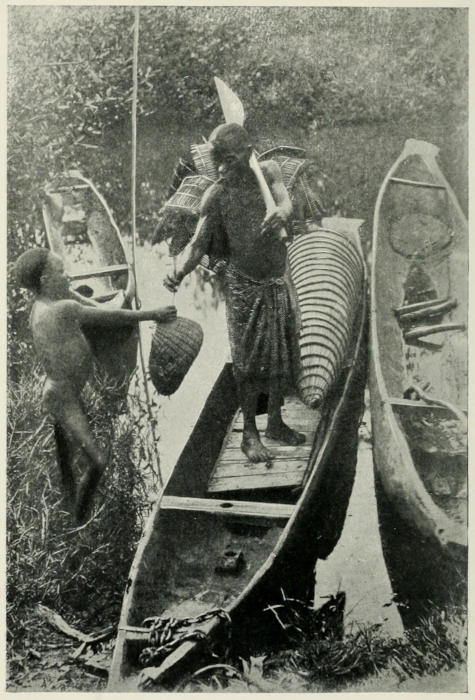
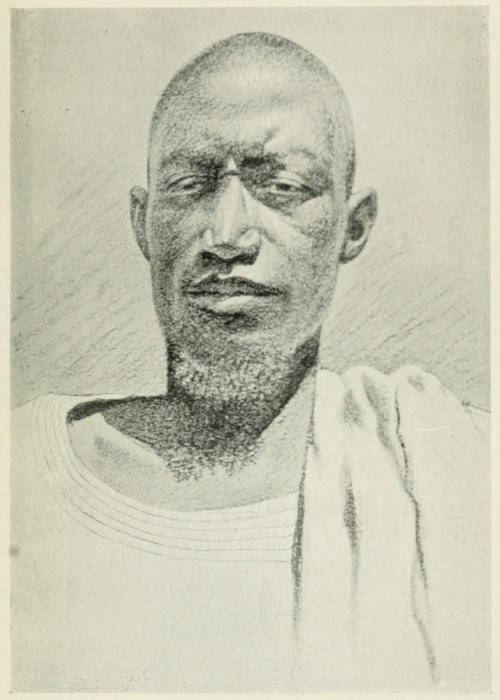
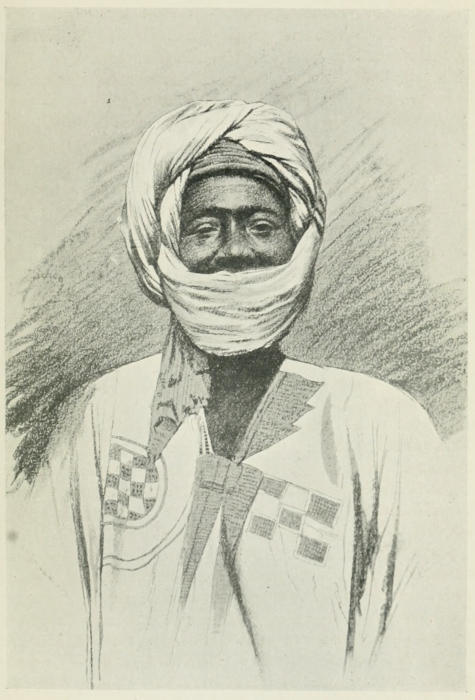
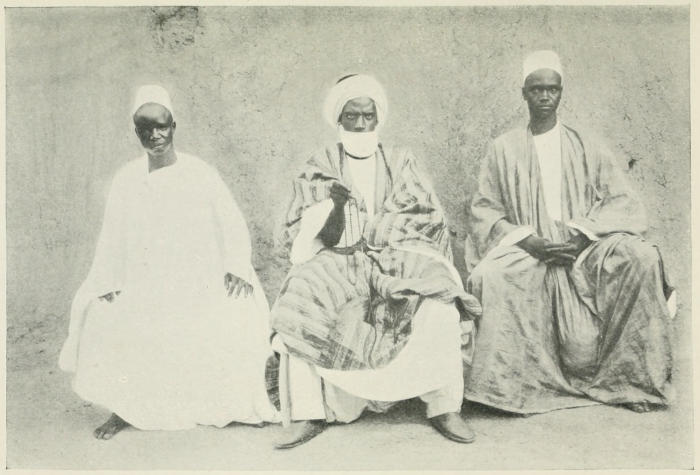
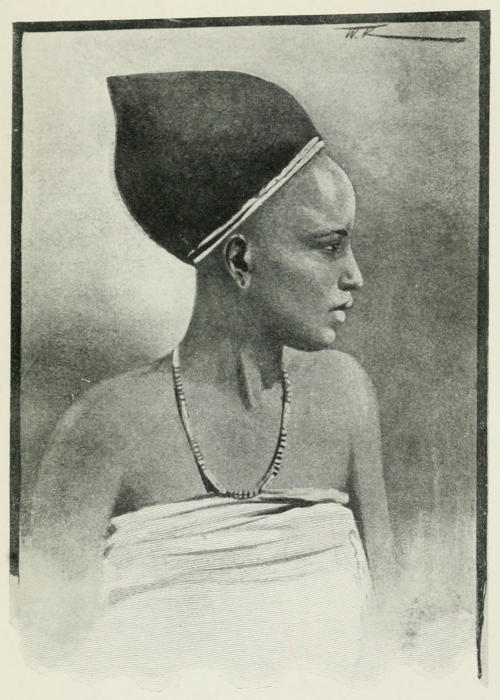
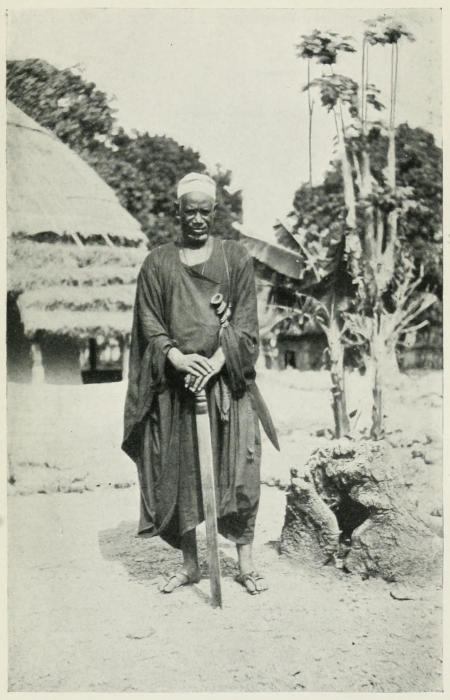
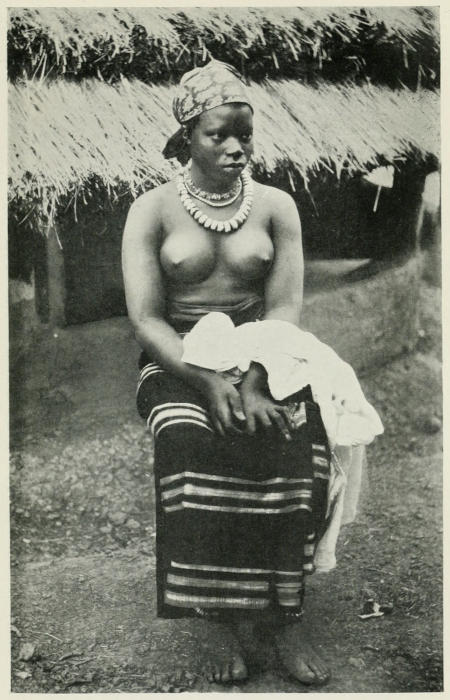
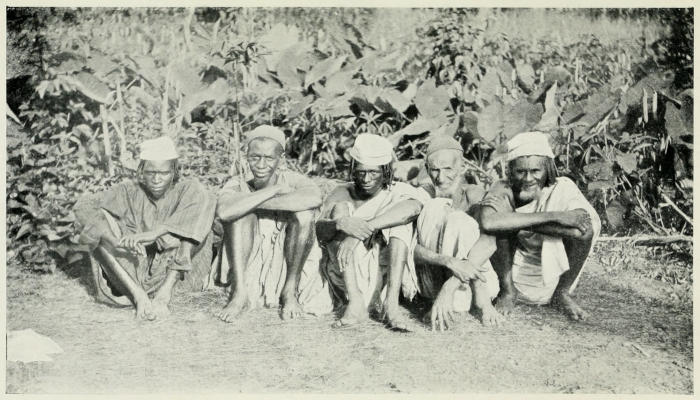
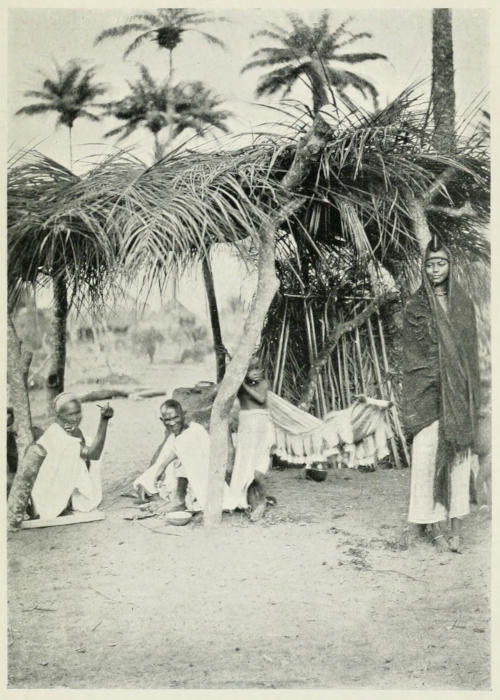
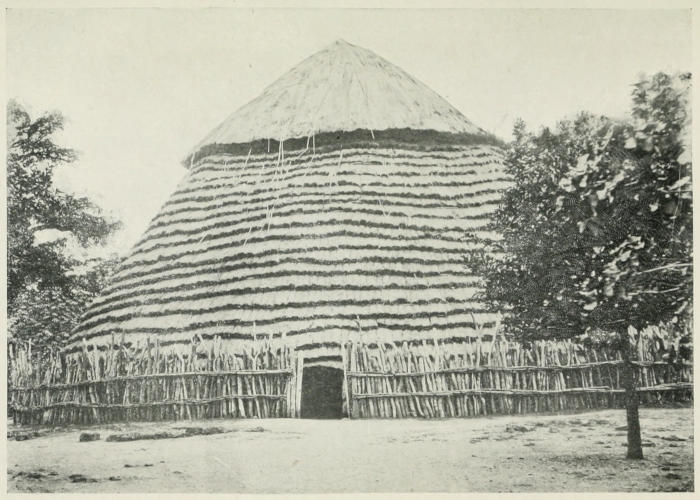
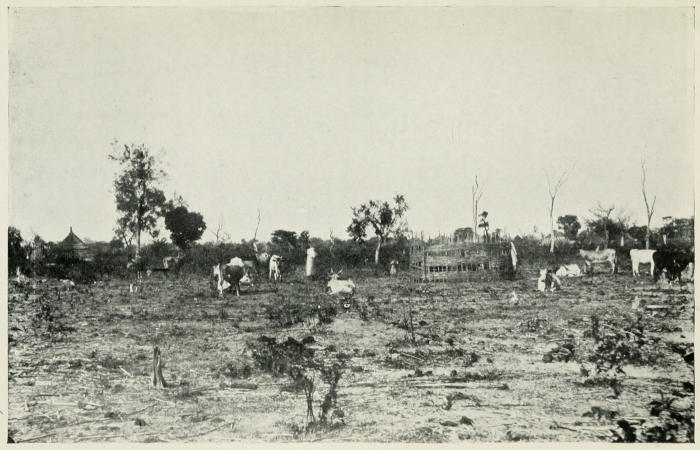
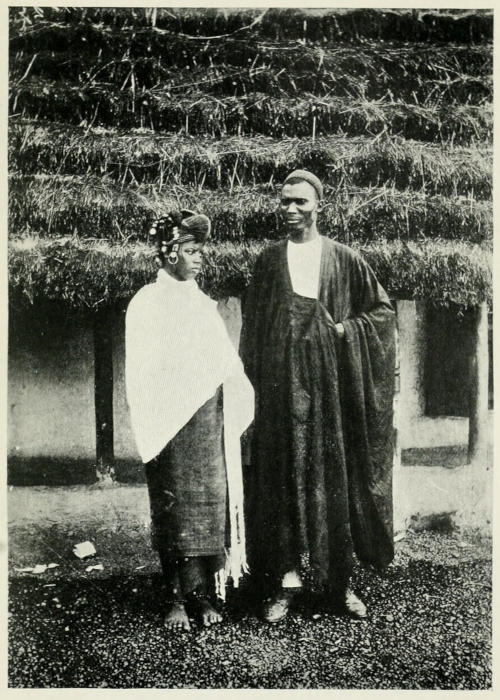
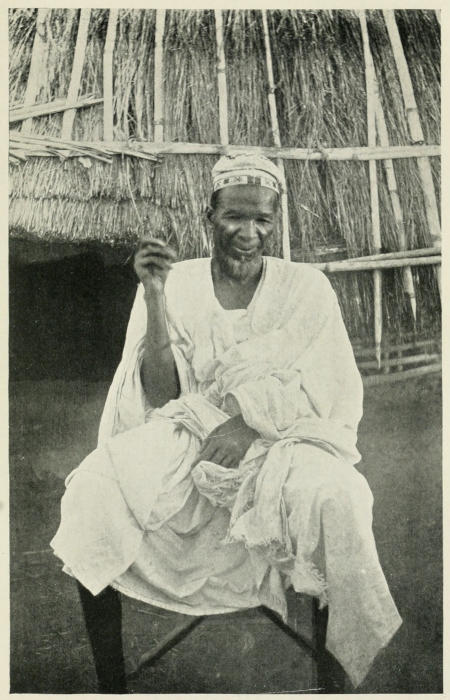
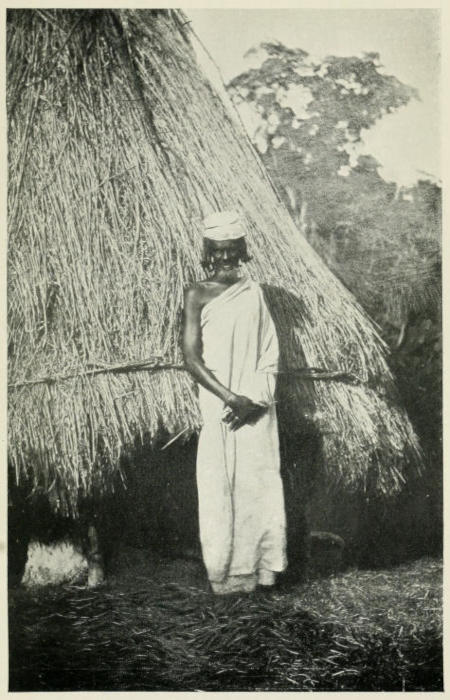
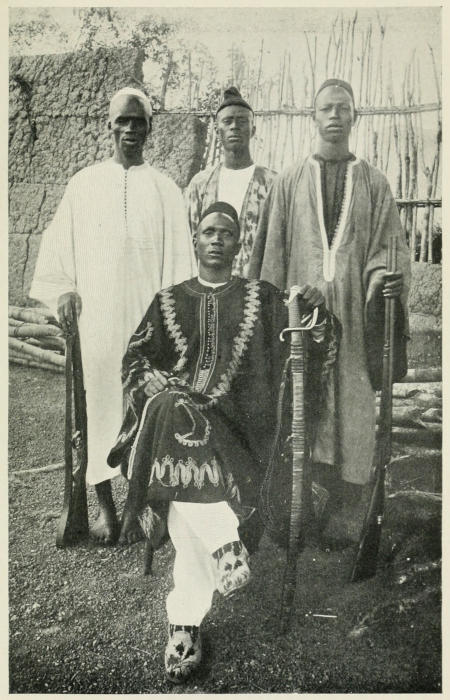
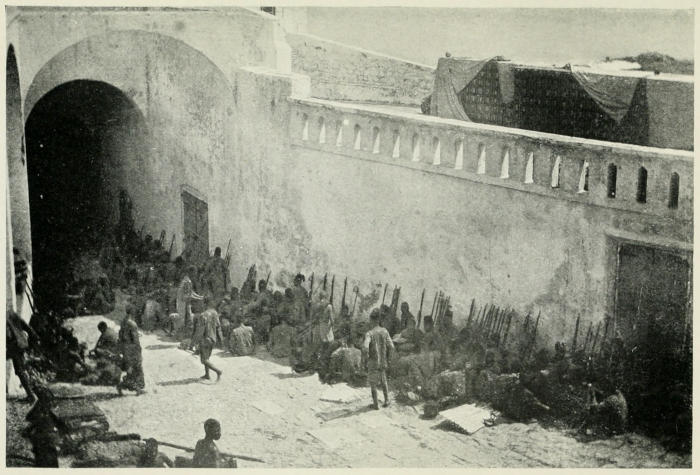
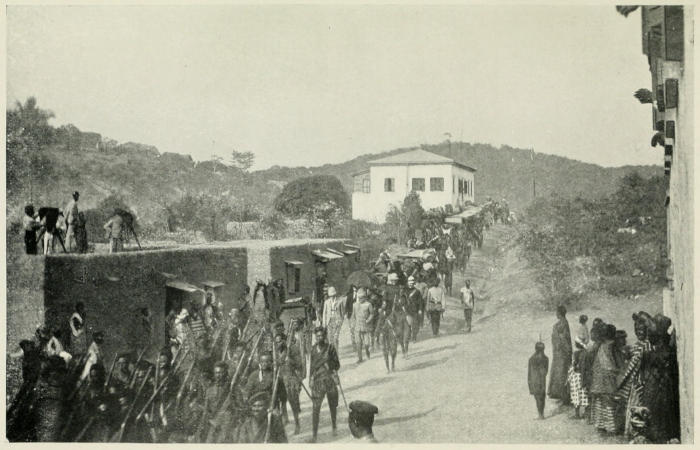
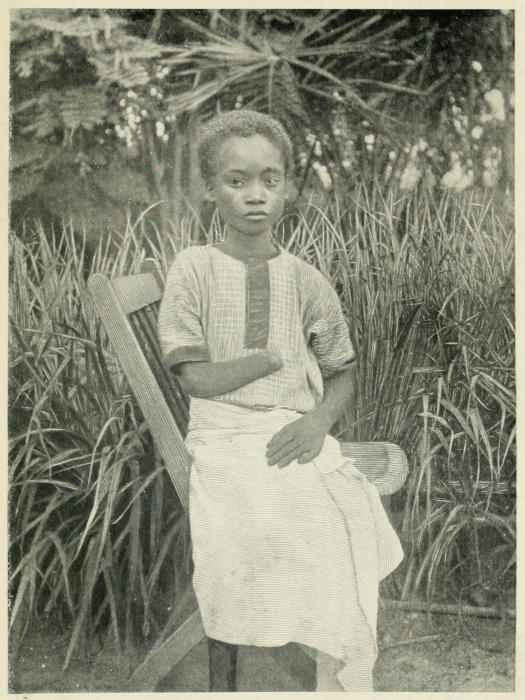
Photographs marked thus * are reproduced from “Adamawa” by kind permission
of Mr. Ernst Vohsen (Dietrich Reimer). The author is indebted (through the kindness
of a friend) to Dr. Maclaud, of the French Guinea Administration, for several of the
photographs here reproduced.
FOREWORD MARY KINGSLEY
“Mary Kingsley—the heir and sustainer of a great name, one of the
ablest of that remarkable band of wandering writers, men and women, who
are the eyes and ears of our nascent Empire, who are bringing home to
England, that weary Titan, her tasks, her faults, her problems—Mary
Kingsley has gone from us.”—Mrs. Humphry Ward.
Those who had the honour of knowing Mary Kingsley, and
corresponding with her on West African affairs, who have
studied her writings and her speeches, who realise all that
this “good woman with a gigantic intellect” might have
done for the Empire in West Africa had she lived, can with
difficulty reconcile themselves to the inscrutable decree of
Providence which robbed us of her presence. One of her
greatest admirers to whom I was expressing the other day
much the same feeling, expressed a different view. “Miss
Kingsley’s work was done”—he said in effect—“she was
the pioneer, she showed the way. That was her allotted
task: the fruit of her labours will come in due season.” It
may be so. Indeed, when we think of what Mary Kingsley
accomplished in the few short years which she devoted to
West Africa, the thought arises whether there is not an
element of unconscious selfishness in the desire that she
might have been spared. The nature of the work she had
undertaken, the intense fervour with which she devoted herself
body and soul to preaching the morals it was given her
to inculcate, the utter brain weariness which at times she
was fain to admit—no mortal being could have endured for
very long so perpetual a mental and physical strain. It was
a passing heavy load for a weak woman of indifferent health
to bear, and in death Mary Kingsley has perhaps achieved
a greater triumph, a success more striking and profound,
than living on she would have attained. Death has had the
effect of rapidly fertilising the seeds she sowed, and from
her ashes have sprung forces gathering daily in power
which, united in a common aim, are taking up her burden
and carrying it along the path she pointed out, assured that
every year will bring fresh helpers, be the obstacles ever so
great. La verité est en marche, and although the spirit of the
hour is not precisely favourable to that patient investigation
of West African problems which affords the only guarantee
of political and administrative success, the phase is but a
fleeting one, and when the present fashionable policy of
force and hurry is found by practical tests to be even more
sterile in useful results than the apathy which preceded
it, the main truths Mary Kingsley taught will appeal to
thinking men with an eloquence all the greater for having
been temporarily obscured.
On the personal aspect of Mary Kingsley’s character one
would fain dwell at length. Few women, I believe, have
inspired all sorts and conditions of men with so intense a
respect, so wondering an admiration. Few women are able,
as Mary Kingsley was able, to draw forth, by the magic of
her earnest personality, the best in a man. She was so unassuming,
so unaffected, such a womanly woman in every
sense of the word, that it appeared almost incredible she
should have grasped the essentialities of West African politics
with such comprehensiveness and scientific perception;
mastered, as no one had done before—in the sense, at any
rate, of being able to impart the knowledge to the world—the
intricacies of native custom and native law, or have
affronted the physical perils she made so light of. Eminent
politicians and administrators, distinguished men of letters,
world-renowned scientists, commercial magnates, were
regular visitors at her modest residence, and one and all
drew from her inexhaustible store. The least of those to
whom she extended the privilege of her friendship were
always welcome, and never failed to leave her presence
without feeling that her words of sympathy and encouragement
were a fresh incentive to push onward, never losing
hope and fortified against disappointment. The truest,
kindest, staunchest friend that ever breathed—such was
Mary Kingsley; and we who knew her, and have lost her,
know also that something has gone out of our lives which
can never be replaced. In a passage of singular beauty,
Mrs. Alice Stopford Green thus closes a tribute[1] to the
dead friend whose work she herself is doing so much to
carry on: “She laid her armour down when she asked
to be carried out to the unfathomable Ocean, alone in
death as she had been alone in life, going out with her last
wish from the bitter strife of men to the immensities where
she sought the will of God.”
PART I — CHAPTER I FIVE YEARS OF BRITISH TRADE WITH WESTERN AFRICA
“West Africa, that great feeding-ground for British manufactures.”—Mary
Kingsley.
One still—but too often, alas!—meets with people who
wonder why England should bother about West Africa at
all, and pooh-pooh the idea that we have interests there at
the present time worth looking after, while as for the future
possibilities of that huge country as a field for British
enterprise, they simply will not trouble themselves to give
the matter a moment’s consideration.
Now figures are very uninteresting things, no doubt, to
the average reader; but they possess a practical significance
superior to any number of the most glowing dissertations,
and I trust my readers will forgive me if I make, as a basis
of justification for inflicting this volume upon them, a few
sets of figures which I would respectfully suggest as worthy
of their attentive consideration. The statistics are compiled
from the Custom House returns, and they show the extent,
nature and distribution of British trade in Western Africa
during the last few years. In perusing them, three facts
should be borne in mind: first, that, although Europeans
have been engaged in commercial transactions on the West
Coast for upwards of five hundred and fifty years, those
transactions were, prior to the abolition of the over-sea
slave trade, confined, with very few exceptions[2]—so far as
the exports from West Africa were concerned—to the human
cargo, and to gold dust and ivory: that the trade in palm
oil and kernels, which are now the staple articles of export
from West Africa, is therefore of comparatively recent
growth, and that the mahogany trade and the rubber trade
have only come into existence—to any appreciable extent—within
the last few years, a fair indication of the fertility
and producing power and almost boundless resources of
West Africa. Secondly, that the extensive business relationship
which has been built up between Great Britain and
West Africa, in the shape of a legitimate commerce, has
grown to its present proportions under circumstances absolutely
disadvantageous to development, without railways,
with but few roads, with intertribal wars often preventing
the circulation of trade for months at a time, by merely
scratching the surface of the most prolific region in the
world. Thirdly, that the figures given below do but show
the actual volume of Britain’s trade with West Africa and
the wages earned by thousands of English men and
women who directly and indirectly benefit by that trade;
the British capital invested in West Africa in factories,
machinery, craft for navigating the rivers, coaling depôts,
surf-boats and lighters, stores and the like, to which must
now be added railway material, dredging apparatus, batteries
and soon, we may hope, cotton gins, not to mention a fleet
of some sixty steamers employed in the carrying trade and
passenger traffic—all these things have to be taken into
account in estimating West Africa’s worth to Great Britain.
The total values of British produce and manufactures[3]
shipped to the British possessions in West Africa in the five
years 1896-1900 were respectively as follows:
1896
£1,828,395
1897
1,763,461
1898
1,999,505
1899
2,116,080
1900
2,148,149
Gross total
£9,855,590
Percentage of increase in five years, 17½ per cent.
The total values of British produce and manufactures
shipped to the possessions of Foreign Powers in West Africa
in the five years 1896-1900 were respectively as follows:
1896
£970,080
1897
1,002,318
1898
1,247,994
1899
1,490,603
1900
2,145,349
Gross total
£6,856,344
Percentage of increase in five years, 121 per cent.
If we add these two totals together, we find that the value
of British produce and manufactures shipped to West Africa
in the period mentioned was £16,711,934, which is a percentage
of increase of 138 per cent.
From the British export trade we turn to the British
import trade with West Africa.
The total values of raw produce imported by Great Britain
from British West Africa in the five years 1896-1900 were
respectively as follows:
1896
£2,223,925
1897
2,153,412
1898
2,352,285
1899
2,427,946
1900
2,137,023
Gross total
£11,294,591
The total values of raw produce imported by Great Britain
from the possessions of Foreign Powers in West Africa in the
five years 1896-1900 were respectively as follows:
1896
£333,803
1897
553,130
1898
622,287
1899
651,043
1900
806,077
Gross total
£2,966,340
These two totals added together show that Great Britain
imported West African produce in the period under review
to the amount of £14,260,931.
The value of Great Britain’s direct commerce with West
Africa in the five years 1896-1900 was, therefore, £30,972,865.
To this might be added a further sum of £1,750,888, representing
foreign and colonial merchandise shipped to West
Africa from British ports in the years mentioned.[4]
It is interesting, and valuable, to see which, among the
possessions of Foreign Powers in West Africa, were the
chief absorbers of British goods and the chief exporters of
raw produce to Great Britain. Examination yields the
following knowledge:
Principal possessions of Foreign Powers which absorbed
in five years £6,856,344 of British goods:[5]
Principal possessions of Foreign Powers which exported
to Great Britain in five years £2,966,340 of raw produce:
French.
Portuguese.
German.
Others.
£
£
£
£
1896
203,442
33,937
42,001
54,423
1897
312,430
116,554
68,194
55,952
1898
431,192
85,544
35,165
70,186
1899
461,267
68,021
48,736
73,019
1900
534,727
75,037
94,681
101,632
The French possessions are, it will be observed, far and
away our principal markets and our principal suppliers
among the possessions of Foreign Powers. Our exports to
and imports from the French possessions amounted together
to £4,627,543, or just under 50 per cent. of our total export
and import trade with the possessions of Foreign Powers
together. The increasing importance of the French possessions
in West Africa as a market for the sale of British
goods and as suppliers of British home markets is a fact which
it is of the utmost consequence for British statesmen to lay to
heart. The subject is one which I shall refer to later on. It is
already one of the dominant factors of West African politics
affecting Great Britain, and is destined to become so more
and more as the years go on, for France is in a territorial
sense the mistress of West Africa, and may become so in a
commercial sense as well.
The general conclusions to be drawn from a study of
these figures are various. First and foremost there is the
clearly established fact that British trade with West Africa
is expanding enormously and has almost unlimited prospects
before it, now that serious and concentrated efforts are being
made on all sides to open up the untapped wealth of the
interior by the means of roads and railways and by the improvement
of navigable waterways, while the cessation of
intertribal warfare in many districts must entail a large
increase in the population, and therefore, in the native
capacity for production and purchase. It is also demonstrated
that every year West Africa absorbs a larger quantity
of British manufactured goods: that the exports of British
manufactured goods are steadily increasing to British West
Africa and increasing to an extraordinary degree to the
possessions of Foreign Powers in West Africa, especially
to the French possessions: that Great Britain is consolidating
her hold upon the carrying trade of West Africa as
testified by the increased quantity of foreign and colonial
manufactures shipped to West Africa from British ports: that
the Continent—Germany[7] chiefly—is receiving a greater
amount of raw produce from the British possessions in West
Africa, a deduction which can be fairly drawn from the
stationary aspect of the importation by Great Britain of such
produce from her own West African possessions. And the
final conclusion is this, that, in view of the restricted extent
of the British possessions in West Africa, compared with the
possessions of Foreign Powers in that part of the world, the
latter offer a very much vaster field for the sale of British
goods. Consequently, it is the bounden duty of the British
Government and the British Chambers of Commerce, while
in no way neglecting the brilliant possibilities which the
British West African possessions offer under wise administration
for the enterprise of Englishmen, to be ever on the
alert to look to the future and to protect British trade with
the possessions of the Foreign Powers in West Africa against
legislation tending to close the door of those possessions
against it; and to insist that, whenever international treaties
guaranteeing freedom of trade to the subjects of all nations
exist in West Africa, they shall be rigidly adhered to by the
signatories. In this respect British diplomacy has shown
itself singularly lax. But the mischief already committed
may even yet be remedied, and further dangers which loom
ahead averted, if the British public will only realise before
it is too late the enormous issues at stake.
CHAPTER II THE OLD AND THE NEW
“The past has gone with its follies and its waste.... Let us then face the
present and contemplate the future.”
In the previous chapter we discussed in practical fashion the
grounds upon which the British public is called upon to
devote more attention to the affairs of West Africa than it
does at present, and an attempt—I hope a successful
attempt—was made to show how very short-sighted and
singularly misinformed is the opinion which would disinterest
itself from a part of the world where the possibilities
of commercial development are so strikingly manifest.
There has never been such urgent need for an intelligent
appreciation, on the part of the British public, of the
problems which confront this country in West Africa. In a
few short years the policy of Great Britain in West Africa
has undergone a complete change. Events have followed
one another with bewildering rapidity. Official indifference
has been galvanised into life by French activity, and after a
brief but dangerous period of international rivalry, British
political rights have been established over a considerable
extent of territory, not, however, nearly so considerable as a
pacific, consistent, well-thought-out programme adopted
some years previously would have brought, had our merchant-pioneers
been listened to, and had successive Governments
been able to throw off the paralysing influence of
the resolution of 1865. There is a story told of a certain
Minister in charge of the Foreign Office—it was related
to me by one of those present at the interview—which
illustrates very forcibly the feeling which prevailed in
Government circles in those days. A deputation of merchants
waited upon his Excellency with the request that
he would permit the hoisting of the Union Jack on certain
parts of the West African littoral where British merchants
had long been trading, and where the rulers of the country
were genuinely desirous of receiving a British protectorate.
Pro-formâ treaties were produced by the deputation between
these rulers and the resident merchants. The merchants
asked for no reward. There was no question of expenditure
involved. All that the Government was required to do
was to meet the wishes of the chiefs. The deputation
pointed out that, so far as the relations between the natives
and the commercial representatives of Great Britain were
concerned, the acceptance of the Government would in
no wise alter them, but would simply have the effect of
cementing a friendly understanding which already existed.
But, urged the deputation, the treaties, if agreed to by the
Government, would prove an invaluable diplomatic instrument
if the time came, as it seemed likely to do, when
England might find herself faced in West Africa by foreign
competition. The Minister flung the treaties across the
table.
It was a time of wasted opportunities, when a little political
foresight would have conferred upon this country great
future benefit, and it seems extraordinary, but is unhappily
true, that the same failure to look ahead as regards West
Africa appears to afflict our Foreign Office to-day despite
the lessons of the past. Of this, more anon.
But if successive Governments showed unpardonable
negligence in safeguarding British interests in West Africa,
for decade after decade, down to the very time when the
French had worked their way so far southward into the
natural hinterlands of our old Colonies that action became
imperative if anything was to be saved from the wreck, the
British press and public were greatly to blame also. I well
remember that at the very height of the recent Anglo-French
controversy which culminated in the Convention
of 1898, when rival English and French expeditions were
rushing hither and thither through the territories west of
the Niger, and when British and French efforts were concentrated
upon wringing out of the unfortunate Borgu Chiefs
all sorts, kinds, and conditions of agreements, sowing Union
Jacks and Tricolors by the wayside, the well-known editor
of an equally well-known newspaper to which I then contributed,
asked me to show him Nikki[8] on the map, as he had
not the least idea where it was.
Mr. Chamberlain came into power just at the moment
when French enterprise in the West African uplands had
reached its maximum of threatening intensity, and he set
himself to vigorously counteract it as far as he could. The
invertebrate policy had, however, compromised the situation
almost beyond remedy, and had it not been for Mr. Joseph
Thomson’s success in obtaining treaty rights with the
Emirs of Sokoto and Bornu in 1884 on behalf of the National
African Company of Merchants—subsequently the Royal
Niger Company—and, it may be added, for the loyal
adherence of those native States to the treaties passed with
the Company, the magnificent possession of Northern
Nigeria would have gone the way of Futa Jallon, of Mossi,
and of so many other countries lying at the back of our
Colonies; that is to say, would have fallen into French hands.
The man who deserves the most credit for saving Northern
Nigeria to the Empire is Sir George Taubman Goldie, and
however one may deplore some of the uses to which he put
his Charter—things we are paying for now in the French
Congo and elsewhere—it is but common fairness to assert
that, if it had not been for Sir George Goldie, the possessions
of Great Britain in West Africa would have been reduced by
about one half. It is a matter for some surprise that the
Government should not have succeeded in securing the
continuation of Sir George Goldie’s co-operation in West
Africa after the Royal Niger Company’s Charter was cancelled.
An old opponent has lately said of him that “there
is no one more competent to guide our West African
Administration on practical, humanitarian, economical,
prudent, and statesmanlike lines, no one more fitted to take
a high position in West African affairs political and commercial,”
a statement which will meet with wide acceptance.
But this, after all, is ancient history, and what we are
chiefly concerned with now, is the present. What we are
called upon to seriously consider is the general trend of
England’s policy in West Africa, administrative, financial,
political and commercial. Internationally, we are secure in
the possession of our territories. The only rivalry we have
to fear is the peaceful rivalry of commerce, but commerce
is the explanation of our presence in West Africa: it constitutes
the sinews of our administration, and its requirements
demand the constant vigilance, the most careful
attention of the official world.
It is the bounden duty of those who, believing in the
immense importance of West Africa to Great Britain, and
similarly believing that the present policy which is being
pursued by Great Britain in West Africa is open on several
grounds to grave objection, to say so, and to give their
reasons for saying so, with the assured conviction that,
however unpopular their arguments may be, the general
interest demands that they should be put forward.
CHAPTER III THE REAL AND THE IDEAL
“The nature of the natives, the climate, everything is against precipitate
and hasty action. To advance slowly, leaving no bad or unfinished
work behind, to gain the respect and liking of the natives, and only to use
force when compelled as a last resource to do so, are the means which in my
humble opinion lead to success in West Africa. To quote from the words of
a celebrated French traveller: ‘Do not let us dream of a hasty transformation
of Africa. Let us employ a method, slow but sure. Let us try and teach the
natives what knowledge we have acquired, and not try and make them learn
in a few years what it has taken us twenty centuries to learn.’”—Sir
Claude Macdonald in Liverpool, 1892.
“These figures are surprising. One would naturally have expected
that as the trade increased the proportion of expenditure would have
decreased.... From that date, however, the expenditure has advanced
by leaps and bounds, and in 1900 amounted to 28 per cent. of the
exports. In other words, the expenditure has increased more rapidly than
the trade.... If, however, the expenditure had been on the basis of former
years ... we could have given over £1,000,000 worth additional European
goods in exchange for the same amount of produce. In other words, the
heavier the expenditure the higher price must the merchant ask for his European
goods, or the less he is able to give for native produce. This must have
the double effect of reducing the demand for manufactures and diminishing
the energy of the natives in gathering produce. There is another possibility
which should not be lost sight of: our colonies are hemmed in by our French
and German neighbours. If in consequence of increased expenditure and
the resulting heavier taxes we are unable to offer the natives as large a
quantity of manufactures and as good a price as our competitors are enabled
to do, produce which is grown on the borders of our Colonies may be diverted
to foreign territory with a consequent loss of trade to this country.”—Mr.
Arthur Hutton, President African Section, Manchester Chamber of
Commerce.[9]
A wise man has said that there is no way of conveying a
rebuke so efficiently as upon the back of a compliment, and
as a preliminary to criticism of certain phases of British
administration in West Africa, a measure of praise is both
just and needful. To avoid personalities—whether in the
sense of praise or otherwise—should be the constant
endeavour of any critic in approaching the subject under
discussion, because it is primarily the system, and not the
agents of the system, which is in question. Unfortunately
the Crown Colony system being what it is, a despotism—though
by no means necessarily a tyrannical despotism—there
is great difficulty, if not actual impossibility, in
altogether avoiding the personal equation.
The revolution in British West African policy is indelibly
associated with the advent to power of the present Colonial
Secretary, the Right Honourable Joseph Chamberlain. His
entry upon the scene was contemporaneous with the culmination
of certain events which must infallibly have
modified our previous attitude in relation to West Africa
whoever the statesmen responsible at the time might have
been. The point need not be laboured, but it is often
overlooked. Be that as it may, it is an undoubted fact—a
fact redounding greatly to Mr. Chamberlain’s credit—that
no Colonial Secretary before him has displayed so lively
and personal an interest, both publicly and privately, in the
affairs of British West Africa, an interest which has continued
unabated during the entire period of his administration.
In specific directions the result has been all to the good.
Railways, the preliminary surveys of which had been made
by direction of Mr. Chamberlain’s predecessor, the Marquis
of Ripon, before he quitted office, have been constructed;
others are commenced; the routes of more have been
surveyed. The study of malaria has received the right
honourable gentleman’s warmest support. A general
publicity has been given to British West Africa by its
identification with so powerful a politician as Mr. Chamberlain,
which has materially contributed to remove it from
the rut of oblivion and popular ignorance. It may also be
added that the Colonial Secretary’s confident public declarations
in respect to the future of the gold-mining industry in
the Gold Coast has done much to attract capital to that
Colony, and that the damper which he recently felt it wise
to apply to the introduction of the more undesirable elements
connected with the revival, under modern conditions, of
gold-mining enterprise in a part of the coast celebrated for
its former export of the precious metal, was entirely to his
honour, although it would perhaps have been more useful
had it come somewhat earlier in the day; while the memorandum
he caused to be drawn up in September 1901
embodying the principle of treating native labourers on the
Gold Coast, is perhaps the most admirable document ever
issued from the Colonial Office.[10] In like manner, it can be
taken for granted that all officials in West Africa are animated
by the best of intentions, and however profoundly one
may differ, from time to time, from certain of their actions,
it is always essential to bear in mind that the system under
which they work—the inconvenience of which not a few of
them in private conversation readily admit—leaves the door
wide open to the commitment of errors for which the system
is in the first place responsible, while the climate is most trying
to the constitutions and temper of Europeans. But it is
unreasonable, and subversive of the true interests of the
Empire, that the tendency should be encouraged to denounce
honest criticism of a specific act of policy in West Africa
with which this or that official must in the nature of things
be associated, although he need not be, and often is not, the
originator of it, as a personal attack upon an absent man,
to be resented as an outrage and stigmatised almost as a
crime, as an offence at any rate against common decency
and fairness. The contention is absurd, and mischievous
and unfair. The autocratic power which the Crown Colony
system confers upon West African Governors, District Commissioners,
and military commandants makes it absolutely
essential that independent criticism, so long as it is legitimate,
should be exercised by the public at home, whether or
no full sanction has been obtained by a particular official
from the Colonial Office for the application of measures
giving rise to criticism, or whether the measures have been
initiated by the Colonial Office itself. By public criticism
alone can we hope to avoid the repetition of such deplorable
mistakes as led to the Hut Tax war in Sierra Leone
and the last Ashanti outbreak; the framing of legislation
far in advance of the needs of the country and antagonistic
to native feeling, which interest and duty alike imperatively
demand, should be taken into consideration; the constant recurrence
of punitive expeditions, which in another portion
of our Tropical African Empire have worked such incalculable
injury; and financial embarrassments, outcome of mismanagement,
extravagance, and errors of policy.
There is always danger in reaction, as in the body physical,
so in the body politic; and it is not altogether astonishing,
perhaps, that the long spell of official apathy in West
Africa, being suddenly changed to precipitate action, should
have given rise to some objectionable features. But it cannot
be admitted that the latter, instead of being a passing phenomenon,
should take permanent root, and become part and
parcel of the new order of things. If this be the case,
we shall presently be witnessing yet another reaction in
West Africa, and with embarrassed finances, a yearly expenditure
far in excess of any visible increase in producing
power, increased taxation, a native population alienated and
disorganised, and energetic rivals forging ahead while we
continue to struggle painfully in a quagmire of self-imposed
difficulties, the public will lapse once more into its old
attitude of indifference tinged with dislike, until some
brilliant gentleman at the Foreign Office, deeming the
moment opportune, hands over a further slice of British
West Africa to a Foreign Power, in exchange for cod-fisheries,
or something equally vital to the Empire’s prosperity.[11]
The forward policy in West Africa has had its uses;
it has served its purpose. We are secure in the possession
of a large territory some 700,000 square miles in extent, unsurpassed
in natural wealth by any other region in the globe,
containing a population of probably 30,000,000 to 35,000,000
souls, of whose habits and customs we possess but the haziest
knowledge, whose very languages we are in the main ignorant
of; a population composed of the most diverse elements,
the resources of whose widely scattered habitat are barely
tapped, whose willing co-operation, which is essential to the
success of our rule, can only be gained by scientific, painstaking
study and the most tactful, sympathetic treatment.
Now should be a close time for British West Africa. The
country needs political rest. It has been turned topsy-turvy
by European rivalry; old landmarks have been swept away;
the boundaries of Native States altered to suit the exigencies
of European diplomacy; immemorial trade roads interfered
with. The native requires breathing space. Official activity
should in the main be limited to the construction, with due
regard to method and economy, of certain indispensable
public works, collecting data concerning the native peoples
and respective regions in which they dwell, strengthening
native authority so rudely disturbed by recent events; in
protecting commerce, encouraging capital, fostering native
industries—perfecting those in existence and preparing the
ground for others; in short, a work of gradual, sure,
systematic consolidation. It should be our object to intermeddle
as little as possible with native institutions, abide
with scrupulous exactitude to both the spirit and the letter
of our treaties with the Chiefs; develop the native peoples
along the lines of their own civilisation both in the case of
Mohammedans and Pagans; use conciliation in preference
to dictation, gold rather than the sword. Administrative
extravagance should be rigidly held in check for fear of
burdening new Colonies with a load of debt; the soldier
and the policeman should be kept in the background, only
to be used as a last extremity. Commerce, good roads, and
statesmanship should be our preferable choice of weapons
for mitigating evils, some at least of which the example of
Europe in the past has intensified, others lying in deep-rooted
religious beliefs, requiring careful preliminary investigation
and thorough understanding before being made the
object of official action, and then only of a repressive nature
after every pacific inducement had been tried in vain.
Patience, more patience, and again patience. That should
be, ought to be, the corner-stone of British policy in West
Africa. It was the tortoise that won the race; not the
hare.
Unfortunately the hare is the more popular beast just
now, and the forward policy is as much in evidence in
British West Africa to-day as it was five years ago, with the
result that what may have been justifiable then bids fair, if
it be not stopped in time, to be disastrous now that the
necessity for it has passed away with the close of international
competition. Energy is being misapplied and misdirected.
Let it be conceded that the existing basis of rule
in West Africa, the Crown Colony system, is the worst in the
world to stand the strain of a naturally active directing
influence at headquarters; let it be admitted that it is a
clumsy, inelastic instrument which allows the governed no
voice in the government, which places the suppliers of
revenue, both direct and indirect, in the position of having
no effective control over the expenditure of that revenue,
which permits of the jeopardising of years of commercial
effort by some ill-considered legislative act—let these and
many other counts against the Crown Colony system be
admitted. The fact nevertheless remains that that system is
capable of reform, of modification, of being moulded in
accordance with the requirements of the case. The task
should not be beyond the capacity of statecraft. Is it to be
seriously maintained that British statesmanship has sunk so
low that machinery suitable to a bygone age cannot be
improved and brought more into line with our altered situation:
that we must needs cling to every ancient wheel and
rivet though they be clogged with superfluous matter, and
eaten through with rust? If the machine which it was sought
to preserve intact had done yeoman service in past days,
there might be some excuse for hesitating to supply it with
new works. But that is emphatically not so with the West
African machine.
And it is positively heart-breaking to see that the last few
years, far from bringing any reforms, far from holding out
the hope of reform in the future, have but accentuated the
evil. We cannot, it is true, lose any more territory, unless
we care to give away that which is assured to us by international
agreement. But in almost every other respect the
Crown Colony system, as it prevails in West Africa, and under
the new circumstances in which it is performing its functions,
is building up a legacy of trouble which can only be contemplated
with equanimity, or viewed with indifference, by
the thoughtless; by those good people who refuse to walk
save in pleasant places, who constitutionally dislike criticism
as much as a cat objects to a wetting.
Haste and hurry are the order of the day in British West
Africa. Expenditure is going up by leaps and bounds,[12] altogether
apart from expenditure on public works. In the case
of public works, large and costly undertakings are arranged
for on the most unpractical lines, with no effort to benefit by
competition, no putting out to tender, no safeguards without
which a business man of ordinary intelligence will surround
himself in order that he may be sure of getting the best
value for his money. An extraordinary theory in economics
has become fashionable. It is that the higher the revenue
of a given West African Colony the more prosperous that
Colony must be, quite oblivious of the effect which every
increase of taxation has upon the volume of trade in the way
of reduction, and driving it away to the neighbouring
territory of a foreign rival. If a West African Colony
shows in a given year an increase of £10,000 in revenue,
obtained from increased taxation, jubilation in official
quarters is excessive: but either nothing is heard of the
falling off in trade accompanying the increase in revenue,
or it is explained in some other way. The fact that there
is a gain in revenue is held to be proof positive of an
abounding prosperity and wise management. Every fresh
increase in revenue is followed by a corresponding increase
in expenditure. The one is made to keep pace with the
other. It does not always succeed, because the expenditure
is not infrequently in excess of the revenue quand même.
It is also becoming the usual thing to financially assist these
Colonies by “loans” or “grants-in-aid” or “advances”
quite on the West Indian model, while the official reports
invariably lead off with the reassuring statement that “this
Colony has no public debt”: a little farther on, casual
reference to the “grant-in-aid” may be discovered by the
aid of a microscope, tucked away in some obscure corner,
a footnote for choice. Lagos, Sierra Leone, the Gold
Coast, Nigeria, are all at the present moment in the enjoyment
of Imperial loans: Sierra Leone for the Railway and
the late Hut-Tax war, Lagos for the Railway, the Gold
Coast for the Railway and Ashanti war, Nigeria for the
purchase of the Niger Co.’s treaties with the natives (the
terms of which we have not adhered to), and for raising an
army. Meantime, our neighbours the French are—in their
West Coast Colonies proper, where comparison alone is
possible—making their own Colonies pay a considerable
part in the expenses of Railway construction; taxing their
trade less, spending less on administration, governing more
cheaply and quite as well—better by a long way in some cases.
The producing power of our Colonies, that is to say, the
export trade, the only true test of prosperity in West Africa,
is either increasing slowly by comparison with the expenditure,
or it is stagnant, or it is retrogressing. When it is
increasing, the increase is much below the corresponding
ratio of increased expenditure. “Large doses”—veritable
purgatives—of European conceived legislation are being
thrust down the throats of the bewildered natives. The
number of Ordinances passed in the British West African
Colonies during the last few years, especially in Southern
Nigeria,[13] is simply amazing. Most of them are far in
advance of the times and cannot but remain a dead
letter because, thank goodness, the existing machinery is
not yet sufficiently extensive to carry them out. To make
as few Ordinances as possible, and to ensure that such as
are made shall be permanently useful, does not appear to
enter into the official conception; and in the face of the
growing objections to this rapidity and fertility of the
official brain in forming premature legislation, not only on
the part of the natives who are getting more and more
confused, and—as the French put it—déséquilibrés, but
by all people in affairs on the Coast who would desire that
officialdom should move more slowly, carrying at each step
real and understanding consent: the work of drafting portentous
decrees, the exact meaning of which the very
lawyers at home cannot comprehend, or reconcile with
avowed intentions, goes merrily on.
Punitive expedition follows punitive expedition. We have
had a war in Sierra Leone, a war in Ashanti, two expeditions
in the Gambia, a big expedition up the Cross River
in Southern Nigeria, together with minor affrays, while in
Northern Nigeria, which so far is producing no revenue
and has not attracted a single merchant (and but one exploring
expedition for possible mining purposes), one punitive
expedition succeeds another at an interval of a few
weeks at most. I will not now labour the case of Northern
Nigeria, as that most interesting portion of our West African
dominions is discussed at some length farther on, but it is
quite evident that the attention of Parliament to the expenditure
of Northern Nigeria is becoming increasingly urgent.
Lagos alone, under the able guidance of Sir William
MacGregor, has known the blessings of peace. Long may
it continue to do so.
Specific instances and examples of these general statements
will be found scattered throughout this volume. It
was, however, necessary to place them in collective form.
In the next chapter, endeavour will be made to briefly
indicate the lines upon which certain reforms might be
attempted and the reasons for those reforms. Official
optimism notwithstanding, it is an undoubted fact that, if
something is not very shortly done to improve the prevailing
system, the majority of the British West African
Colonies will drift into a morass of financial confusion
paralysing to their development and progress, while the
native population within them will be comparatively poorer
than in the neighbouring Colonies of commercial rivals.
CHAPTER IV SOME NECESSARY REFORMS
“It is well known also that this personal system, at its best, is full of
abuses of the worst kind politically; the Administrators and those who influence
them, get to have favourites, and even chiefs have their legitimate
power, influence and dignity interfered with because they refuse to pay
homage to their views. In consequence of all this, an apparently successful
Administrator is usually and sharply followed by even worse confusion and
more protracted wars than were known before his advent. It is the history
of all weak despotic systems, having no basis in the country or among the
people sought to be governed or influenced.”—“The Crown Colonies of
Great Britain” (chapter vi. West Africa), by C. S. Salmon, formerly Colonial
Secretary and Administrator of the Gold Coast, &c.
“The inhabitants of the country and the mercantile community who
provide the whole of the revenues, have no voice at all in the governing of
their Colonies and the expenditure of these revenues, and I sincerely hope
that the day is not far distant when the African community will rise up and
protest against this Crown Colony system of government”—Mr. Arthur
Hutton, President of the African Section of the Manchester Chamber of
Commerce. (Extract from speech delivered.)
It will, I think, be conceded that, notwithstanding the extraordinarily
important and revolutionising discoveries of
Major Ross, to whom the entire credit of recent demonstrations
belongs, the admirable work performed by the
Liverpool[14] and London schools in the study of tropical
disease and sanitary improvements on the West Coast, the
chances of British West Africa ever becoming a possession
where English men and women can flourish and multiply, is
excessively remote; so remote, indeed, as to be outside the
sphere of useful discussion. In fact, with the one possible
exception of the Futa-Jallon uplands, when the Konakry-Kurussa
railway line has connected them with the coast,
West Africa as a whole is unsuitable, and will, according to
all reasonable supposition, always remain unsuitable for
European colonisation. The dominion of British West Africa
must, therefore, be regarded not in the light of a colony
properly so called, but as a vast tropical estate.
From that postulate arises a query, or rather, series of
queries. What are we in West Africa for? What do we
hope to do there? What object took us there? What main
purpose keeps us there? The answer is not for a moment
in doubt. Commerce took us to West Africa; commerce
keeps and will keep us in West Africa. It is the fons et origo
of our presence in West Africa. The day that it ceases to
be so, West Africa ceases to be of use to the Empire. It will
become a costly plaything, and the British people is too
essentially practical a people to care long for toys of that
kind. As in every other part of the world, commerce in
West Africa is the outcome of supply and demand. There
is a demand for the products of West Africa on the markets
of the world, and there is a demand in West Africa for the products
of European industrialism. The increased circulation
of a portable currency in West Africa in the shape of silver
coinage will facilitate the operations of commerce, but will
not dislodge or alter the fundamental nature of that commerce.
The development of a mining industry in this or
that portion of West Africa will, while it lasts, modify the
conditions of trade in the portion affected, but commerce
will remain the backbone, as it ever has been, of European
intercourse with West Africa.
There is nothing that need occasion regret at the contemplation
of the truth. Commerce is the greatest civilising
agent. The steps upward in the ethical development of the
human race have been synonymous with the spread of
commercial relations, and the creation of the means and
measures whereby their promotion has been successively
extended. The most backward peoples to-day are, generally
speaking, those whose secluded habitat renders their commercial
transactions with the outside world scanty and
precarious. In these days, when the noble meaning which
attaches to “philanthropy” and “civilisation” is made the
cloak to cover in West Africa so much that is vile, the excuse
both sincerely and hypocritically given to explain away so
much that is in painful contradiction, one needs, perhaps,
to be reminded that such commonplace things as commerce
and improved means of communication will do more to
benefit the native than any number of attempts to impose
laws and institutions unfamiliar to him, by violent even if
well-meaning measures of so-called reform.[15] As a nation
we should gain much and lose nothing in frankly admitting
to ourselves that it is due neither to a desire to mend the
ways of priestly theocracies, nor to alter the tyranny of the
strong over the weak, which has led to the incorporation
within the Empire of some thirty-five millions of West
African natives, but the belief that West Africa constitutes a
vast outlet for the free and unfettered development of British
trade, and an equally vast field for the cultivation of products
of economic necessity to ourselves. Thorough realisation
of the fact would lead to more accurate appreciation and a
truer sense of the direction which our policy should take in
West Africa, if ultimate success and not failure is to attend it.
Commercial development is then in an especial and
peculiar degree the raison d’être of our presence in West
Africa.
Now what are the principal factors in British West African
commerce, and how are their claims to consideration in the
administration of British West Africa treated under the
Crown Colony system? Obviously the two principal
factors are the European merchant and his customer, the
native. The merchant directly supplies, the native indirectly
supplies, the revenue which pays for the salaries of the officials
and the general up-keep of the government, and if it be
true, as it undoubtedly is, that the burden of taxation ultimately
falls upon the native producer, it is equally true that,
without the enterprise of the merchant, there would be no
revenue and consequently no local funds for the support of
administrative machinery. It follows, therefore, as a matter
of simple justice, that the merchant should have a voice in
the framing of legislation calculated to affect the internal
politics, and consequently the commerce of our West African
possessions. Apart from its justice, the claim of the merchant
to representation in the affairs of our West African
Empire has many features in its favour. He enjoys an
expert’s knowledge, gained by long years of actual contact
with the peoples of Western Africa. Experience has given
him an insight into their customs and laws; an acquaintance
with their peculiarities, with the working of their minds,
with their inbred conservatism, which officials whose residence
in West Africa—broken, as it is, by long intervals of
leave—is usually of a very temporary or flitting nature,
cannot hope to attain at any rate with the same completeness;
and a mastery, even if it be only an instinctive
mastery, of certain special characteristics which underlie
native conceptions, and which have to be reckoned with in
dealing with them. The merchant is consequently well fitted
to be a most valuable assistant in the administration of
British Western Africa.
The fact is recognised by the French and Germans who
share with us the vast proportion of influence in West Africa
properly so called. Ever practical, the Germans have created
an Advisory Board (Kolonial-rath) to their Colonial Office,
composed for the most part of the leading men in the West
African trade. The present Colonial Advisory Board has
twelve merchants sitting on its Council.[16] In French West
Africa, but on somewhat different lines, the merchant is
similarly treated, and just recently the representations of the
French merchants to M. Décrais, the then Colonial Minister
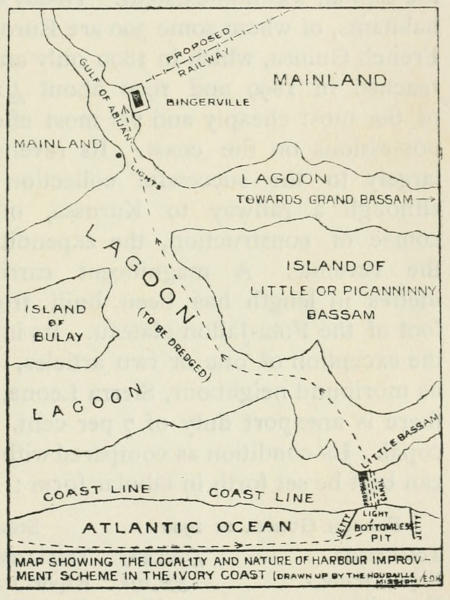
of France, averted a great evil threatening the Ivory Coast
in the contemplated cession to King Leopold’s nominee, M.
Empain, of a practical monopoly over the whole of the gold-bearing
districts of that dependency, although M. Empain[17]
had the most influential support at his back.
The French system, though far from perfect, is incomparably
superior to anything we have in this country. It
differs somewhat in the various Colonies, but is substantially
composed of two Organisms, the Metropolitan Organism
and the Colonial Organism. Under these dual Organisms,
every Colony which is not directly represented in the French
Parliament is represented at the Colonial Office by a delegate
elected by vote of the white inhabitants of such Colony.
In French Guinea, where the administration in force is in
advance of that of any other French (or English for that
matter) West African possession, a commercial delegate is
regularly elected, and at the present moment a merchant,
M. Gaboriau, representing the interests of that Colony, is
attached to the Colonial Office. The weak point in the
arrangement is, that the officials in the respective Colonies
as well as the merchants have the right to vote in the election
of a representative, with the result that very often the
officials are in a majority. When that happens, a French
politician, who can use his influence in promoting the officials
who vote for him, is appointed. Each colony possesses a
“Superior Council” or “Administrative Council” composed
of the Governor, the heads of departments, and two or more
merchants. In Senegal the merchant councillors have always
enjoyed considerable power, and no step affecting the interests
of the Colony is ever taken without the concurrence of
the great Bordeaux merchant firms, which between them
centralise the ground-nut trade (they themselves built it
up), the staple industry of Senegal. Moreover, Senegal is
particularly favoured in that it boasts a Deputy in the
Chamber and a local General Council which enjoys large
financial responsibility, the merchants—provided they do
not fall out among themselves—being always in a majority
in the said General Council.
With us matters are altogether different. England,
which passes for a country where common-sense is the
cardinal virtue, refuses to her merchants any recognised
status in the administrative machinery of West Africa. It
has been accurately asserted that the merchant is the
uitlander of British West Africa. He is seldom, if ever,
consulted in the affairs of the country, and although
Mr. Chamberlain has on more than one occasion given
verbal assurances that no legislative acts affecting the
natives (and de facto calculated to influence native production—or,
in other words, trade) would be promulgated
without previously being submitted to the merchants for
their opinion, decrees of the highest importance embodying
a kind of revolution in our historical native policy in regard
to the laws of native land tenure have just become law in
Southern Nigeria, not only without the merchants being
consulted, but without their being advised in any other way
than by a perusal of the published Ordinances in the local
Government Gazette. From time to time—and during the
last two years with increasing frequency, consistency, and
earnestness—the Liverpool and Manchester Chambers of
Commerce, which between them represent the majority of
the commercial interests of Great Britain in West Africa,[18]
have approached the Foreign and Colonial Offices on their
own initiative, sometimes supported by as many as ten or
twelve other leading chambers in the Kingdom voicing
industrial interests more or less directly affected by specific
occurrences. When—I am speaking now of recent times—the
Foreign Office has been either memorialised or waited
upon by deputations from the Chambers, the question at
issue has been one of international import, such for instance
as the differential tariff against British goods in the French
West African Colonies (1898), and the violation of the Berlin
Act in the Congo Basin (1901 and 1902). In the first case,
the action of the Chambers was surprisingly successful;
in the second case, success has not yet attended their
efforts.
When, as in the majority of instances, the Colonial Office
has been waited upon or written to, the object has referred
to some legislation either contemplated or assented to, or to
some measure of internal policy towards a native tribe or
ruler. I cannot find that the Colonial Office has on any
single occasion, in a matter of importance, consented to
adopt the views of the men who, as subsequent events have
manifestly proved, saw clearer than the permanent officials,
and whose advice, if taken, would have avoided the perpetration
of serious mistakes. In 1895 the Manchester Chamber
and the local Chamber at Cape Coast strongly advised
“that the King of Ashanti (Prempreh) be allowed to reserve
all the rights that he now exercises over his people,” but
that a British resident should be established at his Court, as
the best means of ensuring a lasting peace with the Ashanti
people, who, if they had erred, also had—as is historically
admitted—grounds of legitimate complaint against the
British authorities on various occasions. Prempreh, however,
was arrested and deported, and from that moment the
Ashantis never ceased to intrigue against the British until
their discontent, fanned into flame by the injudicious proceedings
of Governor Hodgson, broke forth once more and
led to the last sanguinary expedition, which involved an expenditure
of a quarter of a million of money.
But the most notable instance at once, of the value of the
merchants’ expert knowledge and of the fatuity of lightly
rejecting their counsel, is provided in the lamentable chapter
in the history of Sierra Leone which began with the enforcement
of the Hut Tax Ordinance in 1898, and which is not
yet closed, whatever officialdom may say to the contrary.
As I propose discussing this subject in some detail later on,
it is sufficient to state here that the merchants almost went
on their bended knees, figuratively speaking, in seeking
to turn the Colonial Office from its purpose; that they
entirely failed; that they were met by official assurances
which were afterwards shown to be entirely erroneous;
that their predictions and warnings were fulfilled to the
letter; that their views were subsequently substantiated in
every respect by the Special Commissioner despatched later
by the Colonial Office to make investigations as to the origin
of the rising, and that the persistent refusal of the Colonial
Office to abide by the Special Commissioner’s report has
reduced our oldest West African possession to such a condition
that, if the railway now in course of construction
through the eastern district does not—and there appears
little or no hope that it will—entirely alter the present state
of affairs, Sierra Leone under the present régime, and with
the pressure of French competition in the neighbouring
territories, is irretrievably ruined.
Is it not time that in this respect at least something was
done to bring the management of British West Africa more
into line with modern requirements, and at a period when
the commercial position of Great Britain in West Africa is
everywhere threatened by foreign competition, to establish
some working arrangement—call it a West African Council
or Advisory Board or anything you please—whereby the
accumulated experience of the men who are supplying the
Government with the wherewithal to govern, should be used
as an auxiliary force for the promotion of the general interests
of Great Britain in West Africa? The nucleus of such a
council or Advisory Board could be at once supplied.
It is said that the merchants cannot agree amongst themselves.
The plea lacks in truthfulness, and it is permissible
to doubt whether it is sincerely put forward. Unquestionably
there are rivalries in the West African trade. What trade
is without them? But to argue that competition in trade is
a bar to co-operation in matters affecting the general welfare
of the country is a very narrow-minded position to take up.
It is converting a legitimate, natural, and healthy phenomenon
into a disqualification which nothing justifies. Where
should we be in West Africa to-day but for our merchant
pioneers? Suppose they had endorsed the official resolution
of 1865 by withdrawing from the Coast, would the Union
Jack be floating in West Africa except in Sierra Leone to-day?
If the merchant had been devoid of political conception,
and content to let his horizon be confined to those
petty but inevitable aspects of commercialism which consist
in under-selling a competitor, would not the abandonment
of the Gold Coast have followed the battle of Katamansu,
and would the richest portion of the Niger Valley be a British
Protectorate to-day? Let those who suggest that the British
merchant in West Africa is incapable of rising above sordid
motives of self-interest remember MacGregor Laird. The
merchant has everywhere preceded the administrator in
West Africa. In his case the old adage must be reversed.
It has been the flag which has followed trade, not trade the
flag.[19]
It is also said that the merchants are not unanimous with
regard to certain features of West African policy. But can
any one single out a body of men among whom variations
of opinion on specific points do not occur? Do all the
members of a Cabinet invariably see eye to eye on a particular
measure to be introduced? Are not the very
modifications which any given Bill must go through before
being finally drafted and approved by the Cabinet as a whole
a guarantee that legislation evolved from the interchange of
ideas among the sundry persons concerned—and who, unless
they be devoid of individuality, cannot all think alike on
every point—will be the better for the destructive and constructive
criticism to which it has been subjected? The
merchants are in substantial agreement in what they consider
the vital principles of British policy in West Africa, principles
which informed public opinion is at last beginning to
realise the urgency of upholding. No material divergency
of views will be found among merchants as to the absolute
necessity of respecting native land tenure, the need of careful
finance, the danger of constant military operations, the
indispensableness of preserving native institutions. If there
be a charge against the merchants, it is that they have not
hitherto sufficiently exercised their power of influencing
successive Governments. They have not risen as they
should have done to the height of their duties and responsibilities.
They have allowed outsiders to perform a difficult
and generally ungrateful work, which they themselves should
have taken in hand—that of calling public attention to the
urgency of reforms in West African administration. At
critical moments they have been weak-kneed, and fearful of
giving offence when they should have been resolute in
standing by convictions which they knew to be sound.
Their attitude is now happily undergoing a change which,
if maintained, is bound to have lasting results for good.
At no previous period in the history of British West Africa
has the co-operation of the great merchant community in
the task of administration been so pressing a necessity as it
is to-day. Never could better use be made of such co-operation
by the department responsible for West Africa as
at present. In the increasing notice which is being given on
all sides to West African affairs consequent upon the remarkable
growth of European relations with that country and
with the birth in West Africa of a modern mining industry,
a host of dangerous advisers is arising. We see old errors
creeping back in the guise of new verities, old misconceptions
gaining fresh lease of life, exploded theories crowding
forward to mislead and confuse. Appeals to force as the
solution of all difficulties arising out of contact with a primitive
people, contemptuous disregard of native laws and
customs—the “damned nigger” theory in all its perennial
beauty, insistent requests for lavish expenditure, heedless of
plain economic facts, and so forth—these are the order of
the day. Upon elementary errors of geography are grafted
the crudest notions of the political and social condition of
the Negro, the most amazing ignorance of history and past
experience in every branch of West African lore. By a
plausible inversion of facts, opponents of the wild and
whirling talk indulged in regarding West Africa are denounced
as sentimentalists, although it so happens that the
denouncers draw the material which serves them as a basis
for their contentions from that very discredited sentimentalism
responsible for so many errors in West Africa, which
portrays the native as an abject being, brutish, lazy, and
degraded, greatly honoured by the bestowal of a bible, a suit
of clothes; and a shilling, with a possible extra threepence
thrown in as subsistence-money, for a hard day’s work. No
doubt it is possible to exaggerate the importance of these
ad captandum effusions, but their volume is, perhaps, calculated
to momentarily drown the voice of reason. Parrot-like
reiteration, if sufficiently sustained, is apt sometimes to
impress.
At such a time the assistance of a trained body of men
thoroughly conversant with the affairs of Western Africa,
in a position to point to past experiences, to vested interests,
to technical knowledge as their claim to competency, and
to the feeding of the administrative machine as their claim
to consideration, ought surely to commend itself to the
Authorities. To persist much longer in the rejection of
that assistance would be equally short-sighted and unjust.
Another and an equally important question connected
with the management of our West African Possessions, is
the question of the Crown Agents. If any one attempted
to define the duties of that body, he would be hard put to
it to do so. They are here, there and everywhere, and their
interference puts a premium upon extravagance and waste.
The Crown Agents are an anomaly which ought to disappear.
At present they constitute a sort of half-way house
between the Colonial Office and the West African Governors,
and are a positive obstacle to sound finance and good business
methods. Enough examples of the extraordinary ways
of the Crown Agents could be given to fill a volume. The
West African Colonies are hampered right and left by the
powers conferred upon this body. The Colonies are not
allowed to purchase what they require in the shape of stores,
equipment, material and so forth on the open market.
Everything has to go through the Crown Agents, with the
natural result that the Colonies have to pay 40 per cent. and
50 per cent. more than they would have to if allowed to
invite tenders on their own account. Look at the way in
which these railways have been and are being built.
The construction is, apparently, the monopoly of one
particular firm (under the direction of the Crown Agents);
a firm which, as far as can be gathered, had had but little
experience in railway construction before, metaphorically
speaking, falling upon its feet in West Africa.
The same firm holds the position of “consulting engineers”
to the Colonial Office. Surely it is anomalous,
from the purely business point of view, that a firm retained
as “consulting engineers” to a Government Department in
charge of West Africa should also be the actual constructors
of the West African railways! The two parts
strike one as incompatible. Consulting engineers, one
would imagine, would be advisers and arbiters. All contracts
should be publicly and openly tendered for. A very
widespread impression prevails that the time and cost
expended in the construction of these railways have been
very great. The Gold Coast Railway was begun in February
1898; it is officially estimated to reach Kumasi early
in 1904. Assuming that it does, it will have taken six years
to build, which works out at about twenty-eight miles per
annum—the distance from Sekondi to Kumasi being 169¼
miles.
It is as yet too early to say definitely what the cost of
the line will average per mile. Official estimates, we know,
are not always reliable. In this case, even the official
estimate is very high, viz. £8000 per mile for the Sekondi-Tarkwa
section, and £6300 per mile for the Tarkwa-Kumasi
section.
That dissatisfaction with the policy pursued up to the
present (that is to say, the policy of constructing these
railways under the “Department System,” or, otherwise
stated, leaving their construction to the Crown Agents), is
not confined to merchants, mine-managers and other
revenue-payers of the West African Colonies, but is held
by competent and highly placed officials, I reproduce the
following remarks of Sir William MacGregor, made on the
occasion of a visit to the Manchester Chamber of Commerce
in 1900, and in reply to the following question of Mr. Arthur
Hutton’s[20]:
“Do you think, from what you have seen, it (i.e. railway construction)
would be better done by contract?”
Sir William MacGregor: “I believe at the present moment—and
I have said so to the Secretary of State—I believe there would be men
living who are now rotting in their graves, if it had been taken out of the
control of the Crown Agents....”[21]
It is competently estimated that the Lagos railway, begun
in 1896, will have cost £10,000[22] per mile by the time its
125 miles are in full working order—an enormous rate.
The Crown Agents, through whom the moneys have been
advanced to the Colony, exact 5 per cent. interest, whereas
with the security they have to offer, they should easily be
able to get them—and probably have got them—from the
Treasury at 3 per cent. Why should the Colony be saddled
with an extra 2[23] per cent. interest and find its liability for the
current year on the railway loan increased to the enormous
total of £54,000, or, say, 22 per cent. of the entire revenue?[24]
Why should all indents be sent through the Crown Agents?
The delays which this ridiculous system entail are only
second in point of importance to the squandering of the public
funds which goes on under it. The Crown Agents appear to
think that they know more about the material needs of the
Colonies than the officials in charge of the Colonies themselves.
Two instances have been recently brought to my
notice which would be laughable were they not so deplorably
unbusiness-like. A certain West African Colony required
a two-ton engine for a short, light railway. The
request was duly put forward. After months of delay an
eight-ton engine was sent out, too heavy, of course, for the
rails to support it. It was entirely useless. Again, a scheme
was drawn up for the construction of a bridge by the local
official responsible. An estimate was made, and the plans
and so forth were forwarded home. The bridge was
urgently required. Months elapsed; then the Crown Agents,
who knew nothing of the local conditions, instead of
despatching the materials, sent out an entirely different
counter-scheme, far more elaborate, far more costly, and
totally unsuited to local requirements. The Colony is still
waiting for its bridge.[25] I can only repeat that, whether
avowed or not—in many cases, of course, it manifestly
cannot be avowed—the Crown Agents are looked upon in
official and commercial circles in West Africa as an unmitigated
nuisance and a stumbling-block to progress.
The needs of British West Africa at the present time may
be resumed thus: (1) A Council or Advisory Board in
which the merchant element shall be widely represented;
(2) Tight control over the military element—fewer punitive
expeditions, and more tact and patience in dealing with
native races, the officials whose administration is virgin of
wars to be looked upon as deserving of prior promotion;
(3) Economy in Administration; (4) Thorough financial
overhaul; (5) Elimination of the Crown Agents; (6) Open
tenders for all public works; (7) Sanitation; (8) Scientific
study of native peoples, laws and languages; (9) Scientific
study of native products and improvement of native industries;
(10) Maintenance and not murder of native institutions,
upholding and strengthening of the power of the
Chiefs; non-interference with domestic slavery in the Protectorates;
preservation of native land-tenure; (11) A Civil
Service on the lines of the Indian Civil Service; (12) A
Civilian Governor-General.
PART II — CHAPTER V THE DISCOVERY OF NORTHERN NIGERIA
The nineteenth century will ever be memorable for the
exploration of the interior of the African Continent. It is
difficult to realise when we read in the daily newspapers of
steamers plying upon Tanganyika, ocean steamers of 4000
tons burthen ploughing their way through the brown waters
of the Lower Congo, gun-boats patrolling the Niger, railways
piercing alike the deserts of the Eastern Sudan and
the forests of Equatoria, telegraphs extending in a network
of lines across the Western Sudan and athwart the Great
Central Lakes—it seems difficult, I say, when we read of
these things to remember that at the close of the eighteenth
century the interior of Africa was to all intents and purposes
a blank, and that, even within the memory of most of us, the
extent of geographical knowledge we possessed respecting
vast regions many times larger than European Russia had
made no progress since the days of Herodotus and Pliny.
What a colossal work it has been, this solving of riddles
which had baffled the world for ages upon ages! What
prodigies of labour, of courage, of self-abnegation have been
required to triumph over the obstacles which nature and
man united in opposing to the early pioneers of African
research! How many splendid lives have been immolated
upon the altar of the African Moloch!
Notwithstanding the remarkable progress in medical
science and hygiene, and the potentialities of the modern
rifle as a weapon of defence against the attack of man and
beast, the difficulties of the African traveller at the present
day are sufficiently great. Deadly maladies beset him on
every side, and the chance of coming to a sudden and
violent end is ever present. But these difficulties are as dust
in the balance compared with the sufferings and privations
which the first explorers of unknown Africa had to endure.
Think of Park, and picture to yourself the position of a
lonely European wandering about inland Western Africa in
a thick blue fustian coat, with gilt buttons, keeping his precious
notes in the crown of a top-hat, and kicked, buffeted,
spat upon, treated with contumely and scorn, subjected to
every possible insult, over and again a slave, exposed for
hours at a time in a burning sun without water, often on
the verge of starvation, racked by disease, and in so miserable
a plight upon many occasions that death would have
been a welcome relief—yet triumphing over everything and
finally returning, notes and all, to his own land. Park’s
experiences naturally occur to one in relation to the subject
which it is proposed to treat in this chapter, because Park
was the real discoverer of the Niger, which had been known
in a vague manner to the ancients, and also to the Arabs
(who, however, wrongly ascribed to it a westerly course, and
identified it with the Nile),[26] and laid the foundation of that
remarkable series of explorations which ultimately ended in
Lander’s supreme success.
In 1805 Park set out once more on his second and fatal
journey, with the firm conviction that he would be able to
prove to the world the accuracy of his own theory, viz.
that the Niger and the Congo were one and the same. The
peripatetics of that eventful voyage are known to every
student of Africa. After incredible hardships, Park managed
to descend the Niger as far as Bussa. There, in sight almost
of the goal of his ambitions he perished, victim of a cruel
fate, which drove his boat upon those treacherous rocks,
since celebrated for having brought two Christian nations
to the brink of war. There are aspects of Park’s character
which leave something to be desired, but his defects are lost
sight of in the magnificence of his courage, his indomitable
will, and the never-failing optimism with which he pursued
his task, undeterred by disappointment and unshaken by
adversity. As an example of human perseverance and fortitude
carried to its highest limits, Park probably holds an
unique position among African explorers.
Park’s tragic end increased the desire of Englishmen to
solve the mystery of the Niger’s course, and in 1816 the
British Government organised a dual expedition on a large
scale for this purpose. One section, under Captain Tuckey,
ascended the Congo, and the other, under Major Peddie,
endeavoured to reach the Niger by a more southerly route
than that adopted by Park, the idea being that both sections
would ultimately meet somewhere in Central Africa. How
fantastic was the scheme does not need to be pointed out,
but it must be remembered that in those days the consensus
of learned opinion favoured Park’s theory of identification
concerning the Niger and the Congo. The expedition was
an utter failure. The Niger section excited the resentment
of the natives, and had to return after losing its chief. Captain
Tuckey ascended the Congo as far as the first cataracts,
which had baffled the Portuguese for 200 years, and then
leaving the River, pushed North, along what used to be the
old caravan route, to the Upper River, now covered by the
Matadi-Stanleyville railway, constructed by Colonel Thys.
He managed to strike the Upper River in the neighbourhood
of the modern Leopoldville, but the trying landmarch had
played havoc with his followers. Sickness broke out, and
finally the expedition had to return with a loss of 75 per cent.
of its European members. Several lesser attempts followed.
They all ended disastrously, and it seemed as though the
Dark Continent refused to yield up its secrets. But Englishmen
were not to be beaten. The Western route was indeed
given up as impracticable for a time, but what could not be
accomplished from the West might be achieved from the
North. True, the Desert had to be faced and traversed.
But where the Phœnician and the Roman had dared and
done, the Englishman might surely follow. The Desert had
not balked the Sectaries of Mohammed, and long caravans,
conducted by Tripolitan merchants, yearly made their way
across those dreary solitudes. Why should not a party of
Englishmen attach themselves to one of these caravans,
and, protected by the influence of the British Government,
armed with the authority of the Pasha of Tripoli, succeed
in reaching the fertile countries of the South, whence rich
supplies of ostrich feathers, skins, ivory, gold dust, and slaves
found their way to the ports of the Northern littoral?
SKETCH OF THE NORTHERN PART OF AFRICA
For many years the African Association had been collecting
materials with a view to a possible penetration by the
Northern route. Once the idea found favour with the
authorities, Mr. Lucas was despatched by the Association
to Tripoli. He did very little in the way of exploration, but
brought back many interesting facts confirming Leo Africanus’
description in respect to the existence of flourishing
kingdoms far away to the South, where arts and crafts had
attained a high degree of development. Ritchie and Lyon
followed Lucas. Lyon managed to reach the southernmost
limits of Fezzan, on the borders of the Desert.[27] The Desert
itself remained uncrossed, however, and the mystery of the
Niger still unsolved. Then it was that the British Government
determined to make a great effort to solve the problem,
and fitted out an expedition, which did not, it is true, fulfil
all that was expected of it, but which succeeded, nevertheless,
in throwing a vivid light upon unknown Central Africa, and
in disclosing to an astonished world the remarkable civilisation
which, under Arab, Berber, and Fulani influence, had
arisen in the heart of that black “Sudan” the “land of
infidels,” and in popular conception,
“Of the cannibals that each other eat,
The anthropophagi, and men whose heads
Do grow beneath their shoulders.”
And so the subjects of this sketch enter upon the scene—three
men, Clapperton, Denham and Oudney, none of them
perhaps conspicuous for ability, or qualified to make the
most of their discoveries, yet animated all three with the
ardent love of adventure for which their race has ever been
famous, and whose united exertions enabled Western Europe
to estimate the political and social conditions prevailing in
the richest, most populated, most fertile, and undoubtedly
most interesting portion of the Dark Continent. It is peculiarly
fitting that the region which these Englishmen were
the first Europeans to visit, and which we now designate by
the name of Northern Nigeria, should have been ultimately
incorporated with the British West African Empire by the
foresight of another Englishman, Sir George Taubman Goldie,
and the diplomatic ability of the gallant Joseph
Thomson. A word now as to the three companions. Of
Denham and Oudney, we know little beyond what can be
gathered from their own writings; Oudney was a medical
man, and Denham held the rank of Major in the army.
Oudney was the real leader of the expedition, with which he
had been entrusted by Earl Bathurst, then Secretary of
State for the Colonies; but his untimely death had the result
of depreciating the part which he personally played during
its first two years’ work. Clapperton has written of him
that he was “A man of unassuming deportment, pleasing
manners, steadfast perseverance and undaunted enterprise;
while his mind was fraught at once with knowledge, virtue
and religion.” Major Denham’s action in joining a raiding
party into Mandara (Eastern Bornu) has somewhat tarnished
his reputation, in my humble opinion very unjustly, although
it is quite true that his action in this respect was the cause
of serious embarrassment to Clapperton later on. In criticising
Denham’s conduct on this occasion, we must bear in
mind in the first place that the Empire of Bornu, at that
period, owing to various dynastic revolutions, and to the
pressure of its powerful enemies on the East—Baghirmi and
Wadai—was in a state of more or less constant warfare both
within and without, and that warlike expeditions were constantly
taking place, faction fighting against faction and tribe
against tribe, warfare being in fact a more or less permanent
institution in the social life of the country. And in the
second place, we must also recollect that the members of
the expedition had been instructed to examine and report
upon all the various phases of life in the countries which
they might traverse. Now it was impossible for Denham to
obtain a thorough knowledge of the habits of the people
without personally investigating the manner in which they
waged war upon their neighbours. Apart, therefore, from
the natural predilections of his soldierly instincts, which
would lead him to find particular interest in matters of this
kind, it may be assumed that Denham considered it his
duty to act as he did. Years afterwards, Barth found himself
in much the same predicament. As it happened, the
adventure nearly cost Denham his life. The raided proved
too strong for the raiders, and, assisted by the Fulani
cavalry, completely defeated the latter. Denham’s escape
was a marvellous one. He lost everything, and was wounded
in three places.
An account of Clapperton’s life is contributed by Lieut.-Colonel
Clapperton in the preface to Clapperton and Lander’s
journal of the second expedition to Sokoto, published by
Murray in 1829. Hugh Clapperton was born in Dumfriesshire
in 1788. At the age of thirteen he went to sea as an
apprentice, and subsequently entered the Royal Navy. He
served in the Renommée and Venerable, and visited the East
Indies. He then went to the Canadian Lakes, and participated
in the American War of Independence. In 1816 he
got his commission. A year later the British vessels on the
Canadian Lakes were paid off and laid up, and Clapperton
returned to England on half-pay. In 1820 he met Dr. Oudney
in Edinburgh, and struck up a friendship which resulted in his
accompanying the latter to Africa. Of intellectual attainments
he had none, but he was large-hearted, generous, and
tolerant; courageous in the extreme, gifted with an iron constitution,
and of great physical strength. So much for the
personal characteristics of the trio. We may now examine
the nature of their work. The narrative of the expedition in
which all three took part is chiefly contributed by Denham.
While Denham was compiling their joint notes, Clapperton
started for Africa again, and reached Sokoto from Badagry
on the West Coast. The story of Clapperton’s second journey
was written by himself, and afterwards published by his faithful
servant Richard Lander, who was destined ultimately to
follow the Niger down to the sea, thus finally solving the great
problem in the attempted elucidation of which Park, Tucker,
Clapperton and many others perished.
The primary, and in many respects the main, obstacle
which had to be overcome by Oudney and his companions,
was the crossing of that portion of the Sahara which lies
between Murzuk and Bornu, and which, to use Denham’s
words, “Is made up of dark frowning hills of naked rock,
in interminable plains, strewed in some places with fragments
of stone and pebbles, in others of one vast level surface of
sand, and in others, again, the same material rising into immense
mounds, altering their form and position according to
the strength and direction of the winds.” Caravan routes
across the desert had existed for many centuries, and the commerce
of the Central Sudan, with the parts of North Africa,
was still an important one. The route which the travellers
hoped to take, in company with a party of merchants, was
the shortest and safest one, that which starting from Tripoli
passes through Murzuk and Bilma to Kuka, then the capital
of Bornu, situated on the shores of Lake Chad. The expedition
arrived at Tripoli in November 1821, but did not reach
Murzuk, capital of Fezzan, until the 8th April 1822. Here
the Englishmen met with such a discouraging reception from
the Sultan that on the 12th May, finding no chance of making
any progress whatever, Major Denham started back to
Tripoli to interview the Pasha, by whom the British Government
had been promised every possible assistance. The
Pasha proving as lethargic as his prototype at Murzuk,
Denham left Tripoli in a white heat of indignation to report
his conduct to the British Government. This did not suit
the Pasha at all, and he sent three despatches after the irate
Englishman begging him to return, as he had arranged for
an escort to accompany the expedition to Bornu. The despatches
reached Denham while the boat he had taken passage
in was quarantined outside Marseilles, and he forthwith set
sail once more for the Barbary shore. On the 29th November
1822, or a year after landing at Tripoli, the expedition
left Murzuk, and set out upon its way to Bornu under the
guidance of Bu-Kalum, a merchant of repute, much enamoured
of pomp and show, and not over energetic in his
movements. Within a few weeks’ march from Murzuk the
members of the expedition were able to appreciate all the
horrors of the trans-Desert slave trade in the sight of “more
than 100 skeletons, scattered over the line of route, some of
them with the skin attached to the bones.”
On the 13th January they reached Bilma, famous for its
salt pans, and on February 4th the discomforts they had
endured in the desert received ample compensation by a
view of “the great Lake Chad, glowing with the golden rays
of the sun in its strength.” The natural emotion of the
travellers is thus expressed by Denham, whose descriptions
in the general way certainly do not incline to the picturesque:
“It conveyed to my mind,” he writes, “a sensation so gratifying and
inspiring that it would be difficult for language to convey an idea of its
force and pleasure.... My heart bounded within me at the prospect,
for I believe this lake to be the key to the great object of our search,
and I could not refrain from silently imploring heaven’s continued protection,
which had enabled us to proceed so far in health and strength,
even to the accomplishment of our task.”
CHAPTER VI THE DISCOVERY OF NORTHERN NIGERIA—( cont. )
On the borders of the Lake the travellers observed the
cotton shrub growing well and innumerable flocks of waterfowl
disporting themselves. So tame were the latter that
when approached they “merely changed their position a
little to the right or left.” Following the Western shore of
the Chad, the travellers pushed on to Kuka. Within a few
days’ march of that once-flourishing city they began to
realise how erroneous were the popular ideas of the
“Sudan.” Instead of “ragged negroes armed with spears,”
who, with the assistance of a few Arabs, managed to terrorise
the country, the travellers were astonished to see a dense
cloud of cavalry riding towards them, the guard of honour
sent by the Sheik of Bornu to bid them welcome. With
loud cries of “Blessing, blessing! Welcome! welcome!”
the black warriors, clad “in coats of mail, composed of iron
chain,” bore down upon them in orderly array, waving
swords and spears. Surrounded by this imposing mass of
horsemen they entered Kuka, and were received in audience
by the Sheik. After a short residence in Kuka the companions
separated, Denham going off with Bu-Kalum on
the raid which turned out so disastrously for all concerned
in it.
The energetic Major subsequently visited a large portion
of the Eastern parts of Bornu, located and ascended the
Shari as far as Logon, then the capital of an important
kingdom, and explored a considerable portion of the Eastern
shores of the Lake. The information he collected in the
course of his peregrinations and the maps of the district
which he compiled were of very great value. The Southern
and Eastern shores of the Lake were entirely unknown, the
Lake itself practically unlocated, and the existence of the
Shari unsuspected. It has always appeared to me that
Denham never received the credit which was due to him for
his exploring work. In view of his unscientific training, he
was unable to turn his discoveries to the best advantage, but
all things considered, his investigations proved in the main
surprisingly accurate. His ignorance of African history, too,
was very much against him. He was distinctly an unlettered
man, neither possessed of a ready pen nor imbued with
much imagination. The natural result of these shortcomings
is apparent in every page of his Journal. We find him
recording the most trivial incidents, and almost neglecting
the social, political and ethnological problems with which
he came daily in contact. The same lack of study and
intelligent research—of education, really—is visible, but
perhaps to a lesser extent, in Clapperton’s writings.
It was in a sense a new world which the explorers had
entered, a world of absorbing interest, where Eastern magnificence
and barbaric display mingled with the naked
barbarism of Africa; where semi-Arabised potentates went
a-warring with mail-clad knights, and powerful Barons
brought their contingent of retainers to assist their liege lord
in his campaigns of plunder and conquest. The travellers
had left nineteenth-century England, had plunged into the
Desert, and had emerged therefrom amid a feudalism which
recalled in many ways that of their own land in the Middle
Ages. What an opportunity was theirs in this region, which
for centuries, by reason of its fertility, had proved a magnet
to attract the migration of races from the North, West, and
East! Some twenty years later a man with a truly scientific
mind went over the same ground, and then, and only then,
did people realise all that Denham and Clapperton had left
untold. But, although it was reserved for the genial and
cultured German who succeeded Denham to show how
profound is the gulf between a character such as Barth’s,
studious and observant, replete with historical lore and
scientific attainment, and men like Denham and Clapperton,
notable only for their courage, dogged perseverance, and
love of adventure, yet the prestige of the former, which
increases rather than diminishes as our knowledge of these
regions in question becomes more extensive, can never rob
the Englishmen of the right of priority of discovery. They
were the first white men to reach the Chad, to discover the
Shari, to explore Bornu, Sokoto, and part of Kanem, and to
describe, however indifferently, the wonderful social fabric,
the picturesque civilisation, teeming with energy and
industrialism, which existed, and exists, in the upper portion
of the Niger Basin.
While Denham bent his steps eastwards, Clapperton and
Oudney left Kuka in a westerly direction with the intention
of entering the Empire of Sokoto, founded by Othman
Fodio (the Fulani reformer during the first years of the
nineteenth century) out of the heterogeneous and mutually
antagonistic Hausa States. Of this Empire and the remarkable
race which created it, the travellers had heard a great
deal while in Bornu. The two States were for the time
being at peace, and the Sheik Mohammed-el-Kanemy, the
virtual, and subsequently the absolute ruler of Bornu, made
no opposition to the Englishmen’s visit. Shortly after
leaving Katagum, at the small village of Murmur, Dr.
Oudney, who had been ailing for many months, died, much
to Clapperton’s distress. The sad event did not, however,
deter his companion from pushing onwards, noting as he
went the extraordinary beauty and fertility of the country,
the numerous plantations of cotton, tobacco and indigo,
the rows upon rows of date-palms, the splendid cattle, the
luxurious foliage, and the industry of the inhabitants, tending
their flocks and herds, toiling in the fields, carrying fruit and
butter to the markets, weaving and dyeing their handsome
cotton cloths. On January 19, 1824, Clapperton reached
Kano, the great Emporium of the Central Sudan, his first
feeling being one of disappointment, which was not
diminished by the circumstance that, although he had
donned his naval uniform, no one took the slightest heed of
him, “but all intent on their own business, allowed me to
pass by without remark.” This little incident, trivial in
itself, throws an interesting sidelight upon the character of
the gallant sailor, who was imbued with a proper sense of
the dignity befitting his position and never failed to uphold
it, as witness the following conversation which took place
between him and the Governor of Kano. There is, by the
way, a passage in this short dialogue which may be commended
to the attention of certain missionary enthusiasts at
the present time:
“‘How do you do, Abdullah (Clapperton’s native name)? Will you
come and see me at Hadyja on your return?’ I answered, ‘God
willing,’ with due Moslem solemnity. ‘You are a Christian, Abdullah?’
‘Yes.’ ‘And what have you come to see?’ ‘The country.’ ‘What
do you think of it?’ ‘It is a fine country, but very sickly.’ At this he
smiled, and again asked, ‘Would you Christians allow us to come and
see your country?’ I said, ‘Certainly.’ ‘Would you force us to
become Christians?’ ‘By no means; we never meddle with a man’s
religion.’ ‘What,’ said he, ‘and do you ever pray?’ ‘Sometimes;
our religion commands us to pray always; but we pray in secret, and
not in public, except on Sundays.’ One of his people abruptly asked
what a Christian was? ‘Why a Kaffir,’[28] rejoined the Governor.
‘Where is your Jew servant?’ again asked the Governor; ‘you ought
to let me see him.’ ‘Excuse me, he is averse to it, and I never allow
my servants to be molested for their religious opinions.’ ‘Well,
Abdullah, thou art a man of understanding, and you must come and
see me at Hadyja.’”
Clapperton came very satisfactorily out of that interview,
but he did not fare quite so well in a later colloquy with
Sultan Bello, the ruler of the Sokoto Empire, who asked
him one day whether he was a Nestorian or a Socinian.
The puzzled Englishman, who probably had never heard of
either sect, excused himself by replying that he was a
Protestant. The fact of having such a question put to him
thousands of miles in the interior of the Dark Continent,
supposed to be the abode of primitive savagery, was sufficient
evidence of the intelligence of the inhabitants, of which he
received abundant proof every fresh day he prolonged his
stay in the country. Under the able guidance of Bello,
Othman’s successor and “a noble-looking man,” as Clapperton
calls him (with the aristocratic and finely cut features peculiar
to the Fulani), the statesmanlike qualities of the ruling race
and the wonderful commercial and industrial activity of the
Hausa population, reached their full development, and law
and order reigned throughout that portion of the new States
which had accepted the Fulani dominion. The country had
been divided into Provinces, to each of which Governors
were appointed. Trade was encouraged, industries protected,
and manufactures promoted. Prosperity was everywhere
apparent, and, to quote the words used by Clapperton
in the course of one of his interviews with Bello:
“The people of England could all read and write, and were acquainted
with most other regions of the earth; but of this country alone they
hitherto knew scarcely anything, and erroneously regarded the inhabitants
as naked savages, devoid of religion, and not far removed from
the condition of wild beasts; whereas, I found them, from my personal
observation, to be civilised, humane, and pious.”
Clapperton very much desired to continue his westward
journey, and, if possible, strike the Niger, follow it to its
mouth, and thus attain the supreme object of the mission;
for the information which the traveller had obtained in
Sokoto made it a practical certainty that the Niger discharged
itself somewhere in the Atlantic Ocean. But Bello
objected, alleging the disturbed condition of the westward
country, which had not yet been subjected. Much to his
disappointment, therefore, the Englishman was compelled
to forego his plans. He, however, parted on the best of
terms with his enlightened host, who gave him a letter to
the King of England, and begged him to return at the
earliest possible opportunity. The letter is worth reproducing
here:
“Bello to King George IV.
“In the name of God, the merciful and the clement. May God bless
our favourite prophet Mahommed and those who follow his sound doctrine.
To the head of the Christian nation, the honoured and the
beloved among the English people, George the Fourth, King of Great
Britain. Praise be to God who inspires, and peace be unto those who
follow the right path. Your Majesty’s servant, Rayes Abdullah, came
to us, and we found him a very intelligent and wise man; representing
in every respect your greatness, wisdom, dignity, clemency, and penetration.
When the time of his departure came he requested us to form
a friendly relation and correspond with you, and to prohibit the
exportation of slaves by our merchants to Ataghar, Dahomi, and
Ashanti. We agree with him upon this, on account of the good which
will result from it both to you and to us; and that a vessel of yours is
to come to the harbour of Racka, with two guns and the quantities of
powder, shot, &c., which they require; as also a number of muskets.
We will then send our officer to arrange to settle everything with your
consul, and fix a certain period for the arrival of your merchant ships,
and when they come they may traffic and deal with our merchants.
Then, after their return, the consul may reside in that harbour, viz.,
Racka, as protector, in company with our agent there. May God be
pleased. Dated, 1st of Rhamadan, 1239 of Hejra. April 18, 1824.”
Furnished with this letter, which he might well regard as
a signal proof of success, and which augured a promising
development of relations in the future, Clapperton travelled
back to Kuka, where Denham joined him in due course,
after his return from the Chad. The homeward journey
was accomplished without mishap, and on January 25, 1825,
the survivors of the mission reached Tripoli, after four
adventurous years, replete with interest to their country and
to the world.
As already stated, Clapperton, when he parted company
with Sultan Bello, did so with the full intention of returning
at the earliest opportunity. Bello had shown himself most
eager to establish durable relations with Great Britain, and
had suggested that a British vessel should go to “Racka,”
there to deliver the warlike stores which were to cement
the understanding between his Christian Majesty King
George IV. and the Fulani Ruler. Clapperton found the
British Government eager to profit by the opportunity of concluding
an alliance with so influential a potentate, and lost
no time in giving Clapperton (who was raised to the rank
of commander) authority to organise another expedition.
Clapperton himself was all enthusiasm. On the 27th August
1825 he left England in H.M.S. Brazen, in company with his
trusted servant, Richard Lander, and attended by three companions,
Mr. Dickson, Captain Pearce, and Dr. Morrison.
Dickson, for some unexplained reason, landed at Whydah
with the intention of reaching Sokoto alone, and was never
heard of again. Disappointed at not meeting any of Bello’s
messengers at Lagos, which it appears had been arranged,
Clapperton started his inland march from Badagry, after
trying the Benin route and being dissuaded from adopting
it by an English merchant established in that river. Shortly
afterwards both Captain Pearce and Dr. Morrison contracted
fever and died. Clapperton and Lander pushed safely onwards
through Yoruba and Borgu, and arrived without further
calamity at Bussa. The river was crossed below the rapids,
and the expedition duly reached Kano by way of Zeg-Zeg.
At Bussa, Clapperton gathered valuable information with
regard to Park’s untimely end, fully confirming the previous
information which had reached England.
Everything seemed to promise well for the ultimate success
of the mission. Unfortunately, however, there were a number
of causes at work destined to wreck the sanguine hopes of
its leader. As Clapperton neared his destination, a doubt
of the reception awaiting him at Sokoto appears to have
weighed heavily upon his mind. In the first place, Bello’s
messengers had not put in appearance at Lagos; then the
seaport of “Racka,” mentioned in Bello’s map, did not exist
as such, which latter circumstance caused Clapperton to
entertain serious misgivings as to his former host’s good
faith. The absence of the messengers can easily be explained
in view of the disturbed state of the country between Yoruba
and the Niger, for the Fulani were then extending their
conquests southwards, and the entire region was in a state
of effervescence; but the misunderstanding about “Racka”
is certainly strange. It is difficult to believe that Bello purposely
intended to mislead. Bello had spoken of the “harbour”
of Racka, but as is pointed out in the introduction to
Clapperton’s journal, the Arabic word Bahr, used in the
manuscript, does not necessarily signify sea, but any collection
of water, whether lake or river.[29] On Bello’s map the
Niger is designated as the “sea.” It is probable, therefore,
that Bello was perfectly honest in describing “Racka” as a
“harbour,” and that the bahr of the manuscript should more
correctly have been translated by “river” instead of “sea.”
Racka, however, turned out to be an inland town, and the
fact strengthened Clapperton’s suspicions. How the confusion
arose it is impossible, on the documentary evidence
available, to determine, but it seems obvious that Racka must
have been meant for Rabba, an important town on the banks
of the Niger, some distance below Bussa, and at one time the
capital of the kingdom of Nupe.
To this error of interpretation and geography was really
due Clapperton’s subsequent misfortunes, because, had the
suspicion that Bello was playing him false been absent from
his mind, the intrepid Englishman would hardly have
adopted the unwise attitude which he subsequently did in
his negotiations with the Fulani monarch. That attitude
proved his undoing, and the direct cause of his death. His
mental condition did not enable him to grasp the fact that
the entire state of affairs had changed since his first visit.
Sokoto was then at peace with Bornu. But in the interval
war had broken out again. Now, in addition to the presents
that Clapperton had brought to Bello, his baggage also contained
a number of presents, including war-stores, for the
Sheik-el-Kanemy, ruler of Bornu, who had become Bello’s
deadly enemy. It was manifestly impossible for Bello to
allow these presents to pass through the country at such a
time, and he wrote to Clapperton to that effect. To this
Clapperton rejoined that he had been instructed by his
Government to go to Bornu, that he had a letter from Earl
Bathurst to the Sheik-el-Kanemy, and that he was in duty
bound to carry out his mandate. This insistence aroused
Bello’s mistrust, which seems to have been intensified by
reports, doubtless spread through the instrumentality of
Arab merchants dreading commercial competition, that
Clapperton was a spy sent on behalf of the English Government
to obtain information with the idea of facilitating a
future invasion of the country by the British. Clapperton
repeatedly, and with growing exasperation, pressed his wishes
upon the Sultan, and Bello, with increasing distrust, as
repeatedly declined to entertain them. The strain and the
mortification were too great, even for Clapperton’s splendid
constitution, and when Bello, yielding to his own suspicions,
and to the advice of his counsellors, demanded the production
of the presents intended for the Sheik, Clapperton
fell seriously ill. After hovering between life and death for
many days, he finally expired in the arms of his devoted
servant, Lander.
Thus terminated a career of unbounding usefulness. To
England and to science Clapperton rendered great services,
and had his intellectual capacity equalled his courage and
determination, those services would have been even greater
than they were. Of him we may truly say that he was a fine
type of the English gentleman of the old school, without
much erudition, but simple, God-fearing, honest, manly, a
credit to his country and to his race.
CHAPTER VII THE HAUSAS AND THEIR EMPORIUM.
“The province of Kano is the garden of Central Africa.”—Dr. Barth.
It has been said of the Hausas that they are “superior both
intellectually and physically to all the natives of Equatorial
Africa.” The statement strikes one as being exaggerated.
The intellectual average of the Hausa is undoubtedly lower
than that of the Fulani, who, thanks to their genius for combination,
administrative capacity, religious fervour, fighting
superiority, and moral influence, completely defeated and
subdued their former masters, although the numerical odds
were greatly in favour of the latter. Again, the physique of
the Hausas, though usually good, is certainly inferior to that
of several of the Senegalese races, the Krus, the Kaffir stock,
and probably also to one or two of the Bantu offshoots now
inhabiting the basin of the Upper Congo. Much has been
made of the fact that 500 Hausas trained by British officers
beat off several thousand Fulani at Bida. But what chance
have Fulani horsemen against Maxim guns and repeating-rifles?
The Baggara Arab, universally reputed the bravest
of the brave, fared no better against Macdonald’s trained
Sudanese.
These remarks are by no means put forward to depreciate
the Hausa race, which is undoubtedly a very fine one, but
by way of protest against the somewhat hysterical estimates
concerning this people which find favour among those who
profess to look upon them as excellent material for proselytising
purposes, and are ever representing them to us as
cruelly oppressed, groaning under the tyrannical sway of the
wicked Fulani. The fact is, that a great deal of sentimental
nonsense has been said and written, principally by the missionary
element, about the Hausas, who are generally content
with their lot, and having accepted Islam do not suffer
from the predatory incursions of the conquering race.
Fulani and Hausas grow up side by side: unions are frequent
among them, and the well-to-do Hausa enjoys a
somewhat similar position in relation to the ruling class as
represented by the Fulani, as did the merchant classes in the
old days in our own country in relation to the nobility and
governing classes.
It seems fairly well established that at least a portion of
the Hausa[30] race inhabited the beautiful and mountainous
region of Air or Asben, at the time (about 700 A.D.) when the
Berbers—the modern Tuareg—driven south by Arab
invaders, crossed the desert into Air and made themselves
masters of that region.[31] These Asben Hausas belonged to
the family or clan of Gober. They were the Goberawa, who
claim to be the oldest and noblest branch of the Hausa race.
This claim is very generally admitted by Arabic historians,
and is expressly mentioned in the curious Fulani history of
the Sudan communicated to Clapperton by Sultan Bello, son
of Othman Fodio, in 1828.[32] Bello says of the people of
Gober that they are “free born, because their origin was
from the Copts of Egypt who had emigrated into the interior
of the Gharb or Western countries.” This statement is
particularly interesting as regards the possible Semitic or
Eastern origin of the Gober family of the Hausas. Dr.
Barth, whose authority in all matters relating to the ethnology
of Western Central Africa still remains uncontested,
although fifty years have now elapsed since his wonderful
series of travels was accomplished, attributed to the Goberawa
an original relationship with North Africa. The theory is
borne out by the traditions of the Hausas themselves, who
trace back their descent to a Diggera mother, the Diggera or
Deggara being a Berber tribe which, at some remote period,
was predominant in the city of Daura, one of the oldest
centres of Hausa influence. To this day some of the Hausa
Mallams speak vaguely of a former relationship with the
East, and Canon Robinson during his stay in Kano was
informed by “the most learned man in that city” that the
Hausas migrated in early times from the Far East, beyond
Mecca.[33] It is much to be deplored in this connection that
the national records of the Hausas should have been destroyed
by the Fulani at the taking of Katsena. Nevertheless,
we may reasonably hope, now that the relations of
Northern Nigeria with the outside world are bound to
become more frequent, some further light may be shortly
forthcoming which will help to elucidate a problem fraught
with great attraction to all students of West Africa.
After their expulsion from Air by the inflowing tide of
Berber immigration, the Hausas gradually spread west and
south, and in course of time formed themselves into seven
states, viz. Gober, Daura, Biram, Kano, Rano, Katsena and
Zeg-Zeg.[34] In Hausa mythology each of these States represented
one of the seven legitimate children, offspring of
the Diggera mother already alluded to, to each of whom was
respectively given a task to perform. Thus Gober was the
warrior serki-n-yaki (serki, Prince: n, of: yaki, fighting);
Kano and Rano the dyers saraki-n-baba (from the abundance
of indigo marinas or dyeing pits which represent one
of the most considerable national industries of the Hausas);
Katsena and Daura the traders saraki-n-Kaswa, and Zeg-Zeg
the purveyor of slaves serki-n-bay which, by the way, affords
incidental proof, if any were needed, that in the matter of
slavery the Hausas can hardly claim superior moral characteristics
over their Fulani conquerors. Disputes between
these various States were frequent, and although peopled
by the same race, they were constantly in open warfare
against one another. So great, indeed, was their mutual
antagonism, that when the Fulani uprising took place in
Gober, a considerable number of Hausas, principally from
the province of Zanfara, rallied round Othman’s standard,
fighting shoulder to shoulder with the Fulani against their
own compatriots.
A PURE-BRED KANO MAN (HAUSA)
Prior to their more or less forced conversion by the Fulani
early in the nineteenth century, the Hausas were Pagans.
True, the Hausa King of Katsena embraced Islam about the
seventeenth century, Katsena at that period being the most
flourishing city of Hausa—the “Florence of the Hausas,”
as Richardson[35] calls it—in regular communication with
Arabs from the East, and where the Hausa language attained
its greatest richness and purity of form. But the great mass
of the Hausa people were unaffected by the event. The
precise nature of their rites before the conquest remains
obscure. It appears possible however that, at one time, the
Hausas, Songhays, and other tribes of the Niger Basin were
snake worshippers. The Arabic historians Ahmed-Baba,
Edrizi and El-Bekri state that in the time of the first Songhay
king—placed at 679 A.D. by Dr. Barth, at 776 A.D. by
others—the natives rendered homage to serpents. Colonel
Frey,[36] in his interesting and ingenious study, suggests that
this worship may have extended to the manatus or manatee,
that curious and somewhat uncanny creature being an
inhabitant of the Niger River.
Be that as it may, with the dawn of the nineteenth century
a higher ideal and a purer faith rose up in Hausaland, and
gained ground with marvellous rapidity. No doubt the
result was not obtained without bloodshed, without cruelty,
without what Joseph Thompson called “the terrible clamour
and dread accompaniments of war.” Nevertheless, it was
accomplished, and none but the wholly fanatical will deny
that the Hausas have greatly benefited thereby. To an
unbiased mind it must appeal as little short of marvellous
that, in a period comparatively so short, a whole race should
not only have been converted to Islam, but have remained
devoted to its precepts when a lapse into Paganism would
have been easy and, in a sense, natural. Apart from the
added dignity which the acceptance of Islam imparts to
individuals in their intercourse with their fellows in a pagan
country, the explanation is probably to be found in the fact
that, after the Fulani had unquestionably established their
political domination over the Hausas, they none the less
persistently continued their religious propaganda by peaceful
means, and that, although a sense of security seems to
have temporarily dulled their political instincts, it has
had, on the contrary, a vivifying effect upon their religious
ideals. It is, in any case, notorious that Islam, through
the medium of Fulani preachers, is steadily sweeping down
the River Niger, penetrating into pagan villages, amid the
swamps and forests. The pagan Igarras whom the Niger
Company long thought would constitute a solid bulwark and
a sort of buffer-state against the invading tide, are now being
fast won over to Islam, and Fulani fikis are even met with
behind Akassa, a few miles from the seaboard itself.
It is no easy matter to correctly estimate the Hausa population
in Nigeria, but of true Hausas there must probably
be five or six millions, besides the numerous half-breeds of
mixed Hausa and Fulani, Hausa and Kanuri, Hausa and
Songhay, or Hausa and Tuareg blood, the latter of whom
are chiefly to be met with in the northerly districts of the
Sokoto Empire, and are of less muscular build than the
true Hausas. The Hausas are incontestably the traders of
Africa. Their commercial aptitude is renowned from the
borders of the Mediterranean to the Gulf of Guinea; from
the Gulf of Guinea to the Shari; from the Shari to the Red
Sea. They are great travellers and have even been met
with on the Sangha, the Ubanghi, and the Congo. Every
North African port has its colony of Hausas. The same
may be said of the West African Coast ports. There is not
an important trading centre in the Niger bend but shelters
a family or two of Hausas. Every year numerous Hausa
caravans leave Nigeria for the countries lying at the back of
the Gold Coast, the Ivory Coast, and Liberia, to gather the
far-famed Kola or guro nut, the fruit of Sterculia acuminata,
which they convey with infinite care—delicately wrapped
in leaves—and sell at an enormous profit in Kano, Gando,
Zaria, &c., from whence the nuts are again transported to
Bornu, Wadai, and even as far as Khartoum.
A HAUSA FROM YOLA
If the trading instincts of the Hausas are remarkably
developed, their industrial enterprise is still more so. It
may with safety be declared that the product of their looms
and dye-pits constitutes the most extensive article in the
internal commerce of the Dark Continent. Kano is the head
and centre of this intrinsically native industry, which is unparalleled
in Africa, and Kano is, and in all human probability
will continue to be, Manchester’s great rival for the African
interior markets. Kano has been termed the Manchester
and Birmingham of the Sudan, and having due regard to local
circumstances and conditions, the comparison is strictly just.
The number of Europeans who have visited Kano may
still be counted upon the fingers of both hands. Arab
merchants from North and East Africa have, however, been
regular frequenters of the city since the conquest of Hausa
by Othman Fodio, and for some considerable time past
Kano has sheltered an Arab Colony with a recognised
“Consul” who enjoys considerable influence. Its resident
population has been variously estimated at thirty thousand
to sixty thousand and its floating population at sixty thousand
to two millions,[37] including the most varied elements, Hausas,
Fulani, Kanuri, Baghirmis, Wadaiens, Arabs, Tuaregs, and
Jews; merchants from Egypt, Tunis, Tripoli and Fezzan,
from the Niger Bend, Adamawa and the Eastern Sudan.
The city itself is of enormous extent, containing within its
encompassing wall, which is reputed to be no less than
fifteen miles in circumference, large tracts of land under
cultivation. This immense wall played an important part in
the periodic wars with Bornu at the beginning and middle
of the past century. If the citizens of Kano did not think
themselves sufficiently strong to meet their aggressors in the
open, they simply shut the gates of the city and lined the
walls, and the Bornuese hosts, deeming discretion the better
part of valour, never attempted an assault. The situation of
Kano is fairly elevated and otherwise good, but is unhealthy
owing to the presence of large pools of stagnant
water into which refuse of all kinds is indiscriminately
pitched. The city is divided into different quarters, the
Fulani quarter, Arab quarter, Hausa quarter, and so forth.
The market is held daily and the most bewildering diversity
of articles are always on sale: native cloths, silk embroidered
tobes, leather and brass ware, ivory, weapons, rough agricultural
implements, silver and brass ornaments and trinkets,
antimony, ostrich feathers, live stock—cattle, horses and
sheep—and foodstuffs innumerable. Long files of asses
pass through from the distant Chad laden with natron for
Nupe, and arrive from the Niger Bend weighed down with
kolas. Camels are permanently in evidence, whether carrying
on their sturdy backs salt-cakes from Bilma or European
merchandise from Tripoli. Brilliantly attired Ghadamseen
and Arab traders caracole on gaily caparisoned steeds,
and the fierce-eyed, black-lithamed Tuareg of the desert
(many of whom, by the way, are extensive property owners
in Northern Nigeria) scowls darkly from the back of his
swift-footed mehari. In this great city throbs and vibrates
an industrial vitality unequalled in Africa.[38]
CHAPTER VIII THE HAUSAS AND THEIR EMPORIUM—( cont. )
“Travellers who have been in the country tell us that Kano, which is the
Manchester of Nigeria, has an attendance annually at its market of over one
million persons.”—Extract from a speech by Mr. Chamberlain.
The reputation of Kano as a manufacturing city is of comparatively
recent growth, and although the Hausas have
manufactured cotton for a considerable time (how long is
uncertain, but we do know that their leather-ware[39] was
widely sought after as far back as the beginning of the
sixteenth century), the importance of Kano as a trading and
manufacturing emporium only dates from the Fulani conquest
and the destruction of Katsena by Bello. The Hausa
cottons of Kano are in demand throughout the whole of the
Islamic world of North, West, and central Africa. Lieutenant-Colonel
Monteil, one of the few Europeans who
have visited Kano, gives it as his opinion that the inhabitants
of two-thirds of the Sudan, and nearly all the inhabitants of
the Central and Eastern Sahara, clothe themselves in Kano
cottons; while Dr. Barth estimated the annual export of
cotton from Kano to Timbuctoo alone to amount in value
to some £5000. The principal cotton articles manufactured
by the Hausas at Kano are the Tobe or shirt for men; the
Turkedi or women’s dress; the Zenne or plaid; and the black
veil or litham invariably worn by the Tuareg and very often
by the Fulani, Kanuri, and Arab. The tobes are dyed various
colours, while the turkedi are always of that deep, dark blue
obtained by repeated washings in indigo-pits for which the
province of Kano is famous. Of the plaids a large selection
is produced, varying in colour and in texture, some being
composed of a mixture of silk and cotton, others of cotton
only, others again of pure silk. Dr. Barth, speaking of this
cotton industry of Kano, and remarking that the Province
which produces it is also able to supply the corn necessary for
the sustenance of its population, and possesses besides splendid
pasture land, says: “In fact, if we consider that this industry
is not carried on here as in Europe, in immense establishments,
degrading man to the meanest conditions of life, but
that it gives employment and support to families without
compelling them to sacrifice their domestic habits, we must
presume that Kano ought to be one of the happiest countries
in the world; and so it is, so long as its Governor, too often
lazy and indolent, is able to defend its inhabitants from the
cupidity of their neighbours, which, of course, is constantly
stimulated by the very wealth of their country.” What the
lazy Fulani Governor of Barth’s days could not do, British
power can, and indeed has; and having done so, is also
able to ensure that by judicious management the national,
social life of this interesting country shall continue in that
state of happiness which struck the great German traveller.
In addition to its cloths, Kano produces excellent leather
work, principally sandals, sword-scabbards, riding-boots,
shoes, despatch-bags, water-bottles and saddles, and annually
exports large quantities of tanned hides. The people of
Kano also produce iron weapons, rough agricultural implements
and sword-hilts for German blades, which are, or used
to be, imported from the north. The following estimate of
the total trade of Kano, carefully compiled from Dr. Barth’s
calculations, will give some idea of its extent and value at
the time (1851) of the German explorer’s stay in the city.
The sterling is arrived at by reckoning one million kurdi or
cowries—the chief currency in Kano—at £100.
Exports.
Cloths
£30,000
Slaves
20,000
Sandals
1,000
Miscellaneous leather-work
500
Total
£51,500
Imports.
Kola nuts (from West Coast hinterlands)
£10,000
Ivory (from Adamawa)
10,000
Salt (from the interior)
8,000
Coarse silk (viâ Tripoli)
7,000
Arab dresses (from Tunis and Tripoli)
5,000
Beads (Italy, viâ Tripoli)
5,000
Sword-blades (from Germany, viâ Tripoli)
5,000
Manchester goods (viâ Tripoli)
4,000
Muslins (England, viâ Tripoli)
4,000
Rose oil (viâ Tripoli)
5,000
Copper (from Wadai and Bahr-el-Ghazal)
2,000
Woollen cloths (viâ Tripoli)
1,500
Spices and cloves (viâ Tripoli)
1,500
Sugar (from France, viâ Tripoli)
1,200
Tin
1,000
Egyptian dresses
1,000
Needles (from Germany, viâ Tripoli)
800
Common paper, ditto
500
Razors (from Syria)
300
Total
£71,800
To which might be added a transit trade in natron, passing
through Kano from Bornu on its way to Nupe, yielding
about £1000 “passage-money.” The remarkable total of
£123,300 is thus arrived at.
Of late years the trade of Kano, both in respect to imports
and exports, has undergone some change, and is bound to
become still more modified as time goes on. For instance,
the buying and selling of slaves is a thing of the past, or
soon will be. The imports of ivory from Adamawa are
nothing like what they were in Barth’s time. The internal
salt trade has largely been extinguished, the native article
being unable to compete with European salt. But with this
exception—salt—the increased importation of European
goods into the Niger and Binue since 1880, that is to say,
since the spread of British commercial enterprise in the
Upper River and its tributary, does not appear to have
affected the caravan trade of Kano with the Tripolitan ports,
viâ the oases of Bilma, Fezzan, and Murzuk. In 1897, for
instance, the British Consul for Tripoli estimated the goods
sent to Sokoto (for Sokoto read the State of Sokoto, of which
the city of Kano is the commercial and industrial centre and
the terminus of the Tripoli caravans, the trade of the city of
Sokoto being insignificant) by caravan across the desert at
£46,000. These figures compared with Barth’s tables of
Tripoli imported goods are actually more considerable than
the total value as estimated by Barth half a century ago. This
is a very important fact, and by bearing it well in mind we shall
avoid falling into an error which might have unfortunate
consequences. Then, again, a comparison of the articles
imported in 1851 and 1897 is instructive as affording proof
of the conservatism of the African and the old-established
nature of this trade.
Dr. Barth’s Enumeration, 1851.
Coarse silk, Arab dresses,
sword-blades, Manchester goods,
muslins, rose oil, woollen cloths,
sugar, spices and cloves, needles,
paper.
We may go even farther back than this. According to the
exceedingly interesting and minute accounts of “Shereef
Imhammed” and “Ben Ali, a Moorish trader,” given in the
first published proceedings of the African Association in
1791, the trade between Tripoli and the Kingdom of
“Cashna,” i.e. Katsena (Katsena being then in its prime),
consisted of the following articles:
Imports to Katsena from Tripoli.
Red woollen caps, check linens,
light coarse woollen cloths, baiza,
cowries, barakans or alhaiks,
small Turkey carpets, silk (wrought
and unwrought), tissues and brocades,
sabre-blades, Dutch knives,
scissors, coral beads, small looking-glasses.
Exports from Katsena to Tripoli.
Cotton cloths, slaves, goatskins
“of the red and yellow dyes,” ox
and buffalo hides, gold dust,
civet.
The “slaves” item is another proof that the Hausa Kings of
those days were extensive slave dealers. It is curious to
notice that in the map attached to this old work, a reproduction
of which faces page 38, Kano does not even appear,
which shows that at that period it had little or no importance
as an industrial centre.
HAUSA LOOM AND SPOOL
The articles imported in 1897 were, therefore, substantially
the same as in 1851 and even in 1791. Then as now, English
cotton and woollen goods figured prominently amongst
them, and it is evident that up to 1897 large profits were to
be earned by Europeans (indirectly) and Arabs (directly)
in the caravan business between North Africa and Nigeria.
Seven years after the opening in regular form of the Western
fluvial route, Northern Nigeria is seen to have been importing
from Tripoli more goods than in 1851.
It is not due then to commercial development from the
south, but to another reason, that the caravan traffic with
Tripoli has fallen off since 1897. That reason is to be found
in the internal political convulsions of which the Chad basin
has been the scene for the last eight years, and to the external
political confusion brought about by the action of European
Powers, or rather of one European Power—France. When
Rabah conquered Bornu in 1893-94, the Ghadamseen merchants
suffered heavy losses through the sacking of Kuka,
and trade was entirely stopped for a time. Rabah saw his
mistake, and endeavoured to remedy it by liberal promises of
future support and protection. He kept his word, and trade
revived. Then came the advance of the French down the
Shari, followed by a renewed period of anarchy in Bornu,
as Rabah hurriedly flung himself across the river into
Baghirmi to arrest the march of the invaders. Under
Fad-el-Allah, Bornu became a cockpit of internecine strife.
With the consolidation of French influence in a portion of
the Chad region the merchants of the north took heart of
grace once more, but the recent pillage of sundry rich
caravans by the Kanem Arabs, various confederations of
Tuareg and other adherents of the Sheik-Senussi, has demonstrated
that at present the French are unable to ensure the
safety of caravans, however desirous they may be to do so.
These repeated blows have played havoc with the Nigerian-Tripoli
caravan trade, and those merchants who are still
bold enough to face the risks favour the Wadai route. In
1900 the caravan trade with Wadai was still important,
amounting in the aggregate, according to the French Consul
at Tripoli, to £210,000, imports and exports included. But
it is quite certain that 1901 and 1902 will show a notable
decrease of those figures.[40]
Are we to conclude, therefore, that Kano’s internal trade
with the north and east has gone never to return, and that
the caravan traffic is a thing of the past? That is the view
which appears to be generally adopted.[41] I confess that I do
not share it, and it would certainly be an immense misfortune
for Kano and Northern Nigeria generally if such were,
indeed, the case. The main sources of Kano’s wealth and
prosperity do not depend upon the influx of trade from the
south, but upon the industry of its inhabitants in catering
for the requirements not of Europe but of Africa. It is a
great dépôt of Negroland for Negroland, and if Kano could
no longer find purchasers for her cotton and her leather
work, her prosperity must needs decrease and her wealth
decline. Now it is obviously in our interest that this should
not happen. It should be the object of our policy to maintain,
strengthen and assist the commercial and industrial
position of Kano, the centre of Hausa activity, the magnet
which attracts a flow of internal commerce from all points
of the compass. How can that best be done?
In the first place, it is necessary to understand the main
caravan system of North-West Central Africa. The accompanying
map (facing p. 84) shows the principal routes, and a
broad survey of the subject induces the belief that it is the
interest of both England and France to encourage the
revival of the caravan traffic between Kano (or, in other
words, Nigeria) and Kano’s interior markets, or, at any rate,
to do nothing to still further curtail it. The wider the
stream of internal trade both in and out of Nigeria the
greater the prosperity of the country, and it would be as
equally pedantic for us to object if the French, who are in
more or less theoretical possession of the majority of Kano’s
markets, succeed in eventually diverting in toto the caravan
traffic from the Tripoli route towards Timbuctoo and In
Salah, as it would be for the French to interfere with a
possible re-opening of the long-abandoned eastern route
(not marked in the map) towards the Nile. But there
should be an understanding between the two Powers on the
subject of this internal trade, which is centuries old, and
which certainly cannot be displaced in a day; in fact, never
can entirely be displaced, except by oppressive and selfish
interference, either on the part of the French or ourselves.
Any action tending to compel a diversion of trade in such
or such a direction would prove in the long run to be anything
but advantageous to the Power which attempted it.
For instance, if France were to start putting prohibitive
taxes on exports and imports to and from Kano over the
frontier in order to forcibly confine the circulation of trade
to certain channels, it would lead to serious trouble with
the natives, which would cost more to cope with than any
prospective profit to be derived from such action. Similarly,
if the authorities of Northern Nigeria were to actively discourage
Kano’s trade with the territories under French
protection, in order to develop Kano’s trade with the south,
it would only lead to a decrease in the productive capacity
of Kano, and consequently lessen the prosperity of Northern
Nigeria as a whole.
Economic changes are bound to occur, especially when
the British and French railway systems proposing to tap
the Niger valley are more advanced, but there is plenty of
scope for both to earn an honourable livelihood, and the
central fact to be borne in mind is that Kano’s trade is, and
must be, as previously stated, more of an internal than an
external one. Before Kano can purchase such cottons,
woollens and other articles as it absorbs, from the south,
that is to say, from European merchants, it must be in a
position to give, in return, articles of African produce that
will pay the European merchant to buy. To suppose that
Kano will be able to do so until the iron horse has penetrated
well over the Kano side of the Niger, or until a
carriage-road the model of the one the French are building
from Conakry to Futa-Jallon connects a navigable point
on the Niger with Kano, is to cherish an illusion. Transport
charges would kill any chance of profit in a transaction
which differs in every particular from the nature of Kano’s
internal trade. The one would be a direct transaction, to
stand or fall on its merits; the other can best be described
as a multiplicity of transactions with the purchasing commodity
represented by native cloth, a useless article so far
as export to Europe is concerned. In fact, it is no easy
matter to determine how Kano will be able to feed a railway
from the coast without the creation of some great industry
suitable for European export, corresponding with the oil-palm
industry of the coastwise regions. One thing at least
is certain, that if through extravagance in construction and
working, or other causes, the section of an eventual railway
from the coast to Kano, which passes through the oil-palm
bearing regions cannot be made to pay, the economical
outlook for the railway when it leaves the oil-palm zone is
anything but cheerful. Of course, where the main purpose
is strategic, considerations other than commercial come into
play, and the matter assumes a different aspect.
To resume, it would seem really desirable that a mutual
arrangement between England and France should be arrived
at as regards freedom of circulation for the internal traffic
of the Chad region. I urged that course in the Pall Mall
Gazette when the negotiations for the Convention of 1898
were pending. Recent events suggest that the proposal
might still be adopted with advantage to both parties concerned,
and as a measure both just and wise in the relation
it bears to the legitimate interests of the natives.
It remains to be said in this connection that the principal
articles imported into the Upper Niger by the Niger Company,
which up to the present has enjoyed the monopoly of
the Upper Niger trade, are salt, brass, copper and iron rods,
white damask cloths, white brocaded cloths, indigo-dyed
cloths (in imitation of, but inferior to, the cloth produced
from native looms and dyed in Kano), cowries, rice, yarn
and gunpowder. The salt which is imported chiefly from
England has a large sale, being greatly superior to
native manufactured salt from Bilma and the shores of
Lake Chad. The copper, brass and iron rods are chiefly
used for conversion into arrow-heads. As for the cloths,
they do not equal the products of the Kano looms, and
unless of the finest white damask, are rejected by the Mohammedans.
They find, however, a ready sale among the
Pagans. These cloths are, as a rule, exchanged against
ivory, gum, bees-wax or rubber, bought by Hausa traders,
who in turn take them to Kano and there exchange them
for native-made cloth.
I have entered rather fully into the trading and industrial
statistics of Kano because, apart from the interest naturally
attaching to the commercial life of one of the most flourishing
cities of Africa, the centre of a great industrial and
agricultural district, a knowledge of these particulars enables
one, I think, the better to realise what are the distinctive
characteristics of the Hausa race—Kano being pre-eminently
Hausa. The Hausa is primarily and essentially the business
man of Africa. He is not and never will become a governing
personality. His aims are commercial, and he neither
seeks nor desires any other state. Of political ambition he
has none, and although strongly attached to the Mohammedan
faith, and good-humouredly contemptuous of his
pagan customers, he is quite content that they should
remain pagans to the end of the chapter, willingly resigning
the attractions of proselytism into the hands of the Fulani.
Withal he is a cheerful, happy-go-lucky sort of person,
generally kind to his slaves, and content to gang his own
gait in his own way. That is the natural state of the Hausa.
If we take him away from his business habits and fashion
him into a soldier, we perforce place him in the midst of
artificial conditions of life, where his individuality become
lost. He is then merely interesting in the sense that our
other African levies are interesting, that is, from an exclusively
military point of view.
The Hausa can be drilled into a good soldier, and under
decent treatment will show much patient endurance and
bravery. Like all Negroes, if adequate supervision be
lacking, he will take advantage of the prestige attaching to
his uniform to tyrannise over the aborigines among whom he
is quartered.
In his military capacity the Hausa has rendered good
service in the Benin and Ashanti campaigns; in the course
of innumerable skirmishes on the lower Niger, throughout
the operations so admirably carried out by Sir George
Goldie against Nupe and Ilorin, and so on. It should, however,
be remembered that on those occasions where the
Hausa soldier has fought under the British flag, he has
gone into battle with the consciousness of possessing
weapons which gave him an incontestable superiority over
his antagonist. He has never been called upon to face a
native force officered by Europeans, and armed with quick-firing
rifles similar to his own. His capacity to rise to the
occasion if necessity demanded it need not be queried.
That is a matter upon which military men personally
acquainted with the Hausa’s qualities and defects as a
fighting unit are alone competent to give an opinion.[42]
But until the Hausa has been put to the test, it may be well
not to found too high an estimate of his military abilities,
bearing in mind that, unlike the French West African
recruits, he does not come of a fighting stock.
HAUSAS DRILLING
As already stated, it is in his natural sphere of commerce
and industry that the Hausa shines. In that respect he
stands without a rival on the continent in which he lives.
His manufacturing skill is not only remarkable for Africa:
it puts Europe to the blush. For closeness, durability and
firmness of texture, the products of his looms and dye-pits
eclipse anything that Manchester can produce. In a land of
reputed indolence, his activity is as conspicuous as his enterprise.
He makes an ideal commercial traveller, peddling his
wares over enormous distances, and seldom failing to secure
a considerable profit on his transactions.
The Hausa has so identified himself with the commercial
requirements of a vast region that his language has, throughout
it, been adopted as the necessary vehicle of inter-communication
for all that appertains to trade and commerce.
The Hausa language is per se specially well fitted for extensive
propagation among African races. Reclus[43] has said of
it that by its fine sonorousness, the richness of its vocabulary,
the simplicity of its grammatical structure, and the
graceful equilibrium of its phrases, Hausa deserves to rank
among the foremost languages of the Dark Continent; and
Sir Harry Johnston includes it with English, French, Italian,
Portuguese, Arabic and Swahili among the great languages
of New Africa.[44]
The first vocabulary of Hausa was compiled by Mr. James
Richardson, who, in company with Dr. Barth and Dr. Overweg,
crossed the desert to Lake Chad in 1850-51.[45] Upon his
return from Africa, Dr. Barth himself published a work upon
the Hausa, Fulfulde and Kanuri[46] languages. Messrs. Schön[47]
and Krause subsequently devoted much study to the subject,
and the former issued a remarkable book on the Hausa language
in 1876, of which there appeared a revised edition in
1885. Later on, Mr. John A. Robinson, M.A., a scholar of
Christ College, Cambridge, made further researches into
Hausa during his stay at Lokoja. After his death the Hausa
Association was formed (1891) with the object of continuing
his labours, and in 1894 the Reverend Charles Henry
Robinson, M.A.—now Canon Robinson of Ripon—was
despatched by the Association to Kano. Canon Robinson
and his companions Dr. Tonkin and Mr. Bonner spent three
months in Kano, and in due course the former published an
account of his experiences[48] which excited much attention,
coming as it did so soon after Lieutenant-Colonel Monteil’s
remarkable journey from St. Louis to Tripoli through Kano
had revived the world’s interest in the famous Hausa city.
Since then the Hausa Association has published four works
on the Hausa[49] language. In 1897 the Cambridge University
appointed a University Lecturer in Hausa, and the
authorities of Christ’s College established a Hausa scholarship
open to graduates of the University or others who have
passed an examination in at least one Semitic language. The
initiative thus displayed by the Hausa Association[50] and by
Canon Robinson is worthy of all praise, and it is greatly to
be hoped that further efforts may be forthcoming which will
extend so useful a field of inquiry to the other great languages
of Northern Nigeria, Fulfulde and Kanuri.
The Hausa language appears to belong to the Hamitic
group, although it contains numerous Semitic idioms, and
also a large number of words borrowed from the Arabic.
Some controversy exists as to whether Hausa can be
properly considered a written language or not. Canon
Robinson stoutly maintains that it is, and even goes so far
as to assert that there is no race north of the Equator, nor
indeed in all Africa outside Egypt and Abyssinia, which has
reduced its language to writing, or made any attempt at the
production of a literature.[51] That is, as Americans say, a tall
order, and I beg leave to doubt the accuracy of the statement.
Sufficient interest attaches to the point to merit a
cursory examination.
In the introductory remarks to his “Magana Hausa”
already referred to, Mr. Schön speaks of himself as the writer
of a “previously unwritten language”—meaning, of course,
Hausa. Commenting upon that passage in the preface to
the “Hausa-English Dictionary,” Canon Robinson infers
that, when Schön wrote the words quoted above, he was
probably unaware that the Hausa possessed any kind of
literature at all. That seems to me a gratuitous assumption,
for Barth, who came before Schön, and whose works Schön
would naturally have consulted, more than once declares
categorically that the Hausa language is not a written
language. Yet Barth knew perfectly well that the Hausa
had possessed historical manuscripts, since he lamented
their destruction by the Fulani at the capture of Katsena,
which was then, as Kano is to-day, the seat of culture
of the Hausa race. It may therefore be asserted with
every probability of exactness that Schön spoke en pleine
connaissance de cause when he referred to himself as
the writer of a previously unwritten language. Now, can
the existence of a certain number of manuscripts in the
Hausa language, and written in Arabic characters, be considered
sufficient proof that Hausa itself is a written
language? If so, then Fulfulde is a written language,
because Bello committed to writing in the language of his
race, and in Arabic characters, a history of the Sudan; and
Kanuri is a written language, because Koelle[52] published in
1854 a Kanuri grammar founded upon a collection of
manuscript literature in the tongue of the Kanuri and in
Arabic characters. In that case it follows that, contrary to
what Canon Robinson affirms, the Hausas are not the only
African people north of the Equator, outside Egypt and
Abyssinia, who have reduced their language to writing or
aimed at producing a literature. If the first claim is tenable,
if, that is to say, Hausa is a written language, then the second
claim put forward is not tenable. I do not propose to
continue this appreciation into more technical channels,
which would probably be wearisome to the reader, and will
content myself with quoting from a letter received by me
some little time ago from a British Officer then in charge of
the Military Intelligence Department of Northern Nigeria,
whose knowledge of Hausa has been officially declared to be
“unique.” Being unable to reconcile Canon Robinson’s statements
that it was a written language, with the facts as they
presented themselves to me, I finally turned to my correspondent,
whose competency I was well aware no one would
venture to dispute. This is what he says:
“Robinson’s Hausa Grammar was universally pronounced a failure
by all officers of the West African Frontier Force, and they could make
no progress by using it. I have already told you that the natives say
they could not understand him. Moreover, one hardly talks the same
class of Hausa to any two Hausas consecutively; but after a couple of
minutes’ conversation with a native one knows his dialect, and what
words to use, and how to pronounce those words, the pronunciation
varying considerably.[53] The Hausa writing, very little of which exists,
is simply Hausa written phonetically in Arabic characters, there being
no recognised way of spelling one word, which fact alone proves how
little the written language is used. Nowadays Hausa is scarcely ever
written, except isolated words, such as ‘Sariki’ and ‘bature.’ The
Hausa writing is called ‘Ajumi,’ and when such words are used in an
Arabic letter, it is usual to prefix the word ‘Ajumi,’ in order to warn
the reader that the following words are Hausa, not Arabic. The
Arabic used is primitive, but correct. As the Hausa vowel sounds
cannot always be correctly represented by the Arabic vowel marks,
there is only the context to guide one in many Hausa written words,
and the task of spelling out every word phonetically is a laborious one,
especially when the proper sound cannot in all cases be represented.
I have seen some of the most learned Mallams in Nigeria experience
great difficulty in reading Canon Robinson’s specimens of Hausa literature.
Canon Robinson attaches much too much importance to the
Hausa writing. The few specimens that exist are interesting as
curiosities, but the language is useless as a means of communication.”
CHAPTER IX THE NATIONAL INDUSTRY OF SOUTHERN NIGERIA
The palm-oil tree is the staple product of the whole of
the coastwise regions of West Africa from Sierra Leone[54]
right down to the Lower Congo. The Niger Delta may be
considered as the central region of its production. Since
regular administration was set up in the rivers,[55] the output
of the oil and kernels of the palm-oil tree has been as
follows:
The great majority of the oil is sent to England, but
France takes a considerable quantity (£70,880 out of the
total of £491,131 in 1900), and Germany also purchases a
fair amount (£28,094 in 1900).
The output of kernels seems to be steadily on the increase.
Germany is far and away the largest purchaser of Nigeria’s
kernels. In 1900 she took more than two-thirds—to the
value of £346,997—of the total for that year.[58] Thus in
eight years the fruit of the palm-oil tree in Nigeria is seen
by these figures to have yielded no less than £6,453,900.
The production has certainly been greater, as the Niger
Company’s exports of oil and kernels are only included for
1900, the quantities and values for the preceding years not
being publicly accessible.
MAKING PALM-OIL
The chief centres of palm-oil production in the Niger
proper as distinct from the Delta, or, in other words, in the
territories formerly under the administrative sway of, and
still almost entirely tapped in a commercial sense by, the
Niger Company are Ogute Lake, Atani, and Onitsha. The
Ogute Lake produces about 4500 casks of oil annually; it
is connected by the Orashe River, for small craft drawing
four feet in the dry season and eight feet in the rainy season,
with Degama, but is only open from the Niger River during
the rainy season (for craft drawing seven feet) or say from
August to the end of December. It is about seventy hours
distant from Burutu. Atani yields about 6000 casks per
annum. It is open from the sea viâ Burutu or Akassa all
the year round. Distance from Burutu about two and a
half days. Onitsha will probably exceed before long the
other two districts mentioned as a productive centre, the
population being very dense; distance from Burutu, three
days. For kernels, Assay is the chief centre, producing
about 6000 tons annually. It is open all the year round
from Burutu for craft drawing about five to five and
a half feet, and between July and October the rains permit
of navigation for craft drawing up to twelve feet; passage
from Burutu, twenty-four hours. Illushi, Idah, Lokoja,
Egga, Jebba, and Shongo are other important centres.
The commerce derived from the oil-palm tree, apart from
its paramount importance in a commercial sense, has many
and varied features of interest. It was, for example, so far
as the oil is concerned, the trade which first took the place
of the slave traffic. The beverage extracted from it is
mentioned in some of the oldest references to the Dark
Continent—thus we know that Cambyses “delighted” in
its flavour, and Herodotus tells us that amongst the gifts
with which he despatched the mission of the Ichthyophagi
to Ethiopia was “a cask of palm-wine.” Collecting the
palm-tree’s fruit may also be said to be the national industry
of the West African Negro almost all along the coast—certainly
in Southern Nigeria.[59] It is an industry which permanently
employs hundreds of thousands of Negroes, men,
women, and children, and gives work to many thousands
of white men, from the merchant to the steamship owner,
from the manufacturer to the chemist. Often in watching
the long files of carts conveying the bulky barrels in which
palm-oil is shipped home from the west coast, passing along
the Liverpool streets, or the rows upon rows of these casks
and heaps of palm-kernel bags piled up on the dock’s side,
have I marvelled at the ignorance of those persons who
inform us that the native of West Africa will not work.
Not work, with this testimony to his labours! Not work,
when hundreds of English workmen are busy unloading,
rolling and carting these proofs of the Negro’s industry every
month in the year, every week in the month, every day in
the week almost! Not work, when it is borne in mind that
this brilliant yellow stuff with the penetrating smell, shipped
in hundreds of thousands of gallons from West Africa, is
brought down to the coast bit by bit, in small receptacles,
often from considerable distances inland, on the heads of
these idle and lazy people; that the kernels in those greasy,
dirty-looking bags have each been extracted with infinite
trouble from an extremely hard shell, that 400 of them are
required to make a single pound of kernels, and that the
market value in Southern Nigeria of those 400 kernels, to
the native, is the maximum sum of one penny! A stone-breaker’s
job in this country is not looked upon as a sinecure,
but I beg leave to doubt whether the stone-breaker
would be content with one penny per every 400 stones
he breaks.
DUKE-TOWN, OLD CALABAR, SOUTHERN NIGERIA
There is not another tree in the whole world which
produces money with so little expense as this particular
crop. In Nigeria the oil is prepared usually in small
quantities, in the small villages scattered over the country.
After being prepared, it is in many instances carried
by women and children to some central native market,
situate as a rule on the edge of a waterway. There
it is bought by the middlemen so called, who are really
the carriers of the country, and put by them into the casks
previously supplied by the European merchants. The
casks are packed away in canoes, and the middlemen paddle
down through the creeks for distances varying with the
length and character of the waterways, to the merchant’s
factory at the mouth. The merchant then pays for the
oil, gives the middleman an empty cask in exchange for the
full one, and ships the latter by the first steamer that comes
along, the middlemen coopering it up and making it as
sound as possible before starting off on their homeward
journey. Palm-oil is used in the manufacture of soap and
candles.[60] It is also employed in South Wales and the States
in the preparation of tin plates, the plates when white hot
being dipped in palm-oil, which gives them their smooth and
glassy surface. The demand for palm oil increases annually,
and for many years to come is likely to keep up with
the supply.
The transaction which takes place between the merchant
and the middleman native is the simplest feature of the
trade. Before that stage has been reached there are ramifications
innumerable. A middleman chief, for instance, will
send ten or twelve canoes up the creeks with goods which
he has purchased on trust[61]—a large proportion of the trade
is still carried out on the trust system, credit being given as
between the merchant and the middleman, the middleman
and the producer, and again the producer with other producers
further afield, the nearest producer becoming thus a
middleman or carrier for his more distant countrymen—each
of the canoes being in charge of one of his “boys,”
with enough men to convey the craft to a certain market.
There that particular canoe remains until the goods it has got
on board are sold and the canoe is full of oil. The same thing
occurs in the case of every market in the district, and so on
all over the country, the canoes sometimes remaining several
weeks away.
Apart from the porterage, purchase, putting into casks,
conveying by water, final sale and shipment, which employs
such numbers of natives in their respective rôles, there is the
collection and preparation to be taken into account before a
complete idea can be formed of the varied stages the palm-oil
industry goes through until the product is landed on our
shores. There is, first of all, the process of climbing the
tree to get the fruit, which, of course, is at the top. After
removing the fruit the natives are able, when the nut is
properly ripe, to shake it out of the spiky casing in
which it grows. The nut is something like a plum-stone,
only bigger, and contains the oil to the thickness of about
one-eighth of an inch. Inside is the kernel, itself enclosed
in a very hard shell. To extract the oil the outer skin or
shell has to be split or peeled off. The nuts are usually
flung into an old canoe, the natives trampling upon and
crushing the outer skin, and then put into boiling water,
which brings the oil to the surface. But there are a good
many ways of preparing the oil, and its different characteristics
were at one time supposed to be due to different ways of
preparation on various parts of the coast. That does not
appear to be the opinion now, for the theory is hardly
sufficient to account for the extra quantity of glycerine such
as is met with in Bonny and Old Calabar oil, and the larger
proportion of stearine[62] which exists in the hard kinds of
Brass and New Calabar. We have now come to an end of
the history of the collection of palm-oil, and the second use
to which the oil-palm lends itself arrives upon the scene.
FILLING PALM-OIL BARRELS, SOUTHERN NIGERIA
With the breakage of the nut and the extraction of the oil,
there is left the kernel in its covering. The kernel trade did
not become general[63] until a few years ago, the kernel being
usually either left to decay or to reproduce, and for a considerable
time it was pointed out that hundreds of thousands
of pounds were annually lost in this way. But within a
comparatively recent time the natives have been induced to
break the hard shell in which the kernel is enclosed, and the
latter are shipped home in yearly increasing quantities from
Nigeria by the merchants, who dispose of them to the
African Oil Mills[64] or some other seed-crushing establishment
in Liverpool, or send them to Hamburg: Germany, as
already stated, being the largest buyer. The kernel yields an
oil which in its concrete form is white in contrast with the
yellowy-red or deep red or ochre colouring of the oil in the
nut itself, and is the principal ingredient in Sunlight and
other soaps of a similar character. In its chemical properties
it is almost identical with the oil pressed from the inside of
the cocoa-nut—i.e. copra—which is known as “cocoa-nut
oil.” It is exclusively used in the manufacture of soap.
Owing to the very great labour entailed in cracking the
shells, a task generally performed by putting the nut on a
stone and breaking it with a stone or stick, and the immense
amount of time wasted by so primitive a method,
it cannot but be a matter for astonishment that some
mechanical contrivance has not been devised and put to
general usage whereby the process might be accelerated
and facilitated. It is certainly not due to any fear of
exhausting the supply by too rapid production, for, so far
as any conclusions can be based upon the quantity of
oil brought down to the factories, Nigeria is still a long
way off producing anything like the full quantity of kernels
available. The fact is that several attempts have been made
in this direction, but with one exception[65] they have failed,
and the failure has discouraged further efforts. Cracking
machines of various kinds have been imported, but through
neglect, the deadly effect of the West African climate upon
machinery of any kind—more especially perhaps in so very
humid a part as the Niger Delta—and other causes, they
have speedily become “old iron.”
A PALM-KERNEL MARKET IN SOUTHERN NIGERIA
Although it may seem presumptuous for an outsider to
make such a suggestion, I cannot but think that something
more might be done, in a systematic and concentrated way,
to bring about so great a reform as the cracking of the
kernel-shells by machinery could not fail to be; quadrupling
as it would the total production, and releasing a large
amount of labour, which could be turned into other
channels. In view of the very meagre remuneration which
the native is willing to accept per pound’s weight of kernels
cracked by hand, it is difficult to understand how any
real trouble, that decent wages and tactful management
were capable of overcoming, could be apprehended in the
utilisation of sufficient labour to keep the requisite steam-power
at work, more especially as, it is known, the shells
would provide a fairly efficient fuel ready to hand. Moreover,
would machinery elaborate enough to necessitate
steam-power be absolutely essential? Could nothing be
invented in the way of importing automatic hand-cracking
machines, the cracking taking place under white supervision
at the factories, and the middlemen carriers bringing
in the undecorticated nut, instead of, as at present, the
kernel itself?[66]
There seems to be much need in this great oil-palm
industry, as in other native industries in West Africa, of
co-operation among the official and commercial classes,
which make up the white population—missionaries excepted—for
the adoption of some thorough and comprehensive
plan of teaching the natives more scientific methods
of production. It is no use saying the thing cannot be
done. It can be done, and has been done. The most
notable example is provided in the history of ground-nut
cultivation in Senegal, which has by no means reached perfection,[67]
or anything like it, and yet is now realising a
million sterling per annum. That striking result was
attained by patient, continuous and unflagging perseverance
on the part of the Bordeaux merchants, coupled with the
friendly support and assistance of the Government, without
coercion of any kind. It took some time, of course, but
the results have thoroughly justified the policy pursued,
and Senegal to-day[68] is the foremost vegetable-oil producing
country in the world. We hear a great deal about technical
education in West Africa, carpentering, brick-making, and so
forth, all very admirable in their way, but the time and money
spent in these directions could be more profitably engaged by
perfecting the existing native industries of West Africa, and by
creating new ones, which would do more than anything else
to increase the prosperity of the country, and at the same
time be based upon sound science, for the natural instincts
and aptitude of the Negro are pre-eminently agricultural.
Far more lasting good could be achieved thus.
Officials and merchants working side by side for a
common aim, and science—that is what West Africa needs.
What a reflection it is upon our Administration in West
Africa, that the commercial position of Sierra Leone, for
instance, should be declining, year by year, largely owing
to a passion for keeping up a form of taxation which is
repugnant to the natives, and does not even pay the cost of
collection, when thousands of pounds annually are wasted
in the Sherbro district alone by the natives merely collecting
the kernels, leaving the oil to rot off—all for want of encouragement,
and the teaching of scientific methods of production,
while acres upon acres of rubber-producing land in
Lagos have been impaired by a similar absence of preliminary
common sense. Perhaps the most curious feature of the
whole business is that which consists in turning round and
blaming the native for wilful destruction which—in the
latter case mentioned—he was never taught how to avoid.
If the oil-palm industry were taken in hand in practical
fashion, there is no possible doubt that an enormous
development would ensue. But while the want of sympathy
and combination, one might almost say the latent opposition,
between the official and merchant class continues,
I cannot see that matters will be different to what they are.
The remedy lies very largely with the Authorities.
CHAPTER X THE ADMINISTRATION OF NORTHERN NIGERIA
The Empire has few more experienced servants in the
Tropical African field than Sir Frederick Lugard. Like
every other man who has become prominent, he possesses
critics, and no doubt, like every one else, has made mistakes,
but, speaking generally, he is very highly thought of.
Whether General Lugard, with his military instincts and
training, is the right man in the right place, is a matter
upon which opinion may differ. Among military men who
have served England in Equatorial Africa, no one more
distinguished could have been chosen. The only reflection
which his appointment gave rise to was an impersonal
one. Nobody doubted his capacity, but it was suggested
that the delicate problems of internal politics existing in
Northern Nigeria required civilian rather than military
habits of mind to cope with.
Those problems are infinitely complex. Seldom did a
situation call for greater display of tact, sympathy and wise
discernment. Seldom was there a more abundant supply
of combustible material ready to take fire upon the initiation
of a policy which should lack these qualities. Never a field
more promising of desirable results to reward a just and
humane stewardship, whose highest aim should be the
contentment and prosperity of the people committed to
its charge, and whose guiding spirit should be patience,
and, as Sir Andrew Clarke puts it, “use of the power of
imagination.”
Northern Nigeria, it need hardly be observed, differentiates
absolutely from the southern province, in the nature
of its soil, configuration, altitude, vegetation: in its ethnologic
material, in religion, culture, social condition, political
organisation. We have passed out of the pagan belt, and
are in contact with a more advanced type of civilisation;
we have left the forest and merged into the plain, into open
park-like country, sparsely timbered as a rule when compared
with the southern regions; pasture land, agricultural
land covered with fields of waving millet and masara,
peopled by splendid herds of cattle, where horses and long-nosed
sheep are reared. Animism or fetishism no longer
predominates; a revealed religion has replaced it. Semitic
infusion is now everywhere apparent. It is a new world we
have entered—a strange jumbling of two continents, an
amalgam of cross-migratory currents severally attracted by
the fertility of the soil; an industrialism at once remarkable,
deeply interesting and of great promise. A rough feudalism,
a loose central authority, a barbaric splendour in the midst
of primitive surroundings, a system of rule superior to
anything we have yet encountered, and of which the
strongest binding cord is religious faith; large cities, extensive
cultivations, tanneries, dye-pits, looms. A number
of States, owning allegiance—more religious and racial
than political—to a supreme chief, and appointing their
own district governors, treasurers, war ministers, judges;
controlling their own armies, managing their own exchequers.
Society divided into two distinct classes—the
aristocrats and the plebs—which correspond to divergencies
of race, each class confined to its own quarter, rarely
mingling in licit intercourse, perhaps more so than formerly,
yet perpetuating a strain of pure stock which must have
existed in Africa for at least two thousand years. Away
from the towns, in favoured districts, herdsmen of Semitic
blood; planters, agriculturists. In the towns, statesmen,
warriors on the one side; on the other, manufacturers and
traders. Riven through the country, highways of commerce,
centuries old, branching to north, east and west, over which
the tramp of feet and hoofs resounded when Rome held
North Africa, and built her forts to the desert’s edge—aye,
and beyond what man and nature have made the desert’s
edge—oxen and mules carrying natron, and asses bearing
kola, camels with salt, Eastern spices, and bales of cotton
from far-off Benghazi, cotton brought from Manchester,
silks from France, needles and writing-paper from Germany,
beads and looking-glasses from Venice; richly
caparisoned steeds with their gaily-clad riders, meharas
swift of foot, with the lithamed Tuareg bestriding them;
the Fulani shepherd driving along his flocks. Over there
by the lake, herds of elephants roam untroubled, while the
Shuwa, with his hair trimmed à l’Egyptienne, wanders
restlessly, as though seeking to pierce the mystery of his
origin.
SKETCH MAP OF NORTHERN NIGERIA SHEWING DIVISION INTO PROVINCES
Into that country the white man has come in accordance
with the ancient prophecy, descendants of the white man
who first visited it. The same race, the dominating race,
which ever aspires after empire, and which, on occasion,
forgets that the sword untempered by the plough has proved
disastrous to many Empires.
As before stated, two years elapsed between the advent of
the Crown Colony system in Northern Nigeria and the
publication of the first report by Sir Frederick Lugard.
With no official data available whereby the Commissioner’s
policy or the Government’s intentions could be gauged, the
public were only able to judge of the trend of both one and
the other through the scanty information communicated by
the news agencies, or by the vehicle of private letters from
Europeans resident in Northern Nigeria. It cannot be said
that such news as did filter through the thick veil in which
Northern Nigeria lay wrapped prior to the belated publication
of Sir Frederick Lugard’s report in February 1902 was
of a reassuring nature. On the contrary, while necessary
police-work in Bornu was so entirely neglected that the
French found themselves compelled by a combination of
local circumstances to practically run that country for us,
to give sanctuary to its lawful ruler, to beat off and finally
track to his lair the man who, following his father’s evil way,
was creating a desert wherever he passed; events in Sokoto,
which had been in constant treaty relations with Great
Britain’s representatives since 1884, seemed to justify the
worst fears, and to corroborate the late Mary Kingsley’s
prediction that “three months of Crown Colony form of
government in the Niger Territories will bring war, far
greater and more destructive than any war we have yet had
in West Africa, and will end in the formation of a debt far
greater than any debt we now have in West Africa, because
of the greater extent of territory and the greater power
of the native States, now living peacefully enough under
England, but not England as misrepresented by the Crown
Colony system.” The news received was exclusively of a
military nature. It recorded the exploits of numerous
expeditions against native rulers, the “smashing” of this
Chief and the other, foreshadowed a large increase in the
Frontier Force, and a further extension of the area of
punitive undertakings. Every steamer for Burutu had its
complement of officers on board for Nigeria, and the military
element appeared to reign supreme. At the same time the
propagandist efforts of Bishop Tugwell at Kano, which
should never have been allowed, resulted in what was predicted
of them when started, viz. failure, utter and complete.
Disappointment had its inevitable sequel in the shape of a
strengthening of the repressive theory for Nigeria by the
apostles of peace. Bishop Tugwell’s chief assistant, the
Rev. J. A. E. Richardson, on his return hastened to get
himself interviewed by Reuter, described “the Emir of
Sokoto and the King of Kano as the chief opponents of
civilisation in this part of the world,” and expressed his
hope that the former would be speedily “dealt with.” In
the same interview, this youthful and enthusiastic reformer
was fain to admit the existence in the territories of the
aforesaid “opponents of civilisation” of “fields upon fields
of cultivated land,” houses “splendidly made,” “broad
thoroughfares,” “big, beautiful gardens,” &c. The existing
“civilisation,” although not of the Exeter Hall pattern, had
at least something to recommend it! The theme was taken
up at home by another bishop, who delivered a sermon
which was simply an appeal to brute force in Northern
Nigeria, and provoked a good deal of comment. Observers
noted an almost exact parallel between Northern Nigeria
and East Africa, where the havoc wrought by the unchecked
forces of militarism and religious bigotry is of public
notoriety.
When Sir Frederick Lugard’s report appeared its pages
were eagerly scanned, and it was with intense relief that a
clear, definite line of action was traced therein, and that an
apparently determined intention was noted to make a stand
against certain undesirable features of policy which had
already become conspicuous. In fact, so outspoken were
some of Sir Frederick Lugard’s remarks that it was permissible
and legitimate to suppose that many of the things
which had occurred did not meet with his approval.
Another reflection suggested itself from a perusal of the
report, viz. that the Commissioner was being hampered in
the pursuance of his task by the absence of the right type
of political assistants. Events subsequent to the report have
tended to confirm rather than weaken that impression,
which, however, is, after all, but an impression, and cannot
at present be asserted as a fact.[69]
The chief points to be gathered from the report, as bearing
upon the Commissioner’s policy, were (1) maintenance of
Fulani rule, (2) necessity of taking in hand the affairs of
Bornu, (3) advisability of accepting with great caution mere
accusations of slave-raiding, (4) harm perpetrated by crude
information, (5) recognition that more good can be effected
“by getting into touch with the people” than by “a series
of punitive expeditions and bloodshed,” (6) no compulsory
religious training.
A programme such as this cannot fail to command
universal approval, and if Sir Frederick Lugard is determined
to unflinchingly carry it out he can count upon the
thorough-going support of every single person in this
country who takes a lively interest in British West Africa.
Nay more, he can rely with confidence upon receiving the
most strenuous backing should it at any time become
apparent that, in his attempt to get his own way, he is not
being sufficiently seconded by the Home Authorities, or
that the policy of Downing Street in specific directions
makes the attainment of that programme difficult if not
impossible. Having said so much, it is to be hoped that
any criticism directed to the affairs of Northern Nigeria
may not be misunderstood in the quarter where one would
greatly desire it to be looked upon in the light of a friendly
attempt to assist, and not as criticism is so often regarded
on West African matters, as being due to a carping desire
to find fault on the part of those who, while fully entitled to
speak their minds, are distant from the scene of action, and
have none of the worry and trouble involved in actual
contact with, or direct responsibility for, the questions upon
which they write.
CHAPTER XI THE FINANCES OF NIGERIA
On June 30, 1899, a Treasury Minute informed the Royal
Niger Company of the intention of her Majesty’s Government
to revoke their charter. At the end of 1899 Sir
Frederick Lugard proceeded to Africa to take over the Niger
Company’s territories in the name of Great Britain. On
January 1, 1900, Crown Colony Administration was established
in the Niger Company’s territories, following its
similar establishment in the Delta, which had taken place
some years previously.[70] In February 1902 the Government
condescended for the first time—in the face of public pressure—to
publish a report by Sir Frederick Lugard, dated
London, May 1, 1901. The report, which is very interesting,
but in many respects incomplete, notably as regards finance,
only brings us down to March 31, 1901, so that, although we
are now well on in the third year of Crown Colony Administration
in Northern Nigeria, this single report is the
measure of the confidence which the Government sees fit to
repose in the British people, concerning the direct responsibilities
they have acquired over some twenty-five million
natives of Africa.
There are several reasons why the public should not rest
content with such meagre information. The first reason
is financial. The expenditure of the two Protectorates—Northern
and Southern Nigeria—is assuming very large
proportions, a heavy load of debt weighs over them, and
not only is there not the slightest sign of an effort to wipe
off that debt, but almost every month that passes sees
an extension of liabilities. The present condition of our
national finances does not justify a continued attitude of
indifference towards the expenditure of public funds on an
increasing scale in Nigeria. On the other hand, our main
object in West Africa being what it is, viz. commercial in
nature, there is extreme unwisdom, from the ordinary
business point of view, in neglecting to ascertain how the
largest and most important of our estates in West Africa is
being managed, and if the outlay is giving now, or is likely to
give in an appreciably near future, those returns which the
public is justified in expecting.
What, then, are the facts as to the financial situation of
Northern and Southern Nigeria? In the first place, there is
the debt of £865,000 incurred by the Government in buying
out the Niger Company. This debt is, while it exists, a bar
to progress, and at a Conference held in London on September
20, 1900, we find Sir Ralph Moor, Commissioner for
Southern Nigeria, admitting the fact. When a speaker at
that Conference urged that more should be spent on technical
education in the Protectorate, and that the necessary
amount might be paid out of the surplus revenue, Sir Ralph
Moor quickly retorted that they had no surplus revenue, but
were “in the unenviable position of owing her Majesty’s
Treasury £800,000.” So much for the debt, and the
obstacle to desirable improvements which its existence
entails.[71]
The debt notwithstanding, the administrative expenditure
of Southern Nigeria steadily increases. In the year 1899-1900[72]
it reached the figure of £176,128,[73] being an increase
of £29,383 over the preceding year, and exceeded the
revenue by £12,000. No figures are yet available of the
expenditure of Northern Nigeria since the substitution of the
Crown for the Niger Company in the rôle of Administrator,
but a reference to the estimates of March 31, 1902, shows
that Northern Nigeria received a grant-in-aid of £88,800 in
1900-01, and another of £280,000 in 1901-02, which includes
the provision of £200,000 for the West African Frontier
Force voted in 1900-01. We are, therefore, confronted with
a minimum expenditure for Northern Nigeria in two years
of £368,800. At this rate it is difficult to see how Nigeria
is ever to become self-supporting. Such an enormous
expenditure could only be warranted by an extraordinary
development in trade, or by the creation of means of communication
for that development, to be looked upon in the
light of expenditure on capital account. It is all very well
to call it “Imperial expenditure.” Of course it is “Imperial”
expenditure, and so is every penny spent in the furtherance
of British trade abroad “Imperial.” What we have to
try and form an opinion upon is whether the administrative
expenses of Nigeria are in any way proportionate to the
interests which the Administration is supposed to be promoting
there. If it is, well and good; if it is not, reform
is required.
The relation of the expenditure to the trade of Nigeria is
comparatively easy to establish. The total trade (excluding
specie) of the Niger Coast Protectorate in 1898-99 amounted
to £1,477,398, and the total trade of Nigeria—that is, the
Niger Coast Protectorate plus the territories of the Niger
Company—in 1900 (excluding specie) was £2,113,878. If
we deduct, therefore, the one set of figures from the other
we can arrive at a close approximation of the trade done in
the former Niger Company’s territories included since 1900
in the Protectorate of Nigeria. The trade of the Niger
Company’s territories in 1901 was, therefore, roughly
£650,000, of which it is quite safe to assume that Northern
Nigeria did not produce more than one-third, if it produced
that, the bulk of the trade being confined to the Niger
Company’s territories in the Lower River. The trade of
Northern Nigeria would thus be represented by some
£216,660 out of the total of £650,000. Assuming, for the
sake of argument, that it rose in 1901 to £250,000, the total
for the two years 1900 and 1901 would be £466,660. Now
Northern Nigeria, as already stated, received for the same
period £368,800 from the Imperial Exchequer. Pursuing
the same method of illustration for the export trade as for
total trade, the export trade of the Niger Company’s territories
works out at some £360,000, of which, say, one-third
from Northern Nigeria, or £120,000. Putting it down at
£140,000 in 1901 gives a total of Northern Nigeria’s export
trade, or, in other words, Northern Nigeria’s producing capacity
for the two years mentioned of £260,000, so that
Northern Nigeria is in the disastrous financial situation of
spending more than it produces. The one-third basis of
calculation is a large and generous one, and Northern
Nigeria’s share of responsibility in the debt is not included
in the reckoning. The position then, so far as Northern
Nigeria is concerned, is unmistakably clear. Northern
Nigeria is at present a financial burden to the Empire.
Eight years’ experience of Crown Colony Administration in
the Niger Delta, where the machinery set up is not nearly
so elaborate as in Northern Nigeria and where the natural
exploitable riches are far greater, is hardly calculated to
cause feelings of confidence as to what eight years of a
similar system will lead to in Northern Nigeria. In the
three years ending December 1899 the Niger Delta (excluding
therefrom the Niger Company’s territories) produced
a trade which averaged in value £1,800,000, of which over
£1,000,000[74] represented exports. Under the Crown Colony
system, with its expensive machinery necessitating taxation
to keep up, its military expenditure, and the absence of all
commercial co-operation in the Administration, the value of
exports has only once (1893-94) managed to rise above
£1,000,000, while with that one exception the highest and
lowest figures have been £844,333 and £750,223 respectively,
and the total volume of trade for any given three years has
never reached the average figure of £1,800,000. The totals
of the three years prior to 1900 were respectively £1,441,383,
£1,389,922, and £1,507,288. Making every allowance for
the fall in the market price of certain products during recent
years, which, by the way, has been to some extent counterbalanced
by the increased export of new articles, the conclusion
to be derived from these figures is that the Crown
Colony system in Southern Nigeria has not yielded results
which the country has the right to expect, and the moral is
that, whatever may be the position of affairs in other British
possessions in West Africa, Englishmen should really pull
themselves together and seriously consider whether the
brilliant future which Nigeria should have in store for it is
to run the risk of being compromised just for want of a
little courage in facing the facts as they are.
CHAPTER XII MOHAMMEDANS, SLAVE-RAIDING, AND DOMESTIC SERVITUDE
It has been truly remarked that more permanent good can
be accomplished “by tact and gold with Mohammedan
chiefs in West Africa than by the Maxim and the rifle.”
That is a policy which has had much to do with our great
and striking success in India. Its application to Afghanistan
has within recent years been amply justified by results.
Why should it not be followed in Northern Nigeria?
Which is cheaper, an output of £5000 per annum in subsidies,
or the expenditure of much larger sums in military
operations? What is more likely to conduce to the prosperity
of a vast densely populated tropical estate where the
white man cannot settle, to gain your own ends peaceably,
albeit not so speedily as might be desired, or to use force
and face the dislocation of the existing social system which
violent measures entail? Few people, if they will but
calmly consider the matter, can fail to endorse the quotation
given above. In Northern Nigeria the question is
not merely one of expediency; it affects the honour of
England.
When MacGregor Laird started on his pioneering expedition
up the Niger which laid the foundations of British
trade in the Upper River, his instructions from the Government
ran as follows: “It is most desirable to impress upon
the chiefs that you are there as traders, not as colonists,
not as acquirers of land, but simply as traders and for the
protection of trade.” When Lord John Russell despatched
Captain Trotter and Commander William Allen up the Niger
in 1840, he recognised the advisability of subsidising the
native chiefs: “he himself (the chief) shall have for his own
share, and without any payment on his part, a sum not exceeding
one-twentieth part value of every article of British
merchandise brought by British ships and sold in his
dominions.” When Mr. Joseph Thomson concluded in 1884,
on behalf of the National African Company, a treaty of
amity and friendship with Umoru, Emir of Sokoto, “King
of the Mussulmans of the Sudan,” he undertook on behalf of
the Company to pay the Emir 3000 bags of cowries (roughly
£1500) per annum. When that treaty was confirmed with
the Emir on behalf of the Royal Niger Company (the
designation of the National African Company when it received
its charter) in 1890, and again with the Emir’s
successor in 1894, the payment of the annual subsidy was
confirmed. It was distinctly stipulated in those treaties
that the Royal Niger Company “received” its power from
the Queen of Great Britain and that “they (the Company)
are her Majesty’s representatives to me.” In the eyes of the
Emir, therefore, the Company was just as much “Great
Britain” as a consular representative, or a High Commissioner.
In exchange for this annual subsidy, the Emir
of Sokoto transferred “to the above people (the Company)
or other with whom they may arrange, my entire rights to
the country on both sides of the River Benue and rivers
flowing into it throughout my dominions for such distance
from its and their banks as they may desire.” The Emir
also bound himself not to “recognise any other white nation,
because the Company are my help.” In a letter dated
April 27, 1894, the Prime Minister of Sokoto repudiated
any intention of treating “with any other from the white
man’s country except with the Royal Niger Company,
Limited.” Separate subsidies were also paid by “her
Majesty’s representatives (the Niger Company)” to Gandu,
as well as to the rulers of Nupe, Adamawa, and other important
vassals of the Emir of Sokoto. That, at any rate,
was a well-defined political relationship. By it the Royal
Niger Company were able to secure this vast and populous
country to Great Britain, and by it peace was, with the
exception of Nupe[75] and Ilorin, preserved. Whatever may
be said of the merits and demerits of the Royal Niger
Company as an administrative body, it must be readily
granted that a coherent policy was here applied, and that its
results were, from the Imperial standpoint, exceedingly
satisfactory. The nature of the bargain was precise. The
Emir of Sokoto and his vassals conferred extensive rights
upon England’s representatives and agreed to treat with no
other country but England on the basis of a subsidy of
£1500 per annum in the case of Sokoto, and sums varying
in importance in the case of Sokoto’s vassals. The
bargain was—according to the terms of the treaty—binding
upon the Niger Company and its successors. The Emir of
Sokoto kept to his share of it, and at a time when France
endeavoured, through Colonel Monteil, to upset the Company’s
treaty, the Emir loyally observed his obligations.[76]
The Company no less loyally observed theirs. It is
humiliating to have to confess it, but the British Government
has been less loyal than the Company, and less loyal
than the African chief whose loyalty enabled England at a
critical moment to uphold the claims of her representatives
to political influence over Sokoto. The Crown, it seems,
has declined to fulfil the obligations imposed on England
by these treaties, while reaping to the full the advantages
which the existence of the treaties confers. The first public
intimation that the Imperial Government had broken faith
with the Emir of Sokoto was made by the Rev. J. A. E.
Richardson, already alluded to. His statement ran as
follows: “The yearly payment in form of gifts which was
made to the Emir of Sokoto by the Niger Company has not
been continued by the Imperial Government, and quite
recently the Emir flatly refused to allow the erection of a
British telegraph line.” No official announcement has been
made on the subject, nor has any member of Parliament
taken the trouble to inquire. But there is not, I think, any
doubt whatever that the Imperial Government has, in point
of fact, done this thing. I have made careful inquiries in
quarters likely to be well informed, and it seems that it was
considered infra dig. for a Government to politically subsidise
a West African chief. That is an extraordinary doctrine.
Since when has it been considered infra dig. for Englishmen
to keep their word with native potentates? Since when has
it been thought a criterion of Imperial rule to show native
rulers that England’s promise is not worth the paper upon
which it is written? Is that what has been called the “new
Imperialism”? Is it astonishing that the Emir of Sokoto
should, in the face of such a repudiation of treaty obligations,
“flatly refuse” to allow the erection of a telegraph-line
or anything else? Is it not a terrible handicap upon
the professed intentions of the most well-meaning administrator,
to be confronted at the outset with so powerful a
cause of native suspicion and hostility?
Let us observe, for a moment, how the successive stages
of British action on the Niger must appear to the native
rulers of the country. We start off by saying that we have
come to the country as merchants and nothing more, not as
acquirers of land, but simply as traders. In 1870 the Emir
of Nupe, Maroba, is found co-operating with Bishop Crowther—an
earnest and godly man—to facilitate the operations
of merchants at Lokoja. In 1884 Mr. Joseph Thomson is
able, without any show of pomp or power, to induce the
Emir of Sokoto, supreme ruler of the whole country, to
sign a treaty of enormous importance, which practically
amounts to a Protectorate, in exchange for a yearly subsidy.
Sixteen years later a British Government ceases the subsidy,
and follows up that performance by initiating a policy
of active interference in the Emir’s dominions. As this
costs money, the next step will very probably be that the
Emir and his subjects will be expected to contribute towards
the up-keep of the Administration, and England, having
agreed through her representatives to subsidise the Emir in
return for advantages conferred, will end by making the
Emir pay for permission to remain in his own country.
“It seems really incredible,” remarked the Morning Post
the other day, commenting upon the fighting with the Emir
of Kontagora,[77] “that a great Empire administering savage
countries should have no other weapon save an appeal to
arms.” It has other weapons, and the most potent of them is
the one upon which the Indian Empire has been reared. That
weapon may be described thus, “Keep to your plighted word.”
The cause of the repeated military expeditions of which
Northern Nigeria is the scene, is said to be slave-raiding.
“Slave-raiding” is an evil which no one can possibly defend.
It leads to great misery, to depopulation and devastation.
Its agency is violence. To suppress it is the duty of every
European Government. On those points there can be no
difference of opinion. The difference comes in when the
means adopted to do away with “slave-raiding” are examined.
At present but one remedy has been devised and put into
practice in Nigeria. It consists in opposing violence by
violence. It has the merit of simplicity, but at best it is but
a crude way of procedure, and its efficacy as a reforming
agent is open to doubt. “The very foundation,” says Carl
Schurz, “of all civilization consists in the dispensation of
justice by peaceable methods, instead of the rule of brute
force,” and he adds a sentence well worth thinking over:
“Although a course of warlike adventure may have begun
with the desire to liberate and civilise certain foreign
populations, it will be likely to develop itself, unless soon
checked, into a downright and reckless policy of conquest
with all the criminal aggression and savagery such a policy
implies.” It is impossible not to feel the force and the truth
of this sentence when the history of British East Africa
is studied. These “nigger hunts,” to use the term, not of a
“deluded philanthropist” or “impracticable sentimentalist,”
two of the many choice epithets with which people who do
not believe in the practical advantages of “nigger hunts”
are consistently assailed, but of a specially gifted officer, have
worked incalculable mischief, and have put back the hands
of the clock for many years. “Some of the wars and the punitive
expeditions of the past few years,” remarks Professor
Gregory in his admirable and impartial work,[78] “have been
no doubt inevitable and just. They have been the ‘Cruel
wars of peace.’ But some of the military expeditions in
East Africa have been simply criminal in their folly and
thoughtlessness.” Yet the Home Authorities defended all
these expeditions, and covered the perpetrators of blunders
with its sheltering wing, to the detriment not only of the
general interests of the Empire, but of the efficiency of the
public service, by discouraging officials who had a different
conception of the duties of their position, but who saw, by
experience, that to get up a row with the natives, to fight
some brilliant action and get their “heroism” talked about,
was the surest way to obtain promotion. That, I am afraid,
is in West Africa also a motive power to advancement.
In his report Sir Frederick Lugard shows that he is alive
to the abuses which a too constant “appeal to arms” may
give rise to, and how the designation of “slave-raiding”
can be converted into a mere excuse to justify acts of
injustice and oppression. “Though force,” he says, “must
be occasionally applied to bands of recalcitrant robbers, I
am convinced that a few such lessons will suffice, and that
the district officer, with tact and patience, aided by sufficient
civil police, can achieve the pacification of the country
effectively, and that parsimony in the appointment of these
officers, and of their native staff of police, &c., would be a
policy of false economy, resulting in unnecessary bloodshed.”
And again, “It is my conviction that throughout Africa—East
and West—much injustice and oppression have been
unwittingly done by our forces acting on crude information,
and accusations of slave-raiding, &c., brought by enemies
of the accused to procure their destruction.”
What is the genesis of this slave-raiding we hear so much
about? In the first place, it must be obvious to all who
have studied the history of inland Western Africa with any
degree of attention, that a great deal of what is called
“slave-raiding” is not “slave-raiding” at all, but military
operations undertaken by the rulers of Mohammedan
States for the suppression of risings against their authority,
rendered weak by ineffective organisation, and by
the absence of adequate means of communication. Sir
Frederick Lugard has thrown useful light upon other
circumstances which may lead to wrongful accusations of
slave-raiding.[79] But, taking the first case, how often may
not an expedition entered upon by a Mohammedan Emir
against his pagan subjects in West Africa be as justifiable,
if reckoned by the same standard, as the chastisement of a
tribe by the representatives of a European Power for resisting
a tax enforced by that Power, and considered by the
tribe excessive and unjust? The only fair and rational interpretation
of slave-raiding, properly so-called, is the incursion
of an armed band, without previous provocation of
any kind, into a peaceful district, followed by the capture
of a number of prisoners of war who are subsequently
sold into slavery by the victors. That is a condition of
affairs by no means peculiar to West Africa. It prevailed
in Europe and in Great Britain at a period when civilisation
was infinitely more advanced than it is at present in West
Africa.
The motive forces to which slave-raiding is due in Nigeria
are: (1) economic necessities, or, in other words, the revenue
needs of native rulers, requiring many prisoners of war
who, as has been well said, serve the double purpose of
cheque-book and beast of burden; (2) the incidental effect
of conquest; (3) the direct incitement given to intertribal
wars by white men on the West Coast of Africa for a
period extending over several centuries, a system which,
by the way, prevailed not farther back than slightly over
fifty years ago on the Niger; witness Richardson’s and
Barth’s representations to the Government of the day.
Those three causes are common to, or have been common
to, West Africa as a whole. To them must be added, in
the case of Northern Nigeria and other countries in West
Africa converted to Islam by the sword, religious zeal.
Let us take those causes severally one by one and examine
them.
A MOHAMMEDAN CHIEF AND HIS STANDARD-BEARER
With regard to the first, it must be patent to all who can
look at the matter with unprejudiced eyes that, until native
rulers in Northern Nigeria are able to count upon a source
of revenue replacing that which they lose by the disappearance
of raiding operations for slaves, and until a portable
currency can be introduced into the country to take the
place of the human currency—that is, slaves—the economic
raison d’être of raids will remain; and that is why, apart
from any other considerations, a subsidy to the native rulers
on the part of the European “over-lord” cannot but prove
itself an instrument for good, pending the slower but
certain modifications which the creation of roads, railways,
the development of trade which should ensue from their
creation, and the introduction of an easily portable currency—such
as silver coinage—cannot fail to bring with
them. When in course of time such development takes
place, matters should be so arranged that the rulers of the
country benefit by the growth of trade in their respective
districts, or, in other words, that a portion of the revenue
derived by the Administration from trade in a given district
should accrue to the ruler of that district, and be expended
in the improvement of that district.
In all communities where the ethical standard of the
people has not been influenced by the Christian ideal, the
enslavement of prisoners of war has existed from time
immemorial. The moral standard of the Fulani Chieftains
of to-day is not lower than that of Imperial Rome, and for
many, many centuries after the tragedy of Golgotha, men
enslaved one another in England and in Europe as the
natural sequel to warfare.
As for the heavy load of responsibility which England
shares—and to a very large extent—with other Powers
towards the native of West Africa in her actual rôle of
inculcator of the higher principles of morality, it cannot
too often be called to mind. It is not so very long ago—a
mere nothing in the history of nations—that Englishmen
hounded on these native chiefs against one another,
supplied them with arms and ammunition, excited their
fiercest passions, pandered to their worst vices, and all
for what? To secure, under circumstances of cruelty more
aggravated because more protracted, those very slaves
which Englishmen to-day are but too ready to liberate,
by killing the descendants of the chiefs who formerly
supplied them with the objects of their desire!
Religious fanaticism has ever been attended with outrages
upon humanity, sometimes directly, sometimes indirectly.
In considering the case of the Fulani conquerors of Nigeria,
we must, if we are just, recollect how relative good and
evil are in matters of this kind, how dependent upon those
hundred and one things which make up hereditary instincts
and environment. Have the Fulani committed more atrocities
than Christian Europe (although far behind Christian
Europe of those days) perpetrated upon the Jews? Can
we turn over the pages of Gibbon and condemn to the
death penalty these wanderers in Darkest Africa, when we
read of the deeds of Christians amid “civilised” surroundings,
where art and crafts, the ease and luxuries of life,
culture and refinement had reached, comparatively, so high
a stage—a stage which West Africa had never known? Are
the episodes of Saint Bartholomew and the persecutions of
“bloody” Mary not vividly within our recollection? Do
not the lessons of history suggest that “civilisation” would
best fulfil its mandate, and rise to the level of its claims, by
drawing upon an abundant store of patience in dealing with
the evil of “slave-raiding” in Nigeria and elsewhere in
West Africa? And if there be a fair prospect, as there
undoubtedly is, of removing the causes, economical and
otherwise, which produce slave raids, by peaceful methods,
to employ the ways of peace rather than the sword, although
the process be a slower one, we can have made but very few
real strides in the last two thousand years if statesmanship be
not equal to the task. This is sentimentalism, you will say.
Well, it is easy to call names, but the following passage indicates,
at least, that a British Government was not ashamed
once upon a time to preach much the same doctrine:
“While you describe the power and wealth of your country, you will,
in all your interviews with the African chiefs and with other African
natives on the subject of the suppression of the slave trade, abstain
carefully from any threat or intimidation that hostilities upon their
territory will be the result of their refusal to treat.... You will allow
for any hardness of feeling you may witness in them on the subject of
the slave trade, a hardness naturally engendered by the exercise of that
traffic, and in some cases increased by intercourse with the lowest and
basest of Europeans. You will endeavour to convince them by courtesy,
by kindness, by patience, and forbearance of your most persevering
desire to be on good terms with them.”[80]
At what period, and under what circumstances, has this
persevering desire to establish friendly terms, as a basis
upon which to work to do away with the internal slave-trade
of Nigeria by the exercise of courtesy, kindness,
patience, and forbearance been consistently applied, or been
given a fair chance? We should be hard put to it to supply
even one instance, in a given district.[81]
So much for the moral aspect of the question. There is
another aspect to which the most unsentimental of mortals
will not deny the attributes of severest practicability. I refer
to the effect of these wars, nominally undertaken for the
suppression of slave-raiding and the upsetting of priestly
theocracies in West Africa, upon the well-being of the
inhabitants and upon the prosperity of the Colonies themselves.
Those who may be inclined to look into the matter
may peruse with advantage that very able volume, “Ashanti
and Jaman,” by Dr. Richard Austin Freeman, one time
Assistant Colonial Surgeon and Anglo-German Boundary
Commissioner of the Gold Coast.[82] Sir Frederick Lugard in
his report writes: “Already, with the removal of the fear of
the Fulani, each petty village is claiming its ancient lands,
or raiding those of its weaker neighbour, and interminable
feuds are the result.” That passage entirely confirms Dr.
Freeman’s opinion with regard to the forcible splitting up
of the Ashanti confederation after the Wolseley expedition.
The latter part of it is almost word for word that of a letter
which lies before me at the present moment, and which I
received from an Englishman in the Niger shortly after Sir
George Goldie’s brilliant but inconclusive campaign against
Nupe. “The whole country is confused”—wrote my correspondent—“the
central authority having been suppressed;
each man raids on his own.” In point of sober fact, almost
every war waged in West Africa has a deteriorating effect,
unless it be followed immediately by constructive action,
which in the vast majority of cases is impossible owing to
the vastness of the country. We read of a chief falling foul
of the British Authorities and being deposed. If captured,
he is marched off to the coast and deported; if he succeeds
in escaping, the chances are he will rally some followers
round him and prove a source of trouble for a considerable
time. However that may be, he is at any rate replaced by
some other individual who may or may not have, according
to local custom, a right to the chieftainship. A resident
with a small escort may or may not be left in the capital.
Now, bearing in mind that in Nigeria a district over which
a particular chief holds at least a nominal sway is sometimes
as large as Wales or larger, no great amount of imagination
is required to picture what but too often happens. Let us,
for the sake of argument, consider Wales an inland kingdom,
and imagine it under the feudal system, the King aided by
his barons ruling the country, with many abuses no doubt,
but still ruling it after a fashion and able to make his power
felt. At a given moment the King quarrels with a neighbour.
The neighbour enters the country, defeats the King’s armies,
marches on the capital, captures it and the King together.
The King is taken away a prisoner and the conqueror
remains in the capital with a small force, ignorant of the
language of the people, of their history, traditions, customs
and laws. He will not be attacked because it is known that
his soldiers possess weapons which kill easily at 300 yards,
which mow down men in heaps, and which it is as futile to
attempt to face as it is to stand against the roaring tornado
hurtling through the forest. But for obvious reasons it is
also known that he cannot effectively hold the country.
Result number one: all semblance of authority within gun-shot
of the capital has disappeared. Result number two:
every ambitious baron develops schemes of aggrandisement,
starts foraging in the property of his neighbours, who do
ditto with religious unanimity; another party remains
faithful to the deposed King and intrigues to get him back;
another may take the part of the dummy appointed by the
conqueror, presuming that step to have been adopted.
Sequel: disorganisation, widening of area of disturbance,
social chaos, impoverishment of the country.
This is not, indeed, the exception but the rule in West
Africa. The facts are on record. I have quoted two
eminent authorities in specific instances and mentioned
one other case. But the examples are numerous, and were
it necessary one might amplify them considerably. Sometimes
the effect is chiefly commercial, as in the case of
Nana, ex-chief of Lower Benin.[83] Since his removal after
the war in that district the volume of trade has fallen considerably,
which has been a bad thing, of course, all round,
from the point of view of both revenue and commerce.
Speaking generally, the only logical outcome of a punitive
expedition in West Africa is the replacing of what has been
pulled down by something else which shall answer to the
needs of the people in the same way, or a military occupation
of every yard of the country. West Africa being what
it is, the thing cannot be done, and the consequence of
punitive expeditions in that part of the world, no matter
what the motives, alleged or real, may have been, is ninety
times out of every hundred reactionary, sterile, and morally
destructive. Hence, whether it be a matter of slave-raiding
or fetishism, or disputes about land, or difficulties about
trade, punitive expeditions are things to be avoided, and the
Administrator who avoids them is the type of man which
West Africa needs most.
A reference to the question of slave-raiding in Nigeria
would be incomplete without mention being made of
domestic slavery, or more properly termed domestic servitude.
I remember assisting, not so long ago, at a lecture
by a missionary on Northern Nigeria. With great impressiveness
the lecturer announced that a large proportion,
four-fifths I think he said, of Hausas in Nigeria are slaves.
There was no doubt of the effect of the statement upon the
audience, composed of benevolent, well-meaning people,
who conjured up at once the most horrible visions. The
mere enunciation of the fact, or alleged fact—because, from
what I have been able to ascertain, the estimate is widely
exaggerated—is calculated to horrify a public ignorant of
the nature and characteristics of domestic slavery in West
Africa, and there can be as little doubt that such is the
deliberate and perfectly sincere intention of the individuals
who make these bald statements, as that their after consequences
upon the public mind are harmful. All are agreed
that the intestine warfare which results in the capture of
many prisoners and their conveyance over large distances
always involves great hardships and sorrow, and very often
fearful sufferings upon the victims. But the weight of
evidence is decidedly against the supposition, still so widely
entertained, that domestic slavery in West Africa is what
the unscientific advocates of its hasty abolition, regardless
of the obvious political objections to such a course, would
have the public believe.
MANDINGO MUSLIMS
Nay more, while it may be fully admitted that a condition
of servitude is indicative of a state of society which we
happily have grown out of, and which in itself is essentially
opposed to the moral law, no impartial student will be prepared
to deny that the condition of tens of thousands of
toilers in this country is infinitely worse than anything
which prevails under the West African native system, where
poverty at least is normally non-existent. The latter, it is
true, are technically free, but to them actual freedom would,
if exercised, lead to starvation pure and simple. They are
bound in chains more enduring than any forged by native
blacksmiths in Nigeria. The “White Slaves of England”
was an appropriate title to a series of terrible articles published
a short time ago in a popular London magazine, the
absolute accuracy of which has since been acknowledged.
“The West African slave”—a celebrated French explorer
and administrator has said—“is not so unhappy as many
people who live round us and whom we will not see.” That
is the simple truth. Between the domestic servitude of
Nigeria—where any form of paid labour is unknown as a
native institution—and plantation slavery under European
supervision there is all the difference in the world. Compared
with the latter, the former is relative bliss. Degradation
was the keynote of the one. The other permits and
frequently leads to equality between the owner and the
servant. Under the European system the slave was a dog
and worse than a dog; under the West African system the
slave is part and parcel of the social life of the people, a
member, and not unfrequently an honoured member, of
the family.[84] With the second generation, the distinction
between the owning and serving class in West Africa is less
pronounced, and with the third generation, if it has not
already been practically effaced, the distinction is simply
theoretical. Slaves then own slaves of their own, while still
theoretically remaining slaves themselves. Once a slave is
incorporated in a household he usually remains a fixture, is
decently treated, and, if his conduct is good, his material
prosperity rapidly increases. It is the commonest thing in
the world for a slave to rise high in his master’s favour, and
even to hold lucrative and responsible positions. All the
relations of domestic life in three-fourths of the Niger territories
are based upon the system of domestic slavery, and
there is no question which requires to be approached by the
authorities with greater breadth of comprehension, with
greater largeness of views, with a more sincere resolve to
resolutely set aside all appeals, by whomsoever uttered, to
bigotry, passion, or prejudice.
The harm which hasty legislation tending to violently
interfere with the entire social fabric of a people and with a
custom centuries old entails cannot be exaggerated. It
spells utter disorganisation, and has already worked incalculable
mischief in the British West African possessions by
destroying the authority and influence of the chiefs and
breaking up the whole labour of the country. The lesson
has been learned rather late in the day, and there is hope
that it will bear fruit, but the influences on the side of error
are very strong at home, and it never seems to occur to those
amongst us whose profession in life is the inculcation of
the moral virtues, that we have no greater right to destroy
or abolish domestic slavery without compensation of some
sort, if only that of substituting railway transport and portable
currency in West Africa, than we had in the West Indies or
in South Africa. Why should West Indian planters and
Cape Colonists receive compensation for the loss of their
slaves, and the African chief nothing—except bullets? The
policy of the sword and the application of twentieth-century
legislation to twelfth-century conditions, however good the
intentions, are, in the main, Imperial mistakes, for which
England may indirectly pay, but whom the present generation
of natives and the generations which come afterwards
do—and will—suffer in their persons. “It is understood”—cabled
Reuter’s agent on the Binue on September 21, 1901,
subsequent to the capture of Yola—“that Government will
not interfere for the present with domestic slavery, the evil
effects of such a policy being still felt in the provinces of
Nupe and Ilorin. It upset the internal economy of the whole
country, and the male slaves, instead of working on their
master’s farms, became rogues and vagabonds, and the
women something worse.” What a biting satire upon the
notion that immemorial customs can be changed by a stroke
of the pen without breeding disorder and social chaos! The
question of domestic slavery in Nigeria may best be
approached by once again recalling that great truth, “God’s
design in the perfecting of man’s mind is evolutionary and
not revolutionary.”
CHAPTER XIII THE PRINCIPAL PRODUCTS OF NIGERIA
The difficulty in estimating the producing capacity of the
enormous territory of Nigeria is not in stating what natural
products of economic value grow there, but what do not.
Nigeria is the tit-bit of West Africa, and practically every
form of vegetable growth peculiar to West Africa, or shared
by West Africa with other and less favoured tropical portions
of the globe, is to be found within its extensive limits. A
soil of surpassing richness; numerous waterways, a prolific,
industrious population—all the elements are there to
make of Nigeria under wise management a second if smaller
India, but an India unvisited by drought, or those fearful
scourges which are so terrible a drawback to the internal
prosperity of India; perchance a happier, richer India.
With the exception of the oil-palm industry, everything
is in its earliest stages in Nigeria. Development is
rudimentary. Deducting palm oil and kernels, the value
of the whole of Nigeria’s exports in 1900—the only year
available—amounted to the relatively small sum of
£212,457. Rubber, ivory, timber, ground-nuts, fibres,
coffee, cocoa, gum copal and shea butter are amongst
the other products exported. The white sweet-smelling
flowers of the rubber vine are one of the commonest
sights in the forests of Nigeria. The tree, shrub and vine
rubber are all met with. The value of rubber exported
from Nigeria in 1900 was £137,289. It may increase to
almost any figure if the authorities will but take warning by
the sad experience of Lagos, enlist a brigade of trained
rubber-workers to instruct the chiefs in the science of
collecting, and prevent—which they can easily do—grossly
adulterated rubber from leaving the country, and so preserve
a high standard of quality, for, in the present sorry condition
of the rubber market, low-class rubbers are almost unsaleable.
Here, again, one is compelled to preach, if it be for
the fiftieth time, co-operation between the officials and the
merchants. In French Guinea, the evils of adulteration
(for which, by the way, the merchants were, I am afraid,
primarily responsible) have been successfully combated by
a working partnership, so to speak. It is not necessary to
impose restrictions upon the freedom of the native in collecting
this product in his forests, but it is essential to
maintain a permanent staff of native rubber-collecting
instructors. It would cost very little, and the experiment,
if patiently and intelligently pursued, would give magnificent
results.
Next in importance to rubber comes ivory, which, however,
must be regarded as a temporary commerce. Almost
the whole of the ivory trade of Nigeria hails from the Binue
region, and for many years Yola was the principal buying
depôt of the Niger Company, as much as forty tons being
sometimes purchased there in the course of the year. The
consequences of the Anglo-German Agreement of 1893 and
the Franco-German Convention of 1894 are calculated to
greatly diminish the trade. The ivory business is entirely
in the hands of Hausa traders, who make, or used to make,
most of their purchases in the famous markets of Banyo,
N’Gaundere, and Tibati, carrying the teeth overland to the
Binue and then conveying them across the river, to dispose
of either at the Niger Company’s pontoon at Yola or
factories at Ibi, Lake Bakundi, Lau, and Amageddi, or at
Kano, where it was sold for cloth and found its way eventually
to Europe, viâ the desert route and Tripolitan ports.
This is still done, but, for the reason stated, the volume of
trade is almost certain to diminish as the years go on.
When the ivory is sold to the Niger Company, English
manufactured cloths are purchased in exchange, and this
again is bartered by the Hausa traders against the superior
article of native make in Kano. Sometimes salt, tobacco,
copper-rods, and gunpowder are in request by the ivory
traders, instead of cloth. It is always an open question
with Hausa traders which pays them best, the single transaction
if they sell direct at Kano, or the double transaction
involved by sale to the Niger Company. The chief currency
of these regions is now the cowry shell, and cowries have
a native market price just like anything else; for example,
a hundredweight of salt will equal 25 heads of cowries, or
roughly 12s. 6d. When a tusk is brought to the factory it
is weighed on a butchers’ steelyard. The tariff per pound
is 10 heads of cowries. If the tusk weighs, say, 28 lb., it
fetches 280 heads of cowries, about £7, or £560 per ton in
barter goods, but the price actually paid for mixed ivory in
the Binue has been under £500 per ton for many years
past. The arrival of an ivory caravan is always the occasion
for a great deal of excitement. Some of these caravans
stretch over a mile in length. First comes the trader and
his friends on horseback, followed by the trader’s wives
and the various members of his household. Behind them
come the slaves, weary and footsore (slaves of Hausas be it
noted—not of Fulani), struggling under their valuable loads.
The tusks are carried sometimes on the heads and sometimes
upon the shoulders. Of course, these caravans can only
travel in the dry season, for during the rains the long marches
would be attended with enormous difficulty. There are
plenty of tricks in the ivory trade, and our Hausa friend is
very fond of putting heavy substances in the hollow of the
tusks, knowing well that if he is undetected the increased
weight will add to his profit. The Hausas call ivory “owry”[85]
and elephants “giwa.” They very often bring the flesh of
the animal, which fetches higher prices in the native markets
than beef or mutton.
Gums, of which there exist many different kinds in Nigeria,
also constitute a source of future riches. There is gum
arabic (Acacia senegalensis) which oozes from the bark—much
like sap from a venerable cherry—and the “copals”
found in solidified, translucent lumps, by digging at the
roots of acacias, and which sometimes fetch as much as £80
per ton on the European markets. Very beautiful some of
these specimens are, varying in colour from pale lemon to
deep orange-yellow, and clear as the finest amber. These
graceful gum-trees form in many places a notable feature of
Binue scenery, and abound in many parts of Bornu, and it
is not an unusual circumstance for a Bornuese cavalcade,
including several individuals wearing the old-world surcoats
of chain armour which has so excited the interest and
curiosity of travellers in that country, to arrive at a trading-station
on the Upper Binue with a load of gum arabic for
sale. The natives of Hamarua (Muri), too, are noted gum-collectors.
As in the case of almost all Nigerian products,
the absence of competition among European purchasers
(the Niger Company, it must always be remembered, has
been the sole trader in these regions) has hitherto prevented
the natives from bringing in very large quantities of gum,
and where ivory is to be got, it is hard to induce Hausas to
go in for laborious gum collecting and picking. There can
be little doubt whatever that the gum trade is susceptible
of being increased to thousands of tons per annum. The
supplies must be almost inexhaustive. After many years of
assiduous collection, the Kauri pine forests of New Zealand
still furnish 8,000 to 10,000 tons per annum of fossil gum,
more or less similar to the West African “copals.” It can
be said without fear of exaggeration that there are hundreds
of thousands of tons of this valuable product in West Africa
waiting to be dug up. One fine day the fact will be better
realised than it is at present, and we may then expect to see
a remarkable development in the product. Among other
valuable trees freely growing in Nigeria, but of which the
economic aspects have not yet been thoroughly studied, two
at least deserve special attention. They are the Kedenia
(Kedenya) or Shea-butter tree (Butyrospermum or Bassia
parkii[86]—the beurre de Karité of the French), sometimes, and
erroneously, called the tallow-tree, and the papain or paw-paw
(Carica papaya). Shea butter has of late appeared as
a regular if small export from the Niger.[87] Large forests of
it are to be found in the Lagos hinterland, and also in
Dahomey, where the French hope to exploit it when their
railway enters the zone of production. Shea butter fetches
about £24 to £26 per ton in Europe. It contains certain
medicinal properties of a purgative nature, I believe, and is
said to form a component part of the well-known Elliman’s
Embrocation. By the inhabitants of Nigeria the butter of
the Kedenia is held in high esteem, and is put to a number
of varied uses: medicinally, for cooking purposes, &c. The
Fulani dose their horses internally with it, and also rub it
on the sores which the cumbrous high-peaked saddles of the
country frequently produce on the backs of their steeds.
The Kanuri, or Bornuese, use it to light their lamps with,
and other tribes believe it to be a sure cure for rheumatism.
There seems to be a possibility of the shea-butter tree being
put to a second use; recent experiments have shown that
the latex furnished by this tree contains properties similar
to gutta-percha.[88] The butter- or tallow-tree (Pendatesma
butyracæ), which is often confounded with the shea-butter
tree, is an entirely different tree, belonging to the genus
Guttifera, whereas the shea butter is of the genus Sapotacæ.
The French appear to have been the first to make any
economic use of this tree, and for the first time last year,
when a trial shipment of nuts was forwarded from Conakry
to Marseilles by the leading French firm of merchants in
the former place. The nuts when crushed were found to
yield a valuable oil possessing ingredients which render it
particularly applicable for the manufacture of candles.
That wise and brilliant administrator, the late Dr. Ballay,
Governor-General of French West Africa, left a legacy of
priceless worth behind him in the shape of officials reared
in his school and imbued with his sentiments, and M.
Cousturier, the present very able Governor of French Guinea,
has taken up this subject of the tallow-tree nut—“lamy” as
it is called—most energetically, in co-operation with the
council of merchants established in that Colony. My latest
information on the subject is that further shipments of
“lamy” nuts from French Guinea have taken place to
Marseilles, Hamburg, and Bremen, and that the prospects
of disposing of the nuts to seed-crushers at remunerative
prices is assured. It remains to be seen whether the nut
can be produced in adequate quantities in French Guinea.
I have not been able to positively ascertain whether the
tallow-tree occurs in Nigeria, but there is every probability
that it does, and if so, it will be another vegetable product
of value to be added to Nigeria’s long list.[89]
Seldom is it that on village market-days in Nigeria the
golden pear-shaped fruit of the paw-paw does not appear
for sale. The natives look upon paw-paw fruit in the
double light of a delicacy and article of considerable utility.
The juicy milk of the fruit, and the large, handsome leaves
contain the singular property of making hard meat tender,
a peculiarity which has given rise to many “travellers’ tales”
on the coast. The toughest steak is rendered soft and
agreeable to the palate by being rubbed with the juice of
the paw-paw, or wrapped round in its leaves. The active
principle of the dried juice of the paw-paw is somewhat
akin in nature to pepsin, and is regularly used as a substitute
for the latter in France and Germany. So far, the
demand is small, but there seems every likelihood that it
will increase. In connection with the future development
of the paw-paw in Nigeria, it is interesting to note that a
small factory for the preparation of pepsin from this fruit
has been established within recent years in the Island of
Montserrat. In addition to the trees already mentioned,
the kola (Sterculia acuminata, sometimes termed the Sterculia
cola), the gutta-percha, the giant baobab (Adansonia
digitata) or monkey bread-fruit tree, and the bamboo palm
(Raphia vinifera) must be briefly touched upon. The kola-nut
is to the Fulani, the Hausa, the Kanuri, the Songhay,
&c., what coffee is to the Arab and opium to the Chinese—a
never-failing panacea. So indispensable is the kola to the
daily existence of the native of Northern Nigeria, so
enormous the demand, that the Hausa journeys thousands
of miles to the districts of the Niger bend (the Gold Coast
hinterland chiefly), and even to the Gambia hinterland and
the valley of the Senegal, to barter his blue cottons for this
much-sought-after fruit. European science will, no doubt,
eventually succeed in so improving the quality of the Nigerian
kola as to make these long journeys yearly less necessary.
Kola plantations should then become a lucrative feature of
Nigerian industry.
Gutta-percha is as valuable an article of commerce, and
as greatly in demand for European manufactures, as rubber
itself. In Nigeria gutta-percha is collected immediately the
rainy season is over, the sap at that time of year flowing
more freely from the tree. In coagulating, the milk assumes
a reddish tinge.
The baobab has been aptly termed the monarch of the
African vegetable kingdom. From the bark of the kuka, as
the Hausas call it, excellent ropes and strings for musical
instruments are fashioned, while the fruit, when crushed
and dried, furnishes the natives with an excellent substitute
for sponges.
A BAOBAB The Giant of West African Flora
Vast groves of the bamboo palm (R. vinifera) exist in
many parts of Southern Nigeria, and although but little
utilised at present, experiments have demonstrated that the
fibre derived from the branches of this palm is capable of producing
an excellent and durable bass[90] somewhat similar in
quality to that which is obtained from the allied spices, the
Raffia ruffia of Madagascar, the demand for which on the
European market is already extensive.
Date palms, dum palms, and cocoa-nut palms, lemons,
bananas, plantains, sweet potatoes, yams, sugar-cane, hemp,
tobacco, benni seed,[91] pepper, cassada, castor seed, capaiva—Nigeria
produces all these in more or less abundance,
according to the locality, and also ground-nuts and large
quantities of capsicums (red pepper). The valuable indigo
plant is widely cultivated by Hausas and Fulani, and Kano
owes much of its wealth to the dyeing industry carried on
by the natives. The native-woven Kano cloth, dyed a deep
indigo blue, is renowned all over Northern, Western and
Central Africa. With European skill, the cultivation of
indigo in Nigeria may possibly have a future before it,
although the present outlook is not encouraging.
The cotton shrub grows luxuriantly in Northern Nigeria,
and the cloth manufactured from it by the natives can
favourably compare, for durability and fineness of texture,
with the best Manchester article. There may yet be a great
cotton industry in Nigeria, but the subject of cotton cultivation
in West Africa is sufficiently large to justify a special
chapter.
Ebony, mahogany and other valuable cabinet woods
abound in the enormous untapped forests of Southern
Nigeria, and if no peddling restrictions are placed upon the
development of the timber industry, it should reach large
proportions. Sapelli is beginning to have some importance
as the foremost port of shipment for Southern Nigeria timber.
Nigeria also produces cereals in plenty, such as maize or
Indian corn, millet, rice, barley, guinea corn, gero, &c., and
on the high plateaux coffee, tea, and perhaps vanilla could
be grown.
As far as minerals are concerned, silver,[92] tin, antimony
and stone potash[93] are known to exist in several parts of
Nigeria, but none of them, save the latter, have been
worked. When the country has been better explored and
surveyed, gold and copper may also be found (small quantities
of gold dust are sometimes sold by the Kanuri to
Fezzan and Ghadamseen merchants), but their presence in
any extent is at present problematical.
Tin is known to exist up the Binue, and an English Syndicate
has been formed to explore and report upon the tin-bearing
possibilities of certain districts. The Niger Company
are about to start prospecting operations, and the
Germans are also said to be studying the same subject at
Garua.
Such, briefly enumerated, are the chief natural products
of Nigeria, the most fertile and prolific portion of the
Central African Continent, towards which has gravitated
a commercial movement from north, east and west for
centuries past. Such eminent authorities, in their respective
ways, as Barth, Nachtigal, Monteil, Thomson, &c., speak in
terms of unbounded admiration of the fruitfulness and the
beauty of these regions, and all the information brought
by travellers and explorers of lesser importance only tends
to confirm the assertion of the great geographer Reclus,
that the countries of the Chad Basin are the richest in
Africa.
CHAPTER XIV RUBBER-COLLECTING IN NIGERIA
I have already briefly alluded to the vegetable products of
Nigeria. The collection of rubber, however, presents many
features of interest, and deserves more extended treatment.
Of late years the West African rubber industry has grown
enormously. In some cases the increase has been phenomenal.
The Niger Coast Protectorate and the Gold Coast
have within the space of six years more than doubled their
rubber exports. The performance of Lagos has been still
more remarkable, although unfortunately the wastefulness,
or perhaps it would be fairer to say the lack of scientific
knowledge on the part of the natives in tapping the trees and
vines, has led to a notable falling off in production during
the last three years. It seems evident that Western Africa
may in time rival Brazil as the rubber-producing country of
the world.
The rubber found in West Africa is of various kinds. The
place of honour, so far as our own Colonies are concerned,
may be given to the rubber-tree properly so-called, Kickxia
Africana (the “Ere” or “Ireh” of the natives), and a beautiful
tree it is, springing up clean and smooth to a height of
sixty feet. Then come various species of Ficus, and last,
but not least, the Landolphias, or rubber-vines.
In Nigeria rubber is found, roughly speaking, from
Abutshi, 120 miles up the river Niger, as far as Jebba on the
Niger and Yola on the Binue. We will suppose that a
rubber-collecting expedition has been decided upon by the
inhabitants of some village fifteen or twenty miles from the
river side (rubber in Nigeria is scarce on the actual river
banks).
Soon after dawn all the available men and women gather
together—a light-hearted, jabbering crowd. Extraordinary
animation reigns throughout the village. The ground is
strewn with the implements necessary to the rubber-collector’s
art, and with the victuals essential to the sustenance of
his body while the work is being pursued. They include
such varied articles as calabashes, “matchets,” knives, dried
yam in bags, and fresh water in bottles which once contained
that delectable, throat-peeling liquid known as Hamburg
gin. Mingled with them, in apparently hopeless confusion,
numerous spears and flint-lock guns lie scattered. There is
generally something or other on the prowl in an African
forest in the shape of leopards, or “humans,” or spirits—and
it is just as well to be prepared for any emergency.
Hence these warlike accompaniments, calculated to deceive
the inexperienced into a belief that raiding and not rubber
is in question.
Through the village and beyond it, passing plantations of
millet, yams, Indian corn and cassava, winds the caravan,
until the fringe of the forest looms near. Then, abruptly
parting with the bright sunlight and the waving fields, we
plunge headlong into an atmosphere of gloomy, fantastic
weirdness, and disappear amid the silent shadows of the
giant trees. By this time the caravan is reduced to single-file
formation. It has stretched out for a mile or more along
the narrow curling path, which often takes the form of an
almost complete circle, those who compose its extreme rear
being within hailing distance of the leaders, while between
the two extremities and the centre is a broad belt of impenetrable
bush. And what a solemnity broods over all!
Everything is hushed. The bare feet of the natives sink
noiselessly on generations of fallen, rotting leaves. The air
is damp, humid, and enervating. We glide along in the
semi-religious light as though oppressed by some vast, undefined,
awesome presence. It is a world of great black
shadows and mysterious depths; and within it the soul
shrinks and falters beneath a weight of indescribable, all-potent,
unnerving melancholy. A hot breath, laden with
sickly and overpowering perfume, rises in stifling gusts till
the brain reels, and you long with a great yearning for air
and light and waving fields. And then, suddenly, a glimpse
of Paradise. Shattered by lightning, or perchance, riddled
by the larvæ of some monstrous coleoptera, a forest giant
has tumbled headlong, tearing by the impetus of his fall a
great rent in the sombre dome above, through which, though
chastened and subdued, the sun’s rays filter down upon the
path beneath. There, in that temporary clearing, Nature
seems to have lavished all her gifts. Festoons of glorious
orchids stretch out their capricious blooms, asking to be
plucked. The wild tamarind, with its exquisite, plum-coloured,
plush-like fruit, invites the touch. Round flowers
and fruit flutter countless brilliantly coloured butterflies,
and the glimpse of a deep tropical blue, far, far overhead,
completes the fairy sight. No palm-fringed oasis among
shifting sands can be more blessed to the traveller than these
gem-like clearings amid the sullen gloom of the tropical
forests of Western Africa.
But to return, with apologies for this digression, to our
rubber-collectors. No sooner has the member of a caravan—every
one acts, as a rule, independently of his fellow—pitched
upon a spot which seems propitious, than down
comes the load off his head. A little preliminary in the
shape of refreshment is ever conducive to good labour, so recourse
is had to the ci-devant gin-bottle and the dried yams.
These inner cravings having been satisfied, the rubber-collector
makes with his “matchet” a number of transverse
incisions in the bark of an adjacent rubber-tree, or vine,[94]
as the case may be; hangs his calabashes (empty gourds)
beneath the cruel rent, sees that the sap is running; looks
round for more trees, makes more incisions, hangs up more
calabashes; and then, feeling fully satisfied with his labours,
casts himself down upon the ground and lies there awhile,
heedless of the crawling legions of the insect fraternity.
Every now and then he will lazily rise and make the round
of the trees he has tapped, to assure himself that the sap is
flowing freely into the calabashes. A really good workman
will collect three or four pounds of rubber a day, so that,
taking an average of, say, two pounds for each individual, a
caravan numbering one hundred and fifty souls will gather
a considerable quantity of the stuff in a comparatively short
time. The sap is then boiled in an iron pot to make it
coagulate, salt and lime being sometimes added to help the
process of solidification. It is then rolled into balls. When
the calabashes are full the homeward march begins.
The home-coming of the caravan is marked by congratulations
on the part of those who stayed behind, and every
proud owner of a calabash or two of rubber recounts to the
members of an admiring household the wild and terrible
adventures (in the shape of spooks, leopards, and what not)
which have befallen him in the forest.
The last stage in the business, so far as the native is concerned,
has then to be carried out. The rubber having been
collected, it must be sold. So off goes the collector to the
nearest trading station with the spoil. Now, if the commercial
ways of the Heathen Chinee are dark, the ways of the
Heathen son of Ham are much the same on occasion. The
rubber, he knows, is bought by weight. Primitive reasoning
convinces him that if he rolls his rubber round a stone or
bullet, not only will the ball weigh more, but he will be able
to make more balls out of the rubber he has collected. The
consequence is that the European trader, when he cuts the
rubber ball in two (being used to these little pranks), frequently
comes across a stone, bullet, or other heavy substance
embedded in the centre, to the unbounded astonishment,
needless to remark, of our friend the collector,
who cannot for the life of him understand who placed
it there, and asserts, with much emphasis and gesticulation,
that only a ju-ju or spirit of the most depraved
character could have played an honest man so low-down a
trick.
WASHING RUBBER
When the rubber has finally passed into the white trader’s
hands, after the preliminary native preparation, it is still
found to contain a large proportion of water (about 10[95] per
cent.) and emits a most disagreeable odour. This water has
to be ejected before the rubber is fit for the European
market. The balls or cakes are therefore placed in a pressing
machine, resembling an ordinary mangle, then cleaned of
the impurities which may still remain, and finally cut into
strips, soaked in sea-water to prevent “sweating,” and
shipped in wooden casks.[96]
The rubber trade of Nigeria is only in its infancy, and the
advent of competitive private enterprise into the Niger
territories should have the effect of stimulating the industry
to a notable extent.
The unfortunate destruction of the rubber trees and vines
in the Lagos forests has been instrumental in producing a
furor of restrictive legislation on the part of the authorities.
There is grave doubt as to whether this method of approaching
the subject is not mistaken and likely to defeat its own
ends. It is incongruous, to say the least of it, to first of all
encourage the native to exploit a new product, to give him
no scientific instruction or training in the process, and then,
when the inevitable happens, to express great indignation at
his villainous capacity for mischief, and frame legislation
calculated to interfere with his free use of his own property!
It is not the general custom of the native to destroy a product
out of which he makes money. In the case of the oil-palm,
in the usage of which they have been long accustomed,
the native chiefs themselves legislate against over-tapping,
witness the “porroh” of the Mendis. It is a matter of instruction.
It is notorious that the crisis in the Lagos rubber
industry is entirely attributable to the gross foolishness displayed
by the authorities in the first instance in not taking
the necessary means to teach the natives the art of rational
production. What is wanted is the creation of small centres
of instruction in every district, where the natives could come
for information, where various products could be shown,
tested and commented upon. The official in charge would
have no powers whatever conferred upon him in a political
sense, but would be connected, of course, with the Government.
His duty would be that of instructor, supervisor,
guide, and assistant. He would certainly be welcomed by
the chiefs, so long as they were assured that his rôle was
entirely divorced from political designs. The experience
would cost very little, and the benefits accruing therefrom,
both as regards the perfecting of existing native industries
and the stimulation of new ones, would be considerable, and
would do away with the necessity, or alleged necessity, of
subsequent legislation of an irritating character. A little
more of that sort of thing and a little less blood-letting and
“murder of native institutions,” as Miss Kingsley used to
put it, in order to improve them, would be very desirable.
CHAPTER XV THE FULANI IN NIGERIA
“Remember that Paradise is found under the shadow of swords. These
wretches are come to fight for an impious cause. We have called them into
the right way, and to reward us they threaten us with arms. Meet this attack
with courage and be certain of victory for the Prophet has said, ‘Even if a
mountain is guilty against another mountain, it is swallowed up in the
earth.’”—The speech of Othman, the Fulani conqueror of Hausa, to his
soldiers on the outbreak of war.
“The King of Gober took many of their cows. The Phulas
said nothing. He returned again to seize their cows. The
Phulas said, ‘Is it right on us to take vengeance?’ But
the King of Gober took some of their cows and returned
them to them, saying, ‘Let there be peace between us; you
leave this place and return to some place near me.’ They
replied they would not go. In the morning he commenced
fighting with them, with one thousand horse soldiers to seize
the Phulas; but they drove him back with great force. From
that time he did not make open war with them again; but
he brought poison, put it into the water, and all who did
drink of it died. After this the Phulas made war with him,
and when they had conquered his people, they caught many
of them and made them slaves; in this way it was that the
Phulas got possession of Gober. In the same way it was
that they sent their people to all parts of Hausa and fought
with the Pagans.”[97] Thus does a native version explain the
origin of the great Fulani uprising in the Hausa States in the
early part of last century which started a great wave of
Muslim conquest, sweeping southwards from the Chad
Basin almost to the ocean. “We will dip the Koran in the
sea,” swore the conquering host of white-clad horsemen, and
but for the concentration of the agricultural Yorubas, which
checked their advance and led to their overthrow, by a night
surprise, outside the walls of Osogbo,[98] they would have fulfilled
their vow.
The story of the Fulani revolution—misnamed by some
“invasion”—in Hausa has been often told, sometimes correctly,[99]
sometimes with obvious bias against the reformers,
and minus several important facts, such, for instance, as the
co-operation which the revolutionists sought and found
among the Hausas themselves. To describe it once again
would be superfluous. Suffice it to say that “victims of persecution,”
as their own records assert and as Barth confirms,
and as we are at least as warranted in believing as those
other accounts which make them out to be the oppressors
rather than the oppressed; in much the same position of
social and political inferiority to men whose intellectual
superiors they are, as their compatriots find themselves
to-day in Borgu, the pastoral Fulani of Northern Nigeria,
remembering the performances of other of their brethren
when similarly situated, and acting under the influence of
their mallam Zaky, or Othman Dan Fodio, to give him his
European appellation, flung aside the crook, took to the
sword, and with the name of “Allah” on their lips completely
subjugated in a few short years the mutually antagonistic
Hausa States, made themselves masters of the
principal cities, converted the natives to Islam, and so ably
and justly administered the country,[100] that, in Clapperton’s
words, “The whole country, when not in state of war, was so
well regulated that it was a common saying that a woman
might travel with a cask of gold upon her head, from one
end of the Fellatah[101] dominions to the other.”[102]
From cattle
rearers and herdsmen the Fulani temporarily became warriors,
administrators and statesmen, a minority retaining these
attributes to this day, while the bulk of the people continue
their usual avocations. Their capacity for combination
enabled them to overcome the Hausa States, perpetually
engaged in intestine quarrels; their statesmanship induced
them to foster and encourage the caravan trade with the
Tripolitan ports; their administrative genius was observable
in a hundred ways, not the least in obtaining their revenue
by the maintenance of existing forms of taxation.[103] Their
intense religious zeal has been so communicative that the
Hausas have never even fractionally relapsed into Paganism.[104]
When we contemplate the achievements of the Fulani in
Nigeria we are lost in wonder, and there is no difficulty in
endorsing what Sir Frederick Lugard has said of them—and
what many French administrators and officers have said
before him—“they are born rulers and incomparably above
the negroid tribes in ability.” What potent allies these men
can be to the wise administration which makes use of their
services in Western Africa, which gains their confidence and
enlists their sympathies!
FULANI SWORD
The wholesale manner in which the Fulani have succeeded
in stamping their individuality upon the races with
whom they have come in contact is astonishing. Everywhere
in their wonderful trek from east to west, and from
west to south, from the valley of the Senegal to the valley of
the Binue, new and more virile generations have sprung up
beneath their fertile tread, destined in the course of time to
found for themselves separate kingdoms, almost to become
separate nationalities. Thus in Futa Jallon, that mountainous
region abounding in the fine cattle the Fulani themselves
introduced in the sixteenth or seventeenth centuries, and
which before the French occupation supplied the Freetown
markets with fresh meat, we find the Fulani powerfully
affecting the ethnic elements of the country by their unions
with the indigenous Jalonkes and Mandingoes. In Senegambia,
a well-nigh distinct race has arisen in the Tukulors,
Fulani crossed with Joloff and Mandingo. Hausas and
Kanuri of Bornu, Tuareg of the southern confederations,
and Susus from the Northern Rivers[105] have all received an
infusion of Fulani blood. And yet the pure Fulani element
has preserved itself, and while absorbing countless tribes
and becoming itself greatly modified in certain districts, has
succeeded in perpetuating the parent strain which has never
been absorbed.[106] At the present time may be found, scattered
throughout the Western Sudan, in the Futa Jallon
highlands, and in the regions abutting upon Lake Chad—in
Adamawa notably—the same type of nomadic herdsmen,
refined, hospitable and courteous in demeanour, simple and
patriarchal in his habits, with clear-cut features and copper-coloured
or olive-tinged complexion, who tended his hump-backed
cattle and roman-nosed sheep a thousand years ago
in the oasis of Tuat and the plains round Timbuctoo. And
by his side, his wives, rejoicing in a greater degree of liberty
and authority in the household than any of their African
sisters, with the charm of another land upon them, soft-eyed,
spice-loving daughters of the East, from whence they came
in those dim and distant days shrouded in impenetrable
mist.
PURE-BRED FULANI GIRL, ADAMAWA
The history of the Fulani is not confined to Nigeria.
Their rise to power in the old Hausa States, and the foundation
of the Sokoto Empire is, as we have seen, quite a modern
event, and it is only partially accurate to say that their
dominating influence in inland Western Africa dated from
the Jihad of Othman. The latter’s successes certainly inspired
the Fulani (but perhaps more especially the cross
races of Fulani blood) west of the Niger to warlike deeds.
The Fulani revolution in Hausa was followed by the Fulani
uprising in Segu against the pagan Bambarras and Soninkes.
Timbuctoo fell into their power in 1826. Mohammed Lebo
started a crusade in Massina, directed as much against the
pagans as against his co-religionists and compatriots, for
their lack of zeal and the impurities which had crept into
their religious observances. After Mohammed Lebo, the
great Tukulor chief, El-Haji-Omar, a man of remarkable
ability, belonging to the fanatical sect of the Tijaniyah,
gathered an immense host around him, by means of which
he waged war on all and sundry, showing particular
animosity towards the parent stock from which he sprang.
But his religious zeal was untempered by political purpose,
his constructive powers appear to have been small, he fought
entirely for his own hand, and his collision with and subsequent
defeats by the French resulted in the revolt of those
who had suffered from his excesses. It is a curious fact
that he should have finally been driven to desperation and
suicide, and his power extinguished, by the Fulani themselves,
notwithstanding the ties of blood which bound them
to the Tukulors, from among whom Omar naturally obtained
most of his recruits. Nevertheless, El-Haji-Omar is still a
name to conjure with in the Western Sudan, and other
adventurers of his type have from time to time given the
French a deal of trouble. But the Fulani had been masters
in a considerable portion of Western Africa long before
Othman raised his standard in Gober of Hausa. In the
next chapter endeavour will be made to search the earliest
records throwing light upon the presence of the Fulani
in Western Africa. This will help us to approach the
problem of the origin of a race which constitutes the ruling
factor in the foremost, in point of size and importance, of
the British Protectorates in West Africa.
CHAPTER XVI THE FULANI IN WEST AFRICAN HISTORY
“In every kingdom and country on each side of the river there are some
people of a tawny colour called Pholeys.... They live in hoards or clans,
build towns, and are not subject to any kings of the country, though they live
in their territories: for if they are ill-treated in one nation they break up their
towns and remove to another. They have chiefs of their own, who rule with
so much moderation that every act of government seems rather an act of the
people than of one man.... They plant near their houses tobacco, and all
round their towns they open for cotton, which they fence in together; beyond
that are their corn-fields, of which they raise four kinds.... They are the
greatest planters in the country, though they are strangers in it. They are
very industrious and frugal, and raise more corn and cotton than they consume,
which they sell at a reasonable price, and are very hospitable and kind
to all; so that to have a Pholey town in the neighbourhood is by the natives
reckoned a blessing.... As they have plenty of food, they never suffer any
of their own nation to want; but support the old, the blind, and lame equally
with the others; and, as far as their ability goes, assist the wants of the
Mandingoes, great numbers of whom they have maintained in famines.”—Francis
Moore on the Fulani of the Gambia (1734).
“A race in which self-reliance and colonising instincts are prominently
developed. Education and mental training are carefully attended to. In
every town and village are men who devote themselves to the instruction of
youth. Nearly every man and woman can at least read Arabic. Under the
enlightened rule of Alimami Ibrahim Suri, life is held in reverence, property
is sacred, robbery committed in the highway is punishable with death....
There is a woman in Timbo who knows the whole of the Moallaket by heart,
an accomplishment in Semitic lore which many an Oriental scholar in Europe
might envy.”—Dr. Blyden on the Fulani in Futa-Jallon.
“They occupy a high place in the scale of intelligence.”—Baikie on the
Fulani of Northern Nigeria.
The earliest mention we have of an Empire existing in West
Africa is contained in the Tarik,[107] a history of the Western
Sudan, written in the seventeenth century by one Abderrahman
ben Abdallah ben Imran ben Amir Es-Sa’di, and
apparently ascribed by Barth in error to the celebrated
savant of Timbuctoo, Ahmed Baba. That Empire was the
Empire of Ghanata, so called from its capital Ghana, which
has been identified with Walata or Biru. The spread of the
Empire was enormous and extended to the Atlantic, embracing
the valleys of the Senegal and the Gambia. Ghana
was situate in the central province of the Empire, by name
Baghena, the modern Bakunu according to Commandant
Binger. The Tarik states that twenty-two kings had reigned
in Ghanata prior to the Hejira. Barth approximated the
foundation of Ghanata to 300 A.D. It was attacked and
defeated in the eighth century[108] by a Berber tribe (Zanaga,
Senhaja?), the invaders subsequently succumbing, at what
period is obscure, to the Mandingoes—or Mandingo-Fulani,
i.e. Tukulors—who from its ruins constructed another
Empire which grew to even larger proportions, that of Melli,
Melle,[109] or Mali, as it is variously spelt. Who were the
original founders of the Ghanata or Walata Empire?
FULANI CHIEF—FUTA JALLON
Dr. Robert Brown, in his most admirable edition of Pory’s
translation of Leo,[110] says: “Walata is the Arab and Tuareg
name, while Biru is the one applied to it by the Negro Azer,
a section of the Aswanek, who are the original inhabitants
of the place.” At the time the above was written no complete
copy[111] of the Tarik was obtainable, and Dr. Brown
was unable consequently to consult the work, and to observe
how closely it corroborates Barth’s famous chronological
history of the Songhay. Had he done so the passage in
question would, no doubt, have undergone modification, for
the Tarik distinctly tells us that the name of the original
founder of the Ghanata (Walata) dynasty was Quaia-Magha,[112]
and Magha, as M. O. Houdas points out, is a Fufulde word
meaning “great.” Thus it is legitimate to assume, in view of
the absence of rebutting evidence, that the original founders
of probably the oldest Empire in West Africa, of the first
Empire at any rate of which record is left to us, were of
Fulani blood. In any case, it would appear to point conclusively
to the existence of the Fulani language, and therefore
to the presence of the Fulani in the Senegal region of
West Africa from the very earliest times.
It may be argued that a single word is a slender basis
upon which to construct a theory. But when it is borne in
mind (1) that the ensuing historical record of the very same
region, 1500 years later, viz. the arrival at the court of the
Bornuese king Biri of two religious chiefs of the Fulani of
Melle, proves the presence of the Fulani in the country
which the Tarik asserts was ruled over by a king with a
Fulfulde[113] affix to his name; (2) that every successive account,
both Arabic and European, referring to the same region
corroborates the circumstance, it will be conceded that the
assumption goes far beyond mere plausibility. There is
every reason to believe that the Fulani were numerous in
the Empire of Melle[114] (if, indeed, the rulers of that Empire
were not of mixed Fulani blood, which seems probable[115]),
sometimes in the ascendant, sometimes the under-dogs,
according as their political fortunes rose and fell.[116] In the
middle of the fifteenth century they were certainly the ruling
race in Baghena (the central province, as already stated, of
the Ghanata Empire, which seems to have preserved its
name subsequent to the Mellian conquest), having succeeded
apparently in getting the upper hand. We know this from
the Songhay records, which tell us that at that period Askia,
the powerful Songhay king, “conquered Baghena and slew
the Fulani chieftain Damba-Dumbi.”[117] Thirty years before
that event the chief of Baghena was also a Fulani, as is
testified by the records of Askia’s predecessor. About 1450
Ca-de-Mosto speaks of “el rey dos Fullos” on the banks of
the Senegal. Later on, John II. of Portugal sends an
embassy to Tamala, “powerful king of the Fulas.” De
Barros, the Portuguese historian, refers to a great war,
“incendia de guerra,” in the Senegal country (1534).
Masses of Fulani, says de Barros, left the country of
“Futa”—probably Futa-Toro—in a southerly direction. So
numerous was the host, he continues, that “it dried up the
rivers in its passage.” Marmol also refers to this southward
movement. The Fulani, “who had raised so formidable an
army in the southern parts of the province of ‘Fura’ (Futa)
which borders on Mandingo, which they were marching
against, that they pretended it dried up rivers.”[118] No doubt
that was the beginning of the Fulani migration into Bondu
and Bambuk, to be followed at a subsequent period by a
continuation of the movement into Futa-Jallon. The Tarik
gives us the story of the foundation of the Fulani State of
Toro by Salta Tayenda, “the false prophet,” in 1511.[119]
According to the Tarik, the Fulani were ruling as far eastward
as Masina in the fifteenth century, and Barth’s chronological
table of the Songhay mentions an expedition by a
Songhay king against the Fulani of Gurma, still farther east.
Coming to a later period, we have Jobson (1628) talking of
the Fulani as oppressed by, and in subjection to, the Mandingoes
in the Gambia region. In 1697 the Sieur de Brüe
pays his first visit, on behalf of the French Senegal Company,
to the court of the Fulani ruler on the Senegal River.
Labat’s description of the event is most picturesque. They
were the days when African monarchs were treated with
respect by the European who desired to trade with their
subjects. Even the cynical prelate to whom we are indebted
for the relation of Brüe’s voyage, and who chuckles over the
small villainies practised upon the Fulani by the Company,
expresses astonishment with the Fulani institutions, the
judiciary and administrative systems, the agricultural and
commercial aptitude of the inhabitants. “As far as the eye
could reach,” he says, quoting from Brüe’s papers, “not an
inch of ground was left uncultivated or neglected.” Farther
on he speaks of “vast plains covered with cattle.” “They”—the
Fulani—he continues, “cultivate the soil with care
and make abundant harvests of large and small millet,
cotton, tobacco, peas and other vegetables, and they rear
prodigious quantities of cattle.” In short, we find the same
well-defined characteristics in the Fulani Empire in the
Senegal of the seventeenth century as are observable in their
Empires of more recent date. Herdsmen and agriculturists
by nature, they produce, when circumstances have placed
the government of the countries in which they have settled
into their hands, a class of statesmen and administrators.
HALF-CASTE FULANI GIRL—FUTA-JALLON
I have quoted a considerable number of authorities—the
list might easily be extended—to show that the Fulani have
lived in the Senegal and Gambia region from remote times,
and that their identification by the Tarik, and by Barth,
with the Ghanata Empire, estimated by the latter to date
back to A.D. 300, is, therefore, inherently probable. From
the region in which they have alternately been rulers and
ruled, and where they reside to-day under French domination,
the Fulani have gradually spread themselves south and
east, throughout almost the entire region of inland Western
Africa. The movement continues and is one of the most
interesting ethnological factors in Western Africa. On the
west, the forest belt has prevented the Fulani from reaching
the ocean, although on two occasions they were very nearly
doing so, from behind Lagos in the middle of last century,
as mentioned in the previous chapter; from behind Sierra
Leone about thirty years before their defeat at Osogbo, their
cavalry (as in Yoruba) being ineffective against the opposition
of the forest dwellers, Sulimas and others—the free
Negroes of the Sierra Leone Protectorate, upon whom
Downing Street in its wisdom imposed a property tax in
1898. Ashanti tradition mentions the advent of “red men”
from the interior as a contributive cause of their migration
southward.[120] To-day the Fulani have reached the borders
of the great Congo forest, and according to some accounts
are present in very large numbers on the Sangha River.[121]
Will they seek to penetrate the forest or will they turn aside,
oblique to the north,[122] once more and, as though impelled
forward by an inscrutable decree of Providence, gravitate
imperceptibly towards the spot where they crossed into the
Dark Continent from Asia, and first set foot upon that
African soil which for some four thousand years has been
their home?
CHAPTER XVII ORIGIN OF THE FULANI
“The most interesting of all African tribes.... A distinct race.”—Dr.
Barth, “Travels in Central Africa” (5-volume edition).
Of all the mysteries which lie hidden, or but half unveiled,
within the bosom of the still mysterious Continent of Africa,
there is none that presents a more absorbing or more
fascinating interest than the origin of the race which has
infused its individuality throughout inland Western Africa,
and whose fertilising influence is visible from the banks of
the Senegal to the Chad.
In the previous chapter it has, I venture to believe, been
fairly established that the Fulani are indubitably associated
with our earliest available records of Western Africa, and
that, with the exception of Hanno’s narrative (touched upon
presently), every important reference, spread over many
centuries, to the portion of Western Africa between the tenth
and twentieth parallels of North latitude, bears witness,
directly or indirectly, to the presence of the Fulani within
that region at a remote period.[123] Whence came this people,
which differentiates so radically in colour, form, habits,
customs and manners from the Negroes among whom they
have settled, and which dominated in the valley of the
Senegal as far back as the fourth century?
Their own legends; their complexion and structure;
their mental development and physical characteristics, all
point emphatically to the East as the cradle of the Fulani
race; a “distinct race,” as Dr. Barth truly says, and not the
bastard product which some would make out.
LOW-CASTE FULANI, WESTERN SUDAN
Before attempting to piece together the various threads
which in the aggregate amount, in my humble opinion, to a
virtual demonstration, it may be well to state that the
Eastern theory numbers opponents who, from their position
and attainments, compel our attention. There are those
who entertain the belief that the Fulani belong to the
Berber stock. There are others who think—and this I
cannot but regard as wildly improbable—that the Fulani
are of Nigritic extraction. M. Marcel Dubois, the brilliant
author of “Timbuctoo the Mysterious,”[124] whose treatment
of the Fulani is anything but impartial, categorically denies
the Eastern theory. “It was from the West,” he says, “from
the Senegalese Adrar (Aderer of British maps), from the
land of sand extending north of the Senegal that they came.”
“The Foulbes,” he continues, “had been driven towards the
Sudan, very probably when the Moors, expelled from Spain,
invaded Adrar.” M. Dubois finds corroboration of his views
in a passage of the Tarik (which, being written by an Arab,
is necessarily biased against the Fulani) to the effect
that the “Foulbes originated in the country of Tischitt.”
I venture, very respectfully, to differ from M. Dubois.
According to Leo, the Moors or Berbers conquered Ghanata
in the eighth century, the ruling caste at that time, as both
the Tarik and also Barth’s records lead us to infer, being of
Fulani blood, which in itself casts doubt upon M. Dubois’
assertion. But the more one endeavours to reconcile
M. Dubois’ contention with existing records, the less sound
does it appear. The Moorish power in Spain was not
finally extinguished until towards the close of the fifteenth
century. Nevertheless, it may be said that the Moorish
cause was lost in Europe, and that their expulsion commenced
with the defeat of Salado in 1340.[125] We can, therefore,
for the sake of argument, take the middle of the
fourteenth century as the period, approximately, when the
Moors began to be “expelled from Spain.” This would be
about the time when, in M. Dubois’ view, the Moors were
driving the pastoral Fulani towards Aderer, “the land of
sand.” Now, apart from the self-evident contradiction of
a people whose wealth has ever been in their flocks and
herds, originating in an arid district (sand not usually being
associated with pastures), the Fulani were in point of fact
already considerably farther south. Was not the market
of Jenne (on which M. Dubois has himself thrown such a
glamour of interest) attended as early as 1260 by Fulani?[126]
Did not the King of Bornu receive a Fulani deputation from
Melle between 1288 and 1306?[127] Is it conceivable that the
Fulani, compelled to evacuate Aderer in the middle of the
fourteenth century, would have ruled over vast tracts of
territory as far south as Gurma, only one hundred years
later? M. Dubois will have to bring forward a great deal
of evidence—certainly something more than his own assertion,
and an obscure passage in the Tarik—to upset the
Eastern theory of Fulani origin.
Of native traditions among the Fulani attributing an
Eastern origin to their race we have no end, and although
too much significance need not be attached to them, they
must not on that account be overlooked. There is generally
a foundation of truth in native legends of this kind.
Anthropometrical studies, or rather craniological studies,
are, however, extremely valuable. Although carried out to
a small extent so far, they appreciably strengthen the Eastern
theory. Dr. Verneau, whose reputation as an anthropologist
is well known, has recently published[128] the results of an
examination of five skulls of Fulani chiefs from Futa-Jallon.
The first three belonged to individuals known, when alive,
to the French authorities of that Colony. The other two
were brought home by Dr. Maclaud, who has travelled extensively
among the Fulani, and to whom I am indebted for
several of the photographs here reproduced. None of the
originals were Fulani of the pure type. The one approaching
nearest to purity was Alfa-Alliu, who was condemned to
death for an unprovoked attack upon a French convoy. Of
this individual’s skull, Dr. Verneau reports: “Alfa-Alliu
belongs by his cranial and facial characteristics to the sur-based
(vaulted) pentagonal type which enters into the composition
of the present population of Erythria and the ancient
population of Egypt.” Of two other skulls out of the five
examined, Dr. Verneau remarks: “Their owners, no doubt,
had a certain amount of negro blood in their veins, which
resulted in a thickening of the osseous frame and in a
notable prognathous accentuation....[129] Nevertheless, these
two chiefs were not negroes; the width of the forehead, the
prominence of the bones of the nose, the proportions of the
nose itself, and the form of the chin, preclude any connection.”
Of the two remaining skulls, Dr. Verneau concludes
thus: “I will not further insist upon the cephalic character
of these two deeply crossed Fulani. I would merely observe
that, notwithstanding the mixed breed, they present two
cranial forms which we find wherever the influence of the
Ethiopians has been felt.” It is necessary to add that by
“Ethiopian,” Dr. Verneau—as he is careful to explain in the
opening lines of his paper—designates the Abyssinian type,
holding that the synonymy given to the terms “Negro” and
“Ethiopian” is a popular confusion. Élisée Reclus, in his
great geographical work, also states that the formation of the
Fulani cranium has affinities with the Egyptian type. To
this testimony may be added, that the most recent studies
in Berber anthropometry tend to divorce the Berbers from
the ancient Egyptian and the Eastern stock.[130]
Dr. Blyden, who visited Timbo (the capital of Futa-Jallon,
one of the most important Fulani centres in West Africa)
in the seventies, and who, like Dr. Bayol and others, was
immensely impressed with what he saw, remarks in a report
to the Government of the time (to which I have been able,
through the doctor’s kindness, to have access): “On entering
a Fulah town the first thing which strikes a stranger is the
Caucasian cast of features, especially among the older
people; yet every now and then, in the children of parents
having all the physical traits of the Semitic family, there
recurs the inextinguishable Negro physiognomy.”[131] “It is
evident,” the doctor goes on to say, “that while there is a
large infusion of foreign blood among the people, there is
still the influence of a powerful race-stock which has
thoroughly assimilated the alien elements, and this may be
judged from the strong pride of ancestry which they possess,
their respect for the past and their care for posterity.”
D’Eichtal sought to trace in the Hovas of Madagascar a
relationship with the Fulani, which would, obviously, connect
them with the Malays—the object of d’Eichtal’s treatise. The
sole basis of the theory was a chance similarity in certain
words; but were d’Eichtal right, we should have to admit a
complete reversal of the cycle of Fulani migration, which is
quite impossible. Fulfulde cannot as yet be definitely
classed among the languages, but, so far as our knowledge
extends, it has Semitic antecedents. When we endeavour
to find some other links, connecting the Fulani with the
East, several circumstances arrest our attention. The first
is provided in a passage of Hanno’s “Periplus”; the second,
in the invasion of Lower Egypt by the Hyksos; the third, in
the Hebraic tendencies and peculiar familiarity with Hebrew
legends observed among the Fulani; the fourth, in an attachment
to their cattle so remarkable as to suggest a far-off
bovine worship. These points may be severally examined.
PURE-BRED FULANI GIRL—FUTA-JALLON
When, towards the close of the sixteenth century B.C.,
the rulers of Carthage conceived a scheme of over-sea colonisation
which should redound to the glory of the Empire
and free it at the same time from a portion at least of the
undesirable elements of the population, they despatched an
armada of sixty ships containing some thirty thousand souls,
under the command of a worthy magistrate of the name of
Hanno, with instructions to pass through the Pillars of
Hercules (the Straits of Gibraltar) and to lay the basis of
a colony somewhere beyond them. The fleet appears to
have navigated the West Coast of Africa until it reached the
Senegal, the Carthaginians proceeding for some little distance
up that river, subsequently pushing southward to the Gambia
and farther still to the “Southern Horn,” which it has been
sought to identify with Sherbro Sound.[132] This meeting of
Phœnician culture with aboriginal primitiveness on the
West Coast was, as Sir Harry Johnston has strikingly put it,
“The first sight that civilised man had of his wild brother
since the two had parted company in Neolithic times.”
And yet in one respect this general statement is open to
doubt. It was not only Negroes with whom the Carthaginian
navigator came in contact.
On his return, Hanno wrote an account of his wanderings,
in the Punic tongue, termed a Periplus or circumnavigation,
which he dedicated to Moloch, the deity of the Carthaginians,
in the Temple of Cronos. Through the enterprise of Greek
scientists, the relation of Hanno’s voyage has been preserved
to us. About three centuries after its completion,
Ptolemæus Claudius, a Greek geographer and historian,
published eight volumes of geographical research. The
portion relating to Africa was mainly founded upon Carthaginian
material and included a translation of Hanno’s
“Periplus.” From Ptolemy’s description, we gather that in
the neighbourhood of the Gambia (Stachir) the Carthaginians
came across a people of a lighter hue than the
Negroes. These people the author calls “Leucæthiopes.”
Pliny also speaks of the “Leucæthiopes,” placing them,
however, a couple of degrees farther north. Thus five
hundred years B.C., Carthaginian navigators reported in West
Africa the existence of a people to whom the epithet of
“black” did not apply, in the same region in which eight
hundred years later—that being the first reference to West
Africa which has come down to us—we hear of an Empire
whose rulers were “white,” founded by a monarch with a
Fulfulde affix to his name.
Who could those light-complexioned “Africans” have
been? Not, assuredly, Arabs; still less Bantus. With the
Berber tribes the Carthaginians were in touch everywhere,
in Mauritania, Numidia, Cyrenaica. From the Berbers,
Carthage drew her mercenaries, who often enough proved
more dangerous than useful. The colonists would have
recognised the type had they met with it in West Africa,
and if the “Leucæthiopes” had been Berbers they would
have been differently described in the “Periplus.” Indeed,
there is some ground for believing that the colonists numbered
Berbers among their ranks. Moreover, the Berber
occupation could not at that time have extended as far
south, by at least fifteen degrees, as the Senegal-Gambia
region. There is not, so far as I am aware, any record
extant suggesting the presence of the Berbers in the valley
of the Senegal until the eighth century A.D. To what race,
then, could the “Leucæthiopes” have belonged? To what
race but the Fulani, to whom the description given by
Hanno could alone—bearing in mind the period of the
expedition—by any possibility apply? That is link one.[133]
FULANI HOUSE—FUTA-JALLON
The invasion of Lower Egypt by the Hyksos or Shepherd
Kings from the East is one of the obscurest stages of
Egyptian history. Professor Lepsius believed that the
invasion of the Shepherds occurred during the thirteenth
dynasty (which, according to the same authority, began in
2136 B.C.), and ended about 1626 B.C. with the expulsion of
the Shepherds. About 2000 B.C. then—a little earlier or a
little later, according to other authorities—Egypt, being at
that time under the Theban dynasty, was invaded by vast
hordes of Asiatics, who brought with them enormous
quantities of cattle and sheep.[134] It would seem as though
some great internal convulsion, the cause of which can only
be conjectured, had precipitated into the fertile valley of the
Nile a number of nomadic pastoral tribes, by nature herdsmen,
shepherds and agriculturists, but converted for the
time being either through famine, scarcity of pastures,
pressure of other tribes behind them, or spontaneous race-expansion,
into a warlike and conquering people which
swept onward in irresistible strength until they reached
a land suitable for their herds—their only wealth. The
distinctive character of their occupation is preserved in their
name—Hyksos or Shepherd Kings. After a sanguinary
struggle, the invaders succeeded in fairly establishing themselves
in Lower Egypt, and gradually extended their
influence over Upper Egypt, where, however, they were
unable to gain complete mastery. Their supremacy lasted
about five hundred years. They were finally overthrown
and driven out of the country by the representatives of the
old Theban dynasty under Misphragmuthosis and Thoutmosis,
somewhere about 1636 B.C., if we adopt the estimate
of the celebrated Egyptologist, Professor Lepsius. What
became of them? The Egyptian scribe, Manetho, contends
that they crossed back into Asia, but the statement is very
doubtful, and his further assertion that they occupied Judea
and founded Jerusalem is scouted by the learned.
Is it not legitimate to suppose that a portion, at any rate,
of so enterprising and courageous a people, which must
have been extraordinarily numerous to have held sway over
Egypt for so considerable a period, should have preferred
to plunge into the unknown West, in search of fresh territories
where their herds might find sustenance, rather than
ignominiously return in the direction from whence they
came? For five hundred years Africa had been their home.
Africa offered them extensive pastures for their cattle.
They must have largely mingled and intermarried with the
Egyptians. Family and historical ties bound them to the
African soil. They had become adopted children of that
Continent, which in all ages has exerted a peculiar fascination
over the various immigrant peoples that have entered it.
History, I believe, contains not one single instance of a people
which, having once settled in Africa, has left it again. The
Shepherds had risen in Africa to a position of paramountcy.
Out of the undisciplined host which spread itself like a
torrent over the Nile Delta, a race of statesmen had evolved
capable of ruling what was perhaps the mightiest Empire of
the then civilised world. It is incredible to imagine that a
whole people could have been driven in a fixed direction,
as Manetho would have us believe. Tens of thousands
must have been employed, as their compatriots the Hebrews
were employed, by the victorious Thebans, in raising those
mighty monuments of stone whose ruins to-day provoke
the wonder of all men. Many more must have escaped
westwards, and gained with their belongings the fertile
plains of inland Cyrenaica, and, through the ages, pushed
on and on, ever seeking pastures new, until in the course of
a thousand years the Carthaginians found their descendants
in the rich valleys of the Senegal and Gambia—with their
national characteristics preserved, their “powerful race
stock” unimpaired, their “strong pride of ancestry” remaining,
their ways adapted to their new environment.
Others again may have migrated south and have largely
influenced the composite ethnic elements of Erythria, of
which the nomadic cattle-rearing Wahuma of Uganda would
appear to be an offshoot—the Asiatic origin of the latter
being generally admitted. So much for link number two.
The advent of the Hyksos in Lower Egypt was approximately
contemporaneous with Hebrew emigration from
Mesopotamia to Palestine. Three hundred years later, in
1700 B.C. according to Biblical records, when a grievous
famine lay upon the land, the famous Israelitish trek into
Africa began, upon the direct invitation of Egypt’s ruler, in
whose employ Joseph had risen to a position of great
influence. The new-comers established themselves in the
fertile province of Goshen,[135] east of the Nile, where the river
branches as the prongs of a fork. Who was the reigning
Pharaoh at the time? The gap in Egyptian history unfortunately
prevents an answer. But that, unless the most
competent Egyptologists are hopelessly wrong, he was one
of the Shepherd Kings, cannot be doubted. And, apart from
the similarity of dates, there are inherent reasons which still
further fortify what may almost be said to be a certainty.
The Hyksos were a conglomeration of Asiatic herdsmen
whom circumstances had forced into the valley of the Nile.
The rôle of warriors and administrators which they assumed
was probably an accident, the result of finding a powerful
nation in occupation of the land they coveted, and whom
they had to subdue before being able to occupy. That they
succeeded is proof, not only of their courage but of their political
genius and power of organisation—qualities for which
the Fulani are to-day conspicuous, notwithstanding the demoralising
tendency of contact with intellectually inferior races.
It was their political genius which led the Hyksos to invite
an influx of Israelites, Asiatics like themselves, of the same
Semitic origin and the same Monotheistic leaning. The
wisdom of the policy is apparent. The Hyksos knew well
that their rule was unpopular, that the Princes of the overthrown
Theban dynasty were continually intriguing against
their domination in the southern provinces, and that their
hold upon the country depended upon the number of their
adherents in the north. They set themselves, therefore, to
encourage Asiatic immigration. Inversely, it was but natural
that, when the representatives of the old Theban dynasty
once more came into their own, the Israelites should have
been specially marked out for resentment.
The administrative seat of the Hyksos was Memphis, the
city sacred to the worship of the bull Apis. At first the
Hyksos replaced the worship of Apis, incarnation of the
divine Osiris, by their own divinity Set, but they were compelled
by the pressure of public opinion to allow the revival
of the national cult. After suffering a temporary eclipse,
bull-worship continued as before. It is, indeed, open to
question whether the Shepherds themselves, and their compatriots
the Israelites, did not end by adopting, partially at
least, the divinities of the conquered. Can we not trace, for
instance, in the incident of the golden calf erected by Aaron
in the wilderness, and the employment of golden calves by
Jeroboam, in order to symbolise the deity, the strong hold
which bull-worship had taken upon the imagination of those
pastoral Semites, the Israelites, whom the Hyksos, pastoral
Semites like themselves, had invited to reside with them in
the land of Goshen? What more natural that, being herdsmen,
and taught by long years of experience to look upon
cattle-rearing as their natural avocation, the Semitic invaders
of Egypt and their allies should have been predisposed, and
insensibly drifted, towards the adoption of the religion which
they found existing in the country they had conquered, and
of which the chief symbolical deity was a bull?
FULANI CATTLE-PEN
Now is it not a very singular fact that the Fulani should be
the only people in Western Africa whose former religious
beliefs have been associated, by those who have lived amongst
them, with an ancient bull-worship, the former cult of
Egypt? The unusual regard they have for their cattle, even
after Islam has been established among the great bulk of
them for upwards of nine centuries, is singled out for special
notice on the part of numerous observers. Reclus deems
the circumstance to be worthy of notice: “The scrupulous
care,” he says, “which they devote to their cattle-pens has
something in it of a religious nature.” Here and there, in the
Western Sudan, tribes of Fulani are met with, whose members
have remained pagan, and their paganism, in so far as it has
been observed, consists in a superstitious reverence for their
cattle, almost amounting to adoration. Among the Mohammedan
Fulani the bororo[136] is still pre-eminently the national representative
of the race, and the purest types are found among
the bororoji, rather than amidst those of their countrymen
who have become over-lords, administrators and land-owners
on a large scale. “The Foola nation,” says Winterbottom,
“is the only one in this part of the coast to whom the title of
armentarius afer can be justly applied.”[137] Many and various
are the stories told by French officers serving in the Western
Sudan of the curious affinity between the Fulani and their
cattle, an affinity which is a perpetual subject of comment
among their Negro neighbours.[138] Clapperton tells us how the
cattle respond at long distances to the shrill cry of the
Fulani herdsman, who, by the way, is said never to employ
a dog.[139] One of the most remarkable French stories is that
related by an officer operating in the Baol district of the
Western Sudan. In the course of a day’s work the officer had
commandeered some cattle from the natives; among the
animals was a fine black bull obtained from a group of
wandering Fulani herdsmen. When night fell, the cattle
were duly penned and a Spahis[140] posted as sentry over them.
Towards midnight the officer was roused from sleep by the
Spahis informing him with much solemnity that it would be
necessary to slaughter the black bull at once. “Are you
mad?” cried the astonished Frenchman. “Not at all,
Lieutenant,” replied the soldier imperturbably; “it is the
cattle that are mad, for the Fulani are calling the bull—listen.”
Stepping out into the moonlight the officer listened.
Presently from a neighbouring hill came the sound of a
plaintive chant. At the same moment a violent disturbance
took place among the cattle. The officer hurried towards
the pen followed by the sentry, the chant meanwhile continuing
in a cadence of inexpressible melancholy. The
commotion in the pen increased, and before the Frenchman
could reach it, one of the beasts was seen to clear the
enclosure at a bound and crash through the bush, following
the direction of the sound and bellowing loudly the while.
It was the black bull. He had broken the halter which
bound him and leapt a palisade five feet high! With the
disappearance of the bull the chant abruptly ceased. Next
morning the Fulani were nowhere to be found.[141]
The Hebraic flavour—if one may put it so—which seems
to permeate many of the Fulani customs, especially among
the less contaminated elements of the race, has been recorded
by careful observers. A friend, an officer in the
employ of the Northern Nigeria administration, who was
intimately acquainted with the Fulani, whose language he
spoke, and who possessed considerable erudition, had prepared
a number of notes for me on the subject, which,
unfortunately, I never received, owing to his death while
serving in Africa. One custom which had specially impressed
him among the pure Fulani was the habit of setting aside
the firstborn. He found that the Fulani woman of unmixed
blood in the Binue region never suckled her firstborn, but
consigned it to the care of friends, and completely disinterested
herself from its future career, while bestowing
upon the second child, and subsequent children, the usual
motherly solicitude. He connected this singular custom
with a distorted rendering of the punishment visited upon
the Egyptians in the time of the Captivity.
A HALF-CASTE FULANI GIRL AND A SUSU
The lecture delivered in 1886 by Captain de Guiraudon
(who published a Fulfulde manual, and who resided for
several years in the Fulani country in Senegambia) before
the seventh Congress of Orientalists contains some interesting
references to the subject under discussion. In the
course of his relations with the Fulani, De Guiraudon was
particularly struck with their peculiar knowledge of Jewish
history. So familiarly did they speak of the chief Hebrew
personalities of the Old Testament, and so well posted were
they with the principal events related in it, that they could
not, argued De Guiraudon, have acquired their knowledge
merely through Arabic sources. They referred to those
times as though dealing with their own national records.
Moses and Abraham might have been individuals of the
same race as themselves. “In their oral legends Moses
plays a very important part, and although certain passages
of the Scriptures are transformed or rather assimilated, they
have so intense a Biblical and Hebraic tone as to exclude all
Arabic influence.” De Guiraudon noted, however, that their
Israelitish chronicles ceased after Solomon. “What they
knew of the miracles of our Saviour was so distorted and
erroneous as to prove that the New Testament had reached
them from afar, in a vague and fragmentary condition.” De
Guiraudon’s conclusions are best given in his own words.
“It would seem as if the Puls (Fulani), if they themselves
did not profess the Jewish faith, which I would rather be
disposed to affirm than deny, were at least in permanent
contact with the Jewish people in remote times, and that,
influenced at one time or another by the Israelites, they
received Old Testament legends directly from them.”
Dr. Blyden also testifies in an indirect way to the close
acquaintance of the Fulani with the history of ancient
Hebraic personalities. “They hold the language of the
Koran,” he remarks, “in the greatest veneration, affirming
that it is the language which was spoken by Adam, Seth,
Noah, Abraham, and Ishmael. The descendants of Ishmael,
they contend, have never been in bondage to any man;
and that during the bondage of Isaac’s descendants in
Egypt the language lost its purity and copiousness.”
It is significant that the son and successor of Othman Dan
Fodio, sultan Bello of Hausa, second Fulani ruler over the
Hausa States, in the history of the Sudan written in Arabic
characters which he gave to Clapperton, describes the
“Tow-rooths,” who may, I think, be identified with the
Torodos (a sect of Fulani greatly looked up to), as “having
originated from the Jews.”[142] Mungo Park, when writing of
his experiences among the Mandingoes—who appear to
have been converted to Islam by the Fulani, with whom they
have been in close relationship, amiable and the reverse, for
many centuries—observed a similar widespread knowledge
of incidents in Old Testament history, such as the death of
Abel, the lives of the Patriarchs, Joseph’s dream, and so on.
Winterbottom is equally emphatic. “The customs of these
people (the Fulani),” he says, “bear a striking resemblance
to those of the Jews described in the Pentateuch, and after
Mohammed, Moses is held by them in the highest estimation.”
There is some uniformity, too, between the following
descriptive passages. The first is from Kenrick (American
edition), the second from Laing’s history of the Sulima
people and their relations with the Fulani:
“The Jews were commanded, on the day of the Atonement, to provide
a goat to carry the sins of the people, and the high-priest was to
lay his hand on the head of the goat and confess the national sins. So
among the Egyptians whenever a victim was offered, a prayer was
repeated over its head, if any calamity was about to befall either the
sacrifices or the land of Egypt, ‘it might be averted on this head.’”
“Musah Bah (a Fulani chief), shortly after his installation, ordered
a great feast to be held, and, inviting to it all the head-men of Jallon
Kadoo, explained to them the nature of the Mohammedan faith and told
them that the Foulahs had come to settle in their country with a desire
only to do them good and to show them the true road to happiness.
He then ordered a large wafer of country bread and a bleeding sheep
to be placed before him, and invited all those who wished to be
instructed by the priests of Futa-Jallon to place their hands upon the
bread and touch the sheep, which all the head-men did.”
The motives were different, but the Fulani ceremonial
savours greatly of the Old Testament. So much for the
remaining links.
Enough has been said, I think, to show that there is a vast
field open to systematic inquiry and investigation, which
may possibly lead to discoveries of a most interesting and
important kind. Having examined the links one by one,
let us see how they look when riveted together and what
conclusions they suggest. The straight-nosed, straight-haired,
relatively thin-lipped, wiry, copper or bronze complexioned
(“pale-gold” as one writer puts it) Fulani male,
with his well-developed cranium, and refined extremities;
and the Fulani woman, with her clear skin, her rounded
breasts,[143] large eyes,[144] antimony-dyed eyebrows, gracefulness
of movement, beauty of form, coquettish ways and
general attractiveness—are Asiatics. They are the lineal
descendants of the Hyksos, having migrated westwards with
the overthrow of the Shepherd conquerors. Their customs
bear record to their progenitors having been influenced both
by the cult of ancient Egypt and by the Israelites, whose
presence in the Nile Delta was contemporaneous with
Hyksos rule. Their presence in West Africa dates back at
least 2500 years. To dogmatise on such a subject would be
foolish; to claim having evolved an original theory would
be impertinent. But I am not aware that the Eastern
theory of Fulani origin has been hitherto worked out with
any attempt at consecutiveness, or an endeavour made to
amalgamate and give in connected form—however imperfectly—the
chief factors for further study which may be
usefully followed up by some one more competent than the
author.
And what is to be the policy of Great Britain, of France
and of Germany towards this wonderful race? Surely it
should be dictated in the first place by a desire to preserve.
With their faults—and what race is devoid of faults?—the
Fulani have admirable qualities which can fit them to be
worthy and reliable co-builders and assistants in the task
which the Powers have undertaken in Western Africa.
Their virility has hitherto been equal to all the calls upon it.
They retain “the strong pride of race.” They possess in
the highest degree the attributes of rulers. It would be a
misfortune indeed if, with the advent of the European,
possessed of those swift engines of destruction he is at times
so prompt to use in the name of civilisation, the Fulani
should disappear from the regions they have leavened with
their intelligence.
PART III — CHAPTER XVIII SANITARY AFFAIRS IN WEST AFRICA
(By Major Ronald Ross, F.R.C.S., F.R.S., C.B., Liverpool School
of Tropical Medicine.)
The first question which any one who has studied the
history of West Africa will ask, is this—Why has the country
developed so slowly? It is actually nearer to Europe and
more accessible than several tropical countries, which
have certainly progressed far more towards civilisation—such
as the West and East Indies, Central America and
the seaboard of China; it is, generally speaking, a rich
country; with a fertile soil, sufficient rainfall, large rivers,
good harbours, fine, well-watered plains, a vast population,
and a climate not excessively hot. One would expect to
find here flourishing settlements, large cities, a prosperous
agriculture and a great commerce; but what we really have
is a series of second-rate, if not third-rate, settlements which
are just able to hold their own in the midst of the forests
and marshes which surround them; and a native population
which can scarcely be considered other than barbarous
beyond a short distance from the settlements referred to.
The discrepancy between the expectation and the fact is remarkable.
India, for example, with her vast tracts of well-cultivated
lands, her cities, her ports, her universities, her
thousands of miles of railway, her society, and her well-organised
Government is far indeed above West Africa. If
the best West African province could be transferred bodily
to the East and placed alongside even such outlying parts
of India as Assam and Burma it would look very shabby in
comparison. The principal West African towns seen by me,
Lagos, Accra, and Freetown, cannot for a moment be compared
with the great Indian capitals and stations such as
Calcutta, Bombay, Madras, Rangoon, Secunderabad, Allahabad,
Delhi, Benares, Pindi, Lahore. In general appearance,
construction, and style of living they are on a
level with such “benighted” spots as Moulmein in Burma,
Nowgong in Assam, or Masulipatam in Southern India.
West Africa possesses no Simla, Bangalore, Darjeeling or
Ootacamund.
The whole country reminds one chiefly of the derelict
Coromandel Coast minus its principal city. Yet it may
perhaps be doubted whether in extent, fertility and natural
resources West Africa is really far below India. Europe
has been trading with West Africa for centuries; it has
long drawn from it many valuable commodities; it has explored
it and made settlements in it which have lasted for
hundreds of years. Why has not Europe done more for it,
then? The question is really one of great importance in
the philosophical history of civilisation, especially in these
days when civilisation tends so strongly to overflow from
the temperate climates into the tropical ones. Here we
have two countries equally gifted with natural resources
and equally exposed to the civilising irradiance of Europe.
Yet, while India is of itself already one of the great Powers
of the world, the other still remains in the condition of a
newly discovered continent, to be opened up in the future.
Of the three reasons usually assigned for this curious fact,
the first generally given is that in India Europe found a
certain degree of civilisation already existing before her
advent; while in West Africa she started to work upon a
completely barbarous country. No doubt this has much to
do with the result; but we must remember that many
countries now far ahead of West Africa were little or no less
barbarous than West Africa a few centuries ago—such as
many portions of tropical America, Burma, and the Islands
of the Pacific. It can scarcely be said that the antecedent
semi-civilisation of India and China has been always favourable
to progress, nor that a basis of complete barbarism is
always fatal to it. Another reason, perhaps more frequently
given, is that the natives of West Africa are incorrigibly indolent.
Yet it is by the labours of these very people, controlled
by Europeans, that the prosperity of the Southern
States of America has been established. In my humble
opinion the West African should be very good material for
civilisation. Compared with the East Indian, he is perhaps
not so patient, laborious, or thrifty; but, on the other hand,
he is much more vivacious and virile; he is not hampered
by the restrictions of caste; he is physically strong and
healthy; he is capable of producing men who are intellectually
not a whit inferior to the average European; and above
all, instead of adhering obstinately to his own customs as the
Indian so often does, he always shows a remarkable desire
for the customs and culture of Europe. In fact, I personally
feel, though I may be wrong, that these people are
better material for civilisation than East Indians, and I do
not think that the backwardness of West Africa can be
wholly or even largely assigned to defects in their character.
To many of us the real reason for this backwardness
appears to be undoubtedly the so-called unhealthiness of
the West African “climate” for Europeans. It is impossible
to deny the fact that the European cannot live on the West
African Coast in the same security against disease as he
enjoys in the East and West Indies; and in my opinion it
is this fact, and not the original barbarism of the natives, or
their indolence, which retards progress here. The agent of
civilisation dies on the threshold of the country which he
comes to develop.
It would require a large volume to deal adequately with
this important subject, and I can only attempt an outline
here. We shall first ask what is the cause of this unhealthiness,
and secondly, what is the remedy.
I shall not attempt to give any statistics of mortality
among Europeans or natives, because what statistics exist
are not at all reliable. But the fact that the country is extremely
unhealthy for Europeans is universally accepted;
and is, moreover, demonstrated by the high rates for life-insurance,
by the large amount of leave which Government
grants to its employés, and by the difficulty which all employers
experience in obtaining European agents for West
African work, even for high pay. In fact, the country is so
notorious in this respect that it is unnecessary to labour the
point farther.
What are the causes of the unhealthiness of West Africa
for Europeans? The first series of causes are undoubtedly
a group of infectious diseases, certainly or probably due to
parasitic invasion of the body. These are principally what
is known as malarial or intermittent fever, with its most
dangerous variety, blackwater fever; various other fevers,
dysentery, and according to many physicians, yellow fever.
The first attacks the European with greater force than it
attacks the habituated native, but nevertheless produces
great havoc among native children. It is so prevalent that
new-comers frequently succumb within a few weeks after
arrival, while old residents often suffer from relapses during
the whole of their stay in the country. In addition, epidemics
either of this fever, yellow fever, or some allied disease,
sweep through the settlements, causing great mortality
among the Europeans; dysentery and bowel complaints are
scarcely less to be feared in some parts. The records of
West Africa are blackened by these terrible plagues, which
time after time have blotted out the names of the most
daring travellers, the most capable governors, and the most
enterprising traders; which mutilate the lives of those whom
they do not kill; and which hamper every political or commercial
enterprise by striking down or intimidating the
agents who are sent out to execute it.
But we must not imagine that these are the only factors
of the total result. The heat and moisture of the climate
are most enervating to Europeans. The general absence of
good food—good meat, bread, vegetables, and milk—tends
to produce dyspepsia and melancholy. The absence of
most of the comforts and amenities to which Europeans
are accustomed in their own home—good houses, good
servants, society and exercise, not to mention the absence
of wives and children—depress the mind; and when this
general outline is filled in by such details as the ever-present
dread of serious sickness, the constant stings of insects, the
unsavoury surroundings of a squalid native population, it
must be confessed that the colonist has much to depress
him. What wonder if, in such circumstances, alcoholism
and debauchery sometimes complete the sketch! The fact
is, that what we call the “unhealthiness” of West Africa
is a complex due to many causes which assist each other.
People are apt to fall into a vicious circle from which it is
hard to escape. I may say, indeed, that the whole of West
Africa has fallen into this vicious circle and has not yet
escaped from it. Let us consider the point farther.
When we find much sickness in a given country we are
too inclined to think that the sickness is entirely due to
certain natural conditions which are present in that country
and which render it unhealthy. We forget that the sickness
may be due, not to the country itself, but to the fact that the
inhabitants do not take proper precautions against the
diseases which persecute them. Now the whole trend of
sanitary science has been to show in a convincing manner
that the great infectious diseases are preventable, if only the
proper precautions are taken. Time after time we have
witnessed the entire disappearance, or at least the partial
disappearance, of such diseases from whole countries. For
example, small-pox and typhus have almost vanished from
the great States of Europe—at least we may say so when we
compare their prevalence in the past with their prevalence
at the present day. Typhoid and diphtheria are diminishing
daily. Malarial fever and dysentery, which were formerly
scourges of parts of Britain, have almost entirely gone from
the country. Even in the tropics we shall find numerous
instances of the same kind. Calcutta was once a hot-bed
of fever and cholera, and was probably as fatal to Europeans
as West Africa is now said to be. Rangoon was deadly
when the British first went there. A century ago cholera
often swept away whole regiments in India. We now look
in vain for this state of things. As a whole, India is perhaps
as healthy for Europeans as England is—at least if we exclude
the enervating effects of mere heat; and, indeed, I
think that in some respects, in the absence of colds and
chest complaints and in the benefits of open-air life and
exercise, Europeans in India are more fortunate than their
brothers at home.
Such facts alone clearly demonstrate that many diseases
are not dependent upon natural factors beyond human
control; but science has reinforced the argument by showing
that a number of infectious diseases are due to microorganisms
which spring from previously diseased persons
and not from the air, soil, or water of localities. When, therefore,
we speak of a given place being unhealthy, we merely
mean that from some cause or other infectious disease is
readily propagated from the sick to the healthy in that place.
This may in part be due to the local conditions as regards
heat, moisture, and so on being especially favourable to the
transmission of the disease germs; but it may also be due to the
fact that no precautions are taken to check this transmission.
Thus in the case of West Africa we may ask, Is the local
sickness really due to the climate being specially favourable
to the transmission of disease; or is it due to the neglect of
proper precautions? I would not be prepared to say that
as regards heat, moisture, and profuse vegetation—conditions
long known to be particularly favourable to malaria—West
Africa differs much from Calcutta or Rangoon. So
far as nature goes I can see little difference between West
Africa and other tropical regions which I have visited. On
the other hand, I see the greatest difference in the mode of
life adopted by Europeans in West Africa and in India;
and I am convinced that the excessive mortality amongst
them is due largely, if not principally, to this cause, added
to the imperfect condition of public sanitation in the country.
My own visits to West Africa have been short and limited.
I have thrice lived in Freetown for brief periods, and have
paid flying visits to Bathurst, Accra, Lagos, and Ibadan.
But though my experiences of the country were thus brief
enough, I was always in a position to see a good deal in the
time at my disposal, and my powers of sanitary observation,
so to speak, were previously exercised by eighteen years’
employment in the Indian Medical Service. Moreover, for
the last three years I have been in constant communication
with many old residents on the Coast, and I have also
learned much from the members of several expeditions
sent there by the Liverpool School of Tropical Medicine,
and by reading numerous reports on the sanitation of the
country. I state these facts simply in order to enable
the reader to judge of the value of my testimony on the
points under consideration. I do not pretend that a greater
experience would not have increased that value; but at the
same time it should be remarked that a sanitarian of any
experience, like a trained physician, can often make a correct
diagnosis in a comparatively short time; and that it is not
necessary to examine every town in a country in order to
arrive at a general conception of its sanitary condition.
Moreover, the towns which I have seen are the capitals of
four out of the six British Colonies on the Coast.
In my experience, such as it is, the mode of life of
Europeans in West Africa is not suited to the tropics.
Take the houses to begin with. They are not generally
good. It is absolutely essential in the tropics to have good
roofs and large airy rooms. Our wise forefathers recognised
this early in India, and built the great solid structures which
are such a prominent feature of Calcutta and Madras and
many Indian stations. I have seen nothing of the kind in
West Africa. Even in Lagos and Accra the houses can be
described only as second-rate. In Freetown they are simply
execrable; and it is monstrous that Englishmen, much more
ladies, should be compelled to live in them. It should be
remembered that many of these West African hovels are
built by Government. In Ibadan I saw a magnificent iron
house which I was told cost the Government £6000, but
which is so ill-designed and ill-placed that in the heat of the
day the inmates are compelled to go outside and sit under
leaf shelters! Then again, in India the Europeans and
some of the better class natives live in a separate quarter;
but in West Africa this seems to be the case only to a limited
extent; while in Freetown the Europeans often live over
native shops. Remembering that infectious diseases are
communicated from the sick, we shall easily understand why
the absence of a separate quarter is so dangerous to health.
Those absolute essentials to comfort in the tropics, punkahs
and mosquito-nets, which are invariably used in India, are
often the exception in West Africa, or were so until quite
recently.
As regards food, we find little efforts made to help the
African colonists to obtain good provisions. Fresh milk
and butter often cannot be got at all, even where cattle
exist in plenty. Government sometimes maintains, at considerable
cost, botanical gardens for various economical
purposes. I was told that these gardens used to grow
vegetables for the Europeans until stopped by a mandate
from England, on the ground that a Government botanist
is not a vegetable gardener!—a type of the hopelessly unpractical
spirit which has crept into all British administration.
As a result the colonist has to fall back upon native
vegetables, to which he is not accustomed. The meat is
generally poor and coarse, and no proper effort is made to
improve it. Ice—another essential in the tropics—cannot
generally be obtained. I was gravely informed that ice-machines
will not work in West Africa. It is difficult to see
why this is the case, because they will certainly work in the
hottest and dampest parts of India. Aerated waters have to
be imported and cost about sixpence a bottle; I suppose
that they, too, “cannot be made” in West Africa. In India
they are made everywhere and cost about a penny a bottle.
Singular effect of the West African climate!
What are more necessary anywhere than exercise, recreation,
and society? In India the smallest station has its
gymkana; its polo, tennis, cricket, and even football; its
dinners, its afternoon parties, its balls; its shooting and
riding. As for West Africa, though, owing to the intelligent
encouragement of the Governors, much attention is now
being given to this subject, things are very different. A
resident of Sekondi told me that their “only amusement is
to drink.” So it seemed. In many places horses do not
exist, because it is said they do not live there. So far as
I know, Government has never attempted the slightest
scientific inquiry into this most important matter, although
probably the disability is due merely to some easily preventable
parasitic disease. In Freetown many people take no
exercise at all and are carried about even for short distances
in hammocks. In up-country places, I hear, the dulness of
life, owing to the absence of recreation and exercise, is often
intolerable and heart-breaking.
Turning now to affairs of state sanitation, let us first ask,
what would have been the logical and business-like course
for adoption by Government from the earliest days of these
Colonies? Seeing the obvious fact that all development of
the country was being retarded by the sickness and mortality
among the European Officials and traders, a practical
Government would from the first have strained every nerve
to remedy this state of things. It would have spent every
available penny in the sanitation of the coast towns, which
are, in fact, the portals of the continent. It would have
kept these scrupulously clean, swept and drained. It would
have housed its employés thoroughly well in quarters removed
from the infectious vicinity of the poorer native
locations. It would have encouraged the traders to do
the same for their agents. It would have organised farms
for the purpose of producing good fresh food—meat,
milk, butter and vegetables. It would have created or
endowed places of exercise and recreation. It would
have attempted to add in every possible way to the
comfort of the Europeans, who are the backbone of
the Colonies, knowing that reasonable comfort is half
the way to health and happiness, and that senseless and
unnecessary discomfort is more than half the way in the
other direction. It would have taken scrupulous care of the
water supply; of the conservancy; of the drainage of
swamps. It would have insisted on the adequate sanitation
of native locations near European locations, in the interests
both of natives and Europeans. It would have maintained
an up-to-date medical and sanitary department, provided
with sufficient powers and funds for its work. It would
have kept accurate statistics of sickness and mortality,
especially among the Europeans. It would have ordered
numerous scientific investigations into the causes of the
most disastrous West African diseases, both among men
and domestic animals. Above all, it would have put the
direction of sanitary affairs into the hands of the ablest
scientific men it could procure.
Now I do not wish to take the rôle of the fault finder; but
I must say, so far as I know—and I hope I may be mistaken—the
Colonial Office and the West African Governments
and municipalities can scarcely be said to have given
adequate attention to a single one of the items in this
programme—at least until quite recently. Consider the
question of surface drainage for instance. It has been well
known, since the time of the Romans, that surface-drainage
removes malaria; and malaria is the principal enemy of the
West African Colonies. Surely, then, the most obvious
considerations should have induced Government to reclaim
the large marshes existing in the vicinity of the principal
settlements. A small annual expenditure, if persisted in,
would have gradually done the work; and, as Sir William
MacGregor once observed, the local Governments have had
at their disposal for years large gangs of gaol prisoners who
could, with advantage, have been employed on such useful
labours instead of shot-drill. But no; the marshes have
been allowed to exist as they were. It is only quite recently
that the swamps of Lagos and Bathurst have been touched.
In Freetown the swamps existed in almost every street in
the native quarters during the rains, and were, in fact, actually
made by incompetent engineering efforts and maintained by
the grossest sanitary neglect—the roadside drains being
generally nothing but series of deep pools full of stagnant
water seething with insect life. Yet this town was called the
white-man’s grave; and Heaven was blamed for causing
a disease which man could easily have prevented if the
most elementary teaching of sanitary science had been
attended to. Even after the connection between stagnant
water and malaria was fully verified and explained by the discovery
(completed in 1899) that the disease is carried from
the sick to the healthy by certain kinds of mosquitoes which
breed in stagnant puddles, no spontaneous effort was made by
Government to improve the surface-drainage in Freetown.
In 1899 the Liverpool School took the trouble to send out
an expedition which made a complete map of the mosquito-breeding
puddles in the town; and next year the Commission
of the Royal Society extended our observations.
Two years later, however, another expedition of the Liverpool
School found that everything had been left in exactly
the same old state, except that the salary of the chief
sanitary official had been largely increased. Not a puddle,
not a ditch had been drained; not a single effort worth
mention had been made, to act upon the new discovery
which was of such importance to these Colonies; and it
was not until the advent of the new Governor, Sir Charles
King-Harman, assisted by the Liverpool School, that any
adequate attempt was made to clear and drain Freetown.
In the other Colonies progress was equally slow, until Sir
William MacGregor and Dr. Strachan commenced their
anti-malarial campaign in Lagos. The central authority,
the Colonial Office, instead of forcing on measures in a
brisk, business-like way, contented itself with publishing
good advice which every one had heard a dozen times
before. The Governments of the Gold Coast (Sir Matthew
Nathan), of the Gambia (Sir George Denton), are now
pushing on in this direction; and we can only hope that the
progress will be maintained in the future in all the Colonies.
The other items of the programme mentioned above have
also received little attention. The medical and sanitary
services have not been kept in an up-to-date condition.
For instance, in 1880, Laveran discovered the parasite
which causes malarial fever; but even twenty years later
there were few doctors who used the discovery for the
proper diagnosis and treatment of the fevers prevalent on the
Coast. In most cases they were not even provided with
microscopes for the work. In these respects the West
African medical services were only on a par with the other
State medical services; which, while they often contain exceedingly
smart men, are generally wanting as a whole in
scientific ability and push, and in the influence which they
should exercise in the government of the countries to which
they belong. A high official once informed me that of all
the men under his orders the doctors had the least sense of
duty. This is little to be wondered at, since, in my experience,
efficiency does not lead to advancement in these
services, and the most perfunctory men reach promotion as
readily as the most meritorious. I have noticed a dozen
instances of the almost complete indifference to science
shown in these public medical services. For example, when
the first Liverpool expedition reached Sierra Leone in 1899,
the principal medical officer of the R.A.M.C. forbade us to
feed mosquitoes upon his cases of malarial fever for experiment,
though neither he nor his subordinates took the
smallest trouble to prevent their men from being bitten
night and day by the insects in the barracks and hospitals.
We were convinced that this order was given simply out of
wilful desire to obstruct us. Similarly in India a military
doctor once forbade me even to prick the fingers of his
patients in order to study their blood. The manner in
which the R.A.M.C. authorities interrupted the researches
of Colonel Bruce, F.R.S., on tsetse-fly disease and horse
sickness in South Africa, and in which the Madras Government
persecuted Dr. King for his small-pox work, is well
known. It would be folly to expect that services administered
in this manner could ever take a leading part in organising
great campaigns against disease in the colonies; and I
fear that, until Sir William MacGregor led the way in Lagos,
the West African medical services, even though they have
possessed many able men, have done little to improve sanitation
in that country. The fault is entirely with the chief
offices of Government, which too often appoint and retain
as heads of their medical departments men who have no
scientific status or even scientific knowledge, and at the
same time take no trouble to promote the deserving. I
have known many instances of this. It would be much
better, in my opinion, to fill such offices from the ranks of
able civil practitioners or scientists at home, rather than to
select men who have no other claim to the post than long
official service.
One of the greatest defects in the sanitary administration
of West Africa has lain in the constant refusal of Government
to investigate the causes of sickness by making use of
the services of experts. Government argues that it is not
its duty to investigate disease; but is it not? It admits
the duty of maintaining expensive medical services, but
not that of helping those services to increase their knowledge
of their business! A logical position truly! In my
own humble opinion the Colonial Office ought to have spent
at least £5000 per annum during the last fifty years for investigation
of the causes of sickness in West Africa alone.
Do not talk to me of want of funds. There are plenty of
funds, but they are thrown away on military expeditions;
on the salaries of useless legal officials—chief justices and
attorney-generals of little villages; and on building houses
such as the one I referred to at Ibadan, which cost £6000,
enough to pay for sanitary researches for years, and is uninhabitable!
It is a case illustrating that peculiar form of
mind which looks upon all research and investigation as
idling and waste of time and money, a frame of mind which
seems to be specially a British one. We have yet to learn
the obvious fact that, if we wish to get a thing done, we must
first make suitable inquiry as to how it should be done.
Disease cannot be removed from a continent merely by
establishing a medical service; we must also help the service
to perfect its knowledge. The hand is not the same thing
as the brain. In West Africa we have long possessed the
hand, but the brain has been wanting.
The truth is that the defects of the West African sanitation
are really due to the fact that the colonial councils are
almost entirely in the hands of certain castes which are not
scientific castes, and which care little for sanitary matters.
I mean the politicians, soldiers, tax-collectors and legal
people. To these it is a matter of little moment to cleanse
streets, to purify towns, to banish disease from thousands
of homes. It is not given to them to stand powerless by
the side of death-beds and to hear the cries of the bereaved
at the moment of bereavement. If they have money to
spend, do they spend it for the purposes for which it was
really chiefly taken from the tax-payer—for conservancy and
hygiene? The filthy condition of most native towns in the
British tropical possessions gives the answer. No, it is a
finer thing to build a grand new post-office or law-court, or
to conduct a forward military policy which will find its
place in the home papers and delight the heart of the British
greengrocer (and voter) at his breakfast table. Well, after
all, it is human nature—each man for his own caste. As for
me, I have been too long an official myself not to understand
these little matters.
I have said that West Africa has fallen into a vicious circle,
and the nature of this vicious circle will now be apparent.
The unhealthiness of the Coast for Europeans tends to check
their activities in all directions; and in return this detrimental
effect on their activities tends to check their efforts
towards ameliorating sanitary affairs. The two conditions
work hand in hand. It is impossible to remain blind to the
disastrous economical effect of the unhealthiness. It leads
to a constant change in the working staff of the country, not
only in consequence of death and sickness, but also in consequence
of the frequent furlough which is rendered necessary.
From the highest to the lowest, few Europeans remain
in West Africa for more than two or three years at a stretch;
and many Government officials are entitled to leave after
one year. This has the effect of rendering all business discontinuous.
As soon as a man has started a piece of work
he is called away from his efforts, and is obliged to leave
everything to a successor. In India the period of residence
in the country before furlough can be demanded is five
years at least, and even then the break in the business which
occurs during the furlough is often very mischievous. How
much more so must be the interruption which occurs in West
Africa every year or two! The same thing prevents people
in West Africa from taking sufficient interest in the homes
of their exile. Many of them have told me that all the time
they are in the country they are indifferent to what happens,
that they simply live from hand to mouth, careless of their
surroundings and longing only for the day when, if fate spares
them, they can escape once more for a brief interval to
Europe. It is this feeling which makes them indifferent to
the houses in which they live, to the food they eat, to their
surroundings—and sometimes, I fear, to their duties. The
danger, discomfort and ennui of life are so great that a
chronic condition of callousness inimical to all serious effort
is frequently arrived at. We must remember these facts
when we are inclined to blame them. What wonder then
that a matter like sanitation, which requires such constant
endeavours, is apt to be neglected. Thus the circle comes
“full round” again; and the neglect of sanitation leads to
the paralysing unhealthiness which leads to the neglect of
sanitation. I have observed the same thing elsewhere—notably
in the unhealthy planting districts of India.
What must we do to mend this state of affairs? Well,
the vicious circle must be broken at all costs.
But how? I think that there is really only one way in which
it can be done, and that is by the introduction of a new force
into the vortex. I mean public opinion and public effort at
home in Europe. These must be roused for the sake of our
countrymen in West Africa. This country should be made
to understand that it has something more to do than to
watch processions of colonial troops and to brag of its
Empire. It is its duty to see that the Empire which it
boasts of is properly administered, and that our countrymen
who are sent to carry on the affairs, both official and commercial,
of that Empire are not left to die there unnecessarily.
This duty has certainly been most grossly neglected
in the past. It should be the work of all of us, especially
of those who govern the country, of the wealthy merchants
who trade with it, of the rich people who do not know what
to do with their money, and of men like myself, who are
hired to study and teach tropical sanitation—it should be
the work of all of us to see that it is not neglected in the
future.
As every one knows, this new force has already come
into being. Every day sees some notice of West African
affairs in the Press. The able Governors of the Colonies
are, I think, doing all for the cause which their limited
means allow. The merchants of Liverpool and London
have come forward most handsomely with their tropical
schools, which I make bold to say are doing well also. A
single philanthropist has actually drained and cleaned the
houses in Freetown pro tempore, at his own expense, and
last, but by no means least, many young pathologists have
given their time and risked their health for the cause.
But what are the exact steps which should be taken? I
have already indicated these above. It is the duty of the
Government to see that the principal settlements are kept
scrupulously clean and drained; to construct and publish
proper statistics of sickness and mortality among the Europeans;
to appoint whole-time health officers; to enforce
sanitary laws; and to encourage the building of good
houses and the establishment of dairies, settlement farms,
gymkanas and other institutions or trades which are likely
to conduce to the comfort and health of the colonists.
Thus Government has a great deal to do. It has only begun
as yet.
But it is not Government alone which must act. Sir
William MacGregor recently pointed out to the Liverpool
Chamber of Commerce that men who carry on business on
the Coast have much to do for their employés—to give
them good houses, to force them to take proper precautions
against malaria, and to add to their comfort in every
possible way.
Then there is the philanthropist millionaire. I wish that
we could get hold of him in earnest. Sir Charles King-Harman
once told me that £100,000 would reform the
West Coast if presented as a free gift, by enabling Government
to start gymkanas, dairies, and such like for the
Europeans. So it would; and the money ought to be
obtained.
Lastly, the Colonial Office ought to do one thing—a thing
which was recommended by a deputation which waited
upon the Colonial Secretary some time ago. That is, it
ought to appoint a Sanitary Commissioner on the Indian
model, to make constant inspections of sanitary matters in
the West African Colonies, and to report directly to the
Colonial Office. We were told, however, that the scheme
was too costly, and otherwise impossible. But shortly
afterwards a gentleman with a large salary was appointed
in order to inspect the knapsacks, &c., of the black troops—a
much more important matter than any sanitary business!
I may mention here an opinion which I frequently heard
expressed on the Coast, namely, that the West African
Colonies have now outgrown the present system of control
by small detached Governments placed under an office in
London. It is contended that the whole country should be
administered by a Governor-General on the Indian lines. I
fancy that sanitation would not lose by the change.
Such are my humble opinions on sanitary matters in
West Africa. They are given in response to an invitation
from the author of this book; and, of course, exigencies of
space have prevented my dealing with many points which
should be dealt with in a complete survey of the subject—which
would require a book for itself. I have thought it
best to say exactly what I think without much reservation;
but, of course, my views may, perhaps, not be so sound as I
imagine. It would be the grandest thing in the world if
sanitary science could give to civilisation such a glorious
gift as West Africa; and I believe that it will. But the
thing will be done only by straight speaking, hard hitting,
and the most indomitable action.
CHAPTER XIX LAND TENURE AND LABOUR IN WEST AFRICA
“In dealing with the natives, one must never touch their rights in land.”—Sir
William MacGregor.
“The so-called labour problem is, in my opinion, created by the people
who complain of it, and not by the natives, who are perfectly willing to work
when fairly treated.”—Mr. J. A. Daw, of the Ashanti Goldfields Corporation.[145]
“I know the Gold Coast natives well, and I repeat, you can get all you
want out of them, if people will only realise that the native is a human being,
and not an animal or a machine.”—Captain Donovan, late of the Gold
Coast Police.[146]
“Nothing in all the history submitted on this subject is more misleading,
untrue, and unjust than the reiterated statement that the chiefs and people of
Western Africa are unfitted for peaceable self-government. It is not pretended
they will reach for the present any Western European ideal, but they will not
lag behind some people who claim to be better. The people do not want war;
the very facility with which their disputes are temporarily adjusted serves to
show this disposition. The Coast is far from having recovered from the dire
effects of the slave trade. The chiefs are weak, and much of their power is
taken from them by the very British Administration which scolds them for
their non-success.”—C. S. Salmon, “The Crown Colonies of Great Britain.”
If there is one thing more than another upon which the
most competent students of West Africa are agreed, it is the
tenaciousness of the West African Negro to his landed
rights. Land tenure in West Africa has been properly
described as a “cult.” The most experienced English,
French and German observers have noted this characteristic.
Wherever it has been adequately studied, the system
of native land tenure, in its tribal, family, individual and
commercial aspects, is found to be at once simple in its
broad lines, elaborate in its details, and approaching in
many respects to the most advanced democratic conceptions
of Western Europe. Before the torchlight of scientific inquiry,
the old idea of the Negro being more or less of an
animal, incapable of evolving any rational or consistent
policy; too backward to frame anything approaching an
unwritten code of law; his every act of life being merely the
outcome of natural instinct, can no longer be entertained.
And to the knowledge that these beings, who were thought
irrational, and inconsequent to the extent of being the half-devil,
half-child of popular imagination, has been added
the conviction that the commercial and political success
of the Powers of Europe in their West African Possessions
depends for its attainment upon the recognition of native
law in respect to property.
But although the testimony to this effect is shared by
those who have the largest experience of West Africa, and
although evidence is accumulating on all sides which corroborates
in the most ample manner the statements of Ellis,
Sarbah and Mary Kingsley,[147] it is nevertheless unhappily true
that the tendency on the part of the European Powers, not
only to interfere with the native law of land tenure, but to
frame legislation without regard whatever for its importance
in the relationship between the European and the Negro, is
increasingly manifest. It would seem as though, having
discovered that the West African Negro is not a brute but a
man, evidence which establishes the discovery is deliberately
set aside; because it is so much easier to go on treating the
native as a brute, that is to say, as a being deprived of the
faculty of reasoning, and who, on the principle of “a woman,
a dog and a walnut-tree, the more you beat ’em the better
they’ll be,” will come fawning to our feet in abject humility
upon every fresh exhibition of our superiority.
It is very curious to observe this conflict of forces; painstaking
research, its published results, and the influence it
wields, versus impatience and disinclination to investigate on
the one hand; and selfish material interests on the other.
The future of European political and commercial enterprise
in West Africa is largely bound up with the struggle for
the capture of Public Opinion which is going on in this
country and on the Continent. At present, the purely
materialistic notion, assisted by its twin-brother Indifference,
is in the ascendant. Apparent success having been
secured in that part of tropical Western Africa where,
under the tuition of his white masters, the native has
become a mere machine for the production of dividends
to European company promoters, a great impetus has been
given to the conception, popular in so many quarters, that
the raison d’être of West Africa and the West African is
their exploitation by Western Europe, on such lines and in
such fashion as the peoples of Western Europe see fit.
The European Governments are alternately allowing themselves
to be dragged along this perilous path whose ultimate
destination is the abyss called Failure, or are hanging back
from it, beset with doubts. But the danger is acutely
realised by many, and as it gathers in extent and consistency,
is being energetically opposed. The merchants,
English, French and German, are, as a body, unanimous
in condemnation. The exceptions to the rule are exceedingly
few and far between. The best type of Colonial
Administrator in West Africa also is utterly antagonistic,
and amongst the still restricted but daily growing section
of the Public which follows the affairs of West Africa
with intelligent interest a strong feeling of protest gathers
volume every day. These forces are numerically inferior,
but they carry great weight, and if they can succeed in
combining they must ultimately win the day. But the
struggle will be long and bitter.
An attempt has been made in this volume to show (1) the
unwisdom of interfering too rapidly, and without sufficient
care and thought, with native customs generally, and (2), as
regards the evil of slave-raiding, the advisability of seriously
considering whether force is the only weapon which a great
Empire can forge to suppress it. In the latter case, the
Powers are able to put forward a plea justifying interference,
insomuch as the evil is an active one. The only difference
of opinion, as already stated, is the form which such interference
should take. In the former case the evils, if some
of them are evils—a matter which admits of a good deal of
qualification—are of a kind that patience, tact, and time—time
above all things—will prove the most efficient means
of combating. But in respect to native law of land tenure,
we are not confronted with any evil. On the contrary, the
system of native land tenure is essentially just, thoroughly
adapted to the needs of the country and its people, a striking
refutation of the “arrested development” theory as applied
to the Negro, and per se an eloquent vindication of the
Negro’s claim to consideration at the hands of the European
invaders of, and settlers in, his country. There can be no
justification whatever for the break-up of land tenure, or for
the alienation of native property, under any pretext. It is
morally indefensible, and what is morally indefensible is
seldom politically wise.
In West Africa, the circumstances being what they are,
interference with native property is bound to affect, not in
theory but in practice, the interest of every single individual
in the country. In the coastwise regions of West Africa
proper, as far south, that is to say, as the Rio del Rey, where
Bantu culture begins, it may be accepted as a rule (whatever
differentiation may exist in the system of land tenure in
widely removed districts), from which the departures are
extremely rare,[148] that every square yard of the country is
owned. Sarbah for the Gold Coast; Clozel and Delafosse for
the Ivory Coast; Ellis for Yoruba; Mary Kingsley for the
Rivers; Bohn for French Guinea; Fabre for Dahomey, have
borne witness in their respective fields of observation to this
fact—that there is no land without an owner. There is also
a vast amount of untabulated corroborative information
from almost every part of the Coast. South of Rio del Rey
the land customs of the natives have not been the object
of so much inquiry as north of it, and there the population
is not in the main so dense, but what gleanings are available
to us appear to be conclusive on the same point: in all
inhabited districts land is never without an owner, whose
claims, whether tribal or family, are as sacred in native
unwritten law as they would be if duly set forth in a legal
document, in accordance with the full requirements of
European jurisprudence.
It is easy to understand why this should be so. The native
lives on the produce of his land. He not only lives upon it,
it is also his wealth, his currency, his medium of exchange
for European goods. The products which he gathers in
his forests, the plantations he makes in the clearings and the
plains, these are at once his sustenance and his cash. Is it
astonishing, therefore, that he guards his land and all that
grows therein, or is built thereon, with passionate jealousy;
and that, whereas he can be induced without difficulty to lease
his property rights under certain conditions to Europeans
for even a long term of years, he can seldom be brought,
save by physical compulsion, to alienate them for ever?
Ought it to be matter for surprise that legislation calculated
to hinder his free use of the products of his land, or action
of which the logical consequence is to reduce him from the
position of land-owner to tenant, either provokes him to pit
his spears and flintlocks against the repeating-rifles of the
despoilers, or breeds in him such utter confusion of mind,
such bewilderment and terror, that,
Fleeing to the forest’s dim recess,
He broods in sullen unproductiveness,
Plunged in deeper savagery,
Witness to the high morality
Of Christian peoples?
Strange, indeed, does it seem, with the burden of historical
proof to the adaptability of the Negro; with the abundant
and cumulative evidence of his willingness to trade, to learn,
to take on new industries, to everywhere follow up his
natural profession of agriculture; with the actual and daily
evidence of his enterprise and producing capacity in the
existing oil-palm, ground-nut, mahogany and rubber industries;
strange, indeed, that European statesmen worthy
of the name should for a moment entertain the idea, or lend
ear to the suggestion, that in a country like West Africa,
where the white element compared with the black is as a
grain of sand on the sea-shore, and where the European
can attain nothing that is permanent or lasting without the
willing co-operation of the Negro, the spontaneous production
of the Negro as a free man, in the enjoyment of the
fruits of his own land, can be replaced by the forced production
of a serf deprived of his lands, his freedom, and his
individuality!
If in one sense the question of native land tenure in West
Africa is distinct from that of native labour, it is in another
way closely allied to it, and to treat of one without referring
to the other is difficult, if not impossible. But it is equally
difficult, when once the labour problem is raised, to confine
oneself to West Africa only; for the theory of “assimilation”
is very much to the fore just now, and although the conditions
prevailing in West Africa differentiate absolutely from
those in Central, East, and South Africa, the same general
arguments are made to apply more or less to all four. I
must, therefore, crave the reader’s indulgence if I wander
somewhat afield.
There is not the least shadow of doubt that the tendency
to go past the law of native land tenure in West Africa owes
its origin in large measure to the oft-repeated statement that
the Negro will not work. Numbers of people have for some
time past been assuring the Public that West Africa can only
be developed by compelling the native to work.[149] It is, of
course, assumed à priori that the native of West Africa does
not work. How the contention can be justified in the face
of demonstrable and easily accessible facts to the contrary,
we need not pause to inquire. It suffices that the contention
exists, and that there is not a paper dealing with African
affairs in Great Britain, or the Continent of Europe, which
does not contain in almost every issue some reference to
the matter. Nor is discussion limited to such papers. In
the speeches of public men whose interests are associated with
Africa; in conferences, in books, pamphlets, and not infrequently
in the daily press, the subject crops up again and
again. The refrain is usually much after this style: “The
native will not work. We have to work and pay income-tax.
Why should not the native? What is the use of Africa
to us if the native refuses to work? It is intolerable. He
must be made to work.”
It must be admitted that the spirit of the hour is admirably
suited to act the part of receiver to these laments. The
signatory powers of the Berlin Act have allowed the gradual
establishment and consolidation in Western Central Africa
of an institution the existence of which is based upon repudiation
of the inherent right of the native to his land or the
fruits thereof; and upon forced labour on the part of the
dispossessed for their despoilers. What wonder that the
public of France and Germany, observing the enormous
profits derived by people immediately connected with this
institution, and led astray by the apathy of their statesmen
to the evil, should put down to political ability what is
merely outrage; and impatient at the comparatively slow
progress of their own possessions, should begin to loudly
call for the adoption of a similar system therein? “The
King of Belgium has succeeded in making the natives
work. He and his coadjutors are reaping a huge harvest.
Belgian industry is the gainer. Antwerp has become the
first rubber market in the world. Why not imitate the
King of Belgium?”
THE IDLE NATIVE! MARKET SCENE IN WEST AFRICA
It would be grossly unfair to describe this mental attitude
on the part of public opinion in France and Germany as
having been due, or as being due, to a natural callousness. At
one time, indeed, the proceedings of the Congo State were
severely condemned in both countries, and not farther back
than 1895 Count Alvensleben, German Ambassador in Brussels,
was carrying on a correspondence with the then principal
Secretary of the Congo State anent the payment of rubber
premiums by the Congo State to its agents and the trading
operations of that State, couched in such language as would
have brought about between two European Powers an
immediate rupture of diplomatic relations. But wealth
commands great power, and its rapid acquisition is a blunter
of conscience. The Belgian financiers who control the two
great Trusts in the Congo State—the annexes of the Domaine
Privé Trust and the Thys Trust—were desirous for their own
ends of still further extending their power. They managed
to obtain the co-operation of many highly placed persons in
France and Germany, and to secure the assistance of an important
section of the Colonial Press in the two countries. The
result is seen in the creation of what is known as the Concessionnaire
régime in the Colony of French Congo; its partial
adoption in the French Colony of Dahomey; its attempted
establishment in the auriferous French Colony of the Ivory
Coast; and its introduction into German Cameroons, where,
however, experience has led to a revulsion of feeling as
healthy as it is encouraging. In other words, the indifference
of the Powers to the violation of the Berlin Act by the
Sovereign of the Congo State has involved the application
of the new slavery to another vast tract of territory in
Africa. Public opinion has been worked to such good
purpose that the lucubrations of a Carl Peters or Camille
Janssens are not only listened to with patience, but are
regarded by many as the embodiment of a rational colonial
policy; while in France, open appeals have for the past year
and more been uttered every day in favour of a régime of
forced labour at the point of the bayonet. The theory that
the Negro will not work and must be compelled to do so has,
therefore, made strides rapid enough among the Western
nations on the Continent of Europe to satisfy the fondest
hopes of its promoters.
In England the modern school of thought in African
affairs shows a like tendency. We hear in various forms
how essential it is to inculcate the African with the notion
of the “dignity of labour.” As we are here dealing with
West Africa, it would be out of place to discuss at any
length the labour questions connected with South Africa.
But it is only too obvious that the financiers of the Rand
and their friends at home are the leading spirits through
whom British public opinion is being influenced towards
coercion in the matter of native labour in Africa as a whole,
just as the Brussels and Antwerp financiers who run the
Congo State are the instruments whereby similar notions
are propagated on the Continent of Europe. As already
stated, special conditions, as well as the nature of the native
population and, indeed, nearly all attendant circumstances,
differ profoundly in West Africa and South Africa, but it is
necessary to indicate the prevalence of a common shade of
thought which it is sought to apply in practice wherever
the European has secured a sufficiently strong hold upon
the Dark Continent. In a fascinating volume of African
travel recently published by a brilliant young explorer,
Mr. H. S. Grogan, can be found embodied, in a style distinguished
for its honest vulgarity, frank brutality and entire
absence of those hypocritical sophistries so much in vogue,
the views of the “modern school” as to what is, or what
ought to be, the inter-relationship of European and Hamite
in Africa.
Here are a few samples of his arguments:
“But few people at home,” he writes, “realise what an alarming and
ever-growing difficulty has to be faced in the African native problem.
It is a difficulty that is unique in the progress of the world.... Under
the beneficent rule of the white man he thrives like weeds in a hot-house....
What is to be done with this ever-increasing mass of
inertia? We have undertaken his education and advancement, as we
have carefully explained, by the mawkish euphemisms in which we
wrap our land-grabbing schemes. When we undertake the education
of a child or beast we make them work, realising that work is the sole
road to advancement. But when we undertake the education of a
nigger, who, as I have endeavoured to show, is a blend of the two, we
say; ‘Dear Nigger, thou elect of Exeter Hall, chosen of the negrophil,
bread-and-butter of the missionary, darling of the unthinking philanthropist,
wilt thou deign to put thy hand to the plough, or dost prefer
to smoke and tipple in undisturbed content? We, the white men whom
thy conscience wrongly judges to be thy superiors, will arrange the
affairs of state. Sleep on, thou ebony idol of a jaded civilisation, may
be anon thou wilt sing ‘Onward, Christian Soldiers.’ ... A good
sound system,” proceeds Mr. Grogan, “of compulsory labour would do
more to raise the nigger in five years than all the millions which have
been sunk in missionary efforts for the last fifty.... Why should not
other peoples be called upon to work for the cause of progress?
Throughout Africa the cry is, ‘Give me labour.’ There is a sound
maxim in the progress of the world: ‘What cannot be utilised must be
eliminated.’ And drivel as we will for a while, the time will come when
the negro must bow to this as to the inevitable. Why, because he is
black and is supposed to possess a soul, we should consider him, on
account of that combination, exempt, it is difficult to understand, when
a little firmness would transform him from a useless and dangerous
brute into a source of benefit to the country and of satisfaction to
himself.”
What a typical passage is this! The Negro lazy and degraded,
useless and dangerous: the European doing all
the work while the Negro smokes and drinks—whether imported
European liquor or liquor manufactured locally is
not stated: narrow-minded visionaries at home preventing
the salvation of Africa in the shape of compulsory labour
on the Rand mines which constitutes “education”: the
perfection of morals that result from such education, and
so forth! The crowning folly is conveyed in the words
“what cannot be utilised must be eliminated,” which, I
suppose, means a “thinning-out process”—such as Professor
Gregory tells us has been accomplished only too successfully
in Unyoro, where “it has been estimated that in the
four years following the establishment of British rule the
population was reduced to a fourth”—in order to prevent
the too rapid propagation of these “hot-house weeds!” And
yet what Mr. Grogan says is repeated by many and believed
by more—the mass who swallow this tainted diet as though
’twere nectar, and absorb these grotesque distortions as if
they were gospel truths.
Let us endeavour to examine this question in a practical,
temperate, and impartial spirit. According to ethnologists,
the true, uncontaminated Negro is only found in West Africa,
roughly from Senegal to the Rio del Rey. He inhabits the
coastwise regions and the forest belt. The innumerable
creeks and forests of the Niger Delta shelter the purest
specimens, ethnologically, of his race. South of Rio del Rey
the Bantu stock begins, and predominates as you work
southward. Behind the forest belt the true Negro stock has
become changed and modified by infusion of Berber and
Fulani, and also, but to a lesser degree, of Arab blood. In
the Niger bend, in the regions round about Lake Chad, in
Northern Nigeria this blending of races has created a
bewildering variety of mixed types, while here and there
both the invaded and invading elements have preserved
their purity—for instance, among the Negroes, the Bambarra
of the Upper Niger; among the Berbers, the noble Imosagh;
among the Arabs, the Shuwa; among the Fulani, the Pullo
herdsmen of Futa Jallon, Adamawa, Bondu, and of many
other parts of the Western Sudan. Leaving west for east,
you have the Shoa, Galla, Somali, and Jew in Abyssinia and
its confines; then the Bantu—product, as Dr. Voight thinks,
of Semitic and Negro mixture—spreading southwards, inwards
and westwards; universal everywhere, right down
to the Cape—the Masai, Wahuma, Pigmies, Hottentots;
and, in the French Congo, the Fans, presenting small
channels of ethnic divergence in a vast sea of Bantu
stock.
WEST AFRICAN “YOUNG HOPEFULS”
Throughout all this huge expanse of territory the soil is
in the main so fertile that it produces with little trouble
everything which the native requires for his subsistence and
his comfort, where his sense of what constitutes comfort
has not expanded as the result of intercourse with a higher
ethical development—a “higher civilisation,” to use the hackneyed
term. The climate being mostly hot, it militates against
great physical energy, which, moreover, is not, and has not
been, economically necessary for the African for countless
generations. The degree of development of the native
depends upon the extent of his contact with, or remoteness
from, influences tending to create in his mind fresh ideas; a
higher conception of arts and crafts—influences which may
have filtered through to him either by the medium of trade,
successive migration, conquest by a more advanced race, or
the infiltration of a revealed religion. The more inaccessible
the region, the further inland the people, the wider removed
from highways of commerce their situation, the more
primitive their state. That is logical, although there are, of
course, exceptions. But that in his primitive state the
African is the “useless and dangerous brute” which the
shallow materialism, the frenzy for expansion, the unthinking,
rather blatant callousness of the hour would make him
out to be, is one of the many fictions which pass for truths
about Africa. The Wa-Kavirondo are the most primitive
people in the Uganda Protectorate. They go absolutely
naked, are more moral than their partly clothed neighbours,
and are agriculturists. “Wherever they settle, the jungle
around them is soon converted into fruitful fields, yielding
sweet potatoes, or various forms of corn. Those who can
afford it keep goats and sheep, and the wealthy have herds
of cattle,” says Dr. Ansorge, adding that among them,
“where the European villain with his lies and frauds has
not yet made his appearance, the white man’s simple word
is equal to a solemn and a binding oath.” In most parts of
Africa, south of the equator—in the huge central portion at
any rate—in the Upper Nile valley, the region traversed by
Mr. Grogan, the native has never had the motive, the spontaneous
impetus to produce more than his needs required
or his fancy led him to. Yet he works in iron, moulds
pottery, has in many cases a highly developed artistic
instinct,[150] manufactures cloth and ingenious and elaborate
weapons of offence, has some notions of harmony, and
often enough a vein of true poetic instinct. When local
conditions have been favourable to the evolving of important
social agglomerations, a native state form has grown up
which was a cause of abundant astonishment to the early
European travellers in Central Africa. Yet, as far back as
we are able to plunge in the dim recesses of the past, these
millions of natives—this “mass of inertia”—were entirely
cut off from intercourse with the outside world, isolated from
all contact with the “superior” races. A few stray Egyptian
traders probably penetrated to the head waters of the Nile
and the Great Lakes. Later on, a handful of Arabs wandered
inwards from Zanzibar, but until Burton, Speke and
Grant, Livingstone (working from the south), Baker, Emin,
and Stanley revealed the interior of Africa, its inhabitants
had been innocent of all communication with the higher
culture. One need not inquire whether the lot of these
people has been much brighter since the advent among them
of the half-caste Arab slave-trader, the Belgian ivory and
rubber hunter, the over-zealous European missionary, and
the land-grabbing fever of the Powers. An estimate on that
point must be largely a matter of opinion. But to expect
that these natives are going to willingly emigrate en masse
to the Rhodesian mines, hire themselves out for the performance
of arduous labour, dig, delve, undertake plantation
work and the like with the zeal of a European workman
anxious to earn a living wage, is a piece of consummate
folly. They can only be induced to do so by the most
tactful treatment; by the payment of a decent wage; by
the selection of European agents possessing some sense of
proportion, and at least a rudimentary knowledge of the
teachings of history. To attempt to revolutionise these
peoples’ conceptions in a few years is madness, and to try
and drive them by coercive measures constitutes a policy at
once immoral, short-sighted, and disastrous.[151]
Until quite recently British West Africa remained unaffected
in any material sense by the gradual gravitation of
European public opinion towards the use of coercion in
dealing with the African, together with the non-recognition
of native land tenure and the various concomitants of the
“exploitation” policy. The birth of a scientific gold-mining
industry in the Gold Coast, however, has let loose a flood of
ignorant talk about West Africa, and raised up a whole host
of evil advisers who are busily intent in introducing South
African methods in the West African goldfields. Constant
complaints are being raised about the scarcity of labour, the
indolence and the slothfulness of the native. Experienced
men like Mr. Daw, of the Ashanti goldfields, have not
hesitated to speak out boldly against these views; and so far
the Colonial Office,[152] to its honour be it said, has refused to
yield to the clamour, and has declined to repeal the law on
the acquisition, extent, and registration of mining concessions
whereby the rights of the native owners of the soil are
amply safeguarded. In that respect the Concessions Ordinance
must rank as the most equitable legislative measure
for the protection and preservation of native land tenure
which exists in West Africa. It is true that of the numerous
complaints which the Ordinance has given rise to, those that
refer to the actual working of the measure are justified. The
machinery for registration is hardly complete enough, and
in that and some other respects matters might be improved.
It is also true that cases have occurred where native chiefs
have, knowingly or unknowingly, sold their properties twice
over, and thus perpetrated a fraud which, no doubt, is
exceedingly reprehensible; but certainly not more so than
the numerous frauds deliberately consummated by sundry
Gold Coast company promoters in foisting upon the British
public bogus concerns, causing pecuniary loss to hundreds
and thousands of English men and women. The African
chief who indulges in sharp practice can be punished in the
Gold Coast, but his European prototype generally manages
to escape the clutches of the law. It is to be hoped that the
Colonial Office will maintain the Concessions Ordinance in
its integrity, while perfecting the machinery to administer
it, for the law, as a law, is a credit to British justice in West
Africa.
On the other hand, it is much to be regretted that the
Colonial Office should have framed a code of laws and regulations
in respect to the development of forest products and
the attribution of forest reserves, in Southern Nigeria, which
have given rise to grave objection, and must continue to do
so. The effect of these regulations in the aggregate is to
authorise the High Commissioner to issue any rules he
chooses with regard to all kinds of forest produce, not excepting
the produce of the palm. No proper distinction is
drawn between so-called “waste”[153] lands and forest lands
at the disposal of the native and the Government respectively.
Natives are to be compelled to take out licences to
enable them to do what they have hitherto done without restriction.
The licences are to be granted by the Government
officials. Half the money goes to the local treasury,
the other half to the native owner, but only if he can show
that he is entitled to it! The native is tried, under the
penalties provided by the proclamation, by the European
officer and not by his own local court. All this is bad and
short-sighted policy. It must inevitably tend to suggest to
the native mind that the Government is taking entire possession
of his land. His rights of land tenure are being treated
as though they had ceased to exist, and had been vested in
the Government. We are officially assured that the native
chiefs are satisfied that this is not the case, and that they
welcome these regulations. It is impossible to regard these
assurances otherwise than with scepticism. In Southern
Nigeria the Crown Colony Government is a despotism absolute
and entire. There is no legislative council; there are no
native newspapers. The native has no means of ventilating
his grievances. The powers of the High Commissioner are
more sweeping than that of the Tsar of all the Russias.
There is no check upon him, no control of any kind. He
does exactly what he likes, and “force” in Southern Nigeria,
in other words, punitive expeditions are but of too frequent
occurrence. For upwards of three-quarters of a century
the natives of Southern Nigeria have been encouraged by
successive British Governments in the belief that they were
free to utilise the products of their own forests. I defy any
jurist to say what amount of freedom they will enjoy if these
regulations are carried out to the letter. I have sought the
opinion of English lawyers not unversed in native law on
this matter, and they have been anything but impressed
with the justice or legality of the measure. The regulations
have been compared to a retrogression “to the days of
William the Conqueror.” “The interpretation of the Commissioner’s
powers, under this Ordinance”—I am quoting
from the letter of a lawyer to whom I submitted the measures
in question—“are far too arbitrary. What privileges are left
to the native who, you will remember, is the owner of the
soil? It seems that he is in the unfortunate position of being
the owner of his land without being able to obtain the
slightest advantage from that land, and if he attempts to deal
with the products thereof, even with the very best intentions,
he is liable at the will of the Commissioner to imprisonment
or fine as provided by the Bill. This is surely
not the intention of the framer of the Bill; at least I hope
not.” The Chambers of Commerce on the one hand, and
the Aborigines Protection Society on the other, have protested
against this reactionary legislation, which shows that
both in commercial and philanthropic circles a similarity of
feeling exists in regard to its tenour. It is one thing “to
protect the forests from destruction,” which is understood
to be the motive of these regulations, and no reasonable
being would object to the framing of common-sense rules
for the preservation of rubber trees and vines (although it
is not rules but instruction which is required) and certain
young hardwood trees of slow growth; but it is quite
another thing to introduce a series of cast-iron laws of this
wholesale character, of doubtful legality, of still more questionable
expediency, inevitably calculated to lead to friction
and distinctly prejudicial to the development of legitimate
commerce. The Crown Colony system in the Rivers has
not been such a brilliant success that it can afford to deliberately
run such risks! These proclamations, it may be
added, were passed into law in Southern Nigeria without
the merchants who supply the whole revenue of the country
being advised or even consulted. Such is the business-like
method with which we conduct our affairs in West Africa!
AN IBO FAMILY GROUP—SOUTHERN NIGERIA
In Lagos, where a similar measure was introduced (it
should be stated that the law is of home manufacture), it
met with considerable native opposition, and passed through
several stages of amendment before becoming law. In
Lagos there is a legislative council on which natives sit—in
a minority it is true—and there are local newspapers.
Channels exist, therefore, through which native opinion can
make itself heard. There is also, happily, a Governor of
the widest sympathies, of great and extensive knowledge and
experience. Under his auspices we may feel assured that
nothing will be wittingly done to alienate native rights in
land. The Bill, as amended, provides that it shall be open
to the duly constituted Native Councils, or Governments, of
the inland protected States, to construe its clauses in accordance
with native custom and usage; and as the chiefs are just
as interested in preserving their forests as the legislators or
the merchants, we may feel tolerably sure that the objects
aimed at will be secured. Moreover, it is further provided
that the Native Councils shall themselves issue licences when
required, the proceeds of which shall come to their own
local treasuries entirely; and shall themselves inflict fines
under their own law, and in their own courts; and the
Governor is further recommending that the Government
reserves shall be conveyed under lease.[154] There you observe
the difference between the two procedures. The one arbitrary,
dogmatic, despotic—the other such as it is seen to be.
If any difficulties arise in Lagos in the course of the working
of the Bill,[155] it will not be for the want of doing everything
possible to avert them, of surrounding the rights of native
land tenure with safeguards which, so long as they are
adhered to, will be sufficient to protect them, of imbuing the
native mind with the feeling that the Administration intends
to conform to the traditions of native usage; but they will
be due to the principle involved in the Bill, the principle,
that is, of a primâ facie right of interference, directly or indirectly,
on the part of the Government, in the affairs of
native States, whose internal independence in contradistinction
to their external relations is guaranteed by treaty. On
that point opinion will differ, and some of us will continue
to think that, in all matters affecting native industries, instruction
is better than restriction.[156]
CHAPTER XX A COTTON INDUSTRY FOR WEST AFRICA
Within the past few months a subject of the greatest
possible moment to West Africa, and of vital importance
to no inconsiderable section of the inhabitants of Great
Britain, has been discussed in concrete fashion, and there is
every reason to hope—nay more, to feel assured—that practical
results will follow. I refer to the movement for the
promotion of cotton-growing in West Africa.
What has already been done may be stated in a few words.
On May 8 a memorable meeting was held at the Albion
Hotel, Manchester, under the auspices of Mr. Arthur Hutton,
the President of the Manchester Chamber of Commerce.
The Chambers of Commerce of London, Liverpool, and
Oldham were represented at the meeting, together with the
managing director of the British West African Steamship
Lines, Sir Alfred Jones,[157] the Oldham Cotton Spinners Association,
the Manchester Cotton Spinners’ Association, various
other associations of a similar character from Blackburn
and other Lancashire towns, the West African merchants,
cotton merchants, brokers, weavers and manufacturers, &c.
The object of the meeting was to widen the area of cotton
cultivation under the British flag, more especially in West
Africa, and before the close of the proceedings a “British
Cotton Growing Association” had been formed with a preliminary
capital of £10,000, to be exclusively devoted to
experimenting in West Africa and other over-sea possessions.
This meeting was followed by another held in Manchester
in June, in the course of which the decision arrived at
previously was confirmed and enlarged, and it was decided
to raise a fund of £50,000. The resolutions passed at this
second meeting were as follows:
Resolutions.
“(1) That, in the opinion of this meeting, the continued prosperity of
the British cotton industry depends on an increased supply of cotton,
and it is desirable that our sources of supply should be extended.
“(2) That in order to attain this end an association be formed, to be
called the British Cotton Growing Association.
“(3) That its principal object be the extension of the growth and
cultivation of cotton in British colonies, dependencies, and protectorates.
“(4) That a guarantee fund of £50,000 be raised, to be spread over
five years, no guarantor being required to contribute more than one-fifth
of his total guarantee in any one year.
“(5) That this association shall have power to form a subsidiary
company, or companies, and to dispose of any of its assets to any company
thus formed, on conditions that subscribers to this association
have the first option of taking up shares in any such company in
proportion to their subscriptions.
“(6) That a general committee should be appointed.
“(7) That this general committee should appoint from their number
members to form the executive committee.
“(8) That the executive committee shall immediately collect all the
available information on the subject and despatch expert expeditions
to report on the best methods of procedure, and shall have power to
(a) acquire land on which to make experiments and to establish plantations;
(b) distribute seed among the natives to encourage them by
advice and assistance to grow cotton on their own land, and to engage
experts for this purpose if necessary; (c) establish stations to buy and
sell cotton, or any of its by-products, animals, implements, or any other
articles or goods necessary for the expeditions; (d) to adopt any other
means that may suggest themselves from time to time to attain the
object in view.
“(9) That the general committee issue a report once each half-year
of the work which has been done.”
A third meeting took place at the Liverpool Chamber of
Commerce on July 14, in the presence of Sir William
MacGregor, Governor of Lagos, and Sir A. King Harman,
Governor of Sierra Leone, when practical ways and means
of promoting the cultivation of cotton in their respective
Colonies for export to Europe were debated.[158]
Having thus briefly indicated the various measures
adopted, we may profitably inquire into the origin and causes
of the movement. That inquiry cannot fail to impress the
thinking public with the importance of the issues. With
every year that passes Great Britain is becoming more than
ever dependent upon the United States for her cotton supply,
and with every year that passes the increase in the cotton
production of America accentuates itself by comparison
with the production of other countries. Thus in the decades
1870-80, 1880-90, and 1890-1900 America has produced 4½,
6½, and 9½ millions of bales, while India has produced 2, 2½,
and 2 millions; Egypt 384,000, 400,000, and 700,000; and
Brazil 600,000, 300,000, and 380,000 in the same period.
The gradual position assumed by America as controller of the
world’s cotton is, therefore, clearly apparent, and although
the production of Egypt and India is increasing, the ratio
of increase when compared with America is trifling, while
the production from countries outside India and Egypt is
decreasing.
That is one consideration. Another consideration is this.
Forty years ago England took the bulk of American cotton.
To-day the Continent, thanks to the growth and to the
marvellous success of Continental spinners, takes one-third
of the entire American crop.
Yet another factor is the increase in the American consumption
of cotton. A few years ago the American consumption
of cotton was almost nil. America now consumes
a third of her produce. In the opinion of some experts—although
in some quarters a contrary opinion is held—America
will consume by the end of next year at least one-half
of her production.
Now these are very serious facts for industrial Lancashire.
The terrible distress which visited Lancashire in the days
of the American Civil War is still sufficiently recent to be
remembered, and one shudders to contemplate the consequences
which would ensue if anything should again prevent
Lancashire from obtaining her share of the cotton crop of
America, with nothing but the existing inadequate supplies
from other parts of the world to fall back upon. The danger
is a very real and pressing one. As matters stand at present,
Great Britain is practically at the mercy of the United States,
and in a position of almost entire dependence upon the
market manipulations of American speculators, in whose
power it is to regulate the price to suit their own convenience.
So unsatisfactory is the actual condition of affairs,
that for the past three years it has hardly paid importers
to ship cotton to Liverpool. The fear of an American
syndicating of cotton is not, perhaps, altogether groundless
in these days of vast trusts and combinations, while the
competition from Continental spinners, and, above all,
increased American consumption, make the outlook as
gloomy as it well can be. It is therefore imperative that
something be done to increase the area of cotton production
under the British flag. So much for the wider aspect of the
question.
Those to whom this matter specially appeals have naturally
enough turned their eyes towards West Africa, and it is in
connection with the possibilities of the development of an
export cotton industry in that part of the world that some
remarks may fittingly be made in this volume. I say an
“export” industry, because, as we know, a native industry
to supply local wants has existed in West Africa for centuries
past. We have seen, for example, the paramount
part which the cotton industry plays in the prosperity of
Kano and Northern Nigeria generally, where, in addition to
supplying local wants, manufactured cotton cloths are an
article of barter; in some regions indeed a veritable currency,
sent far and wide to countries of inland Western Africa where
the excellence of the Kano article is in perpetual demand.
But what is true of Kano is true of many other portions of
West Africa. The cotton shrub (Gossypium herbaceum)[159] is
met with in a wild state all over West Africa, and cultivated
very extensively. Wherever Islam has spread, cultivation
has increased, but in pagan communities the manufacture
of cotton cloths is indulged in to no inconsiderable extent.
The pagan tribes of Sierra Leone, of the Gold Coast and
Liberia, turn out the most beautiful cloths. Their excellence
and felicity of design are such that no one who has seen
them can fail to be impressed with the capacity of the races,
with their primitive appliances, which produce them. The
endeavour to promote cotton cultivation on a larger scale
in West Africa will not be, therefore, a new thing, and what
might have been an initial difficulty is happily non-existent.
Nor will West Africa be called upon for the first time in
its history to supply Europe with raw cotton. When the
American Civil War broke out, high prices were offered for
West African cotton, which was universally pronounced by
experts to be of excellent quality. Cotton was exported in
its raw state from the Gold Coast, Fernando Po, Lagos, the
Gambia, and Angola. Indeed the export was continued
long after that, and between the years 1878 and 1885 raw
cotton to the value of £56,501 was shipped home to Europe
from the Gold Coast and Lagos. Even before the American
War, as was recently recalled to memory by Mr. Elijah Helm,[160]
himself a Quaker, the constitutional objections of the
Quakers to utilise the products of slave labour led to the
formation of a small association, which imported cotton
from West Africa of a quality so good, and in quantities so
considerable, as to provide for the not very extensive wants
of the Quaker fraternity.
But with the close of the war, and the considerable fall in
price since those days, the West African export cotton industry
has become virtually extinct. A very little, I believe,
still finds it sway to Europe from the banks of the Volta and
from Angola, but that is all, with the exception of the Togoland
experiment of last year, of which I shall speak later.
The four main requirements for the successful cultivation
of cotton are: (1) a suitable soil, (2) adequate irrigation
or a regularly recurring rainfall, (3) sufficient labour,
(4) transport facilities. British West Africa can, in the main,
give the first three, in some places better than in others.
British West Africa’s capacity to furnish the fourth depends
upon whether the grassy upland plains of the interior may
be considered more fitting or less fitting than the swampy,
better-watered regions of the coast. If the former be thought
the most likely, the country behind Lagos alone affords the
necessary qualifications at present. Lagos, moreover, is
particularly fitted in respect to the third requirement, that of
labour. A railway 125 miles long runs up from Lagos
town to the interior, passing through the naturally rich and
productive belt of forest, where it is hopeless to expect, and
where it would be dangerous to attempt to promote, cotton
cultivation. But beyond the forest belt a park-like country
opens out of an area of some 10,000 square miles in extent,
the greater proportion of which would be suitable to the
cultivation of cotton, and would go far to justify and hasten,
if taken up in earnest, the extension of the existing railway line
to the Niger. If, therefore, it be a question of experimenting
in a region of grass-covered plains—similar to those of
Texas—Lagos, by reason of its railway, is the only British
colony where such experiments can at present be undertaken.
The intelligence of the Yorubas, their agricultural
and industrial capacity, the dense agglomeration of population
met with in the country, the need of providing or
strengthening the economic, as opposed to the strategic,
argument for a continuation of the line (let us fervently
trust under different conditions) to the Niger; all those
factors render it in the highest degree to be hoped that
Lagos may be chosen as a centre of activity for the new
movement. Lagos, let it never be forgotten, is one of the
doors of Northern Nigeria.
If, on the other hand, the consensus of expert opinion
favours the low-lying coastwise regions, where fluvial
transport to the actual port of shipment is relatively easy,
the Gambia and Southern Nigeria primarily suggest themselves.
Those possessions seem to me to offer advantages
over Sierra Leone and the Gold Coast. The present
condition of Sierra Leone is not encouraging. The railway,
if it achieves anything at all, which is doubtful, can only do so
by increasing the yield of the fruit of the palm, and by bringing
the interior oil-palm districts into closer touch with the coast
markets. This may enable that unfortunate Colony to bear
the heavy burden under which it is now staggering. To cut
down the forests in the Eastern districts of Sierra Leone in
order to plant cotton would be suicidal. In the Gold Coast,
again, there is an opposing factor in the shape of the gold-mining
industry. The mining companies are perpetually
grumbling about the scarcity of labour, for which in many
cases they have themselves to thank. Their demands upon
the population have already resulted in drawing away a
number of people from their usual avocations, with the
result that the export of timber is decreasing; and any
further deviation of available labour, such as the cultivation
of cotton would necessitate, would seriously affect the producing
capacity of the country, not only as regards timber,
but in respect to other natural and cultivated products, such
as palm oil and kernels in the first category, and cocoa in
the other.
For the Gambia, on the other hand, the advent of a new
industry would be a boon. The Gambia entirely relies for
its existence upon the ground-nut. It is always a bad thing
to have all your eggs in one basket. When an article like the
ground-nut is in question, it is very bad, because you are at the
mercy, as it were, of the seasons. The ground-nut is necessarily
a fluctuating article on that account, and one year may
produce a fine crop, to be followed the next by an indifferent
one. Sir George Denton—the genial and popular Governor
of the Gambia—intended, I know, to try and start a better
system of irrigation in certain parts of that Colony, in order
to widen the extent of ground-nut producing land, and any
such project would be all to the good, of course, for cotton
cultivation. The population of the Gambia being mostly
Mohammedan and largely composed of those most enterprising
people the Mandingoes, and Mandingoes crossed
with Fulani blood—remnant of the old empire of Melle—a
cotton industry (to which they are long inured) could be
started with so much greater hope of success from this fact.
In Southern Nigeria[161] the field is vast. You can march
for miles on either bank of the main river through a cotton-growing
country. The density of the population varies, of
course, in different districts. Fluvial means of transport
abound. The people, it is true, are not blessed, or cursed,
with many wants; but there is no valid reason why, with
a little painstaking care and sympathetic treatment; with
improvements in the production of kernels which, as already
suggested, would release a considerable amount of native
labour for other pursuits; with a greater display of combination
between the official and mercantile class; with a good
deal less blood-letting, fewer punitive expeditions, “clearing
away of the refuse of the population,” “drastic measures,”
and so forth; the natives of Southern Nigeria should not
be induced to take up cotton cultivation for purposes of
export.
Granted the necessity; given the soil, irrigation rainfall,
labour and transport, as specifically mentioned above;
admitted an experience in cotton growing, spinning and
weaving among the natives; what remains to be studied
in this great enterprise destined, let us hope, to make of
British West Africa a great cotton-producing country on
which England can count in case of need; to assist in
freeing us to a large extent from a position of dependence
upon America, and so prevent the accumulating dangers of
the hour, and of which the creation cannot fail to confer
the greatest benefit upon the British West African possessions?
Obviously the first consideration is one of price. Can
a cotton industry in West Africa be made to pay? Can
sufficient inducement be offered to the native to encourage
him to produce cotton for export? Can West African
cotton compete with any degree of success against the
American product in the matter of price? On what lines
can a cotton industry in West Africa be promoted? Based
upon the data available, which are not, of course, by any
means complete, the general consensus of opinion amongst
experts appears to be that, with the inculcation of scientific
methods of cultivation, the treatment of the cotton shrub
as an annual instead of a perennial, the introduction of the
necessary implements and of ginning and compressing
machinery it will be possible to make cotton-growing profitable.
In this respect the experiments of the Germans in
Togoland are particularly interesting. To Germany belongs
the credit of initiating the new cotton movement. From the
German Colony of Togo came last year, for the first time in its
history, fifteen thousand marks worth of cotton. The conclusions
of the German Agricultural Committee were precise.
The absence of adequate transport facilities alone prevented
the complete financial success of the first experiment.
Further, it was shown upon analysis that, of the various types
of cotton raised from American, Egyptian, Indian and native
seed, the type raised from the native seed produced, as a
whole, the best staple, equal in quality to average American.
This absence of transport is likely to be remedied in time,
as a survey is now being made for a railway from the
coast to Misahöhe. Meanwhile the Germans are so far
from being discouraged that a company is, I understand,
about to be brought out for the express purpose of developing
the cotton industry in Togo[162] with a capital of
£37,500.
TRAVELLING ON THE NIGER IN THE DRY SEASON
The French are also devoting a great deal of attention to
the subject just now. Some years ago the then military
Governor of the French Sudan, Général de Trentinian, took
the matter up. Nothing came of his efforts, but M. Roume,
the new Governor-General of French West Africa, has now
adopted it as one of the planks of his platform, so to speak.
He is anxious to establish a cotton industry in Senegal,
which, like the Gambia, lives upon ground-nut production.
More ambitious schemes are vaguely mooted, and some
enthusiasts already speak and write as though the valley of
the Upper Niger were about to be converted, as it were by
a flash of the magician’s wand, into a rival of the Southern
States. That with its magnificent soil and splendid natural
irrigation the valley of the Upper Niger may some day
fulfil the aspirations of the French is, perhaps, more than
possible.[163] But we are a long way off that yet.
It seems difficult, then, to believe that this simultaneous
impulse on the part of competent men in England, Germany
and France can be founded upon a miscalculation in respect
to working expenses, and I think we may feel tolerably
certain that, if cotton costs an average per lb. of 2⅛ d. to
produce in Texas, such parts of West Africa as can be endowed
with similar facilities in respect to machinery, and
where transport, either by rail or water, is available, will be
able to produce cotton at a lower figure; and as the interest
of the West African shipowners is to fill their ships homeward
bound from the West Coast, we may also presume that
they will make reasonable concessions to encourage the
industry.[164]
There remains the question of how to set about establishing
a cotton industry in West Africa upon a sound
basis. Shall it be attempted in the form of plantations
managed by white overseers and with paid native labour;
or shall it be left very largely to native initiative, and
develop itself on the lines of a native industry—as, I
believe, is the case in India? I think that all who have
some knowledge of West African matters will unhesitatingly
pronounce in favour of the latter solution. West
Africa is essentially a country of native industries, and the
best economic results have been obtained in West Africa
when the motive power all through has been the native,
with the European as teacher, instructor and guide, but not
as manager or director of native labour.[165] In the construction
of public works the same phenomenon is observable in
a somewhat different form. Experience has demonstrated
that where the recruiting of labour for railways or road construction
has been left in the hands of the chiefs, requisite
labour was forthcoming, and sufficient left on the farms to
allow usual production, and therefore the export trade has
remained unaffected; whereas when recruiting operations
have been directed by Europeans outside the authority of
the chiefs, labour was indeed obtainable, but at the cost of
disorganising the general labour supply of the country and
consequently affecting adversely the export trade.
A knowledge of these facts suggests, therefore, that the
cotton industry can be promoted with the greatest chance
of success by interesting the rulers of the country and their
councils in the movement; by giving the chiefs the benefit
of expert advice; by enlisting their sympathies and good-will;
by supplying them with cotton seed, implements, and
possibly hand-gins, gratis; and so on. Here at least the
necessity of proceeding on lines of instruction entirely is
manifest. The object is to improve an existing industry,
to greatly enlarge and systematise it, to get the people of the
land interested in it. If the native can see a profit in the
business, he will take it up. That is morally certain. It
has been so in every branch of West African commerce.
So keenly has the native embraced new trade outlets offered
to him that upon occasion he has, when uninstructed in the
art of production, compromised the future. Absolute and
entire co-operation of officialdom and commerce is essential
if the cotton movement in West Africa is to be attended
with success. The Germans may here serve us as a model
to imitate. The home Government, the local Government;
the forces of industry and commerce in Germany, and
in the particular Colony where the experiments are being
made, have vied with one another in the effort to achieve an
aim of common interest to all. Centres of instruction have
been established in the Colony; model farms have been
created; Negro farmers from the States have been brought
over through the instrumentality of Mr. Booker T. Washington,
the distinguished Negro scholar and manager of the
Tuskegee Institute.[166] In all these matters the official world
has worked hand in glove with the commercial world.
It is equally important that the cotton associations and
merchants should be in earnest. No mere pecking will
suffice. Disappointments and delays must be discounted
in advance. There are sure to be plenty of both. Ginning
and compressing machinery must be set up either on the
coast, or, if it be decided to try Lagos, at large centres such
as Ibadan and Abbeokuta; and preferably what is known as
the “American round lap,” which ensures simultaneous
ginning and compressing in 250 lb. round bales, instead of
the more cumbrous and more expensive separate ginning
and compressing machines, which produce the 500 lb. square
bale. In short, the movement must be engineered, from
the beginning, on a real scientific basis. If Togoland with
its transport difficulties has been able in the first year’s experience
to export 70,000 decimal pounds of cotton, what may
not be achieved by those of our West African Colonies
where transport facilities exist; where the population is at
least as dense if not denser; and where British subjects have
been in contact with the natives for periods ranging from
fifty to one hundred years?
I cannot leave this subject without referring to the indirect
relation it bears to the Negro problem in the States. At
present all is vague and uncertain. We cannot tell what
may be the outcome of the movement; but if it be a success,
what vistas does it not open up for the future! We have
seen how the Germans have invited the co-operation of
American Negro cotton farmers. The few who have gone
out—the German reports assure us—have elected to
remain. More, it is announced, are to follow. What
would the attitude of the American Government be in
the face of a steady flow of emigration on the part of
the coloured population of the Southern States, to help
to build up in its country of origin what it has built
up in America? In what light would the Americans regard
the up-springing of a great cotton industry in West Africa?
If, as events seem to indicate, America is likely to become on
an ever-increasing scale the principal consumer of her own
raw cotton, would such an occurrence be viewed with
equanimity by the American public? Or if not with actual
equanimity, with at least the feeling that the danger, presuming
it to be one, might be cheerfully faced if a deeper
peril could thereby be diminished, and in time perhaps
altogether removed? Could white labour in the American
cotton plantations, with the exception of the more swampy
and malarial regions, be substituted for Negro labour, in the
event of appreciable emigration? These are questions for
American statesmen and thinkers to answer. If American
intelligence can perceive in these tentative suggestions a clue,
be it ever so faint now, of future potentialities, a clue worth
following up and investigating, let America remember that a
million square miles of African territory, which was declared
in 1884 internationally free commercial land, and in the consolidation
of which under its present régime America is to a
large degree responsible, is in the grip to-day of a band of
greedy monopolists in whose bowels reside no scruples, no
pity, no humanity; who are sowing red ruin wherever their
influence can be asserted. If America ever seriously turns
her attention to West Africa as a solution of the greatest
problem of her internal politics, let her cast her eyes upon
the Congo State, misnamed Free—the abode of cruelty and
persecution, of slavery and reaction.
CHAPTER XXI THE MAHOGANY TRADE
“The traveller who wanders through the dim recesses of the tropical forest
of Western Africa soon feels the sense of its beauty lost in that of its mournful
grandeur, and there steals over him a profound feeling of solitude and a deep
consciousness of the solemnity, majesty, and utter loneliness of this great,
gloomy wilderness.”—Dr. Austin Freeman.
The great forest region of Africa is one of the wonders of
the world. It is a moot point whether Africa should be
described as possessing two forest belts or only one. Roughly
speaking, the forest region takes the form of an inverted
hatchet or axe, with French Congo, the Congo Free State,
and a portion of the Great Lakes districts as the blade; while
the West Coast, from Sierra Leone downwards, provides the
handle. There are gaps here and there; in the Cameroon
hinterland; among the mangrove swamps of the Niger Delta,
and behind Lagos on the Niger side. The forest is densest
in the Upper Congo, where Stanley, we know, struggled in
it for many weary weeks, as though held in the grip of some
hideous nightmare from which there was no escape.
In this natural hot-house, always bathed in an atmosphere
of humidity and steam, vegetation flourishes in the wildest
profusion and exuberance, and with the widest diversity of
size and species, from the mighty bombax to the creeping
lichen. So abundant is this luxurious growth, so thick the
canopy formed by the spreading branches and creepers
overhead, that, save here and there, where some giant has
fallen and broken down the surrounding undergrowth, leaving
a gap overhead through which the sunlight penetrates flickeringly,
the forest is plunged in eternal gloom. This gloom
and the silence which accompanies it are the two great
characteristics of the African forest. Except for the occasional
chattering of monkeys, the crash of a falling tree, or the far-off
chirrup of birds, who seek the sunlight in the topmost
branches, the silence broods everlastingly. The effect of
living amongst this gloom and silence is most depressing to
the European, and it is no matter for surprise that the terrific
solemnity of their environment should have exercised a
profound influence upon the naturally superstitious minds of
the native Africans who dwell therein. It is amongst the
dwellers in the forest region that we find the lowest type of
African humanity[167] and the most sombre developments of
African religious conceptions. All European travellers who
have spent some time in this great forest region have been
alike impressed by its grandeur and its melancholy, and their
descriptions bear witness to the way in which their feelings
have been wrought upon by the natural phenomena with
which they were surrounded.
It is only within quite recent years that European enterprise
has concerned itself with the potential riches of this
vast forest region, or rather of that portion of it which it is
as yet possible to commercially develop, viz. the belt on the
West Coast—or, to refer to the illustration given above, the
handle of the axe. The results already achieved in a short
period of effort, which can hardly be called more than
tentative and unsystematic, are such as to warrant the most
sanguine expectations for the future, when facilities of
transport shall have brought the main portion of the forest
region within reach of the European markets. It is curious
to observe how, in its main lines, the trade of Western Africa
has arisen in a succession of well-defined stages. The earliest
trade was in gold-dust, and, so far as we know, confined to
gold-dust, unless the gorilla (or more probably the chimpanzee)
skins brought home by Hanno be counted as trade—which
would be a somewhat humorous classification.
Then ensued a long period of absolute neglect of West
Africa by civilised man. When once more the latter turned
his attention to that part of the world, gold was again the
principal item of trade, accompanied by ivory, and later on
by slaves—the later a monstrous evil, whose Nemesis is
to-day making itself felt in the United States. The gold
trade died out, the ivory trade languished, and the gum,
palm oil and kernel trades came into existence, to be followed
by the rubber trade, and lastly by the timber trade—principally
confined to mahogany. On the principle of plus
ça change, plus c’est la même chose, the gold industry is now
again reviving, although on very different lines from the old
barter system. That is, of course, a general statement.
There have been, now and then, exceptions to prove the
rule, and so far as timber is concerned, a not inconsiderable
business was carried on in the Gambia and Sierra Leone
some fifty years ago.
FELLING A MAHOGANY-TREE
SQUARING THE TREE
Sir Alfred Moloney, however, was able to write in 1887
that, after having made many inquiries, such timber trade as
had previously existed “may be said to have altogether
ceased or to have sunk into the export done in dye-woods
and ebony.” The following tabulated statement shows how
insignificant was the timber trade in West Africa between
the years 1878 and 1885:
Wood and Timber Exports from
Western Africa, 1878 to 1885.
Year.
Articles.
Countries whence imported.
Quantity. Tons.
Value. £
1878
Wood and timber unenumerated
From the West of Africa, not particularly designated
Nil.
Nil.
1879
”
”
”
”
1880
”
”
1733
14,892
1881
”
”
No mention.
1882
”
”
1458
10,750
1883
”
”
1441
11,100
1884
”
”
1395
9,980
1885
”
”
1181
9,565
In 1889 the total import of African mahogany was only
68,000 feet, and in 1890—or a little over ten years ago—it
did not amount to more than 259,000 feet. To-day the
mahogany trade has grown to be one of the most important
branches of commerce in West Africa. Enormous quantities
of logs are shipped home from the Gold Coast, Lagos and
the Ivory Coast, and the mahogany exports from the Niger
Coast Protectorate,[168] which were started in August, 1899,
produced 23,983 superficial feet in the year 1899-1900.
The industry is carried on by two categories of shippers,
viz. the European merchant established on the coast, who
either employs native labour to cut down his own trees, or who
buys timber direct from the native; and the native merchant
who ships home on commission. The chief centres of the
mahogany trade on the coast are: for the Gold Coast—Axim,
Twin Rivers, Sekondi and Chama; for the Ivory
Coast—Assinie, Half Assinie, Lahou and Grand Bassam;
for Southern Nigeria—Benin and Sapelli. Lagos timber is
carried round to Forcados in branch boats, and there
shipped on the homeward-bound steamers. The South
Coast mahogany trade is chiefly confined to Botica Point,
Gaboon, Eloby and Mayumba, although a few logs have
been sent home in the steamers of the Cie Belge Maritime
du Congo, from near Boma in the Congo Free State. The
South Coast timber trade appears to be dying out, owing
chiefly to the pale colour of the wood, which does not now
commend itself to buyers.[169] The vast forests of the Upper
Congo cannot, with advantage or profit, be tapped until the
Congo Railway Company lowers its preposterous rates, and
until the administration of the country is in other hands
than the monopolist clique which controls it.
DRAGGING THE SQUARED LOG THROUGH THE BUSH
SAPELLI, SOUTHERN NIGERIA’S PRINCIPAL TIMBER PORT
It may be interesting to give the actual exports of timber
from the Gold Coast and Lagos from 1895 to 1899, showing
the wonderful strides which have taken place. The Gold
Coast, it may be stated, has a total forest area of 12,000
square miles.
Exports from the Gold Coast.
Year.
Value.
1895
£28,245
1896
52,234
1897
90,509
1898
110,331
1899
87,076
Exports from Lagos.
Year.
Value.
1895
Nil.
1896
£275
1897
8,271
1898
12,944
1899
34,737
Liverpool, Havre, Hamburg, Marseilles and Bordeaux
absorb nine-tenths of the exports of mahogany from Africa,
but a certain proportion finds its way from those ports to the
United States.[170] Of the ports mentioned, Liverpool holds far
and away the first place. The statistics of Liverpool imports
from 1889 to 1900 inclusive will be found in the Appendix.
In view of the evidence given of the phenomenal increase
of the mahogany trade, it seems almost incongruous to say
that the existing condition and the future prospects of the
trade have, for some months past, been causing much
apprehension in West African commercial circles. The
truth is that the growth of the trade has been checked, and
for the last twelve months has even been showing signs of
decay. There was a decreased export in 1901 of over
11,000 tons, and the figures for the first six months of the
present year show a further decline, although prices have
considerably advanced and the demand for good logs
exceeds the supply.
It is a fact recognised by all the interested parties that
the export of mahogany from West Africa has received a
serious check. What are the reasons? They differentiate
with the localities. In the Gold Coast the falling off which
has occurred is due, in the first place, to labour being
attracted from the timber to the gold-mining industry, and
to the needs of railway construction. Many thousands of
natives have thus been drawn away from timber-felling to
work on the railway; for the mines, or as carriers for the
various prospecting expeditions into the interior. A second
contributory cause has been the necessarily trade-disturbing
element of warfare, otherwise stated, the Ashanti War, in the
shape of the general unrest and disorganisation brought
about by the excessive demands for carriers, &c. In the
Ivory Coast, prospecting expeditions have also affected the
output. As far as Lagos is concerned, the remarks of the
Governor in the last report of that Colony for last year
afford the requisite explanation.[171]
The freight question is undoubtedly held to militate
against the development of the timber industry, and it had
been freely prophesied that the effect would begin to make
itself felt last year. How much the decline was due on the
whole to high freights, and how much to other causes
mentioned, it would be difficult to say. With the technicalities
of the subject I will not bore my readers. Suffice it
to say that the principal objection which is advanced against
the steamship owners, is the way in which the system known
as the “sliding scale” is worked out. At present logs over
two tons pay increased freight, and a further increase is
made upon logs of three tons and upwards. It is urged
that, if the principle of the bigger the log the better the
timber were sound, this would be all right enough; but it so
happens that the average sale price of a one-ton log is much
the same as that of a two-, three- or four-ton log, except
when the heavier log is what is termed a good “figured”[172]
log. Figured logs fetch any price, according to the fancy of
the purchaser, and in such cases the question of freight is a
bagatelle. But the vast majority of the logs do not possess
these qualifications, and the increased freight on the heavier
logs tells very heavily against the merchant, and may even
go so far, when low prices prevail on the home market, as
to render any profit on the sale impossible. Of course, the
steamship owner has his reply ready; and, so far, he considers
it good enough to justify the existing rates.
When all is said and done, the fact remains that the
timber trade is languishing. It would be a thousand pities
to allow this to continue, if it can be avoided. A trade
once abandoned or paralysed is not easily restarted. It is
in the interest of all the parties concerned to arrive at a
modus vivendi which shall allow the native who cuts and
squares the wood, the merchant who ships it, and the
steamship owner who carries it, to make a profit. In this as
in other respects one would like to see some systematic
measures of instruction adopted, under joint official and
commercial auspices, to show the natives how the best logs
can be selected for felling, which would avoid the sending
home of a mass of worthless and immature timber calculated
at times to flood the market and depreciate prices, while
damaging the forests in Africa.
CHAPTER XXII ISLAM IN WEST AFRICA
The steady and continuous spread of Islam in the western
portion of the Dark Continent is a fact which no one
acquainted with the subject will attempt to deny. It is,
indeed, so well established that to specialise particular
instances where it has been observed would be a needless
undertaking. It is everywhere palpable, striking, impressive.
It can no more be disguised or ignored than the concurrent
circumstance of relative failure on the part of Christian
missions. While Mohammedanism continues to gain converts
far and wide; to absorb whole tribes; to filter down the
rivers to the ocean; to pierce the forest belt, with hardly a
check—save here and there, as, for example, among the Ibos
on the Niger—Christianity makes no headway in the interior;
and even in its confinement to the coastwise region, or
perhaps it would be more accurate to say, some of the
Europeanised towns on the coast, its progress is slow, so
slow, indeed, that well-informed observers are not wanting
who believe that it is losing rather than gaining ground.
At any rate, it is not, I venture to think, an exaggeration to
say, Christianity is maintaining itself with difficulty among
heathen communities in West Africa, and beats in vain
against the strong tide of Mohammedanism.[173]
It cannot be without interest to Englishmen whose West
African Empire covers so large an area, and numbers
between thirty and forty millions, to devote careful attention
to a subject which is fraught with such far-reaching importance,
and which it is imperially necessary for Great
Britain to take into serious consideration as constituting a
factor which has to be reckoned with and appreciated at its
proper value. On that account it may not be out of place
to discuss in a general way the whole subject of Mohammedanism
in West Africa. The problem is a great one, and
although there is no pretence here to more than touch the
fringe of it, even a tentative effort is, perhaps, of interest to
the daily increasing section of the public, which begins,
although still but dimly, to realise the nature and the extent
of the responsibilities Great Britain has undertaken in West
Africa.
Rejecting, as, in my opinion, we can do with safety, the
legend that attributes the existence of Mohammedanism in
Walata (Biru), the seat of the Ghanata Empire as early as
the sixtieth year of the Hejira, or about 682 A.D., there is yet
good reason to believe that Islam crossed the Sahara, and
became powerful in the Western Sudan, earlier than the
eleventh century A.D., which is the period assigned to that
event by the majority of authorities. We know positively
that the fifteenth prince of the first and Za dynasty of the
Songhay, Za Kasai, was converted to Islam in the year
1000 A.D.[174] From El Bekri we glean that Mohammedanism
had taken such firm root in the Songhay Empire about sixty
years after the conversion of Za Kasai (1067 A.D.) that none
but a Muslim could be king. In the reign of Yusif Ibn
Tashfin, the founder of Morocco, 1062 A.D., many Negroes,
according to Leo Africanus, became followers of the Prophet.
Barth’s invaluable “Chronological Table of the History of
Bornu” shows us that Islam was introduced into Kanem
(and Bornu)[175] in the reign of Hume, the first of the Muslim
rulers of that extensive Empire (1086-89), and the circumstance
that this potentate died in Masr (Misr)—i.e.
Egypt, infers that he was either on his way to or from
Mecca.[176] Now it seems inconceivable that Gao or Gogo, the
capital of the Songhay Empire, which was situate on the Niger
about 500 miles in the heart of the country of the Negroes,
should have yielded to the influence of Islamic preachers
who came from the north, before the introduction of that
religion in the intervening region comprised between the
southern limits of the Sahara and the Western Sudan. That
it should have struck the Niger, and followed it as providing
the swiftest vehicle of penetration inland before permeating
the countries that lay on either side of the river, is natural
enough, and we find indirect confirmation that it did so in the
circumstance that the other great Negro kingdom contemporary
with Songhay, that of Melle or Mali, which had succeeded
Ghanata, only embraced Islam in the person of its king,
Baramidana, in 1213, or about two centuries after the conversion
of Za Kasai. It may therefore, I think, be assumed,
without departing from the limits of inherent probability,
that if the existence of mosques in Walata were relegated to
900 A.D. instead of 682 A.D., the former date would approximately
represent the truth; and that Mohammedan proselytisers
must have been busily at work in the Senegal about
that time or a little later, pushing southwards and eastwards
from thence, until they reached the Niger, and pursuing
their course onwards to the most important city on its
banks, Gao; reaching it, as already stated, in the opening
years of the eleventh century,[177] and having met with success,
continuing their triumphal progress to the third great Negro
kingdom of West Africa, Kanem.[178]
The introduction of Islam revolutionised Western Africa.
His first contact with a revealed religion powerfully affected
the naturally intense spiritual nature of the Negro. What
was the precise nature of the religious beliefs entertained by
the Songhays, Mandingoes, Fulani, Hausas and other tribes
inhabiting the Upper Senegal and Upper Niger at the time
of the advent of Mohammedanism it is difficult to say. It
may have been the animism which, under its modern appellation,
Fetishism, is met with to-day in its purest form
among the true Negroes of the coastwise swamp and forest
regions. Or, as is much more probable, it may have been a
form of pantheism allied with animal worship inherited from
contact, at a remote period, with Egyptian culture; as witness
the Tarik’s description of the original fish-god of the
Songhays, believed by some authorities—and not without
reason—to have been the manatee;[179] the alleged regard of the
Mandingoes for the hippopotamus;[180] and the strong presumptions
of an ancient bovine worship among those Fulani
who have remained faithful to their original calling of
bororoji (herdsmen) as distinguished from their more ambitious
countrymen of the towns, whom destiny has fashioned
into statesmen, diplomatists and warriors. Whatever those
beliefs may severally have been they were flung aside, and
Islam struck so deep that the Negro became in time not only
as zealous, but upon occasion more zealous than his Semitic
teachers. Under the fostering impulse and care of the
new religion, these backward regions, says Thomson,[181] commenced
an upward progress. A new and powerful bond
drew the scattered congeries of tribes together and welded
them into powerful communities. Their moral and spiritual
well-being increased by leaps and bounds, and their political
and social life took an altogether higher level.
“Islamism is in itself stationary, and was framed thus to remain;
sterile like its God, lifeless like its first principle in all that constitutes
life—for life is love, participation and progress, and of these the
Coranic deity has none. It justly repudiates all change, all development,
to borrow the forcible words of Lord Houghton, the written book
is there the dead man’s hand, stiff and motionless; whatever savours
of vitality is by that alone convicted of heresy and defection.”[182]
The underlying thought in the above passage is evidently
comparative. The writer is unconsciously drawing
a comparison between the two great revealed religions
of the world, Christianity and Islam, as such. But as we
are here concerned merely to treat of the performances of
Islam in West Africa, and of the effect upon the Negro,
primarily of Islam, indirectly of Christianity, it can without
hesitancy be asserted that what may be partly true in the
description given of Islam in its relation to mankind as a
whole is wholly false as regards its influence in West Africa.
To the Negro the God of Islam is not sterile: Islam is not
lifeless. It is a living force, giving to its Negro converts, as
Mr. Bosworth-Smith says, “an energy, a dignity, and a
self-respect which is all too rarely found in their pagan or
their Christian fellow-countrymen.” Individually and collectively
the Negro has progressed since Islam crossed the
desert, and just as to the Negro fetishist of the forest and
the swamp religious conceptions permeate every act, preside
over every undertaking and insinuate themselves in every
incident of his daily existence, so Islam, where it has laid
permanent hold upon the Negro, claims from him an allegiance
entire and complete.
We need not seek for proof of this. It is writ large over
West Africa. Negroes, not by dozens or by scores, but by
tens of hundreds, traverse thousands of miles on foot from
the innermost parts of the Mohammedanised Continent;
from Senegal, from the Niger Bend, from Bornu, from
Hausa, from our Coast Colonies of Sierra Leone and Lagos,
to perform the Haj, the sacred journey to Mecca, which
every true believer should accomplish at least once in his
life. A clergyman belonging to the Church Missionary
Society, writing from Tripoli,[183] recently spoke of “a ceaseless
stream of Hausa pilgrims continually passing through
Tripoli on the way to Mecca after a wearisome tramp across
the desert,” a significant admission from such a source.
This “ceaseless stream” is not confined to Hausa. It flows
from all parts of Western Africa. It has flowed thus for
many centuries, and the volume, far from diminishing, increases.
That is not the sign of sterility. Burton, during
his stay in Mecca, was witness of the extraordinary influence
wielded by Islam on the Negro mind. The case, as he remarks,
was not an exceptional one.
“Late in the evening,” he says, “I saw a negro in the state called
Malbus—religious frenzy. To all appearance a Takruri,[184] he was a fine
and powerful man, as the numbers required to hold him testified. He
threw his arms wildly about him, uttering shrill cries, which sounded
like le le le le, and, when held, he swayed his body and waved his head
from side to side like a chained and furious elephant, straining out the
deepest groans. The Africans appear unusually subject to this nervous
state, which, seen by the ignorant and the imaginative, would at once
suggest ‘demoniacal possession.’ Either their organisation is more
impressionable or, more probably, the hardships, privations, and
fatigues endured whilst wearily traversing inhospitable wilds and
perilous seas have exalted their imaginations to a pitch bordering upon
frenzy. Often they are seen prostrate on the pavement, or clinging to
the curtain, or rubbing their foreheads upon the stones, weeping bitterly,
and pouring forth the wildest ejaculations.”
Dr. Blyden, speaking of the native Moslems of Sierra
Leone, has said, “Wherever they go, they take the Koran with
them. In a wreck or a fire, if nothing else is saved, that
book is generally rescued. They prize and honour it with
extreme reverence and devotion.... I have known them
to pay as high as five pounds sterling for a Manuscript Koran
and think it cheap.” One might fill a volume in giving concrete
instances, as well as general statements founded upon
the personal observations of travellers in all parts of Western
Africa, to prove the inapplicability as concerns West Africa
of Palgrave’s passage quoted above, a passage which I have
specially chosen because it represents, unfortunately, what
may be called “home opinion” on the subject.
It can, no doubt, be said with truth, that the majority of
West African Mohammedans cannot read Arabic, and that a
large proportion of them only know the ordinances of the
Koran by hearsay; but this, far from being an argument
against the influence of Islam in West Africa, is but an
added proof of the grip which Islamic thought has attained
over the African mind, and of its having supplied the Negro—not
through specific rules, regulations and ordinances, but
in its main conception—with something which he required
both in a spiritual and material sense. It is, moreover,
advisable to accept with caution the general statements
attributing wholesale ignorance of letters to Muslims in
West Africa. Blyden gives a long list of works which he
observed in a Mallam’s house in the Sierra Leone hinterland.
The Tarik tells us that, not long after the introduction
of Islam in West Africa, many Negroes rivalled their Semitic
or Berber teachers in knowledge and erudition. Barth
met in the wildest parts of Adamawa a Fulani from far-off
Massina carrying a considerable number of Arabic books
as trade. Many other instances could be given.
Islam in West Africa is, indeed, a living force and a most
powerful agency “everywhere knitting the conquerors and
the conquered into an harmonious whole,”[185] and Englishmen
must regard it as such. It confronts them more particularly
in its political aspect in Northern Nigeria; and in
Sierra Leone, the Gambia, the Gold Coast, Lagos, and to a
much lesser degree, in Southern Nigeria, in its social aspect.
People in England appear strangely unacquainted with
these facts. West African Mohammedanism is presented to
them in distorted shape by those who have interest in so
doing, and to whom the public ear is more readily accessible.
But the local authorities in the West African Colonies realise
the state of affairs; and what is more, are rapidly coming to
the conclusion that the Mohammedan section of the community
is not only the most orderly and the most progressive,
but necessitates, both as a matter of duty and of policy,
recognition on the part of the Government. Within the last
few years Mohammedan schools have been established with
official sanction and support in all our Colonies; a mosque
built by the late Shitta Bey has been opened at Lagos[186] by
the (then) Governor in person, and in Sierra Leone a Director
of Mohammedan Education has been especially appointed
at a fixed salary per annum.
As with Great Britain, so with France, but to a very much
greater degree. France’s African Empire is almost wholly
an Islamic one, and confining ourselves to that part of it
which is properly West African, the overwhelming majority
of the inhabitants are Muslims. With the exception of a
small section of Bobos, Diakankes and Bambarras, a larger
but declining section of the Malinkes and a few wandering
Fulani in the more remote districts of Barani, Fuladugu,
Bobo-Dialassu, &c., the whole of the Western Sudan is more
or less Muslimised. In the north of her colony of Guinea,
France has the large Muslim Fulani State of Futa-Jallon;
in Senegal, Mohammedanism has spread right down to the
ocean; in the Chad region, in Baghirmi and a considerable
distance up the Shari, Islam has flourished for at least four
centuries, and through Fulani cattle-rearers and Hausa
traders, the tenets of the Prophet are being propagated
as far south as the Shari, Sangha and Ubanghi. The
French have established numerous schools at which the
sons of Mohammedan chiefs receive instruction on Western
lines. Among such schools may be mentioned those of
Kayes and Medina. Special instructors appointed by the
French Government teach Arabic side by side with French,
and every effort is made by France to secure Muslim co-operation
on lines of Western thought in the great work
which she has taken in hand. The French African Committee
go so far as to print a special bulletin in Arabic, which,
together with the Arabic newspaper al Mobacher, published
in Algeria, is distributed gratuitously to a large number of
influential Mohammedans throughout the Western Sudan,
especially in such centres as Jenne, Timbuctoo, Nioro and
Sokolo. Needless to say these publications are largely
composed of laudatory articles calculated to inspire their
readers with the justice, generosity, and liberty of French
political conceptions. The French seem to be adopting in
this, as in many other respects in West Africa, a very enlightened
attitude. At the Kayes school, for instance, they
have appointed a special teacher from Algeria to superintend
instruction in the Arabic tongue.[187] Moreover, in order to
make clear to the Muslim population that their sons can
attend the Government schools without fear of having to
listen to teaching conceived in a spirit of hostility or criticism
towards Islam, the French authorities not only permit but
encourage the presence during class time of the Muslim
schoolmasters themselves, thus removing the natural suspicion
of Muslim parents, and at the same time making
allies of the “marabouts.” This line of conduct, it may be
added, is especially embodied in the instructions given to all
District Commissioners.
How comes it that Islam has succeeded with the West
African Negro when Christianity has fared so badly? Islam
has marched from triumph to triumph among the Negroes,
but of the greatest effort ever put forward by the Christian
Church in West Africa, that by the Portuguese in the Congo
in the sixteenth century, there remains little or no trace, and
the results of more widespread but less consistent (because
rent by internal differences) efforts of to-day cannot be
termed otherwise than profoundly discouraging, when one
considers the lives expended in a fruitless task; pitifully
sterile, when one is aware of the large sums that have been,
and continue to be, spent in the attempt. It would seem as
though the failure of the Christian Church in North Africa,
and the failure of Roman Catholicism in South West Africa,
in the sixteenth century, were to be repeated in these later
days by the multifarious sects and denominations the
monotony of whose painful struggles to gain a foothold on
the western shores of the unfathomable continent is only
varied by the jealousies and recriminations which they indulge
in towards one another.
The Protestant churchman is wont to ascribe the failure
of Christian propaganda in South-Western Africa in the
sixteenth century to Roman Catholicism, which to him is the
embodiment of an evil little if at all removed from the evil
of Islamic doctrine.[188] I have heard English and French
Roman Catholics attribute it to the inherent incapacity, or
weakness, or corruptibility—according to the particular views
of the individual—of the would-be converters, the Portuguese.
Persons devoid of special religious prejudices are sometimes
inclined to argue that the mere fact of the slave trade being
in existence contemporaneously was in itself sufficient to
account for it. Upon examination none of these views
appear very conclusive. Protestantism has not fared better
in West Africa than Roman Catholicism. Indeed, it may be
doubted whether it has fared, on the whole, quite as well.
No argument worthy of serious attention has been adduced
to prove the exceptional unfitness of Portuguese prelates to
successfully accomplish the task they had begun, nor does
the decline of the political influence of Portugal in West
Africa provide a fitting explanation, because the flimsy
nature of the first apparent successes of the Roman Catholic
Church had become evident before that decline took place.
As for the alleged slave-trade deterrent, it was, contradictory
as the statement may appear, probably no deterrent at all,
but rather the reverse; for the policy of the Portuguese consisted
in promoting friendly relations with the more powerful
potentates of the littoral, and in supplying them with guns
and gunpowder to make war on the inland tribes. The
latter, and not the coastwise natives, were, in the main, the
chief sufferers by the slave trade; and the coast people, being
guaranteed from molestation, would have no occasion to
invoke the miseries inflicted upon them by the Portuguese
traffickers in human flesh, when approached by the Portuguese
inculcators of Christianity. In fact, if the political
acts of professing Christian nations in West Africa are to be
considered as a factor in the measure of success, or failure of
Christian propagandism in West Africa—a debatable proposition
upon which I propose to refer later on—it may
without hesitation be affirmed that recent developments of
European policy have done more to prejudice the natives
against the doctrines of Christianity, as propounded by
European teachers, than the slave trade with all its savagery
and horrors.
A SUSU MALLAM
We must go deeper than this, and in doing so try and
clear our minds of preconceived opinions, no easy matter
when certain errors have been so persistently dinned into
our ears that they have come to be regarded as cardinal
articles of faith; and those who in this respect occasionally
venture to disturb the serenity of our convictions are
looked upon as outside the pale of respectable society. One
of such preconceived opinions is embodied in the quotation
from Palgrave’s “Arabia” already commented upon. Another
bears on the nature of Islamic proselytism in West Africa.
It is an ingrained belief with most people that Mohammedanism
in West Africa has ever been propagated by brute
force; is ever and always associated with “slave-raiding.”
The mere epithet of “slave-raiders” applied in Reuter’s telegrams
to a tribe with whom trouble has occurred, is sufficient
to justify in the eyes of the public any expeditions of
a punitive kind which the authorities in their wisdom think fit
to organise, against those who have incurred the displeasure
of a District Commissioner or Military Commandant. Far
be it from me to assert that occasions do not arise when the
adoption of punitive undertakings is not only an unavoidable
necessity, but a positive duty owed by the Suzerain
Power to its protected subjects. But I would venture
respectfully to suggest that the term “slave-raiding” is much
abused, not a little distorted, and sometimes most unfairly
applied. It is used almost exclusively in connection with
Mohammedan tribes. When a difference comes about with
pagans, we are told that it is caused by a predilection to
human sacrifices. A reference to the frequent collisions
which have taken place between Great Britain and the
natives of Western Africa during the last six years will
show that, either as a primary or an accessory cause of the
difficulty, human sacrifices are invariably given in the case
of a pagan community and slave-raiding in the case of a
Mohammedan community.
There could be no greater error than the prevalent idea
that in West Africa, Islam has attained its remarkable
successes manu militari. Most of Islam’s triumphs in West
Africa have been won by the peaceful sect of the Quadriyah,
founded by Sidi-Abd-el-Kader-el-Jieari in 1077 A.D., first
introduced into West Africa in the fifteenth century; and
the work accomplished by this sect has been more enduring
and more widespread than that of the other great order in
West Africa, the Tijaniyah, which believes primarily in the
sword as a means of conversion.
“In the beginning[189] of the present century[190]
the great revival which
was so profoundly influencing the Mohammedan world stirred up the
Quadriyah of the Sahara and Western Sudan to renewed life and
energy, and before long learned theologians or small colonies of persons
affiliated to the order were to be found, scattered throughout the Sudan,
on the mountain chain that runs along the coast of Guinea, and even
to the west of it, in the Free State of Liberia. These initiates formed
centres of Islamic influence in the midst of the pagan population,
among whom they received a welcome as public scribes, legists, writers
of amulets, and schoolmasters; gradually they would acquire influence
over their new surroundings, and isolated cases of conversion would
soon grow into a little band of converts, the most promising of whom
would often be sent to complete their studies at the chief centre of the
order; here they might remain for several years, until they had perfected
their theological studies, and would then return to their native
place, fully equipped for the work of spreading the faith among their
fellow-countrymen. In this way a leaven has been introduced into the
midst of fetish worshippers and idolaters which has gradually spread
the faith of Islam surely and steadily, though by almost imperceptible
degrees. Up to the middle of the present century[191] in the Sudan,
schools were founded and conducted by teachers trained under the
auspices of the Quadriyah, and their organisation provided for a
regular and continued system of propaganda among the heathen tribes.
The missionary work of this order has been entirely of a peaceful
character, and has relied wholly upon personal example and precept,
on the influence of a teacher over his pupils, and the spread of
education.”
The Quadriyah order, moreover, is not animated by
hostility towards Christians, in which it differs materially
from that of the Tijaniyah. The French find it advisable
to co-operate politically with the former sect. “It is,”
writes Captain Morrison in the interesting report already
alluded to, “our business to see that the Negroes, Moors,
Tuaregs and other inhabitants of the Western Sudan should
become more affiliated to the Quadriyah (Kadria). It is,
thanks to the spirit with which the Imam of Lanfiera
inspires his adepts, that friendship and protection have been
granted to all our explorers in that region.” M. le Commandant
Binger thus describes the work of Quadriyah
Muslims in the important city and country of Kong, in the
hinterland of the Ivory Coast, which he was the first to
discover and bring to the notice of Europe:
“A hundred years ago, the influence of the Muslim community of Kong
did not extend beyond a few miles of the city. Surrounded on all sides
by pagan tribes who existed by rapine and brigandage, the people of
Kong could not carry on trade and dispose of their cotton goods without
great loss, consequent upon the exorbitant taxes imposed by the pagan
kinglets, non-payment of which involved the pillage of caravans. What
did the Muslims do? They established Mohammedan families from
Kong in all the villages situated between Kong and Bobo-Dialassu first,
and between Kong and Jenne afterwards. It took them fifty years to
settle one or two families in each village. Each of these immigrants
organised a school, asked some of the inhabitants to send their children
there, then little by little, through their relations with Kong and other
commercial centres, they were able to render service to the pagan king
of the country, to gain his confidence, and gradually to take part in his
affairs. If a difficulty arises it is always a Muslim who is appealed to.
Even if he be quite alone in the country, the king will empower him to
negotiate, because he is usually able to read and write and has the
reputation of being a good and holy man. If the Muslim ambassador
fails in his mission, he proposes to the pagan king that the mediation
of the people of Kong shall be invoked. Thus the country becomes
placed under the protection of the Mohammedan States of Kong.
Gradually Islam makes progress. More Muslim families settle among
the pagans, who do not fail to become converts. The latter quickly
recognise that the one means of finding aid and protection wherever
their travels may lead them lies in the adoption of Islam.[192] Moreover,
have not the pagans a significant example before them? Do not the
Muslims live in comparative ease and comfort? The pagan, while
acknowledging that it is commerce and industry that render Mohammedans
prosperous, attributes much of that prosperity to the Supreme
Being, and the Muslim takes care to point the moral, ‘God wills it
thus.’ It is clearly apparent from the above that the Islamic propaganda
of Kong is carried on by persuasion. Force is but rarely
employed, and only against pagan peoples composed of thieves and
brigands, and when the Kong Mussulmans are driven to make use
of it.”[193]
The practices of the Kong people in this respect are not
at all peculiar to themselves. We find the same procedure
mentioned by Thomson, Barth, and numerous other explorers;
and the influence of Islam among the Hausas could
never have been maintained if to the early conquests of
Othman Fodio had not succeeded the peaceful efforts of
the Muslim teacher, schoolmaster and priest. Dr. Blyden
once described to the writer the incidents relating to the
conversion of one of the largest pagan towns in the Sierra
Leone hinterland, the knowledge of which he gleaned from
the inhabitants themselves in the course of his travels in the
Protectorate. On a certain day the inhabitants of the town
observed a man, black like themselves, but clad in a white
garment, advancing down the main street. Suddenly the
stranger prostrated himself and prayed to Allah. The
natives stoned him and he departed. In a little while he
returned, and prostrated himself as before. This time he
was not stoned, but the people gathered about him with
mockery and reviling. The men spat upon him and the
women hurled insults and abuse. His prayer ended, the
stranger went away in silence, grave and austere, seemingly
oblivious to his unsympathetic surroundings. For a space
he did not renew his visit, and in the interval the people
began to regret their rudeness. The demeanour of the
stranger under trying circumstances had gained their
respect. A third time he came, and with him two boys
also clothed in white garments. Together they knelt and
offered prayer. The natives watched, and forbore to jeer.
At the conclusion of the prayer a woman came timidly
forward and pushed her young son towards the holy man,
then as rapidly retreated. The Muslim rose, took the boy
by the hand and, followed by his acolytes, left the village
in silence as before. When he came again he was accompanied
by three boys, two of them those who had been
with him before, and the third the woman’s son, clad like
the rest. All four fell upon their knees, the holy man
reciting the prayer in a voice that spoke of triumph and
success. He never left the town again, for the people
crowded round him beseeching him to teach their children.
In a short time the entire population of that town,
which for three centuries had beaten back the assaults of
would-be Muslim converters by the sword, had voluntarily
embraced Islam!
It is in incidents such as these, which are by no means
rare in West Africa, that the moral force of Islam lies, and
which is largely accountable for its astonishing successes.
The fanatical zeal of an Ahmadu, a Samory and an El-Haji-Omar
are but drops in the ocean compared with the
systematic moral suasion exercised by Islamic teachers,
who, carrying no staff or scrip, relying solely upon the
inward strength derived from contact with a higher creed,
brave the perils and discomforts incidental to their calling
with a sublime indifference only met with in Biblical
narrative. There is a passage in Arnold’s “The Preaching
of Islam” which accurately interprets the misconceptions
which exist on the subject of Islamic propaganda in West
Africa:
“Unfortunately,” says that author, “for a true estimate of the missionary
work of Islam in Western Africa, the fame of the jihads, or
religious wars, has thrown into the shade the successes of the peaceful
propagandist, though the labours of the latter have been more effectual
to the spread of Islam than the creation of petty short-lived dynasties.
The records of campaigns, especially when they have interfered with
the commercial projects or schemes of conquest of the white man, have
naturally attracted the attention of Europeans more than the unobtrusive
labours of the Mohammedan preacher and schoolmaster....
These jihads, rightly looked upon, are but incidents in the modern
Islamic revival, and are by no means characteristic of the forces and
activities that have been really operative in the promulgation of Islam
in West Africa; indeed, unless followed up by distinctly missionary
efforts, they would have proved almost wholly ineffectual in the creation
of a true Muslim community.”
CHAPTER XXIII ISLAM IN WEST AFRICA
Being now perhaps in a somewhat more open frame of
mind with regard to the work of Islam in West Africa, we
may attempt to investigate the methods of Islam and the
methods of Christianity in their relationship to the Negro.
In this manner we may hope to come to still closer quarters
with the subject, and by so doing arrive at a tolerably clear
impression of its various phases. Why does Africa, which
was, as has been truly said, “the nursing mother of Christianity,”
remain impervious to the teachings of the highest
religion? Why does Christianity, which has laboured for so
many centuries in Western Africa, make no appreciable
advance in that country? The failure may, I think, be
ascribed to four main causes: first, the refusal to admit
that the circumstances which regulate certain natural laws
vary with climatic considerations and racial idiosyncrasies;
secondly, the tendency which Christianity, as taught in
West Africa, has to denationalise; thirdly, the incompatibility
between the ideals of Christ and modern conceptions
of Christianity; fourthly, the political action of Christian
Powers.
For obvious reasons the question of polygamy is a very
difficult one to publicly discuss, but the subject of Christianity
and Mohammedanism in Western Africa cannot
adequately be treated without referring to it. It is no use
shutting our eyes to the fact that the refusal of the Christian
Church to admit polygamists into its fold is one of the
great obstacles with which the Church in West Africa has to
contend. That is not seriously disputed, and yet, so far as
can be observed, the chief dignitaries of the Church with
whom all decisions affecting missionary enterprise in West
Africa must ultimately lie, give no sign that they realise the
paramount importance of the problem. Now and again
individual utterances are made, which tend to show that some
Churchmen, at least, are possessed of a spirit sufficiently
broad to approach the subject in more practical fashion.
A well-known Canon of the Church once remarked that,
“owing to polygamy, Mohammedan countries are free from
professional outcasts, a greater reproach to Christianity
than polygamy to Islam.” Although the first part of that
statement may not be accepted ad literatim, there are,
unfortunately, sufficient data to show that the morals
of Mohammedan communities in West Africa are higher
than those of the Europeanised West Coast towns, where
alone Christianity has gained a sort of foothold, and where
a monogamous Christianity has been preached off and on
for centuries past. And it is, at any rate, true that in West
Africa the Mohammedan is, as a rule, distinctly averse to
relationship with public women; and also, as a rule, jealously
guards the honour of his wives and daughters.
Let us consider for a moment how this refusal on the
part of the Church to receive polygamists appeals to the
Negro in relation to Christianity. If there is one social
feature of the Negro which all observers are agreed in
recognising, it is the sincerity and depth of the link between
mother and son.[194] With what sort of feelings, then, must
the Negro look upon a religion which, according to its
expounders, brands his parents with immorality? In very
truth, whether we approach this great subject from a standpoint
of common sense and severe practicability, or whether
we claim to study it on moral grounds alone, only one conclusion
can be arrived at. To offer Christianity to the
Negro at the price of repudiating the members of his household
is unreasonable, preposterous, unjust, and even cruel.
It is unreasonable, insomuch as it ignores the most fundamental
laws of human affection which exist in more or less
developed form in every community and under every clime.
It is preposterous, because it displays an extraordinary ignorance
of the customs of the Negro and the strength of the
family tie, and all that appertains to it among the Negroes.
It is unjust, because it would deprive the rejected women
(and children) of all they possess, cover them with shame
and obloquy, thus deliberately inciting them to lead immoral
lives. It is cruel, because, with an entire inconsequence
and heedlessness of after effects, it would break up a social
system consecrated by immemorial usage. There is a noble
passage in Faidherbe’s great work which I cannot refrain
from quoting in this connection:
“Certain people,” said that distinguished Frenchman, “would seem
to desire that the natives should be induced to repudiate their wives
and to retain but one. This method appears to me to be thoroughly
immoral. What! Our object is to strengthen family ties, and we
would begin by disorganising the family! We should commit a great
injustice, and we should be displaying a singular callousness towards
the women and children, if we professed to grant to the native the title
and privileges of a citizen on the condition that he kept one wife and
expelled the others. We should place venerable fathers of families in
the position of sending away, with their children, wives with whom
they had lived for fifteen, twenty, or thirty years. And how would
they distinguish between their wives?... Disorganisation would be
complete.”[195]
There is another aspect of the question which cannot
fail to arrest the attention of all enlightened and truly
Christian men. Is polygamy a necessary institution on
physical grounds for the Negro in Africa? The evidence in
a corroborative sense is not to be lightly dismissed. Without
stopping to discuss the generally admitted theory that
the sexual side of man’s nature becomes more pronounced
as the tropical zone is approached, it is incontestable that
a well-grounded belief exists in West African educated
native circles that the effects of monogamy upon the Negro
are racially destructive. Dr. Blyden’s testimony in this respect
may not, perhaps, command universal acknowledgment, but
the following passage from his writings is well worthy
of note:
“Owing,” he says, “to the exhausting climatic conditions, the life
and perpetuity of the population depend upon polygamy. The difference
is marked between children born under monogamic restrictions
and those whose parents are polygamists. In the one there is the
evidence of physical deterioration and mental weakness; in the other
are manifest physical vigour and mental activity and alertness. In the
one there is the sad evidence of arrested growth, suppressed physical
development, and intellectual sluggishness; in the other there is
astonishing muscular strength and fully developed chest—a reproduction
of their fathers’—not weaker, but wiser than their fathers’, when
not diverted from aboriginal simplicity by alien influence.”
The exhausting climatic conditions of which Doctor
Blyden speaks is accountable for a custom, almost universal
throughout West Africa, among both Mohammedans and
pagans; which, although it may have some drawbacks
attaching to it, must nevertheless be assumed to entail
preponderating advantages for the racial welfare of the
people, or it would hardly have been so widely adopted. I
refer, of course, to the extensive period of lactation—three
years as a rule—during which time husband and wife have
no connection; connection, indeed, generally ceasing when
conception has taken place. The custom is attributive to the
belief that too frequent child-bearing is injurious to the
health of the mother and the offspring, in view of the
climate.[196] This is a point which also deserves the most
attentive consideration. The instinct of primitive peoples
in such matters is generally found to be based upon knowledge
born of experience. The only portion of the Dark
Continent where orthodox Christianity has made any appreciable
inroad is Uganda. Now what does Sir Harry
Johnston tell us in his last report? He says there is a
serious decrease in the birth-rate of the Bantu Waganda.
He quotes Monseigneur Strachir’s opinion that one of the
causes of this state of affairs is the introduction of monogamy,
consequent upon the spread of the Christian faith.
“In many parts of West Africa,” continues Sir Harry Johnston,
“where Christianity prevails, but where there is very little result other
than pious utterances from the mouth, ostensible monogamy is corrected
by the possession of recognised or unrecognised concubines,
and by a general promiscuousness in sexual matters. But in Uganda,
Christianity seems to have taken such a real hold upon the people that,
though by no means free from immorality—as no nation or community
is free from the same tendency—they really seem to be striving at
genuine monogamy and the exclusive possession of one wife for a
partner. As the Baganda women are certainly very poor breeders,
this means that the majority of couples only have one child. In fact,
the birth of a second child on the part of the wife is such an unusual
occurrence that the wife, in consequence thereof, is given a new and
honorific title.”
A Liberian Bishop—one of the kindliest of men—to whom
I showed the above passage, replied sententiously that the
ways of the Almighty were unfathomable, but that the disappearance
of the few could not be held to weigh in the
balance as compared with the salvation of the many; which
seemed to me to bear a curious analogy to that passage in
“Azurara” in which the old Portuguese historian, apostrophising
Prince Henry the Navigator on the occasion of the
first appearance at his court of West African slaves, torn
with every accompaniment of barbarity from their homes
by those gallant knights Antam Gonçalvez and Nuno
Tristram, exclaims:
“O holy Prince, peradventure thy pleasure and delight might have
some semblance of covetousness at receiving the knowledge of such a
sum of riches, even as great as those thou didst expend to arrive at that
result?... But thy joy was solely from that one holy purpose of
thine to seek salvation for the lost souls of the heathen. And in the
light of this it seemed to thee, when thou sawest those captives brought
into thy presence, that the expense and trouble thou hadst undergone
was nothing: such was thy pleasure at beholding them. And yet the
greater benefit was theirs, for though their bodies were now brought
into some subjection, that was a small matter in comparison with their
souls, which would now possess true freedom for evermore.”
I hope it will not be thought that these references are
made with any idea of depreciating the efforts, and in some
respects surprisingly successful efforts, of Christian propaganda
among the Bantu races of the Uganda Protectorate.
The point under discussion is not the evangelising
success of the Church in Uganda, but the physical effects
of a monogamous Christianity upon the races of Africa.
FULANI MALLAM
I have been at great pains to obtain all the evidence available
bearing directly or indirectly on this subject, and in
the aggregate it bears out what precedes. The highest type
of the Christian educated Negro urges that an entire latitude
should be left to the aboriginal element in the matter,
and although professing monogamists themselves, they
strictly maintain—whether rightly or wrongly is not for the
layman to decide—that in so doing the Church would not
be acting contrary to the principles of divine revelation.[197]
I have given as the second contributory cause of the non-success
of Christian missions in West Africa the tendency
to denationalisation. It is unhappily true that the Christianised
Negro becomes to a large extent denationalised,
and the reason of it lies in the methods employed to convert
him. Islam, on the other hand, not only encourages
the spirit of nationality in the African, but intensifies it. The
Muslim Negro is elevated among his pagan neighbours; he
gains their respect and increases his own. Islam takes the
Negro by the hand and gives him equality with all men.
From the day the pagan adopts Islam, no Semite Muslim
can claim racial superiority over him. Islam to the Negro
is the stepping-stone to a higher conception of existence,
inspiring in his breast confidence in his own destiny,
imbuing his spirit with a robust faith in himself and in his
race. Christianity does not do this for the Negro. Its effect,
indeed, is quite contrary. Instead of encouraging, it discourages.
Instead of inculcating a greater self-reliance, it
seems to lessen that which exists. The Christian Negro for
the most part is a sort of hybrid. He is neither one thing
nor another. His adoption of European clothes causes him
to be looked upon partly with suspicion, partly with ridicule,
by his pagan fellow-countrymen; although they make use
of his services as clerk or secretary when occasion requires
it. Mohammedans treat him with undisguised contempt.
More bitter perhaps than anything else is the scorn which
Europeans themselves bestow upon him. Question any
white official, military man, trader or traveller, as to his
impressions of the West African native. He will tell you
that the pagan native of the interior is more often than not
a fine fellow, one of nature’s gentlemen, hospitable, kindly,
simple, courteous; that the Mohammedan native is a splendid
man, with a carriage full of pride and self-reliance, arrogant
may be, haughty, but singularly dignified, with a conscious
superiority and quiet confidence stamped all over him. But
the Christian Negro is seldom spoken of without opprobrium.
His vanity, his conceit, his “veneer of civilisation,”
the vices he has acquired and so forth, are the inevitable
theme. His unfortunate habit of adopting the latest
vagaries of European fashions, both in his own person and
in the person of his women folk, is the butt of constant
sarcasm, as are the accounts of the solemnisation of the
Christian form of marriage in a native West Coast town.
Even the missionaries are compelled, although with natural
unwillingness, to admit an unpalatable fact. “There are a
great many natives on the coast and in Lower Nigeria,”
writes Canon Robinson, “who call themselves Christian;
there are distressingly few converts.... My advice to
travellers on the coast in search of trustworthy servants
would be to prefer the heathen or Mohammedan to the
professing Christian, because a bad religion sincerely
accepted, or even no religion at all, is to be preferred to a
religious profession which is only a sham.” A humiliating
confession, humiliating to the Christian Church, humiliating
to European civilisation. What between one thing and
another, the Christianised Negro is a déclassé, a culotté sans
culottes.[198] Of course there are exceptions, but they are relatively
scarce, and consist in the main of natives who have
acquired wealth by commerce (wealth being a safeguard to
open obloquy all the world over, no matter what the colour of
the possessor’s skin), and who either through the enjoyment
of special educational advantages, or because they are men
of unusually high character and intelligence naturally, have
succeeded in grasping the true Christian ideal and have
gained moral and spiritual ennoblement thereby. It is
my privilege to number such a man among my friends.
But I greatly doubt whether he would feel at ease in travelling
or sojourning alone in the interior, even among the
tribe to which he belongs, in his own country of origin.
There seems to be a barrier between the Christianised Negro
and his non-Christian countrymen; a barrier which excludes
sympathy, and which European policy tends to still further
accentuate.
To what are these things due? To no one particular
circumstance, but to a whole set of circumstances, which
together produce the effect. To the general, omnipresent
suggestion—possibly quite unintentioned in many cases—of
the Negro’s inherent racial inferiority, inculcated by European
missionaries. To the never absent, one might say
inevitable insistence, whether outspoken or only understood,
upon a great intellectual, social, moral gulf which yawns
between the Negro and his Caucasian instructor; a gulf that
can never be bridged by Christianity, as taught in West
Africa by Europeans.
The third and fourth contributory causes, viz. incompatibility
between the ideals of Christ and the modern conceptions
of Christianity, and the political action of Christian
Powers, may be treated together, for they are closely allied
one to the other; as, indeed, they also are to the third cause,
upon which I have briefly touched. There is a striking
passage in the last literary contribution on West African
affairs, penned by Miss Kingsley on that fatal voyage to the
Cape, which puts in more pregnant language than I could
hope to do the underlying thought expressed above:
“I know,” wrote Miss Kingsley, “that there is a general opinion
among the leading men of both races that Christianity will give the one
possible solution to the whole problem. I fail to be able to believe
this. I fail to believe Christianity will bring peace between the two
races, for the simple reason that, though it may be possible to convert
Africans en masse into practical Christians, it is quite impossible to
convert the Europeans en masse to it. You have only got to look at the
history of any European nation—the Dutch, the Spanish, the Italian,
the German—every one calling themselves Christian, but none the
more for that tolerant and peaceable. Each one of them is ready to
take out a patent for a road to heaven, and make that road out of
men’s blood and bones and the ashes of burnt homesteads. Of course,
by doing this they are not following the true teachings of Jesus Christ,
but that has not, and will not, become a factor in politics.”
The bewildering contradictions between the ideals laid
down by Christ, as taught by the expounders of his word,
and the practical effect of that teaching as exemplified in the
conduct of Europeans and European Governments, confronts
the Negro at every turn. The more intelligent he is,
the more advanced in the social scale, the more puzzling
does it become. Is it a question of charity? The Muslim
propagandist speaks of Christ with deep respect amounting
to reverence. He is Kalima—the Word; Masih—the
Messiah; Qual-ul-Haqq—the Word of Truth; Ruh—the
Spirit (of God). He is “One illustrious in this world and
in the next”: “One who has near access to God.” The
Christian missionary speaks of Mohammed “as an impostor;”
“an arch impostor;” “a man full of evil and
wickedness.” Islam is a “bad religion”: “its ways are the
ways of darkness”: “it is Satan’s work,” and so on. Is it
a question of self-abnegation? The Bible and the Koran
utter the same precepts in almost identical terms. But what
a difference in the spiritual practice of their respective
expounders in West Africa! The Muslim preacher follows
out the letter of his book. He goes on his way alone and
unattended, carrying neither purse nor scrip. He lives the
life of the Negro, enters into his pursuits, shares his hardships
and his pleasures, assimilates himself in every possible
way with those whom he hopes to convert. The European
missionary is compelled, by the exigencies of the climate
very greatly, to attend primarily to his own comforts. He
travels with a long file of carriers bearing his baggage; preserved
foods, linen, camp impedimenta and what not.
Some of the most earnest missionaries keenly realise the
drawbacks which such procedure must entail in the prosecution
of their work, both physically and morally. They
are deeply sensible of the adverse influence which it cannot
fail to exercise over their labours. We have seen an English
prelate, high up in the hierarchy of his Church, suggest a
decrease in his salary, in order that the balance might be
devoted to the appointment of another helper in the great
cause.[199] On the other hand, we find in the works and
letters of prominent missionaries engaged in the West
African field, egotistical essays of the following description:
“Care must be taken that the waterproof cloak is stitched.
Sponges, bath-towels, &c., will suggest themselves. Do not
forget the table-linen; a neatly arranged table helps to
tempt the appetite, which is often fastidious. Antibilious
compounds are worth in my judgment two guineas a box.”
The above passage is derived from a book recently published,
written by a missionary with nine years’ experience in West
Africa. The articles mentioned by the writer are recommended
by him as indispensable to the welfare of a teacher
of the Gospel in West Africa. The following is a typical
passage culled from the epistolary effusions published
from time to time in the organ of the Church Missionary
Society from the pen of a most energetic Bishop, who has
been endeavouring with singular ill-success, and not without
some danger of arousing disturbances, to evangelise the
Hausas. “We are all well.... Our appetites are enormous.
We have plenty of food. We receive presents of
food from the people every day—rice, onions, corn, maize,
fowls, bananas, &c. B—— shoots a good many partridges
and guinea-fowl, and we have a good reserve of European
and English stores.” That these little peculiarities do not
in the slightest degree detract from the sincerity of the
writers may be accepted without reserve. All we are here
concerned with, is to consider the general effect which these
conceptions of the methods of propagating Christianity in
West Africa are likely to have upon the African. Are men
who profess so tender a regard for their well-being calculated
to make much headway in an evangelical sense? It
may reasonably be doubted.
Is it a question of vice? The Mohammedan preacher
does not leave a stone unturned to combat drunkenness in
every form, and to a very large extent he succeeds. The
sobriety of the great mass of Muslimised Negroes no longer
requires to be demonstrated. Laxity in this respect is the
exception which proves the rule. The European missionary
also denounces drunkenness, and with a fervour at times
which is not always discriminating. But he is terribly
handicapped (1) by the European trader, about one-fifth of
whose total trade consists in the importation of freshly distilled
liquor, often but not invariably containing various
impurities, and in quality not exceeding that which is sold
in low public-houses in this country, and which freely
mixed with water may not be very injurious, but drunk neat,
as for the most part it is, in the coastal regions of West
Africa, is—we have overwhelming testimony to that effect—harmful;[200]
(2) by the European Governments who, although
they do now and again raise the duty on spirits in deference
to public opinion, tacitly encourage a traffic without which
their whole administrative machinery would become temporarily
paralysed, seeing that from 45 per cent. to 75 per cent.
of the revenue of their Colonies is derived from this traffic.
These circumstances may, or may not, be preventable.
They exist, and cannot be ignored. As for another kind of
vice; the life lived by many white men in West Africa is
not, perhaps, calculated to give the Negro a high idea of
the morality of Christian Europe. His occasional visits to
Europeanised coast towns—presuming him to be living
some distance in the interior—do not probably imbue him
with the notion that his trousered countrymen are the gainers
in moral ethics, through contact with European civilisation;
nor, unhappily, can it be said that the tales and personal
experiences related by those of his educated brothers who
visit our great cities are of a kind to lessen the impression
he may already have formed as to the results of twenty
centuries of Christianity in Europe.[201]
Is it a question of gauging the true inwardness of the
doctrine of peace and love? It is to be feared that the
political aims of European Powers in West Africa are too
often associated with Maxims and Martinis to admit of much
doubt on that score. The Negro is a shrewd man, and he
distinguishes professions from actions. The readiness with
which the white interlopers in his country appeal to the
sword as the shortest cut to the solution of a misunderstanding
is instructive. The hastiness with which his habits
and customs are trampled upon by his would-be elevators;
the cheerful alacrity he is expected to show in swallowing
innovations thrust upon him at what, to his conservative
prejudices, appear to him a moment’s notice; and, finally,
the increasing desire on the part of his European friends
to appropriate his most precious heritage, his ancestral
lands, and the fruits thereof, for their own use—all these
things, whether in fashionable parlance they be the “inevitable”
accompaniments of opening up West Africa by
Western Europe or not, constitute those contradictions of
which I have already spoken, and whatever else they may do,
militate against the spread of Christianity in the land of the
Negroes.
Is there a remedy, and if so, on what lines is it to be
sought for? There is only one native Christian State in
Africa—Abyssinia—and its Christianity is declared by
eminent divines to be tainted with all sorts of heresies and
objections. But it has endowed Abyssinia with sufficient
vitality to enable her to repel Mohammedan invasion for a
long term of centuries, and the strong religious zeal of
Abyssinia’s warriors was not a negligible factor in beating
back the unjustifiable aggression made upon the independence
of that country by Italy. To-day the Emperor of
this African Christian State is, with one exception, probably
the most powerful native ruler in the world. No doubt,
it does not enter the heads of European statesmen to
encourage the growth of a similar State in West Africa;
which, indeed, is an obvious impossibility for many reasons.
Yet Abyssinia provides a moral for the Christian Church.
The Christianity of Abyssinia is an African Christianity,
originally taught by an African, perpetuated by Africans.
Orthodox or unorthodox, it has shown itself suitable to
the necessities and the requirements of Africans; and
if Christianity in West Africa, is ever destined to make
appreciable progress, it will be when it is provided
with its only feasible agent, a West African Church: a
Church designed to respond to the needs of West Africa,
which are not the needs of Europe; a Church whose
servants shall be neither Europeans nor repatriate “Afro-Liberians,”
but West African Negroes, imbued with the
instincts and patriotism of race; a Church founded upon an
enlightened acquaintance with nature’s immovable laws;
upon principles of true science, which is true religion; upon
a wise recognition that what is good and proper and right
for one great branch of the human family may be bad,
improper, and wrong for another.
PART IV — CHAPTER XXIV ANGLO-FRENCH RELATIONS IN WEST AFRICA
The subject of the relationship between England and
France in West Africa is one to which every year that passes
adds importance. The French have during the last few
years left us far behind in Western Africa, so far as territorial
expansion is concerned. They have now a great
Empire there. They have acquired it by dint of persistent,
far-sighted, courageous effort; qualities which it is regrettable
to state have been conspicuously lacking on the part of the
British official world. If a tithe of the energy which has
distinguished Liverpool, Manchester, Glasgow, and Bristol
merchants in Western Africa had been displayed by successive
British Governments, the possessions of Great Britain
in West Africa to-day would be infinitely more extensive
than they are.
In addition to getting the better of us, in a territorial
sense, France—whose possessions touch our own at almost
every point—is steadily becoming a serious commercial
competitor. It is with that commercial competition that we
shall have to reckon in the future to an increasing degree.
It is of two kinds. There is legitimate competition and
unfair competition. In either case it behoves us to carefully
study its nature and consequences; to draw the necessary
lessons therefrom; to candidly acknowledge in a spirit of
tolerant common sense that in many respects the cause of
its pressing hardly upon us is due to superior management
on the part of the French; to appeal to the spirit of
equity and fair play in our neighbours, when, as is the case
in some parts of their West African possessions at present,
British merchants, who have powerfully contributed in
creating the trade of those very possessions, are getting
neither fair play nor just treatment; and generally to brace
ourselves together, realising that in West Africa, as everywhere
else, the old position of undisputed commercial
supremacy which Great Britain was able to maintain at one
time with very little trouble, can no longer be retained unless
we shake off our facile opportunism and tackle the new
conditions in a scientific manner.
Of early French enterprise in Western Africa very little
seems to be known by the average Englishman; and yet the
French were among the very first pioneers of Western
Africa—probably the very first—before the Portuguese, at
any rate, by at least 100 years. After the remarkable studies
recently published in the French African Committee’s
journal by Commandant Binger, the distinguished chief of
the African department of the French Colonial Office, there
is not, I think, any alternative but to accept as conclusive
the French claim of being the first Europeans to visit the
West African coast. Spanish and Genoese navigators; the
former hailing from Catalonia, the Lancashire of Spain,
may possibly have been contemporaneous with the French.
But, apart from French testimony, it is affirmed by eminent
Spanish authorities themselves, such as Navarette
and Viera, that the French preceded their own countrymen.
The Canaries were discovered by a Genoese of French
descent, and with a French name, Maloisel to wit, about
1275 A.D. They were also conquered by a Frenchman
named De Béthancourt in the first years of the fifteenth
century. In the beginning of the fourteenth the West
African coast as far south as the Senegal certainly, and
Sierra Leone probably, was regularly visited by French
ships. So much has now been established. Whether
French ships then pushed south to the Gold Coast is not
quite so clear. Personally I incline to the belief that this
has also been satisfactorily made out, and the confirmatory
testimony of Villaut-de-Bellefonds no longer stands alone.
The paucity of historical and documentary evidence has
hitherto been the principal objection to the French claim of
priority. It has, of course, been made the most of by
Portuguese historians. But, apart from the circumstance
that Commandant Binger has now been able to partly fill
up the gap, and apart from the eminently reasonable explanation
of Labat that the old records of the port of Dieppe,
from whence many of the French ships bound to the West
Coast started, were destroyed by the bombardment of that
port in 1694, there is very good reason, to my mind, why the
Portuguese on the one hand should possess such splendid
and unique accounts of their early exploits in West Africa
from the middle of the fifteenth century onwards; and why,
on the other hand, the French, who arrived on the scene at
least a century before them, should be so poorly represented
in their own national archives. The reason is this. The
enterprise of Portugal in West Africa—which has so incomparably
enriched the domain of geographical knowledge—was,
from the first, an official undertaking. It was conceived
by Prince Henry the Navigator, one of the most remarkable
figures in history, and all the resources of the science and
literature of the age were invoked by him to give to the new
epoch of discovery a national and historical permanency,
which should be the means of reflecting glory for ever on
Portuguese annals. Very different was the enterprise of the
French. It was in no sense official, but private. It was
undertaken not by renowned knights and important personages
in kingly service, but by hardy, illiterate, independent
mariners and merchants of Normandy. The object was not,
as in the case of the Portuguese, fame, geographical discovery,
and religious zeal, but trade. The men who fitted
out the French ships and sent them on their perilous course
were Dieppe, Rouen, and Honfleur merchants; and the
French vessels returned, not with captives forcibly torn
from their homes with every accompaniment of cruelty in
order to convert them to a faith of peace, charity, and good-will,
but with ivory, spices, and gold dust. That was the
earliest form of trade in West Africa by the people of
Western Europe. The slave trade came afterwards. To
this day a local industry in ivory carving exists at Dieppe,
and every one who has visited that quaint old seaport has
noticed the numerous ivory ornaments displayed in the shop
windows. If, therefore, the British merchants can claim to
be the latter-day pioneers of commercial enterprise in West
Africa; if during the century that has just closed their commercial
aptitude and initiative gained for them the foremost
commercial position on the West African littoral, it was
French merchants who originally led the way. We have
too often led the way ourselves in most parts of the world
to begrudge the French this honour, so far as Western
Africa is concerned. Rather should it be a bond of respect,
the twin sister of sympathy between us and our neighbours.
The first recorded instance upon which Englishmen and
Frenchmen met off the West African coast resulted,
curiously enough, in an alliance. It happened in this way.
One William Towerson, in the course of a voyage to Guinea
in 1555, being pursued by some Portuguese brigantines,
opportunely came across a fleet of French ships, with whom
he joined company for safety. The alliance does not seem
to have been a very satisfactory one, as it turned out; still,
it was an alliance, of sorts. This first meeting took place
some thirty-five years subsequent to the earliest known
appearance of an Englishman in West Africa, in the person
of one Andrew Battel, of Leigh—whether an ancestor of
the three old maids of that ilk, history sayeth not—who put
to sea in a Portuguese slaver, and after many extraordinary
adventures amongst the natives of Angola, succeeded in
getting back to his native country. The beginning of the
sixteenth century marked the awakening of Englishmen to
the potentialities of the West African trade. It had been
preceded by a notable slackening in the energies of Normandy
merchants. The Hundred Years’ War with England
had crippled enterprise of any kind in France. The House
of Valois was in a parlous state. The great war which
began in 1337 and continued, with occasional breaks of
short duration, until the marvellous successes of the Maid
of Orleans compelled the English to give way, was marked
by the crushing defeats the French sustained at Crecy and
Poitiers at the hands of Edward III., and at Agincourt at
the hands of Henry V.; and, to make use of some quoted
words, “The State was reduced to bankruptcy, the nobility
excited to rebellion, and the mass of the people sunk in
barbarism.”
No sooner, however, had the victories of Joan of Arc
infused new vitality into the French, than we find renewed
evidence of the enterprise of Dieppe and Rouen merchants
in West Africa. The revival of that enterprise coincides
with the entry upon the scene of English merchants:
Windham, Hawkins of evil memory, Rutter, Baker, and
others, and the records bear witness to the contemporary
presence of French trading vessels on the West Coast from
Senegal to the Gold Coast. Recent discoveries of old
manuscripts, dating back to 1574, at Honfleur prove that
from that year to 1583—a space of nine years—thirty-two
French vessels left that port alone for West Africa. For
some time English and French got on well enough on the
West Coast. The power of Portugal was fast decaying, and
adventurers of all nationalities, notably the Dutch, were
hurrying to the spot. Then came more wars between
English and French, with their natural effect upon commercial
transactions in West Africa. In 1696 the French
destroyed the British settlement at the mouth of the Gambia.
For the next hundred years or so relations between the
Europeans established or trading on the West Coast appear
as a tangle of animosities. Every one seemed to be fighting
his neighbour, and pirates of all nationalities attacked every
vessel they came across, including those owned or manned
by men of their own race, even Gambia Castle, garrisoned by
a British force, being on one occasion captured and sacked
by a notorious British pirate named Davies, presumably
a Welshman! Notwithstanding all this dire confusion, the
English were gradually getting the upper hand all down the
coast. In 1794 Sierra Leone was bombarded by a French
squadron without the authority apparently of the Revolutionary
Government then in power. Twenty years later,
the power of Napoleon having collapsed, all that was left to
France by the Treaty of Vienna was her settlement on the
coast of Senegal.
England remained in a preponderating position politically
and commercially on the West African coast. Such, too,
was her position in the main until the revival of a French
Colonial policy, under the impulse of those far-seeing statesmen
Gambetta and Jules Ferry in 1883. At any period
between 1815 and 1883 England had the opportunity of
creating an extensive Empire in West Africa and annexing
practically the whole coast.
And here the curtain rings down on the old régime, and a
new chapter in the history of Anglo-French relationship in
West Africa begins.
To whom should be properly attributed the initiation of
the scramble for Africa? It has been a cause of considerable
inconvenience to the Cabinets of Europe, and of still
greater inconvenience, we may feel tolerably certain, to the
natives of Africa. Each Power that participated in it throws
the onus on its neighbour. So far as West Africa is concerned,
whatever claim or credit may be taken, the French
must, I think, be held guilty or meritorious, according as
individual opinion may differ. The scramble in West Africa
arose from what, for want of a better description, may be
termed the discovery by the French of the West African
hinterlands. When Gambetta and Jules Ferry awoke the
slumbering colonial instincts of their countrymen, inland
West Africa was to all intents and purposes a blank.
Englishmen and Frenchmen sat on the coast, the former
doing a large trade and the latter little or none. In two
places only were organised attempts at interior penetration
being made. On the Lower Niger, Englishmen were pushing
their trade inland. On the Senegal, the era of political conquest
begun by Faidherbe was being slowly developed,
despite many difficulties and set-backs. The political
energies of Great Britain were paralysed by the resolution
arrived at in 1865 to abandon all Government action in
West Africa, with the possible exception of Sierra Leone.
France was still feeling the effects of the disasters of
1870.
With the propaganda of Jules Ferry and Gambetta in
favour of a policy of Colonial expansion, a change came
o’er the spirit of the dream as regards West Africa. Backed
by a strong body of opinion; supported by men of note,
such as M. Waldeck Rousseau, as he has himself recently
reminded us, French activity in Western Africa became
very pronounced, and the work once begun was not abandoned
on account of the temporary reverses suffered by
French arms in Tonquin, which drove Ferry from power
and broke his heart. French missions, generally of a
peaceful character, started eastwards and southwards from
the Senegal, and northwards from the coast, to explore the
unknown interior. They reported it to be a fairly salubrious,
fertile, cereal-producing and cattle-rearing country, unobstructed
by dense forests such as are met with inland from the
West Coast proper to a depth varying from sixty to two hundred
miles. This country was inhabited by intelligent races
relatively advanced in the scale of civilisation, possessing
flourishing industries and commercial aptitude. The French
found regularly constituted States, more or less Muslimised,
and in some of which social law and order had reached a
high stage of development; large towns of 10,000 to 15,000
inhabitants with regular market-days, where iron smelting
was highly advanced, where the natives dressed in handsome
clothes of their own manufacture, and used leather
sandals, sword-belts, and scabbards, despatch-bags, and
saddles fabricated by themselves. It was a revelation. The
chief drawback about this vast inland region, which seemed
to offer such brilliant prospects under able administrative
supervision, was its liability to be swept by fire and sword
at any moment by some over-zealous adherent of a certain
militant sect of Mohammedans, which enjoyed great influence
in the Western Sudan. These French agents were
generally well received, and by their means vast stretches of
hitherto unknown country were opened up and brought to
the knowledge of the world.
Out of these discoveries was born the desire—the very
natural and legitimate desire—on the part of the French to
build up a mighty empire in West Africa, a black Indies,
which should rival the Indies of the East in extent, in
wealth, and in the prestige which its acquisition would
confer. Exploring and semi-political missions were followed
by expeditions of a definite political character, and district
after district, State after State, tribe after tribe, came under
French influence; by peaceful means in the majority of
cases. All this time the English were doing nothing, in an
official sense. Liverpool men were calling upon the Government
to wake up to what was going on, but their efforts were
entirely unsuccessful. Wider and wider grew the sweep of
the French net, closer and closer to our own Colonies,
which it threatened to throttle in its meshes. Sierra Leone
became encircled on three sides by French territory; the
magnificent country of Futa-Jallon, the Switzerland of
Western Africa as it has been called, which had been visited
at various times by agents of the Government of Sierra
Leone (notably Dr. Blyden), of which it formed the natural
hinterland, was acquired by France without firing a shot.
The Gold Coast, and Lagos, and what is now known as
Northern Nigeria—whose safety the Convention of 1890
was supposed to guarantee—were in imminent danger of
sharing a similar fate.
I have often seen it stated, even by authorities of no mean
order, that the French were permitted or allowed to carry
out the great task of securing the hinterlands of Western
Africa. In point of fact, the statement is very misleading
and has had a somewhat mischievous effect. England was
not in a position to allow or disallow. The French conceived
a plan and carried it out in the face of tremendous obstacles;
they were prepared to undergo sacrifices which we were not
prepared to accept, and such being the case, they were
answerable to none but themselves. Their success and our
failure was the due measure of their enterprise and our
apathy.
When the future of our Colonies appeared thoroughly
compromised by the cutting off of the interior markets, the
British Government suddenly realised that Liverpool and
Manchester merchants had been clearer-sighted than British
officialdom, and at the last moment efforts were made to
secure for the British Colonies such of the hinterlands which
remained unabsorbed. Then arose a very delicate position,
which taxed the diplomatic resources of both Powers to the
uttermost. British and French officers with excitable native
troops under their command, remained facing one another
in the far interior a few hundred yards distance for weeks
at a time, awaiting instructions from the irrespective Governments.
To the good sense, tact, and mutual esteem of these
officers is due that peace was preserved between England
and France. We owe a deep debt of gratitude to these men,
who, suffering from the debilitating effects of the West
African climate and the hardships attendant upon West
African travel—neither of which are conducive to sweetness
of temper, managed to keep their heads. Mainly thanks to
them the quarrel was adjusted without bloodshed, and the
Anglo-French Convention of 1898 was signed. It left our
Colonies of the Gold Coast and Lagos greatly circumscribed,
but assured us in “Nigeria” a magnificent territory some
504,000 square miles in extent.
The era of territorial rivalry between Great Britain and
France in Western Africa has, it may be legitimately assumed,
quite passed away. We continue to be rivals in commercial
matters, but that is a peaceful rivalry—or should be—which
ought not to exclude friendship. Nevertheless, as trade questions
are often converted into fertile causes of dispute, it is
essential that Englishmen and Frenchmen, in order to work
harmoniously together in the future, should thoroughly
understand one another’s points of view in this connection.
We, as a nation, are free traders. The French, as a nation,
are protectionists. It would be absurd and undignified for
us to complain of the different economic standpoint taken up
by our neighbours. Moreover, there are various degrees of
protectionism in France. There is the extreme school of
M. Méline, which, if its doctrines were strictly applied to the
French West African Colonies, would ruin them in five
years. There is the school which upholds partial protectionism
in France, but favours freedom of trade in the
French Colonies. The latter is happily gaining in strength.
We should endeavour as far as in us lies to work with the
representatives of this school. One of the clauses of the
1898 Convention, which caused a great outcry in France
when it became known, stipulated that no differential treatment
was to be meted out to British trade throughout a
considerable part of the French West African possessions
for a term of thirty years. The following extract, bearing
on this subject, from an address read by M. Bohn, the head
of the largest firm of French West African merchants, before
the Marseilles Geographical Society, in September 1898,
three months after the Convention was signed, is interesting:
“A certain colonial school,” said M. Bohn, “starting from the
premise that the only object of colonies is to favour the outlet of goods
manufactured in the mother country, demands the application of prohibitive
tariffs upon foreign goods imported into our colonies. This
system, which contributed so powerfully to lose Spain her finest
colonies, flourishes in Gaboon, which is the least prosperous of our
colonies, and which only subsists at all by constant grants in aid from
the metropolis. These examples are hardly encouraging. On the
other hand, we are able to see that those of our colonies which are
developing themselves in the most rapid and satisfactory manner are
those where no differential tariffs exist.... From that point of view
it is certain the Franco-English Convention of June 1898, by abolishing
for a period of thirty years all differential duties in the Ivory Coast
and Dahomey, has assured for that period the commercial prosperity
of these colonies.”
That notable statement and others like it (the truth of
which has been amply borne out since) show that experienced
Frenchmen engaged in the West African trade
realise, as we do, that a policy of free trade is one which in
West Africa spells commercial success by the nation which
adopts it. The existence of such views in France is a very
encouraging sign for those who firmly believe that trade is
the greatest progressive agency which can be brought to bear
upon the relations between Western Europe and Western
Africa.
Recent events are proving that a natural community of
interests exists between British and French merchants in
Western Africa; that they will have to fight a common foe,
the Concessionnaire, and that every action calculated to
bring them into closer relationship is a step in the right
direction.
CHAPTER XXV TEN YEARS OF FRENCH ACTION IN WEST AFRICA
The history of France’s action in West Africa during the
last ten years has been so remarkable that it deserves to be
recorded in some detail, and where possible her policy may
be usefully compared with our own. On January 23, 1892,
the Paris Figaro published a literary supplement entitled
“Our African Domain,” in which was set forth by various
competent authorities—amongst whom was Captain Binger;[202]
Emile Masqueray, the well-known student of Algerian problems;
Georges Rolland, one of the foremost advocates of the
Trans-Saharan Railway; and “Harry Alis,” the redoubtable
Colonial propagandist, Lord Cromer’s bête noire, whose tragic
end will be in the recollection of many—the past achievements,
actual position and future aspirations of France in
Western and Central Africa. The supplement was divided
into five parts, entitled respectively “Algeria”; “Penetration
towards the Chad”; “Senegal and Dependencies”;
“Our Position on the Gulf of Guinea”; “Congo and Chad.”
At the time this supplement appeared, the revival of Colonial
ambition in France, which owed its inception largely to the
foresight and courage of Jules Ferry, had taken firm root
among the élite of French public opinion. But although
the seed where it fell gave forth lusty fruit, the sowers were
relatively few, and the area under cultivation was still but
small in 1892. The Chamber of Deputies was slow to grant
fresh credits. Politicians as a whole viewed the eloquence
of Eugène Etienne and other exponents of the Ferry school
with ill-disguised nervousness, if not with positive apprehension,
fearing that the country was being turned from its
true business of guarding against possible aggression from
Germany, and was playing into Bismarck’s hands by rushing
into Colonial adventures which it was known that Bismarck,
for his own reasons, was desirous of encouraging. No one
party or rather group cared to identify itself too closely with
the expansionists, remembering the whirlwind of popular
passion which assailed and overwhelmed le Tonkinois. On
the other hand, it was not wise to entirely dissociate one’s
self from a movement which was steadily gaining a hold
over the masses. So Parliament vacillated, and, swayed by
contrary winds, voted funds one minute and sought to
withdraw them the next.
The Figaro’s supplement was widely criticised. The
schemes it elaborated were not merely ambitious, they
were gigantic. “Our policy,” it argued, “is to make one
homogeneous entity of Algeria, Senegal, and Congo viâ the
Tuareg-Sahara and the Central and Western Sudan.” The
timid Deputy shuddered at the prospect. What must have
been, even to the master-minds who initiated the policy,
not much more than a fond hope strengthened by an unshaken
faith in the destiny of the country; what, in the
eyes of those who opposed it, appeared as a monstrous
figment of the imagination, is to-day in its main lines a
reality! How has it been accomplished?
“Our intentions are pure and noble, our cause is just, the
future cannot fail us,” wrote Faidherbe in 1859, and, on the
whole, despite errors, despite the effects of temporary reaction
coming after acute disappointment, despite some
individual instances of cruelty and oppression, events have
justified Faidherbe’s confident declaration. The work of
France in Africa during the last ten years and more has, in
the main, been a work of progress tending to benefit the
populations with whom she has come in contact. Notable
exceptions there have been, of course, especially during the
years 1897 and 1898, when the scramble for West Africa was
at its height, and under the spell of an insensate rivalry
deeds were committed by all the parties in the struggle
which cannot be too strongly condemned. To France’s
debit account must be placed the ruthless proceedings of
Bretonnet in Borgu; the needless bloodshed of which Mossi,
Kipprisi, and Gurunsi were the scenes; the inevitable barbarity
which characterised Marchand’s hunt for carriers in
the Upper Ubanghi and Bahr-el-Ghazal. These incidents
in themselves are odious and reprehensible; but it is only
fair to recognise that they were the outcome of international
jealousies the responsibility for which was collective rather
than single, shared in by other Powers as well as by France
herself. In what may be regarded as France’s own sphere
of influence, acts have also been perpetrated from time to
time which call for censure. The punishment meted out
to certain towns hostile to the French in the Western Sudan
have been altogether disproportionate to the offence. In
the case of the French officers Voulet and Chanoine, an incalculable
amount of suffering was inflicted upon the unfortunate
people on the western banks of the Niger. But
from these isolated transgressions against the principles of
humanity, culpable as they have been, the records of no
European Power in Africa are free; and they cannot, in the
circumstances of France, be held to negative or even weaken
the advantages she has undoubtedly conferred upon the
population of the Western and Central Sudan, nor yet
tarnish the great reputation France has achieved in the emancipation
of millions from centuries of tyranny and invasion.
If she has had her Voulets and Chanoines, France can show
in the persons of her De Brazzas, her Bingers, her Monteils,
her Crozats, her Foureaus, Noirots, Gentils, Hoursts, and
Lenfants, performances which the subjects of other Powers
may have equalled but have not surpassed; always excepting
Barth, whose moral grandeur towers high above that of
all his competitors on West African soil.
From the time when the Sieur de Brüe—one of the
clearest-headed Frenchmen who ever served his country
in Africa—paid ceremonious visits to the King of Kayor and
the “grand Seratik” of the Fulas at the close of the seventeenth
and at the beginning of the eighteenth century; from
the time when raiding bands of Trarza Moors, extending
their depredations to the very confines of St. Louis (1840-60)
compelled Faidherbe to take the offensive against them, to
the present day, it has been the lot of France to find herself
confronted in West Africa with races differentiating in
every respect from the true Negro of the coast regions—the
people whom England had, up to 1900, been chiefly concerned
with. Eight years before, a certain Select Committee
of the House of Commons, frightened at the responsibilities
England was assuming in West Africa, pusillanimously recommended
the abandonment of all our settlements except
Sierra Leone, thus enunciating a policy the evil effects of
which continued until 1895 and greatly limited our footing
in West and Central Africa; France had just emerged successfully
from a death grapple with one of the most powerful
individuals that ever sprung from African loins, el Haj-Omar,
the great Tukulor Mallam and warrior. Looking
backward at that long vista of years, when France was slowly
but irresistibly thrusting her influence into West Africa, viâ
the Senegal and Upper Niger, by pouring out her treasure
and the blood of her sons like water; while England remained
supine on the coast heedless of the representations
of her merchant-pioneers, it was not surprising that,
awakening almost too late from our lethargy, we should
have found the French, having triumphed over their
obstacles in the north, forging southwards and cutting off
our rich hinterlands in the interior. Writing to the Marquis
of Dufferin in 1892, Lord Salisbury contrasted the policy of
Great Britain and France in Western Africa. “France,”
wrote Lord Salisbury, “from her basis on the Senegal
Coast, has pursued steadily the aim of establishing herself
on the Upper Niger and its affluents.... Great Britain, on
the other hand, has adopted the policy of advance by commercial
enterprise.” There was, indeed, on the part of
Liverpool, Manchester, and Bristol merchants, plenty of
“commercial enterprise,” but it would have been difficult
for Lord Salisbury to have quoted a single instance where
that “commercial enterprise” had constituted “a policy of
advance.”
It is due to the type of native inhabiting the chief radius
of France’s operations in Western Africa, that her task has
been rendered so dangerous and so difficult, and its fulfilment
so remarkable. Criticise as we may, and often enough
unjustly, because ignorantly, the colonising capacities of our
Gallic neighbours, and the fluctuations of their colonial
policy, it is beyond question that no nation on earth could
have achieved what she has achieved in Western Africa,
without the possession of a doggedness and determination
for which we do not—to our own injury, be it said—even
now, give her the credit which she deserves. For centuries
upon centuries the enormous tract which lies between the
edge of the Sahara Desert and the fringe of the tropical
forest belt—consisting for the most part of grassy uplands
varied by wide plains of amazing fertility, by reason of the
yearly overflow of the waters of the Niger—had been the
cockpit of Africa. Empire after empire rose and fell; invasion
and counter-invasion swept devastatingly over the
country. The splendours of Jenne and Timbuctoo vanished
with the sway of the Songhay, beneath the bullets of
Morocco’s musketeers. Fulani domination arose and gave
way before Tukulor cruelties. Semi-negro kingdoms came
into being, declared their independence of this or that conqueror,
only to be subdued, while their victors had, in turn,
to bite the dust before some stronger foe. The mingling of
races in that vast region has no parallel in Africa. Ages
ago the pastoral Fula—veritable Asiatic—had settled therein
with his flocks and herds, destined in time by the sheer
force of superior intellect to become the master where he
had been either the guest or the despised tenant. Later
came infiltrations of the Moorish element proper; pastorals
also these, emigrating from the plateaux of Adrar to the well-watered
valley of the Niger. Tuaregs, the redskins of the
Sahara, descendants, as some affect to believe, of those tall,
fair-haired, long-limbed warriors of Northern Europe who,
about 1500 B.C., advanced slowly through Gaul and Spain,
and crossing the Mediterranean in ships, landed on the
North African Coast, ever pushing southwards, overcoming
the terrors of the desert and reaching the green pastures
beyond, but repairing the greater part of the year to the
desolate Saharan solitudes of which they remain the virtual
masters, though Foureau and his tirailleurs have for the
first time in history passed through without paying the toll.
Arabs too, but again later, and generally speaking farther
south and east in Kanem, Wadai and Baghirmi, where
Lamy met his death and Gentil was fighting two years
and more; Arabs from the north with caravans of merchandise,
and other Arabs from the east; Shuwas, of whom
no man knows the history or the origin. They intermarried,
these tawny, straight-haired nomadic strangers, with the
aboriginal blacks, or raped their women, as the case might
be; and from these unions, legitimate or otherwise, through
long centuries, there sprang into existence fierce cross-races
and wild, reared in war, nurtured in an atmosphere of turmoil
and brigandage; negro Fula, negro Moor, negro Arab,
exaggerating the savage instincts of the parent stock, whom
they turned and rent when strong enough. One such
hybrid product became in time the scourge of the Western
Sudan—the Tukulor, offspring of Negro (Joloff) and Fula,
unsparing, ruthless, dreaded alike by Fula and Negro, and
whose atrocities are written in letters of blood from Toro
(Senegal) to the frontiers of Hausa.
In this medley of races there came in the tenth century
of our era the first whisperings of a revealed religion. The
whispering quickly changed to the deep hum of many voices
proclaiming aloud the word of the Prophet. Islam spread
with inconceivable rapidity. The Fulani became speedy
converts, but the arts they employed to win over their pagan
neighbours were usually peaceful. Not so with the Tukulors
and the other cross-races. They saw in it naught but a fresh
incentive to warlike deeds, and soon professed Mohammedans
were not merely massacring the infidels, but waging
battle against their more peaceable co-religionists. As
though this were not enough, another fruitful cause of
bloodshed and disturbance was fated to arise, and still further
plunge in woe this distracted country. The Portuguese
adventurers on the coast, in the course of their professed
desire to save the soul of the Negro, made a discovery, to wit,
that the muscular development of the Negro eminently fitted
him for manual labour. From that discovery dates the
most atrocious traffic the world has ever witnessed. In their
greed for slaves, the Christians of Western Europe and of
America—without distinction of nationality, though perhaps
the Portuguese and English were the worst offenders—set
tribe against tribe; and the better to stimulate the industry,
imported wholesale guns and gunpowder, objects which
they ascertained the Negroes greatly coveted. The blacks
waged war right merrily upon one another, and their so-called
prisoners of war filled the slavers’ hulks. Presently
the tawny races beyond the forest belt joined in the game,
desiring above all things the acquisition of guns and the
wherewithal to use them, which meant power and increased
facilities for plunder. Slave-raiding then assumed almost
incredible proportions. Internecine warfare received a new
and terrible impetus. No excuse, whether valid or imaginary,
was henceforth needed to attack one’s neighbour; and
where in former days contentment might have been secured
by a rich booty of cattle and sheep, the requirements of the
case now necessitated the capture of the human animal himself.
In such a country, desolated by centuries of strife;
among such a people, upon whose vices Europe had grafted
her own; under such circumstances, has lain the destiny of
France in Western Africa.
A favourite argument used by those who favour a militarist
policy in Northern Nigeria consists in pointing to the
action of the French in the Western Sudan. It is held by
some to be inconsistent to express approval of the military
trend of French policy in regions adjacent to Northern
Nigeria, and to disapprove of it in Northern Nigeria itself.
I do not think that the charge of inconsistency will bear
examination. In the first place, we should be careful not to
generalise. In West Africa proper—that is, in the coastwise
regions, the home of the true Negroes—the military
policy has, on the whole, been rarely resorted to by the
French. In the Western Sudan, although, no doubt, a good
deal of bloodshed might have been avoided at different
times, I fail to see myself, bearing in mind the object of
French policy, how that object could have been obtained
without military conquest. As far as the purely moral
aspect of the matter is concerned, the right of any European
Power to interfere in the internal affairs of West Africa may
be queried; but if a given region can, in West Africa, be
pointed to where the results of such interference are of a
beneficent nature, that region is the Western Sudan. France
is restoring to the enormous expanse of territory between
the Niger and the tropical forest belt the prosperity which
it possessed in the fifteenth and sixteenth centuries under
the Songhay, when Jenne was the granary and the store-house
of the Niger countries. She is laying the basis of a
prosperity far greater than in those days, because she is able
to bring peace where the Songhays could not. Having conquered
the cross-races, she wisely refrains from either
interfering with their customs, such as domestic slavery,
upon which the social fabric of West Africa depends, or
from allowing, save in strictly circumscribed limits, Christian
propaganda among them, being well aware that such
propaganda in Mohammedan communities but newly subjugated
is the certain precursor of trouble, bloodshed, and
fanaticism. She has hunted down and destroyed the four
tyrants who successively barred her way to the interior, and
who had perpetrated untold miseries upon hundreds of
thousands of human beings—El-Haji-Omar, Amadu, Samory
and Rabah. Had she been able to acquire the services of
these men, it would perhaps have been better, but the body
of evidence is against the possibility of her power to have
done so. But there is a limit to approval of French military
action, and if, now that France’s political influence is internationally
secure in the regions east and north of the Chad,
she chooses to embark open-eyed in a struggle with the
Senussi, she will be making a grave mistake. Unless
deliberately incited by unprovoked aggression, her game
there is to sheath the sword and give diplomacy the
innings, and those Frenchmen who see the danger of
precipitate, immature action in Wadai and Kanem, and
are strenuously agitating against it, are wise in their
generation.[203]
But, taken all in all, the circumstances in which England
finds herself in Northern Nigeria, and the circumstances in
which France found herself in relation to the Western Sudan
before the conquest, are widely different. The aims pursued
by France in the Western Sudan, and by the English in
Nigeria, were not in their inception the same. The regions
coveted by France were for the most part widely removed—at
immense distances indeed—from her basis on the coast
and her basis on the Senegal River. To make her claims
to those regions internationally valid, it was requisite
that France should wield some tangible influence over
them, and in many cases that was impossible without
conquest.
But the British in Northern Nigeria were very differently
placed. Northern Nigeria was the prolongation, so to speak,
of the British base in “the Rivers.” It lay immediately at
the back of them. The possession of the Niger’s mouth
facilitated the extension of British influence up the River
and its affluent the Binue. Moreover, British merchants
and explorers had ascended both the Niger and the Binue
many years before; they had paved the way for what was to
follow; and for fifteen years before the advent of direct
Imperial control in Northern Nigeria, its native potentates
had been united in close ties of political relationship with a
British Chartered Company. The Government stepped into
the shoes of the Chartered Company, not to play the rôle of
conquisitador and initiator, but to reap crops sown for it;
to consolidate work already half accomplished. It should,
in parenthesis, be stated that France manages the Western
Sudan, a territory very much larger than Northern Nigeria,
and where a state of continuous internecine warfare had
existed for centuries, with an army not more than 3000
strong. Again, if warfare has attended the establishment of
French influence in the Shari region, it has been due to
special circumstances. Thus Gentil acquired a Protectorate
over Baghirmi without firing a shot. It was only when the
country which France had placed under her protection was
invaded and laid waste by Rabah that military action became
a duty.
No comparison is really possible between the respective
parts of Great Britain and France. Both are distinct, and
must be judged according to their antecedents and special
features.
In Northern Nigeria[204] we have to do with native rulers
with whom we have been in treaty relationship for fifteen
years, and in commercial relationship for longer still. They
are our wards, we are in a fiduciary capacity towards them;
they are our protégés. We undertook by treaty to subsidise
them; we pledged ourselves by treaty “not to interfere with
the customs” of their people. It should be our object,
following the precepts of Sir Andrew Clarke, to make those
rulers “far bigger” men than they are, not to break them.
They come of a proud race, a capable race, of superior
mental calibre, possessed of statesmanship and skill. They
have played a great part in the history of Western Africa.
Barth, who knew them well, has said of them that “they
are the most intelligent people in Africa.” To reduce them
to impotence; to scatter their power; to break the organisation
they have created into small pieces would be politically
foolish, practically unwise, morally unjust, Imperially disastrous.
To strengthen their rule where weak; to perfect it
where oppressive; to assist them, work with them, and
through them along their natural lines; to interfere as little
as possible with the customs and habits of themselves and
their people; to respect their religious beliefs; to work
gradually, peacefully, tactfully, for the attainment of the
only conceivable objects which have taken us to their
country—commercial development, advancement, prosperity—those
should be the political principles guiding us in
Northern Nigeria.
The accomplishment of the colossal plan sketched out
by the Figaro in 1892, viz. the unification (if the word be
permissible) of the French possessions in Africa by expeditions
from north, west, and south, designed to meet on the
shores of Lake Chad, may now be briefly given. It is a
stirring tale. The first attempt—if we exclude that of
Flatters from the north, of which the purpose was limited—was
made from the south, by the blue-eyed, fair-haired
enthusiast, Paul Crampbel. He fell assassinated by Rabah’s
emissaries at El Kuti on April 15, 1891. Dybowski and
Maistre, sent out by the French African Committee in
Crampbel’s footsteps, had to retire without doing much more
than useful exploring work. Then came Gentil’s turn, a
modest naval lieutenant who, profiting by Rabah’s complications
in Bornu, succeeded after incredible difficulties in
reaching the mouth of the Shari (after signing a treaty of
Protectorate with Baghirmi) and floating a small steamer
upon the waters of the mysterious lake. But the success
was short-lived. Rabah recrossed the Shari, forced the
French to retire, and once again swept Baghirmi with fire
and sword. France hurried fresh reinforcements to the
spot, and these under Bretonnet were attacked by Rabah
and decimated. A further and more vigorous effort was
required.
And here the scene shifts to the north. In October
1898 that intrepid explorer, Foureau, left the oasis of
Sadrata, near Wargla, in Algeria, at the head of a force of
picked men, 310 strong, consisting of troopers from the
Senegalese and Saharan tirailleurs, than whom there are probably
no more splendid fighters in the world, unless it be
our own Sikhs. Foureau was accompanied by three civilian
friends. Commandant Lamy led the military portion of the
expedition, which comprised four other officers besides
himself. The object of the expedition was to cross the
Algerian Sahara and reach the Chad, while Gentil and
Bretonnet gained a firm foothold on its shores by working
upwards from the Congo and Ubanghi. Foureau and his
companions plunged into the unknown desert, and for ten
months entirely disappeared from view. Frequent rumours
of a wholesale massacre reached Europe, and remembering
the fate of Douls, De Palot, Dournaux-Dupérré, and Joubert,
Flatters and Bonnier, at the hands of the fierce nomads
who roam the desolate wastes through which Foureau had
to pass, France held her breath. If Foureau fell, it would
not only be a frightful disaster, fraught with peril to French
policy throughout her vast Mohammedan zone in Africa;
it might also mean a revulsion of popular feeling, a hanging
up of cherished schemes for a generation or more. But
Foureau did not fall or fail. He reached the Asben oases
in safety, and demonstrated to timid minds that the
Tuaregs, when confronted by a well-armed and disciplined
force, skilfully led and sufficiently numerous to inspire
respect, prefer, in the main, to hold themselves at a
distance.[205]
Again the scene changes. The plan was half-performed.
The third advance came from the west by the way of the
Niger Bend. It was at first attended by the direst results.
The gallant Cazemajou met a cruel and treacherous death at
Zinder. Voulet and Chanoine, who succeeded him, showed
what evil unlimited authority and the disordering effects of
the African climate can work upon ill-regulated minds.
Denounced by one of their subordinates for barbarous
conduct towards the natives, they, having already forgotten
the ordinary dictates of humanity, forgot alike honour and
patriotism, foully murdered the superior officer who had
been instructed to replace them, tore off their uniforms,
declared themselves renegades, and perpetrated the wildest
excesses. But their shrift was short, and they soon met
their fate from the rifles of the native soldiers they had
temporarily led astray.
The French Government, however, did not relinquish its
determination. The fragments of the Voulet-Chanoine
mission were got together, and under the joint leadership of
Captain Joalland and Lieutenant Meynier reached the Chad,
subsequently joining Gentil’s forces in the Lower Shari. By
this time Foureau had also gained the Chad. The three
missions, which after so many vicissitudes thus met together
in their common goal, were immediately called upon to face
a new and most formidable danger. Against the town of
Kusri or Kusseri, where the French had established their
headquarters, Rabah was marching at the head of 5000 men,
of whom 2000 were armed with guns of various patterns.
He had also three fieldpieces, captured from Bretonnet.
The French disposed of a total strength of 774 officers and
men—the latter natives without exception—with four fieldpieces.
They were assisted by 1500 Baghirmi auxiliaries,
who do not appear to have been of much use, contenting
themselves with looting after the battle was over. Rabah
pitched his war camp three miles from Kusri, and awaited
the onslaught of the French. It proved to be irresistible.
Rabah himself perished. His losses amounted to 1000 killed
and wounded, and his camp, with the whole of its contents,
fell into the hands of the French. The French losses were
severe. They included the brave Lamy, Captain Cointet, a
white non-commissioned officer and seventeen men killed.
Their wounded amounted to sixty, among them Captain
Lamothe and Lieutenants Meynier and Galland. But the
victory was complete, and Rabah, the noise of whose conquests
had filled Central Africa for close upon a quarter of a
century; whose destructive strides had left a bloody track
from the Bahr-el-Ghazal to the Chad; Rabah, the last of the
great conquisitadores, had gone the way of El-Haji-Omar, and
of Samory. The plan elaborated by the Figaro eight years
previously was an accomplished fact.
Since Rabah’s overthrow the French have been engaged
in systematically consolidating their hold upon the Central
Sudan and the lower Shari. M. Terrier, the able Secrétaire-Général
of the French African Committee, explains in the
Committee’s Bulletin for April 1901 the procedure which is
being adopted. One cannot but be impressed with the
grasp, the sagacity, and the statesmanship displayed. The
Shari region has been divided into two districts, the most
northerly of which abuts on Lake Chad, and includes Baghirmi
and the Shari mouths. It is administered on military
lines. The southern district, comprising the upper reaches
of the river and its affluents, is administered on civil lines.
The population of the southern district is composed of
Negroes, whose religion is fetishism, or what it pleases us to
call fetishism. The northern district is inhabited by various
branches of the Negroid Baghirmis; by the Kotokos; by the
Shuwa Arabs, and by a few pastoral Fulani. The pagans
of the southern district have for centuries been subjected to
the raids of the Arabised-Negroes of Bornu and Baghirmi.
It was from among them that the principal supplies of
slaves which used to find their way across the desert route
to Tripoli before the Firman of 1865 were drawn. France,
by ridding them of their external foes, claims the right to
make them share in her administrative expenses. She is all
the more justified in doing so, as for many years to come,
and until the Shari is connected with the Ubanghi by a
railway, there will be no trade upon which to levy duties in
order to obtain revenue. One-half of the population is
expected to furnish carriers, and the other half pays an
annual tax of four pounds of rubber per hut, of which two
pounds is returned to the chiefs as commission. We are
assured—on the authority of M. Terrier—that the chiefs are
bringing in the tax voluntarily from long distances. In the
northern district, which was directly under Rabah’s influence,
the French found an existing organisation which they have
in the main retained, but the tax levied by the Emir of
Baghirmi upon his subjects being considered too heavy, the
French have reduced it by two-thirds, thus relieving the
population from an undue burden of taxation. The Emir
and his chiefs—through whom French influence is exercised—benefit
by this reduced tax; that is to say, they keep it for
themselves. Contributions of slaves to the Emir and chiefs
in the form of tribute by the sub-chiefs are, of course, suppressed.
The revenue of the Emir being thus limited, but
nevertheless assured to him, together with the continuation
of his prestige, the Emir himself, who owes his throne to the
French, and has, moreover, been relieved by them of the
necessity of paying an annual tribute to Wadai, is expected
to furnish annually to the Administration 240 pounds of
millet, 500 cloths, and 100 oxen, amounting roughly to
£1680.
Here, then, as in the Western Sudan, the words of Faidherbe
ring sound; and M. Etienne, speaking at a Conference
held the other day at the Paris Colonial School, was
only saying what has hitherto been true when he asserted
that:
“France can in all sincerity maintain that she has delivered
the peoples of inland Africa from an intolerable yoke.
She has liberated millions of human beings from sanguinary
tyrants who had reduced them to slavery. She has accomplished
a work of emancipation, of liberty, and of generosity.”
It would be sad indeed if, led astray by evil
counsels, France should be induced in another portion of
her West African domain, viz. French Congo, to tarnish the
great reputation she has undoubtedly built up.
It may be doubted whether the problems with which
France has had to contend in West Africa have ever been
rightly understood among us, for Englishmen are usually
generous-minded enough to appreciate good work carried
out by others, even though the others are sometimes rivals.
Certain is it that of the nature of French exploits in West
and Central Africa the average Englishman is hopelessly
ignorant, and even English writers of repute persist in
shutting their eyes to the great, the almost revolutionary
changes which experience, dearly bought, has wrought in
French Colonial conceptions. We have failed as a nation
in doing justice to the actions of the French in Africa. We
have underrated their capacity and refused to admit the
existence at their council boards of a central plan carefully
matured which the frequent shuffling of Ministerial portfolios
merely retarded but did not alter. At the present
moment we apparently will not realise that France is
applying to the economic development of her vast territories
the same strenuousness of purpose with which she steadily
pursued her work of conquest and absorption.
CHAPTER XXVI THE COMMERCIAL AND FINANCIAL CONDITION OF THE FRENCH POSSESSIONS
The logic of facts is gradually bringing home to Englishmen
that the French have within recent years revolutionised the
commercial position of their West African possessions; of
those possessions, that is, which are at present commercially
exploitable. But a singular amount of ignorance continues
to prevail on the subject, and in non-specialist circles the
French possessions are still in a sorry condition both commercially
and financially. So far is that deep-rooted idea
from the truth, that not only are the French doing exceedingly
well commercially in West Africa; but they are doing
comparatively better than we are. Moreover, their possessions
are actually costing less to manage, and economy
in administration is not secured at the expense of
requisite public works; quite the contrary. The days
when Englishmen could represent the ideals of French
Colonial management in West Africa in the light of a
custom-house official and a soldier; an expenditure
overlapping revenue; constant grants from the mother
country; an embryonic trade and a growing budgetary
deficit, have passed and gone. In some respects the French
are turning the tables upon us. Even so distinguished an
authority as Sir Harry Johnston falls into the popular
error when he says that “with the exception of Tunis, there
is not a single French possession in Africa which is self-supporting
or other than a drain upon the French exchequer.”
It is a complete fallacy, and it can be proved so
up to the hilt. Here and there, it is true, the old, bad,
paralytic red-tape conception remains, but on the whole the
French possessions north of the Bights are progressing with
an astonishing rapidity; able to construct important public
works out of their own surplus revenues, and to enter into
railway contracts on guaranteed loans of their own raising.
Miss Kingsley, in her “West African Studies,” suggested that,
granting the possibility of France becoming “commercially
intelligent,” she might “pocket the West African trade
down to Lagos from Senegal,” and there can be no doubt
that if British policy in West Africa continues to be carried
out on the present lines, and if French policy in West Africa
can escape the contamination of the concessionnaire régime
applied with such deplorable results in French Congo,
France can and will do an enormous amount of commercial
damage to our possessions in West Africa, and on a fair
field, in legitimate competition. Senegal, French Guinea,
the Ivory Coast and Dahomey are all self-supporting,
and the growth of trade in these possessions is in all
conscience eloquent enough, as the following figures
show:
None of our Colonies can show such a rate of progress as
their young (Senegal excepted) Gallic competitors. The
increase is really phenomenal. In the French Colonies
mentioned the expenditure is well within the revenue. In
French Guinea conspicuously so. Would that we could
say the same of our possessions! In all these Colonies
the French are spending less than we are in the work of
administration. In some of them they are nevertheless
spending more in public works, and before long their expenditure
in that respect will in the aggregate far exceed
ours. It will suffice to give one or two instances in support
of these general statements.
The position of Dahomey is particularly interesting,
because it adjoins Lagos, because Lagos is one of the transit
ports for Dahomey, because both Colonies are building a
railway in the same direction, and because both Colonies
aim at capturing the bulk of the interior trade. Compared
with Lagos, Dahomey is, of course, only an infant in
years, but an infant of sturdy growth. Its trade has
jumped from nineteen million francs in 1893 to twenty-seven
million francs in 1900. The growth in its export
trade is very noticeable. In 1893 it amounted to
£347,258 (8,681,463 francs), and in 1900 had grown to
£502,350. In 1893 the export trade of Lagos was
£836,295; in 1900 it was £885,111. True, Lagos saw better
days in 1896 and 1899 (£975,203 and £915,934 respectively),[207]
but the ratio of increase has not been equal to
that of Dahomey. In 1894, on an export trade of £821,682,
the expenditure of Lagos amounted to £124,819; in 1900,
on an export trade of £885,111 the expenditure was
£187,124, including £37,214 for public works and £18,169
on account of public debt. In 1900, on an export trade of
£502,350 Dahomey spent £119,664, of which £29,000 in
public works, and in 1901 contributed £60,000 from its own
local revenue for the railway.[208] In 1900 Dahomey spent
£8000[209] in military and police; Lagos spent £39,095.[210]
For some unexplained reason Dahomey does not export
timber, but her exports of palm-oil and palm-kernels are
increasing yearly. Dahomey is now actually exporting
very nearly as much palm-oil as Lagos.[211] In palm-kernels
Dahomey has not yet reached the level of Lagos,
but is forging ahead, having exported 24,211,614 kilos,
or roughly 24,000 tons, in 1901, against 21,986,043
kilos in 1900, and 21,850,982 kilos in 1899. Lagos
shipped in 1900-1901 over 47,000 tons of kernels. Some
years ago the French, annoyed at being dependent upon
Lagos as the only port of transit for the trade of their
Colony (Lagos is connected with Porto Novo, the capital
of Dahomey, by a lagoon, and the facilities of the Lagos
route were, and still are, for certain classes of goods very
much greater owing to the bar service), constructed at
Kotonu one of the few wharves which exist on the West
African coast-line. This wharf, aided by the duty imposed
on the Dahomey transit trade viâ Lagos by the Lagos
authorities, has succeeded in its object, and the bulk of
Dahomey’s trade now passes through Kotonu instead of viâ
Lagos. In this way has Lagos, for temporary revenue
purposes, played into the hands of her competitors. The
Colony is also building a railway[212] which is likely to prove a
most important undertaking. The fiscal policy adopted
by France in Dahomey since the 1898 agreement, abolishing
the differential tariff for thirty years, has been well calculated
to bring about the conspicuous advancement observable,
and unless the railway concessionnaire, under his agreement
with the local government,[213] is allowed to interfere in the
territories ceded to him with the freedom of trade, and with
native rights of land tenure, the wisdom of Dahomey’s fiscal
policy will continue to bear fruit. Most people will be
astonished to learn that Dahomey taxes her trade, in the
main, at a lower rate than Lagos, and it is unquestionable
that the circumstance acts in the former’s favour and to the
latter’s detriment. There is so much misconception about
on subjects of this kind, which nevertheless have so direct
a bearing upon the prosperity and commercial position of
our West African possessions and of their rivals, that it has
been thought advisable to give in the Appendix as complete
a comparative table as possible of the duties in both
Colonies.[214] To that list the reader may be referred. On all
articles but cottons Dahomey charges lower duty than
Lagos. If Dahomey can manage her affairs, and get a
surplus revenue to boot by charging 2d. a pound on
tobacco and gunpowder, and 11s. 4d. and 4s. 10d. respectively
on rock salt and sea salt, why in the world cannot
Lagos do the same, instead of charging 8d. and 4d. a pound
on tobacco, 6d. a pound on gunpowder, and 20s. on both
classes of salt? The answer is, because the Crown Colony
system is infinitely more costly than the French system of
administration.
France’s oldest Colony in West Africa, Senegal, despite
the periodic ravages of yellow fever, against which it is to
be hoped science will now be in a better position to struggle
with success, is in a very healthy condition commercially
and financially, although rather too dependent upon a
single industry, viz. ground-nut production.[215] Its export
trade has increased from £517,934 in 1891 to £1,000,000 in
1900; but its expenditure, instead of increasing in similar or
greater proportion, as is generally the case with British
Possessions; has remained practically stationary, at about
£150,000; while surplus revenues have enabled her to agree
to pay a yearly subsidy of £36,000 for a period of twenty-two
years to the Western Sudan (Kayes-Niger) railway, from
the completion of which she is sure to largely benefit. In
the construction of public works Senegal is easily ahead of
any European possession of West Africa. A railway 250
kilometres long connects St. Louis, the capital, with Dakar,
the principal seaport, and the best on the coast. St. Louis,
Dakar and Rufisque have all been provided with fresh
water. The Faidherbe bridge is a great engineering triumph,
and the wharves at Rufisque and Dakar are well organised.
Surveys for another railway through the Salum district, with
prolongation to Kayes, are being undertaken, and there is a
project on foot for improving navigation on the Senegal
River. Senegal seems destined to have a brilliant future.
The Ivory Coast has come very much to the fore of late
as a possible goldfield, to rival if not to surpass the Gold
Coast. Le Transvaal français is the title already given to it
by enthusiasts. Prospecting work is being undertaken, and
hundreds of permits have been granted. A good deal of
secrecy is being observed in connection with the matter,
and a wise check appears to have been kept upon the flotation
of bogus companies. There seems to be good ground
for believing that auriferous deposits exist in considerable
quantities, and recent explorations have revealed the existence
of many old native workings, and even of a mine actually
being exploited by the natives, that of Kokombo in the Baoule
district. Experts think that the Ivory Coast will prove
particularly rich in dredging propositions. The Baoule,
Indenie, Attie and Jaman countries are reported to be the
four districts in the Colony which will repay the gold-seekers.
Commandant Binger, who has travelled all over
the country, is a great believer in its gold-bearing capacity,
and in Dr. Freeman’s opinion, South-West Jaman is the gold
country par excellence of the entire region; richer than
Ashanti and other portions of the British Protectorate.[216] At
the Paris Exhibition of 1900 many samples of auriferous
quartz from the Ivory Coast were exhibited, from Kuadikofi,
Nangu-Kru, Alepe and Adokoi, and also some specimens of
native gold workmanship from Baoule and Jaman which
point to a high degree of artistic talent on the part of the
workmen. Gold dust has been exported from the Ivory
Coast for many years, of an average annual value between
1890 and 1897 of £25,000. At present the trade of the
Ivory Coast, which is steadily increasing, is chiefly remarkable
for its timber export. The ports of Grand Bassam,
Lahou and Assinie are among the most important timber-shipping
centres on the coast. In 1892 the Ivory Coast
exported mahogany to the value of £23,000; in 1900, to the
value of £44,000. Nearly all the mahogany comes to Liverpool,
which imported in 1899 from the Ivory Coast 4714
logs measuring 2,727,349 cubic feet, and in 1900, 5748 logs
measuring 3,697,416 cubic feet. In the old days the Ivory
Coast, the “Elfenbein Küste” of the Germans, was celebrated
for the article its name implies.
Writing in 1730, Barbot says that “the inland country
affords yearly a vast quantity of fine large elephants’ teeth,
being the best ivory in the world, most of which is constantly
bought up along this coast by the English, Dutch, and
French, and sometimes by the Danes and Portuguese.” In
quaint language, he goes on to tell us how important the
ivory trade of the Ivory Coast was in those days, and how
the natives profited thereby. “This great concourse of
European ships,” he writes, “coming hither every year, and
sometimes three or four lying together at anchor in the road,
has encouraged the blacks to set so dear a rate on their
teeth (sic), and particularly on the larger sort, some of them
weighing two hundred pounds French, that there is not
much to be got by them, considering the vast charges that
commonly attend such a remote trade.” Barbot describes
his own trading operations on the Ivory Coast, and speaks
of having “six large canoes about the ship full of fine
elephants’ teeth, each canoe manned by five or six hands
at least—and all lusty, resolute men.” Quoting some
Hollanders, the same author writes that “it is scarce to be
conceived what a multitude of elephants there is about this
country.” It is quite clear that in those days ivory was
practically the only product exchanged by the natives
against the iron bars and rings, beads, kettles, cotton, brandy,
and other articles brought by European traders in their sailing
vessels. Now the ivory trade has practically disappeared,
owing, no doubt, to the extermination of the elephants in the
coastal regions. What small quantity does come down for
shipment appears to be brought by caravans from the
Western Sudan. This disappearance of a trade which was
flourishing enough at one time to become the synonym of
an extensive portion of the West African coast-line, is one
of those curious facts of which West Africa affords us so
many examples. It seems to me that we have one of the
most striking proofs of the highly developed commercial
instinct of the West African native, in the circumstance that
no sooner has one branch of trade fallen off than he replaces
it by another. No doubt the initiative is not his own,
but the motive power is, and the very adaptability which he
displays in meeting the new demands of commerce affords
the clearest indication of the progressiveness of his race.
Thus in the Ivory Coast; the ivory trade has gone, and has
been replaced by the oil, kernel, and rubber trade; and, of
quite recent years, by the mahogany trade.
So far, the Ivory Coast is the most backward of the French
West African possessions in the shape of public works,
although there is a wharf at Grand Bassam; but a very big
scheme is in contemplation including the construction of a
harbour and railway, the piercing of the sandbank at little
Bassam opposite to the well-known “bottomless pit” so
dreaded by mariners, and the dredging of the Bingerville
lagoon. The future of the Ivory Coast would appear to be
in good hands, so far as a very efficient staff of administrators
is a guarantee;
M. Clozel and
M. Maurice Delafosse
in particular
having distinguished
themselves
of late in
studying the aboriginal
tribes, and
in laying the basis
of an intelligent
native policy
which, if pursued,
will make of that
possession a
second French
Guinea. Just now,
however, the military
element appears
to have the
upper hand, and
there has been a regrettable collision between the French
authorities and the powerful Baoules, which has undone the
work of years of pacific endeavour, and which might, in the
opinion of those Frenchmen who know the country best,
have been avoided. Archæological discoveries of profound
interest have been made in the Baoule country, pointing to
former intercourse with a more advanced people, whom
M. Delafosse thinks must have been the Egyptians.[217]
MAP SHOWING THE LOCALITY AND NATURE OF HARBOUR
IMPROVEMENT SCHEME IN THE IVORY COAST
French Guinea can serve as a model of what a common-sense,
commercial, sympathetic administration is able to
achieve in West Africa; and the late Dr. Ballay, its founder
and for more than a decade its governor, will rank as the
best type of Colonial Administrator, a worthy emulator of
his countryman, le Sieur de Brüe, and of our own Sir John
Glover. The strides which French Guinea has made since
its birth in 1889 are really phenomenal. In 1890, Konakry,
the capital, was non-existent. To-day it numbers 10,000 inhabitants,
of whom some 300 are Europeans. The trade of
French Guinea, which in 1890 only amounted to £300,000,
reached in 1899 and 1900 about £1,000,000. It is one
of the most cheaply and yet most effectively administered
possessions on the coast. Its revenue is buoyant, owing
largely to the successful collection of a poll-tax, and
although a railway to Kurussa, on the Niger, is in
course of construction, the expenditure is well beneath
the revenue. A magnificent carriage-road 137 kilometres
in length has been built from Konakry to the
foot of the Futa-Jallon plateau. Its import duties are, with
the exception of one or two articles, lower than in that of
its moribund neighbour, Sierra Leone. On the other hand,
there is an export duty of 7 per cent. on rubber and gum
copal. Its condition as compared with that of Sierra Leone
can best be set forth in tabular form:
French Guinea in 1900
Sierra Leone in 1900
Total trade
£962,209
Total trade
£921,017
Export trade
391,191
Export trade
362,741
Expenditure
116,699
Expenditure
156,421
Expenditure analysed
Expenditure analysed
Public works and railway
£57,478
Public works and railway
£36,084
Other expenditure
59,221
Other expenditure
120,337
It remains to be said that last year (1901) the export trade[218]
of Sierra Leone fell from £362,741 in 1900 to £304,010,
reckoning specie, and from £317,980 to £265,433, excluding
specie, the latter figure being the lowest for twenty-one
years. At the same time the expenditure increased from
£156,421 to £173,457, only £91,976 less than the purchasing
power of the Colony.
CHAPTER XXVII FRENCH AND BRITISH MANAGEMENT IN WEST AFRICA
Apart from the belief, which has been dealt with in the
previous chapter, that France cannot manage her West
African possessions successfully, another idea appears to be
widely entertained. It is said that French methods of rule
in West Africa are excessively harsh. I cannot find any
evidence to support this view. The records of all the
Powers who have possessions in West Africa are tarnished
by acts of oppression and injustice to the native, but I have
seen no proof that in this respect France compares unfavourably
with either England, Germany, or Portugal. On the
whole, France’s record is perhaps cleaner than that of
most other Powers. North of the Bights, the portion of
West Africa which has engaged our attention hitherto, I
should say the balance of evidence is decidedly to France’s
credit. That is the opinion of Sir Charles Dilke; it was the
opinion of the late Miss Kingsley, and one or two other
competent authorities. Speaking in September of last year
at a meeting of the Liverpool Chamber of Commerce, an
African of the Africans, and a distinguished scholar,
Dr. Blyden, who has had exceptional facilities for judging,
and who, withal, holds an official position under the Sierra
Leone Government, made a striking reference to the
subject.
“France,” said Dr. Blyden, “has a peculiar work to do
for Africa—a work much needed and suited to the genius
of the Celtic race.... The contribution of the French to
the civilisation of Africa evidently springs not only from
what they have in common with all mankind, but from
what is special to themselves. France is France. England
is England. France can do for Africa what England cannot
do, and England can do for Africa what France cannot
do. This all thinking Africans recognise, and all gladly
co-operate with each nation according to the measure in
which their systems agree with native ideas and customs
and traditions. And there seems to be more of conformity
in the French methods than in the more rigid and unimaginative
system of the Anglo-Saxon. Whatever there is
among the natives of original, racy, or romantic interest is
not perishing under French administration.”
That is a true saying, and it goes far towards explaining
the political success of the French in West Africa.
It is surely a circumstance which should impress us that
the French have been able to successfully apply direct
taxation in their possessions without bloodshed or disturbance,
while in Sierra Leone we have failed so disastrously.
As direct taxation in West Africa is a problem fraught with
great danger, one needing the utmost care and discrimination,
it seems worth while to give more than passing notice
to what has already been done by the French and ourselves
in the matter. A poll-tax was applied in French Guinea
in 1897. In 1900 it yielded £90,000, and I am informed
on good authority that the returns for 1901 will reach
£140,000, and will still further increase, as the taxable radius
has not yet been reached. It has been peacefully collected.
Was this the result of overwhelming military strength? Not
at all, for although French Guinea is now about three times
the size of Sierra Leone, the military, or rather the police,
force of the French Protectorate is just a little over half
what it is in Sierra Leone. The “show of force” theory
has, therefore, been conspicuous by its absence. It has
been replaced by a plentiful supply of imagination, plus
the appreciation of certain scientific facts. What, in the
first place, are the scientific facts? The tax in French Guinea
is a poll-tax, the tax in Sierra Leone is a property-tax. In
the one case there was no interference with native land
tenure; in the other there was indirect interference with
native land tenure. Mr. Chamberlain[219] himself was “disposed
to think that the natives saw in the tax an attempt to
interfere with their property.” Yet Mr. Chamberlain has
maintained the tax. Farther on Mr. Chamberlain says,
“that the aversion of the natives to the payment of the tax
is not insuperable may be inferred from the fact that a
similar tax is levied without difficulty from similar races by
the French in the neighbouring territory.” There Mr.
Chamberlain showed that he was not properly informed.
The tax was not a “similar” tax, and the “races” in
French territory are not “similar” but dissimilar. What
ethnic similarity is there, for instance, between the Fulani,
the ruling race in a large portion of French Guinea, and
the Mendi, Timini, Konnos and Sulimas of Sierra Leone?
Such confusion is extraordinary. The peoples of French
Guinea are either Mohammedan, or for the most part
inured to direct taxation for many centuries past by
Mohammedan conquest.[220] The peoples of Sierra Leone were
independent races, who have beaten back every attempt at
Mohammedan conquest, and among whom a regularly
recurring impost is unknown, and contrary to all native
ideas. An almost identical argument has been made use of
in regard to the Gambia. We collect a hut-tax in the
Gambia; why not in Sierra Leone? For the same reason
that what may be sound in one place is not sound in
another. You cannot lump West Africa together and
evolve identical legislation for the whole! The passion for
assimilation is fatal to good government in West Africa.
The peoples of the Gambia are, again, either Mohammedan
or have undergone conquest by Mohammedans. The case
of the Gambia, moreover, is in another sense quite different
from Sierra Leone. Sierra Leone is covered with dense
forests. Gambia is a small strip of territory on either bank
of a river. The villages along its shores can be raked by
gun-boats. Every part is easily accessible, and on the other
side of the border the French are in occupation. What
chance is there of resisting Government demands, even
though the tax were bitterly opposed, which is not the case
for the reasons already given; although the Gambia natives
are probably no more in love with it than we are with our
income-tax? Direct taxation is ever unpopular; among
primitive peoples particularly so. Finally, the natives of
French Guinea are much richer than those of Sierra Leone.
So much for the scientific facts. Is it not about time that
the Colonial Office took over the services of a trained
ethnologist, or created independent native councils in West
Africa in touch with the Administration?
SUSU CHIEF AND STAFF
Dahomey and Ashanti also offer a parallel in another way.
In Dahomey the poll-tax was applied for the first time since
the Conquest (1892) in 1899. It yielded £8200 in 1899
and £22,290 in 1900. There has been no trouble, and as
in French Guinea, the tax has not prevented a steady increase
in the export trade, notwithstanding the thousands of able-bodied
men employed on the railway. In both Dahomey
and Ashanti the people taxed are Negroes, and were formerly
subject to an unusual state-form in West Africa, viz. a
despotism. They have been conquered, and conquest implies
a tacit right to levy an impost. But conquest involves
great hardships on the conquered in West Africa. Villages
and granaries are destroyed, crops burnt, acres of land laid
waste; many of those who would be sowing and reaping
and gathering produce have been killed, and general distress
ensues. That is the time for the conqueror with his higher
culture, and the lofty ideals of the religion he professes, to
take the conquered by the hand and try to renovate what
he has shattered, but on better lines; to act, since he chooses
to call the Negro a child, as a parent, who, after administering
castigation, makes friends once more with the offender.
Put differently, every assistance should be given, and due
latitude allowed to a tribe which has been so unfortunate
as to incur the wrath of the superior people, whose reforming
zeal is nothing if not drastic. The French gave the
Dahomeyans seven years’ breathing space before they
taxed them.[221]
ASHANTI FIELD FORCE AT CAPE COAST EN ROUTE FOR KUMASI
What has been our action in Ashanti? No sooner has
a desolating war been ended, a war attended by certain incidents
which do not reflect credit upon us as a nation; a war
which was caused by a series of official blunders of the
grossest kind, than we clap on direct taxation, and in
such a form that a premium is put upon future troubles. In
fact, shortly after this taxation was announced to the beaten
chiefs, yet another rising was only averted by the prompt
despatch of more troops to Kumasi.[222] Could anything less
imaginative—to put it mildly—be devised than this application
of a war indemnity nearly thirty years old, previous
non-payment of which was made the excuse for the arrest
and deportation of Prempreh and the annexation of the
country; and when the revival of the claim by the authorities
in 1900 is admitted to have been one of the contributory
causes of the last rising? As Sir William Geary pointed
out in 1900:
“To take a metaphor from private property, one cannot foreclose a
mortgage, receive the rents and profits of the land, and then beyond
that ask for interest on the debt when one has helped oneself to payment.
We annexed Ashanti in 1896, and not only have we obtained
formal sovereignty, but the matter has turned out a good bargain for
us. We are carrying away the natural gold of the country for the
benefit of European shareholders. Now we want to tax the natives.”
Is policy of this kind calculated to bring prosperity to
British West Africa? In 1864 the Times expressed itself as
follows with regard to the ruler of Ashanti:
“Instead of harbouring culprits against his crown, instead of disregarding
the treaties between himself and us, instead of trying to sap
the foundations of his throne, we should strive to cultivate acquaintance
with him by the tranquil arts of trade. At the back of his vast
dominions, receding to the foot of the Kong mountains, reside natives
who owe and yield him obedience. What benefits might be showered
on the Protectorate if we would set our heads together to foster and
consolidate an intercourse based on amity and on the extension of
legitimate traffic!”
Wise words, excellent precepts. Why does not the Times
preach them now for application in other parts of West
Africa, where the Crown Colony system has not yet quite
succeeded in undoing the work of generations of peaceful,
commercial efforts? If there be still life left in this miserable
residue of the once powerful Ashanti nation, no doubt
but that more trouble arising out of the tax will ensue. It
does not seem as though the contingency were looked upon
as altogether remote even in official eyes, and there are some
significant passages in the last Blue Book on the subject.
Happily at present we have an excellent resident at Kumasi
in the person of Captain Donald Stewart, a man of broad
sympathies, and it may be that his personal influence will
prevail against the slumbering discontent which the policy
of his chiefs renders inevitable in the country, whether it
be given open expression to or not.[223]
RETURN OF ASHANTI FIELD FORCE
There is a passage in the evidence of one of the European
witnesses before Sir David Chalmers, in the course of the
inquiry into the hut-tax war, which explains better than anything
else perhaps the difference between the procedure of
the French in Guinea and that of the British authorities in
Sierra Leone. “They are not so particular there. The great
man Alimami Dowla is supposed to collect the tax, and he
brings the money to the Governor and says, ‘This is what I
have been able to collect,’ and the Government say, ‘Thank
you.’” That is precisely what the French have done all through.
They have gone to the chiefs as “big friend”; explained to
them that they required money for the railway, roads, and
so on; pointed out the advantages; asked them to contribute;
presented them with an extremely handsome commission of
one-third of the moneys collected (in other words, subsidised
them) in their respective districts, and “winked the other
eye,” so to speak, when the moneys presented have not
equalled the amount due. At the same time the prestige of
the chiefs has been everywhere upheld; the native courts
preserved; vexatious European legal formulas kept out of
the country; European merchants encouraged to come in,
and regularly consulted in the work of administration; the
numbers of officials restricted; economy practised in every
branch of the service, and military methods tabooed.
Result, a magnificent success politically, commercially,
financially. Compare this with what has taken place in
Sierra Leone. We are taking away the power of the chiefs
instead of strengthening it.[224] The hut-tax was originally
enforced in a hasty, not to say brutal manner. Instant payment
was demanded. Chiefs were dragged from their
villages, treated as felons, handcuffed and marched off to
gaol under the eyes of their unresisting people. The
Frontier Police, an ill-disciplined force[225] recruited from the
dregs of the Protectorate, committed all sorts of abuses, and,
to use the words of the Royal Commissioner, “oppressive
severity” was exercised, and this most delicate business was
approached in a general spirit of “imperious and uncompromising
force.” A rising very naturally ensued which
convulsed the whole Protectorate. Sir David Chalmers’
subsequent report, which condemned the hut-tax and
recommended its withdrawal, was not acted upon; the hut-tax
has been maintained, and an expensive civil, military
and magisterial régime set up, unsuited to the country and
beyond its power to maintain. Result, the expenditure has
risen to about 60 per cent. of the producing power of the
Colony, which is steadily decreasing; and the up-keep of
the machinery to collect the tax costs more than the tax
produces. The Colonial Office, which exhausted itself in
ingenious explanations to disconnect the rising with the
hut-tax, has recently issued an optimistic statement—on top
of many others of a similar kind—containing the report of
the new Governor’s tour in the hinterland.[226] It seems that
everything is for the best in the best of all possible worlds.
The natives are delighted with everything, the hut-tax
included. The fall in the exports (the true test of prosperity
of a West African colony), which have been on the
downward grade since the hut-tax was introduced, and
were lower last year than they have been for twenty years
(the year of the rebellion excepted), is accounted for by
“want of activity on the part of native producers,” and to
the action of the French. With regard to the latter, the
French have for many years levied a tax upon native
caravans crossing the frontier, and the rapid development
and the judicious management of French Guinea have killed
the transit trade which used to pass viâ Freetown, and is
now concentrated at Konakry. Yet, in view of French competition,
the authorities deem it politic to keep up the tax
and all the incidental expenses it involves. The caravan
traffic with the far interior was doomed when the French
secured the back country; and the revival of the complaint
about taxing caravans strikes one as a little insincere for
several reasons, and among them because, although it is
natural that the natives of our Protectorate adjoining the
French possession should be sorry to lose the profits they
derived from the passage of caravans through their districts,
and complain accordingly, no evidence has been adduced
to show that the natives from the remoter hinterlands
beyond the frontier, which, be it remembered, belong to
France, are desirous of travelling all the way to Freetown to
dispose of their products, when there are French factories
quite as near where as good prices can be obtained for
produce. It is curious, too, to contrast these explanations
with other official assurances given out both in 1899 and
1900, that the country would soon recover from the hut-tax
war and the export trade regain its normal dimensions.
French competition is no new thing. To conclude, the
export trade of Sierra Leone twenty years ago is given at
£366,000 for an expenditure of £72,000: last year the
expenditure was £173,457 including the railway expenses,
and £154,210 minus the railway expenses. The expenditure
has, therefore, excluding the railway expenses, increased
by over 100 per cent. in the face of a decline in the producing
power of the country. That is the road to financial
ruin, and those concerned know it well enough; but until
the British public makes up its mind to seriously tackle
these West African questions, the few who say so will, no
doubt, continue to be looked upon as pessimists, “sentimental
theorists,” or fools, until the inevitable day of reckoning
comes.
PART V — CHAPTER XXVIII THE CONCESSIONS RÉGIME IN FRENCH CONGO
“What is important in colonial matters is that the Governments, in their
difficult and uncertain, but systematic, march, should have increasingly
before them the ideal which they proposed to themselves, and which they
never lose sight of in the darkest nights, the star which shines in the heavens,
and of which the beams are justice and humanity.”—M. Décrais, Colonial
Minister in the Waldeck-Rousseau Cabinet.
“We even think that on account of the difficulty, of the impossibility, in
which the natives find themselves of making known their feelings and expressing
their grievances, the interests of those natives should be the object of
special kindness and solicitude....
“Can we allow these natives to be subjected to the unbridled exploitation,
to the economical servitude with which they are threatened? The exclusive
right which the Concessionnaires will arrogate to themselves of buying from
the natives living upon their concessions at such prices as they, the Concessionnaires,
choose to impose, the natural products of the soil, or the harvest
which their labour has produced, is but a disguised form of slavery.... In
conclusion, we can but say that this Concession régime is antagonistic to the
well-being, to the material and moral progress of our natives, and to the
responsibilities we have assumed in submitting them to our domination.”—“Memorial”
of the “French West African Company”[227] to M. Décrais.
By one of those extraordinary contradictions of which
French history affords so many curious examples, liberty-loving
France, with her splendid record in West Africa,
having proved her capacity to successfully manage possessions
in West Africa; numbering among her officials and
merchants connected with West Africa men of the highest
moral calibre, imbued with humanitarian instincts and
earnest advocates of a sound native policy; has within the
last few years sanctioned the institution of a régime of
territorial monopolies in the French Congo which has
already led to deplorable occurrences, and cannot fail to
cause still greater evils if permitted to continue. To explain
all the phases of this grave departure from French traditions
in West Africa would require a great deal more space than
is here available. One can only give its origin, indicate its
main lines and the events which have hitherto taken place in
connection with it, and briefly discuss how it affects the
general relationship of Western Europe with Western
Africa and the interests of British subjects in the maritime
zone of the French Congo.
Some three years and a half ago the huge profits earned
by certain rubber companies, so-called, in the Congo State;
the enormous premiums at which their shares stood on the
Antwerp Stock Exchange; the wild speculations which anything
to do with Congo rubber gave rise to in Belgium; the
colossal increase in the yearly output of rubber from the
Congo State, which from a value of 260,000 francs in 1888
had risen to 15,850,000 francs in 1898,[228] provoked in France—or,
at any rate, among some influential Frenchmen, notably
in Government circles—a desire that similar results should
accrue in the French Congo. “Here,” ran the argument,
“we have an immense territory as rich in forest products,
notably rubber, as the Congo State, which is doing very
little, which for years has been a drag upon the metropolis;
while the Belgians—these new-comers in Africa, these tyros
at tropical colonisation—are making fortunes every day.
Why cannot we imitate them?” The feeling was thoroughly
natural. Those who entertained it, however, forgot four things—three
of which may at this stage be referred to—or, if they
did not forget them, they at all events brushed them aside
in the enthusiasm of the moment. They forgot the causes
which had led to the comparative stagnation of French
Congo on the one hand and the causes which were moulding
a state of prosperity in the remaining French Colonies
on the other. They forgot the political ambitions of the
astutest diplomatist in Europe—the Sovereign of the Congo
State. They forgot how the inflated premiums, colossal
profits, and the exaggerated production had been and were
being brought about. If the latter point did present itself
to the minds of a minority, it was assumed that, under a
French administration, abuses such as those known to exist
in the Congo State were impossible, and that results in
every sense equal to those obtained in the Congo State
could be secured in French Congo without them. Swayed
by these considerations, the French Government and French
Colonial public, with the exception of a handful of far-seeing
and experienced men, sought to carry out the new
programme without delay.
King Leopold foresaw at once the danger and the opportunity;
the danger if a sudden influx of French capital into
French Congo should lead to the construction of a railway
from the French coast-line to Brazzaville on the Upper
Congo, to threaten the monopoly of traffic with the interior
enjoyed by the Matadi-Stanley Pool railway; the necessity
of averting it by placing the financial control of the French
concessions in Belgian hands, whereby the construction of
such a line could be delayed ad infinitum; and the double
advantage of (1) fostering the movement in France, on
account of the increased railway freight the development of
the movement would bring for the existing Belgian line, to
say nothing of the increased customs duties on goods and
material for the French Upper Congo (whose only practical
route was, of course, viâ Congo State territory), which would
accrue to the Congo State for the same reason; and (2) of
securing for the small but influential Belgian group of
which he is the supremely able leader a preponderating
position in the possessions adjoining his own.[229] Gathering
his financiers and co-partners in that vast Trust—which is
called the Independent State of the Congo—King Leopold
flung himself into the breach, and with such good effect
that French Congo was in an incredibly short space of time
partitioned on paper into some forty odd concessions of all
shapes and dimensions, with nominal French heads, but
with Belgians on the board of administration, a majority of
Belgian shareholders behind, with Belgian capital either
openly or in disguised form the controlling factor, with strings
pulled in Belgium, ideas borrowed from Belgium, Belgian
methods of tropical African development and Belgian
methods of rigging the home markets writ large all over
them.[230] With what consummate skill the Sovereign of the
Congo State weaved his nets, flung them forth and landed
his fish, only those who have had a glimpse of what has
gone on behind the scenes can describe. It would make a
curious story, and not an altogether savoury one, and
perhaps some day it will be fully told.[231] The clever
manipulating tactics of the king were only equalled by the
infatuation, the heedlessness, the utter want of reflection
which characterised the action of the French Government
of the day and the noisiest section of the French Colonial
party. A policy involving the most far-reaching consequences
was suddenly adopted with, as a French writer
of distinction has said, “une insouciance, une désinvolture
presque criminelles.” Seemingly hypnotised, France
plunged headlong into an abyss whence she is vainly
seeking to emerge, and in which she has already soiled her
hands, and as De Brazza rather nobly puts it, “compromised
her dignity.”
Meanwhile the French Congo Concessions are in being,
and what has been the outcome up to the present after
more than two years of the experiment? The promoters
have done excellently well. Floating their concessions at
absurd premiums on the Antwerp market, and coming on
the crest of the rubber wave, they were able—not in all
cases perhaps, but generally—to dispose of their holdings
at substantial profits. The shareholders who imitated their
example showed prescience, for, with the exception of two
companies, there has not been one single transaction this
year in the shares of forty-three of these companies which
are still quoted in the Antwerp financial and Congo organs!
Their paper, in fact, is unsaleable. Several of the companies
have fizzled out. Those who have not been allowed to prey
on the legitimate barter trade existing in the Maritime Zone
are in more or less of a moribund condition, and after
squandering their shareholders’ money have accomplished
absolutely nothing. But what of the effect upon the
country? Free trade in the Maritime Zone has disappeared,
and with it the revenue it supplied to the Administration.
The export trade has actually decreased. The finances
are so gravely compromised that a loan of 10,000,000 francs
is spoken of, and at one period last year there was not even
available in the local treasury sufficient cash to pay the
salaries of officials. All public works and improvements of
any kind are, of course, suspended. The local Courts are
kept busy with endless litigation between Concessionnaire
Companies who accuse one another of poaching upon their
respective preserves, the boundaries of none of which have,
by the way, ever been delimited. There have been two
native risings attended with considerable loss of life and
destruction of property, and chaos reigns supreme. The
Paris Colonial organs are filled with suggestions, exhortations,
threats, revilings, but with the solitary exception of
one Deputy[232]—M. le Comte d’Agoult—and a handful of
courageous journalists, such as M. Jean Hess, the African
explorer, and M. Serge Basset, of La Revue, no one of note
in French Colonial circles has boldly tackled the subject,
gone to the root of it, or preached the only possible solution.
The fact that the affair has raised an international problem—or
rather two—of great delicacy, may have something
to do with the unwillingness to come to close quarters displayed
by the leading organs of the French Press. But it
is lamentable, in every sense of the word, that France with
all her generous instincts should be able on this occasion to
record but very few protesting voices against the fatal reversal
of the wise and just native policy she has hitherto
pursued in the main, and with such conspicuous success, in
her other West African possessions.
For it is in the relation it bears towards the natives that
the concession régime in French Congo offers the strongest
ground for criticism. The saying that “evil communications
corrupt good manners” was never more applicable
than in this case. Once started on the road mapped out
three years ago, subsequent events became inevitable. It
would have needed a man of iron—and the warmest friends
of the ex-French Colonial Minister, who was not the initiator,
but the successor to a heritage of trouble, would not credit
him with such proclivities—to have stemmed the tide
and refused, even at the risk of resigning, to allow his
country to be dragged along the path of reaction towards
which the concession régime infallibly tended. Step by
step the French Government has found itself impelled to
gravitate nearer to the Belgian conception. The Concessionnaires
found English and German merchants trading
peacefully with the natives on what they claimed, according
to their contracts with the French Government, to be their
own property. Disputes arose, seizures of produce took
place, and it became increasingly urgent to define the
“rights” of the concessionnaires. M. Décrais hung back
a long time, but goaded by nearly all the Colonial and some
of the daily newspapers, with constant pressure brought to
bear upon him from influential quarters, he was fain at last
to take the leap. He took it, and through the Governor of
French Congo issued a decree (March 20, 1901) as to which
one can only say that, if a few years ago it had been predicted
that a French Minister could have framed such a
document, the prophecy would have earned the contemptuous
unbelief of all Frenchmen, or foreigners acquainted
with the part played by France in Western Africa.
The decree declared that one idea dominated[233] the entire
concession policy, viz. that the products of the soil
belonged to the concessionnaires, who alone had a right to
dispose of them, the natives not being entitled to sell them
to any one but the concessionnaires. To tone down the
arbitrary nature of this promulgation, mention was made of
native reserves, where the natives would be free to do what
they liked. But this apparent modification of the absolutism
of the decree is entirely illusory for three reasons:
(1) the area of the reserves was not delimited, and in view
of the enormous difficulty and expense delimitation would
involve, could not hope to be for many years to come;
(2) a decision of the local courts had ordained that, pending
delimitation of the reserves, the reserves were legally non-existent,
and that the whole country was therefore exploitable
by the concessionnaires; (3) an antecedent ministerial
decree had announced that, when the reserves were delimited,
the areas reserved should not include any land producing
saleable products.[234] Whatever may have been the
difficulties with which the French Colonial Minister was beset,
the issue of the above decree cannot in equity be defended.
It virtually handed over the population of French Congo to
the mercy of European speculators, of Belgians grown fat
on the misery and the degradation of the natives in the
Congo State. It left the door open to the grossest abuses,
the most cynical outrages against humanity. It let loose
the tongues and pens of all the apostles of force and coercion
for Africa. It reduced the natives to the level of
servants and serfs of the greedy clique which had fastened
its talons in the country, and it strengthened the position of
the Congo State in Europe.
Secure in the official recognition of their “rights,” the
concessionnaire companies’ next move was precisely what
might have been expected in view of the class of men controlling
them. Legitimate commerce having no place in
their calculations, they at once started a “campaign” for
the purpose of forcing the French Government to coerce
the natives into bringing rubber and other forest produce to
their factories, on such terms as they, the concessionnaires,
chose to pay for the labour expended by the natives in
collecting it. While their subsidised organs daily devoted
reams to prove that compulsion was essential in dealing
with primitive peoples, their agents in Africa hastened, as
far as possible, to put these principles into practice. Arms
of precision were smuggled into the country, and soon the
concessionnaires were attempting on a smaller scale to copy
the exploits of their countrymen on the other side of the
Congo River. Facilis descensus Averni. The agitation was
partly met by the application of a hut-tax paid in kind, the
produce to be handed in by the natives to the Government
authorities, who would dispose of it to the concessionnaires
at a nominal price; thus giving an appearance of legality
to the transaction, and disguising coercion in the garb
of administrative requirements. The Government having
accomplished nothing whatever in the way of bettering the
country, improving communication, or constructing public
works from which the natives might be expected to derive
some benefit, the hut-tax was naturally resented; its application
in French Congo being, moreover, scientifically unsound,
and only feasible of accomplishment by a long course
of preparation. Grafted upon the action of the concessionnaires,
the measure was followed by outbreaks in various
directions, especially among the warlike Fans of the Ogowe
and the Upper Sangha people.
This new step on the part of the French Government
stirred up for a time the opponents of the concessionnaire
régime in France. De Brazza sent a memorable protest to
the Temps. Its concluding passage is well worth quoting:
“France has assumed a duty towards the native tribes (of French
Congo) who for twenty-seven years have lent their assistance in the
work of expansion. These people have received from us the seal of
their future liberties.... We must not sacrifice them to the vain hope
of immediate results by thoughtless measures of coercion opposed to
the generous ideas which our flag personifies. We should be committing
a great mistake to discount that result, by enforcing at the
present time taxes upon the products of the soil, or by compelling the
natives to work in the form of forced labour or military service. It
would constitute a great blow to our dignity if such labour and such
taxes were converted into a sort of draft-to-order in favour of the concessionnaires....
It is to recall these considerations to men’s minds,
and to avoid the moral bankruptcy to which economic and financial
disasters may lead us, that I have emerged from the reserve I had
imposed upon myself.”[235]
Just then, too, one of the very few genuine French
concerns among the concessionnaire companies, managed
by a Frenchman distinguished for his explorations in
the country, M. Fondère, wrote publicly to the Colonial
Minister, abandoning his concession:
“Experience has convinced us,” he wrote, “that, notwithstanding
any modifications of detail which your department might suggest,
either in the administrative organisation of the Congo Colony or in
the agreement between the Government and the Concessionnaires, the
exclusive monopoly of the concessions is a vain epithet. The right to
sell his products to whomsoever he may please cannot be denied to the
native, because he has always possessed it. Moreover, all stipulations
to the contrary notwithstanding, it would be quite illusory to think of
taking this right away from the native. That could only be done by
force of arms.”
Shortly afterwards, M. Albert Cousin, also a well-known
man in French Colonial circles, who had previously been a
warm defender of the concessions régime, published a
pamphlet to the effect that he had changed his mind, and
was now convinced the experiment was a mistaken one.[236]
These repeated blows staggered for a moment the
defenders of the Belgian conception in France. The newspaper
which had the most largely contributed to influence
French Colonial opinion even went so far as to admit that it
could not but be “very much impressed by the new ideas
which are coming to light.” The ideas are not new. They
are as old as the hills. They date back from the time when
man, evolving from the brute, became a law-maker, and
decided that certain fixed principles of morality should form
the basis of social order.
That temporary hesitation offered a great opportunity for
French statesmanship, but no one came forward to enforce
the lesson. And so the powerful influences which had been
at work from the first set themselves to destroy the “impression”
created. They partially succeeded, but they could
not destroy it altogether, and I rather fancy it is becoming
more pronounced and will eventually carry the day. One
factor, at any rate, is likely to assist its growth not a little—the
extravagant demands of the concessionnaires and the
violent attacks on the French Government on the part of
the Belgian organs devoted to the interests of their compatriots
in French Congo. The institution of the hut-tax
was merely a sop. It staved off the clamour for a time, but
in the nature of things could not last for long. To feed the
army of concessionnaires with the proceeds of a hut-tax an
army of native levies is required. That is what the concessionnaires
claim must be organised, and once more the same
strings are being pulled, the same arguments put forward,
the same machinery set in motion. The French Government
must do what the Congo State has done. It must
raise 15,000 or 20,000 men, arm them with weapons of
precision and turn them loose upon the population in order
to enforce a tribute on the yield of which the concessionnaires
shall not only live but run their shares up to high premiums,
present respectable dividends to their Belgian holders, and
generally make money at the expense of the natives of the
French Congo, using the French Government as a sort of
decoy-duck the while. I doubt if it will work. I fancy
King Leopold and his friends are going rather too far. But
one thing at least is certain. Either the concessionnaires,
who know nothing of trade and are not concerned with
mere matter-of-fact commercial considerations, who have
never looked upon commerce as an element in their “business,”
will themselves be compelled to throw up the sponge;
or they will compel in one shape or another the French
Government to give them physical means to establish
slavery in the French Congo, as it has been established in
the Congo State. To suppose the latter is almost an impossibility,
notwithstanding all that has happened, and it is
perhaps not displaying too great an optimism to hope that
the concession régime in French Congo may perish from its
own internal corruption. Meanwhile it remains to be seen
how that régime has affected and continues to affect British
interests, and the part it plays in the international situation
created by the proceedings of the Congo State.
CHAPTER XXIX INTERNATIONAL INTERESTS AND MONOPOLY
“As to the ground on which we contend for the rights we have in the
interior of Africa, they have really been our own guiding principles throughout.
It is not territory, it is freedom of trade, and on that ground we are strong
and shall do our very utmost.”—Extract from a speech by Lord Salisbury
to a deputation of Chambers of Commerce, 1898.
Speaking at Manchester in 1884, Sir H. M. Stanley prophesied, as a
result of the creation of the Congo State, an export of British cotton goods to
the Congo State of £26,000,000 annually. According to the same speaker,
one firm on the Congo River alone imported, in 1879, British goods to the
value of £185,000. After seventeen years’ existence, the total imports of
British goods to the Congo State is far below that figure—viz. £133,200 in
1901!
The importance of British trade interests in French West Africa may be
estimated from the fact that in 1900 the French possessions absorbed British
goods to the value of £709,900, and sent £534,727 of produce to British
ports.
In the cahier de charges or agreements between the French
Government and the Concessionnaire Companies the latter
were held to respect the “acquired rights of third parties,”
and the “general rights created by the Berlin Act.”
Who were the “third parties”? What were their
“acquired rights?” What were the “general rights created
by the Berlin Act”?
When in the early part of the nineteenth century the
European nations put a stop to the export slave trade, Great
Britain, having led the way in securing this reform, entered
into treaties with most of the chiefs and head-men along
the West Coast, giving some of them subsidies and, by
means of consular and naval visitations, encouraging them
to give their attention to the gathering of their forest products
for sale to Europeans in exchange for the merchandise
of Europe. In this way the trade in palm-oil was
stimulated in the Niger Delta and Windward Coast; whilst
in Gaboon it took the shape of barwood, ebony and ivory,
and in the River Congo palm-oil and ivory. At that time
there was no European Government established on the
African coast between the Gold Coast and Ambriz. The
Europeans who settled along the coast traded from their
vessels. After the introduction of steam, the European
traders (chiefly British) traded in hulks in the Niger Delta,
and built houses and stores at various points along the
whole coast-line down to Ambriz. Small sailing vessels
plied between these trading places and the terminus of the
ocean steamers (then Fernando Po, or Cameroons), and
sailing vessels from Europe sailed regularly to and fro,
bringing their goods and taking home their cargoes of
vegetable and animal products. Soon after the establishment
of steam the French Government made a treaty with the
chiefs of the Gaboon River, by which ground was ceded for
a coaling station for the French men-of-war then plying
on the African coast to put down the foreign slave trade.
Shortly afterwards, an American citizen established in Fernan
Vaz discovered a vine, of which the sap, when exposed to
the atmosphere, was found to yield india rubber, and in
course of time this new industry was fairly started and
gradually spread over the adjoining territory. It was a slow
process, but in a few years the gathering of rubber became
general in that part of the coast, and in Gaboon the
French naval officers saw that there was a trade to be
taxed, and forthwith a Custom House was built and duties
placed on imports.
When British merchants first established themselves in
Gaboon the political authority of the French Government
was confined to the Gaboon River estuary, and the up-river
trade was carried on at our merchants’ personal risk. In
order to induce the natives to collect rubber, European
traders had perforce to let the natives have goods on credit,
as those natives near the coast had to go far into the interior
to buy from other natives; who, in their turn, had to be
given credit wherewith to buy from natives still farther
inland, and induce them to seek the vines and make the
rubber. In this way the credit system, as it exists to-day,
was created.
In the pursuit of this rubber trade, fostered by British
merchants, the natives of Gaboon, crossing their country to
the South, struck the Ogowe River, which gave them easy
access to a wide field from which to collect produce. In
course of time the European traders followed the natives
across country, and meeting the river,[237] lost no time in
tracing its course to the sea and at once establishing sea
communication between Gaboon and the Ogowe. Their
example was imitated by the French Government, and in
due course possession was taken by France of the Ogowe
and Fernan Vaz; but when at Berlin the Governments of
Europe settled who were to become the owners of the
Congo and the adjoining maritime territories, France had, in
point of fact, no political influence south of Fernan Vaz.
This expansion of Gaboon was initiated by British and
German enterprise, French white traders coming in after
the pioneer work was accomplished. When 2° 30´ of South
latitude was fixed as the northern boundary of the free-trade
zone, it was expected that that line would include
within it the trade of Sette Camma, the trade of which was
British and German entirely. The Chambers of Commerce
of Liverpool and Manchester set forth these facts at the
time: before the treaty was made, and when urging the principle
of free trade within the zone fixed by treaty, no idea
was in the mind either of the traders, the Chambers of
Commerce, or the representatives of the various Governments
concerned in the making of the Berlin Treaty, other
than that the freedom of trade therein referred to applied
to the only known trade in existence, viz. the collection
and sale by the natives of the vegetable and other products
of their country in exchange for European merchandise.
Any legislation, therefore, of which the effect is to alienate
the rights of the natives to collect the produce of their
country, and to dispose of those products freely to whomsoever
they wish, is a direct violation of the principles of
equitable treatment towards the natives which animated
the Conference and the rights of the signatory Powers of
that Conference.
It is then perfectly clear (1) that the “third parties”
mentioned in the cahier de charges were the European
merchants who had created the existing trade of the French
Congo, the taxes upon which supplied the local administration
with funds for purposes of revenue; (2) that the
“acquired rights” of those merchants consisted in the right
to continue their trade, the freedom of which was guaranteed
under the Berlin Act; (3) that the “general rights created
by the Berlin Act” were, on the one part, the rights of the
natives (“whose moral and material well-being” the contracting
Powers to the Berlin Act bound themselves to
“care for”) to their land and the produce thereof; and, on
the other part, the rights of each of the signatory Powers
to ensure that the principles of the Berlin Act were not
violated by any one of the parties to that Act. The way in
which the rights of the natives are “cared for” under the
concessions régime was dealt with in the last chapter. It
remains to be said to what usage the “acquired rights”
of the merchants trading in the country have been
subjected.
Two of the most important firms trading in the French
Congo at the time of the issue of the Decree of Concessions
(March 1899) were British.[238] They were among the very
first to open up the country to trade, their representatives
had always been law-abiding citizens under the French flag;
they had ever worked harmoniously with the French
officers, who from time to time had sought their assistance
in developing this or that district, had asked them to send
their native traders into such and such a region, and
generally encouraged them in every way to promote and
extend the area of their trading operations. In the course
of over a quarter of a century’s trade in the country the
British firms had contributed large sums to the local
revenue, and had cheerfully paid the enormous differential
customs tariffs levied upon British goods, the taxes, the
licences, the duties of all sorts affecting the various branches
of their businesses prescribed by the law of the land. Their
standing was, of course, well known to the French Government,
and in a secret letter of instructions[239] communicated
to the concessionnaires by the French Colonial Minister, the
former were required to pledge themselves “to leave entire
latitude for two years to the existing foreign firms for all
the commercial undertakings which they may perform in the
territory conceded” to them; and further, that they should
propose to the said foreign firms at the end of the two years,
and in the event of difficulties arising with the latter, to buy
up their establishments. The pledge was duly given. But
it was not carried out. The French Government, finding
itself incapable of compelling obedience, allowed the matter
to slide, and was brought by successive stages in the
development of affairs to the issue of the Decree of
March 26, 1901 (mentioned in the previous chapter), which
declared, as has already been stated, that the products of the
soil—that is to say, the only medium of trade in the country—belonged
exclusively to the concessionnaires, and that the
natives were not free to dispose of them to any one but the
concessionnaires. The “acquired rights of third parties,”
and the rights of the natives, had gone by the board; the
rights of England as a signatory Power of the Berlin Act had
been infringed; and the Act itself had been violated in one
of its most essential articles, viz. Article V., which says
that “no Power which exercises, or shall exercise, sovereign
rights in the above-mentioned regions shall be allowed to
grant therein a monopoly or favour of any kind in matters
of trade.”
To describe the series of outrages[240] perpetrated by the
agents of the Belgian groups, masquerading as French
patriots, upon our merchants which took place during the
two years that the Concessionnaire Companies had bound
themselves to allow “entire latitude” to the firms trading
in the country; the protests of our merchants, who were
never informed by the French authorities that their locus
standi had become modified; who continued on the one
hand to pay customs dues on their imports, licences for the
factories and native traders, while forcibly prevented, under
the eyes of the same authorities and with their tacit assent,
from disposing of their goods to natives against produce;
the expostulations of Sir Edmund Monson, our Ambassador
in Paris; the promises of M. Décrais which were never
fulfilled; the actions at law brought by our merchants at
great expense in the Congo to test the legality of the concessionnaires’
proceedings; the deputation of nine Chambers
of Commerce to Lord Lansdowne; the upholding of the
concessionnaires’ claim by the local courts, whose judgments
as Le Temps (which has pleaded, together with one or two
other French papers,[241] for justice to our merchants) has
pointed out, was based not upon law, but upon the Decree
of March 1901, which the judges could not go beyond; the
persecution of our merchants by the concessionnaires for
purchasing produce from their concessions on the strength
of the said judgment; the infliction of heavy fines upon our
merchants; the entire stoppage of their trade; the seizure
of their produce at African ports and even at a French port;[242]
the evacuation of our merchants which is now proceeding;
the renewed representations of British Chambers to
the Foreign Office; above all, the unaccountable lethargy
of the British Government,[243] and, with one or two honourable
exceptions,[244] the indifference of the British Press—to
adequately describe these things would require a couple of
chapters at least.
The position to-day is this, that from the greater part
of the Ogowe Basin, which alone is unaffected by the
Berlin and Brussels Acts, being outside the Conventional
Basin of the Congo, our merchants have been expelled,
without a penny compensation. In the Conventional
Basin of the Congo, where—as in the Ogowe—our
merchants have been established for upwards of twenty
years; where their rights to trade freely with the natives are
solemnly guaranteed by International Treaties, British
subjects are being expelled, not only without compensation
but with ignominy and insult, after suffering heavy
losses; the trade which they brought into being ruined, the
trading stations they have built deserted, themselves arbitrarily
removed from regions where they have laboured for
so long.[245]
It is a shameful, a discreditable episode. But if it be true
that out of evil good may come, there is still some hope that
out of the treatment—treatment which to those who know
all the details is beyond the reach of Parliamentary language
to characterise—meted out to British merchants in the
French Congo may come the liberation of the peoples of
the Congo State from the Belgian yoke, and an international
understanding binding upon the Powers whereby a rational,
common-sense, and just native policy may be mutually
agreed upon, and the vast region of the Congo Basin thrown
open to the legitimate commerce of all nations. The movement
against monopoly based upon force in West Africa;
against the evil which King Leopold has sown; against the
follies as well as the horrors which that evil has engendered,
is growing apace. The expulsion of British subjects from
French Congo may yet serve as the lever whereby the
edifice of fraud and greed and cruelty reared by Africa’s
self-styled “regenerator” may be overthrown. And the
reason is this.
The British Government has for years been pressed to
inquire into the doings of the Congo States upon humanitarian
grounds. The German Government, the Governments
of the United States and of France have been
similarly approached. None of them have taken definite
steps in the direction desired. The chief reasons in the
case of England, France and Germany are probably three.
First, international rivalries in the partition of Africa and
the political ambitions which those rivalries have begotten.
By a combination of circumstances of which King Leopold
took full advantage, the Sovereign of the Congo State has
been able to intrigue first with France against England
(1892-94), with England against France (1894), with France
against England (1897-99). When the expedition of Major
Marchand—who would never have reached Fashoda but
for the reinforcements in men, ammunition and stores despatched
to him over the Congo Railway, through Congo
State territory—was seen to be a political failure, King
Leopold turned fawning upon England, and attempted
to gain our consent to his appropriation of the Bahr-el-Ghazal.
With his usual astuteness he endeavoured to
strengthen his diplomacy at the Court of St. James by securing,
meanwhile, a fait accompli in Africa. In this he failed,
mainly through journalistic enterprise in exposing his carefully
laid plans (that also, by the way, would make an
interesting little story). After the Fashoda episode King
Leopold was again pro-British for a short time, until he
became once more France’s good friend, and plunged the
French Congo into chaos. In the interval of acting honest
broker to England and France alternately, he has tried to
play Germany off against England in sundry matters, such
as the Trans-African railway scheme. So much for international
rivalries on the Western Central African field, in
which the Sovereign of the Congo State has held most of the
trumps. To these must, of course, be added other rivalries
on a wider field amongst the Powers in question, which
tended still farther to paralyse all useful, disinterested and
combined action for humanitarian ends in the Congo. The
second reason is dynastic. King Leopold is connected with
the Royal Families of England and Germany. Only those
who are in Court secrets know the exact extent to which
the Sovereign of the Congo State has profited by that, to
him, happy circumstance. It has, undeniably, been considerable.
The third reason is the self-imposed halo of
sanctity with which the public press has been gulled for
years by the happy knack of attributing abuses of a more
than usually flagrant character to individual wrongdoing
of agents—a plea used again and again with never-failing
results. To these reasons—there are others, no doubt,
and two of them are briefly touched upon in the next
chapter—are mainly due the failure of the Powers to
fulfil their duties under the Berlin Act upon humanitarian
grounds.
But now an altogether different aspect of the Congo problem
has sprung up. So far the Stokes affair[246] has alone
provided what might be termed a material cause of complaint
against the Congo State. The effect of this outrage was
modified by renewed international rivalries which occurred
shortly afterwards, and even the subsequent appointment
of Major Lothaire as Managing Director in Africa for one
of the “Companies” in which the Congo State holds 50 per
cent. of the shares, and of which King Leopold appoints
the agents, failed to exercise the influence which, but for
the international rivalries aforesaid, it would otherwise have
wielded. But the horizon has cleared of late. The scramble
for Africa is over. The Powers are beginning to think
seriously of the immense problems which beset them in
Tropical Western Africa. And it is precisely at this turning-point,
as it were, in European policy in Western Africa
that the material side of the question has risen. England
and Germany have both in their respective ways been
sharply confronted with the Nemesis of their past indifference
to the repeated violation of the Berlin Act by the Congo
State. Germany has seen her ivory trade in German East
Africa disappear, her protected natives driven out of Congo
State territory, forbidden to purchase ivory or produce of
any kind from the natives on the Congo side of the German
Congo State frontier, because by the laws of the Congo
State every product of the forest, whether vegetable or
animal—when either is of intrinsic value—belongs not to
the native owner of that forest, whose ownership the State
does not recognise, but to the State itself. England has
seen her merchants expelled from the French Congo by an
extension of the system of territorial monopolies involving
absolute rights over the products of the soil, inaugurated by
the Congo State in 1892. The Belgian conception has
thrived upon the Powers’ non possumus. The African cancer
has attacked both banks of the Congo, and wherever spreads
the fell disease, liberty, legitimate commerce, free trade, alike
for white man and black, disappear.
The Belgian conception of development in Tropical
Western Africa is observed a little late in the day to have
another side to it. It is not now merely an institution for
earning dividends and reducing the African population. It
stands forth as a menace to all legitimate European interests
in West Africa. What England and Germany could not
agree to do when humanitarian considerations alone were
in question, they can no longer ignore with safety to their
interests in Africa. The tentacles of the Belgian octopus
are flung wider and wider, French Congo, Fernando Po,
the Muni Territory, Dahomey, the Ivory Coast and South
West Abyssinia are all alike either threatened, or victims to
the insidious embrace which breeds death and devastation
to the natives of Africa.[247] The treatment of our merchants
in French Congo has given a fresh impetus, and an added
motive, to the demand of public opinion that the Congo
State shall be called to the bar of international inquiry; for
if the expulsion of British subjects from a region solemnly
declared internationally free commercial land, necessitates
specific action on the part of the British Government in the
form of a request for arbitration, which is the line I have
reason to believe our Government has taken, there remains the
larger question behind—the question of the violation of the
Berlin Act by the Congo State, originator of the new African
slavery. The Upas-tree has thrown up a new sucker, and
although the fresh growth may be removed, no permanent
good will ensue unless the tree itself be rooted up and destroyed.
The whole scheme, the raison d’être, the entire
future of European action in Tropical Western Africa is
involved in this question. If the Governments are still
slow in realising it, the people are not.
The well-informed press of England and of Germany is
unanimous in calling upon the British and German Governments
to act in combination for the suppression of the
monopolistic régime in West Africa, and its fountain-head
the Congo State. The German Colonial Society, with its
32,000 members, has held two great meetings for this purpose,
and has passed resolutions of the most emphatic kind,
and at the same time is using its considerable influence to
ensure that in the two Cameroons concessions engineered
at the same time as the French Congo concessions and by
the same means, trade shall be unrestricted and the native
free to dispose of his products, to whomsoever he will.[248] In
that respect, Germany is trying her best to undo an initial
error, committed under false advice, and the full consequences
of which are now understood. In England, we are
witnessing a happy alliance of genuine philanthropy, of
scientific knowledge, and of commerce united in a common
aim, testifying to the fact that there never has been a question
of African politics where morality and practicability are
so closely entwined,[249] and if the British Press as a whole still
lags behind, it is only fair to remember that England has but
just emerged from a great war which has absorbed for three
years the energies of the country. Indeed, when all the
circumstances are considered, we should perhaps be thankful
for the amount of attention which the Press has given to
the subject, while maintaining the view that, in the specific
matter of the treatment of our merchants in French Congo,
it has displayed singular lack of foresight. In the United
States signs are not wanting that the special responsibility
incurred by America, which first recognised the International
status of the International African Association—subsequently
the Congo State—is beginning, now that
the policy of the State is better known, to weigh with
thoughtful Americans, who for many reasons ought not
to disinterest themselves from West African affairs; and
President Roosevelt has been appealed to, to co-operate
with other of the signatory Powers of the Berlin Act
to bring about a new Conference. It is to be hoped
that the appeal will be heard. America’s position is such
that she can act in this matter without a suspicion of
selfish motive, and the importance of her moral support at
this juncture cannot be over-estimated. In France, it may
safely be asserted that the élite of the French official element
in West Africa is entirely opposed to the monopolistic conception,[250]
that the most powerful French merchant firms are
profoundly and anxiously antagonistic, and that with few
exceptions the best-informed French writers on West
African affairs and French local explorers (Mr. Chevalier, for
instance) are dead against it. How, then, can we account for
what has occurred? Very easily, I think. A grave mistake
has been committed. It is recognised, not always publicly,
on nearly all sides in France. But the French Government
hesitates to admit it, and the incident of the British merchants
intensifies the difficulty. Every French Government
dreads the parrot-cry of being too friendly to the English,
and no one knows better than Lord Lansdowne how that
permanent feature in French politics hampers French statesmen.
The influence behind the concessionnaires is still
strong. They have still the majority of the French Colonial
Press on their side—for reasons which need not be too
closely inquired into; and King Leopold’s personal
influence in Government circles (which he takes every
opportunity of strengthening, witness, for instance, the despatch
of a special envoy of welcome to President Loubet on
his return from Russia), is still conspicuous, as every diplomatist
in Europe knows. The truth is that the French
Government is marking time. The next few months will be
crucial ones in the history of the concession experiment.
The concessionnaires will make a supreme effort to justify
their existence, and to force the Government to raise a large
standing army in the Congo to coerce the natives into collecting
rubber. If they fail, the Government may begin to
gently remind them that they have fulfilled none of the terms
of the cahiers de charge, and if England and Germany can
succeed in coming to a definite understanding between
themselves and the United States, France may be only too
glad to fall back upon a joint Conference as the best way
out of the impasse into which her so-called friends, the
Belgians, have plunged her.
It is possible that this forecast errs on the side of optimism,
and, in any case, it is but too obvious that the monopolists
are very strong and have great wealth and influence at their
back. Meanwhile all those to whom the continuation and
growth of the Belgian conception in Africa appears as a
virulent disease spreading wherever it can obtain a foothold,
and to be fought without pause or rest, can best be fulfilling
what they conceive to be their duty, by throwing more and
more light upon the proceedings of the Congo State.
CHAPTER XXX THE HISTORY OF THE CONGO STATE
“At the present time the body called the International Association—however
startling it may appear to you—is invulnerable and unassailable. All
the armies in the world could not reach it. It is impalpable, intangible as
air. I call it Benevolence, Charity, Philanthropy—the Spirit of Peace, good-will
to all men—Progress. It is here amongst you to-night ... It eludes
your armies, it mocks your best efforts; at a whisper it has disappeared and
you cannot recall it.... The founders of the International Association have
been called dreamers.... Men understand, or think they do, why a George
Peabody should invest hundreds of thousands in model lodgings, or a Josiah
Mason in an Institute.... They can understand also why an entire nation
spent £20,000,000 to free the slaves in the West Indies.... Though they
understand the satisfaction of a sentiment when applied to England, they are
slow to understand that it may be a sentiment that induced King Leopold II.
to father the International Association. He is a dreamer like his confrères in
the work, because the sentiment is applied to the neglected millions of the
Dark Continent. They cannot appreciate rightly, because there are no dividends
attaching to it, this restless, ardent, vivifying, and expansive sentiment
which seeks to extend civilising influences among the dark races, and to
brighten up with the glow of civilisation the dark places of sad-browed
Africa.”—Sir H. M. Stanley at the London Chamber of Commerce,
September 19, 1884.
“Tous les pouvoirs émanent du Souverain qui les exerce par lui-même ou
par ses délégués. Il consulte s’il le juge bon le Conseil Supérieur siégeant à
Bruxelles. Il prend en personne les mesures les plus importantes.... Le
Souverain manifeste sa volonté sous la forme de décrets contresignés par le
Secrétaire d’Etat....”—M. A. J. Wauters, “L’Etat Indépendant du
Congo,” chap. xxxii., “Pouvoir législatif,” p. 433.
Legends die hard. The legend which attributes to King
Leopold of Belgium and the Congo State a philanthropic
motive in African affairs is still alive among us, although
not quite to the extent that it used to be. It would have
died long ago but for two causes, the misstatements indulged
in by two or three well-known Englishmen and the apparent
failure of the British Press, as a whole, to comprehend the
fons et origo mali which is raising up such terrible future
complications for Europe in Central Africa. Upon occasion
one is tempted to think—and the supposition is strengthened
by such articles as that which the Times recently devoted to
the Congo annexation debate in the Belgian Chamber—that
the curious omission to come to close quarters with the
subject proceeds not so much from inability to see things
as they really are, as from an unwillingness to criticise the
Sovereign of the Congo State himself. Personalities are
held to be bad form, especially where Royalty is concerned.
If that be, indeed, the real explanation of the whitewashing
of the Congo State which finds favour in many quarters,
there is nothing to prevent the process from going on indefinitely.
I maintain that it is utterly impossible to arrive at
the truth, if the king’s personal responsibility in the maladministration
of the Congo State is to be perpetually
shelved. Why should it be? The administrative régime of
the State, as M. Cattier has truly said, is an “absolute
despotism.” No one who is acquainted with that régime
believes for a moment that a Van Eetvelde, a Droogmans, a
Liebrechts or a Cuvelier exist for any purpose than that of
carrying out the king’s instructions and superintending the
routine work which those instructions entail. King Leopold
is sole master, and must bear the responsibility for the
sequelæ of measures which he himself has initiated and,
through his agents, caused to be applied. The king has
openly and repeatedly claimed for himself this position
before the world. He has posed, and continues to pose, as
the regenerator of the African. He has put it on record, in
a letter to his agents, that “his only programme is the work
of moral and material regeneration.” He has written of the
“results achieved” by the Congo State as being due “to the
concentration of all my efforts in one field of action.” He
has, throughout, loudly insisted upon the purity and unselfishness
of his intentions. Adverse comment has been
dismissed by him with a loftiness of tone, a simulated consciousness
of high purpose, a dignified picturesqueness of
expression from which it is impossible to withhold a meed
of admiration, as in the case of a play repugnant to one’s
sentiments but yet so excellently rendered that objection to
the theme cannot blind one to the art of the performers.
“My aim throughout life has been to find the truth and
make the truth known to others. I have often been misunderstood
and misrepresented, but we must not be discouraged;
let us ever go forward in the path of duty,
striving to let the light shine forth.” It cannot be a subject
of complaint on the part of his Majesty or his Majesty’s
friends if, under these circumstances, we take the Sovereign
of the Congo State at his word; if we recognise that in the
management of the affairs of the Congo State he has adopted
to the uttermost the proud assertion of Louis XIV.: “L’Etat:
c’est moi”; if, making due note that his declared policy has
been the regeneration of the African Negro—a policy in the
execution of which he shuns not publicity but only desires
light and truth—we judge his acts and the consequences of
those acts from the standpoint he himself has laid down.
It is essential for our purpose to give an historical retrospect
of the events which preceded the General Act of
Berlin in 1885.
On September 12, 1876, King Leopold held a conference
in Brussels to consider the best means which could be
devised in order to open up Central Africa to European
civilisation. The “barbarism” of Africa had already begun
to perturb his Majesty, who was careful to place on record
the absolute disinterestedness of his intentions. Addressing
the assembled scientists and explorers,[251] King Leopold spoke
thus: “Is it necessary for me to say that in inviting you to
Brussels I have not been guided by egotism? No, gentlemen,
if Belgium is small, Belgium is happy and content
with her lot, ... but I should be pleased to think that this
civilising movement had been inaugurated from Brussels.”
The outcome of this conference was an “International
Association for the exploration and civilisation of Central
Africa.” Its professed objects were exploration, together
with the establishment of sundry centres where explorers
of all nationalities might refit. Committees for the collection
of funds were to be established in all the countries represented,[252]
and an Executive Committee appointed in Brussels
to manage the funds. King Leopold, who from the commencement
was pursuing his own ends—as he clearly showed
later—saw to it that the Belgian Committee should be in the
forefront of the subscribers, and to such good purpose that
ere long the Association came to be looked upon as a Belgian
Organisation.
The association first of all directed its efforts towards the
East Coast of Africa; but when Stanley arrived home in
January 1878, after having discovered the course of the
Congo, the necessity of a change of policy became obvious.
The king speedily secured Stanley’s services, a “Committee
of Studies” for the Upper Congo was formed, and Colonel
Strauch was despatched to the Congo as a representative of
both the association and the committee of studies. Meanwhile
King Leopold’s ambitions were slowly maturing,
and the theory of an African State in which he would be
the representative head was already shaping itself in his
Majesty’s mind. In a letter which he wrote to Stanley,
Colonel Strauch suggested the formation “of an independent
confederacy of free negroes, the king, to whom the
conception and the creation of such a confederacy would
be due, to be president thereof.” “Our enterprise,” continued
Colonel Strauch, “does not tend to the creation of a
Belgian Colony, but to the establishment of a powerful
negro kingdom.” This idea appears to have been sedulously
fostered by Colonel Strauch among the European traders
established in the Lower Congo, with results which afterwards
became apparent. Whether it was put forward as a
blind or not it is difficult to say. Anyhow, Stanley knocked
it on the head. About this time France and Portugal began
to evince uneasiness at the somewhat exclusive complexion
which the association and the committee were beginning to
assume, and there ensued a long intrigue in which the
principal actors were Stanley and De Brazza. De Brazza
forestalled Stanley on the right bank of the Congo, and
Stanley checkmated De Brazza on the left bank above
Stanley Pool. Portugal, whose explorers discovered the
Congo’s mouth in 1484,[253] whose treaties with the natives
undoubtedly possessed greater validity than those concluded
by the association’s agents, and who still retained commercial
interests in the region, now became thoroughly alarmed,
and endeavoured, with the assistance of Great Britain, to
make good her claims. On February 26, 1884, a Convention
was signed between Great Britain and Portugal, the practical
effect of which would have been to put a stop to the expansion
of the Association in the interior. The Convention
was attacked at home and abroad; abroad, from various
motives, including the fear that Great Britain’s political
influence on the Congo would become paramount; at home,
because, by the terms of the Convention, the right of Portugal
to impose a moderate import tariff was recognised, and it
was feared that this recognition might lead later on to the
application of differential tariffs to which Portugal was
wedded, and because the British Chambers of Commerce
and the British Press were deluded as to the real nature of
the International Association, which represented itself as
devoted to free-trade principles. The Convention was
opposed by European merchants in the Congo for the same
reasons, backed by the belief that the aims of the Association
tended towards the maintenance and strengthening
of native rule, which the community of mercantile West
African interests well knows to be the best guarantee of the
development of legitimate trade.
The Convention was by mutual consent abandoned. Its
abandonment was preceded by a remarkable event, viz.
the recognition by the United States of the Association[254] as a
friendly State. The king, aided by Stanley, who was still at
that time, I believe, an American subject, had played his
cards cleverly with General Henry S. Sandford (subsequently
one of the two American representatives at the
Berlin Conference), and the declaration sent by the former
to the United States Government, in which he stated that
“the International Association of the Congo hereby declares
that by treaties with the legitimate sovereigns in the basins
of the Congo and of the Niadi-Kwilu, and in adjacent territories
upon the Atlantic, there has been ceded to it territory
for the use and benefit of Free States established and being
established,” appears to have exercised a considerable influence.
The “Free States” appealed to American sentiment.[255]
Needless to say, the one thing that has not been
created in any shape or form in the Congo is freedom either
for native States, or native institutions, or European trade,[256]
and how General Sandford could have been deceived to the
extent of penning the above despatch, in view of the
emphatic manner in which Stanley had rejected Colonel
Strauch’s suggestion in 1878 (which presumably General
Sandford had in his mind, although six years had passed
since it was made), it is hard to understand. The American
recognition of the new status of the association was followed
by Bismarck’s suggestion of a conference of the Powers, in
order to set at rest the rivalries which had arisen in the
Congo Basin. The conference first met in November 1884,
and subsequently in February 1885. Largely influenced by
the decision of the United States, the Powers authorised
their representatives to follow the lead of the American
Government, and on August 1, 1885, King Leopold had the
inexpressible satisfaction of notifying the Powers that the
association would be henceforth known as the Congo Free
State, and himself as the Sovereign of that State. In this
manner was the evolution of King Leopold from a pure
philanthropist to the ruler of a million square miles of
territory in Central Africa accomplished. The king, argue
his admirers, had come to see that patriotism was a duty
greater even than philanthropy. The practical had outweighed
the ideal. Very well; but as we study the next
stage in this royal metamorphosis, let those who follow us
remember the memorable words spoken in 1876 before the
assembled scientists and explorers in Brussels: “Is it
necessary for me to say that, in inviting you to Brussels, I
have not been guided by egotism? No, gentlemen; if
Belgium is small, Belgium is happy and content with her
lot.”
The Berlin Conference laid it down that no import dues
should be established in the mouth of the Congo for twenty
years. But in 1890 King Leopold, alleging the heavy
expenses to which he had been put by the campaign against
the Arabs in the Upper Congo, applied for permission to
levy import duties. It was the first disillusionment; and
the British Chambers of Commerce began to wonder
whether their opposition to the Anglo-Portuguese Convention
had not been mistaken. The king’s request was
granted (the Powers merely reserving to themselves the right
to revert to the original arrangement in fifteen years), but
not without the bitter opposition of the Dutch, who had
very important commercial interests in the Congo, backed
by the British Chambers of Commerce and all the traders
in the Congo, irrespective of nationality. A representative
gathering was held in London on November 4, 1900, presided
over by Sir Albert Rollit, to protest against the
imposition of import duties and to denounce the hypocrisy
which attributed to philanthropic motives the desire on the
part of the Congo State so to impose them. The speakers
at the meeting drew attention to the strange anomaly
revealed by the sight of a monarch who, having spent
certain sums with alleged (and loudly advertised) philanthropic
motives, now came forward to claim repayment of
those sums, just like an ordinary business man, but a
business man who, having acquired a vast estate under false
pretences, demanded from the victims the wherewithal to
pay for its management! They quoted with telling effect
Stanley’s speech at Manchester on October 21, 1884, given
on behalf of the association and against the Anglo-Portuguese
Convention, in which he declared that “the £500,000
which it (the association) has given away to the Congo, it
gave freely; the thousands of pounds which it may give
annually it gives without any hope of return, further than a
sentimental satisfaction.” They were able to show that—even
then—King Leopold, notwithstanding his formal
assurances to the commercial world that the Congo State
would never directly or indirectly itself trade within its
dominions, was buying, or rather stealing, ivory from the
natives in the Upper Congo and retaining the proceeds of
the sale on the European market. They proved that,
profiting by the silence of the Berlin Treaty on the subject
of export duties, the Congo State had already imposed taxes
amounting to 17½ per cent. on ivory, 13 per cent. on rubber
and 5 per cent. on palm-kernels, palm-oil, and ground-nuts,
the total taxation amounting to no less than 33 per cent. of
the value of the whole of the trade. Finally, they had no
difficulty in demonstrating that, with all his professed wish
to stamp out the slave-raiding carried on by the half-caste
Arabs in the Upper Congo,[257] his Majesty was himself tacitly
encouraging the slave trade by receiving tribute from conquered
chiefs in the shape of slaves, who were promptly
enrolled as soldiers in the State army.[258] The sincerity of
King Leopold’s solicitude for the natives of Africa was in
other respects appearing in its true colours, vide the letter
of Colonel Williams, a British officer in King Leopold’s
employ, who, in disgust at the outrages which were taking
place on the Congo, denounced them to the king. This
letter, from which I give the following extracts, was read at
the conference by Mr. Philipps, representing the Manchester
Chamber of Commerce. It ran thus:
“Your Majesty’s Government has been and is now guilty of waging
unjust and cruel wars against natives, with the hope of securing slaves
and women to minister to the behests of the officers of your Government.
In such slave-hunting raids one village is armed by the State
against the other, and the force thus secured is incorporated with the
regular troops. I have no adequate terms with which to depict to your
Majesty the brutal acts of your soldiers upon such raids as these. The
soldiers who open the combat are usually the bloodthirsty cannibalistic
Bangalas, who give no quarter to the aged grandmother or the nursing
child at the breast of its mother. There are instances in which they
have brought the heads of their victims to their white officers on the
expeditionary steamers and afterwards eaten the bodies of the slain
children.”[259]
The history of King Leopold’s action in Central Africa
between 1876 and 1890 may therefore be summed up as
follows. First stage: Inauguration of a “movement” for
the “exploration and civilisation of Africa” from motives
(so stated) of pure philanthropy, devoid of any shade of
personal egotism or ambition on the part of Belgium. The
expenditure of a certain sum of money for this (alleged)
intent. The acquisition of a certificate of high moral
purpose. Second stage: The “movement” takes the form
of a State, possibly an “independent confederacy of free
negroes,” with the king as president. This idea is abandoned,
and for it is substituted the theory of an “Independent
State” administered directly by the king and his representatives.
The theory takes root, and by the Act of Berlin
is converted into a fait accompli. According to this Act, the
king becomes sovereign of the “Congo Independent State,”
and undertakes that the State shall grant no monopoly or
privilege in matters of trade, shall watch over the welfare of
the natives and shall not impose any import duties. Formal
assurances are also given to the commercial world that the
State will not trade on its own account, directly or indirectly.
Third stage: The State promptly starts trading for ivory in
the Upper Congo, and wages war against the natives by
means of a cannibal army, raised from slaves captured in
war and paid by the vanquished as tribute. Its agents
begin to be accused of shocking treatment of natives.
Fourth stage: The king asks for permission to impose
import duties, pleading the expenses which he is incurring
in putting down slave-raiding, and the Brussels Conference
grants the request.
It may, I think, be fairly argued that the “sentimental
satisfaction” which in 1884, according to Sir H. M. Stanley,
was all that the king required as a reward for his out-of-pocket
expenses, had assumed a singularly practical shape
in 1890. From a philanthropist to an ivory-trader is a long
step.
No sooner had the Sovereign of the Congo State obtained
the acquiescence of the Powers in the imposition of import
duties, which, it is almost unnecessary to say, enormously
strengthened the international position of the State, than the
plans which his Majesty had conceived for the development
of what was rapidly becoming tantamount to a Belgian
possession, manifested themselves. What were those plans
and what were their leit motif? So far as the plans are
concerned, I will come to them later. But their leit motif
may be briefly stated now. To those who have studied the
personality of King Leopold, acceptance of the philanthropic
claim put forward by that monarch is simply impossible at
any stage of his African undertaking. In any case, the
philanthropic claim weakened with every year that passed
after 1876. The revelations at the London meeting of
November 4, 1890, definitely exploded it. Whoever attributed
philanthropy to the Sovereign of the Congo State after that
meeting was foolishly credulous, although he might still be
honest. Whoever, being acquainted with the edicts of 1891
and 1892, from the time those edicts were thoroughly known
in Europe, that is to say, towards the middle of 1892, has
endorsed the philanthropic claim must have been guilty of
gross deceit. I would go even farther than this, and say that
such persons have been guilty of conniving and inducing
the public to connive at a crime which has been steadily
growing ever since, in the extent and heinousness of its
criminality; a crime for which Europe will yet pay
dearly.
King Leopold found himself in 1885 possessed of an
enormous territory, in the acquirement of which he had
expended a certain sum as an investment. Not being a
philanthropist; but, on the contrary, a very shrewd man of
business, his next thought was how to get his capital back—with
interest. By throwing open the Congo to legitimate
commerce; by encouraging and facilitating the trade of all
nations as he solemnly undertook to do; by pursuing a
common-sense policy towards the natives, the Sovereign of
the Congo State might have recovered the original capital
he had sunk on the Congo, and even have realised a fair
percentage upon it. At the same time he would have laid
the foundations of a peaceful and commercially prosperous
colony for Belgium, a colony with vast resources, a magnificent
river system and unlimited future possibilities. That would
have been true patriotism, and the ends attained might have
justified the not very honourable means employed. King
Leopold preferred to adopt another course, which has led
him from illegality to violence, and from violence to barbarism.
The king’s intention all through was to recoup
himself for his expenditure at the earliest possible moment.
So much for the leit motif.
The measures adopted by his Majesty to bring about this
desired result were as follows: Five months after the
termination of the Berlin Conference, King Leopold issued
a decree (July 1885), whereby the State asserted rights of
proprietorship over all vacant lands throughout the Congo
territory. It was intended that the term “vacant lands”
should apply in the broadest sense to lands not actually
occupied by the natives at the time the decree was issued.
By successive decrees, promulgated in 1886, 1887 and 1888,
the king reduced the rights of the natives in their land to
the narrowest limits, with the result that the whole of the odd
1,000,000 square miles assigned to the Congo State, except
such infinitesimal proportions thereof as were covered by
native villages or native farms, became terres domaniales.
On October 17, 1889, the king also issued a decree ordering
merchants to limit their commercial operations in rubber to
bartering with the natives. This decree was interesting
merely as a forewarning of what came later, because at that
time the rubber trade was very small. In July 1890, the
same year as the Brussels Conference, the Congo State
went a step farther. A decree issued in that month confirmed
all that was advanced in November of the same
year by the speakers at the London Conference, held to
protest against the imposition of import dues by the State.
By its terms King Leopold asserted that the State was
entitled to trade on its own account in ivory—the first open
violation of his pledges. Moreover, the decree imposed
sundry extra taxes upon all ivory bought by merchants from
the natives; which, since the State had become itself a
trading concern, constituted an equally direct violation of
the Berlin Act, by establishing differential treatment in
matters of trade. Such were the plans King Leopold made,
preparatory to obtaining from the Powers the power to
impose import duties.[260] Everything was ready for the great
coup, which should also inaugurate the fifth stage of his
Majesty’s African policy.
The Brussels Conference met. The Powers with inconceivable
fatuity allowed themselves to be completely hoodwinked,
and within a year the greatest injury perpetrated
upon the unfortunate natives of Africa since the Portuguese
in the fifteenth century conceived the idea of expatriating
them for labour purposes had been committed, and committed,
too, by a monarch who had not ceased for fifteen
years to pose as their self-appointed regenerator! On
September 21, 1891, King Leopold drafted in secret a decree
which he caused to be forwarded to the Commissioners of
the State in the Ubanghi-Welle and Aruwimi-Welle districts,
and to the chiefs of the military expeditions operating in the
Upper Ubanghi district. This decree never having been
published in the official Bulletin of the State, its exact terms
can only be a matter of conjecture; but we know that it
instructed the officials to whom it was addressed “to take
urgent and necessary measures to preserve the fruits of the
Domain to the State, especially ivory and rubber.” By
“fruits of the Domain,” King Leopold meant the products
of the soil throughout the “vacant lands” which he had
attributed to himself, as already explained, by the decree of
1885. The king’s instructions were immediately followed,
and three circulars, dated respectively Bangala, December 15,
1891, Basankusu, May 8, 1892, and Yakoma, February 14,
1892, were issued by the officials in question. Circular
No. 1 forbade the natives to hunt elephants unless they
brought the tusks to the State’s officers. Circular No. 2
forbade the natives to collect rubber unless they brought it to
the State’s officers. Circular No. 3 forbade the natives to
collect either ivory or rubber unless they brought the articles
to the State’s officers, and added that “merchants purchasing
such articles from the natives, whose right to collect them
the State only recognised provided that they were brought to
it, would be looked upon as receivers of stolen goods and
denounced to the judicial authorities.”
Thus did the Sovereign of the Congo State avail himself
of the additional prestige conferred upon him by the
Brussels Conference. He did not obtain his own way
entirely, because the years which had elapsed since the
Berlin Conference had witnessed the creation of a powerful
group of Belgian trading companies, presided over by
one Colonel Thys, who afterwards brought the construction
of the railway which unites the Lower to the Upper Congo to
a successful termination, and who is now probably the
largest land-owner in Africa. These companies were doing
a large trade in rubber and ivory with the natives. They
were well organised, and the man at their head was both
capable and fearless. The companies invoked the Act of
Berlin, protested against its gross infringement by the State,
dwelt largely upon the sacredness of free trade and native
rights, pleaded for Belgium and the world at large; and,
finding these considerations insufficient, violently attacked
the king himself with the avowed intention of forcing him
to abdicate his “sovereignty” on the Congo. It is useless
to detail the process of an agitation which, if it did nothing
else, showed up in lurid colours how much the patriotism of
the King of the Belgians was subordinated to the egotism of
the Sovereign of the Congo State. The upshot of it was
that the king squared the colonel, and the commercial
companies of the Rue Bréderode group, as they are familiarly
designated, were induced to keep silence by the grant
of a trading monopoly over a very large area where they
would be free to carry on their business unmolested. His
resolute adversary being thus disposed of, the king forthwith
issued a decree, dated October 1892, by which he
defined the limits of his terres domaniales, and crowned
the policy he had ever steadily pursued by creating for
himself in Central Africa a vast preserve, a Domaine
Privé, from which he might draw unlimited resources
with a view to his own personal enrichment. The extent
of this preserve cannot cover less than 800,000 square
miles.[261] The summit of King Leopold’s ambition had been
attained.
CHAPTER XXXI THE DOMAINE PRIVÉ
“Our only programme, I am anxious to repeat, is the work of moral and
material regeneration.”—Extract from a published letter of his Majesty King
Leopold II., King of the Belgians, Sovereign of the Congo Free State.
It is to be regretted that writers who, from time to time,
call attention to the terrible maladministration prevailing in
the Congo State do not, as a rule, strive to bring its causa
causans clearly before the public. The main issue becomes
too often imbedded in a mass of surplus detail, and the
bewildered individual searching for light gropes about in
despair with an eternal query on his lips—“Why?” Why
these atrocities which have been attested by dozens of
honourable men[262]—atrocities which the Congo State
Administration has long ceased to deny, and now merely
attempts to minimise; atrocities of which every mail from the
Congo brings additional proof?[263] Why this callous ferocity
which appears at first sight to have in it naught but incoherence
and downright stupidity, which seems so monstrous
as to be almost incredible, and yet is vouched for, not only
by travellers and missionaries who have witnessed its effects,
not only by those who are in a position to guarantee the
authenticity of information received from persons unwilling
to allow their names to appear through fear of jeopardising
their means of livelihood, but by the actual perpetrators,
who, not without reason—although this excuse cannot
shield them from execration—throw the responsibility
upon the system whose servants they have been? Where
is the underlying motive of it all? The answer to the query
is, the Domaine Privé. When you have learnt what the
Domaine Privé is, what it means, what it involves, what it
necessitates, what it renders inevitable, the story is told and
everything is explained.
In the first place, let these main facts be borne well in
mind. The vast territories of the Domaine Privé have for
eleven years been absolutely closed to legitimate private
enterprise. Trade, which in Central Africa means the
exchange of European merchandise for raw products, does
not exist therein. The native living within these territories
has been deprived by Royal Decree of his rights as a land-owner.
Property held for centuries by well-defined native
laws, vested in particular families and tribes, has been
appropriated without consulting the interested parties, let
alone compensating them. With the deprivation of his
land the native has been dispossessed of the fruits thereof;
the rubber growing so luxuriously in his forests he may (by
decree) only gather for the State—we will see presently how
the “may” becomes “must”; the ivory stacked about his
villages is no longer his, but another’s; the elephants which
roam about his country and damage his plantations he can
incur the physical peril of destroying, but may not reap the
reward to which he is thereby entitled, for the tusks of the
slain beast do not, according to Royal Decree, belong to
him. Since he cannot dispose of his produce, which is his
wealth and also his currency; since he has lost his rights in
his own land; since he cannot even hunt the wild beast
which provides him with the wherewithal to make horns for
war and the chase, armlets and anklets for his wives, ornaments
for his habitation, he is no longer a free agent, but
has become de facto a serf. In theory, then, the decrees
of September 1891 and October 1892 made of the native
throughout the Domaine Privé a serf. In theory a serf he
remained for a little while. But as the grip of Africa’s
regenerator tightened upon the Domaine Privé, as the drilled
and officered army, armed with repeating-rifles, gradually
grew and grew until it was larger than the native forces kept
up by any of the great Powers of Europe on African soil,[264]
as the radius of the rubber taxes was extended, as portions
of the country began to be farmed out to so-called “companies,”
whose agents were also officials of the king; the
native of the Domaine Privé became a serf not in theory
only but in fact, ground down, exploited, forced to collect
rubber at the bayonet’s point, compelled to pay onerous
tribute to men whose salaries depend upon the produce
returns from their respective stations—the punishment for
disobedience, slothfulness, or inability to comply with
demands ever growing in extortion, being anything from
mutilation to death, accompanied by the destruction of
villages and crops.
The Domaine Privé is “worked” in two ways. The
country is vaguely divided into districts, and the business
of the Commissaires of districts, and their agents and sub-agents,
is to collect impôts de nature, the taxes in kind, which
the king levies. There is no limit to this taxation. The
Commissaires are told to “devote all their energies to the
harvesting of rubber,” but at the same time to proceed “as
far as possible by persuasion rather than force.” The
purport of the instructions maybe briefly summed up thus:
“Obtain all the rubber and ivory you can; your future
advancement depends upon your energy.”[265] Of course, this
régime in a country like Africa, where the native is not
obliged to “work” in order to live, would be so much
beating of the air, if force were not used to give it practical
effect. King Leopold understood that well enough, and, to
use the expression of a French Colonial writer of repute—M.
Pierre Mille—“the basis of the king’s economic policy
has been the formation of an army sufficiently strong
to force the natives to pay the rubber and ivory tax.”
A large army, chiefly recruited from the Bangalas and
Batetlas—both cannibal tribes—was raised, and when not
engaged in rebelling against its officers, it has proved only
too well its value.
Side by side with the enforcement of the impôts de nature,
King Leopold bethought him of another scheme whereby
to increase his revenue, and, at the same time, to throw dust
in the eyes of European public opinion, by professing to
sanction private enterprise in the Domaine Privé. His
Majesty took to farming out portions of his domain to
certain financiers with whom it suited him to keep on good
terms. “Companies” were formed, in which the State
retained a half interest. These companies are supposed to
obtain the rubber and ivory they ship home in such large
quantities by barter; but as more often than not the king’s
officials and the companies’ agents are the same persons, and
as the companies have the assistance of the Force Publique
(or permission to raise their own forces) to facilitate their
commercial operations,[266] we may judge of the amount of
legitimate barter trade which is carried on. There are six
of these companies[267] in existence. The first group of five
consists of the Société Anversoise du Commerce au Congo, the
Abir, the Compagnie du Lomami, the Comptoir Commercial Congolais,
and the Société Générale Africaine. The State holds
half the shares of the Abir and half the shares of the Société
Anversoise. It has no shares in the Comptoir Congolais, but
receives 50 per cent. of the profits. Its arrangement with
the Compagnie du Lomami is, I believe, on the same lines as
that with the Comptoir Commercial Congolais; and with the
Société Générale Africaine on the same lines as the Abir
and Anversoise. The Société, or rather Comité Spécial du
Katanga, is also a Domaine Privé company, but under a
somewhat different form. One-third of the profits of the
latter institution go to the Thys group of companies and
two-thirds to the State. The principal officials of the
Comité Spécial du Katanga—the sixth Domaine Privé company—are
Messrs. Droogmans (president and Secrétaire-Général),
Arnold, De Keyser, and Lombard. All these men
are highly-placed officials of the State. Droogmans is the
Minister of Finance, Arnold is director of the Domaine,
director of Agriculture, and of “Central book-keeping”;
De Keyser is a director of the Finance Department, and
Lombard is a director of the Department of the Interior.
The Société Anversoise du Commerce au Congo being a
typical representative, we may examine its condition. It
was formed in August 1892 under Belgian law, but reconstructed
in January 1898 under Congo law—quite a unique
jurisprudence, of which it may be said summum jus summa
injuria—with a capital of 1,700,000 francs divided into 3400
shares of 500 francs each. King Leopold has conferred
upon this company some 12,000 square miles situated in
the Mongalla district. Within that large area, of course, no
one has the right to enter; in that particular, the Mongalla
district resembles every other portion of the Congo Free
State above Leopoldville, in the sense of being a monopoly
within a monopoly. The administrative seat of the Anversoise
is 104 Rempart des Béguines, Antwerp; its principal
headquarters in Africa are at Mobeka. Its president is M. A.
de Browne de Tiège, nominated under the constitution of
the company by the king himself. M. de Browne de Tiège is
the king’s principal financial adviser in Congo affairs, and
has several times lent moneys to the State. He has a seat
in the House. The administrators are Baron Goffinet,[268] Ed.
Bunge, and C. de Browne de Tiège; the “Commissaire” is
Count Emile le Grelle. The original shareholders are: the
Congo State, 1700 shares; A. de Browne de Tiège, 1100 shares;
Bunge & Co., 100 shares; E. P. Grisar, 130 shares; Deyman
& Druart, 100 shares—which accounts for 3130 out of the
3400. No one with even a superficial knowledge of Belgian
society need be told of the relations between the king and
Baron Goffinet, Count le Grelle and E. P. Grisar. The net
profits for the four years 1897-1900 have been: 1897,
120,697 francs; 1898, 3,968,832 francs; 1899, 3,083,976;
1900, 84,333, or say a profit in four years of 7,275,838 francs.
The “State’s” holdings being 50 per cent., its share in the
profits would be proportionate. At this point it may be
well to remark that the inspired utterances which from
time to time appear in the British Press, dated from
Brussels, to the effect that the Sovereign of the Congo State
does not hold a single share in these companies, constitute,
of course, a polite fiction. In all matters affecting the
Domaine Privé the State is the King. The Domaine Privé,
let it be reaffirmed once again, is the king’s property and
his alone. The shares of the Société Anversoise have stood as
high as 13,730 francs (March 1900), which for a 500-franc
share is sufficiently alluring. At that figure, which can be
easily verified by the sceptical, his Majesty’s 1700 shares
were worth over 23,000,000 francs, or say £933,000. During
the last two years, outbreaks in the Mongalla district have
been so numerous that the profits of the company have
fallen somewhat.
The performances of this particular offshoot of King
Leopold’s Domaine Privé have been worthy of the regenerating
nature of the Congo State rule. In 1900, one or two
of its agents confessed to killing, by order, 150 natives,
cutting off 60 hands, crucifying women and children, and
impaling the sexual remains of slaughtered males on the
stockade of the villages whose inhabitants were slow in
gathering rubber! “Les scandales de la Mongalla” led to
stormy debates in the Belgian Chamber on July 16 and 17 of
last year. It may not be out of place to recall their nature.
“July 17.—M. Vandervelde: We are not anti-colonial in principle....
But we are adversaries of a capitalist colonial policy which entails
exploitation, theft, and assassination.... You dare not, in the name
of Christian morality, defend the exploitation of the Domaine Privé....
Rubber and ivory represent 93 per cent. of the exports.... The
Domaine Privé produces much more than the budgetary returns. How
are these extraordinary results obtained?... The Congo State has
introduced forced labour, tribute, paid in kind, and a twelve years’
military service.... We protest against this disguised form
of slavery. (Applause.) The greatest names in England and
Germany have condemned this system. The premiums given to Congolese
agents have been repudiated by the honest ones amongst them.
(M. de Browne de Tiège interrupts.) M. de Browne de Tiège, who is
interested in Congo affairs, must be admirably posted in the Mongalla
lawsuit, which revealed acts of cruelty in his very own district.
“M. de Browne de Tiège: It is false.
“M. Maroille: No doubt; like the stories of the severed hands.
“M. Lorand: It is so true that, as a result of what I have stated
here, the particular officer whom I challenged to deny the facts has
written giving me information, in which he admits that these ‘war
trophies’ were brought in. That is Congo civilisation! On all sides
war, massacres, crimes continue there. How can you possibly defend
these things?
“M. Furnemont: On the coat-of-arms of the city of Antwerp figure
cut hands. M. de Browne, who inhabits Antwerp, no doubt considers
the emblem very appropriate....
“M. de Smet de Naeyer (Belgian Premier): The exploitation of the
Domaine Privé is conformable with jurisprudence.... People criticise
tribute paid in kind (prestations de nature). Do they not exist to a certain
extent in Belgium? Why suspect the Congo State of cruelty?
“M. Lorand: We are entitled to do so. Remember the 1300 severed
hands.
“M. de Smet de Naeyer: Faults have certainly been committed,
but the State is applying itself to their disappearance. The disinterestedness
of the creators of the Congo State will find its reward in the
gratitude of the country....
“July 18.—M. Lorand: Your colonial policy is analogous to the
crimes mentioned in Article 125 of the Penal Code; it is a policy of
devastation, pillage, and assassination. [The speaker (I quote from
the Parliamentary report of the Belgian papers of that date) then read
some correspondence published in the Antwerp newspaper La Métropole,
in which a series of executions, murders, and expeditions against the
Bundjas are mentioned.] ‘Are we,’ he continues, ‘to have another
edition of the severed hands incident?’
“M. de Browne de Tiège: That is not the question.
“M. Lorand: Indeed. But it happens precisely to be the question.
(M. de Browne de Tiège interrupts.)
“M. Vandervelde: Your interest, M. de Browne, is so direct a one
in this matter that you might refrain from any participation in this
debate.”
The cutting-off of hands item is a constantly recurring
charge. I have in my possession at the present moment a
photograph from the Upper Congo of three natives, a
woman and two boys; the woman and one of the boys have
their right hands severed at the wrist, the other boy has
both hands severed. The correspondent who sent it me—and
whom I know to be an honourable man—saw the
victims himself, and was satisfied that soldiers of the State
were the culprits. I fully believe him, but the photograph,
of course, does not prove it.[269]
THE VICTIM OF A RUBBER RAID
A LIVING ILLUSTRATION OF THE “MAIN COUPÉES” DEBATES IN THE BELGIAN
CHAMBER. THE BOY HERE PHOTOGRAPHED IS NOW CARED FOR
BY A BRITISH MISSIONARY IN THE UPPER CONGO
In November last, an American ex-agent of the Société
Anversoise, Mr. Canisuis, who served for some time under the
amiable ex-Major Lothaire, who, as already stated, was appointed
Director in Africa of this company after the murder
of Stokes, in a Press interview said: “Last year I was on a
rubber expedition with Major Lothaire, and during the six
weeks it lasted 900 natives were killed and scores of villages
were burnt.”
According to this gentleman, the natives receive the equivalent
of one penny per pound of rubber, paid in merchandise
valued at 100 per cent. above cost price. We knew that
before. As things go in the Congo State, that particular
rate of pay is even generous. But you cannot get rubber
in Africa at even the munificent sum of one penny per
pound, and sell it in Europe from 3s. to 4s. per pound, without
those gently persuasive methods which find favour in
quarters where the “regenerating” instinct is properly
developed!
I trust I shall not be unduly troubling my readers if I
pass another of King Leopold’s Domaine Privé companies
under review. It is not my fault that the whitewash has
been laid on so thickly, and the process of scraping is bound
to take some little time—and, from the author’s point of
view, no little trouble. What company could be better
singled out than the Abir, the most powerfully equipped of
all—the “Queen” of Congo companies as it has been called?
Originally the Anglo-Belgian India Rubber Company,
founded in August 1892, and in which Colonel North was
at one time largely interested, it was, like the Anversoise, reconstructed
under “Congo law” in 1898 with a capital of
1,000,000 francs, divided into 2000 shares without designation
of value, “giving right of 1/2000 of the avoir social.”
King Leopold has conferred upon this company the monopoly
of exploitation in the Lopori and Maringa districts of
the Domaine Privé. The administrative seat of the Abir is
48 Rempart Klipdorp, Antwerp; its headquarters in Africa
are at Bassankusu. The President is M. A. van den Nest;
administrators, A. Mols and Count H. van de Burgh; Commissaires,
Jules Stappers and F. Reiss; Director, Ch. de
Wael; Director in Africa, Ch. Sterckmans. I am under
the impression that the British interests in the company
ceased when it ceased to be a company in the ordinary
acceptation of the term, viz. in 1898, as aforesaid. At any
rate, I can find none but Belgian shareholders in the documents
I have been able to obtain. First and foremost
comes the Congo State with its 50 per cent., viz. 1000
shares, the inevitable M. A. de Browne de Tiège being
mandataire for the State; then M. A. de Browne de Tiège
has 60 shares in his own name, and M. C. de Browne de
Tiège 50, while our old friend the Société Anversoise has 150
shares represented by M. de Browne de Tiège, President,
and M. Bunge, Administrator; Bunge & Co. (whom we
have seen hold 100 shares in the Anversoise) have 50 shares;
other shareholders are Alexis Mols, Charles de Wael, F. Reiss,
&c.[270] I have used the word clique to describe the handful
of persons who are running the Congo State (and as much
more of Africa as they can lay hands on) with the king as
Managing Director. It is an appropriate term, as the particulars
given for these two “Companies” show. I may add
that M. A. van den Nest, President of the Abir, is the original
holder of 120 shares in the Comptoir Commercial Congolais, of
which company M. Alexis Mols is President, while Messrs.
Charles de Wael and F. Reiss are also holders, the one to
the extent of 100, the other to the extent of 60 shares.[271]
Baron Goffinet’s name crops up again in the Lomami,[272] and
so it goes on.[273] These men are the king’s bodyguard. I
know nothing of them personally. They may in private life
be the most blameless of men, but the extraordinary thing is
that Europe should be content to allow 1,000,000 square
miles of African territory to be run by this clique with its
royal head, entirely for their own ends, and to fill their
own pockets! Why, in the name of common sense and
common decency, should hundreds, if not thousands, of
natives of Africa be slain annually on account of this clique?
It would be grotesque, were it not so horrible; so monstrous
as to seem more like a nightmare than a reality.
But to return to the Abir. Its net profits in 1897 were
1,247,455 francs; in 1898, 2,482,697 francs; in 1899,
2,692,063 francs. The figures for 1900 I am unable to give,
I regret to say. In 1901 the net working profits (bénéfices
nets d’exploitation) were 2,455,182 francs, and the “profit
and loss account” was closed with 2,614,370 to the good.
A dividend[274] of 900 francs was declared on each share, and
“the State” being the possessor of 1000 shares, it follows
that its august Sovereign raked in the nice little sum of
900,000 francs, or say £36,000, for one year’s working of this
eminently satisfactory “subsidiary” of the Domaine Privé.
In four years the Abir’s net profits amounted, therefore, to
8,877,397 francs, nearly nine times as much as its total capital!
In June 1899 the shares stood at 17,900 francs per share, and
the total value on the Antwerp Stock Exchange of this concern,
whose capital is one million, was 35,800,000 francs!
But since that date the shares have been up to over 25,000
francs per share! In June of this year they had fallen to a
little over 11,000 francs per share. For a considerable time
past they have been quoted in tenths; that is to say, one-tenth
shares are bought and sold, and give rise to a great deal of
speculation on the Bourse. Imagine the fortune which a
holder of 1000 full shares has had the opportunity of making
during the last few years! Those 1000 shares, at 25,000
francs per share, were worth a million sterling! What it is
to be a royal rubber merchant in the Congo!
It will have been noticed that the shares of the Abir have
dropped. The fact is that there have been “indiscretions,”
and several Belgian newspapers published in October of
last year some unpleasant details with regard to the circumstances
under which these enormous stocks of rubber find
their way to Europe. Amongst other revelations published—all
of which purported to come from “a most honourable
and esteemed agent” of the Abir—were the following:
(1) In September 1897, the whole of the Upper Bolombo
country was devastated (“mis à feu et à sang”) by the Dikila
factory to compel the natives, with whom contact had not
before been established, to make rubber. (2) “On Aug. 24,
1900, I met at Boyela two young women, one of whom
was enceinte, with their right hands cut off. They told me
they belonged to the village of Bossombo, and that the
soldiers of the white man of Boyela had cut off their hands,
because their master did not produce enough rubber!”
These statements appear to have had the effect of depreciating
the market value of the shares. But, really, the
“bulls” might have been prepared for them. Possibly,
they had not read the evidence given a year before by
M. de Lamothe, ex-Governor of French Congo, before the
Commission of Colonial Concessions held in Paris. M. de
Lamothe, who had just returned from five months’ sojourn
in the Upper Congo, remarked in the course of his deposition
that:
“The Belgians have recently had insurrections in their territory. It
is but right to add, however, that they sometimes make use of proceedings
towards the natives that Frenchmen would never use.... The Abir,
for instance, possesses a considerable territory and has even police rights
(sic) over the natives. From that point of view the rights which its
charter confers upon it are exaggerated. Its agents have applied this so
well that they have succeeded in inducing 30,000 natives to leave their territory
and take refuge on the French bank of the Congo.”
Is it necessary to plunge yet deeper into this garbage of
human villany and greed? The entire system is based
upon terrorism. No man in his senses can really believe
otherwise. A volume might be filled with misdeeds which
since the days of Cortès and Pizarro have never been
equalled, much less surpassed. The habitual modus operandi
in the Mongalla territory was tersely put by one of the agents
of the Anversoise:
“When natives bring rubber to a factory they are received by the
agent surrounded by soldiers. The baskets are weighed. If they do
not contain the 5 kilos. required the native receives 100 blows with a
chicotte.[275] Those whose baskets attain the correct weight receive a piece
of cloth, or some other object. If a certain village contains, say, 100
male inhabitants (a census is always taken of the village before operations
begin) and only fifty come to the factory with rubber, they are
retained as hostages, and a force is despatched to shoot (sic) the fifty
recalcitrant natives and burn their village.”
There are some districts which do not produce rubber:
such a district, for instance, as the Bangala country proper,
where hardly any rubber grows. Let it not be imagined
that the people of that district are the gainers thereby. They
are not subject, it is true, to either the rubber tribute or the
rubber-collecting operations of the Domaine Privé companies.
But their lot is little better for all that. The Bangala country
is one of the great recruiting centres of the State for its
army.[276] The Bangalas are cannibals, and good fighters. It
is also a victualling centre for the State posts. A great deal
of information has been reaching me from this district of
late. It may be usefully epitomised. First, as to the recruiting.
The method adopted is this: A general order is sent
from Boma to the Commissaires of Districts to the effect
that so many recruits must be sent down. Each Commissaire
then sets to work to obtain recruits. There is no
system in the demands. Towns are dropped on according
to the whim of the Commissaire. A particular village is
summoned to supply a certain number of young men. The
summons is rarely communicated by a white officer: almost
invariably by native soldiers. The summons once made, it
has to be obeyed, or the usual punishment is meted out.
Nevertheless there has, upon occasion, been active opposition
to this forced recruiting. There is always passive
opposition. Both men and women object and complain
very bitterly, but they have to submit. Mothers, wives, and
relatives have been seen crying and protesting against their
children, husbands, and relatives being sent away as recruits,
for very few ever return; which is not astonishing, seeing that
they serve twelve years. Secondly, as to the victualling-tax.
Every month, and sometimes every fortnight, goats, fowls,
palm-oil, eggs, and cassava bread have to be supplied to the
State troops. The burden is increasingly heavy, because
since it was first assessed the population has very much
decreased. When accused of extortion the State replies that
it pays for its produce. It does pay, at about one-twentieth
of the market value. The natives have not infrequently to
purchase produce themselves, in order to meet the demands
of the State, which they are compelled to dispose of to the
State soldiers at a much lower price than they have paid
themselves:
“Every two or three miles a sentry, with a subordinate or two, and
two or three servants from the locality, are stationed. It is part of the
sentry’s duty to see that the tax is taken up regularly, and if he does
not do so he is severely reprimanded by his chief. Now a keen-witted
soldier will see to it that he is not reprimanded, and an unprincipled
soldier will do anything to the people to wring the tax out of them,
rather than run the risk of being a marked man in the Commissaire’s
book.”
The oppression and misery which ensue can be imagined.
The result of this double pressure for men and foodstuffs has
been, naturally, to bring about a great decrease in the population.
A correspondent who knows the Bangala country well,
tells me that between 1890 and 1895 there was no perceptible
decrease in the population. The taxes were first levied in
the latter year, and in five years (1895-1900) there has been
a reduction of one-half of the population. This appalling
ratio of reduction is partly to be accounted for by the fact
that sleeping sickness is endemic in the country, and that the
withdrawal of the strongest and most virile elements of the
population to serve in the army is naturally followed by a
decline in the birth-rate. Those that are left have “the
heart wrung out of them” by the food-tax. The people
along the river are fast dying out, and the State “is forcing
the backwood folks to start towns on the river the better to
exploit them.” In one relatively small area my correspondent
says, “Since 1890, one town half a mile long has
disappeared; another, a quarter of a mile long, has also gone;
and up a creek where there were 1500 people, there are
scarcely 400 now.”
So long as Europe tolerates the Domaine Privé, so long
will these things be—just as long as the regenerator of
Africa and his friends can make money out of their philanthropic
undertaking and can count upon dishonest, interested,
or infatuated friends in Europe to throw dust in
the eyes of the public.
There is one other feature of this unsavoury business
which must be gone into before we can close the chapter
on the native aspect of Congo State rule. The Congo State
invariably attempts to wriggle out of the responsibility for
these horrors, by attributing their perpetration to the
“excesses” of individual agents; and M. Jules Houdret, the
Consul-General of the Congo State for England, had the
effrontery the other day to point to the punishment of some
of the Anversoise’s people as affording a justification for the
State’s claim to be what it professes, viz. solicitous of the
welfare of the natives! It is a barefaced attempt to bamboozle
public opinion, as impudent as the proposal made
by the representatives of the Congo State at the Mansion
House meeting last May to “inquire” into specific acts of
cruelty brought forward. We know what these “punishments”
mean. Occasionally, with a grand flourish of
trumpets, the State announces that an agent has been
punished. The announcement generally follows each fresh
crop of revelations. One or two sub-agents are, for the time
being, made scapegoats, and everything goes on as before.
How could it be otherwise when the SYSTEM ITSELF is what
it has been shown to be? The time has gone by when the
public can be deceived by these sophistries, by these perpetual
and frivolous excuses and denials.
The edicts of the Congo State administration, coupled
with certain material facts as to which there can be no
dispute, show the main factors, if one may say so, of the
system of African tropical development, which it has instituted,
to be these:
(1) Alienation of native ownership in land.
(2) Monopoly over the products of the soil.
(3) Natives forbidden to collect those products for any
one but the State, or the subsidiary trusts (Domaine Privé
companies, if that appellation be preferred) created by the
State, and in whose profits the State shares, generally to the
extent of 50 per cent.
(4) Natives compelled to bring in rubber and ivory, and
also recruits for the native army (and for labour in the cocoa
and coffee plantations), to the State as tribute, and to supply
the subsidiary trusts with rubber and ivory.
(5) The existence of a regular army of fifteen thousand[277]
men armed with Albini rifles, and an unnamed number of
irregulars to enforce the rubber and ivory tribute and to
“facilitate the operations” of the subsidiary trusts.
(6) White officials in receipt of instructions to devote all
their energies to the exploitation of rubber and ivory; in
plain words, to get as much rubber and ivory out of their
respective districts as they possibly can.
(7) The financial existence of the State dependent upon
the rubber and ivory tribute, and upon the profits it derives
from its share in the subsidiary trusts.
When on the one side you have the factors already
enumerated, and on the other a primitive and—in the face
of coercion backed by rifles of precision—helpless population,
common sense asserts that gross oppression, violence,
and every form of tyranny and outrage must be the infallible
outcome of such a system; and it is that system which
the Powers are morally bound to put a stop to, seeing that
it is they who are morally responsible for its existence.
CHAPTER XXXII THE “TRADE” OF THE CONGO STATE — Table I — Table II Value of Produce (Ivory and Rubber) derived from the “Domaine Privé” in the shape of Taxes (Impôts de Nature).
It is a little surprising to find that M. Cattier, the Belgian
Imperialist, whose masterly indictment of King Leopold’s
administration does him infinite honour, should attempt to
defend, not the outcome of the system of the Domaine Privé
in the shape of compulsory military service for twelve years,
forced labour in Government plantations, &c., all of which
he condemns, but the legality of the system itself. He states
his case as follows. Article V. of the Berlin Act, which
forbade monopoly and privilege in the Congo Basin in
matters of trade, was meant to apply internationally, and
the Congo State was thereby bound not to grant commercial
advantages to the subjects of any one nation which it
denied to the subjects of another nation. M. Cattier says:
“The Government of the Congo State could not, therefore, adopt any
legislative measure, nor establish any régime conceding international
monopolies or privileges.... All facilities granted to its subjects in
trade matters should be legally extended to the subjects of other nations....
But this does not prevent the Congo State from establishing the
commercial régime which it thinks advisable, and no objection can be
raised against its legislative action, when the measures adopted apply,
under the same conditions and in the same manner, to the subjects of
other nationalities, including the Congo nationality.”
It follows, therefore, according to M. Cattier, that in attributing
to himself all vacant lands in the Congo Basin, from
which action arose the Domaine Privé, and in farming out
portions of the Domaine Privé to his financial friends, upon
whom he has conferred an absolute monopoly of exploitation
in the regions affected, the Sovereign of the Congo
State has not violated the Act of Berlin; although M. Cattier
admits that by so doing he has committed “a violation of
the rights of the natives.”
This curious theory of M. Cattier’s has been dismissed by
Dr. Anton (Professeur agrégé à l’Université d’Iéna) as a legal
quibble, in which opinion I entirely concur. M. Cattier’s
views are mutually destructive. Admitting, for the sake of
argument merely, that the interpretation he gives to Art. V.
of the Berlin Act is, from the strictly legal aspect of the
matter, accurate; once M. Cattier attempts to put his case
in language that laymen, unversed in legal subtleties, can
understand, it breaks down hopelessly. For what does
M. Cattier tell us in the passage above? “No objection
can be raised against its (the State’s) legislative action when
the measures adopted apply under the same conditions and
in the same manner to the subjects of all nationalities, including
the Congo nationality.” But the measures adopted
do not apply equally to all nationalities! Three-fourths of
the Congo State is the State’s—that is, the king’s—private
property, and is closed to the trade of all nationalities,
except the Belgian and “Congo nationality;” not in theory
but in fact. Can an Englishman, or a German, or a Chinaman
if you like, import European merchandise in the
territory, for example, acquired by the Société Anversoise, and
barter that merchandise against the raw products of the
soil, on a basis of a legitimate commercial transaction? Of
course they may not. Was not an Austrian arrested—on
Lake Moëro, and on, it appears, a British steamer—only
a few months ago for trading with the natives in the Katanga
region, although he actually had a permit to trade from the
Katanga Company, given to him prior to the arrangement
arrived at by the Congo State and the Katanga Company to
work those territories on joint account? And arrested, too,
in such a way that his removal from this world was a matter
of moral certainty—handed over to the merciful treatment
of King Leopold’s cannibal soldiery, to be transported
2000 miles away; he a white man and unarmed![278] What
pitiful sophistries are these which attempt the squaring of
the Congo circle! The Congo State, which undertook not
to trade directly or indirectly in its dominions, has become
not only the largest “exploiter” within it, but in the major
portion thereof the exclusive “exploiter.” The king has
translated Article V. of the Berlin Act, which reads that “no
Power which exercises or shall exercise sovereign rights in
the above-mentioned regions, shall be allowed to grant
therein a monopoly or favour of any kind in matters of
trade,” by conferring upon himself an absolute monopoly,
which has made of him the biggest ivory and rubber
merchant in the world. In this capacity he can export his
produce under special conditions, free of dues, which come
out of one of his Majesty’s pockets to go in at the other.
All this is diametrically opposed to the provisions of the
Berlin Act.
My object is principally to prove that King Leopold’s
intervention in the Dark Continent has from first to last
been due to selfish motives, and has resulted in the most
appalling consequences; whether we confine ourselves to
the past and present merely, or whether we look into the
future. I must crave forgiveness for having dwelt so largely
upon matters of trade. It was, however, necessary, because
the king’s native policy is the inevitable sequel of his commercial
policy. I must, indeed, revert again to this aspect
of the question in order to refute once and for all the
untruths so sedulously fostered, that the Congo State is in a
nourishing condition and that independent trade is flourishing
within it; and in refuting it to show—which is more important—that,
were it not for the ivory and rubber which the
natives of King Leopold’s preserve are forced to produce at
the cost of constant warfare, massacres, and atrocities
innumerable, the export returns, and consequently the whole
trade of the Congo State, would be practically nil, or so small
as to be unworthy of attention. This can best be done by
giving facts and figures which all the ingenious theorising
in the world cannot overcome.
The following table shows the relative proportion of the
rubber and ivory exports from the Congo to the total
exports:
Year.
Rubber. Francs.
Ivory. Francs.
Total of both Exports. Francs.
Total of all Exports. Francs.
1898
15,850,987
4,319,260
20,170,247
22,163,481
1899
28,100,917
5,834,620
33,935,537
36,067,959
1900
39,874,005
5,253,300
45,627,305
47,377,401
1901
43,965,950
3,964,600
47,930,550
50,488,394
If the rubber and ivory exports are deducted from the
total exports, it will be seen that—apart from these two
products—the exports only amounted in 1898 to 1,993,234
francs, in 1889 to 2,132,422 francs, in 1900 to 1,750,096
francs, and in 1901 to 2,557,844 francs, about 97 per cent.
of which was represented in each year by kernels and palm-oil
shipped almost exclusively from the Lower Congo[279] to
Rotterdam, by the Dutch House Die Nieuwe Afrikaansche
Handels Vennootschap.
The next table provides statistics of the rubber and ivory
shipped home by the Congo State, as shipper, being the
proceeds of the taxes—impôts de nature—levied upon the
natives of the Domaine Privé. As will be observed, the
Congo State is at pains to conceal the real proceeds. Ever
since 1893, when the actual returns exceeded the estimates
by one-half, the State has never published the former. The
correct figures may, however, approximately be arrived at
by comparing the estimates with the rubber and ivory disposed
of by the State, as vendor, on the Antwerp market.
The enormous difference during these last few years between
the estimates and the produce actually sold by the State, possesses
a significance which will not be lost upon my readers.
Into whose pocket does the surplus go? But need we ask
the question?
Year.
Published returns. Francs.
Actual returns. Francs.
Produce (ivory and rubber) from the Domaine Privé,
sold on the Antwerp market by the State’s brokers. Francs.
It will thus be seen that, out of a total rubber and ivory
export from the Congo State in 1898 amounting to 20,170,247
francs (see Table I.), the Domaine Privé taxes produced
9,000,000 francs, or close upon one-half; and that out of a
total rubber and ivory export in 1899, amounting to
33,935,537 francs, the Domaine Privé taxes produced
19,130,000 francs, or not far short of two-thirds. The
illustration is in itself sufficient to destroy the theory of
commercial prosperity so assiduously propagated by King
Leopold and his friends, in order to deceive public opinion.
Such “prosperity” entails the death of many human beings.
What could, indeed, be more eloquent of the true condition
of affairs! The total exports from the Congo State in 1899
are found (see Table I.) to amount to 36,067,959 francs, of
which 33,935,537 francs are represented by rubber and
ivory, in which the Congo State’s share as tax-gatherer is no
less than 19,130,000 francs. The Congo State asserts that
it does not trade. It merely imposes taxes which every
“civilised” Power (Heaven save the mark!) has the right to
do; yet it incorporates in its so-called trade figures the yield
of its taxes! What becomes, then, of this flourishing trade
we hear so much about? On the evidence produced, it
sinks for 1889 to 16,937,959 francs (36,067,959 minus
19,130,000) instead of 36,067,959 francs, which the world is
invited to believe. In reality it does not amount to anything
like 16,937,959 francs, for the simple reason that there
is no “trade” at all in the Congo State north of Leopoldville;
and that, if we extract from the remaining figures the
exports from the Lower Congo, where genuine trade, sadly
hampered by taxation, alone exists, the balance is represented
by the shipments of the Domaine Privé subsidiary monopolies
in which the Congo State benefits to the extent of 50 per
cent.; and by the shipments of the Thys Trust, which is a
monopoly within a monopoly, although conducted, it is but
right to add, on different lines. Such is the “trade” of the
Congo State, the most gigantic fraud which ever came into
being to work misery upon mankind.
It would be unjust not to recognise that all this sordid
history has aroused loathing and distress in the hearts of
many honourable Belgians—not confined to the Party which
opposes Colonial policy for Belgium—mainly, as I believe,
on the ground that King Leopold, in the course of his
illegalities and intrigues, will end by compromising the
neutrality of his country. It would be as equally unjust
not to express admiration for the indomitable energy displayed
by Colonel Thys in constructing the railway to
Leopoldville, as to include in the condemnation of King
Leopold’s POLICY in Africa all the Belgians who have been
employed at one time or another in the State service. Sir
Harry Johnston has recently lent the weight of his name in
favour of the Congo State, in respect to the “very small
portion” of the State which he has visited. Sir Harry
Johnston might have added that the rubber laws are not in
full operation in the “very small portion” of the country he
visited, and that the Belgian officers with whom he came in
contact have not been employed in that degrading business,
their duties in that particular region being confined to
strengthening the obscure political aims which King Leopold
is pursuing in the Nile Valley. For a description of the
state of affairs prevailing south of the “very small portion”
of the Congo State alluded to, Mr. Grogan’s volume,
and Mr. Robert Codrington’s recently published “Travel
and Trade Routes in Northern Rhodesia and adjacent
Parts of East Central Africa,”[281] together with the revelations
attending the treatment meted out to the late Mr. Rabinek
by the officials of the State, may be consulted with advantage.
It would be an insult to Sir Harry Johnston—who has himself
condemned the system of territorial concessions—to
suggest that he desires in any way to bolster up the Congo
State; but it is certainly a thousand pities that he has committed
himself, even partially, to statements which, however
accurate in themselves, cannot fail to exercise an unfortunate
influence, without making himself acquainted with the
general system under which the Congo State is run. When
the nature of that system is understood, it becomes an
outrage upon common sense and common decency to write
one word in extenuation of the system, or of the man who
has originated it.
M. Cattier, to whose work I have several times alluded,
represents the type of Belgian who, convinced of the
necessity of a colonial programme for Belgium, has sufficient
perspicacity to realise, and sufficient courage to assert, that
the policy of King Leopold in the Congo State carries
within it the germs of death. How true this is, the reader
must judge for himself; but it is at least significant that
among a section of French Colonial writers who think they
see in the recent abandonment of M. Beernaert’s Annexation
Bill, at the king’s dictation, the final postponement by
Belgium and the consequent assertion—at some future date—of
France’s right of pre-emption, are beginning to ask
themselves whether the king’s ultimate aim is not to continue
for some years longer his “ruinous exploitation” of the
Congo State; and then, when uprisings have reached such a
scale that the king’s cannibal army, however large it may
by that time have become, is powerless to cope with them;
and when whole tracts of the richest and most easily
accessible rubber districts have been irretrievably impaired,
to offer the squeezed lemon, for a consideration, to his
Gallic neighbours. If the pernicious régime which King
Leopold has inaugurated in Africa were confined to the
Congo State, it would still be sufficient, one might have
thought, to stir the conscience of Europe, if not for the
sake of her own dignity outraged in the violation of solemn
obligations, if not for the sake of humanity, then for the
sake of the future relations of black man and white man in
Central Africa. But, as we have seen, the régime is
spreading, and with every year that passes it threatens more
acutely all legitimate European enterprise in Africa.[282]
This accursed Domaine Privé, and all the evils it has
brought with it, cannot last for ever. Like all such “negations
of God” it will perish. But what will remain behind
for Europe, when the Congo State has passed away, to deal
with? A vast region, peopled by fierce Bantu races, with
an undying hatred of the white implanted in their breasts;
a great army of cannibal levies, drilled in the science of
forest warfare, perfected in the usage of modern weapons
of destruction[283]—savages whose one lesson learned from
contact with European “civilisation” has been improvement
in the art of killing their neighbours; disciplined in
the science of slaughter; eager to seize upon the first
opportunity which presents itself of turning their weapons
against their temporary masters; rendered more desperate,
more dangerous, more debased than before the advent of
King Leopold’s rubber collectors, who, by way of regeneration,
have grafted upon the native’s failings, born of
ignorance, the worst vices of the Africanised civilisation of
modern Europe—cupidity, hypocrisy, cruelty, and lust.
In their own most obvious interests, for the sake of
humanity and right, in the name of enlightened statesmanship
and political common sense, the Powers cannot allow
the disease introduced into West and Central Africa by
King Leopold of Belgium to be farther extended. Nor do
their responsibilities end there. The source of the disease
must be dealt with. The canker must be rooted out and
cast upon the dunghill. The Congo State must be called
to account for its crimes against civilisation; for its outrages
upon humanity; for the unparalleled and irreparable
mischief it has committed.
And what a warning lies here for the Western nations!
The Congo State is the living embodiment of the evil
counsels, so lavishly, so thoughtlessly given in connection
with native policy in West Africa. In the Congo State
we see what these counsels lead to when put into practice.
All this talk about the puerility of preserving land tenure,
the futility of maintaining native institutions, the efficacy of
punitive expeditions, the necessity of teaching the native
“the dignity of labour,” the cry for territorial concessions,
the advocacy of monopoly, and all legislative acts framed in
accordance with these views, or with some of them, tend to
produce in greater or less degree a state of affairs in
Western Africa similar to that which prevails on the Congo.
In the case of the Powers, the motives may be of the very
best, the intentions honest and sincere; but if once the thin
end of the wedge be driven home; if once legislation be
passed or acts sanctioned which are founded upon a repudiation
of the inherent right of the native to his land and
the fruits thereof; if once it be officially admitted that it is
legitimate to force the native to give under compulsion that
which is purchasable on fair terms, we are committed to a
policy of reaction of which no man can prophesy the consequences
or the end. To those conceptions Tropical Africa
opposes her vastness, her climate, and the prolific nature
of her peoples. They can be tried; apparent success may
attend them for a time; lasting success they will never
secure. Tropical Africa cannot permanently be held down
by force, and in attempting to do so by placing modern
engines of destruction in the hands of Africans, Europe
will be but digging the grave of her ambitions on African
soil.
But Europe can achieve a great work in Tropical Africa
for good, and benefit her own peoples in doing so. To
divorce the two is impossible. Evil wrought in Tropical
Africa will have its aftermath in Europe. The European
has need of the Negro, and the Negro of the European.
In occupying the country of the Negro, Europe has assumed
a great responsibility. It is well, perhaps, European statesmen
should occasionally be reminded, that for Europe to
forget the moral responsibility in pursuing the material
ends is to invite a certain Nemesis. These pages cannot
be more fittingly closed than by recalling the words of a
wise and good woman, who understood the nature and
immensity of the problem:
“Not only do the negroes not die off in the face of white
civilisation in Africa, but they have increased in America,
whereto they were taken by the slave trade. This fact urges
on us the belief that these negroes are a great world race—a
race not passing off the stage of affairs, but one that has
an immense amount of history before it. The moulding of
that history is in the hands of the European, whose superior
activity and superior power in arts and crafts give the
mastery; but all that this mastery gives is the power to
make the future of the negro and the European prosperous,
or to make it one of disaster to both alike. Whatever we
do in Africa to-day, a thousand years hence there will be
Africans to thrive or suffer for it.”[284]
E. D. M.
APPENDIX — SIERRA LEONE — EXPENDITURE, LOANS, EXPORT TRADE, RAILWAY — RAILWAY — LOANS FOR RAILWAY — FOR MILITARY PURPOSES — THE PROTECTORATE — GOLD COAST — EXPENDITURE, LOANS, EXPORT TRADE, RAILWAY — EXPENDITURE, GRANTS-IN-AID, AND REVENUE OF THE NORTHERN TERRITORIES AND ASHANTI 1897-1900 inclusive — RAILWAY — LAGOS — EXPENDITURE, LOANS, EXPORT TRADE, RAILWAY — EXPORT TRADE — EXPORT, LESS SPECIE — COMPARATIVE TABLES OF IMPORT DUTIES IN VOGUE IN LAGOS AND DAHOMEY — SILKS, VELVETS, COTTONS AND PRINTS — SPIRITS — THE DAHOMEY RAILWAY — LENGTH—ESTIMATED COST—FINANCE—PRESENT POSITION—GENERAL REMARKS — RESULTS AS FAR AS AT PRESENT KNOWN — FINANCE — GENERAL REMARKS — FRENCH GUINEA RAILWAY — LENGTH. ESTIMATED COST. FINANCE. PRESENT POSITION — RESULTS UP TO DATE, ACCORDING TO THE REPORT OF THE GOVERNOR-GENERAL OF FRENCH WEST AFRICA IN JUNE LAST — FINANCE — WEST AFRICAN MAHOGANY TRADE — IMPORTS OF WEST AFRICAN MAHOGANY INTO EUROPEAN PORTS IN THE YEARS 1898-1901 — DESTINATION OF IMPORTS IN 1901 — IMPORTS, IN SUPERFICIAL FEET, OF WEST AFRICAN MAHOGANY INTO LIVERPOOL FOR THE PAST 13 YEARS — IMPORT, CONSUMPTION AND STOCK OF WEST AFRICAN MAHOGANY INTO LIVERPOOL 1898-1901 — IMPORTS OF WEST AFRICAN MAHOGANY INTO LIVERPOOL FOR THE FIRST SIX MONTHS OF 1901 AND 1902 RESPECTIVELY — THE GOLD COAST MINING INDUSTRY — APPROXIMATE AREA AND POPULATION OF THE BRITISH WEST AFRICAN POSSESSIONS
First section, 32 miles, formally opened May 1st, 1899.
Second section, 23¼ miles, “taken over by the open line,” end 1900.
Third section, 80½ miles, in course of construction.
According to the statement forwarded by the Local Traders’ Association
of Freetown to Sir A. King-Harman in 1901, the third section of the
railway (to Bo) will entail an annual charge on the Colony of £11,000,
plus a further sum of £6000 for “increased cost of administering and
operating.”
Annual charge of £6000 for eight years from 1899 on account of the
sums advanced by the Imperial Treasury for the Hut-tax war.
The Gold Coast Report for 1901 has not yet been published.
According to the statement made this year before the Legislative
Council of the Colony by Sir Matthew Nathan, the Imperial Government
advanced £400,000 on account of the last Ashanti expedition, but whether
this sum includes the £202,300 advanced for the same purpose in 1900
is not clear. Assuming that it does, the liabilities incurred by the
Colony from 1897 to 1902 inclusive will amount: (1) Loans by Imperial
Government, £1,491,000; (2) Gold Coast Government Loan, £1,035,000;
Total, £2,328,300.
The Ashanti Blue Book (1901) estimated the total cost of administrating
Ashanti at about £60,000 per annum. According to Sir Matthew
Nathan’s statement referred to above, the expenditure in 1902 may be set
down at £107,148. Assuming these figures to be correct, the total
expenditure in Ashanti from 1897 to 1902 (reckoning an expenditure of
£60,000 in 1901) works out at the very large figure of £319,385, entirely
exclusive of grants-in-aid (assuming the £202,300 in 1900 to be
incorporated in the £400,000 advance), amounting to £695,000. Up to
and including 1900, the revenue of Ashanti was £3406. In the Ashanti
Blue Book already mentioned, the annual revenue for Ashanti is estimated
at £14,600, less 10 per cent. to the Chiefs (i.e. less £1460). Assuming
this amount to have been collected in 1901 and 1902, the total revenue
for Ashanti from 1897 to 1902 inclusive amounted to £29,686, against an
expenditure of £319,385, and grants-in-aid to the amount of £695,000.
These figures should be borne in mind when examining the following
tables, which do not go farther than 1900, that is to say, as far as the last
issued Colonial Office Report.
Position December 31st, 1901: Completed, say, 45 miles;[299] sum
expended, £389,869.[300]
Loans from the Imperial Treasury: 1898, £220,000 (Railway
Ordinance);[301] 1900, £676,000 (“certain public works, railway construction,”
etc.)[302]
Future: Officially expected to reach Obuassi end 1902.
Gold Coast Loan: 1902, £1,035,000, “to defray cost of constructing
a railway 169¼ miles from Sekondi to Kumasi.”
Expenditure, 1891-1902-03
Liabilities Incurred
1891
£66,388
“The amount of the debt of the Colony on 31st March 1901 was
£972,902. This debt has been incurred solely for the building
of the railway from Lagos to Ibadan, the tramway from Lagos
to Iddo, the Abbeokuta branch of the railway, and the bridges from
Lagos Island to the mainland.
“The Legislature has sanctioned the borrowing of £1,053,700 for these purposes.”[304]
It is recognised that the above amount will not be sufficient to defray the entire cost.
Owing to the intelligent way in which the Report for 1900-1901 is
prepared, it is possible to separate the specie from the total exports for
the years 1896-1900, 1901, as given in that Report. The total exports,
less specie, for the above-mentioned period were as follows:
1896
£906,393
1897
740,179
1898
821,112
1899
834,358
1900-1901
705,237
There are special reasons to account for the heavy fall in 1900-1901.
Nevertheless, a glance at the expenditure and export columns cannot
fail to accentuate the fact that the growth in expenditure is incommensurate
with the increase in the purchasing power of the Colony. The
financial future of Lagos now depends entirely on the railway. When
the entire sum authorised has been expended, which will be this year, I
believe, and other expenses are added thereto, it is estimated that the
railway will have cost about £9000 to £10,000 per mile. In this connection
the Dahomey figures should be consulted.
The notes in the expenditure column include, of course, moneys
expended on public works. The growth in expenditure and the relation
it bears to the producing capacity of the country would, perhaps, appear
even more clearly if the expenditure totals were given, minus the expenditure
on public works. It has not been possible to satisfactorily separate
them in every case; but, as a simple illustration, 1893 and 1900 may be
compared.
Ordinary expenditure.
Export trade.
1893
£75,207
£836,295
1900
131,742
831,257
It will thus be seen that whereas, within the period given—eight years—ordinary
expenditure has nearly doubled, the producing power of the
country is found, at the close of the eighth year, to be stationary. It
may be argued, and justly, that the area of the Protectorate has been
extended since 1893. But the point is, the way these dependencies are
managed. Is not the management carried out upon altogether too
elaborate and expensive a scale? Does this increase in ordinary
expenditure correspond with an increase in the production, that is to say,
in the prosperity of the colony and the people of the colony? If it does
not, no special knowledge of political economy is required to predict
that, if the system be not modified in the future, the steadily increasing
expenditure will, before very long, act as a positive deterrent upon the
producing power of the country. In fact, there is sufficient evidence to
justify the fear that in some instances this stage has already been reached.
Dahomey.
Lagos.
In favour of
Tobacco (manufactured)
2⅙d. per lb.
8d. per lb.
Dahomey.
” (unmanufactured)
2⅙d. ”
4d. ”
”
Gunpowder
2⅙d. ”
6d. ”
”
Trade guns
1s. 7⅕d. each
2s. 6d. each
”
Kerosene
0⅜d. per gallon
2d. per gallon
”
Salt rock
11s. 4½d. per ton
20s. per ton
”
” sea
4s. 10½d. ”
20s. ”
”
Lead
⅑d. per lb.
1d. per lb.
”
Coal
Free of duty
Pays duty 10%
”
Fresh fruit and seeds
”
Pay ”
”
Tools of all kinds (i.e. mechanical, agricultural, etc.)
In Dahomey these articles pay duty on their weight; in Lagos the
tax is an ad valorem one. How these different duties work out in practice
can only be ascertained by giving specific instances. The following
examples are taken from actual shipments:
Dahomey. 50 c. per kilo.
Lagos. 10 per cent. ad valorem.
In favour of
£
s.
d.
£
s.
d.
Silk shipment of £50 value—38 kilos weight
0
15
3
5
0
0
Dahomey.
Velvet shipment of £90 value—384½ kilos
7
13
9
7
0
0
Lagos.
Cottons shipment of £52 value—659 kilos
13
3
7
5
4
0
”
Prints shipment of £100 value—979 kilos
19
12
0
10
0
0
”
Dahomey.
Lagos.
In favour of
Brandy, rum, &c., 18/20 under proof, equals 46° Tralles, at 1f. 20c. per hectolitre per degree plus 5c. for bottles
2s. 1d. per gallon
3s. per gallon
Dahomey.
Gin 0° to 20° Tralles
1s. 9½d. ”
”
”
Gin 20° to 50° ”
2s. 8⅖d. ”
”
”
Gin 57° proof (Sykes)
3s. 1d. ”
”
Lagos.
Alcohol:
68 over-proof—96° Tralles
4s. 2¼d.
5s. 0¼d.
Dahomey.
60 ” —91° ”
4s.
4s. 9⅗d.
”
Kotonu-tcharu (Tchaourou)
Length, 605 kilometres, or 377 miles, in two sections. First section,
Kotonu-Acheribe (Atcheribe). Second section, Acheribe-Tcharu.
Length of first section, 186 kilometres, or say 115 miles. Estimated
cost of first section, 63,000 francs per kilometre. Estimated total cost of
first section, 11,718,000 francs.
In English figures[308]—Total estimated cost of first section, 115 miles
long, £468,740, or say £4076 per mile.
It is intended to subsequently carry on this line from Tcharu to
Karimama on the Niger.
Actual work commenced May 1, 1900. In March 1902, 82 kilometres,
or say 51 miles, of embankment, earthworks and “ouvrages d’art”
complete, were handed over to the Concessionnaire, who is called upon to
provide and lay down sleepers and rails, provide rolling-stock, &c. Fifty
more kilometres, or say 32 miles, similarly complete, were ready at the
date mentioned to be handed over to the Concessionnaire. The Colony,
which has itself undertaken the work, has thus prepared in less than two
years 132 kilometres, or say 82 miles of line. The chief difficulties met
with have been in crossing the swamps between Kotonu and Godomey,
the marshy streams of Whydah and the Pahu lagoon, where the earthworks
are 26 feet high. To fill up a depression of 16 feet in the centre of
the lagoon 40,000 cubic metres of sand and earth were required. A
distance of 12 kilometres between Wagbo (Ouagbo) and Taffo required
75,000 cubic metres of embankment. In the crossing of the Lama
2500 workmen were continuously employed for five months in placing
80,000 cubic metres of gravel. All the labour was found in the Colony.
The number of natives continuously employed has varied from 3500 to
5000, entirely recruited through the Chiefs. There has been no trouble with
the workmen, and no police force has been employed on the works.
The export trade of the Colony has not suffered during the process, notwithstanding
the withdrawal of so large a quantity of labour from the
farms; but, indeed, has increased,[309] a tribute to the wisdom of leaving the
recruiting entirely in the hands of the Chiefs.
The Colony undertakes the cutting embankment, earthworks, &c.,
everything but the laying of the rails, sleepers, the providing of the same,
rolling-stock, stations and so forth.
It has undertaken to advance for five years out of its own local resources
a sum of one million francs, say £40,000 annually. For 1901 the Colony
undertook to provide £60,000, instead of £40,000.
The French accurately claim that their railway will carry them much
farther inland for a given distance covered than the Lagos railway with
the big curve eastward which it takes from Abbeokuta; whereas they are
pushing their line almost due north, and at their present rate of progress,
in comparison with the time taken over the British line, their iron horse
will have penetrated very much farther into the interior than Ilorin, long
before the British line creeps up to that place. Upon this premise they
base a number of conclusions, the first and foremost of which is that the
French line will thus be able to capture the inland traffic which finds its
way into the Lagos hinterland from the Niger, along the Nikki road (the
French have a “post” at Nikki, which is a great centre for the caravan
traffic), and to drain the western portion of Sokoto, to the detriment
naturally of Lagos and Northern Nigeria. Well, in Northern Nigeria
we do not seem to care much about trade, the military and political policy
being more showy, albeit a nice little bill will have to be met presently,
for the showy policy cannot be indulged in in West Africa without having
to pay the piper some day. But in the case of Lagos it is a different
affair, and the French argument is worth looking into. There can be no
doubt that if the Concessionnaire of the Dahomey line lays his rails and
provides his rolling-stock at the same ratio of speed as the Colony has
performed its share of the work, the contention that the French rail-head
will in a couple of years be carried deeper into the interior is correct.
That the Concessionnaire will do so is, of course, an assumption. He has
been engaged in quarrelling with his contractors for a considerable time,
but now it appears he is seriously setting to work; at least, that is the
information I get from Lagos. It is equally true that the French line,
when it has reached its terminus at the 377th mile, will plunge into a
network of trade roads, branching eastwards to Lagos and westwards to
Togo, and will have an excellent chance of diverting the flow of the
internal commerce from both those Colonies. To that extent Lagos will
probably be a loser, because the African is very conservative and will
cling to his old trade routes rather than abandon them for new ones, and
naturally the French railway will benefit him. But the French, perhaps,
forget that the Lagos line, as far as Ibadan, at any rate—as far, that is
to say, as it goes at present—does not rely upon inland traffic for its
existence. It will be fed locally by the increased production which will
accrue along its line of march by the conversion of thousands of carriers
of produce, into cultivators and reapers of produce. Between Ibadan and
Ilorin, it cannot hope to do much anyhow. Beyond Ilorin again,
increased local production will feed it, Nupe being a rich and well-populated
country. If the British line remains stationary at Ibadan for
many years, however, the danger from its French competitor, supposing
the latter to follow a progressive construction, would certainly become
more acute. Here, again, the question of finance comes in, and the
French Colony is decidedly better off. What greater contrast could,
indeed, be imagined?—Lagos in debt to the tune of over a million,
burdened for all time with an annual drain of £50,000, while Dahomey is
not in debt to the extent of one penny, and cheerfully advances £60,000
in one year to the works of construction out of its surplus funds! As for
the cost of construction, if the French estimates hold good, or anywhere
near it, the French line will be built at about half the cost of its British
competitor.
Since the above remarks were written news has been received that 65
kilometres of the railway were opened to traffic in September, and that
rail-head is expected to reach Abomey in January next.
Konakry-KurussaviâTimbo
Length, 550 kilometres, or 342 miles.
Highest estimated cost of line, 80,000 francs per kilometre.
Highest estimated total cost, 44,000,000 francs.
First section, Konakry-Kandia, 150 kilometres, or say 92 miles.
In English figures: Total estimated cost of line, 342 miles long,
£1,700,000; or say, roughly, about £5140 per mile.
The earthworks have reached Kandia at the 149th kilometre (say 92nd
mile).
With the exception of two places, between the 27th and 44th kilometre,
and between the 90th and 107th kilometre, the earthworks and
embankment, &c. are finished and in good condition. One steel bridge
thirty-three yards long is already fixed up, and two others are in process
of being so. The 34 kilometres which remain are being proceeded with
rapidly. Seventeen hundred workmen are continuously engaged thereon.
Rails and sleepers are being regularly landed at Konakry. The first locomotive
has arrived. By October the rolling-stock complete for the first
150 kilometres, say 92 miles, will have arrived in the Colony.
For the first section the Colony borrowed from the “Caisse des
Retraites,” on its own guarantee, eight million francs (£320,000), at 4 10%
in August 1899; and four million francs (£160,000) at 4% from the
“Caisse des Dépôts et Consignations” in March 1901. The first loan is
to be paid back in forty annual payments, and the second in twenty-five
annual payments, the two annuities together amounting to 430,000 francs,
or say £17,200.
These loans will be further supplemented by drafts upon the Colony’s
local funds.
1898
40,167
tons
1899
48,902
”
1900
55,959
”
1901
44,582
”
Liverpool
29,312
tons
London
6,998
”
Glasgow
278
”
Germany
4,735
”
France
3,259
”
Sup. ft.
1889
68,000
”
1890
259,000
”
1891
1,600,000
”
1892
3,000,000
”
1893
4,984,000
”
1894
4,700,000
”
1895
3,400,000
”
1896
5,098,000
”
1897
8,134,000
”
1898
10,519,000
”
1899
13,508,000
”
1900
14,034,000
”
1901
11,652,000
1898.
1899.
1900.
1901.
Import
10,519,000
ft.
13,508,000
ft.
14,034,000
ft.
11,652,000
ft.
Consumption
10,571,000
”
13,496,000
”
13,764,000
”
11,978,000
”
Stock
633,000
”
645,000
”
915,000
”
589,000
”
Logs
January.
February.
March.
April.
May.
June.
1901.
1902.
1901.
1902.
1901.
1902.
1901.
1902.
1901.
1902.
1901.
1902.
Lagos
1558
799
767
184
386
120
311
42
210
43
72
114
Benin
202
599
62
376
69
—
121
181
56
66
77
—
Sapeli
65
49
44
44
58
—
87
89
36
42
77
—
Other West African Ports
2373
626
505
1130
264
198
604
617
206
502
320
114
Having but casually referred to the Gold Coast mining industry, it has
been suggested to me that a few remarks might be contributed to the
subject in an Appendix. I am somewhat reluctant to write anything on
the point, because I know absolutely nothing about mining; and the
opinions I have formed, such as they are, are the outcome (1) of conversations
with a number of men who are more or less experts, and have
formed their views of the prospects of the Gold Coast mining industry
from personal investigation on the spot; (2) the perusal of a quantity of
reports by Companies which are operating and prospecting ... and by
Companies which are doing nothing at all but squander their shareholders’
money; (3) historical research and study of the past performances of the
Gold Coast as a gold producer. Beyond that I have no knowledge
whatever; nothing but opinions, which perhaps the reader will kindly bear
in mind when perusing the following notes.
There is not the slightest doubt that gold exists in considerable
quantities in West Africa. The earliest records we have of any trade at
all being done on the West Coast of Africa is a trade in gold dust. The
external trade of West Africa dates back to the period when the Negroes
beheld the Carthaginian galleys bearing down upon their shores. The
internal gold trade of West Africa is probably even more remote—but
there we enter the domain of conjecture.
There is not the slightest doubt that the Portuguese, Dutch, English,
French, and so on, obtained enormous quantities of gold from the Gold
Coast.
For many years the gold trade in the Gold Coast has practically been
a thing of the past. The gold trade, as a trade, is long since dead.
At the beginning of last century the great gold store—which had been
accumulating for ages—of the Coast peoples of the Gold Coast became
exhausted. At that period the Ashantis, farther inland, still retained
large quantities of gold ostentatiously displayed. James, Bowdich,
Dupuis, Hutton, and Hutcheson bear witness to that. With the gradual
undermining of the Ashanti Kingdom this store also disappeared.
Coming to more recent times, we find that the geological formation
known as “banket” was discovered in 1878 in the Takwa district by a
French traveller called Bonnat. That seems to have been the basis of
the future modern mining industry in the Gold Coast, replacing the
extinct trade.
Many years of disappointment and failure followed Bonnat’s discovery,
due in a very large measure to the absence of transport facilities and to
mortality. However, some of the mines which had come into existence
subsequent to the discovery refused to be discouraged, and went on
working, more or less half-heartedly, notably in the Wassau and Takwa
districts.
In January 1900 the scene changed, as though by a magician’s wand.
The man who waved it was a Mr. Stanley Clay, an engineer reputed of
considerable ability, in the employ of the Consolidated Goldfields of
South Africa, which Corporation had been approached by the men who
owned the Wassau and Takwa mines. This gentleman reported in
effect that the banket formation of the district he had been despatched to
examine was so like the banket formation of the Rand as to be hardly
distinguishable from the latter. Although some years previous to that
report the Ashanti Goldfields Corporation, Limited—the parent, so to
speak, of the Ashanti mines—had come into existence, I believe I am
correct in stating that the remarkable “boom” in Gold Coast mining
undertakings practically dates from the favourable report above
alluded to.
Be that as it may, the last two years have witnessed the extraordinary
movement with which every one is familiar. According to “Wallach’s
West African Manual” for June 1901, 321 companies had at that time
been created, with a total nominal share capital of £25,567,170. “The
issued share capital will amount to approximately £15,750,000, if all is
fully paid up.”[310]
This is truly colossal. But all is not gold that glitters. The boom,
prematurely, and to a large extent, dishonestly engineered, collapsed.
Deep distrust has taken the place of sanguine anticipations, and public
confidence, greatly shaken, is apt to rush to the opposite extreme. The
Gold Coast mining industry has many enemies and many unwise friends.
The “boom” was, of course, thoroughly unjustified. The public lost
their heads completely. Company after company was formed, a large
proportion of which hardly knew where their territory lay, let alone
whether it contained any gold. But the public did not care twopence so
long as it was a Gold Coast venture, and a great many rascals have done
excellently well out of the British investor. Finally, this constant flotation
of companies got to be in the nature of a scandal; and the Governor
of the Gold Coast, in a courageous speech, which has remained famous,
before the local Chamber of Commerce, and for which Sir Matthew Nathan
deserves the greatest possible credit, denounced the abuses which the
movement was giving rise to. Mr. Chamberlain promptly endorsed the
Governor’s views, and caused a public statement to be made which fell
like a bombshell on the market-riggers. Flotation of new companies
after that was an almost impossible task, and the market received a
staggering blow from which it has not yet recovered. There is pretty
certain to be renewed activity at some not very distant day. Let us
hope that the next time it will rest on something more tangible than
fairy tales.
That gold exists in the Gold Coast is demonstrated beyond a shadow
of doubt. That it can be worked at a profit has yet to be satisfactorily
proved, even in the case of the properties which are, or will be, in close
proximity to the railway now in course of construction. For the purposes
of illustration the Gold Coast may be divided into three portions. First,
where gold exists in such quantities—other conditions being favourable—that
it is reasonable to believe the mines, if economically and wisely
administered, will become dividend-producing. Secondly, where gold
exists, but not in sufficient quantities—the conditions of mining in West
Africa being what they are—to enable the mines ever to become dividend-paying.
Thirdly; where no gold exists at all.
Now when it is borne in mind that options have been acquired by
individuals pretty well all over the country, and companies have been
formed to work those options, it will be easily understood that shares of
a considerable number of existing companies are not worth the paper
upon which they are inscribed. In my opinion, if Mr. Wallach’s “321”
companies were divided by six, the residue would be an optimistic
prophecy as to the number of Gold Coast mining companies existing ten
years hence. This number would be amply sufficient to allow of the
Gold Coast to become, what I believe it will become, a gold-producing
region of very considerable value. Personally, I am as equally convinced
that some of the mines will become good dividend-payers, as I am that
the majority are rubbish. The two main difficulties which the mining
industry in the Gold Coast have to face are climate and transport.
The first is a very real difficulty, and the public would do well to treat
with the utmost scepticism reports emanating from directors of Gold
Coast companies, especially those whose properties are situate near the
coast; who pooh-pooh the danger of the climate. If Major Ross’s indefatigable
efforts are backed up by the authorities and the mining
companies, we shall see a better state of things before many years are
past. But that the climate will always be an adverse element to contend
against is positively certain. Those who say the contrary are not
dealing honestly with the public.
Many people imagine that transport difficulties will vanish when this
crawling single line to Kumasi has been completed. Let those who are
inclined to that belief study one of the excellent maps of the Gold Coast
mines now available, and see how many of the properties, out of the total
of companies floated, approximate sufficiently to the line to feel its usefulness.
Before transport difficulties can be said to be overcome, the Gold
Coast must be a network of railways. That may come, but the time is
not yet by a long, a very long way.
The alleged labour difficulty I have dealt with elsewhere. It is largely
fictitious, as the most reputable companies and the most experienced
Europeans will bear witness. The boot, the stick; abuse; inadequate
pay; dishonest dealing—so long as these incentives to labour exist on the
Gold Coast, and they exist to-day, so long will certain people endeavour
to make the British public believe that labour is improcurable in West
Africa save by measures of coercion, or by Asiatic emigration, or by
draining the other West African colonies of their able-bodied men.
Decent wages; just treatment; tactful dealing; a high type of representative—the
mining companies which supply these have not, and will
not have, occasion to complain. The Administration might play a useful
part in imitating the French policy of obtaining labour for the Guinea
Railway, viz. through the Chiefs, and through them alone, and refuse to
allow authorised or unauthorised recruiting agents.
From the point of view of the investing public, those who contemplate
putting any money into the Gold Coast mines should carefully weigh the
difficulties mentioned against the counterbalancing reasons for optimism
in the facts (1) that some undoubted experts, and some men of undoubted
integrity and ability who have a reputation to lose, have staked that
reputation upon the existence of “paying” gold in the Gold Coast;
(2) that a powerful corporation has undertaken a heavy liability in guaranteeing
a certain sum for a number of years to the Gold Coast Railway;
(3) that a very large sum of money has been sunk in the country for the
purpose of mining enterprise; (4) that the past history of the Gold
Coast is all in its favour. Finally, the investor should discriminate
carefully between the companies and “groups” which are justifying,
or honestly seeking to justify, their existence and those that are not.
On October 27th, Sir Charles Dilke, having asked the Under-Secretary
for Foreign Affairs if he could say whether, in the Rabinek case, the
prisoner was taken by the Congolese authorities from a British ship in
British waters, and, if so, what course his Majesty’s Government proposed
to adopt, Lord Cranborne, in a printed answer, said: “It is at present
uncertain whether Mr. Rabinek was actually on board a British vessel
when arrested, or whether the ship was at the time in British waters.
Inquiries are, however, being made, and on receipt of definite information
his Majesty’s Government will be in a position to consider what action
should be taken in the matter.”
Since the above question by Sir Charles Dilke, the doubt as to the
actual place of Mr. Rabinek’s arrest has been removed. The Congo
State authorities can no longer evade the point. Here is a copy of the
Procès-verbal d’arrestation, showing conclusively that Mr. Rabinek was
arrested on board a British vessel.
Procès-verbal d’arrestation.
Le soussigné, Saroléa, Louis, Sous-Lieutenant de la Force Publique,
commandant la colonne mobile du Tanganyka, stationnée à Mpueto,
officier de police judiciaire, a procédé le 15 Mai 1901, à 3 heures de
l’après-midi, à l’arrestation du sieur Rabinek en exécution du mandat
d’arrêt délivré le 17 Décembre, 1900, à charge du dit Rabinek par le
tribunal territorial d’Albertville. Le prénommé se trouvait à bord du
steamer anglais “Scotia,” ancré dans le port de Mpueto. Le Sieur
Rabinek a été remis à M. Chargois ff du représentant du Comité Spécial
du Katanga à Mpueto.
Fait à Mpueto, le 15 Mai 1901.
(L.S.) Lieutenant Commandant la
Colonne mobile du Tanganyka.
(Sig.) Saroléa.
The British Government has now a copy of the above.
[2] Among the principal exceptions may be mentioned gum arabic
from Senegal, pepper, spices, &c., from the Guinea Coast.
[3] The totals here given do not, of course, include foreign and Colonial
merchandise shipped to British West Africa from British ports.
[4] The total volume of trade—British and foreign and coastwise—in
each of the West African Colonies in the five years 1896-1900, including
specie, has been as follows:
Gambia
£1,797,916
Sierra Leone
4,646,503
Gold Coast
10,393,850
Lagos
8,853,461
Niger Coast Protectorate (and for 1900, “Nigeria”)
8,183,288
Gross total
£42,728,479
The trade of the former territories of the Niger Company, from 1896 to
1899 inclusive, is not reckoned in this total, no public figures being
available.
[5] The totals given are, of course, exclusive of foreign and Colonial
merchandise shipped to these foreign possessions from British ports.
[6] Due to exceptional imports of coal and telegraph apparatus.
[7] German imports, like British imports, are largely for re-exportation
to other European and American ports.
[8] The chief town in Borgu on which the Lugard and Decœur expeditions
were directing their efforts.
[10] This document is published in extenso in the annual report of the
Liverpool Chamber of Commerce for 1901.
[11] The Foreign Office lost us the Cameroons, the French Congo littoral,
Futa-Jallon, and heaven knows what besides. In doing so it showed
itself the indifferent servant of an indifferent public.
[12] See, more particularly, Appendices and the chapter on the
Finances of Nigeria.
[13] “By the end of April 1900,” says the report for Southern Nigeria
for 1900, “twenty proclamations were passed.” I should be afraid to
say how many have been passed since.
[14] The activity of the Liverpool School of Tropical Medicine has been
phenomenal, and the useful work performed by it is internationally
recognised. To the splendid enterprise of Sir Alfred Jones, its initiator
and President, is due the astonishingly strong financial position which
the School has attained—entirely the outcome of private benevolence.
[15] In the remarkable speech he made at the Lagos Literary Institute—the
most able and statesmanlike oration ever delivered by a British
official in West Africa—Sir William MacGregor said in reference to the
extension of the Lagos Railway: “It would require probably not much
greater expenditure than would a number of military campaigns, it would
save many valuable lives to open up the country in that way, and it
would leave a permanent valuable asset. In this the locomotive would
be preferable to the Maxim.”
[16] That admirable German Institution, the Kolonial Wirtschaftliches
Komitee (Agricultural Committee) might also be imitated with advantage
by our Government. Attached to the German Colonial Society,
the Agricultural Committee devotes its exclusive attention to a study
of the economic resources of the German possessions, giving special
notice to cocoa, rubber, gutta-percha, cotton, &c. Experts have been
despatched by the Committee to the South Seas to study gutta-percha,
to the States for cotton, to Central and South America for cocoa, &c.
The Committee is really composed of a trained body of agricultural
and botanical specialists working in the joint interests of the Government
and the merchants.
[17] M. Empain has lately been granted by King Leopold a huge concession
in the Aruwimi region of the Congo State in connection with
the promotion of a railway to the Great Lakes.
[18] The London Chamber being mainly—although not exclusively—concerned
with Gold Coast trade and mining developments.
[19] It was entirely owing to the assistance of the African Association’s
agents that the people of the Niger Delta were induced to accept
British protection and consular jurisdiction. By the merchants’ good
offices, Consuls Johnston and Hewett were enabled to ascend the
rivers to places where they would not have dared to enter unaccompanied
by representatives of the merchants.
[21] Report of the Manchester Chamber of Commerce, 1900.
[22] Messrs. Shelford’s estimate is £7000 per mile. But this cannot be
reconciled with the amount expended. It leaves out of account the cost
of bridges between Lagos Island and the mainland, which are part and
parcel of the railway scheme. In March of this year the Colony had
already expended its loan of £1,053,700, which works out at £8430 per
mile. But although the railway has reached its present terminus it is
not yet properly finished. Speaking in March, Sir W. MacGregor foreshadowed
a further expenditure of £60,000, and added, “the probability
is, however, that this will not be sufficient.” On the same occasion the
Governor, reviewing the state of the Colony, said that one of the two
“principal causes of anxiety” was “the difficulty experienced in getting
the railway into working order.”
[23] French Guinea borrowed £480,000 at the rate of 4.10 per cent. and
4 per cent. respectively.
[24] 14s. 8d. per head of the whole population of the territory.
[25] Another incident of the kind is referred to by Sir W. MacGregor in
one of his speeches before the Legislative Council. Plans were sent
home for a steam-hopper or tramway to remove refuse. The plans were
rejected by the “consulting engineers.” The Governor sarcastically
remarked: “It is doubtful that any remedy that would cost less than
£100,000 will ever be approved by the engineers.”
[26] The same belief was entertained, curiously enough, by the inhabitants
of the Niger Basin itself even in Clapperton’s day, as witness
Sultan Bello’s map, drawn for Clapperton at the latter’s request,
referred to farther on.
[27] Lyon subsequently gained Timbuctoo from Murzuk, being the
second European to visit the mysterious city. It has always remained
an open question whether Horneman did not actually cross the Desert
and reach the Chad. Denham, indeed, believed that he did so, but no
trace of the unfortunate German has ever been discovered from the
time he left Murzuk, nearly a quarter of a century before Denham
arrived there himself.
[29] For instance, the Bahr-el-Ghazal, Bahr-el-Asrek, Bahr-el-Abiad,
&c., all rivers.
[30] Some authors consider the Hausas to be a branch of the Mandingo
race. According to this theory, the Mandingoes are the parent stock,
and the Hausas, Songhays, Bambarras, &c., are all offshoots of the
same great family. Although there would appear to be a certain basis
of probability—especially as regards the Bambarras—in the plea of a
common Mandingo origin, our historical and ethnological knowledge of
the different races of West Africa, which is still in the embryonic stage,
precludes anything in the nature of a positive assertion.
[31] Subsequent to the final overthrow of the Berbers, under Kuseila,
by the Arabs in 688 A.D.
[32] “Historical Account of the Kingdom of Tek-roor.” By Sultan
Mohammed Bello of Hoosa. Denham & Clapperton. Vol. ii., Appendix
xiii.
[33] “Hausaland.” By the Rev. Charles Robinson. P. 179.
[34] The Hausa bokoy, or seven States, as distinct from the Banza bokoy
or Bastard States, representing the seven other provinces where the
Hausa language had partly spread.
[35] “A Mission to Central Africa.” By James Richardson. 1850-51.
[36] “L’Annamite mère des langues.” Le Colonel Frey. 1892.
[38] For hours you may wander about noting industrial scenes like these,
showing to what a length their advance in civilisation has increased
the wants of the people, and produced a necessary division of labour
into weavers, dyers, blacksmiths, brass-workers, saddle-makers, tailors,
builders, horse-boys, agricultural labourers, domestic servants, shoe-makers,
shopkeepers, traders, and others.—Joseph Thompson, in Good
Words, 1886.
[39] Leo Africanus tells us that Gober “had a good trade and considerable
industry, especially in leather-work” (beginning of sixteenth
century).
[40] Since the above was written, Mr. Consul Jago’s report (No. 578) on
the “Trade and economic state of the vilayet of Tripoli during the past
forty years” has been published by the Foreign Office. It is a most
interesting document. The Consul gives a table of the value of Tripoli’s
trade with the Central Sudan States (Sokoto, Bornu, Wadai) for the
period 1862-1901 as follows: 1862-71, £318,000; 1872-81, £1,846,300;
1882-91, £1,283,000; 1892-1901, £1,141,700; annual average, £114,725.
[41] Consul Jago appears to favour this view. I venture to suggest
that the paragraphs (pp. 7 and 8) in which he refers to the point are
open to criticism. Take, for instance, the cost of transport. Notwithstanding
that, at first sight, the assertion may appear strange, I
believe that, if any one cares to take the trouble to work out the cost of
transport of a ton of European merchandise from London to Kuka (1)
viâ Tripoli and by caravan across the desert, (2) viâ Burutu, the Niger
and overland, the former route will be found the cheaper of the two.
Things do not always appear to be what they are in Africa. If France
can come to a working understanding with the Senussis, the caravan
trade will revive.
[42] According to Lieutenant-Colonel Pilcher, who commanded the
West African Frontier Force in 1898, the Hausa is more quarrelsome
than the Yoruba or Nupe, gets into trouble more often, and is not so
quick at picking up drill or musketry (Colonial Office Report, No. 260,
West African Frontier Force, June 1899). Other officers eulogise the
Hausas, and among military men they are, I think, believed to be
superior fighters to either the West Indian or Mendi Negro, while about
equalling the Yoruba. The Negro seems to fight more fiercely and
recklessly when he has Islam to fall back upon.
[43] “Géographie Universelle,” livre xii. p. 587. 1887.
[47] “Magana Hausa.” By J. F. Schön, D.D., F.R.G.S.
[48] “Hausaland; or, Fifteen Hundred Miles through the Central
Sudan.” 1897.
[49] “Specimens of Hausa Literature.” “A Hausa Grammar.” “A
Hausa-English Dictionary.” “The Gospel of St. John in Hausa.”
[50] Full details are supplied in Canon Robinson’s book.
[51] Apart from the question whether the Hausas can claim to have
“attempted the production of a literature” any more than the Fulani
or Kanuri, there remains the fact—which goes to confute Canon Robinson’s
somewhat sweeping generalisation—that the language of the
Tuareg—the Tamashek—has been reduced to literature in Tamashek
characters, and that both sexes among the Tuareg are regularly instructed
therein.
[52] “Kanuri Proverbs and Kanuri-English Vocabulary.” By the Rev.
S. N. Koelle. On page 9 of the introduction to his book, Koelle speaks
of the system of orthography followed by him as that of Professor
Lepsius, of Berlin, in the pamphlet entitled “Standard Alphabet for
Reducing Unwritten Languages and Foreign Graphic Systems to a
Uniform Orthography in European Letters.”
[53] Baikie gives nine Hausa dialects, viz.: “Katshena, the purest and
best; (2) Kano; (3) Gober; (4) Daure; (5) Zamfara; (6) Zuzu;
(7) Biranta Goboz; (8) Kabi; (9) Shira, or Shura.”—“Narrative of an
Exploring Voyage up the Rivers Kwora and Binue.” By William
Balfour Baikie. 1856.
[54] It is found in French Guinea, north of Sierra Leone, but is not
there the staple product, rubber taking its place.
[55] Southern Nigeria, or rather the Niger Delta, is commonly known as
“the rivers.”
[56] The figures for 1900 include the whole of Nigeria—that is, the
former Niger Company’s territories in the Lower Niger, and the Niger
Coast Protectorate, now incorporated into Southern Nigeria.
[58] Germany has a protective tax on kernel or other foreign crushed
oil, which enables her to keep the home market to herself, and she has
made a profitable use of the cake for feeding cattle, whilst our farmers—largely,
I understand, through the operation of the tenant-right conditions
of tenure, or perhaps through mere prejudice—refuse to use it
to any extent.
[59] In Senegal and the Gambia the ground-nut industry, which is also
essentially a native industry, takes its place, the number of palm-trees
in those possessions being very scanty—not worth mentioning, in fact.
[60] It is also used for lubricating mixtures for the axles of railway
carriages.
[61] Giving out trust is not invariably confined to the European. Native
chiefs have been known to give trust to Europeans up to 1000 cases of
palm-oil, in days, too, when palm-oil was worth £15 per puncheon. This
would represent a credit of £15,000.
[62] In point of fact, palm-oil from the Congo district is the richest in
stearine.
[63] The first West African kernels were imported in 1860 by Mr. A.
Mackenzie Smith and the late Mr. Charles Lane, of Liverpool. The
Old Calabar district led the way in Southern Nigeria. The trade was
begun there in a small way in 1864. Benin was the next place in
Southern Nigeria to follow suit, and by 1867 the trade was fairly large.
By 1880 the trade had spread to the other rivers, New Calabar, Bonny,
Brass, and Opobo.
[64] The average crushing of the African Oil Mills is, I believe, about
600 tons weekly.
[65] The exception is the machine erected at the Brass River in 1877
(by the Count de Cardi, I believe) and used to this day by the firm
which has the principal trade of this district. It can produce, I believe,
forty or fifty bags of clean kernels per day of ten hours. It would
require 600 or 700 pairs of hands to give this result in the same
time.
[66] I am given to understand that efforts to use hand-crushing
machines are being made by a merchant firm in French Guinea.
[67] An interesting account of this most valuable experiment is given by
M. Pierre Mille in the Journal of the African Society for October 1901.
[68] Various types of hand-ploughs are now being experimented with in
Senegal for the purpose of quickening production.—See Journal d’Agriculture
Tropicale, September 1901.
[69] Many people, on the other hand, will consider the somewhat
elaborate judicial machinery set up in Northern Nigeria as distinctly
premature. The administration of English law in West African Protectorates
(see p. 16, Northern Nigeria Report), even when modified by
native law and custom, is a feature of the Crown Colony system which
has little to recommend it. Dr. Ballay’s plan in French Guinea was
infinitely preferable. In all matters affecting the relations of natives
with natives Ballay insisted that native law should be the basis. He
declined to introduce all the technicalities of European law among a
people whose own laws are founded upon just principles, and, given
security in their application, work effectively and well.
[70] August 1, 1891. It was first called Consular Jurisdiction.
[71] Sir Ralph Moor has since declared that Southern Nigeria is in “a
very sound financial position.” The test of sound finance must be
different in West Africa from any other part of the world.
[73] In that year Southern Nigeria spent £30,196 on military expenses
and £8236 only on the “Aborigines” department. Under “Political
and Administrative” expenses, £20,327 was absorbed; under “Marine
Department,” £32,531; £24,654 only was spared for public works, but
“Prisons” necessitated £7200, against £1171 under “Botanical” and
£1147 under “Sanitary”!
[74] In 1890 the value of exports from the Delta was estimated at over
£1,300,000.
[75] The Nupe campaign was undertaken after great provocation, and
is understood to have been carried out with the approval, tacit or
avowed, of the Emir of Sokoto, who had reason to complain of the
Emir of Nupe’s conduct.
[76] Similarly Nupe refused to have anything to do with Herr von
Puttkamer in 1889 without consulting the Company, although the
German (or his interpreter) passed himself off as the “Queen of
England’s messenger.”
[80] Lord John Russell’s Instructions to Captain Henry Dundas Trotter,
Commander William Allen, Commander Bird Allen, and William Cook,
Esquire, Commissioners for making and concluding agreements with
the Chief Rulers of the Western Coast of Africa for the suppression of
the traffic in slaves and the establishment of a lawful commerce,
1840.
[81] The absence of any wish to “act otherwise” on the part of the
native is invariably assumed in Europe, and but too often by Europeans
in Africa. In this connection the following passage from
Clapperton (when travelling in Nigeria) is worth noting: “It was with
feelings of the highest satisfaction that I listened to some of the most
respectable of the merchants, when they declared that; were any other
system of trading adopted, they would gladly embrace it in preference
to dealing in slaves.”
[83] Not to be confounded with the King of Benin who massacred
Consul-General Phillips.
[84] Referring to domestic slavery in the Northern Territories of the
Gold Coast, the late Lieut.-Colonel Northcott, C.B., whose death was a
sad blow to the Empire and to West Africa particularly, in his report
on those territories (Report on the Northern Territories of the Gold
Coast—published by the Intelligence Division of the War Office in
1899), says: “The every-day life of slaves differs in no respect from
that of the free men. Ground is allotted to them, on which they are
free to work for their own benefit, the rule generally being that they
may take two days out of every five for work on their own account.
With the accumulated results of this labour they are at liberty to purchase
their freedom. The price demanded is not excessive, and ranges
from £2 to £5, according to locality; but so lightly does the yoke of
slavery bear that only a comparatively small proportion seek their
emancipation by this means. Slaves may marry, and are encouraged
to do so, the children becoming the property of the master. The apparent
hardship of liability to sale is in reality not oppressive. The
march to the new owner’s place of abode is free from any suggestion of
cruelty or force; the slave partakes of his master’s food and shares
his lodging, and he is certain of kind treatment on arriving at his
destination.”
[85] This is pidgeon-English, the Hausa for ivory tusk (i.e. piece of
ivory) being hakorin, or hauwin giwa.
[86] Named in honour of Park, who is supposed to be the first European
to have noticed it.
[87] And Lagos again since the opening of the railway.
[88] Up to the present, however, shipments of this prepared latex have
met with scant success.
[89] In the “Report of the Sierra Leone Company” (London: James
Phillips, printer, 1794) the following passage occurs, which most probably
refers to the Pendatesma butyracæ. “Butter and tallow tree.
This is common in low lands about Freetown; it abounds with a juice
resembling gambodge in taint and durability, which exudes after the
least laceration, and becomes more coagulated, viscous, and of a
darker colour. The wood of this tree is firm, and seems adapted to
various economical purposes. The fruit is nearly oval, about twice the
size of a man’s fist; the rind is thick, pulpy, and of a pleasant acid; in
the inside are found from five to nine seeds of the size of the walnut,
containing an oleaginous matter, extracted by the natives and used
with their rice and other food.” A gentleman of my acquaintance who
knows this tree, tells me he has seen it growing in Sierra Leone, so that
there seems no reason why experiments similar to those undertaken in
French Guinea should not be made in our colony, which adjoins that
French possession.
[90] Known as “piassava” in the trade. Large quantities are imported
from Liberia. It is used in brush-making.
[92] On the right bank of the Binue: in the Mitchi or (Munshi) country.
[93] Stone potash used to be a monopoly of the Igarras, who sold it to
the down-river tribes, but the Niger Company has taken the monopoly
from the Igarras of late years and disposes of it at Lagos, realising, it is
said, considerable profit—from 2 to 300 per cent.
[94] He will sometimes cut the vine down and chop it into pieces of
about one foot in length the more readily to extract the sap.
[99] And by no one so well as Joseph Thompson, “Mungo Park and the
Niger.”
[100] “Othman established the severest punishment upon whoever
committed the slightest violation of the law.”—“Travels of Sheik
Mohammed of Tunis” (Bayle St. John. London: 1854).
[101] One of the numerous designations of the Fulani.
[102] “Journal of a Second Expedition into the Interior of Africa,” &c. 1829.
[103] Under the old Hausa régime the inhabitants of the Northern Hausa
States paid direct taxes to the Kings. According to the curious and
interesting records of Assid-el-Haji-Abd-Salam Shabiny, a Tunisian
merchant, the Sultan of Hausa imposed a tax of 2 per cent. on all
products of the land. The people also paid a land tax, and certain
duties were exacted on all goods sold in the market-place (“Relation
d’un voyage à Timbuctoo vers l’année 1787”).
[104] A missionary has recently admitted that “To the Hausa what is in
the Koran is of God, and what is not in the Koran is not worth knowing.”
[109] At one time Melle ruled over Songhay and Timbuctoo. In 1329
the Mellians were driven from Timbuctoo by the pagan Mosis (the
most powerful pagan kingdom which ever arose in West Africa). The
people of Melle reconquered the place, but were finally expelled by the
Tuareg in 1433. Melle was subsequently overcome by the Songhay
and fell to pieces.
[111] We are indebted to M. Dubois for the first complete copy.
[112] The reigning family says the Tarik were white and their subjects
Wakoris (Mandingoes). This strengthens the Fulani argument, the
complexion of the pure-blood Fulani inclining to white by comparison
with their neighbours. In his “Notice Géographique sur la Région du
Sahel” (which includes Bakunu, the former Baghena), Commandant
Lartigue says of the Fulani still inhabiting that district, “Quelques-uns
sont presque blancs; leur cheveux sont à peine crépus, et ils ont les
traits fins et réguliers des Européens de bonne race.”
[114] The Empire which, as we have observed, was raised upon the ruins
of Ghanata by the Mandingoes, the subject race at the time of the
latter’s foundation.
[115] D’Eichtal’s assertion (“Les Foulahs.” Paris: 1842), that the Fulani
“to this day” call the whole of Senegambia “Melli,” I do not find confirmed,
but it is worth mentioning, nevertheless.
[116] The first map in which Melle figures is a Spanish one (1375 A.D.).
In the map of Mathias de Villadestes, the Venetian (1413 A.D.), the
word “Toucuzor” is written by the side of that of the King of Melli,
“Mussa.” For “Toucuzor” read “Toukulor” (Tukulor), the cross race
of Fulani-Joloff and Fulani-Mandingo.—“Considérations sur la Priorité
des Découvertes Maritimes sur la Côte Occidentale d’Afrique.”—Binger.
[118] Marmol—born in Granada, 1580—translated by Nicholas Perot
d’Ablancourt.
[119] The Tarik’s statement that Salta Tayenda fled into “Futa” affords
substantial indication of the presence of Fulani in that country at a
previous date, which we know, of course, from other sources.
[120] This tradition obviously refers to Fulani pressure—the root of the
word (Pul, or Ful) signifying red, or reddish.
[121] A correspondent of a Paris paper, La Dépêche Coloniale, writing
from Kunde, on the Sangha River, on December 10, 1901, says: “Our
clothes, which are ragged from bush travelling, do not convey a great
idea of our influence, especially when compared to the Fulbes (Fulani)
in their embroidered cloths and leather riding-boots. They are all on
horseback and we are on foot. There are thousands of them, and all are
armed.”
[122] Their presence in Omdurman—that is to say, in the heart of the
Eastern Sudan in the Nile valley—has already been noted by Father
Ohrwalder. On page 300 of “Ten Years’ Captivity in the Mahdi’s
Camp” (Major Wingate, R.A. London: 1895), we read, “Several of
the Fellata, who came from distant parts of Bornu, Wadai, &c., were
stopped at Omdurman on their way to Mecca”; and again, on page 305,
“The inhabitants of Omdurman are a conglomeration of every race and
nationality in the Sudan—Fellata, Takruris, natives of Bornu, &c.”
[123] Dr. Barth’s estimate as to the date of the foundation of Ghanata
is certainly not exaggerated, in view of the Tarik’s statement that
twenty-two kings had reigned before the Hejira.
[124] Ernest Flammarion, Paris. English edition: W. Heinemann.
[125] Toledo was wrested from the Moors in 1085; Saragossa in 1118;
Valencia, 1238; Seville, 1248; the Beni-Nasr held Granada until
1492.
[128]L’Anthropologie (Tome x., No. 6), of which Dr. Verneau is one of
the editors.
[129] In plain language, a prominence of the jaws—one of the characteristics
of the Negro type.
[130] Dr. Randle MacIver and Anthony Wilkin, in “Libyan Notes.”
Macmillan & Co. 1901.
[131] Concubinage with negresses being the natural explanation.
[132] Other authorities, basing their arguments, inter alia, upon the
assumption that the wild people “covered with hair” encountered by
the Carthaginian colonists were none other than the gorillas which
Du Chaillu, more than two thousand years afterwards, brought to the
knowledge of an incredulous world, and upon the unlikelihood of any
of those animals being in Hanno’s day so far north, maintain that the
expedition reached the Gaboon estuary, or even the mouth of the
Congo. The point is never likely to be cleared up. The two sides are
stated with great clearness by the late Miss Kingsley in “West African
Studies.” (Macmillan & Co.)
[133] Lest it be supposed that I am appropriating other people’s ideas
without acknowledgment, I hasten to add that Major Rennel, in his
notes on Park’s travels (“Travels in the Interior of Africa.” London:
1799) hazards the same suggestion, and Barth and Frey follow suit.
But I think that, in the light of our further knowledge of the peoples and
history of Western Africa, the identification of the “Leucæthiopes”
with the Fulani becomes a good deal more than a suggestion.
[134] The cattle possessed by the Fulani—who are the herdsmen of
West Africa—are the hump-backed Asiatic kind (Bos indicus). That
was a great point with Faidherbe in favour of the Eastern theory. The
Abyssinians’ cattle, it may be observed, belong to the same breed.
[135] “Then Joseph came and told Pharaoh, and said: ‘My father
and my brethren, and their flocks, and their herds, and all that they
have, are come out of the land of Canaan, and, behold, they are in the
land of Goshen.’”
[137] “An Account of the Native Africans in the Neighbourhood of
Sierra Leone.” By Thomas Winterbottom, D.D., Physician to the
Colony of Sierra Leone. 1803.
[138] The Joloffs (Senegal) declare that the Fulani converse habitually
with their cattle.
[139] Moore, writing of the Gambia Fulani in the eighteenth century,
says, they manage cattle so well that the Mandingoes give them their
own to look after.
[144] Barth, Baikie, Gray, Monteil, Mollien, De Giraudon, Callié, &c., vie
with one another in their enthusiasm over the beauty of the Fulani
woman of pure blood, which is all the more pronounced in view of
their ethnic surroundings. Barth speaks of young Fulani girls whose
forms “recall the finest Grecian sculptury.” “The women are very
beautiful, and possess strange powers of fascination in their large deep
eyes,” says Monteil. “The women in particular,” remarks Gray, “might
vie in point of figure with the finest forms in Europe, and their walk is
particularly majestic.” “The Fulani women, many of whose countenances
are resplendent with a veritable beauty” (Reclus).
[147] Witness, for example, the admirable work on land tenure on the
Ivory Coast just published by Administrator Clozel; also that gentleman’s
article in the Journal of the African Society for July.
[148] I have not yet heard of any departure from the rule.
[149] “Modern ideas and legislation,” says Dr. Alfred Zimmerman,
“forbid violent proceedings. The natives should be taught to work by
cultivating the sentiment in them that it is their interest to do so.
Experience proves that protection of property is the surest means to attain that
end.”
[150] Paul Kollmann’s “The Victoria Nyanza” may be consulted in this
connection with advantage. The illustrations of domestic ornaments,
of flasks, bark-boxes, drums, &c., constructed by the natives of Usukama
and Ukerewe show real beauty of design.
[151] Sir Marshall Clarke’s recent report is instructive. Speaking of the
natives of Rhodesia, he says: “They work in the mines either from
direct pressure brought to bear upon them by the administration, a
pressure only short of force, or the necessity of earning enough to pay
their taxes.... This,” continues Sir Marshall Clarke, “does not tend
to make industry attractive”; and, he adds, “At present there is
undoubtedly discontent among the natives.”
[152] “The evidence available seems to indicate that the labour difficulty
on the Gold Coast may probably be overcome without the importation
of labourers from other countries, and that success or failure in the
matter is largely dependent on the person in charge of the undertaking.
It is very desirable that the persons in charge should be gentlemen and
men of education, as it is found that such are more likely to be able to
deal satisfactorily with the natives, who generally require to be handled
with much tact and judgment.”—Par. 9, “Labour Ordinance”: issued
by Colonial Office.
[153] “According to native ideas there is no land without owners. What
is now a forest or unused land will, as years go on, come under cultivation
by the subjects of the Stool, or members of the village community,
or other members of the family” (“Fanti Customary Law,” J. M.
Sarbah). What holds good in the Gold Coast is equally applicable to
the rivers and to Lagos, indeed throughout West Africa, wherever
Negro culture is met with.
[154] In order, of course, to do away with the idea that there is any
wish or desire on the part of the Government to alienate the land from
the rightful owners thereof.
[155] The amended Lagos Bill exempts from its operation native customary
rights and defers to the authority of the Native Councils of the
hinterland. Its working depends largely, therefore, upon the interpretation
placed by the Colony’s Governor for the time being on the nature
of the relationship between those Councils and the Administration.
Sir W. MacGregor has passed a Bill (the Native Councils Bill) which,
he thinks, will strengthen the position of the Councils. But it is safe to
say that, in all matters affecting land legislation in West Africa, the
procedure for safeguarding native rights, and in their main lines those
rights themselves, should be laid down as clearly as possible in the
Act itself.
[156] For an intelligent native view on the subject the reader is referred
to the speeches of Dr. O. Johnson, Member of the Legislative Council
of Lagos, in moving the rejection of the Amended Forest Ordinance
(May 1902). Dr. Johnson’s status in the Colony may be estimated from
the fact that the extraordinarily able historical address on the native
history of Lagos, delivered by him at the Lagos Institute last year, was
published as a Government paper in the Colony.
[157] Who, for some time past, has individually done much to stimulate
cotton-growing for export in West Africa.
[158] In the manifesto issued by the Association in October there figures
a list of Vice-presidents, headed by Sir Alfred Jones, K.C.M.G., and
including no less than twenty-two members of Parliament, among
whom one notices such well-known names as Winston S. Churchill,
R. Yerburgh, Alfred Emmott, Sir William Mather, Lord Stanley, the
Hon. Arthur Stanley, the Hon. W. R. W. Peel, C. A. Cripps, K.C.
J. H. Whitley, Sir J. Leigh, &c.
[163] And as with cotton, so with rice—the Songhays were great rice-growers,
and Gao, or Gago, their ancient capital, is said to mean rice in
the Songhay language.
[164] Sir Alfred Jones has voluntarily offered to carry cotton from West
Africa freight free for two years, and I understand that Mr. Woermann,
of the line of that name, has agreed to ship a considerable quantity of
Togo cotton free of charge.
[165] And where the enterprise has been carried out on the household labour
plan, which has been compared to the peasant proprietary system.
[166] Chemical manure has been supplied free by manufacturers of the
article. An exhibit of cloths manufactured with Togo cotton has been
held at Dusseldorf, &c.
[167] Sir H. Johnston’s and Mr. Grogan’s discoveries have recently
emphasised this fact.
[172] For a technical explanation read the following: “The extremely
high prices obtained here for figured logs have naturally excited
shippers, especially native traders, and all are desirous to learn what
constitutes figure.... This is a subject difficult to elucidate, but we
may say that ‘roe’ may be described as the curved direction the grain
of the wood takes by one ring overlapping the other; to be of any value,
beyond ordinary plain wood, it must be of a very pronounced and bold
character. This gives the required variation of light and shade.”
[173] The conversion of several hundred natives to Islam at Jebu-Ode,
one of the large Yoruba centres in close proximity to Lagos, and where
the Church has laboured for years, is a recent incident which points in
the direction stated.
[175] Kanem at the time ruled over what was known later as Bornu.
[176] Makrizi attributes the introduction of Islam into Kanem to Hadi
el Othman, who was probably of Fulani origin, although Makrizi does
not say so.
[177] Timbuctoo was not founded until about seventy years after the
conversion of Za Kasai.
[178] The theory which gives an Eastern origin to Mohammedan proselytism
in Kanem seems unworthy of consideration.
[179] The manatee is the ayu of the Fulani, and its signification—viz.
that of a mythical creature living in the water and dragging any one in
who sees it—seems to argue the existence of an ancient superstition.
In various parts of the Niger and Binue this strange animal is still
regarded with a certain awe, which, however, does not prevent it from
being slaughtered, both for its flesh and skin. The Soninke legend of
the water serpent, which each year claimed the handsomest girl of the
village as a victim, would seem to bear a distinct relation to this, the
former ayu worship of the Songhays.
[180] Binger suggests that the word Mande, or Mandingo, is derived from
the same root as manatus, and signifies the people of a country where
the manatus is worshipped.
[181] “Mungo Park.” Joseph Thomson. The “World’s Greatest Explorers”
series.
[186] It has been pointed out to me that the Muslim teachers in this
mosque do not teach reading, but only the Slate-pattern. That simply
shows that Islam in West Africa is capable of being much improved,
and should be moulded, if possible, on Western lines of thought; but it
does not affect the main argument in the least.
[187] Captain Morrison’s report, issued by the Government of the French
Sudan.
[188] For instance, read the following passages in “Pilkington of
Uganda” (C. F. Harford Battersby). “This is the lost truth, the loss
of which gave Satan the opportunity of introducing both Mohammedanism
and Popery.... They (the Waganda) have learnt to
contend with the three forms of darkness which they will meet in
Africa: Heathenism, Mohammedanism, and Popery.” And again:
“Does it not seem as if the French Mission is just God’s appointed
instrument to complete the confusion of Rome in Uganda?”
[192] It is a remarkable fact, frequently borne witness to, that an unarmed
Muslim Negro can travel without molestation through vast
stretches of country in Africa, a privilege denied to his Christianised
compatriot.
[194] Affecting in many parts the laws and customs of the people in
respect to native land tenure.
[195] “Le Sénégal: la France dans l’Afrique Occidentale.”
[196] Negro medical men—I mean qualified medical men—of whom there
are a few in West Africa, emphatically corroborate this: and they bring
a great many arguments, founded upon actual experience, in support of
the contention.
[197] An ecclesiastic well known in the African field, and for whose really
wonderful labours I entertain the highest respect and admiration,
informed me only the other day that, within his personal cognisance,
over 150 couples had been married in Liberia by a certain minister, in
a certain district, within a period of five years; and that the total
number of births up to date was five, and the survivals two. My
reverend friend found in that striking fact (for the truth of which he
vouched, and he is a truthful man) a justification of his view that a
large proportion of Liberians, that is to say, the descendants of the
blacks from the States, led indolent and unhealthy lives. To my mind,
it conveys an eloquent demonstration, that on West African soil monogamy
for the Negro spells race extinction. Naturally my friend would
not admit the conclusion, although in his heart of hearts I believe he is
rather troubled on the subject. But he recognised—and admitted—in
course of conversation that polygamy was a question which the Church,
in her work among tropical peoples, had now to resolutely face and
earnestly discuss. There is, I fear, no doubt that the monogamist—or
professing monogamist—Liberians are, like the Waganda, dying out.
[198] Politically, the same attitude is adopted by the British authorities;
and in the case of the Sierra Leone Hut-tax war, and the
Forest Ordinances in Lagos, it has been sought to divorce the educated—and
mainly, professing Christian—element of the coast from community
of thought, sympathy, and common racial feelings with the non-educated,
and mainly pagan or Mohammedan, element of the interior.
[199] “As soon as half a dozen missionaries leave Liverpool,” writes the
same authority, Archbishop Dobson, “no end of a stir is made about
the devoted party, and so forth. I do not mean to be sarcastic about
the missionaries, but it does make one a trifle ashamed at times to meet
a stalwart trader hereabouts on an occasion, who has been coming
here off and on for twenty years, and his chief business is palm-oil, and
his best view a mangrove swamp.”
[200] It is even admitted to be harmful by Sir Alfred Jones, whose
steamers carry a large proportion of this liquor to West Africa, and
by a large proportion of the merchants who deal in it. The merchants
are sometimes violently attacked on account of this trade. Personally,
I detest the West African liquor traffic. I look upon it in the same
light as the opium traffic in the Far East—a blot upon the escutcheon of
Christian Europe. But those who denounce the merchants might just
as well, and more logically, denounce the Governments. Per se the
liquor traffic is not a lucrative trade to the merchant, but to the local
administrations on the coast it is the backbone of revenue. I was
never able to share the late Miss Kingsley’s views on this subject, while
fully agreeing with her as to the inanity of making the merchants the
scapegoats of an evil the responsibility for which is, in a sense,
universal. Despite anything that may be said to the contrary, I shall
believe that a powerful factor in determining Miss Kingsley’s views was
the knowledge that, but for the existence of the liquor traffic as a
supplier of revenue, direct taxation would be substituted throughout
British West Africa owing to the extravagance of the Crown Colony
system; and I know that Miss Kingsley strongly objected to the introduction
of European spirits into the interior regions by means of the
railways. The liquor question would require a special chapter to
adequately discuss.
[201] He will, no doubt, be edified to learn that the Cape Government
has found it necessary to pass a law imposing a severe term of imprisonment
upon white women convicted of sexual intercourse with the
natives—a circumstance not precisely calculated to increase his respect
for our Christian civilisation.
[202] Captain—now Commandant—Binger has for some little time past
been in charge of the African Department of the French Colonial Office.
His travels, books, and pamphlets are familiar to every student of
Western Africa.
[203] It would seem now that they have temporarily prevailed with the
Government.
[204] In the Sokoto Empire (Hausa States) more particularly.
[205] They did it so well that, after the failure of their attack upon the
French camp, they denuded the country of supplies and reduced the
expedition to terrible straits for a time.
[206] The fall predicted, and officially foreseen, in 1901 has come about,
owing to the rubber crisis. The measures taken during the last fifteen
months to stimulate fresh industries in the country, and the advance of
the railway, will, no doubt, make themselves felt in the next two or
three years.
[207] For the Lagos exports and expenditure, see Appendix.
[210] For 1902, on a total estimated expenditure of £121,560, Dahomey
provides £32,000 for the railway and £11,911 for public works ordinary
or, say, a total of £43,911 for railway and public works.
[211] The following statistics of the export trade of Dahomey, compiled
from figures recently obtained, are interesting:
[213] It is worthy of note that the French Government authorises the
Administration of the several West African colonies to make their own
agreements for railway construction.
[214] So far as the heavier duties charged on spirits in Lagos are concerned,
the fact is distinctly to the credit of Lagos.
[215] There is a very curious circumstance connected with the ground-nut
trade. All the ground-nuts go to the Continent—both from Senegal
and Gambia—the oil extracted, therefrom, or the bulk of it, is used in
making margarine, which is subsequently consumed, to a very large
extent, by the English people! Why have we not our own crushing-mills?
Is it because we are short of milk? It cannot but strike one
as peculiar and unfortunate that we should send our West African
ground-nuts to France, and afterwards buy from the French the oil
the nuts yield for our own consumption! Ground-nuts will grow anywhere
in West Africa, and the labour involved in cultivating them is
very small.
[216] Belgian syndicates have been trying, and are still trying, to get hold
of the French Ivory Coast goldfields. Hitherto they have been defeated
by the vigilance of the French merchants; but there is no knowing what
may happen in view of the extraordinary influence which King Leopold
appears to wield over the French official world.
[217] “Sur des traces probables de civilisation Egyptienne et d’hommes
de race blanche à la Côte d’Ivoire.” Masson & Cie., Paris. A pamphlet
which ought to be read by all students of West Africa.
[218] Specie is usually included in the trade figures—a very misleading
practice.
[220] Like the Susus, for example, who are very numerous in French
Guinea, but of whom a few only have settled in the British Protectorate
adjoining.
[221] Let it not be imagined that the contrast here made between French
political action in Dahomey and British political action in Ashanti
implies approval of direct taxation per se. It is ever a dangerous experiment
in West Africa, especially with pagans, even if conquest has
supervened. If the system under which the taxes are collected is not
carefully watched, grave abuses are almost certain to follow. Quite
recently rumours of oppression in the taxation of the natives in Upper
Dahomey have appeared in the French Press. What truth there may
be in them I do not know. But it is true, I believe, that the excellent
staff whom Governor Ballot gathered round him has left the Colony
since Ballot left it, and has been replaced by less experienced and less
competent material.
[224] See the evidence of Lieutenant-Colonel Gore, Colonial Secretary
for Sierra Leone. Sir David Chalmers’ report.
[225] Between July 1894 and February 1898 no fewer than sixty-two
convictions—admittedly representing a small proportion of offences
actually committed—were recorded against them for flogging, plundering,
and generally maltreating the natives.
[226] One of the pet arguments of the authorities consists in invoking the
benefits which have accrued to the people of the Protectorate since
the passing of the Protectorate Ordinance in the matter of putting
down the slave trade. For these benefits the natives, says officialdom,
ought to be delighted to pay a tax. Possibly they would have paid it
in time, more or less willingly, had they been approached in a different
spirit. But, so far as the slave trade is concerned, the argument is
singularly weakened by the circumstance that Sir F. Cardew publicly
declared in 1895 that the slave traffic had “practically disappeared
within the Protectorate.”
[227] The French West African Company, Cie française de l’Afrique Occidentale,
is the largest French firm of African merchants in West Africa.
Founded in 1887 with a capital of 7,000,000 francs; total turn-over in
1899, 22,000,000 francs; factories in Senegal, French and Portuguese
Guinea, Gambia, Sierra Leone, Lagos, and Ivory Coast.
[228] In 1900, 39,874,005 francs; in 1901, 43,965,950 francs.
[229] The same game was tried with the Germans in Cameroons. To
quote from an article in the National Zeitung, which, as I have reason
to know, may be accepted as authorised: “If in the Congo State itself
the Berlin Act could be disregarded in this way, and the natives obliged
to bring in the produce against their will, why could it not also be done
in other places? And as the Congo State was itself making the best
use of its monopoly, and only gave concessions to others at high prices,
the monopolists tried, and not without result, to obtain the same state
of affairs both in France and in Germany. In Germany, the German
Colonial Society at once protested against this state of affairs. In
spite of this, however, several of the Belgian capitalists were able to
obtain the help of influential German persons, who obtained from the
Government the concession of South Cameroon. This company had
obtained the assistance of Colonel Thys for its operations on the
Brussels Stock Exchange, and immediately after the flotation of the
company the shares were driven up to two or three times their value.
Further concessions in the free-trade zone were not conceded, and,
with the exception of the North-West Cameroon concession, in consequence
of the energetic opposition in colonial circles, no further
concessions were, or will be, made in the German territories. The
German Government has entirely abandoned this policy of concessions.”
[230] It is, of course, no easy matter to get at the precise constitution of
these companies, but the following example of one of the “groups” is
typical of the majority of them. Comptoir Colonial français. Parent
company: head offices, Paris; has founded at least six Concessionnaire
Companies, of a total capital of 9,650,000 francs; Board of Administration
numbers six directors, of whom three are Belgians; two-thirds of
the shares held in Belgium; two of the Belgian directors are directors of
the four Domaine Privé Companies in the Congo State, whose profits are
shared by the State (read the King); the third also belongs to the Congo
clique; among the Belgian shareholders are other directors of these
same Domaine Privé Companies, all men enjoying the confidence of, and
closely connected with, the Sovereign of the Congo State. One of the
six Concessionnaire Companies of this “group” has specially distinguished
itself in the persecution to which British merchants have been
subjected—discussed in the next chapter.
[231] Some light has been thrown upon its African chapters by Mr. R. E.
Dennett, an Englishman in French Congo, and a recognised authority
on the Fjort peoples, in “West Africa.”
[233] “Une idée domine l’ensemble du système, tous les produits du
territoire, concédé quels qu’ils soient, sont la propriété de la Société
Concessionnaire. Seuls les agents de cette Société ont le droit de les
recueillir ou de les acheter des indigènes qui les ont récoltés; ces
derniers ne pouvant disposer librement que des produits des reserves
qui leur ont été spécialement attribuées et sur lesquelles je reviendrai,
et devant en thèse générale, lorsqu’ils s’emparent d’un produit quelconque
du sol en dehors de ces reserves, les remettre aux concessionnaires
dont l’intérêt bien entendu, est de remunérer ensuite leur
travail.”
[234] “Les indigènes ont droit aux superficies qui leur sont nécessaires
pour les cultures vivrières correspondantes aux besoins de leur alimentation.
On peut leur attribuer une certaine étendue de forêt
nécessaire à leurs besoins de chauffage et de construction, mais ils n’ont
pas droit a réclamer des forêts domaniales dans le but de faire commerce
de leurs produits naturels et de constituer ainsi une concurrence ruineuse
pour le concessionnaire” (Art. 18).
[235] The French Government has recently voted De Brazza an annual
pension of 10,000 francs.
[236] “Concessions Congolaises.” By Albert Cousin, Membre du Conseil
Supérieur des Colonies. Paris: Augustin Chalamel.
[237] An English trader, Mr. Walker, was the first to do so. He is
admitted by French writers to have discovered the Ogowe.
[238] Messrs. John Holt & Co. and Messrs. Hatton & Cookson, both of
Liverpool, and both connected with the West African Trade for upwards
of half a century. Mr. John Holt is probably the most enterprising
pioneer of Britain’s trade in West Africa, possessing trading stations in
most of the British and Foreign West African Colonies. He is the vice-chairman
of the African Trade Section of the Liverpool Chamber of
Commerce, and very few men living have so wide a grasp of West African
questions or so profound a knowledge of West African problems.
[239] Whose existence was unknown in England until towards the end of
last year.
[240] Seizure of British goods on public roads; breaking open of British
factories; flogging of British native agents, &c.
[241] Notably that most excellent monthly, Le Bulletin du Comité de
l’Afrique française, through the instrumentality of the two distinguished
thinkers and writers who dictate its policy, Count Robert de Caix and
M. Auguste Terrier.
[242] Forty tons of ebony, bought in the usual way by a British firm on
the Congo and shipped to Havre in a French ship, were seized at that
port (1902) on a mandate of a Concessionnaire Company. This produce
has, however, now been restored.
[243] The Foreign Office was warned as far back as the beginning of 1898
by the Manchester Chamber of Commerce of the danger of the possible
inauguration of a system of territorial monopolies. Lord Salisbury
said it would receive “our most earnest attention,” and admitted inferentially
that in fiscal questions England had, as a free-trade country,
“inferior” means of influencing other countries; “with the occasional
exception,” added his lordship, “of territorial concessions, we have no
means whatever of persuasion.” Nevertheless, in the purely fiscal question
which formed the principal object of the Deputation of Chambers
of Commerce to Lord Salisbury on this occasion, that of the differential
tariff in the French possessions, Lord Salisbury was able to get his own
way, simply by persuasion, by “influencing France’s ideas.” Yet in this
matter of the French Congo Concessions, in which the purely fiscal
question does not enter at all, and where we have an international
treaty to work on, Lord Lansdowne has been unable to prevent the
expulsion of British merchants from an internationally free-trade
zone!
[244] The Morning Post, the Manchester Guardian, the Liverpool Daily Post,
and West Africa.
[245] The German merchants, despairing of obtaining even the most
elementary justice, have evacuated the territory. Our merchants have
chosen the nobler part of making a stand for their rights, guaranteed
under international law.
[246] To which must now be added the somewhat similar Rabinek
affair—an Austrian subject arrested and “removed” by the Congo
State in the Katanga district under circumstances analogous, in some
measure, to the case of Mr. Stokes.
[247] The other day the then French Parliamentary representative of
Senegal, in a speech to his constituents at St. Louis, warned them that
the greatest danger threatening their hinterland, the French Sudan, was
King Leopold of Belgium and his monopolist gang.
[248] At the great “Colonial Congress” held in Berlin on October 11,
Consul Vohsen moved a resolution, unanimously carried, calling upon
the Powers to institute proceedings for the revision of the Berlin Act.
Consul Vohsen said: “From the very first the Congo State, and
recently France in the French Colony of French Congo, have acted
against the principles laid down in the Congo Act.” ... Referring to
the Congo State, he continued: “All so-called countries ‘not occupied
by natives’ situated in the Free Trade zone were, as far back as July
1885, declared the property of the State, and in the year 1892 heavy
taxes were imposed upon the rubber trade, which was entirely prohibited
in parts of the Free Trade zone. The consequence was that
the freedom of trade and commerce guaranteed by the Congo Act was
practically abolished. The first condition of freedom of trade for the
nations is freedom to the natives, in such a way as to leave them free to
dispose of the natural products of the soil and of the chase; which
state of affairs existed before the passing of the Act in all French,
English, and German colonies in West Africa, and exists to-day, with
the exception of the territories of the Congo State and the French
Congo, the very colonies where, strange to say, free trade is insisted
upon by Articles I. and V. of the Act.”
[249] Among the supporters of the Mansion House meeting of May 15
(held under the auspices of the Aborigines Protection Society) were
Mr. John Morley, Sir J. Kennaway, Earl Spencer, the Marquis of Ripon,
Lord Avebury, Mr. Lecky, M.P., Sir Edward Clarke, K.C., Sir W.
Brampton Gurdon, M.P., K.C.M.G., Sir Charles Dilke, M.P., Sir Mark
J. Stewart, M.P., Mr. James Bryce, M.P., Mr. W. S. Robson, M.P., and
other politicians of both parties. Five Chambers of Commerce, the
African Society, and the German Colonial Society were represented,
and Dr. Alfred Zimmermann, attaché to the German Embassy in London,
also attended.
[250] Commandant Binger’s views are well known. M. Cousturier
(Governor of French Guinea), in his report on French Guinea for 1901,
does not conceal his adverse opinion of Belgian methods of collecting
rubber in the Congo State.
The author could produce documentary evidence showing that similar
opinions are held by other well-known French officials in West Africa.
[251] Belgium, Great Britain, France, Germany, Austria-Hungary, Italy
and Russia sent delegates to the conference.
[252] This was done with the exception of England.
[254] The original title had by this time been changed to that of “International
Congo Association.”
[255] The point is brought out very clearly by Mr. Dennet, our only
authority on the Fjort Kingdom of Congo, and the author of several
books concerning the Fjort, in a series of interesting letters published
last year in “West Africa.” Mr. Dennet, who has lived twenty-two
years consecutively in the Lower Congo, positively declares that the
treaties made by the Association, and referred to by General Sandford,
had no validity whatever in native law.
[256] In his report on the Congo State for 1898, Consul Pickersgill concludes
a long enumeration of the taxes levied upon independent trade
by the following humorous passage:
“I may sum up this portion of my remarks by quoting the jocose
observations of the English and American missionaries, who declared
to me that there is nothing free in the Independent State, except
fevers; while a Belgian Father with whom I had some conversation on
the subject, remarked: ‘The Government taxes even the civilisation
we bring.’”
[257] Who held the monopoly of the ivory trade in the Upper Congo,
which the Congo State, by exterminating them with the aid of its cannibal
soldiery (see Hinde’s “Fall of the Congo Arabs”), became
possessed of.
[258] See Mr. Herbert Ward’s “Five Years with the Congo Cannibals,”
p. 297.
[259] The whole paragraph might have been written a few weeks, instead
of eleven years, ago. The state of affairs pictured by Colonel
Williams has worsened instead of bettered. The evil is more widespread
and the means of perpetuating it more extensive and more
powerful. Read in this connection the latest revelations by Mr. Canisius
and Captain Burrows.
[260] The importance of the 10 per cent. import duty was purposely
exaggerated. The amount derived therefrom was trifling. The merchants
objected to it on principle. As Sir Albert Rollit justly remarked,
“The reason for our opposition is only that they (the import duties)
would infringe the great principle of freedom of commerce, which was
the very basis of the programme of the Berlin Conference.” It is quite
clear, however, that the majority of the merchants also opposed the
import duties from a vague distrust of the king’s ultimate intentions, a
distrust which events proved to be only too well founded.
[261] The map published by the African Society in the May (1902) issue
of its Journal may be consulted with advantage in this respect.
[262] Among whom might be mentioned Augouard, Hinde, Glave, Morrison,
Hawkins, Sheppard, Andrew, Sjöblom, Alfred Parminter, De
Mandat-Grancy, Rankin, Murphy, Lloyd, Grogan, and many others,
without counting Belgian authorities—more numerous than all foreigners
put together.
[263] At the present moment heavy fighting is going on in the Welle district,
due, as I have reason to know, to the usual rubber taxes. The
facts as to this particular rising may, happily, have been made public
before the publication of the present volume.
[264] The regular army—Force Publique—of the Congo State is admitted
officially (Bulletin, July 1900) to be 15,000, but we know that in addition
to this regular force—15,000 cannibals armed with Albinis, sections of
whom are continually revolting—the State habitually arms, whenever
it deems necessary, thousands of irregulars, cannibals for choice (see
the letter written in October 1899 to the king by the acting head of
the American Presbyterian Mission in the Kassai district). There is
also a large reserve corps, but the extent of it is not known.
[265] It may be usefully noted here that the impôts de nature are applied
by the Congo State in the so-called Free Trade Zone as well as in the
Domaine Privé, and until the Kassai district was incorporated in the
Domaine Privé many and bitter were the complaints by companies
operating in the former zone of the unfair competition to which they
were subjected by the levying of this tribute. Instances have been
given by some of these irate traders where the State’s officials have
threatened the natives with condign punishment if they did not hand
over all their rubber to the said officials. An arrangement has recently
been concluded between the State and the Kassai companies—the
Kassai district was the only portion of the Upper Congo where independent
trade had been allowed—whereby the Kassai companies have
amalgamated into a syndicate in which the State holds one half the interest.
To all intents and purposes, therefore, the Kassai has now been incorporated
in the Domaine Privé, which henceforth embraces the
whole of the Congo State north of Stanley Pool.
[266] Both these facts have been repeatedly asserted. They were proved
beyond manner of doubt last year by the disclosures attendant upon
the Mongolla scandals, in which agents of the Société Anversoise were
involved.
[267] Seven, if we include the Kassai Trust recently formed.
[268] Baron A. Goffinet is “Conseiller de Légation, Secrétaire des Commandements
de leurs MM. le Roi et la Reine, Major de l’Etat, Major de
la Garde Civique, Aide-de-camp, Ministre Résident.” Baron C. Goffinet
is “Conseiller de Légation, Intendant de la Liste Civile du Roi, Ministre
Résident, Major de la Garde Civique.”
[269] I have quite recently received from another correspondent in the
Congo the photograph here reproduced.
[270] “Abir (Société à responsabilité limitée) Statuts.” Anvers: Imprimerie
Ratinckx Frères, Grand Place, 40-42.
[272] “Compagnie du Lomami (Société Anonyme) Statuts.” Bruxelles:
P. Weissenbruch, Imprimerie du Roi, 45 rue du Poincon.
[273] In chapter xxviii. I referred to the constitution of the Comptoir
Colonial français, which has managed to secure for its subsidiaries such
a respectable slice of French Congo. Well, Alexis Mols is one of the
Administrators, and so is A. Osterrieth, a shareholder in the Abir, and
so is A. Lambrechts, also a shareholder in the Abir, &c. &c.
[274] I am afraid Sir H. M. Stanley was somewhat premature when, in
1884, he told the London Chamber of Commerce that people “could
not appreciate rightly” King Leopold’s philanthropy, because there
were “no dividends attaching to it.”
[275] Whip made out of hippo hide—the Congo sjambok.
[277] In Congo circles in Belgium it is suggested that to guard against
“attacks which might become too threatening” (by “attacks” is meant
exposures in the public Press, and on public platforms in England and
Germany) the Congo State should largely increase its standing army.
[278] The author, who may claim to have brought the Rabinek affair to
light, is able to state that the British Government is causing specific
inquiries to be made through its representatives in Central Africa in
connection with the matter. See Appendix.
[279] The trade of the Lower Congo has sensibly diminished since the
Congo State came into existence. On August 10 of last year the merchants
established in the Lower Congo (of whom there remain a few)
petitioned the king to reduce taxation. After pointing out the heavy
import and export duty on goods and produce (20s. per ton on palm-oil,
for instance) and showing how small the existing export trade already
was, owing to the taxes and emigration of native labour, due to “the
means employed in raising native levies,” the petitioners went on to
say: “We do not disguise from ourselves that business in the Lower
Congo is practically nil.... Each of us,” continues the petition, “consistently
hopes for an increase in trade; but these hopes appear to us
more and more unreliable, and the Government of the Congo State,
instead of coming to aid us, imposes increased and too onerous taxes.”
[280] The figures for 1900 are based upon the known sale on the Antwerp
market by the State brokers in 1900 of 1828 tons of rubber and 153,445
kilos. of ivory, worked out at an average of 6 francs per kilo. for rubber
(1115 kilos, to the ton) and 18 francs per kilo, for ivory. I believe a
proportion of the produce imported was held in stock on account of the
poor state of the rubber market.
[281] “There is no trade, properly so called,” says Mr. Codrington, “on
the Congo coast of Tanganyika, but all rubber and ivory is regarded as
the property of the State, and has to be surrendered by the natives in
fixed quantities annually. The natives are, however, continually in
rebellion, and the country is unsafe, except in the immediate vicinity of
the military garrisons, and within the sphere of influence of the
missionaries.”
[282] As was anticipated, the acquirement from Spain for purposes of
exploitation of a portion of the Muni territory (which was recently
handed over to Spain by France) by the Belgian “clique” has been
followed by the usual results. A correspondent, whose name commands
universal respect, and who is in a position to speak de visu on
the subject, wrote to an English friend recently that “atrocities” were
going merrily on; natives being shot down, and villages burnt in the
course of “ivory collecting” by the Belgian concessionnaires; “outrages
on the villagers are indiscriminate,” the writer adds. The same
“clique” is threatening Fernando Po.
[283] Apart from the large quantities of rifles, cap-guns, and ammunition
imported into the Congo State for the arming and equipment of the
soldiers, regular and irregular, it is morally certain, although not easy
to prove, that the agents of the State and the agents of the Domaine
Privé Companies encourage some of the biggest and most powerful
chiefs of the Upper Congo to obtain ivory for them by presents of
repeating-rifles and ammunition. In this connection a M. Léon. C.
Berthier, writing from the French Upper Congo to the Paris organ La
Dépêche Coloniale (issue July 16, 1902), says: “The M’Bomu (a branch
of the Upper Ubanghi, which forms the frontier between the French
and Congolese possessions, and which pursues its course to the
Bahr-el-Ghazal), here very wide, forms the southern base of the square;
this is the route where the ivory passes sous notre barbe to be sold to the
Belgians on the other bank, who pay for it in Albini rifles, notwithstanding
all the Acts of Berlin and Brussels, which forbid even the sale of
percussion-cap guns!” The writer goes on to assert that he has
documents to prove his statements.
[284] Mary Kingsley, in the “Story of West Africa.”
[285] Excluding specie. The figures are taken from the Parliamentary Report,
June 1902.
[286]Sierra Leone Royal Gazette, April 18th, 1902.
[295] Ordinary for 1897, 1898, 1899 and 1900; extraordinary for 1897, 1898 and 1899.
[296] Sir Matthew Nathan’s report on the Northern Territories (No. 357—issued
July 1902) says: “The expenditure in 1901 has not yet been completely estimated.”
Farther on he estimates the expenditure for 1902 at £52,381 11s. 7d. The expenditure
is, therefore, largely increasing. The above amount includes £23,038 11s. 7d.
or military purposes.
[297] According to Lieutenant-Colonel Morris (C.O. Report, No. 35) the revenue in
1901 was £7415 4s. 3d. It was estimated at £8000; and the estimate for 1902 is
also £8000.
[298] Including £97,769 paid back to the Imperial Government for cost of expenditure
on Ashanti expedition.
[299] Official statement, dated March 1902:—1st section, 39¼ miles long, open to
traffic; and section, of 9¾ miles, “approaching completion.”
[300] Colonial Office Report, No. 344:—Sum borrowed to end 1900, apparently
£798,000 (£220,000, 1898; £578,000, 1899).
[311] Late Lieutenant-Colonel Northcote’s estimate. It does not include the portion of
the Anglo-German neutral territory, which is eventually to be incorporated within the
British sphere, according to the Anglo-German Convention of November 1899.
[312] The principal towns of the Protectorate are Ibadan (population 180,000),
Abbeokuta (population 150,000), Oyo (population 50,000).
[313] If we assume the population of Northern Nigeria to be 30 millions, this gives
us a rough total, exclusive of Ashanti, of 33,218,324 inhabitants to 645,000 square
miles of territory; or not far short of the population of France, in a territory as
large as France and Germany, with a good half of Austria-Hungary thrown in.