Remember that the voice is of all instruments the most
difficult one to study, and to bring perfectly under control,
especially for the first year or two. Do not attempt to
cultivate it with the view to professional remuneration,
unless you can set apart at least two hours daily for most
careful study, and can also afford to wait at least eight or
ten years for any substantial pecuniary reward for your
labours.
Individuality.—It is of great importance to bear in
mind that no two voices are exactly alike. To some
singers is given quality of voice, to others quantity. And
for each alike, steady, well-aimed, and well-ordered practice
is indispensable. But, whatever you sing ought, like your
voice, to have some touch of individuality: the song should
seem to come naturally from you, and to be the spontaneous
expression of your thoughts. At the same time
you must not lose sight of the all-important guide which
you have in the composer's intentions and wishes. Remember
that a small and delicate voice may be made to
go as far as, if not farther than, a voice of large volume
and long compass. By judicious management, by touching
expression of the softer feelings, by careful selection of
music to be performed, the obstacles which are placed in
a singer's way by want of power may be effectually removed,
because the audience will irresistibly feel the
influence of the singer's individuality. The difficulties of
the singer who has the gift of quantity rather than quality
of voice, are in some respects greater, because the necessity
for thus impressing on his audience a sense of his own
individuality is not so strongly forced on him by circumstances.
Not only has he to labour to attain a good quality
of tone, but he must also resist the temptation to fancy
that "might is right," and that the "sensation" caused by
a powerful voice is all that he need aim at. And here let
me say, the way to get quality is to listen as often as
possible to some leading singer of your own kind of voice.
Try and imitate his tone; but above all practise with a
medium tone—a mezzo-voce—listen for the beauty in your
tone, and think of what you are doing when practising.
Perseverance.—The surest means of improving and
strengthening the voice is by constantly exercising and
practising it. Just as the muscles and fibres of the legs
of a pedestrian are increased and made capable of great
exertion by careful training, so is it with the nerves and
muscles of the throat. With judicious training, the compass
of the voice is extended, its quality is improved, its
tones grow rounder and firmer; and, if the master is a
good one, and the pupil is willing to study patiently for
some time, never resting content, but always aiming at
further progress as year succeeds year, he may not unreasonably
hope to attain a well-earned place in his profession,
and its attendant reward.
Facial Expression.—A looking-glass should form a
part of the furniture of a singing student's study, for it is
most important to watch the face—its features and expressions—when
singing; and it is none the less useful for
insuring the constant right position of the mouth. In
respect to the facial expression when singing, there is a
very great tendency to look too serious, too severe, and
too hard when earnestly studying. Now, a cheerful and
good-humoured expression does not necessarily imply
carelessness, and it is far more agreeable to the audience
than an anxious and troubled look. Some people look
quite savage when singing; and when rendering passages
of love and tenderness, their features are far more indicative
of rage, revenge, and murder! And this very common
fault is generally quite an unconscious habit. It is only
to be remedied by constant care, and to this end practice
before a looking-glass will be found very helpful.
Position of the Body.—How to stand when
singing has been explained by a great number of writers
on the subject, and most of the explanations given have
been chiefly remarkable as being entirely erroneous and
false. The body should not be kept in a perfectly upright
position, as it is (too popularly) believed that it should.
The best position is when the body is well collected,
with its chief weight upon the right leg and foot, with
the head gently leaning forward, and the arms and, indeed,
the whole carriage disposed in that manner which would
indicate to the audience a sort of desire on your part to
persuade them and bring them over to your feelings and
sentiments. When the right leg begins to tire with the
weight of the body, the left leg can take its duty, when
the right may be gracefully drawn back as in dancing.
The best lesson on this subject, however, can be gleaned
by carefully watching the pose of a good Italian singer
during singing.
Self-Accompaniment.—A sitting position is a very
bad one in which to practise. All singing should be done
in a standing position, and the student is strongly urged
to adhere to this rule. Instead of sitting at the pianoforte,
and accompanying an exercise or "solfeggio," it is
far better to sound the first note of each passage therein,
and master the same without any accompaniment. The
advantages of this mode of practising must be obvious;
but one of the most important is, that the attention is not
divided between the pianoforte and the voice, while it
leaves the singer free to give all his attention and care to
the production of the notes which he is endeavouring to
sing artistically.
Position of the Arms.—I would urge upon the
student to hold a piece of music in his hands while he
practises. There is a place for the hands when singing
in public; but this place is neither the trouser-pockets,
nor on the hips, nor behind the back, nor across the
chest, but rather that position which is secured by
leisurely holding the music-sheet, not as if actually singing
therefrom, but as though it were merely intended for
reference, if required. This easy attitude not only gives
the hands and arms their legitimate position, but also
lends a grace and freedom to other parts of the body, all
which points must be attended to in singing. Remember
to keep the arms well away from the body. Some singers
stick the elbows into the waist, as though to give support;
instead of doing which, they hinder the free action of the
lungs, besides giving an awkward look to the whole figure.
Position of the Hands.—Do not let your hands
hang down, but keep them well before you, in some position
which allows of your turning the palms uppermost. In
this way you (as it were) lock the joints of the shoulders,
and put a check on the tendency to raise the shoulders,
which is an invariable consequence of taking breath
wrongly. Keep your shoulders well back, your elbows
depressed, and your hands with the palms uppermost, and
you will find it difficult, if not impossible, to indulge in
the vice of heaving the chest and shoulders up and down,
like the piston of a steam-engine!
Position of the Throat.—One of the first conditions
of singing well is to keep the throat open. To have
the throat in its proper position the tongue must be kept
down, and hollowed like the bowl of a spoon, its root being
well depressed. Nor must the throat ever be allowed to
screw itself up small, a common failing of many singers
whenever they approach a high note. Most of my readers
have yawned once or twice in their lives: if they will do
it once more, in front of their looking-glass, and watch the
inside of the mouth as they yawn, they will see and feel
the exact position in which the throat should be during
good singing. It will be useful to repeat this proceeding
until the mind is thoroughly impressed and the memory
familiarized with the feeling of the mouth and throat in
this, the correct position for singing.
Position of the Throat, &c., in Soft Singing.—When
singing softly, or piano, as it is called, take great
pains to keep your throat as open as you would for singing
loudly, leaving it entirely to the mouth and lips to
keep the tone soft, yet steady and firm. Do not forget,
too, that in soft singing it is a great advantage to keep the
mouth in a smiling position.
Position of the Tongue.—The tongue, while being
so useful, is nevertheless a very unruly member in singing.
It has so great a tendency to get out of its place. Its legitimate
office is to rest quite flat, or even hollow, in the
bottom of the mouth, with its root well down, as this keeps
the throat-passage clear, and with the tip of it just touching
the lower teeth. Get a looking-glass, and continually
watch the position of the tongue. Never allow it to roll
up or turn about when singing, or the effect produced
will be scarcely worth repeating. The tongue should
occupy the least possible space in the mouth, and this is
the case when the directions here given are carried out.
Position of the Larynx.—The larynx, or upper part
of the wind-pipe, plays a most important part in singing.
Upon it depends all the beauty, and quality, and richness
of the voice. The singer will do well to constantly think
about the larynx, to watch it, to feel that it is well down
below the mouth before commencing the first note of a
song, which note must, under such circumstances, be rich,
round, and penetrating. Then the larynx must never be
allowed to rise above this fixed point. It may be deepened,
and must be, for the higher notes, but it must never ascend,
or nearly approach the roof of the mouth, or the sound-passage
is closed, and the sounds become at once impure,
vitiated, and without body or foundation.
Try and guard against the bad habit of pushing forward
the chin when singing, otherwise the tone cannot fail to
be faulty. The chin should be well down on the chest,
and the larynx quite low, to lead to an easy and pure production
of tone. To be constantly moving both the jaws
for every note, continually displaces the larynx, impairs
the purity of the tone, spoils the articulation of the words,
and, what is worse than all, produces a hideous expression
of the features, which latter fault would alone be sufficient
to prejudice seriously the chances of any singing artists.
The lower parts of the jaws, not the upper ones, should
do the work; and when a high passage or note is before
the singer, the lower parts of the jaws should be exercised
to drop as the notes increase in height. The singer's face
should be controlled, if no other member can be so regulated.
Singing in the Head.—There is, in all beginners,
a tendency to sing too much in the head, that is, to have
the foundation of the tones too high up in the throat.
This fault is due to the difficulty experienced by beginners
in keeping the larynx sufficiently below the mouth. The
fulness of tone, the rich, round, and mellow quality which
is so much admired in all good singers, is almost entirely
owing to the voice being pitched low down, and not high
up in the throat, towards the back of the head (as it appears
to be).
A few trials of this will soon convince the student of
the vast difference in the character and timbre of the tones
of these two ways, and also of the economy of the plan
here recommended, so far as regards the wear and tear
of the voice in practice.
Throatiness.—Throatiness, or singing in the throat,
is the common enemy of all English singers. Our language
is the chief cause of this disagreeable habit, which
we begin to acquire as soon as we learn to talk. Still, by
diligence, the evil can be cured, and no better plan can
be followed than to constantly practise singing the vowel-sounds
Ah, A, E, O, throughout the compass of the voice,
taking every possible care—and this is the point—never
to allow the tone to vary, nor to leave the teeth, and not
to screw up the throat, especially in high notes. It is
impossible to produce a "throaty" quality of voice if the
throat is well open, and the tone is firmly directed, and
kept on the upper teeth and front of the mouth. On the
other hand, if the student screws up the throat, rolls the
tongue, or practises singing without being constantly on
the look-out for the "voice on the teeth," the result must
be a "throatiness," which is most disagreeable to all people
who have any real knowledge of what singing should be.
Clearing the Throat.—Singers, good and bad, are
often troubled with an apparent stoppage in the throat,
and this inconvenience seems to be at its worst just at
that moment when they wish to sing. To displace or to
cure this stoppage, they begin hacking and coughing
("clearing the throat" as it is called), which proceeding,
however, only makes bad worse for the time being, and
finally grows into a habit, till at last such people cannot
venture to open their mouths without first subjecting the
throat to a series of these irritating "hacks." A good
master will soon cure this complaint by refusing to continue
the lesson whenever the pupil gives way to the bad
habit. It is in many cases simply a nervous trick, and if the
singer will accustom himself to swallow instead of coughing,
whenever he feels the sensation of which we are
speaking, he will soon get rid of it. If it results in any
case from real weakness of the throat, it may be beneficial
to gargle three or four times a day with moderately strong
salt and water, especially before singing. This does no
harm to the voice, and by bracing and strengthening the
muscles of the throat renders them more obedient to the
singer's will.
High Notes.—Many people find great difficulty in
counting, with any degree of certainty, upon the top notes
of their register. I know of no greater assistance towards
bringing these out than that of well contracting the mouth
and lips at the beginning of the passage in which these
high notes occur, dropping the lower jaws, and securing
a good play of the mouth as the highest note is reached,
at the same time keeping the throat as open as possible,
ejecting the sound to the audience with as much "lip-force"
as can be secured, being careful that the tone is safe "on
the teeth" before the note is "opened."
The Scale.—There can be no doubt whatever that
the grand groundwork of all singing is the diatonic scale.
On it is built all the graceful forms and figures which belong
to the great artist. Yet how few seem to know and
to appreciate this fact! To excel, the diatonic scale must
be practised most seriously and assiduously in its plain
and simple form; nor must it be left until the student
can sing every note therein purely, without wavering or
flutter, and with precision, in the soft, medium, and loud
voices.
Forte, Mezzo-Voce, and Piano.—The singer will
derive much advantage by bearing in mind that the voice
has three main gradations which the Italians class as the
forte, the mezzo di voce, and the piano. The management
of these three is of vital importance, and the singer should
certainly practise the scales in all three voices, and have
each at command for every exercise and passage which
he studies.
Tone.—The tone of the voice must never be vitiated
or rendered impure from any cause whatever. There is
always a danger of this in passages of great energy and
passion, but it should be remembered that whatever be the
effect aimed at, it cannot be attained by any means which
involves a change in the tone of the voice. The first and
chief consideration must always be to produce a good tone
in the right manner. If the tone be not good, the singing
cannot be agreeable; and if it be not produced in the
right manner, you have no security that it will be equally
good throughout the voice, or in passages of all kinds.
Chest, Falsetto, and Head Voice.—I have already
said that there is a good deal of confusion existing
as to the use of the terms "chest," "falsetto," and "head
voice." And this is scarcely to be wondered at, seeing
that nobody has yet decided how the three qualities of
sound are produced, while everybody knows that the names
are so far misleading, in that no sound whatever is really
made in the chest or in the head, but that all are due to the
passage of air through the larynx, in which are placed the
vocal cords upon which the air plays. The changes of
sound which are spoken of as "chest," "falsetto," and
"head" voices are due to changes in the position of the
larynx and its surroundings, and in the action of the vocal
cords. What those changes are, and how or why they
cause the results which we hear, has yet to be discovered:
there are several theories, but no one has yet ventured to
claim the certainty of truth for any one of them. There
is an excellent article on "The Larynx" in Stainer and
Barrett's "Dictionary of Musical Terms," to which I would
refer those who wish to understand these various theories.
For my present purpose it is sufficient to point out that
each of the names is an utter misnomer. The "chest"
voice is probably so called because the vibrations of the
notes in that register may be distinctly felt in the chest;
and because the breath passes directly from the chest, as it
seems, without any opposition in the throat, producing the
sound on its way. The "falsetto," or range of notes above
the chest, is so called (and rightly so) because in that register
of voice the tone feigns, or imitates, the tone of the
"chest" notes below, although it is certain that the sounds
are not produced in the same way, for the position of the
vocal cords and their attendant parts is different, and
changes suddenly on the passage of the voice from the
chest to the upper register. A falsetto, rightly trained
and used, is one, therefore, which is true to its name, and
so well imitates the "chest," that the hearer cannot distinguish
the "false" from the real "chest tone." The
"head voice," which many people persist in confusing with
the falsetto, is so called because to the singer it feels as
though the notes so produced came from the head. This
is due to the larynx itself rising up in the throat and approaching
the back of the head. It comprises, in reality,
all that part of the voice which lies above the "chest"
register, all the lower part of it being shared by the
"falsetto," exactly as the falsetto shares the greater part of
the chest register. The falsetto, therefore, belongs to both,
and its use is to carry, by its power of imitation, the tone
of the lower or chest register into the upper or head
register, so combining them that no audible change of
quality, or "break," is perceptible.
Scale Practice.—It cannot be too strongly impressed
upon, or too frequently pointed out to, the singer (no
matter what may be the stage of his or her artistic development)
how desirable and advantageous it is to be constantly
singing exercises and solfeggi in preference to songs.
It is a popular fallacy, especially among amateurs, that
the practice of scales and intervals should be left behind
as soon as possible. Pray do not be mistaken. The never-failing
daily practice of singing open chords in solfeggi,
scales, and exercises, is fraught with advantages which
cannot be gained by the study of yards, or even miles, of
song tunes. As an instance of how much may be done in
the study of scale practice, the writer would point out that
this particular exercise should not be left until the student
can sing the diatonic scales throughout the whole extent of
the voice in one unbroken breath, and with one quality,
character, and volume of voice. When this point has been
reached, its peculiar efficacy will be so apparent as not to
require any recommendation or advice for its daily continuance.
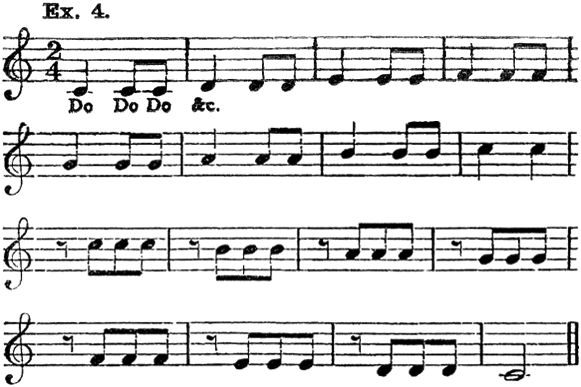
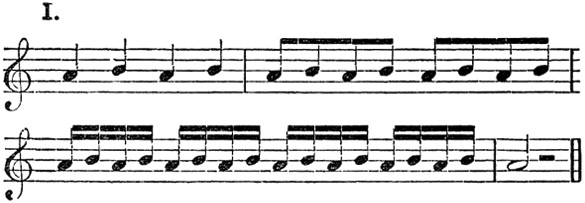
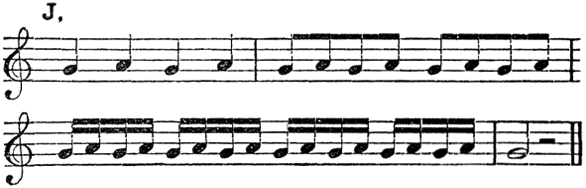
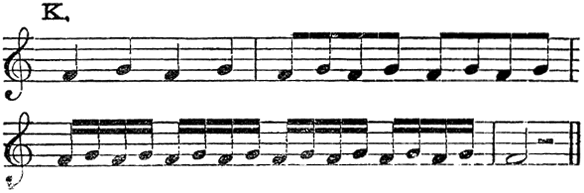
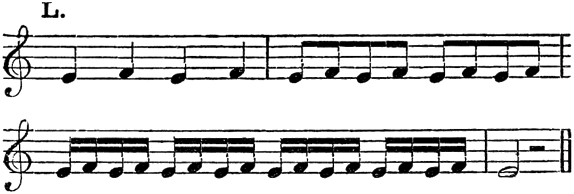
First Exercises.—This is a book of advice, not of
exercises, nor do I profess to teach you, but only to point
out to you, how you must prepare to be taught. I cannot
too often repeat that no book by itself can teach you singing,
and my object is not to supersede a master, but to induce
you to place yourself under a good one. However,
it may happen that circumstances of time, place, or pocket
prevent your doing so as soon as you would wish, and it
is far better even to learn from a book what you can in the
way of rules and exercises, than to go on singing by the
light of nature, or under a cheap and inefficient master, or
working at exercises too advanced for a beginner (which
is as bad as not working at any at all). I therefore give
here a few simple but most important exercises, which you
may work at until you are able to place yourself under the
care of a good master. Bear in mind, first, all that has
already been said here about taking your breath, the position
of standing, the form of your mouth, and place of
throat, tongue, teeth, &c., and study the following exercises
daily say to the extent of thirty minutes three times a day,
with full attention to all the above points:

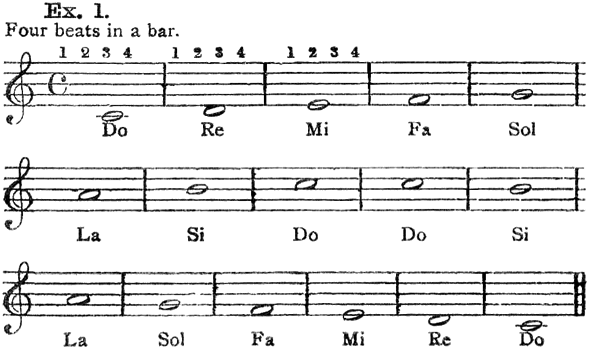
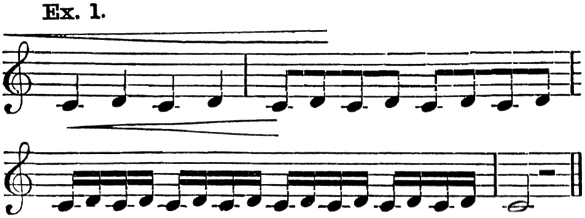
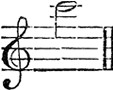
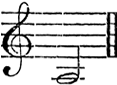
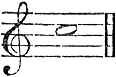
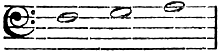
Sing this fully and firmly. It should be begun and
ended with the same quality and "thickness" of sound, as
suggested by the even line over each note. You should
be able to hold each note out in one breath for twenty
seconds without the slightest alteration being perceptible
in the tone, any more than there would be if it was a note
proceeding from an organ-pipe. Practise it on each of the
following sounds consecutively: "A" in "Bard," "A"
in "Fate," "E" in "Steel," "I" in "Life," "O" in
"Pole," "U" in "Rule," prefixing each sound by L, and
so singing Lah, Lay, Lee, Li, Lo, Loo. In singing this
first exercise, which for basses and barytones will be, of
course, an octave lower, be careful not to force the lower
notes, and do not seek to get a powerful tone thereupon.
The tone does not need to be full and heavy on these
notes, but rather should be a well-produced, light, and
thin quality of note. The way to proceed is: (1) To inspire
the breath from the bottom of the lungs as it were—not
raising the shoulders. (2) Steady the breath for a second
or so in the chest while you THINK the note you are
about to sing, and while you prepare your throat and
mouth for singing by lowering the larynx and opening the
throat. (3) Then begin to sound the note—not from the
back of the mouth, but from the tip of the tongue and
the front teeth—thus taking the whole of the tone out of
the mouth, which is what is required to be done. Sustain
the note till you have only a little breath left—then finish
off in a clean manner, and allow the remaining breath to
leave the lungs and body in an orderly way.—Repeat the
same operation for every note, and if you desire to make
progress, give a minute's attention of this kind to every
single note.

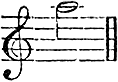
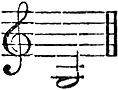
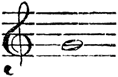
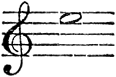
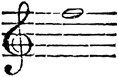
and so on, rising by semitones until you come to this:
which is certainly the highest that you ought to attempt at
present.
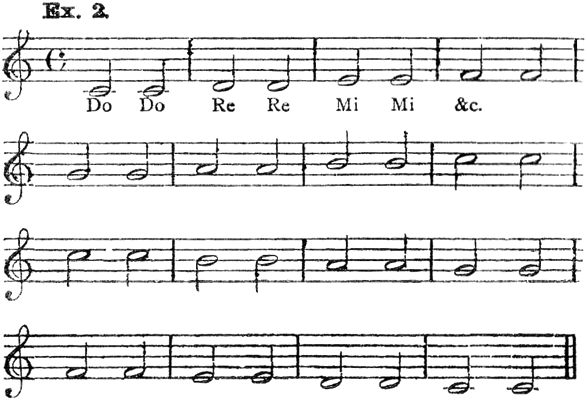
Exercise No. 2 is a first step towards joining notes, and
is another difficulty in the matter of production. The
object to be aimed at is to sing the two notes which are
bound (or tied) together with the same breath, and the
same body and quality of tone. To step from C to E,
the first movement in the exercise is to raise the voice a
major third; but the student must pass from his mind
any notion of raising the throat in order to sound the
higher third. As the note E is higher than the C, the
tone of the former must be generated lower in the chest
than had been the case with the C. The higher the note
to be sung, the lower must be its generating-point in the
chest. This is the only way to open the voice, and I need
scarcely say that it produces an entirely different tone and
method than are secured by the common habit of screwing
and tightening the throat, in proportion as the notes
ascend in pitch.
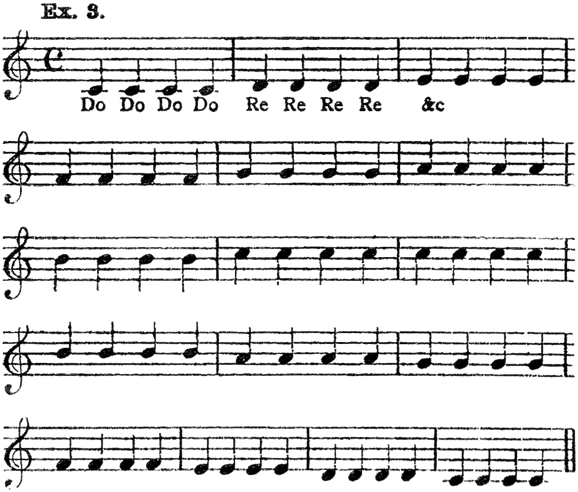
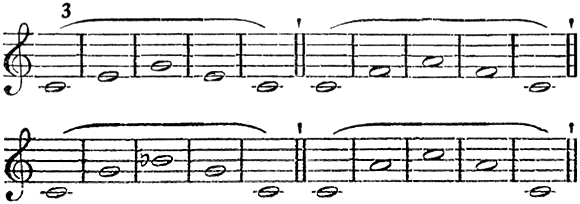
Another good exercise which may be combined with the
last-given is the following:
This exercise (3) must be sung in the same manner as
indicated with No. 2, care being taken as each note gets
higher to pass under the preceding note, and not as it
were to generate a high note over a lower one.
After which you may take this:
but sing it very slowly and deliberately, bearing in mind
the production of the high notes.
As you begin to get all these notes firm and round, you
may take these same exercises in D, D♭, and E♭, but be
very careful not to force the upper notes.
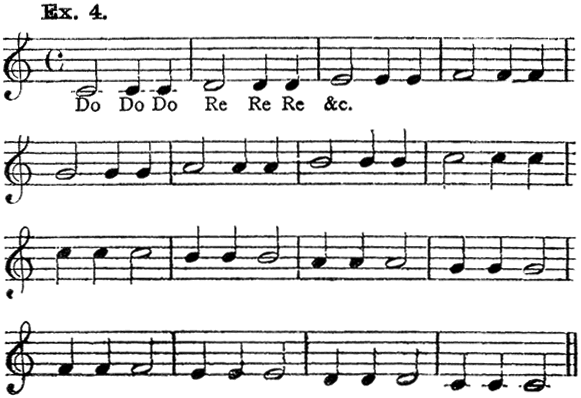
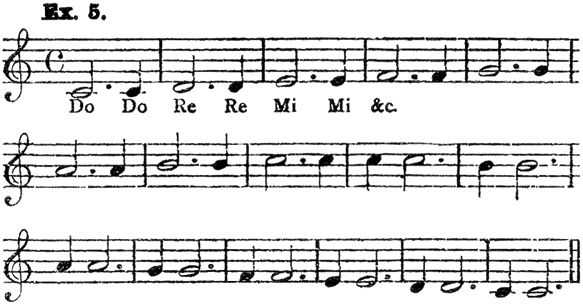
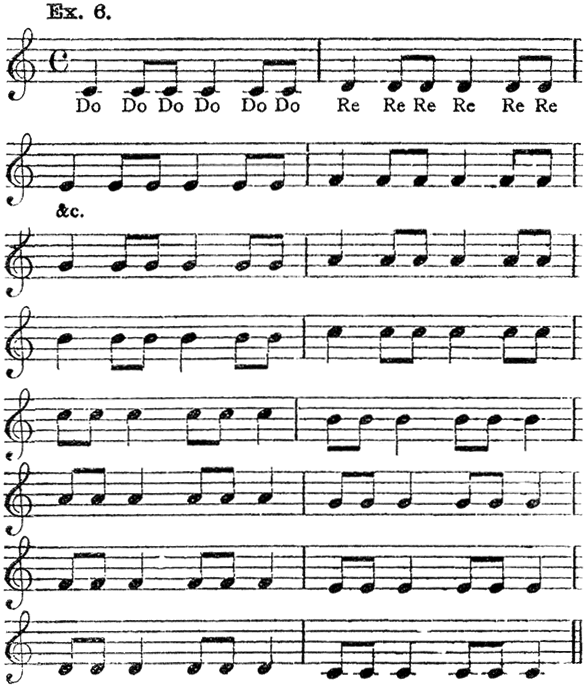
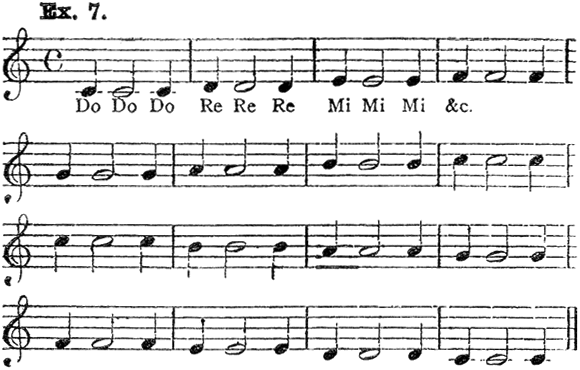
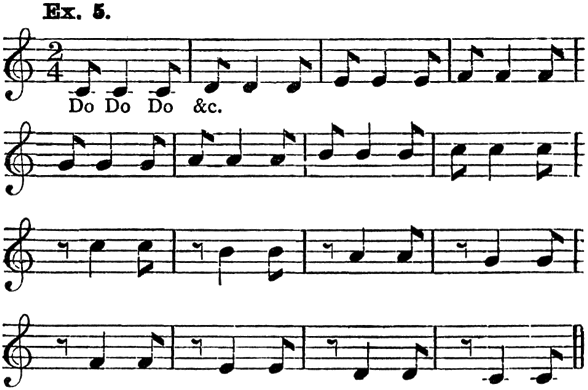
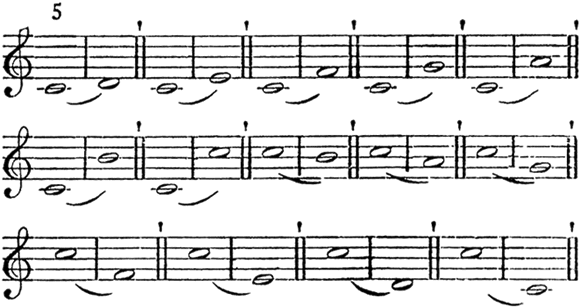
Exercise 5 is one where the question of the breath and
its proper management becomes of vital importance.
The reader will observe the notes are bound together, and
the student's attention should be turned towards passing
from one note to the other, without any appreciable difference
in the quality—I do not say pitch—of the tone.
Having inspired in the manner already explained, the
singer will sound the Do with a pure, sympathetic, not
harsh or forced sound; and by pressing down the breath,
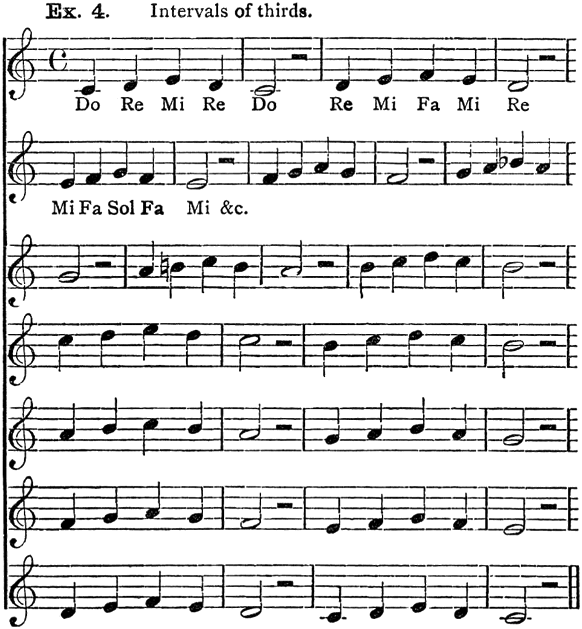
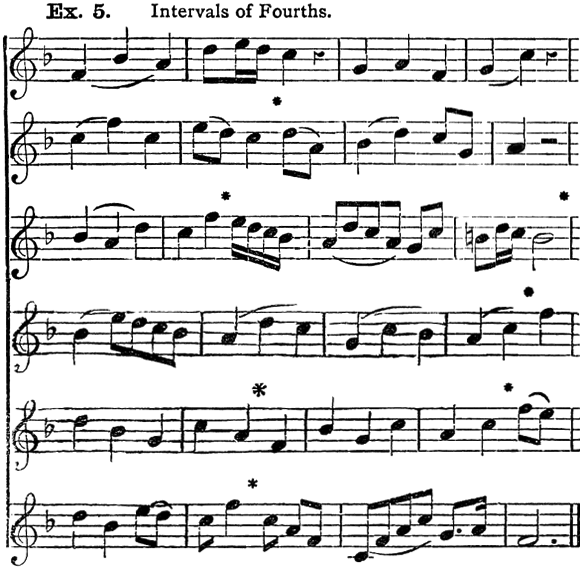
will lift the voice on to the Re. When he has succeeded
with the step of a second, he can go on to the step of a
third, fourth, &c. The care must be to utilize the breath,
always supporting the tone with the breath. If the sound
wavers, then there is something wrong with the breath.
You are either singing with too little, or are forcing the
breath.
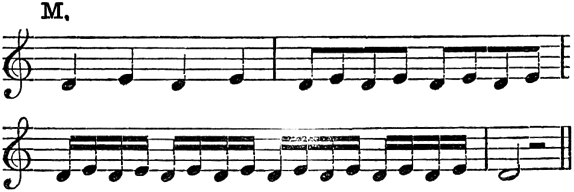
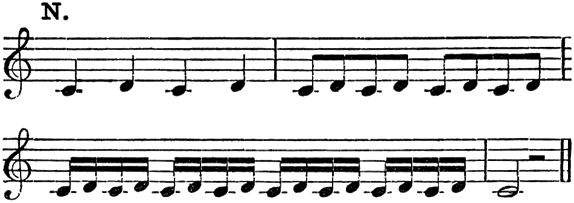
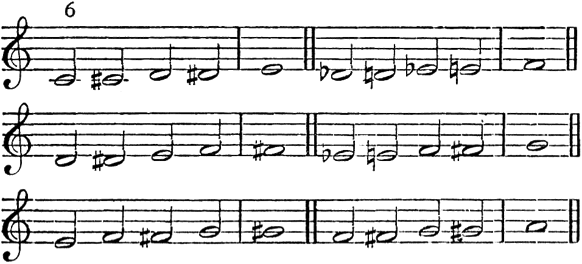
And so on.
And so on, descending the scale by semitones.
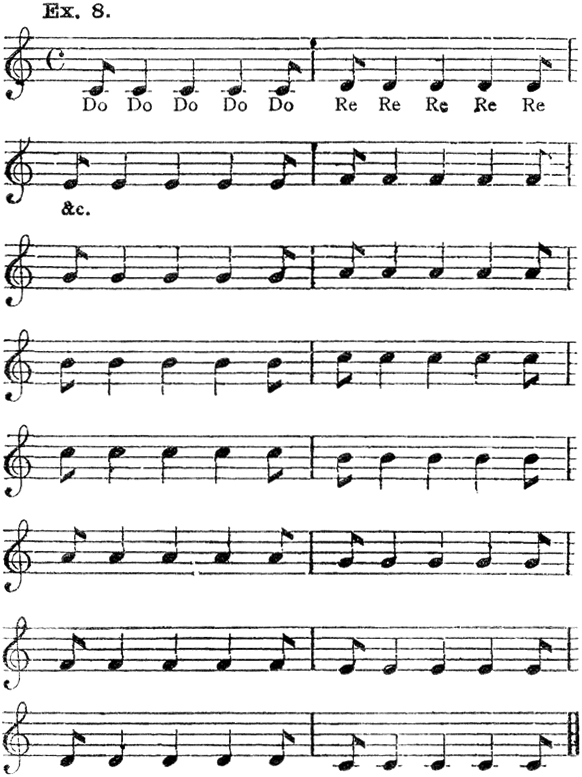
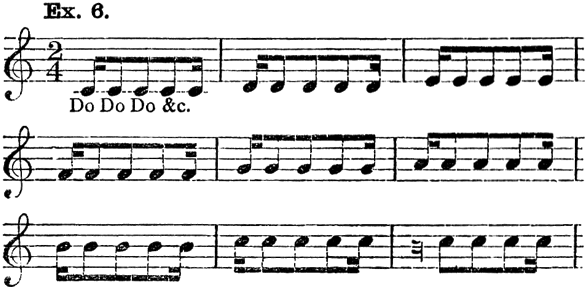
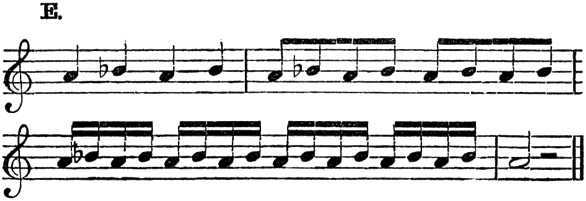
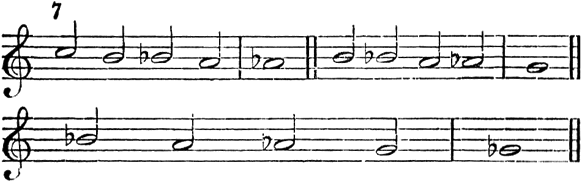
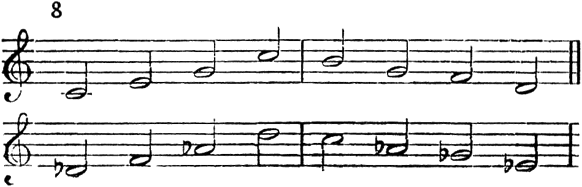
Practise No. 8 slowly and steadily, with perfectly even
tone throughout, without any crescendo or diminuendo.
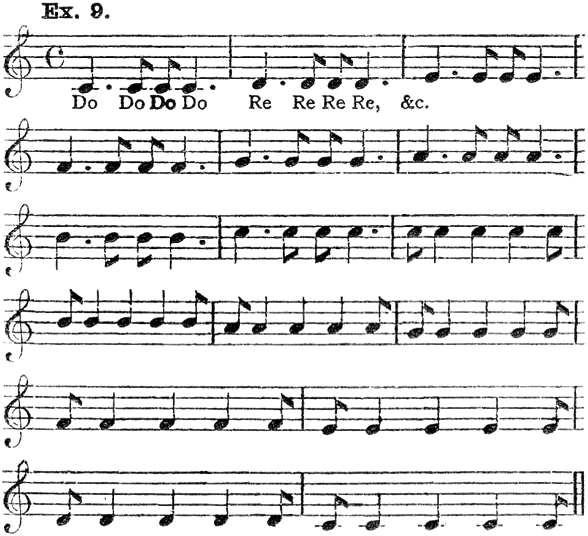
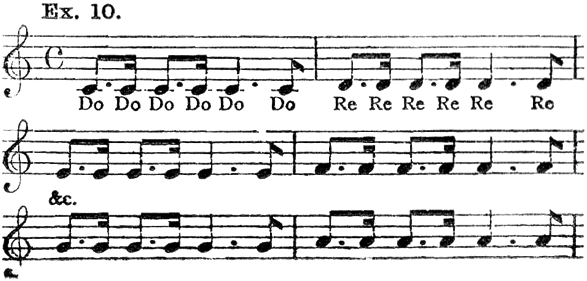
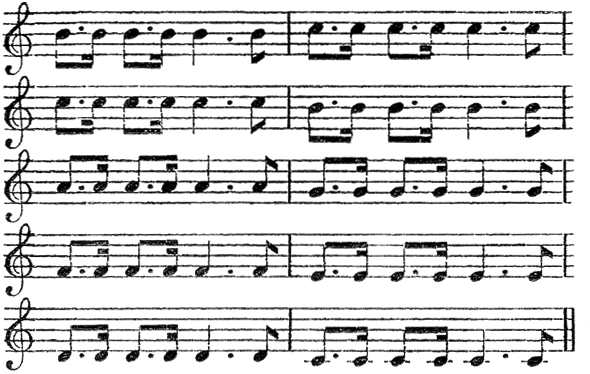
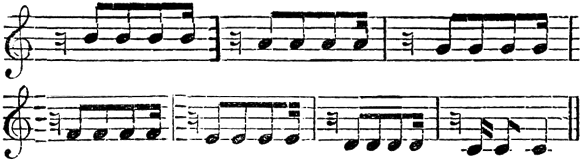
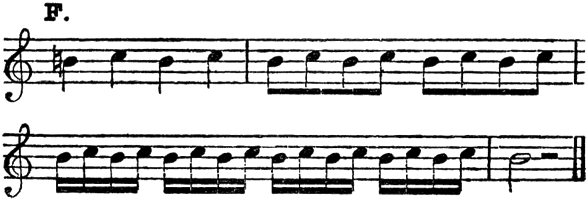
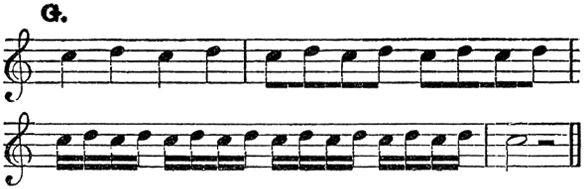
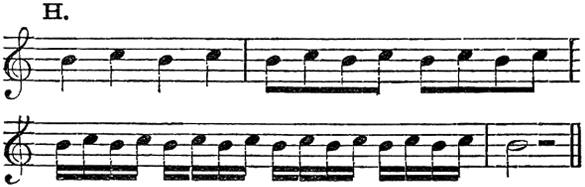
Let all the above exercises be taken successively, forte,
a mezzo-voce, and piano, preserving exactly the same amount
of tone throughout each passage, and holding the notes
with the same force with which you attack them steadily
to the end, not letting them die away. The trick of letting
notes die away is easily learnt afterwards, but at present
you have to master the far greater difficulty of holding
notes firmly with unvarying tone. Practise these exercises
on all the vowel-sounds already given. All such exercises
are of course only variations of the diatonic and chromatic
scales, so arranged as to prepare the voice for executing
those scales evenly and perfectly, with equality of tone on
every note; for till you can sing scales, you are not fit to
sing songs of any kind.
Duration of Practice.—Always guard against over-straining
and over-working the voice. Do not sing or
practise for a longer time than half an hour without allowing
the voice rest for some time. If you have three hours
at your disposal daily to devote to singing, the most
economical use of the time is to divide it equally between
the morning, afternoon, and evening.
Singing in Tune.—Correct intonation is of the
greatest possible importance in singing. Every singer
should pay especial attention to this point. The heavier
the voice, the more necessary becomes such attention,
and therefore contralti and basses are strongly advised to
lose no time in facing this (to them) considerable difficulty.
Deep basses, indeed, are rarely perfectly in tune for any
long time together, and some of the most famous bass
singers have left behind them recollections of this painful
defect. Therefore, whatever be your voice, do not take
for granted that even the possession of a good ear will
always ensure your singing in tune. Sometimes excellent
singers, and good musicians too, will sing out of tune,
perfectly aware that they are doing so, but, for a time,
unable to prevent it from physical causes—relaxation of
the throat, fatigue, indisposition, &c., under which conditions
the muscles are unable to obey the will as usual.
Do not, then, make too light of this matter, because you
may think yourself quite incapable of singing out of tune;
it is at all events wiser to be on the safe side. Therefore,
never practise (nor sing, if you can help it) with a pianoforte
which is not well in tune and well "up to pitch."
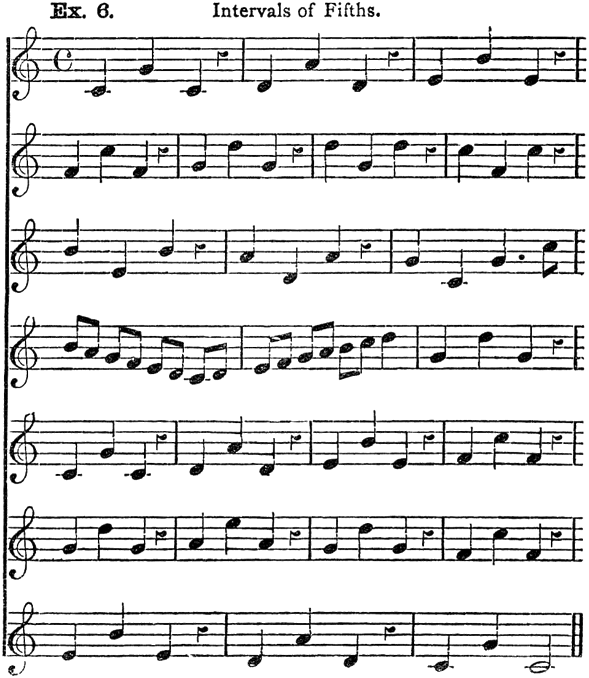
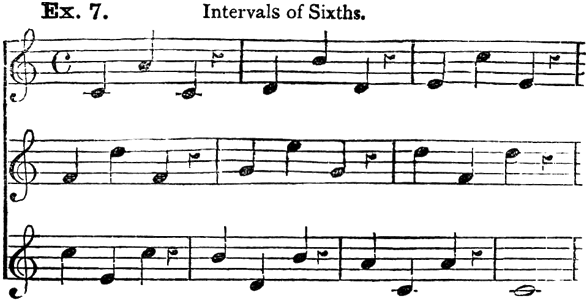
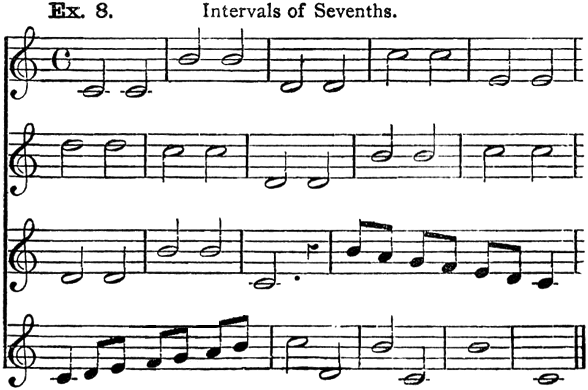
And be very constant in practising intervals, such as major
and minor sixths and sevenths, so as to be able to strike
them as perfectly in tune and as unvarying in quality as
the notes of an organ diapason.
How to Begin.—Many people never make a good
start when beginning to sing any piece. Now a very good
remedy for a part of this evil is not to prepare yourself
too soon. Use the bar immediately preceding that in
which your part commences to gather up your faculties,
and, to use a common phrase, "to pull yourself together;"
then let the muscles of the body gently settle down. The
ease and freedom acquired by this momentary call upon
the system is very remarkable; and for the singer especially
the hint cannot be too often acted upon.
Variety Indispensable.—An unchanging volume of
sound is very soon wearying to the ear; and therefore a
singer who scarcely ever varies the pitch of his voice will
find that however loudly he may sing, his audience will
have a feeling of dissatisfaction, as though they could not
hear him distinctly—the fact being that their ears, being
fatigued with the uniformity of the noise, cannot do their
proper work, and the attention therefore flags. One great
secret of being agreeably heard by an audience is to vary
the body of tone (not the quality of it, observe). As a
rule singers are left tolerably free to do as they like in this
respect. Composers of songs rarely give them any help
in the matter. In fact, nowadays so many people compose
"vocal music" without knowing anything about the vocal
instrument for which they compose, that it is not wonderful
that they ignore their power of helping the singer by
properly combining duly marked forte, piano, and mezzo-voce
passages, so as to ensure a variety of effect. Therefore,
in most modern music, a singer has to take his own
"reading" of a song, and to make it as effective as he
can by varying the power of his voice. It might even be
taken as a rule that every forte passage should be succeeded
by a soft one. The voice should rise and fall, and be
varied in its inflexions in that agreeable manner which is
so marked in good orators and dramatic elocutionists.
Chorus Singing.—If you are studying seriously for
solo singing, you must discontinue all chorus singing,
especially during training. Singing in church choirs and
choral societies must be abandoned. And this not because
there is no good to be learned there, but because the little
good is by no means commensurate with the great amount
of harm which is acquired along with the good. To
enumerate here all the evil habits so easily learnt would
be impossible. Not the least of them, however, is the
tendency to shout louder than your neighbour, to use
yourself to the bad habits of those on each side of you;
to produce a bad tone; to "chop" the passages instead
of phrasing them; to attack notes carelessly; to sing
coarsely; to depend on others; to get into a machine-like
regularity of rendering the music. All these evil
habits are the result of chorus singing; and while many
of them are detrimental to the voice itself, it may be
safely said that any one of these habits is fatal to good
solo singing.
Humming.—Some people have a wretched habit of
continually humming tunes. Pray do not get into this
habit of singing unconsciously—than which nothing is
more prejudicial to the voice. You should never sound a
note without being perfectly aware of what you are doing,
and that it is being done in the right manner. The faults
acquired by "humming over," as it is called, are of the
worst kind, and, moreover, they are far sooner acquired
than eradicated.
Studying Songs.—Be careful, in studying a new song,
not to waste either time or strength by a trifling and superficial
treatment of it. "Whatever is worth doing at all,
is worth doing well." First of all, sol-fa the melody a
few times in a full mezzo-voce. Then study it with rather
stronger tone, paying attention to lights and shades, yet
at the same time being chiefly occupied with the melody
itself. Then make your breath-marks, and adhere to the
same unfailingly. Then sing the melody once throughout,
in order to find the weak places; having found which,
you need no more practise the whole of the melody, but
give all the attention to these latter phrases. Having
mastered these, the melody will be complete. It will then
be necessary to determine where the notes shall be made
to bend into each other, to add the nuances, a few graceful
figures and effects which belong alone to the true artist.
Imitation.—By no means the worst lesson which you
can have will be gained by imitation of some acknowledged
first-rate singer, whose voice is of the same kind as your
own. Before going to a concert at which any such artist
is announced to sing, procure copies of his songs (if possible),
and make yourself acquainted with the compositions
first of all. Then go and hear how those works are rendered
by the singer who is to be your model; listen with
your copy in your hand; make notes of any points which
strike you, and while the impression made upon you is
still fresh, go home and imitate them as closely as you can.
General Musical Study.—If you want to be a good
singing artist, many more things besides singing should be
studied. You should be sufficiently acquainted with the
pianoforte to play your own accompaniments, even of the
most difficult songs, well enough to get an idea of them.
Then a knowledge of harmony, counterpoint, and orchestration
is of the greatest value. The study of the best
scores, orchestral and vocal, should not be neglected, and
further, the student should make himself or herself otherwise
familiar with the rise and progress of the art, by
reading all the best books on the subject, whether historical,
critical, or biographical.










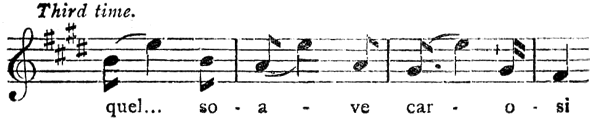
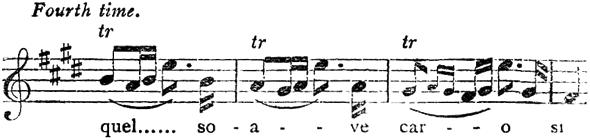
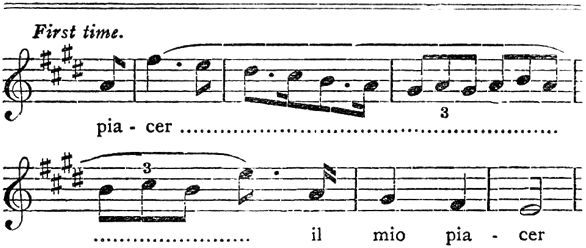
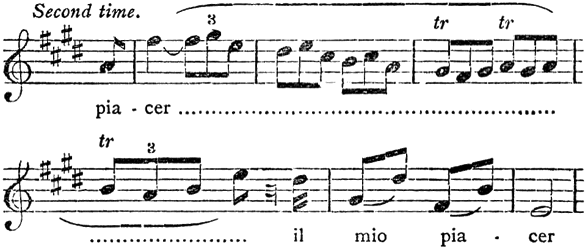





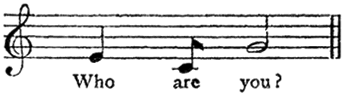
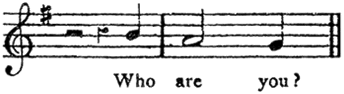
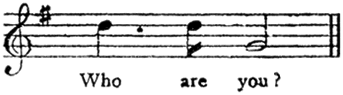


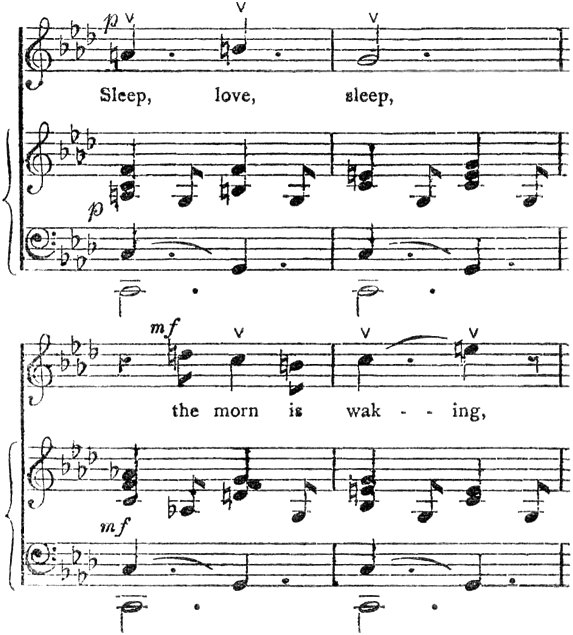
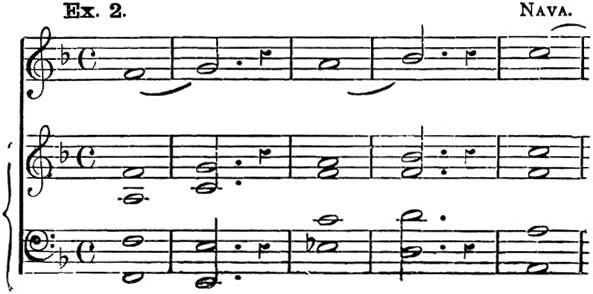
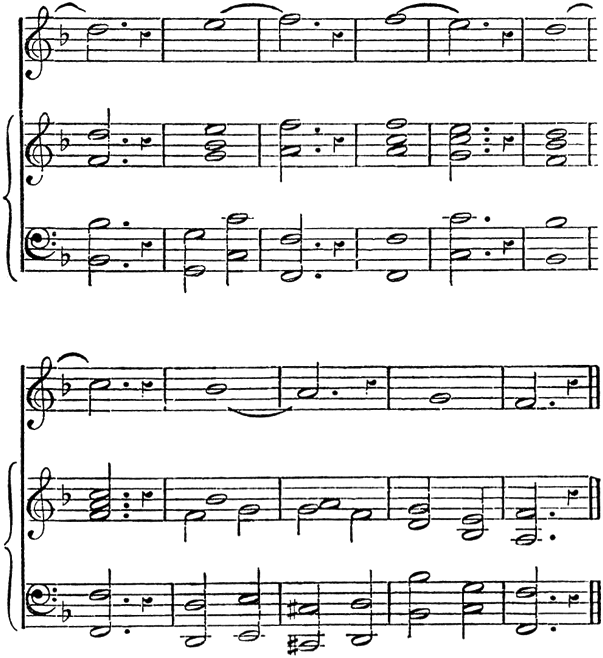
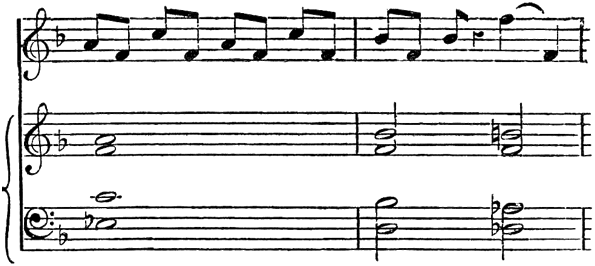
 , and to preserve strict time throughout the passage,
and especially in the taking up of the words after the
long note on the word sleep. The accompanyist would, we
may assume, do likewise with his pianoforte part, and in
this way a perfect ensemble would be secured.
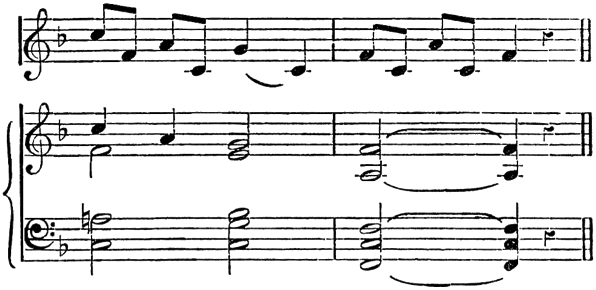
, and to preserve strict time throughout the passage,
and especially in the taking up of the words after the
long note on the word sleep. The accompanyist would, we
may assume, do likewise with his pianoforte part, and in
this way a perfect ensemble would be secured.