THERE are few instances so striking of the capacity of a party of
thoroughly experienced mountaineers to get out of a really tight place,
as was the outcome of the two days spent by Messrs Mummery, Slingsby,
and Ellis Carr, on an ice slope in the Mont Blanc district. The party
intended trying to ascend the Aiguille du Plan direct from the Chamonix
valley. Mr Ellis Carr has generously given me permission to make use of
his account, which I quote from The Alpine Journal. He relates the
adventures of himself and his two friends, whose names are household
words to climbers, as follows:—
“Mummery, Slingsby, and I started at 4 P.M., with a porter carrying the
material for our camp. This comprised a silk tent of Mummery’s pattern,
only weighing 1½ to 2 lbs.; three eider-down sleeping-bags, 9 lbs.;
cooking apparatus of thin tin, 1½ lbs.; or, with ropes, rucksacks, and
sundries, about 25 lbs., in addition to the weight of the provisions.
Though not unduly burdened, the porter found the valley of boulders
exceedingly troublesome, and in spite of three distinct varieties of
advice as to the easiest route across them, made such miserably slow
progress, often totally disappearing amongst the rocks like a
water-logged ship in a trough of the sea, that we were forced to pitch
our tents on the right moraine of the Nantillons Glacier, instead of
near the base of our peak, as intended. The gîte, built up with stones
on the slope of the moraine, with earth raked into the interstices, was
sufficiently comfortable to afford Mummery and myself some sleep. A
stone, however, far surpassing the traditional gîte lump in aggressive
activity, seemed, most undeservedly, to have singled out Slingsby as its
innocent victim, and, judging by the convulsions of his sleeping-bag,
and the sighs and thumps which were in full swing every time I woke up,
it must have kept him pretty busy all night dodging its attacks from
side to side. His account of his sufferings next morning, when Mummery
and I were admittedly awake, fully confirmed and explained these
phenomena, but on going for the enemy by daylight, he had the
satisfaction of finding that he had suffered quite needlessly, the stone
being loose and easily removed. We used Mummery’s silk tent for the
first time, and found that it afforded ample room for three men to lie
at full length without crowding. The night, however, was too fine and
still to test the weather-resisting power of the material, and as this
was thin enough to admit sufficient moonlight to illuminate the interior
of the tent, and make candle or lamp superfluous, we inferred that it
might possibly prove to be equally accommodating in the case of rain and
wind. It was necessary, moreover, on entering or leaving the tent, to
adopt that form of locomotion to which the serpent was condemned to
avoid the risk of unconsciously carrying away the whole structure on
one’s back. We started next morning about three o’clock, leaving the
camp kit ready packed for the porter, whom we had instructed to fetch it
during the day, and pushed on to the glacier at the foot of our mountain
at a steady pace, maintained in my case with much greater ease than
would have otherwise been possible by virtue of some long,
single-pointed screw spikes inserted overnight in my boot soles; and I
may here venture to remark that a few of these spikes, screwed into the
boots before starting on an expedition where much ice-work is expected,
appear to offer a welcome compromise between ponderous crampons and
ordinary nails. They do not, I think, if not too numerous, interfere
with rock-climbing, and can be repeatedly renewed when worn down. A
slight modification in the shape would further facilitate their being
screwed in with a box key made to fit.[1]
“Leaving the rock buttress, the scene of our reconnaissance on the 11th,
on the right, we struck straight up the glacier basin between it and the
Aiguille de Blaitiére, which glacier appeared to me to be largely
composed of broken fragments of ice mixed with avalanche snow from the
hanging glaciers and slopes above. Keeping somewhat to the left, we
reached the bergschrund, which proved to be of considerable size,
extending along the whole base of the couloir, and crossed it at a point
immediately adjoining the rocks on the left. The axe at once came into
requisition, and we cut steadily in hard ice up and across the couloir
towards the small rib or island of rock before-mentioned as dividing it
higher up into two portions. The rocks at the base of this rib, though
steep, gritty, and loose, offered more rapid going than the ice, and we
climbed then to a gap on the ridge above, commanding a near view of the
perpendicular country in front of us. Far above us, and immediately over
the top of the right-hand section of the couloir, towered the ice cliffs
of the hanging glacier we had tried to reach on the 11th, and beyond
these again, in the grey morning light, we caught the glimpse of a
second and even a third rank of séracs in lofty vista higher up the
mountain. As before observed, this section of the couloir seemed
admirably placed for receiving ice-falls, and we now saw that it formed
part of the natural channel for snow and débris from each and all of
these glaciers. We therefore directed our attention to our friend on the
left, and after a halt for breakfast, traversed the still remaining
portion of the dividing ridge, turning a small rock pinnacle on its
right, and recommenced cutting steps in the hard ice which faced us. As
has been before remarked, it is difficult to avoid over-estimating the
steepness of ice-slopes, but, allowing for any tendency towards
exaggeration, I do not think I am wrong in fixing the angle of the
couloir from this point as not less than 50°. We kept the axe steadily
going, and with an occasional change of leader, after some hours’
unceasing work, found ourselves approaching the base of the upper
portion of the couloir, which from below had appeared perpendicular. We
paused to consider the situation. For at least 80 to 100 feet the ice
rose at an angle of 60° to 70°, cutting off all view of the face above,
with no flanking wall of rock on the right, but bounded on the left by
an overhanging cliff, which dripped slightly with water from melting
snow above. The morning was well advanced, and we kept a sharp look-out
aloft for any stray stones which might fancy a descent in our direction.
None came, and we felt gratified at this confirmation of our judgment
as to the safety of this part of the couloir. However, the time for
chuckling had not yet come. As I stated, we had halted to inspect the
problem before us. Look as we might we could discover no possibility of
turning the ice wall either to the right or left, and though, as we
fondly believed and hoped, it formed the only barrier to easier going
above, the terrible straightness and narrowness of the way was
sufficient to make the very boldest pause to consider the strength of
his resources.
“How long I should have paused before beating a retreat, if asked to
lead the way up such a place, I will not stop to enquire, but I clearly
remember that my efforts to form some estimate of the probable demand on
my powers such a feat would involve were cut short by Mummery’s quiet
announcement that he was ready to make the attempt. Let me here state
that amongst Mummery’s other mountaineering qualifications not the least
remarkable is his power of inspiring confidence in those who are
climbing with him, and that both Slingsby and I experienced this is
proved by the fact that we at once proceeded, without misgiving or
hesitation, to follow his lead. We had hitherto used an 80-feet rope,
but now, by attaching a spare 100-feet length of thin rope, used double,
we afforded the leader an additional 50 feet. Mummery commenced
cutting, and we soon approached the lower portion of the actual ice
wall, where the angle of the slope cannot have been less than 60°.
“I am not aware that any authority has fixed the exact degree of
steepness at which it becomes impossible to use the ice axe with both
hands, but, whatever portion of a right angle the limit may be, Mummery
very soon reached it, and commenced excavating with his right hand caves
in the ice, each with an internal lateral recess by which to support his
weight with his left. Slingsby and I, meanwhile possessing our souls in
patience, stood in our respective steps, as on a ladder, and watched his
steady progress with admiration, so far as permitted us by the falling
ice dislodged by the axe.
“Above our heads the top of the wall was crowned by a single projecting
stone towards which the leader cut, and which, when reached, just
afforded sufficient standing-room for both feet. The ice immediately
below this stone, for a height of 12 or 14 feet, was practically
perpendicular, and Slingsby’s definition of it as a ‘frozen waterfall’
is the most appropriate I can find. Here and there Mummery found it
necessary to cut through its entire thickness, exposing the face of the
rock behind.
“On reaching the projecting stone the leader was again able to use the
axe with both hands, and slowly disappeared from view; thus completing,
without pause or hitch of any kind, the most extraordinary feat of
mountaineering skill and nerve it has ever been my privilege to witness.
“The top of the wall surmounted, Slingsby and I expected every moment to
hear the welcome summons to follow to easier realms above. None came.
Time passed, the only sounds besides the occasional drip of water from
the rocks on our left, or the growl of a distant avalanche, being that
of the axe and the falling chips of ice, as they whizzed by or struck
our heads or arms with increasing force. The sounds of the axe strokes
gradually became inaudible, but the shower continued to pound us without
mercy for more than an hour of inaction, perhaps more trying to the
nerves, in such a position, than the task of leading. The monotony was
to some extent varied by efforts to ward off from our heads the blows of
the falling ice, and by the excitement, at intervals, of seeing the
slack rope hauled up a foot or so at a time. It had almost become taut,
and we were preparing to follow, when a shout from above, which sounded
from where we stood muffled and far away, for more rope, kept us in our
places. It was all very well to demand more rope, but not so easy to
comply. The only possible way to give extra length was to employ the 100
feet of thin rope single, instead of double, at which we hesitated at
first, but, as Mummery shouted that it was absolutely necessary, we
managed to make the change, though it involved Slingsby’s getting out of
the rope entirely during the operation. To any one who has not tried it
I should hardly venture to recommend, as an enjoyable diversion, the
process, which must necessarily occupy both hands, of removing and
re-adjusting 180 feet of rope on an ice slope exceeding 60° at the top
of a steep couloir some 1000 feet high. The task accomplished, we had
not much longer to wait before the shout to come on announced the
termination of our martyrdom. We went on, but, on passing in turn the
projecting stone, and catching sight of the slope above, we saw at a
glance that our hopes of easy going must, for the present, be postponed.
Mummery, who had halted at the full extent of his tether of about 120
feet of rope, was standing in his steps on an ice slope quite as steep
as that below the foot of the wall we had just surmounted. He had been
cutting without intermission for two hours, and suggested a change.
Being last on the rope, I therefore went ahead, cutting steps to pass,
and took up the work with the axe. The ice here was occasionally in
double layer, the outer one some 3 or 4 inches in thickness, which, when
cut through, revealed a space of about equal depth behind, an
arrangement at times very convenient, as affording good hand-holes
without extra labour. I went on for some time cutting pigeon-holes on
the right side of the couloir, and, at the risk of being unorthodox, I
would venture to point out what appears to me the advantages of this
kind of step on very steep ice. Cut in two perpendicular rows,
alternately for each foot, the time lost in zigzags is saved, and no
turning steps are necessary; they do not require the ice to be cut away
so much for the leg as in the case of lateral steps, and are therefore
less easily filled up by falling chips and snow. Being on account of
their shape more protected from the sun’s heat, they are less liable to
be spoiled by melting, and have the further advantage of keeping the
members of the party in the same perpendicular line, and consequently in
a safer position. They also may serve as hand-holds. To cut such steps
satisfactorily it is necessary that the axe be provided with a point
long enough to penetrate to the full depth required for the
accommodation of the foot up to the instep, without risk of injury to
the shaft by repeated contact with the ice.
“As we had now been going for several hours without food, and since
leaving the rock rib, where we had breakfasted, had come across no ledge
or irregularity of any kind affording a resting-place, it was with no
little satisfaction that I descried, on the opposite side of the
couloir, at a spot about 30 or 40 feet above, where the cliff on our
left somewhat receded, several broken fragments of rock cropping out of
the ice, of size and shape to provide seats for the whole party. We cut
up and across to them, and sat down, or rather hooked ourselves on, for
a second breakfast. We were here approximately on a level with the
summit of our rock buttress of the 11th, and saw that it was only
connected with the mountain by a broken and dangerous-looking ridge of
ice and névé running up to an ice-slope at the foot of the glacier
cliffs. The gap in the latter was not visible from our position. The
tower we had tried to turn appeared far below, and the intervening rocks
of the buttress, though not jagged, were steep and smooth like a roof.
The first gleams of sunshine now arrived to cheer us, and, getting under
way once more, we pushed on hopefully, as the couloir was rapidly
widening and the face of the mountain almost in full view. We had also
surmounted the rock wall which had so long shut out the prospect on our
left, and it was at this point that, happening to glance across the
slabs, we caught sight of a large flat rock rapidly descending. It did
not bound nor roll, but slid quietly down with a kind of stealthy haste,
as if it thought, though rather late, it might still catch us, and was
anxious not to alarm us prematurely. It fell harmlessly into the
couloir, striking the ice near the rock rib within a few feet of our
tracks, and we saw no other falling stones while we were on the
mountain.
“Leaving the welcome resting-place, Mummery again took the lead, and cut
up and across the couloir, now becoming less steep, to a rib or patch of
rocks higher up on the right, which we climbed to its upper extremity, a
distance of some 70 or 80 feet.
“Here, taking to the ice once more, we soon approached the foot of the
first great snow-slope on the face, and rejoiced in the near prospect of
easier going. At the top of this slope, several hundred feet straight
before us, was a low cliff or band of rocks, for which we decided to
aim, there being throughout the entire length of the intervening slope
no suspicious grey patches to indicate ice. The angle was, moreover,
much less severe, and it being once more my turn to lead, I went at it
with the zealous intention of making up time. My ardour was, however,
considerably checked at finding, when but a short distance up the slope,
that the coating of névé was so exceedingly thin as to be insufficient
for good footing without cutting through the hard ice below. Instead,
therefore, of continuing in a straight line for the rocks, we took an
oblique course to the right, towards one of the hanging glaciers before
referred to, and crossing a longitudinal crevasse, climbed without much
difficulty up its sloping bank of névé. Hurrah! here was good snow at
last, only requiring at most a couple of slashes with the adze end of
the axe for each step. If this continued we had a comparatively easy
task before us, as the rocks above, though smooth and steep, were broken
up here and there by bands and streaks of snow. Taking full advantage of
this our first opportunity for making speed, we cut as fast as possible
and made height rapidly. We still aimed to strike the band of rocks
before described, though at a point much more to the right, and nearer
to where its extremity was bounded by the ice-cliffs of another hanging
glacier; but, alas! as we approached nearer and nearer to the base of
the cliffs, looming apparently higher and higher over our heads, the
favouring névé, over which we had been making such rapid progress,
again began to fail, and before we could reach the top of the once more
steepening slope the necessity of again resorting to the pick end of the
axe brought home the unwelcome conviction that our temporary respite had
come to an end, and that, instead of snow above, and apart from what
help the smooth rocks might afford, nothing was to be expected but hard,
unmitigated ice.
“We immediately felt that, as it was already past noon, the
establishment of this fact would put a totally different complexion on
our prospects of success, and, instead of reaching the summit, we might
have to content ourselves with merely crossing the ridge. We continued
cutting, however, and reached the rocks, the last part of the slope
having once more become exceedingly steep. To turn the cliff, here
unclimbable, we first spent over half an hour in prospecting to the
right, where a steep ice-gully appeared between the rocks and the
hanging glacier; but, abandoning this, we struck off to the left,
cutting a long traverse, during which we were able to hitch the rope to
rocks cropping out through the ice. The traverse landed us in a kind of
gully, where, taking to the rocks whenever practicable, though climbing
chiefly by the ice, we reached a broken stony ledge, large and flat
enough to serve as a luncheon place, the only spot we had come across
since leaving the rock rib, where it was possible really to rest
sitting. Luncheon over, we proceeded as before, choosing the rocks as
far as possible by way of change, though continually obliged to take to
the ice-streaks by which they were everywhere intersected. This went on
all the rest of the afternoon, till, when daylight began to wane, we had
attained an elevation considerably above the gap between our mountain
and the Aiguille de Blaitiére, or more than 10,900 feet above the sea.
“The persistent steepness and difficulty of the mountain had already put
our reaching the ridge before dark entirely out of the question, though
we decided to keep going as long as daylight lasted, so as to leave as
little work as possible for the morrow.
“The day had been gloriously fine, practically cloudless throughout, and
I shall never forget the weird look of the ice-slopes beneath, turning
yellow in the evening light, and plunging down and disappearing far
below in the mists which were gathering at the base of the mountain;
also, far, far away, we caught a glimpse of the Lake of Geneva,
somewhere near Lausanne. I had turned away from the retrospect, when an
exclamation from Slingsby called me to look once more. A gap had
appeared in the mists, and there, some 2700 feet below us, as it were on
an inferior stage of the world, we caught a glimpse of the snow-field at
the very foot of the mountain, dusky yellow in the last rays of the sun.
Mummery was in the meantime continuing the everlasting chopping, in the
intervals of crawling up disobliging slabs of rock, till twilight began
to deepen into darkness, and we had to look about for a perch on which
to roost for the night. The only spot we could find, sufficiently large
for all three of us to sit, was a small patch of lumps of rocks, more or
less loose, some 20 or 30 feet below where we stood, and we succeeded,
just as the light failed, or about 8.30 P.M., and after some
engineering, in seating ourselves side by side upon it. Our boots were
wet through by long standing in ice-steps, and we took them off and
wrung the water out of our stockings. The others put theirs on again,
but, as a precaution against frost-bite, having pocketed my stockings, I
put my feet, wrapped in a woollen cap, inside the rucksack, with the
result that they remained warm through the night. The half hour which it
took me next morning to pull on the frozen boots proved, however, an
adequate price for the privilege of having warm feet. As a precaution
against falling off our shelf we hitched the rope over a rock above and
passed it round us, and to make sure of not losing my boots (awful
thought!), I tied them to it by the laces.
“After dinner we settled down to spend the evening. The weather
fortunately remained perfect, and the moon had risen, though hidden from
us by our mountain. Immediately below lay Chamonix, like a cheap
illumination, gradually growing more patchy as the night advanced and
the candles went out one by one, while above the stars looked down as
if silently wondering why in the world we were sitting there. The first
two hours were passed without very much discomfort, but having left
behind our extra wraps to save weight, as time wore on the cold began to
make itself felt, and though fortunately never severe enough to be
dangerous, made us sufficiently miserable. Packed as we were, we were
unable to indulge in those exercises generally adopted to induce warmth,
and we shivered so vigorously at intervals that, when all vibrating in
unison, we wondered how it might affect the stability of our perch.
Sudden cramp in a leg, too, could only be relieved by concerted action,
it being necessary for the whole party to rise solemnly together like a
bench of judges, while the limb was stretched out over the valley of
Chamonix till the pain abated, and it could be folded up and packed away
once more. We sang songs, told anecdotes, and watched the ghostly effect
of the moonlight on a subsidiary pinnacle of the mountain, the
illuminated point of which, in reality but a short distance away, looked
like a phantom Matterhorn seen afar off over an inky black arête
formed by the shadow thrown across its base by the adjoining ridge. We
had all solemnly vowed not to drop asleep, and for me this was
essential, as my centre of gravity was only just within the base of
support; but while endeavouring to give effect to another chorus, in
spite of the very troublesome vibrato before referred to, I was
grieved and startled at the sudden superfluous interpolation of two
sustained melancholy bass notes, each in a different key and ominously
suggestive of snoring. The pensive attitude of my companions’ heads
being in keeping with their song, in accordance with a previous
understanding, I imparted to Mummery, who sat next to me, a judicious
shock, but, as in the case of a row of billiard balls in contact, the
effect was most noticeable at the far end, and Slingsby awoke,
heartily agreeing with me how weak it was of Mummery to give way thus.
The frequent necessity for repeating this operation, with strengthening
variations as the effect wore off, soon stopped the chorus which, like
Sullivan’s ‘Lost Chord,’ trembled away into silence.
“The lights of Chamonix had by this time shrunk to a mere moth-eaten
skeleton of their earlier glory, and I became weakly conscious of a sort
of resentment at the callous selfishness of those who could thus sneak
into their undeserved beds, without a thought of the three devoted
explorers gazing down at them from their eyrie on the icy rocks.
“From 2 to 4 o’clock the cold became more intense, aggravated by a
slight ‘breeze of morning,’ and while waiting for dawn we noticed that
it was light enough to see.
“Daylight, however, did not help Mummery to find his hat, and we
concluded it had retired into the bergschrund under cover of darkness.
“We helped each other into a standing position, and decided to start for
the next patch of rocks above, from there to determine what chance of
success there might be in making a dash for the summit, or, failing
this, of simply crossing the ridge and descending to the Col du Géant.
There was very little food left, and, as we had brought no wine,
breakfast was reduced to a slight sketch, executed with little taste and
in a few very dry touches. Owing to the time required to disentangle
virulently kinked and frozen ropes, etc., the sun was well above the
horizon when we once more started upwards, though unfortunately, just at
this time, when his life-giving rays would have been most acceptable,
they were entirely intercepted by the ridge of the Blaitiére. We started
on the line of steps cut the night before, but soon after Mummery had
recommenced cutting, the cold, or rather the impossibility, owing to the
enforced inaction, to get warm, produced such an overpowering feeling of
drowsiness that Slingsby and I, at Mummery’s suggestion, returned to the
perch, and jamming ourselves into the space which had before
accommodated our six legs, endeavoured to have it out in forty winks.
Mummery meanwhile continued step-cutting, and at the end of about half
an hour, during which Slingsby and I were somewhat restored by a fitful
dose, returned, and we tied on again for another attempt.
“Surmounting the patches of rock immediately above our dormitory, we
arrived at the foot of another slope of terribly steep, hard ice, some
200 feet in height. At the top of this again was a vertical crag 14 or
15 feet high, forming the outworks of the next superior band of rocks,
which was interspersed with ice-streaks as before. A few feet from the
base of this crag was a narrow ledge about 1 foot in width, where we
were able to sit after scraping it clear of snow. Slingsby gave Mummery
a leg up round a very nasty corner, and he climbed to a point above the
crag, whence he was able to assist us with the rope up a still higher
and narrower ledge. Beyond was another steep slope of hard ice, topped
by a belt of rocks, as before.
“Before reaching this point the cold had again begun to tell upon me,
and I bitterly regretted the mistaken policy of leaving behind our extra
wraps, especially as the coat I was wearing was not lined. As there was
no probability of a change for the better in the nature of the going
before the ridge was reached, I began to doubt the wisdom of proceeding,
affected as I was, where a false step might send the whole party into
the bergschrund 3000 feet below; but it was very hard, with the summit
in view and the most laborious part of the ascent already accomplished,
to be the first to cry ‘Hold!’ I hesitated for some time before doing
so, and the others meanwhile had proceeded up the slope. The rope was
almost taut when I shouted to them the state of the case, and called a
council of war. They returned to me, and we discussed what was
practically something of the nature of a dilemma. To go on at the same
slow rate of progress and without the sun’s warmth meant, on the one
hand, the possible collapse of at least one of the party from cold,
while, on the other hand, to turn back involved the descent of nearly
3000 feet of ice, and the passage, if we could not turn it, of the
couloir and its ghastly ice-wall. Partly, I think, to delay for a time
the adoption of the latter formidable alternative, partly to set at rest
any doubt which might still remain as to the nature of the going above,
Mummery volunteered to ascend alone to the rocks at the summit of the
ice-slope, though the chance of their offering any improved conditions
was generally felt to be a forlorn hope. He untied the rope, threw the
end down to us, and retraced his steps up the slope, in due time
reaching the rocks some 100 or 130 feet above, but, after prospecting in
more than one direction, returned to us with the report that they
offered no improvement, and that the intersecting streaks were nothing
but hard ice. He, however, was prepared to continue the attempt if we
felt equal to the task. If we could at that moment have commanded a cup
of hot soup or tea, or the woollen jackets which in our confidence in
being able to reach the ridge we had left behind, I am convinced I
should have been quite able to proceed, and that the day and the
mountain would have been ours; but in the absence of these reviving
influences and that of the sun, I was conscious that in my own case, at
any rate, it would be folly to persist, so gave my vote for descending.
As the food was practically exhausted, the others agreed that it would
be wiser to face the terrible ordeal which retracing our steps involved
(we did not then know that it meant recutting them), rather than
continue the ascent with weakened resources and without absolute
certainty of the accessibility of the summit ridge.
“As Slingsby on the previous day had insisted on being regarded merely
as a passenger, and had therefore not shared in the step-cutting, it was
now arranged that he should lead, while Mummery, as a tower of strength,
brought up the rear. Though it was past five o’clock, and of course
broad daylight, a bright star could be seen just over the ridge of our
mountain, not far from the summit—alas! the only one anywhere near it
on that day. We started downwards at a steady pace, and soon were
rejoicing in the returning warmth induced by the more continuous
movement. Before we had gone far, however, we found that most of the
steps were partially filled up with ice, water having flowed into them
during the previous afternoon, and the work of trimming or practically
recutting these was at times exceedingly trying, owing to their distance
apart, and the consequent necessity of working in a stooping and cramped
position.
“But if the work was tough the worker, fortunately, was tougher still,
and Mummery and I congratulated ourselves on being able to send such
powerful reserves to the front.
“The morning was well advanced before the sun surmounted the cold screen
of the Blaitiére, but having once got to work he certainly made up by
intensity for his tardy appearance.
“The provisions, with the exception of a scrap or two of cheese and a
morsel of chocolate, being exhausted, and having, as before stated,
nothing with us in the form of drink, nothing was to be gained by a
halt, though, as we descended with as much speed as possible, we kept a
sharp look-out for any signs of trickling water with which to quench the
thirst, which was becoming distressing.
“Since finally deciding to return, we had cherished the hope that it
might still be possible to turn the ice-wall by way of the great rock
buttress, and made up our minds at any rate to inspect it from above.
With this in view, when the point was reached where we had on the
previous day struck the flank of the hanging glacier instead of
continuing in the tracks which trended to the right across the long
ice-slope, we cut straight down by the side of the glacier to its foot,
and over the slope below, in the direction of the séracs immediately
crowning the summit of the buttress.
“On nearer approach, however, it was manifest that even if by hours of
step-cutting a passage from the ice to the rocky crest below could be
successfully forced, descent by the latter was more than doubtful, while
the consequences of failure were not to be thought of.
“Driven, therefore, finally to descend by the couloir, we cut a
horizontal traverse which brought us back into the old tracks, a short
way above the point where the ice began to steepen for the final plunge,
where we braced ourselves for the last and steepest 1000 feet of ice.
Slingsby still led, and, on arriving at the spot below our second
breakfast-place, where I had last cut pigeon-holes, joyfully announced
that one of them contained water. He left his drinking cup in an
adjoining step for our use as we passed the spot in turn, and the fact
that it was only visible when on a level with our faces may give some
idea of the steepness of the descent. The delight of that drink was
something to remember, though only obtainable in thimblefuls, and I
continued dipping so long that Mummery became alarmed, being under the
impression that the cup was filled each time.
“Mummery had previously volunteered, in case we were driven to return by
the couloir, to descend first, and recut the steps and hand-holes in the
ice-wall, and as we approached the brink we looked about for some
projecting stone or knob of rock which might serve as a hitch for the
rope during the operation. The only available projection was a pointed
stone of doubtful security, somewhat removed from the line of descent,
standing out of the ice at the foot of a smooth vertical slab of rock on
the left. Round this we hitched the rope, Slingsby untying to give the
necessary length. With our feet firmly planted, each in its own
ice-step, we paid out the rope as Mummery descended and disappeared over
the edge. It was an hour before he re-appeared, and this period of
enforced inaction was to me, and I think to Slingsby, the most trying of
the whole expedition. The want of food was beginning to tell on our
strength, the overpowering drowsiness returned, and though it was
absolutely essential for the safety of the party to stand firmly in the
ice-steps, it required a strong effort to avoid dropping off to sleep in
that position. We were fortunately able to steady ourselves by grasping
the upper edge of the ice where it adjoined the rocky slab under which
we stood. This weariness, however, must have been quite as much mental
as physical from the long-continued monotony of the work, for when
Mummery at last reappeared we felt perfectly equal to the task of
descending. The rope was passed behind a boss of névé ingeniously
worked by Mummery as a hitch to keep it perpendicular, and I descended
first, but had no occasion to rely upon it for more than its moral
support, as the steps and hand-holds had been so carefully cut. I
climbed cautiously down the icy cataract till I reached a point where
hand-holds were not essential to maintain the balance, and waited with
my face almost against the ice till Slingsby joined me. Mummery soon
followed, and rather than leave the spare rope behind detached it from
the stone and descended without its aid, his nerve being to all
appearance unimpaired by the fatigues he had gone through. I had before
had evidence of his indifference while on the mountains to all forms of
food or drink, with the single exception, by the way, of strawberry jam,
on the production of which he generally capitulates.
“Rejoicing at having successfully passed the steepest portion of the
ice-wall without the smallest hitch of the wrong sort, we steadily
descended the face of the couloir.
“Here and there, where a few of the steps had been hewn unusually far
apart, I was fain to cut a notch or two for the fingers before lowering
myself into the next one below. At last the rock rib was reached, and we
indulged in a rest for the first time since turning to descend.
“Time, however, was precious, and we were soon under way again,
retracing our steps over the steep loose rocks at the base of the rib
till forced again on to the ice.
“Oh, that everlasting hard ice-slope, so trustworthy yet so relentlessly
exacting!
“Before we could clear the rocks, and as if by way of hint that the
mountain had had enough of us, and of me in particular (I could have
assured it the feeling was mutual), a flick of the rope sent my hat and
goggles flying down to keep company with Mummery’s in the bergschrund,
and a sharp rolling stone, which I foolishly extended my hand to check,
gashed me so severely as to put climbing out of the question for more
than a week. As small pieces of ice had been whizzing down for some time
from above, though we saw no stones, it was satisfactory to find our
steps across the lower part of the couloir in sufficiently good order to
allow of our putting on a good pace, and we soon reached the sheltering
rock on the opposite side and the slopes below the bergschrund wherein
our hats, after losing their heads, had found a grave. The intense
feeling of relief on regaining, at 5.55 P.M., safe and easy ground,
where the lives of the party were not staked on every step, is difficult
to describe, and was such as I had never before experienced. I think the
others felt something like the same sensation. Fatigue, kept at bay so
long as the stern necessity for caution lasted, seemed to come upon us
with a rush, though tempered with the sense of freedom from care
aforesaid, and I fancy our progress down the glacier snow was for a time
rather staggery. Though tired, we were by no means exhausted, and after
a short rest on a flat rock and a drink from a glacier runnel, found
ourselves sufficiently vigorous to make good use of the remaining
daylight to cross the intervening glaciers, moraines, and valley of
boulders, before commencing to skirt the tedious and, in the dark,
exasperating stony wastes of the Charmoz ridge. Sternly disregarding the
allurements of numerous stonemen, which here seem to grow wild, to the
confusion of those weak enough to trust them, we stumbled along amongst
the stones to the brow of the hill overlooking the hotel, where shouts
from friends greeted the appearance of our lantern, and, descending by
the footpath, we arrived among them at 10.30 P.M., more than fifty-four
hours after our departure on the 12th.”

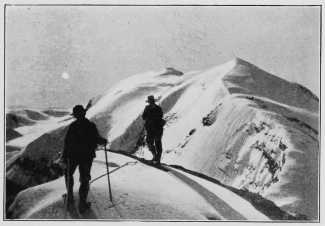
On a snow ridge.
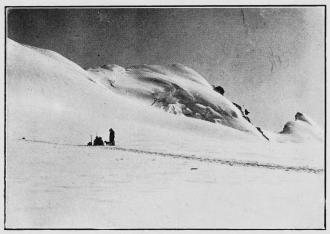
A halt for lunch above the snow line.
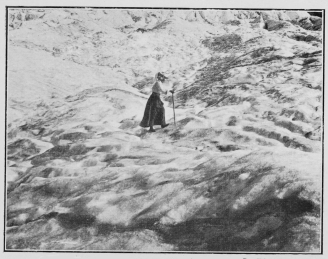
Mrs. Aubrey le Blond, 1903. By Royston Le Blond.
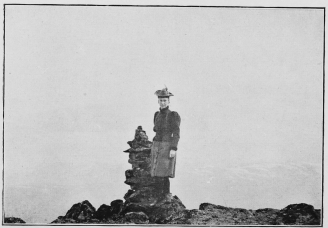
Mrs. Aubrey le Blond. By Joseph Imboden.
To face p. 51.