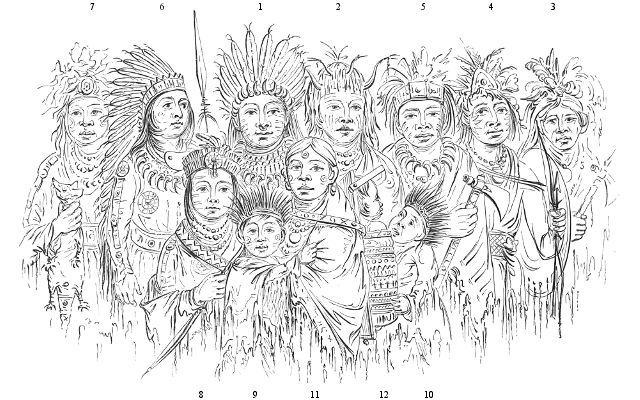
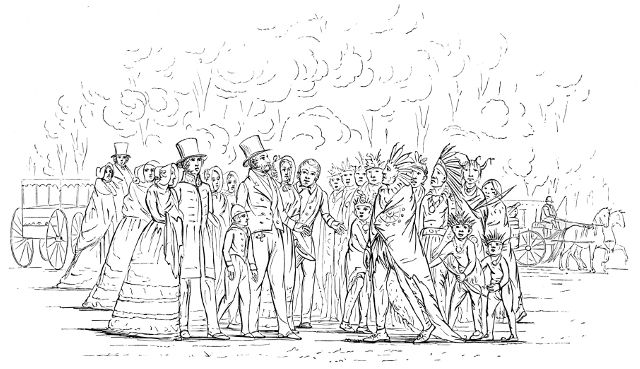
The Ioways in Vauxhall Gardens—Surrey Theatre—Carter in
the lions’ cage—Astonishment of the Indians—Indians in
the Diving Bell, at the Polytechnic Institution—Indians
riding—Shooting at target on horseback—Ball-play—“Jolly
fat dame”—Ladies converse with the Doctor—His reasons for
not marrying—Curious questions—Plurality of wives—Amusing
scene—The Author in Indian costume—A cruel experiment—Ioways
arrive in Birmingham—The Author’s arrival there—Society of
Friends—Indians all breakfast with Mr. Joseph Sturge—Kind
treatment—Conversation after breakfast about religion and
education—Reply of the War-chief—The button-factory of Turner
and Sons—Generous presents to the Indians—Bobasheela
arrives—Indians dividing their buttons—Doctor found
on top of the Shakespeare Buildings—Indians’ kindness
to a beggar-woman—Poor-houses—Many Friends visit the
Indians—Indians’ visit to Miss Catherine Hutton—Her
great age—Her kindness—Dinner—Her presents to them in
money—Parting scene—The War-chief’s speech to her—Her
letters to the Author—Indians present to the two hospitals 370
dollars—Address read by the Presidents to the Indians—Doctor’s
reply—Indians start for York—A fox-hunt—Curious notions
of Indians about it—Visit to York Minster—Ascend the grand
tower—Visit to the castle and prison—Museum of the instruments
of murder—Alarm of the Doctor—Kindness of the governor of the
castle and his lady—Indians’ ideas of imprisonment for debt,
and punishment for murder.
The scene of the Indians’ amusements was now changed from the Egyptian
Hall to the open air in Vauxhall Gardens, and their dances and other
exercises were given in the afternoon. Their lodgings were also changed
at the same time to the buildings within the enclosure of the gardens.
This arrangement was one of very great pleasure to the Indians, as it
allowed a free space to exercise in during their leisure hours, amongst
trees and shrubbery, affording them almost a complete resumption of
Indian life in the wilderness, as they had the uninterrupted range
of the gardens during the hours that the public were not there to
witness their amusements. This arrangement was pleasing to them in
another respect, and to us also, as there were many things they were
yet anxious to see in London, and which, as they could only be seen at
night, our former arrangements had entirely precluded them from seeing.
Under these new arrangements they still had their omnibus drives,
and at night attended the parties of numerous friends who had been
desirous to show them some attentions, and also were taken to several
instructive exhibitions, and to two or three of the principal theatres.
We were then in the vicinity of the Surrey Theatre, where Mr. Carter,
“the lion-tamer,” invited them several times to witness his wonderful
feat of going into the lion’s cage. This scene was one of the most
impressive and exciting nature to them, and will probably be as long
recollected by them as the wonders opened to their minds at the
fountain of chickabobboo.
The Polytechnic Institution was one I took great pleasure in
accompanying them to; and a scene of much amusement for a numerous
audience as well as amusing and astonishing to themselves, was that
of their descending in the diving-bell. They were at first afraid of
it, but after the Doctor had made a descent with me, and come out
unhurt and unwet, several others went down with Mr. Melody, others with
Jeffrey—the old War-chief with his old friend Bobasheela, and so
on, until every one of the party, men, women, and children, went down
and experienced the curious sensation of that (to them) greatest of
medicine affairs.
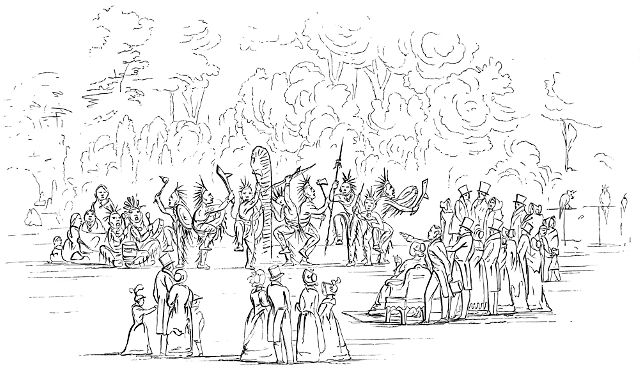
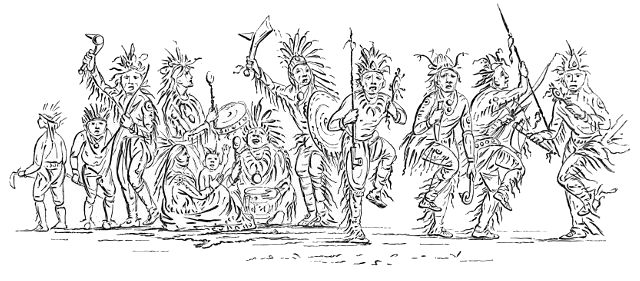
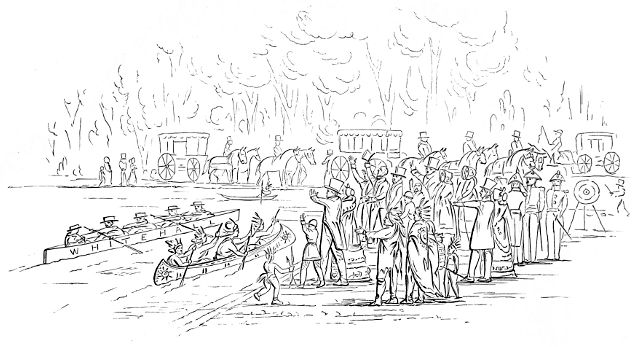
In Vauxhall Gardens the Indians erected their four wig-wams of buffalo
hides, and in darting into and about them during their various games
and amusements, whilst the blue smoke was curling out of their tops,
presented one of the most complete and perfect illustrations of an
Indian encampment that could possibly have been designed. It was the
thing itself, and the very men, women, and children living and acting
on a similar green turf, as they do on the prairies of the Missouri.
In the amusements as there given, there was an addition to those which
had been made in Lord’s Cricket-ground some weeks before, having in
Vauxhall brought horses in to add, with equestrian exercises, to the
completion of all the modes practised by this tribe. The Ioways, like
most of the Indians of the prairies of America, subsist upon the food
of the buffalo, and kill them from their horses’ backs, with their bows
and arrows, while running at full speed. In the same manner they meet
their enemies in battle, in which they carry their shield and lance.
Thus fully equipped, with their own native shields and lances, and
bows, and even the saddles and trappings for their horses, they all
mounted upon their backs, in the midst of their amusements, and dashing
off at full speed, illustrated their modes of drawing the bow as they
drove their arrows into the target, or made their warlike feints at it
with their long lances as they passed.
This formed the most attractive part of their exhibition, and thousands
flocked there to witness their powers of horsemanship and skill in
prairie warfare. This exciting exhibition which pleased the visitors, I
could have wished might have been less fatiguing, and even dangerous,
to the limbs of the Indians than it actually was from the awkwardness
and perverseness and fright of the horses, not trained to Indian modes.
With all these difficulties to contend with, however, they played
their parts cheerfully and well, and the spectators seemed highly
pleased. Amidst the throngs who visited them here, we could discover
most of their old standard friends and admirers, who came to see them
on horseback, and in the beautiful game of ball, in the open grounds
of Vauxhall, where they could more easily approach and converse with
them; and amongst such, the “jolly fat dame” was present, and more
pleased than ever, when she could catch the Doctor’s smile as he passed
by her at full speed, and raising his shield of buffalo’s hide upon
his arm, he darted his long lance in feints at her breast, and sounded
the piercing war-cry. The vanity of the Doctor was so well suited in
this mode of the exhibition, where he could dash by ranks and files,
and even phalanxes of ladies, with the endless flourishes of his shield
and lance, that he soon began to exhibit convincing evidences that
his ambition and his vanity were too much for his bodily resources,
which it became necessary to replenish occasionally by refusing him
his horse, on which occasions he made good use of his time, by placing
himself, wrapped in his robe, with his fan in his hand, by the side
of the ladies, with whom he could exchange by this time a few words,
and many significant looks and gestures, which never failed to amuse,
and seldom failed to operate upon their generous feelings, which were
constantly adding to the contents of his tobacco pouch, which was
now known to be a reservoir for money and trinkets of various kinds,
instead of tobacco.
I happened to be by the side of the Doctor on one of these occasions,
when I became so much amused with the questions and answers, that I
immediately after retired and committed them to my note book. A number
of jolly fat dames, of middle and knowing age, had drawn themselves
around the Doctor, and looking over their shoulders and under their
arms, a number of delicate and coy little girls. And having called
Jeffrey to translate, they were enabled to get the gist of all he
said, without loss from modesty or evasion, which seemed to be exactly
what they most desired. His friend Jim having seen him thus enveloped,
turned his horse loose and came to his aid (or countenance), and as
the old man hesitated, Jim gave him the nod and the wink to be plain
in his replies. They had first asked him if he was married? to which
he replied “No.” They then asked him why he did not get him a wife? he
said “He had always been very particular about giving offence to the
women, and he had feared that if he selected one in preference to the
others, that the others would all be offended.” This queer reply raised
a great laugh amongst the crowd, and encouraged the Doctor to go on.
Some one of the ladies then told him she feared he did not admire the
ladies enough? he said, “he had always believed that the reason he did
not get married was, that he admired them too much; he saw so many that
he wanted, that he had never decided which to take, and so had taken
none.” Melody came up at this time, and seemed a little vexed, and
said, “Catlin, you had better call that old fool away, those people
will spoil him, he is quite vain enough now.” “Oh, no,” said I, “let
him alone, he is gratifying the ladies, and we shall see, in a few
moments, which is the fool, he or the ladies who are questioning him.”
Melody smiled, and looked on.
“I have been told,” said one of the ladies, “that some of the Indians
have a number of wives: is that so?”
“Yes,” the Doctor replied in English, “sometimes have a heap.” (The
ladies all laughed.) Two or three inquired what a “heap” was? Jeffrey
said, “Why, ma'am, it is what in our country means a ‘lot:’ you know
what they call a ‘lot’ here?” “Oh, yes! it means a great many.” “Yes,
a number.” “Well, tell the Doctor I want to know what they do with so
many?”
Here the poor Doctor was quite at a loss to know what to say; one thing
he was sure to do—he smiled—and it seemed as if he wished that to
go for an answer: and it might have done so with most of her sex, but
in this instance it was not quite satisfactory, and the question was
again put: to which the big-mouthed Jim, who I said had come to the
relief of his friend, and who had a wife of his own, put in an instant
reply, which relieved the Doctor, and seemed very much to embarrass the
lady, for she instantly added, (as all were bursting with laughter,)
“That isn’t what I mean: I want to know how a chief can get along with
so many, how he can manage them all, and keep them in good humour and
satisfied; for,” said she, “in this country, one is quite as much as a
man can manage.”
This seemed to afford the Doctor a little relief, and he was evidently
able to go on again, as he smilingly said, “It was quite easy, as
Indian women were much more peaceable and quiet than white women,
it was much more easy he thought to manage them; they drank no
chickabobboo, and therefore did not require so much watching as white
women.”
The lady seemed quite balked in the debate she was about entering on
with the Doctor, from her ignorance of the meaning of chickabobboo,
and asked for an explanation of it, as if for all the company about; to
which Jim put in (again in plain English), “Gin!” “Oh! Doctor,” said
she, “I hope you don’t accuse the ladies of London of drinking gin?”
The Doctor replied, that “he had not seen them do it, but that he had
been told that they did, and that it was the reason why the ladies here
grew so large and so fat.” He said, “that they could always look out of
the windows, where he lived, and just before going to bed they could
see any night a hundred women going home with pitchers full of it,
to drink after they got into bed, so as to sleep sound: and that one
night, coming home in their carriage at a late hour, from a distance,
where they had been to see a show, he and Jim had counted more than
three hundred women running along in the street, with pitchers filled
with it in their hands, to drink as they were going to bed.”
The lady’s explanation of this, that “It was only harmless ale that
these women were carrying in for their masters and mistresses,” excited
the Doctor’s smiles, but no reply.
She seemed not satisfied yet about the first subject that she had
started, and reverting to it again, said, “Well, Doctor, I can’t excuse
the Indians for having so many wives. I like the Indians very much, but
I don’t like that custom they have; I think it is very cruel and very
wicked. Don’t you think it is wrong?”
The Doctor studied a moment, and replied, “that it might be wrong, but
if it was, he didn’t see that it was any worse than for white women
to have a number of husbands.” “But what, Doctor, what do you mean? I
hope you have not so bad an opinion of white women as that?” To this
he very coolly replied, “that when they drank a great deal of gin, he
believed, from what he had seen in his practice, that a woman would
require more than one husband; and that since he had been in London
he had seen many walking in the streets, and some riding in fine
carriages, whom he thought, from their looks, must have more than one
husband: and from what he had been told, he believed that many women in
London had a heap!” “That’s a lot!” (cried out a very pretty little
girl, who had been listening, and, frightened at her own unintentional
interpretation, started to run.)
“Come, come, Catlin,” said Melody, “pull the old fellow out, and take
him away;” and so the debate ended, amidst a roar of laughter from all
sides.
One more of the hundred little reminiscences of Vauxhall, and we will
leave it. I have already said, that in the spacious apartments of
Vauxhall, unoccupied, the Indians were quartered, and took their meals;
and during the forepart of the day, between their breakfast and the
hour of their afternoon exhibitions, their time was mostly spent in
strolling around the grounds, or at their varied amusements. Many of
my personal friends finding this a pleasing opportunity to see them,
were in the habit of coming in, and amusing themselves with them. I
had accidentally heard of a party of ladies preparing to come on a
certain morning, some of them my esteemed friends, and others strangers
to me: and from a wish to get relieved from a fatiguing conversation,
as well as from a still stronger desire for amusement, I selected
from my wardrobe a very splendid dress, head-gear and all complete,
and fully arranged myself in Indian costume, “cap-à-pied,” with face
fully painted, and weapons in hand; and at the hour of their arrival
in the house, took care to be strolling about in the grounds with
Wash-ka-mon-ya (Jim). Whilst the ladies were amused with the party in
the house, where there were constant inquiries for me, two of them
observing us two beaus sauntering about in the garden, came out to keep
us company, and to talk to us, and with themselves, in the English
language, which of course we Indians knew nothing of: when we shook
our heads to their inquiries, “Do you speak English, good Indians?” I
saw they did not recognize me, yet I trembled for fear, for they were
lovely women, and every sentence almost which they uttered would have
made the discovery more cruel: we held ourselves dignified and dumb;
whilst they, poor things, were so much regretting that we could not
understand what they said. They finished their visit to us and their
remarks, and returned, leaving me to regret my folly upon which I had
thoughtlessly entered.
Several weeks were spent in their daily exhibitions in Vauxhall, and,
as one can easily imagine, much to the satisfaction of the Indians,
and, I believe, much to the amusement of the visitors who came to see
them. Within the last week of their exhibition I admitted from charity
schools 32,000 children, with their teachers, free of charge; to all of
whom I gave instructive lectures on the position of the tribe, their
condition, their customs and character: and explained also the modes,
which were acted out by 14 living Indians before their eyes; and but
one of these schools ever communicated with me after, to thank me for
the amusement or instruction; which might not have been a curious
omission, but I thought it was, at the time.
With the amusements at Vauxhall ended my career in London; and
contemplating a tour to several of the provincial towns, in company
with the Indians, I took my little family to Brighton, and having
left them comfortably situated and provided for, I joined the party
in Birmingham, where they had arrived and taken lodgings. The idea
of moving about pleased the Indians very much, and I found them all
in high spirits when I arrived, delighted to have found that the
chickabobboo was the same there as in London, and was likely to
continue much the same in all parts of the kingdom to which they should
go. There was an unfortunate offset to this pleasing intelligence,
however, which seemed to annoy them very much, and of which they were
making bitter complaint. On leaving London for the country, they had
spent some days, and exercised all their ingenuity, in endeavouring
to clean their beautiful skin dresses, which the soot of London had
sadly metamorphosed; and on arriving in Birmingham they had the extreme
mortification to anticipate, from appearances, an equal destruction of
that soft and white surface which they give to their skin dresses, and
which (though it had been entirely lost sight of during the latter part
of their stay in London) had, with great pains, been partially restored
for a more pleasing appearance in the country.
Though I had several times passed through Birmingham, and on one
occasion stopped there a day or two, I entered this time a total
stranger, and in rather a strange and amusing manner. On my journey
there by the railway, I had fallen in company and conversation with a
very amusing man, who told me he was a commercial traveller, and we had
had so much amusing chat together, that when we arrived, at a late hour
at night, I was quite happy to follow his advice as to the quarters we
were to take up in the town, at least for the night. He said it was
so late that the hotels would be closed, and that the commercial inn,
where he was going, was the only place open, and I should find there
everything to make me comfortable, and a very nice sort of people. We
took an omnibus for town, and as there was only room for one inside, he
got upon the top, and so we went off; and getting, as I supposed, into
or near the middle of the town, the bus stopped at a “commercial inn,”
which was open, and lighted up in front, and a number of passengers
getting out, and others down from the top, I was seeing to get my
luggage in safe, and the omnibus drove off with my jolly companion
still on the top; or this I presumed, as he was not left behind. My
only alternative now was, to make the best of it, and be as comfortable
as I could; so I got into the “commercial room,” and having been told
that I should have a bed, I felt quite easy, and told the plump, tidy
little landlady, who was waiting upon me herself, that I would have
a mug of ale and a biscuit, and then be ready to go to bed. As she
turned round to execute my command, she met a party consisting of three
young women, and a man leading one of them on his arm, and in his hands
carrying three or four carpet-bags and band-boxes, just got down from
the same bus, and entering the inn on the same errand that I was on.
“ Madam,” said he, “what have you?”—“Hevery-think, sir, that you can
wish.” “Well, one thing we must have, that is, two beds.”—“They are
ready, sir.” “Well, ladies,” said he, “suppose we take a drop of wet.”
This agreed to, the “wet” was brought in in a moment, and also my mug
of ale.
A very genteel-looking little man whom I had seen in the same carriage
with me, and now sitting in the room before me, with his carpet-bag
by the side of him, and his umbrella in his hand, addressed me,
“Stranger, you’ll allow me.”—“Certainly, sir.” “I think I heard you
tell a gentleman in the carriage that you were from New York.”—“Yes,
I did so.” “I’m from there. I left there four months ago, and I’ve
gone ahead, or I’ll be shot. How long have you bin from there,
sir?”—“About five years.” “Hell! there’s been great fixins there in
that time; you’d scarcely know New York now; look here, isn’t this the
darndest strange country you ever saw in your life? rot ’em, I can’t
get ’em to do anything as I want it done; they are the greatest set of
numskulls I ever saw; now see, that little snub of a petticoat that’s
just gone out there, I suppose she is cock of the walk here too; she’s
been all civility to you, but I’ve had a hell of a blow up with her;
I was in here not five minutes before you by the watch, and I spoke
for a bed and a mug of ale; she brought me the ale, and I told her to
bring me a tumbler and a cracker, and she turned upon me in a hell of a
flare-up. She said she was very much obliged to me for my himpudence,
she didn’t allow crackers in her house, and as for ’tumblers,' they
were characters she never had anything to do with, thank God; they
were a low set of creatures, and they never got any favour about her
house. She wanted to know what quarter I came from. I told her I wasn’t
from any quarter, I was from half—half the globe, by God, and the
better half too—wasn’t I right, stranger? She said her house was a
hinn, to be sure, but she didn’t hentertain blackguards, so there was
my hale, and I might drink it hup and be hoff, and be anged, and then
she cut her string quicker than lightning; now isn’t she a hard un? I
don’t suppose there is another house open in this darned outlandish
place at this time of the night; what the devil shall I do? you are
fixed snug enough.” “Oh, well, never mind,” said I, “be quite easy, it
is settled in a moment,”—as I rung the bell. The tidy little landlady
came in again, and I said, “This gentleman will have a glass if you
please, and a biscuit.”—“Hif he was a gentleman, Sir,” said she,
“but I assure you, Sir, is beaviour as'nt been much like it.” “Well,
well,” said I, “never mind it now, you will be good friends after a
little better understanding—he comes from a country where a glass
is a tumbler and a biscuit is a cracker: now, if you had known
this, there would have been no difficulty between you.” “Ho, that I
hadmit, but it’s very hodd.” “Never mind that, you will find him a good
fellow, and give him his bed.” “Is bed, Sir?—hit’s too late; it’s been
hoccupied hever since you entered the ouse—the only chance his for you
and im to turn hin.” “Well,” said I, “never mind, he and I will manage
that; it is after midnight, and I suppose the other houses are all
shut?” “I’ll hanswer for that: hif you are ready, gentlemen, I’ll show
you hup.” My friend kept by my side, but knowing the gloomy fate that
awaited him if he got into the street again, he kept entirely quiet
until the little landlady was down stairs. “There,” said he, “isn’t she
a roarer? I could have settled the hash with her myself in a twinkling,
if she had only let me have said five words, but her tongue run so
slick that I couldn’t get the half of a word in edgewise.”
My new acquaintance and I talked a little more before we “turned in,”
but much more after we had got into bed. He could command words and
ideas fast enough when he was on his feet; but I found in him something
of Jim’s peculiarity, that he thought much faster and stronger when
on his back; and for half an hour or so I reaped the benefit of the
improvement. How long I heard him, and how much he actually said, I
never could tell exactly; but what he said before I went to sleep I
always distinctly recollected, and a mere sentence or two of it was
as follows:—“Well, stranger, here we are: this is droll, ain’t it?
‘hodd,’ as the landlady would call it. I’d a been in the streets
to-night as sure as catgut if it hadn’t been for you. God knows I am
obliged to you. Youv'e got a sort o’ way o’ gettin' along ur' these
ere darned, ignorant, stupid sort o’ beings. I can’t do it: dod rot
'em! they put me out at every step; they are so eternally ignorant;
did you ever see the like? I suppose you are going to stop awhile in
Birmingham?” “A few days.” “I shall be here a week, and be bright
and early enough to get into a decenter house than this is, and be
glad to join you. I was told in London that the Ioway Indians went on
here yesterday. I’m damned anxious to meet them: you’ve seen them, I
suppose?” “Yes, I saw them in London.” “Well, I did not; I was just
too late; but I must go and look 'em up to-morrow: they know me.” “Then
you have seen them'?” “Oh, dam 'em, yes: I’ve known 'em for several
years: they’ll be at home with me at once. I’ve run buffaloes with
White-Cloud, the chief, many and many a time. He and I have camped out
more than once. They are a fine set of fellows. I’m going to spend some
time with them in Birmingham. I know 'em like a book. Oh yes, they’ll
know me quick enough. I was all through their country. I went clean
up Lake Superior, nearly to Hudson’s Bay. I saw all the Chippeways,
and the Black-feet, and the Crows, Catlin’s old friends. By the way,
Catlin, I’m told, is with these Indians, or was, when they were in
London—he’s all sorts of a man.” “Have you seen him?” “Seen him?
why, dam it, I raised him, as the saying is: I have known him all
my life. I met him a number of times in the Prairie country; he’s a
roarer.” This was about the last that I distinctly recollected before
going to sleep; and the next morning my vigilant and wide-awake little
bedfellow, being about the room a little before me, where my name was
conspicuous on my carpet bag and writing-desk, &c., had from some cause
or other thought it would be less trouble and bother to wend his way
amongst these “stupid and ignorant beings” alone, than to encounter
the Indians and Mr. Catlin, and endeavour to obliterate the hasty
professions he had made; and therefore, when I came down and called for
breakfast for two, the landlady informed me that my companion had paid
his bill and left at an early hour. I was rather sorry for this, for he
was quite an amusing little man, and I have never heard of him since.
I found the dumpy little landlady kindly disposed, and she gave me a
very good breakfast, amusing me a great deal with anecdotes of the
party who called for “a little bit of wet;” she informed me they were
a wedding-party, and the man who had the lady on his arm was the
bride-groom. While waiting for my breakfast I was much amused with
some fun going on in the street before the window. It seems that the
house directly opposite had been taken by a couple of tidy-looking
young women who were sisters, and that, having established a millinery
business on the lower floor, they had several apartments which they
were anxious to underlet in order to assist them in paying their heavy
rent. Young gentlemen are everywhere in this country considered the
most desirable lodgers, as they give less trouble than any others,
are less of the time at home, and generally pay best. These young
adventurers had been therefore anxious to get such a class of lodgers
in their house, and had, the day before, employed a sign-painter to
paint a conspicuous board, in bright and glaring letters, which was
put up on a post erected in the little garden in front of their house,
near the gate. The announcement ran, when the young ladies retired to
bed, “Lodgings for single gentlemen”—a customary and very innocent
way of offering apartments; but owing to the cruelty of some wag during
the night it was found in the morning, to the great amusement of the
collected crowd, to read, “Longings for single gentlemen.” How long
this continued to amuse the passers-by, or how it might have affected
the future prospects of the poor girls, I cannot of course tell, as I
forthwith proceeded to a more pleasant part of the town. Birmingham
I found on further acquaintance to be one of the pleasantest towns
I visited in the kingdom, and its hotels and streets generally very
different from those into which my commercial travelling acquaintance
had that night led me.
Mr. Melody had all things prepared for our exhibition when I arrived,
having taken the large hall in the Shakspeare Buildings, and also
procured rooms for the Indians to sleep in in the same establishment.
The Indians and myself were kindly received in Birmingham, for which,
no doubt, they, like myself, will long feel grateful. The work which I
had published had been extensively read there, and was an introduction
of the most pleasing kind to me, and the novelty and wildness of the
manners of the Indians enough to ensure them much attention.
In their exhibition room, which was nightly well attended, we observed
many of the Society of Friends, whom we could always easily distinguish
by their dress, and also more easily by the kind interest they
expressed and exhibited, whenever opportunity occurred, for the welfare
of those poor people. The Indians, with their native shrewdness and
sagacity, at once discovered from their appearance and manner that
they were a different class of people from any they had seen, and were
full of inquiries about them. I told them that these were of the same
society as their kind friend Dr. Hodgkin, whom they so often saw in
London, who is at the head of the Aborigines Protection Society, who
was the first person in England to invite them to his table, and whom
the reader will recollect they called Ichon-na Wap-pa(the straight
coat); that they were the followers of the great William Penn, whom I
believed they had heard something about. They instantly pronounced the
name of “Penn, Penn,” around the room, convincing me, as nearly every
tribe I ever visited in the remotest wildernesses in America had done,
that they had heard, and attached the greatest reverence to, the name
of Penn.
These inquiries commenced in their private room one evening after the
exhibition had closed, and they had had an interview in the exhibition
room with several ladies and gentlemen of that society, and had
received from them some very valuable presents. They all agreed that
there was something in their manners and in their mode of shaking
hands with them that was more kind and friendly than anything they had
met amongst other people; and this I could see had made a sensible
impression upon them.
I took this occasion to give them, in a brief way, an account of the
life of the immortal William Penn; of his good faith and kindness in
all his transactions with the Indians, and the brotherly love he had
for them until his death. I also gave them some general ideas of the
Society of Friends in this country, from whom the great William Penn
came;—that they were the friends of all the human race; that they
never went to war with any people; that they therefore had no enemies;
they drink no spirituous liquors; that in America and this country
they were unanimously the friends of the Indians; and I was glad to
find that in Birmingham we were in the midst of a great many of them,
with whom they would no doubt become acquainted. There were here some
inquiries about the religion of the Friends, which I told them was the
Christian religion, which had been explained to them; that they were
all religious and charitable, and, whatever religion the Indians might
prefer to follow, these good people would be equally sure to be their
friends. They seemed, after this, to feel an evident pleasure whenever
they saw parties of Friends entering the room: they at once recognised
them whenever they came in, and, on retiring to their own room,
counted up the numbers that had appeared, and made their remarks upon
them. In one of these conversations I pleased them very much by reading
to them a note which I had just received from Mr. Joseph Sturge, with
whom I had been acquainted in London, and who was now residing in
Birmingham, inviting me to bring the whole party of Indians to his
house to breakfast the next morning. I told them that Mr. Sturge was a
very distinguished man, and one of the leading men of the Society of
Friends. This pleased them all exceedingly, and at the hour appointed
this kind gentleman’s carriages were at the door to convey the party
to his house. Mr. Melody and Jeffrey accompanied us, and there were
consequently seventeen guests to be seated at this gentleman’s
hospitable board, besides a number of his personal friends who were
invited to meet the Indians. After receiving all in the most cordial
manner, he read a chapter in his Bible, and then we were invited to
the table. This interview elicited much interesting conversation, and
gained for the Indians and Mr. Melody many warm and useful friends.
Before taking leave, the War-chief arose, and, offering his hand to Mr.
Sturge, made the following remarks:—
“My Friend,—The Great Spirit, who does everything that is good, has
inclined your heart to be kind to us; and, first of all, we thank Him
for it.
“The Chief, White Cloud, who sits by me, directs me to say that we
are also thankful to you for this notice you have taken of us, poor
and ignorant people, and we shall recollect and not forget it.
“We hope the Great Spirit will be kind to you all. I have no more to
say.”
The simplicity of this natural appeal to the Great Spirit, and its
close (in which they were commended by the poor and unenlightened
Indian of the wilderness to the care and kindness of their God), seemed
to create surprise in the minds of the audience, and to excite in the
Indians’ behalf a deep and lively interest.
After the breakfast and conversation were over, the whole party was
kindly sent back by the same carriages, and the Indians returned in a
state of perfect delight with the treatment they had met with, and the
presents they had received.
Poor Jim (the student and recorder) was anxious that I should write
down the name of William Penn in his book, and also that of the
gentleman who had just entertained us, that he might be able to repeat
them correctly when he got back to the wilderness again, and have
something to say about them.
We found on our return that the hour of another engagement was at hand,
and carriages were soon prepared to take us to the button-factory of
Messrs. Turner and Son, to which we had been kindly invited; and on our
arrival we found ourselves most cordially received and entertained.
The proprietor led the party through every room in his extensive
establishment, and showed them the whole process of striking the
buttons and medals from various dies, which pleased them very much,
and, after showing and explaining to them all the different processes
through which they passed in their manufacture, led them into his
ware-room or magazine, where his stock on hand was exhibited, and
package after package, and gross upon gross, of the most splendid and
costly buttons were taken down, and by his own generous hand presented
to them. These were such brilliant evidences of kindness, and would
be so ornamental to the splendid dresses which they and their wives
were to have when they got home, that they looked upon them as more
valuable than gold or silver. These were presented to them in the
aggregate, and all carried in a heavy parcel by the interpreter; and
when they had thanked the gentleman for his munificent liberality and
got back to their rooms, a scene of great brilliancy and much interest
and amusement was presented for an hour or two, while they had their
treasures spread out, covering half of the floor on which they lodged,
and making a per capita division of them.
In the midst of this exhilarating and dazzling scene, their old friend
Bobasheela made his appearance, having just arrived from London on
his way to Cornwall. He could not, he said, pass within a hundred
miles of them without stopping to see them a few days, and smoke a
pipe or two with them again. Bobasheela was stopped at the door,
notwithstanding their love for him; he could not step in without doing
sacrilege with his muddy boots to the glittering carpet of buttons
which they had formed on the floor, and upon which his eyes were
staring, as he thought at the first glance they could have committed
no less a trespass than to have plundered a jeweller’s shop. A way was
soon opened for his feet to pass, and, having taken a hearty shake of
the hand with all, he was offered a seat on the floor, and in a few
moments found that an equal parcel was accumulating between his knees
as in front of each, and that, instead of fourteen, they were now
dividing them into fifteen parcels. This he objected to, and with much
trouble got them to undo what they had done, and go back to the first
regulation of dividing them equally amongst fourteen.
The Shakspeare Buildings afforded the Indians a fine promenade in its
large portico overlooking the street, where all Birmingham passed
before their eyes, giving them one of the most gratifying privileges
they had had, and promising them a rich and boundless means of
amusement; but their enjoyment of it was short, for the crowds that
assembled in the streets became a hinderance to business, and they were
denied the further privilege of their delightful look-out. They were
therefore called in, and stayed in, and yet the crowd remained, and
could not be dispersed, while their attention seemed fixed upon some
object higher up than the portico, which led us at once to surmise its
cause, and, searching for the old Doctor, he was not to be found: he
was, of course, upon the pinnacle of the house, wrapped in his robe,
smiling upon the crowd beneath him, and taking a contemplative gaze
over the city and country that lay under his view. I could only get
to him by following the intricate mazes through which the old lady
(curatress) conducted me, and through which the Doctor said he had
required several days of investigation to find his way, and which he
had never succeeded in until just at that moment.
Under this rather painful embargo there was no satisfactory way of
peeping into the amusements of the streets but by going down the
stairs, which Jim and his ever-curious friend the Doctor used daily
and almost hourly to do, and, standing in the hall, see all they could
that was amusing, until the crowd became such that it was necessary to
recall them to their room. On one of these occasions they had espied
a miserably poor old woman, with her little child, both in rags, and
begging for the means of existence. The pity of the kind old Doctor was
touched, and he beckoned her to come to him, and held out some money;
but fear was superior to want with her, and she refused to take the
prize. The Doctor went for Daniel, who, at his request, prevailed upon
the poor woman to come up to their room, by assuring her that they
would not hurt her, and would give her much more than white people
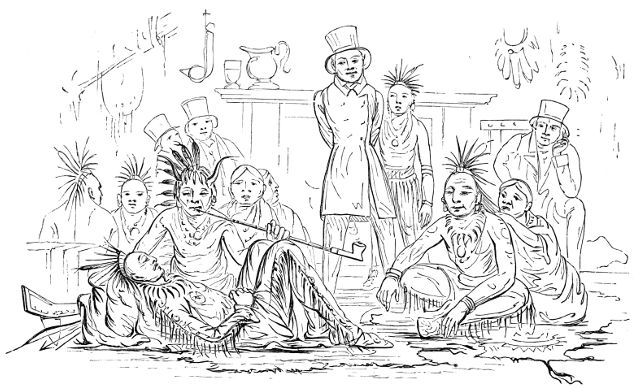
would. She came up with Daniel, and the Indians, all seated on the
floor, lit a pipe as if going into the most profound council; and so
they were, for with hearts sympathizing for the misery and poverty
of this pitiable-looking object, a white woman and child starving to
death amidst the thousands of white people all around her in their fine
houses and with all their wealth, they were anxious to talk with her,
and find out how it was that she should not be better taken care of.
Jeffrey was called to interpret, and Melody, Bobasheela, Daniel, and
myself, with two or three friends who happened to be with us at the
time, were spectators of the scene that ensued. The War-chief told her
not to be frightened nor to let her little child be so, for they were
her friends; and the Doctor walked up to her, took his hand out from
under his robe, put five shillings into hers, and stepped back. The
poor woman curtsied several times, and, crossing her hands upon her
breast, as she retreated to the wall, thanked “his Honour” for his
kindness. “The Lard be with your Honours for your loving kindness, and
may the Lard of Haven bless you to al etarnity, for ee niver e thaught
af sich threatment fram sich fraightful-lukin gantlemin as ee was a
thakin you to ba.”
The War-chief then said to her, “There, you see, by the money we have
been all of us giving out of our purses, that we wish to make you happy
with your little child, that you may have something for it to eat;
you see now that we don’t wish to hurt you, and we shall not; but we
want to talk with you a little, and before we talk we always make our
presents, if we have anything to give. We are here poor, and a great
way from home, where we also have our little children to feed; but the
Great Spirit has been kind to us, and we have enough to eat.” To this
the Indians, who were passing the pipe around, all responded “How!
how! how!”
The old chief then proceeded to ask the poor woman how she became so
poor, and why the white people did not take care of her and her child.
She replied that she had been in the workhouse, and her husband was
there still; she described also the manner in which she had left it,
and how she became a beggar in the streets. She said that when she
and her husband were taken into the poorhouse they were not allowed
to live together, and that she would rather die than live in that way
any longer, or rather beg for something to eat in the streets as she
was now doing; and as the cold weather was coming in, she expected her
child and herself would be soon starved to death.
The poor Indians, women and all, looked upon this miserable
shivering object of pity, in the midst of the wealth and luxuries of
civilization, as a mystery they could not expound, and, giving way to
impulses that they could feel and appreciate, the women opened their
trunks to search for presents for the little child, and by White
Cloud’s order filled her lap with cold meat and bread sufficient to
last them for a day or two. The good old Doctor’s politeness and
sympathy led him to the bottom of the stairs with her, where he made
her understand by signs that every morning, when the sun was up to a
place that he pointed to with his hand, if she would come, she would
get food enough for herself and her little child as long as they
stayed in Birmingham; and he recollected his promise, and made it his
especial duty every morning to attend to his pensioners at the hour
appointed.[27]
The moral to be drawn from all this was one of curious interest and
results in the minds of the Indians, and a long conversation ensued
amongst them, in which Daniel and their friend Bobasheela (who were
familiar with the sufferings and modes of treatment of the poor) took
part, and which, as Melody and I had withdrawn, afterwards gave us
some cause to regret that such a pitiable object of charity had been
brought into their presence for the temporary relief they could give
her, and which resulted in so glaring an account of the sum total of
misery and poverty that was constantly about them, of the extent of
which we both began to think it would have been better to have kept
them ignorant. Daniel and Bobasheela had opened their eyes to the
system of poorhouses and other public establishments for the employment
and protection of the poor; and until this account, which was already
entered in Jim’s book, had been given them by these two knowing
politicians, they had but little idea of this enormous item that was to
go into the scales in weighing the blessings of civilization.
Almost daily visits were now being made to their private rooms by
parties of ladies and gentlemen of the Society of Friends, with whom
they were rapidly advancing into the most interesting acquaintance,
and which I observed it was affording Mr. Melody almost unspeakable
satisfaction to behold. They were kindly invited to several houses, and
treated at their tables with the greatest friendship. Of these, there
was one visit that it would be wrong for me to overlook and to neglect
to give here the notes that I made of it at the time.
A note was written to me in a bold and legible hand by Miss Catherine
Hutton, desiring to know “at what hour it would be suitable for her to
come from her house, a few miles out of town, to see the Indians (for
whom she had always had a great love), so as not to meet a crowd, for
her health was not very good, being in the ninety-first year of her
age.” This venerable and most excellent lady I held in the highest
respect, from a correspondence I had held with her on the subject
of the Indians ever since I had been in England, though I never had
seen her. Her letters had always teemed with love and kindness for
these benighted people, and also with thanks to me for having done so
much as I had for their character and history. I therefore deemed it
proper to respond to her kindness by proposing to take the whole party
to her house and pay her the visit. Her note was answered with that
proposition, which gave her great pleasure, and we took a carriage and
went to her delightful residence.
We were received with unbounded kindness by this most excellent and
remarkable lady, and spent a couple of hours under her hospitable roof
with great satisfaction to ourselves, and with much pleasure to her,
as her letter to me on the following day fully evinced.[28] After a
personal introduction to each one in turn, as she desired, and half
an hour’s conversation, they were invited into an adjoining room to a
breakfast-table loaded with the luxuries she had thought most grateful
to their tastes. This finished, another half-hour or more was passed in
the most interesting conversation, containing her questions and their
answers, and her Christian advice to prepare their minds for the world
to which, said she, “we must all go soon, and, for myself, I am just
going, and am ready.” When we were about to take our leave of her, she
called each one up in succession, and, having a quantity of money in
silver half-crowns placed on the sofa by her side, she dealt it out to
them as they came up, shaking hands at the same time and bidding each
one a lasting farewell, embracing each of the women and children in her
arms and kissing them as she took leave. This kindness melted their
hearts to tears, and brought old Neu-mon-ya (the War-chief) up before
her at full length, to make the following remarks:—
“My Friend,—The Great Spirit has opened your heart to feel a
friendship for the red people, and we are thankful to Him for it. We
have been happy to see your face to-day, and our hearts will never
forget your kindness. You have put a great deal of money into our
hands, which will help to feed our little children, and the Great
Spirit will not forget this when you go before him.
“My kind Mother,—You are very old. Your life has been good; and the
Great Spirit has allowed you to live to see us; and He will soon call
you to Him. We live a great way from here, and we shall not look upon
your face again in this world; though we all believe that, if we
behave well enough, we shall see your face in the world to come.”
The chief here stopped, and, shaking her hand again, withdrew. The
excellent lady was overwhelmed in tears, and called to her maid,
“Betty, bring all the silver that I left in the drawer there; bring the
whole of it and divide it among them; my eyes are so weak that I cannot
see it—give it to them, dear creatures! May God bless their dear
souls!” Such had been the meeting, and such were her parting words as
we came away.
The Indians continued to speak in terms of the greatest admiration of
this kind old lady, and the certainty that they should never see her
face again made them for some days contemplative and sad. They had many
civilities extended to them in town, however, which were calculated to
dissipate melancholy and contemplation. Their repeated visits to the
house and the table of Doctor Percy were exceedingly pleasing to them,
where they were amused with experiments in electricity and galvanism,
and other chemical results, to them new, and far beyond the reach of
their comprehensions.
Their days and nights were now passing away very pleasantly, visited
by and visiting so many kind friends, doing all they could to make
them happy—giving their nightly amusements at the Shakspearian
Rooms, and enjoying the society and western jokes of their old friend
Bobasheela, and, after their dinners and suppers, their other old
friend, chickabobboo.
About this time some very kindly-disposed friends proposed that a
couple of nights of their exhibitions should be given in the immense
room of the Town-hall, and one half of the receipts be presented
to the two hospitals, representing that upon such conditions they
thought the use of the hall would be granted free of expense, and
believing that the results would be beneficial to both parties. Mr.
Melody and I at once consented, and, the entertainments on those two
nights being for a charitable purpose, the crowds that came in were
very great, and the receipts beyond what we expected, the profits
being 145l. 12s., the half of which, 72l. 16s., the Ioways
presented to the two hospitals, and on the following day were invited
to attend at the Town-hall at eleven o’clock in the morning, to
receive an acknowledgment of it from the venerable Presidents of the
two institutions, and to hear an address which was prepared to be
read and given to them. The Indians met the two kind and excellent
gentlemen (both of whom were Friends), and many others, both ladies and
gentlemen, of their society; and seeing the results of this meeting
likely to be of a very interesting nature, I took pains to make notes
of all that was said on the occasion. The venerable Mr. R. T. Cadbury,
from the General Hospital, in a very impressive manner, and suited
to their understandings, explained to the Indians, through their
interpreter, the purpose for which the hospital was built and carried
on, after which he read the following resolution, which had been passed
at the weekly meeting of the Board of Governors on the preceding day:—
“Resolved,—That the Chairman be requested to present the thanks of
this Board to Mr. Catlin, Mr. Melody, and the Ioway Indians, for
the donation of 36l. 8s., being a moiety of the net proceeds of
two exhibitions made for the benefit of the two hospitals at the
Town-hall; and to assure them their generous gift shall be faithfully
applied to the relief of the sick and maimed, for whose benefit the
said hospital was instituted, and for sixty-five years has been
supported by voluntary donations and subscriptions.”
After reading this, Mr. Cadbury presented to each of them a copy of the
annual report and rules of the institution, and expressed a hope that
all of them would reach their distant homes in safety, and that their
visit to this country would be beneficial to them.
The chief, White Cloud, shook hands with Mr. Cadbury, and replied as
follows:—
“My Friend,—I have very few remarks to make to you. We are all very
thankful to you for the speech you have made to us, and for the
prayer you have made that we may all reach home safe. Those words
pleased all my people here very much, and we thank you for them.
“My Friend,—We have now been some time in England, and, amongst all
the words of friendship we have heard, nothing has been more pleasing
to us than the words we have heard from your lips. We have seen some
of the greatest men in this country, and none have delighted us so
much as you have by the way in which you have spoken; and we believe
that the service we have rendered to the hospital will be looked on
with mutual satisfaction.
“My Friend,—The Americans have been long trying to civilize us, and
we now begin to see the advantages of it, and hope the Government of
the United States will do us some good. I hope some of the people of
my nation will place their children with white people, that they may
see how the white children live.
“My Friend,—I have nothing more to say, but to thank you.”
After the speech of White Cloud, Mr. J. Cadbury, at the head of a
deputation from the “Temperance Society” (to which the Indians had
sent also the sum of 36l. 8s.), presented himself, and read an
address from that association, thanking them for the amount received,
and advising the Indians to abstain from the use of “fire-water” and
to practise charity, which was one of the greatest of virtues.
Mr. Cadbury then addressed the Indians, in all the fervency and
earnestness of prayer, on the all-important subject of temperance. His
words and sentences, selected for their simple understandings, were in
the simplicity, and consequently the eloquence of nature, and seemed to
win their highest admiration and attention. He painted to them in vivid
colours the horrors and vice of intemperance, and its consequences; and
also the beauty and loveliness of sobriety, and truth, and charity,
which he hoped and should pray that they might practise in the
wilderness, with constant prayers to the Great Spirit in the heavens,
when they returned to their own country.
When this venerable gentleman’s remarks were finished, the old Doctor
(or Medicine-man) arose from his seat upon the floor, with his pipe in
his lips, and, advancing, shook hands with the two Messrs. Cadbury,
and, handing his pipe to the chief, spoke as follows:—
“My Friends,—I rise to thank you for the words you have spoken to
us: they have been kind, and we are thankful for them.
“My Friends,—When I am at home in the wilderness, as well as when I
am amongst you, I always pray to the Great Spirit; and I believe the
chiefs and the warriors of my tribe, and even the women also, pray
every day to the Great Spirit, and He has therefore been very kind to
us.
“My Friends,—We have been this day taken by the hand in friendship,
and this gives us great consolation. Your friendly words have opened
our ears, and your words of advice will not be forgotten.
“My Friends,—You have advised us to be charitable to the poor, and
we have this day handed you 360 dollars to help the poor in your
hospitals. We have not time to see those poor people, but we know you
will make good use of the money for them; and we shall be happy if,
by our coming this way, we shall have made the poor comfortable.
“My Friends,—We Indians are poor, and we cannot do much charity.
The Great Spirit has been kind to us though since we came to this
country, and we have given altogether more than 200 dollars to the
poor people in the streets of London before we came here; and I need
not tell you that this is not the first day that we have given to the
poor in this city.
“My Friends,—If we were rich, like many white men in this country,
the poor people we see around the streets in this cold weather, with
their little children barefooted and begging, would soon get enough
to eat, and clothes to keep them warm.
“My Friends,—It has made us unhappy to see the poor people begging
for something to eat since we came to this country. In our country
we are all poor, but the poor all have enough to eat, and clothes to
keep them warm. We have seen your poorhouses, and been in them, and
we think them very good; but we think there should be more of them,
and that the rich men should pay for them.
“My Friends,—We admit that before we left home we all were fond of
‘fire-water,’ but in this country we have not drunk it. Your words
are good, and we know it is a great sin to drink it. Your words to us
on that subject, can do but little good, for we are but a few; but if
you can tell them to the white people, who make the ‘fire-water,’
and bring it into our country to sell, and can tell them also to the
thousands whom we see drunk with it in this country, then we think
you may do a great deal of good; and we believe the Great Spirit will
reward you for it.
“My Friends,—It makes us unhappy, in a country where there is so
much wealth, to see so many poor and hungry, and so many as we see
drunk. We know you are good people, and kind to the poor, and we give
you our hands at parting; praying that the Great Spirit will assist
you in taking care of the poor, and making people sober.
“My Friends,—I have no more to say.”
Temperance medals were then given to each of the Indians, and the
deputation took leave.
A council was held that evening in the Indians’ apartments, and several
pipes smoked, during which time the conversation ran upon numerous
topics, the first of which was the interesting meeting they had held
that day, and on several former occasions, with the Friends, and which
good people they were about to leave, and they seemed fearful they
should meet none others in their travels. They were passing their
comments upon the vast numbers which Daniel and Bobasheela had told
them there actually were of poor people shut up in the poorhouses,
besides those in the streets, and underground in the coal-pits; and
concluded that the numerous clergymen they had to preach to them, and
to keep them honest and sober, were not too many, but they thought they
even ought to have more, and should at least keep all they had at home,
instead of sending them to preach to the Indians. Jim was busy poring
over his note-book, and getting Daniel to put down in round numbers the
amount of poor in the poorhouses and in the streets, which they had
found in some newspaper. And he was anxious to have down without any
mistake the large sum of money they had presented to the hospitals, so
that when they got home they could tell of the charity they had done
in England; and if ever they got so poor as to have to beg, they would
have a good paper to beg with. The sum, in American currency (as they
know less of pounds, shillings, and pence), amounted to the respectable
one of 370 dollars.
This last night’s talk in Birmingham was rather a gloomy one, for it
was after leave had been taken of all friends. Bobasheela was to
start in the morning for Liverpool, and I for London, where I had
been summoned to attend as a witness in court, and Mr. Melody and the
Indians were to leave for Nottingham and other towns in the north. So
at a late hour we parted, and early in the morning set out for our
different destinations, bearing with us many warm attachments formed
during our short stay in the beautiful town of Birmingham.
For what befel these good fellows in Nottingham and Leeds there will
probably be no historian, as I was not with them. I commenced with
them in York, where I became again the expounder of their habits and
mysteries, and was delighted to meet them on classic ground, where
there is so much to engage the attention and admiration of civilized
or savage. I had visited York on a former occasion, and had the most
ardent wish to be present at this time, and to conduct these rude
people into the noble cathedral, and on to its grand tower. I had
this pleasure; and in it accomplished one of my favourite designs in
accompanying them on their northern tour.
On my return from London I had joined the Indians at Leeds, where they
had been exhibiting for some days, and found them just ready to start
for York. I was their companion by the railway, therefore, to that
ancient and venerable city; and made a note or two on an occurrence
of an amusing nature which happened on the way. When we were within a
few miles of the town the Indians were suddenly excited and startled
by the appearance of a party of fox-hunters, forty or fifty in number,
following their pack in full cry, having just crossed the track ahead
of the train.
This was a subject entirely new to them and unthought of by the
Indians; and, knowing that English soldiers all wore red coats, they
were alarmed, their first impression being that we had brought them on
to hostile ground, and that this was a “war-party” in pursuit of their
enemy. They were relieved and excessively amused when I told them it
was merely a fox-hunt, and that the gentlemen they saw riding were
mostly noblemen and men of great influence and wealth. They watched
them intensely until they were out of sight, and made many amusing
remarks about them after we had arrived at York. I told them they
rode without guns, and the first one in at the death pulled off the
tail of the fox and rode into town with it under his hatband. Their
laughter was excessive at the idea of “such gentlemen hunting in open
fields, and with a whip instead of a gun; and that great chiefs, as I
had pronounced them, should be risking their lives, and the limbs of
their fine horses, for a poor fox, the flesh of which, even if it were
good to eat, was not wanted by such rich people, who had meat enough
at home; and the skin of which could not be worth so much trouble,
especially when, as everybody knows, it is good for nothing when the
tail is pulled off.”
On our arrival in York one of the first and most often repeated
questions which they put was, whether there were any of the “good
people,” as they now called them, the Friends, living there. I told
them it was a place where a great many of them lived, and no doubt
many would come to see them, which seemed to please and encourage them
very much. Mr. Melody having taken rooms for them near to the York
Minster, of which they had a partial view from their windows, their
impatience became so great that we sallied out the morning after our
arrival to pay the first visit to that grand and venerable pile. The
reader has doubtless seen or read of this sublime edifice, and I need
not attempt to describe it here. Were it in my power to portray the
feelings which agitated the breasts of these rude people when they
stood before this stupendous fabric of human hands, and as they passed
through its aisles, amid its huge columns, and under its grand arches,
I should be glad to do it; but those feelings which they enjoyed in the
awful silence, were for none but themselves to know. We all followed
the guide, who showed and explained to us all that was worth seeing
below, and then showed us the way by which we were to reach the summit
of the grand or middle tower, where the whole party arrived after a
laborious ascent of 273 steps. We had luckily selected a clear day;
and the giddy height from which we gazed upon the town under our feet,
and the lovely landscape in the distance all around us, afforded to
the Indians a view far more wonderful than their eyes had previously
beheld. Whilst we were all engaged in looking upon the various scenes
that lay like the lines upon a map beneath us, the old Doctor, with his
propensity which has been spoken of before, had succeeded in getting
a little higher than any of the rest of the party, by climbing on to
the little house erected over the gangway through which we entered upon
the roof; and, upon the pinnacle of this, for a while stood smiling
down upon the thousands of people who were gathering in the streets. He
was at length, however, seen to assume a more conspicuous attitude by
raising his head and his eyes towards the sky, and for some moments he
devoutly addressed himself to the Great Spirit, whom the Indians always
contemplate as “in the heavens, above the clouds.” When he had finished
this invocation, he slowly and carefully “descended on to the roof,
and as he joined his friends he observed that when he was up there
“he was nearer to the Great Spirit than he had ever been before.” The
War-chief excited much merriment by his sarcastic reply, that “it was
a pity he did not stay there, for he would never be so near the Great
Spirit again.” The Doctor had no way of answering this severe retort,
except by a silent smile, as, with his head turned away, he gazed on
the beautiful landscape beneath him. When we descended from the tower,
the Indians desired to advance again to the centre of this grand
edifice, where they stood for a few minutes with their hands covering
their mouths, as they gazed upon the huge columns around them and the
stupendous arches over their heads, and at last came silently away, and
I believe inspired with greater awe and respect for the religion of
white men than they had ever felt before.
Our stay of three days in York was too short for the Indians to make
many acquaintances; but at their exhibitions they saw many of the
Society of Friends, and these, as in other places, came forward to
offer them their hands and invite them to their houses.
Amongst the invitations they received was one from the governor of
the Castle, who with great kindness conducted us through the various
apartments of the prison, explaining the whole of its system and
discipline to us. We were shown the various cells for different
malefactors, with their inmates in them, which no doubt conveyed to
the minds of the Indians new ideas of white men’s iniquities, and the
justice of civilized laws.
When we were withdrawing we were invited to examine a little museum of
weapons which had been used by various convicts to commit the horrid
deeds for which they had suffered death or transportation. A small
room, surrounded by a wire screen, was devoted to these, and as it was
unlocked we were invited in, and found one wall of the room completely
covered with these shocking records of crime.
The turnkey to this room stepped in, and in a spirit of the greatest
kindness, with a rod in his hand to point with, commenced to explain
them, and of course add to their interest, in the following manner:—
“You see here, gentlemen, the weapons that have been used in the
commission of murders by persons who have been tried and hung in this
place, or transported for life. That long gun which you see there is
the identical gun that Dyon shot his father with. He was hung.
“That club and iron coulter you see there, gentlemen, were used
by two highwaymen, who killed the gatekeeper, near Sheffield, by
knocking out his brains, and afterwards robbed him. They were both
hung.
“This club and razor here, gentlemen (you see the blood on the razor
now), were used by Thompson, who killed his wife. He knocked her down
with this club, and cut her throat with this identical razor.
“This leather strap—gentlemen, do you see it? Well, this strap was
taken from a calf’s neck by Benjamin Holrough, and he hung his father
with it. He was hung here.
“That hedging-bill, razor, and tongs, gentlemen, were the things used
by Healy and Terry, who knocked an old woman down, cut her throat,
and buried her. They were hung in this prison.
“Now, gentlemen, we come to that hammer and razor you see there. With
that same hammer Mary Crowther knocked her husband down, and then
with that razor cut his throat. She was hung.
“Do you see that club, gentlemen? That is the club with which Turner
and Swihill, only nineteen years of age, murdered the bookkeeper near
Sheffield. Both were hung.
“Do you see this short gun, gentlemen? This is the very gun with
which Dobson shot his father. He was hung.
“This hat, gentlemen, with a hole in it, was the hat of Johnson, who
was murdered near Sheffield. The hole you see is where the blow was
struck that killed him.”
The Indians, who had looked on these things and listened to these
recitals with a curious interest at first, were now becoming a little
uneasy, and the old Doctor, who smiled upon several of the first
descriptions, now showed symptoms of evident disquiet, retreating
behind the party, and towards the door.
“Do you see this knife and bloody cravat, gentlemen? With that same
knife John James stuck the bailiff through the cravat, and killed
him. He was executed here.
“A fire-poker, gentlemen, with which King murdered his wife near
Sheffield. He was hung here.
“These things, gentlemen—this fork, poker, and bloody shoes—with
this poker Hallet knocked his wife down, and stabbed her with the
fork; and the shoes have got the blood on them yet. Hallet was hung.
“That rope there is the one in which Bardsley was hung, who killed
his own father.
“A bloody axe and poker, gentlemen. With that axe and poker an old
woman killed a little boy. She then drowned herself. She was not
executed.
“This shoe-knife, gentlemen, is one that Robert Noll killed his wife
with in Sheffield. He was executed.
“Another knife, with which Rogers killed a man in Sheffield. He
ripped his bowels out with it. He was hung.
“A club, and stone, and hat, gentlemen. With this club and stone
Blackburn was murdered, and that was his hat: you see how it is all
broken and bloody. This was done by four men. All hung.
“The hat and hammer here, gentlemen—these belonged to two robbers.
One met the other in a wood, and killed him with the hammer. He was
hung.
“That scythe and pitchfork, you see, gentlemen”——
When our guide had thus far explained, and Jeffrey had translated
to the Indians, I observed the old Doctor quite outside of the
museum-room, and with his robe wrapped close around him, casting his
eyes around in all directions, and evidently in great uneasiness. He
called for the party to come out, for, said he, “I do not think this
is a good place for us to stay in any longer.” We all thought it was
as well, for the turnkey had as yet not described one-third of his
curiosities; so we thanked him for his kindness, and took leave of him
and his interesting museum.
We were then conducted by the governor’s request to the apartments
of his family, where he and his kind lady and daughters received the
Indians and ourselves with much kindness, having his table prepared
with refreshments, and, much to the satisfaction of the Indians (after
their fatigue of body as well as of mind), with plenty of the Queen’s
chickabobboo.
The sight-seeing of this day and the exhibition at night finished our
labours in the interesting town of York, where I have often regretted
we did not remain a little longer to avail ourselves of the numerous
and kind invitations which were extended to us before we left. After
our labours were all done, and the Indians had enjoyed their suppers
and their chickabobboo, we had a pipe together, and a sort of
recapitulation of what we had seen and heard since we arrived. The two
most striking subjects of the gossip of this evening were the cathedral
and the prison; the one seemed to have filled their minds with
astonishment and admiration at the ingenuity and power of civilized
man, and the other with surprise and horror at his degradation and
wickedness; and evidently with some alarm for the safety of their
persons in such a vicinity of vice as they had reason to believe they
were in from the evidences they had seen during the day. The poor old
Doctor was so anxious for the next morning to dawn, that we might be on
our way, that he had become quite nervous and entirely contemplative
and unsociable. They had heard such a catalogue of murders and
executions explained, though they knew that we had but begun with the
list, and saw so many incarcerated in the prison, some awaiting their
trial, others who had been convicted and were under sentence of death
or transportation, and others again pining in their cells, and weeping
for their wives and children (merely because they could not pay the
money that they owed), that they became horrified and alarmed; and as
it was the first place where they had seen an exhibition of this kind,
there was some reason for the poor fellows’ opinions that they were in
the midst of the wickedest place in the world.
They said that, from the grandeur and great number of their churches,
they thought they ought to be one of the most honest and harmless
people they had been amongst, but instead of that they were now
convinced they must be the very worst, and the quicker Mr. Melody made
arrangements to be off the better. The Indians had been objects of
great interest, and for the three nights of their amusements their room
was well filled and nightly increasing; but all arguments were in vain,
and we must needs be on the move. I relieved their minds in a measure
relative to the instruments of death they had seen and the executions
of which they had heard an account, by informing them of a fact that
had not occurred to them—that the number of executions mentioned had
been spread over a great number of years, and were for crimes committed
amongst some hundreds of thousands of inhabitants, occupying a tract of
country a great many miles in every direction from York; and also that
the poor men imprisoned for debt were from various parts of the country
for a great distance around. This seemed to abate their surprise to a
considerable degree; still, the first impression was here made, and
made by means of their eyes (which they say they never disbelieve,
and I am quite sure they will never get rid of it), that York was the
“wicked town,” as they continued to call it during the remainder of
their European travels. I explained to them that other towns had their
jails and their gallows—that in London they daily rode in their buss
past prison walls, and where the numbers imprisoned were greater than
those in York, in proportion to the greater size of the city.
Their comments were many and curious on the cruelty of imprisoning
people for debt, because they could not pay money. “Why not kill
them?” they said; “it would be better, because when a man is dead he
is no expense to any one, and his wife can get a husband again, and
his little children a father to feed and take care of them; when he
is in jail they must starve: when he is once in jail he cannot wish
his face to be seen again, and they had better kill them all at once.”
They thought it easier to die than to live in jail, and seemed to be
surprised that white men, so many hundreds and thousands, would submit
to it, when they had so many means by which they could kill themselves.
They saw convicts in the cells who were to be transported from the
country: they inquired the meaning of that, and, when I explained it,
they seemed to think that was a good plan, for, said they, “if these
people can’t get money enough to pay their debts, if they go to another
country they need not be ashamed there, and perhaps they will soon
make money enough to come back and have their friends take them by the
hand again.” I told them, however, that they had not understood me
exactly—that transportation was only for heinous crimes, and then a
man was sent away in irons, and in the country where he went he had to
labour several years, or for life, with chains upon him, as a slave.
Their ideas were changed at once on this point, and they agreed that it
would be better to kill them all at once, or give them weapons and let
them do it themselves.
While this conversation was going on, the Recorder Jim found here very
interesting statistics for his note-book, and he at once conceived the
plan of getting Daniel to find out how many people there were that
they had seen in the prison locked up in one town; and then, his ideas
expanding, how many (if it could be done at so late an hour) there were
in all the prisons in London; and then how many white people in all the
kingdom were locked up for crimes, and how many because they couldn’t
pay money. His friend and teacher, Daniel, whose head had become a
tolerable gazetteer and statistical table, told him it would be quite
easy to find it all ready printed in books and newspapers, and that he
would put it all down in his book in a little time. The inquisitive
Jim then inquired if there were any poorhouses in York, as in other
towns; to which his friend Daniel replied that there were, and also in
nearly every town in the kingdom; upon which Jim started the design
of adding to the statistical entries in his book the number of people
in poorhouses throughout the kingdom. Daniel agreed to do this for
him also, which he could easily copy out of a memorandum-book of his
own, and also to give him an estimate of the number of people annually
transported from the kingdom for the commission of crimes. This all
pleased Jim very much, and was amusement for Daniel; but at the same
time I was decidedly regretting with Mr. Melody that his good fellows
the Indians, in their visit to York, should have got their eyes open
to so much of the dark side of civilization, which it might have been
better for them that they never had seen.
Jim’s book was now becoming daily a subject of more and more excitement
to him, and consequently of jealousy amongst some of the party, and
particularly so with the old Doctor; as Jim was getting more rapidly
educated than either of the others, and his book so far advanced as
to discourage the Doctor from any essay of the kind himself. Jim that
night regretted only one thing which he had neglected to do, and which
it was now too late to accomplish—that was, to have measured the
length of the cathedral and ascertained the number of steps required to
walk around it. He had counted the number of steps to the top of the
grand tower, and had intended to have measured the cathedral’s length.
I had procured some very beautiful engravings of it, however, one of
which Daniel arranged in his book, and the length of the building and
its height we easily found for him in the pocket Guide.
The Doctor, watching with a jealous eye these numerous estimates going
into Jim’s book, to be referred to (and of course sworn to) when he
got home, and probably on various occasions long before, and having
learned enough of arithmetic to understand what a wonderful effect a
cipher has when placed on the right of a number of figures, he smiled
from day to day with a wicked intent on Jim’s records, which, if they
went back to his tribe in anything like a credible form, would be
a direct infringement upon his peculiar department, and materially
affect his standing, inasmuch as Jim laid no claims to a knowledge of
medicine, or to anything more than good eating and drinking, before
he left home.
However, the Doctor at this time could only meditate and smile, as his
stiff hand required some practice with the pen before he could make
those little 0’s so as to match with others in the book, which was
often left carelessly lying about upon their table. This intent was
entirely and originally wicked on the part of the old Doctor, because
he had not yet, that any one knew of, made any reference to his measure
of the giant woman, since he had carefully rolled up his cord and put
it away amongst his other estimates, to be taken home to “astonish the
natives” on their return.