CONTAINING
PORTRAITS, LANDSCAPES, COSTUMES, ETC.,
AND
REPRESENTATIONS OF THE MANNERS AND CUSTOMS
OF THE NORTH AMERICAN INDIANS.
COLLECTED AND PAINTED ENTIRELY BY MR. CATLIN,
DURING EIGHT YEARS’ TRAVEL AMONGST FORTY-EIGHT TRIBES, MOSTLY SPEAKING
DIFFERENT LANGUAGES.
Exhibited three years, with great success, in the Egyptian Hall, Piccadilly,
London.
I wish to inform the visitors to my Collection that, having some
years since become fully convinced of the rapid decline and certain
extinction of the numerous tribes of the North American Indians;
and seeing also the vast importance and value which a full pictorial
history of these interesting but dying people might be to future
ages—I sat out alone, unaided and unadvised, resolved (if my life
should be spared), by the aid of my brush and my pen, to rescue
from oblivion so much of their primitive looks and customs as the
industry and ardent enthusiasm of one lifetime could accomplish,
and set them up in a Gallery unique and imperishable, for the use
and benefit of future ages.
I devoted eight years of my life exclusively to the accomplishment
of my design, and that with more than expected success.
I visited with great difficulty, and some hazard to life, forty-eight
tribes (residing within the United States, British, and
Mexican Territories), containing about half a million of souls. I
have seen them in their own villages, have carried my canvas and
colours the whole way, and painted my portraits, &c., from the life,
as they now stand and are seen in the Gallery.
The collection contains (besides an immense number of costumes
and other manufactures) near six hundred paintings, 350 of which
are Portraits of distinguished men and women of the different
tribes, and 250 other Paintings, descriptive of Indian Countries,
their Villages, Games, and Customs; containing in all above 3000
figures.
As this immense collection has been gathered, and every painting
has been made from nature, by my own hand—and that too
when I have been paddling my canoe, or leading my pack-horse
over and through trackless wilds, at the hazard of my life—the
world will surely be kind and indulgent enough to receive and
estimate them, as they have been intended, as true and fac-simile
traces of individual life and historical facts, and forgive me for
their present unfinished and unstudied condition as works of art.
Geo. Catlin.
CERTIFICATES.
I hereby certify that the persons whose signatures are affixed to the certificates
used below, by Mr. Catlin, are officers in the service of the United States,
as herein set forth: and that their opinions of the accuracy of the likenesses, and
correctness of the views, &c., exhibited by him in his “Indian Gallery,” are
entitled to full credit,
J. E. Poinsett, Secretary of War, Washington.
With regard to the gentlemen whose names are affixed to certificates
below, I am fully warranted in saying, that no individuals have had
better opportunities of acquiring a knowledge of the persons, habits,
costumes, and sports of the Indian tribes, or possess stronger claims
upon the public confidence in the statements they make respecting the
correctness of delineations, &c., of Mr. Catlin’s “Indian Gallery;” and
I may add my own testimony, with regard to many of those Indians whom
I have seen, and whose likenesses are in the collection, and sketched
with fidelity and correctness.
C. A. Harris, Commissioner of Indian Affairs, Washington.
I have seen Mr. Catlin’s collection of Portraits of Indians, many of
which were familiar to me, and painted in my presence; and, as far
as they have included Indians of my acquaintance, the likenesses
are easily recognised, bearing the most striking resemblance to the
originals, as well as faithful representations of their costumes.
W. Clark, Superintendent of Indian Affairs, St. Louis.
I have examined Mr. Catlin’s collection of the Upper Missouri Indians
to the Rocky Mountains, all of which I am acquainted with, and indeed
most of them were painted when I was present, and I do not hesitate to
pronounce them correct likenesses, and readily to be recognised. And
I consider the costumes, as painted by him, to be the only correct
representations I have ever seen.
John F. A. Sanford,
U. SS. Indian Agent for Mandans, Rickarees, Minatarees,
Crows, Knisteneaux, Assinneboins, Blackfeet, &c.
Having examined Mr. Catlin’s collection of Portraits of Indians of the
Missouri and Rocky Mountains, I have no hesitation in pronouncing them,
so far as I am acquainted with the individuals, to be the best I have
ever seen, both as regards the expression of countenance and the exact
and complete manner in which the costume has been painted by him.
J. L. BEAN, S. Agent for Indian Affairs.
I have been for many years past in familiar acquaintance with the
Indian tribes of the Upper Missouri and the Rocky Mountains, and
also with the landscape and other scenes represented in Mr. Catlin’s
collection, and it gives me great pleasure to assure the world that, on
looking them over, I found the likenesses of my old friends easily to
be recognised, and his sketches of Manners and Customs to be portrayed
with singular truth and correctness.
J. PILCHER, Agent for Upper Missouri Indians.
It gives me great pleasure in being enabled to add my name to the list
of those who have spontaneously expressed their approbation of Mr.
Catlin’s collection of Indian Paintings. His collection of materials
places it in his power to throw much light on the Indian character;
and his portraits, so far as I have seen them, are drawn with great
fidelity as to character and likeness.
H. SCHOOLCRAFT, Indian Agent for Wisconsin Territory.
Having lived and dealt with the Black feet Indians for five years
past, I was enabled to recognise every one of the portraits of those
people, and of the Crows also, which Mr. Catlin has in his collection,
from the faithful likenesses they bore to the originals.
St. Louis, 1835.
J. E. BRAZEAU.
Having spent sixteen years in the continual acquaintance with the
Indians of the several tribes of the Missouri represented in Mr.
Catlin’s Gallery of Indian Paintings, I was enabled to judge of the
correctness of the likenesses, and I instantly recognised every one of
them, when I looked them over, from the striking resemblance they bore
to the originals; so also of the landscapes on the Missouri.
HONORE PICOTTE.
The portraits in the possession of Mr. Catlin of Pawnee Picts, Kioways,
Camanches, Wecos, and Osages, were painted by him from life, when
on a tour to their country with the United States Dragoons. The
likenesses are good, very easily to be recognised, and the costumes
faithfully represented.
Henry Dodge, Col. of Drag.
R. H. Mason, Major of ditto.
D. Hunter, Capt. of ditto.
D. Perkins, Capt. of Drag.
M. Duncan, ditto.
T. B. Wheelock, Lieut, ditto.
We have seen Mr. Catlin’s Portraits of Indians east of the Rocky
Mountains, many of which are familiar to us: the likenesses are easily
recognised, bearing a strong resemblance to the originals, as well as a
faithful representation of their costumes.
J. Dougherty, Indian Agent.
J. Gantt.
November 27th, 1837.
We hereby certify that the portraits of the Grand Pawnees, Republican
Pawnees, Pawnee Loups, Tappage Pawnees, Otoes, Omahaws, and Missouries,
which are in Mr. Catlin’s Indian Gallery, were painted from life by
Mr. George Catlin, and that the individuals sat to him in the costumes
precisely in which they are painted.
J. Dougherty, I. A. for Pawnees, Omahaws, and Otoes.
J. Gantt.
New York, 1837.
I have seen Mr. Catlin’s collection of Indian Portraits, many of which
were familiar to me, and painted in my presence at their own villages.
I have spent the greater part of my life amongst the tribes and
individuals he has represented, and I do not hesitate to pronounce them
correct likenesses, and easily recognised; also his sketches of their
manners and customs, I think, are excellent; and the landscape
views on the Missouri and Mississippi are correct representations.
K. M‘Kenzie, of the Am. Fur Co., Mouth of Yellow Stone.
We hereby certify that the portraits of Seminoles and Euchees, named in
this catalogue, were painted by George Catlin, from the life, at Fort
Moultrie; that the Indians sat or stood in the costumes precisely in
which they are painted, and that the likenesses are remarkably good.
P. Morrison, Capt. 4th Inft.
J. S. Hathaway, 2nd Lieut. 1st Art.
H. Wharton, 2nd Lieut. 6th Inft.
F. Weedon, Assistant-Surgeon.
Fort Moultrie, Jan. 26, 1838.
In addition to the above certificates, nearly every portrait has
inseparably attached to its back an individual certificate, signed by
Indian agents, officers of the army, or other persons, who were present
when the picture was painted. The form of these certificates is as
follows:—
No. 131, BLACKFOOT, PE-TOH-PE-KISS (THE EAGLE-RIBS).
I hereby certify that this portrait was painted from the life, at Fort
Union, mouth of Yellow Stone, in the year 1832, by George Catlin, and
that the Indian sat in the costume in which it is painted.
John F. A. Sanford, United States Indian Agent.
Légation des Etats Unis, Paris, Dec. 8, 1841.
Dear Sir,
No man can appreciate better than myself the admirable fidelity of
your drawings and book which I have lately received. They are equally
spirited and accurate—they are true to nature. Things that are are
not sacrificed, as they too often are by the painter, to things as in
his judgment they should be.
During eighteen years of my life I was Superintendent of Indian Affairs
in the north-western territory of the United States; and during more
than five I was Secretary of War, to which department belongs the
general control of Indian concerns. I know the Indians thoroughly—I
have spent many a month in their camps, council-houses, villages,
and hunting-grounds—I have fought with them and against them—and I
have negotiated seventeen treaties of peace or of cession with them.
I mention these circumstances to show you that I have a good right
to speak confidently upon the subject of your drawings. Among them I
recognise many of my old acquaintances, and everywhere I am struck with
the vivid representations of them and their customs, of their peculiar
features, and of their costumes. Unfortunately they are receding before
the advancing tide of our population, and are probably destined, at no
distant day, wholly to disappear; but your collection will preserve
them, as far as human art can do, and will form the most perfect
monument of an extinguished race that the world has ever seen.
Lewis Cass.
To George Catlin.
Cottage, Haddington, 15th April, 1843.
Dear Sir,
I have enjoyed much pleasure in attending your lectures at the Waterloo
Rooms in Edinburgh. Your delineations of the Indian character, the
display of beautiful costumes, and the native Indian manners, true to
the life, realised to my mind and view scenes I had so often witnessed
in the parts of the Indian countries where I had been; and for twenty
years’ peregrinations in those parts, from Montreal to the Great Slave
River north, and from the shores of the Atlantic, crossing the Rocky
Mountains, to the mouth of the Columbia River, on the Pacific Ocean,
west, I had opportunities of seeing much. Your lectures and exhibition
have afforded me great pleasure and satisfaction, and I shall wish you
all that success which you so eminently deserve for the rich treat
which you have afforded in our enlightened, literary, and scientific
metropolis.
I remain, dear Sir, yours very truly,
John Haldane.
To George Catlin, Esq.
The following is an extract of a letter received some days since by a
gentleman in Edinburgh, from Mr. James Hargrave, of the Hudson’s Bay
Company, dated York Factory, Hudson’s Bay, 10th December, 1842:—
“Should you happen to fall in with Catlin’s Letters on the North
American Indians, I would strongly recommend a perusal of them for
the purpose of acquiring a knowledge of the habits and customs of
those tribes among whom he was placed. Catlin’s sketches are true
to life, and are powerfully descriptive of their appearance and
character.”
CATLIN’S INDIAN COLLECTION
INDIAN PORTRAITS.
SACS (SÁU-KIES).
A Tribe of Indians residing on the Upper Mississippi and Desmoines
rivers. Present number (in 1840) about 5000. The smallpox carried
off half their population a few years since; and a considerable
number were destroyed in the “Black Hawk War” in 1832-3. This tribe
shave the head, leaving only a small tuft of hair on the top, which
is called the “scalplock.”
[The acute accent is used in the spelling of the Indian names merely
to denote the emphasis.]
1. Kee-o-kúk, the Running Fox; present Chief of the Tribe.
Shield on his arm and staff of office (sceptre) in his hand;
necklace of grisly bear’s claws, over the skin of a white
wolf, on his neck.
This man, during the Black Hawk War, kept two-thirds of the
warriors of the tribe neutral, and was therefore appointed chief by
General Scott, in treaty, with the consent of the nation.
2. Múk-a-tah-mish-o-káh-kaik, the Black Hawk; in his war dress
and paint. Strings of wampum in his ears and on his neck, and
his medicine-bag (the skin of the black hawk) on his arm.
This is the man famed as the conductor of the Black Hawk War.
Painted at the close of the war, while he was a prisoner at
Jefferson Barracks, in 1832.
3. Náh-se-ús-kuk, the Whirling Thunder; eldest son of Black
Hawk.
A very handsome man. He distinguished himself in the Black Hawk War.
4. Wa-sáw-me-saw, the Roaring Thunder; youngest son of Black
Hawk.
Painted while a prisoner of war.
5. ( ), wife of Kee-o-kúk (No. 1); in a dress of civilized
manufacture, ornamented with silver brooches.
This woman is the eldest of seven wives whom I saw in his lodge,
and, being the mother of his favourite son, the most valued one. To
her alone would he allow the distinguished honour of being painted
and hung up with the chiefs.
6. Me-sóu-wahk, the Deer’s Hair; the favourite son of
Kee-o-kúk, and by him designated to be his successor.
7. Wah-pe-kée-suck, White Cloud, called the “Prophet;” one of
Black Hawk’s principal warriors and advisers.
Was a prisoner of war with Black Hawk, and travelled with him
through the Eastern States.
8. Náh-pope, the Soup; another of Black Hawk’s principal
advisers; and travelled with him, when he was a prisoner of
war, to the Eastern cities.
He desired to be painted with a white flag in his hand.
9. Ah-móu-a, the Whale, one of Kee-o-kúk’s principal braves;
holding a handsome war-club in his hand.
10. Wa-quóth-e-qua, the Buck’s Wife, or Female Deer; the wife
of Ah-móu-a.
11. Pash-ee-pa-hó, the Little Stabbing Chief; holding his staff
of office in his hand, shield and pipe.
A very venerable old man, who has been for many years the first
civil chief of the Sacs and Foxes.
12. I-o-wáy, the Ioway; one of Black Hawk’s principal warriors;
his body curiously ornamented with his “war-paint.”
13. Pam-a-hó, the Swimmer; one of Black Hawk’s warriors.
14. No-kúk-qua, the Bear’s Fat.
15. Pash-ee-pa-hó, the Little Stabbing Chief (the younger); one
of Black Hawk’s braves.
16. Wáh-pa-ko-lás-kuk, the Bear’s Track.
FOXES.
On the Desmoines River; present number (in 1840), 1500.
17. Aíh-no-wa, the Fire; a doctor or “medicine” man; one half
of his body painted red, and the other yellow.
18. Wée-sheet, the Sturgeon’s Head; one of Black Hawk’s
principal warriors; his body most singularly ornamented with
his war-paint.
This man held a spear in his hand, with which, he assured me, he
killed four white men during the war.
19, 20, 21. Three in a group; names not known.
KON-ZAS.
A tribe of 1560 souls, residing on the Konza river, sixty or eighty
miles west of the Missouri. Uncivilized remains of a powerful and warlike
tribe. One-half died with the smallpox a few years since. This tribe
shave the head like the Osages, Sacs, and Foxes.
22. Shó-me-kós-see, the Wolf; one of the Chiefs; his head curiously
ornamented, and numerous strings of wampum on his
neck.
23. Jee-hé-o-hó-shah, He who cannot be thrown down; a warrior.
24. Wá-hón-ga-shee, No Fool; a very great fop.
Used half the day in painting his face, preparing to sit for his picture.
25. Meach-o-shín-gaw, Little White Bear; a spirited and distinguished
brave, with a scalping-knife grasped in his hand.
26. O-rón-gás-see, the Bear-catcher; a celebrated warrior.
27. Chésh-oo-hong-ha, the Man of Good Sense; a handsome
young warrior; style of his head-dress like the Grecian
helmet.
28. Hón-je-a-pút-o, a woman; wife of O-rón-gás-see.
O-SÁGE, OR WA-SÁW-SEE.
A tribe in their primitive state, inhabiting the head-waters of
the Arkansas and Neosho or Grand Rivers, 700 miles west of the
Mississippi. Present number of the tribe, 5200; residing in three
villages; wigwams built of barks and flags, or reeds. The Osages
are the tallest men on the continent, the most of them being over
six feet in stature, and many of them seven. This tribe shave the
head, leaving a small tuft on the top, called the “scalp-lock.”
29. Cler-mónt, ——; first Chief of the tribe; with his
war-club in his hand, and his leggins fringed with
scalp-locks taken from his enemies’ heads.
This man is the son of an old and celebrated chief of that name,
who died a few years since.
30. Wáh-chee-te, ——; woman and child; wife of Cler-mónt.
31. Tchong-tas-sáb-bee, the Black Dog; second Chief of the
Osages; with his pipe in one hand and tomahawk in the other;
head shaved, and ornamented with a crest made of the deer’s
tail, coloured red.
This is the largest man in the Osage nation, and blind in his left
eye.
32. Tál-lee,——; an Osage warrior of distinction; with his
shield, bow, and quiver.
33. Wa-ho-béck-ee,——; a brave; said to be the handsomest
man in the nation; with a profusion of wampum on
his neck, and a fan in his hand made of the eagle’s
tail.
34. Mun-ne-pús-kee, He who is not afraid.
35. Ko-ha-túnk-a, the Big Crow.
36. Nah-cóm-ee-shee, Man of the Bed.
} group.
Three distinguished young warriors, who desired to be painted on
one canvas.
37. Moi-eén-e-shee, the Constant Walker.
38. Wa-másh-ee-sheek, He who takes away.
39. Wa-chésh-uk, War.
40. Mink-chésk,——.
} group.
Three distinguished young men, full length.
41. Tcha-tó-ga, Mad Buffalo; bow and quiver on his back.
This man was tried and convicted for the murder of two white men,
under Mr. Adams’s administration, and was afterwards pardoned, but
is held in disgrace in his tribe since.
42. Wash-ím-pe-shee, the Madman; a distinguished warrior; full
length.
43. Pa-hú-sha, White Hair; the younger; with lance and quiver.
Chief of a band, and rival of Cler-mónt.
44. Shin-ga-wás-sa, the Handsome Bird; a splendid-looking
fellow, six feet eight inches high; with war-club and quiver.
45. Cáh-he-ga-shín-ga, the Little Chief; full-length, with bow
and quiver.
CA-MÁN-CHEES.
One of the most powerful and hostile tribes in North America,
inhabiting the western parts of Texas and the Mexican provinces,
and the south-western part of the territory of the United States
near the Rocky Mountains; entirely wild and predatory in their
habits; the most expert and effective lancers and horsemen on the
continent. Numbering some 25,000 or 30,000; living in skin lodges
or wigwams; well mounted on wild horses; continually at war with
the Mexicans, Texians, and Indian tribes of the north-west.
46. Eé-shah-kó-nee, the Bow and Quiver; first Chief of the
tribe. Boar’s tusk on his breast, and rich shells in his ears.
47. Ta-wáh-que-nah, the Mountain of Rocks; second Chief of the
tribe, and largest man in the nation.
This man received the United States Regiment of Dragoons with great
kindness at his village, which was beautifully situated at the base
of a huge spur of the Rocky Mountains: he has decidedly African
features, and a beard of two inches in length on his chin.
48. Ish-a-ró-yeh, He who carries a Wolf; a distinguished
brave; so called from the circumstance of his carrying a
medicine-bag made of the skin of a wolf: he holds a whip in
his hand.
This man piloted the dragoons to the Camanchee village, and
received a handsome rifle from Colonel Dodge for so doing.
49. Kots-o-kó-ro-kó, the Hair of the Bull’s Neck; third grade
Chief; shield on his arm and gun in his hand.
50. Is-sa-wáh-tám-ah, the Wolf tied with Hair; a Chief, third
rate: pipe in his hand.
51. His-oo-sán-chees, the Little Spaniard; a brave of the
highest order in his tribe; armed as a warrior, with shield,
bow and quiver, lance fourteen feet long, and war-knife.
This was the first of the Camanchees who daringly left his own
war-party and came to the regiment of dragoons, and spoke with
our interpreter, inviting us to go to their village. A man of
low stature, but of the most remarkable strength and daring
courage.—See him approaching the dragoons on horseback, No. 489.
52. Háh-nee, the Beaver; a warrior of terrible aspect.
53-54. Two Camanchee Girls (sisters), showing the wigwam of the
Chief, his dogs, and his five children.
PAW-NEE PÍCTS (T́OW-EE-AHGE).
A wild and hostile tribe, numbering about 6000, adjoining the
Camanchees on the north. This tribe and the Camanchees are in
league with each other, joining in war and in the chase.
55. Wee-tá-ra-shá-ro,——; head Chief; an old and very
venerable man.
This man embraced Colonel Dodge, and others of the dragoon officers
in council, in his village, and otherwise treated them with great
kindness, theirs being the first visit ever made to them by white
people.
56. Sky-se-ró-ka,——; second Chief of the tribe.
A fine-looking and remarkably shrewd and intelligent man.
57. Kid-á-day, ——; a brave of distinction.
58. Káh-kée-tsee, the Thighs.
59. Shé-de-ah, Wild Sage.
}
Both of these women were prisoners amongst the Osages; they were
purchased by the Indian Commissioner, and sent home to the nation
by the dragoons.
60. A[h´]-sho-cole, Rotten Foot; a noted warrior.
61. A[h´]-re-ka[h´]-na-có-chee, the Mad Elk; a great warrior.
KÍ-O-WA.
Also a wild and predatory tribe of 5000 or 6000, living on the west
of the Pawnee Picts and Camanchees, and also in alliance with those
warlike and powerful tribes. They inhabit the base of, and extend
their wars and hunts through a great extent of the Rocky Mountains:
and, like the Camanchees, are expert and wonderful horsemen.
62. Téh-tóot-sah, ——, first Chief.
This man treated the dragoons with great kindness in his country,
and came in with us to Fort Gibson; his hair was very long,
extending down as low as his knees, and put up in clubs, and
ornamented with silver brooches.
63. Kotz-a-tó-ah, the Smoked Shield; a distinguished warrior;
full-length.
64. Bón-són-gee, New Fire; Chief of a band; boar’s tusk and
war-whistle on his breast.
65. Quáy-hám-kay, the Stone Shell; a brave, and a good specimen
of the wild untutored savage.
66. Túnk-aht-óh-ye the Thunderer (boy).
67. Wun-pán-to-mee, the White Weasel (girl).
This boy and girl, who had been for several years prisoners amongst
the Osages, were purchased by the Indian Commissioner; the girl was
sent home to her nation by the dragoons, and the boy was killed by
a ram the day before we started. They were brother and sister.
WÉE-CO.
A small tribe, living near to, and under the protection of, the
Pawnee Picts, speaking an unknown language; probably the remnant of
a tribe conquered and enslaved by the Pawnee Picts.
68. U’sh-ee-kitz, He who fights with a Feather. Chief of the
tribe.
This man came into Fort Gibson with the dragoons; he was famous for
a custom he observed after all his speeches, of embracing the
officers and chiefs in council.
SIÓUX (DAH-CÓ-TA).
This is one of the most numerous and powerful tribes at present
existing on the continent, numbering, undoubtedly, some 40,000,
occupying a vast tract of country on the upper waters of the
Mississippi and Missouri rivers, and extending quite to the base of
the Rocky Mountains. They live in skin lodges, and move them about
the prairies, without any permanent residence. This tribe lost
about 8000 by smallpox a few years since.
69. Ha-wón-je-tah, the One Horn; first Chief of the tribe;
Mee-ne-cow-e-gee band, Upper Missouri; hair tied on his
head in form of a turban, and filled with glue and red earth,
or vermilion.
The Sioux have forty-one bands; every band has a chief, and this
man was head of all: he has been recently killed by a buffalo-bull.
70. Wá-nah-de-túnk-ah, the Big Eagle, or Black Dog;
at the Falls of St. Anthony. Chief of the
O-hah-has-ka-toh-y-an-te, or Long Avenue band.
71. Tchán-dee, Tobacco; second Chief of the nation, of the
O-gla-la band, Upper Missouri.
72. Wán-ee-ton, ——; Chief of the Sus-se-ton band, Upper
Missouri; full-length, in a splendid dress; head-dress of
war-eagle’s quills and ermine, and painted robe.
One of the most noted and dignified, as well as graceful chiefs of
the Sioux tribe.
73. Tóh-to-wah-kón-da-pee, the Blue Medicine; a noted
“medicine-man,” or doctor, at the St. Peter’s, of the
Ting-ta-to-ah band; with his medicine or mystery drum and
rattle in his hands, his looking-glass on his breast, his
rattle of antelope’s hoofs, and drum of deer-skins.
These “medicine-men” are conjurers as well as physicians,
paying their dernier visits to the sick, with their mysteries,
endeavouring and pretending to cure by a charm.
74. Ah-nó-je-nahge, He who stands on both Sides; and
75. We-chúsh-ta-dóo-ta, the Red Man; the two most distinguished
ball-players of the Sioux tribe, in their ball-play dress, with
their ball-sticks in their hands.
In this beautiful and favourite game, each player is adorned with
an embroidered belt, and a tail of beautiful quills or horse-hair;
the arms, legs, and feet are always naked, and curiously painted.
(See two paintings of ball-plays, and further description of the
game, under Amusements, Nos. 428, 429, 430, and the ball-sticks
among the manufactures.)
76. Ka-pés-ka-da, the Shell; a brave of the O-gla-la band.
77. Táh-zee-keh-dá-cha, the Torn Belly; a very distinguished
brave of the Yank-ton band, Upper Missouri.
78. Wúk-mi-ser, Corn; a warrior of distinction, of the
Ne-caw-ee-gee band.
79. Chá-tee-wah-née-che, No Heart; a very noted Indian. Chief
of the Wah-ne-watch-to-nee-nah band.
80. Ee-áh-sá-pa, the Black Rock; Chief of the Nee-caw-wee-gee
band; a very dignified chief, in a beautiful dress, full
length, head-dress of eagles’ quills and ermine, and horns
of the buffalo; lance in his hand, and battles of his life
emblazoned on his robe.
81. Wi-lóoh-tah-eeh-tcháh-ta-máh-nee, the Red Thing that
touches in Marching; a young girl; and the daughter of Black
Rock (No. 80), by her side—her dress of deer-skin, and
ornamented with brass buttons and beads.
82. Toh-kí-e-to, the Stone with Horns. Chief of the Yank-ton
band, and principal orator of the nation; his body curiously
tattooed.
83. Mah-tó-rah-rísh-nee-eéh-ée-rah, the Grisly Bear that runs
without Regard; a brave of the Onc-pah-pa band.
84. Mah-tó-che-ga, the Little Bear; a distinguished brave.
85. Shón-ka, the Dog; Chief of the Bad Arrow Points band.
86. Táh-téck-a-da-háir, the Steep Wind; a Brave of the
Ca-za-zhee-ta (or Bad Arrow Points) band.
These three distinguished men were all killed in a private quarrel
(while I was in the country), occasioned by my painting only one
half of the face of the first (No. 84); ridicule followed, and
resort to fire-arms, in which that side of the face which I had
left out was blown off in a few moments after I had finished the
portrait; and sudden and violent revenge for the offence soon laid
the other two in the dust, and imminently endangered my own life.
(For a full account of this strange transaction, see Catlin’s
‘Letters and Notes on North American Indians.’)
87. Heh-háh-ra-pah, the Elk’s Head; Chief of the
Ee-ta-sip-shov band, Upper Missouri.
88. Máh-to-een-náh-pa, the White Bear that goes out; Chief of
the Black Foot Sioux band.
89. Tchón-su-móns-ka, the Sand Bar; woman of the Te-ton band,
with a beautiful head of hair; her dress almost literally
covered with brass buttons, which are highly valued by the
women, to adorn their dresses.
90. Wá-be-shaw, the Leaf; Upper Mississippi, Chief of a band,
blind in one eye; a very distinguished man, since dead.
91. Shón-ga-tón-ga-chésh-en-day, the Horse-dung; Chief of a
band; a great conjurer and magician.
92. Tah-tón-ga-mó-nee, the Walking Buffalo; Red Wing’s son.
93. Múz-za, the Iron; St. Peters; a brave of distinction, and a
very handsome fellow.
94. Te-o-kún-ko, the Swift.
An ill-visaged and ill-natured fellow, though reputed a desperate
warrior.
PÚN-CAH.
A small tribe residing on the west bank of the Missouri River, 900
in number, reduced one-half by the smallpox in 1824-5.
95. Shoo-de-gá-cha, the Smoke; Chief of the Tribe.
A very philosophical and dignified man.
96. Hee-láh-dee, the Pure Fountain; wife of Shoo-de-gá-cha (No.
95).
97. Hongs-káy-dee, the Great Chief; son of the Chief.
This young fellow, about 18 years of age, glowing red with
vermilion, signalised himself by marrying four wives in one day,
whilst I was in his village! He took them all at once to his
wigwam, where I saw them, and painted one of them.
98. Mong-shóng-sha, the Bending Willow; one of the four wives
of Hongs-káy-dee (No. 97), about 13 years old, and wrapped in
a buffalo robe, prettily garnished.
PÁW-NEES,—of the Platte.
A wild and very warlike tribe of 12,000, occupying the country
watered by the river Platte, from the Missouri to the Rocky
Mountains. This once very powerful tribe lost one-half of their
numbers by the small-pox in 1823: they are entirely distinct from
the Pawnee Picts, both in language and customs, and live 1000 miles
from them. This tribe shave the head like the Sacs and Foxes.
First Band.—Grand Páwnees.
99. Shón-ka-ki-he-ga, the Horse Chief; head Chief of the tribe.
This chief, and a number of his braves, visited Washington in 1837.
100. La-dóo-ke-a, the Buffalo Bull; his medicine or totem
(the head of a buffalo bull) painted on his face and breast,
his bow and arrow in his hands.
101. Ah-sháw-wah-róoks-te, the Medicine Horse; a brave, or
soldier.
Second Band.—Tap-páhge Páwnees.
102. La-kée-too-wi-rá-sha, the Little Chief; a great warrior.
103. Loo-rá-wée-re-coo, the Bird that goes to War.
Third Band.—Republican Páwnees.
104. A´h-sha-la-cóots-ah, the Mole in the Forehead; Chief of his
band; a very distinguished warrior.
105. Lá-shah-le-stáw-hix, the Man Chief.
106. La-wée-re-coo-re-shaw-wee, the War Chief.
107. Te-ah´-ke-ra-lée-re-coo, the Chayenne; a fine-looking
fellow, with a pipe in one hand and his whip in the other.
Fourth Band.—Wolf Páwnees.
108. Le-sháw-loo-láh-le-hoo, the Big Elk; Chief of the band.
109. Lo-lóch-to-hóo-lah, the Big Chief; a very celebrated man.
110. La-wáh-he-coots-la-sháw-no, the Brave Chief; impressions of
hands painted on his breast.
111. L'har-e-tar-rúshe, the Ill-natured Man; a great warrior.
O-MÁ-HAS.
The remains of a numerous tribe, nearly destroyed by the small-pox
in 1823, now living under the protection of the Pawnees: their
numbers, about 1500.
112. Man-sha-qúi-ta, the Little Soldier; a brave.
113. Ki-hó-ga-waw-shú-shee, the Brave Chief; Chief of the tribe.
114. Om-pah-tón-ga, the Big Elk; a famous warrior, his tomahawk
in his hand, and face painted black, for war.
115. Sháw-da-mon-nee, There he goes; a brave.
116. Nóm-ba-mon-nee, the Double Walker; a brave.
OTE-TOES.
These are also the remains of a large tribe, two-thirds of which
were destroyed by small-pox in 1823: they are neighbours and
friends of the Pawnees, numbering about 600.
117. Wah-ro-née-sah, the Surrounder; Chief of the tribe, quite
an old man; his shirt made of the skin of a grisly bear, with
the claws on.
118. Nón-je-ning-a, No Heart; a distinguished brave.
119. No-wáy-ke-súg-gah, He who Strikes Two at Once. Sketch quite
unfinished; beautiful dress, trimmed with a profusion of
scalp-locks and eagles’ quills; pipe in his hand, and
necklace of grisly bears’ claws.
120. Ráw-no-way-wóh-krah, the Loose Pipe-stem; a brave (full
length); eagle head-dress, shirt of grisly bear’s skin.
121. Wée-ke-rú-law, He who Exchanges; beautiful pipe in his hand.
MIS-SÓU-RIES.
Once a very numerous and powerful nation, occupying the States of
Illinois and Indiana. Reduced in wars with Sacs and Foxes, and
lastly by the small-pox in 1823; now merged into the Pawnee tribe.
Numbers at present, 400; twenty years ago, 18,000.
122. Háw-che-he-súg-ga, He who kills the Osages; Chief of the
tribe; an old man, necklace of grisly bears’ claws, and a
handsome carved pipe in his hand.
RÍC-CA-EEES.
A small but very hostile tribe of 2500, on the west bank of the
Missouri, 1600 miles above its junction with the Mississippi;
living in one village of earth-covered lodges.
123. Stán-au-pat, the Bloody Hand; Chief of the tribe. His face
painted red with vermilion, scalping-knife in his hand;
wearing a beautiful dress.
124. Kah-béck-a, the Twin; wife of the Chief (No. 123).
125. Pshán-shaw, the Sweet-scented Grass; a girl of twelve years
old, daughter of the Chief (No. 123), full length, in a
beautiful dress of the mountain-sheep skin, neatly garnished,
and robe of the young buffalo.
126. Páh-too-cá-ra, He who Strikes; a distinguished brave.
MAN-DANS,
(See-póhs-ka-nu-máh-ká-kee,) People of the Pheasants.
A small tribe of 2000 souls, living in two permanent villages on
the Missouri, 1800 miles above its junction with the Mississippi.
Earth-covered lodges; villages fortified by strong piquets,
eighteen feet high, and a ditch. [This friendly and interesting
tribe all perished by the small-pox and suicide in 1837 (three
years after I lived amongst them), excepting about forty, who have
since been destroyed by their enemy, rendering the tribe entirely
extinct, and their language lost, in the short space of a few
months! The disease was carried amongst them by the traders, which
destroyed in six months, of different tribes, 25,000!]
127. Ha-na-tá-nu-maúk, the Wolf Chief; head of the tribe, in
a splendid dress, head-dress of raven-quills, and two
calumets or pipes of peace in his hand.
128. Máh-to-toh-pa, the Four Bears; second Chief, but the
favourite and popular man of the nation; costume splendid,
head-dress of war-eagles’ quills and ermine, extending quite
to the ground, surmounted by the horns of the buffalo and
skin of the magpie.
129. Mah-tó-he-ha, the Old Bear; a very distinguished brave; but
here represented in the character of a Medicine Man or
Doctor, with his medicine or mystery pipes in his hands,
and foxes’ tails tied to his heels, prepared to make his last
visit to his patient, to cure him, if possible, by hocus
pocus and magic.
130. Mah-táhp-ta-a, He who rushes through the Middle; a brave,
son of the former Chief, called “the Four Men.” Necklace of
bears’ claws.
131. Máh-to-tóh-pa, the Four Bears; in undress, being in
mourning, with a few locks of his hair cut off. His hair put
up in plaits or slabs, with glue and red paint, a custom of
the tribe.
The scars on his breast, arms, and legs, show that he has
several times in his life submitted to the propitiatory tortures
represented in four paintings, Nos. 505, 506, 507, 508.
132. Seehk-hée-da, the Mouse-coloured Feather, or “White
Eyebrows;” a very noted brave, with a beautiful pipe in his
hand; his hair quite yellow.
This man was killed by the Sioux, and scalped, two years after I
painted his portrait: his scalp lies on the table, No. 10.
133. Mi-néek-ee-súnk-te-ka, the Mink; a beautiful Mandan
girl, in mountain-sheep skin dress, ornamented with
porcupine-quills, beads, and elk’s teeth.
134. Sha-kó-ka, Mint.
A very pretty and modest girl, twelve years of age, with grey
hair! peculiar to the Mandans. This unaccountable peculiarity
belongs to the Mandans alone, and about one in twelve, of both
sexes and of all ages, have the hair of a bright silvery grey, and
exceedingly coarse and harsh, somewhat like a horse’s mane.
135. [U']n-ka-hah-hón-shee-kow, the Long Finger-nails; a brave.
136. Máh-ta[h']p-ta-hah, the One who rushes through the Middle.
137, 138, 139, 140, 141, 142. San-ja-ka-kó-koh, the Deceiving
Wolf; and five others, in a group; names not preserved.
SHI-ENNE.
A small but very valiant tribe of 3000, neighbours of the Sioux, on
the west, between the Black Hills and the Rocky Mountains: a very
tall race of men, second in stature to the Osages.
143. Né-hee-ó-ee-wóo-tis, the Wolf on the Hill; Chief of the
tribe; a noble and fine-looking fellow: this man has been
known to own 100 horses at one time.
144. Tis-se-wóo-na-tís, She who bathes her Knees; Wife of the
Chief (No. 143); her hair in braid.
FLAT HEADS, or NEZ PERCÉS.
On the head-waters of the Columbia, west of the Rocky Mountains.
145. Hee-oh'ks-te-kin, the Rabbit’s Skin Leggins; a brave, in a
very beautiful dress.
146. H'co-a-h'co-a-h'cotes-min, No Horns on his Head; a brave, a
very handsome man, in a beautiful dress.
147. ( ) Woman and Child; showing the manner in which the heads of
the children are flattened.
CHIN-OOK.
On the lower parts of the Columbia, near the Pacific Ocean.
148. Hee-doh'ge-ats, ——; a young man, eighteen years of age.
BLACK FEET.
A very warlike and hostile tribe of 50,000, including the Peagans
Cotonnés and Gros-ventres de Prairies, occupying the head-waters
of the Missouri, extending a great way into the British territory
on the north, and into the Rocky Mountains on the west. Rather low
in stature, broad chested, square shouldered, richly clad, and well
armed, living in skin lodges. 12,000 of them destroyed by smallpox
within the year 1838!
149. Stu-mick-o-súcks, the Buffalo’s Black Fat; Chief of the
tribe, in a splendid costume, richly garnished with
porcupine-quills, and fringed with scalp-locks.
150. Eeh-nís-kim, the Crystal Stone; wife of the Chief (No. 149).
151. In-ne-ó-cose, the Buffalo’s Child; a warrior, full-length,
with medicine-bag of otter-skin.
152. Peh-tó-pe-kiss, the Eagle’s Ribs; Chief of the “Blood
Band,” full-length, in splendid dress; head-dress of horns
of the buffalo and ermines’ tails; lance in his hand and two
medicine-bags.
153. Mix-ke-móte-skin-na, the Iron Horn; warrior, in a splendid
dress.
154. Pek-no-máh-kan, He who runs down the Hill.
155. Ah'-kay-ee-píx-en, the Woman who Strikes Many; full-length;
dress of mountain-sheep skin.
156. Méh-tóom, the Hill.
157. Tcha-dés-sa-ko-máh-pee, the Bear’s Child, with war-club.
158. Wún-nes-tou, the White Buffalo; a medicine-man or
doctor, with his medicine or mystery shield.
159. Tcha-aés-ka-ding, ——; boy, four years old, wearing his
robe made of the skin of a racoon: this boy is grandson of
the Chief, and is expected to be his successor.
160. Peh-tó-pe-kiss, the Eagle’s Ribs; Chief of the Blood Band;
splendid dress.
This man boasted to me that he had killed eight white men
(trappers) in his country; he said that they had repeatedly told
the traders that they should not catch the beaver in their country,
and if they continued to do it they would kill them.
161. ( ) ——, a medicine-man, or doctor, performing his
medicines or mysteries over a dying man, with the skin of a
yellow bear and other curious articles of dress thrown over him;
with his mystery rattle and mystery spear, which, he supposes,
possess a supernatural power in the art of healing and curing the
sick.
CROWS (BEL-ANT-SE-A.)
A tribe of 7000, on the head-waters of the Yellow Stone
River, extending their hunts and their wars into the Rocky
Mountains—inveterate enemies of the Black Feet; tall, fine-limbed
men, graceful and gentlemanly in deportment, and the most richly
and tastefully clad of any Indians on the continent. Skin lodges,
many of which are tastefully ornamented and painted like the one
standing in the room.
162. Cháh-ee-chópes, the Four Wolves; a Chief, a fine-looking
fellow; his hair reaching the ground; his medicine
(mystery) bag of the skin of the ermine.
This man was in mourning, having some of his locks cut off.
163. Eé-hée-a-duck-cée-a, He who ties his Hair before; a man of
six feet stature, whose natural hair drags on the ground as
he walks.
164. Pa-rís-ka-róo-pa, the Two Crows; Chief of a band; his hair
sweeps the ground; his head-dress made of the eagle’s
skin entire; he holds in his hand his lance and two
medicine-bags, the one of his own instituting, the other
taken from his enemy, whom he had killed in battle.
165. Hó-ra-tó-a, ——; a brave, wrapped in his robe, and his
hair reaching to the ground; his spear in his hand, and bow
and quiver slung.
166. Oó-je-en-á-he-a, the Woman who lives in the Bear’s Den; her
hair cut off, she being in mourning.
167. Duhk-gits-o-ó-see, the Red Bear.
168. Pa-ris-ka-róo-pa, the Two Crows (the younger), called the
“Philosopher.”
A young man distinguished as an orator and wise man, though the
character of his face and head would almost appear like a deformity.
169. Bi-éets-ee-cure, the Very Sweet Man.
170. Ba-da-ah-chón-du, He who jumps over Every One; on a wild
horse, with war-eagle head-dress on his horse’s and his own
head; with shield, bow, quiver, and lance; his long hair
floating in the wind.
GROS-VENTRES
(MIN-A-TAR-REES), People of the Willows.
A small tribe, near neighbours and friends of the Mandans, speaking
the Crow language, and probably have, at a former period, strayed
away from them; numbering about 1100.
171. Eh-toh'k-pah-she-pée-shah, the Black Mocassin; Chief; over
a hundred years old; sits in his lodge, smoking a handsome
pipe; his arms and ornaments hanging on a post by the side of
his bed. (Since dead.)
172. E'e-a-chín-che-a, the Red Thunder; the son of the Black
Mocassin (No. 171), represented in the costume of a warrior.
173. Pa-ris-ka-róo-pa, the Two Crows; with a handsome shirt,
ornamented with ermine, and necklace of grisly bears’ claws.
This man is now the head Chief of the tribe.
174. ( ), ——; woman, the wife of the Two Crows (No. 173).
175. Seet-sé-be-a, the Mid-day Sun; a pretty girl, in
mountain-sheep skin dress, and fan of the eagle’s tail in her
hand.
CREES (KNIS-TE-NEUX).
A small tribe of 4000, in Her Majesty’s dominions, neighbours of
the Black Feet, and always at war with them; desperate warriors;
small and light in stature. Half of them have recently died of the
smallpox since I was amongst them.
176. Eeh-tow-wées-ka-zeet, He who has Eyes behind him; one of
the foremost braves of the tribe, in a handsome dress.
This man visited Washington with the Indian agent, Major Sanford, a
few years since.
177. Tsee-moúnt, a Great Wonder; woman carrying her Infant in
her robe.
178. Tow-ée-ka-wet, ——; woman.
AS-SIN-NE-BOINS (STONE BOILERS).
A tribe of 8000, occupying the country from the mouth of the Yellow
Stone River to Lake Winnepeg, in her British Majesty’s dominions,
speaking the Sioux or Dahcota language, ranging about, like them,
in skin lodges, and no doubt a severed band of that great nation.
4000 of these people destroyed by the smallpox in 1838, since I was
amongst them.
179. Wi-jún-jon, the Pigeon’s Egg Head; one of the most
distinguished young warriors of the tribe.
He was taken to Washington in 1832 by Major Sanford, the Indian
agent; after he went home he was condemned as a liar, and killed,
in consequence of the incredible stories which he told of the
whites.—(See him on his way to, and returning from, Washington,
No. 475.)
180. Chin-cha-pee, the Fire Bug that creeps; wife of Wi-jún-jon
(No. 179); her face painted red, and in her hand a stick,
used by the women in those regions for digging the “pomme
blanche,” or prairie turnip.
181. ( ); woman and child, in beautiful skin dresses.
CHIP-PE-WAYS (OJIBBEWAYS).
A very numerous tribe, of some 15,000 or 20,000, inhabiting a vast tract
of country on the southern shores of Lake Superior, Lake of the Woods,
and the Athabasca, extending a great way into the British territory; residing
in skin and bark lodges.
182. Sha-có-pay, the Six; Chief of the Ojibbeways living north
of the mouth of Yellow Stone River; in a rich dress, with
his battles emblazoned on it.
183. Kay-a-gís-gis, ——; a beautiful young woman pulling
her hair out of braid.
184. Háh-je-day-ah'-shee, the Meeting Birds; a brave, with his
war-club in his hand.
185. Kay-ée-qua-da-kúm-ee-gísh-kum, He who tries the Ground
with his Foot.
186. Jú-ah-kís-gaw, ——; woman, with her child in a
cradle or “crib.”
187. Cáh-be-múb-bee, He who sits everywhere; a brave.
188. O-tá-wah, the Ottaway; a distinguished warrior.
189. Ka-bés-hunk, He who travels everywhere; a desperate
warrior; his war-club in his left hand and a handsome pipe
in his right; strikes with his left hand; eight quills in his
head stand for eight scalps he had taken from the heads of
the Sioux, his enemies.
190. Ohj-ká-tchee-kum, He who walks on the Sea.
191. Gitch-ee-gáw-ga-osh, the Point that remains for ever; a
very old and respectable Chief. (Since dead.)
192. Gaw-záw que-dung, He who halloos. Civilized.
193. O'n-daig, the Crow; a beau or dandy in full array, called
by the Ojibbeways, sha-wiz-zee-shah-go-tay-a, a harmless
man.
194. I-an-be-w'ah-dick, the Male Carabou; a brave, with a war-club
in his hand.
195. ( ), ——; woman.

I-RO-QUOIS.
A small remnant of a tribe who were once very numerous and warlike,
inhabiting the northern part of New York; only a few scattered
individuals now living, who are merged in the neighbouring tribes.
196. Nót-to-way, a Chief, a temperate and excellent man, with a
beautiful head-dress on.
197. Chée-ah-ká-tchée, ——; woman, wife of Nót-to-way (No. 196).
ÓT-TA-WAS.
A subdued and half-civilized tribe of 5500, speaking the
Ojibbeway language, on the eastern shore of Lake Michigan.
Agricultural and dissipated.
198. Shin-gós-se-moon, the Big Sail; a Chief, blind in one eye.
The effects of whisky and civilization are plainly discernible in
this instance.
WIN-NE-BÁ-GOES.
A very fierce and warlike tribe, on the western shores of Lake
Michigan, greatly reduced of late years by repeated attacks of the
smallpox and the dissipated vices of civilized neighbours; number
at this time 4400.
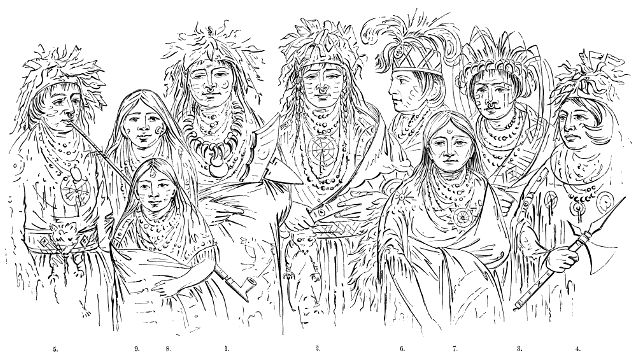
199, 200, 201, 202, 203, 204, 205, 206. Du-cór-re-a, ——; Chief
of the tribe, and his family; a group of eight.
207. Wah-chee-háhs-ka, the Man who puts all out of Doors, called
the “Boxer;” the largest man of the Winnebagoes; war-club in
his hand, and rattle-snake skins on his arms.
208. Won-de-tów-a, the Wonder.
209. Náw-káw, Wood; formerly the head Chief, with his war-club
on his arm. (Dead.)
210. Káw-kaw-ne-chóo-a, ——; a brave.
211. Wa-kon-chásh-kaw, He who comes on the Thunder.
212. Naw-naw-páy-ee, the Soldier.
213. Wah-kón-ze-kaw, the Snake.
214. Span-e-o-née-kaw, the Spaniard.
215. Hoo-w'a-ne-kaw, the Little Elk.
216. No-ak-chóo-she-kaw, He who breaks the Bushes.
217. Naugh-háigh-hee-kaw, He who moistens the Wood.
ME-NÓM-O-NIES.
Like the Winnebagoes, mostly destroyed by whisky and smallpox, and
now numbering about 3500, and in a miserable state of dependence;
on the western side of Lake Michigan.
218. Mah-kée-mee-teuv, the Grisly Bear; Chief of the nation, and
chief of a delegation to Washington city in 1829 (since
dead); handsome pipe in his hand, and wampum on his neck.
219. Mee-chéet-e-neuh, the Wounded Bear’s Shoulder; wife of the
Chief (No. 218).
220. Chee-me-náh-na-quet, the Great Cloud; son of the Chief (No.
218), a great rascal.
221. Ko-mán-i-kin-o-haw, the Little Whale; a brave, with his
medicine-wand, his looking-glass, and scissors.
222. Sha-wá-no, the South; a noted warrior.
223. Másh-kee-wet, ——; a great beau, or dandy.
224. Pah-shee-náu-shaw, ——; a warrior.
225. Tcha-káuks-o-ko-máugh, the Great Chief (boy).
226. Aú nah-kwet-to-hau-páy-o, the One sitting in the Clouds; a
fine boy.
227. Aúh-ka-nah-paw-wáh, Earth Standing; an old and very valiant
warrior.
228. Ko-mán-i-kin, the Big Wave, called the “Philosopher;” a
very old and distinguished Chief.
229. O-ho-páh-sha, the Small Whoop; a hard-visaged warrior, of
most remarkable distinction.
230. Ah-yaw-ne-tah-cár-ron, ——; a warrior.
231. Au-wáh-shew-kew, the Female Bear; wife of the above (No.
230).
232. Coo-coo-coo, the Owl; a very old and emaciated Chief; sits
smoking a handsome pipe.
233. Wáh-chees, ——; a brave.
234. Chésh-ko-tong, He who sings the War-Song.
235, 236. Two in a group, names not known; one with his war-club,
and the other with his lute at his mouth.
POT-O-WÁT-O-MIE.
Once a numerous tribe, now numbering about 2700, reduced by
smallpox and whisky—recently removed from the state of Indiana to
the western shores of the Missouri: semi-civilized.
237. On-sáw-kie, the Sac; in the act of praying; his prayer
written in characters on a maple stick.
238. Na-pów-sa, the Bear Travelling in the Night; one of the
most influential Chiefs of the tribe.
239. Kée-se, ——; a woman.
KÍCK-A-POO.
On the frontier settlements; semi-civilized; number about 600;
greatly reduced by smallpox and whisky.
240. Kee-án-ne-kuk, the Foremost Man, called the “Prophet.”
Chief of the tribe, in the attitude of prayer.
This very shrewd fellow engraved on a maple stick, in characters,
a prayer which was taught him by a Methodist Missionary; and by
introducing it into the hands of every one of his tribe, who are
enjoined to read it over every morning and evening as service, has
acquired great celebrity and respect in his tribe, as well as a
good store of their worldly goods, as he manufactures them all, and
gets well paid for them.
241. Ah-tón-we-tuck, the Cock Turkey; repeating his prayer from
the stick in his hand, described above.
242. Ma-shée-na, the Elk’s Horns; a Sub-Chief, in the act of
prayer, as above described.
243. Ke-chím-qua, the Big Bear; wampum on his neck, and red flag
in his hand, the symbol of war or “blood.”
244. A'h-tee-wát-o-mee, ——; woman, with wampum and silver
brooches in profusion on her neck.
245. Shee-náh-wee, ——.
KAS-KAS-KIA.
Once famed, numerous, and warlike, on the frontier, but now reduced
to a few individuals by smallpox and whisky.
246. Kee-món-saw, the Little Chief; Chief; Semi-civilized.
247. Wah-pe-séh-see, ——; a very aged woman, mother of the
above.
WÉE-AH.
Remnant of a tribe on the frontier; semi-civilized; reduced by whisky
and disease; present number 200.
248. Go-to-ków-páh-ah, He who Stands by Himself; a brave of
distinction, with his hatchet in his hand.
249. Wah-pón-jee-a, the Swan; a warrior; fine-looking fellow,
with an European countenance.
250. Wáh-pe-say, the White.
PE-O-RI-A.
Also a small remnant of a tribe on the frontier, reduced by the
same causes as above; present number about 200.
251. Pah-mee-ców-ee-tah, the Man who tracks; a Chief; remarkably
fine head.
This man would never drink whisky.
252. Wap-sha-ka-náh, ——; a brave.
253. Kee-mo-rá-nia, No English; a beau; his face curiously
painted, and looking-glass in his hand.
PI-AN-KE-SHAW.
A frontier tribe, reduced, as above; present number 170.
254. Ni-a-có-mo, to Fix with the Foot; a brave.
255. Men-són-se-ah, the Left Hand; a fierce-looking warrior,
with a stone hatchet in his hand.
Í-O-WAY.
A small tribe on the frontier, reduced by smallpox and their
enemies; living on the Missouri; number about 1400. Uncivilized
fine-looking men.
256. Notch-ee-níng-a, No Heart, called “White Cloud;” Chief of
the tribe; necklace of grisly bears’ claws, and shield, bow
and arrows in his hand.
257. Pah-ta-cóo-chee, the Shooting Cedar; a brave, with war-club
on his arm.
258. No-o-mún-nee, He who walks in the Rain; warrior, with his
pipe and tobacco-pouch in his hand.
259. W'y-ee-yogh, the Man of Sense; a brave, with a handsome
pipe in his hand, and bears’ claw necklace on his neck.
260. Wos-cóm-mun, the Busy Man; a brave.
262. Mún-ne-o-ye, ——; woman.
SEN-E-CAS.
Near Lake Erie, State of New York. 1200, semi-civilized and
agricultural. One of the tribes composing the great compact called
the “Six Nations.”
263. Red Jacket, Head Chief of the tribe; full-length, life
size, standing on the “Table Rock,” Niagara Falls.
This man was chief for many years, and so remained until his death,
in 1831. Perhaps no Indian Sachem has ever lived on our frontier
whose name and history are better known, or whose talents have been
more generally admitted, than those of Red Jacket: he was, as a
savage, very great in council and in war.
264. ( ), Deep Lake; an old Chief.
265. ( ), Round Island; warrior, half-blood.
266. ( ), Hard Hickory; a very ferocious-looking, but a mild and
amiable man.
267. ( ), Good Hunter; a warrior.
268. ( ), —— String; a warrior, renowned.
269. ( ), Seneca Steele; a great libertine. Hatchet in his hand.
O-NEI-DA.
Remnant of a tribe, State of New York, one of the “Six Nations;”
present number, 600.
270. ( ), Bread; the Chief, half-blood, civilized.
A fine-looking and an excellent man.
TUS-KA-RÓ-RA.
New York, remnant of a numerous tribe, one of the confederacy of
the “Six Nations;” present number, 500; semi-civilized.
271. Cú-sick, ——; son of the Chief. Civilized and
Christianized.
This man is a Baptist preacher, and quite an eloquent man.
MO-HEE-CON-NEU, or “MO-HE-GAN,” the Good
Canoemen.
Now living near Green Bay; numbers, 400 or 500; formerly of
Massachusetts; a band of the famous tribe of Pequots; now
semi-civilized.
272. Ee-tów-o-kaum, Both Sides of the River; Chief of the tribe,
with a psalm-book in one hand, and a cane in the other.
Christianized.
273. Waun-naw-con, the Dish (John W. Quinney); missionary
preacher. Civilized.
DEL-A-WARES.
Remains of a bold, daring, and numerous tribe, formerly of the
States of Pennsylvania and Delaware, and the terror of all the
eastern tribes. Gradually wasted away by wars, removals, small-pox,
and whisky; now living on the western borders of Missouri, and
number only 824; lost by small-pox, at different times, 10,000.
274. Bód-a-sin, ——; the Chief; a distinguished man.
275. Ni-có-man, the Answer; the second Chief, with bow and
arrows in his hand.
276. Non-on-dá-gon, ——; a Chief, with a ring in his nose.
SHA-WÁ-NO (SHAW-NEE).
Remains of a numerous tribe, formerly inhabiting part of
Pennsylvania, afterwards Ohio, and recently removed west of the
Mississippi River. Number at present about 1200; lost one-half by
small-pox at different times. Semi-civilized; intemperate.
277. Lay-láw-she-kaw, He who goes up the River; a very aged man,
Chief of the tribe; his ears slit and elongated by wearing
weights in them, according to the custom of the tribe, and
his hair whitened with age.
278. Ká-te-quaw, the Female Eagle; a fine-looking girl, daughter
of the above Chief.
279. Tea-sqúat-a-way, the Open Door; called the “Shawnee
Prophet,” brother of Tecumsch; blind in one eye, holding his
medicine or mystery fire in one hand, and his “sacred
string of beans” in the other; a great mystery-man.
280. Pah-te-cóo-saw, the Straight Man. Semi-civilized.
281. Lay-lóo-ah-pee-ái-shee-kaw, Grass, Bush, and Blossom. Half
civil, and more than half drunk.
282. Cóo-ps-saw-qúay-te, ——; woman (the Indescribable).
CHER-O-KEES.
Formerly of the State of Georgia, recently removed west of the
Mississippi to the head-waters of the Arkansas. This tribe are
mostly civilized and agriculturists; number, 22,000.
283. John Ross, a civilized and well-educated man, head Chief of
the nation.
284. Túch-ee, called “Dutch;” first War-chief of the Cherokees;
a fine-looking fellow, with a turbaned head.
I travelled and hunted with this man some months, when he guided
the regiment of dragoons to the Camanchee and Pawnee villages: he
is a great warrior and a remarkable hunter.
285. Cól-lee, ——; Chief of a band of the Cherokees. (Since
dead.)
286. Téh-ke-néh-kee, the Black Coat; a Chief, also of
considerable standing.
287. Ah-hee-te-wáh-chee, ——; a very pretty woman, in civilized
dress, her hair falling over her shoulders.
MUS-KÓ-GEE (CREEK).
Recently removed from Georgia and Alabama to the Arkansas,
700 miles west of the Mississippi. Present number, 21,000;
semi-civilized and agricultural.
288. Steeh-tcha-kó-me-co, the Great King, called, “Ben
Perryman;” one of the Chiefs of the tribe.
289. Hól-te-mál-te-téz-te-néek-ee, ——, “Sam Perryman;” brother
of the Chief above, and a jolly companionable man.
290. Wat-ál-le-go, ——, a brave.
291. Hose-put-o-káw-gee, ——; a brave.
292. Tchow-ee-pút-o-kaw, ——; woman.
293. Tel-maz-há-za, ——; a warrior of great distinction.
CHOC-TAW.
Recently removed by Government from the States of Georgia and
Alabama to the Arkansas, 700 miles west of the Mississippi. Present
number, 15,000; semi-civilized.
294. Mó-sho-la-túb-bee, He who puts out and kills; first Chief
of the tribe.
A gentlemanly-looking man (died recently of small-pox).
295. Kút-tee-o-túb-bee, How did he kill? A noted brave.
296. Há-tchoo-túc-knee, the Snapping Turtle; half-bred and
well-educated man.
297. ——, woman; hair in braid; remarkable expression.
298. Tul-lock-chísh-ko, He who drinks the Juice of the Stone.
299. Tul-lock-chísh-ko, Full-length, in the dress and attitude
of a ball-player, with ball-sticks in his hand, and tail,
made of white horse-hair, attached to his belt.
SEM-I-NÓ-LEE (RUNAWAY); 3000.
Occupying the peninsula of Florida; semi-civilized, partly
agricultural. The Government have succeeded in removing about
one-half of them to the Arkansas, during the last four years, at
the expense of 32,000,000 dollars, the lives of 28 or 30 officers,
and 600 soldiers.
300. Mick-e-no-páh, ——; first Chief of the tribe; full-length,
sitting cross-legged.
This man owned 100 negroes when the war broke out, and was raising
large and valuable crops of corn and cotton.
301. Os-ce-o-lá, the Black Drink; a warrior of very great
distinction.
Painted only five days before his death, while he was a prisoner
of war at Fort Moultrie. This remarkable man, though not a
chief, took the lead in the war, and was evidently (at the time
he was captured) followed by the chiefs, and looked upon as the
master-spirit of the war.
302. Ee-mat-lá, King Philip; an old man, second Chief.
Like Osceola, he died while a prisoner, soon after I painted him.
303. Ye-hów-lo-gee, the Cloud; a Chief who distinguished himself
in the war.
304. Co-ee-há-jo, ——; a Chief, very conspicuous in the present
war.
305. Láh-shee, the Licker; a half-breed warrior, called “Creek
Billey.”
306. How-ee-dá-hee; ——. a Seminolee woman.
307. ( ) ——; a Seminolee woman.
308. Os-ce-o-lá, the Black Drink. Full-length, with his rifle
in his hand, calico dress, and trinkets, exactly as he was
dressed and stood to be painted five days before his death.
EU-CHEE.
Remnant of a powerful tribe who once occupied the southern part
of the peninsula of Florida, were overrun by the Creeks and
Seminolees, the remnant of them merging into the Seminolee tribe,
and living with them now as a part of their nation. Present number,
150.
309. Etch-ée-fix-e-co, the Deer without a Heart, called “Euchee
Jack;” a Chief of considerable renown.
310. Chee-a-ex-e-co, ——; quite a modest and pretty girl,
daughter of the above Chief.
CERTIFICATES.
The Landscapes, Buffalo-hunting Scenes, &c., above mentioned, I have
seen, and, although it has been thirty years since I travelled over
that country, yet a considerable number of them I recognised as
faithful representations, and the remainder of them are so much in the
peculiar character of that country as to seem entirely familiar to me.
Wm. Clark, Superintendent of Indian Affairs.
The Landscape Views on the Missouri, Buffalo Hunts, and other scenes,
taken by my friend Mr. Catlin, are correct delineations of the scenes
they profess to represent, as I am perfectly well acquainted with the
country, having passed through it more than a dozen times. And further
I know that they were taken on the spot, from nature, as I was present
when Mr. Catlin visited that country.
John F. A. Sanford, U. SS. Indian Agent.
It gives me great pleasure to be able to pronounce the Landscape Views,
Views of Hunting, and other scenes taken on the Upper Missouri, by
Mr. Catlin, to be correct delineations of the scenery they profess to
represent; and although I was not present when they were taken in the
field, I was able to identify almost every one between St. Louis and
the grand bend of the Missouri.
J. L. Bean, S. Agent of Indian Affairs.
I have seen Mr. Catlin’s collection of Indian Portraits, many
of which were familiar to me, and painted in my presence in their
villages. I have spent the greater part of my life amongst the tribes
and individuals he has represented, and I do not hesitate to pronounce
them correct likenesses and easily recognised; also the sketches of
their Manners and Customs I think are excellent, and the Landscape
Views on the Missouri and Mississippi are correct representations.
K. M‘kenzie, of the Am. Fur Company, Mouth of Yellow Stone.
I have examined a series of paintings by Mr. Catlin, representing
Indian Buffalo Hunts, Landscapes, &c.; and from an acquaintance
of twenty-seven years with such scenes as are represented, I feel
qualified to judge them, and do unhesitatingly pronounce them good and
unexaggerated representations.
Jno. Dougherty, Indian Agent for Pawnees, Omahas, and Otoes.
311. St. Louis (from the river below, in 1836), a town on the
Mississippi, with 25,000 inhabitants.
312. View on Upper Mississippi, beautiful prairie bluffs,
everywhere covered with a green turf.
313. “Bad Axe” battle-ground, where Black Hawk was defeated by
General Atkinson, above Prairie du Chien. Indians making
defence and swimming the river.
314. Chippeways gathering wild rice near the source of St.
Peter’s; shelling their rice into their bark canoes, by
bending it over, and whipping it with sticks.
315. View near “Prairie la Crosse,” beautiful prairie bluffs,
above Prairie du Chien, Upper Mississippi.
316. “Cap o’lail” (garlic cape), a bold and picturesque promontory
on Upper Mississippi.
317. Picturesque Bluffs above Prairie du Chien, Upper Mississippi.
318. “Pike’s Tent,” the highest bluff on the river, Upper
Mississippi.
319. View of the “Cornice Rocks,” and “Pike’s Tent,” in distance,
750 miles above St. Louis, on Upper Mississippi.
320. “Lover’s Leap,” on Lake Pepin, Upper Mississippi, a rock 500
feet high, where an Indian girl threw herself off a few years
since, to avoid marrying the man to whom she was given by her
father.
321. Falls of St. Anthony, 900 miles above St. Louis;
perpendicular fall eighteen feel: Upper Mississippi.
322. Madame Ferrebault’s Prairie from the river above; the author
and his companion descending the river in a bark canoe, above
Prairie du Chien, Upper Mississippi; beautiful grass-covered
bluffs.
323. “Little Falls,” near the Falls of St. Anthony, on a small
stream.
324. “La Montaigne que tremps l'Eau,” Mississippi, above Prairie
du Chien.
325. Cassville, below Prairie du Chien, Upper Mississippi; a small
village just commenced, in 1835.
326. Dubuque, a town in the lead-mining country.
327. Galena, a small town on Upper Mississippi, in the lead-mining
district.
328. Rock Island, United States Garrison, Upper Mississippi.
329. Beautiful Prairie Bluffs, ditto.
330. Dubuque’s Grave, ditto.
Dubuque was the first miner in the lead-mines under the Spanish
grant. He built his own sepulchre, and raised a cross over it, on a
beautiful bluff, overlooking the river, forty years ago, where it
now stands.
331. River Bluffs, magnificent view, Upper Mississippi.
332. Fort Snelling, at the mouth of St. Peter’s, U. S. Garrison,
seven miles below the Falls of St. Anthony, Upper Mississippi.
333. Prairie du Chien, 500 miles above St. Louis, Upper
Mississippi, United States Garrison.
334. Chippeway Village and Dog Feast at the Falls of St. Anthony;
lodges built with birch-bark: Upper Mississippi.
335. Sioux Village, Lake Calhoun, near Fort Snelling; lodges built
with poles.
336. “Coteau des Prairies,” head-waters of St. Peter’s. My
companion, Indian guide, and myself encamping at sunset,
cooking by our fire, made of buffalo-dung.
337. “Pipestone Quarry,” on the Coteau des Prairies, 300 miles N.
W. from the Falls of St. Anthony, on the divide between the
St. Peter’s and Missouri.
The place where the Indians get the stone for all their red pipes.
The mineral, red steatite, variety differing from any other known
locality—wall of solid, compact quartz, grey and rose colour,
highly polished as if vitrified; the wall is two miles in length
and thirty feet high, with a beautiful cascade leaping from its top
into a basin. On the prairie, at the base of the wall, the pipeclay
(steatite) is dug up at two and three feet depth. There are seen
five immense granite boulders, under which there are two squaws,
according to their tradition, who eternally dwell there—the
guardian spirits of the place—and must be consulted before the
pipestone can be dug up.
338. Sault de St. Mary’s—Indians catching white fish in the
rapids at the outlet of Lake Superior, by dipping their scoop
nets.
339. Sault de St. Mary’s from the Canadian Shore, Lake Superior,
showing the United States Garrison in the distance.
340. View on the St. Peter’s River, twenty miles above Fort
Snelling.
341. View on the St. Peter’s—Sioux Indians pursuing a Stag in
their canoes.
342. Salt Meadows on the Upper Missouri, and great herds of
buffalo—incrustation of salt, which looks like snow.
Salt water flows over the prairie in the spring, and, evaporating
during the summer, leaves the ground covered with muriate as white
as snow.
343. Pawnee Village in Texas, at the base of a spur of the Rocky
Mountains—lodges thatched with prairie-grass.
344. View on the Canadian, in Texas.
345. View of the junction of Red River with the False Washitta, in
Texas.
346. Camanchee Village, in Texas, showing a spur of the Rocky
Mountains in the distance—lodges made of buffalo-skins.
Women dressing robes and drying meat.
347. View on the Wisconsin—Winnebagoes shooting ducks, in bark
canoe.
348. Lac du Cygne (Swan Lake), near the Coteau des Prairies.
A famous place, where myriads of white swans lay their eggs and
hatch their young.
349. Beautiful Savannah in the pine-woods of Florida.
One of thousands of small lakes which have been gradually filled in
with vegetation.
350. View on Lake St. Croix, Upper Mississippi.
351. View on the Canadian—Dragoons crossing, 1834.
352. Ta-wa-que-nah, or Rocky Mountain, near the Camanchee Village,
Texas.
353. Camanchee Village, and Dragoons approaching it, showing
the hospitable manner in which they were received by the
Camanchees. Camanchee warriors all riding out and forming in
a line, with a white flag, to receive the Dragoons.
354. White Sand Bluffs, on Santa Rosa Island; and Seminoles drying
fish, near Pensacola, on the Gulf of Florida.
355. View of the “Stone Man Medicine,” Coteau des Prairies.
A human figure of some rods in length, made on the top of a high
bluff, by laying flat stones on the grass. A great mystery or
medicine place of the Sioux.
356. Fort Winnebago, on the head of Fox River, an United States
outpost.
357. Fort Howard, Green Bay, an U. S. outpost.
358. Fort Gibson, Arkansas, an U. S. outpost, 700 miles west of
Mississippi river.
359. The “Short Tower,” Wisconsin.
360. Passing the “Grand Chute” with bark canoe, Fox River.
361. View of Mackinaw, Lake Michigan, an U. S. outpost.
362. View in the “Cross Timbers,” where General Leavenworth died
on the Mexican borders.
363. View on Lower Missouri—alluvial banks falling in, with their
huge cotton-woods, forming raft and snags, 600 miles above
St. Louis.
364. View on Upper Missouri—the “Blackbird’s Grave.”
Where “Blackbird,” Chief of the Omahas, was buried on his favourite
war-horse, which was alive; 1100 miles above St. Louis.
365. View on Upper Missouri—“Blackbird’s Grave,” a back view;
prairies enamelled with wild flowers.
366. View on Upper Missouri—“Brick Kilns,” volcanic remains, clay
bluffs, 200 feet, supporting large masses of red pumice, 1900
miles above St. Louis.
367. View on Upper Missouri—Foot war-party on the march,
beautiful prairie—spies and scouts in advance.
368. View on Upper Missouri—Prairie Bluffs at sunrising, near
mouth of Yellow Stone.
369. View on Upper Missouri—Mouth of the Platte; its junction
with the Missouri, 900 miles above St. Louis.
370. View on Upper Missouri—Magnificent Clay Bluffs, 1800 miles
above St. Louis; stupendous domes and ramparts, resembling
some ancient ruins; streak of coal near the water’s edge; and
my little canoe, with myself and two men, Bogard and Bàtiste,
descending the river.
371. View on Upper Missouri—Cabane’s trading-house; Fur Company’s
establishment: 930 miles above St. Louis, showing a great
avalanche of the bluffs.
372. View on Upper Missouri—View in the Grand Détour, 1900
miles above St. Louis. Magnificent clay bluffs, with red
pumice-stone resting on their tops, and a party of Indians
approaching buffalo.
373. View on Upper Missouri—Beautiful Grassy Bluffs, 110 miles
above St Louis.
374. View on Upper Missouri—Prairie Meadows burning, and a party
of Indians running from it in grass eight or ten feet high.
These scenes are terrific and hazardous in the extreme when the
wind is blowing a gale.
375. View on Upper Missouri—Prairie Bluffs burning.
376. View on Upper Missouri—“Floyd’s Grave,” where Lewis and
Clarke buried Serjeant Floyd thirty-three years since; a
cedar post and sign over the grave.
377. View on Upper Missouri—Sioux encamped, dressing
buffalo-meat, and robes.
378. View on Upper Missouri—“The Tower,” 1100 miles above St.
Louis.
379. View on upper Missouri—Distant view of the Mandan Village,
1800 miles above St. Louis.
380. View on Upper Missouri—Picturesque Clay Bluff, 1700 miles
above St. Louis.
381. View on Upper Missouri—“Belle Vue”—Indian Agency of Major
Dougherty, 870 miles above St. Louis.
382. View on Upper Missouri—Beautiful Clay Bluffs, 1900 miles
above St. Louis.
383. View on Upper Missouri—Minatarree Village, earth-covered
lodges, on Knife River, 1810 miles above St. Louis. Bàtiste,
Bogard, and myself ferried across the river by an Indian
woman, in a skin canoe, and Indians bathing in the stream.
384. View on Upper Missouri—Fort Pierre, Mouth of Teton
River—Fur Company’s trading-post, 1200 miles above St.
Louis, with 600 lodges of Sioux Indians encamped about it, in
skin lodges.
385. View on Upper Missouri—Nishnabottana Bluffs, 1070 miles
above St. Louis.
386. View on Upper Missouri—Riccaree Village, with earth-covered
lodges, 1600 miles above St. Louis.
387. View on Upper Missouri—South side of “Buffalo Island,”
showing the beautiful buffalo-bush, with its blue leaves, and
bending down with fruit.
388. View on Upper Missouri—Mouth of Yellow Stone—Fur Company’s
Fort, their principal post, 2000 miles above St. Louis, and a
large party of Knisteneux encamped about it.
389. View on Upper Missouri—the “Iron Bluff,” 1200 miles above
St. Louis, a beautiful subject for a landscape.
390. View on Upper Missouri—View in the “Big Bend,” 1900 miles
above St. Louis; showing the manner in which the conical
bluffs on that river are formed; table-lands in distance,
rising several hundred feet above the summit level of the
prairie.
391. View on Upper Missouri—View in the “Big Bend”—magnificent
clay bluffs, with high table-land in the distance.
392. View on Upper Missouri—Back view of the Mandan Village,
showing their mode of depositing their dead, on scaffolds,
enveloped in skins, and of preserving and feeding the skulls;
1800 miles above St. Louis. Women feeding the skulls of their
relatives with dishes of meat.
393. View on Upper Missouri—Prairie Buffs, 1100 miles above St.
Louis.
394. View on Upper Missouri—“The Three Domes,” 15 miles above
Mandans. A singular group of clay bluffs, like immense domes,
with skylights.
395. View on Upper Missouri—the “Square Hills,” 1200 miles above
St. Louis
396. View on Upper Missouri—River Bluffs and White Wolves in the
foreground.
397. View on Upper Missouri—Beautiful Prairie Bluffs, above the
Puncahs, 1050 miles above St. Louis.
398. View on Upper Missouri—Look from Floyd’s Grave. 1300 miles
above St. Louis.
399. View on Upper Missouri—River Bluffs, 1320 miles above St.
Louis.
400. View on Upper Missouri—Buffalo herds crossing the river.
Bàtiste, Bogard, and I, passing them in our bark canoe, with
some danger to our lives. A buffalo scene in their running
season.
401. View on Upper Missouri—Clay Bluffs, 20 miles above the
Mandans.
402. View on Upper Missouri—Nishnabottana Bluffs.
403. View on Upper Missouri—Indians encamping at sunset.
404. Buffalo Bull, grazing on the prairie in his native state.
405. Buffalo Cow, grazing on the prairie in her native state.
406. Wounded Buffalo, strewing his blood over the prairies.
407. Dying Buffalo, shot with an arrow, sinking down on his
haunches.
408. Buffalo Chase—single death; an Indian just drawing his arrow
to its head.
409. Buffalo Chase—surround; where I saw 300 killed in a few
minutes by the Minatarrees, with arrows and lances only.
410. Buffalo Chase—numerous group; chasing with bows and lances.
411. Buffalo Chase—numerous group; chasing with bows and lances.
412. Buffalo Chase—Cow and Calf; the bull protecting by attacking
the assailants.
413. Buffalo Chase—Bulls making battle with men and horses.
414. Buffalo Hunt under the wolf-skin mask.
415. Buffalo Chase, Mouth of Yellow Stone; animals dying on the
ground passed over; and my man Bàtiste swamped in crossing a
creek
416. Buffalo Chase in snow drift, with snow shoes.
417. Buffalo Chase in snow drift, with snow shoes; killing them
for their robes, in great numbers.
418. Attack of the Bear (Grisly); Indians attacking with lances on
horseback.
419. Antelope Shooting—decoyed up.
420. Sioux taking Musk-rats, near the St. Peter’s; killing them
with spears. Women and dogs encamped.
421. Bàtiste and I, running Buffalo; Mouth of Yellow Stone; a
frog’s leap.
422. “My turn now;” Bàtiste and I, and a Buffalo Bull, Upper
Missouri.
423. Dying Bull in a snow drift.
424. Buffalo Bulls fighting, in running season, Upper Missouri.
425. Buffalo Bulls in their “wallow;” origin of the “fairie
circles” on the prairie.
426. Grouse shooting—on the Missouri prairies.
427. Ball-play Dance, Choctaw.—Men and women dance around their
respective stakes, at intervals, during the night preceding
the play—four conjurors sit all night and smoke to the Great
Spirit, at the point where the ball is to be started—and
stakeholders guard the goods staked.
428. Ball-play of the Choctaws—ball up—one party painted
white; each has two sticks with a web at their ends, in which
they catch the ball and throw it—they all have tails of
horse-hair or quills attached to their girdles or belts.
Each party has a limit or bye, beyond which it is their object to
force the ball, which, if done, counts them one for game.
429. Ball-play—same as 428, excepting that the ball is down,
which changes the scene.
430. Ball-play of the women, Prairie du Chien.—Calicoes and other
presents are placed on a pole by the men—the women choose
sides and play for them, to the great amusement of the men.
In this play there are two balls attached to the ends of a string
eighteen inches in length: the women have a stick in each hand, on
which they catch the string and throw it.
431. Game of “Tchung-kee” of the Mandans, the principal and most
valued game of that tribe.
A beautiful athletic exercise, and one on which they often bet and
risk all their personal goods and chattels.
432. Horse-Racing, Mandan, on a Race-Course back of the Village,
in use on every fair-day.
433. Foot-Race, Mandans, on the same ground, and as often run.
434. Canoe-Race—Chippeways in Bark Canoes, near the Sault de St.
Mary’s; an Indian Regatta, a thrilling scene.
435. Archery of the Mandans.
The strife is to prove who can get the greatest number of arrows
flying in the air at a time, before the first one reaches the
ground. The most of these are portraits closely studied from
nature. I have seen some of them get eight arrows in the air at one
time.
436. Dance of the Chiefs, Sioux.
A very unusual thing, as the dancing is generally left to the young
men; given to me expressly as a compliment by the chiefs, that I
might make a painting of it.
The dog’s liver and heart are taken raw and bleeding, and placed
upon a crotch; and, being cut into slips, each man dances up to it,
bites off and swallows a piece of it, boasting, at the same time,
that he has thus swallowed a piece of the heart of his enemy, whom
he has slain in battle.
438. Scalp Dance, Sioux—Women in the centre, holding the scalps
on poles, and warriors dancing around, brandishing their
war-weapons in the most frightful manner, and yelping as loud
as they can scream.
439. Begging Dance, Sacs and Foxes, danced for the purpose of
getting presents from the spectators.
440. Buffalo Dance, Mandans, with the mask of the buffalo on.
Danced to make buffalo come, when they are like to starve for want
of food. Song to the Great Spirit, imploring him to send them
buffalo, and they will cook the best of it for him.
441. Ball-play Dance, Choctaws.
442. Dance to the Berdash, Sac and Fox.
An unaccountable and ludicrous custom amongst the Sacs and Foxes,
which admits not of an entire explanation.
443. Beggars’ Dance, (Sioux,) for presents.
444. Dance to the Medicine Bag of the Brave, Sacs and Foxes.
Warriors returned from battle, with scalps, dance in front of the
widow’s lodge, whose husband has been killed. They sing to his
medicine-bag, which is hung on a bush, and throw presents to the
widow.
445. Braves’ Dance, Boasting, &c., Sioux.
446. Green Corn Dance, Minnatarree—Sacrificing the first kettle
to the Great Spirit.
Four medicine men, whose bodies are painted with white clay, dance
around the kettle until the corn is well boiled; and they then burn
it to cinders, as an offering to the Great Spirit. The fire is then
destroyed, and new fire created by rubbing two sticks together,
with which the corn for their own feast is cooked.
447. Bear Dance, Sioux—Preparing for a Bear Hunt—Song to the
Great Spirit, praying for success.
448. Discovery Dance, Sacs and Foxes—A Pantomime; pretending to
discover game, or an enemy.
A very picturesque and pleasing dance.
449. Eagle Dance, Choctaw—Holding the eagle’s tail in the hand,
and bodies painted white.
Given in honour of that valiant bird.
450. Slave Dance, Sacs and Foxes.
A society of young men, who volunteer to be slaves for two years,
and elect their chief or master; they are then exempt from slavish
duties during the remainder of their lives, and are allowed to go
on war-parties.
451. Snow-shoe Dance, Ojibbeway—danced at the first fall of snow,
with snow shoes on the feet.
Song of thanks to the Great Spirit.
452. Brave’s Dance, Ojibbeway—bragging and boasting.
453. Pipe Dance, Assineboins.
Each dancer is “smoked” by the chief, who sits smoking his pipe,
and then pulled up into the dance.
Children made to dance with burning straws tied to their bodies, to
make them tough and brave.
455. Sham Fight, Mandan Boys—School of practice every morning at
sunrise, back of the village—instructed in it by the chiefs
and braves.
456. Sham Scalp Dance, by the Mandan Boys—danced in the village
when they come in, in honour of a sham victory.
457. War Dance of the Sioux.
Each warrior, in turn, jumps through the fire, and then advances
shouting and boasting, and taking his oath, as he “strikes the
reddened post.”
458. Foot War Party in Council, Mandan.
Stopping to rest and take a smoke; chief with a war-eagle
head-dress on; their shields and weapons lying on the ground behind
them.
459. Camanchee War Party—the Chief discovering the enemy and
urging on his men, at sunrise.
460. Religious Ceremony; a Sioux, with splints through his flesh,
and his body hanging to a pole, with his medicine-bag in his
hand, looks at the sun from its rising to its setting.
A voluntary cruel self-torture, which entitles him to great respect
for the remainder of his life, as a medicine or mystery man.
461. Dragoons on the March, and a band of Buffalo breaking through
their ranks, in Texas, 1835.
462. Prairie Dog Village.
Myriads of these curious little animals sometimes are found in one
village, which will extend several miles. The animals are about
twice the size of a rat, and not unlike it in appearance and many
of their habits. They dig holes in the ground, and the dirt which
is thrown up makes a little mound, on which they sit and bark when
danger approaches. They feed upon the grass, which is their only
food.
463. “Smoking Horses,” a curious custom of the Sacs and Foxes.
Foxes, going to war, come to the Sacs, to beg for horses; they sit
in a circle and smoke, and the young men ride around them, and
cut their shoulders with their whips until the blood runs, then
dismount and present a horse.
464. Mandans attacking a party of Riccarees, whom they had driven
into a ravine, near the Mandan village, where they killed the
whole number.
465. Chippeways making the portage around the Falls of St.
Anthony, with two hundred bark canoes, in 1835.
466. Camanchees moving, and Dog Fight—dogs as well as horses drag
the lodge-poles with packs upon them.
These fights generally begin with the dogs, and end in desperate
battle; amongst the squaws, to the great amusement of the men.
467. White Wolves attacking a Buffalo Bull.
468. Ditto, ditto—a parley.
469. My horse “Charley” and I, at sunrise, near the Neosho, on
an extensive prairie, encamping on the grass; my saddle for
a pillow, two buffalo-skins for my bed, my gun in my arms;
a coffee-pot and tin cup, a fire made of buffalo-dung, and
Charley (a Camanchee clay-bank mustang) picketed near me.
With him alone I crossed the prairie from Fort Gibson, on the
Arkansas, to St. Louis, 550 miles.
470. Sioux worshipping at the Red Boulders. A large boulder and
two small ones, bearing some resemblance to a buffalo cow and
two calves, painted red by the Indians, and regarded by them
with superstitious reverence, near the “Coteau des Prairies.”
471. Camanchee Warrior lancing an Osage, at full speed.
472. Camanchees giving the Arrows to the Medicine Rock.
A curious superstition of the Camanchees: going to war, they have
no faith in their success, unless they pass a celebrated painted
rock, where they appease the spirit of war (who resides there), by
riding by it at full gallop, and sacrificing their best arrow by
throwing it against the side of the ledge.
473. “Bàtiste, Bogard, and I” approaching Buffalo, on the
Missouri.
474. Wi-jun-jon (an Assinneboin Chief), going to and returning
from Washington.
This man was taken to that city in 1832, in a beautiful Indian
dress, by Major Sanford, the Indian agent, and returned to his
country the next spring, in a Colonel’s uniform. He lectured a
while to his people on the customs of the whites, when he was
denounced by them for telling lies, which he had learned of the
whites, and was, by his own people, put to death at the mouth of
the Yellow Stone.
475. “Butte de Mort,” Upper Missouri, a great burial-place of
the Sioux, called by the French “Butte de Mort,” Hill of
Death.
Regarded by the Indians with great dread and superstition. There
are several thousand buffalo and human skulls, perfectly bleached
and curiously arranged about it.
476. “Rain-making,” amongst the Mandans, a very curious custom.
Medicine-men performing their mysteries inside of the lodge,
and young men volunteer to stand upon the lodge from sunrise
until sundown, in turn, commanding it to rain.
Each one has to hazard the disgrace which attaches (when he
descends at sundown) to a fruitless attempt; and he who succeeds
acquires a lasting reputation as a Mystery or Medicine man. They
never fail to make it rain! as this ceremony continues from day to
day until rain comes.
477. “Smoking the Shield.” A young warrior, making his shield,
invites his friends to a carouse and a feast, who dance
around his shield as it is smoking and hardening over a fire
built in the ground.
478. “The Thunder’s Nest” (Nid du Tonnerre), and a party of
Indians cautiously approaching it, Coteau des Prairies.
Tradition of the Sioux is that in this little bunch of bushes the
thunders are hatched out by quite a small bird, about as large (say
their Medicine-men, who profess to have seen it) as the end of a
man’s thumb. She sits on her eggs, and they hatch out in claps of
thunder. No one approaches within several rods of the place.
479. Sac and Fox Indians sailing in canoes, by holding up their
blankets.
480. Grand Tournament of the Camanchees, and a Sham Fight in a
large encampment, on the borders of Texas.
481. Bogard, Bàtiste, and I, travelling through a Missouri
bottom, grass ten feet high.
482. Band of Sioux, moving.
483. Bogard, Bàtiste, and I, descending the Missouri River.
484. Bogard, Bàtiste, and I, eating our breakfast on a pile of
drift wood, Upper Missouri.
485. Medicine Buffalo of the Sioux, the figure of a buffalo cut
out of the turf on the prairie, and visited by the Indians
going on a buffalo-hunt.
486. Bogard, Bàtiste, and I, chasing a herd of buffalo in high
grass, on a Missouri bottom.
487. Feats of Horsemanship.
Camanchees throwing themselves on the side of their horses, while
at full speed, to evade their enemies’ arrows—a most wonderful
feat.
488. Camanchee War Party meeting the Dragoons; and one of their
bravest men advancing to shake hands with Colonel Dodge, with
a piece of white buffalo-skin on the point of his lance. On
the Mexican frontier, 1835.
489. An Indian Wedding, Assinneboin—young man making presents to
the father of the girl.
490. Crow at his Toilette, oiling his long hair with bear’s grease.
491. Crow Lodge, of twenty-five buffalo-skins, beautifully
ornamented.
This splendid lodge, with all its poles and furniture, was brought
from the foot of the Rocky Mountains.
492. Pawnee Lodge, thatched with prairie grass, in form of a straw
beehive.
493. Camanchee Lodge, of buffalo-skins.
494. Dog Feast, Sioux; a religious feast.
Given to Mr. Sanford (Indian agent), Mr. Chouteau, Mr. M'Kenzie,
and myself, in a Sioux village, 1400 miles above St. Louis, 1833.
The only food was dog’s meat, and this is the highest honour they
can confer on a stranger.
495. An Indian Council, Sioux—Chiefs in profound deliberation.
496. Camanchee War Party, mounted on wild horses, armed with
shields, bows, and lances.
497. Scalping, Sioux; showing the mode of taking the scalp.
498. Scalping, Mandans—“Conqueror conquered.”
From a story of the Mandans—took place in front of the Mandan
village.
499. Wild Horses at Play, Texas, of all colours, like a kennel of
hounds.
500. Throwing the Laso, with a noose, which falls over the horse’s
neck.
501. Breaking down the Wild Horse, with hobbles on his fore feet,
and the laso around his under jaw.
502. A Bird’s-Eye View of the Mandan Village, 1800 miles above
St. Louis, on the west bank of the Missouri River.
The lodges are covered with earth, and so compactly fixed by long
use, that men, women, and children recline and play upon their tops
in pleasant weather.
These lodges vary in size from forty to fifty feet in diameter,
and are all of a circular form. The village is protected in front
by the river, with a bank forty feet high, and on the back part by
a piquet of timber set firmly in the ground. Back of the village,
on the prairie, are seen the scaffolds on which their dead bodies
are laid to decay, being wrapped in several skins of buffalo, and
tightly bandaged.
In the middle of the village is an open area of 150 feet in
diameter, in which their public games and festivals are held. In
the centre of that is their “Big Canoe,” a curb made of planks,
which is an object of religious veneration. Over the Medicine
(or mystery) Lodge are seen hanging on the tops of poles several
sacrifices to the Great Spirit of blue and black cloth, which have
been bought at great prices, and there left to hang and decay.
503. The Interior of a Mandan Lodge, showing the manner in which
it is constructed of poles, and covered with dirt. The Chief
is seen smoking his pipe, and his family grouped around him.
At the head of each warrior’s bed is seen a post with his ornaments
hanging on it, and also his buffalo-mask, which every man keeps
to dance the buffalo-dance. Some of these lodges contain thirty or
forty persons, and the beds are seen extending around the side of
the lodge, all with sacking bottoms, made of a buffalo-skin, and
the frames of the bed covered with dressed skins.
⁂ Reader, the hospitable and friendly Mandans, who were about
2000 in number when I was amongst them and painted these pictures,
have recently been destroyed by the small-pox. It is a melancholy
fact, that only thirty-one were left of the number, and these have
been destroyed by their enemy, so that their tribe is extinct, and
they hold nowhere an existence on earth.
Nearly twenty of their portraits can be seen on the walls, and
several other paintings of their games and amusements.
CERTIFICATE.
We hereby certify that we witnessed, in company with Mr. Catlin, in
the Mandan village, the ceremonies represented in the four paintings
to which this certificate refers, and that he has therein faithfully
represented those scenes as we saw them transacted, without any
addition or exaggeration.
J. Kip, Agent Amer. Fur Company.
L. Crawford, Clerk.
Abraham Bogard.
Mandan Village, July 20th, 1833.
504. Interior View of the Medicine (or Mystery) Lodge of
Mandans, during the first three days of an Annual Ceremony.
This ceremony continues four days and nights in succession, in
commemoration of the subsiding of the flood; and also for
the purpose of conducting all the young men, as they arrive at
manhood, through an ordeal of voluntary torture, which, when
endured, entitles them to the respect of the chiefs, and also to
the privileges of going on war-parties, and gaining reputation in
war. The floor and sides of the lodge are ornamented with green
willow-boughs. The young men who are to do penance, by being
tortured, are seen lying around the sides of the lodge, their
bodies covered with clay of different colours, and their respective
shields and weapons hanging over their heads. In the middle of the
lodge lies the old Medicine-man, who has charge of the lodge: he
cries to the Great Spirit all the time, and watches these young
men, who are here to fast and thirst for four days and nights,
preparatory to the torture. Behind him, on the floor, is seen a
scalping-knife and a bunch of splints, which are to be passed
through the flesh; and over their heads are seen also the cords let
down from the top of the lodge, with which they are to be hung up
by the flesh.
On the ground, and in front of the picture, are four sacks
(containing several gallons each of water), made of the skin of the
buffalo’s neck, in form of a large tortoise, lying on its back.
These are objects of veneration, and have the appearance of great
antiquity.
By the side of them are two she-she-quoi, or rattles, which are
used, as well as the others, as a part of the music for the dance
in the next picture.
505. This picture, which is a continuation of the ceremonies, is
a representation of the Buffalo Dance, which they call
Bel-lohck-nah-pick (the Bull Dance).
To the strict observance of which they attribute the coming of
Buffalo to supply them with food during the season. This scene is
exceedingly grotesque, and takes place several times in each day
outside the lodge, and around the curb, or “Big Canoe,” whilst the
young men still remain in the lodge, as seen in the other picture.
For this dance, however, the four sacks of water are brought out
and beat upon, and the old medicine-man comes out and leans
against the “Big Canoe” with his medicine-pipe in his hand, and
cries. The principal actors in this scene are eight men dancing
the Buffalo Dance, with the skins of buffalo on them, and a bunch
of green willows on their backs. There are many other figures,
whose offices are very curious and interesting, but which must be
left for my Lectures or Notes to describe. The black figure on
the left they call O-kee-hee de (the Evil Spirit), who enters
the village from the prairie, alarming the women, who cry for
assistance, and are relieved by the old medicine-man; and the
Evil Spirit is at length disarmed of his lance, which is broken by
the women, and he is driven by them in disgrace out of the village.
The whole nation are present on this occasion as spectators and
actors in these strange scenes.
506. Represents what they call Pohk-hong (the Cutting Scene). It
shows the inside of the Medicine Lodge, the same as is seen
in the first picture (505).
This is on the fourth day of the ceremonies, in the afternoon.
A number of the young men are seen reclining and fasting, as in
the first picture; others of them have been operated upon by the
torturers, and taken out of the lodge; and others yet are seen in
the midst of those horrid cruelties. One is seen smiling whilst the
knife and the splints are passing through his flesh. One is seen
hanging by the splints run through the flesh on his shoulders, and
drawn up by men on the top of the lodge. Another is seen hung up by
the pectoral muscles, with four buffalo-skulls attached to splints
through the flesh on his arms and legs; and each is turned round by
another, with a pole, until he faints, and then he is let down. One
is seen as he is lowered to the ground; and another, who has been
let down and got strength enough to crawl to the front part of the
lodge, where he is offering to the Great Spirit the little finger
of the left hand, by laying it on a buffalo-skull, where another
chops it off with a hatchet. In the right of the picture are all
the chiefs and dignitaries of the tribe looking on.
507. Represents what they call the “Last Race.”
After they have all been tortured in the lodge in the above manner,
they are led out of it with the weights, buffalo-skulls, &c.
hanging to their flesh. Around the “Big Canoe” is a circle of young
men formed, who hold a wreath of willow-boughs between them, and
run round with all possible violence, yelling as loud as they can.
The young fellows who have been tortured are then led forward,
and each one has two athletic and fresh young men (their bodies
singularly painted), who step up to him, one on each side, and
take him by a leathern strap, tied round the wrist, and run round,
outside of the other circle, with all possible speed, forcing him
forward till he faints, and then drag him with his face in the dirt
until the weights are all disengaged from him, by tearing the flesh
out, when they drop him, and he lies (to all appearance a corpse)
until the Great Spirit gives him strength to rise and walk home to
his lodge.
In this scene also the medicine-man leans against the “Big Canoe”
and cries, and all the nation are spectators. Many pages would be
required to give to the world a just description of these strange
scenes; and they require to be described minutely in all their
parts in order to be fully appreciated and understood. (A full
account of these in my Notes and Letters.)
508. Ah-quee-we-zaints, the Boy Chief; a venerable man of 72
years.
509. Pat-au-a-quot-a-wee-be, the Driving-Cloud; a war-chief.
510. Wee-nish-ka-wee-be, the Flying Gull; a medicine-man.
511. Sah-mah, Tobacco.
512. Gish-ee-gosh-e-gee, the Moonlight Night.
513. Not-een-a-akm, the Strong Wind.
514. Wos-see-ab-e-neuh-qua; a woman.
515. Nib-nab-ee-qua; a young girl.
516. Ne-bet-neuh-quat; a woman.
517. Mew-hew-she-kaw, the White Cloud; first Chief of the nation.
518. Neu-mon-ya, the Walking Rain; War-chief.
519. Se-non-ti-yah, the Blistered Feet; a medicine-man.
520. Wash-ka-mon-ya, the Fast Dancer; a warrior.
521. Shon-ta-yi-ga, the Little Wolf; a famous warrior.
522. No-ho-mun-ya, One who gives no Attention.
523. Wa-ton-ye, the Foremost Man.
524. Wa-ta-wee-buck-a-na, the Commanding General.
WOMEN.
525. Ru-ton-ye-wee-ma, the Strutting Pigeon; wife of White Cloud.
526. Ru-ton-wee-me, Pigeon on the Wing.
527. O-kee-wee-me, Female Bear that walks on the Back of another.
528. Koon-za-ya-me, Female War Eagle.
529. Ta-pa-ta~me, Wisdom; girl.
530. Corsair; a pappoose.
531. Maun-gua-daus, a Great Hero; Chief, 41 years old.
532. Say-say-gon, the Hail Storm; 31 years old.
533. Kee-che-us-sin, the Strong Rock; 27 years old.
534. Mush-ee-mong, King of the Loons; 25 years old.
535. Au-nim-muck-kwa-um, the Tempest Bird; 20 years old.
536. A-wun-ne-wa-be, the Bird of Thunder; 19 years old.
537. Wa-bud-dick, the Elk; 18 years old.
538. Ud-je-jock, the Pelican; 10 years old.
539. Noo-din-no-kay, the Furious Storm; 4 years old.
540. Min-nis-sin-noo, a Brave Warrior; 3 years old.
541. Uh-wus-sig-gee-zigh-gook-kway, the Woman of the Upper
World; 38 years old.
542. Pappoose, born in Salle Valentino, Paris.
543. Death of the White Buffalo. A feat of the Mandan Chiefs.
544. A Sioux War Council. The Chief Waneton speaking, and asking
of the head Chief a war-party to go against the Sacs and
Foxes.
545. Battle between the Sioux and Sacs and Foxes. The Sioux
Chief killed and scalped on his horse’s back. An historical
fact.
546. The Death of Ha-wan-je-tah, the One Horn; head Chief of the
Sioux.
Having been the accidental cause of the death of his only son, he
threw himself in the way of a buffalo-bull. (See Catlin’s Notes,
vol. ii., for a full account.)
It is an invariable rule amongst Indians, that while any one speaks
in council no one can rise. See-non-ty-a (the Blistered Feet), a
great medicine-man, made his favourite boast, that when he once
rose in an Ioway council of war it happened unfortunately for the
council that “he began to speak just as it began to snow.”
548. Battle of the Buffalo Bulls.
549. Buffaloes crossing a Ravine in a snow-drift.
550. Buffaloes crossing the Missouri on the ice.
551. Grisly Bears attacking a Buffalo Bull.
552. Indians spearing Salmon at Night by Torchlight.
553. Deer-hunting by Moonlight.
554. Deer-hunting by Torchlight, in bark canoes.
555. War Party attacked in their Camp at Night.
Amongst this most extensive and valuable collection of them in
existence, a few of the most remarkable are
A CROW LODGE, OR WIGWAM.
A very splendid thing, brought from the foot of the Rocky
Mountains, twenty-five feet in height, made of buffalo-skins, garnished
and painted. The poles (thirty in number) of pine, cut in
the Rocky Mountains, have been long in use, were purchased with
the lodge, and brought the whole distance. This wigwam stands
in the middle of the gallery, and will shelter eighty or more
persons.
Indian Cradles, for carrying their pappooses. Lances, Calumets
or Pipes of Peace, Ordinary Pipes, Tomahawks, Scalping
Knives, and Scalps.
A very full and valuable collection of Men and Women’s Dresses
from the different tribes, garnished and fringed with scalp-locks
from their enemies’ heads, Bows, Quivers, Spears, Shields, War-Eagle
and Raven Head-dresses, Necklaces, Mocassins, Belts,
Pouches, War-Clubs, Robes, Mantles, Tobacco-Sacks, Wampums,
Whistles, Rattles, Drums, Indian Saddles, Masks for their
Mystery Dances, &c. &c.
Amongst the immense collection of Indian curiosities, &c., too
numerous to be described in the catalogue, there are Skulls from
different tribes, of very great interest; and particularly several
from the Flat-heads, showing perfectly the character of this unaccountable
custom, and also the Flat-head cradles, illustrating the
process by which these artificial distortions are produced.
Indian Cloths, Robes, &c., manufactured by the Indians from
the mountain sheep’s wool, and from wild dogs’ hair, beautifully
spun, coloured, and woven.
END OF VOL. I.