WE were seated at breakfast one morning, my wife and I, when the maid
brought in a telegram. It was from Sherlock Holmes, and ran in this way:
“Have you a couple of days to spare? Have just been wired for from
the West of England in connection with Boscombe Valley tragedy. Shall
be glad if you will come with me. Air and scenery perfect. Leave
Paddington by the 11.15.”
“What do you say, dear?” said my wife, looking across at me. “Will you
go?”
“I really don’t know what to say. I have a fairly long list at present.”
“Oh, Anstruther would do your work for you. You have been looking a
little pale lately. I think that the change would do you good, and you
are always so interested in Mr. Sherlock Holmes’s cases.”
“I should be ungrateful if I were not, seeing what I gained through one
of them,” I answered. “But if I am to go, I must pack at once, for I
have only half an hour.”
My experience of camp life in Afghanistan had at least had the effect
of making me a prompt and ready traveller. My wants were few and
simple, so that in less than the time stated I was in a cab with my
valise, rattling away to Paddington Station. Sherlock Holmes was pacing
up and down the platform, his tall, gaunt figure made even gaunter and
taller by his long gray travelling-cloak and close-fitting cloth cap.
“It is really very good of you to come, Watson,” said he. “It makes a
considerable difference to me, having some one with me on whom I can
thoroughly rely. Local aid is always either worthless or else biassed.
If you will keep the two corner seats I shall get the tickets.”
We had the carriage to ourselves save for an immense litter of papers
which Holmes had brought with him. Among these he rummaged and read,
with intervals of note-taking and of meditation, until we were past
Reading. Then he suddenly rolled them all into a gigantic ball, and
tossed them up onto the rack.
“Have you heard anything of the case?” he asked.
“Not a word. I have not seen a paper for some days.”
“The London press has not had very full accounts. I have just
been looking through all the recent papers in order to master the
particulars. It seems, from what I gather, to be one of those simple
cases which are so extremely difficult.”
“That sounds a little paradoxical.”
“But it is profoundly true. Singularity is almost invariably a clew.
The more featureless and commonplace a crime is, the more difficult is
it to bring it home. In this case, however, they have established a
very serious case against the son of the murdered man.”
“It is a murder, then?”
“Well, it is conjectured to be so. I shall take nothing for granted
until I have the opportunity of looking personally into it. I will
explain the state of things to you, as far as I have been able to
understand it, in a very few words.
“Boscombe Valley is a country district not very far from Ross, in
Herefordshire. The largest landed proprietor in that part is a Mr. John
Turner, who made his money in Australia, and returned some years ago to
the old country. One of the farms which he held, that of Hatherley, was
let to Mr. Charles McCarthy, who was also an ex-Australian. The men had
known each other in the colonies, so that it was not unnatural that
when they came to settle down they should do so as near each other as
possible. Turner was apparently the richer man, so McCarthy became his
tenant, but still remained, it seems, upon terms of perfect equality,
as they were frequently together. McCarthy had one son, a lad of
eighteen, and Turner had an only daughter of the same age, but neither
of them had wives living. They appear to have avoided the society of
the neighboring English families, and to have led retired lives, though
both the McCarthys were fond of sport, and were frequently seen at
the race-meetings of the neighborhood. McCarthy kept two servants—a
man and a girl. Turner had a considerable household, some half-dozen
at the least. That is as much as I have been able to gather about the
families. Now for the facts.
“On June 3, that is, on Monday last, McCarthy left his house at
Hatherley about three in the afternoon, and walked down to the Boscombe
Pool, which is a small lake formed by the spreading out of the
stream which runs down the Boscombe Valley. He had been out with his
serving-man in the morning at Ross, and he had told the man that he
must hurry, as he had an appointment of importance to keep at three.
From that appointment he never came back alive.
“From Hatherley Farm-house to the Boscombe Pool is a quarter of a mile,
and two people saw him as he passed over this ground. One was an old
woman, whose name is not mentioned, and the other was William Crowder,
a game-keeper in the employ of Mr. Turner. Both these witnesses depose
that Mr. McCarthy was walking alone. The game-keeper adds that within
a few minutes of his seeing Mr. McCarthy pass he had seen his son, Mr.
James McCarthy, going the same way with a gun under his arm. To the
best of his belief, the father was actually in sight at the time, and
the son was following him. He thought no more of the matter until he
heard in the evening of the tragedy that had occurred.
“The two McCarthys were seen after the time when William Crowder, the
game-keeper, lost sight of them. The Boscombe Pool is thickly-wooded
round, with just a fringe of grass and of reeds round the edge. A girl
of fourteen, Patience Moran, who is the daughter of the lodge-keeper of
the Boscombe Valley estate, was in one of the woods picking flowers.
She states that while she was there she saw, at the border of the wood
and close by the lake, Mr. McCarthy and his son, and that they appeared
to be having a violent quarrel. She heard Mr. McCarthy the elder using
very strong language to his son, and she saw the latter raise up
his hand as if to strike his father. She was so frightened by their
violence that she ran away, and told her mother when she reached home
that she had left the two McCarthys quarrelling near Boscombe Pool, and
that she was afraid that they were going to fight. She had hardly said
the words when young Mr. McCarthy came running up to the lodge to say
that he had found his father dead in the wood, and to ask for the help
of the lodge-keeper. He was much excited, without either his gun or his
hat, and his right hand and sleeve were observed to be stained with
fresh blood. On following him they found the dead body stretched out
upon the grass beside the Pool. The head had been beaten in by repeated
blows of some heavy and blunt weapon. The injuries were such as might
very well have been inflicted by the butt-end of his son’s gun, which
was found lying on the grass within a few paces of the body. Under
these circumstances the young man was instantly arrested, and a verdict
of ‘Wilful Murder’ having been returned at the inquest on Tuesday,
he was on Wednesday brought before the magistrates at Ross, who have
referred the case to the next assizes. Those are the main facts of the
case as they came out before the coroner and at the police-court.”
“I could hardly imagine a more damning case,” I remarked. “If ever
circumstantial evidence pointed to a criminal it does so here.”
“Circumstantial evidence is a very tricky thing,” answered Holmes,
thoughtfully. “It may seem to point very straight to one thing, but if
you shift your own point of view a little, you may find it pointing
in an equally uncompromising manner to something entirely different.
It must be confessed, however, that the case looks exceedingly grave
against the young man, and it is very possible that he is indeed the
culprit. There are several people in the neighborhood, however, and
among them Miss Turner, the daughter of the neighboring land-owner,
who believe in his innocence, and who have retained Lestrade, whom you
may recollect in connection with the Study in Scarlet, to work out the
case in his interest. Lestrade, being rather puzzled, has referred the
case to me, and hence it is that two middle-aged gentlemen are flying
westward at fifty miles an hour, instead of quietly digesting their
breakfasts at home.”
“I am afraid,” said I, “that the facts are so obvious that you will
find little credit to be gained out of this case.”
“There is nothing more deceptive than an obvious fact,” he answered,
laughing. “Besides, we may chance to hit upon some other obvious facts
which may have been by no means obvious to Mr. Lestrade. You know me
too well to think that I am boasting when I say that I shall either
confirm or destroy his theory by means which he is quite incapable of
employing, or even of understanding. To take the first example to hand,
I very clearly perceive that in your bedroom the window is upon the
right-hand side, and yet I question whether Mr. Lestrade would have
noted even so self-evident a thing as that.”
“How on earth—”
“My dear fellow, I know you well. I know the military neatness which
characterizes you. You shave every morning, and in this season you
shave by the sunlight; but since your shaving is less and less complete
as we get farther back on the left side, until it becomes positively
slovenly as we get round the angle of the jaw, it is surely very clear
that that side is less well illuminated than the other. I could not
imagine a man of your habits looking at himself in an equal light, and
being satisfied with such a result. I only quote this as a trivial
example of observation and inference. Therein lies my métier, and it
is just possible that it may be of some service in the investigation
which lies before us. There are one or two minor points which were
brought out in the inquest, and which are worth considering.”
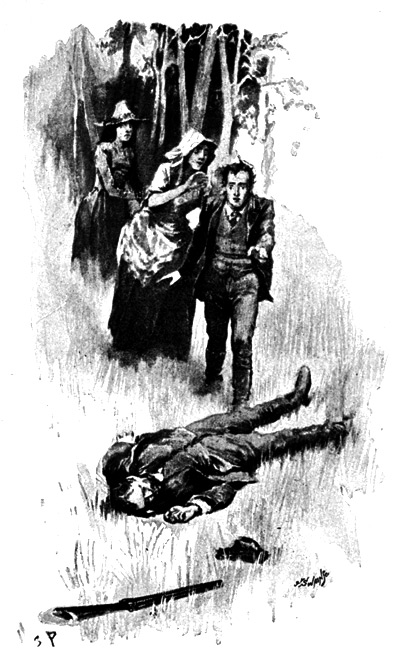
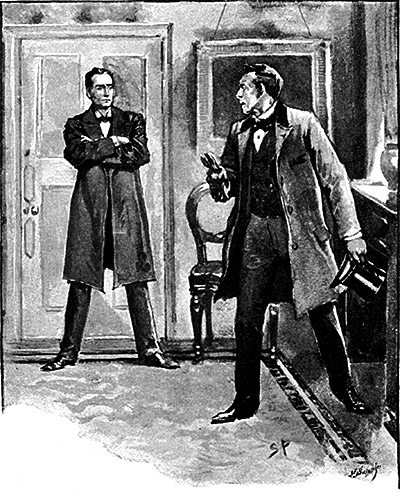
“THEY FOUND THE BODY”
“What are they?”
“It appears that his arrest did not take place at once, but after the
return to Hatherley Farm. On the inspector of constabulary informing
him that he was a prisoner, he remarked that he was not surprised to
hear it, and that it was no more than his deserts. This observation of
his had the natural
effect of removing any traces of doubt which might
have remained in the minds of the coroner’s jury.”
“It was a confession,” I ejaculated.
“No, for it was followed by a protestation of innocence.”
“Coming on the top of such a damning series of events, it was at least
a most suspicious remark.”
“On the contrary,” said Holmes, “it is the brightest rift which I can
at present see in the clouds. However innocent he might be, he could
not be such an absolute imbecile as not to see that the circumstances
were very black against him. Had he appeared surprised at his own
arrest, or feigned indignation at it, I should have looked upon it as
highly suspicious, because such surprise or anger would not be natural
under the circumstances, and yet might appear to be the best policy
to a scheming man. His frank acceptance of the situation marks him as
either an innocent man, or else as a man of considerable self-restraint
and firmness. As to his remark about his deserts, it was also not
unnatural if you consider that he stood beside the dead body of his
father, and that there is no doubt that he had that very day so far
forgotten his filial duty as to bandy words with him, and even,
according to the little girl whose evidence is so important, to raise
his hand as if to strike him. The self-reproach and contrition which
are displayed in his remark appear to me to be the signs of a healthy
mind, rather than of a guilty one.”
I shook my head. “Many men have been hanged on far slighter evidence,”
I remarked.
“So they have. And many men have been wrongfully hanged.”
“What is the young man’s own account of the matter?”
“It is, I am afraid, not very encouraging to his supporters, though
there are one or two points in it which are suggestive. You will find
it here, and may read it for yourself.”
He picked out from his bundle a copy of the local Herefordshire paper,
and having turned down the sheet, he pointed out the paragraph in which
the unfortunate young man had given his own statement of what had
occurred. I settled myself down in the corner of the carriage, and read
it very carefully. It ran in this way:
“Mr. James McCarthy, the only son of the deceased, was then called, and
gave evidence as follows: ‘I had been away from home for three days at
Bristol, and had only just returned upon the morning of last Monday,
the 3rd. My father was absent from home at the time of my arrival, and
I was informed by the maid that he had driven over to Ross with John
Cobb, the groom. Shortly after my return I heard the wheels of his trap
in the yard, and, looking out of my window, I saw him get out and walk
rapidly out of the yard, though I was not aware in which direction he
was going. I then took my gun, and strolled out in the direction of
the Boscombe Pool, with the intention of visiting the rabbit-warren
which is upon the other side. On my way I saw William Crowder, the
game-keeper, as he had stated in his evidence; but he is mistaken in
thinking that I was following my father. I had no idea that he was in
front of me. When about a hundred yards from the Pool I heard a cry of
“Cooee!” which was a usual signal between my father and myself. I then
hurried forward, and found him standing by the Pool. He appeared to be
much surprised at seeing me, and asked me rather roughly what I was
doing there. A conversation ensued which led to high words, and almost
to blows, for my father was a man of a very violent temper. Seeing
that his passion was becoming ungovernable, I left him, and returned
towards Hatherley Farm. I had not gone more than 150 yards, however,
when I heard a hideous outcry behind me, which caused me to run back
again. I found my father expiring upon the ground, with his head
terribly injured. I dropped my gun, and held him in my arms, but he
almost instantly expired. I knelt beside him for some minutes, and then
made my way to Mr. Turner’s lodge-keeper, his house being the nearest,
to ask for assistance. I saw no one near my father when I returned, and
I have no idea how he came by his injuries. He was not a popular man,
being somewhat cold and forbidding in his manners; but he had, as far
as I know, no active enemies. I know nothing further of the matter.’
“The Coroner: Did your father make any statement to you before he died?
“Witness: He mumbled a few words, but I could only catch some allusion
to a rat.
“The Coroner: What did you understand by that?
“Witness: It conveyed no meaning to me. I thought that he was delirious.
“The Coroner: What was the point upon which you and your father had
this final quarrel?
“Witness: I should prefer not to answer.
“The Coroner: I am afraid that I must press it.
“Witness: It is really impossible for me to tell you. I can assure you
that it has nothing to do with the sad tragedy which followed.
“The Coroner: That is for the court to decide. I need not point out to
you that your refusal to answer will prejudice your case considerably
in any future proceedings which may arise.
“Witness: I must still refuse.
“The Coroner: I understand that the cry of ‘Cooee’ was a common signal
between you and your father?
“Witness: It was.
“The Coroner: How was it, then, that he uttered it before he saw you,
and before he even knew that you had returned from Bristol?
“Witness (with considerable confusion): I do not know.
“A Juryman: Did you see nothing which aroused your suspicions when you
returned on hearing the cry, and found your father fatally injured?
“Witness: Nothing definite.
“The Coroner: What do you mean?
“Witness: I was so disturbed and excited as I rushed out into the open,
that I could think of nothing except of my father. Yet I have a vague
impression that as I ran forward something lay upon the ground to the
left of me. It seemed to me to be something gray in color, a coat of
some sort, or a plaid perhaps. When I rose from my father I looked
round for it, but it was gone.
“‘Do you mean that it disappeared before you went for help?’
“‘Yes, it was gone.’
“‘You cannot say what it was?’
“‘No, I had a feeling something was there.’
“‘How far from the body?’
“‘A dozen yards or so.’
“‘And how far from the edge of the wood?’
“‘About the same.’
“‘Then if it was removed it was while you were within a dozen yards of
it?’
“‘Yes, but with my back towards it.’
“This concluded the examination of the witness.”
“I see,” said I, as I glanced down the column, “that the coroner in
his concluding remarks was rather severe upon young McCarthy. He calls
attention, and with reason, to the discrepancy about his father having
signalled to him before seeing him, also to his refusal to give details
of his conversation with his father, and his singular account of his
father’s dying words. They are all, as he remarks, very much against
the son.”
Holmes laughed softly to himself, and stretched himself out upon the
cushioned seat. “Both you and the coroner have been at some pains,”
said he, “to single out the very strongest points in the young man’s
favor. Don’t you see that you alternately give him credit for having
too much imagination and too little. Too little, if he could not invent
a cause of quarrel which would give him the sympathy of the jury;
too much, if he evolved from his own inner consciousness anything
so outré as a dying reference to a rat, and the incident of the
vanishing cloth. No, sir, I shall approach this case from the point of
view that what this young man says is true, and we shall see whither
that hypothesis will lead us. And now here is my pocket Petrarch, and
not another word shall I say of this case until we are on the scene of
action. We lunch at Swindon, and I see that we shall be there in twenty
minutes.”
It was nearly four o’clock when we at last, after passing through
the beautiful Stroud Valley, and over the broad gleaming Severn,
found ourselves at the pretty little country-town of Ross. A lean,
ferret-like man, furtive and sly-looking, was waiting for us upon the
platform. In spite of the light brown dustcoat and leather-leggings
which he wore in deference to his rustic surroundings, I had no
difficulty in recognizing Lestrade, of Scotland Yard. With him we drove
to the Hereford Arms, where a room had already been engaged for us.
“I have ordered a carriage,” said Lestrade, as we sat over a cup of
tea. “I knew your energetic nature, and that you would not be happy
until you had been on the scene of the crime.”
“It was very nice and complimentary of you,” Holmes answered. “It is
entirely a question of barometric pressure.”
Lestrade looked startled. “I do not quite follow,” he said.
“How is the glass? Twenty-nine, I see. No wind, and not a cloud in the
sky. I have a caseful of cigarettes here which need smoking, and the
sofa is very much superior to the usual country hotel abomination. I do
not think that it is probable that I shall use the carriage to-night.”
Lestrade laughed indulgently. “You have, no doubt, already formed your
conclusions from the newspapers,” he said. “The case is as plain as a
pikestaff, and the more one goes into it the plainer it becomes. Still,
of course, one can’t refuse a lady, and such a very positive one, too.
She had heard of you, and would have your opinion, though I repeatedly
told her that there was nothing which you could do which I had not
already done. Why, bless my soul! here is her carriage at the door.”
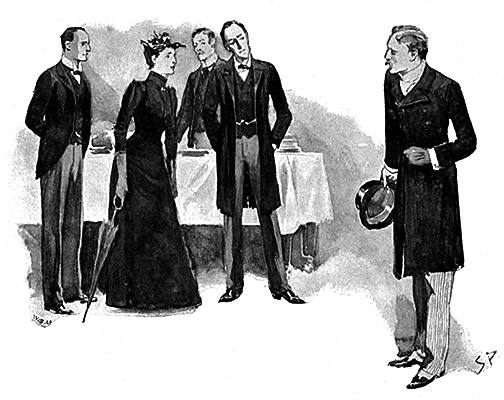
He had hardly spoken before there rushed into the room one of the most
lovely young women that I have ever seen in my life. Her violet eyes
shining, her lips parted, a pink flush upon her cheeks, all thought of
her natural reserve lost in her overpowering excitement and concern.
“Oh, Mr. Sherlock Holmes!” she cried, glancing from one to the other
of us, and finally, with a woman’s quick intuition, fastening upon my
companion, “I am so glad that you have come. I have driven down to tell
you so. I know that James didn’t do it. I know it, and I want you to
start upon your work knowing it, too. Never let yourself doubt upon
that point. We have known each other since we were little children, and
I know his faults as no one else does; but he is too tender-hearted to
hurt a fly. Such a charge is absurd to any one who really knows him.”
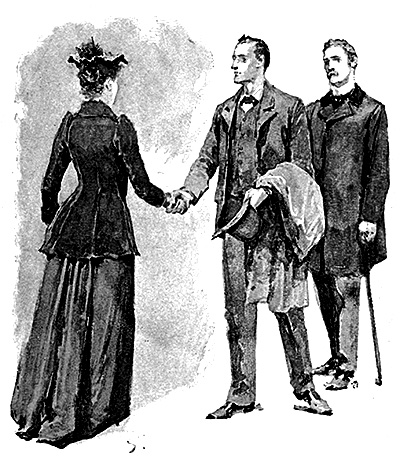
“I hope we may clear him, Miss Turner,” said Sherlock Holmes. “You may
rely upon my doing all that I can.”
“But you have read the evidence. You have formed some conclusion? Do
you not see some loophole, some flaw? Do you not yourself think that he
is innocent?”
“I think that it is very probable.”
“There, now!” she cried, throwing back her head, and looking defiantly
at Lestrade. “You hear! He gives me hopes.”
Lestrade shrugged his shoulders. “I am afraid that my colleague has
been a little quick in forming his conclusions,” he said.
“But he is right. Oh! I know that he is right. James never did it. And
about his quarrel with his father, I am sure that the reason why he
would not speak about it to the coroner was because I was concerned in
it.”
“In what way?” asked Holmes.
“It is no time for me to hide anything. James and his father had many
disagreements about me. Mr. McCarthy was very anxious that there should
be a marriage between us. James and I have always loved each other as
brother and
sister; but of course he is young, and has seen very little
of life yet, and—and—well, he naturally did not wish to do anything
like that yet. So there were quarrels, and this, I am sure, was one of
them.”
“And your father?” asked Holmes. “Was he in favor of such a union?”
“No, he was averse to it also. No one but Mr. McCarthy was in favor of
it.” A quick blush passed over her fresh young face as Holmes shot one
of his keen, questioning glances at her.
“Thank you for this information,” said he. “May I see your father if I
call to-morrow?”
“I am afraid the doctor won’t allow it.”
“The doctor?”
“Yes, have you not heard? Poor father has never been strong for years
back, but this has broken him down completely. He has taken to his bed,
and Dr. Willows says that he is a wreck, and that his nervous system is
shattered. Mr. McCarthy was the only man alive who had known dad in the
old days in Victoria.”
“Ha! In Victoria! That is important.”
“Yes, at the mines.”
“Quite so; at the gold-mines, where, as I understand, Mr. Turner made
his money.”
“Yes, certainly.”
“Thank you, Miss Turner. You have been of material assistance to me.”
“You will tell me if you have any news to-morrow. No doubt you will go
to the prison to see James. Oh, if you do, Mr. Holmes, do tell him that
I know him to be innocent.”
“I will, Miss Turner.”
“I must go home now, for dad is very ill, and he misses me so if I
leave him. Good-bye, and God help you in your undertaking.” She hurried
from the room as impulsively as she had entered, and we heard the
wheels of her carriage rattle off down the street.
“I am ashamed of you, Holmes,” said Lestrade, with dignity, after a few
minutes’ silence. “Why should you raise up hopes which you are bound to
disappoint? I am not over-tender of heart, but I call it cruel.”
“I think that I see my way to clearing James McCarthy,” said Holmes.
“Have you an order to see him in prison?”
“Yes, but only for you and me.”
“Then I shall reconsider my resolution about going out. We have still
time to take a train to Hereford and see him to-night?”
“Ample.”
“Then let us do so. Watson, I fear that you will find it very slow, but
I shall only be away a couple of hours.”
I walked down to the station with them, and then wandered through the
streets of the little town, finally returning to the hotel, where I
lay upon the sofa and tried to interest myself in a yellow-backed
novel. The puny plot of the story was so thin, however, when compared
to the deep mystery through which we were groping, and I found my
attention wander so continually from the fiction to the fact, that I
at last flung it across the room, and gave myself up entirely to a
consideration of the events of the day. Supposing that this unhappy
young man’s story was absolutely true, then what hellish thing, what
absolutely unforeseen and extraordinary calamity could have occurred
between the time when he parted from his father, and the moment when,
drawn back by his screams, he rushed into the glade? It was something
terrible and deadly. What could it be? Might not the nature of the
injuries reveal something to my medical instincts? I rang the bell,
and called for the weekly county paper, which contained a verbatim
account of the inquest. In the surgeon’s deposition it was stated that
the posterior third of the left parietal bone and the left half of the
occipital bone had been shattered by a heavy blow from a blunt weapon.
I marked the spot upon my own head. Clearly such a blow must have been
struck from behind. That was to some extent in favor of the accused,
as when seen quarrelling he was face to face with his father. Still,
it did not go for very much, for the older man might have turned his
back before the blow fell. Still, it might be worth while to call
Holmes’s attention to it. Then there was the peculiar dying reference
to a rat. What could that mean? It could not be delirium. A man dying
from a sudden blow does not commonly become delirious. No, it was more
likely to be an attempt to explain how he met his fate. But what could
it indicate? I cudgelled my brains to find some possible explanation.
And then the incident of the gray cloth, seen by young McCarthy. If
that were true, the murderer must have dropped some part of his dress,
presumably his overcoat, in his flight, and must have had the hardihood
to return and to carry it away at the instant when the son was kneeling
with his back turned not a dozen paces off. What a tissue of mysteries
and improbabilities the whole thing was! I did not wonder at Lestrade’s
opinion, and yet I had so much faith in Sherlock Holmes’s insight that
I could not lose hope as long as every fresh fact seemed to strengthen
his conviction of young McCarthy’s innocence.
It was late before Sherlock Holmes returned. He came back alone, for
Lestrade was staying in lodgings in the town.
“The glass still keeps very high,” he remarked, as he sat down. “It is
of importance that it should not rain before we are able to go over the
ground. On the other hand, a man should be at his very best and keenest
for such nice work as that, and I did not wish to do it when fagged by
a long journey. I have seen young McCarthy.”
“And what did you learn from him?”
“Nothing.”
“Could he throw no light?”
“None at all. I was inclined to think at one time that he knew who had
done it, and was screening him or her, but I am convinced now that he
is as puzzled as every one else. He is not a very quick-witted youth,
though comely to look at, and, I should think, sound at heart.”
“I cannot admire his taste,” I remarked, “if it is indeed a fact that
he was averse to a marriage with so charming a young lady as this Miss
Turner.”
“Ah, thereby hangs a rather painful tale. This fellow is madly,
insanely in love with her, but some two years ago, when he was only a
lad, and before he really knew her, for she had been away five years at
a boarding-school, what does the idiot do but get into the clutches of
a barmaid in Bristol, and marry her at a registry office? No one knows
a word of the matter, but you can imagine how maddening it must be to
him to be upbraided for not doing what he would give his very eyes to
do, but what he knows to be absolutely impossible. It was sheer frenzy
of this sort which made him throw his hands up into the air when his
father, at their last interview, was goading him on to propose to Miss
Turner. On the other hand, he had no means of supporting himself, and
his father, who was by all accounts a very hard man, would have thrown
him over utterly had he known the truth. It was with his barmaid wife
that he had spent the last three days in Bristol, and his father did
not know where he was. Mark that point. It is of importance. Good has
come out of evil, however, for the barmaid, finding from the papers
that he is in serious trouble, and likely to be hanged, has thrown
him over utterly, and has written to him to say that she has a husband
already in the Bermuda Dockyard, so that there is really no tie between
them. I think that that bit of news has consoled young McCarthy for all
that he has suffered.”
“But if he is innocent, who has done it?”
“Ah! who? I would call your attention very particularly to two points.
One is that the murdered man had an appointment with some one at the
Pool, and that the some one could not have been his son, for his son
was away, and he did not know when he would return. The second is that
the murdered man was heard to cry ‘Cooee!’ before he knew that his son
had returned. Those are the crucial points upon which the case depends.
And now let us talk about George Meredith, if you please, and we shall
leave all minor matters until to-morrow.”
There was no rain, as Holmes had foretold, and the morning broke
bright and cloudless. At nine o’clock Lestrade called for us with the
carriage, and we set off for Hatherley Farm and the Boscombe Pool.
“There is serious news this morning,” Lestrade observed. “It is said
that Mr. Turner, of the Hall, is so ill that his life is despaired of.”
“An elderly man, I presume?” said Holmes.
“About sixty; but his constitution has been shattered by his life
abroad, and he has been in failing health for some time. This business
has had a very bad effect upon him. He was an old friend of McCarthy’s,
and, I may add, a great benefactor to him, for I have learned that he
gave him Hatherley Farm rent free.”
“Indeed! That is interesting,” said Holmes.
“Oh yes! In a hundred other ways he has helped him. Everybody about
here speaks of his kindness to him.”
“Really! Does it not strike you as a little singular that this
McCarthy, who appears to have had little of his own, and to have been
under such obligations to Turner, should still talk of marrying his
son to Turner’s daughter, who is, presumably, heiress to the estate,
and that in such a very cocksure manner, as if it were merely a case of
a proposal and all else would follow? It is the more strange, since we
know that Turner himself was averse to the idea. The daughter told us
as much. Do you not deduce something from that?”
“We have got to the deductions and the inferences,” said Lestrade,
winking at me. “I find it hard enough to tackle facts, Holmes, without
flying away after theories and fancies.”
“You are right,” said Holmes, demurely; “you do find it very hard to
tackle the facts.”
“Anyhow, I have grasped one fact which you seem to find it difficult to
get hold of,” replied Lestrade, with some warmth.
“And that is—”
“That McCarthy, senior, met his death from McCarthy, junior, and that
all theories to the contrary are the merest moonshine.”
“Well, moonshine is a brighter thing than fog,” said Holmes, laughing.
“But I am very much mistaken if this is not Hatherley Farm upon the
left.”
“Yes, that is it.” It was a wide-spread, comfortable-looking building,
two-storied, slate roofed, with great yellow blotches of lichen upon
the gray walls. The drawn blinds and the smokeless chimneys, however,
gave it a stricken look, as though the weight of this horror still
lay heavy upon it. We called at the door, when the maid, at Holmes’s
request, showed us the boots which her master wore at the time of his
death, and also a pair of the son’s, though not the pair which he had
then had. Having measured these very carefully from seven or eight
different points, Holmes desired to be led to the court-yard, from
which we all followed the winding track which led to Boscombe Pool.
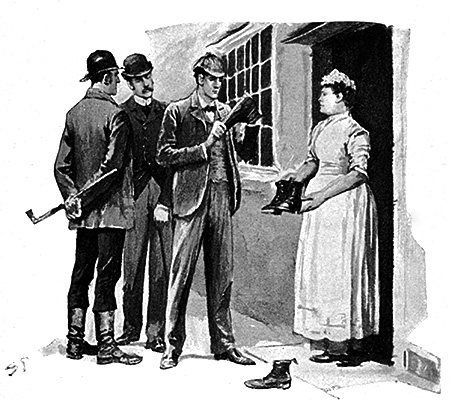
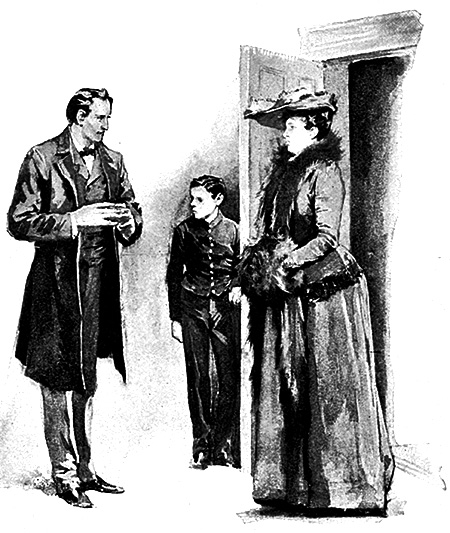
“THE MAID SHOWED US THE BOOTS.”
Sherlock Holmes was transformed when he was hot upon such a scent
as this. Men who had only known the quiet thinker and logician of
Baker Street would have failed to recognize him. His face flushed and
darkened. His brows were drawn into two hard, black lines, while his
eyes shone out from beneath them with a steely glitter. His face was
bent downward, his shoulders bowed, his lips compressed, and the veins
stood out like whip-cord in his long, sinewy neck. His nostrils seemed
to dilate with a purely animal lust for the chase, and his mind was so
absolutely concentrated upon the matter before him, that a question
or remark fell unheeded upon his ears, or, at the most, only provoked
a quick, impatient snarl in reply. Swiftly and silently he made his
way along the track which ran through the meadows, and so by way of
the woods to the Boscombe Pool. It was damp, marshy ground, as is all
that district, and there were marks of many feet, both upon the path
and amid the short grass which bounded it on either side. Sometimes
Holmes would hurry on, sometimes stop dead, and once he made quite a
little détour into the meadow. Lestrade and I walked behind him, the
detective indifferent and contemptuous, while I watched my friend with
the interest which sprang from the conviction that every one of his
actions was directed towards a definite end.
The Boscombe Pool, which is a little reed-girt sheet of water some
fifty yards across, is situated at the boundary between the Hatherley
Farm and the private park of the wealthy Mr. Turner. Above the woods
which lined it upon the farther side we could see the red, jutting
pinnacles which marked the site of the rich land-owner’s dwelling. On
the Hatherley side of the Pool the woods grew very thick, and there was
a narrow belt of sodden grass twenty paces across between the edge of
the trees and the reeds which lined the lake. Lestrade showed us the
exact spot at which the body had been found, and, indeed, so moist was
the ground, that I could plainly see the traces which had been left by
the fall of the stricken man. To Holmes, as I could see by his eager
face and peering eyes, very many other things were to be read upon the
trampled grass. He ran round, like a dog who is picking up a scent, and
then turned upon my companion.
“What did you go into the Pool for?” he asked.
“I fished about with a rake. I thought there might be some weapon or
other trace. But how on earth—”
“Oh, tut, tut! I have no time! That left foot of yours with its inward
twist is all over the place. A mole could trace it, and there it
vanishes among the reeds. Oh, how simple it would all have been had I
been here before they came like a herd of buffalo, and wallowed all
over it. Here is where the party with the lodge-keeper came, and they
have covered all tracks for six or eight feet round the body. But
here are three separate tracks of the same feet.” He drew out a lens,
and lay down upon his waterproof to have a better view, talking all
the time rather to himself than to us. “These are young McCarthy’s
feet. Twice he was walking, and once he ran swiftly so that the soles
are deeply marked, and the heels hardly visible. That bears out his
story. He ran when he saw his father on the ground. Then here are the
father’s feet as he paced up and down. What is this, then? It is the
butt-end of the gun as the son stood listening. And this? Ha, ha! What
have we here? Tiptoes! tiptoes! Square, too, quite unusual boots! They
come, they go, they come again—of course that was for the cloak.
Now where did they come from?” He ran up and down, sometimes losing,
sometimes finding the track until we were well within the edge of the
wood, and under the shadow of a great beech, the largest tree in the
neighborhood. Holmes traced his way to the farther side of this, and
lay down once more upon his face with a little cry of satisfaction.
For a long time he remained there, turning over the leaves and dried
sticks, gathering up what seemed to me to be dust into an envelope, and
examining with his lens not only the ground, but even the bark of the
tree as far as he could reach. A jagged stone was lying among the moss,
and this also he carefully examined and retained. Then he followed a
pathway through the wood until he came to the high-road, where all
traces were lost.
“It has been a case of considerable interest,” he remarked, returning
to his natural manner. “I fancy that this gray house on the right must
be the lodge. I think that I will go in and have a word with Moran, and
perhaps write a little note. Having done that, we may drive back to our
luncheon. You may walk to the cab, and I shall be with you presently.”
It was about ten minutes before we regained our cab, and drove back
into Ross, Holmes still carrying with him the stone which he had picked
up in the wood.
“This may interest you, Lestrade,” he remarked, holding it out. “The
murder was done with it.”
“I see no marks.”
“There are none.”
“How do you know, then?”
“The grass was growing under it. It had only lain there a few days.
There was no sign of a place whence it had been taken. It corresponds
with the injuries. There is no sign of any other weapon.”
“And the murderer?”
“Is a tall man, left-handed, limps with the right leg, wears
thick-soled shooting-boots and a gray cloak, smokes Indian cigars, uses
a cigar-holder, and carries a blunt penknife in his pocket. There are
several other indications, but these may be enough to aid us in our
search.”
Lestrade laughed. “I am afraid that I am still a sceptic,” he said.
“Theories are all very well, but we have to deal with a hard-headed
British jury.”
“Nous verrons,” answered Holmes, calmly. “You work your own method,
and I shall work mine. I shall be busy this afternoon, and shall
probably return to London by the evening train.”
“And leave your case unfinished?”
“No, finished.”
“But the mystery?”
“It is solved.”
“Who was the criminal, then?”
“The gentleman I describe.”
“But who is he?”
“Surely it would not be difficult to find out. This is not such a
populous neighborhood.”
Lestrade shrugged his shoulders. “I am a practical man,” he said,
“and I really cannot undertake to go about the country looking
for a left-handed gentleman with a game-leg. I should become the
laughing-stock of Scotland Yard.”
“All right,” said Holmes, quietly. “I have given you the chance. Here
are your lodgings. Good-bye. I shall drop you a line before I leave.”
Having left Lestrade at his rooms, we drove to our hotel, where we
found lunch upon the table. Holmes was silent and buried in thought
with a pained expression upon his face, as one who finds himself in a
perplexing position.
“Look here, Watson,” he said, when the cloth was cleared; “just sit
down in this chair and let me preach to you for a little. I don’t quite
know what to do, and I should value your advice. Light a cigar, and let
me expound.”
“Pray do so.”
“Well, now, in considering this case there are two points about young
McCarthy’s narrative which struck us both instantly, although they
impressed me in his favor and you against him. One was the fact that
his father should, according to his account, cry ‘Cooee!’ before seeing
him. The other was his singular dying reference to a rat. He mumbled
several words, you understand, but that was all that caught the son’s
ear. Now from this double point our research must commence, and we will
begin it by presuming that what the lad says is absolutely true.”
“What of this ‘Cooee!’ then?”
“Well, obviously it could not have been meant for the son. The son, as
far as he knew, was in Bristol. It was mere chance that he was within
ear-shot. The ‘Cooee!’ was meant to attract the attention of whoever
it was that he had the appointment with. But ‘Cooee’ is a distinctly
Australian cry, and one which is used between Australians. There is a
strong presumption that the person whom McCarthy expected to meet him
at Boscombe Pool was some one who had been in Australia.”
“What of the rat, then?”
Sherlock Holmes took a folded paper from his pocket and flattened it
out on the table. “This is a map of the Colony of Victoria,” he said.
“I wired to Bristol for it last night.” He put his hand over part of
the map. “What do you read?” he asked.
“ARAT,” I read.
“And now?” He raised his hand.
“BALLARAT.”
“Quite so. That was the word the man uttered, and of which his son only
caught the last two syllables. He was trying to utter the name of his
murderer. So-and-so, of Ballarat.”
“It is wonderful!” I exclaimed.
“It is obvious. And now, you see, I had narrowed the field down
considerably. The possession of a gray garment was a third point
which, granting the son’s statement to be correct, was a certainty. We
have come now out of mere vagueness to the definite conception of an
Australian from Ballarat with a gray cloak.”
“Certainly.”
“And one who was at home in the district, for the Pool can only be
approached by the farm or by the estate, where strangers could hardly
wander.”
“Quite so.”
“Then comes our expedition of to-day. By an examination of the ground I
gained the trifling details which I gave to that imbecile Lestrade, as
to the personality of the criminal.”
“But how did you gain them?”
“You know my method. It is founded upon the observance of trifles.”
“His height I know that you might roughly judge from the length of his
stride. His boots, too, might be told from their traces.”
“Yes, they were peculiar boots.”
“But his lameness?”
“The impression of his right foot was always less distinct than his
left. He put less weight upon it. Why? Because he limped—he was lame.”
“But his left-handedness.”
“You were yourself struck by the nature of the injury as recorded
by the surgeon at the inquest. The blow was struck from immediately
behind, and yet was upon the left side. Now, how can that be unless it
were by a left-handed man? He had stood behind that tree during the
interview between the father and son. He had even smoked there. I found
the ash of a cigar, which my special knowledge of tobacco ashes enabled
me to pronounce as an Indian cigar. I have, as you know, devoted some
attention to this, and written a little monograph on the ashes of 140
different varieties of pipe, cigar, and cigarette tobacco. Having found
the ash, I then looked round and discovered the stump among the moss
where he had tossed it. It was an Indian cigar, of the variety which
are rolled in Rotterdam.”
“And the cigar-holder?”
“I could see that the end had not been in his mouth. Therefore he used
a holder. The tip had been cut off, not bitten off, but the cut was not
a clean one, so I deduced a blunt pen-knife.”
“Holmes,” I said, “you have drawn a net round this man from which he
cannot escape, and you have saved an innocent human life as truly as
if you had cut the cord which was hanging him. I see the direction in
which all this points. The culprit is—”
“Mr. John Turner,” cried the hotel waiter, opening the door of our
sitting-room, and ushering in a visitor.
The man who entered was a strange and impressive figure. His slow,
limping step and bowed shoulders gave the appearance of decrepitude,
and yet his hard, deep-lined, craggy features, and his enormous
limbs showed that he was possessed of unusual strength of body and
of character. His tangled beard, grizzled hair, and outstanding,
drooping eyebrows combined to give an air of dignity and power to his
appearance, but his face was of an ashen white, while his lips and the
corners of his nostrils were tinged with a shade of blue. It was clear
to me at a glance that he was in the grip of some deadly and chronic
disease.
“Pray sit down on the sofa,” said Holmes, gently. “You had my note?”
“Yes, the lodge-keeper brought it up. You said that you wished to see
me here to avoid scandal.”
“I thought people would talk if I went to the Hall.”
“And why did you wish to see me?” He looked across at my companion with
despair in his weary eyes, as though his question was already answered.
“Yes,” said Holmes, answering the look rather than the words. “It is
so. I know all about McCarthy.”
The old man sank his face in his hands. “God help me!” he cried. “But I
would not have let the young man come to harm. I give you my word that
I would have spoken out if it went against him at the Assizes.”
“I am glad to hear you say so,” said Holmes, gravely.
“I would have spoken now had it not been for my dear girl. It would
break her heart—it will break her heart when she hears that I am
arrested.”
“It may not come to that,” said Holmes.
“What!”
“I am no official agent. I understand that it was your daughter who
required my presence here, and I am acting in her interests. Young
McCarthy must be got off, however.”
“I am a dying man,” said old Turner. “I have had diabetes for years. My
doctor says it is a question whether I shall live a month. Yet I would
rather die under my own roof than in a jail.”
Holmes rose and sat down at the table with his pen in his hand and a
bundle of paper before him. “Just tell us the truth,” he said. “I
shall jot down the facts. You will sign it, and Watson here can witness
it. Then I could produce your confession at the last extremity to save
young McCarthy. I promise you that I shall not use it unless it is
absolutely needed.”
“It’s as well,” said the old man; “it’s a question whether I shall live
to the Assizes, so it matters little to me, but I should wish to spare
Alice the shock. And now I will make the thing clear to you; it has
been a long time in the acting, but will not take me long to tell.
“You didn’t know this dead man, McCarthy. He was a devil incarnate. I
tell you that. God keep you out of the clutches of such a man as he.
His grip has been upon me these twenty years, and he has blasted my
life. I’ll tell you first how I came to be in his power.
“It was in the early sixties at the diggings. I was a young chap then,
hot-blooded and reckless, ready to turn my hand at anything; I got
among bad companions, took to drink, had no luck with my claim, took to
the bush, and in a word became what you would call over here a highway
robber. There were six of us, and we had a wild, free life of it,
sticking up a station from time to time, or stopping the wagons on the
road to the diggings. Black Jack of Ballarat was the name I went under,
and our party is still remembered in the colony as the Ballarat Gang.
“One day a gold convoy came down from Ballarat to Melbourne, and we
lay in wait for it and attacked it. There were six troopers and six of
us, so it was a close thing, but we emptied four of their saddles at
the first volley. Three of our boys were killed, however, before we
got the swag. I put my pistol to the head of the wagon-driver, who was
this very man McCarthy. I wish to the Lord that I had shot him then,
but I spared him, though I saw his wicked little eyes fixed on my face,
as though to remember every feature. We got away with the gold, became
wealthy men, and made our way over to England without being suspected.
There I parted from my old pals, and determined to settle down to a
quiet and respectable life. I bought this estate, which chanced to be
in the market, and I set myself to do a little good with my money,
to make up for the way in which I had earned it. I married, too, and
though my wife died young, she left me my dear little Alice. Even when
she was just a baby her wee hand seemed to lead me down the right path
as nothing else had ever done. In a word, I turned over a new leaf, and
did my best to make up for the past. All was going well when McCarthy
laid his grip upon me.
“I had gone up to town about an investment, and I met him in Regent
Street with hardly a coat to his back or a boot to his foot.
“‘Here we are, Jack,’ says he, touching me on the arm; ‘we’ll be as
good as a family to you. There’s two of us, me and my son, and you can
have the keeping of us. If you don’t—it’s a fine, law-abiding country
is England, and there’s always a policeman within hail.’
“Well, down they came to the West country, there was no shaking them
off, and there they have lived rent free on my best land ever since.
There was no rest for me, no peace, no forgetfulness; turn where I
would, there was his cunning, grinning face at my elbow. It grew worse
as Alice grew up, for he soon saw I was more afraid of her knowing my
past than of the police. Whatever he wanted he must have, and whatever
it was I gave him without question, land, money, houses, until at last
he asked a thing which I could not give. He asked for Alice.
“His son, you see, had grown up, and so had my girl, and as I was known
to be in weak health, it seemed a fine stroke to him that his lad
should step into the whole property. But there I was firm. I would not
have his cursed stock mixed with mine; not that I had any dislike to
the lad, but his blood was in him, and that was enough. I stood firm.
McCarthy threatened. I braved him to do his worst. We were to meet at
the Pool midway between our houses to talk it over.
“When I went down there I found him talking with his son, so I smoked
a cigar, and waited behind a tree until he should be alone. But as I
listened to his talk all that was black and bitter in me seemed to
come uppermost. He was urging his son to marry my daughter with as
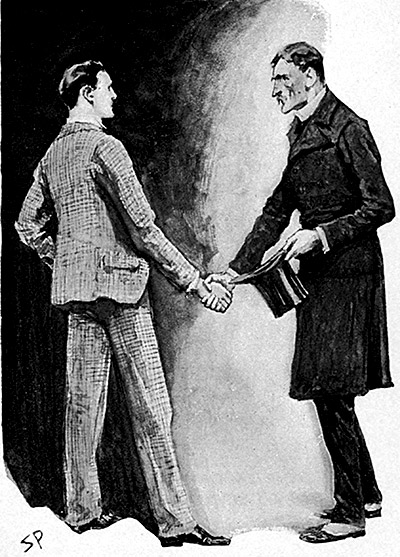
little regard for what she might think as if she were a slut from off
the streets. It drove me mad to think that I and all that I held most
dear should be in the power of such a man as this. Could I not snap the
bond? I was already a dying and a desperate man. Though clear of mind
and fairly strong of limb, I knew that my own fate was sealed. But my
memory and my girl! Both could be saved, if I could but silence that
foul tongue. I did it, Mr. Holmes. I would do it again. Deeply as I
have sinned, I have led a life of martyrdom to atone for it. But that
my girl should be entangled in the same meshes which held me was more
than I could suffer. I struck him down with no more compunction than if
he had been some foul and venomous beast. His cry brought back his son;
but I had gained the cover of the wood, though I was forced to go back
to fetch the cloak which I had dropped in my flight. That is the true
story, gentlemen, of all that occurred.”
“Well, it is not for me to judge you,” said Holmes, as the old man
signed the statement which had been drawn out. “I pray that we may
never be exposed to such a temptation.”
“I pray not, sir. And what do you intend to do?”
“In view of your health, nothing. You are yourself aware that you will
soon have to answer for your deed at a higher court than the Assizes.
I will keep your confession, and, if McCarthy is condemned, I shall be
forced to use it. If not, it shall never be seen by mortal eye; and
your secret, whether you be alive or dead, shall be safe with us.”
“Farewell, then,” said the old man, solemnly. “Your own death-beds,
when they come, will be the easier for the thought of the peace which
you have given to mine.” Tottering and shaking in all his giant frame,
he stumbled slowly from the room.
“God help us!” said Holmes, after a long silence. “Why does fate play
such tricks with poor, helpless worms? I never hear of such a case as
this that I do not think of Baxter’s words, and say, ‘There, but for
the grace of God, goes Sherlock Holmes.’”
James McCarthy was acquitted at the Assizes, on the strength of a
number of objections which had been drawn out by Holmes, and submitted
to the defending counsel. Old Turner lived for seven months after our
interview, but he is now dead; and there is every prospect that the son
and daughter may come to live happily together, in ignorance of the
black cloud which rests upon their past.
Adventure V THE FIVE ORANGE PIPS

WHEN I glance over my notes and records of the Sherlock Holmes cases
between the years ’82 and ’90, I am faced by so many which present
strange and interesting features that it is no easy matter to know
which to choose and which to leave. Some, however, have already gained
publicity through the papers, and others have not offered a field
for those peculiar qualities which my friend possessed in so high a
degree, and which it is the object of these papers to illustrate. Some,
too, have baffled his analytical skill, and would be, as narratives,
beginnings without an ending, while others have been but partially
cleared up, and have their explanations founded rather upon conjecture
and surmise than on that absolute logical proof which was so dear to
him. There is, however, one of these last which was so remarkable in
its details and so startling in its results that I am tempted to give
some account of it, in spite of the fact that there are points in
connection with it which never have been, and probably never will be,
entirely cleared up.
The year ’87 furnished us with a long series of cases of greater
or less interest, of which I retain the records. Among my headings
under this one twelve months I find an account of the adventure of
the Paradol Chamber, of the Amateur Mendicant Society, who held a
luxurious club in the lower vault of a furniture warehouse, of the
facts connected with the loss of the British bark Sophy Anderson, of
the singular adventures of the Grice Patersons in the island of Uffa,
and finally of the Camberwell poisoning case. In the latter, as may
be remembered, Sherlock Holmes was able, by winding up the dead man’s
watch, to prove that it had been wound up two hours before, and that
therefore the deceased had gone to bed within that time—a deduction
which was of the greatest importance in clearing up the case. All these
I may sketch out at some future date, but none of them present such
singular features as the strange train of circumstances which I have
now taken up my pen to describe.
It was in the latter days of September, and the equinoctial gales had
set in with exceptional violence. All day the wind had screamed and the
rain had beaten against the windows, so that even here in the heart
of great, hand-made London we were forced to raise our minds for the
instant from the routine of life, and to recognize the presence of
those great elemental forces which shriek at mankind through the bars
of his civilization, like untamed beasts in a cage. As evening drew in,
the storm grew higher and louder, and the wind cried and sobbed like a
child in the chimney. Sherlock Holmes sat moodily at one side of the
fireplace cross-indexing his records of crime, while I at the other was
deep in one of Clark Russell’s fine sea-stories, until the howl of the
gale from without seemed to blend with the text, and the splash of the
rain to lengthen out into the long swash of the sea waves. My wife was
on a visit to her mother’s, and for a few days I was a dweller once
more in my old quarters at Baker Street.
“Why,” said I, glancing up at my companion, “that was surely the bell.
Who could come to-night? Some friend of yours, perhaps?”
“Except yourself I have none,” he answered. “I do not encourage
visitors.”
“A client, then?”
“If so, it is a serious case. Nothing less would bring a man out on
such a day and at such an hour. But I take it that it is more likely to
be some crony of the landlady’s.”
Sherlock Holmes was wrong in his conjecture, however, for there came
a step in the passage and a tapping at the door. He stretched out his
long arm to turn the lamp away from himself and towards the vacant
chair upon which a new-comer must sit. “Come in!” said he.
The man who entered was young, some two-and-twenty at the outside,
well-groomed and trimly clad, with something of refinement and delicacy
in his bearing. The steaming umbrella which he held in his hand, and
his long shining waterproof told of the fierce weather through which he
had come. He looked about him anxiously in the glare of the lamp, and
I could see that his face was pale and his eyes heavy, like those of a
man who is weighed down with some great anxiety.
“I owe you an apology,” he said, raising his golden pince-nez to his
eyes. “I trust that I am not intruding. I fear that I have brought some
traces of the storm and rain into your snug chamber.”
“Give me your coat and umbrella,” said Holmes. “They may rest here
on the hook, and will be dry presently. You have come up from the
south-west, I see.”
“Yes, from Horsham.”
“That clay and chalk mixture which I see upon your toe-caps is quite
distinctive.”
“I have come for advice.”
“That is easily got.”
“And help.”
“That is not always so easy.”
“I have heard of you, Mr. Holmes. I heard from Major Prendergast how
you saved him in the Tankerville Club Scandal.”
“Ah, of course. He was wrongfully accused of cheating at cards.”
“He said that you could solve anything.”
“He said too much.”
“That you are never beaten.”
“I have been beaten four times—three times by men, and once by a
woman.”
“But what is that compared with the number of your successes?”
“It is true that I have been generally successful.”
“Then you may be so with me.”
“I beg that you will draw your chair up to the fire, and favor me with
some details as to your case.”
“It is no ordinary one.”
“None of those which come to me are. I am the last court of appeal.”
“And yet I question, sir, whether, in all your experience, you have
ever listened to a more mysterious and inexplicable chain of events
than those which have happened in my own family.”
“You fill me with interest,” said Holmes. “Pray give us the essential
facts from the commencement, and I can afterwards question you as to
those details which seem to me to be most important.”
The young man pulled his chair up, and pushed his wet feet out towards
the blaze.
“My name,” said he, “is John Openshaw, but my own affairs have, as far
as I can understand it, little to do with this awful business. It is an
hereditary matter; so in order to give you an idea of the facts, I must
go back to the commencement of the affair.
“You must know that my grandfather had two sons—my uncle Elias and
my father Joseph. My father had a small factory at Coventry, which
he enlarged at the time of the invention of bicycling. He was the
patentee of the Openshaw unbreakable tire, and his business met with
such success that he was able to sell it, and to retire upon a handsome
competence.
“My uncle Elias emigrated to America when he was a young man, and
became a planter in Florida, where he was reported to have done
very well. At the time of the war he fought in Jackson’s army, and
afterwards under Hood, where he rose to be a colonel. When Lee laid
down his arms my uncle returned to his plantation, where he remained
for three or four years. About 1869 or 1870 he came back to Europe,
and took a small estate in Sussex, near Horsham. He had made a very
considerable fortune in the States, and his reason for leaving them was
his aversion to the negroes, and his dislike of the Republican policy
in extending the franchise to them. He was a singular man, fierce and
quick-tempered, very foul-mouthed when he was angry, and of a most
retiring disposition. During all the years that he lived at Horsham I
doubt if ever he set foot in the town. He had a garden and two or three
fields round his house, and there he would take his exercise, though
very often for weeks on end he would never leave his room. He drank
a great deal of brandy, and smoked very heavily, but he would see no
society, and did not want any friends, not even his own brother.
“He didn’t mind me, in fact, he took a fancy to me, for at the time
when he saw me first I was a youngster of twelve or so. This would be
in the year 1878, after he had been eight or nine years in England. He
begged my father to let me live with him, and he was very kind to me
in his way. When he was sober he used to be fond of playing backgammon
and draughts with me, and he would make me his representative both with
the servants and with the tradespeople, so that by the time that I was
sixteen I was quite master of the house. I kept all the keys, and could
go where I liked and do what I liked, so long as I did not disturb him
in his privacy. There was one singular exception, however, for he had
a single room, a lumber-room up among the attics, which was invariably
locked, and which he would never permit either me or anyone else to
enter. With a boy’s curiosity I have peeped through the key-hole, but
I was never able to see more than such a collection of old trunks and
bundles as would be expected in such a room.
“One day—it was in March, 1883—a letter with a foreign stamp lay
upon the table in front of the Colonel’s plate. It was not a common
thing for him to receive letters, for his bills were all paid in
ready money, and he had no friends of any sort. ‘From India!’ said he,
as he took it up, ‘Pondicherry postmark! What can this be?’ Opening
it hurriedly, out there jumped five little dried orange pips, which
pattered down upon his plate. I began to laugh at this, but the laugh
was struck from my lips at the sight of his face. His lip had fallen,
his eyes were protruding, his skin the color of putty, and he glared at
the envelope which he still held in his trembling hand. ‘K. K. K.!’ he
shrieked, and then, ‘My God, my God, my sins have overtaken me!’
“‘What is it, uncle?’ I cried.
“‘Death,’ said he, and rising from the table he retired to his room,
leaving me palpitating with horror. I took up the envelope, and saw
scrawled in red ink upon the inner flap, just above the gum, the letter
K three times repeated. There was nothing else save the five dried
pips. What could be the reason of his overpowering terror? I left the
breakfast-table, and as I ascended the stair I met him coming down with
an old rusty key, which must have belonged to the attic, in one hand,
and a small brass box, like a cash-box, in the other.
“‘They may do what they like, but I’ll checkmate them still,’ said he,
with an oath. ‘Tell Mary that I shall want a fire in my room to-day,
and send down to Fordham, the Horsham lawyer.’
“I did as he ordered, and when the lawyer arrived I was asked to step
up to the room. The fire was burning brightly, and in the grate there
was a mass of black, fluffy ashes, as of burned paper, while the brass
box stood open and empty beside it. As I glanced at the box I noticed,
with a start, that upon the lid were printed the treble K which I had
read in the morning upon the envelope.
“‘I wish you, John,’ said my uncle, ‘to witness my will. I leave
my estate, with all its advantages and all its disadvantages to my
brother, your father, whence it will, no doubt, descend to you. If you
can enjoy it in peace, well and good! If you find you cannot, take my
advice, my boy, and leave it to your deadliest enemy. I am sorry to
give you such a two-edged thing, but I can’t say what turn things are
going to take. Kindly sign the paper where Mr. Fordham shows you.’
“I signed the paper as directed, and the lawyer took it away with him.
The singular incident made, as you may think, the deepest impression
upon me, and I pondered over it, and turned it every way in my mind
without being able to make anything of it. Yet I could not shake off
the vague feeling of dread which it left behind though the sensation
grew less keen as the weeks passed, and nothing happened to disturb
the usual routine of our lives. I could see a change in my uncle,
however. He drank more than ever, and he was less inclined for any
sort of society. Most of his time he would spend in his room, with the
door locked upon the inside, but sometimes he would emerge in a sort
of drunken frenzy, and would burst out of the house and tear about the
garden with a revolver in his hand, screaming out that he was afraid
of no man, and that he was not to be cooped up, like a sheep in a pen,
by man or devil. When these hot fits were over, however, he would rush
tumultuously in at the door, and lock and bar it behind him, like a man
who can brazen it out no longer against the terror which lies at the
roots of his soul. At such times I have seen his face, even on a cold
day, glisten with moisture, as though it were new raised from a basin.
“Well, to come to an end of the matter, Mr. Holmes, and not to abuse
your patience, there came a night when he made one of those drunken
sallies from which he never came back. We found him, when we went to
search for him, face downward in a little green-scummed pool, which lay
at the foot of the garden. There was no sign of any violence, and the
water was but two feet deep, so that the jury, having regard to his
known eccentricity, brought in a verdict of suicide. But I, who knew
how he winced from the very thought of death, had much ado to persuade
myself that he had gone out of his way to meet it. The matter passed,
however, and my father entered into possession of the estate, and of
some £14,000, which lay to his credit at the bank.”
“One moment,” Holmes interposed. “Your statement is, I foresee, one
of the most remarkable to which I have ever listened. Let me have the
date of the reception by your uncle of the letter, and the date of his
supposed suicide.”
“The latter arrived on March 10, 1883. His death was seven weeks later,
upon the night of May 2d.”
“Thank you. Pray proceed.”
“When my father took over the Horsham property, he, at my request, made
a careful examination of the attic, which had been always locked up. We
found the brass box there, although its contents had been destroyed. On
the inside of the cover was a paper label, with the initials of K. K.
K. repeated upon it, and ‘Letters, memoranda, receipts, and a register’
written beneath. These, we presume, indicated the nature of the papers
which had been destroyed by Colonel Openshaw. For the rest, there was
nothing of much importance in the attic, save a great many scattered
papers and note-books bearing upon my uncle’s life in America. Some
of them were of the war time, and showed that he had done his duty
well, and had borne the repute of a brave soldier. Others were of a
date during the reconstruction of the Southern States, and were mostly
concerned with politics, for he had evidently taken a strong part in
opposing the carpet-bag politicians who had been sent down from the
North.
“Well, it was the beginning of ’84 when my father came to live at
Horsham, and all went as well as possible with us until the January
of ’85. On the fourth day after the new year I heard my father give a
sharp cry of surprise as we sat together at the breakfast-table. There
he was, sitting with a newly-opened envelope in one hand and five dried
orange pips in the outstretched palm of the other one. He had always
laughed at what he called my cock-and-a-bull story about the Colonel,
but he looked very scared and puzzled now that the same thing had come
upon himself.
“‘Why, what on earth does this mean, John?’ he stammered.
“My heart had turned to lead. ‘It is K. K. K.,’ said I.
“He looked inside the envelope. ‘So it is,’ he cried. ‘Here are the
very letters. But what is this written above them?’
“‘Put the papers on the sundial,’ I read, peeping over his shoulder.
“‘What papers? What sundial?’ he asked.
“‘The sundial in the garden. There is no other,’ said I; ‘but the
papers must be those that are destroyed.’
“‘Pooh!’ said he, gripping hard at his courage. ‘We are in a civilized
land here, and we can’t have tomfoolery of this kind. Where does the
thing come from?’
“‘From Dundee,’ I answered, glancing at the post-mark.
“‘Some preposterous practical joke,’ said he. ‘What have I to do with
sundials and papers? I shall take no notice of such nonsense.’
“‘I should certainly speak to the police,’ I said.
“‘And be laughed at for my pains. Nothing of the sort.’
“‘Then let me do so?’
“‘No, I forbid you. I won’t have a fuss made about such nonsense.’
“It was in vain to argue with him, for he was a very obstinate man. I
went about, however, with a heart which was full of forebodings.
“On the third day after the coming of the letter my father went from
home to visit an old friend of his, Major Freebody, who is in command
of one of the forts upon Portsdown Hill. I was glad that he should go,
for it seemed to me that he was farther from danger when he was away
from home. In that, however, I was in error. Upon the second day of his
absence I received a telegram from the Major, imploring me to come at
once. My father had fallen over one of the deep chalk-pits which abound
in the neighborhood, and was lying senseless, with a shattered skull. I
hurried to him, but he passed away without having ever recovered his
consciousness. He had, as it appears, been returning from Fareham in
the twilight, and as the country was unknown to him, and the chalk-pit
unfenced, the jury had no hesitation in bringing in a verdict of ‘Death
from accidental causes.’ Carefully as I examined every fact connected
with his death, I was unable to find anything which could suggest the
idea of murder. There were no signs of violence, no footmarks, no
robbery, no record of strangers having been seen upon the roads. And
yet I need not tell you that my mind was far from at ease, and that I
was wellnigh certain that some foul plot had been woven round him.
“In this sinister way I came into my inheritance. You will ask me why
I did not dispose of it? I answer, because I was well convinced that
our troubles were in some way dependent upon an incident in my uncle’s
life, and that the danger would be as pressing in one house as in
another.
“It was in January, ’85, that my poor father met his end, and two years
and eight months have elapsed since then. During that time I have lived
happily at Horsham, and I had begun to hope that this curse had passed
away from the family, and that it had ended with the last generation. I
had begun to take comfort too soon, however; yesterday morning the blow
fell in the very shape in which it had come upon my father.”
The young man took from his waistcoat a crumpled envelope, and, turning
to the table, he shook out upon it five little dried orange pips.
“This is the envelope,” he continued. “The post-mark is London—eastern
division. Within are the very words which were upon my father’s last
message: ‘K. K. K.’; and then ‘Put the papers on the sundial.’”
“What have you done?” asked Holmes.
“Nothing.”
“Nothing?”
“To tell the truth”—he sank his face into his thin, white hands—“I
have felt helpless. I have felt like one of those poor rabbits when
the snake is writhing towards it. I seem to be in the grasp of some
resistless, inexorable evil, which no foresight and no precautions can
guard against.”
“Tut! tut!” cried Sherlock Holmes. “You must act, man, or you are lost.
Nothing but energy can save you. This is no time for despair.”
“I have seen the police.”
“Ah!”
“But they listened to my story with a smile. I am convinced that the
inspector has formed the opinion that the letters are all practical
jokes, and that the deaths of my relations were really accidents, as
the jury stated, and were not to be connected with the warnings.”
Holmes shook his clenched hands in the air. “Incredible imbecility!” he
cried.
“They have, however, allowed me a policeman, who may remain in the
house with me.”
“Has he come with you to-night?”
“No. His orders were to stay in the house.”
Again Holmes raved in the air.
“Why did you come to me?” he said; “and, above all, why did you not
come at once?”
“I did not know. It was only to-day that I spoke to Major Prendergast
about my troubles, and was advised by him to come to you.”
“It is really two days since you had the letter. We should have acted
before this. You have no further evidence, I suppose, than that which
you have placed before us—no suggestive detail which might help us?”
“There is one thing,” said John Openshaw. He rummaged in his coat
pocket, and drawing out a piece of discolored, blue-tinted paper, he
laid it out upon the table. “I have some remembrance,” said he, “that
on the day when my uncle burned the papers I observed that the small,
unburned margins which lay amid the ashes were of this particular
color. I found this single sheet upon the floor of his room, and I am
inclined to think that it may be one of the papers which has, perhaps,
fluttered out from among the others, and in that way have escaped
destruction. Beyond the mention of pips, I do not see that it helps us
much. I think myself that it is a page from some private diary. The
writing is undoubtedly my uncle’s.”
Holmes moved the lamp, and we both bent over the sheet of paper, which
showed by its ragged edge that it had indeed been torn from a book. It
was headed, “March, 1869,” and beneath were the following enigmatical
notices:
“4th. Hudson came. Same old platform.
“7th. Set the pips on McCauley, Paramore, and John Swain, of St.
Augustine.
“9th. McCauley cleared.
“10th. John Swain cleared.
“12th. Visited Paramore. All well.”
“Thank you!” said Holmes, folding up the paper, and returning it to
our visitor. “And now you must on no account lose another instant. We
cannot spare time even to discuss what you have told me. You must get
home instantly and act.”
“What shall I do?”
“There is but one thing to do. It must be done at once. You must put
this piece of paper which you have shown us into the brass box which
you have described. You must also put in a note to say that all the
other papers were burned by your uncle, and that this is the only
one which remains. You must assert that in such words as will carry
conviction with them. Having done this, you must at once put the box
out upon the sundial, as directed. Do you understand?”
“Entirely.”
“Do not think of revenge, or anything of the sort, at present. I think
that we may gain that by means of the law; but we have our web to
weave, while theirs is already woven. The first consideration is to
remove the pressing danger which threatens you. The second is to clear
up the mystery and to punish the guilty parties.”
“I thank you,” said the young man, rising, and pulling on his overcoat.
“You have given me fresh life and hope. I shall certainly do as you
advise.”
“Do not lose an instant. And, above all, take care of yourself in the
meanwhile, for I do not think that there can be a doubt that you are
threatened by a very real and imminent danger. How do you go back?”
“By train from Waterloo.”
“It is not yet nine. The streets will be crowded, so I trust that you
may be in safety. And yet you cannot guard yourself too closely.”
“I am armed.”
“That is well. To-morrow I shall set to work upon your case.”
“I shall see you at Horsham, then?”
“No, your secret lies in London. It is there that I shall seek it.”
“Then I shall call upon you in a day, or in two days, with news as to
the box and the papers. I shall take your advice in every particular.”
He shook hands with us, and took his leave. Outside the wind still
screamed, and the rain splashed and pattered against the windows.
This strange, wild story seemed to have come to us from amid the mad
elements—blown in upon us like a sheet of sea-weed in a gale—and now
to have been reabsorbed by them once more.
Sherlock Holmes sat for some time in silence, with his head sunk
forward and his eyes bent upon the red glow of the fire. Then he lit
his pipe, and leaning back in his chair he watched the blue smoke-rings
as they chased each other up to the ceiling.
“I think, Watson,” he remarked at last, “that of all our cases we have
had none more fantastic than this.”
“Save, perhaps, the Sign of Four.”
“Well, yes. Save, perhaps, that. And yet this John Openshaw seems to
me to be walking amid even greater perils than did the Sholtos.”
“But have you,” I asked, “formed any definite conception as to what
these perils are?”
“There can be no question as to their nature,” he answered.
“Then what are they? Who is this K. K. K., and why does he pursue this
unhappy family?”
Sherlock Holmes closed his eyes and placed his elbows upon the arms
of his chair, with his finger-tips together. “The ideal reasoner,” he
remarked, “would, when he had once been shown a single fact in all
its bearings, deduce from it not only all the chain of events which
led up to it, but also all the results which would follow from it. As
Cuvier could correctly describe a whole animal by the contemplation of
a single bone, so the observer who has thoroughly understood one link
in a series of incidents, should be able to accurately state all the
other ones, both before and after. We have not yet grasped the results
which the reason alone can attain to. Problems may be solved in the
study which have baffled all those who have sought a solution by the
aid of their senses. To carry the art, however, to its highest pitch,
it is necessary that the reasoner should be able to utilize all the
facts which have come to his knowledge; and this in itself implies,
as you will readily see, a possession of all knowledge, which, even
in these days of free education and encyclopædias, is a somewhat rare
accomplishment. It is not so impossible, however, that a man should
possess all knowledge which is likely to be useful to him in his work,
and this I have endeavored in my case to do. If I remember rightly, you
on one occasion, in the early days of our friendship, defined my limits
in a very precise fashion.”
“Yes,” I answered, laughing. “It was a singular document. Philosophy,
astronomy, and politics were marked at zero, I remember. Botany
variable, geology profound as regards the mud-stains from any region
within fifty miles of town, chemistry eccentric, anatomy unsystematic,
sensational literature and crime records unique, violin-player, boxer,
swordsman, lawyer, and self-poisoner by cocaine and tobacco. Those, I
think, were the main points of my analysis.”
Holmes grinned at the last item. “Well,” he said, “I say now, as I said
then, that a man should keep his little brain-attic stocked with all
the furniture that he is likely to use, and the rest he can put away
in the lumber-room of his library, where he can get it if he wants
it. Now, for such a case as the one which has been submitted to us
to-night, we need certainly to muster all our resources. Kindly hand
me down the letter K of the American Encyclopædia which stands upon
the shelf beside you. Thank you. Now let us consider the situation,
and see what may be deduced from it. In the first place, we may start
with a strong presumption that Colonel Openshaw had some very strong
reason for leaving America. Men at his time of life do not change all
their habits, and exchange willingly the charming climate of Florida
for the lonely life of an English provincial town. His extreme love of
solitude in England suggests the idea that he was in fear of some one
or something, so we may assume as a working hypothesis that it was fear
of some one or something which drove him from America. As to what it
was he feared, we can only deduce that by considering the formidable
letters which were received by himself and his successors. Did you
remark the post-marks of those letters?”
“The first was from Pondicherry, the second from Dundee, and the third
from London.”
“From East London. What do you deduce from that?”
“They are all seaports. That the writer was on board of a ship.”
“Excellent. We have already a clew. There can be no doubt that the
probability—the strong probability—is that the writer was on board
of a ship. And now let us consider another point. In the case of
Pondicherry, seven weeks elapsed between the threat and its fulfilment,
in Dundee it was only some three or four days. Does that suggest
anything?”
“A greater distance to travel.”
“But the letter had also a greater distance to come.”
“Then I do not see the point.”
“There is at least a presumption that the vessel in which the man
or men are is a sailing-ship. It looks as if they always sent their
singular warning or token before them when starting upon their mission.
You see how quickly the deed followed the sign when it came from
Dundee. If they had come from Pondicherry in a steamer they would
have arrived almost as soon as their letter. But as a matter of fact
seven weeks elapsed. I think that those seven weeks represented the
difference between the mail-boat which brought the letter, and the
sailing-vessel which brought the writer.”
“It is possible.”
“More than that. It is probable. And now you see the deadly urgency of
this new case, and why I urged young Openshaw to caution. The blow has
always fallen at the end of the time which it would take the senders to
travel the distance. But this one comes from London, and therefore we
cannot count upon delay.”
“Good God!” I cried; “what can it mean, this relentless persecution?”
“The papers which Openshaw carried are obviously of vital importance
to the person or persons in the sailing-ship. I think that it is quite
clear that there must be more than one of them. A single man could not
have carried out two deaths in such a way as to deceive a coroner’s
jury. There must have been several in it, and they must have been men
of resource and determination. Their papers they mean to have, be the
holder of them who it may. In this way you see K. K. K. ceases to be
the initials of an individual, and becomes the badge of a society.”
“But of what society?”
“Have you never—” said Sherlock Holmes, bending forward and sinking
his voice—“have you never heard of the Ku Klux Klan?”
“I never have.”
Holmes turned over the leaves of the book upon his knee. “Here it
is,” said he, presently, “‘Ku Klux Klan. A name derived from the
fanciful resemblance to the sound produced by cocking a rifle. This
terrible secret society was formed by some ex-Confederate soldiers in
the Southern States after the Civil War, and it rapidly formed local
branches in different parts of the country, notably in Tennessee,
Louisiana, the Carolinas, Georgia, and Florida. Its power was used
for political purposes, principally for the terrorizing of the negro
voters, and the murdering and driving from the country of those who
were opposed to its views. Its outrages were usually preceded by
a warning sent to the marked man in some fantastic but generally
recognized shape—a sprig of oak-leaves in some parts, melon seeds or
orange pips in others. On receiving this the victim might either openly
abjure his former ways, or might fly from the country. If he braved the
matter out, death would unfailingly come upon him, and usually in some
strange and unforeseen manner. So perfect was the organization of the
society, and so systematic its methods, that there is hardly a case
upon record where any man succeeded in braving it with impunity, or in
which any of its outrages were traced home to the perpetrators. For
some years the organization flourished, in spite of the efforts of the
United States Government and of the better classes of the community in
the South. Eventually, in the year 1869, the movement rather suddenly
collapsed, although there have been sporadic outbreaks of the same sort
since that date.’
“You will observe,” said Holmes, laying down the volume, “that the
sudden breaking up of the society was coincident with the disappearance
of Openshaw from America with their papers. It may well have been cause
and effect. It is no wonder that he and his family have some of the
more implacable spirits upon their track. You can understand that this
register and diary may implicate some of the first men in the South,
and that there may be many who will not sleep easy at night until it is
recovered.”
“Then the page we have seen—”
“Is such as we might expect. It ran, if I remember right, ‘sent the
pips to A, B, and C,’—that is, sent the society’s warning to them.
Then there are successive entries that A and B cleared, or left the
country, and finally that C was visited, with, I fear, a sinister
result for C. Well, I think, Doctor, that we may let some light into
this dark place, and I believe that the only chance young Openshaw has
in the mean time is to do what I have told him. There is nothing more
to be said or to be done to-night, so hand me over my violin, and let
us try to forget for half an hour the miserable weather and the still
more miserable ways of our fellow-men.”
It had cleared in the morning, and the sun was shining with a subdued
brightness through the dim veil which hangs over the great city.
Sherlock Holmes was already at breakfast when I came down.
“You will excuse me for not waiting for you,” said he; “I have, I
foresee, a very busy day before me in looking into this case of young
Openshaw’s.”
“What steps will you take?” I asked.
“It will very much depend upon the results of my first inquiries. I may
have to go down to Horsham, after all.”
“You will not go there first?”
“No, I shall commence with the city. Just ring the bell, and the maid
will bring up your coffee.”
As I waited, I lifted the unopened newspaper from the table and glanced
my eye over it. It rested upon a heading which sent a chill to my heart.
“Holmes,” I cried, “you are too late.”
“Ah!” said he, laying down his cup, “I feared as much. How was it
done?” He spoke calmly, but I could see that he was deeply moved.
“My eye caught the name of Openshaw, and the heading, ‘Tragedy near
Waterloo Bridge.’ Here is the account: ‘Between nine and ten last
night Police-constable Cook, of the H Division, on duty near Waterloo
Bridge, heard a cry for help and a splash in the water. The night,
however, was extremely dark and stormy, so that, in spite of the help
of several passers-by, it was quite impossible to effect a rescue.
The alarm, however, was given, and, by the aid of the water-police,
the body was eventually recovered. It proved to be that of a young
gentleman whose name, as it appears from an envelope which was found in
his pocket, was John Openshaw, and whose residence is near Horsham. It
is conjectured that he may have been hurrying down to catch the last
train from Waterloo Station, and that in his haste and the extreme
darkness he missed his path and walked over the edge of one of the
small landing-places for river steamboats. The body exhibited no traces
of violence, and there can be no doubt that the deceased had been
the victim of an unfortunate accident, which should have the effect
of calling the attention of the authorities to the condition of the
river-side landing-stages.’”
We sat in silence for some minutes, Holmes more depressed and shaken
than I had ever seen him.
“That hurts my pride, Watson,” he said, at last. “It is a petty
feeling, no doubt, but it hurts my pride. It becomes a personal matter
with me now, and, if God sends me health, I shall set my hand upon this
gang. That he should come to me for help, and that I should send him
away to his death—!” He sprang from his chair and paced about the room
in uncontrollable agitation, with a flush upon his sallow cheeks, and a
nervous clasping and unclasping of his long, thin hands.
“They must be cunning devils,” he exclaimed, at last. “How could they
have decoyed him down there? The Embankment is not on the direct line
to the station. The bridge, no doubt, was too crowded, even on such a
night, for their purpose. Well, Watson, we shall see who will win in
the long run. I am going out now!”
“‘HOLMES,’ I CRIED, ‘YOU ARE TOO LATE’”
“To the police?”
“No; I shall be my own police. When I have spun the web they may take
the flies, but not before.”
All day I was engaged in my professional work, and it was late in the
evening before I returned to Baker Street. Sherlock Holmes had not come
back yet. It was nearly ten o’clock before he entered, looking pale
and worn. He walked up to the sideboard, and, tearing a piece from the
loaf, he devoured it voraciously, washing it down with a long draught
of water.
“You are hungry,” I remarked.
“Starving. It had escaped my memory. I have had nothing since
breakfast.”
“Nothing?”
“Not a bite. I had no time to think of it.”
“And how have you succeeded?”
“Well.”
“You have a clew?”
“I have them in the hollow of my hand. Young Openshaw shall not long
remain unavenged. Why, Watson, let us put their own devilish trade-mark
upon them. It is well thought of!”
“What do you mean?”
He took an orange from the cupboard, and, tearing it to pieces, he
squeezed out the pips upon the table. Of these he took five, and thrust
them into an envelope. On the inside of the flap he wrote “S. H. for J.
O.” Then he sealed it and addressed it to “Captain James Calhoun, Bark
Lone Star, Savannah, Georgia.”
“That will await him when he enters port,” said he, chuckling. “It may
give him a sleepless night. He will find it as sure a precursor of his
fate as Openshaw did before him.”
“And who is this Captain Calhoun?”
“The leader of the gang. I shall have the others, but he first.”
“How did you trace it, then?”
He took a large sheet of paper from his pocket, all covered with dates
and names.
“I have spent the whole day,” said he, “over Lloyd’s registers and the
files of the old papers, following the future career of every vessel
which touched at Pondicherry in January and February in ’83. There
were thirty-six ships of fair tonnage which were reported there during
those months. Of these, one, the Lone Star, instantly attracted my
attention, since, although it was reported as having cleared from
London, the name is that which is given to one of the States of the
Union.”
“Texas, I think.”
“I was not and am not sure which; but I knew that the ship must have an
American origin.”
“What then?”
“I searched the Dundee records, and when I found that the bark Lone
Star was there in January, ’85, my suspicion became a certainty. I
then inquired as to the vessels which lay at present in the port of
London.”
“Yes?”
“The Lone Star had arrived here last week. I went down to the Albert
Dock, and found that she had been taken down the river by the early
tide this morning, homeward bound to Savannah. I wired to Gravesend,
and learned that she had passed some time ago; and as the wind is
easterly, I have no doubt that she is now past the Goodwins, and not
very far from the Isle of Wight.”
“What will you do, then?”
“Oh, I have my hand upon him. He and the two mates, are, as I learn,
the only native-born Americans in the ship. The others are Finns and
Germans. I know, also, that they were all three away from the ship last
night. I had it from the stevedore who has been loading their cargo. By
the time that their sailing-ship reaches Savannah the mail-boat will
have carried this letter, and the cable will have informed the police
of Savannah that these three gentlemen are badly wanted here upon a
charge of murder.”
There is ever a flaw, however, in the best laid of human plans, and
the murderers of John Openshaw were never to receive the orange pips
which would show them that another, as cunning and as resolute as
themselves, was upon their track. Very long and very severe were the
equinoctial gales that year. We waited long for news of the Lone
Star of Savannah, but none ever reached us. We did at last hear that
somewhere far out in the Atlantic a shattered stern-post of a boat was
seen swinging in the trough of a wave, with the letters “L. S.” carved
upon it, and that is all which we shall ever know of the fate of the
Lone Star.
Adventure VI THE MAN WITH THE TWISTED LIP
ISA WHITNEY, brother of the late Elias Whitney, D.D., Principal of the
Theological College of St. George’s, was much addicted to opium. The
habit grew upon him, as I understand, from some foolish freak when he
was at college; for having read De Quincey’s description of his dreams
and sensations, he had drenched his tobacco with laudanum in an attempt
to produce the same effects. He found, as so many more have done, that
the practice is easier to attain than to get rid of, and for many years
he continued to be a slave to the drug, an object of mingled horror
and pity to his friends and relatives. I can see him now, with yellow,
pasty face, drooping lids, and pin-point pupils, all huddled in a
chair, the wreck and ruin of a noble man.
One night—it was in June, ’89—there came a ring to my bell, about the
hour when a man gives his first yawn and glances at the clock. I sat up
in my chair, and my wife laid her needle-work down in her lap and made
a little face of disappointment.
“A patient!” said she. “You’ll have to go out.”
I groaned, for I was newly come back from a weary day.
We heard the door open, a few hurried words, and then quick steps
upon the linoleum. Our own door flew open, and a lady, clad in some
dark-colored stuff, with a black veil, entered the room.
“You will excuse my calling so late,” she began, and then, suddenly
losing her self-control, she ran forward, threw her arms about my
wife’s neck, and sobbed upon her shoulder. “Oh, I’m in such trouble!”
she cried; “I do so want a little help.”
“Why,” said my wife, pulling up her veil, “it is Kate Whitney. How you
startled me, Kate! I had not an idea who you were when you came in.”
“I didn’t know what to do, so I came straight to you.” That was always
the way. Folk who were in grief came to my wife like birds to a
light-house.
“It was very sweet of you to come. Now, you must have some wine and
water, and sit here comfortably and tell us all about it. Or should you
rather that I sent James off to bed?”
“Oh, no, no! I want the Doctor’s advice and help, too. It’s about Isa.
He has not been home for two days. I am so frightened about him!”
It was not the first time that she had spoken to us of her husband’s
trouble, to me as a doctor, to my wife as an old friend and school
companion. We soothed and comforted her by such words as we could find.
Did she know where her husband was? Was it possible that we could bring
him back to her?
It seemed that it was. She had the surest information that of late he
had, when the fit was on him, made use of an opium den in the farthest
east of the city. Hitherto his orgies had always been confined to one
day, and he had come back, twitching and shattered, in the evening.
But now the spell had been upon him eight-and-forty hours, and he lay
there, doubtless among the dregs of the docks, breathing in the poison
or sleeping off the effects. There he was to be found, she was sure of
it, at the “Bar of Gold,” in Upper Swandam Lane. But what was she to
do? How could she, a young and timid woman, make her way into such a
place, and pluck her husband out from among the ruffians who surrounded
him?
There was the case, and of course there was but one way out of it.
Might I not escort her to this place? And then, as a second thought,
why should she come at all? I was Isa Whitney’s medical adviser, and
as such I had influence over him. I could manage it better if I were
alone. I promised her on my word that I would send him home in a
cab within two hours if he were indeed at the address which she had
given me. And so in ten minutes I had left my arm-chair and cheery
sitting-room behind me, and was speeding eastward in a hansom on a
strange errand, as it seemed to me at the time, though the future only
could show how strange it was to be.
But there was no great difficulty in the first stage of my adventure.
Upper Swandam Lane is a vile alley lurking behind the high wharves
which line the north side of the river to the east of London Bridge.
Between a slop-shop and a gin-shop, approached by a steep flight of
steps leading down to a black gap like the mouth of a cave, I found the
den of which I was in search. Ordering my cab to wait, I passed down
the steps, worn hollow in the centre by the ceaseless tread of drunken
feet, and by the light of a flickering oil-lamp above the door I found
the latch, and made my way into a long, low room, thick and heavy
with the brown opium smoke, and terraced with wooden berths, like the
forecastle of an emigrant ship.
Through the gloom one could dimly catch a glimpse of bodies lying in
strange fantastic poses, bowed shoulders, bent knees, heads thrown back
and chins pointing upward, with here and there a dark, lack-lustre eye
turned upon the new-comer. Out of the black shadows there glimmered
little red circles of light, now bright, now faint, as the burning
poison waxed or waned in the bowls of the metal pipes. The most lay
silent, but some muttered to themselves, and others talked together in
a strange, low, monotonous voice, their conversation coming in gushes,
and then suddenly tailing off into silence, each mumbling out his own
thoughts, and paying little heed to the words of his neighbor. At the
farther end was a small brazier of burning charcoal, beside which on a
three-legged wooden stool there sat a tall, thin old man, with his jaw
resting upon his two fists, and his elbows upon his knees, staring into
the fire.
As I entered, a sallow Malay attendant had hurried up with a pipe for
me and a supply of the drug, beckoning me to an empty berth.
“Thank you. I have not come to stay,” said I. “There is a friend of
mine here, Mr. Isa Whitney, and I wish to speak with him.”
There was a movement and an exclamation from my right, and, peering
through the gloom, I saw Whitney, pale, haggard, and unkempt, staring
out at me.
“My God! It’s Watson,” said he. He was in a pitiable state of reaction,
with every nerve in a twitter. “I say, Watson, what o’clock is it?”
“Nearly eleven.”
“Of what day?”
“Of Friday, June 19th.”
“Good heavens! I thought it was Wednesday. It is Wednesday. What d’you
want to frighten a chap for?” He sank his face onto his arms, and began
to sob in a high treble key.
“I tell you that it is Friday, man. Your wife has been waiting this two
days for you. You should be ashamed of yourself!”
“So I am. But you’ve got mixed, Watson, for I have only been here a few
hours, three pipes, four pipes—I forget how many. But I’ll go home
with you. I wouldn’t frighten Kate—poor little Kate. Give me your
hand! Have you a cab?”
“Yes, I have one waiting.”
“Then I shall go in it. But I must owe something. Find what I owe,
Watson. I am all off color. I can do nothing for myself.”
I walked down the narrow passage between the double row of sleepers,
holding my breath to keep out the vile, stupefying fumes of the drug,
and looking about for the manager. As I passed the tall man who sat
by the brazier I felt a sudden pluck at my skirt, and a low voice
whispered, “Walk past me, and then look back at me.” The words fell
quite distinctly upon my ear. I glanced down. They could only have come
from the old man at my side, and yet he sat now as absorbed as ever,
very thin, very wrinkled, bent with age, an opium pipe dangling down
from between his knees, as though it had dropped in sheer lassitude
from his fingers. I took two steps forward and looked back. It took
all my self-control to prevent me from breaking out into a cry of
astonishment. He had turned his back so that none could see him but
I. His form had filled out, his wrinkles were gone, the dull eyes had
regained their fire, and there, sitting by the fire, and grinning at
my surprise, was none other than Sherlock Holmes. He made a slight
motion to me to approach him, and instantly, as he turned his face half
round to the company once more, subsided into a doddering, loose-lipped
senility.
“Holmes!” I whispered, “what on earth are you doing in this den?”
“As low as you can,” he answered; “I have excellent ears. If you would
have the great kindness to get rid of that sottish friend of yours I
should be exceedingly glad to have a little talk with you.”
“I have a cab outside.”
“Then pray send him home in it. You may safely trust him, for he
appears to be too limp to get into any mischief. I should recommend you
also to send a note by the cabman to your wife to say that you have
thrown in your lot with me. If you will wait outside, I shall be with
you in five minutes.”
It was difficult to refuse any of Sherlock Holmes’s requests, for they
were always so exceedingly definite, and put forward with such a quiet
air of mastery. I felt, however, that when Whitney was once confined
in the cab my mission was practically accomplished, and for the rest,
I could not wish anything better than to be associated with my friend
in one of those singular adventures which were the normal condition of
his existence. In a few minutes I had written my note, paid Whitney’s
bill, led him out to the cab, and seen him driven through the darkness.
In a very short time a decrepit figure had emerged from the opium
den, and I was walking down the street with Sherlock Holmes. For two
streets he shuffled along with a bent back and an uncertain foot. Then,
glancing quickly round, he straightened himself out and burst into a
hearty fit of laughter.
“I suppose, Watson,” said he, “that you imagine that I have added
opium-smoking to cocaine injections, and all the other little
weaknesses on which you have favored me with your medical views.”
“I was certainly surprised to find you there.”
“But not more so than I to find you.”
“I came to find a friend.”
“And I to find an enemy.”
“An enemy?”
“Yes; one of my natural enemies, or, shall I say, my natural prey.
Briefly, Watson, I am in the midst of a very remarkable inquiry, and
I have hoped to find a clew in the incoherent ramblings of these
sots, as I have done before now. Had I been recognized in that den my
life would not have been worth an hour’s purchase; for I have used it
before now for my own purposes, and the rascally Lascar who runs it has
sworn to have vengeance upon me. There is a trap-door at the back of
that building, near the corner of Paul’s Wharf, which could tell some
strange tales of what has passed through it upon the moonless nights.”
“What! You do not mean bodies?”
“Aye, bodies, Watson. We should be rich men if we had £1000 for every
poor devil who has been done to death in that den. It is the vilest
murder-trap on the whole river-side, and I fear that Neville St. Clair
has entered it never to leave it more. But our trap should be here.”
He put his two forefingers between his teeth and whistled shrilly—a
signal which was answered by a similar whistle from the distance,
followed shortly by the rattle of wheels and the clink of horses’
hoofs.
“Now, Watson,” said Holmes, as a tall dog-cart dashed up through the
gloom, throwing out two golden tunnels of yellow light from its side
lanterns. “You’ll come with me, won’t you?”
“If I can be of use.”
“Oh, a trusty comrade is always of use; and a chronicler still more so.
My room at ‘The Cedars’ is a double-bedded one.”
“‘The Cedars?’”
“Yes; that is Mr. St. Clair’s house. I am staying there while I conduct
the inquiry.”
“Where is it, then?”
“Near Lee, in Kent. We have a seven-mile drive before us.”
“But I am all in the dark.”
“Of course you are. You’ll know all about it presently. Jump up here.
All right, John; we shall not need you. Here’s half a crown. Look out
for me to-morrow, about eleven. Give her her head. So long, then!”
He flicked the horse with his whip, and we dashed away through the
endless succession of sombre and deserted streets, which widened
gradually, until we were flying across a broad balustraded bridge, with
the murky river flowing sluggishly beneath us. Beyond lay another dull
wilderness of bricks and mortar, its silence broken only by the heavy,
regular footfall of the policeman, or the songs and shouts of some
belated party of revellers. A dull wrack was drifting slowly across the
sky, and a star or two twinkled dimly here and there through the rifts
of the clouds. Holmes drove in silence, with his head sunk upon his
breast, and the air of a man who is lost in thought, while I sat beside
him, curious to learn what this new quest might be which seemed to tax
his powers so sorely, and yet afraid to break in upon the current of
his thoughts. We had driven several miles, and were beginning to get
to the fringe of the belt of suburban villas, when he shook himself,
shrugged his shoulders, and lit up his pipe with the air of a man who
has satisfied himself that he is acting for the best.
“You have a grand gift of silence, Watson,” said he. “It makes you
quite invaluable as a companion. ’Pon my word, it is a great thing
for me to have some one to talk to, for my own thoughts are not over
pleasant. I was wondering what I should say to this dear little woman
to-night when she meets me at the door.”
“You forget that I know nothing about it.”
“I shall just have time to tell you the facts of the case before we get
to Lee. It seems absurdly simple, and yet, somehow, I can get nothing
to go upon. There’s plenty of thread, no doubt, but I can’t get the end
of it into my hand. Now, I’ll state the case clearly and concisely to
you, Watson, and maybe you can see a spark where all is dark to me.”
“Proceed, then.”
“Some years ago—to be definite, in May, 1884—there came to Lee a
gentleman, Neville St. Clair by name, who appeared to have plenty
of money. He took a large villa, laid out the grounds very nicely,
and lived generally in good style. By degrees he made friends in the
neighborhood, and in 1887 he married the daughter of a local brewer, by
whom he now has two children. He had no occupation, but was interested
in several companies, and went into town as a rule in the morning,
returning by the 5.14 from Cannon Street every night. Mr. St. Clair is
now thirty-seven years of age, is a man of temperate habits, a good
husband, a very affectionate father, and a man who is popular with all
who know him. I may add that his whole debts at the present moment,
as far as we have been able to ascertain, amount to £88 10s., while
he has £220 standing to his credit in the Capital and Counties Bank.
There is no reason, therefore, to think that money troubles have been
weighing upon his mind.
“Last Monday Mr. Neville St. Clair went into town rather earlier
than usual, remarking before he started that he had two important
commissions to perform, and that he would bring his little boy home a
box of bricks. Now, by the merest chance, his wife received a telegram
upon this same Monday, very shortly after his departure, to the effect
that a small parcel of considerable value which she had been expecting
was waiting for her at the offices of the Aberdeen Shipping Company.
Now, if you are well up in your London, you will know that the offices
of the company is in Fresno Street, which branches out of Upper Swandam
Lane, where you found me to-night. Mrs. St. Clair had her lunch,
started for the city, did some shopping, proceeded to the company’s
office, got her packet, and found herself at exactly 4.35 walking
through Swandam Lane on her way back to the station. Have you followed
me so far?”
“It is very clear.”
“If you remember, Monday was an exceedingly hot day, and Mrs. St.
Clair walked slowly, glancing about in the hope of seeing a cab, as
she did not like the neighborhood in which she found herself. While
she was walking in this way down Swandam Lane, she suddenly heard an
ejaculation or cry, and was struck cold to see her husband looking down
at her, and, as it seemed to her, beckoning to her from a second-floor
window. The window was open, and she distinctly saw his face, which she
describes as being terribly agitated. He waved his hands frantically
to her, and then vanished from the window so suddenly that it seemed
to her that he had been plucked back by some irresistible force from
behind. One singular point which struck her quick feminine eye was
that, although he wore some dark coat, such as he had started to town
in, he had on neither collar nor necktie.
“AT THE FOOT OF THE STAIRS SHE MET THIS LASCAR
SCOUNDREL.”
“Convinced that something was amiss with him, she rushed down the
steps—for the house was none other than the opium den in which you
found me to-night—and, running through the front room, she attempted
to ascend the stairs which led to the first floor. At the foot of the
stairs, however, she met this Lascar scoundrel of whom I have spoken,
who thrust her back, and, aided by a Dane, who acts as assistant there,
pushed her out into the street. Filled with the most maddening doubts
and fears, she rushed down the lane, and, by rare good-fortune, met, in
Fresno Street, a number of constables with an inspector, all on their
way to their beat. The inspector and two men accompanied her back, and,
in spite of the continued resistance of the proprietor, they made their
way to the room in which Mr. St. Clair had last been seen. There was no
sign of him there. In fact, in the whole of that floor there was no one
to be found, save a crippled wretch of hideous aspect, who, it seems,
made his home there. Both he and the Lascar stoutly swore that no one
else had been in the front room during the afternoon. So determined
was their denial that the inspector was staggered, and had almost come
to believe that Mrs. St. Clair had been deluded, when, with a cry, she
sprang at a small deal box which lay upon the table, and tore the lid
from it. Out there fell a cascade of children’s bricks. It was the toy
which he had promised to bring home.
“This discovery, and the evident confusion which the cripple showed,
made the inspector realize that the matter was serious. The rooms were
carefully examined, and results all pointed to an abominable crime.
The front room was plainly furnished as a sitting-room, and led into a
small bedroom, which looked out upon the back of one of the wharves.
Between the wharf and the bedroom window is a narrow strip, which is
dry at low tide, but is covered at high tide with at least four and
a half feet of water. The bedroom window was a broad one, and opened
from below. On examination traces of blood were to be seen upon the
window-sill, and several scattered drops were visible upon the wooden
floor of the bedroom. Thrust away behind a curtain in the front room
were all the clothes of Mr. Neville St. Clair, with the exception of
his coat. His boots, his socks, his hat, and his watch—all were there.
There were no signs of violence upon any of these garments, and there
were no other traces of Mr. Neville St. Clair. Out of the window he
must apparently have gone, for no other exit could be discovered, and
the ominous blood-stains upon the sill gave little promise that he
could save himself by swimming, for the tide was at its very highest at
the moment of the tragedy.
“And now as to the villains who seemed to be immediately implicated in
the matter. The Lascar was known to be a man of the vilest antecedents,
but as, by Mrs. St. Clair’s story, he was known to have been at the
foot of the stair within a very few seconds of her husband’s appearance
at the window, he could hardly have been more than an accessory to the
crime. His defense was one of absolute ignorance, and he protested that
he had no knowledge as to the doings of Hugh Boone, his lodger, and
that he could not account in any way for the presence of the missing
gentleman’s clothes.
“So much for the Lascar manager. Now for the sinister cripple who lives
upon the second floor of the opium den, and who was certainly the
last human being whose eyes rested upon Neville St. Clair. His name
is Hugh Boone, and his hideous face is one which is familiar to every
man who goes much to the city. He is a professional beggar, though,
in order to avoid the police regulations, he pretends to a small
trade in wax vestas. Some little distance down Threadneedle Street,
upon the left-hand side, there is, as you may have remarked, a small
angle in the wall. Here it is that this creature takes his daily seat,
cross-legged, with his tiny stock of matches on his lap, and, as he is
a piteous spectacle, a small rain of charity descends into the greasy
leather cap which lies upon the pavement beside him. I have watched the
fellow more than once, before ever I thought of making his professional
acquaintance, and I have been surprised at the harvest which he has
reaped in a short time. His appearance, you see, is so remarkable that
no one can pass him without observing him. A shock of orange hair, a
pale face disfigured by a horrible scar, which, by its contraction,
has turned up the outer edge of his upper lip, a bull-dog chin, and a
pair of very penetrating dark eyes, which present a singular contrast
to the color of his hair, all mark him out from amid the common
crowd of mendicants, and so, too, does his wit, for he is ever ready
with a reply to any piece of chaff which may be thrown at him by the
passers-by. This is the man whom we now learn to have been the lodger
at the opium den, and to have been the last man to see the gentleman of
whom we are in quest.”
“But a cripple!” said I. “What could he have done single-handed against
a man in the prime of life?”
“He is a cripple in the sense that he walks with a limp; but in other
respects he appears to be a powerful and well-nurtured man. Surely your
medical experience would tell you, Watson, that weakness in one limb is
often compensated for by exceptional strength in the others.”
“Pray continue your narrative.”
“Mrs. St. Clair had fainted at the sight of the blood upon the window,
and she was escorted home in a cab by the police, as her presence
could be of no help to them in their investigations. Inspector Barton,
who had charge of the case, made a very careful examination of the
premises, but without finding anything which threw any light upon the
matter. One mistake had been made in not arresting Boone instantly, as
he was allowed some few minutes during which he might have communicated
with his friend the Lascar, but this fault was soon remedied, and he
was seized and searched, without anything being found which could
incriminate him. There were, it is true, some blood-stains upon his
right shirt-sleeve, but he pointed to his ring-finger, which had been
cut near the nail, and explained that the bleeding came from there,
adding that he had been to the window not long before, and that the
stains which had been observed there came doubtless from the same
source. He denied strenuously having ever seen Mr. Neville St. Clair,
and swore that the presence of the clothes in his room was as much
a mystery to him as to the police. As to Mrs. St. Clair’s assertion
that she had actually seen her husband at the window, he declared that
she must have been either mad or dreaming. He was removed, loudly
protesting, to the police-station, while the inspector remained upon
the premises in the hope that the ebbing tide might afford some fresh
clew.
“And it did, though they hardly found upon the mud-bank what they had
feared to find. It was Neville St. Clair’s coat, and not Neville St.
Clair, which lay uncovered as the tide receded. And what do you think
they found in the pockets?”
“I cannot imagine.”
“No, I don’t think you would guess. Every pocket stuffed with pennies
and half-pennies—421 pennies and 270 half-pennies. It was no wonder
that it had not been swept away by the tide. But a human body is a
different matter. There is a fierce eddy between the wharf and the
house. It seemed likely enough that the weighted coat had remained when
the stripped body had been sucked away into the river.”
“But I understand that all the other clothes were found in the room.
Would the body be dressed in a coat alone?”
“No, sir, but the facts might be met speciously enough. Suppose that
this man Boone had thrust Neville St. Clair through the window, there
is no human eye which could have seen the deed. What would he do then?
It would of course instantly strike him that he must get rid of the
tell-tale garments. He would seize the coat, then, and be in the act of
throwing it out, when it would occur to him that it would swim and not
sink. He has little time, for he has heard the scuffle down-stairs when
the wife tried to force her way up, and perhaps he has already heard
from his Lascar confederate that the police are hurrying up the street.
There is not an instant to be lost. He rushes to some secret horde,
where he has accumulated the fruits of his beggary, and he stuffs all
the coins upon which he can lay his hands into the pockets to make sure
of the coat’s sinking. He throws it out, and would have done the same
with the other garments had not he heard the rush of steps below, and
only just had time to close the window when the police appeared.”
“It certainly sounds feasible.”
“Well, we will take it as a working hypothesis for want of a better.
Boone, as I have told you, was arrested and taken to the station, but
it could not be shown that there had ever before been anything against
him. He had for years been known as a professional beggar, but his life
appeared to have been a very quiet and innocent one. There the matter
stands at present, and the questions which have to be solved—what
Neville St. Clair was doing in the opium den, what happened to him
when there, where is he now, and what Hugh Boone had to do with his
disappearance—are all as far from a solution as ever. I confess that I
cannot recall any case within my experience which looked at the first
glance so simple, and yet which presented such difficulties.”
While Sherlock Holmes had been detailing this singular series of
events, we had been whirling through the outskirts of the great town
until the last straggling houses had been left behind, and we rattled
along with a country hedge upon either side of us. Just as he finished,
however, we drove through two scattered villages, where a few lights
still glimmered in the windows.
“We are on the outskirts of Lee,” said my companion. “We have touched
on three English counties in our short drive, starting in Middlesex,
passing over an angle of Surrey, and ending in Kent. See that light
among the trees? That is ‘The Cedars,’ and beside that lamp sits a
woman whose anxious ears have already, I have little doubt, caught the
clink of our horse’s feet.”
“But why are you not conducting the case from Baker Street?” I asked.
“Because there are many inquiries which must be made out here. Mrs.
St. Clair has most kindly put two rooms at my disposal, and you may
rest assured that she will have nothing but a welcome for my friend
and colleague. I hate to meet her, Watson, when I have no news of her
husband. Here we are. Whoa, there, whoa!”
We had pulled up in front of a large villa which stood within its own
grounds. A stable-boy had run out to the horse’s head, and, springing
down, I followed Holmes up the small, winding gravel-drive which led to
the house. As we approached, the door flew open, and a little blonde
woman stood in the opening, clad in some sort of light mousseline de
soie, with a touch of fluffy pink chiffon at her neck and wrists. She
stood with her figure outlined against the flood of light, one hand
upon the door, one half-raised in her eagerness, her body slightly
bent, her head and face protruded, with eager eyes and parted lips, a
standing question.
“Well?” she cried, “well?” And then, seeing that there were two of
us, she gave a cry of hope which sank into a groan as she saw that my
companion shook his head and shrugged his shoulders.
“No good news?”
“None.”
“No bad?”
“No.”
“Thank God for that. But come in. You must be weary, for you have had a
long day.”
“This is my friend, Dr. Watson. He has been of most vital use to me in
several of my cases, and a lucky chance has made it possible for me to
bring him out and associate him with this investigation.”
“I am delighted to see you,” said she, pressing my hand warmly.
“You will, I am sure, forgive anything that may be wanting in our
arrangements, when you consider the blow which has come so suddenly
upon us.”
“My dear madam,” said I, “I am an old campaigner, and if I were not,
I can very well see that no apology is needed. If I can be of any
assistance, either to you or to my friend here, I shall be indeed
happy.”
“Now, Mr. Sherlock Holmes,” said the lady, as we entered a well-lit
dining-room, upon the table of which a cold supper had been laid out,
“I should very much like to ask you one or two plain questions, to
which I beg that you will give a plain answer.”
“Certainly, madam.”
“Do not trouble about my feelings. I am not hysterical, nor given to
fainting. I simply wish to hear your real, real opinion.”
“Upon what point?”
“In your heart of hearts do you think that Neville is alive?”
Sherlock Holmes seemed to be embarrassed by the question. “Frankly,
now!” she repeated, standing upon the rug and looking keenly down at
him as he leaned back in a basket-chair.
“Frankly, then, madam, I do not.”
“You think that he is dead?”
“I do.”
“Murdered?”
“I don’t say that. Perhaps.”
“And on what day did he meet his death?”
“On Monday.”
“Then perhaps, Mr. Holmes, you will be good enough to explain how it is
that I have received a letter from him to-day.”
Sherlock Holmes sprang out of his chair as if he had been galvanized.
“What!” he roared.
“Yes, to-day.” She stood smiling, holding up a little slip of paper in
the air.
“May I see it?”
“Certainly.”
He snatched it from her in his eagerness, and smoothing it out upon
the table, he drew over the lamp, and examined it intently. I had left
my chair, and was gazing at it over his shoulder. The envelope was a
very coarse one, and was stamped with the Gravesend post-mark, and with
the date of that very day, or rather of the day before, for it was
considerably after midnight.
“Coarse writing,” murmured Holmes. “Surely this is not your husband’s
writing, madam.”
“No, but the enclosure is.”
“I perceive also that whoever addressed the envelope had to go and
inquire as to the address.”
“How can you tell that?”
“The name, you see, is in perfectly black ink, which has dried itself.
The rest is of the grayish color, which shows that blotting-paper has
been used. If it had been written straight off, and then blotted, none
would be of a deep black shade. This man has written the name, and
there has then been a pause before he wrote the address, which can only
mean that he was not familiar with it. It is, of course, a trifle, but
there is nothing so important as trifles. Let us now see the letter.
Ha! there has been an enclosure here!”
“Yes, there was a ring. His signet-ring.”
“And you are sure that this is your husband’s hand?”
“One of his hands.”
“One?”
“His hand when he wrote hurriedly. It is very unlike his usual writing,
and yet I know it well.”
“‘Dearest do not be frightened. All will come well. There is a
huge error which it may take some little time to rectify. Wait in
patience.—Neville.’ Written in pencil upon the fly-leaf of a book,
octavo size, no water-mark. Hum! Posted to-day in Gravesend by a man
with a dirty thumb. Ha! And the flap has been gummed, if I am not very
much in error, by a person who had been chewing tobacco. And you have
no doubt that it is your husband’s hand, madam?”
“None. Neville wrote those words.”
“And they were posted to-day at Gravesend. Well, Mrs. St. Clair, the
clouds lighten, though I should not venture to say that the danger is
over.”
“But he must be alive, Mr. Holmes.”
“Unless this is a clever forgery to put us on the wrong scent. The
ring, after all, proves nothing. It may have been taken from him.”
“No, no; it is, it is, it is his very own writing!”
“Very well. It may, however, have been written on Monday, and only
posted to-day.”
“That is possible.”
“If so, much may have happened between.”
“Oh, you must not discourage me, Mr. Holmes. I know that all is well
with him. There is so keen a sympathy between us that I should know if
evil came upon him. On the very day that I saw him last he cut himself
in the bedroom, and yet I in the dining-room rushed up-stairs instantly
with the utmost certainty that something had happened. Do you think
that I would respond to such a trifle, and yet be ignorant of his
death?”
“I have seen too much not to know that the impression of a woman may
be more valuable than the conclusion of an analytical reasoner. And
in this letter you certainly have a very strong piece of evidence to
corroborate your view. But if your husband is alive, and able to write
letters, why should he remain away from you?”
“I cannot imagine. It is unthinkable.”
“And on Monday he made no remarks before leaving you?”
“No.”
“And you were surprised to see him in Swandam Lane?”
“Very much so.”
“Was the window open?”
“Yes.”
“Then he might have called to you?”
“He might.”
“He only, as I understand, gave an inarticulate cry?”
“Yes.”
“A call for help, you thought?”
“Yes. He waved his hands.”
“But it might have been a cry of surprise. Astonishment at the
unexpected sight of you might cause him to throw up his hands?”
“It is possible.”
“And you thought he was pulled back?”
“He disappeared so suddenly.”
“He might have leaped back. You did not see any one else in the room?”
“No, but this horrible man confessed to having been there, and the
Lascar was at the foot of the stairs.”
“Quite so. Your husband, as far as you could see, had his ordinary
clothes on?”
“But without his collar or tie. I distinctly saw his bare throat.”
“Had he ever spoken of Swandam Lane?”
“Never.”
“Had he ever showed any signs of having taken opium?”
“Never.”
“Thank you, Mrs. St. Clair. Those are the principal points about which
I wished to be absolutely clear. We shall now have a little supper and
then retire, for we may have a very busy day to-morrow.”
A large and comfortable double-bedded room had been placed at our
disposal, and I was quickly between the sheets, for I was weary after
my night of adventure. Sherlock Holmes was a man, however, who, when
he had an unsolved problem upon his mind, would go for days, and even
for a week, without rest, turning it over, rearranging his facts,
looking at it from every point of view, until he had either fathomed
it, or convinced himself that his data were insufficient. It was soon
evident to me that he was now preparing for an all-night sitting. He
took off his coat and waistcoat, put on a large blue dressing-gown,
and then wandered about the room collecting pillows from his bed and
cushions from the sofa and arm-chairs. With these he constructed a sort
of Eastern divan, upon which he perched himself cross-legged, with an
ounce of shag tobacco and a box of matches laid out in front of him.
In the dim light of the lamp I saw him sitting there, an old briar
pipe between his lips, his eyes fixed vacantly upon the corner of the
ceiling, the blue smoke curling up from him, silent, motionless, with
the light shining upon his strong-set aquiline features. So he sat as I
dropped off to sleep, and so he sat when a sudden ejaculation caused me
to wake up, and I found the summer sun shining into the apartment. The
pipe was still between his lips, the smoke still curled upward, and the
room was full of a dense tobacco haze, but nothing remained of the heap
of shag which I had seen upon the previous night.
“Awake, Watson?” he asked.
“Yes.”
“Game for a morning drive?”
“Certainly.”
“Then dress. No one is stirring yet, but I know where the stable-boy
sleeps, and we shall soon have the trap out.” He chuckled to himself
as he spoke, his eyes twinkled, and he seemed a different man to the
sombre thinker of the previous night.
As I dressed I glanced at my watch. It was no wonder that no one was
stirring. It was twenty-five minutes past four. I had hardly finished
when Holmes returned with the news that the boy was putting in the
horse.
“I want to test a little theory of mine,” said he, pulling on his
boots. “I think, Watson, that you are now standing in the presence of
one of the most absolute fools in Europe. I deserve to be kicked from
here to Charing Cross. But I think I have the key of the affair now.”
“And where is it?” I asked, smiling.
“In the bath-room,” he answered. “Oh yes, I am not joking,” he
continued, seeing my look of incredulity. “I have just been there, and
I have taken it out, and I have got it in this Gladstone bag. Come on,
my boy, and we shall see whether it will not fit the lock.”
We made our way down-stairs as quietly as possible, and out into the
bright morning sunshine. In the road stood our horse and trap, with
the half-clad stable-boy waiting at the head. We both sprang in, and
away we dashed down the London Road. A few country carts were stirring,
bearing in vegetables to the metropolis, but the lines of villas on
either side were as silent and lifeless as some city in a dream.
“It has been in some points a singular case,” said Holmes, flicking the
horse on into a gallop. “I confess that I have been as blind as a mole,
but it is better to learn wisdom late than never to learn it at all.”
In town the earliest risers were just beginning to look sleepily from
their windows as we drove through the streets of the Surrey side.
Passing down the Waterloo Bridge Road we crossed over the river, and
dashing up Wellington Street wheeled sharply to the right, and found
ourselves in Bow Street. Sherlock Holmes was well known to the Force,
and the two constables at the door saluted him. One of them held the
horse’s head while the other led us in.
“Who is on duty?” asked Holmes.
“Inspector Bradstreet, sir.”
“Ah, Bradstreet, how are you?” A tall, stout official had come down the
stone-flagged passage, in a peaked cap and frogged jacket. “I wish to
have a quiet word with you, Bradstreet.”
“Certainly, Mr. Holmes. Step into my room here.”
It was a small, office-like room, with a huge ledger upon the table,
and a telephone projecting from the wall. The inspector sat down at his
desk.
“What can I do for you, Mr. Holmes?”
“I called about that beggarman, Boone—the one who was charged with
being concerned in the disappearance of Mr. Neville St. Clair, of Lee.”
“Yes. He was brought up and remanded for further inquiries.”
“So I heard. You have him here?”
“In the cells.”
“Is he quiet?”
“Oh, he gives no trouble. But he is a dirty scoundrel.”
“Dirty?”
“Yes, it is all we can do to make him wash his hands, and his face is
as black as a tinker’s. Well, when once his case has been settled, he
will have a regular prison bath; and I think, if you saw him, you would
agree with me that he needed it.”
“I should like to see him very much.”
“Would you? That is easily done. Come this way. You can leave your bag.”
“No, I think that I’ll take it.”
“Very good. Come this way, if you please.” He led us down a passage,
opened a barred door, passed down a winding stair, and brought us to a
whitewashed corridor with a line of doors on each side.
“The third on the right is his,” said the inspector. “Here it is!” He
quietly shot back a panel in the upper part of the door and glanced
through.
“He is asleep,” said he. “You can see him very well.”
We both put our eyes to the grating. The prisoner lay with his face
towards us, in a very deep sleep, breathing slowly and heavily. He was
a middle-sized man, coarsely clad as became his calling, with a colored
shirt protruding through the rent in his tattered coat. He was, as the
inspector had said, extremely dirty, but the grime which covered his
face could not conceal its repulsive ugliness. A broad wheal from an
old scar ran right across it from eye to chin, and by its contraction
had turned up one side of the upper lip, so that three teeth were
exposed in a perpetual snarl. A shock of very bright red hair grew low
over his eyes and forehead.
“He’s a beauty, isn’t he?” said the inspector.
“He certainly needs a wash,” remarked Holmes. “I had an idea that he
might, and I took the liberty of bringing the tools with me.” He opened
the Gladstone bag as he spoke, and took out, to my astonishment, a very
large bath-sponge.
“He! he! You are a funny one,” chuckled the inspector.
“Now, if you will have the great goodness to open that door very
quietly, we will soon make him cut a much more respectable figure.”
“Well, I don’t know why not,” said the inspector. “He doesn’t look
a credit to the Bow Street cells, does he?” He slipped his key into
the lock, and we all very quietly entered the cell. The sleeper half
turned, and then settled down once more into a deep slumber. Holmes
stooped to the water-jug, moistened his sponge, and then rubbed it
twice vigorously across and down the prisoner’s face.
“Let me introduce you,” he shouted, “to Mr. Neville St. Clair, of Lee,
in the county of Kent.”
Never in my life have I seen such a sight. The man’s face peeled off
under the sponge like the bark from a tree. Gone was the coarse brown
tint! Gone, too, was the horrid scar which had seamed it across, and
the twisted lip which had given the repulsive sneer to the face! A
twitch brought away the tangled red hair, and there, sitting up in
his bed, was a pale, sad-faced, refined-looking man, black-haired and
smooth-skinned, rubbing his eyes, and staring about him with sleepy
bewilderment. Then suddenly realizing the exposure, he broke into a
scream, and threw himself down with his face to the pillow.
“Great heavens!” cried the inspector, “it is, indeed, the missing man.
I know him from the photograph.”
The prisoner turned with the reckless air of a man who abandons himself
to his destiny. “Be it so,” said he. “And pray, what am I charged with?”
“With making away with Mr. Neville St.—— Oh, come, you can’t be
charged with that, unless they make a case of attempted suicide of it,”
said the inspector, with a grin. “Well, I have been twenty-seven years
in the force, but this really takes the cake.”
“If I am Mr. Neville St. Clair, then it is obvious that no crime has
been committed, and that, therefore, I am illegally detained.”
“No crime, but a very great error has been committed,” said Holmes.
“You would have done better to have trusted your wife.”
“It was not the wife, it was the children,” groaned the prisoner. “God
help me, I would not have them ashamed of their father. My God! What an
exposure! What can I do?”
Sherlock Holmes sat down beside him on the couch and patted him kindly
on the shoulder.
“If you leave it to a court of law to clear the matter up,” said he,
“of course you can hardly avoid publicity. On the other hand, if you
convince the police authorities that there is no possible case against
you, I do not know that there is any reason that the details should
find their way into the papers. Inspector Bradstreet would, I am sure,
make notes upon anything which you might tell us, and submit it to the
proper authorities. The case would then never go into court at all.”
“God bless you!” cried the prisoner, passionately. “I would have
endured imprisonment, aye, even execution, rather than have left my
miserable secret as a family blot to my children.
“You are the first who have ever heard my story. My father was
a school-master in Chesterfield, where I received an excellent
education. I travelled in my youth, took to the stage, and finally
became a reporter on an evening paper in London. One day my editor
wished to have a series of articles upon begging in the metropolis,
and I volunteered to supply them. There was the point from which all
my adventures started. It was only by trying begging as an amateur
that I could get the facts upon which to base my articles. When an
actor I had, of course, learned all the secrets of making up, and had
been famous in the greenroom for my skill. I took advantage now of
my attainments. I painted my face, and to make myself as pitiable as
possible I made a good scar and fixed one side of my lip in a twist
by the aid of a small slip of flesh-colored plaster. Then with a red
head of hair, and an appropriate dress, I took my station in the
busiest part of the city, ostensibly as a match-seller, but really as a
beggar. For seven hours I plied my trade, and when I returned home in
the evening I found, to my surprise, that I had received no less than
26s. 4d.
“I wrote my articles, and thought little more of the matter until, some
time later, I backed a bill for a friend, and had a writ served upon
me for £25. I was at my wits’ end where to get the money, but a sudden
idea came to me. I begged a fortnight’s grace from the creditor, asked
for a holiday from my employers, and spent the time in begging in the
city under my disguise. In ten days I had the money, and had paid the
debt.
“Well, you can imagine how hard it was to settle down to arduous
work at £2 a week, when I knew that I could earn as much in a day by
smearing my face with a little paint, laying my cap on the ground, and
sitting still. It was a long fight between my pride and the money,
but the dollars won at last, and I threw up reporting, and sat day
after day in the corner which I had first chosen, inspiring pity by my
ghastly face, and filling my pockets with coppers. Only one man knew
my secret. He was the keeper of a low den in which I used to lodge in
Swandam Lane, where I could every morning emerge as a squalid beggar,
and in the evenings transform myself into a well-dressed man about
town. This fellow, a Lascar, was well paid by me for his rooms, so that
I knew that my secret was safe in his possession.
“Well, very soon I found that I was saving considerable sums of money.
I do not mean that any beggar in the streets of London could earn £700
a year—which is less than my average takings—but I had exceptional
advantages in my power of making up, and also in a facility of
repartee, which improved by practice, and made me quite a recognized
character in the city. All day a stream of pennies, varied by silver,
poured in upon me, and it was a very bad day in which I failed to take
£2.
“As I grew richer I grew more ambitious, took a house in the country,
and eventually married, without any one having a suspicion as to my
real occupation. My dear wife knew that I had business in the city. She
little knew what.
“Last Monday I had finished for the day, and was dressing in my room
above the opium den, when I looked out of my window, and saw, to my
horror and astonishment, that my wife was standing in the street, with
her eyes fixed full upon me. I gave a cry of surprise, threw up my arms
to cover my face, and, rushing to my confidant, the Lascar, entreated
him to prevent any one from coming up to me. I heard her voice
down-stairs, but I knew that she could not ascend. Swiftly I threw off
my clothes, pulled on those of a beggar, and put on my pigments and
wig. Even a wife’s eyes could not pierce so complete a disguise. But
then it occurred to me that there might be a search in the room, and
that the clothes might betray me. I threw open the window, reopening
by my violence a small cut which I had inflicted upon myself in the
bedroom that morning. Then I seized my coat, which was weighted by
the coppers which I had just transferred to it from the leather bag
in which I carried my takings. I hurled it out of the window, and it
disappeared into the Thames. The other clothes would have followed, but
at that moment there was a rush of constables up the stair, and a few
minutes after I found, rather, I confess, to my relief, that instead
of being identified as Mr. Neville St. Clair, I was arrested as his
murderer.
“I do not know that there is anything else for me to explain. I was
determined to preserve my disguise as long as possible, and hence my
preference for a dirty face. Knowing that my wife would be terribly
anxious, I slipped off my ring, and confided it to the Lascar at a
moment when no constable was watching me, together with a hurried
scrawl, telling her that she had no cause to fear.”
“That note only reached her yesterday,” said Holmes.
“Good God! What a week she must have spent!”
“The police have watched this Lascar,” said Inspector Bradstreet, “and
I can quite understand that he might find it difficult to post a letter
unobserved. Probably he handed it to some sailor customer of his, who
forgot all about it for some days.”
“That was it,” said Holmes, nodding approvingly; “I have no doubt of
it. But have you never been prosecuted for begging?”
“Many times; but what was a fine to me?”
“It must stop here, however,” said Bradstreet. “If the police are to
hush this thing up, there must be no more of Hugh Boone.”
“I have sworn it by the most solemn oaths which a man can take.”
“In that case I think that it is probable that no further steps may be
taken. But if you are found again, then all must come out. I am sure,
Mr. Holmes, that we are very much indebted to you for having cleared
the matter up. I wish I knew how you reach your results.”
“I reached this one,” said my friend, “by sitting upon five pillows and
consuming an ounce of shag. I think, Watson, that if we drive to Baker
Street we shall just be in time for breakfast.”
Adventure VII THE ADVENTURE OF THE BLUE CARBUNCLE
I HAD called upon my friend Sherlock Holmes upon the second morning
after Christmas, with the intention of wishing him the compliments of
the season. He was lounging upon the sofa in a purple dressing-gown,
a pipe-rack within his reach upon the right, and a pile of crumpled
morning papers, evidently newly studied, near at hand. Beside the couch
was a wooden chair, and on the angle of the back hung a very seedy
and disreputable hard-felt hat, much the worse for wear, and cracked
in several places. A lens and a forceps lying upon the seat of the
chair suggested that the hat had been suspended in this manner for the
purpose of examination.
“You are engaged,” said I; “perhaps I interrupt you.”
“Not at all. I am glad to have a friend with whom I can discuss my
results. The matter is a perfectly trivial one” (he jerked his thumb in
the direction of the old hat), “but there are points in connection with
it which are not entirely devoid of interest and even of instruction.”
I seated myself in his arm-chair and warmed my hands before his
crackling fire, for a sharp frost had set in, and the windows were
thick with the ice crystals. “I suppose,” I remarked, “that, homely as
it looks, this thing has some deadly story linked on to it—that it is
the clew which will guide you in the solution of some mystery and the
punishment of some crime.”
“No, no. No crime,” said Sherlock Holmes, laughing. “Only one of
those whimsical little incidents which will happen when you have
four million human beings all jostling each other within the space of
a few square miles. Amid the action and reaction of so dense a swarm
of humanity, every possible combination of events may be expected to
take place, and many a little problem will be presented which may
be striking and bizarre without being criminal. We have already had
experience of such.”
“So much so,” I remarked, “that of the last six cases which I have
added to my notes, three have been entirely free of any legal crime.”
“Precisely. You allude to my attempt to recover the Irene Adler papers,
to the singular case of Miss Mary Sutherland, and to the adventure of
the man with the twisted lip. Well, I have no doubt that this small
matter will fall into the same innocent category. You know Peterson,
the commissionaire?”
“Yes.”
“It is to him that this trophy belongs.”
“It is his hat.”
“No, no; he found it. Its owner is unknown. I beg that you will look
upon it, not as a battered billycock, but as an intellectual problem.
And, first, as to how it came here. It arrived upon Christmas morning,
in company with a good fat goose, which is, I have no doubt, roasting
at this moment in front of Peterson’s fire. The facts are these: about
four o’clock on Christmas morning, Peterson, who, as you know, is a
very honest fellow, was returning from some small jollification, and
was making his way homeward down Tottenham Court Road. In front of him
he saw, in the gaslight, a tallish man, walking with a slight stagger,
and carrying a white goose slung over his shoulder. As he reached the
corner of Goodge Street, a row broke out between this stranger and a
little knot of roughs. One of the latter knocked off the man’s hat, on
which he raised his stick to defend himself, and, swinging it over his
head, smashed the shop window behind him. Peterson had rushed forward
to protect the stranger from his assailants; but the man, shocked at
having broken the window, and seeing an official-looking person in
uniform rushing towards him, dropped his goose, took to his heels, and
vanished amid the labyrinth of small streets which lie at the back of
Tottenham Court Road. The roughs had also fled at the appearance of
Peterson, so that he was left in possession of the field of battle, and
also of the spoils of victory in the shape of this battered hat and a
most unimpeachable Christmas goose.”
“Which surely he restored to their owner?”
“My dear fellow, there lies the problem. It is true that ‘For Mrs.
Henry Baker’ was printed upon a small card which was tied to the bird’s
left leg, and it is also true that the initials ‘H. B.’ are legible
upon the lining of this hat; but as there are some thousands of Bakers,
and some hundreds of Henry Bakers in this city of ours, it is not easy
to restore lost property to any one of them.”
“What, then, did Peterson do?”
“He brought round both hat and goose to me on Christmas morning,
knowing that even the smallest problems are of interest to me. The
goose we retained until this morning, when there were signs that, in
spite of the slight frost, it would be well that it should be eaten
without unnecessary delay. Its finder has carried it off, therefore, to
fulfil the ultimate destiny of a goose, while I continue to retain the
hat of the unknown gentleman who lost his Christmas dinner.”
“Did he not advertise?”
“No.”
“Then, what clue could you have as to his identity?”
“Only as much as we can deduce.”
“From his hat?”
“Precisely.”
“But you are joking. What can you gather from this old battered felt?”
“Here is my lens. You know my methods. What can you gather yourself as
to the individuality of the man who has worn this article?”
I took the tattered object in my hands and turned it over rather
ruefully. It was a very ordinary black hat of the usual round shape,
hard, and much the worse for wear. The lining had been of red silk, but
was a good deal discolored. There was no maker’s name; but, as Holmes
had remarked, the
initials “H. B.” were scrawled upon one side. It was
pierced in the brim for a hat-securer, but the elastic was missing. For
the rest, it was cracked, exceedingly dusty, and spotted in several
places, although there seemed to have been some attempt to hide the
discolored patches by smearing them with ink.
“I can see nothing,” said I, handing it back to my friend.
“On the contrary, Watson, you can see everything. You fail, however, to
reason from what you see. You are too timid in drawing your inferences.”
“Then, pray tell me what it is that you can infer from this hat?”
He picked it up and gazed at it in the peculiar introspective fashion
which was characteristic of him. “It is perhaps less suggestive than
it might have been,” he remarked, “and yet there are a few inferences
which are very distinct, and a few others which represent at least a
strong balance of probability. That the man was highly intellectual
is of course obvious upon the face of it, and also that he was fairly
well-to-do within the last three years, although he has now fallen upon
evil days. He had foresight, but has less now than formerly, pointing
to a moral retrogression, which, when taken with the decline of his
fortunes, seems to indicate some evil influence, probably drink, at
work upon him. This may account also for the obvious fact that his wife
has ceased to love him.”
“My dear Holmes!”
“He has, however, retained some degree of self-respect,” he continued,
disregarding my remonstrance. “He is a man who leads a sedentary
life, goes out little, is out of training entirely, is middle-aged,
has grizzled hair which he has had cut within the last few days, and
which he anoints with lime-cream. These are the more patent facts which
are to be deduced from his hat. Also, by-the-way, that it is extremely
improbable that he has gas laid on in his house.”
“You are certainly joking, Holmes.”
“Not in the least. Is it possible that even now, when I give you these
results, you are unable to see how they are attained?”
“I have no doubt that I am very stupid; but I must confess that I am
unable to follow you. For example, how did you deduce that this man was
intellectual?”
For answer Holmes clapped the hat upon his head. It came right over the
forehead and settled upon the bridge of his nose. “It is a question
of cubic capacity,” said he; “a man with so large a brain must have
something in it.”
“The decline of his fortunes, then?”
“This hat is three years old. These flat brims curled at the edge came
in then. It is a hat of the very best quality. Look at the band of
ribbed silk and the excellent lining. If this man could afford to buy
so expensive a hat three years ago, and has had no hat since, then he
has assuredly gone down in the world.”
“Well, that is clear enough, certainly. But how about the foresight and
the moral retrogression?”
Sherlock Holmes laughed. “Here is the foresight,” said he, putting
his finger upon the little disk and loop of the hat-securer. “They
are never sold upon hats. If this man ordered one, it is a sign of a
certain amount of foresight, since he went out of his way to take this
precaution against the wind. But since we see that he has broken the
elastic, and has not troubled to replace it, it is obvious that he
has less foresight now than formerly, which is a distinct proof of a
weakening nature. On the other hand, he has endeavored to conceal some
of these stains upon the felt by daubing them with ink, which is a
sign that he has not entirely lost his self-respect.”
“Your reasoning is certainly plausible.”
“The further points, that he is middle-aged, that his hair is grizzled,
that it has been recently cut, and that he uses lime-cream, are all
to be gathered from a close examination of the lower part of the
lining. The lens discloses a large number of hair-ends, clean cut by
the scissors of the barber. They all appear to be adhesive, and there
is a distinct odor of lime-cream. This dust, you will observe, is not
the gritty, gray dust of the street, but the fluffy brown dust of the
house, showing that it has been hung up in-doors most of the time;
while the marks of moisture upon the inside are proof positive that the
wearer perspired very freely, and could, therefore, hardly be in the
best of training.”
“But his wife—you said that she had ceased to love him.”
“This hat has not been brushed for weeks. When I see you, my dear
Watson, with a week’s accumulation of dust upon your hat, and when your
wife allows you to go out in such a state, I shall fear that you also
have been unfortunate enough to lose your wife’s affection.”
“But he might be a bachelor.”
“Nay, he was bringing home the goose as a peace-offering to his wife.
Remember the card upon the bird’s leg.”
“You have an answer to everything. But how on earth do you deduce that
the gas is not laid on in his house?”
“One tallow stain, or even two, might come by chance; but when I
see no less than five, I think that there can be little doubt that
the individual must be brought into frequent contact with burning
tallow—walks up-stairs at night probably with his hat in one hand and
a guttering candle in the other. Anyhow, he never got tallow-stains
from a gas-jet. Are you satisfied?”
“Well, it is very ingenious,” said I, laughing; “but since, as you said
just now, there has been no crime committed, and no harm done, save
the loss of a goose, all this seems to be rather a waste of energy.”
Sherlock Holmes had opened his mouth to reply, when the door flew
open, and Peterson, the commissionaire, rushed into the apartment with
flushed cheeks and the face of a man who is dazed with astonishment.
“The goose, Mr. Holmes! The goose, sir!” he gasped.
“Eh? What of it, then? Has it returned to life and flapped off through
the kitchen window?” Holmes twisted himself round upon the sofa to get
a fairer view of the man’s excited face.
“See here, sir! See what my wife found in its crop!” He held out
his hand and displayed upon the centre of the palm a brilliantly
scintillating blue stone, rather smaller than a bean in size, but of
such purity and radiance that it twinkled like an electric point in the
dark hollow of his hand.
Sherlock Holmes sat up with a whistle. “By Jove, Peterson!” said he,
“this is treasure trove indeed. I suppose you know what you have got?”
“A diamond, sir? A precious stone. It cuts into glass as though it were
putty.”
“It’s more than a precious stone. It is the precious stone.”
“Not the Countess of Morcar’s blue carbuncle!” I ejaculated.
“Precisely so. I ought to know its size and shape, seeing that I have
read the advertisement about it in The Times every day lately. It
is absolutely unique, and its value can only be conjectured, but the
reward offered of £1000 is certainly not within a twentieth part of the
market price.”
“A thousand pounds! Great Lord of mercy!” The commissionaire plumped
down into a chair, and stared from one to the other of us.
“That is the reward, and I have reason to know that there are
sentimental considerations in the background which would induce the
countess to part with half her fortune if she could but recover the
gem.”
“It was lost, if I remember aright, at the ‘Hotel Cosmopolitan,’” I
remarked.
“Precisely so, on December 22d, just five days ago. John Horner,
a plumber, was accused of having abstracted it from the lady’s
jewel-case. The evidence against him was so strong that the case has
been referred to the Assizes. I have some account of the matter here,
I believe.” He rummaged amid his newspapers, glancing over the dates,
until at last he smoothed one out, doubled it over, and read the
following paragraph:
“‘Hotel Cosmopolitan Jewel Robbery. John Horner, 26, plumber, was
brought up upon the charge of having upon the 22d inst. abstracted from
the jewel-case of the Countess of Morcar the valuable gem known as the
blue carbuncle. James Ryder, upper-attendant at the hotel, gave his
evidence to the effect that he had shown Horner up to the dressing-room
of the Countess of Morcar upon the day of the robbery, in order that
he might solder the second bar of the grate, which was loose. He had
remained with Horner some little time, but had finally been called
away. On returning, he found that Horner had disappeared, that the
bureau had been forced open, and that the small morocco casket in
which, as it afterwards transpired, the countess was accustomed to keep
her jewel, was lying empty upon the dressing-table. Ryder instantly
gave the alarm, and Horner was arrested the same evening; but the stone
could not be found either upon his person or in his rooms. Catherine
Cusack, maid to the countess, deposed to having heard Ryder’s cry of
dismay on discovering the robbery, and to having rushed into the room,
where she found matters as described by the last witness. Inspector
Bradstreet, B division, gave evidence as to the arrest of Horner, who
struggled frantically, and protested his innocence in the strongest
terms. Evidence of a previous conviction for robbery having been given
against the prisoner, the magistrate refused to deal summarily with
the offence, but referred it to the Assizes. Horner, who had shown
signs of intense emotion during the proceedings, fainted away at the
conclusion, and was carried out of court.’
“Hum! So much for the police-court,” said Holmes, thoughtfully, tossing
aside the paper. “The question for us now to solve is the sequence
of events leading from a rifled jewel-case at one end to the crop of
a goose in Tottenham Court Road at the other. You see, Watson, our
little deductions have suddenly assumed a much more important and less
innocent aspect. Here is the stone; the stone came from the goose, and
the goose came from Mr. Henry Baker, the gentleman with the bad hat
and all the other characteristics with which I have bored you. So now
we must set ourselves very seriously to finding this gentleman, and
ascertaining what part he has played in this little mystery. To do
this, we must try the simplest means first, and these lie undoubtedly
in an advertisement in all the evening papers. If this
fails, I shall
have recourse to other methods.”
“What will you say?”
“Give me a pencil and that slip of paper. Now, then: ‘Found at the
corner of Goodge Street, a goose and a black felt hat. Mr. Henry Baker
can have the same by applying at 6.30 this evening at 221B,
Baker Street.’ That is clear and concise.”
“Very. But will he see it?”
“Well, he is sure to keep an eye on the papers, since, to a poor man,
the loss was a heavy one. He was clearly so scared by his mischance
in breaking the window and by the approach of Peterson, that he
thought of nothing but flight; but since then he must have bitterly
regretted the impulse which caused him to drop his bird. Then, again,
the introduction of his name will cause him to see it, for every one
who knows him will direct his attention to it. Here you are, Peterson,
run down to the advertising agency, and have this put in the evening
papers.”
“In which, sir?”
“Oh, in the Globe, Star, Pall Mall, St. James’s, Evening
News, Standard, Echo, and any others that occur to you.”
“Very well, sir. And this stone?”
“Ah, yes, I shall keep the stone. Thank you. And, I say, Peterson,
just buy a goose on your way back, and leave it here with me, for we
must have one to give to this gentleman in place of the one which your
family is now devouring.”
When the commissionaire had gone, Holmes took up the stone and held
it against the light. “It’s a bonny thing,” said he. “Just see how it
glints and sparkles. Of course it is a nucleus and focus of crime.
Every good stone is. They are the devil’s pet baits. In the larger and
older jewels every facet may stand for a bloody deed. This stone is not
yet twenty years old. It was found in the banks of the Amoy River in
Southern China, and is remarkable in having every characteristic of the
carbuncle, save that it is blue in shade, instead of ruby red. In spite
of its youth, it has already a sinister history. There have been two
murders, a vitriol-throwing, a suicide, and several robberies brought
about for the sake of this forty-grain weight of crystallized charcoal.
Who would think that so pretty a toy would be a purveyor to the gallows
and the prison? I’ll lock it up in my strong box now, and drop a line
to the countess to say that we have it.”
“Do you think that this man Horner is innocent?”
“I cannot tell.”
“Well, then, do you imagine that this other one, Henry Baker, had
anything to do with the matter?”
“It is, I think, much more likely that Henry Baker is an absolutely
innocent man, who had no idea that the bird which he was carrying was
of considerably more value than if it were made of solid gold. That,
however, I shall determine by a very simple test, if we have an answer
to our advertisement.”
“And you can do nothing until then?”
“Nothing.”
“In that case I shall continue my professional round. But I shall come
back in the evening at the hour you have mentioned, for I should like
to see the solution of so tangled a business.”
“Very glad to see you. I dine at seven. There is a woodcock, I believe.
By-the-way, in view of recent occurrences, perhaps I ought to ask Mrs.
Hudson to examine its crop.”
I had been delayed at a case, and it was a little after half-past
six when I found myself in Baker Street once more. As I approached
the house I saw a tall man in a Scotch bonnet with a coat which was
buttoned up to his chin, waiting outside in the bright semicircle which
was thrown from the fanlight. Just as I arrived, the door was opened,
and we were shown up together to Holmes’s room.
“Mr. Henry Baker, I believe,” said he, rising from his arm-chair, and
greeting his visitor with the easy air of geniality which he could so
readily assume. “Pray take this chair by the fire, Mr. Baker. It is a
cold night, and I observe that your circulation is more adapted for
summer than for winter. Ah, Watson, you have just come at the right
time. Is that your hat, Mr. Baker?”
“Yes, sir, that is undoubtedly my hat.”
He was a large man, with rounded shoulders, a massive head, and a
broad, intelligent face, sloping down to a pointed beard of grizzled
brown. A touch of red in nose and cheeks, with a slight tremor of his
extended hand, recalled Holmes’s surmise as to his habits. His rusty
black frock-coat was buttoned right up in front, with the collar turned
up, and his lank wrists protruded from his sleeves without a sign of
cuff or shirt. He spoke in a slow staccato fashion, choosing his words
with care, and gave the impression generally of a man of learning and
letters who had had ill-usage at the hands of fortune.
“We have retained these things for some days,” said Holmes, “because we
expected to see an advertisement from you giving your address. I am at
a loss to know now why you did not advertise.”
Our visitor gave a rather shamefaced laugh. “Shillings have not been
so plentiful with me as they once were,” he remarked. “I had no doubt
that the gang of roughs who assaulted me had carried off both my hat
and the bird. I did not care to spend more money in a hopeless attempt
at recovering them.”
“Very naturally. By-the-way, about the bird, we were compelled to eat
it.”
“To eat it!” Our visitor half rose from his chair in his excitement.
“Yes, it would have been of no use to any one had we not done so. But
I presume that this other goose upon the sideboard, which is about the
same weight and perfectly fresh, will answer your purpose equally well?”
“Oh, certainly, certainly;” answered Mr. Baker, with a sigh of relief.
“Of course, we still have the feathers, legs, crop, and so on of your
own bird, so if you wish—”
The man burst into a hearty laugh. “They might be useful to me as
relics of my adventure,” said he, “but beyond that I can hardly see
what use the disjecta membra of my late acquaintance are going to be
to me. No, sir, I think that, with your permission, I will confine my
attentions to the excellent bird which I perceive upon the sideboard.”
Sherlock Holmes glanced sharply across at me with a slight shrug of his
shoulders.
“There is your hat, then, and there your bird,” said he. “By-the-way,
would it bore you to tell me where you got the other one from? I am
somewhat of a fowl fancier, and I have seldom seen a better grown
goose.”
“Certainly, sir,” said Baker, who had risen and tucked his newly-gained
property under his arm. “There are a few of us who frequent the ‘Alpha
Inn,’ near the Museum—we are to be found in the Museum itself during
the day, you understand. This year our good host, Windigate by name,
instituted a goose club, by which, on consideration of some few pence
every week, we were each to receive a bird at Christmas. My pence were
duly paid, and the rest is familiar to you. I am much indebted to you,
sir, for a Scotch bonnet is fitted neither to my years nor my gravity.”
With a comical pomposity of manner he bowed solemnly to both of us and
strode off upon his way.
“So much for Mr. Henry Baker,” said Holmes, when he had closed the door
behind him. “It is quite certain that he knows nothing whatever about
the matter. Are you hungry, Watson?”
“Not particularly.”
“Then I suggest that we turn our dinner into a supper, and follow up
this clew while it is still hot.”
“By all means.”
It was a bitter night, so we drew on our ulsters and wrapped cravats
about our throats. Outside, the stars were shining coldly in a
cloudless sky, and the breath of the passers-by blew out into smoke
like so many pistol shots. Our footfalls rang out crisply and loudly
as we swung through the Doctors’ quarter, Wimpole Street, Harley
Street, and so through Wigmore Street into Oxford Street. In a quarter
of an hour we were in Bloomsbury at the “Alpha Inn,” which is a small
public-house at the corner of one of the streets which runs down into
Holborn. Holmes pushed open the door of the private bar, and ordered
two glasses of beer from the ruddy-faced, white-aproned landlord.
“Your beer should be excellent if it is as good as your geese,” said he.
“My geese!” The man seemed surprised.
“Yes. I was speaking only half an hour ago to Mr. Henry Baker, who was
a member of your goose club.”
“Ah! yes, I see. But you see, sir, them’s not our geese.”
“Indeed! Whose, then?”
“Well, I got the two dozen from a salesman in Covent Garden.”
“Indeed? I know some of them. Which was it?”
“Breckinridge is his name.”
“Ah! I don’t know him. Well, here’s your good health, landlord, and
prosperity to your house. Good-night?”
“Now for Mr. Breckinridge,” he continued, buttoning up his coat, as we
came out into the frosty air. “Remember, Watson, that though we have
so homely a thing as a goose at one end of this chain, we have at the
other a man who will certainly get seven years’ penal servitude unless
we can establish his innocence. It is possible that our inquiry may but
confirm his guilt; but, in any case, we have a line of investigation
which has been missed by the police, and which a singular chance has
placed in our hands. Let us follow it out to the bitter end. Faces to
the south, then, and quick march!”
We passed across Holborn, down Endell Street, and so through a zigzag
of slums to Covent Garden Market. One of the largest stalls bore the
name of Breckinridge upon it, and the proprietor, a horsey-looking man,
with a sharp face and trim side-whiskers, was helping a boy to put up
the shutters.
“Good-evening. It’s a cold night,” said Holmes.
The salesman nodded, and shot a questioning glance at my companion.
“Sold out of geese, I see,” continued Holmes, pointing at the bare
slabs of marble.
“Let you have 500 to-morrow morning.”
“That’s no good.”
“Well, there are some on the stall with the gas-flare.”
“Ah, but I was recommended to you.”
“Who by?”
“The landlord of the ‘Alpha.’”
“Oh, yes; I sent him a couple of dozen.”
“Fine birds they were, too. Now where did you get them from?”
To my surprise the question provoked a burst of anger from the salesman.
“Now, then, mister,” said he, with his head cocked and his arms
akimbo, “what are you driving at? Let’s have it straight, now.”
“It is straight enough. I should like to know who sold you the geese
which you supplied to the ‘Alpha.’”
“Well, then, I sha’n’t tell you. So now!”
“Oh, it is a matter of no importance; but I don’t know why you should
be so warm over such a trifle.”
“Warm! You’d be as warm, maybe, if you were as pestered as I am. When
I pay good money for a good article there should be an end of the
business; but it’s ‘Where are the geese?’ and ‘Who did you sell the
geese to?’ and ‘What will you take for the geese?’ One would think they
were the only geese in the world, to hear the fuss that is made over
them.”
“Well, I have no connection with any other people who have been making
inquiries,” said Holmes, carelessly. “If you won’t tell us the bet is
off, that is all. But I’m always ready to back my opinion on a matter
of fowls, and I have a fiver on it that the bird I ate is country bred.”
“Well, then, you’ve lost your fiver, for it’s town bred,” snapped the
salesman.
“It’s nothing of the kind.”
“I say it is.”
“I don’t believe it.”
“D’you think you know more about fowls than I, who have handled them
ever since I was a nipper? I tell you, all those birds that went to the
‘Alpha’ were town bred.”
“You’ll never persuade me to believe that.”
“Will you bet, then?”
“It’s merely taking your money, for I know that I am right. But I’ll
have a sovereign on with you, just to teach you not to be obstinate.”
The salesman chuckled grimly. “Bring me the books, Bill,” said he.
The small boy brought round a small thin volume and a great
greasy-backed one, laying them out together beneath the hanging lamp.
“Now then, Mr. Cocksure,” said the salesman, “I thought that I was out
of geese, but before I finish you’ll find that there is still one left
in my shop. You see this little book?”
“Well?”
“That’s the list of the folk from whom I buy. D’you see? Well, then,
here on this page are the country folk, and the numbers after their
names are where their accounts are in the big ledger. Now, then!
You see this other page in red ink? Well, that is a list of my town
suppliers. Now, look at that third name. Just read it out to me.”
“Mrs. Oakshott, 117, Brixton Road—249,” read Holmes.
“Quite so. Now turn that up in the ledger.”
Holmes turned to the page indicated. “Here you are, ‘Mrs. Oakshott,
117, Brixton Road, egg and poultry supplier.’”
“Now, then, what’s the last entry?”
“‘December 22. Twenty-four geese at 7s. 6d.’”
“Quite so. There you are. And underneath?”
“‘Sold to Mr. Windigate of the ‘Alpha,’ at 12s.’”
“What have you to say now?”
Sherlock Holmes looked deeply chagrined. He drew a sovereign from his
pocket and threw it down upon the slab, turning away with the air of
a man whose disgust is too deep for words. A few yards off he stopped
under a lamp-post, and laughed in the hearty, noiseless fashion which
was peculiar to him.
“When you see a man with whiskers of that cut and the ‘pink ‘un’
protruding out of his pocket, you can always draw him by a bet,” said
he. “I dare say that if I had put £100 down in front of him, that man
would not have given me such complete information as was drawn from
him by the idea that he was doing me on a wager. Well, Watson, we
are, I fancy, nearing the end of our quest, and the only point which
remains to be determined is whether we should go on to this Mrs.
Oakshott to-night, or whether we should reserve it for to-morrow. It is
clear from what that surly fellow said that there are others besides
ourselves who are anxious about the matter, and I should—”
His remarks were suddenly cut short by a loud hubbub which broke out
from the stall which we had just left. Turning round we saw a little
rat-faced fellow standing in the centre of the circle of yellow light
which was thrown by the swinging lamp, while Breckinridge the salesman,
framed in the door of his stall, was shaking his fists fiercely at the
cringing figure.
“I’ve had enough of you and your geese,” he shouted. “I wish you were
all at the devil together. If you come pestering me any more with your
silly talk I’ll set the dog at you. You bring Mrs. Oakshott here and
I’ll answer her, but what have you to do with it? Did I buy the geese
off you?”
“No; but one of them was mine all the same,” whined the little man.
“Well, then, ask Mrs. Oakshott for it.”
“She told me to ask you.”
“Well, you can ask the King of Proosia, for all I care. I’ve had enough
of it. Get out of this!” He rushed fiercely forward, and the inquirer
flitted away into the darkness.
“Ha! this may save us a visit to Brixton Road,” whispered Holmes. “Come
with me, and we will see what is to be made of this fellow.” Striding
through the scattered knots of people who lounged round the flaring
stalls, my companion speedily overtook the little man and touched him
upon the shoulder. He sprang round, and I could see in the gaslight
that every vestige of color had been driven from his face.
“Who are you, then? What do you want?” he asked, in a quavering voice.
“You will excuse me,” said Holmes, blandly, “but I could not help
overhearing the questions which you put to the salesman just now. I
think that I could be of assistance to you.”
“You? Who are you? How could you know anything of the matter?”
“My name is Sherlock Holmes. It is my business to know what other
people don’t know.”
“But you can know nothing of this?”
“Excuse me, I know everything of it. You are endeavoring to trace some
geese which were sold by Mrs. Oakshott, of Brixton Road, to a salesman
named Breckinridge, by him in turn to Mr. Windigate, of the ‘Alpha,’
and by him to his club, of which Mr. Henry Baker is a member.”
“Oh, sir, you are the very man whom I have longed to meet,” cried the
little fellow, with outstretched hands and quivering fingers. “I can
hardly explain to you how interested I am in this matter.”
Sherlock Holmes hailed a four-wheeler which was passing. “In that case
we had better discuss it in a cosey room rather than in this windswept
market-place,” said he. “But pray tell me, before we go farther, who it
is that I have the pleasure of assisting.”
The man hesitated for an instant. “My name is John Robinson,” he
answered, with a sidelong glance.
“No, no; the real name,” said Holmes, sweetly. “It is always awkward
doing business with an alias.”
A flush sprang to the white cheeks of the stranger. “Well, then,” said
he, “my real name is James Ryder.”
“Precisely so. Head attendant at the ‘Hotel Cosmopolitan.’ Pray step
into the cab, and I shall soon be able to tell you everything which you
would wish to know.”
The little man stood glancing from one to the other of us with
half-frightened, half-hopeful eyes, as one who is not sure whether he
is on the verge of a windfall or of a catastrophe. Then he stepped into
the cab, and in half an hour we were back in the sitting-room at Baker
Street. Nothing had been said during our drive, but the high, thin
breathing of our new companion, and the claspings and unclaspings of
his hands, spoke of the nervous tension within him.
“Here we are!” said Holmes, cheerily, as we filed into the room. “The
fire looks very seasonable in this weather. You look cold, Mr. Ryder.
Pray take the basket-chair. I will just put on my slippers before we
settle this little matter of yours. Now, then! You want to know what
became of those geese?”
“Yes, sir.”
“Or rather, I fancy, of that goose. It was one bird, I imagine, in
which you were interested—white, with a black bar across the tail.”
Ryder quivered with emotion. “Oh, sir,” he cried, “can you tell me
where it went to?”
“It came here.”
“Here?”
“Yes, and a most remarkable bird it proved. I don’t wonder that you
should take an interest in it. It laid an egg after it was dead—the
bonniest, brightest little blue egg that ever was seen. I have it here
in my museum.”
Our visitor staggered to his feet and clutched the mantel-piece with
his right hand. Holmes unlocked his strong-box, and held up the blue
carbuncle, which shone out like a star, with a cold, brilliant,
many-pointed radiance. Ryder stood glaring with a drawn face, uncertain
whether to claim or to disown it.
“The game’s up, Ryder,” said Holmes, quietly. “Hold up, man, or you’ll
be into the fire! Give him an arm back into his chair, Watson. He’s not
got blood enough to go in for felony with impunity. Give him a dash of
brandy. So! Now he looks a little more human. What a shrimp it is, to
be sure!”
For a moment he had staggered and nearly fallen, but the brandy brought
a tinge of color into his cheeks, and he sat staring with frightened
eyes at his accuser.
“I have almost every link in my hands, and all the proofs which I could
possibly need, so there is little which you need tell me. Still, that
little may as well be cleared up to make the case complete. You had
heard, Ryder, of this blue stone of the Countess of Morcar’s?”
“It was Catherine Cusack who told me of it,” said he, in a crackling
voice.
“I see—her ladyship’s waiting-maid. Well, the temptation of sudden
wealth so easily acquired was too much for you, as it has been for
better men before you; but you were not very scrupulous in the means
you used. It seems to me, Ryder, that there is the making of a very
pretty villain in you. You knew that this man Horner, the plumber, had
been concerned in some such matter before, and that suspicion would
rest the more readily upon him. What did you do, then? You made some
small job in my lady’s room—you and your confederate Cusack—and you
managed that he should be the man sent for. Then, when he had left, you
rifled the jewel-case, raised the alarm, and had this unfortunate man
arrested. You then—”
Ryder threw himself down suddenly upon the rug and clutched at my
companion’s knees. “For God’s sake, have mercy!” he shrieked. “Think
of my father! of my mother! It would break their hearts. I never went
wrong before! I never will again. I swear it. I’ll swear it on a Bible.
Oh, don’t bring it into court! For Christ’s sake, don’t!”
“Get back into your chair!” said Holmes, sternly. “It is very well to
cringe and crawl now, but you thought little enough of this poor Horner
in the dock for a crime of which he knew nothing.”
“I will fly, Mr. Holmes. I will leave the country, sir. Then the charge
against him will break down.”
“Hum! We will talk about that. And now let us hear a true account of
the next act. How came the stone into the goose, and how came the goose
into the open market? Tell us the truth, for there lies your only hope
of safety.”
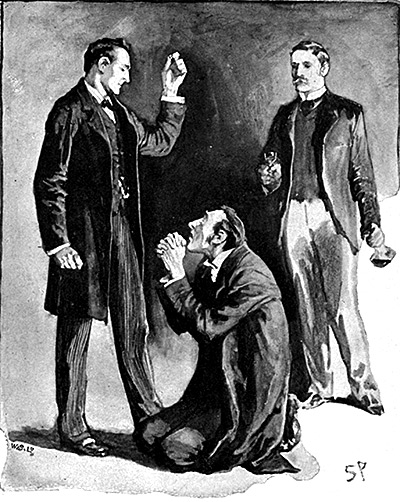
“‘HAVE MERCY!’ HE SHRIEKED”
Ryder passed his tongue over his parched lips. “I will tell you it
just as it happened, sir,” said he. “When Horner had been arrested, it
seemed to me that it would be best for me to get away with the stone
at once, for I did not know at what moment the police might not take
it into their heads to search me and my room. There was no place about
the hotel where it would be safe. I went out, as if on some commission,
and I made for my sister’s house. She had married a man named Oakshott,
and lived in Brixton Road, where she fattened fowls for the market.
All the way there every man I met seemed to me to be a policeman or a
detective; and, for all that it was a cold night, the sweat was pouring
down my face before I came to the Brixton Road. My sister asked me what
was the matter, and why I was so pale; but I told her that I had been
upset by the jewel robbery at the hotel. Then I went into the back yard
and smoked a pipe, and wondered what it would be best to do.
“I had a friend once called Maudsley, who went to the bad, and has just
been serving his time in Pentonville. One day he had met me, and fell
into talk about the ways of thieves, and how they could get rid of what
they stole. I knew that he would be true to me, for I knew one or two
things about him; so I made up my mind to go right on to Kilburn, where
he lived, and take him into my confidence. He would show me how to
turn the stone into money. But how to get to him in safety? I thought
of the agonies I had gone through in coming from the hotel. I might
at any moment be seized and searched, and there would be the stone
in my waistcoat pocket. I was leaning against the wall at the time,
and looking at the geese which were waddling about round my feet, and
suddenly an idea came into my head which showed me how I could beat the
best detective that ever lived.
“My sister had told me some weeks before that I might have the pick of
her geese for a Christmas present, and I knew that she was always as
good as her word. I would take my goose now, and in it I would carry
my stone to Kilburn. There was a little shed in the yard, and behind
this I drove one of the birds—a fine big one, white, with a barred
tail. I caught it, and, prying its bill open, I thrust the stone down
its throat as far as my finger could reach. The bird gave a gulp, and I
felt the stone pass along its gullet and down into its crop. But the
creature flapped and struggled, and out came my sister to know what
was the matter. As I turned to speak to her the brute broke loose and
fluttered off among the others.
“‘Whatever were you doing with that bird, Jem?’ says she.
“‘Well,’ said I, ‘you said you’d give me one for Christmas, and I was
feeling which was the fattest.’
“‘Oh,’ says she, ‘we’ve set yours aside for you—Jem’s bird, we call
it. It’s the big white one over yonder. There’s twenty-six of them,
which makes one for you, and one for us, and two dozen for the market.’
“‘Thank you, Maggie,’ says I; ‘but if it is all the same to you, I’d
rather have that one I was handling just now.’
“‘The other is a good three pound heavier,’ said she, ‘and we fattened
it expressly for you.’
“‘Never mind. I’ll have the other, and I’ll take it now,’ said I.
“‘Oh, just as you like,’ said she, a little huffed. ‘Which is it you
want, then?’
“‘That white one with the barred tail, right in the middle of the
flock.’
“‘Oh, very well. Kill it and take it with you.’
“Well, I did what she said, Mr. Holmes, and I carried the bird all the
way to Kilburn. I told my pal what I had done, for he was a man that
it was easy to tell a thing like that to. He laughed until he choked,
and we got a knife and opened the goose. My heart turned to water, for
there was no sign of the stone, and I knew that some terrible mistake
had occurred. I left the bird, rushed back to my sister’s, and hurried
into the back yard. There was not a bird to be seen there.
“‘Where are they all, Maggie?’ I cried.
“‘Gone to the dealer’s, Jem.’
“‘Which dealer’s?’
“‘Breckinridge, of Covent Garden.’
“‘But was there another with a barred tail?’ I asked, ‘the same as the
one I chose?’
“‘Yes, Jem; there were two barred-tailed ones, and I could never tell
them apart.’
“Well, then, of course I saw it all, and I ran off as hard as my feet
would carry me to this man Breckinridge; but he had sold the lot at
once, and not one word would he tell me as to where they had gone. You
heard him yourselves to-night. Well, he has always answered me like
that. My sister thinks that I am going mad. Sometimes I think that I
am myself. And now—and now I am myself a branded thief, without ever
having touched the wealth for which I sold my character. God help me!
God help me!” He burst into convulsive sobbing, with his face buried in
his hands.
There was a long silence, broken only by his heavy breathing, and by
the measured tapping of Sherlock Holmes’s finger-tips upon the edge of
the table. Then my friend rose and threw open the door.
“Get out!” said he.
“What, sir! Oh, heaven bless you!”
“No more words. Get out!”
And no more words were needed. There was a rush, a clatter upon the
stairs, the bang of a door, and the crisp rattle of running footfalls
from the street.
“After all, Watson,” said Holmes, reaching up his hand for his clay
pipe, “I am not retained by the police to supply their deficiencies. If
Horner were in danger it would be another thing; but this fellow will
not appear against him, and the case must collapse. I suppose that I am
commuting a felony, but it is just possible that I am saving a soul.
This fellow will not go wrong again; he is too terribly frightened.
Send him to jail now, and you make him a jail-bird for life. Besides,
it is the season of forgiveness. Chance has put in our way a most
singular and whimsical problem, and its solution is its own reward.
If you will have the goodness to touch the bell, doctor, we will
begin another investigation, in which, also, a bird will be the chief
feature.”
Adventure VIII THE ADVENTURE OF THE SPECKLED BAND

ON glancing over my notes of the seventy odd cases in which I have
during the last eight years studied the methods of my friend Sherlock
Holmes, I find many tragic, some comic, a large number merely strange,
but none commonplace; for, working as he did rather for the love of his
art than for the acquirement of wealth, he refused to associate himself
with any investigation which did not tend towards the unusual, and even
the fantastic. Of all these varied cases, however, I cannot recall any
which presented more singular features than that which was associated
with the well-known Surrey family of the Roylotts of Stoke Moran. The
events in question occurred in the early days of my association with
Holmes, when we were sharing rooms as bachelors in Baker Street. It
is possible that I might have placed them upon record before, but a
promise of secrecy was made at the time, from which I have only been
freed during the last month by the untimely death of the lady to whom
the pledge was given. It is perhaps as well that the facts should now
come to light, for I have reasons to know that there are wide-spread
rumors as to the death of Dr. Grimesby Roylott which tend to make the
matter even more terrible than the truth.
It was early in April in the year ’83 that I woke one morning to find
Sherlock Holmes standing, fully dressed, by the side of my bed. He was
a late riser as a rule, and as the clock on the mantel-piece showed
me that it was only a quarter past seven, I blinked up at him in some
surprise, and perhaps just a little resentment, for I was myself
regular in my habits.
“Very sorry to knock you up, Watson,” said he, “but it’s the common lot
this morning. Mrs. Hudson has been knocked up, she retorted upon me,
and I on you.”
“What is it, then—a fire?”
“No; a client. It seems that a young lady has arrived in a considerable
state of excitement, who insists upon seeing me. She is waiting now in
the sitting-room. Now, when young ladies wander about the metropolis
at this hour of the morning, and knock sleepy people up out of their
beds, I presume that it is something very pressing which they have to
communicate. Should it prove to be an interesting case, you would, I am
sure, wish to follow it from the outset. I thought, at any rate, that I
should call you and give you the chance.”
“My dear fellow, I would not miss it for anything.”
I had no keener pleasure than in following Holmes in his professional
investigations, and in admiring the rapid deductions, as swift as
intuitions, and yet always founded on a logical basis, with which he
unravelled the problems which were submitted to him. I rapidly threw on
my clothes, and was ready in a few minutes to accompany my friend down
to the sitting-room. A lady dressed in black and heavily veiled, who
had been sitting in the window, rose as we entered.
“Good-morning, madam,” said Holmes, cheerily. “My name is Sherlock
Holmes. This is my intimate friend and associate, Dr. Watson, before
whom you can speak as freely as before myself. Ha! I am glad to see
that Mrs. Hudson has had the good sense to light the fire. Pray draw up
to it, and I shall order you a cup of hot coffee, for I observe that
you are shivering.”
“It is not cold which makes me shiver,” said the woman, in a low voice,
changing her seat as requested.
“What, then?”
“It is fear, Mr. Holmes. It is terror.” She raised her veil as she
spoke, and we could see that she was indeed in a pitiable state of
agitation, her face all drawn and gray, with restless, frightened eyes,
like those of some hunted animal. Her features and figure were those of
a woman of thirty, but her hair was shot with premature gray, and her
expression was weary and haggard. Sherlock Holmes ran her over with one
of his quick, all-comprehensive glances.
“You must not fear,” said he, soothingly, bending forward and patting
her forearm. “We shall soon set matters right, I have no doubt. You
have come in by train this morning, I see.”
“You know me, then?”
“No, but I observe the second half of a return ticket in the palm of
your left glove. You must have started early, and yet you had a good
drive in a dog-cart, along heavy roads, before you reached the station.”
The lady gave a violent start, and stared in bewilderment at my
companion.
“There is no mystery, my dear madam,” said he, smiling. “The left arm
of your jacket is spattered with mud in no less than seven places. The
marks are perfectly fresh. There is no vehicle save a dog-cart which
throws up mud in that way, and then only when you sit on the left-hand
side of the driver.”
“Whatever your reasons may be, you are perfectly correct,” said she. “I
started from home before six, reached Leatherhead at twenty past, and
came in by the first train to Waterloo. Sir, I can stand this strain no
longer; I shall go mad if it continues. I have no one to turn to—none,
save only one, who cares for me, and he, poor fellow, can be of little
aid. I have heard of you, Mr. Holmes; I have heard of you from Mrs.
Farintosh, whom you helped in the hour of her sore need. It was from
her that I had your address. Oh, sir, do you not think that you could
help me, too, and at least throw a little light through the dense
darkness which surrounds me? At present it is out of my power to reward
you for your services, but in a month or six weeks I shall be married,
with the control of my own income, and then at least you shall not
find me ungrateful.”
Holmes turned to his desk, and unlocking it, drew out a small
case-book, which he consulted.
“Farintosh,” said he. “Ah yes, I recall the case; it was concerned with
an opal tiara. I think it was before your time, Watson. I can only say,
madam, that I shall be happy to devote the same care to your case as
I did to that of your friend. As to reward, my profession is its own
reward; but you are at liberty to defray whatever expenses I may be put
to, at the time which suits you best. And now I beg that you will lay
before us everything that may help us in forming an opinion upon the
matter.”
“Alas!” replied our visitor, “the very horror of my situation lies
in the fact that my fears are so vague, and my suspicions depend so
entirely upon small points, which might seem trivial to another, that
even he to whom of all others I have a right to look for help and
advice looks upon all that I tell him about it as the fancies of a
nervous woman. He does not say so, but I can read it from his soothing
answers and averted eyes. But I have heard, Mr. Holmes, that you can
see deeply into the manifold wickedness of the human heart. You may
advise me how to walk amid the dangers which encompass me.”
“I am all attention, madam.”
“My name is Helen Stoner, and I am living with my step-father, who is
the last survivor of one of the oldest Saxon families in England, the
Roylotts of Stoke Moran, on the western border of Surrey.”
Holmes nodded his head. “The name is familiar to me,” said he.
“The family was at one time among the richest in England, and the
estates extended over the borders into Berkshire in the north, and
Hampshire in the west. In the last century, however, four successive
heirs were of a dissolute and wasteful disposition, and the family
ruin was eventually completed by a gambler in the days of the
Regency. Nothing was left save a few acres of ground, and the
two-hundred-year-old house, which is itself crushed under a heavy
mortgage. The last squire dragged out his existence there, living
the horrible life of an aristocratic pauper; but his only son, my
step-father, seeing that he must adapt himself to the new conditions,
obtained an advance from a relative, which enabled him to take a
medical degree, and went out to Calcutta, where, by his professional
skill and his force of character, he established a large practice.
In a fit of anger, however, caused by some robberies which had been
perpetrated in the house, he beat his native butler to death, and
narrowly escaped a capital sentence. As it was, he suffered a long
term of imprisonment, and afterwards returned to England a morose and
disappointed man.
“When Dr. Roylott was in India he married my mother, Mrs. Stoner, the
young widow of Major-general Stoner, of the Bengal Artillery. My sister
Julia and I were twins, and we were only two years old at the time of
my mother’s re-marriage. She had a considerable sum of money—not less
than £1000 a year—and this she bequeathed to Dr. Roylott entirely
while we resided with him, with a provision that a certain annual sum
should be allowed to each of us in the event of our marriage. Shortly
after our return to England my mother died—she was killed eight years
ago in a railway accident near Crewe. Dr. Roylott then abandoned his
attempts to establish himself in practice in London, and took us to
live with him in the old ancestral house at Stoke Moran. The money
which my mother had left was enough for all our wants, and there seemed
to be no obstacle to our happiness.
“But a terrible change came over our step-father about this time.
Instead of making friends and exchanging visits with our neighbors, who
had at first been overjoyed to see a Roylott of Stoke Moran back in
the old family seat, he shut himself up in his house, and seldom came
out save to indulge in ferocious quarrels with whoever might cross his
path. Violence of temper approaching to mania has been hereditary in
the men of the family, and in my step-father’s case it had, I believe,
been intensified by his long residence in the tropics. A series of
disgraceful brawls took place, two of which ended in the police-court,
until at last he became the terror of the village, and the folks
would fly at his approach, for he is a man of immense strength, and
absolutely uncontrollable in his anger.
“Last week he hurled the local blacksmith over a parapet into a stream,
and it was only by paying over all the money which I could gather
together that I was able to avert another public exposure. He had no
friends at all save the wandering gypsies, and he would give these
vagabonds leave to encamp upon the few acres of bramble-covered land
which represent the family estate, and would accept in return the
hospitality of their tents, wandering away with them sometimes for
weeks on end. He has a passion also for Indian animals, which are sent
over to him by a correspondent, and he has at this moment a cheetah and
a baboon, which wander freely over his grounds, and are feared by the
villagers almost as much as their master.
“You can imagine from what I say that my poor sister Julia and I had no
great pleasure in our lives. No servant would stay with us, and for a
long time we did all the work of the house. She was but thirty at the
time of her death, and yet her hair had already begun to whiten, even
as mine has.”
“Your sister is dead, then?”
“She died just two years ago, and it is of her death that I wish to
speak to you. You can understand that, living the life which I have
described, we were little likely to see anyone of our own age and
position. We had, however, an aunt, my mother’s maiden sister, Miss
Honoria Westphail, who lives near Harrow, and we were occasionally
allowed to pay short visits at this lady’s house. Julia went there at
Christmas two years ago, and met there a half-pay major of marines,
to whom she became engaged. My step-father learned of the engagement
when my sister returned, and offered no objection to the marriage; but
within a fortnight of the day which had been fixed for the wedding, the
terrible event occurred which has deprived me of my only companion.”
Sherlock Holmes had been leaning back in his chair with his eyes closed
and his head sunk in a cushion, but he half opened his lids now and
glanced across at his visitor.
“Pray be precise as to details,” said he.
“It is easy for me to be so, for every event of that dreadful time is
seared into my memory. The manor-house is, as I have already said, very
old, and only one wing is now inhabited. The bedrooms in this wing are
on the ground floor, the sitting-rooms being in the central block of
the buildings. Of these bedrooms the first is Dr. Roylott’s, the second
my sister’s, and the third my own. There is no communication between
them, but they all open out into the same corridor. Do I make myself
plain?”
“Perfectly so.”
“The windows of the three rooms open out upon the lawn. That fatal
night Dr. Roylott had gone to his room early, though we knew that he
had not retired to rest, for my sister was troubled by the smell of
the strong Indian cigars which it was his custom to smoke. She left
her room, therefore, and came into mine, where she sat for some time,
chatting about her approaching wedding. At eleven o’clock she rose to
leave me but she paused at the door and looked back.
“‘Tell me, Helen,’ said she, ‘have you ever heard any one whistle in
the dead of the night?’
“‘Never,’ said I.
“‘I suppose that you could not possibly whistle, yourself, in your
sleep?’
“‘Certainly not. But why?’
“‘Because during the last few nights I have always, about three in
the morning, heard a low, clear whistle. I am a light sleeper, and it
has awakened me. I cannot tell where it came from—perhaps from the
next room, perhaps from the lawn. I thought that I would just ask you
whether you had heard it.’
“‘No, I have not. It must be those wretched gypsies in the plantation.’
“‘Very likely. And yet if it were on the lawn, I wonder that you did
not hear it also.’
“‘Ah, but I sleep more heavily than you.’
“‘Well, it is of no great consequence, at any rate.’ She smiled back at
me, closed my door, and a few moments later I heard her key turn in the
lock.”
“Indeed,” said Holmes. “Was it your custom always to lock yourselves in
at night?”
“Always.”
“And why?”
“I think that I mentioned to you that the doctor kept a cheetah and a
baboon. We had no feeling of security unless our doors were locked.”
“Quite so. Pray proceed with your statement.”
“I could not sleep that night. A vague feeling of impending misfortune
impressed me. My sister and I, you will recollect, were twins, and you
know how subtle are the links which bind two souls which are so closely
allied. It was a wild night. The wind was howling outside, and the rain
was beating and splashing against the windows. Suddenly, amid all the
hubbub of the gale, there burst forth the wild scream of a terrified
woman. I knew that it was my sister’s voice. I sprang from my bed,
wrapped a shawl round me, and rushed into the corridor. As I opened my
door I seemed to hear a low whistle, such as my sister described, and a
few moments later a clanging sound, as if a mass of metal had fallen.
As I ran down the passage, my sister’s door was unlocked, and revolved
slowly upon its hinges. I stared at it horror-stricken, not knowing
what was about to issue from it. By the light of the corridor-lamp I
saw my sister appear at the opening, her face blanched with terror, her
hands groping for help, her whole figure swaying to and fro like that
of a drunkard. I ran to her and threw my arms round her, but at that
moment her knees seemed to give way and she fell to the ground. She
writhed as one who is in terrible pain, and her limbs were dreadfully
convulsed. At first I thought that she had not recognized me, but as I
bent over her she suddenly shrieked out in a voice which I shall never
forget, ‘Oh, my God! Helen! It was the band! The speckled band!’ There
was something else which she would fain have said, and she stabbed with
her finger into the air in the direction of the doctor’s room, but a
fresh convulsion seized her and choked her words. I rushed out, calling
loudly for my step-father, and I met him hastening from his room in his
dressing-gown. When he reached my sister’s side she was unconscious,
and though he poured brandy down her throat and sent for medical aid
from the village, all efforts were in vain, for she slowly sank and
died without having recovered her consciousness. Such was the dreadful
end of my beloved sister.”
“One moment,” said Holmes; “are you sure about this whistle and
metallic sound? Could you swear to it?”
“That was what the county coroner asked me at the inquiry. It is my
strong impression that I heard it, and yet, among the crash of the gale
and the creaking of an old house, I may possibly have been deceived.”
“Was your sister dressed?”
“No, she was in her night-dress. In her right hand was found the
charred stump of a match, and in her left a matchbox.”
“Showing that she had struck a light and looked about her when the
alarm took place. That is important. And what conclusions did the
coroner come to?”
“He investigated the case with great care, for Dr. Roylott’s conduct
had long been notorious in the county, but he was unable to find any
satisfactory cause of death. My evidence showed that the door had
been fastened upon the inner side, and the windows were blocked by
old-fashioned shutters with broad iron bars, which were secured every
night. The walls were carefully sounded, and were shown to be quite
solid all round, and the flooring was also thoroughly examined, with
the same result. The chimney is wide, but is barred up by four large
staples. It is certain, therefore, that my sister was quite alone when
she met her end. Besides, there were no marks of any violence upon her.”
“How about poison?”
“The doctors examined her for it, but without success.”
“What do you think that this unfortunate lady died of, then?”
“It is my belief that she died of pure fear and nervous shock, though
what it was that frightened her I cannot imagine.”
“Were there gypsies in the plantation at the time?”
“Yes, there are nearly always some there.”
“Ah, and what did you gather from this allusion to a band—a speckled
band?”
“Sometimes I have thought that it was merely the wild talk of
delirium,
sometimes that it may have referred to some band of people, perhaps to
these very gypsies in the plantation. I do not know whether the spotted
handkerchiefs which so many of them wear over their heads might have
suggested the strange adjective which she used.”
Holmes shook his head like a man who is far from being satisfied.
“These are very deep waters,” said he; “pray go on with your narrative.”
“Two years have passed since then, and my life has been until lately
lonelier than ever. A month ago, however, a dear friend, whom I have
known for many years, has done me the honor to ask my hand in marriage.
His name is Armitage—Percy Armitage—the second son of Mr. Armitage,
of Crane Water, near Reading. My step-father has offered no opposition
to the match, and we are to be married in the course of the spring. Two
days ago some repairs were started in the west wing of the building,
and my bedroom wall has been pierced, so that I have had to move into
the chamber in which my sister died, and to sleep in the very bed in
which she slept. Imagine, then, my thrill of terror when last night,
as I lay awake, thinking over her terrible fate, I suddenly heard in
the silence of the night the low whistle which had been the herald of
her own death. I sprang up and lit the lamp, but nothing was to be
seen in the room. I was too shaken to go to bed again, however, so I
dressed, and as soon as it was daylight I slipped down, got a dog-cart
at the ‘Crown Inn,’ which is opposite, and drove to Leatherhead, from
whence I have come on this morning with the one object of seeing you
and asking your advice.”
“You have done wisely,” said my friend. “But have you told me all?”
“Yes, all.”
“Miss Roylott, you have not. You are screening your step-father.”
“Why, what do you mean?”
For answer Holmes pushed back the frill of black lace which fringed the
hand that lay upon our visitor’s knee. Five little livid spots, the
marks of four fingers and a thumb, were printed upon the white wrist.
“You have been cruelly used,” said Holmes.
The lady colored deeply and covered over her injured wrist. “He is a
hard man,” she said, “and perhaps he hardly knows his own strength.”
There was a long silence, during which Holmes leaned his chin upon his
hands and stared into the crackling fire.
“This is a very deep business,” he said, at last. “There are a thousand
details which I should desire to know before I decide upon our course
of action. Yet we have not a moment to lose. If we were to come to
Stoke Moran to-day, would it be possible for us to see over these rooms
without the knowledge of your step-father?”
“As it happens, he spoke of coming into town to-day upon some most
important business. It is probable that he will be away all day, and
that there would be nothing to disturb you. We have a house-keeper
now, but she is old and foolish, and I could easily get her out of the
way.”
“Excellent. You are not averse to this trip, Watson?”
“By no means.”
“Then we shall both come. What are you going to do yourself?”
“I have one or two things which I would wish to do now that I am in
town. But I shall return by the twelve o’clock train, so as to be there
in time for your coming.”
“And you may expect us early in the afternoon. I have myself some small
business matters to attend to. Will you not wait and breakfast?”
“No, I must go. My heart is lightened already since I have confided
my trouble to you. I shall look forward to seeing you again this
afternoon.” She dropped her thick black veil over her face and glided
from the room.
“And what do you think of it all, Watson?” asked Sherlock Holmes,
leaning back in his chair.
“It seems to me to be a most dark and sinister business.”
“Dark enough and sinister enough.”
“Yet if the lady is correct in saying that the flooring and walls are
sound, and that the door, window, and chimney are impassable, then her
sister must have been undoubtedly alone when she met her mysterious
end.”
“What becomes, then, of these nocturnal whistles, and what of the very
peculiar words of the dying woman?”
“I cannot think.”
“When you combine the ideas of whistles at night, the presence of a
band of gypsies who are on intimate terms with this old doctor, the
fact that we have every reason to believe that the doctor has an
interest in preventing his step-daughter’s marriage, the dying allusion
to a band, and, finally, the fact that Miss Helen Stoner heard a
metallic clang, which might have been caused by one of those metal bars
which secured the shutters falling back into their place, I think that
there is good ground to think that the mystery may be cleared along
those lines.”
“But what, then, did the gypsies do?”
“I cannot imagine.”
“I see many objections to any such theory.”
“And so do I. It is precisely for that reason that we are going to
Stoke Moran this day. I want to see whether the objections are fatal,
or if they may be explained away. But what in the name of the devil!”
The ejaculation had been drawn from my companion by the fact that our
door had been suddenly dashed open, and that a huge man had framed
himself in the aperture. His costume was a peculiar mixture of the
professional and of the agricultural, having a black top-hat, a long
frock-coat, and a pair of high gaiters, with a hunting-crop swinging in
his hand. So tall was he that his hat actually brushed the cross bar
of the doorway, and his breadth seemed to span it across from side to
side. A large face, seared with a thousand wrinkles, burned yellow with
the sun, and marked with every evil passion, was turned from one to the
other of us, while his deep-set, bile-shot eyes, and his high, thin,
fleshless nose, gave him somewhat the resemblance to a fierce old bird
of prey.
“Which of you is Holmes?” asked this apparition.
“My name, sir; but you have the advantage of me,” said my companion,
quietly.
“I am Dr. Grimesby Roylott, of Stoke Moran.”
“Indeed, doctor,” said Holmes, blandly. “Pray take a seat.”
“I will do nothing of the kind. My step-daughter has been here. I have
traced her. What has she been saying to you?”
“It is a little cold for the time of the year,” said Holmes.
“What has she been saying to you?” screamed the old man, furiously.
“But I have heard that the crocuses promise well,” continued my
companion, imperturbably.
“Ha! You put me off, do you?” said our new visitor, taking a step
forward and shaking his hunting-crop. “I know you, you scoundrel! I
have heard of you before. You are Holmes, the meddler.”
My friend smiled.
“Holmes, the busybody!”
His smile broadened.
“Holmes, the Scotland-yard Jack-in-office!”
Holmes chuckled heartily. “Your conversation is most entertaining,”
said he. “When you go out close the door, for there is a decided
draught.”
“I will go when I have said my say. Don’t you dare to meddle with my
affairs. I know that Miss Stoner has been here. I traced her! I am a
dangerous man to fall foul of! See here.” He stepped swiftly forward,
seized the poker, and bent it into a curve with his huge brown hands.
“See that you keep yourself out of my grip,” he snarled, and hurling
the twisted poker into the fireplace, he strode out of the room.
“He seems a very amiable person,” said Holmes, laughing. “I am not
quite so bulky, but if he had remained I might have shown him that my
grip was not much more feeble than his own.” As he spoke he picked up
the steel poker, and with a sudden effort straightened it out again.
“Fancy his having the insolence to confound me with the official
detective force! This incident gives zest to our investigation,
however, and I only trust that our little friend will not suffer from
her imprudence in allowing this brute to trace her. And now, Watson,
we shall order breakfast, and afterwards I shall walk down to Doctors’
Commons, where I hope to get some data which may help us in this
matter.”
It was nearly one o’clock when Sherlock Holmes returned from his
excursion. He held in his hand a sheet of blue paper, scrawled over
with notes and figures.
“I have seen the will of the deceased wife,” said he. “To determine
its exact meaning I have been obliged to work out the present prices
of the investments with which it is concerned. The total income, which
at the time of the wife’s death was little short of £1100, is now,
through the fall in agricultural prices, not more than £750. Each
daughter can claim an income of £250, in case of marriage. It is
evident, therefore, that if both girls had married, this beauty would
have had a mere pittance, while even one of them would cripple him to
a very serious extent. My morning’s work has not been wasted, since it
has proved that he has the very strongest motives for standing in the
way of anything of the sort. And now, Watson, this is too serious for
dawdling, especially as the old man is aware that we are interesting
ourselves in his affairs; so if you are ready, we shall call a cab and
drive to Waterloo. I should be very much obliged if you would slip your
revolver into your pocket. An Eley’s No. 2 is an excellent argument
with gentlemen who can twist steel pokers into knots. That and a
tooth-brush are, I think, all that we need.”
At Waterloo we were fortunate in catching a train for Leatherhead,
where we hired a trap at the station inn, and drove for four or five
miles through the lovely Surrey lanes. It was a perfect day, with
a bright sun and a few fleecy clouds in the heavens. The trees and
way-side hedges were just throwing out their first green shoots, and
the air was full of the pleasant smell of the moist earth. To me at
least there was a strange contrast between the sweet promise of the
spring and this sinister quest upon which we were engaged. My companion
sat in the front of the trap, his arms folded, his hat pulled down over
his eyes, and his chin sunk upon his breast, buried in the deepest
thought. Suddenly, however, he started, tapped me on the shoulder, and
pointed over the meadows.
“Look there!” said he.
A heavily-timbered park stretched up in a gentle slope, thickening into
a grove at the highest point. From amid the branches there jutted out
the gray gables and high roof-tree of a very old mansion.
“Stoke Moran?” said he.
“Yes, sir, that be the house of Dr. Grimesby Roylott,” remarked the
driver.
“There is some building going on there,” said Holmes; “that is where we
are going.”
“There’s the village,” said the driver, pointing to a cluster of roofs
some distance to the left; “but if you want to get to the house, you’ll
find it shorter to get over this stile, and so by the foot-path over
the fields. There it is, where the lady is walking.”
“And the lady, I fancy, is Miss Stoner,” observed Holmes, shading his
eyes. “Yes, I think we had better do as you suggest.”
We got off, paid our fare, and the trap rattled back on its way to
Leatherhead.
“I thought it as well,” said Holmes, as we climbed the stile, “that
this fellow should think we had come here as architects, or on some
definite business. It may stop his gossip. Good-afternoon, Miss Stoner.
You see that we have been as good as our word.”
Our client of the morning had hurried forward to meet us with a face
which spoke her joy. “I have been waiting so eagerly for you,” she
cried, shaking hands with us warmly. “All has turned out splendidly.
Dr. Roylott has gone to town, and it is unlikely that he will be back
before evening.”
“We have had the pleasure of making the doctor’s acquaintance,” said
Holmes, and in a few words he sketched out what had occurred. Miss
Stoner turned white to the lips as she listened.
“Good heavens!” she cried, “he has followed me, then.”
“So it appears.”
“He is so cunning that I never know when I am safe from him. What will
he say when he returns?”
“He must guard himself, for he may find that there is some one more
cunning than himself upon his track. You must lock yourself up from him
to-night. If he is violent, we shall take you away to your aunt’s at
Harrow. Now, we must make the best use of our time, so kindly take us
at once to the rooms which we are to examine.”
The building was of gray, lichen-blotched stone, with a high central
portion, and two curving wings, like the claws of a crab, thrown out
on each side. In one of these wings the windows were broken, and
blocked with wooden boards, while the roof was partly caved in, a
picture of ruin. The
central portion was in little better repair, but
the right-hand block was comparatively modern, and the blinds in the
windows, with the blue smoke curling up from the chimneys, showed that
this was where the family resided. Some scaffolding had been erected
against the end wall, and the stone-work had been broken into, but
there were no signs of any workmen at the moment of our visit. Holmes
walked slowly up and down the ill-trimmed lawn, and examined with deep
attention the outsides of the windows.
“This, I take it, belongs to the room in which you used to sleep, the
centre one to your sister’s, and the one next to the main building to
Dr. Roylott’s chamber?”
“Exactly so. But I am now sleeping in the middle one.”
“Pending the alterations, as I understand. By-the-way, there does not
seem to be any very pressing need for repairs at that end wall.”
“There were none. I believe that it was an excuse to move me from my
room.”
“Ah! that is suggestive. Now, on the other side of this narrow wing
runs the corridor from which these three rooms open. There are windows
in it, of course?”
“Yes, but very small ones. Too narrow for any one to pass through.”
“As you both locked your doors at night, your rooms were unapproachable
from that side. Now, would you have the kindness to go into your room
and bar your shutters.”
Miss Stoner did so, and Holmes, after a careful examination through
the open window, endeavored in every way to force the shutter open,
but without success. There was no slit through which a knife could be
passed to raise the bar. Then with his lens he tested the hinges, but
they were of solid iron, built firmly into the massive masonry. “Hum!”
said he, scratching his chin in some perplexity; “my theory certainly
presents some difficulties. No one could pass these shutters if they
were bolted. Well, we shall see if the inside throws any light upon the
matter.”
A small side door led into the whitewashed corridor from which the
three bedrooms opened. Holmes refused to examine the third chamber,
so we passed at once to the second, that in which Miss Stoner was now
sleeping, and in which her sister had met with her fate. It was a
homely little room, with a low ceiling and a gaping fireplace, after
the fashion of old country-houses. A brown chest of drawers stood
in one corner, a narrow white-counterpaned bed in another, and a
dressing-table on the left-hand side of the window. These articles,
with two small wicker-work chairs, made up all the furniture in the
room, save for a square of Wilton carpet in the centre. The boards
round and the panelling of the walls were of brown, worm-eaten oak, so
old and discolored that it may have dated from the original building of
the house. Holmes drew one of the chairs into a corner and sat silent,
while his eyes travelled round and round and up and down, taking in
every detail of the apartment.
“Where does that bell communicate with?” he asked, at last, pointing to
a thick bell-rope which hung down beside the bed, the tassel actually
lying upon the pillow.
“It goes to the house-keeper’s room.”
“It looks newer than the other things?”
“Yes, it was only put there a couple of years ago.”
“Your sister asked for it, I suppose?”
“No, I never heard of her using it. We used always to get what we
wanted for ourselves.”
“Indeed, it seemed unnecessary to put so nice a bell-pull there. You
will excuse me for a few minutes while I satisfy myself as to this
floor.” He threw himself down upon his face with his lens in his hand,
and crawled swiftly backward and forward, examining minutely the cracks
between the boards. Then he did the same with the wood-work with which
the chamber was panelled. Finally he walked over to the bed, and spent
some time in staring at it, and in running his eye up and down the
wall. Finally he took the bell-rope in his hand and gave it a brisk tug.
“Why, it’s a dummy,” said he.
“Won’t it ring?”
“No, it is not even attached to a wire. This is very interesting. You
can see now that it is fastened to a hook just above where the little
opening for the ventilator is.”
“How very absurd! I never noticed that before.”
“Very strange!” muttered Holmes, pulling at the rope. “There are one or
two very singular points about this room. For example, what a fool a
builder must be to open a ventilator into another room, when, with the
same trouble, he might have communicated with the outside air!”
“That is also quite modern,” said the lady.
“Done about the same time as the bell-rope?” remarked Holmes.
“Yes, there were several little changes carried out about that time.”
“They seem to have been of a most interesting character—dummy
bell-ropes, and ventilators which do not ventilate. With your
permission, Miss Stoner, we shall now carry our researches into the
inner apartment.”
Dr. Grimesby Roylott’s chamber was larger than that of his
step-daughter, but was as plainly furnished. A camp-bed, a small wooden
shelf full of books, mostly of a technical character, an arm-chair
beside the bed, a plain wooden chair against the wall, a round table,
and a large iron safe were the principal things which met the eye.
Holmes walked slowly round and examined each and all of them with the
keenest interest.
“What’s in here?” he asked, tapping the safe.
“My step-father’s business papers.”
“Oh! you have seen inside, then?”
“Only once, some years ago. I remember that it was full of papers.”
“There isn’t a cat in it, for example?”
“No. What a strange idea!”
“Well, look at this!” He took up a small saucer of milk which stood on
the top of it.
“No; we don’t keep a cat. But there is a cheetah and a baboon.”
“Ah, yes, of course! Well, a cheetah is just a big cat, and yet a
saucer of milk does not go very far in satisfying its wants, I dare
say. There is one point which I should wish to determine.” He squatted
down in front of the wooden chair, and examined the seat of it with the
greatest attention.
“Thank you. That is quite settled,” said he, rising and putting his
lens in his pocket. “Hello! Here is something interesting!”
The object which had caught his eye was a small dog-lash hung on one
corner of the bed. The lash, however, was curled upon itself, and tied
so as to make a loop of whip-cord.
“What do you make of that, Watson?”
“It’s a common enough lash. But I don’t know why it should be tied.”
“That is not quite so common, is it? Ah, me! it’s a wicked world,
and when a clever man turns his brains to crime it is the worst of
all. I think that I have seen enough now, Miss Stoner, and with your
permission we shall walk out upon the lawn.”
I had never seen my friend’s face so grim or his brow so dark as it
was when we turned from the scene of this investigation. We had walked
several times up and down the lawn, neither Miss Stoner nor myself
liking to break in upon his thoughts before he roused himself from his
reverie.
“It is very essential, Miss Stoner,” said he, “that you should
absolutely follow my advice in every respect.”
“I shall most certainly do so.”
“The matter is too serious for any hesitation. Your life may depend
upon your compliance.”
“I assure you that I am in your hands.”
“In the first place, both my friend and I must spend the night in your
room.”
Both Miss Stoner and I gazed at him in astonishment.
“Yes, it must be so. Let me explain. I believe that that is the village
inn over there?”
“Yes, that is the ‘Crown.’”
“Very good. Your windows would be visible from there?”
“Certainly.”
“You must confine yourself to your room, on pretence of a headache,
when your step-father comes back. Then when you hear him retire for
the night, you must open the shutters of your window, undo the hasp,
put your lamp there as a signal to us, and then withdraw quietly with
everything which you are likely to want into the room which you used to
occupy. I have no doubt that, in spite of the repairs, you could manage
there for one night.”
“Oh yes, easily.”
“The rest you will leave in our hands.”
“But what will you do?”
“We shall spend the night in your room, and we shall investigate the
cause of this noise which has disturbed you.”
“I believe, Mr. Holmes, that you have already made up your mind,” said
Miss Stoner, laying her hand upon my companion’s sleeve.
“Perhaps I have.”
“Then for pity’s sake tell me what was the cause of my sister’s death.”
“I should prefer to have clearer proofs before I speak.”
“You can at least tell me whether my own thought is correct, and if she
died from some sudden fright.”
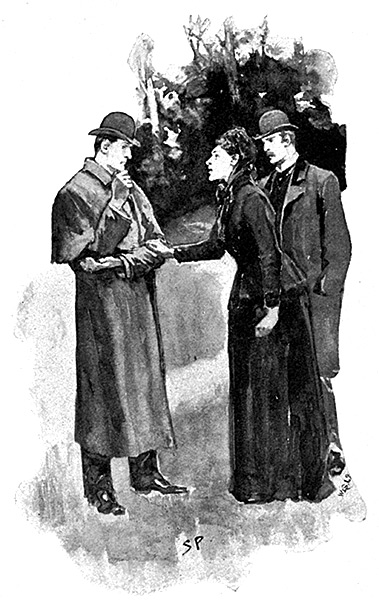
“‘GOOD-BYE, AND BE BRAVE’”
“No, I do not think so. I think that there was probably some more
tangible cause. And now, Miss Stoner, we must leave you, for if Dr.
Roylott returned and saw us, our journey would be in vain. Good-bye,
and be brave, for if you will do what I have told you, you may rest
assured that we shall soon drive away the dangers that threaten you.”
Sherlock Holmes and I had no difficulty in engaging a bedroom and
sitting-room at the “Crown Inn.” They were on the upper floor, and
from our window we could command a view of the avenue gate, and of the
inhabited wing of Stoke Moran Manor House. At dusk we saw Dr. Grimesby
Roylott drive past, his huge form looming up beside the little figure
of the lad who drove him. The boy had some slight difficulty in undoing
the heavy iron gates, and we heard the hoarse roar of the doctor’s
voice, and saw the fury with which he shook his clinched fists at him.
The trap drove on, and a few minutes later we saw a sudden light spring
up among the trees as the lamp was lit in one of the sitting-rooms.
“Do you know, Watson,” said Holmes, as we sat together in the gathering
darkness, “I have really some scruples as to taking you to-night. There
is a distinct element of danger.”
“Can I be of assistance?”
“Your presence might be invaluable.”
“Then I shall certainly come.”
“It is very kind of you.”
“You speak of danger. You have evidently seen more in these rooms than
was visible to me.”
“No, but I fancy that I may have deduced a little more. I imagine that
you saw all that I did.”
“I saw nothing remarkable save the bell-rope, and what purpose that
could answer I confess is more than I can imagine.”
“You saw the ventilator, too?”
“Yes, but I do not think that it is such a very unusual thing to have
a small opening between two rooms. It was so small that a rat could
hardly pass through.”
“I knew that we should find a ventilator before ever we came to Stoke
Moran.”
“My dear Holmes!”
“Oh yes, I did. You remember in her statement she said that her sister
could smell Dr. Roylott’s cigar. Now, of course that suggested at once
that there must be a communication between the two rooms. It could only
be a small one, or it would have been remarked upon at the coroner’s
inquiry. I deduced a ventilator.”
“But what harm can there be in that?”
“Well, there is at least a curious coincidence of dates. A ventilator
is made, a cord is hung, and a lady who sleeps in the bed dies. Does
not that strike you?”
“I cannot as yet see any connection.”
“Did you observe anything very peculiar about that bed?”
“No.”
“It was clamped to the floor. Did you ever see a bed fastened like that
before?”
“I cannot say that I have.”
“The lady could not move her bed. It must always be in the same
relative position to the ventilator and to the rope—for so we may call
it, since it was clearly never meant for a bell-pull.”
“Holmes,” I cried, “I seem to see dimly what you are hinting at. We are
only just in time to prevent some subtle and horrible crime.”
“Subtle enough and horrible enough. When a doctor does go wrong, he is
the first of criminals. He has nerve and he has knowledge. Palmer and
Pritchard were among the heads of their profession. This man strikes
even deeper, but I think, Watson, that we shall be able to strike
deeper still. But we shall have horrors enough before the night is
over; for goodness’ sake let us have a quiet pipe, and turn our minds
for a few hours to something more cheerful.”
About nine o’clock the light among the trees was extinguished, and all
was dark in the direction of the Manor House. Two hours passed slowly
away, and then, suddenly, just at the stroke of eleven, a single
bright light shone out right in front of us.
“That is our signal,” said Holmes, springing to his feet; “it comes
from the middle window.”
As we passed out he exchanged a few words with the landlord, explaining
that we were going on a late visit to an acquaintance, and that it was
possible that we might spend the night there. A moment later we were
out on the dark road, a chill wind blowing in our faces, and one yellow
light twinkling in front of us through the gloom to guide us on our
sombre errand.
There was little difficulty in entering the grounds, for unrepaired
breaches gaped in the old park wall. Making our way among the trees,
we reached the lawn, crossed it, and were about to enter through the
window, when out from a clump of laurel bushes there darted what seemed
to be a hideous and distorted child, who threw itself upon the grass
with writhing limbs, and then ran swiftly across the lawn into the
darkness.
“My God!” I whispered; “did you see it?”
Holmes was for the moment as startled as I. His hand closed like a vice
upon my wrist in his agitation. Then he broke into a low laugh, and put
his lips to my ear.
“It is a nice household,” he murmured. “That is the baboon.”
I had forgotten the strange pets which the doctor affected. There was
a cheetah, too; perhaps we might find it upon our shoulders at any
moment. I confess that I felt easier in my mind when, after following
Holmes’s example and slipping off my shoes, I found myself inside the
bedroom. My companion noiselessly closed the shutters, moved the lamp
onto the table, and cast his eyes round the room. All was as we had
seen it in the daytime. Then creeping up to me and making a trumpet of
his hand, he whispered into my ear again so gently that it was all that
I could do to distinguish the words:
“The least sound would be fatal to our plans.”
I nodded to show that I had heard.
“We must sit without light. He would see it through the ventilator.”
I nodded again.
“Do not go asleep; your very life may depend upon it. Have your pistol
ready in case we should need it. I will sit on the side of the bed, and
you in that chair.”
I took out my revolver and laid it on the corner of the table.
Holmes had brought up a long thin cane, and this he placed upon the bed
beside him. By it he laid the box of matches and the stump of a candle.
Then he turned down the lamp, and we were left in darkness.
How shall I ever forget that dreadful vigil? I could not hear a sound,
not even the drawing of a breath, and yet I knew that my companion
sat open-eyed, within a few feet of me, in the same state of nervous
tension in which I was myself. The shutters cut off the least ray
of light, and we waited in absolute darkness. From outside came the
occasional cry of a night-bird, and once at our very window a long
drawn cat-like whine, which told us that the cheetah was indeed at
liberty. Far away we could hear the deep tones of the parish clock,
which boomed out every quarter of an hour. How long they seemed, those
quarters! Twelve struck, and one and two and three, and still we sat
waiting silently
for whatever might befall.
Suddenly there was the momentary gleam of a light up in the direction
of the ventilator, which vanished immediately, but was succeeded by
a strong smell of burning oil and heated metal. Some one in the next
room had lit a dark-lantern. I heard a gentle sound of movement, and
then all was silent once more, though the smell grew stronger. For half
an hour I sat with straining ears. Then suddenly another sound became
audible—a very gentle, soothing sound, like that of a small jet of
steam escaping continually from a kettle. The instant that we heard it,
Holmes sprang from the bed, struck a match, and lashed furiously with
his cane at the bell-pull.
“You see it, Watson?” he yelled. “You see it?”
But I saw nothing. At the moment when Holmes struck the light I heard
a low, clear whistle, but the sudden glare flashing into my weary eyes
made it impossible for me to tell what it was at which my friend lashed
so savagely. I could, however, see that his face was deadly pale, and
filled with horror and loathing.
He had ceased to strike, and was gazing up at the ventilator, when
suddenly there broke from the silence of the night the most horrible
cry to which I have ever listened. It swelled up louder and louder, a
hoarse yell of pain and fear and anger all mingled in the one dreadful
shriek. They say that away down in the village, and even in the distant
parsonage, that cry raised the sleepers from their beds. It struck cold
to our hearts, and I stood gazing at Holmes, and he at me, until the
last echoes of it had died away into the silence from which it rose.
“What can it mean?” I gasped.
“It means that it is all over,” Holmes answered. “And perhaps, after
all, it is for the best. Take your pistol, and we will enter Dr.
Roylott’s room.”
With a grave face he lit the lamp and led the way down the corridor.
Twice he struck at the chamber door without any reply from within.
Then he turned the handle and entered, I at his heels, with the cocked
pistol in my hand.
It was a singular sight which met our eyes. On the table stood a
dark-lantern with the shutter half open, throwing a brilliant beam
of light upon the iron safe, the door of which was ajar. Beside this
table, on the wooden chair, sat Dr. Grimesby Roylott, clad in a long
gray dressing-gown, his bare ankles protruding beneath, and his feet
thrust into red heelless Turkish slippers. Across his lap lay the short
stock with the long lash which we had noticed during the day. His chin
was cocked upward and his eyes were fixed in a dreadful, rigid stare
at the corner of the ceiling. Round his brow he had a peculiar yellow
band, with brownish speckles, which seemed to be bound tightly round
his head. As we entered he made neither sound nor motion.
“The band! the speckled band!” whispered Holmes.
I took a step forward. In an instant his strange head-gear began
to move, and there reared itself from among his hair the squat
diamond-shaped head and puffed neck of a loathsome serpent.
“It is a swamp adder!” cried Holmes; “the deadliest snake in India. He
has died within ten seconds of being bitten. Violence does, in truth,
recoil upon the violent, and the schemer falls into the pit which he
digs for another. Let us thrust this creature back into its den, and
we can then remove Miss Stoner to some place of shelter, and let the
county police know what has happened.”
As he spoke he drew the dog-whip swiftly from the dead man’s lap, and
throwing the noose round the reptile’s neck, he drew it from its horrid
perch, and carrying it at arm’s length, threw it into the iron safe,
which he closed upon it.
Such are the true facts of the death of Dr. Grimesby Roylott, of Stoke
Moran. It is not necessary that I should prolong a narrative which has
already run to too great a length, by telling how we broke the sad news
to the terrified girl, how we conveyed her by the morning train to the
care of her good aunt at Harrow, of how the slow process of official
inquiry came to the conclusion that the doctor met his fate while
indiscreetly playing with a dangerous pet. The little which I had yet
to learn of the case was told me by Sherlock Holmes as we travelled
back next day.
“I had,” said he, “come to an entirely erroneous conclusion, which
shows, my dear Watson, how dangerous it always is to reason from
insufficient data. The presence of the gypsies, and the use of the
word ‘band,’ which was used by the poor girl, no doubt to explain the
appearance which she had caught a hurried glimpse of by the light of
her match, were sufficient to put me upon an entirely wrong scent. I
can only claim the merit that I instantly reconsidered my position
when, however, it became clear to me that whatever danger threatened
an occupant of the room could not come either from the window or the
door. My attention was speedily drawn, as I have already remarked to
you, to this ventilator, and to the bell-rope which hung down to the
bed. The discovery that this was a dummy, and that the bed was clamped
to the floor, instantly gave rise to the suspicion that the rope was
there as bridge for something passing through the hole, and coming
to the bed. The idea of a snake instantly occurred to me, and when
I coupled it with my knowledge that the doctor was furnished with a
supply of creatures from India, I felt that I was probably on the right
track. The idea of using a form of poison which could not possibly be
discovered by any chemical test was just such a one as would occur to a
clever and ruthless man who had had an Eastern training. The rapidity
with which such a poison would take effect would also, from his point
of view, be an advantage. It would be a sharp-eyed coroner, indeed, who
could distinguish the two little dark punctures which would show where
the poison fangs had done their work. Then I thought of the whistle. Of
course he must recall the snake before the morning light revealed it to
the victim. He had trained it, probably by the use of the milk which
we saw, to return to him when summoned. He would put it through this
ventilator at the hour that he thought best, with the certainty that it
would crawl down the rope and land on the bed. It might or might not
bite the occupant, perhaps she might escape every night for a week, but
sooner or later she must fall a victim.
“I had come to these conclusions before ever I had entered his room.
An inspection of his chair showed me that he had been in the habit of
standing on it, which of course would be necessary in order that he
should reach the ventilator. The sight of the safe, the saucer of milk,
and the loop of whip-cord were enough to finally dispel any doubts
which may have remained. The metallic clang heard by Miss Stoner was
obviously caused by her step-father hastily closing the door of his
safe upon its terrible occupant. Having once made up my mind, you know
the steps which I took in order to put the matter to the proof. I
heard the creature hiss, as I have no doubt that you did also, and I
instantly lit the light and attacked it.”
“With the result of driving it through the ventilator.”
“And also with the result of causing it to turn upon its master at the
other side. Some of the blows of my cane came home, and roused its
snakish temper, so that it flew upon the first person it saw. In this
way I am no doubt indirectly responsible for Dr. Grimesby Roylott’s
death, and I cannot say that it is likely to weigh very heavily upon my
conscience.”