IT has struck me that many of my readers may wonder that, although I
have set down in detail a number of interesting cases wherein Hewitt
figured with success, I have scarcely as much as alluded to his
failures. For failures he had, and of a fair number. More than once
he has found his search met, perhaps at the beginning, perhaps after
some little while, by an impenetrable wall of darkness through which
no clue led. At other times he has lost time on a false trail while
his quarry escaped. At others still the stupidity or inaccuracy of
some person upon whom he has depended for information has set his
plans to naught. The reason why none of these cases have been
embodied in the present papers is simply this: that a problem with no
answer, a puzzle with no explanation, an incident with no
satisfactory end, as a rule lends itself but poorly to purposes of
popular narrative, and it is often difficult to make understood and
appreciated any degree of skill and acumen unless it produces a clear
and intelligible result. That such results attended Hewitt’s efforts
in an extraordinary degree those who have followed my narratives so
far will need no assurance; but withal impossibilities still remain
impossibilities, for Hewitt as for the dullest creature alive. On
some other occasion I may perhaps set out at length a case in which
Martin Hewitt achieved nothing more than unqualified failure; for the
present I shall content myself with a case which, although it was
completely cleared up in the end, yet for some while baffled Hewitt
because of some of the reasons I have alluded to.
On the ground floor of the building wherein Hewitt kept his office,
and in which I myself had my chambers, were the offices of Messrs.
Streatley & Raikes, an old-fashioned firm of family solicitors.
Messrs. Streatley & Raikes’s junior clerk appeared in Hewitt’s outer
office one morning with the query, “Is your guv’nor in?”
Kerrett admitted the fact.
“Will you tell him Mr. Raikes sends his compliments and will be
obliged if he can step downstairs for a few minutes? It’s a client of
ours—a lady—and she’s in a great state about losing her baby or
something. Say Mr. Raikes would bring her up, only she seems too ill
to get up the stairs.”
This was the purport of the message which Kerrett brought into the
inner room, and in three minutes Hewitt was in Streatley & Raikes’s
office.
“I thought the only useful thing possible would be to send for you,
Mr Hewitt,” Mr. Raikes explained; “indeed, if my client had been
better acquainted with London, no doubt she would have come to you
direct. She is in a bad state in the inner office. Her name is Mrs.
Seton; her husband is a recent client of ours. Quite young, and
rather wealthy people, so far as I know. Made a fortune early, I
believe, in South Africa, and came here to live. Their child—their
only child, a little toddler of two years or thereabout—disappeared
yesterday in a most mysterious way, and all efforts to find it seem
to have failed as yet. The police have been set going everywhere, but
there is no news as yet. Mrs. Seton seems to have passed a dreadful
night, and could think of nothing better to do this morning than to
come to us. She has her maid with her, and looks to be breaking down
entirely. I believe she’s lying on the sofa in my private room now.
Will you see her? I think you might hear what she has to say, whether
you take the case in hand or not; something may strike you, and in
any case it will comfort her to get your opinion. I told her all
about you, you know, and she clutched at the chance eagerly. Shall I
see if we may go in?”
Mr. Raikes knocked at the door of his inner sanctum and waited; then
he knocked again and set the door ajar. There was a quiet “Come in,”
and pushing open the door the lawyer motioned Hewitt to follow him.
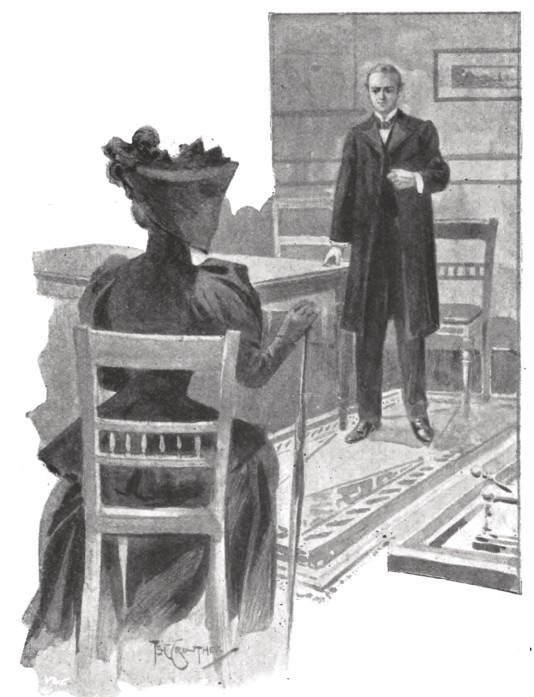
On the sofa facing the door sat a lady, very pale, and exhibiting
plain signs of grief and physical weariness. A heavy veil was thrown
back over her bonnet, and her maid stood at her side holding a bottle
of salts. As she saw Hewitt she made as if to rise, but he stepped
quickly forward and laid his hand on her shoulder. “Pray don’t
disturb yourself, Mrs. Seton,” he said; “Mr. Raikes has told me
something of your trouble, and perhaps when I know a little more I
shall be able to offer you some advice. But remember that it will be
very important for you to maintain your strength and spirits as much
as possible.”
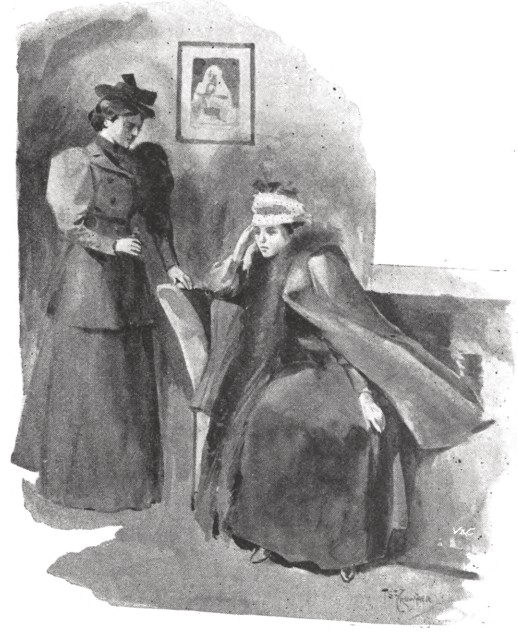
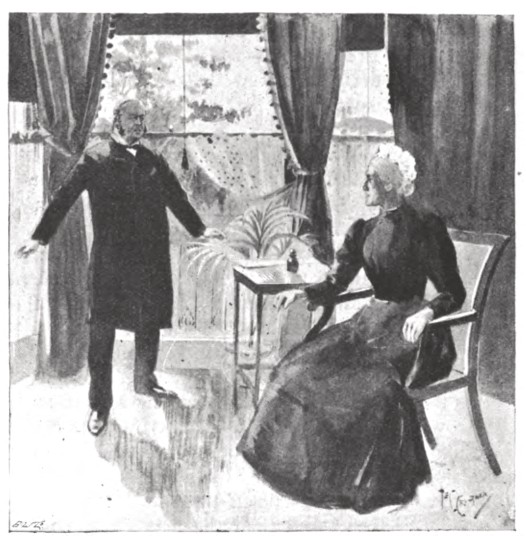
“ON THE SOFA FACING THE DOOR SAT A LADY, VERY PALE,
AND EXHIBITING PLAIN SIGNS OF GRIEF.”
“This is Mr. Martin Hewitt, you know,” Mr. Raikes here put in—“of
whom I was speaking.”
Mrs. Seton inclined her head, and with a very obvious effort began.
“It is my child, you know, Mr. Hewitt—my little boy Charley; we
can’t find him.”
“Mr. Raikes has told me so. When did you see the child last?”
“Yesterday morning. His nurse left him sitting on the floor in a
room we call the small morning-room, where we sometimes allowed him
to play when nurse was out, because the nursery was out of hearing,
except from the bedrooms. I myself was in the large morning-room, and
as he seemed to be very quiet I went to look, and found he was not
there.”
“You looked elsewhere, of course?”
“Yes; but he was nowhere in the house, and none of the servants had
seen him. At first I supposed that his nurse had gone back to the
small morning-room and taken him with her—I had sent her on an
errand—but when she returned I found that was not the case.”
“Can he walk?”
“Oh, yes, he can walk quite well. But he could scarcely have come
out from the room without my hearing him. The two rooms, the
morning-room and the small sitting-room, are on opposite sides of the
same passage.”
“Do the doors face each other?”
“No; the door of the small room is farther up the passage than the
other. But in any case he was nowhere in the house.”
“But if he left the room he must have got out somehow. Is there no
other door?”
“Yes, there is a French window, with the lower panels of wood, in
the room; it gives on to a few steps leading down into the garden;
but that was closed and bolted on the inside.”
“You found no trace whatever of him, I take it, on the whole
premises?”
“Not a trace of any sort, nor had anybody about the place seen him.”
“Did you yourself actually see him in this room, or have you merely
the nurse’s word for it?”
“I saw her put him there. She left him playing with a box of toys.
When I went to look for him the toys were there, scattered on the
floor, but he had gone.” Mrs. Seton sank on the arms of her maid and
her breast heaved.
“I’m sure,” Hewitt said, “You’ll keep your nerves as steady as you
can, Mrs. Seton: much may depend on it. If you have nothing else to
tell me now, I think I will come to your house at once, look at it,
and question your servants myself. Meantime, what has been done?”
“The police have been notified everywhere, of course,” Mr. Raikes
said, handing Hewitt a printed bill, damp from the press; “and here
is a bill containing a description of the child and offering a
reward, which is being circulated now.”
Hewitt glanced at the bill and nodded. “That is quite right,” he
said, “so far as I can tell at present. But I must see the place. Do
you feel strong enough to come home now, Mrs. Seton?”
Hewitt’s business-like decision and confidence of manner gave the
lady fresh strength. “The brougham is here,” she said, “and we can
drive home at once. We live at Cricklewood.”
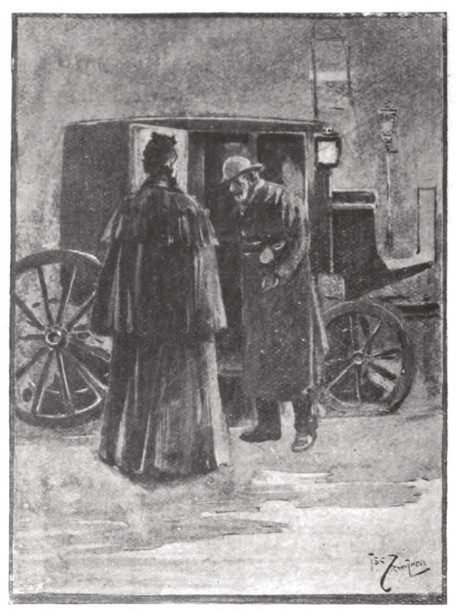
A fine pair of horses stood before the brougham, though they still
bore signs of hard work; and indeed they had been kept at their best
pace all that morning. All the way to Cricklewood Hewitt kept Mrs.
Seton in conversation, never for a moment leaving her attention
disengaged. The missing child, he learned, was the only one, and the
family had only been in England for something less than a year. Mr.
Seton had become possessed of real property in South Africa, had sold
it in London, and had determined to settle here.
A little way past Shoot-up Hill the coachman swung his pair off to
the left, and presently entering a gate, pulled up before a large,
old-fashioned house.
Here Hewitt immediately began a complete examination of the
premises. The possible exits from the grounds, he found, were four in
number: the two wide front gates giving on to the carriage-drive, the
kitchen and stable entrance, and a side gate in a fence—always
locked, however. Inside the house, from the central hall, a passage
to the right led to another wherein was the door of the small
morning-room. This was a very ordinary room, fifteen feet square or
so, lighted by the glass in the French window, the bottom panes of
which, however, had been filled in with wood. The contents of a box
of toys lay scattered on the floor, and the box itself lay near.
“Have these toys been moved,” Hewitt asked, “since the child was
missed?”
“No, we haven’t allowed anything to be disturbed. The disappearance
seemed so wholly unaccountable that we thought the police might wish
to examine the place exactly as it was. They did not seem to think it
necessary, however.”
Hewitt knelt and examined the toys without disturbing them. They
were of very good quality, and represented a farmyard, with horses,
carts, ducks, geese and cows complete. One of the carts had had a
string attached so that it might be pulled along the floor.
“Now,” Hewitt said, rising, “you think, Mrs. Seton, that the child
could not have toddled through the passage, and so into some other
part of the house, without you hearing him?”
“Well,” Mrs. Seton answered with indecision, “I thought so at first,
but I begin to doubt. Because he must have done so, I suppose.”
They went into the passage. The door of the large morning-room was
four or five yards further toward the passage leading to the hall,
and on the opposite side. “The floor in this passage,” Hewitt
observed, “is rather thickly carpeted. See here, I can walk on it at
a good pace without noise.”
Mrs. Seton assented. “Of course,” she said, “if he got past here he
might have got anywhere about the house, and so into the grounds.
There is a veranda outside the drawing-room, and doors in various
places.’
“Of course the grounds have been completely examined?”
“Oh, yes, every inch.”
“The weather has been very dry, unfortunately,” Hewitt said, “and it
would be useless for me to look for footprints on your hard gravel,
especially of so small a child. Let us come back to the room. Is the
French window fastened as you found it?”
“Yes; nothing has been changed.”
The French window was, as is usual, one of two casements joining in
the centre and fastened by bolts top and bottom. “It is not your
habit, I see,” Hewitt observed, “to open both halves of the window.”
“No; one side is always fastened, the other we secure by the bottom
bolt because the catch of the handle doesn’t always act properly.”
“And you found that bolt fastened as I see it now?”
“Yes.”
Hewitt lifted the bolt and opened the door. Four or five steps led
parallel with the face of the wall to a sort of path which ran the
whole length of the house on this side, and was only separated from a
quiet public lane by a low fence and a thin hedge. Almost opposite a
small, light gate stood in the fence, firmly padlocked.
“I see,” Hewitt remarked, “your house is placed close against one
side of the grounds. Is that the side gate which you always keep
locked?”
Mrs. Seton replied in the affirmative, and Hewitt laid his hand on
the gate in question. “Still,” he said, “if security is the object I
should recommend hinges a little less rural in pattern; see here,”
and he gave the gate a jerk upward, lifting the hinge-pins from their
sockets and opening the gate from that side, the padlock acting as
hinge. “Those hinges,” he added, “were meant for a heavier gate than
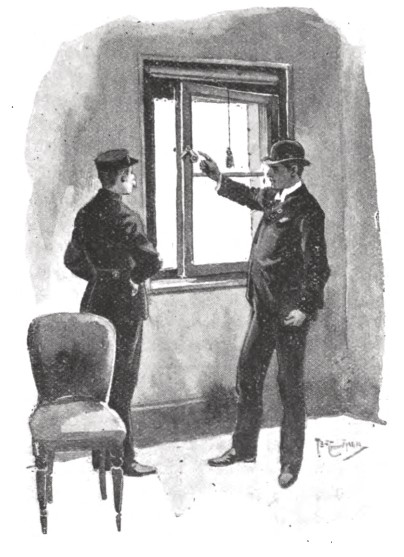
that;” and he replaced the gate.

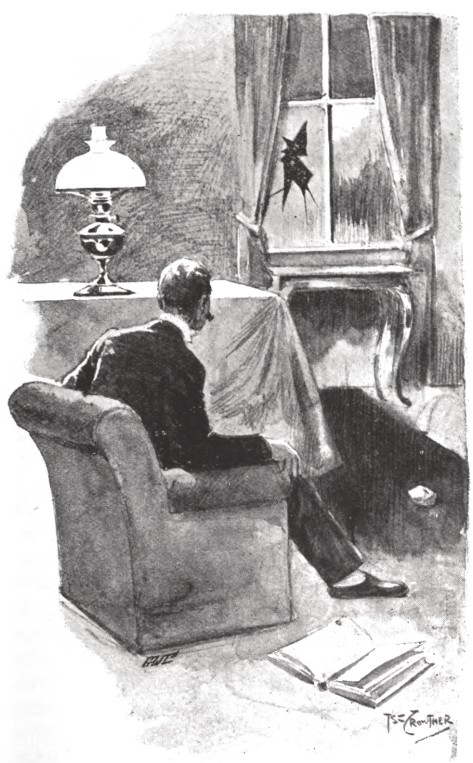
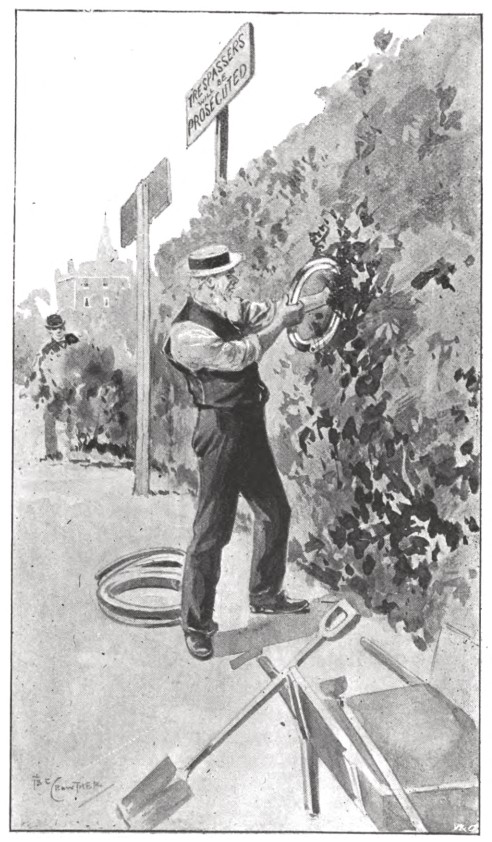
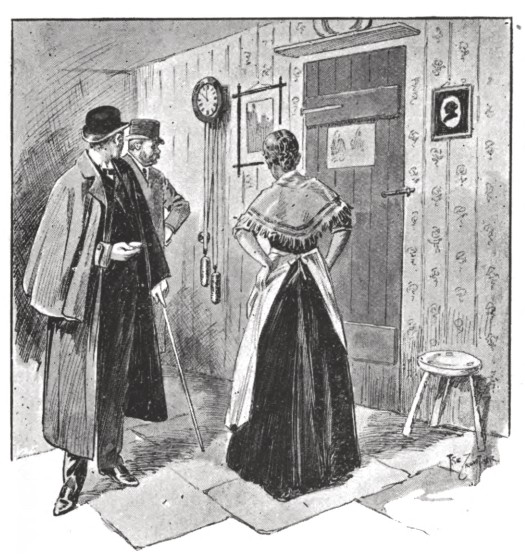
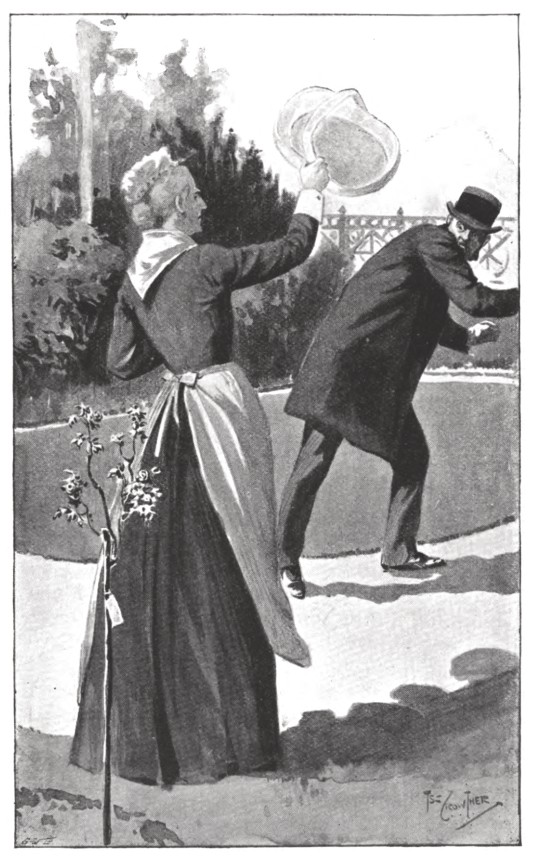
“‘THOSE HINGES WERE MEANT FOR A HEAVIER GATE
THAN THAT.’”
“Yes,” Mrs. Seton replied; “I am obliged to you; but that doesn’t
concern us now. The French window was bolted on the inside. Would you
like to see the servants?”
The servants were produced, and Hewitt questioned each in turn, but
not one would admit having seen anything of Master Charles Seton
after he had been left in the small morning-room. A rather stupid
groom fancied he had seen Master Charles on the side lawn, but then
remembered that that must have been the day before. The cook, an
uncommonly thin, sharp-featured woman for one of her trade, was
especially positive that she had not seen him all that day. “And she
would be sure to have remembered if she had seen him leaving the
house,” she said, “because she was the more particular since he was
lost the last time.”
This was news to Hewitt. “Lost the last time?” he asked; “why, what
is this, Mrs. Seton? Was he lost once before?”
“Oh, yes,” Mrs. Seton answered, “six or seven weeks ago. But that
was quite different. He strayed out at the front gate, and was
brought back from the police station in the evening.”
“But this may be most important,” Hewitt said. “You should certainly
have told me. Tell me now exactly what happened on this first
occasion.”
“But it was really quite an ordinary sort of accident. He was left
alone and got out through an open gate. Of course we were very
anxious; but we had him back the same evening. Need we waste time in
talking about that?”
“But it will be no waste of time, I assure you. What was it that
happened, exactly?”
“Nurse was about to take him for a short walk just before lunch. On
the front lawn he suddenly remembered a whip which had been left in
the nursery, and insisted on taking it with him. She left him and
went back for it, taking, however, some little time to find it. When
she returned he was nowhere to be seen; but one of the gates was a
couple of feet or more open—it had caught on a loose stone in
swinging to—and no doubt he had wandered off that way. A lady found
him some distance away, and, not knowing to whom he belonged, took
him that evening to a police station, and as messages had been sent
to the police stations, we had him back soon after he was left there.”
“Do you know who the lady was?”
“Her name was Mrs. Clark. She left her name and address at the
police station, and of course I wrote to thank her. But there was
some mistake in taking it down, I suppose, for the letter was
returned marked ‘not known.’”
“Then you never saw this lady yourself?”
“No.”
“I think I will make a note of the exact description of the child
and then visit the police station to which this lady took him six
weeks ago. Fair, curly hair, I think, and blue eyes? Age two years
and three months; walks and runs well, and speaks fairly plainly.
Dress?”
“Pale blue llama frock with lace, white under-linen, linen overall,
pale blue silk socks and tan shoes. Everything good as new except the
shoes, which were badly worn at the backs, through a habit he has of
kicking back and downward with his heels when sitting. They were
rather old shoes, and only used indoors.”
“If I remember aright nothing was said of those shoes in the printed
bill?”
“Was that so? No, I believe not. I have been so worried.”
“Yes, Mrs. Seton, of course. It is most creditable in you to have
kept up so well while I have been making my inquiries. Go now and
take a good rest while I do what is possible. By the way, where was
Mr. Seton yesterday morning when you missed the boy?”
“In the City. He has some important business in hand just now.”
“And to-day?”
“He has gone to the City again. Of course he is sadly worried; but
he saw that everything possible was done, and his business was very
important.”
“Just so. Mr. Seton was not married before, I presume—if I may?”
“No, certainly not; why do you ask?”
“I beg your pardon, but I have a habit of asking almost every
question I can think of; I can’t know too much of a case, you know,
and most unlikely pieces of information sometimes turn out useful.
Thank you for your patience; I will try another plan now.”
Mrs. Seton had kept up remarkably well during Hewitt’s examination,
but she was plainly by no means a strong woman, and her maid came
again to her assistance as Hewitt left. Hewitt himself made for the
police station. Few inspectors indeed of the Metropolitan Police
force did not know Hewitt by sight, and the one here in charge knew
him well. He remembered very well the occasion, six weeks or so
before, when Mrs. Clark brought Mrs. Seton’s child to the station. He
was on duty himself at the time, and he turned up the book containing
an entry on the subject. From this it appeared that the lady gave the
address No. 89, Sedgby Road, Belsize Park.
“I suppose you didn’t happen to know the lady,” Hewitt asked—“by
sight or otherwise?”
“No, I didn’t, and I’m not sure I could swear to her again,” the
inspector answered. “She wore a heavy veil, and I didn’t see much of
her face. One rum thing I noticed, though: she seemed rather taken
with the baby, and as she stooped down to kiss him before she went
away I could see an old scar on her throat. It was just the sort of
scar I’ve seen on a man that’s had his throat cut and got over it.
She wore a high collar to hide it, but stooping shifted the collar,
and so I saw it.”
“Did she seem an educated woman?”
“Oh yes; perfect lady; spoke very nice. I told her a baby had been
inquired after by Mrs. Seton, and from the description I’d no doubt
this was the one. And so it was.”
“At what time was this?”
“7.10 p.m., exactly. Here it is, all entered properly.”
“Now as to Sedgby Road, Belsize Park. Do you happen to know it?”
“Oh, yes, very well. Very quiet, respectable road indeed. I only
know it through walking through.”
“I see a suburban directory on the shelf behind you. Do you mind
pulling it down? Thanks. Let us find Sedgby Road. Here it is. See,
there is no No. 89; the highest number is 67.”
“No more there is,” the inspector answered, running his finger down
the column; “and there’s no Clark in the road, that’s more. False
address, that’s plain. And so they’ve lost him again, have they? We
had notice yesterday, of course, and I’ve just got some bills. This
last seems a queer sort of affair, don’t it? Child sitting inside the
house disappeared like a ghost, and all the doors and windows
fastened inside.”
Hewitt agreed that the affair had very uncommon features, and
presently left the station and sought a cab. All the way back to his
office he considered the matter deeply. As a matter of fact he was at
a loss. Certain evidence he had seen in the house, but it went a very
little way, and beyond that there was merely no clue whatever. There
were features of the child’s first estrayal also that attracted him,
though it might very easily be the case that nothing connected the
two events. There was an unknown woman—apparently a lady—who had
once had her throat cut, bringing the child back after several hours,
and giving a false name and address, for since the address was false,
the same was probably the case with the name. Why was this? This time
the child was still absent, and nothing whatever was there to suggest
in what direction he might be followed, neither was there anything to
indicate why he should be detained anywhere, if detained he was.
Hewitt determined, while awaiting any result that the bills might
bring, to cause certain inquiries to be made into the antecedents of
the Setons. Moreover, other work was waiting, and the Seton business
must be put aside for a few hours at least.
Hewitt sat late in his office that evening, and at about nine
o’clock Mrs. Seton returned. The poor woman seemed on the verge of
serious illness. She had received two anonymous letters, which she
brought with her, and with scarcely a word placed before Hewitt’s
eyes.
The first he opened and read as follows:—
“The writer observes that you are offering a reward for the recovery
of your child. There is no necessity for this; Charley is quite safe,
happy, and in good hands. Pray do not instruct detectives or take any
such steps just yet. The child is well and shall be returned to you.
This I swear solemnly. His errand is one of mercy; pray have
patience.”
Hewitt turned the letter and envelope in his hand. “Good paper, of
the same sort as the envelope,” he remarked, “but only a half sheet,
freshly torn off, probably because the other side bore an address
heading; therefore most likely from a respectable sort of house. The
writing is a woman’s, and good, though the writer was agitated when
she did it. Posted this afternoon, at Willesden.”
“You see,” Mrs. Seton said anxiously, “she knows his name. She calls
him ‘Charley.’”
“Yes,” Hewitt answered; “there may be something in that, or there
may not. The name Charles Seton is on the bills, isn’t it? And they
have been visible publicly all day to-day. So that the name may be
more easily explained than some other parts of the letter. For
instance, the writer says that the child’s ‘errand’ is one of mercy.
The little fellow may be very intelligent—no doubt is—but children
of two years old as a rule do not practise errands of mercy—nor
indeed errands of any sort. Can you think of anything whatever, Mrs.
Seton, in connection with your family history, or indeed anything
else, that may throw light on that phrase?”
He looked keenly at her as he asked, but her expression was one of
blank doubt merely, as she shook her head slowly and answered in the
negative. Hewitt turned to the other letter and read this:—
“Madam,—
“If you want your child you had better make an arrangement with me. You fancy he has strayed, but as a matter of fact he has been stolen, and you little know by whom. You will never get him back except through me, you may rest assured of that. Are you prepared to pay me one hundred pounds (£100) if I hand him to you, and no questions asked? Your present reward, £20, is paltry; and you may finally bid good-bye to your child if you will not accept my terms. If you do, say as much in an advertisement to the Standard, addressed to
“Veritas.”
“A man’s handwriting,” Hewitt commented; “fairly well formed, but
shaky. The writer is not in first-rate health—each line totters away
in a downward slope at the end. I shouldn’t be surprised to hear that
the gentleman drank. Postmark, Hampstead; posted this afternoon also.
But the striking thing is the paper and envelope. They are each of
exactly the same kind and size as those of the other letter. The
paper also is a half sheet, and torn off on the same side as the
other; confirmation of my suspicion that the object is to get rid of
the printed address. I shall be surprised if both these were not
written in the same house. That looks like a traitor in the enemy’s
camp; the question is, which is the traitor?” Hewitt regarded the
letters intently for a few seconds and then proceeded. “Plainly,” he
said, “if these letters are written by people who know anything about
the matter, one writer is lying. The woman promises that the child
shall be returned without reward or search, and talks generally as if
the taking away of the child, or the estrayal, or whatever it was,
were a very virtuous sort of proceeding. The man says plainly that
the child has been stolen, with no attempt to gloss the matter, and
asserts that nothing will get the child back but heavy blackmail—a
very different story. On the other hand, can there be any concerted
design in these two letters? Are they intended, each from its own
side, to play up to a certain result?” Hewitt paused and thought.
Then he asked suddenly: “Do you recognise anything familiar either in
the handwriting or the stationery of these letters?”
“No, nothing.”
“Very well,” Hewitt said, “we will come to closer quarters with the
blackmailer, I think. You needn’t commit yourself to paying anything,
of course.”
“But, Mr. Hewitt, I will gladly pay or do anything. The hundred
pounds is nothing. I will pay it gladly if I can only get my child.”
“Well, well, we shall see. The man may not be able to do what he
offers, after all, but that we will test. It is too late now for an
advertisement in to-morrow morning’s Standard, but there is the
Evening Standard—he may even mean that—and the next morning’s. I
will have an advertisement inserted in both, inviting this man to
make an appointment, and prove the genuineness of his offer; that
will fetch him if he wants the money, and can do anything for it.
Have you nothing else to tell me?”
“Nothing. But have you ascertained nothing yourself? Don’t say I’ve
to pass another night in such dreadful suspense!”
“I’m afraid, Mrs. Seton, I must ask you to be patient a little
longer. I have ascertained something, but it has not carried me far
as yet. Remember that if there is anything at all in these anonymous
letters (and I think there is) the child is at any rate safe, and to
be found one way or another. Both agree in that.” This he said mainly
to comfort his client, for in fact he had learned very little. His
news from the City as to Mr. Seton’s early history had been but
meagre. He was known as a successful speculator, and that was almost
all. There was an indefinite notion that he had been married once
before, but nothing more.
All the next day Hewitt did nothing in the case. Another affair, a
previous engagement, kept him hard at work in his office all day, and
indeed had this not been the case he could have done little. His City
inquiries were still in progress, and he awaited, moreover, a reply
to the advertisement. But at about half-past seven in the evening
this telegram arrived—
Child returned. Come at once.—Seton.
In five minutes Hewitt was making north-west in a hansom, and in
half an hour he was ringing the bell at the Setons’ house. Within,
Mrs. Seton was still semi-hysterical, clasping the child—an
intelligent-looking little fellow—in her arms, and refusing to
release her hold of him for a moment. Mr. Seton stood before the fire
in the same room. He was a smart-looking, scrupulously dressed man of
thirty-five or thereabouts, and he began explaining his telegram as
soon as he had wished Hewitt good-evening.
“The child’s back,” he said, “and of course that’s the great thing.
But I’m not satisfied, Mr. Hewitt. I want to know why it was taken
away, and I want to punish somebody. It’s really very extraordinary.
My poor wife has been driving about all day—she called on you, by
the bye, but you were out” (Hewitt credited this to Kerrett, who had
been told he must not be disturbed), “and she has been all over the
place uselessly, unable to rest, of course. Well, I have been at home
since half-past four, and at about six I was smoking in the small
morning-room—I often use it as a smoking-room—and looking out at
the French window. I came away from there, and half an hour or more
later, as it was getting dusk, I remembered I had left the French
window open, and sent a servant to shut it. She went straight to the
room, and there on the floor, where he was seen last, she found the
child playing with his toys as though nothing had happened!”
“And how was he dressed—as he is now?”
“Yes, just as he was when we missed him.”
Hewitt stepped up to the child as he sat on his mother’s lap, and
rubbed his cheek, speaking pleasantly to him. The little fellow
looked up and smiled, and Hewitt observed: “One thing is noticeable:
this linen overall is almost clean. Little boys like this don’t keep
one white overall clean for three days, do they? And see—those
shoes—aren’t they new? Those he had were old, I think you said, and
tan-coloured.”
The shoes now on the child’s feet were of white leather, with a
noticeable sewn ornamentation in silk. His mother had not noticed
them before, and as she looked he lifted his little foot higher and
said. “Look, mummy, more new shoes!”
“Ask him,” suggested Hewitt hurriedly, “who gave them to him.”
His father asked him, and the little fellow looked puzzled. After a
pause, he said, “Mummy.”
“No,” his mother answered, “I didn’t.”
He thought a moment and then said, “No, no, not vis mummy—course
not.” And for some little while after that the only answer procurable
from him was, “Course not,” which seemed to be a favourite phrase of
his.
“Have you asked him where he has been?”
“Yes,” his mother answered, “but he only says ‘Ta-ta.’”
“Ask him again.”
She did. This time, after a little reflection, he pointed his chubby
arm toward the door and said. “Been dere.”
“Who took you?” asked Mrs. Seton.
Again Charley seemed puzzled. Then, looking doubtfully at his
mother, he said “Mummy.”
“No, not mummy,” she answered; and his reply was “Course not,” after
which he attempted to climb on her shoulder.
Then, at Hewitt’s suggestion, he was asked whom he went to see. This
time the reply was prompt.
“Poor daddy,” he said.
“What, this daddy?”
“No, not vis daddy—course not.” And that was all that could be
got from him.
“He will probably say things in the next day or two which may be
useful,” Hewitt said, “if you listen pretty sharply. Now I should
like to go to the small morning-room.”
In time room in question the door was still open. Outside the moon
had risen and made the evening almost as clear as day. Hewitt
examined the steps and the path at their foot, but all was dry and
hard, and showed no footmark. Then, as his eye rested on the small
gate, “See here,” he exclaimed suddenly, “somebody has been in,
lifting the gate, as I showed Mrs. Seton when I was last here. The
gate has been replaced in a hurry, and only the top hinge has dropped
in its place; the bottom one is disjointed.” He lifted the gate once
more and set it back. The ground just along its foot was softer than
in the parts surrounding, and here Hewitt perceived the print of a
heel. It was the heel-mark of a woman’s boot, small and sharp and of
the usual curved D-shape. Nowhere else within or without was there
the slightest mark. Hewitt went some distance either way in the outer
lane, but without discovering anything more.
“I think I will borrow those new shoes,” Hewitt said on his return.
“I think I should be disposed to investigate further in any case, for
my own satisfaction. The thing interests me. By the way, Mrs. Seton,
tell me, would these shoes be more likely to have been bought at a
regular shoemaker’s or at a baby-linen shop?”
“Certainly I should say at a baby-linen shop,” Mrs. Seton answered;
“they are of excellent quality, and for babies’ shoes of this fancy
description one would never go to an ordinary shoemaker’s.”
“So much the better, because the baby-linen shops are fewer than the
shoemakers’. I may take these, then? Perhaps before I go you had
better make quite certain that there is nothing else about the child
which is not your own.”
There was nothing, and with the shoes in his pocket Hewitt regained
his cab and travelled back to his office. The case, from its very
bareness and simplicity, puzzled him. Why was the child taken?
Plainly not to keep, for it had been returned almost as it went.
Plainly also not for the sake of reward or blackmail, for here was
the child safely back, before the anonymous blackmailer had had a
chance of earning his money. More, the advertised reward had not been
claimed. Also it could not be a matter of malice or revenge, for the
child was quite unharmed, and indeed seemed to have been quite happy.
No conceivable family complication, previous to the marriage of Mr.
and Mrs. Seton, could induce anybody to take away and return the
child, which was undoubtedly Mrs. Seton’s. Then who could be the
“poor daddy” and “mummy”—not “vis daddy”
and not “vis mummy”—that the child had been
with? The Setons knew nothing of them. It was difficult to see what it
could all mean.
Arrived at his office, Hewitt took a map, and, setting the leg of a
pair of compasses on the site of the Setons’ house, described a
circle, including in its radius all Willesden and Hampstead. Then,
with the Suburban Directory to help him, he began searching out and
noting all the baby-linen shops in the area. After all, there were
not many—about a dozen. This done, Hewitt went home.
In the morning he began his hunt. His design was to call at each of
the shops until he had found in which a pair of shoes of that
particular pattern had been sold on the day of little Charley Seton’s
disappearance. The first two shops he tried did not keep shoes of the
pattern, and had never had them, and the young ladies behind the
counter seemed vastly amused at Hewitt’s inquiries. Nothing
perturbed, he tried the next shop on his list in the Hampstead
district. There they kept such shoes as a rule, but were “out of them
at present.” Hewitt immediately sent his card to the proprietress,
requesting a few minutes’ interview.
The lady—a very dignified lady indeed—in black silk, gray
corkscrew curls and spectacles, came out with Hewitt’s card between
her fingers. He apologised for troubling her, and, stepping out of
hearing from the counter, explained that his business was urgent. “A
child has been taken away by some unauthorised person, whom I am
endeavouring to trace. This person bought this pair of shoes on
Monday. You keep such shoes, I find, though they are not in stock at
present, and, as they appear to be of an uncommon sort, possibly they
were bought here.”
The lady looked at them. “Yes,” she said, “this pattern of shoe is
made especially for me. I do not think you can buy them at other
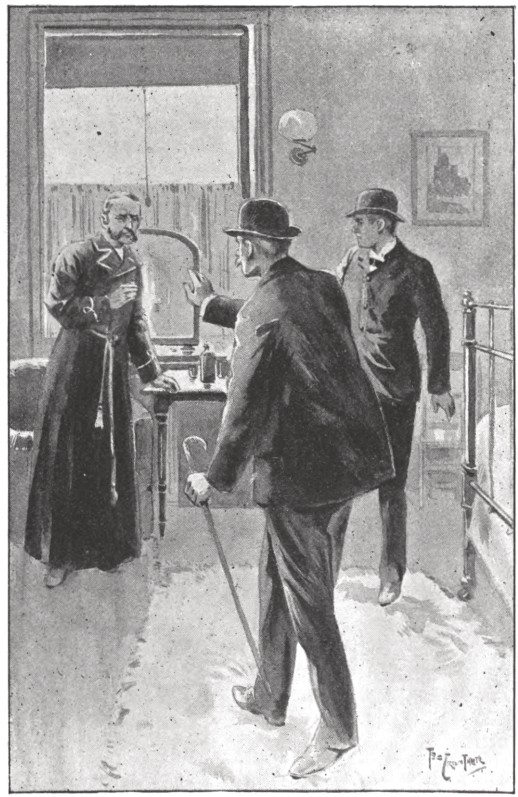
places.”
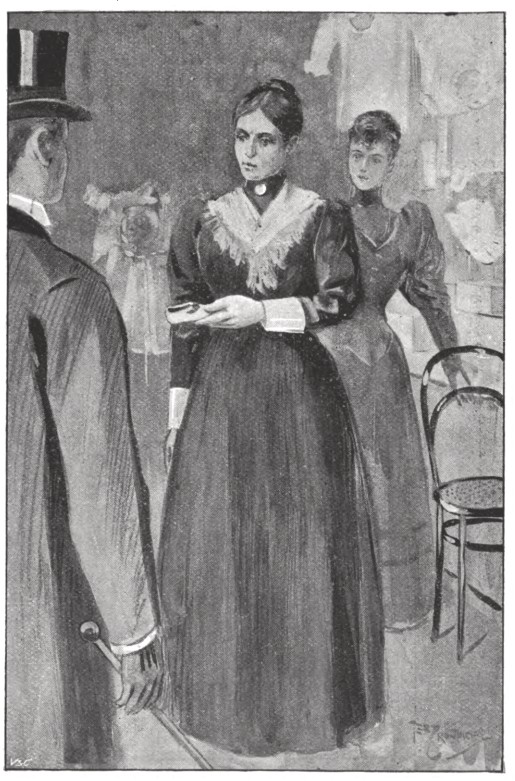
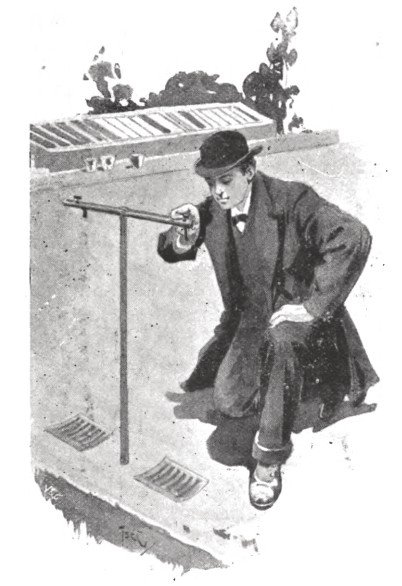
“‘THIS PATTERN OF SHOE IS MADE ESPECIALLY FOR ME.’”
“Then may I ask you to inquire from your assistants if any were sold
on Monday, and to whom?”
“Certainly.” Then there were consultations behind counters and
desks, and examinations of carbon-papered books. In the end the
proprietress came to Hewitt, followed by a young lady of rather pert
and self-confident aspect. “We find,” she said, “that two pairs of
these shoes were sold on Monday. But one pair was afterwards brought
back and exchanged for others less expensive. This young lady sold
both.”
“Ah, then possibly she may remember something of the person who
bought the pair which was not exchanged.”
“Yes,” the assistant answered at once, addressing herself to the
lady, “it was Mrs. Butcher’s servant.”
The proprietress frowned slightly. “Oh, indeed,” she said, “Mrs.
Butcher’s servant, was it? There have been inquiries about Mrs.
Butcher before, I believe, though not here. Mrs. Butcher is a woman
who takes babies to mind, and is said to make a trade of adopting
them, or finding people anxious to adopt them. I know nothing of her,
nor do I want to. She lives somewhere not far off, and you can get
her address, I believe, from the greengrocer’s round the corner.”
“Does she keep more than one servant?”
“Oh, I think not; but no doubt the greengrocer can say.” The lady
seemed to feel it an affront that she should be supposed to know
anything of Mrs. Butcher, and Hewitt consequently started for the
greengrocer’s. Now this was just one of those cases in which
dependence on information given by other people put Hewitt on the
wrong scent. He spent that day in a fatiguing pursuit of Mrs.
Butcher’s servant, with adventures rather amusing in themselves, but
quite irrelevant to the Seton case. In the end, when he had captured
her, and proceeded to open a cunning battery of inquiries, under plea
of a bet with a friend that the shoes could not be matched, he soon
found that she had been the purchaser who, after buying just such a
pair of shoes, had returned and exchanged them for something cheaper.
And the only outcome of his visit to the baby-linen shop was the
waste of a day. It was indeed just one of those checks which, while
they may hamper the progress of a narrative for popular reading, are
nevertheless inseparable from the matter-of-fact experience of
Hewitt’s profession.
With a very natural rage in his heart, but with as polite an
exterior as possible, Hewitt returned to the baby-linen shop in the
evening. The whole case seemed barren of useful evidence, and at each
turn as yet he had found himself helpless. At the shop the
self-confident young lady calmly admitted that soon after he had left
something had caused her to remember that it was the other customer
who had kept the white shoes, and not Mrs. Butcher’s servant.
“And do you know the other customer?” he asked.
“No; she was quite a stranger. She brought in a little boy from a
cab and bought a lot of things for him—a suit of outdoor clothes as
well as the shoes.”
“Ah! now probably this is what I want. Can you remember anything of
the child?”
“Yes; he was a pretty little fellow, about two years old or so, with
curls. She called him Charley.”
“Did she put the things on him in the shop?”
“Not the frock; but she put on the outer coat, the hat and the
shoes. I can remember it all now quite well—now I have had time to
think.”
“Then what shoes did the child wear when he came in?”
“Rather old tan-coloured ones.”
“Then I think this is the person I am after. You say you never saw
her at any other time before or since. Try to describe her.”
“Well, she was a lady well dressed, in black. She had a very high
collar to hide a scar on her neck, like the scars people have
sometimes after abscesses, I think. I could see it from the side when
she stooped down.”
“And are you sure she had nothing sent home? Did she take everything
with her?”
“Yes; nothing was sent, else we should know her address, you know.”
“She didn’t happen to pay with a banknote, did she?”
“No; in cash.”
Hewitt left with little more ceremony, and made the best of his way
to his friend the inspector at the police station. Here was the woman
with the scarred neck again—Charley’s deliverer once, now his
kidnapper. If only something else could be ascertained of her—some
small clue that might bring her identity into view—the thing would
be done.
At the station, however, there was something new. A man had just
come in, very drunk, and had given himself into custody for
kidnapping the child Charles Seton, whose description was set forth
on the bill which still appeared on the notice-board outside the
station. When Hewitt arrived, the man was lolling, wretched and
maudlin, against the rail, and, oblivious of most of the questions
addressed to him, was ranting and snivelling by turns. His dress was
good, though splashed with mud, and his bloated face, bleared eyes
and loose, tremulous mouth proclaimed the habitual drunkard.
“I shay I’ll gimmeself up,” he proclaimed, with a desperate attempt
at dignity; “I’ll gimmeself up takin’ away lil boy; I’ll shacrifishe
m’self. Solemn duty shacrifishe m’self f’elpless woman, ain’t it?
Ver’ well then; gimmeself up takin’ ’way lil boy, buyin’ ’m pair
shoes. No harm in that, issher? Hope not. Ver’ well then.” And he
subsided into tears.
“What’s your name?” asked the inspector.
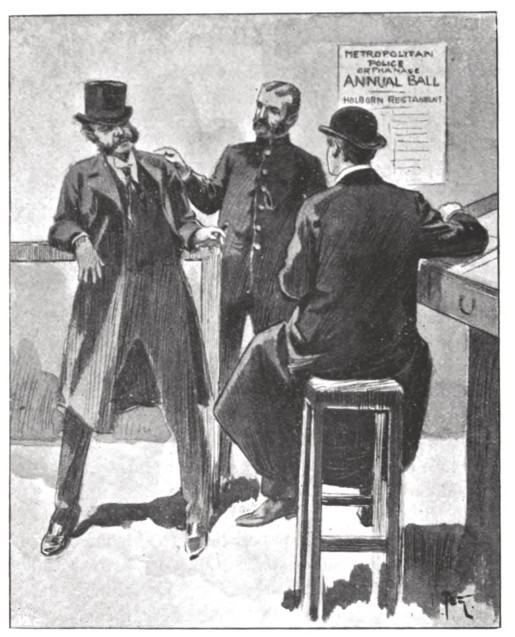
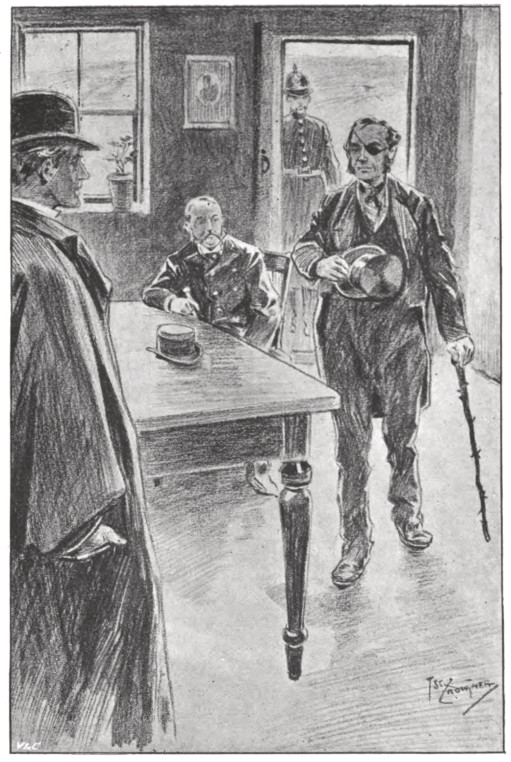
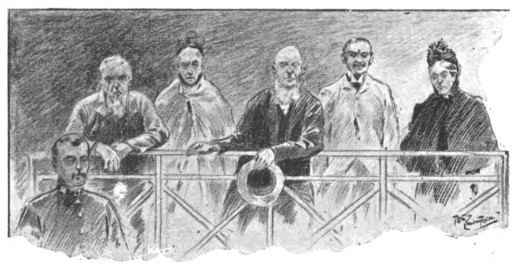
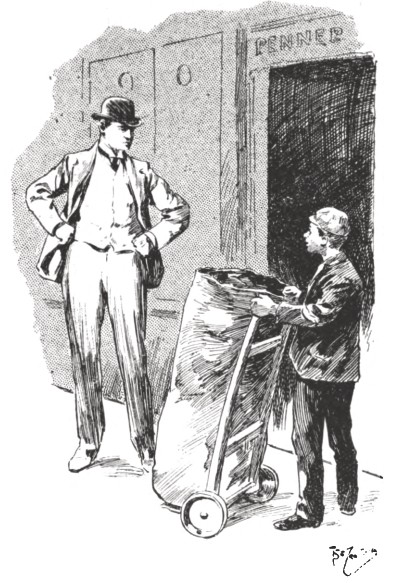
“‘WHAT’S YOUR NAME?’ ASKED THE INSPECTOR.”
“Whash name? Thash my bishnesh. Warrer wan’ know name for?
Grapertnence ask gellumshname. I’m gellum, thash wha’ I am. Besht of
shisters too, besht shis’ers”—snivelling again—“an’ I’m ungra’ful
beasht. But I shacrifishe ’self; she shan’ get ’n trouble. D’y’ear?
Gimmeself up shtealin’ lil boy. Who says I ain’ gellum?”
Nothing more intelligible than this could be got out of him, and
presently he was taken off to the cells. Then Hewitt asked the
inspector, “What will happen to him now?”
The inspector laughed.
“Oh he’ll get very sober and sick and sorry by the morning,” he
said; “and then he’ll have to send home for some money, that’s all.”
“And as to the child?”
“Oh, he’ll forget all about that; that’s only a drunken freak. The
child has been recovered. You know that, I suppose?”
“Yes; but I am still after the person who took it away. It was a
woman. Indeed, I’ve more than a suspicion that it was the woman who
brought the child here when he was lost before—the one with the scar
on the neck, you know.”
“Is that so?” said the inspector. “Well, that’s a rum go, ain’t it?
What did she bring him back here for if she wanted him again?”
“That I want to find out,” Hewitt answered. “And now I want you to
do me a favour. You say you expect that man below will want to send
home in the morning for money. Well, I want to be the messenger.”
The inspector opened his eyes.
“Want to be the messenger? Well, that’s easily done; if you’re here
at the time I’ll leave word. But why?”
“Well, I’ve a sort of notion I know something about his family, and
I want to make sure. Shall I be here at eight in the morning, or
shall we say nine?”
“Which you like; I expect he’ll be shouting for bail before eight.”
“Very well, we will say eight. Good-night.”
And so Hewitt had to let yet another night go without an explanation
of the mystery; but he felt that his hand was on the key at last,
though it had only fallen there by chance. Prompt to his time at
eight in the morning he was at the police station, where another
inspector was now on duty, who, however, had been told of Hewitt’s
wish.
“Ah,” he said, “you’re well to time, Mr. Hewitt. That prisoner’s as
limp as rags now; he’s begging of us to send to his sister.”
“Does he say anything about that child?”
“Says he don’t know anything about it; all a drunken freak. His
name’s Oliver Neale, and he lives at 10, Morton Terrace, Hampstead,
with his sister. Her name’s Mrs. Isitt; and you’re to take this note
and bring her back with you, or at any rate some money; and you’re to
say he’s truly repentant,” the inspector concluded with a grin.
The distance was short, and Hewitt walked it. Morton Terrace was a
short row of pleasant, old-fashioned villas, ivy-grown and neat, and
No. 10 was as neat as any. To the servant who answered his ring
Hewitt announced himself as a gentleman with a message from Mrs.
Isitt’s brother. This did not seem to prepossess the girl in Hewitt’s
favour, and she backed to the end of the hall and communicated with
somebody on the stairs before finally showing Hewitt into a room,
where he was quickly followed by Mrs. Isitt.
She was a rather tall woman of perhaps thirty-eight, and had
probably been attractive, though now her face bore lines of sad
grief. Hewitt noticed that she wore a very high black collar.
“Good-morning, Mrs. Isitt,” he said. “I’m afraid my errand is not
altogether pleasant. The fact is, your brother, Mr. Neale, was not
altogether sober last night, and he is now at the police station,
where he wrote this note.”
Mrs. Isitt did not appear surprised, and took the note with no more
than a sigh.
“Yes,” she said, “it can’t be concealed. This is not the first time
by many, as you probably know, if you are a friend of his.”
She read the note, and as she looked up Hewitt said—
“No, I have not known him long. I happened to be at the station last
night, and he rather attracted my attention by insisting, in his
intoxicated state, on giving himself up for kidnapping a child,
Charles Seton.”
Mrs. Isitt started as though shot. Pale of cheek, she glanced
fearfully in Hewitt’s face and there met a keen gaze that seemed to
read her brain. She saw that her secret was known, but for a moment
she struggled, and her lips worked convulsively—
“Charles Seton—Charles Seton?” she said.
“Yes, Mrs. Isitt, that is the name. The child, as a matter of fact,
was stolen by the person who bought these shoes for it. Do you
recognise them?”
He produced the shoes and held them before her. The woman sank on
the sofa behind her, terrified, but unable to take her eyes from
Hewitt’s.
“Come, Mrs. Isitt,” he said, “you have been recognised. Here is my
card. I am commissioned by the parents of the child to find who
removed him, and I think I have succeeded.”
She took the card and glanced at it dazedly; then she sank with a
groaning sob with her face on the head of the sofa, and as she did so
Hewitt could see a scar on the side of her neck peeping above her
high collar.
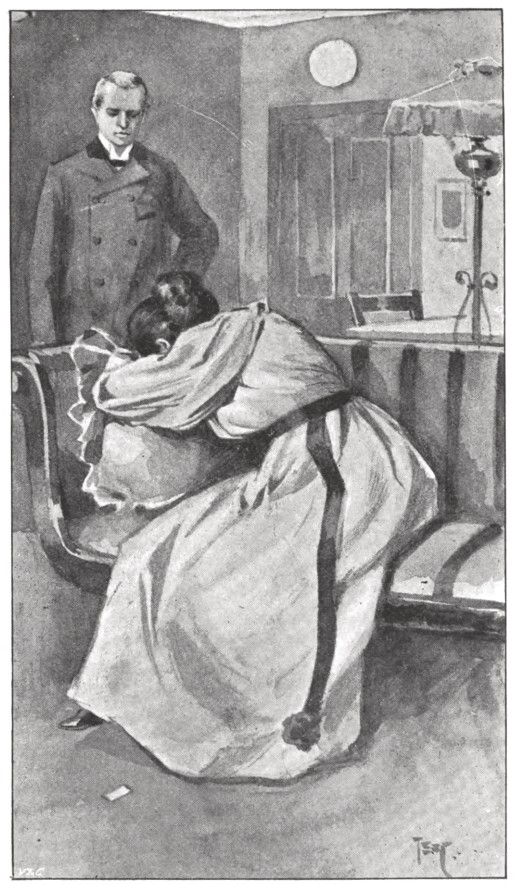
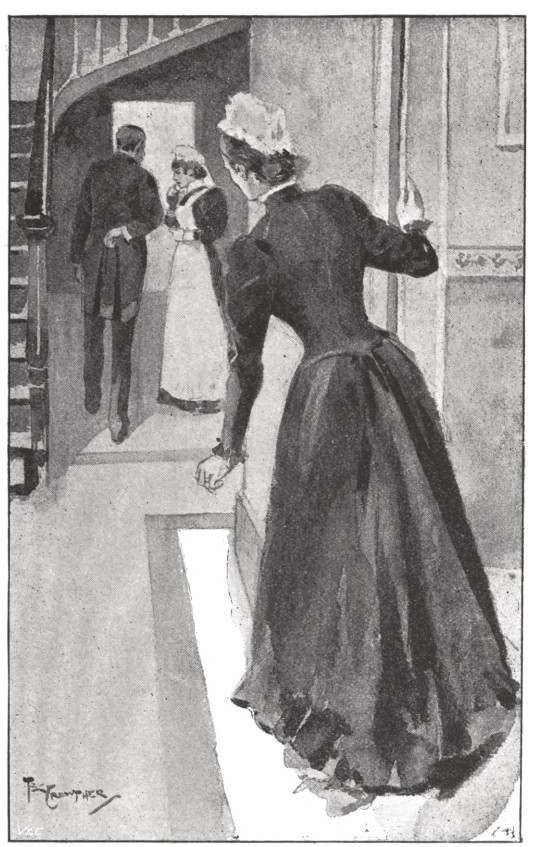
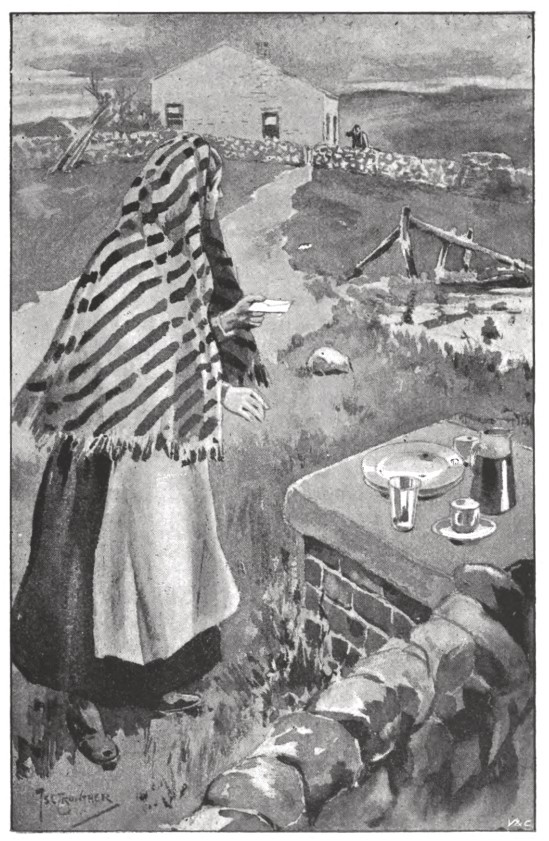
“SHE SANK WITH A GROANING SOB WITH HER FACE ON THE
HEAD OF THE SOFA.”
“Oh, my God!” the woman moaned. “Then it has come to this. He will
die! he will die!”
The woman’s anguish was piteous to see. Hewitt had gained his point,
and was willing to spare her. He placed his hand on her heaving
shoulder and begged her not to distress herself.
“The matter is rather difficult to understand, Mrs. Isitt,” he said.
“If you will compose yourself, perhaps you can explain. I can assure
you that there is no desire to be vindictive. I’m afraid my manner
upset you. Pray reassure yourself. May I sit down?”
Nobody could by his manner more easily restore confidence and trust
than Hewitt when it pleased him. Mrs. Isitt lifted her head and gazed
at him once more with a troubled though quieter expression.
“I think you wrote Mrs. Seton an anonymous letter,” Hewitt said,
producing the first of those which Mrs. Seton had brought him. “It
was kind of you to reassure the poor woman.”
“Oh, tell me,” Mrs. Isitt asked, “was she much upset at missing the
little boy? Did it make her ill?”
“She was upset, of course; but perhaps the joy of recovering him
compensated for all.”
“Yes; I took him back as soon as I possibly could, really I did, Mr.
Hewitt. And, oh! I was so tempted! My life has been so unhappy! If
you only knew!” She buried her face in her hands.
“Will you tell me?” Hewitt suggested gently. “You see, whatever
happens, an explanation of some sort is the first thing.”
“Yes, yes—of course. Oh, I am a wretched woman.” She paused for
some little while, and then went on: “Mr. Hewitt, my husband is a
lunatic.” She paused again. “There was never a man, Mr. Hewitt, so
devoted to his wife and children as my husband. He bore even with the
continual annoyance of my brother, whom you saw, because he was my
brother. But a little more than a year ago, as the result of an
accident, a tumour formed on his brain. The thing is incurable
except, as a remote possibility, by a most dangerous operation, which
the doctors fear to attempt except under most favourable conditions.
Without that he must die, sooner or later. Meantime he is insane,
though with many and sometimes long intervals of perfect lucidity.
When the disease attacked him there was little warning, except from
pains in the head, till one dreadful night. Then he rose from bed a
maniac and killed our child, a little girl of six, whom he was
devotedly attached to. He also cut my own throat with his razor, but
I recovered. I would rather say nothing more of that—it is too
dreadful, though indeed I think about little else. There was another
child, a baby boy, about a year old when his sister died, and he—he
died of scarlet fever scarcely four months ago.
“My husband was taken to a private asylum at Willesden, where he now
is. I visited him frequently, and took the baby, and it was almost
terrible to see—a part of his insanity, no doubt—how his fondness
for that child grew. When it died, I never dared to tell him. Indeed,
the doctors forbade it. In his state he would have died raving. But
he asked for it, sometimes earnestly, sometimes angrily, till I
almost feared to visit him. Then he began to demand it of the doctors
and attendants, and his excitement increased day by day. I was told
to prepare for the worst. When I visited him he sometimes failed to
recognise me, and at others demanded the child fiercely. I should
tell you that it was only just about this time that it was found that
the tumour existed, and the idea of the operation was suggested; but
of course it was impossible in his disturbed condition. I scarcely
dared to go to see him, and yet I did so long to! Dr. Bailey did
indeed suggest that possibly we might find he would be quieted by
being shown another child; but I myself felt that to be very unlikely.
“It was while things were in this state, and about six or seven
weeks ago, that, walking toward Cricklewood one morning, I saw a
little fellow trotting along all alone, who actually startled
me—startled me very much—by his resemblance to our poor little one.
The likeness was one of those extraordinary ones that one only finds
among young children. This child was a little bigger and stronger
than ours was when he died, but then it was older—probably very
nearly the age and size our own would have been had it lived. Nobody
else was in sight, and I fancied the child looked about to cry, so I
went to it and spoke. Plainly it had strayed, and could not tell me
where it lived, only that its name was Charley. I took it in my arms
and it grew quite friendly. As I talked to it suddenly Dr. Bailey’s
suggestion came in my mind. If any child could deceive my poor
husband, surely this was the one. Of course I should have to find its
parents—probably through the police; but why not at any rate take it
to Willesden in the meantime for an hour or so? I could not resist
the temptation—I took the first available cab.
“The result of the experiment almost frightened me. My poor husband
received the child with transports of delight, kissed it, and laughed
and wept over it like a mother rather than a father, and refused to
give it up for hours. The child of course would not answer to its
strange name at first, but he seemed an adaptable little thing, and
presently began calling my poor husband ‘daddy.’ I had not been so
happy myself for months as I was as I watched them. I had told Dr.
Bailey—what I fear was not strictly true—that I had borrowed the
child from a friend. At length I felt I must go and take the boy to
the police, and with great difficulty I managed to get it away, my
poor husband crying like a child. Well, I took the little fellow to
the station I judged nearest to where I found him, and gave him up to
the care of the inspector. But I was a little frightened at having
kept him so long, and gave a false name and address. Still, I learned
from the inspector that the child had been inquired after, and by
whom.
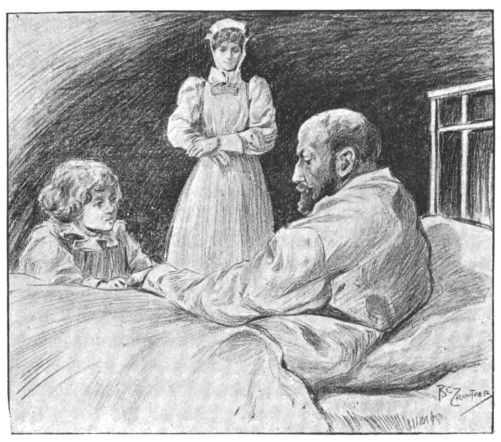
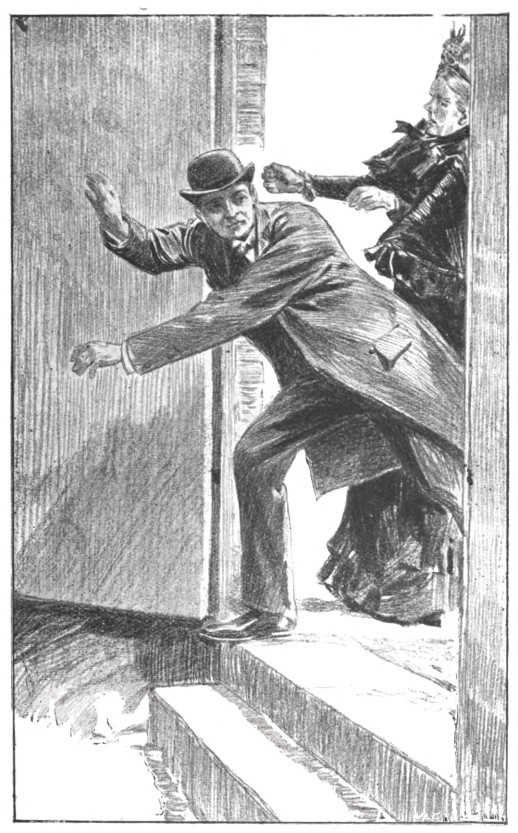
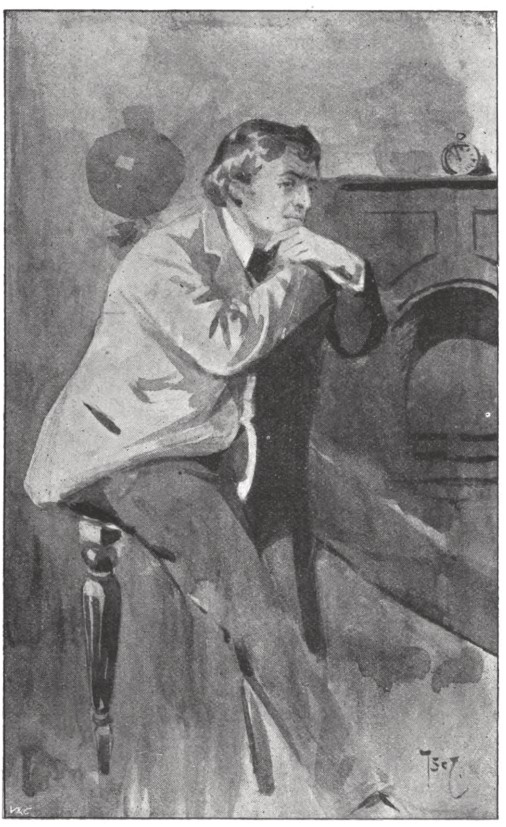
“DADDY!”
“My husband was quiet for some days after this, but then he began to
ask for his boy with more vehemence than ever. He grew worse and
worse, and soon his ravings were terrible. Dr. Bailey urged me to
bring the child again, but what could I do? I formed a desperate idea
of going to Mrs. Seton, telling her the whole thing, and imploring
her to let me take the child again. But then would that be likely?
Would she allow her child to be placed in the arms of a lunatic—one
indeed who had already killed a child of his own? I felt that the
thing was impossible. Still, I went to the house, and walked about it
again and again, I scarcely knew why. And my poor husband in his
confinement screamed for his child till I dared not go near him. So
it was when one morning—last Monday morning—I had passed the front
of the Setons’ house and turned up the lane at the side. I could see
over the low fence and hedge, and as I came to the French window with
the steps I saw that the window was open at one side and little
Charley was standing on the top step. He recognised me, smiled and
called just as my own child would have done; indeed, as I stood there
I almost fell into the delusion of my poor mad husband. I took the
gate in my hands, shaking it impatiently, and in attempting to open
it from the wrong end, found the hinges lift out. I could see that
nobody else was in the room behind the French window. There was the
temptation—the overwhelming temptation—and I was distracted. I took
the little fellow hurriedly in my arms and pulled the window to, so
that the bottom bolt fell into the floor socket; then I replaced the
gate as I found it, and ran to where I knew there was a cab-stand.
Oh! Mr. Hewitt, was it so very sinful? And I meant to bring him back
that same afternoon, I really did.
“The child was in indoor clothes, and had no hat. I called at a
baby-linen shop and bought hat, cloak, frock and a new pair of shoes.
Then I hurried to Willesden. Again the effect was magical. My husband
was happy once more; but when at last I attempted to take the child
away he would not let it go. It was terrible. Oh, I can’t describe
the scene. Dr. Bailey told me that, come what might, I must stay that
night in a room his wife would provide for me and keep the child, or
perhaps I must sit up with my husband and let the child sleep on my
knee. In the end it was the latter that I did.
“By the morning my senses were blunted, and I scarcely cared what
happened. I determined that as I had gone so far I would keep the
child that day at least; indeed, as I say, whether by the influence
of my husband I know not, but I almost felt myself falling into his
delusion that the child was ours. I went home for an hour at midday,
taking the child, and then my wretched brother saw it and got the
whole story from me. He told me that reward bills were out about the
child, and then I dimly realised that its mother must be suffering
pain, and I wrote the note you spoke of. Perhaps I had some little
idea of delaying pursuit—I don’t know. At any rate I wrote it, and
posted it at Willesden as I went back. My husband had been asleep
when I left, but now he was awake again and asking for the child once
more. There is little more to say. I stayed that night and the next
day, and by that time my husband had become tranquil and rational as
he had not been for months. If only the improvement can be sustained,
they think of operating to-morrow or the next day.
“I carried Charley back in the dusk, intending to put him inside one
of the gates, ring, and watch him safely in from a little way off,
but as I passed down the side lane I saw the French window open again
and nobody near. I had been that way before and felt bolder there. I
took his hat and cloak (I had already changed his frock) and, after
kissing him, put him hastily through the window and came away. But I
had forgotten the new shoes. I remembered them, however, when I got
home, and immediately conceived a fear that the child’s parents might
trace me by their means. I mentioned this fear to my brother, and it
appeared to frighten him. He borrowed some money of me yesterday,
and, it seems, got intoxicated. In that state he is always anxious to
do some noble action, though he is capable, I am grieved to say, of
almost any meanness when sober. He lives here at my expense, indeed,
and borrows money from his friends for drink. These may seem hard
things for a sister to say, but everybody knows it. He has wearied
me, and I have lost all shame of him. I suppose in his muddled state
he got the notion that he would accuse himself of what I had done and
so shield me. I expect he repented of his self-sacrifice this
morning, though.”
Hewitt knew that he had, but said nothing. Also he said nothing of
the anonymous letter he had in his pocket, wherein Mr. Oliver Neale
had covertly demanded a hundred pounds for the restoration of Charley
Seton. He guessed, however, that that gentleman had feared making the
appointment that the advertisement answering his letter had suggested.
To Mr. and Mrs. Seton Hewitt told the whole story, omitting at first
names and addresses. “I saw plainly,” he said in course of his talk,
“that the child might easily have been taken from the French window.
I did not say so, for Mrs. Seton was already sufficiently distressed,
and the notion that the child was kidnapped, and not simply lost,
might have made her worse just then. The toys—the cart with the
string on it in particular—had been dragged in the direction of the
window, and then nothing would be easier than for the child to open
the window itself. There was nothing but a drop bolt, working very
easily, which the child must often have seen lifted, and you will
remember that the catch did not act. Once the child had opened the
window and got outside, the whole thing was simple. The gate could be
lifted, the child taken, and the window pulled to, so that the bolt
would fall into its place and leave all as before.
“As to the previous occasion, I thought it curious at first that the
child should stray before lunch and yet not be heard of again till
the evening, and then apparently not be over-fatigued. But beyond
these little things, and what I inferred from the letter, I had very
little to help me indeed. Nothing, in fact, till I got the shoes, and
they didn’t carry me very far. The drunken rant of the man in the
police station attracted me because he spoke not only of taking away
the child, but of buying it shoes. Now nobody could know of the
buying of the shoes who did not know something more. But I knew it
was a woman who had taken Charley, as you know, from the heel-mark
and the evidence of the shop people, so that when the bemused fool
talked of his sister, and sacrificing himself for her, and keeping
her out of trouble, and so on, I ranged the case up in my mind, and,
so far as I ventured, I guessed it aright. The police inspector knew
nothing of the matter of the shoes, nor of the fact of the person I
was after being a woman, so thought the thing no more than a drunken
freak.
“And now,” Hewitt said, “before I tell you this woman’s name, don’t
you think the poor creature has suffered enough?”
Both Mrs. Seton and her husband agreed that she had, and that, so
far as they were concerned, no further steps should be taken. And
when she was told where to go, Mrs. Seton went off at once to offer
Mrs. Isitt her forgiveness and sympathy. But Mrs. Isitt’s punishment
came in twenty-four hours, when her husband died in the surgeon’s
hands.