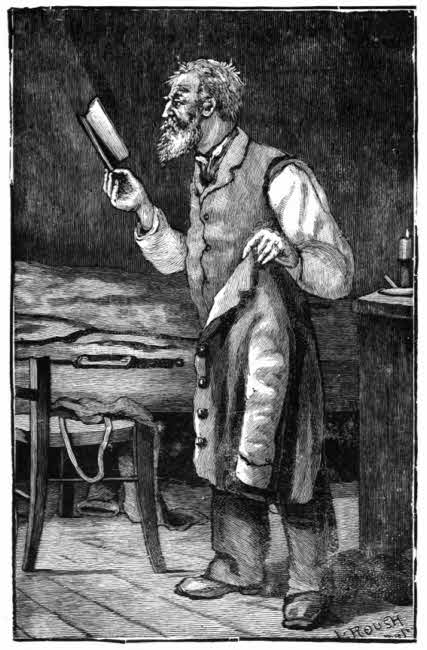
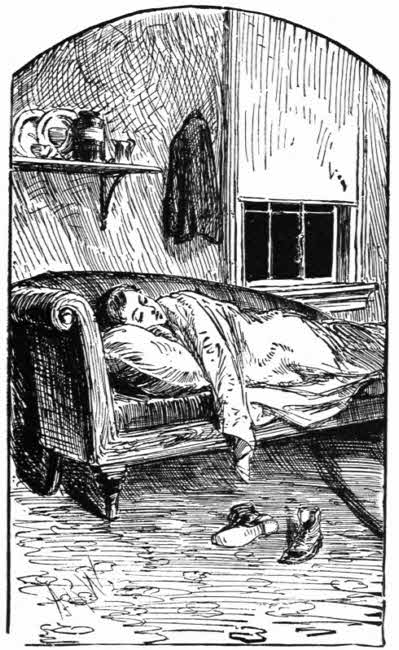
The old man turned, and, recognizing Paul, looked
somewhat ashamed.
“I—I couldn’t help it,” he whined. “I’m so poor.”
“There is no need for you to beg. I’ll bring you
some money tonight.”
“Just for a little while. See, a kind gentleman
gave me that,” and he displayed a silver dime.
Paul looked very much annoyed.
“If you don’t stop begging, grandfather,” he said,
“I won’t come home at all. I’ll go and sleep at the
Newsboys’ Lodge.”
The old man looked frightened. Paul turned in
every week two dollars and a half of his wages, and
old Jerry had no wish to lose so considerable a sum.
“I’ll go—I’ll go right away,” he said, hastily.
“Be sure you do. If you don’t I shall hear of it,
and you won’t see me any more.”
Just then a policeman of the Broadway squad,
whose business it was to pilot passengers across
through the maze of vehicles, took the old man in
tow, and led him carefully across the great thoroughfare.
Mr. Meacham had watched in attentive silence this
interview between Paul and the old man.
“So that is your grandfather,” he said.
“I call him so,” answered Paul, slowly.
“You call him so!” repeated his companion, puzzled.
“Isn’t he really your grandfather?”
“No, sir; but as I have lived with him ever since
I was very small, I have got into the habit of calling
him so.”
“When did your father die?”
“When I was about six years old. He only left a
hundred dollars or so, which Jerry took charge of,
and took me to live with him. We were living in
the same tenement house, and that’s how it came
about.”
“Is he so very poor?”
“I used to think so,” answered Paul, “till one day
I found out that he got a monthly pension from some
quarter in the city. I don’t know how much it is, but
I know he has money deposited in the Bowery Savings
Bank.”
“How did you find that out, Number 91?”
“I was walking along the Bowery one day on an
errand, when, as I was passing the bank, I saw
grandfather going up the steps. That made me
curious, and I beckoned to a friend of mine, Johnny
Woods, and asked him to go in and see what the old
man’s business appeared to be. I met Johnny that
evening and he told me that he saw grandfather
write out a deposit check and pay in money. I
couldn’t find out how much it was, but Johnny said
there were several bills in the sum.”
“Then your grandfather, as you call him, is a
miser.”
“Yes, sir, that’s about what it comes to.”
“In what way does he live?”
“We have a poor, miserable room in a tenement
on Pearl Street that costs us four dollars a month.
Grandfather is always groaning about having to pay
so much.”
“I suppose he doesn’t live very luxuriously?”
“Dry bread, and sometimes a little cheese, is what
he lives on. Sometimes Mrs. O’Connor, an Irish
washerwoman, living in the room below, brings up a
plate of meat out of charity.”
Paul uttered the last word bitterly, as if he felt
keenly the mortification of the confession.
“But how can you look so well and strong on such
fare?” asked the old farmer, gazing not unadmiringly
at the red cheeks and healthy complexion of
the young telegraph boy.
“I don’t take my meals with grandfather. He
wanted me to hand in all my money, and share his
meals, but I told him I should die in a week if I had
to live like him, so he agreed to let me pay him
two dollars and a half a week, and use the rest for
myself. I generally eat at some restaurant on the
Bowery.”
“But that must cost you more than a dollar and
a half a week.”
“So it does, sir, but I get a dollar or two extra on
fees from parties that employ me.”
“Even then, at the prices I paid at the New England
Hotel, I shouldn’t think you could buy three
meals a day.”
“What do you take me for, Mr. Meacham—a
Vanderbilt or an Astor?” asked Paul, smiling. “I
might as well go to Delmonico’s or the Fifth Avenue
Hotel as to the New England House.”
“Where do you eat, then?”
“Generally at the Jim Fisk restaurant on Chatham
Street.”
“Is that a cheap restaurant?”
“I can get a good breakfast there for eight cents,
and a good dinner for eleven.”
Mr. Meacham looked surprised.
“What on earth can you get for those prices?” he
asked.
“I can get a cup of coffee, eggs, fish balls, or mutton
stew, with bread and butter, for eight cents,”
said Paul. “The coffee costs three cents, the other
five. Then, for dinner, all kinds of meat cost eight
cents a plate, and bread and butter thrown in.”
“That’s cheap enough certainly. Is it good?”
“It’ll do,” said Paul, briefly. “Last Sunday I got
roast turkey. That cost twelve cents.”
“Great Scott!” ejaculated the farmer. “I never
dreamed of how people live here in this great city.”
“You see we can’t all of us eat at Delmonico’s.”
“Did your grandfather ever eat at your restaurant?”
“Once I invited him, and told him I would pay
the bill. He ate a square meal, meat, coffee, and pie,
costing sixteen cents. He seemed to relish it very
much, but when we were going away he groaned
over my extravagance, and predicted that I would
die in the poorhouse. I’ve never succeeded in getting
him there since.”
“Well, well,” said the farmer, “of all the fools
on the footstool, I believe the biggest is the man
who deprives himself of vittles to save up money
for somebody else to spend. I’m too selfish, for my
part.”
“There isn’t a day that grandfather doesn’t groan
over my foolish extravagance,” continued Paul.
“Sometimes it makes me laugh, but oftener it makes
me ashamed.”
“You don’t feel much attachment to him, then?”
“No, sir; perhaps I ought, as he has been my
guardian so long, but you saw him yourself, sir—a
poor, shabby, dirty old man! How can I feel attached
to him?”
“I confess it must be hard.”
“You don’t think me much to blame, do you?”
“I don’t think you to blame at all. Affection
must be natural, and there seems to be no ground
for it in this case. But isn’t that the ferry?”
“Yes, sir.”
They crossed the street and entered the ticket
office of the Cortlandt Street Ferry. Paul set
down the valise, while Mr. Meacham secured a
ticket.
“Now, Number 91,” said the old man, “how much
do I owe you?”
Paul stated the sum, and Mr. Meacham put it in
his hand.
“Thank you, sir,” said Paul, touching his cap.
“Stop a minute; here is something for yourself,”
said his companion, taking out a silver dollar from
his purse.
Paul regarded the old man with undisguised
amazement.
“Are you surprised to get so much?” asked the
old man with a smile.
“Yes, sir; I—” and he hesitated.
“You thought me a poor man, perhaps a mean
man?”
“No, sir, not that; but I thought you not rich.”
“Don’t always judge by the clothes a man wears,
Number 91. I own a large farm, and fifty thousand
dollars in railroad stocks. That is rich for the
country.”
“I don’t often get so much as this, sir.”
“I suppose not. But I have got a good deal of
information out of you. I have heard much that
surprised me, that I couldn’t have learned in any
other way. So you are welcome to the dollar, and I
think I have got my money’s worth.”
“I am very much obliged to you, sir.”
“That’s all right. Now, Number 91—by the way,
what is your real name?”
“Paul Parton, sir.”
“Then, Paul, if you ever come my way, I should
like to have you spend a week or a month on my
farm, as a visitor. I live in Lancaster, Pennsylvania,
about a couple of miles from the city, and I’ll promise
to give you enough to eat at less than you have
to pay at the Jim Fisk restaurant.”
Paul thanked him with a smile, and turned to
leave the ferry.
In the waiting room was a tall, bearded man, who
looked something like a miner, as indeed he was,
just returned from a long sojourn in California.
“Excuse me, boy,” he said, advancing towards our
hero. “Do you mind telling me your name?”
“My name is Paul Parton,” answered the telegraph
boy, with a glance of surprise.
“Were you ever in California?”
“Not that I know of, sir.”
“It’s strange!” said the miner, reflectively.
“What is strange, sir?”
“You are the living image of a man I used to know
a dozen or fourteen years since in California. Were
you born in New York?”
“I think so, sir—I don’t know.”
“Is your father living?”
“No, sir; I live with an old man who is not related
to me.”
“Was your father ever in California?”
“He may have been, sir; but I was so young
when he died that I don’t know much about his history.”
“What is that number on your cap?”
“I am Number 91, and work for the District Telegraph
Company.”
“Number 91? Well, my boy, I hope you’ll excuse
the liberty I took in addressing you. The California
miners are rather unceremonious. I suppose you
think it strange?”
“No, sir, not at all,” returned Paul, politely. “I
am glad to have made your acquaintance.”
As he left the ferry, and lost sight of his questioner,
he regretted that he had not at least inquired
his name.
“He may have known my father,” thought Paul,
“and I should be glad to meet some of his friends.
I don’t think old Jerry knows much about him. I
am getting tired of living with the old man, and
should like to meet some relative or friend of whom
I need not be ashamed.”