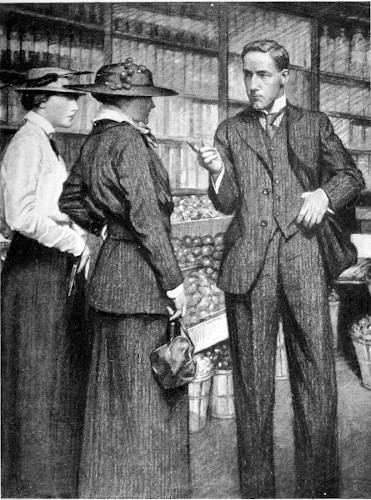
“There’s always a reason for high prices, and
it’s well worth finding out.”
—H. C. OF L. PROVERB NO. 3.
Mr. Larry, settling his stalwart shoulders
into his overcoat, stopped and
looked down with a smile at the pink-tipped
finger peeping through the buttonhole in his
left-hand lapel. He had come to recognize certain
wifely signs. Mrs. Larry’s finger attached
to this particular buttonhole indicated that Mrs.
Larry’s gray matter was twisting itself into an
interrogation point.
“Well?” he prompted.
“Um-m!” she murmured; then, with sudden
accession of courage: “Larry, when you went to
South Bethlehem looking for a new foundry to
buy castings, what did the old man say?”
“The old man?” echoed Mr. Larry.
“Yes, the man where you had been buying
them before. Didn’t he want you to keep right
on buying from him? Didn’t he say anything?”
“Did he? Why, as soon as he heard we were
dickering with new people, he had half a dozen
of his best men camping on our trail, cutting
prices. That’s the game—play one concern
against the other.”
“Thank you, dear,” murmured Mrs. Larry,
with a far-away look in her eye.
Mr. Larry caught the pink-tipped finger as it
slipped from the mooring in his buttonhole.
“What’s up, sweetheart? Been hearing a lecture
on ‘Every Wife Her Husband’s Partner’?
Going into business?”
“That’s just it, Larry, I am your partner,
and I ought to make a business of it.”
Mr. Larry drew her close, looking a trifle
anxious.
“I don’t want you any different. I love you
just as you are.”
“Yes, but you might love me better——”
“I couldn’t.”
“Yes, you could—if I were a better manager.
Larry, we eat too much. I mean, I don’t market
efficiently.”
Her husband groaned.
“I don’t want an efficient wife, the kind that
counts her steps and moves, and has charts and
signs hanging all over the house.”
“I’m not going to do any of those things; but
I do want to buy for our home as closely as you
buy for your firm. I’m afraid that Mr. Dahlgren,
my butcher, is overcharging me. I’ve
bought meat there, and vegetables and fruit
ever since we moved into this apartment; we’ve
paid him hundreds and hundreds of dollars, and—well,
I think I ought to talk to him.”
Mr. Larry kissed the pink finger-tip, and several
more, before he answered.
“Before you make any statements about his
overcharging, you must know the prices elsewhere.”
“Oh, I do,” and she held up a sheet of paper
covered with figures, some newspaper clippings
and a Housewives’ Marketing Guide of the
current week. “I got these at the Housewives’
League meeting.”
The clock in the living-room struck the half
hour and Mr. Larry reached for his hat.
“That’s right—you hand it to the old boy,
straight—and tell me about it to-night.”
When the door had closed on Mr. Larry, his
wife tripped to the telephone and called up
Claire.
“I’m going to have it out with my butcher,”
she announced very firmly. “If you’ve remembered
anything that I’ve forgotten, now’s your
chance to help me.”
“I’ll be over in half an hour,” answered
Claire briskly. “Mother wants me to answer
some invitations for her, and then I’ll be free
for the morning. It’s dear of you to take me
on your adventures. By-by.”
Mrs. Larry stood looking at the now silent
telephone. Certainly Claire was taking the
thing splendidly. If only Jimmy knew what
was going on! Yes, decidedly, Jimmy ought to
know. Having settled this matter to her satisfaction,
Mrs. Larry proceeded to act with characteristic
promptness. She took her pen in
hand—
“Dear Jimmy:
“Clearing out a drawer this morning, I came
upon the program of the Monday Night Dance.
Didn’t we have a wonderful time? If you are
as good a lawyer as you are a dancer, you’ll be
famous before long.
“So sorry you did not have dinner with us
before you left. You must never treat us that
way again.
“Can’t write any more, because I am going
over to my butcher’s to take my second lesson
in reducing the high cost of living. Claire is
going with me. Of course, she’ll write and tell
you all about our adventures in thrift. I suppose
we’ll have some wild experiences. But
when you really, truly love a man, you don’t
mind what you go through for him. Not even
if this means stalking that ogre, ‘High Prices,’
to its darkest lair.”
She sealed and stamped the envelope with an
affectionate little pat.
“It’s just as well not to take any chances on
some catty Kansas City girl discovering that
Jimmy’s heart has had a wound that she might
heal. I’ve heard a lot of strange things about
the way a man’s heart acts on the rebound.”
Nevertheless, she was very careful not to allow
Claire to see the address on the letter,
which she mailed in the first box they passed.
When Mrs. Larry, armed with market quotations,
entered the Dahlgren market, with its
glittering marble slabs, its white-coated cutters,
and its generally up-to-the-minute air, she felt
a sudden sinking in the region of her heart.
“Jud,” the rosy-cheeked, bright-eyed cutter,
who always took her order, came forward, book
in hand.
“What is it this morning?”
“A roast of beef——”
“Two ribs or three?” he suggested, already
writing the order.
“I think I’d like to see it.”
“Certainly. Bill, let me have that prime rib,
rolled. No, the other cut.”
A helper produced a roast, beautifully rolled,
all crimson flesh, flecked with rich, creamy-white
fat. Jud tossed it on the scales, and in a
flash had it off again.
“Not quite eight pounds—two dollars and
thirty-two cents. Can’t be beat for slicing down
cold. Anything else?” he added. “We have an
unusually fine pair of sweetbreads to-day.
Some chops for lunch?”
Mrs. Larry was doing mental arithmetic.
Claire had been using her pencil. “Two-thirty-two—That’s
thirty cents a pound.”
“What cut is that?” Mrs. Larry asked, with
a fine assumption of firmness and indicating the
rolled roast, which Jud had tossed into the basket,
as if the sale were made.
“That?” echoed the wondering cutter.
“That’s a Delmonico roast—fancy.”
“Haven’t you—haven’t you a third or fourth
rib roast, something cheaper than this?”
“Well, of course, I can give you any cut you
want,” said the amazed attendant, accustomed
to filling unqualified telephone orders. “But
I’d advise you to take this—no waste.”
Mrs. Larry looked up from her quotations.
“The second cut is only twenty-one cents a
pound, to-day. I’ll take that.”
“Certainly,” acquiesced Jud; “but you won’t
find much saving in that piece, what with bones
and tailings.” He had flung another roast, unrolled,
on the scales. “Seven pounds—one dollar
and sixty cents. Mebbe you’d rather have
three ribs than two?”
Again Claire’s pencil moved to the rhythm of
figures.
“If it’s twenty-one cents a pound, it ought to
be only one dollar and forty-seven cents.”
“This cut is twenty-three cents a pound.”
“But the market quotations say twenty-one
cents,” murmured Mrs. Larry.
Jud’s good-humored face clouded. Here was
an experience practically unheard of in the
Dahlgren market, and plainly beyond his jurisdiction.
“I guess you’d better talk to the boss.”
Mr. Dahlgren stepped forward solicitously.
“Nothing wrong, I hope?”
Mrs. Larry felt her color rising. The few
women in the market, like herself, were well-groomed,
well-tailored. They turned and stared
at her and Claire. Price-haggling in a shop of
this class suddenly seemed cheap and common.
And yet she was determined to put into practise
the lessons in meat buying she had learned
at the Monday morning meeting of the Housewives’
League.
“I don’t quite understand why this cut, the
third and fourth ribs, is twenty-three cents a
pound when the Housewives’ League price says
twenty-one cents,” she explained, proffering
Mr. Dahlgren the printed sheet.
The butcher’s shrewd experienced glance
swept the line of quotations.
“Ah—hem—yes, I see. U’m—Quite so.
Twenty-one cents to twenty-three. That’s
right. Twenty-three cents—and that’s what
we’re charging you.”
“But,” murmured Mrs. Larry, trying to look
severe, “why do you charge me the top price
instead of the bottom one? I am a regular customer.
I pay my bill weekly, which is as good
as cash, my husband says.” Being launched,
she felt quite courageous. Surely this was the
way Larry would talk to competing firms!
“I have been marketing here for three years
and have paid you hundreds of dollars.”
“I appreciate all that,” said Mr. Dahlgren
good-naturedly, “and I want to hold your trade;
but we do not carry the twenty-one-cent grade.
See?”
Decidedly Mrs. Larry did not “see,” and her
puzzled face betrayed the fact.
“The difference between twenty-three cents
and twenty-one cents does not represent the
whim of the butcher, Mrs. Hall, but the grade
of the beef sold, and I might say, also the expenses
of store management—what your husband
would call overhead expenses. This particular
roast, cut from the Argentine beef
mentioned in your Marketing Guide, could be
sold by some butchers at twenty-one cents a
pound, because the Argentine beef wholesales
at ten to ten and a half a pound. But I handle
only fancy, native, stall-fed beef, which wholesales
from fourteen and a half to fifteen and a
half cents per pound. Our prices here are regulated
by what I pay, which is always top notch
for selected meats, and by the expense of running
the shop. Cleanliness, modern equipment,
highly paid clerks, good telephone and delivery
service all come high. Then, of course, in a
shop like this heavy accounts are carried——”
“Oh—then I pay not only for the meat I buy,
but must make up your losses from charge customers
who do not pay. I really gain nothing
by paying my bill weekly.”
A great light illuminated Mrs. Larry’s marketing
vision. Mr. Dahlgren looked uncomfortable.
“Oh, I wouldn’t say that, Mrs. Hall; but the
sort of custom I have, what we call A-1 charge
trade, demands the best——”
“It can,” asserted Mrs. Larry significantly,
“if it does not pay.”
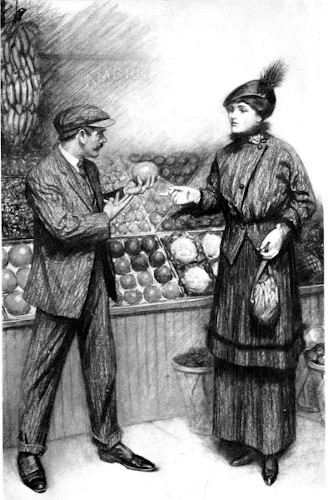
“I can’t offer you seconds in meat, poultry or
vegetables. Now, take this lettuce——”
He picked out a head of choice lettuce and
pulled the leaves apart.
“See? Not a withered leaf, not a single leaf
you could not serve on your table. Fifteen
cents. Well, you can go to the dago stand round
the corner and buy lettuce for eight or ten
cents. My lettuce you have charged and delivered
in clean baskets, by clean, respectful delivery
boys, and you’ll have enough for two salads.
The Italian sells you lettuce that is withered
on the outside from long standing in his
hot cellar, or small heads from which all the
outside leaves are stripped. You pay cash, the
lettuce is dusty, it is delivered by a dirty little
ragamuffin who ought to be in school, and you
get one salad as against two from the head
bought here.
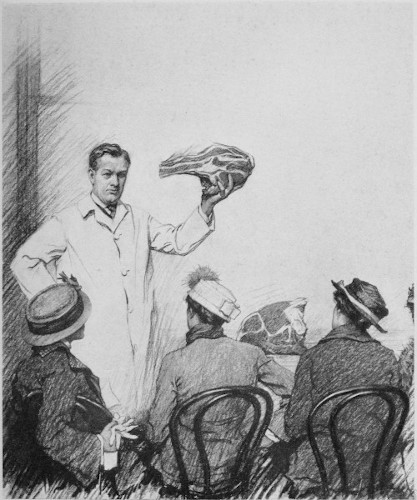
“Same way with those meat quotations. I
went down to hear that lecture. I sort of felt
some of my customers would be there. The man
who gave what you called your meat demonstration
is one of the biggest dealers in this city.
He wholesales as well as retails. He does not
carry a single retail charge account. He would
not give credit to a woman who had traded with
him ten years. Every sale is a cash transaction—no
waiting, no chance of loss. Of course, he
can undersell a man like me. I don’t pretend
to compete with him. You can go to his market—across
town—or you can order by telephone
or postal card, and he will give you good
meat, not fancy grades like I carry for my exclusive
trade, but good meat, and you will save
money. His rent is less than mine and he pays
smaller wages. I am not knocking his meat;
but I will say that if you take his roast at twenty-one
cents a pound and mine at twenty-three
cents a pound, and treat them exactly the same
way, you’ll be able to tell the difference. It’s
in the flavor and the tenderness and the juiciness,
and of the twenty-one-cent roast Mr. Hall
will probably say: ‘Roast a little dry and flat
to-night, isn’t it?’”
“Then this Marketing Guide is really no guide
at all?” sighed Mrs. Larry, suddenly recalling
that she had meant to clean the baby’s white
coat this morning, and here she was spending
precious minutes unlearning what she thought
she had learned so well.
“Oh, yes, it is—if you know how to use it.
Take this one item alone. ‘The market is flooded
with Florida oranges and grapefruit.’ That’s
your chance to lay in a supply of both fruits
while the wholesale prices are down. ‘Cranberry
shipments are heavy and market glutted.’
That’s true, too. Cranberries have sold a few
weeks back for twelve cents a quart. I am
selling now for nine. It would pay you to make
up some jelly and set it aside, or, if you have a
cool place, you can keep the raw berries just
as well as we can. Just now the manufacturers
of —— bacon are cutting prices—they
are overloaded. I can save you three cents a
jar if you want to buy a quantity and stock up.
Next week it may be back to the old price.”
“And these prices change all the time, like
this? Why haven’t you told me such things
before?”
“Well,” said the butcher, trying hard not to
smile, “you never asked me. You usually order
by phone, and—”
“You can send me the roast—the second cut
at twenty-three cents—five quarts of cranberries
and a dozen jars of bacon,” said Mrs.
Larry out loud. Inwardly she calculated:
“Fifteen cents saved on cranberries, thirty-six
on bacon. Every penny cut off what it might
have been, saves just a little bit more.”
Safely back on the sunlit street, Mrs. Larry
and Claire glanced at each other. The faces
of both were a trifle flushed.
“I’ve had more agreeable experiences,” commented
Mrs. Larry, with a wry smile.
“I don’t care what happens,” said Claire,
looking straight ahead, “I’m going to win out
in this game. It means everything to me.”
Whereat Mrs. Larry felt an inward glow.
She hadn’t made any mistake in writing to
Jimmy Graves.
“If you feel that way about it, I’ll telephone
you my plans every day.”
“Do,” said Claire, as she hurried away.
Frequently, when Mrs. Larry discoursed on
the happenings of the day to her husband, she
felt that Mr. Larry was not so deeply interested
in domestic problems as a carefully
chosen father might be. But on the memorable
evening after her discovery that the same
cut of beef might sell for twenty-one or twenty-three
cents a pound, and for a very sufficient
and convincing reason Mr. Larry gave her
remarks flattering attention.
After he had studied the Marketing Guide
and gone over Mrs. Larry’s figures, he drew
her down into the great chair that had been
built for two and which faced the sputtery
gas log.
“Tell you, little woman, you are all right!
I supposed it cost just so much to keep up our
table, and there was no use fighting the high
cost of living, but I believe you are on the
right track. Finding the cause of high prices
is the way to begin.”
“And, Larry, one cause of our high prices
is the neighborhood in which we live.”
“Well, we’re not going to move out of it.
I won’t raise my children in an undesirable
neighborhood just to save two cents a pound
on meat.”
“I have an idea!” remarked Mrs. Larry,
snuggling closer in the arm that seemed always
waiting for her. “If the cheap markets can’t
come to our neighborhood because of the high
rents, I’m going to them. All of them deliver.
The man who talked to the League said so; I
don’t suppose the East Side butchers would
come over here more than once a day.”
“And his system of delivery at all hours is
one of Mr. Dahlgren’s heavy overhead expenses,
remember.”
“And you’re not to complain, understand, if
sometimes there is a shortage in tenderness or
juiciness of roasts.”
“I’ll be the best little victim of your experiments
in thrift that ever was,” said Mr. Larry
assuringly.
“Oh, Larry, that’s the very idea! Every day
will brings its adventure in thrift. I’ll have my
next trip in the morning.”
“Why don’t you start with the open market?”
suggested Mr. Larry.
“I thought they were just for the poor.”
“They are run by the city for the people—and
we are the people, aren’t we?”
“Well, not just people—when you have the
darlingest and most understandingest of husbands—”
“And the most calculating and parsimonious
of wives.”
“Now you’re making fun of me. But I’ll try
the city market to-morrow. There’s one at
the end of the Broadway car line.”
“Yes; at the old Fort Lee Ferry. You ought
to catch some New Jersey farmers there, with
fresh butter and eggs.”
At ten the next morning Mrs. Larry and
Claire started for the people’s market. This
was Mrs. Larry’s usual time for marketing.
At ten-thirty they sprang from the car, near
the dull, redding-brown ferry house, and looked
around for the market with the true country
atmosphere. Near the recreation pier were
scattered a few wagons that suggested the
hucksters who sometimes dared to invade the
sacred precincts of her exclusive neighborhood,
with heaps of over-ripe pineapples and under-ripe
apples. Here and there were push carts,
such as Mrs. Larry had seen that day when she
had “slummed” through the great East Side
in search of a wedding gift in old Russian
brass. A few rickety stands completed the
background, and these were heaped with sad-looking
poultry, tubs of butter, and crates of
eggs, bearing striking black and white signs
that announced big cuts in prices.
Hucksters, peddlers and sharp-featured
tradesmen greeted them with strident price
quotations. But Mrs. Larry’s glance sought in
vain for the kindly farmer and his wife, the
sort she could suddenly recall as handing her
bits of home-made cake, pot cheese or a tiny
nosegay of garden flowers in the days when
she had gone to early market with her grandmother
in a quiet Pennsylvania city.
A neatly dressed man, with a semi-official
air, who had evidently noticed their bewilderment,
raised his hat and spoke courteously:
“Is there anything special you want?”
“No; nothing special—we thought we’d like
to see one of the city markets.”
“Well, you’re a little late to see the market
at its best. I’ll explain, if you don’t mind. I’m
on Borough President Marks’ committee and
we are very anxious to interest New York
housekeepers in these markets.”
“But it’s not clean,” protested Mrs. Larry,
driven to frankness by her disappointment.
“It’s as clean as any open market can be
kept. Everything is cleaned up and flushed
every night, but you see people have been trading
here since six-thirty this morning.”
“As early as that?” exclaimed the astonished
Claire.
“Yes, the farmers are early birds. They
are the first to arrive and the first to leave.
They sell out in no time. One man brought in
two loads weighing about five tons each, solid
produce, and his wagons were empty in two
hours. Among other things he sold six hundred
bunches of celery at ten per cent. less than
you can buy it at your fancy grocery store.
He sold small heads of cabbage for four cents,
large for eight, solid as rock and fine for cold
slaw. You may pay the same in your store,
but the heads are soft and wasteful. His
cooking apples brought ten cents for a two-quart
basket that grocers sell at fifteen or
twenty, according to the customer. We’ve
got rid of eight hundred pounds of fresh fish,
brought direct from Monmouth, New Jersey,
by a real fisherman. On Friday we’ll sell one
thousand eight hundred pounds caught by the
same man and his neighbors.”
“Then these,” murmured Mrs. Larry, indicating
the straggling wagons and push carts,
“are not farmers?”
“No; these are hucksters, mostly, or small
dealers. You could buy for the same prices
at your door or at their stands down-town.
We group the farmers under signs: ‘FARMERS’
WAGONS,’ and discourage hucksters
who fix wagons to look like the real farm
article.
“We have a representative of the Department
of Weights and Measures to receive
complaints, and to test weights and measures.
This morning we ordered off a push cart man
because his fruit and vegetables were not fresh.
We are doing everything in our power to protect
housewives and encourage them to patronize
the open market, because that means more
farmers will come here. And we are aiming
to bring about direct connection between producer
and consumer—farmer and housewife.”
“But what of that wagon,” inquired Claire,
indicated a huge delivery wagon bearing the
name of a prominent down-town department
store, “does that firm sell fresh food?”
“No; staple groceries which they can buy in
huge quantities, like five pounds of granulated
sugar at twenty-three cents, when your grocer
and mine are charging us at the rate of three
and one-half pounds for eighteen cents. This
firm delivers orders. The farmers, the hucksters
and stand men can not. But we arrange
for that by having a man who will deliver the
ordinary market basket from any of our open
markets at ten cents.”
“Then the delivery is extra and cuts into the
saving on prices?”
“Not enough to notice if you buy in good
quantities. Now figure this up for yourself.
What are you paying for potatoes?”
“Twenty-five cents a basket.”
“How big a basket; how many pounds?”
Mrs. Larry stared.
“Pounds?—I never weighed them.”
“But that’s the only honest way to sell potatoes.
Big potatoes leave huge air holes in
the basket that weigh nothing. Well, here are
seven pounds for ten cents. The same quantity
by measure would cost you at least fifteen
cents. This head of cabbage at six cents would
cost ten in your store; six bunches of beets
here for ten cents, two bunches in your store.
Two quarts of onions five cents, ten in your
store. Three fine rutabagas for eight cents; I
paid eight cents for one like these down-town.
You can afford ten cents for delivery on a list
like that.”
“I would save about thirty cents. Ten cents
would go for delivery, ten for car fare—and
my time—”
“Well, of course, you have not bought much,
considering that you must have them delivered
and you must pay car fare. Women like you
from the distance must either buy in larger
quantities or carry things home on the car.”
“Carry them!” exclaimed Mrs. Larry.
“Yes; women come here with old suit-cases
and bags. Women with babies bring the babies
in the carriages and fill the front with vegetables,
etc. Mothers of older children use the
little express wagons. They don’t spend ten
cents for deliveries.”
“Do—do many ladies come here?”
“Say, if you want to see ladies marketing,
you go over to the market under Queensboro
Bridge to-morrow morning—early.”
Mrs. Larry laughed joyously over her recital
that night.
“Evidently the early bird has come back
into style,” was her husband’s comment. “Are
you game for the early market?”
“Indeed I am,” declared Mrs. Larry. “Just
think! I didn’t save a penny to-day—lost time
and money—because I didn’t know enough to
dig out your old suit-case. Anyhow, I think
it is cowardly to market with a bag or suit-case.
My grandmother and aunts carried a
market basket, and so shall I.”
“Hurrah!” shouted Mr. Larry. “A fig for
convention-bound neighbors. But do you own
one?”
“I just do,” responded Mrs. Larry proudly.
“Aunt Myra sent it to me last fall, packed with
pickles and jelly.”
And the next morning, after wafting a kiss
to the sleeping Mr. Larry and stealing a
glimpse at the rosy-cheeked small Larrys, she
drank a cup of hot coffee, munched a roll, and
by eight o’clock was at the Queensboro Bridge
market.
But she was not accompanied by Claire on
this trip. The girl’s enthusiasm was beautiful
to see, but Mrs. Larry was a cautious person.
She did not want to kill it by drawing on it at
seven A. M. The family of Pierce were not early
risers.
“Ah, this is something like,” she sighed as
she saw the groups of farm wagons from Long
Island, with tanned lean men handling poultry,
eggs and vegetables. She bought with enthusiasm
fowl that she knew were fresh killed and
picked, at the price often charged for cold storage
poultry; vegetables that were firm and
fresh; fruits at close to wholesale prices. The
farmers and dealers helped her pack her basket
compactly. All around her were comfortable-looking,
well-dressed women. Beyond the
line of wagons, push carts and stands was a
second line of automobiles, many of whose owners
were marketing at her elbow.
“It’s the automobile folks that are saving
money,” said a farmer’s helper, as he packed a
crisp head of lettuce into the last corner of
her basket. “You’d die to see how it riles their
chauffeurs to have to come for the baskets.”
The baskets, of course—and Mrs. Larry suddenly
realized that her arm throbbed like the
proverbial toothache. She had a full block to
walk to the car, a transfer to make, and two
blocks to walk at the other end of the line. The
prospect was not cheering. She sought out the
man who had contracted to deliver baskets at
ten cents each.
“What time shall I get these goods?” she
asked.
“Before nightfall,” answered the man.
“But this chicken is for dinner,” she said.
“I must have it by two o’clock.”
“Then you had better take it with you,”
said a by-stander, a competent-looking woman.
Mrs. Larry unpacked the basket, had the
fowl, some sweet potatoes and celery done up
in a big paper sack which she could carry, and
turned the balance of her marketing over to
the delivery men.
Why in the world hadn’t she thought of this
and let Claire bring them both over in the
Pierce limousine? Well, she’d know better the
next time. And she turned over the silver
lining of this particular domestic cloud so
quickly that the young bride, sitting opposite
her on the cross-town car simply had to smile
back. After which they fell into conversation.
“I’ve just about decided,” the younger woman
remarked, as she looked at Mrs. Larry’s
great bag of provisions, “that you’ve got to
pay the high cost of living either in money or
time or strength. I bought four dollars’ worth
of produce this morning for about two dollars
and seventy-five cents. That is, I save about
one dollar and twenty-five cents on what you’d
pay to the grocer on your block, or your regular
butcher. But it takes two hours of my time,
and then we can’t tell how long these city markets
will last. If they are to be open in winter,
the city will have to lay floors of concrete, my
husband says, and provide better protection all
round. That means the city will have to charge
the dealers for rent, and then—up will go the
prices. Seems like you have to pay somebody
his price or give a lot of yourself in saving.”
“It is discouraging,” said Mrs. Larry. “The
chief trouble I have is in taking care of goods
in quantity after I buy them. You have no
cellar or pantry in an apartment-house. There
are closets and bins enough in my kitchen, but
winter and summer it’s too hot, vegetables and
fruit spoil.”
“And that eats up what you save going to
market. Buying in small quantities comes
high. Now if a lot of women could go together
and buy and then divide up, they could save
money.”
“Oh, I’ve heard of that system. They’re
called ‘Marketing Clubs,’ I believe there’s one
in Brooklyn. Suppose we look into it,” she
added.
“I’ll have my husband get the president’s
address. He knows some newspaper men and
the club has been written up lots of times. Oh,
yes, I remember the president’s name is Mrs.
Bangs.”
So they exchanged cards, and, much to their
amusement, discovered that they lived on the
same block. The little bride’s name was Mrs.
Norton, and, as they parted at her door, she
bound herself to join Mrs. Larry, Teresa
Moore and Claire Pierce on their adventures
in thrift.
“It’s so much nicer to travel in pairs than in
odd numbers,” said Mrs. Larry.
“It’s awfully good of you to let me come,”
answered Mrs. Norton. “None of my intimate
friends are particularly interested in this sort
of thing, but I’ve just got to be.”
Mrs. Larry shifted the heavy parcel to the
other arm.
“Every wife would be happier if she was
interested. I’m beginning to think that she
really can’t be happy if she isn’t—efficient,
though my husband hates that word.”
“So does mine,” said Mrs. Norton, and having
found that their husbands were of one
mind, they decided that it was a real bond between
them.