Journey inland from Port Moresby—Evening with a chief—Savage
life—Tree houses—Uakinumu—Inland natives—Native
habits of eating—Mountain scenery—Upland natives—Return
to Uakinumu—Drinking out of a bamboo—Native conversation—Keninumu—Munikahila—Native
spiritists—Habits and influence of these men—Meroka—Kerianumu—Makapili—The
Laroki Falls—Epakari—Return to Port Moresby.
In 1879, I made a long journey inland, in a north-easterly direction
from Port Moresby. I visited many native villages, and explored
the mountainous country along the course of and between the Goldie and
Laroki rivers.
The reader will get some notion of the country, the natives, and
their customs, from the following extracts taken from a journal kept
at that time.
July 15th, 1879.—We left Port Moresby at half-past
seven, reaching the Laroki at half-past eleven. We crossed in
shallow water near to where the Goldie joins the Laroki. We had
eighteen carriers, four of them women, who carried more than the men.
After resting awhile at the Laroki we went on about three miles farther
to Moumiri, the first village of the Koiari
tribe of Port Moresby. On entering the village we took them by
surprise; the women shouted and the men rushed to their spears.
We called out, Mai, mai, mai (Peace, peace, peace),
and, on recognizing who we were, they came running towards us with both
hands outspread. We met the chief’s wife, and she led us
up the hill, where there are a number of good native houses. It
was shouted on before us that foreigners and Ruatoka had arrived, and
down the hill the youths came rushing, shaking hands, shouting, and
slapping themselves. We were received by the chief under the house,
and there we had to sit for a very long time until his wife returned
from the plantation with sugar-cane. Our carriers chewed large
quantities of sugar-cane, got a few betel-nuts, and then set off on
the return journey. We are now thirteen miles north-east from
Port Moresby, 360 feet above sea-level, the thermometer 84° in shade.
The people are small, women not good-looking, and children ill-shaped.
The Goldie runs at the base of the hill; the natives get water from
it. The houses are very similar to those inland from Kerepunu.
On the door hangs a bunch of nutshells, so that when the door is shut
or opened they make a noise. Should the occupants of the house
be asleep, and their foes come, they would, on the door being opened,
be woke up. Spears and clubs are all handy.
16th.—Ruatoka, Joe (an African), and I started at half-past
ten for Munikahila, where we hope to get
carriers, our Moumiri friends objecting to go. The first village
we came to we found deserted, and in one old house the skeleton of a
child. We crossed to another village, and coming suddenly upon
the few who were at home, they were terribly frightened; one woman danced
up and down the village, and shouted to the people in the neighbouring
villages to come at once. We are 1170 feet above sea-level, at
a village called Keninuma. The people soon gathered round, some
with spears, clubs, and shields, others unarmed. Feeling cold
after the climb, I signed to be allowed to go into a house to change
clothing, and was given to understand that a very good place to do it
was on the verandah in front of the house, and before the assembly.
When the chief, Poroko Butoa, arrived, we were assigned a small house;
a man during the evening came rushing along with one piece of sugar-cane
and calling out for a tomahawk. A tomahawk for a piece of sugar-cane
would be throwing money to the winds. We are E.N.E. from Moumiri.
17th.—Rather cold during the night. Five natives
who slept in the house with us kept a fire burning all night.
A child sitting in front of the house has a taro in one hand, a bamboo
pipe in the other; takes a bite of the taro, then a draw from the charged
pipe, and the mixture seems to be thoroughly relished. Feeling
sure we should get carriers here, we took no supplies with us, so are
now eating the best
we can get, doing Banting to perfection. A number of men have
been sitting all day about the house making spears, the jawbone and
tusks of the wild boar being the only implements.
18th.—Thermometer at sunrise 70°. A number
of ugly painted and feathered fellows came in this morning on their
way to the village in the valley. The people here are much darker
than the coast tribes, and their hair is woolly. Joe said on arriving
here, “Hallo, these people same as mine, hair just the same.”
They are scarcely so dark. A few are bright-coloured, but all
have the woolly hair. A goodly number suffer from sores on feet
and other parts of body. Their one want is a tomahawk. The
people seem to live in families. We had a good supper of taro
and cockatoo, the latter rather tough.
19th.—The carriers have not yet arrived. In the
evening a woman shouted and yelled; all rushed to their spears, and
there was great running, snorting, and blowing at some imaginary enemy.
After the chief came in, we lay about the fire for some time; then to
our blankets. I was beginning to nod, when some women in a neighbouring
house began giggling and laughing. Our friend wakened up and began
talking. I told him to sleep; he answered, Kuku mahuta,
(Smoke, then sleep). He had his smoke, and then began reciting.
I remember, as a youth, being told, when I could not sleep, to repeat
a psalm or paraphrase, or count one hundred to myself, and I
should soon drop off. This fellow repeated aloud and he must have
been going over the mythologic lore of his family for very many generations,
and yet he did not sleep. At last, a smoke, beginning with a scream
of kuku. Now, surely sleep; but no, he changed to a low
monotonous chant, so grating on the sleepy man’s nervous system
that it would have driven many desperate. At last, in the morning
hours, the notes became indistinct, long pauses were observed, and,
finally, I fell asleep.
The women carry exceedingly heavy loads up these steep hills.
Yesterday one woman had two large kits of taro, and a child of about
two years on the top of all. Ruatoka shot eight blue pigeons and
one bird of paradise to-day: the latter must be eaten with the best
of all sauces—hunger. The natives pick up heads, legs, and
entrails, turn them on the fire and eat them.
20th.—Yesterday evening, about six, the carriers came
in with great shouting, and glad was I to see my lad and companion Maka
then. Great was the joy at the division of salt and tobacco.
Before we came here the women and children slept in the bush at night,
the men in the village. They are at enmity with the natives on
the flat across the ravine, and it seems that sometimes they get a night
visit, and may lose a man. For the last two nights the women have
been in the village, but every sound heard causes a shout. Last
night, when just getting off, they came rushing up to our
house, and calling on us to get up with our guns, as their enemies were
coming. “Only fire off one, and it will frighten them away.”
We told them to go and sleep, and not be afraid.
The state of fear of one another in which the savage lives is truly
pitiful; to him every stranger seeks his life, and so does every other
savage. The falling of a dry leaf at night, the tread of a pig,
or the passage of a bird all rouse him, and he trembles with fear.
How they relish salt! The smallest grain is picked carefully
up. Fortunately we have a good deal of that commodity. Never
have I seen salt-eating like this; only children eating sugar corresponds
to it.
Here as in all other parts of New Guinea—it is not the most
powerful man who fights and kills most, but little abominable sneaks,
treacherous in the extreme. Since our arrival here we find the
thermometer from 82° to 84° during the day, and as low as 68°,
more frequently 70°, during the night. By bearings we are
only about twenty miles in straight course from Port Moresby.
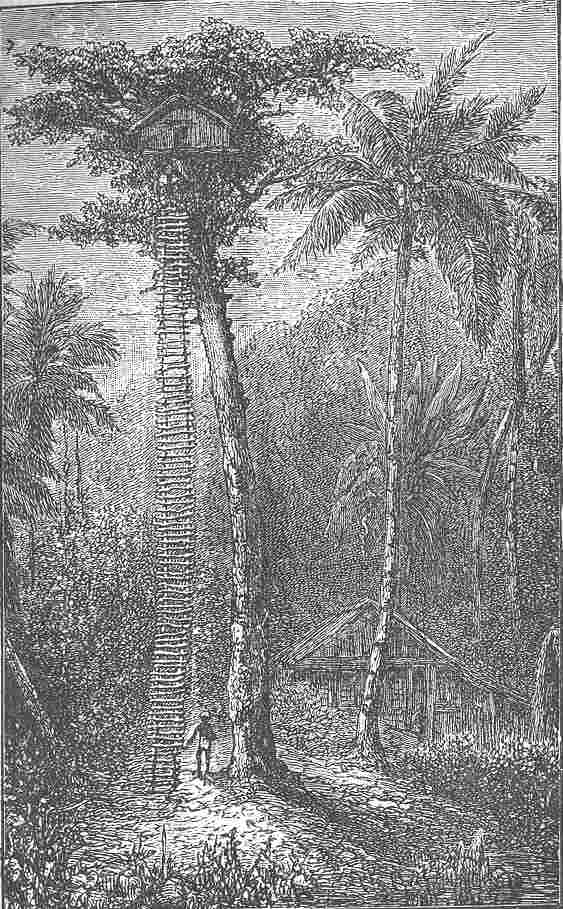
21st.—The village is built on the ridge, the chief’s
house right on the high end and looking east, our small house close
by on the side of the others, on each side, leaving a pathway in the
centre. At the very end of the ridge is a house on a very high
tree, used as a look-out house and a refuge for women and children in
case of attack. There are quite a number of tree houses in the
various villages on the ridges seen from
here. The people are anxious to get Maka, a light-coloured and
very fine-looking native lad, married to one of their girls and settled
down amongst them. I said to our African, “They want Maka
to marry one of their girls.” Joe, I suppose, felt slighted
that he too had not an offer, and he replied, “Well, sir, in Madagascar,
a very big chief was real anxious I marry his daughter; fine-looking
girl; he make me chief, and give me plenty land; far cleaner people
than them be.”
I find the people have the same sign of friendship as in the east
end of New Guinea—nose and stomach pointed to. They speak
of a land, Daui, with which they are friendly, a very long way off.
Daunai, of Orangerie Bay, is called Daui in some places. To their
tree houses they have ladders with long vines on each side to assist
ascent. Our delay here will help us to know the people.
I have just been showing them the likenesses of two young friends, and
the excitement has been great, men, women, and children crowding round,
thumb in mouth, scratching and shaking heads, and leaping and screaming,
coming again and again to have a look.
22nd.—A number of strangers slept, or rather made a
noise all night in houses close by, and amongst them a spiritist, whose
hideous singing and chanting of revelations was enough to drive one
frantic. We tried to quiet him, but it was of no use—silenced
he would not be. A man sitting by us when having morning tea asked
for some of the salt we were using. We told him it was not salt,
but sugar. He insisted it was salt, and we gave him some on his
taro. He began eating, and the look of disgust on his face was
worth seeing; he rose up, went out, spat out what he had in his mouth,
and threw the remainder away.
23rd.—Cannot get the natives to move; they say they
are tired, and will have to rest until to-morrow morning, and they are
also afraid of their enemies. The excitement is great, but what
it all means is difficult for us to say. Noon: all have cleared
out with spears, clubs, and shields, two men having been killed in a
village near, and they have gone to get hold of the murderers if they
can. Dressed in their feathers and fighting gear, with faces streaked,
they do certainly look ugly. After being some time gone, they
returned, saying the enemy, who were from Eikiri, had gone off to the
back mountains.
28th.—Left this morning, and had to carry our things,
no natives accompanying us. When about four miles on, we met natives
who willingly took our bags and accompanied us to Uakinumu. The
travelling was not so bad—a good deal of descending and ascending.
Oriope, the old chief, was delighted to see us. His wives and
children have gone with great burdens of betel-nuts and taro to trade
at the seaside. The old fellow goes with us. We are now
1530 feet above sea-level, east-by-south from last camp—Mount
Owen Stanley due north. Oriope is Mr. Lawes’s great friend.
He used to live in Munikahila, but trouble through marrying a wife has
sent him in here. He seems greatly attached to Ruatoka.
He is a terrible talker, long-winded and deafening.
29th.—We had a strange sort of a hut for sleeping-quarters
on the top of a rock. The house, being open all round, felt exceedingly
cold when the fire went down. The people here seem much lighter
than at the other place, and the children have a more pleasant expression.
Basaltic rocks lie scattered about in every direction. We had
our flag flying, and the admiration was great, the natives viewing it
from underneath then from a distance, and in each position noticing
something new. About half-past eleven we left. The old chief
and four carriers went with us. After crossing the head of the
Munikahila Creek we passed through fine thickly-wooded country, that
may yet become a very extensive coffee country. After travelling
for some hours, we camped 1800 feet above sea-level. On the way
the carriers struck and were for going back, but we insisted on their
going on a little further. Strange formation of country all around
here. This ridge seems alone in a large basin, one side of which
is bare perpendicular rock. There is a good quantity of cedar,
but so difficult to get away that it would never pay to work.
We are north-east from Uakinumu.
30th.—We started late, continued our journey along the
ridge, rising gradually to 2250 feet, and then along a fine level country
for some miles, when we began to descend.
Soon our old friend began shouting, and received an answer from a village
a long way off. Close by us was a very steep descent, down which
we went till we came under the shadow of a great rock, where we rested,
and in about an hour up came ten natives unarmed, touched our chins,
and we theirs, then all squatted to smoke. One of them, some time
ago, had been to the coast, and knew Rua; his joy at now seeing him
in here was great. A shot had been fired at a cockatoo before
they heard the shouting, and they were much afraid. When all seemed
satisfied, and the crust of the news broken, I proposed a start, so
up bundles, and away we went. When having gone about two miles,
there was a halt in an open space, and we were given to understand we
must camp there. I could not agree to it, “We must go on
to the village.” “No, you must stay here.”
“We cannot; we must go on.”
“If you go on you will be devoured by the boroma badababa
(great pig).”
I insisted upon going on; they called to those in the village, and
on being answered we again went on for about half a mile, when every
bundle was put down and a halt called, and again we had to listen to
the unintelligible story of the wild animal or animals that would destroy
us. We sat down and tried to get them to see as we did, that a
house was necessary for our comfort. A thunderstorm was working
up, and soon the rain would be down on us—let us be off for the
village. They had a long confab with those in the village on the
ridge, which, when ended, seemed favourable; and so up the steep side
of the ridge we went. When halfway up they halted, and wanted
us to camp under the shelter of a great rock. Seeing some young
men with bundles rounding the rock, I joined myself to them, and away
we went, followed by the others to the village. Under the first
house in the village sat a man, with a large pig standing by him, which
he was clapping and scratching, as if to keep it quiet; and as we went
along we saw great pigs under the houses. Certainly they were
savage-looking pigs. We were given an open house, and the rain
was coming on. I was ascending, when it became necessary to spring
from a pig that was after me. Is this Goldie’s big beast
the natives told him of? This is a fine country. We passed
through large plantations of yams, taro, sugar-cane, and bananas.
During the evening we had crowds of men and lads—no women or children—to
see us. Some are quite light copper-coloured, others are very
dark; nearly all are dressed with cassowary feathers; many with ruffs
round their necks made from these feathers. There were none very
tall, but all seem well-built men, with good muscle. They have
the same calabashes and chunam sticks for betel-chewing as at Kerepunu.
Some chunam sticks made from cassowary bones are well carved.
They are a very noisy lot; one would think they were trying to see who
could speak the loudest.
They tell us it is impossible to cross to the other side, as further
inland the ridge ends—and there is nothing but bare broken rook—inaccessible
all round. The majority of the men are bearded and moustached,
and have cassowary feathers like a pad behind, on which they sit.
They dress with a string. The demand for salt is very great; grains
are picked up, and friends are supplied with a few grains from what
they have got for taro. The name of the place is Kenagagara, 1810
feet above the sea-level, E.N.E. from Uakinumu.
31st.—Great crowds of people keep going and coming.
We spent a miserable night. Our old chief, Oriope, had a conclave
round the fire, and it took him all night to recount the doings of the
Naos (foreigners), not forgetting the toilet. At times
he waxed eloquent, and the whole gully rung again. It was useless
telling him to be quiet. All men and lads have the nose and ears
pierced. A number of women and children are about. Some
of the women are fine, tall, muscular, and clear-skinned, as light-coloured
as Eastern Polynesians. The children are lithe, blithe, and hearty—some
very dark and some very light. The women have brought large quantities
of taro for salt. Oriope is very sleepy, and I have every now
and again to wake him up, so that to-night he may sleep soundly, and
not prevent our sleeping.
My name here is Oieva—that of the fine-looking old father of
the village. At present I am all alone the
others being out after birds. The natives are very friendly.
They relish salt and ginger, which I have tried with them, and which
they pronounce good. Ruatoka and Maka have returned; they shot
a pig, which the natives who accompanied them cooked and divided, to
be carried in. The excitement is great over the division, and
the whole assembly are shouting; those from the hunt recounting the
day’s proceedings, acting the shooting of the pig, to the intense
delight and amazement of the others. They eat flesh nearly raw.
A pig is put on the fire until the hair is well singed off; then division
is made, then re-divided, and eaten. They take a piece between
the teeth, hold with one hand, and with a bamboo knife cut close to
the mouth. A bird is turned on the fire a few times, then cut
up and eaten.
August 1st.—Left this morning to look for a track.
We passed through a fine large village about one mile from here, and
were joined by sixty men, all armed with spears and clubs, and faces
painted. They accompanied us for about four miles, and then turned
away to the south. We continued on the ridge for some miles further,
until we could see that all round were great inaccessible mountains
with bare faces. It begins with the Astrolabe, extending west
until Vetura is reached, and then away east by south until the centre
of the range is reached. In some places it has a perpendicular
rock face of many hundred feet; in other places it is broken rock with
bush growth, and only
at very long distances can tracks be found, and even then it is difficult
to get up. We descended to the river, a large one, flowing west,
through great rocks, often lost, sometimes only pools appearing here
and there until, some distance down, and when eight hundred feet above
sea-level, it comes out a fine and flowing river. We had a good
bath, and, of course, the inevitable kuku, and then skirted the
side of the ridge, passing close by and under great rocks and overhanging
cliffs, and up a most extraordinary steep path into splendid sugar-cane
and taro plantations. Weary, we sat down and ate sugar-cane under
the shade of a great rock. This West Indian “long breakfast”
goes well when thirsty and hungry. The natives who accompanied
us, having caught a large rat and frog, turned them on the fire and
ate them.
A truly wonderful country! What terrible convulsions of nature
there must have been here ere these great boulders were displaced and
rolled about like mere pebbles! The villages are so built that
they are accessible only on two sides by very narrow tracks. We
saw no game of any kind, yet the cassowary must abound somewhere near,
as every one of the natives wears great head-dresses and neck-ruffs
made from the feathers. Our highest ascent to-day was to 2360
feet above the sea-level; we call it Mount Bellamy; it stands out alone,
and from it we saw the Astrolabe, Vetura, and Munikahila.
2nd.—We left this morning for a pig and cassowary hunt,
but were unsuccessful. We bagged four cockatoos, one green parrot,
one brueros, and three pigeons. Of my travelling in this land,
to-day beats all; it was along mere goat tracks, on the edge of frightful
precipices, down precipitous mountain-sides and up steep ridges, on
hands and knees at times, hanging on to roots and vines, and glad when
a tree offered a little rest and support. I gave it up at last,
hungry and weary, and let the others proceed. I stayed with a
party of natives who were getting a kind of large almond with a very
thick fleshy rind, the nut inside very hard, which they broke open with
stones, filling their kits with the kernels. They call the nut
okari. They fed me with sugar-cane, taro, and okari,
and then got leaves for me to rest on. They had all their arms
handy; I was, as I am always, unarmed, and felt thoroughly comfortable
with them. Only once in New Guinea have I carried a weapon, and
then we had spears thrown at us. I consider a man safer without
than with arms. The return “home” was frightfully
steep and trying to wearied and hungry folks.
3rd.—Youths busy with feathers of cockatoos got yesterday,
making head-dresses. They take the feather, strip it down, throw
the quill away, fasten all the stripped feathers neatly together, dry
in sun, then bind round their combs. One youth is preparing a
head-covering from the bark of the mulberry: he is making native cloth
by chewing the
bark, and no wonder he complains of his jaws being sore, for it is a
long job. I gave the children presents of beads this morning,
and some of the old gentlemen objected, saying they ought to have had
them; but I did not understand them. It is very convenient at
times not to understand what is said—it is thoroughly native.
We have been asking them if they will receive teachers, and they all
say yes, and at once, for it means tomahawks, knives, and salt.
They say, “To-morrow we’ll all go and get the two teachers
at Munikahila and bring them here now.” We here are in excellent
health and spirits; a little disappointed at not being able to cross.
Certainly we have not lived on the best, and we have camped anywhere.
I like these mountaineers—free, independent, and kind. When
they cook taro, if near, we get a hot taro to eat, and often they bring
hot taro to the house. They bring their presents of taro and sugar-cane
and at once walk away. They have very good houses, thatched with
grass, some with a verandah on two sides, and all built six feet and
more from the ground. When we were away yesterday, a wild boar
from the bush took possession of the village. Often when the natives
are in the bush they have to seek refuge in climbing trees from the
savage tuskers, especially if they have been speared, and are determined
to fight. Our flag is flying, to signify that it is “resting
day.”
The natives very seldom bury their dead, leaving the
body in a house set apart for it, which they often visit. When
a number of deaths take place, they leave the village and settle somewhere
else not far off. There is one grave here, near to our house,
on which a tobacco plant is growing, a bamboo pipe, the property of
the deceased, alongside, and a few sticks on end with yams on top.
When they do bury, the body is placed standing in the grave.
4th.—We left Kenakagara this morning, accompanied by
natives. Our friends soon left us, and we lost our way, and after
some hours’ travelling found ourselves in a thick bush and surrounded
by precipices. It has been up hill and down dale with a vengeance,
trying hard to get to the south-west. At last, wet through and
thoroughly tired, we camped to have breakfast, dinner, and supper in
one. We were ten hours on the tramp, and carrying our bags, so
feel ready for a night’s rest.
5th.—We see where we are; but how to get out is the
problem to be solved. Ruatoka has gone to look for a track.
We had a fine night, a roaring fire at our feet, and so enjoyed sleep.
Camping this way is preferable to living in native huts, far more comfortable
and enjoyable; but for our work it is better for us to be with the natives.
Uakinumu bears south-west-by-west from us now, and could be reached
in a few hours, if only we could get down the precipice. Rua has
returned. When some distance off, he heard cooeying, and responded,
when our old friend, who had
been looking for us in a great state of fear, shouted his name.
Rua told him to follow, and he did so, arriving at the camp soon after.
He was so excited he could not speak, but embraced us all round, and
then sat down.
After breakfast, we set off, each carrying a bundle. The travelling
was difficult, until we arrived on the path leading to the creek and
up to Uakinumu. When on the spur, the old man shouted for the
youths to come and help us; they cooeyed back, and we hoped to see them
in about an hour, or at the most two hours; after waiting and no one
coming, we descended, and when at the creek met a youth coming slowly
along and saying others were following. I felt sure they delayed
their coming to meet us until we should be near the village, where they
would take the bags and receive tobacco and salt; but they were sold;
we trudged on, and would not let them have a bag. We took no notice
of those we met, and to their solicitations asking to carry bags we
turned a deaf ear. The chief’s eldest son came along and
begged to have my bag. No, on no condition. The poor old
chief was in a sad state; but as we are likely to require their services
some future day, it is necessary to teach them that for work or service
they will be paid, but for skulking, and hoping to get tobacco and salt,
their hopes are futile. We reached the village, and Oriope did
all he possibly could to keep us. No, on we will go; his sleepy
boys may sleep on. We gave him and his
little grandchild who accompanied him presents, bade him good-bye, and
away.
6th.—Here, and in all the villages we have been, we
have seen very few women and girls, and very few of the young men seem
to be married. Do they kill the girls when born?
7th.—Left this morning for a mountain close by, hoping
to see the windings of the Laroki from it. We had to descend 1000
feet, and then ascend 1800. From the droppings about, I should
say the cassowary and pig abound in the gullies about this mountain.
We found on the top a deserted village and five cocoanut-trees.
We could make nothing of the Laroki, because of thick bush on top.
We saw that the Munikahila creek flows west and south, until, due north
of this, it turns sharp and flows north-by-east and falls into the Goldie.
We reached camp with thoroughly whetted appetites, and enjoyed breakfast
and dinner of pigeons and taro. We call the mountain Mount Elsie.
It is north of Vetura, and west and south of Keninumu. We have
seen four new villages close to one another where a teacher could work
well. We have now five positions for teachers, and I hope before
we have finished with this inland trip to have thirty, giving four and
five villages to each teacher. In crossing one of the spurs, a
native and his son brought us bananas, and water in a bamboo.
It is difficult to drink out of a bamboo. Place the open end to
the mouth, raise gradually, look out, here it comes—steady.
Ah, too much raised; it is a deluge streaming over you and nearly choking
you. Try again—well, a little better, yet far from perfect.
Choking, are you? Never mind, practise, and you will soon be an
expert—a native in drinking, truly. The natives have been
having a feast. They began with boiled bananas and finished with
a large snake cooked in pots. It was cut up and divided out amongst
all—sixteen eggs were found in her, a little larger than a good-sized
fowl’s egg. They seemed to relish it much, and the gravy
was much thought of. They say pig is nothing compared to snake.
Ah, well, tastes differ.
9th.—We had a few noisy strangers in the village, and
they seemed to be anxious that all they had to say should be heard in
every house. The conversation is kept up by the inmates of the
various houses, and at times all are speaking and trying to drown one
another. A lull comes, and you fancy the turmoil is ended, and
so roll on your side for a sleep; but, alas, it was only drawing breath,
the noise being perhaps worse than before. Our chief and his wife
had a quarrel over something or other last evening. Of course
the woman had the best of it. Strange, she said very little, but
that little seemed to be to the point. Every now and again he
would shout, Pirikava! pirikava! pirikava!
(Dear me! dear me! dear me!), and then scream and rage. The wife
would then laugh at him, which made him worse, screaming
and dancing more than ever. She would then say something, which
he would answer, and so quieted him down a little. All have gone
hunting to-day—men, women, and children, pigs and dogs.
Before leaving, they told us if we saw any one sneaking about, we were
to be sure to shoot them; but if they came up openly to us, and pointed
to the nose and stomach, they were friends, and had come for salt and
tobacco. We get our water in canvas bags, and teachers or missionaries
coming inland will require a set of water-bags made from the very best
canvas.
11th.—A number of natives have gone to Port Moresby,
to help Rua and Maka with tomahawks, salt, &c. After they
left, we went to the bush, and cut down a number of trees for posts
for a house. The chief, Poroko, has given us land, at an elevation
of 1260 feet; splendid view all round; and if not healthy, I know not
where to go, unless it be to the top of Mount Owen Stanley. There
will be plenty of room for taro, sugar-cane, and coffee plantations.
A woman often passes us with a frightful load of taro and sugar-cane
on her back, and on the top of all an infant in a net basket.
She goes to the next house, swings the infant kit off first, placing
it on the ground, where the infant in it kicks and rolls, but cannot
get out until the kits of taro and sugar-cane are safely housed.
14th.—This morning, after an early breakfast, we started
with the Port Moresby natives for Munikahila, they being anxious to
secure a supply of betel-nuts to return with. Have promised our
old friend Oriope of Uakinumu, before we started on the Eikiri trip,
that if he led us across and gave us bearers, all should have tomahawks,
knives, etc. He did not carry out his part, and the bearers from
him returned, leaving us inland. I was anxious to pay them for
what they did, so we went on there with tomahawks, tobacco, and salt.
We were about two miles from the village, when we shouted, and were
replied to, and soon four young fellows came rushing along, in a great
state of perspiration and very excited, rubbing our chins and throwing
their arms around us, highly delighted that we had returned. They
were not going to serve us as they did the last time. We reached
the village, and were seated with strangers and surrounded by old friends,
when Oriope, who had been on his plantation, came along to where we
were, nearly breathless, and streaming with perspiration; he threw his
arms around me, embraced me, rubbing his dirty moist cheeks on mine,
sitting down and not speaking for some time. When he began, he
said he was afraid we were terribly offended, and would not return;
but, having returned to him, we must stay. No, we cannot; we must
return to Keninumu that night. Ah, he could manage it; he would
have us tied, and so detain us. Four coast natives who knew the
Koiari language were with us. We told our old friend
we wanted a large quantity of betel-nuts, and that he had better set
out at once for them. Soon the women and lads were off.
We then removed to our old house on the rock, and there told him, through
the interpreter, what we had expected of him, and that he had not done
it, but that having told him we should pay them, we had come now to
do so for the journey made. We gave our tomahawks, tobacco, and
salt, and the old man was truly delighted, saying, “I and my people
will take you wherever we may go with safety.” He does not
go to sea on the other side, as Mr. Lawes supposed, and says it is impossible
to cross over unless we go up by Yule Island, and there he says it is
dangerous, because of the cannibals. In returning, I saw, for
the first time in New Guinea, a bush of the real South Sea Island kava
(Piper methysticum).
17th.—We have just had a service, and through Kena we
have told the natives the object of our coming and staying, that they
might know of the true God, and of Jesus Christ the Saviour. It
was interesting to mark the different expressions on their faces as
they heard for the first time of God—the God of love, and that
as His servants we were here. When told of the resurrection they
looked at one another; some laughed, others seemed serious. They
were very particular in their inquiries as to the name of the Great
Spirit, and of His Son—forgetting, and returning to hear it again.
18th.—Here
we are at Uakinumu for another trip; but alas, alas! cannot get carriers.
The young men are all off wallaby-hunting, so we must start. This
evening, a woman came in with several bamboos of grubs, which were cooked
in the bamboos, then spread on leaves; some salt was dissolved in the
mouth and squirted over all, and it was amusing to see the gusto with
which men, women, and children partook. Oriope is very persistent
in wanting a teacher. He was greatly delighted when I gave him
a large knife; he examined it all over, then pressed it with tender
affection to his bosom. Fearing lest some friends who are with
him at present might ask it from him, he returned it to me, requesting
me to keep it until they left.
20th.—Last night, after turning in, I heard a peculiar
noise, as of some one in great distress, then loud speaking in a falsetto
voice, and knew then what was up—we had a spiritist in the village,
and revelations were now about to be made. We were all named,
and the places we were to visit. I felt somewhat anxious as to
the revelation, for if it should be the least doubtful as to our going,
no native would stir with us. However, the revelation, on being
interpreted to us by Kena, was all right; we were good men, and kind,
and the villages would all willingly receive us. The spirit dilated
at length on the good qualities of foreign tobacco and the badness of
the native stuff, and wound up by asking for some foreign.
Oriope at once got up and gave from his own stock what was wanted.
These native spiritists are terrible nuisances; they get whatever they
ask, and the natives believing so thoroughly in them, they have the
power of upsetting all arrangements and causing serious trouble.
This morning, I found our spirit friend to be a man who sat in our house
all day yesterday, a stranger from an inland village. He has quite
a different look from the other natives—an anxious, melancholy
expression. While at morning coffee, he came and sat down alongside
of us all right, and we learned from him that the spirit of a deceased
friend comes into him, and then things are revealed, the spirit speaking
through him. He says, when we were at Eikiri, a few weeks ago,
he knew it, and told the people of his village of it.
The wallaby-hunters are to come in this afternoon with great supplies.
When sitting round the fire with our old chief, we asked him if he knew
of any tailed folks about inland. “Oh dear, yes.”
And then he gave us a perfect and laughable description of what must
be some creature of the monkey tribe. It climbs, laughs, and talks
a peculiar language of its own; it scratches the head, slaps the thigh,
and sits down to eat like a man. I then said, “But they
are not really men?” “Well, not exactly, but very
near it; they are hairy all over, and some are perfectly black.”
The tail, according to his description, must be about a fathom long.
We are to see them, and
must, he says, secure one or two, dead or alive. Our spirit is
out in his prognostications, the wallaby-hunters have not returned,
and we cannot leave to-morrow.
21st.—Our spirit friend is quite out as yet, for here
we are nursing Patience, and trying to make her a dear friend.
We are promised a start to-morrow. In the evening, the hunters
came in with large supplies of wallaby. They report innumerable
horses and foreigners as having gone to Kupele; we suppose it to be
Goldie’s party. From to-day’s shooting, the old man
got a green parrot, and devoured it raw. Oriope dressed himself
in his fighting gear, and went through a few antics; he looked a perfect
fiend. He is very proud of a stone club he possesses with a piece
broken off; he says it was broken in felling a tremendous fellow in
a neighbouring village. He killed him. “What, stand
before me!”
22nd.—I was eating a banana this morning, when I was
told not to throw the skin away, but hand it to them, which I did, when
it was passed round and kissed by all with short ejaculations.
I asked what it meant, and was told it was their manner of thanking
the spirits for ripe bananas. We started at eight a.m. with eight
carriers and our old friend, and twenty inland natives returning home
with wallaby; one poor woman had two large kits on her back, and an
infant in another, hanging in front of her. We were seven hours
on the tramp, along a good path, on which
horses could get along well. The most difficult ascent was shortly
after we left Uakinumu; but the path was good. The last hour of
travelling was in a thunderstorm, with a regular tropical pour of rain.
When we neared the village Marivaeanumu, the men came rushing out with
their spears and shields, thinking it was an attacking party; but on
seeing Maka, who was just behind the first native, and I following up,
they shouted out, Nao, nao! (foreigners), and ran back
with their spears. The village is small, and the houses very dilapidated;
it is 1800 feet above sea-level. Maka was buying taro with salt,
and having finished, some natives noticed damp salt adhering to his
hand; they seized the hand, and in turn licked it until quite clean.
Grains of salt falling were sought for and picked up. The shields
here are the same as at Hood Bay, beautifully made. They are going
to fight soon with another district, and are making great preparations
in spears, clubs, and shields.
23rd.—Our spiritist gave us a very short and indistinct séance
last night. A man speared the other day in a wallaby hunt, near
the Laroki, he told us, was dead. He seemed to be raving a great
deal, and wound up the first part with, Nao kuku daure (Foreign
tobacco is bad). Continuing to rave and disturb sleep, I told
Oriope that, if that spirit did not at once go back where it came from,
I should certainly have to make it; he reported what I said, and the
spirit thought it advisable to leave. We started this morning
after
a good breakfast, and had good travelling across a fine level country
E.S.E. for about four hours, crossing several times the head of the
Laroki: it is a magnificent country for horses. In somewhat thick
scrub, a youth met the first of our party, and was fraternizing very
feelingly with them: I appeared, and he took to his heels, and no calling
of friends or foreigners could bring him back. We came suddenly
upon a woman and two children, and, poor things! they went into a terrible
state; nothing would comfort them; beads, tobacco, and salt lost their
charm on them. The family pig was with them; it danced, grunted,
advanced, retired, and finally made at me. In the morning I took
a piece of plaster from my heel, and threw it into the fireplace; instant
search was made for it by about a dozen natives; it was found, and handed
back to me, they making signs that I should throw it somewhere else.
Yesterday morning I unthinkingly put the loose hair from my comb into
the fire, and great was the outcry.
We are now in Nameanumu, in the Sogeri district, and in a fine house
twelve feet from the ground. We are about 1530 feet above sea-level.
Teachers here need have no difficulty about food; there is a great abundance
all round of taro, banana, sugar-cane, and bread-fruit. A teacher
with some “go” in him, and a good earnest wife to help him,
would do well here. I am inclined to think an easier way here
will be from Moumiri; but we have to travel with natives where
they can take us with safety to themselves. Sitting round the
fire a little while ago, our spirit friend having just left us, an old
woman shouted out to Oriope to look out, as the spirit was about to
go through the thatch near to where he was sitting. Instant search
was made, but nothing found. She then called out from her verandah
that it had gone, as Rua and Maka were doing something with their guns.
I may say the old woman was with us last night, and heard my threat.
We have had the description here of some other animal that is in the
Kupele and Moroka districts. It is a dangerous one to go near,
and several have lost their lives from it.
24th.—Very heavy rain. A number of people have
come in from the villages to have a look at us, so I have to go through
the process of baring arms and chest. This forenoon they described
an animal to us that I think must be the tiger—a long animal,
with a long tail and large paws, treads lightly when seeing its prey,
and then bounds upon it, tearing the bowels out first. They say
they are as long as the house—twelve feet. We are not prepared
to tackle such, customers. Our host is a quiet man, with a very
pleasing expression of countenance. I like the people much, and
pray God the day is near when they shall have the Gospel preached unto
them, and receive it, and know it to be the power of God unto salvation.
Evil spirits reign over them, and the utterance of every rascally spiritist
is thoroughly believed.
They
seem very much attached to their children, and in their own peculiar
way, I dare say, love their wives. Husband and wife meeting after
a separation is strange. Some who returned with us had been away
for a fortnight; their wives looked pleased when they saw them, so did
the husbands; not a word was spoken, only a look; clubs and spears were
put down, and the husbands went to where other men were sitting, the
wives to light fires and cook food; when cooked, the wife took it to
the husband, who ate a little, gave away some, and then went and sat
by his wife. I have noticed that the wives are particularly happy
when preparing this return food. Oriope’s wife, who accompanied
us, is ill with a cold; I wished her to take a dose of chlorodyne, but
she cried and hesitated much; the old man then took the cup and told
her to look; he drank some of it, said it was not bad, and then pressed
her to drink it off, which she did.
25th.—We left this morning at eight, and arrived at
Orofedabe, in the Favele district, at one p.m. The walking was
good and steady, the first few miles along the valley beneath a mountain
in the Sogeri district, which we called Mount Nisbet, and the range
near to Eikiri. We crossed the Laroki several times, and sat near
its head; then ascended an easy ridge of the Owen Stanley Range.
We travelled for about two hours along this ridge, then descended, crossing
two streams, which we suppose to be the head streams of
the Kemp Welch, flowing into Hood Bay. There are six small villages
on ridges close by, high mountains all round, and not far off the mountain
on which the wild animal lives. They tried to persuade us that
this was Meroka, and there was no use our going further; but we could
not believe it, and I brought my compass out, and pointed to them where
Eikiri, Sogeri, Kupele, and Hapele were, and told them where I expected
to find Meroka, which cannot be very far off. When they saw I
knew something of our position, they said we could not get to Meroka,
because of rocks and wild beasts. At the village we slept the
last two nights they did all they could to detain us, because of the
salt and beads. They were assisted by Oriope, who was anxious
that all should go to his cousin and friends, with whom we were staying.
In a conversation they had under the house, shortly after we arrived,
I could hear sufficient to enable me to understand they would keep us
there, and not let other villages get salt and beads. I got thoroughly
vexed with the old man, and told him he could return home, and that
unless we saw numerous villages with plenty of people we should not
again return here. He turned right round, and told us we should
see Favele and Meroka, and many villages, only we must return to his
cousin’s; that was all right, we certainly should return.
This morning, I told him to remain and take care of his wife; that the
people here would lead us and carry our things. He
begged of me to leave some of the things to ensure our return, and I
did so. Some of the people here are very dark and others very
light.
26th.—They tried hard to prevent our going to Meroka
this morning, saying we should be eaten by the Jakoni (wild beast)—and
how could they return? That would not do—go I must; so I
got the things out, and asked some Meroka natives, who had come in,
to pick them up and let us start. They refused, and joined in
with our friends, saying we had better remain. No; I must see
Meroka, and until I saw it not a taro would be bought nor a pile of
salt given. They all sat down, looking true savages. After
some time, I said, “Meroka, or we return at once.”
I got my bag and went on to the path; they got up, and called to me
to come back—they would go to Meroka, but leave the things, and
return here to sleep. No; I must have the things; I might want
to sleep at Meroka. That was terrible, the salt would be finished,
and there would be none for them here. Would I not consent to
their taro being bought, and then they would go with me? No; Meroka
first, and taro when we return.
Seeing there was nothing for it—that go I would—they
consented, and the Meroka folks picked up the things, and away we went.
It was a short walk across the side of a ridge, down about 600 feet
and up to 1500, and then along another ridge. We soon had crowds
to see us, men, women, and children; and
all were delighted, for we bought their taro. The village we stayed
at was new, and they told us formerly they lived further in on the mountain,
but a man was eaten by the Jakoni, and they came down.
A number of natives were in mourning for the man eaten. After
some time, we got up to ascend the ridge, to have a good view of the
villages and decide on our position. They tried hard to prevent
us, but we went on, a few following to the next village. They
pretended great fear of the Jakoni, and at some places begged
of us to tread lightly, and not to speak. It was all a ruse to
get us back. We went on, and up to the highest village, where
we had a splendid view. We counted fourteen villages on the ridges
in the Meroka basin and on the other side of the river we had crossed,
and as many more known as Havele. I believe it would be much easier
to get here from Eikiri than from Sogeri. The natives of Oriramamo,
the highest village, told us they went from there to Eikiri in one day.
The people of Meroka are very mixed, some very dark, others very
light. Some of the women had quite an Eastern Polynesian look;
some of the children were well-formed, and really pretty. A few
men had light-coloured whiskers; curly heads abounded, although a number
had straight hair. They say they are not Koiari. The Koiari
comprises Munikahila, Eikiri, Sogeri, Taburi, Makapili Pakari; and Eikiri
is N.W. from Oriramamo; Mount Bellamy
is W.N.W. A high round mountain, I have named Ben Cruachan, east;
Mount Nisbet, W.S.W. The high rock on the easterly side of Mount
Nisbet is just over the house where we slept, and will be known in future
as the Clachan. They say there are five kinds of wild animals
on the mountains at the back, and but for these they could easily cross
to Kupele. The Jakoni, Gomina, and Agila are very large and fierce.
The Papara and Gadana are small, but fierce. We were eating biscuits,
and they begged for a very small piece each, to keep as a charm to help
them catch pigs. Hairs from the beard are in great demand as charms.
Having seen all we wanted, and not being able to persuade the natives
to accompany us up to the mountain to see the wild animals, I decided
to return to Orofedabe; so we returned to the village, gave the taro
we bought to the people, paid our attendants and for the house where
our things were, and away we went. Our friends were glad to see
us, and rejoiced greatly when the taboo was taken off the salt, and
taro was bought. We are having rain and thunderstorms every afternoon.
27th.—Maka poised a stick twelve feet long on his finger;
the natives tried it and failed; again Maka did it, and all who were
looking on came to the conclusion it was very easy for him to do, as
a spirit held it for him. In each place we have been, when at
prayers, all the natives are most respectful, keeping
perfect silence and bending their heads. We had a fine tramp back
to-day, and a refreshing bath in the Laroki after it. We have
paid our carriers, and they are rejoicing greatly. We were glad
to find our old friend and his wife well, and the things we left just
as we hung them up. They are very anxious to have teachers here.
We were telling them that we could see no people, and they have gone
and brought in great crowds, saying, “No people! what are these?”
I cut up tobacco and spread it out on a leaf in the centre of the crowd,
and called out, “For Sogeri.” One of their number
was appointed by them, and he distributed it, all sitting quietly round.
I got some salt in a paper, and did as with the tobacco. All rose,
and in order approached, took some and retired, leaving the remainder,
nearly half, for a very old man. The beads I gave to the women,
the men saying they ought to have had them too. “Come and
live with us; there is no place like Sogeri—it is good, it is
large, it is peaceful, and there is plenty of food.” So
say the Sogerians. I was sitting on the ladder of the house, the
crowd sitting round. Rua was in the bush with his gun; he fired
at a bird, and it was amusing to see the simultaneous jerk of the crowd
when they heard the shot.
28th.—Last night, a chief, Biaiori, of Eribagu, slept
in the house with us, to be ready to lead us to his village and other
villages about in the morning. We started
about half-past seven; but it was evident at the start he had been talked
over during the night in quiet whisperings, so as not to take us anywhere
but his own village. We walked about a mile and a half, and came
to his village, in a fine dry position, much preferable to the one we
had left—good houses, one house floored with cedar slabs, and
having a fine verandah all round. I wished to see a chief I had
met yesterday, Jaroga, and was told he was at the next village, so we
up with our bundles and away for about half a mile further on, to a
nice clean village. I at once asked Jaroga to lead us to the places
he named yesterday; he was quite willing, and began pointing in the
various directions, and naming the villages, but was soon silenced by
signs and words from others; he then said he could not go; so we left
to go to Epakari; a young man very much attached to Maka, and who has
been with us for ten days, having promised yesterday to lead us there.
We had to carry our bags—not a very agreeable job. We had
great excitement at leaving, our old chief insisting on our going back
to Uakinumu; but we had discarded him, and were determined to find our
own way should Someri, Maka’s friend, fail us. I gave orders
to keep a good look-out on Someri, who was carrying a bundle, and he
was given into Maka’s care. Our young friend was very quiet,
and tried skulking behind and moving on fast ahead. When crossing
a
ridge about three miles from the village, I was leading, when we heard
Maka calling for Someri. Rua at once returned, and found the bird
had flown, leaving the bundle, but carrying with him the camp tomahawk,
which Maka had foolishly let him have to cut a stick with. It
would be folly to return to get the tomahawk, so we kept south and west
for some distance, when we came to a deserted village; then we turned
west. We crossed the Laroki several times before we came into
the open country; at our last crossing we met a company of natives,
all armed, on watch for Makapili natives, who were expected to attack
them. They took our bundles, and led us to a small village, where
we met some of our Marivaeanumu friends, who led us to their village
and to our old house. A young child called Maka was presented
for presents, the father telling Maka he called the child after him,
because he was his friend when we were here last. We have now
the open country before us, and expect no trouble in getting along.
The natives are all unsettled at present, and every man we meet is armed.
I can see the country better to-day than when here last week.
Marivaeanumu is on a rise near the hills of Eikiri and north-north-west
from Sogeri. The latter district is in a valley between the Owen
Stanley Range and Mount Nisbet, to the south-west of it. Eribagu
would make a good station for the Sogeri district. This place
would be a suitable station being at the head
of the plain that reaches away to the Astrolabe on the one side, and
up to Vetura and Uakinumu on the other, stretching east by Mount Nisbet,
and away east and south, by the country at the back of Mapakapa.
The Laroki rises in the Owen Stanley Range, and is the drain for the
Sogeri district and all the plain; it is very circuitous, and near here
very deep and slow, flowing west.
29th.—For nearly six hours we have been travelling with
our bags, and I can honestly say I feel tired. We are now at a
new village—the houses just going up—on the top of the high
green hill in front of Munikahila, overlooking the Kupa Moumiri valley.
The village is named Keninumu, and consists of four houses at present,
two on high trees and two on high rocks. We have pitched our tent
close by, and intend resting until Monday, when we hope to start for
the plain—a very fine country, but no natives. This part
of the plain is dry and barren, with stunted gum-trees. A party
met us when near the village, and a woman with a child on her shoulder,
I suppose seeing me look tired, insisted on my giving her my bag.
I looked at the child, and wondered how she was going to manage, but
that was soon arranged; she made the child sit on her left shoulder,
holding her by the hair; then she took my bundle, and away she went.
Some young men have come in from one of the districts we wish to visit,
and I hope to keep them until we leave; it will be a help and of great
value
as an introduction at this time of trouble. We are 1440 feet above
sea-level.
A fortnight ago there was a great wallaby hunt down at Moumiri, and
natives from all the districts round were present. A native of
Munikahila speared a man from Tabori, who died soon after, so now Makipili,
Epakari, and Efari are said to have joined on with Tabori, and unitedly
mean to attack Munikahila. All the natives condemn the murder
of the man, because of the time and place.
31st.—Natives all excitement, expecting Munikahila to
be attacked. Every evening the men go armed to Munikahila, and
the women, children, dogs, and pigs to the bush. I am sorry our
Keninumu friends should consider it their duty to assist the murderers.
The natives of the district to which the murdered man belonged are quietly
biding their time, hunting wallaby close by us. The kind woman
who assisted me the other day has a son by her first husband living
at Keninumu, and for a long time she has not seen him, he being afraid
to come here. She knows that Maka was returning yesterday, and
felt sure her son would accompany him. When some distance from
here, Maka fired a shot, to let us know he was coming, to which we responded,
assuring him all was right. On hearing the shot, the poor woman
became quite excited, came and sat down by our fire, got up and got
us firewood, sat down again, telling Kena to get the taro cooked for
Maka, rose again and fetched
more firewood, then sat down in front of the path, looking steadily
and anxiously for the travellers. Poor body! they came in sight,
but her son was not one of them. She seemed to feel it very much,
rose, went to her house, and was not seen again until this morning.
God grant the day is near when the song the heavenly host sang, “Glory
to God in the highest, peace on earth and good will toward men,”
shall be known and enjoyed here!
September 1st.—We left this morning at seven
o’clock and drew up at Makapili at four p.m., resting by the way.
For salt, tobacco, and beads, we had help all the way. What appears
a fine level plain in the distance turns out to be a fine country, full
of ridges and luxuriant valleys, abounding in every kind of native vegetable.
From the departure this morning until our bringing-up we could have
ridden horses at a fine canter along the ridges from one to another.
This is the best country I have yet seen in New Guinea, and the natives
seem very kind and friendly. At the Laroki we had to strip, and,
just above small rapids, holding on by a long line fastened to poles
on each side, we crossed over. The natives have the line to help
them when the river is up. We called at several villages on the
ridges, passed others, some on large table-rocks. Fancy a table-rock
with twenty or thirty houses on it. At Chokinumu, a village 1600
feet above the sea, S.E. from Marivaenumu seven miles, we alarmed the
people so that they rushed away,
leaving us the village. Shortly a man came back, pretending to
be very unconcerned, chewing betel-nut; we soon were friends, and he
called out to the others, and they returned. We told him where
we were going, and he said he and his wife would accompany us, as we
were the first foreigners who had ever been to his village, and he would
not leave us. At other villages they also cleared out, screaming
terribly. Gimenumu, 1900 feet above sea-level, and two miles east
from Chokinumu, will make a fine mission station—a large village,
fine plantations, and plenty of water. We crossed several streams
from the Astrolabe Range, all flowing into the Laroki. The whole
drainage of the Astrolabe Range and of this country falls into the Laroki.
We are now in Vaiako, Makipili district, 2250 feet, in a really lovely
spot.
There are a great many natives in this district. About four
miles from here we passed a deserted village on a table-rock, at one
time the home of this people; but the Sogeri natives came over and killed
eleven of them, and the others thought it time to settle somewhere else.
We have now a splendid view of Mount Owen Stanley, due north of us,
and rising far away, clear and distinct above a thick mass of cloud.
Mount Bellamy stands alone, with a bare south-east side, and Mount Nisbet
just across from here, behind which is Sogeri, so much dreaded by this
people. On all the ridges stretching away to the
eastward from here behind Kapakapa are natives. A woman, coming
to have a look at us, spied our black dog, Misi Dake, and off she went,
climbing a tree, kit and all, quicker than I ever saw a native climb
before. We met a fine old patriarch in a stream about two miles
from here, and the meeting with our friend from Chokinumu was most affecting,
touching chins and falling into one another’s arms weeping.
He sat down beside me with grave dignity, and the woman from Chokinumu
sat in front of him, chanting and weeping. We had strawberries
coming along, with little or none of the flavour of the home strawberry.
The raspberry bush is very abundant.
2nd.—Just after sunrise we had a great crowd up at the
tent to have a peep at us. At eight o’clock, we started
for the summit of the Astrolabe, to have a look at the sea. It
is very broken on the summit, and we had a good deal of ascending and
descending before we got over Kaili, to be disappointed in not seeing
the sea, the fog hanging thick under our feet. We returned by
a very circuitous path, passing several villages built on rocks and
trees. On one large table-rock was a snug village, and to the
east of the rock four large posts beautifully carved. On feast
days, the food is collected close to these, and a platform is fixed
to the posts, on which dancing takes place. We returned at three
p.m. The old chief soon followed us up to the camp with a large
present of food, and saying he hoped we would soon return. I
hope the same. After some delay, so that it might not appear as
payment for the present, we gave our present to the old chief; when
he got the tomahawk, he wept for joy, looked at his friends, then at
us, pressed it to his bosom, and then kissed it. The chiefs name
is Kunia.
3rd.—We left Makipili this morning at eight o’clock,
and came along leisurely, arriving at Chokinumu at half-past ten.
The chief and his wife who accompanied us pressed us to stay a night
in their village, and, seeing it would displease them if we went on,
we consented. We had a thorough downpour of rain in the afternoon,
after a very hot sun, the thunder rolling all round us. The chief
Lohiamalaka and his wife are exceedingly kind and attentive; they have
kept close by us since we left here on Monday. I am sorry for
the Makipili people; they are so afraid of Sogeri, that they have left
their houses, and are living in the bush and under the shelter of rocks.
Sogeri, Makipili says, will listen to no conditions of peace.
Several overtures have been made, but all are useless. We were
told at several places that if we ventured to Makipili we should never
return; but we have been there, were treated kindly, and pressed to
return.
4th.—Using our blankets yesterday as a flag for our
tent, they got so wet that it required a day to dry them, so we decided
to remain here and visit the Laroki Falls. Ten days ago, we found
from the natives
that they were near here. The native name is Round.
We found the falls in a deep gorge formed by the west end of Astrolabe
and east end of Vetura Range. On each side of the gorge the mountains
run sharp down, in many places precipitous rocks. The falls are
E. from Port Moresby, E.S.E. from Moumili, and S.E. from Vetura proper.
They are grand, and well worth seeing. I wish we had seen them
from below. For a long distance up there are small falls and rapids.
The water comes surging on, and then takes a fearful leap of many hundred
feet on to a ledge, and from there to the boiling cauldron below.
The noise is deafening. Where we stood, nearly level with the
water, it was 1340 feet above sea-level, and I do not think that from
there to the cauldron could be less than 900 feet. I think it
may be possible to get to them from the north side by Mangara, and then
we can rightly tell the height of the falls.
5th.—Left Chokinumu this morning at eight, and had a
pleasant walk for three hours, ascending gradually the Astrolabe until
we reached the summit at the back of Tupuselei, 2300 feet high.
We were resting before descending, when a native party appeared and
approached us, somewhat scared. They said on coming up they heard
the noise as of chopping wood (we were marking trees). They came
on, and saw through the bush a white man, and at once went back; then,
hearing as if natives were with him speaking in Koiari, they returned
and determined to meet.
They were much pleased at receiving a present of salt. We descended
on the west side of the Astrolabe; the descent, being steep and difficult,
took us some time. In the afternoon we arrived at Janara, near
to Efari, at the back of Pyramid Point, the Astrolabe bearing north.
Our friend Lohiamalaka, the chief of Geminumu Monito, and three youths
are with us. I have never met a kinder and more friendly native
than Lohiamalaka. Janara is a good large district, and seems to
have a number of natives. The village we are in is 600 feet above
sea-level. Tupuselei is the nearest mission station, and a teacher
placed here or at Efari would have constant communication with that
place. I was the first to enter the village. They had heard
us cooeying to one another; so only saw one man, and he tried to look
very unconcerned, with a bamboo pipe, trying to light it, but too excited
to succeed. The women had shut themselves indoors with the children,
and the men had gone into the bush close by with their weapons.
6th.—From Janara to Epakari there are several steep
ridges to go up and down, and the last ascent is truly steep.
It took us three good steady hours’ walking and climbing to get
to Karikatana, the first of six villages in this district. Dawes
and Stone were at a village, I believe, on a ridge nearer to Port Moresby.
The chief, Nikanivaipua, received us graciously, and insisted on our
taking his house. We paid off our friends, and they departed well
pleased. We received presents
of cooked food and smoked wallaby. They were prepared for us,
having been shouted to an hour before we arrived at the village by our
friend Lohiamalaka. The village looks to be in a fine healthy
position, close to the west end of the Astrolabe, the high bluff bearing
N.E. They have plenty of all kinds of food. We crossed from
the Janara, a good-sized mountain torrent flowing S.W. to Bootless Inlet.
We are 700 feet high. High bluff of Astrolabe, N.E.; Bootless
Inlet, S.S.W.; peak of Astrolabe above Kaili, E.S.E.
7th.—Our friend Lohiamalaka turned up again last evening;
he did not like leaving us. This morning he really set off, promising
to visit us at Port Moresby in October; that is, not this moon, nor
the next, but the one that follows. I asked for a little ginger
to eat, and they have brought it me in bundles. It is really good
when green, with salt. A large number of natives attended our
service, and were truly orderly—not a whisper, and during prayer
every head bent. On the Astrolabe, the other day, Lohiamalaka
said he felt anxious for us in entering Janara. Rua, through Kena,
told him not to fear anything on our account, as the Great Spirit was
with us, and no harm could come near us. Last evening, he was
telling the people here of his fears, and what Rua said, “and
how true it was the Great Spirit or something is with them.”
At all the villages Lohiamalaka repeated all he could remember of what
he had been told, and of our singing and praying. Every
evening he would sit at the tent door and get us to sing for the benefit
of a crowd of natives outside, who, having heard from himself of our
musical powers, refused to go to their homes at sunset, and insisted
on remaining until after noko (singing). When the Koiari
visit the coast they go in for begging largely, and they generally get
what they ask, as the Motu people are very much afraid of their spiritual
power, they being thought to hold power over the sun, wind, and rain,
and manufacturing or withholding the latter at will. When the
Motu people hear that Koiarians are coming, they hide their valuables.
All the young swells here have head-dresses of dogs’ teeth, got
from the seaside natives. At Eikiri, they told us they got theirs
by killing and stealing. We can truly say we are under arms in
this house—sixty-two spears overhead, four shields on walls, and
two stone clubs keeping watch at the door. A Makipili woman has
been telling Kena how she happens to be here. Formerly her people
and these were at enmity. Makipili sought peace, but had no pig.
She was selected to supply want of pig, and taken with food. When
she grew up, the old man (not her husband) insisted on her living with
him.
8th.—We had six hours’ good walking, and are now
encamped under the shade of Vetura. The country from Epakari to
here is very ridgy, and, after leaving the ridges of Epakari, very barren.
Coming suddenly on a large party of men, women, and children returning
from
a dance, they were so frightened when we called out, Naimo! that
they set off, kits, spears, and drums, and no fine words would bring
them back. We have seven natives with us; the old chief says he
must see us safe to Keninumu. We passed a fine village—Umiakurape—on
a ridge west of Karikatana; the chiefs name is Vaniakoeta. It
would make a splendid station. The high ridge at the back of Epakari,
along which we came, is 1000 feet high, and from it we saw Fisherman’s
Island, Redscar Bay, Bootless Inlet, and the whole coast east to Round
Head.
9th.—Arrived at Keninumu at half-past ten a.m.
Found all well. The natives are constantly on the look-out for
the Tabori attack on Munikahila. We hear the Munikahila natives
have been stealing from Goldie.
14th.—Since our return we have been house-building,
but are getting on very slowly. I fear we are six weeks too late
for the Kupele district, and shall have to leave it for another season.
It would be awkward to get in and not get back until the end of the
wet season. I find our friend the chief, Poroko, has had two wives;
one he killed lately. She was in the plantation, and some young
fellows coming along, she sat down with them to have a smoke and get
the news; Poroko heard of it, and on her coming home in the evening
he killed her. A woman at Favelle said, “Oh, the Koiari
man thinks nothing of killing his wife.” The word for “sneeze”
in Koiari is akiso. When
they are leaving for a journey or going for the night they call out
kiso, and often from their houses they shout their good-night
to us, kiso. There is a woman in deep mourning for her
daughter. She has hanging round her neck all the ornaments once
the property of the deceased, and along with them the jawbone.
The headless body she visits occasionally, and rubs herself all over
with the juice from it!
18th.—We have a great crowd of natives in from Kupele,
the nearest district to Mount Owen Stanley. They are the same
race of people as at Meroka—some very dark, others very light-coloured.
Their weapons are the same as the Koiari, as also is their dress.
Two men are in mourning, and are wearing netted vests. The chief
is rather a fine-looking fellow, and dressed profusely with cassowary
feathers. They all have a wisp of grass bound tight at one end,
and hanging from a girdle behind, to be used as a seat when they sit
down. It is a stretch of imagination to say it looks like a tail.
They are very anxious we should accompany them on their return, and
say they will show us plenty of villages and people. Yesterday
we had great feasting in the villages on yams and taro. To an
Eastern Polynesian it would be ridiculous to call it a feast, seeing
there was no pig. In the evening we had a good deal of palavering
with spears and shields, fighting an imaginary foe, and at times retreating.
Their movements are swift and graceful: advance, retreat, advance, pursue,
ward off to the right, to the left,
shield up, down, aside, struck on knee, a shout, all gone through, with
the greatest alacrity, and I am not at all astonished at so few being
killed or wounded in a fight. They value shields that bear the
marks of spears.
19th.—Our old friend Oriope came in to-day, and handed
us the tomahawk, stolen by the deserter on our last trip. He says
when he heard how Someri had served us he sent at once to Sogeri, and
got the tomahawk, telling them it was very wrong to steal from such
dear friends of his. One of the Kupele natives stole a knife,
but he had to give it up to the Keninumu friends, who returned it to
us. I should have liked to have started a station at Chokinumu,
so as to try the climate of both sides of the district this wet season.
23rd.—We find it impossible to get the men to help us
with the house whilst so many of us are here, so we return to the port,
hoping to get into Chokinumu soon. The people, seeing that we
are really going, have begged hard for Jakoba to be left, and they promise
faithfully to assist him in finishing the house. Jakoba being
anxious to remain with them, I consented.
24th.—Arrived at Moumiri about two p.m. We heard
there that Tabori and Makipili have been murdering. A number of
people from Marivaenumu were here wallaby-hunting, and on returning
were met; three women and two men were killed. They report here,
also, that Kupele proper (a small village) no longer
exists; the Koiari to the west of us having gone over and killed all
but five, who have gone to another village.
26th.—Returned to Port Moresby to-day, and found all
well, and good news from all the stations. The services have gone
on here in Rua’s absence with great success. On two Sundays
the chief Poi conducted the services, addressing those present, and
telling them he thought that now it was time for them all to receive
the Gospel which had been so faithfully taught them during these years;
in prayer he remembered us who were inland, and asked our Father in
heaven to watch over us and bring us back safely, and to enlighten all
of them at the seaside.


